Media
Issue Date
1966-11-25
Volume
28
Issue Number
24
Plaintext
f.
Vol. XXViii
No. 24 SEAFARERSA^LOG
OFFICIAL ORGAN OF THE SEAFARERS INTERNATIONAL UNION . ATLANTIC, GULF, LAKES AND INLAND WATERS DISTRICT • AFL-CIO
'.«• >.t ' iiilillPil'I
R-I'v ;•
ISssf^
J-
""•P:
-i
<-
*•"> ~ , J. ?~
jSsfSs^S ti'-'I'i'-
1' , ^ ' '/^y ]
I ' It,-. ' '.• ^ ' • - I
t
>1-
•"(
L
'
pX-i • 3,^
•Lib:?/
^ f ,1^* ^
H®;
F ',., V,
' ^
. .' r>
w ' ;/ --'•
\
I •- ,
r »
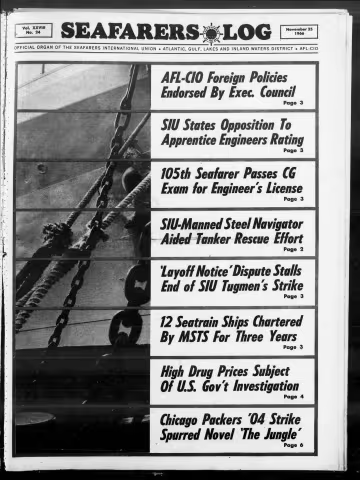
AFL-CIO Foreign PoHdes
CaAtrseJ By Cxet. Coumil
Page 3
SIU States Oppmitieu Te
Appreutke Engineers Bating
Page 3
lOSth Seafarer Passes CC
Exam tor Engineers License
Page 3
SlU-Mnnned Steei Navigator
AiM Tanker Resaie EHert
Page 2
'Layoff Notice 'Dispute Stalls
End of SIU Tngmen's Strike
Page 3
12 Seatrain Slips Chartered
By MSTS Fer Three Years
Page 3
High Drag Prices Subject
Of US. Gov't Investigation
Page 4
Chicago Packers '04 Strike^
Sgarred Novel The Jangle'
Page 6
Page Two SEAFARERS LOG November 25, 1966
SlUNA Stafl Officers Uunch New
Pjiarmaclst Mate Training Facility
NEW YORK—The SIUNA-affiliated Staff Officers Association formally dedicated i^ new
Pharmacist Mate Training School recently, at the U.S. Public Health Service Hospital, Stapleton,
Staten Island.
The ceremony marked the
start of an intensive nine-month
medical training program de
signed to give pursers the skills of
physicians assistants. The first class
of 30 pursers is already enrolled..
All of those who successfully
complete the course will be certi
fied by the U.S. Coast Guard as
pharmacist mates at their gradua
tion. The school is being con
ducted jointly by the Staff Officers'
Association. and the government
in an experimential project that
may provide a prototype for a vast
medical training program for ci
vilians.in other industries and pos
sibly government employees.
Speaking at the dedication cere
monies, SOA Secretary-Treasurer
Burt Lanpher described the new
program as one that would bene
fit not only SOA members by up
grading their skills but would
benefit "the entire fleet and the
men that go to sea . . ."
The Union put up more than
$100,000 of its own funds to help
get the new training facility under
way.
Dedication day of the reinsti-
tuted purser-pharmacist mate pro
gram, which became extinct fol
lowing World War II, culminates
more than two years of a vigorous
campaign by SOA officers.
The school, which offers new
opportunity for job advancement,
represents a victory for the union
which has labored arduously
through a maze of red tape and
a labyrinth of inter-connecting
Federal, state and local agencies.
The program will be conducted
under the auspices of the U.S.
Public Health Service under the
immediate supervision of Dr.
Thomas Shinnick and the New
York State Board of Education
under the direction of Dr. John
Leslie. It is a joint project with
the Union, the New York State
Board of Education and the Fed
eral Government sharing in devel-
SEAFARERSmLOG
Nov. 25. 1966 • Vol. XXVIII, No. 24
Official Publication of the
Seafarers International Union
of North America,
Atlantic, Gulf, Lakes
and Inland Waters District,
AFL-CIO
Executive Board
PAXIL HAIL, President
CAL TANNBR
Exec. Viee-Pree.
AL KERR
Sec.-Treas.
ROBERT MATTHEWS
Vice-President
EARL SHEPARD
Vice-President
LINDSEY WILLIAMS
Vtce-Presufent
AL TANNER
Vice-President
HERBERT BRAND
Director of Organizina and
Publications
Managing Editor Art Editor
MIKE POLLACK BERNARD SEAMAN
Assistant Editor
NATHAN SKYER Stag Writers
PETER WEILL
PBTEB WEISS
ED RUBBNSTEIN
Pskllshsd kIwMkly it 810 Rkods lilind AVSRH
N.E., WathlDitss, D. C. 20018 ky ths Seafir-
•rt intsrnitlonil Union, Atlintie, Golf, Lakeo
and Inland Witon Dlitrlct, AFL-CIO, 675
Foirtb Annao, 8rooklyn, N.Y. 11232. Tol.
HVaslntk 9-6600. Ssoond clais ysotaio paid
at WaiklnitM. 0. C.
NSTaAtTEB't ATTENTION: Forai 3579
lardi obofld ko ooat U Ssafarsn Intornatlonal
VslM, Atlaatio, Golf, Latos asi Inland Waton
DMriat AFL-CIO, 675 Fonrtk Annao, Orssk-
lys, N.Y. 11292.
opment of the training program.
Graduates of the school will be
certified by the Coast Guard. In
structors will be members of the
staff of the Stapleton Hospital,
both doctors and nurses. In addi
tion to the nine-month training
course, purser-pharmacist mate
graduates will have special train
ing for shipboard conditions and
will be qualified to handle radio
pratique. •
The first class of 30 pursers has
already been enrolled. They will
not reside at the hospital but will
receive a per diem allowance con
tributed by the SOA and the De
partment of Labor. The funds
for the school's operation will
come from the Federal Govern
ment, though the New York State
Board of Education and the Pub
lic Health Service will provide the
classroom facilities.
Purser Jean Van Geuns (seated), enrolled in first class of the new
Staff Officers Association Purser Pharmacist Mate Training School,
receives instruction in proper use of a microscope. Looking on are
(standing, left to right): SOA School Director James R. Oliver,
purser-student Harold Putnam, SOA Secretary-Treasurer Burt Lanpher,
and USPHS director of pharmacist mate school Carnick Markarian.
J-
Lifeboat Crew From SlU Ship Aids
In Burning Tanker Reseue Attempt
NEW ORLEANS—SIU crewmembers manning the Steel Nav
igator (Isthmian) participated in a dangerous rescue' effort last
month as they attempted to rescue victims trapped by a fire aboard
the Gulfstag, a tanker owned by
the Gulf Oil Company.
The Gulfstag had burst into
flames in the early morning hours
of Oct. 24 while 60 miles off Mor
gan City, La., in the Gulf of
Mexico.
The Steel Navigator was six
miles away from the stricken ves
sel when it received a request from
the Coast Guard to respond to the
SOS cry from the Gulfstag. The
Steel Navigator proceeded full
speed ahead in search of the
tanker.
As the Navigator approached
the oil tanker, Capt. James Redi-
can ordered lifeboats over the
side and 12 members of the crew
volunteered to man them and
search for survivors of the Gulf
stag.
The lifeboat crews from the
Steel Navigator included SIU-
members T. Tomczak, AB; U. S.
Veach, AB; B. Kitchens, Bosun;
C. M. Gigantille, deck; E. Car-
reras, FWT; Jose Sanchez, Wiper;
L. J. Kubecka and his brother,
T. W. Kubecka, both Wipers; and
Steven O'Brien, Messman.
The Navigator's chief engineer,
Ernest C. Goldsmith, described
how the volunteers "weren't con
cerned with their own safety; they
were just out there to save lives.
"They took the boats right
alongside the ship where the fire
was confined at the time, to the
stern section, and they searched
each of the lifeboats adrift from
the Gulfstag for men."
The heat of the fire was severe
and the smoke from the blaze in
hibited rescue efforts. The flames
might have touched off the cargo
of oil at any time, blowing every
thing in the vicinity to bits. The
oil tanker itself was just about
destroyed, seven men are believed
dead, and three others suffered
serious burns. The SIU men who
participated in the rescue attempt
were unharmed.
The incident brought to mind
another rescue attempt by crew-
members aboard the SlU-contract-
ed Steel Maker last January.
In an angry sea with waves run
ning from forty to fifty feet and
winds blowing near hurricane
force, the Steel Maker pulled from
the ocean four Spanish seamen
who had foundered on the storm-
swept waters in a tiny raft for
more than seven hours.
The men who were rescued had
escaped the stricken vessel Monte
Palomares caught in a North At
lantic storm about 900 miles east
northeast of Bermuda.
Report of
International President
by Paul Hall
Maritime labor has fought many battles in recent years in its attempt
to halt the headlong decline of the maritime industry and revitalize the
American merchant fleet.
Seldom has the importance of a campaign been as evident as the
successful struggle waged by the SIU and other maritime unions that
resulted in the removal of the Maritime Administration from the new
Department of Transportation. Had maritime labor not fought against
MARAD's inclusion, the recent appointment of Alan S. Boyd to head
the new Transportation Department might have represented a major
setback for the future of the American Maritime industry.
The recommendations of the Interagency Maritime Task Force Re
port, sometimes called the Boyd Report, show that Boyd, who headed
the committee that formulated the Report, does not fully understand
and is not in sympathy with the desperate plight of the American
maritime industry. Put into effect, the recommendations of the Boyd,
report would result in the death of the industry. It can be assumed
that if the Maritime Administration had been included under his
jurisdiction as part of the Transportation Department, those recom
mendations would bear heavily on his attitude toward the U.S. mer
chant fleet. Maritime labor's campaign, aided by legislators interested
in preserving the maritime industry, prevented this from happening.
However important maritime labor's successful campaign to exclude
MARAD from the new agency has proved, it represents merely a hold
ing action to prevent further serious injury to the industry, which is
already sick and desperately in need of aid.
Maritime remains confronted with many serious problems that must
be faced squarely and solved. Proposed solutions have been submitted
by the SIU and other maritime unions, many of which are reflected in
the report prepared by the President's Maritime Advisory Committee.
These are creative, practical solutions geared to the needs of maritime
and would go a long way towards halting the continuing decline of the
industry and would make a substantial contribution in creating a
strong, healthy American-flag merchant fleet adequate for the nation's
commercial and defense needs.
It is. in this area where maritime labor must continue to struggle—
to bring about the adoption of a new policy toward maritime, a policy
geared toward the growth and expansion of an industry which is vital
to any nation's economic well being and defense capabilities.
• • •
The new Purser Pharmacist Mate Training School recently inaugu
rated by the SIUNA-affiliated Staff Officers Association is a big first
step toward insuring better health and medical treatment for every
American seaman, and further, for everyone who goes to sea aboard
an American-flag vessel—seamen, officers and passengers as well.
As SOA Secretary-Treasurer Burt Lanpher pointed out at the dedi
cation ceremonies for the new school, too many life and death races
at sea have been lost, too many American seamen have had to be left
in foreign hospitals, too many seamen have been disabled because of
the lack of medical care aboard American-flag vessels.
As a result of the new SOA Purser Pharmacist Mate training facil
ity, American seamen can look forward to a day when no American-
flag ship puts to sea without a trained pharmacist mate on board. But
even the shorter-run gains in health and safety for every American
seaman will be immense. Through the training in medicine and radio
pratique provided through the new training course, purser-pharmacist
mates will be able to provide invaluable aid to sick or injured crew-
members of vessels which do not yet have such trained men aboard.
It is also important to note that this long-standing void, in shipboard
medical training is finally being filled through the efforts of an Ameri
can labor union, which had to fight a long, uphill struggle and put
up its own funds to bring this worthy and long-needed program to
reality. In this case, as in so many others through the years, it has
fallen to the American labor movement to initiate important health
and safety programs which "have otherwise been ignored.
Also of great importance is the fact that the new Purser Pharmacist
Mate Training School is being conducted jointly by the SOA and the
government in an experimental project that may provide the prototype
for a vast medical training program for civilians in other industries
and for government employees. This union-initiated program might
then someday benefit the health and welfare of millions upon millions
of Americans whose medical needs, in this richest of all nations, are
often shockingly neglected.
Smoke billows from stern of oil- tanker Gulfstag, which burned
in the Gulf of Mexico. Rescue attempts by SIU crewmembers of
Steel Navigator, who rode right next to the flaming ship and
hunted the sea for survivors from Gulfstag, were fruitless.
November 25, >1966
AZ
SEAFARERS LOG Page Three
12 Seatram Ships Chartered
By MSTS For Three Years
WASHINGTON—The Military Sea Transportation Service has
chartered 12 vessels from SlU-contracted Seatrain Lines for the
worldwide transportation of military cargoes.
The recently concluded con
tract has been described as the
largest charter of commercial
tonnage in a bloc in the history of
MSTS. The 12 vessels will be
under charter for three years at
a cost to MSTS of $106 million.
The deal includes three vessels
already chartered by MSTS last
May, five additional existing Sea-
train vessels and seven Mission
type tankers allocated to Seatrain
by the Government earlier this
year and now undergoing con
version.
By means of the charter, MSTS
is reportedly seeking a "multi
purpose" cargo system with the
ability to transport anything from
conventional general cargo to car
go in containers and wheeled and
tracked vehicles, including rail
cars.
A Seatrain spokesman said the
line's Puerto Rico service will not
be affected by the charter and will
be maintained and expanded with
three vessels—two newly con
verted ships with double the ca
pacity of older tonnage and one
older vessel.
Service between Edgewater,
N.J. and Texas City, Texas, will
be temporarily discontinued how
ever, he said. This coastwise serv
ice has been maintained in the
past with two vessels.
Three of the Mission type tank
ers involved in the charter are
presently undergoing conversion
at the Maryland Shipbuilding and
Drydock Company in Baltimore.
Four others are being converted
at the Newport News Shipbuilding
and Dry E)ock Company at New
port News, Virginia.
Three or four of the chartered
ships are scheduled to start work
ing for MSTS before the end of
the year, with all 12 ships expected
to be ready for military duty by
next June.
SlU Boatmen Stand Firm
layoff Notke' Dispute Still Stalls
Coding of Baltimore Tag Strike
BALTIMORE—The SlU-Inland Boatmen's Union strike against
three Baltimore tugboat companies is headed toward its seventh
wee^. Both sides met for just an hour with a f^eral mediator on
November 16th, their first con-^
frontation since October 18th
105th Seafarer
Passes Engineers
License Exam
Seafarer Ellis Cottrell recently
became the 105th SIU man to
be issued an engineer's license by
the Coast Guard after attending
the training school jointly spon
sored by the SIU and District 2,
the Marine En
gineers Beneficial
Association.
Brother Cot
trell is 39 years
old. He joined
SIU in 1961 and
shipped out as an
oiler and FWT.
Seafarers who
enroll in the pro
gram are able to take any of the
upgrading courses offered at the
Engineers School if they are at
least 19 years of age and have 18
months of Q.M.E.D. watch stand
ing time in the engine department
plus six months experience as
wiper or equivalent. The school
offers qualified instruction in pre
paring for Third Assistant Engi
neer, Temporary Third Assistant
Engineer, or Original Second En
gineer's licenses.
SIU engine department men
who have the necessary require
ments and who want to enroll in
the. school can obtain additional
information and apply for the
course at any SIU hall, or write
directly to SIU headquarters at
675 Fourth Avenue, Brooklyn,
N. Y., 11232. The telephone num
ber is HYacinth 9-6600.
I '
Cottrell
when the companies walked out
on a Union committee.
The recent meeting was ended
by the mediator, who called a re
cess until further notice.
The Union's major demand is
for the companies to give each
man at least a 24-hour notice be
fore a layoff. This provision is al
ready standard for SIU tugmen in
Philadelphia. During the past year
tugboat men in Baltimore were
laid off from 20 to 30 working
days apiece. The Union contends
that the company knows the port
conditions and manpower require
ments as much as a week in ad
vance and consequently there's no
reason, they believe, for a man to
have to report to work daily, not
knowing if he will be hired and/or
compensated for being there.
SIU Vice President Robert A.
Matthews, who is coordinating
strike action with SIU Vice Presi
dent Earl (Bull) Shepard, said that
"the companies flatly refuse to dis
cuss this and there exists the dead
lock in our talks. The company
wants a unilateral right to tell a
man when to go on and off the
payroll. Wages are not a basic
issue. Conditions of employment
are."
The Baltimore strike began Oc
tober 12th, following a strike vote
by the membership. The three
struck tugboat companies are the
Balcer-Whiteley Towing Co., the
Baltimore Towage and Lighterage
Co., and the Curtis Bay Towing
Co.
The strikers are determined to
remain out as long as necessary,
though they v.'ilj continue to dock,
and undock, without pay, any ship
certified by the Maritime Admin
istration as a military cargo vessel
bound for Viet Nam.
AFL-CIO Foreign Policies Reaffirmed
After Review By Executive Council
WASHINGTON—^The AFL-CIO Executive Council has unanimously re-endorsed the federatkm's
positions on foreign policy developed since the merger as "sound" and "justified by events."
The coiuicil's review of position statements and convention actions on international affairS'opened
its fall meeting here. The day- ^
long discussions on 19 (fifferent
items making up the AFL-CIO's
comprehensive views on foreign
policy brought the conclusion by
the council that labor's positions
"have stood the test of time."
The three-day meeting also took
a detailed look at the results of
the 1966 election and the makeup
of the 90th Congress. Despite the
difficulties posed by liberal losses,
the council said, the accomplish
ments of the 89th Congress must
be both "protected and broad
ened." (See Story P. 4.)
The council also voted support
of strike and bargaining objectives
of a number of affiliates and dealt
with internal matters of charter
application and requests for finan
cial aid.
On international affairs, the
council noted that tho AFL-CIO
has continually re-evaluated its
positions for the past 11 years and
"will continue to do so." It de
clared that "our judgment in all
cases will continue to rest upon
our unalterable devotion to free
dom for all men in all places at
all times."
Meany added that the review
produced the conclusion that there
has not been a single thing that
the AFL-CIO has said in the past
11 years ''that we wouldn't say
again." He reaffirmed that the
policies have stood "the test of
time."
The positions and actions re
viewed by the council included;
Basic Intimate of International
Crisis; Struggle Against Colonial
ism; Support for Programs of
Ship Straek By
SIU la 1957
Up Fw Auction
BALTIMORE — Rusting and
listing badly, the former Cuban
freighter Ciudad de la Habana
(the ex-Canadian Challenger),
which was struck by the SIU in
1957 and has remained at Balti
more since 1958 without moving,
will be sold at public auction by
the U.S. Marshal on November
29.
The Habana and seven other
freighters once owned by the SIU
of Canada-'contracted Canadian
National Steamship Company and
manned by Canadian Seafarers,
were struck in 1957 in a straight
forward dispute over wages. Ca
nadian National then sold the
vessels to Flota Maritima Brown
ing de Cuba which attempted to
operate the ships on a Great Lakes
to Cuba run with foreign scab
crews.
Seven of the vessels remained
tied up in Halifax, Nova Scotia.
However, in spite of the SIU
picketlines, a Cuban crew was
flown in which took the Habana
to Baltimore where she was pick
eted by the SIU at the Maryland
Shipbuilding and Drydock Com
pany. Shipyard workers honored
the SIU picketlines, refused to
touch the vessel, and she has re
mained in Baltimore'ev?r since;
Trade Secretariats.
The review of international af
fairs was placed on the meeting
docket at the request of Vice
President Walter P. Reuther, but
Reuther did not attend the session,
wiring that he had to attend in
stead a meeting of the Auto
Workers executive board. Meany
noted in reply to a query that
Reuther had participated in the
work of the council and all AFL-
CIO conventions that had adopted
the policy positions and had been
• recorded as in support of all of
them.
He noted that Reuther had dif
fered with the majority of the
council on the protest walkout by
worker delegates to the ILO con
vention earlier this year, but that
was the only difference he was
aware of.
Economic Asisstance and Devel
opment; Support Development of
Democracy and Effective Free
Trade Unions in Africa, Latin
America, etc.; Support the United
Nations; For National Defense,
NATO, Disarmament and World
Peace; For German National Re
unification in Freedom and a Free
and Secure Berlin.
Changes Behind the Iron Cur
tain; "Peaceful Co-Existence,"
East-West Trade; Free Trade Un
ion Exchanges with State Com
pany Unions; Recognition of Com
munist China and Admission to
UN; Sino-Soviet Differences; Viet
Nam; Santo Domingo; For Peace
and Social Progress in the Middle
East; Support Expanded Interna
tional Trade and Reciprocal Trade
Agreements; ILO; Build and
Strengthen ICFTU, ORIT and
At Washington Hearing
SlUNA Declares Its Opposition
To Apprentico Cnglneer Rath^
WASHINGTON, D.C.—Spokesmen for the SIUNA told a public
hearing conducted by the U.S. Coast Guard Merchant Marine
Council in Washington, D.C., on Nov. 22, that they were opposed
to the establishment of a new ^
apprentice engineer rating for
seamen.
The SIUNA presentation was
given by SIUNA President Paul
Hall, SIUNA Vice President Wil
liam W. Jordan, who is also presi
dent of the SIUNA Marine Fire
men's Union on the West Coast,
and Fred Farnen, secretary-treas
urer of the SIU-Great Lakes Dis
trict.
The SIUNA position stated,
"we of the SIUNA would consider
any attempt to place any of these
apprentice engineers aboard any
vessel having a collective bargain
ing agreement with any of our affi
liated unions as an attempt to in
fringe upon our jurisdiction and
to violate our contracts."
The SIUNA stated, "That ap
proval by the Coast Guard of this
new classification of apprentice
engineer would serve only to
foment jurisdictional disputes be
tween the licensed and unlicensed
unions and to precipitate possible
tie-ups or delays of American-flag
merchant ships at a time when
they are critically needed for the
Vietnam war emergency."
The union said that "it must be
recognized that the largest single
source of skilled, reliable and effic
ient licensed engineers for the Am
erican-flag merchant fleet has trad
itionally been the pool of un
licensed engine room personnel
coming up through the ranks from
wiper through various Q.M.E.D.
ratings."
"Moreover," the union's state
ment continued, "it is estimated
that there are at least 2,000 skilled
unlicensed engine room men avail
able today, with years of experi
ence in Q.M.E.D. ratings, who
possess all of the necessary Coast
Guard qualifications for an en
gineer's license; and the unions
representing these men have pro
grams for upgrading such qualified
met! to licensed engineers' ratings
within weeks, rather than the
years proposed in the programs of
the licensed unions which have
requested these changes. . . .
"Certainly, it would be far more
in the national interest, and in the
interest of effective participation
of the merchant marine in the war
effort, if the Coast Guard were to
support present programs for the
upgrading of unlicensed engine
room personnel to licensed engin
eers' ratings rather than approve
programs which would threaten
the effectiveness of, and create
conflicts with, existing programs.
"Coast Guard recognition of
time spent as an apprentice engin
eer could therefore lead only to a
downgrading of the enviable rec
ord of skill, efficiency and safety
established by the present corps
of marine engineers and cause
deterioration in the productive
quality of the American-flag fleet
while at the same time increasing
its cost of operation," the union's
statement concluded.
Following the hearing, SIU
President Paul Hall said, "the
fundamental issue here is the pro
tection of the jobs and livelihoods
of the unlicensed members of the
engine department on all Ameri
can-flag vessels.
"Any tampering with the pres
ent ship personnel structure as
suggested with the apprentice en
gineer proposal, obviously threat
ens the security of unlicensed sea
men in general and unlicensed en
gine-room men in particular,"
Hall said.
Hall added that "aside from the
threat to unlicensed seamen's jobs
inherent in the proposal, it is ren
dered even less judicious by the
fact that there are workable alter
natives that are of greater bene
fit to all concerned—the seamen
involved, management and gov
ernment. It is hoped that this issue
can be resolved by the interested
unions in the proper atmosphere." :
'J ! '
* t
f
•f-
1
I-
S:
I
Pace Four SEAFARERS LOG November 25, 1966
J Legislative Gains Must Be Protected,
AFL-CiO Urges At Council Meeting
WASHINGTON—The accomplishments of the 89th Congress "must be both protected and broad-
end," the AFL-CIO Executive Council declared, d ;spite the difficulties posed by the results of the
elections.
Terming the 89th Congress
the "most progressive" in his
tory, the council said the laws
enacted must be safeguarded
especially "against the strangula
tion of inadequate appropria
tions."
Acknowledging that the elec
tion has made this job more dif
ficult, the council pledged that or
ganized labor will not "shirk" its
job in this regard. It noted that
there is also unfinished business
from the 89th Congress that
should be completed by the 90th °
Congress.
The election results, it said,
have not changed the problems
that face the nation—poverty,
racial discrimination, improved
education, inequities in labor laws
and the challenges posed by an
urban America. While some of
these problems have been amelio
rated "none of them has been
solved," the council declared.
Commenting on the elections
and the outlook for the 90th Con
gress at a press conference, AFL-
CIO President George Meany
made these points;
• Organized labor may not
"move as fast" in legislation terms
as a result of the elections, "but
we will keep moving."
• It will be more difficult to
get good legislation from the 90th
Congress.
• The AFL-CIO has lived with
adverse congresses before and de
spite the loss of liberal strength in
the new Congress there is "some
thing to build on."
• Organized labor is neither
pessimistic nor optimistic about
the new sessions starting in 1967,
and it will fight to implement ap
propriations for programs adopted
by the 89th Congress, revive the
campaign for overhauling the un
employment compensation system
by adoption of federal standards.
Meany acknowledged that the out
look for repeal of Section 14(b)
of the Taft-Hartley Act was
"pretty dim."
• The AFL-CIO is never satis
fied with the status quo in terms
of legislative and political pro
grams.
• COPE did a good job in the
elections, but despite its efforts
"some of our members" did not
vote for labor-endorsed candi
dates. A detailed analysis is now
under way of the election results,
especially in areas where large
numbers of union members live,
to determine why labor-backed
candidates did not get as high
a percentage of the votes as in
previous years.
• Labor is concerned about
proposals to enact compulsory ar
bitration legislation. Meany re
affirmed labor's historic opposi
tion.
J
To Keep Medicare Drug Costs Down
Mew Investigation Set to Probe
Prise Gouging by Drug Compunies
r 11 he high cost of prescription drugs and the
X move by the Johnson Administration to do
something about it have thrown the drug
industry into an uproar.
The $3.4 billion-a-year prescription drug mar
ket is heavily dominated by a few big manufac
turers.
Some years ago the late Senator Estes Kefauver
(D. Tenn.) exposed the fantastic "profits in pain
but legislation to take action a^nst die industry
was watered down to become almost meaningless.
Now the issue is rising again.
One reason is that under Medicare the pro
grams will finance purchase of some $200 million
in drugs next year. If, as many Congressmen pro
pose, the financed drugs are extended from just
in-hospital use to outcare use as well, it could
mean that the Federal government would have
about a $400 million annual investment in the
cost of pharmaceuticals.
Orders Inquiry
Recently, President Johnson ordered an imme
diate inquiry into the high cost of medical care.
The study, now being conducted by the Depart
ment of Health, Education and Welfare, will
cover drugs as well as hospital costs, doctors' fees
and other aspects of medical care.
A number of bills are being prepared for the
90th Congress to open, once again, to full public
exposure what is happening in the drug field.
Many of these proposals would require the use
of the generic—or real—name rather than the
brand name. Since the big drug manufacturers
have spent millions of dollars on the brand name,
they are fighting the proposal.
It is behind the brand name, however, that the
manufacturer is able to command such a fantastic
price for his product. It would not be so easy
with the use of the generic name.
Senator Russell Long (D. La.), chairman of the
Senate Finance Committee and Majority Whip,
has spoken out strongly on the drug issue and is
expected to lead a fight as soon as the 90th Con
gress opens.
Long contends that under Medicare and wel
fare programs, alone, if the generic name were
used it would save the Federal government at
least $100 million annually.
The National Council of Senior Citizens reports
that the drug industry "has sought ways to ease
the Government criticism of high drug prices paid
by Federal programs while urging Congress to
keep hands off the industry."
One drug company was reported offering to
provide a 25 percent discount to the nation's
hospitals on all the company's prescription drugs
used by Medicare patients during their hospitaliza
tion. Part of the discount would be passed on to
the -Federal Government.
The company announced its discount in 300,-
000 letters to doctors so the medical men would
prescribe the firm's drugs.
To forestall Federal action, the drug manufac
turers are placing ads in Washington, New York
and Chicago newspapers and other publications.
They claim that while the cost of living has gone
up, prescription prices have actually dropped 9
percent from what is described as the "1957-59
base" price period.
The Senior Citizens decided to make its own
study. It "found that the cost of average new
prescriptions had actually risen some 15 percent
during the period the Pharmaceutical Manufac
turers Association claims prescription prices
dropped 9 percent."
Price Conspiracy
Speaking on the Senate floor a few months ago.
Long charged an international price conspiracy in
tetracycline, currently the most important anti
biotic in this country and throughout the world.
He said it costs about one cent to produce a
tetracycline capsule and for years it has been
marketed to druggists for 30 cents a capsule and
consumers have had to pay 50 cents.
Long said that as a result of a Federd Trade
Commission decision in 1963, which found three
major drug manufacturers—American Cyanamidj
Pfizer and Bristol—^guilty of violating the anti
trust laws, a number of smaller companies began
marketing tetracycline at much lower prices. They
charged only five cents for the pill that cost a
penny to pr^uce.
This is an example of what could be brought
to public exposure if the Presidential study and
Congress moves in this field as expected.
It would be the most decisive assault on the
rising cost of medical care posslUe.
The Atlantic Coast
by Earl (Bull) Shepard, Vice-President, Atlantic Coast Area
The strike by the SIU Inland Boatmen's Union against three tugboat
companies in the Baltimore area is one of the best examples of union
solidarity that you will see. SIU Baltimore tugmen are determined to
stick this strike out until they win the same rights enjoyed by their "
fellow SIU tugmen in other cities. In addition, many other unions in
the Baltimore area have given their support to the strike and are helping
out in any way possible.
New York
Twenty-eight year SlU-man,
Dewey Daughfrey was by the hall
recently and ran into some old
friends. Dewey, whose last ship
was the Texas sails as FOWT.
John Flannery enjoyed his last
ship, the Louisiana, on which he
sailed A. B. John's been a mem
ber of the SIU for 26 years.
Roland Grigg has been check
ing the boards seeking a follow-up
to his fine trip on the Bradford
Island.
Arthur Ballu was with Dewey
Daughfrey on the S/T Texas.
Arthur is looking for a run to a
nice warm climate in order to es
cape those northeast winters.
Philadelphia
The City of Brotherly Love has
enjoyed some fair shipping of late.
Raymond Kroupa registered at
the hall recently and chatted with
some Seafarer buddies. He's a
i 4-year SlU-er who last sailed in
the deck department of the Ames
Victory.
George Barnes intends to stay
on terra firma until after the holi
days, at which time he'll pack his
gear and get ready to ship out
again. George's last ship was the
Globe Carrier.
Dimas Rivera, a 23-year SIU
veteran who last sailed in the deck
department of the Alcoa Trader,
spent the summer months at home.
I^mas is all ready to ship out
again.
Boston
Shipping activity out of Bean-
town port has been somewhat slow
this past period, though we expect
it to pick up in the coming one.
We've had the pleasure of seeing
several veteran Seafarers around
the hall lately. Twenty-three year
SlU-man Benjamin Bmidreau who
last shipped out on the Baltimore
as OS, enjoyed a vacation tour of
Canada and Nova Scotia and is
back in Boston now ready to ship.
One Seafarer raring to beat it
out of Bean town in advance of a
frigid New England winter is
Edward Killigrew. Ed's last ship
was the Transeastem on which he
sailed as A.B. Tropical weather is
more to Ed's liking than anything
else and he's ready to grab the
first foreign run that will bring
him some sunshine.
Family man John Kirias, passed
some time at home wth his fam
ily following a stint as oiler on
the Overseas Joyce. He's ready
to go again with the first job put
on the board.
Norfolk
Norfolk has been enjoying some
brisk shipping activity recently
with two sign-ons, two payoffs,
and two ships in transit. The fu
ture also looks good. We're all
glad to learn that ChaiBe Jones is
no longer hospitalized and has
been feeling virgorous enough to
catch up on some hunting, his
avorite pastime.
"It's great to be back," accord-
ng to Johnnie Hodges, a 16-year
SlU-man who recently got back
stateside after an 8-mQnth voyage
><S>-
as steward aboard the St. Christo
pher, a ship that spent a good
while shuttling about the Persian
Gulf. Also happy to be stateside .
again is Joseph Robertson. Joe
was away from the home port for
five months going to and from ^
Rotterdam on the Globe Carrier."
He's taking a little rest now but..
will be ready soon to ship again.
Tom Stubb's new motorcycle is "•
getting some exercise. Tommy
hopes that this one will last longer "
than his previous motorcycle, ^
which enjoyed a life of just two .
months. He's a 12-year SlU-man -
who most recently sailed as oiler -
on the Duval.
Robertson Klllegrew
Baltimore
Activity has been lively for the
past two weeks with 8 ships paid
off, 7 signed on, and 7 in-transit. ^
The outlook for the coming two-.,'
week period looks very good.
James M. Rogers who has been-
sailing engine departmtent for 25 -
years, paid off the Ames Victory
about four months ago, and is
back at the hall studying the board
now.
H. Arlinghaus, who has been ,
sailing deck for 22 years, recently,
paid off the Alcoa Mariner fol
lowing two Vietnam runs. He
took some time off before ship- '
ping out as A.B. on the Sacra
mento bound for India.
Jim McDonald, a 20-year SIU
man in the engine department, ,
has been around the hall waiting ..
for a deck engineer's slot on a
Calmar ship. His last ship was
the Marymar. Jim commented •
on how pleased he is with SIU
vacation and welfare benefits.
Puerto Rico
Minimum wage rates in P.R.
have lagged behind stateside
scales, and the prospect for equity
has been dimmed by the forecast
of a U.S. Department of Labor,
official who stated that it might
well be more than two years be--
fore they reach the level of the
states.
The first shipment of oil ever
refined in the Virgin Islands sailed
from here for Perth Amboy, New
Jersey. The 175,000 barrels of
bunker fuel were refined at the,
new $30 million Hess Oil Refinery
from cnide oil brought from
Venezuela.
So, Rafael Ramos put in an ex- ^
tended stay on the beach before
grabbing an oiler's job on the'
Seatrain Louisiaiia. Ottver Flynn
also took some time off on tbe\
beach between runs on the San.
Juan and then the Wanrior. The
Bosun of the Maiden Creek, Al-
fonso Rivera, dropped by the hall
recently to say hello,
Normiber 25, 1966 SEAFARERS LOG Page five
The Gulf Coast •<$>-by Undsey Williams, Vice-President, Guif Area
Consideration of a new connecting waterway to be constructed
between the Mississippi River and the Mississippi River Gulf Out
let continues. No recommendation will be announced, however,
until a study is completed by the Louisiana Department of High
ways and the U.S. Corps of Engineers, according to Dock Board
President Harry X. Kelly.
Under secretary of the Navy
Robert H. B. Baldwin addressed
a Navy Day luncheon in New
Orleans recently and candidly
commented on ship unloading tie-
up in Saigon harbor.
Baldwin denied that cargo op
erations there were inept. In fact,
he asserted they were a "shipping
miracle." He noted that earlier
in the Viet Nam conflict it took
12,000 man hours to unload a
ship. Now, it takes just 750.
New Orleans
Chief Steward Vic Romulo is
taking a rest after making many
Roim^ Garza
a voyage down south on the Del
Mar. He plans a relaxing vaca
tion around the tables in Las
Vegas and will be ready to go
again when he returns. FOWT
Anthony GaiTa got off the Del
Rio recently and has been loung
ing around the hall taking it easy,
eating red beans and rice, and
wearing out the newspaper. Now,
he says' he's ready for either a
trip on one of the new Delta Line
ships or a ship on the pineapple
run. Tony lives in Gretna, La.
Harry Durecher last sailed as
assistant pantryman on the Del
Sud. He is now scanning the
shipping board for another job.
After making many a trip as Day
man on the Walter Rke, George
Hernandez has tired of the Ha
waiian sugar run and is looking
forward to a trip to South Amer
ica, preferably on the Dei Rio.
John "Monk" Kelty was in the
Union Hall Cafeteria recently re
galing his fellow Seafarers with
stories about the old days when
the union hall was on Bienville St.
Mobile
Shipping is presently a bit slow
here and the prospects for the
coming month are slow also. One
ship is laid up, the SS Alcoa
Roamer.
Back after a six month trip to
Viet Nam on the Roswell Victory,
Tommy Jenkins is currently on
the beach relaxing. Tommy has
sailed all steward dept. ratings
from messman to chief ^steward.
He lives alone in Mobile since the
passing of his wife earlier this
year. Ofha Biyars is at home in
Perdido, Ala., and intends to do
a little deer and turkey shooting
before shipping again. Bryars
spent the last seven months as
oiler on the Alcoa Ranger down
in bauxite country. James Ham
mond recently piled off the Mt.
Washington Victory after thirteen
very warm months in the Persian
Gulf trade winds. He'll be taking
a trip to the New Orleans USPHS
to get a thorough check-up before
registering again.
Morris J. Danzey, one of four
Seafaring brothers (all SIU), re
cently paid off on the intercoastal
trailership, Panama. M.J. is mar
ried, makes his home with his wife
in Mobile.
Chief electrician Ethmi M.
Mercer, whose last ship, the Maid
en Creek plies the Puerto Rico
run, is taking it easy for awhile at
his home in Mobile. Seafarer
James Bamett finished a couple
of trips to Japan as nite cook and
baker aboard the Ocean Anna.
Jimmie is currently registered and
watching the shipping board for
some steward dept. action.
Homton
Seafarer Roscoe Hampton said
that he will shortly be looking for
a ship going to Viet Nam. He ships
in the engine dept. A. Plnchook,
a deck dept. Seafarer, is taking a
shot at obtaining an AB's .tickets.
Another deck dept. man again try
ing for his AB ticket is J. A.
Chestnut. This will be J. A.'s sec
ond time around and he's con
fident he'll come through a win
ner. y
^ 7"
NimnB Cooks and Stowwds Union
is Undorway
SAN FRANGISCOs—Voting has commenced as the SIUNA-
affiliated Marine Cooks and Stewards Union—Pacific District
began its two-monthi-long election of officers.
The election is spread out
over the 60-day period to assure
the possibility for every mem
ber, whether active or retired, to
cast a ballot.
Voting may be done by several
means. In San Francisco, mem
bers may vote manually. The mail
ballot is legitimate from all other
ports. MCS men on vacation else
where in the country, as well as
retired members anywhere, may
apply for a mail ballot without
going to a port where the Union
maintains an office. AH ballots
sent by mail niust be postmarked
not later than midnight, December
30, in order to be valid.
The constitutional positions to
be filled by the election's winners
are as follows: Secretary-Treas
urer, Assistant Secretaiy-Treas-
urer. Headquarters Dispatcher,
three Headquarters Patrolmen,
Los Angeles Port Agent, New
York Port Agent, Honolulu Port
Agent, Portland Port Agent, Seat
tle Port Agent, as well as six
SIUNA convention delegates.
There are no ballot propositions
to be voted on at this election. The
result is that this year's ballot is
the smallest in size in the Union's
history. However, the importance
of this election is as great as any
held in the past.
Award for outstanding service to safety was presented to the Seafarers International Union at the
recent meeting of the National Safety Council Congress in Chicago. In addition, SIU Safety Director
Joe Algina was awarded an individual citation for his efforts to promote safety at sea. At presenta
tion ceremonies above are (l-r): Harrison Tyler, ILA Local 19 President: Joe Leonard, ILA Safety Direc
tor; Jacob Gold, U.S. Dept. of Labor: Hurley Porter, ILA Local 19 Sec.: and SIU Safety Dir. Joe Algina.
7;
SlU's Toxic Cargo Recommendations
Supported by C.G. Safety Officer
CHICAGO—Recommendations made by the SIU Safety Department to insure the welfare of Sea
farers aboard vessels transporting toxic and combustible liquids in portable tanks have won the sup
port of the U.S. Coast Guard Officer in Charge of Marine Inspection, New York.
In a paper presented at the
54th National Safety Congress
and Exposition of the marine
section of the National Safety
Council, C.G. Capt. William F.
Rea called for new regulations to
assure that personnel on board
vessels are provided with complete
information as to characteristics
of the cargoes they are transport
ing and how to deal with them in
the event of fire, leakage or other
emergency.
Fire Fighting Gear
In addition he called for a tight
ening of the present regulations
to assure that the vessel is carry
ing the additional fire fighting
equipment that is necessary when
the combustible liquid is on board,
plus further clarification of regu
lations pertaining to portable tanks
and various types of toxic and
combustible liquid cargoes.
Also present at the four-day
meeting in Chicago.was SIU Safe
ty Director Joseph Algina. The
SIU had previously recommended
the posting of placards in the
messrooms informing crewmem-
bers of the type of cargo aboard,
its special properties, instructions
for dealing with them in case of
emergency and instructions for
dealing with medical emergencies
arising from crewmembers con
tact with such chemicals.
Protective Garments
In addition to new regulations
to assure the availability of prop
er fire fighting equipment aboard
any vessel transporting such car
goes, the SIU also called for the
inclusion of protection garments
such as special fire and chemical
resistant clothing and special
breathing apparatus in case of
accident.
Injuries caused by toxic or com
bustible fumes escaping from
leaky containers has become a
problem of growing importance
recently. In July of this year
crewmembers of the SlU-con-
tracted Fairland (sea-land) were
hospitalized, victims of a leakage
of one of the tank containers
aboard. The containers were filled
with tolylene diisocyanate. The
leak was discovered after one day
at sea. Contact with this liquid,
of its fumes, can cause severe lung
damage, serious skin bums and
harmful eye irritations.
The Pacific Coast
by Frank Drozak, West Coast Representative
The Port of Los Angeles set a new record for handling general cargo
during the fiscal year ended June 30. For the first time, general cargo
shipments totalled more than 5 million tons. General cargo includes
all commodities except lumber, bulk oil or pipeline commodities. This
category accounted for 5,394,031 tons of traffic out of the year's total
of 26,182,113 tons.
The total tonnage represents a 4
per cent increase over the previ
ous year's. During the fiscal year
just ended, 3,818 ships stopped by
the port.
A number of new facilities in
Los Angeles have increased ship
ping capabilities. The $7.2 million
Indies terminal can berth six ships
Hunt Johnson
simultaneously. The $1.3 million
Catalina terminal facilitates oper
ations, as does newly-installed
equipment at Matson Line's ter
minal which permits consolidation
of containerized shipments.
San Francisco
Shipping has been quite active
and will likely remain so in this
area.
Seafarers paid off this past pe
riod on the Ocean Evelyn, Sra-
traln New Jersey, Steel Vendor,
Couer D'Alene Victory, PMI
Oceanic Faith, Rio Grande, Our
Lady of Peace, Steel Traveler,
Maiden Victory, and the Los An
geles.
Ships in transit are the Geneva,
Cities Service Norfolk, Perunar,
Ema Elizabeth, Oakland, Mary-
mar, and the Steel Se^arar.
Seafarers M. H. Beadey and
Byrd Gold are both headed for
Seattle, bound to pick up the Lyim
Victory for a trip to the Far East.
Electrician Beasley of New Or
leans has been an SIU man for
22 years. Brother Gold, also an
electrician, hails from Tampa,
Florida, and is a 13-year SIU
member.
Seattle
Shipping out of Seattle is active
for any and all ratings with no
letup in sight.
Carl Johnson is shooting for
Bosun's spot on the Wayne Vic
tory, while George Hayes is aim
ing for a Calmar ship or one go
ing to Vietnam.
Wilmington
Shipping has been on the up-
and-up in this port with a good
outlook for the future. Any AB,
FOWT, or electrician can easily
ship out without any problem. All
ratings in all departments can ship
out of here without waiting too
long.
After several week's vacation in
Europe, Boh Hunt is back in town.
Bob is eager to get back on the
job as soon as a chief steward's
spot hits the ^ard.
J
.?
i;
A'
A: •
if
t;
::P
I- I
I
\ 4) ^
¥ i :
•i ;:j/
n
• i- .
'V
Page Six SEAFARERS LOG November 25, 1966
QUESTION: What is your
favorite hangout or place of re
laxation in a foreign country.
P. Esteban: I enjoy going to
the Seamen's Club in Yokohama,
Japan very much.
A fellow can do a
lot, have a drink,
play billiards, rent
a room for the
night, get a hair
cut, or meet old
friends. They
have excellent
food and the
prices are very fair. A seaman can
always find something to do there.
— —
Lawrence O'Connell: Give me
Lisbon, either the Pennsylvania
Bar or the Es-
teril Casino. The
I Pennsylvania has
great food and
service, it's right
in the heart of
town and the
I prices are fair.
For $7.50youcan
get a ticket to the
Casino, good for two weeks. If
you don't gamble, relax and en
joy the floor shows.
Manuel Landron, Jr.: I like
Yokohama very much. The Scan-
dia Restaurant is
I a very good place
for steak and in
addition, they
have an excellent
menu. You have
; to walk up a flight
of stairs to get
there. It's a small
place, but the
service is great and the prices are
reasonable.
Robert McLaughlin: I have al
ways enjoyed going to Manila.
j There are sev
eral nice spots,
but in particular,
a place called
Kicapo's. The
drinks are good
and the service
is exceptional. A
guy can have a
I friendly drink, sit
back, relax and enjoy looking at
ships in the harbor.
Deiotte Retires
Retired Seafarer Walter Deiotte
picked up his first regular month
ly $150 pension check recently
from SlU rep. Marvin Hauf at
the SlU hall in Norfolk. Deiotte
was employed for many years at
Gurtis Bay Shipyard in that city.
Richard De Fazi: I've always
enjoyed the Raffles Club in Sing-
I apore. They have
excellent food,
drinks and service
and the prices
are reasonable.
The place is run
by the British
Government and
seamen are al-
* ways treated very
well there. The club also has a
dance floor and a movie theatre.
4^
Louis Mouton: Well, Singapore
has several places that I always
enjoyed visiting.
In particular I
would recom
mend the Texas
and the Washing
ton Bars. They
have fine food,
drinks and lots of
local atmosphere.
There are a num
ber of other places in Singapore
in addition to those two, that I
have enjoyed visiting.
Cruise Ship
Safety Bill
Becomes Law
WASHINGTON — President
Johnson has signed a ship safety
bill providing safety and financial
responsibility standards for pas
senger vessels operating from
United States ports.
Specifically, passenger ships will
have to be fireproof if they are to
sail from the United States. The
law applies directly at American-
flag and foreign-flag vessels having
accommodations for fifty or more
passengers.
In addition, the. law. requires
that prospective passengers be no
tified of the safety standards on a
passenger ship and that this infor
mation also be included in the
company's advertising. Stiff fines
will slap companies for any in
fraction.
A company must establish fi
nancial security, by posting some
kind of bond or by having. insur
ance, proving it can cover any
judgment against it for death or
injuries. The financial commit
ment is set at $20,000 for each
passenger up to a total of 500;
$15,000 for the next 500; $10,000
for the next 500; and $500 above
that. ">
Also, the company must refund
the passengers his ticket money if
a ship fails to sail on its scheduled
voyage date.
Shipping companies have until
November, 1968, to meet the new
standards. Ships not up to stand
ard by then, and this includes
older ones heretofore exempt, will
be denied port clearance.
The bill represents a compro
mise measure created out of a
joint committee of the House and
Senate that had met to resolve the
differences between two separate
bills proposed by the two legisla
tive bodies.
Congressional concern for mar
itime safety, was prompted by the
burning and sinking of the cruise
ship Yarmouth Castle in Novem
ber, 1965, with the loss of 50
lives, and the fire at sea aboard
the Viking Princess a few months
later.
November 4 to November 17, 1966
DECK DEPARTMENT
TOTAL REGISTERED
All
TOTAL SHIPPED
All Groups
REGISTERED on BEACH
Port Class A Class B Class A Class B Class C Class A Class B
Boston 1 0 3 2 1 25 5
New York 92 35 61 22 37 278 76
Philadelphia 9 4 4 1 4 26 11
Baltimore 20 10 21 19 8 92 25
Norfolk 7 6 3 4 0 22 14
Jacksonville"' 7 4 7 3 5 11 14
Tampa 7 1 1 0 1 12 4
Mobile 22 5 3 2 1 92 16
New Orleans 47 32 29 22 7 167 77
Houston 40 17 33 11 10 131 104
Wilmington 8 5 7 5 5 210 0
San Francisco .... 60 24 33 17 42 82 0
Seattle 29 16 23 13 22 43 5
Totals 352 159 228 121 143 1.001 351
ENGINE DEPARTMENT
TOTAL REGISTERED TOTAL SHIPPED REGISTERED on BEACH
All Groups All Group s All Groups
Port Class A Class B Class A Class B Class C Class A Class B
Boston 2 2 3 3 1 10 2
New York 73 46 38 • 39 23 166 146
Philadelphia 7 2 6 5 3 13 5
Baltimore 19 16 • 13 18 7 79 35
Norfolk 6 3 2 4 1 14 11
Jacksonville 8 6 4 6 4 7 7
Tampa 0 2 1 3 2 4 0
Mobile 16 8 10 7 3 42 52
New Orleans 37 . 25 26 21 9 86 78
Houston 31 11 23 20 9 131 87
Wilmington 7 2 6 1 13 13 0
San Francisco 27 19 41 20 30 46 0
Seattle 14 7 16 1 30 10 2
Totals 252 151 189 147 135 611 465
STEWARD DEPARTMENT
TOTAL REGISTERED TOTAL SHIPPED REGISTERED on BEACH
All Groups All Groups All Groups
Port Class A Class B Class A Class B ^ Class C Class A Class B
Boston 4 0 0 0 0 13 2
New York 65 13 40 16 39 61 24
Philadelphia 6 2 5 3 1 18 7
Baltimore 13 13 20 12 6 70 31
Norfolk 6 1 0 1 1 17 20
Jacksonville 3 2 3 5 3 7 4
Tampa 5 0 2 0 2 10 4
Mobile 10 1 7 2 1 13 7
New Orleans 34 24 13 17 5 122 77
Houston ...' 17 6 15 10 6 85 58
Wilmington 7 7 3 6 8 14
San Francisco 42 13 21 9 46 60 0
Seattle 12 8 7 6 13 17 • 1
To/als 224 97 136 87 131 507 235
One of the most influential books of the early
Twentieth Century, "The Jungle," was
largely the product of a bitter strike in
Chicago's stockyards sixty years ago.
Written by Upton Sinclair who covered the
strike in 1904 as a young Socialist newspaper
writer and "muckraker," the novel grew out of
the story of life in the Chicago stockyards as told
to Sinclair by workers in meat packing plants.
Basically designed as a novel of protest against
the exploitation of workers in the stockyards, its
most powerful impact was the discovering by the
American public of the way in which its steaks,
its sausages and its canned meats were prepared
a story of shocking filth, dirt and unhygienic con
ditions that literally sickened millions of Ameri
cans.
Out of that novel, published in 1906, came an
investigation into the nation's stockyards during
the Presidency of Theodore Roosevelt and out of
that investigation came the Pure Food and Drug
Act of 1906.
The role of the stockyard strike of 1904 and
the role of union men in giving Upton Sinclair the
material with which to write his powerful expose
was dramatically retold in a radio interview with
Sinclair—now a hearty 88—and Harry W. Flan-
nery, AFL-CIO radio coordinator.
Flannery interviewed Sinclair in Rockville,
Md., not too far from the Writer's birth place in
Baltimore, Maryland.
. Sinclair told him of how he had gone to Chi
cago, representing a little four-page Socialist news
paper, to cover a strike of stockyard workers who
>
' >
>
r
Striking Workers Related Filthy Inhuman Conditions
Chiiago Packers'Strike Spurred
Famed American Novel 7he Jangle'
were being brutally treated by the police. In the
course of gathering his story, Sinclair compiled a
huge amount of material on how the stockyards
and packinghouses of those days operated. Most
of the workers were immigrants who could not
speak English, but there was a nucleus of Ameri
can workers who had formed a union and it was
from them that Sinclair got most of his informa-
<1
tion.
"I would sit night after night, after their work,
in their homes. Several would have gathered to
talk to me and I would ply them with questions.
Once they got started, they would talk very freely.
I got information, for instance, about the doping
of meat and the horrors that were perpetrated.
Oddly enough, when the book came out, the things
that concerned the public meat supply made the
book successful because people who had money
enough to buy meat were concerned with the
kind of meat they were eating."
Although "The Jungle" eventually was pub
lished by Doubleday-Page, Sinclair had great diffi
culty in persuading publishers that his book was
not a libelous concoction. In addition he found
his book misrepresented in the newspapers which
went out of their way to excuse or deny what he
had written.
Sinclair, who recently left his California home
to live in the East not far from the nation's capital,
lives a life fully as dramatic as the events described
in his books. Pulitzer Prize winner in 1942,
Sinclair r?m for Governor on the Democratic ticket
not, too many yeans ago on his "EPIC Program—
End Poverty in California," _
SEAFARERS LOG Page Seven
. r'
I
]
•i -
H
Georgia Governors' Standoff
To Be Ruled On By Court
Georgia remained without a governor-elect as a three-judge federal
court wrestled with the legal problems raised by the failure of either
Democrat Lester G. Maddox or Republican Howard H. Callaway to
win a majority of the vote.
Maddox received slightly more than 47 percent of the vote in the
Nov. 8 election, Callaway slightly under. Former Gov. Ellis G. Arnall
received about 6 percent of the vote, write-ins from Georgians who
could not stomach either the extreme segregationism of Maddox or
the Gpldwater Republicanism of Callaway.
In most states, Maddox would have been the winner with a plurality.
But Georgia's constitution requires a majority vote to elect a governor
and throws the election into the legislature if no candidate has a
majority.
The American Civil Liberties Union blocked that procedure with a
motion for a court injunction against action by a malapportioned
legislature.
The federal court agreed that action by the legislature would be
unconstitutional and issued an order barring it. But the order did not
specify how the impasse should be solved.
The civil liberties organization has asked the court to permit a wide-
open election in which any candidate might run. Callaway's support
ers have urged a runoff election limited to the two top candidates, with
write-ins barred. A group supporting write-in privileges in any runoff
argued that a Negro voter would be deprived of his rights if he were
forced to vote for a segregationist candidate. And Maddox has ex
pressed the hope that the choice of governor would be made by the
legislature.
Meanwhile Governor Carl E. Sanders said he will stay in office after
Jan. 10, the normal inauguration date for a new governor, if the issue
has not been settled by then.
* « *
Major efforts for state collective bargaining statutes covering union
fire fighters are a necessity if they are to win improved pay, hours and
working conditions. President William D. Buck of the International
Association of Fire Fighters said in a network radio interview.
In addition. Buck reported the union's constitutional prohibition
against strikes, in effect since 1918, is scheduled for intensive review.
He said the formation of a high-level fact-finding and review commis
sion authorized by the union's recent convention is now under way.
The review group will include "representatives of organizations that
should know something about the fire fighting services in their com
munities" as well as union members. Buck said. His statements came
as he was interviewed on Labor News Conference, aired weekly over
the Mutual radio network.
"Arbitrary public officials" in some areas "must think we are still
back in the volunteer fire fighting days," Buck declared, and in some
cases "have dared us to strike, knowing that we would not." Collec
tive bargaining statutes, with built-in arbitration proceedings, have
given the fire fighters "some relief," he said.
The North Carolina AFL-CIO
has passed a strongly worded res
olution blasting the operators of
this year's State Fair for leasing a
booth to the Ku Klux Klan for a
"propaganda exhibit" that will be
guarded night and day by 12 po
lice officers. The convention said
it believed in free speech, but add
ed that public interest did not jus
tify a state exhibit by the Klan or
the large body of protective police.
—j>—
A record number of delegates
attending the New York State
AFL-CIO convention — 1,700 —
voted a $10,000 appropriation to
help promote organization of New
York farm workers. The resolu
tion, approving the drive, cited
"inhuman living conditions" and
"exploitation of the migrants by
the state's agricultural industry."
<I>
For the second time in three
years, newspaper unions here have
struck the Toledo Blade and the
Toledo Times as a result of long
stalemates in contract negotia
tions. After months of futile talks
the Typographical Union struck
after a negotiating committee re
port that recounted unsuccessful
negotiations that began last May.
Shortly after, the Toledo News
paper Guild also voted to join the
strike with the Stereotypers join
ing the strike as it went into its
second week. Both newspapers,
shut down when all of the nine
newspaper unions employed by
them refused to cross picket lines.
A joint strike headquarters has
been set up and arrangements
have been made for picket trailers
and use of the portable picket
headquarters of the Toledo Area
AFL-CIO Council. In all, about
1,000 unionists are involved. Key
differences between the unions and
the Blade management are con
cerned with wages, duration of
contract, pensions, health and wel
fare, and working conditions in
general.
—4,—
Corporation profits continued to
rise sharply the third quarter of
1966 and records were again
smashed. The only major com
pany not joining the profit parade
in the third quarter was General
Motors. Big gainers were Alcoa,
B. R. Mallory, Magnavox, Penn
sylvania Railroad and Republic
Steel.
Musicians with the famed Phil
adelphia Orchestra who have been
on strike for seven weeks are seek
ing to settle the dispute by accept
ing management's salary offer and
a three-year contract if it includes
a lightened work schedule. Local
77 of the American Federation of
Musicians said acceptance of its
proposal could bring an immedi
ate halt to the strike.
"Foul Weather and Fair"
\OUf2 COUMT/^l — MY
COUHTIZY- oia^aotMTRYl
WB WEEP SOU-MOWII
SBT W THBRB AMP CARPM
TUE STUFP ! - AMP
— AMP SCRACTCn f &0!
00/^0! , f
^We Want You
"We Want You." This was the inscription
on World War Two posters asking for
enlistees in this country's fight against
tyranny.
In World War Two, in the Korean conflict,
in Vietnam, Seafarers have never hesitated,
either as members of the military, or as
members of the merchant fleet, to serve their
country during time of conflict.
However, despite the important role that
the U.S. merchant fleet plays in hauling
cargos vitally needed by our fighting troops
during times of need, it is often treated as
a long-forgotten relative after it is no longer
needed to haul military cargos.
In effect, the U.S. merchant marine is re
garded by the government as a foul weather
necessity and a fair weather expendable.
After the smoke has cleared. Uncle Sam
returns to his customary practice of scouting
the earth in search of foreign-flag vessels to
carry cargos ordinarily reserved for U.S.
flag ships.
In many cases, government agencies have
attempted to circumvent U.S. laws designed
to protect the U.S. merchant fleet. In partic
ular, government agencies have attempted to
circumvent the Caro Preference act, which
reserves 50 percent of Government aid
cargos for American flag ships.
Now, once again, during a time of con
flict, the U.S. merchant fleet is regarded by
the government as a sorely needed commod
ity to haul supplies to our troops fighting in
Viet Nam.
During peacetime, U.S. maritime labor
has acted as a prophet of doom. It has
warned the government that the condition
of our fleet was dropping below the danger
pKjint in meeting our economic and military
demands.
The response has in most cases been a
totally deaf ear to U.S. maritime, and a
come-and-get it attitude toward foreign flag
shipping in quest of U.S. cargos.
In Vietnam, the dye is once again cast.
The U.S. merchant marine is being asked to
give its all for Uncle Sam. To the best of its
ability it is doing so.
But it should be clear to all the govern
ment agencies involved with insuring that
the U.S. maintains a strong merchant fleet,
that pulling dilapidated World War Two
ships out of our reserve fleets is no answer
in meeting the economic and military ship
ping needs of this country.
The 90th Congress—A Tortoise Or A Hare
The American labor movement spear
headed much of the social and legislative
reform for which the 89th Congress won
its reputation as one of the "most progres
sive" in history. The 89th Congress will be
remembered for the passage of much long-
overdue social legislation.
The 90th Congress, more conservative
and less liberal in outlook, is expected to
move more slowly and possibly even attempt
to back-track in some areas through its con
trol over the allocation of funds.
Although much important work has been
begun by the 89th Congress, much still re
mains to be done. Poverty, urban problems,
improved education, better health care, are
all areas in which vast improvement are
needed. New programs must be begun in
these and other areas. Programs already
begun must be improved. As it always has
in the past, the American labor movement
will be on the job as the "peoples lobby",
representing the needs and aspirations of all
the American people.
A'i
Page Eight SEAFARERS LOG November 25, 1966
• " -A-
Wi:-:
'-'-Vif
These Seafarers are cranking in their lifeboat during training period at Mill Basin. Some 1,600 Seafarers have received a lifeboat ticket from the CG
^ IF®®
SHIP safety has always been a matter of concern
to the SIU. Through, its Ship Safety Program,
it has stressed the position that the "only good ship
is a safe ship."
In addition, the SIU's Harry Lundeberg School
of Seamanship conducts courses in Lifeboat Training
which prepares Seafarers for the eventuality that they
may someday have to abandon their own ship, or go
to the aid of seamen on another stricken vessel.
The Lifeboat Training program also enables Sea
farers to obtain their AB's ticket, as a lifeboat en
dorsement is a necessity in order to achieve this
rating.
Many times each year,. the training received by
Seafarers at the SIU Lifeboat Training School is put
to the test during incidents of disaster and real
emergency, and has never yet failed to meet any
challenge presented by weather, fire at sea, accident,
or any combination of these.
The pictures on these pages show an SIU lifeboat
training class being tested by the Coast Guard for
their lifeboat knowledge and technique. By passing
this Coast Guard examination they received their
lifeboat tickets which every AB is required to have.
No one can tell however, when these and other
graduates of the SIU Lifeboat Training School will
meet the real test of their knowledge and skill. For
Seafarers aboard the Steel Navigator the test came
just recently, when they were called upon to man
the lifeboats and pull right up to the flaming tanker
Gulfstag to search for survivors of her crew who
might be in the water near the blazing vessel.
The SIU Lifeboat School was created to meet
the need for qualified lifeboatmen. Begun in Janu
ary, 1959, the school has graduated 166 classes
amounting to 1,685 men. Ninety-five percent of the
graduates passed the Coast Guard test, thereby get-
ing official endorsement as holders of lifeboat-tickets.
The lifeboat school also helps men prepare for their
Coast Guard examinations qualifying them as able-
bodied seamen. The Coast Guard requires that all
candidates for an AB rating must be qualified life-
boatmen.
Open to men sailing in all three shipboard depart
ments, the SIU Lifeboat School is located at Mill
Basin in Brooklyn. The course lasts a week and a
half. In that time the students are taught basic
knots, the basics of fire fighting and prevention,
emergency signals and safety procedures. The focus
of the course is the lifeboat. The men learn about
lifeboat equipment, procedures for launching and
recovering, how to row and how to.take charge of
and direct a lifeboat crew. The school has several
lifeboats which are manned by the students. Other
teaching aids include reading material, schematics
of boats and training films.
I , y
These men. are coiling down the boat fall line. While D. Lasso receives instruction for cdxswain position, fellow crewmembers are laying on oars.
€
V
I'j
V-,
ij
November 25, 1966 SEAFARERS LOG Page Nine
r
5 -•
I fe
.r
'i-
I
V ^
y
I»
i
K
,
Seafarer removes a plug in lifeboat. Seafarers get expert instruction in class from Ami Bjornsson.
Test conductor R. Harrison at helm. Seafarers are shown raising lifeboat during drill at Mill Basin.
John Montaperto is graded by the Coast Guard examiner, Richard Harrison. Equipment demonstration. J. Aguilar hooks boat fall onto the release hook.
.•{
Coast Guard Examiner Harrison leaves boat following test at Mill "Basin. J. Aguilar gives coxswain commands. Bow painter fastened to secure boat.
i J
Page Ten SEAFARERS LOG November 25, 1966
''r" .jf;f
»\ t' •^., ' ••'o'•:.' i•••' •• i" - - '
•r ,
.: 1, V.i JP: 4-!-; •'i
Roy .McCance of engine Payoff time has arrived for Seafarers on Raphael Semmes. John Campbell
department gets a haircut of deck dept., Carlos Gomez of engine dept., and Jim Stickney of engine
before leaving the vessel, dept., (l-r) gather in the crew mess room of the Raphael Semmes.
Charles Furedi (left) of deck dept., studies his next move
during chess game with fellow deck hand Rufino Saray
while they wait for ship to pay off in Port Elizabeth.
Dave LeMarier of Steward Deck hand James Galloway
dept., enjoys some music takes time out for smoke
on a new transitor radio. while waiting for payoff.
John Funk will take a crane
maintenance job on the
ship's next sea voyage.
Among the Seafarers was
Joe Aragona who shipped
as an ordinary seaman.
SlU Representative Bill Hall goes over details of the voyage with
Bob Prideaux of the deck dept. Looking on are, M. L. Carroll, of
steward dept., and J. Stickney who ships in engine dept.
Felix Irving, who sailed in the engine department, di$cusses trip with patrolman at payoff, as
fellow crewmembers congregate in the background. The Raphael Semmes, owned by the Sea-
Land company, completed a trip to Europe. The payoff was held in Port Elizabeth, New Jersey.
Members of the ship's steward department are ready to leave
ship, after o successful voyage. From left, Carlos Sy, Martin
Iturrino, and Carlos Mojica, who kept Seafarers wall fad,
November 25, 1966 SE/AFARERS LOG Page Eleven
1/
•I.
<
rv
A
V
i
( I
I
r< V
I .V
-(
.<
-<
The Great Lakes
by
Al Tanner, Vice-President and Fred Farnen, Secretary-Treasurer,Great Lakes
We are now approaching the end of the 1966 sailing season and
some of our ships are already laid up. The E. M. Fwd laid-up in Mil
waukee and the J. B. Ford in Buffalo. We also have several tentative
dates for the Kinsman and Buckeye vessels, where the majority will
lay up in lower lake ports. Some of the larger fleets, like Boland, Reiss
and Gartland, hope to run their
vessels as late as possible before
the big freeze. The Ben W. Cal
vin will be the winter boat this
year, operating the coal run be
tween Toledo and Detroit, and we
have received many letters from
seniority men requesting trans
fers to that vessel.
The tanker Transbay, an A & G
contracted ship, is still in the ship
yard at Lorain, Ohio, and there is
a chance she might sail before the
Seaway closes. According to com
pany spokesmen, they will call a
crew sometime around November
29th and sail direct to Montreal.
The Seaway is expected to stay
open on a day-to-day basis from
December 3rd on, depending on
weather.
Speaking about the St. Law
rence Seaway, the Canadian ship
ping industry and the Dominion
Marine Association, an organiza
tion representing more than twenty
companies operating vessels on
the Great Lakes, the St. Lawrence
and Inland Waterways, submitted
a proposal to the Canadian Gov
ernment urging the elimination of
Cowan BucciUl
Seaway tolls. The Association
says that abolition of the Seaway
tolls is essential to the survival of
that nation's industry and agricul
ture due to intensified competi
tion. The brief was filed in pro
test over the proposed 10 per cent
boost in Seaway tolls currently
being debated.
The Association went on to say
that stepped up drives for export
sales by the United States and
other economic heavyweights
makes it more urgent than ever to
return to Canada's historic policy
of toll-free waterways. (We would
like to know who is carrying all
of these exports. Certainly not
American-flag ships!)
To this date, the only SIU ship
that entered the Seaway this year
was the tanker Tran^y. She
came in empty and will probably
leave empty.
Many of our members have
been inquiring about the new va
cation plan. Negotiations, I'm
glad to say, have been going along
smoothly and we expect to have
all the mechanics worked out next
month. I cannot go into detail at
t(iis time( However, just as soon
as the the trustees are named and
all necessary documents signed,
we will have a full report ready
for the membership.
Herb Jacobs, SIU old-timer and
steward aboard the SS Lacka
wanna, stopped in the hall last
week to say hello. Herb was off
his ship on a leave of absence and
is now going back to finish up' the
season. Other SIU members on
the beach in Detroit are: Hmry
Bucciill, Joe Arnold, Bill Cowan,
Leo TIemey and Bill Doyle, all of
whom sail in the steward's depart
ment.
Buccilli and Arnold made a tow
on the tug Goode. Cowan is off
his boat on a medical, Tierney
just got back from Vietnam and
Doyle is sitting around waiting
for the Transbay.
Joe Salisbury hung up his golf
clubs for the year and took a job
aboard the barge Malda. Joe says
he is going to get an early start
next spring so he can get into the
low 80's.
Democrats Still Maintain Majority
Conservative GOP Eiertion Gam
Cioud Congress'Legislative Oatlook
WASHINGTON—Although the Senate remains solidly Democratic and generally liberal despite
Republican gains in the recent election, the balance of power in the 90th Congress will rest in the
House of Representatives where conservative Republicans scored substantial gains.
The new Senate will be com
posed of 64 Democrats and 36
Republicans, giving the Demo
crats a clear majority. Further
more, the 18 newly-elected Re
publicans are considered middle-
of-the-roaders, more liberal in out
look than the mainstream of Re
publican congressmen. The legis
lative outlook of the Senate there
fore is not significantly changed
by the election.
In the House however, although
the party breakdown seems sim
ilar, with the Democrats enjoying
a 248 to 187 majority over the
Republicans, the legislative out
look is more clouded because the
47 newly-elected Republican rep
resentatives are more conservative
than the congressmen they re
placed. A combination of con
servative Democrats and conserv
ative Republicans voting together
would outnumber the consistent
liberals of both parties who won
election.
The key to effective control of
the new House seems now to rest
on whether winning Republicans
who campaigned as middle-of-the-
roaders choose to align themselves
with the conservative coalition or
whether they intend to live up to
their vows as moderates—advo
cating continued legislative prog-
YOUR DOLLAR'S WORTH
leafarer's Guide to Better Buying
Car repair frauds, and especially "bait" ads for
transmission repairs, are on the increase, a survey
of current consumer problems by this department
finds.
In the survey, made among Better Business Bu
reaus, Legal Aid Societies and state legal authorities,
car buying and repair problems lead the hit parade
of consumer complaints. (Among the other leaders
are installment-buying problems in general; easy
loans promoted by small-loan companies with result
ant garnishees and even bankruptcies, and a resurg
ence of food-freezer plans.)
For example. Franklin Thayer, General Counse
of Denver Legal Aid, reports that auto and equipment
sales head consumer problems in that area.
There are, also, continuing reports of excessive
charges for transmission repairs and engine overhaul,
with low-income and moderate-income families espe
cially hit hard.
"Tiere are lots of troubles with used car 'guaran
tees' for old models sold 'as is' with assurance that
they are fine cars in good running condition," reports
Jasper Rowland, President of the Akron Better Busi
ness Bureau: "These people then have trouble with
bait transmission repairs, alley garages and finance
companies
You can't depend on exceptionally low prices ad
vertised for overhauling an automatic transmission,
the New York Better Business Bureau warns. Such
offers as $59 or $75 are merely bait to get you into
the shop. You then find yourself charged for all
kinds of extras.
In a case cited by G. K. Grimm, Vice President
of Milwaukee Better Business Bureau, who puts auto
repairs at the top of his complaint list, one repair
firm advertised $40 for transmission repairs, but a
customer wound up paying $125.
In California, complaints about auto repairs have
led to the introduction of a bill in the state legislature
to require auto shops to register with the State Bureau
of Repair Services, just as TV and radio repair dealers
now must do. The bill was drafted with the aid of
experienced journeymen mechanics associated with
the Machinists' Automotive Legislative Committee.
Shops also would be required to give customers
a written estimate of the work to be done, and an
itemized invoice for all parts and labor. The bill
provides penalties for misleading advertising, charg
ing for labor not performed and unnecessarily re
placing good parts.
By Sidney Margolius
Unscrupulous Competition
The bill also would protect scrupulous repairmen
from the competition of sharp operators and low-
quality work, Helen Nelson, California Consumer
Counsel points out.
In addition to guarding against "bait" transmission
ads, you need to be careful of any ads quoting bargain
flat prices for brake linings and other jobs, the Akron
BBB warns. The purported bargain may prove to
be more costly than the charges made by responsible
service companies.
Sometimes repair jobs performed by high-pressure
shops may not be satisfactory even at the final high
price. An Akron car owner answered an ad for a
transmission exchange at a flat price. The final bill
was $129—more than double the advertised price.
But the transmission was worse than ever, and the
repair company would not honor its six-month "guar
antee."
Another frequent "bargain" offer which often re
sults in excessive charges is bait ads for rebuilt motors.
One New York firm was found by the State Attorney
General to offer to install rebuilt motors for $109.
But when customers came to pick up their cars they
were charged several hundred dollars more for work
they had not authorized. In some cases the bills came
to more than the value of the cars. But when cus
tomers refused to pay, the firms would not release
the cars and threatened to sell them at public auction.
There are no bargain car prices if you expect
competent work. The only way to keep down the
cost is to take the best preventive possible care, and
practice careful driving habits. When repairs are
required, you also need to know how to select a com
petent shop.
With proper care, an automatic transmission should
last 50,000 to 75,000 miles if you habitually drive in
heavy city traffic, and 100,000 or more if most of
your driving is done in light traffic.
But you can damage a transmission in just a few
thousand miles, experts warn, by fast idling, staying
in "drive" when you make frequent stops in heavy
traffic, and jack-rabbit starts.
Defective or worn-out shock absorbers (after 25,-
000 miles) also can cause transmission failures,
as well as other problems, the Petroleum Division
of Greenbelt (Md.) Consumer Services advises. But
here, too, you need to beware of advertised cheap
prices. High-quality shocks of the preferred multi-
value type usually cost $8.50 to $12 each, and should
be installed in pairs, these experts say.
In choosing a repair shop, look for these clues to
competence:
• Does the shop look well organized and clean?
• Does the shop use modem test equipment such
as engine operation and vacuum guages, volt meters,
oscilloscope and a dynamometer which simulates road
conditions (or at least band instruments)?
• Is the shop experienced in your make, or at
least in the type of repair you require?
• Is there any tendency towards high-pressure
selling? (A good shop may recommend certain types
of preventive maintenance such as lubrication and
spark-plug regapping, but won't grasp the chance to
sell you something just because you ask whether you
need it, such as new spark plugs.)
Does the service man diagnose carefully before
le will say what the trouble is?
• A union shop is a definite added safeguard be
cause the mechanics must go through a formal ap
prenticeship program plus additional training.
• And finally, what do other car owners think
of the shop?
ress, if at a slower pace than dur
ing the last two years.
On the state level. Republicans
now sit in more Governor's man
sions than do Democrats. When
the victors in the recent election
take office the Republicans will
hold at least 25 gubernatorial
posts and the Democrats 24. The
Governorship of Georgia is still in
doubt, because neither the Re
publican or the Democratic can
didate polled a majority of the
votes and the issue will probably
have to be decided by the courts.
Of 33 Governors' chairs up for
grabs. Republican captured 10
previously held by Democrats and
hung on to another dozen which
they previously held. The Demo
crats on the other hand were able
to unseat only two Republican
Governors, and held on to nine
other state houses which they pre
viously held.
The legislative breakdown for
the next two years therefore
stands at:
SENATE: 64 Democrats—36
Republicans.
HOUSE: 248 Democrats—187
Republicans.
GOVERNORSHIPS: 25 Re
publicans and 24 Democrats, with
the state of Georgia still unde
cided.
US Camels
Contract With
British Yard
WASHINGTON — Because of
design changes, the Defense De
partment has withdrawn an offer
to allow British bids on construc
tion of four minesweepers to cost
about $20,000,000. American
maritime labor went on record as
being strongly against British bids,
contending that the ships should
rightly be built in American ship
yards, by American workers.
The Department of Defense,
however, has not changed their
policy. A Pentagon spokesman
said British shipbuilders instead
are being given the chance "to
compete for construction of $29,-
400,000 worth of vessels in the
Navy's small ship procurement
program.
The original minesweeper proj
ect has been changed drastically,
and "the Navy wants to more
closely watch and supervise the
building," the Pentagon said.
"The new design, together with
new equipment such as more ad
vanced low magnetic and acoustic
minesweeping systems and the
need for low noise . . . demand a
much closer contact between the
technical departments of the
United States Navy and the ship
builder than was envisaged" a De
fense Department statement said.
The potential minesweeper con
tracts were part of a foreign ex
change offset agreement accom
panying the British purchase of
American-made Fill A aircraft.
The United Kingdom plans to buy
50 of the new planes by 1970 at
a cost pf nearly $300,000,000,
P*Ce Twelve SEAFARERS LOG Novemhae aS» 1966^
51(1 Lifeboat Class No. 164
The latest additions to the ranks of SlU lifeboat ticket holders
are shown after they successfully had' completed course at Harry
Lundeberg School of Seamanship in New York City. In left to
right order, front, are: Donaciano Santiago, George McKenna, and
William Schneider. Back row: Jose Torres, Winford Powell, Gor
don Johnson and the instructor of the class. Ami Bjornsson.
Edward Henrera, bom October
3, 1966, to the Edward Herreras,
Galveston, Texas.
4/^
Montie V<MI Miller, born June
28, 1966, to the John J. Millers,
Houston, Texas.
——
Lora Lee Snyder, bom Septem
ber 20, 1966, to the Edward Lee
Snyders, College Park, W. Vir
ginia.
Denward ^wn, born Febru
ary 9, 1966, to the Frederick
Browns, Camden, New Jersey.
Kim Nichols, born September
" 20, 1966, to the Buster Nichols,
New Port Richey, Florida,.
Denise Moore, bom March 25,
1966, to the Euless E. Moores,
Orange, Texas.
4/ —
Miffcella MosBihow^ bom Oc
tober 26, 1966, to the Joseph Mo-
sakowskis, Philadelphia, Pa.
^
Antonio Palmes III, bom Au
gust 8, 1966, to the Antonio
Palmes, Baltimore, Md.
^ —
Ames Sclh Rommo, bom Sep
tember 6, 1966, to the Elias Ro
meros, Lake Arthur, La.
Maris PCTiy, bom October 5,
1966, to the Amold Perrys, New
Bedford, Massachusetts.
Dana Johnson, born August 10,
1966, to the Archie Johnsons, Du-
luth, Minnesota.
Adrimme Spawsaren, bom Oc
tober 3, 1966, to the George F.
riSpaargarens, Metairie, La.
I \1>
Laura Lee Latour, bora August
' 25, 1966, to the Charles B. La-
tours, New. Orleans, La.
Scott Walsh, born July 30,
1966, to the James Walshs, Jr.,
Superior, Wisconsin.
^
Destiny Denise Owens, bom
August 5, 1966, to the Charles B.
Owens, Texas City, Texas.
——
Daniel E. McNeBage, bom Sep
tember 30, 1966, to the John W.
McNellages, Mobile, Ala.
—4/—
John Trent, Jr., bom October
23, 1966, to the John E. Trents,
Mobile, Ala.
—4/—
Lisa Ann Quinn, bom October.
23, 1966, to the Owen Quinns,
Astona, New York.
<1>
Roxanne Annis, born October
30, 1966, to the George E. Annis,
Metairie, La.
Pachyderms Go 1st Class on Claiborne
Two Containerized Female Elephants
Take Trip Across the Gulf of Mexico
NEW ORLEANS—SIU crew members of the Claiborne (Gulf-Puerto Rico Lines) where startled
one morning recently by the arrival of two pachyderms. The elephants were perhaps the strangest
passengers ever to be carried by the Qaibome, what's more, it probably marked the first time that
elephants had been shipped as ^
containerized cargo.
The two elephants, named
Ruth and Eva, were being shipped
from New Orleans to San Juan,
Puerto Rico, where they will be
displayed for promotional pur
poses at a shopping center. Eva
is a teen-ager, only 16 years old.
She tips the scale at between 4,000
to 5,000 pounds. Ruth is a senior
citizen, being 85 years old, and
a resident of the U.S. since 1890,
when she was brought here for
the St. Louis World's Fair. Ruth
weighs between 6,000 and 7,000
pounds. (The totarweight of the
lift was about 36,000 pounds).
Ruth is a Burma elephant.
Burma elephants have only four
toes, while Indian elephants have
five. These animals came by
truck from the Sarasota, Fla.,
Animal Land, and were accom
panied by trainer Frank Dailey.
The trailer containing the ele
phants was ventilated from the
top. When the animals were lifted
onto the ship, they were chained
to the floor in order to prevent
them from slipping from one side
to the other.
The beasts were lifted aboard
with a derrick operated by mem
bers of the SlU-Iqland Boatmen's
Union employed by the Whitman
Towing Co.
Recently a pair of $17,000
horses were among the cargo car
ried by the SlU-manned Detroit
(Sea-Land) on a trip from Puerto
.Rico. The horses were en route
to New York to perform in the
National Horse Show in Madison
Square Garden. A total of 24
horses were unloaded at Port
Elizabeth. They were cared for
by a handler who accompanied
them on the voyage.
The animals were show horses
who perform a variety of tricks.
The two $17,000 horses are jump
ers, including one called . Black
Mist, a 17-year-old veteran of a
number of horse shows. They
were kept on the Detroit's deck
MONEY DUE
The Seafarers listed below have money due them from the com
panies shown. Men whose names are listed should get in touch
with the SIU at 10225 W. Jefferson Ave., Detroit, Mich., as soon
as possible.
Name
Edward Jensen
Ronald Lawson
Mohamed Mnsld
D. Pooley
Ronald Smith
Carmen Thompson
William Mazany
Joseph Sweeney
Edward Taylor
H. DIetz
Ronald Shell
Mohamed Ahdulla
Jack Such
James Lynch
Bruce Harrell
Company Amount
Reiss Steamship Co. $17.28
Reiss Steamship Co. $17.28
Reiss Steamship Co. $22.34
Reiss Steamship Co. $11.64
Reiss Steamship Co. $17.28
Reiss Steamship Co. $10.31
Huron Portland Cement Co. $40.00
Huron Portland Cement Co, $20.34
Huron Portland Cement Co. $71.51
Wyandotte Transportation Co. $ 2.34
Wyandotte Transportation'Co. $972.91,
American Steamship Co. $ 9.15
American Steamship Co. $11.22
Great Lakes Towing Co. $ 1.50
Great Lakes Towing Co. $ 5.99
Two strangers were seen recently walking along the New Orleans
waterfront. They were Ruth and Eva, two elephants on their way
to Puerto Rico. The pair were containerized for easy handling.
along with the ship's cargo.
When the ship docked at Port
Elizabeth, ropes were fastened to
the stalls they were kept in and
the horses were carried off the
ship and placed on vans parked
on the dock.
A wide variety of animal life
has been carried in the past by
SlU-manned ships. Seafarers who
sailed on the Delta Lines ship, Del
Monte, a few years ago, have fond
memories of "Slipper," the seal.
The seal was found in Angola,
West Africa, by fishermen and
brought back to America on the
Del Monte. The seal was tumed
over to the New Orleans Zoo as
a gift from the crew.
The crew of the Robin Locksley
had the company of an ostrich a
few years ago. The bird departed
from the. ship in Brooklyn, for
transportation to a game farm in
the Catskill Mountains., Crew-
members aboard the Robin Trent
had a zebra aboard back in 1952.
A Penn ship once had a mascot
called "Jocko," a small monkey
who like to drink from a cup
while perched on a Seafarer's
shoulder. Another ship had a
monkey with a penchant for wear
ing an SIU T-shirt and cap. Most
of the crew thought he looked
pretty good. Another vessel re
cently completed a trip to Puerto
Rico with a load of cattle.
STEEL ABCHItECT^ (ftthmtan), ()c.
; tober 30—Chairman, WUtiiim MacArthiu-;
i Secretary, John A. Maalow. $104.25 in
I ship's fund. Captain requests ship's dele-
I srate to contact Union about grettint; an
I ice cube machine since ice maker cannot
I produce enough ice for three meals.: Uo-
I tiop pitide that, company put (irayia:
! American' currettCy^ inatead '6f ttivafeis
i checks. Crew request ice-cube makeri as
j old ice machine cannot produce enough
l ice for : three meaia. Deck cargo chains
! are a hazard and unsafe to all men going
i forward. Vote of thanks to the ateward
1 department for the fine meals, and a job
ItyeJl done. ,
Of SIU
MEETINGS
,
tary, B. Eerebee. No beefs and hb dw-
putcd OT reptnfed; by, depaftaieat dele^'
to •serve' as •Bbip's'''weaah»en^
timers on board and an unusually good
steward department: l^erying
•'amoothly.... M '''''''
•f- . -
TRANSiBLOBE (Nu^n Waterb^^
November s-^Chalrtean.. E W. Pierc
Secretary, P. A. Stephen. ByeryUilj
is running smooihly with no' .htefs C
disputed OT. Motion made that c^Or,;i
' on record protesting the MSTS and Aim
policy, of stationing military personpelic
thie ehip without adequate provisionsif
their maintenance, and quartere,.^ btb
than ship'# bbspitaii Motion made-r
the ship's--deles»t#.eee'U,E::tkw
;..pX;,(MWdS'::for.enUiw:#ew<.:.pjfiib.UMlO^
I would like to receive the SEAFARERS LOG—pleaise *puf my
f 'name on your mailing list, ' fPniii
i I
m
ti'.i
-Ylf
f|
* I'L A 4
y
\
/
)
.>
J
J
'•i
•
4
^1
/I
J
4^ '
v;^n:i!ian
^H''r
November 25, 1966 SEAFARERS LOG Page Thirteen
" §;•
r' ..
-
- :l
r
I
:i.
Coffee Time At New Orleans Hall
"Chewing the fat' at a leisurely coffee break in the cafeteria of SlU's
New Orleans hall are (from left to right) J. Galliano, L. Suillot
and J. Sauldman. Many SlU halls provide cafeteria facilities.
FINAL DEPARTURES
I ' *. *
Antonio Dominquez, 57: Pneu
monia claimed the life of Brother
Dominquez, Sept.
12, in Jackson
Memorial Hospi
tal, Miami, Fla.
He was a member
of the Steward
department and
joined the SIU in
the port of Tampa
where he resided.
Seafarer Dominquez was bom in
Cuba. He is survived by his wife,
Eugenia Dominquez, of Tampa.
'Burial was in Q)lon Cemetery,
Tampa.
——
Ernest Bell, 63: A pulmonary
ailment claimed the life of Sea
farer Bell, Sept.
25, at the USPHS
Hospital in Nor
folk, Va. A mem
ber of the Deck
dep'hrtment, he
had sailed as a
bosun. Bell was
born in Georgia
and joined the un
ion in Norfolk, where he made
his home.
Nicholas DeMarco, 45: Seafar
er DeMarco died August 20, in
Brooklyn, N. Y.
A lifetime resi-
dent of Brooklyn,
he joined the Un
ion in New York
and was a mem
ber of the Deck
department. Sea
farer DeMarco
served with the
U.S. Navy for 26 months. His
last ship was the Duke Victory.
Surviving is his mother, Mrs.
Grazia DeMarco and a sister,
Mrs. Honey Parisi of Linden-
hurst, N.Y. Burial was in St.
Charles Cemetery, Farmingdale,
New York.
Herbert O'Nell, 51: A hemor
rhage proved fatal to Brother
O'Neil on Oct. 20,
in the USPHS
Hospital in Balti
more. Born in
Lowell, Massa
chusetts, he join
ed the SIU in the
port of Norfolk.
He had made his
home in Balti
more. A member of the Steward
department, O'Neil sailed as a
cook. He was employed by the
Gallenthin Barge Lines. Surviving
is his wife, Helen, of Baltimore.
Burial was in Oak Lawn Ceme
tery, Baltimore.
Joseph Sweeney, 68: Brother
Sweeney died on Sept. 26, after a
fall at his home in
Wilmington, Del
aware. A mem
ber of the SIU
United Industrial
Workers, he join
ed the union in
Philadelphia.
Born in Wilming
ton, he was a life
long resident of that city. Sweeney
was employed as a ship fitter
by the Wilson Marine Repair
Terminal. He is survived by his
wife, Charlotte, of Wilmington.
Burial was in the Cathedral Ceme
tery, Wilmington.
Sixteen countries were visited by the crew of the SIU Pacific district contracted President Garfield,
"recently returned from an around-the-world cruise. The voyage, which ended Nov. 7, lasted almost
four months. Seven different countries were visited during one period of two weeks.
Klinetsky
According to A.B. Isadore
Klinetsky, the ship's delegate,
the best ports of call were in
the Far East. Brother Klinetsky
has practically made an art of
foreign shopping, visiting depart
ment stores and
supermarkets in
every city he vis
its. He is particu
larly happy about
the world-wide
boom in super
markets.
The very best
shopping of the
entire voyage, he
said, was in the Motomachi shop-
oins center of Tokyo, Hong Kong,
where he purchased a new watch.
Singapore is also a good shopping
port, he said.
In Hong Kong he also pur
chased plates with family portraits
painted on them. One of the
plates incorporated a picture of a
baby. "Is that your son?" bachelor
Klinetsky has been asked many
times. "No, that's me," he replies,
explaining that the portrait on the
plate is of himself as a baby.
He bought liqueurs and perfume
in France, and linen table cloths
in India.
Asked which was the crew's
favorite port, Klinetsky replied
Barcelona, Spain. It is a great city,
he said, both for good times and
shopping. And the prices are good
also. Klinetsky said that the Gar
field's major cargo was rubber,
liquor and military equipment.
<1>
J. H. Maxey, meeting chairman
on the Hudson (Oriental Export
ers) reports the
Chief Mate and
Chief Engineer
are finishing the
repairs aboard the
ship. Maxey re
minded crew-
members to sign
for cots and re
turn them at the
® completion of the
voyage. The ship left Calcutta and
will be paid off in Portland, Ore.,
Dec. 20, Maxey writes. A vote of
thanks was extended to Maxey for
a fine job as ship's delegate. T. K.
Lane will be the new ship's dele
gate. D. E. Edwards, meeting sec
retary, writes that Seafarers were
asked to pitch in a few coins to
build up the ship's treasury in case
of emergency. A balance of $1
from the last trip was reported.
Sheldrake
A discussion was held aboard
the Transhatteras (Hudson) con
cerning the possi
bility of showing
movies, J. R.
Prestwood, meet
ing chairman, re
ports. Seafarers
also elected Phil
lip F. Payne as
ship's delegate, re
ports Meeting
Secretary P. D.
Sheldrake. Logs and mail are ar
riving regularly and there are no
beefs or disputed overtime. Shel
drake informed the LOG. The
ship is heading for Bombay.
<I>
Calm seas and a smooth voyage
for the Steel Apprentice (Isth
mian) as the ship
sails for a payoff
in New York,
Richard Cum-
mings, meeting
chairman reports.
John Welkeski,
meeting secretary,
writes that the
„ . ship's fund con-
Cumnsmgs ^20. Wel
keski said that the crew was
warned to be on the alert for pick
pockets and con men when ashore.
Lennon
Seafarers on the Steel Voyager
had some free time in India, re
cently while wait
ing out a mon
soon. Meeting
Chairman James
Lennon reports a
good trip with
a co-operative
bunch of Seafar
ers. It takes a
good crew fo
make a good ship
and Seafarers at the vessel's recent
New York payoff agreed there
were a fine bunch of men on the
last run. The Steel Voyager re
turned to New York via a coast
wise trip.
- ^
We had the honor of a visit
from U.S. Congressman Raymond
Clevenger and
Democratic Can
didate for U.S.
Senate G. Men-
nen Williams on
October 11th. We
have Loren Sny
der back in this
Port after a stay
,. in the Milwaukee
Lapczynski Hospital. Frank
Lapczynskl just returned from St.
Mary's Hospital in Duluth after
having a bout with an ulcer.
Margaiito Boija
Your income tax refund check
is waiting for you. It is being held
by Jack Lynch, Room 201, SUP
Building, 450 Harrison Street, San
Francisco, Calif. 94105.
^
Henry L. Baker
Please call home at once. Any
one knowing Henry L. Baker's
whereabouts, please call Mrs.
Mary Baker, collect, at 305-683-
4993.
William Cofone
Please contact your wife, Dor
othy Cofone, at 8805 Fifth Ave.,
Brooklyn, N. Y., as soon as pos
sible.
Charles E. Switzer
Your income tax refund check
is waiting for you. It is being held
by Jack Lynch, Room 201, SUP
Building, 450 Harrison Street, San
Francisco, Calif. 94105.
Ernest Hnrd
Please contact Mrs. S. Smith,
1222 St. Roch St., New Orleans.
Phone: 947-8126. Wayne is there
^d is going into the service.
^
Andre W. Deriger
Your income tax refund check
is waiting for you. It is being held
by Jack Lynch, Room 201, SUP
Building, 450 Harrison Street, San
Francisco, Calif. 94105. ,
^
All! Nasroen
Your two income tax refund
checks are waiting for you. They
are being held by Jack Lynch,
Room 201, SUP Building, 450
Harrison Street, San Francisco,
Calif. 94105.
Eusebio Flores
Please contact your son, David
Flores, 25-11 34th St., Astoria,
Long Island, N. Y. 11103, as soon
as possible.
r< i '
Page Fourteen SEAFARERS LOG November 25, 1966
SIU-AGLIWD Meelings
New Orleans.Dec. 13—2:30 p.in.
Mobile Dec. 14—2:30 p.m.
Wilmington .Dec. 19—2 p.m.
San Francisco
Dec. 21—2 p.m.
Seattle Dec. 23—2 p.m.
New Yoric .. Dec. 5—2:30 p.m.
Philadelphia .Dec. 6—2:30 p.m.
Baltimore .. . Dec. 7—2:30 p.m.
Detroit Dec. 9—^2:30 p.m.
Houston .... Dec. 12—^2:30 p.m.
Great Lakes SIU Meetings
Detroit Dec. 5—2 p.m.
Alpena Dec. 5—7 p.m.
Buffalo Dec. 5—1 p.m.
Chicago Dec; 5-^7 p.m.
Cleveland Dec. 5—7 p.m.
Duluth Dec. 5—7 p.m.
Frankfort Dec. 5—7 p.m.
Great Lakes Tug and
Dredge Region
United Industrial Workers
New Orleans . . . Dec. 13—7 p.m.
Mobile Dec. 14—7 p.m.
New Voile Dec. 5—7 p.m.
Philadelphia .. . Dec. 6—7 p.m.
Baltimore Dec. 7—1 p.m.
^Houston Dec. 12—7 p.m.
tMcetinc hcM at Labor Temple, Saalt
Stc. Marie. Mich.
• Meeting held at Labor Temple, New
port News.
t Mectinr held at Galreaton wharvea.
Chicago ..
tSault Ste.
i
Buffalo ...
Duluth ...
Cleveland .
Toledo ...
Detroit ...
Milwaukee
. .Dec.
Marie
Dec.
..Dec.
. .Dec.
. .Dec.
. .Dec.
. .Dec.
. .Dec.
13—7:30 p.m.
15—7:30 p.m.
14—7:30 p.m.
16—7:30 p.m.
16—7:30 p.m.
16—^7:30 p.m.
12—7:30 p.m.
12—^7:30 p.m.
•
biRBCTORYof
UNION HALLS
SIU Inland Boatmen's Union
New Oileans .. Dec. 12—5 p.m.
Mobile Dec. 14—5 p.m.
Philadelphia ... Dec. 6—5 p.m.
Baltimore (licensed and
unlicensed) .. Dec. 7—5 p.m.
Norfolk Dec. 8-^5 p.m.
Houston Dec. 12—5 p.m.
Railway Marine Regitm
Philadelphia
Dec. 13—10a.m.&8p.m.
Baltimore
Dec. 14—10 a.m. & 8 p.m.
^Norfolk
Dec. 15—10 a.m. & 8 p.m.
Jersey City
Dec. 12—10 a.m. & 8 p.m.
SIU Atlantic, Gulf, Lakes
& Inland Waters
Inland Boatmen's Union
United Industrial Workers
PRESIDENT
Paul Hall
EXECUTIVE VICE PRESIDENT
Gal Tanner
VICE PRESIDENTS
Earl Shapard Lindsay Williams
Al Tanner Robert Matthews
SECRETARY-TREASURER
Al Kerr
HEADQUARTERS 675 4th Ave., Bklyn.
HY 9-6600
127 River St.
EL 4-3616
... 1216 E. Baltimore St.
EA 7-4900
177 State St.
Rl 2-0140
... 735 Washington St.
TL 3-9259
9383 Ewing Ave.
SA 1-0733
1420 W. 25th St.
MA 1-5450
10225 W. Jefferson Ave.
VI 3-4741
312 W. 2nd St.
RA 2-^^,
. P.O. BOT'IS?
415 Main St.
EL 7-2441
5B04 Canal St.
WA 8-3207
.2608 Pearl St.
EL 3-0987
JERSEY CITY. N.J 99 Montgomery St.
HE 3-0104
MOBILE. Ala I South Lawrence Sr.
• > HE 2-1754
NEW ORLEANS. La 630 Jackson Ave.
Tel. 529-7546
NORFOLK, Va 115 3rd St.
Tel. 622-1892
PHILADELPHIA. Pa 2604 S. 4th St.
DE 6-3818
PORT ARTHUR. Ter. 1348 Seventh St.
SAN FRANCISCO. Calif. 350 Freemont St.
DO 2-4401
..1313 Fernandez Juncos
Stop 20
Tel. 723-8594
2505 First Avenue
MA 3-4334
805 Del Mar
CE-l-1434
312 Harrison St.
Tel. 229-2788
WILMINGTON. Calif. ...505 N. Marine Ave.
834-2528
ALPENA. Mich. ...
BALTIMORE. MD. .
BOSTON. Mass. ...
BUFFALO. N.Y. ...
CHICAGO. III. ...
CLEVELAND. Ohio
DETROIT. Mich. ..
DULUTH. Minn
FRANKFORT. Mich.
HOUSTON. Tex
JACKSONVILLE. Fla.
SANTURCE. P.R.
SEATTLE. Wash.
ST. LOUIS. Mo.
TAMPA. Fla
Is Hazard to U.S.
To Thie Editor:
^ I would like to comment on
Edward P. Morgan's radio
broadcast which dealt with the
serious shortage of health man
power. Morgan wrote about the
selfish policies' of the American
Medical Association hierarchy
being damaging to the.health of
the American population. He
went on to say that if the AM A
were as concerned about hos-
pitw wages as doctors' fees, hos
pitals wouldn't be so short
hand^.
I wonder how many LOG
readers are aware that the AMA
has deliberately created a doc
tor shortage in this country, to
insure fat fees from a desperate
public. There are too few med
ical schools and too few medical
students—-and that's the way
the AMA wants it.
.jenry" Klein
LETTERS
To The Editor!
-i.i
PraismPri^e
fiy
M T« EdinNr;
As a native Californian and
a wprkingraan, I ami grateful
that the farm workers finally
seem tb be successfully union
izing. Helieve me, this is long
overdue, Cesar Chavez, di,rec-
tor of the AFL-CIO United
Farm Workers Organizing
Committee, is doing a great job.
The recent defeat of Pat Brown
by Republican Ronald Reagan
wUl, I think/ prove to be a
great setback for organized ,
bor in California and labor naUst
work hard in the next election
to bring more liberals into.
Office,
Jack LaMonica
0oyeraihenf Shputdl
Help Cut Prices
To The EAtor:
It is a well-known fact that
the pbbf pay more for
housing than their moid w^
off fellow citizens. I have just
finished reading an article in my
;;-;Iocal^ hewspafif- 'that gives"^^^^^
the fact of this situation. The |
article points out that the poor |
pay bi^er prices for food be- ^
cause few supermarkets are
found in poor areas. In 1960,
the article said» housing that '
was dilapidated or lacked
plumbing was the lot of 25 per
cent of urban families with in
comes under $3,000 a year.
I think that city, state and
the federal government should
do all they can to set housing
standards, and perhaps even
taking a Step such as controlling
prices,
MifceBocsche
Sacks Women's
Supermarket Strikes
To The Editor:
I think all workingmen and
their families should be aware
of the role that their local su
permarkets have played in jack
ing up the price of food.
People are finally getting wise
to the fact that trading stamps^ ;
lottery gamesy the fantasricj
prices of some processed foods,;/
and Concealed price increases/
effected by reductions in com
tents of packages all take money
from their pockets,
I believe that if housewives
continue to picket supermarkets;-;
and if workingmen's families
keep writing letters to the su
permarket chains, we will see
a healthy reduction in food
prices,
G. Coidin
... > - • t
Mitpes Boycott of
Antiunion Products .
To The Editon
My wife and I have started
our Christmas shopping, and
ooth of us carry the Log's Don't
Buy list with us. We both try to
make sure that none of the
items we., buy are made by a
company that dehii^ its empjo^
ees the right to fair wages and
working cpndition^hrough un
ionization. TTiis is my duty as
a trade unionist. I hope my
fellow Seafarers, and all other
trade unionists, boycott prod
uct manufactured by anti-union
employers. -•
A. £. Jackson
^1
T flNANCIAL REPORTS. The constitution of the SIU Atlantic, Gulf, Lakes and
Inland Watere District makes specific provision for safeguardinK the membership's
money and Union finances. The constitution requires a detailed CPA audit every
three months by a rank and file auditing committee elected by the memberahip. All
Union records are available at SIU headquarters in Brooklyn.
TRUST FUNDS. All trust funds of the SIU Atlantic, Gulf, Lakes and Inland
Waters District are administered in accordance with the provisions of various trust
' fund agreements. All these agreements specify that the trustees in charge of these funds
shall equally consist of union and mandgement representatives and their alternates.
All expenditures and disbursements of trust funds are made only upon approval
by a majority of the trustees. All trust fund financial records are availijjle at the
headquarters of the various trust funds.
SHIPPING RIGHTS. Your shipping rights and seniority are protected exclusively
by the contracts between the Union and the shipowners. Get to know your shipping
rights. Copies of these contracts are posted and available in all Union halls. If you
feel there has been any violation of your shipping or seniority rights as conUined in
the contacts between the Union and the shipowners, notify the Seafarers Appeals
Board by certified mail, return receipt requested. The proper address for this is:
Earl Shepard, Chairman, Seafarers Appeals Board
17 Battery Place, Suite 1980, New York 4, N. Y.
Full copies of contracts as referred to are available to you at all times, either by
writing directly to the Union or to the Seafarers Appeals Board.
CONTRACTS. Copies of all SIU contracts are available in all SIU halls. These
X contracts specify the wages and conditions under which -you work and live aboard
ship. Know your contract rlahta, as well as your obligations, such as filing for OT
on the proper sheets'and in the proper manner. If, at any time, any SIU patrolnian
or other Union official, in yonr opinion, fails to protect your contract rights prop
erly, contaid; the nearest SIU port agent.
EDITORIAL POLICY—SEAFARERS ifA}G. The LOG has traditionally refrained
from publishing any article serving the political purposes of any individual in the
Union, officer or member. It has also refrained from publishing articles deemed
harmful to the Union or its collective membership. This establish^ policy has been
reaffirmed by membenhip action at the September, 1960, meetings in all constitu
tional porta. The responaibility for LOG policy is vested in an editorial board which
consists of the Elxeeutive Board of tile Union. The Executive Board may delegate,
from among ita ranks, one individual to carry out this responsibility.
PAYMENT OF MONIES. No monies are to be paid to anyone in any official
capacity in the SIU unless an official Union receipt is given for same. Under no
circumetances should any member pay any money for any reason unless he is given
such receipt. In the event anyone attempts to require any such payment made
without supplying a receipt, or if a member ia required to make;, a payment and is
given fin official receipt, but feels that he should not have been required to make
such payment, this should immediately be reported to headquarters.
CONSTITUTIONAL RIGHTS AND OBLIGATIONS. The SIU publishes every six
months in the SEIAFAIUStS LOG a verbatim copy of its constitution. In addition,
copies are available in all Union halls. All members should obtain copies of this
constitution so as to familiarize themselves with its contents. Any time you feel any
member or officer is attempting to deprive you of any constitutional right or obli
gation by any methods such as dealing with charges, trials, etc., as well as all other
details, then the member so affected should immediately notify headquarters.
RETIRED SEAFARERS. Old-time SIU members drawing disability-pension bene
fits have always been encouraged to continue their union activities, including attend
ance at ihembership meetings.' And like all other SIU members at these Union meet
ings, they are encouraged to take an active role in all rank-and-file functions, in
cluding service on rank-and-file committees. Because these oldtimers cannot take
shipboard employment, the membership has reaffirmed the long-standing Union pol
icy of allowing them to retain their g<^ standing through the waiving of their dues.
EQUAL RIGHTS. All Seafarers are guaranteed equal rights in employment and
as members of the SIU. These rights are clearly set forth in the SIU constitution
and in the contracts which the Union has negotiated with the employers. Conse
quently, no Seafarer may be discriminated against because of race, creed, color,
national or geographic or^n. If any member feels that he is denied the equal rights
to which he is entitled, ^he should notify headquarters.
SEAFARERS POLITICAL ACTIYITY DONATIONS. One of the basic rights of
Seafarers is the right to pursue legislative and political objectives which will serve
the best interests of themselves, their families,-and their Union. To achieve these
ohjectives,' the Seafarers Political Activity Donation was established. Donations to
SPAD are entirely voluntary and constitute the funds through which legislative and
political activities are conducted for the benefit of the memberahip and the Union.
If at any time a Seafarer feds that any of, the above righto have been vldatcd,
or thst he hss been denied his constitntianal right of access to Union records or in
formation, he ehonld immediately notUr SIU President Pan! Hall at headquarters by
rseeipt rsqusstad. certified mail, return receipt
UNFAIR
rtP-p mmmi
DO NOT BUY
Seafarers and their families are
urged to support a consumer boy
cott by trade unionists against
various companies whose products
are produced under non-union
conditions, or which are "unfair
to labor." (This listing carries the
name of the AFL-CIO unions in
volved, and will be amended from
time to time.)
Sears, Roebuck Company
Retail stores & products
(Retail Clerks)
Stitzel-Weller Distilleries
"Old Fitzgerald," "Old Elk"
"Cabin Still," W. L. Weller
Bourbon whiskeys
(Distillery Workers)
<1>
Kingsport Press
"World Book," "Chlldcraft"
(Printing Pressmen)
(Typographers, Bookbinders)
(Machinists, Stereotypers)
Jamestown Sterling Corp.
(United Furniture Workers)
White Furniture Co.
(United Furniture Workers of
America)
Genesco Shoe Mfg. Co.
Work Shoes . . .
Sentry, Cedar Chest,
Statler
Men's Shoes . . .
Jannan, Johnson &
Murphy, Crestworth,
(Boot and Shoe Workers' Union)
<I>
Di Giorgio Fruit Corp.
S and W Fine Foods
Treesweet
(National Farm Workers
Association)
Baltimore Luggage Co.
Lady Baltimore, Amelia Earhart
Stariite luggage
Starflite luggage
(International Leather Goods,
Plastics and Novelty Workers
Union)
vt'
"HIS" brand men's clothes
Kavnee Boyswcar, Judy Bond
blouses, Hanes Knitwear, Randa
Ties, Boss Gloves, Richman
Brothers and Sewell Suits,
Wing Shirts
(Amalgamated Clothing Workers
of America)
——-
R. J. Reynolds Tobacco Co.
Camels, Winston, Tempo,
Brandon, Cavalier and Salem
cigarettes
(Tobacco Workers International
Union)
Peavy Paper Mill Products
(United Papermakers and
Paperworkers Union) —s—
Comet Rice Mills Co. products
(International Union of United
Brewery, Flour, Cereal, Soft
Drinks and Distillery Workers)
Antonio PereDl Miinettl & Sons
Ambassador, Eleven Cellars
Red Rooster, Greystone, Guasti,
Calwa, F. I., Tribuno Vennouth,
Aristocrat, Yictor Hugo, A. R.
Morrow Wines and Brandies.
(National Farm Workers
Association^
\\
r\
i 1
?\
J
J\
A I
i
>
(;
/
l\
M
Si
\
i
/il
- S]
.n
November 25, 1966 SEAFARERS LOG Page Fifteen
I'
r
4'
^1-
,1-
6
/I
PORTS
o^the
World CHITTAGONG , • •. -v.. --v.:-.' •
CHITTAGONG, a port that by its name
alone evokes an image of a city of beauty.
This incredibly beautiful port, on the right
bank of East Pakistan's Kamaphuli River, was
named by a victorious Buddhist King of Arakan in
the 10th Centuty, A.D. To commemorate the de
feat of a Muslim sultan, the Buddhist erected a
huge pillar with "Tsit—^Tse—Gong" inscribed
upon it, standing for the peaceful plea, "war shall
not be waged."
And peaceful Chittagong is, despite its growing
reputation as East Pakistan's busiest port, han
dling two million-plus tons of cargo annually, and
its growing population of more than 365,000.
Lush green meadows and forests abound in a
climate ideal for vacation land. The blue waters
of the Bay of Bengal, sunshine, forests and lakes
and rivers, ancient mosques, all convert this area
into a spectacle of tranquility and beauty. The
7th Century Chinese traveller-poet, Hiuan Tsang,
called Chittagong "a sleeping beauty emerging
from mists and water."
Just 94 miles from Chittagong stretches Cox's
Bazar, the longest unbroken beach in the world
that is ideal for swimming. The golden-silvery
strip spreads for 70 solid miles, unhampered by
sharks or jelly fish. ^
The region of the Chittagong Hill Tracts com
prises ten ranges of high hills separated by valleys
swathed with thick jungle vegetation and watered
by the many rivers which lace the area. Perhaps
more than any other area, this, the Chittagong
Hill Tracts, offers the most superlative natural
vistas of them all.
The independent nation of Pakistan itself was
carved in 1947 out of the territories that formed
the British Indian Empire. Two nations were born,
Pakistan and India. The division took place on
the basis of Hindu majority areas and Muslim
majority areas.
The principal cities of East Pakistan are Chittagong,
Dacca, Syihet and Khulna. Street scene above is
typical of the older sections of East Pakistan cities.
Throughout Pakistan, traditional costumes
show a defrnite Far Eastern influence in
the delicate fabrics and lavish embroidery.
Transportation in East Pakistan is often very basic in nature.
Here an ox-cart rumbles through the streets carrying a huge
load of jute to be milled into fiber for burlap and rope.
•- I • • t '< f;'
Rice, grown in muddy, half submerged paddies
the East Pakistan diet. Highly dependent on a
growth, the area's rice crop has been plagued in
is the principal food crop and makes up the chief staple of
proper balance of heavy rainfall and sunshine for proper
recent years by drought and much grain has been imported.
SlU-manned Steel Navigator and other Isthmian Line ships are among the SlU-contracted vessels making
regular stops at Chittagong, East Pakistan. The main seaport of Pakistan's eastern province, Chittagong
handles over two million tons of cargo annually. The city has a population of over three million people.
I
'J
Vol. XXVIIi
No. 24 SEAFARERSiiUMS >,
''I s ,
OFFICIAL ORGAN OF THE SEAFARERS INTERNATIONAL UNION • ATLANTIC, GULF, LAKES AND INLAND WATERS DISTRICT • AFL-CIO
qhristmas ;Buuina;
Caution! \
T 11HE holiday season is traditionally a time for
X gathering together with our loved ones to
share the fruits of a year's labor. Big family
dinners and the exchanging of gifts has long been
an integral part of the holiday season in the
United States.
For Seafarers and their families, possibly more
than for most Americans, the giving of gifts to
family and friends is a chief way of showing affec-
' tion, because time and distance all too often make
it impossible for them to be together to share a
well-set table and the joyousness of the season.
During the holiday season, more than any
other time of year, it becomes obvious that the
United States is truly a land of plenty. Shop
windows are fairly bursting with goods for sale.
Advertising in the newspapers, television and radio
reaches its peak in giving advice, enticements
and entreaties to buy particular products. Package
designers out-dd themselves yeaf after year to
produce boxes more apt to sell the goods inside.
Wherever we go we are pressured to "buy":
There are many well-made, attractive, useful,
worthwhile and fairly priced goods on the market.
Unfortunately however, there are also many
shoddy, useless, high priced products being pushed
by American manufacturers who attempt to make
up for the poor quality and design, low utility
value and high price of these products through
the use of high-powered advertising, soft-sell,
hard-sell, and other devices. Besides enabling cer
tain manufacturers to sell shoddy merchandise to
people who do not really want or need it, these
advertising devices serve to boost already inflated
prices still higher.
Manufacturers spend billions yearly on adver
tising and packaging. In the end those billions
come out of the consumers' pockets and represent
hard-earned money which might be better spent
with the exercise of a bit of caution. Be sceptical
of advertising claims—they may be true but they
may not be. Be suspicious of gaudily packaged
products and inspect the contents of such pack
ages carefully. The box that gets thrown away
with the Christmas Avrappings, may be worth more
than the product inside. The difference of course
comes put of your pocket.
Before buying a gift, consider whether it is
really wanted and will be used and enjoyed by
the recipient. Moderately priced gifts that will
give great pleasure can also be attractive, and
represent money well-spent. Too many expensive
but basically useless gifts are forgotten the next
day and never thought of again.
Be wary of offers of loans for Christmas spend
ing. These short-term loans often come at high
interest rates which are seldom even mentioned
by the lender and almost never clearly explained
and outlined so that the actual interest rate can
be computed in advance. In the long run, such
loans can only reduce your buying power because
money paid in interest, which often almost equals
the amount of the loan itself, is lost forever. It
is much better to give less expensive gifts at
Christmastime than to become involved in pay
ments that will drain away income needed for
more important uses, such as clothing or educa
tion.
Another area in which caution should be ob
served is in charitable donations. Americans are
among the most generous people in the world
and traditionally give vast amounts of money to
charity to help share their good fortune with
others who are less fortunate. There are many
excellent, established, well-run charities which
carefully and scrupulously account for all dona
tions and see to it that they are used where they
are most needed. Unfortunately, the holiday sea
son also brings forth many slick operators seeking
a fast buck under the guise of charity. To be
sure your donation is not wasted, give only to
charities which you are certain are reputable.
When in doubt investigate before you part with
your cash.
Last but not least, look for the union label on
everything you buy this Christmas or at any other
time. The union label is your assurance that, you
are giving a quality product produced by union
craftsmen, enjoying decent wages and working
conditions. In addition, at Christmastime as at
all other times during the year, boycott all goods
manufactured or offered by those employers who
remain unfair to labor. Each issue of the log
carries a complete 'don't buy' list of products pro
duced by employers who have been found to be
unfair to their employees in denying them the
right of unionization and collective bargaining.
In this issue it can be found on page 14. Clip it
out for easy reference and refer to it when shop
ping. You can take action in the marketplace
this Christmas that will help make next Christmas
a better one for thousands of American workers
and their families, »
Vol. XXViii
No. 24 SEAFARERSA^LOG
OFFICIAL ORGAN OF THE SEAFARERS INTERNATIONAL UNION . ATLANTIC, GULF, LAKES AND INLAND WATERS DISTRICT • AFL-CIO
'.«• >.t ' iiilillPil'I
R-I'v ;•
ISssf^
J-
""•P:
-i
<-
*•"> ~ , J. ?~
jSsfSs^S ti'-'I'i'-
1' , ^ ' '/^y ]
I ' It,-. ' '.• ^ ' • - I
t
>1-
•"(
L
'
pX-i • 3,^
•Lib:?/
^ f ,1^* ^
H®;
F ',., V,
' ^
. .' r>
w ' ;/ --'•
\
I •- ,
r »
AFL-CIO Foreign PoHdes
CaAtrseJ By Cxet. Coumil
Page 3
SIU States Oppmitieu Te
Appreutke Engineers Bating
Page 3
lOSth Seafarer Passes CC
Exam tor Engineers License
Page 3
SlU-Mnnned Steei Navigator
AiM Tanker Resaie EHert
Page 2
'Layoff Notice 'Dispute Stalls
End of SIU Tngmen's Strike
Page 3
12 Seatrain Slips Chartered
By MSTS Fer Three Years
Page 3
High Drag Prices Subject
Of US. Gov't Investigation
Page 4
Chicago Packers '04 Strike^
Sgarred Novel The Jangle'
Page 6
Page Two SEAFARERS LOG November 25, 1966
SlUNA Stafl Officers Uunch New
Pjiarmaclst Mate Training Facility
NEW YORK—The SIUNA-affiliated Staff Officers Association formally dedicated i^ new
Pharmacist Mate Training School recently, at the U.S. Public Health Service Hospital, Stapleton,
Staten Island.
The ceremony marked the
start of an intensive nine-month
medical training program de
signed to give pursers the skills of
physicians assistants. The first class
of 30 pursers is already enrolled..
All of those who successfully
complete the course will be certi
fied by the U.S. Coast Guard as
pharmacist mates at their gradua
tion. The school is being con
ducted jointly by the Staff Officers'
Association. and the government
in an experimential project that
may provide a prototype for a vast
medical training program for ci
vilians.in other industries and pos
sibly government employees.
Speaking at the dedication cere
monies, SOA Secretary-Treasurer
Burt Lanpher described the new
program as one that would bene
fit not only SOA members by up
grading their skills but would
benefit "the entire fleet and the
men that go to sea . . ."
The Union put up more than
$100,000 of its own funds to help
get the new training facility under
way.
Dedication day of the reinsti-
tuted purser-pharmacist mate pro
gram, which became extinct fol
lowing World War II, culminates
more than two years of a vigorous
campaign by SOA officers.
The school, which offers new
opportunity for job advancement,
represents a victory for the union
which has labored arduously
through a maze of red tape and
a labyrinth of inter-connecting
Federal, state and local agencies.
The program will be conducted
under the auspices of the U.S.
Public Health Service under the
immediate supervision of Dr.
Thomas Shinnick and the New
York State Board of Education
under the direction of Dr. John
Leslie. It is a joint project with
the Union, the New York State
Board of Education and the Fed
eral Government sharing in devel-
SEAFARERSmLOG
Nov. 25. 1966 • Vol. XXVIII, No. 24
Official Publication of the
Seafarers International Union
of North America,
Atlantic, Gulf, Lakes
and Inland Waters District,
AFL-CIO
Executive Board
PAXIL HAIL, President
CAL TANNBR
Exec. Viee-Pree.
AL KERR
Sec.-Treas.
ROBERT MATTHEWS
Vice-President
EARL SHEPARD
Vice-President
LINDSEY WILLIAMS
Vtce-Presufent
AL TANNER
Vice-President
HERBERT BRAND
Director of Organizina and
Publications
Managing Editor Art Editor
MIKE POLLACK BERNARD SEAMAN
Assistant Editor
NATHAN SKYER Stag Writers
PETER WEILL
PBTEB WEISS
ED RUBBNSTEIN
Pskllshsd kIwMkly it 810 Rkods lilind AVSRH
N.E., WathlDitss, D. C. 20018 ky ths Seafir-
•rt intsrnitlonil Union, Atlintie, Golf, Lakeo
and Inland Witon Dlitrlct, AFL-CIO, 675
Foirtb Annao, 8rooklyn, N.Y. 11232. Tol.
HVaslntk 9-6600. Ssoond clais ysotaio paid
at WaiklnitM. 0. C.
NSTaAtTEB't ATTENTION: Forai 3579
lardi obofld ko ooat U Ssafarsn Intornatlonal
VslM, Atlaatio, Golf, Latos asi Inland Waton
DMriat AFL-CIO, 675 Fonrtk Annao, Orssk-
lys, N.Y. 11292.
opment of the training program.
Graduates of the school will be
certified by the Coast Guard. In
structors will be members of the
staff of the Stapleton Hospital,
both doctors and nurses. In addi
tion to the nine-month training
course, purser-pharmacist mate
graduates will have special train
ing for shipboard conditions and
will be qualified to handle radio
pratique. •
The first class of 30 pursers has
already been enrolled. They will
not reside at the hospital but will
receive a per diem allowance con
tributed by the SOA and the De
partment of Labor. The funds
for the school's operation will
come from the Federal Govern
ment, though the New York State
Board of Education and the Pub
lic Health Service will provide the
classroom facilities.
Purser Jean Van Geuns (seated), enrolled in first class of the new
Staff Officers Association Purser Pharmacist Mate Training School,
receives instruction in proper use of a microscope. Looking on are
(standing, left to right): SOA School Director James R. Oliver,
purser-student Harold Putnam, SOA Secretary-Treasurer Burt Lanpher,
and USPHS director of pharmacist mate school Carnick Markarian.
J-
Lifeboat Crew From SlU Ship Aids
In Burning Tanker Reseue Attempt
NEW ORLEANS—SIU crewmembers manning the Steel Nav
igator (Isthmian) participated in a dangerous rescue' effort last
month as they attempted to rescue victims trapped by a fire aboard
the Gulfstag, a tanker owned by
the Gulf Oil Company.
The Gulfstag had burst into
flames in the early morning hours
of Oct. 24 while 60 miles off Mor
gan City, La., in the Gulf of
Mexico.
The Steel Navigator was six
miles away from the stricken ves
sel when it received a request from
the Coast Guard to respond to the
SOS cry from the Gulfstag. The
Steel Navigator proceeded full
speed ahead in search of the
tanker.
As the Navigator approached
the oil tanker, Capt. James Redi-
can ordered lifeboats over the
side and 12 members of the crew
volunteered to man them and
search for survivors of the Gulf
stag.
The lifeboat crews from the
Steel Navigator included SIU-
members T. Tomczak, AB; U. S.
Veach, AB; B. Kitchens, Bosun;
C. M. Gigantille, deck; E. Car-
reras, FWT; Jose Sanchez, Wiper;
L. J. Kubecka and his brother,
T. W. Kubecka, both Wipers; and
Steven O'Brien, Messman.
The Navigator's chief engineer,
Ernest C. Goldsmith, described
how the volunteers "weren't con
cerned with their own safety; they
were just out there to save lives.
"They took the boats right
alongside the ship where the fire
was confined at the time, to the
stern section, and they searched
each of the lifeboats adrift from
the Gulfstag for men."
The heat of the fire was severe
and the smoke from the blaze in
hibited rescue efforts. The flames
might have touched off the cargo
of oil at any time, blowing every
thing in the vicinity to bits. The
oil tanker itself was just about
destroyed, seven men are believed
dead, and three others suffered
serious burns. The SIU men who
participated in the rescue attempt
were unharmed.
The incident brought to mind
another rescue attempt by crew-
members aboard the SlU-contract-
ed Steel Maker last January.
In an angry sea with waves run
ning from forty to fifty feet and
winds blowing near hurricane
force, the Steel Maker pulled from
the ocean four Spanish seamen
who had foundered on the storm-
swept waters in a tiny raft for
more than seven hours.
The men who were rescued had
escaped the stricken vessel Monte
Palomares caught in a North At
lantic storm about 900 miles east
northeast of Bermuda.
Report of
International President
by Paul Hall
Maritime labor has fought many battles in recent years in its attempt
to halt the headlong decline of the maritime industry and revitalize the
American merchant fleet.
Seldom has the importance of a campaign been as evident as the
successful struggle waged by the SIU and other maritime unions that
resulted in the removal of the Maritime Administration from the new
Department of Transportation. Had maritime labor not fought against
MARAD's inclusion, the recent appointment of Alan S. Boyd to head
the new Transportation Department might have represented a major
setback for the future of the American Maritime industry.
The recommendations of the Interagency Maritime Task Force Re
port, sometimes called the Boyd Report, show that Boyd, who headed
the committee that formulated the Report, does not fully understand
and is not in sympathy with the desperate plight of the American
maritime industry. Put into effect, the recommendations of the Boyd,
report would result in the death of the industry. It can be assumed
that if the Maritime Administration had been included under his
jurisdiction as part of the Transportation Department, those recom
mendations would bear heavily on his attitude toward the U.S. mer
chant fleet. Maritime labor's campaign, aided by legislators interested
in preserving the maritime industry, prevented this from happening.
However important maritime labor's successful campaign to exclude
MARAD from the new agency has proved, it represents merely a hold
ing action to prevent further serious injury to the industry, which is
already sick and desperately in need of aid.
Maritime remains confronted with many serious problems that must
be faced squarely and solved. Proposed solutions have been submitted
by the SIU and other maritime unions, many of which are reflected in
the report prepared by the President's Maritime Advisory Committee.
These are creative, practical solutions geared to the needs of maritime
and would go a long way towards halting the continuing decline of the
industry and would make a substantial contribution in creating a
strong, healthy American-flag merchant fleet adequate for the nation's
commercial and defense needs.
It is. in this area where maritime labor must continue to struggle—
to bring about the adoption of a new policy toward maritime, a policy
geared toward the growth and expansion of an industry which is vital
to any nation's economic well being and defense capabilities.
• • •
The new Purser Pharmacist Mate Training School recently inaugu
rated by the SIUNA-affiliated Staff Officers Association is a big first
step toward insuring better health and medical treatment for every
American seaman, and further, for everyone who goes to sea aboard
an American-flag vessel—seamen, officers and passengers as well.
As SOA Secretary-Treasurer Burt Lanpher pointed out at the dedi
cation ceremonies for the new school, too many life and death races
at sea have been lost, too many American seamen have had to be left
in foreign hospitals, too many seamen have been disabled because of
the lack of medical care aboard American-flag vessels.
As a result of the new SOA Purser Pharmacist Mate training facil
ity, American seamen can look forward to a day when no American-
flag ship puts to sea without a trained pharmacist mate on board. But
even the shorter-run gains in health and safety for every American
seaman will be immense. Through the training in medicine and radio
pratique provided through the new training course, purser-pharmacist
mates will be able to provide invaluable aid to sick or injured crew-
members of vessels which do not yet have such trained men aboard.
It is also important to note that this long-standing void, in shipboard
medical training is finally being filled through the efforts of an Ameri
can labor union, which had to fight a long, uphill struggle and put
up its own funds to bring this worthy and long-needed program to
reality. In this case, as in so many others through the years, it has
fallen to the American labor movement to initiate important health
and safety programs which "have otherwise been ignored.
Also of great importance is the fact that the new Purser Pharmacist
Mate Training School is being conducted jointly by the SOA and the
government in an experimental project that may provide the prototype
for a vast medical training program for civilians in other industries
and for government employees. This union-initiated program might
then someday benefit the health and welfare of millions upon millions
of Americans whose medical needs, in this richest of all nations, are
often shockingly neglected.
Smoke billows from stern of oil- tanker Gulfstag, which burned
in the Gulf of Mexico. Rescue attempts by SIU crewmembers of
Steel Navigator, who rode right next to the flaming ship and
hunted the sea for survivors from Gulfstag, were fruitless.
November 25, >1966
AZ
SEAFARERS LOG Page Three
12 Seatram Ships Chartered
By MSTS For Three Years
WASHINGTON—The Military Sea Transportation Service has
chartered 12 vessels from SlU-contracted Seatrain Lines for the
worldwide transportation of military cargoes.
The recently concluded con
tract has been described as the
largest charter of commercial
tonnage in a bloc in the history of
MSTS. The 12 vessels will be
under charter for three years at
a cost to MSTS of $106 million.
The deal includes three vessels
already chartered by MSTS last
May, five additional existing Sea-
train vessels and seven Mission
type tankers allocated to Seatrain
by the Government earlier this
year and now undergoing con
version.
By means of the charter, MSTS
is reportedly seeking a "multi
purpose" cargo system with the
ability to transport anything from
conventional general cargo to car
go in containers and wheeled and
tracked vehicles, including rail
cars.
A Seatrain spokesman said the
line's Puerto Rico service will not
be affected by the charter and will
be maintained and expanded with
three vessels—two newly con
verted ships with double the ca
pacity of older tonnage and one
older vessel.
Service between Edgewater,
N.J. and Texas City, Texas, will
be temporarily discontinued how
ever, he said. This coastwise serv
ice has been maintained in the
past with two vessels.
Three of the Mission type tank
ers involved in the charter are
presently undergoing conversion
at the Maryland Shipbuilding and
Drydock Company in Baltimore.
Four others are being converted
at the Newport News Shipbuilding
and Dry E)ock Company at New
port News, Virginia.
Three or four of the chartered
ships are scheduled to start work
ing for MSTS before the end of
the year, with all 12 ships expected
to be ready for military duty by
next June.
SlU Boatmen Stand Firm
layoff Notke' Dispute Still Stalls
Coding of Baltimore Tag Strike
BALTIMORE—The SlU-Inland Boatmen's Union strike against
three Baltimore tugboat companies is headed toward its seventh
wee^. Both sides met for just an hour with a f^eral mediator on
November 16th, their first con-^
frontation since October 18th
105th Seafarer
Passes Engineers
License Exam
Seafarer Ellis Cottrell recently
became the 105th SIU man to
be issued an engineer's license by
the Coast Guard after attending
the training school jointly spon
sored by the SIU and District 2,
the Marine En
gineers Beneficial
Association.
Brother Cot
trell is 39 years
old. He joined
SIU in 1961 and
shipped out as an
oiler and FWT.
Seafarers who
enroll in the pro
gram are able to take any of the
upgrading courses offered at the
Engineers School if they are at
least 19 years of age and have 18
months of Q.M.E.D. watch stand
ing time in the engine department
plus six months experience as
wiper or equivalent. The school
offers qualified instruction in pre
paring for Third Assistant Engi
neer, Temporary Third Assistant
Engineer, or Original Second En
gineer's licenses.
SIU engine department men
who have the necessary require
ments and who want to enroll in
the. school can obtain additional
information and apply for the
course at any SIU hall, or write
directly to SIU headquarters at
675 Fourth Avenue, Brooklyn,
N. Y., 11232. The telephone num
ber is HYacinth 9-6600.
I '
Cottrell
when the companies walked out
on a Union committee.
The recent meeting was ended
by the mediator, who called a re
cess until further notice.
The Union's major demand is
for the companies to give each
man at least a 24-hour notice be
fore a layoff. This provision is al
ready standard for SIU tugmen in
Philadelphia. During the past year
tugboat men in Baltimore were
laid off from 20 to 30 working
days apiece. The Union contends
that the company knows the port
conditions and manpower require
ments as much as a week in ad
vance and consequently there's no
reason, they believe, for a man to
have to report to work daily, not
knowing if he will be hired and/or
compensated for being there.
SIU Vice President Robert A.
Matthews, who is coordinating
strike action with SIU Vice Presi
dent Earl (Bull) Shepard, said that
"the companies flatly refuse to dis
cuss this and there exists the dead
lock in our talks. The company
wants a unilateral right to tell a
man when to go on and off the
payroll. Wages are not a basic
issue. Conditions of employment
are."
The Baltimore strike began Oc
tober 12th, following a strike vote
by the membership. The three
struck tugboat companies are the
Balcer-Whiteley Towing Co., the
Baltimore Towage and Lighterage
Co., and the Curtis Bay Towing
Co.
The strikers are determined to
remain out as long as necessary,
though they v.'ilj continue to dock,
and undock, without pay, any ship
certified by the Maritime Admin
istration as a military cargo vessel
bound for Viet Nam.
AFL-CIO Foreign Policies Reaffirmed
After Review By Executive Council
WASHINGTON—^The AFL-CIO Executive Council has unanimously re-endorsed the federatkm's
positions on foreign policy developed since the merger as "sound" and "justified by events."
The coiuicil's review of position statements and convention actions on international affairS'opened
its fall meeting here. The day- ^
long discussions on 19 (fifferent
items making up the AFL-CIO's
comprehensive views on foreign
policy brought the conclusion by
the council that labor's positions
"have stood the test of time."
The three-day meeting also took
a detailed look at the results of
the 1966 election and the makeup
of the 90th Congress. Despite the
difficulties posed by liberal losses,
the council said, the accomplish
ments of the 89th Congress must
be both "protected and broad
ened." (See Story P. 4.)
The council also voted support
of strike and bargaining objectives
of a number of affiliates and dealt
with internal matters of charter
application and requests for finan
cial aid.
On international affairs, the
council noted that tho AFL-CIO
has continually re-evaluated its
positions for the past 11 years and
"will continue to do so." It de
clared that "our judgment in all
cases will continue to rest upon
our unalterable devotion to free
dom for all men in all places at
all times."
Meany added that the review
produced the conclusion that there
has not been a single thing that
the AFL-CIO has said in the past
11 years ''that we wouldn't say
again." He reaffirmed that the
policies have stood "the test of
time."
The positions and actions re
viewed by the council included;
Basic Intimate of International
Crisis; Struggle Against Colonial
ism; Support for Programs of
Ship Straek By
SIU la 1957
Up Fw Auction
BALTIMORE — Rusting and
listing badly, the former Cuban
freighter Ciudad de la Habana
(the ex-Canadian Challenger),
which was struck by the SIU in
1957 and has remained at Balti
more since 1958 without moving,
will be sold at public auction by
the U.S. Marshal on November
29.
The Habana and seven other
freighters once owned by the SIU
of Canada-'contracted Canadian
National Steamship Company and
manned by Canadian Seafarers,
were struck in 1957 in a straight
forward dispute over wages. Ca
nadian National then sold the
vessels to Flota Maritima Brown
ing de Cuba which attempted to
operate the ships on a Great Lakes
to Cuba run with foreign scab
crews.
Seven of the vessels remained
tied up in Halifax, Nova Scotia.
However, in spite of the SIU
picketlines, a Cuban crew was
flown in which took the Habana
to Baltimore where she was pick
eted by the SIU at the Maryland
Shipbuilding and Drydock Com
pany. Shipyard workers honored
the SIU picketlines, refused to
touch the vessel, and she has re
mained in Baltimore'ev?r since;
Trade Secretariats.
The review of international af
fairs was placed on the meeting
docket at the request of Vice
President Walter P. Reuther, but
Reuther did not attend the session,
wiring that he had to attend in
stead a meeting of the Auto
Workers executive board. Meany
noted in reply to a query that
Reuther had participated in the
work of the council and all AFL-
CIO conventions that had adopted
the policy positions and had been
• recorded as in support of all of
them.
He noted that Reuther had dif
fered with the majority of the
council on the protest walkout by
worker delegates to the ILO con
vention earlier this year, but that
was the only difference he was
aware of.
Economic Asisstance and Devel
opment; Support Development of
Democracy and Effective Free
Trade Unions in Africa, Latin
America, etc.; Support the United
Nations; For National Defense,
NATO, Disarmament and World
Peace; For German National Re
unification in Freedom and a Free
and Secure Berlin.
Changes Behind the Iron Cur
tain; "Peaceful Co-Existence,"
East-West Trade; Free Trade Un
ion Exchanges with State Com
pany Unions; Recognition of Com
munist China and Admission to
UN; Sino-Soviet Differences; Viet
Nam; Santo Domingo; For Peace
and Social Progress in the Middle
East; Support Expanded Interna
tional Trade and Reciprocal Trade
Agreements; ILO; Build and
Strengthen ICFTU, ORIT and
At Washington Hearing
SlUNA Declares Its Opposition
To Apprentico Cnglneer Rath^
WASHINGTON, D.C.—Spokesmen for the SIUNA told a public
hearing conducted by the U.S. Coast Guard Merchant Marine
Council in Washington, D.C., on Nov. 22, that they were opposed
to the establishment of a new ^
apprentice engineer rating for
seamen.
The SIUNA presentation was
given by SIUNA President Paul
Hall, SIUNA Vice President Wil
liam W. Jordan, who is also presi
dent of the SIUNA Marine Fire
men's Union on the West Coast,
and Fred Farnen, secretary-treas
urer of the SIU-Great Lakes Dis
trict.
The SIUNA position stated,
"we of the SIUNA would consider
any attempt to place any of these
apprentice engineers aboard any
vessel having a collective bargain
ing agreement with any of our affi
liated unions as an attempt to in
fringe upon our jurisdiction and
to violate our contracts."
The SIUNA stated, "That ap
proval by the Coast Guard of this
new classification of apprentice
engineer would serve only to
foment jurisdictional disputes be
tween the licensed and unlicensed
unions and to precipitate possible
tie-ups or delays of American-flag
merchant ships at a time when
they are critically needed for the
Vietnam war emergency."
The union said that "it must be
recognized that the largest single
source of skilled, reliable and effic
ient licensed engineers for the Am
erican-flag merchant fleet has trad
itionally been the pool of un
licensed engine room personnel
coming up through the ranks from
wiper through various Q.M.E.D.
ratings."
"Moreover," the union's state
ment continued, "it is estimated
that there are at least 2,000 skilled
unlicensed engine room men avail
able today, with years of experi
ence in Q.M.E.D. ratings, who
possess all of the necessary Coast
Guard qualifications for an en
gineer's license; and the unions
representing these men have pro
grams for upgrading such qualified
met! to licensed engineers' ratings
within weeks, rather than the
years proposed in the programs of
the licensed unions which have
requested these changes. . . .
"Certainly, it would be far more
in the national interest, and in the
interest of effective participation
of the merchant marine in the war
effort, if the Coast Guard were to
support present programs for the
upgrading of unlicensed engine
room personnel to licensed engin
eers' ratings rather than approve
programs which would threaten
the effectiveness of, and create
conflicts with, existing programs.
"Coast Guard recognition of
time spent as an apprentice engin
eer could therefore lead only to a
downgrading of the enviable rec
ord of skill, efficiency and safety
established by the present corps
of marine engineers and cause
deterioration in the productive
quality of the American-flag fleet
while at the same time increasing
its cost of operation," the union's
statement concluded.
Following the hearing, SIU
President Paul Hall said, "the
fundamental issue here is the pro
tection of the jobs and livelihoods
of the unlicensed members of the
engine department on all Ameri
can-flag vessels.
"Any tampering with the pres
ent ship personnel structure as
suggested with the apprentice en
gineer proposal, obviously threat
ens the security of unlicensed sea
men in general and unlicensed en
gine-room men in particular,"
Hall said.
Hall added that "aside from the
threat to unlicensed seamen's jobs
inherent in the proposal, it is ren
dered even less judicious by the
fact that there are workable alter
natives that are of greater bene
fit to all concerned—the seamen
involved, management and gov
ernment. It is hoped that this issue
can be resolved by the interested
unions in the proper atmosphere." :
'J ! '
* t
f
•f-
1
I-
S:
I
Pace Four SEAFARERS LOG November 25, 1966
J Legislative Gains Must Be Protected,
AFL-CiO Urges At Council Meeting
WASHINGTON—The accomplishments of the 89th Congress "must be both protected and broad-
end," the AFL-CIO Executive Council declared, d ;spite the difficulties posed by the results of the
elections.
Terming the 89th Congress
the "most progressive" in his
tory, the council said the laws
enacted must be safeguarded
especially "against the strangula
tion of inadequate appropria
tions."
Acknowledging that the elec
tion has made this job more dif
ficult, the council pledged that or
ganized labor will not "shirk" its
job in this regard. It noted that
there is also unfinished business
from the 89th Congress that
should be completed by the 90th °
Congress.
The election results, it said,
have not changed the problems
that face the nation—poverty,
racial discrimination, improved
education, inequities in labor laws
and the challenges posed by an
urban America. While some of
these problems have been amelio
rated "none of them has been
solved," the council declared.
Commenting on the elections
and the outlook for the 90th Con
gress at a press conference, AFL-
CIO President George Meany
made these points;
• Organized labor may not
"move as fast" in legislation terms
as a result of the elections, "but
we will keep moving."
• It will be more difficult to
get good legislation from the 90th
Congress.
• The AFL-CIO has lived with
adverse congresses before and de
spite the loss of liberal strength in
the new Congress there is "some
thing to build on."
• Organized labor is neither
pessimistic nor optimistic about
the new sessions starting in 1967,
and it will fight to implement ap
propriations for programs adopted
by the 89th Congress, revive the
campaign for overhauling the un
employment compensation system
by adoption of federal standards.
Meany acknowledged that the out
look for repeal of Section 14(b)
of the Taft-Hartley Act was
"pretty dim."
• The AFL-CIO is never satis
fied with the status quo in terms
of legislative and political pro
grams.
• COPE did a good job in the
elections, but despite its efforts
"some of our members" did not
vote for labor-endorsed candi
dates. A detailed analysis is now
under way of the election results,
especially in areas where large
numbers of union members live,
to determine why labor-backed
candidates did not get as high
a percentage of the votes as in
previous years.
• Labor is concerned about
proposals to enact compulsory ar
bitration legislation. Meany re
affirmed labor's historic opposi
tion.
J
To Keep Medicare Drug Costs Down
Mew Investigation Set to Probe
Prise Gouging by Drug Compunies
r 11 he high cost of prescription drugs and the
X move by the Johnson Administration to do
something about it have thrown the drug
industry into an uproar.
The $3.4 billion-a-year prescription drug mar
ket is heavily dominated by a few big manufac
turers.
Some years ago the late Senator Estes Kefauver
(D. Tenn.) exposed the fantastic "profits in pain
but legislation to take action a^nst die industry
was watered down to become almost meaningless.
Now the issue is rising again.
One reason is that under Medicare the pro
grams will finance purchase of some $200 million
in drugs next year. If, as many Congressmen pro
pose, the financed drugs are extended from just
in-hospital use to outcare use as well, it could
mean that the Federal government would have
about a $400 million annual investment in the
cost of pharmaceuticals.
Orders Inquiry
Recently, President Johnson ordered an imme
diate inquiry into the high cost of medical care.
The study, now being conducted by the Depart
ment of Health, Education and Welfare, will
cover drugs as well as hospital costs, doctors' fees
and other aspects of medical care.
A number of bills are being prepared for the
90th Congress to open, once again, to full public
exposure what is happening in the drug field.
Many of these proposals would require the use
of the generic—or real—name rather than the
brand name. Since the big drug manufacturers
have spent millions of dollars on the brand name,
they are fighting the proposal.
It is behind the brand name, however, that the
manufacturer is able to command such a fantastic
price for his product. It would not be so easy
with the use of the generic name.
Senator Russell Long (D. La.), chairman of the
Senate Finance Committee and Majority Whip,
has spoken out strongly on the drug issue and is
expected to lead a fight as soon as the 90th Con
gress opens.
Long contends that under Medicare and wel
fare programs, alone, if the generic name were
used it would save the Federal government at
least $100 million annually.
The National Council of Senior Citizens reports
that the drug industry "has sought ways to ease
the Government criticism of high drug prices paid
by Federal programs while urging Congress to
keep hands off the industry."
One drug company was reported offering to
provide a 25 percent discount to the nation's
hospitals on all the company's prescription drugs
used by Medicare patients during their hospitaliza
tion. Part of the discount would be passed on to
the -Federal Government.
The company announced its discount in 300,-
000 letters to doctors so the medical men would
prescribe the firm's drugs.
To forestall Federal action, the drug manufac
turers are placing ads in Washington, New York
and Chicago newspapers and other publications.
They claim that while the cost of living has gone
up, prescription prices have actually dropped 9
percent from what is described as the "1957-59
base" price period.
The Senior Citizens decided to make its own
study. It "found that the cost of average new
prescriptions had actually risen some 15 percent
during the period the Pharmaceutical Manufac
turers Association claims prescription prices
dropped 9 percent."
Price Conspiracy
Speaking on the Senate floor a few months ago.
Long charged an international price conspiracy in
tetracycline, currently the most important anti
biotic in this country and throughout the world.
He said it costs about one cent to produce a
tetracycline capsule and for years it has been
marketed to druggists for 30 cents a capsule and
consumers have had to pay 50 cents.
Long said that as a result of a Federd Trade
Commission decision in 1963, which found three
major drug manufacturers—American Cyanamidj
Pfizer and Bristol—^guilty of violating the anti
trust laws, a number of smaller companies began
marketing tetracycline at much lower prices. They
charged only five cents for the pill that cost a
penny to pr^uce.
This is an example of what could be brought
to public exposure if the Presidential study and
Congress moves in this field as expected.
It would be the most decisive assault on the
rising cost of medical care posslUe.
The Atlantic Coast
by Earl (Bull) Shepard, Vice-President, Atlantic Coast Area
The strike by the SIU Inland Boatmen's Union against three tugboat
companies in the Baltimore area is one of the best examples of union
solidarity that you will see. SIU Baltimore tugmen are determined to
stick this strike out until they win the same rights enjoyed by their "
fellow SIU tugmen in other cities. In addition, many other unions in
the Baltimore area have given their support to the strike and are helping
out in any way possible.
New York
Twenty-eight year SlU-man,
Dewey Daughfrey was by the hall
recently and ran into some old
friends. Dewey, whose last ship
was the Texas sails as FOWT.
John Flannery enjoyed his last
ship, the Louisiana, on which he
sailed A. B. John's been a mem
ber of the SIU for 26 years.
Roland Grigg has been check
ing the boards seeking a follow-up
to his fine trip on the Bradford
Island.
Arthur Ballu was with Dewey
Daughfrey on the S/T Texas.
Arthur is looking for a run to a
nice warm climate in order to es
cape those northeast winters.
Philadelphia
The City of Brotherly Love has
enjoyed some fair shipping of late.
Raymond Kroupa registered at
the hall recently and chatted with
some Seafarer buddies. He's a
i 4-year SlU-er who last sailed in
the deck department of the Ames
Victory.
George Barnes intends to stay
on terra firma until after the holi
days, at which time he'll pack his
gear and get ready to ship out
again. George's last ship was the
Globe Carrier.
Dimas Rivera, a 23-year SIU
veteran who last sailed in the deck
department of the Alcoa Trader,
spent the summer months at home.
I^mas is all ready to ship out
again.
Boston
Shipping activity out of Bean-
town port has been somewhat slow
this past period, though we expect
it to pick up in the coming one.
We've had the pleasure of seeing
several veteran Seafarers around
the hall lately. Twenty-three year
SlU-man Benjamin Bmidreau who
last shipped out on the Baltimore
as OS, enjoyed a vacation tour of
Canada and Nova Scotia and is
back in Boston now ready to ship.
One Seafarer raring to beat it
out of Bean town in advance of a
frigid New England winter is
Edward Killigrew. Ed's last ship
was the Transeastem on which he
sailed as A.B. Tropical weather is
more to Ed's liking than anything
else and he's ready to grab the
first foreign run that will bring
him some sunshine.
Family man John Kirias, passed
some time at home wth his fam
ily following a stint as oiler on
the Overseas Joyce. He's ready
to go again with the first job put
on the board.
Norfolk
Norfolk has been enjoying some
brisk shipping activity recently
with two sign-ons, two payoffs,
and two ships in transit. The fu
ture also looks good. We're all
glad to learn that ChaiBe Jones is
no longer hospitalized and has
been feeling virgorous enough to
catch up on some hunting, his
avorite pastime.
"It's great to be back," accord-
ng to Johnnie Hodges, a 16-year
SlU-man who recently got back
stateside after an 8-mQnth voyage
><S>-
as steward aboard the St. Christo
pher, a ship that spent a good
while shuttling about the Persian
Gulf. Also happy to be stateside .
again is Joseph Robertson. Joe
was away from the home port for
five months going to and from ^
Rotterdam on the Globe Carrier."
He's taking a little rest now but..
will be ready soon to ship again.
Tom Stubb's new motorcycle is "•
getting some exercise. Tommy
hopes that this one will last longer "
than his previous motorcycle, ^
which enjoyed a life of just two .
months. He's a 12-year SlU-man -
who most recently sailed as oiler -
on the Duval.
Robertson Klllegrew
Baltimore
Activity has been lively for the
past two weeks with 8 ships paid
off, 7 signed on, and 7 in-transit. ^
The outlook for the coming two-.,'
week period looks very good.
James M. Rogers who has been-
sailing engine departmtent for 25 -
years, paid off the Ames Victory
about four months ago, and is
back at the hall studying the board
now.
H. Arlinghaus, who has been ,
sailing deck for 22 years, recently,
paid off the Alcoa Mariner fol
lowing two Vietnam runs. He
took some time off before ship- '
ping out as A.B. on the Sacra
mento bound for India.
Jim McDonald, a 20-year SIU
man in the engine department, ,
has been around the hall waiting ..
for a deck engineer's slot on a
Calmar ship. His last ship was
the Marymar. Jim commented •
on how pleased he is with SIU
vacation and welfare benefits.
Puerto Rico
Minimum wage rates in P.R.
have lagged behind stateside
scales, and the prospect for equity
has been dimmed by the forecast
of a U.S. Department of Labor,
official who stated that it might
well be more than two years be--
fore they reach the level of the
states.
The first shipment of oil ever
refined in the Virgin Islands sailed
from here for Perth Amboy, New
Jersey. The 175,000 barrels of
bunker fuel were refined at the,
new $30 million Hess Oil Refinery
from cnide oil brought from
Venezuela.
So, Rafael Ramos put in an ex- ^
tended stay on the beach before
grabbing an oiler's job on the'
Seatrain Louisiaiia. Ottver Flynn
also took some time off on tbe\
beach between runs on the San.
Juan and then the Wanrior. The
Bosun of the Maiden Creek, Al-
fonso Rivera, dropped by the hall
recently to say hello,
Normiber 25, 1966 SEAFARERS LOG Page five
The Gulf Coast •<$>-by Undsey Williams, Vice-President, Guif Area
Consideration of a new connecting waterway to be constructed
between the Mississippi River and the Mississippi River Gulf Out
let continues. No recommendation will be announced, however,
until a study is completed by the Louisiana Department of High
ways and the U.S. Corps of Engineers, according to Dock Board
President Harry X. Kelly.
Under secretary of the Navy
Robert H. B. Baldwin addressed
a Navy Day luncheon in New
Orleans recently and candidly
commented on ship unloading tie-
up in Saigon harbor.
Baldwin denied that cargo op
erations there were inept. In fact,
he asserted they were a "shipping
miracle." He noted that earlier
in the Viet Nam conflict it took
12,000 man hours to unload a
ship. Now, it takes just 750.
New Orleans
Chief Steward Vic Romulo is
taking a rest after making many
Roim^ Garza
a voyage down south on the Del
Mar. He plans a relaxing vaca
tion around the tables in Las
Vegas and will be ready to go
again when he returns. FOWT
Anthony GaiTa got off the Del
Rio recently and has been loung
ing around the hall taking it easy,
eating red beans and rice, and
wearing out the newspaper. Now,
he says' he's ready for either a
trip on one of the new Delta Line
ships or a ship on the pineapple
run. Tony lives in Gretna, La.
Harry Durecher last sailed as
assistant pantryman on the Del
Sud. He is now scanning the
shipping board for another job.
After making many a trip as Day
man on the Walter Rke, George
Hernandez has tired of the Ha
waiian sugar run and is looking
forward to a trip to South Amer
ica, preferably on the Dei Rio.
John "Monk" Kelty was in the
Union Hall Cafeteria recently re
galing his fellow Seafarers with
stories about the old days when
the union hall was on Bienville St.
Mobile
Shipping is presently a bit slow
here and the prospects for the
coming month are slow also. One
ship is laid up, the SS Alcoa
Roamer.
Back after a six month trip to
Viet Nam on the Roswell Victory,
Tommy Jenkins is currently on
the beach relaxing. Tommy has
sailed all steward dept. ratings
from messman to chief ^steward.
He lives alone in Mobile since the
passing of his wife earlier this
year. Ofha Biyars is at home in
Perdido, Ala., and intends to do
a little deer and turkey shooting
before shipping again. Bryars
spent the last seven months as
oiler on the Alcoa Ranger down
in bauxite country. James Ham
mond recently piled off the Mt.
Washington Victory after thirteen
very warm months in the Persian
Gulf trade winds. He'll be taking
a trip to the New Orleans USPHS
to get a thorough check-up before
registering again.
Morris J. Danzey, one of four
Seafaring brothers (all SIU), re
cently paid off on the intercoastal
trailership, Panama. M.J. is mar
ried, makes his home with his wife
in Mobile.
Chief electrician Ethmi M.
Mercer, whose last ship, the Maid
en Creek plies the Puerto Rico
run, is taking it easy for awhile at
his home in Mobile. Seafarer
James Bamett finished a couple
of trips to Japan as nite cook and
baker aboard the Ocean Anna.
Jimmie is currently registered and
watching the shipping board for
some steward dept. action.
Homton
Seafarer Roscoe Hampton said
that he will shortly be looking for
a ship going to Viet Nam. He ships
in the engine dept. A. Plnchook,
a deck dept. Seafarer, is taking a
shot at obtaining an AB's .tickets.
Another deck dept. man again try
ing for his AB ticket is J. A.
Chestnut. This will be J. A.'s sec
ond time around and he's con
fident he'll come through a win
ner. y
^ 7"
NimnB Cooks and Stowwds Union
is Undorway
SAN FRANGISCOs—Voting has commenced as the SIUNA-
affiliated Marine Cooks and Stewards Union—Pacific District
began its two-monthi-long election of officers.
The election is spread out
over the 60-day period to assure
the possibility for every mem
ber, whether active or retired, to
cast a ballot.
Voting may be done by several
means. In San Francisco, mem
bers may vote manually. The mail
ballot is legitimate from all other
ports. MCS men on vacation else
where in the country, as well as
retired members anywhere, may
apply for a mail ballot without
going to a port where the Union
maintains an office. AH ballots
sent by mail niust be postmarked
not later than midnight, December
30, in order to be valid.
The constitutional positions to
be filled by the election's winners
are as follows: Secretary-Treas
urer, Assistant Secretaiy-Treas-
urer. Headquarters Dispatcher,
three Headquarters Patrolmen,
Los Angeles Port Agent, New
York Port Agent, Honolulu Port
Agent, Portland Port Agent, Seat
tle Port Agent, as well as six
SIUNA convention delegates.
There are no ballot propositions
to be voted on at this election. The
result is that this year's ballot is
the smallest in size in the Union's
history. However, the importance
of this election is as great as any
held in the past.
Award for outstanding service to safety was presented to the Seafarers International Union at the
recent meeting of the National Safety Council Congress in Chicago. In addition, SIU Safety Director
Joe Algina was awarded an individual citation for his efforts to promote safety at sea. At presenta
tion ceremonies above are (l-r): Harrison Tyler, ILA Local 19 President: Joe Leonard, ILA Safety Direc
tor; Jacob Gold, U.S. Dept. of Labor: Hurley Porter, ILA Local 19 Sec.: and SIU Safety Dir. Joe Algina.
7;
SlU's Toxic Cargo Recommendations
Supported by C.G. Safety Officer
CHICAGO—Recommendations made by the SIU Safety Department to insure the welfare of Sea
farers aboard vessels transporting toxic and combustible liquids in portable tanks have won the sup
port of the U.S. Coast Guard Officer in Charge of Marine Inspection, New York.
In a paper presented at the
54th National Safety Congress
and Exposition of the marine
section of the National Safety
Council, C.G. Capt. William F.
Rea called for new regulations to
assure that personnel on board
vessels are provided with complete
information as to characteristics
of the cargoes they are transport
ing and how to deal with them in
the event of fire, leakage or other
emergency.
Fire Fighting Gear
In addition he called for a tight
ening of the present regulations
to assure that the vessel is carry
ing the additional fire fighting
equipment that is necessary when
the combustible liquid is on board,
plus further clarification of regu
lations pertaining to portable tanks
and various types of toxic and
combustible liquid cargoes.
Also present at the four-day
meeting in Chicago.was SIU Safe
ty Director Joseph Algina. The
SIU had previously recommended
the posting of placards in the
messrooms informing crewmem-
bers of the type of cargo aboard,
its special properties, instructions
for dealing with them in case of
emergency and instructions for
dealing with medical emergencies
arising from crewmembers con
tact with such chemicals.
Protective Garments
In addition to new regulations
to assure the availability of prop
er fire fighting equipment aboard
any vessel transporting such car
goes, the SIU also called for the
inclusion of protection garments
such as special fire and chemical
resistant clothing and special
breathing apparatus in case of
accident.
Injuries caused by toxic or com
bustible fumes escaping from
leaky containers has become a
problem of growing importance
recently. In July of this year
crewmembers of the SlU-con-
tracted Fairland (sea-land) were
hospitalized, victims of a leakage
of one of the tank containers
aboard. The containers were filled
with tolylene diisocyanate. The
leak was discovered after one day
at sea. Contact with this liquid,
of its fumes, can cause severe lung
damage, serious skin bums and
harmful eye irritations.
The Pacific Coast
by Frank Drozak, West Coast Representative
The Port of Los Angeles set a new record for handling general cargo
during the fiscal year ended June 30. For the first time, general cargo
shipments totalled more than 5 million tons. General cargo includes
all commodities except lumber, bulk oil or pipeline commodities. This
category accounted for 5,394,031 tons of traffic out of the year's total
of 26,182,113 tons.
The total tonnage represents a 4
per cent increase over the previ
ous year's. During the fiscal year
just ended, 3,818 ships stopped by
the port.
A number of new facilities in
Los Angeles have increased ship
ping capabilities. The $7.2 million
Indies terminal can berth six ships
Hunt Johnson
simultaneously. The $1.3 million
Catalina terminal facilitates oper
ations, as does newly-installed
equipment at Matson Line's ter
minal which permits consolidation
of containerized shipments.
San Francisco
Shipping has been quite active
and will likely remain so in this
area.
Seafarers paid off this past pe
riod on the Ocean Evelyn, Sra-
traln New Jersey, Steel Vendor,
Couer D'Alene Victory, PMI
Oceanic Faith, Rio Grande, Our
Lady of Peace, Steel Traveler,
Maiden Victory, and the Los An
geles.
Ships in transit are the Geneva,
Cities Service Norfolk, Perunar,
Ema Elizabeth, Oakland, Mary-
mar, and the Steel Se^arar.
Seafarers M. H. Beadey and
Byrd Gold are both headed for
Seattle, bound to pick up the Lyim
Victory for a trip to the Far East.
Electrician Beasley of New Or
leans has been an SIU man for
22 years. Brother Gold, also an
electrician, hails from Tampa,
Florida, and is a 13-year SIU
member.
Seattle
Shipping out of Seattle is active
for any and all ratings with no
letup in sight.
Carl Johnson is shooting for
Bosun's spot on the Wayne Vic
tory, while George Hayes is aim
ing for a Calmar ship or one go
ing to Vietnam.
Wilmington
Shipping has been on the up-
and-up in this port with a good
outlook for the future. Any AB,
FOWT, or electrician can easily
ship out without any problem. All
ratings in all departments can ship
out of here without waiting too
long.
After several week's vacation in
Europe, Boh Hunt is back in town.
Bob is eager to get back on the
job as soon as a chief steward's
spot hits the ^ard.
J
.?
i;
A'
A: •
if
t;
::P
I- I
I
\ 4) ^
¥ i :
•i ;:j/
n
• i- .
'V
Page Six SEAFARERS LOG November 25, 1966
QUESTION: What is your
favorite hangout or place of re
laxation in a foreign country.
P. Esteban: I enjoy going to
the Seamen's Club in Yokohama,
Japan very much.
A fellow can do a
lot, have a drink,
play billiards, rent
a room for the
night, get a hair
cut, or meet old
friends. They
have excellent
food and the
prices are very fair. A seaman can
always find something to do there.
— —
Lawrence O'Connell: Give me
Lisbon, either the Pennsylvania
Bar or the Es-
teril Casino. The
I Pennsylvania has
great food and
service, it's right
in the heart of
town and the
I prices are fair.
For $7.50youcan
get a ticket to the
Casino, good for two weeks. If
you don't gamble, relax and en
joy the floor shows.
Manuel Landron, Jr.: I like
Yokohama very much. The Scan-
dia Restaurant is
I a very good place
for steak and in
addition, they
have an excellent
menu. You have
; to walk up a flight
of stairs to get
there. It's a small
place, but the
service is great and the prices are
reasonable.
Robert McLaughlin: I have al
ways enjoyed going to Manila.
j There are sev
eral nice spots,
but in particular,
a place called
Kicapo's. The
drinks are good
and the service
is exceptional. A
guy can have a
I friendly drink, sit
back, relax and enjoy looking at
ships in the harbor.
Deiotte Retires
Retired Seafarer Walter Deiotte
picked up his first regular month
ly $150 pension check recently
from SlU rep. Marvin Hauf at
the SlU hall in Norfolk. Deiotte
was employed for many years at
Gurtis Bay Shipyard in that city.
Richard De Fazi: I've always
enjoyed the Raffles Club in Sing-
I apore. They have
excellent food,
drinks and service
and the prices
are reasonable.
The place is run
by the British
Government and
seamen are al-
* ways treated very
well there. The club also has a
dance floor and a movie theatre.
4^
Louis Mouton: Well, Singapore
has several places that I always
enjoyed visiting.
In particular I
would recom
mend the Texas
and the Washing
ton Bars. They
have fine food,
drinks and lots of
local atmosphere.
There are a num
ber of other places in Singapore
in addition to those two, that I
have enjoyed visiting.
Cruise Ship
Safety Bill
Becomes Law
WASHINGTON — President
Johnson has signed a ship safety
bill providing safety and financial
responsibility standards for pas
senger vessels operating from
United States ports.
Specifically, passenger ships will
have to be fireproof if they are to
sail from the United States. The
law applies directly at American-
flag and foreign-flag vessels having
accommodations for fifty or more
passengers.
In addition, the. law. requires
that prospective passengers be no
tified of the safety standards on a
passenger ship and that this infor
mation also be included in the
company's advertising. Stiff fines
will slap companies for any in
fraction.
A company must establish fi
nancial security, by posting some
kind of bond or by having. insur
ance, proving it can cover any
judgment against it for death or
injuries. The financial commit
ment is set at $20,000 for each
passenger up to a total of 500;
$15,000 for the next 500; $10,000
for the next 500; and $500 above
that. ">
Also, the company must refund
the passengers his ticket money if
a ship fails to sail on its scheduled
voyage date.
Shipping companies have until
November, 1968, to meet the new
standards. Ships not up to stand
ard by then, and this includes
older ones heretofore exempt, will
be denied port clearance.
The bill represents a compro
mise measure created out of a
joint committee of the House and
Senate that had met to resolve the
differences between two separate
bills proposed by the two legisla
tive bodies.
Congressional concern for mar
itime safety, was prompted by the
burning and sinking of the cruise
ship Yarmouth Castle in Novem
ber, 1965, with the loss of 50
lives, and the fire at sea aboard
the Viking Princess a few months
later.
November 4 to November 17, 1966
DECK DEPARTMENT
TOTAL REGISTERED
All
TOTAL SHIPPED
All Groups
REGISTERED on BEACH
Port Class A Class B Class A Class B Class C Class A Class B
Boston 1 0 3 2 1 25 5
New York 92 35 61 22 37 278 76
Philadelphia 9 4 4 1 4 26 11
Baltimore 20 10 21 19 8 92 25
Norfolk 7 6 3 4 0 22 14
Jacksonville"' 7 4 7 3 5 11 14
Tampa 7 1 1 0 1 12 4
Mobile 22 5 3 2 1 92 16
New Orleans 47 32 29 22 7 167 77
Houston 40 17 33 11 10 131 104
Wilmington 8 5 7 5 5 210 0
San Francisco .... 60 24 33 17 42 82 0
Seattle 29 16 23 13 22 43 5
Totals 352 159 228 121 143 1.001 351
ENGINE DEPARTMENT
TOTAL REGISTERED TOTAL SHIPPED REGISTERED on BEACH
All Groups All Group s All Groups
Port Class A Class B Class A Class B Class C Class A Class B
Boston 2 2 3 3 1 10 2
New York 73 46 38 • 39 23 166 146
Philadelphia 7 2 6 5 3 13 5
Baltimore 19 16 • 13 18 7 79 35
Norfolk 6 3 2 4 1 14 11
Jacksonville 8 6 4 6 4 7 7
Tampa 0 2 1 3 2 4 0
Mobile 16 8 10 7 3 42 52
New Orleans 37 . 25 26 21 9 86 78
Houston 31 11 23 20 9 131 87
Wilmington 7 2 6 1 13 13 0
San Francisco 27 19 41 20 30 46 0
Seattle 14 7 16 1 30 10 2
Totals 252 151 189 147 135 611 465
STEWARD DEPARTMENT
TOTAL REGISTERED TOTAL SHIPPED REGISTERED on BEACH
All Groups All Groups All Groups
Port Class A Class B Class A Class B ^ Class C Class A Class B
Boston 4 0 0 0 0 13 2
New York 65 13 40 16 39 61 24
Philadelphia 6 2 5 3 1 18 7
Baltimore 13 13 20 12 6 70 31
Norfolk 6 1 0 1 1 17 20
Jacksonville 3 2 3 5 3 7 4
Tampa 5 0 2 0 2 10 4
Mobile 10 1 7 2 1 13 7
New Orleans 34 24 13 17 5 122 77
Houston ...' 17 6 15 10 6 85 58
Wilmington 7 7 3 6 8 14
San Francisco 42 13 21 9 46 60 0
Seattle 12 8 7 6 13 17 • 1
To/als 224 97 136 87 131 507 235
One of the most influential books of the early
Twentieth Century, "The Jungle," was
largely the product of a bitter strike in
Chicago's stockyards sixty years ago.
Written by Upton Sinclair who covered the
strike in 1904 as a young Socialist newspaper
writer and "muckraker," the novel grew out of
the story of life in the Chicago stockyards as told
to Sinclair by workers in meat packing plants.
Basically designed as a novel of protest against
the exploitation of workers in the stockyards, its
most powerful impact was the discovering by the
American public of the way in which its steaks,
its sausages and its canned meats were prepared
a story of shocking filth, dirt and unhygienic con
ditions that literally sickened millions of Ameri
cans.
Out of that novel, published in 1906, came an
investigation into the nation's stockyards during
the Presidency of Theodore Roosevelt and out of
that investigation came the Pure Food and Drug
Act of 1906.
The role of the stockyard strike of 1904 and
the role of union men in giving Upton Sinclair the
material with which to write his powerful expose
was dramatically retold in a radio interview with
Sinclair—now a hearty 88—and Harry W. Flan-
nery, AFL-CIO radio coordinator.
Flannery interviewed Sinclair in Rockville,
Md., not too far from the Writer's birth place in
Baltimore, Maryland.
. Sinclair told him of how he had gone to Chi
cago, representing a little four-page Socialist news
paper, to cover a strike of stockyard workers who
>
' >
>
r
Striking Workers Related Filthy Inhuman Conditions
Chiiago Packers'Strike Spurred
Famed American Novel 7he Jangle'
were being brutally treated by the police. In the
course of gathering his story, Sinclair compiled a
huge amount of material on how the stockyards
and packinghouses of those days operated. Most
of the workers were immigrants who could not
speak English, but there was a nucleus of Ameri
can workers who had formed a union and it was
from them that Sinclair got most of his informa-
<1
tion.
"I would sit night after night, after their work,
in their homes. Several would have gathered to
talk to me and I would ply them with questions.
Once they got started, they would talk very freely.
I got information, for instance, about the doping
of meat and the horrors that were perpetrated.
Oddly enough, when the book came out, the things
that concerned the public meat supply made the
book successful because people who had money
enough to buy meat were concerned with the
kind of meat they were eating."
Although "The Jungle" eventually was pub
lished by Doubleday-Page, Sinclair had great diffi
culty in persuading publishers that his book was
not a libelous concoction. In addition he found
his book misrepresented in the newspapers which
went out of their way to excuse or deny what he
had written.
Sinclair, who recently left his California home
to live in the East not far from the nation's capital,
lives a life fully as dramatic as the events described
in his books. Pulitzer Prize winner in 1942,
Sinclair r?m for Governor on the Democratic ticket
not, too many yeans ago on his "EPIC Program—
End Poverty in California," _
SEAFARERS LOG Page Seven
. r'
I
]
•i -
H
Georgia Governors' Standoff
To Be Ruled On By Court
Georgia remained without a governor-elect as a three-judge federal
court wrestled with the legal problems raised by the failure of either
Democrat Lester G. Maddox or Republican Howard H. Callaway to
win a majority of the vote.
Maddox received slightly more than 47 percent of the vote in the
Nov. 8 election, Callaway slightly under. Former Gov. Ellis G. Arnall
received about 6 percent of the vote, write-ins from Georgians who
could not stomach either the extreme segregationism of Maddox or
the Gpldwater Republicanism of Callaway.
In most states, Maddox would have been the winner with a plurality.
But Georgia's constitution requires a majority vote to elect a governor
and throws the election into the legislature if no candidate has a
majority.
The American Civil Liberties Union blocked that procedure with a
motion for a court injunction against action by a malapportioned
legislature.
The federal court agreed that action by the legislature would be
unconstitutional and issued an order barring it. But the order did not
specify how the impasse should be solved.
The civil liberties organization has asked the court to permit a wide-
open election in which any candidate might run. Callaway's support
ers have urged a runoff election limited to the two top candidates, with
write-ins barred. A group supporting write-in privileges in any runoff
argued that a Negro voter would be deprived of his rights if he were
forced to vote for a segregationist candidate. And Maddox has ex
pressed the hope that the choice of governor would be made by the
legislature.
Meanwhile Governor Carl E. Sanders said he will stay in office after
Jan. 10, the normal inauguration date for a new governor, if the issue
has not been settled by then.
* « *
Major efforts for state collective bargaining statutes covering union
fire fighters are a necessity if they are to win improved pay, hours and
working conditions. President William D. Buck of the International
Association of Fire Fighters said in a network radio interview.
In addition. Buck reported the union's constitutional prohibition
against strikes, in effect since 1918, is scheduled for intensive review.
He said the formation of a high-level fact-finding and review commis
sion authorized by the union's recent convention is now under way.
The review group will include "representatives of organizations that
should know something about the fire fighting services in their com
munities" as well as union members. Buck said. His statements came
as he was interviewed on Labor News Conference, aired weekly over
the Mutual radio network.
"Arbitrary public officials" in some areas "must think we are still
back in the volunteer fire fighting days," Buck declared, and in some
cases "have dared us to strike, knowing that we would not." Collec
tive bargaining statutes, with built-in arbitration proceedings, have
given the fire fighters "some relief," he said.
The North Carolina AFL-CIO
has passed a strongly worded res
olution blasting the operators of
this year's State Fair for leasing a
booth to the Ku Klux Klan for a
"propaganda exhibit" that will be
guarded night and day by 12 po
lice officers. The convention said
it believed in free speech, but add
ed that public interest did not jus
tify a state exhibit by the Klan or
the large body of protective police.
—j>—
A record number of delegates
attending the New York State
AFL-CIO convention — 1,700 —
voted a $10,000 appropriation to
help promote organization of New
York farm workers. The resolu
tion, approving the drive, cited
"inhuman living conditions" and
"exploitation of the migrants by
the state's agricultural industry."
<I>
For the second time in three
years, newspaper unions here have
struck the Toledo Blade and the
Toledo Times as a result of long
stalemates in contract negotia
tions. After months of futile talks
the Typographical Union struck
after a negotiating committee re
port that recounted unsuccessful
negotiations that began last May.
Shortly after, the Toledo News
paper Guild also voted to join the
strike with the Stereotypers join
ing the strike as it went into its
second week. Both newspapers,
shut down when all of the nine
newspaper unions employed by
them refused to cross picket lines.
A joint strike headquarters has
been set up and arrangements
have been made for picket trailers
and use of the portable picket
headquarters of the Toledo Area
AFL-CIO Council. In all, about
1,000 unionists are involved. Key
differences between the unions and
the Blade management are con
cerned with wages, duration of
contract, pensions, health and wel
fare, and working conditions in
general.
—4,—
Corporation profits continued to
rise sharply the third quarter of
1966 and records were again
smashed. The only major com
pany not joining the profit parade
in the third quarter was General
Motors. Big gainers were Alcoa,
B. R. Mallory, Magnavox, Penn
sylvania Railroad and Republic
Steel.
Musicians with the famed Phil
adelphia Orchestra who have been
on strike for seven weeks are seek
ing to settle the dispute by accept
ing management's salary offer and
a three-year contract if it includes
a lightened work schedule. Local
77 of the American Federation of
Musicians said acceptance of its
proposal could bring an immedi
ate halt to the strike.
"Foul Weather and Fair"
\OUf2 COUMT/^l — MY
COUHTIZY- oia^aotMTRYl
WB WEEP SOU-MOWII
SBT W THBRB AMP CARPM
TUE STUFP ! - AMP
— AMP SCRACTCn f &0!
00/^0! , f
^We Want You
"We Want You." This was the inscription
on World War Two posters asking for
enlistees in this country's fight against
tyranny.
In World War Two, in the Korean conflict,
in Vietnam, Seafarers have never hesitated,
either as members of the military, or as
members of the merchant fleet, to serve their
country during time of conflict.
However, despite the important role that
the U.S. merchant fleet plays in hauling
cargos vitally needed by our fighting troops
during times of need, it is often treated as
a long-forgotten relative after it is no longer
needed to haul military cargos.
In effect, the U.S. merchant marine is re
garded by the government as a foul weather
necessity and a fair weather expendable.
After the smoke has cleared. Uncle Sam
returns to his customary practice of scouting
the earth in search of foreign-flag vessels to
carry cargos ordinarily reserved for U.S.
flag ships.
In many cases, government agencies have
attempted to circumvent U.S. laws designed
to protect the U.S. merchant fleet. In partic
ular, government agencies have attempted to
circumvent the Caro Preference act, which
reserves 50 percent of Government aid
cargos for American flag ships.
Now, once again, during a time of con
flict, the U.S. merchant fleet is regarded by
the government as a sorely needed commod
ity to haul supplies to our troops fighting in
Viet Nam.
During peacetime, U.S. maritime labor
has acted as a prophet of doom. It has
warned the government that the condition
of our fleet was dropping below the danger
pKjint in meeting our economic and military
demands.
The response has in most cases been a
totally deaf ear to U.S. maritime, and a
come-and-get it attitude toward foreign flag
shipping in quest of U.S. cargos.
In Vietnam, the dye is once again cast.
The U.S. merchant marine is being asked to
give its all for Uncle Sam. To the best of its
ability it is doing so.
But it should be clear to all the govern
ment agencies involved with insuring that
the U.S. maintains a strong merchant fleet,
that pulling dilapidated World War Two
ships out of our reserve fleets is no answer
in meeting the economic and military ship
ping needs of this country.
The 90th Congress—A Tortoise Or A Hare
The American labor movement spear
headed much of the social and legislative
reform for which the 89th Congress won
its reputation as one of the "most progres
sive" in history. The 89th Congress will be
remembered for the passage of much long-
overdue social legislation.
The 90th Congress, more conservative
and less liberal in outlook, is expected to
move more slowly and possibly even attempt
to back-track in some areas through its con
trol over the allocation of funds.
Although much important work has been
begun by the 89th Congress, much still re
mains to be done. Poverty, urban problems,
improved education, better health care, are
all areas in which vast improvement are
needed. New programs must be begun in
these and other areas. Programs already
begun must be improved. As it always has
in the past, the American labor movement
will be on the job as the "peoples lobby",
representing the needs and aspirations of all
the American people.
A'i
Page Eight SEAFARERS LOG November 25, 1966
• " -A-
Wi:-:
'-'-Vif
These Seafarers are cranking in their lifeboat during training period at Mill Basin. Some 1,600 Seafarers have received a lifeboat ticket from the CG
^ IF®®
SHIP safety has always been a matter of concern
to the SIU. Through, its Ship Safety Program,
it has stressed the position that the "only good ship
is a safe ship."
In addition, the SIU's Harry Lundeberg School
of Seamanship conducts courses in Lifeboat Training
which prepares Seafarers for the eventuality that they
may someday have to abandon their own ship, or go
to the aid of seamen on another stricken vessel.
The Lifeboat Training program also enables Sea
farers to obtain their AB's ticket, as a lifeboat en
dorsement is a necessity in order to achieve this
rating.
Many times each year,. the training received by
Seafarers at the SIU Lifeboat Training School is put
to the test during incidents of disaster and real
emergency, and has never yet failed to meet any
challenge presented by weather, fire at sea, accident,
or any combination of these.
The pictures on these pages show an SIU lifeboat
training class being tested by the Coast Guard for
their lifeboat knowledge and technique. By passing
this Coast Guard examination they received their
lifeboat tickets which every AB is required to have.
No one can tell however, when these and other
graduates of the SIU Lifeboat Training School will
meet the real test of their knowledge and skill. For
Seafarers aboard the Steel Navigator the test came
just recently, when they were called upon to man
the lifeboats and pull right up to the flaming tanker
Gulfstag to search for survivors of her crew who
might be in the water near the blazing vessel.
The SIU Lifeboat School was created to meet
the need for qualified lifeboatmen. Begun in Janu
ary, 1959, the school has graduated 166 classes
amounting to 1,685 men. Ninety-five percent of the
graduates passed the Coast Guard test, thereby get-
ing official endorsement as holders of lifeboat-tickets.
The lifeboat school also helps men prepare for their
Coast Guard examinations qualifying them as able-
bodied seamen. The Coast Guard requires that all
candidates for an AB rating must be qualified life-
boatmen.
Open to men sailing in all three shipboard depart
ments, the SIU Lifeboat School is located at Mill
Basin in Brooklyn. The course lasts a week and a
half. In that time the students are taught basic
knots, the basics of fire fighting and prevention,
emergency signals and safety procedures. The focus
of the course is the lifeboat. The men learn about
lifeboat equipment, procedures for launching and
recovering, how to row and how to.take charge of
and direct a lifeboat crew. The school has several
lifeboats which are manned by the students. Other
teaching aids include reading material, schematics
of boats and training films.
I , y
These men. are coiling down the boat fall line. While D. Lasso receives instruction for cdxswain position, fellow crewmembers are laying on oars.
€
V
I'j
V-,
ij
November 25, 1966 SEAFARERS LOG Page Nine
r
5 -•
I fe
.r
'i-
I
V ^
y
I»
i
K
,
Seafarer removes a plug in lifeboat. Seafarers get expert instruction in class from Ami Bjornsson.
Test conductor R. Harrison at helm. Seafarers are shown raising lifeboat during drill at Mill Basin.
John Montaperto is graded by the Coast Guard examiner, Richard Harrison. Equipment demonstration. J. Aguilar hooks boat fall onto the release hook.
.•{
Coast Guard Examiner Harrison leaves boat following test at Mill "Basin. J. Aguilar gives coxswain commands. Bow painter fastened to secure boat.
i J
Page Ten SEAFARERS LOG November 25, 1966
''r" .jf;f
»\ t' •^., ' ••'o'•:.' i•••' •• i" - - '
•r ,
.: 1, V.i JP: 4-!-; •'i
Roy .McCance of engine Payoff time has arrived for Seafarers on Raphael Semmes. John Campbell
department gets a haircut of deck dept., Carlos Gomez of engine dept., and Jim Stickney of engine
before leaving the vessel, dept., (l-r) gather in the crew mess room of the Raphael Semmes.
Charles Furedi (left) of deck dept., studies his next move
during chess game with fellow deck hand Rufino Saray
while they wait for ship to pay off in Port Elizabeth.
Dave LeMarier of Steward Deck hand James Galloway
dept., enjoys some music takes time out for smoke
on a new transitor radio. while waiting for payoff.
John Funk will take a crane
maintenance job on the
ship's next sea voyage.
Among the Seafarers was
Joe Aragona who shipped
as an ordinary seaman.
SlU Representative Bill Hall goes over details of the voyage with
Bob Prideaux of the deck dept. Looking on are, M. L. Carroll, of
steward dept., and J. Stickney who ships in engine dept.
Felix Irving, who sailed in the engine department, di$cusses trip with patrolman at payoff, as
fellow crewmembers congregate in the background. The Raphael Semmes, owned by the Sea-
Land company, completed a trip to Europe. The payoff was held in Port Elizabeth, New Jersey.
Members of the ship's steward department are ready to leave
ship, after o successful voyage. From left, Carlos Sy, Martin
Iturrino, and Carlos Mojica, who kept Seafarers wall fad,
November 25, 1966 SE/AFARERS LOG Page Eleven
1/
•I.
<
rv
A
V
i
( I
I
r< V
I .V
-(
.<
-<
The Great Lakes
by
Al Tanner, Vice-President and Fred Farnen, Secretary-Treasurer,Great Lakes
We are now approaching the end of the 1966 sailing season and
some of our ships are already laid up. The E. M. Fwd laid-up in Mil
waukee and the J. B. Ford in Buffalo. We also have several tentative
dates for the Kinsman and Buckeye vessels, where the majority will
lay up in lower lake ports. Some of the larger fleets, like Boland, Reiss
and Gartland, hope to run their
vessels as late as possible before
the big freeze. The Ben W. Cal
vin will be the winter boat this
year, operating the coal run be
tween Toledo and Detroit, and we
have received many letters from
seniority men requesting trans
fers to that vessel.
The tanker Transbay, an A & G
contracted ship, is still in the ship
yard at Lorain, Ohio, and there is
a chance she might sail before the
Seaway closes. According to com
pany spokesmen, they will call a
crew sometime around November
29th and sail direct to Montreal.
The Seaway is expected to stay
open on a day-to-day basis from
December 3rd on, depending on
weather.
Speaking about the St. Law
rence Seaway, the Canadian ship
ping industry and the Dominion
Marine Association, an organiza
tion representing more than twenty
companies operating vessels on
the Great Lakes, the St. Lawrence
and Inland Waterways, submitted
a proposal to the Canadian Gov
ernment urging the elimination of
Cowan BucciUl
Seaway tolls. The Association
says that abolition of the Seaway
tolls is essential to the survival of
that nation's industry and agricul
ture due to intensified competi
tion. The brief was filed in pro
test over the proposed 10 per cent
boost in Seaway tolls currently
being debated.
The Association went on to say
that stepped up drives for export
sales by the United States and
other economic heavyweights
makes it more urgent than ever to
return to Canada's historic policy
of toll-free waterways. (We would
like to know who is carrying all
of these exports. Certainly not
American-flag ships!)
To this date, the only SIU ship
that entered the Seaway this year
was the tanker Tran^y. She
came in empty and will probably
leave empty.
Many of our members have
been inquiring about the new va
cation plan. Negotiations, I'm
glad to say, have been going along
smoothly and we expect to have
all the mechanics worked out next
month. I cannot go into detail at
t(iis time( However, just as soon
as the the trustees are named and
all necessary documents signed,
we will have a full report ready
for the membership.
Herb Jacobs, SIU old-timer and
steward aboard the SS Lacka
wanna, stopped in the hall last
week to say hello. Herb was off
his ship on a leave of absence and
is now going back to finish up' the
season. Other SIU members on
the beach in Detroit are: Hmry
Bucciill, Joe Arnold, Bill Cowan,
Leo TIemey and Bill Doyle, all of
whom sail in the steward's depart
ment.
Buccilli and Arnold made a tow
on the tug Goode. Cowan is off
his boat on a medical, Tierney
just got back from Vietnam and
Doyle is sitting around waiting
for the Transbay.
Joe Salisbury hung up his golf
clubs for the year and took a job
aboard the barge Malda. Joe says
he is going to get an early start
next spring so he can get into the
low 80's.
Democrats Still Maintain Majority
Conservative GOP Eiertion Gam
Cioud Congress'Legislative Oatlook
WASHINGTON—Although the Senate remains solidly Democratic and generally liberal despite
Republican gains in the recent election, the balance of power in the 90th Congress will rest in the
House of Representatives where conservative Republicans scored substantial gains.
The new Senate will be com
posed of 64 Democrats and 36
Republicans, giving the Demo
crats a clear majority. Further
more, the 18 newly-elected Re
publicans are considered middle-
of-the-roaders, more liberal in out
look than the mainstream of Re
publican congressmen. The legis
lative outlook of the Senate there
fore is not significantly changed
by the election.
In the House however, although
the party breakdown seems sim
ilar, with the Democrats enjoying
a 248 to 187 majority over the
Republicans, the legislative out
look is more clouded because the
47 newly-elected Republican rep
resentatives are more conservative
than the congressmen they re
placed. A combination of con
servative Democrats and conserv
ative Republicans voting together
would outnumber the consistent
liberals of both parties who won
election.
The key to effective control of
the new House seems now to rest
on whether winning Republicans
who campaigned as middle-of-the-
roaders choose to align themselves
with the conservative coalition or
whether they intend to live up to
their vows as moderates—advo
cating continued legislative prog-
YOUR DOLLAR'S WORTH
leafarer's Guide to Better Buying
Car repair frauds, and especially "bait" ads for
transmission repairs, are on the increase, a survey
of current consumer problems by this department
finds.
In the survey, made among Better Business Bu
reaus, Legal Aid Societies and state legal authorities,
car buying and repair problems lead the hit parade
of consumer complaints. (Among the other leaders
are installment-buying problems in general; easy
loans promoted by small-loan companies with result
ant garnishees and even bankruptcies, and a resurg
ence of food-freezer plans.)
For example. Franklin Thayer, General Counse
of Denver Legal Aid, reports that auto and equipment
sales head consumer problems in that area.
There are, also, continuing reports of excessive
charges for transmission repairs and engine overhaul,
with low-income and moderate-income families espe
cially hit hard.
"Tiere are lots of troubles with used car 'guaran
tees' for old models sold 'as is' with assurance that
they are fine cars in good running condition," reports
Jasper Rowland, President of the Akron Better Busi
ness Bureau: "These people then have trouble with
bait transmission repairs, alley garages and finance
companies
You can't depend on exceptionally low prices ad
vertised for overhauling an automatic transmission,
the New York Better Business Bureau warns. Such
offers as $59 or $75 are merely bait to get you into
the shop. You then find yourself charged for all
kinds of extras.
In a case cited by G. K. Grimm, Vice President
of Milwaukee Better Business Bureau, who puts auto
repairs at the top of his complaint list, one repair
firm advertised $40 for transmission repairs, but a
customer wound up paying $125.
In California, complaints about auto repairs have
led to the introduction of a bill in the state legislature
to require auto shops to register with the State Bureau
of Repair Services, just as TV and radio repair dealers
now must do. The bill was drafted with the aid of
experienced journeymen mechanics associated with
the Machinists' Automotive Legislative Committee.
Shops also would be required to give customers
a written estimate of the work to be done, and an
itemized invoice for all parts and labor. The bill
provides penalties for misleading advertising, charg
ing for labor not performed and unnecessarily re
placing good parts.
By Sidney Margolius
Unscrupulous Competition
The bill also would protect scrupulous repairmen
from the competition of sharp operators and low-
quality work, Helen Nelson, California Consumer
Counsel points out.
In addition to guarding against "bait" transmission
ads, you need to be careful of any ads quoting bargain
flat prices for brake linings and other jobs, the Akron
BBB warns. The purported bargain may prove to
be more costly than the charges made by responsible
service companies.
Sometimes repair jobs performed by high-pressure
shops may not be satisfactory even at the final high
price. An Akron car owner answered an ad for a
transmission exchange at a flat price. The final bill
was $129—more than double the advertised price.
But the transmission was worse than ever, and the
repair company would not honor its six-month "guar
antee."
Another frequent "bargain" offer which often re
sults in excessive charges is bait ads for rebuilt motors.
One New York firm was found by the State Attorney
General to offer to install rebuilt motors for $109.
But when customers came to pick up their cars they
were charged several hundred dollars more for work
they had not authorized. In some cases the bills came
to more than the value of the cars. But when cus
tomers refused to pay, the firms would not release
the cars and threatened to sell them at public auction.
There are no bargain car prices if you expect
competent work. The only way to keep down the
cost is to take the best preventive possible care, and
practice careful driving habits. When repairs are
required, you also need to know how to select a com
petent shop.
With proper care, an automatic transmission should
last 50,000 to 75,000 miles if you habitually drive in
heavy city traffic, and 100,000 or more if most of
your driving is done in light traffic.
But you can damage a transmission in just a few
thousand miles, experts warn, by fast idling, staying
in "drive" when you make frequent stops in heavy
traffic, and jack-rabbit starts.
Defective or worn-out shock absorbers (after 25,-
000 miles) also can cause transmission failures,
as well as other problems, the Petroleum Division
of Greenbelt (Md.) Consumer Services advises. But
here, too, you need to beware of advertised cheap
prices. High-quality shocks of the preferred multi-
value type usually cost $8.50 to $12 each, and should
be installed in pairs, these experts say.
In choosing a repair shop, look for these clues to
competence:
• Does the shop look well organized and clean?
• Does the shop use modem test equipment such
as engine operation and vacuum guages, volt meters,
oscilloscope and a dynamometer which simulates road
conditions (or at least band instruments)?
• Is the shop experienced in your make, or at
least in the type of repair you require?
• Is there any tendency towards high-pressure
selling? (A good shop may recommend certain types
of preventive maintenance such as lubrication and
spark-plug regapping, but won't grasp the chance to
sell you something just because you ask whether you
need it, such as new spark plugs.)
Does the service man diagnose carefully before
le will say what the trouble is?
• A union shop is a definite added safeguard be
cause the mechanics must go through a formal ap
prenticeship program plus additional training.
• And finally, what do other car owners think
of the shop?
ress, if at a slower pace than dur
ing the last two years.
On the state level. Republicans
now sit in more Governor's man
sions than do Democrats. When
the victors in the recent election
take office the Republicans will
hold at least 25 gubernatorial
posts and the Democrats 24. The
Governorship of Georgia is still in
doubt, because neither the Re
publican or the Democratic can
didate polled a majority of the
votes and the issue will probably
have to be decided by the courts.
Of 33 Governors' chairs up for
grabs. Republican captured 10
previously held by Democrats and
hung on to another dozen which
they previously held. The Demo
crats on the other hand were able
to unseat only two Republican
Governors, and held on to nine
other state houses which they pre
viously held.
The legislative breakdown for
the next two years therefore
stands at:
SENATE: 64 Democrats—36
Republicans.
HOUSE: 248 Democrats—187
Republicans.
GOVERNORSHIPS: 25 Re
publicans and 24 Democrats, with
the state of Georgia still unde
cided.
US Camels
Contract With
British Yard
WASHINGTON — Because of
design changes, the Defense De
partment has withdrawn an offer
to allow British bids on construc
tion of four minesweepers to cost
about $20,000,000. American
maritime labor went on record as
being strongly against British bids,
contending that the ships should
rightly be built in American ship
yards, by American workers.
The Department of Defense,
however, has not changed their
policy. A Pentagon spokesman
said British shipbuilders instead
are being given the chance "to
compete for construction of $29,-
400,000 worth of vessels in the
Navy's small ship procurement
program.
The original minesweeper proj
ect has been changed drastically,
and "the Navy wants to more
closely watch and supervise the
building," the Pentagon said.
"The new design, together with
new equipment such as more ad
vanced low magnetic and acoustic
minesweeping systems and the
need for low noise . . . demand a
much closer contact between the
technical departments of the
United States Navy and the ship
builder than was envisaged" a De
fense Department statement said.
The potential minesweeper con
tracts were part of a foreign ex
change offset agreement accom
panying the British purchase of
American-made Fill A aircraft.
The United Kingdom plans to buy
50 of the new planes by 1970 at
a cost pf nearly $300,000,000,
P*Ce Twelve SEAFARERS LOG Novemhae aS» 1966^
51(1 Lifeboat Class No. 164
The latest additions to the ranks of SlU lifeboat ticket holders
are shown after they successfully had' completed course at Harry
Lundeberg School of Seamanship in New York City. In left to
right order, front, are: Donaciano Santiago, George McKenna, and
William Schneider. Back row: Jose Torres, Winford Powell, Gor
don Johnson and the instructor of the class. Ami Bjornsson.
Edward Henrera, bom October
3, 1966, to the Edward Herreras,
Galveston, Texas.
4/^
Montie V<MI Miller, born June
28, 1966, to the John J. Millers,
Houston, Texas.
——
Lora Lee Snyder, bom Septem
ber 20, 1966, to the Edward Lee
Snyders, College Park, W. Vir
ginia.
Denward ^wn, born Febru
ary 9, 1966, to the Frederick
Browns, Camden, New Jersey.
Kim Nichols, born September
" 20, 1966, to the Buster Nichols,
New Port Richey, Florida,.
Denise Moore, bom March 25,
1966, to the Euless E. Moores,
Orange, Texas.
4/ —
Miffcella MosBihow^ bom Oc
tober 26, 1966, to the Joseph Mo-
sakowskis, Philadelphia, Pa.
^
Antonio Palmes III, bom Au
gust 8, 1966, to the Antonio
Palmes, Baltimore, Md.
^ —
Ames Sclh Rommo, bom Sep
tember 6, 1966, to the Elias Ro
meros, Lake Arthur, La.
Maris PCTiy, bom October 5,
1966, to the Amold Perrys, New
Bedford, Massachusetts.
Dana Johnson, born August 10,
1966, to the Archie Johnsons, Du-
luth, Minnesota.
Adrimme Spawsaren, bom Oc
tober 3, 1966, to the George F.
riSpaargarens, Metairie, La.
I \1>
Laura Lee Latour, bora August
' 25, 1966, to the Charles B. La-
tours, New. Orleans, La.
Scott Walsh, born July 30,
1966, to the James Walshs, Jr.,
Superior, Wisconsin.
^
Destiny Denise Owens, bom
August 5, 1966, to the Charles B.
Owens, Texas City, Texas.
——
Daniel E. McNeBage, bom Sep
tember 30, 1966, to the John W.
McNellages, Mobile, Ala.
—4/—
John Trent, Jr., bom October
23, 1966, to the John E. Trents,
Mobile, Ala.
—4/—
Lisa Ann Quinn, bom October.
23, 1966, to the Owen Quinns,
Astona, New York.
<1>
Roxanne Annis, born October
30, 1966, to the George E. Annis,
Metairie, La.
Pachyderms Go 1st Class on Claiborne
Two Containerized Female Elephants
Take Trip Across the Gulf of Mexico
NEW ORLEANS—SIU crew members of the Claiborne (Gulf-Puerto Rico Lines) where startled
one morning recently by the arrival of two pachyderms. The elephants were perhaps the strangest
passengers ever to be carried by the Qaibome, what's more, it probably marked the first time that
elephants had been shipped as ^
containerized cargo.
The two elephants, named
Ruth and Eva, were being shipped
from New Orleans to San Juan,
Puerto Rico, where they will be
displayed for promotional pur
poses at a shopping center. Eva
is a teen-ager, only 16 years old.
She tips the scale at between 4,000
to 5,000 pounds. Ruth is a senior
citizen, being 85 years old, and
a resident of the U.S. since 1890,
when she was brought here for
the St. Louis World's Fair. Ruth
weighs between 6,000 and 7,000
pounds. (The totarweight of the
lift was about 36,000 pounds).
Ruth is a Burma elephant.
Burma elephants have only four
toes, while Indian elephants have
five. These animals came by
truck from the Sarasota, Fla.,
Animal Land, and were accom
panied by trainer Frank Dailey.
The trailer containing the ele
phants was ventilated from the
top. When the animals were lifted
onto the ship, they were chained
to the floor in order to prevent
them from slipping from one side
to the other.
The beasts were lifted aboard
with a derrick operated by mem
bers of the SlU-Iqland Boatmen's
Union employed by the Whitman
Towing Co.
Recently a pair of $17,000
horses were among the cargo car
ried by the SlU-manned Detroit
(Sea-Land) on a trip from Puerto
.Rico. The horses were en route
to New York to perform in the
National Horse Show in Madison
Square Garden. A total of 24
horses were unloaded at Port
Elizabeth. They were cared for
by a handler who accompanied
them on the voyage.
The animals were show horses
who perform a variety of tricks.
The two $17,000 horses are jump
ers, including one called . Black
Mist, a 17-year-old veteran of a
number of horse shows. They
were kept on the Detroit's deck
MONEY DUE
The Seafarers listed below have money due them from the com
panies shown. Men whose names are listed should get in touch
with the SIU at 10225 W. Jefferson Ave., Detroit, Mich., as soon
as possible.
Name
Edward Jensen
Ronald Lawson
Mohamed Mnsld
D. Pooley
Ronald Smith
Carmen Thompson
William Mazany
Joseph Sweeney
Edward Taylor
H. DIetz
Ronald Shell
Mohamed Ahdulla
Jack Such
James Lynch
Bruce Harrell
Company Amount
Reiss Steamship Co. $17.28
Reiss Steamship Co. $17.28
Reiss Steamship Co. $22.34
Reiss Steamship Co. $11.64
Reiss Steamship Co. $17.28
Reiss Steamship Co. $10.31
Huron Portland Cement Co. $40.00
Huron Portland Cement Co, $20.34
Huron Portland Cement Co. $71.51
Wyandotte Transportation Co. $ 2.34
Wyandotte Transportation'Co. $972.91,
American Steamship Co. $ 9.15
American Steamship Co. $11.22
Great Lakes Towing Co. $ 1.50
Great Lakes Towing Co. $ 5.99
Two strangers were seen recently walking along the New Orleans
waterfront. They were Ruth and Eva, two elephants on their way
to Puerto Rico. The pair were containerized for easy handling.
along with the ship's cargo.
When the ship docked at Port
Elizabeth, ropes were fastened to
the stalls they were kept in and
the horses were carried off the
ship and placed on vans parked
on the dock.
A wide variety of animal life
has been carried in the past by
SlU-manned ships. Seafarers who
sailed on the Delta Lines ship, Del
Monte, a few years ago, have fond
memories of "Slipper," the seal.
The seal was found in Angola,
West Africa, by fishermen and
brought back to America on the
Del Monte. The seal was tumed
over to the New Orleans Zoo as
a gift from the crew.
The crew of the Robin Locksley
had the company of an ostrich a
few years ago. The bird departed
from the. ship in Brooklyn, for
transportation to a game farm in
the Catskill Mountains., Crew-
members aboard the Robin Trent
had a zebra aboard back in 1952.
A Penn ship once had a mascot
called "Jocko," a small monkey
who like to drink from a cup
while perched on a Seafarer's
shoulder. Another ship had a
monkey with a penchant for wear
ing an SIU T-shirt and cap. Most
of the crew thought he looked
pretty good. Another vessel re
cently completed a trip to Puerto
Rico with a load of cattle.
STEEL ABCHItECT^ (ftthmtan), ()c.
; tober 30—Chairman, WUtiiim MacArthiu-;
i Secretary, John A. Maalow. $104.25 in
I ship's fund. Captain requests ship's dele-
I srate to contact Union about grettint; an
I ice cube machine since ice maker cannot
I produce enough ice for three meals.: Uo-
I tiop pitide that, company put (irayia:
! American' currettCy^ inatead '6f ttivafeis
i checks. Crew request ice-cube makeri as
j old ice machine cannot produce enough
l ice for : three meaia. Deck cargo chains
! are a hazard and unsafe to all men going
i forward. Vote of thanks to the ateward
1 department for the fine meals, and a job
ItyeJl done. ,
Of SIU
MEETINGS
,
tary, B. Eerebee. No beefs and hb dw-
putcd OT reptnfed; by, depaftaieat dele^'
to •serve' as •Bbip's'''weaah»en^
timers on board and an unusually good
steward department: l^erying
•'amoothly.... M '''''''
•f- . -
TRANSiBLOBE (Nu^n Waterb^^
November s-^Chalrtean.. E W. Pierc
Secretary, P. A. Stephen. ByeryUilj
is running smooihly with no' .htefs C
disputed OT. Motion made that c^Or,;i
' on record protesting the MSTS and Aim
policy, of stationing military personpelic
thie ehip without adequate provisionsif
their maintenance, and quartere,.^ btb
than ship'# bbspitaii Motion made-r
the ship's--deles»t#.eee'U,E::tkw
;..pX;,(MWdS'::for.enUiw:#ew<.:.pjfiib.UMlO^
I would like to receive the SEAFARERS LOG—pleaise *puf my
f 'name on your mailing list, ' fPniii
i I
m
ti'.i
-Ylf
f|
* I'L A 4
y
\
/
)
.>
J
J
'•i
•
4
^1
/I
J
4^ '
v;^n:i!ian
^H''r
November 25, 1966 SEAFARERS LOG Page Thirteen
" §;•
r' ..
-
- :l
r
I
:i.
Coffee Time At New Orleans Hall
"Chewing the fat' at a leisurely coffee break in the cafeteria of SlU's
New Orleans hall are (from left to right) J. Galliano, L. Suillot
and J. Sauldman. Many SlU halls provide cafeteria facilities.
FINAL DEPARTURES
I ' *. *
Antonio Dominquez, 57: Pneu
monia claimed the life of Brother
Dominquez, Sept.
12, in Jackson
Memorial Hospi
tal, Miami, Fla.
He was a member
of the Steward
department and
joined the SIU in
the port of Tampa
where he resided.
Seafarer Dominquez was bom in
Cuba. He is survived by his wife,
Eugenia Dominquez, of Tampa.
'Burial was in Q)lon Cemetery,
Tampa.
——
Ernest Bell, 63: A pulmonary
ailment claimed the life of Sea
farer Bell, Sept.
25, at the USPHS
Hospital in Nor
folk, Va. A mem
ber of the Deck
dep'hrtment, he
had sailed as a
bosun. Bell was
born in Georgia
and joined the un
ion in Norfolk, where he made
his home.
Nicholas DeMarco, 45: Seafar
er DeMarco died August 20, in
Brooklyn, N. Y.
A lifetime resi-
dent of Brooklyn,
he joined the Un
ion in New York
and was a mem
ber of the Deck
department. Sea
farer DeMarco
served with the
U.S. Navy for 26 months. His
last ship was the Duke Victory.
Surviving is his mother, Mrs.
Grazia DeMarco and a sister,
Mrs. Honey Parisi of Linden-
hurst, N.Y. Burial was in St.
Charles Cemetery, Farmingdale,
New York.
Herbert O'Nell, 51: A hemor
rhage proved fatal to Brother
O'Neil on Oct. 20,
in the USPHS
Hospital in Balti
more. Born in
Lowell, Massa
chusetts, he join
ed the SIU in the
port of Norfolk.
He had made his
home in Balti
more. A member of the Steward
department, O'Neil sailed as a
cook. He was employed by the
Gallenthin Barge Lines. Surviving
is his wife, Helen, of Baltimore.
Burial was in Oak Lawn Ceme
tery, Baltimore.
Joseph Sweeney, 68: Brother
Sweeney died on Sept. 26, after a
fall at his home in
Wilmington, Del
aware. A mem
ber of the SIU
United Industrial
Workers, he join
ed the union in
Philadelphia.
Born in Wilming
ton, he was a life
long resident of that city. Sweeney
was employed as a ship fitter
by the Wilson Marine Repair
Terminal. He is survived by his
wife, Charlotte, of Wilmington.
Burial was in the Cathedral Ceme
tery, Wilmington.
Sixteen countries were visited by the crew of the SIU Pacific district contracted President Garfield,
"recently returned from an around-the-world cruise. The voyage, which ended Nov. 7, lasted almost
four months. Seven different countries were visited during one period of two weeks.
Klinetsky
According to A.B. Isadore
Klinetsky, the ship's delegate,
the best ports of call were in
the Far East. Brother Klinetsky
has practically made an art of
foreign shopping, visiting depart
ment stores and
supermarkets in
every city he vis
its. He is particu
larly happy about
the world-wide
boom in super
markets.
The very best
shopping of the
entire voyage, he
said, was in the Motomachi shop-
oins center of Tokyo, Hong Kong,
where he purchased a new watch.
Singapore is also a good shopping
port, he said.
In Hong Kong he also pur
chased plates with family portraits
painted on them. One of the
plates incorporated a picture of a
baby. "Is that your son?" bachelor
Klinetsky has been asked many
times. "No, that's me," he replies,
explaining that the portrait on the
plate is of himself as a baby.
He bought liqueurs and perfume
in France, and linen table cloths
in India.
Asked which was the crew's
favorite port, Klinetsky replied
Barcelona, Spain. It is a great city,
he said, both for good times and
shopping. And the prices are good
also. Klinetsky said that the Gar
field's major cargo was rubber,
liquor and military equipment.
<1>
J. H. Maxey, meeting chairman
on the Hudson (Oriental Export
ers) reports the
Chief Mate and
Chief Engineer
are finishing the
repairs aboard the
ship. Maxey re
minded crew-
members to sign
for cots and re
turn them at the
® completion of the
voyage. The ship left Calcutta and
will be paid off in Portland, Ore.,
Dec. 20, Maxey writes. A vote of
thanks was extended to Maxey for
a fine job as ship's delegate. T. K.
Lane will be the new ship's dele
gate. D. E. Edwards, meeting sec
retary, writes that Seafarers were
asked to pitch in a few coins to
build up the ship's treasury in case
of emergency. A balance of $1
from the last trip was reported.
Sheldrake
A discussion was held aboard
the Transhatteras (Hudson) con
cerning the possi
bility of showing
movies, J. R.
Prestwood, meet
ing chairman, re
ports. Seafarers
also elected Phil
lip F. Payne as
ship's delegate, re
ports Meeting
Secretary P. D.
Sheldrake. Logs and mail are ar
riving regularly and there are no
beefs or disputed overtime. Shel
drake informed the LOG. The
ship is heading for Bombay.
<I>
Calm seas and a smooth voyage
for the Steel Apprentice (Isth
mian) as the ship
sails for a payoff
in New York,
Richard Cum-
mings, meeting
chairman reports.
John Welkeski,
meeting secretary,
writes that the
„ . ship's fund con-
Cumnsmgs ^20. Wel
keski said that the crew was
warned to be on the alert for pick
pockets and con men when ashore.
Lennon
Seafarers on the Steel Voyager
had some free time in India, re
cently while wait
ing out a mon
soon. Meeting
Chairman James
Lennon reports a
good trip with
a co-operative
bunch of Seafar
ers. It takes a
good crew fo
make a good ship
and Seafarers at the vessel's recent
New York payoff agreed there
were a fine bunch of men on the
last run. The Steel Voyager re
turned to New York via a coast
wise trip.
- ^
We had the honor of a visit
from U.S. Congressman Raymond
Clevenger and
Democratic Can
didate for U.S.
Senate G. Men-
nen Williams on
October 11th. We
have Loren Sny
der back in this
Port after a stay
,. in the Milwaukee
Lapczynski Hospital. Frank
Lapczynskl just returned from St.
Mary's Hospital in Duluth after
having a bout with an ulcer.
Margaiito Boija
Your income tax refund check
is waiting for you. It is being held
by Jack Lynch, Room 201, SUP
Building, 450 Harrison Street, San
Francisco, Calif. 94105.
^
Henry L. Baker
Please call home at once. Any
one knowing Henry L. Baker's
whereabouts, please call Mrs.
Mary Baker, collect, at 305-683-
4993.
William Cofone
Please contact your wife, Dor
othy Cofone, at 8805 Fifth Ave.,
Brooklyn, N. Y., as soon as pos
sible.
Charles E. Switzer
Your income tax refund check
is waiting for you. It is being held
by Jack Lynch, Room 201, SUP
Building, 450 Harrison Street, San
Francisco, Calif. 94105.
Ernest Hnrd
Please contact Mrs. S. Smith,
1222 St. Roch St., New Orleans.
Phone: 947-8126. Wayne is there
^d is going into the service.
^
Andre W. Deriger
Your income tax refund check
is waiting for you. It is being held
by Jack Lynch, Room 201, SUP
Building, 450 Harrison Street, San
Francisco, Calif. 94105. ,
^
All! Nasroen
Your two income tax refund
checks are waiting for you. They
are being held by Jack Lynch,
Room 201, SUP Building, 450
Harrison Street, San Francisco,
Calif. 94105.
Eusebio Flores
Please contact your son, David
Flores, 25-11 34th St., Astoria,
Long Island, N. Y. 11103, as soon
as possible.
r< i '
Page Fourteen SEAFARERS LOG November 25, 1966
SIU-AGLIWD Meelings
New Orleans.Dec. 13—2:30 p.in.
Mobile Dec. 14—2:30 p.m.
Wilmington .Dec. 19—2 p.m.
San Francisco
Dec. 21—2 p.m.
Seattle Dec. 23—2 p.m.
New Yoric .. Dec. 5—2:30 p.m.
Philadelphia .Dec. 6—2:30 p.m.
Baltimore .. . Dec. 7—2:30 p.m.
Detroit Dec. 9—^2:30 p.m.
Houston .... Dec. 12—^2:30 p.m.
Great Lakes SIU Meetings
Detroit Dec. 5—2 p.m.
Alpena Dec. 5—7 p.m.
Buffalo Dec. 5—1 p.m.
Chicago Dec; 5-^7 p.m.
Cleveland Dec. 5—7 p.m.
Duluth Dec. 5—7 p.m.
Frankfort Dec. 5—7 p.m.
Great Lakes Tug and
Dredge Region
United Industrial Workers
New Orleans . . . Dec. 13—7 p.m.
Mobile Dec. 14—7 p.m.
New Voile Dec. 5—7 p.m.
Philadelphia .. . Dec. 6—7 p.m.
Baltimore Dec. 7—1 p.m.
^Houston Dec. 12—7 p.m.
tMcetinc hcM at Labor Temple, Saalt
Stc. Marie. Mich.
• Meeting held at Labor Temple, New
port News.
t Mectinr held at Galreaton wharvea.
Chicago ..
tSault Ste.
i
Buffalo ...
Duluth ...
Cleveland .
Toledo ...
Detroit ...
Milwaukee
. .Dec.
Marie
Dec.
..Dec.
. .Dec.
. .Dec.
. .Dec.
. .Dec.
. .Dec.
13—7:30 p.m.
15—7:30 p.m.
14—7:30 p.m.
16—7:30 p.m.
16—7:30 p.m.
16—^7:30 p.m.
12—7:30 p.m.
12—^7:30 p.m.
•
biRBCTORYof
UNION HALLS
SIU Inland Boatmen's Union
New Oileans .. Dec. 12—5 p.m.
Mobile Dec. 14—5 p.m.
Philadelphia ... Dec. 6—5 p.m.
Baltimore (licensed and
unlicensed) .. Dec. 7—5 p.m.
Norfolk Dec. 8-^5 p.m.
Houston Dec. 12—5 p.m.
Railway Marine Regitm
Philadelphia
Dec. 13—10a.m.&8p.m.
Baltimore
Dec. 14—10 a.m. & 8 p.m.
^Norfolk
Dec. 15—10 a.m. & 8 p.m.
Jersey City
Dec. 12—10 a.m. & 8 p.m.
SIU Atlantic, Gulf, Lakes
& Inland Waters
Inland Boatmen's Union
United Industrial Workers
PRESIDENT
Paul Hall
EXECUTIVE VICE PRESIDENT
Gal Tanner
VICE PRESIDENTS
Earl Shapard Lindsay Williams
Al Tanner Robert Matthews
SECRETARY-TREASURER
Al Kerr
HEADQUARTERS 675 4th Ave., Bklyn.
HY 9-6600
127 River St.
EL 4-3616
... 1216 E. Baltimore St.
EA 7-4900
177 State St.
Rl 2-0140
... 735 Washington St.
TL 3-9259
9383 Ewing Ave.
SA 1-0733
1420 W. 25th St.
MA 1-5450
10225 W. Jefferson Ave.
VI 3-4741
312 W. 2nd St.
RA 2-^^,
. P.O. BOT'IS?
415 Main St.
EL 7-2441
5B04 Canal St.
WA 8-3207
.2608 Pearl St.
EL 3-0987
JERSEY CITY. N.J 99 Montgomery St.
HE 3-0104
MOBILE. Ala I South Lawrence Sr.
• > HE 2-1754
NEW ORLEANS. La 630 Jackson Ave.
Tel. 529-7546
NORFOLK, Va 115 3rd St.
Tel. 622-1892
PHILADELPHIA. Pa 2604 S. 4th St.
DE 6-3818
PORT ARTHUR. Ter. 1348 Seventh St.
SAN FRANCISCO. Calif. 350 Freemont St.
DO 2-4401
..1313 Fernandez Juncos
Stop 20
Tel. 723-8594
2505 First Avenue
MA 3-4334
805 Del Mar
CE-l-1434
312 Harrison St.
Tel. 229-2788
WILMINGTON. Calif. ...505 N. Marine Ave.
834-2528
ALPENA. Mich. ...
BALTIMORE. MD. .
BOSTON. Mass. ...
BUFFALO. N.Y. ...
CHICAGO. III. ...
CLEVELAND. Ohio
DETROIT. Mich. ..
DULUTH. Minn
FRANKFORT. Mich.
HOUSTON. Tex
JACKSONVILLE. Fla.
SANTURCE. P.R.
SEATTLE. Wash.
ST. LOUIS. Mo.
TAMPA. Fla
Is Hazard to U.S.
To Thie Editor:
^ I would like to comment on
Edward P. Morgan's radio
broadcast which dealt with the
serious shortage of health man
power. Morgan wrote about the
selfish policies' of the American
Medical Association hierarchy
being damaging to the.health of
the American population. He
went on to say that if the AM A
were as concerned about hos-
pitw wages as doctors' fees, hos
pitals wouldn't be so short
hand^.
I wonder how many LOG
readers are aware that the AMA
has deliberately created a doc
tor shortage in this country, to
insure fat fees from a desperate
public. There are too few med
ical schools and too few medical
students—-and that's the way
the AMA wants it.
.jenry" Klein
LETTERS
To The Editor!
-i.i
PraismPri^e
fiy
M T« EdinNr;
As a native Californian and
a wprkingraan, I ami grateful
that the farm workers finally
seem tb be successfully union
izing. Helieve me, this is long
overdue, Cesar Chavez, di,rec-
tor of the AFL-CIO United
Farm Workers Organizing
Committee, is doing a great job.
The recent defeat of Pat Brown
by Republican Ronald Reagan
wUl, I think/ prove to be a
great setback for organized ,
bor in California and labor naUst
work hard in the next election
to bring more liberals into.
Office,
Jack LaMonica
0oyeraihenf Shputdl
Help Cut Prices
To The EAtor:
It is a well-known fact that
the pbbf pay more for
housing than their moid w^
off fellow citizens. I have just
finished reading an article in my
;;-;Iocal^ hewspafif- 'that gives"^^^^^
the fact of this situation. The |
article points out that the poor |
pay bi^er prices for food be- ^
cause few supermarkets are
found in poor areas. In 1960,
the article said» housing that '
was dilapidated or lacked
plumbing was the lot of 25 per
cent of urban families with in
comes under $3,000 a year.
I think that city, state and
the federal government should
do all they can to set housing
standards, and perhaps even
taking a Step such as controlling
prices,
MifceBocsche
Sacks Women's
Supermarket Strikes
To The Editor:
I think all workingmen and
their families should be aware
of the role that their local su
permarkets have played in jack
ing up the price of food.
People are finally getting wise
to the fact that trading stamps^ ;
lottery gamesy the fantasricj
prices of some processed foods,;/
and Concealed price increases/
effected by reductions in com
tents of packages all take money
from their pockets,
I believe that if housewives
continue to picket supermarkets;-;
and if workingmen's families
keep writing letters to the su
permarket chains, we will see
a healthy reduction in food
prices,
G. Coidin
... > - • t
Mitpes Boycott of
Antiunion Products .
To The Editon
My wife and I have started
our Christmas shopping, and
ooth of us carry the Log's Don't
Buy list with us. We both try to
make sure that none of the
items we., buy are made by a
company that dehii^ its empjo^
ees the right to fair wages and
working cpndition^hrough un
ionization. TTiis is my duty as
a trade unionist. I hope my
fellow Seafarers, and all other
trade unionists, boycott prod
uct manufactured by anti-union
employers. -•
A. £. Jackson
^1
T flNANCIAL REPORTS. The constitution of the SIU Atlantic, Gulf, Lakes and
Inland Watere District makes specific provision for safeguardinK the membership's
money and Union finances. The constitution requires a detailed CPA audit every
three months by a rank and file auditing committee elected by the memberahip. All
Union records are available at SIU headquarters in Brooklyn.
TRUST FUNDS. All trust funds of the SIU Atlantic, Gulf, Lakes and Inland
Waters District are administered in accordance with the provisions of various trust
' fund agreements. All these agreements specify that the trustees in charge of these funds
shall equally consist of union and mandgement representatives and their alternates.
All expenditures and disbursements of trust funds are made only upon approval
by a majority of the trustees. All trust fund financial records are availijjle at the
headquarters of the various trust funds.
SHIPPING RIGHTS. Your shipping rights and seniority are protected exclusively
by the contracts between the Union and the shipowners. Get to know your shipping
rights. Copies of these contracts are posted and available in all Union halls. If you
feel there has been any violation of your shipping or seniority rights as conUined in
the contacts between the Union and the shipowners, notify the Seafarers Appeals
Board by certified mail, return receipt requested. The proper address for this is:
Earl Shepard, Chairman, Seafarers Appeals Board
17 Battery Place, Suite 1980, New York 4, N. Y.
Full copies of contracts as referred to are available to you at all times, either by
writing directly to the Union or to the Seafarers Appeals Board.
CONTRACTS. Copies of all SIU contracts are available in all SIU halls. These
X contracts specify the wages and conditions under which -you work and live aboard
ship. Know your contract rlahta, as well as your obligations, such as filing for OT
on the proper sheets'and in the proper manner. If, at any time, any SIU patrolnian
or other Union official, in yonr opinion, fails to protect your contract rights prop
erly, contaid; the nearest SIU port agent.
EDITORIAL POLICY—SEAFARERS ifA}G. The LOG has traditionally refrained
from publishing any article serving the political purposes of any individual in the
Union, officer or member. It has also refrained from publishing articles deemed
harmful to the Union or its collective membership. This establish^ policy has been
reaffirmed by membenhip action at the September, 1960, meetings in all constitu
tional porta. The responaibility for LOG policy is vested in an editorial board which
consists of the Elxeeutive Board of tile Union. The Executive Board may delegate,
from among ita ranks, one individual to carry out this responsibility.
PAYMENT OF MONIES. No monies are to be paid to anyone in any official
capacity in the SIU unless an official Union receipt is given for same. Under no
circumetances should any member pay any money for any reason unless he is given
such receipt. In the event anyone attempts to require any such payment made
without supplying a receipt, or if a member ia required to make;, a payment and is
given fin official receipt, but feels that he should not have been required to make
such payment, this should immediately be reported to headquarters.
CONSTITUTIONAL RIGHTS AND OBLIGATIONS. The SIU publishes every six
months in the SEIAFAIUStS LOG a verbatim copy of its constitution. In addition,
copies are available in all Union halls. All members should obtain copies of this
constitution so as to familiarize themselves with its contents. Any time you feel any
member or officer is attempting to deprive you of any constitutional right or obli
gation by any methods such as dealing with charges, trials, etc., as well as all other
details, then the member so affected should immediately notify headquarters.
RETIRED SEAFARERS. Old-time SIU members drawing disability-pension bene
fits have always been encouraged to continue their union activities, including attend
ance at ihembership meetings.' And like all other SIU members at these Union meet
ings, they are encouraged to take an active role in all rank-and-file functions, in
cluding service on rank-and-file committees. Because these oldtimers cannot take
shipboard employment, the membership has reaffirmed the long-standing Union pol
icy of allowing them to retain their g<^ standing through the waiving of their dues.
EQUAL RIGHTS. All Seafarers are guaranteed equal rights in employment and
as members of the SIU. These rights are clearly set forth in the SIU constitution
and in the contracts which the Union has negotiated with the employers. Conse
quently, no Seafarer may be discriminated against because of race, creed, color,
national or geographic or^n. If any member feels that he is denied the equal rights
to which he is entitled, ^he should notify headquarters.
SEAFARERS POLITICAL ACTIYITY DONATIONS. One of the basic rights of
Seafarers is the right to pursue legislative and political objectives which will serve
the best interests of themselves, their families,-and their Union. To achieve these
ohjectives,' the Seafarers Political Activity Donation was established. Donations to
SPAD are entirely voluntary and constitute the funds through which legislative and
political activities are conducted for the benefit of the memberahip and the Union.
If at any time a Seafarer feds that any of, the above righto have been vldatcd,
or thst he hss been denied his constitntianal right of access to Union records or in
formation, he ehonld immediately notUr SIU President Pan! Hall at headquarters by
rseeipt rsqusstad. certified mail, return receipt
UNFAIR
rtP-p mmmi
DO NOT BUY
Seafarers and their families are
urged to support a consumer boy
cott by trade unionists against
various companies whose products
are produced under non-union
conditions, or which are "unfair
to labor." (This listing carries the
name of the AFL-CIO unions in
volved, and will be amended from
time to time.)
Sears, Roebuck Company
Retail stores & products
(Retail Clerks)
Stitzel-Weller Distilleries
"Old Fitzgerald," "Old Elk"
"Cabin Still," W. L. Weller
Bourbon whiskeys
(Distillery Workers)
<1>
Kingsport Press
"World Book," "Chlldcraft"
(Printing Pressmen)
(Typographers, Bookbinders)
(Machinists, Stereotypers)
Jamestown Sterling Corp.
(United Furniture Workers)
White Furniture Co.
(United Furniture Workers of
America)
Genesco Shoe Mfg. Co.
Work Shoes . . .
Sentry, Cedar Chest,
Statler
Men's Shoes . . .
Jannan, Johnson &
Murphy, Crestworth,
(Boot and Shoe Workers' Union)
<I>
Di Giorgio Fruit Corp.
S and W Fine Foods
Treesweet
(National Farm Workers
Association)
Baltimore Luggage Co.
Lady Baltimore, Amelia Earhart
Stariite luggage
Starflite luggage
(International Leather Goods,
Plastics and Novelty Workers
Union)
vt'
"HIS" brand men's clothes
Kavnee Boyswcar, Judy Bond
blouses, Hanes Knitwear, Randa
Ties, Boss Gloves, Richman
Brothers and Sewell Suits,
Wing Shirts
(Amalgamated Clothing Workers
of America)
——-
R. J. Reynolds Tobacco Co.
Camels, Winston, Tempo,
Brandon, Cavalier and Salem
cigarettes
(Tobacco Workers International
Union)
Peavy Paper Mill Products
(United Papermakers and
Paperworkers Union) —s—
Comet Rice Mills Co. products
(International Union of United
Brewery, Flour, Cereal, Soft
Drinks and Distillery Workers)
Antonio PereDl Miinettl & Sons
Ambassador, Eleven Cellars
Red Rooster, Greystone, Guasti,
Calwa, F. I., Tribuno Vennouth,
Aristocrat, Yictor Hugo, A. R.
Morrow Wines and Brandies.
(National Farm Workers
Association^
\\
r\
i 1
?\
J
J\
A I
i
>
(;
/
l\
M
Si
\
i
/il
- S]
.n
November 25, 1966 SEAFARERS LOG Page Fifteen
I'
r
4'
^1-
,1-
6
/I
PORTS
o^the
World CHITTAGONG , • •. -v.. --v.:-.' •
CHITTAGONG, a port that by its name
alone evokes an image of a city of beauty.
This incredibly beautiful port, on the right
bank of East Pakistan's Kamaphuli River, was
named by a victorious Buddhist King of Arakan in
the 10th Centuty, A.D. To commemorate the de
feat of a Muslim sultan, the Buddhist erected a
huge pillar with "Tsit—^Tse—Gong" inscribed
upon it, standing for the peaceful plea, "war shall
not be waged."
And peaceful Chittagong is, despite its growing
reputation as East Pakistan's busiest port, han
dling two million-plus tons of cargo annually, and
its growing population of more than 365,000.
Lush green meadows and forests abound in a
climate ideal for vacation land. The blue waters
of the Bay of Bengal, sunshine, forests and lakes
and rivers, ancient mosques, all convert this area
into a spectacle of tranquility and beauty. The
7th Century Chinese traveller-poet, Hiuan Tsang,
called Chittagong "a sleeping beauty emerging
from mists and water."
Just 94 miles from Chittagong stretches Cox's
Bazar, the longest unbroken beach in the world
that is ideal for swimming. The golden-silvery
strip spreads for 70 solid miles, unhampered by
sharks or jelly fish. ^
The region of the Chittagong Hill Tracts com
prises ten ranges of high hills separated by valleys
swathed with thick jungle vegetation and watered
by the many rivers which lace the area. Perhaps
more than any other area, this, the Chittagong
Hill Tracts, offers the most superlative natural
vistas of them all.
The independent nation of Pakistan itself was
carved in 1947 out of the territories that formed
the British Indian Empire. Two nations were born,
Pakistan and India. The division took place on
the basis of Hindu majority areas and Muslim
majority areas.
The principal cities of East Pakistan are Chittagong,
Dacca, Syihet and Khulna. Street scene above is
typical of the older sections of East Pakistan cities.
Throughout Pakistan, traditional costumes
show a defrnite Far Eastern influence in
the delicate fabrics and lavish embroidery.
Transportation in East Pakistan is often very basic in nature.
Here an ox-cart rumbles through the streets carrying a huge
load of jute to be milled into fiber for burlap and rope.
•- I • • t '< f;'
Rice, grown in muddy, half submerged paddies
the East Pakistan diet. Highly dependent on a
growth, the area's rice crop has been plagued in
is the principal food crop and makes up the chief staple of
proper balance of heavy rainfall and sunshine for proper
recent years by drought and much grain has been imported.
SlU-manned Steel Navigator and other Isthmian Line ships are among the SlU-contracted vessels making
regular stops at Chittagong, East Pakistan. The main seaport of Pakistan's eastern province, Chittagong
handles over two million tons of cargo annually. The city has a population of over three million people.
I
'J
Vol. XXVIIi
No. 24 SEAFARERSiiUMS >,
''I s ,
OFFICIAL ORGAN OF THE SEAFARERS INTERNATIONAL UNION • ATLANTIC, GULF, LAKES AND INLAND WATERS DISTRICT • AFL-CIO
qhristmas ;Buuina;
Caution! \
T 11HE holiday season is traditionally a time for
X gathering together with our loved ones to
share the fruits of a year's labor. Big family
dinners and the exchanging of gifts has long been
an integral part of the holiday season in the
United States.
For Seafarers and their families, possibly more
than for most Americans, the giving of gifts to
family and friends is a chief way of showing affec-
' tion, because time and distance all too often make
it impossible for them to be together to share a
well-set table and the joyousness of the season.
During the holiday season, more than any
other time of year, it becomes obvious that the
United States is truly a land of plenty. Shop
windows are fairly bursting with goods for sale.
Advertising in the newspapers, television and radio
reaches its peak in giving advice, enticements
and entreaties to buy particular products. Package
designers out-dd themselves yeaf after year to
produce boxes more apt to sell the goods inside.
Wherever we go we are pressured to "buy":
There are many well-made, attractive, useful,
worthwhile and fairly priced goods on the market.
Unfortunately however, there are also many
shoddy, useless, high priced products being pushed
by American manufacturers who attempt to make
up for the poor quality and design, low utility
value and high price of these products through
the use of high-powered advertising, soft-sell,
hard-sell, and other devices. Besides enabling cer
tain manufacturers to sell shoddy merchandise to
people who do not really want or need it, these
advertising devices serve to boost already inflated
prices still higher.
Manufacturers spend billions yearly on adver
tising and packaging. In the end those billions
come out of the consumers' pockets and represent
hard-earned money which might be better spent
with the exercise of a bit of caution. Be sceptical
of advertising claims—they may be true but they
may not be. Be suspicious of gaudily packaged
products and inspect the contents of such pack
ages carefully. The box that gets thrown away
with the Christmas Avrappings, may be worth more
than the product inside. The difference of course
comes put of your pocket.
Before buying a gift, consider whether it is
really wanted and will be used and enjoyed by
the recipient. Moderately priced gifts that will
give great pleasure can also be attractive, and
represent money well-spent. Too many expensive
but basically useless gifts are forgotten the next
day and never thought of again.
Be wary of offers of loans for Christmas spend
ing. These short-term loans often come at high
interest rates which are seldom even mentioned
by the lender and almost never clearly explained
and outlined so that the actual interest rate can
be computed in advance. In the long run, such
loans can only reduce your buying power because
money paid in interest, which often almost equals
the amount of the loan itself, is lost forever. It
is much better to give less expensive gifts at
Christmastime than to become involved in pay
ments that will drain away income needed for
more important uses, such as clothing or educa
tion.
Another area in which caution should be ob
served is in charitable donations. Americans are
among the most generous people in the world
and traditionally give vast amounts of money to
charity to help share their good fortune with
others who are less fortunate. There are many
excellent, established, well-run charities which
carefully and scrupulously account for all dona
tions and see to it that they are used where they
are most needed. Unfortunately, the holiday sea
son also brings forth many slick operators seeking
a fast buck under the guise of charity. To be
sure your donation is not wasted, give only to
charities which you are certain are reputable.
When in doubt investigate before you part with
your cash.
Last but not least, look for the union label on
everything you buy this Christmas or at any other
time. The union label is your assurance that, you
are giving a quality product produced by union
craftsmen, enjoying decent wages and working
conditions. In addition, at Christmastime as at
all other times during the year, boycott all goods
manufactured or offered by those employers who
remain unfair to labor. Each issue of the log
carries a complete 'don't buy' list of products pro
duced by employers who have been found to be
unfair to their employees in denying them the
right of unionization and collective bargaining.
In this issue it can be found on page 14. Clip it
out for easy reference and refer to it when shop
ping. You can take action in the marketplace
this Christmas that will help make next Christmas
a better one for thousands of American workers
and their families, »