Media
Issue Date
1939-04-14
Volume
1
Issue Number
8
Plaintext
>'V_
i:'
i
I'tS.
f
arers
Seafarers' Interiiafi^kial Union of North America
Official Organ of the Atlantic, Gulf and Great Lakes Seamen
VOL. I
ii a
NEW YORK, N, Y., FRIDAY, APRIL 14, 1939
446 No. 8
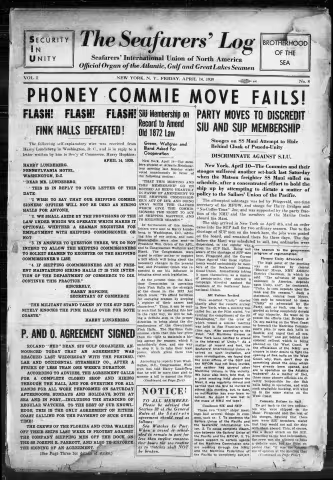
MONEY COMMIE MOVE FAILS!
FLASH! FL^H! FLASH!
FINK HALLS DEFEATED!
C • •
The following selfexplanatory wire was received from
Harry Lundcberg in Washington, D. C., and is in reply to a
letter written by him to Sec'y of Commerce, Harry Hopkins:
APRIL 14, 1939.
HARRY LUNDEBERG.
PENNSYLVANIA HOTEL,
WASHINGTON, D.C.
"DEAR MR. LUNDEBERG,
"THIS IS IN REPLY TO YOUR LETTER OF THIS
DATE:
"I WISH TO SAY THAT OUR SHIPPING COMMIS
SIONERS' OFFICES WILL NOT BE USED AS HIRING
HALLS FOR ANYONE.
'• 2. WE SHALL ABIDE BY THE PROVISIONS OF THE
LAW UNDER WHICH WE OPERATE WHICH MAKES IT
OPTIONAL WHETHER A SEAMAN REGISTERS FOR
EMPLOYMENT WITH SHIPPING COMMISSIONER OR
NOT.
"3. IN ANSWER TO QUESTION THREE, WE DO NOT
INTEND TO ALLOW THE SHIPPING COMMISSIONERS
TO SOLICIT SEAMEN TO REGISTER ON THE SHIPPING
COMMISSIONER'S LIST.
"4. IF SHIPPING COMMISSIONERS ARE AT PRES
ENT MAINTAINING HIRING HALLS IT IS THE INTEN
TION OF THE DEPARTMENT OF COMMERCE TO DIS
CONTINUE THIS PRACTICE."
SINCERELY,
HARRY HOPKINS,
SECRETARY OF COMMERCE
sai Membersliw on PARTY MOVES TO DISCREDIT
K72 uT" MEMBERSHIP
"THE MILITANT STAND TAKEN BY THE SUP DEFI
NITELY KNOCKS THE FINK HALLS OVER FOR BOTH
COASTS."
HARRY LUNDEBERG
P. AND 0. AGREEMENT SIGNED
ROLAND "RED" DEAN, SIU GULF ORGANIZER, AN
NOUNCED TODAY THAT AN AGREEMENT WAS
REACHED LAST WEDNESDAY WITH THE PENINSU
LAR AND OCCIDENTAL STEAMSHIP CO., AFTER A
STRIKE OF LESS THAN ONE WEEK'S DURATION.
ACCORDING TO ADVICES, THE AGREEMENT CALLS
FOR A COMPLETE CLOSED SHOP AND HIRING
THROUGH THE HALL, AND FOR OVERTIME FOR ALL
HANDS FOR ALL WORK PERFORMED ON SATURDAY
AFTERNOONS, SUNDAYS AND HOLIDAYS, BOTH AT
SEA AND IN PORT,—INCLUDING THE STANDING OF
REGULAR WATCHES. TO THE BEST OF OUR KNOWL
EDGE, THIS IS THE ONLY AGREEMENT ON EITHER
COAST CALLING FOR THE PAYMENT OF SUCH OVER
TIME!
THE CREWS OF THE FLORIDA AND CUBA WALKED
OFF THEIR SHIPS LAST WEEK IN PROTEST AGAINST
THE COMPANY SHIPPING MEN OFF THE DOCK ON
THE SS JOSEPH R. PARROTT, AND AL|0 TO ENFORCE
THE SIGNING OF AN AGREEMENT, f
(See Page Three for strike.)
Green, Wallgren and
Bland Asked For
Cooperation
New York, April 14—The mem
bers present at Atlantic Jleadquar
ters meeting last Monday night
voted unanimously in favor of
the following motion;
"THAT THIS MEETING AND
THIS MEMBERSHIP GO ON
RECORD AS BEING HEARTILY
IN FAVOR OP AMENDMENT TO
THE SHIPPING COMMISSION
ER'S ACT OF 1872, AND DOING
AWAY WITH THE CLAUSES
WHICH GIVE THE COMMIS
SIONERS THE RIGHT TO ACT
AS SHIPPING MASTERS, AND
TO REGISTER SEAMEN."
Inturtlierance of this motion,
letters were sent to Harry Lunde
berg, in Washington, D.C., advis
ing him of our action, and com
municatiohs were also sent tb
President Wm. Green of the AFL,
and to Congressmen Wallgren and
Bland. The Congressmen were
urged to either author or support
a bill which will bring about the
necessary changes in the present
law, and President Gfeen was re
quested to use his influence in
bringing about such legislation.
At the present time, the Mari
time Commission is operating
their Fink Halls on the stren'gth
of the clause in the 1872 Act
which reads: "To afford facilities
for engaging seamen by keeping
a register of their names and
characters." Thus, it ean be easi
ly seen that by amending this law
in the idght way, we will be tak
ing a deflnite step in the proper
direction to bring about the dis
continuance of the Government
Fink Halls. The Maritime Com
mission claim that this law gives
them the right to maintain a hir
ing agency for seamen, which it
undoubtedly does, and one way
to stop it is to take their legal
power, which gives them this
right.
According to reports from Wash-
ington, D.C., Congressman, Wall-
gren has told Harry Lundeperg
that he will be more than glad to
sponsor a bill to amend the Ship-
(GonXinueA oii Paga-^ico)
Stooges on SS Maui Attempt to Hide
Behind Qoak of PsuedoUnity
DISCRIMINATE AGAINST S.I.U.
New York, April 10—The Commies and their
stooges suffered another setback last Saturday
when the Matson freighter SS Maui sailed on
schedule, after a concentrated effort to hold the
ship up by attempting to dictate a matter of
policy to the Sailors' Union of the Pacific.
The attempted sabtotage wa.s led by Fitzgerald, onetime
secretary of the MFOW, and stooge for Harry Bridges and
"NoCotfeeTime" Joe, and was supported by the party frac
tion of the NMU and the members of the Marine Cooks
aboard the Maui.
The ship arrived in New York on April 4th. and an order
came into the SUP hall for two ordinary seamen. Due to the
shortage of SUP men on the beach here, the jobs were posted
on the board, and remained there for three days. The day
before the Maui was scheduled to sail, two ordinaries were
dispatched, in the regular way,.^
NOTICE!
TO ALL MEMBERS.
Please be advised that
Section 3fl of.the General
Rules of the Seatrain
agreement should^ read as
follows:
Sea Watches In Port:
When a vessel is sched-
uled to remain in port for
less than twelve consecu-
tive hours the sea routine
as to r'atches shall NOT
be broken.
;:X
from the SUP Hall. Being well
aware of the shortage of SUP men
here, Fitzgerald and the Curran
clique figured that these replace
ment's would undoubtedly be mem
bers of the Seafarers' Interna
tional Union. Immediately taking
it upon themselves, as a matter
of pseudounity, they started a
campaign 'directed against tbe
members of the Seafarers' Inter
national Union.
All Fiiions Tnvitod
This socalled "Unity" started
shortly after the vessel's arrival
in New York, when a meeting was
called for, as the Pilot stated, "re
turning the compliment of the SS
Washington," for the crew of
which vessel a similar meeting
was held in San Francisco some
time ago. Also according to the
Pilot: "All M.'iritime Unions in
New York were notified to attend
in the Interest of Unity." As a
matter of record and fact, the
Seafarers' International Union re
ceived no such invitation, and
upon investigation, we found that
the local offices of the SUP and
the MFOW had not been Invited,
and neither ha^ several other
Maritime Unions in this vicinity.
We have also been told that. In
a joint meeting held aboard the
Maul, It was regularly moved and
carried that the SIU be Invited to
attend this meeting, but, to date,
no notification has ever been re
ceived. No doubt it was lost in
the maze of NMU red tape!
Condemn SIU and SUP
These two "Unity" ships' meet
ings had several things in com
mon, such as: 1. To condemn the
Sailors Union of the Pacific and
the Seafarers' International Un
ion. 2, To cause complete dissen
sion between the Sailors' Union of
the Pacific and the MFOW. 3. To
insure support to certain agents
of the Maritime Commission who
are working through the NMU
and the Maritime Federation of
the Pacific to completely subject
the seamen to the government
program of regimentatloh.'
Phoney Unity Advocated
The high point of the meeting
was an address by comrat
"Blackie" Myers, NMU Atlahtle
District Chairman, in which he
said: "The salvation 6f marine
unionism in America, depends
upon Unity, and", he' continned.
"Unity, in turn depends upon the
rank and file seamen." Such a
statement, coming from Myei's
can only be construed to mean
"Unity" as advocated by tbe
Party, and, as snob, can be re
garded as being completely devoid
of any sincerity. He went on to
praise the efforts that Bridges &
Co. are making on the West Coast
to forestall the Maritime Commis
sion's plan to open fink halls in
Seattle, and urged that all sea
men "unite" and get behind this
colossal sellout which is being
planned on the West Coast. If
the officialdom of the NMU are
sincere in their desire to fight the
opening of fink halls on the West
Coast, why, then, don't they do
something about the ones which
have already been opened, and
are in operation on the Atlantic
seaboard? As a matter of fact,
these same phoney officials are di
rectly responsible for the fink
halls being in operation, and with
such negligible backing, will wind
up in the same status on the
West Coast.
Conirats Refuse to Sail
To get back to the two ordinar
ies who were shipped on the
Maui: Fitzgerald and the rest of
his stooges, figuring that these
men were SIU members, stated
that they would not sail the ship
with them aboard. Tliis, of course,
was a direct attack on the SIU.
According to the best information,
the crew was not {\llowed to.thke
a definite vote, but the Pilot re
ported that "if was tIi«i"!'Se6neen»
BUS of opinion at the meeting that
iContinued on Page Four)
' • Ei
• i:
i
1 <11
• /ti
/
• / 1
\
http://www.pdfcompressor.org/buy.html
THE SEAFARERS' LOG Friday, April 14, 1939
• r.
En
1
^?X.
m
Published by the
Seafi/f^rs^ Intenmtional Union
of North America
Affiliated with the Americam Federation of Labor
HARRY. LUNDEBERG, Acting President
11 Steuart Stteet, San Francisco, Calif.
Atlantic District
HEADQUATTTClfS
New York 2 Stone Street
BRAlStOHES
Boston ..1 Rowes Wharf
Providence 465 "So. TVIaitt Street
Philadelphia 6 North 6th Street
BaltiAiore 212 Bast Pi^tt. Street
Norfolk / 307 Bast Main Street
San Jnan, Pueifo Rico 55 Tetuan Street
• Gulf District
HEAdtQuXfifTEhs
New Orl^hs 309 Chartres Street
BRANCHES
Savannah' 218 East Bay Street
Jackaoiiviire 186 Bay Street
Miami 809 N. E. First Avenue
Tampa 206 Franklin Street
Mobile 55 So. Conception Street
Houston 1712 75th Street
Gr&at Ldhes District
HEADQUARTERS
Detroit 1038 Third Street
ADDRESS ALL CORRESPOEDENCE CONCERNIXO THIS
PUBLICATION TO:
"THE SEAFARERS' LOG"
P. O: Box 5^2, Church St. Annex, New York, N, Y.
FOR HR4051
Wallgreii's Present Bill Leaves Too
Much Leeway for Commissars
WALLGREN AGREES TO CHANGES
The NMU has publicly denoiineed the stand taken by
Harry Lundberg in regard to the socalled Wallgren Bill
(HR 4051), anchhave openly declared that he is secretly back
ing np the Maritime Commission. However, they fail to state
the real story behind the news, and explain the whys and
wherofores of his opposition to the Bill as it stands.
For the benefit of those who are unacquainted with this
Bill, which was introduced in the House of Representatives
on February 13, 1939, by M. C. Wallgren (Washington), and
referred to the Committee to ine uommittee on
Merchant Marine and Fisheries,
the proposed bill reads as fol'
' lows:
The Bill (HR 4051)
A BILL: Be it enacted by the
Senate and the House of Repre
.sentativea of the United States of
America in Congress assembled,
that section 301 of title 3 of the
Merchant Marine Act of 1936 is
hereby amended by adding the fol
lowing new section:
1. Neither the Maritime Cohimia
sibn nor any operator receiving
an operating differential sub
sidy shall call upon any gov
ernmental agency to furnish it
qualified licensed, or unlicensed
seamen to perform any duties
required of them on board
merchant vessels as long as
the certified collective bargain
ing agencies can furnish from
among their membership duly
qualified persons to perform
any duties required of them as
members of the clews of Amer
can merchant ships. Employees
of any vessels owned by, or
operated by the account of. or
chartered by, the Commission
shall be deemed employees
within the meaning of Section
(2) siibdivisloo (3) of the Na
tional Labor Relations Act
(49Stat. 449) and the operator
of such vessels shall be deem
ed an employer within the
meaning of section (2), subdl
• viison (2) of said act.".
Pbittts Oat'^Fallacies
According to Hsfir Lundeberg's
fepoft, he cflAifeiitea Coirgre^
ihan l^k&hiaettm, D.
C., ahiJ poini'ed oM td iiim that.
while on the surface the bill looks
go'od, a careful analysis of it will
show that it is really a very dan
gerous one, for the following rea
.sons:
1. This blil does not declare the
clause in the Shipping Commis
sioner's Act of 1872 null and void
—which clause is the one the
Klafitime Commission used to es'
tablfsh halls on the East Coast,
and vvhich they Intend to use, and
have so stated, to establish fink
hall Shippirig oh the West Coast.
2. This Bill also gives to the
NLRB the right to determine and
certify who is going to be the col
lective bargaining agency.
Bill Pavor.s XMU
Now, this may also seem all
right at first glance, but closer
scrutiny is still necessary. At
present, there are approximately
sixteen new ships being built on
ihe East Coast to be put in ser
vice on the Pacific Coast: Six for
the American President Line;
four to run out of Seattle, and six
for MnCormick for the South
American run. Under this bill,
there is nothing in the world to
prevent the operators, in conjunc
tion with the Maritime Commis
sion, from shipping a full NMU or
CIO crew on the East Coast to
take these vessels out to the West
Coast. It is, of course, a well
known fact that tife NLRB IS
friendly towards the NMU and
hdstile towards the SUP; and,
liffder this bill, the NLM could
certify These ships to the NMU,
'and then The INMU could estab
l.ldh b hall in San FrancfscC and
dhip ah repfadehrentd Tor tHeSe
vessels. The SUP would'then be
legally powerless to do anything
about It. y
Like Old Shipping Board
Or, jf the NLRB so decreed it:
they could take a vote on these
ships—ship by ship—and one ship
mlglit' vote for the SUP and an
other for the NMU, and so on.
This would result only in further
chaos in the maritime labor move
ment, and further complicate an
already serious situation.
The bill also provides that: "as
long as the certified collective bar
gaining agehcies can furnish from
among their membership duly
QUALIFIED persons to perform
any duties required of them . . ."
This again brings up the ques
tion; Who is going to be the
judge as to whe,Ther the men are
duly qualified persons or nbt?
In theold'Shlp|!dn'g Board days,
prior to 1921; The Shipping Board
used to call the Union Halls, for
men, and then the men who
shipped had to report to their
office for approval. Some were
accepted, and SOME WERE RE
JECTED. Are we going to allow
ourselves to be subjected to that
sort of thing again?
It is also possible that the Com
mission may attempt to establish
a representative in the Union hir
ing Halls to determine as to whe
ther or not a man is qualified.
Wallgren Agrees to Changes
To quote Harry Lundeberg's
own report regarding this Bill,
and his copversation with Con
gressman Wallgren:
"After a little talk with Con
gressman Wallgren I found how
this blil which he sponsored in
February canie into being. Con
gressman Wallgren stated to me
that he himself had not carefully
studied the bill, nor its effect on
the seamen, except he believed
and intended, when introducing
it, to do right by the seamen.
However, he readily agreed with
me when I pointed out the dan
gerous possibilities of the bill. He
said the.bill was requested of him
by Bruce Hannon of the Maritime
Federation, Harding of the Mari
time Federation and Dennett of
the IBU. Now, we all know these
nien are notorious Sailors' Union
enemies, and political fakers of
the first water. Also, this par
ticular bill Is being pushed by the
top fraction of the NMU through
Joe Curran and Emerson.
Seattle Resolution Good
"I brought before Congiessman
Wallgren the resolution intro
duced by the Seattle Branch of
flie SUP, and concurred in by the
rest of the Coast, which is a much
better resolution, and will nlake
the basis for a much better bill.
This resolution nistructed your
Secretary to try fo amend the
Shipping Commissioner's Act of
11472, to delete from that Act the
part which gives the Shipping
Commissioners the power to act as
Shipping Mast'er.s. It is exactly
that law, and no other, which the
Maritime Commission at the pres
ent time is using to attempt to
reihstlfute fink hall shipping.
"Congressman Wallgren stated
that he would be willing to intro
duce this bill for us. After talk
ing over the first bill proposed,
he can now se^ definitely that it'
will do more harm than good to
the Unions. I have also contacted
various Cbngressmen on this mat
ter, and they are in favor of a
bill along the lines of the Seat
tle Resolution."
A.F.OiLC.I.O.i^e
Two Groups Will Resume
Parley af Sorrie "Mutually
Satisfactory, Date in the
Future"
B// A.E. of IJ. WeekJi/ Xeirs Service
New York, N. Y., April 6—The
committees repl esenting the Amer
ican Fetieration of Labor and the;
Congre.ss of Industrial Organiza,
tions yesteiday adjourned hid^n
itely llveir consideration of peacd
terlVis between. the two groups fol
lowing the meeting here on
April 4.
Matthew Woll, vicepresident of
the American Federation of La
bor, and John L. Lewis, head of
the C.I.O., said the parley was
called off until some "mntually
satisfactory date in the future.
It was understood that the heai::
ings on the A.F. of L. amendments
to the National Labor Relations
Act, which ate scheduled to begin
in Washington on April 11 before
the Senate Committee on Educa
tion and Labor, and the pressing
engagements of Mr. Lewis in con
nection with tbe negotiation of a
new contract for the bituminous
coal miners were the major rea
sonswhich led both committees to
agree on the advisability of post
poning further consideratipn of
peace terms.
The two committees had met
seven times since President Roose
velt, in February, asked William
Green, president of the A.F. of L.,
and John L. Lewis, head of the
C.I.O., to convene a conference of
representatives of the two groups
tn the endeavor to compose the
dispute that has divided the labor
movement since the C.I.O. was es
tablished by Mr. Lewis and his as
sociates following the 1935 con
vention of the American Federa
tion of Labor.
TAKES M!
Demand Improvements
And Get Results
GET FRESH MILK
Prove.s NMU Lies
The foregohig information di
rectly gives the lie to the phoney
propaganda being circulated by
the NMU, to the effect that Lun
deberg is secretly aiding the
Maritime Commtssion. anfl boome
rangs right back at tbe comrats
and their stooges. Their, reason*
for fdsterfng ifr Wallgren Bill
are how pTrfeetly obvious, and the
NOTICE!
All SlU members who are
confined in Marine Hospitals
are hereby advised to imme
diately notify their SlU Agent
in the port nearest to where
they are hospltalired, in order
that they may receive regular
weekly benefits.
This does not apply to mem
bers who are already receiving
benefits.
New York. April 10—The SS
PANAMA CITY of the PanAtlah
tic Steamship Corp. arrived in Ho
boken on April 7 with some old
beefs o,f lolig standing, whibh were
settled pi'bnto with tfie able as
sfstanee of Union Patl'pl'men
Scotto and Serranb.
The Panama City left Mobile on
January 30, on a chartered run
from Georgetown, S.C. to Hdb'o
ken. The crews quarters were
very sadly in need of repairs;
many of the bunks were tied up
with heaving line, no lockers in
some rooms, no wooden decking in
some, and insufficient room for all
hands in the meesroom. Also, the
chow was of the "heavy across run
variety."
Usuhl StAllliig AfoUnd
Patrolmen Scotto and Serrano
came aboard at 9:00 A.M^, in an
effort to straighten out these
beefs, and were met with the
usual evasions: "Captain ashore,"
"Company ofiicials observing holi
day (Good Friday)."
After being stalled around for
approximately four hours, waiting
for someone in authority to. put in
an appearance, the crew held a
meeting, and all hands decided to
tender resignations!" A sultcafee
parade was started amidships. Fol
lowing this move, it took exactly
twenty minutes for company offi
cials to get on board and start
negotiations!
whole setup smells strongly of
further collusion between the
NLRB and the NMU. They are so
avid in their desire to completely
dominate marine labor, that they
care nothing about unity of any
sort. By so doing, they continue
to aid and abet a program of In
tercoastal dissension and of gov
ernment regimentation of the sea
men!
WALLGREEN BILL
{Continued from Pufje One)
ping Commissioner's Act, and will
give all possible cooperation. Mr.
Wallgren, in case you have forgot
ten, is the man who went to town
for the SUP on the Fink Book
question, and is definitely against
the establishment of Fink Halls.
In fact, he has openly declared
himself as being completely in fa
vor of Union hiring halls.
The SIU is 100 percent behind
the SUP tor the repeal of the Ship
ping Commissioner's Act of 1872,
and will give thera%yery possible
assistance.
Company Agrees
The ship was scheduled to sail
In three hours, and the company
repre'sentative agreed IN WRIT
ING to:
Make all necessary repairs
April 14th!
Enlarge messroom by removing
bulkheads.
Fresh milk and vegetables.
Ten gallons of ifiilk put aboard,
—more as needed.)
The ship sailed on schedule,
with all hands satisfied,—which
proves what' can be done when
even the Waterman Line finds out
that the crew means business!
Patrolmen Scotto and Serrano
state that all hands gave them one
hundred percent cooperation and
backing, and that this militant ac
tion made the company officials
realize that the boys really meant
business. From all reports, the
crews' quarters and messrooms
were In a deplorable condition,
and it is high time that' the shi()
owners realize that the seamen
are entitled to much better than
that, and—what's moie—they are
going to get it!
Unifiedl Action Necessary
Some of these old fust buckets
and scows are totally unfit to be
sailing the seas, and the condition
of many of them causes one to
wonder how they ever happened
to be adjudged as being sea
worthy. A seaman is most certain
ly entitled to decent food and liv
ing quarters, and the SIU will
lend every effort' towards the im
provenient of these things on all
ships.
If all crews will give the same
cooperation as was given by the
crew of the Panama City, we
won't have any trouble getting
things done.
BE READY AND WILLING TO
FIGHT FOR WHAT IS RIGHT-
F^ULLY YOURS!
Attend the tJnion
http://www.pdfcompressor.org/buy.html
Friday, April 14, 1939 THE SEAFARERS' LOG
/•
>• I
HERE and THERE in the G
T A M P A M I A M I
P£0 SHIPS STRUCK IN TWO
FLMNM PORTS BY S.I.U.
Grews Walk Off in Protest Against
Shipping of NonUnion Men and
Off the Docks
I.L.A. GIVES FULL SUPPOKT
A strike of the crew of the SS Cuba an<l members of the
ILA who unload the Cuba, last week tied up the Havaiia
Tampa vessel to baelc up the strike called l>y the SITJ efew
on the Florida at Miami.
Both vessels are operated by the Peninsular and Occi
dental Steamship Co., the Florida^ —
running between Miami and Ha
vana. U. S. Commissioner H. T,
Colrin of the Department of Con
ciliation of the Department' of La
bor, called together rmion and
company officials in an attempt to
straighten out the difficulty.
Slilp Off Dock
The strike began when the car
ferry Joseph^ R. Parrbtt shipped
several men off the dock, and the
real Union men aboard the ship
walked off in protest against thi.s
violation of a bona fide contract.
The Parrot, however, is still run
ning with a flnky crew.
The crew of the Florida struck
la.st Friday, and the Cuba crew
walked off Saihrday, following a
joint meeting held aboard the
ship. The .| ongshoremfen, in sym
pathy the crow, refused to
unload Cuba, and a picket
line was thrown around the dock.
Altogether, a total of over 200 sea
men are on strike in the two
ports.
Strike Still On
According to our latest advices,
in a letter from Miami dated
April 12, the boys are still out on
strike, and will stay out until
their point' is won, even if it takes
them all year! The men are all
reported to be in the best of spir
its, and are really going to town.
A soupkitchen has been estab
lished, and all hands are being
well taken care of.
Agent Gunnison has had several
conferences with the owners and
the representative of the Depart
ment of Labor, but, so far, noth
ing deflnite has come out of them.
The Longshoremen in the ports
of Tampa, Miami and Port Ever
glades are giving their full sup
port and cooperation to the strike.
The boys do^vn in Florida also
want' it knotvn that they are 100%
with the SIU in the fight against
the Fink Halls.
JACKSONVILLE
Jacksonville, Fla., April 7—Last
trip the memhei s of the S.S. Eliza
beth contacted the agent' on its
arrival, and proceeded to put
their demands in for water
glasses, bunk lights and new mat
tresses. 'When she came in to
day, they had their water glasses,
and the inspectors are renewing
all the wiring in the fore'castles,
and the crew are getting new mat
tresses in Baltimore this trip.
The Marjory came in yesterday,
and I found a messman who had
shipped off of the dock in San
Juan. The Steward and the mess
man were both taken off the ship:
HXPPENINGS in MOBILE
Mobile, April 11 — After good
.shipping for one day, Monday,
things have been iat'her quiet, and
nothing during the week is ex
pected to make any great tuin
over, unless the unforeseen sliould
occur. Several men were shipped
ou the SS CHICKASAW CITY,
and with their help, we should
sobn have the ISTHMIAN LINE
under agreement.
.so Jet this be a warning to all
men that ship off of the dock from
now on.
Fred Lauritano
BIT OF MARITIME HISTORY
RECALLED BY MEMBER
Points Out That NMU Got Start From
SUiP, and Now Try to Sinash Them
S.I.U. PROGRAM ENDORSED
The NMU, which stai*ted as the rank and file of the okV
ISU, prote.sting against phoney officials, were men who had
been fired off PahaTnaPacifie ships for Union activity. Name
ly: for tying up a ship on the Pacific Coast. Joe Currnn, the
ship's delegate, had a telephone conversation with Madam
Pefkins, • who promised hiin that if the boys brought the ship
to New York, everything would be straightened out. She
guranteed that no man would be fired for participating in
the job action. Upon arrivaf in New York, Joe Curran and
several others were not fired, but were laid off for an in
definite period.
These men set Up a hall, and started fighting against
Madam Perkins, the ISU faJvcrs, and the .steamship com
panies. This fight was maintained and subsidized by dona
tions from ships' crews,—with West Coast men donating
most of the money.
SPRING! STRIKE
They pulled a strike in New York harbor in 1936 known
as the "Spring Strike". During this strike, their support in
building an organization again came from donations from
ships,—and West Coast ships at that! The SUP also donated
a weekly sum. The strike was lost, but it awakened the mem
bership on the Bast Coast. It also gave the companies their
chance to edge in on the seamen again. Tliey iinniediately
started hooding men into this feOealled "Rahk and Pile ISU
'group", and were in a position to get their men into office,
—Which they did!
'36.'37 STRikE
Along came the '36'37 strike on the Wesk Co?^> tke
socalled "rank and file" pulled a strike on the East Coast.
This strike on tlie East Coast was not lost by the men, hut
by their leaders! Why? Because the leaders had the monies
for the feeding and housing of the men, but spent the dougli
for comic propaganda, airplane trips, etc. Peter Inne.s had,
on a tour of the West Coast, around $1,500 to rn.n up and
doAvn tiie coast on!
When the SUP membership saw what was going on, they
set up their own soup kitchens on the East Coast, and took
care of their own men. They had been sending money to Cur
ran & Co., to help support the strike, but the men were not
getting it I
BRIDGES' PHONEY PROMISE
Harry Bridges, the'later selfstyled great emancipator and
democratic leader, came East, and projnised that the long
shoremen on the Pacific Coast would staj'^ on strike until the
East Coast seamen got their demands. Upon Bridges' return
to the We.St Coast, he was asked by the Long.shoremen's mem
bership if he had made such a statement. He vigorously de
nied that he had done so! Why did he deny this to his own
menibei\ship Because, at that time, the Longeshoremen had
real democracy, and Bridges had tried, by this promise, to
stanipede the Longeshoremeu! He had go:ie over their heads,
and dictated policy! He denied all this in order to avoid be
ing kicked out of the Longshoremenforever.
When the strike ended, Ea.st Coast men brought shijjs
aroiuid to the Pacific Coast;—ships that the SUP and other
Unions had fought to keep conditions on. They sailed them
around, and liad the articles signed to pay off on the East
Coast.
TURN ON BENEFACTOR
After four hard years of fighting, Joe Curran and the
gahg who are now NMU officials, tried to break the SUP.
Now, these men who bronght those ships arotnid were al
lowed a round trip by the West Coast, and given many other
concessions. Although the Party put up a fight against it,
these men knew and felt that the SUP was right.
Then Curran & Co. pulled a NLRB election on the Shepard
Line ships. Tjus company had a closed shop agreement with
the SUP. This showed just what the plans and policies of
the NMU were. It was to split the seamen, and gain control
of all maritime labor;—^which would have eventiially wound
up by the CP being in a position to dictate to the seamen.
Let us look these events over, and see what happened,
aild what is going on now:
First: These same men had it prtwen to them that the
Commission's office is solely for the shipowners.
Second: They doublecrbssed the Union men and the Union
who gave them their support. (The SUP).
Third: They have backed and supported a program which
caused the dismissal of many men ffom the ships they
were on.
Fourth: They have aided and abetted the Martime Com
mission's program of regimentation of the seamen, by openly
endorsing the Fink Malls and the phoney Training Schools!
REASONS FOR BEING SIU MEMBER
I would like to put forth the reason, to tlie many NMU
men who are my friends, why I am a member of the SIU.
I know that the SUP has always been a completely demo
cratic organization, and that the S;IU, by adopting the SUP
Constitution, is also completely democratic. The members
need have no fear of exercising their constitutional rights,
and can express their own opinions without any fear of hav
ing their heads knocked in
Ristbry has proven that right will eventually win, and
I feel and know that the SIU is right, and is not pitting one
poor working stiff against another, but is fighting against
ohr Common eneiUy—the diipowher!
J. Gunaisda, Gnif No. 4
For tiiingB that were written in
last week's LOG, the wiiter wa.s
severely critieized in .some in
stances, and just as highly lauded
in others, so the .score is about
even. The deflnite puri)o,se was
to bring to tlie attention of. the
membership the various violations
that' have occurred, wherein .no
action has been taken against the
offending member, while 'we haVe
fined others for the .same viola
tions. If v.e are to puriish one,
we must puni.sh all alike.
Marine Ho.spital Situation
During the early year.s of, the
American Meichaut Marine, sail
ors were virtually held in bond
age, and during the process of
their liberation, came the marine
hospitals, to provide treatment
for the sick and injured seamen.
Certain qualifications were set
to pjevent the unscrupulous from
u.sing these hospitals, and from
time to time, various changes have
been made as to the necessary sea
service a man must have to en
joy the facilities of these hospi
tals. During the past few years
we have seen so many CGC, Coast
Guard and Veterans in the mar
ine hospitals, that we begin to
wonder whether we will eventual
ly be able to find room for those
for whom these Iiospitals were or
iginally intended. Although we
know of no case where aay sea
men have been refused, we do
know that the families of any of
the abovementioned CCC men,
etc., can receive treatment, and
that the families of the seamen
can not. If the former are en
titled to treatment in these hospi
tals, then, certainly the families
of the seamen are entitled to first
consideration.
Something must be done, and
the sooner, the better for all of
us. We have been left out of So
cial Security, and every other
form of Federal and State benefit
for unemployment relief. So, for
our own protection, and for the
protection of those whom we hold
dear to us we must take some
definite form of action.
Monday's meeting was a joint
one, and finally adjourned at
11:50 P.M., and even then every
thing wasn't taken care of, as it
seemed that all hands were in a
Hell of a hurry to get home.
Sailing Hour Question
The Committee's report on the
setting of a sailing hour by the
companies, and especially the 'Wa
ternian Company, was tlioroughly
taken Care of, and the port cap
tain has stated that he will pro
vide a board in all dock offices si
milar to the sailing board on each
vessel, and that any member can
then call the dock office and re
ceive reliable information as to
the correct sailing time of a ves
sel.
If the vessel does not sail on
tlie time originally posted, or on
the advanced sailing hour, which
must be advanced at least' one
hour before the original hour
posted, and then must be ad
vanced at least two hours, and the
vessel does not sail until one
hour after the last' posted hour,
all hands then on board, and not
on watch, will be paid overtime
at the rate of seventy cents an
hour, for each hour that" the ves
sel does not' sail after that time.
All watches must be set as of
the hour that is first posted as th6
sailing hour of that vessel. This
is to go into effect as of May 1^
1929;
^ J. K. Kane, Gulf No. 18 j
I.
• i,:i
• t A L
n
,v'
• • 1
http://www.pdfcompressor.org/buy.html
r^"
i.A'.
I
n •
h'
U
h ¥
M:
m:
Friday, April H, iv^
PAGE IN SEAMEN'S LIVES
Record Proves Seamen Were Cheated
i Of Rights and Handled Like Cattle!
T I < • :
(Reprinted front West Coast Sailors)
What danger does the fink hall present to American sea
mein, and just how does it operate.
;^ese questions are particularly timely now, for, backed
hy NMU officials the Maritime Commission is busting its col
lective gut to put over a scheme that, if successful, will make
< maritime employees no better than galley slaves.
It is hard to believe that any union officials, no matter
how lustful for political power, can come out in favor of a
program that will cheat seafaring workers of rights ob
tained only after bitter and costly strife. But that is pre
cisely what the NMU moguls have done! They've gulped
down the pill; they say it tastes fine; they recommend the
dirty dose to their membership.
READ THE RECORD
But a good many seamen hare
long memories. They haven't for
goitten the notorious Shipping
Board which, during the World
War, managed all TInited States
ships, and established a "sea serv
ice bureau." The Board at first
seemed harmless enough, and be
sides, those were war times. The
SUP reached an understanding
with the Shipping Board whereby
any maritime employee needed to
man a ship would be ordered from
the union hall, subject to approval
Of the shipping bureau.
On the Atlantic Coast the Board
insisted upon placing first the
men who had graduated from
training ships, and then supple
mented them with union members.
But by 1920 all men oirt of train
ing ships had been organized into
the unions.
After a montli the shipping
Board managed to secure crews
for a few vessels on the Pacific
coast. Within two months it was
able to dispatch all Shipping
Board ships, but only with great
delay.
In order to intimidate the sea
men, mail pouches were put
aboard freighters, a pretext'
thereby found to prosecute those
who tried to interfere with the
shipping of strikebreakers. The
usual charge was interfering with
the U. S. mail.
THE SHOE PINCHES
• Then, abruptly, in February of
iS21, the Shipping Board notified
maritime unions on both coasts
that effective May 1 all agree
ments would be terminated unless
the unions agreed to accept a
wage cut of 25%, the abolition of
all overtime pay, and the restora
tion of the twowatch system on
tfeek.
. ' The membership on both coasts
at once refused to accept such
terms.
There followed a campaign of
discrimination, launched by Ad
miral Benson, chairman of the
Shipping Board, against foreign
born' sailors, and those not yet
fully naturalized. The percentage
of seamen in these two qualifica
tions was, at that time, perhaps
60%. It was obvious to the ISU
that an attempt was being made
to split the seamen's ranks.
The SUP "ignored the un
fair attack of the Shipping
Board, and until May 1, sent
<»ut men hy rotation regard
less of eitizemship.
APPEAIi FAILS
As the deadline drew near. An
'drew Furuseth and the entire ex
icqutive committee of the ISU,
SilEBA, and MMP, journeyed t'o
Washington, D. C., and, on April
30, appealed to President Hard
^pg to receive them.
President Harding refused, stat
ing through his secretary that, in
'Lis opinion, the problems of the
American merchant marine were
jh competent hands.
/ STRIKE!
sP,p May 1, 1921, the entire
jl'SM^ierlcan merchant marine was
'"ti^ ' up. Approximately 250,000
licensed and unlicensed seamen
?i. j^eer oh strike.
ii;,;. Within a few^ays the Shipping
Board, acting ^ through United
States distHiit: attorneys, obtained
^ *iweeipiiftg injuni^ions against the
SUP which, it was reaiM^, con
^Stituted the backbone of the
gtj.rike .
During the third month of the
strike the Shipping Board fur
nished crews for privately owned
ships.
On the east coast the strike was
called off after six weeks. On the
Pacific coast, it lasted for three
months—from May 1 to July 28
1921—and even then two votes
were necessary before a'decision
was reached to abandon the
strike.
FINK HALLS
Two weeks before the strike
culminated, however, the Steam
ship Owners Association of the
.Pacific, and the American Pacific
Ship Owners Association, estab
lished fink halls in San Francisco
and San Pedi'o. No discrimination
would be practiced against union
men, they announced, but each
seaman must carry a continuous
discharge book as a condition of
employment.
During the first year after the
strike no strict enforcement was
made of this ruling, but gradually
thereafter the owners began to
tighten up. it was seldom then
that a man would receive an entry
In his discharge book that ml>.',ht
be used against him in seeking rsf
employment. The real dirty work
was done through the gray as
signment cards which seamen
were handed when shipping, and
which the master had to return to
the fink hall when quitting. No
man knew what was marked
down in the spaces provided for
Conduct, Ability, and Special Re
marks.
FINK BOOKS
Many good men shipping out of
Grays Harbor or other northwest
ern ports managed for a year or
more to sail without the book, but
by 1923 the shipowners had pa
trolmen In San Francisco and San
Pedro visiting every ship, and
making sure that every seaman
had the fink book. The Shipping
Board had not issued a book, but
had required the master of each
vessel to report on the conduct of
every man employed on his ship.
BLACKLIST
Private owners would never ad
mit they used the blacklist, but
the Shipping Board openly ad
mitted it 'Carried a deferred em
ployment list, and would notify
seiamen when they were placed on
(Continued from Pagr One)
the SIUNA had been created to
thwart national unity." So, ac
cording to the party way of figur
ing things out, the best way to
build "National Unity" was to re
fuse to sail with any SIU mem
bers shipped through the SUP
Hall.
Curran Step.s In
In any event. Fitzgerald then
took it npon himself to assume
authority for the entire crew, and
demanded that these replacements
produce their union books and
shipping cards for his inspection.
He was supported in thi.s move hy
NMU officials, at the same time
coijiplet'ely disregurding the New
York MFOW Agent. Curran was
injected into the picture, and the
following teletype message is evi
dence of the hookup between the
NMU and the Maritime Federa
tion of the Pacific, and their de
termination to subjugate the
SUP:
SF lllOK MARITIME FED
ERAT'ON OF THE PACIFIC 111
NMU CURRAN CALLING
BRUCE HANNON — OK GO
AHEAD
SUP SHIPPING TWO AB SIU
MEN ON MAUI, FIREMAN AND
STEWARDS OBJECT, POSITION
MAY BECOME SERIOUS AD
VISE POSITION OF UNION IN
FEDERATION AND SUP.
MIM PLS
HANNON — FIREMAN STEW
ARDS ABSOLUTELY REFUSE
TO WORK WITH SIU ON NEC
ORD TO PU®. SIU MEN OFF
SHIPS WHEN THEY HIT WEST
COAST OF COURSE LUNDE
BERG FORCING SIU MEN
WHEREVER POSSIBLE.
CURRAN — WHAT ADVICE
SHALL "WE GIVE CREW? SHIP
SAILS' NOON MEETING IN
PROGRESS ON SHIP NOW.
HANNON — WILL CONTACT
STEWARDS AND FIREMEN
AND HA\T3 THEM WIRE IN
STRUCTIONS IMMEDIATELY.
CURRAN—MAKE IT SNAPPY
THATS ALL.
Sailors Not Fooled
With the foregoing flimsy evi
dence, Fitzgerald attempted to
convince the crew that the West
Coast Firemen and Cooks would
back up this phoney framed up
beef, but the entire deck depart
ment refused to go for It. The
two replacements had the neces
sary strike clearances, and had
been shipped through the SUP
Hall. That was plenty good
enough for the sailors aboard the
Maul.
The local MFOW Agent, Bill
Welsh, was aboard the Maui, and
notified the black gang that if any
of them did not want' to sail with
SIU men shipped through the SUP
Hall, they could pay off, as that
was the position the MFOW was
taking. He further notifiei) them
that' the ship would sail on sched
ule. and that any black gang mem
ber who attempted to hold the
ship up would be replaced from
the MFOW membership here.
Afraid to Take Vote
Several meetings were held
aboard the ship, but Fitzgerald
and his stooges managed to pre
vent the taking of any vote re
garding holdjng the ship up, as
they were afraid that the vote
would go against them. Welsh
then sent th^ following, wire to
MFOW secretary Malone.
V. J. MALONE
58 COMMERCIAL STREET.
SAN FRANCISCO, CALIF.
. BEEP ON MAUI SUP SHIPPED
TWO O.S. SIU MEN FIREMEN
AND STEWARDS OBJECT TO
SAIL SHIP MAY RESULT IN
TIE UP ADVISE POSITION IM
MEDIATELY
WELSH MAUI, PIER 60,
NEW YORK
Burke Straddles Pence
The following telegram from
MC&S secretary Burke was re
ceived by Joe Curran:
PLEASE AD'VISE STEWARDS
DEPARTMENT STMR MAUI TO
REMAIN WITH SHIP AND ANY
DISPUTE REGARDING SIU
WILL BE TAKEN UP ON AR
RIVAL AT THIS PORT STOP
NOT ADVISABLE AT THIS
TIME TO HAVE SHIP DE
LAYED.
This wire clearly indicated that
Burke feared a repetition of the
Matson beef, and even the Party
stooges were afraid to back up
anything as phoney as this. Ted
Lewis, NMU representative for the
Cooks, stated tnat the members of
the MC&a could remain aboard
the ship as requested in Burke's
wire, but that NMU members
would be pulled off, and no re
placements supplied.
Comrats Do About Face
Seeing that they were up
against a wall, the phoney clique
decided that they would have to
do a more or less graceful about
face, and informing the local SUP
and MFOW representatives that
they were going to protest, they
sent the following wire:
V. J. MALONE ,
58 COMMERCIAL ST.,
SAN FRANCISCO, CALIF.
FIREMEN AND COOKS SAIL
SHIP PROTESTING ACTION OF
LUNDEBERG PUTTING SIU
MEN ABOARD IN INTEREST OF
NATIONAL UNITY DEMAND
PROTECTION IN FUTURE,
FITZGERALD. DELEGATE MAUI
Basic Issue Clarified
Thus, they admitted their com
plete defeat in this particular
case, and after an exchange of
telegrams between Bill ..Welsh
and MFOW Secretary Malone. the
following wire ^iis received, com
pletely straightening the siliiatidn
out:
W. L. WELSH,
, CARE SS MAUI,
PIER 60, NEW YORK.
IF SUP OBJECTED TO MFOW
SHIPPING EITHER NMU OR
SIU FIREMEN DOWN BELOW
WE WOULD TELL THEM GO
JUMP IN LAKE. SUP TELLS US
SAME THING WHEN WE PUT
OUR NOSES IN THEIR BUSI
NESS. MFOW HAS NO JURIS
DICTION ON DECK JOBS. AD
VISE CREW LET SUP RUN
THEIR OWrN BUSINESS.
V. J. MALONE
Watcli Future Plairs
Undoubtedly, this beef on the
Maul is not the last of similar
planned attacks, and the mem
bers of the SUP and the MFOW
will have to be on the lookout for
further moves of this.sort, which
are aimed directly at weakening
the unions, and an attempt to
stampede .ill of us into the fink
haUa.
One Important thing brought
out by this beef wasthat It proved
the willingness of the Sailors'
Union of the Pacific to back up
the members of the Seafarers' Ini
ternatlonal Union, regardless of
any phoney beefing by the cpmic
stooyes. It also proved, beyond
any doubt, that the NMU officials
are not sincerely Interested In
bringing about any unity among
the seafaring unions, but are out
to further the Party plans for'
strike breaking In preparation for
the time when the shown down
comes with the Maritime Commis
sion.
Fort Stanton
this list. Pliysical examinations
by Shipping Board doctors were
also used to eliminate "undesir
able seamen.
Employment by the rotation
system, even for workers in good
standing, was a joke. It is a well
established fact that, especially
on the oriental run, seamen had to
make presents of souvenirs in or
der to obtain jobs.
NO BIG RED APPLE
The fink herders of the private
owners operated on a cash and
carry basis, whereas the Shipping
Board was inclined to favor gifts
of Japanese kimonos, shirts, and
Chinese suitcases.
Any. attempt by members of a
crew to protest against condl
tione was answered by immediate
discharge.
As at the present time there
were those who tried^o make the
sailors believe that fink lialls
could be abolished ty legal aotion.
In 1925 the Sailors' Union spent
thousands of dollars on the An
derson case, and more thousands
on the O'Hara vs. Luckenback
case. Innumerable petitions weie
addressed to Congivess for aboli
tiori of fink halls, and restriction
on the power of the Marine Sea
Service Bureau. Tg no avail. .
Many of the older members, re
membering methods used in the
nineties, and in 1906, believed
that only direct economic action
would abolish the fink hall. They
were right.
Fink halls, as all know now,
were not wiped out until 1934
when seamen showed their united
strength.
NEVER AGAIN!
Fink halls must not come
back to the Pacific coast!
They mnst be fought with di
rect economic action! The at
tempt of the Maritimo Com
missioii ^"^7 slavery,
and put a Jibo above the
auction block illil,.. be re
sisted to the bitter
Fort Stanton. N. M.,
March 9, 1939.
SEAFARERS' LOG:
This is a notice to all rank and
file members of, the NMU.
The SIU is the same as the
SUP, and that means a good,
.strong, HONEST, democratic
Union in any man's language.
We, the. West Coast sailors, need
a strong seamen's Union, for sea
men, on the East Coast, to help
us defeat the Fink Halls and
Training Ships. The SUP carried
the fight on the Copeland Fink
Book issue, and won. Now that
the shipowners are trying another
avenue, we need help. The rank
and file seamen must band to
gether nownot tomorrow or a
year from now—but NOW! That
is, if they wish to hold the gains
that they have won since 1934.
The NMU officials continue t»
endorse the Maritime Commission
Fink Halls and Training Ships, in
hopes that they can land nice
soft jobs,—high paying Jobs from
the U.S. Government, after they
have sold the 56,000 members out.
^Brothers, and I mean OUT! In
the "good old days" they were
called "Blackblrders", and I think
that the same name would fit
them today.
Come on you NMU guys, buck
up!—Are you going to let these
VULTURES pick you clean, and
then sell you to Johnny Ship
owner?
Onward Seafarers'
Fraternally,
"Fred Adams, SUP No. 2969
Delegate, Fort Stanton, N.M.
Has Your Ship a Union Crew?
• T' ,1
Notice:
Ships' Delegates: Demand
that ail replacements produce
a properly filled out assign
ment card from the Dispatcher
at the Union hall.
1
I
li
http://www.pdfcompressor.org/buy.html
i:'
i
I'tS.
f
arers
Seafarers' Interiiafi^kial Union of North America
Official Organ of the Atlantic, Gulf and Great Lakes Seamen
VOL. I
ii a
NEW YORK, N, Y., FRIDAY, APRIL 14, 1939
446 No. 8
MONEY COMMIE MOVE FAILS!
FLASH! FL^H! FLASH!
FINK HALLS DEFEATED!
C • •
The following selfexplanatory wire was received from
Harry Lundcberg in Washington, D. C., and is in reply to a
letter written by him to Sec'y of Commerce, Harry Hopkins:
APRIL 14, 1939.
HARRY LUNDEBERG.
PENNSYLVANIA HOTEL,
WASHINGTON, D.C.
"DEAR MR. LUNDEBERG,
"THIS IS IN REPLY TO YOUR LETTER OF THIS
DATE:
"I WISH TO SAY THAT OUR SHIPPING COMMIS
SIONERS' OFFICES WILL NOT BE USED AS HIRING
HALLS FOR ANYONE.
'• 2. WE SHALL ABIDE BY THE PROVISIONS OF THE
LAW UNDER WHICH WE OPERATE WHICH MAKES IT
OPTIONAL WHETHER A SEAMAN REGISTERS FOR
EMPLOYMENT WITH SHIPPING COMMISSIONER OR
NOT.
"3. IN ANSWER TO QUESTION THREE, WE DO NOT
INTEND TO ALLOW THE SHIPPING COMMISSIONERS
TO SOLICIT SEAMEN TO REGISTER ON THE SHIPPING
COMMISSIONER'S LIST.
"4. IF SHIPPING COMMISSIONERS ARE AT PRES
ENT MAINTAINING HIRING HALLS IT IS THE INTEN
TION OF THE DEPARTMENT OF COMMERCE TO DIS
CONTINUE THIS PRACTICE."
SINCERELY,
HARRY HOPKINS,
SECRETARY OF COMMERCE
sai Membersliw on PARTY MOVES TO DISCREDIT
K72 uT" MEMBERSHIP
"THE MILITANT STAND TAKEN BY THE SUP DEFI
NITELY KNOCKS THE FINK HALLS OVER FOR BOTH
COASTS."
HARRY LUNDEBERG
P. AND 0. AGREEMENT SIGNED
ROLAND "RED" DEAN, SIU GULF ORGANIZER, AN
NOUNCED TODAY THAT AN AGREEMENT WAS
REACHED LAST WEDNESDAY WITH THE PENINSU
LAR AND OCCIDENTAL STEAMSHIP CO., AFTER A
STRIKE OF LESS THAN ONE WEEK'S DURATION.
ACCORDING TO ADVICES, THE AGREEMENT CALLS
FOR A COMPLETE CLOSED SHOP AND HIRING
THROUGH THE HALL, AND FOR OVERTIME FOR ALL
HANDS FOR ALL WORK PERFORMED ON SATURDAY
AFTERNOONS, SUNDAYS AND HOLIDAYS, BOTH AT
SEA AND IN PORT,—INCLUDING THE STANDING OF
REGULAR WATCHES. TO THE BEST OF OUR KNOWL
EDGE, THIS IS THE ONLY AGREEMENT ON EITHER
COAST CALLING FOR THE PAYMENT OF SUCH OVER
TIME!
THE CREWS OF THE FLORIDA AND CUBA WALKED
OFF THEIR SHIPS LAST WEEK IN PROTEST AGAINST
THE COMPANY SHIPPING MEN OFF THE DOCK ON
THE SS JOSEPH R. PARROTT, AND AL|0 TO ENFORCE
THE SIGNING OF AN AGREEMENT, f
(See Page Three for strike.)
Green, Wallgren and
Bland Asked For
Cooperation
New York, April 14—The mem
bers present at Atlantic Jleadquar
ters meeting last Monday night
voted unanimously in favor of
the following motion;
"THAT THIS MEETING AND
THIS MEMBERSHIP GO ON
RECORD AS BEING HEARTILY
IN FAVOR OP AMENDMENT TO
THE SHIPPING COMMISSION
ER'S ACT OF 1872, AND DOING
AWAY WITH THE CLAUSES
WHICH GIVE THE COMMIS
SIONERS THE RIGHT TO ACT
AS SHIPPING MASTERS, AND
TO REGISTER SEAMEN."
Inturtlierance of this motion,
letters were sent to Harry Lunde
berg, in Washington, D.C., advis
ing him of our action, and com
municatiohs were also sent tb
President Wm. Green of the AFL,
and to Congressmen Wallgren and
Bland. The Congressmen were
urged to either author or support
a bill which will bring about the
necessary changes in the present
law, and President Gfeen was re
quested to use his influence in
bringing about such legislation.
At the present time, the Mari
time Commission is operating
their Fink Halls on the stren'gth
of the clause in the 1872 Act
which reads: "To afford facilities
for engaging seamen by keeping
a register of their names and
characters." Thus, it ean be easi
ly seen that by amending this law
in the idght way, we will be tak
ing a deflnite step in the proper
direction to bring about the dis
continuance of the Government
Fink Halls. The Maritime Com
mission claim that this law gives
them the right to maintain a hir
ing agency for seamen, which it
undoubtedly does, and one way
to stop it is to take their legal
power, which gives them this
right.
According to reports from Wash-
ington, D.C., Congressman, Wall-
gren has told Harry Lundeperg
that he will be more than glad to
sponsor a bill to amend the Ship-
(GonXinueA oii Paga-^ico)
Stooges on SS Maui Attempt to Hide
Behind Qoak of PsuedoUnity
DISCRIMINATE AGAINST S.I.U.
New York, April 10—The Commies and their
stooges suffered another setback last Saturday
when the Matson freighter SS Maui sailed on
schedule, after a concentrated effort to hold the
ship up by attempting to dictate a matter of
policy to the Sailors' Union of the Pacific.
The attempted sabtotage wa.s led by Fitzgerald, onetime
secretary of the MFOW, and stooge for Harry Bridges and
"NoCotfeeTime" Joe, and was supported by the party frac
tion of the NMU and the members of the Marine Cooks
aboard the Maui.
The ship arrived in New York on April 4th. and an order
came into the SUP hall for two ordinary seamen. Due to the
shortage of SUP men on the beach here, the jobs were posted
on the board, and remained there for three days. The day
before the Maui was scheduled to sail, two ordinaries were
dispatched, in the regular way,.^
NOTICE!
TO ALL MEMBERS.
Please be advised that
Section 3fl of.the General
Rules of the Seatrain
agreement should^ read as
follows:
Sea Watches In Port:
When a vessel is sched-
uled to remain in port for
less than twelve consecu-
tive hours the sea routine
as to r'atches shall NOT
be broken.
;:X
from the SUP Hall. Being well
aware of the shortage of SUP men
here, Fitzgerald and the Curran
clique figured that these replace
ment's would undoubtedly be mem
bers of the Seafarers' Interna
tional Union. Immediately taking
it upon themselves, as a matter
of pseudounity, they started a
campaign 'directed against tbe
members of the Seafarers' Inter
national Union.
All Fiiions Tnvitod
This socalled "Unity" started
shortly after the vessel's arrival
in New York, when a meeting was
called for, as the Pilot stated, "re
turning the compliment of the SS
Washington," for the crew of
which vessel a similar meeting
was held in San Francisco some
time ago. Also according to the
Pilot: "All M.'iritime Unions in
New York were notified to attend
in the Interest of Unity." As a
matter of record and fact, the
Seafarers' International Union re
ceived no such invitation, and
upon investigation, we found that
the local offices of the SUP and
the MFOW had not been Invited,
and neither ha^ several other
Maritime Unions in this vicinity.
We have also been told that. In
a joint meeting held aboard the
Maul, It was regularly moved and
carried that the SIU be Invited to
attend this meeting, but, to date,
no notification has ever been re
ceived. No doubt it was lost in
the maze of NMU red tape!
Condemn SIU and SUP
These two "Unity" ships' meet
ings had several things in com
mon, such as: 1. To condemn the
Sailors Union of the Pacific and
the Seafarers' International Un
ion. 2, To cause complete dissen
sion between the Sailors' Union of
the Pacific and the MFOW. 3. To
insure support to certain agents
of the Maritime Commission who
are working through the NMU
and the Maritime Federation of
the Pacific to completely subject
the seamen to the government
program of regimentatloh.'
Phoney Unity Advocated
The high point of the meeting
was an address by comrat
"Blackie" Myers, NMU Atlahtle
District Chairman, in which he
said: "The salvation 6f marine
unionism in America, depends
upon Unity, and", he' continned.
"Unity, in turn depends upon the
rank and file seamen." Such a
statement, coming from Myei's
can only be construed to mean
"Unity" as advocated by tbe
Party, and, as snob, can be re
garded as being completely devoid
of any sincerity. He went on to
praise the efforts that Bridges &
Co. are making on the West Coast
to forestall the Maritime Commis
sion's plan to open fink halls in
Seattle, and urged that all sea
men "unite" and get behind this
colossal sellout which is being
planned on the West Coast. If
the officialdom of the NMU are
sincere in their desire to fight the
opening of fink halls on the West
Coast, why, then, don't they do
something about the ones which
have already been opened, and
are in operation on the Atlantic
seaboard? As a matter of fact,
these same phoney officials are di
rectly responsible for the fink
halls being in operation, and with
such negligible backing, will wind
up in the same status on the
West Coast.
Conirats Refuse to Sail
To get back to the two ordinar
ies who were shipped on the
Maui: Fitzgerald and the rest of
his stooges, figuring that these
men were SIU members, stated
that they would not sail the ship
with them aboard. Tliis, of course,
was a direct attack on the SIU.
According to the best information,
the crew was not {\llowed to.thke
a definite vote, but the Pilot re
ported that "if was tIi«i"!'Se6neen»
BUS of opinion at the meeting that
iContinued on Page Four)
' • Ei
• i:
i
1 <11
• /ti
/
• / 1
\
http://www.pdfcompressor.org/buy.html
THE SEAFARERS' LOG Friday, April 14, 1939
• r.
En
1
^?X.
m
Published by the
Seafi/f^rs^ Intenmtional Union
of North America
Affiliated with the Americam Federation of Labor
HARRY. LUNDEBERG, Acting President
11 Steuart Stteet, San Francisco, Calif.
Atlantic District
HEADQUATTTClfS
New York 2 Stone Street
BRAlStOHES
Boston ..1 Rowes Wharf
Providence 465 "So. TVIaitt Street
Philadelphia 6 North 6th Street
BaltiAiore 212 Bast Pi^tt. Street
Norfolk / 307 Bast Main Street
San Jnan, Pueifo Rico 55 Tetuan Street
• Gulf District
HEAdtQuXfifTEhs
New Orl^hs 309 Chartres Street
BRANCHES
Savannah' 218 East Bay Street
Jackaoiiviire 186 Bay Street
Miami 809 N. E. First Avenue
Tampa 206 Franklin Street
Mobile 55 So. Conception Street
Houston 1712 75th Street
Gr&at Ldhes District
HEADQUARTERS
Detroit 1038 Third Street
ADDRESS ALL CORRESPOEDENCE CONCERNIXO THIS
PUBLICATION TO:
"THE SEAFARERS' LOG"
P. O: Box 5^2, Church St. Annex, New York, N, Y.
FOR HR4051
Wallgreii's Present Bill Leaves Too
Much Leeway for Commissars
WALLGREN AGREES TO CHANGES
The NMU has publicly denoiineed the stand taken by
Harry Lundberg in regard to the socalled Wallgren Bill
(HR 4051), anchhave openly declared that he is secretly back
ing np the Maritime Commission. However, they fail to state
the real story behind the news, and explain the whys and
wherofores of his opposition to the Bill as it stands.
For the benefit of those who are unacquainted with this
Bill, which was introduced in the House of Representatives
on February 13, 1939, by M. C. Wallgren (Washington), and
referred to the Committee to ine uommittee on
Merchant Marine and Fisheries,
the proposed bill reads as fol'
' lows:
The Bill (HR 4051)
A BILL: Be it enacted by the
Senate and the House of Repre
.sentativea of the United States of
America in Congress assembled,
that section 301 of title 3 of the
Merchant Marine Act of 1936 is
hereby amended by adding the fol
lowing new section:
1. Neither the Maritime Cohimia
sibn nor any operator receiving
an operating differential sub
sidy shall call upon any gov
ernmental agency to furnish it
qualified licensed, or unlicensed
seamen to perform any duties
required of them on board
merchant vessels as long as
the certified collective bargain
ing agencies can furnish from
among their membership duly
qualified persons to perform
any duties required of them as
members of the clews of Amer
can merchant ships. Employees
of any vessels owned by, or
operated by the account of. or
chartered by, the Commission
shall be deemed employees
within the meaning of Section
(2) siibdivisloo (3) of the Na
tional Labor Relations Act
(49Stat. 449) and the operator
of such vessels shall be deem
ed an employer within the
meaning of section (2), subdl
• viison (2) of said act.".
Pbittts Oat'^Fallacies
According to Hsfir Lundeberg's
fepoft, he cflAifeiitea Coirgre^
ihan l^k&hiaettm, D.
C., ahiJ poini'ed oM td iiim that.
while on the surface the bill looks
go'od, a careful analysis of it will
show that it is really a very dan
gerous one, for the following rea
.sons:
1. This blil does not declare the
clause in the Shipping Commis
sioner's Act of 1872 null and void
—which clause is the one the
Klafitime Commission used to es'
tablfsh halls on the East Coast,
and vvhich they Intend to use, and
have so stated, to establish fink
hall Shippirig oh the West Coast.
2. This Bill also gives to the
NLRB the right to determine and
certify who is going to be the col
lective bargaining agency.
Bill Pavor.s XMU
Now, this may also seem all
right at first glance, but closer
scrutiny is still necessary. At
present, there are approximately
sixteen new ships being built on
ihe East Coast to be put in ser
vice on the Pacific Coast: Six for
the American President Line;
four to run out of Seattle, and six
for MnCormick for the South
American run. Under this bill,
there is nothing in the world to
prevent the operators, in conjunc
tion with the Maritime Commis
sion, from shipping a full NMU or
CIO crew on the East Coast to
take these vessels out to the West
Coast. It is, of course, a well
known fact that tife NLRB IS
friendly towards the NMU and
hdstile towards the SUP; and,
liffder this bill, the NLM could
certify These ships to the NMU,
'and then The INMU could estab
l.ldh b hall in San FrancfscC and
dhip ah repfadehrentd Tor tHeSe
vessels. The SUP would'then be
legally powerless to do anything
about It. y
Like Old Shipping Board
Or, jf the NLRB so decreed it:
they could take a vote on these
ships—ship by ship—and one ship
mlglit' vote for the SUP and an
other for the NMU, and so on.
This would result only in further
chaos in the maritime labor move
ment, and further complicate an
already serious situation.
The bill also provides that: "as
long as the certified collective bar
gaining agehcies can furnish from
among their membership duly
QUALIFIED persons to perform
any duties required of them . . ."
This again brings up the ques
tion; Who is going to be the
judge as to whe,Ther the men are
duly qualified persons or nbt?
In theold'Shlp|!dn'g Board days,
prior to 1921; The Shipping Board
used to call the Union Halls, for
men, and then the men who
shipped had to report to their
office for approval. Some were
accepted, and SOME WERE RE
JECTED. Are we going to allow
ourselves to be subjected to that
sort of thing again?
It is also possible that the Com
mission may attempt to establish
a representative in the Union hir
ing Halls to determine as to whe
ther or not a man is qualified.
Wallgren Agrees to Changes
To quote Harry Lundeberg's
own report regarding this Bill,
and his copversation with Con
gressman Wallgren:
"After a little talk with Con
gressman Wallgren I found how
this blil which he sponsored in
February canie into being. Con
gressman Wallgren stated to me
that he himself had not carefully
studied the bill, nor its effect on
the seamen, except he believed
and intended, when introducing
it, to do right by the seamen.
However, he readily agreed with
me when I pointed out the dan
gerous possibilities of the bill. He
said the.bill was requested of him
by Bruce Hannon of the Maritime
Federation, Harding of the Mari
time Federation and Dennett of
the IBU. Now, we all know these
nien are notorious Sailors' Union
enemies, and political fakers of
the first water. Also, this par
ticular bill Is being pushed by the
top fraction of the NMU through
Joe Curran and Emerson.
Seattle Resolution Good
"I brought before Congiessman
Wallgren the resolution intro
duced by the Seattle Branch of
flie SUP, and concurred in by the
rest of the Coast, which is a much
better resolution, and will nlake
the basis for a much better bill.
This resolution nistructed your
Secretary to try fo amend the
Shipping Commissioner's Act of
11472, to delete from that Act the
part which gives the Shipping
Commissioners the power to act as
Shipping Mast'er.s. It is exactly
that law, and no other, which the
Maritime Commission at the pres
ent time is using to attempt to
reihstlfute fink hall shipping.
"Congressman Wallgren stated
that he would be willing to intro
duce this bill for us. After talk
ing over the first bill proposed,
he can now se^ definitely that it'
will do more harm than good to
the Unions. I have also contacted
various Cbngressmen on this mat
ter, and they are in favor of a
bill along the lines of the Seat
tle Resolution."
A.F.OiLC.I.O.i^e
Two Groups Will Resume
Parley af Sorrie "Mutually
Satisfactory, Date in the
Future"
B// A.E. of IJ. WeekJi/ Xeirs Service
New York, N. Y., April 6—The
committees repl esenting the Amer
ican Fetieration of Labor and the;
Congre.ss of Industrial Organiza,
tions yesteiday adjourned hid^n
itely llveir consideration of peacd
terlVis between. the two groups fol
lowing the meeting here on
April 4.
Matthew Woll, vicepresident of
the American Federation of La
bor, and John L. Lewis, head of
the C.I.O., said the parley was
called off until some "mntually
satisfactory date in the future.
It was understood that the heai::
ings on the A.F. of L. amendments
to the National Labor Relations
Act, which ate scheduled to begin
in Washington on April 11 before
the Senate Committee on Educa
tion and Labor, and the pressing
engagements of Mr. Lewis in con
nection with tbe negotiation of a
new contract for the bituminous
coal miners were the major rea
sonswhich led both committees to
agree on the advisability of post
poning further consideratipn of
peace terms.
The two committees had met
seven times since President Roose
velt, in February, asked William
Green, president of the A.F. of L.,
and John L. Lewis, head of the
C.I.O., to convene a conference of
representatives of the two groups
tn the endeavor to compose the
dispute that has divided the labor
movement since the C.I.O. was es
tablished by Mr. Lewis and his as
sociates following the 1935 con
vention of the American Federa
tion of Labor.
TAKES M!
Demand Improvements
And Get Results
GET FRESH MILK
Prove.s NMU Lies
The foregohig information di
rectly gives the lie to the phoney
propaganda being circulated by
the NMU, to the effect that Lun
deberg is secretly aiding the
Maritime Commtssion. anfl boome
rangs right back at tbe comrats
and their stooges. Their, reason*
for fdsterfng ifr Wallgren Bill
are how pTrfeetly obvious, and the
NOTICE!
All SlU members who are
confined in Marine Hospitals
are hereby advised to imme
diately notify their SlU Agent
in the port nearest to where
they are hospltalired, in order
that they may receive regular
weekly benefits.
This does not apply to mem
bers who are already receiving
benefits.
New York. April 10—The SS
PANAMA CITY of the PanAtlah
tic Steamship Corp. arrived in Ho
boken on April 7 with some old
beefs o,f lolig standing, whibh were
settled pi'bnto with tfie able as
sfstanee of Union Patl'pl'men
Scotto and Serranb.
The Panama City left Mobile on
January 30, on a chartered run
from Georgetown, S.C. to Hdb'o
ken. The crews quarters were
very sadly in need of repairs;
many of the bunks were tied up
with heaving line, no lockers in
some rooms, no wooden decking in
some, and insufficient room for all
hands in the meesroom. Also, the
chow was of the "heavy across run
variety."
Usuhl StAllliig AfoUnd
Patrolmen Scotto and Serrano
came aboard at 9:00 A.M^, in an
effort to straighten out these
beefs, and were met with the
usual evasions: "Captain ashore,"
"Company ofiicials observing holi
day (Good Friday)."
After being stalled around for
approximately four hours, waiting
for someone in authority to. put in
an appearance, the crew held a
meeting, and all hands decided to
tender resignations!" A sultcafee
parade was started amidships. Fol
lowing this move, it took exactly
twenty minutes for company offi
cials to get on board and start
negotiations!
whole setup smells strongly of
further collusion between the
NLRB and the NMU. They are so
avid in their desire to completely
dominate marine labor, that they
care nothing about unity of any
sort. By so doing, they continue
to aid and abet a program of In
tercoastal dissension and of gov
ernment regimentation of the sea
men!
WALLGREEN BILL
{Continued from Pufje One)
ping Commissioner's Act, and will
give all possible cooperation. Mr.
Wallgren, in case you have forgot
ten, is the man who went to town
for the SUP on the Fink Book
question, and is definitely against
the establishment of Fink Halls.
In fact, he has openly declared
himself as being completely in fa
vor of Union hiring halls.
The SIU is 100 percent behind
the SUP tor the repeal of the Ship
ping Commissioner's Act of 1872,
and will give thera%yery possible
assistance.
Company Agrees
The ship was scheduled to sail
In three hours, and the company
repre'sentative agreed IN WRIT
ING to:
Make all necessary repairs
April 14th!
Enlarge messroom by removing
bulkheads.
Fresh milk and vegetables.
Ten gallons of ifiilk put aboard,
—more as needed.)
The ship sailed on schedule,
with all hands satisfied,—which
proves what' can be done when
even the Waterman Line finds out
that the crew means business!
Patrolmen Scotto and Serrano
state that all hands gave them one
hundred percent cooperation and
backing, and that this militant ac
tion made the company officials
realize that the boys really meant
business. From all reports, the
crews' quarters and messrooms
were In a deplorable condition,
and it is high time that' the shi()
owners realize that the seamen
are entitled to much better than
that, and—what's moie—they are
going to get it!
Unifiedl Action Necessary
Some of these old fust buckets
and scows are totally unfit to be
sailing the seas, and the condition
of many of them causes one to
wonder how they ever happened
to be adjudged as being sea
worthy. A seaman is most certain
ly entitled to decent food and liv
ing quarters, and the SIU will
lend every effort' towards the im
provenient of these things on all
ships.
If all crews will give the same
cooperation as was given by the
crew of the Panama City, we
won't have any trouble getting
things done.
BE READY AND WILLING TO
FIGHT FOR WHAT IS RIGHT-
F^ULLY YOURS!
Attend the tJnion
http://www.pdfcompressor.org/buy.html
Friday, April 14, 1939 THE SEAFARERS' LOG
/•
>• I
HERE and THERE in the G
T A M P A M I A M I
P£0 SHIPS STRUCK IN TWO
FLMNM PORTS BY S.I.U.
Grews Walk Off in Protest Against
Shipping of NonUnion Men and
Off the Docks
I.L.A. GIVES FULL SUPPOKT
A strike of the crew of the SS Cuba an<l members of the
ILA who unload the Cuba, last week tied up the Havaiia
Tampa vessel to baelc up the strike called l>y the SITJ efew
on the Florida at Miami.
Both vessels are operated by the Peninsular and Occi
dental Steamship Co., the Florida^ —
running between Miami and Ha
vana. U. S. Commissioner H. T,
Colrin of the Department of Con
ciliation of the Department' of La
bor, called together rmion and
company officials in an attempt to
straighten out the difficulty.
Slilp Off Dock
The strike began when the car
ferry Joseph^ R. Parrbtt shipped
several men off the dock, and the
real Union men aboard the ship
walked off in protest against thi.s
violation of a bona fide contract.
The Parrot, however, is still run
ning with a flnky crew.
The crew of the Florida struck
la.st Friday, and the Cuba crew
walked off Saihrday, following a
joint meeting held aboard the
ship. The .| ongshoremfen, in sym
pathy the crow, refused to
unload Cuba, and a picket
line was thrown around the dock.
Altogether, a total of over 200 sea
men are on strike in the two
ports.
Strike Still On
According to our latest advices,
in a letter from Miami dated
April 12, the boys are still out on
strike, and will stay out until
their point' is won, even if it takes
them all year! The men are all
reported to be in the best of spir
its, and are really going to town.
A soupkitchen has been estab
lished, and all hands are being
well taken care of.
Agent Gunnison has had several
conferences with the owners and
the representative of the Depart
ment of Labor, but, so far, noth
ing deflnite has come out of them.
The Longshoremen in the ports
of Tampa, Miami and Port Ever
glades are giving their full sup
port and cooperation to the strike.
The boys do^vn in Florida also
want' it knotvn that they are 100%
with the SIU in the fight against
the Fink Halls.
JACKSONVILLE
Jacksonville, Fla., April 7—Last
trip the memhei s of the S.S. Eliza
beth contacted the agent' on its
arrival, and proceeded to put
their demands in for water
glasses, bunk lights and new mat
tresses. 'When she came in to
day, they had their water glasses,
and the inspectors are renewing
all the wiring in the fore'castles,
and the crew are getting new mat
tresses in Baltimore this trip.
The Marjory came in yesterday,
and I found a messman who had
shipped off of the dock in San
Juan. The Steward and the mess
man were both taken off the ship:
HXPPENINGS in MOBILE
Mobile, April 11 — After good
.shipping for one day, Monday,
things have been iat'her quiet, and
nothing during the week is ex
pected to make any great tuin
over, unless the unforeseen sliould
occur. Several men were shipped
ou the SS CHICKASAW CITY,
and with their help, we should
sobn have the ISTHMIAN LINE
under agreement.
.so Jet this be a warning to all
men that ship off of the dock from
now on.
Fred Lauritano
BIT OF MARITIME HISTORY
RECALLED BY MEMBER
Points Out That NMU Got Start From
SUiP, and Now Try to Sinash Them
S.I.U. PROGRAM ENDORSED
The NMU, which stai*ted as the rank and file of the okV
ISU, prote.sting against phoney officials, were men who had
been fired off PahaTnaPacifie ships for Union activity. Name
ly: for tying up a ship on the Pacific Coast. Joe Currnn, the
ship's delegate, had a telephone conversation with Madam
Pefkins, • who promised hiin that if the boys brought the ship
to New York, everything would be straightened out. She
guranteed that no man would be fired for participating in
the job action. Upon arrivaf in New York, Joe Curran and
several others were not fired, but were laid off for an in
definite period.
These men set Up a hall, and started fighting against
Madam Perkins, the ISU faJvcrs, and the .steamship com
panies. This fight was maintained and subsidized by dona
tions from ships' crews,—with West Coast men donating
most of the money.
SPRING! STRIKE
They pulled a strike in New York harbor in 1936 known
as the "Spring Strike". During this strike, their support in
building an organization again came from donations from
ships,—and West Coast ships at that! The SUP also donated
a weekly sum. The strike was lost, but it awakened the mem
bership on the Bast Coast. It also gave the companies their
chance to edge in on the seamen again. Tliey iinniediately
started hooding men into this feOealled "Rahk and Pile ISU
'group", and were in a position to get their men into office,
—Which they did!
'36.'37 STRikE
Along came the '36'37 strike on the Wesk Co?^> tke
socalled "rank and file" pulled a strike on the East Coast.
This strike on tlie East Coast was not lost by the men, hut
by their leaders! Why? Because the leaders had the monies
for the feeding and housing of the men, but spent the dougli
for comic propaganda, airplane trips, etc. Peter Inne.s had,
on a tour of the West Coast, around $1,500 to rn.n up and
doAvn tiie coast on!
When the SUP membership saw what was going on, they
set up their own soup kitchens on the East Coast, and took
care of their own men. They had been sending money to Cur
ran & Co., to help support the strike, but the men were not
getting it I
BRIDGES' PHONEY PROMISE
Harry Bridges, the'later selfstyled great emancipator and
democratic leader, came East, and projnised that the long
shoremen on the Pacific Coast would staj'^ on strike until the
East Coast seamen got their demands. Upon Bridges' return
to the We.St Coast, he was asked by the Long.shoremen's mem
bership if he had made such a statement. He vigorously de
nied that he had done so! Why did he deny this to his own
menibei\ship Because, at that time, the Longeshoremen had
real democracy, and Bridges had tried, by this promise, to
stanipede the Longeshoremeu! He had go:ie over their heads,
and dictated policy! He denied all this in order to avoid be
ing kicked out of the Longshoremenforever.
When the strike ended, Ea.st Coast men brought shijjs
aroiuid to the Pacific Coast;—ships that the SUP and other
Unions had fought to keep conditions on. They sailed them
around, and liad the articles signed to pay off on the East
Coast.
TURN ON BENEFACTOR
After four hard years of fighting, Joe Curran and the
gahg who are now NMU officials, tried to break the SUP.
Now, these men who bronght those ships arotnid were al
lowed a round trip by the West Coast, and given many other
concessions. Although the Party put up a fight against it,
these men knew and felt that the SUP was right.
Then Curran & Co. pulled a NLRB election on the Shepard
Line ships. Tjus company had a closed shop agreement with
the SUP. This showed just what the plans and policies of
the NMU were. It was to split the seamen, and gain control
of all maritime labor;—^which would have eventiially wound
up by the CP being in a position to dictate to the seamen.
Let us look these events over, and see what happened,
aild what is going on now:
First: These same men had it prtwen to them that the
Commission's office is solely for the shipowners.
Second: They doublecrbssed the Union men and the Union
who gave them their support. (The SUP).
Third: They have backed and supported a program which
caused the dismissal of many men ffom the ships they
were on.
Fourth: They have aided and abetted the Martime Com
mission's program of regimentation of the seamen, by openly
endorsing the Fink Malls and the phoney Training Schools!
REASONS FOR BEING SIU MEMBER
I would like to put forth the reason, to tlie many NMU
men who are my friends, why I am a member of the SIU.
I know that the SUP has always been a completely demo
cratic organization, and that the S;IU, by adopting the SUP
Constitution, is also completely democratic. The members
need have no fear of exercising their constitutional rights,
and can express their own opinions without any fear of hav
ing their heads knocked in
Ristbry has proven that right will eventually win, and
I feel and know that the SIU is right, and is not pitting one
poor working stiff against another, but is fighting against
ohr Common eneiUy—the diipowher!
J. Gunaisda, Gnif No. 4
For tiiingB that were written in
last week's LOG, the wiiter wa.s
severely critieized in .some in
stances, and just as highly lauded
in others, so the .score is about
even. The deflnite puri)o,se was
to bring to tlie attention of. the
membership the various violations
that' have occurred, wherein .no
action has been taken against the
offending member, while 'we haVe
fined others for the .same viola
tions. If v.e are to puriish one,
we must puni.sh all alike.
Marine Ho.spital Situation
During the early year.s of, the
American Meichaut Marine, sail
ors were virtually held in bond
age, and during the process of
their liberation, came the marine
hospitals, to provide treatment
for the sick and injured seamen.
Certain qualifications were set
to pjevent the unscrupulous from
u.sing these hospitals, and from
time to time, various changes have
been made as to the necessary sea
service a man must have to en
joy the facilities of these hospi
tals. During the past few years
we have seen so many CGC, Coast
Guard and Veterans in the mar
ine hospitals, that we begin to
wonder whether we will eventual
ly be able to find room for those
for whom these Iiospitals were or
iginally intended. Although we
know of no case where aay sea
men have been refused, we do
know that the families of any of
the abovementioned CCC men,
etc., can receive treatment, and
that the families of the seamen
can not. If the former are en
titled to treatment in these hospi
tals, then, certainly the families
of the seamen are entitled to first
consideration.
Something must be done, and
the sooner, the better for all of
us. We have been left out of So
cial Security, and every other
form of Federal and State benefit
for unemployment relief. So, for
our own protection, and for the
protection of those whom we hold
dear to us we must take some
definite form of action.
Monday's meeting was a joint
one, and finally adjourned at
11:50 P.M., and even then every
thing wasn't taken care of, as it
seemed that all hands were in a
Hell of a hurry to get home.
Sailing Hour Question
The Committee's report on the
setting of a sailing hour by the
companies, and especially the 'Wa
ternian Company, was tlioroughly
taken Care of, and the port cap
tain has stated that he will pro
vide a board in all dock offices si
milar to the sailing board on each
vessel, and that any member can
then call the dock office and re
ceive reliable information as to
the correct sailing time of a ves
sel.
If the vessel does not sail on
tlie time originally posted, or on
the advanced sailing hour, which
must be advanced at least' one
hour before the original hour
posted, and then must be ad
vanced at least two hours, and the
vessel does not sail until one
hour after the last' posted hour,
all hands then on board, and not
on watch, will be paid overtime
at the rate of seventy cents an
hour, for each hour that" the ves
sel does not' sail after that time.
All watches must be set as of
the hour that is first posted as th6
sailing hour of that vessel. This
is to go into effect as of May 1^
1929;
^ J. K. Kane, Gulf No. 18 j
I.
• i,:i
• t A L
n
,v'
• • 1
http://www.pdfcompressor.org/buy.html
r^"
i.A'.
I
n •
h'
U
h ¥
M:
m:
Friday, April H, iv^
PAGE IN SEAMEN'S LIVES
Record Proves Seamen Were Cheated
i Of Rights and Handled Like Cattle!
T I < • :
(Reprinted front West Coast Sailors)
What danger does the fink hall present to American sea
mein, and just how does it operate.
;^ese questions are particularly timely now, for, backed
hy NMU officials the Maritime Commission is busting its col
lective gut to put over a scheme that, if successful, will make
< maritime employees no better than galley slaves.
It is hard to believe that any union officials, no matter
how lustful for political power, can come out in favor of a
program that will cheat seafaring workers of rights ob
tained only after bitter and costly strife. But that is pre
cisely what the NMU moguls have done! They've gulped
down the pill; they say it tastes fine; they recommend the
dirty dose to their membership.
READ THE RECORD
But a good many seamen hare
long memories. They haven't for
goitten the notorious Shipping
Board which, during the World
War, managed all TInited States
ships, and established a "sea serv
ice bureau." The Board at first
seemed harmless enough, and be
sides, those were war times. The
SUP reached an understanding
with the Shipping Board whereby
any maritime employee needed to
man a ship would be ordered from
the union hall, subject to approval
Of the shipping bureau.
On the Atlantic Coast the Board
insisted upon placing first the
men who had graduated from
training ships, and then supple
mented them with union members.
But by 1920 all men oirt of train
ing ships had been organized into
the unions.
After a montli the shipping
Board managed to secure crews
for a few vessels on the Pacific
coast. Within two months it was
able to dispatch all Shipping
Board ships, but only with great
delay.
In order to intimidate the sea
men, mail pouches were put
aboard freighters, a pretext'
thereby found to prosecute those
who tried to interfere with the
shipping of strikebreakers. The
usual charge was interfering with
the U. S. mail.
THE SHOE PINCHES
• Then, abruptly, in February of
iS21, the Shipping Board notified
maritime unions on both coasts
that effective May 1 all agree
ments would be terminated unless
the unions agreed to accept a
wage cut of 25%, the abolition of
all overtime pay, and the restora
tion of the twowatch system on
tfeek.
. ' The membership on both coasts
at once refused to accept such
terms.
There followed a campaign of
discrimination, launched by Ad
miral Benson, chairman of the
Shipping Board, against foreign
born' sailors, and those not yet
fully naturalized. The percentage
of seamen in these two qualifica
tions was, at that time, perhaps
60%. It was obvious to the ISU
that an attempt was being made
to split the seamen's ranks.
The SUP "ignored the un
fair attack of the Shipping
Board, and until May 1, sent
<»ut men hy rotation regard
less of eitizemship.
APPEAIi FAILS
As the deadline drew near. An
'drew Furuseth and the entire ex
icqutive committee of the ISU,
SilEBA, and MMP, journeyed t'o
Washington, D. C., and, on April
30, appealed to President Hard
^pg to receive them.
President Harding refused, stat
ing through his secretary that, in
'Lis opinion, the problems of the
American merchant marine were
jh competent hands.
/ STRIKE!
sP,p May 1, 1921, the entire
jl'SM^ierlcan merchant marine was
'"ti^ ' up. Approximately 250,000
licensed and unlicensed seamen
?i. j^eer oh strike.
ii;,;. Within a few^ays the Shipping
Board, acting ^ through United
States distHiit: attorneys, obtained
^ *iweeipiiftg injuni^ions against the
SUP which, it was reaiM^, con
^Stituted the backbone of the
gtj.rike .
During the third month of the
strike the Shipping Board fur
nished crews for privately owned
ships.
On the east coast the strike was
called off after six weeks. On the
Pacific coast, it lasted for three
months—from May 1 to July 28
1921—and even then two votes
were necessary before a'decision
was reached to abandon the
strike.
FINK HALLS
Two weeks before the strike
culminated, however, the Steam
ship Owners Association of the
.Pacific, and the American Pacific
Ship Owners Association, estab
lished fink halls in San Francisco
and San Pedi'o. No discrimination
would be practiced against union
men, they announced, but each
seaman must carry a continuous
discharge book as a condition of
employment.
During the first year after the
strike no strict enforcement was
made of this ruling, but gradually
thereafter the owners began to
tighten up. it was seldom then
that a man would receive an entry
In his discharge book that ml>.',ht
be used against him in seeking rsf
employment. The real dirty work
was done through the gray as
signment cards which seamen
were handed when shipping, and
which the master had to return to
the fink hall when quitting. No
man knew what was marked
down in the spaces provided for
Conduct, Ability, and Special Re
marks.
FINK BOOKS
Many good men shipping out of
Grays Harbor or other northwest
ern ports managed for a year or
more to sail without the book, but
by 1923 the shipowners had pa
trolmen In San Francisco and San
Pedro visiting every ship, and
making sure that every seaman
had the fink book. The Shipping
Board had not issued a book, but
had required the master of each
vessel to report on the conduct of
every man employed on his ship.
BLACKLIST
Private owners would never ad
mit they used the blacklist, but
the Shipping Board openly ad
mitted it 'Carried a deferred em
ployment list, and would notify
seiamen when they were placed on
(Continued from Pagr One)
the SIUNA had been created to
thwart national unity." So, ac
cording to the party way of figur
ing things out, the best way to
build "National Unity" was to re
fuse to sail with any SIU mem
bers shipped through the SUP
Hall.
Curran Step.s In
In any event. Fitzgerald then
took it npon himself to assume
authority for the entire crew, and
demanded that these replacements
produce their union books and
shipping cards for his inspection.
He was supported in thi.s move hy
NMU officials, at the same time
coijiplet'ely disregurding the New
York MFOW Agent. Curran was
injected into the picture, and the
following teletype message is evi
dence of the hookup between the
NMU and the Maritime Federa
tion of the Pacific, and their de
termination to subjugate the
SUP:
SF lllOK MARITIME FED
ERAT'ON OF THE PACIFIC 111
NMU CURRAN CALLING
BRUCE HANNON — OK GO
AHEAD
SUP SHIPPING TWO AB SIU
MEN ON MAUI, FIREMAN AND
STEWARDS OBJECT, POSITION
MAY BECOME SERIOUS AD
VISE POSITION OF UNION IN
FEDERATION AND SUP.
MIM PLS
HANNON — FIREMAN STEW
ARDS ABSOLUTELY REFUSE
TO WORK WITH SIU ON NEC
ORD TO PU®. SIU MEN OFF
SHIPS WHEN THEY HIT WEST
COAST OF COURSE LUNDE
BERG FORCING SIU MEN
WHEREVER POSSIBLE.
CURRAN — WHAT ADVICE
SHALL "WE GIVE CREW? SHIP
SAILS' NOON MEETING IN
PROGRESS ON SHIP NOW.
HANNON — WILL CONTACT
STEWARDS AND FIREMEN
AND HA\T3 THEM WIRE IN
STRUCTIONS IMMEDIATELY.
CURRAN—MAKE IT SNAPPY
THATS ALL.
Sailors Not Fooled
With the foregoing flimsy evi
dence, Fitzgerald attempted to
convince the crew that the West
Coast Firemen and Cooks would
back up this phoney framed up
beef, but the entire deck depart
ment refused to go for It. The
two replacements had the neces
sary strike clearances, and had
been shipped through the SUP
Hall. That was plenty good
enough for the sailors aboard the
Maul.
The local MFOW Agent, Bill
Welsh, was aboard the Maui, and
notified the black gang that if any
of them did not want' to sail with
SIU men shipped through the SUP
Hall, they could pay off, as that
was the position the MFOW was
taking. He further notifiei) them
that' the ship would sail on sched
ule. and that any black gang mem
ber who attempted to hold the
ship up would be replaced from
the MFOW membership here.
Afraid to Take Vote
Several meetings were held
aboard the ship, but Fitzgerald
and his stooges managed to pre
vent the taking of any vote re
garding holdjng the ship up, as
they were afraid that the vote
would go against them. Welsh
then sent th^ following, wire to
MFOW secretary Malone.
V. J. MALONE
58 COMMERCIAL STREET.
SAN FRANCISCO, CALIF.
. BEEP ON MAUI SUP SHIPPED
TWO O.S. SIU MEN FIREMEN
AND STEWARDS OBJECT TO
SAIL SHIP MAY RESULT IN
TIE UP ADVISE POSITION IM
MEDIATELY
WELSH MAUI, PIER 60,
NEW YORK
Burke Straddles Pence
The following telegram from
MC&S secretary Burke was re
ceived by Joe Curran:
PLEASE AD'VISE STEWARDS
DEPARTMENT STMR MAUI TO
REMAIN WITH SHIP AND ANY
DISPUTE REGARDING SIU
WILL BE TAKEN UP ON AR
RIVAL AT THIS PORT STOP
NOT ADVISABLE AT THIS
TIME TO HAVE SHIP DE
LAYED.
This wire clearly indicated that
Burke feared a repetition of the
Matson beef, and even the Party
stooges were afraid to back up
anything as phoney as this. Ted
Lewis, NMU representative for the
Cooks, stated tnat the members of
the MC&a could remain aboard
the ship as requested in Burke's
wire, but that NMU members
would be pulled off, and no re
placements supplied.
Comrats Do About Face
Seeing that they were up
against a wall, the phoney clique
decided that they would have to
do a more or less graceful about
face, and informing the local SUP
and MFOW representatives that
they were going to protest, they
sent the following wire:
V. J. MALONE ,
58 COMMERCIAL ST.,
SAN FRANCISCO, CALIF.
FIREMEN AND COOKS SAIL
SHIP PROTESTING ACTION OF
LUNDEBERG PUTTING SIU
MEN ABOARD IN INTEREST OF
NATIONAL UNITY DEMAND
PROTECTION IN FUTURE,
FITZGERALD. DELEGATE MAUI
Basic Issue Clarified
Thus, they admitted their com
plete defeat in this particular
case, and after an exchange of
telegrams between Bill ..Welsh
and MFOW Secretary Malone. the
following wire ^iis received, com
pletely straightening the siliiatidn
out:
W. L. WELSH,
, CARE SS MAUI,
PIER 60, NEW YORK.
IF SUP OBJECTED TO MFOW
SHIPPING EITHER NMU OR
SIU FIREMEN DOWN BELOW
WE WOULD TELL THEM GO
JUMP IN LAKE. SUP TELLS US
SAME THING WHEN WE PUT
OUR NOSES IN THEIR BUSI
NESS. MFOW HAS NO JURIS
DICTION ON DECK JOBS. AD
VISE CREW LET SUP RUN
THEIR OWrN BUSINESS.
V. J. MALONE
Watcli Future Plairs
Undoubtedly, this beef on the
Maul is not the last of similar
planned attacks, and the mem
bers of the SUP and the MFOW
will have to be on the lookout for
further moves of this.sort, which
are aimed directly at weakening
the unions, and an attempt to
stampede .ill of us into the fink
haUa.
One Important thing brought
out by this beef wasthat It proved
the willingness of the Sailors'
Union of the Pacific to back up
the members of the Seafarers' Ini
ternatlonal Union, regardless of
any phoney beefing by the cpmic
stooyes. It also proved, beyond
any doubt, that the NMU officials
are not sincerely Interested In
bringing about any unity among
the seafaring unions, but are out
to further the Party plans for'
strike breaking In preparation for
the time when the shown down
comes with the Maritime Commis
sion.
Fort Stanton
this list. Pliysical examinations
by Shipping Board doctors were
also used to eliminate "undesir
able seamen.
Employment by the rotation
system, even for workers in good
standing, was a joke. It is a well
established fact that, especially
on the oriental run, seamen had to
make presents of souvenirs in or
der to obtain jobs.
NO BIG RED APPLE
The fink herders of the private
owners operated on a cash and
carry basis, whereas the Shipping
Board was inclined to favor gifts
of Japanese kimonos, shirts, and
Chinese suitcases.
Any. attempt by members of a
crew to protest against condl
tione was answered by immediate
discharge.
As at the present time there
were those who tried^o make the
sailors believe that fink lialls
could be abolished ty legal aotion.
In 1925 the Sailors' Union spent
thousands of dollars on the An
derson case, and more thousands
on the O'Hara vs. Luckenback
case. Innumerable petitions weie
addressed to Congivess for aboli
tiori of fink halls, and restriction
on the power of the Marine Sea
Service Bureau. Tg no avail. .
Many of the older members, re
membering methods used in the
nineties, and in 1906, believed
that only direct economic action
would abolish the fink hall. They
were right.
Fink halls, as all know now,
were not wiped out until 1934
when seamen showed their united
strength.
NEVER AGAIN!
Fink halls must not come
back to the Pacific coast!
They mnst be fought with di
rect economic action! The at
tempt of the Maritimo Com
missioii ^"^7 slavery,
and put a Jibo above the
auction block illil,.. be re
sisted to the bitter
Fort Stanton. N. M.,
March 9, 1939.
SEAFARERS' LOG:
This is a notice to all rank and
file members of, the NMU.
The SIU is the same as the
SUP, and that means a good,
.strong, HONEST, democratic
Union in any man's language.
We, the. West Coast sailors, need
a strong seamen's Union, for sea
men, on the East Coast, to help
us defeat the Fink Halls and
Training Ships. The SUP carried
the fight on the Copeland Fink
Book issue, and won. Now that
the shipowners are trying another
avenue, we need help. The rank
and file seamen must band to
gether nownot tomorrow or a
year from now—but NOW! That
is, if they wish to hold the gains
that they have won since 1934.
The NMU officials continue t»
endorse the Maritime Commission
Fink Halls and Training Ships, in
hopes that they can land nice
soft jobs,—high paying Jobs from
the U.S. Government, after they
have sold the 56,000 members out.
^Brothers, and I mean OUT! In
the "good old days" they were
called "Blackblrders", and I think
that the same name would fit
them today.
Come on you NMU guys, buck
up!—Are you going to let these
VULTURES pick you clean, and
then sell you to Johnny Ship
owner?
Onward Seafarers'
Fraternally,
"Fred Adams, SUP No. 2969
Delegate, Fort Stanton, N.M.
Has Your Ship a Union Crew?
• T' ,1
Notice:
Ships' Delegates: Demand
that ail replacements produce
a properly filled out assign
ment card from the Dispatcher
at the Union hall.
1
I
li
http://www.pdfcompressor.org/buy.html