Media
Issue Date
1950-06-02
Volume
12
Issue Number
11
Plaintext
Bnmeis Stand In Way
Of GomnaJsory Vacation Bale
Hiring Hall Bill
Gets (Xknv From
Senate Cre^t
' The Senate bill to legalize the
maritime hiring halls Overcame
one more hurdle last week when
it was favorably reported out of
committee and onto the floor of
the Senate for action.
The bill, sponsored in the Sen
ate by Senator Warren li^agnu
son, received approval of the
Senate Labor and Public Welfare
Committee by a 8 to 3 V,ote.
No date has been set for Senate
action.
An identical bill, was spon
sored in theJIouse of Represen
tatives by tte late John Lesinski.
The bill would lift the Taft
Hartley ban onhiring halls, and
would rid the unions and em
ployers of a constant threat of
unfair labor practice charges
and court actions. .
A last minute substitute mea
sure proposed by Senator Taft
to weaken the bill's intent was
rejected by a voice vote.
In the 8 to 3 vote, the Senators
in favor jvere all Democrats.
Those against the bill, all Re
publicans, were Senators Taft,
Donnell and H. Alexander Smith.
LAUDS MOVE
Senator James E. Murray, De
,mocrat of Montana, chairman of
a subcommittee that recommend
ed repeal of the hiring hall ban,
said:
"The TaftHartley Act, by out
* lawing the hiring methods which
have been worked out over years
of deniocratic collective bargain
ing, has threatened strife and
disorganization in the maritime
industry. That industry is of
great importance to our internal
.welfjire and our foreign relations
at this time, and I am happy to
see the committee take action
toward removing the serious and
imminent threat to its wellbeing
which the existipg law has
created."
Official Organ, Atlantic & Gulf District, Seafarers International Union of NA
VOL. XII NEW YORK. N. Y., FRIDAY. JUNE 2. 1950 No. 11
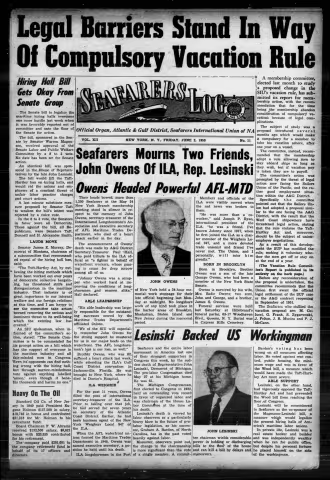
Seafarers Mourns Two Friends,
Jebn Owens Of ILA, Rep. Lesinski
Oweia Headed PowerAil AFLMTD
An SIU spokesman, when in
• formed of the committee's ac
tion, statied: "The Senate Com
mittee is to be commended for
yits prompt action on a bill which
,haa the support of everyone in
the maritime industry and all
fairminded men in Congress.
"Even its* opponents can find noth
ing wrong with the hiring hall,
but through narrowmindedness
vote against anything labelled
'union,' even though it bene
fits thousands and harms no one."^
Their heads bowed, more than
1,200 Seafarers at the May 24
New York Branch membership
meeting stood in silence in re
spect to the memory of John
Owens, secretarytreasurer of" the
International Longshoremen's AST
sociation and executive secretary
of AFL Maritime Trades De
partment, who died of a heart
attack earlier in the . day.
The announcement of Owens'
death was made by A&G District
SecretaryTreasurer Paul "'Hall,
who paid tribute to the ILA of
ficial as "a fighter in behalf of
waterfront workers, whose pass
ing is cause. for deep sorrow
among all of us.
"Johnny "Owens was a scrap
per who worked hard at im
proving the conditions of long
shoremen *ind seamen alike,"
Hall declared.
AB;.E LEADERSHIP
"His able leadership was large
ly responsible for the outstand
ing successes scored by the
Maritime Trades Department's
affiliated unions^
Heavy On The Oil
• •
Standard Oil Co. of New Jer
sey in 1949 paid President Eu
gene Holman $157,500 in salary,
$10,746 in bonus and contributed
$21,318 for Mr. Holman to his
retirement fund.
Board Chairman F. W. Abrams
received $132,500 salary, $9,021
bonus with $23,335 contributed
for his retirement.
The' company paid $201,051 to
the company retirement fund in
behalf of its 17 officers and
directors. ̂
"We of the SIU will especial
ly remember John Owens for
the strong support he mustered
for us in our major beefs on the
waterfront. The AFL longshore
men's Igss is our loss, as well."
Brother Owens, who was 62,
suffered a heart attack last week,
while attending the ILA's Gulf
Coast District convention in
Jacksonville, Florida. He was
brought to New York, where he
died in Doctor's Hospital.
ILA WEIGHER
For the past 11 years, Owens
filled the post of international
secretarytreasurer of the ILA.
Prior to talcing' over that job,
he had served for seven years
as secretary of the Atlantic
Coast District. Earlier, he , had
beeh business agent of. the New
York Weighers Local 947 of
the ILA.
When the AFL waterfront un
ions formed the Maritime Trades
Department in 1946, Owens was
named executive secretary, a po
sition he held until his death.
ILA longshoremen in the Port
JOHN OWENS
of New York held a 24hour me
morial work stoppage for their
late official beginning last Mon
day at midnight. No longshore
work of any kind took place in
the harbor areas of Brooklyn,
Manhattan, Staten Island and
New Jersey during the memorial
period.
Members and officials of the
ILA were visibly moved when
the sad news was broken to
them;
"He was more than a co
worker," said Joseph P. Ryan,
international president of the
ILA, "he was a friend. I've
known Johnny since 1917, when
he first joined the ILA as a char
ter member of the Weighers Lo
cal 947, and a more devoted
trade unionist and friend I've
never met. The Union, and I
personally, will miss him
greatly."
BORN JN BROOKLYN
Born in Brooklyn, Brother
Owens was a son of the late
George Owens, who had been a
member of the New York State
Senate.
Owens is survived by his wife,
Mrs, Sadie Owens; two sons,
John and George, and a brother,
James S. Owens.
Funeral services were held
last Saturday at Hillebrand's
funeral parlor, 6317 Wobdhaven
Blvd., Queens, N. Y. Burial was
in Cypress Hills Cemetery.
A membership committee^
elected last month to study
a proposed change in the
SIU's vacation rule, has sub
mitted its report for mem
bership action, with the recom
mendation that for. the timg
being ̂ the membership abandon
consideration of compulsor3>' va
cation's because of legal ccxn
plications.
The subject of study was a
proposal introduced several.,
months ago which would make
it compulsory for a member to'
take his vacation ashore, after
one year on a vessel
The committee, instead, recom
mended that the membership
adopt a rule allowing men to
stay aboard ships as long as
they wish, but if vacation pay
is taken they are to payoff.
The committee's action was
prompted by the threat of legal
action now facing the Sailors
Union of the Pacific, and the ra
ther good employment situa
tion within the A&G District.
Specifically the committee
pointed out that the Sailors Un .
ion had adopted a proposal simi
lar to the one facing the A&G .
District, with the result that the
West Coast shipowners have
threatened legal action, stating
that the rule violates the Taft
Hartley Act and, moreover,
should be the subject of imion
employer negotiations.
As a result of this develop
meht tiie SUP has modified the*^
rule, making it voluntary whe
ther the men . get off or stay on
at the end of a year.
(The 'Vacation Rule Commii
lee's Report is published In its
entirety on the back page.)
Before any reconsideration of
the proposal is imdertaken, the
committee recommends that the
Union first await the official
legal settlement of the SUP esse
or the A&G contract reopening
in September of 1951.
The Seafarers who studied the
vacation proposal are: M. Co
lucci, G. Frank, S. Zygarwoski,
J. Felton, J. R. Mucins and P. J.
McCann.
Lesinski Basked US Workingman
Seafarers and the entire labor
movement in' America lost one
of their strongest supporters in
Congress this week, by the sud
den death of Representative John
Lesinski, Democrat of Michigan.
The prolabor Congressman died
May 27 at his Michigan home.
He was 65.
The Michigan Congressman,
first elected to Congress in 1932,
held an outstanding vote record
in faVOr of organized labor and
was chairman of the House La
bor Committee at the time of
his death.
Lesinski's death is viewed by
labor observers as a particularly
heavy blow to the future of pro
labor legislation, as his succes
sor, Graham A. Barden, of North
Carolina, has in the past voted
heavily against labor.
. Moreover, observers point out,
the change "in the chairmanship
is more significant than the vote
of a single member. A commit
JOHN LESINSKI
tee chairman wields considerable
power in holding or discharging
bills to the floor of the house
and can kill a bjll by delays and
maneuvers.
, Barden's voting has been
wrong on aU measures affecting
labor. He voted against rent con
trol, public housing, the mini
mum wage and was in favor of
the Wood bill, a measure.which
would have made the TaftHart
ley Act more severe.
ABLE SUPPORT
Lesinski, on the other hand,
had vigorously opposed the Taft
Hartley Act and had prevented
the Wood bill fronj reaching the
floor.of Congress.
Lesinski will be remembered
to Seafarers as the cosponsor of
the MagnusonLesinski bill, a
measure whijh would legalize
the present hiring halls of Am
erica's maritime labor unions.
In private life, Lesinski was a
real estate broker and builder
and was independently wealthy
when he ran for public office,
but despite his personal fortime
he placed hims^ on the side
of the workingman.
'• • Sr
Page Two r ir js S E A F A R E R S L (TG Fxiday, June 2, 19S0
SEAFARERS EOG
* 'Published Every Other Week by the
SEAFARERS INTERNATIONAL UNION
OF NORTH AMERICA .
Atlantic and Gulf District
Affiliated with the American Federation of Labor
At 51 Beaver Street, New York 4, N. Y.
HAnover 22784
Reentered as second class matter August 2, 1949, at the Post'
Office in New York, N.Y., under the Act of August 24, I9I2.
267
ii: Two Good Friehds
IS
f ^ On two fronts last week organized labor lost through
" death rpien who had proved themselves leaders in the fight
ifbr a better way of life for American working men. On
7 the waterfront John Owens, SecretaryTreasurer of the
f International Longshoremen's^ Association, had put in a
• lifetime of service in behalf of the men who load and
unload the ships..Not only had Owens worked diligently
to bring better conditions to the men of his trade, but
in 1946 Owens became head of the then newlyformed"
AFL Maritime Trades Department and was instrumental
in welding the MTD into the powerful force it is today.
The success of Owens' work "in this capacity was
demonstrated only recently when the operators were stall
ing on the Masters, Mates & Pilots' just demands for
a new contract to replace one which had expired over
seven months earlier. Within a' matter of days after Owens
entered the picture, with the united backing of the MTD
member unions, the operators quickly capitulated and
agreed to the union's terms.
The men of the SIU will remember Owens for his
speedy marshalling of the MTD forces when the Union
'Struck Isthmian and, later, when the SIU locked horns
the operators for wage increases. Credit for winning
of the Isthmian strike and the speedy signing of the other
operators to new contracts can be attributed in great part
to the constant presence of Owens' forces at the side of
:the SIU.
|:r
A'?
ill'
ilie ILA has lost one of its top leaders; but, more
than that, the entire ranks of maritime unionism have
Jost one of their staunchest bulwarks against the forces
? of antitmionism. Men like Owens are not easily replaced.
Labor's other recent Sorrow is a man who probably
never held a union card and most of his hfe had been
an employer, having made a small fortune before He
was 30 years old. Yet as a champion of labor there have
been few to equal John Lesinski, the Michigan Congress
fe 4 >«nan v.^ho died last week.
A product of the turbulent days of industrial strife
in Detroit during the depression, Lesinski was elected on
a platform which endorsed unions and legislation to better
.the life of the working man. Lesinski's actions were cour
zgeo\is for those days as his constituency was in the Detroit
Wburb of Dearborn, a town whose mayor, town council,
judges and police force were controlled completely by
the Ford Motor Company.
Ford at that time had just let the world know how
he stood on labor by having his private police force shoot
idown in cold blood four men who took part in a hunger
march to the gates of his factory.
Lesinski, however, was never intimidated, and the
voters responded by returning him to Congress for eight
successive terms. Fie never betrayed the trust of the people
he represented tnd the laboring mefi of the country. A
union man could always gauge the merit of any proposed
legislation by merely checking the way Lesinski cast his
vote.
^ At a time when men with personal courage and great
I strength are needed the deaths of John Lesinski and John
'pwens leave labor and the entire country, with two less
strong hands at the helm of the ship of progress.
Within a very short time, the SIU A&G
Negotiating Committee should be able to
announce the details of the Seafarers' em
ployerpaid Welfare Plan. So far most of
our 52 cpntfacted operators—^including the
largest ones—have come to terms with our
Committee, and the few remaining ones
should swing into line in short order.
However, members are cautioned not to
expect too much at the inception of the
plan. The SIU Welfare Plan, for the time
being, will be confined to weekly hospifal
benefits and death payments. 0,ther bene
fits will be added from time to time, as the
Welfare Fund's reserves grdw larger. The
feeling by all hands on the Negotiating
Committee was that the membership would'
benefit in the long run from a Plan that
was sound financially hnd not in any danger
of going bankrupt and leaving our people
in the lurch,"
The Welfare Agreement does not expire
imtil June 30, 1955. During that time bene
fits may be changed or new benefits added,,
if the Fund is financially able to support
those changes. The 'Union may open the
question of raising the amount of money
paid by the shipowners into the <und on
Sept. 30, 1951. The membership would be
safe in assuming that, as the Fund grows
in size, present benefits will be increased
and new benefits will be added. The goal
of the SIU has b^feen, and always will be,
the complete protection of the membership,
so that, in sickness or in old age, no Sea
farer need worry about money. *
We have come a long ways since 1938,
and have done things that many thought
were impossible.
We have grown from a very small hand
ful to a Union that sets the pattern for
labor in maritime.
We have won for ourselves the highest
wages and the best conditions in the marii
time world. By not opening our books to
all comers for sake of collecting initiation
fees and dues, as did most other unions, wa
have maintained a nlose ratio between
books and jobs available, which insures*!
every member of the chance to make a
living, a security that not many other work
ing stiffs canisodst of.
We have accomplished these things be
cause we were very fortunate in not having
in our Union disruptive factions like the
cwnmunists, trotskyites and other powef
hungry grouiJs. Those that did try to infil
trate into the Union and "take over" were
quickly taken care of by the membership,
who was not interested in such things, but
in getting wage increases, bettering work
ing conditions and organizing new outfits.
We, Seafarers accomplished these things
because of the unity of purpose within the
organization: to strengthen our Union, be
cause we knew that without internal har
mony, we would have nothing—no stand
ards, no conditions, no security.
Now we are working on another form of
security. We are out to get for the mem
bership t.h® security that comes with the
knowledge that there will be some cabbage
coming to him each week when he is in
jimed or too ill to work; that his family • will
n^t be left destitute if he should die.
We see no reason why the Welfare Fund
should not grow so strong as to, in the not
too distant future, provide pensions for men
who in their later years cannot work; or
perhaps support a Seafarers Home, whera
a sailor can spend his last years with tha
feeling that he is not accepting charity.
These and other benefits will some day ba
ours. We deserve therhi and we want them,
and as long as we preserve our inner unity
and maintain our strength, we'll get them.
Z 196§ ¥^E $ EAP ARE RS LOG Pag6 Thn»
In WorM War II
By JOim BUkKER
CHAPTER B
SUEZ AND M^LTA ' \ » ' •
i October of 1942 was one of the critical periods
of history. '
• Field Marshal Erwin Rommel and .his Afrika
Korps were less than 60 miles from Alexandria,
striking for Suez and domination of the middle
east. They had destroyed 20^1 tanks, twothirds
' of all the 8th Army possessed| and victory seem
ed to be almost theirs.
Hard pressed were the deseiilihardened fighters
of the British Army and its yiies. It)» looked as
though nothing could stop tie German panzers
from running through Egypt to the Suez canal.
And then the 8th Army stifjteiied, giving Rom
mel a stiff right to the chin at Alam El Haifa.
. Taking a 4eep breath, they s^vimg hard and hit
the Germans with a succession of hard body
blows at El Alamein, after which the Afrika
Korps turned back and, chased by the "desert
rats," headed pellmell toward the west across
the burring, sands.
AID TO DESERT RATS
That the 8 th Army accomplished this victory
in the face of defeat may well have been made
possible by the historic voyage of the SS Sea
train Texas apd her SIU creV.
This traincarrying frej^hter had just returned
to New York from England in the summer of
1942, when she was rushed to dock and started
taking on a load of Sherman tanks which had
been diverted from our own armed forces on an
emergency order from President Roosevelt.
She was ordered to rush the tank's to the Brit
" ish at Suez without so much as an hour's delay,
for two American ships carrying Shermans for
the 8th Army had just recently been .sunk—
their precious cargoes entirely lost beneath the
seas. .
With IfiO tanks and 165 Army technicians
aboard, the Seatrain l^xas left New York as
soon as loading was complete, with Capt. Albert
Dalzell in command. Hazardous as the ocean
lanes were at that period of the war, there was
no time to wait for convoys.
Proceeding at top speed, the Seatrain Texas
^zigzagged through the dangerous'Caribbean with
g^uns manned every minute and double lookouts
on watch, continuously day and night, ^en
came the precarious dash across the long and
lonely South Atlantic, where Nazi raiders were
known to be operating.
Stopping at Cape Town only long enough for
fuel, the Texas coursed along the east coast of
Africa to rendezvous with a British corvette, her
only escort of the entire voyage, at "torpedo
point" off Madagascar. %
FROM SHIP TO BATTLE
Furrowing the warm seas as they speeded
north, the two ships passed a convoy which had
left the States three weeks before the Texas
slipped her hawsers from the Jersey pier, and
they arrived at Suez a full seven days ahead of
the convoy.
Unloading gear was already rigged as the Sea
train Texas came to anchor. Tank drivers of the '
8th Army were there to meet her, and as soon
, as the broad, heavy Shermans hit the shore they,
were rumbling off toward the fighting fronts not .
many miles away.
Said the Seatrain Lines of this exploit: "It was
the men of the Seatrain T^xas as well as Mont
gomery who turned the tide in North Africa."
They helped put Rommel to rout and, perhaps
without exaggeration, played an important part
in changing the course of histpry.
No better accolade for the sjiip and her crew
, sCould have been given. Theirs had been an his
toric mission ably fulfilled. .
• the time of the Malta convoys till after Italy had
. surrendered.
The Liberty i^ip Daniel Huger of the Mississ
ippi Shipping Company, for instance, was loaded
with 6,000 tons of. b^h octane gasoline in bar
rels when she was caught in afi air raid at Bone,
Algeria, in 1943, and hit by a bomb which wound
ed several gunners and started a fire in the
'tween decks. .
BATTLED GASOLlkE
Although the ship threatened to blow up at
any minute, with fiames from exploding gaso
line roaring 300 feet into the air, the crew stayed
by their posts tiU the order ̂ came to abandon
ship.
Later a fire brigade arrived and crewmen vol
unteered to help the shoreside firefighters put
out the flames and save ship and cargo. Several
of the crew dared death to enter the hold ad
jacent to the fire and spray foamite over the red
hot bulkheads.
; When the Alcoaoperated William Wirt was
attacked by Nazi bombers in the Mediterranean,
the War Shipping Administration later said of
its crew that "although ̂it was the first experi
ence in action for the majority of .the merchant
seamen stationed with the guns, they served
like seasoned veterans." The same commenda
tioA could be made of many another SIU crew.
After the SS Maiden Cr&ek, a C3 operated by
Waterman, was torpedoed near the coast of North
Africa in 1944, crewmen returned to the ship
when it was seen she wouldn't sink immediately,
and volunteers went below to break out towing
hawsers from the after chain locker.
As they were at work below, a second torpedo
struck the vessel in the stern, with six sailors
losing their lives and 12 others being injured as
this SIU creW attempted to save their vessel
and its valuable cargo of war supplies.
SIU men played an important role in another
thrillpacked theater of war, when the SS Rob
in Locksley of the Seas Shipping Company help
ed to rush food, gasoline and ammunition to be
leaguered Malta, that brave bastion of the middle
Mediterranean, which proudly bore the title of
the "most bombed spot on earth."
German and Italian airmen had tried futilely
to blast this 17mile long island out of the war
with innumerable raids, for Malta had three;
flying fields and British planes were using them
to exact costly tolls from Axis convoys supply
ing Rommel in North Africa.
But for several small and heavily protected
Allied convoys that reinforced the island by rim
ning the "bomb blockade," Malta might have
fallen and the conquest of Africa been made
immensely more costly in men and material.
It was on November 17, 1942, that the Robin
Locksley, the Bantam (Dutch), and the Denbigh
shire (Br.) left Port Said for Malta.
Importance of the convoy is emphasized by
the size of the escort they had:" five cruisers and
seven large destroyers!
The first heavy attack was by seven Junkers
88s, which were driven off by intense ackack
fire,shut three torpedo planes came in soon after
and hit the cruiser Arethusa. In this attack the
Robin Locksley was given credit for downing
one of the torpedo raiders.
On the 19th, a flight of 27 Nazi troopcarrying
planes bound for Africa made the mistake of
passing over the convoy, «nd long range Beau
fighters from Malta which were flying cover for
the fleet at the time knocked down four of the
transports with their human cargoes.
Heavy seas and frequent overcast helped the
convoy to rpach Malta without loss on November
20, delivering a cargo that helped immeasureably
to keep the island fortress in the war. The Robin
Locksley and her companion ships skirted subs
and bombs to arrive safely back in Port Said.
CHAPTER 9
CONVOY PQ17
One of the most dramatic and yet tragic epi
sodes of the war at sea involved Convoy PQll
better known among SlU seamen as the "Fourth
of July" Convoy to north Russia. •
Seamen of the Seafarers International Union
and its affiliate, the Sailors Union of the Pacific,
have a very personal interest in this convoy,
because they manned most of 'the 20 American
freighters in the 33ship fleet.
PQ17 was heavily protected when it left Reyk
javik on June 27, 1942. For convoy patrol and
(Continued on ?age^5)
m
" 'Actionpacked voyages in i
were not unusual for SUTma
16 Mediterranean
nned ships, from
From the deck of a combat transport a Coast Guard photographer caught this picture of
an American cargo ship hit by Nazi dive bombers during the invasion of Sicily. Fire started by
bomii>s dropped amidships spread rapidly to the ̂ ip's munition supply, which exploded to make
ihis a dangerous, though picturesque scene.
\ :• • ' V'A' • I
Pag« Fo^ "T H E S £ AFA R E RS LOG Jun* 2, 19S0
Ifflproved JShipping, Standby Jobs
Take Some Hoat Off Baltiibore
By WM. (Curly) RJENTZ
I.^
K^r
5f.j/
BALTIMORE — Shipping has
picked up here in the last two
weeks, and we sure can use it—
as what port can't! However, as
a warning, let us say that we
still have plenty of men on the
beach — more than enou^ to
take care of our needs for some
time to come.
^Ih this last period we had 16
ships paying off, while only ten
signed on again. There were a
few ships intransit, but they
didn't help us any. Just came
in for cargo, and left without
taking any men. •
^cidentally, we lost one more
^i^ here: The Kenyon Victory,
Isthmian, is being* turned over
to the Maritime Commission
and will tie up in the Gulf.
One thing that has been help
ing the Brothers on the beach,
is that the Robin Line ships,
which come here to load, are
calling the Hall for men to clean
the holds and for standby jobs.
Ibe boys are doing *i good
job, as was told us by one of the
Robin Line mates. He said they
were the best he has had work
ing for him — and a statement
like that goes a long way to
bringing more jobs to the SHI.
Whenever we go down to. the
waterfront, we come back sick
at heart, seeing all those ships—
Port Savaiinah
Is Going
Kfcv'
Bfe:
By E. M. BRYANT
SAVANNAH — Shipping for
this .port has been very good
during the past two weeksand
we expect it to remain so for
the time being. The SS South
land was the only payoff we had
in this period, and signed on
again in addition to the Strath
more. Intransit we had the
Bents Fort, Citjes Service and
Bull Lines' Jean.
By the time this report is
printed, we should payoff the
Jean, Southport, and Southwind.
The Liberty tanker Julesburg is
, also due and may take some re
placements.
We had two unwanted replace
ments on the Southport. Brothers
Thompson and Kodurand were
hurt in a fall when their stage
broke, while they were painting
the stack, and had to. be hospi
talized.
Otherwise, eversdhing is run
ning smoothly. E. D. Sims and
Jack Meyers arrived in this port
after paying off a long Far East
trip in New York.
On the beachcomber front.
Brother Joe Gou^ h^ taken
over as Bosun on tne, third floor
of the Victory Hotel. Whitey
Mathes was made elevator boy,
and Brother Martin Chief run
ner while Gimpy Maxey arranges
finances for the entire crew.
We have beautiful fishing wea
th»?r, but the damn river is dry
ing up.
owned by American coital —
sailing under foreign flags, espe
cially Ranamanian.
Not only are they taking jobs
away from American seamen,
but they are a very potential
threat to our high standards in
wages, working conditions, and
feeding. J,
GOODBYE. SHIPS
Unless this country wakes up,
we shall find the American flag
ship the very rare exception in
American ports.
One thing about Baltimore, we
have undoubtedly the finest col
lection of horse players in the
country. The way those guys
come up with winners is some
thing out of this world.
The • only thing that keeps
them from retiring with a hatfull
of dough is that, by' the time
they pick the winner, the race
is over. If only they had bet
'eip! ... Oh, that "if!"
CS MEN TO SAIL ON OTHER SIU SHIPS
Cities Service crewmen Robert Ensor (center) and M. D.'
(Buddy) Hooper are congratulated by SIU organizer Keith
Terpe as they receive their SIU membership books. Ensor
and Hooper, who were aboard the SS Government Camp until
May 17, have registered at the New York Hall and wil). select
jobs on shipS^ of the SIU's 52 contracted operators udder the
democratic rotary .shipping plan^
Port Of New York Shipping On Jfowngmde
' By JOE ALGINA
NEW ^ORK—From what was
4
a passable tempo of shipping a
coupleof weeks ago, activity in
this, port has taken a gradual
turn downward, helped along
mainly' by the layup of three
Robin Line ships. Despite this
setback, the port did manage to
take care of some ships.
The ships in for payoffs were
Stonewall Jackson, Raphael
Semmes, Hastings, Gateway City,
Yaka and Ponce DeLeon, Water
man; Steel Executive, Steel
Scientist and Steel Flyer, Isth
mian; Bull Run, Mathiasen; Rob
in Mowbray and Robin Gray,
Seas Shipping; Alexandra, Car
ras; Black Eagle, Orion; Na
thaniel B. Palmer, Palmer SS
Company; Algonquin Victory, St.
Lawrence Navigation;' Seatrain
Havana, Seatrain New Jersey,
Seatrain Texas, Seatrain Lines;
Monroe, Kathryn, Frances, Puer'
to Rico and Beatrice, Bull Lines.
17 SIGNONSj
The signons weren't so many.
The Seatrain, Lines and Bull
Lines ships all resigned articles,
as did the. Steel Architect, Steel
Executive, Steel Flyer and Steel
King; Robin Tuxford; Black
Eagle; Ponce De Leon; Alexandra,
Carras, and Frederic C Collin,
DryTrans.
• £
Those are the statistics on the
shipping in this port. On the
news side of the ledger, most
of the talk and activity around
here seems to concern the new
home the Union purchased in
Brooklyn.
A good number, of the mem
bers have inspected the build
ing and all report favorably. Of
course, it's hard to, visualize how
the setup will be after altera
tions are complete, but it's ap
parent to everyone that possi
bilities there are immense and
the location is ideal. '
UNION EXPANSION
Talking about the new build
ing brings to mind the tremen
dous change the SIU and other
unions have made in the mari
time labor picture. The SUP will
open its new San Francisco Hall
on June 16. Tlie SIU A&G now
owns its buildings in almost all
ports and provides the member
ship with all the facilities of a
club.
It's the members that did it,
and every member can be proud
of his accomplishments. It's a
far cry from what once was the
situation: dirty crimp joints with
no furnishings other than rough
wooden benches.
Every SlU Union Hall is a
monument to the men who help
ed build our organization. Of
course, there are a few foulballs
who can claim no credit. The
gashounds didn't help. If' it
were up to them we'd still be
operating out of back alleys and
in dark offices.
However, we've checked the
gashounds, and we're set up for
keeps in every major jpdrt. It
gives a guy a good feeling in
side.
SISTER SHIP TO THE RESCCE
Slows N'Orleans
To A Standstill
By EARL SHEPPARD
NEW ORLEANS —Since the
last report, shipping has slowed
to a virtual standstill with four •
payoffs and six signons, all four
payoffs taking place last week;
About twenty ships hit the port ~
iritransit, but the job turnover
was very small.
The_ outlook, however, is not .
too bad with five schedule^ pay '
offs due, and a few others ex
pected to make this their payoff
port at the last minute.
The Del Oro is expected to
take a full crew either this week
end or not later than Monday.
The big boy, the Del Norte, is
due • shortly and will surely call
for many reifiacements.
On the negotiating front, we
met with the NLRB again, con
cerning the Bisso Company, but
nothing definite was arrived at.
The , strike is still in progress
and our charges are still pendr
ing.
Other scheduled meetings are
due shortly with the Mississippi
Shipping Company and tlie Alcoa
Steamship Company, the latter
regaiding a Beautician aboard
the SS, Alcoa Corsair . who has
injee^ed herself into SIJJ affairs.
Members around this port city,
are urged to register for the
coming elections. H you haven't
done so already, contact Brother
Paul Warren here at the > New
Orleans HaU. He's the man to
see, too, if you're interested in
getting an organizer's job.
One item before . closing: If
you have any Union business to '
Halfway across the Mediterranean during a recent voyage
to Italy and NearEastern ports, the SlUcontracted SS Cecil
N. Bean was disabled by extensive damage to the port boiler.
Wallowing around in ihe seas, the ship radioedfor assistance.
The call was picked up nearby by the Bean's sister ship, the
Frederic C. CoUin, both vesels owned by the DryTrans Corpor
reiion of New York.
The Collin changed course inunediately and steamed to
the Bean's side to offer the crew, equipment needed to make
repairs. " •
Photo shows a ^oup of Seafarers from the Bean making
ready to east off for the short trip to the Collin. Fore to aft
are: Steve Huren, John Devine, George Mastorajs, John Dalao,
Ben Talbot, Lar^y Tryon. Nick Fedyk and Thomas Geraldson.
At the tiller is Chief Mate Malone,
The shiptoship operation took place on April 20, and
was reported to the LOG b" acting Ship's Delegate Rolaud
Wright. : * , . . !• .• v,':;
discuss, do it in the Union Hajl
and not in.fi ginmill.
Tlie Union has no ginmill pa
trolmen, and too often Union
business is confided to the wrorig
persons. To be on the safe side,
make it a rule to discuss Union
business only at the Union Hall.
Shipjiing Good
In Port
By WILLIAM McK AY
SEATTLE—Shipping has been
good in the port of Seattle for
the past few w^ks. Most of the
ships have been heading to the
Orient on the grain run, but this
trip the Demostar took off for
Ireland.
At this writing there are few
SIU men on the beach, and we ̂
turned the surplus jobs over to
our Brothers of the SUP.
We are sorry to report that an
Unfortunate accident took place
on the Young Ameriqa on her
last trip. Brother Otto Johnson
was lost overboard, ' when he
was lashing down a boat cover.
The members of the. crew,
unlicensed and licensed, and the
Seattle Branch wish to extend
their fullest sympathies and rei
grets to his family. Brother
Jolmspn was a fine shipniat<; and
a goQd Upion man.
PrihiBir, Jiun* 2. 1950
• ' srrrsf^
THiB SEAFARERS LOG Page Fire
The Seafarers In World War 11
{Continued, from Page 3}
defense there was a heavy task force consisting
of destroyers, sloops, corvettes, two "ackack"
ships, several armed trawlers, three rescue ves
sels and two British submarine* that hoped for
a chance to torpedo any big German men o' war
that might be lured put to attack the fleet.
Heavy escorts included the cruisers HMS
London, HMS Norfolk, USS Wichita, and USS
. Tuscaloosa. — • ^
Covering the convoy's flank about 100 miles to
the east was another battle fleet, numbering the
aircraft carrier HMS Victorious, British battle
ship Duke of York, USS Washington (battleship),
several cruisers and numerous destroyers.
QUICK ATTACKS
Soon after leaving Iceland, POrl7,was spotted
by a Nazi Blohm and Voss patrol plane that kept
a constant vigil over the convoy's course, direct
ing subs and planes to the attack.
In the early morning of July 4, a doughty
Heinkel defied the escort, darted through a bank
of mist, and torpedoed the Liberty ship Christo
pher Newport (Calmar) with ,its 9,000 tons of
war supplies.
That afternoon a. flight of 25 torpedocarrying
Heinkels attacked from astern and braved a
hail of antiaircraft fire to sink the freighters
Navarino (Br.) and William Hooper (Am.) and
hit the Russian tanker Azerbaidjan, which, how
ever, did not sink and rejoined the fleet. Another
"tin fish" missed the SlUmanned Bellingham by
a few feet.
Gordon Small, seaman on the Ironclad, re
counts how the bombers plowed right up thip^h
the convoy lanes against terrific fire*, loosing
their torpedoes and firing at the ships with their
machine guns.
A plane passed so close to the Ironclad they
could see the face of the pilot arid the gurmer.
Bullets from the old Browning .50s on the Iron
clad seeined to bounce off the bombers like hail
on a tin roof.
This was dramatic and. costly evidence that
the Germans intended to stop Convoy PQ17
from delivering its 188,000 tons of freight to the
Russians. But, despite the warning, the convoy
commodore signalled this message to his mer
chantman at 8:30 on the evening of July 4:
"Scatter fanwise and proceed independently to
destination at utmost speed."
"ON THEIR OWN"
Three ships had already been lost despite the
heavy naval escort. Now the merchantmen were
to be left "on their own".with no more than .30=
and .50caliber machine guns and a few three
inch guns for defense!
The order had come from London. Only the
armed trawlers, several corvettes and the three
rescue ships were left with the freighters and
they hurried off independently at tc^ speed.
When the oruisers and destroyers d^hod away
the Bellingham was close behind the little rescue
ship Rathlin. Not intending to be opmpletely
deserted if he could help it. Captain Mortenson
told Chief Engineer Saltsman to "give us every
bit (^f steam you can squeeze out of those boilers."
The watch below" really produced, and the
Bellingham stuck right on the tajl of the an
noyed ̂ Rathlin, despite its repeated signals to
"get away."
The Bellingham turned up 14 knots in its hour
of desperate need and made it safely into Arch
angel after numerous adventures, still in com
pany with the rescue ship.
V^en the convoy scattered, the old Ironclad
was alongside the Panamanian freighter Trouba
dor, which trailed a continual column of heavy
smoke from her coalburning fires, and near the
Silver Sword. "
The little British armed trawler Ayershire
steamed up and said, bravely enough, that she
would "convoy" them to ,NOV£^ Zembla. The only
escoii: iship with "guts" enough io stay by the
deserted merchantmen was this onetime fisher
man.
Under escort of the doughty Ayrshire, the
Silver Sword and Ironclad spent three days in
iieavy pack ice, which protected them from" subs;
arrived safely in Nova Zembla and, later, made
it through to Russia.
First ship to go down after the convoy scat
tered was the SS Carlton, torpedoed in the. deep
tanks. Her survivors were picked up by a Ger
man seaplane and submarine/and others rowed
to the Coast of Norway. After being taken prison
er, they also survived the torpedoing of a Ger
man prisonerofwar transport.
" Next to get it was the Matson Company's SUP
manned Honomu. She went down in 10 minutes
with 19 of her crew.
HEAVY SHIP TOLL
Soon after the SlUmanned Pan Kraft was
attacked by three Junkers 88s and set afire, her
5,000 tons of bombers and airplane parts lost
amid the mists of the icy Arctic.
In succession went the British freighters Em
pire Byron, Earlston and River Afton. A gift
for Hitler they were! Unescorted and lightly
armed merchantmen against powerful bombers
and Uboats!
The American freighter Peter Kerr gallantly
fought off 7 torpedo planes with four machine
guns, but the unequal contest was soon ended
and this brave ship also went to the bottom.
About the same time the SS Washington edged
along an ice pack in, comply with the Bolton
Castle (Br.) and the Paulus Potter (Dutch).
Nine Junkers dive bombers attacked, blowing
up the Bolton Castle and sinking the Washing
ton after many near misses had caused her to
leak like a sieve. Late;,^ they got the Paulus
Potter, too.
The SS Olopana (another Matson, SUP ship)
hove by and offered to pick up the Washington's
survivors, who were pulling toward Nova Zembla
amid gusts of snow and big chunks of drift ice.
. "No," they shouted. "You'll only get sunk, too."
And sunk the Olopana was—Only a few hours
Jater. . .
PANATLANTIC DIES
Survives from these ships then pulled through
freezing weather to the mountainous coasts of
bleak Nova Zembla where, after "celebrating"
ovef a feast of duck and sea gull soup, they
were picked up by the SS Empire Tide and other
assorted vessels that had made it there to take
shelter under the cliffy.
An epic fight against overwhelming odds,
meanwhile, was waged by the SlUmanned Pan
Atlantic, a Waterman ship which had an arma
ment of four .50caliber machine guns.
"Nineteen of the merchant crew and seven
Navy gunners were killed while defending this
ship," says the official Navy report about the
Pan Atlantic.
They stuck by their guns even while a Junkers
dropped its lethal Jo. d on them from a height
of only 4,000 feet—safe beyond machine gun fire.
The bombs exploded in the cargo, knocked the
foremast on top of the wheelhouse,, and severed
the ship completely just forward of the bridge.
She filled and quickly sank with a very valuable
cargo of oil stills, aluminum, nickel, food, tanks
and cordite,
COURAGEOUS CREWS
Shortly after the Pan Atlantic wdnt down, a
sub torpedoed the SlUmanned Alcoa Ranger and
the Hartlebury (Br.), many of whose crew froze
to death trying to reach Nova Zembla.
The Liberty ship Daniel Morgan shot down two
dive bombers before a sub got her. It took three
torpedoes to sink the Liberty ship John Wither
spoon, whose men were picked up after a daring;
decision by Captain John Thevik of the SS El
Capitan (Pan.), to stop his ship for the rescue,
eveii though a sub was close behind at the time.
By the 7th of July, Convoy PQ17 had lost 18
ships. Almost 100,000 tons of war cargoes had
been sent to the bottom of the Arctic and the
Barents Sea,to be lost forever.
It was on the 7th, incidentally, that the plucky
Bellingham was hit by a torpedo which did not
explode, although the concussion blew out the
lights and knocked the watch off their feet.
The SlUmanned Ironclad of the Waterman
Company, the Troubador and the Silver Sword
and the trawler Ayrshire ran into thick pack
ice, then hit on the happy idea of painting their
hulls white and covering as much of the topsides
as possible with sheets and blankets.
TRICK SUCCEEDS
This camouflage helped them to evade attack
in getting to Nova Zembla and, finally, to the
White Sea,
Several other freighters of the convoy made it
safely to Nova Zembla, where they joined with
some escort vessels to steaimthe last lap without
further loss, arriving in Archangel July 25.
Another segment of the illfated fleet had made
the dash from Nova Zembla toward Cape Kanin
, on July 7, accompanied by corvettes and armed
trawlers.
Included were the freighters Hoosier, Ocean
Freedom N(Br.), Benjamin Harrison (Calmar) and
El Capitan (Pan.). They were later joined" by
the Liberty ship Samuel Chase (SUP).
The Hoosier and El Capitan were sunk short
of their destination in violent air attacks, and
the Samuel Chase made, it in only after a raging
fight in which Ibombs snapped all the steam lines
to the main engine and auxiliaries, and the fight
ing ship was taken in tow by a corvette, her guns
still barking defiance to the Nazi bombers.
Only eleven ships out of PQ17 made it through
to Russia; among them being the American ships
^Ironclad, Samuel Chase, Beniamiii Harrison (all
SIU), Silver Sword, Winston Salem, Bellingham
(SIU) and Troubador. *
They had smvived by pitting courage and
determination against great odds in one of the
most bitterly fought battles of World War 11.
=5=rF .
Another episode of the role of SIU crews in
World War 11 will appear ip. the next i^ue of
the SEAFARERS LOG.
p ,
UA
Page Six • • '• '::l^""' • ' T BE S E~A, F A RE RS LOG ' ' ' ^ iY* June 2. 1850
SBIPS' MINUIES AND NEWS
SIU Blood Donors Help
Brother Kayo Illness
When a call went out for blood donors to aid aft
ailing Seafarer last month, the SIU members who re
sponded made little or nothing of their contribution.
DOING FIRSTRATE JOB^ ON SEATRAIN TEXAS
They left the New York Hall,«
TV
went to the Holy Family Hospi
tal in Brookl3ai, donated their
blood for a Union Brother whom »
none of them knew, returned to
the Hall and practically forgot
the incident.
But Seafarer Anthony Irizzary,
the beneficiary of this almost
routine display of brotherhood,
5ays he'll "never forget what
they did for me."
FIRST STOP
Discharged fiom the hospital
last we^, after five weeks of
treatment, the first thing An
thony did was come to the Union
Hall to acknowledge his anony
> mous BrothCTS* part in prompt
ing his recovery.
In the LOG office Anthony
said he'd like a notice to be pub
lished expressing his thanks
"from the bottom of my heart."
Then he told how he suddenly
became ill in March shortly after
paying off the Isthmian freight
er Meredith Victory. The day
he was to register for a job he
was stricken with internal hem
orrhages and was rushed to the
hospital in critical condition.
Informed of Irizzarr3r*s plight,
a Union official called the hos
pital to see if he needed any
thing. Blood was urgently need
ed, he was told. Wofd was'pass
ed aroimd the Hall and in a mat
ter of moments, a score of men
said they wanted, to help. None
of them knew Irizarry.
THANK ALL
Of the volunteers, blcod was
taken from William Abercrom
bie, Tony Palino, Sam Presto
and Blackie Goluccf,
After Irizarry had told his
atbry, the LOG checked around,.
and found Colucci—the rest had
already shipped out. Introduced
to Colucci, Irizarry gripped his
hand and expressed his deep
gratitude. Colucci blushingly re
plied: "Forget it. I didn't do any
thing. I'm just glad you're okay
again. What's the use of being
a Union Brother if you can't
help a guy when he needs it."
Irizarry, a Chief Cook who.
has been a member of the SIU
for ten years, said he was sorry
he couldn't thank each of the
donors in person. "What they
did for me I'll never forget."
Seafarers Abercrombie, Palino,
Presto and Colucci, please note!
Gathered in galley kre. left to right, Ray
Elasscock, Utility; Albert Espeneda, Steward;
George Russell. Third Cook, and Harry Frank
lin. Night Cobk and Baker.
^; i
H. H. Winbom, Bosun on the Texas, at
tends to one of his shipboard duties. He's
shown'here as he records soundings that have
just been made.
NewFound Harmony Sparks
Life On SS Seatrain Texas
Crewmembers of the SS Seatrain Texas are doing
their darndest, and with notable success, to make their
ship ".a happy place to be around," reports Ship's Delegate
Harry Franklin. X
that will be hard to beat any
where. Number one effort of the un
licensed personnel, says Frank
lin, is to deliver their end of
the contract. The lads are beef
mg when necessary, but "only
when nece^ary," and as a re
sult their good bee& carry
weight.
All hands from Captain Wetzel
on down are cooperating to make
the Texas a snug ship. Misun
derstandings and differences be
tween officers and crew have
diminished almost to the vanish
ing point; Frafiklin adds.
In fact, the Ship's Delegate
points out, the current cam
paign is already showing signs
of producing shipboard harmony
Notthe least of the crew's ac
complishments, Franklin says, is
the creditable fact that "there
is not one performer on the
ship."
To which another crewmem
ber added, "We're proving once
again that SIU crews are the
best m the business. That's why
we boast the best contracts in
maritime."
Chow time on ih^ Seatrain ship is a satisfying interlude.
Jghn Pisa. Utility, serves, as (left to right) Edward Sokowski.
ABM; Wilfred Shea, ABM, and Bosun Winborn liig in.
Photos by Glen Viiuon, OS.
. Fussell Dies Of Pneumonia In Detroit
Up and around after ^a fiveweek tussle with illness,
Anthony Izissai^ (right) thanks Blackie Ckducci, one of
several Union BrothersTwha aided him wHh blood donations.
• BJV's.
Delmar B. Fussell, 44, a mem
ber of the SIU since 1941, died
of pneumonia in Detroit on April
30, according to word received
this week.
Funeral services were held ih
the McKneely Funeral Home in
Kentwood, "La. Religious services
were conducted in the Boulah
Baptist Church and intenhent
was in Beulah cemetery. Wood
row Fhssell, a brother of the de
ceased informed the LOG
The late Seafarer^ who sailed
as a FWT, ^ived at 1144 Dela
ware Drive, Tort Arthur, Tex.,
from where he started sailing in
1936.
As an SIU man, Delmar ship
ped out of Galveston and New
Orleans, serving aboard Missis
sippi and Alcoa ships and those
of several other companies, his
brother said.
During the war, Fussell saw
action in the Pacific while
aboard the SS Clarence King.
He also sailed in the European
area of the recent conflict.
Of late, Brother Fussell had
been sailing on the Great Lakes
in the summer months and work
ed aboard the SS Western States,
SS St. Claire and SS Columbia,
His last job was aboard the MV
Highway 16, running between
Muskegon, Mich., and Milwaukee,
according to his brother.
He contracted a cold after sev
eral days aboard the ship, weHj
to Detroit, where he died in a
hospital after developing pneu.
monia. . .
. His family expressed aimrecia
tion for the condolences and
flowdrs sent to the funeral from
the SIU Hall in Detroit. His
brother said that if anyone ow
ing the late Seafarer money
wished to repay it, they should
forward it to his mother, Mrs.
Lena Fussell, Route 2, Kentwood,
La, .
Voice Of DL Sea
By "SALTY DICK'
Several months ago a movie company from Holly
wood was shooting scenes along the docks in New Orleans.
E. Reyes, the cartoonist, was trying his darndest to get in
the pictftre, but no luck. . . .X
Recently I paid a visit to the
Bethlehem Orphan Home and
was shown that we seamen are
contributing tor this cause and
making it possible for the chil
dren to live a better life.
Our good friend Ralph Boyd
is one of the SIU men whose
pictures occasionally appear in
the LOG. . . : During the Mardi
Gras in New Orleans, Bill Cham
plin wcs seen selling ballopns,
peanuts and <^ndy. . . . Jesse
Cerda is a patient at the Marine
Hospital in the' Crescent City. ;
^ank Fernandez talking busi
ness and ready to open a shop
in Tampa if things go right. ...
The Del Norte crew received
a letter from Mrs, Earl Long,
wife of the Louisiana Governor.
Formanek, the man who sells ,
butterfly trays in'Rio should re
ceive some credit for the splen^ ̂
did work he did on the picture,
iWhich was recently presented to> ;!
the New Orleans Branch. *
• '''X
Friday. Jim* 2, 19M THE S BAFARERS LOG Page SeTen
ALCOA CORSAIR, Mar. 19—
W. Higgs/ Chairman: J, Roberts,
Secretary. Delegates reported,
Motion to elect manager of crew
baseball team; Brother Bourgot
elected.'. Motion carried to refer
disputed overtime of Storekeeper
to Mobile. Motion carried, that no
movies be shown in crew mess
after 5:30 AM or before 1 P^d,
Discussion on many subjects o;
vital interest to crew and rest
of SIU membership.
i 4 t
TOPA TOPA. Mw. 19—C. J.
Murphy, Chairman: A. Fusco,
Secretary. Deck and Engine
delegates reported 35 hours and
& hours disputed overtime, re
S^pectively, in their departments.
Suggested that tarpaulin muster
be held for Guatade Angelo,
SUP, who is a passenger enroute
to Snug Harbor without any
funds. Murphy, Ship's Delegate,
vnll accept donations. Discus
sions. on men staying on ships
too long and on credit unions.
Not too much informatibn avail
able on the latter.
Digested Minutes Of SIU Ship] Meetings
* b »
SUZANNE, Mar. 12—L. Rey
isolds,. Chairmam R. H. Carring'
ton. Secretary. No beefs in any
of the departments. Crew wants
question settled on whether it
is permissible to hire replace
ment in San Juan wheii ship
happens to be short in crew.
Same to be clarified by boarding
Paitrolman. or at the Hall. Pine
of <$2 to be .levied on those not
wearing proper dress during
meal hour; proceeds to go to
SEAFARERS LOG.
2 *
. CHICKASAW. Mar. 12—Rich
ard L. Abbey, Chairman: William
E.' Hughes. Secretary. Letter
about washing machine read.
Ship's Delegate reported $30.05
in ship's fund. No beefs in any
department. Motion carried thai
Ship's Delegate retain job for
another trip. L. S. Bugajewaki
elected Deck Delegate. Motion
!| carried, 21 to 3, to censure any
one calling HaU on ship's btisi
Siess, except Ship's Delegate.
Contributions will be accepted
for ship's fund by department
delegates, at payoff.
Trotskyites. Many of crew, ma
jority of whom had shipped from
• Seattle, were f amiliar""^ with
Trotskyites' disruptive role and
discussed same. Motion (by
Drevas, seconded by Jarvis) that
Seattle Agent be contacteid te
hold meeting with crew prior
to payoff. General discussion on
agreements and present status
of Union in maritime industry.
S X X '
MADAKET, Mar. 19—R. Sirois,
Chairman: McNeal, Secretary.
Few hours disputed overtime in
Deck and Stewards departments.
Motion (by Burdiek, seconded by
Green) to contact Headquarters
for clarification on gangway
watches. Discussion on transpor
tation; clarification to be gotten
from Patrolrhan. Vote of thanks
to Stewards Department for ex
cellent chow and service.
XXX
SEATRAIN HAVANA. Mar. 26
—W. Henderson, ChairmEui; M.
G. Whale, Secretary. Delegates
reported. Motion carried that no
one take beefs direct to Hall
without first taking matter up
with departmental delegate.
Brandon suggested that check be
made on how many port screens
and wind chutes ̂ aboard are fit
for use for ^crew's quarters.
Steward said he would requisi
tion a suitable number for warm
weather.
man about washing machine.
After discussion on cleaning gear
for Wipers, it was suggested that
Delegat^ see department heads
about s^e._
'j ' X X X
STEEL MARlNEa AprU 9—
Bill Rowe, Chairman; Stanley C.
Scott, Secretary. Money left over
from purchase of washing ma
chine tC be placed in ship's
fund. S^e Karlac elected trea
surer. Motion (by L. Starland)
carried flhat as Ipng as ship,con
tinues to operate under SIU con
tract, the washing machine re
mains aboard for use by present
crew and crews to follow, but
that if ship is sold or transferred
machine is to become property
of SIU.
^ X X *X
SWEETWATER. April 1—WU
liam Kehrwieder, Chairman; E.
WiHsh, Secretary. Ship's Dele
gate said draw list would be
turned in by time ship arrives
in Port Said. Except for few
overtime beefs, all departments
are okay. Union Bulletin read
aloud to meeting. Ship's Dele
gate to ^ee Mate about getting
more garbage cans back aft.
Porthole glass in 4 to 8 sailors'
foc'sle to be repaired.
>
X X X
PORTMAR, Mar. 12jro» Mar
iin, Chalmuui; C. J. Lupwi Sec
retary. A^ J. Janoweki elected
Ship's Delegate. IJepartment
delegates' reported. Under Edu
cation, . discussion on Calmar
agreement and whether Mates
are allowed to work on deck.
Crew decided against purchas
ing washing machine. Steward
J. H. Brigham said that new cots
had, been ordered but had not
yet arrived. These and new mat
tresses were promised for next
trip. Ne::ft trip repair list should
^e checked by new crew coming
abcrard.
XXX
DEMOSTAR, Mar. 19—Gordon
F.' Hart, Chairman: W. C. Mc
Cuistion, Secretary.. Delegates
reported. Motion carried that^all
hands eligible for same put in
for delayed Sailing overtime. Mo
tion carried to draft letter of
crew's opinion re Trotskyites.
General discussion of role of
XXX
STEEL MARINER, Mar. 15—
Bill Rowe, Chairman: Stanley C.
Scott, Secretary. Delegates re
ported. Steve Karlac elected
Ship's Delegate. Motion carried
to contact Union official in Bal
timore to . check on slopchest;
insufficient amount of cigarettes
.iboard. Discussion on washing
machine. CreW decided to find
out who owns one aboard, and
if it can be repaired and used
by crew.
X^ X X '
CHIWAWA, April 20 — Fred
Girard, Chairman: Fred Smith,
Secretary. No beefs reported by
department delegates. Coopera
tion asked in keeping messhall
clean. , Request better care of
washing . machine; and that
broken head seat be replaced.
Committee consisting of John
Toth, Bosim, and F. Gissubil.
Steward, elected to collect funds
at payoff for former 2nd Cook
now stricken with TB.
XXX
ROBIN GOODFELLOW, April
16—G. O. Regam Chairman; A.
N. West, Secretary. Ship's Dele
gate reported that, according to
\4ate and Captain, foc'sle' paint
ing will be put on shore repair.
Engine Delegate said that dis
puted overtime for Electrician
to be turned over to Patrolman.
Other departments okay. Vote of
thanks to" Peter PatxItk for good
: ob he has d(me as ̂ ip's Dele
gate; Ship's Delegate to get in
touch with repair' and service
XXX
PONCE DE LEON. April 9—
Ralph Groseclose, Chairman; B.
Toner, Secretary. Ship's Delegate
reported $13.50 in kitty for wash
ing machine. Disputed overtime
to be taken up at payoff. Motion
carried'that each mian donate 50
cents for .washing machine fund.
Vote of thanks given to Stew
ards Department for good job.
XXX
ANDREW JACKSON, April 9
—C. Glover, Chairman; H. K.
Smith. Secretary. Delegates re
ported all is well. Jack Bates el
ected Ship's Delegate. Ship's
fund contains 86 cents. Decided
to pass aroimd , list for pledges
to washing machine fimd, money
to be collected at payoff by
Ship's Delegate. Crew voted to
purchase best machine possible
with amount available. Ship's
Delegate to see about getting
Mate to place on sale some of
the cigarettes now being held in
bond. He will also try to pur
chase some cigarettes in Canal
Zone.
(SWCE Ae^AIN .. .
WHEAJ NOTIFyiN©
THE LOS Of YOUR
CHANGE OF AOPReSS,
&iva BOTH YOOR
OLO AND AJEW
AC>PRESSES
: '• '.J
]
Si
• J X X X .
DEL VALLE, April 2 — F.
Shaia, Chrirman; H. W. Rya%
Secretary. I No beefs reported by
delegates. F. Shaia elected Ship's
Delegate. Cleaning detail to be
carried oni same as befpre. Men
cautioned ^ot to put dimgarees
and'heavy clothes through elec
tric wringer; hand wringer has
been provided for this purpose.
XXX
LOGAN'S FORT, April 12—
Jerry Vines, Chairman: Henry
Harrison, Secretary. Ship's Dele
gate said he would see Captain
about the milk. Deck D^egate
to see about getting the 4 to 8
room'^paintpd. Sowa resigned and
Jerry Vinp was elected Engine
5epai4,jnent Delegate to replace
lira. Crew I said thatit'was sat
isfied with food now being pre
pared by pooks.
ir;".
Those treacherous clowns, the . communists, who are nothing
tut disrupting misfits in the labor movement, are bothering New
York seamen on the beach. This time they're asking them to rtgn
phonyx pledges for "peace." We sure can have a lot of peace in
America and throughout the world without interference from
these robots preaching communism from one side of their mouths
and "peace" from the other. . . . One of the best Union Brothers
we've heard about is Bill Scarlett from Florida. He's doing a lot
of swell cooking aboard the SS Antinous, a Waterman scow, and
sure has given a lot of praise about the swell "old man" on
the ship. He's the best of any of them in the Gulf, East or West
Coasts, says Bill. Bon cooking, BiU, and happy sailing.
XXX
We would like to mention that the youngtimexs in the SIU
will enjoy the new SIU Hall here in New York when we move
in. They'll be able to play handball or basketball, giving
themselves a chance to inhale fresh air and stretch their legs
between job calls. The oldtiiners will have a chance to sit
around outdoors catching the sun and spinning their memories
of ships and ports. Lots of the members who don't know their
way around this town won't get lost trying to get to their
ships in Brooklyn. A little walking in either direction brings
you within range of the whole Brooklyn waterfront.
XXX
In case some shipmates are wondering what's the latest news
about Ed Larkin, the Electrician with a swell circuit of humor,
well, we'll say he's due sodh in New York. He left Venezuela and
the various revolutions down there and has spent some days going
through Costa Rica and Mexico. His shipmate, Electrician Jimmy
Johnston, shipped aboard the Steel Executive recently. . . . One of
the Brothers informs us that "Citizen Joe" Clurm'an is a pro^d~
daddy. He's always talking about that baby boy of his. Atta boy,
Joe, and teach him some seamanship, too. . . . Leon "Chink" White
v/rites' from Japan that he'll be out of khaki gear in December
and says he hopes Red Braunstein will write to him soon.
XXX,
_ Wg're informed that Brother Buzalewski of Pennsylvania
has a mustache that woiild put the famous John L. Sullivan
handlebars to shame. We don't believe it. . . . That famous
humorous story teller of New Orleans. Percy Boyer, was in
Galveston recently, if we remember correctly. Happy sailing
Percy. . . . Chuck Allan, another good SIU man, visited New
York recently after some voyaging.
2 2 2
Good old Charlie Simmons said hullo to all the boys here in
New York, and we would like to mention that if any of his ship
mates want to say hullo they can drop into the Baltimore Marine
Hospital. , . . Vic D'fridia is in New York right now. . . . We would
like to remind all Brothers in all ports of the importance of the
SIU Overseas LOGs and ship meeting forms being mailed to all
SIU ships. These packets keep every ship informed of uptodate
Union news as well as help to keep the ship running in true SIU
style. Hold those meetings and mail the forms into headquarters.
It all helps to keep a ship happy and our Unionf strong. . . . Dam
our luck. We always manage to get the names of those Brothers
who happen to wear mustaches. But every time^nd there have
been rare occasions—we spotted a Brother wearing a beard we'd
never get his name. In fact, we don't even laugh about it anymore.
2 2^ 2 . ' ' . ;f ^
"Red" Campbell happens to be a Brother who writes the
most humorous articles about a voyage while he's aboard ship.
On the beach he can't crack a stroke of writing. Grab a ship^
Red. grab a ship.
r • i'l
O'kt
iwfcireeae
t B $ E AF ARB KS LOG FUday, Jims 2. 1950
KE' !
' J
TBE BfEMBEBSniP SPEASE
ijv" • • ^\ ,
New Headquarters Building
/Ideal,' Seafarer Declares
li'i.
° To the Editor:
"At last we may soon move
into a new and permanent Head
quarters. As you may know, our
Headquarters officials have real
ly searched' throughout Manhat
tan' and Brooklyn for many
months. They looked at all kinds
of iauildings. Now they have
found something that appears to
be "the thing we have all been
looking for.
The building and property is
ideal for our Headquarters and
New ifork 'Branch. There is
three times the floor space that
we have in the present building
on Beaver Street, and there is
an auditorium iii which we can
conduct our regular meetings,
saving the rental fees for an
outside place.
LONG NEEDED
What is more important, I
think, is .that the SlU, as a lead
,ing force in labor and maritime
industry, will now have its own
building and a big piece of prop
erty at a price that is a bargain
in these days of inflated real
estate costs.
Many of the Brothers here in
.New York have visited the prop
erty and they were among those
who, at a regular meeting, over
whelmingly approved closing of
the deal. The SIU surely has
earned the ri^t to own its own
Headquarters that wiU be large
enough and practicable. Promin
ent visitors who occassionally
come to our Hall to observe our
efficiently ^n Hiring HaU will
be highly impressed when they
S(ee such a building as we will
soon have, being run by men
of the sea who own it lock,
stock and barrel.
TAKE A LOOK
When your ship hits New
York, be sure to see JJie pro
spective . Headquarters building
and see for yourself. A short
subway trip to the Prospect and
Eoqrth Avenues on the BMT
line, then a short walk to 21st
street.
I sincerely hope that suitable
ceremonies will mark the open
ing of the fine stfuctme. Would
that the late Andrew Furuseth,
who many times fought the ship
owner practically alon^ on an
empty stomach, but with a de
termination to better the condi
tions of his fellow Seamen, but
be alive today.
The only reward he'd ask
would be the knowledge that
our great Union carried on his
high ideals, thus helping him
realize the fruits of his labor
here on earth.
John Jellelle
COFFEE TIME OK THE BAUXITE TRAIL
|l^' Iss;'
NONUNION PEOPLE
PRAISE SIU FOR
FORWARD POLICIES
To the Editor:
" . I " would like very much to
have the SEAFARERS LOG
^mailed to my friend, who is a
member of a local of the Car
penters Union. I have given him
s<Hne old issues at different times
when I have been hortie on. va
cation.
He has shown these issues to
members of his union and also
to nonimion friends, to show
them the advantages of a union
operating for the .welfare of its
members
And he has heard praise of
the Seafarers International Un
ion because it is well organized}
progressive and because it comes
io the md pf other unions in
i^istress, ,
Norman G. Hanson
Dania, Fla. '• • • • • ' •
A shipboud cameraman who
knows his stuff is William
Cameron of the Alcoa Polaris.
He's ready with lens and film
whenever his shipmales gather
under favorable skies. These
two photos axe his latest.
Above are members, of the
Deck Department. Left to right,
standing; J. Powell, R. Rober
son, A. Saxton, R. W. Beaton,
an unidentified Engine man^
R. N. Howard. C. Raana.
Kneeling are J. W. McNellage'
and J. M. Foster.
' ' stewards Departmeit men in
photo left are, deft to right,
i A. Boyd, A. O. Aaron, L.
Jones, 'J. Norfleet and F.
Flechet. Kneeling is N.
WiUiam.
Arizpa Men Thank
Sim Lee Crew For;
Washing Machine
To the Editor:
All hands aboard the SS Arizi"
pa wish to express through ,the.
SEAFARERS LOG deep grati
;tude to their Union Brothers on
the SS Thomas Sim Lee for:
the thoughtfullness and generosr,
ity displayed when they present'
ed us with a washing machine. .
The Seafarers of the Thomas
Sim Lee showed their Brotherly
spirit in the Port of New Or
leans at the beginning of our
current Voyage. During a meet,
ing of crewmembers of both;
ships, they asked us if we want
ed a washing machine.
We didn't have one, so we
said yes. And shortly after w«
had the valuable little gadget
aboard the Arizpa.
It certainly "can be said of the
Thomas Sim Lee crew that
they are great advocates of the
dean living. Their gift sure has
done a lot to make Arizpa Sea^
farers keep their gear sparkling
clean. >
John Ward. Ship's DeL
SS Arizpa
'Dutchy's' Line Works Fine On Fish, Females
To Ihe Editor:
Hello, SS Robin Hood! Is Dan
Moriarity, Carlo Gomez and
Chips^ Chisca still riding your
old rusty bottom? Give my best
regards to those certain girls in
my little South African home. I
miss you all sometimes.
I'm commencing to like this
New Orleans "place" now. Fish
ing is almost as good sometimes
as it is in Florida. Enclosed are
the photos of me with a fair
sized fish I caught in the Gulf
below Grand Isle. (See <Jut—^Ed.)
That fish was always called
a tarpon in Florida and is pretty
game. Over here on Bourbon
Street they call it a "red herr
ing." And you'te game?
GOODLOOKERS
Boys, they sure got some
pretty girls abound this place.
New York—both sides of 47th
Street—^has folded in the stretch.
Brooklyn was never in it from
the start. We have the best
looking girls in 47 states down
here. We may get one over from
Florida yet.
"When I get out of this hospital
I'm going to run for Mayor of
Bourbon Street. I've paid for
most of it already.
Even if they do cut off my
leg here in the Marine Hospi
tal I can get a wooden one.
Ever hear of a woodenlegged
Mayor?
Here at the hospital when they
roll in the stretcher to take some
one. to the operating room, the
attendant is dressed all in green,
including a mask and he sme
looks Weird. Everybody calls
could seiid it along. I sure need
it. Dutchy Moore
Marine Hospital
New OrieoAs, La.
"Dutchy" makes a catch
him the "Green Hornet." So if
some of you guys don't write
me, I'U put the Green Hornet
on your trail. ^
Incidentally, some of you fel
lows who owe ine vafious
amounts frorn around and about
now have my address and I
sure would appreciate it if you
Contract Makes
World Of Diff
To ihe Editor:
I am an exCities Service sea*
man with, three years experience
in the fleet, my last ship being
the SS Archers. Hope. I was fired
from that ship for the simple
reason that I opened my mouth
and talked SIU to some of the
crewmembers, during the or
l^ani?ing campaign,
i. I ain now aboard the Del
Valla, and just to compare notes
^nd conditions, here's what I've
found:
From the chow to the work
ing conditions any comparison
is almost futile,. the SlU ship
being so far superior to the pre
contract Cities' Service vessels
f was aboard. Cities Service did
not believe in overtime—I. can
rememlJer days when I worked
ten hours without overtime or
even a "thank you." Here I get
all the overtime I want to wprk.
For the above benefits 1 would
like to expiess my appreciation
to the SIU members and officials
who labored so long to bring
Cities Service under contract to
the SIU. George Pellexin
Palmer SS Co. ;
it'
Answers Crew >;
Beef On Mail
To the Editor:
We have just received the,
SEAFARERS LOG of May lA;
and have noted in the minute^;
of the ISS N^athaniel B. Palmer
where the crew asked that "prq,
visions should be made in the,
contract requiring the compaiiy,
to forward mail to the ship in
stead of holding it imtil the,
vessel returns to the port of,
payoff."
. May we bring to your atten,
tion that we have, on this par,
ticular voyage of the Palmer,
sent mail to our agents as fol,
lows:
Honolulu, February 17. Shqji
arrived in Honolulu on February.
28.
Yokohama, March 8. Ship ar?
rived in Yokohama on,March 18.
Honolulu, April 3. Ship arrived
April 12.
Any mail frpn^thereon, was.
held in the office as the vessel
was returning to New York. It,
has.been a policy of this com,
pany/ to forward mail to our;
agent? for distribution to the; •
crew as we realize its importance,
to the various individuals.
Loius C. Couphos
, Palmer Shipping Corp.'
The Kerrs Thank All ^
For Sympathy Me^sag^ !
To the Editor:
We would appreciate having
you, through the medium of the j
SEAFARERS LOG, express ovur.
sincere thariks to all who were ;
so kind to us in their expressions
pf sympathy during our recent
bereavement.
MUdred and A1 Kerr
Htebrousk Heightz,. PJh i
Fridajr, Jus* 3, 19S0
t
TB E f t A F A R itSt L 6 Paffo Nina
'Honest'Al Wbitmer Swears
He's Getting Fat On Marymar
To the Editor: , . ^
I am writing to you from the SS Marymar at sea and as I
sit in my overstuffed chair in the lounge I got an inspiration to
let 'the boys ashore know what a good ship I am on and a few
little items of interest. We have a wonderful gang on here and
quite a few prominent guys aboard.
We hhve a guy called Dmitrios who has a friend that owns
a restaurant in New York. There is a wrestler who has a friend
aboard the ship who is also a yrrestler and an=author. They are
easy to spot by their bruises. A few of the bpys have interests at
Belmont and Jamaica race tracks. Tl^e Mate is part owner of
Garden State race track. One Charlie Ackerman owiis five , stools
anda door in\he "408 Bar" in Baltimore, not to mention'several
who have interests in The "Victoria," "The 7 Sea's" and "Beulah's
Bar" all in Baltimore. . .
Quite' a few men are from Boston and the surroimding lo
calities. They are good guys, but are always complaining that
tiie Cooks do not pdt out enough red beans and rice. The^ also
want grits at every meal. I think they are from South Boston
myself. The Bosun, Jimmy Meehan, is from Matthews County, Va.,
and you very rarely find a guy going to sea from there, so I'm
told. The Mate just bought a catonine tails so he can lash out
at the six ABs and 3 Ordinaries at the same time. He uses an
old Qd on the Bosun.
One of the boys was up in Central Park the other day and said
he saw the Steward there with a'large bmlap bag, a bag of
assorted peanuts, and one of those gadgets that they use in a
grocery store to grab things from the shelves with. He was
talking to some little pigeons and when the crew heard this it
caused some ugly rumors to be spread around the ship as to the
source of the creamed chicken on toast. The Steward would not
do anjrthing like that. He uses sbagulls.
Speaking of seagulls, some gylls swooped down and were
going to follow the ship and when they found out that it was a
Calmar ship they veered off and went in the other direction, save
a few hardy gulls who are still with us. They have sandwiches
under their wing so they'll probably make it to Panama. The
time I saw a flying fish swoop down and catch a seagull made
me think they were dumb but when they follow a Calmar ship,
well that proves it. The Steward is going to hate me for saying
that. He's caught me in a restaurant twice now, having a meal,
but when I brought a ckse of hot tamales aboard he really got
sore. I'm going to get two cases next time. She's a feeder,
and a home.
To be perfectly honest, we have a fine ship and a fine crew
firom the Captain right on down. We are as happy as little pigs
and getting just as fat from all the good food (on the West Coast).
There are no performers or drunks and we expect to keep our
happy honie. Several of the Deck department were going to get
off last trip but the Mate wouldn't give them any canvas to make
seabags so they had to stay on for another trip. Well I am going
to close for now and write again later. Let's see a rise in LOG
donations so we have the LOG back every week. It costs quite
a bit to publish our paper and every buck we donate helps toward
giving us a bigger and better LOG to send to our family and
friends and for omselves. So I'll close now, hoping for a, bigger
and better LOG, I remain, fraternally yours, "Honest" A1 Whitmer,
who tnists that you, Ed., will forgive all mistakes as I have only
gone to the third year in college.
A1 Whitmer
Discusses Vacation Rule
Edwin Westphal,. who fre
quently airs his opinions on
Union issues ~ in the LOG,
writes on the vacation question
in a letter appearing on this
page.
SIU FamiUes Should Back
l¥ear Rule, Brother Says
To the Editor:
' I have noticed in almost every
issue' of the LOG that some wife
of an SHJ member is against
the proposed vacation rule. I
have yet to see an article by one
who is for it.
I guess that everyone has to
look out for herself these days
and think of security rather than
having a husband around.
A husband who has been on
a ship a year and comes in on
a paid vacation for a couple of
weeks is supposed to relax, rest
and make up for 50 weeks at
sea in a short space of time.
He is supposed to be able to
get right back on a ship and
continue to be away from home,
family and friends for another
year of work, hoping that his
story Holds Member Rates
Right To Dedde Ship Stay
To the Editor:
I see another question has
come up in regard to how long
a man can stay on a ship.
I ̂ believe that in past years
we fought for job security. In
the last publication of the "State
of the Union," we had a job for
every bookman in the Union.
Inasmuch as we have several
thousand, permitmen, let's not
forget that these men were
given the opportunity to bid for
jobs for which bookmen could
not be supplied.
FOUR TYPES
The membership should real
ize that we have about four dif
ferent groups in respect to ship
ping characteristics.
The first are the socalled
homesteadera, who stay for a
year or more on a single ship.
The second group is the ohe
tiippers, who boast that they
would not make two trips on
any ship.
The third are the guys who
are trying to run a farm, a
saloon or some other business
and go to sea once in awhile.
When they do, these are the
first ones to holler about no
jobs and claim that, the men
are homesteading too much.
Seafarers Members New In The Marine Hospitals
NEW ORLEANS HOSPITAL
G R. HUNEYCUTT^
J. J. O'NEILL
E. NAVARRE
E. FOREMAN
J. LYONS
W. HANTUSCH '
L.WILLIS .
L. LANG
D. D. KELLY
. H. LAGAN
F. LANDRY
' A. F. KOTHE
W. If. NUNN
J. PISA
T. A. CARROLL
W. W. MOORE
E. WALDEN
O. NORM
. G. NEWMAN
E. C. ROBINSON
A. BOURGOT
B. W. SPEAR
L. TICKLE /
J. E. COLLINS '
E. PLAHN
W. COLLEY
W. I. MELLCW ^
L. E. ELLIS
>L. LEWIS L
J. BROWN
% i X
BALTIMORE HOSPITAL
• L. BARCIESZEW^I
R. PERRY
F. O'BRIEN
• T. MACK •
H. SLATER
W. D. WARMACK
G. CAMPBELL
C. T. SCOTT
L. HAUGER
E. AUSTAD
M. J. LUCAS
/ M. McCATHY
J. P. JANASKO
J. E. RECALDE
H. C. BENNETT
C. P. JOHNSON
M. D. WATT
W. SANDERSON
CHARLES SIMMONS
X % %
STATEN ISLAND HOSPITAL
b. ESOLAN
H. E. GRANT
J. BLOMGREN
T. BARRACLIFF
LOUIS CIRIGNANO
G. CASTRO •
HENRY WATSON
J. L. LIKNES
T. P. ROZUM
ASTERIO DELGADA
J. B. PURVIS
C. P. THOMPSON
T. E. MAYNES
W. REID
EDURADO BALBOA
EUSTACH BULK
T. H. BYUS
ROBERT DOUGLAS
E. A. HANSEN
' FRANK KUBEK •
H. V. NIELSEN
HARRY PRYTULAK
F. D. BERTHOLD
ARNE BPORNSSON
C. W. PALMER
A. T. PAPPAGOLLS
• • 4"
NEPONSIT HOSPITAL
WILLIAM PADGETT
MATTHEW BRUNO
MALVIN COLLINS
R. A. BLAKE
ESTIBAN LOPEZ
JOHN PADZIK
J. DRISCOLL
JOHN T. EDWARDS
V. FERRER
R. A. LILLAK
R. BLATTINO
JIMINEY
TULL
ELI DUTCHEN
JOHN LANCASTER
SIU men at Neponsit can con
tact Hospital Delegate WiUiam A.
Padgett any day between 2:30
and 4 PM,. on third floor, west
side.
^ a X &
MOBILE JIOSPITAL
J. BENNETT .
H. LOWMAN
C. BURNS
F. WELCH
E. GENO
X XX
SAVANNAH HOSPITAL
J. (Chubby) MORRIS
J. H. PRUDHOMME
Lastly, there is the permit
who wants to make a living out
of going to sea. On this ship
for instance, eight of the crew
are permits. Ont of 30 men,
that's a good percentage.
NOT THE SAME
Of course, TOU can't compare
this means of livelihood with
working ashwe. But I say this:
A man in good standing, who
has a full book, should be al
lowed to work as long as his
work is satisfactory to everyone
concerned. Let the individual
decide for himself how long he
wants to stay pn a ship.
D. D. Story
SS .Alcoa Pioneer
allotment is getting home on
time to pay up the bills that
come in every month. And he
is wishing he can see his family,
wishing that he would hit port
soon so he can catch up with
mail from home and hoping his
loved ones are all in good health
WHY NOT?
No, I guess he isn't entitled
to more because he is a sea
faring man.
I guess all of our opinions
have selfish or generous motives;,
but if my loved ones wrote in
and • complained because I
couldn't be gone longer, jf would
get some new loved ones quick.
A good wife can save enough
in a year to keep bills paid up
for the time her living husband
has to wait foranother ship.
Shipping isn't so bad in the
SIU that a person has to get
greyheaded while waiting for a
ship.
I am in favor of getting my
vacation and getting off.
Frank Nigro
(Ed. Note: Several SIU
wives have written letters to
the LOG favoring the pro
posed oneyear vacation rule
for the same reason offered by
Brother Nigro.)
Obstacles Seen
In Way O f
Proposed Rule
To the Editor:
Several months ago I wrote a
letter which was published in
the LOG, setting forth my views
on compulsory vacations. While
some of the things mentioned
then are still, in my opinion, cor
rect, I have recently become
aware of two aspects represent
ing the other side of the issue,
which, I believe as good Union
men, the membership should
consider before voting on the
question.
As we all know, our organiza
tion is constantly engaged in
bringing under contract many
companies which have hitherto
been unorganized.
ORGANIZING
The Union needs many book
members to help in these drives
as volunteer organizers and hav
ing a few men on the beach
who can step into these jobs
is really an asset.
The second and perhaps most
important point is the possibil
ity, however remote, of some
finky characters sneaking into
the Union during ah organizing
drive and then trying to invoke
the TaftHartley law by saying
we are denying them the right
tb continuous and permanent em
ployment.
So, Brothers, while I still
stand by the rhain points in my
original letter, I sincerely be
lieve that these two are of such
importance as to compel me to
vote, against . compulsory vaca
tions.
Edwin We^hal
Gray Crewmen
Take Rosy View
Of Time Limit
To the Editor:
Feeling has been running ra
ther high and talk has been
plenty concerning' the proposal
on compulsory vacations. It came
to a head aboard this ship when
the question was put to a vote
at a shipboard meeting.
It seems as though most all
hands have really wanted to
take that muchneeded vacgtion,
because, with the exception of
one or two, all hands went up
in favor of getting off after one
year to spend a few weeks wiUi
the wife, girl friend, favorite
ginmiU or what have you.
Speaking for myself, I'm high
ly in favor mainly due to the
fact that some of what I con
sider to be the choice "jols
haven't been open for a mighty
long time and I would like a
crack at one.
The usual short wheat or coal
run and then beck for a'layup
gets tiresome after awhile.
Thomas Halt
SS Robin Gray
Says Credit Union
Would Be ̂ Headache'
To the Editor:
I am definitely opposed to the
proposed credit union
There is much to say in its
favor, no doubt, but human na
tOre being what it is, the fact
that it can be abused prompts
me to say no to the idea.
If the membership sanctions
this plan you can look for head
aches and other problems that
would be a detriment to the SHL
Let*fe keep .our Union on ®
steady course. .
O. W. Tompkins
New Orleans
7V—.y J" if 0G TJ" '/St W
NMU HOSPITALIZED
IN SAN JUAN THANK
SIU CREW FOR GIFTS
To the Editor: •
As members of the National
Maritime Union, CIO, now hos
pitalized. in the Marine Hospi
tal in San Juan, we wish to ex
tend our sincere thanks to the
crew of the SIU ship Puerto
Rico, and especially to Deck Del
egate Frank Douglas, who took
his off time to laing us cigar
ettes and magazines donated by
the crew.
'It certainly showed the spirit
k of brotherhood among seamen.
When we are discharged from
here our first duty will be to
bring to the attention of. the
crews of the various NMU ves
sels we' go aboard word of the
kindness, help and goodness
shown by Frank Douglas and
the good crew of the Puerto
Rico.
Many thanks to you all.
Webb C. Castle
James F. Tague
Pete Delatola
Swing S^ion On SS
MEMBER HAS TIP:
TRY SEA HAWK BAR
IN NEW ORLEANS
To the Editor:
Hey, fellows, bet you guys are
wondering what happened to the
letters I had been sending to
the LOG, aren't you? Well, don't.
Because if I told you what hap
pened to me it W0UI4 take hours,
if not days.
Anyway, at present I'm an
chored in the Port of New Or
leans and believe me, I like it.
Do any of you guys miss Jack
'arker, who was formerly door
I .nan in the New York Hall? He's
got a nice place here in New
Orleans. He's got a real, exclu
sive bar, where all the guys and
girls hang out. It's on 219 North
Peters St.
The pffices are right and the
hospitality is something out of
this world. So whenever you guys
hit New Orleans, I'd suggest that
you hurry over to Jack's place,
which is known as the "Sea
Hawk Lounge." By the way, the
Jatest LOG is always there for
you to read.
If Fred R. Hicks
MX '
An SIU ship sure is a happy ship. Carioonist Maffei catches three Hurxicane crewmen
swinging it out. Armando Frissora. MM, pushes the windbox while Marcie Boyles. Ch. Cook,
and Fireman Pablo Lopex siring along.
Lamb Grateful To CrOW
Of $S G^deii GitY '
To the Editor: ^
I would like • to express my
thanks in the LOG to the creW
of the SS Golden City, who re
membered me and gave me a fin
ancial lift while in the Rotter
dam. I spent six weeks in a
hospital in that port and upon
my return to this country was
admitted to the Marine Hospi
tal in Baltimore.
I was rubbing my ̂ last two
cents together, today when Bar
ney McNally, representing the
crew, showed up and handed me
$31. I was never more pleased
and gratified in my life.
It was a real pleasure to sail
with a crew like the bunch of
the Golden City. Thanks, fellows.
Ed F. Lamb ^
Thanks Igalto. Seafarers'
For Blood Donations
To the Edilor:
Recently I underwent a deli
cate operation and the SIU men
of the Branch of Baltimore do
nated bldod which contributed
greatly to my recovery. I want
to thank, each and every ond
of the seamen who came to my
eid in my time of need. May
God bless every one of them.
NeUie Phillips
NORFOLK HOSPITAL
f GAN'T BE BEAT,
CANTRELL ASSERTS
i To the Editor:
i.;.. "This being my first letter to
the LOG, I want to thank you
and the other members of the
I staff for, doing a swell job thus
far.
At the present, I am here in
the deep south, convalescing af
ter an operation at the Norfolk
Marine Hospital.
1 would like very much for
you to make note of the won
derful treatment and kind con
sideration given seamen at this
hospital. I have been to a num
ber throughout the country, but
i can truthfully .say, the Norfolk
Hospital ranks tops with me.
Enclosed you will find a pic
ture of the hospital, and if you
find space in our newsy LOG,
please print.
John D. Canirell, Jr.
(Ed. Note: The picture re
: fsrrsd to could not be repro
duced since it is a multicolor
/ lithograph and not a photo
graph.)
We remember reading of an
ingenious blind mah who makes
his living peddling pencils to the
more , fortunate passersby by
wearing a placard suspended
from his neck bearing the sym
pathyevoking message — "It
might be worse."
To wander through the teem
ing streets of an Indian city is
to have this realization brought
home in all its stark reality.
Thousands of squalid families
live like animals in the streets
of Bombay—^homeless and hcg)e
less—victims of a ca^e system
as relentless as Destiny and as
cruel as the Grave.
Hordes of filthy children in
fest the streets, quarreling with
the buzzards and crows for the
refuse from the tables of the
upper castes—the same vultures,
probably, who quarreled among
themselves some time earlier for
a dainty morsel of the corpse
suspended on a platform in a
midcity tower sacred to the rites
of a particularly horrible form of
Eastern religion.
The plight of this caste (the
Untouchables) is sad enough in
the hinterlands, where they eke
out a miserable existence as the
drawers of water and the hew
ers of wood to the higher castes,
but in the large cities it is piti
ful indeed.
There they multiply like rab
bits and live by begging.
To see whole families sleeping
on the sidewalks, often hundreds
to the square, with nothing but
a dirty wisp of cotton as bed
ding, is a sad commentary on
the injustice of man to man.
The enlightened Pandit Nehru,
sometime disciple of Ghandi and
Prime Minister of the f?ew and
comparatively free India, is mak
ing a determined effort to modi
fy the vicious caste system that
has biiought a third of the popu
lace to the subsistence level of
the'animals of the field.
Now that he has made peace
with Pakistan (the Moslem part
of the new India), he is free to
devote all of his energies to the
fight.
It will be a tough battle, for
the priestly and ruling castes 6re
bitterly opposed to any reform
calculated to remove their fin
gers from the pie.
V.
By FRENCHY MICHELET
This class has great infiuence
with the poor, ignorant Hindu,
who is but little removed from
his fathers who induced their,
daughters to throw themselves
on the funaral pyre of their hus
bands, and who, to do them jus
tice, were as ready to cast them
selves under the groaning wheels
of the ponderous Juggernaut"
when that hideous idol was drag
ged around town for the annual
mumbojiimbo to the gods.
The Brahmin uses this reli
gious fervor to hinder reform.
But he is rapidly losing ground
and perhaps tomorrow will see
him tilling the fields that he
spoils today.
MUTUAL HOMICIDE
"When the English were forced
to loosen their stranglehold on
India, the Hindu and Mussulman
promptly split the country be
tween them. They then set up
separate goveinmenfe. Much suf
fering resulted from this separa
tion, for each group pmniptly
murdered the other's nationals
when these displaced' persons
sought the sanctuary of their
new country.
While the Hindu and the
Mussulmap hate each other, on
religious grounds, and maintain
an uneasy truce between them at
best, they agree very well in
nursing "a grudge for ,the late
and little lamented Mustapha
Kemal of Turkey.
It was he who first lifted the
Pandora's Box of Woman's
Rights in the East. The native,
be he Hindu or Mohammedan,
is all fbr hitching woman to the
plow—an obviously silly device,
for everybody knows that the
donkey does a better job.
H6 costs less to keep, and he
doesn't talk back to you, be
sides. •
Curious to get the native's re
action to the usurpation of pure
ly masculine prerogatives by
mere upstart woman, we corner
ed a venerable sage in a mouldy
bazaar and broached the subject.
His fiowing mustaches fairly
bristled in righteous indignation
at the mere thought of the
wrongs his sex was suffering at
the hands of these modern Jeze
bels, and Re delivered himself of
many oracular observations, some
of which we have scribbled down
for posterity, much as the scribes
of King' Hezekiah have recorded
the wisdorti of Solomon for the
edification ef all the succeeding
generations of man.
""Verily, my son," the old man
said, in a vernacular peculiar
|to these learned men, "woman's
place in this scheme of things
is a minor one indeed.
"The inspired prophets of your
own Christianity have solemnly
affirmed that she was a mere
afterthought of the Lord, some
thing that He whipped up while
He rested from the labor of
creating tlie heavens, the earth
end man.
"Indeed, that great fountain of
wisdom, revered alike by the
Mussulman, Christian and the
Jew, has warned in the 9th
verse of the 20th chapter of Ris
leathless Proverbs that it is
setter to dwell in a corner of
en airless attic than in a wide
ouse with a contentious woman.
"Then he got to thinking of
what a profound observationhe'd
come with, and he violated his
custom and repeated the injunc
tion in the 24th verse of the
25th chapter of the same sayings:
"You Western people ruined
the world when you gave wo
inen equal rights," he continued,
shaking an accusatory finger in
qur flushed and chagrined face.
Don't you realize that women
^re naturally vicious?" he asked.
"Without the restraining hand
ler, 1
of man they grow as intractable
as the sheass and as vicious as
the lioness robbed of her whelp,'^
he said.
"Why, look what happened to
the spider family, when the fer
male got out of hand," he wound
up. "Now she celebrates, her nup_
tials by eating her mate on the
bridal night."
HearGly ashamed of the weak
ness of oiur sex, we trotted on up
the street, firmly^ resolved to do
our best to straighten out a
couple of dames of our acquaint*
ance.
KIPLING SAID
As we turned the corner we"
heard the old man chanting a
quatrain from Kipling, which
we cannot refrain from quoting,
alike for the beauty of the mel
ody and truth of the sentiment^
contained therein:
"When the Himalayan peasant
meets the hebear in his
pride
He shouts to scare the monster,
who will often turn aside
But the shebear thus encoun
tered, rends the peasant toOtK
and nail;
For the female of the species
• is more deadly than the
male." . .
This baneful Western influence
has evidently even infected the
birds.
There's a pair of crows build
ing a nest in a crane beside the
ship. He flits around the area,
stealing likely material, while
she sits oh the steel framework
adjoining the nest and criticizes
his handiwork.
Everytime he adds something
to the nest ,she sets up a terrible
racket. You can just hear her
screaming—"You call that straw!
If you didn't spend so much
time chasing women maybe you
could get some decent lumber
for our house;"
He usually comes up with a
few wqak expostulary caws, and
then she really cuts loose. Then
he shakes his head a few times
and flies away to rummage ^for
more _ lumber^ reflecting, no
doubt, on the evils of matrimony,
the goo(i "Old Crow" days ̂ and
the way his world generally is
just going to hell in a hack
betimes. ''
r,: June 2» iUO THE S EAE ARE R S LO G Page Elevm
Minutes Of A&G Branch Meetings In Brief
BALTlMpRE — Chairman,
William Rentz, 26445: Recording
Secretary, ̂.,G. A, Masterson,
20209; Reading Clerk, A1 Stans
bury, 4683.
Motion carried to accept
charges as read. Minutes of all
Branch meetings read and ap
proved, except for motion to
nonconcur with that part of
Philadelphia New Business stat
• ing that no man change into an
other department unless he. is
rated. SecretaryTreasurer's fin
ancial report approved as read.
Motion carried to refer excuses
to Dispatcher. Following reports
were read and concurred in: Va
cation Rule Committee's, Build
Committee's and Headquarters.
Agent stated that shipping had
been slow for past two weeks
and that, as a whole, the port
has been running smoothly. He
reported that from May 1519
he attended Maryland State Fed
eration of Labor's 44th annual
• convention and AFL Labor
League for Political Education,
in Hagerstown, Md. Meeting ad
joilirned at 8:30 PM, with 369
"members present.
^ 4
GALVESTON — C h a i t m, a n.
Keith Alsop, 7311; Recording
, Secretary, R. Wilbum, 37739;
Reading Clerk, C. M. Tannehill,
'25922.
Motion carried to accept and
concur in recommendation of
'Headquarters report. Reports of
Vacation Rules and Building
• Committees approved as read.
Minutes of all Branch meetings
read and accepted. Port Agent
"discussed shipping in this port,
' which has not been too good.
Motion carried that no member
be allowed to ship outside of his
own department." Meeting ad
, journed at 7:45 PM.
ft 4 *
SAVANNAH —Chairman, Jeff
Gillette, 37060; Reterding Sec
retary, L. E. Hodges, 255; Read
ing Clerk, C. A. Yaw, 45062.
Minutes of Savannahand other
.Branch meetings acc^ted, with
^ihe exception of that part of
Philadelphia minutes reading,
; "not to change any man into
another department unless he is
rated—AB, Oiler, FWT, Cook,
etc." Reports of Quarterly Fin
• ance Committee, Vacation Rule
Committee and Building Com
.mittee were accepted, as were
.*the Agent's report and Secre
taryTreasurer's Knancial Re
• Ports. Telegram from Director of
Organization Lindsey Williams
regarding the Bents Fort and
letter on unfair charges against
Cities Service were read. Mem
bers stood insilence for one min
'ute in memory of Brothers lost
.at sea. Agent Bryant informed
.the membership, under Good and
• Welfare, of the. impbrtanpe of
registering and voting for the
• right, men in the coming city
felection. It was pointed oqt that
the Yellow Cab drivers in this
city, members of tbe Teamsters'
Union, have been meeting in our
Hall for the past few weeks.
Mwnbers were urged to use only
Yellow Cabs, as they aye the
only union outfit in Savannah.
. Meeting adjourned with 50
members present.
ft ft ft
BOSTON—Chairman, W. Ham
Jtiron, 3400; Recording Secretary.
^Ben Lawson, 894; Reading Clerk,
H. Cashmah, 40363.
' Minutes of Boston and other
vBianch meetings read and ac=
cepted. Reports of Agent, Pa
trolman and Dispatcher accepted.
A& G Shipping From Mny 10 To May 24
PORT
Boston.
New York.
Philadelphia....!...
Baltimore............
Norfolk
Savannah ....
Tampa
Mobile
New Orleans.....:
Galveston.
West Coast,
TOTAL
REG. REG. REG. TOTAL SHIPPED . SHIPPED SHIPPED' TOTAL
DECK ENG. STWDS. REG. PCCK ENa STWDS. SHIPPED
34 16 33 83 4 8 12
.100 93 126 319 53 54 78 185
24 20 18 62 15 16 16 47
„ 79 • 63 33 175 69» 57 56 182
24 24 • 71 6 — 7
8 8 7 . • . • .23 10 10 ' '4 24
11 12 9 32 17 18 13 48
34 23 36 93 18 21 27 66
71 59 86 216 66 60 83 209
20 24 • 14 • 58 < 12 13 . 5 / 30
26 27 35 88 31 35 36 102
430 369 421 1,220 301 284 327 912
SecretaryTreasurer's Financial
reports and Headquarters reports
read and accepted, as were re
ports of Quarterly Finance Com
mittee, Vacation Rule Commit
tee and Building Committee, Mo
tion carried to have wreath
placed on monument on Boston
Common, in memory of merchant
seamen lost at sea during war,
if Agent has enough money on
hand. After standing in silence
for Brothers lost at sea, meeting
was adjourned with 250 'mem
bers in attendance.
ft ft ft
NORFOLK — Chairman, J. S.
White, 56: Recording Secretary.
Ben Rees, 95; Reading Clerk,
Glen Lawson, 39580.
Minutes of previous Norfolk
meeting read and accepted, as
were minutes of other Branches.
Meeting accepted SecretaryTrea
surer's weekly finance reports,
and concurred in recommenda
tions of Headquarters report. Re
ports of Building Committee,
Quarterly Finance Committee
and Vacation Rule Committee
were read and accepted. Com
munication from Director of Or
ganization Lindsey Williams on
unfair labor charges against
Cities Service read. Motion car
ried to read list of names of
those involved and to get copy
aboard each ship that hits this
port, so that men can be noti
fied to appear at proper tjme.
Agent's and Dispatcher's reports
accepted. Brothers wishing ^o bfe
excused referred to Dispatcher.
Membership stood in silence for.
one minute ift memory of Bro
thers lost at sea. Under Good
and Welfare, several Brothers
hit the deek on matters concern
ing the port. Meeting adjourned
with 71 members present.
ft ft ft
TAMPA — Chairman, W. W.
Bryant, 22114; Recording Secre
tary, T. S. Sosa. 34467; Reading
Clerk, P. R. Turner, 51255.
Minutes of previous Tampa
meeting accepted. New Business
of other Branches read and ac
cepted. Following reports were
accepted by the meeting: Agent's,
SecretaryTreasurer's Financial
and Patrolman's. Meeting stood
in silence for one minute, in
memory of Brothers lost at sea.
Under Good and Welfare mem
bers discussed voluntarily pay
ing off ships after a. year. Prac
tically all hands agreed that one
year on a ship'was enough.
Meeting adjourned with 48 mem
bers present.
ft ft ft
PHILADELPHIA — Chairman,
G. Suit, 6951; Recording Secre
tary, Smithy 51223; Reading
Clerk, Brown.
Motions carried to accept mjfi
utes of other Branch meetings as.
read. Port Agent discussed ship
ping; it has not been yery good,
he said. Secrets^ryTreasurer's
financial report was read and
rnotion carried in approval. B.
Amezquita took the Uni6n Oath
of Obligation. The various com
mittees' reports were read and
accepted. Meeting adjourned at
8 PM, with 175 members present,
ft ft ft
NEW YORK —Chairman, Jo«
Algina. 1320; Recording Secre
tary, Freddie Stewart, 4935;
Reading Clerk, Eddie Mooney,
46671.
Motions carried to accept min
utes of previous meetings in all
Branches as read. Secretary
Treasurer's financial report read
and accepted. Port Agent said
that shipping had dropped a bit
during the past two weeks, but
"that the port was holding its
own, nevertheless. In Headquar
ters report, SecretaryTreasurer
Hall discussed progress of Wel
fare Plan negotiations. He re
ported that companies are now
in process of signing the agree
ment, which Will be published
in a future issue of the LOG.
He also discussed the Vacation
Rules Committee's proposals and
recommendations, which he re
frained from reading because of
its length. It will appear in the
coming issue of the LOG, so
that membership will have full
opportunity to study it before
taking further actioi^. The re
port also mentioned the Cities
Service working rules agreement,
which has been subjected to the
company's usual stalling tactics.
Developments in the negotiations
will be presented to the mem
bership as they break. Follow
ing one minute of silence in
memory of departed Union mem
bers, Brother Hall announced
that John Owens, secretarytrea
surer of the ILA and executive
secretary of the AFL Maritime
Trades Department, had died.
The membership stood in silent
tribute to his memory, after Hall
described Owens' constant fight
to aid SIU in all of its beefs,
ft ft ft
NEW ORLEANS — Chairman,
Bull Sheppard, 203; Recording
Secretary, Herman Troxclair,
6743; Reading Clerk, Buck Ste
phens, 76.
Charges against two members,
accused of fouling up aboard
ship, were read and concurred in,
and motion carried that all ports
be notified that these men are
to appear before efected trial
committee in this port. Minutes
of all Branch meetings read and
approved. Port Agent said that
shipping had been slow since last
meeting and was now practically
at a standstill. Headquarters rc
port_ and reports of the various
committees were concurred in
as read. Committee recommend
ed that Frank Tarifa and Bu
ford Pierce be allowed to be
come active; membership ap j
proved. It was also recommend ̂
ed that Dan Munro be allowed
to pay up back dues and assess
ments. Greorge A. Pellerin and
Keither C. Smith took the Union
Oath of Obligation. Meeting ad
journed at 8:15 PM, with 375
members present.
ft ft ft
• MOBILE — Chairman, D. L.
Parker, 160; Recordwg Secretary,
James L. Carroll, 14; Reading
Clerk, Harold J. Fischer, 59.
New Business of Branch meet
ings in all ports read and ac
cepted. Agent reported on pros
pects of shipping in coming two
weeks, saying that nine offshore
and nine coastwise vessels are
due to hit port. He said that
library rack on second deck had
been completed, and told mem
bers who want to donate books
and magazines to bring them in.
Agent reported that 1,400 Gulf
Fishermen had receijtly affiliated
with the International of the
SIU. Motions carried to concur
in Building Committee's and Va
cation Rules Committee's reports.,
Headquarters report was read
and concurred in. There were
255 members present when meet
ing adjourned.
ft ft ft
SAN FRANCISCO—Chairman,
Jeff Morrison, 34213; Recording
Secretary, Frank S. MiitdieU,
5661; Reading Clerk, McBride,
29249^
Mihutes of other Branch meet
ings read and approved. Motion '
carried to concur in Secretary
Treasurer's financial report as
read. Port Agent said that ship ,
ping continued slow during Hie
past two weeks. The following
• were elected to serve on the
Trial and Excuse Committee: W.
J. Rose, R. Stephens, G. Vkier,
R. J. ftothero, A. Sistronk. F.
M. CoUins took the Union Oath
of Obligation. Reports of the
following committees were read
and accepted: Headquarters,
Quarterly Finance, \ Vacation
Rules, Building and Trial and .
Excuse. Meeting was attended
by 42 members.
^
WILLIAM BOND
Contact your wife irnmediately,
at 215 Canal Street, New Or
leans, Louisiana.
V ft ft ft
JOHN WM. PRACHNICK
Get in touch with your wife
at once; she is very ill: Margie
L. Prachnick, 510 Bush ̂ Street,
Room 217, Astoria Hotel, San
Francisco, California.
ft ft ft
CARMELO REYES, AB
Gelt" in touch with your wife
at 129 Hooper Street, Brooklyn
11, New York.
ft ft ft
I WILLIAM E. PEPPER
Your l^andlord, J. De Simone^
1236 43rd Street, Brooklyn, New
York, is anxious to know what
disposition to make of your room.
ft ft ft
JUAN LEIBA
Contact Cabmen Pura Diaz,
Social Worker, Department of
Labor, Employment and Migra
tion Bureau, 1881 Broadway,
New York 23, New York.
. JOSE DEHEZA
Please get in touch with your
brother Angelo as soon as pos
sible, at 508 East 145th Street,
Bronx, New York City.
ft ft ft
Y. TALLBERG
Contact George J. Engelman,
at 44 Whitehall Street, New
York City.
ft ft ft
HENRY M^HENKA
' Get in touch with your sister
at 124 Miramar Avenue, Santa
Barbara, California. She is wor
rie<J about you.
ft ft ft
HENRY WATSON
Contact Department of Wel
fare at 1918 Arthur Avenue,
Bronx57, New York.
ft ft ft
, TAYLCm
Henry Nikulski, who was ship
mates with you on the SS Strath
cape, left pictures of the vojmge
to Madagascar and the Far East
in the LdG office, and asks that
you call for them there.
JOSE FIGUEROA
Get in touch with your wife
—she is anxious to hear from
you,
ft ft ft
^ WILLIAM ANTOINE
Get in touch with Charles W,
York, Admiral Semmes, Humble
Oil & Refg. Co., Mobile, Ala
bama, • vrtth reference to being
an heir to certain lands in Ala
bama.
£
I&Sxst
FOR SALE
Anyone interested in purchas
ing all or part df a complete set
of rigger's tools, including mar
linspikes, fids, wirecutters, alu
minum serving boards, please
get in touch with SIU member
Erling Melle, 237 Emerson Place,
Brooklyn,* N. Y. Phone MAia
,20018.
V
Page Twelve THE SEAF A RE RS LOn rgm0
May 19, 1950
We, the undersighed Comraittee, elected May
9, 1950 for the piirp|ose of studying the reconir
mendations made in; various outports regarding
the vacation rule isSue, have studied all recom
mendations sent in and have read various ar
ticles, letters, etc., published in the SEAFARERS
JiOG on this subject.
We have also studied this problem, not only as
ceived strong objections from the Pacific Mari Number of offshore jobs contracted
time Association in the form Of a communication ' to S^J, A&G District
objecting strenuousljT to the adopt^n of the bne^^^^^^.
year rule, claiming it was a violation of the oOn bookmen to a fraction over every four jobs un
tract, as well as a violation of the TaftHartley der contract and overall, permitmen and book
Act and that this was strictly a subject of ne men included, the ratio stands at six SIU men
gotiations.
"We were also called into a meeting by the
tanker companies, who stated flatly that this was
for every four jobs.
We, therefore see that the necessity fdr a
^ , ^ _ . . , change in the vacation rule to alleviate the job
it affects the Atlantic and Gulf District, .but as ^ direct violation of the agreement and that they qqndition is not nearly so urgent or necessary,
as in other seamen's unions, some of which ha^ro
two.books to one job.
k
V?'.::
to how it has affected other unions in the marine
industry.
It is to be pointed out to the membership that
recently the SUP passed this same rule and, in
passing same, became involved in legal difficul
ties. In order to acquaint our membership of the
difficulties involved, the following are the find
ings of the SUP and their attorneys on the en
tire matter:
REPORT OF THfi SUP
"Recently the membership of the Sailors Union
conducted a referendum vote on a coastwise
scale dealing with the limitation of members to
one year aboard a ship. The ballot read as fol
lows:
" 'Are you in favor of taking your vacation af
ter one year's employment and leaving the ship,
provided the trip is completed? The only excep
tion will be Bosuns and Carpenters inthe big
passenger vessels and the steady>maintenance
. gang.' .
"When the ballots were tallied, the vote had
carried carried by 2,286 yes and 884 no. Accord
ing to. the policy adopted by the membership,
this ruling was to ha^ gone into effect April
1, 1950."
"Meanwhile, however, the Sailors Union re
Cm^ressmm Wier Pkdges
Support Of Hiring HaU
would not tolerate,orallow the Sailors Union to
put such a nilihg into effect. They further stated
that, if the Union, had wanted to do such a thing,
it should hav(^ notified the companies before they
had signed the agreements. The tanker compan
ies intimated strongly they would take strong
action if the .Union carried out its plan.
"The position of the tanker companies^was fol
lowed up by letters from Standard Oil, Tide
waterAssociated, Hillcone and Pacific Tankers,
demanding that the Union live up to its contract
aifd not enforce^ such a rule as taking off a man
after one year.
"Meanwhile, in order to be absolutely sure, the
Union put the problem in the hands of its at
COMMITTEE RECOMMENDS
In view of these facts, the Committee there
fore makes the following recommendations hi
regards to vacation rules: ^
"Any man may stay on a vessel as long as
he sees fit ^d as long as he meets his Union
obligations, providing, however, that he does
not collect his vacation. Once he does collect
his vacation of his own volition, then he is
to get off the ship."
Further, it is pointed out that no man under
this rule, is forced to take his vacation until
torneys for an official interpretation, and for an such time as he is ready to leave a vessel, but.
official policy.
If
S
MADE VOLUNTARY
"This latest problem was taken up at the
Headquarters meeting, on April 3rd and. thor
oughly discussed from every angle by the mem
bership, who went on record unanimously to put
the one year limitation aboard a ship strictly on
a voluntary basis, tp avoid the possibilities of
any breach of contract and to avoid being sued
by disgruntled characters within the organiza
,tion who may be planted for that specific pur
pose.
"However, the meaning of the one year rule
still stands: That on a voluntary basis the mern
bership voted—and the figures show they voted
overwhelmingly—in favor of the one year rule,
so it will now be up to the membership to live
up to that rule themselves. The Union will not
force anyone off the ship jffter one year. The
membership votedfor the one year limitation, so
it wiU be left in its hands to abide by its own
rule.
"When the vote was taken, the baUot did not
state that the Union would fwce the men off the
ship, nor did it state that it must be dohe vol
untarily. However, the membership has now
Fot the reason that I am in receipt of cards, proposition and it
4.4. J _ . x... IS up to the individual member to carry it ouh
Under the circumstances of the above, it
would, in turn, be applied to this ..Union, inas
much as we have, in general, the same clause in
our contract as the SUP has. We feel, therefore,
that to change the existing rules "covering va
cation at this time is inadvisable.
We believe that before this rule could be
changed, we should consider the following:
In a letter to SecretaryTreasurer Paul Hall,
Congressman Roy W. Wier of Minnesota, pledged
complete support of legislation that will exempt
maritime union hiring halls from' the Taft
Hartley Act. ,
Himself a longtime AFL member, Congressr
man Wier called the hiring hall "very essential
to the industry as well as to the Union and its
membership."
The complete text of the letter follows:
in any event, once he receives such vacation, ha
must get off the vessel.
We sincerly recommend to tour membership
that they adopt these proposals.
We call to the attention of the membership
that, even now, the Union is involved in a num
ber of legal cases whereby the Union has been
and is being sued by various persons.
We do not deem it wise at this time to taka
any action which has even the most'remote pos
sibility of involving the Union in more legal
, actions. . . '
, w . • %. I
We feel that in accepting these recommenda
tions that our membership will be acting in their
best interest nnd for their own protection.
a
M. Colucci, 385104 Deck D^arlment
G. Frank, 51157, Engine Department
S. Zygarowaki, 43925, Stewards Department
J. Felton, 24393, Deck Department
J. R. Mucins, 25179, Engine Department
P. J. McCann, 20273, Steward Department
letters and every once in a. while a petition
which is usually signed by the crew of some
ship at sea, I am going to ask you to please ad
vise all of your membership, through the col
trams of your Union paper, that they can at all
times rely upon my active support and vote for
• your wellearned hiring halls.
" As a member of the Stage Employees' Union
of Minneapolis, Minnesota, since 1914, the 'ques
tion of either the closed ̂ hop or the hiring is
dear to my heart and very essential to the in
dustry as well as to the union and its member
ship. Yes, I am sol^ on your fight for this ob
. jective and shall vote for it if it ever reaches the
House floor.
Qur Labor subcommittee of 13 has already
voted to report your Ibill out favorably to the
xull comrnittee, but because of a lot of time on
|J the educational bills wc have been unable to get
final a:ction on it. If yoji can get favorable action
^ your bill over in the Senate, it wijl help us
1.
li''
J 2.
corisiderably here in the House.
Again, I am going to ask you to let your mem
bership know that Congressman Wier is with
fiiern in every effort to make tomorrow a better
day than today for all the maritime workers.
Fraternally yoprs,
Roy W, Wier, M. C.,
Third Congressional District,
Minnesota
feK"
Wait until official legal .settlement is
made of this case on the West Coast, and
be guided accordingly, or
Wait until such time as our next ^Tego
tiating Committees are held on Septem
ber 30, 1951, and alter the contract in any
manner that the membership desires to
cover this matter.
In looking into this matter further, we find
that the other marine unions have instituted this
vacation enforcement fule primarily because of
the shortage of jobs, as compared to their total
full book membership.
As recommended in several, communications
from different SIU ships crews and individuals,
we have reviewed the job situation in our union.
MisMBERSHIP AUDIT:
Full bobkmembers 10,080
Permitmen 3,028
Total ...: 13,108
Log To Check Mailing List
The first complete check of the mailing lists
of the SEAFARERS LOG will'get under way
this week, when postcard questionnaires will ba
sent to the thtousands of LOG subscribers
throujghout the world.
The questionnaire will inform subscribers that
the Union is checking its ihailing lists, and if
they wish to continue to" receive the LOG they
should fill out the attached stamped postcard
and return it to the SIU.
If acknowledgement is not received within
a reasonable time period, the Union will assuma
that the person no longer wishes to receive thC
LOG or is no longer living at the address given. ̂
Primarily the project is aimed at trimming
the number of LOGs how being' sept to persona
who have moved without giving forwarding ad
dresses. Revision of the list will cut tremend
ously the number of copies returned weekly by
the postoffice.
BETTER SERVICE
• •
In announcing the check the Union points out
that its purpose is not to eliminate readers, but
rather to insine that the LOG is received at the
proper address and with the least amount of
shuttling around by the postoffice.
All Seafarers who will not be at home during
the next two weeks are urged to notify their
families to reply to the query immediately, so
as to guarantee uninterrupted senrice. The LOC^
will, of course, continue to be mailed free of
charge to all subscribers;
Of GomnaJsory Vacation Bale
Hiring Hall Bill
Gets (Xknv From
Senate Cre^t
' The Senate bill to legalize the
maritime hiring halls Overcame
one more hurdle last week when
it was favorably reported out of
committee and onto the floor of
the Senate for action.
The bill, sponsored in the Sen
ate by Senator Warren li^agnu
son, received approval of the
Senate Labor and Public Welfare
Committee by a 8 to 3 V,ote.
No date has been set for Senate
action.
An identical bill, was spon
sored in theJIouse of Represen
tatives by tte late John Lesinski.
The bill would lift the Taft
Hartley ban onhiring halls, and
would rid the unions and em
ployers of a constant threat of
unfair labor practice charges
and court actions. .
A last minute substitute mea
sure proposed by Senator Taft
to weaken the bill's intent was
rejected by a voice vote.
In the 8 to 3 vote, the Senators
in favor jvere all Democrats.
Those against the bill, all Re
publicans, were Senators Taft,
Donnell and H. Alexander Smith.
LAUDS MOVE
Senator James E. Murray, De
,mocrat of Montana, chairman of
a subcommittee that recommend
ed repeal of the hiring hall ban,
said:
"The TaftHartley Act, by out
* lawing the hiring methods which
have been worked out over years
of deniocratic collective bargain
ing, has threatened strife and
disorganization in the maritime
industry. That industry is of
great importance to our internal
.welfjire and our foreign relations
at this time, and I am happy to
see the committee take action
toward removing the serious and
imminent threat to its wellbeing
which the existipg law has
created."
Official Organ, Atlantic & Gulf District, Seafarers International Union of NA
VOL. XII NEW YORK. N. Y., FRIDAY. JUNE 2. 1950 No. 11
Seafarers Mourns Two Friends,
Jebn Owens Of ILA, Rep. Lesinski
Oweia Headed PowerAil AFLMTD
An SIU spokesman, when in
• formed of the committee's ac
tion, statied: "The Senate Com
mittee is to be commended for
yits prompt action on a bill which
,haa the support of everyone in
the maritime industry and all
fairminded men in Congress.
"Even its* opponents can find noth
ing wrong with the hiring hall,
but through narrowmindedness
vote against anything labelled
'union,' even though it bene
fits thousands and harms no one."^
Their heads bowed, more than
1,200 Seafarers at the May 24
New York Branch membership
meeting stood in silence in re
spect to the memory of John
Owens, secretarytreasurer of" the
International Longshoremen's AST
sociation and executive secretary
of AFL Maritime Trades De
partment, who died of a heart
attack earlier in the . day.
The announcement of Owens'
death was made by A&G District
SecretaryTreasurer Paul "'Hall,
who paid tribute to the ILA of
ficial as "a fighter in behalf of
waterfront workers, whose pass
ing is cause. for deep sorrow
among all of us.
"Johnny "Owens was a scrap
per who worked hard at im
proving the conditions of long
shoremen *ind seamen alike,"
Hall declared.
AB;.E LEADERSHIP
"His able leadership was large
ly responsible for the outstand
ing successes scored by the
Maritime Trades Department's
affiliated unions^
Heavy On The Oil
• •
Standard Oil Co. of New Jer
sey in 1949 paid President Eu
gene Holman $157,500 in salary,
$10,746 in bonus and contributed
$21,318 for Mr. Holman to his
retirement fund.
Board Chairman F. W. Abrams
received $132,500 salary, $9,021
bonus with $23,335 contributed
for his retirement.
The' company paid $201,051 to
the company retirement fund in
behalf of its 17 officers and
directors. ̂
"We of the SIU will especial
ly remember John Owens for
the strong support he mustered
for us in our major beefs on the
waterfront. The AFL longshore
men's Igss is our loss, as well."
Brother Owens, who was 62,
suffered a heart attack last week,
while attending the ILA's Gulf
Coast District convention in
Jacksonville, Florida. He was
brought to New York, where he
died in Doctor's Hospital.
ILA WEIGHER
For the past 11 years, Owens
filled the post of international
secretarytreasurer of the ILA.
Prior to talcing' over that job,
he had served for seven years
as secretary of the Atlantic
Coast District. Earlier, he , had
beeh business agent of. the New
York Weighers Local 947 of
the ILA.
When the AFL waterfront un
ions formed the Maritime Trades
Department in 1946, Owens was
named executive secretary, a po
sition he held until his death.
ILA longshoremen in the Port
JOHN OWENS
of New York held a 24hour me
morial work stoppage for their
late official beginning last Mon
day at midnight. No longshore
work of any kind took place in
the harbor areas of Brooklyn,
Manhattan, Staten Island and
New Jersey during the memorial
period.
Members and officials of the
ILA were visibly moved when
the sad news was broken to
them;
"He was more than a co
worker," said Joseph P. Ryan,
international president of the
ILA, "he was a friend. I've
known Johnny since 1917, when
he first joined the ILA as a char
ter member of the Weighers Lo
cal 947, and a more devoted
trade unionist and friend I've
never met. The Union, and I
personally, will miss him
greatly."
BORN JN BROOKLYN
Born in Brooklyn, Brother
Owens was a son of the late
George Owens, who had been a
member of the New York State
Senate.
Owens is survived by his wife,
Mrs, Sadie Owens; two sons,
John and George, and a brother,
James S. Owens.
Funeral services were held
last Saturday at Hillebrand's
funeral parlor, 6317 Wobdhaven
Blvd., Queens, N. Y. Burial was
in Cypress Hills Cemetery.
A membership committee^
elected last month to study
a proposed change in the
SIU's vacation rule, has sub
mitted its report for mem
bership action, with the recom
mendation that for. the timg
being ̂ the membership abandon
consideration of compulsor3>' va
cation's because of legal ccxn
plications.
The subject of study was a
proposal introduced several.,
months ago which would make
it compulsory for a member to'
take his vacation ashore, after
one year on a vessel
The committee, instead, recom
mended that the membership
adopt a rule allowing men to
stay aboard ships as long as
they wish, but if vacation pay
is taken they are to payoff.
The committee's action was
prompted by the threat of legal
action now facing the Sailors
Union of the Pacific, and the ra
ther good employment situa
tion within the A&G District.
Specifically the committee
pointed out that the Sailors Un .
ion had adopted a proposal simi
lar to the one facing the A&G .
District, with the result that the
West Coast shipowners have
threatened legal action, stating
that the rule violates the Taft
Hartley Act and, moreover,
should be the subject of imion
employer negotiations.
As a result of this develop
meht tiie SUP has modified the*^
rule, making it voluntary whe
ther the men . get off or stay on
at the end of a year.
(The 'Vacation Rule Commii
lee's Report is published In its
entirety on the back page.)
Before any reconsideration of
the proposal is imdertaken, the
committee recommends that the
Union first await the official
legal settlement of the SUP esse
or the A&G contract reopening
in September of 1951.
The Seafarers who studied the
vacation proposal are: M. Co
lucci, G. Frank, S. Zygarwoski,
J. Felton, J. R. Mucins and P. J.
McCann.
Lesinski Basked US Workingman
Seafarers and the entire labor
movement in' America lost one
of their strongest supporters in
Congress this week, by the sud
den death of Representative John
Lesinski, Democrat of Michigan.
The prolabor Congressman died
May 27 at his Michigan home.
He was 65.
The Michigan Congressman,
first elected to Congress in 1932,
held an outstanding vote record
in faVOr of organized labor and
was chairman of the House La
bor Committee at the time of
his death.
Lesinski's death is viewed by
labor observers as a particularly
heavy blow to the future of pro
labor legislation, as his succes
sor, Graham A. Barden, of North
Carolina, has in the past voted
heavily against labor.
. Moreover, observers point out,
the change "in the chairmanship
is more significant than the vote
of a single member. A commit
JOHN LESINSKI
tee chairman wields considerable
power in holding or discharging
bills to the floor of the house
and can kill a bjll by delays and
maneuvers.
, Barden's voting has been
wrong on aU measures affecting
labor. He voted against rent con
trol, public housing, the mini
mum wage and was in favor of
the Wood bill, a measure.which
would have made the TaftHart
ley Act more severe.
ABLE SUPPORT
Lesinski, on the other hand,
had vigorously opposed the Taft
Hartley Act and had prevented
the Wood bill fronj reaching the
floor.of Congress.
Lesinski will be remembered
to Seafarers as the cosponsor of
the MagnusonLesinski bill, a
measure whijh would legalize
the present hiring halls of Am
erica's maritime labor unions.
In private life, Lesinski was a
real estate broker and builder
and was independently wealthy
when he ran for public office,
but despite his personal fortime
he placed hims^ on the side
of the workingman.
'• • Sr
Page Two r ir js S E A F A R E R S L (TG Fxiday, June 2, 19S0
SEAFARERS EOG
* 'Published Every Other Week by the
SEAFARERS INTERNATIONAL UNION
OF NORTH AMERICA .
Atlantic and Gulf District
Affiliated with the American Federation of Labor
At 51 Beaver Street, New York 4, N. Y.
HAnover 22784
Reentered as second class matter August 2, 1949, at the Post'
Office in New York, N.Y., under the Act of August 24, I9I2.
267
ii: Two Good Friehds
IS
f ^ On two fronts last week organized labor lost through
" death rpien who had proved themselves leaders in the fight
ifbr a better way of life for American working men. On
7 the waterfront John Owens, SecretaryTreasurer of the
f International Longshoremen's^ Association, had put in a
• lifetime of service in behalf of the men who load and
unload the ships..Not only had Owens worked diligently
to bring better conditions to the men of his trade, but
in 1946 Owens became head of the then newlyformed"
AFL Maritime Trades Department and was instrumental
in welding the MTD into the powerful force it is today.
The success of Owens' work "in this capacity was
demonstrated only recently when the operators were stall
ing on the Masters, Mates & Pilots' just demands for
a new contract to replace one which had expired over
seven months earlier. Within a' matter of days after Owens
entered the picture, with the united backing of the MTD
member unions, the operators quickly capitulated and
agreed to the union's terms.
The men of the SIU will remember Owens for his
speedy marshalling of the MTD forces when the Union
'Struck Isthmian and, later, when the SIU locked horns
the operators for wage increases. Credit for winning
of the Isthmian strike and the speedy signing of the other
operators to new contracts can be attributed in great part
to the constant presence of Owens' forces at the side of
:the SIU.
|:r
A'?
ill'
ilie ILA has lost one of its top leaders; but, more
than that, the entire ranks of maritime unionism have
Jost one of their staunchest bulwarks against the forces
? of antitmionism. Men like Owens are not easily replaced.
Labor's other recent Sorrow is a man who probably
never held a union card and most of his hfe had been
an employer, having made a small fortune before He
was 30 years old. Yet as a champion of labor there have
been few to equal John Lesinski, the Michigan Congress
fe 4 >«nan v.^ho died last week.
A product of the turbulent days of industrial strife
in Detroit during the depression, Lesinski was elected on
a platform which endorsed unions and legislation to better
.the life of the working man. Lesinski's actions were cour
zgeo\is for those days as his constituency was in the Detroit
Wburb of Dearborn, a town whose mayor, town council,
judges and police force were controlled completely by
the Ford Motor Company.
Ford at that time had just let the world know how
he stood on labor by having his private police force shoot
idown in cold blood four men who took part in a hunger
march to the gates of his factory.
Lesinski, however, was never intimidated, and the
voters responded by returning him to Congress for eight
successive terms. Fie never betrayed the trust of the people
he represented tnd the laboring mefi of the country. A
union man could always gauge the merit of any proposed
legislation by merely checking the way Lesinski cast his
vote.
^ At a time when men with personal courage and great
I strength are needed the deaths of John Lesinski and John
'pwens leave labor and the entire country, with two less
strong hands at the helm of the ship of progress.
Within a very short time, the SIU A&G
Negotiating Committee should be able to
announce the details of the Seafarers' em
ployerpaid Welfare Plan. So far most of
our 52 cpntfacted operators—^including the
largest ones—have come to terms with our
Committee, and the few remaining ones
should swing into line in short order.
However, members are cautioned not to
expect too much at the inception of the
plan. The SIU Welfare Plan, for the time
being, will be confined to weekly hospifal
benefits and death payments. 0,ther bene
fits will be added from time to time, as the
Welfare Fund's reserves grdw larger. The
feeling by all hands on the Negotiating
Committee was that the membership would'
benefit in the long run from a Plan that
was sound financially hnd not in any danger
of going bankrupt and leaving our people
in the lurch,"
The Welfare Agreement does not expire
imtil June 30, 1955. During that time bene
fits may be changed or new benefits added,,
if the Fund is financially able to support
those changes. The 'Union may open the
question of raising the amount of money
paid by the shipowners into the <und on
Sept. 30, 1951. The membership would be
safe in assuming that, as the Fund grows
in size, present benefits will be increased
and new benefits will be added. The goal
of the SIU has b^feen, and always will be,
the complete protection of the membership,
so that, in sickness or in old age, no Sea
farer need worry about money. *
We have come a long ways since 1938,
and have done things that many thought
were impossible.
We have grown from a very small hand
ful to a Union that sets the pattern for
labor in maritime.
We have won for ourselves the highest
wages and the best conditions in the marii
time world. By not opening our books to
all comers for sake of collecting initiation
fees and dues, as did most other unions, wa
have maintained a nlose ratio between
books and jobs available, which insures*!
every member of the chance to make a
living, a security that not many other work
ing stiffs canisodst of.
We have accomplished these things be
cause we were very fortunate in not having
in our Union disruptive factions like the
cwnmunists, trotskyites and other powef
hungry grouiJs. Those that did try to infil
trate into the Union and "take over" were
quickly taken care of by the membership,
who was not interested in such things, but
in getting wage increases, bettering work
ing conditions and organizing new outfits.
We, Seafarers accomplished these things
because of the unity of purpose within the
organization: to strengthen our Union, be
cause we knew that without internal har
mony, we would have nothing—no stand
ards, no conditions, no security.
Now we are working on another form of
security. We are out to get for the mem
bership t.h® security that comes with the
knowledge that there will be some cabbage
coming to him each week when he is in
jimed or too ill to work; that his family • will
n^t be left destitute if he should die.
We see no reason why the Welfare Fund
should not grow so strong as to, in the not
too distant future, provide pensions for men
who in their later years cannot work; or
perhaps support a Seafarers Home, whera
a sailor can spend his last years with tha
feeling that he is not accepting charity.
These and other benefits will some day ba
ours. We deserve therhi and we want them,
and as long as we preserve our inner unity
and maintain our strength, we'll get them.
Z 196§ ¥^E $ EAP ARE RS LOG Pag6 Thn»
In WorM War II
By JOim BUkKER
CHAPTER B
SUEZ AND M^LTA ' \ » ' •
i October of 1942 was one of the critical periods
of history. '
• Field Marshal Erwin Rommel and .his Afrika
Korps were less than 60 miles from Alexandria,
striking for Suez and domination of the middle
east. They had destroyed 20^1 tanks, twothirds
' of all the 8th Army possessed| and victory seem
ed to be almost theirs.
Hard pressed were the deseiilihardened fighters
of the British Army and its yiies. It)» looked as
though nothing could stop tie German panzers
from running through Egypt to the Suez canal.
And then the 8th Army stifjteiied, giving Rom
mel a stiff right to the chin at Alam El Haifa.
. Taking a 4eep breath, they s^vimg hard and hit
the Germans with a succession of hard body
blows at El Alamein, after which the Afrika
Korps turned back and, chased by the "desert
rats," headed pellmell toward the west across
the burring, sands.
AID TO DESERT RATS
That the 8 th Army accomplished this victory
in the face of defeat may well have been made
possible by the historic voyage of the SS Sea
train Texas apd her SIU creV.
This traincarrying frej^hter had just returned
to New York from England in the summer of
1942, when she was rushed to dock and started
taking on a load of Sherman tanks which had
been diverted from our own armed forces on an
emergency order from President Roosevelt.
She was ordered to rush the tank's to the Brit
" ish at Suez without so much as an hour's delay,
for two American ships carrying Shermans for
the 8th Army had just recently been .sunk—
their precious cargoes entirely lost beneath the
seas. .
With IfiO tanks and 165 Army technicians
aboard, the Seatrain l^xas left New York as
soon as loading was complete, with Capt. Albert
Dalzell in command. Hazardous as the ocean
lanes were at that period of the war, there was
no time to wait for convoys.
Proceeding at top speed, the Seatrain Texas
^zigzagged through the dangerous'Caribbean with
g^uns manned every minute and double lookouts
on watch, continuously day and night, ^en
came the precarious dash across the long and
lonely South Atlantic, where Nazi raiders were
known to be operating.
Stopping at Cape Town only long enough for
fuel, the Texas coursed along the east coast of
Africa to rendezvous with a British corvette, her
only escort of the entire voyage, at "torpedo
point" off Madagascar. %
FROM SHIP TO BATTLE
Furrowing the warm seas as they speeded
north, the two ships passed a convoy which had
left the States three weeks before the Texas
slipped her hawsers from the Jersey pier, and
they arrived at Suez a full seven days ahead of
the convoy.
Unloading gear was already rigged as the Sea
train Texas came to anchor. Tank drivers of the '
8th Army were there to meet her, and as soon
, as the broad, heavy Shermans hit the shore they,
were rumbling off toward the fighting fronts not .
many miles away.
Said the Seatrain Lines of this exploit: "It was
the men of the Seatrain T^xas as well as Mont
gomery who turned the tide in North Africa."
They helped put Rommel to rout and, perhaps
without exaggeration, played an important part
in changing the course of histpry.
No better accolade for the sjiip and her crew
, sCould have been given. Theirs had been an his
toric mission ably fulfilled. .
• the time of the Malta convoys till after Italy had
. surrendered.
The Liberty i^ip Daniel Huger of the Mississ
ippi Shipping Company, for instance, was loaded
with 6,000 tons of. b^h octane gasoline in bar
rels when she was caught in afi air raid at Bone,
Algeria, in 1943, and hit by a bomb which wound
ed several gunners and started a fire in the
'tween decks. .
BATTLED GASOLlkE
Although the ship threatened to blow up at
any minute, with fiames from exploding gaso
line roaring 300 feet into the air, the crew stayed
by their posts tiU the order ̂ came to abandon
ship.
Later a fire brigade arrived and crewmen vol
unteered to help the shoreside firefighters put
out the flames and save ship and cargo. Several
of the crew dared death to enter the hold ad
jacent to the fire and spray foamite over the red
hot bulkheads.
; When the Alcoaoperated William Wirt was
attacked by Nazi bombers in the Mediterranean,
the War Shipping Administration later said of
its crew that "although ̂it was the first experi
ence in action for the majority of .the merchant
seamen stationed with the guns, they served
like seasoned veterans." The same commenda
tioA could be made of many another SIU crew.
After the SS Maiden Cr&ek, a C3 operated by
Waterman, was torpedoed near the coast of North
Africa in 1944, crewmen returned to the ship
when it was seen she wouldn't sink immediately,
and volunteers went below to break out towing
hawsers from the after chain locker.
As they were at work below, a second torpedo
struck the vessel in the stern, with six sailors
losing their lives and 12 others being injured as
this SIU creW attempted to save their vessel
and its valuable cargo of war supplies.
SIU men played an important role in another
thrillpacked theater of war, when the SS Rob
in Locksley of the Seas Shipping Company help
ed to rush food, gasoline and ammunition to be
leaguered Malta, that brave bastion of the middle
Mediterranean, which proudly bore the title of
the "most bombed spot on earth."
German and Italian airmen had tried futilely
to blast this 17mile long island out of the war
with innumerable raids, for Malta had three;
flying fields and British planes were using them
to exact costly tolls from Axis convoys supply
ing Rommel in North Africa.
But for several small and heavily protected
Allied convoys that reinforced the island by rim
ning the "bomb blockade," Malta might have
fallen and the conquest of Africa been made
immensely more costly in men and material.
It was on November 17, 1942, that the Robin
Locksley, the Bantam (Dutch), and the Denbigh
shire (Br.) left Port Said for Malta.
Importance of the convoy is emphasized by
the size of the escort they had:" five cruisers and
seven large destroyers!
The first heavy attack was by seven Junkers
88s, which were driven off by intense ackack
fire,shut three torpedo planes came in soon after
and hit the cruiser Arethusa. In this attack the
Robin Locksley was given credit for downing
one of the torpedo raiders.
On the 19th, a flight of 27 Nazi troopcarrying
planes bound for Africa made the mistake of
passing over the convoy, «nd long range Beau
fighters from Malta which were flying cover for
the fleet at the time knocked down four of the
transports with their human cargoes.
Heavy seas and frequent overcast helped the
convoy to rpach Malta without loss on November
20, delivering a cargo that helped immeasureably
to keep the island fortress in the war. The Robin
Locksley and her companion ships skirted subs
and bombs to arrive safely back in Port Said.
CHAPTER 9
CONVOY PQ17
One of the most dramatic and yet tragic epi
sodes of the war at sea involved Convoy PQll
better known among SlU seamen as the "Fourth
of July" Convoy to north Russia. •
Seamen of the Seafarers International Union
and its affiliate, the Sailors Union of the Pacific,
have a very personal interest in this convoy,
because they manned most of 'the 20 American
freighters in the 33ship fleet.
PQ17 was heavily protected when it left Reyk
javik on June 27, 1942. For convoy patrol and
(Continued on ?age^5)
m
" 'Actionpacked voyages in i
were not unusual for SUTma
16 Mediterranean
nned ships, from
From the deck of a combat transport a Coast Guard photographer caught this picture of
an American cargo ship hit by Nazi dive bombers during the invasion of Sicily. Fire started by
bomii>s dropped amidships spread rapidly to the ̂ ip's munition supply, which exploded to make
ihis a dangerous, though picturesque scene.
\ :• • ' V'A' • I
Pag« Fo^ "T H E S £ AFA R E RS LOG Jun* 2, 19S0
Ifflproved JShipping, Standby Jobs
Take Some Hoat Off Baltiibore
By WM. (Curly) RJENTZ
I.^
K^r
5f.j/
BALTIMORE — Shipping has
picked up here in the last two
weeks, and we sure can use it—
as what port can't! However, as
a warning, let us say that we
still have plenty of men on the
beach — more than enou^ to
take care of our needs for some
time to come.
^Ih this last period we had 16
ships paying off, while only ten
signed on again. There were a
few ships intransit, but they
didn't help us any. Just came
in for cargo, and left without
taking any men. •
^cidentally, we lost one more
^i^ here: The Kenyon Victory,
Isthmian, is being* turned over
to the Maritime Commission
and will tie up in the Gulf.
One thing that has been help
ing the Brothers on the beach,
is that the Robin Line ships,
which come here to load, are
calling the Hall for men to clean
the holds and for standby jobs.
Ibe boys are doing *i good
job, as was told us by one of the
Robin Line mates. He said they
were the best he has had work
ing for him — and a statement
like that goes a long way to
bringing more jobs to the SHI.
Whenever we go down to. the
waterfront, we come back sick
at heart, seeing all those ships—
Port Savaiinah
Is Going
Kfcv'
Bfe:
By E. M. BRYANT
SAVANNAH — Shipping for
this .port has been very good
during the past two weeksand
we expect it to remain so for
the time being. The SS South
land was the only payoff we had
in this period, and signed on
again in addition to the Strath
more. Intransit we had the
Bents Fort, Citjes Service and
Bull Lines' Jean.
By the time this report is
printed, we should payoff the
Jean, Southport, and Southwind.
The Liberty tanker Julesburg is
, also due and may take some re
placements.
We had two unwanted replace
ments on the Southport. Brothers
Thompson and Kodurand were
hurt in a fall when their stage
broke, while they were painting
the stack, and had to. be hospi
talized.
Otherwise, eversdhing is run
ning smoothly. E. D. Sims and
Jack Meyers arrived in this port
after paying off a long Far East
trip in New York.
On the beachcomber front.
Brother Joe Gou^ h^ taken
over as Bosun on tne, third floor
of the Victory Hotel. Whitey
Mathes was made elevator boy,
and Brother Martin Chief run
ner while Gimpy Maxey arranges
finances for the entire crew.
We have beautiful fishing wea
th»?r, but the damn river is dry
ing up.
owned by American coital —
sailing under foreign flags, espe
cially Ranamanian.
Not only are they taking jobs
away from American seamen,
but they are a very potential
threat to our high standards in
wages, working conditions, and
feeding. J,
GOODBYE. SHIPS
Unless this country wakes up,
we shall find the American flag
ship the very rare exception in
American ports.
One thing about Baltimore, we
have undoubtedly the finest col
lection of horse players in the
country. The way those guys
come up with winners is some
thing out of this world.
The • only thing that keeps
them from retiring with a hatfull
of dough is that, by' the time
they pick the winner, the race
is over. If only they had bet
'eip! ... Oh, that "if!"
CS MEN TO SAIL ON OTHER SIU SHIPS
Cities Service crewmen Robert Ensor (center) and M. D.'
(Buddy) Hooper are congratulated by SIU organizer Keith
Terpe as they receive their SIU membership books. Ensor
and Hooper, who were aboard the SS Government Camp until
May 17, have registered at the New York Hall and wil). select
jobs on shipS^ of the SIU's 52 contracted operators udder the
democratic rotary .shipping plan^
Port Of New York Shipping On Jfowngmde
' By JOE ALGINA
NEW ^ORK—From what was
4
a passable tempo of shipping a
coupleof weeks ago, activity in
this, port has taken a gradual
turn downward, helped along
mainly' by the layup of three
Robin Line ships. Despite this
setback, the port did manage to
take care of some ships.
The ships in for payoffs were
Stonewall Jackson, Raphael
Semmes, Hastings, Gateway City,
Yaka and Ponce DeLeon, Water
man; Steel Executive, Steel
Scientist and Steel Flyer, Isth
mian; Bull Run, Mathiasen; Rob
in Mowbray and Robin Gray,
Seas Shipping; Alexandra, Car
ras; Black Eagle, Orion; Na
thaniel B. Palmer, Palmer SS
Company; Algonquin Victory, St.
Lawrence Navigation;' Seatrain
Havana, Seatrain New Jersey,
Seatrain Texas, Seatrain Lines;
Monroe, Kathryn, Frances, Puer'
to Rico and Beatrice, Bull Lines.
17 SIGNONSj
The signons weren't so many.
The Seatrain, Lines and Bull
Lines ships all resigned articles,
as did the. Steel Architect, Steel
Executive, Steel Flyer and Steel
King; Robin Tuxford; Black
Eagle; Ponce De Leon; Alexandra,
Carras, and Frederic C Collin,
DryTrans.
• £
Those are the statistics on the
shipping in this port. On the
news side of the ledger, most
of the talk and activity around
here seems to concern the new
home the Union purchased in
Brooklyn.
A good number, of the mem
bers have inspected the build
ing and all report favorably. Of
course, it's hard to, visualize how
the setup will be after altera
tions are complete, but it's ap
parent to everyone that possi
bilities there are immense and
the location is ideal. '
UNION EXPANSION
Talking about the new build
ing brings to mind the tremen
dous change the SIU and other
unions have made in the mari
time labor picture. The SUP will
open its new San Francisco Hall
on June 16. Tlie SIU A&G now
owns its buildings in almost all
ports and provides the member
ship with all the facilities of a
club.
It's the members that did it,
and every member can be proud
of his accomplishments. It's a
far cry from what once was the
situation: dirty crimp joints with
no furnishings other than rough
wooden benches.
Every SlU Union Hall is a
monument to the men who help
ed build our organization. Of
course, there are a few foulballs
who can claim no credit. The
gashounds didn't help. If' it
were up to them we'd still be
operating out of back alleys and
in dark offices.
However, we've checked the
gashounds, and we're set up for
keeps in every major jpdrt. It
gives a guy a good feeling in
side.
SISTER SHIP TO THE RESCCE
Slows N'Orleans
To A Standstill
By EARL SHEPPARD
NEW ORLEANS —Since the
last report, shipping has slowed
to a virtual standstill with four •
payoffs and six signons, all four
payoffs taking place last week;
About twenty ships hit the port ~
iritransit, but the job turnover
was very small.
The_ outlook, however, is not .
too bad with five schedule^ pay '
offs due, and a few others ex
pected to make this their payoff
port at the last minute.
The Del Oro is expected to
take a full crew either this week
end or not later than Monday.
The big boy, the Del Norte, is
due • shortly and will surely call
for many reifiacements.
On the negotiating front, we
met with the NLRB again, con
cerning the Bisso Company, but
nothing definite was arrived at.
The , strike is still in progress
and our charges are still pendr
ing.
Other scheduled meetings are
due shortly with the Mississippi
Shipping Company and tlie Alcoa
Steamship Company, the latter
regaiding a Beautician aboard
the SS, Alcoa Corsair . who has
injee^ed herself into SIJJ affairs.
Members around this port city,
are urged to register for the
coming elections. H you haven't
done so already, contact Brother
Paul Warren here at the > New
Orleans HaU. He's the man to
see, too, if you're interested in
getting an organizer's job.
One item before . closing: If
you have any Union business to '
Halfway across the Mediterranean during a recent voyage
to Italy and NearEastern ports, the SlUcontracted SS Cecil
N. Bean was disabled by extensive damage to the port boiler.
Wallowing around in ihe seas, the ship radioedfor assistance.
The call was picked up nearby by the Bean's sister ship, the
Frederic C. CoUin, both vesels owned by the DryTrans Corpor
reiion of New York.
The Collin changed course inunediately and steamed to
the Bean's side to offer the crew, equipment needed to make
repairs. " •
Photo shows a ^oup of Seafarers from the Bean making
ready to east off for the short trip to the Collin. Fore to aft
are: Steve Huren, John Devine, George Mastorajs, John Dalao,
Ben Talbot, Lar^y Tryon. Nick Fedyk and Thomas Geraldson.
At the tiller is Chief Mate Malone,
The shiptoship operation took place on April 20, and
was reported to the LOG b" acting Ship's Delegate Rolaud
Wright. : * , . . !• .• v,':;
discuss, do it in the Union Hajl
and not in.fi ginmill.
Tlie Union has no ginmill pa
trolmen, and too often Union
business is confided to the wrorig
persons. To be on the safe side,
make it a rule to discuss Union
business only at the Union Hall.
Shipjiing Good
In Port
By WILLIAM McK AY
SEATTLE—Shipping has been
good in the port of Seattle for
the past few w^ks. Most of the
ships have been heading to the
Orient on the grain run, but this
trip the Demostar took off for
Ireland.
At this writing there are few
SIU men on the beach, and we ̂
turned the surplus jobs over to
our Brothers of the SUP.
We are sorry to report that an
Unfortunate accident took place
on the Young Ameriqa on her
last trip. Brother Otto Johnson
was lost overboard, ' when he
was lashing down a boat cover.
The members of the. crew,
unlicensed and licensed, and the
Seattle Branch wish to extend
their fullest sympathies and rei
grets to his family. Brother
Jolmspn was a fine shipniat<; and
a goQd Upion man.
PrihiBir, Jiun* 2. 1950
• ' srrrsf^
THiB SEAFARERS LOG Page Fire
The Seafarers In World War 11
{Continued, from Page 3}
defense there was a heavy task force consisting
of destroyers, sloops, corvettes, two "ackack"
ships, several armed trawlers, three rescue ves
sels and two British submarine* that hoped for
a chance to torpedo any big German men o' war
that might be lured put to attack the fleet.
Heavy escorts included the cruisers HMS
London, HMS Norfolk, USS Wichita, and USS
. Tuscaloosa. — • ^
Covering the convoy's flank about 100 miles to
the east was another battle fleet, numbering the
aircraft carrier HMS Victorious, British battle
ship Duke of York, USS Washington (battleship),
several cruisers and numerous destroyers.
QUICK ATTACKS
Soon after leaving Iceland, POrl7,was spotted
by a Nazi Blohm and Voss patrol plane that kept
a constant vigil over the convoy's course, direct
ing subs and planes to the attack.
In the early morning of July 4, a doughty
Heinkel defied the escort, darted through a bank
of mist, and torpedoed the Liberty ship Christo
pher Newport (Calmar) with ,its 9,000 tons of
war supplies.
That afternoon a. flight of 25 torpedocarrying
Heinkels attacked from astern and braved a
hail of antiaircraft fire to sink the freighters
Navarino (Br.) and William Hooper (Am.) and
hit the Russian tanker Azerbaidjan, which, how
ever, did not sink and rejoined the fleet. Another
"tin fish" missed the SlUmanned Bellingham by
a few feet.
Gordon Small, seaman on the Ironclad, re
counts how the bombers plowed right up thip^h
the convoy lanes against terrific fire*, loosing
their torpedoes and firing at the ships with their
machine guns.
A plane passed so close to the Ironclad they
could see the face of the pilot arid the gurmer.
Bullets from the old Browning .50s on the Iron
clad seeined to bounce off the bombers like hail
on a tin roof.
This was dramatic and. costly evidence that
the Germans intended to stop Convoy PQ17
from delivering its 188,000 tons of freight to the
Russians. But, despite the warning, the convoy
commodore signalled this message to his mer
chantman at 8:30 on the evening of July 4:
"Scatter fanwise and proceed independently to
destination at utmost speed."
"ON THEIR OWN"
Three ships had already been lost despite the
heavy naval escort. Now the merchantmen were
to be left "on their own".with no more than .30=
and .50caliber machine guns and a few three
inch guns for defense!
The order had come from London. Only the
armed trawlers, several corvettes and the three
rescue ships were left with the freighters and
they hurried off independently at tc^ speed.
When the oruisers and destroyers d^hod away
the Bellingham was close behind the little rescue
ship Rathlin. Not intending to be opmpletely
deserted if he could help it. Captain Mortenson
told Chief Engineer Saltsman to "give us every
bit (^f steam you can squeeze out of those boilers."
The watch below" really produced, and the
Bellingham stuck right on the tajl of the an
noyed ̂ Rathlin, despite its repeated signals to
"get away."
The Bellingham turned up 14 knots in its hour
of desperate need and made it safely into Arch
angel after numerous adventures, still in com
pany with the rescue ship.
V^en the convoy scattered, the old Ironclad
was alongside the Panamanian freighter Trouba
dor, which trailed a continual column of heavy
smoke from her coalburning fires, and near the
Silver Sword. "
The little British armed trawler Ayershire
steamed up and said, bravely enough, that she
would "convoy" them to ,NOV£^ Zembla. The only
escoii: iship with "guts" enough io stay by the
deserted merchantmen was this onetime fisher
man.
Under escort of the doughty Ayrshire, the
Silver Sword and Ironclad spent three days in
iieavy pack ice, which protected them from" subs;
arrived safely in Nova Zembla and, later, made
it through to Russia.
First ship to go down after the convoy scat
tered was the SS Carlton, torpedoed in the. deep
tanks. Her survivors were picked up by a Ger
man seaplane and submarine/and others rowed
to the Coast of Norway. After being taken prison
er, they also survived the torpedoing of a Ger
man prisonerofwar transport.
" Next to get it was the Matson Company's SUP
manned Honomu. She went down in 10 minutes
with 19 of her crew.
HEAVY SHIP TOLL
Soon after the SlUmanned Pan Kraft was
attacked by three Junkers 88s and set afire, her
5,000 tons of bombers and airplane parts lost
amid the mists of the icy Arctic.
In succession went the British freighters Em
pire Byron, Earlston and River Afton. A gift
for Hitler they were! Unescorted and lightly
armed merchantmen against powerful bombers
and Uboats!
The American freighter Peter Kerr gallantly
fought off 7 torpedo planes with four machine
guns, but the unequal contest was soon ended
and this brave ship also went to the bottom.
About the same time the SS Washington edged
along an ice pack in, comply with the Bolton
Castle (Br.) and the Paulus Potter (Dutch).
Nine Junkers dive bombers attacked, blowing
up the Bolton Castle and sinking the Washing
ton after many near misses had caused her to
leak like a sieve. Late;,^ they got the Paulus
Potter, too.
The SS Olopana (another Matson, SUP ship)
hove by and offered to pick up the Washington's
survivors, who were pulling toward Nova Zembla
amid gusts of snow and big chunks of drift ice.
. "No," they shouted. "You'll only get sunk, too."
And sunk the Olopana was—Only a few hours
Jater. . .
PANATLANTIC DIES
Survives from these ships then pulled through
freezing weather to the mountainous coasts of
bleak Nova Zembla where, after "celebrating"
ovef a feast of duck and sea gull soup, they
were picked up by the SS Empire Tide and other
assorted vessels that had made it there to take
shelter under the cliffy.
An epic fight against overwhelming odds,
meanwhile, was waged by the SlUmanned Pan
Atlantic, a Waterman ship which had an arma
ment of four .50caliber machine guns.
"Nineteen of the merchant crew and seven
Navy gunners were killed while defending this
ship," says the official Navy report about the
Pan Atlantic.
They stuck by their guns even while a Junkers
dropped its lethal Jo. d on them from a height
of only 4,000 feet—safe beyond machine gun fire.
The bombs exploded in the cargo, knocked the
foremast on top of the wheelhouse,, and severed
the ship completely just forward of the bridge.
She filled and quickly sank with a very valuable
cargo of oil stills, aluminum, nickel, food, tanks
and cordite,
COURAGEOUS CREWS
Shortly after the Pan Atlantic wdnt down, a
sub torpedoed the SlUmanned Alcoa Ranger and
the Hartlebury (Br.), many of whose crew froze
to death trying to reach Nova Zembla.
The Liberty ship Daniel Morgan shot down two
dive bombers before a sub got her. It took three
torpedoes to sink the Liberty ship John Wither
spoon, whose men were picked up after a daring;
decision by Captain John Thevik of the SS El
Capitan (Pan.), to stop his ship for the rescue,
eveii though a sub was close behind at the time.
By the 7th of July, Convoy PQ17 had lost 18
ships. Almost 100,000 tons of war cargoes had
been sent to the bottom of the Arctic and the
Barents Sea,to be lost forever.
It was on the 7th, incidentally, that the plucky
Bellingham was hit by a torpedo which did not
explode, although the concussion blew out the
lights and knocked the watch off their feet.
The SlUmanned Ironclad of the Waterman
Company, the Troubador and the Silver Sword
and the trawler Ayrshire ran into thick pack
ice, then hit on the happy idea of painting their
hulls white and covering as much of the topsides
as possible with sheets and blankets.
TRICK SUCCEEDS
This camouflage helped them to evade attack
in getting to Nova Zembla and, finally, to the
White Sea,
Several other freighters of the convoy made it
safely to Nova Zembla, where they joined with
some escort vessels to steaimthe last lap without
further loss, arriving in Archangel July 25.
Another segment of the illfated fleet had made
the dash from Nova Zembla toward Cape Kanin
, on July 7, accompanied by corvettes and armed
trawlers.
Included were the freighters Hoosier, Ocean
Freedom N(Br.), Benjamin Harrison (Calmar) and
El Capitan (Pan.). They were later joined" by
the Liberty ship Samuel Chase (SUP).
The Hoosier and El Capitan were sunk short
of their destination in violent air attacks, and
the Samuel Chase made, it in only after a raging
fight in which Ibombs snapped all the steam lines
to the main engine and auxiliaries, and the fight
ing ship was taken in tow by a corvette, her guns
still barking defiance to the Nazi bombers.
Only eleven ships out of PQ17 made it through
to Russia; among them being the American ships
^Ironclad, Samuel Chase, Beniamiii Harrison (all
SIU), Silver Sword, Winston Salem, Bellingham
(SIU) and Troubador. *
They had smvived by pitting courage and
determination against great odds in one of the
most bitterly fought battles of World War 11.
=5=rF .
Another episode of the role of SIU crews in
World War 11 will appear ip. the next i^ue of
the SEAFARERS LOG.
p ,
UA
Page Six • • '• '::l^""' • ' T BE S E~A, F A RE RS LOG ' ' ' ^ iY* June 2. 1850
SBIPS' MINUIES AND NEWS
SIU Blood Donors Help
Brother Kayo Illness
When a call went out for blood donors to aid aft
ailing Seafarer last month, the SIU members who re
sponded made little or nothing of their contribution.
DOING FIRSTRATE JOB^ ON SEATRAIN TEXAS
They left the New York Hall,«
TV
went to the Holy Family Hospi
tal in Brookl3ai, donated their
blood for a Union Brother whom »
none of them knew, returned to
the Hall and practically forgot
the incident.
But Seafarer Anthony Irizzary,
the beneficiary of this almost
routine display of brotherhood,
5ays he'll "never forget what
they did for me."
FIRST STOP
Discharged fiom the hospital
last we^, after five weeks of
treatment, the first thing An
thony did was come to the Union
Hall to acknowledge his anony
> mous BrothCTS* part in prompt
ing his recovery.
In the LOG office Anthony
said he'd like a notice to be pub
lished expressing his thanks
"from the bottom of my heart."
Then he told how he suddenly
became ill in March shortly after
paying off the Isthmian freight
er Meredith Victory. The day
he was to register for a job he
was stricken with internal hem
orrhages and was rushed to the
hospital in critical condition.
Informed of Irizzarr3r*s plight,
a Union official called the hos
pital to see if he needed any
thing. Blood was urgently need
ed, he was told. Wofd was'pass
ed aroimd the Hall and in a mat
ter of moments, a score of men
said they wanted, to help. None
of them knew Irizarry.
THANK ALL
Of the volunteers, blcod was
taken from William Abercrom
bie, Tony Palino, Sam Presto
and Blackie Goluccf,
After Irizarry had told his
atbry, the LOG checked around,.
and found Colucci—the rest had
already shipped out. Introduced
to Colucci, Irizarry gripped his
hand and expressed his deep
gratitude. Colucci blushingly re
plied: "Forget it. I didn't do any
thing. I'm just glad you're okay
again. What's the use of being
a Union Brother if you can't
help a guy when he needs it."
Irizarry, a Chief Cook who.
has been a member of the SIU
for ten years, said he was sorry
he couldn't thank each of the
donors in person. "What they
did for me I'll never forget."
Seafarers Abercrombie, Palino,
Presto and Colucci, please note!
Gathered in galley kre. left to right, Ray
Elasscock, Utility; Albert Espeneda, Steward;
George Russell. Third Cook, and Harry Frank
lin. Night Cobk and Baker.
^; i
H. H. Winbom, Bosun on the Texas, at
tends to one of his shipboard duties. He's
shown'here as he records soundings that have
just been made.
NewFound Harmony Sparks
Life On SS Seatrain Texas
Crewmembers of the SS Seatrain Texas are doing
their darndest, and with notable success, to make their
ship ".a happy place to be around," reports Ship's Delegate
Harry Franklin. X
that will be hard to beat any
where. Number one effort of the un
licensed personnel, says Frank
lin, is to deliver their end of
the contract. The lads are beef
mg when necessary, but "only
when nece^ary," and as a re
sult their good bee& carry
weight.
All hands from Captain Wetzel
on down are cooperating to make
the Texas a snug ship. Misun
derstandings and differences be
tween officers and crew have
diminished almost to the vanish
ing point; Frafiklin adds.
In fact, the Ship's Delegate
points out, the current cam
paign is already showing signs
of producing shipboard harmony
Notthe least of the crew's ac
complishments, Franklin says, is
the creditable fact that "there
is not one performer on the
ship."
To which another crewmem
ber added, "We're proving once
again that SIU crews are the
best m the business. That's why
we boast the best contracts in
maritime."
Chow time on ih^ Seatrain ship is a satisfying interlude.
Jghn Pisa. Utility, serves, as (left to right) Edward Sokowski.
ABM; Wilfred Shea, ABM, and Bosun Winborn liig in.
Photos by Glen Viiuon, OS.
. Fussell Dies Of Pneumonia In Detroit
Up and around after ^a fiveweek tussle with illness,
Anthony Izissai^ (right) thanks Blackie Ckducci, one of
several Union BrothersTwha aided him wHh blood donations.
• BJV's.
Delmar B. Fussell, 44, a mem
ber of the SIU since 1941, died
of pneumonia in Detroit on April
30, according to word received
this week.
Funeral services were held ih
the McKneely Funeral Home in
Kentwood, "La. Religious services
were conducted in the Boulah
Baptist Church and intenhent
was in Beulah cemetery. Wood
row Fhssell, a brother of the de
ceased informed the LOG
The late Seafarer^ who sailed
as a FWT, ^ived at 1144 Dela
ware Drive, Tort Arthur, Tex.,
from where he started sailing in
1936.
As an SIU man, Delmar ship
ped out of Galveston and New
Orleans, serving aboard Missis
sippi and Alcoa ships and those
of several other companies, his
brother said.
During the war, Fussell saw
action in the Pacific while
aboard the SS Clarence King.
He also sailed in the European
area of the recent conflict.
Of late, Brother Fussell had
been sailing on the Great Lakes
in the summer months and work
ed aboard the SS Western States,
SS St. Claire and SS Columbia,
His last job was aboard the MV
Highway 16, running between
Muskegon, Mich., and Milwaukee,
according to his brother.
He contracted a cold after sev
eral days aboard the ship, weHj
to Detroit, where he died in a
hospital after developing pneu.
monia. . .
. His family expressed aimrecia
tion for the condolences and
flowdrs sent to the funeral from
the SIU Hall in Detroit. His
brother said that if anyone ow
ing the late Seafarer money
wished to repay it, they should
forward it to his mother, Mrs.
Lena Fussell, Route 2, Kentwood,
La, .
Voice Of DL Sea
By "SALTY DICK'
Several months ago a movie company from Holly
wood was shooting scenes along the docks in New Orleans.
E. Reyes, the cartoonist, was trying his darndest to get in
the pictftre, but no luck. . . .X
Recently I paid a visit to the
Bethlehem Orphan Home and
was shown that we seamen are
contributing tor this cause and
making it possible for the chil
dren to live a better life.
Our good friend Ralph Boyd
is one of the SIU men whose
pictures occasionally appear in
the LOG. . . : During the Mardi
Gras in New Orleans, Bill Cham
plin wcs seen selling ballopns,
peanuts and <^ndy. . . . Jesse
Cerda is a patient at the Marine
Hospital in the' Crescent City. ;
^ank Fernandez talking busi
ness and ready to open a shop
in Tampa if things go right. ...
The Del Norte crew received
a letter from Mrs, Earl Long,
wife of the Louisiana Governor.
Formanek, the man who sells ,
butterfly trays in'Rio should re
ceive some credit for the splen^ ̂
did work he did on the picture,
iWhich was recently presented to> ;!
the New Orleans Branch. *
• '''X
Friday. Jim* 2, 19M THE S BAFARERS LOG Page SeTen
ALCOA CORSAIR, Mar. 19—
W. Higgs/ Chairman: J, Roberts,
Secretary. Delegates reported,
Motion to elect manager of crew
baseball team; Brother Bourgot
elected.'. Motion carried to refer
disputed overtime of Storekeeper
to Mobile. Motion carried, that no
movies be shown in crew mess
after 5:30 AM or before 1 P^d,
Discussion on many subjects o;
vital interest to crew and rest
of SIU membership.
i 4 t
TOPA TOPA. Mw. 19—C. J.
Murphy, Chairman: A. Fusco,
Secretary. Deck and Engine
delegates reported 35 hours and
& hours disputed overtime, re
S^pectively, in their departments.
Suggested that tarpaulin muster
be held for Guatade Angelo,
SUP, who is a passenger enroute
to Snug Harbor without any
funds. Murphy, Ship's Delegate,
vnll accept donations. Discus
sions. on men staying on ships
too long and on credit unions.
Not too much informatibn avail
able on the latter.
Digested Minutes Of SIU Ship] Meetings
* b »
SUZANNE, Mar. 12—L. Rey
isolds,. Chairmam R. H. Carring'
ton. Secretary. No beefs in any
of the departments. Crew wants
question settled on whether it
is permissible to hire replace
ment in San Juan wheii ship
happens to be short in crew.
Same to be clarified by boarding
Paitrolman. or at the Hall. Pine
of <$2 to be .levied on those not
wearing proper dress during
meal hour; proceeds to go to
SEAFARERS LOG.
2 *
. CHICKASAW. Mar. 12—Rich
ard L. Abbey, Chairman: William
E.' Hughes. Secretary. Letter
about washing machine read.
Ship's Delegate reported $30.05
in ship's fund. No beefs in any
department. Motion carried thai
Ship's Delegate retain job for
another trip. L. S. Bugajewaki
elected Deck Delegate. Motion
!| carried, 21 to 3, to censure any
one calling HaU on ship's btisi
Siess, except Ship's Delegate.
Contributions will be accepted
for ship's fund by department
delegates, at payoff.
Trotskyites. Many of crew, ma
jority of whom had shipped from
• Seattle, were f amiliar""^ with
Trotskyites' disruptive role and
discussed same. Motion (by
Drevas, seconded by Jarvis) that
Seattle Agent be contacteid te
hold meeting with crew prior
to payoff. General discussion on
agreements and present status
of Union in maritime industry.
S X X '
MADAKET, Mar. 19—R. Sirois,
Chairman: McNeal, Secretary.
Few hours disputed overtime in
Deck and Stewards departments.
Motion (by Burdiek, seconded by
Green) to contact Headquarters
for clarification on gangway
watches. Discussion on transpor
tation; clarification to be gotten
from Patrolrhan. Vote of thanks
to Stewards Department for ex
cellent chow and service.
XXX
SEATRAIN HAVANA. Mar. 26
—W. Henderson, ChairmEui; M.
G. Whale, Secretary. Delegates
reported. Motion carried that no
one take beefs direct to Hall
without first taking matter up
with departmental delegate.
Brandon suggested that check be
made on how many port screens
and wind chutes ̂ aboard are fit
for use for ^crew's quarters.
Steward said he would requisi
tion a suitable number for warm
weather.
man about washing machine.
After discussion on cleaning gear
for Wipers, it was suggested that
Delegat^ see department heads
about s^e._
'j ' X X X
STEEL MARlNEa AprU 9—
Bill Rowe, Chairman; Stanley C.
Scott, Secretary. Money left over
from purchase of washing ma
chine tC be placed in ship's
fund. S^e Karlac elected trea
surer. Motion (by L. Starland)
carried flhat as Ipng as ship,con
tinues to operate under SIU con
tract, the washing machine re
mains aboard for use by present
crew and crews to follow, but
that if ship is sold or transferred
machine is to become property
of SIU.
^ X X *X
SWEETWATER. April 1—WU
liam Kehrwieder, Chairman; E.
WiHsh, Secretary. Ship's Dele
gate said draw list would be
turned in by time ship arrives
in Port Said. Except for few
overtime beefs, all departments
are okay. Union Bulletin read
aloud to meeting. Ship's Dele
gate to ^ee Mate about getting
more garbage cans back aft.
Porthole glass in 4 to 8 sailors'
foc'sle to be repaired.
>
X X X
PORTMAR, Mar. 12jro» Mar
iin, Chalmuui; C. J. Lupwi Sec
retary. A^ J. Janoweki elected
Ship's Delegate. IJepartment
delegates' reported. Under Edu
cation, . discussion on Calmar
agreement and whether Mates
are allowed to work on deck.
Crew decided against purchas
ing washing machine. Steward
J. H. Brigham said that new cots
had, been ordered but had not
yet arrived. These and new mat
tresses were promised for next
trip. Ne::ft trip repair list should
^e checked by new crew coming
abcrard.
XXX
DEMOSTAR, Mar. 19—Gordon
F.' Hart, Chairman: W. C. Mc
Cuistion, Secretary.. Delegates
reported. Motion carried that^all
hands eligible for same put in
for delayed Sailing overtime. Mo
tion carried to draft letter of
crew's opinion re Trotskyites.
General discussion of role of
XXX
STEEL MARINER, Mar. 15—
Bill Rowe, Chairman: Stanley C.
Scott, Secretary. Delegates re
ported. Steve Karlac elected
Ship's Delegate. Motion carried
to contact Union official in Bal
timore to . check on slopchest;
insufficient amount of cigarettes
.iboard. Discussion on washing
machine. CreW decided to find
out who owns one aboard, and
if it can be repaired and used
by crew.
X^ X X '
CHIWAWA, April 20 — Fred
Girard, Chairman: Fred Smith,
Secretary. No beefs reported by
department delegates. Coopera
tion asked in keeping messhall
clean. , Request better care of
washing . machine; and that
broken head seat be replaced.
Committee consisting of John
Toth, Bosim, and F. Gissubil.
Steward, elected to collect funds
at payoff for former 2nd Cook
now stricken with TB.
XXX
ROBIN GOODFELLOW, April
16—G. O. Regam Chairman; A.
N. West, Secretary. Ship's Dele
gate reported that, according to
\4ate and Captain, foc'sle' paint
ing will be put on shore repair.
Engine Delegate said that dis
puted overtime for Electrician
to be turned over to Patrolman.
Other departments okay. Vote of
thanks to" Peter PatxItk for good
: ob he has d(me as ̂ ip's Dele
gate; Ship's Delegate to get in
touch with repair' and service
XXX
PONCE DE LEON. April 9—
Ralph Groseclose, Chairman; B.
Toner, Secretary. Ship's Delegate
reported $13.50 in kitty for wash
ing machine. Disputed overtime
to be taken up at payoff. Motion
carried'that each mian donate 50
cents for .washing machine fund.
Vote of thanks given to Stew
ards Department for good job.
XXX
ANDREW JACKSON, April 9
—C. Glover, Chairman; H. K.
Smith. Secretary. Delegates re
ported all is well. Jack Bates el
ected Ship's Delegate. Ship's
fund contains 86 cents. Decided
to pass aroimd , list for pledges
to washing machine fimd, money
to be collected at payoff by
Ship's Delegate. Crew voted to
purchase best machine possible
with amount available. Ship's
Delegate to see about getting
Mate to place on sale some of
the cigarettes now being held in
bond. He will also try to pur
chase some cigarettes in Canal
Zone.
(SWCE Ae^AIN .. .
WHEAJ NOTIFyiN©
THE LOS Of YOUR
CHANGE OF AOPReSS,
&iva BOTH YOOR
OLO AND AJEW
AC>PRESSES
: '• '.J
]
Si
• J X X X .
DEL VALLE, April 2 — F.
Shaia, Chrirman; H. W. Rya%
Secretary. I No beefs reported by
delegates. F. Shaia elected Ship's
Delegate. Cleaning detail to be
carried oni same as befpre. Men
cautioned ^ot to put dimgarees
and'heavy clothes through elec
tric wringer; hand wringer has
been provided for this purpose.
XXX
LOGAN'S FORT, April 12—
Jerry Vines, Chairman: Henry
Harrison, Secretary. Ship's Dele
gate said he would see Captain
about the milk. Deck D^egate
to see about getting the 4 to 8
room'^paintpd. Sowa resigned and
Jerry Vinp was elected Engine
5epai4,jnent Delegate to replace
lira. Crew I said thatit'was sat
isfied with food now being pre
pared by pooks.
ir;".
Those treacherous clowns, the . communists, who are nothing
tut disrupting misfits in the labor movement, are bothering New
York seamen on the beach. This time they're asking them to rtgn
phonyx pledges for "peace." We sure can have a lot of peace in
America and throughout the world without interference from
these robots preaching communism from one side of their mouths
and "peace" from the other. . . . One of the best Union Brothers
we've heard about is Bill Scarlett from Florida. He's doing a lot
of swell cooking aboard the SS Antinous, a Waterman scow, and
sure has given a lot of praise about the swell "old man" on
the ship. He's the best of any of them in the Gulf, East or West
Coasts, says Bill. Bon cooking, BiU, and happy sailing.
XXX
We would like to mention that the youngtimexs in the SIU
will enjoy the new SIU Hall here in New York when we move
in. They'll be able to play handball or basketball, giving
themselves a chance to inhale fresh air and stretch their legs
between job calls. The oldtiiners will have a chance to sit
around outdoors catching the sun and spinning their memories
of ships and ports. Lots of the members who don't know their
way around this town won't get lost trying to get to their
ships in Brooklyn. A little walking in either direction brings
you within range of the whole Brooklyn waterfront.
XXX
In case some shipmates are wondering what's the latest news
about Ed Larkin, the Electrician with a swell circuit of humor,
well, we'll say he's due sodh in New York. He left Venezuela and
the various revolutions down there and has spent some days going
through Costa Rica and Mexico. His shipmate, Electrician Jimmy
Johnston, shipped aboard the Steel Executive recently. . . . One of
the Brothers informs us that "Citizen Joe" Clurm'an is a pro^d~
daddy. He's always talking about that baby boy of his. Atta boy,
Joe, and teach him some seamanship, too. . . . Leon "Chink" White
v/rites' from Japan that he'll be out of khaki gear in December
and says he hopes Red Braunstein will write to him soon.
XXX,
_ Wg're informed that Brother Buzalewski of Pennsylvania
has a mustache that woiild put the famous John L. Sullivan
handlebars to shame. We don't believe it. . . . That famous
humorous story teller of New Orleans. Percy Boyer, was in
Galveston recently, if we remember correctly. Happy sailing
Percy. . . . Chuck Allan, another good SIU man, visited New
York recently after some voyaging.
2 2 2
Good old Charlie Simmons said hullo to all the boys here in
New York, and we would like to mention that if any of his ship
mates want to say hullo they can drop into the Baltimore Marine
Hospital. , . . Vic D'fridia is in New York right now. . . . We would
like to remind all Brothers in all ports of the importance of the
SIU Overseas LOGs and ship meeting forms being mailed to all
SIU ships. These packets keep every ship informed of uptodate
Union news as well as help to keep the ship running in true SIU
style. Hold those meetings and mail the forms into headquarters.
It all helps to keep a ship happy and our Unionf strong. . . . Dam
our luck. We always manage to get the names of those Brothers
who happen to wear mustaches. But every time^nd there have
been rare occasions—we spotted a Brother wearing a beard we'd
never get his name. In fact, we don't even laugh about it anymore.
2 2^ 2 . ' ' . ;f ^
"Red" Campbell happens to be a Brother who writes the
most humorous articles about a voyage while he's aboard ship.
On the beach he can't crack a stroke of writing. Grab a ship^
Red. grab a ship.
r • i'l
O'kt
iwfcireeae
t B $ E AF ARB KS LOG FUday, Jims 2. 1950
KE' !
' J
TBE BfEMBEBSniP SPEASE
ijv" • • ^\ ,
New Headquarters Building
/Ideal,' Seafarer Declares
li'i.
° To the Editor:
"At last we may soon move
into a new and permanent Head
quarters. As you may know, our
Headquarters officials have real
ly searched' throughout Manhat
tan' and Brooklyn for many
months. They looked at all kinds
of iauildings. Now they have
found something that appears to
be "the thing we have all been
looking for.
The building and property is
ideal for our Headquarters and
New ifork 'Branch. There is
three times the floor space that
we have in the present building
on Beaver Street, and there is
an auditorium iii which we can
conduct our regular meetings,
saving the rental fees for an
outside place.
LONG NEEDED
What is more important, I
think, is .that the SlU, as a lead
,ing force in labor and maritime
industry, will now have its own
building and a big piece of prop
erty at a price that is a bargain
in these days of inflated real
estate costs.
Many of the Brothers here in
.New York have visited the prop
erty and they were among those
who, at a regular meeting, over
whelmingly approved closing of
the deal. The SIU surely has
earned the ri^t to own its own
Headquarters that wiU be large
enough and practicable. Promin
ent visitors who occassionally
come to our Hall to observe our
efficiently ^n Hiring HaU will
be highly impressed when they
S(ee such a building as we will
soon have, being run by men
of the sea who own it lock,
stock and barrel.
TAKE A LOOK
When your ship hits New
York, be sure to see JJie pro
spective . Headquarters building
and see for yourself. A short
subway trip to the Prospect and
Eoqrth Avenues on the BMT
line, then a short walk to 21st
street.
I sincerely hope that suitable
ceremonies will mark the open
ing of the fine stfuctme. Would
that the late Andrew Furuseth,
who many times fought the ship
owner practically alon^ on an
empty stomach, but with a de
termination to better the condi
tions of his fellow Seamen, but
be alive today.
The only reward he'd ask
would be the knowledge that
our great Union carried on his
high ideals, thus helping him
realize the fruits of his labor
here on earth.
John Jellelle
COFFEE TIME OK THE BAUXITE TRAIL
|l^' Iss;'
NONUNION PEOPLE
PRAISE SIU FOR
FORWARD POLICIES
To the Editor:
" . I " would like very much to
have the SEAFARERS LOG
^mailed to my friend, who is a
member of a local of the Car
penters Union. I have given him
s<Hne old issues at different times
when I have been hortie on. va
cation.
He has shown these issues to
members of his union and also
to nonimion friends, to show
them the advantages of a union
operating for the .welfare of its
members
And he has heard praise of
the Seafarers International Un
ion because it is well organized}
progressive and because it comes
io the md pf other unions in
i^istress, ,
Norman G. Hanson
Dania, Fla. '• • • • • ' •
A shipboud cameraman who
knows his stuff is William
Cameron of the Alcoa Polaris.
He's ready with lens and film
whenever his shipmales gather
under favorable skies. These
two photos axe his latest.
Above are members, of the
Deck Department. Left to right,
standing; J. Powell, R. Rober
son, A. Saxton, R. W. Beaton,
an unidentified Engine man^
R. N. Howard. C. Raana.
Kneeling are J. W. McNellage'
and J. M. Foster.
' ' stewards Departmeit men in
photo left are, deft to right,
i A. Boyd, A. O. Aaron, L.
Jones, 'J. Norfleet and F.
Flechet. Kneeling is N.
WiUiam.
Arizpa Men Thank
Sim Lee Crew For;
Washing Machine
To the Editor:
All hands aboard the SS Arizi"
pa wish to express through ,the.
SEAFARERS LOG deep grati
;tude to their Union Brothers on
the SS Thomas Sim Lee for:
the thoughtfullness and generosr,
ity displayed when they present'
ed us with a washing machine. .
The Seafarers of the Thomas
Sim Lee showed their Brotherly
spirit in the Port of New Or
leans at the beginning of our
current Voyage. During a meet,
ing of crewmembers of both;
ships, they asked us if we want
ed a washing machine.
We didn't have one, so we
said yes. And shortly after w«
had the valuable little gadget
aboard the Arizpa.
It certainly "can be said of the
Thomas Sim Lee crew that
they are great advocates of the
dean living. Their gift sure has
done a lot to make Arizpa Sea^
farers keep their gear sparkling
clean. >
John Ward. Ship's DeL
SS Arizpa
'Dutchy's' Line Works Fine On Fish, Females
To Ihe Editor:
Hello, SS Robin Hood! Is Dan
Moriarity, Carlo Gomez and
Chips^ Chisca still riding your
old rusty bottom? Give my best
regards to those certain girls in
my little South African home. I
miss you all sometimes.
I'm commencing to like this
New Orleans "place" now. Fish
ing is almost as good sometimes
as it is in Florida. Enclosed are
the photos of me with a fair
sized fish I caught in the Gulf
below Grand Isle. (See <Jut—^Ed.)
That fish was always called
a tarpon in Florida and is pretty
game. Over here on Bourbon
Street they call it a "red herr
ing." And you'te game?
GOODLOOKERS
Boys, they sure got some
pretty girls abound this place.
New York—both sides of 47th
Street—^has folded in the stretch.
Brooklyn was never in it from
the start. We have the best
looking girls in 47 states down
here. We may get one over from
Florida yet.
"When I get out of this hospital
I'm going to run for Mayor of
Bourbon Street. I've paid for
most of it already.
Even if they do cut off my
leg here in the Marine Hospi
tal I can get a wooden one.
Ever hear of a woodenlegged
Mayor?
Here at the hospital when they
roll in the stretcher to take some
one. to the operating room, the
attendant is dressed all in green,
including a mask and he sme
looks Weird. Everybody calls
could seiid it along. I sure need
it. Dutchy Moore
Marine Hospital
New OrieoAs, La.
"Dutchy" makes a catch
him the "Green Hornet." So if
some of you guys don't write
me, I'U put the Green Hornet
on your trail. ^
Incidentally, some of you fel
lows who owe ine vafious
amounts frorn around and about
now have my address and I
sure would appreciate it if you
Contract Makes
World Of Diff
To ihe Editor:
I am an exCities Service sea*
man with, three years experience
in the fleet, my last ship being
the SS Archers. Hope. I was fired
from that ship for the simple
reason that I opened my mouth
and talked SIU to some of the
crewmembers, during the or
l^ani?ing campaign,
i. I ain now aboard the Del
Valla, and just to compare notes
^nd conditions, here's what I've
found:
From the chow to the work
ing conditions any comparison
is almost futile,. the SlU ship
being so far superior to the pre
contract Cities' Service vessels
f was aboard. Cities Service did
not believe in overtime—I. can
rememlJer days when I worked
ten hours without overtime or
even a "thank you." Here I get
all the overtime I want to wprk.
For the above benefits 1 would
like to expiess my appreciation
to the SIU members and officials
who labored so long to bring
Cities Service under contract to
the SIU. George Pellexin
Palmer SS Co. ;
it'
Answers Crew >;
Beef On Mail
To the Editor:
We have just received the,
SEAFARERS LOG of May lA;
and have noted in the minute^;
of the ISS N^athaniel B. Palmer
where the crew asked that "prq,
visions should be made in the,
contract requiring the compaiiy,
to forward mail to the ship in
stead of holding it imtil the,
vessel returns to the port of,
payoff."
. May we bring to your atten,
tion that we have, on this par,
ticular voyage of the Palmer,
sent mail to our agents as fol,
lows:
Honolulu, February 17. Shqji
arrived in Honolulu on February.
28.
Yokohama, March 8. Ship ar?
rived in Yokohama on,March 18.
Honolulu, April 3. Ship arrived
April 12.
Any mail frpn^thereon, was.
held in the office as the vessel
was returning to New York. It,
has.been a policy of this com,
pany/ to forward mail to our;
agent? for distribution to the; •
crew as we realize its importance,
to the various individuals.
Loius C. Couphos
, Palmer Shipping Corp.'
The Kerrs Thank All ^
For Sympathy Me^sag^ !
To the Editor:
We would appreciate having
you, through the medium of the j
SEAFARERS LOG, express ovur.
sincere thariks to all who were ;
so kind to us in their expressions
pf sympathy during our recent
bereavement.
MUdred and A1 Kerr
Htebrousk Heightz,. PJh i
Fridajr, Jus* 3, 19S0
t
TB E f t A F A R itSt L 6 Paffo Nina
'Honest'Al Wbitmer Swears
He's Getting Fat On Marymar
To the Editor: , . ^
I am writing to you from the SS Marymar at sea and as I
sit in my overstuffed chair in the lounge I got an inspiration to
let 'the boys ashore know what a good ship I am on and a few
little items of interest. We have a wonderful gang on here and
quite a few prominent guys aboard.
We hhve a guy called Dmitrios who has a friend that owns
a restaurant in New York. There is a wrestler who has a friend
aboard the ship who is also a yrrestler and an=author. They are
easy to spot by their bruises. A few of the bpys have interests at
Belmont and Jamaica race tracks. Tl^e Mate is part owner of
Garden State race track. One Charlie Ackerman owiis five , stools
anda door in\he "408 Bar" in Baltimore, not to mention'several
who have interests in The "Victoria," "The 7 Sea's" and "Beulah's
Bar" all in Baltimore. . .
Quite' a few men are from Boston and the surroimding lo
calities. They are good guys, but are always complaining that
tiie Cooks do not pdt out enough red beans and rice. The^ also
want grits at every meal. I think they are from South Boston
myself. The Bosun, Jimmy Meehan, is from Matthews County, Va.,
and you very rarely find a guy going to sea from there, so I'm
told. The Mate just bought a catonine tails so he can lash out
at the six ABs and 3 Ordinaries at the same time. He uses an
old Qd on the Bosun.
One of the boys was up in Central Park the other day and said
he saw the Steward there with a'large bmlap bag, a bag of
assorted peanuts, and one of those gadgets that they use in a
grocery store to grab things from the shelves with. He was
talking to some little pigeons and when the crew heard this it
caused some ugly rumors to be spread around the ship as to the
source of the creamed chicken on toast. The Steward would not
do anjrthing like that. He uses sbagulls.
Speaking of seagulls, some gylls swooped down and were
going to follow the ship and when they found out that it was a
Calmar ship they veered off and went in the other direction, save
a few hardy gulls who are still with us. They have sandwiches
under their wing so they'll probably make it to Panama. The
time I saw a flying fish swoop down and catch a seagull made
me think they were dumb but when they follow a Calmar ship,
well that proves it. The Steward is going to hate me for saying
that. He's caught me in a restaurant twice now, having a meal,
but when I brought a ckse of hot tamales aboard he really got
sore. I'm going to get two cases next time. She's a feeder,
and a home.
To be perfectly honest, we have a fine ship and a fine crew
firom the Captain right on down. We are as happy as little pigs
and getting just as fat from all the good food (on the West Coast).
There are no performers or drunks and we expect to keep our
happy honie. Several of the Deck department were going to get
off last trip but the Mate wouldn't give them any canvas to make
seabags so they had to stay on for another trip. Well I am going
to close for now and write again later. Let's see a rise in LOG
donations so we have the LOG back every week. It costs quite
a bit to publish our paper and every buck we donate helps toward
giving us a bigger and better LOG to send to our family and
friends and for omselves. So I'll close now, hoping for a, bigger
and better LOG, I remain, fraternally yours, "Honest" A1 Whitmer,
who tnists that you, Ed., will forgive all mistakes as I have only
gone to the third year in college.
A1 Whitmer
Discusses Vacation Rule
Edwin Westphal,. who fre
quently airs his opinions on
Union issues ~ in the LOG,
writes on the vacation question
in a letter appearing on this
page.
SIU FamiUes Should Back
l¥ear Rule, Brother Says
To the Editor:
' I have noticed in almost every
issue' of the LOG that some wife
of an SHJ member is against
the proposed vacation rule. I
have yet to see an article by one
who is for it.
I guess that everyone has to
look out for herself these days
and think of security rather than
having a husband around.
A husband who has been on
a ship a year and comes in on
a paid vacation for a couple of
weeks is supposed to relax, rest
and make up for 50 weeks at
sea in a short space of time.
He is supposed to be able to
get right back on a ship and
continue to be away from home,
family and friends for another
year of work, hoping that his
story Holds Member Rates
Right To Dedde Ship Stay
To the Editor:
I see another question has
come up in regard to how long
a man can stay on a ship.
I ̂ believe that in past years
we fought for job security. In
the last publication of the "State
of the Union," we had a job for
every bookman in the Union.
Inasmuch as we have several
thousand, permitmen, let's not
forget that these men were
given the opportunity to bid for
jobs for which bookmen could
not be supplied.
FOUR TYPES
The membership should real
ize that we have about four dif
ferent groups in respect to ship
ping characteristics.
The first are the socalled
homesteadera, who stay for a
year or more on a single ship.
The second group is the ohe
tiippers, who boast that they
would not make two trips on
any ship.
The third are the guys who
are trying to run a farm, a
saloon or some other business
and go to sea once in awhile.
When they do, these are the
first ones to holler about no
jobs and claim that, the men
are homesteading too much.
Seafarers Members New In The Marine Hospitals
NEW ORLEANS HOSPITAL
G R. HUNEYCUTT^
J. J. O'NEILL
E. NAVARRE
E. FOREMAN
J. LYONS
W. HANTUSCH '
L.WILLIS .
L. LANG
D. D. KELLY
. H. LAGAN
F. LANDRY
' A. F. KOTHE
W. If. NUNN
J. PISA
T. A. CARROLL
W. W. MOORE
E. WALDEN
O. NORM
. G. NEWMAN
E. C. ROBINSON
A. BOURGOT
B. W. SPEAR
L. TICKLE /
J. E. COLLINS '
E. PLAHN
W. COLLEY
W. I. MELLCW ^
L. E. ELLIS
>L. LEWIS L
J. BROWN
% i X
BALTIMORE HOSPITAL
• L. BARCIESZEW^I
R. PERRY
F. O'BRIEN
• T. MACK •
H. SLATER
W. D. WARMACK
G. CAMPBELL
C. T. SCOTT
L. HAUGER
E. AUSTAD
M. J. LUCAS
/ M. McCATHY
J. P. JANASKO
J. E. RECALDE
H. C. BENNETT
C. P. JOHNSON
M. D. WATT
W. SANDERSON
CHARLES SIMMONS
X % %
STATEN ISLAND HOSPITAL
b. ESOLAN
H. E. GRANT
J. BLOMGREN
T. BARRACLIFF
LOUIS CIRIGNANO
G. CASTRO •
HENRY WATSON
J. L. LIKNES
T. P. ROZUM
ASTERIO DELGADA
J. B. PURVIS
C. P. THOMPSON
T. E. MAYNES
W. REID
EDURADO BALBOA
EUSTACH BULK
T. H. BYUS
ROBERT DOUGLAS
E. A. HANSEN
' FRANK KUBEK •
H. V. NIELSEN
HARRY PRYTULAK
F. D. BERTHOLD
ARNE BPORNSSON
C. W. PALMER
A. T. PAPPAGOLLS
• • 4"
NEPONSIT HOSPITAL
WILLIAM PADGETT
MATTHEW BRUNO
MALVIN COLLINS
R. A. BLAKE
ESTIBAN LOPEZ
JOHN PADZIK
J. DRISCOLL
JOHN T. EDWARDS
V. FERRER
R. A. LILLAK
R. BLATTINO
JIMINEY
TULL
ELI DUTCHEN
JOHN LANCASTER
SIU men at Neponsit can con
tact Hospital Delegate WiUiam A.
Padgett any day between 2:30
and 4 PM,. on third floor, west
side.
^ a X &
MOBILE JIOSPITAL
J. BENNETT .
H. LOWMAN
C. BURNS
F. WELCH
E. GENO
X XX
SAVANNAH HOSPITAL
J. (Chubby) MORRIS
J. H. PRUDHOMME
Lastly, there is the permit
who wants to make a living out
of going to sea. On this ship
for instance, eight of the crew
are permits. Ont of 30 men,
that's a good percentage.
NOT THE SAME
Of course, TOU can't compare
this means of livelihood with
working ashwe. But I say this:
A man in good standing, who
has a full book, should be al
lowed to work as long as his
work is satisfactory to everyone
concerned. Let the individual
decide for himself how long he
wants to stay pn a ship.
D. D. Story
SS .Alcoa Pioneer
allotment is getting home on
time to pay up the bills that
come in every month. And he
is wishing he can see his family,
wishing that he would hit port
soon so he can catch up with
mail from home and hoping his
loved ones are all in good health
WHY NOT?
No, I guess he isn't entitled
to more because he is a sea
faring man.
I guess all of our opinions
have selfish or generous motives;,
but if my loved ones wrote in
and • complained because I
couldn't be gone longer, jf would
get some new loved ones quick.
A good wife can save enough
in a year to keep bills paid up
for the time her living husband
has to wait foranother ship.
Shipping isn't so bad in the
SIU that a person has to get
greyheaded while waiting for a
ship.
I am in favor of getting my
vacation and getting off.
Frank Nigro
(Ed. Note: Several SIU
wives have written letters to
the LOG favoring the pro
posed oneyear vacation rule
for the same reason offered by
Brother Nigro.)
Obstacles Seen
In Way O f
Proposed Rule
To the Editor:
Several months ago I wrote a
letter which was published in
the LOG, setting forth my views
on compulsory vacations. While
some of the things mentioned
then are still, in my opinion, cor
rect, I have recently become
aware of two aspects represent
ing the other side of the issue,
which, I believe as good Union
men, the membership should
consider before voting on the
question.
As we all know, our organiza
tion is constantly engaged in
bringing under contract many
companies which have hitherto
been unorganized.
ORGANIZING
The Union needs many book
members to help in these drives
as volunteer organizers and hav
ing a few men on the beach
who can step into these jobs
is really an asset.
The second and perhaps most
important point is the possibil
ity, however remote, of some
finky characters sneaking into
the Union during ah organizing
drive and then trying to invoke
the TaftHartley law by saying
we are denying them the right
tb continuous and permanent em
ployment.
So, Brothers, while I still
stand by the rhain points in my
original letter, I sincerely be
lieve that these two are of such
importance as to compel me to
vote, against . compulsory vaca
tions.
Edwin We^hal
Gray Crewmen
Take Rosy View
Of Time Limit
To the Editor:
Feeling has been running ra
ther high and talk has been
plenty concerning' the proposal
on compulsory vacations. It came
to a head aboard this ship when
the question was put to a vote
at a shipboard meeting.
It seems as though most all
hands have really wanted to
take that muchneeded vacgtion,
because, with the exception of
one or two, all hands went up
in favor of getting off after one
year to spend a few weeks wiUi
the wife, girl friend, favorite
ginmiU or what have you.
Speaking for myself, I'm high
ly in favor mainly due to the
fact that some of what I con
sider to be the choice "jols
haven't been open for a mighty
long time and I would like a
crack at one.
The usual short wheat or coal
run and then beck for a'layup
gets tiresome after awhile.
Thomas Halt
SS Robin Gray
Says Credit Union
Would Be ̂ Headache'
To the Editor:
I am definitely opposed to the
proposed credit union
There is much to say in its
favor, no doubt, but human na
tOre being what it is, the fact
that it can be abused prompts
me to say no to the idea.
If the membership sanctions
this plan you can look for head
aches and other problems that
would be a detriment to the SHL
Let*fe keep .our Union on ®
steady course. .
O. W. Tompkins
New Orleans
7V—.y J" if 0G TJ" '/St W
NMU HOSPITALIZED
IN SAN JUAN THANK
SIU CREW FOR GIFTS
To the Editor: •
As members of the National
Maritime Union, CIO, now hos
pitalized. in the Marine Hospi
tal in San Juan, we wish to ex
tend our sincere thanks to the
crew of the SIU ship Puerto
Rico, and especially to Deck Del
egate Frank Douglas, who took
his off time to laing us cigar
ettes and magazines donated by
the crew.
'It certainly showed the spirit
k of brotherhood among seamen.
When we are discharged from
here our first duty will be to
bring to the attention of. the
crews of the various NMU ves
sels we' go aboard word of the
kindness, help and goodness
shown by Frank Douglas and
the good crew of the Puerto
Rico.
Many thanks to you all.
Webb C. Castle
James F. Tague
Pete Delatola
Swing S^ion On SS
MEMBER HAS TIP:
TRY SEA HAWK BAR
IN NEW ORLEANS
To the Editor:
Hey, fellows, bet you guys are
wondering what happened to the
letters I had been sending to
the LOG, aren't you? Well, don't.
Because if I told you what hap
pened to me it W0UI4 take hours,
if not days.
Anyway, at present I'm an
chored in the Port of New Or
leans and believe me, I like it.
Do any of you guys miss Jack
'arker, who was formerly door
I .nan in the New York Hall? He's
got a nice place here in New
Orleans. He's got a real, exclu
sive bar, where all the guys and
girls hang out. It's on 219 North
Peters St.
The pffices are right and the
hospitality is something out of
this world. So whenever you guys
hit New Orleans, I'd suggest that
you hurry over to Jack's place,
which is known as the "Sea
Hawk Lounge." By the way, the
Jatest LOG is always there for
you to read.
If Fred R. Hicks
MX '
An SIU ship sure is a happy ship. Carioonist Maffei catches three Hurxicane crewmen
swinging it out. Armando Frissora. MM, pushes the windbox while Marcie Boyles. Ch. Cook,
and Fireman Pablo Lopex siring along.
Lamb Grateful To CrOW
Of $S G^deii GitY '
To the Editor: ^
I would like • to express my
thanks in the LOG to the creW
of the SS Golden City, who re
membered me and gave me a fin
ancial lift while in the Rotter
dam. I spent six weeks in a
hospital in that port and upon
my return to this country was
admitted to the Marine Hospi
tal in Baltimore.
I was rubbing my ̂ last two
cents together, today when Bar
ney McNally, representing the
crew, showed up and handed me
$31. I was never more pleased
and gratified in my life.
It was a real pleasure to sail
with a crew like the bunch of
the Golden City. Thanks, fellows.
Ed F. Lamb ^
Thanks Igalto. Seafarers'
For Blood Donations
To the Edilor:
Recently I underwent a deli
cate operation and the SIU men
of the Branch of Baltimore do
nated bldod which contributed
greatly to my recovery. I want
to thank, each and every ond
of the seamen who came to my
eid in my time of need. May
God bless every one of them.
NeUie Phillips
NORFOLK HOSPITAL
f GAN'T BE BEAT,
CANTRELL ASSERTS
i To the Editor:
i.;.. "This being my first letter to
the LOG, I want to thank you
and the other members of the
I staff for, doing a swell job thus
far.
At the present, I am here in
the deep south, convalescing af
ter an operation at the Norfolk
Marine Hospital.
1 would like very much for
you to make note of the won
derful treatment and kind con
sideration given seamen at this
hospital. I have been to a num
ber throughout the country, but
i can truthfully .say, the Norfolk
Hospital ranks tops with me.
Enclosed you will find a pic
ture of the hospital, and if you
find space in our newsy LOG,
please print.
John D. Canirell, Jr.
(Ed. Note: The picture re
: fsrrsd to could not be repro
duced since it is a multicolor
/ lithograph and not a photo
graph.)
We remember reading of an
ingenious blind mah who makes
his living peddling pencils to the
more , fortunate passersby by
wearing a placard suspended
from his neck bearing the sym
pathyevoking message — "It
might be worse."
To wander through the teem
ing streets of an Indian city is
to have this realization brought
home in all its stark reality.
Thousands of squalid families
live like animals in the streets
of Bombay—^homeless and hcg)e
less—victims of a ca^e system
as relentless as Destiny and as
cruel as the Grave.
Hordes of filthy children in
fest the streets, quarreling with
the buzzards and crows for the
refuse from the tables of the
upper castes—the same vultures,
probably, who quarreled among
themselves some time earlier for
a dainty morsel of the corpse
suspended on a platform in a
midcity tower sacred to the rites
of a particularly horrible form of
Eastern religion.
The plight of this caste (the
Untouchables) is sad enough in
the hinterlands, where they eke
out a miserable existence as the
drawers of water and the hew
ers of wood to the higher castes,
but in the large cities it is piti
ful indeed.
There they multiply like rab
bits and live by begging.
To see whole families sleeping
on the sidewalks, often hundreds
to the square, with nothing but
a dirty wisp of cotton as bed
ding, is a sad commentary on
the injustice of man to man.
The enlightened Pandit Nehru,
sometime disciple of Ghandi and
Prime Minister of the f?ew and
comparatively free India, is mak
ing a determined effort to modi
fy the vicious caste system that
has biiought a third of the popu
lace to the subsistence level of
the'animals of the field.
Now that he has made peace
with Pakistan (the Moslem part
of the new India), he is free to
devote all of his energies to the
fight.
It will be a tough battle, for
the priestly and ruling castes 6re
bitterly opposed to any reform
calculated to remove their fin
gers from the pie.
V.
By FRENCHY MICHELET
This class has great infiuence
with the poor, ignorant Hindu,
who is but little removed from
his fathers who induced their,
daughters to throw themselves
on the funaral pyre of their hus
bands, and who, to do them jus
tice, were as ready to cast them
selves under the groaning wheels
of the ponderous Juggernaut"
when that hideous idol was drag
ged around town for the annual
mumbojiimbo to the gods.
The Brahmin uses this reli
gious fervor to hinder reform.
But he is rapidly losing ground
and perhaps tomorrow will see
him tilling the fields that he
spoils today.
MUTUAL HOMICIDE
"When the English were forced
to loosen their stranglehold on
India, the Hindu and Mussulman
promptly split the country be
tween them. They then set up
separate goveinmenfe. Much suf
fering resulted from this separa
tion, for each group pmniptly
murdered the other's nationals
when these displaced' persons
sought the sanctuary of their
new country.
While the Hindu and the
Mussulmap hate each other, on
religious grounds, and maintain
an uneasy truce between them at
best, they agree very well in
nursing "a grudge for ,the late
and little lamented Mustapha
Kemal of Turkey.
It was he who first lifted the
Pandora's Box of Woman's
Rights in the East. The native,
be he Hindu or Mohammedan,
is all fbr hitching woman to the
plow—an obviously silly device,
for everybody knows that the
donkey does a better job.
H6 costs less to keep, and he
doesn't talk back to you, be
sides. •
Curious to get the native's re
action to the usurpation of pure
ly masculine prerogatives by
mere upstart woman, we corner
ed a venerable sage in a mouldy
bazaar and broached the subject.
His fiowing mustaches fairly
bristled in righteous indignation
at the mere thought of the
wrongs his sex was suffering at
the hands of these modern Jeze
bels, and Re delivered himself of
many oracular observations, some
of which we have scribbled down
for posterity, much as the scribes
of King' Hezekiah have recorded
the wisdorti of Solomon for the
edification ef all the succeeding
generations of man.
""Verily, my son," the old man
said, in a vernacular peculiar
|to these learned men, "woman's
place in this scheme of things
is a minor one indeed.
"The inspired prophets of your
own Christianity have solemnly
affirmed that she was a mere
afterthought of the Lord, some
thing that He whipped up while
He rested from the labor of
creating tlie heavens, the earth
end man.
"Indeed, that great fountain of
wisdom, revered alike by the
Mussulman, Christian and the
Jew, has warned in the 9th
verse of the 20th chapter of Ris
leathless Proverbs that it is
setter to dwell in a corner of
en airless attic than in a wide
ouse with a contentious woman.
"Then he got to thinking of
what a profound observationhe'd
come with, and he violated his
custom and repeated the injunc
tion in the 24th verse of the
25th chapter of the same sayings:
"You Western people ruined
the world when you gave wo
inen equal rights," he continued,
shaking an accusatory finger in
qur flushed and chagrined face.
Don't you realize that women
^re naturally vicious?" he asked.
"Without the restraining hand
ler, 1
of man they grow as intractable
as the sheass and as vicious as
the lioness robbed of her whelp,'^
he said.
"Why, look what happened to
the spider family, when the fer
male got out of hand," he wound
up. "Now she celebrates, her nup_
tials by eating her mate on the
bridal night."
HearGly ashamed of the weak
ness of oiur sex, we trotted on up
the street, firmly^ resolved to do
our best to straighten out a
couple of dames of our acquaint*
ance.
KIPLING SAID
As we turned the corner we"
heard the old man chanting a
quatrain from Kipling, which
we cannot refrain from quoting,
alike for the beauty of the mel
ody and truth of the sentiment^
contained therein:
"When the Himalayan peasant
meets the hebear in his
pride
He shouts to scare the monster,
who will often turn aside
But the shebear thus encoun
tered, rends the peasant toOtK
and nail;
For the female of the species
• is more deadly than the
male." . .
This baneful Western influence
has evidently even infected the
birds.
There's a pair of crows build
ing a nest in a crane beside the
ship. He flits around the area,
stealing likely material, while
she sits oh the steel framework
adjoining the nest and criticizes
his handiwork.
Everytime he adds something
to the nest ,she sets up a terrible
racket. You can just hear her
screaming—"You call that straw!
If you didn't spend so much
time chasing women maybe you
could get some decent lumber
for our house;"
He usually comes up with a
few wqak expostulary caws, and
then she really cuts loose. Then
he shakes his head a few times
and flies away to rummage ^for
more _ lumber^ reflecting, no
doubt, on the evils of matrimony,
the goo(i "Old Crow" days ̂ and
the way his world generally is
just going to hell in a hack
betimes. ''
r,: June 2» iUO THE S EAE ARE R S LO G Page Elevm
Minutes Of A&G Branch Meetings In Brief
BALTlMpRE — Chairman,
William Rentz, 26445: Recording
Secretary, ̂.,G. A, Masterson,
20209; Reading Clerk, A1 Stans
bury, 4683.
Motion carried to accept
charges as read. Minutes of all
Branch meetings read and ap
proved, except for motion to
nonconcur with that part of
Philadelphia New Business stat
• ing that no man change into an
other department unless he. is
rated. SecretaryTreasurer's fin
ancial report approved as read.
Motion carried to refer excuses
to Dispatcher. Following reports
were read and concurred in: Va
cation Rule Committee's, Build
Committee's and Headquarters.
Agent stated that shipping had
been slow for past two weeks
and that, as a whole, the port
has been running smoothly. He
reported that from May 1519
he attended Maryland State Fed
eration of Labor's 44th annual
• convention and AFL Labor
League for Political Education,
in Hagerstown, Md. Meeting ad
joilirned at 8:30 PM, with 369
"members present.
^ 4
GALVESTON — C h a i t m, a n.
Keith Alsop, 7311; Recording
, Secretary, R. Wilbum, 37739;
Reading Clerk, C. M. Tannehill,
'25922.
Motion carried to accept and
concur in recommendation of
'Headquarters report. Reports of
Vacation Rules and Building
• Committees approved as read.
Minutes of all Branch meetings
read and accepted. Port Agent
"discussed shipping in this port,
' which has not been too good.
Motion carried that no member
be allowed to ship outside of his
own department." Meeting ad
, journed at 7:45 PM.
ft 4 *
SAVANNAH —Chairman, Jeff
Gillette, 37060; Reterding Sec
retary, L. E. Hodges, 255; Read
ing Clerk, C. A. Yaw, 45062.
Minutes of Savannahand other
.Branch meetings acc^ted, with
^ihe exception of that part of
Philadelphia minutes reading,
; "not to change any man into
another department unless he is
rated—AB, Oiler, FWT, Cook,
etc." Reports of Quarterly Fin
• ance Committee, Vacation Rule
Committee and Building Com
.mittee were accepted, as were
.*the Agent's report and Secre
taryTreasurer's Knancial Re
• Ports. Telegram from Director of
Organization Lindsey Williams
regarding the Bents Fort and
letter on unfair charges against
Cities Service were read. Mem
bers stood insilence for one min
'ute in memory of Brothers lost
.at sea. Agent Bryant informed
.the membership, under Good and
• Welfare, of the. impbrtanpe of
registering and voting for the
• right, men in the coming city
felection. It was pointed oqt that
the Yellow Cab drivers in this
city, members of tbe Teamsters'
Union, have been meeting in our
Hall for the past few weeks.
Mwnbers were urged to use only
Yellow Cabs, as they aye the
only union outfit in Savannah.
. Meeting adjourned with 50
members present.
ft ft ft
BOSTON—Chairman, W. Ham
Jtiron, 3400; Recording Secretary.
^Ben Lawson, 894; Reading Clerk,
H. Cashmah, 40363.
' Minutes of Boston and other
vBianch meetings read and ac=
cepted. Reports of Agent, Pa
trolman and Dispatcher accepted.
A& G Shipping From Mny 10 To May 24
PORT
Boston.
New York.
Philadelphia....!...
Baltimore............
Norfolk
Savannah ....
Tampa
Mobile
New Orleans.....:
Galveston.
West Coast,
TOTAL
REG. REG. REG. TOTAL SHIPPED . SHIPPED SHIPPED' TOTAL
DECK ENG. STWDS. REG. PCCK ENa STWDS. SHIPPED
34 16 33 83 4 8 12
.100 93 126 319 53 54 78 185
24 20 18 62 15 16 16 47
„ 79 • 63 33 175 69» 57 56 182
24 24 • 71 6 — 7
8 8 7 . • . • .23 10 10 ' '4 24
11 12 9 32 17 18 13 48
34 23 36 93 18 21 27 66
71 59 86 216 66 60 83 209
20 24 • 14 • 58 < 12 13 . 5 / 30
26 27 35 88 31 35 36 102
430 369 421 1,220 301 284 327 912
SecretaryTreasurer's Financial
reports and Headquarters reports
read and accepted, as were re
ports of Quarterly Finance Com
mittee, Vacation Rule Commit
tee and Building Committee, Mo
tion carried to have wreath
placed on monument on Boston
Common, in memory of merchant
seamen lost at sea during war,
if Agent has enough money on
hand. After standing in silence
for Brothers lost at sea, meeting
was adjourned with 250 'mem
bers in attendance.
ft ft ft
NORFOLK — Chairman, J. S.
White, 56: Recording Secretary.
Ben Rees, 95; Reading Clerk,
Glen Lawson, 39580.
Minutes of previous Norfolk
meeting read and accepted, as
were minutes of other Branches.
Meeting accepted SecretaryTrea
surer's weekly finance reports,
and concurred in recommenda
tions of Headquarters report. Re
ports of Building Committee,
Quarterly Finance Committee
and Vacation Rule Committee
were read and accepted. Com
munication from Director of Or
ganization Lindsey Williams on
unfair labor charges against
Cities Service read. Motion car
ried to read list of names of
those involved and to get copy
aboard each ship that hits this
port, so that men can be noti
fied to appear at proper tjme.
Agent's and Dispatcher's reports
accepted. Brothers wishing ^o bfe
excused referred to Dispatcher.
Membership stood in silence for.
one minute ift memory of Bro
thers lost at sea. Under Good
and Welfare, several Brothers
hit the deek on matters concern
ing the port. Meeting adjourned
with 71 members present.
ft ft ft
TAMPA — Chairman, W. W.
Bryant, 22114; Recording Secre
tary, T. S. Sosa. 34467; Reading
Clerk, P. R. Turner, 51255.
Minutes of previous Tampa
meeting accepted. New Business
of other Branches read and ac
cepted. Following reports were
accepted by the meeting: Agent's,
SecretaryTreasurer's Financial
and Patrolman's. Meeting stood
in silence for one minute, in
memory of Brothers lost at sea.
Under Good and Welfare mem
bers discussed voluntarily pay
ing off ships after a. year. Prac
tically all hands agreed that one
year on a ship'was enough.
Meeting adjourned with 48 mem
bers present.
ft ft ft
PHILADELPHIA — Chairman,
G. Suit, 6951; Recording Secre
tary, Smithy 51223; Reading
Clerk, Brown.
Motions carried to accept mjfi
utes of other Branch meetings as.
read. Port Agent discussed ship
ping; it has not been yery good,
he said. Secrets^ryTreasurer's
financial report was read and
rnotion carried in approval. B.
Amezquita took the Uni6n Oath
of Obligation. The various com
mittees' reports were read and
accepted. Meeting adjourned at
8 PM, with 175 members present,
ft ft ft
NEW YORK —Chairman, Jo«
Algina. 1320; Recording Secre
tary, Freddie Stewart, 4935;
Reading Clerk, Eddie Mooney,
46671.
Motions carried to accept min
utes of previous meetings in all
Branches as read. Secretary
Treasurer's financial report read
and accepted. Port Agent said
that shipping had dropped a bit
during the past two weeks, but
"that the port was holding its
own, nevertheless. In Headquar
ters report, SecretaryTreasurer
Hall discussed progress of Wel
fare Plan negotiations. He re
ported that companies are now
in process of signing the agree
ment, which Will be published
in a future issue of the LOG.
He also discussed the Vacation
Rules Committee's proposals and
recommendations, which he re
frained from reading because of
its length. It will appear in the
coming issue of the LOG, so
that membership will have full
opportunity to study it before
taking further actioi^. The re
port also mentioned the Cities
Service working rules agreement,
which has been subjected to the
company's usual stalling tactics.
Developments in the negotiations
will be presented to the mem
bership as they break. Follow
ing one minute of silence in
memory of departed Union mem
bers, Brother Hall announced
that John Owens, secretarytrea
surer of the ILA and executive
secretary of the AFL Maritime
Trades Department, had died.
The membership stood in silent
tribute to his memory, after Hall
described Owens' constant fight
to aid SIU in all of its beefs,
ft ft ft
NEW ORLEANS — Chairman,
Bull Sheppard, 203; Recording
Secretary, Herman Troxclair,
6743; Reading Clerk, Buck Ste
phens, 76.
Charges against two members,
accused of fouling up aboard
ship, were read and concurred in,
and motion carried that all ports
be notified that these men are
to appear before efected trial
committee in this port. Minutes
of all Branch meetings read and
approved. Port Agent said that
shipping had been slow since last
meeting and was now practically
at a standstill. Headquarters rc
port_ and reports of the various
committees were concurred in
as read. Committee recommend
ed that Frank Tarifa and Bu
ford Pierce be allowed to be
come active; membership ap j
proved. It was also recommend ̂
ed that Dan Munro be allowed
to pay up back dues and assess
ments. Greorge A. Pellerin and
Keither C. Smith took the Union
Oath of Obligation. Meeting ad
journed at 8:15 PM, with 375
members present.
ft ft ft
• MOBILE — Chairman, D. L.
Parker, 160; Recordwg Secretary,
James L. Carroll, 14; Reading
Clerk, Harold J. Fischer, 59.
New Business of Branch meet
ings in all ports read and ac
cepted. Agent reported on pros
pects of shipping in coming two
weeks, saying that nine offshore
and nine coastwise vessels are
due to hit port. He said that
library rack on second deck had
been completed, and told mem
bers who want to donate books
and magazines to bring them in.
Agent reported that 1,400 Gulf
Fishermen had receijtly affiliated
with the International of the
SIU. Motions carried to concur
in Building Committee's and Va
cation Rules Committee's reports.,
Headquarters report was read
and concurred in. There were
255 members present when meet
ing adjourned.
ft ft ft
SAN FRANCISCO—Chairman,
Jeff Morrison, 34213; Recording
Secretary, Frank S. MiitdieU,
5661; Reading Clerk, McBride,
29249^
Mihutes of other Branch meet
ings read and approved. Motion '
carried to concur in Secretary
Treasurer's financial report as
read. Port Agent said that ship ,
ping continued slow during Hie
past two weeks. The following
• were elected to serve on the
Trial and Excuse Committee: W.
J. Rose, R. Stephens, G. Vkier,
R. J. ftothero, A. Sistronk. F.
M. CoUins took the Union Oath
of Obligation. Reports of the
following committees were read
and accepted: Headquarters,
Quarterly Finance, \ Vacation
Rules, Building and Trial and .
Excuse. Meeting was attended
by 42 members.
^
WILLIAM BOND
Contact your wife irnmediately,
at 215 Canal Street, New Or
leans, Louisiana.
V ft ft ft
JOHN WM. PRACHNICK
Get in touch with your wife
at once; she is very ill: Margie
L. Prachnick, 510 Bush ̂ Street,
Room 217, Astoria Hotel, San
Francisco, California.
ft ft ft
CARMELO REYES, AB
Gelt" in touch with your wife
at 129 Hooper Street, Brooklyn
11, New York.
ft ft ft
I WILLIAM E. PEPPER
Your l^andlord, J. De Simone^
1236 43rd Street, Brooklyn, New
York, is anxious to know what
disposition to make of your room.
ft ft ft
JUAN LEIBA
Contact Cabmen Pura Diaz,
Social Worker, Department of
Labor, Employment and Migra
tion Bureau, 1881 Broadway,
New York 23, New York.
. JOSE DEHEZA
Please get in touch with your
brother Angelo as soon as pos
sible, at 508 East 145th Street,
Bronx, New York City.
ft ft ft
Y. TALLBERG
Contact George J. Engelman,
at 44 Whitehall Street, New
York City.
ft ft ft
HENRY M^HENKA
' Get in touch with your sister
at 124 Miramar Avenue, Santa
Barbara, California. She is wor
rie<J about you.
ft ft ft
HENRY WATSON
Contact Department of Wel
fare at 1918 Arthur Avenue,
Bronx57, New York.
ft ft ft
, TAYLCm
Henry Nikulski, who was ship
mates with you on the SS Strath
cape, left pictures of the vojmge
to Madagascar and the Far East
in the LdG office, and asks that
you call for them there.
JOSE FIGUEROA
Get in touch with your wife
—she is anxious to hear from
you,
ft ft ft
^ WILLIAM ANTOINE
Get in touch with Charles W,
York, Admiral Semmes, Humble
Oil & Refg. Co., Mobile, Ala
bama, • vrtth reference to being
an heir to certain lands in Ala
bama.
£
I&Sxst
FOR SALE
Anyone interested in purchas
ing all or part df a complete set
of rigger's tools, including mar
linspikes, fids, wirecutters, alu
minum serving boards, please
get in touch with SIU member
Erling Melle, 237 Emerson Place,
Brooklyn,* N. Y. Phone MAia
,20018.
V
Page Twelve THE SEAF A RE RS LOn rgm0
May 19, 1950
We, the undersighed Comraittee, elected May
9, 1950 for the piirp|ose of studying the reconir
mendations made in; various outports regarding
the vacation rule isSue, have studied all recom
mendations sent in and have read various ar
ticles, letters, etc., published in the SEAFARERS
JiOG on this subject.
We have also studied this problem, not only as
ceived strong objections from the Pacific Mari Number of offshore jobs contracted
time Association in the form Of a communication ' to S^J, A&G District
objecting strenuousljT to the adopt^n of the bne^^^^^^.
year rule, claiming it was a violation of the oOn bookmen to a fraction over every four jobs un
tract, as well as a violation of the TaftHartley der contract and overall, permitmen and book
Act and that this was strictly a subject of ne men included, the ratio stands at six SIU men
gotiations.
"We were also called into a meeting by the
tanker companies, who stated flatly that this was
for every four jobs.
We, therefore see that the necessity fdr a
^ , ^ _ . . , change in the vacation rule to alleviate the job
it affects the Atlantic and Gulf District, .but as ^ direct violation of the agreement and that they qqndition is not nearly so urgent or necessary,
as in other seamen's unions, some of which ha^ro
two.books to one job.
k
V?'.::
to how it has affected other unions in the marine
industry.
It is to be pointed out to the membership that
recently the SUP passed this same rule and, in
passing same, became involved in legal difficul
ties. In order to acquaint our membership of the
difficulties involved, the following are the find
ings of the SUP and their attorneys on the en
tire matter:
REPORT OF THfi SUP
"Recently the membership of the Sailors Union
conducted a referendum vote on a coastwise
scale dealing with the limitation of members to
one year aboard a ship. The ballot read as fol
lows:
" 'Are you in favor of taking your vacation af
ter one year's employment and leaving the ship,
provided the trip is completed? The only excep
tion will be Bosuns and Carpenters inthe big
passenger vessels and the steady>maintenance
. gang.' .
"When the ballots were tallied, the vote had
carried carried by 2,286 yes and 884 no. Accord
ing to. the policy adopted by the membership,
this ruling was to ha^ gone into effect April
1, 1950."
"Meanwhile, however, the Sailors Union re
Cm^ressmm Wier Pkdges
Support Of Hiring HaU
would not tolerate,orallow the Sailors Union to
put such a nilihg into effect. They further stated
that, if the Union, had wanted to do such a thing,
it should hav(^ notified the companies before they
had signed the agreements. The tanker compan
ies intimated strongly they would take strong
action if the .Union carried out its plan.
"The position of the tanker companies^was fol
lowed up by letters from Standard Oil, Tide
waterAssociated, Hillcone and Pacific Tankers,
demanding that the Union live up to its contract
aifd not enforce^ such a rule as taking off a man
after one year.
"Meanwhile, in order to be absolutely sure, the
Union put the problem in the hands of its at
COMMITTEE RECOMMENDS
In view of these facts, the Committee there
fore makes the following recommendations hi
regards to vacation rules: ^
"Any man may stay on a vessel as long as
he sees fit ^d as long as he meets his Union
obligations, providing, however, that he does
not collect his vacation. Once he does collect
his vacation of his own volition, then he is
to get off the ship."
Further, it is pointed out that no man under
this rule, is forced to take his vacation until
torneys for an official interpretation, and for an such time as he is ready to leave a vessel, but.
official policy.
If
S
MADE VOLUNTARY
"This latest problem was taken up at the
Headquarters meeting, on April 3rd and. thor
oughly discussed from every angle by the mem
bership, who went on record unanimously to put
the one year limitation aboard a ship strictly on
a voluntary basis, tp avoid the possibilities of
any breach of contract and to avoid being sued
by disgruntled characters within the organiza
,tion who may be planted for that specific pur
pose.
"However, the meaning of the one year rule
still stands: That on a voluntary basis the mern
bership voted—and the figures show they voted
overwhelmingly—in favor of the one year rule,
so it will now be up to the membership to live
up to that rule themselves. The Union will not
force anyone off the ship jffter one year. The
membership votedfor the one year limitation, so
it wiU be left in its hands to abide by its own
rule.
"When the vote was taken, the baUot did not
state that the Union would fwce the men off the
ship, nor did it state that it must be dohe vol
untarily. However, the membership has now
Fot the reason that I am in receipt of cards, proposition and it
4.4. J _ . x... IS up to the individual member to carry it ouh
Under the circumstances of the above, it
would, in turn, be applied to this ..Union, inas
much as we have, in general, the same clause in
our contract as the SUP has. We feel, therefore,
that to change the existing rules "covering va
cation at this time is inadvisable.
We believe that before this rule could be
changed, we should consider the following:
In a letter to SecretaryTreasurer Paul Hall,
Congressman Roy W. Wier of Minnesota, pledged
complete support of legislation that will exempt
maritime union hiring halls from' the Taft
Hartley Act. ,
Himself a longtime AFL member, Congressr
man Wier called the hiring hall "very essential
to the industry as well as to the Union and its
membership."
The complete text of the letter follows:
in any event, once he receives such vacation, ha
must get off the vessel.
We sincerly recommend to tour membership
that they adopt these proposals.
We call to the attention of the membership
that, even now, the Union is involved in a num
ber of legal cases whereby the Union has been
and is being sued by various persons.
We do not deem it wise at this time to taka
any action which has even the most'remote pos
sibility of involving the Union in more legal
, actions. . . '
, w . • %. I
We feel that in accepting these recommenda
tions that our membership will be acting in their
best interest nnd for their own protection.
a
M. Colucci, 385104 Deck D^arlment
G. Frank, 51157, Engine Department
S. Zygarowaki, 43925, Stewards Department
J. Felton, 24393, Deck Department
J. R. Mucins, 25179, Engine Department
P. J. McCann, 20273, Steward Department
letters and every once in a. while a petition
which is usually signed by the crew of some
ship at sea, I am going to ask you to please ad
vise all of your membership, through the col
trams of your Union paper, that they can at all
times rely upon my active support and vote for
• your wellearned hiring halls.
" As a member of the Stage Employees' Union
of Minneapolis, Minnesota, since 1914, the 'ques
tion of either the closed ̂ hop or the hiring is
dear to my heart and very essential to the in
dustry as well as to the union and its member
ship. Yes, I am sol^ on your fight for this ob
. jective and shall vote for it if it ever reaches the
House floor.
Qur Labor subcommittee of 13 has already
voted to report your Ibill out favorably to the
xull comrnittee, but because of a lot of time on
|J the educational bills wc have been unable to get
final a:ction on it. If yoji can get favorable action
^ your bill over in the Senate, it wijl help us
1.
li''
J 2.
corisiderably here in the House.
Again, I am going to ask you to let your mem
bership know that Congressman Wier is with
fiiern in every effort to make tomorrow a better
day than today for all the maritime workers.
Fraternally yoprs,
Roy W, Wier, M. C.,
Third Congressional District,
Minnesota
feK"
Wait until official legal .settlement is
made of this case on the West Coast, and
be guided accordingly, or
Wait until such time as our next ^Tego
tiating Committees are held on Septem
ber 30, 1951, and alter the contract in any
manner that the membership desires to
cover this matter.
In looking into this matter further, we find
that the other marine unions have instituted this
vacation enforcement fule primarily because of
the shortage of jobs, as compared to their total
full book membership.
As recommended in several, communications
from different SIU ships crews and individuals,
we have reviewed the job situation in our union.
MisMBERSHIP AUDIT:
Full bobkmembers 10,080
Permitmen 3,028
Total ...: 13,108
Log To Check Mailing List
The first complete check of the mailing lists
of the SEAFARERS LOG will'get under way
this week, when postcard questionnaires will ba
sent to the thtousands of LOG subscribers
throujghout the world.
The questionnaire will inform subscribers that
the Union is checking its ihailing lists, and if
they wish to continue to" receive the LOG they
should fill out the attached stamped postcard
and return it to the SIU.
If acknowledgement is not received within
a reasonable time period, the Union will assuma
that the person no longer wishes to receive thC
LOG or is no longer living at the address given. ̂
Primarily the project is aimed at trimming
the number of LOGs how being' sept to persona
who have moved without giving forwarding ad
dresses. Revision of the list will cut tremend
ously the number of copies returned weekly by
the postoffice.
BETTER SERVICE
• •
In announcing the check the Union points out
that its purpose is not to eliminate readers, but
rather to insine that the LOG is received at the
proper address and with the least amount of
shuttling around by the postoffice.
All Seafarers who will not be at home during
the next two weeks are urged to notify their
families to reply to the query immediately, so
as to guarantee uninterrupted senrice. The LOC^
will, of course, continue to be mailed free of
charge to all subscribers;