Media
Issue Date
1950-03-10
Volume
12
Issue Number
5
Plaintext
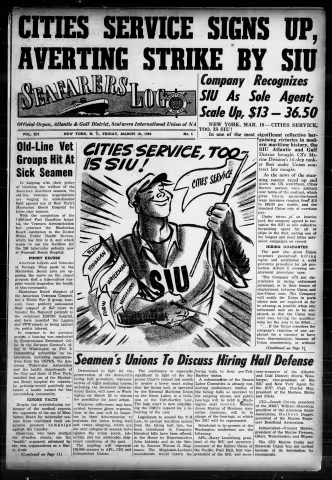
9 SEBVICE SIGNS UP
AVERTING STRIKE BY SIU
Company Recognizes
SIU As Sole Agent;
Scale Up, $13 36.50
Official Organ, Atlantic & Gulf District, Seafarers International Union of NA NEW YORK, MAR. 10—CITIES SERVICE.'
TOO, IS SIU!
VOL. XII NEW YORK, N. Y., FRIDAY. MARCH 10, 1950 No. 5
OldLine Vet
Groups Hit At
Sick Seamen
In keeping with their policy
of blocking the welfare of the
American merchant seamen, the
oldline veterans organizations
are, waging an underhanded
fight against use of New York's
Manhattan Beach Hospital for
tuberjular seamen.
With the completion of the
l.OOObed Fort Hamilton hospi
tal the Veterans Administration
has:' returned the Manliattan
Beach institution to the United
States Public Health Service,
which has title to it, and which
wants; to use the facilities for
the 260 tuberciUar patients now
at Neponsit Beach Hospital.
PHONY EXCUSE
American Legion and Veterans
of Foreign Wars posts in the
Manhattan Beach area are op
PQsing the move on the stupid
grounds that tuberculosis hos
pital wouldjeopardize the health
of the. community.
Manliattan Beach chapters of
the American Veterans Commit
tee, a World War 11 group, how
ever, have publicly announced
. their suppoit of th^ move to
transfer the Neponsit patients to
the ieclaimed .USPHS hospital,
and • have branded the Legion
and VFW stands as being against
the public interest. ,
In response to the pressure
groups, a hearing was conducted
by .Gpngressman Emmanuel Cel
lar in the Surgeon General's of
fice ' in Washington on Feb.' 8.
Outstanding authorities' • on tu
beiculosis, including representa
tives from the USPHS, the Am
erican Tubercular Association
and the health departments of
the City and State of New Yprk,
testified that use of the Manhat
tan Beach hospital for tubercu
lar patients^^ould positively not
create a health hazard for the
, surrounding community.
CtmSSBmCE,
IS sn//
In one of the most significant collective bat
* gaining victories in mod
ern maritime history, the
SIU Atlantic and Gnlf
District brought CS's Ma
rine Division's 16ship tank
er fleet under Union con
tract late tonight.
As the news of the stun
ning success raced up and
down the US waterfront, Cities
Service seamen were jubilant
over terms of the contract, which
gives them acrosstheboard
wage increases ranging front $13
to $36.50 per month, and the
standard Union rate of overtime
pay.
Under terms ^of an interim
pact, the company agreed to rec
ognize the SIU as sole collective
bargaining agent for all Iff
shii>s in the fleet, ending one of
the longest and most bitter anti
union campaigns on record.
HIRING GUARANTEE
The pact also gives Union
members guaranteed hiring
riglits and establishes a solid
giievance procedure for job pro
tection. Article 2, covering em
ployment procedure, says;
"The Company will not dis
criminate in hiring unlicensed
personnel, or in their tenure of
employment, between Union and
nonUnion men. The Company
will notify the Union in ports
where men are required as far
in advance possible when any
unlicensed men are to be em,
ployed, so that the Union may
send men ha\'ing the qualifica
tions for the jobs to be filled,..*
",,, If the Union considers the .
company's rejection of any ap
plicant for a vacancy to have
been discriminatory because of:"
Union membership, or without
(Continued on Page 3)
Seamen's Unions To Discuss Hiring Mali Defense
IGNORE FACTS
De.spite the overwhelming tes
timony of the medical experts,
the opponents of the use of Man
hattan Beach for tubercular sea
men have continued their ex
pensive pressure campaign
against the transfer.
Observers, v/ho have studied
the situation closely, see the
"health" argument advanced by
the vets organizations as a flim
sy frorii,
(Continued on Page tl)
Determined to fight for the
preservation of the democratic
hiring hall procedure, represen
tatives of eight seafaring 'unions,
including the Seafarers Interna
tional Union, will meet in Wash
ington on March 20 to discuss
the possibility for joint action.
Whatever differences may have
existed between ̂ h'ese organiza
tions in the past will be forgot
ten "in their' deteimination to
maintain the union hiring hall
and rotary shipping, which are
the only safeguards seamen have
against the crimp joints, job
selling, and the intolerable ship
board conditions of the past.
The meeting will represent
100,000 seamen in AFL, GIO and
Independent Unions.
The conference is especially
significant in light of the Su
preme Court's refusal last month
to review a lower court ruling
• that the hiring hall, as operated
by the National Mai'itime Union
on the Great Lakes, is a viola
tion of the TaftHartley Law,
The high court is now consider
ing the NMU's request for a i*e
hearing of the case. *
Legislation to amend the TH
Law, to exempt maritime unions
from the hiring hall ban,, has
been introduced in Congress.
Identical bills have been offeied,
in the House by Representative
John Lesinski and in the Sen
ate by Senator Warren G. Mag
nuson. The MagnusonLesinski
amendments would return the
'hiring halls to their preTaft
Hartley status.
A subcommittee of the Senate
Labor Committee is already con
ducting preliminary studies of
the hiring halls as operated by
the seagoing unions, and public
hearings will be held in JYash
ington next month. S^ator
James Murray of Montana, com
mittee chairman, will be in
charge of the hearings, at which
the SIU will be represented.
Scheduled to be present at the
Washington conference are the
following: •
AFL—^Harry Lundeberg, presi
dent of the SIU and secretary
treasurer of the Sailors Union of
the Pacific; Paul Hall, first vice
president of the SIU, and secre
tarytieasurer of the Atlantic
and Gulf District; Morris Weis
berger, vicepresident of the
SIU and New York Agent for
the SUP; Capt. Charles May,
president of the Masters, Mates
and Pilots,
CIO—Joseph Curran, president
of the^NMU; William Steinberg,
president of the American Radio
Association; Herbert Dagget,
president of the Marine Engin
eers Beneficial Association, •
Independent—^Vincent Malone,
president of the Marine Firemen,
Oilers, Watertenders and Wipers,'*
The CIO Marine Cooks and
Stewards Union was not invited"
because of its domination by
communists.
• rH
• .
w
I
/ii' •
1
fei.;
f:
ll:
ji*
5 • '• >.'
i
L".
Fags Two THE SBAFARERS
SEAFARERS EOG
Published Every Other 'Week. btf. the
SEAFARERS INTERNATIONAL UNION
OF NORTH AMERICA
Atlantic and Gulf District
AfEilialed with the American Federation Labor ^
At yi Beaver Street, New York 4, N. Y.
HAnover 22784
Reentered as second class matter August 2, 1949, at the Post
Office in New York, N.Y., under the Act of August 24, 1912.
267
We've Just Begun
*, The long night is over for the Cities Sefvice tanker1'
men.'
After years of organization, collective bargaing elec
tions, and stalled negotiations between the company and
the Seafarers International Union, Cities Service has at
last bowed to the inevitable, and signed an SIU contract
that will give their seamen Union wages. Union ship
board conditions, and Union job security.
The story beginning om page one will give you the
major parts of the contract—some of the rninor details
^iil have to be worked out—an,d the wage increases won
more than justify the time and sacrifices involved.
Tlianks to the SIU Organizers, the rankandfile
shipboard organizers who gave up so much to ship under
sub«tandard conditions, and the Cities ,Service seamen
who jeopardized their jobs because they, too, wanted to
work under SIU conditions, the tanker field on the East
and Gulf Coasts which has consistently defied unioiaza
tion, is now cracked wide open.
But the Cities Service victory is not the end. We are
just beginning to go forward, to bring SIU contract? to j
every unorganized fleet. We cannot now announce our
next campaign, but we strongly urge all interested Sea' "
farers to see the Organizers in the closest port. Remember,
there can be no complete security until all unorganized
fleets are under the SIU banner.
Sabotage In France
Moscow has pulled the strings and its puppets in
France are performing.
The stunt is aimed at clumping the first of the arms
aid cargoes now enroute to France from this country.
France is one of the eight nations that has signed the
North Atlantic Treaty to defend democracy against pos
sible aggression. Soviet Russia, where democracy is a
foreign word, is bitter about the whole thing. ' Broths ci»xentty in ihe mar^e hwpitals,
° , 1 • • ^ r 1 I reportad by the Port Agents. These Brothers find time hanging
Although the overwhelming majority of the French heavily on their P© what yoti can to cheer them up by
»people wholeheartedly support the North Atlantic Treaty, writing them.
Russia is intent on sabotaging the pact. It has ordered BALTIMORE MARINE HOSP.
its communist stooges in France to see that the cargoes
are consigned to the deep six when they hit port.
Despite the fact that the commies wield influence
among the French dockers, it appears certain that the rest
of that freedomloving nation will not tolerate Russia's
interference with plans for defense of their democracy.
For the democratic trade unions in France share wifh
organized labor in the US the conviction that the North
Atlantic Treaty stands as the greatest single barrier to
Soviet Russia's design to forcefully enslave what remains
of free Europe. j
The glorious record of the French workers against
brutality, dictatorship and terror during the Nazi occupa
tion indicates that they have no stomach for tyranny,
tegardiess of its label. *
. Unless it exists in a democratic atmosphere, a trade
tinion cannot be an instrument for the advancement of
the v/orkers' welfare. In fact, that is exactly what the
communists are demonstrating in France, as elsewhere.
Commiecontrolled unions are merely political arms of
the party, and wherever the party assumes political con
trol, tire free trade unions pass out of the picture.
The French know this as well as anyone. That's why
it's more likely that they'll dump the eoimnie saboteurs,
ather than the arms which will help them preserve their
lemocracy.
Men Now h The Marine Hospitals
J. J. TOBIN
ED. F. LAMB
M. J. LUCAS
. W. G. WHITMER..
G. A. CARROLL ,
D. HAUGHT
V. L. LAVANWAY
C. E. WOOTEN .
J. A. SHEA " •
S. M. MILLWARD
T. DRZEWICKI
D. C. BREASHEARS
t 4
NEW ORLEANS HOSPITAL
R. LANGFORD
J. LYONS
G. NOLES
W. HANTUSCH . k
jr. DENNIS
F. LANDRY
H. LAGAN.
L. LANG
L. WILLIS
G.DJIAN :
D. RUSSO
e. EZELL
P. ROBERTS
A. MAUFFRAY
J. CERDA
O. HOWELL
• G. NEWMAN
J. THOMASON
C. LYONS
M. GUY
A. StRACHEN
H. MCKAY
L. TICKLE
W. ADAMS ^
R. JAMISON
W. WALKER
C. NEUMAIER
G. GILLISFIE
L. KNICKERBACKER
W. LAMB
W. HAYES
W. HAZELGROVE
W; MEEHAM
. t 4, t
NEPONSZT HOSPITAL
WILLIAM PADGETT
MATTHEV; BRUNO
JOSE DE JESUS
J. M. LANCASTER
R E. LUFLIN ' •
ESTEBAN P. LOPEZ
PEDRO G. ORTIZ '
R. REDDEST
R. A. RATCLIFP i
R. A. BLAKE •
L; BALLESTERO
JOHN T. EDWARSS. ' •
• E. FERRER '
I. H, FRENOH r
% 'VP
JOSEPH SPAULDING
JOSEPH SILLAK
LUIS TORRES
FRED ZESIGER*
MELVIN COLLINS
ft t ;
STATEN ISLAND HOSPITAL
JAMES HILLER
C. P. THOMPSON ' .' ?
THEODORE ROZUM *
T. GAMBLISH '
B. F. LOWE
R. GR^LICKI
J. H. 'DANIEL, Jr.
A. BJORNSSON
K. JENSEN
H, WHISMANT
P. ERAZE
JOHN SANTANIELLO
V. JOHNSON
H. J. OUT
J. W. MCCASLIN
• 444.
SAVANNAH HOSPITAL
J. FLOYD s
RAY COLE Yv
4 4 4 :• ""p.
BOSTON MARINE HOSPITAL
ROBERT COLLINS '
W. BEZANSON
JERRY O'BYRNE : ;f:
FRANK ALASAViqjI : "
F. FAGAN •
• • c
4 4 4 • .vS,
SAN FRANCISCO HOSPITAL
S. SWOR • V
W. SILVERTHORNE
A. CAUDRA
J. KEENAN
G. W. GHALE
J. JELLETTE
" 44 4
MOBILE HOSPITAL
H. HENDERSON
T. LITTLE
F, BURROUGHS
A. B. LYNN
TIM BURKE • >. V.
j'
HMf'
Friday, Maxell la 1950
lit::
'WaE S E A F A R E R S L O G Page three
Men Win SiU Wage Scale
' ' (Continued from Page 1)
Jitet cause, it riiall be derilt with
iuidbt the grievance procedtire,"
The overtime rate of pay for
Cities Service seamen is set as
follows: $1.15 per hour for those
Bsaking $235.75 or less per
month, and $1.45 per hour fw
^se making morff than $235.75
a month.
The pact provides for* a 40
hour workweek in port, and
that all work performed in port
on Saturdays, Sundays and nine
national holidays shall be paid
for at the overtime rate.
The standard Union practice
Of designating onfe man in each
department as a Delegate is also
set forth in the agreement, with
S Ship's Delegate to r^resent
18»e unlicensed • personnel in re
Jgtions with the vessels' Skippers.
WORKING RULES
Union representatives will
meet with company officials im
mediately to thrash out a set
Ci working rules for each de
IWrtment. As soon as full agree
ment has been reached on these
rules, they will be incorporated
kito the iHterim contract, which
will run luitil Feb. 15, 1951;
At the Union's insistence, the
contract provides that the ques
rion of wages may be reopened
«t any time after the pact,Jias
been irj operation for six months.
The Marine Division's agree
ment to an SIU contiact averted
A fullscale strike, which would
bave crippled Cities Service fa
cilities on all coasts. The SIU's
Strike machineiy had been pre
pared to go into motion on a
24hDur basis at a second's notice,
' Despije the effective apparatus
fbat it had standing by, the SHJ
Negotiating Committee exerted
«fv®iy effort to bring the dis
pute to a peaceful conclusion.
' Until a week before the agree
ment was reached, tiie prospects
of an amicable solution ap
peared bleak, with Marine Di
,vision officials jefusing to rec
bgnize the Union's principal
rights as the certified collective
bargaining agent for its unli
censed peisonnel.
EXPERT CALLED
With the bargaining confer
ences on the verge of collapse,
hnd a sti'ike looming large, the
Cities Service company called
C. R. Johnson, its industrial re
lations expert, into the picture
fo days ago.
Progress was almost immediate
and, except for hiring procedure,
foe area of disagreement was
narrowed down quickly. Both
parties • concentrated on this
phase of the dispute and after
eeverar meetings, the interim
was agreed to late tqnight.
The agreement ends more than
Niree yeais of a bitter oi"ganizing
drive in the Cities Service fleet,
complicated by a maze of the
, most ruthless antiunion tactics
experienced in modem labor
management relations. Intimida
tion, mass firings, espionage and
persistent refusal by the com
pany to accept the mandate of
its unlicensed personnel marked
the campaign.
MEN HELD FAST
Throughout the most viciOus
periods of the company's anti
tlhiohism, the Cities Service sea
ihen stood fast in theit desire
Jki¥ And OU Cities Service IVcrjre Scales
This is the wage scale now in effect aboard all Cities Service ships,
c<mtrasted with the old CS scale.
NEW
RATING SIU SCALE
Deck Maintenance.1251.00
AB 233.00
OS Maintenance.. . . 227.50
OS..... . 203.50
.Pumpman . .V . ;v..313.00
Machinist. .* . . 313.00
Oiler 233.00
233.00
Wiper , 227.50
Chief Cook. ^ ..." ; i^ 274.50
2nd Cook & Baker ... 245.00
Galleyman . . 203.50
Messman 107.50
Utility 197.50
The overtime rate for those making $235.75 or less shall be $1.15 per
hour, and the overfime rate for those making more than $235.75 shall be
$1.45 per hour.
• I t,.... I,I,
OLD
CS SCALE
$214.50
214.50
214.50
184.00
280.00
280.00
214.50
214.50
214.50
242.50
214.50
179.00
179.00
179.00
DIFFER
ENCE
$36.50
18.50
13.00
19.50
33.00
33.00 ^
18.50
18.50
13.00
32.00
30.50
24.50
18.50
18.50
for representation by the SIU.
The CS tankeimen registered
their overwhelming preference
for SIU as bargaining agent in
two National Labor Relations
Board elections, which resulted
in two certifications giving the
Union jurisdiction over the gn
tire fleet.
The company's stand against
union recognition dates back
more than a depade, having suc
cessfully resisted'attempts of the
National Maritime Union, in the
late 1930s, to secure a contract
after it had wen a collective
bargaining election in the CS
fleet.
NMU HALTED
The company's tactics, coupled
with internal strife in the l^U
at that time, stymied the NMU's
efforts for a contract^ and the
CIO organization's strength in
Cities Service evaporated shortly
thereafter.
At SIU Headquarters this
morning, the Union Negotiating
Committee announced that copies
of the interim agreement would
be distributed in all portswith
in a few hnurs.
The committee advised all
Cities Service men to visit the
nearest SIU Hall for complete
information.
Union representatives will be
gin boai*ding Cities Service tank
ers in all US ports this week,
for the first time in the com
pany's history.
UNION WANTED
The SIU's success in organiz
ing, for the first time, an Eart
Coast major tanker cranpany de
monstrated two things:
One, that" the unlicensed per
sonnel, at least, aboard the old
line antiunion tanker cornpanies'
ships" are as anxious for legiti
mate trade union representation
as are unorganized seamen every
where. "
Given half a chance, and solid
indications of strong union sup
port in their desire for impreved
wages and working conations,
the unorganJged tankermen will
fight through to the eial.
"two, the heretofore undisputed
belief that the major tanker
cbihpahies, with their dbmihated
and cbntroiled cranpany unions,
and their multitudinous devices
for nipping unionizatitm in the
bud are impregnable; is nothing
mwe than a myth.
After the Cities Service com
pany had agreed to the SIU con
tract, SecretaryTreasurer Paul
Hall summed up developments,
stating:
"The signing of this agree
ment, and the events leading up
to it, definitely prove that the
unorganized tankermen in the
marine indusby are overwhelm1 members.
ingly in favor of union represai
tation over company paternalism.
"Ihe SIU wUi now make plani
to ext«ad its organizing drive
in the tanker field, so that aU
unorganized tankermen may sail
under Union conditions and for
Union wages."
KEEPING READY
Commenting on the depart
mental working rules to be ne
gotiated beginning next week.
Hall said that "while the SIU is
confident that the remainder of
the contract will be worked out
amicably within the stipulatedi
30day period, the Union is nev
ertheless keeping its strike ma
chinery in a state of prepared
ness."
The SIU contract soimded the
death bell for the Cities Service
Tanker Men's Association
(CTMA), the " companyspawned
and dominated puppet union,
which CS had employed to con
fuse and harass its unlicensed
personnel.
Significant of the company's
inability to disguise the purpose
of CTMA, is the fact that in its
year and a half of existence the
company union never had more
than a handfql of bonafide
This was the first of the series of memorable cartoons which so eU
fectively exposed the CTMA for the cwnpanycontrolled "union" that it
was. Of course, the SIU was helped considerably by the leadership of CTMA^
which consistently spouted management's propaganda (asall company un
ions havB to, OF course). So, goodbye to the Old Bag. We're glad to see her
go—hut she was SO pathetic!
....
ife'
Pag« Four
^• 'm
THE S EAF A RER S idc iy. March 10,1950
I,
li
#
f
I,
1,.. .
Br y .
IH'
TwoWeek Spurt
Eases Beachload
On West Coast
By JEFF MORMSON
: SAN FRANCISCO —Shipping
for the past two weeks has been
fair out here, However, we still
have quite a few men waiting
to ship out. This backlog is the
result of the slxunp we went
into a few weeks previously.
Vessels in port during the past
two weeks were the SS Topa
Topa, Fairisle, Madaket, Jeff
Davis, Waterman; Steel Naviga
tor, Isthmian; Robin Hood, Seas
Shipping.
The Sand Craft,^ which had
been expected to crew up some
time in the past couple of
weeks, still is not ready. As soon
as information is available, de
tails wiU be posted in the Hall
here and forwarded to the LOG.
PROSPECTS BLEAK
The coming two weeks don't
look too good. Scheduled to call
at this port are the Fairland,
Topa Topa, Steel Vendor, Jeff
Davis, Marquette Victory and
the Marymar.
' In view of a possible stiike
against the Cities Service tank
ers, we have talked with the
Central Labor bodies in this
area, and they have assured us
toat all possible assistance would
be given the SIU in case the pin
were to be pulled.
During the past couple of
weeks, we learned of a few
cases wherein men had filed for
unemployment after their ships
had been laid up, yet the Water
man company contested the
claims. The company apparently
didn't even know the ships had
been laid up and, as a result of
their not checking up, the men
involved are experiencing un
necessary delays in getting their
rightful compensation.
We are following up these
ca^s in the hopes that there
will be no repetition. Things are
tough enoughthese days without
having our coffee and dough held
up, ̂ especially if it is because of
carelessness on the part of people
who should know better.
On Ma]|ch 12 seamen throughout the nation will pay th^ recpecls to the memory of
Andrew Furuseth, a name that has become symbolic of freedom for the men who go to sea.
Bom in 1854, Furuseth dedicated his life to freeing seamen from serfdom, a dream which
he saw realized with the ei^tment of the Seamen's Act in 1915. IBs contributions to the
emancipation of seamen earned him the title ot "Abraham Lincoln of the Sea."
Furuseth died in Washington, D.C« where he battled unceasingly for the men he loved,
on Jan. 28, 1948. The simple man, who had fled from a Britishbark in California in 1881, re
ceived homage in death never before, or since, accorded to a labor leader in .America.
The body of Andrew Furuseth lay in state in the rotunda of ihe Department of Labor build
ing in the nation's capitol, and seamen were joined by senators, congressmen, labor leaders,
lawyers and justices of the Supreme Court in paying their respects to a great man.
On March 21, Furuseth's last wish was carried out by men whom he understood so ~weU,
Aboard the SS Schoharie, his ashes were taken out to sea, "as far from land as possible." The
engines were stopped, the Captain 'read a simple service and the ashes of JWidrew Furwfoth
were scattered. Andy may rest secure in the knowledge that the seafaring unions ere continu
ing his good fight for* the welfare of organized seamen.
Vessels Out Of Boneyard Cheer New York
By JOE ALGINA
NEW YORK —Three vessels
that came out of layup gave
shipping a muchneeded lift in
this port during the past couple
of weeks. This development en
abled the port to write off the
tVoweek shipping period as
fair.
The ships reactivated were
the SS John Hanson, White
Range; SS Steel Mariner, Isth
mian, and the SS Stag, Mar
Trade.
, PAYOFFS
Paying off were the Steel Ad
miral, Steel AdvOTate, Isthmian;
Ratings, Yaka, Waterman; Bea
trice, Angelina, Elizabeth, Puerto
Rico, BuR; Black Eagle, Coral
Sea; Julesberg, Mathiasen; Car
ruth, Transfuel; Seatrain Ha
vana, and the Alamar, Calmar.
Signing on, in addition to the
three ships that caine out of the.
layup fleet, were the Robin
Sherwood, Julesberg, which is
scheduled to relieve the Petrolite
on a shuttle run; Camjth, which
headed for New Orleans and
a grain cargo, Seatrain Havana
and the Bull Lines ships.
A, number of members in the
Port of New York have already
made application for considera
tion for one of the Ruskin Schol
arships, which offer a year of
study in England to trade union
members. A couple of years ago
an SIU man was among the
lucky ones chosen by the com
mittee .and we're hoping that the
Seafarers might be so honored
once again.
Members interested in this
scholarship can get further in
Fired By CS?
All men who' have sailed
Cities Service Oil Company
ships and have unfair labor
charges filed at the National
Labor Relations Board
against Cities Service, con
tact file Organizers in New
York either by mail or in
person.
formation from the office of the
SEAFARERS LOG or by apply
ing direct to the Ruskin Colleg:e
Labor Scholarships, 2 West 45
Street, New York City.
NOW'S THE TIME «*
Now that the Labor Govern
ment has bpen retuined to pow
er in England,even if only by a
slight majority, perhaps it will
be able to do something to im
prove the shipboard conditions
of their merchant seamen. De
spite the fact that British pas
senger ships rank with the
swankiest shiiJs afloat, conditions
for their seamen are far from
.satisfactory.
A recent incident aboard one
of our ships makes a word of
advice in order. If any SlU man
has a legitimate beef involving
working conditions, wages and
the like, he can expect the Un
ion to back him 100 percent. But
if he gets in a personal beef
ashore, for which no one but
himself is responsible, he can
hot expect the Union to go out
on .the limb for him. In fact,^
nothing could be accomplished
if it did.
Late Seafarer'
Hia^ many friends were
shocked at the news of the
recent death of Warren Calla
han. who died January 21 in
New York of cancer. Brother
Callahan, who was 27 years
old. joined the SIU in ApriL
1343. He sailed as Bosun, and
was active as~ shiplx^d and
shoreeide Organiser during the
Isthmian cunpaign. He is sur
vived by* his widow and two
children.
Not Bragging !
Says Savannah
But Who Is?
By E. M. BRYANT
SAVANNAH—The SS South
port, South Atlantic, paid off
and signed on and thice ships
called intransit dilring the past
twoweek peflod, but shipping
was slow nevertheless..
Tt)e intransit callers v/ere the
SS Jean, Bull, SS Lafayette,
Waterman and the SS Horace,
Bulk Carriers. There were a
few minor beefs, but all were
squared away a^ter a conference
with all department heads.
• When the SS Cape Race was
turned over r^ently to a com
pany not imder contract to the
SIU, the crew donated the wash
ing machine to the Savannah
Branch. Inasmuch as the SS
Jeail crew was in need of such
a machine, it was placed aboard
that vessel for the crew's use.
ON THE BEACH
Among the Seafarers on the
Savannah beach at present are
the following: M. P. Linsky,
Nollie Towns, J. Laseter, D.
Brannan, W. C. Sanders and A.
J. Bullard.
Two of our members are in
the local Marine Hospital. They
are J. Floyd and Ray Cole.
Everything is running ' very
smoothly in this port, and our
only gripe is that shipping
should be better. In that respect,
however,, we don't seem to be
any worse off than any US port
at the moment.
The weather is pretty cool for
this time of the year, in case
anyone is interested. Municipal
and state elections are coming
up this year and all men are
being urged to register and vote,
so that we can bring out a good
vote for the prolabor candid
ates.
That's about all for now. More
in the next issue.
InTransits Bring
Few Jobs To Boston
By BEN LAWSON
BOSTON—This port was kept
fairly active during the past two
weeks servicing contracted in
transit ships, but the calls for
replacements were few.
The SS W. E. Downing, State
Fuel, paid off and signed on. In
addition, the following ships call
ed at Boston: Steel Traveller,"
Steel Admiral, Steel Apprentice,
Kenyon Victory and Allegheny
Victory, all Isthmian; i^laclc
Eagle, Kyska and Greely Victory,
Waterman, and the Algonquiji
Victory, St. Lawrence Naviga
tion.'
OT BEEFS '
There were a few overtime
beefs on the Steel Admiral, but
they will be carried to the port
of payoff for final disposition.
Brother R. Lbe is right on the
top of the list of those Seafar?
ers in Boston who' are Faring
to ship out. Right on his heels
is Brother Frank McGuire.
Five of our lads are in the
Boston Marine Hospital, and I'd
like to suggest that thdr ship
mates and friends drop them a
line or pay them a visit, when
ever possible. The hospitalized
:6rothers are Robert Collins, W. .
Bezanson, Jerry O'Byme, Frank
Alasavieh and F. Fagan.
Brother Collins entered the
local Marine Hospital as a trans
fer from the hospital in New
Haven, Conn.
y ^ ' J
vw'gy^j
T H^E S E A P A R E R S LOG
'^TT^
Page Fire
Just In Case
.f,
.'i
While members of the SIU's Negotiating Committa l
labored at the bargaining table to bring the Cities Service
Oil Company's Marine Division under contract, scores of
Seafarers were at' work perfecting the Union's strike
apparatus—just in case.
Although the Union was exerting every effort to ;
settle the dispute peacefully, the possibility was ever
present that the conferences might collapse. If, and" when^
they did, the Seafarers was not to be caught off base and,
at a moment's notice, the streamlined SIU strike machinery
could be thrown into motion wherever company facilities
were in. operation.
On this page are some of the ipany volunteers who "
enthusiastically pitched into the strike preparations, and
some of the projects on which they have been working.
Keeping all Atlantic and Gulf District poris up to date on the status of the Cities Service
beef and coordinating strike preparations involves a mass of detail. Here, several volunteers
attend to the tedious but highly essential job of communications.
Cities Service plants throughout the country were broken down into geographical areas.
with picket details ready for assignment in each on a 24hour basis. Area boards like the one
shown above contain reoorts of activities in each area.
Among the many volunteers who gave unstintingly of their
time and energy to make the strike preparations airtight was
Vic Litardi. shown here with the typewriter he worked
long and hard. • '
was . incorporated in the • area
charts drawn up by Seafarers concerned with this phase of the
strike'prepctratlons. Hera's a section of Carteret. N. J.
All areas that would be involved in the event of a Cities Service beef were carefully ;||
plotted on large maps. All hands responsible for the smooth functioning of the machinery were
briefed until they were fully acguainled with their respectivo. areaSv
» "^^^1
J.Sft'i'vl '' ''''
Page Six T HE SEAFARERS L O G Friday, March 10. 1950
SHIPS' MINUTES AMD MEWS
Mowbray Softballers
Take 4 Of 5 Contests
Having bagged four of the five contests played on
the last trip to South Africa, the Robin Mowbray softball
squad is thirsting for bigger game.
According to Mel Smith, the'*
Mowbray team is particularly
anxious to lock horns with the
HE. NEVER FORGETS THESIU
Robin ̂ ood softballers, who re'
.centiy laid claim to the champ
ionship of the Robin fleet.
"I believe we can give them
a nm for' their money," says
Smith in a letter to the LOG
f
'4his week.. If they ever hit
port with the Mowbray, they
are challenged to a friendly
game or two." •
To prove the Mowbray men
are ready for the "champs,"
Smith cited the impressive rec
ord of the last trip. Against the
team representing General Mot
ors in Port Elizabeth, the Mow
brays eked out a 9 to 6 victory.
"ONE RUN VICTORY
Next they crossed bats with
the Robin Sherwood Seafarers
in Lourenco Marques. One run
provided the victory margin for
the Mowbray softballers, the final
score reading: Mowbray—14,
Sherwood—13.
In a threegame series with
the team of the SS African Sun,
I the Mowbrays won the first,
14 to 7. They were on the short
; end of the scoring in the second
contest, 5 to 4, but came back
to win the rubber game, 9 to 8.
Smith asked the LOG to "pass
the word to any ships that may
be headed down Africa way to
be on the lookout for us as soft
ball opponents.
"The big trouble," he wrote,
"seems to be finding teams that
have a schedule permitting a
get\ogether on the ball field."
/ > !
'Stuc^In Mud'
Gets Going
After 6 Days
She's not a stuckinthe
mud anymore.
Six days after running
aground at the entrance to
New York harbor, the SS
Alamar, Calmar Liberty, was re
floated on Washington's birthday
and towed to an anchorage off
Stapleton, Staten Island.
The Alamar Was pulled out of
the mud at 10:07 AM, just one
hour before high tide. Shortly
after she was being towed to
Port Newark by Moran tugs.
Vcderax^ Seafarer Fred D. Benson'
You can't keep a good Union
man away from the hiring hall,
even if he does happen to be
a retired member.
Brother Fred D. Benson has
been paying periodiq, ̂ isits to.
man at the old building at 2
Stone Street in 1942.
A veteran of the Spanish
American war, Benson is on a
30day leave from. the Veterans
Hospital at Bath, N.Y. As a
Seafarer he saw two years of
World War II abdard SIU ships
Heavygear salvage equipment the SIU HaU in New York ever
and a deiselelectric tug, the since he quit going to sea in
Curb, succeeded in refloating the 1944. He stopped in the other
stubborn Liberty after six pre day to say "hello'^ to the old
vious daily attempts had failed. timers, who know him as one jammers, making his first trip Seafarer was in good stand
Raymond Foster,
Member Of SIU
Since 1938, Dead
Seafarer Raymond Foster,
a member of the SIU's At
lantic and Gulf District
since its inception "in 1938,
died qf a heart ailment on
Jan. 30 in the Mobile Ma
rine Hospital, the LOG
learned |:his week.
Burial took place on Feb. 3,
in Magnolia Cemetery, Mobile.
Brother Foster, who was born
on March 1, 1909, in Thomas
ville, Ala., was admitted to the
Marine Hospital on Nov. 7 last.
He is survived by his wife,
Mrs. Mabel Foster of 550 South
Bayou Street, ' Mobile.
Brother Foster joined the^^U
in Mobile on Nov. 21, 1938. He
had a Steward's rating and hejld
Book No. 15.
Headquarters was advised of
Foster's death by the A&G Dis
when the gomg was the toughej. ̂ ^et Port Agent In MobUe. The
Benson started sailing on wmd'
SHALLOW
The Alamar ran aground in
of the first to join up when the in a fourmasted barque from "ig at the time of his passing
A&G District was organized New York to Calcutta. He's a and the Union forwarded the
feet of water at the top of in ,1928. Fred was Door deck man, of course. 20
Romer Shoal, between Gedney
and Ambrose Channels, about
three miles off Sandy Hook
Light. She was inbound from
the West Coast with 10,000 tons
of lumber.
On the fourth day of refloat
ing attempts, the deck cargo was
I bnriar benefits to his widow.
'Voice Of The Sea'
By "SALTY DICK'
Henrick Hansen, better known should be referred to as Phila
urUoadedlo''hghters'"and'by the'®® scrapple, cause that's
next day 468 tons of lumber had P"rc^sed a fish hatchery in where he's from. . . The foreign
been transferred. Another 400
tons on deck were removed from
the ship the next day. The rest
of the lumber, all in the holds,
was transferred to lighters when
the Alamar arrived in Port
Newark.
Florida. He expects to make it seamen are always asking for
his livelihood. . . Miles Stems
spends a lot of his time at the
track. He claims he is ,way ahead
of the game.
A1 Brindley is being called
"Kansas City meat," when he
^EMBERS OF SIU STEWARDS DEPARTMENT ON CRUISE SHIP
,WilUam J. McKay, Stewards Delegate aboard the Alcoa Clipper says that firstrate jon
„ „ performance enables the Union to negotiate better contracts. Here are some of his shipmates
li who share that beli^ Froht row, le£t to right; Chief Steward M. T. CMtello and Secoxid Stew
ard Fred Diekow. Hear row: Tom Carmody, James Nelson, Kenny Miller, William McKay, Chine
Bosa, Jack MeCranie and £. L. Chesser, all Waiters.
the SEAFARERSLOG. Two
English sailors recently asked
mfe for the paper, which I gave
them. Thfey seem .to be hitngiy
for maritime news.
Did yoii know that New Zea
land has comp\ilsory vacations
for seamen? . . . This happened
on the Alcoa Clipper recently:
A passenger ordered a kippered
herring and figs. The waiter
brought the fish—^smothered in
figs. A slight error.
Bill ^Hanold wrote a fine
piece on the old Hog, the Al
coa Banner. 1 made that last
• trip on the Banner with Rill,
end I share his sentiments. . .
Cleveland Vincent lost about'
15 pounds working in the gad
ley. Then he went ashore and
picked it cdl up again: . .
Mickey Dunn is doing a swell
job as Chief Baker on the Del
Norte., 'The crew especially
likes his French bread.
Note to camera fiends: Buy
your film packs and bulbs in
the States. I tried to get material
in all South American ports,
without success. And don't take
a camera ashore, unless you
have a permit.
' Charles Bradley^ once owned
a tui'key farm, but all the birds
died on him. Now he's going to
try it ,with chickens. '. . Domingo
Molina is stiU working, on the
coffee run, but lio'a iilways
glad to get back to NgW Or
leans. . , And George Nuss is
happy being in the Black Gang.
Wonder why William Scott is
aliyays smiling these days? He
expects to be a father soon; . .
Carl Johnson doesn't seem to ^
have a care in the world. . .
The Creel brotheis,^ Bob and
Sloppy, are on the. South Ameri
can run, aboard different ves
sels. Bob's on the Del Monte and^
James Paul (Sloppy's name) is
on the Del Norte.
Clarence (Red) Hancock can
always be seen at a reserved
table at the Justin Hotel in
Buenos Aires. The trip is 47
days and he receives 47 let
ters every voyage. The hotel,
by the way. is one of the best
On the run. . . V. C. often goeis
to RosaHo by train to B.A.
to see a beautiful senorita. This
trip he was disappointed cause
she had gone to Mendoza for •
a vacation. I predict this bird
will soon be in a gilded cage
(yeah, marriage).
•
There's a bUl before^ the Ar
gentine Congress that soon may
be law. It will mean a. better
break for seamen. . . I also un
derstand that all the dives along ;
Alem Street, such as the Avalon,
Odeon and Roayl must close and
seek new heavens. The ceamen,
American aVid 'other|, will gain
much by this move.
The New Orleans HaR is ;,to f
receive a big picture from a cere
tain crew that will fee the talk ,
of the waterfront. Watch for
picture^ in a later issue of the
Loo. f . v;...;:
i 1 ^ 'I : il
WrSM
Friday. March 10, 1950
• :W^"™"
' • ":'l'?^A/fi^''l"''
THE SEAFARERS LOG Page Seven
Digested Minutes Of SlU Ship Meetings
SEATRAIN NEW ORLEANS.
Dec. 18—Matr Fields.' Chairman;
Frehchy Michelet. Secretary. Del
egates reported that there were
no beefs in any of, the depart
ments. Motion (by Fredericks)
carried that ship's fund be set
up and that each man pledge
two dollars to get it started.
Motion (by McKay) carried that
$50, of the fund be donated to
Christmas dinner being put on
for men in New Orleans. Under
Good aiid Welfare there was con
siderable discussion about addi
tional repairs, etc. Ship's Dele
gate explained that steps had
been taken to square these
^ings away to satisfaction of
all concerned.
4. 4, 4,
SEATRAIN NEW YORK. Jan.
1—S. E. Harm. Chairman; J. J.
M alone. Secretary. Elections
were held, with Brother Buckner
chosen as Ship's Delegate and
Brother Gardner as Deck DOICT
gate. Motion carried xmanimous
ly that crew go on record as
heartily endorsing action of
membership to halt infiltration
of communists — Stalinist or
^otskyite — into our ranks.
Ship's Delegate instructed to
take up matter of rusty water
in tanks with Chief Engineer.
Chief Steward asked to tee what
he could do about getting some
..new mattresses and to report
results to next meeting.
Z m m • • Ji*, •
- ^
» 4.
STEEL RJ^NGER. Dec. 26 —
D. K. Nunn, Chairman; V. De
LaCnu. Secretary. A few hours
disputed overtime in Deck and
Engine Department but all okay
in Stewards. Crewmen were ad
vised to keep their foc'sles clean.
Crew favors rule making it man
datory that men entitled to va
cation with ppy after one year
aboard ship, accept the pay and
get off. Discussion about the
claims for compensation by men
who are working aboard in re
lief capacities.
it b 4
JULESBERG. Jan. l~Ray Ar
nold. Chairman; C. B. Skipper.
Secretary. Deck. Department re
ported 12 hoirrs disputed over
time; no beefs in the other de
partments. Much discussion on
proposed enforced vacation rule;
letters in LOG giving pro and
con were discussed. Motion (by
J. Penner. seconded by J. Judge)
carried that after a man has
been aboard ship for one year
he should take his vacation pay,
gel off and reregister. Vote was
21 for motion, 2 again.st. Airmail
editions of LOG received in
Canal Zone and read by all
hands. $12 is on hand in ship's
fund.
galley cr^w for fine preparation
of food in view of the lack of
variety of stores. Suggested that
Ship's Delegate notify First As
sistant Engineer to discontinue
doing Wiper's routine duties.
4 4 4
ALCOA FENNANT." Jan. 2—
C. Dix. Chairman; R. F. Black.
Secretary. Delegates reported.
Steward suggested... that radio
gram 'be sent to Headquarters,
confirming crew's approval of
stand toward Trotskyites. Gen
eral discussion on amount of
time a man should be allowed
to sail continuously. General,
opinion is that one year on one
ship should be enough. Sug
gested that resolution be written
up pertaining to this matter
and sent.to Headquarters. "Mac,"
the Oiler, designated to serve as
ship's treasurer to collect dona
tions at payoff for washing ma
chine and spbrting good.s to be
used by crew.
4, 4 4
DORIAN PRINCE. Jan. 1 —
Joseph Ranieri. Chairman; E.
Mor^,' Secretary. Ship's dele
gate to see Captain about in
noculation cards which will be
given to crewmembers when
they leave vessel. Delegates re
ports accepted. Suggested that
library for crew be acquired. E.
Morris suggested that any man
having a beef should air it at
the regular meetings and not in
the alleyways where topside can
get wind of theni. One rninute
of silence in memory of depart
ed Brotheis.
argued at mealtime, but brought
up at meetings or to department
delegate.
4 4 4
BESSEMER . VICTORY. Jan.
14 '— A. J. Baker, Chairman:
Frank Strelilz. Secretary. Ship's
Delegate reported that minor
beefs had been settled satisfac
torily to all concerned. Depart
ment delegates stated that there
were no beefs to report. Motion
by Roland Lanoue carried that
all beefs be put down in writ
ing so that complainant cannot
go back on his beef. After con
siderable discussion under sub
ject of education, on various ar
ticles and letters appearing in
LOG, it was recommended that
members digest contents of pa
per thoroughly so that they will
be well infomied in cas,e of fur
ther discussions or voting on
them. Men also advised to keep
up to date on Cities Service de
velopments. Motion (by John
Hunt, seconded by John Duffy)
carried unanimously to go on
record in support of Headquar
ters action agaiiist Trotskyites to
register confidence in officials so
viciously attacked in newspaper
of the Trotsky group.
ALCOA'POINTER. Jan. j| —
Sullivan, Chairman; George Zld
ik. Secretary. Ship's Delegate
reported complaints against
Steward; motion carried that
matter be brought up to Pa
trolman at port of arrival. De
partment delegates stated that
overtime was okay and that there
were no beefs. Motion carried
to have Chief Cook make up
emergency store list to be turn
ed ' over to master for port of
ariival. Vote of thanks given to
4 4 4
JOHN HANSON. Jan. 1—Ed
win Westphal, Chairman; R. P.
Hannigah, Secretary. Otto Pe
dersen elected Ship's Delegate
by acclamation. Motion carried
that crew go on record asking
SecretaryTreasurer to prepare
ballot on question of compulsory
vacations. Suggested that recrea
tion room be used for amuse
ment and messroom to be left
to watchstanders. Requested
that Messman be given a break
during meal hour, especially
when he is serving watchstand
ers. '
4 4 4
STEEL MAKER. Jan. 8—M.
F. Laresen. Chairman; T. Concep
cion. Secretary. Ship's Delegate
said that better sanitary job
must be done. Disputed overtime
reported in Deck and Engine
Departments; none in Stewards.
Motion carried unanimously in
favor of Headquarters antiTrot
skyite resolution. Departm.ent
delegates to .preparerepair lists
and turn them over to Ship's
Delegate before vessels aiTives
in first US port. Glasses not to
be dropped in sink, but to be'
washed aiid returned to proper
place in shelf. Beefs not to be
4 4 4
DEL MONTE. Jan. 8 —Creel.
Chairman; Gerdes, Secretary.
Brother Buckley elected Ship's
Delegate by acclamation. Dele
gates reported. Motion (by Buck
ley. seconded by Miller) that re
solution be drawn up concurring
in antiTrotskyite resolution.
Discussion on ga'shounds by
Brother E. DeBautte. Ot'aer mat
ters discussed: wearing of cloth
ing in pantry, and keeping
foc'sles clean.
4 4 4
LILICA, Jan." 1—^Lester Lap
ham. Chairman; Raymond Perry.
Secretary. Delegates reported
that all was okay except for a
couple of minor beefs. Crew fa
vors compulsory vacations. Re
pair list to be drawn up and
handed to Ship's Delegate. Men
cautioned to be sober at payoff.
Matter of new springs and mat
tresses were di^ussed. One min
ute of silence in memory of de
parted Union Brothers.
4 4 4
SEATRAIN NEW JERSEY.
Ian. 16—^Tom Clark. Chairman;
Phil O'Connor. Secretary. Dis
puted overtime in Deck Depart
ment, to be taken up with Pa
trolman. No beefs • in other de
partments. Windchutes for hos
pital and paint for all decks
have been ordered. Ship's Dele
gate reported. Pledges for March
of Dimes to date total $45.60. Col
lection for movies showm .aboard
vessel for crew's entertaihment
will be taken up at payoff.
'• 'i
^^ITIES SERVICE IS /VOW RRMLY WlT^//V
THE SlU POLP, BUT VVE CAMblOT RESTO/sl
OUR LAURELS — NOT AS LON© AS 711 ERE
IS AN UAlQRSANirfeO COMPAtNY IN THE.
INPUSTRY. ^
dSF VOUARE INTERESTED IN
HELPJN(^ THE SlU EXPAND, AND BRING
THE STABILIZING SlU CO/VDITIONS TO
/MARITIME — SEE THE ORGANIZERS /N
THE A/EAREST SlU PORT.
• • '8
r
I
4 4 4
ANN MARIE. Jan. 12—W. D.
Canty. Chairman; Vincent
O'Reilly. Secretary. No beefs, ex
cept for some overtime beefs in
Deck Department. Crewmembers
requested not to cook anything
on bare hot' plate, but to use
frying pan provided for that
purpose. Baker and crew Pan,
tryman were complimented < for
being especially conscientious
and efficient in their duties. List
of needed repahs to be submitted
before beginning of next voy
age.
There's strike action on Beaver Street and many Seafarers
are remembering" those rough days on strike with the UFE Wall
Street employees and picketing through rain and cold weather
with the telephone girls on strike. Now SIU brothers are happily
encouraging the militant Beaver Street picketline of girls and
guys on strike against a high class restaurant determined to bust
their contract and union, the AFL Hotel and Restaurant Employees,
liocal 16. You should hear the girls talk about the hiring of scabs,
and the restaurant boss worrying about all the earlymorning
pastries and pies going to waste. However, Labor marches on . . .
Franklin Smith, in town right now, told us about a swell place
down in Houston, Texas. Next week we'll mention the place . . .
Frank Nagy, who was in New York recently—is probably out on
a trip right now , . . David Dial is another visitor to New York
after a long absence, it seems. Any story for the LOG, Dave?
^ • 4 4 4 ^
Albert Lavoie sailed into New York this week. He's still ,
aboard the SS Yaka and a good SIU ship she is. indeed ...
Brother Jimmy Ott is one of the swell Brothen;*^heIping out
for some time . . . If we remember correctly we saw Brother
Frank Boyne. wrestler and poet, visiting New York recently
... Brother Ivan Ryswyk is aboard the Mankato yictory
right now . . . Flash News: Brot)ier Edward Hansen, the old
timer. just sailed into New York after a three month Robin
Lpe voyage. Brother Hansen says his shipmate. Brother
Nielsen shipped out on some Waterman scow . . . There's lots
of Brothers here in New York right now who have been aboard
the SS Puerto Rico. There's Luigi lovino. John Butler (who's
in the This Is The SIU film). Nick Pappas. Benny Papademitros,
Billy Roach. A. Gido and Eddie Macklin.
4 4 4
The SEAFARERS LOG will be sailing free of cost to the homes
of the following Brothers: N. A. Brewer of Mississippi, Curt Bof
man of Maryland, Bill Gross of Louisiana, Martin Mackel of Ohio,
Thurston Lewis of ArTcansas, Martin Biggins of Massachusetts, E.
C. Piatt of Georgia, James Bethea of Florida, Joe Lewallen of
North Carolina, E. W. Copeland of Louisiana, Peter Anchundia
of New York, Arthur Graf of New Jersey, Albert Packert of New
York, George Vourlounus of Massachusetts, Alton Mackin of
Georgia, Daren Redmond of Michigan, Charles Jones of Massa
chusetts, Vincent O'Reilly of New York, Thpmas Marcellus of
Pennsylvania.
4 4 4
Brother Elmer Witzke was in New York again . . . "Red"
Shea is fresh in town and it seems he's trying to sell a new
car or buy one. WelL all we can say, "Red.". is "he one or
buy one"—Anyway, we're only kidding and only talking about
trie car . . . The Calmar ship. SS Alamar. was slightly in the
newspapers recently . . . The SS Black Eagle was in port
recently and Pete Gvozdlch. delegate aboard her. is doing a
good job . . . Bill Gray informs us that John Jellelle. the Stew
ard vrtth a mustache that is practically like the oldfashioned
handlebar type, is in the Frisco Marine hospital. Swift recov
ery. John... Aboard the SIU ships there lure many discussions
going on in regards to the threatened Hiring Hall, the vacation
rule, the transfer of American ships to foreignflags, the im
portance of Headquarters air mailed Overseas BuUelins to SIU
ships all over the world, the SIU welfare fimd, the creation of
a credit union for the SIU. etc. Brothers, keep those ships on
the ball with those shipboard meetings, educational meetings
and running, these ships clean and the jobs In shipshape styles
• ^1
I
• .:.1l
IP , • ^ • T^ E E$4E ARERS LO G Fridays Much 10. 1956
• "' .' .. . '" • • . ... • .. "• .^. ..=rW
TBE MEMB ERSHIP
Servicing Mast Lights Job
For Agile Monkey: Reiss
ti^.
fkii-:
'
To the Editor:
I joined the Kyska seven
months ago and had no trouble
until ten days before she put in
/to New Orleans. Then it hap
pened. I was working in the
Cwheelhouse doing my work as
• ' ship's Electrician when the Cap
; . tain came up to me in an ex
cited manner, and in a very loud
voice asked me who is supposed
to put bulbs in the main mast
and the foremast running lights.
I told him not to get excited,
but to go find out. In my 12
? years as. an Electrician on Am
;i«rican ships the work was ai
rways done by an AB or Mate,
:j I was never asked to do it.
/ On some ships they use a
' f Bosun's chair with one man to
"/ help him. On the Kyska a small
A AB always did it. He crept from
• the crosshead up the steel guy
/ about 40 feet and swung him
vself over to the running' light.
/ I've seen this trick done by fly
ing 'monkeys in South Africa.
, Once in awhile they miss, land,
.• r ling on their feet on the soft
/groimd. Here a miss would send
.a man falling between winches,
which aren't made of rubber.
I nevCT worked for Bamum
/ and Bailey on the flying trapeze,
J but I've begim to think I have
i to join it in order to hold my
job as ship's Electrician.
WELL CARED FOR
The Master also told me if I
'' or anybody else fell down we'd
'^be well taken care of by the
government, f'wonder when and
; how. He said the Electrician is
/ supposed to pay the overtime to
the AB |Who puts in the bulbs.
' Boy, oh boy, what a pile of
money I must owe if it's retro
active. (Three years for Water
' man alone.)
I'd like to knpw what the
safety laws are? Is anybody sup
posed to be compelled to go up
on the mast without an AB tic
1 ket?
; Why did I get all this trouble
iafter seven months on the ship?
I'll tell you why. It's because
I don't take any guff from the
Mates. They tried to tell me my
business when they don't know
one wire from another.
My bosses are the C^ief and
1st Engineers. I don't have to
take" any orders from topside, and
most certainly not from any one
else aboard the ship. That's one
way to stay iii one piece.
I recall an accident that hap
pened in September, 1949. We
left port and secured the gang
way while at sea. A man fell
overboard, but luckily was pick
ed up by fishermen. If he had
drowned, whose fault would ̂ it
have been? He was AB' on the
ship and held a 2nd Mate's tic
ket. As compensation he was giv
en a" 3rd Mate's job. Well taken
care of, the company tells us.
LIGHTS NOW
The same trip a Fireman broke
his leg. Befbre this happened I
told the Mate there should be
a light on the deck aft, but noth
ing was done imtil the accident.
After, there was a light. He will
be well taken care of by the
company.
While a creWmember of the
John B. Waterman, I was hos
pitalized by food poisoning. The
company paid me seven weeks
full wages while ur the hospi
tal. The Union got everything
due me from the company. Well
taken care of, the company says.
I know of a case where an
AB refused to go up the mast
because he couldn't go that high.
The Master demoted him to
Ordinary and logged him two
days' pay. The Commissioner
took off the log. He still sails
as AB. Why didn't they log the
Electrician? i
We have excellent cooperation
in the engine room, but none
from the officers.
Things have now been squared
away. At the payoff the Patrol
man in New Orleans informed
the Captain that he was wrong
and squared him away.
Carl Reiss
POP SCARED HIS OWN GIRLS
These two cute females are' Dawn (left). 21/2 years, and
Donha,% 16 months, daughters of Seafarer Blackle and Marie
Colucd. The smiling lad is the girls' uncle, Mike Aversano,
an SIU man himself. Dawn and Donna shed big tears when
Poppa. Colucci tried to pose with them, acted as though they
weren't acquainted with him. That's what. he gets foiy being
a seaman.
Red Hold On China Affects
Frisco Shipping, He Says
To the Editor:
Our San Francisco hall isn't
very large, and at times there
is an exceptionally large num
ber of members gathered there.
As yet no one has had to stand
because of a shortage of seats.
I can remefhber when the
New York hall was so crowded
that there were^no seats avail
able in the recreation room and
we had to stand around and
wait our turn to rest our weary
bones.
Some of our Brothers seem
to be disillusioned about the
shipping situation in San Fran
cisco. This is evidently a result
of the muchpublici.^ed reputation
here for. good shipping, which
was foimded during the period
immediately folioydng its open
ing, when the shipowners here
were crying for men. Things
have changed since then.
There are several factors con
tributing to the comparative
slump which is now prevailing
in San Francisco. Some of the
Chinese ports which, used to con
sume large amounts of Ameri
can cargoes are now closed to
us by the Communists.
At times the going really gets
rough in Frisco, as some of us
have learned the hard way.
Some of the rough spots have
been ironed out by the exist
ence of a stewpot, the proceeds
for which are so benevolently
donated by the" more prpsperous
Brothers. Cigarettes • and coffee
are also available.
Something should be said for
our representatives in San Fran
cisco, and I "am certain that I
voice the sentiments of many
when I say that they are among
the best to be found in the SIU.
They are conscientious in the
pursuit of their duties, and ob
ligations for the welfare of the
men on the beach.
Fred Miller
Seafarer's Wife
Favors flMonths" ^
As Time Limit i
1*0 the Editor:
am • writing you in the hop^S
of getting a smaU voice in the
controversy over the proposal tb
have rrien stay no more than onb
year oh a single ship—taking
the due vacation pay and get
ting off.
My husband, Theodore (Book
No. 51061), is in no way respon
sible for my opinion, either.
With jobs scarce and many'
Bookmembers waiting for ro
tation jobs, not to mention the
permits, I think it would be h
very good idea tolitnit the stay
on any one ship to six tnonths
or one complete voyage. ' ;
In this way, there will be
more vacancies. Jt wiU benefit
everyone. Some now, who stay
on these ships—the homesteadi^
ers—are staying ^n principally
because they know they will
likely have a two or threfe'
months' wait for the next ship, '
If the limit virere six months
on any one ship, there would.be
a bigger turno'ver. The men who
stay so long will know shipping
is easier and that they will have
much less time to wait for an
other berth.
So, I'mi in favor of six months
.on any one ship for any one
member. If the ship should stay
out' more than six .months,
which is very xmlikely, then it
should be the full voyage ,on
articles.
(Mrs.) Maria Lindberg
Lima, Peru
Robin Sherwood Men i
Like Overseas Bulletin
To the Editor: , /
We, the ciew of. the SS Robin
Sherwood, wish to express our
thanks and appreciation for the
latest Bulletins, received during
our last voyage to South Af^
rica. We believe that this will
not only bring our Union Head
quarters and members into
closer contact with ships at sea,
but it will also let us know of
our Union activities at all times.
John C. Reed \
Ship's Delegate,
Count Your Change In Mediterranean Night Spots, Brother Cautions
• I:...
[0 I
To the Editor:
The SS Kyska arrived in New
Orleans February 17, completing
a seven week trip from New
York, to various ports in the
. Mediterrane^ Sea. We made
Genoa, in thirteen days from
. New York, arriving right in a
general' strike declared for that
day. "The docks in Genoa were
quiet enough and next day the
.. longshoresmen returned to work.
The weather in this city was
... balmy, as New York would be
, in paidspring. There are any
number of cafes along the water
front and uptown in which a
) seaman can epjoy himself and
prices are reai^nable. A seanaan
would be siiiart however, if he
; asks first the price Of anyt's'ng
^ before he buys,' since I found
/ that the caterers have a doliber
• ate carelessness in adding up
your bill when they see that
you are not watchful for your
money.
I was short changed a few
times, but collected what was
coming to me when I pointed
out the discrepancy in the bill.
Once I was clipped for a dollar
when I had two glasses of wine
in the Black Cat cafe and the
waitress brought me back 100
lira change out of a 1000 lira
bill.
She could yell louder and
swear, better than I could. One
would think from listening to
her vehement outburst that I
was trying to rob her. I was
glad to get away, feeling a little
guilty of trying to take advau
tage of an, innocent woman.
VENICE
Our next port was romantic
Venice. There are .many inter
esting places like the Church of
San Marco and the Doges' Pal
ace to see. The town is as pic
turesque as all get out with the
canals thick with boats, especi
ally the gondolas, rowed by
shabby dressed gondoliers, As
twilight^ clones the day, the cafes
come, to life and. people crowd
into San Marco's Plaza and spiU
into the bars and restaurants.
Here, too, as in Genoa a sea
man must be alert when order
ing drinks and food, for .1 verily
believe that overcharging for
eigners is a kind of sport with
some of these people.
One of the best places to eat
an^ drink is tl^ Antico . Pignolo
night club, here you must have'
a menu to order from and the
prices /are fairly reasonable.
There is! also an orchiespra. L:
the evening hours of eight and
nine San Marco's Plaza is pro
fuse with streetwalkers.
WINDY CITY
Our next pprt was Trieste and
here we encoimtered the Boreas,
a strong wind from the hfotth.
Coming into the harbor the wind
almost ripped off No. 3 tarpaulin
and it. took five of us to secure
it again. The wind sometimes
reaches gale proportions and
work ceases on the wharves and
lines ̂ are stretched 'along the
streets for 'the pedestrian to
clin^ to. A GI guard on jhe ship
told me that a street car was
once blown^ on its side by, the
force of the 'wind. .
Heading south "for, Piraeus,
Greece, wje met with the sirocco,
a wind from Africa and it was
gale weather till we reached the
shelter of islands on the Greek
coast,:.! : . ,,
Our last port, Istanbul, look's
from the harbor like a city from
the Arabian Nights. The city is
a maze of hilly, "narrow streets;
A seaman will find most of the
cafes are high priced. There' are
any number, of hostesses who
speak English in these places—
the roughest gutter English I
found in the PicadUly. The day
:was cold and snowy ̂ he day we
left* here. We. were glad to ' be
leaving for thie Btates.
EACH HIS OWN i
This, in some Of •
the outv/ard commonplace .Ex
periences, of the trip, but eyery
man finds in his voyage to other
lands his own singular ' expEirr
iences.
The most flpely mused thinifs
are never written. !";/
John J. /Flynn
Friday, March 10, 1950 T H E S E A P A R E R S LOG Page Mine'
ALCOA PATRIOT CREWMEMBERS
I
This photo, forwarded to the LOG from Trinidad by Ship's
Delegate Van Whitney, shows, from left to right: Ernest Glass
ford, BR; Richard Fleming, Galley Utility: radio operator;
Van Whitney, Oiler, and Raymond Thomas, Chief Cook.
Member's Wife Protests Forced Vacation,
CaUs It Violation Oi Individual Rights
To the Editor:
I have read the items on com
pulsory vacations in the LOG.
It seems to me the .word "vaca
tion" is incorrectly used. Sever
al writers have suggested that a
ruling be passed compelling men
to give up their jobs at the end
of a year, for the purpose of giv
ing their jobs to somebody else.
Is that a vacation?
Do you know of any laborers,
organized or unorganized, who
are coml^Ued to give up their
jobs in order to get a vacation?
Is there any Union that com
pels its members to' give up
their jobs at the end of any set
period of time in order to give
another man a job?
I think we all agree that we
are entitled to a vacation after
working a year on the same
job. I believ^ we should take a
vacation for our own welfare.
I also believe that seamen should
get vacations on the same basis
that millions of other workers
get theirs. That is, allow them
to take a vacation for one trip,
two weeks, or for whatever pe
riod of time could be agreeable,
but instead of losing his job, per
mit him to return to it after
his vacation is over, if he so
desires.
Let the seamen have a little
"say so" or the right to choose
the time for a vacation, to meet
his needs. Instead of ruling that
he has to take his vacation at
the end of 12 months, let him
take , it at the end of 12 to 16
months. Under these conditions,
all hands woidd be glad to take
a vacation. That arrangement
would give many extra months
Time Limit
Okayed By
Hospitalized
To the Editor: <
I have been a patient here at
~ Staten Island Marine Hospital
for'ten weeks and "have had a
good chance to think and talk
about the proposed vacation rule.
There are members here of other
maritime unions who have work
ed under such a rule in their
organizations and all of them
feel it has worked out pretty
well with them.
One of the first things that
comes up in. any discussion of
the rule is, "How about the
married men." Well, there are
single men who have obliga
tions too. Some of them support
parents and brothers and sis
ters.
But if a member knows that
^ter a year he has to take his
vacation and get off, then th^
is a good possibility that he will
save his money to hold him
over for a little while.
There's no doubt conditions
are getting rough. Anyone who
doubts it should take a ride up
the Hudson River to Tarrytown
and take .a look at the ships
in the boneyard. • '
Anyway, the tljing" to do on
vacations, now that eVery pos
sible argument has been offered,
is to put the question on a specr
ial ballot and let the member
fhip decide.
Joseph A. Pilutis
Brothers Weigh Moral,
In Review Of Proposed
Economic Issues
Vacation Ruling
To the Editor:
It has finally become apparent
to most Seafarers that some defi
nite procedure, regarding vaca
tions, either forced or volimtary,
is necesscuy. However, before
anybody gives way to his per
sonal feelings or renders a quick
verdict it would be well to con
sider the significance and im
portance of the following points
and conditions.
First, it must be realized that
the shipping business is no long
er the wartime inflated protege
of the 19391946 rea. The lush
gravy train years of "jobs for
everyone and his mother in.
cluded" are gone, and .only the,
uninformed and superoptimistic
woidd believe or hope that the
millions of tons of shipping now
in the James River Fleet and
other reserve fleets will again
become a source of jobs.
MORAL SIDE
Now we come to vacations
with the idea of creating work
for more people or spreading the
work around. Who is to say
when a person's services with a
company shall terminate? Has an
individual the choice of staying
with his job so long as he
chooses or must he give up his
berth to another.
Let us take a look at the
moral side pf the problem for
minute or too. Has any one
the right to deprive another of
his" living? It would undoubtedly
often prove that the man forced
out had equal or more family
obligations to meet than the
man taking the berth. Just who
is to decide in such cases?
The problem of homesteading
is entitled to some thought, but
it seems as if much more em
phasis is placed on this now
than was formerly. Actually, it
is very doubtful • if there are
more men who Jjiomestead today
than back in thp old days before
the war. UsuaUy there were two
or three on each ship then even
as there are today. The number
of men who hoJmestead undoubt
edly make up a very smaU per
centage of the membership. It
is also well to remember that
the member^p can deal ade
quately with a homesteader
turning company stiff, without
pulling a man off to take his
vacation.
It is also noteworthy that no
one to date has suggested that
once a man ships he must stay
on the same vessel until he has
earned a vacation, this in itself
points up the point of beach
pressure.
The abovementioned points
should be thought over by aU
Seafarers, for their future se
curity and welfare wiU depend
to a great extent on how they
decide to handle the "vacation
problem."
Bryan (Scoily) Downes
H. Stuart CIa»ry
Airs Views On Vacations,
Urges Steward Dep't Rules
.Whalen Sees
Aggravating
To the Editor:
The LOG said that it was in
terested in hearing what the
membership thought on the
question of whether .or not to
make it a "must" to get off a
ship after a year's service. Hence
this:
With shipping slowing down
I don't see how, if a full book
is to be worth a damn, we can
get around not making such a
rule. Aggravating the general
job slump are tho^e jittery cases
or plain greedy guts—^who are
holing up on the buckets ad in
finitum.
It seems that the guy who is
taking tough sledding in his
Stride should be protected. The
Homesteaders
Job Decline
man who gets off after a sev
eralmonth trip and gives an
other fellow a chance to make
a buck should not be victimiz
ed by his own guts and confi
dence in the future.
The evils of homesteading are
muny. The longer a seaman is
on p ship the more company he
gets and the less Union. The
homesteader shrinks the active
membei*slaip down and weakens
the Union kitty. And when the
chips are down and its a strike
seige many of them will say:
"The hell with you chumps^ I've
got my loot," and scram inland.
Joseph Whalen
P.S. II we made it a maximum
of eight months I'd like it still
Tietter.
To the Editor:
,1 would like to extend my
sympathy to the family of Os
wald Stone, who long served the
membership of the Union and
whose demeanor should serve
as an example to all union of
ficials.
Concerning the proposed cred
it union, I am not clear as to
whether this would be compul
sory for aU members to join or
woWd be for only those who
are interested. If it is adopted,
it should be optional for the
members to join or not as they
see fit.
On the much discussed enforc
ed vacation plan, I don't be
lieve the riding would effect
enough men to make it worth
the expense. Unless it is ab
solutely necessary, it seems to
be an infringement on the mem
bership's nghts and should not
be put into effect unless ship
ping becomes dead sftw.
If there are companyminded
men who break om' regidations,
we have the means to pidl them
off the ships. Unless the offend
ers were quite competent I'm
sure they would not have been
kept aboard the ships. Person
ally, I have never been on a
ship longer than nine months.
While at it I would like to
put ih mj' two cents worth on
the Stewards Deparment. There
is a definite need for a ruling
on the duties of each man. . This
would keep down the arguments
and ill feeling so often found on
some ships. Any hitches that
come up could be straightened
out by an advisory Qonunittee.
The rules should make clear the
difference between .the duties
of the men on the various types
of ships.'
LOG STAMP
On another point: It would be
a good idea to have LOG dona
tions stamped in the books. All
men would tlien be covered and
wouldn't feel cheap when turn
ing down a request for a dona
tion, having made one the trip
before.
How about some information
on:
1 Is it possible to send biUs
for medical expenses to marine
hospitals? What is taken care of
at marine hospitals?
2 If a man holds an accident
and healtli policy, what does
the policy cover?
, In conclusion, I think Seattle
Agent McKay should be com
mended for doing a good job
under adverse conditions in Seat
tle. He has always boon court
eous, helpful and obliging.
George F. Johnson
(Ed Note: Should a credit
union be set up, participation
would be optionaL Your other
questions require more infor
mation bom you and the
answers would be of too great
length to cover ifl the LOG.
Stqp in and see Special Ser
vjlces Representative the next
time you're in port.)
of employment to the meh on
the beaches who could relieve
the men on vacation. It would
give one trip men plenty of
work, and jobs to many permit
men too.
I am not in favor of any regu
lation compelling all book hold
ers to give up their jobs at the
end of any set period of time.
1 believe such a ruling would
not be in the best interests of
the majority. It would violate
their civU and personal rights
and freedoms.
The Union helps a man get a
job. The Union protects his job
from unfair labor practices of
an employer. Is it right for the
Union to take the man away
from his job simply because he.
has held it for one year, or any
period of time?
FREE CHOICE
Most workers are given a cer
tain amount of freedom in de
ciding on the time for their va
cations to suit their needs. Sea
men should be entitled to the
same rights. If they cannot, it
would cause hardships in many
cases. For example: Suppose a
seaman's wife is expecting a
baby in ApriL He wants to take
his vacation at that time. Wouldi
it be right to compel him te
take his vacation in February
or March? Such a ruling would
not only cause him imnecessary
hardships,but probably financial
difficulties too.
Consider the family men with
children in school. The chances
are, he would want his vacation
during the summer, or other
school holidays such as Christ
mas or Easter, so that he can
take his family to the country,
beaches, or back to the old
hometown to visit grandma and
grandpa.
Compulsory vacation regiila *
tions would be difficult to en
force. Suppose a man is shipping
out on a long run—four to eight
months. He has been on the
ship 10 or 11 months. If he is
not permittee, to sail he would
be cheated out of his "vacation"
pay. If he sails, he "could not _
begin his vacation until he re "
turned to the States. That would"
allow him to work 14 to 19
months without a vacation.
BAD EFFECTS
"What effect would compulsory
jobturnover have on the effi
ciency of Union personnel? H
a man knows that he is going
to lose his job in a short tim^
regardless of how well he has
done his work, won't he be in
clined to get careless, indifferent
or lay down on the job? Chances
for promotion and job security
make most men try to improve
their efficiency. If a book holder
is a good mechanic, a good
Union man, shouldn't he have
a chance to get ahead, to keep
a job that he has proven him
self to be capable and worthy
of holding?
Our Union has advanced be
cause our members have ad
vanced as individuals, We have
better contracts today because we
have better men, because we
have been given a chance to
work arid improve our skills.
Let us continue to strive to go
forward! Not backwards! Let us
work towaids a real "vacation?*
Mrs. Mary R. Masters
(Ed. Note; The writer of the
above letter, is the wife ci,
SIU member Stacy Masters.)
J i .Page Tea THE SEAFARERS L 0« Friday. Maxoh 10,195Q,
1^
111
i''
BOSTON—Chairman. T. Fleiri
Sag, 30821; Recording Secretory,
B> Lawson, 894; Reading Clerk,
B. Leo, 102530.
Motions carried to accept pro
wedings of other Branch meet
ings as read. Port Agent dis
cussed shipping in Boston. Mo
. fion carried to concur in Secre
taryTreasurer's financial report
and Headquarters report to the
membership. Motion carried in
structing Port Agent to change
electric ciurent in Hall from DC
to AC, as recommended by the
Boston Edison Company. One
minute of silence in memory.of
deparied Union members. Meet
mg adjourned at 7:30 PM, with
75 members in attendance.
i %
SAVANNAH —Chairman. Jeff
Gillette, 37060; Recording Secre
tary. L. E. Hodges, 255; Reading
.Clerk, E. M. Bryant. 25806.
Savannah Branch minutes of
previous meeting read arid ap
proved. Motion carried to accept
SecretaryTreasurer's financial re
port and Headquarters report to
the membership as read. Branch
Agent mported that shipping had
heen slow arid that the few
mirior beefs aboard the vessels
that made port had been set
tled. Minutes of other Branches
read. Motion carried to noncon
inir with section of Philadelphia
proceedings recommending rein
Statehient for a Brother, and in
'Structing the Port to refer mat
ter to Headquarters Reinstate
ment Committee, as is the usual
procedure. Minutes of other
A&G Shipping From Feb. 16 To Mmh 1
PO.RT
Boston
New York.
Philadelphia.
Baltimore.
Norfolk
Savannah
Tampa
New Orleans
Mobile
Galveston.
West Coast
GRAND TOTAL...n..
REG. REG. REG. TOTAL SHIPPED SHIPPED SHNPPEb TOTAL
DECK ENG., STWDS. REG. DECK ENG. STWbS. SHIPPED
13 7 10 30 3 5 9 13
72 86 77 235 73 58 59 186
24 22 23 69 20 12 20 52
55 82 65 202 36 48 30 114
23 40 26 89 1 1 — 2
7 8 12 • 27 . 5 4 • 4 13
29 19 19 67 28 . 23 . 21 71
67 65 , 84 216 71 72 : 103 248
16 22 29 67 13 21 19 53
46 34 18 98 22 13 17 • 52
26 . 40 31 97 23 39 28 90
378 .425 394 1,197 295 295 302^ 892
ports were concurred in. Com
munications in regard to excuses
from meeting were read and act
ed upon. Motion carried to ac
cept communications from Head
quarters on Hiring Hall with
recommendation that Union ex
press thanks to Congressman
DoUinger for his stand on the
Hiring Hall. Motion earned to
adopt resolution, signed, by 40
members, lurging disciplinary ac
ticm against men missing ship.
65 members in attendance when
meeting was adjourned.
% % X
NEW ORLEANS — Chairman.
Eiarl Shei^ard, 203; Recording
Secretary, Johnny Johnston, 53;
Reading Clerk, Buck Stephens,
76.
New Orleans minutes and Sec
retaryTreasurer's financial re
port read and accepted. Minutes
u
• 4}:
W. C. HALL
I.;" Writ6 or call home at once:
I?.' 407 Goodsen Street, Mineola,
|;|f i; Texas; Phone 285J. Very ,iiu
1*" portant.
X X It
. ED SALAZAR
JOHN ACCORD
Mrs. Rose Franz, whose son,
Bbb, was killed in an automo
bile accident on December 24,
1949, .asks that you get intouch
with her at Rt. 2, Box 233,
Gilroy, California.
XXX
A. K. POWERS
"Please get in touch with me
it once, at 222 East Plume St.,
i/b G. Washington Tavern, Nor
folk, Va. Ruth."
XXX
JOHN E. STEELE
Contact Robert F. Reynolds,
1302 Hobart Building, San Fran
cisco, California.
XXX
BENET HEDBERG
ROBERT BRAUN
' Get in touch at once with
James" A. Cuddihy, 37 Wall St.,
New York ..5, N. Y.
X X. X
WILLIAM CAPPS
Joseph Simmons, 970 Goss
Avenue, Louisville, Kentucky,
asks you to get in touch with
gs;' Aim."
•
lirB
1V^ >.• '
XXX
SS MANGORE
(Sejrt. 22 Get* 28, 1949)
> Spivey„ Youtzey and the Deck
angineer on this voyage send
your addresses to Lawrence Hit
chher,: 183 South East Avenue,
i flridgteton. New Jersey, for your
li'-.
SS MICHAEL
Will the following crewmem
bers, who paid off iii Boston on
March 2, 1950, please get in
touch with Blackie Gardner, at
Headquarters in New York City,
as soon as possible: Marcus
Evans, Roy E. Tallaksen, A.
Blanchette, Joseph Stan wood. It
is very important.
X t X
SS CAROLYN
C. P. (Slim) Thompson asks
that Cherokee, the Oiler, and
Tommy, the Fireman, contact
him by mail or in person at the
Staten Island Marine Hospital,
concerning the accident on Jan
uary 28, in Ciudad Trujillo.
XXX
HENRY J. FOY
Your father has important' pa
pers for you; please write him.
^ ^ ^ «
ANDY ANDERSON '
Get in touch . with Frank
Scheesley, at Marine Photog
raphers, 733 Toulouse Street,
New Orleans.,
XXX
EDDIE
"Everything okay at home, but
write: Frank."
XXX
E. PANTAS '
F. CLARK
Youf suitcases, which were
cleared by Customs, have been
held at Manh6tlan Storage and
Warehouse Company, 801 Sev
enth Avenue, New York City,
since last October. If not claim
ed before Odtbber, 1950, the suit
cases and contents will be sold
at auction.
of other Branch meetings read
and conciured in. Port Agent
said that, outside of shipping,
affairs of i)ort were in good
shape,. Prospects for the coming
two weeks are not loo bright,
he said. He asked the memb^
ship to permit the SUP to work
out of the 31U Branch HaR in
New Orleans, inasmuch as the
SUP has closed its own Hall in
this port Requests from men
seeking to be excused from the
meeting were referred to the
Dispatcher. Headquarters report
to the membership accepted as
read. The foUdwing members
took the Union Oath of Obliga
tion: R. J. Egan, J. J. Cuccia,
P. E. Coorie, A. E. Kennedy and
R. E. Hostler. Motion carried
recommending action, to obtain
additional chairs for the Hall.
Under Good and Welfare there
was pro and con disfcussion on
compulsory vacations, with the
majority of the speakers against
any such rule, which they claim
ed would not be a solution »of
the shipping problem. Meeting
adjourned at 9:10 PM, vvith 540
menibers present.
XXX
MOBILE—Chairman, L. Neira,
Recording Secretary, J. Carroll,
50489; Reading Clprfc. H. > J.
Fischer, 59.
Motions carried to accept min
utes of previous meetings in all
Branehes as read. Agent discuss
ed the present ̂ tate of shipping
in this pOTt. Moiidns' carried to
accept SecretaryTreasurer's fin
ancial report and Headquarters
report to the membership. Pa
trolman and Dispatcher gave
their r^xnrts. Following period
devoted to Good and Welfare,
there was one minute of silence
in mwnory Of departed Umon
Brothers. Meeting adjourned at
7:45 PM; 3&0' members were
present.
XXX
SAN FRANC2SCO<.Chairman,
Jeff Merrison, 34213; Recording
Secretary, H. Stivers, 23799;
Reeding CUnb, D. C. Jones. 116.
The following were read and
approved: San Francisco Branch
minutes, SecretaryTreasurer's fi
nancial report. Headquarters re
port to tiiie membership. Port
Agent reported that shipping
during the past two weeks had
been fair, but not sufficiently
good to cjlear the beach of men
who piled up during the'previous
period Of poor shijpping. The
Sand Craft, which had been ex
pected to crew up here, is
hot ready arid as soon aS
ther information is available it
will be posted. Things do not
look too goed for the iiOming
two weeks. JUJ preparations have
be^i made here ih the event of
a strike aghihist the Cities SerV' ent
ice Oil Company's Marine Divi
sion. The Central Labor bodies
with which Agent has be«n in
touch have assured us of aH
possible assistance. The foUow
ftig were elected to serve as a
Trial ahd Excuse Committee: S.
White, J. J. Burke, B, M. Slade,
Kiedermeyer, Warren and J.
SuHivan. Charges were read and
referred to the conmuttee. Mo
tion carried to accept report of
Headquarters • Reinstate
ment Committee. Meeting ad
journed at 8 PM, with 39 mem
bers in attendance.
X X X
BALTIMORE — Chairmam L.
Johnson, 108; Recording Secre
tary, AI Stanriiury, 4683; Read
ing Clerk, B. Snow, 46140.
Charges were read and refer
red to the following committee
elected from the floor: J. Hud
gin, G. Nutting, C. White, C.
Sahders, S. Fulford. Minutes of
previous meetings in all Branches
were accepted, as read. Motion
earried to refer commimications
• from men wanting to be ex
cused from meeting to the Dis
patcher. Port Agent spoke on
shipping in this port during the
past twoweek period and men
tioned the prospects for the
weeks ahead. Motion carried to
accept Hospital Committee's re
port. , One minute of silence in
manory of departed Union mem
bers. Under Good and Welfare
members discussed the Cities
Service beef and the Welfare
Plan presently being negotiated
by the Union. There were 364
members in attendance when
the meeting adjourned at 8 PM.
XXX'
NORFOLK — Chairman, Ben
Rees, 95; Recording Secretary,
J. A. Bullock, 4747; Reading
Clerk. Lloyd Hewitt, 4169.
Minutes of previous meetings
In all Branches were read and
approved. Motions carried to
concur in ^.SecretaryTreasiurer's
PHILADELPHIA — ChairtnaA
A. S. Cunfrdlei, 24599; Recording
Secretary, Ri^ ^Oates, 25EH|l;
Reading Cleric. G. H. 6eri>erg^,
8932.
Minutes of the Feb. 15 min
utes in aU ports were read and
approved. Motions carried to ac
cept SecretaryTreasiuer'a finan
cial report and Headquarters re
port to the membership as read.
Pert Ageat spoke on the state
of shipping in Philadelphia and
of the immediate prospects. Ex
cuses from mmnbers not present
at tonight's meeting were re
ferred to the Dispatcher for Sp
pitmriate action. Motions carried:
lhat no job be put on board
until 10 minutes before calling
time; to permit Brother G.
Stidham to change his registra
tion from Deck toStewards De
partment. There were 231 mem
bers present when meeting ad
journed at 7:45. t
XXX
GALVESTON — Chairman,
Keith Alsop, 7311;" Recording
Secretary, J. Hammond, 24404;
Reading Clerk, R. Williams.
Minutes of Jast meeting night
in all ports read and approved.
Motions carried to accept Secre
taryTreasurer's financial report
and Headquarters report to the
membership. Port Agent's report
on shipping ,Jn this area was ac
cepted, as were Patrolman's and
finan'cial report and Headquarters
report to the membership. Port
Agent reported on the present
status of the Cities Service beef,
pointing dht the possibility that
a strike could be declared at
any time. He also discussed ( the
shipping situation in Norfolk.
Motion carried to refer to Dis
patcher aH requests for excuses
from tonight's meeting. Under
Good and Welfare, several Bro
thers flipped their lids about the
relatively poor prospects of
shipping out of this port at
presfent.' Meeting adjourned at
PM, urith 89 members' pres
• • • Mir
Dispatcher's reports. Motion car
ried recommending that Head
quarters take steps to put ques
tion of compulsory vacations af
ter one year aboard one ship oh
a referendum ballot. One min^;
ute of silence in memory of de^
parted Union Brothers. Meeting
adjourned at 7:20 PM.
XXX
NEW YORK— Chairman, Joe
Ai^na, 1320; Recording Secre
tary. Freddie Stewart, 493Ss
Reading Clerk; C. Simmons; 21&
Motions carried to accept min
utes of Feb. 15 meetings in all
Branches as read, with excep
tion of Philadelphia New Busi
ness dealing with reinstatement
of member. Motion carried in
structing Philadelphia to rcfeC
master to Headquarters Rein
statement Committee in accord
ance with established procedure.
SecretaryTreasurer's financial
report accepted as read and mo
tion carried to refer it to audit
ing committee. Motion carried tO'"
concur in Headquarters Rein^i
statement Committee's report.
Communication from member
wishing^ to appeal his case was
read and referred to Trial. Com
mittee. Port Agent reported on «
shipping and advised members
that if they had a legitimate beef
they would be backed ICQ per *
cent by the Union, but that if
their beefs were phony they
should not expect the Union or
the membership to go out on a
limb for tbem. Motion by Butts
carried recommending that Head
quarters attempt to secure in
nerspring mattresses aboard all
contracted vessels. Amendment
carried to table motion until
Cities Service beef has been set
tled. Headquarters report wa^
not given inasmiich as Seeretaryr
Treasurer and other Headquar
ters officials werq at mcetiuB
with Cities Service representa
tives and were still in sessiori
when the meeting concluded at
:'V:
10,^
7%' U • • • *''• ,:
..lTP'*fi. ''ii&>
, u/A' '• • .
T B ̂ S RA FABMMS, L O fS
' ' r I, ,'.. .';u.«^.itiiiijri 'II " J.
Page jSlfrea
HELPING GTHBR TRADE UNIONISTS
Supporting other sections of organized labor involved in legitimate beefs is one of the
rules most Seafarers live by. Here some of the boys are doing it again in Philadelphia where
AFL Cooks imd Waiters are picketing a unionbucking restaurant. Among the pickets are SIU
^nembers John Gardner, R. A. Finneran, Pete Bite. fi. E. Spencer. John Smith and A. Pieton
viski. Merwyn Watson. Chief Electrician, submitted the photo.
SS STEEL ADVOCATE
T. John«on, $2.00; J. A. Prodey,
$9.|0; T. Snow, $2.00; M. S. Grant,
$2.00: B. Smith, $2.00: L. Tabarrini,
$2.00; W. Budzlnski, $2.00; C. Guer
ring, $2.00: E. Aubusson, $1.00; J.
Meeks, $5.00'; R. W. Daniels, $2.00:
W. Stank, $5.00: R. Beale, $1.00: A.
Bones, $1.00; E. Madias, $1.00; F.
Bona, $2.00; J. McKenzie, $1.00;, A.
Ferrara, $2.00; V. Mahon, $1.00; A.
Strachan, $1.00; M. Kalkis, $2.00;
M. Greenwald, $1.00; J. Boletcheck,
$2.00; A. Leiner, $2.00; M. Coffman,
$1,00; F. Quinonez, $1.00; J. Toro,
$1.00.
: SS PENMAR '
H. A. Simmon, $2.00: J. Marshall,
>1.00; F. C. Clod. $2.00; S. F. Koenig,
$5.00; V. E. Thompson, $20.00; T. F.
Walker, $2.00; C. M. Webb, $1.00;
C. F. Gropevant, $2.00; Wm. Bobaiek,
$2.00; J.W. O'Neill, $3.00; F. Lillard,
$5.00; J. Dejesus, $1.00.
SS BRET HART
F. Carter, $1.00; L. Sawyer, $3.00:
'M. Massey, $5.00: J. Short, $1.00;
R. Simmons, $1.00; E. Broaders, $2.00;
|H. Gorbett, $2.00; J. Martin, $2.00;
V. Weldman, $2.00; V. E. U. Dindia,
$4.00: R. E. King, $4.00; C. W.
Crafford, $4.00; J. P, Hillman, $4.00;
F. S. • Mitchell, $5.00; C. C. Hunter,
$5.00: L. M. Thome, $5.00; Wm.
Murrell, $5.00; V. A. Reid, $5.00;
M. W. Evans, $5.00; F. Jenkins, $5.00;
;C. W. Mariner, $5.00; Wm. M. Kuhl.
$5.00; C. W. Christoffersen, $5.00; H.
R. Whismant, $3.00; .C. Carlson, $2.00;
V. S. Kuhl, $1.00; A. T. Vaughn, $2.00.
SS ROBIN HOOD
Larry Jones, $1.00; Thomas O. Man
Ion, $1.00; L. Proper. $2.00; E.. V.
Corral, $2.00; H. R. Dombrowski, $3.00;
G. F. Abundo, $3.00; A. F. Chysna,
$2.00; J. Norupberger, $2.00; Luigi
I lovino, $3.00; A. Kuberski. $2.00;
, Donald Mease, $3.00; J. L. Higgin
1 botham, $2.00; Pedro Anlceto, $2.00;
|K. T. Stout, $2.00; C. A. Gomes, $1.00;
Pietro Amadro, $1.00; I. Galarco, $3.00;
E. W. Andoreon, $5;00; Peter King,
$2.00; Fiancis Teller, $1.00; Steve Kar
lak, $2.00: Charles E. Rogers. $3.0>:
James TutwUer, >1.00: Arthur E. Huhh,
$2.00; T. C. Lyons, $2.00; John A.
Whittakar, $1.00.
Directoi^ Of SIU HaUs
Old Vet Outfits
Oppose Hospital
For Sick Seamen
(Continued from Page 1)
They point to the fact that,
ever since the end of the war,
certain real estate interests have
been .anxious to have the gov
ernment place the Manhattan
Beach properties on sale. If suc
cessful in this attempt, the pri
vate operatois could make a
gold mine of the property, be
cause of its desirable beachfront
location.
Meanwhile, the City of New
York, which owns the Neponsit
Hospital, is asking the USPHS
to return it as soon as other fa
cilities are found The city is
short more than 6,000 beds for
its ownpatients.
Neponsit Hospital authorities
disclosed that 80 percent of their
present patients are seameil—
among them membere of the
SIU—and that more than one
third of them are residents of
the Ne)v York area.
SIU, A&G District
BALTIMORE 14 North Gay St.
William Rentz, Agent Mulberry 4540
BOSTON 270 State St.
Ben Lawson, Agent Richmond 20140
Dispatcher Richmond 20141
GALVESTON 308 Vi—23rd St.
Keith AIsop, Agent Phone 28448
LAKE CHARLES, La • 1410 Ryan St
L. S, Johnston, Agent
MOBILE 1 South Lawrence St*
Cal Tanner, Agent Phone 21754
NEW ORLEANS 523 Bienville St.
E. Sheppard, Agent Magnolia 01126113
NEW YORK 51 Beaver St.
Joe Aigina, Agent ' HAnover 22784
NORFOLK ,.127120 Bank St.
Ben "Rees, Agent Phone 41083
PHILADELPHIA 337 Market St.
S. Cardullo, Agent Market 71635
SAfl FRANCISCO.. 85 Third St.
Jeff Morrison, Agent Douglas 25475
SAN JUAN, PR......2S2 Ponce de Leon
Sal Colls, Agent
SAVANNAH ,i...,2 Abercorn St.
E. Bryant, Agent Phone 31728
SEATTLE. .. .2700 1st Ave.
Wm. McKay, Agent Seneca 4570
TAMPA.... .18091811 N. Franklin St.
Ray White, Agent Phone 21323
WILMINGTON, Calif., 22714 Avalon Blvd.
E. B. TiUey, Aaeht Terminal 42874
HEADOUARTERS, ,51 Beaver St„ N.Y.C.
SECRETARYTREASURER
'Paul Hall
DIPRCTOR OF ORGANIZATION
Lindaey; VnilUama
ASST. SECRETARYTREASURERS
RobeFt Matthewa ' Lloyd Gardner
Joseph Volpian
SUP
HONOLULU.,.. 16 Merchant St
Phone 58777
PORTLAND,,..,,Ill W. Burnsldo St
Beacon 4336
RICHMOND, Calif. .257 Sth St
Phone RS99
SAN FRANCISCO.........59 Clay St
r Douglas 28363
SEATTLE ,.86 Seneca St
Main 0290
WILMINGTON., i.... 440 Avalon Blvd.
Terminal 43131
Canadian District
MONTREAL...;....404 Le Moyne St
UNiversity 2427
FORT WILLIAM .IISU Syndicate Ave.
Ontario Phone 33221
HALIFAX,, ... ,..128>/a Hollis St
Phone 38911
PORT COLBORNE 103 Durham St.
Phone 8881
TORONTO.,..,... :...111A JarvJs St
Elgin 8719
VICTORIA. B,C. .....602 Boughton St
Empire 4831
VANCOUVER,......*. .868 Hamilton St.
' Pacific 7644
HEADQUARTERS 812 McGlU St
Montreal Plateau 870
The following men have money
due them, as of last November.
Get in touch with Smith &
Johnson, 60 Beaver St., New
York 4, New York. .
SS JOHN A. DONALD
• Walter G. Butferton, Davis W.
Gilbert, Jack A. Helms, George
N. Haeliwai, Fred Murphy, Wil
liam L. Pinkman, Charles W.
Stokely, Rbt. G. Templeton,
Charles D. Westman, Steve Col
eccki, (iharles O. Giilikin, Seth
B. Hinton, Robert Layko, Simon
H. Nugent, Chas. W. Sanderson,
John Straka, Andrew R. Tonon,
Elonza L. Zedaker, Roy L. Cuth
rell, Harry Hayaski, Farris M.
Jones, Herman L. Moore, Luis
H. Olivera, Arsenni Sooma, Gun
nar K. Svalland, Jessie B. Vol
iva, Steve Zouvelos. ,
SS PONTUS H. ROSS
^ack W. ATellanes, Joseph D.
Long,. Berkeley Peters, Warren
Thorp, Henry R. Gordon, Mi
chal Michalik, David Pontes,
Bobby L. Wilson, Thpmas B.
Hampel, Alli Nasroen, Nicholas
Sargent.
Honest, It's A Wonifer
Any BHIs Get Passed
Maybe you've wondered why
it takes so long for Congress to
enact a bill into law. Or what
has happened to a bill you are
vitally interested in — let's say
the Seamen's Bill of Rights.
Let's trace a bill which is in
troduced in the House and final
ly makes it way to the statute
books:
1. A Congressman introduces
his bill, say, to build a new
bridge over a river in his dis
trict.
2. The bill is referred to the
proper committee.
3. A subcommittee is appoint
ed to study the measure.
4. Public hearings are held.
Persons for and against the pro
ject are heard. • Expert testimony*
of the subcommittee research
staff is presented.
5. The subcommittee reports
the bill to the full committee.
6. The full committee studies
the measure and finally reports
it to the House.
7. The bill is placed on the
propier House calendar to await
its turn for consideration.
8. The measure is debated. It
can be passed, rejected or sent
back to committee for further
changes.
9. If the bill is passed by the
House, it is sent to the Senate.
10. In the Senate the measure
is referred to the proper com
mittee.
11. A Senate subcommittee is
set up to study the measure.
12. Once again public hear
ings are held.
13. The Senate subcommittee
send.? the bill to the full com
mittee.
14. The full committee studies
the measure and finally approves
it.
T5. Then the bill is given a
place on the Senate calendar.
16. At the proper time the full •
Senate debates the measures. The
Senate may pass a bill differing
somewhat from the one approyed
by the House.
17. Then the measure goes to
a conferen^ie committee made up
of Senators and Representatives.
18. The conference committee
agrees on a measure which it
thinks will be accepted by both
Hpuses.
19. The bill agreed on by the
conference committee goes back
to the House and Senate.
20. The House must vote on
the conference bill.
21. The Senate must vote on
it also.
22. If both House and Senate
agree on the conference measure,
then the final bill goes to the
President.
23. The President decides
whether he should sign the bill,
thus making it law, or veto it.
24. If the bill is vetoed, the
House and Senate can enact it'
into law by overriding the veto
with a twothirds majority in
both Houses.
Of course, anywhere along the
line in the legislative procedure
the bill may be killed by a vgte
of a subcommittee, a full com
mittee or either house.
IN THE SPIRIT OF BROTHERHOOD
v;. ' : V :iV
V . .'v " .0* ;> l " . 11. A ' .
1 X I*
f. ^
• pa
X^\ m
/.• I*" I
Ipftf
^ 5, • •
pi
I !
. .'P'il
The crew of the SS Del Norte h8> a long record of aiding
those less fortunate than themselves. Among their favorites
are the children of the Lutheran Bethelehem Orphan Home,
to whom they contributed more than $500 last year. Above is
a plaque ^ven the Home by the Del Norte crew.' Mado in
Brazil of colored bulterfly wings, it is backed by tbe good
wishes of the Seafarers.
Page Twelve TB E SEAFARERS LOG Fzldaf. March 10, 1950
In World War II
By JOHN BUNKER
This is the story of SIU ships in World War II
rthe thrilling saga of the cargo ships and the
men who sailed them over the farflung ocean
bracks to write an epic chapter in American
maritime history. /
Here is the story of the ̂tormswept, subma
rineswept, bombpocked road to Russia over the
misty Arctic—the epic of the ships that sailed
alone during the first hectic months after Pearl
Harbor, when there were no coastal convoys
and torpedoed tankers became flaming pyres
along our eastern seaboard; when the freight
ships and the tankers went out unprotected and
unarmed, but never lacked for crews.
Here, too, is the log of fighting freighters
whose Orelikon guns traced tales of high cour
age in a myriad foreign skies. Wherever the
freights of war were needed, these cargo carriers
sailed them through. ' ~
SIU ships freighted everything imaginable in
the way of war goods and the necessities of life
to our Allies, to our overseas garrisons, to the
beachheads and the supply ports for the fight
V ing fronts.
li
i' r t.
ASSORTED CARGOES
' Ships left the States loaded deep with every
thing from cigarettes to Sherman tanks; with
barbed wire, guns, powder, railroad cars, air
planes, dehydrated eggs, beans, grain, flour^
bombs, trucks, clothing, oil, gasoline^and so
many other items that a complete manifest could
never be made of it all.
In addition to helping supply half the world
with fuel, food and the tools of war, ships of
the Seafarers International Union brought back
to this, the world's arsenal of democracy, the
vital raw materials without which a war effort
on such a tremendous scale would have been
impossible.
Little has been said about this homeward
bound traffic from foreign lands during the war,
but it was just as important as the bombs, the
grain and the cannon that were carried out of
American ports in an endless stream for five
warharried years.
Our freighters and those of our Allies brought
to this country manganese, burlap, mica, rubber,
timber, bauxite, iron ore, sugar, jute, spices and
hundreds of other industrial necessities, .with
out which we would have found the fighting of
a war not only most inconvenient but downright
impossible.
They also helped to carry what normal com
merce there was between the United States and
Caribbean, Central and South American coun
tries, which depended upon us for the numerous
I requirements of daily existence,
p When the war at sea was finally through and
1^ bright lights shone through the open ports of
s? ships at "sea, on peaceful missions once again,
p the Seafarers International Union had paid a
heavy price in ships and men.
The merchant marine as a whole lost 6,000
seamen, dead or missing. A total of 1,554 Amer
ican flag ships were lost by torpedoing, bomb
I ing, mines and the varied other accidents of
war. Of these, no less than 570 were lost in
g. direct action with the enemy!
Our merchant marine had its baptism of fire
long befofe Pearl Harbor. The SS City of Ray
yille struck a mine and sank off Australia in
1940, to be followed by the Charles Pratt, a
Standard Oil' Company tanker, Which was tor
pedoed, off West Africa in December of the
same year.
Even before these actions, the SS City of Flint
had made the headlines and caused an inter
national furor, when it was captured, while en
i 'route to Norway in October, 1939, by the German
pocket battleship Deutschland on the charge that\
it was carrying contraband. » '
. •
Beginning with this Issue, the SEAFARERB
LOG will present a series oi articles on the
role of the SIU members in the Second World
Wa'< Written by John Bunker, retired Seafarer
now with the "Christian Science Monitor," this
thrilling story of outstanding heroif^ will, at
the conclusion of the series, be republished in
book form for those who wish to have a per
manent record of their Brothers'—and their own
—^sacrifices and heroism in the face of death.
After the eventual release of this ship and*
her crew, it was still many months before Pearl
Harbor. Then came the 'incident of the SIU
manned SS Robin Moor, bound for South Africa
from New York, which was shelled and sunk by
a German submarine, eliciting from President
Roosevelt an historic pronouncement on freedom
of the seas.
• Chief Officer Melvin Mundy was on the bridge
of the Robin Moor at four o'clock in the morning
of May 21, when he saw a light blinking on the
horizon, signaling in international code th^ let
ters AAA or "What ship are you?"
I^r. Mundy answered: "American steamship
Robin Moor." Captain William W. Myers»came
on the bridge, and to the Moor's question "Who
are you?" the answer was signaled back, "Sub
marine." This was followed by the command,
"Don't use your wireless."
A boat was then launched from the freighter,
according to the Uboat's orders, and pulled over
to the submarine, where the Germans questioned
First Mate Mundy about the vessel's destination
and cargo. The sub commander insisted that the
Robin Moor carried contraband, despite Mr.
Mundy's assertions that the cargo included noth
ing more warlike than pleasure automobiles, en
gines, tin. plate, and general merchandise for
South African stores.
Crew and passengers were given 20 minufes
to dress and get into the boats, after which the
sub put 33 shells into the ship, sinking her in
18 minutes and without any chance to dispatch
an SOS.
Until weeks later nothing was known of the
freighter's fate, for the sdfbmarine departed with
out reporting the incident and the 45 crewmem
bers and passengers were left adrift.
Of the four lifeboats that got safely away from
the ship, the first was picked up by a freighter
13 days later and the last was not found until
it had sailed 700 miles, its occupants subsisting
on a meager ration of biscuits and water.
When the first survivors from the Robin Moor
were landed and news of the sinking stirred the
nation. President Roosevelt sent a spi^ial mes
sage to Congress. The date was June 20,' 1941.
Said the President:
"I am under the necessity of bringing to thd
attention rf>f the Congress the ruthless sinking
. by a German siibmarihe of an American ship, th^ _
Robin .Moor, in the South Atlantic Ocean (2^
degrees and 40 minutes west, 6 degrees and 10
minutes north) while the vessel was on the high
seas en route to South Africa. /
"WE ARE NOT YIELDING"
". .. . . We must take it that notice has now*
been served upon us that no American ship o#
cargo on any of the seven sea^ can consider it
self immune from acts of piracy. Notice is served
oh us, in effect, that the German Reich propose^'
so to intimidate the United States that we would
be dissuaded from carrying out our chosen policy
pf helping Britain to survive.
". . . . Were we to yield on this we would in
evitably submit to world domination at the
hands of the present leaders of the German
Reich. We are not yielding and we do not pro
pose to yield." .
There were other incidents involving American
ships prior to Pearl Harbor: the bombing of
the Steel Seafarer , in the Gulf of Suez; the sink
ing of the freighter Lehigh; the mysterious dis.
appearance of the tanker Astral, and the sinking
of the freighter Sagahodac only four days befor0
the attack upon Honolulu.
But it was in January, 1942, that the merchant
marine felt the full fury of the war at sea. And
then, with a suddenness that found lis totally un
prepared, the Uboats struck—not in foreign
waters nor on the convoy routes to Europe, but
along the'shores of our own Atlantic coast.
One of the first ships to feel this Nazi thrust
in the western Atlantic was the SlUmanned
City of Atlanta.
r (Continued Next Issue)
These men. SIU survivors of torpedoed ships, are marching in the "New York J
At War" Parade in June. ISf?. Although the US had been at war only six months.
473 Seafarers had already been Ibst at sea due to enemy action. Before the w^r * J
'had ended, the SIU casualties had risen to''1258. •
AVERTING STRIKE BY SIU
Company Recognizes
SIU As Sole Agent;
Scale Up, $13 36.50
Official Organ, Atlantic & Gulf District, Seafarers International Union of NA NEW YORK, MAR. 10—CITIES SERVICE.'
TOO, IS SIU!
VOL. XII NEW YORK, N. Y., FRIDAY. MARCH 10, 1950 No. 5
OldLine Vet
Groups Hit At
Sick Seamen
In keeping with their policy
of blocking the welfare of the
American merchant seamen, the
oldline veterans organizations
are, waging an underhanded
fight against use of New York's
Manhattan Beach Hospital for
tuberjular seamen.
With the completion of the
l.OOObed Fort Hamilton hospi
tal the Veterans Administration
has:' returned the Manliattan
Beach institution to the United
States Public Health Service,
which has title to it, and which
wants; to use the facilities for
the 260 tuberciUar patients now
at Neponsit Beach Hospital.
PHONY EXCUSE
American Legion and Veterans
of Foreign Wars posts in the
Manhattan Beach area are op
PQsing the move on the stupid
grounds that tuberculosis hos
pital wouldjeopardize the health
of the. community.
Manliattan Beach chapters of
the American Veterans Commit
tee, a World War 11 group, how
ever, have publicly announced
. their suppoit of th^ move to
transfer the Neponsit patients to
the ieclaimed .USPHS hospital,
and • have branded the Legion
and VFW stands as being against
the public interest. ,
In response to the pressure
groups, a hearing was conducted
by .Gpngressman Emmanuel Cel
lar in the Surgeon General's of
fice ' in Washington on Feb.' 8.
Outstanding authorities' • on tu
beiculosis, including representa
tives from the USPHS, the Am
erican Tubercular Association
and the health departments of
the City and State of New Yprk,
testified that use of the Manhat
tan Beach hospital for tubercu
lar patients^^ould positively not
create a health hazard for the
, surrounding community.
CtmSSBmCE,
IS sn//
In one of the most significant collective bat
* gaining victories in mod
ern maritime history, the
SIU Atlantic and Gnlf
District brought CS's Ma
rine Division's 16ship tank
er fleet under Union con
tract late tonight.
As the news of the stun
ning success raced up and
down the US waterfront, Cities
Service seamen were jubilant
over terms of the contract, which
gives them acrosstheboard
wage increases ranging front $13
to $36.50 per month, and the
standard Union rate of overtime
pay.
Under terms ^of an interim
pact, the company agreed to rec
ognize the SIU as sole collective
bargaining agent for all Iff
shii>s in the fleet, ending one of
the longest and most bitter anti
union campaigns on record.
HIRING GUARANTEE
The pact also gives Union
members guaranteed hiring
riglits and establishes a solid
giievance procedure for job pro
tection. Article 2, covering em
ployment procedure, says;
"The Company will not dis
criminate in hiring unlicensed
personnel, or in their tenure of
employment, between Union and
nonUnion men. The Company
will notify the Union in ports
where men are required as far
in advance possible when any
unlicensed men are to be em,
ployed, so that the Union may
send men ha\'ing the qualifica
tions for the jobs to be filled,..*
",,, If the Union considers the .
company's rejection of any ap
plicant for a vacancy to have
been discriminatory because of:"
Union membership, or without
(Continued on Page 3)
Seamen's Unions To Discuss Hiring Mali Defense
IGNORE FACTS
De.spite the overwhelming tes
timony of the medical experts,
the opponents of the use of Man
hattan Beach for tubercular sea
men have continued their ex
pensive pressure campaign
against the transfer.
Observers, v/ho have studied
the situation closely, see the
"health" argument advanced by
the vets organizations as a flim
sy frorii,
(Continued on Page tl)
Determined to fight for the
preservation of the democratic
hiring hall procedure, represen
tatives of eight seafaring 'unions,
including the Seafarers Interna
tional Union, will meet in Wash
ington on March 20 to discuss
the possibility for joint action.
Whatever differences may have
existed between ̂ h'ese organiza
tions in the past will be forgot
ten "in their' deteimination to
maintain the union hiring hall
and rotary shipping, which are
the only safeguards seamen have
against the crimp joints, job
selling, and the intolerable ship
board conditions of the past.
The meeting will represent
100,000 seamen in AFL, GIO and
Independent Unions.
The conference is especially
significant in light of the Su
preme Court's refusal last month
to review a lower court ruling
• that the hiring hall, as operated
by the National Mai'itime Union
on the Great Lakes, is a viola
tion of the TaftHartley Law,
The high court is now consider
ing the NMU's request for a i*e
hearing of the case. *
Legislation to amend the TH
Law, to exempt maritime unions
from the hiring hall ban,, has
been introduced in Congress.
Identical bills have been offeied,
in the House by Representative
John Lesinski and in the Sen
ate by Senator Warren G. Mag
nuson. The MagnusonLesinski
amendments would return the
'hiring halls to their preTaft
Hartley status.
A subcommittee of the Senate
Labor Committee is already con
ducting preliminary studies of
the hiring halls as operated by
the seagoing unions, and public
hearings will be held in JYash
ington next month. S^ator
James Murray of Montana, com
mittee chairman, will be in
charge of the hearings, at which
the SIU will be represented.
Scheduled to be present at the
Washington conference are the
following: •
AFL—^Harry Lundeberg, presi
dent of the SIU and secretary
treasurer of the Sailors Union of
the Pacific; Paul Hall, first vice
president of the SIU, and secre
tarytieasurer of the Atlantic
and Gulf District; Morris Weis
berger, vicepresident of the
SIU and New York Agent for
the SUP; Capt. Charles May,
president of the Masters, Mates
and Pilots,
CIO—Joseph Curran, president
of the^NMU; William Steinberg,
president of the American Radio
Association; Herbert Dagget,
president of the Marine Engin
eers Beneficial Association, •
Independent—^Vincent Malone,
president of the Marine Firemen,
Oilers, Watertenders and Wipers,'*
The CIO Marine Cooks and
Stewards Union was not invited"
because of its domination by
communists.
• rH
• .
w
I
/ii' •
1
fei.;
f:
ll:
ji*
5 • '• >.'
i
L".
Fags Two THE SBAFARERS
SEAFARERS EOG
Published Every Other 'Week. btf. the
SEAFARERS INTERNATIONAL UNION
OF NORTH AMERICA
Atlantic and Gulf District
AfEilialed with the American Federation Labor ^
At yi Beaver Street, New York 4, N. Y.
HAnover 22784
Reentered as second class matter August 2, 1949, at the Post
Office in New York, N.Y., under the Act of August 24, 1912.
267
We've Just Begun
*, The long night is over for the Cities Sefvice tanker1'
men.'
After years of organization, collective bargaing elec
tions, and stalled negotiations between the company and
the Seafarers International Union, Cities Service has at
last bowed to the inevitable, and signed an SIU contract
that will give their seamen Union wages. Union ship
board conditions, and Union job security.
The story beginning om page one will give you the
major parts of the contract—some of the rninor details
^iil have to be worked out—an,d the wage increases won
more than justify the time and sacrifices involved.
Tlianks to the SIU Organizers, the rankandfile
shipboard organizers who gave up so much to ship under
sub«tandard conditions, and the Cities ,Service seamen
who jeopardized their jobs because they, too, wanted to
work under SIU conditions, the tanker field on the East
and Gulf Coasts which has consistently defied unioiaza
tion, is now cracked wide open.
But the Cities Service victory is not the end. We are
just beginning to go forward, to bring SIU contract? to j
every unorganized fleet. We cannot now announce our
next campaign, but we strongly urge all interested Sea' "
farers to see the Organizers in the closest port. Remember,
there can be no complete security until all unorganized
fleets are under the SIU banner.
Sabotage In France
Moscow has pulled the strings and its puppets in
France are performing.
The stunt is aimed at clumping the first of the arms
aid cargoes now enroute to France from this country.
France is one of the eight nations that has signed the
North Atlantic Treaty to defend democracy against pos
sible aggression. Soviet Russia, where democracy is a
foreign word, is bitter about the whole thing. ' Broths ci»xentty in ihe mar^e hwpitals,
° , 1 • • ^ r 1 I reportad by the Port Agents. These Brothers find time hanging
Although the overwhelming majority of the French heavily on their P© what yoti can to cheer them up by
»people wholeheartedly support the North Atlantic Treaty, writing them.
Russia is intent on sabotaging the pact. It has ordered BALTIMORE MARINE HOSP.
its communist stooges in France to see that the cargoes
are consigned to the deep six when they hit port.
Despite the fact that the commies wield influence
among the French dockers, it appears certain that the rest
of that freedomloving nation will not tolerate Russia's
interference with plans for defense of their democracy.
For the democratic trade unions in France share wifh
organized labor in the US the conviction that the North
Atlantic Treaty stands as the greatest single barrier to
Soviet Russia's design to forcefully enslave what remains
of free Europe. j
The glorious record of the French workers against
brutality, dictatorship and terror during the Nazi occupa
tion indicates that they have no stomach for tyranny,
tegardiess of its label. *
. Unless it exists in a democratic atmosphere, a trade
tinion cannot be an instrument for the advancement of
the v/orkers' welfare. In fact, that is exactly what the
communists are demonstrating in France, as elsewhere.
Commiecontrolled unions are merely political arms of
the party, and wherever the party assumes political con
trol, tire free trade unions pass out of the picture.
The French know this as well as anyone. That's why
it's more likely that they'll dump the eoimnie saboteurs,
ather than the arms which will help them preserve their
lemocracy.
Men Now h The Marine Hospitals
J. J. TOBIN
ED. F. LAMB
M. J. LUCAS
. W. G. WHITMER..
G. A. CARROLL ,
D. HAUGHT
V. L. LAVANWAY
C. E. WOOTEN .
J. A. SHEA " •
S. M. MILLWARD
T. DRZEWICKI
D. C. BREASHEARS
t 4
NEW ORLEANS HOSPITAL
R. LANGFORD
J. LYONS
G. NOLES
W. HANTUSCH . k
jr. DENNIS
F. LANDRY
H. LAGAN.
L. LANG
L. WILLIS
G.DJIAN :
D. RUSSO
e. EZELL
P. ROBERTS
A. MAUFFRAY
J. CERDA
O. HOWELL
• G. NEWMAN
J. THOMASON
C. LYONS
M. GUY
A. StRACHEN
H. MCKAY
L. TICKLE
W. ADAMS ^
R. JAMISON
W. WALKER
C. NEUMAIER
G. GILLISFIE
L. KNICKERBACKER
W. LAMB
W. HAYES
W. HAZELGROVE
W; MEEHAM
. t 4, t
NEPONSZT HOSPITAL
WILLIAM PADGETT
MATTHEV; BRUNO
JOSE DE JESUS
J. M. LANCASTER
R E. LUFLIN ' •
ESTEBAN P. LOPEZ
PEDRO G. ORTIZ '
R. REDDEST
R. A. RATCLIFP i
R. A. BLAKE •
L; BALLESTERO
JOHN T. EDWARSS. ' •
• E. FERRER '
I. H, FRENOH r
% 'VP
JOSEPH SPAULDING
JOSEPH SILLAK
LUIS TORRES
FRED ZESIGER*
MELVIN COLLINS
ft t ;
STATEN ISLAND HOSPITAL
JAMES HILLER
C. P. THOMPSON ' .' ?
THEODORE ROZUM *
T. GAMBLISH '
B. F. LOWE
R. GR^LICKI
J. H. 'DANIEL, Jr.
A. BJORNSSON
K. JENSEN
H, WHISMANT
P. ERAZE
JOHN SANTANIELLO
V. JOHNSON
H. J. OUT
J. W. MCCASLIN
• 444.
SAVANNAH HOSPITAL
J. FLOYD s
RAY COLE Yv
4 4 4 :• ""p.
BOSTON MARINE HOSPITAL
ROBERT COLLINS '
W. BEZANSON
JERRY O'BYRNE : ;f:
FRANK ALASAViqjI : "
F. FAGAN •
• • c
4 4 4 • .vS,
SAN FRANCISCO HOSPITAL
S. SWOR • V
W. SILVERTHORNE
A. CAUDRA
J. KEENAN
G. W. GHALE
J. JELLETTE
" 44 4
MOBILE HOSPITAL
H. HENDERSON
T. LITTLE
F, BURROUGHS
A. B. LYNN
TIM BURKE • >. V.
j'
HMf'
Friday, Maxell la 1950
lit::
'WaE S E A F A R E R S L O G Page three
Men Win SiU Wage Scale
' ' (Continued from Page 1)
Jitet cause, it riiall be derilt with
iuidbt the grievance procedtire,"
The overtime rate of pay for
Cities Service seamen is set as
follows: $1.15 per hour for those
Bsaking $235.75 or less per
month, and $1.45 per hour fw
^se making morff than $235.75
a month.
The pact provides for* a 40
hour workweek in port, and
that all work performed in port
on Saturdays, Sundays and nine
national holidays shall be paid
for at the overtime rate.
The standard Union practice
Of designating onfe man in each
department as a Delegate is also
set forth in the agreement, with
S Ship's Delegate to r^resent
18»e unlicensed • personnel in re
Jgtions with the vessels' Skippers.
WORKING RULES
Union representatives will
meet with company officials im
mediately to thrash out a set
Ci working rules for each de
IWrtment. As soon as full agree
ment has been reached on these
rules, they will be incorporated
kito the iHterim contract, which
will run luitil Feb. 15, 1951;
At the Union's insistence, the
contract provides that the ques
rion of wages may be reopened
«t any time after the pact,Jias
been irj operation for six months.
The Marine Division's agree
ment to an SIU contiact averted
A fullscale strike, which would
bave crippled Cities Service fa
cilities on all coasts. The SIU's
Strike machineiy had been pre
pared to go into motion on a
24hDur basis at a second's notice,
' Despije the effective apparatus
fbat it had standing by, the SHJ
Negotiating Committee exerted
«fv®iy effort to bring the dis
pute to a peaceful conclusion.
' Until a week before the agree
ment was reached, tiie prospects
of an amicable solution ap
peared bleak, with Marine Di
,vision officials jefusing to rec
bgnize the Union's principal
rights as the certified collective
bargaining agent for its unli
censed peisonnel.
EXPERT CALLED
With the bargaining confer
ences on the verge of collapse,
hnd a sti'ike looming large, the
Cities Service company called
C. R. Johnson, its industrial re
lations expert, into the picture
fo days ago.
Progress was almost immediate
and, except for hiring procedure,
foe area of disagreement was
narrowed down quickly. Both
parties • concentrated on this
phase of the dispute and after
eeverar meetings, the interim
was agreed to late tqnight.
The agreement ends more than
Niree yeais of a bitter oi"ganizing
drive in the Cities Service fleet,
complicated by a maze of the
, most ruthless antiunion tactics
experienced in modem labor
management relations. Intimida
tion, mass firings, espionage and
persistent refusal by the com
pany to accept the mandate of
its unlicensed personnel marked
the campaign.
MEN HELD FAST
Throughout the most viciOus
periods of the company's anti
tlhiohism, the Cities Service sea
ihen stood fast in theit desire
Jki¥ And OU Cities Service IVcrjre Scales
This is the wage scale now in effect aboard all Cities Service ships,
c<mtrasted with the old CS scale.
NEW
RATING SIU SCALE
Deck Maintenance.1251.00
AB 233.00
OS Maintenance.. . . 227.50
OS..... . 203.50
.Pumpman . .V . ;v..313.00
Machinist. .* . . 313.00
Oiler 233.00
233.00
Wiper , 227.50
Chief Cook. ^ ..." ; i^ 274.50
2nd Cook & Baker ... 245.00
Galleyman . . 203.50
Messman 107.50
Utility 197.50
The overtime rate for those making $235.75 or less shall be $1.15 per
hour, and the overfime rate for those making more than $235.75 shall be
$1.45 per hour.
• I t,.... I,I,
OLD
CS SCALE
$214.50
214.50
214.50
184.00
280.00
280.00
214.50
214.50
214.50
242.50
214.50
179.00
179.00
179.00
DIFFER
ENCE
$36.50
18.50
13.00
19.50
33.00
33.00 ^
18.50
18.50
13.00
32.00
30.50
24.50
18.50
18.50
for representation by the SIU.
The CS tankeimen registered
their overwhelming preference
for SIU as bargaining agent in
two National Labor Relations
Board elections, which resulted
in two certifications giving the
Union jurisdiction over the gn
tire fleet.
The company's stand against
union recognition dates back
more than a depade, having suc
cessfully resisted'attempts of the
National Maritime Union, in the
late 1930s, to secure a contract
after it had wen a collective
bargaining election in the CS
fleet.
NMU HALTED
The company's tactics, coupled
with internal strife in the l^U
at that time, stymied the NMU's
efforts for a contract^ and the
CIO organization's strength in
Cities Service evaporated shortly
thereafter.
At SIU Headquarters this
morning, the Union Negotiating
Committee announced that copies
of the interim agreement would
be distributed in all portswith
in a few hnurs.
The committee advised all
Cities Service men to visit the
nearest SIU Hall for complete
information.
Union representatives will be
gin boai*ding Cities Service tank
ers in all US ports this week,
for the first time in the com
pany's history.
UNION WANTED
The SIU's success in organiz
ing, for the first time, an Eart
Coast major tanker cranpany de
monstrated two things:
One, that" the unlicensed per
sonnel, at least, aboard the old
line antiunion tanker cornpanies'
ships" are as anxious for legiti
mate trade union representation
as are unorganized seamen every
where. "
Given half a chance, and solid
indications of strong union sup
port in their desire for impreved
wages and working conations,
the unorganJged tankermen will
fight through to the eial.
"two, the heretofore undisputed
belief that the major tanker
cbihpahies, with their dbmihated
and cbntroiled cranpany unions,
and their multitudinous devices
for nipping unionizatitm in the
bud are impregnable; is nothing
mwe than a myth.
After the Cities Service com
pany had agreed to the SIU con
tract, SecretaryTreasurer Paul
Hall summed up developments,
stating:
"The signing of this agree
ment, and the events leading up
to it, definitely prove that the
unorganized tankermen in the
marine indusby are overwhelm1 members.
ingly in favor of union represai
tation over company paternalism.
"Ihe SIU wUi now make plani
to ext«ad its organizing drive
in the tanker field, so that aU
unorganized tankermen may sail
under Union conditions and for
Union wages."
KEEPING READY
Commenting on the depart
mental working rules to be ne
gotiated beginning next week.
Hall said that "while the SIU is
confident that the remainder of
the contract will be worked out
amicably within the stipulatedi
30day period, the Union is nev
ertheless keeping its strike ma
chinery in a state of prepared
ness."
The SIU contract soimded the
death bell for the Cities Service
Tanker Men's Association
(CTMA), the " companyspawned
and dominated puppet union,
which CS had employed to con
fuse and harass its unlicensed
personnel.
Significant of the company's
inability to disguise the purpose
of CTMA, is the fact that in its
year and a half of existence the
company union never had more
than a handfql of bonafide
This was the first of the series of memorable cartoons which so eU
fectively exposed the CTMA for the cwnpanycontrolled "union" that it
was. Of course, the SIU was helped considerably by the leadership of CTMA^
which consistently spouted management's propaganda (asall company un
ions havB to, OF course). So, goodbye to the Old Bag. We're glad to see her
go—hut she was SO pathetic!
....
ife'
Pag« Four
^• 'm
THE S EAF A RER S idc iy. March 10,1950
I,
li
#
f
I,
1,.. .
Br y .
IH'
TwoWeek Spurt
Eases Beachload
On West Coast
By JEFF MORMSON
: SAN FRANCISCO —Shipping
for the past two weeks has been
fair out here, However, we still
have quite a few men waiting
to ship out. This backlog is the
result of the slxunp we went
into a few weeks previously.
Vessels in port during the past
two weeks were the SS Topa
Topa, Fairisle, Madaket, Jeff
Davis, Waterman; Steel Naviga
tor, Isthmian; Robin Hood, Seas
Shipping.
The Sand Craft,^ which had
been expected to crew up some
time in the past couple of
weeks, still is not ready. As soon
as information is available, de
tails wiU be posted in the Hall
here and forwarded to the LOG.
PROSPECTS BLEAK
The coming two weeks don't
look too good. Scheduled to call
at this port are the Fairland,
Topa Topa, Steel Vendor, Jeff
Davis, Marquette Victory and
the Marymar.
' In view of a possible stiike
against the Cities Service tank
ers, we have talked with the
Central Labor bodies in this
area, and they have assured us
toat all possible assistance would
be given the SIU in case the pin
were to be pulled.
During the past couple of
weeks, we learned of a few
cases wherein men had filed for
unemployment after their ships
had been laid up, yet the Water
man company contested the
claims. The company apparently
didn't even know the ships had
been laid up and, as a result of
their not checking up, the men
involved are experiencing un
necessary delays in getting their
rightful compensation.
We are following up these
ca^s in the hopes that there
will be no repetition. Things are
tough enoughthese days without
having our coffee and dough held
up, ̂ especially if it is because of
carelessness on the part of people
who should know better.
On Ma]|ch 12 seamen throughout the nation will pay th^ recpecls to the memory of
Andrew Furuseth, a name that has become symbolic of freedom for the men who go to sea.
Bom in 1854, Furuseth dedicated his life to freeing seamen from serfdom, a dream which
he saw realized with the ei^tment of the Seamen's Act in 1915. IBs contributions to the
emancipation of seamen earned him the title ot "Abraham Lincoln of the Sea."
Furuseth died in Washington, D.C« where he battled unceasingly for the men he loved,
on Jan. 28, 1948. The simple man, who had fled from a Britishbark in California in 1881, re
ceived homage in death never before, or since, accorded to a labor leader in .America.
The body of Andrew Furuseth lay in state in the rotunda of ihe Department of Labor build
ing in the nation's capitol, and seamen were joined by senators, congressmen, labor leaders,
lawyers and justices of the Supreme Court in paying their respects to a great man.
On March 21, Furuseth's last wish was carried out by men whom he understood so ~weU,
Aboard the SS Schoharie, his ashes were taken out to sea, "as far from land as possible." The
engines were stopped, the Captain 'read a simple service and the ashes of JWidrew Furwfoth
were scattered. Andy may rest secure in the knowledge that the seafaring unions ere continu
ing his good fight for* the welfare of organized seamen.
Vessels Out Of Boneyard Cheer New York
By JOE ALGINA
NEW YORK —Three vessels
that came out of layup gave
shipping a muchneeded lift in
this port during the past couple
of weeks. This development en
abled the port to write off the
tVoweek shipping period as
fair.
The ships reactivated were
the SS John Hanson, White
Range; SS Steel Mariner, Isth
mian, and the SS Stag, Mar
Trade.
, PAYOFFS
Paying off were the Steel Ad
miral, Steel AdvOTate, Isthmian;
Ratings, Yaka, Waterman; Bea
trice, Angelina, Elizabeth, Puerto
Rico, BuR; Black Eagle, Coral
Sea; Julesberg, Mathiasen; Car
ruth, Transfuel; Seatrain Ha
vana, and the Alamar, Calmar.
Signing on, in addition to the
three ships that caine out of the.
layup fleet, were the Robin
Sherwood, Julesberg, which is
scheduled to relieve the Petrolite
on a shuttle run; Camjth, which
headed for New Orleans and
a grain cargo, Seatrain Havana
and the Bull Lines ships.
A, number of members in the
Port of New York have already
made application for considera
tion for one of the Ruskin Schol
arships, which offer a year of
study in England to trade union
members. A couple of years ago
an SIU man was among the
lucky ones chosen by the com
mittee .and we're hoping that the
Seafarers might be so honored
once again.
Members interested in this
scholarship can get further in
Fired By CS?
All men who' have sailed
Cities Service Oil Company
ships and have unfair labor
charges filed at the National
Labor Relations Board
against Cities Service, con
tact file Organizers in New
York either by mail or in
person.
formation from the office of the
SEAFARERS LOG or by apply
ing direct to the Ruskin Colleg:e
Labor Scholarships, 2 West 45
Street, New York City.
NOW'S THE TIME «*
Now that the Labor Govern
ment has bpen retuined to pow
er in England,even if only by a
slight majority, perhaps it will
be able to do something to im
prove the shipboard conditions
of their merchant seamen. De
spite the fact that British pas
senger ships rank with the
swankiest shiiJs afloat, conditions
for their seamen are far from
.satisfactory.
A recent incident aboard one
of our ships makes a word of
advice in order. If any SlU man
has a legitimate beef involving
working conditions, wages and
the like, he can expect the Un
ion to back him 100 percent. But
if he gets in a personal beef
ashore, for which no one but
himself is responsible, he can
hot expect the Union to go out
on .the limb for him. In fact,^
nothing could be accomplished
if it did.
Late Seafarer'
Hia^ many friends were
shocked at the news of the
recent death of Warren Calla
han. who died January 21 in
New York of cancer. Brother
Callahan, who was 27 years
old. joined the SIU in ApriL
1343. He sailed as Bosun, and
was active as~ shiplx^d and
shoreeide Organiser during the
Isthmian cunpaign. He is sur
vived by* his widow and two
children.
Not Bragging !
Says Savannah
But Who Is?
By E. M. BRYANT
SAVANNAH—The SS South
port, South Atlantic, paid off
and signed on and thice ships
called intransit dilring the past
twoweek peflod, but shipping
was slow nevertheless..
Tt)e intransit callers v/ere the
SS Jean, Bull, SS Lafayette,
Waterman and the SS Horace,
Bulk Carriers. There were a
few minor beefs, but all were
squared away a^ter a conference
with all department heads.
• When the SS Cape Race was
turned over r^ently to a com
pany not imder contract to the
SIU, the crew donated the wash
ing machine to the Savannah
Branch. Inasmuch as the SS
Jeail crew was in need of such
a machine, it was placed aboard
that vessel for the crew's use.
ON THE BEACH
Among the Seafarers on the
Savannah beach at present are
the following: M. P. Linsky,
Nollie Towns, J. Laseter, D.
Brannan, W. C. Sanders and A.
J. Bullard.
Two of our members are in
the local Marine Hospital. They
are J. Floyd and Ray Cole.
Everything is running ' very
smoothly in this port, and our
only gripe is that shipping
should be better. In that respect,
however,, we don't seem to be
any worse off than any US port
at the moment.
The weather is pretty cool for
this time of the year, in case
anyone is interested. Municipal
and state elections are coming
up this year and all men are
being urged to register and vote,
so that we can bring out a good
vote for the prolabor candid
ates.
That's about all for now. More
in the next issue.
InTransits Bring
Few Jobs To Boston
By BEN LAWSON
BOSTON—This port was kept
fairly active during the past two
weeks servicing contracted in
transit ships, but the calls for
replacements were few.
The SS W. E. Downing, State
Fuel, paid off and signed on. In
addition, the following ships call
ed at Boston: Steel Traveller,"
Steel Admiral, Steel Apprentice,
Kenyon Victory and Allegheny
Victory, all Isthmian; i^laclc
Eagle, Kyska and Greely Victory,
Waterman, and the Algonquiji
Victory, St. Lawrence Naviga
tion.'
OT BEEFS '
There were a few overtime
beefs on the Steel Admiral, but
they will be carried to the port
of payoff for final disposition.
Brother R. Lbe is right on the
top of the list of those Seafar?
ers in Boston who' are Faring
to ship out. Right on his heels
is Brother Frank McGuire.
Five of our lads are in the
Boston Marine Hospital, and I'd
like to suggest that thdr ship
mates and friends drop them a
line or pay them a visit, when
ever possible. The hospitalized
:6rothers are Robert Collins, W. .
Bezanson, Jerry O'Byme, Frank
Alasavieh and F. Fagan.
Brother Collins entered the
local Marine Hospital as a trans
fer from the hospital in New
Haven, Conn.
y ^ ' J
vw'gy^j
T H^E S E A P A R E R S LOG
'^TT^
Page Fire
Just In Case
.f,
.'i
While members of the SIU's Negotiating Committa l
labored at the bargaining table to bring the Cities Service
Oil Company's Marine Division under contract, scores of
Seafarers were at' work perfecting the Union's strike
apparatus—just in case.
Although the Union was exerting every effort to ;
settle the dispute peacefully, the possibility was ever
present that the conferences might collapse. If, and" when^
they did, the Seafarers was not to be caught off base and,
at a moment's notice, the streamlined SIU strike machinery
could be thrown into motion wherever company facilities
were in. operation.
On this page are some of the ipany volunteers who "
enthusiastically pitched into the strike preparations, and
some of the projects on which they have been working.
Keeping all Atlantic and Gulf District poris up to date on the status of the Cities Service
beef and coordinating strike preparations involves a mass of detail. Here, several volunteers
attend to the tedious but highly essential job of communications.
Cities Service plants throughout the country were broken down into geographical areas.
with picket details ready for assignment in each on a 24hour basis. Area boards like the one
shown above contain reoorts of activities in each area.
Among the many volunteers who gave unstintingly of their
time and energy to make the strike preparations airtight was
Vic Litardi. shown here with the typewriter he worked
long and hard. • '
was . incorporated in the • area
charts drawn up by Seafarers concerned with this phase of the
strike'prepctratlons. Hera's a section of Carteret. N. J.
All areas that would be involved in the event of a Cities Service beef were carefully ;||
plotted on large maps. All hands responsible for the smooth functioning of the machinery were
briefed until they were fully acguainled with their respectivo. areaSv
» "^^^1
J.Sft'i'vl '' ''''
Page Six T HE SEAFARERS L O G Friday, March 10. 1950
SHIPS' MINUTES AMD MEWS
Mowbray Softballers
Take 4 Of 5 Contests
Having bagged four of the five contests played on
the last trip to South Africa, the Robin Mowbray softball
squad is thirsting for bigger game.
According to Mel Smith, the'*
Mowbray team is particularly
anxious to lock horns with the
HE. NEVER FORGETS THESIU
Robin ̂ ood softballers, who re'
.centiy laid claim to the champ
ionship of the Robin fleet.
"I believe we can give them
a nm for' their money," says
Smith in a letter to the LOG
f
'4his week.. If they ever hit
port with the Mowbray, they
are challenged to a friendly
game or two." •
To prove the Mowbray men
are ready for the "champs,"
Smith cited the impressive rec
ord of the last trip. Against the
team representing General Mot
ors in Port Elizabeth, the Mow
brays eked out a 9 to 6 victory.
"ONE RUN VICTORY
Next they crossed bats with
the Robin Sherwood Seafarers
in Lourenco Marques. One run
provided the victory margin for
the Mowbray softballers, the final
score reading: Mowbray—14,
Sherwood—13.
In a threegame series with
the team of the SS African Sun,
I the Mowbrays won the first,
14 to 7. They were on the short
; end of the scoring in the second
contest, 5 to 4, but came back
to win the rubber game, 9 to 8.
Smith asked the LOG to "pass
the word to any ships that may
be headed down Africa way to
be on the lookout for us as soft
ball opponents.
"The big trouble," he wrote,
"seems to be finding teams that
have a schedule permitting a
get\ogether on the ball field."
/ > !
'Stuc^In Mud'
Gets Going
After 6 Days
She's not a stuckinthe
mud anymore.
Six days after running
aground at the entrance to
New York harbor, the SS
Alamar, Calmar Liberty, was re
floated on Washington's birthday
and towed to an anchorage off
Stapleton, Staten Island.
The Alamar Was pulled out of
the mud at 10:07 AM, just one
hour before high tide. Shortly
after she was being towed to
Port Newark by Moran tugs.
Vcderax^ Seafarer Fred D. Benson'
You can't keep a good Union
man away from the hiring hall,
even if he does happen to be
a retired member.
Brother Fred D. Benson has
been paying periodiq, ̂ isits to.
man at the old building at 2
Stone Street in 1942.
A veteran of the Spanish
American war, Benson is on a
30day leave from. the Veterans
Hospital at Bath, N.Y. As a
Seafarer he saw two years of
World War II abdard SIU ships
Heavygear salvage equipment the SIU HaU in New York ever
and a deiselelectric tug, the since he quit going to sea in
Curb, succeeded in refloating the 1944. He stopped in the other
stubborn Liberty after six pre day to say "hello'^ to the old
vious daily attempts had failed. timers, who know him as one jammers, making his first trip Seafarer was in good stand
Raymond Foster,
Member Of SIU
Since 1938, Dead
Seafarer Raymond Foster,
a member of the SIU's At
lantic and Gulf District
since its inception "in 1938,
died qf a heart ailment on
Jan. 30 in the Mobile Ma
rine Hospital, the LOG
learned |:his week.
Burial took place on Feb. 3,
in Magnolia Cemetery, Mobile.
Brother Foster, who was born
on March 1, 1909, in Thomas
ville, Ala., was admitted to the
Marine Hospital on Nov. 7 last.
He is survived by his wife,
Mrs. Mabel Foster of 550 South
Bayou Street, ' Mobile.
Brother Foster joined the^^U
in Mobile on Nov. 21, 1938. He
had a Steward's rating and hejld
Book No. 15.
Headquarters was advised of
Foster's death by the A&G Dis
when the gomg was the toughej. ̂ ^et Port Agent In MobUe. The
Benson started sailing on wmd'
SHALLOW
The Alamar ran aground in
of the first to join up when the in a fourmasted barque from "ig at the time of his passing
A&G District was organized New York to Calcutta. He's a and the Union forwarded the
feet of water at the top of in ,1928. Fred was Door deck man, of course. 20
Romer Shoal, between Gedney
and Ambrose Channels, about
three miles off Sandy Hook
Light. She was inbound from
the West Coast with 10,000 tons
of lumber.
On the fourth day of refloat
ing attempts, the deck cargo was
I bnriar benefits to his widow.
'Voice Of The Sea'
By "SALTY DICK'
Henrick Hansen, better known should be referred to as Phila
urUoadedlo''hghters'"and'by the'®® scrapple, cause that's
next day 468 tons of lumber had P"rc^sed a fish hatchery in where he's from. . . The foreign
been transferred. Another 400
tons on deck were removed from
the ship the next day. The rest
of the lumber, all in the holds,
was transferred to lighters when
the Alamar arrived in Port
Newark.
Florida. He expects to make it seamen are always asking for
his livelihood. . . Miles Stems
spends a lot of his time at the
track. He claims he is ,way ahead
of the game.
A1 Brindley is being called
"Kansas City meat," when he
^EMBERS OF SIU STEWARDS DEPARTMENT ON CRUISE SHIP
,WilUam J. McKay, Stewards Delegate aboard the Alcoa Clipper says that firstrate jon
„ „ performance enables the Union to negotiate better contracts. Here are some of his shipmates
li who share that beli^ Froht row, le£t to right; Chief Steward M. T. CMtello and Secoxid Stew
ard Fred Diekow. Hear row: Tom Carmody, James Nelson, Kenny Miller, William McKay, Chine
Bosa, Jack MeCranie and £. L. Chesser, all Waiters.
the SEAFARERSLOG. Two
English sailors recently asked
mfe for the paper, which I gave
them. Thfey seem .to be hitngiy
for maritime news.
Did yoii know that New Zea
land has comp\ilsory vacations
for seamen? . . . This happened
on the Alcoa Clipper recently:
A passenger ordered a kippered
herring and figs. The waiter
brought the fish—^smothered in
figs. A slight error.
Bill ^Hanold wrote a fine
piece on the old Hog, the Al
coa Banner. 1 made that last
• trip on the Banner with Rill,
end I share his sentiments. . .
Cleveland Vincent lost about'
15 pounds working in the gad
ley. Then he went ashore and
picked it cdl up again: . .
Mickey Dunn is doing a swell
job as Chief Baker on the Del
Norte., 'The crew especially
likes his French bread.
Note to camera fiends: Buy
your film packs and bulbs in
the States. I tried to get material
in all South American ports,
without success. And don't take
a camera ashore, unless you
have a permit.
' Charles Bradley^ once owned
a tui'key farm, but all the birds
died on him. Now he's going to
try it ,with chickens. '. . Domingo
Molina is stiU working, on the
coffee run, but lio'a iilways
glad to get back to NgW Or
leans. . , And George Nuss is
happy being in the Black Gang.
Wonder why William Scott is
aliyays smiling these days? He
expects to be a father soon; . .
Carl Johnson doesn't seem to ^
have a care in the world. . .
The Creel brotheis,^ Bob and
Sloppy, are on the. South Ameri
can run, aboard different ves
sels. Bob's on the Del Monte and^
James Paul (Sloppy's name) is
on the Del Norte.
Clarence (Red) Hancock can
always be seen at a reserved
table at the Justin Hotel in
Buenos Aires. The trip is 47
days and he receives 47 let
ters every voyage. The hotel,
by the way. is one of the best
On the run. . . V. C. often goeis
to RosaHo by train to B.A.
to see a beautiful senorita. This
trip he was disappointed cause
she had gone to Mendoza for •
a vacation. I predict this bird
will soon be in a gilded cage
(yeah, marriage).
•
There's a bUl before^ the Ar
gentine Congress that soon may
be law. It will mean a. better
break for seamen. . . I also un
derstand that all the dives along ;
Alem Street, such as the Avalon,
Odeon and Roayl must close and
seek new heavens. The ceamen,
American aVid 'other|, will gain
much by this move.
The New Orleans HaR is ;,to f
receive a big picture from a cere
tain crew that will fee the talk ,
of the waterfront. Watch for
picture^ in a later issue of the
Loo. f . v;...;:
i 1 ^ 'I : il
WrSM
Friday. March 10, 1950
• :W^"™"
' • ":'l'?^A/fi^''l"''
THE SEAFARERS LOG Page Seven
Digested Minutes Of SlU Ship Meetings
SEATRAIN NEW ORLEANS.
Dec. 18—Matr Fields.' Chairman;
Frehchy Michelet. Secretary. Del
egates reported that there were
no beefs in any of, the depart
ments. Motion (by Fredericks)
carried that ship's fund be set
up and that each man pledge
two dollars to get it started.
Motion (by McKay) carried that
$50, of the fund be donated to
Christmas dinner being put on
for men in New Orleans. Under
Good aiid Welfare there was con
siderable discussion about addi
tional repairs, etc. Ship's Dele
gate explained that steps had
been taken to square these
^ings away to satisfaction of
all concerned.
4. 4, 4,
SEATRAIN NEW YORK. Jan.
1—S. E. Harm. Chairman; J. J.
M alone. Secretary. Elections
were held, with Brother Buckner
chosen as Ship's Delegate and
Brother Gardner as Deck DOICT
gate. Motion carried xmanimous
ly that crew go on record as
heartily endorsing action of
membership to halt infiltration
of communists — Stalinist or
^otskyite — into our ranks.
Ship's Delegate instructed to
take up matter of rusty water
in tanks with Chief Engineer.
Chief Steward asked to tee what
he could do about getting some
..new mattresses and to report
results to next meeting.
Z m m • • Ji*, •
- ^
» 4.
STEEL RJ^NGER. Dec. 26 —
D. K. Nunn, Chairman; V. De
LaCnu. Secretary. A few hours
disputed overtime in Deck and
Engine Department but all okay
in Stewards. Crewmen were ad
vised to keep their foc'sles clean.
Crew favors rule making it man
datory that men entitled to va
cation with ppy after one year
aboard ship, accept the pay and
get off. Discussion about the
claims for compensation by men
who are working aboard in re
lief capacities.
it b 4
JULESBERG. Jan. l~Ray Ar
nold. Chairman; C. B. Skipper.
Secretary. Deck. Department re
ported 12 hoirrs disputed over
time; no beefs in the other de
partments. Much discussion on
proposed enforced vacation rule;
letters in LOG giving pro and
con were discussed. Motion (by
J. Penner. seconded by J. Judge)
carried that after a man has
been aboard ship for one year
he should take his vacation pay,
gel off and reregister. Vote was
21 for motion, 2 again.st. Airmail
editions of LOG received in
Canal Zone and read by all
hands. $12 is on hand in ship's
fund.
galley cr^w for fine preparation
of food in view of the lack of
variety of stores. Suggested that
Ship's Delegate notify First As
sistant Engineer to discontinue
doing Wiper's routine duties.
4 4 4
ALCOA FENNANT." Jan. 2—
C. Dix. Chairman; R. F. Black.
Secretary. Delegates reported.
Steward suggested... that radio
gram 'be sent to Headquarters,
confirming crew's approval of
stand toward Trotskyites. Gen
eral discussion on amount of
time a man should be allowed
to sail continuously. General,
opinion is that one year on one
ship should be enough. Sug
gested that resolution be written
up pertaining to this matter
and sent.to Headquarters. "Mac,"
the Oiler, designated to serve as
ship's treasurer to collect dona
tions at payoff for washing ma
chine and spbrting good.s to be
used by crew.
4, 4 4
DORIAN PRINCE. Jan. 1 —
Joseph Ranieri. Chairman; E.
Mor^,' Secretary. Ship's dele
gate to see Captain about in
noculation cards which will be
given to crewmembers when
they leave vessel. Delegates re
ports accepted. Suggested that
library for crew be acquired. E.
Morris suggested that any man
having a beef should air it at
the regular meetings and not in
the alleyways where topside can
get wind of theni. One rninute
of silence in memory of depart
ed Brotheis.
argued at mealtime, but brought
up at meetings or to department
delegate.
4 4 4
BESSEMER . VICTORY. Jan.
14 '— A. J. Baker, Chairman:
Frank Strelilz. Secretary. Ship's
Delegate reported that minor
beefs had been settled satisfac
torily to all concerned. Depart
ment delegates stated that there
were no beefs to report. Motion
by Roland Lanoue carried that
all beefs be put down in writ
ing so that complainant cannot
go back on his beef. After con
siderable discussion under sub
ject of education, on various ar
ticles and letters appearing in
LOG, it was recommended that
members digest contents of pa
per thoroughly so that they will
be well infomied in cas,e of fur
ther discussions or voting on
them. Men also advised to keep
up to date on Cities Service de
velopments. Motion (by John
Hunt, seconded by John Duffy)
carried unanimously to go on
record in support of Headquar
ters action agaiiist Trotskyites to
register confidence in officials so
viciously attacked in newspaper
of the Trotsky group.
ALCOA'POINTER. Jan. j| —
Sullivan, Chairman; George Zld
ik. Secretary. Ship's Delegate
reported complaints against
Steward; motion carried that
matter be brought up to Pa
trolman at port of arrival. De
partment delegates stated that
overtime was okay and that there
were no beefs. Motion carried
to have Chief Cook make up
emergency store list to be turn
ed ' over to master for port of
ariival. Vote of thanks given to
4 4 4
JOHN HANSON. Jan. 1—Ed
win Westphal, Chairman; R. P.
Hannigah, Secretary. Otto Pe
dersen elected Ship's Delegate
by acclamation. Motion carried
that crew go on record asking
SecretaryTreasurer to prepare
ballot on question of compulsory
vacations. Suggested that recrea
tion room be used for amuse
ment and messroom to be left
to watchstanders. Requested
that Messman be given a break
during meal hour, especially
when he is serving watchstand
ers. '
4 4 4
STEEL MAKER. Jan. 8—M.
F. Laresen. Chairman; T. Concep
cion. Secretary. Ship's Delegate
said that better sanitary job
must be done. Disputed overtime
reported in Deck and Engine
Departments; none in Stewards.
Motion carried unanimously in
favor of Headquarters antiTrot
skyite resolution. Departm.ent
delegates to .preparerepair lists
and turn them over to Ship's
Delegate before vessels aiTives
in first US port. Glasses not to
be dropped in sink, but to be'
washed aiid returned to proper
place in shelf. Beefs not to be
4 4 4
DEL MONTE. Jan. 8 —Creel.
Chairman; Gerdes, Secretary.
Brother Buckley elected Ship's
Delegate by acclamation. Dele
gates reported. Motion (by Buck
ley. seconded by Miller) that re
solution be drawn up concurring
in antiTrotskyite resolution.
Discussion on ga'shounds by
Brother E. DeBautte. Ot'aer mat
ters discussed: wearing of cloth
ing in pantry, and keeping
foc'sles clean.
4 4 4
LILICA, Jan." 1—^Lester Lap
ham. Chairman; Raymond Perry.
Secretary. Delegates reported
that all was okay except for a
couple of minor beefs. Crew fa
vors compulsory vacations. Re
pair list to be drawn up and
handed to Ship's Delegate. Men
cautioned to be sober at payoff.
Matter of new springs and mat
tresses were di^ussed. One min
ute of silence in memory of de
parted Union Brothers.
4 4 4
SEATRAIN NEW JERSEY.
Ian. 16—^Tom Clark. Chairman;
Phil O'Connor. Secretary. Dis
puted overtime in Deck Depart
ment, to be taken up with Pa
trolman. No beefs • in other de
partments. Windchutes for hos
pital and paint for all decks
have been ordered. Ship's Dele
gate reported. Pledges for March
of Dimes to date total $45.60. Col
lection for movies showm .aboard
vessel for crew's entertaihment
will be taken up at payoff.
'• 'i
^^ITIES SERVICE IS /VOW RRMLY WlT^//V
THE SlU POLP, BUT VVE CAMblOT RESTO/sl
OUR LAURELS — NOT AS LON© AS 711 ERE
IS AN UAlQRSANirfeO COMPAtNY IN THE.
INPUSTRY. ^
dSF VOUARE INTERESTED IN
HELPJN(^ THE SlU EXPAND, AND BRING
THE STABILIZING SlU CO/VDITIONS TO
/MARITIME — SEE THE ORGANIZERS /N
THE A/EAREST SlU PORT.
• • '8
r
I
4 4 4
ANN MARIE. Jan. 12—W. D.
Canty. Chairman; Vincent
O'Reilly. Secretary. No beefs, ex
cept for some overtime beefs in
Deck Department. Crewmembers
requested not to cook anything
on bare hot' plate, but to use
frying pan provided for that
purpose. Baker and crew Pan,
tryman were complimented < for
being especially conscientious
and efficient in their duties. List
of needed repahs to be submitted
before beginning of next voy
age.
There's strike action on Beaver Street and many Seafarers
are remembering" those rough days on strike with the UFE Wall
Street employees and picketing through rain and cold weather
with the telephone girls on strike. Now SIU brothers are happily
encouraging the militant Beaver Street picketline of girls and
guys on strike against a high class restaurant determined to bust
their contract and union, the AFL Hotel and Restaurant Employees,
liocal 16. You should hear the girls talk about the hiring of scabs,
and the restaurant boss worrying about all the earlymorning
pastries and pies going to waste. However, Labor marches on . . .
Franklin Smith, in town right now, told us about a swell place
down in Houston, Texas. Next week we'll mention the place . . .
Frank Nagy, who was in New York recently—is probably out on
a trip right now , . . David Dial is another visitor to New York
after a long absence, it seems. Any story for the LOG, Dave?
^ • 4 4 4 ^
Albert Lavoie sailed into New York this week. He's still ,
aboard the SS Yaka and a good SIU ship she is. indeed ...
Brother Jimmy Ott is one of the swell Brothen;*^heIping out
for some time . . . If we remember correctly we saw Brother
Frank Boyne. wrestler and poet, visiting New York recently
... Brother Ivan Ryswyk is aboard the Mankato yictory
right now . . . Flash News: Brot)ier Edward Hansen, the old
timer. just sailed into New York after a three month Robin
Lpe voyage. Brother Hansen says his shipmate. Brother
Nielsen shipped out on some Waterman scow . . . There's lots
of Brothers here in New York right now who have been aboard
the SS Puerto Rico. There's Luigi lovino. John Butler (who's
in the This Is The SIU film). Nick Pappas. Benny Papademitros,
Billy Roach. A. Gido and Eddie Macklin.
4 4 4
The SEAFARERS LOG will be sailing free of cost to the homes
of the following Brothers: N. A. Brewer of Mississippi, Curt Bof
man of Maryland, Bill Gross of Louisiana, Martin Mackel of Ohio,
Thurston Lewis of ArTcansas, Martin Biggins of Massachusetts, E.
C. Piatt of Georgia, James Bethea of Florida, Joe Lewallen of
North Carolina, E. W. Copeland of Louisiana, Peter Anchundia
of New York, Arthur Graf of New Jersey, Albert Packert of New
York, George Vourlounus of Massachusetts, Alton Mackin of
Georgia, Daren Redmond of Michigan, Charles Jones of Massa
chusetts, Vincent O'Reilly of New York, Thpmas Marcellus of
Pennsylvania.
4 4 4
Brother Elmer Witzke was in New York again . . . "Red"
Shea is fresh in town and it seems he's trying to sell a new
car or buy one. WelL all we can say, "Red.". is "he one or
buy one"—Anyway, we're only kidding and only talking about
trie car . . . The Calmar ship. SS Alamar. was slightly in the
newspapers recently . . . The SS Black Eagle was in port
recently and Pete Gvozdlch. delegate aboard her. is doing a
good job . . . Bill Gray informs us that John Jellelle. the Stew
ard vrtth a mustache that is practically like the oldfashioned
handlebar type, is in the Frisco Marine hospital. Swift recov
ery. John... Aboard the SIU ships there lure many discussions
going on in regards to the threatened Hiring Hall, the vacation
rule, the transfer of American ships to foreignflags, the im
portance of Headquarters air mailed Overseas BuUelins to SIU
ships all over the world, the SIU welfare fimd, the creation of
a credit union for the SIU. etc. Brothers, keep those ships on
the ball with those shipboard meetings, educational meetings
and running, these ships clean and the jobs In shipshape styles
• ^1
I
• .:.1l
IP , • ^ • T^ E E$4E ARERS LO G Fridays Much 10. 1956
• "' .' .. . '" • • . ... • .. "• .^. ..=rW
TBE MEMB ERSHIP
Servicing Mast Lights Job
For Agile Monkey: Reiss
ti^.
fkii-:
'
To the Editor:
I joined the Kyska seven
months ago and had no trouble
until ten days before she put in
/to New Orleans. Then it hap
pened. I was working in the
Cwheelhouse doing my work as
• ' ship's Electrician when the Cap
; . tain came up to me in an ex
cited manner, and in a very loud
voice asked me who is supposed
to put bulbs in the main mast
and the foremast running lights.
I told him not to get excited,
but to go find out. In my 12
? years as. an Electrician on Am
;i«rican ships the work was ai
rways done by an AB or Mate,
:j I was never asked to do it.
/ On some ships they use a
' f Bosun's chair with one man to
"/ help him. On the Kyska a small
A AB always did it. He crept from
• the crosshead up the steel guy
/ about 40 feet and swung him
vself over to the running' light.
/ I've seen this trick done by fly
ing 'monkeys in South Africa.
, Once in awhile they miss, land,
.• r ling on their feet on the soft
/groimd. Here a miss would send
.a man falling between winches,
which aren't made of rubber.
I nevCT worked for Bamum
/ and Bailey on the flying trapeze,
J but I've begim to think I have
i to join it in order to hold my
job as ship's Electrician.
WELL CARED FOR
The Master also told me if I
'' or anybody else fell down we'd
'^be well taken care of by the
government, f'wonder when and
; how. He said the Electrician is
/ supposed to pay the overtime to
the AB |Who puts in the bulbs.
' Boy, oh boy, what a pile of
money I must owe if it's retro
active. (Three years for Water
' man alone.)
I'd like to knpw what the
safety laws are? Is anybody sup
posed to be compelled to go up
on the mast without an AB tic
1 ket?
; Why did I get all this trouble
iafter seven months on the ship?
I'll tell you why. It's because
I don't take any guff from the
Mates. They tried to tell me my
business when they don't know
one wire from another.
My bosses are the C^ief and
1st Engineers. I don't have to
take" any orders from topside, and
most certainly not from any one
else aboard the ship. That's one
way to stay iii one piece.
I recall an accident that hap
pened in September, 1949. We
left port and secured the gang
way while at sea. A man fell
overboard, but luckily was pick
ed up by fishermen. If he had
drowned, whose fault would ̂ it
have been? He was AB' on the
ship and held a 2nd Mate's tic
ket. As compensation he was giv
en a" 3rd Mate's job. Well taken
care of, the company tells us.
LIGHTS NOW
The same trip a Fireman broke
his leg. Befbre this happened I
told the Mate there should be
a light on the deck aft, but noth
ing was done imtil the accident.
After, there was a light. He will
be well taken care of by the
company.
While a creWmember of the
John B. Waterman, I was hos
pitalized by food poisoning. The
company paid me seven weeks
full wages while ur the hospi
tal. The Union got everything
due me from the company. Well
taken care of, the company says.
I know of a case where an
AB refused to go up the mast
because he couldn't go that high.
The Master demoted him to
Ordinary and logged him two
days' pay. The Commissioner
took off the log. He still sails
as AB. Why didn't they log the
Electrician? i
We have excellent cooperation
in the engine room, but none
from the officers.
Things have now been squared
away. At the payoff the Patrol
man in New Orleans informed
the Captain that he was wrong
and squared him away.
Carl Reiss
POP SCARED HIS OWN GIRLS
These two cute females are' Dawn (left). 21/2 years, and
Donha,% 16 months, daughters of Seafarer Blackle and Marie
Colucd. The smiling lad is the girls' uncle, Mike Aversano,
an SIU man himself. Dawn and Donna shed big tears when
Poppa. Colucci tried to pose with them, acted as though they
weren't acquainted with him. That's what. he gets foiy being
a seaman.
Red Hold On China Affects
Frisco Shipping, He Says
To the Editor:
Our San Francisco hall isn't
very large, and at times there
is an exceptionally large num
ber of members gathered there.
As yet no one has had to stand
because of a shortage of seats.
I can remefhber when the
New York hall was so crowded
that there were^no seats avail
able in the recreation room and
we had to stand around and
wait our turn to rest our weary
bones.
Some of our Brothers seem
to be disillusioned about the
shipping situation in San Fran
cisco. This is evidently a result
of the muchpublici.^ed reputation
here for. good shipping, which
was foimded during the period
immediately folioydng its open
ing, when the shipowners here
were crying for men. Things
have changed since then.
There are several factors con
tributing to the comparative
slump which is now prevailing
in San Francisco. Some of the
Chinese ports which, used to con
sume large amounts of Ameri
can cargoes are now closed to
us by the Communists.
At times the going really gets
rough in Frisco, as some of us
have learned the hard way.
Some of the rough spots have
been ironed out by the exist
ence of a stewpot, the proceeds
for which are so benevolently
donated by the" more prpsperous
Brothers. Cigarettes • and coffee
are also available.
Something should be said for
our representatives in San Fran
cisco, and I "am certain that I
voice the sentiments of many
when I say that they are among
the best to be found in the SIU.
They are conscientious in the
pursuit of their duties, and ob
ligations for the welfare of the
men on the beach.
Fred Miller
Seafarer's Wife
Favors flMonths" ^
As Time Limit i
1*0 the Editor:
am • writing you in the hop^S
of getting a smaU voice in the
controversy over the proposal tb
have rrien stay no more than onb
year oh a single ship—taking
the due vacation pay and get
ting off.
My husband, Theodore (Book
No. 51061), is in no way respon
sible for my opinion, either.
With jobs scarce and many'
Bookmembers waiting for ro
tation jobs, not to mention the
permits, I think it would be h
very good idea tolitnit the stay
on any one ship to six tnonths
or one complete voyage. ' ;
In this way, there will be
more vacancies. Jt wiU benefit
everyone. Some now, who stay
on these ships—the homesteadi^
ers—are staying ^n principally
because they know they will
likely have a two or threfe'
months' wait for the next ship, '
If the limit virere six months
on any one ship, there would.be
a bigger turno'ver. The men who
stay so long will know shipping
is easier and that they will have
much less time to wait for an
other berth.
So, I'mi in favor of six months
.on any one ship for any one
member. If the ship should stay
out' more than six .months,
which is very xmlikely, then it
should be the full voyage ,on
articles.
(Mrs.) Maria Lindberg
Lima, Peru
Robin Sherwood Men i
Like Overseas Bulletin
To the Editor: , /
We, the ciew of. the SS Robin
Sherwood, wish to express our
thanks and appreciation for the
latest Bulletins, received during
our last voyage to South Af^
rica. We believe that this will
not only bring our Union Head
quarters and members into
closer contact with ships at sea,
but it will also let us know of
our Union activities at all times.
John C. Reed \
Ship's Delegate,
Count Your Change In Mediterranean Night Spots, Brother Cautions
• I:...
[0 I
To the Editor:
The SS Kyska arrived in New
Orleans February 17, completing
a seven week trip from New
York, to various ports in the
. Mediterrane^ Sea. We made
Genoa, in thirteen days from
. New York, arriving right in a
general' strike declared for that
day. "The docks in Genoa were
quiet enough and next day the
.. longshoresmen returned to work.
The weather in this city was
... balmy, as New York would be
, in paidspring. There are any
number of cafes along the water
front and uptown in which a
) seaman can epjoy himself and
prices are reai^nable. A seanaan
would be siiiart however, if he
; asks first the price Of anyt's'ng
^ before he buys,' since I found
/ that the caterers have a doliber
• ate carelessness in adding up
your bill when they see that
you are not watchful for your
money.
I was short changed a few
times, but collected what was
coming to me when I pointed
out the discrepancy in the bill.
Once I was clipped for a dollar
when I had two glasses of wine
in the Black Cat cafe and the
waitress brought me back 100
lira change out of a 1000 lira
bill.
She could yell louder and
swear, better than I could. One
would think from listening to
her vehement outburst that I
was trying to rob her. I was
glad to get away, feeling a little
guilty of trying to take advau
tage of an, innocent woman.
VENICE
Our next port was romantic
Venice. There are .many inter
esting places like the Church of
San Marco and the Doges' Pal
ace to see. The town is as pic
turesque as all get out with the
canals thick with boats, especi
ally the gondolas, rowed by
shabby dressed gondoliers, As
twilight^ clones the day, the cafes
come, to life and. people crowd
into San Marco's Plaza and spiU
into the bars and restaurants.
Here, too, as in Genoa a sea
man must be alert when order
ing drinks and food, for .1 verily
believe that overcharging for
eigners is a kind of sport with
some of these people.
One of the best places to eat
an^ drink is tl^ Antico . Pignolo
night club, here you must have'
a menu to order from and the
prices /are fairly reasonable.
There is! also an orchiespra. L:
the evening hours of eight and
nine San Marco's Plaza is pro
fuse with streetwalkers.
WINDY CITY
Our next pprt was Trieste and
here we encoimtered the Boreas,
a strong wind from the hfotth.
Coming into the harbor the wind
almost ripped off No. 3 tarpaulin
and it. took five of us to secure
it again. The wind sometimes
reaches gale proportions and
work ceases on the wharves and
lines ̂ are stretched 'along the
streets for 'the pedestrian to
clin^ to. A GI guard on jhe ship
told me that a street car was
once blown^ on its side by, the
force of the 'wind. .
Heading south "for, Piraeus,
Greece, wje met with the sirocco,
a wind from Africa and it was
gale weather till we reached the
shelter of islands on the Greek
coast,:.! : . ,,
Our last port, Istanbul, look's
from the harbor like a city from
the Arabian Nights. The city is
a maze of hilly, "narrow streets;
A seaman will find most of the
cafes are high priced. There' are
any number, of hostesses who
speak English in these places—
the roughest gutter English I
found in the PicadUly. The day
:was cold and snowy ̂ he day we
left* here. We. were glad to ' be
leaving for thie Btates.
EACH HIS OWN i
This, in some Of •
the outv/ard commonplace .Ex
periences, of the trip, but eyery
man finds in his voyage to other
lands his own singular ' expEirr
iences.
The most flpely mused thinifs
are never written. !";/
John J. /Flynn
Friday, March 10, 1950 T H E S E A P A R E R S LOG Page Mine'
ALCOA PATRIOT CREWMEMBERS
I
This photo, forwarded to the LOG from Trinidad by Ship's
Delegate Van Whitney, shows, from left to right: Ernest Glass
ford, BR; Richard Fleming, Galley Utility: radio operator;
Van Whitney, Oiler, and Raymond Thomas, Chief Cook.
Member's Wife Protests Forced Vacation,
CaUs It Violation Oi Individual Rights
To the Editor:
I have read the items on com
pulsory vacations in the LOG.
It seems to me the .word "vaca
tion" is incorrectly used. Sever
al writers have suggested that a
ruling be passed compelling men
to give up their jobs at the end
of a year, for the purpose of giv
ing their jobs to somebody else.
Is that a vacation?
Do you know of any laborers,
organized or unorganized, who
are coml^Ued to give up their
jobs in order to get a vacation?
Is there any Union that com
pels its members to' give up
their jobs at the end of any set
period of time in order to give
another man a job?
I think we all agree that we
are entitled to a vacation after
working a year on the same
job. I believ^ we should take a
vacation for our own welfare.
I also believe that seamen should
get vacations on the same basis
that millions of other workers
get theirs. That is, allow them
to take a vacation for one trip,
two weeks, or for whatever pe
riod of time could be agreeable,
but instead of losing his job, per
mit him to return to it after
his vacation is over, if he so
desires.
Let the seamen have a little
"say so" or the right to choose
the time for a vacation, to meet
his needs. Instead of ruling that
he has to take his vacation at
the end of 12 months, let him
take , it at the end of 12 to 16
months. Under these conditions,
all hands woidd be glad to take
a vacation. That arrangement
would give many extra months
Time Limit
Okayed By
Hospitalized
To the Editor: <
I have been a patient here at
~ Staten Island Marine Hospital
for'ten weeks and "have had a
good chance to think and talk
about the proposed vacation rule.
There are members here of other
maritime unions who have work
ed under such a rule in their
organizations and all of them
feel it has worked out pretty
well with them.
One of the first things that
comes up in. any discussion of
the rule is, "How about the
married men." Well, there are
single men who have obliga
tions too. Some of them support
parents and brothers and sis
ters.
But if a member knows that
^ter a year he has to take his
vacation and get off, then th^
is a good possibility that he will
save his money to hold him
over for a little while.
There's no doubt conditions
are getting rough. Anyone who
doubts it should take a ride up
the Hudson River to Tarrytown
and take .a look at the ships
in the boneyard. • '
Anyway, the tljing" to do on
vacations, now that eVery pos
sible argument has been offered,
is to put the question on a specr
ial ballot and let the member
fhip decide.
Joseph A. Pilutis
Brothers Weigh Moral,
In Review Of Proposed
Economic Issues
Vacation Ruling
To the Editor:
It has finally become apparent
to most Seafarers that some defi
nite procedure, regarding vaca
tions, either forced or volimtary,
is necesscuy. However, before
anybody gives way to his per
sonal feelings or renders a quick
verdict it would be well to con
sider the significance and im
portance of the following points
and conditions.
First, it must be realized that
the shipping business is no long
er the wartime inflated protege
of the 19391946 rea. The lush
gravy train years of "jobs for
everyone and his mother in.
cluded" are gone, and .only the,
uninformed and superoptimistic
woidd believe or hope that the
millions of tons of shipping now
in the James River Fleet and
other reserve fleets will again
become a source of jobs.
MORAL SIDE
Now we come to vacations
with the idea of creating work
for more people or spreading the
work around. Who is to say
when a person's services with a
company shall terminate? Has an
individual the choice of staying
with his job so long as he
chooses or must he give up his
berth to another.
Let us take a look at the
moral side pf the problem for
minute or too. Has any one
the right to deprive another of
his" living? It would undoubtedly
often prove that the man forced
out had equal or more family
obligations to meet than the
man taking the berth. Just who
is to decide in such cases?
The problem of homesteading
is entitled to some thought, but
it seems as if much more em
phasis is placed on this now
than was formerly. Actually, it
is very doubtful • if there are
more men who Jjiomestead today
than back in thp old days before
the war. UsuaUy there were two
or three on each ship then even
as there are today. The number
of men who hoJmestead undoubt
edly make up a very smaU per
centage of the membership. It
is also well to remember that
the member^p can deal ade
quately with a homesteader
turning company stiff, without
pulling a man off to take his
vacation.
It is also noteworthy that no
one to date has suggested that
once a man ships he must stay
on the same vessel until he has
earned a vacation, this in itself
points up the point of beach
pressure.
The abovementioned points
should be thought over by aU
Seafarers, for their future se
curity and welfare wiU depend
to a great extent on how they
decide to handle the "vacation
problem."
Bryan (Scoily) Downes
H. Stuart CIa»ry
Airs Views On Vacations,
Urges Steward Dep't Rules
.Whalen Sees
Aggravating
To the Editor:
The LOG said that it was in
terested in hearing what the
membership thought on the
question of whether .or not to
make it a "must" to get off a
ship after a year's service. Hence
this:
With shipping slowing down
I don't see how, if a full book
is to be worth a damn, we can
get around not making such a
rule. Aggravating the general
job slump are tho^e jittery cases
or plain greedy guts—^who are
holing up on the buckets ad in
finitum.
It seems that the guy who is
taking tough sledding in his
Stride should be protected. The
Homesteaders
Job Decline
man who gets off after a sev
eralmonth trip and gives an
other fellow a chance to make
a buck should not be victimiz
ed by his own guts and confi
dence in the future.
The evils of homesteading are
muny. The longer a seaman is
on p ship the more company he
gets and the less Union. The
homesteader shrinks the active
membei*slaip down and weakens
the Union kitty. And when the
chips are down and its a strike
seige many of them will say:
"The hell with you chumps^ I've
got my loot," and scram inland.
Joseph Whalen
P.S. II we made it a maximum
of eight months I'd like it still
Tietter.
To the Editor:
,1 would like to extend my
sympathy to the family of Os
wald Stone, who long served the
membership of the Union and
whose demeanor should serve
as an example to all union of
ficials.
Concerning the proposed cred
it union, I am not clear as to
whether this would be compul
sory for aU members to join or
woWd be for only those who
are interested. If it is adopted,
it should be optional for the
members to join or not as they
see fit.
On the much discussed enforc
ed vacation plan, I don't be
lieve the riding would effect
enough men to make it worth
the expense. Unless it is ab
solutely necessary, it seems to
be an infringement on the mem
bership's nghts and should not
be put into effect unless ship
ping becomes dead sftw.
If there are companyminded
men who break om' regidations,
we have the means to pidl them
off the ships. Unless the offend
ers were quite competent I'm
sure they would not have been
kept aboard the ships. Person
ally, I have never been on a
ship longer than nine months.
While at it I would like to
put ih mj' two cents worth on
the Stewards Deparment. There
is a definite need for a ruling
on the duties of each man. . This
would keep down the arguments
and ill feeling so often found on
some ships. Any hitches that
come up could be straightened
out by an advisory Qonunittee.
The rules should make clear the
difference between .the duties
of the men on the various types
of ships.'
LOG STAMP
On another point: It would be
a good idea to have LOG dona
tions stamped in the books. All
men would tlien be covered and
wouldn't feel cheap when turn
ing down a request for a dona
tion, having made one the trip
before.
How about some information
on:
1 Is it possible to send biUs
for medical expenses to marine
hospitals? What is taken care of
at marine hospitals?
2 If a man holds an accident
and healtli policy, what does
the policy cover?
, In conclusion, I think Seattle
Agent McKay should be com
mended for doing a good job
under adverse conditions in Seat
tle. He has always boon court
eous, helpful and obliging.
George F. Johnson
(Ed Note: Should a credit
union be set up, participation
would be optionaL Your other
questions require more infor
mation bom you and the
answers would be of too great
length to cover ifl the LOG.
Stqp in and see Special Ser
vjlces Representative the next
time you're in port.)
of employment to the meh on
the beaches who could relieve
the men on vacation. It would
give one trip men plenty of
work, and jobs to many permit
men too.
I am not in favor of any regu
lation compelling all book hold
ers to give up their jobs at the
end of any set period of time.
1 believe such a ruling would
not be in the best interests of
the majority. It would violate
their civU and personal rights
and freedoms.
The Union helps a man get a
job. The Union protects his job
from unfair labor practices of
an employer. Is it right for the
Union to take the man away
from his job simply because he.
has held it for one year, or any
period of time?
FREE CHOICE
Most workers are given a cer
tain amount of freedom in de
ciding on the time for their va
cations to suit their needs. Sea
men should be entitled to the
same rights. If they cannot, it
would cause hardships in many
cases. For example: Suppose a
seaman's wife is expecting a
baby in ApriL He wants to take
his vacation at that time. Wouldi
it be right to compel him te
take his vacation in February
or March? Such a ruling would
not only cause him imnecessary
hardships,but probably financial
difficulties too.
Consider the family men with
children in school. The chances
are, he would want his vacation
during the summer, or other
school holidays such as Christ
mas or Easter, so that he can
take his family to the country,
beaches, or back to the old
hometown to visit grandma and
grandpa.
Compulsory vacation regiila *
tions would be difficult to en
force. Suppose a man is shipping
out on a long run—four to eight
months. He has been on the
ship 10 or 11 months. If he is
not permittee, to sail he would
be cheated out of his "vacation"
pay. If he sails, he "could not _
begin his vacation until he re "
turned to the States. That would"
allow him to work 14 to 19
months without a vacation.
BAD EFFECTS
"What effect would compulsory
jobturnover have on the effi
ciency of Union personnel? H
a man knows that he is going
to lose his job in a short tim^
regardless of how well he has
done his work, won't he be in
clined to get careless, indifferent
or lay down on the job? Chances
for promotion and job security
make most men try to improve
their efficiency. If a book holder
is a good mechanic, a good
Union man, shouldn't he have
a chance to get ahead, to keep
a job that he has proven him
self to be capable and worthy
of holding?
Our Union has advanced be
cause our members have ad
vanced as individuals, We have
better contracts today because we
have better men, because we
have been given a chance to
work arid improve our skills.
Let us continue to strive to go
forward! Not backwards! Let us
work towaids a real "vacation?*
Mrs. Mary R. Masters
(Ed. Note; The writer of the
above letter, is the wife ci,
SIU member Stacy Masters.)
J i .Page Tea THE SEAFARERS L 0« Friday. Maxoh 10,195Q,
1^
111
i''
BOSTON—Chairman. T. Fleiri
Sag, 30821; Recording Secretory,
B> Lawson, 894; Reading Clerk,
B. Leo, 102530.
Motions carried to accept pro
wedings of other Branch meet
ings as read. Port Agent dis
cussed shipping in Boston. Mo
. fion carried to concur in Secre
taryTreasurer's financial report
and Headquarters report to the
membership. Motion carried in
structing Port Agent to change
electric ciurent in Hall from DC
to AC, as recommended by the
Boston Edison Company. One
minute of silence in memory.of
deparied Union members. Meet
mg adjourned at 7:30 PM, with
75 members in attendance.
i %
SAVANNAH —Chairman. Jeff
Gillette, 37060; Recording Secre
tary. L. E. Hodges, 255; Reading
.Clerk, E. M. Bryant. 25806.
Savannah Branch minutes of
previous meeting read arid ap
proved. Motion carried to accept
SecretaryTreasurer's financial re
port and Headquarters report to
the membership as read. Branch
Agent mported that shipping had
heen slow arid that the few
mirior beefs aboard the vessels
that made port had been set
tled. Minutes of other Branches
read. Motion carried to noncon
inir with section of Philadelphia
proceedings recommending rein
Statehient for a Brother, and in
'Structing the Port to refer mat
ter to Headquarters Reinstate
ment Committee, as is the usual
procedure. Minutes of other
A&G Shipping From Feb. 16 To Mmh 1
PO.RT
Boston
New York.
Philadelphia.
Baltimore.
Norfolk
Savannah
Tampa
New Orleans
Mobile
Galveston.
West Coast
GRAND TOTAL...n..
REG. REG. REG. TOTAL SHIPPED SHIPPED SHNPPEb TOTAL
DECK ENG., STWDS. REG. DECK ENG. STWbS. SHIPPED
13 7 10 30 3 5 9 13
72 86 77 235 73 58 59 186
24 22 23 69 20 12 20 52
55 82 65 202 36 48 30 114
23 40 26 89 1 1 — 2
7 8 12 • 27 . 5 4 • 4 13
29 19 19 67 28 . 23 . 21 71
67 65 , 84 216 71 72 : 103 248
16 22 29 67 13 21 19 53
46 34 18 98 22 13 17 • 52
26 . 40 31 97 23 39 28 90
378 .425 394 1,197 295 295 302^ 892
ports were concurred in. Com
munications in regard to excuses
from meeting were read and act
ed upon. Motion carried to ac
cept communications from Head
quarters on Hiring Hall with
recommendation that Union ex
press thanks to Congressman
DoUinger for his stand on the
Hiring Hall. Motion earned to
adopt resolution, signed, by 40
members, lurging disciplinary ac
ticm against men missing ship.
65 members in attendance when
meeting was adjourned.
% % X
NEW ORLEANS — Chairman.
Eiarl Shei^ard, 203; Recording
Secretary, Johnny Johnston, 53;
Reading Clerk, Buck Stephens,
76.
New Orleans minutes and Sec
retaryTreasurer's financial re
port read and accepted. Minutes
u
• 4}:
W. C. HALL
I.;" Writ6 or call home at once:
I?.' 407 Goodsen Street, Mineola,
|;|f i; Texas; Phone 285J. Very ,iiu
1*" portant.
X X It
. ED SALAZAR
JOHN ACCORD
Mrs. Rose Franz, whose son,
Bbb, was killed in an automo
bile accident on December 24,
1949, .asks that you get intouch
with her at Rt. 2, Box 233,
Gilroy, California.
XXX
A. K. POWERS
"Please get in touch with me
it once, at 222 East Plume St.,
i/b G. Washington Tavern, Nor
folk, Va. Ruth."
XXX
JOHN E. STEELE
Contact Robert F. Reynolds,
1302 Hobart Building, San Fran
cisco, California.
XXX
BENET HEDBERG
ROBERT BRAUN
' Get in touch at once with
James" A. Cuddihy, 37 Wall St.,
New York ..5, N. Y.
X X. X
WILLIAM CAPPS
Joseph Simmons, 970 Goss
Avenue, Louisville, Kentucky,
asks you to get in touch with
gs;' Aim."
•
lirB
1V^ >.• '
XXX
SS MANGORE
(Sejrt. 22 Get* 28, 1949)
> Spivey„ Youtzey and the Deck
angineer on this voyage send
your addresses to Lawrence Hit
chher,: 183 South East Avenue,
i flridgteton. New Jersey, for your
li'-.
SS MICHAEL
Will the following crewmem
bers, who paid off iii Boston on
March 2, 1950, please get in
touch with Blackie Gardner, at
Headquarters in New York City,
as soon as possible: Marcus
Evans, Roy E. Tallaksen, A.
Blanchette, Joseph Stan wood. It
is very important.
X t X
SS CAROLYN
C. P. (Slim) Thompson asks
that Cherokee, the Oiler, and
Tommy, the Fireman, contact
him by mail or in person at the
Staten Island Marine Hospital,
concerning the accident on Jan
uary 28, in Ciudad Trujillo.
XXX
HENRY J. FOY
Your father has important' pa
pers for you; please write him.
^ ^ ^ «
ANDY ANDERSON '
Get in touch . with Frank
Scheesley, at Marine Photog
raphers, 733 Toulouse Street,
New Orleans.,
XXX
EDDIE
"Everything okay at home, but
write: Frank."
XXX
E. PANTAS '
F. CLARK
Youf suitcases, which were
cleared by Customs, have been
held at Manh6tlan Storage and
Warehouse Company, 801 Sev
enth Avenue, New York City,
since last October. If not claim
ed before Odtbber, 1950, the suit
cases and contents will be sold
at auction.
of other Branch meetings read
and conciured in. Port Agent
said that, outside of shipping,
affairs of i)ort were in good
shape,. Prospects for the coming
two weeks are not loo bright,
he said. He asked the memb^
ship to permit the SUP to work
out of the 31U Branch HaR in
New Orleans, inasmuch as the
SUP has closed its own Hall in
this port Requests from men
seeking to be excused from the
meeting were referred to the
Dispatcher. Headquarters report
to the membership accepted as
read. The foUdwing members
took the Union Oath of Obliga
tion: R. J. Egan, J. J. Cuccia,
P. E. Coorie, A. E. Kennedy and
R. E. Hostler. Motion carried
recommending action, to obtain
additional chairs for the Hall.
Under Good and Welfare there
was pro and con disfcussion on
compulsory vacations, with the
majority of the speakers against
any such rule, which they claim
ed would not be a solution »of
the shipping problem. Meeting
adjourned at 9:10 PM, vvith 540
menibers present.
XXX
MOBILE—Chairman, L. Neira,
Recording Secretary, J. Carroll,
50489; Reading Clprfc. H. > J.
Fischer, 59.
Motions carried to accept min
utes of previous meetings in all
Branehes as read. Agent discuss
ed the present ̂ tate of shipping
in this pOTt. Moiidns' carried to
accept SecretaryTreasurer's fin
ancial report and Headquarters
report to the membership. Pa
trolman and Dispatcher gave
their r^xnrts. Following period
devoted to Good and Welfare,
there was one minute of silence
in mwnory Of departed Umon
Brothers. Meeting adjourned at
7:45 PM; 3&0' members were
present.
XXX
SAN FRANC2SCO<.Chairman,
Jeff Merrison, 34213; Recording
Secretary, H. Stivers, 23799;
Reeding CUnb, D. C. Jones. 116.
The following were read and
approved: San Francisco Branch
minutes, SecretaryTreasurer's fi
nancial report. Headquarters re
port to tiiie membership. Port
Agent reported that shipping
during the past two weeks had
been fair, but not sufficiently
good to cjlear the beach of men
who piled up during the'previous
period Of poor shijpping. The
Sand Craft, which had been ex
pected to crew up here, is
hot ready arid as soon aS
ther information is available it
will be posted. Things do not
look too goed for the iiOming
two weeks. JUJ preparations have
be^i made here ih the event of
a strike aghihist the Cities SerV' ent
ice Oil Company's Marine Divi
sion. The Central Labor bodies
with which Agent has be«n in
touch have assured us of aH
possible assistance. The foUow
ftig were elected to serve as a
Trial ahd Excuse Committee: S.
White, J. J. Burke, B, M. Slade,
Kiedermeyer, Warren and J.
SuHivan. Charges were read and
referred to the conmuttee. Mo
tion carried to accept report of
Headquarters • Reinstate
ment Committee. Meeting ad
journed at 8 PM, with 39 mem
bers in attendance.
X X X
BALTIMORE — Chairmam L.
Johnson, 108; Recording Secre
tary, AI Stanriiury, 4683; Read
ing Clerk, B. Snow, 46140.
Charges were read and refer
red to the following committee
elected from the floor: J. Hud
gin, G. Nutting, C. White, C.
Sahders, S. Fulford. Minutes of
previous meetings in all Branches
were accepted, as read. Motion
earried to refer commimications
• from men wanting to be ex
cused from meeting to the Dis
patcher. Port Agent spoke on
shipping in this port during the
past twoweek period and men
tioned the prospects for the
weeks ahead. Motion carried to
accept Hospital Committee's re
port. , One minute of silence in
manory of departed Union mem
bers. Under Good and Welfare
members discussed the Cities
Service beef and the Welfare
Plan presently being negotiated
by the Union. There were 364
members in attendance when
the meeting adjourned at 8 PM.
XXX'
NORFOLK — Chairman, Ben
Rees, 95; Recording Secretary,
J. A. Bullock, 4747; Reading
Clerk. Lloyd Hewitt, 4169.
Minutes of previous meetings
In all Branches were read and
approved. Motions carried to
concur in ^.SecretaryTreasiurer's
PHILADELPHIA — ChairtnaA
A. S. Cunfrdlei, 24599; Recording
Secretary, Ri^ ^Oates, 25EH|l;
Reading Cleric. G. H. 6eri>erg^,
8932.
Minutes of the Feb. 15 min
utes in aU ports were read and
approved. Motions carried to ac
cept SecretaryTreasiuer'a finan
cial report and Headquarters re
port to the membership as read.
Pert Ageat spoke on the state
of shipping in Philadelphia and
of the immediate prospects. Ex
cuses from mmnbers not present
at tonight's meeting were re
ferred to the Dispatcher for Sp
pitmriate action. Motions carried:
lhat no job be put on board
until 10 minutes before calling
time; to permit Brother G.
Stidham to change his registra
tion from Deck toStewards De
partment. There were 231 mem
bers present when meeting ad
journed at 7:45. t
XXX
GALVESTON — Chairman,
Keith Alsop, 7311;" Recording
Secretary, J. Hammond, 24404;
Reading Clerk, R. Williams.
Minutes of Jast meeting night
in all ports read and approved.
Motions carried to accept Secre
taryTreasurer's financial report
and Headquarters report to the
membership. Port Agent's report
on shipping ,Jn this area was ac
cepted, as were Patrolman's and
finan'cial report and Headquarters
report to the membership. Port
Agent reported on the present
status of the Cities Service beef,
pointing dht the possibility that
a strike could be declared at
any time. He also discussed ( the
shipping situation in Norfolk.
Motion carried to refer to Dis
patcher aH requests for excuses
from tonight's meeting. Under
Good and Welfare, several Bro
thers flipped their lids about the
relatively poor prospects of
shipping out of this port at
presfent.' Meeting adjourned at
PM, urith 89 members' pres
• • • Mir
Dispatcher's reports. Motion car
ried recommending that Head
quarters take steps to put ques
tion of compulsory vacations af
ter one year aboard one ship oh
a referendum ballot. One min^;
ute of silence in memory of de^
parted Union Brothers. Meeting
adjourned at 7:20 PM.
XXX
NEW YORK— Chairman, Joe
Ai^na, 1320; Recording Secre
tary. Freddie Stewart, 493Ss
Reading Clerk; C. Simmons; 21&
Motions carried to accept min
utes of Feb. 15 meetings in all
Branches as read, with excep
tion of Philadelphia New Busi
ness dealing with reinstatement
of member. Motion carried in
structing Philadelphia to rcfeC
master to Headquarters Rein
statement Committee in accord
ance with established procedure.
SecretaryTreasurer's financial
report accepted as read and mo
tion carried to refer it to audit
ing committee. Motion carried tO'"
concur in Headquarters Rein^i
statement Committee's report.
Communication from member
wishing^ to appeal his case was
read and referred to Trial. Com
mittee. Port Agent reported on «
shipping and advised members
that if they had a legitimate beef
they would be backed ICQ per *
cent by the Union, but that if
their beefs were phony they
should not expect the Union or
the membership to go out on a
limb for tbem. Motion by Butts
carried recommending that Head
quarters attempt to secure in
nerspring mattresses aboard all
contracted vessels. Amendment
carried to table motion until
Cities Service beef has been set
tled. Headquarters report wa^
not given inasmiich as Seeretaryr
Treasurer and other Headquar
ters officials werq at mcetiuB
with Cities Service representa
tives and were still in sessiori
when the meeting concluded at
:'V:
10,^
7%' U • • • *''• ,:
..lTP'*fi. ''ii&>
, u/A' '• • .
T B ̂ S RA FABMMS, L O fS
' ' r I, ,'.. .';u.«^.itiiiijri 'II " J.
Page jSlfrea
HELPING GTHBR TRADE UNIONISTS
Supporting other sections of organized labor involved in legitimate beefs is one of the
rules most Seafarers live by. Here some of the boys are doing it again in Philadelphia where
AFL Cooks imd Waiters are picketing a unionbucking restaurant. Among the pickets are SIU
^nembers John Gardner, R. A. Finneran, Pete Bite. fi. E. Spencer. John Smith and A. Pieton
viski. Merwyn Watson. Chief Electrician, submitted the photo.
SS STEEL ADVOCATE
T. John«on, $2.00; J. A. Prodey,
$9.|0; T. Snow, $2.00; M. S. Grant,
$2.00: B. Smith, $2.00: L. Tabarrini,
$2.00; W. Budzlnski, $2.00; C. Guer
ring, $2.00: E. Aubusson, $1.00; J.
Meeks, $5.00'; R. W. Daniels, $2.00:
W. Stank, $5.00: R. Beale, $1.00: A.
Bones, $1.00; E. Madias, $1.00; F.
Bona, $2.00; J. McKenzie, $1.00;, A.
Ferrara, $2.00; V. Mahon, $1.00; A.
Strachan, $1.00; M. Kalkis, $2.00;
M. Greenwald, $1.00; J. Boletcheck,
$2.00; A. Leiner, $2.00; M. Coffman,
$1,00; F. Quinonez, $1.00; J. Toro,
$1.00.
: SS PENMAR '
H. A. Simmon, $2.00: J. Marshall,
>1.00; F. C. Clod. $2.00; S. F. Koenig,
$5.00; V. E. Thompson, $20.00; T. F.
Walker, $2.00; C. M. Webb, $1.00;
C. F. Gropevant, $2.00; Wm. Bobaiek,
$2.00; J.W. O'Neill, $3.00; F. Lillard,
$5.00; J. Dejesus, $1.00.
SS BRET HART
F. Carter, $1.00; L. Sawyer, $3.00:
'M. Massey, $5.00: J. Short, $1.00;
R. Simmons, $1.00; E. Broaders, $2.00;
|H. Gorbett, $2.00; J. Martin, $2.00;
V. Weldman, $2.00; V. E. U. Dindia,
$4.00: R. E. King, $4.00; C. W.
Crafford, $4.00; J. P, Hillman, $4.00;
F. S. • Mitchell, $5.00; C. C. Hunter,
$5.00: L. M. Thome, $5.00; Wm.
Murrell, $5.00; V. A. Reid, $5.00;
M. W. Evans, $5.00; F. Jenkins, $5.00;
;C. W. Mariner, $5.00; Wm. M. Kuhl.
$5.00; C. W. Christoffersen, $5.00; H.
R. Whismant, $3.00; .C. Carlson, $2.00;
V. S. Kuhl, $1.00; A. T. Vaughn, $2.00.
SS ROBIN HOOD
Larry Jones, $1.00; Thomas O. Man
Ion, $1.00; L. Proper. $2.00; E.. V.
Corral, $2.00; H. R. Dombrowski, $3.00;
G. F. Abundo, $3.00; A. F. Chysna,
$2.00; J. Norupberger, $2.00; Luigi
I lovino, $3.00; A. Kuberski. $2.00;
, Donald Mease, $3.00; J. L. Higgin
1 botham, $2.00; Pedro Anlceto, $2.00;
|K. T. Stout, $2.00; C. A. Gomes, $1.00;
Pietro Amadro, $1.00; I. Galarco, $3.00;
E. W. Andoreon, $5;00; Peter King,
$2.00; Fiancis Teller, $1.00; Steve Kar
lak, $2.00: Charles E. Rogers. $3.0>:
James TutwUer, >1.00: Arthur E. Huhh,
$2.00; T. C. Lyons, $2.00; John A.
Whittakar, $1.00.
Directoi^ Of SIU HaUs
Old Vet Outfits
Oppose Hospital
For Sick Seamen
(Continued from Page 1)
They point to the fact that,
ever since the end of the war,
certain real estate interests have
been .anxious to have the gov
ernment place the Manhattan
Beach properties on sale. If suc
cessful in this attempt, the pri
vate operatois could make a
gold mine of the property, be
cause of its desirable beachfront
location.
Meanwhile, the City of New
York, which owns the Neponsit
Hospital, is asking the USPHS
to return it as soon as other fa
cilities are found The city is
short more than 6,000 beds for
its ownpatients.
Neponsit Hospital authorities
disclosed that 80 percent of their
present patients are seameil—
among them membere of the
SIU—and that more than one
third of them are residents of
the Ne)v York area.
SIU, A&G District
BALTIMORE 14 North Gay St.
William Rentz, Agent Mulberry 4540
BOSTON 270 State St.
Ben Lawson, Agent Richmond 20140
Dispatcher Richmond 20141
GALVESTON 308 Vi—23rd St.
Keith AIsop, Agent Phone 28448
LAKE CHARLES, La • 1410 Ryan St
L. S, Johnston, Agent
MOBILE 1 South Lawrence St*
Cal Tanner, Agent Phone 21754
NEW ORLEANS 523 Bienville St.
E. Sheppard, Agent Magnolia 01126113
NEW YORK 51 Beaver St.
Joe Aigina, Agent ' HAnover 22784
NORFOLK ,.127120 Bank St.
Ben "Rees, Agent Phone 41083
PHILADELPHIA 337 Market St.
S. Cardullo, Agent Market 71635
SAfl FRANCISCO.. 85 Third St.
Jeff Morrison, Agent Douglas 25475
SAN JUAN, PR......2S2 Ponce de Leon
Sal Colls, Agent
SAVANNAH ,i...,2 Abercorn St.
E. Bryant, Agent Phone 31728
SEATTLE. .. .2700 1st Ave.
Wm. McKay, Agent Seneca 4570
TAMPA.... .18091811 N. Franklin St.
Ray White, Agent Phone 21323
WILMINGTON, Calif., 22714 Avalon Blvd.
E. B. TiUey, Aaeht Terminal 42874
HEADOUARTERS, ,51 Beaver St„ N.Y.C.
SECRETARYTREASURER
'Paul Hall
DIPRCTOR OF ORGANIZATION
Lindaey; VnilUama
ASST. SECRETARYTREASURERS
RobeFt Matthewa ' Lloyd Gardner
Joseph Volpian
SUP
HONOLULU.,.. 16 Merchant St
Phone 58777
PORTLAND,,..,,Ill W. Burnsldo St
Beacon 4336
RICHMOND, Calif. .257 Sth St
Phone RS99
SAN FRANCISCO.........59 Clay St
r Douglas 28363
SEATTLE ,.86 Seneca St
Main 0290
WILMINGTON., i.... 440 Avalon Blvd.
Terminal 43131
Canadian District
MONTREAL...;....404 Le Moyne St
UNiversity 2427
FORT WILLIAM .IISU Syndicate Ave.
Ontario Phone 33221
HALIFAX,, ... ,..128>/a Hollis St
Phone 38911
PORT COLBORNE 103 Durham St.
Phone 8881
TORONTO.,..,... :...111A JarvJs St
Elgin 8719
VICTORIA. B,C. .....602 Boughton St
Empire 4831
VANCOUVER,......*. .868 Hamilton St.
' Pacific 7644
HEADQUARTERS 812 McGlU St
Montreal Plateau 870
The following men have money
due them, as of last November.
Get in touch with Smith &
Johnson, 60 Beaver St., New
York 4, New York. .
SS JOHN A. DONALD
• Walter G. Butferton, Davis W.
Gilbert, Jack A. Helms, George
N. Haeliwai, Fred Murphy, Wil
liam L. Pinkman, Charles W.
Stokely, Rbt. G. Templeton,
Charles D. Westman, Steve Col
eccki, (iharles O. Giilikin, Seth
B. Hinton, Robert Layko, Simon
H. Nugent, Chas. W. Sanderson,
John Straka, Andrew R. Tonon,
Elonza L. Zedaker, Roy L. Cuth
rell, Harry Hayaski, Farris M.
Jones, Herman L. Moore, Luis
H. Olivera, Arsenni Sooma, Gun
nar K. Svalland, Jessie B. Vol
iva, Steve Zouvelos. ,
SS PONTUS H. ROSS
^ack W. ATellanes, Joseph D.
Long,. Berkeley Peters, Warren
Thorp, Henry R. Gordon, Mi
chal Michalik, David Pontes,
Bobby L. Wilson, Thpmas B.
Hampel, Alli Nasroen, Nicholas
Sargent.
Honest, It's A Wonifer
Any BHIs Get Passed
Maybe you've wondered why
it takes so long for Congress to
enact a bill into law. Or what
has happened to a bill you are
vitally interested in — let's say
the Seamen's Bill of Rights.
Let's trace a bill which is in
troduced in the House and final
ly makes it way to the statute
books:
1. A Congressman introduces
his bill, say, to build a new
bridge over a river in his dis
trict.
2. The bill is referred to the
proper committee.
3. A subcommittee is appoint
ed to study the measure.
4. Public hearings are held.
Persons for and against the pro
ject are heard. • Expert testimony*
of the subcommittee research
staff is presented.
5. The subcommittee reports
the bill to the full committee.
6. The full committee studies
the measure and finally reports
it to the House.
7. The bill is placed on the
propier House calendar to await
its turn for consideration.
8. The measure is debated. It
can be passed, rejected or sent
back to committee for further
changes.
9. If the bill is passed by the
House, it is sent to the Senate.
10. In the Senate the measure
is referred to the proper com
mittee.
11. A Senate subcommittee is
set up to study the measure.
12. Once again public hear
ings are held.
13. The Senate subcommittee
send.? the bill to the full com
mittee.
14. The full committee studies
the measure and finally approves
it.
T5. Then the bill is given a
place on the Senate calendar.
16. At the proper time the full •
Senate debates the measures. The
Senate may pass a bill differing
somewhat from the one approyed
by the House.
17. Then the measure goes to
a conferen^ie committee made up
of Senators and Representatives.
18. The conference committee
agrees on a measure which it
thinks will be accepted by both
Hpuses.
19. The bill agreed on by the
conference committee goes back
to the House and Senate.
20. The House must vote on
the conference bill.
21. The Senate must vote on
it also.
22. If both House and Senate
agree on the conference measure,
then the final bill goes to the
President.
23. The President decides
whether he should sign the bill,
thus making it law, or veto it.
24. If the bill is vetoed, the
House and Senate can enact it'
into law by overriding the veto
with a twothirds majority in
both Houses.
Of course, anywhere along the
line in the legislative procedure
the bill may be killed by a vgte
of a subcommittee, a full com
mittee or either house.
IN THE SPIRIT OF BROTHERHOOD
v;. ' : V :iV
V . .'v " .0* ;> l " . 11. A ' .
1 X I*
f. ^
• pa
X^\ m
/.• I*" I
Ipftf
^ 5, • •
pi
I !
. .'P'il
The crew of the SS Del Norte h8> a long record of aiding
those less fortunate than themselves. Among their favorites
are the children of the Lutheran Bethelehem Orphan Home,
to whom they contributed more than $500 last year. Above is
a plaque ^ven the Home by the Del Norte crew.' Mado in
Brazil of colored bulterfly wings, it is backed by tbe good
wishes of the Seafarers.
Page Twelve TB E SEAFARERS LOG Fzldaf. March 10, 1950
In World War II
By JOHN BUNKER
This is the story of SIU ships in World War II
rthe thrilling saga of the cargo ships and the
men who sailed them over the farflung ocean
bracks to write an epic chapter in American
maritime history. /
Here is the story of the ̂tormswept, subma
rineswept, bombpocked road to Russia over the
misty Arctic—the epic of the ships that sailed
alone during the first hectic months after Pearl
Harbor, when there were no coastal convoys
and torpedoed tankers became flaming pyres
along our eastern seaboard; when the freight
ships and the tankers went out unprotected and
unarmed, but never lacked for crews.
Here, too, is the log of fighting freighters
whose Orelikon guns traced tales of high cour
age in a myriad foreign skies. Wherever the
freights of war were needed, these cargo carriers
sailed them through. ' ~
SIU ships freighted everything imaginable in
the way of war goods and the necessities of life
to our Allies, to our overseas garrisons, to the
beachheads and the supply ports for the fight
V ing fronts.
li
i' r t.
ASSORTED CARGOES
' Ships left the States loaded deep with every
thing from cigarettes to Sherman tanks; with
barbed wire, guns, powder, railroad cars, air
planes, dehydrated eggs, beans, grain, flour^
bombs, trucks, clothing, oil, gasoline^and so
many other items that a complete manifest could
never be made of it all.
In addition to helping supply half the world
with fuel, food and the tools of war, ships of
the Seafarers International Union brought back
to this, the world's arsenal of democracy, the
vital raw materials without which a war effort
on such a tremendous scale would have been
impossible.
Little has been said about this homeward
bound traffic from foreign lands during the war,
but it was just as important as the bombs, the
grain and the cannon that were carried out of
American ports in an endless stream for five
warharried years.
Our freighters and those of our Allies brought
to this country manganese, burlap, mica, rubber,
timber, bauxite, iron ore, sugar, jute, spices and
hundreds of other industrial necessities, .with
out which we would have found the fighting of
a war not only most inconvenient but downright
impossible.
They also helped to carry what normal com
merce there was between the United States and
Caribbean, Central and South American coun
tries, which depended upon us for the numerous
I requirements of daily existence,
p When the war at sea was finally through and
1^ bright lights shone through the open ports of
s? ships at "sea, on peaceful missions once again,
p the Seafarers International Union had paid a
heavy price in ships and men.
The merchant marine as a whole lost 6,000
seamen, dead or missing. A total of 1,554 Amer
ican flag ships were lost by torpedoing, bomb
I ing, mines and the varied other accidents of
war. Of these, no less than 570 were lost in
g. direct action with the enemy!
Our merchant marine had its baptism of fire
long befofe Pearl Harbor. The SS City of Ray
yille struck a mine and sank off Australia in
1940, to be followed by the Charles Pratt, a
Standard Oil' Company tanker, Which was tor
pedoed, off West Africa in December of the
same year.
Even before these actions, the SS City of Flint
had made the headlines and caused an inter
national furor, when it was captured, while en
i 'route to Norway in October, 1939, by the German
pocket battleship Deutschland on the charge that\
it was carrying contraband. » '
. •
Beginning with this Issue, the SEAFARERB
LOG will present a series oi articles on the
role of the SIU members in the Second World
Wa'< Written by John Bunker, retired Seafarer
now with the "Christian Science Monitor," this
thrilling story of outstanding heroif^ will, at
the conclusion of the series, be republished in
book form for those who wish to have a per
manent record of their Brothers'—and their own
—^sacrifices and heroism in the face of death.
After the eventual release of this ship and*
her crew, it was still many months before Pearl
Harbor. Then came the 'incident of the SIU
manned SS Robin Moor, bound for South Africa
from New York, which was shelled and sunk by
a German submarine, eliciting from President
Roosevelt an historic pronouncement on freedom
of the seas.
• Chief Officer Melvin Mundy was on the bridge
of the Robin Moor at four o'clock in the morning
of May 21, when he saw a light blinking on the
horizon, signaling in international code th^ let
ters AAA or "What ship are you?"
I^r. Mundy answered: "American steamship
Robin Moor." Captain William W. Myers»came
on the bridge, and to the Moor's question "Who
are you?" the answer was signaled back, "Sub
marine." This was followed by the command,
"Don't use your wireless."
A boat was then launched from the freighter,
according to the Uboat's orders, and pulled over
to the submarine, where the Germans questioned
First Mate Mundy about the vessel's destination
and cargo. The sub commander insisted that the
Robin Moor carried contraband, despite Mr.
Mundy's assertions that the cargo included noth
ing more warlike than pleasure automobiles, en
gines, tin. plate, and general merchandise for
South African stores.
Crew and passengers were given 20 minufes
to dress and get into the boats, after which the
sub put 33 shells into the ship, sinking her in
18 minutes and without any chance to dispatch
an SOS.
Until weeks later nothing was known of the
freighter's fate, for the sdfbmarine departed with
out reporting the incident and the 45 crewmem
bers and passengers were left adrift.
Of the four lifeboats that got safely away from
the ship, the first was picked up by a freighter
13 days later and the last was not found until
it had sailed 700 miles, its occupants subsisting
on a meager ration of biscuits and water.
When the first survivors from the Robin Moor
were landed and news of the sinking stirred the
nation. President Roosevelt sent a spi^ial mes
sage to Congress. The date was June 20,' 1941.
Said the President:
"I am under the necessity of bringing to thd
attention rf>f the Congress the ruthless sinking
. by a German siibmarihe of an American ship, th^ _
Robin .Moor, in the South Atlantic Ocean (2^
degrees and 40 minutes west, 6 degrees and 10
minutes north) while the vessel was on the high
seas en route to South Africa. /
"WE ARE NOT YIELDING"
". .. . . We must take it that notice has now*
been served upon us that no American ship o#
cargo on any of the seven sea^ can consider it
self immune from acts of piracy. Notice is served
oh us, in effect, that the German Reich propose^'
so to intimidate the United States that we would
be dissuaded from carrying out our chosen policy
pf helping Britain to survive.
". . . . Were we to yield on this we would in
evitably submit to world domination at the
hands of the present leaders of the German
Reich. We are not yielding and we do not pro
pose to yield." .
There were other incidents involving American
ships prior to Pearl Harbor: the bombing of
the Steel Seafarer , in the Gulf of Suez; the sink
ing of the freighter Lehigh; the mysterious dis.
appearance of the tanker Astral, and the sinking
of the freighter Sagahodac only four days befor0
the attack upon Honolulu.
But it was in January, 1942, that the merchant
marine felt the full fury of the war at sea. And
then, with a suddenness that found lis totally un
prepared, the Uboats struck—not in foreign
waters nor on the convoy routes to Europe, but
along the'shores of our own Atlantic coast.
One of the first ships to feel this Nazi thrust
in the western Atlantic was the SlUmanned
City of Atlanta.
r (Continued Next Issue)
These men. SIU survivors of torpedoed ships, are marching in the "New York J
At War" Parade in June. ISf?. Although the US had been at war only six months.
473 Seafarers had already been Ibst at sea due to enemy action. Before the w^r * J
'had ended, the SIU casualties had risen to''1258. •