Media
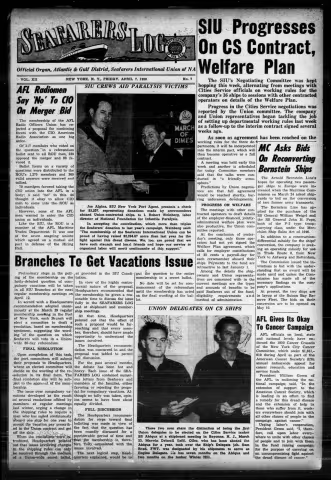
Issue Date
1950-04-07
Volume
12
Issue Number
7
Plaintext
SRSt' • ..i; : • • • , • • .'• ,'
y • :• • *., • • .4.a
X'U
Official Organ, Atlantic & Gulf Oisirid, Seafarers International Union of NA
VOL. XII NEW YORK, N. Y„ FRIDAY. APRIL 7. 1950 No. 7
AfL RaJimen
Say No' To CIO
Chi Morgor BU
The membership of the AFL
Radio Officers Union has re
jected a proposal for combining
forces with the CIO American
Radio Association . as one big
union. ' ^
Of'317 members who voted on
the question "in a referendum
ballot sent to all ROU men, 229
opposed the merger and 88 fa
vored it.
' Ballot forms on a variety of
questions were distributed to the
ROU's 1,275 members and 369
valid answers were received and
tallied.
79 memljers favored taking the
CIO union into the AFL in a
body; 4 said "no" to this. 44
thought it okay to allow CIO
men to come into theROU as
individuals.
However, none of the AFL
men wanted to enter the CIO
.union as individuals.
Like the SIU, the ROU is a
member of the AFL Maritime
Trades Department. It was one
of the seven seagoing imions
which agreed on a mutual aid
pact in defense of the Hiring
Hall.
SIU CREWS AID PARALYSIS VICTIMS
• ^1
On OS Contract,
Welfare Plan
The SIU's Negotiating Committee was kept
hopping this week, alternating from meetings with
Cities Service officials on working rules for thei
company's 16 ships to sessions with other contracted
operators on details of the Welfare Plan.
Progress in the Cities Service negotiations was
reported by the Union committee. The company;
and Union representatives began tackling the job
of setting up departmental working rules last weds
as a followup to the interim contract signed several
weeks ago.
As soon as agreement has beeiL reached on the
working rules for the three de<7
partmehts, it will be incorporated
into the interim pact, which will
then become operative as a full
Joe Algina, SIU New York Port Agent, presents a check
for $3,207. represetiting donations made by crewmembers
aboard Unioncontracted ships, to I. Robert Weinberg, labor
director of National Foundation for Infantile Paralysis.
In accepting the contribution, which more than triples
the Seafarers' domition to last year's campaign. Weinberg said:
"The membership of the Seafarers International Union can be
proud of having raised $2,284.67 more than last year for the
fight against this dread disease. We. too. are proud that we
have such staunch and loyal friends and hope our service to
organized labor wiU merit continuance of this support."
Branches To Get Vacations Issue
Preliminary steps in, the poll
ing of the membership on the
hotlydebated question of com
pulsory vacations will be taken
in, all SIU Branches at the next
regular membership meetings on
April 12.
; In accord with a Headquarters
.recommendation adopted unani
mously at the March 29 regular
membership meeting in the Port
of New York, each Branch will
• elect a committee to draft a
resolution, based on membership
sentiment, suggesting the word
,ing 'of the questioh on which
. Seafarers will vote in a Uhion
'wide 60day referendum.
FINAL RESOLUTION
; Upon completion of this task,
the port committees will submit
their .proposals to Headquarters,
where an elected committee will
decide on the wording of the re
solution in its final form. The
final resolution also will be sub
ject to the approval W the'meni
.bership. ; ^ • "•
" The issue over compulsory va
" cations developed as the result
; of . several resolutions offered by
.members at regular meetings
lasf winter, urging a change in
the shipping rules to require a
man who has sqjled continuously
• aboiird one ship for one year to
. accept the .Vacation pay prescrib
ed inthe" Unu3|i contract and get
off the ship:, .
' When the
troduced, Headqufirlers Jolhtbd
'out that issues involving changes
• in the shipping niles can only
^ be resolved through the medium
of a Unionwide secret ballot,
as provided in the SIU Consti
tution.
In view of the highly contro
versial nature of the proposal,
Headquarters recommended that
themembership be given a rea
sonable time to discuss the issue
fully in the SEAFARERS LOG
and at shipboard and member
ship meetings.
At that time. Headquarters
pointed out that the effect of
such a proposal would be far
reaching and that every mem
ber, therefore, should have ample
opportunity to understand the
issues involved.
The Headquarters recommen
dation was concurred in and the
proposal was tabled to permit
full discussion.
For the past several months,
the debate has been hot and
heavy. Each issue of the SEA
FARERS LOG contained numer
ous letters from Seafarers and
members of the.families, either
favoring or rejecting the propo
sal for compulsory Vacations. Al
though no tally was taken, opin
ion seems to have been about
equally divided.
FULL DISCUSSION
The Headquarters recommen
dation for steps towarid final
balloting was madq in view of
the fact that the question has
been roundly discussed for a
^nsiderable period of time and
that'the membership is, there
fore, 'fully.acquainted with the
issues involved^
The next logical step, Head
quarters explained, would be to
put the question to the entire
membership in a secret ballot.
No date will be set for com
mencement of the referendum
until the membership has acted
on the final wording of the bal
lot.
contract.
A meeting was held early this
week and another is scheduled
for today. Committee members
said that the talks were con
ducted in "a friendly atmo
sphere."
Predictions by Union negotia
tors are that full agreement
would be reached shortly, bar
ring imforeseen developments.
PROGRESS ON WELFARE
The meetings with other con
tracted operators to draft details
of the employerfinanced, jointly
administered welfare plan were
also productive, the Union com
mittee reported.
At the conclusion of yester
day's meeting, only three ope
rators had not yet signed the
Welfare Plan agreement, which
calls for employer contributions
of 25 cents a payrollday for
each crewmember aboard their
ships. Payments to the fund are
retroactive to last January 1.
Among the details the ship
owners and Union representa
tives are concerned with in the
current meetings are the types
and amounts of benefits to be
paid Seafarers out of the fund,
eligibility requirements and
method of administration.
UNION DELEGATES ON CS SHIPS
Th^e two meii share the distihdtioh of being the .&st'
Union delegates to be elected on the Cities Service tanker
SS Abiqua at a shipboard meeting in Bayonne. N. J„ March
23. Merwin DriscoU (left). Oiler, who has been abo^d the
Abique for a year, took over the Ship's Delegate job. Sam
Reed* FWT. was designated by his shipmates to serve as
Engine Delegate. He has seven months on the Abiqua and
two months on the taxdcer 'VIHnter HiU.
MC Asks Bids
On Resonvorting
Bemstoin Shgis
The Arnold Bernstein Line's
hopes for operating two passen
ger ships to Europe were in
creased when the Maritime Com
mission on March 24 asked ship
yards to bid on the conversion
of two former army transports.
The Bernstein Line has ap
plied for the purchase of the
SS General William Weigel and
the SS General John H. Pope,
both of the P2 type, troop
carrying class, under the Mer
chant Ship Sales Act of 1946.
In addition to a construction
differential subsidy for the ships'
conversion, the company is seek
ing an operating subsidy for use
in Trade Route 8, from New
York to Antjverp and Rotterdam,
The Commission issued the in
vitations to bid with the under
standing that no award wiU be
made until and unless the Coin
mission has made all of the
necessary findings on the com^
pany's applications.
At present, the two ships ate
in layup at the Suisan Bay Re*
serve Fleet. The bids on their^.
conversion are to be opened oa
May 10.
AFL Gives its Okay
To Cancer Campaign
AFL officials on local, state
and national levels have en
dorsed the 1950 Cancer Crusade
of the New York City Cancer
Committee, which seeks $1,33^1,
919 during April as part of the
American Cancer Society's fifth
annual nationwide appeal for
cancer research, education and
service funds.
President William Green of
the AFL, in endorsing the na
tional campaign; said, 'Tn the.
extension of support to the"
American Cancer Society, which"
is leading in an effort to find
a remedy for this dread disease
and the extension of help to
those who suffer from it, work ,
ers everywhere should join with
all other classes of people in the
campaign against cancer."
Urging labor's cooperation, ,
President Green said, "I, there
fore, call upon labor every
where to unite with other classes
of people and to join with them
in the fund raising campaign
for the purpose of carrying on
an imcompromising fight against
the dread disease of cancer."
• "• ".6.1
:..^J
ftig« Two
p.' *5=5==========
WflESEAFARERS LOG Friday. April 7, 1950
.,MA iJi.ll =F &• • .
11^
=R= =5=
SEAFARERS LOG
Published Bpery Other Week jby the
SEAFARERS lOTERNATIONAL UNION
OF NORTH AMERICA
AHantic and
• Affiliated with the American Federation of Labor
At n Beaver Street, New York 4, N. Y.
HAnover 22784
Reentered as second class matter August 2, 1949, at the Post
Office in New York, N.Y., under the Act of August 24, 1912.
267
The Mmt Pr^ious CargQ
IP"
iflV"
A Job To Do
The communists are going to find the going hot and
heavy in, the months to come. Free labor is on the march
and plans are now being laid to carry the fight to all
nations of the world, ̂ including those behind the Iron
Curtain.
The newlyorganized International Confederation of
Free Trade Unions has mapped a campaign for the next
three years, which has among its objectives assurance of
delivery of American arms aid to western European
democracies.
The Confederation also plans to carry the message
of free democratic labor to the noncommunist peoples
of Czechoslovakia, Poland, Roumania, Esthonia, Latvia
and Lithuania.
Head of the Confederation is J. H. Oldenbroek, who
is the former secretary of the International Transport
workers Federation, with which the SIU is affiliated.
Oldenbroek says the people behind the Iron Curtain are
not commies, "They're just^under an iron heel."
The commies are going to squawk aplenty. Especial
ly since the Confederation is no dinky outfit. Set up by
free trade unions to combat the communistcontrolled
World Federation of Trade Unions, the new Confedera
tion speaks for more than 50,000,000 workers in 53 na
tions, including the AFL and CIO in the United States.
On the basis of previous performance, our guess is
that the communist propaganda hacks will scream that
the whole thing is an "imperialist plot" hatched and paid
for by the United States and carried out by stooges in
die European democracies.
But commie hysterics are not going to change the
fact that this is going to be a labor show, conceived, pro
duced and carried out by working men and women who
.:Still live in a free atmosphere.
Not only are they going to make sure that the
European democracies get the arms aid and Marshall Plan
cargoes that will keep them from being crushed by the
Soviet heels, they are going to actively combat the com
munist malarkey that the world outside the Iron Curtain,
specially the UiS, is he|l for workers.
.Seafajrers h«ive piade jt very clear that they are proud
that they are once again among the ones who will be
jCarrying the goods to the important fronts. Besides getting
the physical materials necessary for the democracies' of
fensive to the other side, SIU members are in a firstrate
jipQt to perform another invaluable service to the cause
^ freedom everywhere.
On hitting the ports of the European democracies,
'particularly those where communists control the unions
x)f waterfront workers, as in France and Italy, each Sea
ifarejr can take ashore his own quota of facts about life
,jn a democracy.
They can tell these befuddled, misguided people of
4he conditions and wages enjoyed herej because their
unions are free to fight for their economic*betterment and
are not strapped down by political, selfseeking hacks.
They can tell them that there are no firing squads or salt
amines for dissenters.
Seafarers can give them the score about democracy.
We're Sorry '
Due to space limitations, the LOG was forced to omit
the mwal reports from the Branch Agents. Although the
pranch minutes digest highlights the major shipping de
ijreiopments in eaeh port, it lacks the flavor of the individr
4ial port reports. Barring similar circumstances, the
"Around tlie ports'*, fcaturs will sppenr in the nest issue. ^
The final chapter in the long campaign to
bring the Cities Service Marine Division
under a full SIU contract is now being
written. Shortly after the pigning of the
interim agreement several weeks ago, hindr
ing the company to the standard Union
wage scale, establishing the hiring proced
ude and the other major gains, committees
representing the SIU and Cities Service sat
down to work out a set of working rules.
Several meetings have already been held
and, although many of the departmental
rules remain to be written out, the end of
this contract campaign is dehnitely dn sight.
When agreement has been jreached on the
working rules, they will be incorporated
into the interim agreement, which then will
beeome the final and full contract.
Every SIU member and every Cities Ser
vice man who stuck so hard by his demands
for Union representation in the company's
tanker fleet rates glowing commendation for
their part in the big victory. They have
made possible a victory that ultimate^ will
benefit more than those irnmediately in
volved.
But in the flush of .vi^ojry, let us not
forget the others whose offers of support in
our fight for the Cities Serviqe eontr^et
proved so valuable—the AFL refinery workr
ers, machinists and allied workers in the
South and the CIO oil workers on the East
Coast, just to mention a few,
All of these people stood by right upjto
the very l^st minute, ready to give alHoiit
support the momeht it was needed. Their
spirit of cooperation is the kind of stuff
that has been so tmportant in improving
the security of the working men and wo
men of this country.
It should be mentioned here that an ap
praisal of the Cities Service campaign
points up the soundness of several Union
policies. Because these policies had been put
into effect earlier, the beef was consider
ably easier to push to a successful conclu
sion than it would have been otherwise.
One of th^e was the policy of limiting
the number of jnembership books, to ap
proximately the number of contracted jobs.
As a result of this policy, our member^ip
was never overloaded. Not only is this ^
great protection to our menabershipj but as
sured Cities Service men they would have
ample opportunity to ship on other vessels
if they so desired.
One of the most impprt^t factors in tfia
successful drive on CS w^e the economy
measures instituted a few years ago. Be
cause of this, we had the funds necessary
in any large scale organizing campaign.
Above all, the big thing is that the SILT
has been able to gp fprwrnrd wfien the uaayi
time industry is shrinking and other unions
are wrestling with tough internal problems,
resulting from an unfortunate lack of fore
aight.
The SiU has npt only held i,ts own, it js
moving ahead. We maintain that continual
growth is essential to the health of any or
ganization, and we mean to keep our Uplon
in a sound, healthy state,
Thafs why \we
the full CS "epBtract is wrapped up. We'y©
got to keep going ahead. And what's mor^,
we will ! •
Fciday. 7, 1«50 THE SEAT ARE RS Pass Three
S4S
' !rhe American Federation of Labor as a whole
and the' American seamen, as part of the Amer
ican Federation of Labor, have, a vital stake and
interest in the maintenance of a firstclass. Mer
chant Marine flying the American flag. This,
we believe, is the established policy passed by
Congress and enacted into law under the Mer
chant Marine Act Of 1936.
I However, the present status of the American
Merchant Marine leada one to believe there is
no established policy and there is no one bureau,
including the Maritime Commissiofi, which is
protecting the advancement, welfare and the
maintenance of an American Merchant Marine.
In view of the fact that the Senate has approp
riated money and invested in your Committee
powers to hold hearings, to investigate problems
and to recommend certain action for the benefit
of the American Merchant Marine, we would
like at this time to express our opinion and to
make recommendations on certain subjects now
before your Committee.
The action of the Senate itself to appropriate
money ;for your Committee proves there is
something radically wrong with the American
Merchant Marine today. Not so long ago, during
the War and after, our country had the largest
Merchant Marine in the world with all types
of ships fitted for any trade and any route—in
fact, the American Merchant Marine was so
capable that it carried a major part of supplies,
troops, etc. to the various military fronts of the
world. Today, however, this situation has mater
ially changed. The American Merchant Marine
is rapidly dwindling and it is safe to say there
are less ships sailing the American flag than
there were prior to the War.
We see, on the other hand, that all types of
nations have developed merchant marines over
and above the needs of certain countries and this
critical situation has been accomplished in part
through the aid of various bureaus in the United
States such as the Maritime Commission, the
State Department, etc. We are referring now,
for instance, to the Panmnanian registry, the
Honduran registry and the Liberimi registry
Which today are operating ships and tonnage
never dreamed of prior to the War.
However, our organization has already sub
mitted a statement to your Committee dealing
with the transfer of the American Merchant
Marine to foreign flags, so we will not go into
tiiat matter at this time, but there are other
phases of the American Merchant Marine now
before your Committee on which we would like
to express our opinion and make certain recom
men^lations.
I—Navy Operated Tankers
In the past two years, the United States Navy
has operated approximately 57 tankers (55 T2's
and 2 Tl's), These tankers have been operated
op a worldwide basis for the Navy by four
American shipping compames^two West Coast
companies and two East Coasl; companies. These
xpmpanigs have colle^ive bargaining agreements
with' Ajnerican seamen's unions. Consequently,
one can regard the operation of Navy tankers
On this and the following page is the state
ment of the Seafarers International Unlom
through Its International Presldenf, Harry Lunde
berg, on the various maritime problems now be
ing considered by the Senate SubCommittee on
Merchant Marine and Maritime Affairs.
as' a civilian operation due to the fact the of
ficers and the men manning those tankers do so
through their various unions under collective
bargaining agreements. This operation, to our
knowledge—and we have had no complaints—
has been running smoothly without .any strikes
or delays and has benefitted the Navy, the tax
payers, the operators and the American'seamen.
From time to time, certain pressure has been
put on the Maritime Commission, which in turn
has put pressure on the Navy Department, to
cease operating these particular tankers, giving
as a reason that many tankers are laid up for
lack of cargo and that the Navy should turn
around and charter these laidup tankers. This
pressure has come in most cases from certain
tanker companies on the Atlantic Coast.
We want to bring to the attention of your
Committee that these same companies when they
were asked three years ago to carry Navy cargo
absolu : ely refused to do so. They had no tonnage
because they were then reaping the harvest of
the high charter market on a worldwide scale.
They said, in effect, "To hell with the Navy;
we are going out to make all the dough we
can." They,bought their ships under the Ships
Sales Act, planked down so much and went to
work and made plenty of money. Now some of
their ships are tied up, but should the charter
market in the tanker field go up, they definitely
would not look to the Navy for business; they
would go where ihey could make the most
money, and it would put the Navy in the posi
tion of having to compete on the charter market
and your Committee may be sure that it would
cost the Navy plenty of money to charter these
vessels. These particular tanker companies would
juggle the charter market in such a way as to
put the Navy in the position of having to pay
them exorbitant prices for hauling its oil. Fur
thermore, these particular tanker companies do
not have enough qualified tankers by any stretch
of the imagination capable of handling the Navy's
transportation of gasoline and oil on a world
wide basis. Furthermore, for the information of
your Committee, some of these same companies
have part of their vessels operating under the
Panamanian flag, and we, can see no reason why
your Committee should tolerate, or encourage
or help chiselers of this type. We are satisfied
that the tankers operated by the Navy are being
operated for the best benefit of everyone con
cerned, including the taxpayers—we have no
complaint about that whatsoever—and we do
not think the United States Government should
pay any attention to the cries of a few specula ,
tors.
«
It is understood, of bourse, that on a long
range program the Navy will need modern tank
ers. It is essential for the defense of this country
that jpartLculaj? tanfeers be . of the nvost modem
and fastest type avwlable. It is also understood
that the tankers at the present time in operation
are radically reaching the point that they must
be replaced. Most of the tankers now operated
by the Navy (T2's) were operated during the
War at the maximum service and the effective
ness of tankers, 111^ other ships, only lasts over
a certain span of years. We \xmderstand that
there are private companies which are willing
to undertake the building of modern T5 tankers
capable of a speed of 18 to 20 knots, in addition
to a large reanying capacity than the present
tankers. We understand this tjrpe of vessel has
the approval of the l^avy Department.
The stumbling block now in getting this tank
ship building program under way is the fact
that the Navy is not allowed to charter for a
longer term than one year. Consequently, these
companies which are willing to invest capital,
needless to say, cannot start building these ves
sels until such, time as they can make a contract
enabling them to charter out their vessels for
a longer period of years. We believe that your
Committee should endeavor to amend the law
to permit the Navy to charter the types of ves
sels mentioned above from these companies, that
are willing to build these vessels, for a substan
tially long period. This would insure the Navy
a coming supply of new fast tankers, winch
would help the National Defense program; it
would save the American taxpayers money in
the long run; it would help the shipbuilding
industry and insure more employment and keep
more qualified and skilled craftsmen in the
American yards; it would help the American sea
men who man the vessels.
II—Military Cargo Transportation
We realize that at the present time under the
Military Sea Transportation Service, quite a
large number of dry cargo, reefer ships and pas
senger vessels are being operated—in fact it is
true that this service operated by the Army and
Navy today is the largest shipping service in
the United States. ' '
We believe that some of this service could be
handled in the same manner as tankers have
been operated by the Navy: namely, this service
could be handled for the Military Transportation
Service through private shipping companies
which would be paid on a costplus basis as an
agency fee for operating their ships. That would
insure the Military Service as receiving the
proper service without having to pay enormous
chart hires; it would insure these private oper
ators who would be capable of operating these
ships for the Navy and Army a fair fee for doing
this work for the Navy, and it would give civil ,
ian seamen more work.
We wish to point out to the Committee a prob
lem that has been overlooked by everybody—,
we don't know for what reason—including the
Military Sea Transportation Service: namely, the
problem of national security. Today our coun^
is on the verge of war and is conducting a cold
war with the Soviet Government. Newspapers
are daily devoting space to the danger and pos
sibilities of war. Certain security regulations'
have been established, or attempts are being
made to have them established, in various Gov
ernment bureaus in an endeavor to insure the
loyality of persons who work for the United
States Government.
However, nothing has been done to establish
whether the loyality of the men who man the
ships for the Military Sea Transportation Ser
vice is up to standard. As a matter of fact, w©
know that there are communists and subversive
elements sailing in the Army Transport Service
ships, in Americanflag ships, which are prac
tically owned and operated by the Uniffed States
Government. We know that the United Stat^
Coast Guard knows these things but is doing
Page Four THE SEAFAREitS tOG Friday. April 7.
SlU Policy On
V
1 ~
(Cmfhmed from Page 3)
nothing about it. We believe that any operator
who desires to operate and handle cargo and
ships for the United States Army and Navy cer
tainly should guarantee that these vessels will
be manned by loyal Americans and not by ele.
. 1
ments that during an emergency might sabotage
these ships. The same condition should certainly ,
apply to the Military Sea Transportation Service.
These, we believe, are important phases of
the American Merchant Marine which your Com
mittee must consider.
Ill—Intercoastal and Coastwise Shipping
Prior to the War, the percentage of American
ships in the domestic service, such as coastwise
shipping and intercoastal shipping, was approx
imately 75 percent of the whole American ton
nage. The bulk and backbone of the American
Merchant Marine was the coastwise and inter
coastal ships. Offshore shipping imder the Amer
ican flag was composed of a few liners and a
few lines carrying their own products, such as
the Isthmian Steamship Company.
When the Second World War became a reality,
all coastwise and intercoastal ships, with the ex
ception of a few coal carriers on the East Coast,
were taken over by an Executive Order of Pres
ident Roosevelt. These ships were diverted into
services on behalf of this country's war needs
and they were handy and ready when this coim
try needed them.
Today, now that the War is over, we find that
the intercoastal and coastwise services, insofar
as shipping is concerned, are practically dead.
' There is less than onethird of the amount of
American shipping in the intercoastal nm than
there was prior to the War. In 1939, just prior
to the war, in the coastwise run on the Pacific
Coast, in Which run ships plied between Califor
nia, Oregon, Washington and Vancouver, there
were 74 ships operating in and out of various
coastwise ports on/ the Pacific Coast strictly in
the coastwise run. Today there are less than 10
ships operating in the coastwise run.
Now we feel that the Committee should cer
tainly take into serious consideration the study
and possibility of rebuilding the coastwise and
intercoastal runs, not only for economic reasons
but certainly from the national defense stand
point. There are many reasons advanced why
these runs have not been built back up again
to their normal strength. We believe that it is,
and should be, the duty of the Maritime Commis
.aion to n^e it their., first order of business to
see that shipping in the coastwise and intercoast
al trades is brought back to normal, but, need
less to say, the Mmtime Commission, a weak
kneed body at best, has done nothing in this
connection. As a matter of fact, it has proved
through its various actions that it is unqualified
and incapable of carrying out the duties as out
lined in the Merchant Marine Act of 1936.
There are certain matters that your Commit
tee should look into and rectify; for instance,
the discriminatory rates allowed the railroads
on the Coast by the Interstate Commerce Com
mission. In other words, the I.C.C. allows rates
on the Coast between the coastwise states which
are very loW, and as a result it is impossible in
many instances for steamship operators to com
pete with the railroads, which in the overall
picture are losing money on the rates approved
by the I.C.Cr; but in noncompetitive trades they
are allowed rates which make up. for what they
may lose on the coast in competitive trades; in
other words, the I.C.C. is discriminating against
shipping in favor of the railroads. As a matter
of fact, it is a common belief and opinion among
people in the know that the I.C.C. is controlled
by the railroads.
There are other things which come into the
picture, such as the high tolls through" the Canal
Zone. Also, on the coastwise run all the ships
that were fitted for that particular service prior
to the war have now disappeared because most
of them have been sunk or junked as a result
of the Wdr. Consequently, there are no ships
fitted for these runs and the Maritime Commis
sion has hot seen fit to develop plans encourag
ing the building of ships for the coastwise run,
particularly types of ships which would fit the
rim economically and also ships that could be
used in a national emergency. On this subject,
your Committee certainly should come in with
certain strong recommendations and a policy
rehabilitating the coastwise run.
In the intercoastal nm certain types of ships
were specifically designed for the" intercoastal
run; namely, the C4's. However, evidently these
ships cannot be sold because the price is too
high, so the shipowners say. If the intercoastal
run could be reestablished, we take the position
that if the price set by the Ships Sales Act is
too big for companies to buy ships, then some
adjustment should be made on the prices. We
feel that a bunch of ships tied up in various
creeks, rivers and bays in the United States Ijdng
year in and year out idle and decaying is only
an expense and burden to the United States
Government, and if there was assurance that
these ships could be put in the run under the
American flag, they should be taken out of these
bays and' rivers, where they are now laid up,'
and sold even if the price has to be cut, because
in the final analysis they will be sold for junk
anyway. We do not want the United States Gov
ernment to refund the purchase price which
the shipowners paid under the Ships Sales Act.
We know many of the operators are going to
have mofe than made up for the high prices they
. might think they have paid for these vessels.
Conditions have rfow changed. Shipping is
tough; the charter market is tough; competition
with foreignflag ships is tough. Now is the time
to change the policy on the Ships Sales Act.
IV—Ships Charters
We recommend to your Committee, and we
doubt that legislation will be adopted in the
very near future to relieve the situation dealing
with the American Merchant Marine, that the
charter provision of the Ships Sales Act be ex
tended for another year, or until such time as
. a definite program has been established for th6
American Merchant Marine.
If this is not done, we are afraid that m^y
ships which are noW chartered will be laid up
and no ships will be taking their place, particu
larly in the intercoastal run, which doesn't make
sense. It will mean more unemployment among
American seamen and less ships under the
American flag; also more unemployment benefits
to be paid out by the Various States to the sea
men. These Government ships will be put up
scream and be opposed to such action, claiming
that it will be discriminatory tO reduce the
price on these vessels after they had brought
them at a higher price at an earlier date. How
ever, your Committee should'^not pay any atr
tention ,to this because the people who bought
ships under the Ships Sales Act, when it was
first passed by Congress, have made plenty of
money because when the Ships Sales Act first
was established and ships were sold, the tharter
market was lucrative and the shipowners were
making money right and left in all kinds of
trades—particularly, in foreign trades—so they
the creeks in the laidup fleet to rust away and
at a later date possibly be sold for junk, so that
is why we suggest that jrour Committee recom
mend to Congress, that "it extend the charter
provision for, ario^ar year.
~ V—Subsidies
We further recommend to the Committee that
American ships that are* willing to go into a
competitive trade, evep if there is already one
American company operating in the trade, shoUld
be allowed subsidies.
The present subsidy set up under rules estab
lished by the Maritime Commission practically
amounts to a monopoly, and in the long run
costs the United States taxpayers money. If
other companies. could be granted subsidies in
these various routes, it would in the final analyr
sis establish keen competition and after a period
of time would eliminate the deadheads out of
the industry who are now traveling strictly on
the United States Government taxpayers' money
in the form of subsidies. :
Furthermore, it is a well known fact thai;
practically every nation in the world is sub
sidizing its ships running in foreign competitive
trades in one form or another. Why the United
States should be §6 backward in granting sub
sidies to shipping companies is hard to under
stand when it is subsidizing everything from
potatoes to railroads through grants of land,
which is practically a steal.
These are only a few things that we would
like to have inserted in the record. No doubt
you have thousands of pages of testimony on
these various subjects, so we feel that you could
well find a place for pur comments and possibly
read them.
Respectfully submitted,
* Harry Luhdeberg, President
SEAFARERS INTERNATIONAL
r 'UNION OF NORTH AMERICA^
, t ^ and SecretaryTreasurer, V
SAILORS UNION OF THE ; i; t
PACIFIC (Au^teu With the ^
American^leratiOn of Labor^
FtmY. 7, 19Sa TaE S M AF A R E K S LOC Page Kvtf
Xitaens Only' Tag Oh Jobs
Irks Baltimore Seafarers
The letter below, signed by three Brctkers in the F'ort
of Baltimore, was received by Headquarters ffiis week. Fol
lowing this cmnmunication is Headquarters' explanation.
do feel that, as loyat Union mem
bers, we are entitled to our fair
This is a considered protest
on the part of loyal SIU book
members and permitholders, who
are aliens, of a condition exist
ing et this liail, and a request
that it be investigated.
For the past several months,
every job in the Hall has been
posted for "citizens only." This,
of course, means that alien SIU
seamen do not have their fair
chance, based on registration
date for jobs coming into the
Hall, aboard ships whose alien
quotas are not full. '
In our opinion, this policy is
imdemocratic and discriminatory,
a violation of the Gohstitution
and ByLaws of our Union,
Many of us are sincerely try
ing to secure our citizenship in
this country under the provisions
of the Merchant Seamen's Act—
a* course of action constantly
urged upon its alien members
by the SIU.
LACK F6W MONTHS
Although Miany of Us heed
only a few months' more time
oh United States ship's articles
ih order to secure our papers,
we' find it impossible to secure
a job here because of this "citi
zen only" policy.
'We are also disturbed by the
knowledge that the privilege of
sailing United States ships, and
so securing our citizenship here,
may be repealed by Congress
• during its next session.
M^y of us setved in the iher
. chant marine during the war;
we have actively supported the
Union in all its objectives and
participated in all strikes since
joining; we are paid up mem
bers as of the termination of
our last voyage.
Those of us who do not hold
the oldest cards in the Hall for
our respective jobs have mostly
had to reregister — and while
we wait for the ship we can be
assigned to, our families are
going hungry.
Also, many of us are on parole
from warrants issued in depor
tation proceedings—shaving to re
port once a week to the Immi
• gration Service and also having
had to give into their possession
our Seaman's Certificates or
passports.
CAN'T WOBK ASHORE
Until we get a ship, we have
no way to secure the funds
with which to fight these depor
tation proceedings, for we are
not allowed to work ashore.
We do not feel that the com
panies are behind this alien re
striction, for ships aboard which
we have sailed have crewed up
out of this Hall; andf, as in
some cases one or more aliens
got off, the alien quota for such
a vessel could ncg; have been
full—^yet these jobs too were all
posted as "citizen only."
We would like to know if this
is the official policy of the SIU;
for if it is, we should be so in
formed, in order to try to secure
a berth aboard ships of foreign
registration before we are de
ported.
~ We'are glad to share fhe ups
and downs of shipping with all
ouf" Brother nieittb'ers, but We
.chance at the jobs that come
into the Hall from ships whose
, alien quotas are not full.
' in view of these facts, we re
spectfully request that you in
form us of the official SIU policy
with regard to jobs for its alien
members; and, if this discrimina
tion over and above the Federal
regulations and our Union con
tracts With the operators is
against our Union Constitution,
ByLaws and principles, as we
firmly believe it to be, we would
appreciate your investigating and
correcting this Situation in the
Baltimore Hall.
• Headquarters has recelyed a letter from three alien members of the
Union in the Port of Baltiiiiore, requiting a statement of SIU policy
"with regard to jobs for its alien members." These men, W. A. Ebanks,
Pedro J. Villofanay and Lambert O. Gafoon are gravely concerned over
their status in face of growing difficulties /aced by alien seamen as a
result of retrenchment in the maritime ind^ustry.
Published with their letter of inquiry on this page is a statement
from Headquarters, appraising the alien seamen situation and reaffirm^
ing the SlU's firm ^licy in behalf of alien members,, adopted long
fore the presmtt difficulties arose.
The problem of the aHen seamen today is an outgrowth of increas
ing govemmeittal restrictions, including a toughening up by Immigra
tion authorities. The shipowners have found these restrictions costly
and, ccmsequently^ are anxious to avoid hiring aliens.
Despite the shipowners' position, the SltF has continued to press
for full protection for its alien members, and will continue to do so.
The Union will keep on sending its meml^rs to jobs through the rotary,
shipping system. As pointed out on this page, the Union is not inter
ested in a man's national background; it is only interested in whether
or not he is a member in good standing, and eligible for the job.
In view of the importance of the alien problem, it is extremely ad
visable that aU members—citizens as well as aliens—read the contents
of this page carefully, so tha't all hands will have a full and clear un
derstanding of what is involved.
• '^!l
Led Fight For Alien Memhers
The laws of our country have
made specific restrictions as to
the number of alien seamen al
lowed within crews of Ajherican
flag ships. The Merchant Marine
Act of 1936 almost completely
excluded alien seamen from
service on American ships, but
during "World War II the law
was waived and aliens were
allowed aboard American ship's
up to fifty, percent.'
It was not too long following
the War that the alien quota
was reduced, and the Union saw
that the alien membership would
find itself in an untenable posi
tion unless specific safeguaflis
were made. "The SIU at that
time established the policy that
is its guidepost today.
POLICY AIDED ALIENS
Admission to the Union was
closely regulated to prevent an
overloading of the Union in re
lation to the number of jdlas
available under contract. This
protected citizen and noncitizen
alike.
The SIU strongly encouraged
its alien members to secure visas,
which would allow them to ship
aboard coastwise ships and free
them from the 29day rule.
Aliens who had sufficient sea
time were aided in obtaining
their citizenship. The SIU also
took a stern stand toward those
aliens who had sufficient sea
time, but hadn't taken the neces
sary steps toward citizenship.
TJhus the SlU policy was one
of continually working toward
citizenship for the alien mem
bers to give thdm the shipping
privileges enjoyed by citizens,
and at the same time reduce the
number of aliens competing for
the jobs available to them.
The Union also worked to aid
its alien members in another
direction. Representatives of the
SIU worked diligently in Wash
ington for extension of fhe crew
waiver on aliens, and pressed
the government for amendments
to the law which would allow
men with three' years' seatime
to become citizens.
The fact that the waiver is
still in effect five years after the
war caii properly be credited to
the SIti and other maritime la
bor qrganizafidfig. No othel*
groups showed any interest in
helping alien seamen.
The SIU's handkng of the
problem was, and is, as effective
and as forward looking as is
possible under the conditiofis
which exist in this industry.
On the other side of the SIU's
policy is the positron taken by
the shipowners, who are far from>
anxious to see aliens serve on
their ships. With them it's a
doUarsandeents proposition —
aliens can cost them money.
The Ifttmigration authorities
have" several times demanded
that coftipanies post $1,000'bond
in behalf of each alien crew
member, and there have been
occasions where the bond was
forfeited.
In addition, should an alien
get into trouble ashore and be
picked up by the police, he must
be kept aboard ship under guard
(at company expense).
If he is returned to Ellis Is
land for deportation, he must
be accompanied by a guard (at
company expense) and be given
room and board (at company
expense) on Ellis Island until
his case is disposed of.
Companies have also found
themselves involved "in minor in
ternational incidents, such as the
time an alien seaman was to
be deported and the country of
his birth refused to take him.
N6body wanted him, yet he
couldn't stay in this country. The
ease cost the company consider
able hioney, and made them
Acutely sensitive about hiring ad
ditional aliens.
The attitude of the companies
is, of course, not bur worry. If
a job can be legally filled by an
blien member, the Union will
send him to the job; the eom
i>any cannot reject him for this
reason.
The true difficulty for aliens
thus lies mostly in the practices
of the shipowners., But, strange
as it seems, the aliens themselves
Contribute to' the acuteness of
the situation.
The shipowners, when' callirtg
in jobg to the Dispatcher, often
state that. the jobs are to be
filled by citizens only when
berths are available to alierts.
The Dispatcher iS not in a posi
tion to know the situation on
the ship and must take the com
pany's word, aithou^ he will
attempt <to^ leem if any of the
men lea^h^ the ship afe aliens.
If there' is a Strong doubt in
the Dispatcher's mir V the Union
makes every attempt to check
the ship and leam the true sit
uation.
Many times the Dispatcher has
forced the company to take
aliens, when it was found that
the quota was not filled. How
ever, the SIU is not in a posi
tron to maintain a cheek on every
ship but, almost without excep
tiori, the ships sail with a full
quota of alieris aboard.
The aliens contribute to the
lack of job vacancies oh fhe
ships by staying aboard indefi
nitely. Today it is r.'ire for an
alien once he is on a ship to
leave. The record shows that
aliens are staying aboard in
larger i>ercentages than the ci
tizen merhbers. If the alien sea
men would get off, they would
help the other aliens by provid
ing at least a moderate job turn
over.
Alien members who question
fhe Union's policy on its non
citizens fail to consider the
Union's record in their behalf
which is, beyond a doubt, the
best on America's waterfront.
BEST JOB CHANCES
The alien members of the
SIU have the largest percentage
of jobs available to them in the
industry; the percentage of SIU
alien members obtaining citizen
ship is the highest in the indus
try, and the chances of an alien
Obtaining sufficient time for ci
tizenship^ are greatest within
this Union.
Anyone' questioning this need
only look at what is happening
in other uniohg today. There,
hundreds, thousiands of alien
se»nen are on the beach waiting
for ships; Their chances of ob
taining sufficient seatime fer ci
tizenship are miserably small.
In our Unicm, no ^en has
beeii deported for exceeding his
time ashore. Th6 men who have
been deported—and they are but
a handful—were sent from the
country for being undesirable as
citizens, having run afbul of the
law in sohie manner.
The sentim^t of the men in
the SIU is to mamtain a strong
bond of brotherhood, to inain?
tain and imiarove the working^
and living" conditions on thO"
sMps. If a man is a native of
a foreign country, it is not im
portant. "What is important is"
that" he be a good union man.
"The SiU has protected its alien
membership in keeping the jobs
available at a high level; the
KU has aided aliens toward se
curing visas and citizenship pa
pers; the SIU has checked the
sh^s and made the companies
take men when it was found,
the ships' cpiotas were not full;
the SIU has campaigned in
Washington for extension of
alien waivers, and revirion of
the seatime requirement for citi
zenship; and on many occasions
the SIU has interceded in the"
behalf of an alien facing depor:
tation. This the SIU has done'
and will continue to do as long;
as there is an alien in the ranks ' •
Of the SIU.
Alien members who believe;
they have a grievance over the i
filling of jobs should'take their ,
problems to the Dispatcher im •
mediately for investigation. The
dispute should be ironed out in .
the port where it occurs, when \
it occurs.
The Union has full provisions
for the membership to present';
their grievances. If the matter,
is not settled satisfactorily, the
men involved may present their ;
problem to the Branch member
ship in a regular biweekly
meeting.
The SIU wants to see its policy
adhered to. There is no reason ;
for ^y member or official to
act contrary to the policy, s&
the purpose of the Unioi^ first
and last, is to send its members
to Jobs through the rotary ship
ping system, with regard to only
a man's time ashore and quali
fications to perform his job.
The SlU is an International
Union, both in operation and
membership. Any restricti<ms on'
the activities of its ali«i in«Eii
bers are those imposed by the
gbverrimCTit alone. The mert of
the SIU are bound together in a
group which is not ccoicemed
with, national origlu Ox xiuiiouai
bdimdarie^ but only in a great
er Brotherhood of the Sea;
PBoe Six 1 THESE A P R E R S L a G
SHIPS' MINUTES AMD MEWS'
lAlcoa Roamers Smother
Pegasus Nine, 31 To 5
The heavyhitting baseball squad of the SS Alcoa
Roamer continued to ride roughshod over all opposition,
knocking over the Alcoa Pegasus nine, 31 to 5, at the
Trinidad Naval Base held on March 4.
FleetFooted
Fresh from two successive vie
. tones over Paramaribo Pirates,
the Roamer boys belted the of
ferings of Pegasus pitchers Wold
and Cosby for a .total of 20 hits
imtil. the onesided fray was call
ed off at the end of the sixth
inning.
LdPSIDED WINS
In games played at Paramari
bo, Dutch Guiana, on Feb. 25
and 26, the Roamers routed the
Pirates by scores of 23 to 2 and
25 to 8.
Sparkplugs of the Reamer's
offensive against the Pegasus
team were Big Joe Neveraskus,
who had a perfect day at bat
with four hits including a power
ful home run into the deep left
field bleachers in the third frame,
and Webb, Who got on safely
four times out of six trips to the
plate.
Mclnis of the victors also hit
a round tripper, a mighty smash
which cleared the left center
field wall in the fourth.
, For the Roamers, Mclnis shar
ed the pitching assignment with
Whithers. They held the Pegasus
: squad to seven hits.
PEGASUS STARS
; Wold, Cosby and Simms, on
the moiind for Pegasus, were
xmable to silence the booming
bats of the Roamers, although
they were hampered by spotty
fielding by their teammates,
who made a total of six costly
fumbles. The Roamers defensive
play , was niaired by a single
error.
The Roamers effective defenses
were sparked by Clarence (Flash)
Owens, who alternated in right
field with Dyer. Owens cut down
several long drives deep in right
field territory. He was equally
fleetfooted on the base paths,
• stealing bags almost at will.
The Alcoa Roamer's amazing
hitting power has filled Manager
Mclnis with reckless pride.
Shortly after his boys had drub
bed the PegMus outfit, Mae an
nounced that arrangements were
afoot to schedule games with
the New Orleans Pelicans and
the Mobile Bears of the Southern
Association.
He's even trying to contact
Manager Leo Durocher for a
game with the New York Giants
before they return north for the
opening of the 1950 big league
season.
Clarence (Flash) Owens,
whose defensive play and base
running are ; among the rea
sons for the impressive string
of wins racked up by the Alcoa
Roamers' baseball team.
Fire Razes Member !^ Home;
Wife, 8 Children Destitute
A raging blaze which levelled the home of Seafarer
Daniel Rose in Harkers Island, North Carolina, on March
4 has left his wife and eight children homeless, the LOG
learned this week. «
Rose reported in a letter to
SIU headquarters that his family
is having difficulty in finding a
place to live in Harkers Island
as there are no homes for rent.
In the meantime his family is
staying with his wife's mother.
The fire, caused by a short
circuit in the wiring, was fan
ned by a strong wind and quick
ly spread through the large
frame dwelling. In less than half
an hoiu* the house was a charred
ruin. Only a few possessions
were saved.
Brother Rose was at sea at
the time of the accident, but
eft his ship in Panama and flew
back to rejoin his family.
The NewsTimes of Beaufort,
a neighboring town, initiated a
drive to aid the Rose family in
getting resettled.. The newspaper
:s soliciting food, clothing, furni
ture and cash and asks that all
donations be sent to the News
Times, Beaufort, North Carolina.
In addition to the aid given
by the NewsTimes, the Sea
farers in the port of New Or
eans responded to Brother
Rose's predicament by taking up
a collection, as did Norfolk men.
7" 7/
A '
SIU Crew Saves Nine
In Dramatic Rescue
: A thrilling sea rescue emhodying all the suspense of
a dime thriRer was reported to the LOG this week by
Jerry Palmer, Ship's Delegate of the Waterman vessel
iStonewall Jackson. TheJackson,
he reported, while enroute to"
Korea, arrived in the hick o
time to snatch from disaster nine
men on a sinki^, stormbattered
sailing craft. ' *
The Stonewall Jackson was
plowing the waters off Korea on
liSarch 11, Phlmer reported, when
crewmembers sighted the sinking
ship with its crewmembers strid
ing on deck in waistdeep water
waving frantically for help. The
Jackson responded immediately
and swimg around in a tight
circle. Drawing up next to the
boat, the crew members were
quickly pulled up over the side,
the last man clutching a line
ust as the boat made her final
plunge to the bottom.
The hairraising escape mo
mentarily stunned the seamen,
who were bus;tled into the ship's
biospital and bedded down. After
a hot meal the men recovered
completely and were given cig
arettes and clothing.
FUNDS RAISED *
The Jackson men, sensing that
the men were disturbed by the
OSS of their ship and personal
belongings, took up a collection
which was presented to the men
when they were put ashore in
Fusan later in the day.
Palmer stated in his report
that the Korean seamen were
deeply moved by the aid given
them, and the next day returned
to the ship to present Captain
William Harvey with a Korean
smoking pipe as a token of their'
gratitude.
The Jackson at the time of the '
accident was enroute to Korea
with an EGA cargo of fertilizer
from New Orleans.
With the rescue behind them,
the cr^w turned to matters
which could eventually spell
trouble to them as members of
the SIU: the threatened loss of
the hiring hall. Enroute to Hon
olulu the crew gathered in a
special meeting and adopted a
resolution calling upon the SIU
to carry the. hiring haR message
to seamen, other unions. Congress
and the public, calling for their
support to keep hiring halls as
they are now operated.
The crew also called upon the
branches of the SIU to bring
to the attention of the member^
ship the inunediacy of the hir
ing hall issue and the import,
ance of mobilizing to follow the •
SIU's policy, unhampered by dis ;
sension.
Sparking the crew as dele
gates, in addition to Jerry Pal
mer, are: Bob High, Deck; Frank
3. Williams, Engine; A. M. Will
iamson, Stewards.'
Meredith Victory . Crewmember Lost At Sea
' The otherwise smooth voyage
of the SS Meredith "Victory,
which paid off in New York on
March 21, was^ marred by the
disappearance of a crewmember
at s6a on Feb. 24, the LOG
leai*ned this week.
According to Seafarer Frank
Gustav, Wiper aboard the Isth
mian ship, the missing man was
Chester East, a F'WT. East yras
member of the SUP who
signed on the ship on the West
Coast.
East's absence was noticed
"J,
Members of: the Alcoa Roamer baseball squad, which has been snowing. under flmix oppo
sition by topheavy Scores, .pose after their. lalMt victory. Front row: (left to Hgbt): Evans,
Wright, Earlsy, Mcfni?, rows Rissyski, Webb^..
vleonard» OwfflBS, Dyer • • andMorris/^ 7^7
about two days out of Honolulu
when he failed to show up for
his watch at 8 PM. The Oiler
reported the fact to the Chief
Engineer and when a search of
East's quarters proved unavail
ing, the Skipper ordered the
vessel turned around.
The area was combed for sev
eral hours. Gustave said the
seas were "fairly rough," and
that "a good swimmer couldn't
have lasted, more than 10 min
utes in the water."
The Meredith trip which be
gan in New York on Nov. 15,
included calls at Haifa, Tel Aviv,
Penang and Singapore.
"It was a good trip," Cjustav
reported. "There were no per
formers, so we had no trouble.
A firstrate crew makes any trip
a pleasure." •
Joe Nunan (left) and Frank
Giislav, Wipers, who were
aboard the Meredith Victory
on a recent trip.
SS Hurricane Hits Shoal
In Fog Off Fire Island, NY
NEW YORK, ABril 6—The SlUmanned Waterman
freighter Hurricane was caught on a sand bar off Fire
Island last night as she was creeping toward New York
Harbor in heavy fog.
Attempts to get tow lines
aboard were stymied by high
winds and heavy seas, ,, but the.
vessel was reported in, no im
medlate^dqnger of Cracking up.
, . Twp tugs were standing by. the
crippled ship uiitil the weather
abates .suflicteutiy. .for leiioatlng
efforts to be resumed..
The Hurricane was inbound,
from Hamburg, Bremen, Rotter .
dam and Leith, with .genenaj
cargo, 13 passengers and a crew ̂
gf::46. • • ; ' \
Water has been pumped hxtqir :
the Hurricane^s . douWebottom/:
itanks to prevent her rplUng.r.iatj^
tito seas and pounding on the bar. x:
^5' .s' • • ,
rsriday, April 7. I95a ", !*'•
'? »• • T H er S E AF ARERS L O G Page Seven
Digested Minutes Of Sill Ship Meetings
ALCOA CORSAIR, Jan. 15—
W. Higgs, Chainnan; J. Rc^ris,
Secretary. All delegates reports
Were accepted. Motion^ carried
to rent six moving pictures for
Use on each trip and money to
be raised by popular subscripr
tion. Noisy heating system to be
reported to the Union Hall. Mo
tion 'carried to instruct Ship's
Delegate to visit Brothers in
Marine Hospital and to present
them with gifts from 'creW. No
tice of dues and assessments due
fdven all hands. One minute of
Mence in' memory of; deceased
Union' members. Meeting ad
^(^ned at 3:10 PM, with 71
toembers present.
t t 4
. PETROLITE. Jan. 22 —Lester
Clark. Chairman; H. M. Rosen
, ptiel. Secretary. Ship'^ Delegate
J. Bourgeois saw Captain about
painting crew's messroom and
has another meeting Tscheduled.
Delegates reported nb beefs in
their departments. Motion carried
to call attention of Secretary
Treasurer to fact that American
consul at Marseilles permits hir
ing of aliens when ! there are
Aihericans on the beach. Dis
cussion on launch service at
Tripoli where shore leave Was
permitted, but no launch was
ayailable. Suggested that library
bfe exchanged with that of an
p|her American ship in Port
£|eBouc. One minute of silence
in memory of departed Union
Brothers.
CUBORE. Jan. 22 —W. M.
Fields. Chairman; W. A. House,
Secretary. Delegates reported
that there were no beefs in any
of the departments. Motion car
ried for delegates to prepare
list of replacements to be given
to Patrolman—this is to make
sure that ship calls. Hall for men.
Members asked to remove dirty
gloves whenever using hand rail
because of thp clean paint.
Chairman Fields explained the
purpose of holding shipboard
meetings and of the need for
Union rules and regulations.
4 4 4.
SOUTHSTAR, Jan. 6—James
Stewart, Chairman; Louis Mey
ers. Secretary. All Delegates re
ported everjrthing okay. Report
ed that \yashing ...lachine had
been repaired.. Notice to be post
ed in laundry room explaining
proper way in which to use
washing machine; anyone with
doubta is to ask. Suggestion
made to* aid former crewmember
and Union Brother who has to
return to Genoa. Water hose to
be run out on deck for use of
stevedores in foreign ports, as
means of keeping unauthorized
persons out of the passageways.
4 4 4
MICHAEL, Jan. 29 — John
Ni^ler. Chairman; Ronald
Thompson. Secretary. Delegates
reported. Motion carried that
each crewmember clean up mess
hall after using it; amended to
read that last man on standby
clean up forthe oncoming watch.
New cfewmembers were inform
ed that library contains SIU lit
erature. A beef raised over the
amount of ice cream and fruit
given out. Steward asked men
to be careful of the linen. Ship's
Delegate is to get in touch with
American Merchant Marine Li
brary Association for a new li
brary. Crew informed that lum
ber was being obtained to build
benches outside on deck.
4 4 4
SANTA CLARA VICTORY,
Feb. 2—R. Peck, Chairman: E.
McCambridge. Secretary. Ship's
Delegate discussed ways of
leaving a clean ship at payoff
time "for benefit of oncoming
crewmen. Department delegates
reported all okay, except for
some disputed overtime in deck
and stewards gangs. Under Edu
cation, Ship's Delegate read his
tory of SIU and the Internation
al. Under Good and Welfare
crewmembers said they felt that
Agent or Patrolman should speak
to officers about the letter's
threats to yank books and fire
men.
ELLY, Jan. 8—Arthur Kaval.
Chairman; Walter Husson. Secre
tary. Ship's Delegate announced
that Master was under medical
care and recommended that he
not be disturbed during his ill
ness. Engine Delegate reported
that $38.50. is in ship's fund. Mo
tion carried to thank Ship's Dele
gate and Engine Delegate" for
efforts in purchasing magazines.
Brother Assures SIU Men
Of Good Deal At The Patio
Seafarer Blackie Coiro is now
working for the Patio Cafe in
Brooklyn where, he assures us,
all SIU members will get a
square deal.
Blackie says the Patio's wel
come mat. is always out for
SIU men and he asked all hands
on the beach in New York to
pay the place a visit.
Prices are among the most
reasonable in town, there is con
tinuous entertainment and the
atmosphere is definitely friendly.
Brother Coiro says that the go
ingson diiring Amateur Night,
which takes place every Sim
day, are a lot of extra fun.
The Patio gives winners of
amateur contests cash prizes
and the event is open' to all
"cnntera: H ybu" can sing,• strum:
guitar other 'musi
cal instrument, dance, or just
ad lib with the gags, you're eli
gible to take part.
Brother Coiro, who sails as a
Cook, says. that Harry and Nat,
owners of the Patio, are a
couple of "good Joes who will
always give, seamen a decent
deal."
The Patio has a ball team,
too, and Blackie suggests that
SIU crews that have teams and
Want to play should get in touch
with him. The Patios can ar
range to get a park for all g^es.
The Patio Cafe is located at
630 Flatbush Ave., Brooklyn.
Blackie says the best way to
get there from. Manhattan is by
BMT subway; Take .the Brighton
Line train and get off at either
Prospect Park or Parkside Ave.
stations. •
hand iron and games. Marjan
Reinke elected Deck Delegate.
Under Education, it was resolved
that, any man on this ship who
holds his book oyer permitman's
head shall be referred to Head
quarters for action. All agreed
to cooperate in keeping rec hall
clean at all times, and to do
utmost to be good Union Bro
thers throughout voyage. Ship's
Delegate Swayne reported that
wjth one exception all officers
were cooperating fully with
crew.
4 44
SUZANNE, Jan, 29—T. Osla
zeski. Chairman; L. Kane, Sec
retary. No beefs to report. Motion
carried unanimously that all
Communists and Trotskyites be
brought up on charges and ex
pelled from Union. Brother E.
Corum was elected Ship's Dele
gate; department delegates were
reelected. Discussion on SIU bul
letin regarding Trotskjrites and
Communists. Suggested that each
crewmember take active inter
est in shipboard meetings and
that chairman and secretary's
jobs be rotated. Ship's Delegate
to contact AMMLA for new li
brary.
4 4 4
WAR HAWK. Feb. 2—E. Wal
ker. Chairman; H. Starling. Sec
retary. Ship's Delegate reported
everything . running smoothly.
Department delegates reported as
follows: one hour disputed over
time in the Deck Gang, few
lours in Black Gang and none
in Stewards other than for de
ayed sailing in Venice. Motion
carried • unanimously to oust all
commies and Trotskyites from
Union. Suggested that Ship's
Delegate see Patrolman regard
ing launch service in Genoa.
Discussed. March of Dimes drive,
with members in favor of do
nating to cause.
son's
m imli
ME P«ELIMIN>AR.Y plSCUSS
(OA» PERIOD OAl COM"
PWLSOQY VACATtO^S HAS
BNUBO , AT ITS NEXT
BRANCH MEETINtS EACH .
• PORT WILL ELECTA COM'
AMTTEE TO DRAW UP A
RESOLUTION IN LINE WITH
THE ON/feRALL VIEWPOIISITOT^
PORT MBMBBRSHiP , THESE WILL BE
SOILED POWA/ BY A HSADC^UA'RI&ZS
COAAMITTEB FOR. SUBMISSION TO A "REF —
^RENPUM V/OTE UP AND DOWN THE COAST.
IF YOU HAVE ANY OPINION ON THIS MATTER
PUT YOUR PROpOeAL ON PAP£R AND SUB
MIT IT TO THE PORT COAAMITTBB FOR
COAISlDEl?ATlOAsl. • A . • % I
' i|
4 4 4
JOHNHANSON, Feb. 5 — Ed
win Westphal, Chairman; R; P.
Hannigan, Secretary. Ship's Del
egate said that he would check
upon arrival in New York to get
overtime disputes straightened
out. Deck Delegate reported 150
hours disputed; Engine, 150, and
Stewards, 64. Motion carried to
have ship fumigated before next
trip. Crew backs Steward in his
attempts to have his requisition
Oiled. Three copies to be made
so that one can be givento Del
egate and one to Patrolman.
Need for clarification of working
rules discussed. Delegate to see
Patrolman to inform him about
conditions on this trip, also to
see about getting the First As
sistant straightened out.
4 4 4
NATHANIEL B. PALMER.
Feb. S— i>aul Whitlow, Chair
man; V. Szymanski, Secretary.
Carmel G. Imnan elected Ship's
Delegate. No beefs in any of the
departments. Suggested by chair
that one topic be designated for
discussion under Education at
each meeting, beginning with
next session. Each department to
take turns at cleaning recreation
roont; schedule to be posted on
Kiard. All hands reminded that
f they have a beef they Should
speak with department delegates
ikst" aild not go direct to de
partment head. Noise to be kept
at a ininimtim so watchstanders
ban get some deep.
As far as most jobs are concerned shipping here in New York
is lukewarm—steady but slow on the bell. Of course, what's
always hot are those tanker jobs and many a man beached for
some time has shot out of port practically broke but plenty happy.
Speaking of jobs—and the system of security for those jobs in
these days of extreme maritime unemployment—reminds the SIU
membership that the battle of the Hiring Hall is still going on—
and this is a serious responsibility of every SIU Brother. Not only
are the Brothers protecting the SIU at all times but they are
continuing the good old SIU spirit of helping out other unions in
their legitimate beefs—beefs created by that monstrosity of a law
called the TaftHartley Act . . . Next month in the May issue of
"Liberty" magazine is a story about Samuel Gompers, the great
AFL leader. It should help all oldtimers and young timers in
fully understanding the general history of this leader and the
growth and battles of the AFL.
4 4 4
Eddie Nooney is in New York right now keeping himself
busy playing shuffleboazd every now and then . . . Walter
Reidy, the Steward, is now aboard the SS Black Eagle making
a steady European run . . . Walter Gardner is now a matri
monial man—so here's wishing him mucho happiness and
congratulations . . . Plenty of Seafarers and their families
throughout the boroughs of New York listened anxiously to the
SIU broadcast on the importance of saving our Hiring Hall
over radio station WEVD , . . John Chaker is a proud daddy.
It's a boy. 8 pounds, 13 ounces, born on the good day of
March 31—^just beating out April Fool's day.
4 4 4
One of the best Brothers we have talked with is Bill Rowe,
happily voyaging on the Steel Mariner now on the Far East run. .
His brother, Harry Rowe, is also happily tripping on the same
run aboard the SS Steel Admiral. (Brothers, it's easy to see that
these runs are the best in the SIU after the tough organizing of
Isthmian and bringing those ships into the SIU fleet.) Getting back
to Bill, we'd like to mention the swell way Bill ran around New
York and finally getting that DC washing macljine for the ship
cut of dough chipped in by the crew to keep everything happy
and shipshape aboard ship. It's sure a lot of things—the big and
small—which makes every SIU ship a good ship and a clean
ship . . . Educational meetings here in New York, as in other
ports, is for the full benefit of the membership.
4 4 4
The SEAFARERS LOG will be sailing free of cosl to the
homes of the following Brothers: Ralph Dunsmoor of Massa''
chusetts. Peter Naujalis of New York. Martin Sierra of New
York. Andrew Buscarello of New York. Nick Swokia of Connec
ticut. Stanley Brown of New York, Ralph Groseclose of Vir
ginia . . . Brother Fred Paul is in New York right now ...
Andy Havrilla shipped out last week . . . Here is a flash item
—about one of the Brothers here in New York' who is in the
current movie in New York called "Cargo , to Capetown," with
Broderick Crawford. Brother John Harvey, who has been help
ing out for many we^cs,especially in helping another union
on strike, told, us how he acted as a Messman aboard a Pana
manian tanker which was chartered for Hie movie out on the
West Coast. Imagine a Seafarer actiag for the movies as a
' merchant seaman, giving the" mRlioas of landlubbers through
out the natiett the impressikn that merdiant seamen live a life
of easy wtwk and grand i"4v«itiij > ihsy g«. We
wondM N this BMvie .is that dOidoijMT V
':4|
THE SEAFARERS LHG FAtacf. April 7,
MEMSEBSmP SFEOaS r
Honduran Sea Union Called Rig
For Covering Runaway Operators
TAKING CARE OF THE HORSEY SET
k To the Editoe:
11
m':
'J.
li.'
il'
i'
Most of you will recall that
l^i year there was supposed to
have beeii a worldwide boycott
of ships under Panamanian and
Hdnduran flags as a protest
agiinst their use to escape high
er wages and safety standards
bf . other maritime nations.
I do not know all the facts as
|tb why the boycott was not put
Wp effect, but when I was in
Honduras, recently, accompany
ing my wife, who is a lawyer
and a native of Honduras, on a
tour bf that nation's major cities,
I was informed that it had been
put off because the seamen of
these, countries had , organized
ttemselves irdo a "Union." CHie
bbycoU was posiponed upon re
quest of fhd Panamanian Gov
eriuneol, which asked for rime
fo enbCt le^shdion that would
bring its vmges and shipboard
oi^BdltiOBS rioser to the stand
^ds in ject throughout the
y^prid.. ^d,}
I set out to learn everything I
could about the "union" and
found it was very easy to learn
aH about it as there is very
little to it. It is simply the old
:^'c»imp'' racket with a new
Jvrinkle. .
' ANTIU«nON DEAL
* "^en the United iVuit Com
ply' went into Honduras years
ggo it ii my uirferstanding that
gi ' deal was made with the gov
ei^ent whereby the company
would furnish emplojmient to
the people of Hondimas. In re
J;um the govbmment was to pro^
tect . the company against labor
organizations by making them
illegal.
That law has been rigidly en
forced by the Honduran goverri
,ment, which is in fact a police
^tate. .The army controls every
jthing and the police are regular
p^y men. So you can see that
any labor union is impossible.
Some time ago the stevedores
.walked off the job in the port
*of Tela in protest against their
ibw wages and working condi
"tions. They get 35 cents and
ho'orS, with winch drivers re
• ceiving 50 cents an hour. The
United Firuit Company brought
In a trainload of* its plantation
slaves to load the ships under
military guard. Hie general then
gave orders fbf the regular steve
dPres to return to work within
24 hours, or else they would be
founded up, and possibly wiped
but. Needless to say, they all re
tiumed to work. All this hap
pened only a few months ago.
UNION?
. The socalled Honduran Sea
. men's Union is owned and con
trolled by one man, a certain
V Srabf Cbsencie^ ^o is on the
payroll of ' the United Friiit
Company, He also owns the larg
at and miost rapensive hotel in
<Pui»io Cortez, caHed riie Cos^
eia Hotel.
The dues of this so^ralled tm
H: foa sre $1.80 a riibnth.
man sailing aE Hbhdinan sftilf
must belong and pay dues td
Cosencia's outfit. The only com
pany exempt from this racket
is the Standard Fruit Company,
which has a contract with the
NMU.
A seaman must find his own
employment at the company of
fices or at the agents of the
many companies sailing Hon
duran flag ships. I understand
that if a man is sent to a ship
by the socalled union, headed
by Cosencia, he must pay $25 for
the job.
The top wages of an able
bodied seaman are $150 per
month and 80 cents an hour for
overtime. However, there is no
overtime at sea, Sundays and
holidays are not overtime. A
r;
I;
ABs Can Turn
Gray, Too,
BUson Claints
To fhe Editor:
My good friend Bill Chafnpliri
writes about "Why Bosuns Get
Gray." Although my hair is Still
black, afi AB can also turn gray.
:'11 cite one quick way and I'm
Sure I win be backed up by
many Brothers.
The Bosun wiU call a special
EDeck Department meeting be
fore the ship sails and teU the
gang to take orders from him
and him alone. He will run
things as he sees ̂it.
First day at sea our old pal,
Mr. Mate, shows his ugly head
on deck and gives sailors a job
other than the one he is working
on. The sailor politely informs
lim that he is taking orders
from the Bosun and continues
his work. The Mate nms for the
; Bosun, and with a blank look
on his face the Bosun acts as if
le doesn't know why the AB
wouldn't do the little job the
Mate asked him to.
I guess you know who is left
ligh and dry, holding the well
known bag for the rest of the
trip.
And by the way, let's get this
homesteading question to a vote,
Brothers. A year on a ship is
enough for any man.
Kirivan Bilson
Bosun gets about $140 per month.
Such a "union" is an insult
to the intelligence of any right
thinking person. It is part of
the racket that is responsible for
so many thousands of American
seamen being on the beach to
day, and if it isn't stopped more
thousands of us will be on the
beach but fast and permanently.
Every time an Amaican ship
comes into port and lays up, you
can almost be siure some ship
flying the flag of Panama or
Honduras is taking its place and
being operated by the same
morried interests which paid you
off and put you on the beach.
Let us hope that a thorough
investigation will be made by
our affiliated maritime unions
and the proper action taken to
effect a boycott to stop such
practice^ before we all find our
selves beached until, the next
war caUs us out again to further
enrich the sh^wner.
Leonard MitcheU, SUP
AAfoiig iho passengeA aboard the BS Del Sud on a recent
voyage were the two sleek nags riiown above, with their
attendants, neither' of whom was identiiied. Material accom
paiiying the photo didn't say, but it is beHeWed the aquines
we A of racing stock and were either coniing from or enroute
to Argentina.
Gov't Misses Boat In Training New Men
With Jobs Scarce For Old Handst Brown
ITO the Editor:
I have just finished • reading
he article by John Bunker in
he Jan. 13 issue of the SEA
FARERS LOG, entitled "Use of
Sailing Ships As Training Ves
sels." Giving all due respect to
he writer, I should like to com
ment on his article.
I think the idea, although it
makes interesting reading, is
about 20 years too late and. ra
Iher impractical todaV. As
Bunker says, marlinspike sea
manship in the old sense, is nOt
so important today as it was 10
or 20 years ago, even though it
must always be part of a sea
man's basic knowledge.
GONE FOREVER
There is no use kidding our
selves. The old schooners are
gone forever. They have no use
in modeni shipping. We may as
well accept it and forget them
as far as using them in training
or shipping is concerned. They
Ore Obsolete fOr either purpose.
Another thing: The govern
menlf isn't likely to drop 'its
pfeseht maritime schools^ even
ori a partial plan, to finance two
training Ships When the cOst Of
operating thesS fWO ships, iii
cludihg wages for the trainees
and the regular crew, would be
tremendous.
Furthermore, let us assume
that the two training ships were
in operation. That would mean
that after six months'. training,
800 men a year wOuld enter the
field in competition for berths
on ships.
Does Mr. Bunker realize that
the United States has art over
supply of experiertced seamen
(not including aliens) to last for
another 20 years, without putting
another 800 rnen a year into the
picture.
SUPPLY GREATER
Where, may I ask, are the
jobs for these men to come from?
Every Union hall in the coun
try today has more men than
there are jobs. We certainly dO
not need any more manpower.
If we must have training
schools, the US Maritime Com^
inissiOil schools at Sheepsheadf
Bay in New York and irt Ala:"
meda, Galif., has classes operi'
in practical seamartship. Also;'
the Sailors Urti^ of the Pacifie'
operates a similar sehool irt Sani'
FfartciSoo for the benefit of its'
hew mernbers artHl afRliates. •
. I says Let's don't Worry about'
training n6W men who waht tO ,
go to sea, lefs concentrate ori'
keeping and acquiring jobs for
the experienced nrjen w6 have'
available today.
Don D, Brown, SUP
SS MisriOii Dolores '
Log'A'Rhythms
THAT VACATION ISSUE
by Thurston J. Lewis
They say that I must take a vacation
(I'm offered four weeks with pay).
But I don't know the inside of the Nat»m,
And I've long forgot how to play.
Since first she came out of the yard, "
I've sailed the SS DEL NORTE.
And you find things a little bit hard.
When you're getting a bit bald at ferity.
(Now wherever the ladles are
Fm itill good for a bit of a sortie^
At ilur Madam's or the Florida Baif
TlMugh 1 AM a bit bald at forty.)
But what is there to do in Topeka,
Or Tulsa or Denver, say.
For a Bosun c< Deck Storekeeper,
Who don't savvy the landlubber's way?
How tong would t be On the beach.
How iibng cbuld I keep up my we^ht
When the galley^s out Of my reach.
And I'm off in a dryland state?
"One year and get ol6" they say,
"But off you danrii Wei' must."
Sfaatt I trad* jih* dleoiii salt spray
For dii^ despicable dust?
J
Vacation Rule
Would AidJob
Turnover, Say 15
To the Edilor: '
We, the undersigned, would
like to voice our opinion on. the.
length of time a crewmember
should be allowed on a ship.
After much thought on the
subjeict we think that 6rte year
is sufficient. In that tinie any
mart should have a fair amount •
put aside. He is eligible for a '•
two weeks vacation which most '
• of our companies give. He is also
eligible for unemploymbrtt com^
pensation, if such a tuling is
passed by the meiribership.
We think that if such a rul
ing is passed it will create a
large number of jobs immediate
ly and froirt thert on a more '
gradual tUfnOver than we'noW
have.
We would like to hear, through •
Ihe LOG, the Opinion of more
of the BrothMS ort this subject'
so that it can be brought "to a
feferendufrt ballot in the nea?'
future. ' :
Signed by is Membets >
of PhSidrifthih
• li
liil
" T 'iE S E A FA EE R S tb G Page Niae
VacationTakers
Should Get Break,
Brother Contends
To the Editor:
Vacations should be taken by
the men entitled to them, other
wise there is no use in having
vacations. ^' .
It may be possible to work
out the vacation by replacing a
man for one trip after he has
been aboard a single ship for one
year. If a man should be requir
ed to get off the ship 'after one
year, perhaps he could IJG com
pensated in some way after his
vacation is over. Either of these
ways could accomplish this:
1. Give the man' a top priority
shipping card,
2. Allow the man to be paid
out of the welfare fund from
the time his vacation is over
until he ships out again.
In this way a man can take
his vacation and will not lose
anything by doing so. And all
members, both single and mar
ried, will benefit.
You can hardly expect men
to take vacations for two or
three weeks if it will cost them
two and a half months of pay
waiting for a ship after it is
all over.
On the welfare fund, I'd like
to suggest that sick benefits be
$50 weekly for thre months.
And if a pension is ever worked
out that it go to all men with
20 years in the industry, re
gardless of age. Men on retire
ment should be allowed to work
ashore, if they wish,
Andrew H. LavezoU
OH, THAT GOLDEN CITY!
Things are mighty fine
aboard the SS Golden City, say
the lads aboard the Waterman
freighter.. Even "Sougee
Brown's Boys," as the photo
above is labelled, keep going
with smiles. "Sougee" Brown
is the' Chief Mate and is so
named because he "always has
his boys working with a sou
gee bucket."
In photo right is Seafarer
Bill Barth. the Golden City's
Night Cook and Baker, who,
when he's not pounding out
pastries for his shipmates,
doubles as the official ship's
photographer. Bill handles his
photos from start to finish,
processing the films and prints
right aboard the vessel.
Oldtimer Says Homesteading Threatens
Return To PreUnion Shipboard Conditions
To the Editor:
Just finished reading the LOG
and I see that the homesteaders
ere up to their old tricks, I
fchougilt we were rid of them
years ago.
They never did anything to
make conditions except run and
'tell the Chief as soon as any
one talked about unionism. They
were the' hardest men to or
ganize, but now that others have
gotten the conditions for them,
they say the Union can't survive
Without them,
> They scream for the four
watches. As usual they are
thinking only of themselves.
What are they willing to do to
get those four watches? Would
they be willing to give up their
Sunday at sea overtime and take
a cut in pay to make that pos
sible? We all know the answer
to that,
NO DREAMER
The shipowner is no dreamer;
he keeps an eye on the profit
sheet at all times. That is busi
ness with him. He love.? the
company stiff because he knows
he can use him to tear, down
the Union 'and conditions. It
GETTING SET FOR THE CONTRACT
Seafarer Bill Zarkas, now holding down an AB'sjob on
the SS Puerto Rico, announces he will soon leave the ranks
of bachelordoni. Bill says the wed^g bells may ring out
spring for him and his fiance. Angle Catalano, tvifh whom
he ia pictured here. —
. , V:. • . • • • • • 'V
worked in the past and, thinks
John Shipowner, it can work
again.
The homesteader says he is a
good Union man, but he wants
to marry a ship and hog it all
and let his Union Brother get
by as best he can. Don't let him
tell you he can't afford to get
off—that he has a family. The
average seaman is making more
than the average man working
a^ore, which he sho.uld, so that
he can come asliore and have a
time of his own,
I have gone to sea for about
25 years and have belonged to
the SIU ever since it came into
existence and have seen the
homesteader operate in the past,
FUTURE AT STAKE
•
It doesn't matter greatly to
men of my age, but you young
fellows have a lot of years
ahead of you and if you don't
tend to business you will go
back to times such as there were
before the Union.
I have seen them and know
what they were like. I would
rather starve than go. back to
those days (when I practically
starved anyway).
Even though you go to work
ashore, remember there is no
better job insurance than a re
tired Union book and it costs
you nothing. Tough shipping
isn't because of a shortage of
ships or a matter of top many
members, but just a matter of
too* many Hbmesteaders, Remem
ber tiial when you vote on that
compulsory vacation clause.
C. G. Cosilow
Book No. ID
Proposed Rule On Vacations
Held Detrimental To Union
To fhe Editor:
I am against compvilsory va
cations because I sincerely be
lieve that such a rule, particu
larly at this time, would be
detrimental to best interests of
our organization.
We are now facing a long and
tough legal battle (possibly to
be followed by strike action) to
protect and maintain our Hiring
Halls, which have proven to be
the most efficient method of as
signing crews to ships.
We must be careful not to
make any move that would
alienate those who are on our
side at present. We need all the
aid we can muster.
BEST METHOD
Because, under our Hiring
Hall system, we are able to
make prompt assignments of
competent and reliable men, the
shipowners will aid us to main
tain our Hiring Halls, not be
cause they love us, but for the
very good reason that they have
found that it is the most effici
ent and economical hiring sys
tem ever in use.
The paying off and signing on
of even a few men entails a
great deal of paper work by the
clerical staffs of the Union and
the companies, a constant and
expensive overhead that becomes
a heavy financial burden in
those cases when ships have a
large and frequent turnover in
personnel,
DOING THEIR JOB
Those men that stay on ships
for a fairly long period, some
times a year or more, are simply
doing a job in good Union style.
They provide a solid foundation
on which our Negotiating Com
mittee can build for the future,
while maintaining the great
gains already'won.
Upon completion of one year
of service on a ship, a crew
member is entitled to seven days
pay, which he wiU receive when
he finally leaves the ship. Ifhe
stays on for more than one year,
some companies, Seatrain being
one, compute his vacation time
and pay on a monthly basis.
Thus, for each month that a
man stays on a ship over one
year, he actually receives a wage
increase of onesixth of week's
pay, or a sum ranging from nine
to ten dollars a month. What
normal person will quit a job
on being credited with a sub
stantial wage increase?
The socalled homesteaders are
seldonFto be found on ships that
make long trips to foreign pprts.
The few in that category are
grinding it out on the less pcqpu
lar coastwise rims, • and they do
so largely because they have
friends and relatives in the
ports their ships visit regularly.
Despite various clsiims to the
contrary, such men are usually
in closer touch with Unioii af
fairs than their more fortunate
Brothers who are off on long
trips or completing such trips
with the resultant heavy pay
offs.
Bill Gray. Ship's Del. ,
Sealrain New Jersey
OneYear Limit
Seen As Spur
To Job Chances
Floyd's Parents Ask Help
A recent photo of John Pit
man Floyd, who was reported
lost from the SS Gateway City
last April 1, between Seattle
and Tacoma. His parents are
anxious for any information or
recent pictures of Brother
Floyd and have appealed to his.
former shipmates and friends
to get in touch with them.
Anyone who can be of help
should write to Floyd's father,
J. A. Floyd RFD 2, Box 163,
Fairmount. N. C.
To the Editor:
In regard to the length of time'
a man should stay on one ship*,
we, the imdersigned members,
thought we might voice our
opinions.
Everyone knows that the beach
is getting tougher every day
and that in order to bring about
a faster turnover something, must"
be done. It is inevitable that the
only conclusion is to limit a
man's stay aboard ship. Nine out
of ten men going to sea have
some sort of responsibility and
in order for them to meet their
obligations there must be a bet
ter turnover of jobs.
Therefore, the only possible
solution is that after a year
aboaid one SIU ship, we thizdc
that a man should be reqiared
to take his vacation pay along
with his wages and pile off.
We feel that under such a sys
tem, any man with an eye to
the future should be able to
have acquired enough money in
wages and vacation pay tomeet
his obligations ashore,
WILL MOVE QUICKLY
And, in the meantime, his
name, after registering, will be
moving steadily up on the ro
tary shipping list in a mudk
shorter time than it would be
ordinarily,
Anj member who has spent
any time on the beach witiiin:
the last three months will cer
tainly agree to the above and
following statements: That ship
ping has been falling off steadily,
due to the fact that men take
jobs and take root like a 50 ^
yearold oak tree.
This plan wiU also eliminate
the possibility of a union mem
ber from becoming a company
stiff and also give them a chance
to see what is going on at shore
side meetings, which we feel is
very essential.
Why not come to some sort of
understanding and have tlio
question put on a" referendum
ballot up and down the .coast,
so we can see what " the mem
bership agrees to,
James Linden
Bernard Toney ' •
D. C. Croft ;;; • •
,rl
ri'fti'W: :v,:'
Page Tea THE SEAFARERS LOG Fziday; ApsU 7. 1950
The Seafarers In
m
s'i' • • • •
Ife'
By JOHN BUNKER
Caribbean Carnival
(Part One)
' Just as the Atlantic seaboard in 1942 was
called "UBoat Lane," so could the Caribbean
and the Gulf have been called "UBoat Lake"— \
for the German undersea raiders roamed these
waters at will, becoming so bold in their himt
for prey that they sank ships in the very mouth
of the Mississippi, in the narrow passage be
tween Key West and Havana, and at the en
trance to the Texas oil ports.
The height of bold audacity was reached on
thi evening of July 2, 1942, when a sub entered
the harbor of Puerto Limon, Costa Rica, and
sank the SS San Pablo.
During the first two months of war, six Amer
ican ships were torpedoed and sunk in the Car
ibbean and the Gulf. Six more were sent to the
bottom in April; and in May the Germans had
a monthlong field day, sinking no less than
five ships on the 4th, two on the 6th, and three
on the 12th.
The total bag for the month of May in. Ameri
can vessels alone across the Gulf and the Carib
bean was 31 Ships. By the end of June, 1942, a
total of 167 Allied freighters and tankers had
' been sent to the bottom in these warm, south
ern waters!
A surprisingly large number of these Uboat
victims were cargo carriers manned by SIU sea
men and it would seem, from, a study of the
war records, that the Germans had a special
bMng for Waterman, Bull, and Alcoa ships. An
entire fleet of them was lost in 1942. Limited
space permits describing only a few of the
marly dramatic incidents involving SIU ships
during this phase of the war. A book would
be needed to tell about them all.
For the undersea raiders it was a Roman holi
day—simpler than knocking off clay pigeons at
a shotgun shoot.
So it was with the Elizabeth and Clare of the
Bull Line, as they plodded along the southwest
~coast of C!uba on the night of May 20, 1942. A
bright moon lit up the sea and silhouetted the
two ships as they headed south with their holds
of general cargo for the Islands.
On the Clare's bridge, the Skipper watched
a li^t that had been reported a minute or so
before by one of the lookouts. He couldn't tell
whether it might be a small Island freighter or
a fishing boat, for it was moving across their
bow and lay some distance off.
LOST IN THE DARK
A rain squall blanketed the moon just as tHb
rSkipper was trying to identify the unknown
craft, which seemed to be pursuing an erratic
course.
Up forward in the hot fo'castle. Fireman Ernest
Torres was stretched out in his bunk,, clad only
in a pair of shorts. It |vas stickily hot and he
was trying to read. He had almost decided to
take his mattress on deck and stretch out on
number ene hatch, rain or no rain.
Just then a bright searchlight blossomed out
on the vessel ahead, playing over the Clare from
bow to stern with a blinding intensity. Almost
immediately a torpedo smashed into the hull at
number one hold; just where Fireman Torres
waff about to stow his mattress for a cool snooze.
made one hell of a noise," says Torres.
"The explosimx threw me out of my bunk and
onto the deck. The old Clare shivered like a
,^ummy dancer.
: "AS lig&ts went out and I ran like hell to
my lifii^^ station. I had the book in my hand
the time,, bid^ I never even thought of going
back for my. clothe or . my papers. The spray
from the es^losion gave me a shower bath when
t down the deck."
...a
I 4 ,
Tdjem Mwly br llw twoUve Ssafarers in the above picture were only a few of the
many men who HaA Uieir sbipe shot i^om under them some as many as three times,
although the Waw was a little more then a year old.
Seated, hrem left to rightr are; Anthony McMunn, Oiler; Andrew Layazoli, OS; Charles
Allem AS; IHieleman Mit&ys, Fkeman; Carville Councilman, WatertendOr.
I^andbig are; It C, RtCfeetls, Steward; Harry Clock, Oiler; J. L. Michaelas, Fireman; E.
Aguiweife Wrmttteadee; Gus Alnv Carpenter; Robert B. Graham, OS; Reginald Goodin. Cook.
So violent had been the blast that water cas
caded down the vents into the fjreroom..
There was no psmic on the ship and the Cap
tain visited all the crew's quarters to make sure
that no men were trapped in their rooms, after
which he gave the order to abandon ship. Both
boats lowered awsty sssd the men pulled as hard
as they could for the shore.
ELIZABETH GETS IT
They hadn't taken many strokes, before the
Elizabeth, still following along behind and caught
proverbially, "between the devil mad the deep',"
received a torpedo amidships, accompanied by
a bi;ight flash that momentarily lit up the vessel
and then was gone.
From the boats the crew of the Clare could
see little lights blinking on the Elizabeth as
her men ran out of the deck house doors and
pushed a^e bliaekout baffles on their way to
the boats.
Several of the men laughed at the sight, for
it seemed amusing in a way to see other guys
get it, tooi "I bet they don't save any silk stock
ings for the girls in Puerto Rico," soineone said.
"It ain't funny," said an Oiler. "If they got hit
in the engine room there's some good guys gom'
down on her." "
That was a sobering thought and they pulled
for the shore. It took about 15 minutes for the
Clare to sink and they watdied her settle, sil
houtted against the tropic sky. No men werff lost
on the Cllare.'
Not so fortunate were other SIU ships that
are now rusting many fathoms under the sur^
face in the hghtless deeps of the Caribbean and
the Gulf. V
Of the hundreds of men lost on SIU ships in
World: War II a large percentage made the sup
reme sacrifice in these waters that locdfffd so
calm and peaceful, yet comprised one of the
most hazardous sectors of the war.
It was oil and bauxite, the two prime essential^
of modern war, lhat lured "the Uboats to the"
Caribbean in the first place. The tapkers and
the bauxite shipi were their numberone taf _
gets, but they also sank anything else that <SEHne
along. In the first six months of 19^, the subff
shelled ot torpedoed anything that steamed theiir
way, without fear or favor.
One of several banxiteliaden ships ta get
sliced' with a tin fiishr hv these waters was the
little SS Sawied under command ofi Gapt^n
Bernard David. She wSa off the south coast of
Cuba bound for Mobile with aluminum ore.
when, on June 7, a torpedo exploded in her
starboard side and she went to the bottom iri
just.1% minutes! Not many ships beat her record
for sinking.
Water and debris shot up the funnel as the
boilers exploded and First Mate John Hume,
one of the last to leave the plummeting ore car
rier, walked off the deck in water over his
• shoulders after releasing the forward life rafts.
The sub that torpedoed them surfaced nearby
and watched the troubles the men had witfi
their leaky lifeboats, but the Germans did not
interfere in any way and the 27 survivors were
picked up the next day by a Navy patrol vessel.
A close competitor to the Suwied for the title
of "the fastest sinking ship" was the Alcoa Pih
grim, which was torpedoed without warning
early in the morning of May 28 while en route
from Port of Spain, Trinidad, to Mobile with,
9,500 tons of heavy bauxite aboard. She sank
by the stern in a little over 90 seconds, with
heavy loss of life.
NO TIME FOR SOS
This blackedqut, SlUcrewed freighter had
three lookouts on watch, and was 2igzagging
when the unseen Uboat sent a torpedo into her
engine room on the starboard side just below thd
water line. Needless to say, there was no time,
to send out an and no time to fire any guns
even if the had bee«i armed?.
The Alcoa MJ^rim ptoged so quickly no
boafe ebttld^ be launched^ but nhre sinwivors gat
aboard two lh!e rafta drifted' elear and
were picked up a we^fe later by the SS Thomas
Neiifton
As was usuai> hi sihfcin^ cA un»ied ships
staisning alone,, the snrfacedv came up to,
tha survivors, and? questioned' tSem about the
ship and cargo; The Uboat was a big one, had
a three inch gun on her forward deck, and bore
the insignia of a ram's head on her conning tower.
Afior questioning the Pilgpim's men, She steam
ed cajmly away on the surface locfltihg for more
victims. •
Tru% it can be «aid that the Caribbean in 1942
was a "U^oat
Another apleodtr Ike role of SIU crews la
Wbrld war IF wlir apliM«r la the aext issue of
..I'Sv : v:J
Prtday, Apifll f, 1950 THE SEAFARERS LOG Page EBevm
Brief
TAMPA — ciiainuBn. R. H.
,R[all. 20060: Recojrding Secretary,
W. W. Hall, ^256: Reading
Clerk, Ray WhitV, 57.
Minutes of previous meetings
. in all Branches read and ap
proved. Branch Agent stated that
shipping" had slumped this past
two weeks, after about four
months of very good shipping.
Men from outpprts arrived to
find that the bottom had just
about" fallen out. There ,are no
' signs of any imniediate improve
ment, he added. The samp num
ber of "ships are touching port,
he said, but m»st men are stay
ing aboard for another trip.
JSecretaryTreasurer's financial
report and Headquarters report
ito the membership approved as
.read. Under Good and Welfare,
the following Were discussed:
the slow shipping, the Union's
signing of Cities Service to an
• interim contract and the possi
bility of openirtg a Hall in
Jacksonville. After one minute
of silence in menibry of departed
Union Brothers, the meeting was
adjourned. There Were 107 mem
bers present.
t. 4. 4
NORFOLK — Chairman, Ben
Rees. 95; Recorciing Secretary,
J. A. Bullock, 4747; Reading
Clerk, Vernon Porter, 505.
Minutes of Branch meetings
in other ports accepted as read.
Headquarters report to the mem
bership approved as read. Agent
"discussed conditions in the mari
time industry from the local
standpoint. Motions carried to
concur in Headquarters Rein
statement Committee's report and
to nonconcur With Savarmah
• Excuse Committee's report of
March 16. Charges were read
and following meii were elected
from floor to servp as trial com
.piittee: C. Moser, J. Glovier, R.
Brinson, R. Morfisette, N. E.
Wroton and J. Hqdges. Commit
tee later reported back and mo
tion carried to concur in find
ings. OnO minute of silence in
memory ,of departed JXnion Rro,
j&ers. Motion carried to adjourn
^t 8:3,0 PM,, with108 members
present.
^ » 4
.MOBILE—Chairipan, L. Neira,
26993; Recording Secretary., J. D.
Hunter, 47364; Reading, Clerk
. ji, J. Fischer, 59.
Mobile Branch minutes and
Jtrew Business of other ports from
jirevious .meetings accepted 9s
read. Port Agent discussed the
prospects for shipping during the
,jnext two weeks, naming the ves
sels .scheduled to arrive here.
"Re also discussecjl the Hiring
Rail issue and announced the
Joint program drawn up by
seven maritime upions, includ
ing the SIU, to fight for reten
tion of ,the present hiring meth
ods. He added th^.t the first
Cities Service ship since signing
A&G Shipping From Mmh 15 To Manh 29
REG. REG. REG, TOTAL SHIPPED SHIPPED SHIPPED TOTAL
PORT DECK ENG. STWpS. REG. DECK ENG. STWDS. SHIPPED
Boston 25 17 29 71 3 8 3 14
New York. ....... 128 99 128 355 69 66 64 199
Philadelphia 18 23 24 65 31 25 29 85
Baltimore 93 79 81 253 93 92 68 253
N'orfoik............................ 32 39 37 108 1 — — 1
Savannah 15 9 5 , 29 4 2 1 7
Tampa..,., 27 31 25 83 1 1 6 8
New Orleans 72 52 95 219 71 59 94 224
Mobile 34 31 32 97 59 38 45 142
Galveston 58 33 34 125 7 6 3 16
West Coast...".;.. 26 34 27 87 25 38 22 85
GRAND TOTAL. 528 447 517 1,492 364 335 335 1,034
tract had hit
arrangements
of the interim cor
this port and Ihat
jyere being completed to obtain
passes for .local o:^ficials to en
,,able them to board CS ships.
Plans are being discussed, he
said, to improve |^obile's posi
tion in the shipping industry.
There is a possibipty of a grgin
nlevatpr being bujl^t here, ajong
_5yith ore ^o.cks apd a molasses
refine.ry, .all of. Whmh jvould
, boost the port, h® concluded.
pi
PHILADELPHIA;— Chairman,
A. S. Carduito, 24599; Recording
Sfictet^y, Ber^fria. 7142;
Reading .Cleric, Don RaR, ̂ .3372.
Minutes of preyjous meetings
in all ports approved as read'
Port Agent stated that shipping
for the past two weeks hac
been good, with more men ship
ping than wore registered dur
ing the period. It was explained
that the spurt in shipping hac
been aided by fact that Patrol
man had hit all ships intransit
and found shortages of one or
two men on each. He attributec
this condition to the failure on
part of delegates to call the
Hall and report shortages of
manpower on their ships. He
said the Lake George, a US
Petroleum tanker had paid off
here after a sevenmonth trip.
It was in good shape and not
one man had paid off on the
other side. Motion carried to
elect a fiveman committee to
iron out port si lipping rules;
motion amended to have sam.e
committee act as trial committee.
Motions carried to accept Sec
retaryTreasurer's financial re
port and Headquarters report to
the membership.
4> ^ 4
BALTIMORE—Chairman, Wil
liam Renlz, 26445; Redbrding
Secretary, G. A. Masterson,
20297; Reading Clerk, 4683.
Baltimore minutes and those
of other Branches of previous
meetings were read and approv
ed. Motions carried to accept
Baltimore's and Secy^tajryJmas
urer's financial reports. Mofipns
carried to accept fimt motion
under Savannah New Business
and to nonconcur with second
motion. Excuses were referred
to the Dispatcher. There were
no charges to be read. Port
Agent spoke on the shipping
activity of the port during the
twoweek period just ended.
Motion carried to accept Dis
patchers report on number of
men registered and shipped; also
Hospital Committee's report. Mo
tion by J. Dembrowski carried
instructing Agent to send a
wreath from Union to funeral
of Abraham Davis, who passed
away at the Baltimore Marine
Hospital on March 19. One min
ute of silence in memory of de
ceased members of the Union.
Meeting was adjourned at 8:15
PM, with 370 members 'in atten
dance.
4 4 4
BOSTON—Chairman, T. Flem
ing, 30821; Recor<Rng Secretary,
B. Lawson, 894; Reading Clerk,
B. Murphy, 39427.
Boston and other Branch min
utes rqad ^^nd accepted. Port
Agent discussed the local ship
ping. situation. SecretaryTreas
urer's financial report read and
approved. Motion carried to non
concur with section on proposed
vacation rule and to concur in
balance of Hea.dquarters report
to the membership. Patrojman'
D,^patcher's repo.rts were ac'
opspted as ffiven. One minute of'
silence in memory of departed
Union Brothers. Motion carried
to adjourn at 7:40 PM, with 110
members present.
4 4 4
SAVANNAH — Chairman, N.
Towns, 7193; Recording Secre
tary, J. B. Sellers, 36401; Read
ing Clerk, E. M. Bryant, 25806.
Savannah Branch minutes of
last meeting read and approved.
SecretaryTreasurer's financial
report accepted as read. Branch
Agent said that shipping was
still on the slow bell in this
port. He said there was a pos
sibility that things might pick
up a bit in the near future as
South Atlantic is trying to reg
ulate its cargo so that their four
ships can. go out from here on
the European run. Minutes of
meetings in other ports read and
accepted.
4 4 4
NEW YORK — Chairman,
Frenchy Michelet, 21184; Record
ing Secretary, Freddie Stewcurl,
4935; Reading Clerk, Eddie
Mooney, 46671.
Minutes of all previous Branch
meetings read and accepted. In
connection with Savannah mo
tion in New Business, a motion
carried reaffirming Union's po
sition that excuses for absence
from meetings be handled by
ea(^ Branch. Port Agent discus
sed shippir^, which is about
lolding its own in this port.
SecretaryTreasurer's fiimncial
report read and accepted. Head
quarters report to the member
ship discussed the recent Wash
ington conference at which seven
maritime unions, including the
SIU, agreed to a mutual aid pact
to defend the Union Hiring Halls,
t was brought out that the
SIU's position is sound because
of the Negotiating Conunittee's
foresight at the time the con
tracts were written, but that the
NMU was threatened with a
ban on its hall and that the
defeiise of the hiring halls was
imperative in the interests of
the security of all seamen. Head
quarters report Mso. announced
that Union representatives were
meeting with Cities S^vice Ma
rine Division officials to work
out the working rules to become
part of the full contract. Meet
ings with the operators for re
sumption of Welfare Plan ne
gptiations are scheduled for next
Wednesday, the report conclud
ed. Meeting was adjourned at
8 PM.
4 4 4
NEW ORLEANS — Chairmao,
Lindsey WiUiams, 21550: Record
ing Secretary, Herman Troxclair,
4743; Reading Clerk, Buck Steph
ens, 76.
All minutes of previous meet'
ings in. all Bran(4es were read^
and approved. Headquartws re
port to the membership read and
concurred in. Port Agent said
that affairs of port were in good
shape but that shipping had fall
en off. With the settling of the
Cities Service beef, things were
expected to pick up, he said.
There were six payoffs, seven
signons and 30 ships intransit
in this port in the period jusfr^
ended; he said. Director of OivSi
ganization Lindsey Williams re
ported that the Marine Allied
Workers were striking^ the Bisso
Tug Co., in New Orleans. He
said that the MAW needed pick
ets to permit 24hour picketing /i
and asked for volimteers. Mo
tion carried to concur in Wil> 3
liams' report.
4 4 4
GALVESTON — Chairman. S.
Garcia, 20233; Recording Secre
tary, Keith AIsop, 7311; Reading
Clerk, C. Cooper, 100201.
Minutes of all Branch meet
ings approved as read. Secretary
Treasurer's financial report and
Headquarters report to the mem
bership were read and concurred
in. Agent reported on the local
shipping picture. Motion earned
to refer all excuses to the Dis
patcher. PatrolmanDispatcher's
report read and approved. One
minute of silence in piemory of
departed members. Meeting ad
journed.
A. K. POWERS
"Please get in touch with me
at once, concerning Jo Jo:
Ruth Powers, 222 East Plume
Street, c/o George Washington
Tavern, Norfolk, Virginia."
SS WINTimOP L. MARVIN
(April, 1948)
Will Francisco F. Freone
George W. Stone and^ George La
France get in touch with Robert
F. Reynolds, 1302 Hobart Build
ing, San Francisco, California.
It concerns the case of John E.
Steele, who was injured aboard
the vessel.
4 4 4
RED SHEA
Please get in touch with
Whitey I>ahl, .438' Washington
Ave., Biooidyp, N. Y.
4 4 4
ONICE TANNER
Your discharges off the SS
Julesburg are being held for
you in the LOG office.
4 4 4
AFTpN J. BUSH
"Please get in touch with
Evelyn Armstrong, 458 Pacific
Street, Brooklyn 17, New York:
Eddie."
4 4 4
SS FRANCES
(June, 1949)
Mariano Gonzalez, Harry
Singleton, J. Munis and Steven
,C:!arx are asked to get in touch
with Samuel Segal, 11 Broadway,
New York 4, N. Y., concerning
the death of Chief Electrician
Ehner F. Rose. ^
4 4 4
OKLAHOMA ED
Sorry, Brother, we cannot ac
cept messages in cqde: Editor.
4 4 4
H. C. (Henry) KING
Contact Eloise Neal, 4424
Greenwood Road, Shreveport,
Louisiana; Phone 26924.
4 4 4
GEORGE VICERY
Mr. gnd Mrs. S. Baker, 1;
Barnes Street, Waverley 79,
Mass., ask you to 'write to them.'
4 4 4
JOSE SOARES
Contact your friends, Mr.
Mrs. Henry W. Crouse, Severn;'
Maryland.
vll
ELLIS H. BRONDELSSO
Notify Unemployment Insur . :
ance, i65 Joralemon Street, |.
Brooklyn, of yoUr present ad i
dress.
4 4 4
FRANK L. SMITH
Your wife, Evangeline, 30 S
River Street, Cambridge, Massa ^
chusetts, Says it is very lurgent ,
that you • write her.
4 4 4 I
ANTHONY CASINO |
Write your mother of your |
whereabouts; she is worried: 4 j
Frederick Street, Raritan, New
Jersey.
4 4 4
E»HL PAPIS
Get in touch w#h Miss Mary
R. Cav£lIo, 230 Boyd Ave.,
sey City, New Jersey.
4 4 4
FRANK PETER KELLY
Get in touch with your daugh
ter, Mrs. Edna Elizabeth LQ$
better, 315 Wheeler Ave.,
Francisco, Calif.
4 4 4
FRED FAGAN ^
Please write tc Leo Watts, c/a
SS Puerto Rico, Bull Lines, 115
Broad St., New York City.
4 4 4
ARTHUR S. RERiHOLDT
(ret in touch with your son,
John, at 843 N. Luzerne St.,
Baltimore 5, Md., as soon as
possible.
.4 4 4
SILAS W. LESLIE (Lesley)
Please contact E. C. Savage,
Floral Pk. 22689 or C. Lawson,
WHitehaU 34134.
4 4 4
CURTIS RIDGE
Get in touch with Williara
Huff, RFD No. 1, Leesburg,
Qhio.
4 4 4
DAHHY ALVIHQ
Contact "Reggie" by phoijye.
Call GR, 7.1466. Leave message
for contacting you in New Yerk.
4 4 4
LORAN J. HARRIS
Mrs. E. W. Hobson of Miotei
gffii asks that you get touch
with her at onee, on a itisAbett
of great imi^tanc® to you.
'wa
T H E S E A F A R t Jt ^ L O G Friday, April 7, 1950
Seeing Leads Ta V5''. :.>>> t • • • '
i,.
• ̂ • :~r i. .
iKv:
m
:^ ..VUi^on Hiriiig Hails in die Maritime
V r Indnstry
:?IXTE]NSION OP REMARKS
. . ,. • OF
HON. AUGUSTINE B. KELLEY
OF PENNSTLVANIA
irr THE HOUSE OF REFHESENTATIVES
Thursday, March 9,1950
Mr. KET.liEY of Pennsylvania. Mr.
Speaker, already there are signs of the
undermining effect of the TaftHartley
law on American industry. Tlie recent
action of the United States Supreme
I Court, sustaining a lower court ruling of
the maritime union hiring hall as illegal
under the TaftHartley Act, brings closer
to realization the disruptive Influence of
ttiis illconceived piece of legislation.
In the maritime Industry, more than
1 apywhere else the TaftHartley ban on
1 thb closed shop poses a problem that
must be reckoned with immediately.
Otherwise a virtual breakdown of the
f industry's everincreasing efficiency of
operations looms large. For the Taft
^ Hartley closedshop ban not only
Strikes at the heart of the seafaring
L unions, but it is an immediate threat to
• the stability of the industry of which
[they are a part.
f Management, as well as labor, stands
Ito lose if the outlawing of the hiring hall
rls not rescinded.
Undoubtedly that was not the inten
' tion of the proponents of the TaftHart
ley Act. Nevertheless that is exactly
What the closedshop ban is on the verge
of accomplishing in the maritime in
dustry at least.
Any objective study of the maritime
I unions' hirir ij halls will demonstrate the
value to all concerned of the continued
use of this method of employment.
These hiring halls are at the very core
I of the industry's operations. Arbitrarily
to knock them out would inevitably
[upset the entire pattern of operations'
Sd Sfd"'
l " /h«e o?S?fe'?"the hiring balls, a,
n^ntalnad by the seafaring nnlons, Ih piracy '"1 SSetS'toe^'I'f '^raS
action. As a result of these'observations known as crimps sunk seamen deep into
I am unqualifiedly in favor of giving them debt, then forced them to take jobs
legal status—for the simple reason that aboard vessels under any kind of condi
they have accomplished much in behalf
of the American seamen and the Amer
ican shipowner, with consequent ad
vantage to our Nation.
tlons as a means of releasing them from
financial .tedebtedness.
A man vdip v7ent after a job on his own
was subject^ to discourtesies and abuses,
visited the headquarters of the Atlantic
and Gulf district of the Seafarers Inter
national Union, A. P. of L., for the pur
pose of establishing in my mind how the
hiring hall principle was applied.
In the seafarers' hiring halls the sea
men obtain employment through what is vessels.
his chance for employment. Seamen
were stripped of evbry vestige of dig
nity. Understandably, the merchant
nwine could not be expected to operate
efficiently in the midst of such medieval
treatment of the men handling their
called the rotary system of shipping. A
man who comes in for a job is registered Merchant seamen like those in the SIU
are determined to keep the present dem
i"?h?nScJ Of Job ScwSh%tTh: is then plsic^ at the bottom of the ship
ping list, add as jobs are called out they
are offered to the men at the top of the
list. *
they maintain, is only possible through
the mernum of.thqir union. .
_ Hut the olincher iif the argument for
immediate action to return the union
Mombasa Officials
Order VaecinatioDS
Against Smallpox . ^
Seafarers aboard Robin Lin%
ships calling at Mombasa, Kenya ̂
Colony, must carry their small^,
pox vaccination certificates with
them, the Union was informed
this week.
Concerned over the incidence
of smallpox cases in recent
weeks, Mombasa health authori
ties have ruled that all passeii*.
ge'rs and crewmembers enter
ing the port will be required to
produce evidence of having been
recently vaccinated against. the
disease. ^
According to the information
passed to the SIU by the Robin
Line office in New York, the
certificates "may be of the^ in
I terhational or national " type,
signed' by a qualified doctor.'' •
y' ' .' .
The men at the top of the list may Sg h^ the union
accept the jobs or reject them—without fS? ls^4
affecting their prior claim when another themselveJ ifavp shijwwners
job is called. In this way the list ro connSnJJff^ ^
tates. In other words, jobs are dis
tributed on a flrstcome=fii5tserved f ^^Patehing
basis. No other consideration enters the halls has
picture. The only qualification is the re ^ .
quired competence for the job, and all tha shinnnmt P^®sent hlringhall system
eligible applicants have certificates of their ships will
endorsement issued by the United States " • ® ® leave on time. Thev know
Coast Guard.
QUARANTINE
^^® Of re
The rotary system is democratic in seamen who are
principle, and at the seafarers hail I wit ftfjuf ® ®verincreasing re
nessed it as democratic in practice. .
This, then, is the method of employ the light of conditions in the marl
ment which the SIU and other mari S,® JP^^H^try today, the TaftHartley
time unions are defending in their fight ^ ^ mistake. It should be rec
against the TaftHartley ban. And they ifPi'® apd do noth
are morally justified in doing so. o® the damage it could reek
Anyone even slightly familiar With the « 7 simply be compounding the error,
sordid hiring practices in the maritime objective approach indicates
Industry prior to the advent of the union ® legislation is essential to
hiring hall will readily admit the justi the Inji^tice of the TaftHartley
fication for the unions' stand. 'o® Wjring. hall to the American
Ih^iw preumcn hiring hall days ships
These certificates must show
the date of the reaction of the
vaccination. Crews and passen
gers not having certificates will
be quarantined "until such time
as they have been properly vac
cinated at Mombasa," port health'
authorities warned".
The Union said it is also ad
visable for all crewmembers on
European ru"hs to carry theit!
certificates of smallpox vhccina.
tion with them. An outbreak of
the disease in Scotland reported
ly has been traced to an in
fected seaman who entered thd
country on a ship from India.
In view of this development.
Headquarters feels that health
authorities in European porta
might take precautionary mea
sures, such gs those taken in
Mombasa.
Among the Congressional supporters of the move to give the Hiring Halls legal status is Representative
Augustine Kelley of Pennsylvania. He is a vigorous opponent of the TH law and favors its outright repeal.
Rep. Kelley recently inserted his views on this important question in the "Congressional Record." a repro
duction of which appears above. His stand is based on his personal observation of the Hiring Hall procedure during
a recent visit to SIU Headquarters in New York.
'• 1 1: ' •
"Europe^
.but as
have^ot'|f^^
oh thiig^'^'^
reminded, "An
duht:e,'^£;^ is worth a
pSi^cl'Ibf hure.'' 1
•
I
Most Veterans Not Taking Adyantago Of GliBonofits
||
if
Of approximately 16,000,000
World War II veterans only 2,
V^00,000 haye" ever filed a claim
_ £ov disability compensation with
• the Veterans Administration. Of
tlus total only about 48 percent
have ever taken advantage of
the GI Bill of Rights, which in
'«iost ca.ses must be completed
by July 25, 1956.
Why is it that the World War
E veteran is lax in filing for
benefits that he is not only en
titled to by law but which also
would enhance his financial
• standing, his physical wellbe
dng, and give him a higher edu
cation that would make him a
more stable citizen?
How many _yeterans are there
' Who know that, shotdd he sus
• tain, a physical, .toabi^ty after
> his disfcharge frqiii 'tfe Armed
Forces, and rneetmg certain re
quirements, be Cw'ould then be
entitled to a nbnservice con
nected pensiqnj'pf from $60 to
$72 per mon^j^^as long as the
disability inter
feres with bfe' fe.^loyability full
• or even. partyti^?^.; 5^..., ̂
' How many
are there who
:^titied to a widow's peh&o^frpf
feom $42 to $72 per month, even
' feough the veteran died of ' a
(disability that in no way related
with his military service, upon
Bieeting certain requirements?
Here are some of the benefits
vets are entitled to under the
law:
GI BILL EDUCATION
World War 11 veterans dis
charged before July 25, 1947,
must start their GI Bill Educa
tion or training before July 25,
1051. Veterans discharged after
July 25, 1947, must begin their
courses within four years after
discharge. In both cases, the
training must be completed by
July 25, 1956.
An exception has been made
for veterans who enlisted or re
enlisted under the Armed Forces
Recruitment Act (Public Law
190) between October 6, 1945 and
October 6, 1946.
They have four years from the
end of their Public Law 190 en
listment or reenlistment period
in which to begin their GI Bill
training, and nine yeaz's from
that date to complete it.
PUBLIC LAW 16
Disabled veterans of World
War 11 may begin Public Law
16 education or training at any
time , after their discharge, but
4rr ti^ to complete their courses
by^Ju^ 1956.
GI LOANS
World War, 11 veterans may
apply for loans guaranteed or
insured Ainder the GI Bill rintil
July 26, 1937.
An exception has been made
for veterans who enlisted or re
enlisted under the Armed Forces
Voluntary Recruitment Act. They
haye ten years from the end of
their enlistment period covered
by the law in which to apply.
5220 CLUB
The GI Bill Readjustment Al
lowance Program has ended for
most World War II veterans.
Those discharged after July 25,
1947, however, may apply for
the unemployment and selfem
ployment allowances at any time
within two years' after the dis
cbarge but no payments 'will be
made after July 25, 1952.
The deadlines do not apply to
veterans who enlisted or . re
enlisted imder the Armed Forces
Voluntas Recruitment Act. They
h'ave up to two years from their
date of discharge to claim Re
adjustment Allowances, provided
they apply within five years from
the termination from the Public
Law. 190 enlistment or reenlist
ment.
GI INSURANCE
A veteran , <5£ World War II
who applies for new insurance,
or to reinstate a lapsed policy,
generally must fuiTiish VA with
satisfactory evidence of his good
health.
A service incurred disability
less than total in degree^will be
disregarded iri deiernfifl? g good
health, so long as he applies for
new insurance or for reinstate
ment "before January 1, 1950.
The disability must have been
incurred in service between Oct
ober 8, 1940 and September 2,
1945.
A veteran who applies for the
NSLl total disability income
provision also is required to fur
nish evidence of good health.
In this case, too, a disability
incurred in service between Oct
ober 8, 1940, and September 2',
1945—but tess, theWji in de
gree^will be 9iisr^ti"ded in de
teiming good^hOalth^ so long as
he applies for' thir total disability
income provisifirtbefore January
1,1950. • ' .
CARS FOREg^BLED
World War"Tlr ye.tefe1is {who, in
service lost, or Id^f'the^ use of,"'
one or both legs and/or about
the ankle, may be entitled to re
ceive an automobile or other
conveyance at government ex
pense. They have until June 30,
1950. to apply.
OTHER BENEFITS
There are 'no deadlinei' for the
VAadminist"ered benefits for vet!
erans listed below. They may be'
applied for at any time:
Veterans of all wars and ser
vice connected peacetime veter
ans — medical, hospital and
domiciliary care,
Veterans of World War 11—
new National Service Life In«
surance or reinstatement of lap««
sed NSLl. ' ".
Veterans of all warsana peace
time service—compensation fof
service connected disabilities.
Veterans of World War H
World War I and SpanishAm
erican War — pension for non
service connected disability.
Veterans of War or Peacetime
Service who served subsequent
to April 21, 189$ and who ai^
suffering from certain service
.connected disabilities Goyerrv
ment grants for specially designp :
ed housing.
BENEFITS FOR SURVIVORS
Survivors of deceased veterans
of all Wars and of certain de
ceafed veterans of peacetime fer.
vice must file Claims for bufial
allowance within two years aftet
permanent burial or cremation,
Survivors'of all veterans whd
died because of service connect
ed causes, may apply for com
pensation at any time after th®
veteran's death.
Survivors of veterans of World
War II, World War I and Span
ishAmerican War who died, be
cause of causes not attributable
to service may apply, fpr pen
sions at any time after the Vet
erans death.
(The above information "wai
compiled by the American V^t* ;
etans Commiiiee.) ^
y • :• • *., • • .4.a
X'U
Official Organ, Atlantic & Gulf Oisirid, Seafarers International Union of NA
VOL. XII NEW YORK, N. Y„ FRIDAY. APRIL 7. 1950 No. 7
AfL RaJimen
Say No' To CIO
Chi Morgor BU
The membership of the AFL
Radio Officers Union has re
jected a proposal for combining
forces with the CIO American
Radio Association . as one big
union. ' ^
Of'317 members who voted on
the question "in a referendum
ballot sent to all ROU men, 229
opposed the merger and 88 fa
vored it.
' Ballot forms on a variety of
questions were distributed to the
ROU's 1,275 members and 369
valid answers were received and
tallied.
79 memljers favored taking the
CIO union into the AFL in a
body; 4 said "no" to this. 44
thought it okay to allow CIO
men to come into theROU as
individuals.
However, none of the AFL
men wanted to enter the CIO
.union as individuals.
Like the SIU, the ROU is a
member of the AFL Maritime
Trades Department. It was one
of the seven seagoing imions
which agreed on a mutual aid
pact in defense of the Hiring
Hall.
SIU CREWS AID PARALYSIS VICTIMS
• ^1
On OS Contract,
Welfare Plan
The SIU's Negotiating Committee was kept
hopping this week, alternating from meetings with
Cities Service officials on working rules for thei
company's 16 ships to sessions with other contracted
operators on details of the Welfare Plan.
Progress in the Cities Service negotiations was
reported by the Union committee. The company;
and Union representatives began tackling the job
of setting up departmental working rules last weds
as a followup to the interim contract signed several
weeks ago.
As soon as agreement has beeiL reached on the
working rules for the three de<7
partmehts, it will be incorporated
into the interim pact, which will
then become operative as a full
Joe Algina, SIU New York Port Agent, presents a check
for $3,207. represetiting donations made by crewmembers
aboard Unioncontracted ships, to I. Robert Weinberg, labor
director of National Foundation for Infantile Paralysis.
In accepting the contribution, which more than triples
the Seafarers' domition to last year's campaign. Weinberg said:
"The membership of the Seafarers International Union can be
proud of having raised $2,284.67 more than last year for the
fight against this dread disease. We. too. are proud that we
have such staunch and loyal friends and hope our service to
organized labor wiU merit continuance of this support."
Branches To Get Vacations Issue
Preliminary steps in, the poll
ing of the membership on the
hotlydebated question of com
pulsory vacations will be taken
in, all SIU Branches at the next
regular membership meetings on
April 12.
; In accord with a Headquarters
.recommendation adopted unani
mously at the March 29 regular
membership meeting in the Port
of New York, each Branch will
• elect a committee to draft a
resolution, based on membership
sentiment, suggesting the word
,ing 'of the questioh on which
. Seafarers will vote in a Uhion
'wide 60day referendum.
FINAL RESOLUTION
; Upon completion of this task,
the port committees will submit
their .proposals to Headquarters,
where an elected committee will
decide on the wording of the re
solution in its final form. The
final resolution also will be sub
ject to the approval W the'meni
.bership. ; ^ • "•
" The issue over compulsory va
" cations developed as the result
; of . several resolutions offered by
.members at regular meetings
lasf winter, urging a change in
the shipping rules to require a
man who has sqjled continuously
• aboiird one ship for one year to
. accept the .Vacation pay prescrib
ed inthe" Unu3|i contract and get
off the ship:, .
' When the
troduced, Headqufirlers Jolhtbd
'out that issues involving changes
• in the shipping niles can only
^ be resolved through the medium
of a Unionwide secret ballot,
as provided in the SIU Consti
tution.
In view of the highly contro
versial nature of the proposal,
Headquarters recommended that
themembership be given a rea
sonable time to discuss the issue
fully in the SEAFARERS LOG
and at shipboard and member
ship meetings.
At that time. Headquarters
pointed out that the effect of
such a proposal would be far
reaching and that every mem
ber, therefore, should have ample
opportunity to understand the
issues involved.
The Headquarters recommen
dation was concurred in and the
proposal was tabled to permit
full discussion.
For the past several months,
the debate has been hot and
heavy. Each issue of the SEA
FARERS LOG contained numer
ous letters from Seafarers and
members of the.families, either
favoring or rejecting the propo
sal for compulsory Vacations. Al
though no tally was taken, opin
ion seems to have been about
equally divided.
FULL DISCUSSION
The Headquarters recommen
dation for steps towarid final
balloting was madq in view of
the fact that the question has
been roundly discussed for a
^nsiderable period of time and
that'the membership is, there
fore, 'fully.acquainted with the
issues involved^
The next logical step, Head
quarters explained, would be to
put the question to the entire
membership in a secret ballot.
No date will be set for com
mencement of the referendum
until the membership has acted
on the final wording of the bal
lot.
contract.
A meeting was held early this
week and another is scheduled
for today. Committee members
said that the talks were con
ducted in "a friendly atmo
sphere."
Predictions by Union negotia
tors are that full agreement
would be reached shortly, bar
ring imforeseen developments.
PROGRESS ON WELFARE
The meetings with other con
tracted operators to draft details
of the employerfinanced, jointly
administered welfare plan were
also productive, the Union com
mittee reported.
At the conclusion of yester
day's meeting, only three ope
rators had not yet signed the
Welfare Plan agreement, which
calls for employer contributions
of 25 cents a payrollday for
each crewmember aboard their
ships. Payments to the fund are
retroactive to last January 1.
Among the details the ship
owners and Union representa
tives are concerned with in the
current meetings are the types
and amounts of benefits to be
paid Seafarers out of the fund,
eligibility requirements and
method of administration.
UNION DELEGATES ON CS SHIPS
Th^e two meii share the distihdtioh of being the .&st'
Union delegates to be elected on the Cities Service tanker
SS Abiqua at a shipboard meeting in Bayonne. N. J„ March
23. Merwin DriscoU (left). Oiler, who has been abo^d the
Abique for a year, took over the Ship's Delegate job. Sam
Reed* FWT. was designated by his shipmates to serve as
Engine Delegate. He has seven months on the Abiqua and
two months on the taxdcer 'VIHnter HiU.
MC Asks Bids
On Resonvorting
Bemstoin Shgis
The Arnold Bernstein Line's
hopes for operating two passen
ger ships to Europe were in
creased when the Maritime Com
mission on March 24 asked ship
yards to bid on the conversion
of two former army transports.
The Bernstein Line has ap
plied for the purchase of the
SS General William Weigel and
the SS General John H. Pope,
both of the P2 type, troop
carrying class, under the Mer
chant Ship Sales Act of 1946.
In addition to a construction
differential subsidy for the ships'
conversion, the company is seek
ing an operating subsidy for use
in Trade Route 8, from New
York to Antjverp and Rotterdam,
The Commission issued the in
vitations to bid with the under
standing that no award wiU be
made until and unless the Coin
mission has made all of the
necessary findings on the com^
pany's applications.
At present, the two ships ate
in layup at the Suisan Bay Re*
serve Fleet. The bids on their^.
conversion are to be opened oa
May 10.
AFL Gives its Okay
To Cancer Campaign
AFL officials on local, state
and national levels have en
dorsed the 1950 Cancer Crusade
of the New York City Cancer
Committee, which seeks $1,33^1,
919 during April as part of the
American Cancer Society's fifth
annual nationwide appeal for
cancer research, education and
service funds.
President William Green of
the AFL, in endorsing the na
tional campaign; said, 'Tn the.
extension of support to the"
American Cancer Society, which"
is leading in an effort to find
a remedy for this dread disease
and the extension of help to
those who suffer from it, work ,
ers everywhere should join with
all other classes of people in the
campaign against cancer."
Urging labor's cooperation, ,
President Green said, "I, there
fore, call upon labor every
where to unite with other classes
of people and to join with them
in the fund raising campaign
for the purpose of carrying on
an imcompromising fight against
the dread disease of cancer."
• "• ".6.1
:..^J
ftig« Two
p.' *5=5==========
WflESEAFARERS LOG Friday. April 7, 1950
.,MA iJi.ll =F &• • .
11^
=R= =5=
SEAFARERS LOG
Published Bpery Other Week jby the
SEAFARERS lOTERNATIONAL UNION
OF NORTH AMERICA
AHantic and
• Affiliated with the American Federation of Labor
At n Beaver Street, New York 4, N. Y.
HAnover 22784
Reentered as second class matter August 2, 1949, at the Post
Office in New York, N.Y., under the Act of August 24, 1912.
267
The Mmt Pr^ious CargQ
IP"
iflV"
A Job To Do
The communists are going to find the going hot and
heavy in, the months to come. Free labor is on the march
and plans are now being laid to carry the fight to all
nations of the world, ̂ including those behind the Iron
Curtain.
The newlyorganized International Confederation of
Free Trade Unions has mapped a campaign for the next
three years, which has among its objectives assurance of
delivery of American arms aid to western European
democracies.
The Confederation also plans to carry the message
of free democratic labor to the noncommunist peoples
of Czechoslovakia, Poland, Roumania, Esthonia, Latvia
and Lithuania.
Head of the Confederation is J. H. Oldenbroek, who
is the former secretary of the International Transport
workers Federation, with which the SIU is affiliated.
Oldenbroek says the people behind the Iron Curtain are
not commies, "They're just^under an iron heel."
The commies are going to squawk aplenty. Especial
ly since the Confederation is no dinky outfit. Set up by
free trade unions to combat the communistcontrolled
World Federation of Trade Unions, the new Confedera
tion speaks for more than 50,000,000 workers in 53 na
tions, including the AFL and CIO in the United States.
On the basis of previous performance, our guess is
that the communist propaganda hacks will scream that
the whole thing is an "imperialist plot" hatched and paid
for by the United States and carried out by stooges in
die European democracies.
But commie hysterics are not going to change the
fact that this is going to be a labor show, conceived, pro
duced and carried out by working men and women who
.:Still live in a free atmosphere.
Not only are they going to make sure that the
European democracies get the arms aid and Marshall Plan
cargoes that will keep them from being crushed by the
Soviet heels, they are going to actively combat the com
munist malarkey that the world outside the Iron Curtain,
specially the UiS, is he|l for workers.
.Seafajrers h«ive piade jt very clear that they are proud
that they are once again among the ones who will be
jCarrying the goods to the important fronts. Besides getting
the physical materials necessary for the democracies' of
fensive to the other side, SIU members are in a firstrate
jipQt to perform another invaluable service to the cause
^ freedom everywhere.
On hitting the ports of the European democracies,
'particularly those where communists control the unions
x)f waterfront workers, as in France and Italy, each Sea
ifarejr can take ashore his own quota of facts about life
,jn a democracy.
They can tell these befuddled, misguided people of
4he conditions and wages enjoyed herej because their
unions are free to fight for their economic*betterment and
are not strapped down by political, selfseeking hacks.
They can tell them that there are no firing squads or salt
amines for dissenters.
Seafarers can give them the score about democracy.
We're Sorry '
Due to space limitations, the LOG was forced to omit
the mwal reports from the Branch Agents. Although the
pranch minutes digest highlights the major shipping de
ijreiopments in eaeh port, it lacks the flavor of the individr
4ial port reports. Barring similar circumstances, the
"Around tlie ports'*, fcaturs will sppenr in the nest issue. ^
The final chapter in the long campaign to
bring the Cities Service Marine Division
under a full SIU contract is now being
written. Shortly after the pigning of the
interim agreement several weeks ago, hindr
ing the company to the standard Union
wage scale, establishing the hiring proced
ude and the other major gains, committees
representing the SIU and Cities Service sat
down to work out a set of working rules.
Several meetings have already been held
and, although many of the departmental
rules remain to be written out, the end of
this contract campaign is dehnitely dn sight.
When agreement has been jreached on the
working rules, they will be incorporated
into the interim agreement, which then will
beeome the final and full contract.
Every SIU member and every Cities Ser
vice man who stuck so hard by his demands
for Union representation in the company's
tanker fleet rates glowing commendation for
their part in the big victory. They have
made possible a victory that ultimate^ will
benefit more than those irnmediately in
volved.
But in the flush of .vi^ojry, let us not
forget the others whose offers of support in
our fight for the Cities Serviqe eontr^et
proved so valuable—the AFL refinery workr
ers, machinists and allied workers in the
South and the CIO oil workers on the East
Coast, just to mention a few,
All of these people stood by right upjto
the very l^st minute, ready to give alHoiit
support the momeht it was needed. Their
spirit of cooperation is the kind of stuff
that has been so tmportant in improving
the security of the working men and wo
men of this country.
It should be mentioned here that an ap
praisal of the Cities Service campaign
points up the soundness of several Union
policies. Because these policies had been put
into effect earlier, the beef was consider
ably easier to push to a successful conclu
sion than it would have been otherwise.
One of th^e was the policy of limiting
the number of jnembership books, to ap
proximately the number of contracted jobs.
As a result of this policy, our member^ip
was never overloaded. Not only is this ^
great protection to our menabershipj but as
sured Cities Service men they would have
ample opportunity to ship on other vessels
if they so desired.
One of the most impprt^t factors in tfia
successful drive on CS w^e the economy
measures instituted a few years ago. Be
cause of this, we had the funds necessary
in any large scale organizing campaign.
Above all, the big thing is that the SILT
has been able to gp fprwrnrd wfien the uaayi
time industry is shrinking and other unions
are wrestling with tough internal problems,
resulting from an unfortunate lack of fore
aight.
The SiU has npt only held i,ts own, it js
moving ahead. We maintain that continual
growth is essential to the health of any or
ganization, and we mean to keep our Uplon
in a sound, healthy state,
Thafs why \we
the full CS "epBtract is wrapped up. We'y©
got to keep going ahead. And what's mor^,
we will ! •
Fciday. 7, 1«50 THE SEAT ARE RS Pass Three
S4S
' !rhe American Federation of Labor as a whole
and the' American seamen, as part of the Amer
ican Federation of Labor, have, a vital stake and
interest in the maintenance of a firstclass. Mer
chant Marine flying the American flag. This,
we believe, is the established policy passed by
Congress and enacted into law under the Mer
chant Marine Act Of 1936.
I However, the present status of the American
Merchant Marine leada one to believe there is
no established policy and there is no one bureau,
including the Maritime Commissiofi, which is
protecting the advancement, welfare and the
maintenance of an American Merchant Marine.
In view of the fact that the Senate has approp
riated money and invested in your Committee
powers to hold hearings, to investigate problems
and to recommend certain action for the benefit
of the American Merchant Marine, we would
like at this time to express our opinion and to
make recommendations on certain subjects now
before your Committee.
The action of the Senate itself to appropriate
money ;for your Committee proves there is
something radically wrong with the American
Merchant Marine today. Not so long ago, during
the War and after, our country had the largest
Merchant Marine in the world with all types
of ships fitted for any trade and any route—in
fact, the American Merchant Marine was so
capable that it carried a major part of supplies,
troops, etc. to the various military fronts of the
world. Today, however, this situation has mater
ially changed. The American Merchant Marine
is rapidly dwindling and it is safe to say there
are less ships sailing the American flag than
there were prior to the War.
We see, on the other hand, that all types of
nations have developed merchant marines over
and above the needs of certain countries and this
critical situation has been accomplished in part
through the aid of various bureaus in the United
States such as the Maritime Commission, the
State Department, etc. We are referring now,
for instance, to the Panmnanian registry, the
Honduran registry and the Liberimi registry
Which today are operating ships and tonnage
never dreamed of prior to the War.
However, our organization has already sub
mitted a statement to your Committee dealing
with the transfer of the American Merchant
Marine to foreign flags, so we will not go into
tiiat matter at this time, but there are other
phases of the American Merchant Marine now
before your Committee on which we would like
to express our opinion and make certain recom
men^lations.
I—Navy Operated Tankers
In the past two years, the United States Navy
has operated approximately 57 tankers (55 T2's
and 2 Tl's), These tankers have been operated
op a worldwide basis for the Navy by four
American shipping compames^two West Coast
companies and two East Coasl; companies. These
xpmpanigs have colle^ive bargaining agreements
with' Ajnerican seamen's unions. Consequently,
one can regard the operation of Navy tankers
On this and the following page is the state
ment of the Seafarers International Unlom
through Its International Presldenf, Harry Lunde
berg, on the various maritime problems now be
ing considered by the Senate SubCommittee on
Merchant Marine and Maritime Affairs.
as' a civilian operation due to the fact the of
ficers and the men manning those tankers do so
through their various unions under collective
bargaining agreements. This operation, to our
knowledge—and we have had no complaints—
has been running smoothly without .any strikes
or delays and has benefitted the Navy, the tax
payers, the operators and the American'seamen.
From time to time, certain pressure has been
put on the Maritime Commission, which in turn
has put pressure on the Navy Department, to
cease operating these particular tankers, giving
as a reason that many tankers are laid up for
lack of cargo and that the Navy should turn
around and charter these laidup tankers. This
pressure has come in most cases from certain
tanker companies on the Atlantic Coast.
We want to bring to the attention of your
Committee that these same companies when they
were asked three years ago to carry Navy cargo
absolu : ely refused to do so. They had no tonnage
because they were then reaping the harvest of
the high charter market on a worldwide scale.
They said, in effect, "To hell with the Navy;
we are going out to make all the dough we
can." They,bought their ships under the Ships
Sales Act, planked down so much and went to
work and made plenty of money. Now some of
their ships are tied up, but should the charter
market in the tanker field go up, they definitely
would not look to the Navy for business; they
would go where ihey could make the most
money, and it would put the Navy in the posi
tion of having to compete on the charter market
and your Committee may be sure that it would
cost the Navy plenty of money to charter these
vessels. These particular tanker companies would
juggle the charter market in such a way as to
put the Navy in the position of having to pay
them exorbitant prices for hauling its oil. Fur
thermore, these particular tanker companies do
not have enough qualified tankers by any stretch
of the imagination capable of handling the Navy's
transportation of gasoline and oil on a world
wide basis. Furthermore, for the information of
your Committee, some of these same companies
have part of their vessels operating under the
Panamanian flag, and we, can see no reason why
your Committee should tolerate, or encourage
or help chiselers of this type. We are satisfied
that the tankers operated by the Navy are being
operated for the best benefit of everyone con
cerned, including the taxpayers—we have no
complaint about that whatsoever—and we do
not think the United States Government should
pay any attention to the cries of a few specula ,
tors.
«
It is understood, of bourse, that on a long
range program the Navy will need modern tank
ers. It is essential for the defense of this country
that jpartLculaj? tanfeers be . of the nvost modem
and fastest type avwlable. It is also understood
that the tankers at the present time in operation
are radically reaching the point that they must
be replaced. Most of the tankers now operated
by the Navy (T2's) were operated during the
War at the maximum service and the effective
ness of tankers, 111^ other ships, only lasts over
a certain span of years. We \xmderstand that
there are private companies which are willing
to undertake the building of modern T5 tankers
capable of a speed of 18 to 20 knots, in addition
to a large reanying capacity than the present
tankers. We understand this tjrpe of vessel has
the approval of the l^avy Department.
The stumbling block now in getting this tank
ship building program under way is the fact
that the Navy is not allowed to charter for a
longer term than one year. Consequently, these
companies which are willing to invest capital,
needless to say, cannot start building these ves
sels until such, time as they can make a contract
enabling them to charter out their vessels for
a longer period of years. We believe that your
Committee should endeavor to amend the law
to permit the Navy to charter the types of ves
sels mentioned above from these companies, that
are willing to build these vessels, for a substan
tially long period. This would insure the Navy
a coming supply of new fast tankers, winch
would help the National Defense program; it
would save the American taxpayers money in
the long run; it would help the shipbuilding
industry and insure more employment and keep
more qualified and skilled craftsmen in the
American yards; it would help the American sea
men who man the vessels.
II—Military Cargo Transportation
We realize that at the present time under the
Military Sea Transportation Service, quite a
large number of dry cargo, reefer ships and pas
senger vessels are being operated—in fact it is
true that this service operated by the Army and
Navy today is the largest shipping service in
the United States. ' '
We believe that some of this service could be
handled in the same manner as tankers have
been operated by the Navy: namely, this service
could be handled for the Military Transportation
Service through private shipping companies
which would be paid on a costplus basis as an
agency fee for operating their ships. That would
insure the Military Service as receiving the
proper service without having to pay enormous
chart hires; it would insure these private oper
ators who would be capable of operating these
ships for the Navy and Army a fair fee for doing
this work for the Navy, and it would give civil ,
ian seamen more work.
We wish to point out to the Committee a prob
lem that has been overlooked by everybody—,
we don't know for what reason—including the
Military Sea Transportation Service: namely, the
problem of national security. Today our coun^
is on the verge of war and is conducting a cold
war with the Soviet Government. Newspapers
are daily devoting space to the danger and pos
sibilities of war. Certain security regulations'
have been established, or attempts are being
made to have them established, in various Gov
ernment bureaus in an endeavor to insure the
loyality of persons who work for the United
States Government.
However, nothing has been done to establish
whether the loyality of the men who man the
ships for the Military Sea Transportation Ser
vice is up to standard. As a matter of fact, w©
know that there are communists and subversive
elements sailing in the Army Transport Service
ships, in Americanflag ships, which are prac
tically owned and operated by the Uniffed States
Government. We know that the United Stat^
Coast Guard knows these things but is doing
Page Four THE SEAFAREitS tOG Friday. April 7.
SlU Policy On
V
1 ~
(Cmfhmed from Page 3)
nothing about it. We believe that any operator
who desires to operate and handle cargo and
ships for the United States Army and Navy cer
tainly should guarantee that these vessels will
be manned by loyal Americans and not by ele.
. 1
ments that during an emergency might sabotage
these ships. The same condition should certainly ,
apply to the Military Sea Transportation Service.
These, we believe, are important phases of
the American Merchant Marine which your Com
mittee must consider.
Ill—Intercoastal and Coastwise Shipping
Prior to the War, the percentage of American
ships in the domestic service, such as coastwise
shipping and intercoastal shipping, was approx
imately 75 percent of the whole American ton
nage. The bulk and backbone of the American
Merchant Marine was the coastwise and inter
coastal ships. Offshore shipping imder the Amer
ican flag was composed of a few liners and a
few lines carrying their own products, such as
the Isthmian Steamship Company.
When the Second World War became a reality,
all coastwise and intercoastal ships, with the ex
ception of a few coal carriers on the East Coast,
were taken over by an Executive Order of Pres
ident Roosevelt. These ships were diverted into
services on behalf of this country's war needs
and they were handy and ready when this coim
try needed them.
Today, now that the War is over, we find that
the intercoastal and coastwise services, insofar
as shipping is concerned, are practically dead.
' There is less than onethird of the amount of
American shipping in the intercoastal nm than
there was prior to the War. In 1939, just prior
to the war, in the coastwise run on the Pacific
Coast, in Which run ships plied between Califor
nia, Oregon, Washington and Vancouver, there
were 74 ships operating in and out of various
coastwise ports on/ the Pacific Coast strictly in
the coastwise run. Today there are less than 10
ships operating in the coastwise run.
Now we feel that the Committee should cer
tainly take into serious consideration the study
and possibility of rebuilding the coastwise and
intercoastal runs, not only for economic reasons
but certainly from the national defense stand
point. There are many reasons advanced why
these runs have not been built back up again
to their normal strength. We believe that it is,
and should be, the duty of the Maritime Commis
.aion to n^e it their., first order of business to
see that shipping in the coastwise and intercoast
al trades is brought back to normal, but, need
less to say, the Mmtime Commission, a weak
kneed body at best, has done nothing in this
connection. As a matter of fact, it has proved
through its various actions that it is unqualified
and incapable of carrying out the duties as out
lined in the Merchant Marine Act of 1936.
There are certain matters that your Commit
tee should look into and rectify; for instance,
the discriminatory rates allowed the railroads
on the Coast by the Interstate Commerce Com
mission. In other words, the I.C.C. allows rates
on the Coast between the coastwise states which
are very loW, and as a result it is impossible in
many instances for steamship operators to com
pete with the railroads, which in the overall
picture are losing money on the rates approved
by the I.C.Cr; but in noncompetitive trades they
are allowed rates which make up. for what they
may lose on the coast in competitive trades; in
other words, the I.C.C. is discriminating against
shipping in favor of the railroads. As a matter
of fact, it is a common belief and opinion among
people in the know that the I.C.C. is controlled
by the railroads.
There are other things which come into the
picture, such as the high tolls through" the Canal
Zone. Also, on the coastwise run all the ships
that were fitted for that particular service prior
to the war have now disappeared because most
of them have been sunk or junked as a result
of the Wdr. Consequently, there are no ships
fitted for these runs and the Maritime Commis
sion has hot seen fit to develop plans encourag
ing the building of ships for the coastwise run,
particularly types of ships which would fit the
rim economically and also ships that could be
used in a national emergency. On this subject,
your Committee certainly should come in with
certain strong recommendations and a policy
rehabilitating the coastwise run.
In the intercoastal nm certain types of ships
were specifically designed for the" intercoastal
run; namely, the C4's. However, evidently these
ships cannot be sold because the price is too
high, so the shipowners say. If the intercoastal
run could be reestablished, we take the position
that if the price set by the Ships Sales Act is
too big for companies to buy ships, then some
adjustment should be made on the prices. We
feel that a bunch of ships tied up in various
creeks, rivers and bays in the United States Ijdng
year in and year out idle and decaying is only
an expense and burden to the United States
Government, and if there was assurance that
these ships could be put in the run under the
American flag, they should be taken out of these
bays and' rivers, where they are now laid up,'
and sold even if the price has to be cut, because
in the final analysis they will be sold for junk
anyway. We do not want the United States Gov
ernment to refund the purchase price which
the shipowners paid under the Ships Sales Act.
We know many of the operators are going to
have mofe than made up for the high prices they
. might think they have paid for these vessels.
Conditions have rfow changed. Shipping is
tough; the charter market is tough; competition
with foreignflag ships is tough. Now is the time
to change the policy on the Ships Sales Act.
IV—Ships Charters
We recommend to your Committee, and we
doubt that legislation will be adopted in the
very near future to relieve the situation dealing
with the American Merchant Marine, that the
charter provision of the Ships Sales Act be ex
tended for another year, or until such time as
. a definite program has been established for th6
American Merchant Marine.
If this is not done, we are afraid that m^y
ships which are noW chartered will be laid up
and no ships will be taking their place, particu
larly in the intercoastal run, which doesn't make
sense. It will mean more unemployment among
American seamen and less ships under the
American flag; also more unemployment benefits
to be paid out by the Various States to the sea
men. These Government ships will be put up
scream and be opposed to such action, claiming
that it will be discriminatory tO reduce the
price on these vessels after they had brought
them at a higher price at an earlier date. How
ever, your Committee should'^not pay any atr
tention ,to this because the people who bought
ships under the Ships Sales Act, when it was
first passed by Congress, have made plenty of
money because when the Ships Sales Act first
was established and ships were sold, the tharter
market was lucrative and the shipowners were
making money right and left in all kinds of
trades—particularly, in foreign trades—so they
the creeks in the laidup fleet to rust away and
at a later date possibly be sold for junk, so that
is why we suggest that jrour Committee recom
mend to Congress, that "it extend the charter
provision for, ario^ar year.
~ V—Subsidies
We further recommend to the Committee that
American ships that are* willing to go into a
competitive trade, evep if there is already one
American company operating in the trade, shoUld
be allowed subsidies.
The present subsidy set up under rules estab
lished by the Maritime Commission practically
amounts to a monopoly, and in the long run
costs the United States taxpayers money. If
other companies. could be granted subsidies in
these various routes, it would in the final analyr
sis establish keen competition and after a period
of time would eliminate the deadheads out of
the industry who are now traveling strictly on
the United States Government taxpayers' money
in the form of subsidies. :
Furthermore, it is a well known fact thai;
practically every nation in the world is sub
sidizing its ships running in foreign competitive
trades in one form or another. Why the United
States should be §6 backward in granting sub
sidies to shipping companies is hard to under
stand when it is subsidizing everything from
potatoes to railroads through grants of land,
which is practically a steal.
These are only a few things that we would
like to have inserted in the record. No doubt
you have thousands of pages of testimony on
these various subjects, so we feel that you could
well find a place for pur comments and possibly
read them.
Respectfully submitted,
* Harry Luhdeberg, President
SEAFARERS INTERNATIONAL
r 'UNION OF NORTH AMERICA^
, t ^ and SecretaryTreasurer, V
SAILORS UNION OF THE ; i; t
PACIFIC (Au^teu With the ^
American^leratiOn of Labor^
FtmY. 7, 19Sa TaE S M AF A R E K S LOC Page Kvtf
Xitaens Only' Tag Oh Jobs
Irks Baltimore Seafarers
The letter below, signed by three Brctkers in the F'ort
of Baltimore, was received by Headquarters ffiis week. Fol
lowing this cmnmunication is Headquarters' explanation.
do feel that, as loyat Union mem
bers, we are entitled to our fair
This is a considered protest
on the part of loyal SIU book
members and permitholders, who
are aliens, of a condition exist
ing et this liail, and a request
that it be investigated.
For the past several months,
every job in the Hall has been
posted for "citizens only." This,
of course, means that alien SIU
seamen do not have their fair
chance, based on registration
date for jobs coming into the
Hall, aboard ships whose alien
quotas are not full. '
In our opinion, this policy is
imdemocratic and discriminatory,
a violation of the Gohstitution
and ByLaws of our Union,
Many of us are sincerely try
ing to secure our citizenship in
this country under the provisions
of the Merchant Seamen's Act—
a* course of action constantly
urged upon its alien members
by the SIU.
LACK F6W MONTHS
Although Miany of Us heed
only a few months' more time
oh United States ship's articles
ih order to secure our papers,
we' find it impossible to secure
a job here because of this "citi
zen only" policy.
'We are also disturbed by the
knowledge that the privilege of
sailing United States ships, and
so securing our citizenship here,
may be repealed by Congress
• during its next session.
M^y of us setved in the iher
. chant marine during the war;
we have actively supported the
Union in all its objectives and
participated in all strikes since
joining; we are paid up mem
bers as of the termination of
our last voyage.
Those of us who do not hold
the oldest cards in the Hall for
our respective jobs have mostly
had to reregister — and while
we wait for the ship we can be
assigned to, our families are
going hungry.
Also, many of us are on parole
from warrants issued in depor
tation proceedings—shaving to re
port once a week to the Immi
• gration Service and also having
had to give into their possession
our Seaman's Certificates or
passports.
CAN'T WOBK ASHORE
Until we get a ship, we have
no way to secure the funds
with which to fight these depor
tation proceedings, for we are
not allowed to work ashore.
We do not feel that the com
panies are behind this alien re
striction, for ships aboard which
we have sailed have crewed up
out of this Hall; andf, as in
some cases one or more aliens
got off, the alien quota for such
a vessel could ncg; have been
full—^yet these jobs too were all
posted as "citizen only."
We would like to know if this
is the official policy of the SIU;
for if it is, we should be so in
formed, in order to try to secure
a berth aboard ships of foreign
registration before we are de
ported.
~ We'are glad to share fhe ups
and downs of shipping with all
ouf" Brother nieittb'ers, but We
.chance at the jobs that come
into the Hall from ships whose
, alien quotas are not full.
' in view of these facts, we re
spectfully request that you in
form us of the official SIU policy
with regard to jobs for its alien
members; and, if this discrimina
tion over and above the Federal
regulations and our Union con
tracts With the operators is
against our Union Constitution,
ByLaws and principles, as we
firmly believe it to be, we would
appreciate your investigating and
correcting this Situation in the
Baltimore Hall.
• Headquarters has recelyed a letter from three alien members of the
Union in the Port of Baltiiiiore, requiting a statement of SIU policy
"with regard to jobs for its alien members." These men, W. A. Ebanks,
Pedro J. Villofanay and Lambert O. Gafoon are gravely concerned over
their status in face of growing difficulties /aced by alien seamen as a
result of retrenchment in the maritime ind^ustry.
Published with their letter of inquiry on this page is a statement
from Headquarters, appraising the alien seamen situation and reaffirm^
ing the SlU's firm ^licy in behalf of alien members,, adopted long
fore the presmtt difficulties arose.
The problem of the aHen seamen today is an outgrowth of increas
ing govemmeittal restrictions, including a toughening up by Immigra
tion authorities. The shipowners have found these restrictions costly
and, ccmsequently^ are anxious to avoid hiring aliens.
Despite the shipowners' position, the SltF has continued to press
for full protection for its alien members, and will continue to do so.
The Union will keep on sending its meml^rs to jobs through the rotary,
shipping system. As pointed out on this page, the Union is not inter
ested in a man's national background; it is only interested in whether
or not he is a member in good standing, and eligible for the job.
In view of the importance of the alien problem, it is extremely ad
visable that aU members—citizens as well as aliens—read the contents
of this page carefully, so tha't all hands will have a full and clear un
derstanding of what is involved.
• '^!l
Led Fight For Alien Memhers
The laws of our country have
made specific restrictions as to
the number of alien seamen al
lowed within crews of Ajherican
flag ships. The Merchant Marine
Act of 1936 almost completely
excluded alien seamen from
service on American ships, but
during "World War II the law
was waived and aliens were
allowed aboard American ship's
up to fifty, percent.'
It was not too long following
the War that the alien quota
was reduced, and the Union saw
that the alien membership would
find itself in an untenable posi
tion unless specific safeguaflis
were made. "The SIU at that
time established the policy that
is its guidepost today.
POLICY AIDED ALIENS
Admission to the Union was
closely regulated to prevent an
overloading of the Union in re
lation to the number of jdlas
available under contract. This
protected citizen and noncitizen
alike.
The SIU strongly encouraged
its alien members to secure visas,
which would allow them to ship
aboard coastwise ships and free
them from the 29day rule.
Aliens who had sufficient sea
time were aided in obtaining
their citizenship. The SIU also
took a stern stand toward those
aliens who had sufficient sea
time, but hadn't taken the neces
sary steps toward citizenship.
TJhus the SlU policy was one
of continually working toward
citizenship for the alien mem
bers to give thdm the shipping
privileges enjoyed by citizens,
and at the same time reduce the
number of aliens competing for
the jobs available to them.
The Union also worked to aid
its alien members in another
direction. Representatives of the
SIU worked diligently in Wash
ington for extension of fhe crew
waiver on aliens, and pressed
the government for amendments
to the law which would allow
men with three' years' seatime
to become citizens.
The fact that the waiver is
still in effect five years after the
war caii properly be credited to
the SIti and other maritime la
bor qrganizafidfig. No othel*
groups showed any interest in
helping alien seamen.
The SIU's handkng of the
problem was, and is, as effective
and as forward looking as is
possible under the conditiofis
which exist in this industry.
On the other side of the SIU's
policy is the positron taken by
the shipowners, who are far from>
anxious to see aliens serve on
their ships. With them it's a
doUarsandeents proposition —
aliens can cost them money.
The Ifttmigration authorities
have" several times demanded
that coftipanies post $1,000'bond
in behalf of each alien crew
member, and there have been
occasions where the bond was
forfeited.
In addition, should an alien
get into trouble ashore and be
picked up by the police, he must
be kept aboard ship under guard
(at company expense).
If he is returned to Ellis Is
land for deportation, he must
be accompanied by a guard (at
company expense) and be given
room and board (at company
expense) on Ellis Island until
his case is disposed of.
Companies have also found
themselves involved "in minor in
ternational incidents, such as the
time an alien seaman was to
be deported and the country of
his birth refused to take him.
N6body wanted him, yet he
couldn't stay in this country. The
ease cost the company consider
able hioney, and made them
Acutely sensitive about hiring ad
ditional aliens.
The attitude of the companies
is, of course, not bur worry. If
a job can be legally filled by an
blien member, the Union will
send him to the job; the eom
i>any cannot reject him for this
reason.
The true difficulty for aliens
thus lies mostly in the practices
of the shipowners., But, strange
as it seems, the aliens themselves
Contribute to' the acuteness of
the situation.
The shipowners, when' callirtg
in jobg to the Dispatcher, often
state that. the jobs are to be
filled by citizens only when
berths are available to alierts.
The Dispatcher iS not in a posi
tion to know the situation on
the ship and must take the com
pany's word, aithou^ he will
attempt <to^ leem if any of the
men lea^h^ the ship afe aliens.
If there' is a Strong doubt in
the Dispatcher's mir V the Union
makes every attempt to check
the ship and leam the true sit
uation.
Many times the Dispatcher has
forced the company to take
aliens, when it was found that
the quota was not filled. How
ever, the SIU is not in a posi
tron to maintain a cheek on every
ship but, almost without excep
tiori, the ships sail with a full
quota of alieris aboard.
The aliens contribute to the
lack of job vacancies oh fhe
ships by staying aboard indefi
nitely. Today it is r.'ire for an
alien once he is on a ship to
leave. The record shows that
aliens are staying aboard in
larger i>ercentages than the ci
tizen merhbers. If the alien sea
men would get off, they would
help the other aliens by provid
ing at least a moderate job turn
over.
Alien members who question
fhe Union's policy on its non
citizens fail to consider the
Union's record in their behalf
which is, beyond a doubt, the
best on America's waterfront.
BEST JOB CHANCES
The alien members of the
SIU have the largest percentage
of jobs available to them in the
industry; the percentage of SIU
alien members obtaining citizen
ship is the highest in the indus
try, and the chances of an alien
Obtaining sufficient time for ci
tizenship^ are greatest within
this Union.
Anyone' questioning this need
only look at what is happening
in other uniohg today. There,
hundreds, thousiands of alien
se»nen are on the beach waiting
for ships; Their chances of ob
taining sufficient seatime fer ci
tizenship are miserably small.
In our Unicm, no ^en has
beeii deported for exceeding his
time ashore. Th6 men who have
been deported—and they are but
a handful—were sent from the
country for being undesirable as
citizens, having run afbul of the
law in sohie manner.
The sentim^t of the men in
the SIU is to mamtain a strong
bond of brotherhood, to inain?
tain and imiarove the working^
and living" conditions on thO"
sMps. If a man is a native of
a foreign country, it is not im
portant. "What is important is"
that" he be a good union man.
"The SiU has protected its alien
membership in keeping the jobs
available at a high level; the
KU has aided aliens toward se
curing visas and citizenship pa
pers; the SIU has checked the
sh^s and made the companies
take men when it was found,
the ships' cpiotas were not full;
the SIU has campaigned in
Washington for extension of
alien waivers, and revirion of
the seatime requirement for citi
zenship; and on many occasions
the SIU has interceded in the"
behalf of an alien facing depor:
tation. This the SIU has done'
and will continue to do as long;
as there is an alien in the ranks ' •
Of the SIU.
Alien members who believe;
they have a grievance over the i
filling of jobs should'take their ,
problems to the Dispatcher im •
mediately for investigation. The
dispute should be ironed out in .
the port where it occurs, when \
it occurs.
The Union has full provisions
for the membership to present';
their grievances. If the matter,
is not settled satisfactorily, the
men involved may present their ;
problem to the Branch member
ship in a regular biweekly
meeting.
The SIU wants to see its policy
adhered to. There is no reason ;
for ^y member or official to
act contrary to the policy, s&
the purpose of the Unioi^ first
and last, is to send its members
to Jobs through the rotary ship
ping system, with regard to only
a man's time ashore and quali
fications to perform his job.
The SlU is an International
Union, both in operation and
membership. Any restricti<ms on'
the activities of its ali«i in«Eii
bers are those imposed by the
gbverrimCTit alone. The mert of
the SIU are bound together in a
group which is not ccoicemed
with, national origlu Ox xiuiiouai
bdimdarie^ but only in a great
er Brotherhood of the Sea;
PBoe Six 1 THESE A P R E R S L a G
SHIPS' MINUTES AMD MEWS'
lAlcoa Roamers Smother
Pegasus Nine, 31 To 5
The heavyhitting baseball squad of the SS Alcoa
Roamer continued to ride roughshod over all opposition,
knocking over the Alcoa Pegasus nine, 31 to 5, at the
Trinidad Naval Base held on March 4.
FleetFooted
Fresh from two successive vie
. tones over Paramaribo Pirates,
the Roamer boys belted the of
ferings of Pegasus pitchers Wold
and Cosby for a .total of 20 hits
imtil. the onesided fray was call
ed off at the end of the sixth
inning.
LdPSIDED WINS
In games played at Paramari
bo, Dutch Guiana, on Feb. 25
and 26, the Roamers routed the
Pirates by scores of 23 to 2 and
25 to 8.
Sparkplugs of the Reamer's
offensive against the Pegasus
team were Big Joe Neveraskus,
who had a perfect day at bat
with four hits including a power
ful home run into the deep left
field bleachers in the third frame,
and Webb, Who got on safely
four times out of six trips to the
plate.
Mclnis of the victors also hit
a round tripper, a mighty smash
which cleared the left center
field wall in the fourth.
, For the Roamers, Mclnis shar
ed the pitching assignment with
Whithers. They held the Pegasus
: squad to seven hits.
PEGASUS STARS
; Wold, Cosby and Simms, on
the moiind for Pegasus, were
xmable to silence the booming
bats of the Roamers, although
they were hampered by spotty
fielding by their teammates,
who made a total of six costly
fumbles. The Roamers defensive
play , was niaired by a single
error.
The Roamers effective defenses
were sparked by Clarence (Flash)
Owens, who alternated in right
field with Dyer. Owens cut down
several long drives deep in right
field territory. He was equally
fleetfooted on the base paths,
• stealing bags almost at will.
The Alcoa Roamer's amazing
hitting power has filled Manager
Mclnis with reckless pride.
Shortly after his boys had drub
bed the PegMus outfit, Mae an
nounced that arrangements were
afoot to schedule games with
the New Orleans Pelicans and
the Mobile Bears of the Southern
Association.
He's even trying to contact
Manager Leo Durocher for a
game with the New York Giants
before they return north for the
opening of the 1950 big league
season.
Clarence (Flash) Owens,
whose defensive play and base
running are ; among the rea
sons for the impressive string
of wins racked up by the Alcoa
Roamers' baseball team.
Fire Razes Member !^ Home;
Wife, 8 Children Destitute
A raging blaze which levelled the home of Seafarer
Daniel Rose in Harkers Island, North Carolina, on March
4 has left his wife and eight children homeless, the LOG
learned this week. «
Rose reported in a letter to
SIU headquarters that his family
is having difficulty in finding a
place to live in Harkers Island
as there are no homes for rent.
In the meantime his family is
staying with his wife's mother.
The fire, caused by a short
circuit in the wiring, was fan
ned by a strong wind and quick
ly spread through the large
frame dwelling. In less than half
an hoiu* the house was a charred
ruin. Only a few possessions
were saved.
Brother Rose was at sea at
the time of the accident, but
eft his ship in Panama and flew
back to rejoin his family.
The NewsTimes of Beaufort,
a neighboring town, initiated a
drive to aid the Rose family in
getting resettled.. The newspaper
:s soliciting food, clothing, furni
ture and cash and asks that all
donations be sent to the News
Times, Beaufort, North Carolina.
In addition to the aid given
by the NewsTimes, the Sea
farers in the port of New Or
eans responded to Brother
Rose's predicament by taking up
a collection, as did Norfolk men.
7" 7/
A '
SIU Crew Saves Nine
In Dramatic Rescue
: A thrilling sea rescue emhodying all the suspense of
a dime thriRer was reported to the LOG this week by
Jerry Palmer, Ship's Delegate of the Waterman vessel
iStonewall Jackson. TheJackson,
he reported, while enroute to"
Korea, arrived in the hick o
time to snatch from disaster nine
men on a sinki^, stormbattered
sailing craft. ' *
The Stonewall Jackson was
plowing the waters off Korea on
liSarch 11, Phlmer reported, when
crewmembers sighted the sinking
ship with its crewmembers strid
ing on deck in waistdeep water
waving frantically for help. The
Jackson responded immediately
and swimg around in a tight
circle. Drawing up next to the
boat, the crew members were
quickly pulled up over the side,
the last man clutching a line
ust as the boat made her final
plunge to the bottom.
The hairraising escape mo
mentarily stunned the seamen,
who were bus;tled into the ship's
biospital and bedded down. After
a hot meal the men recovered
completely and were given cig
arettes and clothing.
FUNDS RAISED *
The Jackson men, sensing that
the men were disturbed by the
OSS of their ship and personal
belongings, took up a collection
which was presented to the men
when they were put ashore in
Fusan later in the day.
Palmer stated in his report
that the Korean seamen were
deeply moved by the aid given
them, and the next day returned
to the ship to present Captain
William Harvey with a Korean
smoking pipe as a token of their'
gratitude.
The Jackson at the time of the '
accident was enroute to Korea
with an EGA cargo of fertilizer
from New Orleans.
With the rescue behind them,
the cr^w turned to matters
which could eventually spell
trouble to them as members of
the SIU: the threatened loss of
the hiring hall. Enroute to Hon
olulu the crew gathered in a
special meeting and adopted a
resolution calling upon the SIU
to carry the. hiring haR message
to seamen, other unions. Congress
and the public, calling for their
support to keep hiring halls as
they are now operated.
The crew also called upon the
branches of the SIU to bring
to the attention of the member^
ship the inunediacy of the hir
ing hall issue and the import,
ance of mobilizing to follow the •
SIU's policy, unhampered by dis ;
sension.
Sparking the crew as dele
gates, in addition to Jerry Pal
mer, are: Bob High, Deck; Frank
3. Williams, Engine; A. M. Will
iamson, Stewards.'
Meredith Victory . Crewmember Lost At Sea
' The otherwise smooth voyage
of the SS Meredith "Victory,
which paid off in New York on
March 21, was^ marred by the
disappearance of a crewmember
at s6a on Feb. 24, the LOG
leai*ned this week.
According to Seafarer Frank
Gustav, Wiper aboard the Isth
mian ship, the missing man was
Chester East, a F'WT. East yras
member of the SUP who
signed on the ship on the West
Coast.
East's absence was noticed
"J,
Members of: the Alcoa Roamer baseball squad, which has been snowing. under flmix oppo
sition by topheavy Scores, .pose after their. lalMt victory. Front row: (left to Hgbt): Evans,
Wright, Earlsy, Mcfni?, rows Rissyski, Webb^..
vleonard» OwfflBS, Dyer • • andMorris/^ 7^7
about two days out of Honolulu
when he failed to show up for
his watch at 8 PM. The Oiler
reported the fact to the Chief
Engineer and when a search of
East's quarters proved unavail
ing, the Skipper ordered the
vessel turned around.
The area was combed for sev
eral hours. Gustave said the
seas were "fairly rough," and
that "a good swimmer couldn't
have lasted, more than 10 min
utes in the water."
The Meredith trip which be
gan in New York on Nov. 15,
included calls at Haifa, Tel Aviv,
Penang and Singapore.
"It was a good trip," Cjustav
reported. "There were no per
formers, so we had no trouble.
A firstrate crew makes any trip
a pleasure." •
Joe Nunan (left) and Frank
Giislav, Wipers, who were
aboard the Meredith Victory
on a recent trip.
SS Hurricane Hits Shoal
In Fog Off Fire Island, NY
NEW YORK, ABril 6—The SlUmanned Waterman
freighter Hurricane was caught on a sand bar off Fire
Island last night as she was creeping toward New York
Harbor in heavy fog.
Attempts to get tow lines
aboard were stymied by high
winds and heavy seas, ,, but the.
vessel was reported in, no im
medlate^dqnger of Cracking up.
, . Twp tugs were standing by. the
crippled ship uiitil the weather
abates .suflicteutiy. .for leiioatlng
efforts to be resumed..
The Hurricane was inbound,
from Hamburg, Bremen, Rotter .
dam and Leith, with .genenaj
cargo, 13 passengers and a crew ̂
gf::46. • • ; ' \
Water has been pumped hxtqir :
the Hurricane^s . douWebottom/:
itanks to prevent her rplUng.r.iatj^
tito seas and pounding on the bar. x:
^5' .s' • • ,
rsriday, April 7. I95a ", !*'•
'? »• • T H er S E AF ARERS L O G Page Seven
Digested Minutes Of Sill Ship Meetings
ALCOA CORSAIR, Jan. 15—
W. Higgs, Chainnan; J. Rc^ris,
Secretary. All delegates reports
Were accepted. Motion^ carried
to rent six moving pictures for
Use on each trip and money to
be raised by popular subscripr
tion. Noisy heating system to be
reported to the Union Hall. Mo
tion 'carried to instruct Ship's
Delegate to visit Brothers in
Marine Hospital and to present
them with gifts from 'creW. No
tice of dues and assessments due
fdven all hands. One minute of
Mence in' memory of; deceased
Union' members. Meeting ad
^(^ned at 3:10 PM, with 71
toembers present.
t t 4
. PETROLITE. Jan. 22 —Lester
Clark. Chairman; H. M. Rosen
, ptiel. Secretary. Ship'^ Delegate
J. Bourgeois saw Captain about
painting crew's messroom and
has another meeting Tscheduled.
Delegates reported nb beefs in
their departments. Motion carried
to call attention of Secretary
Treasurer to fact that American
consul at Marseilles permits hir
ing of aliens when ! there are
Aihericans on the beach. Dis
cussion on launch service at
Tripoli where shore leave Was
permitted, but no launch was
ayailable. Suggested that library
bfe exchanged with that of an
p|her American ship in Port
£|eBouc. One minute of silence
in memory of departed Union
Brothers.
CUBORE. Jan. 22 —W. M.
Fields. Chairman; W. A. House,
Secretary. Delegates reported
that there were no beefs in any
of the departments. Motion car
ried for delegates to prepare
list of replacements to be given
to Patrolman—this is to make
sure that ship calls. Hall for men.
Members asked to remove dirty
gloves whenever using hand rail
because of thp clean paint.
Chairman Fields explained the
purpose of holding shipboard
meetings and of the need for
Union rules and regulations.
4 4 4.
SOUTHSTAR, Jan. 6—James
Stewart, Chairman; Louis Mey
ers. Secretary. All Delegates re
ported everjrthing okay. Report
ed that \yashing ...lachine had
been repaired.. Notice to be post
ed in laundry room explaining
proper way in which to use
washing machine; anyone with
doubta is to ask. Suggestion
made to* aid former crewmember
and Union Brother who has to
return to Genoa. Water hose to
be run out on deck for use of
stevedores in foreign ports, as
means of keeping unauthorized
persons out of the passageways.
4 4 4
MICHAEL, Jan. 29 — John
Ni^ler. Chairman; Ronald
Thompson. Secretary. Delegates
reported. Motion carried that
each crewmember clean up mess
hall after using it; amended to
read that last man on standby
clean up forthe oncoming watch.
New cfewmembers were inform
ed that library contains SIU lit
erature. A beef raised over the
amount of ice cream and fruit
given out. Steward asked men
to be careful of the linen. Ship's
Delegate is to get in touch with
American Merchant Marine Li
brary Association for a new li
brary. Crew informed that lum
ber was being obtained to build
benches outside on deck.
4 4 4
SANTA CLARA VICTORY,
Feb. 2—R. Peck, Chairman: E.
McCambridge. Secretary. Ship's
Delegate discussed ways of
leaving a clean ship at payoff
time "for benefit of oncoming
crewmen. Department delegates
reported all okay, except for
some disputed overtime in deck
and stewards gangs. Under Edu
cation, Ship's Delegate read his
tory of SIU and the Internation
al. Under Good and Welfare
crewmembers said they felt that
Agent or Patrolman should speak
to officers about the letter's
threats to yank books and fire
men.
ELLY, Jan. 8—Arthur Kaval.
Chairman; Walter Husson. Secre
tary. Ship's Delegate announced
that Master was under medical
care and recommended that he
not be disturbed during his ill
ness. Engine Delegate reported
that $38.50. is in ship's fund. Mo
tion carried to thank Ship's Dele
gate and Engine Delegate" for
efforts in purchasing magazines.
Brother Assures SIU Men
Of Good Deal At The Patio
Seafarer Blackie Coiro is now
working for the Patio Cafe in
Brooklyn where, he assures us,
all SIU members will get a
square deal.
Blackie says the Patio's wel
come mat. is always out for
SIU men and he asked all hands
on the beach in New York to
pay the place a visit.
Prices are among the most
reasonable in town, there is con
tinuous entertainment and the
atmosphere is definitely friendly.
Brother Coiro says that the go
ingson diiring Amateur Night,
which takes place every Sim
day, are a lot of extra fun.
The Patio gives winners of
amateur contests cash prizes
and the event is open' to all
"cnntera: H ybu" can sing,• strum:
guitar other 'musi
cal instrument, dance, or just
ad lib with the gags, you're eli
gible to take part.
Brother Coiro, who sails as a
Cook, says. that Harry and Nat,
owners of the Patio, are a
couple of "good Joes who will
always give, seamen a decent
deal."
The Patio has a ball team,
too, and Blackie suggests that
SIU crews that have teams and
Want to play should get in touch
with him. The Patios can ar
range to get a park for all g^es.
The Patio Cafe is located at
630 Flatbush Ave., Brooklyn.
Blackie says the best way to
get there from. Manhattan is by
BMT subway; Take .the Brighton
Line train and get off at either
Prospect Park or Parkside Ave.
stations. •
hand iron and games. Marjan
Reinke elected Deck Delegate.
Under Education, it was resolved
that, any man on this ship who
holds his book oyer permitman's
head shall be referred to Head
quarters for action. All agreed
to cooperate in keeping rec hall
clean at all times, and to do
utmost to be good Union Bro
thers throughout voyage. Ship's
Delegate Swayne reported that
wjth one exception all officers
were cooperating fully with
crew.
4 44
SUZANNE, Jan, 29—T. Osla
zeski. Chairman; L. Kane, Sec
retary. No beefs to report. Motion
carried unanimously that all
Communists and Trotskyites be
brought up on charges and ex
pelled from Union. Brother E.
Corum was elected Ship's Dele
gate; department delegates were
reelected. Discussion on SIU bul
letin regarding Trotskjrites and
Communists. Suggested that each
crewmember take active inter
est in shipboard meetings and
that chairman and secretary's
jobs be rotated. Ship's Delegate
to contact AMMLA for new li
brary.
4 4 4
WAR HAWK. Feb. 2—E. Wal
ker. Chairman; H. Starling. Sec
retary. Ship's Delegate reported
everything . running smoothly.
Department delegates reported as
follows: one hour disputed over
time in the Deck Gang, few
lours in Black Gang and none
in Stewards other than for de
ayed sailing in Venice. Motion
carried • unanimously to oust all
commies and Trotskyites from
Union. Suggested that Ship's
Delegate see Patrolman regard
ing launch service in Genoa.
Discussed. March of Dimes drive,
with members in favor of do
nating to cause.
son's
m imli
ME P«ELIMIN>AR.Y plSCUSS
(OA» PERIOD OAl COM"
PWLSOQY VACATtO^S HAS
BNUBO , AT ITS NEXT
BRANCH MEETINtS EACH .
• PORT WILL ELECTA COM'
AMTTEE TO DRAW UP A
RESOLUTION IN LINE WITH
THE ON/feRALL VIEWPOIISITOT^
PORT MBMBBRSHiP , THESE WILL BE
SOILED POWA/ BY A HSADC^UA'RI&ZS
COAAMITTEB FOR. SUBMISSION TO A "REF —
^RENPUM V/OTE UP AND DOWN THE COAST.
IF YOU HAVE ANY OPINION ON THIS MATTER
PUT YOUR PROpOeAL ON PAP£R AND SUB
MIT IT TO THE PORT COAAMITTBB FOR
COAISlDEl?ATlOAsl. • A . • % I
' i|
4 4 4
JOHNHANSON, Feb. 5 — Ed
win Westphal, Chairman; R; P.
Hannigan, Secretary. Ship's Del
egate said that he would check
upon arrival in New York to get
overtime disputes straightened
out. Deck Delegate reported 150
hours disputed; Engine, 150, and
Stewards, 64. Motion carried to
have ship fumigated before next
trip. Crew backs Steward in his
attempts to have his requisition
Oiled. Three copies to be made
so that one can be givento Del
egate and one to Patrolman.
Need for clarification of working
rules discussed. Delegate to see
Patrolman to inform him about
conditions on this trip, also to
see about getting the First As
sistant straightened out.
4 4 4
NATHANIEL B. PALMER.
Feb. S— i>aul Whitlow, Chair
man; V. Szymanski, Secretary.
Carmel G. Imnan elected Ship's
Delegate. No beefs in any of the
departments. Suggested by chair
that one topic be designated for
discussion under Education at
each meeting, beginning with
next session. Each department to
take turns at cleaning recreation
roont; schedule to be posted on
Kiard. All hands reminded that
f they have a beef they Should
speak with department delegates
ikst" aild not go direct to de
partment head. Noise to be kept
at a ininimtim so watchstanders
ban get some deep.
As far as most jobs are concerned shipping here in New York
is lukewarm—steady but slow on the bell. Of course, what's
always hot are those tanker jobs and many a man beached for
some time has shot out of port practically broke but plenty happy.
Speaking of jobs—and the system of security for those jobs in
these days of extreme maritime unemployment—reminds the SIU
membership that the battle of the Hiring Hall is still going on—
and this is a serious responsibility of every SIU Brother. Not only
are the Brothers protecting the SIU at all times but they are
continuing the good old SIU spirit of helping out other unions in
their legitimate beefs—beefs created by that monstrosity of a law
called the TaftHartley Act . . . Next month in the May issue of
"Liberty" magazine is a story about Samuel Gompers, the great
AFL leader. It should help all oldtimers and young timers in
fully understanding the general history of this leader and the
growth and battles of the AFL.
4 4 4
Eddie Nooney is in New York right now keeping himself
busy playing shuffleboazd every now and then . . . Walter
Reidy, the Steward, is now aboard the SS Black Eagle making
a steady European run . . . Walter Gardner is now a matri
monial man—so here's wishing him mucho happiness and
congratulations . . . Plenty of Seafarers and their families
throughout the boroughs of New York listened anxiously to the
SIU broadcast on the importance of saving our Hiring Hall
over radio station WEVD , . . John Chaker is a proud daddy.
It's a boy. 8 pounds, 13 ounces, born on the good day of
March 31—^just beating out April Fool's day.
4 4 4
One of the best Brothers we have talked with is Bill Rowe,
happily voyaging on the Steel Mariner now on the Far East run. .
His brother, Harry Rowe, is also happily tripping on the same
run aboard the SS Steel Admiral. (Brothers, it's easy to see that
these runs are the best in the SIU after the tough organizing of
Isthmian and bringing those ships into the SIU fleet.) Getting back
to Bill, we'd like to mention the swell way Bill ran around New
York and finally getting that DC washing macljine for the ship
cut of dough chipped in by the crew to keep everything happy
and shipshape aboard ship. It's sure a lot of things—the big and
small—which makes every SIU ship a good ship and a clean
ship . . . Educational meetings here in New York, as in other
ports, is for the full benefit of the membership.
4 4 4
The SEAFARERS LOG will be sailing free of cosl to the
homes of the following Brothers: Ralph Dunsmoor of Massa''
chusetts. Peter Naujalis of New York. Martin Sierra of New
York. Andrew Buscarello of New York. Nick Swokia of Connec
ticut. Stanley Brown of New York, Ralph Groseclose of Vir
ginia . . . Brother Fred Paul is in New York right now ...
Andy Havrilla shipped out last week . . . Here is a flash item
—about one of the Brothers here in New York' who is in the
current movie in New York called "Cargo , to Capetown," with
Broderick Crawford. Brother John Harvey, who has been help
ing out for many we^cs,especially in helping another union
on strike, told, us how he acted as a Messman aboard a Pana
manian tanker which was chartered for Hie movie out on the
West Coast. Imagine a Seafarer actiag for the movies as a
' merchant seaman, giving the" mRlioas of landlubbers through
out the natiett the impressikn that merdiant seamen live a life
of easy wtwk and grand i"4v«itiij > ihsy g«. We
wondM N this BMvie .is that dOidoijMT V
':4|
THE SEAFARERS LHG FAtacf. April 7,
MEMSEBSmP SFEOaS r
Honduran Sea Union Called Rig
For Covering Runaway Operators
TAKING CARE OF THE HORSEY SET
k To the Editoe:
11
m':
'J.
li.'
il'
i'
Most of you will recall that
l^i year there was supposed to
have beeii a worldwide boycott
of ships under Panamanian and
Hdnduran flags as a protest
agiinst their use to escape high
er wages and safety standards
bf . other maritime nations.
I do not know all the facts as
|tb why the boycott was not put
Wp effect, but when I was in
Honduras, recently, accompany
ing my wife, who is a lawyer
and a native of Honduras, on a
tour bf that nation's major cities,
I was informed that it had been
put off because the seamen of
these, countries had , organized
ttemselves irdo a "Union." CHie
bbycoU was posiponed upon re
quest of fhd Panamanian Gov
eriuneol, which asked for rime
fo enbCt le^shdion that would
bring its vmges and shipboard
oi^BdltiOBS rioser to the stand
^ds in ject throughout the
y^prid.. ^d,}
I set out to learn everything I
could about the "union" and
found it was very easy to learn
aH about it as there is very
little to it. It is simply the old
:^'c»imp'' racket with a new
Jvrinkle. .
' ANTIU«nON DEAL
* "^en the United iVuit Com
ply' went into Honduras years
ggo it ii my uirferstanding that
gi ' deal was made with the gov
ei^ent whereby the company
would furnish emplojmient to
the people of Hondimas. In re
J;um the govbmment was to pro^
tect . the company against labor
organizations by making them
illegal.
That law has been rigidly en
forced by the Honduran goverri
,ment, which is in fact a police
^tate. .The army controls every
jthing and the police are regular
p^y men. So you can see that
any labor union is impossible.
Some time ago the stevedores
.walked off the job in the port
*of Tela in protest against their
ibw wages and working condi
"tions. They get 35 cents and
ho'orS, with winch drivers re
• ceiving 50 cents an hour. The
United Firuit Company brought
In a trainload of* its plantation
slaves to load the ships under
military guard. Hie general then
gave orders fbf the regular steve
dPres to return to work within
24 hours, or else they would be
founded up, and possibly wiped
but. Needless to say, they all re
tiumed to work. All this hap
pened only a few months ago.
UNION?
. The socalled Honduran Sea
. men's Union is owned and con
trolled by one man, a certain
V Srabf Cbsencie^ ^o is on the
payroll of ' the United Friiit
Company, He also owns the larg
at and miost rapensive hotel in
<Pui»io Cortez, caHed riie Cos^
eia Hotel.
The dues of this so^ralled tm
H: foa sre $1.80 a riibnth.
man sailing aE Hbhdinan sftilf
must belong and pay dues td
Cosencia's outfit. The only com
pany exempt from this racket
is the Standard Fruit Company,
which has a contract with the
NMU.
A seaman must find his own
employment at the company of
fices or at the agents of the
many companies sailing Hon
duran flag ships. I understand
that if a man is sent to a ship
by the socalled union, headed
by Cosencia, he must pay $25 for
the job.
The top wages of an able
bodied seaman are $150 per
month and 80 cents an hour for
overtime. However, there is no
overtime at sea, Sundays and
holidays are not overtime. A
r;
I;
ABs Can Turn
Gray, Too,
BUson Claints
To fhe Editor:
My good friend Bill Chafnpliri
writes about "Why Bosuns Get
Gray." Although my hair is Still
black, afi AB can also turn gray.
:'11 cite one quick way and I'm
Sure I win be backed up by
many Brothers.
The Bosun wiU call a special
EDeck Department meeting be
fore the ship sails and teU the
gang to take orders from him
and him alone. He will run
things as he sees ̂it.
First day at sea our old pal,
Mr. Mate, shows his ugly head
on deck and gives sailors a job
other than the one he is working
on. The sailor politely informs
lim that he is taking orders
from the Bosun and continues
his work. The Mate nms for the
; Bosun, and with a blank look
on his face the Bosun acts as if
le doesn't know why the AB
wouldn't do the little job the
Mate asked him to.
I guess you know who is left
ligh and dry, holding the well
known bag for the rest of the
trip.
And by the way, let's get this
homesteading question to a vote,
Brothers. A year on a ship is
enough for any man.
Kirivan Bilson
Bosun gets about $140 per month.
Such a "union" is an insult
to the intelligence of any right
thinking person. It is part of
the racket that is responsible for
so many thousands of American
seamen being on the beach to
day, and if it isn't stopped more
thousands of us will be on the
beach but fast and permanently.
Every time an Amaican ship
comes into port and lays up, you
can almost be siure some ship
flying the flag of Panama or
Honduras is taking its place and
being operated by the same
morried interests which paid you
off and put you on the beach.
Let us hope that a thorough
investigation will be made by
our affiliated maritime unions
and the proper action taken to
effect a boycott to stop such
practice^ before we all find our
selves beached until, the next
war caUs us out again to further
enrich the sh^wner.
Leonard MitcheU, SUP
AAfoiig iho passengeA aboard the BS Del Sud on a recent
voyage were the two sleek nags riiown above, with their
attendants, neither' of whom was identiiied. Material accom
paiiying the photo didn't say, but it is beHeWed the aquines
we A of racing stock and were either coniing from or enroute
to Argentina.
Gov't Misses Boat In Training New Men
With Jobs Scarce For Old Handst Brown
ITO the Editor:
I have just finished • reading
he article by John Bunker in
he Jan. 13 issue of the SEA
FARERS LOG, entitled "Use of
Sailing Ships As Training Ves
sels." Giving all due respect to
he writer, I should like to com
ment on his article.
I think the idea, although it
makes interesting reading, is
about 20 years too late and. ra
Iher impractical todaV. As
Bunker says, marlinspike sea
manship in the old sense, is nOt
so important today as it was 10
or 20 years ago, even though it
must always be part of a sea
man's basic knowledge.
GONE FOREVER
There is no use kidding our
selves. The old schooners are
gone forever. They have no use
in modeni shipping. We may as
well accept it and forget them
as far as using them in training
or shipping is concerned. They
Ore Obsolete fOr either purpose.
Another thing: The govern
menlf isn't likely to drop 'its
pfeseht maritime schools^ even
ori a partial plan, to finance two
training Ships When the cOst Of
operating thesS fWO ships, iii
cludihg wages for the trainees
and the regular crew, would be
tremendous.
Furthermore, let us assume
that the two training ships were
in operation. That would mean
that after six months'. training,
800 men a year wOuld enter the
field in competition for berths
on ships.
Does Mr. Bunker realize that
the United States has art over
supply of experiertced seamen
(not including aliens) to last for
another 20 years, without putting
another 800 rnen a year into the
picture.
SUPPLY GREATER
Where, may I ask, are the
jobs for these men to come from?
Every Union hall in the coun
try today has more men than
there are jobs. We certainly dO
not need any more manpower.
If we must have training
schools, the US Maritime Com^
inissiOil schools at Sheepsheadf
Bay in New York and irt Ala:"
meda, Galif., has classes operi'
in practical seamartship. Also;'
the Sailors Urti^ of the Pacifie'
operates a similar sehool irt Sani'
FfartciSoo for the benefit of its'
hew mernbers artHl afRliates. •
. I says Let's don't Worry about'
training n6W men who waht tO ,
go to sea, lefs concentrate ori'
keeping and acquiring jobs for
the experienced nrjen w6 have'
available today.
Don D, Brown, SUP
SS MisriOii Dolores '
Log'A'Rhythms
THAT VACATION ISSUE
by Thurston J. Lewis
They say that I must take a vacation
(I'm offered four weeks with pay).
But I don't know the inside of the Nat»m,
And I've long forgot how to play.
Since first she came out of the yard, "
I've sailed the SS DEL NORTE.
And you find things a little bit hard.
When you're getting a bit bald at ferity.
(Now wherever the ladles are
Fm itill good for a bit of a sortie^
At ilur Madam's or the Florida Baif
TlMugh 1 AM a bit bald at forty.)
But what is there to do in Topeka,
Or Tulsa or Denver, say.
For a Bosun c< Deck Storekeeper,
Who don't savvy the landlubber's way?
How tong would t be On the beach.
How iibng cbuld I keep up my we^ht
When the galley^s out Of my reach.
And I'm off in a dryland state?
"One year and get ol6" they say,
"But off you danrii Wei' must."
Sfaatt I trad* jih* dleoiii salt spray
For dii^ despicable dust?
J
Vacation Rule
Would AidJob
Turnover, Say 15
To the Edilor: '
We, the undersigned, would
like to voice our opinion on. the.
length of time a crewmember
should be allowed on a ship.
After much thought on the
subjeict we think that 6rte year
is sufficient. In that tinie any
mart should have a fair amount •
put aside. He is eligible for a '•
two weeks vacation which most '
• of our companies give. He is also
eligible for unemploymbrtt com^
pensation, if such a tuling is
passed by the meiribership.
We think that if such a rul
ing is passed it will create a
large number of jobs immediate
ly and froirt thert on a more '
gradual tUfnOver than we'noW
have.
We would like to hear, through •
Ihe LOG, the Opinion of more
of the BrothMS ort this subject'
so that it can be brought "to a
feferendufrt ballot in the nea?'
future. ' :
Signed by is Membets >
of PhSidrifthih
• li
liil
" T 'iE S E A FA EE R S tb G Page Niae
VacationTakers
Should Get Break,
Brother Contends
To the Editor:
Vacations should be taken by
the men entitled to them, other
wise there is no use in having
vacations. ^' .
It may be possible to work
out the vacation by replacing a
man for one trip after he has
been aboard a single ship for one
year. If a man should be requir
ed to get off the ship 'after one
year, perhaps he could IJG com
pensated in some way after his
vacation is over. Either of these
ways could accomplish this:
1. Give the man' a top priority
shipping card,
2. Allow the man to be paid
out of the welfare fund from
the time his vacation is over
until he ships out again.
In this way a man can take
his vacation and will not lose
anything by doing so. And all
members, both single and mar
ried, will benefit.
You can hardly expect men
to take vacations for two or
three weeks if it will cost them
two and a half months of pay
waiting for a ship after it is
all over.
On the welfare fund, I'd like
to suggest that sick benefits be
$50 weekly for thre months.
And if a pension is ever worked
out that it go to all men with
20 years in the industry, re
gardless of age. Men on retire
ment should be allowed to work
ashore, if they wish,
Andrew H. LavezoU
OH, THAT GOLDEN CITY!
Things are mighty fine
aboard the SS Golden City, say
the lads aboard the Waterman
freighter.. Even "Sougee
Brown's Boys," as the photo
above is labelled, keep going
with smiles. "Sougee" Brown
is the' Chief Mate and is so
named because he "always has
his boys working with a sou
gee bucket."
In photo right is Seafarer
Bill Barth. the Golden City's
Night Cook and Baker, who,
when he's not pounding out
pastries for his shipmates,
doubles as the official ship's
photographer. Bill handles his
photos from start to finish,
processing the films and prints
right aboard the vessel.
Oldtimer Says Homesteading Threatens
Return To PreUnion Shipboard Conditions
To the Editor:
Just finished reading the LOG
and I see that the homesteaders
ere up to their old tricks, I
fchougilt we were rid of them
years ago.
They never did anything to
make conditions except run and
'tell the Chief as soon as any
one talked about unionism. They
were the' hardest men to or
ganize, but now that others have
gotten the conditions for them,
they say the Union can't survive
Without them,
> They scream for the four
watches. As usual they are
thinking only of themselves.
What are they willing to do to
get those four watches? Would
they be willing to give up their
Sunday at sea overtime and take
a cut in pay to make that pos
sible? We all know the answer
to that,
NO DREAMER
The shipowner is no dreamer;
he keeps an eye on the profit
sheet at all times. That is busi
ness with him. He love.? the
company stiff because he knows
he can use him to tear, down
the Union 'and conditions. It
GETTING SET FOR THE CONTRACT
Seafarer Bill Zarkas, now holding down an AB'sjob on
the SS Puerto Rico, announces he will soon leave the ranks
of bachelordoni. Bill says the wed^g bells may ring out
spring for him and his fiance. Angle Catalano, tvifh whom
he ia pictured here. —
. , V:. • . • • • • • 'V
worked in the past and, thinks
John Shipowner, it can work
again.
The homesteader says he is a
good Union man, but he wants
to marry a ship and hog it all
and let his Union Brother get
by as best he can. Don't let him
tell you he can't afford to get
off—that he has a family. The
average seaman is making more
than the average man working
a^ore, which he sho.uld, so that
he can come asliore and have a
time of his own,
I have gone to sea for about
25 years and have belonged to
the SIU ever since it came into
existence and have seen the
homesteader operate in the past,
FUTURE AT STAKE
•
It doesn't matter greatly to
men of my age, but you young
fellows have a lot of years
ahead of you and if you don't
tend to business you will go
back to times such as there were
before the Union.
I have seen them and know
what they were like. I would
rather starve than go. back to
those days (when I practically
starved anyway).
Even though you go to work
ashore, remember there is no
better job insurance than a re
tired Union book and it costs
you nothing. Tough shipping
isn't because of a shortage of
ships or a matter of top many
members, but just a matter of
too* many Hbmesteaders, Remem
ber tiial when you vote on that
compulsory vacation clause.
C. G. Cosilow
Book No. ID
Proposed Rule On Vacations
Held Detrimental To Union
To fhe Editor:
I am against compvilsory va
cations because I sincerely be
lieve that such a rule, particu
larly at this time, would be
detrimental to best interests of
our organization.
We are now facing a long and
tough legal battle (possibly to
be followed by strike action) to
protect and maintain our Hiring
Halls, which have proven to be
the most efficient method of as
signing crews to ships.
We must be careful not to
make any move that would
alienate those who are on our
side at present. We need all the
aid we can muster.
BEST METHOD
Because, under our Hiring
Hall system, we are able to
make prompt assignments of
competent and reliable men, the
shipowners will aid us to main
tain our Hiring Halls, not be
cause they love us, but for the
very good reason that they have
found that it is the most effici
ent and economical hiring sys
tem ever in use.
The paying off and signing on
of even a few men entails a
great deal of paper work by the
clerical staffs of the Union and
the companies, a constant and
expensive overhead that becomes
a heavy financial burden in
those cases when ships have a
large and frequent turnover in
personnel,
DOING THEIR JOB
Those men that stay on ships
for a fairly long period, some
times a year or more, are simply
doing a job in good Union style.
They provide a solid foundation
on which our Negotiating Com
mittee can build for the future,
while maintaining the great
gains already'won.
Upon completion of one year
of service on a ship, a crew
member is entitled to seven days
pay, which he wiU receive when
he finally leaves the ship. Ifhe
stays on for more than one year,
some companies, Seatrain being
one, compute his vacation time
and pay on a monthly basis.
Thus, for each month that a
man stays on a ship over one
year, he actually receives a wage
increase of onesixth of week's
pay, or a sum ranging from nine
to ten dollars a month. What
normal person will quit a job
on being credited with a sub
stantial wage increase?
The socalled homesteaders are
seldonFto be found on ships that
make long trips to foreign pprts.
The few in that category are
grinding it out on the less pcqpu
lar coastwise rims, • and they do
so largely because they have
friends and relatives in the
ports their ships visit regularly.
Despite various clsiims to the
contrary, such men are usually
in closer touch with Unioii af
fairs than their more fortunate
Brothers who are off on long
trips or completing such trips
with the resultant heavy pay
offs.
Bill Gray. Ship's Del. ,
Sealrain New Jersey
OneYear Limit
Seen As Spur
To Job Chances
Floyd's Parents Ask Help
A recent photo of John Pit
man Floyd, who was reported
lost from the SS Gateway City
last April 1, between Seattle
and Tacoma. His parents are
anxious for any information or
recent pictures of Brother
Floyd and have appealed to his.
former shipmates and friends
to get in touch with them.
Anyone who can be of help
should write to Floyd's father,
J. A. Floyd RFD 2, Box 163,
Fairmount. N. C.
To the Editor:
In regard to the length of time'
a man should stay on one ship*,
we, the imdersigned members,
thought we might voice our
opinions.
Everyone knows that the beach
is getting tougher every day
and that in order to bring about
a faster turnover something, must"
be done. It is inevitable that the
only conclusion is to limit a
man's stay aboard ship. Nine out
of ten men going to sea have
some sort of responsibility and
in order for them to meet their
obligations there must be a bet
ter turnover of jobs.
Therefore, the only possible
solution is that after a year
aboaid one SIU ship, we thizdc
that a man should be reqiared
to take his vacation pay along
with his wages and pile off.
We feel that under such a sys
tem, any man with an eye to
the future should be able to
have acquired enough money in
wages and vacation pay tomeet
his obligations ashore,
WILL MOVE QUICKLY
And, in the meantime, his
name, after registering, will be
moving steadily up on the ro
tary shipping list in a mudk
shorter time than it would be
ordinarily,
Anj member who has spent
any time on the beach witiiin:
the last three months will cer
tainly agree to the above and
following statements: That ship
ping has been falling off steadily,
due to the fact that men take
jobs and take root like a 50 ^
yearold oak tree.
This plan wiU also eliminate
the possibility of a union mem
ber from becoming a company
stiff and also give them a chance
to see what is going on at shore
side meetings, which we feel is
very essential.
Why not come to some sort of
understanding and have tlio
question put on a" referendum
ballot up and down the .coast,
so we can see what " the mem
bership agrees to,
James Linden
Bernard Toney ' •
D. C. Croft ;;; • •
,rl
ri'fti'W: :v,:'
Page Tea THE SEAFARERS LOG Fziday; ApsU 7. 1950
The Seafarers In
m
s'i' • • • •
Ife'
By JOHN BUNKER
Caribbean Carnival
(Part One)
' Just as the Atlantic seaboard in 1942 was
called "UBoat Lane," so could the Caribbean
and the Gulf have been called "UBoat Lake"— \
for the German undersea raiders roamed these
waters at will, becoming so bold in their himt
for prey that they sank ships in the very mouth
of the Mississippi, in the narrow passage be
tween Key West and Havana, and at the en
trance to the Texas oil ports.
The height of bold audacity was reached on
thi evening of July 2, 1942, when a sub entered
the harbor of Puerto Limon, Costa Rica, and
sank the SS San Pablo.
During the first two months of war, six Amer
ican ships were torpedoed and sunk in the Car
ibbean and the Gulf. Six more were sent to the
bottom in April; and in May the Germans had
a monthlong field day, sinking no less than
five ships on the 4th, two on the 6th, and three
on the 12th.
The total bag for the month of May in. Ameri
can vessels alone across the Gulf and the Carib
bean was 31 Ships. By the end of June, 1942, a
total of 167 Allied freighters and tankers had
' been sent to the bottom in these warm, south
ern waters!
A surprisingly large number of these Uboat
victims were cargo carriers manned by SIU sea
men and it would seem, from, a study of the
war records, that the Germans had a special
bMng for Waterman, Bull, and Alcoa ships. An
entire fleet of them was lost in 1942. Limited
space permits describing only a few of the
marly dramatic incidents involving SIU ships
during this phase of the war. A book would
be needed to tell about them all.
For the undersea raiders it was a Roman holi
day—simpler than knocking off clay pigeons at
a shotgun shoot.
So it was with the Elizabeth and Clare of the
Bull Line, as they plodded along the southwest
~coast of C!uba on the night of May 20, 1942. A
bright moon lit up the sea and silhouetted the
two ships as they headed south with their holds
of general cargo for the Islands.
On the Clare's bridge, the Skipper watched
a li^t that had been reported a minute or so
before by one of the lookouts. He couldn't tell
whether it might be a small Island freighter or
a fishing boat, for it was moving across their
bow and lay some distance off.
LOST IN THE DARK
A rain squall blanketed the moon just as tHb
rSkipper was trying to identify the unknown
craft, which seemed to be pursuing an erratic
course.
Up forward in the hot fo'castle. Fireman Ernest
Torres was stretched out in his bunk,, clad only
in a pair of shorts. It |vas stickily hot and he
was trying to read. He had almost decided to
take his mattress on deck and stretch out on
number ene hatch, rain or no rain.
Just then a bright searchlight blossomed out
on the vessel ahead, playing over the Clare from
bow to stern with a blinding intensity. Almost
immediately a torpedo smashed into the hull at
number one hold; just where Fireman Torres
waff about to stow his mattress for a cool snooze.
made one hell of a noise," says Torres.
"The explosimx threw me out of my bunk and
onto the deck. The old Clare shivered like a
,^ummy dancer.
: "AS lig&ts went out and I ran like hell to
my lifii^^ station. I had the book in my hand
the time,, bid^ I never even thought of going
back for my. clothe or . my papers. The spray
from the es^losion gave me a shower bath when
t down the deck."
...a
I 4 ,
Tdjem Mwly br llw twoUve Ssafarers in the above picture were only a few of the
many men who HaA Uieir sbipe shot i^om under them some as many as three times,
although the Waw was a little more then a year old.
Seated, hrem left to rightr are; Anthony McMunn, Oiler; Andrew Layazoli, OS; Charles
Allem AS; IHieleman Mit&ys, Fkeman; Carville Councilman, WatertendOr.
I^andbig are; It C, RtCfeetls, Steward; Harry Clock, Oiler; J. L. Michaelas, Fireman; E.
Aguiweife Wrmttteadee; Gus Alnv Carpenter; Robert B. Graham, OS; Reginald Goodin. Cook.
So violent had been the blast that water cas
caded down the vents into the fjreroom..
There was no psmic on the ship and the Cap
tain visited all the crew's quarters to make sure
that no men were trapped in their rooms, after
which he gave the order to abandon ship. Both
boats lowered awsty sssd the men pulled as hard
as they could for the shore.
ELIZABETH GETS IT
They hadn't taken many strokes, before the
Elizabeth, still following along behind and caught
proverbially, "between the devil mad the deep',"
received a torpedo amidships, accompanied by
a bi;ight flash that momentarily lit up the vessel
and then was gone.
From the boats the crew of the Clare could
see little lights blinking on the Elizabeth as
her men ran out of the deck house doors and
pushed a^e bliaekout baffles on their way to
the boats.
Several of the men laughed at the sight, for
it seemed amusing in a way to see other guys
get it, tooi "I bet they don't save any silk stock
ings for the girls in Puerto Rico," soineone said.
"It ain't funny," said an Oiler. "If they got hit
in the engine room there's some good guys gom'
down on her." "
That was a sobering thought and they pulled
for the shore. It took about 15 minutes for the
Clare to sink and they watdied her settle, sil
houtted against the tropic sky. No men werff lost
on the Cllare.'
Not so fortunate were other SIU ships that
are now rusting many fathoms under the sur^
face in the hghtless deeps of the Caribbean and
the Gulf. V
Of the hundreds of men lost on SIU ships in
World: War II a large percentage made the sup
reme sacrifice in these waters that locdfffd so
calm and peaceful, yet comprised one of the
most hazardous sectors of the war.
It was oil and bauxite, the two prime essential^
of modern war, lhat lured "the Uboats to the"
Caribbean in the first place. The tapkers and
the bauxite shipi were their numberone taf _
gets, but they also sank anything else that <SEHne
along. In the first six months of 19^, the subff
shelled ot torpedoed anything that steamed theiir
way, without fear or favor.
One of several banxiteliaden ships ta get
sliced' with a tin fiishr hv these waters was the
little SS Sawied under command ofi Gapt^n
Bernard David. She wSa off the south coast of
Cuba bound for Mobile with aluminum ore.
when, on June 7, a torpedo exploded in her
starboard side and she went to the bottom iri
just.1% minutes! Not many ships beat her record
for sinking.
Water and debris shot up the funnel as the
boilers exploded and First Mate John Hume,
one of the last to leave the plummeting ore car
rier, walked off the deck in water over his
• shoulders after releasing the forward life rafts.
The sub that torpedoed them surfaced nearby
and watched the troubles the men had witfi
their leaky lifeboats, but the Germans did not
interfere in any way and the 27 survivors were
picked up the next day by a Navy patrol vessel.
A close competitor to the Suwied for the title
of "the fastest sinking ship" was the Alcoa Pih
grim, which was torpedoed without warning
early in the morning of May 28 while en route
from Port of Spain, Trinidad, to Mobile with,
9,500 tons of heavy bauxite aboard. She sank
by the stern in a little over 90 seconds, with
heavy loss of life.
NO TIME FOR SOS
This blackedqut, SlUcrewed freighter had
three lookouts on watch, and was 2igzagging
when the unseen Uboat sent a torpedo into her
engine room on the starboard side just below thd
water line. Needless to say, there was no time,
to send out an and no time to fire any guns
even if the had bee«i armed?.
The Alcoa MJ^rim ptoged so quickly no
boafe ebttld^ be launched^ but nhre sinwivors gat
aboard two lh!e rafta drifted' elear and
were picked up a we^fe later by the SS Thomas
Neiifton
As was usuai> hi sihfcin^ cA un»ied ships
staisning alone,, the snrfacedv came up to,
tha survivors, and? questioned' tSem about the
ship and cargo; The Uboat was a big one, had
a three inch gun on her forward deck, and bore
the insignia of a ram's head on her conning tower.
Afior questioning the Pilgpim's men, She steam
ed cajmly away on the surface locfltihg for more
victims. •
Tru% it can be «aid that the Caribbean in 1942
was a "U^oat
Another apleodtr Ike role of SIU crews la
Wbrld war IF wlir apliM«r la the aext issue of
..I'Sv : v:J
Prtday, Apifll f, 1950 THE SEAFARERS LOG Page EBevm
Brief
TAMPA — ciiainuBn. R. H.
,R[all. 20060: Recojrding Secretary,
W. W. Hall, ^256: Reading
Clerk, Ray WhitV, 57.
Minutes of previous meetings
. in all Branches read and ap
proved. Branch Agent stated that
shipping" had slumped this past
two weeks, after about four
months of very good shipping.
Men from outpprts arrived to
find that the bottom had just
about" fallen out. There ,are no
' signs of any imniediate improve
ment, he added. The samp num
ber of "ships are touching port,
he said, but m»st men are stay
ing aboard for another trip.
JSecretaryTreasurer's financial
report and Headquarters report
ito the membership approved as
.read. Under Good and Welfare,
the following Were discussed:
the slow shipping, the Union's
signing of Cities Service to an
• interim contract and the possi
bility of openirtg a Hall in
Jacksonville. After one minute
of silence in menibry of departed
Union Brothers, the meeting was
adjourned. There Were 107 mem
bers present.
t. 4. 4
NORFOLK — Chairman, Ben
Rees. 95; Recorciing Secretary,
J. A. Bullock, 4747; Reading
Clerk, Vernon Porter, 505.
Minutes of Branch meetings
in other ports accepted as read.
Headquarters report to the mem
bership approved as read. Agent
"discussed conditions in the mari
time industry from the local
standpoint. Motions carried to
concur in Headquarters Rein
statement Committee's report and
to nonconcur With Savarmah
• Excuse Committee's report of
March 16. Charges were read
and following meii were elected
from floor to servp as trial com
.piittee: C. Moser, J. Glovier, R.
Brinson, R. Morfisette, N. E.
Wroton and J. Hqdges. Commit
tee later reported back and mo
tion carried to concur in find
ings. OnO minute of silence in
memory ,of departed JXnion Rro,
j&ers. Motion carried to adjourn
^t 8:3,0 PM,, with108 members
present.
^ » 4
.MOBILE—Chairipan, L. Neira,
26993; Recording Secretary., J. D.
Hunter, 47364; Reading, Clerk
. ji, J. Fischer, 59.
Mobile Branch minutes and
Jtrew Business of other ports from
jirevious .meetings accepted 9s
read. Port Agent discussed the
prospects for shipping during the
,jnext two weeks, naming the ves
sels .scheduled to arrive here.
"Re also discussecjl the Hiring
Rail issue and announced the
Joint program drawn up by
seven maritime upions, includ
ing the SIU, to fight for reten
tion of ,the present hiring meth
ods. He added th^.t the first
Cities Service ship since signing
A&G Shipping From Mmh 15 To Manh 29
REG. REG. REG, TOTAL SHIPPED SHIPPED SHIPPED TOTAL
PORT DECK ENG. STWpS. REG. DECK ENG. STWDS. SHIPPED
Boston 25 17 29 71 3 8 3 14
New York. ....... 128 99 128 355 69 66 64 199
Philadelphia 18 23 24 65 31 25 29 85
Baltimore 93 79 81 253 93 92 68 253
N'orfoik............................ 32 39 37 108 1 — — 1
Savannah 15 9 5 , 29 4 2 1 7
Tampa..,., 27 31 25 83 1 1 6 8
New Orleans 72 52 95 219 71 59 94 224
Mobile 34 31 32 97 59 38 45 142
Galveston 58 33 34 125 7 6 3 16
West Coast...".;.. 26 34 27 87 25 38 22 85
GRAND TOTAL. 528 447 517 1,492 364 335 335 1,034
tract had hit
arrangements
of the interim cor
this port and Ihat
jyere being completed to obtain
passes for .local o:^ficials to en
,,able them to board CS ships.
Plans are being discussed, he
said, to improve |^obile's posi
tion in the shipping industry.
There is a possibipty of a grgin
nlevatpr being bujl^t here, ajong
_5yith ore ^o.cks apd a molasses
refine.ry, .all of. Whmh jvould
, boost the port, h® concluded.
pi
PHILADELPHIA;— Chairman,
A. S. Carduito, 24599; Recording
Sfictet^y, Ber^fria. 7142;
Reading .Cleric, Don RaR, ̂ .3372.
Minutes of preyjous meetings
in all ports approved as read'
Port Agent stated that shipping
for the past two weeks hac
been good, with more men ship
ping than wore registered dur
ing the period. It was explained
that the spurt in shipping hac
been aided by fact that Patrol
man had hit all ships intransit
and found shortages of one or
two men on each. He attributec
this condition to the failure on
part of delegates to call the
Hall and report shortages of
manpower on their ships. He
said the Lake George, a US
Petroleum tanker had paid off
here after a sevenmonth trip.
It was in good shape and not
one man had paid off on the
other side. Motion carried to
elect a fiveman committee to
iron out port si lipping rules;
motion amended to have sam.e
committee act as trial committee.
Motions carried to accept Sec
retaryTreasurer's financial re
port and Headquarters report to
the membership.
4> ^ 4
BALTIMORE—Chairman, Wil
liam Renlz, 26445; Redbrding
Secretary, G. A. Masterson,
20297; Reading Clerk, 4683.
Baltimore minutes and those
of other Branches of previous
meetings were read and approv
ed. Motions carried to accept
Baltimore's and Secy^tajryJmas
urer's financial reports. Mofipns
carried to accept fimt motion
under Savannah New Business
and to nonconcur with second
motion. Excuses were referred
to the Dispatcher. There were
no charges to be read. Port
Agent spoke on the shipping
activity of the port during the
twoweek period just ended.
Motion carried to accept Dis
patchers report on number of
men registered and shipped; also
Hospital Committee's report. Mo
tion by J. Dembrowski carried
instructing Agent to send a
wreath from Union to funeral
of Abraham Davis, who passed
away at the Baltimore Marine
Hospital on March 19. One min
ute of silence in memory of de
ceased members of the Union.
Meeting was adjourned at 8:15
PM, with 370 members 'in atten
dance.
4 4 4
BOSTON—Chairman, T. Flem
ing, 30821; Recor<Rng Secretary,
B. Lawson, 894; Reading Clerk,
B. Murphy, 39427.
Boston and other Branch min
utes rqad ^^nd accepted. Port
Agent discussed the local ship
ping. situation. SecretaryTreas
urer's financial report read and
approved. Motion carried to non
concur with section on proposed
vacation rule and to concur in
balance of Hea.dquarters report
to the membership. Patrojman'
D,^patcher's repo.rts were ac'
opspted as ffiven. One minute of'
silence in memory of departed
Union Brothers. Motion carried
to adjourn at 7:40 PM, with 110
members present.
4 4 4
SAVANNAH — Chairman, N.
Towns, 7193; Recording Secre
tary, J. B. Sellers, 36401; Read
ing Clerk, E. M. Bryant, 25806.
Savannah Branch minutes of
last meeting read and approved.
SecretaryTreasurer's financial
report accepted as read. Branch
Agent said that shipping was
still on the slow bell in this
port. He said there was a pos
sibility that things might pick
up a bit in the near future as
South Atlantic is trying to reg
ulate its cargo so that their four
ships can. go out from here on
the European run. Minutes of
meetings in other ports read and
accepted.
4 4 4
NEW YORK — Chairman,
Frenchy Michelet, 21184; Record
ing Secretary, Freddie Stewcurl,
4935; Reading Clerk, Eddie
Mooney, 46671.
Minutes of all previous Branch
meetings read and accepted. In
connection with Savannah mo
tion in New Business, a motion
carried reaffirming Union's po
sition that excuses for absence
from meetings be handled by
ea(^ Branch. Port Agent discus
sed shippir^, which is about
lolding its own in this port.
SecretaryTreasurer's fiimncial
report read and accepted. Head
quarters report to the member
ship discussed the recent Wash
ington conference at which seven
maritime unions, including the
SIU, agreed to a mutual aid pact
to defend the Union Hiring Halls,
t was brought out that the
SIU's position is sound because
of the Negotiating Conunittee's
foresight at the time the con
tracts were written, but that the
NMU was threatened with a
ban on its hall and that the
defeiise of the hiring halls was
imperative in the interests of
the security of all seamen. Head
quarters report Mso. announced
that Union representatives were
meeting with Cities S^vice Ma
rine Division officials to work
out the working rules to become
part of the full contract. Meet
ings with the operators for re
sumption of Welfare Plan ne
gptiations are scheduled for next
Wednesday, the report conclud
ed. Meeting was adjourned at
8 PM.
4 4 4
NEW ORLEANS — Chairmao,
Lindsey WiUiams, 21550: Record
ing Secretary, Herman Troxclair,
4743; Reading Clerk, Buck Steph
ens, 76.
All minutes of previous meet'
ings in. all Bran(4es were read^
and approved. Headquartws re
port to the membership read and
concurred in. Port Agent said
that affairs of port were in good
shape but that shipping had fall
en off. With the settling of the
Cities Service beef, things were
expected to pick up, he said.
There were six payoffs, seven
signons and 30 ships intransit
in this port in the period jusfr^
ended; he said. Director of OivSi
ganization Lindsey Williams re
ported that the Marine Allied
Workers were striking^ the Bisso
Tug Co., in New Orleans. He
said that the MAW needed pick
ets to permit 24hour picketing /i
and asked for volimteers. Mo
tion carried to concur in Wil> 3
liams' report.
4 4 4
GALVESTON — Chairman. S.
Garcia, 20233; Recording Secre
tary, Keith AIsop, 7311; Reading
Clerk, C. Cooper, 100201.
Minutes of all Branch meet
ings approved as read. Secretary
Treasurer's financial report and
Headquarters report to the mem
bership were read and concurred
in. Agent reported on the local
shipping picture. Motion earned
to refer all excuses to the Dis
patcher. PatrolmanDispatcher's
report read and approved. One
minute of silence in piemory of
departed members. Meeting ad
journed.
A. K. POWERS
"Please get in touch with me
at once, concerning Jo Jo:
Ruth Powers, 222 East Plume
Street, c/o George Washington
Tavern, Norfolk, Virginia."
SS WINTimOP L. MARVIN
(April, 1948)
Will Francisco F. Freone
George W. Stone and^ George La
France get in touch with Robert
F. Reynolds, 1302 Hobart Build
ing, San Francisco, California.
It concerns the case of John E.
Steele, who was injured aboard
the vessel.
4 4 4
RED SHEA
Please get in touch with
Whitey I>ahl, .438' Washington
Ave., Biooidyp, N. Y.
4 4 4
ONICE TANNER
Your discharges off the SS
Julesburg are being held for
you in the LOG office.
4 4 4
AFTpN J. BUSH
"Please get in touch with
Evelyn Armstrong, 458 Pacific
Street, Brooklyn 17, New York:
Eddie."
4 4 4
SS FRANCES
(June, 1949)
Mariano Gonzalez, Harry
Singleton, J. Munis and Steven
,C:!arx are asked to get in touch
with Samuel Segal, 11 Broadway,
New York 4, N. Y., concerning
the death of Chief Electrician
Ehner F. Rose. ^
4 4 4
OKLAHOMA ED
Sorry, Brother, we cannot ac
cept messages in cqde: Editor.
4 4 4
H. C. (Henry) KING
Contact Eloise Neal, 4424
Greenwood Road, Shreveport,
Louisiana; Phone 26924.
4 4 4
GEORGE VICERY
Mr. gnd Mrs. S. Baker, 1;
Barnes Street, Waverley 79,
Mass., ask you to 'write to them.'
4 4 4
JOSE SOARES
Contact your friends, Mr.
Mrs. Henry W. Crouse, Severn;'
Maryland.
vll
ELLIS H. BRONDELSSO
Notify Unemployment Insur . :
ance, i65 Joralemon Street, |.
Brooklyn, of yoUr present ad i
dress.
4 4 4
FRANK L. SMITH
Your wife, Evangeline, 30 S
River Street, Cambridge, Massa ^
chusetts, Says it is very lurgent ,
that you • write her.
4 4 4 I
ANTHONY CASINO |
Write your mother of your |
whereabouts; she is worried: 4 j
Frederick Street, Raritan, New
Jersey.
4 4 4
E»HL PAPIS
Get in touch w#h Miss Mary
R. Cav£lIo, 230 Boyd Ave.,
sey City, New Jersey.
4 4 4
FRANK PETER KELLY
Get in touch with your daugh
ter, Mrs. Edna Elizabeth LQ$
better, 315 Wheeler Ave.,
Francisco, Calif.
4 4 4
FRED FAGAN ^
Please write tc Leo Watts, c/a
SS Puerto Rico, Bull Lines, 115
Broad St., New York City.
4 4 4
ARTHUR S. RERiHOLDT
(ret in touch with your son,
John, at 843 N. Luzerne St.,
Baltimore 5, Md., as soon as
possible.
.4 4 4
SILAS W. LESLIE (Lesley)
Please contact E. C. Savage,
Floral Pk. 22689 or C. Lawson,
WHitehaU 34134.
4 4 4
CURTIS RIDGE
Get in touch with Williara
Huff, RFD No. 1, Leesburg,
Qhio.
4 4 4
DAHHY ALVIHQ
Contact "Reggie" by phoijye.
Call GR, 7.1466. Leave message
for contacting you in New Yerk.
4 4 4
LORAN J. HARRIS
Mrs. E. W. Hobson of Miotei
gffii asks that you get touch
with her at onee, on a itisAbett
of great imi^tanc® to you.
'wa
T H E S E A F A R t Jt ^ L O G Friday, April 7, 1950
Seeing Leads Ta V5''. :.>>> t • • • '
i,.
• ̂ • :~r i. .
iKv:
m
:^ ..VUi^on Hiriiig Hails in die Maritime
V r Indnstry
:?IXTE]NSION OP REMARKS
. . ,. • OF
HON. AUGUSTINE B. KELLEY
OF PENNSTLVANIA
irr THE HOUSE OF REFHESENTATIVES
Thursday, March 9,1950
Mr. KET.liEY of Pennsylvania. Mr.
Speaker, already there are signs of the
undermining effect of the TaftHartley
law on American industry. Tlie recent
action of the United States Supreme
I Court, sustaining a lower court ruling of
the maritime union hiring hall as illegal
under the TaftHartley Act, brings closer
to realization the disruptive Influence of
ttiis illconceived piece of legislation.
In the maritime Industry, more than
1 apywhere else the TaftHartley ban on
1 thb closed shop poses a problem that
must be reckoned with immediately.
Otherwise a virtual breakdown of the
f industry's everincreasing efficiency of
operations looms large. For the Taft
^ Hartley closedshop ban not only
Strikes at the heart of the seafaring
L unions, but it is an immediate threat to
• the stability of the industry of which
[they are a part.
f Management, as well as labor, stands
Ito lose if the outlawing of the hiring hall
rls not rescinded.
Undoubtedly that was not the inten
' tion of the proponents of the TaftHart
ley Act. Nevertheless that is exactly
What the closedshop ban is on the verge
of accomplishing in the maritime in
dustry at least.
Any objective study of the maritime
I unions' hirir ij halls will demonstrate the
value to all concerned of the continued
use of this method of employment.
These hiring halls are at the very core
I of the industry's operations. Arbitrarily
to knock them out would inevitably
[upset the entire pattern of operations'
Sd Sfd"'
l " /h«e o?S?fe'?"the hiring balls, a,
n^ntalnad by the seafaring nnlons, Ih piracy '"1 SSetS'toe^'I'f '^raS
action. As a result of these'observations known as crimps sunk seamen deep into
I am unqualifiedly in favor of giving them debt, then forced them to take jobs
legal status—for the simple reason that aboard vessels under any kind of condi
they have accomplished much in behalf
of the American seamen and the Amer
ican shipowner, with consequent ad
vantage to our Nation.
tlons as a means of releasing them from
financial .tedebtedness.
A man vdip v7ent after a job on his own
was subject^ to discourtesies and abuses,
visited the headquarters of the Atlantic
and Gulf district of the Seafarers Inter
national Union, A. P. of L., for the pur
pose of establishing in my mind how the
hiring hall principle was applied.
In the seafarers' hiring halls the sea
men obtain employment through what is vessels.
his chance for employment. Seamen
were stripped of evbry vestige of dig
nity. Understandably, the merchant
nwine could not be expected to operate
efficiently in the midst of such medieval
treatment of the men handling their
called the rotary system of shipping. A
man who comes in for a job is registered Merchant seamen like those in the SIU
are determined to keep the present dem
i"?h?nScJ Of Job ScwSh%tTh: is then plsic^ at the bottom of the ship
ping list, add as jobs are called out they
are offered to the men at the top of the
list. *
they maintain, is only possible through
the mernum of.thqir union. .
_ Hut the olincher iif the argument for
immediate action to return the union
Mombasa Officials
Order VaecinatioDS
Against Smallpox . ^
Seafarers aboard Robin Lin%
ships calling at Mombasa, Kenya ̂
Colony, must carry their small^,
pox vaccination certificates with
them, the Union was informed
this week.
Concerned over the incidence
of smallpox cases in recent
weeks, Mombasa health authori
ties have ruled that all passeii*.
ge'rs and crewmembers enter
ing the port will be required to
produce evidence of having been
recently vaccinated against. the
disease. ^
According to the information
passed to the SIU by the Robin
Line office in New York, the
certificates "may be of the^ in
I terhational or national " type,
signed' by a qualified doctor.'' •
y' ' .' .
The men at the top of the list may Sg h^ the union
accept the jobs or reject them—without fS? ls^4
affecting their prior claim when another themselveJ ifavp shijwwners
job is called. In this way the list ro connSnJJff^ ^
tates. In other words, jobs are dis
tributed on a flrstcome=fii5tserved f ^^Patehing
basis. No other consideration enters the halls has
picture. The only qualification is the re ^ .
quired competence for the job, and all tha shinnnmt P^®sent hlringhall system
eligible applicants have certificates of their ships will
endorsement issued by the United States " • ® ® leave on time. Thev know
Coast Guard.
QUARANTINE
^^® Of re
The rotary system is democratic in seamen who are
principle, and at the seafarers hail I wit ftfjuf ® ®verincreasing re
nessed it as democratic in practice. .
This, then, is the method of employ the light of conditions in the marl
ment which the SIU and other mari S,® JP^^H^try today, the TaftHartley
time unions are defending in their fight ^ ^ mistake. It should be rec
against the TaftHartley ban. And they ifPi'® apd do noth
are morally justified in doing so. o® the damage it could reek
Anyone even slightly familiar With the « 7 simply be compounding the error,
sordid hiring practices in the maritime objective approach indicates
Industry prior to the advent of the union ® legislation is essential to
hiring hall will readily admit the justi the Inji^tice of the TaftHartley
fication for the unions' stand. 'o® Wjring. hall to the American
Ih^iw preumcn hiring hall days ships
These certificates must show
the date of the reaction of the
vaccination. Crews and passen
gers not having certificates will
be quarantined "until such time
as they have been properly vac
cinated at Mombasa," port health'
authorities warned".
The Union said it is also ad
visable for all crewmembers on
European ru"hs to carry theit!
certificates of smallpox vhccina.
tion with them. An outbreak of
the disease in Scotland reported
ly has been traced to an in
fected seaman who entered thd
country on a ship from India.
In view of this development.
Headquarters feels that health
authorities in European porta
might take precautionary mea
sures, such gs those taken in
Mombasa.
Among the Congressional supporters of the move to give the Hiring Halls legal status is Representative
Augustine Kelley of Pennsylvania. He is a vigorous opponent of the TH law and favors its outright repeal.
Rep. Kelley recently inserted his views on this important question in the "Congressional Record." a repro
duction of which appears above. His stand is based on his personal observation of the Hiring Hall procedure during
a recent visit to SIU Headquarters in New York.
'• 1 1: ' •
"Europe^
.but as
have^ot'|f^^
oh thiig^'^'^
reminded, "An
duht:e,'^£;^ is worth a
pSi^cl'Ibf hure.'' 1
•
I
Most Veterans Not Taking Adyantago Of GliBonofits
||
if
Of approximately 16,000,000
World War II veterans only 2,
V^00,000 haye" ever filed a claim
_ £ov disability compensation with
• the Veterans Administration. Of
tlus total only about 48 percent
have ever taken advantage of
the GI Bill of Rights, which in
'«iost ca.ses must be completed
by July 25, 1956.
Why is it that the World War
E veteran is lax in filing for
benefits that he is not only en
titled to by law but which also
would enhance his financial
• standing, his physical wellbe
dng, and give him a higher edu
cation that would make him a
more stable citizen?
How many _yeterans are there
' Who know that, shotdd he sus
• tain, a physical, .toabi^ty after
> his disfcharge frqiii 'tfe Armed
Forces, and rneetmg certain re
quirements, be Cw'ould then be
entitled to a nbnservice con
nected pensiqnj'pf from $60 to
$72 per mon^j^^as long as the
disability inter
feres with bfe' fe.^loyability full
• or even. partyti^?^.; 5^..., ̂
' How many
are there who
:^titied to a widow's peh&o^frpf
feom $42 to $72 per month, even
' feough the veteran died of ' a
(disability that in no way related
with his military service, upon
Bieeting certain requirements?
Here are some of the benefits
vets are entitled to under the
law:
GI BILL EDUCATION
World War 11 veterans dis
charged before July 25, 1947,
must start their GI Bill Educa
tion or training before July 25,
1051. Veterans discharged after
July 25, 1947, must begin their
courses within four years after
discharge. In both cases, the
training must be completed by
July 25, 1956.
An exception has been made
for veterans who enlisted or re
enlisted under the Armed Forces
Recruitment Act (Public Law
190) between October 6, 1945 and
October 6, 1946.
They have four years from the
end of their Public Law 190 en
listment or reenlistment period
in which to begin their GI Bill
training, and nine yeaz's from
that date to complete it.
PUBLIC LAW 16
Disabled veterans of World
War 11 may begin Public Law
16 education or training at any
time , after their discharge, but
4rr ti^ to complete their courses
by^Ju^ 1956.
GI LOANS
World War, 11 veterans may
apply for loans guaranteed or
insured Ainder the GI Bill rintil
July 26, 1937.
An exception has been made
for veterans who enlisted or re
enlisted under the Armed Forces
Voluntary Recruitment Act. They
haye ten years from the end of
their enlistment period covered
by the law in which to apply.
5220 CLUB
The GI Bill Readjustment Al
lowance Program has ended for
most World War II veterans.
Those discharged after July 25,
1947, however, may apply for
the unemployment and selfem
ployment allowances at any time
within two years' after the dis
cbarge but no payments 'will be
made after July 25, 1952.
The deadlines do not apply to
veterans who enlisted or . re
enlisted imder the Armed Forces
Voluntas Recruitment Act. They
h'ave up to two years from their
date of discharge to claim Re
adjustment Allowances, provided
they apply within five years from
the termination from the Public
Law. 190 enlistment or reenlist
ment.
GI INSURANCE
A veteran , <5£ World War II
who applies for new insurance,
or to reinstate a lapsed policy,
generally must fuiTiish VA with
satisfactory evidence of his good
health.
A service incurred disability
less than total in degree^will be
disregarded iri deiernfifl? g good
health, so long as he applies for
new insurance or for reinstate
ment "before January 1, 1950.
The disability must have been
incurred in service between Oct
ober 8, 1940 and September 2,
1945.
A veteran who applies for the
NSLl total disability income
provision also is required to fur
nish evidence of good health.
In this case, too, a disability
incurred in service between Oct
ober 8, 1940, and September 2',
1945—but tess, theWji in de
gree^will be 9iisr^ti"ded in de
teiming good^hOalth^ so long as
he applies for' thir total disability
income provisifirtbefore January
1,1950. • ' .
CARS FOREg^BLED
World War"Tlr ye.tefe1is {who, in
service lost, or Id^f'the^ use of,"'
one or both legs and/or about
the ankle, may be entitled to re
ceive an automobile or other
conveyance at government ex
pense. They have until June 30,
1950. to apply.
OTHER BENEFITS
There are 'no deadlinei' for the
VAadminist"ered benefits for vet!
erans listed below. They may be'
applied for at any time:
Veterans of all wars and ser
vice connected peacetime veter
ans — medical, hospital and
domiciliary care,
Veterans of World War 11—
new National Service Life In«
surance or reinstatement of lap««
sed NSLl. ' ".
Veterans of all warsana peace
time service—compensation fof
service connected disabilities.
Veterans of World War H
World War I and SpanishAm
erican War — pension for non
service connected disability.
Veterans of War or Peacetime
Service who served subsequent
to April 21, 189$ and who ai^
suffering from certain service
.connected disabilities Goyerrv
ment grants for specially designp :
ed housing.
BENEFITS FOR SURVIVORS
Survivors of deceased veterans
of all Wars and of certain de
ceafed veterans of peacetime fer.
vice must file Claims for bufial
allowance within two years aftet
permanent burial or cremation,
Survivors'of all veterans whd
died because of service connect
ed causes, may apply for com
pensation at any time after th®
veteran's death.
Survivors of veterans of World
War II, World War I and Span
ishAmerican War who died, be
cause of causes not attributable
to service may apply, fpr pen
sions at any time after the Vet
erans death.
(The above information "wai
compiled by the American V^t* ;
etans Commiiiee.) ^