Media
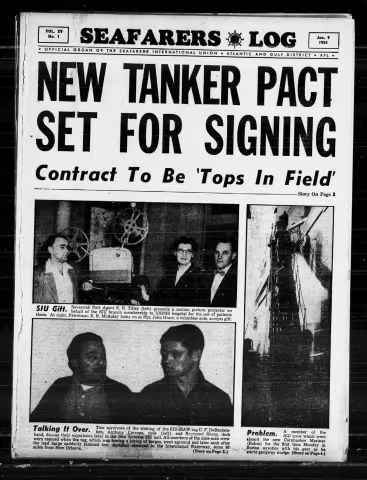
Issue Date
1953-01-09
Volume
15
Issue Number
1
Plaintext
y'
SEAFARERS ItOG
NEW TANKER PACT
Contract To Be Tops In Field
Story On Page 3
• Talking If Over* SIU-MAW tug C. r.DeBardele.
miles from Nm Orleans «er. Jntercoa5t;al: Waterway, some 80-\, v.
• ^ (Story mPage2.)
•'KV • •••••
A member of the
, , SIU crew which went
aboard the new Cornhusker Mariner
(Robm) for the first time Monday in
...Boston .wrestles, yrith. his gear as he
starts gangway trudge. (Story on>age4.)
4
•;i:
••i "V'T'
rue Tw* SEAFARERS 10G Janiuinr 9. 195S
SiU Aliens Detained
On Ships; McCarran
Act Overhaui Seen
A sizable number of alien crewmembers on SIU and other
US-flag vessels have been denied payoflT and discharge in the
first days of operation of the new McCarran Immigration Act.
Whi^p public interest .has been aroused over denial of shore
leave to «eamen on foreign-flag passenger vessels, the act has
on had a heavier impact
American-flag ships.
Judging from the early ef
fects of the law, it appears inevi
table that it will have to be Over
hauled by Congress at an early
date. Demand for changes has been
heard from many quarters, and the
law's sponsor. Senator Pat McCar
ran of Nevada has been quoted as
expressing willingness to modify it.
"There never was a law drafted
that was perfect in all its parts,"
he said. "Of course I'll be willing
to consider changes if they appear
to be needed."
In the first couple of weeks sev
eral SIU ships paying off in New
York have had alien seamen de
nied discharge and payoff. In most
cases the men were permitted
shore leave but have had to con
tinue as crewmembers for another
voyage, whether they wanted to
stay aboard or not.
Meanwhile, the SEAFARERS
LOG learned that Immigration is
granting extensions of the 29-day
shore leave limit in certain cases.
This is being handled on an in
dividual basis, where a man re
quests an extension of time to
catch a ship out.
Final Payoff Uncertain
Just how the denial of discharge
and payoff will work out in the
long run is still uncertain. It isn't
known whether the men involved
will be permitted to payoff on the
next incoming trip. If not, a sit
uation could arise in which a con
siderable number of alien seamen
could become semi-permanent
crewmembers on their ships until
Immigation makes a definite de
cision as to their fate.
In those cases that have come to
the attention of the LOG thus far,
the alien seamen involved have
been sailing with the SIU for pe
riods up to seven years. As sea
men on American-flag vessels they
had validated papers, which means
that they had been screened pre
viously and received security clear
ance from the US Coast Guard.
It appears then, that the ques
tion of membership in a subversive
SEAFARERS LOG
JOB. 9, 1953 Vol. XV. No. 1
As I See It Page 13
Burly Page 16
Crossword Puzzle Page 12
Seafarers In Action Page 18
Editorial Page 13
Foc'sle Fotographer Page 19
Galley Gleanings Page 20
Inquiring Seafarer Page 12
In The Wake Page 12
Labor Round-Up Page 16
Letters Pages 21, 22
Maritime Page 16
Meet The Seafarer Page 12
On The Job Page 16
Personals Page 24
Quiz Page 19
Ship's Minutes Pages 24, 25
SIU History Cartoon Page 8
Sports Line Page 20
Ten Years Ago Page 12
Top Of The News Page 6
Union Talk Page 8
Wash. News Letter..,. Page 5
Welfare Benefits.;.. .Pages 26, 27
Your Dollar's Worth..., Page 7
Bubllghed bIwMkty at tha haadquarfart
International Unidn, At-at tha Saafarer*
lantic * Gulf District, AFL, <75 Fourth
.Ma.^s:is?
at . tna^eort'
organization, or possible subversive
intentions, was not involved in any
of these cases. Otherwise the men
would not have received US sea
men's papers in the first place.
What is involved evidently, is a
strict enforcement by Immigration
of prohibitions against irregular en
try, or other McCarran Act provi
sions denying entrance to citizens
of Iron Curtain countries.
On one of the affected ships, the
Steel Chemist, two Union members
were denied payoff and discharge.
One was -a native of Estonia, the
other of Poland, two countries
which are now under Communist
control. The Polish seaman had
been a Union member for seven
years, the Estonian for six years.
(Continued on page 17)
Ore Signs; Food Poll Set
SIU this week signed a new agreement with Ore Steamship, leaving only two freight '
nies still not inked to a hew pact. Ore's specialized operations, like those of Construe- -
i\
..I
The
companies
tion Aggregates, make separate negotiations necessary. The SlU-Southern Trading Com-
—•••pany agreement does not ex-
Year-End Financial Check-Up
Closing the books on the year 1952, a weekly auditing committee
elected by the membership, examines the Union's financial data
for the week ending December 31. Members of this committee
were (left to right): E. Robinson, John Giordano, A. Louguidis.
LOG Hospital Story Stings NMU
Into $ Aid To Its TB Members
On the heels of a SEAFARERS LOG story revealing how the NMU was ignoring the
needs of its tubercular members, NMU men at Manhattan Beach hospital received a surprise
Christmas donation from their union and its welfare fund. Hardly had the LOG been mailed
out when the NMU took steps
Shown dlscasslng their problems before NMU came through with
surprise Christmas bonus are Manhattan Beach NMU patients
Morgan Lewis, Fred Homeman, John Hogan and Joe Blackstone.
SIU hospital delegate John Driscoll Is seated In rear. left.
SIU Co. Hears Subsidy
The Bloomfield SS Company moved one step closer toward^
receiving an operating subsidy on two trade routes as the
result of a favorable ruling by the counsel to the Federal
Maritime Board. The ruling"
ufid
held that the SlU-contracted
company was eligible for the
subsidy under the 1936 Merchant
Marine Act, even though it is not
presently operating over the routes
in question.
Bloomfield Is asking for subsidies
on two runs from the Gulf to
Europe; Trade Route 13, which is
from the Gulf to Spain, Portugal,
Mediterranean ports and the Black
Sea, and Trade Route 21, Service 5
from the west Gulf to the United
Kingdom i.ud Northcifi Europe.
The counsel ruled that present
steamship, . services on the twp
pUteh/ wi^^ 'hbt b||j^^d'atb| ^d ion
for another company to seek sub
sidy and enter that particular
trade.
Two companies, Lykes Brothers
SS Company, and Waterman SS
Company have opposed the Bloom
field subsidy bid on the grounds
that the company is not an existing
operator over those routes. The
Bloomfield position has been that
it does not have to be an existing
operator within the meaning of the
1936 act to be eligible for subsidy.
Should the company win final
approval of its subsidy bid, It will
mean expansion of, its present
operations, and possibly the addi
tion of more,ships to, calrry ,out
'the "numbef
to distribute a ten dollar bill
to each man at the hospital.
Its welfare fund later mailed $25
checks, copying the established
SIU Christmas-time practice.
At the same time, the NMU an
nounced in its official newspaper
of December 25, 1952, that "other
gains expected" (in a pending
contract review) "include the pay
ment of hospital benefits ... as
long as a member is hospitalized."
If this is done, the NMU welfare
plan vrfll catch up with the SIU
standard that was established over
two years ago. At present, NMU
men receive benefits for only 13
weeks.
Sudden About-Face
The NMU's sudden about-face
after turning its back on tubercular
seamen for a year, came imme
diately'after the November 28 LOG
told of growing unrest among the
90 NMU patients at Manhattan
Beach. The story explained that
these men had been cut off without
a penny in benefits since the first
of the year. Before that they got
$5 a month from the NMU treasury,
but with the start of the union's
pension and welfare plan, the NMU
decided, as it put it, "to eliminate
some of the drain which has been
placed on our treasury by this
hospital benefir' . . . Accordingly
the $5 a month was halted.
Letters Unanswered
Until the LOG entered the pic
ture, the NMU men had wriiten
several letters to their Union and^
never got even an acknowledge
ment. The LOG, which is mailed
out on Friday morning, is general
ly received by its readers, includ
ing NMU headquarters, the fol
lowing Monday.
No sooner had the LOG passed
through the mails than things
started to pop. That same Monday
night at nine o'clock, the NMU
hospital delegate received a special
the ui^on,
thai same day. The
letter aU&ed him for a list of the
sii^the W .afi
pire until a later date.
The signing now, as in the
case of all the other freight oper-.
ators, does not affect the retroac
tive features of the agreement,
which is dated back to November
18, 1952. The negotiating commit
tee also pointed out that the Ore
agreement sets the same wages
and improvements in general and
departmental working rules, where
they can be applied to the ore-
boats, that are included in the stan
dard SIU freight agreement.
As with Calmar, the Ore con
tract contains the same stipulation
for polling of the crews on the
ships 4li that fleet to determine
whether the company has fulfilled
its pledge to stock the vessels in
accord with SlU standards, and
put an end to the policy of under
stocking the ships and limiting the
variety of food available to the
crew. Both the Ore pact and the
one with Calmar, .which was
signed December 2, provide for the
crews to be polled by the end of
the month, by which time it is ex
pected that all ships of Jmth the
two companies would have replen
ished their stores.
Under the new agreement, if the.
Union finds that adequate improve
ments have not been put into ef
fect, it has the right to cancel the
agreements as of that date and
would be free to take appropriate
action on the problem.
In line with the drive to improve
feeding practices in the Ore fleet,
the steward department manning
scale in the new agreement pro
vides for an additional cook, so
that the cook and baker will re
ceive the same wages as a chief
cook and the galley utilityman tho
wages of a third cook.
NO Towboat
Sinks, SIU
Crew Safe
iiei
NEW ORLEANS—The nine-
man crew of the tug C. F. De-
Bardeleben escaped injury
when the Coyle Lines towboat ran
aground and was rammed and
sunk by a barge from her own tow
on Dec. 23.
SIU crewmembers said the C. P.
DeBardeleben ran aground in the
Intracoastal Waterway about 75
miles west of New Orleans when
the steering gear failed. The first
of several barges being towed by
the tug almost immediately rammed
into the towboat apd came over
her stem on the port side. The tug
sank in 15 feet of water in less
than 45 minutes.
Crewmen Aboard
The C. F. DeBardeleben was
manned by the following members
of the SIU and the SlU-affiliated
Marine Allied -Workers:
Captain Jerry Lovrovich, Albert
Stevens, pilot; Emile Pearson,
chief, engineer; Julius Viday, sec
ond engineer; William Kikuthe,
Leonard Howard, Raymond Sharp
and William Benefield, deck hands,
and Anthony M. Carcopa, cook.
The crewmembers got clear of
the sinking tug by climbing a lad
der from the deck of the towboat
to that of the barge towering over
head. They then made their way to
the marshy shoreline from which
all but Captain Lovrovich were
t-
ili'j'4.
• A. » > » ir 1 *
January •, 195S SEAFARERS LOG Page Thren
A&G Poll
Ends^Vote
Tally Soon
Voting for 49 official posts
in the A&G elections came to
a close at the stroke of mid
night, December 31, 1952. The
two-month referendum produced a
heavy vote here in New York and
in the outports, because of the
large number of candidates on the
ballot—75 ill all. While the total
vote is not yet known, indications
are that it may set a new record
for the Union.
Election of port and headquar
ters tallying committees to make a
count of the results will take place
at the membership meetings of
January 14, which is the first meet
ing in January following the con
clusion of the referendum. These
committees will mail the port-by-
port results and the ballots into
headquarters where the headquar
ters tallying committee will again
check the ballots and totals before
adding up the District-wide figures.
The tallying committees could
not be chosen at the last member
ship meeting, which was the eve
ning of December 31, since the
balloting was not yet completed,
A complete report on the elec
tions will then be made to the fol
lowing membership meetings of
January 28.
Those elected will serve for a
two-year term, under the provi
sions of the new SIU constitution.
The 49 offices, a record total for
the A&G District, consist of a sec
retary-treasurer, six assistant sec
retary-treasurers,' nine port agents
for the outports, and 33 patrolmen
divided as deck, engine, steward
and joint patrolmen.
SUP Slates
NewBldg
For Seattle
Next in line for a new SUP
hall on the West, Coast is Se
attle. The decision to con
struct a new hall there was made
by the last SUP membership meet
ing.
The SUP already has possession
of a site for the new building, at
First Avenue and Wall Street. Iti
is expected that construction will
get underway this summer as soon,
as plans are completed and the
weather is favorable.
The decision to build at Seattle
was governed by the fact that
rental paynients in the present
SUP hall there were high and the
Portland branch had recently
moved to a remodeled building
that was satisfactory for present
use.
As in other West Coast ports,
the offices of the SIU A&G Dis
trict will be located in the new
hall when it is completed. New
SUP buildings have been put up
in San Francisco and Wilmington,
with the Wilmington hall opening
last month.
Similarly, the. SU? locates its
oflttes 'in !NeW 'YoWanH mii; tksi
and Gulf Coast ports iif 'fhid ^iCr'
buildings there.
• AKiBW
PESULAR PBAru»e
OFTHH
SBAJPWSPA LOG
SlU-Co Negotiators Okay Pact
See Co's Signing
Next Week; Union
Hails Wide Cains
SIU tankermen will move far out in front of all other outfits as the result of
a new tanker contract providing wage increases of $15.22 to $47.17 a month for all
ratings. The new increases, range up to a high of about 16'/i percent for some
ratings, with the AB, oiler and fireman-watertender receiving a base pay of $305.64.
The new contract has been approved by Union negotiators and representatives
"^of the operators, with money matters retroactive to Jan
uary 1. As soon as the contract is signed by authorized
representatives of the various tanker companies in-
' you
CCN^TITUTION"
• BEGINS t.M IHIS ISSUE
Tanker Contract Mn Next Issue
A full report on the new tanker agreement is now being prepared
by 'the SIU negotiating committee and will be printed in the
January 24 issue of the SEAFARERS LOG along with the text of
the contract itself. The contract will be submitted to the member
ship for approval at the membership meetings of January 28 in
all SIU ports.
A comparison of the wage scales for all ratings under the old
and the new tanker agreement is carried in this issue on Page 17.
The comparison shows the dollars and cents increase for each
rating as well as increases resulting from upgrading in the stewards
department.
volved, it will be printed in^
the SEAFARERS LOG
and submitted to the mem
bership for ratification. Sign
ing is expected to take place
next week.
In addition to the base wage
Crew Flies Back To US, Quartette
Still Sitting Tight On Pacific Reef
StiU hard aground after she ran up on Pearl and Hermes Reef east of Midway Island nearly three weeks
ago, the Quartette sits tight while attempts to salvage the vessel and her cargo continue. Aii hands
were rescued from the ship, which was bound for Korea. Before the crew got off, it was feared that
a storm headed in her direction might crack the ship in half, but it passed her by.
Repatriated by plane on a New Year's eve junket that started in Honolulu at the tail
end of 1952 and wound up in Los Angeles during the first hours of 1953, SIU crewmembers
of the Quartette (Carras) figured they were pretty lucky to be back in the States safe and
sound no matter what year it"*-
was.
All 37 members of the crew
were successfully gotten off the
ship 24 hours after she ran up
on Pearl and Hermes Reef, 90
miles east of Midway Island in the
Pacific, shortly before 7 AM, Sun
day, December 21.
Rescue efforts got underway a
few hours after she straddled tjie
reef when a Navy plane and a pa
trol craft from Midway reached
the scene. Aaothsp nuti'<%ant ves
sel, the Frontenac VktM^ which
soon after reached the" tl^MS<
swamped on the wayend^
was kept busy trying to tow it back
to the ship.
The Quartette's own boats fared
little better, and it wasn't until the
next day that anyone was taken
off the ship. The crew then went
aboard - the Frontenac and was
taken to Midway, while the master
and a few of the officers stood by
on the scene with the patrol boat
to see if either the ship or its Ko
rea-bound cargo could be salvaged.
Felt Terrific Jolt'
As he recalled the events, the
usual early Sunday morning calm
SftHe,
w^en Ife av^e froro,^c
iolt the ah^ took "when shie' rode'
np and then just set
tled down and sat there. "We all
thought we had hit another ship,
but when we got out on deck and
peered around in the haze we could
see a light impression of some
thing dark a few feet below the
surface. Then we realized what
had happened." There wasn't any
apparent serious damage, he add
ed, as it seemed the bow and the
forepeak had just shot up onto the
reef and never did take in any
water.
The only complication in the
picture was the weather forecast
that a big bio,w was heading tjiat
\vay .'w)WcJ» tak;^! ppjd oJf, the
"ship "and f dclR her around 6n her
(Continued on page 17)
increases which maintain the
traditional differential in favor of
tankermen, the negotiating com
mittee won the same overtime rate
and same dividing line on over
time as in the freight contract.
This means an overtime rate of
$1.48 an hour for all men receiving
less than $298.49 per month and
$1.87 per hour for ratings over
that figure.
As a result of the new dividing
line, practically all rated men, in
cluding AB's, oilers and FWT's,
will now receive the higher over
time rate of $1.87 per hour in
stead of the $1.29 formerly paid
them, an increase of 58 cents hour
ly In their overtime.
Galley Upgrading
Additional money gains have
been won in the stewards depart
ment as the result of an upgrading
of ratings in the galley crew. For
merly the tankers carried a stew
ard, chief cook, second cook and
baker, galleyman, messman and
utilityman. Instead of a second
cook and baker, they will now car
ry a cook and baker who will get
the same pay as the chief cook.
This represents a dollars and cents
increase of $78.26 as a result of
the upgrading and the wage in
crease.
Similarly, the galleyman will
now be replaced on tankers by a
new rating as third cook. The dif
ference in wages between the two
ratings is $89.36. Three messmen
and a utilityman will be carried as
before.
Welfare, Vacation Boosts
Aside from wages, overtimo
rates and rewriting of general
rules and working rules as report
ed in the last issue of the LOG,
the tanker company representa
tives agreed to additional increases
in vacation and welfare payments,
effective October 1. This will
amount to another ten cents per
day per man for the SIU Welfare
Plan and another 15 cents per day
per man to the Vacation Plan, pav
ing the way toward new benefits in
both these plans.
As on the freight ships, the com
panies' committee has agreed to
permit the SIU Sea Chest to sup
ply slopchests to the ships unaer
the same competitive terms that
apply to the freight ships. This
will mean assurance of high qual
ity merchandise at moderate prices
for the tankermen.
prq.viopsly, .(hb, gea^
era! vuies and Avofking l>ul«& 6f th« '•
tainker a^bement tifiow ^he wori-*" *
(Continued
Pat* F*iir
l.illtL.. -1 !t:ihhl.i.tA..,,
SEAF ARKRS LOG
.^'.
,:t,•:::.; /,^r'.'. . . \ •-. , .-^ •
Juwaiy 9, 11M9
2nd SlU Mariner Ship
Takes Crew In Boston
Four shipboard deletates elected at first meeting of newly-manned
Comhusker Mariner chat with Boston Port Agent, Jimmy Sheehan
(right) in ship's messroom. They are: Ueft to right), John Lane,
deck; John McLaughlin, ship's delegate; A, J. Malanson, engine;
C, A. Moss, steward. .
Seafarers crewed up the second of the new Mariners under
the SIU, when the Boston branch hall supplied a crew to the
Comhusker Mariner, Monday morning, January 5.
The Comhusker is being op.--^-
erated by the Robin Line un
der time charter to the Mili
tary Sea Transportation Service.
As such she will be carrying mili
tary cargo, possibly on the Far
East run.
Mississippi Gets One
A third Mariner ship, the Mag
nolia Mai'iner, is how receiving her
finishing touches and has been as
signed to the Mississippi Shipping
Company. Present plans call for
the ship to be crewed up out of
New Pacts
Sought For
Shoregangs
MOBILE—Improved conditions
lor shoreganS workers on Water-
xnan and Alcoa ships in this port
are in the works in current negoti
ations between the Marine Allied
Workers, an SI& affiliate, and the
two steamship companiies.
Present shoregang contracts ex
pire on January 15, and the MAW
negotiating committee, on which
Cal Tanner, Mobile port agent for
, the SIU, is serving, is pressing for
an acceptable settlement on wages,
hours and working conditions.
Tug Talks On
The MAW is also in negotiation
with the Mobile Towing and Wreck
ing Company which operates tugs
in this port. This contract runs out
on January 31.
Meanwhile, the Waterman com-
Itwy announced that it was closing
BP shop at the Gulf Shipbuilding
Corporation, a Waterman subsidi- '
ary. All repair work on Water
man ships has been shifted to the
Waterman Repair Division at the
Alabama State Docks. Since the
Repair Division is part of the MAW
shoregoing set-up, and is the only
shipbuilding and repair facility op
erated by Waterman here, pros
pects are favorable for peak shore-
gang employment for Seafarers.
Previously, the Gulf Shipbuild
ing yards at Chickasaw had been
used for conversion and repair
to build new vessels for Waterman.
During World War II, the yard was
operated by the Na
New Orleans sometime at the end
of January or the beginning of
February.
The men who went aboard the
Comhusker nine o'clock last Mon
day morning found her an exact
replica of the Keystone Mariner,
the first of the Mariners which the
SIU crewed up for Waterman.
Shoregangs were still swarming
over the vessel putting on the last
coats of fresh paint and finishing
off the ship's highly complex wir
ing system.
As with the Keystone too, crew-
members expressed approval of the
de luxe crew accommodations and
the many electrically-operated fea
tures of the new vessel.
Built In Mass.
The Comhusker Mariner was
built by the Bethlehem Shipbuild
ing Corporation at its Quincy,
Massachusetts' yard. The ship left
Boston Tuesday morning, January
6, and stopped at the Army base
in Staten Island, New York, to load
cargo before departing on her run
for MSTS.
The Comhusker is one of 35 sis
ter ships, most of which are still
under constmction at various ship
yards around the country. The ma
jority of the ships are being char
tered to private steamship compa
nies, although the Navy is taking
some of them over for direct opei^
ation.
sEAmiwseuyTwaR
<SBAR AT OVIN
SEiCEilT
CASH BENEFITS
M
HosDiud Benefits A/.
Death Benefits //. /
Disabalitv Benefits
Msternitv Benefits
VscscioB Benefits 03
Total
5
SEAFARERS WELFARE, VACATION PLANS
REPORT ON BENEFITS PAID
No. Seafarers Receiving Benefits this Period
Average Benefits Paid Each Seafarer
Total Benefits Paid this Period
Jul
WELFARE, VACATION BENEFITS PAID THIS PERIOD
WELFARE, VACATION BENEFITS PAID PREVIOUSLY
Hon>ie.l BeMfits P.id Si^ce Inlv I. 1950 • 39^" a o|
Death Benefits Paid Since Tulv 1. 1950 • | '/fl
Disahtlicv Benefits Paid Since Mnv 1. 1952 * 1 A/ / 7^3 Jc
Msternitv Benefits Paid Since Aoril 1. 1952 • 1 7^. DO
Vacation Benefits Paid Since Feb. 11. 1952 • |f 7/f 9 09 If
Total f ' ' SX
* Date Benefits Becan 1 r ' SX
WELFARE, VACATION PLAN ASSETS
Vacation ^9 Cash on Hand
1S77 .2^7 If
Vncntion OQ Estunfttcu Accounts RccciTftblc Wclfstc
AOO 0 0
US GoTcrnnieoc Bonds (Welfare) ||^
Kd Est«e (*e««e) f , OQ
Other Assets — Training Ship (Welfare) It 00
TOTAL ASSETS 1 '
Comments 2
eternity benefits for the'past two week period have fallen
off, with only fourteen benefits being paid.
To date, there have been nineteen applications filed for
ihe scholarship benefits. Of the nineteen, four (4) were
disqualified. The remaining fifteen applicants consist
of five (5) seamen, five (5; sons of seamen and five (5)
dau^ters of seamen.
Vacation benefijbs are now having withholding and social
security taxes, deducted from same^^
V ^
SttbmUttd ......L.....;.......... iy Kerr, Assistant Administrator
,,. andy reme^bmr this,,,
i on your part—Collecting SIU bene-
is whether it'i for dififdiiUty get &st rate personal
'.All
its
Jaiinarjr f, 1»SS SEAFARERS LOG Fare Fir*
SIU NEWSLETTER
from WASHINGTON
• ' '' • . =3
The McCarran-Walter Immlrration Act, which became effective last
month, has been the center of a mounting controversy since Congress
repassed it oyer President Truman's veto last June. President-elect
Eisenhower iashed out at it during the campaign and declared that
"the McCarran Immigration Law must be rewritten."
Therefore, a big fight over an immigration policy for the country
is assured for the new Repubiican-controiled 83rd Congress which con
vened in this city on Saturday, January 3, 1953.
The State Department may ask Congress to take another look'at a
provision in the new law calling for individual examination of alien
seamen. Foreign maritime interests have protested that this require
ment creates additional financial burdens and will unnecessarily
hamper maritime operations.
Another matter that will be reviewed by the new Congress is the
•claim by steamship and airline owners alleging inequities of the im-
migation law in imposing on them obligations for detention and depor
tation costs, and in subjecting them to penalties for violations of the law
by their passengers.
4" 4" 4"
Able seamen and qualified members of engine departments may con
tinue to use their restrictive wartime operating certificates until July 1,
1953, under a recent Coast Guard order. During World War II certain
certificates issued to seamen were endorsed "Unless sooner invalidated
this certificate shall expire six months after the termination of the war."
Even though the Coast Guard has allowed the continued use of these
restrictive documents, the agency has urged that seamen holding them
apply for documents without this restrictive endorsement as soon as
possible.
^
Many American unsubsidized lines operating in the foreign trade
think the time is ripe to have Congress look into the subsidy law with
a view of changing it to make them eligible to receive Government
support in the operation of ships in competition with foreign-flag ships.
Under existing law, only 15 American lines have qualified to receive
operating subsidy, these companies owning only about 250 vessels. On
the other hand, the unsubsidized companies, which want in on the sub
sidy pie, own about 375 American-flag ships.
The present law provides for a subsidy, to those qualifying, to take
care of the difference in cost incurred by the American line, as com
pared to his foreign flag competitor, with respect to five items pri
marily, namely: wages, subsistence, insurance, maintenance and re
pairs to vessels. The unsubsidized lines now want this law changed to
provide for a simple subsidy plan calling for a wage subsidy to be paid
for the difference in wage costs of American operators and those of
principal foreign-flag lines. ^
Under this wage subsidy proposal, the unsubsidized lines say there
would appear to be a prospect of lending needed support to an addi
tional 375 American-flag vessels in the foreign trade at a cost only
slightly more than the expense to the Government of subsidizing but
260 vessels under existing law.
4» 4' 4*
The future of the biggest US shipping lobby, the National Federa
tion of American Shipping, is in doubt. From time to time there has
been a clamor within the Federation for a reorganization, but there
Is also talk recently of completely abolishing the group.
In the beginning, the NFAS, which appears before Congressional
committees and executive departments, was strong, comprising up to
90 percent of ail off-shore US shipping. • However, gradually individual
lines and whole associations withdrew from membership to the point
where the parent organization is now weakened considerably. The
next couple of months should give the answer to the future of the
NFAS as a major shipping lobby.
4" i" 41
Senator Magnuson, Democrat of Washington, will try to get the
Senate Interstate and Foreign Commerce Committee to Investigate the
Coast Guard's program of screening water front employees. The Sena
tor. believes that there cannot be true security on the waterfront by
the screening of only seamen and longshore labor, but that all harbor
personnel should be included. Therefore, the inclination will be to
make the rules more rigid in order to take care of some loopholes
now existing in the Coast Guard's program.
The Senator, for example, was astonished to learn that so few piers,
within a given, port area, were restricted. He is also looking into the
matter where a man who may be screened off a ship and denied papers,
may work on the waterfront on a non-restricted pier.
4 4 4
American ship operators, acting as agents for the National Shipping
Atithority in the operation of Government-owned tonnage, will be paid
$25 per day for each day of assignment not to exceed 60 days, in order
to wind up the affairs of the vessels. This "liquidating compensation"
is payable for the services of the agents, required by NSA, after re
delivery of the ships to the Government, for the adjustment and seftle-
' ment of accounts.
NSA had a peak number of 541 Government ships under agency
I operation as of March 28, 1952, but this number now has been reduced
; to 108, all of which are assigned to the Military Sea Transportation
I Service for carriage of military cargoes.
The $25 per day liquidating compensation to agents will extend over
the first 60-day period after which it will be reduced to $10 per day
for each day of assignment not to exceed 120 days, with the total amount
of compensation not to exceed $2,700 per ship.
4 4 4
The nation's stockpile program has been of great benefit to the
American merchant marine. At the present time the list of critical
materials totals 75. The stockpile objective—which is the quantity of
each material required to overcome estimated deficiency of supply
for military and essential civilian needs—^has been met for 18 of these
materials and the objectives for a number of others are being neared.
Seafarers Have Cheerful
Yulefide AH Over Globe
Seafarer Santa Claus, Roderick "Smitty" Smith, beams over family of Seafarer Carmine Lupino shown
at Christmas dinner In SIU headquarters. Six of ttie nine children are Lupine's.
On ship, in the hospitals, or on the beach, Christmas was celebrated in proper style by
Seafarers, as has been the tradition for years past. And this year, too, many of the Union's
neighbors near SIU headquarters joined in the annual party.
The big Christmas feed in^— —__——
headquarters, one of several
held in various SIU ports, at
tracted several hundred Seafarers,
their wives, children and guests.
Tickets for the neighborhood were
distributed through churches and
synagogues in the vicinity. Th&
outport halls such as in Philadel
phia and New Orleans, also served
as hosts to Seafarers and their
families.
The men in the various USPHS
hospitals were well remembered
this Christmas as in past years,
with the Union's Welfare Plan giv
ing a special $25 holiday bonus on
top of the regular $15 weekly hos
pital benefit.
Seafarers on the ships also got
into the holiday spirit. Many ship.s'
crews chipped in to buy Ciiristmas
trees and other holiday decorations
for the messrooms and recreation
rooms. And of course there was
the big holiday dinner at which the
stewards department did itself
proud. All the special holiday fare
was broken out; shrimps, crabmeat,
mince pies, olives, and other deli
cacies surrounding the turkey.
Then there were the hundreds of
Seafarers who piled off the ships
and headed for home to be with
wives, children or parents during
the holiday season.
Pappy with their $40.00 Christmas payments. Seafarers J. M. Kali (ieft) and James E. Garrett are in
holiday mood at Savannah USPHS hospital. At right, R. J. Burns of the Strathbay presents the ship's
fund to Mrs. John Grace of the Savannah Legion Ladies Auxiliary for the hospital's recreation room.
..il
S»l
New Orleans hail was also scene of Christmas festivities. ' This group of SIU families consists ef
(ieft to right): Jimmy Calloway, AB, holding dcngfetsr Shsryi; Mrs. Calloway, Maxine Stiglets, Mrs.
..... t i .V IIM1.W/xi.f'ifi'I
.: >E5r/,»t#4fid?<yxq9T iViolqU-m • v.. ": s.rl' «d . • .....yt.... t./r-r / r. ^
I
I -i?-
h
f
p.."
I-. v^'' "
PagiB'Sls
. /, u'
»?1«S
Injunction Frees LIberian 'Hell Ship'
PORTLAND, Ore.—Aft^r being tied Bp by picketlines for 3% months, the decrepit Li-
berian-flag Liberty, the Riviera, haa orewM up ind losdeS a cargo of Government-aid wheat
for India. Picketlines were withdrawn from th( '
sued by a US Federal Court "
e ship only after three injunctions were is-
judge.
Although the- ship finally
was able to load and sail, crew-
members of the vessel whose pro
tests against miserable conditions
on the 'hell ship' started the strike,
have won freedom from imprison
ment by Immigration, and all but
five have shipped out on other ves
sels. The net result of their strike,
which was backed to the hilt by the
SUP and SIU A&G District, has
been that other foreign flag ships
have taken steps to improve wages.
The Riviera story began on Sep
tember 9 when the ship reached
Portland. The crew then went on
strike against the very low wages,
bad food, filthy working and living
condition! and th« general unsea-
worllUness cf the ship. After they
had refused to work the ship 17
days, the operators got an order
from the US marshal evicting
them from the ship.
SUP members then took up the
picketing, while legal steps were
taken to secure release of the crew
men. In each and every case, high
er Immigration authorities re
versed the arrests and ordered the
men fris«d.
The Riviera operators went to
court asking an injunction against
SUP pickets. At the hearings, ex
pert testimony showed that the
ship was unsafe, with fire-flghting
equipment frozen, lifeboat hulls
rusted through and other unsea-
worthy conditions. When the court
issued an injunction against picket
ing on November 26, members of
the MM&P and the SIU A&G Dis
trict took over the lines, only to
have injunctions issued against
them in turn.
The MM&P line was enjoined on
the grounds that there were no
jobs for MM&P members. The SIU
consequently went to the company
and asked for the unlicensed jobs,
which were refused to Seafarers.
An SIU picket line was put on the
ship, but the judge issued an in
junction against it in the same
manner.
Crimp Had It Good Back In '08
Talk of the new contract and the
latest pay increases to $302.32 a
month for ABs, reminded Seafarer
Thomas Ruber of the time he took
a trip on a British schooner in 1908.
He brought his old discharges up
to the SEAFARERS LOG olTice,
showing that he got paid five
pounds per month as a deck hand,
which at the rate of exchange then
prevailing was about $24.
In order to get the job, which
lasted for four months and 25 days.
Ruber had to pay one month's
wages to a crimp plus four shillings
two pence, about $1, for two
night's lodging in the crimp house.
The .skipper also paid' a fee to the
crimp for supply-
him with ing
men.
Of course the
dollar was worth
a little bit more
in 1908 than it is
today, about $2.70
to be exact. So in
light of today's
doilar Buber was
getting the equiv
alent of $65 a month, still not
much in the way of a payoff. At
that, Buber said, his wages were
considered pretty good because the
ship, the Buccluch, signed on in
Portland, Oregon, at the American
wage scale. If it had signed on in
a British port, the pay would have
Buber
AUCOUHT Oi' WAttJilJ
/2< ••cC c t
i7,/-r \//. i. r
BAkinxas.
> J-
TmairwtmtH
Orftrtime
Kttiti
Totil
jpar menti
HNcmu uootM lumm.
Bnlf ICngairetnvBtS
or DitehiMYf Ff« {|
Abrotd
Oujoininir J
loTAL n*nuCTioxK, tXvlanifB of Allot.
n*Uo.« witbOBl iloflnoilnir allotaml*...
AUotHMiltt
FlNAfc BAUKCI £
m Eifwsw ns w frfiirf
-2 4
i-
/J-.
bifnaturo ff Ifmfo - yf • • -f
fiignntaro of SAnlnwii. ^ A ̂ ^
SAVINGS BANK.
TIM Baavd ot Tntf* Uloc dMinq* «f
umanfioi Btunm t* Mrs their Mmloi*,
ud with • rlew o( prerenlinf M itr
IWMlbl* the riek •! their lueinc er of their
belnff robbed by the erlmpe et their mfei.-
here eetebllehed SeTlnfi Beski et alir the.
Uercutlle Murine (Shlpplnf) Offlcee in lb*
UUted IQnfdgib The, •mn(emtnla derieed
br the Bead le eurr eat their ebjeete ere
'ezirfHeiy-Ma^e mtT-mtf of eolta^rehendon'.
end. vhel le et (reet iaportenw, lh«y inveln
na trpmm thalmtr, nor tho oUghlcit IroubU to
tho Dopooitoro.
are thereiore reeoamendad. when
thej are "paid oS" troa their ehlpa, le take
from the yoj table t aum of money tufficUnl
only for their imnudiate expmta, end depoeit
tor aefety the renuinder ot their wifee In the
Beamen'e Serlnge Bank. They ean then with
drew, /ree </ orjioiito, the whole amennt et
their DepeelU nt any Port they plceee^r thef
eeii wilbdihw portloM of Iheir money, Irtt M
one Feet sod then at another.
•** Xntereet at the rate o/i'-ptr month io nUo^i/od
for euerjr £10 ispaitti.
Discharge (left) shows net pay of 16 pounds 18 shillings and 2 pence
for a 4-month, 25 day trip after deductions for crimp and sIoi>s.
Back of discharge (right) urges, seamen to save their money to
keep from "being robbed by the crimps."
been around three pounds a month.
While Buber's pay was nothing
to brag about, he was better off
than some aboard. The ship car
ried a couple of deck boys who
YOU and fha SIU
CONSYIYUYION
From Article XXii
Section 1
cedore effect or.iy
'""®LTa?by a majority vote
offer approval oy
of the membership.
VOtjR fSGHVi 'fiNp
.M£H ARE
::S:: CONStfifUtKW^
^ rm *s "DBieseb to
,. "-yoy woM THESE
This provision gives—and guar
antees—the membership the de
ciding voice in the mosiimportant
Union function—the rotary ship
ping system. You make the rules
by which you ship. No official con
moke shipping rules.
got less than he, as well as some
English midshipmen in training.
The midshipmen got no wages at
all. As a matter of fact they had
to pay to take the tiip.
For his magnificent wage of five
pounds, Buber worked three
watches daily, four hours on and
four hours, off. And as was the
usual practice, when setting or
reefing sail, the men off watch
would be called up, so that the
day's work was closer to 16 hours
than 12.
Not Much Cooking
The entire crew consisted of 12
men on deck, a bosun, two mates,
a steward and a cook, "They didn't
need more than one man in the
galley because there vwasn't much
cooking to do."
Each man was expected to supply
his own tin plate, tin cup, spoon
and sheath knife with which to eat
his food. The foc'sle in which the
entire unlicensed crew lived, had
just one window, a small skylight
of thick glass set flush in the deck
above. There were lamps, but no
kerosene. "One of the men had a
dollar watch that he sold for 50
cents," Buber said, "and we bought
ourselves five gallons of kerosene
that we used for lighting."
There was no stove in the foc'sle
either, and since it was mid-Janu
ary when Buber signed on, the men
had to keep warm as best they
could.
Buber has just paid off a long
tanker trip on the William A. Bur
den, for which he collected $7,500.
"It's hard to imagine,/ the way
things were ther^ v hen you think
of the conditions we have today.
There's" "Jusf tfdf cdmi?afiii6«.'' ' h
NETHERLANDS MAY GET OFF. "DOLE"—The economy of Holland
is doing so well at the moment, that their government has been asked
by the US to "voluntarily" give up all US dollar aid. If they don't
do it voluntarily, it is expected that the US Mutual Security Agency,
which administers the aid program, will cut them ®ff anyway. The
Netherlands Government is a little hesitant about taking the step be
cause it would make it harder for them to get back on the aid list,
should their economy take a turn for the worse.
UN "BED" ISSUE STILL BLAZES—Congress, the State Department,
Justice Department and the United Nations were busy blaming each
other for suspected Communists or Communist-ssunpathizers on the
United Nations payroll. A House committee Investigating the situatio*
has charged that the State Department bungled clearance of UN em
ployees while a New York grand jury accused the US Federal attorney
of trying to stymie their inquiry into the condition. UN Secretary-
General Trygvie Lie got into the act by saying that the State Depart
ment didn't give him sufficient information on Americans hired by
the UN. In turn. Secretary of State Acheson said that none of the
people involved had access to any information that affected the security
of the United States.
CHURCHILL HERE TO VISIT EISENHOWER — Prime Minister
Winston Churchill has arrived in the US aboard the Queen Mary on
a visit to President-elect Dwight D. Eisenhower. The purpose of tlie
visit was to discuss the new administration's policy on aid to Great
Britain as well as Eisenhower's approach to world problems generally.
With many in Congress favoring a cut in US aid, Churchill was ex
pected to place emphasis on his country's need for continuing US
support.
CONGRESS PARTIES CHOOSE LEADERS—As was expected, Sena-
tor Robert A. Taft of Ohio was chosen Senate majority leader without
challenge. On the Democratic side. Senator Lyndon B. Johnson of
Texas was picked as minority boss. In the House of Representatives,
Republican Joseph Martin took over as Speaker replacing Sam Ray-
burn. The selection of Taft and Johnson was taken to mean that in
Congress at least the conservatives of both parties are in charge.
US OVERSEAS AIDES ATTACKED—"High living" by US Govern
ment employees overseas has been attacked by a special Congressional
inquiry surveying US overseas workers. The committee said that the
overseas workers were overpaid, with many of them having three or
four domestic employees and stenographers making $6,000 a year. It
also reported that there were too many employees with nothing to do
and recommended that half of the 250,000 overseas workers should be
dismissed.
i 4. i
PIRACY CHARGE PLACED AGAINST SEAMEN—Seven seamen
of various nationalities have been extradited from Tangier to France
and will be charged with piracy on the high seas. The men are accused
of hijacking a cargo of cigarettes from another ship and smuggling
them from Tangier to European ports.
US CUTS DOWN CHARGES AGAINST DuPONTS—The Depart
ment of Justice has dropped charges against 83 of 118 members of
the duPont family who had been accused of anti-trust practices.
Charges will be continued against the other 35 members in a Govern
ment attempt to break up the family's important corporate holdings
which include both the duPont chemical empire and the General Motors
Corporation, among others. The suit was originally filed by the Gov
ernment in. 1949. There is a possibility it may be dropped by the on
coming' Republican administration.
^ .
US, BRITISH MAY QUIT TRIESTE—United States and British
troops may be withdrawn from the Fi'ce Territory of Trieste that was
set up at the end of the War in the peace treaty with Italy. The pro
posed withdravyal plans involve turning over the occupied section of
the city to Italy, with the exception that the portion run by Yugoslav
troops would be kept by Yugoslavia.
t
EAST GERMAN RED TRIALS SEEN—First steps toward a trial of
East German Communist leaders on the pattern of the recent Czech
trials are hinted In a resolution of the East German Communist Party
charging certain men with "Titoism" and "Zionism." The deposed
leaders have been accused of being in contact with the same people
as Rudolph Slansky in Czechoslovakia. One of the accused men was
cited because he wrote an article favoring a German subsidy of emi
gration to Israel and urged restoration of Jewish property which had
been seized by the Nazi government to its former owners.
i. 4) 4.
SCIENTISTS AFFIRM HYDROGEN BOMB—The BuUetin Of the
Atomic Scientists Jias stated that the atomic test on Eniwetok atoll in
the South Pacific last November was definitely a hydrogen bomb ex
plosion. The Atomic Energy Commission had never stated whether
or not an actual hydrogen bomb was involved. The Bulletin estimates
that the bomb was at least twice as powerful as the improved atomic
bomb, or several times stronger than the Hiroshima bomb. It points
out that heat and light effects described by eyewitnesses at a -distance
of '30 to 35 miles compared to descriptions of conventional atom bomb
explosions from ten miles distance or less.
4' 4'
ITALY WILL REJECT DEPORTEES—The Italian Government says
it will no longer accept criminals and racketeers born there who are
marked fytr deportation by the US Government. They claim they do not
want a dumping ground lor Ameriean undesirables who happened
to Bora in Italy. The decision, is expected to have a bearing on the
dcjportktidn c Friihk'CoSfeilo'ah'd btheris.' ^ ' ' >'5'
JaaiuiT 9. %9n SEAFARERS tO G- Fdfe Sevea
AT SlU HEADQUARTERS
4th Ave. A 20th St. • Brooklyn
Swap yarns or watch the fights
on television with your old ship-
motes at the Port O' Coll-YOUR
union-owned and union-operated
bar. Bring your friends — where
you're always welcome. And the
tab won't fracture that payoff.
OWNED AND OPERATED
by HI*
SEAFARERS INTERNATIONAL UNION
ATIANTIC AND GULF DISTRICT A.F.L
Arco Job Security A Myth
Panama Locks In Repair
If traffic continues at the high level of 1952 when almost
8,000 ships passed through the Panama Canal, which is under
going an overhauling on its Pacific Locks, much delay to
shipping may be expected"*
over the next five-month pe
riod, according to a recent
announcerhent by Canal Company
officials. More than 700 men are
working on the repair job.
The locks of the Canal are the
key to its operating capacity. This
capacity is cut by more than half
during periods of overhaul when
one set of chajnbers is out of serv
ice. Under normal operating condi
tions when one set of chambers is
not in service, 24 lockages can be
made at the Pedro Miguel Lucks.
Careful scheduling of ships may
make it possible to handle the
same number at the Miraflores
Locks during the period. Canal au
thorities expect, however, to han
dle traffic in the most efficient
manner possible.
There may be delays in some
cases as much as 24 hours. During
the overhaul of the Gatun Locks
in 1950 some delays were longer.
Delays will be more frequent than
in the oast with the increased traf
fic during the present overhaul.
Canal officials feel.
A traffic plan for the overhaul
of the-Locks, expecting East and
West traffic to be equal, has been
devised.
The way it works in the Atlantic
Refining fleet, having your watch
run slow or missing a bus or train
is an open Invitation to getting
yourself fired, despite all the
AMEU's clamor about "job security
and representation."
In ARCO, you have to be at a
certain place at a particular time
or you wind up without a job. Tom
Buterakos, OS, found out how
much "job security" he had when
he was fired recently for being 30
minutes late. His case parallels
the case of Paul Babyak, who was
an AB on the Atlantic Exporter,
and was fired for being five minutes
late in getting back from coffee
time. In both cases, the AMEU
just ignored the whole thing.
Buterakos was aboard the Deal
er while she was drydocked in
Alabama. He had been sailing on
the Dealer since August. One
morning, because of circumstances
beyond his control, he got back to
the ship 30 minutes late to turn to.
He gut to work at 8:30 AM, instead
of at 8 AM.
Buterakos said there was noth
ing mentioned at the time, but
about 10 days later, while the ship
was on its way to Philadelphia, the
Throw In For
A Meeting Job
Under the rules of the SIU,
any member can nominate
himself for meeting^chairroan,
reading clerk or any other
post that may be up for elec
tion before the membership,
including committees, such as
the tallying committees that
will be chosen at the next
membership meeting.
Since SIU membership meet
ing officers are elected at the
start of each meeting, those
who wish to run for those
meeting offices can do so.
The Union also welcomes
discussions, suggestions and
motions on the business before
the meeting. Seafarers are
urged to give the membership
the benefit of their opinions so
that the membership can act
accordingly.
Organizing Director Keith Terpe (right) administers the SIU oath
of obligation to three crewmembers off the Atlantic Importer after
they received SIU books for their activities in the Atlantic organizing
drive. Shown (l-r) are John Lager, AB; Bob Anderson, oiler, and
William Allen, FWT. In the background is a board showing the
itineraries of Atlantic tankers.
mate went up to him and simply
told him that he was fired, and that
was all there was to it. Buterakos
had sailed aboard SlU-contracted
ships from 1950 until August,
when he went aboard the Dealer.
"Those guys were always talk
ing about job security," he said,
"but I sure found out fast what
kind of security they have. I went
to the marine department a few
days after the mate fired me, and
they told me I was finished. That's
all there was to it.
"But one of the biggest beefs is
the amount of dough that the guys
lose on overtime under the present
setup. The way it works, the mate
keeps a record of the overtime, and
the men don't know how they
stand until just before the payoff.
Even then, there's just no way that
a guy can beef if he's being
chiselled out of some overtime.
"On SIU ships, every man keeps
a record of his own overtime. In
addition, he turns in his overtime
within three days after he works it.
If there's any difference between
the record the mate keeps and the
record the man keeps, then the man
has a complete record of'his own
that he keeps until the patrolman
gets aboard. Then the whole thing
is straightened out right there.
"My payoffs from ARCO were
sure way below the payoffs I got
in the SIU, and my earnings for
the same period were higher when
I sailed SIU.
"In addition to not being able to
beef about overtime you have com
ing, there's a lot of things we had
to do on the Dealer that would
have brought overtime under an
SIU contract, but we didn't get any
thing for it from Atlantic.
"I figure that I'll probably go
down to the SIU Philadelphia hall
now, and catch a ship."
Put Number On
^Meeting Excuses
Seafarers sending telegrams
or letters to the New York
headquarters dispatcher asking
to be excused from attending
headquarters membership
meetings must include the reg
istration number of their
shipping card in the message.
From now on, if the number
is not included, the excuse can
not be accepted by the dis
patcher.
YOUR DOLLAR'S
SEAFARERS GUIDE TO*BETTER BUYING
Written exclusively for
THE SEAFARERS LOG.
by Sidney Margolius,
Leading Expert on Buying
How To Buy A Raincoat
What's the best kind of raincoat for a Seafarer to buy?
Getting the wrong kind for your needs can make you a
very disillusioned man. The coat you thought would pro
tect yon from a beating storm may turn out to have been
designed only for light shWer duty. Another kind may
protect you well, but also make you sweat like a pig in
warm climates. Or you may find a new raincoat tearing
apart at the seams when a fresh breeze hits it.
What raincoat you ought to pick from the dozen
different types available should depend mostly on how
much you expect to use it outside. There are two basic
types: waterproof coats and water-repellent ones, and it
wouldn't pay to buy one kind in the belief you were get
ting ithe other.
^e completely waterproof coats are generally rubber,
rubberized or plastic-coated fabrics, plastic film, or oil-
coated cotton (slickers); They really protect you from
rain, and so are best for work purposes. But, because
they're honporous, they're generally very hot.
Water-repellent coats on the other hand, won't keep
you dry if you're exposed for a long time to a hard rain.
These are fabric coats, generally cotton poplin or gabar
dine, with a water-repeilent finish which does not, how
ever, seal the pores of the material. Thus air can pass
through the cloth so you're comfortable but after a while
rain begins to seep through too. The water-repellent
coats are generally dressier than the completely water
proof type. The poplin ones are iighter in weight than
the gabardine and not as warm. These are the dressiest
type and csp, L)p.p^,(I,ai^[jtw»(5pat^|,,lipo, you,qpn
a gabardine trenchcoat with a wool zip-in liner so the
coat can be used in all weather. .
Here's a lineup of the various kinds of raincoats you
can select from for your particular needs and the special
advantages and disadvantages of each:
Plastic hsincoats: Plastic film coats are least expensive.
You can buy one for as little as $2, but a good one that
will resist tearing costs $4-$5. Advantages: they're very
compact and can be rolled up to fit in a valise or your
coat pocket for shore trips; a good choice for a second
raincoat. The trouble wfth plastic film is its tendency to
rip. Make sure you pick one of heavy-gauge film with
electronically-welded seams.
Among the finest but costliest lightweight raincoats are
the new nylon ones which are treated with a coating of
plastic. These are small enough to fold in a carrying
pouch. They're available in a dressy fly-front style. But
they cost $15.
In buying any, plastic or lightweight coat, get it big
enough to wear over another coat in cold weather.
Rubber Coats, Slickers: These are good heavy-duty
coats for ship or shore use. They completely protect you,
but as noted, they'aren't cool, nor are they dressy. For
use in severe wfiather, get one with a protective cape in
the back, preferably with air vents underneath for ventila
tion. Well-made coats of this type have fabric collars,
either of corduroyj or at least cotton flannel, to keep your
neck from chafing. A good black I'ubber coat costs $12-
$15. Oiied slickers are less expensive (under $10). But
make sure they're labeled triple-coated for best protec
tion. «
KubbeiiM!# 'tTrenohcoats: A good compromise between
dressier treqcheoatsJjs^A
rubberized cotton gabardine coat. This kind has a thin
inner coating of rubber for rain protection. You can buy
one for as little as seven bucks in fly-front or trenchcoat
style. The rubberized topcoats won't last as long as the
water-repellent gabardines and poplins but do give good
protection, are fairly dressy for shore use and in general
are a useful coat at a reasonable price.
The better-quality non-rubberized cotton gabardine
trenchcoats cost $15. These are treated with water-repel
lent finishes which generally must be renewed from time
to time. For good quality, look for a smooth finish, deep
diagonal ribs in the material and a close, firm weave.
You can also get cotton gab trenchcoats with wool zip-
out liners for as little as $20.
Another choice is wool gabardine and covert topcoats
treated witfi water-repellent finishes. These are expensive
—$^5 up. You can -8dd~a*'-wooI zip-out lining to these at
a cost of $6-$10 more and thus have an all-weather
If you do get a water-repellent topcoat, this^departrherit
recommends getting the liner too so the,coat ^1 have
added usefulness.
You can now buy water-repellent finishes t,o spyay on
clothing yourself. These' sprays can be used on shoes,
hats^ coats, etc. In fact, if you already have a gabardine or
covert topcoat you can convert it into a raincoat by spray
ing it. This treatment is effective only if the material
of the coat is a tight weave like gab or covert, not if
it's loosely-woven like tweed.
One of the best advantages of the water-repellent
sprays is to enable you to renew the water-repellency of
fabric raincoats yourself idter they have been cleaned
instead of paying for professional refinishing.
Among the water-repellent sprays you can buy for treat-
,_«tog.ClQLh?|,.y5»urself are DraXj, Aqua-P^f, and Gard. ^
Vac* EltM SBAFARE MS LOG tmatay p, ISSi ' ,. "'r-
Artist Has
$ Solution:
'Ship Ouf
Seafarers in the New York hall
the past few days may have noticed
one of their number industriously
fketching in the shipping hall.
While waiting to catch a ship, Sea
farer David O. White has been
turning in sketches of his impres
sions to the SEAFARERS LOG.
The 25-year-old Seafarer re
ceived his art training at three
schools in California, among them
the Claremont Graduate School of
Art at Claremont, Calif. He de
cided to go to sea last September
when he found that painting in
oils was a fast way to get hungry.
He recently paid off the Chickasaw
(Waterman) on which he put his
spare time to use drawing and
sketching shipboard scenes.
"You can't paint and earn a liv
ing at the same time," he said. "So
I'm planning to sail and save up
some money. Then maybe I'll settle
temporarily some place where I can
live cheaply and devote my time to
painting. It might be Italy or
Mexico, but I haven't made up my
mind yet.
"With present wages and condi
tions on board ships, I expect it
won't' be too long before I'll be
able to settle down and paint full-
time for a while."
White has promised to display
his work in other art forms when
the SIU holds its secohd annual- art
contest this year.
Artist David White, now working as a Seafarer, did this sketch
of men in the New York shipping hall, while waiting for the hourly
job call. White also does a good deal of sketching on board ship,
and will enter the SIU Art contest, when it is held this spring.
Jst Seamen's Union
Born 86 Years Ago
Eighty-six years ago this Sunday, January 11, 1866, to be
exact, the first seamen's union came into existence at a meet
ing in San Francisco. The new organization, called the Sea
men's Society for the Pacific-*
Coast was the beginning of a
long struggle to win for sea
men recognition as free men and
citizens.
At the time of this first feeble
beginning of maritime labor, sea
men were held in bondage aboard
ship. The laws permitted the
master to beat, wound, starve or
imprison the seaman, unless it was
proved he did It "without" justifi
able cause." In actual practice, the
master could dispense any punish
ment he chose if it was justified in
his mind. It wasn't until 1898 when
corporal punishment was declared
unjustifiable, and mates held re
sponsible.
Beatings Common
There, are numerous cases on
record of those days when seamen
were beaten with belaying pins,
"triced up" or hoisted" by their
wrists so that their toes barely
touched the deck, and tortured in
other ways. Scurvy was still com
mon on merchant vessels and tween
deck focsles ^^ere the rule. Crimps
and masters, hand in hand, shang
haied seamen and kept them per
petually in debt, which was easy
when men were paid $20 to $30 a
month.
12-Hour Day Sought
The Seamen's Society didn't last
very long, but the idea of an
organization to protect seamen
stayed alive.- It was followed in
January 31, 1878, by the Seamen's
Protective Association, which at
its peak, had 600 members. The
crimps and boarding house masters
soon broke that organization. While
it existed, it attempted to get pros
ecution of shanghaiers and bucko
mates and masters. Of 100 cases
of cruelty reported to the authori
ties, the only punishment was a $25
line levied against the mate of one
ship, the Western Belle.
The program of the organization
also called for a 12 hour day at
sea, and overtime pay. But nothing
ever came of it, and the organiza
tion collapsed in November 1882.
UNION TAtK
By KEFTK TERPI
Almst two months aftef the AMEU delivered its
much-advertised "new" contract, which turned out
to be little more than a rehash of some provisions
in SIU agreements up to ten years old, its dwindling
membership in the Atlantic fleet is still waiting for it to be put to work.
Atlantic tankeririen arc sore over the peculiar situation whereby work
now payable with overtime is no longer done by unlicensed person
nel although the "agreement" establishing the new rule is prominently
posted around the ships for all to see.
Now You See It, Now You Don't
One example of this called to the attention of SIU organizers by
several crewmembers on the Atlantic States is the case of a provision
in the new agreement giving straight overtime on watch and OT-and-a-
half off watch for butterworthing. Now that it's officially written into
the pact, the engineers themselves are being called on to start and
stop the butterworthing system although it always used to be oilers'
work.
Another of the quirks in this non-working agreement applies to
sanitary work by the 8-12 OS on another Atlantic ship. On an SIU
ship this work normally consists of cleaning the passageways, heads
and rooms of the unlicensed deck department personnel, and the crew-
member elected as deck delegate will see that he does it and does it
right. The same is supposed to. hold true according to the AMEU pact.
But in Atlantic the ordinary is supposed to (1) do all the above;
(2) clean the pumpman's room (since when is he a member of the deck
department?); (3) clean the passageways in the licensed engineers*
quarters; (4) make 10 o'clock coffee. Then if there is any deck de
partment work to be done the sanitary work is let slide. In one case
(and it's not the only one), while the ship was loading cargo the OS on
sanitary work was kept on deck to handle valves and told to let the
sanitary work go! In matters like these, of course, overtime pay is
something that a loyal, overworked and underpaid workingman is not
supposed to bring up.
There's Humor Too
Now it's obvious that a little serious reading of what the AMEU re
fers to as the "best agreement in the Industry" will always turn up a
little humor. So it is that one item in this outstanding document de
serves special mention. As an example of the way a heads-up'"union"
negotiating team is working to serve its membership, the AMEU calls
attention to the fact it is anticipating a great wave of seasickness which
will plague the fleet in days to come. Thus it points out that the com
pany is considering furnishing all masters with seasick pills. Thus
we have another example of how a militant union strikes a mighty
blow in the direction of obtaining greater take-home pay, benefits end
representation for its membership.
Many members may have noticed the unsolicited tribute to the artist
who draws the cartoons for the "Atlantic Fleet News," published in
the last issue of the LOG. The writer applauded the cartoonist for
hitting the nail on the head when depicting some of the sorry condi
tions in the fleet. The "Atlantic Fleet News" several weeks ago ran
a cartoon strip about a washing machine on one of the ships that rattled
and sputtered and all but fell apart every time someone went ne?r it.
Little did the artist know he was forecasting coming events.
Real Life Situation
The unfortunate part of the story is that the cartoon wound up in
a real life situation not so many days ago. One man on that very
same ship received some bad leg bums from 200 degree steam that
poured out of a hot water line which snapped off when he was washing
something in the machine. Unhappily for this man, although the AMEU
and Atlantic went so far as to recognize the value of many clauses
in past SIU agreements and include therd in their own current pact,
they didn't heed the warning in the "Fleet News" about the decrepit
washers on their ships. We hope they begin reading us even more
closely than they have been.
Cartoon History Of The SIU Organizing The Unorganized No. 2a
Despite the burden of the war, organizing work
went on. Numerous companies were organized.
However, oxperience showed the need for a per
manent organizing department, which was set
up in 1045. It immediately set its sights on
orgaiiiziiiK Isthmian, the largest of the unor
ganized companies^ and planned its drive.
.'r. - •
'".'f i : '•
«j:v
.. . y >• 1
The new organizing department \ stressed
organizing on the ship. Voluntary sMpsi organiz-.
ers made every messroom a Uni(^ i^all .. . .
shoreside organizers met.the ships, discussions
were started at coffee-time, during meaU,
Branch agents, patrolmen, and the eptin
bershlp. Xqt behia4.tljs.d£jxf
W.I
Bather than hire an expensive staff of lawyers,
the SIU organizers studied and mastered Gov
ernment procedure and NLRB proceedings. The
result was less money spent, better results. In
All elections conducted by the NLBB in which
the SIU was a contestant, the final decision waa
M,
* Tr -...if '-•• -J:
• aril?. ffCl
.i,:-^tg^,^-jy'r .--r»^',J-.-
ra(« TM SEAFARERS LOG Janniry 9, 195S
PORT REPORTS m m m
New Orleans:
SlU Ghrislmas Dinner
Is Ronsing Success
We have had a brisk shipping
turnover here since the last meet
ing and expect to, at least, hold
our own in the coming two week
period. We paid off eight vessels,
signed on four, and have 15 in-
transit.
Payoffs were on the Pennant and
Ranger (Alcoa); Del l^orte, Del Sol,
and Del Valle (Mississippi); Antin-
ous and Chicasaw (Waterman); and
the Catahohla (National Naviga
tion). We signed on the Alcoa Pen
nant, the Del Rio, Del Norte, and
the Del Aires of Mississippi. Ships
in-transit were; Alcoa Pilgrim,
Corsair, Clipper and Cavalier;
Steel Director (Isthmian); Del Rio,
and Del Aires (Mississippi); Sea-
train New York and Savannah
Seatrain); Morning Light, Mon
arch of the Seas, Fairland, North
western Victory, Amberstar and
Southern Counties.
One of the most successful and
enjoyable Christmas dinners ever
given at the New Orleans Hall was
enjoyed by Seafarers on the, beach
for the holidays and their families.
Preparation of the food was start
ed on the day before Christmas
and everything was in readiness
for the dinner to begin at 12:30
PM on Christmas Day.
Full credit for the success of the
affair must go to. members of the
SIU staff in the port who worked
day and night for several days be
fore the event, and to Seafarers
who volunteered their services
during the final hectic hours of
cooking and serving the fine meal.
Among those who did a first rate
Job and who earned the apprecia
tion of their fellow Seafarers for
the work they did as members of
the galley crew and as waiters
•were Francisco Escobal, Milton J.
Mouton, L. O. Bumatay, George
Nichols, Don Collins, Martino De-
Salvo, Riley N. Crabb, John Chan-
nasian, Ashby Thompson, John
Doyie, E. J. Schielder, Frank Bal-
tazar, and O. Flynn.
More than 200 persons -were
served and there was plenty of
roast turkey, baked Virginia ham
and all the trimmings for every
one.
Too Thorough
A few members have come to
the conclusion that maybe the
LOG is a bit too thorough in its
coverage. It seems that several of
the boys had been "holding out"
from their payoffs and their wives
caught up with the game- by read
ing the wage scale in the LOG
supplement which published the
new general cargo agreement. This
was the subject of some good-
natured kidding, but, generally
speaking, this issue of the LOG
was one of the most popular of the
year. One of the first requests of
men coming ashore has been for a
copy of the contract supplement.
As reported previously, loading
of nitrate now is being permitted
in this'port. Such cargo is handled
at the Braithwaite dock facilities.
A campaign also is being launched
by business interests here to in
crease the loading limit for class
"A" explosives at Braithwaite. If
successful, this effort will make ad
ditional cargo available for loading
here. The present limit on explo
sives, imposed by the Coast Guard
as a safety restriction, is 600
pounds. The increased limit being
sought is 100 tons.
All event of interest this month
will be the arrival of the Motor
Ship Italia to. accept passengers
tltei'fii;^t,<pf.if<>ur 14-day Carib
bean cruises planned this winter.
The Dock Board says the Italia is
lean§ since the war. This competi
tion is not expected to cut into
business of the SlU-manned Mis
sissippi and Alcoa passenger ships.
These ships generally are well-
booked far in advance of sailing
dates and the facilities they offer
for luxury cruises to Caribbean
and South American points are
equal to the finest.
One phase of a $30 million port
expansion program being carried
on by the New Orleans Dock Board
was completed with the opening
operation of a new $1 million ba-
•nana terminal. The terminal, said
to be the world's second largest,
is equipped to handle 8,000 stems
of bananas an hour.
Other phases of the expansion
program include increased wharf
facilities, a new grain elevator, and
installation of more modern means
of handling cargo.
Lake Charfes:
Holiday Shipping Boom
Spurs Manpowor SOS
Bonus Checks
Hospitalized members were given
$25 Christmas bonuses during a
special Christmas Eve visit and
seemed to be cheered by the re
membrance financed by the Wel
fare Plan.
Kris Gunderson, a real veteran
of the Union and the industry, un
derwent emergency surgery and
seems to be responding satisfac
torily to treatment.
Lindsey J. Williams
New Orleans Port Agent
i i 4.
Galveston:
Shipping Far Ahovo
Average In Texas Perl
For the past two weeks shipping
has been way above average. We
shipped out 231 men, about two-
thirds of which were permitmen.
We had two ships paying off and
signing on, and 14 ships in-transit.
Payoffs were on the Burbank Vic
tory (Eastern), and the Alice
Brown (Bloomfield). Bloomfield's
Genevieve Peterkin and the Bur-
bank Victory signed articles. In-
transits were the Bents Fort,
French Creek, Archers Hope, and
Government Camp (Cities Service);
Mae (Bull); Federal ("Trafalgar);
Petrolite and Julesburg (Mathia-
son); Seatrain Louisiana and New
Jersey (Seatrain); Del Rio and Del
Aires (Mississippi); Michael (Car-
ras), and the Northwestern Victory
(Victory Carriers).
There were no beefs on any of
these ships with"all payoffs coming
off clean. Christmas spirit pre
vailed all around, with most of the
men anxious to get home to their
families as quickly as possible.
Oldtimei's on the beach at the
moment include O. J. Harden,
Mike Leousis, W. W. Currier, W.
R. Thompson, and J. L. Hayes.
Keith AIsop
Galveston Port Agent
Things have really been boom
ing in the shipping picture here
for the past two weeks. We shipped
62 men from here and had to call
out of town for eight more, ma^ng
a total of 70 jobs, in all ratings.
We have about 35 men in all rat
ings on hand at the present time,
so we can fill any order.
Causing this
rush were the
Long Jack, Arch
ers Hope, Winter
Hill, Paoli, Gov
ernment Camp,
Chiwawa, Bents
Fort, and the
French Creek of
the Cities Serv
ice fleet, the
Federal of Tra
falgar, Epiphany's Wanda, and the
Trinity of Carras. All of these
were in very good shape with fine
SIU crews on each one.
MacCaskie
Finally, our fondest hopes came
true on Wednesday, Dec. 31, 1952.
Twelve full book-members were
assembled in this port, so a reg
ular meeting was oj>ened. Quite a
number of ow permitmen were
present and were very much im
pressed with the, way things were
going. All of the members took
the floor and spoke on the things
that the Union stood for, and
were well received.
On the labor side of the picture
locally, we have no beefs outstand
ing agywhere in this area, and all
locals report that all their mem
bers are working, with more work
in the offing. Politically, we are
girding for an election to be held
in about four months for a mayor
of our fair city, and, as usual, labor
has a stake in this vital affair.
New Xears and Christmas have
come and gone and now we are
trying to get ourselves collected
again and go back to work. We
had quite a few of our members
around for those days and all re
port a fine time,
Pulls Stunt
For the "Seafarer of the Week"
we nominate Thomas MacCaskie,
who joined the Union in 1944 and
sailed the rest of the war. Mac
holds ratings in the engine depart
ment and is quite well known in
the port of New Orleans where he
sailed the glamour wagons to South
America. He is best known on the
Mississippi ships for a little.stunt
he pulled.
He made a small wager with an
other character to the effect that
he would not go ashore for one full
round trip. Mac was so determined
to win that he would not even go
on the dock to hook up a water
hose for fear that his opponent
would claim that he had been
ashore. New Orleans to SA and
back is some grind without shore
leave, but Mac won and loud was
the wailing by the loser when the
payoff came. Mac is noW busy sail
ing coastwise on the tankers, and
says no more long trips for him.
Among the men on the beach
now are J. Phillips, J. Mitchell, M.
Launey, C. Silcox, W. Hughes, M.
Fuenties, R. Reese, A. G. Alexan
der, R. Heahly, J. Quinn, S. A.
Thompson, R. Slay, J. Brady, and
D. Demaret.
Leroy Clarke
Lake Charles Port Agen;t
t 4.
Philadelphia:
1952 Oulslanding Year
In Seafarer Benefits
Shipping has been excellent for
the past two weeks and by all ap
pearances the following two weeks
look just as promising. This port
is still the place for rated men.
Now that the McCarran Act has
gone into effect, we are faced with
the alien problem, fhere seems to
be some issues which are not fully
clear, yet we are doing the best we
can for our alien membership. Un
like other Unions, we are not leav
ing our men out in the cold. We
appeal to our membership who
have the necessary time for their
first papers to apply as soon as
possible for them.
Four ships payed off, five signed
articles, and 27 were in-transits.
Payoffs were on the Alexandra
(Carras); McKsttrick Hills (West
ern Tankers); Sweetwater (Metro);
and Carolyn (Bull).^ The first three
signed on again, along with Bloom-
field's Ann Butler and the Atlantic
Water of Triton.
The following ships were in-
transit: Winter Hill and Lone Jack
(Cities Service); Holystar (Inter
continental); Purplestar (Traders);
Wacosta, Afoundria, Chickasaw,
Azalea City, Fairport, DeSoto, and
Bienv"le (Waterman); Ann Butler,
Robin Tuxford, Kirk, and Locksley
(Robin); Lewis Emery (Victory
Carriers); Atlantic Water; Ocean
Star (Dolphin); Rosario, Monroori
Marina, and Arlyn (Bull); South
ern Districts (Southern Trades);
Michael (Carras); Steel Executive
(Isthmian); Federal (Trafalgar);
and Santa Venetia (Elam).
It was an outstanding year in
shipping and in Union gains and
benefits for the Seafarer. Here is
a hope that 1953 will use 1952 as
a jumping off point for even great
er gains for the members of the
SIU.
A. S. Cardullo
Philadelphia Fort Agent
SrU MALL nUtECXOR Y
SIU, A&G District
BALTIMORE 14 North Gay St.
Mulberry 4540
.. . 276 State St.
Richmond 2-0140
Richmond 2-0141
... aOBVi 23rd St.
Phone 2-8448
Earl Sheppard. Agent
BOSTON
Jamea Sheehan, Agent
Diapatcher
GALVESTON
Keith Alsop. Agent
LAKE CHARLES, La 1419 Ryan St.
Leroy Clarke. Agent Phono 6-5744
MOBILE 1 South Lawrence St.
CBI Tanner, Agent Phone 2-1754
NEW ORLEANR 523 BienviUe St.
Lindaey WUliama. Agent
Magnolia 6112-6113
NEW YORK 675 4th Ave., Brooklyn
170 STerUng 8-46'
NORFOLK 127-129 Bank St.
Ren Reea. Agent Phone 4-1083
PHILADELPHIA 337 Market St.
g. CarduUo Agent Market 7-1635
PORT ARTHUR 411 Auatin St.
Don Hilton, Rep. Phone 4-2341
SAN FRANCISCO 450 Harriaon St.
H. J. Fischer, Agent Douglas 2-5475
SAN JUAN. PR 252 Ponce de Leon
I^VANNAH'^f ;!I-2 Aberco'rn St.
E. B. Tilley. Agent Phone 3-1738
SEATTLE 2700 lat Ave.
Senecft
Ray White. Agent
WILMINGTON. CaU£ 50^5 Marine. Aye.
Phone 3-1323
Sam Cohen. Agent Terminal 4-3874
HEADQUABTQIS .675 4th Ave., Bklyn.
SECRETARY-TREASURER
Paul HaU <
ASST. SECRETARY-TREASURERS'
' Lloyd Gardner
Robert Matthews Claude Simmons
HEADQUARTERS REPRESENTATIVE
Joe Alglna
SUP
HONOLULU 16 Merchant St.
Phone 8-8777
PORTLAND....... 533 N. W. Everett St.
Beacon 4336
RICHMOND. CAUr 357 Sth St.
Phone 3599
SAN FRIM^aSCO .450 Harrison St.
Douglas 3-8363
SEATTLE. 3700 lat Ave.
wttiiiNtmiM .m
YOKE. m 4t» Ave., Bl
STerfiag
/HALIFAX. N>|
Cqfiidioii OiBtrid
FORT WILLIAM.... 118V4 Syndicate
Ontario Phone: 3-3»l
PORT COLBORNE.., 103 Durham St.
Ontario Phone: 5591
TORONTO. Ontario 88 Colborne St.
Elgin 5719
VICTORIA. BC 617H Connorant St,
Empire 4531
VANCOUVER. BC 565 Hamilton St.
Pacific 7824
SYDNEY. NS ...204 Charlotte St.
Phone 6346
BAGOTVILLE. Quebao 30 Elgin St.
Phone: 545
THOROLD. Ontario 37 Ormont St.
Phone: 3-3303
QUEBEC 113 Cote De La Montague
Quc^^ _ Phonef 3-'
SAINT JO:
NB
Great Lakes District
177 Prince WUliam St.
Phone; 3-3040
ALPENA • 133 W-
Phone: 1338W
BUhf'ALO. m.,.. .^ ..m Main St.
-( Jnwne: Cleveland 7391
CU^ELANB......7M Lakeside Ave.. NE
Phone: Main 1-0147
.^81 W. S»jsii!lean St.
W&nm MelTM 2-4110
San Francisco:
Alien Seamen Advised
Te Register With US
For the past two weeks shipping
has been holding its own, with
irtost of the men being shipped on
the Robin Goodfellow. Other re
placements were dispatched to the
regular intercoastal ships. For the
future we can only see about 10
or 12 in-transit jobs with no pay
offs scheduled at the present time.
We paid off the Rohin Good-
fellow of Seas Shipping and Co'-
onial's Sea Thunder. Ships in-
transit were the Topa Topa, Kyska,
John B. Waterman, Hastings, and
Fairisle (Waterman); Alamar and
Marymar (Calmar); John Kulukun-
dis (Martrade); and the Ames Vic
tory (Victory Carriers).
There is a shipping boom in the
local areii, if not here at the mo
ment then over in Seattle and Wil
mington where they could use
some rated men. I informed the
membership that^ the- .McCarran
Act was in effect'laud that unreg
istered aliens were going to find
it hard to ship out. I urged all
alien seamen to register with the
Immigration authorities and to
find out their status.
Also spoke on some of the new
gains made by the negotiating
committee In the present contract
and advised all hands that as. soon
as the tanker agreement was con
cluded I w^puld notify the mem
bership and would have copies
available as soon as possible there-,
after.
Foster
The Robin
G o<o dfellow
(Seas) paid off
after a six-week
trip to the Ori-
ent, and, . as
usual, the mas
ter on this ship
caused a bit of
dissension with
his anti-union at
titude also the
chief mate thought he had the
privilege to hire a one-man Korean
shore gang to paint his quarters
and do a little sougeeing around
the ship. The mate supposedly
paid for the 28 hours work out of
his own pocket. After a little dis
cussion on this matter, the com
pany agreed that this was the work
of seamen, and as a result the deck
department received 28 hours over
time for the work.
When the hospital patrolman
made his rounds at Christmas time
with the $25 bonus Checks the SIU
members were the envy of all the
other maritime unioni.sts in the
wards- Some of the brothers in
the marine hospital receiving their
benefits and their additional Christ
mas bonuses included David S.or-
enson, Peter Smith,, Eddie Ho,
Fritz Kraul, Jacob Levin, Norville
Sykes, and Benny Foster.
As the year ended, the greatest
accomplishments for the member
ship was the new contract which,
as usual, is the greatest in the in
dustry. Also coming in for good
reports was the new hall in New
York, the scholarship plan, the
special service section set up in
New, York for the members, the
disability pay, maternity and hos
pital benefits, and the Sea Chest.
Whatever the year 1953 holds in
store for the maritime industry,
the membershJ-p of the SIU can de
pend On the organization to keep
fighting for new gains" to make the
orgimizaHbfl' strtingeF ̂ than' evter.
H. J. Fischer
Mmm
•• II nwi'iiii yiiami>ifHi • n
V
••^•:i;^V^|iiCT-
Jaanary f»ItSt SEAFARER SLOG Par* Elerw
PORT tmPORTS
Savannah
Union Loaned Movie
Projector To Hospital
The last two weeks were pretty
food as far as shippinf and jobs
were concerned with the usual
Christmas rush as quite a few of
the fellows piled off the ships for
the holidays. Shipping can be con
sidered normal for the next two
weeks as we will have the Strath-
bay calling for a full crew In the
early part of January. We will also
have the Southland In for a payoff
as well as the usual in-transits that
hit Charleston and Jacksonville.
We paid off the Strathbay
(Strathmore), and the South At
lantic's two crack ships, the South-
star and the Southport. The South
Atlantic ships signed on again. In-
transits were Seatrain's Savannah
and New York, Waterman's ~Pe-
Soto and Fairport, and the Bents
Fort of Cities Service.
Patrolman E. B.
Gardner
McAuley and I
have been over
to the USPHS
hospital and
have loaned them
a new movie pro
jector. This ma
chine will be on
a permanent loan
basis and will re
main th* prop
erty of the SIU. I believe It is a
fine gesture on the part of the or
ganization for its members to be
so generous in allowing the pa
tients the use of this projectpr. I
want to thank, personally apd as
a member Of the Union, the Nep
tune Club for their gifts at the
Christmas party and Gully Silvers
Of "Bo Peeps" for his efforts in be
half of the party.
Patrolman McAuley visited the
marine hospital three times in the
past two weeks. Most of the
brothers over there are progress
ing very well. Anytime any of the
members have a little spare time
they should drop In on their ship
mates to bring them some cheer.
Ainong those in the hospital now
are J. T. Moore, W. W. AUred, and
C. A. Gardner. Gardner was ad
mitted just in time to enjoy,the in
creased monetary benefits which
were passed out at Christmas time.
He said that the money he re
ceived as a holiday bonus was just
about the nicest thing that had
happened to him In many a year.
E. B. TlUey
Savannah Port Agent
Wilmington:
Gar Failare No Excuse
For Missing Moolings
Shipping has been holding up
very nicely out here and looks to
continue that way. What with good
. shipping and good weather, the
membership here is finding things
very pleasant on the beach.
We paid off the Seacliff (Coral),
and signed on the Ames Victory
(Victory Carriers) in the last two
weeks. In addition we had a big
load of in-transits including the
• Yaka, Keystone Mariner, Citrus
Packer, Beauregard and Raphael
Semmes (Waterman); the Seamar,
Massmar, Marymar and Calmar
(Calmar); Amerocean (Black-
chester); W. E. Dov^ng (States
Fuel); Bobin Hood, Robin Goodfel-
low (Seas Shipping); Liberty Flag
(Dover); and the Steel Recorder
(Isthmian).'
New Agreement Effective
We didn't hsve ngtUch itf the way
.. , of beefs but it's taking a little time
.V < fpc the ships to get squared away
^..ti\q, ne.^}i^;<«D9eRifa|jb,-i,gA9W ^
X Jf
makes so many ehangei from the
old contract.
We've been having a little bit of
trouble as a result of the McCarran
Act. Many of the companies are a
little reluctant to take aliens
aboard because they are afraid of
getting stuck with them. We have
been meeting with Immigration
and the US Shipping Commissioner
on this score and expect to have
the whole matter clarified as soon
as the new act really takes hold.
Otherwise, all has been going
well out here, what with the Rose
Bowl, the Tournament of Roses and
a big Chri^mas dinner that was
thrown by the SUP for Seafarers
and Sailors alike.
One beef your agent has is that
an increasing number of members
have been sending in excuses of
car failure on meeting nights. We
advise the membership to have
their cars checked before meeting
dates, as excuses like that cannot
be accepted any more.
Oldtimers on the beach include
Ralph Moisant, Tony' Stivers,
George Craggs and Red Lane. They
join me in wishing a Happy New
Year to the membership with the
hope that the next year will be
even better for the SIU.
Sam Cohen
Wilmington Fort Agent
t $. i;.
Seattle:
Mobile:
Oysfermen Face Poor
SMSOU DUO to Drought
MogHoadod For Homo
Ovor Yoar End Holiday
Shipping has been tops for the
past two weeks as we have had a
total of 98 men shipping. Of this
total we shipped 31 SUP men, so
you can see that the shipping pic
ture has been to any man's liking.
We should have fine shipping for
the next two weeks, with five pay
offs scheduled.
We had five payoffs in this pe
riod, with seven ships signing on
and six more vessels calling in-
transit. With some of the brothers
on the in-transit ships wanting to
get off for the holidays in order to
go home, a difficult problem was
posed insofar as replacements
were concerned. However, we
crewed up all the ships without too
much difficulty.
Paying^ off were the Seastar
(Triton); Seagarden and Sea Vic-
toiy (Orion); and the Alaska Cedar
and Gadsden of Ocean Tow. Ships
signing on were the same, along
with Mankato Victory of Victory
Carriers. Ships in-transit were:
Hastings and John B. Waterman
(Waterman); Alamar, Yorkmar, and
Seamar (Calmar); Seacliff (Orion);
and Mankato Victory.
Jeff Morrison
Seattle Port Agent
There has been good shipping
for the past two weeks and it is
expected to continue fair in the
coming two weeks with ten ships
due for payoffs and replacements.
We paid off six ships, signed on
four, and have three in-transits.
Payoffs were on the Corsair, Patri
ot, Pilgrim and Cavalier (Alcoa);
and the Morning Light and Mon
arch of the Sea (Waterman). The
Corsair, Pilgrim, Cavalier and
Planter signed on. Waterman's
Iberville and Antinous were in-
transits along with the Ampac-
California of the American Pacific
Line.
On the labor front we find that
the Gulf Shipbuilding Corp., a Wa
terman .subsidiary, folded. Repair
work will be done
at the Waterman
docks, affecting
shoregang work
in a favorable
fashion, probably.
The MAW nego-
Scott
tiating committee
is working on a
new shoregang
agreement with
Waterman and
Alcoa to replace the present one
which expires on Jan. 1-5. A new
MAW tugboat agreement also is
under discussion.
Figures just released by Jerry
P. Turner, general manager of the
Alabama State Docks, show that
Mobile's port tonnage climbed to a
new record during November. The
neSv mark was 798,543 tons as "com
pared with 750,770 tons of cargo
handled during October, which was
the previous high month. A big in
crease in movements of crude oil
and grain was credited for the rec
ord month.
Xmas Lights
Waterman^ was in the news dur
ing the holiday season with itss
novel lighting of the company's
building, \^ich has become tradi
tional. The windows of the build
ing were illuminated in the shape
of a huge cross. Crosses were
formed on ihe north, east and
south sides of the building.
Oystermen, many of whom are
affiliated with the SIU through
subsidiary fishermen's unions, have
been suffering from adverse condi
tions on this coast. The Gulf Coast
Research Laboratory at Ocean
Springs, Miss., blames it on last
year's drought.
Oyster beds along the coast suf
fered tremendous damage, accord
ing to Dr. A. Hopkins, head of the
research laboratory. Scarcity of
fresh water emptying from rivers
and streams along the coast in
creased the salt content of the wa
ter. This, in turn, increased the
conch population on the beds. The
conch feeds on oysters. All of
which means a shortage in the mar
ketable "crop" insofar as the peo
ple along the coast who depend
upon oysters for a living are con
cerned.
On the beach and registered to
ship again is G. Scott, laosun, who
has been sailing with a full book
since 1946. Having sailed in all
ratings of the deck department,
Scott feels qualified to pass on his
opinion on what the new agree
ment will mean in terms of bene
fits.
"As far as I am concerned," says
Scott, "it is the most favorable
agreement ever written in the in
dustry." Scott studied it after com
ing ashore from the' Alcoa Polaris.
"This agreement," he concluded,
"gives full consideration to the
men in every department and in
every rating."
Oldtimers here on the beaeh now
inelude E. Mayo, J. Ward, J. Craw
ford, R. Eden, T. Dykes, J. Finnell,
and M. J. Danzy.
Cal Tanner
Mobile Port Agent
Norfolk: ,
MSTS Vessels Increase
Rates Te $1,400 Dally
Symptoms of increased shipping
are seen with Oro Steamship Co.
crewing and sailing the Eugenie
which had been laid up for three
months, and, at the same time,
they crewed and sailed another
of their vessels laid up in the port
of Baltimore.
MSTS ships have increased their
rate to $1,400 per day and there is
a rumor from a heretofore reliable
source that 100 ship.s will soon be
taken under the MSTS wing.
The dispatcher, J, C. Lupton,
reported shipping had picked up a
little for the past two weeks and
the outlook is pretty good. We sup
plied men on the following ships:
Logans Fort, Paoli, Alcoa Roamer,
Fairland, Cheselate, Strathport,
Eugenie, Saugatuck, Seawind, and
the Steel Recorder.
We paid off the Strathport
(Slrathmore); Southern States
(Southern Trading); and Logans
Fort (Cities Service). Ships signing
on were the Strathport and Logans
Fort, and Oro's Eugenie. The fol
lowing ships were in port in-
transit: Alcoa Roamer (Alcoa);
Fairland (Waterman); Paoli (Cities
Service); Seawind (Seatraders);
Steel Recorder (Isthmian); and two
SUP vessels, the Saugatuck and
the Chesetate.
Ben Rees
Norfolk Port Agent
A &e mDmNommoRm
Shipping Figures December 17 to December 31
I %••••• •
I ••
PORT
Boston
New York 226
Pliiladeiphia
Baltimore ..
Norfolk
Savannah
Tampa .....
Mobile
New Orleans
Galveston .,
West Coast't••*• •• • • •
.38 .W Wl
:aiH\
••••••••*•••*••
REG. REG, REG. TOTAL
DECK ENGINE STEW. REG.
38 26 21 85
226 219 193 638
»1 48 36 165
159 130 103 392
29 22 14 65
27 17 18
'10 9 12
66 41 48
61 79 98 238
02 50 56 201
78 . 63 224
SHIP.
DECK
8
229
76
168
26
24
4
30
77
1.07
99
SHIP.
ENG.
8
193
66
153
24
14
5
19
73
72
70'
SHIP. TOTAL
STEW. SIUPPEI)
9
180
61
92
13
10
3
23
87
52
75
25
602
203
413
63
48
12
72
237
231
241
New York:
Freight Ship Contract
Mailed To Alt Vessels
Business has been slow but ship
ping has been very good for th*
past two weeks. We had 27 pay
offs, 17 sign-ons, and 10 ships in-
transit. Of the 17 ships signed on,
11 were taken out of lay-up.
The following ships were paid
off: Steel Scientist,, Steel Director,
and Steel Chemist (Isthmian);
Lawrence Victory (Mississippi);
Frances, Puerto Rico, Edith, Eliz
abeth, Suzanne, and Kathryn
(Bull); Chiwawa, Cantigny, Royal
Oak,, French Creek, Winter Hill,
and Bradford Island (Cities Serv
ice i; Seatrain New York, Texas,
Georgia. Savannah, and Louisiana
(Seatraini; Azalea City, Mobilian,
and Afoundria iWatermani; The
Cabins (Mathiaseni; Robin Sher
wood (Robin I; and the San Mateo
Victory (Easterni,
Ships signed on were the Steel
Ranger. Steel Scientist, and Steel
Director (Isthmiani; Wild Ranger
and Mobilian (Waterman i; Law
rence Victory. Loui*: Emery. Jr.
(Victory Carriersi; Jean. Rosario,
Monore. and Marina (Bulli; West
ern Trader (Western Navigation'.;
Seapender (Orion); Robin Kirk
(Robin); Taddei (Shipenteri; Gulf
Water and Santa Venetia (Mar-
trade).
Ships in-transit are the Steel Ap
prentice, Steel Executive, Alcoa
Pointer, Pioneer, and Roamer, De
Soto, Julesburg, Lafayette, North
western- Victory, and the Federal.
The entire SIU fleet is now in
operation with the exception of two
Libertys, which need extensive re
pairs. the three sandboats and the
Yarmouth.
The new freight ship agreements
have been mailed out to all ships
and will go into effect three days
after being received aboaid, but in
any event, not later than Jan. 1,
1953. All freight ships signing on
are under the working rules of the
new agreement. The wages and
overtime rates will be retroactive
to Nov. 18, 1952.
Claude Simmons
Asst. Sec.-Treas.
tit
Baltimore:
More Rating Incentive
Under New Agreement
. HTP'.'r.* 't
•» 2,262; i
....
14 m..
JA.V'i'iVO W ssri-:: .a ,. , ,
ii mUil
n*rr n.'iii'f'- '4' f ii
During the past two weeks ship
ping maintained a very good pace
for all ratings except those in the
electrician and stewaid classes.
I would like to urge those mem
bers now sailing in non-rated
capacities to get ratings. With the
new contract, there is more incen
tive to obtain a rating than there
was previously. This applies par
ticularly to capacities in the en
gine and deck departments.
We paid off 11 ships, signed on
12, and had 13 in-transits. Ships
paying off were the Baltore. Sant-
ore, Chilore, Feltore. Bethore. and
Marore (Orei; Steel Apprentice
and Steel Executive (Isthmian);
Barbara Fritchie (Liberty Naviga
tion); Bienville (Waterman); and
the Mae (Bull). Signing on were
the Ore ships, as well as the Isth
mian, Bull and Waterman, in addi
tion to the Ocean Star (Triton) and
Christina (Carras).
Ships in-transit were: the Rosar
io, Hilton, and Mavina (Bull); Aza
lea City, Afoundria and Chickasaw
(Waterman); Alcoa, Roamer and
Pointer (Alcoa); Atlantic Waters
(Martrade); Sea Gale (Triton);
Government Camp and Council
Grove (Cities Service); and the
Robin Tuxford of Seas.
Earl Sheppard
In, , .10-- BalUmore Port Agent
zio! i as-vf
< . .n:^ ;)r,(M>R .J-.HHT,. SflV
\ Iz)./ > tc Uvsl
Far* Twelve SEAFARERS LOG Jtanuaey 9, M5S
I -
IN THE WANE
The pen.^in, the sea bird that
never flies, can be found only in
the Southern Hemisphere, general
ly in the area from the Antarctic
region to the Galapagos Islands
off the coast of Ecuador. On land
the birds usually walk upright, but
some can travel faster over the
ice and snow on their stomachs by
using their wings and feet. The
webbed feet are used only for stop
ping or steering in the water when
the bird swims
4< 4» J"
The popular belief that oysters
shouldn't be eaten during months
with no R in their names probably
stems from the fact, most likely a
coincidence, that the spawning sea
son falls in the months in whose
names there are no R's. Fresh
oysters are out of season during
May, June, July and August, and
it may well be that way, because
immediately after spawning they
usually are poor in quality and
flavor anyway.
t 4"
It is supposed that bluenose be
came associated with the seafaring
folk of Nova Scotia as the result
of a common variety of potato that
at oiie time was exported in large
quantities from that province to
New England. This particular vari
ety actually was bluish or purplish
in color at one end. In time blue-
nose was accepted by the Nova
Scotians as their favorite nickname
and now it is widely used in con
nection with sports and in the
names of ships and trains. It is
still frequently applied to the in
habitants of all the maritime prov
inces of Canada—Prince Edward
Island and New Brunswick ̂ s well
as Nova Scotia.
4< 4> 4>
Announcing time on ships by
striking a bell every half-hour
dates back to the time when the
half-hour sandglass was more prac
tical than the pendulum clock for
keeping time at sea. The earliest
recorded mention of this system
of announcing time on ships is the
17th century. In those days the
job of the steersman was strenu
ous and he was relieved every half-
hour. The ship's beil was struck
each time the glass was turned over
and the steersman was, changed.
In time, the number of bells be
came signals to indicate a change
in the watch, change in the speed
of the ship and the time for meals,
prayers, etc.
4. t
The story of Robinson Crusoe is
fiction, but it was most likely in
spired by the experiences of Alex
ander Selkirk, who joined a buc
caneering expedition to the South
Seas in 1703, quarreled en route
with the captain and wound up be
ing put ashore alone with a few
necessities of life on one of the
two Juan Fernandez Islands, about
430 miles west of Valparaii^b, Chile.
He was picked up four and a half
' years later. Although it is said
that Selkirk was the prototype of
Robinson Crusoe he was never
shipwrecked. In fact the story
makes it clear that the "Island of
Despair," the only name ever given
to the island in the book, was
located on the Atlantic side of
South America, probably in the
Caribbean.
Mirages not only produce weird
and fantastic effects but they play
queer pranks. In 1906, Admiral
Peary, standing on the northern
most point of Mount Axel Heiberg,
thought he saw a vast land in the
Arctic sea that was later indicated
on maps as Crockerland. Eight
years later an expedition sought in
vain for this territory. It was in
fact an Arctic mirage and no such
land ever exist.ed.
4^ ^ 4'
Electric .eels live in shallow
waters and more than one traveler
in Brazil and the Guianas' Ims re
ported that his horse was knocked
down by an electric eel while ford
ing a river or bayou. On the other
hand the ancients employed an
electric fish, the marbled electric
ray found in the Mediterranean
Sea and the Atlantic and Indian
Oceans, to give electrical treatment P®"® jhe Brit-
to persons with rheumatism, gout'
and other physical ailments. In the
seco'nd century AD, Galen, a Greek
phy.sician in Rome, even recom
mended the shock from an electric
fish for curing severe headache.
five
ACROSS
1. Any vessel
». ' The SIU pro
tects this
t. One of the
Aleutians
12. Italian money
13. Honest
14. Herman's
nickname
15. Inland sea in
Russian
16. Regular trip
17. Lake port
18. We now get
maternity
20. Florida port
21. Early Norse
kings
22. Dry creek in
Algeria
23. Adriatic port
26. Good thing to
belong to
i 27. Pitcher Garver i
30. Capital of
Norway
21. Large oil
Company
i
32. Some do this
with money
r'
If-' 33. Obtain
l' r
W- ' 34. Kind of snake
Pf: 35. Port in Brazil
36. of Wight
38. Baltic or
h- Coral h- 39. Island N of
Tonga
41. Base hits
45. Semi-precious
gem
46. Galley article
47. Helper
48. Miss Hayworth
49. Old ship
50. Steamship
route
51. Heavyweight
champ in 1034
•2.. - Sunion oper
ator
•3. Periods of
10.
11.
DOWN
Pitcher's plate
Crcw-up
Country on
Persian Gulf
Port in SicUy
City of gay
times
Adjoin
Jap coin
Signal from
the bridge
Island in San
Pedro harbor
Voyage
Port in
Sweden
Enemy
20. Island of Am.
Samoa
32.
22. SIU negotia ^34.
tors usuaUy do 35.
23. Cause of 37.
38. whistle-blow 37.
38. ing
37.
38.
24. Honshu bay 30.
25. Last of n se
ries 40.
26. An SIU affU-
iate
41.
28. Night before 42.
29. Democrat:
Abbr.
43.
31. Direction of 44.
Maui from 46.
Oahu
Seatraders
ship
Wing
Man's nick
name
Of the sun
City on Bar-
anof I.
Apple tree of
Rljrope
Port on Upolu
High tidal
wave
Focsle pest
Miss Ferber.
writer
Calls, in poker
Pakistan:
Abbr.
(Answers on Page 25)
w
IS.
Question: What do you like to
do when you go ashore?
(Question asked in the Mobile
hail.)
•
Fred M. Hazard, AB: I've been
married 13 years and when I hit
Mobile, I head
for home. When
away from home,
I like to join up
with the fellows
for "a couple of
cool ones" and
then go back to
the ship. I find
that is the best
policy for a man
who is happily married.
1" 4 i
Harry Pierce, electrician: Since
I am an active Mason, I always
visit the lodge
halls in the vari
ous ports of call.
I'vj^ made many
good friends on
both coasts and
my lodge broth
ers always are
anxious to show
me the major
points of interest.
That way, I travel first class.
4 4 4
Cliff Taggart, steward: My hob
bies are collecting curios, playing
golf and bowling.
Coastwise, 1 us
ually find a good
bowling alley. It
is a fine sport and
a lot of fun. Some
of the finest golf
courses in the
world can be
found in nearby
INISf JB A M niSf
ill • SEAl?AttE1fc
DAN ALVINO, AB
1926, Dan Alvino left
eiectri-
"if/i:Rf. *7^^ im'j u(i ti.-
ish colonies.
4 4
Ronald "Scotty"
clan: Whenever we call at a coast
wise port, I like
to visit the SIU
hall and find out
what has been go
ing on in the
^ - Union ' while ' I
have been, at sea.
When we hit
foreign port,
find it interesting
to get away from
the water and see the country.
4 4 4
Daniel W. Alexander, baker:
Sight-seeing is my chief pleasure.
I usually go alone
and see the
points of interest.
That is the least
expensive thing
you can do, and
with five chil
dren, you have to
be careful with
your money.. In-
cidentally, I
think the maternity benefit tops.
4 4 4 _
George Dean, bosun: My favor
ite pastime is going to the SIU hall
and batting the
breeze with old
shipmates when
ever I can find
them. I like to
keep in touch
with'my old
friends and know
what they are
doing, and (ex
change informa-
/tipn about shfppiitg and conditibilii.
Back in
his Brooklyn home to go to enroll
in high school for the coming term.
It was spring, and the weather was
lovely, he says, so he took a little
walk down along the waterfront.
Within a matter of hours, he had
himself a job on Bull Line's
SS Irene, ,
At the time, Dan says, he fig
ured he'd only sail for the summer
and would go back to school in the
fall, but somehow, things didn't
quite work out that way, and Dan
is still sailing. In fact, he just
signed off the Frances (Bull Lines).
- Back to Sea
However, Dan's whole career
hasn't been just sailing. Along
about 1934, Dan decided that he
had enough of sailing and got a
job ashore—as a housewrecker. "It
was real interesting work," says
Dan. "We just knocked them down
anyplace at all. It was hard work,
but it was interesting."
After a spell of wrecking houses,
Dan went to work in a shipyard,
building ships. He stayed on that
job until 1943, when, with the US
at war, he decided to go back to
sea. At first, he took a berth with
the Military Transport Service, but
then. In 1945, he joined the SIU.
"But those days back in the 20s
were really something," he said. "I
remember one time about 1929
when I was sailing on the liner
Monterey. We got a fire in the No.
2 hold and the whole crew spent
16 straight hours fighting it with
hoses, and everything.
"At that time, I was making $40
a month, and there wasn't any such
thing as overtime. That $40 was
all we got. Well, after working for.
16 hours fighting the fire, we
knocked off and only had two
hours' rest when the mate came
along and turned us to on routine
work. When we beefed about it,
we got told that we shouldn't count
the time spent fighting ihe fire as
work, because all we were doing
was saving our home."
Pier To Pier
And Dan Is one of the seamen
who remembers the "old days"
back in the' early 1920s and 1930s,
"when we used to have to walk the
waterfront to get a job. Those were
the days we had to walk from one
pier to another, asking at each ship
whether they needed any men.
Sometimes it was months before a
guy would find a job, especially if
he was just an ordinary seaman.
"Things sure werei idifferent then
than they are now, with the Union
hiring hall. Now, instead of walk
ing the waterfront all day long, we
can just relax in the hall. We've
got a cafeteria, pool tables, show
ers, comfortable seats, and just
about everything we could want.
And the best part is that you can
get a job in a day or two."
"But," he said, "the big thing
was that everybody considered a
seaman as a bum in those days.
And the seamen were always treat
ed accordingly, ft was pretty much
being just a hobo.
"Even thoughts about any kind
of a union that could get anything
for the men was just a dream in
most seamen's hearts. None of us
even dreamed of the kind of wages
that seamen pull down today, and
if anyone even thought about the
things that the SI^ has gotten for
us, like the Welfare Plan and the
beautiful halls, everybody would
have thought that he was crazy.
Back in those days, most of us just
dreamed about getting things
aboard ship like some decent food
and decent foc'sles."
In addition' to everything else,
Dan found time to'get married and
now has a family of seven children.
He has a boy Ziy a girl 18, a boy
17, a girl 16, a boy 14, a boy 12 and
a boy 6.
"I wouldri't be surprised, he said,
"if some of my kids put in an ap
plication for one of the college
scholarships that the SIU is offer
ing once they get ready to go to
college.
With one of those scholarships,
they wouldn't have to worry about
the expenses of a college educa
tion, because the,money that the
Union would give them under the
scholarship would be enough to
pay all the expenses that they had.
It's a great opportunity for them,"
TEN YEARS AGO
The now-famous series of battles
between US torpedo boats and
Japanese destroyers and cruisers
off Guadalcanal got xmderway . . .
The US reported that the German
forces on the desert were still
withdrawing . . . Major General
Carl A. Spaatz of the US Army as
sumed command of the newly
created Allied Air Force in North
Africa , . ..The SIU pledged full
cooperation in manning and dis
patching ships as the War Ship
ping Administration once more
pledged to respect all collective
bargaining agreements and union
hiring halls ... In three days,
London said, British ships de
stroyed 14 Axis vessels in the
Mediterranean.
4 4 4
The us reported that a large
Japanese force trying, to seize
Buna in New Guinea had been re
pulsed. Some 15,000 Japanese were
killed, 333 Jap planes destroyed,
and the US forces damaged or
sunk six cniisers, 13 destroyers, 83
merchant ships, a destroyer tender,
two seaplane tenders, two gunboats
and between 150,and 200 landing
barges . . . the press applauded
the SIU crew of the Pathfinder
who, after* being torpedoed and
spending some, time on life rafts,
tramped through the South Afrl-
•territory rather than surrender to
authorities and be interned for the
rest of the war.
4 4 4
us and Allied planes staged
heavy raids on Timor, New Britain,
New Guinea, Salamaua, Mobo and
Sanananda in the Pacific, and the
Italian mainland, French indus
trial centers and German ports in
Europe . . . The Government back
ed down before the solid opposi
tion of the SUP, which had the
SIU's full support, and killed the
move to let the NMU move In on
manning the SUP's West Coast
shipping
4 4 4
London reported that British
troops were encountering "heavy
opposition" from Japanese forces
in Burma . . . Washington said US
forces were now mopping up in
the Mount Aesten sector on Gua
dalcanal ... A fighting French
bulletin announced the conquest
of Fezzan in North Africa . . . The
three oilers and E. J. Lilly, K.
Scherrebeck and S. Avant of the
deck department of the Marjory
were told to pick up extra over
time checks that the Union had
gotten from the company for them
. . . Portland, Me., and Cape Ann,
Mass., were both hit by earth-
[riJe,d 5ii l»T>:
./riorfj jK/ficsge ois ?.3i6"7-fd sri) ae/iv,r
: 'II I'Wl* nnrwini | > n, - ffm ' • nniiiii %
. -•' -.'•:* : -i ! f;,-'
AlillUUT *r Itss SEAFARERS LOG
»-f**? *$<^''.
Face Thlrteea
SEAFARERS 0 LOG
Jmvary 9. 1951 Vol. XV No. I
Published biweekly by the Seafarers International Union, Atlantic
A , Gulf District, AFL, 675 Fourth Avenue, Brooklyn 32, NY. Tel
STerling 8-4670.
PAUL H^, Secretary-Treasurer
* Editor. HERRCRT BRAND. MoTiaffing Editor, RAV DENISON; Art Editor, BCRNASO
IKAMAN; Plioto Edftor, DANIEL NILVA; Eta# lVrit«r«, HERMAN ARTHUR, IRWIN SPIVACX.
ART PCRTALLO JERRY REMER; Gulf Area Reporter, BILL MOODT.
190
•if. '•
A-t U
AieCarran Act Problems
The much-discussed McCarran Immigration Act went into
effect with a big splash two weeks ago. Much controversy
has been aroused, centering on denial of shore leave to
foreign-flag crewmen. Actually the Act has weighed heaviest
pn aliens aboard US ships, with many of them denied payoffs.
The McCarran Act is a broad piece of legislation covering
much besides seamen's shore leave. Contrary to what has
been said in some newspapers, the SIU has not "endorsed" it.
The Union hasn't taken any position yet because, like every
one else, it is waiting to see how the Act works out.
What the SIU did endorse months ago was the principle
of screening foreign-flag crewmen who enter restricted port
areas. At that time an article in the SEAFARERS LOG ex
posed the security loophole which permitted Iron Curtain
and "runaway" ships to enter these areas, but required
American-flag seamen and dock workers to have Coast Guard
clearances.
The McCarran Act goes far beyond that. All alien seamen
under all flags are being screened in all ports. For aliens on
US shijps it means a double screening. They have already
been cleared by the Coast Guard. Now they have to be cleared
again by Immigration. The difference is that where the Coast
Guard is concerned with subversive affiliation, Immigration
deals with a broader set of requirements.
The result has been, for example, that two Seafarers who
have clearance and have been sailing SIU for years have
been denied discharge because they are nationals of countries
that were taken over by Russia. Other Seafarers have been
similarly treated for a variety of other reasons.
From ireports already received, it appears that the restric
tions placed upon aliens sailing American ships will be
changed in the new Congress and this hardship removed.
» t »
Tops On Tankers Too
Completion of the tanker negotiations just about wraps up
the SIU's negotiating business for the coming year. The Union
set out to win for Seafarers two standard agreements in the
dry car^ and tanker field that would be the best in the in
dustry, ̂ at has now been accomplished.
As has been pointed out, the tanker agreement contains
practically every improvement in rules that is in the freight
agreement, plus a few more, The wage scales, printed in this
issue are far and away the best of their kind.
What remains now is for the companies to sign the contract
and the membership to ratify it. The Union is confident that
these steps will be forthcoming shortly.
X ^ %
The Riviera Case
After being tied up since September 9, the Liberian-flag
freighter, Riviera, escaped SUP and SIU picketlines by
getting three court injunctions against the pickets. Unlicensed
crewmembers had struck the ship in Portland, Oregon, in
protest against filth, unseaworthiness and rotten conditions
aboard. When Immigration arrested them, SUP, MM&P and
SIU pickets took over.
The Riviera case points up the kind of cutthroat competi
tion that American shipping faces from Liberian and Pana
manian-flag vessels. These operators will Stoop at nothing to
undercut American ships that maintain safety standards,
good wages and decent working conditions.
To emphasize that point, the, SIU received a letter from
the first mate of the ship who had stood with the company
through the strike. He informs us that the company re
warded him by cheating him out of two months' wages.
Tsk! Tsk!
X X X
Lending A Hand
As a result of a story that appeared in the SEAFARERS
LOG, NMU seamen at .Manhattan Beach hospital have re
ceived a cash benefit from their Union for the first time in a
year. Before that the NlVIU had cut off benefits to these men,
most of whom were not eligible for aid under tliat Union's
insurance set-up.. > ' - '
• We are happy to be of service to th?^ ffMU thNSi. i whO
are as hard-workm^=^-'^^^''^^^^^^ - ^
when the breaks are working against the^aw
LEHER
of tlie
WEEK
Bamirex
Lihee Seafarers^
Social Advances
To the Editor:
In the old days, as most of us
know, seamen were regarded gen
erally as bums or as having doubt
ful reputations. Nowadays, how
ever, with the presence in every
way of Union representation, we
are climbing to a position where, if
not with high-class society, at least
our social standing in life is recog
nized as much as that of the de
cent and proud workers of many
professions ashore.
It is true that some of the irre-
sponsibles and gashounds of yes
teryear still man
age to make a
trip now and
then. But we
cannot help this
for it happens in
every profession
even where
white-collar jobs
are involved. Be
sides, many of
the newcomei-s at
sea turn to acting carelessly be
cause they are unaware of what the
Union has been doing lately in dis
cipline.
There is another important rea
son. Many of these men read
stories about seamen that tell noth
ing of today's Seafarers, but rather
dwell on the seamen in the old
times, describing them as tough
characters whose first stop ashore
was the pub or bar. In short,
the^ newcomers just want to act
like oldtimers from the beginning.
SIU Men Welcome
But one thing is sure. The gas-
hounds are only a minority as com
pared with the old days. I have
been around studying this situation
closely, especially in the places
where seamen congregate, such as
in USO clubs, and I am very hap
py to say that only one in every
ten seamen not welcomed in such
places is an SIU man. This I can
say for certain. Because of my
sober condition at all times, I have
been called on to serve as an inter
preter for many of these men when
in trouble ashore. The first thing
I always ask is what union the fel
low belongs to. 1 can safely say
that the SIU has the smallest per
centage of gashounds and per
formers among the martime unions
today.
In the old days, too, it was a
shame to tell a young girl that you
were a seaman. Now it is very
pleasant to the ears of the beau
tiful dolls when a guy says: "I'm
in the Merchant Marine," and it's
much more satisfying if one says:
"I'm an SIU man." And if you
want to be regarded as a man with
a license, just say you possess an
SIU book and take pride in show
ing it.
This alone is a sign of change
in the seaman's life and most
of us know it. ,.. And I think
the change is duc^ the strength of
the SIU, its succete in organizing a
large portion of the merchant
marine, its policies of discii^ine
and its victories on wages ahd Wel
fare benefits. We, all of os, mufet
cooperate to uphold the high name
of the Seafarer and of the Union,
thfr'.per.
formers.
Luis A.'Ramlres
On Watch!'
B^ITH A CHANGE IN ADMIN-
• ^ istration taking place in
Washington, that city is going to
be a mighty important place for
Seafarers and the rest of organ
ized labor in 1953. It's expected
that the new administration and
the new Congrcss will have some
different ideas about Government
policy on any number of issues.
To begin with there is the whole
question of foreign aid which is
an important factor in American
shipping. There's been a lot of
talk going around that foreign aid
might be cut. Of course, the whole
foreign aid question ties in closely
with tlie 50^0 law. Some foreign
shipping interests would like to
see that law dumped, especially if
there is going to be less foreign
aid cargo to carry. It remains to
be seen what the new administra
tion will have in mind on this
score.
Then of course there is the ever-
present question of this country's
merchant marine policies. In past
year? there's been a lot of hauling
and pulling back and forth, witli
US shipping caught in the middle.
One of the things that's pretty
badly needed is a clear-cut policy
on the merchant marine so that
this vital industry can get an idea
of what to expect and plan for in
future years.
The Taft-Hartley law is sure to
get a lot of attention in the next
few months. There appears to be
widespread interest. in labor's
ranks in proposals to amend this
law if it's not possible to get it re
pealed. It seems also that there is
strong sentiment in Congress to
put through some changes that
would satisfy some of the criticism
of the law.
One policy that sltould get im
mediate attention is the question
of wage and price controls. Those
who are inj^ormed on the-subject
are pretty, iiell agreed that the
lilielx:,t.o. .
fere's quite a few other issues
coming up that are important to
us as citizens and Seafarers—^like
changes in social security laws, or
in the services that are being given
to veterans and seamen by Public
Health Service hospital-s-
Right now nobody knows just
what is going to happen on any
one of these questions. But Sea
farers can rest assured that your
Union will be watching develop
ments very carefully. The mem
bership will be kept fully informed
of all important steps, and the
Senators and Representatives in
Washington will be advised on how
our membership feels> on these
issues.
XXX
A S THE STORY IN THIS IS-
sue of the LOG shows your
Union has pretty well finished off
the big job of squaring away our
contracts for the coming j-ear.
When the Union started on these
contract negotiations, the member
ship was promised that the Union
would insist on two standard agree
ments, one dry cargo and one
tanker, that would be the best kind
of contract anywhere. We believe
the membership will agree that
this has been accomplished. Fur
thermore it was done in direct ne
gotiations between your Union's
committee'and the operators, with
out- any arbitrators or other out
siders telling both sides what they
could or couldn't put into a. con
tract.
Before negotiations began, your
committee promised that it would
give careful attention to the prob
lems of the stewards department,
among others, so that these prob
lems, and monetary questions,
would.be taken care of.
A glance at the terms of the
contract, and at the wage scales
will show that the committee has
(lone just that. The steward and
other rated men in the department
have received their due on money,
and- in- the tankers, tbA upgrading
of the manning scales means far
greater benefit for the galley crew.
Pare Fonrteen SEAFARERS LOG
If
I®. W
if!?-
i.--I *'-v.
It'
i'
Dockside mamfenance and supplying of many SIU-
confracted vessels is now being carried out by SlU-affili-
ated shoregangs, as shown in these pictures taken in
Mobile and New Orleans. Getting the jobs off their SlU
shipping boards and earning top rates, Seafarers are
employed in such operations as storing, rigging, scrap
ing, chipping, painting, washing down and sougeeing
ships and repairing and building gear. Shown on these
pages are some of the processes by which SlU sbore-
gangs get ships in tip-top shape for sea.
7" . >»• •'
t-ir
X Top: In llew Orleeiui; srwregang memberi Fleming, ¥en LQftin,:<&ecarwx.*and Nestntt • vln-Mobiie: shoregMig b(»un's mate Jaek Parke? sup^ivistt'
^ el^ohvlmevto.j^a^e boora shifted from Go's warehouse4o^the Del-Miiado;>Middle:^; . vy memben of-the 'Vash down'^erewks thb'p-nmlo^^alld«e^
•mm!'
Members of the Alcoa shoregang check out for home at
the end of a day's work on the Alcoa Patriot,
The "wash down" gang at work on the Clipper in the
early stages of giving the deck a thorough going over.
-a
W. T. Weaver at the bench saw and Mitchell Mirabella
at the drill press construct hatch covers.
Storekeepers J. R. Nash and G. J. Ozburn check but
supplies to Connie Knowles, shore gang bosun in Mobile.
Jame« Fleming ahiiddtoi * cm
uniti laperviaciv^M^ ' -••• - 3>eepsea^ knowledge of c<ire and-maintenance of canvas
«»vtT*'i!! f.ri^
Fare Sixteea
r\ f>
SEAFARERS LOG Smutay t, 1958
. \
g"
I:
t
On Dec. 1, a total of 795 ships, representing 3,402,041 gross tons,
were under construction in shipyards all over the world. Few of these
vessels, however, are scheduled for registry under the US flag . . .
The port of West Palm Beach has let the first contract for construc
tion under its planned $1.5 million port improvement for that port . . .
The Houston, Tex., Port Commission has started a survey of the port,
which will be used as a basis of planning an improvement program to
meet the expected needs of that p6rt for the next 20 years.
tit
The 84,000-ton liner Queen Elizabeth has been fitted with extra-long-
range fuel tanks during Its overhaul In the shipyard. The com
pany, however, has refused to comment on the extra fuel capacity . . .
The Port of Rotterdam saw a new record set as over 15,000 ocean
going vessels visited the port during 1952. The totals were 13,560 for
1951, 12,883 for 1930 and 11,604 for 1949 . . . The new Italian luxury
liner Andrea Doria has taken its first voyage, a Mediterranean cruise
. . . The shipbuilding industry along the Clyde River set a new produc
tion record during 1952, when 79 vessels totalling 450,378 gross tons
were launched during the year.
t t t
Two tugs refloated the 3,000-ton Finnish freighter Margarete which
was aground at the mouth of the River Clyde, Scotland,. . . Tugs re
floated the ammunition ship Emory Victory which had run aground
near the mouth of Loch Ryan, Wigfonshire, Scotland . . . The Coast.
Guard freed the Spanish freighter Monte Monjuich from a bar off
Cape Henry, near Norfolk, Va. . . . The Dutch freighter Bacchus and
the Norwegian freighter Holberg collided in the mouth of the Missis
sippi River. Both ships were damaged and one man was injured.
4
The Panamanian freighter Virginia had her crew of 23 rescued by
breehes buoy after she ran aground off the Isle of Wight. The ship
was breaking up in heavy seas and it appeared that she could not be
saved ... A Dutch coastal vessel, the Albatross, foundered on the 18-
month-old wreck of another Dutch coastal vessel off the Isle of Wight.
Her crew was rescued . . . The German trawler N. Ebeling was be
lieved to be lost during a gale southwest of Latrabjarg, Northwest Ice
land . . . Two Coast Guard cutters and a tug helped the Canadian
freighter Maplecove to make port at Vancouver, BC.
The Australian coastal freighter Merino, carrying a cargo of a col
lection of French modern art, went aground on the east coast of Tas
mania, and tugs went to her aid . . . The Coast Guard, a little on-
barrassed, reported that the schooner LiUy Dansker completed her
voyage from Corpus Christi to Key West with no trouble. The CG
had spent several days searching for the schooner, five days overdue,
but the crew of the schooner rei^rted they had decided to use sails
all the way, despite adverse winds, instead of resorting to the auxiliary
. . . The tug Marion, Moran took the salvage vessel Rescue Into tow
. after the Rescue broke down at sea.
X X a.
The National Federation of American Shipping has filed a report
with the Government backing up the 59 percent portion of the aid
programs. The report shows a steady decline in the share of tills coun
try's foreign trade carried on American bottoms. In the first six months
of 1952, the share of American exports carried In American ships
dropped from 48.1 percent . In January to 24.3 percent In June. The
share of US Imparts carried la US Alps, dropped from 42.3 percent
in January to 38.4 percent in June. In 1946, the federation reported,
67.4 percent of US exports were carried ta US ships. Each snbse'
Quent year, said the federation, Aowed a decrease, £= follows: 1947.
544 percent; 1946, 45.1 pereent; 1949, 884 percent; 1959, 344 per
cent, and 1951, 494 percent.
X X X
A new record was set by tonnage passing through the Welland Ship
Canal during the 1952 Great Lakes season. Shipments totalled 17,-
738,515 tons, over 1.5 million tons more^ than the 1951 record . . .
An extra passenger arrived in New York aboard the Italian li^r
Vulcania when she arrived in New York. Thb passenger was a boy
bom while the vessel was at sea in the Mediterranean . . . The Port
of Mobile, Ala., set a new record for tonnage handled during the
month of November. Some 798,543 tons were handled by the port
during the month.
XXX y
Of the 57 new tankers under construction or on order in American
shipyards (most of which are 25,000 deadweight and over), over half
will be registered under the American flag. The others will be reg
istered by their owners under the flags of so-called "friendly allies,"
so that they will be promptly available to the US Government in event
•f emergency.
THE
LABOR
ROUND-UP
Recent figures announced by the
National Labor Relations Board
show that the percentage of work
ers voting in^avor of a union in
representation elections is grow
ing. The NLRB reported that dur
ing 1951, 75 percent of all workers
voting -in representation elections
voted for unions as their bargain
ing agent. However, the board re
ported, during the third quarter of
1952, the percentage of workers
who voted in favor of unions jump
ed to 79.3 percent.
X X ,x
Fringe adjustments In contracts
negotiated by the CIO Packing
house Workers, the AFL Meat Cut
ters and Butcher Workmen and the
independent Brotherhood of Pack
inghouse Workers with Swift,
Armour and Cudahy have been ap
proved by the WSB.
X X ' X
The AFL Bus Drivers and Main-
tendUce Men in Richmond, Norfolk
and Portsmouth, Va., have won a
10-cents-an-hour wage increase
from the Virginia Transit Co.
Meanwhile, the WSB cut 10 cents
from a 30-cent-an-hour pay. hike
negotiated by the AFL Teamsters
representing some 3,800 truck
drivers in the St. Louis area.
XXX
Citing Inflation as the cause for
his demands, Parker L. Hanock has
asked the State of New Hampshire
to increase the pay of his 200
workers to 25 cents a day. They
are now paid 15 cents a day.
Hanock is the warden of the state
prison-, and the 20O workers are
inmates. No mention was made of
a possible strike.
XXX
The NLRB has ordered Parker
Bros. 8e Co., a Houston, Tex. shell,
sand and gravel company, to stop
recognizing or dealing with its
company-dominated Shell Workers
Independent Union. The company
must pay back to the employees all
money deducted from their pay for
dues or fees in the "Independent"
imlon, and must stop discouraging
membership in the AFL Teamsters
Union. Empltqrees fired ior sup
porting the Teamsters must be re
hired and given back pay.
X X X
The AFL and CIO were ammg
11 groups which told the Detroit
School Board that they would sup
port an increase of $11 millimi a
year in school taxes as a means of
Improving the school system.
X X X
The International Association of
Machinists has signed a contract
with Denver Buick. the first lAM
contract to be signed with • any
Colorado auto dealer. Three other
auto dealers who refused to bar
gain with the lAM after a court
order, have been cited for con
tempt of court.
Keeping Fish 'Fresh'
There was a time when the steward of a freight ship didn't have to
worry very much about the stowage of seafood. All he was likely to
have aboard was some salt herring and salt cod. But with the improve
ment of menus over the years on Union ships, it is common for ships
to carry such seafood delicacies as shrimps, oysters, clams and lobster,
in addition to a wide variety of fillets and steaks. •
The big trouble with these items is that the fresh varieties are highly
perishable, and excdldingly dangerous to eat when spoiled. Besides,
spoilage on fish and seafood isn't obvious the way it is on meats, so
that extreme care has to be taken in handling them. In most cases it's
Fish being the
SHRtMFS
advisable to use seafood early. If the fish is fresh and unfrozen, two
days is the limit on stowage.
Many varieties of seafood, particularly shellfish, can be bought
canned, as well as those old standbys like tuna, salmon, sardines and
herring. These items are no problem as even canned shrimp, the most
perishable of all, can be kept for months in a dry storeroom. It's gen
erally agreed though, that the canned stuff doesn't compare, tastewise,
with the fresh or frozen product.
Wide Variety Of Styles
Fish can be bought in a Wide variety of forms, whole, gutted, dressed,
filleted, or cut into steaks. Fish sold whole are usually smaller ones
like flounder,^orgies, and small cod or haddock. Gutted fish simply
have had their entrails removed before sale. The heads, scales and
fins have to be removed. Dressed fish have been thoroughly cleaned
and merely have to be cut up for cooking.
Large dressed fish like salmon and swordfish will be cut up in
slices about a half inch thick that can be broiled or pan-fried in the
same manner as a beefsteak. Fillets are completely boned slices that
have no waste whatsoever.
Watch The Eyes
perishable food it is, it's safest to buy it already
frozen. Fresh fish cannot be frozen
satisfactorily aboard ship but must
be served within a day or two after
afc purchase. An important test of
freshness k. to check the appear-
^ ance of the eyes. If they are
clouded over. It's best to stay away
from that particular finny.
When stowing fresh fish, they
should be buried in chopped or
flaked ice boxes. These should be
placed near the deck scupper so
that the melting icewater .can drain
off.
Frozen whole fish have to be
kept in the deep freeze at zero
degrees or less. Th9 length >of time
that the fish is usable varies with
the variety. Salmon, trout,
mackeral, and other fatty fish may
last up to six month% usually less.
Flounder, cod, haddock and smelts
are somewhat easier to keep.
Frpsea fillets will keep much
better than whole fish and use less
space. They will last up to a year
when kept at below zero tempera-
OySTERS
AHO
CLAAAS
OONOT
asm IF
SNfiLL
0MM8
•MILY
KERF
IN
COLOMT
MOM
AT
2&II©
CJAHCECI
use-
IMMgMMinf
WHCN
THAWeP
tures and can be kept in the same box with other froeen items.
Beak 'Em . In Water
iBm<Aed and salted fish also have to be kept under refrigeration, al
though in this form, the diill box will do. They must be packed iightly
in wood nr metal boxes, otherwise the smell will get into other foods.
Salted fteh require a lengthy soaking In fresh water bef<we they can
be uAd, but amoked fish can be served ready for eeting.
The aristocrats of seafood—ojFsters, clams, shrhnp, and lobster—re
quire extra-special care and are highly peri^ble. (^sters will keep
not Imiger than two months, and then only If fresh on delivery and
packed property in barrels of Ice. The hinges of the oyster shell should
>e on the underside, and the barrel itself should be kept in the chill
box at 32 degrees.
Any ojrster' whose shell opens tod easi^ in shucking should ba
dumped. If you have oysters bought ready-shucked they should ba
used within a few days. There are quick-frozen oysters available, that
can be kept at zero degrees for longer storage. Clams should receiva
the same storage care as oysters.
Shrimp have to be thoroughly washed and fresh out of water to be
kept for any length of tlnie. They have to be frozen and stored in
ti^t containers at zero degrees. Six months is about the limit for
keeping shrimp in this form.
Burly Getting What You A»h For Bg Bernmrd Seammm
Janaanr 9, l95S SEAFARERS LOG Pafe SeventecB
•U Vt-.; •
Cornhusker Mariner Gets A Crew
The Cornhusker Mariner shows off her streamlining (above left). Above, right, James Sheehan, Bos
ton port Agent (extreme right), offers a suggestion to John Higgins, bosun (with cigar), at the first SIU
shipboard meeting on the new Cornhusker Mariner.
Alien Law Changes Seen
(Continued from page 2)
In the Polish seaman's case, he was
already sailing with the SIU before
the Communists took control of
that government. Both men were
bar/ed by that provision of the
Act which denies admission to citi-
xens ,of Soviet-dominated lands.
Denied Out-Patient Care
An additional complication arose
in the case 6f the Estonian seaman,
as he had suffered a back injury
on the ship. He was treated in
Colombo, Ceylon, and then re
joined his ship, as a non-working
crewmember. When the ship re
turned to the States, he was per
mitted to go ashore for treatment
-in several ports, under guard, but
was denied permission for regular
Money Exchange
Rates Listed
The following is the latest
available listing of official ex
change rates for foreign cur
rencies. Listings are as of
January 8, 1953 and are sub
ject to change without notice.
England. New Zealand, Soutb Africa:
S2.B0 per pound aterling.
Australia: $2.24 per pound sterling.
Belgium: SO francs to the dollar.
Denmark: 14.43 cents per krone.
France: 3S0 francs to the doUar.
Holland: 3.80 guilders to the dollar.
lUIy; 62S lire , to the dollar.
Norway: 14 cents per krone.
Portugal: 28.7S escudos to the doUar.
Sweden: 19.33 cents per krone.
India: 21 cents per rupee.
Pakistan: 30.2 cents per rupee.
Argentina: 14.2 pesos to the dollar.
Brazil: S.4 cents per cruzeiro.
Uruguay: 32.63 cents per peso.
Venezuela: 29.83 cents per bolivar.
shore leave to make twice-weekly
cut-patient visits to the USPHS
hospital in Staten Island. It is ex
pected that he will have to stay
aboard as a-crewmember on the
ship's next trip although he is still
not able to do his work.
Other ships affected include two
Waterman ships, the Hurricane and
Warhawk. Four men were denied
discharge oh the Hurricane and
two on the Warhawk. As a result,
other aliens who had shipped to the
Hurricane off the board had to be
turned back because the ship would
have been over its alien quota.
Another four crewmembers were
denied discharge off the Catherine,
a Trans-Fuel freighter.
On the foreign-flag Si..ps, large
numbers of seamen have been de
nied shore leave in US ports, with
the most widely-pubiicized case
being that of ^e French liner
Liberte. This does not involve any
particular problem for the foreign-
flag ships on the administrative
side, as they are free to pay off
and sign on crewmembers in their
home ports.
US Ships Have Problem
For American-flag ships however,
the denial of payoff to crewmem
bers raise thorny problems in that
the company is compelled to carry
such crewmembers indefinitely.
Where the men are ill or injured,
it means that they have to be car
ried as non-'^orking crewmembers,
unless Immigration permits them
to be hospitalized.
American-flag pasgenger ship op
erations are similarly affected. One
American-flag company, American
President Lines, has filed suit in
Washington to avoid the cost of
detaining alien passengers aboard
ship while Immigration checks on
their right of entry. The suit asks
the court to declare that part of
the regulations null and void, since
the act specifies that the compa
nies shall not have to bear costs
of such cases. Company spokes
men estimated that the bill to the
company for such detainees would
run at about $6,000 a month.
New Tanker Pact
Set Far Signing
(Continued from page 3)
ing of the new dry cargo contract,
except where specialized clauses
dealing with tanker work have
been written.
These general rules include the
improved provisions on repatria
tion, upkeep and transportation.
They assure payment of wages due,
or else $8 daily to crewmembers
who have to leave a ship in foreign
ports because of illness or injury.
This money is in addition to the
$8 daily maintenance.
Other Gains
Other clauses include provision
for money draws in US dollars,
adequate launch service, $300 to
$500 compensation for damage or
loss of gear in a ship accident,
overtime for weekend lifeboat
drills, and provision for full crew
complement while cargo is being
worked.
The section on tank cleaning
has been rewritten to clarify all
aspects of this work, and a "com
mencement of employment" clause
has been added providing that pay
starts when a man reports aboard
with gear, ready to work.
Departmental working rules con
tain additional changes, calling for
overtime for certain types of work
not previously specified in the
tanker contract. All three depart-
Quartette Crew Flies
Home; Ship Abandoned
LOG Story Stings NMU
Into Aiding TB Men
(Continued from page 2)
NMU patients and promised that
the NMU wouldn't forget its hospi
talized patients.
Money Delivered
A couple of days later, -an NMU
delegate showed up with $10 dona
tions from the NMU treasury. The
$25 checks from the NMU welfare
fund came through in the mails
subsequently, along with a carton
of cigarettes for each man. This
was the first time that many of
them had ever received anything
from the NMU welfaf-e fun^ and
the first time in a year i^at tbcjir
imion had contributed tow^
them. i
Since then, nothing furtbiir ^as
been heard from the NMU onftho
subject of giving these men regular
such as Seafarers
"Pilot," the official NMU news
paper, to the effect that "something
definite will be done for the old-
timers," but nobody knows whether
the men at Manhattan Beach would
be eligible under the proposed
plans.
•NJHU men at the hospital were
virtually unanimous in agreeing
that the LOG story was responsible
for their getting the unexpected
present. As one of their number,
Fred F. Smith, put it, "The story
in the LOG certainly helped wake
up 17th Street to do something for
US: We had been trying to get help
before but hadn't gotten any
where." Another NMU patient,
Joseph Slngletoni declared, "We
have no way of knowing for sure,
but it seems that we would have
h and if it wasnlt
(Continued from page 3)
precarious perch. There was al
ways what seemed to be just a few
feet of ocean visible above the
reef all the time they were there
however. Settle noted.
What bothered him most, accord
ing to crewmember Nicholas Rez-
nichenko, oiler, was the thought
that "we were a thousand miles
from nowhere and were aground."
But the first day passed quietly
enough, it seemed, as there was no
damage to any of the ship's plant
and many of the men, for lack of
anything better,. took the time to
do some fishing over the side. One
of the busiest guys that day though.
Settle said, was Carl "Red" Gibbs,
DM, who was making soundings al
most every time someone saw him.
Stayed On Midway -
Eventually, when they got to
Midway, the crew was barracked
there a week's time, during which
"we had the run of the base," Set-
tie explained. "The Navy guys
really treated us swell, he stated.
Finally, the unlicensed crew was
flown to Honolulu by Navy plane
December 30, attended a prelim
inary Coast Guard inquiry there
the next day and then was flown
by commercial plane to California
and eventually to New York, where
they paid off a week ago.
Meanwhile, efforts to refloat the
ship or take off her cargo have
gone forward, but no success
is reported, a company spokesman
emphasized. The Quartette, head
ed from Galveston, Texas, with an
MSTS cargo of feed bound for Pu-
san, Korea, is a Li^rty ship owned
by the Standard Steamship Com
pany and operated by John M. Car-
ras. Inc. Latest reports were that
the Coast Guard had listed her as4^^'
a total loss.
OS: Cecil D. MaOuiag. OS: Frank Bar
clay. OS:
Engine department: Willie C. Thomas,
deck engineer: H. 8. Nandkeshwar, oiler:
Leonard W. Lewis, oUer: Nicholas Rez-
nichenko, oiler: Robert McNay, FWT;
Gleason Weaver, FWT: Arthur On$rud.
FWT: John Schultz. wiper: Donald Ben
son, wiper:
Steward department: Charles Gill,
steward: Winston Vickers, chief cook:
Hugh K. Brown. 2nd cook and baker:
Ralph Jones. 3rd cook: Charles Simmons,
MM; Stanley O. Wojcik, MM: Jack Wil
liams, MM: Joseph Montpeller, MM.
ments are affected by these addi
tions and improvements.
As with the freight contract,
money matters in the tanker agree
ment are subject to WSB approval.
As soon as they are acted on, the
companies will pay retroactive
wages and overtime to January 1.
Working rules changes will take
effect after termination of articles,
or three days after ships receive
copies of the agreement. In any
case, February 1, 1953 is the latest
date for putting the new rules into
practice.
Emergency
War Papers
Expire Soon
The Coast Guard has announced
that the emergency seamen's pap
ers and endorsements issued dur
ing World War II will become
useless at the end of June.
The ruling applies only to those
papers issued during the war and
having the following notation
stamped on the back: "Unless soon
invalidated, these papers will ex
pire six months after the termina
tion of the war."
Those seamen who have gotten
validated papers under the-present
Coast Guard security program arc
not affected. The Coast Guard
stated that it has merely set a
termination date for the emergency
papers issued during World War II.
Any seaimn still having the emer
gency papers, with the notation
on the back, need only apply to the
Coast Guard for validated papers
under the present program.
i\-
Rating
New Tanker Wage Scale
Old Scale New Scale In-
FoUowlng is a list of the unlicei
curewmembers who were on the
Deck department: James W.
bosun: Cari Gibbs. DM: Gordon Ra^^AS;
Fred lsml« AB: Seward CentgeU. AB:
- B:,aMBit!ai>d^ Nop.
• crease :
Deck Department
$388.76 $18.10
Quartermaster .... 1 . 312.30 43.23
AB Maintenance 340.74 28.17
305.64 43.32
Ordinary Seaman .'. 246.07 16.97
OS Maintenance 288.53* 17.41
Engine Department \
Electrician 470.99 36.13
Chief Pumpman ... 382.38 408.48 26.10
Engine Maintenance-2nd Pumpman ... 408.48 26.10
Machinist-2nd Pumpman ... 382.38 408.48 26.10
Engine Utility 345.96 33.3'b^v,
Oiler 305.64 43.32
Fireman-Watertender 305.64 43.32
Wiper 288.53 17.41
Steward Department
Chief Steward 388.15 . 47.47
Chief Cook 354.08 45.05
Cook and Baker 354.08 (78.26
Carried) over old
second cook
& baker
rating)
Second Cook and Baker (not carried)
Third Cook 318.46 (89.36
carried) over old
gallyinan
rating)
Galleyman (not carried)
Messman •••.•••.. ... 222.35 237.57 15.22
Utilityman .............b...., ... 222.35 237.57 15.22
<*•08 Maintenance Wage still subject to final determination.
' The overtime rates for nnlieensed personnel are $1.48 a .d S7
hour. All those receiving less than $298.49 per month wul be pafiL
overtime at the $1.48 rate. All those receiving $298.49 per month or
more will be paid overtime at the $1.87 rate. All wages and overtime
4-ates a<e A. .1^. -. > >
..... .-V*-A. -.A',. AVtiW,
rag* Elgktcai SEAFARERS LOC
LIS; •y..r^.-*r..'u
twrnauj %, l«5t
Senator Pat McCarran Praises
Del IVorte'^ Crew, Union Gains
Senator Pat McCarran (D-Nev.), passenger aboard an SIU ship last month oal the out
ward-bound leg of a South American voyage, had high praise for the Union and its gains in
the last few years.
The Senator was a pas
senger on the Del Norte (Mis
sissippi) when he tossed
orchids at the SIU through the
medium of a printed statement in
the "Del Norte Navigator," the
ship's paper. Jack Dolan, editor of
the paper, printed the eulogy to
the Union and the crew in its en
tirety.
"The Union to which this crew
belongs,
tibnal Union has much for which
to credit his Union. Fifty years
ago the life of the sea worker was
much different from the present.
The Union has, through the years,
effected many fine reforms and
changes for the betterment of the
worker.
"The Union member who has
been the recipient of these many
blessings must keep constantly in
mind that his personal attention
the legislator writes in and active contact with his Union
part in the ship's newspaper, "is
to be congratulated for the fine
'group of men who serve the pub
lic of the Del Norte.
"The Union labor member who
belongs to the Seafarers Interna
ls all important. He must not be
content to 'let James do it' as the
saying goes. Lack of attendance of
the rank and file of the members
is the thing that leads to the down
fall of the organization, and makes
it possible for a small group to ef
fect results which bring disrepute
to the Union.
"Your Union has done much for
you; it deserves your attendance
always.—Thus will the employee
and the employer and the public
be best served."
In addition to written prmse for
the Union, the Senator had special
praise for the ship's crew which
he delivered to an assemblage at a
special meeting in the steward de
partment's lounge. Senator Mc
Carran exchanged Informal opin
ions with SIU brothers, and group
pictures of the meeting were taken
in the lounge by the photographer
of the "Navigator."
Seafarers 111 Action
Bnmo
Senator Pat McCarran (D-Nev.) makes the crew smile with a bit of whimsy aboard the Del Norte re
cently. Shown left to right are: Razor Nassar, George Gorfinkle, Joe Mendoza, Monk Kelly, Mrs.
Chopin, Sen. McCarran, an unidentified Seafarer, Hugh Dick, Lawrence Wessel, ship's delegate, and
|t^ Jim Long.
^Red' Spins Final Tale
Lawrence E. "Roi" Healy, a locally-known Philadelphia
yarn-spinner of the SIU, died Dec. 2 after sailing with the
Union for more than nine years. He was 56 years old.
"Red," known also as
*'Roughcut" among his inti
mates in the City of Brotherly
Love, was a fab
ulous character
beloved by many
Seafarers for the
various and color
ful tales he spun.
His favorite
theme centered
about his imagi
nary friend,
"Little Willie,"
whose eccentric
exploits amused
friends in and around Philadelphia.
"Red" shipped from other ports.
Healy
Seafarers and
but Philly was his jumping off
point niore often than not.
He needed no- "jumping off
point" to weave a tale about "Lit
tle Willie," however, casting a
wondrous spell about his friend at
the drop of an adjective. He kept
his friend, it was said, wrapped in
camphor and threatened to pro
duce him if and when his tales
were doubted.
"Red" joined the SIU. in July,
1943, and died ashore while his
brother Mickey was at sea, sailing
as a member of the Union. In
addition to Mickey, "Red" leaves
a sister. Rose Weber, of Camden,
N. J.
Handl^ the deck delegate's job
on the Bteei- Admiral in fine style
when last heard
from is veteran
seafarer Matthew
Bruno. He's back
i n circulation
again after a
long spell of be
ing hospitalized
ashore. On the
last trip out
Bruno helped
raise money
from the crew for the mother, of
Seafarer Ray Long, who died in
his sleep while aboard the v/sssel.
Bruno has been sailing SIU for
over 11 years, joining up in Balti
more in 1941. He was bom in
New Jersey, the Garden State, and
makes Paterson his home town.
% i,
With lots of new men coming
into the industry all the time, its
important for Seafarers to keep
them informed about the Union
and what's expected of them. Sea
farer BUI Boiling did just that at
a recent shipboard meeting aboard
the MV Southern Cities (Southern
Trading). BiU gave -a short talk
for the new men on the meaning
of Union brotherhood, explaining
that what the crewmembers did on
the ship made things better, or
worse, for the next crew. The same
thing would apply, he' pointed out,
when this crew shipped on an
other vessel.
Boiling is a native of Norfolk,
Va., and stUl lives in that city. He
has been with the Union since 1944,
sailing in the deck department.
4 ti.
Now aboard the Steel Traveler
(Isthmian) Tommy Maker has two
good reasons for seeing to it that
the ship completes her voyage
smoothly wit^a minimum of beefs
and delays. For one ihing he was
elected ship's delegate for that
purpose, but he has an even more
urgent motive. Tommy wants to
get home in time to beat the sto^
that his wife expects in mid-Feb
ruary.
A native New Yorker, born in
the big town in 1911, Maher has
been sailing with the SIU.since
1947 when he joined out on the
Coast. He's been a black gang
man all along.
4" 3^
The crew of the Pennmar (Cal
mer) got their new ship's fund off
to a good start after they decided
to set up the fund from scratch.
With ship's delegate James
'Blackie" Connors doing the col
lecting, the fund got $53 on its
first round to be
used for what
ever the crev/
sees fit.
Connors has
been around
quite a while
with the SIU,
getting his mem
bership book in
New York - on
August, 1943. He
was bom in the smallest state in
the Union, "Little Rhody," back in
1910.
4' 4 3^
The gang on the'Steel Fly»
must really appreciate the kind of
treatnlent they are getting from
their steward. Jack C. Howard, be
cause they made a point of men
tioning it in their last ship's
minutes. Jack has been sailing
SIU since September, 1948, when
he joined up in the port of New
Orleans, but he'd been going to sea
before that with the SUP.
Connors
Ship Xmas Dinners Please All
Seafarers of the SIU not only spent a pleasant Christmas aboard many of the ships sail
ing the high seas, according to reports, but they ate in a fashion which was a joy to the heart
and Ibalm to the stomach.
Numerous Christmas din
ners were crowded with deli
cacies, according to a sampling
of the menus sent to the LOG by
the Seafarers themselves.' Lavish
praise was bestowed upon steward
departments everywhere as con
tented seamen gave credit where it
was due, more so than ever, on that
day. It did not matter where the
Seafarer was. From the Suez to
Puerto Rico and points outward,
men of the SIU ate like kings and
courtiers. Nothing was too good for
the palate.
On the Bull Line's Angelina,
Bosun's Birthday Party
,V A birthday party for bpsua Bill Brown aboard 4he Stonewall
• - Jackson brou^t the crew out in force. Back row, left to right:
' Kimball, D. TSL Nunn, L. Holt, and McDonald. Front, left to right:
" / Brown, Jackson, Rhodes* and'Bonneii ' ' < iij > '/ "•' f-' > "
9ih pi i'Ji/
Seafarer's Daughter Plans
For Scholarship Ma 1955
Janet Wirtz, daughter of Seafarer Henry C. Wirtz of Phila
delphia, Pa., declared her intentions early for a hoped-for SIU-
sponsored college scholarship which may come her way in the
next few years. The Union
has a newly-instituted pro
gram offering four ' college
scholarships a year, good for four
years each, to Seafarers, and their
children.
A pretty, blonde sophomore in a
Pittsburgh high school, Janet is a
member of the school band who
strikes her sharps and flats before
football crowds while brother Jim
is striking opponents in legal fash
ion on the field of play. An honor
student in her school, Janet has
put in her unofficial bid for a col
lege scholarship for the year 1955,
when she graduates from high
school.
Her proud Seafarer-father re
ported that Janet stands high in
her scholastic rating on. a com
parative basis with her classmates
^and on an individual standard
yhich she has set for herself. All
who know her l>elleve she will do
wefjt^.5>n the SIU scholarship exam
whei^.the time comes. Jim, on the
yoRtffi ol sic/sna nci<n -jftuil. lo'.'
an athletic scholarship, leaving
Janet a clear field in the scholastic
end of the Wirtz family.
..at?
bd'n.'
there was probably the most
metropolitan menu of all as the
steward department hop-scotched
the world for fascinating dishes. A
run-down of the meal clearly de
picts it as a gourmet's paradise. In
addition to having what seemed to
be staple items for Christmas,
oyster cocktail and turkey (Ver
mont), the menu featured dishes
from all parts of the globe, such
as: Lobster Newburg, Arroz Con
Polio, Filet Migho'n au Parisienne,
Yorkshire pudding, Macedonia Jel-
lo. Crepe Suzette, and, getting back
to the US, Virginia ham, Waldorf
salad, and American cheese. There
were no compaints from the
stomachs aboard the Angelina that
day as she sailed toward Fajardo,
Puerto Rico.
The Seatrain New Jersey fol
lowed suit with, besides the many
other items on the menu, Western
roast beef, ham with Hawaiian
sauce. Long Island duck. Bavarian
slaw, English plum pudding,.
French apple pie, Arabian dates,
Calimyrna figs, and, topping it off
with a flourish. Thousand Island
dressing.
The most unusual menu of all,
not for its content which was sim
ilar to many others, but for the
fact that it was printed on the in
side of a Christmas card, came from
Isthmian's Steel Age which was ply
ing its way through the Suez Ctinal
Zone at the time. Lobster a la
Wng on toast was a prime choice
of the menu, along with apple
fritters and honey as the meal was
devoured by all.
P'>splte ihlgsing, Christmas at
home, the Seafarers did not miss
that Christmas Day dinner which
• ';!v
January 9, 195S
•• 7 f
SEAFARERS LOG
«»V»rH r»«1[
T^gt Nineteen
By SEAFARERS LOG Photo Editor
The classic comparison always made In teaching photography to a
beginner is that of the eye to the camera: lens for lens, iris for
diaphragm, retina for sensitive material. This comparison now bears
more weight since recent developments have proven pictures can be
actuaily recorded with the lens in an animal's eye.
One of the most amazing experiments in photography has been the
work of Raiph P. Creer, a medical motion picture expert for the AMA
In Chicago. Mr. Creer has success-
Jully made photos at the Univer
sity of Chicago using the lens in a
sheep's eye to focus an image on
film, developing that image to
'make an actual photographic nega
tive and subsequent print.
In his early experiments Mr.
Creer tried inserting a piece of
film directly into the rear of the
eyebali. Since only a very small
Image (about the size of a pea) was-
achieved, he advanced to trials of
freezing the eyeball to permit him
to slice off part of the optic so a
piece of film could be fastened in
that place. These attempts met
with reasonable and exciting ,suc-
cess, yielding larger, circular nega
tive areas on the film.
Quick work is required for Mr.
Creer to get the material neces
sary for making his unique cam
era. Less than an hour after the
sheep has been slaughtered, he Is
busily preparing the eye for use.
Djslay means the difference be
tween success and failure, for the
lens begins to cloud up if it is not
prepared for use in the camera in
the shortest time possible.
•With infinite care, the eyeball is
positioned within a metal chamber
to which is fitted an ordinary cam
era shutter and diaphragm, along
with an ancient cut film back. With tne ground glass In place he
focuses the Image, then inserts the film and shoots.
Picture making with the eye camera is limited to photographing flat
subjects quite close up, the fixed focal length of the lens being about
five inches. The iris of the sheep's eye cannot be operated because
both it and the muscles are dead. The "f value of the eye lenses range
from f 1.9 to f 3. With flash for illumination he has been able to shoot
black and white and color.
Mr. Creer's next experiments will be an attempt to keep the animal's
eye "alive" so as to be able to use electrical stimulation to control the
lens and eye muscles. He, moreover, is practical enough to realize he
has not achieved the ultimate, a perfect image of what the world looks
like through the eyes of an animal. "There's a brain Involved in that
operation,") Mr. Creer explains.
IVew Orleans Confidential
Newlyweds Mr. and Mrs. Charles TannehiU "shot" by our Chartres
Street "Cholly Knickerbocker" in tho latesit aoelal event of thq
, New Orleans season.
Despite published and substantiated reports that June is the
leading matrimonial month, and that Decemh^ds as far from
June in any given year as it is possible to get, news comes to
us from our Chartres Streets
(New Orleans) "Cholly Knick
erbocker" that Cupid has had
his little fling with another pair of
gay, young lovers.. "Cholly" re
ports:
An outstanding event of the Old
French Quarter social season waa^
a guy reception honoring Charles
Maxwell Tannehiil, SIU patrolman,
and his bride, the former Thais
Nelson, held recently at Sergeant
Hand's Austin Patio, popular gath
ering .place for, Seafare». ,iii' thllf
port of iJfeW Orleans. * ' '/
The gala affair was attended by
mqny friends of the
. ^
Who vvere married in Jackson,
Miag.,'several days earlier.
The couple received many gifts,
including some mementos of the
^casion having sentimental at
tachments.
The guest list included Paul
Barker, Lindsey J. Williams, Mr.
and Mrs. Buck Stephens, Herman
Trvxclair, Mr. and Mrs. Joe Mui-
tello, Mr. and Mrs. Glenn Curl,
Mr. and Mrs. Mitchell Rd^ed, Mr.
Mid'Mrs. Jack MayM^^hd Mrs.
Cosby Linson, Mr. and Mrs. EaVl
LeBrun, and Louis "Legs'*
,0'Leary. •.
Mariner Fights For Restoration
Of Former §ea Queen To Throne
Following the way of the sea for his livelihood has led Roy Fleischer, a reader of and
contributor to marine lore, to defend the position of the queen of the sea who, according to
him, has been denied her rightful place for lo, these many years.
LOG-A-RHYTHM:
Ode To A Seofch Myth
By Frank T. Young
Oh Scotty dear we Idve you.
And we think that you're a honey,
Especially when you come around
And dish out all that money.
El Serang wants 50 Yankee dollars,
(And you know why he's broke).
Poor Chippy says he needs a roll.
He's got a horse to choke.
Now on the 4-8 watch, Barcelona and Landron,
Considering your feelings, will settle for a song
Give the first of them the limit,
And the other that plus three,
And loudly in your praise they both
Will sing this song to thee:
Oh Scotty dear we love you.
We're not talking through our Pavas,
Especially when you drop around
And distribute the Chavos.
Noo on the 8-12 watch, three bonnie .byes ye ken,
Hae niver niver asken ye for everry single yen.
So forty bucks is all ye need, to gie to Frank Ortiz,
And split quarrante pesos 'twixt Cruz and Avilez.
Ah, just because of the last verse.
Don't think your troubles 're o'er.
You haven't heard the story yet
From the good old 12-4.
When I talked to the Rutherford
He said, "Hoot, mon, ye ken fine
That all I'm askin frae the mon
Is ivery wee thin dime."
Of course, there's Brother Alvarez,
Who is a family man.
So Mr. Purser, please just
Give him all you can.
Now careful with your blood pressure.
There's only Mike and me
In this unsung department
Who's names you've yet to see.
And it's always our ambition
To make your life easy, >
Simple and straight-forward.
When it comes to DO-RE-MI.
/
So Scotty dear we love you.
As plainly you can see, ^
Especially when the draw is on,
As big as it can be.
Fleischer, in a communica
tion to the LOG, notes a de
ploring lack of written ac
counts of Salacia, former queen
of the waves, who ruled the sea
with her husband Neptune in
Roman mythology. First knowl
edge of this slight to the lady
came to Fleischer several weeks
ago as he browsed through
tomes written by pedagogues, com
pilers of encyclopedia and trans
lators of ancient mythology*.
Salacia, according to his findings,
was not even mentioned in the En
cyclopedia Britannica unless she
was Amphritrite, the wife of Po
seidon, the Greek predecessor of
Neptune. At. any rate, it was in a
rather backhanded manner.
All modem anthologies on Ro
man and Greek mythological lore
omit mention of her, and Fleischer
found only one dictionary, in the
Seaman's Institute, New York,
which lists her. A few hundred
years ago, Fleischer reports, Sala
cia held a prominent place in
myths about the sea. Then some
thing happened, either intentional
ly or accidentally, and she was ban
ished from the books, leaving Nep
tune to rule the sea alone with a
few strange nymphs to help him.
Challenge To Sailor
Some librarians guess that re
formers have scratched out Sala
cia to bring dignity to the sea be
cause, if the truth be told, she
knew her oats when it came to
sailors and could handle and wreck
the best of them. Like the sea
itself, she was a challenge to any .
sailor when she was in a coqut J
tish mood. She was a woman such
as sailors meet but rarely and
never forget. If she were a trifle
wild, says her modern-day de
fender, Neptune had no cause for
objection since his behavior was
not the best in a^ mythological
world noted for its infidelity.
Salacia, the queen, probably got
her name from "salt," and is as
much an integral part of the sea
as an "old salt," a man of ex
perience on the water. "Salaci
ous" might be descriptive of her,
too, all of which hints she might
have been a very interesting
woman.
Fleischer is crying out for sea
farers to defend the former queen
of the sea—even with her weak
nesses, strength, calms and storms,
treachery, passion, and indiffer
ence—and to put her back in the
books beside Neptune where she
rightfully belongs.
Crew Donates
$ To Hospital
There is no season like the
Christmas holiday for the spirit of
giving. Other holidays may mean
joyous festivals in certain parts of
the world, but there is none so uni
versal -as the spirit of Christmas.
So it was with the men of the Mc-
Kittrick Hills two weeks ago when
they filled the coffers-of others.
Theuofficers and crew took time
out from their chores to send a let
ter to the General Welfare Com
mittee of the USPHS Hospital at
Ft. Stanton, New Mexico. It read:
"Enclosed is a check for $206.00
which represents a gift from all
the officers and crew of ^his vessel.
"We also wish to take this oppon-
tunity, individually and collective
ly, to wish you, one and all, a Veiy
Merry Christmas and a Happ^ilew
Year, plus a speedy recovel'y."
In. 1951, the men of tl^e same
MifiF'sent $i92:(y6 to * th-> hospital
for those men unable to spend
Christmaa with their families.
Quiz Corner
(1) Two cars leave a town at 3 o'clock. One goes east at 40 miles
per hour and breaks down at 4 o'clock. The other goes west at 20
miles per hour. How far apart will they be at 5:30?
(2) A dowry is the money or property that a woman brings to her
husband when she marries him. What is a dower?
(3) Which type of child is rated as having greater resistance to dis
eases: the somewhat overweight child or -the somewhat underweight
child? It is the reverse for adults.
(4) How many states in the Union have names beginning with the
letter E?
(5) What stadium has the largest seating capacity in the US?
(6) How large would a drawing be of a field 8 by 12 yards, if the
scale used was one-half inch to a foot?
(7) Which is the greatest source of internal revenue collections in
the US: (a) corporation taxes, (b) income taxes, (c) tariffs, (d) amuse
ment and luxury taxes?
(8) What number is missing from the following series: 35, 37, 40,
44, -. 55? . ^
(9) According to the Volstead Act, what percentage of alcoholic
content made a liq;uor intoxicating; (a) five percent, (b) one percent,
(c) one-half of one percent^.(d>,iMire^,Benpent?.. ,
(10) What seas arc ^nnected by the Suez Canal?
. (Answers on Page 25)
Fate Twealj 8EAFAREKS ICG lanoary t, IW* ^ ^
T:
r^ Diary OFA S^ip^s Mtelegate,. •
The following is a composite of several ship^s minutes and should not be construed as
pertaining to any hne vessel. In no way does it reflect' the opinion of the SIU nor any of its
contracted companies, but is cast upon the waters for the bread it may return. We cast off:
Poker players should clean
up recreation room and night
pantry when finished play
ing .. .
(Hey, it's dealer's choice, all
right, but with the cards, not the
stores.)
Coffee that is made for the watcli
at night is to be left for the watch,
not the card players . . .
(Card players, however, may
watch the watch watching the card
players watching the watch drink
the coffee.)
•' If you have to see the captain,
remember to take a witness with
you . . .
(Hmmmmnnnn???) ^
Suggestion made to have steward
department put out roach powder
and to put hominy on board . . .
(No mix-ups, please.)
Chief cook reports the ship 's
overstored with, meat which has
been iced and thawed out so many
times that it smells very strong
ly .. .
fWe would have been all right if
we caught it on the rebound just
once.)
The Steward was granted per<-
mission by the crew to bring his
dog on„board ...
(Providing, of course, the dog
Stays out of the galley until after
the meal is prepared.)
Magazines were brought aboard
by the ASFS, but when the ship
left port they disappeared. Cap
tain will ask the officers to return
them, if they took them . . .
(Naturally. If no action is fort.'•
coming, however, the captain unll
ask some innocent parties.)
Money to Bum
ir There is still $30.15 in the ship's
lund . . .
(Don't worry, we'll think of
something to do with it.)
There is $8.50 remaining in the
ship's fund after spending $110 on
the purchase of a combination rec
ord player and radio, and-records.
Remainder of the ship's fund will
be spent on records ...
(There's nothing like starting
from scratch.)
Motion was passed to repair the
deck in the 4-8 foc'sle, stove in the
galley and sink near the ice
box ...
(The last two Suggestions should
not be taken too seriously, oj
course.)
Motion was passed to send a con
tribution to the ASFS as soon as
the ship's fund is located through
the LOG . . .
(The LOG has no idea whatso
ever as to the whereabouts of the
ship's fund.)
. The chief electrician got a vofe
of thanks for repairing the crew
movie machine ...
(Thank God! Those TV films
are terrible.)
Discussion was held on long
shoremen coming Into the crew
messhall and eating the night
lunch ...
(Sole privileges for messing in
the crew'' messhall belong to the
crew.)
Steward will order linen in Sin
gapore and fresh vegetables . . .
(The latter is the capital of Broc
coli, no doubt.)
• Mate Messing Around
Chief mate wants to fire the
bosun without provocation. David
Sacher was elected ship's treas
urer. There are many beefs against
the chief mate. Crew messroom
deck needs painting, as well as
the messroom itself. Something
should be done about the chief
mate . . .
fWc'lI fix him! Let's make him
paint the messroom.)
The captain said that the com
pany puts enough fruit on the ship
tc last the round trip, and if it is
all eaten up before that time then
that is all . . .
(Fight city hall.)
It was suggested that the vege
tables on the menus be varied a
little more ...
(Like tomato stew, tomato souf
fle, stuffed tomgfo, and, of course,
tomato surprise.)
It was reported that the BR had
been sleeping topside in the empty
cadet room. His excuse was not
accepted and he was told to sleep
where he belongs ...
(Or think up a better bedtime
story.)
It was also suggested that the
men should try to Jceep the mess-
room a little cleaner than they
have in the past, and that they
should not enter the messroom inj
undershorts ...
(It makes the room look a mess.)
Complaints of two men being
threatened with bodily injury was
reported. First man complained
that he was threatened twice. The
last time his assailant had wrapped
a linen napkin-around his first . . .
(Does the steward's department
know about this?)
The ship's delegate asked if this
happened anywhere else and an
AB reported that when the vessel
stopped at Montevideo, the assail
ant came aboard about 4 AM
and a few minutes later he noticed
that the second mate looked sort
of funny. The AB asked the mate
what was wrong and he said that
someone has just threatened to
beat him up . . .
(A likely story. Probably same-
thing he ate.)
By Spike Marlin
^Mom' Brings Xnias Cheer
To Many ̂ Sons' In Galveston
There is a little old lady in Galveston, Tex., who believes
that Southern hospitality and the milk of human kindness ex
tend beyond the borders of the Christmas season into the very
first and last days of every
year.
Alice M. Knowlton, better
known to seamen as "Mom,"
practices what she preaches 52
weeks out of every year as she
brings cheer to Seafarers in" the
USPHS Hospital oF her hometown.
As regular as a Naval Observatory
^or A sosSEST/ov
KKAOOiVM/^tAM
AltrC(£,ORAmjiM2e ,
lUTHBlOS? I£rs4^
ABWT IT- TUE U>S IS
M.WAYS VU'lhkS TP
BfJTse seevfe TUB
nuwe
EOtWK!
timepiece, "Mom "brings cigarettes,
candy, and conversation to the pa
tients of the hospital every week.
Every second week, in addition to
her usual gifts, she brings the LOG
for the men to read, which they do
down to the point of rubbing the
print from the page. There is not
much more a charitable pei'son can
do to relieve the sufferings and
loneliness of her fellow human be
ings. "Mom," however, improved
upon the plan slightly.
Christmas day dawned brightly
on Galveston two weeks ago, and
"Mom" went again to Ward No. 2
of the Marine Hospital. She forgot
none of the items she ordinarily
brings to cheer the Seafarers, and
to add a special holiday touch, she
presented each patient with a pair
of bedroom, slippers. "Mom" re-
'cruited funds from friends and ac
quaintances in order to; present the
gifts to the men confined to the
hospital. Those Seafarers knew
that Santa Claus would not forget
them in Galveston.
Christmas Note
To ejjpress their feelings, the
boys in the'ward sent a bread-and-
butter note, saying:
"Merry Christmas to you. Mom,
from the patients of the USPHS
Hospital in Galveston. Each man in
the hospital was given a piair of
bedroom slippers so we can thank
Mom that Santa Claus did not for
get us. .
"God bless you. Mom, and all of
your friqnds who made these dona
tions possible. JFrbm the^ttohi of
hearts: we appreciate ' your
Mness and the ibany things you
dtf^or Hs. Merry Christmas from
Wkrtii"No. 2,"
Iri dliving, "Mom" received. a.
iMvW' dnd^ ̂ irf^ia-
tlon from her many "sons" in the
Galveston hospital.
Whenever a boxing champion
retires, or gets bounced for not de
fending his title, it's a boom market
for the fight promoters. Before you
know it, there's talk of an elimin
ation tournament .involving a lot
of fighters whose managers are in
better standing -with the match
makers than the boxers are in the
ring ratings.
Such is the case in the middle-'
weight division right now with the
retirement of RajrRobinson. A lot
of names are being di'opped as
possible contenders in an elimina
tion tournament, but only two of
them really count—"Bobo" Olson,
and Randy Turpin. The sensible
thing would-be to match these two
and get it over with. Of course that
would mean only one gate instead
of three or four.
Turpin is the very muscular-
gent who beat the stuffing out of
Robinson in England and in turn
was -knocked out by Robby in a
very close bout here In New York.
He is somewhat better known than
Olson, the Hawaiian who did most
of his campaigning out on the West
Coast until recently.
Olson tangled with Robinson too,
out on the Coast and by all ac
counts gave tiie champion a very
tough fight. In his few appearances
in the East he has beep very im
pressive. While not the most de
structive puncher, he has a great
deal of speed both of hand and
foot and can throw them effective-
ly from all angles—jabs, hooks,
crosses, uppercuts and overhands.
He's exceptionally skilled at in«
fighting, and is a much more pol
ished boxer than Turpin. A matcb
between the two should be a very
exciting affair.
The rest of the men mentioned
—Ernie - Durando, Rocky Castel-
.lani, Walter Cartier, Paddy Young
—simply don't rate. Durando is an
awkward Graziano-type mauler
whose only claim to distinction is
a solid right hand with which he
misses more often than not. Cas-
tellani is a clever boxer who has
campaigned almost exclusively
against welterweights. He's not
strong enough to take on the bet
ter men in the middleweight class.
Glass Jaw Problem
Cartiei- can punch with both
hands with thb best of them but
can't move at all. He's a pretty
easy target with a glass Jaw dis-,
position. Paddy Young is probably
the^best of the bunch, a converted
southpaw with a very good left
hook and competent boxing ability.
But he hasn't fought regularly and
is more or less retired from com
petition.
The only other boxer to get con
sideration is the Frenchman, Char
les Humez. He has done all his
campaigning in Europe so that no
body over here has much of a line
on his ability.
Bean Stewards Serve Top Chow
It's good eat/ng aboard the Cecil N. Bean with these brothers dish
ing out the chow. Left to right they are Schutte, 3d cook; Kubeck,
chief cook; Ferrer, baker; and Reidy, steward.
The LOG opens this column as an exchange for stewards, cooks,
bakers and others who'd like to share favored food recipes, little-
known cooking and baking hints, dishes with a national flavor and,
the like, suitable for. shipboard and/or home use. Here's N. J. Wood's
recipe for "Orange-Curried Ham, Rice."
Sailing for 10 years on deepsea
vessels has added some flavor, and
spice to the life of N. J, Wood, an
SIU brother who sails as a cook
aboard any vessel.
Wood likes to toy with odd^dishes
when he gets the chance aboard
ship, adding
special touches
of his own to
native delicacies
as the 'ship
touches foreign
ports and the
flavor of" the
area engulfs the
ship. He picks
•up many dishes
from as many
lands, but there is always, in his
work the little touch of a master
craftsman which distinguishes', it
from the run-of-the-mill recipe. ,>
The "orange-curried ham anh.
rice is. an improvement of my own
on Indian curried ham," says Wood.
"It is a sort of delicacy." Here
are tlie ingredients and the Wood
formifla for. using them to ad-
va^tage|,,. fqprt»( of ham (lyft
pounds cdoked-diced), three-fourths
of a pound of butter or margarine,
Wood
fourths of a icup of minced onions,
Wi cups brown sugar, 4 teaspoons
of curry • powder, 3 pounds raw
rice, three-foiuFhs of a cup of
shredded orange peel, and IVk
quarts of orange juice.
Place the butter or margartne,
peppers and onions in a large
roasting or braising pan. Braise" in
oven (375' Fahrenheit) for about
10 minutes.
Remove from the oven, and* add
brown sugar (mixed with' curry
powder), plus the diced ham.
Spoon bottom of pan well to mix
the above with the cooked ingre
dients. Mix well. Return pan toi
oven heated to same temperature
to bake for 20 minutes longer. Stir
occasionally.
; Boil raw rice (Indian style), three
pounds to equal about 1V6 gallons
when cooked. Thoroughly mix
orange peel with rice. Spread this
mixture oi}„top of the njixture that
is in the Roasting pan. 'The last
step Is to pour orange Juice evenly
on the concoction.
jPfow, return to the oven for Hie
last time. Coyer and ..hake for
about houf.' SeJmgs a^e'^
to be based on three-fourths of a
"11
'•A/. .
JaMMiyt, list
••Si
SEAFARERS LOG P«r« Tweii^-«B«
Seafarer Marriee
On Chriatmas Day
to the Editor:
- Juat a few lines td let you kn'ow
how good Santa Claus was to me
this year. My better half and I
were married Christmas Day at my
mother's home at 4 PM.
Enclosed is a picture of us for
the LOG. I quess a lot of my ship
mates will be surprised to find out
Mr. and Mrs. G. B. Gillispie
cut the nuptial cake on Christ
mas day.
that a sweet little Texas gal finally
roped me in.
Also, please change my address
for the LOG to 060 North St..
Beaumont, Texas.
Incidentally, I'll keep sailing for
awhile in case any of my shipmates
are wondering.
G. B. Gillispie
(Ed. note: Congratulations on
your • good fortune. Our nuiiling
department has noted your change
of address.)
J, J, J,
Favors Change in
Scholarship Plan
To the Editor:
• When the SlU-comes out with
such a well-intentioned idea as the
scholarship plan that would enable
those seamen and their children
who have the necessary qualifica
tions to go through a college or
university, it may seem ungrateful
of a man who had long enjoyed the
fine working conditions, benefits
and wages of the Union, to cast
doubts and criticism on this schol
arship plan. The fact remains that
the scholarship plan leaves much
to be desired if the avowed state
ment accompanying the first news
of the plan is to give a seaman
with the necessary requirements a
chance at higher education.
The requirements of a minimum
of three years sea time and three
letters of reference are sound
qualifications, but the requirement
of a high school education and the
Stipulation that the applicant must
have been in the upper third of
his graduating class, as well as the
age limit of 35, will automatically
put the major part of the' SIU
membership out of the running in
the competition for this scholar-
chip.
'Why the arbitrary age of 35? Do
Ihe planners of the scholarship
plan think that a man over that
age hasn't the capacity to learn as
well as those under it? It would
seem so. The truth is that many
seamen with ability do not realize
their maturity until late in life due
^ the great cocial upheavals in the
Bst 22 yean, and are actually in
Btter position now, with or
tidtliiDut formal schoolihg, to handle
"Uie i^dy of serious subjects.
Ofpioma
LETTERS
that Universities
that he be
he must have a
You may
r^uire of a
.under 35 and tl
completed high >uhool ^education.
I think some coUwes require only
a high school equiWent^ diploma
If the applicant hun't a regular
high school diplomat provided that
he can pass an entrance exam.
May 1 make a suggestion that
would embrace more seamen who
, I. ,'i . 1 ' I..'' .<• ^
carry through a course of studies:
Broaden the scholarship plan to
include trade schools and colleges
which do not require scholastic
credits to gain entrance. There are
hundreds of such schools that offer
courses in photography, languages,
art, writing, sculpture, etc., where
a seaman who has the talent for
one or more of these subjects, and
can show real proof of that talent,
can undertake a schooling that
would advance him in life.
Several months ago the SIU
sponsored a noteworthy contest of
art in which many seamen con
tributed their paintings, and other
forms of craftsmanship. Undoubt
edly some of those artist seamen
were over 35 and without a high
school education; yet, they have
more to show of their ability than
those who have the required scho
lastic credits demanded by the
plan. Maybe several of those artists
have the latent talent of a Rem
brandt or a 'Velasquez and just
need the chance of going to an art
school to get that talent developed.
What a credit to the SIU if it
had a hand in bringing a Velasquez
to the world!
John J. Flynn
t 4" 4
Heads For Africa
To Join Family
To the Editor:
Just a line to let you know that
I'm getting off the Robin Locksley
after just about three years aboard
her.
I'm going back to Capetown,
where my wife and three children
are, and I hope to bring them back
to the States with me when I re
turn.
I'd just like to say hello to all
my old shipmates, and wish them
a lot of luck and happiness for the
coming holidays.
J. DeVito
^ X X
Knocks Eawyers
For Perjury Evil
To the Editor:
' Sometime ago, the SEAFARERS
LOG published a story of Brother
Philip Pron, the blind Seafarer. A
private eye employed by company
lawyers attempted to rig him. Be
fore I start this episode, I want you
readers to understand that I'm not
writing of generalities or fiction.
I could not refrain from calling to
the attention of all the necessity of
precaution against parasites who
masquerade as redeemers of the
rank-and-file in the name of "ad
miralty lawyers."
I was a victim of one of these
phonies, and I will prove my case.
Sometime ago, I had a premonition
that the truth would emerge tri
umphant. Well that's what haj>-
pcned. The steamship company's
rotten lawyer paid to have perjuri
ers in court to swear on oath in
order to defeat me in my case and
win for themselves a record of
falsehood.
With the aid of another brother
of our Union, we were successful
in extracting the whole truth from
one of the witnesses the company
paid to glve Yalse testimony, there
by breaking this case wide open as
a cruel monstrosity.
When I am through breaking
this case open, I shall publish^ tjss
name -ot this phony lawyer - lest;
smne •of Um brothers may faU into,
sindUr ' These stori^ are
charartiristic of the many oases we
am faced with. It Is oidy by youri
guts and sincere indulgence to take
these renegades, despite their posi
tion in life, to the proper place of
judgment that we can make this
world a better place to live in for
all of mwldind.
One of these days, 1 trust to
write this story in the LOG and,
boy, it will be a whirlwind.
./j. • V. ' nm Ftitroi|-;;|;
Seafarer Pleased
With Benefits
To the Editor;
Since having attended the bi
monthly meeting Wednesday, Dec.
17, in the port of New York, and,
during the course of which the
reading secretary, Marty Bredhoff,
read ihe negotiating committee's
report in its entirety, I am most
happy to state that my stock in
the Seafarers International Union
--a book, if you please—^is ever
growing.
Although I had previously read
the negotiating committee's report
from a LOG
mailed to my
home, I was once
again, as the
stewards depart
ment would say,
served "seconds"
upon hearing the
reading secretary
voice its contents.
My ears grew
by the p a r a-
graphs as I listened to one after
another of these benefits read
aloud. All of which, I dare say,
were hardly more than Just a pipe
dream a few short years past.
Cothron
'Best Mariners'
Commenting briefly on these cur
rent negotiations, Secretary-Treas
urer Paul HalPemphasized the im
portance of our being not only tbe
best paid mariners, but the best
mariners, as well.
I am reminded of an old axiom,
whose author is unknown, at least
to me, the substance of it being
"when one prepares one's self, he
shall receive." And so it behooves
our lot to be found "not wanting"
when our negotiating committee in
the future, as in the past, has been
strengthened with (lie knowledge
that ours is a cause worthy of rec
ognition. That can be done only
through collective endeavor, hon
oring the mutual agreements as
contracted between the Seafarers
International Union and its re
spective operators.
Anchors aweigh, me lads.
Charles Cothron
XXX
Badical America
Freedom^s Hope
To the Editor:
The most radical nation, in the
world, with the most revolutionary
concept ot government, is not Rus
sia. Today, no less than in 1776,
it is the United States of America.
It is founded upon a radical
truth about mankind that has nev
er been completely accepted by
any other nation. Our Declaration
of Independence does much more
than declare that all men are cre
ated equal. It also declares the
great truth that all men are en
dowed by their creator with cer
tain inalienable rights, that among
these rights are life, liberty, and
the pursuit of happiness.
No other nation has inscribed its
coins, "In God We Trust." This is
America's greatest distinction. It
is and has been the principle that
makes us the most radical people
on earth. It is the real reason why
America has always been the in
spiration of freedom-loving peo
ples and a constant challenge to
dictators.
This nation of ours is only 176
years old. In the history of man
kind, no nation has ever trusted
its people so completely or achieved
so high a standard of living in so
short a time. Its concept of gov
ernment by a majority is still a
new and radical idea that fright
ens men, like Stalin, who are afraid
to trust the people.
Dictators' Reactionaries
The dictators are the reactionar
ies of this world. There is nothing
new about any form.of government
that concentrates great power in
the hands of a few. No matter
what minority group gets in con
trol of a government, it always
feels impelled to impose its will on
all the people, and In justification
argues that ifo decisions are for
the good of the people even though
they do not realize it.
On the other hand, we who prac
tice American democracy are the
radicals. Our understanding of the
God-given rights of the individual
and of the meaning of free enter
prise represents a brand-new con
cept of goyernment. It is reassur
ing to know that this truly revo
lutionary form of rule guarantees
human rights and government by
the majority.
But we dare not be complacent.
If we allow this revolutionary coun
try of ours to drift into a reaction
ary, all-powerful state, we will
have given up our faith in people,
our confidence in majority rule,
and we will no longer be the most
radical and democratic nation in
the world.
Gilbert Parker
Mobilian Men Make Merry
Part of tho cnw oa the Moll)i)yiaii's run to Boropo aro ahown, top
toft to right: Flti, OS; Toi% DM; Frank, DM; and Chnok. oilor.
Urges Brothers
To Pay Dues Now
To tbe Editor:
Since we will soon be going into
a new year. Union dues will be pay-
able on the first business day of
the new year.
This has its advantages for me
and the Union. If I am caught on
the beach I don't have to worry
about dues. 1 know I am in good
i standing. 1 feel it saves headquar
ters a good deal of paper work, for
which I am sure they would ap
preciate all members following
suit.
It means good standing, and that
is good protection for the many
benefits the Union offers. One is
our insurance policy and I ask the
newcomer to take note as I quote
from the LOG'S "Did You Know?"
"That the annual upkeep on a
$2,500 life insurance policy would
cost you more than your SIU
Union dues? The survivors of aqy
unlicensed man sailing on an SlU-
contracted ship are eligible for this
benefit under the SIU Welfare
Plan."
Also, your survivors only need
to contact the nearest SIU hall in
order to collect this benefit. The ^
Union has no charge for this serv
ice. I urge every reader of this
letter, if he has not done so, to
pass on to his next-of-kin (bene
ficiary) the Union way of collect
ing his insurance. Don't let them
find out, as others have, by paying
a lawyer's fee out of the policy
when it is unnecessary. There is
only one way—^the SIU way, the
right way; It's the best way,
easiest, safest and the most bene
ficial way.
D. M. "Red" King
XXX
Bobin Grey Team
Wins 26-8
To the Edlton
Just to let you guys know it is
not all work on the Robin Grey—
the baseball team has played two
games so far this
trip. First game
was tied 6-6 and
was called on ac-
coimt of dark
ness. The team
really showed
promise the next
time out, though,
and came through
with a smashing
26-8 victory over
the Mombasa baseball team.
This was achieved due to the
brilliant pitching of Stan Cooper.
The batting power for this game
was supplied by Zeegers, Kelly and
Hightower. As usual, cold beer
was in abundance after the game.
Stanley T. Johns
Johns
tK,, a'j' iucn invii j j
XXX-
Ponce Crew Keep
Ship Spotless
To the Editor:
"Visiting aboard the Ponce was a
pleasure; this is a very clean ship
aU around, and everyone attends to
his duty with pride.
I went into the galley after ask
ing permission and I could see that
it was so cjean that it was a shame
to walk in with shoes on. I had
eaten only a few minutes before but
I began to fdel hungry. After look
ing around d little more I noticed
that everythmg was in the same
shape and riiat unless you looked
at the outside decks where they
were loading cement, §nybody
would tiiin!^ it was a yacht instead
of a freighter.
Spent'Christmas At
Most of tw crew lives In'^Ponce,
and they were making r^ady to
depart for the Everglades; ̂ like us
they were to spend Christmas at
sea. Captain Oscar Williams came
around while I was there.
I had a talk with everyone I
found aboard. Even the chief elec-:
trtcian could not find words enough
to praise the decent way all the
officers treat the crew.
J
Pa»« Twenty-tw» SEAFARERS LOG Jittuary 9, IBfSt
'••fUS-
Hancock
Seafarer Greets
Old Shipmates
To the Editor:
Just a note to ask a big favor
and to get in contact with some of
> the fellows I had
the pleasure of
sailing with.
Would you
please start
sending the LOG
to my home?
Thanks a lot for
doing that. I
would also like
you to run this
little note in the
LOG to say hello to all the fine
seafarers from Galveston for me.
At present I am beached and
have no idea when I will ever be
back aboard ship. Thank you.
Charles Hancock
1618 Casitas Street
Oxnard, Cal.
(Ed note: The LOG mil soon
he on its way to you. every two
weeks as issued.)
Sick SIU Brother
Welcomes Bonus
To the Editor:
I have been a guest of the
Marine Hospital for a week now,
and expect to be here for some
time. Today I received a very
pleasant surprise from the SIU in
the form of a $25 bonus. This is
one more proof that the SIU never
forgets its own.
I have found out in the two years
that I have sailed on SIU ships
that the SIU has a reputation for
fair dealing and honesty unequallbd
by any other organization afloat
or ashore. Our record is one of
good leadership (and why shouldn't
it be?), our leaders are Seafarers
elected by Seafarers in open and
honest elections. Our gains have
been many—death benefits, schol
arships, training facilities, vacation
plan, new Union halls, and mater-
nity benefits for the wives of Sea
farers. I can truly say that the
SIU has built and is building for
the future. Everyone in the SIU
has had a hand in shaping the
destiny of the Union, and therein
lies our strength.
LOG Helps All. Seamen
I can hardly wait till I get well
again so that I can ship out with
the best bunch of guys I have ever
known. I am the only member of
the Sl^n this wing of the hospi
tal, ancr believe me, I can afford to
strut a little bit. There are mem
bers of the MCS, NMU and MFOW
here and they join me in agreeing
that our new contract is a master
piece. Som^ of the members ,of
these other unions say that the
only way they can get any action
from their own organizations is by
having their beefs published in the
SEAFARERS LOG. Now that is a
justly deserved compliment. The
SEAFARERS LOG is a powerful
instrument in bringing home to
the people in all walks of life in-
teresting facts about Seafarers,
and has helped to promote the
good work of the Union.
I join the rest of my shipmates
in saying thanks to the negotiating
committee for the best contract in
the maritime field.
May the year of '53 iee contin
ued gains. Happy New- Year to all
of my shipmates.
J. J. Levin
Finds What Turns
Paris into Paree
To the Editor:
Paris isn't a city, it's a world.
Truly this is the greatest place in
the world to relax, eat, and have a
good time. There at 41 million peo
ple in France and they react, dress
and think 41 million different ways
—the true non-conformists. The one
thing that they appreciate most is
good taste. Walking along the Av-
eiiue des Champs Elysees or Rue
de la Paix, you can see it in evi
dence. The w/oiihfeia here arb by'fM:
LETTER S •
the sexiest looking in figure and
dress.
Since I only brought one bag
from college with me, I have been
moving all around Paris (moved
three times). First night, I stayed
near the Piace de Concorde,
Cleopatra's Needle, the US Em
bassy and the Tuilleries. After
milking out that attraction, I mov
ed up on the Left Bank, near the
Latin Quarter. This was in the
heart of the students' area—Bou
levard St. Michel and Boulevard
St. Germaine, near Notre Dame
and the Sorbonne University.
Gads, what Bohemians.
I visited several of the Existen
tialists' hangouts. They believe in
doing just what they see fit—i.e.,
long fingernails, playing the violin
with celery, etc. ,I went to Le Ha-
billpn and Restaurant Deux Ma-
gots and the famous Montana Bar
and the "Greek's." I visited Na
poleon's Tomb Trocadero, ^ent up
in the Tour d'Eiffel and saw many
other interesting sights.
Room Cheap
I've been riding the Metro (sub
ways) and buses; arranged my own
tours and am making out okay. My
room usually costs me about $1.30
a night, breakfast, 30 cents, bath
25 cents, don't use steam so I am
doing well. The legal rate is 346
francs—$1. I was going to go to
Switzerland but it's too cold—be
low zero. Here it's about 45-50 de
grees, with rain occasionally.
If ypu eat twice in Paris, you're
mad. A good meal with wine, cof
fee filter and all, about 85 cents.
Block after block (Christmas holi
days) have stalls on the street.
Pretty gals, shooMng galleries
(when you hit bull's-eye, a flash
gun takes your photo.) Gambling,
roulette, etc. There's an arcade
where you pay 20 francs, put on
earphones and hear your favorite
record. Also breezy films.
Throughout Pigalle there's at
least 50 night clubs, featuring the
world's prettiest and nakedest
women—cognac at the bar with
admission $1.50—all I hear is "also
baybee—good time 1,000 francs."
Even the movies here are sex-mad.
The shows ali show lovers and
nudeness quite openly. Saw one
movie, but had to leave. Between
the variousr blends of perfume
about me and a heady wine inside,
it was just too much.
Tried Opera
Visited Stalingrad, a section of
Paris, never even knew it existed.
Saw the newspapers from every
part of-the world on sale, went to
the opera but couldn't get in. I
have really been scrounging
around and poking my nose into
all. The subway is cheap, if you
buy a book of tickets. One ticket
is good for two rides. First and
second class. You have. to open
your own doors, but they shut
automatically. Another change, it's
quite a shock to get used to the
communal lavatories here, but I
guess it's okay. The Paris Soir is
quite rough on the nerves.
'Ed Larkin
Betired Seaman
Visits Hall
To the Editdr:
I am a retired bookmember who
camfe up to see some of my old pals
in the New York hall. I'm sorry
that I missed quite a few of them,
but they must have been out to sea
or home with their families at the
time.
1 'am now managing the Pacific
Restaurant, 3923 South Capitol St.,
Wash., DC, and am making out
fine. However, for old times sake,
I would like to see or hear from
my old buddies of my seafaring
days.
It's a real treat to get th'fe LOG
and read all about the advances
and adventures of the best Union
in the world.
.?07 >.--rcit(Br'Triaatkfillds I
Allen
Members Lett For
Christmas Visits
To the Editor:
Here are a few words from the
good ship Seatrain Texas to let you
know how things are going. Every
thing is running just as smooth as
can be expected for now, although
we have a few replacements on
board now that the holidays are
here. The boys piled off to spend
Christmas and New Year's with
their friends and families. We lost
about half of the deck gang down
South and a few more got off up
North, so all you guys who were
waiting for a deck job on the Sea-
trains, that was the time for you
to grab them—during the holidays.
We are also losing Brother John
Koval, who has been on here for
about a year. He sure hates to
leave.
Almost all of the replacements
who came aboard down in Texas
are old Seatrain
men. We have
Brother Leo La-
soya, who has
been sweating
out the Seatrains
for some time'
for he does like
the good town of
Edgewater. He is
pretty well
known up here
on the north end. " We also had
Brother Lloyd Bertrand. He got
off to spend the holidays with his
family. We picked up Johnnie
Pedraza who has been on the Texas
before. This is his third time this
year. He just can't seem to stay
away. Now we can start our Can
asta games' again. Although he
seldom wins he sure tries hard. He
is what you call a real Seatrain
stiff.
Former GI on Board
We also have with us on here
Brother John Broad, who got out
of the Army just recently and is
really glad to be back sailing with
the SIU. H|^ says the Army does
not come up to the qualifications
of living standards you get aboard
good SlU-contracted ships. This is
his first ship since he was di.s-
charged and he really likes it. He
is serving as third cook.
Well, so long for now from the
Seatrain Texas till the next time.
James L. Allen
^ t
Spends Christinas
in South Africa
Here is Christmas right around
the corner and I am 'way down
South Africa way. It seems that I
have never been in the States on
or around Christmas in the last 11
years. Actually, though, I have
been in the States twice during
that time. Once in 1945 right after
making a six-month voyage to the
Philippines and again in 1950 after
being hospitalized for about seven
months of that year.
I have been shipping out of New
York for the past three trips, after
making two consecutive rims to
the Far East via Korea. Since com
ing from Korea on June 30,1 made
short Jiops to France and Germany.
Now I am on the Robin Kettering
holding, down the position of pas
senger utility, which' -should be
about a three-month voyage.
I have been running into a little
tough luck since paying off the
Wacosta, a Waterman scow, in
June. I went to the race track in
New York and dumped all my
dough from nearly a four-month
voyage in one day on the ponies.
Brother, I don't mean baker's
dough. I stayed on the beach for
eight days and ^was off again to
France and Germany. Upon my re
turn from Europe I had my book
and papers stolen from me.
. /, i Given New Eye
Then I entered the Marine Hos-
pitaUnff Staten Island/ Thia la Ahe
worst part of the tough luck that
I have been running into for the
past several months. I had my
right eye removed for good after
being in and out of hospitals for
three and one-half years for said
eye. My right eye was replaced by
an artificial plastic eye, and 1 mean
you can't tell the difference.
It was a job well done, and again
I say hats off to the staff of the
Marine Hospital. No matter what
is wrong with you, you will get the
best attention by all hands, regard
less of the ailment concerned. I
also would like to mention that the
$15 a week comes in handy while
you are incarcerated in the hos
pital. It helps you with the odds
and ends that you need.
I am giving a vote of thanks to
the negotiating committee for get
ting us a raise in wages and.over
time. I also wish each and every
SIU man a very Merry Christmas
and a Happy New Year.
Spider Korolia
Likes Ship Butp
In Army Khaki
To the Editor:
Picked up a copy of our new
contract at our Norfolk hall and
after having read it found many
new gains the Union has made
with our various contracted com
panies since I retired my book in
March, 1951. On the whole, I was
very much pleased with it and,
naturally, could not help but
think to myself that the boys have
really got it good now.
As for myself, I have been sail
ing fairly steady on Army ships
since I was inducted into the serv
ice. You know, one can sure make
a pile of overtime on these scows,
but you just try to collect it. No
can do. As for making trips on
these ships, they go every once in
a great while down to the West
Indies and now and then coastwise.
Mostly, however, they are used for
stevedore training with dummy
stuff as cargo.
The shipboard duty is somewhat
better than regular army post duty
as far as most things go, and our
schedule for the day is somewhat
like our SIU ship routine, includ
ing 15 minute coffee breaks.
I thought maybe some of the
boys being inducted "might be in
terested in getting into this type
of outfit as it is the closest thing
to being on an SIU ship as they
will come across in the Army.
As far as I know, there is no
more Army Transport Division, but
there are Harbor Craft Companies
here in Virginia which have all
kinds of small ships and craft. We
are located on the James River, 18
miles above Newport News, and at-
Clarke
tached to Fort Eustis. \
I hope this will be of some in
terest to the Seafarers as I am
getting discharged in March and
will be headed for an SIU hall.
Glen Vinson
^
Betired Captain
Says Snr is Tops
To the Editor:
I have just returned on the
Elizabeth from a round-trip to
Puerto Rico as a passengei:. Dur
ing this voyage I could not help
noticing the behavior of the crew.
The men seemed to me very
loyal, and performed their work
in a quiet and orderly manner,
which seemed to me so different
from the olden days.
I have been master in the Buli
Line for many years, but have
beeh retired for some time, there
fore I noticed the change in per
sonnel so much more.
What the Union has done for the
good of both parties has been re
markable.
Season's greetmgs and best
wishes to, you. .
Wants LOG Sent
To Him in Navy
To the Editor:
I am in thd Navy until my dis
charge in 1954 when I hope to bd
back / with the
SIU.
As I have shore
duty, please send
my copy of the
LOG to my new
address: Heath
C. Clarke, Jr.,
366-54-15 SN Div.
A - 2, USNAB
Navy 913, c/o
Fleet Post Office,
New York.
I am very anxious to keep up
with the activities of the Union.
Heath C. Clarke
(Ed. note: The mailing depart'
ment has noted your new address
for the LOG, which will be sent to
you.)
t 4* 4*
Christmas Binner
Tops On Vessel
To the Editor:
We had a wonderful Christmas
aboard this scow, the Seatrain New
Jersey. Credit, naturally, goes to
the stewards department for the
well-planned meal.
Hope you enjoyed your dinner
as much as we did, and that the
bonus made each one happy at the
year's ending. We had a six-course
dinner with all the trimmings in
cluding the Tom turkey and as
sorted side-dish delicacies which
blended in nicely with the Christ
mas spirit aboard.
We of the crew send the mem
bership good wishes for 1953.
"Sir Charles"
it I"
Bobots Are Best
Army Personnel
To the Editor:
I receive the LOG regularly
here in Korea (many thanks, for it
is the only trustworthy publica
tion I have over here) and reading
the article, "Army Anti-Labor,
Says SIU Man" in the October 31
issue I got the urge to write the
LOG myself, and concur with the
author.
But I wish to elaborate a bit.
The Army is not only anti-labor,
but it is anti-everything except
complete and absolute submission
—both mentai and physical. A
man is expected to totally submit
himself to the whims and fancies
of a glittering, walking junkyard
and then .the Army has the audac
ity to besmirch such a great word
as respect by labeling its "code"
respect. The army doesn't need
men, it needs robots. Of course,
there is always an exception. I
have m#t a' few officers who are
deserving of real respect.
Army Needs SIU
The SIU organizer would have a
field day in the Army. And wa
hear so much about the rantings,
ravings and drunken actions of
seamen in a foreign country. Tha
manners and actions of an Ameri
can crew in port are those of an
English squire compafed to a GI.
The majority of the GIs consider
themselves Lord and Master of all
they survey when they leave their
company area, and often attempt
to convince the personnel present
that they are., by force. Wha^t a
show of prejudice and partiality on
the part of American publications. '
I leave here in March, thanks to
that magic word, "discharge," and
I'll be back to sea as soon as I
can get a ship. I'm anxious to see
what my new book,will be like.
I want to say that I am mighty
proud of the many benefits the
Union has obtained since I was
drafted off the Southport in April,
1951. And the latest, the scholar
ship fund, is the ultimate in proof
that the SIU's first concern is for
the members. How great can a
Union become?
JPvt, ,De?rey L. Martin
'S'VV'
j^ntfISm9 ' • seA^AttiHM..toe f»f Twenty-thrcft
Many stories have been recorded of the hardship and pain
which seamen have suffered to survive a shipwreck or other
disaster, but the epic of Howard Blackburn's survival and
subsequent recovery is undoubtedly one of the most gripping
Of all such stories. •
Blackburn was a halibut
fisherman, and a crewmember
of the Grace L. Fears at the
time. She was anchored off New
foundland, ahout 90 miles out, on
January 25, 1888. The day started
off with Blackburn and his dory
mate, Thomas Welch, leaving the
schooner in the morning in their
dory.
However, after they had been out
for a few hours, a severe snow
storm began. It came from the
East but soon swung around to
the West. With the visibilityjimited
to about 50 feet, the men became
confused about the direction in
which the Fears lay. They waited,
and after a while, the snow
stopped, but a strong wind sprang
up.
See Lights
They spotted the Fears' lights to
the windward, but found they
could not row against the wind
and make any headway. In fact,
they saw they were losing gi-ound.
They began to tire, and then
started to drift away. They tossed
the anchor over, but it couldn't
hold against the wind.
In addition, the snow in the boat
and the heavy seas made it neces
sary for them to bail continuously
to stay afloat. As night fell, ice
began to form on the boat, weigh
ing it down further in the water
so that it shipped more seas.
The temperature dropped to be
low zero as the" night fell. They
got no sleep, though, for they had
to keep bailing and chipping the
ice off the boat. Finally, they had
to throw over all their nets and
their complete catch, except one
fish which they saved for food.
The ice, however, formed faster
than they could chop, and the boat
kept settling lower in the water.
At dawn, there was no sign of the
Fears. The exhausted men tried to
row toward Newfoundland, but
were too weak and had to give up.
Rigs Sea Anchor
Blackburn rigged a sea anchor
out of a broken keg buoy and
threw it over. However, while rig
ging the anchor, he took off his
mittens and threw them in the
water in the bottom of the boat
to keep thom from freezing solid.
Welch, half asleep, scooped them
up as he baJledi and dumped them
over the side.
It soon became evident that
Blackburn's hands were going to
freeze right through. They bailed
and chopped ice for the rest of
the-day, all the time looking for
any sign of the Fears. As Black
burn's hands became worse, he de
cided to do something about them.
He took oft his rubber boot, and
one of his woolen socks. He tried
to put the sock over his hand, but
it was so swollen that it would
not fit. Meanwhile, the sock began
to freeze and was soon stiff and
solid. He couldn't get it back on
his foot, so he hit it against the
gunwhale to try to break the ice
loose. As he struck it against the
gunwhale, his frozen hand couldn't
hold it. It went over the side. Just
like his mittens.
Welch Dies
Both men went back to bailing,
but soon Welch became delirious.
A bjut of fisherman Howard
Blackburn.
began sucking on the ice while
calling for water, and soon passed
out. He died during the night.
On. the 'morning of the third
day, Blackburn tried to put on
Welch's mittens, but his hands
were so swollen he couldn't make
it. Meanwhile, the sea calmed
down, and Blackburn managed to
take in the Sea anchor.
He decided to try rowing, but
soon realized that his hands wbre
frozen stiff. Finally, by pushing
his fingers against the seat, he
managed to bend the fingers. Then,
he put his hands on the oars, and
waited a while until his hands were
frozen solid around the oar han
dles. He rowed for the rest of the
day, sleeping at the oars at night
because he couldn't take his hands
off them.
The following day, he rowed
again and finally sighted New
foundland. He realized that as he
rowed the frozen flesh of his hands
and fingers was grinding off into
powder, but he kept on. He rowed
the whole day, again sleeping at
the oars during the night.
Reaches Shore
The next day, it warmed up a
bit, and he reached the shore and
followed the coastline until he
reached Little River. He rowed up
the river until he spotted a desert
ed house. He tied up the boat, en
tered the deserted shack, and fell
asleep on the floor.
When he woke up, he found the
dory filled with water. A rock had
forced out a plug. He managed to
get Welch's body out of the boat
and dropped It in a small cove.
Then, he spent the rest of the day
repairing the plug. This was dif
ficult, since he had almost no use
of his Imnds.
When he finished, he started to
row up the river, using the lifeht
of the moon as his guide. By dawn,
he spotted a settlement.
As the people crowded around,
he told them of Welch's body in
the cove and volunteered to lake
them back to get it, but instead,
he was taken into a home, sub
merged in a tub of brine and al
lowed to thaw out. Others went
down the river and» recovered
Welch's body.
Long Recovery
His recovery took seven weeks.
Because of frostbite, he lost all of
his fingers and all his toes, as well
as his right foot, the one without
the sock.
Blackburn, after getting well,
went back to Gloucester. The story
of his ordeal had preceded him,
and a donation of $500 was waiting
for him. With the money. Black-
bum opened up a small tobacco
shop. Then he wrote a booklet of
his experiences during the 104
hours he spent In the dory.
After a while, he tried to pay
back the $500, but was refused so
he donated the $500 to a fund for
Gloucester widows and orphans.
The tobacco shop couldn't hold
him however.
Buys Sloop
When the Alaskan Gold Rush
started, he sailed to San Francisco,
but injured his knee and had to
turn -back. Then, as If he hadn't
had enough of the sea, the man
without fingers and only one foot
bought the Great Western, a 30-
foot sloop.
Sailing alone, he took the Great
Western from Gloucester, Mass., to
Gloucester, England, where he sold
the sloop and returned to the US
by steamer. He settled down for
a short while, and then bought the
25-foot sloop Republic. He crossed
the Atlantic alone once more, this
time visiting Portugal. France and
England. He had the Republic
shipped back to the US, and set
out from Gloucester once more,
this time sailing it to New York,
up the Hudson River, through the
Erie Canal, to the Great Lakes,
down the Mississippi, and was final
ly wrecked off Florida, but Black
burn was not injured.
He settled down once moi-e in
Gloucester, but then decided to
make one more crossing of the At
lantic—this time in a regular fish
ing doi-y- He stax-ted out in the 15-
foot dory, and got past Cape Bret-
ton Island. Heavy seas capsized
the dory three times. Each time,
he lighted it and bailed it, but
after the third time, he decided
against the trip and sailed back
to Gloucester.
This was his last .attempt at sail
ing, and he settled down in his
home and lived quietly—except to
voice the claim that lie had seen
a large sea serpent when he tried
to trip in the dory. When he died
on May 4, 1932, at the age of 74,
he left an estate of $17,000.
A Christmastide Shipwreck
Which Broupt Celebration
And Saved A Starving Island
Whenever one thinks about shipwrecks, an image of a large
ship caught in a pounding sea with people screaming and div
ing as lifeboats are crushed against her sides usually comes to
mind. However, this need not
always be the case, tn fact,
'there have been some ship
wrecks which became the cause for
celebration rather than mourning.
One such wreck was the steamer
Moravian of the Allan Line, which
was smashed on the shores of Nova
Scotia. Not only was there no loss
of life Involved in the incident.
Olde Photos
Wanted by LOG
The LOG is interested in coir
lectiiig and printing photo-
! graphs showing what seagoing
' was like in the old days. All
• you oldtlmers who have any
old mementos, photographs of
shipboard'life, pictures of
ships or anything that would
show how seamen lived, ate
and worked in the days gone
by, send them in to the LOG.
Whether they be steam or sail,
'around the turn of the cen
tury, during the first world
war and as late as 1938, the
LOG is interested in them all.
We'll take care of them and
return your souvenirs to you;
but the wreck served to save a
great number of lives.
Because of severe weather con
ditions and other factors, Christ
mas of 1881 did not promise to
be a day of celebration for the
residents of Mud Island. Rather, it
was a period of sorrow, for the
island was in the midst of one
of the most severe periods of pov
erty in its entire history.
Food stores, in particular, were
extremely low or else entirely non
existent, and the people of the
islands were, one by onF, dying
of malnutrition. What stores were
left were quickly being used up,
and there was very little hope on
the part of the people'for any sort
of help from the outside world,
for they had no means with which
to buy any more supplies.
There were quiet celebrations of
Thristmas when the day came, but
it was also marked by more deaths
from starvation. There were no
great holiday feasts that year. And,
as the new year approached, the
people banded together to pray
that it might bring them hope and
better times.
It was at that time that the
Mb^vi«i |t«il hit with heavy seas
-OJP
The vUIagers went to-work in earnest, bringing ashore the food which saved them all from starvation.
and severe winds and driven off
her course. She continued to be
tossed about and then one of her
crewmembers spotted land. Despite
the efforts of the crew and officers,
however, the vessel was driven
closer and closer to the shore, and
finally she rammed the beach at
Mud Icland.
Rescue Survivors
The islanders had spotted the
ship while she was still a way out,
and by the time she ripped into
the shore, a large crowd of resi
dents were waiting there. Tiu^ im-
ittediatedjr'VMNsb Ao uwcdcR: attd tatxgr
had removed all the passengers
and crew with no IWSs of life.
The day was December 30, 1881.
It was after the residents had got
ten everyone off the vessel that
they discovered their treasure. The
Moravian was loaded with food.
Her cargo included over 700,000
pounds of cheese, over 1,000 qua.-
ters of beef, 100,000 pounds of lard,
1,600 bushels of peas, 500 sacks
of flour, 100 barrels of pork, 500
barrels of apples, 500 cases of can-,
ned meats, 169 cases of mutton
and 30,000 bushels of wheat.
iShoiiUyt iaCtetfMtiir vessel went
aground, the weather calmed down
enough for the islanders to begin
their salvage operations, and it was
with a great deal of enthusiasm
that they unloaded the food from
the ship. They left nothing aboard
her either, and as soon as the sal
vage operation was completed, the
delayed Christmas feasts were held
throughout the area, with the sur
vivors of the wreck as the guests
of honor.
The vessel itself, however, was
a total loss. The hull, originally
valued at some $400,000, was later
Waf Twmtj-taut SEAFARERS LOG Jfuaurr t. 195t
..DIGEST ot SHIPS' MEETINGS ...
^Ai-
t=r
1^-
IF •
I if;-: •
5 ..>••
•ANTORI (Ora), Novambar 14—Chair
man, D. Stona; Saeratary, W. W. Ivant.
p. Stone was elected ship's treasurer to
take care of tha new ship's fund.
Novambar 21—Chairman, D. Stona; Sae
ratary, Mas Olson. Sccrostlgs room and
Bight pantry should be cieahed up by
card players when they are finished. Del-
agates will make up a repair list before
the ship reaches the Canal. Laundry
should be kept cleaner, now that the
deck engineer has fixed a drain line to
the washing machine. Clothes should not
ba left in the washing machine. One man
missed the ship on sailing day.
Nevembar 30—Chairman, D. Stona; Sae
ratary, W. W. Evans. Soap dishes will
be put up as soon as possible. Ship's
treasurer will purchase a blackboard for
the recreation room, pocket J9ooks for the
library, and see about buying or getting
from the company a new set of rollers
for the washing machine wringer. There
should be less noise in the alleyways
while men are sleeping.
IBERVILLE (Waterman), December 13
—Chairman, R. Martini; Secretary, Dkvid
Mitcheli. Captain wants more coopera
tion and alertness in the fire and boat
drills. Company will be asked to buy
• small loaves of bread in the future.
There is $22.03 in the ship's fund.
painting the decks. All delegates will
turn in a repair list. Crew should take
better care of the messroom. There
should be a better quality of meat pro
vided. and more of it. There were sev
eral complaints on sanitary conditions.
KYSKA (Waterman), Oecambar
Chairman, E. Jensen; Secretery, H.
Carmlchael. No one should pay off un
til all repairs have been made.
DEL VIENTO (Mississippi), December
4—Chairman, Frank Williams; Secretary
Duke Hail. Chief engineer refused to
let the wiper make coffee at 3 P.M.
Bosun agreed to let OS make it. Coffee
cups should be washed after use. and
put away. Steward agreed to let crew-
members stow their suitcases in the
locker next to the hospital. $1 donation
will be made to the ship's fund by each
member, to be used for shipmates who
may be left ill in foreign port. Money will
be left to get them cigarettes, etc.
CALMAR (Calmar), November 23—
Chairman, Floyd W. Fritz; Secrelary, C.
O. Faircloth. Members are requested to
continue to kep the laundry clean. One
man paid off in Aberdeen. Wash., and
was sent to the hospital. Patrolman will
be contacted, because the captain did
not order a replacement. Sol Carol was
elected ship's delegate by the crew. Re
pairs should be made before the next
crew signs on. Agent should contact the
company about better food, more of it,
as our dry stores are empty.
December 4—Chairman, Floyd Fritz;
Secretary, C. O. Faircloth. Captain re
fused to allow one member to stand his
watch, stating he was drunk. At this
special meeting the crew decided that the
man was sober, and that this seems to
be a personal issue between the captain
and the member. Captain stated that the
ship's log will be open to the patrolman,
to show the number of men. he says,
have been failing to perform their duties.
ROBIN DONCASTER CeaS Shipping).
November 4—Chairman, E. Nooney; Sec
retary, C. Cann. Care should be taken
of the keys. No one is to operate the
movie machine but the second engineer.
Old washing machine should be used for
sanitary wurk: good soap should be kept
for personal laundry. Electrician will ap
praise the old washing machine; delegates
will decide what to do with it. Cleaning
of the laundry will be arranged. Sug
gestions on cold suppers and special re
quests will be welcomed by the steward.
Captain will designate who sougees and
cleans the purser's office and passageway.
^More linen is going out than is com-'
ing in.
SUZANNC^^ (Bull), December S—Chair
man, M. Santiago; Secretary, Don Herl-
Ihy. Sanitary work should be done prop
drly.' Engine department foc'sle should
be painted. Repair list will be made up.
VENORE (Ore), November 29—Chair
man, Charles W. Hostetter; Secretary, Ed.
J. Paris. Discussion was held nn the
night lunch. Parties aboard wiU be
stopped. There is much dissension in
the engine room. Patrolman should han
dle complaints if accused docs not vol
untarily leave the ship. Ship's delegate
will take charge of the repair list; stew
ard will keep the recreation room clean.
FELTORE (Ore), November 30—Chal^
man, Jim Morin; Secretary, E. Forestal.
Discussion was held on food, but there
were no specific complaints.
GOVERNMENT CAMP (Cities Service),
December 5—Chairman, 'J. H. Parker;
Secretary, J. M. Buccl. Washing machine
was never fixed; this should be taken up
with the captain and patrolman. Hughes
was elected ship's delegate. Captain
should be asked about giving proper no
tice to the crew about launch service, if
any, and shore leave. Chief cook asked
crew's cooperation in keeping the mess-
hall clean. Appreciation was expressed
for the good work done by Leroy Clarke.
SEATRAIN LOUISIANA (Seatrain), De
cember 14—Chairman, S. P. Garcia; Secre
tary, Tom Bowers. S. P. Garcia was
elected ship's delegate. Vote of thanks
went to the steward and his department
Bread box should be kept closed; bread
should be kept wrapped up, so if does
not get stale. There should be a new
garbage can for the crew messroom.
BINCHAMTON VICTORY (Bull), Octo
ber 24—Chairman, Robert W. Perrandy;
Secretary, James Bailey. There was a
discussion on lack of milk in Norfolk and
lack of salads at sea. Chief mate was ac
cused of working on deck.
INES (Bull), December 7—Chairman, J.
Aitstah; Secretary, J. Labenz. Motion was
passed to check the men and make sure
there has been no mistake on their being
shipped from the hall. Man shipped in
San Juan will be referred to patrolman.
Steward made a motion to have a special
meeting in port to settle menu and food
beefs with agent or patrolman. Two sec-,
ond class meats are served on the same
menu. Majority say the quality of food
has declined from-the last trip.
SEA GALE (Sea Traders), December 11
—Chairman, E. Goulding; Secretary, F.
O. Lynum. Chief will be contacted about man should clean the Igundry room after
JEFFERSON CITY VICTORY (Victory),
October 12—Chairman, Rex H. Coote;
Secretary, Francis R. Napoll. Rex H
Coote was elected ship's delegate. There
should be a little less noise in the passage
way so men on watch can sleep. Pantry
man wil make coffee at all times. Crew
should see if anything is needed, so that
it can be ordered in California.
Dtcambtr 4^Chairman, James Mickey;
Secretary, Francis R. Napoll. Better grade
of food should be put on the ship. Port
hole fans are needed for all crew's quar
ters, as wind chutes are not permitted on
this vessel. Stewards department got a
vote of thanks for a job well done.
WILD RANGER (Waterman), December
7—Chairman, Robert A. Sipsey; Secre
tary, Otto Robert Hoepner. Ship's, fund
stands at $15.75. Ship's slopchest is in
sufficient. Medical supplies should be
checked also. Messhall should be kept
clean. Delegates will make up repair
lists. Ship's fund will be spent on Christ
mas decorations. Vote of thanks went to
the stewards department. Crew request
ed homogenized milk.
ROBIN TUXFORD (Robin), November
22—Chairman, Harry - F. Jaynes; Secre
tary, Harry C. Kilmon. Member will be
brought up on charges at the payoff.
Howard Sposato was elected ship's dele
gate. Anyone caught washing cups in
the drinking fountain will be fined. Each
Foul'upn Warned: Keep Ifutl
The SIU membership is proud of its Union as a group of hard
working responsible Seafarers who know the importance of doing
their job well in order to protect their contract' gains and safe
guard themselves on the job.
The membership has long been on record to weed out the small
minority of pilferers, junkies, performers and other undesirables.
We cannot tolerate these disrupters aboard our ships, nor can we
permit them to drag down the good name and reputation of our
Union.
With the many newcomers entering the shipping industry today.
Seafarers must be vigilant to detect and expose-irresponsible
characters who think that they can get by on SIU ships with these
undesirable practices. Wel^eby serve notice that charges will
be placed and severe penalties will be imposed on all men guilti;
of performing on the job, or having marijuana or other narcotics >
in. their possession on board an SIU ship or in the vicinity of
•n SIU halL
^CaU'Shahers?
Hatje No OK
The membership is again
cautioned to beware of persons
soliciting funds on sbips in be
half of memorials or any other
so-called "worthy causes."
No "can-shakers" or solici
tors have received authoriza
tion from SIU headquarters to
collect funds. . The National
Foundation for Infantile Pa
ralysis is the only charitable
organization which has re
ceived membership endorse
ment. Funds for this cause
are collected through normal
Union channels at the pay-off.
Receipts are issued on the'spot
There 1$ Slffln the ehip'i fund. Draw list
wiU be taken up every five days in port
by department delegates, so as to be on
hand when money is given out. Discus
sion was held on launch service in San
Franoiice; only one launch was supplied
at 6 PM and the next one was at 8 AM
the next day. Slopchest price on cig
arettes is 81.0S a carton.
STEEL EXECUTIVE (Isthmian), Novem
ber 29—Chairman, Bsnnle Whiteiey; Sec;
rstary, Frank Crlder. Vote of thanks was
given for the wonderful meals put out
by the stewards department. Showers
should be kept cleaner.
trolman should check oa all steward's
stores, especially eggs.
using it. Washing machine will be put
on the repair list. Each delegate will
draw up a repair Ust.
LEWIS EMERY JR. (Victory-ACarriers),
December 7—Chairman, Allen Ball; Sec
rstary, Ricky Motlka. Motion was passed
not to sign on next trip till the galley
range is repaired, subject to the approval
of the patrolman. Discussion was held
on repairs and cleanliness of the ship.
Deck engineer should be supplied with
sufficient tools; Ust of these will be sub
mitted with the repair list. Steu'ards de
partment got a vote of thanks for a fine
job.
REPUBLIC Trafalgar), NovemBer 29—
Chairman, A. Herbert; Secretary, John
W. Picou. Ship's delegate will see the
patrolman about a radio in the crew
messhaU and saUing board time. New
York patrolman wUl be asked to settle
beefs aboard so as to be ready for the
payoff in Boston. Since there is $6.44 in
the treasury, men were asked to make
contributions. Ben Kori was elected
ship's delegate.
JEAN (Bull), December 3—Chairman,
William Milner; Secretary, Joe Wright.
Repair list wiU be drawn up. Poor con
dition of the drinking water was dis
cussed and all agreed that it should be
checked and analyzed. Ste4vards depart
ment got a vote of thanks.
R^OYAL OAK (Cities Service), December
4—Chairman, Charles Burns; Secretary,
Francis A. Romero. Chief steward will
be contacted about the matter of using
leftover bacon in the morning. Ilepair
list was made up to be submitted to the
New York patrolman. Milk and bread
supplies should be increased, since they
were exhausted two days out bf port.
There should be new mattresses: ship
needs fumigation. Garbage can, grease
pots and other kitchen equipment should
be cleaned up at night and not left dirty
tUl morning.
POTRERO HILLS (Mars Trade), Decem
ber 11—Chairman, E. C. Barnhill; Secre
tary, Frank Flanagan. Captain was seen
on construction of a new ladder leading
from the gangway on which a crewmem-
ber was seriously-injured in Aruba;-mem
ber had to go to the hospital. New cots
were brought aboard in Aruba. Repair
lists will be made up. New crew mess-
man was taken on as a replacement in
Aruba.
CANTIGNY (Cities Service), December
10—Chairman, William DOwnie; Secre
tary, W. A. Craig. Captain was contacted
on cleaning the hospital. Chief engineer
will check the television set at sea. There
is $33.87 in the ship's fund. Bob Eaton
was elected ship's delegate; 'W. Craig,
ship's treasurer. Discussion was held on
the position of the television antenna
and the shortage of milk. Butt cans will
be placed at each door leading to the
open deck. Steward will be contacted
about spraying the afterhouse because of
roaches. Medicine supply should be re
plenished. Patrolman should be con
tacted about the mainmast ladder being
unsafe.
JEFF DAVIS (Waterman), December 4
—Chairman, Eddie Craddock; Secretary,
Murry Lamm. Engine department show
ers have still not been painted. Broadus
was elected ship's delegate. . There is a
shortage of fans. Washroom mirrors
should be. replaced yid inside of lockers
should be painted. Bunks and foc'sles
should be kept in a i orderly way.
STEEL CHEMIST (Isthmian), November
24—Chairman, Nick Swabia; Secretary, S.
A. Fox.. Matches will be secured in the
next port. Shifting of meals has -proved
disadvantage. Beef on food being
fouled up due to carelessness of a broth
er. Food shortage beef was settled. Lob
sters will, be added to the menu if pos
sible. Sardines will be put out with the
night lunch. Fruit juice situation was
settled. Repair lists will be squared
away at the next meeting.
rJWl-,.
Li.',ERi V •BLI.\<D«v«r), November 14
—Chfalrman, Red J.^WhlMon; Secretary,
H. R. HiNciilnge temajrds department
rooms ""M paint^nj^
GOLDEN CITY (Waterman), November
14—Chairman, L. Stone; Secretary, J.
Hannon. J. H. Parnell was elected ship's
delegate by acclamation. Captain will be
asked about the night's lodging and no
heat in New York November 7.
December 7—Chairman, J. A. Ryan;
Secretary, J. E. Hannon. Delegate re
ported that the night's lodging is no
good. One man Joined ship in Mobile.
New AB was signed on. After dispute,
captain paid the messmas overtime for
holidays while off in New York. Captain
and chief engineer say the Ice machine
will be fixed In Wilmington. Collection
for Christmas should be made.
STEEL FLYER (Isthmian), December
17—Chairman, Jack C. Howard; Secre
tary, John L. Kelly. One member paid
off by mutual consent. Nothing can be
done about the toilets. Suggestion was
that the $61 in the ship's fund should be
spent on beer for Christmas.
TROJAN TRADER arolan), November
14—Chairman, C. Chandler; Secretary, J.
O'Deal. Chandler was elected ship's del
egate. Chief engineer wili be contacted
about the washing machine and cold
water in the drinking fountain. Bed-
springs will be fixed as.soon as possible.
Pantryman will make coffee in the morn
ing, deck department in the afternoon.
There should be light bulbs in the pas
sageways. Stewards department got a
vote of thanks for a job well done.
ALAWAI (Waterman), Dacambar IS —
Chairman, John Gellatly; Secretary, Agrl-
plno DIpasupll. Need for keys was re
ferred to the chief mate in Los Angeles.
Those who wish to see the doctor in the
next port should see the mate before the
ship hits Yokohama, to facilitate the is
suance of medical slips. Deck delegate
was told by the chief mate that the deck
crew will not get a day off in Yokohama.
Linen and towels should be used for
what they are intended for, and not
stuck into scuppers. Washing machine
should be used with care. Drinking foun
tain on each man deck passageway should
be installed. Doors to main deck pas
sageway should be locked in port. Chief
steward should try to get fresh vege
tables in the next port.
MALDEN VICTORY (Mississippi), No
vember 30—Chairman, Theodore Doug
las; Secretary, Dan R. Phillips. Most of
the repairs were taken care of. Nothing
can be done about the lockers In the
crew's quarters unless the Government
okays it. as the Government charted this
ship. Dan R. Phillip was reelected ship's
delegate. Each department wili take its
turn cleaning the iaundry and recreation'
room. Steward reported that most of
the stores ordered were taken off the
requisition list. Government, the Port
steward stated, would not okay the stores.'-
Steward will get- in touch with the first
assistant and get the old washing ma
chine out of the laundry.
DEL RIO (Delta), November 11—
Chairman, Jae Sfaehawler) Saeretsry.- "sy
H. Casanova. All departments will make
up a repair list, so that as many repairs
as possible can be made at sea. There
is $27.15 in the ship's fund. Crew's
rooms' decks should be painted and
rooms aougeed.
November 38—Chairman, Frank Ken-
drick; Secretary, Rpy H. Casanova. Chief
engineer said he would do what he can
about the repair list turned In at Mon
rovia; what can't be done aboard wUl be
taken care of in New Orleans. Rubber
4loves, blanket and official tooks should
be provided for maintenance work. There
is need for a new refrigerator for the
crew's pantry and another for the gal
ley. Ch.')f engineer said there is sup
posed to be one in the galley, as the
company officials have the ship charged
for one. Everyone is to be properly
dressed in the messroom. Clothes left in
the engine room to dry should be re-
morved as soon as possible. Stewards
department got a vote of thanks for
their well done Job. Cups should be re
turned to the pantry.
QUARTETTE (Standard), December 7—
Chairman, Red Gibbs; Secretary, Charles
Gill. Chief cook was elected stewards
delegate. Linen for the next trip should
be sufficient and in good condition. Meat
that came aboard in Baltimore was not
checked, since it Was all wrapped up.
Company should see about having the
washing machine repaired. Ship's laun
dry should be kept out of the washing
machine, as it was not put on board for
that purpose.
SHINNECOCK BAY (Mar-Trade), Octo
ber 25—Chairman, E. A. Lane; Secre
tary, J, R. Henchey, Motion was passed
to get larger sheets and pillow slips and
to have all bath towels white; inner-
spring mattresses should be obtained it
possible. Repair list will be made up
and turned in. Ship's delegate will see
the master on draw. tVashlng machine
should be cleaned and turned off after
Use. Keys to all rooms should be left
in charge of delegates at the payoff.
Larger, new lockers should be provideiL
Slopchest should be checked next trip.
Novambar 23—Chairman, Steward; Sec
retary, deck maintenance—Cleaning of
recreation room and laundry should be
alternated, with a different department
taking -charge each week. Stewards de
partment will spray the messhaU and
recreation room.
DEL AIRES (Mississippi), October 12—
Chairman, Clltl Truel; Secretary, Red
Simmons. One man missed ship in New
Orieans. Ship's treasurer purchased a
record player and records in Houston,
and one brother bought a few more rec
ords, which was well taken and appre
ciated by all hands. Ship's athletic di
rector got SIO for the purchase of base
balls. In addition, he purchased $5-worth
from his own pocket, as a donation to
the ship's fund. A third brother bought
some records. There is now $42.30 in the
ship's fund. Brother Wheeler was elect
ed new ship's treasurer by acclamation.
All hands should help keep the laundry
clean.
December 7—Chairman, Blackle Rus-
sel; Secretary, Red SImment. Brother
was left in the hospital In Buenos Aires.
Stewards department got a vote of
thanks. Port agent will be asked to ! in
vestigate the action of the chief engineer.
There should bo no more ship's linen
.washed in the ship's . washing machine.
$20 was spent in Paranagua, Brazil; there
IS n6w 822.35 in the fund. This Niould
not bo forgotten at the payoff.
STEEL ROVER (Isthmian), December
11—Chairman, Charles (Red) Hall; Secre
tary, Charles Mathews. J. A. LaPlante
was elected ship's delegate by acclama
tion. $30.15 in the ship's fund was turned
over to the ship's delegate. Three bats,
Softball, mitts, punching bag. pump
and swivel were received from previous
delegates and turned over to the bosun
for safekeeping. Washing machines will
be reserved on the weekeneds for men
who work days. Fans in the rooms should
be dusted weekly. Ship's delegate only
will contact the captain on draws. Mag
azines should be returned when they
have been read. Library should be locked
in port. Library should be sent ashore
for new books in New York.
MAR'fMAR (Calmer), December
Chairman, Jot. McCabe; Secretary, James
F. Byrne. Election was held, and Whit-
mer was elected ship's delegate; Gillis,
deck delegate: McCauley, engine dele
gate; Charney, steward delegate. Chief
steward has already taken up the food
question with the company agent, pa-
troiman and- captain before the ship left
NORTHWESTERN VICTORY (Victory
Carriers), December 7—Chairman, A. W.
Keane; Secretary, Edwin Rushton. Chief
mate is very well satisfied with every
thing. Stewards department is dissatis
fied with the lack of overtime, which
will be taken up before the patrolman
New water pitchers are needed in the
messhall. New fans are needed in the
foc'sles.
LAWRENCE VICTORY (Mississippi),
December 7—Chairman, J. R. Wilson;
Secretary, R, •, Renfrew. Drinking foun,
tain snd surrsundins .wea tt* henf
clean. Patrolman will be asked about rec
JILCOA PURITAN (Alcoa), December IS
—Chairman, J. Strlngfellow;, Secretary,
J. Mehalov. There W $10 in the ship's
fund. Two men missed ship in Baltimore
and were replaced. J. V. Bissonett was
elected ship's delegate. Change in menu
was suggested. Messroom should be kept '
cleaner. Men wearing only undershorts
will - not be allowed in the messroom.
Each department wili clean the recrea
tion room for a week at a time. Library
and night lunch will bo locked up in port.
More fans are needed for the galley.
ANTINOUS (Waterman), December 21—
Chairman, Steve Guggino; Secretary, Leo
Allen. New ice box is instaiied and work
ing. Bryan Vam, Jr. was elected ship's
delegate. Black gang head will be re
paired. Steward will order new chairs
and wind chutes. Every man who uses
the laundry room is supposed to clean it.
Any man who leaves it dirty will be fined.
—— •
MARGAREr BROWN (November 23—
Chairman, J. Rellly; Secretary, V. C.
Smith. Engine delegate was asked to
turn in repair lists. V. C. Smith was
elected ship's delegate. Stewards depart
ment will take care of recreatiuii
and deck and engine' departments^lU
take care of the laundry.
AFOUNORIA Waterman), December
29—Charlman, Pete Gonzales; Secretary,
A. J. Johnes, Stewards department got
a vote of thanks for an excellent Christ
mas dinner. Pgtrolman will be con
tacted on the supply of milk, in New
York.
..D ..'J' '7.38$;'•)
reation room palaHag. All foc'sles shoulc' , ,
be painted. Aliii^rtfiiMIE be another tot ,riTT %
WANDA, i (Epiphany), December 14—
Chairman, R. Thomas). Secretary) R-
Crowley. 0. F. Habighorst was elected
ato'g delegala by acrlsfnaticr:. Repair
list'Will be made- up. One copy will go
;o each delegate, the patrolman. There
Klni
tree
Juiaary f, 19SS
'Pi'v • -fc
•».;»' f .1 . :••. (.I.J.t > -
SEAFARERS LOG Pas* Twenty-fiT*
... DIGEST of SHIPS' MEETINGS...
(Continued from page 24)
ssd dsscrsUsn: ^-Ul iHiUght with
crew'* donations.
PCTROLITE (Mathiascn), Dcetmber *
—Chairman. Charles Lee; Secretary. Rus
sell Orauthem. Washing machine will
come on board in the first northern port.
Ship ia running coastwise. Department
repair lists will be made up. New locks
and fce.va are needed for rooms. Charles
I.ee was elected ship's delegate b.y ac
clamation. There is S70 in the ship's
fund. tl2 was spent on the radio-phoU'
ograph: $20 will be spent on records.
ABIQUA (Cities Service). December 7—
Chairman. Joseph Pettee; Secretary. R.
M. Laflerty. There are two new men in
the deck department. One man in the
engine department missed ship in Swan
sea and was replaced. One man is miss
ing in the stewards department. Joseph
Pettee was elected ship's delegate by ac
clamation. Request was made to paint
the messroom for Christmas and fix the
forward door. Repair lists should be
kept up-to-date. Don't throw things from
the pantry to the mess tables. Mattresses
should not be removed from the foc'sles.
Two personal disagreements were aired
and settled fairly.
LAWRENCE VICTORY (Mississippi).
December 21—Chairman, J. B. Garrison;
Secretary. C. Marbury. A. Pappas w.ns
elected ship's delegate; he will check
wHh the purser on the slopchest. Dis
cussion was held on the slopchest. If
friction continues in the galley, some
thing will be done about it in California.
Department beefs should be brought be
fore the ship's delegate. Instead of In
discriminate griping.
ROBIN GRAY (Seat Shipping). October
12—Chairman. R. T. Whitley; Secretary.
Adamc Buchacz. RusseU M. Wright was
elected ship's delegate. Laundry clean
ing list wUI be posted. All hands wlU
help keep the messhall clean and keep
cote oS deck.
November IS—Chairmen, R. T. Whl^
ley; Secrotary. Stanley T. Johns. Bread
should be kept covered. Steward will try
to organize a baseball team and get
games In Mombasa. Ship's delegate wlU
see about getting the washing machine
repaired. Beefs should be handled
through delegaUs. and not as individuals.
STONEWALL JACKSON Waterman).
November IJ—Chelrman. J. B. Morton;
Secretary, D. K. Nunn. Radios shoiUd be
tuned down, so as not to disturb men
sleeping.
Novombar 30—Chairman. J. James;
SGCretaryp J. B. MGrten. Crew was asked
to secure dishes at night during bad
weather and to refrain from fouling up
while in port.
SEAMONITOR (Orion). Novembor IS
Chairman. R. Paschal; Socratary. C. Al
Welch. One man paid off in Mason, Ko
rea. to go to the hospital: one man
• Jumped ship in Yokohama. Motion was
passed to send the LOG to the ship's
agent in Yokohama. Japan. Coffee made
at night la for the watch, not the' card
players. No man should use the washing
machine for longer than a half hour at
a time. Steward wUl buy Christmas dec
orations in Yokohama when ordering
- Stewards department got a ,vote
of thanks for the Thanksgiving Day din
ner and for their censiderBtion in put-
Quix Amawera
(1) so miles.
(2) The widow's share for life
of her late husband's estate.
(3) The somewhat overweight
child. The slightly underweight
adult is said to have more resist
ance to diseases.
(4) None.
(5 Soldiers Field, Chicago
(190.000).
(6) 12 by 18 Inches.
(7) (b) income taxes.
(8) 49.
(9) (c) one-half of one percent.
(10) Bed Sea and Mediterranean
Sea.
V^xslm Amawear
ting ths meal out a couple of days early
while we were at sea, ao that all hands
could enjoy it. Thanksgiving Day we were
due In Yokohama, after a long, no-shore-
leave shuttle to Korea.
December 14—Chairman. R. M. Harp;
Secretary. M, Ebberts. Considering the
length of time this trip, it has been a
very pleasant one and a good one. No
one win payoff unta given permission by
the patrolman. Action should be taken
on the member who jumped ship In Yoko
hama. Motion was passed to collect cig
arettes for the men in hospitals and give
them to the patrolman. Vote of thanks
went to the stewards department for a
well done job. The $7 left in the ship's
fund will be turned over to the captain
and a receipt given to new crcwmember
if treasurer leaves the ship.
Ul sdaoi QESQ Baa
I1D0& BdlS SISQIS!
BQBB QfflCD mniam
(iissiBsaa aBiQQB
QDBfUll BDLD GDIIQ
SBBI3 SOS] SBBJB
mu BSQ miiBtica
saBB Boaa
aaoB Bacj aBisa
maa© iaaa mmmm
DEL NORTE (Delta), na date—Chair
man. B. High; Sacratary. P. F. Erck.
Chairs should be kept off the settees in
the lounges. Ralph Boyd wiU be asked
to take the athletic director's job. Com
mittee was appointed to write a letter to
the Union protesting against Army braaa
abuse of American seamen in Korea. Dis
cussion was held on contributing extra
heavily to the orphan fund. This fund is
handled by the chief electrician for the
showing of the movies aboard ship.
CECIL N. BEAN (Transfuel), November
27—Chairman. Walter J. Reldy; Secre
tary. Robert Carey. Ship's library was
obtained in San Pedro; playing cards and
games were purchased out of the ship's
to return books to the llb-ary when they
NOTICES
The following men are asked to
contact the SIU Organizing Cojn-
mittee at headquarters immediate
ly:
Paul Babyak, John J. Carroll,
Stanley Daunoras, Ricardo F. Ebon,
Robert Floyes, George B. Fon-est,
Harold S. Gaddis, Harris Grizzard.
Nathan Gumblner, Charles Hen-
sehke, Donald Hubbard, Bernard
Hunter, Oscar M. Jones, Frank
Livingston. Michael Lubas, John
M. Malpess, Peter Matovieh.
James R. Lane, Paul Melton, Al
fred J, Page, H. J. Paine, A. W.
Phillips, Leonard Sherry, Charles
D. Shirley, Charles-Terry, John -P.
Troester, Ernest E. West.
5. 3)
The following men are asked to
send four passport size photos of
themselves to headquarters for
their new books:
J. Ally, A-36; T. M. Collins,
34562; J. Flores, F-83; M. Flores,
21600; T. E. Frazier, 102103; A.
Gonzalez, G-118.
P. Gundersen, 25883; J. Hannay,
50848; J. Hayward, 102281; C. Hall,
32213; J. Hilton, H-85; H. C. Kil-
mon, K-80; A. Korsak, 35648.
W. F. Lynaugh, 31548; J. Lukacs,
46784; C. Martinez, 47275; L. G.
McNair, 33095; J. C. Morales,
28592; L. Taylor, T-lOO; S. B,
Woodell, 25079; F. Zohan, 50842;
Thomas M. Pureell, 102050.
^ X ^
America MedelroB
Your discharge from the Del Sud
and other papers have been found
and are being held in the LOG
office at headq^rters for you.
^ 3^ $
Bosun Jose Glgante
Photographic evidence of the
cause of your injury aboard ship
is on file with the SEAFARERS
LOG if you care to use it. You
can pick it up or write to the LOG
office and give us an address
where we can mail it.
3) 3) »
Ben Hitehen
A number of your cash receipts
have been found and are being
held for you in the LOG office at
headquarters. ^
^ ^
Barney Klmberly
Please contact the Lake Charles
agent regarding your gear at the
Lake Chaiies hkll.
.v.iV..-,:-.0 FanI Lmnliaiilv;,...:.. .
' 'Jtaet/h Pnl^'tlBkTen:' a'yahklagto'
for you ia the mailr^som at head-
qimtem. . (•• .
Get New Book»
Through Agents
Seafarers who applied for
new membership books ia
New York but are now sailing
from outports don't have to
come to this city to get their
new books.
If the men involved will
write to headquarters and tell
th£ Union which port they are
sailing out of, the Union will
forward the book in care of
the port agent.
Under no circumstances
however, will the books be
sent through the mails to any
private addresses.
have finished with them. Steward re
ported the ship's fund okay.
STEEL ARCHITECT (Isthmian). Novem
ber 30—Chairman. Pete Lannan; -Secre
tary. John Latella. Discussion was held
on launch service in Semarang. Ship's
delegate will see the captain about get
ting the cooperation of the police in keep
ing unauthorized persons out of the pas
sageways. Fidley door needs repairing.
SEATRAIN NEW JERSEY (Seatrain).
December 30—Chairman. Sir Charles;
Secretary. $. O. Jelinsen. All brothers
were asked to donate to the ship's fund,
which was pretty well used up. buying
ornaments for Christmaa. Washing ma
chine needs a new wringer. Vote of
thanks went to the entire stewards de
partment for the wonderful service ren
dered on board in the past and espe
cially for the Thanksgiving and Christ
mas Day spreads held on board.
LEWIS EMERY, JR. (Victory). Decem
ber 21—Chairman. G. Kersey. Secretary,
Ricky F. Motika. GaUey range is still
not fixed. Electric mixing machine
could ndt be gotten for the galley.
Charles J. Mehl was elected ship's dele
gate. Robert A. Sipsey. deck delegate;
Michael Haukland. stewards delegate.
L'ota will he issued to the crew, with
each man responsible for his own. Crew
will cooperate with the stewards depart
ment.
CARRABULLE (National Navigation).
Decembar 7—Chairman. E. Friedman.
Sacratary. D. Brancocclo. Ship's fund
stands at $54.30. Two men misaed ship
FiRlONAll
John J. Leskun
Please contact your sister, Anne,
at 38 So. Catherine St., Shenan
doah, Pa.
3i' i i
Ralpb Wilkins
Your mother would like you to
contact her at the Lakeview
Trailer Park, W. Lake Rd.» Lorain,
Ohio.
3i 3^ 3s
Charles 6. Snodcrass
Michael J. Cousins, 4205 So.
Prieur St., New Orleans, La., says
he has a refund check for you.
3) 3^ »
E> O. Conrad
"Tippy"
Mont "Fingers" McNabb, Jr ,
would like you to tvrite - him in
care of the Baltimore SIU hall.
3^ 3> 3s
Joseph Dodge
Contact your brbther, Harris, at
his new address, 103 Audrey Ave,
Oyster Bay, NY.
3) i 4-
Herbert Parks, Jr.
It is important that you contact
your mother at 2211 Grant Street,
Mobile. Ala.
i 4 3>
Walter B. Hallett
Contact your sister, Florence, as
soon as possible. Your father
passed away December 27.
4 4 4
Harold Releford
Contact your sister-in-law. Your
wife is very ill.
4 4 4
Bibencio Billaroza
Louis Dennis
It is important that you contact
Mr. Talismasi, 150 Broadway, NY,
or caU him at WO. 2-0678.
4" ••i4-> ». ^<1
Please: contact C. C. Cutshaw at
Route 1, Pauline, So. Carottna.
BRADFORD ISLAND (Cities Sarvlea).
Decembar 27—Chairman. Jo* Brsmar;
Sacratary. Frank Wilson. No repairs have
been don*, as on the past three trips.
'Repair list will be made up and turned
over to the chief engineer, captain and
chief mate. Ship should be fumigated.
in Curacao. Purser will be contacted
on beefs about draws and medical treat
ment after S PM. Ship's delegate will
see about getting a better variety of
washing powder.
STEEL CHEMIST (Isthmian) Decem
ber ai-^Chalrmsn. Nick Swokia; Secra-
tary. Thomas M. Furcall. Motion was passed
to contact the Union on the first mate's
reluctance to administer first aid to
member of the crew. Adequate stores
should be supplied for the next trip.
There was a shortage of vegetables this
trip. There should be a spare motor
for the washing machine.
SEATRAIN LOUISIANA (Seatrain).
December 2S—Chairman. Walter Beyeler;
Secretary. Tom Bowars. Chief engineer
said if he makes another trip he wiU
run a water line to the coffee line. Mo
tion was passed to hdve the steward re
fuse apples if they are the same as the
ones that have been coming to the ship.
Deck, engine and stewards department
should take turns for a week keeping
the laundir clean. Ship's delegate should
have the patrolman see about the foc'sle
deck sweating and instaUing an electric
wheel or a steam line on the shaft of
the old one. Stewards department got a
vote of thanks for the fine work they
did Christmas.
SL
KAfHRYN (Bull), December 26 -
Chairman. George Burka; Secretary, R.
L. Morgan. Delegates reported no beefs.
Crew should be cleaner.
ROYAL OAK (Clliss Service). Decem
ber 21—Chairman C. J. Burns; Sacretary.
E. N. Vincsnt. Roach and fumigation
problem waa brought up again. No re
pairs were made in the wipers' foc-sle.
Second cooks need fans and mattresses.
Recommendatioii was made that the last
standby clean up a little to help starve
out thft roaches. There shoifld be an
adequate supply of bread, butter and
coffee left by the messman before secur
ing at night. Situation involving one
man'; being fired wUl be brought to the
patrolman's attention.
SUZANNE (Bull). December 22—Chair
man. Laanard Jonas; Socratary. A.
Aragones. One man was left sick in
Puerto Rico. Engine room sougeeing
should be finished. Bench on deck quar
ters should be repaired; this has been
reported many times but nothing has
been done. A better and fresher bi-and
of coffee should be brought on board.
WINTER HILL (Cities Service). Chair
man. Erick Parsons; Sacrotary. Andraw
Danlluk. Motion was passed to get regis
ters for ventilators in foc'sles. Men
should cooperate in keeping the messhall
and recreation room clean after card
playing, stc. Cups should b« returned
to the pantry. There is S34.77 in the
ship's fund. Bunk brings in the stew
ards department should bo fixed.
FORT BRIDGE* (US Fatroloum). Do-
cember 7—Chairman. John A. Buzalew-
ski; Soerctary. Waltor Marcus. Fans in
crew's quarters are not in working con
dition. Ship's delegate win fee the chief
engineer. We have had a couple of gas-
hounds and could, not put them straight.
There should be articles in the LOG on
this. We also bad two agitators who
went to see the chief mate about a mem
ber who they said was not doing his job
to their satisfaction. They kept the crew
in a turmoU.
Dtecmber 14—Chairman. John A. Buz-
elewtkl; Secretary. Waltar Marcus. John
A. Buzelewski waa elected ship's dele
gate. One member should be placed on
charges for drunkenness, starting fights,
disrupting anif agitating th* crew, voto
was taken against gashounds and per
formers. Crew voted to give member a
second chance.
CHILORE (Ore). November 29—Chair
man, L. D. Richardson; Socratary. Thom
as L. Tslars. There was a discussion on
sanitary work being done properly and
general cooperation of ail hands. Old
cups and plates should be replaced.
There should be more of a variety of
food. Delegate should see the patrolman
about a better quality of food.
December 14—Chairman. T. L. Tatars;
Secretary. G. M. Halfanstine. Men were
asked to give definite notice if they are
getting off the ship. Suggestion waa
made to put a halt to spitting in ths
passageways.
STEEL INVENTOR (Isthmian). Novem
ber 25—Chairman. Charles Starling; ^c-
rctary. Henry D. McRorie. Motion waa
passed to rotate meetings so that aU
members could attend. Charlie Starling
was elected ship's delegate. Many of the
crew have been injured from fish oil on
deck. Meat box temperature is too high.
Captain spoke to steward about cleanli
ness of recreation room, and said it
would be sougeed on overtime and kept
clean by sanitary workers.
Novambar 30—Chairman. Thompson;
Socratary. Hanry D. McRori*. There wiU
be no shore leave in Bahrein. Ship's
fund WiU be started, with donations mado
at the discretion of the crew. Ship's del
egate will be reimbursed at the payoff.
BURBANK VICTORY (Eastern). Novem
ber 23—Chairman. Jim Lee;* Secrerary.
E. Coccato. Caspar was elected ship's
delegate. J. Garcia waa elected engine
delegate. Recreation room should be kept
clean. Ship's delegate wiU talk to the
captain about checkers room in Germany.
December 14—Chairman. Frank A.
Radzvlla; Secretary. Carmlney Caroprcso.
Everyone getting off the ship wUl see the
patrolman and company representatives
about travel and subsistence money be
fore leaving the ship. Vote of thanks
went to the stewards depaztment for
good service and food. Vote of thanks
went to the ship's delegate for the way
the crew worked on the ship with no
beefs.' and behaved very nice.
OMEGA (Omega), December 2—Chair
man, H. M. Karlsan; Sacratary. I. L.
Dugan. Boyd H. Amsberry was elected
ship's delegate by acclamation. He wUI
see the captain about sougeeing messhall
and passageways. Brothers should turn
in aU soiled Unen on linen day.
2.
MOBILIAN (Waterman). November 31—
Chairman. Frank Wynans; Secretary, Ed
ward Zebrewskl. M. Arroyo was elected
ship's delegate by acclamation. Bosun
missed ship in New York and the ship
sailed short. One man was missing in
the stewards department. Stewards de
partment got a vote of thanks for a su
perb Thanksgiving dinner. Deck depart
ment lockers need repairing. Last trip's
repairs were not taken care of. Laundry
should be kept clean. Motion was passed
to start a ship's fund for the crew.
December 21—Chairman. W. B. An
drews; Sacratary. Edward Zabrowskl. One
member missed ship in Rotterdam. All
deck department lockers should be fixed.
Bunk springs need repairing. Drains are
clogged. 190 quarts of mUk were takea
aboard in Bremen. Steward wiU get milk
in Rotterdam.
BENTS FORT (Cities Service). Decem
bar 25—Chairman, F. L. LambcrtI; Sacra
tary. B. F. Gric*. Motion was passed to
get clarification from boarding patrolman
on the second mate doing saUor's work
whUe docking and undocldng. All cups
should be returned to the pantry sink. '
Toasters should not be used for toasting •*
cheese, meat, etc. Steward should put
out roach powder and serve hominy.
Chief engineer will be contacted about
instaUing new shower heads.
Edifor,
SEAFARERS LOG.
675 Fourth Ave,,
Brooklyn 32, NY
I would like to receive the SEAFARERS LOG—please
put my name en your moiling list. (Print Information)
NAME
STREET ADDRESS
GITY ..ZONE
Signed
STATE
TO AVOID DUPLICATION: If you srn an old tubtcribar and kava a ehanga
of addrois, piaata givo your formar addrats below:
•Y
ciTy .20Ni .STATI
\t
1^::
-u '.( ';i? IV
Page Twenty-dx SEAFARERS LOG .'rC^^iniiunr 9» 195$ ~
:;
Spreading Christmas Cheer in New Orleans
Those welcome $25 Christmas bonus payments to hospitalized Seafarers are distributed in the New Or
leans USPHS hospital by SIU Welfare Representative Bill Frederick (left). On the receiving line are,
(ieft to right); Kris Gunderson, Dan Bissett and Charles Bernard.
Diane Gail Ayler, bom October
17, 1952. Parents, Mr. and Mrs.
Albert Ayler, 1307 McGee Street,
Whistler, Ala.
»
Carol Nava, bom September 10,
1952. Parents, Mr. and Mrs. Ellas
P. Nava, 1835 Akone Place, Hono
lulu, Hawaii.
i ^
Thomas Smith, bora November
11, 1952. Parents, Mr. and Mrs.
Raymond Smith, 11 Riverview Av-
inue, Paulsboro, NJ.
J" 4> it
Harry Donald Broderick, born
December 16, 1952. Parents, Mr.
and Mrs. Eugene S. Broderick,
247A Garden Homes, Savannah,
Ga.
ft 4
Nathaniel Lee Rockitter, bom
December 13, 1952. Parents, Mr.
and Mrs. Edward Rockitter, 530
Riverside Drive, New York, NY.
t 4" 4"
Fractuoso Camacho, Jr., bom
November 4, 1952. Parents, Mr.
and Mrs. Fructuoso Camacho, 241
Steuben Street, Brooklyn, NY.
^ a,
Thoihas Gerald Constantin, Jr.,
born December 11, 1952. Parents,
Mr. and Mrs. Thomas Constantin,
**-002 G Court, Tattnall Homes, Sa
vannah, Ga.
$ 4 $
Magda Ivonne Morales, bom
April 7, 1952. Parents, Mr. and
Mrs. Jose Morales, 263 Buenaven
tura, Villa Palmeras, Santurce,
Puerto Rico.
4" 4 4
Charlotte Long, born September
18, 1952. Parents, Mr. and Mrs.
Robert G. Long, 2217 Jena Street,
New Orleans, La.
4 4 4
Robin Skakun, bora December
6, 1952. Parents, Mr. and Mrs.
Chester Skakun, 178 Howe Ave
nue, Passaic, NJ.
4 4 4
Prlsciiia Ruth Sawln, born No
vember 7, 1952. Parents, Mr. and
Mrs. Robert V. Sawin, 38 High
Street, Old Town, Me.
4 4 4
Robert Michael Collins, born
November 14, 1952. Parents, Mr.
and Mrs. Charles R. Collins, 300
Hayward Avenue, Revere House,
Mt. Vernon, NY.
4 4 4 '
Richard Anthony Coppola, bom
November 28, 1952. Parents, Mr.
and Mrs. Anthony Coppola, 176
Bndicott Street, Boston, Mass.
4 4 4
James Richard Newsome, born
December 16, 1952. Parents, Mr."
and Mrs. Damon Newsome, Box
114, FrankUn, Tex.
4 4 4
William Ruggles Hicks, Jr., bom
September 15, 1952. Parents, Mr.
and Mrs. WilUam Hicks, RFD,
Steuben, Me.
Lawyers Fail Him, Seaman
Gets SIU Help On Visa
Twenty years is a lot of sailing time to go without getting
a visa of admission* into the United States. Being hung up
like that is no fun, especially when you've been a good Union
man for ten years and made'^
your home here. But you
haven't been able to get that
piece of paper that means you are
a legal resident of the country.
Like many other alien seamen,
Seafarer Pranks S. Bosmente had
tried several times to get his
residence established. Up until
now all his efforts have been un
successful, but since he got in
touch with SIU Welfare Services,
Who Gets StV BenetUs?
Following are the requirements for two of the benefits under
the Seafarers Welfwe Plan:
Mafarnity;
Any eligible Seafarer becoming a father after April 1, 1952,
will receive the $200 maternity benefit payment, plus the Union's
gift of a $25 US Treasury Bond for the child. Needed is a copy
of the marriage certificate and birth certificate. If possible, a
discharge from bis last ship should be enclosed. Duplicate pay
ments and bondi will be given in cases of multiple births.
Pjiqbility;
Any totally disabled Seafarer, regardless of age, who has seven
• years sea time with companies participating in the Welfare Plan,
Is eligible for the weekly disability benefit for as long as he is
totally unable to work. -
Applications and queries on unusual situations should be sent
46 the Itelo'n Welfdre Trnstdtes,*c/o iSIU Headquaiferi; OT$ 'F6urth'^'*
; Ave., Brooklyn 32, NY. ' i^
-r •' : Ijiiii: . • -
Bosmente
he has hopes that the long sought
visa will come through.
Bosinente, a native of the Philip*
pine Islands, holds a chief stew
ard's rating in
the SIU. He's
been living ei
ther here or in
Puerto Rico fof
all the time he's
been sailing. On
several occasions,
he hired, lawyers
to help him
through the pro
cedure necessary
lor a visa, without getting any
where.
When he found out about the
SIU's Welfare Services, Bpsmente
got in touch with the office, and
was given instmctions on how to
go about getting legal entry. All
papers are in order, and he ex
pects to get his visa this time, in
the near future.
While he was at it, Bosmente
also got help from Welfare Serv
ices on several other personal
pijoblems, all of which got imme
diate action. He has jiist come off
the Hinrricane, where! he worked
for awhile as nl^t coo:
Right now
'riKiPv.AB4-iBE..Ab|fcr
through.
in the HOSPITALS
The following list contains the names of hospitalized Seafarers who
are being taken care of by cash benefits from the SIU Welfare Plan.
While the Plan aid; them financially, all of these men would welcome
mail and visits from frien^ and shipmates to pass away the long day*
and weeks in a hospital bed. USPHS hospitals allow plenty of time
for visitors. If you're ashore and you see a friend's name on the list,
drop in for a visit. It will be most welcome.
Earl A. Sink
Elmer Brown
Henry K. CaUan
R. W. CasteUow
Carl E. Chandler
Rosarlo Copani
Harry J. Cronln.
Dusan DeDuisln
Donald DuvaU
Domenlck Espoito
F. E. FarreU
Wallace C. Frank
Guy G. Gage
Rachlo Gaham
Benjamin N. Gary
Gorman T. Glaze
CecU M. Gray
Albert Hawkins
USPHS HOSPITAL
BALTIMORE, MD.
Anthony Klavlns
Karl Ki-istensen
Jennings J. Long
Peter Losado
John W. McCauley
James McFarlin
WUllam MeUon
Harold R. MUburn
Fred L. MUler
John L. MUlner
Finn Ostergaard
W. H. Puchlnlsky
George M. Reese
Robert Rogers
A. B. Seeberger
L. G. Shcchan
Abdon Sylvera
W. VanderVUst
William L. Hummel A. A. Voyevotskl
B. Klakowitz Ople C. WaU
VETERANS ADMINISTRATION
HOSPITAL
FORT HOWARD. MD.
WUbert Hughes
USPHS HOSPITAL
SAN JUAN, PUERTO RICO
Gordon W. Gamer
USPHS HOSPITAL
GALVESTON, TEX.
lessle R. Brown John H. McElroy
Warren W. Currier F. H. Payne
Otis J. Harden Jesse Rabago
William G. Hay Robert W. Scales
J. L. Hayes
Robert E. Hogan
A. R. King
Elmer E. Lamb
Mike Leousis
Luther C. Seldle
M. W. Smith
Hoyt L. Tanner
Isaac Leger
Charles A. McCain
USPHS HOSPITAL
BOSTON, MASS.
R. P. Bowman Tim McCarthy
John A. Duffy John M. Pinkus
John J. Flaherty J. Preshong
A. J. Gallagher Frank Slmione
William Girardeau Donald S. White
James KeUey
USPHS HOSPITAL
NORFOLK, VA.
Ja.rics J. Bontlcy C. T., Massey
Marinus Hansen Arthur Running
Leslie Jackson S. E. Roundtree
Luis Lopez
USPHS HOSPITAL
, SAN FRANCISCO, CAL.
James K. Dubose C. J. Neumaier
Benny M. Foster
Andrew Franklin
Foster W. Grant
Eddie Ho
Fritz J. Kraul
Jacob J. Levin
Lloyd D. Olson
Langston Runion
George D. Smith
Peter Smith
D. K. T. Sorensen
NorviUe Sykes
USPHS HOSPITAL
SAVANNAH, GA.
Warner W. Allred James A. Knight
W. S. Daniel
C. A. Gardner
James E. Garrett
Robert L. Grant
J. M. HaU
Palmer S. Lanier
J. T. Moore
John H. Morris
Jack D. Morrison
D. L. Williamson
USPHS HOSPITAL
SEATTLE, WASH.
W. Fernhout Henry J. Tucker
WUUam J. Mehan ..
HILLSBORO COUNTY HOME
AND HOSPITAL
TAMPA, FLA.
Henry S. Sosa
USPHS HOSPITAL
FORT WORTH, TEX.
Joseph P. Wise
KINGSTON AVENUE HOSPITAL
BROOKLYN, NY
J. H. Ashurst
FIRLAND SANITORIUM
SEATTLE, WASH.
Emll Austad
USPHS HOSPE^
CHICAGO. HX.
John R. BaUay
USPHS HOSPITAL
DEmorr, MICH.
Tim Burke " Peter Gvozdich
USPHS HOSPITAL
MEMPHIS, TENN.
Bomar R. Cheeley
USPHS HOSPITAL
FORT STANTON, NM
Thomas Isaksen
D. P. McDonald
A. McGuigan
Renato A. ViUaU
VirgU E. WUmoth
Adicn Cox
John G. Dooley
Otto J. Ernst
F. J. Frennette
Francis I. Gibbons
Jack H. Gleason
USPHS HOSPITAL
CLEVELAND, O.
Howard B. Deitch
USPHS HOSPITAL
NEW ORLEANS, LA.
S. J. Anderson
T. L. Ankerson
Lloyd T. Bacon
Daniel Bissett
P. BlackweU
Robert Brown
OUver Celestine
O. C. Chapman
Richard W. Clark
G. N. Crawford
RogeUo Cruz
B. D. Foster
M. W. Gardiner
K. Gunderson .
James Jackson
Leonard Kay
Leo H. Lang
USPHS HOSPITAL
MANHATTAN BEACH, BROOKI.YN, NY
Robert Atmore John W. Keenan
Carl S. Barre Leo Kulakowski
Rupert A. Blake Frederick Landry
Claude F. Blanks John J. Lawlor
Edmund C. Blosser Martin Linsky
Wilson O. Cara Francis F. Lynch
Walter Chalk Harry F. McDonald
Charles M. Davison Claude A. MarkeU
Antonio M. Diaz Clifford Middleton
Arthur J. McAvoy
W. L. McLeUan
J. W. Mixon
John H. Murray
C. Nicholson
A,. L. Noble
James Overstreot
George Pease
Edward Poe
Karl Raana
Warren Reck
S. Schieffler
WUbur H. Scott
Lonnle R. Tickle
W. R. Walker
J. E. Ward
Emilio Delgado
John J. Driscoll
Jose G. Espinoza
Enrique Ferrer
Leonard Franks
Robert E. Gilbert
Bart E. Guarnlck
John B. Haas
USPHS HOSPITAL
STATEN ISLAND, NY
Vic Milazzo
Lloyd MUler
Albert Thompson
Henry B. Smith
Robert Sizemore
G. E. Shumaker
Pedro O. Feralte
Victor Arevalo
W. T. Atchason
G. AthanasoureUs
Joseph T. Bennett
Wiliard Blumen
Maurice iiumstine
Robert DiUon
Ola Ekeland
Erling MeUe
Max Meyer
Ramon Morales
Alfred MueUer
John R. Murdock
Leonard G. Murphy
Kurt A. Nagel
Olav E. Pedersen
Lawrence Franklin WUUam E. Pepper
John Galvln
Joseph F. Goude
Robert C. Hamlin
Ogul C. Harris
WilUam Herman
Erik H. Jensen
L. Kristiansen
Florian Kubicki
Thomas J. Kustas
James R. Lewis
I. McCormick
Joseph Perreira
Robert Prideaux
C. R. Robertson
Andres P. Sanches
VirgU Sandberg
S. A. Sargeant
K. H. Shaffner
Michael Sinkevlch
Warren Smith
Martin I. Turino
S. G. Zammith
VETERANS ADMINISTRATION
HOSPITAL
NEW ORLEANS, LA.
Joseph Cusimano
GREENPOINT HOSPITAL
BROOKLYN, NY
August Valentine
LINCOLN HOSPTfAL
BRONX, NY
WUUam H. Rhone
PHILADELPHIA GENERAL HOSPITAL
PHILADELPHIA. FA.
Lawrence DuBeau
POTTENGER SANITORIXIM
MONROVIA. CAL;
B. L. Pritchard
PRESBYTERIAN HOSPITAL
SAN JUAN. PUERTO RICO . .
WUbur SatterUeld
Present For The Baby
.Mr. and Mm.*meluicl hudd Intemipted their Christinas shopping
it'BWIMid^rters cafeterlk^a^^ $200
matenoitg bttufit fliis now mn^^hiabhlhV''^
JtfnuaiT 19SS 8EAFA RERS LOG Fate Twenty-seven
SEraN* THE
SEAFARERS _ W-
O;::JS:S
W!th WALTER SIEKMANN
Credit Problems Eased By Union
When somebody wants' to buy a house, a n ew car, a washing machine, or a roomful of
furniture, the usual way to do it is on credit. There are few people who can afford to lay
out a big chunk of cash in one piece for an expensive item like a car, so more hkely they
Murray
(News about men in the hospitals end Seafarers receiving SIV Wel
fare Benefits uHll be carried in this column. It is written by Seafarer
Woltcr Siekmann based on items of interest turned up while he makes
his rounds in his post as Director of Welfare Services.)
We've been getting quite a bit of mail all along from the men in
different parts of the world.. One letter came in the other Say from
George Stanton, who is a member of the steward department. He s
just been made sergeant and says that his experience on ships came
in handy. Since he sailed in the steward department, it's easy to figure
out what kind of work he's doing now. It would be a good thing if
some of the fellows would drop George a line. You'll find his address
in the "Personals" column.
A lot of our mail is coming from ships, foreign countries and shore-
side, all from men who are anxious to get their citizenship. When they
write us about that problem, the more information they give us the
better. Any man who wants help on that score should give us all in
formation that is doctimehted, or could be documented, so we're in a
position to give him a definite answer on whether we can help him
out or not.
We heard from Alonzo "Tiny" Milefskl recently,
who expects to haiVe a long stay in the Seattle hos
pital. A lot of the men know "Tiny" pretty weU.
He used to ship regularly as steward, but when last
we heard he had gone out west for his health. For
some reason or other he decided to go back to sea.
He shipped out but got sick and wound up in the
Seattle hospital. We sure wish him the best of luck
and hope that he winds up with that home in
Arizona one of these days.
Francis C. Murray—most of the men know him
as "Cuz" Murray—shipped out the other day. He's
on his way to the Far East T^here he expects to be for a while. Edwin
Pease is on the beach right now. He's at home up in Cumberland Hill,
Rhode Island. Ed ran into a little string of bad luck with illness in
the family.
We'd like to remind all the men to fill out those
dependency cards for the Welfare Plan. A man
never knows how long he's going to live or what
will happen tomorrow. If anything does happen, the
money is there in the fund for his wife or parents,
or whoever his beneficiary is. But if that card isn't
filled out the Union has no way of knowing who the
man wanted for a beneficiary. .
In any case, it's a good idea to tell your people to
do what you do if anything goes wrong—get in
touch with the Union immediately, because if you
or they don't take advantage of the Union's facili
ties you're going to lose out. The Union took a lot of time and plan
ning to set up these special services and all other offices to handle
problems. Everything is working in Up-top shape now, with keen effi
ciency. We've got the thing set up for every man to call on the Union
for expert advice, no matter what kind of problems he has or what it
may involve.
There's nothing too big, too small or too personal for the Union to
fiandle, and the more people we take care of the better we like it.
Exbectant fathers can make things a little easier for their wives if
they can be home when the baby comes, but in case they can't they can
get their benefits faster by dropping a line to the Welfare Services
authorizing their wives to collect the benefits. Then if they let their
wives know what papers to send in, the SIU can be first in line with
a present for the new baby, that $200 benefit. You all know that the
money is very handy for paying bills and expenses, so the sooner you
get it the better. _
will put some of the money
down and pay the rest off in
installments.
This is particularly true when it
comes to buying a house, where
the usual practice is to take a
mortgage for a long period of time.
In order to get any decent credit
set-up the buyer has to convince
the bank or store that he will be
able to pay up the rest of the
money.
Hard To Get Credit
When a Seafarer tries to work
out an installment deal like this,
he is liable to have a good deal of
trouble because of the nature of
the job. If he can't get the credit
he wants, it means that he has to
lay out all the cash at once if he
can. This might be possible with
smaller, less expensive items, but
its pretty tough when it comes to
a new car, and impossible for buy
ing a house. The alternative is just
to do without, or go to finance
companies or so-called "easy
credit" outfits that will charge him
a tremendous rate of interest. The
result is that he will wind up pay
ing much more than shoreside
people for the same thing.
All that isn't necessary in many
cases if the Seafarer will take up
his credit problem with SIU Wel-
Pease
FINAI. DISPATCH
The deaths of the following
Seafarers have been reported to
the Seafarers Welfare Plan and
$2,500 death benefits are being
paid to benefipiaries. '
Joha Harper, SSrRrother Harper
was drowned in Baltimore Harbour
(Md.) when he Tell from the Tug
boat Sadie on July 17. A member
of the engine department, he was
burieid in Norfolk, Va. He leaves
a sister, Mrs. V. Crape, of 208
Drummbnd Place, Norfolk. Va.
Gilbert J. Foley. 81t When his
motorcycle collided with an auto
mobile, Brother Foley was killed
on the highway at Ft. Walton, Oha-
loosa, Fla. on September 13, 1952.
A member of the deck department,
he joined the SIU in Mobile on
January 21,1950; Baikal took place
at the Live Oak Park Cemetery; his
wife, airs., G. J. Foley, survives
him. •K .
1952 Brother Jensen died in Belle-
vue Hospital, New York, N.Y. Join
ing the SIU in New York, he had
sailed as a chief steward in the
leewards department for the past
seven years. Brother Jensen was
buried at Evergreen Cemetery,
Brooklyn, NY; his estate is admin
istered by the Public Administrator
of the .County of New York.
Hugo J. Hilden, 87; A quarter
master in the deck department for
a year and a half. Brother Hilden
died at Belleviie Hospital, New
York, NY on October 30, 1952. A
mative of Finland, he was buried
at St. Michael's Cemetary, Astoria,
NY. His wife, Hilma Hilden. 223
East 124 Street, New York, NY,
survives hfm.
X
Fast Service For Injured Men
Is An SIU Welfare Specialty
Injured or not. Seafarer Ramon Morales feels pretty good as SIU
Welfare Services Representative Walter Siekmann counts off $25
Christmas bonus plus his regular $15 weekly hospital benefit.
It's no pleasure to break an arm and have to go to a hospital
just before the Christmas holidays. But at least if you're a
Seafarer, you can get a little boost from SIU Welfare Services
that helps you take the holi-"^
day misfortune in stride.
Seafarer Ramon Morales
suffered his injury aboard the
Steel Voyager and had to go to
the Staten Island USPHS hospital
in December. Aside from the un
happy prospect of spending the
holidays in a hospital. Morales was
worried about collecting wages due
and maintenance so he could send
money home to his wife in Puerto
Rico.
Collected Money
SIU Welfare Services quickly
put him at ease on that score. A
Welfare Services representative
savv to it that he collected the
money coming to him, and conse
quently his family was assured a
good holiday.
To top it off, Morales, like all
other hospitalized Seafarers re
ceived that extra $25 Christmas
bonus in addition to the regular
$15 hospital benefit he will receive
every week for as long as he is at
Staten Island.
Hiram Francis H
disease, doused the
Haney«tt)v US
vefttpn,Tt*.,oi|
He .IpWVMr.'
X
ICS, 64: Heart
of Rruther
tfsspital^Gal-
I, *952..
. .
l^rijlpi^^ ij.-t IT? 2
Bont Wait, Get
Vaeatlou Pag
Under the rules of the Va
cation Plan as set forth by the
trustees, a Seafarer must ap
ply within one year of the
payoff date of his oldest dis
charge in order to collect his
full vacation benefits. If he
presents any discharge whose
payoff date is more than a
year before the date of his va
cation application, he will lose
out on the sea time coVered
by that parttcdlar discharge.
Don't sit on th^e discharge^
th^
iijiiimii'iiiii ia1i iiiiiili iliit -infti'"1"
fare Services. Chances are that
Welfare Services can help him get
credit at bank rates for a worth
while purchase.
Garnishees Banned
There's several reasons why
Seafarers find it very troublesome
to get credit. For one thing, the
law prohibits anybody from gar-
nisheeing his wages. A lot of the
credit houses operate on the
theory that they can always grab
a piece of the man's paycheck "be
fore he gets ,it, if he doesn't meet
payments himself. But that isn't
allowed with seamen (which is a
good thing in a way) so tlve credit •
people shy away from him.
Then the seaman is a migratory
worker who is in one port today
and a couple of thousand miles
away two weeks later. Credit peo
ple like to know that they can find
their customers in one place all
the time. If they don't know
where they are going to find
him, they are afraid to grant
credit. Besides, few Seafarers
work steadily for one company for
any period of time, which further
complicates matters.
SIU iob Security
Basically, the shipping system is
very confusing to shoreside people,
who don't understand that under
SIU rotary shipping, a man may
have as much security, or even
more in a way, than a shoreside
worker for one company. That's
wfiy the people who handle money
and credit are never anxious to let
some loose for Seafarers.
Welfare Services has managed '
to get. credit for many seamen
where they couldn't get it on their
own, simply by writing a letter for
the Seafarer. The letter explains
how the shipping system works and
how the Seafarer enjoys a high
degree of job security because he
has a choice of so many jobs with
so many companies under rotary
shipping. It also gives an idea of
the man's earning prospects over
the long run, and will show how
long the man has been working
steadily as a Seafarer. It will ex
plain how contract overtime works
to increase earnings over the listed
base wages. Any necessary docu
ments can be enclosed.
As a result more Seafarers can
go into the credit market for
worthwhile purposes — homes,
autos, household equipment and
the like—without getting hung up
by finance companies. The credit
people are happy because thpy can
sell more merchandise, and the
Seafarer can get the things he has
always wanted.
All Items Squared Away,
He's On The Job Again
One Seafarer who will have happy memories of SIU Wel
fare Services is Arthur H. Williams, 2nd reefer engineer
aboard the Puerto Rico (Bull). As a result of Welfare Serv-
advice and assistance,"^ ices -
Williams has been able to get
fullest care and' satisfaction
after a shipboard injury, and
what's niore, is
now back on his
old job.
Williams was
aboard the Puerto
Rico when he
suffered a rup
ture and had to
b e hospitalized.
He was laid up
for about ten
y>«eks from Sep- Willlama
tember 8 to November 20. During
this time. Welfare' Services took
care of arranging for collection of
unearned wages,and maintenance.
spital he still wasn't able to get
"v
around and couldn't go down to
the company office to pick up his
maintenance money. Welfare Serv
ices made arrangements for the
checks to be mailed to his home
so that there wouldn't be any de
lay On that score.
"I certainly appreciate what the
Union has done for me through
this Welfare Services Department,"
Williams said. They took care of a
lot of problems that crop up when
a man gets hurt and were certainly
a big help in getting everything
squared away to my satisfaction.
"My problems were handled •
smoothly and when I was well
enough again, I could go back on
my old job. Thete isn't much more
thqt ypu eouid ask. anybody ta dp
for you." \"A ..^vA
iiLl:^-' . ' • ' V - • ' ' ' * •
SEAFARERS ̂ IXm Jan# ^
1H9
« OFFICIAL ORGAN OF THE SEAFARERS ! NTg R. N AT! O N At UNION ^ ATIANTIC AMP G U I r D i S T'R j C T » AFL /
THE SlU M 'ELBiRE PLAN
^4,^0^ - I9S2
"Deat^
'Dt£iet,SC££i^
4/76^.00
w>
7,944.
$8/Z,l/g./S I /4o
t4',J9S.oo I /2
^68,000.00 I 3^
*
.^•:^ >x'>x :xV>Xr; _
I ' i
« " . V:
«s<il
the year 1952 meonf higher woges,
almost $2 million in vacation pay, and
over $500,000 in welfare benefits paid
to Seafarers.
Also, 1952 was marked by great ad
vances in the Seafarers Welfare Plan.
The types of benefits were more than
doubled.
The $200 maternity benefit, the $20-
per-week disability benefit, and the
Scholarship Fund, offering four $6,000
scholarships every year to Seafarers
and their children, were all won during
1952.
"Aid to Seaforets and their families
when they need it most," was the watch
word for 1952, and will continue to be
the primary aim of the Welfare Plan,
. -'-•.-/.iv
- _
Pi^tricf ^ AFL
i
SEAFARERS ItOG
NEW TANKER PACT
Contract To Be Tops In Field
Story On Page 3
• Talking If Over* SIU-MAW tug C. r.DeBardele.
miles from Nm Orleans «er. Jntercoa5t;al: Waterway, some 80-\, v.
• ^ (Story mPage2.)
•'KV • •••••
A member of the
, , SIU crew which went
aboard the new Cornhusker Mariner
(Robm) for the first time Monday in
...Boston .wrestles, yrith. his gear as he
starts gangway trudge. (Story on>age4.)
4
•;i:
••i "V'T'
rue Tw* SEAFARERS 10G Janiuinr 9. 195S
SiU Aliens Detained
On Ships; McCarran
Act Overhaui Seen
A sizable number of alien crewmembers on SIU and other
US-flag vessels have been denied payoflT and discharge in the
first days of operation of the new McCarran Immigration Act.
Whi^p public interest .has been aroused over denial of shore
leave to «eamen on foreign-flag passenger vessels, the act has
on had a heavier impact
American-flag ships.
Judging from the early ef
fects of the law, it appears inevi
table that it will have to be Over
hauled by Congress at an early
date. Demand for changes has been
heard from many quarters, and the
law's sponsor. Senator Pat McCar
ran of Nevada has been quoted as
expressing willingness to modify it.
"There never was a law drafted
that was perfect in all its parts,"
he said. "Of course I'll be willing
to consider changes if they appear
to be needed."
In the first couple of weeks sev
eral SIU ships paying off in New
York have had alien seamen de
nied discharge and payoff. In most
cases the men were permitted
shore leave but have had to con
tinue as crewmembers for another
voyage, whether they wanted to
stay aboard or not.
Meanwhile, the SEAFARERS
LOG learned that Immigration is
granting extensions of the 29-day
shore leave limit in certain cases.
This is being handled on an in
dividual basis, where a man re
quests an extension of time to
catch a ship out.
Final Payoff Uncertain
Just how the denial of discharge
and payoff will work out in the
long run is still uncertain. It isn't
known whether the men involved
will be permitted to payoff on the
next incoming trip. If not, a sit
uation could arise in which a con
siderable number of alien seamen
could become semi-permanent
crewmembers on their ships until
Immigation makes a definite de
cision as to their fate.
In those cases that have come to
the attention of the LOG thus far,
the alien seamen involved have
been sailing with the SIU for pe
riods up to seven years. As sea
men on American-flag vessels they
had validated papers, which means
that they had been screened pre
viously and received security clear
ance from the US Coast Guard.
It appears then, that the ques
tion of membership in a subversive
SEAFARERS LOG
JOB. 9, 1953 Vol. XV. No. 1
As I See It Page 13
Burly Page 16
Crossword Puzzle Page 12
Seafarers In Action Page 18
Editorial Page 13
Foc'sle Fotographer Page 19
Galley Gleanings Page 20
Inquiring Seafarer Page 12
In The Wake Page 12
Labor Round-Up Page 16
Letters Pages 21, 22
Maritime Page 16
Meet The Seafarer Page 12
On The Job Page 16
Personals Page 24
Quiz Page 19
Ship's Minutes Pages 24, 25
SIU History Cartoon Page 8
Sports Line Page 20
Ten Years Ago Page 12
Top Of The News Page 6
Union Talk Page 8
Wash. News Letter..,. Page 5
Welfare Benefits.;.. .Pages 26, 27
Your Dollar's Worth..., Page 7
Bubllghed bIwMkty at tha haadquarfart
International Unidn, At-at tha Saafarer*
lantic * Gulf District, AFL, <75 Fourth
.Ma.^s:is?
at . tna^eort'
organization, or possible subversive
intentions, was not involved in any
of these cases. Otherwise the men
would not have received US sea
men's papers in the first place.
What is involved evidently, is a
strict enforcement by Immigration
of prohibitions against irregular en
try, or other McCarran Act provi
sions denying entrance to citizens
of Iron Curtain countries.
On one of the affected ships, the
Steel Chemist, two Union members
were denied payoff and discharge.
One was -a native of Estonia, the
other of Poland, two countries
which are now under Communist
control. The Polish seaman had
been a Union member for seven
years, the Estonian for six years.
(Continued on page 17)
Ore Signs; Food Poll Set
SIU this week signed a new agreement with Ore Steamship, leaving only two freight '
nies still not inked to a hew pact. Ore's specialized operations, like those of Construe- -
i\
..I
The
companies
tion Aggregates, make separate negotiations necessary. The SlU-Southern Trading Com-
—•••pany agreement does not ex-
Year-End Financial Check-Up
Closing the books on the year 1952, a weekly auditing committee
elected by the membership, examines the Union's financial data
for the week ending December 31. Members of this committee
were (left to right): E. Robinson, John Giordano, A. Louguidis.
LOG Hospital Story Stings NMU
Into $ Aid To Its TB Members
On the heels of a SEAFARERS LOG story revealing how the NMU was ignoring the
needs of its tubercular members, NMU men at Manhattan Beach hospital received a surprise
Christmas donation from their union and its welfare fund. Hardly had the LOG been mailed
out when the NMU took steps
Shown dlscasslng their problems before NMU came through with
surprise Christmas bonus are Manhattan Beach NMU patients
Morgan Lewis, Fred Homeman, John Hogan and Joe Blackstone.
SIU hospital delegate John Driscoll Is seated In rear. left.
SIU Co. Hears Subsidy
The Bloomfield SS Company moved one step closer toward^
receiving an operating subsidy on two trade routes as the
result of a favorable ruling by the counsel to the Federal
Maritime Board. The ruling"
ufid
held that the SlU-contracted
company was eligible for the
subsidy under the 1936 Merchant
Marine Act, even though it is not
presently operating over the routes
in question.
Bloomfield Is asking for subsidies
on two runs from the Gulf to
Europe; Trade Route 13, which is
from the Gulf to Spain, Portugal,
Mediterranean ports and the Black
Sea, and Trade Route 21, Service 5
from the west Gulf to the United
Kingdom i.ud Northcifi Europe.
The counsel ruled that present
steamship, . services on the twp
pUteh/ wi^^ 'hbt b||j^^d'atb| ^d ion
for another company to seek sub
sidy and enter that particular
trade.
Two companies, Lykes Brothers
SS Company, and Waterman SS
Company have opposed the Bloom
field subsidy bid on the grounds
that the company is not an existing
operator over those routes. The
Bloomfield position has been that
it does not have to be an existing
operator within the meaning of the
1936 act to be eligible for subsidy.
Should the company win final
approval of its subsidy bid, It will
mean expansion of, its present
operations, and possibly the addi
tion of more,ships to, calrry ,out
'the "numbef
to distribute a ten dollar bill
to each man at the hospital.
Its welfare fund later mailed $25
checks, copying the established
SIU Christmas-time practice.
At the same time, the NMU an
nounced in its official newspaper
of December 25, 1952, that "other
gains expected" (in a pending
contract review) "include the pay
ment of hospital benefits ... as
long as a member is hospitalized."
If this is done, the NMU welfare
plan vrfll catch up with the SIU
standard that was established over
two years ago. At present, NMU
men receive benefits for only 13
weeks.
Sudden About-Face
The NMU's sudden about-face
after turning its back on tubercular
seamen for a year, came imme
diately'after the November 28 LOG
told of growing unrest among the
90 NMU patients at Manhattan
Beach. The story explained that
these men had been cut off without
a penny in benefits since the first
of the year. Before that they got
$5 a month from the NMU treasury,
but with the start of the union's
pension and welfare plan, the NMU
decided, as it put it, "to eliminate
some of the drain which has been
placed on our treasury by this
hospital benefir' . . . Accordingly
the $5 a month was halted.
Letters Unanswered
Until the LOG entered the pic
ture, the NMU men had wriiten
several letters to their Union and^
never got even an acknowledge
ment. The LOG, which is mailed
out on Friday morning, is general
ly received by its readers, includ
ing NMU headquarters, the fol
lowing Monday.
No sooner had the LOG passed
through the mails than things
started to pop. That same Monday
night at nine o'clock, the NMU
hospital delegate received a special
the ui^on,
thai same day. The
letter aU&ed him for a list of the
sii^the W .afi
pire until a later date.
The signing now, as in the
case of all the other freight oper-.
ators, does not affect the retroac
tive features of the agreement,
which is dated back to November
18, 1952. The negotiating commit
tee also pointed out that the Ore
agreement sets the same wages
and improvements in general and
departmental working rules, where
they can be applied to the ore-
boats, that are included in the stan
dard SIU freight agreement.
As with Calmar, the Ore con
tract contains the same stipulation
for polling of the crews on the
ships 4li that fleet to determine
whether the company has fulfilled
its pledge to stock the vessels in
accord with SlU standards, and
put an end to the policy of under
stocking the ships and limiting the
variety of food available to the
crew. Both the Ore pact and the
one with Calmar, .which was
signed December 2, provide for the
crews to be polled by the end of
the month, by which time it is ex
pected that all ships of Jmth the
two companies would have replen
ished their stores.
Under the new agreement, if the.
Union finds that adequate improve
ments have not been put into ef
fect, it has the right to cancel the
agreements as of that date and
would be free to take appropriate
action on the problem.
In line with the drive to improve
feeding practices in the Ore fleet,
the steward department manning
scale in the new agreement pro
vides for an additional cook, so
that the cook and baker will re
ceive the same wages as a chief
cook and the galley utilityman tho
wages of a third cook.
NO Towboat
Sinks, SIU
Crew Safe
iiei
NEW ORLEANS—The nine-
man crew of the tug C. F. De-
Bardeleben escaped injury
when the Coyle Lines towboat ran
aground and was rammed and
sunk by a barge from her own tow
on Dec. 23.
SIU crewmembers said the C. P.
DeBardeleben ran aground in the
Intracoastal Waterway about 75
miles west of New Orleans when
the steering gear failed. The first
of several barges being towed by
the tug almost immediately rammed
into the towboat apd came over
her stem on the port side. The tug
sank in 15 feet of water in less
than 45 minutes.
Crewmen Aboard
The C. F. DeBardeleben was
manned by the following members
of the SIU and the SlU-affiliated
Marine Allied -Workers:
Captain Jerry Lovrovich, Albert
Stevens, pilot; Emile Pearson,
chief, engineer; Julius Viday, sec
ond engineer; William Kikuthe,
Leonard Howard, Raymond Sharp
and William Benefield, deck hands,
and Anthony M. Carcopa, cook.
The crewmembers got clear of
the sinking tug by climbing a lad
der from the deck of the towboat
to that of the barge towering over
head. They then made their way to
the marshy shoreline from which
all but Captain Lovrovich were
t-
ili'j'4.
• A. » > » ir 1 *
January •, 195S SEAFARERS LOG Page Thren
A&G Poll
Ends^Vote
Tally Soon
Voting for 49 official posts
in the A&G elections came to
a close at the stroke of mid
night, December 31, 1952. The
two-month referendum produced a
heavy vote here in New York and
in the outports, because of the
large number of candidates on the
ballot—75 ill all. While the total
vote is not yet known, indications
are that it may set a new record
for the Union.
Election of port and headquar
ters tallying committees to make a
count of the results will take place
at the membership meetings of
January 14, which is the first meet
ing in January following the con
clusion of the referendum. These
committees will mail the port-by-
port results and the ballots into
headquarters where the headquar
ters tallying committee will again
check the ballots and totals before
adding up the District-wide figures.
The tallying committees could
not be chosen at the last member
ship meeting, which was the eve
ning of December 31, since the
balloting was not yet completed,
A complete report on the elec
tions will then be made to the fol
lowing membership meetings of
January 28.
Those elected will serve for a
two-year term, under the provi
sions of the new SIU constitution.
The 49 offices, a record total for
the A&G District, consist of a sec
retary-treasurer, six assistant sec
retary-treasurers,' nine port agents
for the outports, and 33 patrolmen
divided as deck, engine, steward
and joint patrolmen.
SUP Slates
NewBldg
For Seattle
Next in line for a new SUP
hall on the West, Coast is Se
attle. The decision to con
struct a new hall there was made
by the last SUP membership meet
ing.
The SUP already has possession
of a site for the new building, at
First Avenue and Wall Street. Iti
is expected that construction will
get underway this summer as soon,
as plans are completed and the
weather is favorable.
The decision to build at Seattle
was governed by the fact that
rental paynients in the present
SUP hall there were high and the
Portland branch had recently
moved to a remodeled building
that was satisfactory for present
use.
As in other West Coast ports,
the offices of the SIU A&G Dis
trict will be located in the new
hall when it is completed. New
SUP buildings have been put up
in San Francisco and Wilmington,
with the Wilmington hall opening
last month.
Similarly, the. SU? locates its
oflttes 'in !NeW 'YoWanH mii; tksi
and Gulf Coast ports iif 'fhid ^iCr'
buildings there.
• AKiBW
PESULAR PBAru»e
OFTHH
SBAJPWSPA LOG
SlU-Co Negotiators Okay Pact
See Co's Signing
Next Week; Union
Hails Wide Cains
SIU tankermen will move far out in front of all other outfits as the result of
a new tanker contract providing wage increases of $15.22 to $47.17 a month for all
ratings. The new increases, range up to a high of about 16'/i percent for some
ratings, with the AB, oiler and fireman-watertender receiving a base pay of $305.64.
The new contract has been approved by Union negotiators and representatives
"^of the operators, with money matters retroactive to Jan
uary 1. As soon as the contract is signed by authorized
representatives of the various tanker companies in-
' you
CCN^TITUTION"
• BEGINS t.M IHIS ISSUE
Tanker Contract Mn Next Issue
A full report on the new tanker agreement is now being prepared
by 'the SIU negotiating committee and will be printed in the
January 24 issue of the SEAFARERS LOG along with the text of
the contract itself. The contract will be submitted to the member
ship for approval at the membership meetings of January 28 in
all SIU ports.
A comparison of the wage scales for all ratings under the old
and the new tanker agreement is carried in this issue on Page 17.
The comparison shows the dollars and cents increase for each
rating as well as increases resulting from upgrading in the stewards
department.
volved, it will be printed in^
the SEAFARERS LOG
and submitted to the mem
bership for ratification. Sign
ing is expected to take place
next week.
In addition to the base wage
Crew Flies Back To US, Quartette
Still Sitting Tight On Pacific Reef
StiU hard aground after she ran up on Pearl and Hermes Reef east of Midway Island nearly three weeks
ago, the Quartette sits tight while attempts to salvage the vessel and her cargo continue. Aii hands
were rescued from the ship, which was bound for Korea. Before the crew got off, it was feared that
a storm headed in her direction might crack the ship in half, but it passed her by.
Repatriated by plane on a New Year's eve junket that started in Honolulu at the tail
end of 1952 and wound up in Los Angeles during the first hours of 1953, SIU crewmembers
of the Quartette (Carras) figured they were pretty lucky to be back in the States safe and
sound no matter what year it"*-
was.
All 37 members of the crew
were successfully gotten off the
ship 24 hours after she ran up
on Pearl and Hermes Reef, 90
miles east of Midway Island in the
Pacific, shortly before 7 AM, Sun
day, December 21.
Rescue efforts got underway a
few hours after she straddled tjie
reef when a Navy plane and a pa
trol craft from Midway reached
the scene. Aaothsp nuti'<%ant ves
sel, the Frontenac VktM^ which
soon after reached the" tl^MS<
swamped on the wayend^
was kept busy trying to tow it back
to the ship.
The Quartette's own boats fared
little better, and it wasn't until the
next day that anyone was taken
off the ship. The crew then went
aboard - the Frontenac and was
taken to Midway, while the master
and a few of the officers stood by
on the scene with the patrol boat
to see if either the ship or its Ko
rea-bound cargo could be salvaged.
Felt Terrific Jolt'
As he recalled the events, the
usual early Sunday morning calm
SftHe,
w^en Ife av^e froro,^c
iolt the ah^ took "when shie' rode'
np and then just set
tled down and sat there. "We all
thought we had hit another ship,
but when we got out on deck and
peered around in the haze we could
see a light impression of some
thing dark a few feet below the
surface. Then we realized what
had happened." There wasn't any
apparent serious damage, he add
ed, as it seemed the bow and the
forepeak had just shot up onto the
reef and never did take in any
water.
The only complication in the
picture was the weather forecast
that a big bio,w was heading tjiat
\vay .'w)WcJ» tak;^! ppjd oJf, the
"ship "and f dclR her around 6n her
(Continued on page 17)
increases which maintain the
traditional differential in favor of
tankermen, the negotiating com
mittee won the same overtime rate
and same dividing line on over
time as in the freight contract.
This means an overtime rate of
$1.48 an hour for all men receiving
less than $298.49 per month and
$1.87 per hour for ratings over
that figure.
As a result of the new dividing
line, practically all rated men, in
cluding AB's, oilers and FWT's,
will now receive the higher over
time rate of $1.87 per hour in
stead of the $1.29 formerly paid
them, an increase of 58 cents hour
ly In their overtime.
Galley Upgrading
Additional money gains have
been won in the stewards depart
ment as the result of an upgrading
of ratings in the galley crew. For
merly the tankers carried a stew
ard, chief cook, second cook and
baker, galleyman, messman and
utilityman. Instead of a second
cook and baker, they will now car
ry a cook and baker who will get
the same pay as the chief cook.
This represents a dollars and cents
increase of $78.26 as a result of
the upgrading and the wage in
crease.
Similarly, the galleyman will
now be replaced on tankers by a
new rating as third cook. The dif
ference in wages between the two
ratings is $89.36. Three messmen
and a utilityman will be carried as
before.
Welfare, Vacation Boosts
Aside from wages, overtimo
rates and rewriting of general
rules and working rules as report
ed in the last issue of the LOG,
the tanker company representa
tives agreed to additional increases
in vacation and welfare payments,
effective October 1. This will
amount to another ten cents per
day per man for the SIU Welfare
Plan and another 15 cents per day
per man to the Vacation Plan, pav
ing the way toward new benefits in
both these plans.
As on the freight ships, the com
panies' committee has agreed to
permit the SIU Sea Chest to sup
ply slopchests to the ships unaer
the same competitive terms that
apply to the freight ships. This
will mean assurance of high qual
ity merchandise at moderate prices
for the tankermen.
prq.viopsly, .(hb, gea^
era! vuies and Avofking l>ul«& 6f th« '•
tainker a^bement tifiow ^he wori-*" *
(Continued
Pat* F*iir
l.illtL.. -1 !t:ihhl.i.tA..,,
SEAF ARKRS LOG
.^'.
,:t,•:::.; /,^r'.'. . . \ •-. , .-^ •
Juwaiy 9, 11M9
2nd SlU Mariner Ship
Takes Crew In Boston
Four shipboard deletates elected at first meeting of newly-manned
Comhusker Mariner chat with Boston Port Agent, Jimmy Sheehan
(right) in ship's messroom. They are: Ueft to right), John Lane,
deck; John McLaughlin, ship's delegate; A, J. Malanson, engine;
C, A. Moss, steward. .
Seafarers crewed up the second of the new Mariners under
the SIU, when the Boston branch hall supplied a crew to the
Comhusker Mariner, Monday morning, January 5.
The Comhusker is being op.--^-
erated by the Robin Line un
der time charter to the Mili
tary Sea Transportation Service.
As such she will be carrying mili
tary cargo, possibly on the Far
East run.
Mississippi Gets One
A third Mariner ship, the Mag
nolia Mai'iner, is how receiving her
finishing touches and has been as
signed to the Mississippi Shipping
Company. Present plans call for
the ship to be crewed up out of
New Pacts
Sought For
Shoregangs
MOBILE—Improved conditions
lor shoreganS workers on Water-
xnan and Alcoa ships in this port
are in the works in current negoti
ations between the Marine Allied
Workers, an SI& affiliate, and the
two steamship companiies.
Present shoregang contracts ex
pire on January 15, and the MAW
negotiating committee, on which
Cal Tanner, Mobile port agent for
, the SIU, is serving, is pressing for
an acceptable settlement on wages,
hours and working conditions.
Tug Talks On
The MAW is also in negotiation
with the Mobile Towing and Wreck
ing Company which operates tugs
in this port. This contract runs out
on January 31.
Meanwhile, the Waterman com-
Itwy announced that it was closing
BP shop at the Gulf Shipbuilding
Corporation, a Waterman subsidi- '
ary. All repair work on Water
man ships has been shifted to the
Waterman Repair Division at the
Alabama State Docks. Since the
Repair Division is part of the MAW
shoregoing set-up, and is the only
shipbuilding and repair facility op
erated by Waterman here, pros
pects are favorable for peak shore-
gang employment for Seafarers.
Previously, the Gulf Shipbuild
ing yards at Chickasaw had been
used for conversion and repair
to build new vessels for Waterman.
During World War II, the yard was
operated by the Na
New Orleans sometime at the end
of January or the beginning of
February.
The men who went aboard the
Comhusker nine o'clock last Mon
day morning found her an exact
replica of the Keystone Mariner,
the first of the Mariners which the
SIU crewed up for Waterman.
Shoregangs were still swarming
over the vessel putting on the last
coats of fresh paint and finishing
off the ship's highly complex wir
ing system.
As with the Keystone too, crew-
members expressed approval of the
de luxe crew accommodations and
the many electrically-operated fea
tures of the new vessel.
Built In Mass.
The Comhusker Mariner was
built by the Bethlehem Shipbuild
ing Corporation at its Quincy,
Massachusetts' yard. The ship left
Boston Tuesday morning, January
6, and stopped at the Army base
in Staten Island, New York, to load
cargo before departing on her run
for MSTS.
The Comhusker is one of 35 sis
ter ships, most of which are still
under constmction at various ship
yards around the country. The ma
jority of the ships are being char
tered to private steamship compa
nies, although the Navy is taking
some of them over for direct opei^
ation.
sEAmiwseuyTwaR
<SBAR AT OVIN
SEiCEilT
CASH BENEFITS
M
HosDiud Benefits A/.
Death Benefits //. /
Disabalitv Benefits
Msternitv Benefits
VscscioB Benefits 03
Total
5
SEAFARERS WELFARE, VACATION PLANS
REPORT ON BENEFITS PAID
No. Seafarers Receiving Benefits this Period
Average Benefits Paid Each Seafarer
Total Benefits Paid this Period
Jul
WELFARE, VACATION BENEFITS PAID THIS PERIOD
WELFARE, VACATION BENEFITS PAID PREVIOUSLY
Hon>ie.l BeMfits P.id Si^ce Inlv I. 1950 • 39^" a o|
Death Benefits Paid Since Tulv 1. 1950 • | '/fl
Disahtlicv Benefits Paid Since Mnv 1. 1952 * 1 A/ / 7^3 Jc
Msternitv Benefits Paid Since Aoril 1. 1952 • 1 7^. DO
Vacation Benefits Paid Since Feb. 11. 1952 • |f 7/f 9 09 If
Total f ' ' SX
* Date Benefits Becan 1 r ' SX
WELFARE, VACATION PLAN ASSETS
Vacation ^9 Cash on Hand
1S77 .2^7 If
Vncntion OQ Estunfttcu Accounts RccciTftblc Wclfstc
AOO 0 0
US GoTcrnnieoc Bonds (Welfare) ||^
Kd Est«e (*e««e) f , OQ
Other Assets — Training Ship (Welfare) It 00
TOTAL ASSETS 1 '
Comments 2
eternity benefits for the'past two week period have fallen
off, with only fourteen benefits being paid.
To date, there have been nineteen applications filed for
ihe scholarship benefits. Of the nineteen, four (4) were
disqualified. The remaining fifteen applicants consist
of five (5) seamen, five (5; sons of seamen and five (5)
dau^ters of seamen.
Vacation benefijbs are now having withholding and social
security taxes, deducted from same^^
V ^
SttbmUttd ......L.....;.......... iy Kerr, Assistant Administrator
,,. andy reme^bmr this,,,
i on your part—Collecting SIU bene-
is whether it'i for dififdiiUty get &st rate personal
'.All
its
Jaiinarjr f, 1»SS SEAFARERS LOG Fare Fir*
SIU NEWSLETTER
from WASHINGTON
• ' '' • . =3
The McCarran-Walter Immlrration Act, which became effective last
month, has been the center of a mounting controversy since Congress
repassed it oyer President Truman's veto last June. President-elect
Eisenhower iashed out at it during the campaign and declared that
"the McCarran Immigration Law must be rewritten."
Therefore, a big fight over an immigration policy for the country
is assured for the new Repubiican-controiled 83rd Congress which con
vened in this city on Saturday, January 3, 1953.
The State Department may ask Congress to take another look'at a
provision in the new law calling for individual examination of alien
seamen. Foreign maritime interests have protested that this require
ment creates additional financial burdens and will unnecessarily
hamper maritime operations.
Another matter that will be reviewed by the new Congress is the
•claim by steamship and airline owners alleging inequities of the im-
migation law in imposing on them obligations for detention and depor
tation costs, and in subjecting them to penalties for violations of the law
by their passengers.
4" 4" 4"
Able seamen and qualified members of engine departments may con
tinue to use their restrictive wartime operating certificates until July 1,
1953, under a recent Coast Guard order. During World War II certain
certificates issued to seamen were endorsed "Unless sooner invalidated
this certificate shall expire six months after the termination of the war."
Even though the Coast Guard has allowed the continued use of these
restrictive documents, the agency has urged that seamen holding them
apply for documents without this restrictive endorsement as soon as
possible.
^
Many American unsubsidized lines operating in the foreign trade
think the time is ripe to have Congress look into the subsidy law with
a view of changing it to make them eligible to receive Government
support in the operation of ships in competition with foreign-flag ships.
Under existing law, only 15 American lines have qualified to receive
operating subsidy, these companies owning only about 250 vessels. On
the other hand, the unsubsidized companies, which want in on the sub
sidy pie, own about 375 American-flag ships.
The present law provides for a subsidy, to those qualifying, to take
care of the difference in cost incurred by the American line, as com
pared to his foreign flag competitor, with respect to five items pri
marily, namely: wages, subsistence, insurance, maintenance and re
pairs to vessels. The unsubsidized lines now want this law changed to
provide for a simple subsidy plan calling for a wage subsidy to be paid
for the difference in wage costs of American operators and those of
principal foreign-flag lines. ^
Under this wage subsidy proposal, the unsubsidized lines say there
would appear to be a prospect of lending needed support to an addi
tional 375 American-flag vessels in the foreign trade at a cost only
slightly more than the expense to the Government of subsidizing but
260 vessels under existing law.
4» 4' 4*
The future of the biggest US shipping lobby, the National Federa
tion of American Shipping, is in doubt. From time to time there has
been a clamor within the Federation for a reorganization, but there
Is also talk recently of completely abolishing the group.
In the beginning, the NFAS, which appears before Congressional
committees and executive departments, was strong, comprising up to
90 percent of ail off-shore US shipping. • However, gradually individual
lines and whole associations withdrew from membership to the point
where the parent organization is now weakened considerably. The
next couple of months should give the answer to the future of the
NFAS as a major shipping lobby.
4" i" 41
Senator Magnuson, Democrat of Washington, will try to get the
Senate Interstate and Foreign Commerce Committee to Investigate the
Coast Guard's program of screening water front employees. The Sena
tor. believes that there cannot be true security on the waterfront by
the screening of only seamen and longshore labor, but that all harbor
personnel should be included. Therefore, the inclination will be to
make the rules more rigid in order to take care of some loopholes
now existing in the Coast Guard's program.
The Senator, for example, was astonished to learn that so few piers,
within a given, port area, were restricted. He is also looking into the
matter where a man who may be screened off a ship and denied papers,
may work on the waterfront on a non-restricted pier.
4 4 4
American ship operators, acting as agents for the National Shipping
Atithority in the operation of Government-owned tonnage, will be paid
$25 per day for each day of assignment not to exceed 60 days, in order
to wind up the affairs of the vessels. This "liquidating compensation"
is payable for the services of the agents, required by NSA, after re
delivery of the ships to the Government, for the adjustment and seftle-
' ment of accounts.
NSA had a peak number of 541 Government ships under agency
I operation as of March 28, 1952, but this number now has been reduced
; to 108, all of which are assigned to the Military Sea Transportation
I Service for carriage of military cargoes.
The $25 per day liquidating compensation to agents will extend over
the first 60-day period after which it will be reduced to $10 per day
for each day of assignment not to exceed 120 days, with the total amount
of compensation not to exceed $2,700 per ship.
4 4 4
The nation's stockpile program has been of great benefit to the
American merchant marine. At the present time the list of critical
materials totals 75. The stockpile objective—which is the quantity of
each material required to overcome estimated deficiency of supply
for military and essential civilian needs—^has been met for 18 of these
materials and the objectives for a number of others are being neared.
Seafarers Have Cheerful
Yulefide AH Over Globe
Seafarer Santa Claus, Roderick "Smitty" Smith, beams over family of Seafarer Carmine Lupino shown
at Christmas dinner In SIU headquarters. Six of ttie nine children are Lupine's.
On ship, in the hospitals, or on the beach, Christmas was celebrated in proper style by
Seafarers, as has been the tradition for years past. And this year, too, many of the Union's
neighbors near SIU headquarters joined in the annual party.
The big Christmas feed in^— —__——
headquarters, one of several
held in various SIU ports, at
tracted several hundred Seafarers,
their wives, children and guests.
Tickets for the neighborhood were
distributed through churches and
synagogues in the vicinity. Th&
outport halls such as in Philadel
phia and New Orleans, also served
as hosts to Seafarers and their
families.
The men in the various USPHS
hospitals were well remembered
this Christmas as in past years,
with the Union's Welfare Plan giv
ing a special $25 holiday bonus on
top of the regular $15 weekly hos
pital benefit.
Seafarers on the ships also got
into the holiday spirit. Many ship.s'
crews chipped in to buy Ciiristmas
trees and other holiday decorations
for the messrooms and recreation
rooms. And of course there was
the big holiday dinner at which the
stewards department did itself
proud. All the special holiday fare
was broken out; shrimps, crabmeat,
mince pies, olives, and other deli
cacies surrounding the turkey.
Then there were the hundreds of
Seafarers who piled off the ships
and headed for home to be with
wives, children or parents during
the holiday season.
Pappy with their $40.00 Christmas payments. Seafarers J. M. Kali (ieft) and James E. Garrett are in
holiday mood at Savannah USPHS hospital. At right, R. J. Burns of the Strathbay presents the ship's
fund to Mrs. John Grace of the Savannah Legion Ladies Auxiliary for the hospital's recreation room.
..il
S»l
New Orleans hail was also scene of Christmas festivities. ' This group of SIU families consists ef
(ieft to right): Jimmy Calloway, AB, holding dcngfetsr Shsryi; Mrs. Calloway, Maxine Stiglets, Mrs.
..... t i .V IIM1.W/xi.f'ifi'I
.: >E5r/,»t#4fid?<yxq9T iViolqU-m • v.. ": s.rl' «d . • .....yt.... t./r-r / r. ^
I
I -i?-
h
f
p.."
I-. v^'' "
PagiB'Sls
. /, u'
»?1«S
Injunction Frees LIberian 'Hell Ship'
PORTLAND, Ore.—Aft^r being tied Bp by picketlines for 3% months, the decrepit Li-
berian-flag Liberty, the Riviera, haa orewM up ind losdeS a cargo of Government-aid wheat
for India. Picketlines were withdrawn from th( '
sued by a US Federal Court "
e ship only after three injunctions were is-
judge.
Although the- ship finally
was able to load and sail, crew-
members of the vessel whose pro
tests against miserable conditions
on the 'hell ship' started the strike,
have won freedom from imprison
ment by Immigration, and all but
five have shipped out on other ves
sels. The net result of their strike,
which was backed to the hilt by the
SUP and SIU A&G District, has
been that other foreign flag ships
have taken steps to improve wages.
The Riviera story began on Sep
tember 9 when the ship reached
Portland. The crew then went on
strike against the very low wages,
bad food, filthy working and living
condition! and th« general unsea-
worllUness cf the ship. After they
had refused to work the ship 17
days, the operators got an order
from the US marshal evicting
them from the ship.
SUP members then took up the
picketing, while legal steps were
taken to secure release of the crew
men. In each and every case, high
er Immigration authorities re
versed the arrests and ordered the
men fris«d.
The Riviera operators went to
court asking an injunction against
SUP pickets. At the hearings, ex
pert testimony showed that the
ship was unsafe, with fire-flghting
equipment frozen, lifeboat hulls
rusted through and other unsea-
worthy conditions. When the court
issued an injunction against picket
ing on November 26, members of
the MM&P and the SIU A&G Dis
trict took over the lines, only to
have injunctions issued against
them in turn.
The MM&P line was enjoined on
the grounds that there were no
jobs for MM&P members. The SIU
consequently went to the company
and asked for the unlicensed jobs,
which were refused to Seafarers.
An SIU picket line was put on the
ship, but the judge issued an in
junction against it in the same
manner.
Crimp Had It Good Back In '08
Talk of the new contract and the
latest pay increases to $302.32 a
month for ABs, reminded Seafarer
Thomas Ruber of the time he took
a trip on a British schooner in 1908.
He brought his old discharges up
to the SEAFARERS LOG olTice,
showing that he got paid five
pounds per month as a deck hand,
which at the rate of exchange then
prevailing was about $24.
In order to get the job, which
lasted for four months and 25 days.
Ruber had to pay one month's
wages to a crimp plus four shillings
two pence, about $1, for two
night's lodging in the crimp house.
The .skipper also paid' a fee to the
crimp for supply-
him with ing
men.
Of course the
dollar was worth
a little bit more
in 1908 than it is
today, about $2.70
to be exact. So in
light of today's
doilar Buber was
getting the equiv
alent of $65 a month, still not
much in the way of a payoff. At
that, Buber said, his wages were
considered pretty good because the
ship, the Buccluch, signed on in
Portland, Oregon, at the American
wage scale. If it had signed on in
a British port, the pay would have
Buber
AUCOUHT Oi' WAttJilJ
/2< ••cC c t
i7,/-r \//. i. r
BAkinxas.
> J-
TmairwtmtH
Orftrtime
Kttiti
Totil
jpar menti
HNcmu uootM lumm.
Bnlf ICngairetnvBtS
or DitehiMYf Ff« {|
Abrotd
Oujoininir J
loTAL n*nuCTioxK, tXvlanifB of Allot.
n*Uo.« witbOBl iloflnoilnir allotaml*...
AUotHMiltt
FlNAfc BAUKCI £
m Eifwsw ns w frfiirf
-2 4
i-
/J-.
bifnaturo ff Ifmfo - yf • • -f
fiignntaro of SAnlnwii. ^ A ̂ ^
SAVINGS BANK.
TIM Baavd ot Tntf* Uloc dMinq* «f
umanfioi Btunm t* Mrs their Mmloi*,
ud with • rlew o( prerenlinf M itr
IWMlbl* the riek •! their lueinc er of their
belnff robbed by the erlmpe et their mfei.-
here eetebllehed SeTlnfi Beski et alir the.
Uercutlle Murine (Shlpplnf) Offlcee in lb*
UUted IQnfdgib The, •mn(emtnla derieed
br the Bead le eurr eat their ebjeete ere
'ezirfHeiy-Ma^e mtT-mtf of eolta^rehendon'.
end. vhel le et (reet iaportenw, lh«y inveln
na trpmm thalmtr, nor tho oUghlcit IroubU to
tho Dopooitoro.
are thereiore reeoamendad. when
thej are "paid oS" troa their ehlpa, le take
from the yoj table t aum of money tufficUnl
only for their imnudiate expmta, end depoeit
tor aefety the renuinder ot their wifee In the
Beamen'e Serlnge Bank. They ean then with
drew, /ree </ orjioiito, the whole amennt et
their DepeelU nt any Port they plceee^r thef
eeii wilbdihw portloM of Iheir money, Irtt M
one Feet sod then at another.
•** Xntereet at the rate o/i'-ptr month io nUo^i/od
for euerjr £10 ispaitti.
Discharge (left) shows net pay of 16 pounds 18 shillings and 2 pence
for a 4-month, 25 day trip after deductions for crimp and sIoi>s.
Back of discharge (right) urges, seamen to save their money to
keep from "being robbed by the crimps."
been around three pounds a month.
While Buber's pay was nothing
to brag about, he was better off
than some aboard. The ship car
ried a couple of deck boys who
YOU and fha SIU
CONSYIYUYION
From Article XXii
Section 1
cedore effect or.iy
'""®LTa?by a majority vote
offer approval oy
of the membership.
VOtjR fSGHVi 'fiNp
.M£H ARE
::S:: CONStfifUtKW^
^ rm *s "DBieseb to
,. "-yoy woM THESE
This provision gives—and guar
antees—the membership the de
ciding voice in the mosiimportant
Union function—the rotary ship
ping system. You make the rules
by which you ship. No official con
moke shipping rules.
got less than he, as well as some
English midshipmen in training.
The midshipmen got no wages at
all. As a matter of fact they had
to pay to take the tiip.
For his magnificent wage of five
pounds, Buber worked three
watches daily, four hours on and
four hours, off. And as was the
usual practice, when setting or
reefing sail, the men off watch
would be called up, so that the
day's work was closer to 16 hours
than 12.
Not Much Cooking
The entire crew consisted of 12
men on deck, a bosun, two mates,
a steward and a cook, "They didn't
need more than one man in the
galley because there vwasn't much
cooking to do."
Each man was expected to supply
his own tin plate, tin cup, spoon
and sheath knife with which to eat
his food. The foc'sle in which the
entire unlicensed crew lived, had
just one window, a small skylight
of thick glass set flush in the deck
above. There were lamps, but no
kerosene. "One of the men had a
dollar watch that he sold for 50
cents," Buber said, "and we bought
ourselves five gallons of kerosene
that we used for lighting."
There was no stove in the foc'sle
either, and since it was mid-Janu
ary when Buber signed on, the men
had to keep warm as best they
could.
Buber has just paid off a long
tanker trip on the William A. Bur
den, for which he collected $7,500.
"It's hard to imagine,/ the way
things were ther^ v hen you think
of the conditions we have today.
There's" "Jusf tfdf cdmi?afiii6«.'' ' h
NETHERLANDS MAY GET OFF. "DOLE"—The economy of Holland
is doing so well at the moment, that their government has been asked
by the US to "voluntarily" give up all US dollar aid. If they don't
do it voluntarily, it is expected that the US Mutual Security Agency,
which administers the aid program, will cut them ®ff anyway. The
Netherlands Government is a little hesitant about taking the step be
cause it would make it harder for them to get back on the aid list,
should their economy take a turn for the worse.
UN "BED" ISSUE STILL BLAZES—Congress, the State Department,
Justice Department and the United Nations were busy blaming each
other for suspected Communists or Communist-ssunpathizers on the
United Nations payroll. A House committee Investigating the situatio*
has charged that the State Department bungled clearance of UN em
ployees while a New York grand jury accused the US Federal attorney
of trying to stymie their inquiry into the condition. UN Secretary-
General Trygvie Lie got into the act by saying that the State Depart
ment didn't give him sufficient information on Americans hired by
the UN. In turn. Secretary of State Acheson said that none of the
people involved had access to any information that affected the security
of the United States.
CHURCHILL HERE TO VISIT EISENHOWER — Prime Minister
Winston Churchill has arrived in the US aboard the Queen Mary on
a visit to President-elect Dwight D. Eisenhower. The purpose of tlie
visit was to discuss the new administration's policy on aid to Great
Britain as well as Eisenhower's approach to world problems generally.
With many in Congress favoring a cut in US aid, Churchill was ex
pected to place emphasis on his country's need for continuing US
support.
CONGRESS PARTIES CHOOSE LEADERS—As was expected, Sena-
tor Robert A. Taft of Ohio was chosen Senate majority leader without
challenge. On the Democratic side. Senator Lyndon B. Johnson of
Texas was picked as minority boss. In the House of Representatives,
Republican Joseph Martin took over as Speaker replacing Sam Ray-
burn. The selection of Taft and Johnson was taken to mean that in
Congress at least the conservatives of both parties are in charge.
US OVERSEAS AIDES ATTACKED—"High living" by US Govern
ment employees overseas has been attacked by a special Congressional
inquiry surveying US overseas workers. The committee said that the
overseas workers were overpaid, with many of them having three or
four domestic employees and stenographers making $6,000 a year. It
also reported that there were too many employees with nothing to do
and recommended that half of the 250,000 overseas workers should be
dismissed.
i 4. i
PIRACY CHARGE PLACED AGAINST SEAMEN—Seven seamen
of various nationalities have been extradited from Tangier to France
and will be charged with piracy on the high seas. The men are accused
of hijacking a cargo of cigarettes from another ship and smuggling
them from Tangier to European ports.
US CUTS DOWN CHARGES AGAINST DuPONTS—The Depart
ment of Justice has dropped charges against 83 of 118 members of
the duPont family who had been accused of anti-trust practices.
Charges will be continued against the other 35 members in a Govern
ment attempt to break up the family's important corporate holdings
which include both the duPont chemical empire and the General Motors
Corporation, among others. The suit was originally filed by the Gov
ernment in. 1949. There is a possibility it may be dropped by the on
coming' Republican administration.
^ .
US, BRITISH MAY QUIT TRIESTE—United States and British
troops may be withdrawn from the Fi'ce Territory of Trieste that was
set up at the end of the War in the peace treaty with Italy. The pro
posed withdravyal plans involve turning over the occupied section of
the city to Italy, with the exception that the portion run by Yugoslav
troops would be kept by Yugoslavia.
t
EAST GERMAN RED TRIALS SEEN—First steps toward a trial of
East German Communist leaders on the pattern of the recent Czech
trials are hinted In a resolution of the East German Communist Party
charging certain men with "Titoism" and "Zionism." The deposed
leaders have been accused of being in contact with the same people
as Rudolph Slansky in Czechoslovakia. One of the accused men was
cited because he wrote an article favoring a German subsidy of emi
gration to Israel and urged restoration of Jewish property which had
been seized by the Nazi government to its former owners.
i. 4) 4.
SCIENTISTS AFFIRM HYDROGEN BOMB—The BuUetin Of the
Atomic Scientists Jias stated that the atomic test on Eniwetok atoll in
the South Pacific last November was definitely a hydrogen bomb ex
plosion. The Atomic Energy Commission had never stated whether
or not an actual hydrogen bomb was involved. The Bulletin estimates
that the bomb was at least twice as powerful as the improved atomic
bomb, or several times stronger than the Hiroshima bomb. It points
out that heat and light effects described by eyewitnesses at a -distance
of '30 to 35 miles compared to descriptions of conventional atom bomb
explosions from ten miles distance or less.
4' 4'
ITALY WILL REJECT DEPORTEES—The Italian Government says
it will no longer accept criminals and racketeers born there who are
marked fytr deportation by the US Government. They claim they do not
want a dumping ground lor Ameriean undesirables who happened
to Bora in Italy. The decision, is expected to have a bearing on the
dcjportktidn c Friihk'CoSfeilo'ah'd btheris.' ^ ' ' >'5'
JaaiuiT 9. %9n SEAFARERS tO G- Fdfe Sevea
AT SlU HEADQUARTERS
4th Ave. A 20th St. • Brooklyn
Swap yarns or watch the fights
on television with your old ship-
motes at the Port O' Coll-YOUR
union-owned and union-operated
bar. Bring your friends — where
you're always welcome. And the
tab won't fracture that payoff.
OWNED AND OPERATED
by HI*
SEAFARERS INTERNATIONAL UNION
ATIANTIC AND GULF DISTRICT A.F.L
Arco Job Security A Myth
Panama Locks In Repair
If traffic continues at the high level of 1952 when almost
8,000 ships passed through the Panama Canal, which is under
going an overhauling on its Pacific Locks, much delay to
shipping may be expected"*
over the next five-month pe
riod, according to a recent
announcerhent by Canal Company
officials. More than 700 men are
working on the repair job.
The locks of the Canal are the
key to its operating capacity. This
capacity is cut by more than half
during periods of overhaul when
one set of chajnbers is out of serv
ice. Under normal operating condi
tions when one set of chambers is
not in service, 24 lockages can be
made at the Pedro Miguel Lucks.
Careful scheduling of ships may
make it possible to handle the
same number at the Miraflores
Locks during the period. Canal au
thorities expect, however, to han
dle traffic in the most efficient
manner possible.
There may be delays in some
cases as much as 24 hours. During
the overhaul of the Gatun Locks
in 1950 some delays were longer.
Delays will be more frequent than
in the oast with the increased traf
fic during the present overhaul.
Canal officials feel.
A traffic plan for the overhaul
of the-Locks, expecting East and
West traffic to be equal, has been
devised.
The way it works in the Atlantic
Refining fleet, having your watch
run slow or missing a bus or train
is an open Invitation to getting
yourself fired, despite all the
AMEU's clamor about "job security
and representation."
In ARCO, you have to be at a
certain place at a particular time
or you wind up without a job. Tom
Buterakos, OS, found out how
much "job security" he had when
he was fired recently for being 30
minutes late. His case parallels
the case of Paul Babyak, who was
an AB on the Atlantic Exporter,
and was fired for being five minutes
late in getting back from coffee
time. In both cases, the AMEU
just ignored the whole thing.
Buterakos was aboard the Deal
er while she was drydocked in
Alabama. He had been sailing on
the Dealer since August. One
morning, because of circumstances
beyond his control, he got back to
the ship 30 minutes late to turn to.
He gut to work at 8:30 AM, instead
of at 8 AM.
Buterakos said there was noth
ing mentioned at the time, but
about 10 days later, while the ship
was on its way to Philadelphia, the
Throw In For
A Meeting Job
Under the rules of the SIU,
any member can nominate
himself for meeting^chairroan,
reading clerk or any other
post that may be up for elec
tion before the membership,
including committees, such as
the tallying committees that
will be chosen at the next
membership meeting.
Since SIU membership meet
ing officers are elected at the
start of each meeting, those
who wish to run for those
meeting offices can do so.
The Union also welcomes
discussions, suggestions and
motions on the business before
the meeting. Seafarers are
urged to give the membership
the benefit of their opinions so
that the membership can act
accordingly.
Organizing Director Keith Terpe (right) administers the SIU oath
of obligation to three crewmembers off the Atlantic Importer after
they received SIU books for their activities in the Atlantic organizing
drive. Shown (l-r) are John Lager, AB; Bob Anderson, oiler, and
William Allen, FWT. In the background is a board showing the
itineraries of Atlantic tankers.
mate went up to him and simply
told him that he was fired, and that
was all there was to it. Buterakos
had sailed aboard SlU-contracted
ships from 1950 until August,
when he went aboard the Dealer.
"Those guys were always talk
ing about job security," he said,
"but I sure found out fast what
kind of security they have. I went
to the marine department a few
days after the mate fired me, and
they told me I was finished. That's
all there was to it.
"But one of the biggest beefs is
the amount of dough that the guys
lose on overtime under the present
setup. The way it works, the mate
keeps a record of the overtime, and
the men don't know how they
stand until just before the payoff.
Even then, there's just no way that
a guy can beef if he's being
chiselled out of some overtime.
"On SIU ships, every man keeps
a record of his own overtime. In
addition, he turns in his overtime
within three days after he works it.
If there's any difference between
the record the mate keeps and the
record the man keeps, then the man
has a complete record of'his own
that he keeps until the patrolman
gets aboard. Then the whole thing
is straightened out right there.
"My payoffs from ARCO were
sure way below the payoffs I got
in the SIU, and my earnings for
the same period were higher when
I sailed SIU.
"In addition to not being able to
beef about overtime you have com
ing, there's a lot of things we had
to do on the Dealer that would
have brought overtime under an
SIU contract, but we didn't get any
thing for it from Atlantic.
"I figure that I'll probably go
down to the SIU Philadelphia hall
now, and catch a ship."
Put Number On
^Meeting Excuses
Seafarers sending telegrams
or letters to the New York
headquarters dispatcher asking
to be excused from attending
headquarters membership
meetings must include the reg
istration number of their
shipping card in the message.
From now on, if the number
is not included, the excuse can
not be accepted by the dis
patcher.
YOUR DOLLAR'S
SEAFARERS GUIDE TO*BETTER BUYING
Written exclusively for
THE SEAFARERS LOG.
by Sidney Margolius,
Leading Expert on Buying
How To Buy A Raincoat
What's the best kind of raincoat for a Seafarer to buy?
Getting the wrong kind for your needs can make you a
very disillusioned man. The coat you thought would pro
tect yon from a beating storm may turn out to have been
designed only for light shWer duty. Another kind may
protect you well, but also make you sweat like a pig in
warm climates. Or you may find a new raincoat tearing
apart at the seams when a fresh breeze hits it.
What raincoat you ought to pick from the dozen
different types available should depend mostly on how
much you expect to use it outside. There are two basic
types: waterproof coats and water-repellent ones, and it
wouldn't pay to buy one kind in the belief you were get
ting ithe other.
^e completely waterproof coats are generally rubber,
rubberized or plastic-coated fabrics, plastic film, or oil-
coated cotton (slickers); They really protect you from
rain, and so are best for work purposes. But, because
they're honporous, they're generally very hot.
Water-repellent coats on the other hand, won't keep
you dry if you're exposed for a long time to a hard rain.
These are fabric coats, generally cotton poplin or gabar
dine, with a water-repeilent finish which does not, how
ever, seal the pores of the material. Thus air can pass
through the cloth so you're comfortable but after a while
rain begins to seep through too. The water-repellent
coats are generally dressier than the completely water
proof type. The poplin ones are iighter in weight than
the gabardine and not as warm. These are the dressiest
type and csp, L)p.p^,(I,ai^[jtw»(5pat^|,,lipo, you,qpn
a gabardine trenchcoat with a wool zip-in liner so the
coat can be used in all weather. .
Here's a lineup of the various kinds of raincoats you
can select from for your particular needs and the special
advantages and disadvantages of each:
Plastic hsincoats: Plastic film coats are least expensive.
You can buy one for as little as $2, but a good one that
will resist tearing costs $4-$5. Advantages: they're very
compact and can be rolled up to fit in a valise or your
coat pocket for shore trips; a good choice for a second
raincoat. The trouble wfth plastic film is its tendency to
rip. Make sure you pick one of heavy-gauge film with
electronically-welded seams.
Among the finest but costliest lightweight raincoats are
the new nylon ones which are treated with a coating of
plastic. These are small enough to fold in a carrying
pouch. They're available in a dressy fly-front style. But
they cost $15.
In buying any, plastic or lightweight coat, get it big
enough to wear over another coat in cold weather.
Rubber Coats, Slickers: These are good heavy-duty
coats for ship or shore use. They completely protect you,
but as noted, they'aren't cool, nor are they dressy. For
use in severe wfiather, get one with a protective cape in
the back, preferably with air vents underneath for ventila
tion. Well-made coats of this type have fabric collars,
either of corduroyj or at least cotton flannel, to keep your
neck from chafing. A good black I'ubber coat costs $12-
$15. Oiied slickers are less expensive (under $10). But
make sure they're labeled triple-coated for best protec
tion. «
KubbeiiM!# 'tTrenohcoats: A good compromise between
dressier treqcheoatsJjs^A
rubberized cotton gabardine coat. This kind has a thin
inner coating of rubber for rain protection. You can buy
one for as little as seven bucks in fly-front or trenchcoat
style. The rubberized topcoats won't last as long as the
water-repellent gabardines and poplins but do give good
protection, are fairly dressy for shore use and in general
are a useful coat at a reasonable price.
The better-quality non-rubberized cotton gabardine
trenchcoats cost $15. These are treated with water-repel
lent finishes which generally must be renewed from time
to time. For good quality, look for a smooth finish, deep
diagonal ribs in the material and a close, firm weave.
You can also get cotton gab trenchcoats with wool zip-
out liners for as little as $20.
Another choice is wool gabardine and covert topcoats
treated witfi water-repellent finishes. These are expensive
—$^5 up. You can -8dd~a*'-wooI zip-out lining to these at
a cost of $6-$10 more and thus have an all-weather
If you do get a water-repellent topcoat, this^departrherit
recommends getting the liner too so the,coat ^1 have
added usefulness.
You can now buy water-repellent finishes t,o spyay on
clothing yourself. These' sprays can be used on shoes,
hats^ coats, etc. In fact, if you already have a gabardine or
covert topcoat you can convert it into a raincoat by spray
ing it. This treatment is effective only if the material
of the coat is a tight weave like gab or covert, not if
it's loosely-woven like tweed.
One of the best advantages of the water-repellent
sprays is to enable you to renew the water-repellency of
fabric raincoats yourself idter they have been cleaned
instead of paying for professional refinishing.
Among the water-repellent sprays you can buy for treat-
,_«tog.ClQLh?|,.y5»urself are DraXj, Aqua-P^f, and Gard. ^
Vac* EltM SBAFARE MS LOG tmatay p, ISSi ' ,. "'r-
Artist Has
$ Solution:
'Ship Ouf
Seafarers in the New York hall
the past few days may have noticed
one of their number industriously
fketching in the shipping hall.
While waiting to catch a ship, Sea
farer David O. White has been
turning in sketches of his impres
sions to the SEAFARERS LOG.
The 25-year-old Seafarer re
ceived his art training at three
schools in California, among them
the Claremont Graduate School of
Art at Claremont, Calif. He de
cided to go to sea last September
when he found that painting in
oils was a fast way to get hungry.
He recently paid off the Chickasaw
(Waterman) on which he put his
spare time to use drawing and
sketching shipboard scenes.
"You can't paint and earn a liv
ing at the same time," he said. "So
I'm planning to sail and save up
some money. Then maybe I'll settle
temporarily some place where I can
live cheaply and devote my time to
painting. It might be Italy or
Mexico, but I haven't made up my
mind yet.
"With present wages and condi
tions on board ships, I expect it
won't' be too long before I'll be
able to settle down and paint full-
time for a while."
White has promised to display
his work in other art forms when
the SIU holds its secohd annual- art
contest this year.
Artist David White, now working as a Seafarer, did this sketch
of men in the New York shipping hall, while waiting for the hourly
job call. White also does a good deal of sketching on board ship,
and will enter the SIU Art contest, when it is held this spring.
Jst Seamen's Union
Born 86 Years Ago
Eighty-six years ago this Sunday, January 11, 1866, to be
exact, the first seamen's union came into existence at a meet
ing in San Francisco. The new organization, called the Sea
men's Society for the Pacific-*
Coast was the beginning of a
long struggle to win for sea
men recognition as free men and
citizens.
At the time of this first feeble
beginning of maritime labor, sea
men were held in bondage aboard
ship. The laws permitted the
master to beat, wound, starve or
imprison the seaman, unless it was
proved he did It "without" justifi
able cause." In actual practice, the
master could dispense any punish
ment he chose if it was justified in
his mind. It wasn't until 1898 when
corporal punishment was declared
unjustifiable, and mates held re
sponsible.
Beatings Common
There, are numerous cases on
record of those days when seamen
were beaten with belaying pins,
"triced up" or hoisted" by their
wrists so that their toes barely
touched the deck, and tortured in
other ways. Scurvy was still com
mon on merchant vessels and tween
deck focsles ^^ere the rule. Crimps
and masters, hand in hand, shang
haied seamen and kept them per
petually in debt, which was easy
when men were paid $20 to $30 a
month.
12-Hour Day Sought
The Seamen's Society didn't last
very long, but the idea of an
organization to protect seamen
stayed alive.- It was followed in
January 31, 1878, by the Seamen's
Protective Association, which at
its peak, had 600 members. The
crimps and boarding house masters
soon broke that organization. While
it existed, it attempted to get pros
ecution of shanghaiers and bucko
mates and masters. Of 100 cases
of cruelty reported to the authori
ties, the only punishment was a $25
line levied against the mate of one
ship, the Western Belle.
The program of the organization
also called for a 12 hour day at
sea, and overtime pay. But nothing
ever came of it, and the organiza
tion collapsed in November 1882.
UNION TAtK
By KEFTK TERPI
Almst two months aftef the AMEU delivered its
much-advertised "new" contract, which turned out
to be little more than a rehash of some provisions
in SIU agreements up to ten years old, its dwindling
membership in the Atlantic fleet is still waiting for it to be put to work.
Atlantic tankeririen arc sore over the peculiar situation whereby work
now payable with overtime is no longer done by unlicensed person
nel although the "agreement" establishing the new rule is prominently
posted around the ships for all to see.
Now You See It, Now You Don't
One example of this called to the attention of SIU organizers by
several crewmembers on the Atlantic States is the case of a provision
in the new agreement giving straight overtime on watch and OT-and-a-
half off watch for butterworthing. Now that it's officially written into
the pact, the engineers themselves are being called on to start and
stop the butterworthing system although it always used to be oilers'
work.
Another of the quirks in this non-working agreement applies to
sanitary work by the 8-12 OS on another Atlantic ship. On an SIU
ship this work normally consists of cleaning the passageways, heads
and rooms of the unlicensed deck department personnel, and the crew-
member elected as deck delegate will see that he does it and does it
right. The same is supposed to. hold true according to the AMEU pact.
But in Atlantic the ordinary is supposed to (1) do all the above;
(2) clean the pumpman's room (since when is he a member of the deck
department?); (3) clean the passageways in the licensed engineers*
quarters; (4) make 10 o'clock coffee. Then if there is any deck de
partment work to be done the sanitary work is let slide. In one case
(and it's not the only one), while the ship was loading cargo the OS on
sanitary work was kept on deck to handle valves and told to let the
sanitary work go! In matters like these, of course, overtime pay is
something that a loyal, overworked and underpaid workingman is not
supposed to bring up.
There's Humor Too
Now it's obvious that a little serious reading of what the AMEU re
fers to as the "best agreement in the Industry" will always turn up a
little humor. So it is that one item in this outstanding document de
serves special mention. As an example of the way a heads-up'"union"
negotiating team is working to serve its membership, the AMEU calls
attention to the fact it is anticipating a great wave of seasickness which
will plague the fleet in days to come. Thus it points out that the com
pany is considering furnishing all masters with seasick pills. Thus
we have another example of how a militant union strikes a mighty
blow in the direction of obtaining greater take-home pay, benefits end
representation for its membership.
Many members may have noticed the unsolicited tribute to the artist
who draws the cartoons for the "Atlantic Fleet News," published in
the last issue of the LOG. The writer applauded the cartoonist for
hitting the nail on the head when depicting some of the sorry condi
tions in the fleet. The "Atlantic Fleet News" several weeks ago ran
a cartoon strip about a washing machine on one of the ships that rattled
and sputtered and all but fell apart every time someone went ne?r it.
Little did the artist know he was forecasting coming events.
Real Life Situation
The unfortunate part of the story is that the cartoon wound up in
a real life situation not so many days ago. One man on that very
same ship received some bad leg bums from 200 degree steam that
poured out of a hot water line which snapped off when he was washing
something in the machine. Unhappily for this man, although the AMEU
and Atlantic went so far as to recognize the value of many clauses
in past SIU agreements and include therd in their own current pact,
they didn't heed the warning in the "Fleet News" about the decrepit
washers on their ships. We hope they begin reading us even more
closely than they have been.
Cartoon History Of The SIU Organizing The Unorganized No. 2a
Despite the burden of the war, organizing work
went on. Numerous companies were organized.
However, oxperience showed the need for a per
manent organizing department, which was set
up in 1045. It immediately set its sights on
orgaiiiziiiK Isthmian, the largest of the unor
ganized companies^ and planned its drive.
.'r. - •
'".'f i : '•
«j:v
.. . y >• 1
The new organizing department \ stressed
organizing on the ship. Voluntary sMpsi organiz-.
ers made every messroom a Uni(^ i^all .. . .
shoreside organizers met.the ships, discussions
were started at coffee-time, during meaU,
Branch agents, patrolmen, and the eptin
bershlp. Xqt behia4.tljs.d£jxf
W.I
Bather than hire an expensive staff of lawyers,
the SIU organizers studied and mastered Gov
ernment procedure and NLRB proceedings. The
result was less money spent, better results. In
All elections conducted by the NLBB in which
the SIU was a contestant, the final decision waa
M,
* Tr -...if '-•• -J:
• aril?. ffCl
.i,:-^tg^,^-jy'r .--r»^',J-.-
ra(« TM SEAFARERS LOG Janniry 9, 195S
PORT REPORTS m m m
New Orleans:
SlU Ghrislmas Dinner
Is Ronsing Success
We have had a brisk shipping
turnover here since the last meet
ing and expect to, at least, hold
our own in the coming two week
period. We paid off eight vessels,
signed on four, and have 15 in-
transit.
Payoffs were on the Pennant and
Ranger (Alcoa); Del l^orte, Del Sol,
and Del Valle (Mississippi); Antin-
ous and Chicasaw (Waterman); and
the Catahohla (National Naviga
tion). We signed on the Alcoa Pen
nant, the Del Rio, Del Norte, and
the Del Aires of Mississippi. Ships
in-transit were; Alcoa Pilgrim,
Corsair, Clipper and Cavalier;
Steel Director (Isthmian); Del Rio,
and Del Aires (Mississippi); Sea-
train New York and Savannah
Seatrain); Morning Light, Mon
arch of the Seas, Fairland, North
western Victory, Amberstar and
Southern Counties.
One of the most successful and
enjoyable Christmas dinners ever
given at the New Orleans Hall was
enjoyed by Seafarers on the, beach
for the holidays and their families.
Preparation of the food was start
ed on the day before Christmas
and everything was in readiness
for the dinner to begin at 12:30
PM on Christmas Day.
Full credit for the success of the
affair must go to. members of the
SIU staff in the port who worked
day and night for several days be
fore the event, and to Seafarers
who volunteered their services
during the final hectic hours of
cooking and serving the fine meal.
Among those who did a first rate
Job and who earned the apprecia
tion of their fellow Seafarers for
the work they did as members of
the galley crew and as waiters
•were Francisco Escobal, Milton J.
Mouton, L. O. Bumatay, George
Nichols, Don Collins, Martino De-
Salvo, Riley N. Crabb, John Chan-
nasian, Ashby Thompson, John
Doyie, E. J. Schielder, Frank Bal-
tazar, and O. Flynn.
More than 200 persons -were
served and there was plenty of
roast turkey, baked Virginia ham
and all the trimmings for every
one.
Too Thorough
A few members have come to
the conclusion that maybe the
LOG is a bit too thorough in its
coverage. It seems that several of
the boys had been "holding out"
from their payoffs and their wives
caught up with the game- by read
ing the wage scale in the LOG
supplement which published the
new general cargo agreement. This
was the subject of some good-
natured kidding, but, generally
speaking, this issue of the LOG
was one of the most popular of the
year. One of the first requests of
men coming ashore has been for a
copy of the contract supplement.
As reported previously, loading
of nitrate now is being permitted
in this'port. Such cargo is handled
at the Braithwaite dock facilities.
A campaign also is being launched
by business interests here to in
crease the loading limit for class
"A" explosives at Braithwaite. If
successful, this effort will make ad
ditional cargo available for loading
here. The present limit on explo
sives, imposed by the Coast Guard
as a safety restriction, is 600
pounds. The increased limit being
sought is 100 tons.
All event of interest this month
will be the arrival of the Motor
Ship Italia to. accept passengers
tltei'fii;^t,<pf.if<>ur 14-day Carib
bean cruises planned this winter.
The Dock Board says the Italia is
lean§ since the war. This competi
tion is not expected to cut into
business of the SlU-manned Mis
sissippi and Alcoa passenger ships.
These ships generally are well-
booked far in advance of sailing
dates and the facilities they offer
for luxury cruises to Caribbean
and South American points are
equal to the finest.
One phase of a $30 million port
expansion program being carried
on by the New Orleans Dock Board
was completed with the opening
operation of a new $1 million ba-
•nana terminal. The terminal, said
to be the world's second largest,
is equipped to handle 8,000 stems
of bananas an hour.
Other phases of the expansion
program include increased wharf
facilities, a new grain elevator, and
installation of more modern means
of handling cargo.
Lake Charfes:
Holiday Shipping Boom
Spurs Manpowor SOS
Bonus Checks
Hospitalized members were given
$25 Christmas bonuses during a
special Christmas Eve visit and
seemed to be cheered by the re
membrance financed by the Wel
fare Plan.
Kris Gunderson, a real veteran
of the Union and the industry, un
derwent emergency surgery and
seems to be responding satisfac
torily to treatment.
Lindsey J. Williams
New Orleans Port Agent
i i 4.
Galveston:
Shipping Far Ahovo
Average In Texas Perl
For the past two weeks shipping
has been way above average. We
shipped out 231 men, about two-
thirds of which were permitmen.
We had two ships paying off and
signing on, and 14 ships in-transit.
Payoffs were on the Burbank Vic
tory (Eastern), and the Alice
Brown (Bloomfield). Bloomfield's
Genevieve Peterkin and the Bur-
bank Victory signed articles. In-
transits were the Bents Fort,
French Creek, Archers Hope, and
Government Camp (Cities Service);
Mae (Bull); Federal ("Trafalgar);
Petrolite and Julesburg (Mathia-
son); Seatrain Louisiana and New
Jersey (Seatrain); Del Rio and Del
Aires (Mississippi); Michael (Car-
ras), and the Northwestern Victory
(Victory Carriers).
There were no beefs on any of
these ships with"all payoffs coming
off clean. Christmas spirit pre
vailed all around, with most of the
men anxious to get home to their
families as quickly as possible.
Oldtimei's on the beach at the
moment include O. J. Harden,
Mike Leousis, W. W. Currier, W.
R. Thompson, and J. L. Hayes.
Keith AIsop
Galveston Port Agent
Things have really been boom
ing in the shipping picture here
for the past two weeks. We shipped
62 men from here and had to call
out of town for eight more, ma^ng
a total of 70 jobs, in all ratings.
We have about 35 men in all rat
ings on hand at the present time,
so we can fill any order.
Causing this
rush were the
Long Jack, Arch
ers Hope, Winter
Hill, Paoli, Gov
ernment Camp,
Chiwawa, Bents
Fort, and the
French Creek of
the Cities Serv
ice fleet, the
Federal of Tra
falgar, Epiphany's Wanda, and the
Trinity of Carras. All of these
were in very good shape with fine
SIU crews on each one.
MacCaskie
Finally, our fondest hopes came
true on Wednesday, Dec. 31, 1952.
Twelve full book-members were
assembled in this port, so a reg
ular meeting was oj>ened. Quite a
number of ow permitmen were
present and were very much im
pressed with the, way things were
going. All of the members took
the floor and spoke on the things
that the Union stood for, and
were well received.
On the labor side of the picture
locally, we have no beefs outstand
ing agywhere in this area, and all
locals report that all their mem
bers are working, with more work
in the offing. Politically, we are
girding for an election to be held
in about four months for a mayor
of our fair city, and, as usual, labor
has a stake in this vital affair.
New Xears and Christmas have
come and gone and now we are
trying to get ourselves collected
again and go back to work. We
had quite a few of our members
around for those days and all re
port a fine time,
Pulls Stunt
For the "Seafarer of the Week"
we nominate Thomas MacCaskie,
who joined the Union in 1944 and
sailed the rest of the war. Mac
holds ratings in the engine depart
ment and is quite well known in
the port of New Orleans where he
sailed the glamour wagons to South
America. He is best known on the
Mississippi ships for a little.stunt
he pulled.
He made a small wager with an
other character to the effect that
he would not go ashore for one full
round trip. Mac was so determined
to win that he would not even go
on the dock to hook up a water
hose for fear that his opponent
would claim that he had been
ashore. New Orleans to SA and
back is some grind without shore
leave, but Mac won and loud was
the wailing by the loser when the
payoff came. Mac is noW busy sail
ing coastwise on the tankers, and
says no more long trips for him.
Among the men on the beach
now are J. Phillips, J. Mitchell, M.
Launey, C. Silcox, W. Hughes, M.
Fuenties, R. Reese, A. G. Alexan
der, R. Heahly, J. Quinn, S. A.
Thompson, R. Slay, J. Brady, and
D. Demaret.
Leroy Clarke
Lake Charles Port Agen;t
t 4.
Philadelphia:
1952 Oulslanding Year
In Seafarer Benefits
Shipping has been excellent for
the past two weeks and by all ap
pearances the following two weeks
look just as promising. This port
is still the place for rated men.
Now that the McCarran Act has
gone into effect, we are faced with
the alien problem, fhere seems to
be some issues which are not fully
clear, yet we are doing the best we
can for our alien membership. Un
like other Unions, we are not leav
ing our men out in the cold. We
appeal to our membership who
have the necessary time for their
first papers to apply as soon as
possible for them.
Four ships payed off, five signed
articles, and 27 were in-transits.
Payoffs were on the Alexandra
(Carras); McKsttrick Hills (West
ern Tankers); Sweetwater (Metro);
and Carolyn (Bull).^ The first three
signed on again, along with Bloom-
field's Ann Butler and the Atlantic
Water of Triton.
The following ships were in-
transit: Winter Hill and Lone Jack
(Cities Service); Holystar (Inter
continental); Purplestar (Traders);
Wacosta, Afoundria, Chickasaw,
Azalea City, Fairport, DeSoto, and
Bienv"le (Waterman); Ann Butler,
Robin Tuxford, Kirk, and Locksley
(Robin); Lewis Emery (Victory
Carriers); Atlantic Water; Ocean
Star (Dolphin); Rosario, Monroori
Marina, and Arlyn (Bull); South
ern Districts (Southern Trades);
Michael (Carras); Steel Executive
(Isthmian); Federal (Trafalgar);
and Santa Venetia (Elam).
It was an outstanding year in
shipping and in Union gains and
benefits for the Seafarer. Here is
a hope that 1953 will use 1952 as
a jumping off point for even great
er gains for the members of the
SIU.
A. S. Cardullo
Philadelphia Fort Agent
SrU MALL nUtECXOR Y
SIU, A&G District
BALTIMORE 14 North Gay St.
Mulberry 4540
.. . 276 State St.
Richmond 2-0140
Richmond 2-0141
... aOBVi 23rd St.
Phone 2-8448
Earl Sheppard. Agent
BOSTON
Jamea Sheehan, Agent
Diapatcher
GALVESTON
Keith Alsop. Agent
LAKE CHARLES, La 1419 Ryan St.
Leroy Clarke. Agent Phono 6-5744
MOBILE 1 South Lawrence St.
CBI Tanner, Agent Phone 2-1754
NEW ORLEANR 523 BienviUe St.
Lindaey WUliama. Agent
Magnolia 6112-6113
NEW YORK 675 4th Ave., Brooklyn
170 STerUng 8-46'
NORFOLK 127-129 Bank St.
Ren Reea. Agent Phone 4-1083
PHILADELPHIA 337 Market St.
g. CarduUo Agent Market 7-1635
PORT ARTHUR 411 Auatin St.
Don Hilton, Rep. Phone 4-2341
SAN FRANCISCO 450 Harriaon St.
H. J. Fischer, Agent Douglas 2-5475
SAN JUAN. PR 252 Ponce de Leon
I^VANNAH'^f ;!I-2 Aberco'rn St.
E. B. Tilley. Agent Phone 3-1738
SEATTLE 2700 lat Ave.
Senecft
Ray White. Agent
WILMINGTON. CaU£ 50^5 Marine. Aye.
Phone 3-1323
Sam Cohen. Agent Terminal 4-3874
HEADQUABTQIS .675 4th Ave., Bklyn.
SECRETARY-TREASURER
Paul HaU <
ASST. SECRETARY-TREASURERS'
' Lloyd Gardner
Robert Matthews Claude Simmons
HEADQUARTERS REPRESENTATIVE
Joe Alglna
SUP
HONOLULU 16 Merchant St.
Phone 8-8777
PORTLAND....... 533 N. W. Everett St.
Beacon 4336
RICHMOND. CAUr 357 Sth St.
Phone 3599
SAN FRIM^aSCO .450 Harrison St.
Douglas 3-8363
SEATTLE. 3700 lat Ave.
wttiiiNtmiM .m
YOKE. m 4t» Ave., Bl
STerfiag
/HALIFAX. N>|
Cqfiidioii OiBtrid
FORT WILLIAM.... 118V4 Syndicate
Ontario Phone: 3-3»l
PORT COLBORNE.., 103 Durham St.
Ontario Phone: 5591
TORONTO. Ontario 88 Colborne St.
Elgin 5719
VICTORIA. BC 617H Connorant St,
Empire 4531
VANCOUVER. BC 565 Hamilton St.
Pacific 7824
SYDNEY. NS ...204 Charlotte St.
Phone 6346
BAGOTVILLE. Quebao 30 Elgin St.
Phone: 545
THOROLD. Ontario 37 Ormont St.
Phone: 3-3303
QUEBEC 113 Cote De La Montague
Quc^^ _ Phonef 3-'
SAINT JO:
NB
Great Lakes District
177 Prince WUliam St.
Phone; 3-3040
ALPENA • 133 W-
Phone: 1338W
BUhf'ALO. m.,.. .^ ..m Main St.
-( Jnwne: Cleveland 7391
CU^ELANB......7M Lakeside Ave.. NE
Phone: Main 1-0147
.^81 W. S»jsii!lean St.
W&nm MelTM 2-4110
San Francisco:
Alien Seamen Advised
Te Register With US
For the past two weeks shipping
has been holding its own, with
irtost of the men being shipped on
the Robin Goodfellow. Other re
placements were dispatched to the
regular intercoastal ships. For the
future we can only see about 10
or 12 in-transit jobs with no pay
offs scheduled at the present time.
We paid off the Rohin Good-
fellow of Seas Shipping and Co'-
onial's Sea Thunder. Ships in-
transit were the Topa Topa, Kyska,
John B. Waterman, Hastings, and
Fairisle (Waterman); Alamar and
Marymar (Calmar); John Kulukun-
dis (Martrade); and the Ames Vic
tory (Victory Carriers).
There is a shipping boom in the
local areii, if not here at the mo
ment then over in Seattle and Wil
mington where they could use
some rated men. I informed the
membership that^ the- .McCarran
Act was in effect'laud that unreg
istered aliens were going to find
it hard to ship out. I urged all
alien seamen to register with the
Immigration authorities and to
find out their status.
Also spoke on some of the new
gains made by the negotiating
committee In the present contract
and advised all hands that as. soon
as the tanker agreement was con
cluded I w^puld notify the mem
bership and would have copies
available as soon as possible there-,
after.
Foster
The Robin
G o<o dfellow
(Seas) paid off
after a six-week
trip to the Ori-
ent, and, . as
usual, the mas
ter on this ship
caused a bit of
dissension with
his anti-union at
titude also the
chief mate thought he had the
privilege to hire a one-man Korean
shore gang to paint his quarters
and do a little sougeeing around
the ship. The mate supposedly
paid for the 28 hours work out of
his own pocket. After a little dis
cussion on this matter, the com
pany agreed that this was the work
of seamen, and as a result the deck
department received 28 hours over
time for the work.
When the hospital patrolman
made his rounds at Christmas time
with the $25 bonus Checks the SIU
members were the envy of all the
other maritime unioni.sts in the
wards- Some of the brothers in
the marine hospital receiving their
benefits and their additional Christ
mas bonuses included David S.or-
enson, Peter Smith,, Eddie Ho,
Fritz Kraul, Jacob Levin, Norville
Sykes, and Benny Foster.
As the year ended, the greatest
accomplishments for the member
ship was the new contract which,
as usual, is the greatest in the in
dustry. Also coming in for good
reports was the new hall in New
York, the scholarship plan, the
special service section set up in
New, York for the members, the
disability pay, maternity and hos
pital benefits, and the Sea Chest.
Whatever the year 1953 holds in
store for the maritime industry,
the membershJ-p of the SIU can de
pend On the organization to keep
fighting for new gains" to make the
orgimizaHbfl' strtingeF ̂ than' evter.
H. J. Fischer
Mmm
•• II nwi'iiii yiiami>ifHi • n
V
••^•:i;^V^|iiCT-
Jaanary f»ItSt SEAFARER SLOG Par* Elerw
PORT tmPORTS
Savannah
Union Loaned Movie
Projector To Hospital
The last two weeks were pretty
food as far as shippinf and jobs
were concerned with the usual
Christmas rush as quite a few of
the fellows piled off the ships for
the holidays. Shipping can be con
sidered normal for the next two
weeks as we will have the Strath-
bay calling for a full crew In the
early part of January. We will also
have the Southland In for a payoff
as well as the usual in-transits that
hit Charleston and Jacksonville.
We paid off the Strathbay
(Strathmore), and the South At
lantic's two crack ships, the South-
star and the Southport. The South
Atlantic ships signed on again. In-
transits were Seatrain's Savannah
and New York, Waterman's ~Pe-
Soto and Fairport, and the Bents
Fort of Cities Service.
Patrolman E. B.
Gardner
McAuley and I
have been over
to the USPHS
hospital and
have loaned them
a new movie pro
jector. This ma
chine will be on
a permanent loan
basis and will re
main th* prop
erty of the SIU. I believe It is a
fine gesture on the part of the or
ganization for its members to be
so generous in allowing the pa
tients the use of this projectpr. I
want to thank, personally apd as
a member Of the Union, the Nep
tune Club for their gifts at the
Christmas party and Gully Silvers
Of "Bo Peeps" for his efforts in be
half of the party.
Patrolman McAuley visited the
marine hospital three times in the
past two weeks. Most of the
brothers over there are progress
ing very well. Anytime any of the
members have a little spare time
they should drop In on their ship
mates to bring them some cheer.
Ainong those in the hospital now
are J. T. Moore, W. W. AUred, and
C. A. Gardner. Gardner was ad
mitted just in time to enjoy,the in
creased monetary benefits which
were passed out at Christmas time.
He said that the money he re
ceived as a holiday bonus was just
about the nicest thing that had
happened to him In many a year.
E. B. TlUey
Savannah Port Agent
Wilmington:
Gar Failare No Excuse
For Missing Moolings
Shipping has been holding up
very nicely out here and looks to
continue that way. What with good
. shipping and good weather, the
membership here is finding things
very pleasant on the beach.
We paid off the Seacliff (Coral),
and signed on the Ames Victory
(Victory Carriers) in the last two
weeks. In addition we had a big
load of in-transits including the
• Yaka, Keystone Mariner, Citrus
Packer, Beauregard and Raphael
Semmes (Waterman); the Seamar,
Massmar, Marymar and Calmar
(Calmar); Amerocean (Black-
chester); W. E. Dov^ng (States
Fuel); Bobin Hood, Robin Goodfel-
low (Seas Shipping); Liberty Flag
(Dover); and the Steel Recorder
(Isthmian).'
New Agreement Effective
We didn't hsve ngtUch itf the way
.. , of beefs but it's taking a little time
.V < fpc the ships to get squared away
^..ti\q, ne.^}i^;<«D9eRifa|jb,-i,gA9W ^
X Jf
makes so many ehangei from the
old contract.
We've been having a little bit of
trouble as a result of the McCarran
Act. Many of the companies are a
little reluctant to take aliens
aboard because they are afraid of
getting stuck with them. We have
been meeting with Immigration
and the US Shipping Commissioner
on this score and expect to have
the whole matter clarified as soon
as the new act really takes hold.
Otherwise, all has been going
well out here, what with the Rose
Bowl, the Tournament of Roses and
a big Chri^mas dinner that was
thrown by the SUP for Seafarers
and Sailors alike.
One beef your agent has is that
an increasing number of members
have been sending in excuses of
car failure on meeting nights. We
advise the membership to have
their cars checked before meeting
dates, as excuses like that cannot
be accepted any more.
Oldtimers on the beach include
Ralph Moisant, Tony' Stivers,
George Craggs and Red Lane. They
join me in wishing a Happy New
Year to the membership with the
hope that the next year will be
even better for the SIU.
Sam Cohen
Wilmington Fort Agent
t $. i;.
Seattle:
Mobile:
Oysfermen Face Poor
SMSOU DUO to Drought
MogHoadod For Homo
Ovor Yoar End Holiday
Shipping has been tops for the
past two weeks as we have had a
total of 98 men shipping. Of this
total we shipped 31 SUP men, so
you can see that the shipping pic
ture has been to any man's liking.
We should have fine shipping for
the next two weeks, with five pay
offs scheduled.
We had five payoffs in this pe
riod, with seven ships signing on
and six more vessels calling in-
transit. With some of the brothers
on the in-transit ships wanting to
get off for the holidays in order to
go home, a difficult problem was
posed insofar as replacements
were concerned. However, we
crewed up all the ships without too
much difficulty.
Paying^ off were the Seastar
(Triton); Seagarden and Sea Vic-
toiy (Orion); and the Alaska Cedar
and Gadsden of Ocean Tow. Ships
signing on were the same, along
with Mankato Victory of Victory
Carriers. Ships in-transit were:
Hastings and John B. Waterman
(Waterman); Alamar, Yorkmar, and
Seamar (Calmar); Seacliff (Orion);
and Mankato Victory.
Jeff Morrison
Seattle Port Agent
There has been good shipping
for the past two weeks and it is
expected to continue fair in the
coming two weeks with ten ships
due for payoffs and replacements.
We paid off six ships, signed on
four, and have three in-transits.
Payoffs were on the Corsair, Patri
ot, Pilgrim and Cavalier (Alcoa);
and the Morning Light and Mon
arch of the Sea (Waterman). The
Corsair, Pilgrim, Cavalier and
Planter signed on. Waterman's
Iberville and Antinous were in-
transits along with the Ampac-
California of the American Pacific
Line.
On the labor front we find that
the Gulf Shipbuilding Corp., a Wa
terman .subsidiary, folded. Repair
work will be done
at the Waterman
docks, affecting
shoregang work
in a favorable
fashion, probably.
The MAW nego-
Scott
tiating committee
is working on a
new shoregang
agreement with
Waterman and
Alcoa to replace the present one
which expires on Jan. 1-5. A new
MAW tugboat agreement also is
under discussion.
Figures just released by Jerry
P. Turner, general manager of the
Alabama State Docks, show that
Mobile's port tonnage climbed to a
new record during November. The
neSv mark was 798,543 tons as "com
pared with 750,770 tons of cargo
handled during October, which was
the previous high month. A big in
crease in movements of crude oil
and grain was credited for the rec
ord month.
Xmas Lights
Waterman^ was in the news dur
ing the holiday season with itss
novel lighting of the company's
building, \^ich has become tradi
tional. The windows of the build
ing were illuminated in the shape
of a huge cross. Crosses were
formed on ihe north, east and
south sides of the building.
Oystermen, many of whom are
affiliated with the SIU through
subsidiary fishermen's unions, have
been suffering from adverse condi
tions on this coast. The Gulf Coast
Research Laboratory at Ocean
Springs, Miss., blames it on last
year's drought.
Oyster beds along the coast suf
fered tremendous damage, accord
ing to Dr. A. Hopkins, head of the
research laboratory. Scarcity of
fresh water emptying from rivers
and streams along the coast in
creased the salt content of the wa
ter. This, in turn, increased the
conch population on the beds. The
conch feeds on oysters. All of
which means a shortage in the mar
ketable "crop" insofar as the peo
ple along the coast who depend
upon oysters for a living are con
cerned.
On the beach and registered to
ship again is G. Scott, laosun, who
has been sailing with a full book
since 1946. Having sailed in all
ratings of the deck department,
Scott feels qualified to pass on his
opinion on what the new agree
ment will mean in terms of bene
fits.
"As far as I am concerned," says
Scott, "it is the most favorable
agreement ever written in the in
dustry." Scott studied it after com
ing ashore from the' Alcoa Polaris.
"This agreement," he concluded,
"gives full consideration to the
men in every department and in
every rating."
Oldtimers here on the beaeh now
inelude E. Mayo, J. Ward, J. Craw
ford, R. Eden, T. Dykes, J. Finnell,
and M. J. Danzy.
Cal Tanner
Mobile Port Agent
Norfolk: ,
MSTS Vessels Increase
Rates Te $1,400 Dally
Symptoms of increased shipping
are seen with Oro Steamship Co.
crewing and sailing the Eugenie
which had been laid up for three
months, and, at the same time,
they crewed and sailed another
of their vessels laid up in the port
of Baltimore.
MSTS ships have increased their
rate to $1,400 per day and there is
a rumor from a heretofore reliable
source that 100 ship.s will soon be
taken under the MSTS wing.
The dispatcher, J, C. Lupton,
reported shipping had picked up a
little for the past two weeks and
the outlook is pretty good. We sup
plied men on the following ships:
Logans Fort, Paoli, Alcoa Roamer,
Fairland, Cheselate, Strathport,
Eugenie, Saugatuck, Seawind, and
the Steel Recorder.
We paid off the Strathport
(Slrathmore); Southern States
(Southern Trading); and Logans
Fort (Cities Service). Ships signing
on were the Strathport and Logans
Fort, and Oro's Eugenie. The fol
lowing ships were in port in-
transit: Alcoa Roamer (Alcoa);
Fairland (Waterman); Paoli (Cities
Service); Seawind (Seatraders);
Steel Recorder (Isthmian); and two
SUP vessels, the Saugatuck and
the Chesetate.
Ben Rees
Norfolk Port Agent
A &e mDmNommoRm
Shipping Figures December 17 to December 31
I %••••• •
I ••
PORT
Boston
New York 226
Pliiladeiphia
Baltimore ..
Norfolk
Savannah
Tampa .....
Mobile
New Orleans
Galveston .,
West Coast't••*• •• • • •
.38 .W Wl
:aiH\
••••••••*•••*••
REG. REG, REG. TOTAL
DECK ENGINE STEW. REG.
38 26 21 85
226 219 193 638
»1 48 36 165
159 130 103 392
29 22 14 65
27 17 18
'10 9 12
66 41 48
61 79 98 238
02 50 56 201
78 . 63 224
SHIP.
DECK
8
229
76
168
26
24
4
30
77
1.07
99
SHIP.
ENG.
8
193
66
153
24
14
5
19
73
72
70'
SHIP. TOTAL
STEW. SIUPPEI)
9
180
61
92
13
10
3
23
87
52
75
25
602
203
413
63
48
12
72
237
231
241
New York:
Freight Ship Contract
Mailed To Alt Vessels
Business has been slow but ship
ping has been very good for th*
past two weeks. We had 27 pay
offs, 17 sign-ons, and 10 ships in-
transit. Of the 17 ships signed on,
11 were taken out of lay-up.
The following ships were paid
off: Steel Scientist,, Steel Director,
and Steel Chemist (Isthmian);
Lawrence Victory (Mississippi);
Frances, Puerto Rico, Edith, Eliz
abeth, Suzanne, and Kathryn
(Bull); Chiwawa, Cantigny, Royal
Oak,, French Creek, Winter Hill,
and Bradford Island (Cities Serv
ice i; Seatrain New York, Texas,
Georgia. Savannah, and Louisiana
(Seatraini; Azalea City, Mobilian,
and Afoundria iWatermani; The
Cabins (Mathiaseni; Robin Sher
wood (Robin I; and the San Mateo
Victory (Easterni,
Ships signed on were the Steel
Ranger. Steel Scientist, and Steel
Director (Isthmiani; Wild Ranger
and Mobilian (Waterman i; Law
rence Victory. Loui*: Emery. Jr.
(Victory Carriersi; Jean. Rosario,
Monore. and Marina (Bulli; West
ern Trader (Western Navigation'.;
Seapender (Orion); Robin Kirk
(Robin); Taddei (Shipenteri; Gulf
Water and Santa Venetia (Mar-
trade).
Ships in-transit are the Steel Ap
prentice, Steel Executive, Alcoa
Pointer, Pioneer, and Roamer, De
Soto, Julesburg, Lafayette, North
western- Victory, and the Federal.
The entire SIU fleet is now in
operation with the exception of two
Libertys, which need extensive re
pairs. the three sandboats and the
Yarmouth.
The new freight ship agreements
have been mailed out to all ships
and will go into effect three days
after being received aboaid, but in
any event, not later than Jan. 1,
1953. All freight ships signing on
are under the working rules of the
new agreement. The wages and
overtime rates will be retroactive
to Nov. 18, 1952.
Claude Simmons
Asst. Sec.-Treas.
tit
Baltimore:
More Rating Incentive
Under New Agreement
. HTP'.'r.* 't
•» 2,262; i
....
14 m..
JA.V'i'iVO W ssri-:: .a ,. , ,
ii mUil
n*rr n.'iii'f'- '4' f ii
During the past two weeks ship
ping maintained a very good pace
for all ratings except those in the
electrician and stewaid classes.
I would like to urge those mem
bers now sailing in non-rated
capacities to get ratings. With the
new contract, there is more incen
tive to obtain a rating than there
was previously. This applies par
ticularly to capacities in the en
gine and deck departments.
We paid off 11 ships, signed on
12, and had 13 in-transits. Ships
paying off were the Baltore. Sant-
ore, Chilore, Feltore. Bethore. and
Marore (Orei; Steel Apprentice
and Steel Executive (Isthmian);
Barbara Fritchie (Liberty Naviga
tion); Bienville (Waterman); and
the Mae (Bull). Signing on were
the Ore ships, as well as the Isth
mian, Bull and Waterman, in addi
tion to the Ocean Star (Triton) and
Christina (Carras).
Ships in-transit were: the Rosar
io, Hilton, and Mavina (Bull); Aza
lea City, Afoundria and Chickasaw
(Waterman); Alcoa, Roamer and
Pointer (Alcoa); Atlantic Waters
(Martrade); Sea Gale (Triton);
Government Camp and Council
Grove (Cities Service); and the
Robin Tuxford of Seas.
Earl Sheppard
In, , .10-- BalUmore Port Agent
zio! i as-vf
< . .n:^ ;)r,(M>R .J-.HHT,. SflV
\ Iz)./ > tc Uvsl
Far* Twelve SEAFARERS LOG Jtanuaey 9, M5S
I -
IN THE WANE
The pen.^in, the sea bird that
never flies, can be found only in
the Southern Hemisphere, general
ly in the area from the Antarctic
region to the Galapagos Islands
off the coast of Ecuador. On land
the birds usually walk upright, but
some can travel faster over the
ice and snow on their stomachs by
using their wings and feet. The
webbed feet are used only for stop
ping or steering in the water when
the bird swims
4< 4» J"
The popular belief that oysters
shouldn't be eaten during months
with no R in their names probably
stems from the fact, most likely a
coincidence, that the spawning sea
son falls in the months in whose
names there are no R's. Fresh
oysters are out of season during
May, June, July and August, and
it may well be that way, because
immediately after spawning they
usually are poor in quality and
flavor anyway.
t 4"
It is supposed that bluenose be
came associated with the seafaring
folk of Nova Scotia as the result
of a common variety of potato that
at oiie time was exported in large
quantities from that province to
New England. This particular vari
ety actually was bluish or purplish
in color at one end. In time blue-
nose was accepted by the Nova
Scotians as their favorite nickname
and now it is widely used in con
nection with sports and in the
names of ships and trains. It is
still frequently applied to the in
habitants of all the maritime prov
inces of Canada—Prince Edward
Island and New Brunswick ̂ s well
as Nova Scotia.
4< 4> 4>
Announcing time on ships by
striking a bell every half-hour
dates back to the time when the
half-hour sandglass was more prac
tical than the pendulum clock for
keeping time at sea. The earliest
recorded mention of this system
of announcing time on ships is the
17th century. In those days the
job of the steersman was strenu
ous and he was relieved every half-
hour. The ship's beil was struck
each time the glass was turned over
and the steersman was, changed.
In time, the number of bells be
came signals to indicate a change
in the watch, change in the speed
of the ship and the time for meals,
prayers, etc.
4. t
The story of Robinson Crusoe is
fiction, but it was most likely in
spired by the experiences of Alex
ander Selkirk, who joined a buc
caneering expedition to the South
Seas in 1703, quarreled en route
with the captain and wound up be
ing put ashore alone with a few
necessities of life on one of the
two Juan Fernandez Islands, about
430 miles west of Valparaii^b, Chile.
He was picked up four and a half
' years later. Although it is said
that Selkirk was the prototype of
Robinson Crusoe he was never
shipwrecked. In fact the story
makes it clear that the "Island of
Despair," the only name ever given
to the island in the book, was
located on the Atlantic side of
South America, probably in the
Caribbean.
Mirages not only produce weird
and fantastic effects but they play
queer pranks. In 1906, Admiral
Peary, standing on the northern
most point of Mount Axel Heiberg,
thought he saw a vast land in the
Arctic sea that was later indicated
on maps as Crockerland. Eight
years later an expedition sought in
vain for this territory. It was in
fact an Arctic mirage and no such
land ever exist.ed.
4^ ^ 4'
Electric .eels live in shallow
waters and more than one traveler
in Brazil and the Guianas' Ims re
ported that his horse was knocked
down by an electric eel while ford
ing a river or bayou. On the other
hand the ancients employed an
electric fish, the marbled electric
ray found in the Mediterranean
Sea and the Atlantic and Indian
Oceans, to give electrical treatment P®"® jhe Brit-
to persons with rheumatism, gout'
and other physical ailments. In the
seco'nd century AD, Galen, a Greek
phy.sician in Rome, even recom
mended the shock from an electric
fish for curing severe headache.
five
ACROSS
1. Any vessel
». ' The SIU pro
tects this
t. One of the
Aleutians
12. Italian money
13. Honest
14. Herman's
nickname
15. Inland sea in
Russian
16. Regular trip
17. Lake port
18. We now get
maternity
20. Florida port
21. Early Norse
kings
22. Dry creek in
Algeria
23. Adriatic port
26. Good thing to
belong to
i 27. Pitcher Garver i
30. Capital of
Norway
21. Large oil
Company
i
32. Some do this
with money
r'
If-' 33. Obtain
l' r
W- ' 34. Kind of snake
Pf: 35. Port in Brazil
36. of Wight
38. Baltic or
h- Coral h- 39. Island N of
Tonga
41. Base hits
45. Semi-precious
gem
46. Galley article
47. Helper
48. Miss Hayworth
49. Old ship
50. Steamship
route
51. Heavyweight
champ in 1034
•2.. - Sunion oper
ator
•3. Periods of
10.
11.
DOWN
Pitcher's plate
Crcw-up
Country on
Persian Gulf
Port in SicUy
City of gay
times
Adjoin
Jap coin
Signal from
the bridge
Island in San
Pedro harbor
Voyage
Port in
Sweden
Enemy
20. Island of Am.
Samoa
32.
22. SIU negotia ^34.
tors usuaUy do 35.
23. Cause of 37.
38. whistle-blow 37.
38. ing
37.
38.
24. Honshu bay 30.
25. Last of n se
ries 40.
26. An SIU affU-
iate
41.
28. Night before 42.
29. Democrat:
Abbr.
43.
31. Direction of 44.
Maui from 46.
Oahu
Seatraders
ship
Wing
Man's nick
name
Of the sun
City on Bar-
anof I.
Apple tree of
Rljrope
Port on Upolu
High tidal
wave
Focsle pest
Miss Ferber.
writer
Calls, in poker
Pakistan:
Abbr.
(Answers on Page 25)
w
IS.
Question: What do you like to
do when you go ashore?
(Question asked in the Mobile
hail.)
•
Fred M. Hazard, AB: I've been
married 13 years and when I hit
Mobile, I head
for home. When
away from home,
I like to join up
with the fellows
for "a couple of
cool ones" and
then go back to
the ship. I find
that is the best
policy for a man
who is happily married.
1" 4 i
Harry Pierce, electrician: Since
I am an active Mason, I always
visit the lodge
halls in the vari
ous ports of call.
I'vj^ made many
good friends on
both coasts and
my lodge broth
ers always are
anxious to show
me the major
points of interest.
That way, I travel first class.
4 4 4
Cliff Taggart, steward: My hob
bies are collecting curios, playing
golf and bowling.
Coastwise, 1 us
ually find a good
bowling alley. It
is a fine sport and
a lot of fun. Some
of the finest golf
courses in the
world can be
found in nearby
INISf JB A M niSf
ill • SEAl?AttE1fc
DAN ALVINO, AB
1926, Dan Alvino left
eiectri-
"if/i:Rf. *7^^ im'j u(i ti.-
ish colonies.
4 4
Ronald "Scotty"
clan: Whenever we call at a coast
wise port, I like
to visit the SIU
hall and find out
what has been go
ing on in the
^ - Union ' while ' I
have been, at sea.
When we hit
foreign port,
find it interesting
to get away from
the water and see the country.
4 4 4
Daniel W. Alexander, baker:
Sight-seeing is my chief pleasure.
I usually go alone
and see the
points of interest.
That is the least
expensive thing
you can do, and
with five chil
dren, you have to
be careful with
your money.. In-
cidentally, I
think the maternity benefit tops.
4 4 4 _
George Dean, bosun: My favor
ite pastime is going to the SIU hall
and batting the
breeze with old
shipmates when
ever I can find
them. I like to
keep in touch
with'my old
friends and know
what they are
doing, and (ex
change informa-
/tipn about shfppiitg and conditibilii.
Back in
his Brooklyn home to go to enroll
in high school for the coming term.
It was spring, and the weather was
lovely, he says, so he took a little
walk down along the waterfront.
Within a matter of hours, he had
himself a job on Bull Line's
SS Irene, ,
At the time, Dan says, he fig
ured he'd only sail for the summer
and would go back to school in the
fall, but somehow, things didn't
quite work out that way, and Dan
is still sailing. In fact, he just
signed off the Frances (Bull Lines).
- Back to Sea
However, Dan's whole career
hasn't been just sailing. Along
about 1934, Dan decided that he
had enough of sailing and got a
job ashore—as a housewrecker. "It
was real interesting work," says
Dan. "We just knocked them down
anyplace at all. It was hard work,
but it was interesting."
After a spell of wrecking houses,
Dan went to work in a shipyard,
building ships. He stayed on that
job until 1943, when, with the US
at war, he decided to go back to
sea. At first, he took a berth with
the Military Transport Service, but
then. In 1945, he joined the SIU.
"But those days back in the 20s
were really something," he said. "I
remember one time about 1929
when I was sailing on the liner
Monterey. We got a fire in the No.
2 hold and the whole crew spent
16 straight hours fighting it with
hoses, and everything.
"At that time, I was making $40
a month, and there wasn't any such
thing as overtime. That $40 was
all we got. Well, after working for.
16 hours fighting the fire, we
knocked off and only had two
hours' rest when the mate came
along and turned us to on routine
work. When we beefed about it,
we got told that we shouldn't count
the time spent fighting ihe fire as
work, because all we were doing
was saving our home."
Pier To Pier
And Dan Is one of the seamen
who remembers the "old days"
back in the' early 1920s and 1930s,
"when we used to have to walk the
waterfront to get a job. Those were
the days we had to walk from one
pier to another, asking at each ship
whether they needed any men.
Sometimes it was months before a
guy would find a job, especially if
he was just an ordinary seaman.
"Things sure werei idifferent then
than they are now, with the Union
hiring hall. Now, instead of walk
ing the waterfront all day long, we
can just relax in the hall. We've
got a cafeteria, pool tables, show
ers, comfortable seats, and just
about everything we could want.
And the best part is that you can
get a job in a day or two."
"But," he said, "the big thing
was that everybody considered a
seaman as a bum in those days.
And the seamen were always treat
ed accordingly, ft was pretty much
being just a hobo.
"Even thoughts about any kind
of a union that could get anything
for the men was just a dream in
most seamen's hearts. None of us
even dreamed of the kind of wages
that seamen pull down today, and
if anyone even thought about the
things that the SI^ has gotten for
us, like the Welfare Plan and the
beautiful halls, everybody would
have thought that he was crazy.
Back in those days, most of us just
dreamed about getting things
aboard ship like some decent food
and decent foc'sles."
In addition' to everything else,
Dan found time to'get married and
now has a family of seven children.
He has a boy Ziy a girl 18, a boy
17, a girl 16, a boy 14, a boy 12 and
a boy 6.
"I wouldri't be surprised, he said,
"if some of my kids put in an ap
plication for one of the college
scholarships that the SIU is offer
ing once they get ready to go to
college.
With one of those scholarships,
they wouldn't have to worry about
the expenses of a college educa
tion, because the,money that the
Union would give them under the
scholarship would be enough to
pay all the expenses that they had.
It's a great opportunity for them,"
TEN YEARS AGO
The now-famous series of battles
between US torpedo boats and
Japanese destroyers and cruisers
off Guadalcanal got xmderway . . .
The US reported that the German
forces on the desert were still
withdrawing . . . Major General
Carl A. Spaatz of the US Army as
sumed command of the newly
created Allied Air Force in North
Africa , . ..The SIU pledged full
cooperation in manning and dis
patching ships as the War Ship
ping Administration once more
pledged to respect all collective
bargaining agreements and union
hiring halls ... In three days,
London said, British ships de
stroyed 14 Axis vessels in the
Mediterranean.
4 4 4
The us reported that a large
Japanese force trying, to seize
Buna in New Guinea had been re
pulsed. Some 15,000 Japanese were
killed, 333 Jap planes destroyed,
and the US forces damaged or
sunk six cniisers, 13 destroyers, 83
merchant ships, a destroyer tender,
two seaplane tenders, two gunboats
and between 150,and 200 landing
barges . . . the press applauded
the SIU crew of the Pathfinder
who, after* being torpedoed and
spending some, time on life rafts,
tramped through the South Afrl-
•territory rather than surrender to
authorities and be interned for the
rest of the war.
4 4 4
us and Allied planes staged
heavy raids on Timor, New Britain,
New Guinea, Salamaua, Mobo and
Sanananda in the Pacific, and the
Italian mainland, French indus
trial centers and German ports in
Europe . . . The Government back
ed down before the solid opposi
tion of the SUP, which had the
SIU's full support, and killed the
move to let the NMU move In on
manning the SUP's West Coast
shipping
4 4 4
London reported that British
troops were encountering "heavy
opposition" from Japanese forces
in Burma . . . Washington said US
forces were now mopping up in
the Mount Aesten sector on Gua
dalcanal ... A fighting French
bulletin announced the conquest
of Fezzan in North Africa . . . The
three oilers and E. J. Lilly, K.
Scherrebeck and S. Avant of the
deck department of the Marjory
were told to pick up extra over
time checks that the Union had
gotten from the company for them
. . . Portland, Me., and Cape Ann,
Mass., were both hit by earth-
[riJe,d 5ii l»T>:
./riorfj jK/ficsge ois ?.3i6"7-fd sri) ae/iv,r
: 'II I'Wl* nnrwini | > n, - ffm ' • nniiiii %
. -•' -.'•:* : -i ! f;,-'
AlillUUT *r Itss SEAFARERS LOG
»-f**? *$<^''.
Face Thlrteea
SEAFARERS 0 LOG
Jmvary 9. 1951 Vol. XV No. I
Published biweekly by the Seafarers International Union, Atlantic
A , Gulf District, AFL, 675 Fourth Avenue, Brooklyn 32, NY. Tel
STerling 8-4670.
PAUL H^, Secretary-Treasurer
* Editor. HERRCRT BRAND. MoTiaffing Editor, RAV DENISON; Art Editor, BCRNASO
IKAMAN; Plioto Edftor, DANIEL NILVA; Eta# lVrit«r«, HERMAN ARTHUR, IRWIN SPIVACX.
ART PCRTALLO JERRY REMER; Gulf Area Reporter, BILL MOODT.
190
•if. '•
A-t U
AieCarran Act Problems
The much-discussed McCarran Immigration Act went into
effect with a big splash two weeks ago. Much controversy
has been aroused, centering on denial of shore leave to
foreign-flag crewmen. Actually the Act has weighed heaviest
pn aliens aboard US ships, with many of them denied payoffs.
The McCarran Act is a broad piece of legislation covering
much besides seamen's shore leave. Contrary to what has
been said in some newspapers, the SIU has not "endorsed" it.
The Union hasn't taken any position yet because, like every
one else, it is waiting to see how the Act works out.
What the SIU did endorse months ago was the principle
of screening foreign-flag crewmen who enter restricted port
areas. At that time an article in the SEAFARERS LOG ex
posed the security loophole which permitted Iron Curtain
and "runaway" ships to enter these areas, but required
American-flag seamen and dock workers to have Coast Guard
clearances.
The McCarran Act goes far beyond that. All alien seamen
under all flags are being screened in all ports. For aliens on
US shijps it means a double screening. They have already
been cleared by the Coast Guard. Now they have to be cleared
again by Immigration. The difference is that where the Coast
Guard is concerned with subversive affiliation, Immigration
deals with a broader set of requirements.
The result has been, for example, that two Seafarers who
have clearance and have been sailing SIU for years have
been denied discharge because they are nationals of countries
that were taken over by Russia. Other Seafarers have been
similarly treated for a variety of other reasons.
From ireports already received, it appears that the restric
tions placed upon aliens sailing American ships will be
changed in the new Congress and this hardship removed.
» t »
Tops On Tankers Too
Completion of the tanker negotiations just about wraps up
the SIU's negotiating business for the coming year. The Union
set out to win for Seafarers two standard agreements in the
dry car^ and tanker field that would be the best in the in
dustry, ̂ at has now been accomplished.
As has been pointed out, the tanker agreement contains
practically every improvement in rules that is in the freight
agreement, plus a few more, The wage scales, printed in this
issue are far and away the best of their kind.
What remains now is for the companies to sign the contract
and the membership to ratify it. The Union is confident that
these steps will be forthcoming shortly.
X ^ %
The Riviera Case
After being tied up since September 9, the Liberian-flag
freighter, Riviera, escaped SUP and SIU picketlines by
getting three court injunctions against the pickets. Unlicensed
crewmembers had struck the ship in Portland, Oregon, in
protest against filth, unseaworthiness and rotten conditions
aboard. When Immigration arrested them, SUP, MM&P and
SIU pickets took over.
The Riviera case points up the kind of cutthroat competi
tion that American shipping faces from Liberian and Pana
manian-flag vessels. These operators will Stoop at nothing to
undercut American ships that maintain safety standards,
good wages and decent working conditions.
To emphasize that point, the, SIU received a letter from
the first mate of the ship who had stood with the company
through the strike. He informs us that the company re
warded him by cheating him out of two months' wages.
Tsk! Tsk!
X X X
Lending A Hand
As a result of a story that appeared in the SEAFARERS
LOG, NMU seamen at .Manhattan Beach hospital have re
ceived a cash benefit from their Union for the first time in a
year. Before that the NlVIU had cut off benefits to these men,
most of whom were not eligible for aid under tliat Union's
insurance set-up.. > ' - '
• We are happy to be of service to th?^ ffMU thNSi. i whO
are as hard-workm^=^-'^^^''^^^^^^ - ^
when the breaks are working against the^aw
LEHER
of tlie
WEEK
Bamirex
Lihee Seafarers^
Social Advances
To the Editor:
In the old days, as most of us
know, seamen were regarded gen
erally as bums or as having doubt
ful reputations. Nowadays, how
ever, with the presence in every
way of Union representation, we
are climbing to a position where, if
not with high-class society, at least
our social standing in life is recog
nized as much as that of the de
cent and proud workers of many
professions ashore.
It is true that some of the irre-
sponsibles and gashounds of yes
teryear still man
age to make a
trip now and
then. But we
cannot help this
for it happens in
every profession
even where
white-collar jobs
are involved. Be
sides, many of
the newcomei-s at
sea turn to acting carelessly be
cause they are unaware of what the
Union has been doing lately in dis
cipline.
There is another important rea
son. Many of these men read
stories about seamen that tell noth
ing of today's Seafarers, but rather
dwell on the seamen in the old
times, describing them as tough
characters whose first stop ashore
was the pub or bar. In short,
the^ newcomers just want to act
like oldtimers from the beginning.
SIU Men Welcome
But one thing is sure. The gas-
hounds are only a minority as com
pared with the old days. I have
been around studying this situation
closely, especially in the places
where seamen congregate, such as
in USO clubs, and I am very hap
py to say that only one in every
ten seamen not welcomed in such
places is an SIU man. This I can
say for certain. Because of my
sober condition at all times, I have
been called on to serve as an inter
preter for many of these men when
in trouble ashore. The first thing
I always ask is what union the fel
low belongs to. 1 can safely say
that the SIU has the smallest per
centage of gashounds and per
formers among the martime unions
today.
In the old days, too, it was a
shame to tell a young girl that you
were a seaman. Now it is very
pleasant to the ears of the beau
tiful dolls when a guy says: "I'm
in the Merchant Marine," and it's
much more satisfying if one says:
"I'm an SIU man." And if you
want to be regarded as a man with
a license, just say you possess an
SIU book and take pride in show
ing it.
This alone is a sign of change
in the seaman's life and most
of us know it. ,.. And I think
the change is duc^ the strength of
the SIU, its succete in organizing a
large portion of the merchant
marine, its policies of discii^ine
and its victories on wages ahd Wel
fare benefits. We, all of os, mufet
cooperate to uphold the high name
of the Seafarer and of the Union,
thfr'.per.
formers.
Luis A.'Ramlres
On Watch!'
B^ITH A CHANGE IN ADMIN-
• ^ istration taking place in
Washington, that city is going to
be a mighty important place for
Seafarers and the rest of organ
ized labor in 1953. It's expected
that the new administration and
the new Congrcss will have some
different ideas about Government
policy on any number of issues.
To begin with there is the whole
question of foreign aid which is
an important factor in American
shipping. There's been a lot of
talk going around that foreign aid
might be cut. Of course, the whole
foreign aid question ties in closely
with tlie 50^0 law. Some foreign
shipping interests would like to
see that law dumped, especially if
there is going to be less foreign
aid cargo to carry. It remains to
be seen what the new administra
tion will have in mind on this
score.
Then of course there is the ever-
present question of this country's
merchant marine policies. In past
year? there's been a lot of hauling
and pulling back and forth, witli
US shipping caught in the middle.
One of the things that's pretty
badly needed is a clear-cut policy
on the merchant marine so that
this vital industry can get an idea
of what to expect and plan for in
future years.
The Taft-Hartley law is sure to
get a lot of attention in the next
few months. There appears to be
widespread interest. in labor's
ranks in proposals to amend this
law if it's not possible to get it re
pealed. It seems also that there is
strong sentiment in Congress to
put through some changes that
would satisfy some of the criticism
of the law.
One policy that sltould get im
mediate attention is the question
of wage and price controls. Those
who are inj^ormed on the-subject
are pretty, iiell agreed that the
lilielx:,t.o. .
fere's quite a few other issues
coming up that are important to
us as citizens and Seafarers—^like
changes in social security laws, or
in the services that are being given
to veterans and seamen by Public
Health Service hospital-s-
Right now nobody knows just
what is going to happen on any
one of these questions. But Sea
farers can rest assured that your
Union will be watching develop
ments very carefully. The mem
bership will be kept fully informed
of all important steps, and the
Senators and Representatives in
Washington will be advised on how
our membership feels> on these
issues.
XXX
A S THE STORY IN THIS IS-
sue of the LOG shows your
Union has pretty well finished off
the big job of squaring away our
contracts for the coming j-ear.
When the Union started on these
contract negotiations, the member
ship was promised that the Union
would insist on two standard agree
ments, one dry cargo and one
tanker, that would be the best kind
of contract anywhere. We believe
the membership will agree that
this has been accomplished. Fur
thermore it was done in direct ne
gotiations between your Union's
committee'and the operators, with
out- any arbitrators or other out
siders telling both sides what they
could or couldn't put into a. con
tract.
Before negotiations began, your
committee promised that it would
give careful attention to the prob
lems of the stewards department,
among others, so that these prob
lems, and monetary questions,
would.be taken care of.
A glance at the terms of the
contract, and at the wage scales
will show that the committee has
(lone just that. The steward and
other rated men in the department
have received their due on money,
and- in- the tankers, tbA upgrading
of the manning scales means far
greater benefit for the galley crew.
Pare Fonrteen SEAFARERS LOG
If
I®. W
if!?-
i.--I *'-v.
It'
i'
Dockside mamfenance and supplying of many SIU-
confracted vessels is now being carried out by SlU-affili-
ated shoregangs, as shown in these pictures taken in
Mobile and New Orleans. Getting the jobs off their SlU
shipping boards and earning top rates, Seafarers are
employed in such operations as storing, rigging, scrap
ing, chipping, painting, washing down and sougeeing
ships and repairing and building gear. Shown on these
pages are some of the processes by which SlU sbore-
gangs get ships in tip-top shape for sea.
7" . >»• •'
t-ir
X Top: In llew Orleeiui; srwregang memberi Fleming, ¥en LQftin,:<&ecarwx.*and Nestntt • vln-Mobiie: shoregMig b(»un's mate Jaek Parke? sup^ivistt'
^ el^ohvlmevto.j^a^e boora shifted from Go's warehouse4o^the Del-Miiado;>Middle:^; . vy memben of-the 'Vash down'^erewks thb'p-nmlo^^alld«e^
•mm!'
Members of the Alcoa shoregang check out for home at
the end of a day's work on the Alcoa Patriot,
The "wash down" gang at work on the Clipper in the
early stages of giving the deck a thorough going over.
-a
W. T. Weaver at the bench saw and Mitchell Mirabella
at the drill press construct hatch covers.
Storekeepers J. R. Nash and G. J. Ozburn check but
supplies to Connie Knowles, shore gang bosun in Mobile.
Jame« Fleming ahiiddtoi * cm
uniti laperviaciv^M^ ' -••• - 3>eepsea^ knowledge of c<ire and-maintenance of canvas
«»vtT*'i!! f.ri^
Fare Sixteea
r\ f>
SEAFARERS LOG Smutay t, 1958
. \
g"
I:
t
On Dec. 1, a total of 795 ships, representing 3,402,041 gross tons,
were under construction in shipyards all over the world. Few of these
vessels, however, are scheduled for registry under the US flag . . .
The port of West Palm Beach has let the first contract for construc
tion under its planned $1.5 million port improvement for that port . . .
The Houston, Tex., Port Commission has started a survey of the port,
which will be used as a basis of planning an improvement program to
meet the expected needs of that p6rt for the next 20 years.
tit
The 84,000-ton liner Queen Elizabeth has been fitted with extra-long-
range fuel tanks during Its overhaul In the shipyard. The com
pany, however, has refused to comment on the extra fuel capacity . . .
The Port of Rotterdam saw a new record set as over 15,000 ocean
going vessels visited the port during 1952. The totals were 13,560 for
1951, 12,883 for 1930 and 11,604 for 1949 . . . The new Italian luxury
liner Andrea Doria has taken its first voyage, a Mediterranean cruise
. . . The shipbuilding industry along the Clyde River set a new produc
tion record during 1952, when 79 vessels totalling 450,378 gross tons
were launched during the year.
t t t
Two tugs refloated the 3,000-ton Finnish freighter Margarete which
was aground at the mouth of the River Clyde, Scotland,. . . Tugs re
floated the ammunition ship Emory Victory which had run aground
near the mouth of Loch Ryan, Wigfonshire, Scotland . . . The Coast.
Guard freed the Spanish freighter Monte Monjuich from a bar off
Cape Henry, near Norfolk, Va. . . . The Dutch freighter Bacchus and
the Norwegian freighter Holberg collided in the mouth of the Missis
sippi River. Both ships were damaged and one man was injured.
4
The Panamanian freighter Virginia had her crew of 23 rescued by
breehes buoy after she ran aground off the Isle of Wight. The ship
was breaking up in heavy seas and it appeared that she could not be
saved ... A Dutch coastal vessel, the Albatross, foundered on the 18-
month-old wreck of another Dutch coastal vessel off the Isle of Wight.
Her crew was rescued . . . The German trawler N. Ebeling was be
lieved to be lost during a gale southwest of Latrabjarg, Northwest Ice
land . . . Two Coast Guard cutters and a tug helped the Canadian
freighter Maplecove to make port at Vancouver, BC.
The Australian coastal freighter Merino, carrying a cargo of a col
lection of French modern art, went aground on the east coast of Tas
mania, and tugs went to her aid . . . The Coast Guard, a little on-
barrassed, reported that the schooner LiUy Dansker completed her
voyage from Corpus Christi to Key West with no trouble. The CG
had spent several days searching for the schooner, five days overdue,
but the crew of the schooner rei^rted they had decided to use sails
all the way, despite adverse winds, instead of resorting to the auxiliary
. . . The tug Marion, Moran took the salvage vessel Rescue Into tow
. after the Rescue broke down at sea.
X X a.
The National Federation of American Shipping has filed a report
with the Government backing up the 59 percent portion of the aid
programs. The report shows a steady decline in the share of tills coun
try's foreign trade carried on American bottoms. In the first six months
of 1952, the share of American exports carried In American ships
dropped from 48.1 percent . In January to 24.3 percent In June. The
share of US Imparts carried la US Alps, dropped from 42.3 percent
in January to 38.4 percent in June. In 1946, the federation reported,
67.4 percent of US exports were carried ta US ships. Each snbse'
Quent year, said the federation, Aowed a decrease, £= follows: 1947.
544 percent; 1946, 45.1 pereent; 1949, 884 percent; 1959, 344 per
cent, and 1951, 494 percent.
X X X
A new record was set by tonnage passing through the Welland Ship
Canal during the 1952 Great Lakes season. Shipments totalled 17,-
738,515 tons, over 1.5 million tons more^ than the 1951 record . . .
An extra passenger arrived in New York aboard the Italian li^r
Vulcania when she arrived in New York. Thb passenger was a boy
bom while the vessel was at sea in the Mediterranean . . . The Port
of Mobile, Ala., set a new record for tonnage handled during the
month of November. Some 798,543 tons were handled by the port
during the month.
XXX y
Of the 57 new tankers under construction or on order in American
shipyards (most of which are 25,000 deadweight and over), over half
will be registered under the American flag. The others will be reg
istered by their owners under the flags of so-called "friendly allies,"
so that they will be promptly available to the US Government in event
•f emergency.
THE
LABOR
ROUND-UP
Recent figures announced by the
National Labor Relations Board
show that the percentage of work
ers voting in^avor of a union in
representation elections is grow
ing. The NLRB reported that dur
ing 1951, 75 percent of all workers
voting -in representation elections
voted for unions as their bargain
ing agent. However, the board re
ported, during the third quarter of
1952, the percentage of workers
who voted in favor of unions jump
ed to 79.3 percent.
X X ,x
Fringe adjustments In contracts
negotiated by the CIO Packing
house Workers, the AFL Meat Cut
ters and Butcher Workmen and the
independent Brotherhood of Pack
inghouse Workers with Swift,
Armour and Cudahy have been ap
proved by the WSB.
X X ' X
The AFL Bus Drivers and Main-
tendUce Men in Richmond, Norfolk
and Portsmouth, Va., have won a
10-cents-an-hour wage increase
from the Virginia Transit Co.
Meanwhile, the WSB cut 10 cents
from a 30-cent-an-hour pay. hike
negotiated by the AFL Teamsters
representing some 3,800 truck
drivers in the St. Louis area.
XXX
Citing Inflation as the cause for
his demands, Parker L. Hanock has
asked the State of New Hampshire
to increase the pay of his 200
workers to 25 cents a day. They
are now paid 15 cents a day.
Hanock is the warden of the state
prison-, and the 20O workers are
inmates. No mention was made of
a possible strike.
XXX
The NLRB has ordered Parker
Bros. 8e Co., a Houston, Tex. shell,
sand and gravel company, to stop
recognizing or dealing with its
company-dominated Shell Workers
Independent Union. The company
must pay back to the employees all
money deducted from their pay for
dues or fees in the "Independent"
imlon, and must stop discouraging
membership in the AFL Teamsters
Union. Empltqrees fired ior sup
porting the Teamsters must be re
hired and given back pay.
X X X
The AFL and CIO were ammg
11 groups which told the Detroit
School Board that they would sup
port an increase of $11 millimi a
year in school taxes as a means of
Improving the school system.
X X X
The International Association of
Machinists has signed a contract
with Denver Buick. the first lAM
contract to be signed with • any
Colorado auto dealer. Three other
auto dealers who refused to bar
gain with the lAM after a court
order, have been cited for con
tempt of court.
Keeping Fish 'Fresh'
There was a time when the steward of a freight ship didn't have to
worry very much about the stowage of seafood. All he was likely to
have aboard was some salt herring and salt cod. But with the improve
ment of menus over the years on Union ships, it is common for ships
to carry such seafood delicacies as shrimps, oysters, clams and lobster,
in addition to a wide variety of fillets and steaks. •
The big trouble with these items is that the fresh varieties are highly
perishable, and excdldingly dangerous to eat when spoiled. Besides,
spoilage on fish and seafood isn't obvious the way it is on meats, so
that extreme care has to be taken in handling them. In most cases it's
Fish being the
SHRtMFS
advisable to use seafood early. If the fish is fresh and unfrozen, two
days is the limit on stowage.
Many varieties of seafood, particularly shellfish, can be bought
canned, as well as those old standbys like tuna, salmon, sardines and
herring. These items are no problem as even canned shrimp, the most
perishable of all, can be kept for months in a dry storeroom. It's gen
erally agreed though, that the canned stuff doesn't compare, tastewise,
with the fresh or frozen product.
Wide Variety Of Styles
Fish can be bought in a Wide variety of forms, whole, gutted, dressed,
filleted, or cut into steaks. Fish sold whole are usually smaller ones
like flounder,^orgies, and small cod or haddock. Gutted fish simply
have had their entrails removed before sale. The heads, scales and
fins have to be removed. Dressed fish have been thoroughly cleaned
and merely have to be cut up for cooking.
Large dressed fish like salmon and swordfish will be cut up in
slices about a half inch thick that can be broiled or pan-fried in the
same manner as a beefsteak. Fillets are completely boned slices that
have no waste whatsoever.
Watch The Eyes
perishable food it is, it's safest to buy it already
frozen. Fresh fish cannot be frozen
satisfactorily aboard ship but must
be served within a day or two after
afc purchase. An important test of
freshness k. to check the appear-
^ ance of the eyes. If they are
clouded over. It's best to stay away
from that particular finny.
When stowing fresh fish, they
should be buried in chopped or
flaked ice boxes. These should be
placed near the deck scupper so
that the melting icewater .can drain
off.
Frozen whole fish have to be
kept in the deep freeze at zero
degrees or less. Th9 length >of time
that the fish is usable varies with
the variety. Salmon, trout,
mackeral, and other fatty fish may
last up to six month% usually less.
Flounder, cod, haddock and smelts
are somewhat easier to keep.
Frpsea fillets will keep much
better than whole fish and use less
space. They will last up to a year
when kept at below zero tempera-
OySTERS
AHO
CLAAAS
OONOT
asm IF
SNfiLL
0MM8
•MILY
KERF
IN
COLOMT
MOM
AT
2&II©
CJAHCECI
use-
IMMgMMinf
WHCN
THAWeP
tures and can be kept in the same box with other froeen items.
Beak 'Em . In Water
iBm<Aed and salted fish also have to be kept under refrigeration, al
though in this form, the diill box will do. They must be packed iightly
in wood nr metal boxes, otherwise the smell will get into other foods.
Salted fteh require a lengthy soaking In fresh water bef<we they can
be uAd, but amoked fish can be served ready for eeting.
The aristocrats of seafood—ojFsters, clams, shrhnp, and lobster—re
quire extra-special care and are highly peri^ble. (^sters will keep
not Imiger than two months, and then only If fresh on delivery and
packed property in barrels of Ice. The hinges of the oyster shell should
>e on the underside, and the barrel itself should be kept in the chill
box at 32 degrees.
Any ojrster' whose shell opens tod easi^ in shucking should ba
dumped. If you have oysters bought ready-shucked they should ba
used within a few days. There are quick-frozen oysters available, that
can be kept at zero degrees for longer storage. Clams should receiva
the same storage care as oysters.
Shrimp have to be thoroughly washed and fresh out of water to be
kept for any length of tlnie. They have to be frozen and stored in
ti^t containers at zero degrees. Six months is about the limit for
keeping shrimp in this form.
Burly Getting What You A»h For Bg Bernmrd Seammm
Janaanr 9, l95S SEAFARERS LOG Pafe SeventecB
•U Vt-.; •
Cornhusker Mariner Gets A Crew
The Cornhusker Mariner shows off her streamlining (above left). Above, right, James Sheehan, Bos
ton port Agent (extreme right), offers a suggestion to John Higgins, bosun (with cigar), at the first SIU
shipboard meeting on the new Cornhusker Mariner.
Alien Law Changes Seen
(Continued from page 2)
In the Polish seaman's case, he was
already sailing with the SIU before
the Communists took control of
that government. Both men were
bar/ed by that provision of the
Act which denies admission to citi-
xens ,of Soviet-dominated lands.
Denied Out-Patient Care
An additional complication arose
in the case 6f the Estonian seaman,
as he had suffered a back injury
on the ship. He was treated in
Colombo, Ceylon, and then re
joined his ship, as a non-working
crewmember. When the ship re
turned to the States, he was per
mitted to go ashore for treatment
-in several ports, under guard, but
was denied permission for regular
Money Exchange
Rates Listed
The following is the latest
available listing of official ex
change rates for foreign cur
rencies. Listings are as of
January 8, 1953 and are sub
ject to change without notice.
England. New Zealand, Soutb Africa:
S2.B0 per pound aterling.
Australia: $2.24 per pound sterling.
Belgium: SO francs to the dollar.
Denmark: 14.43 cents per krone.
France: 3S0 francs to the doUar.
Holland: 3.80 guilders to the dollar.
lUIy; 62S lire , to the dollar.
Norway: 14 cents per krone.
Portugal: 28.7S escudos to the doUar.
Sweden: 19.33 cents per krone.
India: 21 cents per rupee.
Pakistan: 30.2 cents per rupee.
Argentina: 14.2 pesos to the dollar.
Brazil: S.4 cents per cruzeiro.
Uruguay: 32.63 cents per peso.
Venezuela: 29.83 cents per bolivar.
shore leave to make twice-weekly
cut-patient visits to the USPHS
hospital in Staten Island. It is ex
pected that he will have to stay
aboard as a-crewmember on the
ship's next trip although he is still
not able to do his work.
Other ships affected include two
Waterman ships, the Hurricane and
Warhawk. Four men were denied
discharge oh the Hurricane and
two on the Warhawk. As a result,
other aliens who had shipped to the
Hurricane off the board had to be
turned back because the ship would
have been over its alien quota.
Another four crewmembers were
denied discharge off the Catherine,
a Trans-Fuel freighter.
On the foreign-flag Si..ps, large
numbers of seamen have been de
nied shore leave in US ports, with
the most widely-pubiicized case
being that of ^e French liner
Liberte. This does not involve any
particular problem for the foreign-
flag ships on the administrative
side, as they are free to pay off
and sign on crewmembers in their
home ports.
US Ships Have Problem
For American-flag ships however,
the denial of payoff to crewmem
bers raise thorny problems in that
the company is compelled to carry
such crewmembers indefinitely.
Where the men are ill or injured,
it means that they have to be car
ried as non-'^orking crewmembers,
unless Immigration permits them
to be hospitalized.
American-flag pasgenger ship op
erations are similarly affected. One
American-flag company, American
President Lines, has filed suit in
Washington to avoid the cost of
detaining alien passengers aboard
ship while Immigration checks on
their right of entry. The suit asks
the court to declare that part of
the regulations null and void, since
the act specifies that the compa
nies shall not have to bear costs
of such cases. Company spokes
men estimated that the bill to the
company for such detainees would
run at about $6,000 a month.
New Tanker Pact
Set Far Signing
(Continued from page 3)
ing of the new dry cargo contract,
except where specialized clauses
dealing with tanker work have
been written.
These general rules include the
improved provisions on repatria
tion, upkeep and transportation.
They assure payment of wages due,
or else $8 daily to crewmembers
who have to leave a ship in foreign
ports because of illness or injury.
This money is in addition to the
$8 daily maintenance.
Other Gains
Other clauses include provision
for money draws in US dollars,
adequate launch service, $300 to
$500 compensation for damage or
loss of gear in a ship accident,
overtime for weekend lifeboat
drills, and provision for full crew
complement while cargo is being
worked.
The section on tank cleaning
has been rewritten to clarify all
aspects of this work, and a "com
mencement of employment" clause
has been added providing that pay
starts when a man reports aboard
with gear, ready to work.
Departmental working rules con
tain additional changes, calling for
overtime for certain types of work
not previously specified in the
tanker contract. All three depart-
Quartette Crew Flies
Home; Ship Abandoned
LOG Story Stings NMU
Into Aiding TB Men
(Continued from page 2)
NMU patients and promised that
the NMU wouldn't forget its hospi
talized patients.
Money Delivered
A couple of days later, -an NMU
delegate showed up with $10 dona
tions from the NMU treasury. The
$25 checks from the NMU welfare
fund came through in the mails
subsequently, along with a carton
of cigarettes for each man. This
was the first time that many of
them had ever received anything
from the NMU welfaf-e fun^ and
the first time in a year i^at tbcjir
imion had contributed tow^
them. i
Since then, nothing furtbiir ^as
been heard from the NMU onftho
subject of giving these men regular
such as Seafarers
"Pilot," the official NMU news
paper, to the effect that "something
definite will be done for the old-
timers," but nobody knows whether
the men at Manhattan Beach would
be eligible under the proposed
plans.
•NJHU men at the hospital were
virtually unanimous in agreeing
that the LOG story was responsible
for their getting the unexpected
present. As one of their number,
Fred F. Smith, put it, "The story
in the LOG certainly helped wake
up 17th Street to do something for
US: We had been trying to get help
before but hadn't gotten any
where." Another NMU patient,
Joseph Slngletoni declared, "We
have no way of knowing for sure,
but it seems that we would have
h and if it wasnlt
(Continued from page 3)
precarious perch. There was al
ways what seemed to be just a few
feet of ocean visible above the
reef all the time they were there
however. Settle noted.
What bothered him most, accord
ing to crewmember Nicholas Rez-
nichenko, oiler, was the thought
that "we were a thousand miles
from nowhere and were aground."
But the first day passed quietly
enough, it seemed, as there was no
damage to any of the ship's plant
and many of the men, for lack of
anything better,. took the time to
do some fishing over the side. One
of the busiest guys that day though.
Settle said, was Carl "Red" Gibbs,
DM, who was making soundings al
most every time someone saw him.
Stayed On Midway -
Eventually, when they got to
Midway, the crew was barracked
there a week's time, during which
"we had the run of the base," Set-
tie explained. "The Navy guys
really treated us swell, he stated.
Finally, the unlicensed crew was
flown to Honolulu by Navy plane
December 30, attended a prelim
inary Coast Guard inquiry there
the next day and then was flown
by commercial plane to California
and eventually to New York, where
they paid off a week ago.
Meanwhile, efforts to refloat the
ship or take off her cargo have
gone forward, but no success
is reported, a company spokesman
emphasized. The Quartette, head
ed from Galveston, Texas, with an
MSTS cargo of feed bound for Pu-
san, Korea, is a Li^rty ship owned
by the Standard Steamship Com
pany and operated by John M. Car-
ras. Inc. Latest reports were that
the Coast Guard had listed her as4^^'
a total loss.
OS: Cecil D. MaOuiag. OS: Frank Bar
clay. OS:
Engine department: Willie C. Thomas,
deck engineer: H. 8. Nandkeshwar, oiler:
Leonard W. Lewis, oUer: Nicholas Rez-
nichenko, oiler: Robert McNay, FWT;
Gleason Weaver, FWT: Arthur On$rud.
FWT: John Schultz. wiper: Donald Ben
son, wiper:
Steward department: Charles Gill,
steward: Winston Vickers, chief cook:
Hugh K. Brown. 2nd cook and baker:
Ralph Jones. 3rd cook: Charles Simmons,
MM; Stanley O. Wojcik, MM: Jack Wil
liams, MM: Joseph Montpeller, MM.
ments are affected by these addi
tions and improvements.
As with the freight contract,
money matters in the tanker agree
ment are subject to WSB approval.
As soon as they are acted on, the
companies will pay retroactive
wages and overtime to January 1.
Working rules changes will take
effect after termination of articles,
or three days after ships receive
copies of the agreement. In any
case, February 1, 1953 is the latest
date for putting the new rules into
practice.
Emergency
War Papers
Expire Soon
The Coast Guard has announced
that the emergency seamen's pap
ers and endorsements issued dur
ing World War II will become
useless at the end of June.
The ruling applies only to those
papers issued during the war and
having the following notation
stamped on the back: "Unless soon
invalidated, these papers will ex
pire six months after the termina
tion of the war."
Those seamen who have gotten
validated papers under the-present
Coast Guard security program arc
not affected. The Coast Guard
stated that it has merely set a
termination date for the emergency
papers issued during World War II.
Any seaimn still having the emer
gency papers, with the notation
on the back, need only apply to the
Coast Guard for validated papers
under the present program.
i\-
Rating
New Tanker Wage Scale
Old Scale New Scale In-
FoUowlng is a list of the unlicei
curewmembers who were on the
Deck department: James W.
bosun: Cari Gibbs. DM: Gordon Ra^^AS;
Fred lsml« AB: Seward CentgeU. AB:
- B:,aMBit!ai>d^ Nop.
• crease :
Deck Department
$388.76 $18.10
Quartermaster .... 1 . 312.30 43.23
AB Maintenance 340.74 28.17
305.64 43.32
Ordinary Seaman .'. 246.07 16.97
OS Maintenance 288.53* 17.41
Engine Department \
Electrician 470.99 36.13
Chief Pumpman ... 382.38 408.48 26.10
Engine Maintenance-2nd Pumpman ... 408.48 26.10
Machinist-2nd Pumpman ... 382.38 408.48 26.10
Engine Utility 345.96 33.3'b^v,
Oiler 305.64 43.32
Fireman-Watertender 305.64 43.32
Wiper 288.53 17.41
Steward Department
Chief Steward 388.15 . 47.47
Chief Cook 354.08 45.05
Cook and Baker 354.08 (78.26
Carried) over old
second cook
& baker
rating)
Second Cook and Baker (not carried)
Third Cook 318.46 (89.36
carried) over old
gallyinan
rating)
Galleyman (not carried)
Messman •••.•••.. ... 222.35 237.57 15.22
Utilityman .............b...., ... 222.35 237.57 15.22
<*•08 Maintenance Wage still subject to final determination.
' The overtime rates for nnlieensed personnel are $1.48 a .d S7
hour. All those receiving less than $298.49 per month wul be pafiL
overtime at the $1.48 rate. All those receiving $298.49 per month or
more will be paid overtime at the $1.87 rate. All wages and overtime
4-ates a<e A. .1^. -. > >
..... .-V*-A. -.A',. AVtiW,
rag* Elgktcai SEAFARERS LOC
LIS; •y..r^.-*r..'u
twrnauj %, l«5t
Senator Pat McCarran Praises
Del IVorte'^ Crew, Union Gains
Senator Pat McCarran (D-Nev.), passenger aboard an SIU ship last month oal the out
ward-bound leg of a South American voyage, had high praise for the Union and its gains in
the last few years.
The Senator was a pas
senger on the Del Norte (Mis
sissippi) when he tossed
orchids at the SIU through the
medium of a printed statement in
the "Del Norte Navigator," the
ship's paper. Jack Dolan, editor of
the paper, printed the eulogy to
the Union and the crew in its en
tirety.
"The Union to which this crew
belongs,
tibnal Union has much for which
to credit his Union. Fifty years
ago the life of the sea worker was
much different from the present.
The Union has, through the years,
effected many fine reforms and
changes for the betterment of the
worker.
"The Union member who has
been the recipient of these many
blessings must keep constantly in
mind that his personal attention
the legislator writes in and active contact with his Union
part in the ship's newspaper, "is
to be congratulated for the fine
'group of men who serve the pub
lic of the Del Norte.
"The Union labor member who
belongs to the Seafarers Interna
ls all important. He must not be
content to 'let James do it' as the
saying goes. Lack of attendance of
the rank and file of the members
is the thing that leads to the down
fall of the organization, and makes
it possible for a small group to ef
fect results which bring disrepute
to the Union.
"Your Union has done much for
you; it deserves your attendance
always.—Thus will the employee
and the employer and the public
be best served."
In addition to written prmse for
the Union, the Senator had special
praise for the ship's crew which
he delivered to an assemblage at a
special meeting in the steward de
partment's lounge. Senator Mc
Carran exchanged Informal opin
ions with SIU brothers, and group
pictures of the meeting were taken
in the lounge by the photographer
of the "Navigator."
Seafarers 111 Action
Bnmo
Senator Pat McCarran (D-Nev.) makes the crew smile with a bit of whimsy aboard the Del Norte re
cently. Shown left to right are: Razor Nassar, George Gorfinkle, Joe Mendoza, Monk Kelly, Mrs.
Chopin, Sen. McCarran, an unidentified Seafarer, Hugh Dick, Lawrence Wessel, ship's delegate, and
|t^ Jim Long.
^Red' Spins Final Tale
Lawrence E. "Roi" Healy, a locally-known Philadelphia
yarn-spinner of the SIU, died Dec. 2 after sailing with the
Union for more than nine years. He was 56 years old.
"Red," known also as
*'Roughcut" among his inti
mates in the City of Brotherly
Love, was a fab
ulous character
beloved by many
Seafarers for the
various and color
ful tales he spun.
His favorite
theme centered
about his imagi
nary friend,
"Little Willie,"
whose eccentric
exploits amused
friends in and around Philadelphia.
"Red" shipped from other ports.
Healy
Seafarers and
but Philly was his jumping off
point niore often than not.
He needed no- "jumping off
point" to weave a tale about "Lit
tle Willie," however, casting a
wondrous spell about his friend at
the drop of an adjective. He kept
his friend, it was said, wrapped in
camphor and threatened to pro
duce him if and when his tales
were doubted.
"Red" joined the SIU. in July,
1943, and died ashore while his
brother Mickey was at sea, sailing
as a member of the Union. In
addition to Mickey, "Red" leaves
a sister. Rose Weber, of Camden,
N. J.
Handl^ the deck delegate's job
on the Bteei- Admiral in fine style
when last heard
from is veteran
seafarer Matthew
Bruno. He's back
i n circulation
again after a
long spell of be
ing hospitalized
ashore. On the
last trip out
Bruno helped
raise money
from the crew for the mother, of
Seafarer Ray Long, who died in
his sleep while aboard the v/sssel.
Bruno has been sailing SIU for
over 11 years, joining up in Balti
more in 1941. He was bom in
New Jersey, the Garden State, and
makes Paterson his home town.
% i,
With lots of new men coming
into the industry all the time, its
important for Seafarers to keep
them informed about the Union
and what's expected of them. Sea
farer BUI Boiling did just that at
a recent shipboard meeting aboard
the MV Southern Cities (Southern
Trading). BiU gave -a short talk
for the new men on the meaning
of Union brotherhood, explaining
that what the crewmembers did on
the ship made things better, or
worse, for the next crew. The same
thing would apply, he' pointed out,
when this crew shipped on an
other vessel.
Boiling is a native of Norfolk,
Va., and stUl lives in that city. He
has been with the Union since 1944,
sailing in the deck department.
4 ti.
Now aboard the Steel Traveler
(Isthmian) Tommy Maker has two
good reasons for seeing to it that
the ship completes her voyage
smoothly wit^a minimum of beefs
and delays. For one ihing he was
elected ship's delegate for that
purpose, but he has an even more
urgent motive. Tommy wants to
get home in time to beat the sto^
that his wife expects in mid-Feb
ruary.
A native New Yorker, born in
the big town in 1911, Maher has
been sailing with the SIU.since
1947 when he joined out on the
Coast. He's been a black gang
man all along.
4" 3^
The crew of the Pennmar (Cal
mer) got their new ship's fund off
to a good start after they decided
to set up the fund from scratch.
With ship's delegate James
'Blackie" Connors doing the col
lecting, the fund got $53 on its
first round to be
used for what
ever the crev/
sees fit.
Connors has
been around
quite a while
with the SIU,
getting his mem
bership book in
New York - on
August, 1943. He
was bom in the smallest state in
the Union, "Little Rhody," back in
1910.
4' 4 3^
The gang on the'Steel Fly»
must really appreciate the kind of
treatnlent they are getting from
their steward. Jack C. Howard, be
cause they made a point of men
tioning it in their last ship's
minutes. Jack has been sailing
SIU since September, 1948, when
he joined up in the port of New
Orleans, but he'd been going to sea
before that with the SUP.
Connors
Ship Xmas Dinners Please All
Seafarers of the SIU not only spent a pleasant Christmas aboard many of the ships sail
ing the high seas, according to reports, but they ate in a fashion which was a joy to the heart
and Ibalm to the stomach.
Numerous Christmas din
ners were crowded with deli
cacies, according to a sampling
of the menus sent to the LOG by
the Seafarers themselves.' Lavish
praise was bestowed upon steward
departments everywhere as con
tented seamen gave credit where it
was due, more so than ever, on that
day. It did not matter where the
Seafarer was. From the Suez to
Puerto Rico and points outward,
men of the SIU ate like kings and
courtiers. Nothing was too good for
the palate.
On the Bull Line's Angelina,
Bosun's Birthday Party
,V A birthday party for bpsua Bill Brown aboard 4he Stonewall
• - Jackson brou^t the crew out in force. Back row, left to right:
' Kimball, D. TSL Nunn, L. Holt, and McDonald. Front, left to right:
" / Brown, Jackson, Rhodes* and'Bonneii ' ' < iij > '/ "•' f-' > "
9ih pi i'Ji/
Seafarer's Daughter Plans
For Scholarship Ma 1955
Janet Wirtz, daughter of Seafarer Henry C. Wirtz of Phila
delphia, Pa., declared her intentions early for a hoped-for SIU-
sponsored college scholarship which may come her way in the
next few years. The Union
has a newly-instituted pro
gram offering four ' college
scholarships a year, good for four
years each, to Seafarers, and their
children.
A pretty, blonde sophomore in a
Pittsburgh high school, Janet is a
member of the school band who
strikes her sharps and flats before
football crowds while brother Jim
is striking opponents in legal fash
ion on the field of play. An honor
student in her school, Janet has
put in her unofficial bid for a col
lege scholarship for the year 1955,
when she graduates from high
school.
Her proud Seafarer-father re
ported that Janet stands high in
her scholastic rating on. a com
parative basis with her classmates
^and on an individual standard
yhich she has set for herself. All
who know her l>elleve she will do
wefjt^.5>n the SIU scholarship exam
whei^.the time comes. Jim, on the
yoRtffi ol sic/sna nci<n -jftuil. lo'.'
an athletic scholarship, leaving
Janet a clear field in the scholastic
end of the Wirtz family.
..at?
bd'n.'
there was probably the most
metropolitan menu of all as the
steward department hop-scotched
the world for fascinating dishes. A
run-down of the meal clearly de
picts it as a gourmet's paradise. In
addition to having what seemed to
be staple items for Christmas,
oyster cocktail and turkey (Ver
mont), the menu featured dishes
from all parts of the globe, such
as: Lobster Newburg, Arroz Con
Polio, Filet Migho'n au Parisienne,
Yorkshire pudding, Macedonia Jel-
lo. Crepe Suzette, and, getting back
to the US, Virginia ham, Waldorf
salad, and American cheese. There
were no compaints from the
stomachs aboard the Angelina that
day as she sailed toward Fajardo,
Puerto Rico.
The Seatrain New Jersey fol
lowed suit with, besides the many
other items on the menu, Western
roast beef, ham with Hawaiian
sauce. Long Island duck. Bavarian
slaw, English plum pudding,.
French apple pie, Arabian dates,
Calimyrna figs, and, topping it off
with a flourish. Thousand Island
dressing.
The most unusual menu of all,
not for its content which was sim
ilar to many others, but for the
fact that it was printed on the in
side of a Christmas card, came from
Isthmian's Steel Age which was ply
ing its way through the Suez Ctinal
Zone at the time. Lobster a la
Wng on toast was a prime choice
of the menu, along with apple
fritters and honey as the meal was
devoured by all.
P'>splte ihlgsing, Christmas at
home, the Seafarers did not miss
that Christmas Day dinner which
• ';!v
January 9, 195S
•• 7 f
SEAFARERS LOG
«»V»rH r»«1[
T^gt Nineteen
By SEAFARERS LOG Photo Editor
The classic comparison always made In teaching photography to a
beginner is that of the eye to the camera: lens for lens, iris for
diaphragm, retina for sensitive material. This comparison now bears
more weight since recent developments have proven pictures can be
actuaily recorded with the lens in an animal's eye.
One of the most amazing experiments in photography has been the
work of Raiph P. Creer, a medical motion picture expert for the AMA
In Chicago. Mr. Creer has success-
Jully made photos at the Univer
sity of Chicago using the lens in a
sheep's eye to focus an image on
film, developing that image to
'make an actual photographic nega
tive and subsequent print.
In his early experiments Mr.
Creer tried inserting a piece of
film directly into the rear of the
eyebali. Since only a very small
Image (about the size of a pea) was-
achieved, he advanced to trials of
freezing the eyeball to permit him
to slice off part of the optic so a
piece of film could be fastened in
that place. These attempts met
with reasonable and exciting ,suc-
cess, yielding larger, circular nega
tive areas on the film.
Quick work is required for Mr.
Creer to get the material neces
sary for making his unique cam
era. Less than an hour after the
sheep has been slaughtered, he Is
busily preparing the eye for use.
Djslay means the difference be
tween success and failure, for the
lens begins to cloud up if it is not
prepared for use in the camera in
the shortest time possible.
•With infinite care, the eyeball is
positioned within a metal chamber
to which is fitted an ordinary cam
era shutter and diaphragm, along
with an ancient cut film back. With tne ground glass In place he
focuses the Image, then inserts the film and shoots.
Picture making with the eye camera is limited to photographing flat
subjects quite close up, the fixed focal length of the lens being about
five inches. The iris of the sheep's eye cannot be operated because
both it and the muscles are dead. The "f value of the eye lenses range
from f 1.9 to f 3. With flash for illumination he has been able to shoot
black and white and color.
Mr. Creer's next experiments will be an attempt to keep the animal's
eye "alive" so as to be able to use electrical stimulation to control the
lens and eye muscles. He, moreover, is practical enough to realize he
has not achieved the ultimate, a perfect image of what the world looks
like through the eyes of an animal. "There's a brain Involved in that
operation,") Mr. Creer explains.
IVew Orleans Confidential
Newlyweds Mr. and Mrs. Charles TannehiU "shot" by our Chartres
Street "Cholly Knickerbocker" in tho latesit aoelal event of thq
, New Orleans season.
Despite published and substantiated reports that June is the
leading matrimonial month, and that Decemh^ds as far from
June in any given year as it is possible to get, news comes to
us from our Chartres Streets
(New Orleans) "Cholly Knick
erbocker" that Cupid has had
his little fling with another pair of
gay, young lovers.. "Cholly" re
ports:
An outstanding event of the Old
French Quarter social season waa^
a guy reception honoring Charles
Maxwell Tannehiil, SIU patrolman,
and his bride, the former Thais
Nelson, held recently at Sergeant
Hand's Austin Patio, popular gath
ering .place for, Seafare». ,iii' thllf
port of iJfeW Orleans. * ' '/
The gala affair was attended by
mqny friends of the
. ^
Who vvere married in Jackson,
Miag.,'several days earlier.
The couple received many gifts,
including some mementos of the
^casion having sentimental at
tachments.
The guest list included Paul
Barker, Lindsey J. Williams, Mr.
and Mrs. Buck Stephens, Herman
Trvxclair, Mr. and Mrs. Joe Mui-
tello, Mr. and Mrs. Glenn Curl,
Mr. and Mrs. Mitchell Rd^ed, Mr.
Mid'Mrs. Jack MayM^^hd Mrs.
Cosby Linson, Mr. and Mrs. EaVl
LeBrun, and Louis "Legs'*
,0'Leary. •.
Mariner Fights For Restoration
Of Former §ea Queen To Throne
Following the way of the sea for his livelihood has led Roy Fleischer, a reader of and
contributor to marine lore, to defend the position of the queen of the sea who, according to
him, has been denied her rightful place for lo, these many years.
LOG-A-RHYTHM:
Ode To A Seofch Myth
By Frank T. Young
Oh Scotty dear we Idve you.
And we think that you're a honey,
Especially when you come around
And dish out all that money.
El Serang wants 50 Yankee dollars,
(And you know why he's broke).
Poor Chippy says he needs a roll.
He's got a horse to choke.
Now on the 4-8 watch, Barcelona and Landron,
Considering your feelings, will settle for a song
Give the first of them the limit,
And the other that plus three,
And loudly in your praise they both
Will sing this song to thee:
Oh Scotty dear we love you.
We're not talking through our Pavas,
Especially when you drop around
And distribute the Chavos.
Noo on the 8-12 watch, three bonnie .byes ye ken,
Hae niver niver asken ye for everry single yen.
So forty bucks is all ye need, to gie to Frank Ortiz,
And split quarrante pesos 'twixt Cruz and Avilez.
Ah, just because of the last verse.
Don't think your troubles 're o'er.
You haven't heard the story yet
From the good old 12-4.
When I talked to the Rutherford
He said, "Hoot, mon, ye ken fine
That all I'm askin frae the mon
Is ivery wee thin dime."
Of course, there's Brother Alvarez,
Who is a family man.
So Mr. Purser, please just
Give him all you can.
Now careful with your blood pressure.
There's only Mike and me
In this unsung department
Who's names you've yet to see.
And it's always our ambition
To make your life easy, >
Simple and straight-forward.
When it comes to DO-RE-MI.
/
So Scotty dear we love you.
As plainly you can see, ^
Especially when the draw is on,
As big as it can be.
Fleischer, in a communica
tion to the LOG, notes a de
ploring lack of written ac
counts of Salacia, former queen
of the waves, who ruled the sea
with her husband Neptune in
Roman mythology. First knowl
edge of this slight to the lady
came to Fleischer several weeks
ago as he browsed through
tomes written by pedagogues, com
pilers of encyclopedia and trans
lators of ancient mythology*.
Salacia, according to his findings,
was not even mentioned in the En
cyclopedia Britannica unless she
was Amphritrite, the wife of Po
seidon, the Greek predecessor of
Neptune. At. any rate, it was in a
rather backhanded manner.
All modem anthologies on Ro
man and Greek mythological lore
omit mention of her, and Fleischer
found only one dictionary, in the
Seaman's Institute, New York,
which lists her. A few hundred
years ago, Fleischer reports, Sala
cia held a prominent place in
myths about the sea. Then some
thing happened, either intentional
ly or accidentally, and she was ban
ished from the books, leaving Nep
tune to rule the sea alone with a
few strange nymphs to help him.
Challenge To Sailor
Some librarians guess that re
formers have scratched out Sala
cia to bring dignity to the sea be
cause, if the truth be told, she
knew her oats when it came to
sailors and could handle and wreck
the best of them. Like the sea
itself, she was a challenge to any .
sailor when she was in a coqut J
tish mood. She was a woman such
as sailors meet but rarely and
never forget. If she were a trifle
wild, says her modern-day de
fender, Neptune had no cause for
objection since his behavior was
not the best in a^ mythological
world noted for its infidelity.
Salacia, the queen, probably got
her name from "salt," and is as
much an integral part of the sea
as an "old salt," a man of ex
perience on the water. "Salaci
ous" might be descriptive of her,
too, all of which hints she might
have been a very interesting
woman.
Fleischer is crying out for sea
farers to defend the former queen
of the sea—even with her weak
nesses, strength, calms and storms,
treachery, passion, and indiffer
ence—and to put her back in the
books beside Neptune where she
rightfully belongs.
Crew Donates
$ To Hospital
There is no season like the
Christmas holiday for the spirit of
giving. Other holidays may mean
joyous festivals in certain parts of
the world, but there is none so uni
versal -as the spirit of Christmas.
So it was with the men of the Mc-
Kittrick Hills two weeks ago when
they filled the coffers-of others.
Theuofficers and crew took time
out from their chores to send a let
ter to the General Welfare Com
mittee of the USPHS Hospital at
Ft. Stanton, New Mexico. It read:
"Enclosed is a check for $206.00
which represents a gift from all
the officers and crew of ^his vessel.
"We also wish to take this oppon-
tunity, individually and collective
ly, to wish you, one and all, a Veiy
Merry Christmas and a Happ^ilew
Year, plus a speedy recovel'y."
In. 1951, the men of tl^e same
MifiF'sent $i92:(y6 to * th-> hospital
for those men unable to spend
Christmaa with their families.
Quiz Corner
(1) Two cars leave a town at 3 o'clock. One goes east at 40 miles
per hour and breaks down at 4 o'clock. The other goes west at 20
miles per hour. How far apart will they be at 5:30?
(2) A dowry is the money or property that a woman brings to her
husband when she marries him. What is a dower?
(3) Which type of child is rated as having greater resistance to dis
eases: the somewhat overweight child or -the somewhat underweight
child? It is the reverse for adults.
(4) How many states in the Union have names beginning with the
letter E?
(5) What stadium has the largest seating capacity in the US?
(6) How large would a drawing be of a field 8 by 12 yards, if the
scale used was one-half inch to a foot?
(7) Which is the greatest source of internal revenue collections in
the US: (a) corporation taxes, (b) income taxes, (c) tariffs, (d) amuse
ment and luxury taxes?
(8) What number is missing from the following series: 35, 37, 40,
44, -. 55? . ^
(9) According to the Volstead Act, what percentage of alcoholic
content made a liq;uor intoxicating; (a) five percent, (b) one percent,
(c) one-half of one percent^.(d>,iMire^,Benpent?.. ,
(10) What seas arc ^nnected by the Suez Canal?
. (Answers on Page 25)
Fate Twealj 8EAFAREKS ICG lanoary t, IW* ^ ^
T:
r^ Diary OFA S^ip^s Mtelegate,. •
The following is a composite of several ship^s minutes and should not be construed as
pertaining to any hne vessel. In no way does it reflect' the opinion of the SIU nor any of its
contracted companies, but is cast upon the waters for the bread it may return. We cast off:
Poker players should clean
up recreation room and night
pantry when finished play
ing .. .
(Hey, it's dealer's choice, all
right, but with the cards, not the
stores.)
Coffee that is made for the watcli
at night is to be left for the watch,
not the card players . . .
(Card players, however, may
watch the watch watching the card
players watching the watch drink
the coffee.)
•' If you have to see the captain,
remember to take a witness with
you . . .
(Hmmmmnnnn???) ^
Suggestion made to have steward
department put out roach powder
and to put hominy on board . . .
(No mix-ups, please.)
Chief cook reports the ship 's
overstored with, meat which has
been iced and thawed out so many
times that it smells very strong
ly .. .
fWe would have been all right if
we caught it on the rebound just
once.)
The Steward was granted per<-
mission by the crew to bring his
dog on„board ...
(Providing, of course, the dog
Stays out of the galley until after
the meal is prepared.)
Magazines were brought aboard
by the ASFS, but when the ship
left port they disappeared. Cap
tain will ask the officers to return
them, if they took them . . .
(Naturally. If no action is fort.'•
coming, however, the captain unll
ask some innocent parties.)
Money to Bum
ir There is still $30.15 in the ship's
lund . . .
(Don't worry, we'll think of
something to do with it.)
There is $8.50 remaining in the
ship's fund after spending $110 on
the purchase of a combination rec
ord player and radio, and-records.
Remainder of the ship's fund will
be spent on records ...
(There's nothing like starting
from scratch.)
Motion was passed to repair the
deck in the 4-8 foc'sle, stove in the
galley and sink near the ice
box ...
(The last two Suggestions should
not be taken too seriously, oj
course.)
Motion was passed to send a con
tribution to the ASFS as soon as
the ship's fund is located through
the LOG . . .
(The LOG has no idea whatso
ever as to the whereabouts of the
ship's fund.)
. The chief electrician got a vofe
of thanks for repairing the crew
movie machine ...
(Thank God! Those TV films
are terrible.)
Discussion was held on long
shoremen coming Into the crew
messhall and eating the night
lunch ...
(Sole privileges for messing in
the crew'' messhall belong to the
crew.)
Steward will order linen in Sin
gapore and fresh vegetables . . .
(The latter is the capital of Broc
coli, no doubt.)
• Mate Messing Around
Chief mate wants to fire the
bosun without provocation. David
Sacher was elected ship's treas
urer. There are many beefs against
the chief mate. Crew messroom
deck needs painting, as well as
the messroom itself. Something
should be done about the chief
mate . . .
fWc'lI fix him! Let's make him
paint the messroom.)
The captain said that the com
pany puts enough fruit on the ship
tc last the round trip, and if it is
all eaten up before that time then
that is all . . .
(Fight city hall.)
It was suggested that the vege
tables on the menus be varied a
little more ...
(Like tomato stew, tomato souf
fle, stuffed tomgfo, and, of course,
tomato surprise.)
It was reported that the BR had
been sleeping topside in the empty
cadet room. His excuse was not
accepted and he was told to sleep
where he belongs ...
(Or think up a better bedtime
story.)
It was also suggested that the
men should try to Jceep the mess-
room a little cleaner than they
have in the past, and that they
should not enter the messroom inj
undershorts ...
(It makes the room look a mess.)
Complaints of two men being
threatened with bodily injury was
reported. First man complained
that he was threatened twice. The
last time his assailant had wrapped
a linen napkin-around his first . . .
(Does the steward's department
know about this?)
The ship's delegate asked if this
happened anywhere else and an
AB reported that when the vessel
stopped at Montevideo, the assail
ant came aboard about 4 AM
and a few minutes later he noticed
that the second mate looked sort
of funny. The AB asked the mate
what was wrong and he said that
someone has just threatened to
beat him up . . .
(A likely story. Probably same-
thing he ate.)
By Spike Marlin
^Mom' Brings Xnias Cheer
To Many ̂ Sons' In Galveston
There is a little old lady in Galveston, Tex., who believes
that Southern hospitality and the milk of human kindness ex
tend beyond the borders of the Christmas season into the very
first and last days of every
year.
Alice M. Knowlton, better
known to seamen as "Mom,"
practices what she preaches 52
weeks out of every year as she
brings cheer to Seafarers in" the
USPHS Hospital oF her hometown.
As regular as a Naval Observatory
^or A sosSEST/ov
KKAOOiVM/^tAM
AltrC(£,ORAmjiM2e ,
lUTHBlOS? I£rs4^
ABWT IT- TUE U>S IS
M.WAYS VU'lhkS TP
BfJTse seevfe TUB
nuwe
EOtWK!
timepiece, "Mom "brings cigarettes,
candy, and conversation to the pa
tients of the hospital every week.
Every second week, in addition to
her usual gifts, she brings the LOG
for the men to read, which they do
down to the point of rubbing the
print from the page. There is not
much more a charitable pei'son can
do to relieve the sufferings and
loneliness of her fellow human be
ings. "Mom," however, improved
upon the plan slightly.
Christmas day dawned brightly
on Galveston two weeks ago, and
"Mom" went again to Ward No. 2
of the Marine Hospital. She forgot
none of the items she ordinarily
brings to cheer the Seafarers, and
to add a special holiday touch, she
presented each patient with a pair
of bedroom, slippers. "Mom" re-
'cruited funds from friends and ac
quaintances in order to; present the
gifts to the men confined to the
hospital. Those Seafarers knew
that Santa Claus would not forget
them in Galveston.
Christmas Note
To ejjpress their feelings, the
boys in the'ward sent a bread-and-
butter note, saying:
"Merry Christmas to you. Mom,
from the patients of the USPHS
Hospital in Galveston. Each man in
the hospital was given a piair of
bedroom slippers so we can thank
Mom that Santa Claus did not for
get us. .
"God bless you. Mom, and all of
your friqnds who made these dona
tions possible. JFrbm the^ttohi of
hearts: we appreciate ' your
Mness and the ibany things you
dtf^or Hs. Merry Christmas from
Wkrtii"No. 2,"
Iri dliving, "Mom" received. a.
iMvW' dnd^ ̂ irf^ia-
tlon from her many "sons" in the
Galveston hospital.
Whenever a boxing champion
retires, or gets bounced for not de
fending his title, it's a boom market
for the fight promoters. Before you
know it, there's talk of an elimin
ation tournament .involving a lot
of fighters whose managers are in
better standing -with the match
makers than the boxers are in the
ring ratings.
Such is the case in the middle-'
weight division right now with the
retirement of RajrRobinson. A lot
of names are being di'opped as
possible contenders in an elimina
tion tournament, but only two of
them really count—"Bobo" Olson,
and Randy Turpin. The sensible
thing would-be to match these two
and get it over with. Of course that
would mean only one gate instead
of three or four.
Turpin is the very muscular-
gent who beat the stuffing out of
Robinson in England and in turn
was -knocked out by Robby in a
very close bout here In New York.
He is somewhat better known than
Olson, the Hawaiian who did most
of his campaigning out on the West
Coast until recently.
Olson tangled with Robinson too,
out on the Coast and by all ac
counts gave tiie champion a very
tough fight. In his few appearances
in the East he has beep very im
pressive. While not the most de
structive puncher, he has a great
deal of speed both of hand and
foot and can throw them effective-
ly from all angles—jabs, hooks,
crosses, uppercuts and overhands.
He's exceptionally skilled at in«
fighting, and is a much more pol
ished boxer than Turpin. A matcb
between the two should be a very
exciting affair.
The rest of the men mentioned
—Ernie - Durando, Rocky Castel-
.lani, Walter Cartier, Paddy Young
—simply don't rate. Durando is an
awkward Graziano-type mauler
whose only claim to distinction is
a solid right hand with which he
misses more often than not. Cas-
tellani is a clever boxer who has
campaigned almost exclusively
against welterweights. He's not
strong enough to take on the bet
ter men in the middleweight class.
Glass Jaw Problem
Cartiei- can punch with both
hands with thb best of them but
can't move at all. He's a pretty
easy target with a glass Jaw dis-,
position. Paddy Young is probably
the^best of the bunch, a converted
southpaw with a very good left
hook and competent boxing ability.
But he hasn't fought regularly and
is more or less retired from com
petition.
The only other boxer to get con
sideration is the Frenchman, Char
les Humez. He has done all his
campaigning in Europe so that no
body over here has much of a line
on his ability.
Bean Stewards Serve Top Chow
It's good eat/ng aboard the Cecil N. Bean with these brothers dish
ing out the chow. Left to right they are Schutte, 3d cook; Kubeck,
chief cook; Ferrer, baker; and Reidy, steward.
The LOG opens this column as an exchange for stewards, cooks,
bakers and others who'd like to share favored food recipes, little-
known cooking and baking hints, dishes with a national flavor and,
the like, suitable for. shipboard and/or home use. Here's N. J. Wood's
recipe for "Orange-Curried Ham, Rice."
Sailing for 10 years on deepsea
vessels has added some flavor, and
spice to the life of N. J, Wood, an
SIU brother who sails as a cook
aboard any vessel.
Wood likes to toy with odd^dishes
when he gets the chance aboard
ship, adding
special touches
of his own to
native delicacies
as the 'ship
touches foreign
ports and the
flavor of" the
area engulfs the
ship. He picks
•up many dishes
from as many
lands, but there is always, in his
work the little touch of a master
craftsman which distinguishes', it
from the run-of-the-mill recipe. ,>
The "orange-curried ham anh.
rice is. an improvement of my own
on Indian curried ham," says Wood.
"It is a sort of delicacy." Here
are tlie ingredients and the Wood
formifla for. using them to ad-
va^tage|,,. fqprt»( of ham (lyft
pounds cdoked-diced), three-fourths
of a pound of butter or margarine,
Wood
fourths of a icup of minced onions,
Wi cups brown sugar, 4 teaspoons
of curry • powder, 3 pounds raw
rice, three-foiuFhs of a cup of
shredded orange peel, and IVk
quarts of orange juice.
Place the butter or margartne,
peppers and onions in a large
roasting or braising pan. Braise" in
oven (375' Fahrenheit) for about
10 minutes.
Remove from the oven, and* add
brown sugar (mixed with' curry
powder), plus the diced ham.
Spoon bottom of pan well to mix
the above with the cooked ingre
dients. Mix well. Return pan toi
oven heated to same temperature
to bake for 20 minutes longer. Stir
occasionally.
; Boil raw rice (Indian style), three
pounds to equal about 1V6 gallons
when cooked. Thoroughly mix
orange peel with rice. Spread this
mixture oi}„top of the njixture that
is in the Roasting pan. 'The last
step Is to pour orange Juice evenly
on the concoction.
jPfow, return to the oven for Hie
last time. Coyer and ..hake for
about houf.' SeJmgs a^e'^
to be based on three-fourths of a
"11
'•A/. .
JaMMiyt, list
••Si
SEAFARERS LOG P«r« Tweii^-«B«
Seafarer Marriee
On Chriatmas Day
to the Editor:
- Juat a few lines td let you kn'ow
how good Santa Claus was to me
this year. My better half and I
were married Christmas Day at my
mother's home at 4 PM.
Enclosed is a picture of us for
the LOG. I quess a lot of my ship
mates will be surprised to find out
Mr. and Mrs. G. B. Gillispie
cut the nuptial cake on Christ
mas day.
that a sweet little Texas gal finally
roped me in.
Also, please change my address
for the LOG to 060 North St..
Beaumont, Texas.
Incidentally, I'll keep sailing for
awhile in case any of my shipmates
are wondering.
G. B. Gillispie
(Ed. note: Congratulations on
your • good fortune. Our nuiiling
department has noted your change
of address.)
J, J, J,
Favors Change in
Scholarship Plan
To the Editor:
• When the SlU-comes out with
such a well-intentioned idea as the
scholarship plan that would enable
those seamen and their children
who have the necessary qualifica
tions to go through a college or
university, it may seem ungrateful
of a man who had long enjoyed the
fine working conditions, benefits
and wages of the Union, to cast
doubts and criticism on this schol
arship plan. The fact remains that
the scholarship plan leaves much
to be desired if the avowed state
ment accompanying the first news
of the plan is to give a seaman
with the necessary requirements a
chance at higher education.
The requirements of a minimum
of three years sea time and three
letters of reference are sound
qualifications, but the requirement
of a high school education and the
Stipulation that the applicant must
have been in the upper third of
his graduating class, as well as the
age limit of 35, will automatically
put the major part of the' SIU
membership out of the running in
the competition for this scholar-
chip.
'Why the arbitrary age of 35? Do
Ihe planners of the scholarship
plan think that a man over that
age hasn't the capacity to learn as
well as those under it? It would
seem so. The truth is that many
seamen with ability do not realize
their maturity until late in life due
^ the great cocial upheavals in the
Bst 22 yean, and are actually in
Btter position now, with or
tidtliiDut formal schoolihg, to handle
"Uie i^dy of serious subjects.
Ofpioma
LETTERS
that Universities
that he be
he must have a
You may
r^uire of a
.under 35 and tl
completed high >uhool ^education.
I think some coUwes require only
a high school equiWent^ diploma
If the applicant hun't a regular
high school diplomat provided that
he can pass an entrance exam.
May 1 make a suggestion that
would embrace more seamen who
, I. ,'i . 1 ' I..'' .<• ^
carry through a course of studies:
Broaden the scholarship plan to
include trade schools and colleges
which do not require scholastic
credits to gain entrance. There are
hundreds of such schools that offer
courses in photography, languages,
art, writing, sculpture, etc., where
a seaman who has the talent for
one or more of these subjects, and
can show real proof of that talent,
can undertake a schooling that
would advance him in life.
Several months ago the SIU
sponsored a noteworthy contest of
art in which many seamen con
tributed their paintings, and other
forms of craftsmanship. Undoubt
edly some of those artist seamen
were over 35 and without a high
school education; yet, they have
more to show of their ability than
those who have the required scho
lastic credits demanded by the
plan. Maybe several of those artists
have the latent talent of a Rem
brandt or a 'Velasquez and just
need the chance of going to an art
school to get that talent developed.
What a credit to the SIU if it
had a hand in bringing a Velasquez
to the world!
John J. Flynn
t 4" 4
Heads For Africa
To Join Family
To the Editor:
Just a line to let you know that
I'm getting off the Robin Locksley
after just about three years aboard
her.
I'm going back to Capetown,
where my wife and three children
are, and I hope to bring them back
to the States with me when I re
turn.
I'd just like to say hello to all
my old shipmates, and wish them
a lot of luck and happiness for the
coming holidays.
J. DeVito
^ X X
Knocks Eawyers
For Perjury Evil
To the Editor:
' Sometime ago, the SEAFARERS
LOG published a story of Brother
Philip Pron, the blind Seafarer. A
private eye employed by company
lawyers attempted to rig him. Be
fore I start this episode, I want you
readers to understand that I'm not
writing of generalities or fiction.
I could not refrain from calling to
the attention of all the necessity of
precaution against parasites who
masquerade as redeemers of the
rank-and-file in the name of "ad
miralty lawyers."
I was a victim of one of these
phonies, and I will prove my case.
Sometime ago, I had a premonition
that the truth would emerge tri
umphant. Well that's what haj>-
pcned. The steamship company's
rotten lawyer paid to have perjuri
ers in court to swear on oath in
order to defeat me in my case and
win for themselves a record of
falsehood.
With the aid of another brother
of our Union, we were successful
in extracting the whole truth from
one of the witnesses the company
paid to glve Yalse testimony, there
by breaking this case wide open as
a cruel monstrosity.
When I am through breaking
this case open, I shall publish^ tjss
name -ot this phony lawyer - lest;
smne •of Um brothers may faU into,
sindUr ' These stori^ are
charartiristic of the many oases we
am faced with. It Is oidy by youri
guts and sincere indulgence to take
these renegades, despite their posi
tion in life, to the proper place of
judgment that we can make this
world a better place to live in for
all of mwldind.
One of these days, 1 trust to
write this story in the LOG and,
boy, it will be a whirlwind.
./j. • V. ' nm Ftitroi|-;;|;
Seafarer Pleased
With Benefits
To the Editor;
Since having attended the bi
monthly meeting Wednesday, Dec.
17, in the port of New York, and,
during the course of which the
reading secretary, Marty Bredhoff,
read ihe negotiating committee's
report in its entirety, I am most
happy to state that my stock in
the Seafarers International Union
--a book, if you please—^is ever
growing.
Although I had previously read
the negotiating committee's report
from a LOG
mailed to my
home, I was once
again, as the
stewards depart
ment would say,
served "seconds"
upon hearing the
reading secretary
voice its contents.
My ears grew
by the p a r a-
graphs as I listened to one after
another of these benefits read
aloud. All of which, I dare say,
were hardly more than Just a pipe
dream a few short years past.
Cothron
'Best Mariners'
Commenting briefly on these cur
rent negotiations, Secretary-Treas
urer Paul HalPemphasized the im
portance of our being not only tbe
best paid mariners, but the best
mariners, as well.
I am reminded of an old axiom,
whose author is unknown, at least
to me, the substance of it being
"when one prepares one's self, he
shall receive." And so it behooves
our lot to be found "not wanting"
when our negotiating committee in
the future, as in the past, has been
strengthened with (lie knowledge
that ours is a cause worthy of rec
ognition. That can be done only
through collective endeavor, hon
oring the mutual agreements as
contracted between the Seafarers
International Union and its re
spective operators.
Anchors aweigh, me lads.
Charles Cothron
XXX
Badical America
Freedom^s Hope
To the Editor:
The most radical nation, in the
world, with the most revolutionary
concept ot government, is not Rus
sia. Today, no less than in 1776,
it is the United States of America.
It is founded upon a radical
truth about mankind that has nev
er been completely accepted by
any other nation. Our Declaration
of Independence does much more
than declare that all men are cre
ated equal. It also declares the
great truth that all men are en
dowed by their creator with cer
tain inalienable rights, that among
these rights are life, liberty, and
the pursuit of happiness.
No other nation has inscribed its
coins, "In God We Trust." This is
America's greatest distinction. It
is and has been the principle that
makes us the most radical people
on earth. It is the real reason why
America has always been the in
spiration of freedom-loving peo
ples and a constant challenge to
dictators.
This nation of ours is only 176
years old. In the history of man
kind, no nation has ever trusted
its people so completely or achieved
so high a standard of living in so
short a time. Its concept of gov
ernment by a majority is still a
new and radical idea that fright
ens men, like Stalin, who are afraid
to trust the people.
Dictators' Reactionaries
The dictators are the reactionar
ies of this world. There is nothing
new about any form.of government
that concentrates great power in
the hands of a few. No matter
what minority group gets in con
trol of a government, it always
feels impelled to impose its will on
all the people, and In justification
argues that ifo decisions are for
the good of the people even though
they do not realize it.
On the other hand, we who prac
tice American democracy are the
radicals. Our understanding of the
God-given rights of the individual
and of the meaning of free enter
prise represents a brand-new con
cept of goyernment. It is reassur
ing to know that this truly revo
lutionary form of rule guarantees
human rights and government by
the majority.
But we dare not be complacent.
If we allow this revolutionary coun
try of ours to drift into a reaction
ary, all-powerful state, we will
have given up our faith in people,
our confidence in majority rule,
and we will no longer be the most
radical and democratic nation in
the world.
Gilbert Parker
Mobilian Men Make Merry
Part of tho cnw oa the Moll)i)yiaii's run to Boropo aro ahown, top
toft to right: Flti, OS; Toi% DM; Frank, DM; and Chnok. oilor.
Urges Brothers
To Pay Dues Now
To tbe Editor:
Since we will soon be going into
a new year. Union dues will be pay-
able on the first business day of
the new year.
This has its advantages for me
and the Union. If I am caught on
the beach I don't have to worry
about dues. 1 know I am in good
i standing. 1 feel it saves headquar
ters a good deal of paper work, for
which I am sure they would ap
preciate all members following
suit.
It means good standing, and that
is good protection for the many
benefits the Union offers. One is
our insurance policy and I ask the
newcomer to take note as I quote
from the LOG'S "Did You Know?"
"That the annual upkeep on a
$2,500 life insurance policy would
cost you more than your SIU
Union dues? The survivors of aqy
unlicensed man sailing on an SlU-
contracted ship are eligible for this
benefit under the SIU Welfare
Plan."
Also, your survivors only need
to contact the nearest SIU hall in
order to collect this benefit. The ^
Union has no charge for this serv
ice. I urge every reader of this
letter, if he has not done so, to
pass on to his next-of-kin (bene
ficiary) the Union way of collect
ing his insurance. Don't let them
find out, as others have, by paying
a lawyer's fee out of the policy
when it is unnecessary. There is
only one way—^the SIU way, the
right way; It's the best way,
easiest, safest and the most bene
ficial way.
D. M. "Red" King
XXX
Bobin Grey Team
Wins 26-8
To the Edlton
Just to let you guys know it is
not all work on the Robin Grey—
the baseball team has played two
games so far this
trip. First game
was tied 6-6 and
was called on ac-
coimt of dark
ness. The team
really showed
promise the next
time out, though,
and came through
with a smashing
26-8 victory over
the Mombasa baseball team.
This was achieved due to the
brilliant pitching of Stan Cooper.
The batting power for this game
was supplied by Zeegers, Kelly and
Hightower. As usual, cold beer
was in abundance after the game.
Stanley T. Johns
Johns
tK,, a'j' iucn invii j j
XXX-
Ponce Crew Keep
Ship Spotless
To the Editor:
"Visiting aboard the Ponce was a
pleasure; this is a very clean ship
aU around, and everyone attends to
his duty with pride.
I went into the galley after ask
ing permission and I could see that
it was so cjean that it was a shame
to walk in with shoes on. I had
eaten only a few minutes before but
I began to fdel hungry. After look
ing around d little more I noticed
that everythmg was in the same
shape and riiat unless you looked
at the outside decks where they
were loading cement, §nybody
would tiiin!^ it was a yacht instead
of a freighter.
Spent'Christmas At
Most of tw crew lives In'^Ponce,
and they were making r^ady to
depart for the Everglades; ̂ like us
they were to spend Christmas at
sea. Captain Oscar Williams came
around while I was there.
I had a talk with everyone I
found aboard. Even the chief elec-:
trtcian could not find words enough
to praise the decent way all the
officers treat the crew.
J
Pa»« Twenty-tw» SEAFARERS LOG Jittuary 9, IBfSt
'••fUS-
Hancock
Seafarer Greets
Old Shipmates
To the Editor:
Just a note to ask a big favor
and to get in contact with some of
> the fellows I had
the pleasure of
sailing with.
Would you
please start
sending the LOG
to my home?
Thanks a lot for
doing that. I
would also like
you to run this
little note in the
LOG to say hello to all the fine
seafarers from Galveston for me.
At present I am beached and
have no idea when I will ever be
back aboard ship. Thank you.
Charles Hancock
1618 Casitas Street
Oxnard, Cal.
(Ed note: The LOG mil soon
he on its way to you. every two
weeks as issued.)
Sick SIU Brother
Welcomes Bonus
To the Editor:
I have been a guest of the
Marine Hospital for a week now,
and expect to be here for some
time. Today I received a very
pleasant surprise from the SIU in
the form of a $25 bonus. This is
one more proof that the SIU never
forgets its own.
I have found out in the two years
that I have sailed on SIU ships
that the SIU has a reputation for
fair dealing and honesty unequallbd
by any other organization afloat
or ashore. Our record is one of
good leadership (and why shouldn't
it be?), our leaders are Seafarers
elected by Seafarers in open and
honest elections. Our gains have
been many—death benefits, schol
arships, training facilities, vacation
plan, new Union halls, and mater-
nity benefits for the wives of Sea
farers. I can truly say that the
SIU has built and is building for
the future. Everyone in the SIU
has had a hand in shaping the
destiny of the Union, and therein
lies our strength.
LOG Helps All. Seamen
I can hardly wait till I get well
again so that I can ship out with
the best bunch of guys I have ever
known. I am the only member of
the Sl^n this wing of the hospi
tal, ancr believe me, I can afford to
strut a little bit. There are mem
bers of the MCS, NMU and MFOW
here and they join me in agreeing
that our new contract is a master
piece. Som^ of the members ,of
these other unions say that the
only way they can get any action
from their own organizations is by
having their beefs published in the
SEAFARERS LOG. Now that is a
justly deserved compliment. The
SEAFARERS LOG is a powerful
instrument in bringing home to
the people in all walks of life in-
teresting facts about Seafarers,
and has helped to promote the
good work of the Union.
I join the rest of my shipmates
in saying thanks to the negotiating
committee for the best contract in
the maritime field.
May the year of '53 iee contin
ued gains. Happy New- Year to all
of my shipmates.
J. J. Levin
Finds What Turns
Paris into Paree
To the Editor:
Paris isn't a city, it's a world.
Truly this is the greatest place in
the world to relax, eat, and have a
good time. There at 41 million peo
ple in France and they react, dress
and think 41 million different ways
—the true non-conformists. The one
thing that they appreciate most is
good taste. Walking along the Av-
eiiue des Champs Elysees or Rue
de la Paix, you can see it in evi
dence. The w/oiihfeia here arb by'fM:
LETTER S •
the sexiest looking in figure and
dress.
Since I only brought one bag
from college with me, I have been
moving all around Paris (moved
three times). First night, I stayed
near the Piace de Concorde,
Cleopatra's Needle, the US Em
bassy and the Tuilleries. After
milking out that attraction, I mov
ed up on the Left Bank, near the
Latin Quarter. This was in the
heart of the students' area—Bou
levard St. Michel and Boulevard
St. Germaine, near Notre Dame
and the Sorbonne University.
Gads, what Bohemians.
I visited several of the Existen
tialists' hangouts. They believe in
doing just what they see fit—i.e.,
long fingernails, playing the violin
with celery, etc. ,I went to Le Ha-
billpn and Restaurant Deux Ma-
gots and the famous Montana Bar
and the "Greek's." I visited Na
poleon's Tomb Trocadero, ^ent up
in the Tour d'Eiffel and saw many
other interesting sights.
Room Cheap
I've been riding the Metro (sub
ways) and buses; arranged my own
tours and am making out okay. My
room usually costs me about $1.30
a night, breakfast, 30 cents, bath
25 cents, don't use steam so I am
doing well. The legal rate is 346
francs—$1. I was going to go to
Switzerland but it's too cold—be
low zero. Here it's about 45-50 de
grees, with rain occasionally.
If ypu eat twice in Paris, you're
mad. A good meal with wine, cof
fee filter and all, about 85 cents.
Block after block (Christmas holi
days) have stalls on the street.
Pretty gals, shooMng galleries
(when you hit bull's-eye, a flash
gun takes your photo.) Gambling,
roulette, etc. There's an arcade
where you pay 20 francs, put on
earphones and hear your favorite
record. Also breezy films.
Throughout Pigalle there's at
least 50 night clubs, featuring the
world's prettiest and nakedest
women—cognac at the bar with
admission $1.50—all I hear is "also
baybee—good time 1,000 francs."
Even the movies here are sex-mad.
The shows ali show lovers and
nudeness quite openly. Saw one
movie, but had to leave. Between
the variousr blends of perfume
about me and a heady wine inside,
it was just too much.
Tried Opera
Visited Stalingrad, a section of
Paris, never even knew it existed.
Saw the newspapers from every
part of-the world on sale, went to
the opera but couldn't get in. I
have really been scrounging
around and poking my nose into
all. The subway is cheap, if you
buy a book of tickets. One ticket
is good for two rides. First and
second class. You have. to open
your own doors, but they shut
automatically. Another change, it's
quite a shock to get used to the
communal lavatories here, but I
guess it's okay. The Paris Soir is
quite rough on the nerves.
'Ed Larkin
Betired Seaman
Visits Hall
To the Editdr:
I am a retired bookmember who
camfe up to see some of my old pals
in the New York hall. I'm sorry
that I missed quite a few of them,
but they must have been out to sea
or home with their families at the
time.
1 'am now managing the Pacific
Restaurant, 3923 South Capitol St.,
Wash., DC, and am making out
fine. However, for old times sake,
I would like to see or hear from
my old buddies of my seafaring
days.
It's a real treat to get th'fe LOG
and read all about the advances
and adventures of the best Union
in the world.
.?07 >.--rcit(Br'Triaatkfillds I
Allen
Members Lett For
Christmas Visits
To the Editor:
Here are a few words from the
good ship Seatrain Texas to let you
know how things are going. Every
thing is running just as smooth as
can be expected for now, although
we have a few replacements on
board now that the holidays are
here. The boys piled off to spend
Christmas and New Year's with
their friends and families. We lost
about half of the deck gang down
South and a few more got off up
North, so all you guys who were
waiting for a deck job on the Sea-
trains, that was the time for you
to grab them—during the holidays.
We are also losing Brother John
Koval, who has been on here for
about a year. He sure hates to
leave.
Almost all of the replacements
who came aboard down in Texas
are old Seatrain
men. We have
Brother Leo La-
soya, who has
been sweating
out the Seatrains
for some time'
for he does like
the good town of
Edgewater. He is
pretty well
known up here
on the north end. " We also had
Brother Lloyd Bertrand. He got
off to spend the holidays with his
family. We picked up Johnnie
Pedraza who has been on the Texas
before. This is his third time this
year. He just can't seem to stay
away. Now we can start our Can
asta games' again. Although he
seldom wins he sure tries hard. He
is what you call a real Seatrain
stiff.
Former GI on Board
We also have with us on here
Brother John Broad, who got out
of the Army just recently and is
really glad to be back sailing with
the SIU. H|^ says the Army does
not come up to the qualifications
of living standards you get aboard
good SlU-contracted ships. This is
his first ship since he was di.s-
charged and he really likes it. He
is serving as third cook.
Well, so long for now from the
Seatrain Texas till the next time.
James L. Allen
^ t
Spends Christinas
in South Africa
Here is Christmas right around
the corner and I am 'way down
South Africa way. It seems that I
have never been in the States on
or around Christmas in the last 11
years. Actually, though, I have
been in the States twice during
that time. Once in 1945 right after
making a six-month voyage to the
Philippines and again in 1950 after
being hospitalized for about seven
months of that year.
I have been shipping out of New
York for the past three trips, after
making two consecutive rims to
the Far East via Korea. Since com
ing from Korea on June 30,1 made
short Jiops to France and Germany.
Now I am on the Robin Kettering
holding, down the position of pas
senger utility, which' -should be
about a three-month voyage.
I have been running into a little
tough luck since paying off the
Wacosta, a Waterman scow, in
June. I went to the race track in
New York and dumped all my
dough from nearly a four-month
voyage in one day on the ponies.
Brother, I don't mean baker's
dough. I stayed on the beach for
eight days and ^was off again to
France and Germany. Upon my re
turn from Europe I had my book
and papers stolen from me.
. /, i Given New Eye
Then I entered the Marine Hos-
pitaUnff Staten Island/ Thia la Ahe
worst part of the tough luck that
I have been running into for the
past several months. I had my
right eye removed for good after
being in and out of hospitals for
three and one-half years for said
eye. My right eye was replaced by
an artificial plastic eye, and 1 mean
you can't tell the difference.
It was a job well done, and again
I say hats off to the staff of the
Marine Hospital. No matter what
is wrong with you, you will get the
best attention by all hands, regard
less of the ailment concerned. I
also would like to mention that the
$15 a week comes in handy while
you are incarcerated in the hos
pital. It helps you with the odds
and ends that you need.
I am giving a vote of thanks to
the negotiating committee for get
ting us a raise in wages and.over
time. I also wish each and every
SIU man a very Merry Christmas
and a Happy New Year.
Spider Korolia
Likes Ship Butp
In Army Khaki
To the Editor:
Picked up a copy of our new
contract at our Norfolk hall and
after having read it found many
new gains the Union has made
with our various contracted com
panies since I retired my book in
March, 1951. On the whole, I was
very much pleased with it and,
naturally, could not help but
think to myself that the boys have
really got it good now.
As for myself, I have been sail
ing fairly steady on Army ships
since I was inducted into the serv
ice. You know, one can sure make
a pile of overtime on these scows,
but you just try to collect it. No
can do. As for making trips on
these ships, they go every once in
a great while down to the West
Indies and now and then coastwise.
Mostly, however, they are used for
stevedore training with dummy
stuff as cargo.
The shipboard duty is somewhat
better than regular army post duty
as far as most things go, and our
schedule for the day is somewhat
like our SIU ship routine, includ
ing 15 minute coffee breaks.
I thought maybe some of the
boys being inducted "might be in
terested in getting into this type
of outfit as it is the closest thing
to being on an SIU ship as they
will come across in the Army.
As far as I know, there is no
more Army Transport Division, but
there are Harbor Craft Companies
here in Virginia which have all
kinds of small ships and craft. We
are located on the James River, 18
miles above Newport News, and at-
Clarke
tached to Fort Eustis. \
I hope this will be of some in
terest to the Seafarers as I am
getting discharged in March and
will be headed for an SIU hall.
Glen Vinson
^
Betired Captain
Says Snr is Tops
To the Editor:
I have just returned on the
Elizabeth from a round-trip to
Puerto Rico as a passengei:. Dur
ing this voyage I could not help
noticing the behavior of the crew.
The men seemed to me very
loyal, and performed their work
in a quiet and orderly manner,
which seemed to me so different
from the olden days.
I have been master in the Buli
Line for many years, but have
beeh retired for some time, there
fore I noticed the change in per
sonnel so much more.
What the Union has done for the
good of both parties has been re
markable.
Season's greetmgs and best
wishes to, you. .
Wants LOG Sent
To Him in Navy
To the Editor:
I am in thd Navy until my dis
charge in 1954 when I hope to bd
back / with the
SIU.
As I have shore
duty, please send
my copy of the
LOG to my new
address: Heath
C. Clarke, Jr.,
366-54-15 SN Div.
A - 2, USNAB
Navy 913, c/o
Fleet Post Office,
New York.
I am very anxious to keep up
with the activities of the Union.
Heath C. Clarke
(Ed. note: The mailing depart'
ment has noted your new address
for the LOG, which will be sent to
you.)
t 4* 4*
Christmas Binner
Tops On Vessel
To the Editor:
We had a wonderful Christmas
aboard this scow, the Seatrain New
Jersey. Credit, naturally, goes to
the stewards department for the
well-planned meal.
Hope you enjoyed your dinner
as much as we did, and that the
bonus made each one happy at the
year's ending. We had a six-course
dinner with all the trimmings in
cluding the Tom turkey and as
sorted side-dish delicacies which
blended in nicely with the Christ
mas spirit aboard.
We of the crew send the mem
bership good wishes for 1953.
"Sir Charles"
it I"
Bobots Are Best
Army Personnel
To the Editor:
I receive the LOG regularly
here in Korea (many thanks, for it
is the only trustworthy publica
tion I have over here) and reading
the article, "Army Anti-Labor,
Says SIU Man" in the October 31
issue I got the urge to write the
LOG myself, and concur with the
author.
But I wish to elaborate a bit.
The Army is not only anti-labor,
but it is anti-everything except
complete and absolute submission
—both mentai and physical. A
man is expected to totally submit
himself to the whims and fancies
of a glittering, walking junkyard
and then .the Army has the audac
ity to besmirch such a great word
as respect by labeling its "code"
respect. The army doesn't need
men, it needs robots. Of course,
there is always an exception. I
have m#t a' few officers who are
deserving of real respect.
Army Needs SIU
The SIU organizer would have a
field day in the Army. And wa
hear so much about the rantings,
ravings and drunken actions of
seamen in a foreign country. Tha
manners and actions of an Ameri
can crew in port are those of an
English squire compafed to a GI.
The majority of the GIs consider
themselves Lord and Master of all
they survey when they leave their
company area, and often attempt
to convince the personnel present
that they are., by force. Wha^t a
show of prejudice and partiality on
the part of American publications. '
I leave here in March, thanks to
that magic word, "discharge," and
I'll be back to sea as soon as I
can get a ship. I'm anxious to see
what my new book,will be like.
I want to say that I am mighty
proud of the many benefits the
Union has obtained since I was
drafted off the Southport in April,
1951. And the latest, the scholar
ship fund, is the ultimate in proof
that the SIU's first concern is for
the members. How great can a
Union become?
JPvt, ,De?rey L. Martin
'S'VV'
j^ntfISm9 ' • seA^AttiHM..toe f»f Twenty-thrcft
Many stories have been recorded of the hardship and pain
which seamen have suffered to survive a shipwreck or other
disaster, but the epic of Howard Blackburn's survival and
subsequent recovery is undoubtedly one of the most gripping
Of all such stories. •
Blackburn was a halibut
fisherman, and a crewmember
of the Grace L. Fears at the
time. She was anchored off New
foundland, ahout 90 miles out, on
January 25, 1888. The day started
off with Blackburn and his dory
mate, Thomas Welch, leaving the
schooner in the morning in their
dory.
However, after they had been out
for a few hours, a severe snow
storm began. It came from the
East but soon swung around to
the West. With the visibilityjimited
to about 50 feet, the men became
confused about the direction in
which the Fears lay. They waited,
and after a while, the snow
stopped, but a strong wind sprang
up.
See Lights
They spotted the Fears' lights to
the windward, but found they
could not row against the wind
and make any headway. In fact,
they saw they were losing gi-ound.
They began to tire, and then
started to drift away. They tossed
the anchor over, but it couldn't
hold against the wind.
In addition, the snow in the boat
and the heavy seas made it neces
sary for them to bail continuously
to stay afloat. As night fell, ice
began to form on the boat, weigh
ing it down further in the water
so that it shipped more seas.
The temperature dropped to be
low zero as the" night fell. They
got no sleep, though, for they had
to keep bailing and chipping the
ice off the boat. Finally, they had
to throw over all their nets and
their complete catch, except one
fish which they saved for food.
The ice, however, formed faster
than they could chop, and the boat
kept settling lower in the water.
At dawn, there was no sign of the
Fears. The exhausted men tried to
row toward Newfoundland, but
were too weak and had to give up.
Rigs Sea Anchor
Blackburn rigged a sea anchor
out of a broken keg buoy and
threw it over. However, while rig
ging the anchor, he took off his
mittens and threw them in the
water in the bottom of the boat
to keep thom from freezing solid.
Welch, half asleep, scooped them
up as he baJledi and dumped them
over the side.
It soon became evident that
Blackburn's hands were going to
freeze right through. They bailed
and chopped ice for the rest of
the-day, all the time looking for
any sign of the Fears. As Black
burn's hands became worse, he de
cided to do something about them.
He took oft his rubber boot, and
one of his woolen socks. He tried
to put the sock over his hand, but
it was so swollen that it would
not fit. Meanwhile, the sock began
to freeze and was soon stiff and
solid. He couldn't get it back on
his foot, so he hit it against the
gunwhale to try to break the ice
loose. As he struck it against the
gunwhale, his frozen hand couldn't
hold it. It went over the side. Just
like his mittens.
Welch Dies
Both men went back to bailing,
but soon Welch became delirious.
A bjut of fisherman Howard
Blackburn.
began sucking on the ice while
calling for water, and soon passed
out. He died during the night.
On. the 'morning of the third
day, Blackburn tried to put on
Welch's mittens, but his hands
were so swollen he couldn't make
it. Meanwhile, the sea calmed
down, and Blackburn managed to
take in the Sea anchor.
He decided to try rowing, but
soon realized that his hands wbre
frozen stiff. Finally, by pushing
his fingers against the seat, he
managed to bend the fingers. Then,
he put his hands on the oars, and
waited a while until his hands were
frozen solid around the oar han
dles. He rowed for the rest of the
day, sleeping at the oars at night
because he couldn't take his hands
off them.
The following day, he rowed
again and finally sighted New
foundland. He realized that as he
rowed the frozen flesh of his hands
and fingers was grinding off into
powder, but he kept on. He rowed
the whole day, again sleeping at
the oars during the night.
Reaches Shore
The next day, it warmed up a
bit, and he reached the shore and
followed the coastline until he
reached Little River. He rowed up
the river until he spotted a desert
ed house. He tied up the boat, en
tered the deserted shack, and fell
asleep on the floor.
When he woke up, he found the
dory filled with water. A rock had
forced out a plug. He managed to
get Welch's body out of the boat
and dropped It in a small cove.
Then, he spent the rest of the day
repairing the plug. This was dif
ficult, since he had almost no use
of his Imnds.
When he finished, he started to
row up the river, using the lifeht
of the moon as his guide. By dawn,
he spotted a settlement.
As the people crowded around,
he told them of Welch's body in
the cove and volunteered to lake
them back to get it, but instead,
he was taken into a home, sub
merged in a tub of brine and al
lowed to thaw out. Others went
down the river and» recovered
Welch's body.
Long Recovery
His recovery took seven weeks.
Because of frostbite, he lost all of
his fingers and all his toes, as well
as his right foot, the one without
the sock.
Blackburn, after getting well,
went back to Gloucester. The story
of his ordeal had preceded him,
and a donation of $500 was waiting
for him. With the money. Black-
bum opened up a small tobacco
shop. Then he wrote a booklet of
his experiences during the 104
hours he spent In the dory.
After a while, he tried to pay
back the $500, but was refused so
he donated the $500 to a fund for
Gloucester widows and orphans.
The tobacco shop couldn't hold
him however.
Buys Sloop
When the Alaskan Gold Rush
started, he sailed to San Francisco,
but injured his knee and had to
turn -back. Then, as If he hadn't
had enough of the sea, the man
without fingers and only one foot
bought the Great Western, a 30-
foot sloop.
Sailing alone, he took the Great
Western from Gloucester, Mass., to
Gloucester, England, where he sold
the sloop and returned to the US
by steamer. He settled down for
a short while, and then bought the
25-foot sloop Republic. He crossed
the Atlantic alone once more, this
time visiting Portugal. France and
England. He had the Republic
shipped back to the US, and set
out from Gloucester once more,
this time sailing it to New York,
up the Hudson River, through the
Erie Canal, to the Great Lakes,
down the Mississippi, and was final
ly wrecked off Florida, but Black
burn was not injured.
He settled down once moi-e in
Gloucester, but then decided to
make one more crossing of the At
lantic—this time in a regular fish
ing doi-y- He stax-ted out in the 15-
foot dory, and got past Cape Bret-
ton Island. Heavy seas capsized
the dory three times. Each time,
he lighted it and bailed it, but
after the third time, he decided
against the trip and sailed back
to Gloucester.
This was his last .attempt at sail
ing, and he settled down in his
home and lived quietly—except to
voice the claim that lie had seen
a large sea serpent when he tried
to trip in the dory. When he died
on May 4, 1932, at the age of 74,
he left an estate of $17,000.
A Christmastide Shipwreck
Which Broupt Celebration
And Saved A Starving Island
Whenever one thinks about shipwrecks, an image of a large
ship caught in a pounding sea with people screaming and div
ing as lifeboats are crushed against her sides usually comes to
mind. However, this need not
always be the case, tn fact,
'there have been some ship
wrecks which became the cause for
celebration rather than mourning.
One such wreck was the steamer
Moravian of the Allan Line, which
was smashed on the shores of Nova
Scotia. Not only was there no loss
of life Involved in the incident.
Olde Photos
Wanted by LOG
The LOG is interested in coir
lectiiig and printing photo-
! graphs showing what seagoing
' was like in the old days. All
• you oldtlmers who have any
old mementos, photographs of
shipboard'life, pictures of
ships or anything that would
show how seamen lived, ate
and worked in the days gone
by, send them in to the LOG.
Whether they be steam or sail,
'around the turn of the cen
tury, during the first world
war and as late as 1938, the
LOG is interested in them all.
We'll take care of them and
return your souvenirs to you;
but the wreck served to save a
great number of lives.
Because of severe weather con
ditions and other factors, Christ
mas of 1881 did not promise to
be a day of celebration for the
residents of Mud Island. Rather, it
was a period of sorrow, for the
island was in the midst of one
of the most severe periods of pov
erty in its entire history.
Food stores, in particular, were
extremely low or else entirely non
existent, and the people of the
islands were, one by onF, dying
of malnutrition. What stores were
left were quickly being used up,
and there was very little hope on
the part of the people'for any sort
of help from the outside world,
for they had no means with which
to buy any more supplies.
There were quiet celebrations of
Thristmas when the day came, but
it was also marked by more deaths
from starvation. There were no
great holiday feasts that year. And,
as the new year approached, the
people banded together to pray
that it might bring them hope and
better times.
It was at that time that the
Mb^vi«i |t«il hit with heavy seas
-OJP
The vUIagers went to-work in earnest, bringing ashore the food which saved them all from starvation.
and severe winds and driven off
her course. She continued to be
tossed about and then one of her
crewmembers spotted land. Despite
the efforts of the crew and officers,
however, the vessel was driven
closer and closer to the shore, and
finally she rammed the beach at
Mud Icland.
Rescue Survivors
The islanders had spotted the
ship while she was still a way out,
and by the time she ripped into
the shore, a large crowd of resi
dents were waiting there. Tiu^ im-
ittediatedjr'VMNsb Ao uwcdcR: attd tatxgr
had removed all the passengers
and crew with no IWSs of life.
The day was December 30, 1881.
It was after the residents had got
ten everyone off the vessel that
they discovered their treasure. The
Moravian was loaded with food.
Her cargo included over 700,000
pounds of cheese, over 1,000 qua.-
ters of beef, 100,000 pounds of lard,
1,600 bushels of peas, 500 sacks
of flour, 100 barrels of pork, 500
barrels of apples, 500 cases of can-,
ned meats, 169 cases of mutton
and 30,000 bushels of wheat.
iShoiiUyt iaCtetfMtiir vessel went
aground, the weather calmed down
enough for the islanders to begin
their salvage operations, and it was
with a great deal of enthusiasm
that they unloaded the food from
the ship. They left nothing aboard
her either, and as soon as the sal
vage operation was completed, the
delayed Christmas feasts were held
throughout the area, with the sur
vivors of the wreck as the guests
of honor.
The vessel itself, however, was
a total loss. The hull, originally
valued at some $400,000, was later
Waf Twmtj-taut SEAFARERS LOG Jfuaurr t. 195t
..DIGEST ot SHIPS' MEETINGS ...
^Ai-
t=r
1^-
IF •
I if;-: •
5 ..>••
•ANTORI (Ora), Novambar 14—Chair
man, D. Stona; Saeratary, W. W. Ivant.
p. Stone was elected ship's treasurer to
take care of tha new ship's fund.
Novambar 21—Chairman, D. Stona; Sae
ratary, Mas Olson. Sccrostlgs room and
Bight pantry should be cieahed up by
card players when they are finished. Del-
agates will make up a repair list before
the ship reaches the Canal. Laundry
should be kept cleaner, now that the
deck engineer has fixed a drain line to
the washing machine. Clothes should not
ba left in the washing machine. One man
missed the ship on sailing day.
Nevembar 30—Chairman, D. Stona; Sae
ratary, W. W. Evans. Soap dishes will
be put up as soon as possible. Ship's
treasurer will purchase a blackboard for
the recreation room, pocket J9ooks for the
library, and see about buying or getting
from the company a new set of rollers
for the washing machine wringer. There
should be less noise in the alleyways
while men are sleeping.
IBERVILLE (Waterman), December 13
—Chairman, R. Martini; Secretary, Dkvid
Mitcheli. Captain wants more coopera
tion and alertness in the fire and boat
drills. Company will be asked to buy
• small loaves of bread in the future.
There is $22.03 in the ship's fund.
painting the decks. All delegates will
turn in a repair list. Crew should take
better care of the messroom. There
should be a better quality of meat pro
vided. and more of it. There were sev
eral complaints on sanitary conditions.
KYSKA (Waterman), Oecambar
Chairman, E. Jensen; Secretery, H.
Carmlchael. No one should pay off un
til all repairs have been made.
DEL VIENTO (Mississippi), December
4—Chairman, Frank Williams; Secretary
Duke Hail. Chief engineer refused to
let the wiper make coffee at 3 P.M.
Bosun agreed to let OS make it. Coffee
cups should be washed after use. and
put away. Steward agreed to let crew-
members stow their suitcases in the
locker next to the hospital. $1 donation
will be made to the ship's fund by each
member, to be used for shipmates who
may be left ill in foreign port. Money will
be left to get them cigarettes, etc.
CALMAR (Calmar), November 23—
Chairman, Floyd W. Fritz; Secrelary, C.
O. Faircloth. Members are requested to
continue to kep the laundry clean. One
man paid off in Aberdeen. Wash., and
was sent to the hospital. Patrolman will
be contacted, because the captain did
not order a replacement. Sol Carol was
elected ship's delegate by the crew. Re
pairs should be made before the next
crew signs on. Agent should contact the
company about better food, more of it,
as our dry stores are empty.
December 4—Chairman, Floyd Fritz;
Secretary, C. O. Faircloth. Captain re
fused to allow one member to stand his
watch, stating he was drunk. At this
special meeting the crew decided that the
man was sober, and that this seems to
be a personal issue between the captain
and the member. Captain stated that the
ship's log will be open to the patrolman,
to show the number of men. he says,
have been failing to perform their duties.
ROBIN DONCASTER CeaS Shipping).
November 4—Chairman, E. Nooney; Sec
retary, C. Cann. Care should be taken
of the keys. No one is to operate the
movie machine but the second engineer.
Old washing machine should be used for
sanitary wurk: good soap should be kept
for personal laundry. Electrician will ap
praise the old washing machine; delegates
will decide what to do with it. Cleaning
of the laundry will be arranged. Sug
gestions on cold suppers and special re
quests will be welcomed by the steward.
Captain will designate who sougees and
cleans the purser's office and passageway.
^More linen is going out than is com-'
ing in.
SUZANNC^^ (Bull), December S—Chair
man, M. Santiago; Secretary, Don Herl-
Ihy. Sanitary work should be done prop
drly.' Engine department foc'sle should
be painted. Repair list will be made up.
VENORE (Ore), November 29—Chair
man, Charles W. Hostetter; Secretary, Ed.
J. Paris. Discussion was held nn the
night lunch. Parties aboard wiU be
stopped. There is much dissension in
the engine room. Patrolman should han
dle complaints if accused docs not vol
untarily leave the ship. Ship's delegate
will take charge of the repair list; stew
ard will keep the recreation room clean.
FELTORE (Ore), November 30—Chal^
man, Jim Morin; Secretary, E. Forestal.
Discussion was held on food, but there
were no specific complaints.
GOVERNMENT CAMP (Cities Service),
December 5—Chairman, 'J. H. Parker;
Secretary, J. M. Buccl. Washing machine
was never fixed; this should be taken up
with the captain and patrolman. Hughes
was elected ship's delegate. Captain
should be asked about giving proper no
tice to the crew about launch service, if
any, and shore leave. Chief cook asked
crew's cooperation in keeping the mess-
hall clean. Appreciation was expressed
for the good work done by Leroy Clarke.
SEATRAIN LOUISIANA (Seatrain), De
cember 14—Chairman, S. P. Garcia; Secre
tary, Tom Bowers. S. P. Garcia was
elected ship's delegate. Vote of thanks
went to the steward and his department
Bread box should be kept closed; bread
should be kept wrapped up, so if does
not get stale. There should be a new
garbage can for the crew messroom.
BINCHAMTON VICTORY (Bull), Octo
ber 24—Chairman, Robert W. Perrandy;
Secretary, James Bailey. There was a
discussion on lack of milk in Norfolk and
lack of salads at sea. Chief mate was ac
cused of working on deck.
INES (Bull), December 7—Chairman, J.
Aitstah; Secretary, J. Labenz. Motion was
passed to check the men and make sure
there has been no mistake on their being
shipped from the hall. Man shipped in
San Juan will be referred to patrolman.
Steward made a motion to have a special
meeting in port to settle menu and food
beefs with agent or patrolman. Two sec-,
ond class meats are served on the same
menu. Majority say the quality of food
has declined from-the last trip.
SEA GALE (Sea Traders), December 11
—Chairman, E. Goulding; Secretary, F.
O. Lynum. Chief will be contacted about man should clean the Igundry room after
JEFFERSON CITY VICTORY (Victory),
October 12—Chairman, Rex H. Coote;
Secretary, Francis R. Napoll. Rex H
Coote was elected ship's delegate. There
should be a little less noise in the passage
way so men on watch can sleep. Pantry
man wil make coffee at all times. Crew
should see if anything is needed, so that
it can be ordered in California.
Dtcambtr 4^Chairman, James Mickey;
Secretary, Francis R. Napoll. Better grade
of food should be put on the ship. Port
hole fans are needed for all crew's quar
ters, as wind chutes are not permitted on
this vessel. Stewards department got a
vote of thanks for a job well done.
WILD RANGER (Waterman), December
7—Chairman, Robert A. Sipsey; Secre
tary, Otto Robert Hoepner. Ship's, fund
stands at $15.75. Ship's slopchest is in
sufficient. Medical supplies should be
checked also. Messhall should be kept
clean. Delegates will make up repair
lists. Ship's fund will be spent on Christ
mas decorations. Vote of thanks went to
the stewards department. Crew request
ed homogenized milk.
ROBIN TUXFORD (Robin), November
22—Chairman, Harry - F. Jaynes; Secre
tary, Harry C. Kilmon. Member will be
brought up on charges at the payoff.
Howard Sposato was elected ship's dele
gate. Anyone caught washing cups in
the drinking fountain will be fined. Each
Foul'upn Warned: Keep Ifutl
The SIU membership is proud of its Union as a group of hard
working responsible Seafarers who know the importance of doing
their job well in order to protect their contract' gains and safe
guard themselves on the job.
The membership has long been on record to weed out the small
minority of pilferers, junkies, performers and other undesirables.
We cannot tolerate these disrupters aboard our ships, nor can we
permit them to drag down the good name and reputation of our
Union.
With the many newcomers entering the shipping industry today.
Seafarers must be vigilant to detect and expose-irresponsible
characters who think that they can get by on SIU ships with these
undesirable practices. Wel^eby serve notice that charges will
be placed and severe penalties will be imposed on all men guilti;
of performing on the job, or having marijuana or other narcotics >
in. their possession on board an SIU ship or in the vicinity of
•n SIU halL
^CaU'Shahers?
Hatje No OK
The membership is again
cautioned to beware of persons
soliciting funds on sbips in be
half of memorials or any other
so-called "worthy causes."
No "can-shakers" or solici
tors have received authoriza
tion from SIU headquarters to
collect funds. . The National
Foundation for Infantile Pa
ralysis is the only charitable
organization which has re
ceived membership endorse
ment. Funds for this cause
are collected through normal
Union channels at the pay-off.
Receipts are issued on the'spot
There 1$ Slffln the ehip'i fund. Draw list
wiU be taken up every five days in port
by department delegates, so as to be on
hand when money is given out. Discus
sion was held on launch service in San
Franoiice; only one launch was supplied
at 6 PM and the next one was at 8 AM
the next day. Slopchest price on cig
arettes is 81.0S a carton.
STEEL EXECUTIVE (Isthmian), Novem
ber 29—Chairman, Bsnnle Whiteiey; Sec;
rstary, Frank Crlder. Vote of thanks was
given for the wonderful meals put out
by the stewards department. Showers
should be kept cleaner.
trolman should check oa all steward's
stores, especially eggs.
using it. Washing machine will be put
on the repair list. Each delegate will
draw up a repair Ust.
LEWIS EMERY JR. (Victory-ACarriers),
December 7—Chairman, Allen Ball; Sec
rstary, Ricky Motlka. Motion was passed
not to sign on next trip till the galley
range is repaired, subject to the approval
of the patrolman. Discussion was held
on repairs and cleanliness of the ship.
Deck engineer should be supplied with
sufficient tools; Ust of these will be sub
mitted with the repair list. Steu'ards de
partment got a vote of thanks for a fine
job.
REPUBLIC Trafalgar), NovemBer 29—
Chairman, A. Herbert; Secretary, John
W. Picou. Ship's delegate will see the
patrolman about a radio in the crew
messhaU and saUing board time. New
York patrolman wUl be asked to settle
beefs aboard so as to be ready for the
payoff in Boston. Since there is $6.44 in
the treasury, men were asked to make
contributions. Ben Kori was elected
ship's delegate.
JEAN (Bull), December 3—Chairman,
William Milner; Secretary, Joe Wright.
Repair list wiU be drawn up. Poor con
dition of the drinking water was dis
cussed and all agreed that it should be
checked and analyzed. Ste4vards depart
ment got a vote of thanks.
R^OYAL OAK (Cities Service), December
4—Chairman, Charles Burns; Secretary,
Francis A. Romero. Chief steward will
be contacted about the matter of using
leftover bacon in the morning. Ilepair
list was made up to be submitted to the
New York patrolman. Milk and bread
supplies should be increased, since they
were exhausted two days out bf port.
There should be new mattresses: ship
needs fumigation. Garbage can, grease
pots and other kitchen equipment should
be cleaned up at night and not left dirty
tUl morning.
POTRERO HILLS (Mars Trade), Decem
ber 11—Chairman, E. C. Barnhill; Secre
tary, Frank Flanagan. Captain was seen
on construction of a new ladder leading
from the gangway on which a crewmem-
ber was seriously-injured in Aruba;-mem
ber had to go to the hospital. New cots
were brought aboard in Aruba. Repair
lists will be made up. New crew mess-
man was taken on as a replacement in
Aruba.
CANTIGNY (Cities Service), December
10—Chairman, William DOwnie; Secre
tary, W. A. Craig. Captain was contacted
on cleaning the hospital. Chief engineer
will check the television set at sea. There
is $33.87 in the ship's fund. Bob Eaton
was elected ship's delegate; 'W. Craig,
ship's treasurer. Discussion was held on
the position of the television antenna
and the shortage of milk. Butt cans will
be placed at each door leading to the
open deck. Steward will be contacted
about spraying the afterhouse because of
roaches. Medicine supply should be re
plenished. Patrolman should be con
tacted about the mainmast ladder being
unsafe.
JEFF DAVIS (Waterman), December 4
—Chairman, Eddie Craddock; Secretary,
Murry Lamm. Engine department show
ers have still not been painted. Broadus
was elected ship's delegate. . There is a
shortage of fans. Washroom mirrors
should be. replaced yid inside of lockers
should be painted. Bunks and foc'sles
should be kept in a i orderly way.
STEEL CHEMIST (Isthmian), November
24—Chairman, Nick Swabia; Secretary, S.
A. Fox.. Matches will be secured in the
next port. Shifting of meals has -proved
disadvantage. Beef on food being
fouled up due to carelessness of a broth
er. Food shortage beef was settled. Lob
sters will, be added to the menu if pos
sible. Sardines will be put out with the
night lunch. Fruit juice situation was
settled. Repair lists will be squared
away at the next meeting.
rJWl-,.
Li.',ERi V •BLI.\<D«v«r), November 14
—Chfalrman, Red J.^WhlMon; Secretary,
H. R. HiNciilnge temajrds department
rooms ""M paint^nj^
GOLDEN CITY (Waterman), November
14—Chairman, L. Stone; Secretary, J.
Hannon. J. H. Parnell was elected ship's
delegate by acclamation. Captain will be
asked about the night's lodging and no
heat in New York November 7.
December 7—Chairman, J. A. Ryan;
Secretary, J. E. Hannon. Delegate re
ported that the night's lodging is no
good. One man Joined ship in Mobile.
New AB was signed on. After dispute,
captain paid the messmas overtime for
holidays while off in New York. Captain
and chief engineer say the Ice machine
will be fixed In Wilmington. Collection
for Christmas should be made.
STEEL FLYER (Isthmian), December
17—Chairman, Jack C. Howard; Secre
tary, John L. Kelly. One member paid
off by mutual consent. Nothing can be
done about the toilets. Suggestion was
that the $61 in the ship's fund should be
spent on beer for Christmas.
TROJAN TRADER arolan), November
14—Chairman, C. Chandler; Secretary, J.
O'Deal. Chandler was elected ship's del
egate. Chief engineer wili be contacted
about the washing machine and cold
water in the drinking fountain. Bed-
springs will be fixed as.soon as possible.
Pantryman will make coffee in the morn
ing, deck department in the afternoon.
There should be light bulbs in the pas
sageways. Stewards department got a
vote of thanks for a job well done.
ALAWAI (Waterman), Dacambar IS —
Chairman, John Gellatly; Secretary, Agrl-
plno DIpasupll. Need for keys was re
ferred to the chief mate in Los Angeles.
Those who wish to see the doctor in the
next port should see the mate before the
ship hits Yokohama, to facilitate the is
suance of medical slips. Deck delegate
was told by the chief mate that the deck
crew will not get a day off in Yokohama.
Linen and towels should be used for
what they are intended for, and not
stuck into scuppers. Washing machine
should be used with care. Drinking foun
tain on each man deck passageway should
be installed. Doors to main deck pas
sageway should be locked in port. Chief
steward should try to get fresh vege
tables in the next port.
MALDEN VICTORY (Mississippi), No
vember 30—Chairman, Theodore Doug
las; Secretary, Dan R. Phillips. Most of
the repairs were taken care of. Nothing
can be done about the lockers In the
crew's quarters unless the Government
okays it. as the Government charted this
ship. Dan R. Phillip was reelected ship's
delegate. Each department wili take its
turn cleaning the iaundry and recreation'
room. Steward reported that most of
the stores ordered were taken off the
requisition list. Government, the Port
steward stated, would not okay the stores.'-
Steward will get- in touch with the first
assistant and get the old washing ma
chine out of the laundry.
DEL RIO (Delta), November 11—
Chairman, Jae Sfaehawler) Saeretsry.- "sy
H. Casanova. All departments will make
up a repair list, so that as many repairs
as possible can be made at sea. There
is $27.15 in the ship's fund. Crew's
rooms' decks should be painted and
rooms aougeed.
November 38—Chairman, Frank Ken-
drick; Secretary, Rpy H. Casanova. Chief
engineer said he would do what he can
about the repair list turned In at Mon
rovia; what can't be done aboard wUl be
taken care of in New Orleans. Rubber
4loves, blanket and official tooks should
be provided for maintenance work. There
is need for a new refrigerator for the
crew's pantry and another for the gal
ley. Ch.')f engineer said there is sup
posed to be one in the galley, as the
company officials have the ship charged
for one. Everyone is to be properly
dressed in the messroom. Clothes left in
the engine room to dry should be re-
morved as soon as possible. Stewards
department got a vote of thanks for
their well done Job. Cups should be re
turned to the pantry.
QUARTETTE (Standard), December 7—
Chairman, Red Gibbs; Secretary, Charles
Gill. Chief cook was elected stewards
delegate. Linen for the next trip should
be sufficient and in good condition. Meat
that came aboard in Baltimore was not
checked, since it Was all wrapped up.
Company should see about having the
washing machine repaired. Ship's laun
dry should be kept out of the washing
machine, as it was not put on board for
that purpose.
SHINNECOCK BAY (Mar-Trade), Octo
ber 25—Chairman, E. A. Lane; Secre
tary, J, R. Henchey, Motion was passed
to get larger sheets and pillow slips and
to have all bath towels white; inner-
spring mattresses should be obtained it
possible. Repair list will be made up
and turned in. Ship's delegate will see
the master on draw. tVashlng machine
should be cleaned and turned off after
Use. Keys to all rooms should be left
in charge of delegates at the payoff.
Larger, new lockers should be provideiL
Slopchest should be checked next trip.
Novambar 23—Chairman, Steward; Sec
retary, deck maintenance—Cleaning of
recreation room and laundry should be
alternated, with a different department
taking -charge each week. Stewards de
partment will spray the messhaU and
recreation room.
DEL AIRES (Mississippi), October 12—
Chairman, Clltl Truel; Secretary, Red
Simmons. One man missed ship in New
Orieans. Ship's treasurer purchased a
record player and records in Houston,
and one brother bought a few more rec
ords, which was well taken and appre
ciated by all hands. Ship's athletic di
rector got SIO for the purchase of base
balls. In addition, he purchased $5-worth
from his own pocket, as a donation to
the ship's fund. A third brother bought
some records. There is now $42.30 in the
ship's fund. Brother Wheeler was elect
ed new ship's treasurer by acclamation.
All hands should help keep the laundry
clean.
December 7—Chairman, Blackle Rus-
sel; Secretary, Red SImment. Brother
was left in the hospital In Buenos Aires.
Stewards department got a vote of
thanks. Port agent will be asked to ! in
vestigate the action of the chief engineer.
There should bo no more ship's linen
.washed in the ship's . washing machine.
$20 was spent in Paranagua, Brazil; there
IS n6w 822.35 in the fund. This Niould
not bo forgotten at the payoff.
STEEL ROVER (Isthmian), December
11—Chairman, Charles (Red) Hall; Secre
tary, Charles Mathews. J. A. LaPlante
was elected ship's delegate by acclama
tion. $30.15 in the ship's fund was turned
over to the ship's delegate. Three bats,
Softball, mitts, punching bag. pump
and swivel were received from previous
delegates and turned over to the bosun
for safekeeping. Washing machines will
be reserved on the weekeneds for men
who work days. Fans in the rooms should
be dusted weekly. Ship's delegate only
will contact the captain on draws. Mag
azines should be returned when they
have been read. Library should be locked
in port. Library should be sent ashore
for new books in New York.
MAR'fMAR (Calmer), December
Chairman, Jot. McCabe; Secretary, James
F. Byrne. Election was held, and Whit-
mer was elected ship's delegate; Gillis,
deck delegate: McCauley, engine dele
gate; Charney, steward delegate. Chief
steward has already taken up the food
question with the company agent, pa-
troiman and- captain before the ship left
NORTHWESTERN VICTORY (Victory
Carriers), December 7—Chairman, A. W.
Keane; Secretary, Edwin Rushton. Chief
mate is very well satisfied with every
thing. Stewards department is dissatis
fied with the lack of overtime, which
will be taken up before the patrolman
New water pitchers are needed in the
messhall. New fans are needed in the
foc'sles.
LAWRENCE VICTORY (Mississippi),
December 7—Chairman, J. R. Wilson;
Secretary, R, •, Renfrew. Drinking foun,
tain snd surrsundins .wea tt* henf
clean. Patrolman will be asked about rec
JILCOA PURITAN (Alcoa), December IS
—Chairman, J. Strlngfellow;, Secretary,
J. Mehalov. There W $10 in the ship's
fund. Two men missed ship in Baltimore
and were replaced. J. V. Bissonett was
elected ship's delegate. Change in menu
was suggested. Messroom should be kept '
cleaner. Men wearing only undershorts
will - not be allowed in the messroom.
Each department wili clean the recrea
tion room for a week at a time. Library
and night lunch will bo locked up in port.
More fans are needed for the galley.
ANTINOUS (Waterman), December 21—
Chairman, Steve Guggino; Secretary, Leo
Allen. New ice box is instaiied and work
ing. Bryan Vam, Jr. was elected ship's
delegate. Black gang head will be re
paired. Steward will order new chairs
and wind chutes. Every man who uses
the laundry room is supposed to clean it.
Any man who leaves it dirty will be fined.
—— •
MARGAREr BROWN (November 23—
Chairman, J. Rellly; Secretary, V. C.
Smith. Engine delegate was asked to
turn in repair lists. V. C. Smith was
elected ship's delegate. Stewards depart
ment will take care of recreatiuii
and deck and engine' departments^lU
take care of the laundry.
AFOUNORIA Waterman), December
29—Charlman, Pete Gonzales; Secretary,
A. J. Johnes, Stewards department got
a vote of thanks for an excellent Christ
mas dinner. Pgtrolman will be con
tacted on the supply of milk, in New
York.
..D ..'J' '7.38$;'•)
reation room palaHag. All foc'sles shoulc' , ,
be painted. Aliii^rtfiiMIE be another tot ,riTT %
WANDA, i (Epiphany), December 14—
Chairman, R. Thomas). Secretary) R-
Crowley. 0. F. Habighorst was elected
ato'g delegala by acrlsfnaticr:. Repair
list'Will be made- up. One copy will go
;o each delegate, the patrolman. There
Klni
tree
Juiaary f, 19SS
'Pi'v • -fc
•».;»' f .1 . :••. (.I.J.t > -
SEAFARERS LOG Pas* Twenty-fiT*
... DIGEST of SHIPS' MEETINGS...
(Continued from page 24)
ssd dsscrsUsn: ^-Ul iHiUght with
crew'* donations.
PCTROLITE (Mathiascn), Dcetmber *
—Chairman. Charles Lee; Secretary. Rus
sell Orauthem. Washing machine will
come on board in the first northern port.
Ship ia running coastwise. Department
repair lists will be made up. New locks
and fce.va are needed for rooms. Charles
I.ee was elected ship's delegate b.y ac
clamation. There is S70 in the ship's
fund. tl2 was spent on the radio-phoU'
ograph: $20 will be spent on records.
ABIQUA (Cities Service). December 7—
Chairman. Joseph Pettee; Secretary. R.
M. Laflerty. There are two new men in
the deck department. One man in the
engine department missed ship in Swan
sea and was replaced. One man is miss
ing in the stewards department. Joseph
Pettee was elected ship's delegate by ac
clamation. Request was made to paint
the messroom for Christmas and fix the
forward door. Repair lists should be
kept up-to-date. Don't throw things from
the pantry to the mess tables. Mattresses
should not be removed from the foc'sles.
Two personal disagreements were aired
and settled fairly.
LAWRENCE VICTORY (Mississippi).
December 21—Chairman, J. B. Garrison;
Secretary. C. Marbury. A. Pappas w.ns
elected ship's delegate; he will check
wHh the purser on the slopchest. Dis
cussion was held on the slopchest. If
friction continues in the galley, some
thing will be done about it in California.
Department beefs should be brought be
fore the ship's delegate. Instead of In
discriminate griping.
ROBIN GRAY (Seat Shipping). October
12—Chairman. R. T. Whitley; Secretary.
Adamc Buchacz. RusseU M. Wright was
elected ship's delegate. Laundry clean
ing list wUI be posted. All hands wlU
help keep the messhall clean and keep
cote oS deck.
November IS—Chairmen, R. T. Whl^
ley; Secrotary. Stanley T. Johns. Bread
should be kept covered. Steward will try
to organize a baseball team and get
games In Mombasa. Ship's delegate wlU
see about getting the washing machine
repaired. Beefs should be handled
through delegaUs. and not as individuals.
STONEWALL JACKSON Waterman).
November IJ—Chelrman. J. B. Morton;
Secretary, D. K. Nunn. Radios shoiUd be
tuned down, so as not to disturb men
sleeping.
Novombar 30—Chairman. J. James;
SGCretaryp J. B. MGrten. Crew was asked
to secure dishes at night during bad
weather and to refrain from fouling up
while in port.
SEAMONITOR (Orion). Novembor IS
Chairman. R. Paschal; Socratary. C. Al
Welch. One man paid off in Mason, Ko
rea. to go to the hospital: one man
• Jumped ship in Yokohama. Motion was
passed to send the LOG to the ship's
agent in Yokohama. Japan. Coffee made
at night la for the watch, not the' card
players. No man should use the washing
machine for longer than a half hour at
a time. Steward wUl buy Christmas dec
orations in Yokohama when ordering
- Stewards department got a ,vote
of thanks for the Thanksgiving Day din
ner and for their censiderBtion in put-
Quix Amawera
(1) so miles.
(2) The widow's share for life
of her late husband's estate.
(3) The somewhat overweight
child. The slightly underweight
adult is said to have more resist
ance to diseases.
(4) None.
(5 Soldiers Field, Chicago
(190.000).
(6) 12 by 18 Inches.
(7) (b) income taxes.
(8) 49.
(9) (c) one-half of one percent.
(10) Bed Sea and Mediterranean
Sea.
V^xslm Amawear
ting ths meal out a couple of days early
while we were at sea, ao that all hands
could enjoy it. Thanksgiving Day we were
due In Yokohama, after a long, no-shore-
leave shuttle to Korea.
December 14—Chairman. R. M. Harp;
Secretary. M, Ebberts. Considering the
length of time this trip, it has been a
very pleasant one and a good one. No
one win payoff unta given permission by
the patrolman. Action should be taken
on the member who jumped ship In Yoko
hama. Motion was passed to collect cig
arettes for the men in hospitals and give
them to the patrolman. Vote of thanks
went to the stewards department for a
well done job. The $7 left in the ship's
fund will be turned over to the captain
and a receipt given to new crcwmember
if treasurer leaves the ship.
Ul sdaoi QESQ Baa
I1D0& BdlS SISQIS!
BQBB QfflCD mniam
(iissiBsaa aBiQQB
QDBfUll BDLD GDIIQ
SBBI3 SOS] SBBJB
mu BSQ miiBtica
saBB Boaa
aaoB Bacj aBisa
maa© iaaa mmmm
DEL NORTE (Delta), na date—Chair
man. B. High; Sacratary. P. F. Erck.
Chairs should be kept off the settees in
the lounges. Ralph Boyd wiU be asked
to take the athletic director's job. Com
mittee was appointed to write a letter to
the Union protesting against Army braaa
abuse of American seamen in Korea. Dis
cussion was held on contributing extra
heavily to the orphan fund. This fund is
handled by the chief electrician for the
showing of the movies aboard ship.
CECIL N. BEAN (Transfuel), November
27—Chairman. Walter J. Reldy; Secre
tary. Robert Carey. Ship's library was
obtained in San Pedro; playing cards and
games were purchased out of the ship's
to return books to the llb-ary when they
NOTICES
The following men are asked to
contact the SIU Organizing Cojn-
mittee at headquarters immediate
ly:
Paul Babyak, John J. Carroll,
Stanley Daunoras, Ricardo F. Ebon,
Robert Floyes, George B. Fon-est,
Harold S. Gaddis, Harris Grizzard.
Nathan Gumblner, Charles Hen-
sehke, Donald Hubbard, Bernard
Hunter, Oscar M. Jones, Frank
Livingston. Michael Lubas, John
M. Malpess, Peter Matovieh.
James R. Lane, Paul Melton, Al
fred J, Page, H. J. Paine, A. W.
Phillips, Leonard Sherry, Charles
D. Shirley, Charles-Terry, John -P.
Troester, Ernest E. West.
5. 3)
The following men are asked to
send four passport size photos of
themselves to headquarters for
their new books:
J. Ally, A-36; T. M. Collins,
34562; J. Flores, F-83; M. Flores,
21600; T. E. Frazier, 102103; A.
Gonzalez, G-118.
P. Gundersen, 25883; J. Hannay,
50848; J. Hayward, 102281; C. Hall,
32213; J. Hilton, H-85; H. C. Kil-
mon, K-80; A. Korsak, 35648.
W. F. Lynaugh, 31548; J. Lukacs,
46784; C. Martinez, 47275; L. G.
McNair, 33095; J. C. Morales,
28592; L. Taylor, T-lOO; S. B,
Woodell, 25079; F. Zohan, 50842;
Thomas M. Pureell, 102050.
^ X ^
America MedelroB
Your discharge from the Del Sud
and other papers have been found
and are being held in the LOG
office at headq^rters for you.
^ 3^ $
Bosun Jose Glgante
Photographic evidence of the
cause of your injury aboard ship
is on file with the SEAFARERS
LOG if you care to use it. You
can pick it up or write to the LOG
office and give us an address
where we can mail it.
3) 3) »
Ben Hitehen
A number of your cash receipts
have been found and are being
held for you in the LOG office at
headquarters. ^
^ ^
Barney Klmberly
Please contact the Lake Charles
agent regarding your gear at the
Lake Chaiies hkll.
.v.iV..-,:-.0 FanI Lmnliaiilv;,...:.. .
' 'Jtaet/h Pnl^'tlBkTen:' a'yahklagto'
for you ia the mailr^som at head-
qimtem. . (•• .
Get New Book»
Through Agents
Seafarers who applied for
new membership books ia
New York but are now sailing
from outports don't have to
come to this city to get their
new books.
If the men involved will
write to headquarters and tell
th£ Union which port they are
sailing out of, the Union will
forward the book in care of
the port agent.
Under no circumstances
however, will the books be
sent through the mails to any
private addresses.
have finished with them. Steward re
ported the ship's fund okay.
STEEL ARCHITECT (Isthmian). Novem
ber 30—Chairman. Pete Lannan; -Secre
tary. John Latella. Discussion was held
on launch service in Semarang. Ship's
delegate will see the captain about get
ting the cooperation of the police in keep
ing unauthorized persons out of the pas
sageways. Fidley door needs repairing.
SEATRAIN NEW JERSEY (Seatrain).
December 30—Chairman. Sir Charles;
Secretary. $. O. Jelinsen. All brothers
were asked to donate to the ship's fund,
which was pretty well used up. buying
ornaments for Christmaa. Washing ma
chine needs a new wringer. Vote of
thanks went to the entire stewards de
partment for the wonderful service ren
dered on board in the past and espe
cially for the Thanksgiving and Christ
mas Day spreads held on board.
LEWIS EMERY, JR. (Victory). Decem
ber 21—Chairman. G. Kersey. Secretary,
Ricky F. Motika. GaUey range is still
not fixed. Electric mixing machine
could ndt be gotten for the galley.
Charles J. Mehl was elected ship's dele
gate. Robert A. Sipsey. deck delegate;
Michael Haukland. stewards delegate.
L'ota will he issued to the crew, with
each man responsible for his own. Crew
will cooperate with the stewards depart
ment.
CARRABULLE (National Navigation).
Decembar 7—Chairman. E. Friedman.
Sacratary. D. Brancocclo. Ship's fund
stands at $54.30. Two men misaed ship
FiRlONAll
John J. Leskun
Please contact your sister, Anne,
at 38 So. Catherine St., Shenan
doah, Pa.
3i' i i
Ralpb Wilkins
Your mother would like you to
contact her at the Lakeview
Trailer Park, W. Lake Rd.» Lorain,
Ohio.
3i 3^ 3s
Charles 6. Snodcrass
Michael J. Cousins, 4205 So.
Prieur St., New Orleans, La., says
he has a refund check for you.
3) 3^ »
E> O. Conrad
"Tippy"
Mont "Fingers" McNabb, Jr ,
would like you to tvrite - him in
care of the Baltimore SIU hall.
3^ 3> 3s
Joseph Dodge
Contact your brbther, Harris, at
his new address, 103 Audrey Ave,
Oyster Bay, NY.
3) i 4-
Herbert Parks, Jr.
It is important that you contact
your mother at 2211 Grant Street,
Mobile. Ala.
i 4 3>
Walter B. Hallett
Contact your sister, Florence, as
soon as possible. Your father
passed away December 27.
4 4 4
Harold Releford
Contact your sister-in-law. Your
wife is very ill.
4 4 4
Bibencio Billaroza
Louis Dennis
It is important that you contact
Mr. Talismasi, 150 Broadway, NY,
or caU him at WO. 2-0678.
4" ••i4-> ». ^<1
Please: contact C. C. Cutshaw at
Route 1, Pauline, So. Carottna.
BRADFORD ISLAND (Cities Sarvlea).
Decembar 27—Chairman. Jo* Brsmar;
Sacratary. Frank Wilson. No repairs have
been don*, as on the past three trips.
'Repair list will be made up and turned
over to the chief engineer, captain and
chief mate. Ship should be fumigated.
in Curacao. Purser will be contacted
on beefs about draws and medical treat
ment after S PM. Ship's delegate will
see about getting a better variety of
washing powder.
STEEL CHEMIST (Isthmian) Decem
ber ai-^Chalrmsn. Nick Swokia; Secra-
tary. Thomas M. Furcall. Motion was passed
to contact the Union on the first mate's
reluctance to administer first aid to
member of the crew. Adequate stores
should be supplied for the next trip.
There was a shortage of vegetables this
trip. There should be a spare motor
for the washing machine.
SEATRAIN LOUISIANA (Seatrain).
December 2S—Chairman. Walter Beyeler;
Secretary. Tom Bowars. Chief engineer
said if he makes another trip he wiU
run a water line to the coffee line. Mo
tion was passed to hdve the steward re
fuse apples if they are the same as the
ones that have been coming to the ship.
Deck, engine and stewards department
should take turns for a week keeping
the laundir clean. Ship's delegate should
have the patrolman see about the foc'sle
deck sweating and instaUing an electric
wheel or a steam line on the shaft of
the old one. Stewards department got a
vote of thanks for the fine work they
did Christmas.
SL
KAfHRYN (Bull), December 26 -
Chairman. George Burka; Secretary, R.
L. Morgan. Delegates reported no beefs.
Crew should be cleaner.
ROYAL OAK (Clliss Service). Decem
ber 21—Chairman C. J. Burns; Sacretary.
E. N. Vincsnt. Roach and fumigation
problem waa brought up again. No re
pairs were made in the wipers' foc-sle.
Second cooks need fans and mattresses.
Recommendatioii was made that the last
standby clean up a little to help starve
out thft roaches. There shoifld be an
adequate supply of bread, butter and
coffee left by the messman before secur
ing at night. Situation involving one
man'; being fired wUl be brought to the
patrolman's attention.
SUZANNE (Bull). December 22—Chair
man. Laanard Jonas; Socratary. A.
Aragones. One man was left sick in
Puerto Rico. Engine room sougeeing
should be finished. Bench on deck quar
ters should be repaired; this has been
reported many times but nothing has
been done. A better and fresher bi-and
of coffee should be brought on board.
WINTER HILL (Cities Service). Chair
man. Erick Parsons; Sacrotary. Andraw
Danlluk. Motion was passed to get regis
ters for ventilators in foc'sles. Men
should cooperate in keeping the messhall
and recreation room clean after card
playing, stc. Cups should b« returned
to the pantry. There is S34.77 in the
ship's fund. Bunk brings in the stew
ards department should bo fixed.
FORT BRIDGE* (US Fatroloum). Do-
cember 7—Chairman. John A. Buzalew-
ski; Soerctary. Waltor Marcus. Fans in
crew's quarters are not in working con
dition. Ship's delegate win fee the chief
engineer. We have had a couple of gas-
hounds and could, not put them straight.
There should be articles in the LOG on
this. We also bad two agitators who
went to see the chief mate about a mem
ber who they said was not doing his job
to their satisfaction. They kept the crew
in a turmoU.
Dtecmber 14—Chairman. John A. Buz-
elewtkl; Secretary. Waltar Marcus. John
A. Buzelewski waa elected ship's dele
gate. One member should be placed on
charges for drunkenness, starting fights,
disrupting anif agitating th* crew, voto
was taken against gashounds and per
formers. Crew voted to give member a
second chance.
CHILORE (Ore). November 29—Chair
man, L. D. Richardson; Socratary. Thom
as L. Tslars. There was a discussion on
sanitary work being done properly and
general cooperation of ail hands. Old
cups and plates should be replaced.
There should be more of a variety of
food. Delegate should see the patrolman
about a better quality of food.
December 14—Chairman. T. L. Tatars;
Secretary. G. M. Halfanstine. Men were
asked to give definite notice if they are
getting off the ship. Suggestion waa
made to put a halt to spitting in ths
passageways.
STEEL INVENTOR (Isthmian). Novem
ber 25—Chairman. Charles Starling; ^c-
rctary. Henry D. McRorie. Motion waa
passed to rotate meetings so that aU
members could attend. Charlie Starling
was elected ship's delegate. Many of the
crew have been injured from fish oil on
deck. Meat box temperature is too high.
Captain spoke to steward about cleanli
ness of recreation room, and said it
would be sougeed on overtime and kept
clean by sanitary workers.
Novambar 30—Chairman. Thompson;
Socratary. Hanry D. McRori*. There wiU
be no shore leave in Bahrein. Ship's
fund WiU be started, with donations mado
at the discretion of the crew. Ship's del
egate will be reimbursed at the payoff.
BURBANK VICTORY (Eastern). Novem
ber 23—Chairman. Jim Lee;* Secrerary.
E. Coccato. Caspar was elected ship's
delegate. J. Garcia waa elected engine
delegate. Recreation room should be kept
clean. Ship's delegate wiU talk to the
captain about checkers room in Germany.
December 14—Chairman. Frank A.
Radzvlla; Secretary. Carmlney Caroprcso.
Everyone getting off the ship wUl see the
patrolman and company representatives
about travel and subsistence money be
fore leaving the ship. Vote of thanks
went to the stewards depaztment for
good service and food. Vote of thanks
went to the ship's delegate for the way
the crew worked on the ship with no
beefs.' and behaved very nice.
OMEGA (Omega), December 2—Chair
man, H. M. Karlsan; Sacratary. I. L.
Dugan. Boyd H. Amsberry was elected
ship's delegate by acclamation. He wUI
see the captain about sougeeing messhall
and passageways. Brothers should turn
in aU soiled Unen on linen day.
2.
MOBILIAN (Waterman). November 31—
Chairman. Frank Wynans; Secretary, Ed
ward Zebrewskl. M. Arroyo was elected
ship's delegate by acclamation. Bosun
missed ship in New York and the ship
sailed short. One man was missing in
the stewards department. Stewards de
partment got a vote of thanks for a su
perb Thanksgiving dinner. Deck depart
ment lockers need repairing. Last trip's
repairs were not taken care of. Laundry
should be kept clean. Motion was passed
to start a ship's fund for the crew.
December 21—Chairman. W. B. An
drews; Sacratary. Edward Zabrowskl. One
member missed ship in Rotterdam. All
deck department lockers should be fixed.
Bunk springs need repairing. Drains are
clogged. 190 quarts of mUk were takea
aboard in Bremen. Steward wiU get milk
in Rotterdam.
BENTS FORT (Cities Service). Decem
bar 25—Chairman, F. L. LambcrtI; Sacra
tary. B. F. Gric*. Motion was passed to
get clarification from boarding patrolman
on the second mate doing saUor's work
whUe docking and undocldng. All cups
should be returned to the pantry sink. '
Toasters should not be used for toasting •*
cheese, meat, etc. Steward should put
out roach powder and serve hominy.
Chief engineer will be contacted about
instaUing new shower heads.
Edifor,
SEAFARERS LOG.
675 Fourth Ave,,
Brooklyn 32, NY
I would like to receive the SEAFARERS LOG—please
put my name en your moiling list. (Print Information)
NAME
STREET ADDRESS
GITY ..ZONE
Signed
STATE
TO AVOID DUPLICATION: If you srn an old tubtcribar and kava a ehanga
of addrois, piaata givo your formar addrats below:
•Y
ciTy .20Ni .STATI
\t
1^::
-u '.( ';i? IV
Page Twenty-dx SEAFARERS LOG .'rC^^iniiunr 9» 195$ ~
:;
Spreading Christmas Cheer in New Orleans
Those welcome $25 Christmas bonus payments to hospitalized Seafarers are distributed in the New Or
leans USPHS hospital by SIU Welfare Representative Bill Frederick (left). On the receiving line are,
(ieft to right); Kris Gunderson, Dan Bissett and Charles Bernard.
Diane Gail Ayler, bom October
17, 1952. Parents, Mr. and Mrs.
Albert Ayler, 1307 McGee Street,
Whistler, Ala.
»
Carol Nava, bom September 10,
1952. Parents, Mr. and Mrs. Ellas
P. Nava, 1835 Akone Place, Hono
lulu, Hawaii.
i ^
Thomas Smith, bora November
11, 1952. Parents, Mr. and Mrs.
Raymond Smith, 11 Riverview Av-
inue, Paulsboro, NJ.
J" 4> it
Harry Donald Broderick, born
December 16, 1952. Parents, Mr.
and Mrs. Eugene S. Broderick,
247A Garden Homes, Savannah,
Ga.
ft 4
Nathaniel Lee Rockitter, bom
December 13, 1952. Parents, Mr.
and Mrs. Edward Rockitter, 530
Riverside Drive, New York, NY.
t 4" 4"
Fractuoso Camacho, Jr., bom
November 4, 1952. Parents, Mr.
and Mrs. Fructuoso Camacho, 241
Steuben Street, Brooklyn, NY.
^ a,
Thoihas Gerald Constantin, Jr.,
born December 11, 1952. Parents,
Mr. and Mrs. Thomas Constantin,
**-002 G Court, Tattnall Homes, Sa
vannah, Ga.
$ 4 $
Magda Ivonne Morales, bom
April 7, 1952. Parents, Mr. and
Mrs. Jose Morales, 263 Buenaven
tura, Villa Palmeras, Santurce,
Puerto Rico.
4" 4 4
Charlotte Long, born September
18, 1952. Parents, Mr. and Mrs.
Robert G. Long, 2217 Jena Street,
New Orleans, La.
4 4 4
Robin Skakun, bora December
6, 1952. Parents, Mr. and Mrs.
Chester Skakun, 178 Howe Ave
nue, Passaic, NJ.
4 4 4
Prlsciiia Ruth Sawln, born No
vember 7, 1952. Parents, Mr. and
Mrs. Robert V. Sawin, 38 High
Street, Old Town, Me.
4 4 4
Robert Michael Collins, born
November 14, 1952. Parents, Mr.
and Mrs. Charles R. Collins, 300
Hayward Avenue, Revere House,
Mt. Vernon, NY.
4 4 4 '
Richard Anthony Coppola, bom
November 28, 1952. Parents, Mr.
and Mrs. Anthony Coppola, 176
Bndicott Street, Boston, Mass.
4 4 4
James Richard Newsome, born
December 16, 1952. Parents, Mr."
and Mrs. Damon Newsome, Box
114, FrankUn, Tex.
4 4 4
William Ruggles Hicks, Jr., bom
September 15, 1952. Parents, Mr.
and Mrs. WilUam Hicks, RFD,
Steuben, Me.
Lawyers Fail Him, Seaman
Gets SIU Help On Visa
Twenty years is a lot of sailing time to go without getting
a visa of admission* into the United States. Being hung up
like that is no fun, especially when you've been a good Union
man for ten years and made'^
your home here. But you
haven't been able to get that
piece of paper that means you are
a legal resident of the country.
Like many other alien seamen,
Seafarer Pranks S. Bosmente had
tried several times to get his
residence established. Up until
now all his efforts have been un
successful, but since he got in
touch with SIU Welfare Services,
Who Gets StV BenetUs?
Following are the requirements for two of the benefits under
the Seafarers Welfwe Plan:
Mafarnity;
Any eligible Seafarer becoming a father after April 1, 1952,
will receive the $200 maternity benefit payment, plus the Union's
gift of a $25 US Treasury Bond for the child. Needed is a copy
of the marriage certificate and birth certificate. If possible, a
discharge from bis last ship should be enclosed. Duplicate pay
ments and bondi will be given in cases of multiple births.
Pjiqbility;
Any totally disabled Seafarer, regardless of age, who has seven
• years sea time with companies participating in the Welfare Plan,
Is eligible for the weekly disability benefit for as long as he is
totally unable to work. -
Applications and queries on unusual situations should be sent
46 the Itelo'n Welfdre Trnstdtes,*c/o iSIU Headquaiferi; OT$ 'F6urth'^'*
; Ave., Brooklyn 32, NY. ' i^
-r •' : Ijiiii: . • -
Bosmente
he has hopes that the long sought
visa will come through.
Bosinente, a native of the Philip*
pine Islands, holds a chief stew
ard's rating in
the SIU. He's
been living ei
ther here or in
Puerto Rico fof
all the time he's
been sailing. On
several occasions,
he hired, lawyers
to help him
through the pro
cedure necessary
lor a visa, without getting any
where.
When he found out about the
SIU's Welfare Services, Bpsmente
got in touch with the office, and
was given instmctions on how to
go about getting legal entry. All
papers are in order, and he ex
pects to get his visa this time, in
the near future.
While he was at it, Bosmente
also got help from Welfare Serv
ices on several other personal
pijoblems, all of which got imme
diate action. He has jiist come off
the Hinrricane, where! he worked
for awhile as nl^t coo:
Right now
'riKiPv.AB4-iBE..Ab|fcr
through.
in the HOSPITALS
The following list contains the names of hospitalized Seafarers who
are being taken care of by cash benefits from the SIU Welfare Plan.
While the Plan aid; them financially, all of these men would welcome
mail and visits from frien^ and shipmates to pass away the long day*
and weeks in a hospital bed. USPHS hospitals allow plenty of time
for visitors. If you're ashore and you see a friend's name on the list,
drop in for a visit. It will be most welcome.
Earl A. Sink
Elmer Brown
Henry K. CaUan
R. W. CasteUow
Carl E. Chandler
Rosarlo Copani
Harry J. Cronln.
Dusan DeDuisln
Donald DuvaU
Domenlck Espoito
F. E. FarreU
Wallace C. Frank
Guy G. Gage
Rachlo Gaham
Benjamin N. Gary
Gorman T. Glaze
CecU M. Gray
Albert Hawkins
USPHS HOSPITAL
BALTIMORE, MD.
Anthony Klavlns
Karl Ki-istensen
Jennings J. Long
Peter Losado
John W. McCauley
James McFarlin
WUllam MeUon
Harold R. MUburn
Fred L. MUler
John L. MUlner
Finn Ostergaard
W. H. Puchlnlsky
George M. Reese
Robert Rogers
A. B. Seeberger
L. G. Shcchan
Abdon Sylvera
W. VanderVUst
William L. Hummel A. A. Voyevotskl
B. Klakowitz Ople C. WaU
VETERANS ADMINISTRATION
HOSPITAL
FORT HOWARD. MD.
WUbert Hughes
USPHS HOSPITAL
SAN JUAN, PUERTO RICO
Gordon W. Gamer
USPHS HOSPITAL
GALVESTON, TEX.
lessle R. Brown John H. McElroy
Warren W. Currier F. H. Payne
Otis J. Harden Jesse Rabago
William G. Hay Robert W. Scales
J. L. Hayes
Robert E. Hogan
A. R. King
Elmer E. Lamb
Mike Leousis
Luther C. Seldle
M. W. Smith
Hoyt L. Tanner
Isaac Leger
Charles A. McCain
USPHS HOSPITAL
BOSTON, MASS.
R. P. Bowman Tim McCarthy
John A. Duffy John M. Pinkus
John J. Flaherty J. Preshong
A. J. Gallagher Frank Slmione
William Girardeau Donald S. White
James KeUey
USPHS HOSPITAL
NORFOLK, VA.
Ja.rics J. Bontlcy C. T., Massey
Marinus Hansen Arthur Running
Leslie Jackson S. E. Roundtree
Luis Lopez
USPHS HOSPITAL
, SAN FRANCISCO, CAL.
James K. Dubose C. J. Neumaier
Benny M. Foster
Andrew Franklin
Foster W. Grant
Eddie Ho
Fritz J. Kraul
Jacob J. Levin
Lloyd D. Olson
Langston Runion
George D. Smith
Peter Smith
D. K. T. Sorensen
NorviUe Sykes
USPHS HOSPITAL
SAVANNAH, GA.
Warner W. Allred James A. Knight
W. S. Daniel
C. A. Gardner
James E. Garrett
Robert L. Grant
J. M. HaU
Palmer S. Lanier
J. T. Moore
John H. Morris
Jack D. Morrison
D. L. Williamson
USPHS HOSPITAL
SEATTLE, WASH.
W. Fernhout Henry J. Tucker
WUUam J. Mehan ..
HILLSBORO COUNTY HOME
AND HOSPITAL
TAMPA, FLA.
Henry S. Sosa
USPHS HOSPITAL
FORT WORTH, TEX.
Joseph P. Wise
KINGSTON AVENUE HOSPITAL
BROOKLYN, NY
J. H. Ashurst
FIRLAND SANITORIUM
SEATTLE, WASH.
Emll Austad
USPHS HOSPE^
CHICAGO. HX.
John R. BaUay
USPHS HOSPITAL
DEmorr, MICH.
Tim Burke " Peter Gvozdich
USPHS HOSPITAL
MEMPHIS, TENN.
Bomar R. Cheeley
USPHS HOSPITAL
FORT STANTON, NM
Thomas Isaksen
D. P. McDonald
A. McGuigan
Renato A. ViUaU
VirgU E. WUmoth
Adicn Cox
John G. Dooley
Otto J. Ernst
F. J. Frennette
Francis I. Gibbons
Jack H. Gleason
USPHS HOSPITAL
CLEVELAND, O.
Howard B. Deitch
USPHS HOSPITAL
NEW ORLEANS, LA.
S. J. Anderson
T. L. Ankerson
Lloyd T. Bacon
Daniel Bissett
P. BlackweU
Robert Brown
OUver Celestine
O. C. Chapman
Richard W. Clark
G. N. Crawford
RogeUo Cruz
B. D. Foster
M. W. Gardiner
K. Gunderson .
James Jackson
Leonard Kay
Leo H. Lang
USPHS HOSPITAL
MANHATTAN BEACH, BROOKI.YN, NY
Robert Atmore John W. Keenan
Carl S. Barre Leo Kulakowski
Rupert A. Blake Frederick Landry
Claude F. Blanks John J. Lawlor
Edmund C. Blosser Martin Linsky
Wilson O. Cara Francis F. Lynch
Walter Chalk Harry F. McDonald
Charles M. Davison Claude A. MarkeU
Antonio M. Diaz Clifford Middleton
Arthur J. McAvoy
W. L. McLeUan
J. W. Mixon
John H. Murray
C. Nicholson
A,. L. Noble
James Overstreot
George Pease
Edward Poe
Karl Raana
Warren Reck
S. Schieffler
WUbur H. Scott
Lonnle R. Tickle
W. R. Walker
J. E. Ward
Emilio Delgado
John J. Driscoll
Jose G. Espinoza
Enrique Ferrer
Leonard Franks
Robert E. Gilbert
Bart E. Guarnlck
John B. Haas
USPHS HOSPITAL
STATEN ISLAND, NY
Vic Milazzo
Lloyd MUler
Albert Thompson
Henry B. Smith
Robert Sizemore
G. E. Shumaker
Pedro O. Feralte
Victor Arevalo
W. T. Atchason
G. AthanasoureUs
Joseph T. Bennett
Wiliard Blumen
Maurice iiumstine
Robert DiUon
Ola Ekeland
Erling MeUe
Max Meyer
Ramon Morales
Alfred MueUer
John R. Murdock
Leonard G. Murphy
Kurt A. Nagel
Olav E. Pedersen
Lawrence Franklin WUUam E. Pepper
John Galvln
Joseph F. Goude
Robert C. Hamlin
Ogul C. Harris
WilUam Herman
Erik H. Jensen
L. Kristiansen
Florian Kubicki
Thomas J. Kustas
James R. Lewis
I. McCormick
Joseph Perreira
Robert Prideaux
C. R. Robertson
Andres P. Sanches
VirgU Sandberg
S. A. Sargeant
K. H. Shaffner
Michael Sinkevlch
Warren Smith
Martin I. Turino
S. G. Zammith
VETERANS ADMINISTRATION
HOSPITAL
NEW ORLEANS, LA.
Joseph Cusimano
GREENPOINT HOSPITAL
BROOKLYN, NY
August Valentine
LINCOLN HOSPTfAL
BRONX, NY
WUUam H. Rhone
PHILADELPHIA GENERAL HOSPITAL
PHILADELPHIA. FA.
Lawrence DuBeau
POTTENGER SANITORIXIM
MONROVIA. CAL;
B. L. Pritchard
PRESBYTERIAN HOSPITAL
SAN JUAN. PUERTO RICO . .
WUbur SatterUeld
Present For The Baby
.Mr. and Mm.*meluicl hudd Intemipted their Christinas shopping
it'BWIMid^rters cafeterlk^a^^ $200
matenoitg bttufit fliis now mn^^hiabhlhV''^
JtfnuaiT 19SS 8EAFA RERS LOG Fate Twenty-seven
SEraN* THE
SEAFARERS _ W-
O;::JS:S
W!th WALTER SIEKMANN
Credit Problems Eased By Union
When somebody wants' to buy a house, a n ew car, a washing machine, or a roomful of
furniture, the usual way to do it is on credit. There are few people who can afford to lay
out a big chunk of cash in one piece for an expensive item like a car, so more hkely they
Murray
(News about men in the hospitals end Seafarers receiving SIV Wel
fare Benefits uHll be carried in this column. It is written by Seafarer
Woltcr Siekmann based on items of interest turned up while he makes
his rounds in his post as Director of Welfare Services.)
We've been getting quite a bit of mail all along from the men in
different parts of the world.. One letter came in the other Say from
George Stanton, who is a member of the steward department. He s
just been made sergeant and says that his experience on ships came
in handy. Since he sailed in the steward department, it's easy to figure
out what kind of work he's doing now. It would be a good thing if
some of the fellows would drop George a line. You'll find his address
in the "Personals" column.
A lot of our mail is coming from ships, foreign countries and shore-
side, all from men who are anxious to get their citizenship. When they
write us about that problem, the more information they give us the
better. Any man who wants help on that score should give us all in
formation that is doctimehted, or could be documented, so we're in a
position to give him a definite answer on whether we can help him
out or not.
We heard from Alonzo "Tiny" Milefskl recently,
who expects to haiVe a long stay in the Seattle hos
pital. A lot of the men know "Tiny" pretty weU.
He used to ship regularly as steward, but when last
we heard he had gone out west for his health. For
some reason or other he decided to go back to sea.
He shipped out but got sick and wound up in the
Seattle hospital. We sure wish him the best of luck
and hope that he winds up with that home in
Arizona one of these days.
Francis C. Murray—most of the men know him
as "Cuz" Murray—shipped out the other day. He's
on his way to the Far East T^here he expects to be for a while. Edwin
Pease is on the beach right now. He's at home up in Cumberland Hill,
Rhode Island. Ed ran into a little string of bad luck with illness in
the family.
We'd like to remind all the men to fill out those
dependency cards for the Welfare Plan. A man
never knows how long he's going to live or what
will happen tomorrow. If anything does happen, the
money is there in the fund for his wife or parents,
or whoever his beneficiary is. But if that card isn't
filled out the Union has no way of knowing who the
man wanted for a beneficiary. .
In any case, it's a good idea to tell your people to
do what you do if anything goes wrong—get in
touch with the Union immediately, because if you
or they don't take advantage of the Union's facili
ties you're going to lose out. The Union took a lot of time and plan
ning to set up these special services and all other offices to handle
problems. Everything is working in Up-top shape now, with keen effi
ciency. We've got the thing set up for every man to call on the Union
for expert advice, no matter what kind of problems he has or what it
may involve.
There's nothing too big, too small or too personal for the Union to
fiandle, and the more people we take care of the better we like it.
Exbectant fathers can make things a little easier for their wives if
they can be home when the baby comes, but in case they can't they can
get their benefits faster by dropping a line to the Welfare Services
authorizing their wives to collect the benefits. Then if they let their
wives know what papers to send in, the SIU can be first in line with
a present for the new baby, that $200 benefit. You all know that the
money is very handy for paying bills and expenses, so the sooner you
get it the better. _
will put some of the money
down and pay the rest off in
installments.
This is particularly true when it
comes to buying a house, where
the usual practice is to take a
mortgage for a long period of time.
In order to get any decent credit
set-up the buyer has to convince
the bank or store that he will be
able to pay up the rest of the
money.
Hard To Get Credit
When a Seafarer tries to work
out an installment deal like this,
he is liable to have a good deal of
trouble because of the nature of
the job. If he can't get the credit
he wants, it means that he has to
lay out all the cash at once if he
can. This might be possible with
smaller, less expensive items, but
its pretty tough when it comes to
a new car, and impossible for buy
ing a house. The alternative is just
to do without, or go to finance
companies or so-called "easy
credit" outfits that will charge him
a tremendous rate of interest. The
result is that he will wind up pay
ing much more than shoreside
people for the same thing.
All that isn't necessary in many
cases if the Seafarer will take up
his credit problem with SIU Wel-
Pease
FINAI. DISPATCH
The deaths of the following
Seafarers have been reported to
the Seafarers Welfare Plan and
$2,500 death benefits are being
paid to benefipiaries. '
Joha Harper, SSrRrother Harper
was drowned in Baltimore Harbour
(Md.) when he Tell from the Tug
boat Sadie on July 17. A member
of the engine department, he was
burieid in Norfolk, Va. He leaves
a sister, Mrs. V. Crape, of 208
Drummbnd Place, Norfolk. Va.
Gilbert J. Foley. 81t When his
motorcycle collided with an auto
mobile, Brother Foley was killed
on the highway at Ft. Walton, Oha-
loosa, Fla. on September 13, 1952.
A member of the deck department,
he joined the SIU in Mobile on
January 21,1950; Baikal took place
at the Live Oak Park Cemetery; his
wife, airs., G. J. Foley, survives
him. •K .
1952 Brother Jensen died in Belle-
vue Hospital, New York, N.Y. Join
ing the SIU in New York, he had
sailed as a chief steward in the
leewards department for the past
seven years. Brother Jensen was
buried at Evergreen Cemetery,
Brooklyn, NY; his estate is admin
istered by the Public Administrator
of the .County of New York.
Hugo J. Hilden, 87; A quarter
master in the deck department for
a year and a half. Brother Hilden
died at Belleviie Hospital, New
York, NY on October 30, 1952. A
mative of Finland, he was buried
at St. Michael's Cemetary, Astoria,
NY. His wife, Hilma Hilden. 223
East 124 Street, New York, NY,
survives hfm.
X
Fast Service For Injured Men
Is An SIU Welfare Specialty
Injured or not. Seafarer Ramon Morales feels pretty good as SIU
Welfare Services Representative Walter Siekmann counts off $25
Christmas bonus plus his regular $15 weekly hospital benefit.
It's no pleasure to break an arm and have to go to a hospital
just before the Christmas holidays. But at least if you're a
Seafarer, you can get a little boost from SIU Welfare Services
that helps you take the holi-"^
day misfortune in stride.
Seafarer Ramon Morales
suffered his injury aboard the
Steel Voyager and had to go to
the Staten Island USPHS hospital
in December. Aside from the un
happy prospect of spending the
holidays in a hospital. Morales was
worried about collecting wages due
and maintenance so he could send
money home to his wife in Puerto
Rico.
Collected Money
SIU Welfare Services quickly
put him at ease on that score. A
Welfare Services representative
savv to it that he collected the
money coming to him, and conse
quently his family was assured a
good holiday.
To top it off, Morales, like all
other hospitalized Seafarers re
ceived that extra $25 Christmas
bonus in addition to the regular
$15 hospital benefit he will receive
every week for as long as he is at
Staten Island.
Hiram Francis H
disease, doused the
Haney«tt)v US
vefttpn,Tt*.,oi|
He .IpWVMr.'
X
ICS, 64: Heart
of Rruther
tfsspital^Gal-
I, *952..
. .
l^rijlpi^^ ij.-t IT? 2
Bont Wait, Get
Vaeatlou Pag
Under the rules of the Va
cation Plan as set forth by the
trustees, a Seafarer must ap
ply within one year of the
payoff date of his oldest dis
charge in order to collect his
full vacation benefits. If he
presents any discharge whose
payoff date is more than a
year before the date of his va
cation application, he will lose
out on the sea time coVered
by that parttcdlar discharge.
Don't sit on th^e discharge^
th^
iijiiimii'iiiii ia1i iiiiiili iliit -infti'"1"
fare Services. Chances are that
Welfare Services can help him get
credit at bank rates for a worth
while purchase.
Garnishees Banned
There's several reasons why
Seafarers find it very troublesome
to get credit. For one thing, the
law prohibits anybody from gar-
nisheeing his wages. A lot of the
credit houses operate on the
theory that they can always grab
a piece of the man's paycheck "be
fore he gets ,it, if he doesn't meet
payments himself. But that isn't
allowed with seamen (which is a
good thing in a way) so tlve credit •
people shy away from him.
Then the seaman is a migratory
worker who is in one port today
and a couple of thousand miles
away two weeks later. Credit peo
ple like to know that they can find
their customers in one place all
the time. If they don't know
where they are going to find
him, they are afraid to grant
credit. Besides, few Seafarers
work steadily for one company for
any period of time, which further
complicates matters.
SIU iob Security
Basically, the shipping system is
very confusing to shoreside people,
who don't understand that under
SIU rotary shipping, a man may
have as much security, or even
more in a way, than a shoreside
worker for one company. That's
wfiy the people who handle money
and credit are never anxious to let
some loose for Seafarers.
Welfare Services has managed '
to get. credit for many seamen
where they couldn't get it on their
own, simply by writing a letter for
the Seafarer. The letter explains
how the shipping system works and
how the Seafarer enjoys a high
degree of job security because he
has a choice of so many jobs with
so many companies under rotary
shipping. It also gives an idea of
the man's earning prospects over
the long run, and will show how
long the man has been working
steadily as a Seafarer. It will ex
plain how contract overtime works
to increase earnings over the listed
base wages. Any necessary docu
ments can be enclosed.
As a result more Seafarers can
go into the credit market for
worthwhile purposes — homes,
autos, household equipment and
the like—without getting hung up
by finance companies. The credit
people are happy because thpy can
sell more merchandise, and the
Seafarer can get the things he has
always wanted.
All Items Squared Away,
He's On The Job Again
One Seafarer who will have happy memories of SIU Wel
fare Services is Arthur H. Williams, 2nd reefer engineer
aboard the Puerto Rico (Bull). As a result of Welfare Serv-
advice and assistance,"^ ices -
Williams has been able to get
fullest care and' satisfaction
after a shipboard injury, and
what's niore, is
now back on his
old job.
Williams was
aboard the Puerto
Rico when he
suffered a rup
ture and had to
b e hospitalized.
He was laid up
for about ten
y>«eks from Sep- Willlama
tember 8 to November 20. During
this time. Welfare' Services took
care of arranging for collection of
unearned wages,and maintenance.
spital he still wasn't able to get
"v
around and couldn't go down to
the company office to pick up his
maintenance money. Welfare Serv
ices made arrangements for the
checks to be mailed to his home
so that there wouldn't be any de
lay On that score.
"I certainly appreciate what the
Union has done for me through
this Welfare Services Department,"
Williams said. They took care of a
lot of problems that crop up when
a man gets hurt and were certainly
a big help in getting everything
squared away to my satisfaction.
"My problems were handled •
smoothly and when I was well
enough again, I could go back on
my old job. Thete isn't much more
thqt ypu eouid ask. anybody ta dp
for you." \"A ..^vA
iiLl:^-' . ' • ' V - • ' ' ' * •
SEAFARERS ̂ IXm Jan# ^
1H9
« OFFICIAL ORGAN OF THE SEAFARERS ! NTg R. N AT! O N At UNION ^ ATIANTIC AMP G U I r D i S T'R j C T » AFL /
THE SlU M 'ELBiRE PLAN
^4,^0^ - I9S2
"Deat^
'Dt£iet,SC££i^
4/76^.00
w>
7,944.
$8/Z,l/g./S I /4o
t4',J9S.oo I /2
^68,000.00 I 3^
*
.^•:^ >x'>x :xV>Xr; _
I ' i
« " . V:
«s<il
the year 1952 meonf higher woges,
almost $2 million in vacation pay, and
over $500,000 in welfare benefits paid
to Seafarers.
Also, 1952 was marked by great ad
vances in the Seafarers Welfare Plan.
The types of benefits were more than
doubled.
The $200 maternity benefit, the $20-
per-week disability benefit, and the
Scholarship Fund, offering four $6,000
scholarships every year to Seafarers
and their children, were all won during
1952.
"Aid to Seaforets and their families
when they need it most," was the watch
word for 1952, and will continue to be
the primary aim of the Welfare Plan,
. -'-•.-/.iv
- _
Pi^tricf ^ AFL
i