Media
Issue Date
1953-01-23
Volume
15
Issue Number
2
Plaintext
'V
> .V -
%-
co^mx^'m^rcsp'^^cspaem^rm^
#AMPt^ffc(?rcrsiU AffiScmATlMS COMMmEE.
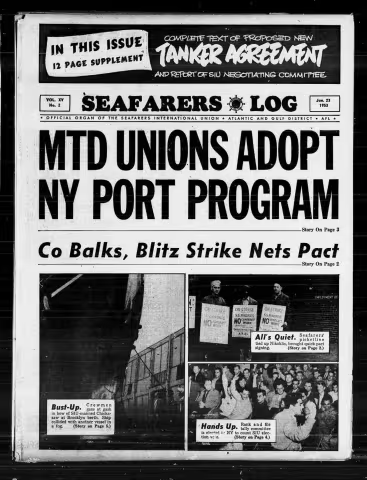
VOL. XV
No. 2 iSEAFARERS ̂ LOG Jan. 23
1953
• OFFICIAI L ORGAN OF THE SEAFARERS INTERNATIONAL UNION • ATLANTIC AND GULF DISTRICT • AFL •
-Story On Page 3
Co Balks^ Blitz Strike Nets Pact
Story On Page 2
Fac* Tw« SEAFAREHS Lac Jaamuy 23, 1953
A
When Seafarer John Tarkoy signed on as bosun aboard the
Alcoa Ranger back in October he looked forward to a shor
voyage to the Islands and then back to New Yoi^ to his wife
and youngster, but it may be-"
come the longest voyage of his
life. ^
John Tarkov is an alien. More
over, he is Russian, though he fled
With the opening of the new
Congress a.host of bills have
been introduced to assist aliens
In situations similar to that of
Seafarer John Tarkov. The
Immigration Law's sponsor,
Senator Pat McCarran, has ex
pressed willingness to see
amendments made to the act
where they are needed.
The SIU has instructed its
Washington Representative to
study the proposed amend
ments and work for the relief
of those alien seamen who
have proved themselves to be
responsible crewmen of Ameri
can-flag ships and whose pres
ent hardship was not the in
tent of the McCarran Act,
the country when a youngster
shortly after the revolution.
As a result of the McCarran-
Walter Immigration Act, which
went into effect on December 24,
John is now restricted to his ship.
The trip he thought would be a
short one ended—for the other
crewmembers—^but John was de
nied shoreleave or discharge when
the ship returned to New York. He
is back at sea again now, faced
with the possibility that after ten
years in America he may be re
turned to a land he fled over 30
years ago.
Fled Revolution
Tarkov's case is typical of sev
eral affecting men who are techni
cally citizens of Iron-Curtain coun
tries. But for practical purposes he
could be called a "stateless per
son" because ' like hundreds of
thousands of his fellow country
men, he fled the Bolshevik revolu
tion without the formality of pass
port or visa.
A Couotry • • ^
, ijy
' . --'M
Mrs. John Tarkov, and her four-year-old son, Igor, are Aown .at
left. John Tarkov Is shown at right in a photo taken in 1951 when
he was sailing as bosun on the SlU-manned SS Hurricane.
A SEAFARER'S LOG represent
ative visited Tarkov's ^fe at her
home in Jackson Heights, Long Is-
limd. In the sitting room, of the
semi-detached one family home,
one of several of its kind on a
quiet residential street, she told of
his backgrcufld while their four,
year-old son, Igor, happily played
cowboy and Indian.
Her husband, she said, was bom
in Russia in 1908, but shortly after
the revolution, when he was about
13 years old, he and an uncle fled
to Rumania. A few years later
when he was about 20, his uncle
died. From Rumania, Tarkov made
his way to France which was at
that time J mecca for Russians
fleeing Communist rule. He work*
ed there at various trades before •
becoming a seaman.
Got Off in New York
In 1939, war broke out in Eu
rope, and In the summer of 1940
the Geiman armies overran
France. Living in France under
German rule was not the most at
tractive future so Tarkov followed
the route blazed by so many alien
seamen before him. He caught a
ship in Liverpool iiu 1941 and left
it when it arrived in New York.
In those daj^, ship jumping was
an established practice that was
encouraged by the US government.
(Continued on page 18)
Co Balks At Pact, Blitz
Strike Wins Quick Okay
A group of shipyard workers walk off ttie job as Seafarers William Susikari (left), AB, and William
Levett (right), steward, carry picket signs in front of the gate of the Bethlehem Steel Shipyard in
Brooklyn. The SIU struck the Nikolis, which was in the shipyard at the time.
Seafarers hit the bricks in New York last week, banging up two ships of a company which
had refused to sign the new SIU standard freight agreement. Four hours later, crews went
aboard under the terms of the new agreement. Meanwhile, the Union contemplated simi-
: ••'lar action against a passenger"^
SEAFARERS LOG
Jan. 23, 19!i3 Vol. XV. No. 2
/t.
As 1 See It Page 9
Crossword Puzzle ..Page 8
Editorial ? Page 9
Inquiring Seafarer ....... Page 8
In The Wake Page 8
Letters Page 16
Meet The Seafarer Page 8
Personals Page 18
Quiz .Page 15
Seafarers in Action......Page 14
Ship's Minutes Page 18
SIU History Cartoon Page 6
Ten Years Ago ......Page 8
Top Of The News .Page 7
Union Talk Page 6
Wash. News Letter.Page 5
Welfare Benefits ........Page 19
Yotu* Dollar's Worth..... Page 7
PubMiUiod bfwaakly at tha haadova^'tsra
•t tha saaiatar* intarnatianai unien/ At*
Utttic * Gulf District, >FL, *71 Fourth
Avanua, Brooklyn 12, 1^. Tal. STorllna
*•4*71, intorad as Mcond claat-mattor
at tha Fott Offico lit Brooklyn, NV,
wKlar AwnMiMillMP)
outfit which has not signed
the new contract.
The successful strike, which tied
up the Nikoklis and the Nikos, of
National Shipping and Trading,
also brought two of the company's
subsidiaries into the fold.
In further wrap-up of loose
ends of freight negotiations, the
SIU negotiating committee has
scheduled meetings with the P&O
Steamship Company, operators of
the passenger ship Florida, to get
that outfit's signature on the SIU
agreement.
SMps Were Sold
The brief strike, on Friday, Jan
uary 16, came^ about, iis a result
of the isal? of the Dolphin Steam*
ship Compahyi an SlU-cbntracted
operator, to National Shipping and
Trading: Dolphin had operated
two Llbertys, the Nikos and Niko
klis, ;whiclp' been laid up. for
included in the sale of the com
pany.
When approached by the SIU for
renewal of the contrtict on these
vessels the new owners refused to
sigh the standard agreement. The
Union also pressed for money
owed to the Welfare Plan. ^ Con
sequently, picketlincs were quickly
placed on the pier fronts, one at
Bemieheni shipyard at 27th Street
in urooklyn, and another at Beard's
drydock, 23rd Street, Brooklyn.
The picket lines won tbA im
mediate support of members of
other unions affiliated with the
AFL Maritime Trades Department,
ILA longshoremen refused to
crosa the lines manned by Sea
farers and I harbor towboatmeh,
members of . the ILA Marine
Division wouldn't touch the ships.
Similarly, CIO aliipyaEd workeis
who had been .getting the vessels
into sh^e after their long lay-up
Vacation $ Held
Taxable By US
As a result of a new ruling by the Internal Revenue Bureau,
which classifies vacation benefits as cash income, Seafarers
receiving vacation benefits will now have to pay Federal in
come taxes on them. The newt'
Mobile Hosp
Chief Ends
36-Yr Job
MOBILEI—Known to many Sea
farers who were his patients in
USPHS hospitals. Dr. Ralph E.
Porter has retired from the United*
States Public Health Service after
36 years of service.
Dr. Porter had commanded the
USPHS hospital at Mobile sinct
procedure applies to all bene
fits received in 1953 and after
wards, but won't affect vacation
payments made in 1952.
The ruling requires the Union
to withhold the tax when it pays
out the vacation benefit, just as if
it were paying out wages. A new
vacation form has been printed to
meet , the situation, and each man
will have to indicate the number
of dependents he has on this form.
The Vacation Plan staff at head
quarters will then figure out what
the tax is. The amount will be
deducted from his vacation bene
fits. It is expected that the tax
will average about $3 per man for
every 90 days seatlme.
Benefit Increase Coming
However, as a result of an in
crease in employer contributions
to the Vacation Plan, the- Union
is going to be able to increase the
vacation benefits up to a high of
$160. a year, an increase of $20
over the present top figure. Since
October 1 the operators have been
paying an additional 15 cents per
man per day, or 65 cents in all,
to pay the increase. The additional
money has been held aside for the
time being until the new adminis
tration in Washington straightens
oiit the wage control picture.
Some observers expect the new
administration to ^t wage con
trols lapse, in whlch'case the Union
could start paying the additional
benefits then.
In any case, it's still available
for men to put in their vacation
applications every time they have
90 days seatime. Men who hold
off on applying for benefits may
lose out, since the rules of the
Vacation Plan call for applications
to be made within a year of the
payoff date on any discharge.
Men who have discharges with
old payoff dates, who want to get
in under the wir? can do so by
mailing in their discharges with a
return address. The Vacation Flan
staff at headquarters will make out
a Vacation benefit application ds
of the date of receipt of discharges,
cnd. mail. it. back to. the man for
his signature: Whenever he gets
.to sighing it, his ben^tts ydil still
be forthcoming. ^
Dr. Ralph Porter
\
1947 and after the hospital was
closed several months ago he con
tinued as head of its out-patient
clinic.
He began his career at the same
hospital, interning there in-1916
after receiving his MD degree
from the University of Alabama.
In the interim he served in. many
stations in the United States and
overseas, including directing
USPHS hospitals at Baltimore,
Pittsburgh and Fort "StSnton.
He was considered a staunch
friend of the SIU jn Mobile find
joined with the Union in proteri-
iilg against, closipg of. the Mol^lt
JanuHT %i. IfSS SEAFARERS LOG Pare Thre*
' vl
I
Top Tanker Contract
Agreement Reached
The SIU's contract business for the year 1953 was practi
cally wrapped up this week as representatives of 18 SIU-
contracted tanker companies agreed to the new standard
tanker agreement. The negotiating committee is now securing
the operators' signatures. Membership action on the new con
tract, which is printed .in this issues of the SEAFAKERS
LOG, will come at the next"*
membership meeting in all
ports, January 28.
As the report of the SIU nego
tiating committee shows, the new
agreement provides a considerable
number of significant changes and
improvements in the working rules
and general rules for tankers,
.aside from the sizable wage in
creases and improvements in over
time rates which make this con
tract the best of its. kind on the
Atlantic and Gulf coast. The new
tanker contract is also expected
to add considerable impetus to the
organizing campaign on Atlantic
Behning ships. It will serve to
convince the few remaining hold
outs in that fleet of the obvious
superiority of SIU contracts, both
freight and tanker, to the com
pany-union contract under which
Atlantic men sail.
Big Increases
As reported previously in the
LOG, SIU tankermen will receive
monthly wage increases ranging
between $1.5.22 and $47.17 with
practically every rated man getting
raises of $25 a month or better.
The key ratings like AB's, oilers
In Thfis issue . . .
This issue includes a 12-page
supplement which contains the
complete text of the new
standard agreement for tanker
operators, plus an analysis of
the new general rules and
working rules that has been
drawn up by headquarters.
The wage provisions are re
troactive to January 1, 1953,
and the working rules begin
on February 1, 1953. The sup
plement also includes a com
plete index, so that you may
locate the provision you want
with a minimum of trouble.
Because of the size of the
supplement, several features
that appear regularly in the
SEAFARERS LOG had to be
omitted from this issue despite
the addition of four more
pages. All of the features will
be back in the next issue of
the LOG.
and FWT's received boosts of
$43.32, to a flgure of $305.64.
Stewards department men reg
istered some of the biggest gains
in the contract, as the result of a
change in manning scales coupled
with wage increases. The new
manning scales, calling for tank
ers to carry a cook and baker and
a third cook, instead of a second
cook and baker and galleyman,
mean wage gains of $78.26 and
$89.36 for the new ratings over
the ones they replaced.
Ratings Get $1.87 OT
The tanker agreement, like the
freight contract, carries the new
dividing line on overtime and the
new higher overtime rates. As a
result every rated man on tank
ers, without exception, now gets
the high overtime rate of $1.87 an
hour, compared to the $1.29 that
most of these ratings received pre
viously.
" This new overtime set-up, of
course, makes a very considerable
difference in the rates for oil tank
cleaning which now go up to a
maximum of $3.74 an hour for
men off watch, or outside of regu
lar hours or on weekends. And
with all rated men ^getting the
higher OT, it means they will all
collect the top tank cleaning rate
as well.
Tank Cleaning Improved
The basic tank cleaning clause
has been further improved by
additional overtime provisions for
men hauiing buckets and by an
other clause calling for a mini
mum of three men to shift butter-
worthing machines. |
The new tanker contract con
tains many other improvements in
general rules and new provisions.
Among them are: a new sailing
board regulation, which will penal
ize the companies if they call men
back and then postpone sailing
time; an explosives clause, never
before contained in tanker con
tracts; a longshore work clause; a
new provision covering job rights
for crews while a vessel is tempo
rarily in idle status; and the new
general rules of the freight con
tract including those dealing with
repatriation; Saturday holidays;
(Continued on page 17)
New Pacts, Wage Boost
Near For Shoregangs
MOBILl^Negotiations have about been completed for new
contracts covering the Alcoa and Waterman shoregang and
Waterman repair yard operations here.
A new wage pattern provid-"* ^
ing for an across-the-board in
crease of 13 cents an hour was
established in preliminary confer
ences with representatives of both
companies. Only a few minor de
tails affecting conditions need to
be worked out before the new con
tracts will be ready for signing.
The new wage scale will be sub
mitted to the Wage Stabilization
Board for approval. The rates will
be retroactive, however, to Ehe ef
fective date of- the new agree
ments.
Negoiiatiuus al&u have been
started with the Mobile Bar Pilots
Association for a contract, covering
pilot boat crewmen,^ These.-hien
recently voted triiusidiuottsly"
SlU-MAW representation.. Prelimi
nary talks with representatives of
the pilots indicates an early agree
ment on terms of this initial con
tract.
A new agreement also has been
worked out with the Mobile Tow
ing and Wrecking Co. This com
pany agreed to grant the same
wage increases as were provided
for ABs and firemen and oilers in
the new standard SIU cargo agree
ment. These dncneases also are
subject to WSB approval.
The organizing drive in the tow-
boat field is being stepped up and
substantial gains have tmeh
in the Beets of ieveral loial tow
ing^ Oompihies.
Addressing the delegates daring the discussion on whether rank-and-file longshoremen preferred the
"shape-up" system of hiring or the rotary system practiced by the SIU, Secretary-Treasurer Paul Hall
explains the rotary hiring by which SIU ships are maimed. The meeting, held at SIU. headquarters,
marked the formation of the new Greater NY Harbor Fort Council of the MTD, with Sigmund "Whitey"
. Brovarskl of the ILA (right) as chairman, and Capt. Tommy Adkins, MM&P, as vice-chairman.
MTD Unions Set Up
NY Council Adopt
14-Point Port Plan
Adopting a positive 14-point program for eliminating abuses and problems existing
on the docks of the Port of New York, the AFL waterfront unions in New York Har
bor banded together last week and formed a Greater New York Harbor Port Council
of the AFL Maritime Trades Department.
The waterfront unions, in banding together in the Greater New York Harbor Pbrt
Council—which is an extension of the Brooklyn Port Council—took the position
that the stabilization of the
New York waterfront could
be accomplished by the trade
union movement itself, without
intervention by Government
agencies. ^
Fight Fire in SIU Haii
Two firemen man a hose as they fight a blaze in a storeroom in
the SIU's New York headquarters. The blaze, beUev^ caused by
a short !^dlt,' wa« dl«c(weired earljr;'andi«rti8ed Mttie damafo. «-
As a result of Government
probes and investigations, several
groups have suggested Govern
ment control in the form of Gov
ernment licensing of longshore
men, and Government-operated
hiring halls for longshoremen.
Such licensing or Government hir
ing halls would be a threat to all
organized workers and all union
hiring halls.
Meeting, at SlU headquarters on
January 14, the delegates from the
AFL unions heard, and adopted,
the 14-point program which was
proposed to the group by SIU Sec
retary-Treasurer Paul Hall.
Delegates attending the meeting
included representatives of the
marine harbor workers, Seafarers,
radio offlcers, licensed deck and
engine offlcers and longshoremen.
Constitution Proposed
A special Constitutional Com
mittee of the new Greater New
York Harbor Port Council has
been meeting, and presented a
draft of the proposed constitution
of the group to a special meeting
of the council yesterday.
The new Greater New York Har-'.
bor Port Council is a naturol out*
(eodtialuM SH# pag»'l»« - , • .. .
•' ':-: ';n^Kr;ig«ys»aa??'"A'ypT^y-'T'^vv,yy^--^'t»..-.
- y.- •:
Fare Four SEAFARERS LOG Jonoary 28^ 19«S
Tally Group Announces
A&G Election Winners
Mobile tallyers buckle down to the job in. that port's SIU halL
Going round the table clockwise, they are: Louis J. Cayton, Ronald
(Scotty) Eden, Charles L. Shirah, Charles Jordan, Jack Pariier,
Buster Young.
Successful candidates in the two-month secret ballot for
49 official posts in the A&G District were announced yester-
day by the headquarters tal
Capt Reed
Dies At 56
MOBILE—Capt. Clarence Reed,
56, operating manager of Water
man Steamship Corp. since 1046,
died Jan. 12 k a hospital here
after a brief illness.
In his official capacity. Captain
Reed worked in close contact wfth
the officials and members of the
SIU in this port. He was known
as a true friend of merchant sea
men.
One of the often-repeated stories
about his life concerned a con
versation he once had with an
acquaintance, a banker. The
banker, it was recalled, was berat
ing seamen in general when Cap
tain Reed pointed to the Water
man Building and inquired if his
acquaintance knew who built it.
"Why, Waterman Steamship
Corp., of course," the banker re
plied.
"No," said Captain Reed, "that
building was built by those same
seamen you are talking about."
. Besides his widow, Lila Reed,
Captain Reed is survived by a
daughter, Mrs. Robert Nobles,
Mobile, and a son, Clarence S.
Reed, with the U, g. Air Force,
El Paso, Texas.
;ying committer. Making the
announcement was the six-
man rank and file group that
was elected at the headquar
ters membership meeting of .Tanii-
ary 14. Seeking the A&G posts
were 75 candidates.
A full report on the voting plus
all totals will be presented to the
membership meetings in all ports
on January 28. After the member
ship acts on the report it will be
printed in the next issue of the
SEAFARERS LOG, as the official
election report.
The tallying committee began its
work on January 15 by counting
the New York votes. Meanwhile,
tally committees elected in the,
outports checked the results there
and then mailed the ballots into
New York for a second check and
final totaling of results.
Winning candidates will serve
for a two year term in the A&G
District. This election does not
cover officers in other SIU Districts
such as Great Lakes, SUP, Fisher
man, Cannery Workers, etc. Each
one of those districts holds its own
election.
Vote totals of all candidates are
as follows (winners stareed): Sec
retary-Treasurer: Paul Hall, 5,466
votes*; Assistant Secretary-Treas
urers, (six); Joe Alginff, 4,648*;
Lloyd Gardner, 4,455*; William
Hall, 4,511*; Robert Matthews,
4,644*; Claude Simmons, 4,906*;
Joseph Volpian, 4,312*.
Boston -Agent: James Sheehan,
4,517*.
Boston Joint Patrolman: James
(Continued on page 18)
SEAS CASH^ENEfim
6
SEAFARERS WELFARE, VACATION PLANS
REPORT ON BENEFITS PAID
No. Seafarers Receiving Benefits this Period • 99Jl
Average Benefits Paid Each Seafarer
Total Benefits Paid this Period
£M
\U ^.73 3/
WELFARE, VACATION BENEFITS PAID THIS PERIOD
Hospital Benefits
Death Benefita
Diaahility Benefits
LJL^' PC.
7
Vacation Benefits
22.
.XsiaL 3^/
WELFARE, VACATION BENEFITS PAID PREVIOUSLY
Hospital Bienefits Paid Since Tulv 1. 1950 *
Death Benefits Paid Since Tiilv 1. 1950 - ^oii
Disability Benefits Paid Since May 1. 1952 * 4556
Maternity Benefits Paid Since April 1. 1952 * I 75 Poo
\ • "• n - ' - ^
VKatlo. Beaefit. P.ld Since FA. 11. 1952 » W7k3 <fSJ
Total
* Dnte Benefits Began 0
o o
OQ\
WELFARE, VACATION PLAN ASSETS
Vacatioo II <f£\
Cash on Hand
S?? 7f3 m
Vacation \*/-oL 4^/ Estimated Accounts Receivable 1 iAoi L^i
US Government Bonds (Welfare) ?f
Real Estate (Welfare) /oSoac p a
Other Assets — Training Ship (Welfare) II /o^o*iL 3*^
\ TOTAL ASSETS II • ' '
The first exasdhation date on the scholarship benefits
will be January 20ih, with approxinately fifteen people
eligible to sit for the exam. The next date for examina
tions will be March 20th, 1953.
All applications for scholarship benefits should be filed
well in advance of the date of the exam, due to the fact
that it takes considerable time to process the applications.
Axqr applicants for the scholarship benefit should file
their applications with the administrator at 11 Broadway,
Room 1060, New York J!^, N.Y.
SubmitteA. ..i/l.7/53... A1 Kerr, Assistant-A2mt ^nistrator'
Takfug ^ coBui In Galveglon is tbb Ids-man tallying committee
thai was ejected at the last branch membcri^9 meeting. They
arc Tear deft to right: E. C. Goings, Kdibro. A. Clary, B. C.
u. . EaMawii; Iwpfc fa Miwrra (Ipft i
•. • and^ rementher thts • • •
All these are yours withoTjt contributing a single nickel on your part—Collecting SIU bene
fits is easy, whether it's, for hospital, bir^ dlsidbility, or de^ih—You' gei^first rate personal
service immediately,; throu{^ yotw tJhion^f repres^atives, . 4' • ymgj'
Jumary XV IMS SEAFARERS LOG Paye Five
SIU NEWSLETTER
from WASHINGTON
On the first day of the new Congress, January 3, 1953, Representative
Keogh, New York, introduced a resolution (HR Res. 50) which would
provide unemployment insurance for those seamen aboard Govern
ment-owned ships, operating under agency agreements with the vari
ous American lines. Similar legislation was introduced in the last Con
gress but failed of enactment at the very last moment.
Seamen employed on vessels operated in the agency program are
employees of the US. They are accorded, with a few exceptions, the
same rights they would have if privately employed. One of the ex
ceptions is unemployment insurance coverage, which the Keogh reso
lution is designed to provide.
The resolution provides for Federal consent for coverage of th6 sea
men by the states. Federal consent is necessary because the seamen
are employees of the US. The necessary consent is provided through
appropriate amendments to the Internal Revenue Code.
4" t t
The revised International Regulations for Preventing Collisions at
Sea will come into force on January 1, 1954. The rules were agreed
upon among the delegates to the International Safety of Life at Sea
Conference held in London in 1948.
Among the more important changes introduced by the 1948 regula
tions are^the following: The rules apply to seaplanes on the water as
well as to water craft; the second white masthead light which is al
lowed by existing regulations becomes compulsory except for vessels
less than 150 feet in length and for vessels engaged in towing; the
range of visibility of lights on fishing vessels is standardized at two
miles. In existing rules, no range is specified; the stern light which
is allowed by existing regulations becomes compulsory and its range of
visibility is increased from one to two miles; the range of visibility of
anchor lights is increased for all vessels under 150 feet in length from
one to two miles and for vessels over that length from one to three
miles; and, when a power-driven vessel which, under the regulations,
is to keep course and speed, is in sight of another vessel and is in doubt
whether the other vessel is taking sufficient action to avert collision,
she may use a signal consisting of five short blasts.
4> ^
Chances are good that Congressional committees will probe shipping
on both the US East and West Coasts. For instance. Representative
Pelly, Washington, wants to study the matter of "maritime interrup
tions and work stoppage" through the port of Seattle. Another Con
gressman, Butler, of Nebraska, wants to amend the 1947 Labor Man
agement Relations Act so as to "prevent interruptions to ocean trans
portation service between the US and its Territories and possessions
as a result of labor disputes." The Butler proposal, if enacted into
law, would direct the Attorney General to petition any district court
having jurisdiction to enjoin strikes or lock-outs.
On the Senate side bf the Capitol, Senator Tobey, New Hampshire,
new Chairman of the Interstate Commerce Committee, is interested in
investigating waterfront conditions in the Port of New York.
4* !• 4"
Foreign maritime representatives and attaches in your nation's Capi
tol continue to wage a fairl^silent battle to do away with the 50-50
shipping provision in the mutual security assistance and other aid pro
grams. However, a new angle in their fight has now come to light.
It is this. Instead of opeply seeking to strike the shipping proviso
from the law, some of the foreigners now believe it better to sit
around waiting upon the Republican Administration in this country
to substantially cut funds for the various aid programs. When this
is done, it is the belief and hope of the foreign maritime competitors
that the US Congress may do away completely with the 50-50 shipping
provision in ^n effort to reduce the final cost to the taxpayer.
4" 4" 4"
The Secretary of Defense has developed a program as to merchant
marine requirements in event of war. His report is necessarily classi
fied security information, but the following, within the limits of se
curity, can be made known: the US Defense Department believes the
most serious deficiency is in tanker types, and feels that if this de
ficiency is not greatly reduced, it may result in a serious curtailment
of military operations in event of another war.
Almost as serious, in the minds of the Defense Department, is the
mobiiization deficiency of dry cargo ships. Increased emphasis is
placed on the need for cargo ships which can be loaded and discharged
rapidly with their own equipment and for ships capable of speedily
loading and discharging military tracked and wheeied vehicles.
In addition to a deficiency in passenger ships, studies prepared by
the US Department of Defense have identified deficiencies in certain
equipment and machinery necessary for shipbuilding which must be
rectified if niobilization requirements are to be met.
Lack of speed of a large portion of the US merchant fleet is a matter
of grave concern. Current studies indicate that some 95 per cent of
the laid-up fleet has a speed of 11 knots or less, and thus would be
easy targets for enemy submarines.
4- 4" t '
After a prolonged study, the Department of Commerce has decided
that opportunities exist for the US shipping industry to improve op
erating practices and its financial position, in the following maaner:
Commerce believes that efforts should be intensified toward in
creasing American Imports and exports by creation of larger markets;
ihat sales promotion efforts should be incmsed to influence American
exporters to ship more In American flag vessels; Commerce feels that
steps must be taken to improve stability in labor-management relations
in the maritime industry; that cargo-handling techniques must be im
proved; cost control practices should be Improved; and that, finally,
there must be greater coordination between inland transportation fa
cilities and connecting ocean carriers, inorder to reduce port time
to achieve fuller utilization of ships cargo space.
Four 51U Ships In Crack-ups
Four SlU-manned vessels ran into trouble last week, with at least three of the mishaps
taking place in heavy fog. The ships involved were the Chickasaw (Waterman), th®
Robin Tuxford (Seas Shipping), the Southstar (South Atlantic) and the Seatram Savan-
nah (Seatrain). Nobody was
Settling A, Beef Pronto
Crewmembers look on as headquarters representative Joe Algina
calls up owners of ill-fated Quartette, which went aground in the
Pacific. Union got each man payment for loss of gear plus differ
ence between tourist-class and first-class plane fare from Midway
Island.
AMEU Always On Job-
With Ice In Winter
You can take it from Gene Lachappelle, AB on the Atlantic
Refining Company tanker Atlantic Coast, that just like in the
old song, it really is June in January when you ship AMEU-
style.
Gene says you can always
find the AMEU's supporters
using up their vocal cords until
the time comes for straight talk
about the shipboard conditions
that outfit has allowed to flourish
and then they lose their power of
speech. He, like Atlantic tanker-
men throughout the 23-ship fleet,
has found the SIU contracts a pow
erful ' convincer, because they
specify in plain print, for exam
ple, the type of equipment for the
use of the unlicensed personnel
which must be furnished by the
company.
In his experience, Lachappelle
stated, if you'd like to have some
thing on the ship for use in June,
you've got to start dickering for
it a half year or more before that.
He pointed out the case of the
missing fans in the crew's lounge
and in the ordi-
n a r y daymen's
foc'sle as a case
in point.
"There was a
big bang-up
AMEU meeting
in July on this
score, and we
were assured
we'd have them
right away.
Everybody was all keyed up over
this because it was hot and un
comfortable and anyway, there
should have been good working
fans on the ship in the first place."
But July went by, he said, then
August, and in rapid order, Sep
tember and October until the great
day in November when, in 'the
midst of a heavy frost, the fans
finally arrived.
Heat Relief
They had" similar success getting
heat relief for the 12-4 AB. Dur
ing the summer months the tem
perature fluttered around 100 de
grees in his foc'sle almost all the
time. So they, had another rah-
rah meeting, the AMEU ship's del
egate wrote to Philly concerning
thq beef and asked if it would be
possible to have some sort of in-
cujatlondo»at.4be
Lachappelle
heat in the AB's foc'sle, which was
adjacent to the fireroom fidley
bulkhead.
Maybe, they asked, it would be
possible to have another porthole
cut in. Eventually, the answer came
back that this would have to be
checked with the Coast Guard or
some other maritime agency, so
notfiing at all could be done right
now.
"If we had a union like the SIU
to go to bat for us," "Lachappelle
noted," we'd have had them the
next trip or at latest the one after
that. There's too much waiting
and too little receiving when you
beef to this outfit."
reported injured in any of the
mishaps.
The Chickasaw was entering New
Yorlr Harbor in a dense fog, when
she collided with the American
Leader of the US Lines between
the Narrows and Governors Island.
The Chickasaw had a h^i]^ torn
in her bow, but suffered no other
apparent damage, and proceeded
to Bush Terminal, where her bow
was repaired. The American Lead
er, however had a large hole
torn in her side, and reported
that she was taking water. Coast
Guard cutters went to her assist
ance and towed her to the flats
•off Brooklyn. She was later
taken to a shipyard.
Another Fog Victim
The Southstar, also the victim
of fog, ran aground in the Elbe
Estuary. The 8,173-ton vessel,
was enroute from Hamburg to
Antwerp, and was reported in no
danger. She was refloated
at the next high tide, the com
pany reported.
Another fog victim was the
Robin Tuxford, which ran into
trouble in the Cheasapeake and
Delaware Canal, while going
from Baltimore to Philadelphia.
The Tuxford was sideswiped by
a large steel barge in the canal,
and her side was slightly dam
aged.
Taken To Yard
She was taken to the Sun
Shipyards, where three plates
were replaced, the company
said, and then she proceeded on
her way to New York.
The Seatrain Savannah had
her bow stove in near Port Sul
phur, near New Orleans, when
she collided with the Eastern
Sun of the Sun Oil Company.
The Seatrain Savannah proceed
ed fo her berth, and was then
taken to the Todd Shipyard,
where she is expected to stay
for about two weeks.
The Eastern Sun reported
that she was taking on water
after the accident, but was able
to proceed to a berth, and then '
to the shipyard for repairs.
YOU and iho SIU
CONSTIIUriON
. 4;: : f
S;;:-
From Articio XX
Soctton 2
"No n**""
Union rocipt.
Hera the coiuHfution provides
a double check on the individual
member's money. The Union re
ceipt is proof positive that the
member has paid his dues and
assessments. At the same time, it
makes the Union representative
fully responsible to the Union and
the membersKip for the money he
has collected.
r'l
•
0- •
.J..-'
Im.-
«•>'
s.
1|.
:•¥-
t-
W-I •
ViMPi Sis SEAFAnsn^ LOG Jasttatr 23. 1953
Former Seaferer Revisits Sill SlU Vessel
Battered
By Typhoon
UNION TALK
Hev, Charles McTague (right), a former Seafarer who retired his
SIU book to enter Uie clergy, shows a model of the Steel Traveler
to Rev. Daniel Mahoney during a visit they made to the SIU hall.
Food And Storing Poll
Hears In Galmar, Ore
Machinery for polling crewmembers of Galmar and Ore
Line vessels on the fee^g and storing of these ships is now
being set up in New York headquarters. A union committee
is making arrangements to-*
poll these ships by the end of
January to see if the compa
nies are living up to their written
promise to improve feeding.
The plan for polling the crews
was part of a suppiemeniary agree-
ment reached with these two com
panies to put an end to the prac
tice they had instituted of under
stocking the ships and limiting the
variety of foods available to crew-
members. Should the evidence
show that the companies have not
brought their feeding up to par
by the end of January, the Union
would then have the right to can
cel the contract.
Message To Ships
Present plans call for the Union
to notify every Ore and Galmar
Ship by wireless as to when and
where the Union representative
will poll the crews. Because of the
nature of the Ore Line run, all of
that company's ten vessels will
have to be polled on arrival in
Baltimore. Calmar's eight ships on
the intercoastal run may be polled
at, any one of several ports on
either coast.
In the poll form now being
drawn up, crewmembers will be
asked whether they have noted any
improvement in the quantity, va
riety and quality of the food being
served to crewmembers. A check
will also be made with ship's stew
ards as to the supplies of stores on
hand.
In addition, crewmembers will
be asked on the poll form to list
any suggestions or recommenda
tions they have with respiect to the
feeding and storing of the ships.-
The poll results will then be ex
amined by the Union committee.
The Steel Artisan (Isthmian)
was battered but proud as she
pulled into Manila recently after
hghting for three days through
what was described as "one of the
worst typhoons in marine history."
The vessel was battered for 72
hours east jo£ the Marianas by ex
tremely heavy seas and gales of
200 miles per hour. When the ship
hit port, the crew was ready for
some sound sleeping to make up
for the work during the storm.
The January 1-3 storm was so
severe that a 16-ton truck that was
being carried as deck cargo was
blown over the side. A large drum
that was part of the deck cargo,
was repeatedly blowir over the
side, but the seas kept throwing
it~back aboard the ship, battering
it each time.
'Excellent Seamen'
Captain Michael Barry stayed on
the bridge for 72 hours without
sleep to get the ship through the
storm, and the "Manila Times" re
ported that, "All hands aboard . . .
ds.splayed excellent seamanship in
cooperation with the skipper to
save the ship."
Seafarer Eric Joseph reported to
the LOG that, "it was the worst
typhoon I've'seen or heard about.
The rest of the crew and myself
are very fortunate to be alive."
The "Manila Times" said it was
"one of the heaviest typhoons In
marine history."
It was reported that both the
ship and the cargo suffered heavy
damage, particularly the deck
cargo. The railings around the bow
and the stem were smashed. Quite
a bit of deck equipment was dam
aged, and some of the booms were
bent by the force of the storm.
Early reports indicated, howevfer,
that the entire crew of the Steel
Artisan, was "lucky," and that no
body was injured aboard the ves
sel despite the terrific pounding
she took from the storm. The com
pany reported that the vessel would
be back in service after minor
repairs.
By KEITH TERPE
It's been our thought for a while now that the
two-way justice practiced by non-union companies
and their "inside" unions carries forward a blind
idea we swore by when we were kids. The "good
guys" are "good" and deserving of unlimited special privilege even
when they steal pennies out of a blind man's tin cup. "He must of
had a reason," we would have said back in those days, because we
Couldn't face up to the fact that our hero had his bad moments like
everybody else.
It was to our credit as kids that we at least tried to forgive the con
duct of our hero when he suddenly went out of character. But Iho
anti-SIU bigwigs in Atlantic aren't even that subtle. It would seem
that as long as any Atlantic tankerman was violent enough in his opposi
tion to the SIU, he could get away with all but murder. .
There came to the attention of SIU organizers last week a striking
example-of this kind of thinking and we couldn't forego the oppor
tunity of pointing it out because it illustrates so completely one of the
things we're seeking to bring to an end in Atlantic. It seems there
suddenly arose in the minds of the AMEU-Atlantic boys a desire to
show how true justice could be dispensed. There would be a trial
of several men from different ships for vai-ious misdemeanors com
mitted in recent weeks. There wouldn't be any of this "democratic"
nonsense about adequate notice and a statement of the charges against
him given to the accused, and as for this business of trying a man
before a jury of his peers, well, a panel of company personnel bosses
would be doing just as fine. And as a sop to the "radicals," they'd
let the two ranking officers of the AMEU sit on this same jury.
And so it began, just a week ago Wednesday. In the fia-st case, an
SIU organizer and an AMEU stalwart were accused of fighting aboard
ship while drunk. It was admitted, of course, that both were off watch,
that only one blow had been landed (thrown by the AMEU man), no
one got hurt, and that the incident was forgotten and dismissed from
their minds as one of those things that happen. But this mighty tri
bunal reasoned, here was a chance to slap down this SIU agitator.
Both would be suspended from the fleet for two weeks without pay.
The AMEU man, however, was quietly assigned to another ship almost
as soon as the verdict came out.
In the next case, two SIU supporters were tried in absentia after
having been fired off their ship. Their crime? After coming off watch
one night, they went to look for the night lunch and for all their pains,
came up with nothing more than a few mouldy crusts of stale bread.
Angered in the midst of this plenty, one of them tossed the breadbox
over the side then and there. Sure, It was a foolish thing to do, but
considering the circumstances, .we might wonder why they didn't toss
the steward over the side after it.
The tribunal however, was not to be swayed. Company property
had been destroyed and under its standard of merciful justice, both
were read out of the cbmpany. Some say it might have been easier
to deduct the six bits a new breadbox would have cost from their wages,
and not make a big issue over the incident. After all, they pointed
out, a third offender on this same ship committed a more cardinal sin
(he had missed one watch and was too drunk to make another one),-
had been given a light slap on the wrist by this jury and was imme
diately reemployed by the company. This outstanding workmap, we
hasten to add, was one of the AMEU's stalwarts.
He was one of the "boys," and "boys will be boys." you know, was
the attitude. ' Another of these same "boys," when he was gassed up
and in a playful condition, dumped an ejcpensive foamite fire extin
guisher from the fldley down into, the fireroom on one of these tankers
while a man down below was working on the electrical contacts. For
tunately, nobody was hurt and the damage was light, but we shudder
to think what could have happened to the guy down below, to the ship
or to her entire crew for that matter if everybody wasn't lucky. When
he found out about it, the chief engineer said he'd get^he guy who
pulled that stunt no matter who he was. But when he learned it was
another of the lingering death AMEU supporters, nothing happened,
no word was said and the ranks closed again.
Cartoon History Of The SIU The Government Ageneiee No. 29
The WSA, Coast Guard and other Government agen
cies launched a. drive to perpetuate their wartime
powers. The SIU maintained that with the war
over, there was no need for "these outfits. The
NMU, however, played baill,-even to allowing Coast
Guard hearings la Its hells.
The WSA, with Its e^qpensive medical exam units,
extended its power , tmtil, working with the Coast
Guard, It was able to take away seamen's papers,
thus depriving these men of their livelihood. The
SlU boyebtted the setup and won, but tbe I'TIvIU
went along with the WSA.
Government training schools stepped up their man
power training. The NMU supported them, but the
SIU opposed Admirals, shipowners and
financiers addressed, graduating classes, telling them
to consider themselves "exetii^Uves," and forget the
old pattern Of foc'sle-to-bridge.
•
8^
Jaovary 23, 195^ SEAFARERS LOG Pare Sevea
ACCUSED SPIES. EX-NAZIS ARRESTED—The US Army has arrested
two former servicemen in Vienna on charges of spying for the Soviet
Union in conjunction with a Soviet diplomat in Washington. The two men
had been attending school in Vienna under the GI Bill of Rights. The
US has asked for recall of the diplomat, Yui Novikov, second secretary
of the embassy. Meanwhile in Germany, British have arrested seven
former Nazis on charges of attempting to infiltrate and seize control
of the West German Government.
4" 4" t
PURGE SPREADS TO RUSSIA PROPER—The antl-semitic tinge of
Communist purges in Rumania, Czechoslovakia and East Germany has
spread to Moscow with the arrest of nine leading physicians on charges
of causing the death of former high Communist leaders. The men
were accused of being American agents and the American Joint Dis
tribution Committee, a Jewish welfare organization, was singled out
for attack as the supposed transmission belt between the US and the
accused men. Among other things, the Joint Distribution Committee
has been aiding the emigration of European Jews to Israel.
4> 4> 4*
EISENHOWER TAKRS OVER PRESIDENCY—President Eisenhower
and Vice-President Nixoil have been formally sworn in along with
members of their cabinet at Inauguration ceremonies In Washington,
DC. The new president inherits a host of serious problems, includ
ing what to do about Korea, the slowdown in European Army forma
tion, the question of wage and price controls at home and many others.
It is expected that Eisenhower will make his own State of the Union
message to Congress outlining these problems and indicating what
course he Intends to follow. *
i 4.
TRAIN SMASHES INTO WASHINGTON STATION—A streamlined
passenger train's brakes failed on entering Union Station, Washington,
DC, with the result that the locomotive smashed right through into
the main concourse of the terminal. The 200-ton locomotive then
dropped through the heavy concrete floor into the basement, just be
fore plunging into the station's waiting room. As a result, the num
ber of Injuries was held down. If the train had continued on into the
waiting room there would have been a heavy toll, as It was traveling at
between 30 and 50 miles an hour,
t
EX-US OFFICIAL ON TRIAL AGAIN—Former Commerce Depart
ment economist William Remington went on trial for a second time
on charges of perjury in connection with his denial of membership in
the Communis't party. Remington originally was convicted in 1951 on
perjury charges when he testified he had never been a CP member.
His conviction was thrown out on appeal. Now he Is being tried again
on perjury charges for denying specific points of testimony at his first
trial.
4" 4" 3^
TRUMAN GIVES OFFSHORE OIL TO NAVY—Moving to forestall
state takeovers of offshore oil reserves. President Truman has issued
an executive order tranferring the reserves to the Navy. The offshore
oil Issue was an Important one in the campaign with Stevenson and
Truman plumping for Federal control and Eisenhower advocating state
control. Elsenhower's stand won him the support of many Texas
Democratic leaders In the past election. The Truman move means
that in order to turn the oil reserves met to the states, Eisenhower
will have to take them away from the Navy and return them to the
Interior Department. Congress would then have to pass legislation
turning them over to the states.
'U' Dean Praises Scholarship Plan
TAMPA—The new Seafarers' college scholarship plan was praised by Dr. C. Rhodes^
dean of the University of Tampa, on a recent visit to the SIU hall as an "unusually pro
gressive trade union idea aimed at advancing the general betterment of our society.
Ray White (right), Tampa port agent, discusses and explains the
SIU Scholarship Flan to Dr. M. C. Rhodes, dean of the University
of Tampa, during a visit Dr. Rhodes made to the SIU Tampa hall.
Propose Citizenship
For Alien Parents
Parents whose sons or daughters s^ved or are serving in
the US merchant marine or armed forces may soon be eligible
for US citizenship, under terms of a new bill that is being
considered by Congress.
The scholarship, financed by
the Welfare plan, will give
"deserving boys and girls the
opportunity to obtain a higher ed
ucation and thus ^11 advance the
educational level of the commu
nity which will work for a betteiV'
ment of our country in general,"
Dean Rhodes said.
"I think It Is most commendable
because it shows the Union's in
terest extends to human values
outside of the usual m^aterial in
terest in wages and working condi
tions," he added.
Dean Rhodes' views were shared
by Dr. Elwood C. Nance, president
of the University. The Seafarers'
plan had been described as "a very
good one" by Dr. Nance, who ex
pressed a desire to acquaint Sea
farers with the advantages of the
University of Tampa, an accredited
university. He said he hoped qual
ified Tampa members and their
children would compete for one
of the four $6,000 scholarships.
Recognize. Union's Role
The University faculty recog
nizes the trade union movement
as a dominant factor in our soci
ety, Dean Rhodes said, and a de
partment dealing with labor rela
tions recently has been estab
lished at Tampa U.
"The rules for awards under the
scholarship plan are such as to
guarantee an impartial determina
tion of the winners solely upon the
basis of merit." Dean Rhodes said.
This new bill would allow
the naturalization of the
parent, subject to certain provi
sions regarding the nature of serv
ice performed by the son or
daughter.
Introduced Into the House by
Represen^tive Philbin of Massa-
c|fusetts, the bill has been referred
for consideration to the House
Committee on the Judiciary.
Under the terms of the bill. It
reads, "That any person not a citi
zen of the United States may be
naturalized without declaration of
intention, and without complying
with existing educational require
ments, which shall be waived: Pro
vided, that such person shall have
a son or daughter who Is a citizen
of the United States, and who has
served, or is serving honorably
In the land or naval forces, or the
merchant marine service of the
United States, during the present
war or some previous war, and
who. If separated from such serv
ice, was separated under honorable
conditions."
Put Number On
Meeting Excuses
Seafarers sending telegrams
or letters to the New York
headquarters dispatcher asking
to be excused from attending
headquarters membership
meetings must include the reg
istration number of their
shipping card in 'the message.
From now on, if the number
Is'not included, the excuse can
not be accepted by the dis
patcher.
YOUR DOLLAR'S WORTH
SEAFARERS GUIDE TO BETTER BUYING
Written exclusively for
THE SEAFARERS LOG.
by Sidney Margolius,
Leading Expert on Buying
Battling High Food Costs
The High cost of eating now takes about 35-40 pprcent
of a working family's Income. What's worse, this is the
season when food prices are supposed to be comparatively
low. Comes warmer weather, meat prices go up again
and Seafarers families like those of other wage-earners
will find themselves In a real tussle with food bills.
By all the laws of economics, food prices were supposed
to go down this winter. This Is the time when meat Is
supposed to be cheaper. What happened, however, was
that the prices farmers got for their prices did go
down, but the prices we pay In stores remained at the
same high level. One obvious reason for this disparity
Is that food distributors and middlemen are taking an In
creasingly larger share of the consumer's food dollar.
The US Bureau of Agricultural Economics recently re
vealed that currently farmers are getting only 46 cents of
the food dollar while 54 cents—over half—Is being taken
by the processors, wholesalers, retailers and other ele-
ment; In the chain of distribution from the farm to your
table. In comparison, shortly after World War II the
middlemen were getting only 51 cents of the food dollar
and under World War II price control they got only 47
cents. ,
This is a battle Seafarei^' families have to fight In the
kitchen. Present high prices call for smart buying tech
niques to make sure your family does get adequate nu
trition and decent meals. The techniques recommended
here will also help the battle to keep down food costs for
everybody, by elinUnatlng some of the factors that tend
to make food so expensive by the time it reaches you.
1—Use Private Brands:. Food and household products
sold under their own brand names by stores cost less than
the nationally-advertised brands. In fact, they are often
the same product under another name. In one Instance,
a private brand of grapefruit juice Is-ten cents a can; a
nationally-advertised brand Is 15. Both are the same
Grade A quality as shown by the Government label on the
cans.
2—^Buy by Grades: Not all goods are so labelled, but
wherever possible, look for the US Agriculture Dept.
grades. These grades on canned foods are "A", "B", "C".
When you see different brands marked with the same
grade you can simply buy the one that costs least with
the assurance all are the same basic quality.
3—^Buy Different Grades for Different Purposes: There
is ^no nutritional difference between lower and. higher
grades of food. Grade A foods are generally more per
fect In appearance, may have more delicate flavor, and in
the case of meats, are more tender. But when eggs go
Into an omelet or meat into a stew, any special Grade A
flavor is absorbed into the flavors of the other food. In
the case of meat, the lower grades actually have better
nutrition. The lower-grade meat, from grass-fed animals
has. more vitamin value and also provides more edible
meat per pound than the fattier choice meats from grain-
fed animals.
The money-saving way to buy Is to select the grade ac
cording to the use you plan for It. You may prefer red
salmon for a salad, but use the pink for cooked dishes.
They have the same food value even though the red Is
much more expensive.
4—Buy the Larger Sizes; It pays to buy the larger pack
ages of foods—except of course for very small families.
Foi* example, one brand of cereal costs 20 per cent less
per pound in the 32-ounce box than in the 16-ounce. A
16-ounce loaf of bread sold by a leading supermarket
chain is 16 cents; the 24-ounce loaf is 19—a saving of 16
per cent. A small can of salmon is 33 cents, but the 16-
ounce can of the same brand is 53—a saving of 23 percent.
You save by finding ways (and recipes) to use the larger
sizes.
5—Mix Your Proteins: Meat is the biggest cost in the
average family's food budget—grabbing almost 30 per
cent of your food dollar. The average family spends al
most as much for meat as for rent. We like meat because
it's one of the most savory foods. But these days the trick
is to get the meat flavor into meals by using smaller quan
tities of it with other foods. If yoa can cut down on meat,
feed your family more of the other animal-protein foods:
fish, cheese, milk and eggs. These alternatives to meat
all cost much less, especially at this time when we're get
ting into the season of abundance for eggs and milk prod-
acts and their prices are dropping.
6—Banish Family Food Prejudices: Kids often fuss
about eating certain foods at home, but New York City
school-lunch authorities find they will eat the same foods
in the school cafeterias without prejudice. Adults, too,
often have costly prejudices about foods. Among them
Is the notion that butter is more nutritious than margarine
(during the Winter months margarine actually gives you
more vitamin A than butter); the notion that the color of
the egg shell has any effect on Its flavor or freshness (it
doesn't—^In New York people prefer and pay more for
white eggs while In Boston they prefer and pay more for
brown); the notion that homogenized milk Is more nutri
tious for children than plain milk (It isn't—just more ex
pensive).
.".•JkV i-i Jl'. yf'fj.". '4'-'
Pass Elcht SEAF ARERS LOG January 23, 1»5S
'J; •.
('•'
:;;••••
lift;
if;
IN THE WAKE
Very little silver has been pro
duced in Argentina although the
country got its name because of
the hope that it contained great
mineral riches after early explor
ers' returned to Spain with silver
trinkets taken in trade from primi
tive Indians. Therefore they called
tlie land Argentina and what they
supposed to be a great river the
Rio de la Plata. Argentina stems
from the Latin word for silver and
plata has the same meaning in
Spanish. Today's word plate, de
scribing silverware generally, is
from the same source. As for the
"River Plata," that 225-mile ex
panse of water is merely the estu
ary of two other • rivers, the Pa
rana and thp Uruguay.
4, t 4.
Travelers to Gibraltar are often
surprised to find wild apes abound
ing in the caves of the rocky fort
ress. The apes of Gibraltar, a com
munity of Barbary monkeys, are
the only wild apes left in Europe.
They are native to that part of
• Africa known as the Barbary Coast,
which lies north of Sahara and
west of Egypt. This remnant of
apes in Europe was formerly be
lieved to prove that a link of land
once connected that continent with
Africa, but the absence of ape fos
sils in the caves of Gibraltar sug
gests that the anltilals were origi
nally imported, probably by the
Romans or Moors.
4> 4< ^
Both dolphins and porpoises are
swift and elegant .swimmers. They
can swim 40 to 50 miles an hour
and have been known to keep
ahead of some of the fastest ves
sels. Even the baby dolphin or
porpoise is an expert swimmer
from the time of birth . . . Dolphin
as a class-name is also applied to
different species of large, ocean
fish noted for their hrilliant and
changing colors when they are out
of the water and dying. There is a
curious story attached to the boto,
a member of this family of dolphins
found in the Amazon. Some of the
natives believe that possession of
a boto by a spinster makes her
Irresistible to men regardless of
beauty, wealth or social graces.
4> 4^
Originally red wine was gener
ally used in ship-launching cere
monies,' but later champagne was
substituted, probably because it
was rarer, most costly and there
fore deemed more worthy for such
a purpose. During prohibition in
the US water or some other liquid
was sometimes used, but oldtime.
sailors opposed the idea on the
ground it would bring bad luck. It
wasn't until the nineteenth cen
tury, incidentally, that sponsoring
ships ceased to be a man's func
tion, when the British Admiralty
conceived the idea of having ladies
of the court act as sponsors. The
launching of the US battleship
Germantown in 1846 was the first
occasion where a ship-launching in
the US was sponsored by a woman.
4. 4. t
The Dutch admiral Martin Har-
pertzoon Tromp (1597-1663), the
victor in 33 sea fights, is said to
have tied a bi'oom to the masthead
of his flagship after he defeated
the English at the battle of Dunge-
ness in 1652, and paraded trium
phantly through the English Chan
nel in token of his having made a
clean sweep of the seas. But while
the story is often challenged, it is
not improbable; in his turn, the
English admiral is said to have
ii:;d a horsewhip to his masthead
to symbolize his determination to
give Tromp a good thrashing, and
the flying streamer or pennant
flown on British men-of-war is be
lieved to be derived fro(p this
horsewhip. In any event, Tromp's
fleet was beaten and he was killed
in action the following year.
4- 4> 4^
A berry-like fruit of the East
Indian climbing plant is popularly
known as the fishberry because it
is used by the natives of India to
stupefy fish. The dried fishberries
are about the size of large peas and
contain a narcotic poison. When
they are thrown into a pond or
stream, any fish in the area is
quickly stupefied and easily caught
by hand . . . Rio de Janeiro, the
capital of Brazil and the second
largest city In South America, lit
erally means "River of January."
It is said to have gotten that name
from the bay which an early Portu
guese explorer thought was a river
and because ibe date of its discov
ery" was January 1, 1502.
1.
s.
8.
12.
13.
14.
^15.
16.
18.
20.
21.
23.
24.
28.
31.
32.
34.
35.
B7.
39.
41.
42.
45.
49.
.M.
52.
63.
64.
ACHOSS
Rate of speed
Another name
for Boston
Pound down
Drank strong
brew
Chewed
Thought
Tear
New cargo
ships
Tainaron
owner
Port in Italy
Electric:
Abbr.
Hawaiian
word for pro
fane
Where Puerto
Cortes is
Layer
Before
Yellow fever
mosquito
Twenty-four
hours
US has the
largest
Ship-builders
Roman bronze
Jap fighter
plane
Stop on the
Far East run
Any meal
We're paid
for it now
Victim
Angeles
2.
3.
4.
5.
6.
7.
8.
9.
10.
DOWN
Rubber
shipped from
Belem
Man's nick
name
Penny
Swirled, as
the wake
Pounder
Miss Hagen,
actress
Swiss capital
Metal pot
Port in
Australia '
Nothing but
17.
19.
22.
24.
25.
26.
27.
29.
30.
Permit .to go
some place
Man's name
Tasty fish in
Hawaii
Port .in SW
Spain
Chicken
Old Danish
coin
Bloomfield
ship
Separators
Hearing organ
Railroads:
Abbr.
33.
36.
38.
40.
42.
43.
44.
46.
47.
48.
50.
Withered
1953
FaU
Locations
Where freight
is carried
AUege
Bright red
Hawaiian bird
Region
High waves
Newcastle's
river
Sailors
(Answers on Page 18)
65.
Jug
RoU to one-
side
Deadweight
tons: Abbr.
66. ' Wrong acts
07. Life on the
beach
.i*. .-i..u '.J-V'i
Question: Do you think it is wise
for a Seafarer to own an automo
bile? (Asked in the Tampa hall.)
•
Jimmy Kelly, bosun: It depends
on individual circumstances. A
married man can —
leave his car with
Jiis wife when he
is at sea, but a
single man
shouldn't have a
ear because it de
preciates so much
while he is away
t h a t it makes
owning one too
expensive from
the economic standpoint.
F. N. Diaz, MM: No. I don't think
a seaman should own an automo
bile. He is away
at sea too much
of the time to
get any real bene
fit from a car.
When he is
ashore he can ride
taxis or other
public transport
ation, which is al-.
most as conveni
ent and a lot
cheaper in the long run.
t 4^ 4i
Herman Killstrom, bosun: I find
my car makes life a lot more pleas
ant when 1 am
ashore and it is
nice for'my fam
ily to have when
I ship out. My
home is about 15
miles out in the
country from
Tampa and we
couldn't get along
without an auto
mobile. A car
isn't a luxury for me.
$1 4* 4<>
Martin Crowley, FWT: Tve never
driven a car in my life. What use
does a man have
for one when he
is away at sea as
much as we are?
Besides, I have
no trouble get
ting around by
bus and taxi
when I'm ashore,
and it's good for
us to walk once
in awhile. I don't
want- that car yoke on me.
4) 4) 4)
Rupert A. Jackson, bosun: I get
a lot of enjoyment out of my car
when I'm ashore
and it is a big
convenience t o
the family when
I'm away. Of
course, 1 guess
some of the sin
gle guys might
look on a car as
a useless expense,
particularly those
who don't spend
too much time in any particular
port.
WmM
mm
4) 4) 4)
Charles Lee, bosun: I've always
tried to own an automobile that
was economical
on gasoline." That
way • it doesn't
cost too much for
my wife to drive
around thq coun
try and meet me
in different ports.
We sure get a lot
of pleasure out
of our nev? Henry
J. That's a plug
for Heniy Kaiser's buggy.
PAUL BRINSON, FWT
About 16 years ago, Paul Brin-
.son -shipped out of Tampa on a
merchant ship for the first time.
Since then, he has been sailing
regularly and is still sailing from
his original port—sunny Tampa.
As far as Paul is concerned,
there isn't any other occupation
that could be as interesting, or as
gainful as sailing has been for
him. He says that he has worked
out a sailing schedule for himself
that gives him plenty of time at
home with his family, and at the
same time, makes'it possible for
him to bring home top wages every
year.
The way Paul explains It, "I like
to spend most of each year sailing
coastwise. This gives me plenty of
time home at frequent intervals.
Then, at least once every year, I
take a foreign run. This gives me
a chance to see a little more of
the world, and at the same time,
helps me get one of the real big
payoffs that come in so handy in
paying the expenses of raising a
family, particularly two growing
boys."
The big thing that he likes about
the arrangement, he says, is that,
with the rotary hiring system, he
can make up the schedule to suit
himself. He can pick the runs that
he wants to take, and sail when he
wants to, without anybody telling
him when to sail and when he's
allowed to have a vacation.
This is a big advantage for a
family man like Paul, because
when he wants to be home, or its
important for him to be with the
family, he can always be ashore
at the right time.
Went to Greece
Paul's last trip, for example, was
an eight-week run to Greece. He
timed that trip so that he got back
into the States in plenty of time to
spend the holidays with his family,
and when he got back, he paid qff
and went home. Then, when the
holidays were over and he was
ready to ship again, he went back
to the hall. That's all there was to
it. ^ .
A charter member of SIU, the
36-ysar-old Seafarer is one of the
real veterans of the Union and the
membership's fight for advance
ment diuring recent years.
A quiet spoken man, Paul has a
reputation among his shipmates
for steadiness and reliability. When
he hits the beach in Tampa, where
he makes his home, he spends his
time with quiet evenings at home
with his wife and' two boys, and
during the day drops down at the
Tampa hall to see some of his old
shipmates.
Paul is one of the men who re
members the days when seaihen
had nothing. Although ha has only
been sailing for the past 16 years,
when he started going to sea, the
men had nothing to look forward
to except drudgery and. bad condi
tions.
Saw Advances
"When you think about how
conditions were when I started
sailing," Paul said, "you can really
appreciate the advances that we
have won. It's hard to believe that
such great changes could take
place In that space of time, but
they sure have, and I have the pay
vouchers to prove It."
"When I started sailing, things
were really tough. I want to put
in a word for the Union, because I
give the SIU credit for everything
that we have been able to gain.
And that includes everything from
better wages and decent • working
conditions on the ships to the fact
that now we're regarded as decent
working men, instead of water
front "bums. 4
"The fact that seamen, for the
first time in histoiy, are earning
decent wages, has made changes
all around," he said. Now the sea
man eai-ns enough so that he can
have a decent home and have a
family. One of- the things that is
an example of that is the new Sea
farers Scholarship Fund.
'Of course, I may be Interested
becau.se of what it may mean to
my two boys. The oldest is 12 and
the youngest is seven, and I guess
it won't be too long before I'll be
thinking about a college education
for them, and I guess they'll want
to try for the scholarship. "
i-iiJi: ahlejjJ'ts'jtt. iifji o. -i!
Washington reported that "sub
stantial gains" were being made on
Guadalcanal. It was also reported
that an Army general had suc
ceeded a Marine Corps general as
commander of the US forces on
Guadalcanal... US submarines in
the Far East sunk a destroyer, a
transport, two cargo ships and a
patrol craft in one day ... The SIU
warned the Maritime War Emer
gency Board that it would fight a
move that the MWEB made to cut
Seamen's bonuses because it
thought that "seamen are making
too much money"...At- Rabaul,
New Britain, US bombers sank or
damaged five ships.
4) 4^ 4)
The Nazis staged their first
large-scale bombings of London
since the early days of 1941.. .Al
lied bombers, in large-scale at
tacks, hit German troop concentra
tions in France and industrial cen
ters in Germany.. .Allied fighters
and bombers were extremely ac
tive in "North Africa, as the US re
ported that the German desert le
gions were in retreat and that the
Allied forces were advancing stead
ily... The SIU i-3Ught an attempt
by the War Shipping Administra
tion to- scuttle the SIU contract
with Alcoa and Bull.;, ..Fluting in
^ t" i J: A:, f,(" ') i-"' i'' i i 'i
4he Stalingrad area continued
fierce as both sides claimed to
have annihilated the other.
i 4> i
A 10-day conference between
President Roosevelt and Prime
Minister Churchill ended at Casa
blanca, as the two men issued an
ultimatum to Hitler for "uncondi
tional surrender." -They also an
nounced " that they had reached
full agreement on all theatres and
on all future conduct of the war
.. .The SIU noted that at least 579
Seafarers on 84 SlU-manned ships'
had been lost since the US en
tered the war . . , Allied bombers
began long-range raids on Berlin.
4) 4) 4)
General de Gaulle and General
Giraud met in North Africa and
announced they had agreed "on
the end to be achieved: liberation
of France and total defeat of the
enemy"...The British announced
that their troops had entered Trip
oli... The SIU conferred with In
ternal Revenue officials on tax ex
emptions for seamen...US planes
staged heavy raids on Timor, at
Kupang. ..The Nazis announced
that they planned to step up their
submarine attacks on Allied ship-
1'"./).-)-'-
laniuay 28. 1858 SEAFARERS LOG Pare Nin*
SEAFARERS 4^ LOG
Jmiary 23. 1958 Vcl. XV Ha. 2
Published biweekly by the Seafarers International Union, Atlantic
& Gulf District, AFL, 675 Fourth Avenue. Brooklyn 82. NY. Tel.
STerling 8-4670.
PAUI HALL, Secretary-Treasurer
Editor. HniiEiiT' BUND: Matiooinr editor. RAT DENIBON; Art editor, ItEmAam
BCAMAN; Photo Editor, DAIOEL NILVA: Staff Writert, HEBMAN Aaxsna. IBWIH SPIVACX.
All PEBTAU. JEHBT RSMZB; CUU Area Reporter, Bnx MOODT.
IfO
,tJl!
Hitler lives •• •
Adolph Hitler may be dead, but his old buddy-buddy,
"Papa" Joe Stalin is doing a real job of keeping his plan for
enslaving the human race very much alive. This Union, like
others who have had to stay alert to threats to democracy and
have fought Hitler and the Commies has always said that a
dictator is a dictator—that a Commie and a Nazi are virtually
the same. It's as simple as that. Dump the fancy names and
the pretty-sounding phrases, and they are all the same. They
all use identical tactics to stay in power.
The newest rage in the Communist countries is a series of
purges—against the Jews this time. The latest Moscow word
—which had shown up in the Commimist satellites earlier—
is that the "bourgeois Jewish internationalists," and "pro
fessional Zionists," and "cosmopolitan Jews," are responsible
for "plots" against the Soviet leaders. Many have said this
latest purge, which is just a continuation of Hitler's work
with a different name, has been started to court favor with
the oil-controlling Arab nations. Others say that the Jews
are being purged to gain favor with the former Nazi popula
tions in Europe.
There's one other answer, though, and that is within the
very nature of Joe Stalin's set-up. Any dictatorship, which
suppresses freedom of thought and just about every other
fre^om has "one basic weal^ess, the population itself. To
keep the people in line, the Government has to manufacture
troubles and give the people scapegoats—a group to hate.
This way, the hate for the Government can be transferred
to the helpless group. "Papa" Joe has a long list of purges
to his "cr^it," just as Hitler did. At the beguuiing, the in
tellectuals were killed off. Then came the songwriters and
authors who didn't exactly suit "Papa" Joe's fancy. Now,
it's the Jews. Tomorrow it may be the guys with wavy hair,
or the lefthanded ball players.
However, the fact that the purges have to take place is an
'indication that there is a weakness within the Soviet. And,
after a while, the people realize that the fancy names, and
the long-winded*reasons are just so much window-dressing.
We have said before, and continue to say that- a dictator is a
dictator, and they all play the same dirty game. The Hitler-
Stalin pact of 1939 should have taught us that. We will con
tinue to do everything we can to dump them whenever we
get a chance.
4, t
A Port Program
Last week representatives of AFL maritime unions in New
York, including longshoremen. Seafarers, tugboatmen, deck,
engine and radio officers and others, met to establish the
. Greater New York Port Council. This is an outgrowth of
the Brooklyn Port Council which was formed last April as an
affiliate of the AFL Maritime Trades Department, to improve
conditions on the Brooklyn docks. The Brooklyn program
has had some beneficial effects, and it was felt that by taking
in the entire port, the objectives of the Council could be bet
ter realized. /
Undesirable practices existing on the docks have recently
been highlight^ by Government investigative agencies. The
program adopted by the unions in tho New York Port Coun-
• oil, including the longshoremen, is a move by maritime labor
to assure proper management of its own house, with conse
quent benefit to every rank and file maritime worker and
to the prosperity of the port.
The SIU is supporting this program because any conditions
existing on the docks that are detrimental to shoreside
workers there have an adverse effect on our men on the ships.
We are part of the waterfront industry and as such are con
cerned with what happens in it. Naturally a program of
this kind will not be an easy one to carry out. But it has
the official support of the unions involved and a determined
effort will be made to go ahead with it.
The SIU strongly believes in AFL union action on this
score because no political inquiry nor legislative action can
assure waterfront workers of strong, democratic representa
tion and solution of their difficulties.. On the contrary, such
action could well lead to shackling of waterfront workers
with unnecessary and discriminatory restrictions and pave
the way for similar restrictions oh all organized labor. Al
ready we have had proposals for governmental licensing of
workers and governmeat-cohtrolled hiring halls which are
incompatible with the men's democratic rights.
In the long nin, only the unions involved can do the right
^ 'It's mi MJhhw tins tbfuPert fAi HBWAYhcki t9
show that It fcah'do that job without outside-interference.
LEHER
' of the
WEEK
Jones
Joining Union
Was Right Step
To the Editor:
During a bull session in the
messhall on my last ship, the con
versation turned to unions, and
after listening to the chatter, a tall
blond kid, who had been in the
SIU since 1948, thought he would
give the members a few pointers.
As accurately as I can remember
them, these are his words:
My father, two uncles and my
Oldest broUier all went to sea when
things were real
ly rugged, what
with the shipping
board and many
crimps. 1 heard
my family talk so
often of the sev
en seas and the
Great Lakes that
I decided it would
be the life for me,
I finally got my
seaman's papers, but even then, I
didn't know what to do or which
way to turn. While taking a stroll
around one day, I happened to see
some fellows wearing white caps
and carrying picket signs. I went
up to an oldtimer and Asked (most
kids are curious, anyway) what was
happening. He very politely in
formed me that the SIU was assist
ing another union to get better
working conditions.
I asked him if I could join the
pickets. I told him' that 1 had just
gotten my papers, but was green
and did not know how to go about
getting on a ship. He sent me to
the SIU hall, thus doing me the
greatest favor of my whole life,
for he changed me from a sad and
disillusioned boy into a happy man.
Yes, sir, a total stranger did-that
for me.
Started SaUing SIU
"A few days later I was aboard
my first ship—an SIU ship. You do
not necessarily have to be some
well-known philanthropist to . help
other people. As most of us, any
how, have a certain amount of ego
in us, we find it very nice when we
hear someone say, 'See that SIU
guy over there? Well, he's one guy
that will go out of his way to help
any union man or to advise others
how to become good union men.'
In doing good and showing
someone the right way to live and
the best union organization to be
long to in the labor field, you are
not only helping tliem individually,
but showing and proving to them
and to others with whom they come
in contact that the SIU is-the real
McCoy for all merchant seamen."
• Most of these words are not
mine, but it is just as if they were.
I am in complete accord with the
speaker when he says that the SIU
tops everything in its field. Not
only is it head, shoulders, and
benefits above anything in tlie
maritime Industry, but it has no
equal in any branch of labor. It
has been an economic and morale-
building pleasure to ..sail with the
SIU these many years and fight for
our rights alongside some of the
best seamen in the entire maritime
industry. I feel'there is no higher
praise for a man than to say Re
is a Seafarer. There is something
ikdutttfae Ug
David E. Jones
'Ah, That Completes It!'
As 1 See It
by PAUL HALL
T AST WEEK, the SIU HIT THE
bricks to win its contract de
mands from a shipo\\'ner holding
out on the new contract. The strike
weapon was used after the collec
tive bargaining procedure had
been exhausted.
Four hours after the crew had
piled off the ships involved, the
beef wa5* over, the holdout com
pany was in the fold under the
standard dry-cargo agreement em
bracing the industry's, top wages
and best working conditions, and
Seafarers were again performing
their shipboard duties in typically
responsible and workmanlike SIU
style.
That the company in question
decided to hold out—despite the
fact that the Union had already
won agreement to its standard con
tract from the rest of the dry-
cargo operators would indicate
that it thought such tactics might
cause the Union to -give ground
on its demands. But we hit the
bricks and the company learned
that such maneuvers don't go.
This beef is a good illustration
of the need for keeping alert and
ready for action at all times. As
has always been the case, the SIU
was ready.
Generally speaking, the union's
relations with its contracted oj)-
erators might be regarded as pretty
fair. But, putting it purely and
simply, the reason for the state of
the Union's relations with opera
tors is that they respect the
strength and economic power of
the SIU. Of course, the ability of
our people to man their ships ef
ficiently, and our concern for the
stability of the industry as a whole
are also factors which contribute
in degree to our relations and bar
gaining position.
Shipowners, like any group of
employers, will take advantage of
any opportunity to limit wages and
working conditions, or even to chop
them down. That they do not do
so is evidence of SIU strength.
We may not have to bang up
^tps as bften.as ooceji^-^ecfepi
sary to keep our membemilp the
best paid seamen in the world
working under the best conditions
—^biit we must be prepared to do
so at all times. The membership
should rest assured tliat their
Union is fully prepared and alert.
J. 4. 4.
YOUR UNION TAKES PRIDE
in the job know-how and ship
board savvy of SIU crewmen. With
good Union contracts to work under
in contrast to the terrible condi
tions of years back, the Seafarers
of today takes his work and his
obligations seriously.
Despite this development, there
still is an occasional instance of an
individual who complains about
ihe performance of our members
on the ship. When examined in
detail, these grievances always
seem to take shape as complaints
against the existence of a Union
that properly protects and repre
sents its membership aboard the
ships at all times.
Those of us who read the last
issue of the SEAFARERS LOG
may recall a letter received from
a retired skipper that is tlie per
fect answer to these fault-finders.
This old sea captain, describing a
trip he took as passenger on the
Elizabeth, wrote as follows:
"I have just returned on the
Elizabeth from a round-trip to
Puerto Rico as a passenger. Dur
ing this voyage I could not help
noticing the behavior of the crew.
"The men seemed to iffe very
loyal, and performed their work
in a quiet and orderly manner,
which .seemed to me so different
from the olden days.
"I have been master in the Bull
Line for many years, but have
been retired for some time, there
fore I noticed the change in per
sonnel so much more.
"What the Union has done for
the good of both parties has been
remarkable."
Here is an outsider speaking, a
man who used to be skipper in the
old days and sees the difference.
It's further proof that the Union
policies have paid off, as the writer
uCS*
Mi* Ten -•/:;• ippip^p^p^ppii^
SEAFARERS LOG
I '
I' m.
ft'
w
' i"
§• •
Wi f)^:. • l> fe'';
ft" i. ••
iSWi
iii
Biiiiiif" !««
mmmmm
SlU ships hU every major port in the world.
Cities like Yokohama, Alexandria and Hamburg
are as familiar io Seafarers as Main Street back
home.
This article on Durban, South Africa, is one
of a series which deals with different ports
throughout the world.
Rather than give a tourist view of the ports,
the stories will try to give an idea of them as
Seafarers see them. Undoubtedly, they will
bring back memories to many Seafarers of past
visits and pleasant hours ashore.
rr:"'. . . - "jj
mm W I
I
iillil?"
Seafarer A1 Whitmer, AB, relaxes aboard the Robin > Two of the many SlU-manned vessels which call regularly at Durban lie at a dock. These arel
Hood in Durban. The HMS Vaftguard is in background. . * Robin Grey and the C-3 Robin Goodfellow. Durban is a favorite SIU port.
' ̂Dsi <»1 )f>/4
''t', /#-
• If ri r? ? VI
M(mr-^
liiMtoiii
Seafarer Hariy Kronmel chats with a dressed-up rick-
ihaw boy difting some of his tinie ashorei '
Plenty of large, clean beaches and modfern buildings are one of the things which mark Durban,
only a short distance frona the docks, and are a^ big attraiction for most ^eE^era.
SEAFARERS LOG Pace EleveB
'":^'JA'%'-iP"'" mmrnmMmiwmmm
.:v,.
"One of the best"—That's the way most Seafarers
describe Durban, South Africa, when they're talk
ing about ports of call.
In fact, a lot of Seafarers claim that Durban is one
of the main reasons they stick pretty much to the
Robin Line ships and the other SIU vessels that hit
South Africa. In their opinion, it offers just about
everything that a port should offer.
The harbor itself, is large and modern. The facili
ties are right up to the minute, and there is no
crowding as far as the vessels are concerned. The
dock space for freighters, the "T" jetty and the main
wharf, are all located very close to the main part
of the city, and there is plenty of transportation, in
the form of buses, cabs and native rickshaws to and
from the city proper.
There are facilities for all types of repairs, and
while the oil storage docks and the coaling docks are
located on the far side of the bay of Natal, away from
the city, even transportation from these points to the
city can be found without too much trouble.
Comfortable Climate
With the warm, comfortable climate that is found
there at most times, it is convenient to note that
some of the best beaches in Durban, the South and
the North Beaches are located within walking dis
tance of the "T" jetty and the main wharf. Just
walking along Marine Parade, which is a pleasant
experience in itself, will take you to either of the*
beaches and the main amphitheater.
In the past, most Seafarers met at the Playhouse
on Smith Street. However, this rendezvous burned
down a short time ago, and most of the Seafarers now
seem to visit the Metro, Prince's, King's and Twen
tieth Century, all in the same area along Smith
Street. These are all located within a short distance
of the Durban City Hall, reported by most Seafarers
as one of the most beautiful buildings they have seen.
As for the prices, they are low. The food, and
other refreshments are of good quality and are not
rationed or hard to get. Some Seafarers report that
a good steak dinner, with all the trimmings may be
had for less than a dollar, American money, and in
most instances, the price for such a meal will not go
over 50 cents. The prices on other refreshments,
drinks, liquor and beer are in the same low range.
Good Camera Chances
• For the Seafarer who to^es a camera and is aboard
a freiglvter that spends some time in the port, there
is an almost unlimited range of good scenery and
subjects for him to record.
There are regular, municipally run tours from the
city out to the native Zulu Reserve, which is located
a short distance from the city. The rates for this
tour are low, and the opportunities for sightseeing
and picture-taking are excellent.
For the first 25 miles out of the city, the road rises
some 3,000 feet, and then suddenly drops off into
The Valley. The huts of the Zulu "Tribe are located
in The Valley, and buses stop there long enough for
sightseeing, and purchasing of curios and souvenirs.
Another tour of interest to Seafarers, is the mu
nicipally conducted scenic tour of Durban, which
covers the whole city, visiting all the points of in
terest and all the scenic spots of the city.
People Friendly
The people themselves, are friendly and glad to be
of help. Although the city is officially bi-lingual,
with English and Afrikaans as the two official lan
guages,. English is spoken in almost every place.
Swimming and fishing are among the favorite, out
door sports in the city, and there are plenty of lo
cations for each. There is still some hunting in the
area, but this is tightly controlled by law, and
special licenses and permits are needed.
However, with a good harbor, low prices, plenty
of good entertainment, good outdoor sports and a
pleasant climate, what more could a Seafarer ask
m the way of a port of call?
ley are ^ tlictehasv boys, all decked out in native dress, pose for a picture
ncksRaw race on'iHe bbarflwalk." ^ *' *
.:1
1
I
•J? I
1
I
•"^11
VA --
Vac* Twelve
"7^
SEAFARERS LOG
'•V.v>
le.k',
J*. '"^
B ^•••:
ff;:>
il-
ijf-
.
V-ii' :
Bi
PORT JUSPOBVS
Flaherty
Boston:
Expanded Faeiiilies
Include New TV Ream
Shipping has been pretty good
in this port, and it looks as if it
will continue that way for a while.
Bated men can get out with very
little trouble.
During the past period, we have
the Government Camp (Cities
Service), Monte-
beUo HiUs (West-
cm Tankers), Ann
Marie (Bull), and
Omega (Omega
Waterways), pay
off here. The
Montebello Hills
and Omega signed
on again. Mean
while, the Steel
Navigator and
Steel Age (Isthmian), and the An-
tinous (Waterman) were in-transits.
There were very few beefs on
these ships, which were clean
ships, and those beefs that came
up were settled at the payoff to
the satisfaction of the crew.
Work in Hall
We've had a. little work done
around the hall here, and it's made
a big difference in the place. We
changed the baggage room aiound
a little, and now we have a televi
sion room which will seat 20 peo
ple. At the same time, it is located
so that the noise from the pool
players will not drown out the TV
programs.
The members have really gone
for this new addition to the facili
ties, and we plan to keep on ex
panding and increasing the num
ber of facilities that we have for
the benefit of the membership.
We had a beaut of a snowstorm
here. It lasted for three days, and
we sure did need the snow shovels
that we had broken out Just a
little while before.
Right now, we have T. McCarthy,
K. Harding, D. S. White, J. J. Fla
herty, and J. Duffy in the ho,spital
here.
J. Sheehan
Boston Port Agent
^
Wilmington:
Strike Help Offered
To Local Movie Union
Despite a normal slowdown after
the year end holidays, shipping has
been fair for the past two weeks
and we look for it to hold its own
in the coming two week period.
We had one ship pay off and
another sign on, but we had a
host of in-transits. The payoff was
on the Young America (Waterman),
with the Seathimder (Colonial)
signing on a crew. In-transits were
the Marven (Martrade); St. Law
rence Victory (Mississippi); Jeffer
son City Victory and Louis Emery,
Jr. (Victory Carriers); Wacosta
(Waterman); Seathunder; Alamar
and Calmar (Calmar); Purplestar
and Holystar (Triton); Irenestar
(Maine); Anne Butler (Bloomfield);
and the Fort Hoskins (Cities Serv
ice).
We had food and slopchest beefs
on the Irenestar, Holystar, and
Purplestar. ^ All stores and slop-
chests were supplied. Minor repairs
were done on the Holystar, and one
of the two lifeboats on the Purple
star was fixed before she left port.
It could not be launched, but that
has all been taken care of by the
repair job.
Movies Strock
Local 150 lATSS is on strike
against various drive-in movie the
aters. We have offered say help
man the picket lines they would
call on us.
While the rest of the country is
freezing or flooding over, the
weather' in sun^ California has
been a tourist's oelight, not to say
anything of the Chamber of Com
merce. With Santa Anita running
fast and furious, most of the boys
want to linger awhile before ship
ping. Can't think of anything that
is slow in this town, because the
dollar, women and horses are fast
enough for all tastes.
Sam Cohen
Wilmington Fort Agent
4" i
Mobile:
Good Shipping Hold
Likoly For Fnlnro
The scheduled arrival of 11 ships
for payoff and replacements in the
coming two weeks promises good
shipping for this port with jobs
plentiful.
We had six payoffs and three
vessels signing on here recently.
Paying off were the Warrior, Morn
ing Light, and Monarch of the Sea
(Waterman); and Alcoa's Clipper,
Polaris and Corsair, while Uie War
rior, Polari-s, and Patriot (Alcoa)
signed men on articles.
Ships in-transit were the Chicka
saw and De Soto (Waterman);
Western Trader (Western Naviga
tion); Christine (Carras); Steel Ex
ecutive (Isthmian); Del Valle (Miss
issippi); and Amberstar (Traders).
A number of Seafarers who have
come in contact with Comdr. John
F. Kettle, Coast
Guard Investigat
ing officer in the
Port of Mobile for
the last 13 years,
will be interested
to learn of his
transfer to New
Orleans. A form
er master of
American - flag
merchant vessels,
he enjoyed a reputation among
Seafarers shipping through this
port for his fair treatment of mer
chant seamen with whom he came
in contact.
Negotiations have been just
about completed for new conti-acts
covering the Alcoa and' Waterman
shoregang end Waterman repair
yard operations here, as well as
preliminary negotiations with the
Mobile Bar Pilots Association for a
contract covering pilot boat crew
men. Also, a new agreement has
been worked out with the Mobile
Towing and Wrecking Co. for work
in this port.
Cal Tanner
Mobile Port Agent
Flnnell
New Orleans:
Hationat Havlgalion
Sbi|» On Molasses Ran
Affairs of the port are in good
shape and shipping is still going
along at a rapid clip. The 12 pay
offs we had since the last report
kept shipping at a high level, with
the outlook of the coming two
weeks appearing to be stable.
Since the last meeting the
Bunion and the Del Monte, both of
which were on temporary idle
status for over a month, crewed
up to help boost the shipping sit
uation in the port. Offsetting the
crewing up of these ships waa the
teriiporary lay-up of the Del Cam-
po and the news of the Cape Horn
going into the Beaumont boneyard.
Both of these vessels are Missis
sippi ships and their absence will
be felt in this port.
On the bright side of shipping
for this port is the news that the
Catahoula and the Carrabulle (Na
tional Navigation) will go on the
regular molasses run out of New
Oi-leans and will stay t>n it until
April of this year. There will be
keen competition among the mem'
bership for shipping on these ves
sels as the Cuba-NO run is liked
by quite a few brothers from tlils
port. It is rumored that the Am
berstar will also lake part in the
molasses run down here.
Payoffs Here
• Ships paying off were the Peg
asus and Puritan (Alcoa); Steel
Fabricator (Isthmian); Del Sud, Del
Campo, and Cape Horn (Missis
sippi); De Soto, Arizpa, and Iber
ville (Waternaan); Carrabulle and
Catahoula; and the Margaret
Brown - (Bloomfield). Signing on
were the Pegasus, Puritan, Del Sud,
Del Aires, Arizpa, and the Mar
garet Brown.
The following were in-transits:
Patriot, Clipper and Polaris (Al
coa); Steel Executive and Steel
Fabricator (Isthmian); Del Sol, Del
Valle, and Del Aires (Mississippi);
Seatrain Savannah and New York
(Seatrain); Morning Light, War-
hawk, Warrior, and Monarch of the
Seas (Waterman); Southern Cities
(Southern Trading); and Western
Trader (Western Navigation).
In the hospital and anxious to
hear' from his friends is serang
Bo Anderson, who is doing nicely
at the present time. Tedd Terring-
ton, in the hospital since last week,
asked that his hellos be passed
around to the .Seafarers. Bob
Peel, recently of the Alcoa Clipper,
is recuperating nicely follpwhig a
minor operation. Oldtimer Bill
McLellan, long ailing, passed away
Wednesday. The burial will take
place here in New Orleans and the
local membership will be repre
sented in paying their reacts to
a departed brother. •
Since our last report there were
quite a few brothers in this port
who filed for maternity benefits
under the Welfare Plan. They
ware Blackie Folse, George Nms,
Leo Crawford, Louis Deese, Paul
Turner,. Joseph Forchia, Thomas
Donaldson and Joe Prudhomme.
Lindsey Williams
New Orleans Port Agent
i. i,
Seattle:
Maiden Vietory Tops
After Ran Te Far East
During the past two weeks the
members here on the beach have
had some first class shipping. Al
though not too many were regis
tered, those who were had their
choice of some fine berths. We
shipped 46 men during the period,
with 15 SUP men going out on
A&G ships.
In the way of payoffs during
the most recent two-week period
we had the Seacoral and Alaska
Spruce (Ocean Tow), and Missis
sippi's Maiden Victory, with the
trio signing on again as well as
Orion's Seacliff. In-transits in
cluded the Seacliff; Marymar,
Yorkmar, and Seamar (Calmar);
W. E. Downing (Trans Fuel); and
the Raphael Semmes of Waterman.
These vessels were in first class
shape. Just about the nicest scow
for payinR that we have hit in some
time was the Maiden Victory, back
from making the Far Eastern run.
This was one of those ships on
which there were no aches and
pains. It was a good example of a
good ship with all hands cooperat
ing.
On the last meeting night we re
ported the Seavlctor as paying off
that day, but there was a foul up
on the payoff and it was held over
until Friday. This scow had been
out about seven months and came
into Astoria for bunkers. She was
going on to Aberdeen fo( payoff,
but there was a delay in Astoria
and she was paid off there. In do
ing this we only had about six
hours notice to make a 250-mile
trip for the payoff, so it had to be
held over.
Gadsden.io Crew
In the next two weeks we expect
the Seacoral, Alaska Spruce and
Alaska Cedar (Ocean Tow), and the
Jean LaFitte, Fairisle, Madaket,
and Kyska, all of Waterman, in for.
pkyoff. In addition to these ves
sels we expect the Gadsden to
crew up, calling on the hall for a
full complement when it comes out
of idle status.
Jeff Morrison
Seattle Fort Agent
Philadelphia:
Fori Agni Re'elecled
At PmidenI Of MTO
A rated man has no trouble pick
ing his job here as shipping re
mains steady as she goes, and over
the last two weeks as well.
Ships paying off wei-e the Olym
pic Games, Angelina, McKettrick
Hills, Yaka, Paoli, and Chiwawa.
In-transits Included: Bienville^
Edith, Robin Kirk, Robin Sher
wood, Southern Districts, Steel
Chemist, Dorothy, IbervUle, Arlyn,
Robin Tuxford, Antinous, and Fed
eral.
18 Unions Net
, I was rc-elected president of Uie
AFL Maritime Trades Port Coun
cil here at a meeting of the group
in the Broadwood Hotel. The de
partment represents 18 unions cen-
te^g around the waterfront with
a combined membership of 35,000.
Also elected were Clifford Carter,
vice-president; Nicholas Daniels,
vice-president for Delaware Coun
ty; Arthur Wilson, vice-president
for Delaware State:. Joseph F.
Trainor, secretary-treasurer: and
Anthony J, Loughney, recording
secretary.
A. S. Carduilo
PhiladclphU Port Agent
Hi t)
The Palrolnan
' Says...
SiV HALL DIRECTORY
SlU, A&G District
BALTIMOBE 1« North Gay St.
Barl Sheppard, Aaent Mulberry 4540
BOSTON 276 State St.
James Sbeehao, Agent BlChmond 2-0140
Dispatcher Bichmond 2-0141
GALVESTON 308'/4 aSrd St.
Keith AlMp, Agent Phone 26448
LAKE CHARLES. Le .1419 Ryan St.
Leroy Clarke. Agent Phone 6-S744
MOBILE 1 South Lawrence St.
Cal Tanner. Agent Phone 2-1754
NEW ORLEANS 523 BienvUle St.
Lindsey WUliame. Agent
Magnolia 61126113
NEW VORK 875 4tb^ve.. Brooklyn
STerllng 8-4670
NORFOLK 127-129 Bank St.
Ren Reef. Agent Phone 4-1083
PHILADELPHIA 837 Market St.
S. CarduUo Agent Market 7-163.5
PORT ARTHUR 411 Austin St.
Don miton, R». Phone 4-2341
SAN FRANCISCO .......450 Harrison St.
H. J. Fischer. Agent Douglas 2-5175
SAN JUAN. PR 252 Poncrde Leon
Sal Colis. Agent
' Abercorn St.
Agent ^ ^ ^^^^ne 3-1728
Ray White. Agent Phone 3-1323
wiLMINCrO^ Calif 805 Marine Ave.
Sam Cohen. Agent Terminal 4-2874
HEAOQUARTT^... .078 4th Ave.. Bklyn.
SECRETARY-TREASURER .
Paul HaU
ASST. SECRETARY-TREASURERS
Uoyd Gardner
Robert XIatthews Claude Siaunone
HEADQUARTERS REPRESENTATIVE
Joe Alglna
SUP
HONOLULU .; 16 Merchant St.
' Phone 56777
PORTLAND 822 N^ W. Everett St.
Beacon 4^
RICHMOND. CALIF 257 Stb St.
Phone 2509
SAN FRANCISCO 450 Herrlaon St.
sEATn.. . Main (oao
WILMINGTON 805 Marine Ave.
Terminal 4-31.31
NEW YORK 678 4ta
Canadian District
MONTREAL.......634 St. James St. Weet
't . • ••.. .1 , . 1 I • ; jMAmoatiio!
•.
FORT WILLIAM....118'A Syndicate Ave.
Ontario Phone: 3-3221
PORT COLBOSNS 103 Durham St.
Ontario Phone; 5591
TORONTO, fhitiulo:.... 86 Colbome St.
Elgin 5719
VICTORIA. BC nm cormorant St.
Empire 4531
VANCOUVER. BC.......S65 HamUton St.
' Pacific 7824
SYDNEY. NS .....804 Charlotte St.
Phone 6346
BAGOTVILLE. Quebee 20 Elgin St.
Phone; 545
THOROLD. Ontario 37 Ormont St.
Phone: 3-3202
QUEBEC 113 Cot# De Montague
Quebee Pbone; 2-7078
SAINT JOHN 177 Prince WUUam St.
NB Jlione: 2-3049
Great Lakes District
ALPENA ;.133 W. Fletcher
Phone: 1238W
BUFFALO. 180 Main St.
_ Phone; Cleveland 7391
CLEVELAND.,.:...734 Lekeelde Ave.. NE
mone; Main 16147
DETROIT 1038 3rd St.
Recently the Carras tanker Mi
chael came in from an offshore -
inm. She was scheduled to pay off •
in New York at 10 PM on a Thurs
day night. The company paymaster
got aboard the ship while she was
at quarantine four hours ahead of
time and paid the crew off on the
way to the dock.
In the meantime, I was waiting
for the ship to arrive, as the crew
had sent a wire to New York head
quarters notifying the Union of
the ship's arrival. I boarded the
shjp before she was finished with
engines and found the better part
of the crew going off over the side
with their gear, having been paid
off already.
Men Returned
However, several members of
the crew, seeing I was going
aboard, .came back aboard so that
they could transact their business
with the patrolman, and so the pa
trolman could see to it that their
payoff was properly handled. .Those
who returned were the following:
E. Gay, W. Linker, E. V. MoU-
neaux, J. Gulp, W. Padgett, E.
Hecker, J. Llppman, W. R. Morgan,
Responsible Men
J. Russell, A. Simpson, H. L. Hi^-
ley, M. A. Harris, W. B. Hodgens,
F. L. Larsen, P. G. Wingfield, D.
Sellers and J. Dudley.
I'd like to thank these broHiers
for their action as responsible Un
ion, men in carrying out the Union
policy of staying aboard so that a
patrolman can check up and see
that everything has been propcnp
handled. These men were anxious
to get ashore, which was a natural
thing, but they stuck around until
I finished my assignment.
Here's hoping that those wha
didn't return will understand the
importance of not paying off with
out a patrolman, and if the occa
sion arises again, will take tiit
same action as the brothers aaen-
CidiM I"! 311 s e -! ^ ^ ̂ 1
•i'lw f I ^ ^ 'ir? ? > K 'i
Jsumarr 23, 19S3 SEAFARERS LOG Paee Thirteca
PORT REPORTS
'•AI
' '1
Conrad
Son Francisco:'
Intercoaslals HoM
U|i Coast Sfiipping
For the last f.ew weeks shipping
has been holding its own with all
of our replacements going on the
intercoastals that hit the port. It
looks as if the next couple of weeks
are going to be about the same
with nothing at this time sched
uled to hit the port for a payoff.
However, we received word from
the Waterman company here that
there will be three and possibly
four Waterman ships hitting Seat
tle between now and Jan. 28. Any
one wanting to ship in a hurry
- should be able to make it to^
Seattle as the'
beach there is
clear at the pres
ent time.
Some of the
brothers current
ly in the San
Francisco Marine
Hospital include
D. Sorensen, Pe
ter Smith, Ne
ville Sykes, Eddie
Ho, Jacob Levin, George Crosby
and E. Deluc. I am sure a few
words from their buddies and ship
mates would make these Seafarers
mighty happy. It goes without say
ing that they would appreciate a
line or two or a friendly word
from a familiar voice. I would sug
gest that some of the membership
drop in the hospital to see them,
or at least write. .
A few of the oldtimers sweat
ing the beach out now hoping for
a Korea run are 0. Lynsky, E. G.
Conrad, L. Palmer, A. Pickur, S.
Torina, W. Pennington, J. E.
Moore, T. E. Foster, Ted Thomp
son, and Ralph Moisant.
H. J. Fischer
San Francisco Port Agent
^
New York:
Qiarlelfe Crew'Happy,
Co. Settlet Gear Barf
Shipping and business have con
tinued good for the past two weeks.
Although we have quite a large
number of men on the beach, this
is not an indication of poor ship
ping. Some men who intended to
stay ashore for the holidays did not
bother to register until after New
Years.
The Dolphin's Nikoklis has been
brought out of lay-up and at the
present time all of the shjps which
were laid up in the New York area
have been taken out of idle status.
The following ships \yere paid
off: Frances, Beatrice, Hilton,
Puerto Rico, Evelyn, Suzanne, Ines,
Jean, Elizabeth, and Dorothy
(Bull); Seatrain New Jersey. (Sea-
train); Hurricane, War Hawk, Aza
lea City, Andrew Jackson, and
Afoundria (Waterman); Cantigny,
Royal Oak, French Creek, and
Logans Fort (Cities Service); Quar
tette, Trinity, and Michael (Car-
ras); Catherine (Trans Fuel); Steel
Navigator and Steel Chemist (Isth
mian); Sweetwater and Potrero
Hills (Martrade); -The Cabins
(Mathiasen); Greece Victory (South
• Atlantic); Robin Gray (Robin); and
Coeur. d'Alene Victory (Victory
Carriers).
Nine Slgn-Ons
Ships signing on were the War-
hawk, Hurricane, Sweetwater, The
Cabins, Steel Chemist, and Greece
Victory, and the Robin Locksley
and Comhusker Mariner (Robin),
and the Catherine of Transfuel.
In-trapsits were the Alcoa Planter
(Alcoa); Portmar (Calmar); Sea-
train Texas, Georgia, Savannah,
and New Jersey (Seatrain); Antin-
ous» Chickasaw and Iberville (Wa-.
: .fiawdaiBB#- •,*' •.
terman); Anniston City and Steel
Age (Isthmian).
All of the ships wei*e paid off
with a minimum of beefs with the
exception of the crew of the Quar
tette. This crew was flown back
from Honolulu on tourist class
tickets so the Union demanded the
difference between tourist class
and first class tickets, which
amounted to $118. Also, because
the ship did not sink and a salvage
tug took all of the boys' gear off,
the company did not want to pay
the money for the loss of clothes.
Some of the men had part of their
gear missing or damaged so we
told the company we would settle
for $200 per man, for loss of
clothes. This has all been collected
now and everyone is happy.
The voting on officials for the
next two years ended on Decem
ber 31, and tallying committees
were elected in ail ports. We
should have their report in time
for the meeting of January 28. We
will then know the good news, as
the case may be.
Claude Simmons
Asst. Sec.-Treas.
4. 3) i
Tampa:
Crews Like Soathern
Ships, Food, Weather
For the past two. weeks shipping
has been holding its own. It might
drop off a bit in the coming perio<i.
but it will still be fair shipping
for bookmembers, in all probabil
ity, out of Tampa.
The DeSoto came in on her
coastwise run. The Florida is still
making the old Senorita run down
to Havana, Cuba. The boys all look
for her about vacation time as the
rum flows freely and the girls are
all young. At least there is no
snow or ice down there.
The Southern Districts and the
Edith came by to top off as the
docks in Boca Grande were put out
of order temporarily by a train
falling through the docks. Most of
the crew were happy because there
were quite a few from Tampa
aboard.
The Ponce was in not long ago,
and speaking of food, that's one
ship where you really get it. Our
old "Chef" Frenchy Michelet sure
could pick up some pointers from
that ship. They put out some of
the food that Miehelet stays awake
and dreams about nights. Not only
is the food tops, but the delegates
usually bring her in clear of all
beefs. This is another scow that
makes the winter run in good, oid
warm weather to Puerto Rico and
Miami. Try her sometime and you
will never have cause to regret it
Ray White
Tampa Port Agent
Baliimore:
New Hall Promises
To Be Best Of All
After a hectic month, shipping
slowed down somewhat in the past
two weeks. Though it could not be
called a bad shipping period with
.several ships due to payoff in this
port in the next two weeks, it
would appear to be booming for
this period.
Since the last meeting we had 20
ships payoff, 10 ships sign-on, and
10 more in-transit. The beefs have
been noticeably few and small and
were handled without too much
trouble. The crews are to be com
plimented on bringing in ships in
this fashion. All brothers, how
ever, are urgently requested once
again to read that section of the
constitution dealing with missing
ship and watches. These actions
can very easily result in charges.
Tops in tlife news hereabouts,
taking priority over all other de
velopments, is the strike against
the city of Baltimore by the Mu
nicipal Employees, Local 825 of
the Teamsters Union. These work
ers consist of truck drivers, gar-
bagemen, engineers, and school
janitors. So far as we 'can see,
with the exception of the school
janitors, the strike has been 100
per cent effective as far as the
striking employees are ccncemed.
Need Increase
• It is a rather deplorable situa
tion since there is no question but
what these people are entitled to
a fair increase. Even though they
are organized, they are getting
less than unorganized laborers in
all sections of the city. It is hard
to believe that men who handle
garbage and do other unsavory
work are receiving only $1.19V4 an
hour. This is indeed inexcusable
after watching the Mayor allow
himself to be given a $10,000 an
nual increase in pay and allow
other fop echelon city brass com
parable increases.
As a means of additional expen
diture, it is my understanding that
the city has guar
anteed to put up
their share in
building the new
$5,000,000 State
Municipal Build
ing here In Bal
timore.
The member
ship here in Bal
timore went on
record last night
to support these people morally,
physically, and financially. We
hope they win their strike.
The fellows around here are an
ticipating* the enjoyment they will
get in our new home. There is no
Tryon
question in any of their minds,
after going over the plans and see
ing a picture of how the new build
ing will look, that it will be one
of the best union halls on this or
any other coast. It certainly will
be appreciated to the fullest, since
it will be quite a contrast to what
we had been used to for the past
10 years. It will indeed be a pleas
ure to move into a new building
such as this is expected to be.
In roaming around the hall, we
noticed quite a few of our older
brothers who are waiting for the
next trip and are busy discussing
the last one. Just to name a few
we saw: Charles Ray, Tom Foster,
Cecil Wallech, Richard Roberts,
Walter Walsh, Luby O'Neal, Jacob
Cook, Joseph Shea, Larry Tryon,
George Bauer, Ira Kilgore, Adam
Buchacz, Joe Kerrigan, C. J.
Knight, Joe Merkel, Floyd Hillier,
and Francis Jeffords.
Earl Sheppard
Baltimore Port Agent
4 4 4
Savannah:
CoBsliiutlon Allows
All Men Same Rights
For the past two weeks ship
ping has been stable in this port
and holding hs own, however, the
prospects for the coming fortnight
hold considerable promise.
Ships due in for a payoff in this
period include the Southland and
Southwind of South Atlantic lines,
with the possibility of the Strath-
bay (Strathmore) coming out of
idle ,^status and crewing up. The
Southland will take a few men,
undoubtedly, and the Southwind
will be needing a few replacements
among the crewmembers.
The following ships were in port
in-transit: Seatrain New York and
Savannah (Seatrain); Mission So
lano (SUP); Southport (South At
lantic): Southern (bounties (South
ern Trading); Bienville (Water
man), and Isthmian's Steel Execu
tive.
The membership was urged to
remember that under the new con
stitution of the Union, any member
can nominate himself to any com
mittee or official job at any time
We had the pleasure of meeting
with some of the crew of the At
lantic Coast (Atlantic Refining)
last week. We are making con
siderable gain in organizing this
outfit, but we will need all the
support we can muster before we
will be able to bring them under
the banner of the SlU. It is neces
sary for every member to back this
organizational drive.
E. B. Tilley
Savaimah Port Agent
Shipping Figures December 31. to January 14
PORT
Boston
New York ...
Philadelphia '.
Norfolk
Savannah ...
Tampa ....<
MobUe .....
New Orleans
Galveston' ..
West CoasI ^
4'otala 4... t
REG. REG. REG. TOTAL SHIP. SHIP. SHIP. TOTAL
DECK ENGINE STEW. REG. DECK ENG. STEW. SHIPPED
21 12 1 40 26 28 30 84
148 141 129 418 123 123 113 359
48 40 35 123 55 43 37 135
154 119 • 117 390 , 95 .81 67 243
21* 22 20 11 53 6 11 4
243
21*
12 11 6 29 7 6 3 13
15 13 19 47 6 1 3 10
43 26 31 100 29 18' 26 73
81 58 42-'- 181 97 94 58 249
83 80 53 216 68 61 55 184
62 68 70 200 51 54 52 157
689 588 520 1,797 563 530 438 1,531
f',- '• • w. H'
• .Si;
.-a ?V ' - .jM. V
, A (
'.'f.
Clary
Galveston:
No LeI-Up Expeeied
in Port's Shipping
For the past two weeks shipping
has been very good, and there are
no signs of a let-up ahead for the
next period.
We had two ships pay off and
four sign on since the last meet
ing. Paying off were the Lucile
Bloomfield (Bloomfield); and the
Carroll Victory
(South Atlantic).
Both ships signed
on again in addi
tion to the Com
pass of Compass
and Kea's Bu
nion.
In- transits
were the Seatrain
New -Jersey,
Georgia, Texas,
Louisiana (Seatrain); Trinity, Bu
nion, Royal Oak, and Alexandra;
Del Monte, Del Sol, and Del Valle
(Mississippi); -Steel Flyer and Steel
Executive (Isthmian); the Warrior
and The Cabins.
These ships came in with no
major beefs and the few minor
beefs outstanding were settled to
the satisfaction of all concerned.
A typical SlU man is Alec Clary
who has received a full book in
the Union through the Atlantic
Drive. He was on the Robert Tut-
tie for six months, but at present
he is on vacation to celebrate his
new acquisition of the SIU book.
He says he is going back to At
lantic after his vacation to finish
the job in the organizing drive.
Men in the Marine Hospital at
present include W. W. Currier,
E. S. Samia, and B. Caldwell, all
of whom would appreciate a word
of cheer from their shipmates.
Keith Alsop
Galveston Port Agent
4 4 4
Lake Chartes:
Rated Crewman Have
No Tronble Shipping
We notice by some slackening
of shipping that the holidays are
about over. Fifty-four men were
shipped in all departments, with
future shipping prospects promis
ing.
Although fewer men were
shipped in the past two weeks,
rated men have had little trouble
in getting out. The ABs, we no
tice, are not rushing themselves
to le^ve this haven of sunshine
and balmy breezes. Book ABs
stayed ashore for an average of 10
days, permitmen lingered a little
longer, 12 days. There are enough
men registered in all departments
at present to handle all calls if
shipping continues at its current
pace.
Ships calling here were the Lone
Jack, Winter Hill, Paoli, Archers
Hope, Cantigny, Chiwawa, Govern
ment Camp, and Bents Fort, all of
Cities Service, and Trafalgar's
Federal and Republic. For the
most part these ships were clean
with the crews ^ing a good job
on all vessels.
We would like to point out to the
membership that a good habit to
form is that of keeping dues paid,
up in advance. More than one man
has forsaken these fields for green
er pastures only to find that the
good job he was after was the
one he had left.
Dui'ing the week we were sad
dened by the death of one of our
members, David L. Bass. His fu
neral was attended by friends and
members of the SIU in Lake
Charles.
Leroy Clarke
Lake Charles Fert Agent
oh'tina tj.fj.i at'
'-r
Vage Fonrteen SEAFARERS LOG JuiauT 23. 1958
U'-. •
k\
kSKy •fc:
m:-
Pitfalls Of Atlantic Shipping
Character judgment is one of the stronger traits of seaman M. W. Jackson, he writes
from aboard the Atlantic Importer. He gained this characteristic through the experience
of living, but he steadfastly refused to name his sources of information on the grounds it
•••"might tend to incriminate
him. Aloha To Hawaiian Isles
Shown aboard the Steel Maker on a run to the Hawaiian Islands
are, left to right, sitting: Alexander, J. Trentacosta, bosun; W.
Head, AB; and C. Chiappone, FWT. Standing: J. Shippley, an un
identified crew messman, and P. Rubis, OS.
Suds And Spices On The Dei Sud
As this is written, it is one day
after Christmas. A. day when
friends and relatives come to the
house. Home? So far and so un
real. And what goes with Christ
mas? Remember that cold, nippy
morning long ago? A beautiful
white world; presents; a feeling of
being'^glad to be alive. Christmas
at home. What a glorious feeling,
but not to be had in 1932.
A Seafarer is much closer to
things out here. The sky, water,
and the heat—Christmas Day on
the hook outside of Beira.
Lined around the food table at the Christmas Eve party on the
poop deck of the Del Sud are, left to right, back: Dijan, Visser,
Galarza, Galiano, Tex Metting, Wilson, Hancock, and Bartlett.
Kneeling: Lo Cigno and Sanky.
Africa Has American Touch
This is Africa—this is Beira; wide streets, modern stores
and expensive commodities; a beautiful paradise on the fringe
of the Mozambique jungle, reports Seafarer Harry Kronmel.
Only a few hundred miles'^-
from the Equator, this city
swelters during the day and
presents the uncommon sight of
deserted streets to the temperate
zone Wanderer. At night, when the
cool breezes float in from the In
dian Ocean, the populace of Beira
can be seen walking about and
staring at the strange Americanos.
Moviegoers '
Two movie houses are the local
establishments most frequented by
the members of the Robin Trent.
Kronmel says. The system used
by these houses is typical of most
foreign cinemas. At 8:30 P.M. sharp
the show begins with a Movietone
News in Portuguese. About three
shorts follow, usually produced in
America during prehistoric ti^s.
This particular night Willie Rew
ard, the late and great comedian,
was seen in one of his hilarious
skits on Dr. Pierre Ginsberg. Al
though this short^as produced in
1937, Willie Howard's great talents
have not aged one iota.
The beer in Beira is excellent, as
it is in all Portuguese East Africa,
and very cold, too. Any soft drink
is guaranteed to . be ice cold and
very refreshing, thanks to Ameri
can deep freezes imported to keep
the drinks cooler than the country.
The Portuguese in Beira keep
mostly to themselves, but they
prove to be very nice people who
go out of their way to please when
occasions demand their coming in
touch with strangeis. This is
gratifying to a Se^arer who gets
used to rough handling in most
foreign ports.
'.ri'
Army Seafarer
Cal James, long-time Seafarer
who received draft call, re
cently paid a visit to the New
York Hall while,- oh ah Army
furlough.
The hero of his piece is Joe
Blurpp, a fictitious individual who
is the prototype of all inconsider
ate men on the sea, on the land,
in the air, and on the Atlantic Im
porter.
Most fellows readily adjust them
selves to shipboard life after the
first week. Joe
had only been
aboard for three
months and s'.ill
hadn't found the
Seafarers In Actlan
time to accustom
himself to the
routine of the
ship. Most of the
men washed
their clothes and Jackson
took their baths
after coming off watch, or in the
early evening, but not hero Joe. At
that time of the day, .%)e was con
centrating on a bull session or a
poker game.
Several hours later when his
watch partners were asleep and
the bull session lapsed into si
lence, or his money did not quite
outlast his nerve in the poker
game, Joe "decided he would wash
clothes. He meandered to his room
whistling his favorite ditty. Nois
ily, he opened his locker, flipped
on the overhead lights, and suc
ceeded in waking up his foc'sle
mates who didn't know whether it
was fire and boat drill, abandon
ship, or Inauguration Day.
Rummaging through a locker
full of dirty clothes, Joe found a
comic book and read it through. In
the interim, his watch partners fell
asleep again. Finished, Joe gath
ered up his dirty clothes, banged
his locker door, slammed the
foc'sle door, and went out like^ a
light. Some wish he had.
On Again, Off Again
About one hour later, Joe fin-
shed washing and decided to take
a bath. Returning td his foc'sle,
Joe ran true to form. On went the
lights, bang went the locker door,
clack, clack, clack, went his shower
shoes. Then the lights went off
again, the watch went to sleep, and
Joe went to cleanse his soul—we
hoped.
Twenty minutes later Joe com
pleted his shower and returned to
the scene of the crime. On went
the bunk light again and the cul
prit proceeded to dry himself ac
companied by the constant clack
ing of his shower shoes. After ap
plying powder liberally until his
watch partners were on the verge
of suffocation, Joe, in one great
leap, propelled himself from the
light switch clear across the room
onto a top bunk. He did this with
such vigor that the man who slept
beneath him thought nothing less
than a collision could have caused
the jolt.
Has A Cure
Jackson has been fi.guring out a
remedy for the situation afid thinks
that he. has come up with an idea
for curing Joe of his inconsiderate-
practices which have more perma
nency than legality. He wants to
purchase the blade of a guillotine
from some museum dealing in
French lore and install It above
the foc'sle door some night upon
retiring: Comes hero Joe to open
the foc'sle door upon his nocturnal
annoyances and swish! Problem
is solved.
.Of course. Jackson Is kidding,
but, In lieu of a sounder sugges
tion, he is happy dreaming about
cuUing up old grouches with his
hero, Joe.
Christmas and New Year's, the
holiday season, is the time when
the stewards department on SIU
ships really takes the spotlight. It's
traditional that the department
puts out an extra-special feed on
those days with a long list of ex
pertly prepared delicacies that
stack up to the best that any shore-
side restaurant can offer^ So it's
not unusual that after the holidays
the reports start coming in from
the ships about the swell meals
that the galley gang has dished up.
Among stewards who drew praise
from their shipmates were Vincent
Orencio and Frank R. Napoll.
Orencio heads the gang on the
Steel Vendor (Isthmian). He's 51
years old and a
native of the Phil
ippine Islands.
Vincent is one of
the newer men
sailing with the
SIU, starting in
New York about
a year and a half
ago. He lives now
in Brooklyn, NY,
Napoli is in
charge of the feeding aboard the
Jefferson City Victory (Victory
Carriers) and from all reports the
boys are still rubbing their bread
baskets thinking about the fine
Christmas dinner he had for them.
He also saw to it that the mess-
room was properly decorated for
the festive occasion.
Napoli is a native New Yorker,
being born in this town in August
1923. He's been an SIU man since
joining the Union in February
1947, and stiU lives in New York
with his wife, Irene.
* * *
No stewards department can do
much of a job however, unless it
has proper and adequate stores to
work with. Gladstone Ford, who's
aboard the Carroll Victory (South
NapoU
Atlantic) pointed cut to his ship
mates at their last shipboard meet-""
ing that the ship's delegate should
check with the steward before
sailing to see that there's enough
of everything on board. It's a
sound suggestion that should be
followed regularly on all ships, be
cause it doesn't do much good to
beef about it when you are a thou
sand miles from nowhere.
Ford is one of the Union's ori
ginal members, joining up in the
port of Boston on November 22,
1938, just three weeks after the
SIU A&G District started func
tioning. He was born in the Brit
ish West Indies in 1909, but now
lives with his wife in the Bronx,
NY. . .
» >K « «
Consideration for the next crew
that takes over your ship is one
of the things that makes a good
Seafarer and a good Union man.
Leonard B. Brown filled that bill
on the Del Campo (Mississippi)
when the crew
was preparing to
pay off her as she
was. going into
the shipyard for
a while. Brown
took the trouble
to pack up all the
games and other
recreation equip
ment that had
been bought out
of the ship's fund and hauled it
over to the SIU hall for safekeep
ing. When the Del Campo goes
out again, the next crew will be
able to pick up the stuff and make
use of it.
Brown is a native of America's
dairy state, Wisconsin, and oddly
enough, was born there on Christ
mas Day, 1900. He and his wife live
in New Orleans right now. Brown
sails on deck, and joined the SIU
back in 1942 in the Credent City.
Brown
Sonsa Satirises Shipmates
Everyone thought Chino Sousa was kidding when he first
mentioned he was going to be married, reports the Del Norte
Navigator, the publication of the Mississippi Line ship,
happened "•"4' This happened about six
trips ago, and at that time the
betting was 100-1 that he
would never see the inside of a
church. By the end of that voyage,
about 10 percent of the crew were
of the opinion that he would really
take the fatal step. He continued
on Into the next trip with the same
propaganda, and by the end of the
run, and by dint of hard talking,
the odds dropped down to 50-1.
'Bewitched'
When the next voyage started
and,everyone saw accounts of his
engagement in the New Orleans
papers and in the Navigator, most
of the boys were bewildered if not
bothered and bewitched, some of
them actually believing that Chino
would eventually get married. The
fact that It might happen in 1982,
as some thought probable, did not
affect the odds. Time Was not of
the essence, although results were.
For the next cotiple of voyages
the odds on the maybe-yes, maybe-
no nuptials fluctuated. The betting
got heavier as time went on, but,
and it must be said, Chino never
soiled the holy institution of wedr
lock by wagering upon the outcome
of his own intentions. He didn't
think it was sporting, since he had
the inside rail in the race and was
his own tout when it came to tip
ping off the result.
Those of :the crew who have met
Chino's choice are singing her
praises and are of the opinion that
he has every reason to get married.
The odds no longer show any fluc
tuation, with the wagering reduced
to ma^age-and-out in favor of
Chino: At last report, there ,was
none; but indications , seemed to
favor the double entry as a parlay
In the matrimonial race.
*NewS 'worthy
The two million readers of the
Dally News, largest circulation
newspaper in New York City, be
came acquainted with the SEA
FARERS LOG last week if they
were not aware of it previously.
In Michael O'Brien's column
"On Kings and Queens" was a ref
erence to . the men of the SIU as
the columnist quoted from the In
quiring Seafar.er column of the
LOG.
The question of the day was
whether seamen, who reputedly
had a "girl in every port," agreed
with the saying: "To be happy,
don't marry a beautiful woman."
O'Brien quoted four of the six
Seafarers directly, crediting their
words to each, while lumping two
others together as a mass commu
nique' on womanhood.
Of the four quoted directly. Rex
Coote and Karl Karlsson lined up
against bachelors Arthur Harris and
John Fitzgerald In the battle of the
sexes. Coote and Karlsson shared
the belief, in effect, that beautiful
women are more trouble than they
are worth. Fitzgerald wanted some
one he could look at in the morn
ing without blanching, and Harris
said one should "not only marry a
beautiful woman, biit one that is
rich." ^
O'Brien, previously of the belief,
that sailors were the final word
when it came to women, was thor-.
oughly Confdsed at the divergence'
of oj^lon among the men. ." • ^ •
'/fir-
X'-^Y-'-
I^W»»USS SEAFARERS LOG Pace Fifteea
By SEAFARERS LOG Photo Editor
In a two dimensional picture, any feeling of depth it may hav§ is
the result of an illusion created by the photographer. If the illusion is
well handled, the piicture is convincing because various objects seem
to have realistic roundness and volume, and the eye is aware of space
existing all around the principal images. If the illusion is. poor, the
picture appears fiat, lifeless, and unlike what the human eye Is accus
tomed to seeing. Most photos giving the illusion of depth are created
by one of the following seven methods.
Interrnptinc forms—By including something massive or any inter
rupting form in the immediate foreground, an illusion of tremendous
depth is given to the overall photo. While foreground objects need
not be complete to be effective, their identity should never be so puz
zling as to steal the viewer's interest from the main subject. Keep
your lens opening small so that foreground and background are in
focus.
Aperture—This depth-producing illusion Is especially effective. With
the foreground lighted for detail, one looks through a porthole or
doorway to the subject in the background. If ^he foreground were
unlighted and lacking in detail the subject would appear framed and
the picture would lose much of its depth.
Scaled—If one person in a print appears four times the size of a
- second person the smaller object seems farther away because the dif
ference in scale produces an illusion of depth. This principle of size
in relation to distance is very useful in landscapes or seascapes where
trees, ships, buildings and the like are spaced so that miles of country
side or ocean appear to have been photographed in depth.'
Separation of planes—When light falls evenly On a series of plane
surfaces, one plane tends to merge with another until the photograph
appears flat and two dimensional. However when one side is in shadow
so that separation between light and dark exists an illusion of depth
ekists.
Recession from dark to Ueht—Dark tones tend to advance in a pic
ture while light tones tend to recede. That is why we light the back
ground in a portrait study—to create space behind the subject.
Similarly the illusion of depth in a landscape is strengthened when
aerial haze causes distant objects to become progressively lighter the
fai'ther they are from the camera lens.
Perspective lines—This is probably the most familiar device for
obtaining an illusion of depth. Sidewalks narrowing towards the hori
zon, the lines of a skyscraper converging" upward, telephone or fence
poles stretching away into the di.stance are all classic examples of the
use of perspective lines to provide a feeling of space and depth.
Selective focus—When objects are photographed at short range, it is
sometimes possible to acquii-e an illusion of depth in the photo only by
throwing everything except the principal subject out of focus. For
those who use long focus lenses, selective focus is no problem because
of their shallow depth. Users of miniature cameras with their short
lenses can generally use a combination of fast shutter speed and a
very large aperture to limit depth of field.
You've probably tried one or two of the above methods. Try some
of the others.
, 4. t 4.
This column welcomes any letters or inquiries you may have con
cerning photography. If you- have any problems about picture-taking,
whether it be data about filters, flash attachments, cameras themselves,
or just about techniques for taking the best type of pictures, just write
a letter to us and we'll do our best to give you the answers. Many
Seafai-ers have opportunities to get some good camera buys during
their travels. If you have any questions about the best type of camera
to buy for your needs, give us an idea of the type of pictures that you
usually take, and we'll try to suggest the best type of camera for you
to buy. If you already have a camera, but would like some help in
picking out the right attachments to go with it, we'll be glad to help.
So, if you have any questions, just send them along.
Sea Escapades On Stormy Niyht
The Ali^xandra had rough weather on a recent coastwise
a blow, in its own right. Sometimes strange things occur in
to bosun Thurston J. Lewis.
It was surpising to look out
the porthole and see the moon
shining full and serene over
a chaotic sea. Hie poor Alexandra
was rolling, pitching and groaning,
but surging doggedly ahead, shak
ing the thunderous bolts of the.
ocean off her shoulders and keep
ing her nose pointed for her port
of call.
The ship had a new chief mate
and a new captain on the run. The
mate was duty struck. Ordinarily,
when taking cargo temperatures in
rough, cold weather, the previous
mate would check some of tlie
tanks and guess as accurately as
trip—^not a hurricane, but quite
those circumstances, according
possible at the others. Not he,
though. He took tliem alL
Lewis stood by to write down
the temperatures of the cargo
holds and to warn the mate when
a sea came aboard which threat
ened to push him overboard or
knock him. down. All but the No.
4 starboard was done, and Lewis
was just writing down the No. 4
center when a big, cold, green sea
came aboard and bombarded the
No. 4 starboard tanktop. It grabbed
angrily at the radar mast and
shook it up a bit.
"I bet I can guess the tempera
ture of that one," Lewis said.
Disguise Defies Detection
Seafarer Thomas Dugan shown before and after "Operation Shave." •
Leading him to barber are R. H. Schaffner, left, and Dan Munro.
After a recent episode which took place in the New York
hiring hall. Seafarer Thomas Dugan is beginning to believe
that the birds and beasts of the field have the right idea when
it comes to protective cover->
ing for camouflage.
The soon-to-be-33-year-old
seaman (in seven days) hit New
York with a reddish-brown three-
inch beard and registered for work
after a seven-week trip on the
Omega. No sooner did he reach
the hall than things began to hap
pen.
With his registration completed,
Dugan meandered down to the
Port O'Call bar for a few conviv
ial moments .with some friends.
Once there, he struck up a con
versation with a strange Seafarer.
They talked for hours about shoes
and ships and overtime, then went
their separate ways. 'The denoue
ment came two days later, after
Dugan visited the barber for the
first time in 15^ weeks.
Encountering h i s new-found
friend at the same rendezvous
after a lapse of 48 hours, Dugan
eased once more into languid con
versation. However, his words fell
upon uncomprehending ears as the
LOG-A-RHYTHM;
Rotary Shipping To The SIU Fleet
By Lige
I've sailed on the Bull Line to sunny San Juan,
As boasiwain and steward, below,
A Mathiasen to the La Maunhawn,
And a Delta to suave Rio.
A Smith & Johnson to La Belle de France,
An Orion was carrying the mail.
On 041 Alcoa then I look a chance.
On that lonely bauxite trail.
• t
An Isthmian tub through the wild Wang Pu,
Where snipers, they lay'in wait,
.To on Ore Line ship I said adieu,
for romance 1 took,the gate.
The Equator, it calls to a Robin Line guy.
Who has waited,', lingered for long,
StMng away with a long drawn sigh.
For Capetown and Durban and song, '
Bioci^hesier craft with gleaming stacks,
Rendnd
with quite a few
And Calmar, on ewutgX merJ - V*' <
Now let's discuss the Seatrain,
Seatraders and the rest.
For when you sail with Seafarers,
You only sail the best.
Oh, grits and gravy, with a roll of the wheel,'
It's a must on the Waterman Line,
Blackeyed peas, and all Mobile,
The biggest red beans are mine,
I've read some deep sea stories.
Of glory , and of toil.
And now'we'll get Atlantic,
Which carries gas and oil.
So we'll settle for a contract,
A seaman's dream come true.
They'll get it, I am certain,
Atlantic, you, you, you.
So Umg for now, but not goodbye,
Through storms and strife and rain.
From Hell's: Great Gate to Jiapoli,^
fa sin those ships again.
listening seaman could not seem to
place the face. The voice was fa
miliar enough, but 20 minutes and
several beers elapsed before the
light began to dawn. Dugan, him
self began to have his doubts about
whether he had the right man, but
the entire matter was cleared up
in short order.
Into The Bashes
L'affaire beard had its beginning
back on September 25 when
Dugan, who has been sailing the
SlU for two years as a deck engi
neer and an oiler after 11 years'
sea experience, entered the hos
pital in New Orleans. Dugan told
the medics he wouldn't shave until
he was released, which was on No
vember 19. That Tar gone, Dugan
decided to turn the beard into a
real job and signed on the Omega
for Liverpool, England, with an
eight-week growth.
To top it off, Dugan claims it is
an idle rumor that his beard had
anything to do with the fire at the
hiring hall on the day that he reg
istered. He knows his beard was a
hot issue for awhile, but not to
that •degree.
"84!" said the mate without a
smile, and Lewis recorded the fig
ure.
Just then, for reasons more aes
thetic than practical, Lewis glanced
about to see what had happened
to the moon. It was gone and the
sea pounded at the glass of the
porthole as he went below deck;?.
The sea liked him and wanted to
get cozy, but he wasn't quite ready
—she had such cold shoulders, he
felt.
Unlevel Sea Level
Below deck, the hosun heard a
splashing and rusljed over to see
water pourinj down the ladder
from the deck above. He checked
the door and it was dogged down
tight, but with tons of water pound
ing against it, something had to
give. The sea had too much re
serve power, but no damage was
done. They had to bale water out
of the passageway twice mat day.
The watertight doors were not so
tight. On the outside passageway
30 feet above sea level—^there's no
such thing as sea level under those
conditions—a mad river of water
raced overhead to cascade over
the lee side of the ship. Spots of
light, like giant lightning bugs,
darted merrily alongside the ship
and jumped devilishly back into
the sea.
There is talk at those times that
seafarers turn. into sea gulls after
they -have passed their last sea
buoy. There were many sea gulls
in the wake of the ship at the tail
end of the storm. Later, the crew
threw corn bread and flying fish
at them, and they caught them in
mid-air. The cook threw a piece
of scrap meat over and two sea
gulls swallowed opposite ends of
it and fought for tlie middle. It
was evident there was no love lost
between them. One swallowed
harder and faster than the other,
pulling the meat out of his adver
sary's crrw and downing the whole
of it.
With the sounds of the storm
still-lingering on the breeze, strange
voices seemed to be heard, or at
least imagined, by the crewmem-
bers, Lewis reported. Two of the
sea gulls seemed to> be talking
about the last Harvard-Yale boat
race;
"Who won?" one asked.
"Harvard," said the other talka
tive. gull.
"Darn it;" said the first. "I
dropped gll I had on Yale."
Gulls are peculiarly talented that
way.
(1) If a farmer wanted to plant one seed in every square foot of
ground in a field ten yards square, how many seeds would he need:
(90), (100), (300), (900)?
(2) In Germany he is called the burgomaster, in Scotland the
provost; what is he called in the US?
O)* How many more red squax*es than black squares are there on a
checkerboard?
(4) A Martian is supposed to inhabit Mars. Where does a tellui-ian
live? •
(5) What measurement on the calendar is calculated from the time it
takes the moon to circle the earth: (day), (week), (month), (year)?
(6) How can the numbers one through 16 be made to fit the square
so that they add up to 34 in all directions—up and
down, diagonally and across?
(7) Does tooth decay always wox*k from the out
side inward, or does it sometimes work from the
inside outwai'd?
(8) Is an emolument a salary, a liquid prepara
tion, a thkk heavy paste or another word for a relish?
(9) MThen a man Is married to more than one wife, he is said to
have committed polygamy. What is this called in the case of a woman
with more than one hu.sband?
(10) A man walks one mile at the rate of txvo miles per hodr, and
then rides four miles at the rate of eight miles per hour. How long
does it tak^ him tp cover five miles?
(Quiz Answers On Page 18)
:iiX; li.
Pair* Sixteen SIEAFARERS LOG JanoM7 2S» USa;
F- ^•
^'-•irf--
ii-.f
*Mad Bear^ Plans
Return To Hall
To the Editor: .
I wish to extend to you and your
staff my wholehearted thanks and
the thanks of my people for the
way in which you treated us on
our visit to headquarters last Sep
tember. I was grateful for the
publicity given us in your October
3, 1952 issue of the LOG ("Injuns
Storm Headquarters, Mad Bear
Leads "Em").
As you probably Icnow, the City
of New York has proclaimed Sep
tember 26-27 as American Indian
Day, in gratitude for our welcom
ing of the Pilgrims, to the Island
of Manhattan, which we later sold
to Peter Minuit for the small siun
of approximately $24.
Indians to Entertain Seafarers
We shall return to New York to
celebrate this event every year.
As we are going to be in New
York City, I would like very much
L E T T E R S
"Mad Bear"
r » to have my people Visit our SIU
hall in Brooklyn. This year, we
hope you will permit myself 'and
my delegation, to entertain you and
the rest of the seamen with real
honest-to-goodness Indian dances,
songs and a little history. We will
dress in full Indian regalia for the
event. I hope to bring some Indian
women to view our beautiful Union
hall this time.
At the present time I am sailing
on the Chilore (Ore). I will be back
in Baltimore about the 22nd of
January. The enclosed picture of
myself was taken aboard the Po-
trero Hills.
Wallace P. Anderson
("Mad Bear")
^ ^
GM Grateful For
Memories Of Sea
To the Editor:
As another little cog in Uncle
Sam's Army, taken from the sea
to do a land job, I can't be too
down on the world at present, be
cause the Union gave me two hap
py years on the sea. I worked for
a year previous to the Union on
Cities Service ships, but I never
found a true seaman's life till I
joined the Union, with all its ben-
efits to seamen.
It hardly seems possible that a
Union could do so much ior so
n^any seamen in its ranks.
I wish that you would please
send the LOG over here in Ulm,
Germany, to the new address of a
seaman-soldier, just waiting to get
back to a. Union ship' in '54.
Robert Campbell
(Ed. note: The LOG is on its
way to you.)
t t
Oldtimers Enjoy
Reeeiving LOG
To the Editor:
We wish to thank you for send-
Ing^us the LOG. We sure enjoy
it and pass it around among the
bi^ch of retired old se^en here
uritir it's worn out. All hands
agree' it is the most wonderful
Union and the best Union pub
lication they ever read, and we
are hoping and expecting that the
Union will be doing something
about the merchant marine pen
sion and hospitalization for retired
seamen.
Please change our address on
your mailing list, as we moved.
Frank C. Lindsay
(Ed. note: Our mailing depart
ment has noted your new address.)
• t, ^
Student Recalls
Old Days At Sea
To the Editor:
I am writing this in the hopes
that I may obtain some back issues
of the LOG that carried the. new
contract. Here at Bonebrala Sem
inary there is a course in labor
relations, and I would like to prove
to many skeptics that the SIU has
been a leader in its field and show
the gains it has obtained for' its
membership through collective
bargaining.
It has been quite some time since
I last went to sea, having retired
my SIU book some years back.
With every issue I receive of the
LOG I relive those days. I thank
the Union for the opportunity to
observe good trade unionism,
although I didn't realize it at the
time.
Proud of Union
I am very proud and happy to be
a member of such an organization
as thef SIU. The Union has come a
long way since I went to sea. It has
been a tremendous experience for
me. I hope that the new members
do not lose the spirit of the Union.
I am very glad to see the added
benefits that have been won and
still know that every man is repre
sented and every legitimate beef is
squared away in SIU style.
The LOG is my only connection
with the sea now and it is greatly
appreciated. Thank you for send
ing me a copy of the new contract.
If it is possible, will you also send
some organizational material as
well as. a history of the Union.
Thank you very much for your co
operation.
Rev. •Harry E. Hull
(Ed. note: The material you re
quested is on its way to you.)
i 4-
Wants To Form
Seafarers Band
To the Editor:
There's a lot of men sailing with
the SIU who play musical instru
ments of one kind or another. I've
met quite a few myself on ships
who have professional experience
as musicians and played regularly
for a living before they went to
sea. There must be plenty of other
Seafarers with musical background
whom I haven't met.
I play the drums myself and was
a member of Musicians Local 802
in New York before I started sail
ing. What I have in mind is for
a bunch of us to get together
ashore, and play just for Kicks.
There would always be enough
men on the beach to form a band
in case some of us shipped out. We
could call ourselves the Seafarers
band, or something to that effect,
and maybe if the idea worked out,
we could play for the Union on
special occasions.
If any of the men are Interested
in the idea, I would like them to
drop a line to the editor of the
SEAFARERS LOG and let me
know about It. Or else they can
get in touch with me directly at
my home, at 330 West 43d Street,
Apartment 17. The telephone num
ber is Circle 5-9782. I just got oft
the Seatraln New York where I
was deck maintenance, and will be
ashore for a little while before I
ship agaitu, .
' Albert B. Peterson
Second Trip To
SA On Wentley
ViUabol
To the Editor:
This letter is in appreciation of
the fine time had at the opening
of the Seven Seas Room by Brother
Gaston Gourd, of the SIU Cana
dian District, and myself. I want
to thank Brother
Ed Mooney, man
ager of the Room
and the Port
O'CaU nightclub,
for the fine tabio
we had that eve
ning.
I left New
York September
11 on the Robin
Wentley and on
my return in November the Seven
Seas Room was closed—but we
had a swell time at headquarters
just the same.
This is my second trip to South
Africa on the Robin Wentley and
I'm always looking forward to
good friendship at the Port O'Call.
Keep up the good work and I hope
all had a Meiry Christmas and a
Happy New Year.
Pedro ViUabol
4" 4" t
Deeh Department
Scares Sl&ipper
To the Editor:
All of the members of the crew
of the Steel Rover join me in say
ing thanks to our negotiating com
mittee for a job weU done, as we
think our new contract is the best
going.
The skipper on this ship is still
shouting about the contract, espe
cially about the deck department.
The old man and the mate are hav
ing nightmares over the deck de
partment standing gangway watch
es. Their latest theme is that it
will take a third of the deck de
partment to stand the watches.
"What are we going to do?" Y: a
would think the world is coming
to an end the way they are going
on about the gangway watches,
haven't heard them mention any
thing besides that; the skipper also
blew his top about having to put
out the draw before 4 PM. Before
this, the old man would wait until
5 or 5:30 before putting the money
out.
Good Feeding Ship
Everything is running smoothly
on this ship. The cooks are some
of the best that I have ever sailed
with. We have a few pretty old
oldtimers on here. In the deck de
partment are Charles Bush, the
bosun, one of the oldtimers of the
SIU, and Barney Larsen and Hen
ry Put, ABs. In the black gang is
oldtimer Pineapple Pete. The deck
gang on here is just about one of
the best I have been with in some
time.
Again I wish to say thanks to
our negotiating committee for a
job well done.
Charles (Red) Hall
4 4 4
Raps Army Rule
In Korean Ports
To the Editor:
We the crew of the SS Sea-
pender (Orion) have always been
brought up to believe that the con
stitution of the VS declares that
all men are created equal, but evi
dently that equality ceases for
merchant seamen who go to Korea,
as the big brass of the Army per
sonnel sure do not treat us as hu
man beings. We are not allowed
shore leave when martial law has
been lifted. We are allowed to go
to the hospitals only under Army
escort and just a few merchant
seamen are allowed to attend the
movies twice a week, even though
four ships may be in the port at
the same time. t ;
' The ihaU ^Ujatioti^^:
out of this world, as they surely
will not deliver our mail to us. We
were over there for four months
and I don't believe that there were
four letters received by the crew.
We were at Inchon for 12 days
withdut as much as a post card,
and the same applied at Kunsan.
The MSTS told us our mall was in
Punsan and we couldn't receive it
until we arrived at Sasabo, Japan.
We were at Kunsan for 14 days
and during that time the com
mander of the post had two meet
ings with the enlisted personnel
and his mafn topic was merchant
seamen. He did his utmost to con
vey to the men that seamen were
the lowest form of humanity that
existed and that they should not
associate with the likes of us. This
commander, incidentally, is Colo
nel E. H. Tinkham, who resides in
Braintree, Mass., just a few miles
from Boston where this ship
crewed up. Taking a poll of the
crew, I haven't found one man who
would, like to make another trip
to Korea under existing conditions.
While at Inchon, Brother James
Downey passed away on the Hey-
wood Broun. He was a man whom
quite a few of us had known or
sailed with and we couldn't get
transportation to go over and pay
our respects, even though the Ship
was less than a mile away.
We are writing this not for our
selves, as we are on our way home,
but for the other seamen who will
make that long trip to Korea. We
hope and pray that something can
be done about the treatment of our
seamen in the very near future.
Earl Harrison
4 4 4
Hospitalized^ He
Studies Contract
To the Editor:
I want to say that I've just fin
ished reading in the December
12th LOG the new and exception
ally interesting clauses in the new
agreement. The table of contents
at the beginning lists a guy's job
and duties rather than a clause
number. This, I'm sure, will be of
great assistance to the delegates in
the future. My hat is off to the
committee for these fine improve
ments. Although I am now in the
hospital with a nervous breakdown,
I'm hoping to be back in circula
tion doing my old job in the very
near future.
I hope that, one and all, you all
had a Merry Christmas and a Glor
ious New Year.
Rocky Milton
4 4 4
Desires Seamen
To Receive Mail
To the Editor:
Perhaps you can help me get
some action started on the issue
of forwarding mail to our seamen.
Certainly a man whose mind is
at ease concerning his family is
a better working man and far eas
ier to live with.
My husband is, at present, em
ployed with the Eastern Steamship
Line, and has received no mail the
last two trips. The company holds
the mail until he returns to the
States. He doesn't need mail when
he's only a few hours from home,
but I think they all could use some
when they are gdhef for a month
or two at a time. I certainly would
feel more content if I knew he was
hearing froni.me, and I'm sure he
would, too..
Will you please see that this let
ter is.^ected to where it will do
the* most good. I'm sure there are
other wives and mothers who feel
as, I do. . . ;
Mrs. Allan Thome
(Ed. note: The ship your hus
band is aboard is owned by the
Gbveiiiment-and is under military
control, thus: the Union has found
itself mapped in "security" red
tape in. every attempt to get action
in this matter.) ' ' "
Congtatulatep I'
$117 Oil Contract
To the Editor:
I just received the LOG with the
copy of the new contract, and I'
would like to add my congratula
tions by saying that I think it's
tops.
When I was drafted into the
Army, I never dreamed of so many
new benefits as the" good old SIU
has won its members in such a
short time. I expect to be sailing
again in about six months.
I would also like to say that I
hope all the brothers had a Merry
Christmas and New^Year's, Keep
up the good work.
Cecil Futch
a, 4 4
Steel Admiral
Mourns Shipmate
To the Editor: , '
Raymond Long, a member in "
good standing, passed away in his
sleep while in San Francisco. He
was survived by his mother in
Penang. Raymond ~ was an old
member of the SIU and a fine
shipmate. We, the crew of the Steel
Admiral, know that he will be
missed by many other of his old
shipmates as we miss him. His
laugh and joyful smile will be re
membered always by his friends.
May his new berth be a pleasant
one and may all the ports be good
ones.
Crew of Steel Admiral \
4 4 4
Thanks SIU For
Christmas Dinner
To the Editor:
We would like to take this op
portunity to express our sincere
appreciation to Mr. Walter Siek-
mann and Mr. Tom Gould and all
the SIU brothers for sending our
Christmas dinner to our home here
in New York, as my husband was
too crippled to come to the hall
for the dinner.
We both wish you and the SlU
brothers a very Prosperous New
Year.
Thank you again.
Mr. and Mrs. George W. Kitchen
4 4 4
Full Stomachs
Make Crew Happy
To the Editor:
Enclosed herewith is the menu
of the Christmas Day dinner of the
Marven. The crew as a whole has
wonderful praise for Steward F. R.
Hicks, claiming that there is not a
better feeder in the SIU fleet.
There were no beefs at all on the
ship, proving the old claim that if
they feed good, there is no trouble.
The captain and all of topside
came in for a lot of praise.
We thought the menu, plus the
contented crew might make for a
little item in the LOG. The ship
is headed for Korea.
Crew of Marven '
(Ed. note: Thanks for sending
us a copy of your menu. However,
was so long, elaborate and var-it
ied, that we don't have the room
to reprint it in the LOG.)
4 4 4
Best Wishes Go
To Siek Brother
To the Editor:
We have reached Inchon, Korea,
and received some back copies of
the LOG. With interest we read
your article about Steve Deri re
covering in the Staten Island Hos
pital. We the crew of the Ocead
liptte wish him lots of luck on his
next voyage whi<A,.we hope, will
be in the near future.
Dutch still Jias 1^ girl's picture
and will sond it to the Union hall
la ^ew as soon asi. we reach
'a jport in t^-States,, because mail-
ii^ it tp tlM ^ta^ from ̂ re isn't
(Kf'tiie
JS *•"- * Tk -
Jmuury 2S* .195S SEAFARERS LOG Page Seventeea
(Continued from page 3)
growth of the Brooklyn Port Coun
cil of the MTD, which was formed
last April 29. At that time, repre
sentatives of the five international
unions affiliated with the MTD met
In SIU headquarters apd adopted
a program designed to stabilize
the then troubied Brookiyn water
front. By forming a Port Coun
cil for the entire port, it was feit
Agreement
Reached On
Tankships
(Continued from page 3)
the new international dateline
clause, the nev/ transportation
clause, and all the others.
Bosun Benefits
Departmental working rules have
also been improved. In the deck
department, the bosun is covered
by new reguiations permitting him
to be high man on overtime, and
calling for him to stand by the
windlass where no carpenter is car
ried. Deck department men will
now receive overtime for shifting
ship in port. The sections dealing
with handling of mooriM lines,
paint spray guns and cha^ locker
work have been modified.
In the engine room, a new set
of electrician's rules, similar to
those in the freight contract have
been written into the tanker agree
ment, as weii as the penalty for
use of carbon tetrachloride.
Steward Dept Gains
Steward department men will
have the advantages of the new
manning scale, as well as a pro
vision calling for division of wages
and overtime of absent members.
Other sections provide for adequate
notice for shifting meals, and over
time for making ice and butcher
ing.
The 18 companies who are in the
process of putting their signa
tures to the contract include:
Cities Service, Cabins Tanker In
dustries, John M. Carras, Inc.,
Colonial SS Corp., Epiphany Tank
ers, Inc., Metro Petroleum Ship
ping, National Navigation Co.,
Petrol Tanker Industries, Inc.,
Philadelphia Marine Corp., Sea-
trade Corp., State Fuel Corp.,
Strathmore Shipping Co., Tanker
Sag Harbor Corp., Terminal Tanker
Industries, Trafalgar SS Corp.,
Triton Shipping, Inc., US Petro
leum Carriers, Inc., and Western
Tankers, Inc.
If ratified by the membership,
the provisions in the contract will
take effect retroactite to January
i, subject to the approval of Wash
ington. General rules and working
rules of the agreement are to be
effective three days after ships
receive copies of the agreement,
and not later than February 1.
that more effective action could be
taken rather than by attacking
waterfront problems in just one
section of the port.
Dual Union Blocked
The immediate outcome of the
Brooklsm Council formation was
the elimination of a dual long
shore organization on the Brook
lyn waterfront that would have dis
rupted the functioning of the port.
The BrookljTi council also gave
valuable assistance to affiliated
unions in beefs with employers,
including those of lumber han
dlers on Long Island, harbor fer
rymen, towboatmen and others.
.14-Foint Program
The 200 representatives who at
tended the New York council
meeting adopted the 14-point pro
gram point by point after thorough
discussion on all motions. The
program, which is viewed as a way
of stabilizing' the New York water
front, upon which over 800,000 per
sons in New York depend for their
livelihoood. Includes the- follow
ing points:
A guarmitee .of internal democ
racy in all local unions. This
would involve holding reguiar
membership meetings at ieast once
a month, written financiai reports
to every meeting, a guaranteed
secret ballot on all major issues,
a program of information for mem
bers and encouragement of mem
bership participation in union
affairs.
A guarantee of support to af
filiated unions on dealings with
employers.
Bans on kickbacks, shakedowns,
bribery, pilferage and loan shark
ing. Officials and union members
caught participating in such ac
tions are to be object to expul
sion by the member unions in
volved. Where employers' repre
sentatives and straw bosses are
found guilty of such practices, the
member unions pledge to demand
their dismissal.
A defense of the rights of for
mer convicts to work on the
waterfront and rehabilitate them
selves, provided the men in ques
tion do their job honestly.
Poll On Shape-Up
A_poll of the members of the
International Longshoremen's As
sociation on whether they prefer
the shape-up or the alternate ro
tary hiring system. Such a poll
would be conducted by secret ref
erendum ballot and the member
ship's decision to be acted on as
soon as possible.
A study of a possible credit sys
tem for waterfront workers to
make interest-free loans, thus
eliminating loan sharks and other
unscrupulous loan outfits.
A ban on illegal work stoppages
that are flagrant violations of bona-
fide union contracts.
Study On Loading
A study oi the public loading
problem by a committee consist
ing of three men from each na
tional union affiliated with the
MTD.
A pledge to fight against the li
censing of waterfront workers as a
totalitarian device, , inconsistent
with American principles.
A recommendation that mem
ber unions consider realistic limil.<:
on their total membership, in pro
portion to the needs of theii em
ployers.
A request that the national of
fice of the AFL designate repre
sentatives to observe the actions
of the New York Port Council.
Enforcement of the program is
called for by selection of thiee of
ficials by each of the affiliked
unions as representatives to the
council. Each of them are to have
the power to commit their organi
zations to the council's progran*.
SIU Secretary-Treasurer Paul
Hall, when presenting the program
to the group, said, "The SIU is
solidly in back" of this program.
We feel that it will go a long way
in clearing up the abuses by a
few, which have reflected unfavor
ably on all persons connected with
the waterfront."
Union's represented at the New
York Council meeting were: The
SIU, the SUP, the Masters, Mates
and Pilots, the International Long
shoremen's Association, the Broth
erhood of Marine Engineers, the
United Marine Division of the ILA,
and the Radio Officers Union.
Co Balks,
Strike Nets
Quick Pact
(Continued from page 2)
wouidn't continue their work as
long as the pickets were around.
The result was that four hours
later, the SIU had the company's
signature on a standard freight
agreement. At the same time, the
Union got a contract signed by
National Waterways, a subsidiary
company, which operates the Gen
eral Patton.
One of the issues in the strike
concerned Natonal Waterways and
another subsidiary* company. Pal
mer Shipping, both of whom were
13 months behind in their pay
ments to the Welfare Plan. These
operators had to wipe out their de
linquent accounts, which they did
as part of the final agreement.
MM&P Beefs Settled
Another Maritime Trades De
partment subsidiary, the Masters,
Mates and Pilots, had several long
standing grievances with these op
erators. While the ships were tied
up the MM&P was able to
straighten out its difficulties with
the companies to the satisfaction of
their membership.
In the P&O negotiations the
Union is asking for the standard
wages and overtime applicable to
all other SIU passenger ship op
erations.
D SUITS
a s?o(ftr COATS
a sMCKs
a fOPCCATS
a T>r9£SS6HC^
• W0I^€440ES
•
a KflAKI PANTS
a K«AKI SHIRTS
• 8UJE WORKSHIPTTS
• FRISKOOEENS
a HICKORY SHIRTS
• C.T?o. SHIRTS
n WHrrE CRESS SHIRTS
• SPORT SHIRTS
• DRESS BELTS
• KHAKI WEB BELTS
a TIES
• SW^T SHIRTS
a ATHLiTTC SHIRTS
• T-SHIRTS
a SHORTS
a BRIERS
n SWEATERS
a LU^^AGE
a WORK SOCKS
d DRESS SOCK3
• LEATHER JACKETS
a WRmNSFORTROLlO
a eou'WESTERS
• RAIMSEAR
/
^ \
f
ALL YOUR KJEE1>S CAN BE FILLED
-FROM A SOU'WESTER TO Ahi
ELECTRIC RAZOR . WHATEVER
ybO BUY CHEST/
>(t)U CAN BE SURE YDU'KE SETTINS
TOP QUALITY <SEAR. AT SUBSTAN
TIAL SAVINGS.
^SeaChesh
UMIO^-OWN6D^4ND UNION-OPERATEP ••.
4%>R'!H6 BENEPTT OF HHC MEMBERSHIP*
Burly A Well-Rounded Diet
MBY! YOUfeE
NOT GOHHA
EAT THAT
STEAK
ALONE,
ARE YA fff
f %• 'x .1 i:if. >> .-i
Bg Bernard Seaman
),• IM.. , I 11',
V;
Nl
ii" li';*.-!-,' -I i.i'iV.
.1-
&
'rl- '
!y.' '
Wmrn
I'j ,
race ElcliteeB SEAFARERS LOG January ies, 19SS
A l^eafarer Without A Country. •
(Continued from page 2)
With lend-lease cargoes booming,
XJS Ships were in need of all the
trained seamen they could get and
ship-jumpers were welcomed with
open arms.
When war came to the US, Tar-
kov registered for the draft but
was told that he was of more value
as a seaman in light of his experi
ence.
Ship Torpedoed
He went back to sea, manning
the ships that carried materials to
US forces overseas and to our al
lies. On November 15, 1942, while
he was aboard the Azra of the
Marine Transport line, a German
sub put a torpedo in her bottom.
The ship went down in the North
Atlantic off Halifax, Nova Scotia.
Tarkov and his shipmates were in
the water for 18 hours before he
. was picked up and brought into
Halifax.
As a result of the sinking, Tar
kov suffered a back injury. He was
told to go to a hospital for treat
ment but shipped out instead.
However, his back continued to
bother him with the result that he
was unahle to ship for varying
periods of time. The time lost as
a result of the injury, Mrs. Tarkov
said, proved costly because it cut
into the seatime he accumulated
up to September 23, 1950. As a re
sult he is a few months short of the
five years minimum needed for cit
izenship by seamen who are non
resident alien,".
In the fall of 1943, Tarkov be
came a member of the SIU, joining
in the port of New York. He con
tinued to sail SIU until February,
1947, when he got married. Tarkov
then took a shoreside job as a
crane operator in Bush Terminal
for the Universal Terminal and
Stevedoring Company. His wife,
Lydia, was a US citizen who had
come to the US at the age of ten.
In March 1947 Tarkov made appli
cation for citizenship for himself.
Worked Shoreside a Year
Tarkov worked ashore for a full
year, with the knowledge and per-
' mission of Immigration authori
ties, while waiting for a hearing
on his citizenship application. All
the while, he maintained his SIU
ira^mbership. On February 10,
1948, he shipped out again, still
awaiting word on his application.
"Three days later," Mrs. Tarkov
said, "we get a letter that a hear
ing had been scheduled. The letter
said that if he couldn't make it on
the date set, he should notify Im
migration accordingly. I sent them
a special delivery, registered let
ter, notifying them that he was on
a ship and couldn't get to the hear
ing."
In September, 1948, Tarkov came
ashore again and went back to
work at Bush Terminal for the
next nine months. During all this
time, no notice of a second hear
ing arrived. Tarkov shipped again
in June, 1949, and once again, this"
time some mouths later, a second
hearing notice arrived. Again his
wife had to notify Immigration
that Jie couldn't make the hearing.
Since that time, Tarkov has not
heard further from Immigration
on the subject. »
Although he had experienced
considerable delay in getting his
papers, Tarkov harno idea that
there was any objection to his
naturalization, nor had the Gov
ernment raised any. In all his com
ing and going on ships he had dif
ficulty With Immigration on only
one occasion. On this one trip he
was detained aboard ship in
Hawaii because lie had no passport.
ISefuscd Soviet Passport
Subsequently the US Coast
Guard suggested that Jt would be
best if he tried to get a passport
from the Soviet embassy^ Tarkov
wrote the embassy in Washington'
and received a favorable reply, but
he was afraid to accept, the pass
port. "We talked it over," Mrs.
Tarkov said, "and John thought it
would be best not to accept a Sov
iet passport. He didn't want that
kind of citizenship and he was
afraid that once it was issued the
Soviet government could claim
some hold on him."
As an alternative the Coast
Guard gave him a waiver which
permitted him to ship without a
passport. Of course, he had his
regular US seamen's papers, plus
validation, which meant that he re
ceived Government clearance in
the course of the US security
check on all American-flag sea
men.
That was where matters stood
when Tarkov signed on the Alcoa
Ranger in October.
When the ship returned to a US
port after the law had gone into
effect the immigration inspector
boarding the ship refused to let
him land because he had no pass
port. The same thing happened in
New York with Tarkov denied pay
off and discharge. As a result, he
has had to sign on again, not know
ing what will happen on the return
voyage.
"They didn't let the company pay
him," Mrs. Tarkov said, "until the
last day before the ship sailed
again. He called me and told me
that he had the money but would
have no way of getting it to me un
less the ship came into port dgain.
The company office was terribly
embarrassed about it. They apolo
gized to me about not being able
to pay him, but said there was
nothing they could do."
Just what will happen to Tarkov
now is questionable. The McCar-
ran Act has been In force such a
short time that there is not much
in the way of precedent to act on.
And in framing the^act, no specific
provision was made to cover those
who had fled Communist-dominat
ed countries and were unwilling to
return to them.
•So in the meanwhile Tarkov, and
other seamen in his f>osition will
have to ride the ships they came
in on, back and forth, until some
disposition is made of their cases
—modem day men without a coun
try.
Tally Group Announces
A&G Election Winners
Ship Minutes Digest
CATHERINE (Dry-Trans.), November
20—Chairman, Frank Nakliekl; Secretary,
James A. Waller. Delegates reported no
beefs. Discussion was held on improving
meat and on the coffee urn.
December 30—Chairman, not listed;
Secretary, not listed. Discussion was
held on the care of the washing machine.
SEATRAIN GEORGIA (Seatrain), De
cember 20—Chairman, Fred MusianI; Sec
retary, Harry L. Franklin. A few little
misunderstandings were adjusted. Deck
department painted up the stewards de
partment like a Christmas tree. Motion
was made to have a definite goal for the
ship's fund: a ways and means committee
was appointed to study entertainment
available aboard ship, with costs, and
present these to the crew. Chief engi
neer will be asked if anything can be
done to cool off crew's messroom and if
scupper could be built in the salon
pantry.
BEATRICE (Bull), December 14—Chair
man, R. Principe; Secretary, G. Ortiz.
Discussion was held on the brother who
claimed he was hurt on board ship. Laun
dry needs a new hand wringer.
STEEL NAVIGATOR (Isthmian), Sep
tember 7—Chairman, Al Aromanes; Sec
retary, James Ronlano. Someone should
take care of the library and laundry.
Pantryman wiU make coffee for 10 AM
coffeetime. Books wil be bought by the
crew itself. Vote of thanks want to the
stewards department for good food and
service: may it remain the same through
the trip.
December 28—Chairman, Joseph Cor-
ribeau; Secretary, James Romano. Sick
wiper was left In a foreign port. Patrol
man will be a.sked about getting the LOO
regularly on these round-the-world trips.
Library books should be exchanged. Vote
of thanks went to the stewards depart
ment from the crew for their good work
and good food.
PUERTO RICO (Bull), January 4—
Chairman, Ed Caudlll; Secretary, Jim
Murphy. Recreation room is being left in
bad shape. Cups, glasses, cans should
not be left there. New men donated SI
to the ship's fund. Money from the ship's
fund will be spent on recreational equip
ment, like cards, checkers: not more than
$35 will be spent. Suggestion was made
to put a trash can' in the recreation
room. Menus should be improved quite
a bit. Coffee in pantry is strictly no
good. Bread left out at night is insuf
ficient and sometimes stale. Night pan
tryman is very uncooperative. Night cook
should .be put aboard Instead of a night
pantry. The above beefs were reported
by members.
having personal laundry service provided
when porttlme permits.
SUZANNE (Bull), January 5—Chair
man, W. Clark; Secretary, A. Aragones.
New screens for portholes will be placed
on board ship before sailing. Member
claims the bench in his room has been
on the repair list for about three trips,
but nothing has been done. Keys and
locks will be provided for messroom ice
boxes.
PENNMAR (Calmar), December 28—
Chairman, T. E. Frazler; Secretary, J. F.
McCarthy. $53 was collected for the
ship's fund. Vote of thanks went to the
stewards department for the excellent
Thanksgiving and Christmas dinners. Re- (
pair lists prepared by department dele
gates will be submitted to department
heads. There should be a clock in the
crew messhall or the recreation room.
One man missed ship at Long Beach:
charges Will be made at the payoff. Re
placement came aboard but left without
notice. He will be charged, at the payoff.
McKETTRICK HILLS (Western Tank
ers)," December 20—Chairman, Vincent
Maffuccl; Secretary, Robert Howland.
Ship's delegate Inspected quarters with
the captain for repairs, neatness. Captain
beefed about the dCb-ty linen left around
the deck and heads and the jelly and
peanut butter being bad. New stores
will be checked by the steward and del
egate to make sure there is enough. Some
members need new mattresses, cots. The
ship never carries ice. Unanimous vote
of thanks went to a good stewards de
partment, which has done an outstanding
job of putting out chow.
PAOLl (Cities Service), Dacamber
Chairman, Norman Kirk; Secretary, Peter
V. Hammel. Vote of thanks went to the
steward and the stewards department for
swell Christmas dinner. Brothers voted
to put the donations to the ship's fund
on a voluntary basis. There is 814.01 in
the ship's fund.
AZALEA CITY (Waterman), January 4
—Chairman, A. Page; Secretary, David
B. Sacher. Usual beefs about the mate
were reported. There was a complaint
about bad meat. Mack C. Patterson was
elected ship's delegate. Something should
be done about'the food, and the heating
system. There is $43 in the ship's fund.
WAR HAWK (Waterman), December 21
—Chairman, H. L. Meacham; Secretary,
M. Paperman. All locks will be fixed
and keys. will be made. Captain will
charge a deposit which will be returned
at the end. of the voyage. Repair list
) ffl will be made up for the incoming crew.
FRENCH CREEK .(Cities Service), no
date—Chairmen; Willlem Sharp; Secre-
tery, Milton J. Karldvec. Recreation and
messfuoin w«fe painted, and a new fan
installed in the recreation room as well
as a sMEee. Deck department head and
foc'sles were' painted. More xepalre were
promised. There U 8101.61 id the ship's
fund: -lUseiflMim -Wge rdi^i :fdr
water-tight dobre. DUctiastMi WIM held on
CHILORE (Ore), December 28—Chair
man, Paul J. Morgart; Secretary, Wallace
P. Anderson. T. N. Kioussis was elected
ship's delegate by acclamation. Sugges
tion was made to have the patrolman see
about getting Watches put together so
as not to disturb watches that are asleep.
Steward was asked to leave a quart of
milk in the refrigerator for the 12-4
watch. One member was warned about
performing. Cups should be returned to
the sink; messroom should be kept clean.
STEEL FLYER (Isthmian), January 3—
Chairman, Robert W. Jones; Secretary,
John Kelly. Repair list has been made
up and turned in. Engine fuc'sle will be
painted. Fumigation of the ship wlU be
put on the repair list. Each man will
put $1 in the ship's fund.
Puzzle A^zwer
QasQ Baa DaaQ [saisE] [zaBaDisiaisa Bsonsiis! cnBQiaa anaia ESUSB ciissiBBiaisa BnaQ mmm BUBias QQQ ciQaD anQsaaaa
aaaQODizia QQIQ
SEfii @0310 aasa
(Continued from page 4)
E. Sweeney, 4,437*.
New York Deck Patrolmen
(three): Adelbert Arnold, 1425;
Tom Banning, 3949;* Mike Colucci,
3890;* John L. Crowley, 1356;
Frenchy Ruf, 4283.*
New York Engine Patrolmen
(three): ,Ted Babkowski, 3855;*
Tom Clark, 3855;* Eddie Eriksen,
1388; Charles Scofield, 1085; Wal
ter Slekmann, 3854;* Van Whitney,
992.
New York Stewards Patrolmen
(three): Isaac Antonio, 430; Allen
Bell, 665; Donald Gardner, 1097;
Paul Gonsorchik, 3985;* Howard
Guinier, 3512;* William Jenkins,
530; Allan Lake, 370; Jose Pacheco,
400; Freddie Stewart, 3920.*
New York Joint Patrolmen (six):
Les Ames, 3562;* Marty Breithoff,
4307;* Gene Dakin, 1436; Claude
Fisher, 2626; Lou Goffin, 4200;*
Reed Humphries, 3920;* Eddie
Mooney, 4166;* Ernest Tllley,
4296;* Ward M. Wallace, 1189.
Philadelphia Agent: Blackie Car-
dullo, 4603.*
Philadelphia Joint Patrolman:
Stephen Bergeria, 1280; John
Hetzell, 3520.*
Baltimore Agent: Bull Sheppard,
5233.*
Baltimore Deck Patrolman:
Blondie Johnson; 4439.*
Baltimore Engine Patrolman: Al
Stanbury, 4340.*
Baltimore Steward Patrolman:
Pat McCann, 4300.*
Baltimore Joint Patrolman: Rex
E. Dickey, 3543;*'Tled White, 1373.
Norfolk Agent: Rusty Beyeler,
829; Vie D' India, 361; Harrj' Pitt,
367; Ben Rees, 3547.*
Norfolk Joint Patrolman: James
Bullock, 4243.*
Savannah Agent: Jeff Morrison,
4576.*
Savannah Joint Patrolman: Moe
Brlghtwell, 678; Nevin Ell'ls, 3139;
James Tucker, 1396.
Tampa Agent: Ray White, 4797.*
Tampa Jplnt Patrolman: Paul
Carter, 1406; Eddie Parr, 3574.*
Mobile Agent: Cal Tanner, 5223.*
Mobile Deck Patrolman: George
Kimbrel, 1083; William J. Morris,
3888.*
Mobile Engine Patrolman: Rob*
ert Jordan, 4490.*
Mobile Steward Patrolman: Leo
Marsh, 4436.*
Mobile Joint Patrolman: Harold
Fischer, 4106;* Andy Gowder, 848.
New Orleans Agent: Llndsey J.
Williams, 5231.*
New Grleans Engine Patrolman:
C. M. Tannehill, 4309,* Butch
Wright, 830.
New Orleans Engine Patrolman;
Buck Stephens, 4935.*
New Orleans Steward PatfolinaB:
Fred R. Hicks, 1564; Herman Trox-
clair, 3658.*
New Orleans Joint Patrolman:
Leroy Clarke, 4542.*
Galveston Agent: Keith Alsop,
4734.*
Galvey on Joint Patrolman,
Charles Kimball, 4431.*
NOTICES
Gear for the following men is
being held by Waterman SS Co. at
Pier 6, Bush Terminal, Brooklyn,
NY.
A. Di Costa, SS Alawai, 1 Suit
Case'; Waite, SS Alawai, 1 Box, 1
Suit Case; E. R. Buckley, SS Fair-
hope, 1 Valise; J. J. McHale, SS
Citrus Packer, 1 Valise; J. Kurossz,
SS Choctaw, 1 Valise; G. Hunt, SS
Choctaw, 2 Suit Cases; W. Ed
wards, SS War Hawk, 1 Sea Bag;
S. Kikovich, SS War Hawk, 3 Suit
Cases, 1 Box, 1 Radio..
J. A. Galandez, SS Hurricane, 2
White Bags; Wilbar Jones, SS An
drew Jackson, 2 Sea Bags; Guth
rie, SS Canton Victory, 1 Valise;
M. Blizzard, SS Topa Topa, 1 Va
lise; N. E. Lipshitz, SS Beauregard,
1 Blue Bag; E. Noonan, SS Monroe
Victory, 1 Pr. Pants," J. F. Cooper,
SS Andrew Jackson, 1 Bag; E. J,
Shephard, SS Andrew Jackson, 1
Bag, 1 Valise.
J. J. Blpere, SS Alawai, 1 Pack
age; G. Scheman, SS Alawai, 1
Box, 1 Valise; E. Brown, SS An
drew Jackson, 1 Package; J. Mlck-
elagrovlnces, SS De Soto, 1 Jack
et; E. V. Olosson, as De Sbt(), i
Valises; W. Shaw, SS De Soto, 1
White B%, 2 Valises.
G. Sutphin, SS De Soto, 1 Sea
Bag, 1 Valise; C. Wilson, SS De
Soto, 1 White Bag; W. Sloberman<
SS De Soto, 1 White Bag; K
Tucker, SSDe Soto, . 1 Sea Bag; R.
Ciymer, SS De, Soto, 2 Sea Bags;
Armano, SS De Soto, ^ Box; Kglly,
SS .De SMo. 1 Vjll^t ,
D. Soto, l -ViUib
Paul Lombard
Please let Joseph Puglisl know
your present address through the
Personals column in the LOG.
4" 4
Joseph Arnold
Write to your wife, Moelia
Brandao Arnold, 280 Joao Pessoa
St., Santos, Brazil, as soon as pos-
s.ble.
Gus "Swede" Kailsson
Please call Gene in New York
at ULster 3-5271. Important.
Kenny Cann
Please write to Paige Trader,
2600 South California Ave., Chi
cago, 111. .
4" i
E. O. Maxwell
Contact your daughter, Ruth, at
528 No. Main St., Palmer, Mass., as
soon as possible.
$
Charlie De Faro
Please contact Al and Stella
Dagg, former 8 to 12 oiler when
you were OS on the Steel Execu
tive, at 1513 Dixon St., Glendale,
California.
4" 4
Wesley E. Bingham
Please contact C. R. Robb (Rob
ertson) at th.e Marine Hospital,
Staten Island.
4> 4> 4>
George Coleman
Please contact your mother at
731 N. E. 1st Place, Hialeah,
Florida.
Quiz Answer
(1) 900.
(2) The mayor.
(3) Non^. There are an equal
number of red and black squares
on a checkerboard.
(4) Right on %arth with the rest*
of us. Tellurian Is the name for
an inhabitaiit oi the earth.
(5) The month.
(6) The columns total 34 in all
directions.
(7) The view generally held is
that tooth decay
always begins
from the surface
thf tooth and
ds inward*
ipdsry.;
4 IS i4 i
9 6 7 a
S lO II s
U 3 Z 18
Janaarr4!3, 1953 SEAFARERS LOG Pace Nineteen
SEEIN* THE
SEAFARERS
Wilh WALTER SIEKMANN
to prefer those
up around New
(News about men in the hospitals and Seafarers receiving SW Wel
fare Benefits will bk carried in this column. It is written by Seafarer
Walter Siekmann based on items of interest turned up while he makes
his rounds in his post as Director of Welfare Services.)
Thomas Maher, who's in the hospital over in Bombay, India, got a
pleasant surprise from his wife this week. His wife, Mary, who's ex
pecting, went to the hospital and had some X-rays taken, and the doc
tor told her that it's going to be twins. Both Tommy and his wife
wanted a boy, so they figure they have twice as much chance of getting
one now, what with two on the way. Tommy's in Beach Candy Hos
pital over there.
Salvatore Zammith, who sails as cook and seems
passenger jobs, particularly out of New Orleans, is
York right now. was in the hospital for a while,
and now that he's up and around once more, he's
spending a little time visiting with his daughter
over in New Jersey. He said that he wanted to pass
the word along that he says "hello" to .all the guys
around New Orleans, particularly Hungry Henry.
He said he figimes he'll be back down there in the
Louisiana sun before very much longer.'
Dan Munro has been around the hall here in New
York, just enjoying the real warm Spring weather
that we've been having lately. He's also said that
he's enjoyed the Seafarers Pwt O' Call Bar here in
the hall, but that he figures he's just about ready to ship out again.
He hasn't decided where he want# to go, but said he's going to catch
something going out of here in the next couple of days.
Another of the Seafarers collecting his $15 per week over at Staten
Island Hospital these days is Paul Wilkinson. Paul had to get off the
Carabulle to go into the hospitaL He is coming along real well, but
he caid the doctors over there say that he'll probably be in the hos
pital for a couple of months, anyway.
Mike Millw is over in Staten Island Hospital, too. Mike was one
of the Seafarers who helped the SEAFARERS LOG get the pictures
that showed the lack of port security in these parts, and how poten
tial saboteurs' could come ashore with no trouble at all. Mike said
that after his picture was in the LOG, and then the "Saturday Evening
Post" picked up the story and used his picture, he became a celebrity.
W- J ix ^ 4-1*M SAW rr
Zammith
Hamlin
He said that it was a lot of fun doing the job, and it' was interesting,
too, but he said that some of the guys began kid
ding him about being a saboteur after the pictmes
were printed.
Robert Hamlin ̂ ust got out of the hospital after
being laid up for a while. He says that he's fine
now, and that he'll be shipping out again pretty
soon. Bob was on the Puerto Rico when he got sick
and had to get off her to go into the hospital.
Harry Morton was flown into Staten Island Hospi
tal after he had to get off the Binghamton Victory
where he was chief cook. He didn't get a chance to
stop off at the hall and sge anybody, so he said he'd
like to see any of his old friends who happen to be around New York,
especially Pop Bailey.
We've been telling the guys around here that when they feel sick on
a ship, they should make sure to tell the mate and the captain. Some
of these sicknesses start but small, and then get worse later on, but
if you don't have some record of feeling sick,while on the ship, you're
going to have trouble collecting maintenance later. If you feel sick,
or something is bothering you, make sure to see the captain and tell
him about, it. And, better still, get a hospital slip and go to the USPHS
and get an examination. Don't just let it go, because it might get worse
later and then you will have no record of getting sick while you were
on the ship.
/
FINAL
The deatfis of the following
Seafarers have been reported to
the Seafarers Welfare Plan and
$2,500 death benefits are being
paid to beneficiaries.
Robert Dennis Denzek, 29: When
heavy seas hit the Santore in the
Caribbean Sea off the coast of Ja
maica, Brother Denzek was thrown
to the deck; he suffered a fatal
skitll fracture and died on Decem
ber 8, 1&52. A member of the
SIU since September, 1943, he
sailed as an OS in the deck de-
partmeiht. Surviving is his sister,
Mrs, Roland Gleisner, 60S North
School Street, Normal, IlL
t t 4
Lawrence E. Healey, 58: On'Nb-
vember 25, 1952, Brother Healey
died of a heart ailment at fiafane-
maon Hospital, PhiladelpMi.,
sailed as a mbssman in thji^wajbdl
department. Burial tbnk
,F
SIU BROTHERS
in the HOSPITALS
The following list contains the names of hospitalized Seafarers who are being taken care of by cash
benefits from the SIU Welfare Plan. While the Plan aids them financially, all of these men would wel
come mail and visits from friends and shipmates to pass away the long days and weeks in a hospital
bed. USPHS hospitdls allow plenty of time for visitors. If you're ashore and you see a friend's name
on the list, drop in for a visit. It will be most welcome.
USPHS HOSPITAL
STATEN ISLAND. NY
Victor Arevalo
WUliam Atehason
G. Athanasourelis
Joseph T. Bennett
ArdeU Burkett
Maurice Burnstine
Leonard G. Murphy
Kurt A. Nagel
O. E. Pedersen
WilUam E. Pepper
Joseph Perreira
Ernesto Ramierz
Joseph A. Callahan Jhn F. Roberts
S. Christianson
Yanas DaUal
Robert DUlon
L. C. Franklin
John Galvin
Robert C. Hamlin
WilUam Herman
Erik' H. Jensen
L. Kristlansen
C. Krupinski
Florian Kubieki
Thomas J. Kustas
Robert J. Lester
Michael MUler
Alfred Mueller
,John R. Murdock
GREENPOINT HOSPITAL
BROOKLYN. NY
August Valentine
USPHS HOSPITAL
MANHATTAN BEACH. BROOKLYN. NY
Robert Atmore I.eo Kulakowski
Claude F. Blanks Frederick Landry
Edmund C. Blosser James J. Lawlor
C. R. Robertson
VlrgU Sandberg
S. A. Sargeant
Norval J. Schlager
Michael Slnkcvlch
Warren Smith
August Stelnman
Paul J. WUkinson
S. G. Zammith
Leonard C. Spence
Stephen Sloneski
Carlos Rodriguez
Joseph Kurosz
Gulseppe GaUlano
Max Meyer
Wilson Cara
Walter Chalk
C. M. Davison
Emllio Delgado
Antonio M. Diaz
John J. DrlscoU
Jose G. Blsplnoza
Enrique Ferrer
Leonard Franks
Robert E. GUbert
Bart ET Guranlck
John B. Haas
John W. Keenan
SAILORS SNUG HARBOR
STATEN ISLAND. NY
Joseph Koslusky
Martin Llnsky
Francis F. Lynch
Marry F. McDonald
Claude A. MarkeU
Clifford Mlddleton
Vic MUazzo
Lloyd MUler
Pedro O. Peralto
G. E. Shumaker
Robert Slzemore
Henry Smith
Albert Thompson
ST. VINCENTS HOSPITAL
NEW YORK. NY
Joseph A. PUutls
USPHS HOSPITAL
NEW ORLEANS. LA.
C. D. Anderson
P. BlackweU
Robert Brown
Reed R. Burns
RogeUo Cruz
Ray A. Fauber
B. D. Foster
M. W. Gardiner
K. Gunderson
Carl E. Hicks
Leonard Kay
Leo H. Lang
W. L. McLeUan
John H. Murray
C. Nicholson
George Pease
Edward Poe
Karl Raana
S. Schleffler
WUbur H. Scott
Lonnle R. Tickle
J. E. Ward
A, L. Noble
Daniel Blssett
Henry Smith
T. R. Stanley
D. W. Ravesles
Ernest E. Gross
H. Diamond
Richard W. Qark
USPHS HOSPITAL
' BALTIMORE. MD.
Henry K. Callan
Carl E. Chandler
Rosario Copani
T. J. Cunningham
Dusan DeDulsin
Domenlck Esposlto
Benjamin N. Gary
Peter GavUlo
Gorman T. Glaze
Albert Hawkins
John HUl
W. L. Hummel
B. Klakowltz
Anthony Klavins
Karl Kristensen
AUGUSTA STATE HOSPITAL
AUGUSTA. ME.
John Cochintu
USPHS HOSPITAL '
BOSTON. MASS.
John J. Flaherty Tim McCarthy
W. Girardeau Frank Slmione
Edward K. Harding Donald S. White
USPHS HOSPITAL
MOBILE. ALA.
C. D. Anderson
Marvin W. Lee
Peter Losado
WUUam MeUon
Harold R. MUbum
John L. MiUner
W. H. Puchlnlsky
George M. Reese
Clarence B. Ross
Claude S. Scott
A. B. Seeberger
David F. Sykes
A. A. Voyevotski
Opie C. Wall
Fred L. MiUer
USPHS HOSPITAL
SAN JUAN. PUERTO RICO
Jose Figueroa WlUlam Peszczuk
Charles J. Sweet
USPHS HOSPITAL
GALVESTON. TEX.
Warren W. Currier EUls S. Samia
Otis J. Harden Mike Leousls
J. L. Hayes Bogan Caldwell
John H. McElroy W. R. Thompson
USPHS HOSPITAL-
NORFOLK. VA.
C. L. Massey
Harold J. Pitta
Arthur Ronnlng
S. E. Roundtree
Karl A. HeUman
James J. Bentley
Walter Butterton
Marlnus Hansen
LesUe M. Jackson
Luis Lopez
J. G. MeStravlck
USPHS HOSPITAL
SAN FRANCISCO. CAL.
George W. Crosby Peter Smith
Eddie Ho D. K. T. Sorensen
Fritz J. Kraul NonUle Sykes
Jacob J. Levin Edward LeDuc
USPHS HOSPITAL
SAVANNAH, GA.
Jack D. Morrison
D. L. Williamson
Douglas A. Wood
Raymond D. Clark
Earl D. Ferrce
CUfford W. Kent
M. C. WeUs
W. W. AUred
W. S. Daniel
C. A. Gardner
James E. Garrett
Robert L. Grant
J. M. HaU
J. T. Moore
John H. Morris
HOLY FAMILY HOSPITAL
BROOKLYN. NY
Donald M. Dunn
USPHS HOSPITAL
SEATTLE, WASH.
Andrew . B. CecU WlUlam J. Meehaa
W. Fernhout John WUson
A. Kerr Alonzo MUefskl
COUNTY HOSPITAL
TAMPA. FLA.
Henry S. Sosa
VETERANS ADMINISTRATION
HOSPITAL
NEW ORLEANS. LA.
Carl E. Comeatuc
Holy Cross Cemetery, Pa. Brother
Healey is survived by his sister,
Mrs. Rose Weber, 3106 Atlanta
Road, Camden, NJ.
i 4"
Cecil L. Vaughan: On October
5, 1951, Brother Vaughan was one
of the 17 crewmembers lost oil the
Southern Isles, which foundered
and sank off the South Atlantic
coast near Cape Hatteras, Sailing
In the deck department, he Is sur
vived by R. A. Varj-han, Sr.,"
White Sulphur Springs, WV.
' 4 4
George Hendrickson, 56: Brother
Hendrickson died of a cerebral
hemorrhage at his home,. 175 Hal-
sey Street, Brooklyn, NY, on Oc
tober 18. Burial took place
at Cypress Mis Cemetery, Queens,
N'Y. TK-s estate is administered by
fithude IlendrickSoni 175 Halsejr
i^et,'Ihrooklyii^NY,
AH of the following SIU families
will collect the $200 maternity
benefit plus a $25 bond from the
Union in the baby's name.
Daniel Creshon Logan, bom De
cember 8, 1952. Parents, Mr. and
Mrs. Ernest J. Logan, PO Box 213,
Crichton Station, Mobile, Ala.
4 4 4
Peter Dauphiny Carlow, born
October 1, 1952. Parents, Mr. and
Mrs. Chester D. Carlow, 30 Mans
field Street, Allston, Mass.
4 4 4
Dennis Byron Crawford, bom
November 24, 1952. Parents, Mr.
and Mrs. Lec L. Crawford, Pearl
River, La.
4 4 4
Karl Eric Fritz, bom December
16, 1952. Parents, Mr. and Mrs.
Floyd W. Fritz, 2402 North Calvert
Street, Baltimore 18, Md.
4 4 4
Gary Eugene Best, born Novem
ber 2, 1952. Parents, Mr. and Mrs.
Norman Keith Best, 313 Fifth
Street, Portsmouth, Va.
4 4 4
Daniel Raymond Collins, bom
July 4, 1952. Parents, Mr. and Mrs.
-Thomas Collins, 2880 Alliance
Street, Scott Lake, Pontiac, Mich.
4 4 4
William Charles F^cloth, bcm
October 18, 1952. Parents, Mr. and
Mrs. Grady W. Faircloth, 3012 West
Dauphin Street, Philadelphig 32,
Pa.
4 4 4
Joan Casano, born October 25,
1952. Parents, Mr. and Mrs. An
drew A. Casano, 154 President
Street, Brooklp, NY.
Ml^ •
6, 1952. Parents, Mr. and Mrs.
Clarence G. Fleming, 4400V^ Leal-
man Avenue, North, St. Peters
burg, Fla.
4 4 4
Michele and Patrice MacDonald,
bom December 28, 1952. Parents,
Mr. and Mrs. Alan Trine MacDon
ald, 134-05 Cherry Avenue, Flush
ing, Long Island, NY.
Denise Yvonne LeBIanc, bom
December 19, 1952. Parents, Mr.
and Mrs. Joseph P. G. LeBIanc,
Route No. 1, PO Box 198, Jensen
Beach, Fla.
4 4 4
Carol Ann Robinson, born Janu
ary 1, 1953. Parents, Mr. and Mrs.
Daniel C. Robinson, PO pox 306,
Galveston, Tex.
Future Seafarer's First Showing
proud father,' Seafarer Fmctuoso Camacho, looks affectionately at
his namesake, Fmctuoso, Jr. being held, by his wife Josephine.
SIU Welfare Services representative had just delivered $200 ma-
, ^teInltJ^lbfineltt almdLiOiJminaivr 7
^'•S.
tr:-^-
VOL. XV
No. 2 SEAFARERS LOG
• OFFICiAL ORGAN OF THE SEAFARERS INTERNATIONAL UNION • ATLANTIC AMD GULF DISTRICT • AFL
"••: '•
p''
;' '•.''4,1^.;-: ••'•4-
The course of the Union Is set by' the
Seafarers themselves, acting through the
medium of the regular membership meet
ings. At these meetings, held every two
weeks In all ports, every proposal and every ^
report Is open for full and free discussion.
Hitting the deck to sound off on an Issue Is
-the right of every SlU member—a right he
is guaranteed by the SlU's constitution.
Under the traditionally democratic struc
ture of the SlU, the meeting is organized
from the start by the membership present.
When nominations are called for the posts
of chairman, recording secretary and read
ing clerk, every member present has the
right to nominate himself for any one
of these three presiding offices. And when
Union committees are to be elected to
check Union operations and funds, count
votes, or conduct a study of any kind, the
right of self-nomination still applies. A
vote is then held among the membership
to decide on who will be elected to the
committee in question.
The various reports presented to the
membership—-jD.ort agent's report, financial
report, secretary-treasurer's report, report
of dispatcher, patrolmen and committees-
are open for discussion. They can be ac
cepted or rejected if the membership so
desires.
In this way, through full membership
participation and discussion, the SlU can
set out on Its course confident of the sup
port and approval of the membership as a
whole.
- •. ,v'-
I- »• f .• .• r-> *•: V #
^•.'^ 'v ;r^' SEAFARBR8 «lAG
Vol. XV No. 2 Jon. 23. 1953
-W
••;.y -•. t
' >• "A
-.C-- t'v ' '•'I'*;"'-
,' • ... \...... ..
• •• •• • — --V•••••••
.•>;• -!• -c-' >.v / '
-1% ,
. . . .', .T- . . .
Bettveen
Seafarers International Union
Atlantic and Gulf District e AFL
and
Citios Sorvieo Off Company
Cabins Tankor industrlot
John M. Carras, Ine. * ^
Colonial Sfoamship Corp.
Epiphany Tankors. Ine.
Metro Potroloum Shipping
National Navigation Company .
Potrol Tankor Industrioi, inc.
Philadelphia Marine Corp^
Seatrade Corp.
State Fuel Corp.
Strothmore Shipping Company
Tanker Sag Harbor Corp.
Terminal Tanker Industries
Trafalgar Steamship Corp.
Triton Shipping. Inc.
US Petroleum Carriers. Inc.
Western Tankers, Inc.
The official report of the SiU negotiating committee will be
found in this supplement following the text of the new tanker
agreement. This report takes up all the significant changes that
the committee has made in the existing tanker contract, as well
as the many new additions that mean more protection and more
benefits for SIU tankermen.
A reading of the contract and the committee's report shows
that the new tanker contract contains virtually all of the im
provements that were made in the freight contract, plus addi
tional changes that affect the specialized operations- of the
tankers. The report also points out that wage clauses of the
new tanker agreement are superior to anything on this coast
and restore tim traditional edge, in .favor .of tankermen over dry
cargo ships.
As in the freight contract, the changes and new provisions of
the tanker agreement derive largely from the suggestions of
crewmembers. The keen interest shown by Seafarers in the
terms of the contract and their staunch support of the Union are
I'ri d s-ie' oas sonet-wt ;('ia s r 1(0
responsible for the completion of this new agreemen
- , .-tttlili'x scU i(. ID »r(? piat.jV')'!
It.
"iit»
' I
A
-
..f>i
' Cnpplementary—Page Two
'r^'' ••'•ft •'sr•^•'•s-r"S
'' ••'•'v.'S'i
•?\ :•* f-
SEAFARERS LOG Jaiiaary 2S. 19St
• - <1
-• .i'-\^.
I:
TABLE OF CONTENTS
ARTICLE 11 • ' • ' »
General Rules
Title • Section
Authority of Master and Obedience of Crew !... 6
Calendar Day .62
Carrying of Cadets, etc., in Lieu of Crew ...;.... 17
Cleanliness of Quarters • *5
Coffee Time
Copies of Agreements to be Furnished .64
Crew Equipment 46
Crew Working General Cargo ......' 32
Duties, Customary 10
Division of Wages of Absent Members.. 27
Electric Refrigerator and Electric Washing Machine 52 ^
Emergency Duties and Drills 18
t Employment, Commencement and Termination of 7
Explosives 29
Fresh Provisions 40
Full Complement While Cargo Is Being Worked 58
Handling Cargo Hoses -30
Holidays 20
International Date Line 60
Jury Toilets . 53
Launch Service 38
Lockers 50
Less of Clothing 15
Maintenance and Cure 13
Manning Scale 59
Meal Hourl, Relieving for Meals t .42
Medical Relief 12
Mess Room . -48
Midnight Lunch 43
Money Draws in Foreign Ports — 28
Overtime Rate 21
ft.
Overtime, Checking of .•... 25
Overtime, Commencement of 22
Overtime, Computation of .24
Overtime, Continuous 23
Overtime, Payment of 26
Passes 1
Port Committee 3
Port Time, Commencement and Termination of.. .33
Return to Port of Engagement ; 55
Rest Periods 39
Repatriation, Upkeep and Transportation '4
Restriction to Ship 35
Room and Meal Allowance ^... 41
Safe Working Conditions 19
Sailing Board Time 36
Securing Vessel for Sea 37
Shifting Ship ^ 34
Ships Chartered by Company 5
Ship's Delegate 2
Standby Work 31
Transportation and Paying Off Procedure 54
Traveling 56 -
Type Vessel ; 61
Uniforms 51
Ventilation 47
Vessels Aground n
Vessels in Idle Status .....57
War Zone 63
Washrooms ..........T. 49
Work Performed by Other Than Members of the Un
licensed Personnel ...16
ARTICLE ill
Deck Department
Title Section
Additional Work 23
Boatswain Handling Windlass ......T 9
Call Back for Shifting Ship 14
Chain Locker . .24
Cleaning Quarters 19
Cleaning Steering Engine .22
Division of Overtime -2
Division of Watches 3
Docking and Undocking 13
Garbage 18
Going Ashore to Take Lines 15
Liberty Type Vessels 26
Mooring Lines, Handling of 12
Quartermasters, Able Seamen Standing Wheel Watch
at Sea 8
Removing Soot From Smoke Stack .20
Ship's Stores 16
Tank Cleaning '. .......; 21
Using Paint Spray Guns 17
Wages ..: *...... 1
Watches, Boatswain and A. B. Maintenance Standing... 4
Watches, Breaking and Work in Port 6
Watches, Setting of 5
Watches, Sea-Men Standing ; 7
Washing Down .11
Workers, Day . 10
Working Equipment 25
ARTICLE IV
Engine Department
Title Section
Arrivals and Departures 2
Breaking Watches 7
Carbon Tetrachloride 22
Electricians 9
Engine Utility 12
Entering Casings on Motor Vessels.. 23
Fireman-Watertender 17
Hours of Work-Day Workers ...." 3
Hours of Work-Watch Standers 4
Machinist-Second Pumpman and/or Engine Mainte
nance ;...' 11
Oilers on Day Work—Steam i.. .14
Oilers—Diesel at Sea ..15
Oilers—In Port 16
Oilers on Watch—Steam 13
Pumpman 10
Setting Watches 6
Supper Relief 8
Tank Cleaning 19
Using Paint Spray Guns 20
Vessels Other Than Those Operated at Present. 21
Wages 1
Wipers. 18
Working Spaces ...-.i 5
ARTICLE V
Stdward Department
Title , , , Section
Aprons and Uniforms i.... .29
Chipping, Scaling and Painting ...........i..-^4
Contract Goes Into Effect...
1. The proposed agreement provides that all wage,
overtime and other money provisions of the new
contract shall be retroactive to January 1,1953. Actual
payment will begin following Wage Stabilization Board
approval.
2. Aboard all ships on articles—either foreign or
coastwise—the working rules of the new agreement
will go into effect three days after receipt of the new
agreement.
3. On ships that cannot be reached by mail, the
working rules will go into effect the day after the
articles are terminated.
4. In any case, the working rules must be in effect
on all tankers by February 1, 1953.
•Title Section
Cleaning Meat and Chill Boxes .17
Day Work .......27
Dumping Garbage ...\.25
Entering Engine Room or Fireroom .30
Extra Meals ,13
Extra Persons Sleeping Aboard .14
Full Complement 6
Galley Gear .....28
Handling Food .. .-. .;22.
Handling Stores 9
Late Meals 11
Making Ice 19
Making Ice Cream .•. 18
Manning Scale 5
Midnight Lunches and Night Lunches ................ 16
Minimum Overtime 2
Number of Hours ' 3
Oil Stoves • 26
Overtime for Butchering .20
Receiving Stores 10
Routine Work • 8
Serving Meals Outside of Messrooms ..15
Shifting Meals .12
•Shore Bread .\..21
Sougeeing .23
Wages 1
Working Due to Absent Members 7
Working Hours 4
Work Not Specified 31
This agreement is entered into this 31st day of De
cember 1952, by and b,etween the Seafarers International
Union of North America, Atlantic and Gulf District, af
filiated with the American Federation of Labor, herein
after referred to as the Union and the undersigned com
pany, and any of its subsidiary companies, which may
be formed to operate ships in the off-shore, coastwise, or
intercoastal trade, hereinafter referred to as the Company
and remains in effect until September 30, 1953, and shall
continue from year to year thereafter, unless either party
hereto shall give written notice to the other of its desire
to amend or terminate same, which-notice shall be given
at least 60 days prior to the expiration date. After such
notice has been given,, specific proposals must then be
submitted within 10 dajrs and negotiations commenced at
a time which is mutually agreed upon. If, during the
60 day period, the parties fail to agree with reference
to such proposals, the parties may, by mutual consent,
extend this agreement for a specific period beyond such
expiration date for the continuance of negotiations. Ap
plications by either party to open negotiations for changes
in the wage scale or any monetary matters any time
during the life of this, agreement shall not be deemed
cause for termination of this agreement. Monetary mat
ters for the purpose of this section shall be the follow
ing: Wages, Overtime, Standby Rate, Cargo Rate, Tank
Cleaning Rate, Explosives. Han.(|liag Rate, Extra Mealf
Rate, Subsistence and Room AUdwance.
A. ' ^ \
January 23, 1953 SEAFARERS LOG Supplementary—Paye .Thren
ARTICLE I
Employment
Section 1. The Union agrees to furnish the Company
with capable, competent and physically fit persons when
and where they are required and of the ratings needed
to fill vacancies necessitating the employment of Un"
licensed Personnel in ample time to prevent any delay
in the scheduled departure of any vessel covered by this
agreement. To assure maximum harmonious relations
and in order to obtain the best qualified employees with
•the least risk of a delay in the scheduled departure of
any vessel covered by this agreement, the Company agrees
to secure all Unlicensed Personnel through the hiring
halls of the Union.
The Comnany recognizes the Union's Andrew Furuseth
Training Sniool as a bona fide training school for sea
men and the Company prefers that any new unlicensed
men coming into the Industry be graduates of that school.
Section Z. If for any reason the Union does not furnish
the Company, as provided in Section I, with capable,
competent and physically fit persons when and where
they are required and of the ratings needed to fill such
vacancies in ample time to prevent any delay in the sched
uled departure of any vessel j:overed by this agreement,
the Company may then obtain members of the Unlicensed
Personnel from any available source.
Section 3. The Company recognizes the Union as the
sole collective bargaining representative of all mem
bers of the Unlicensed Personnel. It is specifically un
derstood and agreed that membership in the Union shall
not be a condition of empioyment of any member of the
Unlicensed. Personnel furnished or obtained in the man
ners specified in this agreement. It is further agreed that
there shall be no discrimination against any member of the
Unlicensed Personnel because of non-membership or
membership in the Union.
Section 4. (a) The Union agrees that the Company has
the right to reject (by written notation on the job as
signment slip) any applicant for employment who the
Company considers imsatisfactory or unsuitable for the
vacancy, or to discharge any member of the Unlicensed
Personnel, who, in the opinion of the Company is not
satisfactory. If the Union considers the rejection of any
applicant for employment or the discharge of any mem
ber of the Unlicensed Personnel of being discriminatory
such actions by the Company shall be dealt with under
the grievance procedure, and the Union agrees that any
such rejection or discharge shall not cause any vessel
to be delayed on her scheduled departure.
(b) In ttie event any decision of the Company physician
is challenged by the Union, as to physical fitness of a
Union member, said member shall be re-examined by a
Public Health physician and his decision shall be binding.
Section 5. The Company agrees not to discriminate
against any member of the Unlicensed Personnel for
legitimate Union activities, and the Company fiurther
agrees that no man, referred in accordance with Section
I of this Article, shall be discriminated against because
of race, creed, color, national or geographic origin.
Section 8. The term Unlicensed Personnel as used in
this agreement shall not include super-cargoes, cadets,
pursers and livestock tenders.
Section 7. The Union shall have the right, upon writ
ten notification to the Company showing proper reasons
for such action, to re-negotiate any part or all of Article I.
Upon receipt of such notification by the Company, the
parties to this agreement shall meet within 7 days for
negotiations on this issue.
ARTICLE II
General Rulee
Section I. Passes, The Company agrees to issue passes
to the Union Representatives for the pprposes* of con
tacting its members aboard vessels of the Company cov
ered by this Agreement.
Representatives of the Union shall be allowed on board
at any time but shall not interfere with men at work un-
.Tess. said men are properiy relieved. (The relief gets no
extra compensation.) .
Section 2. Ship's Delegate. One man in each depart
ment on each vessel shall act as delegate for such depart
ment. Such delegates are privileged to present to their
superior officers, on behalf of the members of their de
partment, facts and opinions concerning any matter
wherein adjustment or improvement is thought proper.
Any matter so presented which is not adjusted satis
factorily to all concerned shall be referred to the Union
officials and Company officials upon vessel's arrival in
the first U. S. A. port where the. Union and the Company
have officials for adjustment as provided under Article 2,
Section 3 of this agrisement. .
Section 3. Port Committee, For the adjustment of any
grievances arising in 'connection with performance of this
agreement which cannot be satisfactorily adjusted on
board the vessel there shall be established a Port Com
mittee at the port where articles are terminated. The
Port Committee shali consist of 3 representatives from
the Union and 3 representatives from the Company, and
it shall be the duty of the Port Committee to meet within
24 hours, Saturdays, Sundays and holidays excluded. In
the event the Port Committee cannot agree they shall
select an impartial arbitrator whose decision shall be final
and binding. In the event the Port Committee cannot
agree on the selection of an impartial arbitrator, then
a judge of the District Federal Court shall appoint an
impartial arbitrator whose decision shall be final, and
binding. Expenses of the arbitrator shall be paid by
the party whom the arbitrator rules against in the
decision.
Section 4. Stoppage of Work. There shall be no strikes,
lockouts, or stoppages of work while the provisions of this
agreement are in effect.
Section 5. Ships Chartered by Company. This agreement
is binding with respect to- American Flag Tank Ships
chartered by the Company (if charterer furnishes crew).
Section 6. Authority of Master and Obedience of Crew.
Nothing in this agreement is Intended to, and shall not
be construed to limit in any way the authority of the
Master or other officers, or lessen the obedience of any
member of the crew to any lawful order.
Section 7. Commencement of Employment. Pay for
seaman ordered by the Company shall start when the
man is required to report aboard the ship with his gear
and ready for work.
Section 8. Termination of Employment. Any man leav
ing a vessel shall, upon request, be given a slip showing
reason for his termination of employment.
Section 9. Statement of. Earnings. Unlicensed crew
members shall be given a complete record of all earnings
and deductions for the voyage not later than at the time
of payoff.
Section 10. Customary Duties. Members of all depart
ments shall perform the necessary and customary duties
of that department. Each member of all departments
shall perform only the recognized and customary duties
of his particular rating.
When it is necessary to shift a man to fill a vacancy,
the man so shifted shall perform the duties of the rating
to which he is assigned.
Section 11. Vessels Aground. In the event the ves
sel runs aground, this agreement shall be lived up to by
the Compahy regardless of whether the Company or the
Insurance Company is paying the wages and overtime, un
til such time as Articles are terminated.
Section 12. (a) Medical Relief. Full medical attention
as required by law shall be given to ail Unlicensed Per
sonnel. Except where such is assumed by the U S. Consul
or the U. S. Public Health Service, medical attention shall
be furnished by the Company at the expense of the
Company.
(b) Penicillin. The Company agrees, when stocking
medicine chest, to include penicillin which shall be fur
nished free of charge to seamen in need of same. The
rules of the U. S. Public Health Service shall be ob
served with respect to dosage and administration.
Section 13. Maintenance and Cure. When a member
of the Unlicensed Personnel is entitled to maintenance
and cure under Maritime Law, he shall be paid mainte
nance at tlie rate of $8.00 per day for each day or part
thereof, of entitlement. The payment due hereunder shall
be paid to the man weekly. This payment shall be made
regardless of whether he has or has not retained an at
torney, filed a claim for damages, or taken any other steps •
to that end and irrespective of any insurance arrange
ments in effect between the Company and any insurer.
Section 14. Repatriation. Upkeep and Transportation.
(a) Where crew members must leave a vessel because of
Illness or injury in any location outside the continental
United States, he shall be repatriated at company ex
pense as set forth herein, at the earliest date possible.
If repatriated on a vessel of the company, he shall be
signed on as a non-working workaway. If repatriated on
a vessel of another company, he shall be given not less
than second class passage. In the event he is given
less than second class passage on a vessel of another
company, he shall be given the cash difference between
the passage afforded and second class passage. The sea
man shall have the option of accepting repatriation by.
plane if such transportation is offered. Repatriation
under this section shall be back to the Port of Engagement.
(b) In the event a crew member must leave a vessel,
because of illness or injury while in the service of the
ship and such illness or injury is known prior to his leav
ing in a location within the continental. UnMed States,
he shaR be entitled to receive first class transportation
by rail, as per Article II, lection 56 of this agreement.
(c) While awaiting repatriation under sections (a) and
(b) herein, the seamen shall be entitled to repatriation
upkeep in the sum of $8.00 per day until afforded trans
portation as outlined in said subsections. Such upkeep
shall be paid up to and inclusive of the day he is placed
aboard the means of transportation by which he is to be
repatriated. The Company or its Agents may make ar
rangement for meals a^nd lodgings while the seaman is
awaiting repatriation transportation, but in no event shall
these arrangements be at a cost of less than $8.t)0 per day.
In cases where regular meals are not included in the
transportation herein provided for, the repatriated seaman
shall be paid the sum of $6.00 per day for food during
the transportation period.
(d) Where a seaman leaves the vessel due to illness or
injury and such illness or injury has been known prior
to his leaving, he shall receive a full statement of his ac
count showing wages due him. Where time does not
permit the statement being given to the man before he
leaves the vessel or before the vessel's departure, the Mas
ter shall promptly advise the Company's .\gent and the
home office of the status of the man's account at the time
he left the vessel.
Thereafter, when the seaman presents himself to the
Agent at the Port where he left the vessel, the maximum
allowable payment' shall be made to him by that Agent.
When the seaman presents his claim for wages to the
Agent or office of the Company at the port of engagement
or to the home office of the company, he shall receive
payment as'promptly as possible.
Failure to pay the seaman wages within 72 "hours ex
clusive of Saturdays, Sundays or Holidays after presenta
tion of his claim shall entitle the seaman to $8.00 per
day until the full wages due the man at the time he left
the vessel are paid.
Section 15. Loss of Clothing, (a) In the event a ship
of the Company is lost, the crew shall be recompensed
for the loss of clothing in the amount of $500.00 and shall
be repatriated to the port of engagement with subsistence,
room and wages as per Section 55 of this Article.
(b) In the event that personal effects of Unlicensed
Personnel are damaged due to marine casualty, or an
accident to the vessel or its equipment, they shall be re
compensed for the loss in the amount of such loss but not
to exceed $300.00.
Section 16. Work performed by other than members
of the Unlicensed Personnel. Any work performed by
cadets, workaways, passengers, prisoners of war, staff
officers, or any member of the crew other than the Un
licensed Personnel that is routine work of the Unlicensed
Personnel shall be paid for at the regular overtime fate.
Such payment to be divided among the Unlicensed Per
sonnel ordinarily required to perform such work. In the
event no qualified man, with the proper rating is avail
able this section shall not apply.
Section 17. Carrying of Cadets, etc., in lieu of Crew.
No cadets, workaways, or passengers shall be carried in
Ueu of the crew.
Section 18. Emergency Duties and Drills, (a) Any
work necessary for the safety of the vessel, passengers,
crew or cargo or for the saving of other vessels in jeopardy
and the lives thereon, shall be performed at any time
and such work shall not be considered overtime.
(b) Whenever practicable, lifeboat and other emergency
drills shall be held on weekdays, Monday through Friday,
between the hours of 8 A.M. to 4:30 P.M. Preparation for
drills, sudi as stretching fire hose and hoisting and swing
ing out boats, shall not be done prior to signal for such
drills, and after drill is over, all hands shall secure boat
and gear. In no event shall overtime be paid for work
performed with such drills, except as herein provided.
(c) Overtime shall be paid for lifeboat and other drills
held on Saturday, Sunday and Holidays, except in in
stances where departure time and date do not permit
required drills being held before the first Saturday, Sun
day or Holiday after departure.
(d) In port when such drills are held on Saturday, Sun
day or Holidays, overtime shall be paid, except where
such drills are held on days of departure.
Section 19. Safe Working Conditions. The employer
shall furnish safe working gear and equipment when in
any harbor, roadstead, or port. No man shall be required
to work under unsafe conditions. Oi-dinaiy hazards of
the sea shall not be considered unsafe conditions in ap
plying this section.
Section 20. Holidays. The Company agrees to recog
nize the following as Holidays:
1. New Year's Day
2. Washington's Birthday
3. Memorial Day
4. Armistice Day
5. Lincoln's Birthday
8. Labor Day
7. Thanksgiving Day
8. Christmas Day
9. Independence Day
In the event 'V.E. or V.J. days are observed as National
Holidays, they shall be included in the list.
Saturdays, Sundays and Holidays, at sea or in port shall
be considered Holidays for the Unlicensed Personnel. Men
on watch shall perform only the routine duties necessary
for the safe navigation of the vessel on these days.
In the event any of the above named Holitkay^: fall on
XI
fnpplementary—Pu* Fo^ SEAFARERS LOG Jantuiy 23, 1953
Saturday or Sunday, while in port or at sea, the Monday
following shall be observed as such Holiday.
Section 21. Overtime Rate. The overtime rate for Un
licensed Personnel receiving less than $298.49 per month
shall be $1.48 per hour. All ratings receiving $298.49
or more per month, the overtlme«rate shall be $1.87 per
hour.
Section 22. Commencement of Overtime. Overtime
shall commence at the time any employee shall be called
to report for work outside of his regular schedule, pro
vided such member reports for duty within 15 minutes.
Otherwise, overtime shall commence at the actual time
such employee reports for duty and such overtime shaU
continue until the employee is released.
Section 23. Continuous Overtime. When working over
time and crew is knocked off for 2 hours or less, the over
time shall be paid straight through. Time allowed for
meals shall not be considered as overtime in this clause.
Section 24. Computation of Overtime. When over
time worked is less than 1 hour, overtime for 1 full hour
shall be paid. When overtime worked exceeds 1 hour,
the overtime work performed shall be paid for in one-half
hour periods, and fractional part of such period shall
count as one-half hour.
Section 25. Checking Overtime. No work specified in
this agreement as overtime work shall be performed unless
authorized by the head of the particular department. Af
ter authorized overtime has been worked, the senior offi
cer of the department on board will present to each em
ployee who has worked overtime a slip stating hours of
overtime and nature of work performed. An overtime
book will be kept to conform with individual slips for set
tlement of overtime. Officers and men shall keep a rec
ord of all disputed overtime. No claim for overtime
shall be valid unless such claim is presented to the head
of the department within 72 hours after completion of
the work. When work has been performed and an over
time claim is disputed, the head of the department shail
acknowledge in writing that the work was performed.
Section 28. Payment of Overtime. All money due for
crew overtime shall be paid at the signing off. In*the
event payment of overtime is delayed by the Company
beyond the 24 iiours after signing off articles, additional
compensation/shall be paid at the rate of $10.00 a day
for each calendar day or fraction thereof aforesaid pay
ment of overtime wages is delayed. This shall not in
clude disputed overtime being settled between the Union
Representatives and the Company.
Section 27. Division of Wages of Absent Members, (a)
When members of the Unlicensed Personnel are required
to do extra work because the vessel sailed without the
full complement as required by vessel's certificate, under
circumstances where the law permits such sailing, the
wages of the absent members shall be divided among the
men who perform their work, but no overtime shall be
included in such payments.
(b) At sea, when day men are switched to sea watches
and promoted, for the purpose of replacing men who are
Injured or sick they shall receive the differential in pay.
(c) When men standing sea watches are promoted for
the purpose of replacing men who are injured or sick
they shali receive the differential in pay only.
(d) In no event shall any member of the Unlicensed
Personnel work more than 8 hours in any one day with
out the payment of overtime.
Section 28. Money Draws in Foreign Ports. Monies
tendered for draws in foreign ports shall be in U. S. Cur
rency, or equivalent at official rates of exchange where
the issuance of U. S. currency conflicts with existing
laws.
When American money is aboard, crew advances shall
be put out the day before arrival in port. Upon request
the Unlicensed Personnel shall be granted advances at •
least once every five days, except on Saturdays, Sundays
and Holidays, while the vessel is in port. Such advances
shall be made available to the crew not later than 4 P.M.
Section 29. Explosives. On vessels carrying explosives
In excess of 50 long tons as permitted by law, the Company
agrees to pay each crew member of the Unlicensed Per
sonnel in addition to their regular monthly wage, 10% per
month of such wages while such cargo is on board the ves
sel or is being loaded or discharged. When the Unlicensed
Personnel is required to work explosives at any time, they
shali be paid for such work in addition to their regular
monthly wages at the rate of $5.00 per hour.
For the purpose of this agreement, explosives shall con
sist of the following items:
Nitro-Glycerine
Loaded Shells of one pound
or over, but not small
arms ammunition
T.N.T.
Black Powder
Blasting Caps-
Detonating Caps
Loaded Bombs
Dynamite
Poison Gases
Section 30. Handling Cargo Hoses. It is agreed that
the crew shall handle, connect, and disconnect vessels
cargo and bunker hos^ on board the ship without the
payment of overtime except during overtime hours; how
ever, If the crew la required to go on deck to handle couc-
necting or disconnecting of cargo and/or bunker hoses,
- such work shall be. paid for at the Tegular overtime rata
during straight time hours aniTat the rate of time and
one-half during overtime hours. >
When required to go on the dock, day men shall re
ceive theh* straight overtime rate between the .hours
of 8 a.m. and 12 noon and 1 p.m. and 5 p.m. After 5 p.m.
and before 8 a.m. day men shall receive time and one-
haif their overtime rate.
If watches are broken, day men's scale applies to entire
crew.
When sand ballast is washed off decks with hose, the
watch on deck shall receive their straight overtime rate
for such work. The watch below shall receive time and
one-half their overtime rate for such work.
Section 31. Standby Work. When men are hired by
the Company for standby work in port, by the day, and
board and lodging are not furnished them on the ship,
they shall be paid at the rate of $1.87 per hour. Their
regular hours of work shall be from 8 a.m. to 12 Noon
and from 1 p.m. to 5 p.m. Monday through Friday. Any
work performed by them outside their regular hours of
work shall be paid for at the rate of $2.81 per hour.
Men hired to perform standby work shali perform any
work that shall be assigned to them by their superior
officer, and they shali not be subject to any working
rules set forth in this agreement unless they shall be
required to keep steam in the boilers or oil winches.
When standby work in any particular department is to
be performed, an effort shall be made to obtain men
with ratings in such department if they are available
and are competent to perform such work.
Any man so hired for standby work who reports when
ordered shall be paid a minimum of one full day's pay
for the first -day and a minimum of one-half day's pay
thereafter.
Section 32. Crew Working General Cargo. When crew
members are actually required to handle, load or unload
cargo, other than liquid cargo carried in the tanks, they
shall be paid for such work at the following rates:
(1) $1.87 per hour for their watch on deck and $2.81
per hour for their watch below, Monday through
Friday.
(2) After 5 p.m. and before 8 a.m. and/or Saturdays,
Sundays or Holidays, the rate shall be $3.74 per
hour for all hands so engaged.
The rates paid herein shall be in addition to their regu
lar monthly wages.
Section 33. Fort Time. Commencement of Port Time.
(a) Port Time shali commence when the vessel is properly
secured at a dock or when, moored in a harbor for the
purpose of undergoing repairs, lay up, or for the purpose
of loading or discharging cargo to or from pipelines,
lighters, barges or other vessels, except as provided in
this agreement.
(b) In open roadstead loading and discharging ports,
vessels shall be considered moored when hose is lifted
from the sea and unmoored when hose is returned to
the sea.
(c) When a vessel cannot get a berth and is anchored
solely for the purpose of awaiting berth in excess of 24
hours, port time shall commence when the 24 hours
have expired.
(d) When vessel is anchored and cannot proceed to
the dock or mooring for the purposes as outlined in (a)
above, because of weather, impediments to navigation,
awaiting tides or by Government direction, port time shall
not apply.
(e) Vessels lying at anchorage after obtaining quaran
tine clearance shall be considered awaiting berth and port
time provisions shall apply after the expiration of 24
hours except in cases where the vessel is unable to pro
ceed to a dock or other anchorage due to weather con
ditions or impediments to navigation.
(f) Port time provisions shall not apply to vessels
mooring or anchoring for the sole purpose of awaiting
transit of canals such as the Panama Canal or for the
sole purpose of landing sick or injured persons.
2. Termination of Port Time, (a) Port time shall
terminate when the first "ahead" or "astern" bell is rung
the day the vessel leaves to proceed to sea.
Section 34. Shifting Ship. After the ve^el arrives
in port as outlined in Article II, Section 33, any subse
quent move solely in inland waters shall be regarded as
shifting ship and overtime paid for men on duty while
such moves are performed on Saturdays, Sundays and
Holidays; and after 5 p.m. . until 8 a.m. weekdays.
Section 35. Restriction to Ship. When a vessel has
been in a foreign port where the crew was restricted to
the ship and the Company claims that this restriction
was enforced by the government of the Port visited, the
Company will produce a copy of the government restric
tion ordeP when the crew is paid off. A letter from the
Company's Agents will not be sufficient proof of the
existence of such an order. If the Company is unable to'
produce such ah official order from' the government of
the country involved and is unable to satisfy the Uolun
of the validity of such restriction, the crew shall be com
pensated for having been, restricted to the ship by the
payment of overtime for the jperiod of the restriction.
Section 38. Sailing Board Time, (a) The sailing time
shall be posted at the gangway on arrival when the vessel
is scheduled to stay in port 12 hours or less. When the
stay is scheduled to exceed 12 hours the saiUng time shall
be posted not later than 8 hours prior to scheduled
sailing. ,
(b) All members of the Unlicensed Personnel shall
be . aboard the vessel and ready for sea at least 1 hour
before the scheduled sailing time. In the event any mem
ber of the Unlicensed Personnel fails to comply with this
provision, the Company shall call the Union and the
Union shall furnish a.replacement. If the original mem
ber reports after the Company has called for a replace
ment, the man sent by the Union as such replacement
shall receive 2 days' pay, which 2 days' pay shali be paid
by the member who was late in reporting for duty.
(c) When the Company has ordered a ̂ replacement
for which there is no vacancy on a ship;' the Company
shall reimburse the seamen the equivalent of two days
pay plus transportation charges. *
(d) If the vessel's departure is delayed and the delay
is due to the loading or discharging of cargo, the new
time of departure shall immediately be posted on the
board and if such delay exceeds 2 hours the watch below
• may be dismissed and shall receive 2 hours overtime
for such reporting.
(e) In the event, after cargo is aboard or discharged
and ship is ready to proceed, the full complement of
Unlicensed Personnel is not on board, no overtime shall
pe paid.
(f) The overtime prescribed above shall not apply
when sailing is delayed on account of weather, such as
rain, fog, or any other condition beyond the vessel's
control.
Section 37. Securing Vessel for Sea. All vessels of
the Company must be safely secured befor^ leaving the
harbor limits for any voyage.
N
Section 38. Launch Service. When a ship is anchored
or tied up to a buoy for 8 hours or over, for the purpose
outlined in Article II, Section 33, each member of the
Unlicensed Personnel while on his watch below shall be
allowed one round trip to shore at the Company's expense
every 24 hours.
When launch service is arranged for by the Company,
the schedule shall be such that each and every member
shall be given opportunity for a roudd trip as called for
herein on his watch below.
In Port where regular boat service is not available,
members of the crew make their own arrangements for
transportation and the Company agrees to reimburse
either the crew member or the owner of the boat up to
$2.00 per round trip per man carried once every 24 hours.
Section 39. Rest Periods, (a) When members of the
Unlicensed deck and engine departments are required
to turn to on overtime for a period longer than two
hours between the hours of midnight and 8 a.m., they
shall be entitled to a rest period of one hour for each
hour worked between midnight and 8 a.m. This rest
period shall be given at any time that is convenient
between the hours of 8 a.m. and 5 p.m. the same day..
This rest period shall be in addition to cash overtime
allowed for such work. If rest period is not given, the
men who have worked shall be entitled to additional
overtime at the regular overtime rate in lieu thereof.
This section shall not apply to men who have been turned
to on overtime at 6 a.m. or after.
(b) Where sea watches have been maintained, this
section shall not apply to regular watch standers.
(c) In port, if sea watches have been broken and have
not been reset, this section shall apply to any man re
quired to turn to on such overtime work.
(d) This section shaU apply, in the case of day workers;
both at sea or in port.
Section 40. Fresh Provisions, (a) An adequate sup
ply of fruit juices shall be provided for the Unlicensed
Personnel. Fresh milk, fniit and vegetables will be fur
nished at every port touched where available, and if sup
ply is possible, a sufficient amount to last until the next
port or to last until the food would ordinarily, with good
care, spoil. Shore bread shall be furnished at all U. S.
Ports when available.
Frozen foods shall be considered the equivalent of and
serve the same purpose as fresh foods.
(b) Milk shall be served three times daily in port.
Forty-gallons of milk shall be on board on sailing day
when the ship sails from a port where pasteurized milk
is readily available.
Section 41. Room and Meal Aiiowaiice. When board
if not furnished unlicensed members of the crew, they
shall receive a meal allowance of $1.00 for breakfast;
$1.90 for dinner and $1.50 for supper. When ihen are re
quired to sleep'ashore, they shall be allowed $4.00 per
night.
Seetlon 42. Meal Honrs. Relieving lor Meais. Tho
JuinaiT 23. 195S SEAFARERS LOG Snppleraentary—Pasre fir*
,'J'.
•' meal hours for the Unlicensed Personnel employed in the
Deck and Engine Departments shall he as follows:
Breakfast 7:30 a.m. to 8:30 a.m.-
Dlhner 11:30.a.m. to 12:30 p.m.
Supper 5:00 p.m'. to 6:00 p.m,
fa) At sea the 4 to 8 watch shall relieve itself for supper.
(b) The 12 to 4 watch on sailing day is to be knocked
off at 11 a.m. in order to eat at 11:30 a.m. and to be ready
to go on watch at 12 noon.
1 (c) These hours may be varied, but such variations
shall not exceed one hour either way, provided that one
vnbroken hour shall be allowed at all times for dinner
and supper when tiie vessel is in port. When watches
me broken, if one unbroken hour is not given, the man
involved shall receive one hour's overtime in lieu thereof.
This penalty hour shall be in addition to the actual over
time worked during the meal hours.
(d) When crew is called to work overtime before break
fast and work continues after 7:30 B.m., a full hour shall
be allowed , for breakfast, and if breakfast is not served
by 8 a.m. overtime shall continue straight through until
breakfast is served.
(e) If one unbroken hour is not given, the men involved
shall receive one hour's overtime in lieu thereof.
• (f) When the watch below or men off duty are working
on overtime at sea or in port, they shall be allowed one
unbroken meal hour. If one unbroken meal hour is not
given; the men Involved shall receive one hour's overtime
in lieu thereof. This penalty hour shall be in addition
to the actual overtime worked during the meal hour. The
provisions in this section shall be applicable at all times
at sea Or in port to men on day work.
Section 43. Midnight Lunch. - if crew works continu
ous overtime until midnight, men shall be provided with
hot lunch at midnight, one hour to be allowed for such
meal, if the work continues. If this full hour is not al
lowed, an additional hour overtime shall be paid. If the
crew works as late as 9 p.m., coffee and lunch shall be
provided. Fifteen minutes shall be allowed and be in
cluded in overtime if work continues. If crew works as
late as 3 a.m., coffee and lunch shall be provided. If crew
works as late as 6 a.m., coffee shall be provided. Fifteen
minutes shall be allowed and be included in overtime if
work continues.
Section 44. Coffee Time, (a) All hands shall be al
lowed fifteen minutes for coffee at 10 a.m. and 3 p.m., or
at a convenient time near those hours.
(b) When crew is called to work overtime, coffee shall
be made by the watch or watchman and be ready at the
time of calling and allowed during fifteen minutes of
readiness period.
Section 45. Crew's Quarters. All quarters assigned
for the use of the unlicensed personnel are to be kept free
from vermin insofar as possible. This is to be accomplished
through the use of extermination facilities provided by
the Company, or fumigating the quarters every six months
with gas.
Room allowance as provided in Section 43 shall be
allowed when vessel is in port and:
1. Heat is not furnished in cold weather.
2. Hot water is not available in crew's washrooms for a
period of 12 or more consecutive hours.
3. Crew's quarters have been painted and paint is not
absolutely dry and other suitable quarters are not
furnished aboard.
4. At all times when vessel is on dry dock overnight.
5. Linen is not issued upon men's request prior to 6
p.m. on the day the seaman joins the vessel.
6. Vessel is being fumigated and is not cleared before
9 p.m.
7. Men standing midni^t to 8 ajn. watch on the same
day the vessel is fumigated shall be entitled to room
allowance regardless of when the vessel is cleared.
8. In the shipyard and when repair work such as chip
ping, welding, riyeting, hammering, or other work
of a similar nature is being performed in or about
the crew's quarters between 8 p.m. and 6 ajn.
9. When such work as outlined in eight above is being
performed in or around the quarters of the ifien who
stand donkey watches, such men will be provided
with other quarters or room allowances will be al
lowed.
Section 46^ Cleanliness of Quarters. The Unlicensed-
Personnel shall cooperate to the fullest in order to keep
their re^ective living quarters clean and tidy at all times.
Section 47. Crew Equipment. The following items
shall be supplied to the Unlicensed Personnel employed
on board vessels of the Company:
1. A suitable number of blankets.
2. Bedding consisting of two white sheets, one spread,
two white pillow slips> which shall be changed weekly.
3; One f&ee towel and one bath towel which shall be
changed twice wedcly.
4, One cake of standard face soap such as Lux, Life*
buoy, or Palmoltve soap with each towel change.
5. One box of matches each day.
g Suitable mattresses and pillows shall be furnished
but hair, straw or excelsior shall not be suitable.
7. AU dishes provided for the use of the Unlicensed
Personnel shall be of crockery.
8. One cake of laundry soap, one cake of lava soap,
one box of washing powder weekly.
9. Sanitiibes shaU be available for the Unlicensed Per
sonnel at all times.
10. Cots shall be supplied to the crew while in the
tropics except on the new type passenger vessels.
Any member wilfully damaging or destroying linen shall
be held accountable for same. Wlyen linen is not issued,
men shall receive $2.00 each week for washing their own
linen. The Steward shall not issue clean linen to any
individual crew member until such member has turned
in his soiled linen. •
Section 48. Ventilation. All quarters assigned to the
Unlicensed Personnel and all messrooms provided for
their use shall be adequately screened and ventilated and
a sufficient number of fans to secure ventilation shall be
provided.
Section 49. Mess Room. Each vessel shall be fur
nished with a messroom for the accommodation of the
crew, such messroom or messrooms to be in each case
so- constructed as to afford sitting room for all and to be so
situated as to afford full protection from the weather and
from heat and odors arising from the vessel's engine
room, fireroom, hold and toilet.
Section 50. Washrooms. Adequate washrooms and
lavatories shall be made available for the Unlicensed Per
sonnel of each department, washrooms to be equipped
with a sufficient number of hot and cold fresh water
showers.
Section 51. Lockers. A sufficient number of lockers
shall be provided so that each employee shall have one
locker of full length whenever space permits, with suf
ficient space to stow a reasonable amount of gear and
personal effects.
Section 52. Uniforms. In the event a man is required
to wear a uniform, other than provided for in Article V,
Section 29 he shall furnish his own uniform and shall be
paid an additional $12.50 per month for same.
Section 53. Electric Refrigerator and Electric Wash
ing Machine. An electric refrigerator and an electric
washing machine shall be furnished for the use of the
unlicensed crew on each vessel. The location of this
refrigerator and washing machine shall be determined
by the Company. Should either the refrigerator or wash
ing machine break down, it is understood and agreed that
the Company will not be expected to make repairs until
'the vessel arrives at a port where the manufacturer has
a service representative available.
Section 54. Jury Toilets. When and wherever necessary
for sanitary reasons, jury toilets shall be rigged on the
poop deck.
Section 55. Transportation and Paying Off Procedure.
(1) (a) Vessels on foreign voyages shall be signed on for
one voyage for a term of time not exceeding 12 calendar
months.
(b) It is agreed that the articles shall terminate at the
final port of discharge in the continental United States of
America. If the final port of discharge is located in an
area other than the area in the continental United States
in which is located the port of engagement, first-class
transportation shall be provided to those men only who
leave the vessel, plus wages and subsistence in port of
engagement in continental United States, or at the sea
men's optiCHi, cash equivalent of the actual cost of first
class rail transportation shall be paid.
(c) If the vessel departs from the final port of discharge
to return to the area wherein is located the port of en
gagement within 10 days after arrival, the above shall
not apply.
(d) For the purpose of this Section, the continental
United States shall be divided into five areas: Pacific
- Northwest; California; Atlantic Coast Area, North of Cape
Hatteras; Atlantic Coast Area, South of Cape Hatteras;
and the Gulf Coast area.
(e) It Is further agreed that in the event a ship returns
light or in ballast to the continental United States, articles
shall terminate at first port of arrival in accordance with
voyage description set forth in the articles, except that
when the arrival at the first port is for the purpose of
securing additional bunkers, stores, making emergency
repairs of not more than 7 days' duration, or for loading
cargo prior to returning to the area wherein is located
4he port of engagement, articles shall continue until the
vessel can proceed to another continental United States
Port.
(f) If, within 39 days of signing clear of the articles,
a seaman who accepted first-class railroad transportation
in cash, presents himself in the Ck>mpany's or Agent's
office at the port of engagement,, he shall be paid an
amount equal to wages. and subsistence for the number
Of days ordinarily required to travel from port of signing
off back to the port of engagement.
2. (a) Vessels maidng a voyage, or . voyages to Me:dce,
West Indies, Cuba, Canada, Newfoundland, Central Anrer-
ka, the coast of South America north of the Equator,
and/or coastwise in any order, either direct or via ports,
' shall be signed on for one or more continuous voyages -
on the above described route or any part thereof and back
to a final port of discbarge on the Atlantic and/or Gulf
Coast of the continental United States for a term of time
not exceeding 6 calendar months. After a man has been
on a vessel, under this Section, in excess of 6 months and
is paid off, he shall receive transportation back to the
port of engagement provided the port of payoff is in an
area other than the area where he was originally engaged.
This shall not apply when employment continues.
(b) When a vessel is on domestic articles or Harbor
pasTolI prior to proceeding on a foreign voyage, a member
of the Unlicensed Personnel shall not be entitled to
transportation to the port of engagement if he fails to
make the foreign voyage, unless the company terminates
bis employment through no fault of his own.
(c) If the port where the articles are finally terminated
is located in an area other than the area in the con
tinental United States in which is located the port of
engagement, first class transportation shall be provided
to those men only who leave the vessel, plus wages and
subsistence to port of engagement in continental United
States, or at seamen's option, cash equivalent of the actual
cost of first-class rail transportation shall be paid.
(d) If the vessel departs from the final port of discharge
to return to the area wherein is located the port of en
gagement within 10 days after arrival, the above shall
not apply.
(e) For the purpose of this Section, the continental
United States shall be divided into five areas: Pacific ''
Northwest, California, Atlantic Coast Area, north of Cape
Hatteras; Atlantic Coast Area, south of Cape Hatteras;
and the Gulf Coast Area.
(f) It is further agreed that if within 30 days of signing
clear of the articles, a seaman who accepted first-class
railroad transportation in cash, presents himself in the
Company's or Agent's office at the port of engagement,
he shall be paid an amount equal to wages and subsistence
for the number of days ordinarily required to travel from
port of signing off back to the port of engagement.
(g) It is also agreed that the transportation provisions
contained herein shall not apply until the articles are
finally terminated.
3. Any member of the Unlicensed Personnel will be al
lowed to pay off the vessel in any port of continental
United States upon 24 hours notice to the Master, prior
to the scheduled sailing of the vessel. In like manner,
the Master shall be allowed to discharge any member
of the Unlicensed Personnel upon. 24 hours notice. If the
seaman exercises his rights to be paid off, as provided for
in this paragraph, transportation provisions' shall not be
applicable. If the Master exercises his right to discharge a
seaman as provided for in this paragraph, transportation
provisions shall be applicable. However, a member may
be discharged for just cause and shall not. be entitled to
transportation. Should the Union object to the discharge,
the matter shall be handled in accordance with grievance
procedure.
4. Applicable Operations Regulations shall be effective
on GAA vessels.
Section 56. Return to Port of Engagement. In the event
a ship of the Company is sold, interned, lost or laid up,
the crew shall be given transportation back to the port
of engagement with subsistence, room and wages, as per
Article II, Section 56 of this agreement. When room and
subsistence is not furnished aboard the vessel, room and
meal allowance will be paid as prescribed in Article II,
Section 41, imtil crew is furnished repatriatfon by train,
plane or vessel.
Section 57. Traveling. Members of the Union, when
transported by the Company during the course of their
employment, shall be provided with first-class transporta
tion by rail; when ti-avel at night is involved, a lower berth
shall be provided or the cash equivalent thereof, and with
subsistence at the rate of $6.00 per day in addition to
their regular monthly wages. When traveling by ship is
involved, men shall ^ provided with second class trans
portation or the cash equivalent thereof.
Section 58. Vessels in Idle Status. When a vessel is
inactive in an United States Port for any reason for a
period of ten days or less, the Unlicensed Personnel shall
be kept on board at the regular monthly rate of pay pro
vided, however, when it is expected that said vessel will
be idle for a period in excess of ten days, the Unlicensed
Personnel may be reduced on arrival. Should the vessel
resume service within 10 days, the vessel's Unlicensed
Personnel who are entitled to return to the vessel shall
receive wages and subsistence for the period for which
they were laid off.
Section 59. Full Complement While Cargo Is Being
Worked. A full complement of Unlicensed Personnel shall
be maintained aboard vessel at all times cargo is being
worked.
The Company shall be in compliance with this section
'When there is less than a full complement, Saturday,
Supplementary—Page Six SEAFARERS LOG January 23, 195S
Sunday and on Holidays, due to voluntary termination,
to discharge for cause or absence of members of the
Unlicensed Personnel who should have normally been
on duty. Likewise, a compliance shall be in effect when
- there is less than a full complement aboard due to a
condition arising as the result of a marine casualty.
Section 60. Manning Scale. It is agreed and understood
that the present Manning Scale carried on the Company's
vessels shall not be changed unless such changes are
mutually agreed to by both the Union and the Company.
It is agreed that this section applies to the Deck and
Engine Departments. The Stewards Department will be
manned for the life of this contract in accordance with
manning scales in Article V. This section also does not
apply to ships that are not on articles, or to ratings that
might be carried for a particular purpose, as for example,
Reefer Engineers, etc.
Section 61. International Date Line. If a vessel crosses
the International Date Line from east to west, and a
Saturday, Sunday or Holiday is lost, all day workers shall
observe the following Monday or the day following a
Holiday. Watch standees will be paid overtime in accord
ance with the principle of Saturday and Sunday overtime
at sea. If the Sunday which is lost is also a Holiday, or
If the following Monday is a Holiday, then the following
Monday and Tuesday shall be observed.
However, in crossing the International Date Line from
west to east, if an extra Saturday, Sunday or Holiday is
picked up, only one of such Saturdays, Sundays or Holi
days shall be observed and all crew members will be re
quired to work without overtime on the so-called second
Saturday, Sunday or Holiday, provided that if Sunday is
also a Holiday, the Sunday which is picked up shall be
observed as such Holiday.
Section 62. Type Tessel. In the event the Company
secures a type vessel different from those now operated
and covered by this Agreement, the Company and the
Union shall meet immediately to consider working rules
to cover such vessel.
Section 63. Calendar Day. For the purpose of this agree
ment, the calendar day shall be from midnight to mid
night.
Section 64. War Zone. In case any vessel of the company
traverses waters adjacent to or in the proximity of a
declared or undeclared war or state of hostilities, it is
hereby agreed that a petition on the part of the Union
for the opening of negotiations for added remuneration,
bonuses, and/or insurances, shall in no way be deemed
cause for the termination of this agreement.
Section 65. Copies of Agreements to Be Furnished.
Copies of this Agreement shall be furnished to the Mas
ter, Chief Engineer and Chief Steward, who in turn shall
supply each departmental delegate with a copy at the
commencement of each voyage.
ARTICLE III
Deck Department
Section 1. Wages. The monthly rates of pay of the
Unlicensed Personnel in the Deck Department when the
respective ratings are carried shall be as follows:
Ratings ' Monthly Rate of Fay
Boatswain $388.76
Quartermaster 312.30
Able Seaman 305.64
A.B. Maintenance 340.74
Ordinary Seaman 246.07
O.S. Maintenance 288.53
Section 2. Division of Overtime. All overtime shall be
divided as equally as possible among the members of the
deck crew. In any event, the Boatswain shall be allowed
to make as many hours overtime as the high man's over-
time hours in the Deck Department, except where such
overtime has been paid for routine sea watches.
If the Boatswain is required to work with and super
vise the watch on deck on Saturdays, Sundays or Holidays
at sea for which the watch on deck receives additional
overtime, he shall receive the same amount of overtime
per hour as paid to a member of the watch on deck, in lieu
of his regular overtime rate.
When the Boatswain is working alone, or with men
on watch below only, on Saturdays, Sundays or Holidays,
he shall receive the regular overtime rate prescribed.
Section 3. Division of Watches, (a) The sailors while
at sea shall be divided into three watches which shall be
kept on duty successively for the performance of ordinary
work incident to the sailing and maintenance of the
vessel.
(b) When the watch below is called out to work they
shall be paid overtime for work performed during their
watch below, except for such work as defined in Article II,
Section 18. •
Section 4. Boatswain and A.B. Maintenance Standing
Watch, (a) If the Boatswain is required to stand watch
due to shortage of men, such watches stood between the
hours of 5 p.m.^and 8 a.m. Monday through Friday shall
be paid for at the regular overtime rate. However, all
watches stood shall be in addition to their regular duties as
Boatswain. In such cases there shall be no division of
wages.
A.B. Maintenance may be required to replace any un
licensed member of the Deck Department when said mem
ber is sick or missing without payment of overtime.
Section 5. Setting Watches. Sea watches shall be set not
later than noon on sailing day. When the vessel sails
before noon, watches shall be set when all lines are on
board and vessel is all clear of the dock.
Section 6. Breaking Watches and Wdrk in Port, (a) When
vessel docks between 12:00 midnight and 8:00 a.m. and
sea watches are bi'oken, any part of a watch between
midnight and 8:00 a.m. shall constitute a complete watch.
(b) In port when sea watches are broken the hours of
labor shall be 8:00 a.m. to 12:00 noon and 1:00 p.m. to
5:00 p.m. Monday through Friday. Any work outside of
these hours' or on Saturdays, Sundays and Holidays shall
be paid for at the regular overtime rate for the respective
ratings.
(c) In port when sea watches are not broken, members
in the Deck Department shall stand their regular watches
and perform their regular duties. On Saturdays, Sundays
and Holidays, or between the hours of 5 p.m. and 8 a.m.
on weekdays, overtime shall be paid for such watches.
(d) Employees standing these watches shall assist the
officer on watch in attending mooring lines, tending gang
ways, gangway lights, handle valves and blanks and han
dle, connect and disconnect vessel's cargo and bunker
hoses on board^ the ship.
(e) When the watch belbw is called out to work they
shall be paid overtime for the work performed during
their watch below.
Section 7. Men Standing Sea Watches, (a) Men standing
sea watches shall be paid overtime for all work in excess
of 8 hours between midnight and midnight each day.
No work except for the safe navigation of the vessel is 'to
be done after 5 p.m. and before 8 a.m. and on Saturdays,
Sundays and Holidays without payment of overtime.
(b) Sanitary work shall be done on weekdays between
6:00 a.m. and 8:00 a.m. without the payment of overtime.
Sanitary work in this section shall mean cleaning the
wheelhouse, chart room, cleaning windows, and mopping
out wheelhouse.
(c) If a man standing regular watch at sea or in port
on Saturdays, Sundays or Holidays, for which he receives
overtime, is required to work he shall be paid overtime
.In addition to the overtime that he receives for standing
the regular sea watch on Saturdays, Sundays or Holidays
with the following exceptions:
1. Cleaning quarters as outlined in Article III, Sec
tion 19.
2. Those duties outlined in Section 6 (d) above.
3. Docking or undocking as outlined in Article III,
Section 13.
4. Routine work for the safe navigation of the vessel.
Section 8. Quartermasters. Able Seamen Standing
Wheel Watch at Sea. (a) Their duties shall be to steer
the vessel. However, on vessels equipped with auto
matic steering equipment, they shall, when such equip
ment is in use, perform general cleaning and maintenance
work on the navigating and flying bridges.
(b) Quartermasters' Duties in Port. Quartermasters
shall stand tank watches and shall handle valves in con
nection with the loading or discharging of cargo or bal
last. When vessels are not loading or discharging, quar
termasters shall stand gangway watches. Quartermasters
shall not be required to chip, scale, sougee or polish brass.
When watches are broken. Quartermasters shall be re
quired to stand gangway watches.
Section 9. Boatswain Handling Windlass. Boatswain
shall stand by the windlass when no carpenter is carried
and an able seaman may be required to relieve the Boat
swain at the windlass during the Boatswain's working
hours.
Section 16. Day Workers, (a) The following ratings,
shall be classified as day workers: Boatswain, Carpenter
and MaintenancCi
(b) The working hours at sea for all men classified as
day workers shall be from 8 a.m. to 12 noon and 1 p.m.
to 5 p.m. Monday through Friday. Any work performed
by day men outside of these hours shall be paid for at
their regular overtime rate, except for such work as de
fined in Article II, Section 18.
(c) Working hours in port for all men classified as
day workers shall be from 8 a.m. to 12 noon and 1 p.m. to
5 p.m. Monday through Friday. Any work outside these
hours or on Saturdays, Sundays and Holidays to be paid
for at their regular overtime rate.
Section 11, Washing Down. When members of the
Deck Department are required to wash down after 5 p.m.
and before 8 a.m. and on Saturdays, Sundays and Holi
days, they shall be paid overtime.
Section 12. Handling Mooring Lines, (a) The watch
on deck shall receive overtime for breaking out or stow
ing away mooring lines after 6 p.m. and before 8 a.m.
Monday through Friday and on Saturdays, Sundays and
Holidays.
(b) A minimum of 6 men shall be used for breaking out
or stowing away mooring lines.
Section 13. Docking and Undocking. (a) The watch
on deck shall receive overtime for docking or undocking
after 5 p.m. and before 8 a.m. Monday through Friday.
(b) All hands when available, shall be used to perform
this work. In no event shall a man receive double over
time for docking or undocking.
Section 14. Call Back for Shifting Ship, (a) When
the vessel is in port and watches are broken and men are
called back to work after 5 p.m. and before 8 a.m. Mon
day through Friday, for the purpose of shifting ship in
inland waters, a minimum of 2 hpurg overtime shall be
paid for each call when men are knocked off for a period
of 1 hour or less, in which case overtime shall be con
tinuous.
(b) When vessel is in Port and watches are broken and
men are called back to work on Saturdays, Sundays and
Holidays for the purpose of shifting ship in inland waters
a minimum of 4 hours shall be paid for each call, except
when men are knocked off for a period of one hour or
less, in which case overtime shall be continuous.
(c) When vessel is in Port and sea watches are main
tained and men are called back to work on their watch
below for the purpose of shifting ship in inland waters
after 5 p.m. and before 8 a.m. Monday through Friday a
minimum of 2 hours shall be paid for each call except
when men are knocked off tor a period of 1 hour or less
in which case overtime shall be continuous.
(d) When vessel is in Port and sea watches are main
tained and men are called back to work on their watch
below for the purpose of shifting ship in inland waters on
Saturdays, Sundays and Holidays a minimum of 4 hours
for each call except when men are knocked off for a period
of 1 hour or less in which case overtime shall be con
tinuous.
Section 15. Going Ashore to Take Lines. The prac
tice of putting sailors ashore to handle lines when dock
ing or undocking is to be avoided as far as possible. If,
however, no other means for handling lines is available
and sailors are required to catch the lines or let them
go, the sailors actually handling lines ashore shall re
ceive $1.00 each in each case. This is to be in addition
to overtime, if they are working on overtime at that par
ticular moment.
After the ship is properly moored and members of the
Deck Department are-required to put out additional lines
or single up lines during regular working hours, no addi
tional money shall be involved.
Section 16. Ships Stores, (a) Sailors may be required
to handle stores both on the dock within 30 feet of ship
side and on board ship during their regular hours with
out payment of overtime. Regular hours are defined to
mean 8 a.m. to 12 Noon and from 1 p.m. to 5 p.m. Monday
through Friday. Stewards' stores shall be distributed to
meat box, chill box, and storerooms by the Deck Depart
ment and be stowed by the Stewards Department em
ployees.
(b) Daily supplies of fresh provisions such as milk,
bread and vegetables shall be brought; by sailors when
required to do so without payment of overtime.
(c) Ship's officers shall determine the number of sailors
to be used in handling ship's stores. '
(d) The Company reserves the right at any time to
use shore gangs to handle ships' stores.
Section 17. Using Paint Spray Guns. When members
of the crew are required to paint with spray guns they
shall be paid at the regular overtime rate during straight
time hours and at the rate of time and one-half the
overtime rate during overtime hours.
When spray guns, other than small hand type, are
being used, for painting, two men shall operate same
and both men shall receive overtime.
Section 18. Garbage. When members of the Deck
Department are required to handle or dump garbage
while on duty, they shall be paid at the regular overtime
rate.. If, while off duty, they are required to handle or
dump garbage, they shall be paid at the rate of overtime
and one-half.
Section 19. Cleaning Quarters. One Ordinary Seaman
on duty shall be assigned to clean quarters and toilets
of the Unlicensed Personnel of the Deck Department.
Two hours shall be allowed for this work between the
hours of 8 a.m. and 12 noon daily both at sea and in port.
Section 20. Removing Soot from Smoke Stack. When
members of the Deck Department are required to remove
soot accumulated inside of the smoke stack, they shall
receive overtime during regular working hours and time
and one-half during overtime hours.
Section 21. Tank Cleaning, (a) When members of the
crew are required to enter any tank In which water is
regularly carried for the purpose of cleaning or making
repairs therein they shall be paid straight overtime for
"V
January 23, 1953 SEAFARERS LOG Supplementary—Page Seven
straight time hours for such work. For such work between
the hours of 5 p.m. and 8 a.m. or on Saturdays, Sundays
and Holidays overtime and one-half shall be paid. Over
time and one-half shall be paid for such work performed
while off watch between the hours of 8 a.m. and 5 p.m.
Monday through Friday.
(b) When members of the crew are required to enter
tanks that have contained animal, vegetable, petroleum
oil, creosotes, or molasses for the purpose "^f cleaning
or making repairs therein, the watch on deck during
straight time hours shall be paid at the rate of time
and one-half per hour. The watch below between tbe
hours of 8 a.m. and 5 p.m. Monday through Friday shall
be paid for such work at the rate of double overtime.
On Saturdays, Sundays and Holidays or between the
hours of 5 p.m. and 8 a.m. the rate for such work shall
be double overtime. Each man entering tanks for the
above purpose shall be entitled to receive $7.50 for re
imbursement for clothes once only during each ballast
voyage. It is understood that sea boots for tank cleaning
will be furnished by the Company. While engaged in
tank cleaning, men shall receive no other overtime.
(c) The men who are hauling the buckets during tank
cleaning operations under this section shall be paid as
follows;
1. While on watch Monday through Friday between
8 a.m. and 5 p.m. straight overtime.
2. While off watch, or at any time between 5 p.m.
and 8 ^.m., or on Saturdays, Sundays and Holidays,
overtime and one-half.
(d) Members required to handle or shift butterworthing
machines during butterworthing operations, or wash tanks
from the decks, shall be paid the following:
1. The watch on deck between 8 a.m. and 5 p.m. Mon
day through Friday shall receive straight overtime.
2. Men off watch, between the hours of 5 p.m. and
8 a.m., or on Saturdays, Sundays and Holidays shall
be paid at the rate of time and one-half.
(e) A minimum of 3 men shall be required for the
purpose of shifting butterworthing machines. When butter
worthing machines are in operation 1 man shall be re
quired to stand by the machines. The man* who is stand
ing by the machines shall do no other work. However,
the other men may be required lo perform other work
between 8 a.m. and 5 p.m. Monday through Friday.
Section 22. Cleaning Steering Engine. When sailors
are required to clean steering engine or steering engine
bed, they shall be paid overtime for such work performed.
However, sailors may be required to clean and paint
steering engine room and grease tiller chains in their
watch on deck during straight time hours without the
payment of overtime.
Section 23. Additional Work. In all ports, members
of the Deck Department may be required to chip, sougee,
scale, prime and paint the vessel over sides.
Section 24. Chain Locker. Able Seamen only shall be
sent into the Chain Locker to stow chain. In the event
the Chain Locker is located lower than one deck below
the windlass, a suitable signaling system must be installed.
System to consist of two way bell or buzzer or voice tube.
This shall only apply when men are sent in the Chain
Locker for the purpose of stowing chain.
Section 25. Working Equipment. Company agrees to
furnish safe working gear and equipment.
Section 26. Liberty Type Vessels. On liberty type
vessels unlicensed crew members are required to clean
oil in tween decks. They shall be paid in accordance
with cleaning rate in Section 21.
ARTICLE IV
Engine Department
Section 1. Wages. The monthly rates of pay of Unli
censed Personnel in the Engine Department when the
respective ratings are carried shall be as follows:
Monthly Rate
Ratings of Pay
Electrician $470.99
Chief Pumpman 408.48
Engine Maintenance-2nd Pumpman... 408.48
Machinist—2nd Pumpman 408.48
Engine Utility 345.96
Oiler 305.64
Fireman-Watertender 305.64
Wiper 288.53
Section 2. Arrivals and Departures. Upon vessel's ar
rival in port as defined in port time, clause. Article II,
Section 33, overtime shall begin when "finished with en
gines" bell is rung. Upon vessel's departure for sea,
overtime shall be paid up until first "ahead or astern"
bell is rung.
Section 3. Hours of Work—Day Workers; Working hours
In port or at sea for all men classified as day workers shall
be from 8 a.m. to 12 noon and 1 p.m. to 5 p.m. Monday
through Friday. Any work outside these hours or on
Saturdays, Sundays and Holidays shall be paid for at the
applicable overtime rate, except as provided in Article II,
Section 18.
Section 4. Hours of Work—Watch Standers. (a) Work
ing hours for watchstanders at sea shall be forty hours
per week Monday through Friday. They shall be paid
overtime for all watches stood on Saturdays, Sundays and
Holidays.
(b) In port any work performed between 5 p.m.- and
8 a.m. weekdays and on Saturdays, Sundays and Holidays
shall be paid for at the regular overtime rate.
Section 5. Working Spaces. No member of the Unli
censed Personnel of the Engine Department other than
the pumpman, electrician, or wiper or any other day men,
shall be required to work outside of the engine spaces
without payment of overtime. Engine spaces to consist
of fireroom, engine room, ice machine ropm, tool shop and
shaft alley, and steering engine room. For the purpose of
routine watch duties, the engine room spaces shall consist
of fireroom, engine room, ice machine room, steering
engine room and shaft alley. However, they may enter
engine room storage for the purpose of securing equip
ment with which to work and handle stores as provided
in Section 18.
Section 6. Setting Watches. Sea watches shall be set not
later than noon on the day of departure except when
vessel sails before noon, in which event sea watches shall
be set not later than one hour before scheduled departure.
Sea watches for men standing "donkey watches," shall be
set at midnight prior to scheduled sailing time.
Section 7. Breaking Watches. Any part of a watch from
midnight until 8 a.m. on day of arrival shall constitute a
complete watch. This shall not apply to men who are to
stand donkey watch. When such arrival occurs on Sunday,
overtiine shall be paid only for hours actually worked
on such watch. If sea watches are to be broken, they shall
be broken within one hour after "finished with engines"
bell is rung.
Section 8. Supper Relief. At sea the four to eight watch
shall relieve itself for supper. The same shall apply in
Fort when watches are maintained.
Section 9. Electricians. 1. Chief Electrician on Day
Work. His hours shall be from 8 a.m. to 12 noon and from
1 p.m. to 5 p.m., Mondays through Fridays. When the
Chief Electrician is requested to make a routine daily
inspection at sea on Saturdays, Sundays and Holidays, he
shall be paid at the regular rate of overtime.
2. The Chief Electrician shall be responsible to and
take orders from the Chief Engineer, or, in the absence
of the Chief Engineer, he shall take orders from the
Senior Engineer aboard; all Assistant Electricians to be
directly responsible to the Chief Electrician. In the
absence of the Chief Electrician, the Assistant Electrician
to take orders from the Senior Engineer aboard. In the
case of Watch Electricians, Assistant Electricians to be
responsible to the Senior Watch Engineer.
3. They shali not be compelled to do work other than
the electrical work and shall not be required to work on
steam or diesel end of any machinery.
Overtime shall be paid for any electrical or mechanical
work required to be performed on any of the following
equipment: Gyro Compass, Gyro Repeaters, Gyro Batteries,
and Gyro M.G. Sets, Radio Communication Receiver,
Transmitter, Radio Communication Batteries, and Motor
Generator Sets, Radio Direction Finder equipment. Fath
ometer equipment. Radar equipment and Loran System
equipment.
4. Electricians' refusal to do electrical work, when
such work renders Electricians liable to electrocution, or
where hazardous conditions exist, shall not be deemed
refusal to duty.
5. Electricians shall not be required to do any painting
or cleaning of electrical machinery spaces and the outside
of electrical equipment, such as motors, generators, panel
boxes, fans, vent filters, electrical fixtures and glassware.
This does not mean that the Electrician will not be re
quired to clean up any oil or grease spilled in connection
with their regular duties.
(b> Electricians shall be required to maintain the inside
of motors, generators, panel boxes, fans and the face of
switch panels. They shall also maintain cargo and cluster
lights and do all sweeping and cleaning in resistor houses
and fan rooms.
6. When Electricians are required to install any heavy
equipment, whether new or additional, they shall be paid
for such work at the regular overtime rate. This shall
not apply, however, to removals or replacements or repairs
to worn out equipment, nor to installation of new or light
equipment such as wiring and small electrical fixtures and
equipment.
7. On vessels carrying Electricians, when available and
, convenient, a workroom shall be set aside for the Electri
cians to use as a storeroom for electrical supplies and
tools and as a workshop to overhaul electrical equipment,
with the proper tools and testing equipment.
Electricians shall keep the electric shop clean, but shall
not be required to paint or sougee the electric shop.
B. In Port, when an Electrician Is recalled to ship to
turn-to for the purpose of operating or repairing any elee-
trical equipment, between the hours of 5 p.m. and 8 a.ni.
Mondays through Fridays, or on Saturdays, Sundays and
Holidays, a minimum of 3 hours overtime shall be paid.
Provided, however, this clause shall not apply when re
called to stand by for purpose of vessel getting under way.
9. When Electricians on day work are called out to do
any repair work after midnight and before 8 a.m. a mini
mum of 2 hours shall be paid.
10. When the Electrician is requested in writing by
the Company to furnish his own tools he shall receive an
allowance of $20.00 per month.
11. Chief Electricians shall keep Megger readings of
Electrical equipment up to date, during his regular work
ing hours.
12. Electricians shall not be required to rewind coils or
armatures except in cases of emergency.
13. When available. Electricians should be assigned to
operate electrical controls on life-boat winches when in
operation.
14. All electrical work normally assigned to Electricians
as their regular duties should be performed by the Elec
tricians except in an emergency or for necessary work
performed when the Electricians are not on board.
15. He will not be required to reline brakes on electric
winches or anchor windlasses or capstan.
16. It shall be the responsibility of the Chief Electrician
to keep an inventory of all supplies and equipment on
hand and he shall make requisitions for all needed elec
trical supplies and tools, subject to approval of the Chief
Engineer. "Taking voyage inventories, however, shall be
confined to kraight time hours.
17. On ships where, less than three electricians are car
ried, the electricians shall be, classified as day workers
at sea and in port.
18. When three electricians are carried, they shall be
put on regular sea watch at sea for 4 hours on and 8 hours
off for the performance of their duties. In port, the elec
tricians shall be classified as day workers.
19. Electricians shall make needed repairs to maintain
electric refrigerators and maintain > electric washing
machines.
Section 10. Pumpman, (a) Pumpman's duties shall
consist of handling cargo, ballast, and tank equipment
including all work necessary for the operation and main
tenance of cargo pipe lines, room heating system and all
deck machinery, including tank gear on deck, dogs on
watertight doors and ports and lifeboat davits. He shall
not be required to do ordinary engine or fireroom work
except in line with his regular duties such as steam lines,
cargo lines, etc. If the pumpman is required to enter
the tanks to make repairs to pipe lines or valves after
tanks are gas free and have been cleaned, he shall be
paid at the overtime rate, otherwise he shall be paid in
accordance with tank cleaning rates. While working in
tank no other overtime shall be paid. lie shall not be
required to paint, clean paint, firebrush, chip, scale or
do any polishing work without the payment of overtime.
Notwithstanding any other provisions in this Agreement
when the pumpman is required to make repairs in tanks
he shall be paid for such work in accordance with this
Section.
Section 11. Machinist. Second Pumpman and/or En
gine Maintenance. His duties shall be general mainte
nance and repair work as directed by the engineer in
charge. He may relieve or assist the pumpman in all o!
the pumpman's duties. He may be required to paint cargo
pumps only without overtime during regular working
hours. With this e.xception he shall not be required to
paint, clean paint, wirebrush, chip, scale, or do any polish
ing work without the payment of overtime.
Section 12. Engine Utility.
(a) They shall be required to assist engineers in all
engine department work.
(b) Utilitymen shall be required to have qualifications
as oilers, watertenders and firemen.
(c) They may be required to replace any unlicensed
member of the Engine Department when said member is
sick, injured or missing.
Section 13. Oilers on Watch-Steam. (a) They shall
perform routine duties, oil main engine (if reciprocating), '
watch temperatures, and oil circulation (if turbine), oil
auxiliaries, steering engine and ice machine. They shall
pump bilges and tend water where gauges and checks are
in the engine room and no watertenders are carried.
(b) If required to start or blow down evaporator, they
shall be paid one hour overtime for each operation. When
such equipment is placed in operation, oilers may be re
quired to check the equipment at regular intervals, make
necessary adjustments to insure proper and even flow of
condensate and salt water, oil and tend any pun\p or
pumps operated in connection with such equipment with
out payment of overtime.
(c) Oilers shall not be required to do any painting,
cleianing paint, wire-brushing, chipping, scaling or polish
ing work without the payment of overtime.
Section 14. Oilers on Day .Work-Steam. They shall
assist the engineers in maintenance and repair v.o.k in
M
Supplementary—Tar* BrU SEAFARERS LOG Jumaty 23. 1953
I r :
1
?:>.
1^.
; engine room, machine shop, shaft alley and store room
when located in or adjacent to the engine room, inovided,
however, he shall not be required to do any cleaning of
boilers, cleaning pain^ polishing work, wirebrushing, chip
ping-<»• scaling.
Section 15. OUem Diesel at Sea. They shall make
regular rounds on main engines and auxiliaries, pump
bilges, "clean oil strainers and centrifuges, watch oil
temperatures and pressures. If required, they shall drain
oil from piston oil tanks every hour and shall pump up
water for gravity. They shall be required to tend small
donkey boiler for heating purposes without payment of
overtime. However, when boiler is being used for heating
cargo oil, an overtime allowance of 2 hours per watch
shall be allowed the oilers.
(b) They shall do no cleaning or station work but shall
be required to leave safe working conditions for their
relief, provided such work shall not be done when wipers
are on duty.
Section 16. Oilers—Diesel—In Port, (a) In port, oilers
shall maintain a regular donkey watch. They shall oil
auxiliaries, tend small donkey boiler, and look after
entire plant. When cargo is being worked after 5 p.m.
and before 8 a.m. Monday through Friday, or on Satur
days, Sundays and Holidays the oiiers on watch shall
receive the regular overtime rate and in no event shall
he be paid additional overtime because cargo is being
worked.
(b) Oiler shall not be required to do any painting,
cleaning paint, wirebrushing, chipping, scaling or polish
ing work without the payment of overtime.
Section 17.—^Fireman-Watertender. (a) They shall be
required to watch and tend water, clean burners, fuel oil
strainers, wherever located, drip pans, punch carbon, keep
steam, watch fuel oil pressure and temperatures and oil
fuel oil pumps located in the flreroom only.
(b) On all watches they shall clean up excess oil oc
casioned by changing burners and strainers and shall
leave the ffieroom in a safe condition when relieved.
(c) Fireman-Watertender on watch in port' shall be
paid overtime for watches stood after 5 p.m. and before
8 a.m. Monday through Friday, and on Saturdays, Sundays
and Holidays.
(d) Fircriian-Watertender on watch shall not be re
quired to do any painting, cleaning paint, wirebrushing,
chipping, scaling or polishing work without the payment
of overtime.
(e) When on donkey watch, firemen-watertenders shall
be required to keep steam, tend auxiliaries and take care
of entire plant without payment of overtime, except as
provided in (c) above.
(f) When vessel is in port and the entire plant is shut
down, the Fireman-Watertender may be placed on day
work. His hours then will be the same as those for day
workers. His work shall consist of repair and maintenance
work in fireroom and engineroom. He shall not be re
quired to do any cleaning of boilers, polishing work,
wirebrushing, chipping or scaling.
Section 18. Wipers, (a) It shall be routine duties for
the wipers to do general cleaning, including oil spills on
deck, painting, cleaning paint, wirebrushing, chipping,
scaling, sougeeing, polishing work in the Engine Depart
ment, including resistor houses and fanrooms, cleaning
and painting steering engine and steering engine bed,
and to take all stores, including standing by on water
and fuel oil lines.
(b) Wipers shall not be required to paint, chip, sougee
or shine bright work in fireroom fidiey except in port.
(c) One Wiper shall be assigned to clean quarters and
toilets of the Unlicensed Personnel of the Engine Depart
ment daily. Two hours shall be allowed for this work
between the hours of 8 a.m. and 12 Noon daily. He shall
be allowed two hours for this work on Saturdays, Sun
days, and Holidays and shall have two hours overtime.
(d) Wiper may be required to paint unlicensed Engine
Department crew quarters without payment of ovei'time
during Wiper's regular working hours.
(e) Wipers shall be paid overtime for cleaning in fire
sides and steam drums of boilers. He may be required
to wash out steam drums with hose without payment of
overtime.
(f) Wiper shall be paid overtime when required to
clean tank tops or bilges by hand or when required to
paint in bilges. However, cleaning bilge strainers, clean
ing away sticks or rags shall be considered part of a
Wiper's duties and shall be done without the payment
of overtime.
(g) It shall be the duty of the Wiper to assist the
Engineers in blowing tubes. The Wiper shall also assist
the Engineer in putting XZIT and similar preparations
and boiler compounds in the boiler.
(h) Wiper may be required to assist in repair work
but he shall not be assigned to a repair job by himself
urithout the payment of overtime. This is not to include
dismantling equipment In connection with cleaning, such
as grease extractors, bilge strainers and evaporators, etc.
(1) Wiper shall be required to pump up galley fuel
tank during straight time hours without the payment
of overtime.
(j) While vessels are transiting the Panama or Suez
Canal one Wiper shall be assigned to tirlm ventilators
to insure breeze for men below regardless of whether
it is outside of their regular woriklng hours or not. When
the Wiper. performs this work outside of his regular
working hours, overtime will be allowed.
. Ik) Skimming hot wells and cleaning grease extractors
shall be done by the Wiper as part of his regular duties
without the payment of overtime.
(1) It shall be the duty of the Wiper to pull ice and de
liver it to the ice box doorswithout the payment of over
time. WipOrs shall also remove ice cubes from ice cube
machines when such machines are located in engine room
spaces.
(m) Wipers, .under proper supervision, may be required
to paint the outside of electric motors and generators.
Section 19. Tank Cleaning, (a) When members of the
crew are required to enter any tank in which water is
regularly carried for the purpose of cleaning or making
repairs therein they shall be paid straight overtime for
straight time hours for such work. For such work be
tween the hours of 5 p.m. and 8 p.m. or on Saturdays,
Sundays and Holidays, overtime and one-half shall be paid,
(b) When members of the crew are required to enter
tanks that have contained animal, vegetable, petroleum;
oil, creosotes, or molasses for the purpose of cleaning or
making repairs therein, the watch on deck during straight
time hours shall be paid at the rate of time and one-half
per hour. On Saturdays, Sundays and Holidays or be
tween the hours of 5 p.m. and 8 a.m. the rate for such
work shall be double per hour. Each man entering tanks
for above purposes shall be entitled to receive $7.50 for
reimbursement for clothes once only during each ballast
voyage. It is understood that sea boots for tank cleaning
wili be furnished by the Company. While engaged in tank
cleaning, men shall receive no other overtime.
Section 20. Using Paint Spray Guns. When members
of the crew are required to paint with spray guns they
shall be paid at the regular overtime rate during straight
time hours and at the rate of time and one-half the over
time rate during overtime hours.
When spray guns, other than small hand type, are being
used, for painting, two men shall operate same and both
men shall receive overtime.
Section 21. Vessels other than those Operated at
Present. It is understood that this agreement is designed
to cover tankers. In the event the Company secures a
type vessel other than the type herein stated, the Company
and the Union shall meet immediately to negotiate pro
visions to meet the new conditions. °
Section 22. Carbon Tetrachloride.. .Whenever Carbon '
Tetrachloride is required to be used by any unlicensed
member of the Engine Department for cleaning purposes,
he shall be paid at the overtime rate on watch and time
and one-half while off watch.
Section 23. Entering Casings on Motor Vessels. When
men are required to enter engine casings on motor vessels
they shall be paid at the overtime rate of pay.
ARTICLE V
Steward Department
Section 1. Wages. The monthly rates of pay of Un
licensed Personnel in the Stewards Department when re
spective ratings are carried shall be as follows:
Chief Steward .....$388.15
Chief Cook 354.08
Cook and Baker 354.08
Third Cook 318.46
Messman 237.57
UtUityman 237.57
Section 2. Minlmnm Overtime. When any member of
the Stewards Department is called out to work between
the hours of 7:30 p.m. and 5:30 a.m., a minimum of two
hours overtime shall be paid.
Section 3. Number of Hours. No member of the
Stewards Department shall be required to work over 8
hours in any -one day without payment of overtime. All
work performed at sea on Saturdays, Sundays and Holi
days shall be paid for at the regular o'*^rtime rate except
as provided in Article II, Section 18.
Section 4. Working Hours.
(a) Steward—eight hours between the hours of 6:30 a.m.
and 6:30 p.m.
Chief Cook—7 a.m. to 12:30 p.m.—3:30 p.m. to 6 p.m.
Cook and Baker—either 6 a.m. to 12 noon and 4 p.m.
to 6 p.m. or 2 a.m. to 10 ajn. at the company's option. At
any rate he shall receive the same 9 to 8 overtime as the
Chief Cook in port.
Messman—6:30 a.m. to~9:30 aJtn.^ 10:30 *.m. to 1:00 p.m.;
and 4 p^m. to 6:30. p.m.
Steward-UtL—7 a,m. to 1 p.m. and 4 pjn. to 6 p.m.
(b) In Port When Feeding. Working hours for mem-
bei-8 of the Stevvai-ds Department in port when feeding
'Shan be as outlined Above. , They shall be.paid overtime
for all work performed outside their regular boms, after
5 pm. and before 8 a.m. weekdays and on Saturdays, Spn-
dajrs and Holidays. Only those hours actually worked on
Saturdays, Sundays and Holidays shall be paid for at the
overtime rate. '
Section 5. Manning Scale. On all Liberty, T-2 and
T-3 Tankers the minimum manning scale shall be as fol
lows:
1 Steward
1 Chief Cook
1 Cook and Baker
1 Third Cook
3 Messmen
1 Utility
Section 6. Fidl Complement, v (a) A full complement
of the Stewards Department shall be maintained when the
vessel is feeding. This shall not apply when skeleton
crew is aboard.
(b) When skeleton crew is aboard and the ship is feed
ing a minimum of 5 men shall be maintained in the
Stewards Department.
Section 7. Working due to Absent Members. When a
vessel is in a continental United States port and a mem
ber of the Steward Department is missing, the men who
do the missing man's work shall be paid overtime for ac
tual time worked over their normal eight hours.
(b) If a vessel sails without the full complement in the
Steward Department as required by this agreement, then
the men who do the missing man's work will receive .in
addition to a division of wages of the missing man, the
overtime that the missing man would normally have made
on Saturdays, Sundays and Holidays.
(c) While on a voyage and a member of the Steward
Department becomes ill or is injured, and remains aboard
the vessel, the men who do this work shall receive a
: division of pay but they shall not receive any overtime
for doing this work.
Section 8. Routine Work, (a) The regular routine
duties laid out below shall be carried out within the
scheduled working hours as specified above and it shall
be the duty of the Stewards Department to organize their
work so that it is accomplished within their 8 hours per
day as scheduled in this agreement. Routine duties of
the Stewards Department shall be to prepare and serve
the meals. They shall also clean and maintain, including
spot sougeeing and polishing bright work, the quarters
of the Licensed Personnel, the Radio Officer, the Purser,
Passengers, and the Ship's Office, all dining rooms, mess-
rooms, washrooms, galley and pantry. They shall sort
and cull fruit and vegetables. Unless otherwise specified
in this agreement no overtime applies to the above routine
work.
(b) The Steward Department shall not be required to
do any work in the Radio Shack without the payment
of overtime.
(c) It shall be routine duties for the Stewards Utility
to count and bag linen, work in storerooms, linen lockers,
toilets and Steward's Department passageways and do
general cleaning within his 8 hours as directed by the
Steward.
Section 9. Handling Stores. Members of the Stewards
Department shall not be required to carry any stores or
linen to or from the dock, but when stores or linen are de
livered at the store room doors, meat or. chill box doors,
stewai'd department men shall place isame in their re
spective places and" overtime shall be paid to all men re
quired to handle linen or stores, Mondays through Fridays
between the hours of 8 a.m. and 5 pjn. If members of
the Stewards Department are required to handle stores
after 5 p.m. and before. 8 a.m. and Saturdays, Sundays
and Holidays, they shall be paid at the rate of overtime
and one-half in addition to their regular holiday over
time rate. However, daily provisions such as fresh vege
tables, fruit, milk, or bread shall be stored by messmen
and/or utilitymen when placed aboard, without the pay
ment of overtime, provided such work is done within
their prescribed working hours.
Section 10. Receiving Stores. The Steward shall be
required to go on dock during his regular working hours
to check stores or linen without the payment of overtime.
Seetlon 91. Late Meals. When members of the Stew
ards Department are required to serve late meals due
to the failure of officers eating within the prescribed
time, the members of the Stewards Department actually
required to stand by to prepare and serve the late meals
shall be paid the regular overtime rate.
Section 12. Shifting Meals. When meal hours are ex
tended for any reason and all of the Unlicensed Personnel
are unable to eat within the regular prescribed time, all
members of the Stewards Department required to stand
by to prepare and serve the meals shall be paid at the
regntar overtime rate for the time the meal is extended.
As much notice as possible shall Jie given the Steward
Department when meal hours are to be shifted.
Section 13. Extra Meals, (a) When meals are served
to other than regular members of the crew, and/or Pilot
$A0 per mehl shall be paid. This is to be- divided among
the membero of ^e Stewards Department actually en
gaged in preparing and serving the meals.
(b) When food is prepared for persons who do not re-
_ * . i'V';
•3;^!
'.1 rW
'ji
''li
JTuiaarr t3, 195S SEAFARERS LOG Supplementary—Pace Nine
quire the service of messroom, 2 hours overtime per meal
•hail be paid for the first group of 6 persons or fraction
thereof, and one hour overtime for each four additional
persons or fraction thereof. This money is to be equally
divided among the galley force.
(c) No extra meals are to be served without the au
thority of the Master or Officer in charge of the vesseL
Section 14. Extra Persons Sleeping Aboard. When
more than two persons dther than regular crew members
sleep aboard, the member of the Stewards' Department
who takes care of the room shall be paid one hour over
time per day.
Section 15. Serving Meals Outside of Messrooms.
When-any member of the Stewards Department is re
quired to serve anyone outside, of their respective mess-
rooms for any reason, he shall be paid at the regular
overtime rate for time required. However, meals may
be served on the bridge to the Master and/or Pilot with
out the payment of overtime whenever it is necessary
for the Master and/or Pilot to be on the bridge for the
safety of the ship. The Captain's office or stateroom shall
not be classified as the bridge of the ship. This section
shall not be construed to apply to passengers or ship's
personnel served during regular working hours on account
of illness.
Section 16. Midnight Meals and Night Lunches. Mem
bers of the Stewards Department actually engaged in
serving hot lunches at 9:00 p.m. or midnight or 3:00 a.m.
are to be allowed s'hours overtime for preparing and
serving same.
Section 17. Cleaning Meat and Chill Boxes, (a) Mem
bers of the Stewards Department shall be assigned by the
Steward to clean meat and chill boxes and shall be paid
at the regular overtime rate for time the work is per
formed. Boxes shall not be cleaned without the express
authorization of the Chief Steward.
(b) Keeping the meat and chill boxes neat and orderly
at all times such as cleaning out paper wrappings, crates,
etc. within regular working hours is not to be considered
overtime.
Section 18'. Making Ice Cream. When a member of
the Steward's Department is required to make ice cream
he shall be paid at the regular overtime rate for the time
required to make the ice cream.
Section 19. Making Ice. On ships where ice ma
chines are carried, members of the Stewards Depart
ment will not be required to make ice or pull ice, but
they will distribute the ice once it is pulled. On ships
where ice machines are not carried and members of the
Stewards Department are required to make ice, overtime
shall be paid for such work performed. This does not
apply to making ice cubes in small refrigerators or ice
cube machines in messrooms, pantries and galleys.
Section 20. Overtime for Butchering. When carcass
beef, in eighths or larger, is carried the man required to
butcher this beef shall be paid a minimum of six hours
overtime weekly for butchering,
when butcher is carried.
This shall not apply
Section 2L Shore Bread, (a) The Company shall fur
nish bread from ashore in all continental U. S. Ports.
When bread is not furnished in continental U. S. Ports
within 24 hours, excluding Sundays and Holidays, the
cooks shall be required to make the bread and will be paid
three hours overtime for each batch of bread baked.
(b) When a new baker is employed he may be required
to bake a batch of bread during regular working hours,
without the payment of overtime.
Section 22. Handling Food. When Stewards Utility is
aboard, no member of the Stewards Department who is
required to handle food shall be required to clean toilets
or bathrooms.
Section 23. Sougeeing. When members of the Stew
ards Department are required to sougee, overtime shall
be paid for the actual number of hours worked. Spotting
shall not be construed as sougeeing.
Section 24. Chipping, Scaling and Fainting. Mem
bers of the Stewards Department shall not be required
to chip, scale or paint.
Section 25. Dumping Garbage. No member of the
Stewards Department shall be required to go on dock for
the purpose of dumping garbage.
Section 26. Oil Stoves. Members of the Stewards De
partment shall not be required to pump oil for the galley
range.
Section 27. Day Work, (a) When the ship is not feed
ing and members of the Stewards Department are on day
work, the hours shall be 8 a.m. to 12 noon and 1 p.m. to
5 p.m.
(b) When members of the Stewards Department are on
day work they may be required to work in store rooms,
linen lockers, toilets, passageways, handle stores and linen
placed aboard ship, and do general cleaning without the
payment of overtime.
(c) When members of the Stewards Department are on
day work, all hands shall be allowed fifteen minutes for
coffee at 10 a.m. and 3 p.m. or at a convenient time near
these hours.
(d) When the Stewards Department is on day work
and the ship is not feeding, they shall receive one full
hour from 12 noon until 1 p.m. for lunch. This hour
may be varied but such variation shall not exceed one
hour either way, provided that one unbroken hour shall
be allowed at all times for dinner or supper when men are
on day work. If one unbroken hoiur is not given, the men
involved shall receive one hour's overtime in lieu thereof.
"Section 28. Galley Gear. The Company shall furnish
all tools for the galley, including knives for the cooks.
Section 29. Aprons and Uniforms. White caps, aprons
and coats worn by the Stewards Department shall be fur
nished and laundered by the Company and white trousers
worn by the galley force shall be laundered by the
Company.
Section 30. Entering . Engine Room or Fireroom.
Members of the Stewards Department shall not be re
quired to enter the engine or fireroom, except as may be
required by Article II, Section 18.
Section 31. Work Not Specified. Any work performed
by the Stewards Department that is not specifically de
fined in this agreement shall be paid at the regular over
time rate.
ARTICLE VI
Ratification and Effective Date
This agreement is being signed subject to the ratifica
tion of the membership of the Union and in case no notice
is given the Company within 60 days from January 1,
1953, it shall be deemed ratified by the Union and bind
ing on both parties hereto.
It is understood that all increased monetary matters in
this agreement shall be effective as of 12:01 a.m., January
1, 1953.
Changes in the working rules shall take effect on the
day following the next termination of Articles, either
domestic or foreign, provided however, that in the case
of vessels already on Articles such changes shall take ef
fect on the third day after receipt of copies of this agree
ment by the Master of the vessel, but in any event not
later than February 1, 1953.
It is understood that all increased monetary matters in
this agreement are subject to approval by the Wage
Stabilization Board.
DATED, DECEMBER 31, 1952.
STAFARERS INTERNATIONAL UNION OF NORTH
AMERICA, ATLANTIC AND GULF DISTRICT
Paul Hall
Secretary-Treasurer
First Memorandum of Agreement
It is agreed between the Union and the Company that,
the Company's contribution to the Seafarers Welfare Plan
will be increased 10c. per man, per day and the Company's
contribution to the Seafarers 'Vacation Plan shall be in
creased 15c. per man, per day. These increases shall be
effective October 1, 1952.
It is agreed that these monies will be submitted to the
Trustees of the respective Plans immediately in accord
ance with the procedure set forth in the Plans.
The monies described herein are to be held by the Trus
tees of the Plans until approval of the Wage Stabilization
Board has been granted or until approval is not necessary.
DATED, DECEMBER 31, 1952.
SEAFARERS INTERNATIONAL UNION OF NORTH
AMERICA, ATLANTIC AND GULF DISTRICT
Paul Hall
Secretary-Treasurer
• >
•; . 1 . I.J:; •
• , r ^ ..
V.
•'i-Ji, V .V-. Ju - t ' ;
, ;?!<-• -v.-r 'v—'• :•
i'(i\ -f!,' if-w 'J • r r-i.ti
•Itif.b'iJ, ; ''I-V
v/-' i'is jV , i;\t|
til •'"•G'yi •jSfii.-'-n
W',
.. -i--V-.'-••H. •i<: •
» " I it? •
J -H-. -,-V
, • .G: : •P-J
• • ?--:7 'fi ; '' ' "
"ll
,d :
. j '
r.'i .
m-t
I^p«-
I sfei; "
, <t!^ - ', -
In the following are submitted the report and recom*
mendations of your Union negotiating committee with
respect to the proposed new tanker agreement published
in the January 23 issue of the SEAFARERS LOG.
Having notified the tanker companies in advance of the
expiration of tlieir agreements, your negotiating commit
tee in accordance with long-established procedure and
the wishes of the membership undertook negotiations
with representatives of the various tanker companies.
These negotiations began before the expiration date of
the old contract on September 30, 1952, and continued at
regular intervals until the new agreement was completed.
In the meantime, your committee reported regularly to
the membership at regular and special-membership meet
ings, and through the pages of the SEAFARERS LOG, on
the developments that were taking place in these negotia
tion sessions.
Due to the great amount of effort and time-consuming
work involved in standardizing the contract for all tanker
companies and in rewriting many of the provisions of old
tanker agreements, your committee recommended that
the expiration date of the present contract be extended
beyond September 30, 1952. This recommendation was
approved by the membership in all branches, with the re
sult that the committee was able to go ahead and produce
the proposed new contract.
Your committee believes that this extension of time
made it possible for the Union to obtain a single standard
contract for all tanker companies that is beyond any doubt
superior to any agreement of its kind in the tanker indus
try, an accomplishment that might not have been possible
had we been forced to meet a specific deadline.
Particularly noteworthy in the eyes of the committee,
are the wage and overtime changes, and the steward de
partment manning scale changes which are discussed in
full later in the report. The flat wage increase on base
wages for such ratings as AB, oiler and FWT of $43.32 a
month, does not, in our opinion, fully express the wage
gains involved. Considering the fact that in many in
stances overtime amounts to two-thirds of the base wage
(more or less in some instances) under the old contract, it
is readily seen that the new overtime rate of $1.87 for all
ratings represents a very sizeable increase in take-home
pay. Under the old agreement, the average AB on tankers
had gross earnings that could be conservatively estimated
at $440 a month, provided he didn't put in much tank
cleaning time. Using the same ratio pf two-thirds OT to
base wages, the earnings under the new agreement would
come to about $510 a month on the average. Actually,
with the new, higher OT rate and with the many improve
ments in working rules providing more ^ overtime, the
earnings for the AB, oiler, FWT and similar ratings will
work out to a higher figure.
In the stewards department, the change in manning
scales, as printed in the accompanying contract, provides
a very considerable base wage increase of $78.26 for cook
and baker and $89.36 for the third cook over the old
galleyman's rating. This, and other sizeable increases
in the stewards department meet the long-felt need of
these men for wage adjustments.
In handling this report, your committee is dealing with
only those provisions that are entirely new, or those that
have been improved. In the last analysis, your committee
firmly believes that this contract fulfills the Union's
pledge of providing the membership-with the best wages,
working rules, job conditions, security and benefits any
where in maritime.
Article I — Employment
One-Year Contract
The prologue of the proposed tanker contract calls for
it to expire on September 30,1953. It may remain in effect
from year to year thereafter unless^ either party gives
the other written notice 60 days prior to that date of a
desire to end or change it. After this notice has been
given, specific proposals Must be submitted within ten
days. Negotiations can open-at a time mutually agreed
upon. The contract may be reopened at any time for
negotiations on wages or other monetary matters.
As a result, both freight and tanker contracts will
expire at the same time. The unsettled conditions of the
industry made a one year agreement necessary, so as to
jpro'tect the Union membership dgaihst sudden economic
Existing hiring practices are continued with a guarantee
of no discrimination because of race, creed, color, national
or geographic origin, in addition to the no-discrimination
clause relating to Union activity. This protects the entire
xnembership of the SIU, made up as it is of seamen of
many origins.
Article 11 — General Rules
Commencement of Employment
Termination of Empioyment
Section .8. This section requires that if any man leaving
a vessel asks for it, he shall be given a slip showing the
reason for his leaving. Your committee felt that in past
years many abuses had developed, whereby Seafarers
were denied the right to apply for and receive unemploy
ment insurance to which they were rightfully entitled.
This happened because the men involved could not show
that they had left the ship through no fault of their
own, simply because the companies had been' stamping
"quit" on these slips rather than the actual reason. The
new provision should serve to end this abuse.
Statement of Earnings
Section 9. Your committee felt that this new section
providing that each man shall be given a statement of
earnings and deductions at the time of payoff would
formalize an existing practice and would expedite adjust
ments on disputed overtime.
Maintenance and Cure
Section 13. This new section of the proposed agree
ment provides that the $8 daily maintenance and cure
payments must be made regardless of whether a man
has hired an attorney, filed a claim for damages, or
taken any other steps to that end. In the past, some
companies have used such action on the part of the
Seafarer who suffered illness or injury on the ship as
an excuse to deny him these payments, despite US mari
time law to the contrary. From now on a man must be
paid his maintenance and cure money no matter what
action he is taking against the company.
Repatriation, Upkeep
and Transportation
Section 14. Your committee feels that inclusion of
this clause will put an end to the practice of unscrupulous
company- agents in foreign ports who have denied men
proper accommodations, lodging, food and transportation,
plus earned wages when they had to leave a ship because
of illness or injury. Many such cases were reported in
the SEAFARERS LOG during 1952, in which sick or
injured men were left stranded on the beach in foreign
countries without proper care or attention to their mini
mum necessities, for food, lodging and adequate transport
ation. Your committee has negotiated , a thoroughgoing
clarification of this procedure outlining specific steps
that have to be followed, so as to prevent these abuses
in the future.
It is made, absolutely clear that it is the company's
responsibility through its agents, to assure repatriation
upkeep at a cost of no less than $8 a day until proper
transportation is provided. Where regular meals are not
included in this transportation, the repatriated seamen
shall be paid $6 a day for food while traveling.
In addition, where the seaman's illness or injury is
reported before he leaves the ship, he must be given
a full statement showing his wages due. If this is not
possible, the master shall notify the company agent and
the home office of the man's account at the time he
left the ship, so that when the man presents himself
to the agent, he shaU be paid the maximum amount
allowable as soon as possible.
When the seaman presents his claim for wages to
the agent or office of the company at the port of en
gagement, or to the home office of the company, he
shall receive payment as promptly as possible. In the
event he is not paid this amount within, 72 hours, exclu
sive of Saturdays. Sundays or holidays, he shall be en
titled to an additional $8 daily until the full wages due
at the time he left the vessel are-paid.
Loss Off'^bthlng
Section 15.. y.'hen a ship is ....sation for ioss
' ' ' '
a ship is damaged but not compietely lost, crewmemben
shall receive up to $300 for damage to personai gear.
Crew's Work Done
Others By
Section 7. This new section sets forth that when a
man reports for work with his gear he shali be put on
the payroll. However, if a man is sent to another port
to catch the ship, he goes on the payroll from the time
he is hired. It merely clarifies and sets down in black
and white a long standing SIU practice.
Section 16. The old clause in the contract ruling out
.work by officers and others that would normally be over
time for uniicensed members has been clarified and
strengthened to specifically cover all categories—cadets,
workaways, pursers, officers, etc. The new clause specifies
that any routine work of the crew performed by un-
authorirod persons is to be payable as overtime,. with
the payment divided among the men ordinarily doing
such work.
Emergency Duties And Drills
Section 18. Your committee has won clarification of
procedure and overtime rules for emergency duties and
for drills held on weekends and holidays. Overtime will
now be paid for lifeboat and other drills on weekends and
holidays except where departure time and date do not
permit the required drills to be held befojre the first Sat
urday, Sunday or holiday after the departure of the vesseh
If the ship is in port and it is not the day of departure,
overtime will be paid for these drills on weekends and
holidays.
Holidays
Section 20. . The holiday rule has been amended to
provide that when paid holidays fall bn- Saturday, the
following Monday is observed as a holiday. This means
holiday pay on Mondays when a holiday falls, on either
Saturday or Sunday.
Overtime Rate
Section 21. A big gain for every crewmember Is in
volved in the new higher overtime rates, and the new
dividing lines on Overtime. Overtime rates in the new
agreement wili be $1.48 per hour and $1.87 per hour.
The dividing line for these rates is $298.49, which means
that every rated man on the vessel will receive the higher
overtime rate. The old rates were $1.29 and $1.63 per
hour, with only the top ratings receiving the higher over
time rate.
Payment Off Overtime
Section 26. As before, this clause requires payment
of overtime at the time of the signing off, with the
additional provision that if payment is delayed by the
company for 24 hours, the crewmember will receive an
additional $10 per day for each day's delay. This doesn't
include disputed overtime.
Money Draws in Foreign Ports
Section 28. Abuses of rules on draws, which have
produced many beefs, will be dealt with by this revised
section which provides for a draw at least once every
five days in port except for weekends and holidays. When
US money is aboard, the draws will be issued the day
before arrival in a port that has a local law against
issuance of US dollars there. This provision was inserted
by your negotiating committee to protect crewmembers
against losses suffered in the past from day to day
changes in rates of money exchange which left them
at the mercy of local officials. Advances m"st be made
not later than 4"PM so that crewmembers need not lose
out on shore leave because of delay in draws.
Explosives
Section 29. This is a new clause in the tank contract,
providing that the company pays an additional 10 percent
of monthly wages to every crew member when explosives
in excess of 50 long tons are aboard, being loaded or dis
charged. Should the -^rew be required to work such cargo,
they shall be paid $5.00 an hour additional. For the pur
poses of the agreement, explosives consist of such items
as nitro-glycerine, loaded shells of one pound or over,
TNT, dynamite, bombs, poison gas, and similar items.
Standby Work
Section 31. Your committee has secured considerable
improvement in the working rules governing standby worki
Rates have been increased and a higher guaranteed pay
provided., Standby workers will receive $1.87 per hour
during regular working hours Monday through Friday,
and $2.81 per hour outside of regular hours. The old rates
were $1.64 and $2.46 per hour.
In addition, a guarantee has been won that men hired
for standby shali be paid a full day's pay for the first day
and a minimum o^ a half day's pay for each succeeding,
day. Under the old sjreement, the men only received a
guaran^e of a half day's pay on the first day.
t^ngshord Work By Grtdw
Section 82.; This is a new, proylslo.i for ,tha::,,ta^eiii,
and calls for payment of wages over and above the^jijggju ,
^amiaty iS3,19SS SEAFARERS LOG Sapplementairy—Pafe Elevc
litr monthly wage where men haVe jto do longilhore work
or'drive winches. The watch on d^k will get $1.87 per
hour, the watch below, $2.81 per hour between 8 All® and.
9 PM on weekdays. Work during other hours or on Satur
days, Sundays and holidays will be at the rate of $3.74
an hour.
Restriction To Ship
Section 35. .In the past, ships' captains have, on occa
sion, restricted crewmembers to ships in foreign ports,
claiming that this restriction was ordered by the local
government. This provision writes into the contract the
Union practice of demanding a written copy of such gov
ernment order, from the company. A letter from the com
pany agent is not considered sufficient proof. If the com
pany can't produce a copy of the order, the crew will re
ceive overtime for the period they were restricted aboard.
Sailing Board Time
Section 36. In the past, some companies made a prac
tice of calling men back to work, knowing that the ship
wasn't going to sail at the time posted on the board. To
eliminate this practice, the sailing board time clause has
been greatly strengthened to provide a penalty for calling
men back to work too soon. From now on, where the
vessel is delayed for more than two hours due to loading
or discharging cargo, the watch below may be dismissed
and will receive two hours overtime for reporting as
originally called for.
The provision also calls for two days pay plus transpor
tation for a man when the company orders a replacement
for whom there is no vacancy on the ship.
Launch Service
Section 40. This section provides a guarantee of one
. round trip ashore every 24 hours at the company's ex
pense, and includes an additional paragraph providing
that where the service is arranged by the company each
and every member of the crew shall be given an oppor
tunity for such a round trip.
The committee felt Jt was needless to set forth a de
tailed procedure for launch service if the company's
schedule failed to give all members of the crew an oppor
tunity to go ashore. The new section will assure that
opportunity.
Fresh Provisions
Section 40. The Union wants to encourage the use of
frozen foods aboard ship as it has been fpund that these
have the same or better quality than many fresh items
and retain tiieir quality better on long voyages. As a
result a new provision has been included providing that
frozen food shall be considered the equivalent of fresh
foods.
In addition, a new section has been added calling for
fresh whole milk to be served three times daily in port,
and providing for 40 gallons of milk to be placed aboard
on sailing day, when the ship is sailing from a port where
pasteurized milk is available.
Transportation And Paying
Off Procedure
Section 54. This is a new transportation rider cover
ing the tankers. It provides for a revision of areas for
transportation, to set up five such areas—two on the
Pacific Coast, two on the Atlantic Coast and one for the
Gulf. A member signing on in one area and paying off
in another will get transportation by the usual first class
rail service, if the vessel doesn't return to the area of the
sign-on within ten days after arrival at the final port of
discharge. , .
Vessels in Idle Status
Section 57. When a vessel is inactive in a US port for
ten days or less, the crew shall be kept aboard at the
regular monthly pay rate. If; the vessel will be idle for
more than ten days, the creW may be reduced on arrival,
but should that same vessel resume service within ten
days, those crewmembers entitled to return to the vessel
will receive wages and subsistence for the period they
were laid off.
This section will serve to clarify existing rules regard
ing vessels in idle status.
Full Compiemdnt While
Cargo is Being Worked
Section 58. A full complement shall be maintained
aboard ship all the time that cargo is being worked, except
for weekends and holidays, when some men may not be "
aboard. This clause was insisted on by youi" committee
to eliminate the practice of tpeintaining a shorthanded
crew when a vessel arrived in port late in the week, with
resultant loss of work, to the membership.
intornationai Dateline
Section 6d. Your committee has attempted to draft a
clause tha.t wUi prpyide a JLong-needed .clarification of this
issue. It shouifi ^i^an end to the qtiestibh of dkys gained
itr lost going eut or west and minimize the beefs thfit have
Article III
Deck Department
Wages
Section I. Increases in the deck department range from
$16.97 for an ordinary seaman to $43.32 for an AB. The
base monthly wage of the AB is now $305.64 up from a
former level of $262.32. This restores the traditional
differential in favor of tankermen which for the AB is
$3.32 per month on base wages.
Division Of Overtime
Sec-ion 2. This new provision calls for the overtime to
be divided as equally ss possible with the bosun allowed
to make as many hours as the high man on overtime in the
department. Where the bosun is required to work with
the decl»watch on weekends or holidays at sea, he receives
the same rate of overtime per hour as the watch on deck
receives.
Bosun Handling Windlass
Section 9. This is another new clause calling for the
bosun to stand by the windlass when no carpenter is
carried. An AB may have to relieve the bosun there during
the bosun's working hours.
Handling Mooring Lines
Section 12. The clause on handling mooring lines has
been slightly amended to call for a minimum of six men
for breaking out or stowing away lines.
Shifting Ship
Section 14. For the first time in the tanker contract,
your committee has negotiated a clause that will provide
four hours overtime for shifting ship on weekends and
holidays, and a minimum of two hours during weekdays.
Using Paint Spray Guns
Section 17. Because of the nature of this work, the
committee negotiated a new provision calling for both
men who handle spray guns other than the-small hand
type to receive overtime, not just the man who handles
the gun.
Tank Cleaning
Section 21. The new contract has an improved and
strengthened tank cleaning clause which is more specific
and more easily-understandable than the old one. Men
hauling buckets during tank cleaning operations will re
ceive straight overtime while on watch during weekdays
from 8 AM to 5 FM and overtime and one-half at all other
times, or while off watch.
When butterworthing, three men will be required to
shift the machines, and one man to stand by at ail times
while the machines are in operation.
Chain Locker
Section 24. The committee has negotiated a restriction
here that only ABs should be sent into the chain locker
to stow chain. Where the locker is lower than one deck
below the windlass a suitable signaling system must be
installed for obvious safety purposes.
Article IV
Engine Department
Wages
Section 1. Wage changes in the engine department
range from $17.41 monthly increase for the wiper to a
high of $43.32 for oilers and FWTs. Base wage for the
latter ratings is $305.64, up from $262.32 in the old con
tract.
Electricians
Section 9. The proposed new agreement contains a
revised set of working rules for electricians, defining their
duties and overtime regulations. Where the electrician is
requested in writing by the company to furnish his own
tools he shall receive $20 a month in .iddition to his basic
wage.
Carbon Tetrachioride
Section 22. Any engine department member who is
required to u^e carbon tetrachloride for cleaning pur
poses shall be paid the overtime rate on watch and OT
and one-half while off watch. Your committee is hopeful
• that this provision will discourage the use of this danger
ous material at any time as there are other cleaning
materials equally suitable and hot as risky.
Article V
Stewards Department
Wages ,
Section 1. -The Union has secured considerable wage
gains for ratihgs in the stewards depkrtiqent; from $19.22
"yer'moBtiit for iile$sihen'«nd utllftymen, tip id" $47,47 tor
the steward. An upgrading of ratings in the stewards de
partment makes for additional wage gains with a third
cook, not carried previously on tankers, getting $318.46
per month.
Manning Scales
Section 5. The new manning scales on ail tankers call
for a steward, a chief cook, a cook and baker instead of a
second cook and baker, a third cook instead of a galley-
man, three messmen and one utiiityman. As a result of
the upgrading the cook and baker will receive $78.26 more
a month than the second cook and baker in the old con
tract, and the third cook $89.36 per month more than the
gaileyman received previously.
Your committee believes that this upgrading is more
in conformity with the actual duties of the stewards de
partment and also makes for manning scales similar to
those on freight ships not carrying passengers.
Working Due To Absent
Members
Section 7. The negotiating committee has rewritten
this section so as to enable men who do the missing men's
work to receive a division of both the wages and the over
time that the missing men would normally have made on
weekends or holidays. Where a member of the department
falls ill or suffers injury in the course of the voyage, the
remaining men will receive a division of his wages.
Routine Work
Section 8. This section provides, among other items,
that men in the stewards department shall not be required
to do any work in the radio shack without the payment
of overtime.
Shifting Meals
Section 12. An addition was made to the old provision
on this item calling for as much notice as possible to be
given to the stewards department when meal hours are
changed. In no event should this notice be less than two
hours in advance of the new mealtime. This should enable
members of the department to make the necessary prep
arations for the shift in mealtime, and assure the proper
feeding of the crewmembers with the least inconvenience
to ail hands.
Making Ice
Section 19. Where the ship carries ice machines, mem
bers of the stewards department will not have to make
ice or pull ice, but will distribute it once it is pulled.
Where there are no ice machines and members have to
make ice, overtime shall be paid for this work. This does
not apply to making ice cubes.
Since the making of ice is not routine work, if it is
required of the members of the stewards department they
should be paid overtime for such work.
Overtime for Butchering
Section 20. Where the ship stocks carcass beef in
eighths or larger, the man in the stewards department
who has to butcher the beef shall be paid a minimum of
six hours overtime weekly for butchering.
Conclusion
In negotiating this new tanker agreement, the job of
your committee was made basier by the fact that the mem
bership has conducted itself in a responsible manner
aboard tbe vessels of the SlU-contracted tanker com
panies. For this the committee wishes to thank the mem
bership of the SIU.
By conducting themselves as good trade unionists, the
Seafarers have helped the committee members in their
task, and in so doing have helped themselves. The con
tract reflects the fact that the membership has gained
more through its responsible behavior than it would have
otherwise.
Another important factor that helped smooth the path
of the negotiating committee was the response of crew
members to the Union's request for suggestions for the
new agreement. The records show that large numbers of
interested crewmembers sailing on SlU-contracted tank
ers submitted valuable suggestions and recommendations.
Examination of the new tanker agreement shows that a
great many of these recommendations found their way
into the contract, since they were put forward by your
negotiating committee as Union demands, in every case
where it was possible and reasonable to do so, and were
accepted by the operators as such. In a sense then, this
new tanker agreement is the product of the membership
themselves..
By following the recommendations made by the crew
members, your committee feels that it has obtained a con
tract that will be of great benefit to every Seafarer in
meeting his needs and demands. Consequently, your com
mittee recommends the adoption by the membership of
this committee report and of the contract attached hereto,
in their entirety.
Money provisions of this contract, as the text shows, are
effective retroactive to January 1, 1953. They cannot be put
into effect, however, until approval has been received from
the Stabilization authorities in Washington. approval
has been forthcoming, retroactive payments will be due, to
all Seafarers involved.
SIU Ncfottattaiff CoHlitttiMr'
.3 if
' >1
• r
•*1
m€
r.^
p -
P''
mJ
1
8ft0p1eneht-^Tare Twelve SEAFAREtt'S LOG Janoarr 83, USS
TANKER
CONTRACT
HIGHLIGmS
• V
Increased wages in all departments. The wages on deck jump between $16.97 and
$43.32. )Vages in the engine department are increased between $1T.41 and $43.43,
while steward department wages increase betw^n $15.22 and $47.47,
Manning scales improved. Two new ratings in steward department. Cook and
baker carried instead of second cook and baker. New rating gets $78.26 more than old
one. Third cook replaces gal ley man, and is paid $89.36 more than old rating.
Overtime clause rewritten. Rates jump to $1.48 and $1.87. Every rated man on
ship, including ABs, cooks, FWTs and oilers, now get higher. Ot rate instead of the
lower one. This means 58 cents an hour jump in the OT rate-for these men,
'
Sailing board clarification. New sailing board time clause penalises company for
calling men back more than two hours in advance of sailing. Men will now collect two
hours overtime for reporting early as originally called for.
. Repatriation, upkeep and transportation. Entire clause darWed and strengthened.
Men leaving,ship in foreign port for illness are assured prompt payment of wages, and
immediate payment of $8 per day until transportation is provided.
Full complement while working cargo. Companies can no longer work cargo with
a shorthanded crew aboard, except on weekends or holidays, wheii some of the men
may go ashore. This assures fullest possible work for the membership,
• '
Shifting ship clause and overtime provision. For the first time in the tanker agree'
ment, the men will get four hours overtime paid to them for shifting ship on the week'
ends or holidays. Two hours oveftime will be paid during weekdays.
Tank cleaning clause strengthened. In addition to normal OT paid during tank
cleaning operations, men hauling buckets will now get straight OT while on watch dut'
ing regular working hours, OT and a half on weekends or during other hours.
-.my
n, 'ArmA.mmvm JB »AI.^ W': ̂
„ gai r^is, ; /y ['v,-t
> .V -
%-
co^mx^'m^rcsp'^^cspaem^rm^
#AMPt^ffc(?rcrsiU AffiScmATlMS COMMmEE.
VOL. XV
No. 2 iSEAFARERS ̂ LOG Jan. 23
1953
• OFFICIAI L ORGAN OF THE SEAFARERS INTERNATIONAL UNION • ATLANTIC AND GULF DISTRICT • AFL •
-Story On Page 3
Co Balks^ Blitz Strike Nets Pact
Story On Page 2
Fac* Tw« SEAFAREHS Lac Jaamuy 23, 1953
A
When Seafarer John Tarkoy signed on as bosun aboard the
Alcoa Ranger back in October he looked forward to a shor
voyage to the Islands and then back to New Yoi^ to his wife
and youngster, but it may be-"
come the longest voyage of his
life. ^
John Tarkov is an alien. More
over, he is Russian, though he fled
With the opening of the new
Congress a.host of bills have
been introduced to assist aliens
In situations similar to that of
Seafarer John Tarkov. The
Immigration Law's sponsor,
Senator Pat McCarran, has ex
pressed willingness to see
amendments made to the act
where they are needed.
The SIU has instructed its
Washington Representative to
study the proposed amend
ments and work for the relief
of those alien seamen who
have proved themselves to be
responsible crewmen of Ameri
can-flag ships and whose pres
ent hardship was not the in
tent of the McCarran Act,
the country when a youngster
shortly after the revolution.
As a result of the McCarran-
Walter Immigration Act, which
went into effect on December 24,
John is now restricted to his ship.
The trip he thought would be a
short one ended—for the other
crewmembers—^but John was de
nied shoreleave or discharge when
the ship returned to New York. He
is back at sea again now, faced
with the possibility that after ten
years in America he may be re
turned to a land he fled over 30
years ago.
Fled Revolution
Tarkov's case is typical of sev
eral affecting men who are techni
cally citizens of Iron-Curtain coun
tries. But for practical purposes he
could be called a "stateless per
son" because ' like hundreds of
thousands of his fellow country
men, he fled the Bolshevik revolu
tion without the formality of pass
port or visa.
A Couotry • • ^
, ijy
' . --'M
Mrs. John Tarkov, and her four-year-old son, Igor, are Aown .at
left. John Tarkov Is shown at right in a photo taken in 1951 when
he was sailing as bosun on the SlU-manned SS Hurricane.
A SEAFARER'S LOG represent
ative visited Tarkov's ^fe at her
home in Jackson Heights, Long Is-
limd. In the sitting room, of the
semi-detached one family home,
one of several of its kind on a
quiet residential street, she told of
his backgrcufld while their four,
year-old son, Igor, happily played
cowboy and Indian.
Her husband, she said, was bom
in Russia in 1908, but shortly after
the revolution, when he was about
13 years old, he and an uncle fled
to Rumania. A few years later
when he was about 20, his uncle
died. From Rumania, Tarkov made
his way to France which was at
that time J mecca for Russians
fleeing Communist rule. He work*
ed there at various trades before •
becoming a seaman.
Got Off in New York
In 1939, war broke out in Eu
rope, and In the summer of 1940
the Geiman armies overran
France. Living in France under
German rule was not the most at
tractive future so Tarkov followed
the route blazed by so many alien
seamen before him. He caught a
ship in Liverpool iiu 1941 and left
it when it arrived in New York.
In those daj^, ship jumping was
an established practice that was
encouraged by the US government.
(Continued on page 18)
Co Balks At Pact, Blitz
Strike Wins Quick Okay
A group of shipyard workers walk off ttie job as Seafarers William Susikari (left), AB, and William
Levett (right), steward, carry picket signs in front of the gate of the Bethlehem Steel Shipyard in
Brooklyn. The SIU struck the Nikolis, which was in the shipyard at the time.
Seafarers hit the bricks in New York last week, banging up two ships of a company which
had refused to sign the new SIU standard freight agreement. Four hours later, crews went
aboard under the terms of the new agreement. Meanwhile, the Union contemplated simi-
: ••'lar action against a passenger"^
SEAFARERS LOG
Jan. 23, 19!i3 Vol. XV. No. 2
/t.
As 1 See It Page 9
Crossword Puzzle ..Page 8
Editorial ? Page 9
Inquiring Seafarer ....... Page 8
In The Wake Page 8
Letters Page 16
Meet The Seafarer Page 8
Personals Page 18
Quiz .Page 15
Seafarers in Action......Page 14
Ship's Minutes Page 18
SIU History Cartoon Page 6
Ten Years Ago ......Page 8
Top Of The News .Page 7
Union Talk Page 6
Wash. News Letter.Page 5
Welfare Benefits ........Page 19
Yotu* Dollar's Worth..... Page 7
PubMiUiod bfwaakly at tha haadova^'tsra
•t tha saaiatar* intarnatianai unien/ At*
Utttic * Gulf District, >FL, *71 Fourth
Avanua, Brooklyn 12, 1^. Tal. STorllna
*•4*71, intorad as Mcond claat-mattor
at tha Fott Offico lit Brooklyn, NV,
wKlar AwnMiMillMP)
outfit which has not signed
the new contract.
The successful strike, which tied
up the Nikoklis and the Nikos, of
National Shipping and Trading,
also brought two of the company's
subsidiaries into the fold.
In further wrap-up of loose
ends of freight negotiations, the
SIU negotiating committee has
scheduled meetings with the P&O
Steamship Company, operators of
the passenger ship Florida, to get
that outfit's signature on the SIU
agreement.
SMps Were Sold
The brief strike, on Friday, Jan
uary 16, came^ about, iis a result
of the isal? of the Dolphin Steam*
ship Compahyi an SlU-cbntracted
operator, to National Shipping and
Trading: Dolphin had operated
two Llbertys, the Nikos and Niko
klis, ;whiclp' been laid up. for
included in the sale of the com
pany.
When approached by the SIU for
renewal of the contrtict on these
vessels the new owners refused to
sigh the standard agreement. The
Union also pressed for money
owed to the Welfare Plan. ^ Con
sequently, picketlincs were quickly
placed on the pier fronts, one at
Bemieheni shipyard at 27th Street
in urooklyn, and another at Beard's
drydock, 23rd Street, Brooklyn.
The picket lines won tbA im
mediate support of members of
other unions affiliated with the
AFL Maritime Trades Department,
ILA longshoremen refused to
crosa the lines manned by Sea
farers and I harbor towboatmeh,
members of . the ILA Marine
Division wouldn't touch the ships.
Similarly, CIO aliipyaEd workeis
who had been .getting the vessels
into sh^e after their long lay-up
Vacation $ Held
Taxable By US
As a result of a new ruling by the Internal Revenue Bureau,
which classifies vacation benefits as cash income, Seafarers
receiving vacation benefits will now have to pay Federal in
come taxes on them. The newt'
Mobile Hosp
Chief Ends
36-Yr Job
MOBILEI—Known to many Sea
farers who were his patients in
USPHS hospitals. Dr. Ralph E.
Porter has retired from the United*
States Public Health Service after
36 years of service.
Dr. Porter had commanded the
USPHS hospital at Mobile sinct
procedure applies to all bene
fits received in 1953 and after
wards, but won't affect vacation
payments made in 1952.
The ruling requires the Union
to withhold the tax when it pays
out the vacation benefit, just as if
it were paying out wages. A new
vacation form has been printed to
meet , the situation, and each man
will have to indicate the number
of dependents he has on this form.
The Vacation Plan staff at head
quarters will then figure out what
the tax is. The amount will be
deducted from his vacation bene
fits. It is expected that the tax
will average about $3 per man for
every 90 days seatlme.
Benefit Increase Coming
However, as a result of an in
crease in employer contributions
to the Vacation Plan, the- Union
is going to be able to increase the
vacation benefits up to a high of
$160. a year, an increase of $20
over the present top figure. Since
October 1 the operators have been
paying an additional 15 cents per
man per day, or 65 cents in all,
to pay the increase. The additional
money has been held aside for the
time being until the new adminis
tration in Washington straightens
oiit the wage control picture.
Some observers expect the new
administration to ^t wage con
trols lapse, in whlch'case the Union
could start paying the additional
benefits then.
In any case, it's still available
for men to put in their vacation
applications every time they have
90 days seatime. Men who hold
off on applying for benefits may
lose out, since the rules of the
Vacation Plan call for applications
to be made within a year of the
payoff date on any discharge.
Men who have discharges with
old payoff dates, who want to get
in under the wir? can do so by
mailing in their discharges with a
return address. The Vacation Flan
staff at headquarters will make out
a Vacation benefit application ds
of the date of receipt of discharges,
cnd. mail. it. back to. the man for
his signature: Whenever he gets
.to sighing it, his ben^tts ydil still
be forthcoming. ^
Dr. Ralph Porter
\
1947 and after the hospital was
closed several months ago he con
tinued as head of its out-patient
clinic.
He began his career at the same
hospital, interning there in-1916
after receiving his MD degree
from the University of Alabama.
In the interim he served in. many
stations in the United States and
overseas, including directing
USPHS hospitals at Baltimore,
Pittsburgh and Fort "StSnton.
He was considered a staunch
friend of the SIU jn Mobile find
joined with the Union in proteri-
iilg against, closipg of. the Mol^lt
JanuHT %i. IfSS SEAFARERS LOG Pare Thre*
' vl
I
Top Tanker Contract
Agreement Reached
The SIU's contract business for the year 1953 was practi
cally wrapped up this week as representatives of 18 SIU-
contracted tanker companies agreed to the new standard
tanker agreement. The negotiating committee is now securing
the operators' signatures. Membership action on the new con
tract, which is printed .in this issues of the SEAFAKERS
LOG, will come at the next"*
membership meeting in all
ports, January 28.
As the report of the SIU nego
tiating committee shows, the new
agreement provides a considerable
number of significant changes and
improvements in the working rules
and general rules for tankers,
.aside from the sizable wage in
creases and improvements in over
time rates which make this con
tract the best of its. kind on the
Atlantic and Gulf coast. The new
tanker contract is also expected
to add considerable impetus to the
organizing campaign on Atlantic
Behning ships. It will serve to
convince the few remaining hold
outs in that fleet of the obvious
superiority of SIU contracts, both
freight and tanker, to the com
pany-union contract under which
Atlantic men sail.
Big Increases
As reported previously in the
LOG, SIU tankermen will receive
monthly wage increases ranging
between $1.5.22 and $47.17 with
practically every rated man getting
raises of $25 a month or better.
The key ratings like AB's, oilers
In Thfis issue . . .
This issue includes a 12-page
supplement which contains the
complete text of the new
standard agreement for tanker
operators, plus an analysis of
the new general rules and
working rules that has been
drawn up by headquarters.
The wage provisions are re
troactive to January 1, 1953,
and the working rules begin
on February 1, 1953. The sup
plement also includes a com
plete index, so that you may
locate the provision you want
with a minimum of trouble.
Because of the size of the
supplement, several features
that appear regularly in the
SEAFARERS LOG had to be
omitted from this issue despite
the addition of four more
pages. All of the features will
be back in the next issue of
the LOG.
and FWT's received boosts of
$43.32, to a flgure of $305.64.
Stewards department men reg
istered some of the biggest gains
in the contract, as the result of a
change in manning scales coupled
with wage increases. The new
manning scales, calling for tank
ers to carry a cook and baker and
a third cook, instead of a second
cook and baker and galleyman,
mean wage gains of $78.26 and
$89.36 for the new ratings over
the ones they replaced.
Ratings Get $1.87 OT
The tanker agreement, like the
freight contract, carries the new
dividing line on overtime and the
new higher overtime rates. As a
result every rated man on tank
ers, without exception, now gets
the high overtime rate of $1.87 an
hour, compared to the $1.29 that
most of these ratings received pre
viously.
" This new overtime set-up, of
course, makes a very considerable
difference in the rates for oil tank
cleaning which now go up to a
maximum of $3.74 an hour for
men off watch, or outside of regu
lar hours or on weekends. And
with all rated men ^getting the
higher OT, it means they will all
collect the top tank cleaning rate
as well.
Tank Cleaning Improved
The basic tank cleaning clause
has been further improved by
additional overtime provisions for
men hauiing buckets and by an
other clause calling for a mini
mum of three men to shift butter-
worthing machines. |
The new tanker contract con
tains many other improvements in
general rules and new provisions.
Among them are: a new sailing
board regulation, which will penal
ize the companies if they call men
back and then postpone sailing
time; an explosives clause, never
before contained in tanker con
tracts; a longshore work clause; a
new provision covering job rights
for crews while a vessel is tempo
rarily in idle status; and the new
general rules of the freight con
tract including those dealing with
repatriation; Saturday holidays;
(Continued on page 17)
New Pacts, Wage Boost
Near For Shoregangs
MOBILl^Negotiations have about been completed for new
contracts covering the Alcoa and Waterman shoregang and
Waterman repair yard operations here.
A new wage pattern provid-"* ^
ing for an across-the-board in
crease of 13 cents an hour was
established in preliminary confer
ences with representatives of both
companies. Only a few minor de
tails affecting conditions need to
be worked out before the new con
tracts will be ready for signing.
The new wage scale will be sub
mitted to the Wage Stabilization
Board for approval. The rates will
be retroactive, however, to Ehe ef
fective date of- the new agree
ments.
Negoiiatiuus al&u have been
started with the Mobile Bar Pilots
Association for a contract, covering
pilot boat crewmen,^ These.-hien
recently voted triiusidiuottsly"
SlU-MAW representation.. Prelimi
nary talks with representatives of
the pilots indicates an early agree
ment on terms of this initial con
tract.
A new agreement also has been
worked out with the Mobile Tow
ing and Wrecking Co. This com
pany agreed to grant the same
wage increases as were provided
for ABs and firemen and oilers in
the new standard SIU cargo agree
ment. These dncneases also are
subject to WSB approval.
The organizing drive in the tow-
boat field is being stepped up and
substantial gains have tmeh
in the Beets of ieveral loial tow
ing^ Oompihies.
Addressing the delegates daring the discussion on whether rank-and-file longshoremen preferred the
"shape-up" system of hiring or the rotary system practiced by the SIU, Secretary-Treasurer Paul Hall
explains the rotary hiring by which SIU ships are maimed. The meeting, held at SIU. headquarters,
marked the formation of the new Greater NY Harbor Fort Council of the MTD, with Sigmund "Whitey"
. Brovarskl of the ILA (right) as chairman, and Capt. Tommy Adkins, MM&P, as vice-chairman.
MTD Unions Set Up
NY Council Adopt
14-Point Port Plan
Adopting a positive 14-point program for eliminating abuses and problems existing
on the docks of the Port of New York, the AFL waterfront unions in New York Har
bor banded together last week and formed a Greater New York Harbor Port Council
of the AFL Maritime Trades Department.
The waterfront unions, in banding together in the Greater New York Harbor Pbrt
Council—which is an extension of the Brooklyn Port Council—took the position
that the stabilization of the
New York waterfront could
be accomplished by the trade
union movement itself, without
intervention by Government
agencies. ^
Fight Fire in SIU Haii
Two firemen man a hose as they fight a blaze in a storeroom in
the SIU's New York headquarters. The blaze, beUev^ caused by
a short !^dlt,' wa« dl«c(weired earljr;'andi«rti8ed Mttie damafo. «-
As a result of Government
probes and investigations, several
groups have suggested Govern
ment control in the form of Gov
ernment licensing of longshore
men, and Government-operated
hiring halls for longshoremen.
Such licensing or Government hir
ing halls would be a threat to all
organized workers and all union
hiring halls.
Meeting, at SlU headquarters on
January 14, the delegates from the
AFL unions heard, and adopted,
the 14-point program which was
proposed to the group by SIU Sec
retary-Treasurer Paul Hall.
Delegates attending the meeting
included representatives of the
marine harbor workers, Seafarers,
radio offlcers, licensed deck and
engine offlcers and longshoremen.
Constitution Proposed
A special Constitutional Com
mittee of the new Greater New
York Harbor Port Council has
been meeting, and presented a
draft of the proposed constitution
of the group to a special meeting
of the council yesterday.
The new Greater New York Har-'.
bor Port Council is a naturol out*
(eodtialuM SH# pag»'l»« - , • .. .
•' ':-: ';n^Kr;ig«ys»aa??'"A'ypT^y-'T'^vv,yy^--^'t»..-.
- y.- •:
Fare Four SEAFARERS LOG Jonoary 28^ 19«S
Tally Group Announces
A&G Election Winners
Mobile tallyers buckle down to the job in. that port's SIU halL
Going round the table clockwise, they are: Louis J. Cayton, Ronald
(Scotty) Eden, Charles L. Shirah, Charles Jordan, Jack Pariier,
Buster Young.
Successful candidates in the two-month secret ballot for
49 official posts in the A&G District were announced yester-
day by the headquarters tal
Capt Reed
Dies At 56
MOBILE—Capt. Clarence Reed,
56, operating manager of Water
man Steamship Corp. since 1046,
died Jan. 12 k a hospital here
after a brief illness.
In his official capacity. Captain
Reed worked in close contact wfth
the officials and members of the
SIU in this port. He was known
as a true friend of merchant sea
men.
One of the often-repeated stories
about his life concerned a con
versation he once had with an
acquaintance, a banker. The
banker, it was recalled, was berat
ing seamen in general when Cap
tain Reed pointed to the Water
man Building and inquired if his
acquaintance knew who built it.
"Why, Waterman Steamship
Corp., of course," the banker re
plied.
"No," said Captain Reed, "that
building was built by those same
seamen you are talking about."
. Besides his widow, Lila Reed,
Captain Reed is survived by a
daughter, Mrs. Robert Nobles,
Mobile, and a son, Clarence S.
Reed, with the U, g. Air Force,
El Paso, Texas.
;ying committer. Making the
announcement was the six-
man rank and file group that
was elected at the headquar
ters membership meeting of .Tanii-
ary 14. Seeking the A&G posts
were 75 candidates.
A full report on the voting plus
all totals will be presented to the
membership meetings in all ports
on January 28. After the member
ship acts on the report it will be
printed in the next issue of the
SEAFARERS LOG, as the official
election report.
The tallying committee began its
work on January 15 by counting
the New York votes. Meanwhile,
tally committees elected in the,
outports checked the results there
and then mailed the ballots into
New York for a second check and
final totaling of results.
Winning candidates will serve
for a two year term in the A&G
District. This election does not
cover officers in other SIU Districts
such as Great Lakes, SUP, Fisher
man, Cannery Workers, etc. Each
one of those districts holds its own
election.
Vote totals of all candidates are
as follows (winners stareed): Sec
retary-Treasurer: Paul Hall, 5,466
votes*; Assistant Secretary-Treas
urers, (six); Joe Alginff, 4,648*;
Lloyd Gardner, 4,455*; William
Hall, 4,511*; Robert Matthews,
4,644*; Claude Simmons, 4,906*;
Joseph Volpian, 4,312*.
Boston -Agent: James Sheehan,
4,517*.
Boston Joint Patrolman: James
(Continued on page 18)
SEAS CASH^ENEfim
6
SEAFARERS WELFARE, VACATION PLANS
REPORT ON BENEFITS PAID
No. Seafarers Receiving Benefits this Period • 99Jl
Average Benefits Paid Each Seafarer
Total Benefits Paid this Period
£M
\U ^.73 3/
WELFARE, VACATION BENEFITS PAID THIS PERIOD
Hospital Benefits
Death Benefita
Diaahility Benefits
LJL^' PC.
7
Vacation Benefits
22.
.XsiaL 3^/
WELFARE, VACATION BENEFITS PAID PREVIOUSLY
Hospital Bienefits Paid Since Tulv 1. 1950 *
Death Benefits Paid Since Tiilv 1. 1950 - ^oii
Disability Benefits Paid Since May 1. 1952 * 4556
Maternity Benefits Paid Since April 1. 1952 * I 75 Poo
\ • "• n - ' - ^
VKatlo. Beaefit. P.ld Since FA. 11. 1952 » W7k3 <fSJ
Total
* Dnte Benefits Began 0
o o
OQ\
WELFARE, VACATION PLAN ASSETS
Vacatioo II <f£\
Cash on Hand
S?? 7f3 m
Vacation \*/-oL 4^/ Estimated Accounts Receivable 1 iAoi L^i
US Government Bonds (Welfare) ?f
Real Estate (Welfare) /oSoac p a
Other Assets — Training Ship (Welfare) II /o^o*iL 3*^
\ TOTAL ASSETS II • ' '
The first exasdhation date on the scholarship benefits
will be January 20ih, with approxinately fifteen people
eligible to sit for the exam. The next date for examina
tions will be March 20th, 1953.
All applications for scholarship benefits should be filed
well in advance of the date of the exam, due to the fact
that it takes considerable time to process the applications.
Axqr applicants for the scholarship benefit should file
their applications with the administrator at 11 Broadway,
Room 1060, New York J!^, N.Y.
SubmitteA. ..i/l.7/53... A1 Kerr, Assistant-A2mt ^nistrator'
Takfug ^ coBui In Galveglon is tbb Ids-man tallying committee
thai was ejected at the last branch membcri^9 meeting. They
arc Tear deft to right: E. C. Goings, Kdibro. A. Clary, B. C.
u. . EaMawii; Iwpfc fa Miwrra (Ipft i
•. • and^ rementher thts • • •
All these are yours withoTjt contributing a single nickel on your part—Collecting SIU bene
fits is easy, whether it's, for hospital, bir^ dlsidbility, or de^ih—You' gei^first rate personal
service immediately,; throu{^ yotw tJhion^f repres^atives, . 4' • ymgj'
Jumary XV IMS SEAFARERS LOG Paye Five
SIU NEWSLETTER
from WASHINGTON
On the first day of the new Congress, January 3, 1953, Representative
Keogh, New York, introduced a resolution (HR Res. 50) which would
provide unemployment insurance for those seamen aboard Govern
ment-owned ships, operating under agency agreements with the vari
ous American lines. Similar legislation was introduced in the last Con
gress but failed of enactment at the very last moment.
Seamen employed on vessels operated in the agency program are
employees of the US. They are accorded, with a few exceptions, the
same rights they would have if privately employed. One of the ex
ceptions is unemployment insurance coverage, which the Keogh reso
lution is designed to provide.
The resolution provides for Federal consent for coverage of th6 sea
men by the states. Federal consent is necessary because the seamen
are employees of the US. The necessary consent is provided through
appropriate amendments to the Internal Revenue Code.
4" t t
The revised International Regulations for Preventing Collisions at
Sea will come into force on January 1, 1954. The rules were agreed
upon among the delegates to the International Safety of Life at Sea
Conference held in London in 1948.
Among the more important changes introduced by the 1948 regula
tions are^the following: The rules apply to seaplanes on the water as
well as to water craft; the second white masthead light which is al
lowed by existing regulations becomes compulsory except for vessels
less than 150 feet in length and for vessels engaged in towing; the
range of visibility of lights on fishing vessels is standardized at two
miles. In existing rules, no range is specified; the stern light which
is allowed by existing regulations becomes compulsory and its range of
visibility is increased from one to two miles; the range of visibility of
anchor lights is increased for all vessels under 150 feet in length from
one to two miles and for vessels over that length from one to three
miles; and, when a power-driven vessel which, under the regulations,
is to keep course and speed, is in sight of another vessel and is in doubt
whether the other vessel is taking sufficient action to avert collision,
she may use a signal consisting of five short blasts.
4> ^
Chances are good that Congressional committees will probe shipping
on both the US East and West Coasts. For instance. Representative
Pelly, Washington, wants to study the matter of "maritime interrup
tions and work stoppage" through the port of Seattle. Another Con
gressman, Butler, of Nebraska, wants to amend the 1947 Labor Man
agement Relations Act so as to "prevent interruptions to ocean trans
portation service between the US and its Territories and possessions
as a result of labor disputes." The Butler proposal, if enacted into
law, would direct the Attorney General to petition any district court
having jurisdiction to enjoin strikes or lock-outs.
On the Senate side bf the Capitol, Senator Tobey, New Hampshire,
new Chairman of the Interstate Commerce Committee, is interested in
investigating waterfront conditions in the Port of New York.
4* !• 4"
Foreign maritime representatives and attaches in your nation's Capi
tol continue to wage a fairl^silent battle to do away with the 50-50
shipping provision in the mutual security assistance and other aid pro
grams. However, a new angle in their fight has now come to light.
It is this. Instead of opeply seeking to strike the shipping proviso
from the law, some of the foreigners now believe it better to sit
around waiting upon the Republican Administration in this country
to substantially cut funds for the various aid programs. When this
is done, it is the belief and hope of the foreign maritime competitors
that the US Congress may do away completely with the 50-50 shipping
provision in ^n effort to reduce the final cost to the taxpayer.
4" 4" 4"
The Secretary of Defense has developed a program as to merchant
marine requirements in event of war. His report is necessarily classi
fied security information, but the following, within the limits of se
curity, can be made known: the US Defense Department believes the
most serious deficiency is in tanker types, and feels that if this de
ficiency is not greatly reduced, it may result in a serious curtailment
of military operations in event of another war.
Almost as serious, in the minds of the Defense Department, is the
mobiiization deficiency of dry cargo ships. Increased emphasis is
placed on the need for cargo ships which can be loaded and discharged
rapidly with their own equipment and for ships capable of speedily
loading and discharging military tracked and wheeied vehicles.
In addition to a deficiency in passenger ships, studies prepared by
the US Department of Defense have identified deficiencies in certain
equipment and machinery necessary for shipbuilding which must be
rectified if niobilization requirements are to be met.
Lack of speed of a large portion of the US merchant fleet is a matter
of grave concern. Current studies indicate that some 95 per cent of
the laid-up fleet has a speed of 11 knots or less, and thus would be
easy targets for enemy submarines.
4- 4" t '
After a prolonged study, the Department of Commerce has decided
that opportunities exist for the US shipping industry to improve op
erating practices and its financial position, in the following maaner:
Commerce believes that efforts should be intensified toward in
creasing American Imports and exports by creation of larger markets;
ihat sales promotion efforts should be incmsed to influence American
exporters to ship more In American flag vessels; Commerce feels that
steps must be taken to improve stability in labor-management relations
in the maritime industry; that cargo-handling techniques must be im
proved; cost control practices should be Improved; and that, finally,
there must be greater coordination between inland transportation fa
cilities and connecting ocean carriers, inorder to reduce port time
to achieve fuller utilization of ships cargo space.
Four 51U Ships In Crack-ups
Four SlU-manned vessels ran into trouble last week, with at least three of the mishaps
taking place in heavy fog. The ships involved were the Chickasaw (Waterman), th®
Robin Tuxford (Seas Shipping), the Southstar (South Atlantic) and the Seatram Savan-
nah (Seatrain). Nobody was
Settling A, Beef Pronto
Crewmembers look on as headquarters representative Joe Algina
calls up owners of ill-fated Quartette, which went aground in the
Pacific. Union got each man payment for loss of gear plus differ
ence between tourist-class and first-class plane fare from Midway
Island.
AMEU Always On Job-
With Ice In Winter
You can take it from Gene Lachappelle, AB on the Atlantic
Refining Company tanker Atlantic Coast, that just like in the
old song, it really is June in January when you ship AMEU-
style.
Gene says you can always
find the AMEU's supporters
using up their vocal cords until
the time comes for straight talk
about the shipboard conditions
that outfit has allowed to flourish
and then they lose their power of
speech. He, like Atlantic tanker-
men throughout the 23-ship fleet,
has found the SIU contracts a pow
erful ' convincer, because they
specify in plain print, for exam
ple, the type of equipment for the
use of the unlicensed personnel
which must be furnished by the
company.
In his experience, Lachappelle
stated, if you'd like to have some
thing on the ship for use in June,
you've got to start dickering for
it a half year or more before that.
He pointed out the case of the
missing fans in the crew's lounge
and in the ordi-
n a r y daymen's
foc'sle as a case
in point.
"There was a
big bang-up
AMEU meeting
in July on this
score, and we
were assured
we'd have them
right away.
Everybody was all keyed up over
this because it was hot and un
comfortable and anyway, there
should have been good working
fans on the ship in the first place."
But July went by, he said, then
August, and in rapid order, Sep
tember and October until the great
day in November when, in 'the
midst of a heavy frost, the fans
finally arrived.
Heat Relief
They had" similar success getting
heat relief for the 12-4 AB. Dur
ing the summer months the tem
perature fluttered around 100 de
grees in his foc'sle almost all the
time. So they, had another rah-
rah meeting, the AMEU ship's del
egate wrote to Philly concerning
thq beef and asked if it would be
possible to have some sort of in-
cujatlondo»at.4be
Lachappelle
heat in the AB's foc'sle, which was
adjacent to the fireroom fidley
bulkhead.
Maybe, they asked, it would be
possible to have another porthole
cut in. Eventually, the answer came
back that this would have to be
checked with the Coast Guard or
some other maritime agency, so
notfiing at all could be done right
now.
"If we had a union like the SIU
to go to bat for us," "Lachappelle
noted," we'd have had them the
next trip or at latest the one after
that. There's too much waiting
and too little receiving when you
beef to this outfit."
reported injured in any of the
mishaps.
The Chickasaw was entering New
Yorlr Harbor in a dense fog, when
she collided with the American
Leader of the US Lines between
the Narrows and Governors Island.
The Chickasaw had a h^i]^ torn
in her bow, but suffered no other
apparent damage, and proceeded
to Bush Terminal, where her bow
was repaired. The American Lead
er, however had a large hole
torn in her side, and reported
that she was taking water. Coast
Guard cutters went to her assist
ance and towed her to the flats
•off Brooklyn. She was later
taken to a shipyard.
Another Fog Victim
The Southstar, also the victim
of fog, ran aground in the Elbe
Estuary. The 8,173-ton vessel,
was enroute from Hamburg to
Antwerp, and was reported in no
danger. She was refloated
at the next high tide, the com
pany reported.
Another fog victim was the
Robin Tuxford, which ran into
trouble in the Cheasapeake and
Delaware Canal, while going
from Baltimore to Philadelphia.
The Tuxford was sideswiped by
a large steel barge in the canal,
and her side was slightly dam
aged.
Taken To Yard
She was taken to the Sun
Shipyards, where three plates
were replaced, the company
said, and then she proceeded on
her way to New York.
The Seatrain Savannah had
her bow stove in near Port Sul
phur, near New Orleans, when
she collided with the Eastern
Sun of the Sun Oil Company.
The Seatrain Savannah proceed
ed fo her berth, and was then
taken to the Todd Shipyard,
where she is expected to stay
for about two weeks.
The Eastern Sun reported
that she was taking on water
after the accident, but was able
to proceed to a berth, and then '
to the shipyard for repairs.
YOU and iho SIU
CONSTIIUriON
. 4;: : f
S;;:-
From Articio XX
Soctton 2
"No n**""
Union rocipt.
Hera the coiuHfution provides
a double check on the individual
member's money. The Union re
ceipt is proof positive that the
member has paid his dues and
assessments. At the same time, it
makes the Union representative
fully responsible to the Union and
the membersKip for the money he
has collected.
r'l
•
0- •
.J..-'
Im.-
«•>'
s.
1|.
:•¥-
t-
W-I •
ViMPi Sis SEAFAnsn^ LOG Jasttatr 23. 1953
Former Seaferer Revisits Sill SlU Vessel
Battered
By Typhoon
UNION TALK
Hev, Charles McTague (right), a former Seafarer who retired his
SIU book to enter Uie clergy, shows a model of the Steel Traveler
to Rev. Daniel Mahoney during a visit they made to the SIU hall.
Food And Storing Poll
Hears In Galmar, Ore
Machinery for polling crewmembers of Galmar and Ore
Line vessels on the fee^g and storing of these ships is now
being set up in New York headquarters. A union committee
is making arrangements to-*
poll these ships by the end of
January to see if the compa
nies are living up to their written
promise to improve feeding.
The plan for polling the crews
was part of a suppiemeniary agree-
ment reached with these two com
panies to put an end to the prac
tice they had instituted of under
stocking the ships and limiting the
variety of foods available to crew-
members. Should the evidence
show that the companies have not
brought their feeding up to par
by the end of January, the Union
would then have the right to can
cel the contract.
Message To Ships
Present plans call for the Union
to notify every Ore and Galmar
Ship by wireless as to when and
where the Union representative
will poll the crews. Because of the
nature of the Ore Line run, all of
that company's ten vessels will
have to be polled on arrival in
Baltimore. Calmar's eight ships on
the intercoastal run may be polled
at, any one of several ports on
either coast.
In the poll form now being
drawn up, crewmembers will be
asked whether they have noted any
improvement in the quantity, va
riety and quality of the food being
served to crewmembers. A check
will also be made with ship's stew
ards as to the supplies of stores on
hand.
In addition, crewmembers will
be asked on the poll form to list
any suggestions or recommenda
tions they have with respiect to the
feeding and storing of the ships.-
The poll results will then be ex
amined by the Union committee.
The Steel Artisan (Isthmian)
was battered but proud as she
pulled into Manila recently after
hghting for three days through
what was described as "one of the
worst typhoons in marine history."
The vessel was battered for 72
hours east jo£ the Marianas by ex
tremely heavy seas and gales of
200 miles per hour. When the ship
hit port, the crew was ready for
some sound sleeping to make up
for the work during the storm.
The January 1-3 storm was so
severe that a 16-ton truck that was
being carried as deck cargo was
blown over the side. A large drum
that was part of the deck cargo,
was repeatedly blowir over the
side, but the seas kept throwing
it~back aboard the ship, battering
it each time.
'Excellent Seamen'
Captain Michael Barry stayed on
the bridge for 72 hours without
sleep to get the ship through the
storm, and the "Manila Times" re
ported that, "All hands aboard . . .
ds.splayed excellent seamanship in
cooperation with the skipper to
save the ship."
Seafarer Eric Joseph reported to
the LOG that, "it was the worst
typhoon I've'seen or heard about.
The rest of the crew and myself
are very fortunate to be alive."
The "Manila Times" said it was
"one of the heaviest typhoons In
marine history."
It was reported that both the
ship and the cargo suffered heavy
damage, particularly the deck
cargo. The railings around the bow
and the stem were smashed. Quite
a bit of deck equipment was dam
aged, and some of the booms were
bent by the force of the storm.
Early reports indicated, howevfer,
that the entire crew of the Steel
Artisan, was "lucky," and that no
body was injured aboard the ves
sel despite the terrific pounding
she took from the storm. The com
pany reported that the vessel would
be back in service after minor
repairs.
By KEITH TERPE
It's been our thought for a while now that the
two-way justice practiced by non-union companies
and their "inside" unions carries forward a blind
idea we swore by when we were kids. The "good
guys" are "good" and deserving of unlimited special privilege even
when they steal pennies out of a blind man's tin cup. "He must of
had a reason," we would have said back in those days, because we
Couldn't face up to the fact that our hero had his bad moments like
everybody else.
It was to our credit as kids that we at least tried to forgive the con
duct of our hero when he suddenly went out of character. But Iho
anti-SIU bigwigs in Atlantic aren't even that subtle. It would seem
that as long as any Atlantic tankerman was violent enough in his opposi
tion to the SIU, he could get away with all but murder. .
There came to the attention of SIU organizers last week a striking
example-of this kind of thinking and we couldn't forego the oppor
tunity of pointing it out because it illustrates so completely one of the
things we're seeking to bring to an end in Atlantic. It seems there
suddenly arose in the minds of the AMEU-Atlantic boys a desire to
show how true justice could be dispensed. There would be a trial
of several men from different ships for vai-ious misdemeanors com
mitted in recent weeks. There wouldn't be any of this "democratic"
nonsense about adequate notice and a statement of the charges against
him given to the accused, and as for this business of trying a man
before a jury of his peers, well, a panel of company personnel bosses
would be doing just as fine. And as a sop to the "radicals," they'd
let the two ranking officers of the AMEU sit on this same jury.
And so it began, just a week ago Wednesday. In the fia-st case, an
SIU organizer and an AMEU stalwart were accused of fighting aboard
ship while drunk. It was admitted, of course, that both were off watch,
that only one blow had been landed (thrown by the AMEU man), no
one got hurt, and that the incident was forgotten and dismissed from
their minds as one of those things that happen. But this mighty tri
bunal reasoned, here was a chance to slap down this SIU agitator.
Both would be suspended from the fleet for two weeks without pay.
The AMEU man, however, was quietly assigned to another ship almost
as soon as the verdict came out.
In the next case, two SIU supporters were tried in absentia after
having been fired off their ship. Their crime? After coming off watch
one night, they went to look for the night lunch and for all their pains,
came up with nothing more than a few mouldy crusts of stale bread.
Angered in the midst of this plenty, one of them tossed the breadbox
over the side then and there. Sure, It was a foolish thing to do, but
considering the circumstances, .we might wonder why they didn't toss
the steward over the side after it.
The tribunal however, was not to be swayed. Company property
had been destroyed and under its standard of merciful justice, both
were read out of the cbmpany. Some say it might have been easier
to deduct the six bits a new breadbox would have cost from their wages,
and not make a big issue over the incident. After all, they pointed
out, a third offender on this same ship committed a more cardinal sin
(he had missed one watch and was too drunk to make another one),-
had been given a light slap on the wrist by this jury and was imme
diately reemployed by the company. This outstanding workmap, we
hasten to add, was one of the AMEU's stalwarts.
He was one of the "boys," and "boys will be boys." you know, was
the attitude. ' Another of these same "boys," when he was gassed up
and in a playful condition, dumped an ejcpensive foamite fire extin
guisher from the fldley down into, the fireroom on one of these tankers
while a man down below was working on the electrical contacts. For
tunately, nobody was hurt and the damage was light, but we shudder
to think what could have happened to the guy down below, to the ship
or to her entire crew for that matter if everybody wasn't lucky. When
he found out about it, the chief engineer said he'd get^he guy who
pulled that stunt no matter who he was. But when he learned it was
another of the lingering death AMEU supporters, nothing happened,
no word was said and the ranks closed again.
Cartoon History Of The SIU The Government Ageneiee No. 29
The WSA, Coast Guard and other Government agen
cies launched a. drive to perpetuate their wartime
powers. The SIU maintained that with the war
over, there was no need for "these outfits. The
NMU, however, played baill,-even to allowing Coast
Guard hearings la Its hells.
The WSA, with Its e^qpensive medical exam units,
extended its power , tmtil, working with the Coast
Guard, It was able to take away seamen's papers,
thus depriving these men of their livelihood. The
SlU boyebtted the setup and won, but tbe I'TIvIU
went along with the WSA.
Government training schools stepped up their man
power training. The NMU supported them, but the
SIU opposed Admirals, shipowners and
financiers addressed, graduating classes, telling them
to consider themselves "exetii^Uves," and forget the
old pattern Of foc'sle-to-bridge.
•
8^
Jaovary 23, 195^ SEAFARERS LOG Pare Sevea
ACCUSED SPIES. EX-NAZIS ARRESTED—The US Army has arrested
two former servicemen in Vienna on charges of spying for the Soviet
Union in conjunction with a Soviet diplomat in Washington. The two men
had been attending school in Vienna under the GI Bill of Rights. The
US has asked for recall of the diplomat, Yui Novikov, second secretary
of the embassy. Meanwhile in Germany, British have arrested seven
former Nazis on charges of attempting to infiltrate and seize control
of the West German Government.
4" 4" t
PURGE SPREADS TO RUSSIA PROPER—The antl-semitic tinge of
Communist purges in Rumania, Czechoslovakia and East Germany has
spread to Moscow with the arrest of nine leading physicians on charges
of causing the death of former high Communist leaders. The men
were accused of being American agents and the American Joint Dis
tribution Committee, a Jewish welfare organization, was singled out
for attack as the supposed transmission belt between the US and the
accused men. Among other things, the Joint Distribution Committee
has been aiding the emigration of European Jews to Israel.
4> 4> 4*
EISENHOWER TAKRS OVER PRESIDENCY—President Eisenhower
and Vice-President Nixoil have been formally sworn in along with
members of their cabinet at Inauguration ceremonies In Washington,
DC. The new president inherits a host of serious problems, includ
ing what to do about Korea, the slowdown in European Army forma
tion, the question of wage and price controls at home and many others.
It is expected that Eisenhower will make his own State of the Union
message to Congress outlining these problems and indicating what
course he Intends to follow. *
i 4.
TRAIN SMASHES INTO WASHINGTON STATION—A streamlined
passenger train's brakes failed on entering Union Station, Washington,
DC, with the result that the locomotive smashed right through into
the main concourse of the terminal. The 200-ton locomotive then
dropped through the heavy concrete floor into the basement, just be
fore plunging into the station's waiting room. As a result, the num
ber of Injuries was held down. If the train had continued on into the
waiting room there would have been a heavy toll, as It was traveling at
between 30 and 50 miles an hour,
t
EX-US OFFICIAL ON TRIAL AGAIN—Former Commerce Depart
ment economist William Remington went on trial for a second time
on charges of perjury in connection with his denial of membership in
the Communis't party. Remington originally was convicted in 1951 on
perjury charges when he testified he had never been a CP member.
His conviction was thrown out on appeal. Now he Is being tried again
on perjury charges for denying specific points of testimony at his first
trial.
4" 4" 3^
TRUMAN GIVES OFFSHORE OIL TO NAVY—Moving to forestall
state takeovers of offshore oil reserves. President Truman has issued
an executive order tranferring the reserves to the Navy. The offshore
oil Issue was an Important one in the campaign with Stevenson and
Truman plumping for Federal control and Eisenhower advocating state
control. Elsenhower's stand won him the support of many Texas
Democratic leaders In the past election. The Truman move means
that in order to turn the oil reserves met to the states, Eisenhower
will have to take them away from the Navy and return them to the
Interior Department. Congress would then have to pass legislation
turning them over to the states.
'U' Dean Praises Scholarship Plan
TAMPA—The new Seafarers' college scholarship plan was praised by Dr. C. Rhodes^
dean of the University of Tampa, on a recent visit to the SIU hall as an "unusually pro
gressive trade union idea aimed at advancing the general betterment of our society.
Ray White (right), Tampa port agent, discusses and explains the
SIU Scholarship Flan to Dr. M. C. Rhodes, dean of the University
of Tampa, during a visit Dr. Rhodes made to the SIU Tampa hall.
Propose Citizenship
For Alien Parents
Parents whose sons or daughters s^ved or are serving in
the US merchant marine or armed forces may soon be eligible
for US citizenship, under terms of a new bill that is being
considered by Congress.
The scholarship, financed by
the Welfare plan, will give
"deserving boys and girls the
opportunity to obtain a higher ed
ucation and thus ^11 advance the
educational level of the commu
nity which will work for a betteiV'
ment of our country in general,"
Dean Rhodes said.
"I think It Is most commendable
because it shows the Union's in
terest extends to human values
outside of the usual m^aterial in
terest in wages and working condi
tions," he added.
Dean Rhodes' views were shared
by Dr. Elwood C. Nance, president
of the University. The Seafarers'
plan had been described as "a very
good one" by Dr. Nance, who ex
pressed a desire to acquaint Sea
farers with the advantages of the
University of Tampa, an accredited
university. He said he hoped qual
ified Tampa members and their
children would compete for one
of the four $6,000 scholarships.
Recognize. Union's Role
The University faculty recog
nizes the trade union movement
as a dominant factor in our soci
ety, Dean Rhodes said, and a de
partment dealing with labor rela
tions recently has been estab
lished at Tampa U.
"The rules for awards under the
scholarship plan are such as to
guarantee an impartial determina
tion of the winners solely upon the
basis of merit." Dean Rhodes said.
This new bill would allow
the naturalization of the
parent, subject to certain provi
sions regarding the nature of serv
ice performed by the son or
daughter.
Introduced Into the House by
Represen^tive Philbin of Massa-
c|fusetts, the bill has been referred
for consideration to the House
Committee on the Judiciary.
Under the terms of the bill. It
reads, "That any person not a citi
zen of the United States may be
naturalized without declaration of
intention, and without complying
with existing educational require
ments, which shall be waived: Pro
vided, that such person shall have
a son or daughter who Is a citizen
of the United States, and who has
served, or is serving honorably
In the land or naval forces, or the
merchant marine service of the
United States, during the present
war or some previous war, and
who. If separated from such serv
ice, was separated under honorable
conditions."
Put Number On
Meeting Excuses
Seafarers sending telegrams
or letters to the New York
headquarters dispatcher asking
to be excused from attending
headquarters membership
meetings must include the reg
istration number of their
shipping card in 'the message.
From now on, if the number
Is'not included, the excuse can
not be accepted by the dis
patcher.
YOUR DOLLAR'S WORTH
SEAFARERS GUIDE TO BETTER BUYING
Written exclusively for
THE SEAFARERS LOG.
by Sidney Margolius,
Leading Expert on Buying
Battling High Food Costs
The High cost of eating now takes about 35-40 pprcent
of a working family's Income. What's worse, this is the
season when food prices are supposed to be comparatively
low. Comes warmer weather, meat prices go up again
and Seafarers families like those of other wage-earners
will find themselves In a real tussle with food bills.
By all the laws of economics, food prices were supposed
to go down this winter. This Is the time when meat Is
supposed to be cheaper. What happened, however, was
that the prices farmers got for their prices did go
down, but the prices we pay In stores remained at the
same high level. One obvious reason for this disparity
Is that food distributors and middlemen are taking an In
creasingly larger share of the consumer's food dollar.
The US Bureau of Agricultural Economics recently re
vealed that currently farmers are getting only 46 cents of
the food dollar while 54 cents—over half—Is being taken
by the processors, wholesalers, retailers and other ele-
ment; In the chain of distribution from the farm to your
table. In comparison, shortly after World War II the
middlemen were getting only 51 cents of the food dollar
and under World War II price control they got only 47
cents. ,
This is a battle Seafarei^' families have to fight In the
kitchen. Present high prices call for smart buying tech
niques to make sure your family does get adequate nu
trition and decent meals. The techniques recommended
here will also help the battle to keep down food costs for
everybody, by elinUnatlng some of the factors that tend
to make food so expensive by the time it reaches you.
1—Use Private Brands:. Food and household products
sold under their own brand names by stores cost less than
the nationally-advertised brands. In fact, they are often
the same product under another name. In one Instance,
a private brand of grapefruit juice Is-ten cents a can; a
nationally-advertised brand Is 15. Both are the same
Grade A quality as shown by the Government label on the
cans.
2—^Buy by Grades: Not all goods are so labelled, but
wherever possible, look for the US Agriculture Dept.
grades. These grades on canned foods are "A", "B", "C".
When you see different brands marked with the same
grade you can simply buy the one that costs least with
the assurance all are the same basic quality.
3—^Buy Different Grades for Different Purposes: There
is ^no nutritional difference between lower and. higher
grades of food. Grade A foods are generally more per
fect In appearance, may have more delicate flavor, and in
the case of meats, are more tender. But when eggs go
Into an omelet or meat into a stew, any special Grade A
flavor is absorbed into the flavors of the other food. In
the case of meat, the lower grades actually have better
nutrition. The lower-grade meat, from grass-fed animals
has. more vitamin value and also provides more edible
meat per pound than the fattier choice meats from grain-
fed animals.
The money-saving way to buy Is to select the grade ac
cording to the use you plan for It. You may prefer red
salmon for a salad, but use the pink for cooked dishes.
They have the same food value even though the red Is
much more expensive.
4—Buy the Larger Sizes; It pays to buy the larger pack
ages of foods—except of course for very small families.
Foi* example, one brand of cereal costs 20 per cent less
per pound in the 32-ounce box than in the 16-ounce. A
16-ounce loaf of bread sold by a leading supermarket
chain is 16 cents; the 24-ounce loaf is 19—a saving of 16
per cent. A small can of salmon is 33 cents, but the 16-
ounce can of the same brand is 53—a saving of 23 percent.
You save by finding ways (and recipes) to use the larger
sizes.
5—Mix Your Proteins: Meat is the biggest cost in the
average family's food budget—grabbing almost 30 per
cent of your food dollar. The average family spends al
most as much for meat as for rent. We like meat because
it's one of the most savory foods. But these days the trick
is to get the meat flavor into meals by using smaller quan
tities of it with other foods. If yoa can cut down on meat,
feed your family more of the other animal-protein foods:
fish, cheese, milk and eggs. These alternatives to meat
all cost much less, especially at this time when we're get
ting into the season of abundance for eggs and milk prod-
acts and their prices are dropping.
6—Banish Family Food Prejudices: Kids often fuss
about eating certain foods at home, but New York City
school-lunch authorities find they will eat the same foods
in the school cafeterias without prejudice. Adults, too,
often have costly prejudices about foods. Among them
Is the notion that butter is more nutritious than margarine
(during the Winter months margarine actually gives you
more vitamin A than butter); the notion that the color of
the egg shell has any effect on Its flavor or freshness (it
doesn't—^In New York people prefer and pay more for
white eggs while In Boston they prefer and pay more for
brown); the notion that homogenized milk Is more nutri
tious for children than plain milk (It isn't—just more ex
pensive).
.".•JkV i-i Jl'. yf'fj.". '4'-'
Pass Elcht SEAF ARERS LOG January 23, 1»5S
'J; •.
('•'
:;;••••
lift;
if;
IN THE WAKE
Very little silver has been pro
duced in Argentina although the
country got its name because of
the hope that it contained great
mineral riches after early explor
ers' returned to Spain with silver
trinkets taken in trade from primi
tive Indians. Therefore they called
tlie land Argentina and what they
supposed to be a great river the
Rio de la Plata. Argentina stems
from the Latin word for silver and
plata has the same meaning in
Spanish. Today's word plate, de
scribing silverware generally, is
from the same source. As for the
"River Plata," that 225-mile ex
panse of water is merely the estu
ary of two other • rivers, the Pa
rana and thp Uruguay.
4, t 4.
Travelers to Gibraltar are often
surprised to find wild apes abound
ing in the caves of the rocky fort
ress. The apes of Gibraltar, a com
munity of Barbary monkeys, are
the only wild apes left in Europe.
They are native to that part of
• Africa known as the Barbary Coast,
which lies north of Sahara and
west of Egypt. This remnant of
apes in Europe was formerly be
lieved to prove that a link of land
once connected that continent with
Africa, but the absence of ape fos
sils in the caves of Gibraltar sug
gests that the anltilals were origi
nally imported, probably by the
Romans or Moors.
4> 4< ^
Both dolphins and porpoises are
swift and elegant .swimmers. They
can swim 40 to 50 miles an hour
and have been known to keep
ahead of some of the fastest ves
sels. Even the baby dolphin or
porpoise is an expert swimmer
from the time of birth . . . Dolphin
as a class-name is also applied to
different species of large, ocean
fish noted for their hrilliant and
changing colors when they are out
of the water and dying. There is a
curious story attached to the boto,
a member of this family of dolphins
found in the Amazon. Some of the
natives believe that possession of
a boto by a spinster makes her
Irresistible to men regardless of
beauty, wealth or social graces.
4> 4^
Originally red wine was gener
ally used in ship-launching cere
monies,' but later champagne was
substituted, probably because it
was rarer, most costly and there
fore deemed more worthy for such
a purpose. During prohibition in
the US water or some other liquid
was sometimes used, but oldtime.
sailors opposed the idea on the
ground it would bring bad luck. It
wasn't until the nineteenth cen
tury, incidentally, that sponsoring
ships ceased to be a man's func
tion, when the British Admiralty
conceived the idea of having ladies
of the court act as sponsors. The
launching of the US battleship
Germantown in 1846 was the first
occasion where a ship-launching in
the US was sponsored by a woman.
4. 4. t
The Dutch admiral Martin Har-
pertzoon Tromp (1597-1663), the
victor in 33 sea fights, is said to
have tied a bi'oom to the masthead
of his flagship after he defeated
the English at the battle of Dunge-
ness in 1652, and paraded trium
phantly through the English Chan
nel in token of his having made a
clean sweep of the seas. But while
the story is often challenged, it is
not improbable; in his turn, the
English admiral is said to have
ii:;d a horsewhip to his masthead
to symbolize his determination to
give Tromp a good thrashing, and
the flying streamer or pennant
flown on British men-of-war is be
lieved to be derived fro(p this
horsewhip. In any event, Tromp's
fleet was beaten and he was killed
in action the following year.
4- 4> 4^
A berry-like fruit of the East
Indian climbing plant is popularly
known as the fishberry because it
is used by the natives of India to
stupefy fish. The dried fishberries
are about the size of large peas and
contain a narcotic poison. When
they are thrown into a pond or
stream, any fish in the area is
quickly stupefied and easily caught
by hand . . . Rio de Janeiro, the
capital of Brazil and the second
largest city In South America, lit
erally means "River of January."
It is said to have gotten that name
from the bay which an early Portu
guese explorer thought was a river
and because ibe date of its discov
ery" was January 1, 1502.
1.
s.
8.
12.
13.
14.
^15.
16.
18.
20.
21.
23.
24.
28.
31.
32.
34.
35.
B7.
39.
41.
42.
45.
49.
.M.
52.
63.
64.
ACHOSS
Rate of speed
Another name
for Boston
Pound down
Drank strong
brew
Chewed
Thought
Tear
New cargo
ships
Tainaron
owner
Port in Italy
Electric:
Abbr.
Hawaiian
word for pro
fane
Where Puerto
Cortes is
Layer
Before
Yellow fever
mosquito
Twenty-four
hours
US has the
largest
Ship-builders
Roman bronze
Jap fighter
plane
Stop on the
Far East run
Any meal
We're paid
for it now
Victim
Angeles
2.
3.
4.
5.
6.
7.
8.
9.
10.
DOWN
Rubber
shipped from
Belem
Man's nick
name
Penny
Swirled, as
the wake
Pounder
Miss Hagen,
actress
Swiss capital
Metal pot
Port in
Australia '
Nothing but
17.
19.
22.
24.
25.
26.
27.
29.
30.
Permit .to go
some place
Man's name
Tasty fish in
Hawaii
Port .in SW
Spain
Chicken
Old Danish
coin
Bloomfield
ship
Separators
Hearing organ
Railroads:
Abbr.
33.
36.
38.
40.
42.
43.
44.
46.
47.
48.
50.
Withered
1953
FaU
Locations
Where freight
is carried
AUege
Bright red
Hawaiian bird
Region
High waves
Newcastle's
river
Sailors
(Answers on Page 18)
65.
Jug
RoU to one-
side
Deadweight
tons: Abbr.
66. ' Wrong acts
07. Life on the
beach
.i*. .-i..u '.J-V'i
Question: Do you think it is wise
for a Seafarer to own an automo
bile? (Asked in the Tampa hall.)
•
Jimmy Kelly, bosun: It depends
on individual circumstances. A
married man can —
leave his car with
Jiis wife when he
is at sea, but a
single man
shouldn't have a
ear because it de
preciates so much
while he is away
t h a t it makes
owning one too
expensive from
the economic standpoint.
F. N. Diaz, MM: No. I don't think
a seaman should own an automo
bile. He is away
at sea too much
of the time to
get any real bene
fit from a car.
When he is
ashore he can ride
taxis or other
public transport
ation, which is al-.
most as conveni
ent and a lot
cheaper in the long run.
t 4^ 4i
Herman Killstrom, bosun: I find
my car makes life a lot more pleas
ant when 1 am
ashore and it is
nice for'my fam
ily to have when
I ship out. My
home is about 15
miles out in the
country from
Tampa and we
couldn't get along
without an auto
mobile. A car
isn't a luxury for me.
$1 4* 4<>
Martin Crowley, FWT: Tve never
driven a car in my life. What use
does a man have
for one when he
is away at sea as
much as we are?
Besides, I have
no trouble get
ting around by
bus and taxi
when I'm ashore,
and it's good for
us to walk once
in awhile. I don't
want- that car yoke on me.
4) 4) 4)
Rupert A. Jackson, bosun: I get
a lot of enjoyment out of my car
when I'm ashore
and it is a big
convenience t o
the family when
I'm away. Of
course, 1 guess
some of the sin
gle guys might
look on a car as
a useless expense,
particularly those
who don't spend
too much time in any particular
port.
WmM
mm
4) 4) 4)
Charles Lee, bosun: I've always
tried to own an automobile that
was economical
on gasoline." That
way • it doesn't
cost too much for
my wife to drive
around thq coun
try and meet me
in different ports.
We sure get a lot
of pleasure out
of our nev? Henry
J. That's a plug
for Heniy Kaiser's buggy.
PAUL BRINSON, FWT
About 16 years ago, Paul Brin-
.son -shipped out of Tampa on a
merchant ship for the first time.
Since then, he has been sailing
regularly and is still sailing from
his original port—sunny Tampa.
As far as Paul is concerned,
there isn't any other occupation
that could be as interesting, or as
gainful as sailing has been for
him. He says that he has worked
out a sailing schedule for himself
that gives him plenty of time at
home with his family, and at the
same time, makes'it possible for
him to bring home top wages every
year.
The way Paul explains It, "I like
to spend most of each year sailing
coastwise. This gives me plenty of
time home at frequent intervals.
Then, at least once every year, I
take a foreign run. This gives me
a chance to see a little more of
the world, and at the same time,
helps me get one of the real big
payoffs that come in so handy in
paying the expenses of raising a
family, particularly two growing
boys."
The big thing that he likes about
the arrangement, he says, is that,
with the rotary hiring system, he
can make up the schedule to suit
himself. He can pick the runs that
he wants to take, and sail when he
wants to, without anybody telling
him when to sail and when he's
allowed to have a vacation.
This is a big advantage for a
family man like Paul, because
when he wants to be home, or its
important for him to be with the
family, he can always be ashore
at the right time.
Went to Greece
Paul's last trip, for example, was
an eight-week run to Greece. He
timed that trip so that he got back
into the States in plenty of time to
spend the holidays with his family,
and when he got back, he paid qff
and went home. Then, when the
holidays were over and he was
ready to ship again, he went back
to the hall. That's all there was to
it. ^ .
A charter member of SIU, the
36-ysar-old Seafarer is one of the
real veterans of the Union and the
membership's fight for advance
ment diuring recent years.
A quiet spoken man, Paul has a
reputation among his shipmates
for steadiness and reliability. When
he hits the beach in Tampa, where
he makes his home, he spends his
time with quiet evenings at home
with his wife and' two boys, and
during the day drops down at the
Tampa hall to see some of his old
shipmates.
Paul is one of the men who re
members the days when seaihen
had nothing. Although ha has only
been sailing for the past 16 years,
when he started going to sea, the
men had nothing to look forward
to except drudgery and. bad condi
tions.
Saw Advances
"When you think about how
conditions were when I started
sailing," Paul said, "you can really
appreciate the advances that we
have won. It's hard to believe that
such great changes could take
place In that space of time, but
they sure have, and I have the pay
vouchers to prove It."
"When I started sailing, things
were really tough. I want to put
in a word for the Union, because I
give the SIU credit for everything
that we have been able to gain.
And that includes everything from
better wages and decent • working
conditions on the ships to the fact
that now we're regarded as decent
working men, instead of water
front "bums. 4
"The fact that seamen, for the
first time in histoiy, are earning
decent wages, has made changes
all around," he said. Now the sea
man eai-ns enough so that he can
have a decent home and have a
family. One of- the things that is
an example of that is the new Sea
farers Scholarship Fund.
'Of course, I may be Interested
becau.se of what it may mean to
my two boys. The oldest is 12 and
the youngest is seven, and I guess
it won't be too long before I'll be
thinking about a college education
for them, and I guess they'll want
to try for the scholarship. "
i-iiJi: ahlejjJ'ts'jtt. iifji o. -i!
Washington reported that "sub
stantial gains" were being made on
Guadalcanal. It was also reported
that an Army general had suc
ceeded a Marine Corps general as
commander of the US forces on
Guadalcanal... US submarines in
the Far East sunk a destroyer, a
transport, two cargo ships and a
patrol craft in one day ... The SIU
warned the Maritime War Emer
gency Board that it would fight a
move that the MWEB made to cut
Seamen's bonuses because it
thought that "seamen are making
too much money"...At- Rabaul,
New Britain, US bombers sank or
damaged five ships.
4) 4^ 4)
The Nazis staged their first
large-scale bombings of London
since the early days of 1941.. .Al
lied bombers, in large-scale at
tacks, hit German troop concentra
tions in France and industrial cen
ters in Germany.. .Allied fighters
and bombers were extremely ac
tive in "North Africa, as the US re
ported that the German desert le
gions were in retreat and that the
Allied forces were advancing stead
ily... The SIU i-3Ught an attempt
by the War Shipping Administra
tion to- scuttle the SIU contract
with Alcoa and Bull.;, ..Fluting in
^ t" i J: A:, f,(" ') i-"' i'' i i 'i
4he Stalingrad area continued
fierce as both sides claimed to
have annihilated the other.
i 4> i
A 10-day conference between
President Roosevelt and Prime
Minister Churchill ended at Casa
blanca, as the two men issued an
ultimatum to Hitler for "uncondi
tional surrender." -They also an
nounced " that they had reached
full agreement on all theatres and
on all future conduct of the war
.. .The SIU noted that at least 579
Seafarers on 84 SlU-manned ships'
had been lost since the US en
tered the war . . , Allied bombers
began long-range raids on Berlin.
4) 4) 4)
General de Gaulle and General
Giraud met in North Africa and
announced they had agreed "on
the end to be achieved: liberation
of France and total defeat of the
enemy"...The British announced
that their troops had entered Trip
oli... The SIU conferred with In
ternal Revenue officials on tax ex
emptions for seamen...US planes
staged heavy raids on Timor, at
Kupang. ..The Nazis announced
that they planned to step up their
submarine attacks on Allied ship-
1'"./).-)-'-
laniuay 28. 1858 SEAFARERS LOG Pare Nin*
SEAFARERS 4^ LOG
Jmiary 23. 1958 Vcl. XV Ha. 2
Published biweekly by the Seafarers International Union, Atlantic
& Gulf District, AFL, 675 Fourth Avenue. Brooklyn 82. NY. Tel.
STerling 8-4670.
PAUI HALL, Secretary-Treasurer
Editor. HniiEiiT' BUND: Matiooinr editor. RAT DENIBON; Art editor, ItEmAam
BCAMAN; Photo Editor, DAIOEL NILVA: Staff Writert, HEBMAN Aaxsna. IBWIH SPIVACX.
All PEBTAU. JEHBT RSMZB; CUU Area Reporter, Bnx MOODT.
IfO
,tJl!
Hitler lives •• •
Adolph Hitler may be dead, but his old buddy-buddy,
"Papa" Joe Stalin is doing a real job of keeping his plan for
enslaving the human race very much alive. This Union, like
others who have had to stay alert to threats to democracy and
have fought Hitler and the Commies has always said that a
dictator is a dictator—that a Commie and a Nazi are virtually
the same. It's as simple as that. Dump the fancy names and
the pretty-sounding phrases, and they are all the same. They
all use identical tactics to stay in power.
The newest rage in the Communist countries is a series of
purges—against the Jews this time. The latest Moscow word
—which had shown up in the Commimist satellites earlier—
is that the "bourgeois Jewish internationalists," and "pro
fessional Zionists," and "cosmopolitan Jews," are responsible
for "plots" against the Soviet leaders. Many have said this
latest purge, which is just a continuation of Hitler's work
with a different name, has been started to court favor with
the oil-controlling Arab nations. Others say that the Jews
are being purged to gain favor with the former Nazi popula
tions in Europe.
There's one other answer, though, and that is within the
very nature of Joe Stalin's set-up. Any dictatorship, which
suppresses freedom of thought and just about every other
fre^om has "one basic weal^ess, the population itself. To
keep the people in line, the Government has to manufacture
troubles and give the people scapegoats—a group to hate.
This way, the hate for the Government can be transferred
to the helpless group. "Papa" Joe has a long list of purges
to his "cr^it," just as Hitler did. At the beguuiing, the in
tellectuals were killed off. Then came the songwriters and
authors who didn't exactly suit "Papa" Joe's fancy. Now,
it's the Jews. Tomorrow it may be the guys with wavy hair,
or the lefthanded ball players.
However, the fact that the purges have to take place is an
'indication that there is a weakness within the Soviet. And,
after a while, the people realize that the fancy names, and
the long-winded*reasons are just so much window-dressing.
We have said before, and continue to say that- a dictator is a
dictator, and they all play the same dirty game. The Hitler-
Stalin pact of 1939 should have taught us that. We will con
tinue to do everything we can to dump them whenever we
get a chance.
4, t
A Port Program
Last week representatives of AFL maritime unions in New
York, including longshoremen. Seafarers, tugboatmen, deck,
engine and radio officers and others, met to establish the
. Greater New York Port Council. This is an outgrowth of
the Brooklyn Port Council which was formed last April as an
affiliate of the AFL Maritime Trades Department, to improve
conditions on the Brooklyn docks. The Brooklyn program
has had some beneficial effects, and it was felt that by taking
in the entire port, the objectives of the Council could be bet
ter realized. /
Undesirable practices existing on the docks have recently
been highlight^ by Government investigative agencies. The
program adopted by the unions in tho New York Port Coun-
• oil, including the longshoremen, is a move by maritime labor
to assure proper management of its own house, with conse
quent benefit to every rank and file maritime worker and
to the prosperity of the port.
The SIU is supporting this program because any conditions
existing on the docks that are detrimental to shoreside
workers there have an adverse effect on our men on the ships.
We are part of the waterfront industry and as such are con
cerned with what happens in it. Naturally a program of
this kind will not be an easy one to carry out. But it has
the official support of the unions involved and a determined
effort will be made to go ahead with it.
The SIU strongly believes in AFL union action on this
score because no political inquiry nor legislative action can
assure waterfront workers of strong, democratic representa
tion and solution of their difficulties.. On the contrary, such
action could well lead to shackling of waterfront workers
with unnecessary and discriminatory restrictions and pave
the way for similar restrictions oh all organized labor. Al
ready we have had proposals for governmental licensing of
workers and governmeat-cohtrolled hiring halls which are
incompatible with the men's democratic rights.
In the long nin, only the unions involved can do the right
^ 'It's mi MJhhw tins tbfuPert fAi HBWAYhcki t9
show that It fcah'do that job without outside-interference.
LEHER
' of the
WEEK
Jones
Joining Union
Was Right Step
To the Editor:
During a bull session in the
messhall on my last ship, the con
versation turned to unions, and
after listening to the chatter, a tall
blond kid, who had been in the
SIU since 1948, thought he would
give the members a few pointers.
As accurately as I can remember
them, these are his words:
My father, two uncles and my
Oldest broUier all went to sea when
things were real
ly rugged, what
with the shipping
board and many
crimps. 1 heard
my family talk so
often of the sev
en seas and the
Great Lakes that
I decided it would
be the life for me,
I finally got my
seaman's papers, but even then, I
didn't know what to do or which
way to turn. While taking a stroll
around one day, I happened to see
some fellows wearing white caps
and carrying picket signs. I went
up to an oldtimer and Asked (most
kids are curious, anyway) what was
happening. He very politely in
formed me that the SIU was assist
ing another union to get better
working conditions.
I asked him if I could join the
pickets. I told him' that 1 had just
gotten my papers, but was green
and did not know how to go about
getting on a ship. He sent me to
the SIU hall, thus doing me the
greatest favor of my whole life,
for he changed me from a sad and
disillusioned boy into a happy man.
Yes, sir, a total stranger did-that
for me.
Started SaUing SIU
"A few days later I was aboard
my first ship—an SIU ship. You do
not necessarily have to be some
well-known philanthropist to . help
other people. As most of us, any
how, have a certain amount of ego
in us, we find it very nice when we
hear someone say, 'See that SIU
guy over there? Well, he's one guy
that will go out of his way to help
any union man or to advise others
how to become good union men.'
In doing good and showing
someone the right way to live and
the best union organization to be
long to in the labor field, you are
not only helping tliem individually,
but showing and proving to them
and to others with whom they come
in contact that the SIU is-the real
McCoy for all merchant seamen."
• Most of these words are not
mine, but it is just as if they were.
I am in complete accord with the
speaker when he says that the SIU
tops everything in its field. Not
only is it head, shoulders, and
benefits above anything in tlie
maritime Industry, but it has no
equal in any branch of labor. It
has been an economic and morale-
building pleasure to ..sail with the
SIU these many years and fight for
our rights alongside some of the
best seamen in the entire maritime
industry. I feel'there is no higher
praise for a man than to say Re
is a Seafarer. There is something
ikdutttfae Ug
David E. Jones
'Ah, That Completes It!'
As 1 See It
by PAUL HALL
T AST WEEK, the SIU HIT THE
bricks to win its contract de
mands from a shipo\\'ner holding
out on the new contract. The strike
weapon was used after the collec
tive bargaining procedure had
been exhausted.
Four hours after the crew had
piled off the ships involved, the
beef wa5* over, the holdout com
pany was in the fold under the
standard dry-cargo agreement em
bracing the industry's, top wages
and best working conditions, and
Seafarers were again performing
their shipboard duties in typically
responsible and workmanlike SIU
style.
That the company in question
decided to hold out—despite the
fact that the Union had already
won agreement to its standard con
tract from the rest of the dry-
cargo operators would indicate
that it thought such tactics might
cause the Union to -give ground
on its demands. But we hit the
bricks and the company learned
that such maneuvers don't go.
This beef is a good illustration
of the need for keeping alert and
ready for action at all times. As
has always been the case, the SIU
was ready.
Generally speaking, the union's
relations with its contracted oj)-
erators might be regarded as pretty
fair. But, putting it purely and
simply, the reason for the state of
the Union's relations with opera
tors is that they respect the
strength and economic power of
the SIU. Of course, the ability of
our people to man their ships ef
ficiently, and our concern for the
stability of the industry as a whole
are also factors which contribute
in degree to our relations and bar
gaining position.
Shipowners, like any group of
employers, will take advantage of
any opportunity to limit wages and
working conditions, or even to chop
them down. That they do not do
so is evidence of SIU strength.
We may not have to bang up
^tps as bften.as ooceji^-^ecfepi
sary to keep our membemilp the
best paid seamen in the world
working under the best conditions
—^biit we must be prepared to do
so at all times. The membership
should rest assured tliat their
Union is fully prepared and alert.
J. 4. 4.
YOUR UNION TAKES PRIDE
in the job know-how and ship
board savvy of SIU crewmen. With
good Union contracts to work under
in contrast to the terrible condi
tions of years back, the Seafarers
of today takes his work and his
obligations seriously.
Despite this development, there
still is an occasional instance of an
individual who complains about
ihe performance of our members
on the ship. When examined in
detail, these grievances always
seem to take shape as complaints
against the existence of a Union
that properly protects and repre
sents its membership aboard the
ships at all times.
Those of us who read the last
issue of the SEAFARERS LOG
may recall a letter received from
a retired skipper that is tlie per
fect answer to these fault-finders.
This old sea captain, describing a
trip he took as passenger on the
Elizabeth, wrote as follows:
"I have just returned on the
Elizabeth from a round-trip to
Puerto Rico as a passenger. Dur
ing this voyage I could not help
noticing the behavior of the crew.
"The men seemed to iffe very
loyal, and performed their work
in a quiet and orderly manner,
which .seemed to me so different
from the olden days.
"I have been master in the Bull
Line for many years, but have
been retired for some time, there
fore I noticed the change in per
sonnel so much more.
"What the Union has done for
the good of both parties has been
remarkable."
Here is an outsider speaking, a
man who used to be skipper in the
old days and sees the difference.
It's further proof that the Union
policies have paid off, as the writer
uCS*
Mi* Ten -•/:;• ippip^p^p^ppii^
SEAFARERS LOG
I '
I' m.
ft'
w
' i"
§• •
Wi f)^:. • l> fe'';
ft" i. ••
iSWi
iii
Biiiiiif" !««
mmmmm
SlU ships hU every major port in the world.
Cities like Yokohama, Alexandria and Hamburg
are as familiar io Seafarers as Main Street back
home.
This article on Durban, South Africa, is one
of a series which deals with different ports
throughout the world.
Rather than give a tourist view of the ports,
the stories will try to give an idea of them as
Seafarers see them. Undoubtedly, they will
bring back memories to many Seafarers of past
visits and pleasant hours ashore.
rr:"'. . . - "jj
mm W I
I
iillil?"
Seafarer A1 Whitmer, AB, relaxes aboard the Robin > Two of the many SlU-manned vessels which call regularly at Durban lie at a dock. These arel
Hood in Durban. The HMS Vaftguard is in background. . * Robin Grey and the C-3 Robin Goodfellow. Durban is a favorite SIU port.
' ̂Dsi <»1 )f>/4
''t', /#-
• If ri r? ? VI
M(mr-^
liiMtoiii
Seafarer Hariy Kronmel chats with a dressed-up rick-
ihaw boy difting some of his tinie ashorei '
Plenty of large, clean beaches and modfern buildings are one of the things which mark Durban,
only a short distance frona the docks, and are a^ big attraiction for most ^eE^era.
SEAFARERS LOG Pace EleveB
'":^'JA'%'-iP"'" mmrnmMmiwmmm
.:v,.
"One of the best"—That's the way most Seafarers
describe Durban, South Africa, when they're talk
ing about ports of call.
In fact, a lot of Seafarers claim that Durban is one
of the main reasons they stick pretty much to the
Robin Line ships and the other SIU vessels that hit
South Africa. In their opinion, it offers just about
everything that a port should offer.
The harbor itself, is large and modern. The facili
ties are right up to the minute, and there is no
crowding as far as the vessels are concerned. The
dock space for freighters, the "T" jetty and the main
wharf, are all located very close to the main part
of the city, and there is plenty of transportation, in
the form of buses, cabs and native rickshaws to and
from the city proper.
There are facilities for all types of repairs, and
while the oil storage docks and the coaling docks are
located on the far side of the bay of Natal, away from
the city, even transportation from these points to the
city can be found without too much trouble.
Comfortable Climate
With the warm, comfortable climate that is found
there at most times, it is convenient to note that
some of the best beaches in Durban, the South and
the North Beaches are located within walking dis
tance of the "T" jetty and the main wharf. Just
walking along Marine Parade, which is a pleasant
experience in itself, will take you to either of the*
beaches and the main amphitheater.
In the past, most Seafarers met at the Playhouse
on Smith Street. However, this rendezvous burned
down a short time ago, and most of the Seafarers now
seem to visit the Metro, Prince's, King's and Twen
tieth Century, all in the same area along Smith
Street. These are all located within a short distance
of the Durban City Hall, reported by most Seafarers
as one of the most beautiful buildings they have seen.
As for the prices, they are low. The food, and
other refreshments are of good quality and are not
rationed or hard to get. Some Seafarers report that
a good steak dinner, with all the trimmings may be
had for less than a dollar, American money, and in
most instances, the price for such a meal will not go
over 50 cents. The prices on other refreshments,
drinks, liquor and beer are in the same low range.
Good Camera Chances
• For the Seafarer who to^es a camera and is aboard
a freiglvter that spends some time in the port, there
is an almost unlimited range of good scenery and
subjects for him to record.
There are regular, municipally run tours from the
city out to the native Zulu Reserve, which is located
a short distance from the city. The rates for this
tour are low, and the opportunities for sightseeing
and picture-taking are excellent.
For the first 25 miles out of the city, the road rises
some 3,000 feet, and then suddenly drops off into
The Valley. The huts of the Zulu "Tribe are located
in The Valley, and buses stop there long enough for
sightseeing, and purchasing of curios and souvenirs.
Another tour of interest to Seafarers, is the mu
nicipally conducted scenic tour of Durban, which
covers the whole city, visiting all the points of in
terest and all the scenic spots of the city.
People Friendly
The people themselves, are friendly and glad to be
of help. Although the city is officially bi-lingual,
with English and Afrikaans as the two official lan
guages,. English is spoken in almost every place.
Swimming and fishing are among the favorite, out
door sports in the city, and there are plenty of lo
cations for each. There is still some hunting in the
area, but this is tightly controlled by law, and
special licenses and permits are needed.
However, with a good harbor, low prices, plenty
of good entertainment, good outdoor sports and a
pleasant climate, what more could a Seafarer ask
m the way of a port of call?
ley are ^ tlictehasv boys, all decked out in native dress, pose for a picture
ncksRaw race on'iHe bbarflwalk." ^ *' *
.:1
1
I
•J? I
1
I
•"^11
VA --
Vac* Twelve
"7^
SEAFARERS LOG
'•V.v>
le.k',
J*. '"^
B ^•••:
ff;:>
il-
ijf-
.
V-ii' :
Bi
PORT JUSPOBVS
Flaherty
Boston:
Expanded Faeiiilies
Include New TV Ream
Shipping has been pretty good
in this port, and it looks as if it
will continue that way for a while.
Bated men can get out with very
little trouble.
During the past period, we have
the Government Camp (Cities
Service), Monte-
beUo HiUs (West-
cm Tankers), Ann
Marie (Bull), and
Omega (Omega
Waterways), pay
off here. The
Montebello Hills
and Omega signed
on again. Mean
while, the Steel
Navigator and
Steel Age (Isthmian), and the An-
tinous (Waterman) were in-transits.
There were very few beefs on
these ships, which were clean
ships, and those beefs that came
up were settled at the payoff to
the satisfaction of the crew.
Work in Hall
We've had a. little work done
around the hall here, and it's made
a big difference in the place. We
changed the baggage room aiound
a little, and now we have a televi
sion room which will seat 20 peo
ple. At the same time, it is located
so that the noise from the pool
players will not drown out the TV
programs.
The members have really gone
for this new addition to the facili
ties, and we plan to keep on ex
panding and increasing the num
ber of facilities that we have for
the benefit of the membership.
We had a beaut of a snowstorm
here. It lasted for three days, and
we sure did need the snow shovels
that we had broken out Just a
little while before.
Right now, we have T. McCarthy,
K. Harding, D. S. White, J. J. Fla
herty, and J. Duffy in the ho,spital
here.
J. Sheehan
Boston Port Agent
^
Wilmington:
Strike Help Offered
To Local Movie Union
Despite a normal slowdown after
the year end holidays, shipping has
been fair for the past two weeks
and we look for it to hold its own
in the coming two week period.
We had one ship pay off and
another sign on, but we had a
host of in-transits. The payoff was
on the Young America (Waterman),
with the Seathimder (Colonial)
signing on a crew. In-transits were
the Marven (Martrade); St. Law
rence Victory (Mississippi); Jeffer
son City Victory and Louis Emery,
Jr. (Victory Carriers); Wacosta
(Waterman); Seathunder; Alamar
and Calmar (Calmar); Purplestar
and Holystar (Triton); Irenestar
(Maine); Anne Butler (Bloomfield);
and the Fort Hoskins (Cities Serv
ice).
We had food and slopchest beefs
on the Irenestar, Holystar, and
Purplestar. ^ All stores and slop-
chests were supplied. Minor repairs
were done on the Holystar, and one
of the two lifeboats on the Purple
star was fixed before she left port.
It could not be launched, but that
has all been taken care of by the
repair job.
Movies Strock
Local 150 lATSS is on strike
against various drive-in movie the
aters. We have offered say help
man the picket lines they would
call on us.
While the rest of the country is
freezing or flooding over, the
weather' in sun^ California has
been a tourist's oelight, not to say
anything of the Chamber of Com
merce. With Santa Anita running
fast and furious, most of the boys
want to linger awhile before ship
ping. Can't think of anything that
is slow in this town, because the
dollar, women and horses are fast
enough for all tastes.
Sam Cohen
Wilmington Fort Agent
4" i
Mobile:
Good Shipping Hold
Likoly For Fnlnro
The scheduled arrival of 11 ships
for payoff and replacements in the
coming two weeks promises good
shipping for this port with jobs
plentiful.
We had six payoffs and three
vessels signing on here recently.
Paying off were the Warrior, Morn
ing Light, and Monarch of the Sea
(Waterman); and Alcoa's Clipper,
Polaris and Corsair, while Uie War
rior, Polari-s, and Patriot (Alcoa)
signed men on articles.
Ships in-transit were the Chicka
saw and De Soto (Waterman);
Western Trader (Western Naviga
tion); Christine (Carras); Steel Ex
ecutive (Isthmian); Del Valle (Miss
issippi); and Amberstar (Traders).
A number of Seafarers who have
come in contact with Comdr. John
F. Kettle, Coast
Guard Investigat
ing officer in the
Port of Mobile for
the last 13 years,
will be interested
to learn of his
transfer to New
Orleans. A form
er master of
American - flag
merchant vessels,
he enjoyed a reputation among
Seafarers shipping through this
port for his fair treatment of mer
chant seamen with whom he came
in contact.
Negotiations have been just
about completed for new conti-acts
covering the Alcoa and' Waterman
shoregang end Waterman repair
yard operations here, as well as
preliminary negotiations with the
Mobile Bar Pilots Association for a
contract covering pilot boat crew
men. Also, a new agreement has
been worked out with the Mobile
Towing and Wrecking Co. for work
in this port.
Cal Tanner
Mobile Port Agent
Flnnell
New Orleans:
Hationat Havlgalion
Sbi|» On Molasses Ran
Affairs of the port are in good
shape and shipping is still going
along at a rapid clip. The 12 pay
offs we had since the last report
kept shipping at a high level, with
the outlook of the coming two
weeks appearing to be stable.
Since the last meeting the
Bunion and the Del Monte, both of
which were on temporary idle
status for over a month, crewed
up to help boost the shipping sit
uation in the port. Offsetting the
crewing up of these ships waa the
teriiporary lay-up of the Del Cam-
po and the news of the Cape Horn
going into the Beaumont boneyard.
Both of these vessels are Missis
sippi ships and their absence will
be felt in this port.
On the bright side of shipping
for this port is the news that the
Catahoula and the Carrabulle (Na
tional Navigation) will go on the
regular molasses run out of New
Oi-leans and will stay t>n it until
April of this year. There will be
keen competition among the mem'
bership for shipping on these ves
sels as the Cuba-NO run is liked
by quite a few brothers from tlils
port. It is rumored that the Am
berstar will also lake part in the
molasses run down here.
Payoffs Here
• Ships paying off were the Peg
asus and Puritan (Alcoa); Steel
Fabricator (Isthmian); Del Sud, Del
Campo, and Cape Horn (Missis
sippi); De Soto, Arizpa, and Iber
ville (Waternaan); Carrabulle and
Catahoula; and the Margaret
Brown - (Bloomfield). Signing on
were the Pegasus, Puritan, Del Sud,
Del Aires, Arizpa, and the Mar
garet Brown.
The following were in-transits:
Patriot, Clipper and Polaris (Al
coa); Steel Executive and Steel
Fabricator (Isthmian); Del Sol, Del
Valle, and Del Aires (Mississippi);
Seatrain Savannah and New York
(Seatrain); Morning Light, War-
hawk, Warrior, and Monarch of the
Seas (Waterman); Southern Cities
(Southern Trading); and Western
Trader (Western Navigation).
In the hospital and anxious to
hear' from his friends is serang
Bo Anderson, who is doing nicely
at the present time. Tedd Terring-
ton, in the hospital since last week,
asked that his hellos be passed
around to the .Seafarers. Bob
Peel, recently of the Alcoa Clipper,
is recuperating nicely follpwhig a
minor operation. Oldtimer Bill
McLellan, long ailing, passed away
Wednesday. The burial will take
place here in New Orleans and the
local membership will be repre
sented in paying their reacts to
a departed brother. •
Since our last report there were
quite a few brothers in this port
who filed for maternity benefits
under the Welfare Plan. They
ware Blackie Folse, George Nms,
Leo Crawford, Louis Deese, Paul
Turner,. Joseph Forchia, Thomas
Donaldson and Joe Prudhomme.
Lindsey Williams
New Orleans Port Agent
i. i,
Seattle:
Maiden Vietory Tops
After Ran Te Far East
During the past two weeks the
members here on the beach have
had some first class shipping. Al
though not too many were regis
tered, those who were had their
choice of some fine berths. We
shipped 46 men during the period,
with 15 SUP men going out on
A&G ships.
In the way of payoffs during
the most recent two-week period
we had the Seacoral and Alaska
Spruce (Ocean Tow), and Missis
sippi's Maiden Victory, with the
trio signing on again as well as
Orion's Seacliff. In-transits in
cluded the Seacliff; Marymar,
Yorkmar, and Seamar (Calmar);
W. E. Downing (Trans Fuel); and
the Raphael Semmes of Waterman.
These vessels were in first class
shape. Just about the nicest scow
for payinR that we have hit in some
time was the Maiden Victory, back
from making the Far Eastern run.
This was one of those ships on
which there were no aches and
pains. It was a good example of a
good ship with all hands cooperat
ing.
On the last meeting night we re
ported the Seavlctor as paying off
that day, but there was a foul up
on the payoff and it was held over
until Friday. This scow had been
out about seven months and came
into Astoria for bunkers. She was
going on to Aberdeen fo( payoff,
but there was a delay in Astoria
and she was paid off there. In do
ing this we only had about six
hours notice to make a 250-mile
trip for the payoff, so it had to be
held over.
Gadsden.io Crew
In the next two weeks we expect
the Seacoral, Alaska Spruce and
Alaska Cedar (Ocean Tow), and the
Jean LaFitte, Fairisle, Madaket,
and Kyska, all of Waterman, in for.
pkyoff. In addition to these ves
sels we expect the Gadsden to
crew up, calling on the hall for a
full complement when it comes out
of idle status.
Jeff Morrison
Seattle Fort Agent
Philadelphia:
Fori Agni Re'elecled
At PmidenI Of MTO
A rated man has no trouble pick
ing his job here as shipping re
mains steady as she goes, and over
the last two weeks as well.
Ships paying off wei-e the Olym
pic Games, Angelina, McKettrick
Hills, Yaka, Paoli, and Chiwawa.
In-transits Included: Bienville^
Edith, Robin Kirk, Robin Sher
wood, Southern Districts, Steel
Chemist, Dorothy, IbervUle, Arlyn,
Robin Tuxford, Antinous, and Fed
eral.
18 Unions Net
, I was rc-elected president of Uie
AFL Maritime Trades Port Coun
cil here at a meeting of the group
in the Broadwood Hotel. The de
partment represents 18 unions cen-
te^g around the waterfront with
a combined membership of 35,000.
Also elected were Clifford Carter,
vice-president; Nicholas Daniels,
vice-president for Delaware Coun
ty; Arthur Wilson, vice-president
for Delaware State:. Joseph F.
Trainor, secretary-treasurer: and
Anthony J, Loughney, recording
secretary.
A. S. Carduilo
PhiladclphU Port Agent
Hi t)
The Palrolnan
' Says...
SiV HALL DIRECTORY
SlU, A&G District
BALTIMOBE 1« North Gay St.
Barl Sheppard, Aaent Mulberry 4540
BOSTON 276 State St.
James Sbeehao, Agent BlChmond 2-0140
Dispatcher Bichmond 2-0141
GALVESTON 308'/4 aSrd St.
Keith AlMp, Agent Phone 26448
LAKE CHARLES. Le .1419 Ryan St.
Leroy Clarke. Agent Phone 6-S744
MOBILE 1 South Lawrence St.
Cal Tanner. Agent Phone 2-1754
NEW ORLEANS 523 BienvUle St.
Lindsey WUliame. Agent
Magnolia 61126113
NEW VORK 875 4tb^ve.. Brooklyn
STerllng 8-4670
NORFOLK 127-129 Bank St.
Ren Reef. Agent Phone 4-1083
PHILADELPHIA 837 Market St.
S. CarduUo Agent Market 7-163.5
PORT ARTHUR 411 Austin St.
Don miton, R». Phone 4-2341
SAN FRANCISCO .......450 Harrison St.
H. J. Fischer. Agent Douglas 2-5175
SAN JUAN. PR 252 Poncrde Leon
Sal Colis. Agent
' Abercorn St.
Agent ^ ^ ^^^^ne 3-1728
Ray White. Agent Phone 3-1323
wiLMINCrO^ Calif 805 Marine Ave.
Sam Cohen. Agent Terminal 4-2874
HEAOQUARTT^... .078 4th Ave.. Bklyn.
SECRETARY-TREASURER .
Paul HaU
ASST. SECRETARY-TREASURERS
Uoyd Gardner
Robert XIatthews Claude Siaunone
HEADQUARTERS REPRESENTATIVE
Joe Alglna
SUP
HONOLULU .; 16 Merchant St.
' Phone 56777
PORTLAND 822 N^ W. Everett St.
Beacon 4^
RICHMOND. CALIF 257 Stb St.
Phone 2509
SAN FRANCISCO 450 Herrlaon St.
sEATn.. . Main (oao
WILMINGTON 805 Marine Ave.
Terminal 4-31.31
NEW YORK 678 4ta
Canadian District
MONTREAL.......634 St. James St. Weet
't . • ••.. .1 , . 1 I • ; jMAmoatiio!
•.
FORT WILLIAM....118'A Syndicate Ave.
Ontario Phone: 3-3221
PORT COLBOSNS 103 Durham St.
Ontario Phone; 5591
TORONTO, fhitiulo:.... 86 Colbome St.
Elgin 5719
VICTORIA. BC nm cormorant St.
Empire 4531
VANCOUVER. BC.......S65 HamUton St.
' Pacific 7824
SYDNEY. NS .....804 Charlotte St.
Phone 6346
BAGOTVILLE. Quebee 20 Elgin St.
Phone; 545
THOROLD. Ontario 37 Ormont St.
Phone: 3-3202
QUEBEC 113 Cot# De Montague
Quebee Pbone; 2-7078
SAINT JOHN 177 Prince WUUam St.
NB Jlione: 2-3049
Great Lakes District
ALPENA ;.133 W. Fletcher
Phone: 1238W
BUFFALO. 180 Main St.
_ Phone; Cleveland 7391
CLEVELAND.,.:...734 Lekeelde Ave.. NE
mone; Main 16147
DETROIT 1038 3rd St.
Recently the Carras tanker Mi
chael came in from an offshore -
inm. She was scheduled to pay off •
in New York at 10 PM on a Thurs
day night. The company paymaster
got aboard the ship while she was
at quarantine four hours ahead of
time and paid the crew off on the
way to the dock.
In the meantime, I was waiting
for the ship to arrive, as the crew
had sent a wire to New York head
quarters notifying the Union of
the ship's arrival. I boarded the
shjp before she was finished with
engines and found the better part
of the crew going off over the side
with their gear, having been paid
off already.
Men Returned
However, several members of
the crew, seeing I was going
aboard, .came back aboard so that
they could transact their business
with the patrolman, and so the pa
trolman could see to it that their
payoff was properly handled. .Those
who returned were the following:
E. Gay, W. Linker, E. V. MoU-
neaux, J. Gulp, W. Padgett, E.
Hecker, J. Llppman, W. R. Morgan,
Responsible Men
J. Russell, A. Simpson, H. L. Hi^-
ley, M. A. Harris, W. B. Hodgens,
F. L. Larsen, P. G. Wingfield, D.
Sellers and J. Dudley.
I'd like to thank these broHiers
for their action as responsible Un
ion, men in carrying out the Union
policy of staying aboard so that a
patrolman can check up and see
that everything has been propcnp
handled. These men were anxious
to get ashore, which was a natural
thing, but they stuck around until
I finished my assignment.
Here's hoping that those wha
didn't return will understand the
importance of not paying off with
out a patrolman, and if the occa
sion arises again, will take tiit
same action as the brothers aaen-
CidiM I"! 311 s e -! ^ ^ ̂ 1
•i'lw f I ^ ^ 'ir? ? > K 'i
Jsumarr 23, 19S3 SEAFARERS LOG Paee Thirteca
PORT REPORTS
'•AI
' '1
Conrad
Son Francisco:'
Intercoaslals HoM
U|i Coast Sfiipping
For the last f.ew weeks shipping
has been holding its own with all
of our replacements going on the
intercoastals that hit the port. It
looks as if the next couple of weeks
are going to be about the same
with nothing at this time sched
uled to hit the port for a payoff.
However, we received word from
the Waterman company here that
there will be three and possibly
four Waterman ships hitting Seat
tle between now and Jan. 28. Any
one wanting to ship in a hurry
- should be able to make it to^
Seattle as the'
beach there is
clear at the pres
ent time.
Some of the
brothers current
ly in the San
Francisco Marine
Hospital include
D. Sorensen, Pe
ter Smith, Ne
ville Sykes, Eddie
Ho, Jacob Levin, George Crosby
and E. Deluc. I am sure a few
words from their buddies and ship
mates would make these Seafarers
mighty happy. It goes without say
ing that they would appreciate a
line or two or a friendly word
from a familiar voice. I would sug
gest that some of the membership
drop in the hospital to see them,
or at least write. .
A few of the oldtimers sweat
ing the beach out now hoping for
a Korea run are 0. Lynsky, E. G.
Conrad, L. Palmer, A. Pickur, S.
Torina, W. Pennington, J. E.
Moore, T. E. Foster, Ted Thomp
son, and Ralph Moisant.
H. J. Fischer
San Francisco Port Agent
^
New York:
Qiarlelfe Crew'Happy,
Co. Settlet Gear Barf
Shipping and business have con
tinued good for the past two weeks.
Although we have quite a large
number of men on the beach, this
is not an indication of poor ship
ping. Some men who intended to
stay ashore for the holidays did not
bother to register until after New
Years.
The Dolphin's Nikoklis has been
brought out of lay-up and at the
present time all of the shjps which
were laid up in the New York area
have been taken out of idle status.
The following ships \yere paid
off: Frances, Beatrice, Hilton,
Puerto Rico, Evelyn, Suzanne, Ines,
Jean, Elizabeth, and Dorothy
(Bull); Seatrain New Jersey. (Sea-
train); Hurricane, War Hawk, Aza
lea City, Andrew Jackson, and
Afoundria (Waterman); Cantigny,
Royal Oak, French Creek, and
Logans Fort (Cities Service); Quar
tette, Trinity, and Michael (Car-
ras); Catherine (Trans Fuel); Steel
Navigator and Steel Chemist (Isth
mian); Sweetwater and Potrero
Hills (Martrade); -The Cabins
(Mathiasen); Greece Victory (South
• Atlantic); Robin Gray (Robin); and
Coeur. d'Alene Victory (Victory
Carriers).
Nine Slgn-Ons
Ships signing on were the War-
hawk, Hurricane, Sweetwater, The
Cabins, Steel Chemist, and Greece
Victory, and the Robin Locksley
and Comhusker Mariner (Robin),
and the Catherine of Transfuel.
In-trapsits were the Alcoa Planter
(Alcoa); Portmar (Calmar); Sea-
train Texas, Georgia, Savannah,
and New Jersey (Seatrain); Antin-
ous» Chickasaw and Iberville (Wa-.
: .fiawdaiBB#- •,*' •.
terman); Anniston City and Steel
Age (Isthmian).
All of the ships wei*e paid off
with a minimum of beefs with the
exception of the crew of the Quar
tette. This crew was flown back
from Honolulu on tourist class
tickets so the Union demanded the
difference between tourist class
and first class tickets, which
amounted to $118. Also, because
the ship did not sink and a salvage
tug took all of the boys' gear off,
the company did not want to pay
the money for the loss of clothes.
Some of the men had part of their
gear missing or damaged so we
told the company we would settle
for $200 per man, for loss of
clothes. This has all been collected
now and everyone is happy.
The voting on officials for the
next two years ended on Decem
ber 31, and tallying committees
were elected in ail ports. We
should have their report in time
for the meeting of January 28. We
will then know the good news, as
the case may be.
Claude Simmons
Asst. Sec.-Treas.
4. 3) i
Tampa:
Crews Like Soathern
Ships, Food, Weather
For the past two. weeks shipping
has been holding its own. It might
drop off a bit in the coming perio<i.
but it will still be fair shipping
for bookmembers, in all probabil
ity, out of Tampa.
The DeSoto came in on her
coastwise run. The Florida is still
making the old Senorita run down
to Havana, Cuba. The boys all look
for her about vacation time as the
rum flows freely and the girls are
all young. At least there is no
snow or ice down there.
The Southern Districts and the
Edith came by to top off as the
docks in Boca Grande were put out
of order temporarily by a train
falling through the docks. Most of
the crew were happy because there
were quite a few from Tampa
aboard.
The Ponce was in not long ago,
and speaking of food, that's one
ship where you really get it. Our
old "Chef" Frenchy Michelet sure
could pick up some pointers from
that ship. They put out some of
the food that Miehelet stays awake
and dreams about nights. Not only
is the food tops, but the delegates
usually bring her in clear of all
beefs. This is another scow that
makes the winter run in good, oid
warm weather to Puerto Rico and
Miami. Try her sometime and you
will never have cause to regret it
Ray White
Tampa Port Agent
Baliimore:
New Hall Promises
To Be Best Of All
After a hectic month, shipping
slowed down somewhat in the past
two weeks. Though it could not be
called a bad shipping period with
.several ships due to payoff in this
port in the next two weeks, it
would appear to be booming for
this period.
Since the last meeting we had 20
ships payoff, 10 ships sign-on, and
10 more in-transit. The beefs have
been noticeably few and small and
were handled without too much
trouble. The crews are to be com
plimented on bringing in ships in
this fashion. All brothers, how
ever, are urgently requested once
again to read that section of the
constitution dealing with missing
ship and watches. These actions
can very easily result in charges.
Tops in tlife news hereabouts,
taking priority over all other de
velopments, is the strike against
the city of Baltimore by the Mu
nicipal Employees, Local 825 of
the Teamsters Union. These work
ers consist of truck drivers, gar-
bagemen, engineers, and school
janitors. So far as we 'can see,
with the exception of the school
janitors, the strike has been 100
per cent effective as far as the
striking employees are ccncemed.
Need Increase
• It is a rather deplorable situa
tion since there is no question but
what these people are entitled to
a fair increase. Even though they
are organized, they are getting
less than unorganized laborers in
all sections of the city. It is hard
to believe that men who handle
garbage and do other unsavory
work are receiving only $1.19V4 an
hour. This is indeed inexcusable
after watching the Mayor allow
himself to be given a $10,000 an
nual increase in pay and allow
other fop echelon city brass com
parable increases.
As a means of additional expen
diture, it is my understanding that
the city has guar
anteed to put up
their share in
building the new
$5,000,000 State
Municipal Build
ing here In Bal
timore.
The member
ship here in Bal
timore went on
record last night
to support these people morally,
physically, and financially. We
hope they win their strike.
The fellows around here are an
ticipating* the enjoyment they will
get in our new home. There is no
Tryon
question in any of their minds,
after going over the plans and see
ing a picture of how the new build
ing will look, that it will be one
of the best union halls on this or
any other coast. It certainly will
be appreciated to the fullest, since
it will be quite a contrast to what
we had been used to for the past
10 years. It will indeed be a pleas
ure to move into a new building
such as this is expected to be.
In roaming around the hall, we
noticed quite a few of our older
brothers who are waiting for the
next trip and are busy discussing
the last one. Just to name a few
we saw: Charles Ray, Tom Foster,
Cecil Wallech, Richard Roberts,
Walter Walsh, Luby O'Neal, Jacob
Cook, Joseph Shea, Larry Tryon,
George Bauer, Ira Kilgore, Adam
Buchacz, Joe Kerrigan, C. J.
Knight, Joe Merkel, Floyd Hillier,
and Francis Jeffords.
Earl Sheppard
Baltimore Port Agent
4 4 4
Savannah:
CoBsliiutlon Allows
All Men Same Rights
For the past two weeks ship
ping has been stable in this port
and holding hs own, however, the
prospects for the coming fortnight
hold considerable promise.
Ships due in for a payoff in this
period include the Southland and
Southwind of South Atlantic lines,
with the possibility of the Strath-
bay (Strathmore) coming out of
idle ,^status and crewing up. The
Southland will take a few men,
undoubtedly, and the Southwind
will be needing a few replacements
among the crewmembers.
The following ships were in port
in-transit: Seatrain New York and
Savannah (Seatrain); Mission So
lano (SUP); Southport (South At
lantic): Southern (bounties (South
ern Trading); Bienville (Water
man), and Isthmian's Steel Execu
tive.
The membership was urged to
remember that under the new con
stitution of the Union, any member
can nominate himself to any com
mittee or official job at any time
We had the pleasure of meeting
with some of the crew of the At
lantic Coast (Atlantic Refining)
last week. We are making con
siderable gain in organizing this
outfit, but we will need all the
support we can muster before we
will be able to bring them under
the banner of the SlU. It is neces
sary for every member to back this
organizational drive.
E. B. Tilley
Savaimah Port Agent
Shipping Figures December 31. to January 14
PORT
Boston
New York ...
Philadelphia '.
Norfolk
Savannah ...
Tampa ....<
MobUe .....
New Orleans
Galveston' ..
West CoasI ^
4'otala 4... t
REG. REG. REG. TOTAL SHIP. SHIP. SHIP. TOTAL
DECK ENGINE STEW. REG. DECK ENG. STEW. SHIPPED
21 12 1 40 26 28 30 84
148 141 129 418 123 123 113 359
48 40 35 123 55 43 37 135
154 119 • 117 390 , 95 .81 67 243
21* 22 20 11 53 6 11 4
243
21*
12 11 6 29 7 6 3 13
15 13 19 47 6 1 3 10
43 26 31 100 29 18' 26 73
81 58 42-'- 181 97 94 58 249
83 80 53 216 68 61 55 184
62 68 70 200 51 54 52 157
689 588 520 1,797 563 530 438 1,531
f',- '• • w. H'
• .Si;
.-a ?V ' - .jM. V
, A (
'.'f.
Clary
Galveston:
No LeI-Up Expeeied
in Port's Shipping
For the past two weeks shipping
has been very good, and there are
no signs of a let-up ahead for the
next period.
We had two ships pay off and
four sign on since the last meet
ing. Paying off were the Lucile
Bloomfield (Bloomfield); and the
Carroll Victory
(South Atlantic).
Both ships signed
on again in addi
tion to the Com
pass of Compass
and Kea's Bu
nion.
In- transits
were the Seatrain
New -Jersey,
Georgia, Texas,
Louisiana (Seatrain); Trinity, Bu
nion, Royal Oak, and Alexandra;
Del Monte, Del Sol, and Del Valle
(Mississippi); -Steel Flyer and Steel
Executive (Isthmian); the Warrior
and The Cabins.
These ships came in with no
major beefs and the few minor
beefs outstanding were settled to
the satisfaction of all concerned.
A typical SlU man is Alec Clary
who has received a full book in
the Union through the Atlantic
Drive. He was on the Robert Tut-
tie for six months, but at present
he is on vacation to celebrate his
new acquisition of the SIU book.
He says he is going back to At
lantic after his vacation to finish
the job in the organizing drive.
Men in the Marine Hospital at
present include W. W. Currier,
E. S. Samia, and B. Caldwell, all
of whom would appreciate a word
of cheer from their shipmates.
Keith Alsop
Galveston Port Agent
4 4 4
Lake Chartes:
Rated Crewman Have
No Tronble Shipping
We notice by some slackening
of shipping that the holidays are
about over. Fifty-four men were
shipped in all departments, with
future shipping prospects promis
ing.
Although fewer men were
shipped in the past two weeks,
rated men have had little trouble
in getting out. The ABs, we no
tice, are not rushing themselves
to le^ve this haven of sunshine
and balmy breezes. Book ABs
stayed ashore for an average of 10
days, permitmen lingered a little
longer, 12 days. There are enough
men registered in all departments
at present to handle all calls if
shipping continues at its current
pace.
Ships calling here were the Lone
Jack, Winter Hill, Paoli, Archers
Hope, Cantigny, Chiwawa, Govern
ment Camp, and Bents Fort, all of
Cities Service, and Trafalgar's
Federal and Republic. For the
most part these ships were clean
with the crews ^ing a good job
on all vessels.
We would like to point out to the
membership that a good habit to
form is that of keeping dues paid,
up in advance. More than one man
has forsaken these fields for green
er pastures only to find that the
good job he was after was the
one he had left.
Dui'ing the week we were sad
dened by the death of one of our
members, David L. Bass. His fu
neral was attended by friends and
members of the SIU in Lake
Charles.
Leroy Clarke
Lake Charles Fert Agent
oh'tina tj.fj.i at'
'-r
Vage Fonrteen SEAFARERS LOG JuiauT 23. 1958
U'-. •
k\
kSKy •fc:
m:-
Pitfalls Of Atlantic Shipping
Character judgment is one of the stronger traits of seaman M. W. Jackson, he writes
from aboard the Atlantic Importer. He gained this characteristic through the experience
of living, but he steadfastly refused to name his sources of information on the grounds it
•••"might tend to incriminate
him. Aloha To Hawaiian Isles
Shown aboard the Steel Maker on a run to the Hawaiian Islands
are, left to right, sitting: Alexander, J. Trentacosta, bosun; W.
Head, AB; and C. Chiappone, FWT. Standing: J. Shippley, an un
identified crew messman, and P. Rubis, OS.
Suds And Spices On The Dei Sud
As this is written, it is one day
after Christmas. A. day when
friends and relatives come to the
house. Home? So far and so un
real. And what goes with Christ
mas? Remember that cold, nippy
morning long ago? A beautiful
white world; presents; a feeling of
being'^glad to be alive. Christmas
at home. What a glorious feeling,
but not to be had in 1932.
A Seafarer is much closer to
things out here. The sky, water,
and the heat—Christmas Day on
the hook outside of Beira.
Lined around the food table at the Christmas Eve party on the
poop deck of the Del Sud are, left to right, back: Dijan, Visser,
Galarza, Galiano, Tex Metting, Wilson, Hancock, and Bartlett.
Kneeling: Lo Cigno and Sanky.
Africa Has American Touch
This is Africa—this is Beira; wide streets, modern stores
and expensive commodities; a beautiful paradise on the fringe
of the Mozambique jungle, reports Seafarer Harry Kronmel.
Only a few hundred miles'^-
from the Equator, this city
swelters during the day and
presents the uncommon sight of
deserted streets to the temperate
zone Wanderer. At night, when the
cool breezes float in from the In
dian Ocean, the populace of Beira
can be seen walking about and
staring at the strange Americanos.
Moviegoers '
Two movie houses are the local
establishments most frequented by
the members of the Robin Trent.
Kronmel says. The system used
by these houses is typical of most
foreign cinemas. At 8:30 P.M. sharp
the show begins with a Movietone
News in Portuguese. About three
shorts follow, usually produced in
America during prehistoric ti^s.
This particular night Willie Rew
ard, the late and great comedian,
was seen in one of his hilarious
skits on Dr. Pierre Ginsberg. Al
though this short^as produced in
1937, Willie Howard's great talents
have not aged one iota.
The beer in Beira is excellent, as
it is in all Portuguese East Africa,
and very cold, too. Any soft drink
is guaranteed to . be ice cold and
very refreshing, thanks to Ameri
can deep freezes imported to keep
the drinks cooler than the country.
The Portuguese in Beira keep
mostly to themselves, but they
prove to be very nice people who
go out of their way to please when
occasions demand their coming in
touch with strangeis. This is
gratifying to a Se^arer who gets
used to rough handling in most
foreign ports.
'.ri'
Army Seafarer
Cal James, long-time Seafarer
who received draft call, re
cently paid a visit to the New
York Hall while,- oh ah Army
furlough.
The hero of his piece is Joe
Blurpp, a fictitious individual who
is the prototype of all inconsider
ate men on the sea, on the land,
in the air, and on the Atlantic Im
porter.
Most fellows readily adjust them
selves to shipboard life after the
first week. Joe
had only been
aboard for three
months and s'.ill
hadn't found the
Seafarers In Actlan
time to accustom
himself to the
routine of the
ship. Most of the
men washed
their clothes and Jackson
took their baths
after coming off watch, or in the
early evening, but not hero Joe. At
that time of the day, .%)e was con
centrating on a bull session or a
poker game.
Several hours later when his
watch partners were asleep and
the bull session lapsed into si
lence, or his money did not quite
outlast his nerve in the poker
game, Joe "decided he would wash
clothes. He meandered to his room
whistling his favorite ditty. Nois
ily, he opened his locker, flipped
on the overhead lights, and suc
ceeded in waking up his foc'sle
mates who didn't know whether it
was fire and boat drill, abandon
ship, or Inauguration Day.
Rummaging through a locker
full of dirty clothes, Joe found a
comic book and read it through. In
the interim, his watch partners fell
asleep again. Finished, Joe gath
ered up his dirty clothes, banged
his locker door, slammed the
foc'sle door, and went out like^ a
light. Some wish he had.
On Again, Off Again
About one hour later, Joe fin-
shed washing and decided to take
a bath. Returning td his foc'sle,
Joe ran true to form. On went the
lights, bang went the locker door,
clack, clack, clack, went his shower
shoes. Then the lights went off
again, the watch went to sleep, and
Joe went to cleanse his soul—we
hoped.
Twenty minutes later Joe com
pleted his shower and returned to
the scene of the crime. On went
the bunk light again and the cul
prit proceeded to dry himself ac
companied by the constant clack
ing of his shower shoes. After ap
plying powder liberally until his
watch partners were on the verge
of suffocation, Joe, in one great
leap, propelled himself from the
light switch clear across the room
onto a top bunk. He did this with
such vigor that the man who slept
beneath him thought nothing less
than a collision could have caused
the jolt.
Has A Cure
Jackson has been fi.guring out a
remedy for the situation afid thinks
that he. has come up with an idea
for curing Joe of his inconsiderate-
practices which have more perma
nency than legality. He wants to
purchase the blade of a guillotine
from some museum dealing in
French lore and install It above
the foc'sle door some night upon
retiring: Comes hero Joe to open
the foc'sle door upon his nocturnal
annoyances and swish! Problem
is solved.
.Of course. Jackson Is kidding,
but, In lieu of a sounder sugges
tion, he is happy dreaming about
cuUing up old grouches with his
hero, Joe.
Christmas and New Year's, the
holiday season, is the time when
the stewards department on SIU
ships really takes the spotlight. It's
traditional that the department
puts out an extra-special feed on
those days with a long list of ex
pertly prepared delicacies that
stack up to the best that any shore-
side restaurant can offer^ So it's
not unusual that after the holidays
the reports start coming in from
the ships about the swell meals
that the galley gang has dished up.
Among stewards who drew praise
from their shipmates were Vincent
Orencio and Frank R. Napoll.
Orencio heads the gang on the
Steel Vendor (Isthmian). He's 51
years old and a
native of the Phil
ippine Islands.
Vincent is one of
the newer men
sailing with the
SIU, starting in
New York about
a year and a half
ago. He lives now
in Brooklyn, NY,
Napoli is in
charge of the feeding aboard the
Jefferson City Victory (Victory
Carriers) and from all reports the
boys are still rubbing their bread
baskets thinking about the fine
Christmas dinner he had for them.
He also saw to it that the mess-
room was properly decorated for
the festive occasion.
Napoli is a native New Yorker,
being born in this town in August
1923. He's been an SIU man since
joining the Union in February
1947, and stiU lives in New York
with his wife, Irene.
* * *
No stewards department can do
much of a job however, unless it
has proper and adequate stores to
work with. Gladstone Ford, who's
aboard the Carroll Victory (South
NapoU
Atlantic) pointed cut to his ship
mates at their last shipboard meet-""
ing that the ship's delegate should
check with the steward before
sailing to see that there's enough
of everything on board. It's a
sound suggestion that should be
followed regularly on all ships, be
cause it doesn't do much good to
beef about it when you are a thou
sand miles from nowhere.
Ford is one of the Union's ori
ginal members, joining up in the
port of Boston on November 22,
1938, just three weeks after the
SIU A&G District started func
tioning. He was born in the Brit
ish West Indies in 1909, but now
lives with his wife in the Bronx,
NY. . .
» >K « «
Consideration for the next crew
that takes over your ship is one
of the things that makes a good
Seafarer and a good Union man.
Leonard B. Brown filled that bill
on the Del Campo (Mississippi)
when the crew
was preparing to
pay off her as she
was. going into
the shipyard for
a while. Brown
took the trouble
to pack up all the
games and other
recreation equip
ment that had
been bought out
of the ship's fund and hauled it
over to the SIU hall for safekeep
ing. When the Del Campo goes
out again, the next crew will be
able to pick up the stuff and make
use of it.
Brown is a native of America's
dairy state, Wisconsin, and oddly
enough, was born there on Christ
mas Day, 1900. He and his wife live
in New Orleans right now. Brown
sails on deck, and joined the SIU
back in 1942 in the Credent City.
Brown
Sonsa Satirises Shipmates
Everyone thought Chino Sousa was kidding when he first
mentioned he was going to be married, reports the Del Norte
Navigator, the publication of the Mississippi Line ship,
happened "•"4' This happened about six
trips ago, and at that time the
betting was 100-1 that he
would never see the inside of a
church. By the end of that voyage,
about 10 percent of the crew were
of the opinion that he would really
take the fatal step. He continued
on Into the next trip with the same
propaganda, and by the end of the
run, and by dint of hard talking,
the odds dropped down to 50-1.
'Bewitched'
When the next voyage started
and,everyone saw accounts of his
engagement in the New Orleans
papers and in the Navigator, most
of the boys were bewildered if not
bothered and bewitched, some of
them actually believing that Chino
would eventually get married. The
fact that It might happen in 1982,
as some thought probable, did not
affect the odds. Time Was not of
the essence, although results were.
For the next cotiple of voyages
the odds on the maybe-yes, maybe-
no nuptials fluctuated. The betting
got heavier as time went on, but,
and it must be said, Chino never
soiled the holy institution of wedr
lock by wagering upon the outcome
of his own intentions. He didn't
think it was sporting, since he had
the inside rail in the race and was
his own tout when it came to tip
ping off the result.
Those of :the crew who have met
Chino's choice are singing her
praises and are of the opinion that
he has every reason to get married.
The odds no longer show any fluc
tuation, with the wagering reduced
to ma^age-and-out in favor of
Chino: At last report, there ,was
none; but indications , seemed to
favor the double entry as a parlay
In the matrimonial race.
*NewS 'worthy
The two million readers of the
Dally News, largest circulation
newspaper in New York City, be
came acquainted with the SEA
FARERS LOG last week if they
were not aware of it previously.
In Michael O'Brien's column
"On Kings and Queens" was a ref
erence to . the men of the SIU as
the columnist quoted from the In
quiring Seafar.er column of the
LOG.
The question of the day was
whether seamen, who reputedly
had a "girl in every port," agreed
with the saying: "To be happy,
don't marry a beautiful woman."
O'Brien quoted four of the six
Seafarers directly, crediting their
words to each, while lumping two
others together as a mass commu
nique' on womanhood.
Of the four quoted directly. Rex
Coote and Karl Karlsson lined up
against bachelors Arthur Harris and
John Fitzgerald In the battle of the
sexes. Coote and Karlsson shared
the belief, in effect, that beautiful
women are more trouble than they
are worth. Fitzgerald wanted some
one he could look at in the morn
ing without blanching, and Harris
said one should "not only marry a
beautiful woman, biit one that is
rich." ^
O'Brien, previously of the belief,
that sailors were the final word
when it came to women, was thor-.
oughly Confdsed at the divergence'
of oj^lon among the men. ." • ^ •
'/fir-
X'-^Y-'-
I^W»»USS SEAFARERS LOG Pace Fifteea
By SEAFARERS LOG Photo Editor
In a two dimensional picture, any feeling of depth it may hav§ is
the result of an illusion created by the photographer. If the illusion is
well handled, the piicture is convincing because various objects seem
to have realistic roundness and volume, and the eye is aware of space
existing all around the principal images. If the illusion is. poor, the
picture appears fiat, lifeless, and unlike what the human eye Is accus
tomed to seeing. Most photos giving the illusion of depth are created
by one of the following seven methods.
Interrnptinc forms—By including something massive or any inter
rupting form in the immediate foreground, an illusion of tremendous
depth is given to the overall photo. While foreground objects need
not be complete to be effective, their identity should never be so puz
zling as to steal the viewer's interest from the main subject. Keep
your lens opening small so that foreground and background are in
focus.
Aperture—This depth-producing illusion Is especially effective. With
the foreground lighted for detail, one looks through a porthole or
doorway to the subject in the background. If ^he foreground were
unlighted and lacking in detail the subject would appear framed and
the picture would lose much of its depth.
Scaled—If one person in a print appears four times the size of a
- second person the smaller object seems farther away because the dif
ference in scale produces an illusion of depth. This principle of size
in relation to distance is very useful in landscapes or seascapes where
trees, ships, buildings and the like are spaced so that miles of country
side or ocean appear to have been photographed in depth.'
Separation of planes—When light falls evenly On a series of plane
surfaces, one plane tends to merge with another until the photograph
appears flat and two dimensional. However when one side is in shadow
so that separation between light and dark exists an illusion of depth
ekists.
Recession from dark to Ueht—Dark tones tend to advance in a pic
ture while light tones tend to recede. That is why we light the back
ground in a portrait study—to create space behind the subject.
Similarly the illusion of depth in a landscape is strengthened when
aerial haze causes distant objects to become progressively lighter the
fai'ther they are from the camera lens.
Perspective lines—This is probably the most familiar device for
obtaining an illusion of depth. Sidewalks narrowing towards the hori
zon, the lines of a skyscraper converging" upward, telephone or fence
poles stretching away into the di.stance are all classic examples of the
use of perspective lines to provide a feeling of space and depth.
Selective focus—When objects are photographed at short range, it is
sometimes possible to acquii-e an illusion of depth in the photo only by
throwing everything except the principal subject out of focus. For
those who use long focus lenses, selective focus is no problem because
of their shallow depth. Users of miniature cameras with their short
lenses can generally use a combination of fast shutter speed and a
very large aperture to limit depth of field.
You've probably tried one or two of the above methods. Try some
of the others.
, 4. t 4.
This column welcomes any letters or inquiries you may have con
cerning photography. If you- have any problems about picture-taking,
whether it be data about filters, flash attachments, cameras themselves,
or just about techniques for taking the best type of pictures, just write
a letter to us and we'll do our best to give you the answers. Many
Seafai-ers have opportunities to get some good camera buys during
their travels. If you have any questions about the best type of camera
to buy for your needs, give us an idea of the type of pictures that you
usually take, and we'll try to suggest the best type of camera for you
to buy. If you already have a camera, but would like some help in
picking out the right attachments to go with it, we'll be glad to help.
So, if you have any questions, just send them along.
Sea Escapades On Stormy Niyht
The Ali^xandra had rough weather on a recent coastwise
a blow, in its own right. Sometimes strange things occur in
to bosun Thurston J. Lewis.
It was surpising to look out
the porthole and see the moon
shining full and serene over
a chaotic sea. Hie poor Alexandra
was rolling, pitching and groaning,
but surging doggedly ahead, shak
ing the thunderous bolts of the.
ocean off her shoulders and keep
ing her nose pointed for her port
of call.
The ship had a new chief mate
and a new captain on the run. The
mate was duty struck. Ordinarily,
when taking cargo temperatures in
rough, cold weather, the previous
mate would check some of tlie
tanks and guess as accurately as
trip—^not a hurricane, but quite
those circumstances, according
possible at the others. Not he,
though. He took tliem alL
Lewis stood by to write down
the temperatures of the cargo
holds and to warn the mate when
a sea came aboard which threat
ened to push him overboard or
knock him. down. All but the No.
4 starboard was done, and Lewis
was just writing down the No. 4
center when a big, cold, green sea
came aboard and bombarded the
No. 4 starboard tanktop. It grabbed
angrily at the radar mast and
shook it up a bit.
"I bet I can guess the tempera
ture of that one," Lewis said.
Disguise Defies Detection
Seafarer Thomas Dugan shown before and after "Operation Shave." •
Leading him to barber are R. H. Schaffner, left, and Dan Munro.
After a recent episode which took place in the New York
hiring hall. Seafarer Thomas Dugan is beginning to believe
that the birds and beasts of the field have the right idea when
it comes to protective cover->
ing for camouflage.
The soon-to-be-33-year-old
seaman (in seven days) hit New
York with a reddish-brown three-
inch beard and registered for work
after a seven-week trip on the
Omega. No sooner did he reach
the hall than things began to hap
pen.
With his registration completed,
Dugan meandered down to the
Port O'Call bar for a few conviv
ial moments .with some friends.
Once there, he struck up a con
versation with a strange Seafarer.
They talked for hours about shoes
and ships and overtime, then went
their separate ways. 'The denoue
ment came two days later, after
Dugan visited the barber for the
first time in 15^ weeks.
Encountering h i s new-found
friend at the same rendezvous
after a lapse of 48 hours, Dugan
eased once more into languid con
versation. However, his words fell
upon uncomprehending ears as the
LOG-A-RHYTHM;
Rotary Shipping To The SIU Fleet
By Lige
I've sailed on the Bull Line to sunny San Juan,
As boasiwain and steward, below,
A Mathiasen to the La Maunhawn,
And a Delta to suave Rio.
A Smith & Johnson to La Belle de France,
An Orion was carrying the mail.
On 041 Alcoa then I look a chance.
On that lonely bauxite trail.
• t
An Isthmian tub through the wild Wang Pu,
Where snipers, they lay'in wait,
.To on Ore Line ship I said adieu,
for romance 1 took,the gate.
The Equator, it calls to a Robin Line guy.
Who has waited,', lingered for long,
StMng away with a long drawn sigh.
For Capetown and Durban and song, '
Bioci^hesier craft with gleaming stacks,
Rendnd
with quite a few
And Calmar, on ewutgX merJ - V*' <
Now let's discuss the Seatrain,
Seatraders and the rest.
For when you sail with Seafarers,
You only sail the best.
Oh, grits and gravy, with a roll of the wheel,'
It's a must on the Waterman Line,
Blackeyed peas, and all Mobile,
The biggest red beans are mine,
I've read some deep sea stories.
Of glory , and of toil.
And now'we'll get Atlantic,
Which carries gas and oil.
So we'll settle for a contract,
A seaman's dream come true.
They'll get it, I am certain,
Atlantic, you, you, you.
So Umg for now, but not goodbye,
Through storms and strife and rain.
From Hell's: Great Gate to Jiapoli,^
fa sin those ships again.
listening seaman could not seem to
place the face. The voice was fa
miliar enough, but 20 minutes and
several beers elapsed before the
light began to dawn. Dugan, him
self began to have his doubts about
whether he had the right man, but
the entire matter was cleared up
in short order.
Into The Bashes
L'affaire beard had its beginning
back on September 25 when
Dugan, who has been sailing the
SlU for two years as a deck engi
neer and an oiler after 11 years'
sea experience, entered the hos
pital in New Orleans. Dugan told
the medics he wouldn't shave until
he was released, which was on No
vember 19. That Tar gone, Dugan
decided to turn the beard into a
real job and signed on the Omega
for Liverpool, England, with an
eight-week growth.
To top it off, Dugan claims it is
an idle rumor that his beard had
anything to do with the fire at the
hiring hall on the day that he reg
istered. He knows his beard was a
hot issue for awhile, but not to
that •degree.
"84!" said the mate without a
smile, and Lewis recorded the fig
ure.
Just then, for reasons more aes
thetic than practical, Lewis glanced
about to see what had happened
to the moon. It was gone and the
sea pounded at the glass of the
porthole as he went below deck;?.
The sea liked him and wanted to
get cozy, but he wasn't quite ready
—she had such cold shoulders, he
felt.
Unlevel Sea Level
Below deck, the hosun heard a
splashing and rusljed over to see
water pourinj down the ladder
from the deck above. He checked
the door and it was dogged down
tight, but with tons of water pound
ing against it, something had to
give. The sea had too much re
serve power, but no damage was
done. They had to bale water out
of the passageway twice mat day.
The watertight doors were not so
tight. On the outside passageway
30 feet above sea level—^there's no
such thing as sea level under those
conditions—a mad river of water
raced overhead to cascade over
the lee side of the ship. Spots of
light, like giant lightning bugs,
darted merrily alongside the ship
and jumped devilishly back into
the sea.
There is talk at those times that
seafarers turn. into sea gulls after
they -have passed their last sea
buoy. There were many sea gulls
in the wake of the ship at the tail
end of the storm. Later, the crew
threw corn bread and flying fish
at them, and they caught them in
mid-air. The cook threw a piece
of scrap meat over and two sea
gulls swallowed opposite ends of
it and fought for tlie middle. It
was evident there was no love lost
between them. One swallowed
harder and faster than the other,
pulling the meat out of his adver
sary's crrw and downing the whole
of it.
With the sounds of the storm
still-lingering on the breeze, strange
voices seemed to be heard, or at
least imagined, by the crewmem-
bers, Lewis reported. Two of the
sea gulls seemed to> be talking
about the last Harvard-Yale boat
race;
"Who won?" one asked.
"Harvard," said the other talka
tive. gull.
"Darn it;" said the first. "I
dropped gll I had on Yale."
Gulls are peculiarly talented that
way.
(1) If a farmer wanted to plant one seed in every square foot of
ground in a field ten yards square, how many seeds would he need:
(90), (100), (300), (900)?
(2) In Germany he is called the burgomaster, in Scotland the
provost; what is he called in the US?
O)* How many more red squax*es than black squares are there on a
checkerboard?
(4) A Martian is supposed to inhabit Mars. Where does a tellui-ian
live? •
(5) What measurement on the calendar is calculated from the time it
takes the moon to circle the earth: (day), (week), (month), (year)?
(6) How can the numbers one through 16 be made to fit the square
so that they add up to 34 in all directions—up and
down, diagonally and across?
(7) Does tooth decay always wox*k from the out
side inward, or does it sometimes work from the
inside outwai'd?
(8) Is an emolument a salary, a liquid prepara
tion, a thkk heavy paste or another word for a relish?
(9) MThen a man Is married to more than one wife, he is said to
have committed polygamy. What is this called in the case of a woman
with more than one hu.sband?
(10) A man walks one mile at the rate of txvo miles per hodr, and
then rides four miles at the rate of eight miles per hour. How long
does it tak^ him tp cover five miles?
(Quiz Answers On Page 18)
:iiX; li.
Pair* Sixteen SIEAFARERS LOG JanoM7 2S» USa;
F- ^•
^'-•irf--
ii-.f
*Mad Bear^ Plans
Return To Hall
To the Editor: .
I wish to extend to you and your
staff my wholehearted thanks and
the thanks of my people for the
way in which you treated us on
our visit to headquarters last Sep
tember. I was grateful for the
publicity given us in your October
3, 1952 issue of the LOG ("Injuns
Storm Headquarters, Mad Bear
Leads "Em").
As you probably Icnow, the City
of New York has proclaimed Sep
tember 26-27 as American Indian
Day, in gratitude for our welcom
ing of the Pilgrims, to the Island
of Manhattan, which we later sold
to Peter Minuit for the small siun
of approximately $24.
Indians to Entertain Seafarers
We shall return to New York to
celebrate this event every year.
As we are going to be in New
York City, I would like very much
L E T T E R S
"Mad Bear"
r » to have my people Visit our SIU
hall in Brooklyn. This year, we
hope you will permit myself 'and
my delegation, to entertain you and
the rest of the seamen with real
honest-to-goodness Indian dances,
songs and a little history. We will
dress in full Indian regalia for the
event. I hope to bring some Indian
women to view our beautiful Union
hall this time.
At the present time I am sailing
on the Chilore (Ore). I will be back
in Baltimore about the 22nd of
January. The enclosed picture of
myself was taken aboard the Po-
trero Hills.
Wallace P. Anderson
("Mad Bear")
^ ^
GM Grateful For
Memories Of Sea
To the Editor:
As another little cog in Uncle
Sam's Army, taken from the sea
to do a land job, I can't be too
down on the world at present, be
cause the Union gave me two hap
py years on the sea. I worked for
a year previous to the Union on
Cities Service ships, but I never
found a true seaman's life till I
joined the Union, with all its ben-
efits to seamen.
It hardly seems possible that a
Union could do so much ior so
n^any seamen in its ranks.
I wish that you would please
send the LOG over here in Ulm,
Germany, to the new address of a
seaman-soldier, just waiting to get
back to a. Union ship' in '54.
Robert Campbell
(Ed. note: The LOG is on its
way to you.)
t t
Oldtimers Enjoy
Reeeiving LOG
To the Editor:
We wish to thank you for send-
Ing^us the LOG. We sure enjoy
it and pass it around among the
bi^ch of retired old se^en here
uritir it's worn out. All hands
agree' it is the most wonderful
Union and the best Union pub
lication they ever read, and we
are hoping and expecting that the
Union will be doing something
about the merchant marine pen
sion and hospitalization for retired
seamen.
Please change our address on
your mailing list, as we moved.
Frank C. Lindsay
(Ed. note: Our mailing depart
ment has noted your new address.)
• t, ^
Student Recalls
Old Days At Sea
To the Editor:
I am writing this in the hopes
that I may obtain some back issues
of the LOG that carried the. new
contract. Here at Bonebrala Sem
inary there is a course in labor
relations, and I would like to prove
to many skeptics that the SIU has
been a leader in its field and show
the gains it has obtained for' its
membership through collective
bargaining.
It has been quite some time since
I last went to sea, having retired
my SIU book some years back.
With every issue I receive of the
LOG I relive those days. I thank
the Union for the opportunity to
observe good trade unionism,
although I didn't realize it at the
time.
Proud of Union
I am very proud and happy to be
a member of such an organization
as thef SIU. The Union has come a
long way since I went to sea. It has
been a tremendous experience for
me. I hope that the new members
do not lose the spirit of the Union.
I am very glad to see the added
benefits that have been won and
still know that every man is repre
sented and every legitimate beef is
squared away in SIU style.
The LOG is my only connection
with the sea now and it is greatly
appreciated. Thank you for send
ing me a copy of the new contract.
If it is possible, will you also send
some organizational material as
well as. a history of the Union.
Thank you very much for your co
operation.
Rev. •Harry E. Hull
(Ed. note: The material you re
quested is on its way to you.)
i 4-
Wants To Form
Seafarers Band
To the Editor:
There's a lot of men sailing with
the SIU who play musical instru
ments of one kind or another. I've
met quite a few myself on ships
who have professional experience
as musicians and played regularly
for a living before they went to
sea. There must be plenty of other
Seafarers with musical background
whom I haven't met.
I play the drums myself and was
a member of Musicians Local 802
in New York before I started sail
ing. What I have in mind is for
a bunch of us to get together
ashore, and play just for Kicks.
There would always be enough
men on the beach to form a band
in case some of us shipped out. We
could call ourselves the Seafarers
band, or something to that effect,
and maybe if the idea worked out,
we could play for the Union on
special occasions.
If any of the men are Interested
in the idea, I would like them to
drop a line to the editor of the
SEAFARERS LOG and let me
know about It. Or else they can
get in touch with me directly at
my home, at 330 West 43d Street,
Apartment 17. The telephone num
ber is Circle 5-9782. I just got oft
the Seatraln New York where I
was deck maintenance, and will be
ashore for a little while before I
ship agaitu, .
' Albert B. Peterson
Second Trip To
SA On Wentley
ViUabol
To the Editor:
This letter is in appreciation of
the fine time had at the opening
of the Seven Seas Room by Brother
Gaston Gourd, of the SIU Cana
dian District, and myself. I want
to thank Brother
Ed Mooney, man
ager of the Room
and the Port
O'CaU nightclub,
for the fine tabio
we had that eve
ning.
I left New
York September
11 on the Robin
Wentley and on
my return in November the Seven
Seas Room was closed—but we
had a swell time at headquarters
just the same.
This is my second trip to South
Africa on the Robin Wentley and
I'm always looking forward to
good friendship at the Port O'Call.
Keep up the good work and I hope
all had a Meiry Christmas and a
Happy New Year.
Pedro ViUabol
4" 4" t
Deeh Department
Scares Sl&ipper
To the Editor:
All of the members of the crew
of the Steel Rover join me in say
ing thanks to our negotiating com
mittee for a job weU done, as we
think our new contract is the best
going.
The skipper on this ship is still
shouting about the contract, espe
cially about the deck department.
The old man and the mate are hav
ing nightmares over the deck de
partment standing gangway watch
es. Their latest theme is that it
will take a third of the deck de
partment to stand the watches.
"What are we going to do?" Y: a
would think the world is coming
to an end the way they are going
on about the gangway watches,
haven't heard them mention any
thing besides that; the skipper also
blew his top about having to put
out the draw before 4 PM. Before
this, the old man would wait until
5 or 5:30 before putting the money
out.
Good Feeding Ship
Everything is running smoothly
on this ship. The cooks are some
of the best that I have ever sailed
with. We have a few pretty old
oldtimers on here. In the deck de
partment are Charles Bush, the
bosun, one of the oldtimers of the
SIU, and Barney Larsen and Hen
ry Put, ABs. In the black gang is
oldtimer Pineapple Pete. The deck
gang on here is just about one of
the best I have been with in some
time.
Again I wish to say thanks to
our negotiating committee for a
job well done.
Charles (Red) Hall
4 4 4
Raps Army Rule
In Korean Ports
To the Editor:
We the crew of the SS Sea-
pender (Orion) have always been
brought up to believe that the con
stitution of the VS declares that
all men are created equal, but evi
dently that equality ceases for
merchant seamen who go to Korea,
as the big brass of the Army per
sonnel sure do not treat us as hu
man beings. We are not allowed
shore leave when martial law has
been lifted. We are allowed to go
to the hospitals only under Army
escort and just a few merchant
seamen are allowed to attend the
movies twice a week, even though
four ships may be in the port at
the same time. t ;
' The ihaU ^Ujatioti^^:
out of this world, as they surely
will not deliver our mail to us. We
were over there for four months
and I don't believe that there were
four letters received by the crew.
We were at Inchon for 12 days
withdut as much as a post card,
and the same applied at Kunsan.
The MSTS told us our mall was in
Punsan and we couldn't receive it
until we arrived at Sasabo, Japan.
We were at Kunsan for 14 days
and during that time the com
mander of the post had two meet
ings with the enlisted personnel
and his mafn topic was merchant
seamen. He did his utmost to con
vey to the men that seamen were
the lowest form of humanity that
existed and that they should not
associate with the likes of us. This
commander, incidentally, is Colo
nel E. H. Tinkham, who resides in
Braintree, Mass., just a few miles
from Boston where this ship
crewed up. Taking a poll of the
crew, I haven't found one man who
would, like to make another trip
to Korea under existing conditions.
While at Inchon, Brother James
Downey passed away on the Hey-
wood Broun. He was a man whom
quite a few of us had known or
sailed with and we couldn't get
transportation to go over and pay
our respects, even though the Ship
was less than a mile away.
We are writing this not for our
selves, as we are on our way home,
but for the other seamen who will
make that long trip to Korea. We
hope and pray that something can
be done about the treatment of our
seamen in the very near future.
Earl Harrison
4 4 4
Hospitalized^ He
Studies Contract
To the Editor:
I want to say that I've just fin
ished reading in the December
12th LOG the new and exception
ally interesting clauses in the new
agreement. The table of contents
at the beginning lists a guy's job
and duties rather than a clause
number. This, I'm sure, will be of
great assistance to the delegates in
the future. My hat is off to the
committee for these fine improve
ments. Although I am now in the
hospital with a nervous breakdown,
I'm hoping to be back in circula
tion doing my old job in the very
near future.
I hope that, one and all, you all
had a Merry Christmas and a Glor
ious New Year.
Rocky Milton
4 4 4
Desires Seamen
To Receive Mail
To the Editor:
Perhaps you can help me get
some action started on the issue
of forwarding mail to our seamen.
Certainly a man whose mind is
at ease concerning his family is
a better working man and far eas
ier to live with.
My husband is, at present, em
ployed with the Eastern Steamship
Line, and has received no mail the
last two trips. The company holds
the mail until he returns to the
States. He doesn't need mail when
he's only a few hours from home,
but I think they all could use some
when they are gdhef for a month
or two at a time. I certainly would
feel more content if I knew he was
hearing froni.me, and I'm sure he
would, too..
Will you please see that this let
ter is.^ected to where it will do
the* most good. I'm sure there are
other wives and mothers who feel
as, I do. . . ;
Mrs. Allan Thome
(Ed. note: The ship your hus
band is aboard is owned by the
Gbveiiiment-and is under military
control, thus: the Union has found
itself mapped in "security" red
tape in. every attempt to get action
in this matter.) ' ' "
Congtatulatep I'
$117 Oil Contract
To the Editor:
I just received the LOG with the
copy of the new contract, and I'
would like to add my congratula
tions by saying that I think it's
tops.
When I was drafted into the
Army, I never dreamed of so many
new benefits as the" good old SIU
has won its members in such a
short time. I expect to be sailing
again in about six months.
I would also like to say that I
hope all the brothers had a Merry
Christmas and New^Year's, Keep
up the good work.
Cecil Futch
a, 4 4
Steel Admiral
Mourns Shipmate
To the Editor: , '
Raymond Long, a member in "
good standing, passed away in his
sleep while in San Francisco. He
was survived by his mother in
Penang. Raymond ~ was an old
member of the SIU and a fine
shipmate. We, the crew of the Steel
Admiral, know that he will be
missed by many other of his old
shipmates as we miss him. His
laugh and joyful smile will be re
membered always by his friends.
May his new berth be a pleasant
one and may all the ports be good
ones.
Crew of Steel Admiral \
4 4 4
Thanks SIU For
Christmas Dinner
To the Editor:
We would like to take this op
portunity to express our sincere
appreciation to Mr. Walter Siek-
mann and Mr. Tom Gould and all
the SIU brothers for sending our
Christmas dinner to our home here
in New York, as my husband was
too crippled to come to the hall
for the dinner.
We both wish you and the SlU
brothers a very Prosperous New
Year.
Thank you again.
Mr. and Mrs. George W. Kitchen
4 4 4
Full Stomachs
Make Crew Happy
To the Editor:
Enclosed herewith is the menu
of the Christmas Day dinner of the
Marven. The crew as a whole has
wonderful praise for Steward F. R.
Hicks, claiming that there is not a
better feeder in the SIU fleet.
There were no beefs at all on the
ship, proving the old claim that if
they feed good, there is no trouble.
The captain and all of topside
came in for a lot of praise.
We thought the menu, plus the
contented crew might make for a
little item in the LOG. The ship
is headed for Korea.
Crew of Marven '
(Ed. note: Thanks for sending
us a copy of your menu. However,
was so long, elaborate and var-it
ied, that we don't have the room
to reprint it in the LOG.)
4 4 4
Best Wishes Go
To Siek Brother
To the Editor:
We have reached Inchon, Korea,
and received some back copies of
the LOG. With interest we read
your article about Steve Deri re
covering in the Staten Island Hos
pital. We the crew of the Ocead
liptte wish him lots of luck on his
next voyage whi<A,.we hope, will
be in the near future.
Dutch still Jias 1^ girl's picture
and will sond it to the Union hall
la ^ew as soon asi. we reach
'a jport in t^-States,, because mail-
ii^ it tp tlM ^ta^ from ̂ re isn't
(Kf'tiie
JS *•"- * Tk -
Jmuury 2S* .195S SEAFARERS LOG Page Seventeea
(Continued from page 3)
growth of the Brooklyn Port Coun
cil of the MTD, which was formed
last April 29. At that time, repre
sentatives of the five international
unions affiliated with the MTD met
In SIU headquarters apd adopted
a program designed to stabilize
the then troubied Brookiyn water
front. By forming a Port Coun
cil for the entire port, it was feit
Agreement
Reached On
Tankships
(Continued from page 3)
the new international dateline
clause, the nev/ transportation
clause, and all the others.
Bosun Benefits
Departmental working rules have
also been improved. In the deck
department, the bosun is covered
by new reguiations permitting him
to be high man on overtime, and
calling for him to stand by the
windlass where no carpenter is car
ried. Deck department men will
now receive overtime for shifting
ship in port. The sections dealing
with handling of mooriM lines,
paint spray guns and cha^ locker
work have been modified.
In the engine room, a new set
of electrician's rules, similar to
those in the freight contract have
been written into the tanker agree
ment, as weii as the penalty for
use of carbon tetrachloride.
Steward Dept Gains
Steward department men will
have the advantages of the new
manning scale, as well as a pro
vision calling for division of wages
and overtime of absent members.
Other sections provide for adequate
notice for shifting meals, and over
time for making ice and butcher
ing.
The 18 companies who are in the
process of putting their signa
tures to the contract include:
Cities Service, Cabins Tanker In
dustries, John M. Carras, Inc.,
Colonial SS Corp., Epiphany Tank
ers, Inc., Metro Petroleum Ship
ping, National Navigation Co.,
Petrol Tanker Industries, Inc.,
Philadelphia Marine Corp., Sea-
trade Corp., State Fuel Corp.,
Strathmore Shipping Co., Tanker
Sag Harbor Corp., Terminal Tanker
Industries, Trafalgar SS Corp.,
Triton Shipping, Inc., US Petro
leum Carriers, Inc., and Western
Tankers, Inc.
If ratified by the membership,
the provisions in the contract will
take effect retroactite to January
i, subject to the approval of Wash
ington. General rules and working
rules of the agreement are to be
effective three days after ships
receive copies of the agreement,
and not later than February 1.
that more effective action could be
taken rather than by attacking
waterfront problems in just one
section of the port.
Dual Union Blocked
The immediate outcome of the
Brooklsm Council formation was
the elimination of a dual long
shore organization on the Brook
lyn waterfront that would have dis
rupted the functioning of the port.
The BrookljTi council also gave
valuable assistance to affiliated
unions in beefs with employers,
including those of lumber han
dlers on Long Island, harbor fer
rymen, towboatmen and others.
.14-Foint Program
The 200 representatives who at
tended the New York council
meeting adopted the 14-point pro
gram point by point after thorough
discussion on all motions. The
program, which is viewed as a way
of stabilizing' the New York water
front, upon which over 800,000 per
sons in New York depend for their
livelihoood. Includes the- follow
ing points:
A guarmitee .of internal democ
racy in all local unions. This
would involve holding reguiar
membership meetings at ieast once
a month, written financiai reports
to every meeting, a guaranteed
secret ballot on all major issues,
a program of information for mem
bers and encouragement of mem
bership participation in union
affairs.
A guarantee of support to af
filiated unions on dealings with
employers.
Bans on kickbacks, shakedowns,
bribery, pilferage and loan shark
ing. Officials and union members
caught participating in such ac
tions are to be object to expul
sion by the member unions in
volved. Where employers' repre
sentatives and straw bosses are
found guilty of such practices, the
member unions pledge to demand
their dismissal.
A defense of the rights of for
mer convicts to work on the
waterfront and rehabilitate them
selves, provided the men in ques
tion do their job honestly.
Poll On Shape-Up
A_poll of the members of the
International Longshoremen's As
sociation on whether they prefer
the shape-up or the alternate ro
tary hiring system. Such a poll
would be conducted by secret ref
erendum ballot and the member
ship's decision to be acted on as
soon as possible.
A study of a possible credit sys
tem for waterfront workers to
make interest-free loans, thus
eliminating loan sharks and other
unscrupulous loan outfits.
A ban on illegal work stoppages
that are flagrant violations of bona-
fide union contracts.
Study On Loading
A study oi the public loading
problem by a committee consist
ing of three men from each na
tional union affiliated with the
MTD.
A pledge to fight against the li
censing of waterfront workers as a
totalitarian device, , inconsistent
with American principles.
A recommendation that mem
ber unions consider realistic limil.<:
on their total membership, in pro
portion to the needs of theii em
ployers.
A request that the national of
fice of the AFL designate repre
sentatives to observe the actions
of the New York Port Council.
Enforcement of the program is
called for by selection of thiee of
ficials by each of the affiliked
unions as representatives to the
council. Each of them are to have
the power to commit their organi
zations to the council's progran*.
SIU Secretary-Treasurer Paul
Hall, when presenting the program
to the group, said, "The SIU is
solidly in back" of this program.
We feel that it will go a long way
in clearing up the abuses by a
few, which have reflected unfavor
ably on all persons connected with
the waterfront."
Union's represented at the New
York Council meeting were: The
SIU, the SUP, the Masters, Mates
and Pilots, the International Long
shoremen's Association, the Broth
erhood of Marine Engineers, the
United Marine Division of the ILA,
and the Radio Officers Union.
Co Balks,
Strike Nets
Quick Pact
(Continued from page 2)
wouidn't continue their work as
long as the pickets were around.
The result was that four hours
later, the SIU had the company's
signature on a standard freight
agreement. At the same time, the
Union got a contract signed by
National Waterways, a subsidiary
company, which operates the Gen
eral Patton.
One of the issues in the strike
concerned Natonal Waterways and
another subsidiary* company. Pal
mer Shipping, both of whom were
13 months behind in their pay
ments to the Welfare Plan. These
operators had to wipe out their de
linquent accounts, which they did
as part of the final agreement.
MM&P Beefs Settled
Another Maritime Trades De
partment subsidiary, the Masters,
Mates and Pilots, had several long
standing grievances with these op
erators. While the ships were tied
up the MM&P was able to
straighten out its difficulties with
the companies to the satisfaction of
their membership.
In the P&O negotiations the
Union is asking for the standard
wages and overtime applicable to
all other SIU passenger ship op
erations.
D SUITS
a s?o(ftr COATS
a sMCKs
a fOPCCATS
a T>r9£SS6HC^
• W0I^€440ES
•
a KflAKI PANTS
a K«AKI SHIRTS
• 8UJE WORKSHIPTTS
• FRISKOOEENS
a HICKORY SHIRTS
• C.T?o. SHIRTS
n WHrrE CRESS SHIRTS
• SPORT SHIRTS
• DRESS BELTS
• KHAKI WEB BELTS
a TIES
• SW^T SHIRTS
a ATHLiTTC SHIRTS
• T-SHIRTS
a SHORTS
a BRIERS
n SWEATERS
a LU^^AGE
a WORK SOCKS
d DRESS SOCK3
• LEATHER JACKETS
a WRmNSFORTROLlO
a eou'WESTERS
• RAIMSEAR
/
^ \
f
ALL YOUR KJEE1>S CAN BE FILLED
-FROM A SOU'WESTER TO Ahi
ELECTRIC RAZOR . WHATEVER
ybO BUY CHEST/
>(t)U CAN BE SURE YDU'KE SETTINS
TOP QUALITY <SEAR. AT SUBSTAN
TIAL SAVINGS.
^SeaChesh
UMIO^-OWN6D^4ND UNION-OPERATEP ••.
4%>R'!H6 BENEPTT OF HHC MEMBERSHIP*
Burly A Well-Rounded Diet
MBY! YOUfeE
NOT GOHHA
EAT THAT
STEAK
ALONE,
ARE YA fff
f %• 'x .1 i:if. >> .-i
Bg Bernard Seaman
),• IM.. , I 11',
V;
Nl
ii" li';*.-!-,' -I i.i'iV.
.1-
&
'rl- '
!y.' '
Wmrn
I'j ,
race ElcliteeB SEAFARERS LOG January ies, 19SS
A l^eafarer Without A Country. •
(Continued from page 2)
With lend-lease cargoes booming,
XJS Ships were in need of all the
trained seamen they could get and
ship-jumpers were welcomed with
open arms.
When war came to the US, Tar-
kov registered for the draft but
was told that he was of more value
as a seaman in light of his experi
ence.
Ship Torpedoed
He went back to sea, manning
the ships that carried materials to
US forces overseas and to our al
lies. On November 15, 1942, while
he was aboard the Azra of the
Marine Transport line, a German
sub put a torpedo in her bottom.
The ship went down in the North
Atlantic off Halifax, Nova Scotia.
Tarkov and his shipmates were in
the water for 18 hours before he
. was picked up and brought into
Halifax.
As a result of the sinking, Tar
kov suffered a back injury. He was
told to go to a hospital for treat
ment but shipped out instead.
However, his back continued to
bother him with the result that he
was unahle to ship for varying
periods of time. The time lost as
a result of the injury, Mrs. Tarkov
said, proved costly because it cut
into the seatime he accumulated
up to September 23, 1950. As a re
sult he is a few months short of the
five years minimum needed for cit
izenship by seamen who are non
resident alien,".
In the fall of 1943, Tarkov be
came a member of the SIU, joining
in the port of New York. He con
tinued to sail SIU until February,
1947, when he got married. Tarkov
then took a shoreside job as a
crane operator in Bush Terminal
for the Universal Terminal and
Stevedoring Company. His wife,
Lydia, was a US citizen who had
come to the US at the age of ten.
In March 1947 Tarkov made appli
cation for citizenship for himself.
Worked Shoreside a Year
Tarkov worked ashore for a full
year, with the knowledge and per-
' mission of Immigration authori
ties, while waiting for a hearing
on his citizenship application. All
the while, he maintained his SIU
ira^mbership. On February 10,
1948, he shipped out again, still
awaiting word on his application.
"Three days later," Mrs. Tarkov
said, "we get a letter that a hear
ing had been scheduled. The letter
said that if he couldn't make it on
the date set, he should notify Im
migration accordingly. I sent them
a special delivery, registered let
ter, notifying them that he was on
a ship and couldn't get to the hear
ing."
In September, 1948, Tarkov came
ashore again and went back to
work at Bush Terminal for the
next nine months. During all this
time, no notice of a second hear
ing arrived. Tarkov shipped again
in June, 1949, and once again, this"
time some mouths later, a second
hearing notice arrived. Again his
wife had to notify Immigration
that Jie couldn't make the hearing.
Since that time, Tarkov has not
heard further from Immigration
on the subject. »
Although he had experienced
considerable delay in getting his
papers, Tarkov harno idea that
there was any objection to his
naturalization, nor had the Gov
ernment raised any. In all his com
ing and going on ships he had dif
ficulty With Immigration on only
one occasion. On this one trip he
was detained aboard ship in
Hawaii because lie had no passport.
ISefuscd Soviet Passport
Subsequently the US Coast
Guard suggested that Jt would be
best if he tried to get a passport
from the Soviet embassy^ Tarkov
wrote the embassy in Washington'
and received a favorable reply, but
he was afraid to accept, the pass
port. "We talked it over," Mrs.
Tarkov said, "and John thought it
would be best not to accept a Sov
iet passport. He didn't want that
kind of citizenship and he was
afraid that once it was issued the
Soviet government could claim
some hold on him."
As an alternative the Coast
Guard gave him a waiver which
permitted him to ship without a
passport. Of course, he had his
regular US seamen's papers, plus
validation, which meant that he re
ceived Government clearance in
the course of the US security
check on all American-flag sea
men.
That was where matters stood
when Tarkov signed on the Alcoa
Ranger in October.
When the ship returned to a US
port after the law had gone into
effect the immigration inspector
boarding the ship refused to let
him land because he had no pass
port. The same thing happened in
New York with Tarkov denied pay
off and discharge. As a result, he
has had to sign on again, not know
ing what will happen on the return
voyage.
"They didn't let the company pay
him," Mrs. Tarkov said, "until the
last day before the ship sailed
again. He called me and told me
that he had the money but would
have no way of getting it to me un
less the ship came into port dgain.
The company office was terribly
embarrassed about it. They apolo
gized to me about not being able
to pay him, but said there was
nothing they could do."
Just what will happen to Tarkov
now is questionable. The McCar-
ran Act has been In force such a
short time that there is not much
in the way of precedent to act on.
And in framing the^act, no specific
provision was made to cover those
who had fled Communist-dominat
ed countries and were unwilling to
return to them.
•So in the meanwhile Tarkov, and
other seamen in his f>osition will
have to ride the ships they came
in on, back and forth, until some
disposition is made of their cases
—modem day men without a coun
try.
Tally Group Announces
A&G Election Winners
Ship Minutes Digest
CATHERINE (Dry-Trans.), November
20—Chairman, Frank Nakliekl; Secretary,
James A. Waller. Delegates reported no
beefs. Discussion was held on improving
meat and on the coffee urn.
December 30—Chairman, not listed;
Secretary, not listed. Discussion was
held on the care of the washing machine.
SEATRAIN GEORGIA (Seatrain), De
cember 20—Chairman, Fred MusianI; Sec
retary, Harry L. Franklin. A few little
misunderstandings were adjusted. Deck
department painted up the stewards de
partment like a Christmas tree. Motion
was made to have a definite goal for the
ship's fund: a ways and means committee
was appointed to study entertainment
available aboard ship, with costs, and
present these to the crew. Chief engi
neer will be asked if anything can be
done to cool off crew's messroom and if
scupper could be built in the salon
pantry.
BEATRICE (Bull), December 14—Chair
man, R. Principe; Secretary, G. Ortiz.
Discussion was held on the brother who
claimed he was hurt on board ship. Laun
dry needs a new hand wringer.
STEEL NAVIGATOR (Isthmian), Sep
tember 7—Chairman, Al Aromanes; Sec
retary, James Ronlano. Someone should
take care of the library and laundry.
Pantryman wiU make coffee for 10 AM
coffeetime. Books wil be bought by the
crew itself. Vote of thanks want to the
stewards department for good food and
service: may it remain the same through
the trip.
December 28—Chairman, Joseph Cor-
ribeau; Secretary, James Romano. Sick
wiper was left In a foreign port. Patrol
man will be a.sked about getting the LOO
regularly on these round-the-world trips.
Library books should be exchanged. Vote
of thanks went to the stewards depart
ment from the crew for their good work
and good food.
PUERTO RICO (Bull), January 4—
Chairman, Ed Caudlll; Secretary, Jim
Murphy. Recreation room is being left in
bad shape. Cups, glasses, cans should
not be left there. New men donated SI
to the ship's fund. Money from the ship's
fund will be spent on recreational equip
ment, like cards, checkers: not more than
$35 will be spent. Suggestion was made
to put a trash can' in the recreation
room. Menus should be improved quite
a bit. Coffee in pantry is strictly no
good. Bread left out at night is insuf
ficient and sometimes stale. Night pan
tryman is very uncooperative. Night cook
should .be put aboard Instead of a night
pantry. The above beefs were reported
by members.
having personal laundry service provided
when porttlme permits.
SUZANNE (Bull), January 5—Chair
man, W. Clark; Secretary, A. Aragones.
New screens for portholes will be placed
on board ship before sailing. Member
claims the bench in his room has been
on the repair list for about three trips,
but nothing has been done. Keys and
locks will be provided for messroom ice
boxes.
PENNMAR (Calmar), December 28—
Chairman, T. E. Frazler; Secretary, J. F.
McCarthy. $53 was collected for the
ship's fund. Vote of thanks went to the
stewards department for the excellent
Thanksgiving and Christmas dinners. Re- (
pair lists prepared by department dele
gates will be submitted to department
heads. There should be a clock in the
crew messhall or the recreation room.
One man missed ship at Long Beach:
charges Will be made at the payoff. Re
placement came aboard but left without
notice. He will be charged, at the payoff.
McKETTRICK HILLS (Western Tank
ers)," December 20—Chairman, Vincent
Maffuccl; Secretary, Robert Howland.
Ship's delegate Inspected quarters with
the captain for repairs, neatness. Captain
beefed about the dCb-ty linen left around
the deck and heads and the jelly and
peanut butter being bad. New stores
will be checked by the steward and del
egate to make sure there is enough. Some
members need new mattresses, cots. The
ship never carries ice. Unanimous vote
of thanks went to a good stewards de
partment, which has done an outstanding
job of putting out chow.
PAOLl (Cities Service), Dacamber
Chairman, Norman Kirk; Secretary, Peter
V. Hammel. Vote of thanks went to the
steward and the stewards department for
swell Christmas dinner. Brothers voted
to put the donations to the ship's fund
on a voluntary basis. There is 814.01 in
the ship's fund.
AZALEA CITY (Waterman), January 4
—Chairman, A. Page; Secretary, David
B. Sacher. Usual beefs about the mate
were reported. There was a complaint
about bad meat. Mack C. Patterson was
elected ship's delegate. Something should
be done about'the food, and the heating
system. There is $43 in the ship's fund.
WAR HAWK (Waterman), December 21
—Chairman, H. L. Meacham; Secretary,
M. Paperman. All locks will be fixed
and keys. will be made. Captain will
charge a deposit which will be returned
at the end. of the voyage. Repair list
) ffl will be made up for the incoming crew.
FRENCH CREEK .(Cities Service), no
date—Chairmen; Willlem Sharp; Secre-
tery, Milton J. Karldvec. Recreation and
messfuoin w«fe painted, and a new fan
installed in the recreation room as well
as a sMEee. Deck department head and
foc'sles were' painted. More xepalre were
promised. There U 8101.61 id the ship's
fund: -lUseiflMim -Wge rdi^i :fdr
water-tight dobre. DUctiastMi WIM held on
CHILORE (Ore), December 28—Chair
man, Paul J. Morgart; Secretary, Wallace
P. Anderson. T. N. Kioussis was elected
ship's delegate by acclamation. Sugges
tion was made to have the patrolman see
about getting Watches put together so
as not to disturb watches that are asleep.
Steward was asked to leave a quart of
milk in the refrigerator for the 12-4
watch. One member was warned about
performing. Cups should be returned to
the sink; messroom should be kept clean.
STEEL FLYER (Isthmian), January 3—
Chairman, Robert W. Jones; Secretary,
John Kelly. Repair list has been made
up and turned in. Engine fuc'sle will be
painted. Fumigation of the ship wlU be
put on the repair list. Each man will
put $1 in the ship's fund.
Puzzle A^zwer
QasQ Baa DaaQ [saisE] [zaBaDisiaisa Bsonsiis! cnBQiaa anaia ESUSB ciissiBBiaisa BnaQ mmm BUBias QQQ ciQaD anQsaaaa
aaaQODizia QQIQ
SEfii @0310 aasa
(Continued from page 4)
E. Sweeney, 4,437*.
New York Deck Patrolmen
(three): Adelbert Arnold, 1425;
Tom Banning, 3949;* Mike Colucci,
3890;* John L. Crowley, 1356;
Frenchy Ruf, 4283.*
New York Engine Patrolmen
(three): ,Ted Babkowski, 3855;*
Tom Clark, 3855;* Eddie Eriksen,
1388; Charles Scofield, 1085; Wal
ter Slekmann, 3854;* Van Whitney,
992.
New York Stewards Patrolmen
(three): Isaac Antonio, 430; Allen
Bell, 665; Donald Gardner, 1097;
Paul Gonsorchik, 3985;* Howard
Guinier, 3512;* William Jenkins,
530; Allan Lake, 370; Jose Pacheco,
400; Freddie Stewart, 3920.*
New York Joint Patrolmen (six):
Les Ames, 3562;* Marty Breithoff,
4307;* Gene Dakin, 1436; Claude
Fisher, 2626; Lou Goffin, 4200;*
Reed Humphries, 3920;* Eddie
Mooney, 4166;* Ernest Tllley,
4296;* Ward M. Wallace, 1189.
Philadelphia Agent: Blackie Car-
dullo, 4603.*
Philadelphia Joint Patrolman:
Stephen Bergeria, 1280; John
Hetzell, 3520.*
Baltimore Agent: Bull Sheppard,
5233.*
Baltimore Deck Patrolman:
Blondie Johnson; 4439.*
Baltimore Engine Patrolman: Al
Stanbury, 4340.*
Baltimore Steward Patrolman:
Pat McCann, 4300.*
Baltimore Joint Patrolman: Rex
E. Dickey, 3543;*'Tled White, 1373.
Norfolk Agent: Rusty Beyeler,
829; Vie D' India, 361; Harrj' Pitt,
367; Ben Rees, 3547.*
Norfolk Joint Patrolman: James
Bullock, 4243.*
Savannah Agent: Jeff Morrison,
4576.*
Savannah Joint Patrolman: Moe
Brlghtwell, 678; Nevin Ell'ls, 3139;
James Tucker, 1396.
Tampa Agent: Ray White, 4797.*
Tampa Jplnt Patrolman: Paul
Carter, 1406; Eddie Parr, 3574.*
Mobile Agent: Cal Tanner, 5223.*
Mobile Deck Patrolman: George
Kimbrel, 1083; William J. Morris,
3888.*
Mobile Engine Patrolman: Rob*
ert Jordan, 4490.*
Mobile Steward Patrolman: Leo
Marsh, 4436.*
Mobile Joint Patrolman: Harold
Fischer, 4106;* Andy Gowder, 848.
New Orleans Agent: Llndsey J.
Williams, 5231.*
New Grleans Engine Patrolman:
C. M. Tannehill, 4309,* Butch
Wright, 830.
New Orleans Engine Patrolman;
Buck Stephens, 4935.*
New Orleans Steward PatfolinaB:
Fred R. Hicks, 1564; Herman Trox-
clair, 3658.*
New Orleans Joint Patrolman:
Leroy Clarke, 4542.*
Galveston Agent: Keith Alsop,
4734.*
Galvey on Joint Patrolman,
Charles Kimball, 4431.*
NOTICES
Gear for the following men is
being held by Waterman SS Co. at
Pier 6, Bush Terminal, Brooklyn,
NY.
A. Di Costa, SS Alawai, 1 Suit
Case'; Waite, SS Alawai, 1 Box, 1
Suit Case; E. R. Buckley, SS Fair-
hope, 1 Valise; J. J. McHale, SS
Citrus Packer, 1 Valise; J. Kurossz,
SS Choctaw, 1 Valise; G. Hunt, SS
Choctaw, 2 Suit Cases; W. Ed
wards, SS War Hawk, 1 Sea Bag;
S. Kikovich, SS War Hawk, 3 Suit
Cases, 1 Box, 1 Radio..
J. A. Galandez, SS Hurricane, 2
White Bags; Wilbar Jones, SS An
drew Jackson, 2 Sea Bags; Guth
rie, SS Canton Victory, 1 Valise;
M. Blizzard, SS Topa Topa, 1 Va
lise; N. E. Lipshitz, SS Beauregard,
1 Blue Bag; E. Noonan, SS Monroe
Victory, 1 Pr. Pants," J. F. Cooper,
SS Andrew Jackson, 1 Bag; E. J,
Shephard, SS Andrew Jackson, 1
Bag, 1 Valise.
J. J. Blpere, SS Alawai, 1 Pack
age; G. Scheman, SS Alawai, 1
Box, 1 Valise; E. Brown, SS An
drew Jackson, 1 Package; J. Mlck-
elagrovlnces, SS De Soto, 1 Jack
et; E. V. Olosson, as De Sbt(), i
Valises; W. Shaw, SS De Soto, 1
White B%, 2 Valises.
G. Sutphin, SS De Soto, 1 Sea
Bag, 1 Valise; C. Wilson, SS De
Soto, 1 White Bag; W. Sloberman<
SS De Soto, 1 White Bag; K
Tucker, SSDe Soto, . 1 Sea Bag; R.
Ciymer, SS De, Soto, 2 Sea Bags;
Armano, SS De Soto, ^ Box; Kglly,
SS .De SMo. 1 Vjll^t ,
D. Soto, l -ViUib
Paul Lombard
Please let Joseph Puglisl know
your present address through the
Personals column in the LOG.
4" 4
Joseph Arnold
Write to your wife, Moelia
Brandao Arnold, 280 Joao Pessoa
St., Santos, Brazil, as soon as pos-
s.ble.
Gus "Swede" Kailsson
Please call Gene in New York
at ULster 3-5271. Important.
Kenny Cann
Please write to Paige Trader,
2600 South California Ave., Chi
cago, 111. .
4" i
E. O. Maxwell
Contact your daughter, Ruth, at
528 No. Main St., Palmer, Mass., as
soon as possible.
$
Charlie De Faro
Please contact Al and Stella
Dagg, former 8 to 12 oiler when
you were OS on the Steel Execu
tive, at 1513 Dixon St., Glendale,
California.
4" 4
Wesley E. Bingham
Please contact C. R. Robb (Rob
ertson) at th.e Marine Hospital,
Staten Island.
4> 4> 4>
George Coleman
Please contact your mother at
731 N. E. 1st Place, Hialeah,
Florida.
Quiz Answer
(1) 900.
(2) The mayor.
(3) Non^. There are an equal
number of red and black squares
on a checkerboard.
(4) Right on %arth with the rest*
of us. Tellurian Is the name for
an inhabitaiit oi the earth.
(5) The month.
(6) The columns total 34 in all
directions.
(7) The view generally held is
that tooth decay
always begins
from the surface
thf tooth and
ds inward*
ipdsry.;
4 IS i4 i
9 6 7 a
S lO II s
U 3 Z 18
Janaarr4!3, 1953 SEAFARERS LOG Pace Nineteen
SEEIN* THE
SEAFARERS
Wilh WALTER SIEKMANN
to prefer those
up around New
(News about men in the hospitals and Seafarers receiving SW Wel
fare Benefits will bk carried in this column. It is written by Seafarer
Walter Siekmann based on items of interest turned up while he makes
his rounds in his post as Director of Welfare Services.)
Thomas Maher, who's in the hospital over in Bombay, India, got a
pleasant surprise from his wife this week. His wife, Mary, who's ex
pecting, went to the hospital and had some X-rays taken, and the doc
tor told her that it's going to be twins. Both Tommy and his wife
wanted a boy, so they figure they have twice as much chance of getting
one now, what with two on the way. Tommy's in Beach Candy Hos
pital over there.
Salvatore Zammith, who sails as cook and seems
passenger jobs, particularly out of New Orleans, is
York right now. was in the hospital for a while,
and now that he's up and around once more, he's
spending a little time visiting with his daughter
over in New Jersey. He said that he wanted to pass
the word along that he says "hello" to .all the guys
around New Orleans, particularly Hungry Henry.
He said he figimes he'll be back down there in the
Louisiana sun before very much longer.'
Dan Munro has been around the hall here in New
York, just enjoying the real warm Spring weather
that we've been having lately. He's also said that
he's enjoyed the Seafarers Pwt O' Call Bar here in
the hall, but that he figures he's just about ready to ship out again.
He hasn't decided where he want# to go, but said he's going to catch
something going out of here in the next couple of days.
Another of the Seafarers collecting his $15 per week over at Staten
Island Hospital these days is Paul Wilkinson. Paul had to get off the
Carabulle to go into the hospitaL He is coming along real well, but
he caid the doctors over there say that he'll probably be in the hos
pital for a couple of months, anyway.
Mike Millw is over in Staten Island Hospital, too. Mike was one
of the Seafarers who helped the SEAFARERS LOG get the pictures
that showed the lack of port security in these parts, and how poten
tial saboteurs' could come ashore with no trouble at all. Mike said
that after his picture was in the LOG, and then the "Saturday Evening
Post" picked up the story and used his picture, he became a celebrity.
W- J ix ^ 4-1*M SAW rr
Zammith
Hamlin
He said that it was a lot of fun doing the job, and it' was interesting,
too, but he said that some of the guys began kid
ding him about being a saboteur after the pictmes
were printed.
Robert Hamlin ̂ ust got out of the hospital after
being laid up for a while. He says that he's fine
now, and that he'll be shipping out again pretty
soon. Bob was on the Puerto Rico when he got sick
and had to get off her to go into the hospital.
Harry Morton was flown into Staten Island Hospi
tal after he had to get off the Binghamton Victory
where he was chief cook. He didn't get a chance to
stop off at the hall and sge anybody, so he said he'd
like to see any of his old friends who happen to be around New York,
especially Pop Bailey.
We've been telling the guys around here that when they feel sick on
a ship, they should make sure to tell the mate and the captain. Some
of these sicknesses start but small, and then get worse later on, but
if you don't have some record of feeling sick,while on the ship, you're
going to have trouble collecting maintenance later. If you feel sick,
or something is bothering you, make sure to see the captain and tell
him about, it. And, better still, get a hospital slip and go to the USPHS
and get an examination. Don't just let it go, because it might get worse
later and then you will have no record of getting sick while you were
on the ship.
/
FINAL
The deatfis of the following
Seafarers have been reported to
the Seafarers Welfare Plan and
$2,500 death benefits are being
paid to beneficiaries.
Robert Dennis Denzek, 29: When
heavy seas hit the Santore in the
Caribbean Sea off the coast of Ja
maica, Brother Denzek was thrown
to the deck; he suffered a fatal
skitll fracture and died on Decem
ber 8, 1&52. A member of the
SIU since September, 1943, he
sailed as an OS in the deck de-
partmeiht. Surviving is his sister,
Mrs, Roland Gleisner, 60S North
School Street, Normal, IlL
t t 4
Lawrence E. Healey, 58: On'Nb-
vember 25, 1952, Brother Healey
died of a heart ailment at fiafane-
maon Hospital, PhiladelpMi.,
sailed as a mbssman in thji^wajbdl
department. Burial tbnk
,F
SIU BROTHERS
in the HOSPITALS
The following list contains the names of hospitalized Seafarers who are being taken care of by cash
benefits from the SIU Welfare Plan. While the Plan aids them financially, all of these men would wel
come mail and visits from friends and shipmates to pass away the long days and weeks in a hospital
bed. USPHS hospitdls allow plenty of time for visitors. If you're ashore and you see a friend's name
on the list, drop in for a visit. It will be most welcome.
USPHS HOSPITAL
STATEN ISLAND. NY
Victor Arevalo
WUliam Atehason
G. Athanasourelis
Joseph T. Bennett
ArdeU Burkett
Maurice Burnstine
Leonard G. Murphy
Kurt A. Nagel
O. E. Pedersen
WilUam E. Pepper
Joseph Perreira
Ernesto Ramierz
Joseph A. Callahan Jhn F. Roberts
S. Christianson
Yanas DaUal
Robert DUlon
L. C. Franklin
John Galvin
Robert C. Hamlin
WilUam Herman
Erik' H. Jensen
L. Kristlansen
C. Krupinski
Florian Kubieki
Thomas J. Kustas
Robert J. Lester
Michael MUler
Alfred Mueller
,John R. Murdock
GREENPOINT HOSPITAL
BROOKLYN. NY
August Valentine
USPHS HOSPITAL
MANHATTAN BEACH. BROOKLYN. NY
Robert Atmore I.eo Kulakowski
Claude F. Blanks Frederick Landry
Edmund C. Blosser James J. Lawlor
C. R. Robertson
VlrgU Sandberg
S. A. Sargeant
Norval J. Schlager
Michael Slnkcvlch
Warren Smith
August Stelnman
Paul J. WUkinson
S. G. Zammith
Leonard C. Spence
Stephen Sloneski
Carlos Rodriguez
Joseph Kurosz
Gulseppe GaUlano
Max Meyer
Wilson Cara
Walter Chalk
C. M. Davison
Emllio Delgado
Antonio M. Diaz
John J. DrlscoU
Jose G. Blsplnoza
Enrique Ferrer
Leonard Franks
Robert E. GUbert
Bart ET Guranlck
John B. Haas
John W. Keenan
SAILORS SNUG HARBOR
STATEN ISLAND. NY
Joseph Koslusky
Martin Llnsky
Francis F. Lynch
Marry F. McDonald
Claude A. MarkeU
Clifford Mlddleton
Vic MUazzo
Lloyd MUler
Pedro O. Peralto
G. E. Shumaker
Robert Slzemore
Henry Smith
Albert Thompson
ST. VINCENTS HOSPITAL
NEW YORK. NY
Joseph A. PUutls
USPHS HOSPITAL
NEW ORLEANS. LA.
C. D. Anderson
P. BlackweU
Robert Brown
Reed R. Burns
RogeUo Cruz
Ray A. Fauber
B. D. Foster
M. W. Gardiner
K. Gunderson
Carl E. Hicks
Leonard Kay
Leo H. Lang
W. L. McLeUan
John H. Murray
C. Nicholson
George Pease
Edward Poe
Karl Raana
S. Schleffler
WUbur H. Scott
Lonnle R. Tickle
J. E. Ward
A, L. Noble
Daniel Blssett
Henry Smith
T. R. Stanley
D. W. Ravesles
Ernest E. Gross
H. Diamond
Richard W. Qark
USPHS HOSPITAL
' BALTIMORE. MD.
Henry K. Callan
Carl E. Chandler
Rosario Copani
T. J. Cunningham
Dusan DeDulsin
Domenlck Esposlto
Benjamin N. Gary
Peter GavUlo
Gorman T. Glaze
Albert Hawkins
John HUl
W. L. Hummel
B. Klakowltz
Anthony Klavins
Karl Kristensen
AUGUSTA STATE HOSPITAL
AUGUSTA. ME.
John Cochintu
USPHS HOSPITAL '
BOSTON. MASS.
John J. Flaherty Tim McCarthy
W. Girardeau Frank Slmione
Edward K. Harding Donald S. White
USPHS HOSPITAL
MOBILE. ALA.
C. D. Anderson
Marvin W. Lee
Peter Losado
WUUam MeUon
Harold R. MUbum
John L. MiUner
W. H. Puchlnlsky
George M. Reese
Clarence B. Ross
Claude S. Scott
A. B. Seeberger
David F. Sykes
A. A. Voyevotski
Opie C. Wall
Fred L. MiUer
USPHS HOSPITAL
SAN JUAN. PUERTO RICO
Jose Figueroa WlUlam Peszczuk
Charles J. Sweet
USPHS HOSPITAL
GALVESTON. TEX.
Warren W. Currier EUls S. Samia
Otis J. Harden Mike Leousls
J. L. Hayes Bogan Caldwell
John H. McElroy W. R. Thompson
USPHS HOSPITAL-
NORFOLK. VA.
C. L. Massey
Harold J. Pitta
Arthur Ronnlng
S. E. Roundtree
Karl A. HeUman
James J. Bentley
Walter Butterton
Marlnus Hansen
LesUe M. Jackson
Luis Lopez
J. G. MeStravlck
USPHS HOSPITAL
SAN FRANCISCO. CAL.
George W. Crosby Peter Smith
Eddie Ho D. K. T. Sorensen
Fritz J. Kraul NonUle Sykes
Jacob J. Levin Edward LeDuc
USPHS HOSPITAL
SAVANNAH, GA.
Jack D. Morrison
D. L. Williamson
Douglas A. Wood
Raymond D. Clark
Earl D. Ferrce
CUfford W. Kent
M. C. WeUs
W. W. AUred
W. S. Daniel
C. A. Gardner
James E. Garrett
Robert L. Grant
J. M. HaU
J. T. Moore
John H. Morris
HOLY FAMILY HOSPITAL
BROOKLYN. NY
Donald M. Dunn
USPHS HOSPITAL
SEATTLE, WASH.
Andrew . B. CecU WlUlam J. Meehaa
W. Fernhout John WUson
A. Kerr Alonzo MUefskl
COUNTY HOSPITAL
TAMPA. FLA.
Henry S. Sosa
VETERANS ADMINISTRATION
HOSPITAL
NEW ORLEANS. LA.
Carl E. Comeatuc
Holy Cross Cemetery, Pa. Brother
Healey is survived by his sister,
Mrs. Rose Weber, 3106 Atlanta
Road, Camden, NJ.
i 4"
Cecil L. Vaughan: On October
5, 1951, Brother Vaughan was one
of the 17 crewmembers lost oil the
Southern Isles, which foundered
and sank off the South Atlantic
coast near Cape Hatteras, Sailing
In the deck department, he Is sur
vived by R. A. Varj-han, Sr.,"
White Sulphur Springs, WV.
' 4 4
George Hendrickson, 56: Brother
Hendrickson died of a cerebral
hemorrhage at his home,. 175 Hal-
sey Street, Brooklyn, NY, on Oc
tober 18. Burial took place
at Cypress Mis Cemetery, Queens,
N'Y. TK-s estate is administered by
fithude IlendrickSoni 175 Halsejr
i^et,'Ihrooklyii^NY,
AH of the following SIU families
will collect the $200 maternity
benefit plus a $25 bond from the
Union in the baby's name.
Daniel Creshon Logan, bom De
cember 8, 1952. Parents, Mr. and
Mrs. Ernest J. Logan, PO Box 213,
Crichton Station, Mobile, Ala.
4 4 4
Peter Dauphiny Carlow, born
October 1, 1952. Parents, Mr. and
Mrs. Chester D. Carlow, 30 Mans
field Street, Allston, Mass.
4 4 4
Dennis Byron Crawford, bom
November 24, 1952. Parents, Mr.
and Mrs. Lec L. Crawford, Pearl
River, La.
4 4 4
Karl Eric Fritz, bom December
16, 1952. Parents, Mr. and Mrs.
Floyd W. Fritz, 2402 North Calvert
Street, Baltimore 18, Md.
4 4 4
Gary Eugene Best, born Novem
ber 2, 1952. Parents, Mr. and Mrs.
Norman Keith Best, 313 Fifth
Street, Portsmouth, Va.
4 4 4
Daniel Raymond Collins, bom
July 4, 1952. Parents, Mr. and Mrs.
-Thomas Collins, 2880 Alliance
Street, Scott Lake, Pontiac, Mich.
4 4 4
William Charles F^cloth, bcm
October 18, 1952. Parents, Mr. and
Mrs. Grady W. Faircloth, 3012 West
Dauphin Street, Philadelphig 32,
Pa.
4 4 4
Joan Casano, born October 25,
1952. Parents, Mr. and Mrs. An
drew A. Casano, 154 President
Street, Brooklp, NY.
Ml^ •
6, 1952. Parents, Mr. and Mrs.
Clarence G. Fleming, 4400V^ Leal-
man Avenue, North, St. Peters
burg, Fla.
4 4 4
Michele and Patrice MacDonald,
bom December 28, 1952. Parents,
Mr. and Mrs. Alan Trine MacDon
ald, 134-05 Cherry Avenue, Flush
ing, Long Island, NY.
Denise Yvonne LeBIanc, bom
December 19, 1952. Parents, Mr.
and Mrs. Joseph P. G. LeBIanc,
Route No. 1, PO Box 198, Jensen
Beach, Fla.
4 4 4
Carol Ann Robinson, born Janu
ary 1, 1953. Parents, Mr. and Mrs.
Daniel C. Robinson, PO pox 306,
Galveston, Tex.
Future Seafarer's First Showing
proud father,' Seafarer Fmctuoso Camacho, looks affectionately at
his namesake, Fmctuoso, Jr. being held, by his wife Josephine.
SIU Welfare Services representative had just delivered $200 ma-
, ^teInltJ^lbfineltt almdLiOiJminaivr 7
^'•S.
tr:-^-
VOL. XV
No. 2 SEAFARERS LOG
• OFFICiAL ORGAN OF THE SEAFARERS INTERNATIONAL UNION • ATLANTIC AMD GULF DISTRICT • AFL
"••: '•
p''
;' '•.''4,1^.;-: ••'•4-
The course of the Union Is set by' the
Seafarers themselves, acting through the
medium of the regular membership meet
ings. At these meetings, held every two
weeks In all ports, every proposal and every ^
report Is open for full and free discussion.
Hitting the deck to sound off on an Issue Is
-the right of every SlU member—a right he
is guaranteed by the SlU's constitution.
Under the traditionally democratic struc
ture of the SlU, the meeting is organized
from the start by the membership present.
When nominations are called for the posts
of chairman, recording secretary and read
ing clerk, every member present has the
right to nominate himself for any one
of these three presiding offices. And when
Union committees are to be elected to
check Union operations and funds, count
votes, or conduct a study of any kind, the
right of self-nomination still applies. A
vote is then held among the membership
to decide on who will be elected to the
committee in question.
The various reports presented to the
membership—-jD.ort agent's report, financial
report, secretary-treasurer's report, report
of dispatcher, patrolmen and committees-
are open for discussion. They can be ac
cepted or rejected if the membership so
desires.
In this way, through full membership
participation and discussion, the SlU can
set out on Its course confident of the sup
port and approval of the membership as a
whole.
- •. ,v'-
I- »• f .• .• r-> *•: V #
^•.'^ 'v ;r^' SEAFARBR8 «lAG
Vol. XV No. 2 Jon. 23. 1953
-W
••;.y -•. t
' >• "A
-.C-- t'v ' '•'I'*;"'-
,' • ... \...... ..
• •• •• • — --V•••••••
.•>;• -!• -c-' >.v / '
-1% ,
. . . .', .T- . . .
Bettveen
Seafarers International Union
Atlantic and Gulf District e AFL
and
Citios Sorvieo Off Company
Cabins Tankor industrlot
John M. Carras, Ine. * ^
Colonial Sfoamship Corp.
Epiphany Tankors. Ine.
Metro Potroloum Shipping
National Navigation Company .
Potrol Tankor Industrioi, inc.
Philadelphia Marine Corp^
Seatrade Corp.
State Fuel Corp.
Strothmore Shipping Company
Tanker Sag Harbor Corp.
Terminal Tanker Industries
Trafalgar Steamship Corp.
Triton Shipping. Inc.
US Petroleum Carriers. Inc.
Western Tankers, Inc.
The official report of the SiU negotiating committee will be
found in this supplement following the text of the new tanker
agreement. This report takes up all the significant changes that
the committee has made in the existing tanker contract, as well
as the many new additions that mean more protection and more
benefits for SIU tankermen.
A reading of the contract and the committee's report shows
that the new tanker contract contains virtually all of the im
provements that were made in the freight contract, plus addi
tional changes that affect the specialized operations- of the
tankers. The report also points out that wage clauses of the
new tanker agreement are superior to anything on this coast
and restore tim traditional edge, in .favor .of tankermen over dry
cargo ships.
As in the freight contract, the changes and new provisions of
the tanker agreement derive largely from the suggestions of
crewmembers. The keen interest shown by Seafarers in the
terms of the contract and their staunch support of the Union are
I'ri d s-ie' oas sonet-wt ;('ia s r 1(0
responsible for the completion of this new agreemen
- , .-tttlili'x scU i(. ID »r(? piat.jV')'!
It.
"iit»
' I
A
-
..f>i
' Cnpplementary—Page Two
'r^'' ••'•ft •'sr•^•'•s-r"S
'' ••'•'v.'S'i
•?\ :•* f-
SEAFARERS LOG Jaiiaary 2S. 19St
• - <1
-• .i'-\^.
I:
TABLE OF CONTENTS
ARTICLE 11 • ' • ' »
General Rules
Title • Section
Authority of Master and Obedience of Crew !... 6
Calendar Day .62
Carrying of Cadets, etc., in Lieu of Crew ...;.... 17
Cleanliness of Quarters • *5
Coffee Time
Copies of Agreements to be Furnished .64
Crew Equipment 46
Crew Working General Cargo ......' 32
Duties, Customary 10
Division of Wages of Absent Members.. 27
Electric Refrigerator and Electric Washing Machine 52 ^
Emergency Duties and Drills 18
t Employment, Commencement and Termination of 7
Explosives 29
Fresh Provisions 40
Full Complement While Cargo Is Being Worked 58
Handling Cargo Hoses -30
Holidays 20
International Date Line 60
Jury Toilets . 53
Launch Service 38
Lockers 50
Less of Clothing 15
Maintenance and Cure 13
Manning Scale 59
Meal Hourl, Relieving for Meals t .42
Medical Relief 12
Mess Room . -48
Midnight Lunch 43
Money Draws in Foreign Ports — 28
Overtime Rate 21
ft.
Overtime, Checking of .•... 25
Overtime, Commencement of 22
Overtime, Computation of .24
Overtime, Continuous 23
Overtime, Payment of 26
Passes 1
Port Committee 3
Port Time, Commencement and Termination of.. .33
Return to Port of Engagement ; 55
Rest Periods 39
Repatriation, Upkeep and Transportation '4
Restriction to Ship 35
Room and Meal Allowance ^... 41
Safe Working Conditions 19
Sailing Board Time 36
Securing Vessel for Sea 37
Shifting Ship ^ 34
Ships Chartered by Company 5
Ship's Delegate 2
Standby Work 31
Transportation and Paying Off Procedure 54
Traveling 56 -
Type Vessel ; 61
Uniforms 51
Ventilation 47
Vessels Aground n
Vessels in Idle Status .....57
War Zone 63
Washrooms ..........T. 49
Work Performed by Other Than Members of the Un
licensed Personnel ...16
ARTICLE ill
Deck Department
Title Section
Additional Work 23
Boatswain Handling Windlass ......T 9
Call Back for Shifting Ship 14
Chain Locker . .24
Cleaning Quarters 19
Cleaning Steering Engine .22
Division of Overtime -2
Division of Watches 3
Docking and Undocking 13
Garbage 18
Going Ashore to Take Lines 15
Liberty Type Vessels 26
Mooring Lines, Handling of 12
Quartermasters, Able Seamen Standing Wheel Watch
at Sea 8
Removing Soot From Smoke Stack .20
Ship's Stores 16
Tank Cleaning '. .......; 21
Using Paint Spray Guns 17
Wages ..: *...... 1
Watches, Boatswain and A. B. Maintenance Standing... 4
Watches, Breaking and Work in Port 6
Watches, Setting of 5
Watches, Sea-Men Standing ; 7
Washing Down .11
Workers, Day . 10
Working Equipment 25
ARTICLE IV
Engine Department
Title Section
Arrivals and Departures 2
Breaking Watches 7
Carbon Tetrachloride 22
Electricians 9
Engine Utility 12
Entering Casings on Motor Vessels.. 23
Fireman-Watertender 17
Hours of Work-Day Workers ...." 3
Hours of Work-Watch Standers 4
Machinist-Second Pumpman and/or Engine Mainte
nance ;...' 11
Oilers on Day Work—Steam i.. .14
Oilers—Diesel at Sea ..15
Oilers—In Port 16
Oilers on Watch—Steam 13
Pumpman 10
Setting Watches 6
Supper Relief 8
Tank Cleaning 19
Using Paint Spray Guns 20
Vessels Other Than Those Operated at Present. 21
Wages 1
Wipers. 18
Working Spaces ...-.i 5
ARTICLE V
Stdward Department
Title , , , Section
Aprons and Uniforms i.... .29
Chipping, Scaling and Painting ...........i..-^4
Contract Goes Into Effect...
1. The proposed agreement provides that all wage,
overtime and other money provisions of the new
contract shall be retroactive to January 1,1953. Actual
payment will begin following Wage Stabilization Board
approval.
2. Aboard all ships on articles—either foreign or
coastwise—the working rules of the new agreement
will go into effect three days after receipt of the new
agreement.
3. On ships that cannot be reached by mail, the
working rules will go into effect the day after the
articles are terminated.
4. In any case, the working rules must be in effect
on all tankers by February 1, 1953.
•Title Section
Cleaning Meat and Chill Boxes .17
Day Work .......27
Dumping Garbage ...\.25
Entering Engine Room or Fireroom .30
Extra Meals ,13
Extra Persons Sleeping Aboard .14
Full Complement 6
Galley Gear .....28
Handling Food .. .-. .;22.
Handling Stores 9
Late Meals 11
Making Ice 19
Making Ice Cream .•. 18
Manning Scale 5
Midnight Lunches and Night Lunches ................ 16
Minimum Overtime 2
Number of Hours ' 3
Oil Stoves • 26
Overtime for Butchering .20
Receiving Stores 10
Routine Work • 8
Serving Meals Outside of Messrooms ..15
Shifting Meals .12
•Shore Bread .\..21
Sougeeing .23
Wages 1
Working Due to Absent Members 7
Working Hours 4
Work Not Specified 31
This agreement is entered into this 31st day of De
cember 1952, by and b,etween the Seafarers International
Union of North America, Atlantic and Gulf District, af
filiated with the American Federation of Labor, herein
after referred to as the Union and the undersigned com
pany, and any of its subsidiary companies, which may
be formed to operate ships in the off-shore, coastwise, or
intercoastal trade, hereinafter referred to as the Company
and remains in effect until September 30, 1953, and shall
continue from year to year thereafter, unless either party
hereto shall give written notice to the other of its desire
to amend or terminate same, which-notice shall be given
at least 60 days prior to the expiration date. After such
notice has been given,, specific proposals must then be
submitted within 10 dajrs and negotiations commenced at
a time which is mutually agreed upon. If, during the
60 day period, the parties fail to agree with reference
to such proposals, the parties may, by mutual consent,
extend this agreement for a specific period beyond such
expiration date for the continuance of negotiations. Ap
plications by either party to open negotiations for changes
in the wage scale or any monetary matters any time
during the life of this, agreement shall not be deemed
cause for termination of this agreement. Monetary mat
ters for the purpose of this section shall be the follow
ing: Wages, Overtime, Standby Rate, Cargo Rate, Tank
Cleaning Rate, Explosives. Han.(|liag Rate, Extra Mealf
Rate, Subsistence and Room AUdwance.
A. ' ^ \
January 23, 1953 SEAFARERS LOG Supplementary—Paye .Thren
ARTICLE I
Employment
Section 1. The Union agrees to furnish the Company
with capable, competent and physically fit persons when
and where they are required and of the ratings needed
to fill vacancies necessitating the employment of Un"
licensed Personnel in ample time to prevent any delay
in the scheduled departure of any vessel covered by this
agreement. To assure maximum harmonious relations
and in order to obtain the best qualified employees with
•the least risk of a delay in the scheduled departure of
any vessel covered by this agreement, the Company agrees
to secure all Unlicensed Personnel through the hiring
halls of the Union.
The Comnany recognizes the Union's Andrew Furuseth
Training Sniool as a bona fide training school for sea
men and the Company prefers that any new unlicensed
men coming into the Industry be graduates of that school.
Section Z. If for any reason the Union does not furnish
the Company, as provided in Section I, with capable,
competent and physically fit persons when and where
they are required and of the ratings needed to fill such
vacancies in ample time to prevent any delay in the sched
uled departure of any vessel j:overed by this agreement,
the Company may then obtain members of the Unlicensed
Personnel from any available source.
Section 3. The Company recognizes the Union as the
sole collective bargaining representative of all mem
bers of the Unlicensed Personnel. It is specifically un
derstood and agreed that membership in the Union shall
not be a condition of empioyment of any member of the
Unlicensed. Personnel furnished or obtained in the man
ners specified in this agreement. It is further agreed that
there shall be no discrimination against any member of the
Unlicensed Personnel because of non-membership or
membership in the Union.
Section 4. (a) The Union agrees that the Company has
the right to reject (by written notation on the job as
signment slip) any applicant for employment who the
Company considers imsatisfactory or unsuitable for the
vacancy, or to discharge any member of the Unlicensed
Personnel, who, in the opinion of the Company is not
satisfactory. If the Union considers the rejection of any
applicant for employment or the discharge of any mem
ber of the Unlicensed Personnel of being discriminatory
such actions by the Company shall be dealt with under
the grievance procedure, and the Union agrees that any
such rejection or discharge shall not cause any vessel
to be delayed on her scheduled departure.
(b) In ttie event any decision of the Company physician
is challenged by the Union, as to physical fitness of a
Union member, said member shall be re-examined by a
Public Health physician and his decision shall be binding.
Section 5. The Company agrees not to discriminate
against any member of the Unlicensed Personnel for
legitimate Union activities, and the Company fiurther
agrees that no man, referred in accordance with Section
I of this Article, shall be discriminated against because
of race, creed, color, national or geographic origin.
Section 8. The term Unlicensed Personnel as used in
this agreement shall not include super-cargoes, cadets,
pursers and livestock tenders.
Section 7. The Union shall have the right, upon writ
ten notification to the Company showing proper reasons
for such action, to re-negotiate any part or all of Article I.
Upon receipt of such notification by the Company, the
parties to this agreement shall meet within 7 days for
negotiations on this issue.
ARTICLE II
General Rulee
Section I. Passes, The Company agrees to issue passes
to the Union Representatives for the pprposes* of con
tacting its members aboard vessels of the Company cov
ered by this Agreement.
Representatives of the Union shall be allowed on board
at any time but shall not interfere with men at work un-
.Tess. said men are properiy relieved. (The relief gets no
extra compensation.) .
Section 2. Ship's Delegate. One man in each depart
ment on each vessel shall act as delegate for such depart
ment. Such delegates are privileged to present to their
superior officers, on behalf of the members of their de
partment, facts and opinions concerning any matter
wherein adjustment or improvement is thought proper.
Any matter so presented which is not adjusted satis
factorily to all concerned shall be referred to the Union
officials and Company officials upon vessel's arrival in
the first U. S. A. port where the. Union and the Company
have officials for adjustment as provided under Article 2,
Section 3 of this agrisement. .
Section 3. Port Committee, For the adjustment of any
grievances arising in 'connection with performance of this
agreement which cannot be satisfactorily adjusted on
board the vessel there shall be established a Port Com
mittee at the port where articles are terminated. The
Port Committee shali consist of 3 representatives from
the Union and 3 representatives from the Company, and
it shall be the duty of the Port Committee to meet within
24 hours, Saturdays, Sundays and holidays excluded. In
the event the Port Committee cannot agree they shall
select an impartial arbitrator whose decision shall be final
and binding. In the event the Port Committee cannot
agree on the selection of an impartial arbitrator, then
a judge of the District Federal Court shall appoint an
impartial arbitrator whose decision shall be final, and
binding. Expenses of the arbitrator shall be paid by
the party whom the arbitrator rules against in the
decision.
Section 4. Stoppage of Work. There shall be no strikes,
lockouts, or stoppages of work while the provisions of this
agreement are in effect.
Section 5. Ships Chartered by Company. This agreement
is binding with respect to- American Flag Tank Ships
chartered by the Company (if charterer furnishes crew).
Section 6. Authority of Master and Obedience of Crew.
Nothing in this agreement is Intended to, and shall not
be construed to limit in any way the authority of the
Master or other officers, or lessen the obedience of any
member of the crew to any lawful order.
Section 7. Commencement of Employment. Pay for
seaman ordered by the Company shall start when the
man is required to report aboard the ship with his gear
and ready for work.
Section 8. Termination of Employment. Any man leav
ing a vessel shall, upon request, be given a slip showing
reason for his termination of employment.
Section 9. Statement of. Earnings. Unlicensed crew
members shall be given a complete record of all earnings
and deductions for the voyage not later than at the time
of payoff.
Section 10. Customary Duties. Members of all depart
ments shall perform the necessary and customary duties
of that department. Each member of all departments
shall perform only the recognized and customary duties
of his particular rating.
When it is necessary to shift a man to fill a vacancy,
the man so shifted shall perform the duties of the rating
to which he is assigned.
Section 11. Vessels Aground. In the event the ves
sel runs aground, this agreement shall be lived up to by
the Compahy regardless of whether the Company or the
Insurance Company is paying the wages and overtime, un
til such time as Articles are terminated.
Section 12. (a) Medical Relief. Full medical attention
as required by law shall be given to ail Unlicensed Per
sonnel. Except where such is assumed by the U S. Consul
or the U. S. Public Health Service, medical attention shall
be furnished by the Company at the expense of the
Company.
(b) Penicillin. The Company agrees, when stocking
medicine chest, to include penicillin which shall be fur
nished free of charge to seamen in need of same. The
rules of the U. S. Public Health Service shall be ob
served with respect to dosage and administration.
Section 13. Maintenance and Cure. When a member
of the Unlicensed Personnel is entitled to maintenance
and cure under Maritime Law, he shall be paid mainte
nance at tlie rate of $8.00 per day for each day or part
thereof, of entitlement. The payment due hereunder shall
be paid to the man weekly. This payment shall be made
regardless of whether he has or has not retained an at
torney, filed a claim for damages, or taken any other steps •
to that end and irrespective of any insurance arrange
ments in effect between the Company and any insurer.
Section 14. Repatriation. Upkeep and Transportation.
(a) Where crew members must leave a vessel because of
Illness or injury in any location outside the continental
United States, he shall be repatriated at company ex
pense as set forth herein, at the earliest date possible.
If repatriated on a vessel of the company, he shall be
signed on as a non-working workaway. If repatriated on
a vessel of another company, he shall be given not less
than second class passage. In the event he is given
less than second class passage on a vessel of another
company, he shall be given the cash difference between
the passage afforded and second class passage. The sea
man shall have the option of accepting repatriation by.
plane if such transportation is offered. Repatriation
under this section shall be back to the Port of Engagement.
(b) In the event a crew member must leave a vessel,
because of illness or injury while in the service of the
ship and such illness or injury is known prior to his leav
ing in a location within the continental. UnMed States,
he shaR be entitled to receive first class transportation
by rail, as per Article II, lection 56 of this agreement.
(c) While awaiting repatriation under sections (a) and
(b) herein, the seamen shall be entitled to repatriation
upkeep in the sum of $8.00 per day until afforded trans
portation as outlined in said subsections. Such upkeep
shall be paid up to and inclusive of the day he is placed
aboard the means of transportation by which he is to be
repatriated. The Company or its Agents may make ar
rangement for meals a^nd lodgings while the seaman is
awaiting repatriation transportation, but in no event shall
these arrangements be at a cost of less than $8.t)0 per day.
In cases where regular meals are not included in the
transportation herein provided for, the repatriated seaman
shall be paid the sum of $6.00 per day for food during
the transportation period.
(d) Where a seaman leaves the vessel due to illness or
injury and such illness or injury has been known prior
to his leaving, he shall receive a full statement of his ac
count showing wages due him. Where time does not
permit the statement being given to the man before he
leaves the vessel or before the vessel's departure, the Mas
ter shall promptly advise the Company's .\gent and the
home office of the status of the man's account at the time
he left the vessel.
Thereafter, when the seaman presents himself to the
Agent at the Port where he left the vessel, the maximum
allowable payment' shall be made to him by that Agent.
When the seaman presents his claim for wages to the
Agent or office of the Company at the port of engagement
or to the home office of the company, he shall receive
payment as'promptly as possible.
Failure to pay the seaman wages within 72 "hours ex
clusive of Saturdays, Sundays or Holidays after presenta
tion of his claim shall entitle the seaman to $8.00 per
day until the full wages due the man at the time he left
the vessel are paid.
Section 15. Loss of Clothing, (a) In the event a ship
of the Company is lost, the crew shall be recompensed
for the loss of clothing in the amount of $500.00 and shall
be repatriated to the port of engagement with subsistence,
room and wages as per Section 55 of this Article.
(b) In the event that personal effects of Unlicensed
Personnel are damaged due to marine casualty, or an
accident to the vessel or its equipment, they shall be re
compensed for the loss in the amount of such loss but not
to exceed $300.00.
Section 16. Work performed by other than members
of the Unlicensed Personnel. Any work performed by
cadets, workaways, passengers, prisoners of war, staff
officers, or any member of the crew other than the Un
licensed Personnel that is routine work of the Unlicensed
Personnel shall be paid for at the regular overtime fate.
Such payment to be divided among the Unlicensed Per
sonnel ordinarily required to perform such work. In the
event no qualified man, with the proper rating is avail
able this section shall not apply.
Section 17. Carrying of Cadets, etc., in lieu of Crew.
No cadets, workaways, or passengers shall be carried in
Ueu of the crew.
Section 18. Emergency Duties and Drills, (a) Any
work necessary for the safety of the vessel, passengers,
crew or cargo or for the saving of other vessels in jeopardy
and the lives thereon, shall be performed at any time
and such work shall not be considered overtime.
(b) Whenever practicable, lifeboat and other emergency
drills shall be held on weekdays, Monday through Friday,
between the hours of 8 A.M. to 4:30 P.M. Preparation for
drills, sudi as stretching fire hose and hoisting and swing
ing out boats, shall not be done prior to signal for such
drills, and after drill is over, all hands shall secure boat
and gear. In no event shall overtime be paid for work
performed with such drills, except as herein provided.
(c) Overtime shall be paid for lifeboat and other drills
held on Saturday, Sunday and Holidays, except in in
stances where departure time and date do not permit
required drills being held before the first Saturday, Sun
day or Holiday after departure.
(d) In port when such drills are held on Saturday, Sun
day or Holidays, overtime shall be paid, except where
such drills are held on days of departure.
Section 19. Safe Working Conditions. The employer
shall furnish safe working gear and equipment when in
any harbor, roadstead, or port. No man shall be required
to work under unsafe conditions. Oi-dinaiy hazards of
the sea shall not be considered unsafe conditions in ap
plying this section.
Section 20. Holidays. The Company agrees to recog
nize the following as Holidays:
1. New Year's Day
2. Washington's Birthday
3. Memorial Day
4. Armistice Day
5. Lincoln's Birthday
8. Labor Day
7. Thanksgiving Day
8. Christmas Day
9. Independence Day
In the event 'V.E. or V.J. days are observed as National
Holidays, they shall be included in the list.
Saturdays, Sundays and Holidays, at sea or in port shall
be considered Holidays for the Unlicensed Personnel. Men
on watch shall perform only the routine duties necessary
for the safe navigation of the vessel on these days.
In the event any of the above named Holitkay^: fall on
XI
fnpplementary—Pu* Fo^ SEAFARERS LOG Jantuiy 23, 1953
Saturday or Sunday, while in port or at sea, the Monday
following shall be observed as such Holiday.
Section 21. Overtime Rate. The overtime rate for Un
licensed Personnel receiving less than $298.49 per month
shall be $1.48 per hour. All ratings receiving $298.49
or more per month, the overtlme«rate shall be $1.87 per
hour.
Section 22. Commencement of Overtime. Overtime
shall commence at the time any employee shall be called
to report for work outside of his regular schedule, pro
vided such member reports for duty within 15 minutes.
Otherwise, overtime shall commence at the actual time
such employee reports for duty and such overtime shaU
continue until the employee is released.
Section 23. Continuous Overtime. When working over
time and crew is knocked off for 2 hours or less, the over
time shall be paid straight through. Time allowed for
meals shall not be considered as overtime in this clause.
Section 24. Computation of Overtime. When over
time worked is less than 1 hour, overtime for 1 full hour
shall be paid. When overtime worked exceeds 1 hour,
the overtime work performed shall be paid for in one-half
hour periods, and fractional part of such period shall
count as one-half hour.
Section 25. Checking Overtime. No work specified in
this agreement as overtime work shall be performed unless
authorized by the head of the particular department. Af
ter authorized overtime has been worked, the senior offi
cer of the department on board will present to each em
ployee who has worked overtime a slip stating hours of
overtime and nature of work performed. An overtime
book will be kept to conform with individual slips for set
tlement of overtime. Officers and men shall keep a rec
ord of all disputed overtime. No claim for overtime
shall be valid unless such claim is presented to the head
of the department within 72 hours after completion of
the work. When work has been performed and an over
time claim is disputed, the head of the department shail
acknowledge in writing that the work was performed.
Section 28. Payment of Overtime. All money due for
crew overtime shall be paid at the signing off. In*the
event payment of overtime is delayed by the Company
beyond the 24 iiours after signing off articles, additional
compensation/shall be paid at the rate of $10.00 a day
for each calendar day or fraction thereof aforesaid pay
ment of overtime wages is delayed. This shall not in
clude disputed overtime being settled between the Union
Representatives and the Company.
Section 27. Division of Wages of Absent Members, (a)
When members of the Unlicensed Personnel are required
to do extra work because the vessel sailed without the
full complement as required by vessel's certificate, under
circumstances where the law permits such sailing, the
wages of the absent members shall be divided among the
men who perform their work, but no overtime shall be
included in such payments.
(b) At sea, when day men are switched to sea watches
and promoted, for the purpose of replacing men who are
Injured or sick they shall receive the differential in pay.
(c) When men standing sea watches are promoted for
the purpose of replacing men who are injured or sick
they shali receive the differential in pay only.
(d) In no event shall any member of the Unlicensed
Personnel work more than 8 hours in any one day with
out the payment of overtime.
Section 28. Money Draws in Foreign Ports. Monies
tendered for draws in foreign ports shall be in U. S. Cur
rency, or equivalent at official rates of exchange where
the issuance of U. S. currency conflicts with existing
laws.
When American money is aboard, crew advances shall
be put out the day before arrival in port. Upon request
the Unlicensed Personnel shall be granted advances at •
least once every five days, except on Saturdays, Sundays
and Holidays, while the vessel is in port. Such advances
shall be made available to the crew not later than 4 P.M.
Section 29. Explosives. On vessels carrying explosives
In excess of 50 long tons as permitted by law, the Company
agrees to pay each crew member of the Unlicensed Per
sonnel in addition to their regular monthly wage, 10% per
month of such wages while such cargo is on board the ves
sel or is being loaded or discharged. When the Unlicensed
Personnel is required to work explosives at any time, they
shali be paid for such work in addition to their regular
monthly wages at the rate of $5.00 per hour.
For the purpose of this agreement, explosives shall con
sist of the following items:
Nitro-Glycerine
Loaded Shells of one pound
or over, but not small
arms ammunition
T.N.T.
Black Powder
Blasting Caps-
Detonating Caps
Loaded Bombs
Dynamite
Poison Gases
Section 30. Handling Cargo Hoses. It is agreed that
the crew shall handle, connect, and disconnect vessels
cargo and bunker hos^ on board the ship without the
payment of overtime except during overtime hours; how
ever, If the crew la required to go on deck to handle couc-
necting or disconnecting of cargo and/or bunker hoses,
- such work shall be. paid for at the Tegular overtime rata
during straight time hours aniTat the rate of time and
one-half during overtime hours. >
When required to go on the dock, day men shall re
ceive theh* straight overtime rate between the .hours
of 8 a.m. and 12 noon and 1 p.m. and 5 p.m. After 5 p.m.
and before 8 a.m. day men shall receive time and one-
haif their overtime rate.
If watches are broken, day men's scale applies to entire
crew.
When sand ballast is washed off decks with hose, the
watch on deck shall receive their straight overtime rate
for such work. The watch below shall receive time and
one-half their overtime rate for such work.
Section 31. Standby Work. When men are hired by
the Company for standby work in port, by the day, and
board and lodging are not furnished them on the ship,
they shall be paid at the rate of $1.87 per hour. Their
regular hours of work shall be from 8 a.m. to 12 Noon
and from 1 p.m. to 5 p.m. Monday through Friday. Any
work performed by them outside their regular hours of
work shall be paid for at the rate of $2.81 per hour.
Men hired to perform standby work shali perform any
work that shall be assigned to them by their superior
officer, and they shali not be subject to any working
rules set forth in this agreement unless they shall be
required to keep steam in the boilers or oil winches.
When standby work in any particular department is to
be performed, an effort shall be made to obtain men
with ratings in such department if they are available
and are competent to perform such work.
Any man so hired for standby work who reports when
ordered shall be paid a minimum of one full day's pay
for the first -day and a minimum of one-half day's pay
thereafter.
Section 32. Crew Working General Cargo. When crew
members are actually required to handle, load or unload
cargo, other than liquid cargo carried in the tanks, they
shall be paid for such work at the following rates:
(1) $1.87 per hour for their watch on deck and $2.81
per hour for their watch below, Monday through
Friday.
(2) After 5 p.m. and before 8 a.m. and/or Saturdays,
Sundays or Holidays, the rate shall be $3.74 per
hour for all hands so engaged.
The rates paid herein shall be in addition to their regu
lar monthly wages.
Section 33. Fort Time. Commencement of Port Time.
(a) Port Time shali commence when the vessel is properly
secured at a dock or when, moored in a harbor for the
purpose of undergoing repairs, lay up, or for the purpose
of loading or discharging cargo to or from pipelines,
lighters, barges or other vessels, except as provided in
this agreement.
(b) In open roadstead loading and discharging ports,
vessels shall be considered moored when hose is lifted
from the sea and unmoored when hose is returned to
the sea.
(c) When a vessel cannot get a berth and is anchored
solely for the purpose of awaiting berth in excess of 24
hours, port time shall commence when the 24 hours
have expired.
(d) When vessel is anchored and cannot proceed to
the dock or mooring for the purposes as outlined in (a)
above, because of weather, impediments to navigation,
awaiting tides or by Government direction, port time shall
not apply.
(e) Vessels lying at anchorage after obtaining quaran
tine clearance shall be considered awaiting berth and port
time provisions shall apply after the expiration of 24
hours except in cases where the vessel is unable to pro
ceed to a dock or other anchorage due to weather con
ditions or impediments to navigation.
(f) Port time provisions shall not apply to vessels
mooring or anchoring for the sole purpose of awaiting
transit of canals such as the Panama Canal or for the
sole purpose of landing sick or injured persons.
2. Termination of Port Time, (a) Port time shall
terminate when the first "ahead" or "astern" bell is rung
the day the vessel leaves to proceed to sea.
Section 34. Shifting Ship. After the ve^el arrives
in port as outlined in Article II, Section 33, any subse
quent move solely in inland waters shall be regarded as
shifting ship and overtime paid for men on duty while
such moves are performed on Saturdays, Sundays and
Holidays; and after 5 p.m. . until 8 a.m. weekdays.
Section 35. Restriction to Ship. When a vessel has
been in a foreign port where the crew was restricted to
the ship and the Company claims that this restriction
was enforced by the government of the Port visited, the
Company will produce a copy of the government restric
tion ordeP when the crew is paid off. A letter from the
Company's Agents will not be sufficient proof of the
existence of such an order. If the Company is unable to'
produce such ah official order from' the government of
the country involved and is unable to satisfy the Uolun
of the validity of such restriction, the crew shall be com
pensated for having been, restricted to the ship by the
payment of overtime for the jperiod of the restriction.
Section 38. Sailing Board Time, (a) The sailing time
shall be posted at the gangway on arrival when the vessel
is scheduled to stay in port 12 hours or less. When the
stay is scheduled to exceed 12 hours the saiUng time shall
be posted not later than 8 hours prior to scheduled
sailing. ,
(b) All members of the Unlicensed Personnel shall
be . aboard the vessel and ready for sea at least 1 hour
before the scheduled sailing time. In the event any mem
ber of the Unlicensed Personnel fails to comply with this
provision, the Company shall call the Union and the
Union shall furnish a.replacement. If the original mem
ber reports after the Company has called for a replace
ment, the man sent by the Union as such replacement
shall receive 2 days' pay, which 2 days' pay shali be paid
by the member who was late in reporting for duty.
(c) When the Company has ordered a ̂ replacement
for which there is no vacancy on a ship;' the Company
shall reimburse the seamen the equivalent of two days
pay plus transportation charges. *
(d) If the vessel's departure is delayed and the delay
is due to the loading or discharging of cargo, the new
time of departure shall immediately be posted on the
board and if such delay exceeds 2 hours the watch below
• may be dismissed and shall receive 2 hours overtime
for such reporting.
(e) In the event, after cargo is aboard or discharged
and ship is ready to proceed, the full complement of
Unlicensed Personnel is not on board, no overtime shall
pe paid.
(f) The overtime prescribed above shall not apply
when sailing is delayed on account of weather, such as
rain, fog, or any other condition beyond the vessel's
control.
Section 37. Securing Vessel for Sea. All vessels of
the Company must be safely secured befor^ leaving the
harbor limits for any voyage.
N
Section 38. Launch Service. When a ship is anchored
or tied up to a buoy for 8 hours or over, for the purpose
outlined in Article II, Section 33, each member of the
Unlicensed Personnel while on his watch below shall be
allowed one round trip to shore at the Company's expense
every 24 hours.
When launch service is arranged for by the Company,
the schedule shall be such that each and every member
shall be given opportunity for a roudd trip as called for
herein on his watch below.
In Port where regular boat service is not available,
members of the crew make their own arrangements for
transportation and the Company agrees to reimburse
either the crew member or the owner of the boat up to
$2.00 per round trip per man carried once every 24 hours.
Section 39. Rest Periods, (a) When members of the
Unlicensed deck and engine departments are required
to turn to on overtime for a period longer than two
hours between the hours of midnight and 8 a.m., they
shall be entitled to a rest period of one hour for each
hour worked between midnight and 8 a.m. This rest
period shall be given at any time that is convenient
between the hours of 8 a.m. and 5 p.m. the same day..
This rest period shall be in addition to cash overtime
allowed for such work. If rest period is not given, the
men who have worked shall be entitled to additional
overtime at the regular overtime rate in lieu thereof.
This section shall not apply to men who have been turned
to on overtime at 6 a.m. or after.
(b) Where sea watches have been maintained, this
section shall not apply to regular watch standers.
(c) In port, if sea watches have been broken and have
not been reset, this section shall apply to any man re
quired to turn to on such overtime work.
(d) This section shaU apply, in the case of day workers;
both at sea or in port.
Section 40. Fresh Provisions, (a) An adequate sup
ply of fruit juices shall be provided for the Unlicensed
Personnel. Fresh milk, fniit and vegetables will be fur
nished at every port touched where available, and if sup
ply is possible, a sufficient amount to last until the next
port or to last until the food would ordinarily, with good
care, spoil. Shore bread shall be furnished at all U. S.
Ports when available.
Frozen foods shall be considered the equivalent of and
serve the same purpose as fresh foods.
(b) Milk shall be served three times daily in port.
Forty-gallons of milk shall be on board on sailing day
when the ship sails from a port where pasteurized milk
is readily available.
Section 41. Room and Meal Aiiowaiice. When board
if not furnished unlicensed members of the crew, they
shall receive a meal allowance of $1.00 for breakfast;
$1.90 for dinner and $1.50 for supper. When ihen are re
quired to sleep'ashore, they shall be allowed $4.00 per
night.
Seetlon 42. Meal Honrs. Relieving lor Meais. Tho
JuinaiT 23. 195S SEAFARERS LOG Snppleraentary—Pasre fir*
,'J'.
•' meal hours for the Unlicensed Personnel employed in the
Deck and Engine Departments shall he as follows:
Breakfast 7:30 a.m. to 8:30 a.m.-
Dlhner 11:30.a.m. to 12:30 p.m.
Supper 5:00 p.m'. to 6:00 p.m,
fa) At sea the 4 to 8 watch shall relieve itself for supper.
(b) The 12 to 4 watch on sailing day is to be knocked
off at 11 a.m. in order to eat at 11:30 a.m. and to be ready
to go on watch at 12 noon.
1 (c) These hours may be varied, but such variations
shall not exceed one hour either way, provided that one
vnbroken hour shall be allowed at all times for dinner
and supper when tiie vessel is in port. When watches
me broken, if one unbroken hour is not given, the man
involved shall receive one hour's overtime in lieu thereof.
This penalty hour shall be in addition to the actual over
time worked during the meal hours.
(d) When crew is called to work overtime before break
fast and work continues after 7:30 B.m., a full hour shall
be allowed , for breakfast, and if breakfast is not served
by 8 a.m. overtime shall continue straight through until
breakfast is served.
(e) If one unbroken hour is not given, the men involved
shall receive one hour's overtime in lieu thereof.
• (f) When the watch below or men off duty are working
on overtime at sea or in port, they shall be allowed one
unbroken meal hour. If one unbroken meal hour is not
given; the men Involved shall receive one hour's overtime
in lieu thereof. This penalty hour shall be in addition
to the actual overtime worked during the meal hour. The
provisions in this section shall be applicable at all times
at sea Or in port to men on day work.
Section 43. Midnight Lunch. - if crew works continu
ous overtime until midnight, men shall be provided with
hot lunch at midnight, one hour to be allowed for such
meal, if the work continues. If this full hour is not al
lowed, an additional hour overtime shall be paid. If the
crew works as late as 9 p.m., coffee and lunch shall be
provided. Fifteen minutes shall be allowed and be in
cluded in overtime if work continues. If crew works as
late as 3 a.m., coffee and lunch shall be provided. If crew
works as late as 6 a.m., coffee shall be provided. Fifteen
minutes shall be allowed and be included in overtime if
work continues.
Section 44. Coffee Time, (a) All hands shall be al
lowed fifteen minutes for coffee at 10 a.m. and 3 p.m., or
at a convenient time near those hours.
(b) When crew is called to work overtime, coffee shall
be made by the watch or watchman and be ready at the
time of calling and allowed during fifteen minutes of
readiness period.
Section 45. Crew's Quarters. All quarters assigned
for the use of the unlicensed personnel are to be kept free
from vermin insofar as possible. This is to be accomplished
through the use of extermination facilities provided by
the Company, or fumigating the quarters every six months
with gas.
Room allowance as provided in Section 43 shall be
allowed when vessel is in port and:
1. Heat is not furnished in cold weather.
2. Hot water is not available in crew's washrooms for a
period of 12 or more consecutive hours.
3. Crew's quarters have been painted and paint is not
absolutely dry and other suitable quarters are not
furnished aboard.
4. At all times when vessel is on dry dock overnight.
5. Linen is not issued upon men's request prior to 6
p.m. on the day the seaman joins the vessel.
6. Vessel is being fumigated and is not cleared before
9 p.m.
7. Men standing midni^t to 8 ajn. watch on the same
day the vessel is fumigated shall be entitled to room
allowance regardless of when the vessel is cleared.
8. In the shipyard and when repair work such as chip
ping, welding, riyeting, hammering, or other work
of a similar nature is being performed in or about
the crew's quarters between 8 p.m. and 6 ajn.
9. When such work as outlined in eight above is being
performed in or around the quarters of the ifien who
stand donkey watches, such men will be provided
with other quarters or room allowances will be al
lowed.
Section 46^ Cleanliness of Quarters. The Unlicensed-
Personnel shall cooperate to the fullest in order to keep
their re^ective living quarters clean and tidy at all times.
Section 47. Crew Equipment. The following items
shall be supplied to the Unlicensed Personnel employed
on board vessels of the Company:
1. A suitable number of blankets.
2. Bedding consisting of two white sheets, one spread,
two white pillow slips> which shall be changed weekly.
3; One f&ee towel and one bath towel which shall be
changed twice wedcly.
4, One cake of standard face soap such as Lux, Life*
buoy, or Palmoltve soap with each towel change.
5. One box of matches each day.
g Suitable mattresses and pillows shall be furnished
but hair, straw or excelsior shall not be suitable.
7. AU dishes provided for the use of the Unlicensed
Personnel shall be of crockery.
8. One cake of laundry soap, one cake of lava soap,
one box of washing powder weekly.
9. Sanitiibes shaU be available for the Unlicensed Per
sonnel at all times.
10. Cots shall be supplied to the crew while in the
tropics except on the new type passenger vessels.
Any member wilfully damaging or destroying linen shall
be held accountable for same. Wlyen linen is not issued,
men shall receive $2.00 each week for washing their own
linen. The Steward shall not issue clean linen to any
individual crew member until such member has turned
in his soiled linen. •
Section 48. Ventilation. All quarters assigned to the
Unlicensed Personnel and all messrooms provided for
their use shall be adequately screened and ventilated and
a sufficient number of fans to secure ventilation shall be
provided.
Section 49. Mess Room. Each vessel shall be fur
nished with a messroom for the accommodation of the
crew, such messroom or messrooms to be in each case
so- constructed as to afford sitting room for all and to be so
situated as to afford full protection from the weather and
from heat and odors arising from the vessel's engine
room, fireroom, hold and toilet.
Section 50. Washrooms. Adequate washrooms and
lavatories shall be made available for the Unlicensed Per
sonnel of each department, washrooms to be equipped
with a sufficient number of hot and cold fresh water
showers.
Section 51. Lockers. A sufficient number of lockers
shall be provided so that each employee shall have one
locker of full length whenever space permits, with suf
ficient space to stow a reasonable amount of gear and
personal effects.
Section 52. Uniforms. In the event a man is required
to wear a uniform, other than provided for in Article V,
Section 29 he shall furnish his own uniform and shall be
paid an additional $12.50 per month for same.
Section 53. Electric Refrigerator and Electric Wash
ing Machine. An electric refrigerator and an electric
washing machine shall be furnished for the use of the
unlicensed crew on each vessel. The location of this
refrigerator and washing machine shall be determined
by the Company. Should either the refrigerator or wash
ing machine break down, it is understood and agreed that
the Company will not be expected to make repairs until
'the vessel arrives at a port where the manufacturer has
a service representative available.
Section 54. Jury Toilets. When and wherever necessary
for sanitary reasons, jury toilets shall be rigged on the
poop deck.
Section 55. Transportation and Paying Off Procedure.
(1) (a) Vessels on foreign voyages shall be signed on for
one voyage for a term of time not exceeding 12 calendar
months.
(b) It is agreed that the articles shall terminate at the
final port of discharge in the continental United States of
America. If the final port of discharge is located in an
area other than the area in the continental United States
in which is located the port of engagement, first-class
transportation shall be provided to those men only who
leave the vessel, plus wages and subsistence in port of
engagement in continental United States, or at the sea
men's optiCHi, cash equivalent of the actual cost of first
class rail transportation shall be paid.
(c) If the vessel departs from the final port of discharge
to return to the area wherein is located the port of en
gagement within 10 days after arrival, the above shall
not apply.
(d) For the purpose of this Section, the continental
United States shall be divided into five areas: Pacific
- Northwest; California; Atlantic Coast Area, North of Cape
Hatteras; Atlantic Coast Area, South of Cape Hatteras;
and the Gulf Coast area.
(e) It Is further agreed that in the event a ship returns
light or in ballast to the continental United States, articles
shall terminate at first port of arrival in accordance with
voyage description set forth in the articles, except that
when the arrival at the first port is for the purpose of
securing additional bunkers, stores, making emergency
repairs of not more than 7 days' duration, or for loading
cargo prior to returning to the area wherein is located
4he port of engagement, articles shall continue until the
vessel can proceed to another continental United States
Port.
(f) If, within 39 days of signing clear of the articles,
a seaman who accepted first-class railroad transportation
in cash, presents himself in the Ck>mpany's or Agent's
office at the port of engagement,, he shall be paid an
amount equal to wages. and subsistence for the number
Of days ordinarily required to travel from port of signing
off back to the port of engagement.
2. (a) Vessels maidng a voyage, or . voyages to Me:dce,
West Indies, Cuba, Canada, Newfoundland, Central Anrer-
ka, the coast of South America north of the Equator,
and/or coastwise in any order, either direct or via ports,
' shall be signed on for one or more continuous voyages -
on the above described route or any part thereof and back
to a final port of discbarge on the Atlantic and/or Gulf
Coast of the continental United States for a term of time
not exceeding 6 calendar months. After a man has been
on a vessel, under this Section, in excess of 6 months and
is paid off, he shall receive transportation back to the
port of engagement provided the port of payoff is in an
area other than the area where he was originally engaged.
This shall not apply when employment continues.
(b) When a vessel is on domestic articles or Harbor
pasTolI prior to proceeding on a foreign voyage, a member
of the Unlicensed Personnel shall not be entitled to
transportation to the port of engagement if he fails to
make the foreign voyage, unless the company terminates
bis employment through no fault of his own.
(c) If the port where the articles are finally terminated
is located in an area other than the area in the con
tinental United States in which is located the port of
engagement, first class transportation shall be provided
to those men only who leave the vessel, plus wages and
subsistence to port of engagement in continental United
States, or at seamen's option, cash equivalent of the actual
cost of first-class rail transportation shall be paid.
(d) If the vessel departs from the final port of discharge
to return to the area wherein is located the port of en
gagement within 10 days after arrival, the above shall
not apply.
(e) For the purpose of this Section, the continental
United States shall be divided into five areas: Pacific ''
Northwest, California, Atlantic Coast Area, north of Cape
Hatteras; Atlantic Coast Area, south of Cape Hatteras;
and the Gulf Coast Area.
(f) It is further agreed that if within 30 days of signing
clear of the articles, a seaman who accepted first-class
railroad transportation in cash, presents himself in the
Company's or Agent's office at the port of engagement,
he shall be paid an amount equal to wages and subsistence
for the number of days ordinarily required to travel from
port of signing off back to the port of engagement.
(g) It is also agreed that the transportation provisions
contained herein shall not apply until the articles are
finally terminated.
3. Any member of the Unlicensed Personnel will be al
lowed to pay off the vessel in any port of continental
United States upon 24 hours notice to the Master, prior
to the scheduled sailing of the vessel. In like manner,
the Master shall be allowed to discharge any member
of the Unlicensed Personnel upon. 24 hours notice. If the
seaman exercises his rights to be paid off, as provided for
in this paragraph, transportation provisions' shall not be
applicable. If the Master exercises his right to discharge a
seaman as provided for in this paragraph, transportation
provisions shall be applicable. However, a member may
be discharged for just cause and shall not. be entitled to
transportation. Should the Union object to the discharge,
the matter shall be handled in accordance with grievance
procedure.
4. Applicable Operations Regulations shall be effective
on GAA vessels.
Section 56. Return to Port of Engagement. In the event
a ship of the Company is sold, interned, lost or laid up,
the crew shall be given transportation back to the port
of engagement with subsistence, room and wages, as per
Article II, Section 56 of this agreement. When room and
subsistence is not furnished aboard the vessel, room and
meal allowance will be paid as prescribed in Article II,
Section 41, imtil crew is furnished repatriatfon by train,
plane or vessel.
Section 57. Traveling. Members of the Union, when
transported by the Company during the course of their
employment, shall be provided with first-class transporta
tion by rail; when ti-avel at night is involved, a lower berth
shall be provided or the cash equivalent thereof, and with
subsistence at the rate of $6.00 per day in addition to
their regular monthly wages. When traveling by ship is
involved, men shall ^ provided with second class trans
portation or the cash equivalent thereof.
Section 58. Vessels in Idle Status. When a vessel is
inactive in an United States Port for any reason for a
period of ten days or less, the Unlicensed Personnel shall
be kept on board at the regular monthly rate of pay pro
vided, however, when it is expected that said vessel will
be idle for a period in excess of ten days, the Unlicensed
Personnel may be reduced on arrival. Should the vessel
resume service within 10 days, the vessel's Unlicensed
Personnel who are entitled to return to the vessel shall
receive wages and subsistence for the period for which
they were laid off.
Section 59. Full Complement While Cargo Is Being
Worked. A full complement of Unlicensed Personnel shall
be maintained aboard vessel at all times cargo is being
worked.
The Company shall be in compliance with this section
'When there is less than a full complement, Saturday,
Supplementary—Page Six SEAFARERS LOG January 23, 195S
Sunday and on Holidays, due to voluntary termination,
to discharge for cause or absence of members of the
Unlicensed Personnel who should have normally been
on duty. Likewise, a compliance shall be in effect when
- there is less than a full complement aboard due to a
condition arising as the result of a marine casualty.
Section 60. Manning Scale. It is agreed and understood
that the present Manning Scale carried on the Company's
vessels shall not be changed unless such changes are
mutually agreed to by both the Union and the Company.
It is agreed that this section applies to the Deck and
Engine Departments. The Stewards Department will be
manned for the life of this contract in accordance with
manning scales in Article V. This section also does not
apply to ships that are not on articles, or to ratings that
might be carried for a particular purpose, as for example,
Reefer Engineers, etc.
Section 61. International Date Line. If a vessel crosses
the International Date Line from east to west, and a
Saturday, Sunday or Holiday is lost, all day workers shall
observe the following Monday or the day following a
Holiday. Watch standees will be paid overtime in accord
ance with the principle of Saturday and Sunday overtime
at sea. If the Sunday which is lost is also a Holiday, or
If the following Monday is a Holiday, then the following
Monday and Tuesday shall be observed.
However, in crossing the International Date Line from
west to east, if an extra Saturday, Sunday or Holiday is
picked up, only one of such Saturdays, Sundays or Holi
days shall be observed and all crew members will be re
quired to work without overtime on the so-called second
Saturday, Sunday or Holiday, provided that if Sunday is
also a Holiday, the Sunday which is picked up shall be
observed as such Holiday.
Section 62. Type Tessel. In the event the Company
secures a type vessel different from those now operated
and covered by this Agreement, the Company and the
Union shall meet immediately to consider working rules
to cover such vessel.
Section 63. Calendar Day. For the purpose of this agree
ment, the calendar day shall be from midnight to mid
night.
Section 64. War Zone. In case any vessel of the company
traverses waters adjacent to or in the proximity of a
declared or undeclared war or state of hostilities, it is
hereby agreed that a petition on the part of the Union
for the opening of negotiations for added remuneration,
bonuses, and/or insurances, shall in no way be deemed
cause for the termination of this agreement.
Section 65. Copies of Agreements to Be Furnished.
Copies of this Agreement shall be furnished to the Mas
ter, Chief Engineer and Chief Steward, who in turn shall
supply each departmental delegate with a copy at the
commencement of each voyage.
ARTICLE III
Deck Department
Section 1. Wages. The monthly rates of pay of the
Unlicensed Personnel in the Deck Department when the
respective ratings are carried shall be as follows:
Ratings ' Monthly Rate of Fay
Boatswain $388.76
Quartermaster 312.30
Able Seaman 305.64
A.B. Maintenance 340.74
Ordinary Seaman 246.07
O.S. Maintenance 288.53
Section 2. Division of Overtime. All overtime shall be
divided as equally as possible among the members of the
deck crew. In any event, the Boatswain shall be allowed
to make as many hours overtime as the high man's over-
time hours in the Deck Department, except where such
overtime has been paid for routine sea watches.
If the Boatswain is required to work with and super
vise the watch on deck on Saturdays, Sundays or Holidays
at sea for which the watch on deck receives additional
overtime, he shall receive the same amount of overtime
per hour as paid to a member of the watch on deck, in lieu
of his regular overtime rate.
When the Boatswain is working alone, or with men
on watch below only, on Saturdays, Sundays or Holidays,
he shall receive the regular overtime rate prescribed.
Section 3. Division of Watches, (a) The sailors while
at sea shall be divided into three watches which shall be
kept on duty successively for the performance of ordinary
work incident to the sailing and maintenance of the
vessel.
(b) When the watch below is called out to work they
shall be paid overtime for work performed during their
watch below, except for such work as defined in Article II,
Section 18. •
Section 4. Boatswain and A.B. Maintenance Standing
Watch, (a) If the Boatswain is required to stand watch
due to shortage of men, such watches stood between the
hours of 5 p.m.^and 8 a.m. Monday through Friday shall
be paid for at the regular overtime rate. However, all
watches stood shall be in addition to their regular duties as
Boatswain. In such cases there shall be no division of
wages.
A.B. Maintenance may be required to replace any un
licensed member of the Deck Department when said mem
ber is sick or missing without payment of overtime.
Section 5. Setting Watches. Sea watches shall be set not
later than noon on sailing day. When the vessel sails
before noon, watches shall be set when all lines are on
board and vessel is all clear of the dock.
Section 6. Breaking Watches and Wdrk in Port, (a) When
vessel docks between 12:00 midnight and 8:00 a.m. and
sea watches are bi'oken, any part of a watch between
midnight and 8:00 a.m. shall constitute a complete watch.
(b) In port when sea watches are broken the hours of
labor shall be 8:00 a.m. to 12:00 noon and 1:00 p.m. to
5:00 p.m. Monday through Friday. Any work outside of
these hours' or on Saturdays, Sundays and Holidays shall
be paid for at the regular overtime rate for the respective
ratings.
(c) In port when sea watches are not broken, members
in the Deck Department shall stand their regular watches
and perform their regular duties. On Saturdays, Sundays
and Holidays, or between the hours of 5 p.m. and 8 a.m.
on weekdays, overtime shall be paid for such watches.
(d) Employees standing these watches shall assist the
officer on watch in attending mooring lines, tending gang
ways, gangway lights, handle valves and blanks and han
dle, connect and disconnect vessel's cargo and bunker
hoses on board^ the ship.
(e) When the watch belbw is called out to work they
shall be paid overtime for the work performed during
their watch below.
Section 7. Men Standing Sea Watches, (a) Men standing
sea watches shall be paid overtime for all work in excess
of 8 hours between midnight and midnight each day.
No work except for the safe navigation of the vessel is 'to
be done after 5 p.m. and before 8 a.m. and on Saturdays,
Sundays and Holidays without payment of overtime.
(b) Sanitary work shall be done on weekdays between
6:00 a.m. and 8:00 a.m. without the payment of overtime.
Sanitary work in this section shall mean cleaning the
wheelhouse, chart room, cleaning windows, and mopping
out wheelhouse.
(c) If a man standing regular watch at sea or in port
on Saturdays, Sundays or Holidays, for which he receives
overtime, is required to work he shall be paid overtime
.In addition to the overtime that he receives for standing
the regular sea watch on Saturdays, Sundays or Holidays
with the following exceptions:
1. Cleaning quarters as outlined in Article III, Sec
tion 19.
2. Those duties outlined in Section 6 (d) above.
3. Docking or undocking as outlined in Article III,
Section 13.
4. Routine work for the safe navigation of the vessel.
Section 8. Quartermasters. Able Seamen Standing
Wheel Watch at Sea. (a) Their duties shall be to steer
the vessel. However, on vessels equipped with auto
matic steering equipment, they shall, when such equip
ment is in use, perform general cleaning and maintenance
work on the navigating and flying bridges.
(b) Quartermasters' Duties in Port. Quartermasters
shall stand tank watches and shall handle valves in con
nection with the loading or discharging of cargo or bal
last. When vessels are not loading or discharging, quar
termasters shall stand gangway watches. Quartermasters
shall not be required to chip, scale, sougee or polish brass.
When watches are broken. Quartermasters shall be re
quired to stand gangway watches.
Section 9. Boatswain Handling Windlass. Boatswain
shall stand by the windlass when no carpenter is carried
and an able seaman may be required to relieve the Boat
swain at the windlass during the Boatswain's working
hours.
Section 16. Day Workers, (a) The following ratings,
shall be classified as day workers: Boatswain, Carpenter
and MaintenancCi
(b) The working hours at sea for all men classified as
day workers shall be from 8 a.m. to 12 noon and 1 p.m.
to 5 p.m. Monday through Friday. Any work performed
by day men outside of these hours shall be paid for at
their regular overtime rate, except for such work as de
fined in Article II, Section 18.
(c) Working hours in port for all men classified as
day workers shall be from 8 a.m. to 12 noon and 1 p.m. to
5 p.m. Monday through Friday. Any work outside these
hours or on Saturdays, Sundays and Holidays to be paid
for at their regular overtime rate.
Section 11, Washing Down. When members of the
Deck Department are required to wash down after 5 p.m.
and before 8 a.m. and on Saturdays, Sundays and Holi
days, they shall be paid overtime.
Section 12. Handling Mooring Lines, (a) The watch
on deck shall receive overtime for breaking out or stow
ing away mooring lines after 6 p.m. and before 8 a.m.
Monday through Friday and on Saturdays, Sundays and
Holidays.
(b) A minimum of 6 men shall be used for breaking out
or stowing away mooring lines.
Section 13. Docking and Undocking. (a) The watch
on deck shall receive overtime for docking or undocking
after 5 p.m. and before 8 a.m. Monday through Friday.
(b) All hands when available, shall be used to perform
this work. In no event shall a man receive double over
time for docking or undocking.
Section 14. Call Back for Shifting Ship, (a) When
the vessel is in port and watches are broken and men are
called back to work after 5 p.m. and before 8 a.m. Mon
day through Friday, for the purpose of shifting ship in
inland waters, a minimum of 2 hpurg overtime shall be
paid for each call when men are knocked off for a period
of 1 hour or less, in which case overtime shall be con
tinuous.
(b) When vessel is in Port and watches are broken and
men are called back to work on Saturdays, Sundays and
Holidays for the purpose of shifting ship in inland waters
a minimum of 4 hours shall be paid for each call, except
when men are knocked off for a period of one hour or
less, in which case overtime shall be continuous.
(c) When vessel is in Port and sea watches are main
tained and men are called back to work on their watch
below for the purpose of shifting ship in inland waters
after 5 p.m. and before 8 a.m. Monday through Friday a
minimum of 2 hours shall be paid for each call except
when men are knocked off tor a period of 1 hour or less
in which case overtime shall be continuous.
(d) When vessel is in Port and sea watches are main
tained and men are called back to work on their watch
below for the purpose of shifting ship in inland waters on
Saturdays, Sundays and Holidays a minimum of 4 hours
for each call except when men are knocked off for a period
of 1 hour or less in which case overtime shall be con
tinuous.
Section 15. Going Ashore to Take Lines. The prac
tice of putting sailors ashore to handle lines when dock
ing or undocking is to be avoided as far as possible. If,
however, no other means for handling lines is available
and sailors are required to catch the lines or let them
go, the sailors actually handling lines ashore shall re
ceive $1.00 each in each case. This is to be in addition
to overtime, if they are working on overtime at that par
ticular moment.
After the ship is properly moored and members of the
Deck Department are-required to put out additional lines
or single up lines during regular working hours, no addi
tional money shall be involved.
Section 16. Ships Stores, (a) Sailors may be required
to handle stores both on the dock within 30 feet of ship
side and on board ship during their regular hours with
out payment of overtime. Regular hours are defined to
mean 8 a.m. to 12 Noon and from 1 p.m. to 5 p.m. Monday
through Friday. Stewards' stores shall be distributed to
meat box, chill box, and storerooms by the Deck Depart
ment and be stowed by the Stewards Department em
ployees.
(b) Daily supplies of fresh provisions such as milk,
bread and vegetables shall be brought; by sailors when
required to do so without payment of overtime.
(c) Ship's officers shall determine the number of sailors
to be used in handling ship's stores. '
(d) The Company reserves the right at any time to
use shore gangs to handle ships' stores.
Section 17. Using Paint Spray Guns. When members
of the crew are required to paint with spray guns they
shall be paid at the regular overtime rate during straight
time hours and at the rate of time and one-half the
overtime rate during overtime hours.
When spray guns, other than small hand type, are
being used, for painting, two men shall operate same
and both men shall receive overtime.
Section 18. Garbage. When members of the Deck
Department are required to handle or dump garbage
while on duty, they shall be paid at the regular overtime
rate.. If, while off duty, they are required to handle or
dump garbage, they shall be paid at the rate of overtime
and one-half.
Section 19. Cleaning Quarters. One Ordinary Seaman
on duty shall be assigned to clean quarters and toilets
of the Unlicensed Personnel of the Deck Department.
Two hours shall be allowed for this work between the
hours of 8 a.m. and 12 noon daily both at sea and in port.
Section 20. Removing Soot from Smoke Stack. When
members of the Deck Department are required to remove
soot accumulated inside of the smoke stack, they shall
receive overtime during regular working hours and time
and one-half during overtime hours.
Section 21. Tank Cleaning, (a) When members of the
crew are required to enter any tank In which water is
regularly carried for the purpose of cleaning or making
repairs therein they shall be paid straight overtime for
"V
January 23, 1953 SEAFARERS LOG Supplementary—Page Seven
straight time hours for such work. For such work between
the hours of 5 p.m. and 8 a.m. or on Saturdays, Sundays
and Holidays overtime and one-half shall be paid. Over
time and one-half shall be paid for such work performed
while off watch between the hours of 8 a.m. and 5 p.m.
Monday through Friday.
(b) When members of the crew are required to enter
tanks that have contained animal, vegetable, petroleum
oil, creosotes, or molasses for the purpose "^f cleaning
or making repairs therein, the watch on deck during
straight time hours shall be paid at the rate of time
and one-half per hour. The watch below between tbe
hours of 8 a.m. and 5 p.m. Monday through Friday shall
be paid for such work at the rate of double overtime.
On Saturdays, Sundays and Holidays or between the
hours of 5 p.m. and 8 a.m. the rate for such work shall
be double overtime. Each man entering tanks for the
above purpose shall be entitled to receive $7.50 for re
imbursement for clothes once only during each ballast
voyage. It is understood that sea boots for tank cleaning
will be furnished by the Company. While engaged in
tank cleaning, men shall receive no other overtime.
(c) The men who are hauling the buckets during tank
cleaning operations under this section shall be paid as
follows;
1. While on watch Monday through Friday between
8 a.m. and 5 p.m. straight overtime.
2. While off watch, or at any time between 5 p.m.
and 8 ^.m., or on Saturdays, Sundays and Holidays,
overtime and one-half.
(d) Members required to handle or shift butterworthing
machines during butterworthing operations, or wash tanks
from the decks, shall be paid the following:
1. The watch on deck between 8 a.m. and 5 p.m. Mon
day through Friday shall receive straight overtime.
2. Men off watch, between the hours of 5 p.m. and
8 a.m., or on Saturdays, Sundays and Holidays shall
be paid at the rate of time and one-half.
(e) A minimum of 3 men shall be required for the
purpose of shifting butterworthing machines. When butter
worthing machines are in operation 1 man shall be re
quired to stand by the machines. The man* who is stand
ing by the machines shall do no other work. However,
the other men may be required lo perform other work
between 8 a.m. and 5 p.m. Monday through Friday.
Section 22. Cleaning Steering Engine. When sailors
are required to clean steering engine or steering engine
bed, they shall be paid overtime for such work performed.
However, sailors may be required to clean and paint
steering engine room and grease tiller chains in their
watch on deck during straight time hours without the
payment of overtime.
Section 23. Additional Work. In all ports, members
of the Deck Department may be required to chip, sougee,
scale, prime and paint the vessel over sides.
Section 24. Chain Locker. Able Seamen only shall be
sent into the Chain Locker to stow chain. In the event
the Chain Locker is located lower than one deck below
the windlass, a suitable signaling system must be installed.
System to consist of two way bell or buzzer or voice tube.
This shall only apply when men are sent in the Chain
Locker for the purpose of stowing chain.
Section 25. Working Equipment. Company agrees to
furnish safe working gear and equipment.
Section 26. Liberty Type Vessels. On liberty type
vessels unlicensed crew members are required to clean
oil in tween decks. They shall be paid in accordance
with cleaning rate in Section 21.
ARTICLE IV
Engine Department
Section 1. Wages. The monthly rates of pay of Unli
censed Personnel in the Engine Department when the
respective ratings are carried shall be as follows:
Monthly Rate
Ratings of Pay
Electrician $470.99
Chief Pumpman 408.48
Engine Maintenance-2nd Pumpman... 408.48
Machinist—2nd Pumpman 408.48
Engine Utility 345.96
Oiler 305.64
Fireman-Watertender 305.64
Wiper 288.53
Section 2. Arrivals and Departures. Upon vessel's ar
rival in port as defined in port time, clause. Article II,
Section 33, overtime shall begin when "finished with en
gines" bell is rung. Upon vessel's departure for sea,
overtime shall be paid up until first "ahead or astern"
bell is rung.
Section 3. Hours of Work—Day Workers; Working hours
In port or at sea for all men classified as day workers shall
be from 8 a.m. to 12 noon and 1 p.m. to 5 p.m. Monday
through Friday. Any work outside these hours or on
Saturdays, Sundays and Holidays shall be paid for at the
applicable overtime rate, except as provided in Article II,
Section 18.
Section 4. Hours of Work—Watch Standers. (a) Work
ing hours for watchstanders at sea shall be forty hours
per week Monday through Friday. They shall be paid
overtime for all watches stood on Saturdays, Sundays and
Holidays.
(b) In port any work performed between 5 p.m.- and
8 a.m. weekdays and on Saturdays, Sundays and Holidays
shall be paid for at the regular overtime rate.
Section 5. Working Spaces. No member of the Unli
censed Personnel of the Engine Department other than
the pumpman, electrician, or wiper or any other day men,
shall be required to work outside of the engine spaces
without payment of overtime. Engine spaces to consist
of fireroom, engine room, ice machine ropm, tool shop and
shaft alley, and steering engine room. For the purpose of
routine watch duties, the engine room spaces shall consist
of fireroom, engine room, ice machine room, steering
engine room and shaft alley. However, they may enter
engine room storage for the purpose of securing equip
ment with which to work and handle stores as provided
in Section 18.
Section 6. Setting Watches. Sea watches shall be set not
later than noon on the day of departure except when
vessel sails before noon, in which event sea watches shall
be set not later than one hour before scheduled departure.
Sea watches for men standing "donkey watches," shall be
set at midnight prior to scheduled sailing time.
Section 7. Breaking Watches. Any part of a watch from
midnight until 8 a.m. on day of arrival shall constitute a
complete watch. This shall not apply to men who are to
stand donkey watch. When such arrival occurs on Sunday,
overtiine shall be paid only for hours actually worked
on such watch. If sea watches are to be broken, they shall
be broken within one hour after "finished with engines"
bell is rung.
Section 8. Supper Relief. At sea the four to eight watch
shall relieve itself for supper. The same shall apply in
Fort when watches are maintained.
Section 9. Electricians. 1. Chief Electrician on Day
Work. His hours shall be from 8 a.m. to 12 noon and from
1 p.m. to 5 p.m., Mondays through Fridays. When the
Chief Electrician is requested to make a routine daily
inspection at sea on Saturdays, Sundays and Holidays, he
shall be paid at the regular rate of overtime.
2. The Chief Electrician shall be responsible to and
take orders from the Chief Engineer, or, in the absence
of the Chief Engineer, he shall take orders from the
Senior Engineer aboard; all Assistant Electricians to be
directly responsible to the Chief Electrician. In the
absence of the Chief Electrician, the Assistant Electrician
to take orders from the Senior Engineer aboard. In the
case of Watch Electricians, Assistant Electricians to be
responsible to the Senior Watch Engineer.
3. They shali not be compelled to do work other than
the electrical work and shall not be required to work on
steam or diesel end of any machinery.
Overtime shall be paid for any electrical or mechanical
work required to be performed on any of the following
equipment: Gyro Compass, Gyro Repeaters, Gyro Batteries,
and Gyro M.G. Sets, Radio Communication Receiver,
Transmitter, Radio Communication Batteries, and Motor
Generator Sets, Radio Direction Finder equipment. Fath
ometer equipment. Radar equipment and Loran System
equipment.
4. Electricians' refusal to do electrical work, when
such work renders Electricians liable to electrocution, or
where hazardous conditions exist, shall not be deemed
refusal to duty.
5. Electricians shall not be required to do any painting
or cleaning of electrical machinery spaces and the outside
of electrical equipment, such as motors, generators, panel
boxes, fans, vent filters, electrical fixtures and glassware.
This does not mean that the Electrician will not be re
quired to clean up any oil or grease spilled in connection
with their regular duties.
(b> Electricians shall be required to maintain the inside
of motors, generators, panel boxes, fans and the face of
switch panels. They shall also maintain cargo and cluster
lights and do all sweeping and cleaning in resistor houses
and fan rooms.
6. When Electricians are required to install any heavy
equipment, whether new or additional, they shall be paid
for such work at the regular overtime rate. This shall
not apply, however, to removals or replacements or repairs
to worn out equipment, nor to installation of new or light
equipment such as wiring and small electrical fixtures and
equipment.
7. On vessels carrying Electricians, when available and
, convenient, a workroom shall be set aside for the Electri
cians to use as a storeroom for electrical supplies and
tools and as a workshop to overhaul electrical equipment,
with the proper tools and testing equipment.
Electricians shall keep the electric shop clean, but shall
not be required to paint or sougee the electric shop.
B. In Port, when an Electrician Is recalled to ship to
turn-to for the purpose of operating or repairing any elee-
trical equipment, between the hours of 5 p.m. and 8 a.ni.
Mondays through Fridays, or on Saturdays, Sundays and
Holidays, a minimum of 3 hours overtime shall be paid.
Provided, however, this clause shall not apply when re
called to stand by for purpose of vessel getting under way.
9. When Electricians on day work are called out to do
any repair work after midnight and before 8 a.m. a mini
mum of 2 hours shall be paid.
10. When the Electrician is requested in writing by
the Company to furnish his own tools he shall receive an
allowance of $20.00 per month.
11. Chief Electricians shall keep Megger readings of
Electrical equipment up to date, during his regular work
ing hours.
12. Electricians shall not be required to rewind coils or
armatures except in cases of emergency.
13. When available. Electricians should be assigned to
operate electrical controls on life-boat winches when in
operation.
14. All electrical work normally assigned to Electricians
as their regular duties should be performed by the Elec
tricians except in an emergency or for necessary work
performed when the Electricians are not on board.
15. He will not be required to reline brakes on electric
winches or anchor windlasses or capstan.
16. It shall be the responsibility of the Chief Electrician
to keep an inventory of all supplies and equipment on
hand and he shall make requisitions for all needed elec
trical supplies and tools, subject to approval of the Chief
Engineer. "Taking voyage inventories, however, shall be
confined to kraight time hours.
17. On ships where, less than three electricians are car
ried, the electricians shall be, classified as day workers
at sea and in port.
18. When three electricians are carried, they shall be
put on regular sea watch at sea for 4 hours on and 8 hours
off for the performance of their duties. In port, the elec
tricians shall be classified as day workers.
19. Electricians shall make needed repairs to maintain
electric refrigerators and maintain > electric washing
machines.
Section 10. Pumpman, (a) Pumpman's duties shall
consist of handling cargo, ballast, and tank equipment
including all work necessary for the operation and main
tenance of cargo pipe lines, room heating system and all
deck machinery, including tank gear on deck, dogs on
watertight doors and ports and lifeboat davits. He shall
not be required to do ordinary engine or fireroom work
except in line with his regular duties such as steam lines,
cargo lines, etc. If the pumpman is required to enter
the tanks to make repairs to pipe lines or valves after
tanks are gas free and have been cleaned, he shall be
paid at the overtime rate, otherwise he shall be paid in
accordance with tank cleaning rates. While working in
tank no other overtime shall be paid. lie shall not be
required to paint, clean paint, firebrush, chip, scale or
do any polishing work without the payment of overtime.
Notwithstanding any other provisions in this Agreement
when the pumpman is required to make repairs in tanks
he shall be paid for such work in accordance with this
Section.
Section 11. Machinist. Second Pumpman and/or En
gine Maintenance. His duties shall be general mainte
nance and repair work as directed by the engineer in
charge. He may relieve or assist the pumpman in all o!
the pumpman's duties. He may be required to paint cargo
pumps only without overtime during regular working
hours. With this e.xception he shall not be required to
paint, clean paint, wirebrush, chip, scale, or do any polish
ing work without the payment of overtime.
Section 12. Engine Utility.
(a) They shall be required to assist engineers in all
engine department work.
(b) Utilitymen shall be required to have qualifications
as oilers, watertenders and firemen.
(c) They may be required to replace any unlicensed
member of the Engine Department when said member is
sick, injured or missing.
Section 13. Oilers on Watch-Steam. (a) They shall
perform routine duties, oil main engine (if reciprocating), '
watch temperatures, and oil circulation (if turbine), oil
auxiliaries, steering engine and ice machine. They shall
pump bilges and tend water where gauges and checks are
in the engine room and no watertenders are carried.
(b) If required to start or blow down evaporator, they
shall be paid one hour overtime for each operation. When
such equipment is placed in operation, oilers may be re
quired to check the equipment at regular intervals, make
necessary adjustments to insure proper and even flow of
condensate and salt water, oil and tend any pun\p or
pumps operated in connection with such equipment with
out payment of overtime.
(c) Oilers shall not be required to do any painting,
cleianing paint, wire-brushing, chipping, scaling or polish
ing work without the payment of overtime.
Section 14. Oilers on Day .Work-Steam. They shall
assist the engineers in maintenance and repair v.o.k in
M
Supplementary—Tar* BrU SEAFARERS LOG Jumaty 23. 1953
I r :
1
?:>.
1^.
; engine room, machine shop, shaft alley and store room
when located in or adjacent to the engine room, inovided,
however, he shall not be required to do any cleaning of
boilers, cleaning pain^ polishing work, wirebrushing, chip
ping-<»• scaling.
Section 15. OUem Diesel at Sea. They shall make
regular rounds on main engines and auxiliaries, pump
bilges, "clean oil strainers and centrifuges, watch oil
temperatures and pressures. If required, they shall drain
oil from piston oil tanks every hour and shall pump up
water for gravity. They shall be required to tend small
donkey boiler for heating purposes without payment of
overtime. However, when boiler is being used for heating
cargo oil, an overtime allowance of 2 hours per watch
shall be allowed the oilers.
(b) They shall do no cleaning or station work but shall
be required to leave safe working conditions for their
relief, provided such work shall not be done when wipers
are on duty.
Section 16. Oilers—Diesel—In Port, (a) In port, oilers
shall maintain a regular donkey watch. They shall oil
auxiliaries, tend small donkey boiler, and look after
entire plant. When cargo is being worked after 5 p.m.
and before 8 a.m. Monday through Friday, or on Satur
days, Sundays and Holidays the oiiers on watch shall
receive the regular overtime rate and in no event shall
he be paid additional overtime because cargo is being
worked.
(b) Oiler shall not be required to do any painting,
cleaning paint, wirebrushing, chipping, scaling or polish
ing work without the payment of overtime.
Section 17.—^Fireman-Watertender. (a) They shall be
required to watch and tend water, clean burners, fuel oil
strainers, wherever located, drip pans, punch carbon, keep
steam, watch fuel oil pressure and temperatures and oil
fuel oil pumps located in the flreroom only.
(b) On all watches they shall clean up excess oil oc
casioned by changing burners and strainers and shall
leave the ffieroom in a safe condition when relieved.
(c) Fireman-Watertender on watch in port' shall be
paid overtime for watches stood after 5 p.m. and before
8 a.m. Monday through Friday, and on Saturdays, Sundays
and Holidays.
(d) Fircriian-Watertender on watch shall not be re
quired to do any painting, cleaning paint, wirebrushing,
chipping, scaling or polishing work without the payment
of overtime.
(e) When on donkey watch, firemen-watertenders shall
be required to keep steam, tend auxiliaries and take care
of entire plant without payment of overtime, except as
provided in (c) above.
(f) When vessel is in port and the entire plant is shut
down, the Fireman-Watertender may be placed on day
work. His hours then will be the same as those for day
workers. His work shall consist of repair and maintenance
work in fireroom and engineroom. He shall not be re
quired to do any cleaning of boilers, polishing work,
wirebrushing, chipping or scaling.
Section 18. Wipers, (a) It shall be routine duties for
the wipers to do general cleaning, including oil spills on
deck, painting, cleaning paint, wirebrushing, chipping,
scaling, sougeeing, polishing work in the Engine Depart
ment, including resistor houses and fanrooms, cleaning
and painting steering engine and steering engine bed,
and to take all stores, including standing by on water
and fuel oil lines.
(b) Wipers shall not be required to paint, chip, sougee
or shine bright work in fireroom fidiey except in port.
(c) One Wiper shall be assigned to clean quarters and
toilets of the Unlicensed Personnel of the Engine Depart
ment daily. Two hours shall be allowed for this work
between the hours of 8 a.m. and 12 Noon daily. He shall
be allowed two hours for this work on Saturdays, Sun
days, and Holidays and shall have two hours overtime.
(d) Wiper may be required to paint unlicensed Engine
Department crew quarters without payment of ovei'time
during Wiper's regular working hours.
(e) Wipers shall be paid overtime for cleaning in fire
sides and steam drums of boilers. He may be required
to wash out steam drums with hose without payment of
overtime.
(f) Wiper shall be paid overtime when required to
clean tank tops or bilges by hand or when required to
paint in bilges. However, cleaning bilge strainers, clean
ing away sticks or rags shall be considered part of a
Wiper's duties and shall be done without the payment
of overtime.
(g) It shall be the duty of the Wiper to assist the
Engineers in blowing tubes. The Wiper shall also assist
the Engineer in putting XZIT and similar preparations
and boiler compounds in the boiler.
(h) Wiper may be required to assist in repair work
but he shall not be assigned to a repair job by himself
urithout the payment of overtime. This is not to include
dismantling equipment In connection with cleaning, such
as grease extractors, bilge strainers and evaporators, etc.
(1) Wiper shall be required to pump up galley fuel
tank during straight time hours without the payment
of overtime.
(j) While vessels are transiting the Panama or Suez
Canal one Wiper shall be assigned to tirlm ventilators
to insure breeze for men below regardless of whether
it is outside of their regular woriklng hours or not. When
the Wiper. performs this work outside of his regular
working hours, overtime will be allowed.
. Ik) Skimming hot wells and cleaning grease extractors
shall be done by the Wiper as part of his regular duties
without the payment of overtime.
(1) It shall be the duty of the Wiper to pull ice and de
liver it to the ice box doorswithout the payment of over
time. WipOrs shall also remove ice cubes from ice cube
machines when such machines are located in engine room
spaces.
(m) Wipers, .under proper supervision, may be required
to paint the outside of electric motors and generators.
Section 19. Tank Cleaning, (a) When members of the
crew are required to enter any tank in which water is
regularly carried for the purpose of cleaning or making
repairs therein they shall be paid straight overtime for
straight time hours for such work. For such work be
tween the hours of 5 p.m. and 8 p.m. or on Saturdays,
Sundays and Holidays, overtime and one-half shall be paid,
(b) When members of the crew are required to enter
tanks that have contained animal, vegetable, petroleum;
oil, creosotes, or molasses for the purpose of cleaning or
making repairs therein, the watch on deck during straight
time hours shall be paid at the rate of time and one-half
per hour. On Saturdays, Sundays and Holidays or be
tween the hours of 5 p.m. and 8 a.m. the rate for such
work shall be double per hour. Each man entering tanks
for above purposes shall be entitled to receive $7.50 for
reimbursement for clothes once only during each ballast
voyage. It is understood that sea boots for tank cleaning
wili be furnished by the Company. While engaged in tank
cleaning, men shall receive no other overtime.
Section 20. Using Paint Spray Guns. When members
of the crew are required to paint with spray guns they
shall be paid at the regular overtime rate during straight
time hours and at the rate of time and one-half the over
time rate during overtime hours.
When spray guns, other than small hand type, are being
used, for painting, two men shall operate same and both
men shall receive overtime.
Section 21. Vessels other than those Operated at
Present. It is understood that this agreement is designed
to cover tankers. In the event the Company secures a
type vessel other than the type herein stated, the Company
and the Union shall meet immediately to negotiate pro
visions to meet the new conditions. °
Section 22. Carbon Tetrachloride.. .Whenever Carbon '
Tetrachloride is required to be used by any unlicensed
member of the Engine Department for cleaning purposes,
he shall be paid at the overtime rate on watch and time
and one-half while off watch.
Section 23. Entering Casings on Motor Vessels. When
men are required to enter engine casings on motor vessels
they shall be paid at the overtime rate of pay.
ARTICLE V
Steward Department
Section 1. Wages. The monthly rates of pay of Un
licensed Personnel in the Stewards Department when re
spective ratings are carried shall be as follows:
Chief Steward .....$388.15
Chief Cook 354.08
Cook and Baker 354.08
Third Cook 318.46
Messman 237.57
UtUityman 237.57
Section 2. Minlmnm Overtime. When any member of
the Stewards Department is called out to work between
the hours of 7:30 p.m. and 5:30 a.m., a minimum of two
hours overtime shall be paid.
Section 3. Number of Hours. No member of the
Stewards Department shall be required to work over 8
hours in any -one day without payment of overtime. All
work performed at sea on Saturdays, Sundays and Holi
days shall be paid for at the regular o'*^rtime rate except
as provided in Article II, Section 18.
Section 4. Working Hours.
(a) Steward—eight hours between the hours of 6:30 a.m.
and 6:30 p.m.
Chief Cook—7 a.m. to 12:30 p.m.—3:30 p.m. to 6 p.m.
Cook and Baker—either 6 a.m. to 12 noon and 4 p.m.
to 6 p.m. or 2 a.m. to 10 ajn. at the company's option. At
any rate he shall receive the same 9 to 8 overtime as the
Chief Cook in port.
Messman—6:30 a.m. to~9:30 aJtn.^ 10:30 *.m. to 1:00 p.m.;
and 4 p^m. to 6:30. p.m.
Steward-UtL—7 a,m. to 1 p.m. and 4 pjn. to 6 p.m.
(b) In Port When Feeding. Working hours for mem-
bei-8 of the Stevvai-ds Department in port when feeding
'Shan be as outlined Above. , They shall be.paid overtime
for all work performed outside their regular boms, after
5 pm. and before 8 a.m. weekdays and on Saturdays, Spn-
dajrs and Holidays. Only those hours actually worked on
Saturdays, Sundays and Holidays shall be paid for at the
overtime rate. '
Section 5. Manning Scale. On all Liberty, T-2 and
T-3 Tankers the minimum manning scale shall be as fol
lows:
1 Steward
1 Chief Cook
1 Cook and Baker
1 Third Cook
3 Messmen
1 Utility
Section 6. Fidl Complement, v (a) A full complement
of the Stewards Department shall be maintained when the
vessel is feeding. This shall not apply when skeleton
crew is aboard.
(b) When skeleton crew is aboard and the ship is feed
ing a minimum of 5 men shall be maintained in the
Stewards Department.
Section 7. Working due to Absent Members. When a
vessel is in a continental United States port and a mem
ber of the Steward Department is missing, the men who
do the missing man's work shall be paid overtime for ac
tual time worked over their normal eight hours.
(b) If a vessel sails without the full complement in the
Steward Department as required by this agreement, then
the men who do the missing man's work will receive .in
addition to a division of wages of the missing man, the
overtime that the missing man would normally have made
on Saturdays, Sundays and Holidays.
(c) While on a voyage and a member of the Steward
Department becomes ill or is injured, and remains aboard
the vessel, the men who do this work shall receive a
: division of pay but they shall not receive any overtime
for doing this work.
Section 8. Routine Work, (a) The regular routine
duties laid out below shall be carried out within the
scheduled working hours as specified above and it shall
be the duty of the Stewards Department to organize their
work so that it is accomplished within their 8 hours per
day as scheduled in this agreement. Routine duties of
the Stewards Department shall be to prepare and serve
the meals. They shall also clean and maintain, including
spot sougeeing and polishing bright work, the quarters
of the Licensed Personnel, the Radio Officer, the Purser,
Passengers, and the Ship's Office, all dining rooms, mess-
rooms, washrooms, galley and pantry. They shall sort
and cull fruit and vegetables. Unless otherwise specified
in this agreement no overtime applies to the above routine
work.
(b) The Steward Department shall not be required to
do any work in the Radio Shack without the payment
of overtime.
(c) It shall be routine duties for the Stewards Utility
to count and bag linen, work in storerooms, linen lockers,
toilets and Steward's Department passageways and do
general cleaning within his 8 hours as directed by the
Steward.
Section 9. Handling Stores. Members of the Stewards
Department shall not be required to carry any stores or
linen to or from the dock, but when stores or linen are de
livered at the store room doors, meat or. chill box doors,
stewai'd department men shall place isame in their re
spective places and" overtime shall be paid to all men re
quired to handle linen or stores, Mondays through Fridays
between the hours of 8 a.m. and 5 pjn. If members of
the Stewards Department are required to handle stores
after 5 p.m. and before. 8 a.m. and Saturdays, Sundays
and Holidays, they shall be paid at the rate of overtime
and one-half in addition to their regular holiday over
time rate. However, daily provisions such as fresh vege
tables, fruit, milk, or bread shall be stored by messmen
and/or utilitymen when placed aboard, without the pay
ment of overtime, provided such work is done within
their prescribed working hours.
Section 10. Receiving Stores. The Steward shall be
required to go on dock during his regular working hours
to check stores or linen without the payment of overtime.
Seetlon 91. Late Meals. When members of the Stew
ards Department are required to serve late meals due
to the failure of officers eating within the prescribed
time, the members of the Stewards Department actually
required to stand by to prepare and serve the late meals
shall be paid the regular overtime rate.
Section 12. Shifting Meals. When meal hours are ex
tended for any reason and all of the Unlicensed Personnel
are unable to eat within the regular prescribed time, all
members of the Stewards Department required to stand
by to prepare and serve the meals shall be paid at the
regntar overtime rate for the time the meal is extended.
As much notice as possible shall Jie given the Steward
Department when meal hours are to be shifted.
Section 13. Extra Meals, (a) When meals are served
to other than regular members of the crew, and/or Pilot
$A0 per mehl shall be paid. This is to be- divided among
the membero of ^e Stewards Department actually en
gaged in preparing and serving the meals.
(b) When food is prepared for persons who do not re-
_ * . i'V';
•3;^!
'.1 rW
'ji
''li
JTuiaarr t3, 195S SEAFARERS LOG Supplementary—Pace Nine
quire the service of messroom, 2 hours overtime per meal
•hail be paid for the first group of 6 persons or fraction
thereof, and one hour overtime for each four additional
persons or fraction thereof. This money is to be equally
divided among the galley force.
(c) No extra meals are to be served without the au
thority of the Master or Officer in charge of the vesseL
Section 14. Extra Persons Sleeping Aboard. When
more than two persons dther than regular crew members
sleep aboard, the member of the Stewards' Department
who takes care of the room shall be paid one hour over
time per day.
Section 15. Serving Meals Outside of Messrooms.
When-any member of the Stewards Department is re
quired to serve anyone outside, of their respective mess-
rooms for any reason, he shall be paid at the regular
overtime rate for time required. However, meals may
be served on the bridge to the Master and/or Pilot with
out the payment of overtime whenever it is necessary
for the Master and/or Pilot to be on the bridge for the
safety of the ship. The Captain's office or stateroom shall
not be classified as the bridge of the ship. This section
shall not be construed to apply to passengers or ship's
personnel served during regular working hours on account
of illness.
Section 16. Midnight Meals and Night Lunches. Mem
bers of the Stewards Department actually engaged in
serving hot lunches at 9:00 p.m. or midnight or 3:00 a.m.
are to be allowed s'hours overtime for preparing and
serving same.
Section 17. Cleaning Meat and Chill Boxes, (a) Mem
bers of the Stewards Department shall be assigned by the
Steward to clean meat and chill boxes and shall be paid
at the regular overtime rate for time the work is per
formed. Boxes shall not be cleaned without the express
authorization of the Chief Steward.
(b) Keeping the meat and chill boxes neat and orderly
at all times such as cleaning out paper wrappings, crates,
etc. within regular working hours is not to be considered
overtime.
Section 18'. Making Ice Cream. When a member of
the Steward's Department is required to make ice cream
he shall be paid at the regular overtime rate for the time
required to make the ice cream.
Section 19. Making Ice. On ships where ice ma
chines are carried, members of the Stewards Depart
ment will not be required to make ice or pull ice, but
they will distribute the ice once it is pulled. On ships
where ice machines are not carried and members of the
Stewards Department are required to make ice, overtime
shall be paid for such work performed. This does not
apply to making ice cubes in small refrigerators or ice
cube machines in messrooms, pantries and galleys.
Section 20. Overtime for Butchering. When carcass
beef, in eighths or larger, is carried the man required to
butcher this beef shall be paid a minimum of six hours
overtime weekly for butchering,
when butcher is carried.
This shall not apply
Section 2L Shore Bread, (a) The Company shall fur
nish bread from ashore in all continental U. S. Ports.
When bread is not furnished in continental U. S. Ports
within 24 hours, excluding Sundays and Holidays, the
cooks shall be required to make the bread and will be paid
three hours overtime for each batch of bread baked.
(b) When a new baker is employed he may be required
to bake a batch of bread during regular working hours,
without the payment of overtime.
Section 22. Handling Food. When Stewards Utility is
aboard, no member of the Stewards Department who is
required to handle food shall be required to clean toilets
or bathrooms.
Section 23. Sougeeing. When members of the Stew
ards Department are required to sougee, overtime shall
be paid for the actual number of hours worked. Spotting
shall not be construed as sougeeing.
Section 24. Chipping, Scaling and Fainting. Mem
bers of the Stewards Department shall not be required
to chip, scale or paint.
Section 25. Dumping Garbage. No member of the
Stewards Department shall be required to go on dock for
the purpose of dumping garbage.
Section 26. Oil Stoves. Members of the Stewards De
partment shall not be required to pump oil for the galley
range.
Section 27. Day Work, (a) When the ship is not feed
ing and members of the Stewards Department are on day
work, the hours shall be 8 a.m. to 12 noon and 1 p.m. to
5 p.m.
(b) When members of the Stewards Department are on
day work they may be required to work in store rooms,
linen lockers, toilets, passageways, handle stores and linen
placed aboard ship, and do general cleaning without the
payment of overtime.
(c) When members of the Stewards Department are on
day work, all hands shall be allowed fifteen minutes for
coffee at 10 a.m. and 3 p.m. or at a convenient time near
these hours.
(d) When the Stewards Department is on day work
and the ship is not feeding, they shall receive one full
hour from 12 noon until 1 p.m. for lunch. This hour
may be varied but such variation shall not exceed one
hour either way, provided that one unbroken hour shall
be allowed at all times for dinner or supper when men are
on day work. If one unbroken hoiur is not given, the men
involved shall receive one hour's overtime in lieu thereof.
"Section 28. Galley Gear. The Company shall furnish
all tools for the galley, including knives for the cooks.
Section 29. Aprons and Uniforms. White caps, aprons
and coats worn by the Stewards Department shall be fur
nished and laundered by the Company and white trousers
worn by the galley force shall be laundered by the
Company.
Section 30. Entering . Engine Room or Fireroom.
Members of the Stewards Department shall not be re
quired to enter the engine or fireroom, except as may be
required by Article II, Section 18.
Section 31. Work Not Specified. Any work performed
by the Stewards Department that is not specifically de
fined in this agreement shall be paid at the regular over
time rate.
ARTICLE VI
Ratification and Effective Date
This agreement is being signed subject to the ratifica
tion of the membership of the Union and in case no notice
is given the Company within 60 days from January 1,
1953, it shall be deemed ratified by the Union and bind
ing on both parties hereto.
It is understood that all increased monetary matters in
this agreement shall be effective as of 12:01 a.m., January
1, 1953.
Changes in the working rules shall take effect on the
day following the next termination of Articles, either
domestic or foreign, provided however, that in the case
of vessels already on Articles such changes shall take ef
fect on the third day after receipt of copies of this agree
ment by the Master of the vessel, but in any event not
later than February 1, 1953.
It is understood that all increased monetary matters in
this agreement are subject to approval by the Wage
Stabilization Board.
DATED, DECEMBER 31, 1952.
STAFARERS INTERNATIONAL UNION OF NORTH
AMERICA, ATLANTIC AND GULF DISTRICT
Paul Hall
Secretary-Treasurer
First Memorandum of Agreement
It is agreed between the Union and the Company that,
the Company's contribution to the Seafarers Welfare Plan
will be increased 10c. per man, per day and the Company's
contribution to the Seafarers 'Vacation Plan shall be in
creased 15c. per man, per day. These increases shall be
effective October 1, 1952.
It is agreed that these monies will be submitted to the
Trustees of the respective Plans immediately in accord
ance with the procedure set forth in the Plans.
The monies described herein are to be held by the Trus
tees of the Plans until approval of the Wage Stabilization
Board has been granted or until approval is not necessary.
DATED, DECEMBER 31, 1952.
SEAFARERS INTERNATIONAL UNION OF NORTH
AMERICA, ATLANTIC AND GULF DISTRICT
Paul Hall
Secretary-Treasurer
• >
•; . 1 . I.J:; •
• , r ^ ..
V.
•'i-Ji, V .V-. Ju - t ' ;
, ;?!<-• -v.-r 'v—'• :•
i'(i\ -f!,' if-w 'J • r r-i.ti
•Itif.b'iJ, ; ''I-V
v/-' i'is jV , i;\t|
til •'"•G'yi •jSfii.-'-n
W',
.. -i--V-.'-••H. •i<: •
» " I it? •
J -H-. -,-V
, • .G: : •P-J
• • ?--:7 'fi ; '' ' "
"ll
,d :
. j '
r.'i .
m-t
I^p«-
I sfei; "
, <t!^ - ', -
In the following are submitted the report and recom*
mendations of your Union negotiating committee with
respect to the proposed new tanker agreement published
in the January 23 issue of the SEAFARERS LOG.
Having notified the tanker companies in advance of the
expiration of tlieir agreements, your negotiating commit
tee in accordance with long-established procedure and
the wishes of the membership undertook negotiations
with representatives of the various tanker companies.
These negotiations began before the expiration date of
the old contract on September 30, 1952, and continued at
regular intervals until the new agreement was completed.
In the meantime, your committee reported regularly to
the membership at regular and special-membership meet
ings, and through the pages of the SEAFARERS LOG, on
the developments that were taking place in these negotia
tion sessions.
Due to the great amount of effort and time-consuming
work involved in standardizing the contract for all tanker
companies and in rewriting many of the provisions of old
tanker agreements, your committee recommended that
the expiration date of the present contract be extended
beyond September 30, 1952. This recommendation was
approved by the membership in all branches, with the re
sult that the committee was able to go ahead and produce
the proposed new contract.
Your committee believes that this extension of time
made it possible for the Union to obtain a single standard
contract for all tanker companies that is beyond any doubt
superior to any agreement of its kind in the tanker indus
try, an accomplishment that might not have been possible
had we been forced to meet a specific deadline.
Particularly noteworthy in the eyes of the committee,
are the wage and overtime changes, and the steward de
partment manning scale changes which are discussed in
full later in the report. The flat wage increase on base
wages for such ratings as AB, oiler and FWT of $43.32 a
month, does not, in our opinion, fully express the wage
gains involved. Considering the fact that in many in
stances overtime amounts to two-thirds of the base wage
(more or less in some instances) under the old contract, it
is readily seen that the new overtime rate of $1.87 for all
ratings represents a very sizeable increase in take-home
pay. Under the old agreement, the average AB on tankers
had gross earnings that could be conservatively estimated
at $440 a month, provided he didn't put in much tank
cleaning time. Using the same ratio pf two-thirds OT to
base wages, the earnings under the new agreement would
come to about $510 a month on the average. Actually,
with the new, higher OT rate and with the many improve
ments in working rules providing more ^ overtime, the
earnings for the AB, oiler, FWT and similar ratings will
work out to a higher figure.
In the stewards department, the change in manning
scales, as printed in the accompanying contract, provides
a very considerable base wage increase of $78.26 for cook
and baker and $89.36 for the third cook over the old
galleyman's rating. This, and other sizeable increases
in the stewards department meet the long-felt need of
these men for wage adjustments.
In handling this report, your committee is dealing with
only those provisions that are entirely new, or those that
have been improved. In the last analysis, your committee
firmly believes that this contract fulfills the Union's
pledge of providing the membership-with the best wages,
working rules, job conditions, security and benefits any
where in maritime.
Article I — Employment
One-Year Contract
The prologue of the proposed tanker contract calls for
it to expire on September 30,1953. It may remain in effect
from year to year thereafter unless^ either party gives
the other written notice 60 days prior to that date of a
desire to end or change it. After this notice has been
given, specific proposals Must be submitted within ten
days. Negotiations can open-at a time mutually agreed
upon. The contract may be reopened at any time for
negotiations on wages or other monetary matters.
As a result, both freight and tanker contracts will
expire at the same time. The unsettled conditions of the
industry made a one year agreement necessary, so as to
jpro'tect the Union membership dgaihst sudden economic
Existing hiring practices are continued with a guarantee
of no discrimination because of race, creed, color, national
or geographic origin, in addition to the no-discrimination
clause relating to Union activity. This protects the entire
xnembership of the SIU, made up as it is of seamen of
many origins.
Article 11 — General Rules
Commencement of Employment
Termination of Empioyment
Section .8. This section requires that if any man leaving
a vessel asks for it, he shall be given a slip showing the
reason for his leaving. Your committee felt that in past
years many abuses had developed, whereby Seafarers
were denied the right to apply for and receive unemploy
ment insurance to which they were rightfully entitled.
This happened because the men involved could not show
that they had left the ship through no fault of their
own, simply because the companies had been' stamping
"quit" on these slips rather than the actual reason. The
new provision should serve to end this abuse.
Statement of Earnings
Section 9. Your committee felt that this new section
providing that each man shall be given a statement of
earnings and deductions at the time of payoff would
formalize an existing practice and would expedite adjust
ments on disputed overtime.
Maintenance and Cure
Section 13. This new section of the proposed agree
ment provides that the $8 daily maintenance and cure
payments must be made regardless of whether a man
has hired an attorney, filed a claim for damages, or
taken any other steps to that end. In the past, some
companies have used such action on the part of the
Seafarer who suffered illness or injury on the ship as
an excuse to deny him these payments, despite US mari
time law to the contrary. From now on a man must be
paid his maintenance and cure money no matter what
action he is taking against the company.
Repatriation, Upkeep
and Transportation
Section 14. Your committee feels that inclusion of
this clause will put an end to the practice of unscrupulous
company- agents in foreign ports who have denied men
proper accommodations, lodging, food and transportation,
plus earned wages when they had to leave a ship because
of illness or injury. Many such cases were reported in
the SEAFARERS LOG during 1952, in which sick or
injured men were left stranded on the beach in foreign
countries without proper care or attention to their mini
mum necessities, for food, lodging and adequate transport
ation. Your committee has negotiated , a thoroughgoing
clarification of this procedure outlining specific steps
that have to be followed, so as to prevent these abuses
in the future.
It is made, absolutely clear that it is the company's
responsibility through its agents, to assure repatriation
upkeep at a cost of no less than $8 a day until proper
transportation is provided. Where regular meals are not
included in this transportation, the repatriated seamen
shall be paid $6 a day for food while traveling.
In addition, where the seaman's illness or injury is
reported before he leaves the ship, he must be given
a full statement showing his wages due. If this is not
possible, the master shall notify the company agent and
the home office of the man's account at the time he
left the ship, so that when the man presents himself
to the agent, he shaU be paid the maximum amount
allowable as soon as possible.
When the seaman presents his claim for wages to
the agent or office of the company at the port of en
gagement, or to the home office of the company, he
shall receive payment as promptly as possible. In the
event he is not paid this amount within, 72 hours, exclu
sive of Saturdays. Sundays or holidays, he shall be en
titled to an additional $8 daily until the full wages due
at the time he left the vessel are-paid.
Loss Off'^bthlng
Section 15.. y.'hen a ship is ....sation for ioss
' ' ' '
a ship is damaged but not compietely lost, crewmemben
shall receive up to $300 for damage to personai gear.
Crew's Work Done
Others By
Section 7. This new section sets forth that when a
man reports for work with his gear he shali be put on
the payroll. However, if a man is sent to another port
to catch the ship, he goes on the payroll from the time
he is hired. It merely clarifies and sets down in black
and white a long standing SIU practice.
Section 16. The old clause in the contract ruling out
.work by officers and others that would normally be over
time for uniicensed members has been clarified and
strengthened to specifically cover all categories—cadets,
workaways, pursers, officers, etc. The new clause specifies
that any routine work of the crew performed by un-
authorirod persons is to be payable as overtime,. with
the payment divided among the men ordinarily doing
such work.
Emergency Duties And Drills
Section 18. Your committee has won clarification of
procedure and overtime rules for emergency duties and
for drills held on weekends and holidays. Overtime will
now be paid for lifeboat and other drills on weekends and
holidays except where departure time and date do not
permit the required drills to be held befojre the first Sat
urday, Sunday or holiday after the departure of the vesseh
If the ship is in port and it is not the day of departure,
overtime will be paid for these drills on weekends and
holidays.
Holidays
Section 20. . The holiday rule has been amended to
provide that when paid holidays fall bn- Saturday, the
following Monday is observed as a holiday. This means
holiday pay on Mondays when a holiday falls, on either
Saturday or Sunday.
Overtime Rate
Section 21. A big gain for every crewmember Is in
volved in the new higher overtime rates, and the new
dividing lines on Overtime. Overtime rates in the new
agreement wili be $1.48 per hour and $1.87 per hour.
The dividing line for these rates is $298.49, which means
that every rated man on the vessel will receive the higher
overtime rate. The old rates were $1.29 and $1.63 per
hour, with only the top ratings receiving the higher over
time rate.
Payment Off Overtime
Section 26. As before, this clause requires payment
of overtime at the time of the signing off, with the
additional provision that if payment is delayed by the
company for 24 hours, the crewmember will receive an
additional $10 per day for each day's delay. This doesn't
include disputed overtime.
Money Draws in Foreign Ports
Section 28. Abuses of rules on draws, which have
produced many beefs, will be dealt with by this revised
section which provides for a draw at least once every
five days in port except for weekends and holidays. When
US money is aboard, the draws will be issued the day
before arrival in a port that has a local law against
issuance of US dollars there. This provision was inserted
by your negotiating committee to protect crewmembers
against losses suffered in the past from day to day
changes in rates of money exchange which left them
at the mercy of local officials. Advances m"st be made
not later than 4"PM so that crewmembers need not lose
out on shore leave because of delay in draws.
Explosives
Section 29. This is a new clause in the tank contract,
providing that the company pays an additional 10 percent
of monthly wages to every crew member when explosives
in excess of 50 long tons are aboard, being loaded or dis
charged. Should the -^rew be required to work such cargo,
they shall be paid $5.00 an hour additional. For the pur
poses of the agreement, explosives consist of such items
as nitro-glycerine, loaded shells of one pound or over,
TNT, dynamite, bombs, poison gas, and similar items.
Standby Work
Section 31. Your committee has secured considerable
improvement in the working rules governing standby worki
Rates have been increased and a higher guaranteed pay
provided., Standby workers will receive $1.87 per hour
during regular working hours Monday through Friday,
and $2.81 per hour outside of regular hours. The old rates
were $1.64 and $2.46 per hour.
In addition, a guarantee has been won that men hired
for standby shali be paid a full day's pay for the first day
and a minimum o^ a half day's pay for each succeeding,
day. Under the old sjreement, the men only received a
guaran^e of a half day's pay on the first day.
t^ngshord Work By Grtdw
Section 82.; This is a new, proylslo.i for ,tha::,,ta^eiii,
and calls for payment of wages over and above the^jijggju ,
^amiaty iS3,19SS SEAFARERS LOG Sapplementairy—Pafe Elevc
litr monthly wage where men haVe jto do longilhore work
or'drive winches. The watch on d^k will get $1.87 per
hour, the watch below, $2.81 per hour between 8 All® and.
9 PM on weekdays. Work during other hours or on Satur
days, Sundays and holidays will be at the rate of $3.74
an hour.
Restriction To Ship
Section 35. .In the past, ships' captains have, on occa
sion, restricted crewmembers to ships in foreign ports,
claiming that this restriction was ordered by the local
government. This provision writes into the contract the
Union practice of demanding a written copy of such gov
ernment order, from the company. A letter from the com
pany agent is not considered sufficient proof. If the com
pany can't produce a copy of the order, the crew will re
ceive overtime for the period they were restricted aboard.
Sailing Board Time
Section 36. In the past, some companies made a prac
tice of calling men back to work, knowing that the ship
wasn't going to sail at the time posted on the board. To
eliminate this practice, the sailing board time clause has
been greatly strengthened to provide a penalty for calling
men back to work too soon. From now on, where the
vessel is delayed for more than two hours due to loading
or discharging cargo, the watch below may be dismissed
and will receive two hours overtime for reporting as
originally called for.
The provision also calls for two days pay plus transpor
tation for a man when the company orders a replacement
for whom there is no vacancy on the ship.
Launch Service
Section 40. This section provides a guarantee of one
. round trip ashore every 24 hours at the company's ex
pense, and includes an additional paragraph providing
that where the service is arranged by the company each
and every member of the crew shall be given an oppor
tunity for such a round trip.
The committee felt Jt was needless to set forth a de
tailed procedure for launch service if the company's
schedule failed to give all members of the crew an oppor
tunity to go ashore. The new section will assure that
opportunity.
Fresh Provisions
Section 40. The Union wants to encourage the use of
frozen foods aboard ship as it has been fpund that these
have the same or better quality than many fresh items
and retain tiieir quality better on long voyages. As a
result a new provision has been included providing that
frozen food shall be considered the equivalent of fresh
foods.
In addition, a new section has been added calling for
fresh whole milk to be served three times daily in port,
and providing for 40 gallons of milk to be placed aboard
on sailing day, when the ship is sailing from a port where
pasteurized milk is available.
Transportation And Paying
Off Procedure
Section 54. This is a new transportation rider cover
ing the tankers. It provides for a revision of areas for
transportation, to set up five such areas—two on the
Pacific Coast, two on the Atlantic Coast and one for the
Gulf. A member signing on in one area and paying off
in another will get transportation by the usual first class
rail service, if the vessel doesn't return to the area of the
sign-on within ten days after arrival at the final port of
discharge. , .
Vessels in Idle Status
Section 57. When a vessel is inactive in a US port for
ten days or less, the crew shall be kept aboard at the
regular monthly pay rate. If; the vessel will be idle for
more than ten days, the creW may be reduced on arrival,
but should that same vessel resume service within ten
days, those crewmembers entitled to return to the vessel
will receive wages and subsistence for the period they
were laid off.
This section will serve to clarify existing rules regard
ing vessels in idle status.
Full Compiemdnt While
Cargo is Being Worked
Section 58. A full complement shall be maintained
aboard ship all the time that cargo is being worked, except
for weekends and holidays, when some men may not be "
aboard. This clause was insisted on by youi" committee
to eliminate the practice of tpeintaining a shorthanded
crew when a vessel arrived in port late in the week, with
resultant loss of work, to the membership.
intornationai Dateline
Section 6d. Your committee has attempted to draft a
clause tha.t wUi prpyide a JLong-needed .clarification of this
issue. It shouifi ^i^an end to the qtiestibh of dkys gained
itr lost going eut or west and minimize the beefs thfit have
Article III
Deck Department
Wages
Section I. Increases in the deck department range from
$16.97 for an ordinary seaman to $43.32 for an AB. The
base monthly wage of the AB is now $305.64 up from a
former level of $262.32. This restores the traditional
differential in favor of tankermen which for the AB is
$3.32 per month on base wages.
Division Of Overtime
Sec-ion 2. This new provision calls for the overtime to
be divided as equally ss possible with the bosun allowed
to make as many hours as the high man on overtime in the
department. Where the bosun is required to work with
the decl»watch on weekends or holidays at sea, he receives
the same rate of overtime per hour as the watch on deck
receives.
Bosun Handling Windlass
Section 9. This is another new clause calling for the
bosun to stand by the windlass when no carpenter is
carried. An AB may have to relieve the bosun there during
the bosun's working hours.
Handling Mooring Lines
Section 12. The clause on handling mooring lines has
been slightly amended to call for a minimum of six men
for breaking out or stowing away lines.
Shifting Ship
Section 14. For the first time in the tanker contract,
your committee has negotiated a clause that will provide
four hours overtime for shifting ship on weekends and
holidays, and a minimum of two hours during weekdays.
Using Paint Spray Guns
Section 17. Because of the nature of this work, the
committee negotiated a new provision calling for both
men who handle spray guns other than the-small hand
type to receive overtime, not just the man who handles
the gun.
Tank Cleaning
Section 21. The new contract has an improved and
strengthened tank cleaning clause which is more specific
and more easily-understandable than the old one. Men
hauling buckets during tank cleaning operations will re
ceive straight overtime while on watch during weekdays
from 8 AM to 5 FM and overtime and one-half at all other
times, or while off watch.
When butterworthing, three men will be required to
shift the machines, and one man to stand by at ail times
while the machines are in operation.
Chain Locker
Section 24. The committee has negotiated a restriction
here that only ABs should be sent into the chain locker
to stow chain. Where the locker is lower than one deck
below the windlass a suitable signaling system must be
installed for obvious safety purposes.
Article IV
Engine Department
Wages
Section 1. Wage changes in the engine department
range from $17.41 monthly increase for the wiper to a
high of $43.32 for oilers and FWTs. Base wage for the
latter ratings is $305.64, up from $262.32 in the old con
tract.
Electricians
Section 9. The proposed new agreement contains a
revised set of working rules for electricians, defining their
duties and overtime regulations. Where the electrician is
requested in writing by the company to furnish his own
tools he shall receive $20 a month in .iddition to his basic
wage.
Carbon Tetrachioride
Section 22. Any engine department member who is
required to u^e carbon tetrachloride for cleaning pur
poses shall be paid the overtime rate on watch and OT
and one-half while off watch. Your committee is hopeful
• that this provision will discourage the use of this danger
ous material at any time as there are other cleaning
materials equally suitable and hot as risky.
Article V
Stewards Department
Wages ,
Section 1. -The Union has secured considerable wage
gains for ratihgs in the stewards depkrtiqent; from $19.22
"yer'moBtiit for iile$sihen'«nd utllftymen, tip id" $47,47 tor
the steward. An upgrading of ratings in the stewards de
partment makes for additional wage gains with a third
cook, not carried previously on tankers, getting $318.46
per month.
Manning Scales
Section 5. The new manning scales on ail tankers call
for a steward, a chief cook, a cook and baker instead of a
second cook and baker, a third cook instead of a galley-
man, three messmen and one utiiityman. As a result of
the upgrading the cook and baker will receive $78.26 more
a month than the second cook and baker in the old con
tract, and the third cook $89.36 per month more than the
gaileyman received previously.
Your committee believes that this upgrading is more
in conformity with the actual duties of the stewards de
partment and also makes for manning scales similar to
those on freight ships not carrying passengers.
Working Due To Absent
Members
Section 7. The negotiating committee has rewritten
this section so as to enable men who do the missing men's
work to receive a division of both the wages and the over
time that the missing men would normally have made on
weekends or holidays. Where a member of the department
falls ill or suffers injury in the course of the voyage, the
remaining men will receive a division of his wages.
Routine Work
Section 8. This section provides, among other items,
that men in the stewards department shall not be required
to do any work in the radio shack without the payment
of overtime.
Shifting Meals
Section 12. An addition was made to the old provision
on this item calling for as much notice as possible to be
given to the stewards department when meal hours are
changed. In no event should this notice be less than two
hours in advance of the new mealtime. This should enable
members of the department to make the necessary prep
arations for the shift in mealtime, and assure the proper
feeding of the crewmembers with the least inconvenience
to ail hands.
Making Ice
Section 19. Where the ship carries ice machines, mem
bers of the stewards department will not have to make
ice or pull ice, but will distribute it once it is pulled.
Where there are no ice machines and members have to
make ice, overtime shall be paid for this work. This does
not apply to making ice cubes.
Since the making of ice is not routine work, if it is
required of the members of the stewards department they
should be paid overtime for such work.
Overtime for Butchering
Section 20. Where the ship stocks carcass beef in
eighths or larger, the man in the stewards department
who has to butcher the beef shall be paid a minimum of
six hours overtime weekly for butchering.
Conclusion
In negotiating this new tanker agreement, the job of
your committee was made basier by the fact that the mem
bership has conducted itself in a responsible manner
aboard tbe vessels of the SlU-contracted tanker com
panies. For this the committee wishes to thank the mem
bership of the SIU.
By conducting themselves as good trade unionists, the
Seafarers have helped the committee members in their
task, and in so doing have helped themselves. The con
tract reflects the fact that the membership has gained
more through its responsible behavior than it would have
otherwise.
Another important factor that helped smooth the path
of the negotiating committee was the response of crew
members to the Union's request for suggestions for the
new agreement. The records show that large numbers of
interested crewmembers sailing on SlU-contracted tank
ers submitted valuable suggestions and recommendations.
Examination of the new tanker agreement shows that a
great many of these recommendations found their way
into the contract, since they were put forward by your
negotiating committee as Union demands, in every case
where it was possible and reasonable to do so, and were
accepted by the operators as such. In a sense then, this
new tanker agreement is the product of the membership
themselves..
By following the recommendations made by the crew
members, your committee feels that it has obtained a con
tract that will be of great benefit to every Seafarer in
meeting his needs and demands. Consequently, your com
mittee recommends the adoption by the membership of
this committee report and of the contract attached hereto,
in their entirety.
Money provisions of this contract, as the text shows, are
effective retroactive to January 1, 1953. They cannot be put
into effect, however, until approval has been received from
the Stabilization authorities in Washington. approval
has been forthcoming, retroactive payments will be due, to
all Seafarers involved.
SIU Ncfottattaiff CoHlitttiMr'
.3 if
' >1
• r
•*1
m€
r.^
p -
P''
mJ
1
8ft0p1eneht-^Tare Twelve SEAFAREtt'S LOG Janoarr 83, USS
TANKER
CONTRACT
HIGHLIGmS
• V
Increased wages in all departments. The wages on deck jump between $16.97 and
$43.32. )Vages in the engine department are increased between $1T.41 and $43.43,
while steward department wages increase betw^n $15.22 and $47.47,
Manning scales improved. Two new ratings in steward department. Cook and
baker carried instead of second cook and baker. New rating gets $78.26 more than old
one. Third cook replaces gal ley man, and is paid $89.36 more than old rating.
Overtime clause rewritten. Rates jump to $1.48 and $1.87. Every rated man on
ship, including ABs, cooks, FWTs and oilers, now get higher. Ot rate instead of the
lower one. This means 58 cents an hour jump in the OT rate-for these men,
'
Sailing board clarification. New sailing board time clause penalises company for
calling men back more than two hours in advance of sailing. Men will now collect two
hours overtime for reporting early as originally called for.
. Repatriation, upkeep and transportation. Entire clause darWed and strengthened.
Men leaving,ship in foreign port for illness are assured prompt payment of wages, and
immediate payment of $8 per day until transportation is provided.
Full complement while working cargo. Companies can no longer work cargo with
a shorthanded crew aboard, except on weekends or holidays, wheii some of the men
may go ashore. This assures fullest possible work for the membership,
• '
Shifting ship clause and overtime provision. For the first time in the tanker agree'
ment, the men will get four hours overtime paid to them for shifting ship on the week'
ends or holidays. Two hours oveftime will be paid during weekdays.
Tank cleaning clause strengthened. In addition to normal OT paid during tank
cleaning operations, men hauling buckets will now get straight OT while on watch dut'
ing regular working hours, OT and a half on weekends or during other hours.
-.my
n, 'ArmA.mmvm JB »AI.^ W': ̂
„ gai r^is, ; /y ['v,-t