Media
Issue Date
1953-02-06
Volume
15
Issue Number
3
Plaintext
"i'- 'im:'fW-^-iP¥'.'':-- ••'
SEAFARERS LOG
• OFFICIAL ORGAN OF THl SEAFARERS INTERNATIONAL UNION • ATLANTIC AND GULF DISTRICT • AFL
i-'
.Story On Page 3
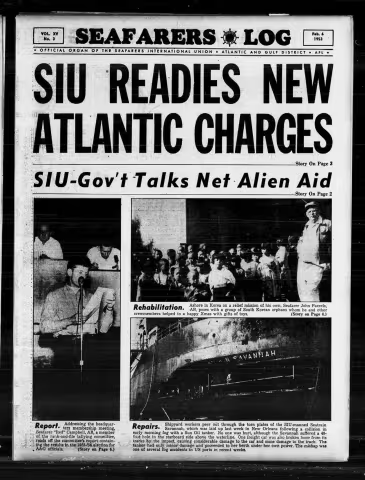
* Addressing the headquar-
^ ters membership meeting,
; ^ ^ Seafarer "Red" Campbell, AB, a member
f S, of the rank-and-file tallying committee,
reads olf the committee's report contain-
^ Vl ihg the results in the 1953-*54 election for
i? • tofficials. (Story oh Page 6.)
-Story On Page 2
R»hnhnS§n§St%n -Ashore in Korea on a relief mission of his own, Seafarer John Paerels,
UfffOff• .AB, poses with a group of South Korean orphans whom he and other
crewmembers helped to a happy Xmas with gifts of toys. (Story on Page 4.)
P^nafrc Shipyard workers peer out through the torn plates of the SlU-manned Seatrain
fiefyurrs* savannah, which was laid up last week in New Orleans following a collision in
early morning fog with a Sun Oil tanker. No one was hurt, although the Savannah suffered a 40-
foot hole in the starboard side above the waterline. One freight car w^as also broken loose from its
tracks 5by the impact, causing considerable damage to the car and some damage to the track. The
tanker had only minor damage and proceeded to her berth under her own poMirer. The mishap was
one of several fog accidents in US ports in recent weeks.
.1
tl
Face Two SEAFARERS LOG Februanr t, 195S
15 {
l-jl '
|l! '
I tik
vfn '••••
I
fk-
i'gf0'
Union Confers With Govt,
Wins Alien Aid Promise
Alieii seamen who have been sailing regularly with the'SIU and SUP have been promised
relief under the McCarran Act as the result of conferences held by Union representatives
with top Washington officials. Furthermore, the Department of Immigration has promised
to hold off on deportation pro
ceedings pending settlement
of official policy and amend
ment of the Act to deal With those
aliens who have American sea
men's papers.
The SIU and SUP delegation was
also told by representatives of both
the Senate and House Sub-Com
mittees on Immigration that Con
gress, in passing the McCarran Act
had no intention of harming bona-
fide alien seamen who are sailing
on US ships with validated papers.
On the contrary, they said, the pur
pose of the Act is to block ship-
Jumping by seambn off foreign flag
ships as a means of entering this
country with possible subversive
intent.
Only Union To Act
The SIU delegation consisted of
Harry Lundeberg, SIU president
and secretary-treasurer of the
SUP; Paul Hall, first vice-presi
dent of the SIU and secretary-
treasurer of the A&G District; and
Morris Weisberger, vice-presidenj
of the SIU and New Yoric port
agent for the SUP. It was the only
Union group in maritime that has
taken any action thus far to secure
relief and assistance for alien sea
men on American ships.
The decision to go to Washington
and take up the issue was prompt
ed by the fact that a number of
alien seamen who have US security
clearances issued by the Coast
Guard, and who have been sailing
regularly on Union-manned ships
were denied payoff and discharge
by Immigration. In some instances
deportation proceedings are pend
ing against these men.
Usually the grounds for denial
of payoff and discharge consisted
of lack of proper passports. In sev
eral cases, the men so affected
were refugees from Iron Curtain
countries, and consequently lacked
the necessary papers.
It was felt by the Union repre
sentatives that something should
be done on behalf of these men
who have proven to be good Union
men and who possess validated
papers which verif;^ the fact that
they have no connections with any
subversive organization.
Met With Immigration
In their conferences in Washing
ton with the Assistant Commis
sioner of Immigration, Allen C.
Devaney, the Union group empha-
(Continued on page 17)
SEAFARERS LOG
Feb. 6, 1953 Vol. XV. No. 3
As I See It Page 13
Crossword Puzzle Page 12
Seafarers In Action Page 18
Editorial Page 13
Foc'sle Fotographer Pagq 19
Galley Gleanings....' Page 20
Inquiring Seafarer Page 12
In The Wake .Page 12
Labor Round-Up Page 16
Letters Pages 21, 22
Maritime Page 16
Meet The Seafarer t .Page 12
On The Job Page 16
Personals Page 25
Quiz Page 19
Ship'» Minutes Pages 24, 23
SIU History Cartoon Page 6
Sports Line Page 20
Ten Years Ago .". Page 12
Top Of The News....... .Page 7
Union Talk Page 6
Wash. News Letter Page 5
Welfare Benefits Pages 26, 27
Your Dollar's Worth Page 7
Publlsliod biWMkly af tha haadquartar*
of ttia Saafarart Intaraatlonal Union, At
lantic a Ouif District, AFL, «7S Faurth
Avanua, Brooklyn 32, NY. TaL STarlins
8-4*71. Entarad a* sacond elass mattar
at tha Post Offlca in Broofcinu NY,
endar tlia Act of Aueust 34, Iffa.
Crewmembers of the Alamar (Calmar) with SIU official check off some of food stores destined for
the vessel, as the Union's poll of the Calmar ships continues to insure tiiat feeding on them eomes
back up to SIU standards. Left to right are: Steve Thayer, Steve Musco, Ed Morgan, Herbert Wil
liams, chief steward, and Joe Algina, ;5IU assistant secretary-treasurer.
SIU Slopchest Biz Booms
A growing number of ships out of the Port of New York are now being supplied slop-
chests by the SIU Sea Chest. In the past month an average of six slopchests a week were
delivered to SIU ships sailing out of this port. The pace will be stepped up in the future
as the Sea Chest expands its"
distribution facilities.
Thus far, despite the an
nounced opposition of the ship
chandlers, expressed .through the
hastily-organized Slop Chest Deal
ers of America, the Sea Chest has
experienced little difficulty in sup
plying vessels with quality goods
at competitive prices. By and large
the Sea Chest has found that most
lines of well-known branded mer
chandise have been readily avail
able, for purchase and supply.
Companies Praise Service
Companies whose ships have
been supplied thus far, including
Waterman, Bull, Robin Line, Vic
tory Carriers and many other op
erators have all reported that the
merchandise supplied by the Sea
Chest was of superior quality and
was priced lower than the supplies
the ships had previously obtained
from the private dealers.
The noisy opposition to the SIU
plan that was expressed by the
Slop Chest Dealers of America has
pretty well faded away. No con
crete steps have been taken to try
to halt the SIU operations. On the
contrary, the dealers have been put
on the defensive, and have had to
admit that in the past many of
their members have been guilty of
supplying shoddy, ill-made and sec
ond-class merchandise to the ships
at excessive prices.
The SIU's program of putting
slopchests aboard the ships was
designed to eliminate just such im-
ethical practices. The Union is ex
ercising its right to compete in
supplying the ships so as to assure
Seafarers competitive prices and
quality merchandise.
For the time being, the Sea
Chest servicp is confined to the
Port of New Yoik, but it will be
extended to other ports in the im
mediate area as soon as circum
stances penjdit. Eventually the
Union will supply slopchests on its
contracted sMps in all major SIU
ports.
Seafarers In New York carry sapplles for their SIU Sea Chest
supplied slopchest aboard Robin Sherwood. M. H. Elbert (right),
purser, accept* delivery. This was one of many SIU stocked slop
chests that are now being- pdt aboard SIU ships regularly. ,
Extend Calmar And Ore
Poll; Storing Improves
Evidence of considerable improvement in feeding and stor
ing on Calmar and Ore Line ships has been shown by the
Union's poll of crewn»mbers thus far. The Jtihuary 31 dead-
•tline originally set for poking
these ships has been extended
to allow Union representatives
to coyer . every ship in the two
fleets.
Reports from crews manning the
vessels of these companies show
that the operators have been living
up to their agreement on feeding.
It appears to date that storing: and
feeding is being brought back' up
to the level of other SlU-contracted
companies.
Under the..jigreement with Cal-.
mar that was signed last December,
the company had promised to dis
continue the policy it had iosti-
tuted 6t insufficient stocking of its
ships. It further agreed to provide
for a greater variety of food and
improvements in quality as well ai
an increased quantity of staples.
Before' that the diet had been
on the monotonous side, and if the
ships were delayed en route they
tended to run short of staples. This
was because the ships were stored
for just so many days and no more.
In order to allow time for the
company's ships to restock, the
company was given a bregthing
spell until the end of Janiiaty^to
improve conditions. Failure td'do
so gave the Union the right'to
cancel the contract. A ^fitifiar
agreement on feeding was reached
with the Ore Line when that ipom-
pany signed a new contract atfthe
beginning of January. ' {'
Deadline Eidended
However, some of" the Calmar
ships hadn't completed their voy
ages by the January 31 deadline.
Consequently they hadn't been
polled by Union representatives.
The Union will catch the remaind
er of these ships within the next
few days.
Most crews checked thus far
report that feeding is well on the
upgrade in most Instances. Similar
reports have been received through
the mails. Where there is stili room
for improvement. Union represent
atives are seeing to it that condi
tions are remedied immediately.
Baltimore Check
Ore Line vessels are being
checked by the Baltimore SIU
branch since all ten of that- com
pany's ships run between Sparrows
Point, Maryland, and South Ameri
can ore fields, principally in- Vene
zuela. Here, too, the bulk of re
ports are favorable in that both
the quality, variety and quantity
of food carried aboard has im
proved greatly.
As soon as the SIU represent
atives complete a check on all of
the ships Involved, a further meet
ing will be held with company
representatives to discuss the gen
eral picture and assure continuance
of improvements made up to4iow.
'CP Rules MCS:' Senate Report
The documented story of how the Communist leadership of Hugh Bryson's National Ma
rine Cooks and Stewards has .used lies, threats, violence and terrorism to remain in po^—
has now been told in a report of the Senate Subcommittee on Labor and Labor-Man
nient Belations of the Senate*
>0wer,
age-
Labor Committee.
The report shows definitely
that the union is controlled by
Communists, despite that fact that
the majority of the rank and file
membership is non-Communist.
It shows that the Communist lead
ership stayed in power by "ter
rorizing the real and imagined dis
sidents within the union, by de
priving critics of their jobs, by
slander, ^ . Mfication, and by intimi
dating Government witnesses to its
Ulegal activities"
ipffi-gVmm, V.-.r.li-il.i.fii •->- '
Bearing out the position long
maintained by the SIU, the report
points out that "the life of an ac
tive anti-Communist in the MC&S
has been lived against the gver-
present threat of violence in-his
home, in the union, or the water
front, and on board ship."
The SIU affiliated AFL Marine
Cooks and Stewards, has long
fought the Communist-dominated
independent MC^S, and has of
fered sanctuary to the decent
rank-and-file members of the
Commiinist-run outfit.
The Senate group also pins
some of the blame for the Com
munist leadership remaining in
power on the employers. "The em
ployers,"-says the Senate commit
tee, "to avoid unpleasantness, per
mitted themselves, without too
much protest, to become vehicles
through which the MC&S leader
ship imposed its rule of terrorism
and discrimination against all ele
ments v'ho dared oppose, its Coin-
munist policies." . •. r'
• —..I. litJt: mri
mmm
February •,1951 SEAFARERS LOG Pagre Threa
Photo shows the erewmemhers of the Aneelina as they looked aboard their fire-scarred ship last May,
Immediately after the fire. The Coast Guard investiyatiny board termed them heroes and said their
"superb seamanship" prevented a major disaster at the time.
CC Hails Bravery
Of Angelina Crew
Hailing the "superb seamansliip" of the skipper and crew of the SlU-manned Angelina
(Bull Line), a Coast Guard investigating board report dealing with a fire aboard the ves
sel last May declared that their heroism in the emergency prevented disaster.
The fire took place last May 15 in the Chesapeake and Delaware Canal when the Bar
bara Lykes, proceeding through, the canal ahead of the Angelina, collided with an oil
barge, the F. L. Hayes. The>
Hayes exploded, throwing
flaming gasoline over the en
tire area and enveloping the An
gelina with flames from stem to
stern.
The explosion occurred just at
midnight, when the watch was
changing. With smoke and flames
surrounding the ship on all sides
and shooting hi^h into the air,
Captain Rainier ordered full speed
ahead, instead of backing up. As
a result, the Angelina was out of
the fire area in seconds. Any other
course, the investigating board
said, would have led to the ground
ing of the burning ship.
Fast Action By Crew
Once out of the area, the crew
had to take fast action to put out
the fire. Flames were shooting
higher than the masts and blister
ing the sides of the ship. The
alarm had been sounded and every
man went to his fire station. The
crew's ship-saving heroism was all
the more valiant inasmuch as life-
. boats and life-saying gear had been
knocked o^t of action.
In a half hour of rapid work,
the crew brought the flames under
control. Tvifo men suffered injuries
but all others came through with
out harm.
As the Coast Guard report puf
It, after praising Captain Rainier
for his pi*ompt and sensible action,
"The conduct of the crew of the
Angelina was comparable to that
of her master. Each went to his
emergency station without a
thought of personal -danger and
successfully extinguished the fire
which threatened the lives of all."
What was particularly note
worthy about the crew's achieVe-
rnent as a companir representative
put it, was that it was in the middle
of the night and most erewmem
hers were asleep below. Despite
the flames, darkness and shock of
sudden awakening, the erewmem
hers all responded promptly and
efficiently to the alarm.
The company spokesman con
cluded, ^'we would like to add our
'well done' to the Coast Guard
commendation.
The SIU erewmemhers com
mended for bravery and attention
to duty are;
Jamef E. Chew, bosun: Juan de la
Paz, carp.; Juan Nieves, AB; Monserrate
SaUva. AB; Duane R. Fisher, AB; Herbert
SanderUn. AB; Robert Rivera, AB; Cal-
ixto R. Gonzalez, AB; David P. Rivers,
OS; Stanley V. Pacewicz, OS; Genaro
Gonzalez, OS.
Willie P. Thomas, seek eng.; .Arthur S.
Turner, oiler; Manuel Rodriguez, oiler:
Willis B. Addison, oUer, Osvaldo Delgado,
FWT; Emilio Ramos, FWT: Florenclo P.
Marques, FWT; Andrew Smurda, wiper;
Antonio Cruz, wiper.
Sixto Escobar, steward; Newt Williams,
eh. cook; Larry WUUams, night cook-
baker; Bert H. Dawson, 3rd cook; Stone-
waU Jackson. MM; AUen Reese, MM; Ver
non Douglas. MM; Alexander Smart,
utiUty.
New Unfair Labor
Charges Readied
Against Atlantic
A stepped-up offensive against Atlantic Refining
Company is in the offing as the SIU Tanker Organizing
Committee prepares to sock the company with 20 more
unfair labor practice charges. These are in addition to
29 previous charges filed on behalf of Atlantic tanker-
men wlio got bounced from the company for supporting the
SIU.
Filing of the second batch of charges will take place as soon
as the SIU tanker committee*^ —
gets all the necessary evi
dence into proper legal form.
Meanwhile, a National La
bor Relations Board field ex
aminer in Phiiadelphia is studying
the original 29 cases. These in
clude charges of hiring discrimina
tion against SIU men and firing of
tankermen because they want the
SIU to give them union represen
tation.
Another seven counts bare the
tie-up between the company and
the self-styled Atlantic Maritime
Employees Union, with the com
pany accused of "financial and
other assistance" to the "inde
pendent" outfit.
Skippers Warned
Company representatives, no
doubt recalling the $250,000 that
similar charges cost the Cities
Service Oil Company during the
SIU organizing campaign there,
have issued a veiled warning to
their skippers to watch their step
from now on. A letter over the
signature of William G. Anderson,
the company's marine hiring boss,
explains what the charges consist
of and concludes that "This letter
is written in order that you and
the other officers . . . may be in
formed of the situation . . ."
Despite the letter and the filing
of charges, the word from SIU or
ganizers is that company skippers,
mates and engineers are hard-tim
ing SIU supporters on the ships,
while the company's shoreside job-
herders are trying to make it tough
for SIU men to ship.
Where an active SIU supporter
has been fired without justifica
tion, just because he was known to
be pro-SIU, the Tanker Commit
tee takes the evidence from him
and his shipmates for use in
further NLRB charges. Meanwhile
he registers on the shipping list
and ships out SIU.
More Coming
SIU Director of Organization
Keith Terpe declared that "We be
lieve these 20 charges we have
(Continued on page 17)
1953 Art Contest Opens
Artistic Seafarers will have a chance to exhibit their work and win valuable prizes with
the opening of the second annual SIU Arts and Crafts Contest this week. Entries are being
accepted at Union headquarters from now up until midnight April 30, 1953. Judging by a
team of "experts will takep^ace
on May 5.
Last year's contest drew
such a large turnout of entrants
and visitors—over 80 different en
tries were received—that it., was
decided to make the contest an
annual affair. As before, the en
tries will, be divided Into four
categories, consisting of oils, water-
colors, drawings and handicrafts,
and three prizes will be offered in
each category, to flr^t, second and'
third place' winners.
Broad Classification
The handicrafts classification Is
broad enough to include every
handicraft hobby a Seafarer might
be interested in. It could consist
of such typical items as hand-
woven belts, banners or scarves,
leather wallets and pocketbooks,
hand-made jewelry of copper, sil
ver, brass', bone or similar mate
rials, any wood or metaiwork, and
modeling in clay or soap,
Actually the handicrafts section
is a miscellaneous heading;-that in;
dudes any kind of work that would
not be covered by the painting and
drawing categories.
Entries On Exhibit
The contest winners will be an-
Welfare Booklet
Being Readied
A new booklet on the SIU
Welfare Plan, which will give
conipiete, up-to-date coverage
and details about ail of the
welfare benefits, is now being
prepared.
This new booklet will make
it possible for Seafarers to
have ail the facts about the
SIU Welfare Plan and all its
benefits right at their finger
tips for easy reference. As
soon as the booklet has been
completed, and is ready
for distribution, announce
ment will be made in the
SEAFARERS LOG.
nounced at the May 6 member
ship meeting. Last years' winners
all received waterproof and shock-
proof wristwatchcs. Prizes of sim
ilar value will be distributed to
the 12 successful candidates this
year. All entries in the contest
will be on exhibit at headquarters
during the week of May 4.
The contest will be judged by
the SEAFARERS LOG art editor,
plus a panel of art exp'erts. Guest
judges of the first contest included
Ham Fisher, creator of "Joe Pa-
looka"; cartoonist Walt Kelly who
draws the comic strip "Pogo"; and
Dr. John I. H. Baur, curator of
painting and sculpture at the
Brooklyn Museum.
No Limit On Numbers
There is no limit on the number
of entries that any contestant can
make In one or more of the cate
gories of the contest. Naturally,
the more 'entries a man makes, the
better are his chances of winning
a prize. All those who. partici-
(Continued on page 17)
Senate Bill
Bars Spying
On Unions
Men found guilty of spying
on unions and union men
would be jailed and fined un
der the terms of a bill introduced
by six US Senators. The proposed
legislation, S. 603, is obviously an
outgrowth of the Senate Labor
Committee investigation into labor
spying against the SIU during the
SIU's organizing drive at Cities
Service.
It's been generally believed that
labor spying, along with the "yel
low dog" contract and professional
strikebreaking, went out of style
in the early 1930's, largely as a re
sult of the famous LaFollette in
vestigation. Actually, while New
York State has a labor spy law, the
Federal Government lias liad no
such legislation.
Laws have been passed outlaw
ing the "yellow dog," whereby a
man had to sign a contract not to
join a union in order to get a job,
and professional strikebreaking,
such as that practiced by the in
famous Pearl Bergoff "King of
Strikebreakers," and the Pinkerton
agency in years gone by. These
outfits were paid so much per head
for rounding up scabs. Actually
the legislation forbids transporta-"
tion of strikebreakers across state
lines only, but the practice fell into
disrepute so that the large corpor
ations hesitated to use it.
Spying Still Legal
. The labor spy business sliii pros
pered however, because it was not
under a Federal ban. "The SIU was
one of its intended victims. As the
Union's testimony in September,
1950. brought out in Cities Serv
ice's fleet an extensive and costly
labor spy apparatus had been de
veloped to get dirt on Union offi
cials and blacklist SIU men in the
fleet. The proposed bill would
make such practices a criminal of
fense.
Sponsors of the bill are Senator
James Murray of Montana; Mat
thew Neely, West Virginia; Paul
Douglas, Illinois; Hubert Hum
phrey, Minnesota and Herbert Leh
man, New York, all Democrats; and
(Continued on page 17)
J:
Pas« Four SEAFARERS LOG Febrnaty e, 1983^
Seafarer Has Own
Korean Toy-Lift'
A Seafarer-father of two children did his bit to help the
victims of the Korean warfare when he bought and presented
gifts of toys to a group of Korean orphans. Seafarer John
^Paerels, AB, who is now on
'the Ocean Lotte, brought his
MECTYOCAeaDSHKi
MATES MINE emkcm
mcH
ATTHEUmOiHAlL
4J»AVEAH[>2Cmsn
MBCOOktY/vl.SVVAP
7HEP/<smsOA4TV.
//£W LOW PRICES
A(4[>YCX/REALmiS
WELCOME MBRE AT
YOUR OWN PLACE,
OWNEQANDOPERAm
E{-mESEAEARERS
INTLUtilON-AiG-An.
gifts from Japan, during the
shuttle run of the ship between
those two countries.
Those Seafarers who have been
out on the shuttle are well-ac
quainted with the difficulties and
misery under which the Korean
people live. Particular attention
has been paid to the plight of un
told thousands of war orphans,
some of whom have been placed
in the many orphanages that have
been set up in that country. Less
lucky are the orphans and other
children who are living in broken-
down shacks made of tarpaper and
scraps of wood.
Supported By Americans
In most cases, the orphanages
are- supported by Americans in the
area, including, soldiers and sea
men. So when Christmas time came
around, avery man on the vessel
chipped in to a collection that was
being taken up generally in the
area to keep the orphanages going.
Thinking of his own two boys,
Johnny and Emilio, thousands of
miles away back home in Cali
fornia, Paerels decided he would
do something on his own. At the
first opportunity he bought a bag
ful of toys and distributed them
at one of the local orphanages.
Paerels has been sailing with the
SIU for the past seven years. He
and his family live ashore in San
Pedro, California.
Calls Scholarship $
'Service To Nation'
by George F. Boney
(Boney, an SIU member, worked his way through the U. of
Georgia, largely with his savings from going to sea, getting
his degree in 1951. He is a member of Phi Beta Kappa, the
honorary scholarship society. At present. Brother Boney is in
his second year at Harvard Law School.)
Next September four award winners under the Seafarers
Scholarship Program will pack their bags and head off for
college, assured of $l,.hOu a year to pay for their higher edu
cation. They will be either-o ^
Seafarers fresh off a ship, or'
the sons and daughters of
Seafarers. Their
parents paved
the way for this
opportunity b y
working together
with the rest of
the membership
to make a strong
Union.
This scholar-
ahip program is
(mly a part of
our greater Union plan to make
possible a life that is decent and
secure for all seamen. The schol
arships are designed to give those
Seafarers and their children who
are capable of'doing well in col
lege and professional life a chance
which they otherwise would not
fam-e because of the tremendous
expense involved.'
It is a great loss to the nation
wdien good minds go imdeveloped.
We need scientists, physicians,
teachers, and engineers. Outside
of the United States, higher educa
tion has been largely restricted to.
the well-to-do and the socially
pipminent Where these restric-
tfam have been carried,too far in
•ome of the Asiatic countries,
pn»geess has been stifled and the.
wMe eivilizatiOD has been ad-
Boney
versely affected. Even here In
America where things are better,
the sons'and daughters of working
folk and especially seamen's kids
have found it difficult if not impos
sible to get a college education.
It takes a pretty fat income for
a man with a couple of children
to pay anywhere from $1,000 to
$2,000 each year for a child's edu
cation. There are a few scholar
ships available for outstanding stu
dents, but the vast majority cover
only a small part of the total col
lege biU.
It's true that the GI BiU of
Bights has been helping a lot of
veterans of the armed forces get
the advantages of higher educa
tion. But the rights of the GI biU
were denied to merchant seamen
by Congress, despite their wartime
services. Where the Government
failed to act, and where private
philanthropy is inadequate, the
Union has stepped in.
Our Union is doing a great serv
ice to the nation by creating this
program. , Over the years, some of
us, or owr sons and daughters hav
ing"the chance that triom and dad
didn't have" by virtue of. these
scholar^ips wlU be serving the na
tion and ourc^ra^^i^ple
of profes«i(«ai leaderahipk
SEAf CASH BENEFITS
Hospital Benefits (a! Lo
De«b Benefits (7^
--
Disability Benefita
Maternity Benefits 9^ 00 00
Vacati<Mi Benefits / f-9
Total ' 1
SEAFARERS WELFARE, VACATION PLANS
RSPORT ON BENEFITS PAID
From T»
No. Seaffafcrs Receiving Benefits this Pcfiod|
Avetaite Benefits Paid Each Seafarcf e o &/
Total Benefits Paid this Period
WELFARE, VACATION BENEFITS PAID THIS PERIOD
WELFARE, VACATION BENEFITS PAID PREVIOUSLY
Hospital Benefits Paid Since lulv 1. 1950 * I JL '?F3JA
Death Beaefita Paid Since Tulv 1. 1950 *
Disability Benefits Paid Siace Mav 1. 1952*
Maternity Benefits Paid Since April 1. 1952 * | EJ
Vacation Benefits Pnid Since Feb. 11. 1952 *
Total
* Date Benefita Bean*
00
iz
00
±L
^LiH>97
WELFARE, VACATION PLAN ASSETS
Vacatloa g 3J3 LU
Cash ou Hand Welfare ?/
Vacation 1 ^o'LLS-t Estunacen Accounts Receiyabie 1 lAoLLsi s*r<?
OS Goyetoaeat Bonds (Welfare) \9-9o9U 9¥^
Real Estate (Welfare) Jo.S'aot oc.
Other Assets — Training Ship (Welfare)' II 3^
i TOTAL ASSETS II ' ' ^BODCEnEBil
nr: •
H
•j.'-
njN-
O'i
a
nmmftnt.pf
During the year of 1952, a total of one hundred and
forty (140) death benefits were paid by the Welfare Plan,
with a total of 1176,202.00 also being paid out in ho^ital
benefits to seamen during the same period,
A total of •4,195.00 was paid out in 1952 for disa-
jility benefits, from the effective date of such benefit.
May 5, 1952. In addition to the foregoing, a^jnaternity
benefit was established and made effective as of April 1,
.952. In the nine (9)l months of the year 1952 that it was
.n effect, there was a total of three hundred and forty
340) benefits paid, totaling 168,000.00
Submitttd A1 Kerr, AssistWit A^nEhistrator
and, remember this , • •
• -m : , •'J. . _
ccntributing ft single nickei onr^qur part'---€611scting SIU bene-
tospit^ l^TO^ diftability or deadi-^You get rftte po^al
i vour tmh)n?s repress . : >
• • IS
All these are yours without
fits is easy^ wh^her it's for
siervicc immettiately throt^ your
• V' I
SI
Februarr t. 1951 SEAFARERS LOG F»ge FIT*
SIU NEWSLETTER
from WASaiNOTON
I . . • . ' a
It will be interestintr to «ee what the ^coming Republican adminis
tration will do with the recommendations of the outgoing Truman
Democratic regime respecting the merchant marine.
In one of his last actions as President of the US, Harry S. Truman
called upon the Congress to repeal tax benedts granted to American
shipping lines, particularly the so-called subsidized lines. He said:
"I am more convinced than ever that the tax benefits which now are
provided to this industry (maritime) are unsound. As a hidden, indirect
and uncontrollable form of assistance, they are basically inconsistent
with one of the original purposes of the 1936 (Merchant Marine) Act,
which was to place maritime aid on an open and direct basis."
If Congress follows through and eliminates these tax advantages,
it will be a severe blow to the operators because tax benefits have
yielded about $155,000,000 in aid to the lines from 1936 to 1951. This
amount of tax aid is about the same as the net operating subsidy
granted during the same period, despite the fact that the operating
subsidy was originally intended to be the principal form of maritime
aid to US shipping companies.
V' 4" it
It will cost about $7,332,779,000 to take care of the total replacement
cost of all privately-owned American vessels. This is broken down as
follows: -
The replacement cost of 245 ships owned by US subsidized lines
will be In the neighborhood of $1,997,560,000; non-subsidized lines now
owning 533 vessels will pay about $2,956,842,000 to replace their ton
nage in the foreign and domestic trades; 446 tankers engaged in foreign
and domestic trades will be replaced at an estimated sum of $1,790,-
287,000; subsidized lines now owning some 23 combination passenger-
cargo vessels will have to expend about $398,150,000 to replace them;
while non-subsidized lines owning 21 such combination vessels will
have to fork out $189,940,000 in replacement costs.
4" t 4>
The US Treasury Department wants Congress to enact legislation
providing for greater safety of life and property at sea by authorizing
Treasury to prescribe specific rules for the loading, stowage and
securing of grain and other similar bulk cargoes.
The International Convention for Safety of Life at Sea, 1948, adopted
certain regulations in the matter. However, Treasury believes that
these regulations were intended to merely outline a basic minimum of
safety standards for the carriage of grain aboard vessels and that addi
tional enabling legislation is required to further effectuate this phase
of the safety of life at sea problem.
Treasury believes that such proposed rules should apply to all US-
ilag vessels and to foreign vessels loading grain and other bulk cargoes
at any port of the US, its territories or possessions, except vessels
operating solely on inland waters of the US or on the Great Lakes.
4 4" 4
Representative Heller, New York, is pushing for legislatio^o create
a select Congressional Committee to investigate "Commumlt activi
ties among merchant seamen and their uniOns and in transportation
industries." The House Committee on Rules will pass on the matter
in the near future.
Under R^resentative Heller's bill, the special Congressional Com
mittee would be authorized to conduct a probe of "(1) Communist goon-
squad activities among merchant seamen and their unions which are
intended to retard or defeat the logistical support of our soldiers and
allies abroad; and (2) the degree to which Communists and fellow-
travelers have infiltrated the transportation industries of the US to
the detriment of the national defense effort."
4 4 4
Another investigation that will hit the head-lines soon with names
and events is the one just approved by Congress, under which Senator
Tobey, Chairman of the Senate Interstate and Foreign Committee will
investigate crime and political racketeering on the waterfronts of
both the US east and west coasts. Asked if he had any evidence of
corruption at port areas, the New Hampshire Senator said that "I have
enough in my pocket now to blow this Capitol sky high."
Senator Tobey's Committee has submitted a budget which calls for
the hiring of special investigators and staff members. For such investi
gation, it is proposed that $75,000 be authorized to establish the sub
committee staff and that the subcommittee report its findings before
January 31, 1:»54. Commenting^ on the subject, Senator Tobey said:
"The shocking revelation of crime and political corruption on the
New York waterfront which have come to light through the investiga
tions of the New York State Crime Commission indicate dramatically
the need for a major study of this and similar situations in port areas
on both coasts pf the US. Such a study should emphasize the interstate
nature of this criminal activity and should be directed toward pro
tecting the security of our national interests as they are manifested
in the crucial port areas of the country."
4 4 4
The US privately-owned tanker fleet, as of the beginning of 1953,
continued to be the world's largest, but by a narrow margin, totaling
447 ships of 6,743,000 deadweight tons, or slightly higher than that of
the United Kingdom.
However, although our tanker fleet is younger than foreign fleets,
the US continues to face the problem of potential block obsolescence,
80% of our ships having been built in the short period 1941-45. Only
about 30% of foreign tanker fleets were built during this period.
In respect to tanker fleets of foreign nations, increases have taken
place in varying degrees, except for the fleets of Japan and Germany.
Liberia, which had no tanker fleet in 1939, now possesses a flpet over
one million tons. The tanker fleets of Panama, Sweden and Greece
have more than tripled their prewar size; the fleets of Denmark and
Spain haye more than doubled; Italy shows an increase of almost 93%,
while the balance of the tanker fleets of the larger maritime hatidns
are at or below the relative increase shown by the US privately-owned
fie^L ' • . • ;;
Tug Strike Shuts Down ttY Port
-I
Meeting Night
Everg 2 Weeks
Regular membership meet
ings in SIU headquarters and
at aU branches are held every
second Wednesday night at
7 PM. The schedule for the
next few nileetings is as follows:
February II, February 25,
March 11, March 25.
All Seafarers registered on
the shipping list are required
to attend the .
All Ports Ratify New
SIU Tanker Contract
Seafarers in all ports on January 28 ratified the new stan
dard tanker agreement and gave a vote of thanks to the SIU
Negotiating Committee for bringing home the best contract
Idled by strike of 3,500 tug and barge members, these three tugs sit it out at Pier 8, East River. Ap
proximately 450 tugs and barges in the Port of New York are covered by the tie-up. Other ports on the
East Coast are similarly affected. Membcjrs of United Marine Division struck when employers refused
to boost 81^ cents an hour offer. '
The entire port of New York was shut tighter than a drum yesterday when striking tug
and barge workers threw picket lines around all major commercial piers in the harbor area.
The pickets, members of the United Marine Division, ILA, won immediate support from
rank and file longshoremen,* —
Seafairers and others who
refused to cross their picket
lines.
Harbor workers in this and other
ports have been on strike for a
week in a contract dispute with tug,
lighter and barge operators. Dur
ing the first week of the strike in
New York, 100 ocean-going vessels
docked without tugs and 96 went
out.
No Talks Slated
Meanwhile, negotiations between
the union and the operators had
not been resumed. Consequently,
the union decided to tighten up the
strike by picketing the docks
proper. Steps have been taken to
halt docking of ships without tugs
as the result of accidents at two
city-own^^d piers.
The heart of the contract dispute
is the question of across-the-board
wage increases. Before'Hhe strike
was called the union had reduced
its original demands to 25 cents an
hour. The operators' counter-oifer
araounted to BVi cents hourly.
Since the start of the strike no
additional concessions have been
offered by the employers.
Also at stake in the dispute are
various changes in working condi
tions and other clauses of the
agreements.
Aside from docking and undock-
ing of ocean-going vessels, the
union members operate barges
from New Jersey rail yards and
refineries to New York City proper.
These barges carry the bulk of
coal and oil supplies to the city,
as well as large quantities of food
and produce.
Other ports affected by the
strike on the East Coast include
Norfolk and Philadelphia, as well
as the inland grain port of Albany,
NY.
•||
in the industry. •*
The Seafarers were unani
mous in their praise of the
new pact, which continued a sub
stantial wage and overtime boost
as well as substantial general and
working rule improvements for all
crewmembers.
The ratification of the tanker-
agreement came only a few weeks
after the membership ratified the
new standard freighter agreement,
which also featured substantial pay
raises for all hands, better over
time rates and an improved divid
ing line between the two overtime
rates, as well as greatly bettered
working rules.
The complete new tanker agree
ment was printed as a 12-page sup
plement in the January 23 issue of
the SEAFARERS LOG, thus giving
Seafarers a chance to read and
study the new pact before they
voted on it.
YOU and the SIU
CONSTITUTION wi;;;s«ii W is';-: ..
From Articlo XIV
Soction 6
W
floor by
Thw* or* no pormanont moot
ing diairmon in tho SIU. At ovory
momborshfp mooting d r<ow chair
man is oloctod, and undor
provisions oisowfim in tho con^
stitution, any fflombor prosont at
tho mooting can nwninoto him-
soF, and stand tor oloction as
mooting diairman.
3
Pas* Sis SEAFARERS LOG February 9,19SS
District Membership Okays Tailying
Committee's Report on A&G Election
Seafarers in membership meetings in aU ports on January 28 voted full approval of the
report of the headquarters tallying committee on the Union elections. Adoption of the
report by the membership makes official the 49'election winners. During the two-month
election 75 Seafarers sought-o
was cast in the District at large.
Those elected will serve for a
two-year terra in headquarters and
in the various outports of the At
lantic and Gulf District. Officers in
SIU Districts such as the SUP,
Canadian District, Great Lakes and
others are chosen in separate elec
tions by the district membership
involved.
Members of the headquarters
committee were: Roderick Smith
and Angus Campbell, deck depart
ment; Joseph Falasca and James
Purcell, engine; and Donald Mease
and Stanley Schuyler, stewards.
The full text of the committee's re
port is carried on this page, while
the port by port breakdown of the
voting will be found on page 23.
Report Itost
Baggage Cheek
Seafarers who lose baggage
checks for gear checked at any
SIU baggage room should
notify that particular hall
right away so that no one can
improperly cla|in the baggage
with that check. Headquarters
officials advise you to do this
immediately to avoid loss of
your gear and/or trouble
claiming it later on. Make
sure you notify the hall where
the baggage was checked as
soon as you find out you've
lost the check.
the headquarters and port po
sitions up for election.
Those elected who are in new
posts are now in the process of
taking over their assignments. Be
sides the new positions that were
put on the ballot this year for the
first time, there have been some
changes in previously-existing elec
tive posts.
Committee Chosen Jan. U
The six-man headquarters com
mittee, that was elected at the
January 14 membership meeting
counted all ballots from all ports
and checked the port tally sheets
submitted by the outport tally com
mittees. The committee report
shows that a total of 5,717 votes
Tallying Committee's Report
We, the undersigned Tallying Committee, duly elected at the regular business meeting of January 14,
1953, at Headquarters, submit the following report and recommendations:
All used ballots from all ports were counted and a correct tally is submitted herein. An asterisk has
been placed beside the names of the candidates who were elected to office. «
Ballots, used and unused, in each port were checked and a correct check is submitted herein.
It is to be pointed out to the membership that this Committee, Upon checking the port tally sheets,
found that the reports submitted by the out-port Committees were reconciled with the Headquarters Com
mittee report, except that reconciliation was not possible in one case. That case involved the twenty-three
(23) votes cast in Norfolk on November 23, 1952. The Norfolk Tallying Committee included, in its totals,
the above twenty^-three (23) votes. However, a check of the official list of the men who voted that day
Indicates that&nest Goodwin, Book No. G-118, was accidentally allowed to vote twice.
Obviously, since our elections are secret, there is no way by which only those two irregular votes could
be voided. Therefore, acting under the authority of Section 11 of Article XIII of the old Constitution, which
governed this election, the Headquarters Tallying Committee had no choice and voided the entire balloting
in Norfolk for that day. That accounts for the difference of twenty-three- (23) votes between the total
Norfolk votes reported by the Norfolk Committee and the total Norfolk votes reported by the Headquar
ters Tallying Committee. However, it is emphasized to the membership that the voiding of these votes in
no way changes the final results of the election.
Ballots Unused
Port Ballet Numbers Used and Returned
Boston 1— 132 133— 250
New York 5251—6850
7500—7651 7652—7700
Philedclphla 251— 500
6851—6908 6909—7000
Baltimore 501—1173 1174—1500
Norfolk 1501—1600 .1601—1750
Savannah 1751—1899 1900—2000 .
Tampa 2001—2158 2159—22.50
Mobile 2251—2858 2859—3250
New Orleans 3251—4250
7001—7268 • 7237—7500
Galveston 4251—4454 4455—4500
San Francisco 4501—4663 4664—4750
Wilmington 4751—4881 4882—5000
Seattle 5001—5097 5098—6000
Ballots
Lost
0
1
0
o
0
0
o
0
0
0
0
Ballots
Voided
0
0
0
23
0
0
0
0
0
0
0
0
Votes Cast
132
1751
308
673
77
149
158
1266
204
163
131
87
FuU copies of the reports contained in this document with original signatures are on file in Headquarters Office of the Union.
Roderick Smith. S-18 Joseph Faiasco. F.4B Donald Mease, M-704 Angus CampbeU, C-217
James PurceU. P-17 Stanley Schuyler. S-16a
(Continued on page 23)
UNION TALK
By KEITH TERPE
It's undoubtedly more than an idle rumor that
the heads of Atiantic Refining and the represent*
atives of the AMEU are again huddled in "negoti
ations" on subjects of interest to Atlantic tanker-
men. As usual, no advance notice has been given of these "talks," but
we are happy to fill in the details as we get them. One thing is obvious,
however. The Atlantic-AMEU chain of command is apparently quite
worried by the way the SIU is steadily bolstering its initial organizing
successes, or they wouldn't be so secretive about their current doings.
The latest "negotiations," coming as they do just three months after
the last round of talks completed early in November, is an attempt to
put the AMEU a step ahead of the SIU. This is always the pattern
when company and company union get together. The company benevo
lently hands out "gains" while the union pats itself on the back to
build up its courage. Ttiis is no new Uctic, but it does conform to the
pattern which these cosy company-union set-ups follow. i
The major items talked about by the key manipulators, it wrould
seem are a general increase in wages that would move ahead of the
gains In the new SIU standard tanker agreement plus a minimum
60-day paid vacation for all hands each year. This then is Atlantic's
answer to the SIU's top agreement in the tanker industry. >
'Surprise Package'
Whether the company will actually commit Itself to granting such
a package remains to be seen, but the possibility of it raises a great
deal of speculation. Why. if not for the legitimate gains just won by
the SIU, is Atlantic suddenly so concerned with conditions in the fleet?
Their benevolence will be transparent to everyone, in the fleet. If
they're so frantic to keep a jump ahead of the SIU, they must figure
they have something to lose if they don't act to stop the SIU's organ
izing push. They probably calculate, and rightly so, that proper contract
enforcement and settlement of beefs SIU style, will be far more costly
than the bones they throw to Atlantic men.
The way they operate, a general wage increase and a gratuitous
60-day paid vacation probably would be cheaper because discriminatory
firings and mysterous upgrading and downgrading of employees in
and out of favor would more than compensate for it.
Furthermore, since the AMEU officials are little miore than company
strawbosses with their own letterhead, the company will probably be
able to put over a few more slick deals, tlie same as they did last faljL
Won a Sizable Losa ' ' '
In one remarkable instance of "union collective bargaining," the
AMEU "negotiated" a $15 monthly pay increase for the ordinary
daymen and wipcrff, but these same ratings had to give up four hours'
OT on Saturday mornings. The way it figured out, they "gained" $180
annually while losing $282.88. in the same 12 months. It's easy to see
why Atlantic tankermen didn't think they got such a bargain there.
In passing, a brief comment is in order on a bill (S. 603) just intro
duced in the US Senate. The measure, an attempt to outlaw labor
spying, prescribes penalties of two years in jail, a $5,000 fine or both
for this offense. Introduced by Sen. James £. Murray and four co-
sponsors, it is designed to overcome the ineffectiveness of the Taft-
Hartley Act, which merely calls for a cease-and-desist order as the
maximum penalty. In presenting the bill. Sen. Murray noted that his
labor subcommittee had found "widespread evidence of labor espio
nage" in many fields of industry.
One of these fields undoubtedly was the East coast oil tanker indus
try, on which the SIU presented considerable testimony in 1950 relat
ing to the anti-union apparatus created by Cities Service to fight the
SIU's organizing drive in the fleet. It was particularly unsuccessful,
incidentally, and we hope the appearance of the proposed legislation
at^ this time will serve as a warning to others who may try the same
shenanigans.
if:
I .'
1;
Cattoon History Of The SIU SiU Kouts The Bureaucrats No. 30
Still trying to maintain its power after the war, the
WSA began spewing out orders by the hundreds.
It tried to revive its "efficiency exams" to re
examine all seamen's papers and to perpetuate its
elaborate physical exam set-up. The SIU met and
defeated these WSA power grabs. <.
Then, the WSA and shipowners tried to sneak In
a foreign, rider which would offset the terms of '
SIU contracts. The Seafarers answered with the
largest single job action ever staged. Some 107.
sbips were tied iip tight as Seafarers refused te '
sign bh in ports along all coast*, ' - N/: v '
In mid-April, 1946, the shipowners and the WSA
realized that their sneak attack had failed. They
agreed to aU the Seafareir' demands. The rephras
ing pi the riders on SiU 1ibips, ind the other bene-;
fits won, ̂ et .the pattern for ^e entire industry-^
, ' Once more the SIU was leading the way- ,, , j
V- •• "j.''4-
• 7.
•p
Febriurr 6, 195S SEAFARERS LOG Fage Severn
TAFT WOULD AMEND T-H LAW—Senator Taft has submitted a
list of proposed amendments to the Taft-Hartley Act in response to
demands for changes in the law. Including among his proposed changes
are those that would permit strikers to vote in representation elections
along with the men who crossed picket lines and took their jobs; a
clause softening restrictions on the secondary boycott; a requirement
that management representatives take non-Communist oaths along
with labor leaders; and a clause permitting Communist Party members
to be dred from drms under union shop contracts. Taft also suggests
enlarging the National Labor Relations Board to make it "more con
servative," and making the NLRB counsel independent of the Board, a
move bitterly opposed by unions.
' ' t-
COMMUNIST LEADERS, REMINGTON, CONVICTED—Thirteen
Communist "second string" leaders have been convicted of conspiracy
charges after a trial that lasted for several months. The convictions
were on the same basis as those of Eugene Dennis and other top CP
leaders in the now-famous trial that was held before Judge Harold
Medina. Those convicted were denied bail on appeal on the grounds
that some of the Party leaders in the first trial jumped bail and
apparently fled the country. At the same time a jury convicted former
Government economist William Remington of perjury when he denied
having been a party member or having passed secret documents to
Communist agents.
<t
SOUTH AFRICA PREMIER ASKS DICTATORIAL POWERS—
Premier Daniel Malan of the Union of South Africa has asked that
country's parliament to give him authority to suspend all laws and
rule for one year by proclamation. The request is expected to be
bitterly fought by the opposition party which represents the English
element in the country. Malan's request is thought to be prompted
by the opposition of Indian, mixed blood and negro minority groups
to his policies of segregation and denial of voting rights.
t, ^ i
EISENHOWER ENDS FORMOSA NEUTRALITY—President Eisen
hower has ordered the US 7th Fleet out fit the Straits of Formosa,
where it had been neutralizing the island to prevent attacks by the
Chinese Communists on the island or by the Nationalists on the main
land. The move was thought to pave the way for possible Chinese
Nationalists raids on the mainland, or^at the least, to worry the Com
munists into tying down part of their armies there. Several countries
expressed uneasiness at the move, fearing that it might lead to exten
sion of the Korean War. ,
i, t>
NEW YORK CELEBRATES 300th BIRTHDAY—The nation's largest
city celebrated the 300th anniversary of its incorporation in cere
monies participated^ in by Prince Bernhard of the Netherlands. It was
or. February 2, 1653 that the town of New Amsterdam was formally
set up at the tip of lower Manhattan Island, including the area around
the old SIU hall on Beaver Street.
TOP DEFENSE AIDS SELL I^TOCK—Charles E. Wilson of General
Motors was confirmed as Secretary of Defense by the Senate after he
agreed to sell 2^ million worth of General Motors Stock. Similarly,
the new Secretaries of the Army and Navy agreed to dispose of their
stockholdings in companies doing business with the Government. The
decisions came after it was apparent that the Senate wouldn't confirm
them as cabinet appointees otherwise, since the law specifically forbids
a Government official to have an interest in a firm that holds Govern
ment contracts.
Crew Aids Stranded Filipinos
The crew of a Filipino ship that was stranded in Indonesia without a cent for food, is
eating agaip thanks to the aid of Seafarers aboard the Steel Surveyor (Isthmian). A quick
tarpaulin muster among officers and crew produced enough for all necessities plus a little
money left over for then
stranded men.
As a result, the master of
the vessel, A. S. Bombasi, wrote a
letter of thanks and gratitude to
the crew for their timely aid.
Pay Cut Off
The Filipino ship had been tied
up for some time in the port of
Djakarta because of legal difficul
ties concerning sale of the vessel.
Their pay had been cut off and all
supplies had been halted.
By the time the Surveyor
reached port the Filipino crew
Sea Chases Millions
in European Floods
A typhoon coupled with extremely high tid^s last week
brought on floods and storms in England and coastal Europe
that affected millions and has resulted in about 1,500 deaths
as well as thousands still miss--^—
ing.
Extremely heavy seas struck
shipping in the area, and resulted
in the loss of several small vessels.
A British coastal liner went down
off the Irish Coast with a loss of
almost 150 persons.
No SIU Ships Hurt
No SIU ships were reported in
trouble in the area. However, one
SlU-manned vessel reporting any
trouble was the Fairhope (Water
man) which ran aground off the
West Coast of Mexico,
Howeyer, the sea invaded miles
of countryside in England, the
Netherlands, Belgium and France,
routing millions of people from
their homes. The death toll was
reported at about 1,500, but thou
sands of persons were reported
"still missing."
All of th^ areas have been put
under emergency status by their
Governments, and in Belgium and
the Dunkirk area of France, con
ditions have approached martial
law. ^
Food, mattresses, blankets, med
ical supplies, and other equipment
have been rushed to all the areas,
although it was reported that the
floods are receding, and "the worst
is over."
Particularly In the Netherlands,
where a large part of the system
of dikes was destroyed, and in
Belgium, officials reported that it
probably will take a number of
years before the land that has
been inundated by the sea will be
usable for agriculture once more.
They estimated that, in the Neth
erlands alone, over a' million per
sons were routed from their
homes.
was reduced to desperate straits.
All their clothing had been sold
for food and they had no more re
sources to fall back on. The Sur
veyor gang stepped into the breech
by supplying the Filipinos with
necessary supplies of food, cloth
ing and cigarettes.
Thanks Pays Bills
As crewmember A1 Arnold put
it, "Our slopchest bills are a little
higher than usual, but that's offset
by the letter of thanks from their
skipper."
The skipper, in his letter de
clared: "Permit me to retaliate in
behalf of my whole crew our sin-
cerest gratitude for all the good
things you have done for us.
"I could only wish and hope that
you would never have the same
predicament that we Ijave encoun
tered in this country. Some day
we may cross our paths and meet
again, and thereby have the op
portunity of repaying you."
fUS
15 foS5\ZI£
OKOCBSCMSE WSAfie
S>AmSFACrpMOPB.I.O
M£V IS CMiBGecAU.
AT rne NBW HALL ...
YOUR DOLLAR'S WORTH
SEAFARERS GUIDE TO BETTER BUYING
Written exclusively for
THE SEAFARERS LOG.
by Sidney Margolius,
Leading Expert on Buying
Buy Quality Furniture
'. Don't be a sucker when you go out to buy furniture.
Good furniture costs a great deal of money and needs
tb be shopped for carefully and with judgment. There's
also a lot of poor-quality furniture on the market and
. it can cost a Seafarer's family much disappointment and
• expense if it buys the wrong furniture and from the wrong
' store.
February Is the month of furniture sales and a good
time to shop for household needs. Some furniture prices
. have started to go up again—especially on bedroom
itlrnltufe. Upholstered living .^oom furniture and dinette
sets are now a little less expensive than last year.
It's not only when you buy furniture but where that
counts. Generally the best places to shop for furniture
• are neighborhood stores, specialty furniture stores and
• department stores. Ifs important to steer clear of install
ment stores—that is stores specializing in credit and low
; down payments. Their prices are generally high for what
they give you, and the quality of their furniture is often
extremely poor. They use a lot of tricks on customers,
' especially the common practice of advertising a special
; and then trying to "trade up" customers to higher-priced
' goods. If an installment-store salesman "talks down"
some advertised Special you came in to see, and urges
something more expensive, that's your cue to watch out.
It's a fact that department stores traditionally mark Up
, the wholesale prices of furniture by two-thirds but credit
stores have a traditional markup of 100 per cent. Thiis
' the departnaent store bharges you $100 on the average for
:
a chair that costs $60 wholesale, but the installment
specialist charges $120 for that chair.
Avoid Ornate Heavy Furniture: Gone, fortunately, are
the old days when some unscrupulous dealers hid lead
bars in furniture because old-time families judged quality
by weight. Today's trend is to smaller houses, and the
most suitable new modern furniture is scaled smaller,
lighter in weight, simple in design, and altogether easier
to care for. It uses newer but stronger material like
shaped plywood and foam rubber, and sturdy crimped-
wire springs. Such furniture has unbroken lines, un
adorned surfaces, no carving to collect dust, and is easy
to move for housecleaning. One of the simplest new chairs
consists of just a canvas sling on a metal rod frame, but
it's comfortable because of its architecture. It has no deep
coil-spring upholstery to require repairs from time to
time, needs no slip-covers, has no wood surface to polish.
When the sling becomes soiled simply slip it off the frame
and into the tub. Wood furniture in light finishes doesn't
show dust and finger marks as readily as. dark finishes^
Be especially suspicious of very ornate furniture which
is massive in size, has much carving and "waterfall" and
other fancy veneers. The idea of such flashy design is to
dazzle yoii so you don't notice the poor construction
Clues to Quality: The way ftimiture is finished is a tip-
off on how well it's constructed. Well-made pieces have
depth obtained from rubbing and not merely the high
gloss of varnish.
In living, room furniture, it's best to avoid buying so-
called "suites." You can get better buys picking out in
dividual chafrs and sofas. They don't have to match as
long as they harmonize. Especially avoid complete room
sets like "21-plece sets" advertised by installment houses.
These sets are built up by throwing in cheap lamps,
pictures, etc.
Some good values in separate upholstered chairs and
sofas are available in the current February sales. In up
holstered furniture, avoid pile fabrics like mohair which
are costly and hold dust. Good choices in coverings that
are both smart-looking and durable are cotton tapestry,
linen, and denim. Also avoid the loosely-woven novelty
fabrics sometimes found on "modern" furniture. They
wear poorly. Plastic-coated fabrics are more durable and
less likely to tear than plastic film.
In bedroom furniture, well-constructed pieces have
backs and undersides sandpapered smooth, and secured
with screws and drilled holes. Especially avoid chairs
and other pieces that are merely nailed together. The
joinings should be dowel or mortise-and-tenon construc
tion. (A dowel is a piece of hardwood fitting into holes
in two joining pieces; In the mortise-and-tenon joint, one
piece fits into a rectangular slot in the other.)
Drawers are another good clue to quality. Look for a
thin sheet of wood called dustproofing between the draw
ers, important not only because it keeps out dust but as
a sign the manufacturer took pains with the construction.
Dovetailed drawers are preferable to those in which the
back is just slipped into a slot; a center drawer guide is
preferable to side guides. Other signs of good construc
tion are corner blocks under seats and table tops and
genuine brass hardware. (Test it with a magnet; it won't
stick to real brass.)
It always pays to do extra comparison-shopping when
buying an expensive item like furniture. Experts- advis*
shopping at least three stores to get an idea of which
has best comparative values.
f
BC
IP
I •••
^*** '^ ^ SEAFARERS LOG Wniary •. 1M»
Trieste—Jewel Of The Adriatic
By FRENCHY MICHELET
Now that the officials have completed the formalities of
clearing our vessel, let's go ashore and see a bit of Trieste.
These miles of very modern concrete docks and sheds, each
serviced by a host of massive cranes, suggest that maybe
Mussolini foimd time to do more than just posture Caesar-hke
on balconies and guess wrong •
in the last war, because Trieste'
was an Italian city in his day
and its modern facilities are in a
large measure his work.
As I emerge from the gate of the
wharves—a completely walled-in
area of a good many miles—I find
that it is the noon hour and that
hundreds of longshoremen have
preceded me and are now strung
out for at least a mile in either
direction in a park that runs paral
lel to the' docks on the opposite
side of the street. They are all
eating their lunches from pails
tliat have been brought to them
by their families.
I cross the street to a bar that
boasts maybe thirty tables strung
out on the sidewalk with umbrellas
over them. Each table is now oc
cupied by a worker and his family.
I approach a table where a verita
ble Hercules is seated, stripped to
the waist, and devouring great
mouthfuls of spaghetti that would
strangle a lesser man while his
devoted family looks on ,in vary
ing degrees of solicitude—the wife
evidently determined to see that
every ounce of the at least five
pounds of food is faithfully stowed
away aboard her man while a
sweet-faced little darling of per
haps six years of age looks at her
daddy with her heart in her eyes.
Froper Family
This is indeed the family as na
ture intended it should be. Sort
of reminds me of the time when
my own little nieces were babies
and thought their uncle the wisest
of mortals. They have since grown
up and learned better, unfortu
nately. Nature sure fouled up
when she failed to provide that
children should remain such and
adults be fashioned from some
other material.
I open the conversation In my
best pidgin Italian.' I explain that
I am a writer and that I would
like to know what the man is eat
ing and how the woman went about
cooking it. I show them my notes.
The entire family solemnly ex
amines the note book and then look
at me and it's plain from their ad
miring glances that they regard me
as some sort of a superior being—
a reaction which for some sti'ange
reason is wholly confined to people
who can't read. I see that they
don't read English, so I try an
other tack. I call loudly for the
host and order wine—^vintage wine,
yet! This brings a grinning reac
tion from the, whole family. "The
Italians, like the French, think
nothing of putting wine in the
baby's bottle if it cries and it's
not time for a bottle. Soon I'm
deep in the confidence of the trio.
1 learn that one dinner pail con
tains hard boiled eggs sliced up
in a tomato sauce made by first
braising onions and garlic in oil
and then adding the tomatoes.
This is permitted to simmer for
quite a while. Then the sliced up
eggs are added. The other pail
contains a mountain of spaghetti
swimming in the same sauce. Yet
another container has a dozen
green peppers brushed with olive
oil and popped into the oven for a
few minutes. There's also a great
slab of Italian-style bread that has
been liberally smeared with melted
butter into which a clove of garlic
has been squeezed. The wife tells
me that this, too, should be popped
into the oven if it's to be con
sumed immediately. All this is
washed down with huge slugs of
vino rosso. 1 must try it sometime
on an unsuspecting crew.
It's good to stroll along here in
the cool of this lovely summer
evening and drink in the fragrant
breeze that has wandered in from
the gently heaving bosom of the
An aerial view of the "woiidng side" of Trieste where the ocean-colng ships unload eargo for tho in-
tematloniJ city.
Adriatic by way of the Gull of
Trieste.
That milling mob of several
thousand people of mixed Italian
and Slavic extraction who are mak
ing this cool August evening re
sound with their excited prattle
and laughter In the Piazzia across
the way probably don't own an
acre of Trieste among the lot of
them but they seem happy enough
for all of their obvious poverty.
Certainly none of the Illustrious
departed who have owned It lock,
stock and barrel in the past are
any the better for It now.
When Augustus reigned in Rome
In the {otemma^n ud women longshore workers bag grain nnloaded from tho ship aithe right.
The grain is li^d flHim the ships by cranes and dropped into the hoppers. In his aitide Ikondiz de
scribes a lonchiUme Interview withi one of the longshoremen of Triesta, *
he was master of all Trieste or
Tergeste as the Roman world knew
it, and of a host of other mighty
cities of the Empire .as weU.
August must content himself with
considerably less ground in this
latteivday August.
Knock on the tombs of the two
Napoleons. Tell them that Trieste
is no longer a French possession.
It won't bother them at all. They
have learned the true value of all
earthly conquests.
Trieste has known all the vicis
situdes of an Old World city. A
historian has noted that the bar
barians were hammering away at
her gates fifty-two years before
the birth of Christ. Much of her
subsequent annals are crowded
with accounts of bloodshed and
terror. Today Italy and Yugo
slavia glare at one another from
their respective borders while the
Allied Powers occupy the city be
tween and compel an uneasy truce
between the would-be belligerents.
iQuay Front
This quay that fronts the sea for
several miles .provides the wharf
age for numerous small craft that
ply the adjacent waters xmd
touch at ports like Venice and
other Adriatic cities. The great
ocean-going vessels are all berthed
on the other side of the city. That
is, all but the United States Navy,
The Navy uses a pier here that
runs several hundred feet but into
the brink where two cans and a
cruiser are now moored. A jam-
fest is in progress aboard the
cruiser.
Some bright lad In Public Rela
tions has evidently hit upon the
happy idea of supplementing the
grkin diet that ships like ours are
providing with a little food for
the sou}. It's working very well
too. I haven't found Americans
welcome/anywhere as they are
n Trieste since before the war.-
Strolling along the waterfront
1 or perhaps half a mile I ruii into a
canal that extends from the Gulf
back Into the city proper for may-
)e a dozen Squares. The water is
literally covered with small craft
One wonders how they ma^ge to
maneuver when entering or leay-
There's an open market plate
that covers several acres on the
port side of the canal. Many of
the boats are unloading merchan
dise for the stalls. A bewildering
array of goods is offered for sale
here. You might fancy yourself on
the Lower East Side in. New York
except for the air of cleanliness
that pervades the atmosphere. Here
are real lettuce and. tomatoes, not
the wooden-tasting junk that they
peddle Stateside. America has
succeeded In breeding the best-
looking and worst - tasting vege
tables OB the face of the globe.
But then everything is of the hot
house variety with us. Look at all
those lovely dolls trotting around
Times Square — more pulchritude
and less femininity than you'll
find pound for pound anywhere on
earth.
As Artist In Labor
That great mouldering pile of
marble and stone that looms across
the way Is the far-famed cathedral
of San- Gulsto. Parts of this an
cient structure were abuilding
when Clovls embraced Christianity
fifteen hundred years ago. A little
groupi of local yokels are peering
over the shoulder of a harassed
artist who is attempting to capture
the elusive charm of the cathedral
in oils. He must feel a trifle silly
to be daubing away before an au
dience who can compare his work
with Cellini and Titian and the
dozens of other giants who stalked
the earth in the age of the Tltians.
•yhere's a gorgeous little i^l
among the crowd of spectators
worrying the artist who is simply
out of this screwy world. She's
built like a forty-dollar mule. How
ever she has evidently been read
ing American magazines because
she has disfigured herself with one
of those abominable horse's tail
hairdos. This style was evidently
set by some stringy-haired hag
who is bent, on making all the
cuter dolls spot her a few pointr
in the game of life. I think that
all the dolls who copy this horse's
tail coiffure bnly. stmceed in prov
ing that they have much -iir coniv-
men with- the end of the horse's
anatomy on which the tail is usu-
r.
• - • 'A '
•J'.:- • •.
. ....
JVMiraMy f. im
••;s
SEAFARERS IPG race ](^e
CM • IC
RIDING HIGH in a wind,
Joseph Heckl looks over a
lifeboat's stern.
ALCOA PLANTER'S electrician, Jim Hand, looks over
the wares carried by a pack mule in an open public mar
ket in St. Thomas in the Virgin Islands.
CATAHOULA has Lee,
OS, and Jess Joy, bosun,
working out on deck.
DEL SANTOS' hardy crew includes: L. Williamson,
J. Wolff and "Red" (L-R. standing), and Bob Bannister,
A1 Brindley and "Gene" (L-R, kneeling).
ROSARIO gets a real pounding in the engine room as T. E. Frazier, oiler, swings a 20-
pound sledge with a will. W. Addison, oUer, is in the background. The third man in
this hard-working group was not identified.
STEEL ADVOCATE'S chief electrician (left) smiles
while bearded "Whitey" Jaggers, OS, takes time out on
the Far East run to read the LOG.
d meeting as crewmembers-iake the floor to SHIP'S DELEGATE Hany Utratil on the Abiqua takes
the floor at the meeting to give his views of the activities
of the voyage.
,1
• • r.
- ;.'>l
I
• •. U;
•I
J •m
' •; .^vl
l-in'.ilr I.--.'
m:
5®-.
Pare Toi SEAFARERS LOG Febniarr 8, 195S
i.>i. '
I i'
lb.: •
l^v
P"'' It -t
I*:
in
pf --
[ i.'i V •
&••• '
jHMtr jtfPORrs
McNelce
Baltimore:
Ship Delegates, Drews
Earn Praise tin Vessels
Things are still moving along on
an even keel here with not too
much to report on shipping except
that it has been fair, afthough not
attaining the heights of our two
previous reports. Still, I haven't
seen anyone around here suffering
from malnutrition.
During the past two weeks 19
ships have paid off, 16 ships have
signed on, and 10 ships are In-
transits. Once
again we want to
mention the fine
condition In
which the ships'
delegates and
crews ai'e bring
ing in the vessels.
So much for ship
ping at the mo-
' ment.
All is quiet on
the labor front with only some
very minor economic action being
suffered by the fire-fighters at the
present time. We do not look for
too much to come out of this, hut
we hope the guys get . an Increase
in pay in any event. With one ex
ception, everything is back to nor
mal since the mayor was success
ful in meeting with the municipal
employees la"St week. The majority
of these' people were taken back
and there is a possibility that they
will get paid for the time they
were on strike. We hope so at any
rate.
Contracts Offered Soon
There is nothing to report on
the new building since we have
not started to work on the renova
tions as yet. We have heard from
headquarters • that the plans will
be offered for contracts in a very
short time. All hands are anxious
ly awaiting to move in and I know
that this is one building that will
be appreciated by all the member
ship.
As usual, we wandered around
the hall chatting with various old=
timers on the beach and in doing
so we noted the following men
who are waiting for berths in this
part: Ely Hanover, Elmer Bamhill,
Leslie Brilhart, Jerry McNeice, Ed
Biemiller, Fritz Bantz, Walter Am
man, John Flynn, Albert Hawkins,
Charles Gill, Joseph Vujlech, and
Albert Phisterer,
• Earl .Sheppard
Baltimore Fort Agent
4. 4.- t
Boston:
Allanlic Crewmembers
Aliend SlU Meeting
Shipping has been quiet since
the last meeting. We had enough
ships in but not many men are
quitting. Very few men are quit
ting at the payoff. We don't know
what to expect in the way of ship
ping in the next period, but pros
pects seem brighter.
Ships paying off and signing on
were the Ann Marie (Bull), and
Cities Service's Logans Fort and
Archers Hope. In-transits included:
Cantigny (Cities 'Service); Steel
Maker and Steel Architect (Isth
mian); Federal (Trafalgar); De
Soto and Iberville (Waterman);
and National Navigation's John
Paul Jones.
Man Hospitalized
One man on the John Paul Jones
was taken to the hospital for food
poisoning because of a gas leak in
the crew's refrigerator. Lockers
were In bad shape and In need of
repairs, sinks were clogged and
pipes need, to be drained. The ice
... i-..
box needed to be cleared out and
stores put back in their proper
places. All stores had been thrown
into box without regard to their
nature; eggs were left in the pas
sageway while potatoes had been
stored in the ice box.
A new refrigerator was promised
to be on board before sailing, so
that the ship could sail without
any beefs. Deck engineer was or
dered by the chief engineer to go
to work on the drains in order to
have sinks in working order before
the ship left port. The food in
boxes had to be restored, pronto,
but all beefs were settled to the
satisfaction of the crew. '
New TV Room
The new television room has
been a great help in keeping the
men on the beach happy. The
men have been very cooperative
in keeping their hall tidy. We had
seven blood donors for one of our
members who was in the Brighton
Marine Hospital, but the day of
operation came and the patient
fiew the coop. The donors gave
their blood to the blood bank for
some other man who may be In
need of it at some other time.
EiSfiv-ivS
EUlson
We had a couple of Atlantic
ships in this port since the last
meeting. Men of these ships visited
the Federal and discussed SIU
conditions with some of the crew
of that ship. The Atlantic men
were favorably impressed by our
working conditions, methods of
settling beefs, and finishing pay
offs with a minimum of delays.
Booklets Popular
The booklets for up-grading of
unlicensed personnel are very pop
ular in this port. They are the
nearest thing to having a school
for the members. The weather has
been very mild for this neck of
the woods. We are having rain
when we should be up to our necks
in snow. We don't mind the rain
so much. At least, we don't have
to travel to the hall on skis.
D. S. White is in good spirits
in the hospital. This fellow always
has something to do; if he's not
painting he's making leather wal
lets. He also gets into an experi
mental mood once in a while and
gets himself a new-style haircut.
When I last saw him he had just
shaved all his hair off after having
a special Sioux Indian cut and a
beard. Others in the hospital in
clude J. Flaherty, K. Harding and
J. A. Duffy.
Oldtimers on the beach include:
Leo Rams, R. Bums, A. Arsenault,
A. Forcier, A. Remos, R. Lee, S.
Greedridge, E. Graham, A. Trot-
man, C. McCarthy, Bob Murphy,
and V. Warren, who is thinking
seriously of-going into the taxicab
business.
James Sheehan
Boston Port Agent
New Orleans: '
MardI Gras Carnival
Affects Nti Shipping
During the last two weeks ship
ping has been off somewhat, but
it is expected to improve now that
the Carnival season is in full swing
and many New Orleans members
are coming ashore to celebrate the
occasion with family and friends.
The Mardi Gras season tradi
tionally is a time for merrymaking
by New Orleanians and thousands
of visitors who congregate here
for the occasion. To Seafarers on
the beach it is
also the signal
for an upturn in
shipping. A num
ber of New Or
leans sailors usu
ally prefer to
stay aboard their
ships during the
Christmas and
New Year holi
days, electing to
get off for the Mardi Gras instead.
During the last period we had
seven payoffs, five sign-ons, and
16 ships calling in-transit. Payoffs
were on the Alcoa Pioneer (Alcoa);
Del Santos and Del Mar (Missis
sippi); Antinous (Waterman); Cata
houla (National Navigation); and
Bloomfield's Neva West and Marie
Hamill. The Alcoa Pioneer and the
Del Valle, Del Sol, Del Monte, and
the Del Mar (Mississippi) signed
on.
In-transits were the Pennant,
Pegasus, Cavalier, Pilgrim, and
Corsair (Alcoa); Steel Navigator
(Isthmian); Del Valle, Del Sol and
Del Monte (Mississippi); Seatrain
New Jersey and. Savannah (Sea-
train); Morning Light, Andrew
Jackson and Monarch of the Seas
(Waterman); Evelyn (Bull); and
Eastern's Massillon Victory.
Carnival Early
The Carnival season began ear
lier than usual this year with the
first ball on Dec. 27, Balls have been
staged almost nightly by the vari
ous Carnival societies since Jan. 2.
The first of the colorful parades
for which New Orleans is famous
will be held Feb. 8 and will be
followed by day and night proces
sions until the season closes with
the coronation of Rex, King of the
Carnival, at the Rex Ball, Feb. 17.
This day, actually, is the day of
Mardi Gras and all activities in
this port city will center around
the Carnival with fun and merry
making holding sway until mid
night when all festivities cease for
the beginning of the Lenten Sea
son.
Recent reports from public and
private agencies point up the sound
position and growing importance
of this major Gulf port.
The NO Board of Commissioners
reported grain shipments through
this port during December totaled
9,104,000 bushels, an increase of
1,895,000 bushels over the cor
responding period of the previous
year. Grain cargoes cleared the
Public Grain Elevator in 39 ships
bound for more than a dozen for
eign countries, including Germany,
Holland, Brazil, Japan, En^nd,
Belgium, Mexico, Norway, Portu
gal, Ireland, Italy and Israel. More
than 46,000 miscellaneous ship
ments went to various ports in the
West Indies and Central America.
From the American Waterways
Operators, Inc., came a report that
freight traffic on eight Louisiana
rivers, canals, and connecting chan
nels in this vicinity exceeded one
billion tons in 1951, latest year
for which figures are available.
Mississippi River traffic headed
the list with 72,510,690 tons. The
Intracoastal Waterway was second
with 35,53ti,198 tons and Lake
Charles Deepwater Channel was
third d^ith 13,831,810.
Blow Stacks
City authorities have started
more rigid enforement of a local
ordinance against ships blowing
their stacks in the harbor. 'The
Safety Commission said it had
complaints of damage to water
front property from soot shower
ing down on areas near the river
when ships clear their tubes of
carbon deposits in the harbor,
which is a violation of the ordi
nance. The present maximum fine
for the offense is $100 and fines
assessed against those found guilty
of the practice have been from $25
to $50.
Hospitalized Man
Several members are confined to
the USPHS hospital here, but no
cases of serious illness were re
ported and those undergoing treat
ment seemed to be in a cheerful
frame of mind. Oldtimer Charlie
Lowe was hospitalized briefiy for a
checkup, but his condition was
found to be satisfactory and he is
visiting the hall daily.
Seafarers on the beach were
asked to serve as blood donors for
the wife of brother Max Cuevas
and responded in typical SIU style.
Only one donor was required,'"how-
ever, and since brother Louis Es
trada was the first to come for
ward he was chosen to help out
in the emergency. Mrs. Cuevas is
reported to be much improved.
Nat Cartwright, Hay Ellison, and
Howard Abell have been readmit
ted after having been discharged
recently from the hospital. Brother
Cartwright is scheduled to Under
go further surgery.
Lindsey J. Williams
New Orleans Fort Agent
Wilmington:
Dssira Glarlficailon
tis Flranen tiveriime
srv HAti. OIRBCTOn Y
SIU, A&6 District
BALTIMORE U North Gay St.
Earl Sheppard. Agent Mulberry 4540
BOSTON 276 SUte St.
James Sheehan, Agent Richmond 2O140
Dispatcher Richmond 2014I
GALVESTON 308>A 23rd St,
Keith Aisop, Agent Phone 2-8448
LAKE CHARLES. La........ 1413 Ryan St.
Leroy Clarke. Agent Phone 6-5744
MOBILE 1 South Lawrence St.
Agevn Phone 2-1754
NEW ORLEANS 523 Bienvliia St.
Lindsey Williams. Agent
Magnolia 6112-6113
NEW yORK 675 4tb Ave.. Brooklyn
STerllng 8-4670
NORFOLK 127-129 Bank St.
Ben Rees, Agent Phone 4-1083
PHmADELPHlA. 337 Market St.
Market 7-1635
Austin St.
Don Hilton. Rep. Phone 4-2341
SAN FRANCISCO 450 Harrison St
T. BANNING. Agent.....,Dou|la» 2-54%
Ponce do Leon
Sal Colls, Agent
SAVANNAH 3 Abercorn St.
®5.B^iUey. Agent Phone 3-1728
SE^TOE . 2700 1st Ave.
-Teff Morrison. Agent Seneca 4570
St.
'• -fcii.V.riiw'iVi,. ,'i •
Ray White. Agent Phone 3-1323
WILMINGTON. CaUf 505 Marine Ave.
Sam Cohen. Agent Terminal 4-2874
HEADQUART^S.., .675 4th Ave,. Bklyn.
SECBin'ARy-TREASUREB
Paul Hall
ASST. SECRETARY-TBEASUBEKS
Uoyd Gardner
Robert Matthews Claude Slmmona
HEADQUARTERS REPRESENTATIVE
Joe Alglna
SUP
HONOLULU ..16 Merchant St,
Phone 5-8777
PORTLAND 523 «. W. Everett St.
BG&COH 4330
RICHM0I4D. CALIP....... 257 5th St.
Phone 2599
SAN FRANCISCO ,450 Harrison St.
Douglas 3-8363
SEATTLE...., .2700 1st Ave,
Main 0290
WILMINGTON' .eee^ee'eerSOS Marine Ave.
Teruilnal 4-3131
NEW YORK.,;., 676 4Ul Ave,, Brookira
STerllng 8-4671
Canadian District
MONTREAL......,634 St. James St. West
HALIFAX. N.S,..........U85''"HOIUS'^
imj Uij UU;Phonei Wll
FORT WILLIAM....IISH Syndicate Ave,
Ontario Phone: 3-3221
PORT COLBORNB.,.....>103 Durham St,
Ontario Phone: 5591
TORONTO. Ontario86 Colbome St,
. EU^ 5719
VICTORIA. BC 61714 Cormorant St,
Empire 4531
VANCOUVER. BC 565 HamUton St,
Pacific 7824
SYDNEY. {IS , .304 Charlotte St.
Phone 6348
BAGOTVILLE. Quehee 20 Elgin St,
Phone: 545
THOROLD. Ontario 37 Ormont fit.
Phone: 3-3£i2
QUEBEC 113 Cote Do La Mont we
Quebec Phone: 2-7078
SAINT JOHN 177 Prince WlUlam St,
NB Phone: 2-3049
Great Lakes District
ALPENA ,,.133 W. Fletcher
Phone: 1238W
BUFFALO.. NY 180 Main St,
Phone: Cleveland 7391
CLEVELAND 734 Lakeside Ave.. NE
Phone: Main 1-0147
DETROIT .1038 3rd Sts
Headguartcra Phone: Woodward 1-6857
DULUTU 531 W, Michigan St.
Phone: Melrose 2-4110
SOUTH CHICAGO 3261 E. 93nd St.
,.,FllOII6ti'art6* 6-84101
Newman
For the past two weeks shipping
has been only fair in this port. The
only hot item in this area has been
the weather, but the men who are
sticking around are sweating out
their favorite runs. Prospects for
the future look a little brighter.
A whole fiock of in-transits in
clude: Steel Apprentice and Steel
Chemist (Isthmian); Atlantic Water
and Gulf Water (Metro); Yorkmar,
Seamar, Massmar, and Marymar
^Calmar); San Mateo Victory and
Burbank Victory (Eastern); Ocean-
star (Dolphin); W. E. Downing
(State Fuel); Bienville, Fairland,
Fairhope, Fairport, and Raphael
Semmes (Waterman); Santa Ven-
etia (Elam); Fort Hoskins (Cities '
Service); and Binghamton Victory
(Bull).
Legitimate Beefs
To make the job easier for those
involved and to give the best rep
resentation, we would like to stres/i
again that personalities should be
kept out of Union business. We
have time and again gone to ships
to settle urgent beefs which turned
out to be a difference between in
dividuals. This creates a hardship
for men who have legitimate beefs.
Local 50 of the lATSE is stiU
on strike and men from both the
SIU and the SUP have helped to
man the picket lines from time to
time.
Tlie fast-growing fleets of Japan
ese and Greek shipping has halted
all ore shipments in American bot
toms. A year ago, 75 per cent of
the ore was hauled by American
operators. This port has seen no
US ship haul an ore cargo in six
months. Moreover, these ships are
making inroads on general freight,
as well, in big strides.
Overtime Dispute
A motion was presented to have
a clarification made on the split
ting of cargo overtime among
FWTs. While the agreement states
that all overtime shfill be divided
as equally as posible, some firemen
have not agreed to rotate watches.
We hope something is done about
this.
Leo Newman, our nomination
for "Seafarer of the Week," has
been a member of the SIU since
1944, He former^
ly shipped out
of Philadelphia,
but has been a
West Coast man
since 1946. While
the Mediterrane
an ports are his
favorites, Lee
has become a
member of the
Yokohama shut
tle boys that are slowly building
up out here.
Korean Vet
Lee has been through all the
strikes and beefs in the Union arid
is a veteran of the Korean war
with three battle stars to his cred
it. After a year in Korea on the
line he was mighty pleased to get
back to sea, and marks the ad
vances that the SIU has made as
the most amazing strides any Un
ion anywhere has made for its
membership.
Mustered out of the Army, he
walked Into an outfit that has
given him vacation pay, disability
benefits, a chance for a college
scholarship, and clean, spacious
buildings to while away the houl*s
while he is looking for work.: A
guy has to . get on the outside to
aprvficiate what the SIU reaJIytIs,
and what it does for its members,
quotes Lee.
Sam Cohen
,Wilii|iajrton Port Ageut
•- —J rT^ rieii^r r-;^. ^|;^ ^irVV'
SEAFARERS IOC fage Elerc
......... JKMtr Jt£POlltXS
Galveston:
McGowan
Tarn dipping fiaoi
far Ralad Uaian Man
During the past two weeks ship
ping has been fairly good for rated
jnen and holding its own in the
. other classifications. We are look
ing forward to a general pick-up
of activity around here.
We had three ships paying off
here during the period and three
sign-ons. Paying oft were tjie Long-
view Victory of Victory Carriers,
the Federal of Trafalgar, and Epi
phany's Wanda. Ships signing on
were the Longview Victory and
• Wanda, and Bloomfield's Marie
Hamill.
'" In-transits included: Del Sol
'• tMississippi); Alcoa Pegasus (Al-
' cojf); Seatrain Louisiana, New. Jer
sey, Texas, and
Georgia (Sea-
train); Southern
Cities (Southern
Trading); Bents
Fort (Cities
Service); Mae
(BuU); Maiden
• Creek and An
drew Jackson
(Waterman); and
Julesburg (Tank
ed Sag).
; ^^'Thete were a few minor beefs
on the payoffs as the ships came
' in, but they were settled satisfac-
• toifiiy. The crew got a fair shake
bti the dealln typical SIU fashion.
Among the men now on the Gal-
't^estoh beach is Silas M. McGowan.
SUas joined the Union in 1945 and
^ ships in the deck department. He
' was drafted in 1950 and served
' two years in the army, spending
eight months of that time in Ko
rea. It goes without saying, he
said, that he is glad to be back
With the SIU.
Keith Alsop
Galveston Fort Aient
4. t 4
Seattle:
Ocean Tow Alaskan
Pact Being Readied
For the past two weeks shipping
has been mighty fine, as we have
had a total of four ships paying off
and the same four signing on again.
Payoffs and sign-ons were oa tlie
Seacoral and Alaska Cedar COcean
Tow); and the Waterman's Fair-
isle and City of Alma. These and
three in-transits took a total of 87
replacements.
In-transits were: Bienville and
Wacosta (Waterman); C almar,
.Marymar, and Massmar (Calmar);
Fort Ho.skins (Cities Service); W.
jE- Downing (State Fuel); and Mis
sissippi's Maldin Victory, which
paid off in the previous period but
is still in port.
The shipping for the coming pe
riod looks like the top of the bar
rel as we have few men in the rat
ings of AB, FWT, oilers, cooks,
and bakers in this port. Men Iq
these ratings are needed in this
branch right now. Vessels sched
uled for payoff here during the
next two weeks include: Ocean
Tow's Alaska Spruce and Alaska
Cedar, and Waterman's Kyska,
Jean LaFitte, and Topa Topa. The
latter company's Madaket will go
on to San Francisco for the payoff.
For the past few weeks our time
has been spent between the pay
offs of the various vessels hitting
this port and negotiations with
Ocean Tow. At the present time
we have signed a standard dry
cargo agreement covering this
company for all of thefr off-shore
operations. Also, we have drafted
a completely revised Alaskan cbn~.
tract for this company and at the
present time have' reached com^
pletc agreement on the general
rules and steward department
clauses. We still have the deck
and engine department to go over
and counter check on errors be
fore we reach complete agreement
on the working of the various
clauses.
In principle, we have reached an
agreement on the entire contract.
It is Just a matter of checking and
making sure the entire agreement
is correct in the meaning and in
tent of the various clauses.
Just as soon as this is completed
a complete report will be made
through the headquarters negoti
ating committee. I might add that
in comparison with other Alaskan
contracts this pact is outstanding.
Men in the marine hospital who
are anxious to hear from their old
friends and seafaring buddies in
clude H. Tucker, M. Jette, J. Petu-
sky, W. Meehan, J. Neubauer, A-
Kerr, and T. Fernhout.
Jeff Morrison
Seattle Port Agent
$1 $
San Francisco:
Brothers Rail Tanker
Pact As Tops in Field
For the past two weeks shipping
has been holding its own on a
level basis in this port. We have
had one payoff in this period and
we expect another one in the next
couple of weeks when shipping is
expected to be fair.
The following ships were in-
transits: Raphael SemmAs, Fairisle,
Wacosta, and Bienville (Waterman);
Calmar (Calmar); and the Steel
Apprentice (Isthmian). Veritas'
Shinnecock Bay came in for payoff
during this period.
The brothers here welcomed the
new tanker agreement and send
their many thanks'to the member
ship and to the negotiating commit
tee for a fob well done. It is the
best thing ever produced in the
maritime industry.
Alien Shipping
It would be more than wise for
our alien brothers to cooperate with
Union officials, as I know they are
doing everything possible to ease
the pressure on alien shipping for
the men involved.
In the USPHS hospital at this
time are brothers P. Smith, N.
Sykes, D. Sorenson, and G. Crosby.
A card or a letter from buddies or
shipmates would do a lot to chegy
them up.
We lost some of the oldtimers
from the beach here to Seattle
where shipping has been tops, but
we still have a few men hanging
around sweating out their favorite
runs.
T. E. Banning
San Francisco Fort Agent
Mobile:
Coggins
Harkor inprovemeni in
Mobile Moves Closer
For the past two weeks shipping
has been fair and there are pros
pects that it will pick up some
what during the coming 14--day
period with eight ships due in for
payoff and two vessels expected in-
transit.
Ordinarily, this number of pay
offs would indicate lively shipping,
but most of the
ships are in the 1
coastwise or pas
senger trade and
the turnover has
been light on
these ships.
We had 11 pay
offs, signed on
seven and had six
ships in-transit.
Payoffs were on
the Pennant, Cavalier, Clipper,
Runner, Pilgrim, Roamer, and
Pointer of Alcoa, and Waterman's
LaSalle, Morning Light, Maiden
Creek, and Monarch of the Sea.
The Pennant, Runner, Pilgrim,
Roamer, and Pointer, LaSalle, and
Maiden Creek signed on. Water
man's Iberville, Warhawk, Anti-
nous and Andrew Jackson, Alcoa's
Pegasus, and the Royal Oak of
Cities Service were in-transit.
Overtime Beef
We were suecessful in settling
an overtime beef on the Maiden
Creek for engine department men
who had been worked at higher
ratings than those for which they
had signed on without their having
been promoted as called for under
the contract.
In the maritime labor field, ne
gotiations are continuing for a new
MAW agreement with the Mobile
Towing and Wrecking Co. Wages
are under discussion at this point,
with the MAW negotiating commit
tee presenting its demands. A re
ply is being awaited from the com
pany negotiators who asked for
time to take the subject up with
their board of directors.
• On the shoreside labor front the
Teamsters' Union won a strike to
enforce contract demands present
ed to Mobile building supply
firms. The Teamsters were able to
stop building supply deliveries,
causing some slowdown in con
struction work. With settlement of
the beef, operations have returned
to normal. .
May Close Beds
Oystermen affiliated with the
SIU through subsidiary fishermen's
Unions are anxiously waiting for
the next move from State Health
Officer D. G. Gill who has warned
he may find it necessary to close
some oyster beds in lower Mobil^
Bay prior to the end of the present
oyster season. Dr. Gill said tests
are being conducted to determine
if the beds have been , polluted by
the discharge of raw sewage
from metropolitan Mobile. Results
of the tests are expected to be an
nounced in a few days.
Oystermen suffered loss of in
come last year when the beds were
closed before the season expired.
Concerted action by officials of the
Mobile Bay Fishermen's Union, af
filiated with the SIU, and by SIU
officials in this port won a promise
from Mobile city officials to speed
financing and start of con.struction
fo a modern sewage disposal plant.
A plant of this nature will put a
permanent end to the threat of pol
lution that arises when heavy rain
fall raises the fresh water content
and produces high water in the
bay. Thousands of barrels of new
oysters were planted in unpolluted
areas last year, but it remains to
be seen if shifting operations to
these areas will take up the slack
in the event the older beds are
closed.
Harbor Improvement
A proposal to spend $5,778,000
of Federal funds on a Mobile har
bor improvement program appears
to have moved a little closer to of
ficial approval. Word was received
from Congressman Frank Boykln's
office that the project has been ap
proved by the Army Engineers and
the Bureau of the Budget. Boykin
predicted the measure will receive
Congressional approval at this ses
sion.
The project calls for deepening
the main channel over the bar and
the main bay channel from the
present 38 feet to a depth of 42
feet, widening both channels and
enlarging the turning basin. These
improvements are needed to ac
commodate expected new move
ments of large-size ore ships which
will supply subsidiary mills of US
Steel at Birmingham, Ala.
On the beach and ready to ship
out after recuperating from a set
of cracked ribs suffered on the Jeff
Davis (Waterman) is Frank Cog-
gins, bosun, one of the real old-
timers of the SIU. Frank started
sailing about 30 years ago and has
been a member of the SIU since
its origin.
Serve Notice
Coggins said he wants to serve
notice on his Union brothers that
his 13-year-old son, Frank, Jr., will
enter high school next year and
from "then on will have his sights
set on winning one of the college
scholarships recently provided for
under the Welfare Plan. It seems
Frank, Jr., is making "straight A's"
in his school work and is a likely
prospect.
Cal Tanner
Mobile Fort Agent
Lake Charles:
Members Well Pleased
.With Tanker Centract
For the past two weeks shipping
has been very good in our fair port
with all affairs of the port in good
shape, making everyone happy.
Causing the rush of shipping in
the past period were the Winter
Hill (twice), Council Grove, Logans
Fort, Paoli, Arch
ers Hope, Gov
ernment Camp,
Cantigny, Chiwa-
wa. Lone Jack
and French
Creek, all of
Cities Service.
Then we had the
Longview Victory
of Victory Car- Seymour
riers call in here
on .her way to Europe, taking quite
a few men as did the other ships.
The new tanker agreement came
this week and all the members are
really well pleased with the gains
we have made.
iBrothcr Torpedoed
We nominate for our "Seafarer
of the Week" brother Charles E.
Seymour who joined the Union
back in 1938 and has been sailing
^er since. He went to all the war
zones, was torpedoed, and made it
okay except for the fact that, as he
puts it, he got wet.
Leroy Claike
Lake Charies Port Agent
t- ' t
New York:
A €^ G smppme RECGRD
Shipping Figures January 14 to January 28
REG. REG! REG. TOTAL SHIP. SHIF. SHIF. TOTAL
PORT DECK ' ENGINE STEW. REG. DECK ENG. STEW.SHIFFED
Boston 42 _ 21 25 88 14 13 9 36
New York ................. 174 136 121 431 133 ,215 111 359
Philadelphls ...........i.v. 51 42 40 133 47 47 36 130
Baltimore... 134 106 57 297 108 9^ 50 254
Norfolk 41 23 V" 21 85 17 12 11 40
Savannali.....i v"" 21 19 19 59 14 13 12 39
Tampa ^ 11 8, *16 35 3 ^ _ 1 3 1
Mobile .................... 54 40 88 132 50 36 34 120
New Orieans .. 89 86 74 ^ 249 70 74 72 216
Galveston ooeeoeeeooed eHT • • • 63 6(? W;;.- 186 54 36 34 124
\ir«ist'Coa8t.,U:,';.'^;^;.Vl.. •. 75.'; 50-'^^':'194 : 59;' ,,58 •56: - •, 171 •
%TotaUin^4t.V'^''''''-*v - 518':.'''VT,8B9,V«;86r--"', ; •*-''i;496
Long Trip Payoffs
Soon lipping Shipping
Shipping has fallen off somewhat
in the past two weeks, but we are
still having to ship emergency
cards to fill some of the jobs.
Therefore, I guess things are not
too bad for our members. From
the looks of things shipping should
pick up in the coming period as
we have a number of ships due in
for payoff that have been out on
long shuttle runs. This usually
means a big turnover in jobs.
We paid off a total of 22 ships
in the past two weeks, signed 12
on foreign articles, and had 16
vessels in-transit. The following
ships were paid off:
Potrero Hills (Phila. Marine);
Coe Victory (Vietorj' Carriers);
Anniston City (Isthmian); Frances,
Kathryn, Puerto Rico, Monroe, and
Carolyn (Bull>; Royal Oak, Lone
Jack, and Chiwawa (Cities Serv
ice); Seatrains Texas, Louisiana,
and Georgia (Seatrain); Jeff Davis,
Claiborne, Azalea City, and Wild
Ranger (Waterman); Western
Rancher, (Western Navigation);
Julesburg (Tanker Sag Harbor);
Wanda (Epiphany); and Eugenie
(Oro).
Ships signed on were the An
niston City, Coe Victory, Western
Rancher, Claiborne, Wild Ranger,
and Eugenie; Andrew Jackson
(Waterman); Robin Tuxford and
Sherwood (Robin); Steel Fabricator
(Isthmian); and the Captain N. B.
Palmer and John Paul Jones (Na
tional Shipping),
In-Transits
In-transits were: Seatrains Loui
siana and New^ York (Seatrain);
Alcoa Ranger, Puritan and Runner
(Alcoa); Barbara Fritchie (Liberty
Navigation); Gateway City, Chick
asaw and De Soto (Waterman);
Steel Flyer, Steel Maker, Steel
Age, Steel Designer, and Steel Ad
vocate (Isthmian); Trinity and Mi
chael (Carras)..
, , Claude Sinunoiui
Asst. Sec.-TreoE.
Pa*e Twelve SEAFARERS LOG February *. 195S
^ 4%.
IN THE WAKE
According to tradition, the first
tailless cats were cast ashore on
the Isle of Man in the Irish Sea. -now more or less generally ac-
from wrecked vessels belonging to
the Spanish Armada that Philip II
sent against England in 1588. The
cats were supposed to have been
brought by the Spanish from the
Far East. Manx cats, as they are
known, are usually either entirely
tailless or the tail is virtually un
developed, consisting at most of
two or three vertebrae and a tuft
of hair. At last reports, they were
virtually extinct on the island.
i 4> l"
As far back aT the first century
AD, the belief was held by many
people that there were certain
"zero hours," periods of the day
v/hen a preponderance of deaths
occurred, and that the time when
the tide turns or goes out was one
of these. This belief, particularly
common among people living near
the seashore, has been ridiculed by
scientists and statistics.
4- i t
Strictly speaking, fish drink lit
tle if any water. Many people sup
pose that the constant and regular
opening and closing of a fish's
mouth indicates that it is drinking,
and hence we have the phrase "tp
dnnk like a fish," which is based
on a misconception. A fish does
open and close its mouth to pass
water through its gills, but the ac
tion is merely part of the fish's
breathing operation.
4 4 4
The only territory now under the
US flag on which Columbus is be
lieved to have set foot is Puerto
Rico, which the natives knew as
Boriquem but which he named San
Juan Bautista. On his second voy
age, in November, 1493, Columbus
stopped two days at a temporarily
deserted Indian village near the
present town of Aguadilla on the
western end of that island, and the
site has since, been converted into
a national park.
•
4 4 4
There has been much specula
tion as to the location of Vinland
or Wineland, the section of North
America discovered by Leif Erics
son in the 'llth century, and it is
cepted that the southern coast of
New England was the place. But
no matter where it was located, ac
cording to Norse legend, a white
child named Snorro or Snorri was
bom there in the year 1007. If
the actual location of Vinland or
the birth of this child is ever
proved, it would considerably pre
date Virginia Dare, celebrated as
the first white child born in
America. She was bom in 1587 on
Roanoke Island on the North Caro
lina coast.
That the Colossus of Rhodes, one
of the original seven wonders of
the world, stood across the en
trance of the harbor, with a beacon
light in an upraised hand and ships
passing through its legs," is a fic
tion that seems to have been in
vented in the 16th century. The
exact site of the statue cannot now
be determined, but is probably
stood somewhere around the har
bor and' possibly near the en
trance. In 224 BC, after stand
ing only 56 years, the colossus was
thrown down by an, earthquake.
Tradition says that it was 105 feet
high, and that the thumbs of the
statue were so large that an ordin
ary man could not reach complete
ly around them with both arms.
4 4 4
Until the time of King Henr:'
VII, who ruled England from 1485-
1509, England had no actual navy
and had made few explorations in
the New eWorld. The only navy
she had was furnished by the Cin
que Ports (five ports), a group of
maritime towns that in time actu
ally numbered 39. The Cinque
Ports were allowed various privi
leges, such as exemption from
taxation and independence from
certain laws governing other mu
nicipalities, in return for providing
ships and men to protect the coun
try again.st invasion. The highest
official was the iord warden, who
had extensive powers, but although
the office still exists, no great
powers are attached to it.
1.
s.
12.
13.
14.
15.
16.
18.
19.
20.
21.
22.
*26.
28.
29.
3D.
32.
33.
34.
35.
36.
38.
39.
40.
41.
44.
47.
46.
ACROSS
Carried on
Important
man on ship
Latin for
"which was to
he demon
strated"
Cote d'
France
This one
is —
Uruguay:
Abbr.
Three spot
Ship operator
Hearing organ
Possessive
pronoun
Rocky crag
Horse
mackerel
Feather and
arrow
Newsstand
Shelter
Before
Hamburg's
river
Pretty girl:
Slang
Group of
SIU men
High note
Harbor,
LI
Girls
Words to a
song
The Crimson
Tide
Cheer
Remo,
Italy
Small Jap
coin
, Ball games
called because
of bad
weal her
Aleutian is
land
"Much —
About Noib-
49.
50.
51.
52.
53.
2.
3.
4.
5.
6.
ing"
Blame
Sailed
A lot of talk
Smooth
Periods of
time
DOWN
Miss Smith,
singer
Mr. Benson,
Secy, of
Agricuiture
Port 1,800 ms.
from NY
Attempt
Rica
7. Lee . ex- 28. Top Labor
aghter paper
8. Galley item 31. Existed
9. He gets 32. Part of a
$302.32 shaft
10. Much: Comb. 34. Group of fish
form 35. River in Va.
11. Ask payment 37. Man's name
17. Fish eggs 38. Terre,
19. Squid's Guadeloupe
"smoke 40. KG briefly
screen" 42. Sicily volcano
22. Custom 43. and bolts
23. Not many 44. Cleaning cloth
24. Indian tribe 45. Town in
25. Chops Oklahoma
26. Ship bottom 46. One: Fr.
27. Poorly 47. Great wonder
Units (Puzzle Answer on Page 25)
Question: Do you have a cure for
seasickness?
•
Nick, Nomikos, cook: The best
thing to do is -to eat as much as
you do all the
time and keep on
working. Don't
go to your bunk
and lie down be
cause then you
are finished. I've
never been sea
sick myself as a
result, but I've
seen other men
on the ships get pretty bad so that
they are out of action.
4 4 4
H. B. Stever, AB: I've heard of
a lot of guys using seasickness pills
but the best thing
to do if you get
seasick regularly
is stay ashore.
Once in a while I
have a little trou
ble myself
though. When
that happens I
find that eating
crackers helps
keep your stomach in place.
4 4 4
John Jellette, steward: On my
last trip on the Alcoa Cavalier
passenger asked
me for a recipe.
told her to
squeeze a whole
lemon in a glass
of hot water and
drink it every
day. She took it
and didn't miss a
meal on the trip,
although it was
rough all the way
Virgin Islands.
4 4
Charles L. Stevens, steward:
:'ve' never been seasick in my life,
and my advice
to the fellows
who do get sick
is to gft plenty
of fresh air and
keep moving all
the time. They
should eat regu
larly even if they
don't feel like It.
If they throw up,
they should eat again until they
can keep the food down where it
belongs.
4 4 4 I-
Anthony Bondi, wipen Seasick
ness is mostly in the mind and it's
best to keep busy
and don't think
about* -it. I've
found that hot
tea and crackers
are a help. When
I first went to sea
I was sick once
for 19 days in a
row, but now I'm
getting over it
pretty weli.
4 4 4
Pete Gelpi, electrician: My sug
gestion is to eat dry crackers and
suck on a lemon.
THie first trip I
ever made to sea
I got pretty sick,
and even now in
real heavy weath
er I get a little
headache and
feel nauseous but
I don't throw up
and I can keep
MEET THE
SEAFARER
down
-i''! J if. fxk .cv 'xaqiA' K * ,on working as usuaL
FERNANDO MUNOZ, Night Cook-Baker
Fernando Munoz is one Seafarer
who has had his share of interest
ing experiences and narrow scrapes
during his years of sailing. Right
from the very first time he started
going to sea, as a matter of fact.
Fernando started his seafaring
career back in the troubled year of
1939, when he shipped out on a
Standard Oil tanker on the Aruba
run. The war had started over in
Europe, and the subs were thick
in that area. "Things started to get
hot right from the first," he said,
"and a tanker wasn't the safest
thing to be on at the time."
He stayed on tankers until 1941,
however, when he decided he had
enough of non-union conditions
and wages, and joined the SIU. "I
signed off that Standard Oil tanker
down in New Orleans," he said,
"and she was^ sunk on her very
next trip, with her whole crew
lost."
Gets Invasion Run
But he still didn't get an easy
time, because the very first. SIU
ship he took, the old Angelina, caiv
ried him into the invasion of North
Africa.
He didn't lose any ships during
the war, however, despite the fact
that he sailed in every war zone,
and-was under attack several times,
but he saw a number of ships close
by take "tin fish" and go down.
"There Vere always close calls
when we started to sail in
convoys," he said. "The convoys
were always so slow that we al
ways worried about the wolf packs,
and then at night, we had to
worry about the ships running
into each other."
The 39-year-bld Seafarer had
some close calls after the war was
over, too. He was on the Fairport
when she rammed a bridge in
Portland, Ore., and was aboard the
Floyd Gibbons when she ran
aground twice during the same
trip.
"The skipper," Fernando said,
"took a short cut at Key West and
We ran up on the rocks and were I
stuck for about eight days. When
we got off; we stopped at Jamaica,
and then went to Havana, but ran
up on some other rocks on the way.
We were stuck there for a couple
of days."
Stormy Trip
"The toughest trip," he said,
"was back about 1950 on the Ome
ga. The skipper took us back across
the North Atlantic even though we
were empty and had no ballast. He
said he was ordered not to load
any ballast. We ran into slorms all
the way, and'one day we only
covered 15 knots in 24 hours.
"None of us'thought we were
going to finish the trip. The second
mate was lost over the side, and.
the first and third mates were'sd
sick, that the bosun and the deck
maintenance were actually the
mates on the trip. We finally made
it, but it took us over a month to
get across."
Married and with a 16-year-old
girl and an 11-year-old boy, Fern
ando makes his home in New York,
and ships from New York. He says
that he sailed enough on tankers
before he joined the SIU, and now
he sticks to freighters most of the
time.
Likes Freighters
"There's more room to work on
freighters," he said, "and I prefer
sailing them."
The best run, as far as he is con
cerned, are the Alcoa runs to the
Caribbean and British West Indies. -
The trip isn't too long, he said, and.
he likes the area in that section of
the world.
"But most of the time," he said,
"I'm not particular and 'l take
whatever happens to be on the
board and looks good to me. It's
good to take different runs any
way, and not be travelling the same
route all the time."
"Besides," he said, "I find that
almost all of the men sailing on
SIU ships are good shipmates, and
so it's' interesting to get different
ships and meet different men. You
get to make a lot of friends that
way."
TEN YEAIIS AGO
Berlin reported that during the
iflonth of January, its submarines
had sunk a total of 63 Allied mer
chant ships . . . The US announced
that American bombers had made
their first raids "during daylight
hours" on objectives within Ger
many . . . Japanese planes bombed
US positions in the Aleutians . . .
US planes staged heavy raids on
Japanese installations on Kiska
. SIU officiiflS, elected by the
membership, were sworn into
office . . . The British announced
heavy air raids on Berlin.
4 4 4
The US announced that our
ground forces on- Guadalcanal
were advancing steadily, and al
though fighting was still heavy,
Japanese resistance was showing
signs of weakening . . . Prime Min
ister Churchill ended a 10-day visit
to Turkey ... Allied planes pound
ed Rabaul, Buin and Lae In a series
of raids . . . The SIU hit a move
by the War Shipping Authority to
set up a "discipline board" to "re
tain and restore the aythority of
ship masters" . . ; The Allies an
nounced that the fighting in Tun
isia was limited to large air raids
by both sides.
4 4 4
•Phe US eiinonnced large-scale air
activity in the Celebes, Rangoon
and Burma, but said that Allied
were being hard pushed by enemy
troops ... In Italy, Premier Musso
lini took over the post of Foreign
Minister,which had been held by
his son-in-law, Count Ciano, since
1936 . . . Berlin announced that its
forces in the Stalingrad area had
been "overcome by the numerical
superiority of the enemy," and
ordered a four-day period of
mourning in the Reich for dead
... The SIU hit the WSA's move",
which set up a recruiting and man
ning body, whereby the WSA, in
addition to being able to blackball
any seaman, would also be in a
position to say whether or not he
should be drafted.
4 4 4
A tunnel collapsed in the Mul-
cahy Mine at Shullsburg, Wis., kill
ing nine workers . . . Brazil joined
the Allies in the war against Ger
many and Italy, and- announced it
would back the Atlantic Charter
. . . The British claimed that their
submarines in the Mediterranean
sank nine Axis supply ships . . i
The British announced that their
carrier Avenger had been among
the Allied ships lost during the
landing on North Africa with 507
crewmembers lost . . . The SIU
told the erewmembers of the Flo-
mar, Pierce Butler and Benjanlln
Chew, that extra bonus money had <.
been won for them ., US, planeii >
February SEAFARERS LOG Patre Thirteem
SEAFARERS ̂ LOG
Febroory «. 19S3 Vol. XV No.
Published biweekly by the Seafarers International Union, Atlantic
& Gulf District, AFL,' 679 Fourth Avenue, Brooklyn 32, NY. ' TeL
STerllng 8-4670.
PAUL HAIX. Secretary-Treasurer
Editor, HranCRT BRAND; Managing Editor, RAT OINISOH; Art Editor, Bum ARB
LMAN; Photo Editor, DAMBL NILVA; Staff Writers, HERMAN ABIBHR. IBWUI SHVACB.
PERTALL. JERRY HIMBI; GUU Area Reporter, BILL MOODY.
IM
Heroism At Sea
One of the true tests of seamanship is the ability to ac
coally and competently in an emergency. Such being the case
the crew of the Angelina came through with flying colors
when their ship, was engulfed by a flash-fire last May.
Most of the crew was asleep when the fire broke out a
midnight as the result of an oil barge explosion. They were
awakened in seconds by the heat and the flames which com
pletely enveloped the vessel.. Yet there was no panic and no
confusion. Every man went to his post and fought the fire so
efficiently that the near-disastrous blaze was under contro"
within a half hour.
The official Coast Guard investigating board, the skipper
and the company have praised the entire crew for their
bravery and ability in the emergency. To that the Union adds
its "well done" to a group of Seafarers who have lived up to
the best traditions of the sea.
Labor Espionage
News that six Senators have introduced a bill to make
labor spying a Federal offense is a logical outgrowth of an
SIU expose. During the Cities Service organizing drive the
Union provided conclusive evidence before a Senate com
mittee that the company's lawyer had set up a far-reaching
anti-union espionage system.
As a result of the SIU's testimony the apparatus was dis
solved and the Union was able to complete organization and
signing of the company.
• Passage of the proposed law would close a well-worn loop
hole that has permitted labor spies to operate with relative
impunity. Those who are tempted to engage in such activity
will now think twice. But law or no law, the SIU won out at
Cities Service. Labor espionage can have a serious nuisance
value, but it can't stop a determined group of seamen who
want real Union representation.
Bridges Fails Again
One thing you can say for Harry Bridges—^he always keeps
trying. In his latest attempt to get control of maritime he
came up with a scheme for a new "Maritime Federation of
the Pacific." The idea was quickly squelched by members of
the independent Marine Firemen's Union. In their union elec-
. tiohs they snowed tmder all pro-Bridges candidates.
The true nature of the proposed "federation" is revealed by
plans to exclude the SUP and to give each local one vote in
policy-making. Since Bridges' longshore union is the only
one with locals, it is easy to see that he and his Communist
Party cohorts would run the show.
The old Maritime Federation fell apart in 1938 when
Bridges tried to run things to suit himself. Since then, he has
tried to bring the AFL to heel several times, only to take a
licking with each try from AFL maritime unions.
Any day now, we can expect a new plan to pop up out of
Bridges' file cabinet. The AFL maritime unions will see to it
that these schemes receive their just deserts.
Af C&S Terrorism
Talking about Bridges brings up the Senate report that
tore the mask off his favorite ally, the Marine Cooks and
Stewards Union, independent. A Senate subcommittee study
headed up by Senator Hubert Humphrey of Minnesota called
the MC&S a "Communist-dominated union" in which the
membership has been under the control of "a little totali
tarian system all of its own."
Union members, the report reveals, were dumped when
they wouldn't back Henry Wallace's 1948 presidential cam
paign and MC&S support of Soviet policy. "In one case the
wife of a member ... was beaten in her home.
"The life of an active anti-Comrnunist in the MC&S has
been lived against the ever threat-of violence in his home, in
the union hall, or the waterfront..." All who opposed MC&S
policies were subject to "terrorism and discrimination."
The Senate report confirms what Seafarers have known for
a long time—that the self-styled defenders of the working
class are the first to deprive workers of their rights, and the
Igrst to apply the- boot when'th^ complain. -
'We Salute You!'
Corsa
Suggests Changes
For Union Halls
To the Editor:
As many of the brothers will
know, the San Francisco daily ship
ping news comes out as a large
sheet, printed on one side only.
Therefore, it is convenient for
posting undei:^ glass, as is done in
the SUP hall there.
It Is a different matter in New
York concerning the shipping news
carried in the Journal of Com
merce. The listings of arrivals and
departures are strung over several
pages, and the same holds true for
the operators' ads giving details of
their services. These fill three or
four pages of every daily issue,
and are classified according to the
various trade routes.
In order to make all of the Jour
nal of Commerce news available to
those interested,
I would like to
suggest that a
standard type of
newspaper rack
be set up in the
shipping hall.
What I have in
mind is tlie kind
used in public li-
braries, and
which hold a
half-dozen papers hung on sticks
provided for the purpose. The re
maining sticks could be used for
other papers covering the mari
time field, those of affiliated un
ions, or for whatever other read
ing material is interesting to the
membership. Newspaper racks and
sticks are carried by library sup
ply houses, which have catalogues
available. I have made a prelim
inary investigation and priced the
sticks; the cost is $1.55 each in
quantities of six.
Locking Coat Rack
For another thing, there are
some restaurants which provide
coat racks in which each hanger
includes a locking device. It is a
little difficult to describe, but the
hanger is collar-size and shape.
There is another of the same de
sign on the market which you
press down after hanging your
coat; this action locks the garment
in place. The key is a sman metal
tab which, when re-inserted, un-
clamps the lock—and the coat you
get back is yours and not someone
else's.
Anyway, this sort of coat rack
is the equal of a checkroom as far
as convenience and security is con
cerned. Compactness, as well, is a
'eature; each stand takes two rows
of coats, for a total of 30 or more
to each frame.
It seems, after preliminary inves
tigation, that this particular kind
of coat rack is carried only by res
taurant-furniture houses. Who
ever set up the cafeteria in the
New York hall would undoubtedly
mow where to locate a dealer in
this merchandise. It might rate
looking into as a wortliwhile gad
get to install in the various halls.
Jim Corsa
I Ed. note: Several of these sugr
gestions are noteworthy, especially
concerning the rack for newspa
pers, Undoubtedly, it toould be
eo^er to read and maintain copies
in fhtt manner.
i
As I See It
by PAUL HALL
'y^HE ESCAPE HATCH THAT
the Panamanian, Liberian and
Honduran registries have provided
for shipowners seeking to evade
decent wages and working condi
tions and standard health and
safety regulations have long been
a sore spot among the legitimate
maritime nations. Every seaman,
no matter what flag he sails under,
knows the low level of Panamanian,
Honduran and Liberian conditions.
A look at the conditions and pre
vailing wages on these vessels
should be of particular interest to
Seafarers, and to union men gen
erally. Without the support and
protection of a legitimate trade
union, the men sailing the runaway
ships of Panama, Liberia and the
rest take their jobs in pretty much
the same manner as cattle are dis
posed of at the block—^without
being able to utter a word in then-
own behalf.
Nothing Standard
Unlike SIU ships, there is no
such thing as a standard wage and
manning scale on Panamanian
scows. For every ship afloat there's
a different set of conditions. One
that's pretty typical of the bunch
is a ship called the Ernesto. AB's
on this vessel get paid 36 pounds,
or $100.80 a month. The OS gets
30 pounds, while the oiler is top
unlicensed man with 42 pounds,
which brings him up to $115.20.
Overtime, what there is of it, is at
75 cents an hour.
This scale is considered just
about average. One of the better-
paying ships is a Liberian-flag ves
sel, the Norpalma, running between
New York and Latin America. (We
doubt if it ever got near Liberia).
Here the deck gang gets as follows:
bosun, $140; AB, $115; OS, $95.
The oiler gets $5 more than the
AB, while in the stewards depart
ment the chief cook drags down
$150 a month and the second cook
$125.
The captain gets $500 a month
and the chief mate $250, or less
than a wiper on ah SIU ship under
our new contracts. Overtime again,
is payable at 75 cents an hour.
Plenty Payless
There are plenty of ships that
'pay less than these do. One called
the Juvelente, has a so-called over
time rate of 40 cents an hour for
enlisted men and 60 cents for offi
cers. The AB, fireman and mess-
man all get the same base pay, 34
pounds, which comes to $95.20.
When you figure this kind of pay
at the value of the 1938 dollar, you
can see that the.se mistreated sea
men are worse off than Seafarers
were 15 and 20 years ago in the
dark days before the Union began.
Actually, your Union has been
informed that wages and conditions
on Panamanian ships are getting
worse instead of better. Most of
the men who crew these ships are
alien seamen. Under present con
ditions they have to get out in 29
days, and the companies are using
this to beat down the wage scales.
Offer Flat Rate
We've heard of many cases where
these aliens are being offered a
flat 20 pounds a month, or $56, no
matter what their rating. And the
men have to take it or be picked
up for deportation.
Just looking at these wage scales
gives a good idea why these ships
are a menace to US-flag operations.
And that's to say nothing of over
crowding foc'sles, rotten food, un
healthy conditions and complete
lack of protection in case of iilness
or injury.
* * *
•yms ISSUE OF THE SEA-
•L FARERS LOG carries the story
of Seafarer John Paerels who took
it upon himself to give a hand to.
Korean war orphans. Brother'
Paerels' action is one of many
similar acts of generosity by Sea
farers on the Far East shuttle,
judging from the mail we have
been receiving on the subject.
Many of the ship's crews have dug
down deep to help relieve the suf
fering of the Koreans.
We've also received a lot of let
ters from GI's over there who have
told us about the friendliness and
hospitality that's been extmded to
them by SIU crews.
Foarteea SEAFARERS LOG^ February C, 195S
':'l
iv
•S:'
i-
F"
r w t.
|k>-; '
li
---vv
•*r.--,--v.'^''.lir; . •—• V. " ' ,
rebnulry f. IflSt SEAFARERS LOG
T
Pace Fifteea
This old counting house on the waterfront was
used by a shipping firm in the 185t)'s.
A whaler that sailed the seas for 80 years, an iron-
hulled, full-rigged ship, a Jap midget sub and an old
"walking beam" Hudson River ferry boat are among
the ships that make the Mystic Marine Museum at
Mystic, Conn., one of the world's most unique re
positories of maritime lore. ^
At Mystl'c they have built a typical waterfront street of
the kind that sailors walked on to and from their ships 100
years ago. And there are buildings filled with nautical relics;
with figureheads, ship models, marine paintings, blubber
knives, signal cannon, sextai^ts, and other curios too numer
ous to mention.
Mystic is especially noteworthy as the final home and last
berth of that "Queen of American ships," the whaler Charles
W. Morgan.
It was back in 1841 that the Charles W. Morgan set sail for
the first time and headed for the open sea that lies beyond
the old seaport of New Bedford, Mass. That wasdn the hey
day of American whaling and New Bedford was the capital
city of the whale oil trade.
There has probably never been a "luckier" or more suc
cessful vessel ever to sail the seas than this rugged, wooden-
hulled bark, for in close to a century of steady seafaring, she
never suffered -a major disaster—a record most unusual for
ships of any kind. It is estimated that at least 2,000 seamen;
Yankees, Cape Verdians, Chileans, and South Sea Islanders,
lived in her crowded foc'sle.
The gross earnings of this hard-working old whaler are
estimated to have been around $2,000,000 and with the "lay'^
system that was used in the whaling days, a good proportion
of her earnings went to skippers and crews, including the
Iron-muscied harpooners upon whose skill the success of a
whaling voyage depended. Her first skipper made enough
money during one voyage to retire to Nantucket with his
young bride and enjoy a life ashore.
Cramped Life Aboard
She sailed many seas in quest of oil and as you walk her
small decks igid look at the cramped quarters in which both
officers and men had to live during theia long and monoto
nous quests for whales, you can understand why there was
frequent trouble on whalers; why mutinies. Including many
that were never reported, broke out when ships were at sea
for months at a time without ever sighting a whale.
Like other New Bedford whalers, the Charles W. Morgan
made many voyages of two and three years' duration/ Her
12th trip lasted from July 13, 1881, till June 17, 1886! De
spite her globe-girdling adventures, she was of typical whaler
measurements; 105 feet over all, with only 27 feet of beam.
She usually, carried a crew of 30.
The Morgan ended her whaling career in 1921, but was
used after that for several movies and then became a floating
museum of the whaling era at New Bedford. Neglected for
The Joseph Conrad, a square-rigger with iron
hull built in 1882, shows off its graceful lines.
some years, the venerable bark was rescued from decay in
1041 by the Mystic Marine Museum and towed to Mystic,
Conn., where, in a permanent berth of concrete and gravel,
she la. visited every year by thousands of men, women and
children.
She is a gallant memorial to generations of men who built
stout ships for the American merchant marine and of the
adventurous crews who sailed them to the far ports of the
world.
Another shrine to the days of sail is the full rigged ship
Joseph Conrad, an unique attraction in this museum of live
ships.
A "youngster" compared to the Morgan, the Joseph Con
rad is a veteran of the seas, for she was built, in Copenhagen,
Denmark, as the training ship George Stage in 1882 and for
many years trained hundreds of young men for the mer
chant marine, her masts, spars, and canvas providing the
"schoolroom" for practical instruction in the fundamentals
of seamanship.
Joseph Conrad is a miniature square rigger, measuring
" only 100 feet on the water line. When 52 years old, the
Joseph Conrad was purchased by writer Alan Villiers and
sailed around the world, logging 57,800 miles. Groups of
boy scouts, girl scouts and sea scouts live aboard the Joseph
Conrad at her Mystic dock during the summer time, learning
something about sea life from old sailors.
Side-Wheel Riverboat
Providing a strange contrast to the Conrad and Morgan
but memorializing another passing phase of American ship
ping is the old side wheel ferryboat Brinckerhoff, a veteran
of the Hudson River. This squat-ended vessel holds a fas
cination for many museum visitors, especially the moppets,
and is an interesting relic of the days when hundreds of
side-wheel, walking beam ferries plied our rivers and har
bors.
Still another real ship that enjoys a last berth at this
museum of "live" vessels, is the schooner Australia, typical
of many coasters that carried commerce on short hauls along
the Atlantic seaboard years ago. The 76-foot Australia has
a pedigree dating from the far distant past but it is said to
be between 80 and ICQ years of age.
Modernistic complement to these ancient craft is a Japa
nese suicide sub raised after the war. Like an elongated
cigar, this battery powered warship carried a one or two-
man crew who squeezed into the narrow bowels of the ves
sel without any hope of ever getting out.
Village Not Completed
A shore-side scene such as seamen witnessed in the days
of the clipper ships is being provided at Mystic with a cob
blestone street, granite curbing, granite sidewalks, and a
row of 19th century business establishments that will, when
the project Is completed, include a sail loft, chapel, oldtime
firehouse, shipsmith shop, spar shed, rope walk, and other
Once on the bow of a tall-masted windjammer,
this figurehead is one of many at the museum.
nautical structures. Some of these buildings are already
finished and furnished.
Along with the cannon, anchors, bells and other maritime
accoutrements that fill the yards and buildings at Mystic arc
hundreds of thrilling and romantic tales of the sea, for al
most every relic has its story.
Among the lifeboats and other small craft at the museum
is the jolly boat from the British freighter Anglo Saxon.
In 1940 this tramp was outward bound from the Bristol
Channel to South America with a cargo of coal and a crew
of 40 men.
As she steamed alone in the wide, lonely reaches of the
Atlantic, the German raider Weser attacked her 1,000 miles
from the nearest land. The freighter's one gun was no match
for the raider, which poured a hail of machine and heavier
gun fire into the Anglo Saxon, killing and wounding most of
the crew and destroying the lifeboats.
Before the ship sank seven men managed to get away in
the jolly boat, much smaller than the regulation ship's life
boat and used for pulling to iand from shore when the ship
was tied to ^uoys.
The voyage of these seven was an epic of the sea. For
seventy days the tiny craft was alternately tossed by cold
winds and then baked in tropic doldrums. The boat finally
made land in the West Indies with two of its seven men alive.
They were the only survivors of the Anglo Saxon.
• Among hundreds of other relics, each with a story, is the
kettle in which the cook of the whaleship Robin Hood, made
the plum duff, a whaleman's delicacy. It was a mixture of
flour, lard and yeast boiled partly in salt, partly in fresh
water, and flavored with plums or dried apples.
An 11-Year Trip ^
There is a picture of the whaler Nile, which left New Bed
ford in May of 1858 and returned in April of 1869! Three
or four months is considered a long trip today!
Another story of the sea is brought to mind by the pic
ture of the whaler "George Henry."
In 1855 this whaler and her crew of 19 were hemmed in
by Arctic ice floes and, while drifting with the ice, spotted
a ship some distance away which did not answer their sig
nals. A group from the "George Henry" tramped over the
ice, boarded the vessel, and discovered her to be the British
ship Resolute, one of five vessels sent out from England
three years before to hunt for the British explorer Sir John
Franklin.
The Resolute had been abandoned by her crew but except
that her topmasts had been taken down and burned for fuel,
the ship was in fine condition.
Deciding that saving this prize would be better than trying
to catch whales, the crew of the "George Henry" shepherded
their derelict through the floes and, with a prize crew aboard,
finally sailed her into New London as a most unusual catch
for an Arctic whaling voyage.
Museum buildinff ^rounds at Mystic trfi deco- , Girl scout delegation inspects the Morgan. The Morgan's box-like stern and gilded eagle
t^ with cannoiv anchors and-small <»affe^^v>'?-#?r'^:i«iWooden^d^ .used.ta JoweS.Whaleboata.** >typifie» -New- Bedford end -Nantucket whaler*; ra
4 . i
h'.'.
itr^
l7;
-C-
[•'; •
ft'",'
• i- ••
ix;
I'
P«g« Sfatteea •/T ' SEAFARERS LOG VWfiTiurr t. IMS
MARITIME
British police launched an extensive investigation as a series of fires
—one of which resulted in the "total loss" of the Empress of Canada—
plagued Liverpool. The freighters City of Florence "and City of
Gloucester were the first to be hit by fire. They were damaged slightly.
Three days later, however, fire struck the Empress of Canada. Despite
efforts by municipal and port fire fighters, the 20,325-ton passenger
vessel was soon a smouldering wreck, and she capsized and sank against
her dock in about 50 feet of water.
Port authorities said that the job of salvaging the liner would take
"at least a year," and would be an "extremely expensive job." How
ever, since the wreck blocks berthing facilities, she will have to be
salvaged. Within two days after the fire had destroyed the Empress
of Canada, it struck the liner Queen Elizabeth which was in drydoc-k
in Liverpool for her aimual overhaul. The fire aboard the Elizabeth
was brought under control, and damage was reported as "not serious."
Scotland Yard, however, announced it would hold a complete investiga
tion of the series of fires in the port.
• t t 4
The American Bureau of Shipping has reported that shipbuilding
in the yards of the world is well above the figure set in 1951. The
bureau says that over 16 million gross tons of shipping are under
construction or on order in shipyards throughout the world. Great
Britain heads the list with 60 percent of the total. West Germany is
second and Sweden is a close third, while the US is in fourth place.
Of the total, 60 percent in tanker tonnage, -33 percent accounts lor
colliers, ore carriers and cargo ships, while 6 percent accounts for
passenger ships and passenger-cargo vessels. The construction and
orders in US yards, says the Bureau, is pretty well limited to tankers
and the Mariner class ships ordered by the Government.
The 7,000-ton British freighter Ledbury reported by radio that her
skipper disappeared at sea while the vessel was about two days out
of Tokyo . . . The Republic of Korea added the largest unit so far to
its merchant marine when it tcok possession of the 7,067-gi-oss-ton
Victory ship Hafez, which was formerly under Panamanian registry
. . . The Dutch tug Osstzee reported that it was speeding to the rescue
of the German freighter Clervaux which was in heavy seas with a
cracked main deck.
4*
Two crcwmcmbers of the German Odenwald were drowned in Erie
Basin, Brooklyn, when the wash from a passing tug capsized a raft
they were using to paint the side of their ship . . . New York City has
announced that it will lease its pier space directly to "qualified terminal
ship companies and stevedoring companies" in an effort to boost the
revenue in the Port of New York .. . Camden, NJ, reported that cargo
handled there during 1952 set a new record of ^98,931 tons . . . San
Francisco said imports handled there during 1952 set a post-war high
of 860,000 tons, but that total cargo handled dropped from 6,555,208
tons in 1951 to 5,787,932 in 1952.
t i 4
The Norwegian tanker Olav Rindal which picked up the 37 survivors
of the Finnish Tirrenia after she exploded in the Red Sea ran into
trouble in Port Said when she tried to land the survivors. Because the
Olav Rindal had called at a port in Israel previously, Egyptian authori
ties ,at first refused to even allow the survivors of the Tirrenia ashore.
Finally, the survivors were permitted to land but the Rindal was not
allowed to take on any water or supplies.
% $ i J.
The Petro Kure, new flagship of the Sinclair Refining Company, Is
on her maiden voyage from the Persian Gulf to the US. The new ship,
built in Kure, Japan, is 38,000 deadweight tons, the largest tanker in
service at present. She is 645 feet long, has a 92 foot beam, and a
service speed of 14 knots. She has a capacity of 278,000 barrels . . .
The tugs Dalzellera and Nancy Moran went into service in New York
Harbor with controllable-pitch propellers. They will be used to test
whether the controllable-pitch screw is better suited to tug work thau
the standard fixed-pitch propeller.
t t t
Japan and Philippines have announced .that they have reached an
agreement providing for Japanese salvage experts to survey the
hundreds of ships sunk during World War II in Manila and other
Philippine ports . . . The Peruvian freighter Tumbes sailed from
Brooklyn for the first direct voyage since World War II to Iquitos
in Peru. Iquitos is farther up river than any other deep-water port in
the world, a total of 2,116 miles upstream from the Atlantic port of
Belem.
The operators of New York's floating grain elevators have announced
that, unless grain movements through New York pick up, they will be
forced to go out of business. New York is the only port in the country
with a system of floating grain elevators, which travel to the ship,
instead of having the ship go to the elevator to load. The operators
said that almost all grain movements have been through Philadelphia
and Baltimore in recent years.
THI
LABOR
ROUND-UP
Unions representing some 1,250,-
000 railroad workers have de
manded a wage boost'^of 3 percent
on increased productivity. The Car
riers Conference Conunittee, rep-
resentating most of the* country's
large roads, have termed the de
mand "ridiculous." The unions
base the demand upon a contract
clause permitting wage reopening
when Government policy changed
to allow productivity incteases, and
cited tl}e allowed steel raises as in
dication of the change in policy.
if iCi i
CIO bus drivers in New York re
turned to work after voting to go
into arbitration on their demands
for a 40-hour week with no loss of
weekly pay. The 8;200 .men had
been on strike for 29 days before
voting to accept arbitration.
ft J" iS»
AFL bus drivers and mechanics
in Washington, DC, went back to
work after a 35-day strike which
won them a 15-cent pay increase,
a cost-of-living escalator clause
and contract improvements. The
men also voted to fight the state
law, which allowed the State of
Virginia to "seize" those lines* in
the state that were struck and to
attempt to operate them with high
way department employees.
ft ft ft
The CIO Textile Workers Union,
representing 90,000 workers in the
cotton and rayon industries, has
demanded a pay increase of 6V^
percent. The raise, .said the union,
would restore pay cuts that arbi
trators voted last year at the re
quest of the employers. Since the
industry ended 1952 with a profit,
said the unien, and "no reduction
in executive salaries," the workers
should have the pay cuts restored.
ft ft ft
The AFL Retail Clerks Interna
tional Association has named a
southern division as the seventh
section of its organizing set-up.
The union stated that increased in
terest in unionization and the need
for union representation in the
area made it necessary to set up
the new division.
ft ft ft
The AFL has announced that it
is going to set up a special wom
en's voting division which will
function in future elections on
advising women voters of candi
dates' records and qualifications.
The AFL said that the increased
role of women in industry and
politics, as well as the large per
centage of women voting in past
years has made such a division
practical.
Pasinosky
Tricks Of The Trade
Among the skills that go to the making of a good deck seaman is
the ability to learn the dozens of short cuts in work, the easier ways
of doing things that save ai lot of effort and energy and get the job
done properly. Practically every AB and bosun has his own system
for getting things done, whether it's handling rope, pidnt and paint
brushes, rigging stages and so On. Through the years, the seaman
learns through experience that there are several ways of doing the
same thing and some are better than others, at any given time.
Seafarer Joe Pasinosky, who has been sailing with the SIU since
1941. has had occasion to pick up quite ihfew "tricks of the trade." As
he puts it, "i have watched many a man beat his
brains out doing a simple job the hard way. Some
times, a man who holds an AB ticket and has been
sailing a while is too proud to ask somebody else
for advice on handling a particular job. It would
be a good thing if we could get all of the men to
send in their, own tricks for doing a job better,
quicker and easier."
Here are a few of the tips that Pasinosky wants
to pass on to his fellow Seafarers:
Wrench Helps Open Strands.
Splicing wire—When spliciiTg wire rope you can
save a lot of time and effort in getting the strands open through use of
a Stilson wrench. Take an 18-inch wrench and give the rope a turn or
two about two or three feet above the spUce. This Will open the strands
and enable the man to spUce the wire with no effort at all.
Stenciling—Each time that a stencil is made, the back of the stencil
plate should be wiped clean with great care. Otherwise the small par
ticles of paint on the back will smear on the next job. >
Add Ammonia To Paint ,
Making stencU paint—A few drops of ammonia should be added to
the paint and the paint should then be stirred until it is at the desired
tliickness. This wiU keep the paint from running and smearing the
stencils.
Cleaning paint pots—Simply take a paint brush and whirl it around
the bottom of the pot, This will get most of the paint out and ker-p the
pot clean. It eliminates the need of making new paint pots every few
days, or having a paint pot with an inch of paint in it every two weeks.
Cleaning paint brushes—^By far the best way of cleaning paint
brus^ies is by t^ing a wire brush and wire brushing the bristles. In
this way, all the dried out paint is removed and the paint brush can
be made almost as good as new by the usual soaking treatment which
follows.
Removing wedges—Use a two-foot crowbar to remove wedges. In
this way the points of the wedges won't be broken and the man will
find it much easier to get them out.
ft ft ft
Hatch Tent Rigging
Occasionally it happens that the hatch tent that is rigged when the
ship is loading or unloading cargo will drop because the rope straps
or rope gantlines will give way.
At best this could result in de
lay in handling of cargo; at worst
it might mean a badly cracked
head for any unfortunate sea
man who might be in the way.
To avoid dropping of hatch
tents the Accident Prevention
Bureau of the Pacific Martime
Association recommends the fol
lowing procedure in rigging the
tent:
The strap or pendant, that sup'
ports the hatch tent' gantline
block, should be of at least %-
inch wire rope. The gantline
block itself should be hung off
so that it is at least two feet be
low the gin block. In this way
the gin block and cargo fall will
not chafe against the gantline.
The gantline should be of wire,
rope, which is preferable to
manila, since tho latter is more
likely to suffer wear from chaf
ing. The gantline wire should be not less than %-inch plow steel or its
equivalent.
It's desirable to have the gin block and gantline rigged permanently,
so that a tent.can be raised with a minimum of fuss and bother. In,
that case, guys and other gear should be inspected regularly to check
on wear or chafing, and to make the necessary replacements before
the gear fails.
rmMt
«« ttt
Burly His Biggest Creditor By Bernard Seamaa
Febnury <. 195S SEAFARERS' LOG Pare ScTentcca
Seafarers Sail Fleod Relief Cargo
liiS
Crewmembers of the SlU-manned Hurricane (Waterman) stand by several tons of food destined as re
lief cargo for flood-ravaged Holland. The food cargo, being loaded at Bush Terminal, Brooklyn, was
sponsored.by religious groups. Left to right are Seafarers Antonio DeCosta, Alex James, Lloyd Gum-
mells, and Charles Hall.
Senate Bill Outlaws Labor Spies
(Continued from page 3)
Wayne Morse, Oregon, independ
ent. The bill calls for fines up to
$5,000 and imprisonment up to two
years for any person who shall
"make, or receive, or solicit
any verbal or written report con
cerning the lawful activities of any
employee" who is exercising the
riglit to "form, join, or assist
labor organization, or participate
In lawful collective bargaining."
Senator Murray was chairman of
the sub-committee on Labor-man
agement Relations which heard
% two days of testimony from Union
representatives and other interest
ed parties concerning the Cities
Service apparatus. The apparatus
was subsequently dissolved and the
company signed a contract with the
Union.
Phones Tapped
As SIU secretary-treasurer Paul
Hall stated in his testimony before
the committee, "Labor spies and
private detectives were employed
to rout the pro-union men from the
ships and a campaign was under
taken to discredit the union and
its officials. The company had its
spies investigate the background of
every union official, informers in
filtrated into the union halls and
our phones were tapped."
Included among the prominent
leaders of the labor spy apparatus,
he testified were "William Potter
Lage, John Irwin Dugan . . . and
Albert L. Strasburger, all attor^
neys. ...
"Dugan recruited two men we
Olde Photos
Wanted hy JUOG
The LOG is interested in col
lecting and printing photo
graphs showing what seagoing
was like in the old days. All
you oldtimers who have any
old mementos, photographs of
shipboard life, pictures of
ships or anything that would
show how seamen lived, ate
and worked in the days gone
by, send them in to the LOG.
.'Whether they be steam or jsall,
around the turn of the cen
tury, during the first, world
war and as late as 1938, the
LOG is interested in them ail.
We'll take care of them and
return your wuvenirs to you.
know of to go aboard the com
pany's ships and spy on the men
suspected of union activity . . .
Dugan paid these men for their
work with funds obtained from
Lage ..." Those hired included
John Basciano and Larry Hennes
sey. "Dugan said that between
June, 1948, and September, 1949,
he paid Hennessey $2,100 and Bas=
ciano . . . $4,100." The two men
sailed on CS ships and made peri
odic reports on SIU activity.
"On the basis of the reports filed
by Hennessey and Basciano, scores
of efficient seamen were fired and
blackballed ..."
That wasn't all of the apparatus
though. "Lage wanted fuller cov
erage ashore so he turned to Hor
ace W. Schmahl, head of a licensed
private agency . . . Schmahl's job
was to uncover the backgrounds of
union officials and to screen sea
men applying for jobs ..."
Subsequently this testimony was
continued before the committee by
many of the individuals involved,
including Caesar Scotti of Marine
Index, Strasburger, Basciano and
Dugan.
Under the terms of the proposed
legislation any of the above-de
scribed activities carried on in sim
ilar situations would become pun
ishable Federal offenses.
SIU Readies New
Atlantic Charges
(Continued from page 3)
coming up now really will pin re
sponsibility on the company for at
tempted Union-busting. But we're
not stopping here. When more
cases arise we're moving right in
to get evidence and file charges."
He recalled that in the Cities
Service drive 130 SIU backers col
lected an average of better than
$1,100 each in back pay. And in
the end, the company had to sign a
Union contract anyway.
"The company is going to find
these firings a pretty expensive
hobby," Terpe said.
Juicy Profits
From the looks of the companys
latest financial statement there's
plenty of surplus on hand to pay
the freight. This week Atlantic re
ported juicy net earnings (after
taxes are paid) of $40,427,000 for
1952. In addition, last May the
company was doing«so well it split
its stock, giving shareholders 2V&
shares for each one they had.
Money Exehanye
Hates Listed
The following is the latest
available listing of official ex
change rates for foreign cur
rencies. Listings are as of
February 5, 1953 and are sub
ject to change without notice.
England, New Zealand, South Africa;
S2.B0 per potuid sterling.
Australia: $2.24 per pound sterling.
Belgium; SO francs to the dollar.
Denmark: 14.4S cents per krone.
France: 350 francs to the doUar.
HoUand: 3.80 guilders to the dollar.
Italy: 825 Ure to the dollar.
Norway: 14 cents per krone.
Portugal: 28.75 escudos to the dollar.
Sweden; 19.33 cents per krone.
India: 21 cents per rupee.
Pakistan: 30.2 cents per rupee.
Argentina; 14.2 pesos to the dollar.
Brazil: 5.4 cents per cruzeiro.
Uruguay: 52.63 cents per peso.
Venezuela; 29.85 cents per boUvar.
•4-'
US Tanker Tonnage Dropped In '52
The US privately-owned ocean-going tanker fleet declined slightly during 1952, accord
ing to the National Federation of American Shipping, but it still remains the largest in the
I world under any one flag.
The present fleet, said the
AT SIU HEADQUARTSRS
4tli Ave.« 20tii St. • Brooklyn
Vi - •
Swap yarns or watch the fights
on television with your old ship
mates at the Port O' Call—YOUR
union-owned and union-operated
bar. Bring your friends — where
you're always welcome. And the
tab won't fracture that payoff.
OWNED AND OPERATED
by tha
SEAFARERS INTERNATIONAL UNION
ATUNBC AND GUu UialRlCr AF.L
1.-
report, stands at 447 vessels
totalling 6,743,000 deadweight
tons. This is a drop of 10 ships
and 64,000 tons from the January
1, 1952 total. Four large new
tankers were added to the fleet
during 1952, but nine ships were
sold or transferred abroad, four
were marine losses, and one was
transferred to Great Lakes oper
ations.
Although the US tanker fleet
comprises 23 percent of the world
tanker tonnage and is 60 percent
larger than at the outbreak of
World War II, it faces the prob
lem of block obsolescence. About
80 percent of the ships were built
duting 1941-45.
New Building Slow
The US tanker fleet has only
added 300,000 deadweight tons of
new construction since 1947, or
less 'than 5 percent of the total
tonnalge. At the same time, 10 mil
lion deadweight tons of new con
struction, or 40 percent of foreign
tankers have been built since 1947.
In mid-1952, there was building
and on order for US registry, a
total of 755,000 deadweight tons,
or 5 perdent of the world total. At
the same time, the United King
dom had 3,854,000 deadweight
tons, or 27 percent of the world
total, building and on order, while
Norway had. 3,140,000 deadweight
tons, or 22 percent of the world
totab building and on order.
Part of the company's profits ho
doubt derive from its labor policy.
The Francis I. duPont brokerage
house has reported that Atlantic is
one of a select group of large cor
porations that is considered espe
cially desirable for investors be
cause of its very low labor costs.
AMEU Parrots Co. Line
An interesting sidelight to the
filing of the charges an SIU or
ganizer pointed out was the way in
which the self-styled Atlantic
Maritime Employees Union re
acted to the SIU attack. The
AMEU tried to minimize the whole
business, thus adopting the com
pany theme all the way down the
line.
Obviously, a real Union contract
on Atlantic would put the AMEU
out of business, so that the AMEU
is at one. with the company in
wanting to put SIU organizers off
the ships.
Union Wins
Promise Of
Aiien Aid
(Continued from page 2)
sized this problem, as well as the
problem of the 29-day shore leave
limitation. Under the old law, an
alien seaman could get extensions
regularly in the event that he
wasn't signed on a ship by the end
of 29 days. There has been some
confusion over whether extensions
were permitted under the McCar-
ran Act.
Following this meeting. Immigra
tion promised not only to hold off
on deportation action but to recom
mend legislation that would give
these alien seamen relief under the
Act and permit them to continue
sailing American ships.
Subsequently the Union met
with the Senate and House commit
tee representatives. Here the dif
ference was made clear between
alien seamen who regularly sail
American ships and have Coast
Guard screening, and those aliens
who were picked up as replace
ments in foreign ports and jumped
ship here. In both branches of
Congress, the representatives said
they would support changes in the
law deseed to protect the bona-
fide alien seaman..
Open 2n(l SIU
Art Contest
(Continued from page 3)
pated in last year's contest are
invited to enter again this year.
In sending in entries, it's advis
able to wrap them carefully and
mail them in special delivery to
the Art Editor, SEAFARERS LOG,
675 4th Avenue, Brooklyn 32, New
York. The Seafarer should make
sure to attach his name and return
address to each entry. All material
submitted for the contest will be
returned after the contest closes.
As far as paintings and draw
ings go, it isn't necessary to send
them in framed and mounted, if
the Seafarers don't have the nec
essary materials on hand to do so.
Last year, some visitors to the
exhibition expressed an interest in
buying some of the entries. Sea
farers who would be interested in
selling their work should note it •<
accordingly when they send their
entries in and specify the price
asked.
,rJ
rJPace Elrbteen SEAFARERS LOG WtHnmiT 6,1»M
Sailor Rags Makes Sure
ir
T
Bp.',
Z:
l>v
W' a
'P-
Seafarers In Actidit
A large number of rank and file
Seafarers were kept quite busy laM
month in the various SIU porta
toting up the Union election re
turns.. In each port, six-man com
mittees were elected by the mem
bership for the all Important tally
ing job, the official election count.
Here in New York one of the
committee members is living proof
that not all.young men go west.
He's Stanley Schoyler, who hails
originally from Oregon but came
all the way east to New York to
join the Union. Stanley was born
out west in 1916 and bitched up
with the SIU in April 1950 sailing
in the stewards department. He
hasn't entirely given up his west
em connections though,, because
he still has family out in Tacoma,
Washington.
Galveston's tally committee fea
tured a Seafarer who had . a long
way to go to see
the sea. He's
W. A. Keane, a
Hoosier from In
diana where
there's nothing
but fresh water.
Keane made con
nections with the
SIU in the port
of Philadelphia
in 1946. He's 35
years old and sails in the black
gang.
^ ^ ^
Helping out the family of a fel
low Seafarer has always been a
standard practice in the SIU. When
Seafarer J. Marques was washed
Keane
overboard during a storm aboard
the Bluestar (Traders SS Co.) his
shipmates decided to da something
for the victim's family. Frank
Keele^, ship's delegate got the ball
mUihg by offering a motion for the
crew to donate $10 a man, which
was approved at a^shipboard meet
ing.
Keeley is another West Coast
man who came east to the SIU. He
was bom in California in Novem
ber 1927, but joined the Union in
New York in 1948. Frank sails In
the engine department and calls
Tujunga, Calif., his home town.
4) t. ^
The ideal ship for a ship's dele*,
gate is one vdthout beefs. Some
times the dele
gate has a lot to~
do with this if
he's on the alert
to take care of
everything that
comes up. Such
seems to be the
situation aboard
the Seatrain New
York (Seatrain) _
where Monroe C.
Gaddy is handling the delegate's
job. Gaddy reports that everything
is running smoothly on the ship,
and further that there's no beefs
in sight.
Gaddy is a native of Mississippi,
having been bom there in 1906. He
joined the Union nine years ago in
the port of Tampa and now makes
his home in that city. He sails as
steward on SIU ships;
Storm Takes Seaiarer^s Life
Men who follow the sea for a living know that death may be playing tag with, them
every time the wind whips up the sea in a whirling, foaming frenzy. Below decks they are
ordinarily as safe as on land, but it is touch and go with the old man and the scythe once
they venture above decks. > ——— —— —
Cousins 3§eet Abroad
Near or far away from home, even nephews are cousins.
This is hardly a remarkable fact when your name is Clarence
L. Cousins and you are on a shuttle run from Japan to Korea
and back again.
Storms and the sea have con
trived" to take many lives of
those who have ventured on the
deep.
None so quick, however, as tlie
one which snuffed out the life of
AB Jose A. Marques, reports DM
Jack D. Anderson, deck delegate
aboard the Bluestar (Traders).
After signing on the ship in Seat
tle, Wash., on Nov. 30, 1952, and
securing most of the gear, the ship
left the port three days later bound
for Pusan, Korea. The next morn
ing found the Bluestar in heavy
weather. All the gear was not se
cured, so Bosun John Gallagher,
Anderson, and' Marques went out
on deck in the raging storm. The
ship was heaved to and slowed
down so the trio could put more
lashing on the gangway. After se
curing the gangway the bosun went
below to change his clothes. An
derson and the 26-year-old Mar
ques were alone.on deck.
Fight Wind
They fought their way' against
the wind back aft on the fantail to
secure the stump covers. Back
aft the men spotted an empty gar
bage drum which was in poor con
dition and they decided to toss it
Put Number On
Meeting Excuses
Seafarers sending telegrams
or letters to the New York
headquarters dispatcher asking
to be excused from attending
headquarters m e m b e r sh i p
meetings must include the reg
istration number of their
shipping card in the message.
Froin now on,.if the number'
is luft included, the excuse can
not be accepted by the dis
patcher.
overboard. Without a hint of Nova, Portugal. It was their
warning, for the sea was on the
starboard bow and the ship was cot
taking any sea aft, a heavy freak
ish sea came over the port quarter.
It pounded the fantail,. washing
Marques overboard as it ran across
the deck and drained over the rail
ings.
Anderson, his arms and legs
paralyzed by the force of the blow,
was swept to the after end of the
No. 4 hatch by the rampaging
waters. Regaining consciousness
after a momentary blackout, An
derson pulled himself into the
midship house after failing to see
any sign of Marques on the fan-
tail.
Ship Alerted
Other crewmembers and the ship
itself went into action then, but
to no avail. Anderson told his
story to Tex Ringo in the midship
house. Ringo, In turn, relayed the
news to a wiper who alerted the
bridge tor action, while Ander
son fought his way back aft in
search of Marques.
The captain. L. Berger, called all.
hands on the flying bridge and
turned the ship around to look for
the missing AB. Life jackets and
life rings were thrown over the
side into the turbulent sea, and the
ship took a zig-zag course for two
hours in the area without success.
Finally, giving up the search, the
vessel had to heave to as the
cement in the spill pipes was
taking water In the forward sec
tion.
.. The Coast Guard, which was
radioed at the time of the incident,
later reported finding no trace of
Marques in the area.,
At the Union meeting aboard
ship following the tragic loss of
Marques, the men voted to donate
$10 per man to Marques' next of
kin,. Maria T. Marques, of Aldiea
tribute to a good Seafarer lost in
the line of duty.
While unloading operations
were underway on a recent
run of the General Patton, Uncle
Clarence presented Nephew Eugene
Cousins with a carte blanche tour
Ma,Pa Pen Poem Honoring
Blrfh Of Future Seafarer
Mr. ft Mia. David Blonsteln and son; Charles Howard.
Poets of days gone by. have written lyric son|s of great
events. From Homer's Iliad and Odyssey, through the „bal-
ladeers of the Middle Ages, down to the present time, word
manipulators, with rhyme and'
reason, have chronicled the
events of the day. The SIU
has not been outdone in this mat
ter, though the poet laureate chose
a more restricted occurrence to
sing and.crow about.
Seafarer David Bloiistein and
his wife had cause to rejoice last
August S when Charles. Howard
Blonsteln, weighing in at a lusty
eight pounds 14 ounces, came upon
the New York scene. So great was
their joy. that they collaborated on
a poem honoring the event of thejr,
son's birth. Casting meter aside
for rhyme and rumination, it cable
but thus: ..
In this letter we with to state.
That the SIU is really great.
Maternity benefits we did enjoy.
It helped to "pay the freighr
On our fine bouncing boy.
So we sincerely wish to thank
you
For -the "maternity gift" you sflipt.
It. really , added much pleasure
.To. our 4p»at pew. "BlOssed.Event.",
of the ship after securing permis
sion from the captain of the vesseL
Nephew Cousins later recipro- ^
cated. •'
Base Nearby.
Tying up in Tokuyama over the
New Year's holiday, the elder
Cousins contacted the younger, who
was stationed at the US Air Force
Base in Iwakuhi, Japan, no more
than a jet's takeoff from the ship's
berth. Cousins, th^ airman second
class, that is, was delighted with
the invitation and spent two full
days and nights aboard the Gen
eral Patton as a guest of his Sea
farer uncle.
After touring the engine, deck,
and steward departments of the
vessel, walking from the bowsprit
to the stern, above and below
decks, and generally cavorting like
a child with a new-found toy, space
cadet Cousins declared himself
well-satisfied. In payment thereof,
he invited his uncle to tour the
installations at the Air Force base,
clearing it first with the proper
authorities, of course.
New Year's Dinner
Clarence himself was more than
repaid for his hospitality when; he
visited the base for New Year's
Day dinner and for friendly, con
versation with the men on the. post,
In the interim between'the ex
change visits, uncle and nephew
celelnrated the New Year and their
far away meeting with a holiday
train tidp to Hiroshima. The hep-
hew of the Cousins duo acted as
official interpreter during their pe
riod of travel, making Use of a •
language he had mastered soine-
what ^fter a year's residence in
Japan. Hiroshima, they observed,
bad been considerably recon- .
structed since it was blasted into
oblivion by^ the first A-bomb in
history, which had a great deal,
they; felt. In their being together ;
in the^y in the firsk^plcce; ^
•JIF:''.""""' r
Febnuny 6, 1958 SEAFARERS LOG Pacie Nineteea
By SEAFARERS LOG Photo Editor
We have seen many magazine articles and books written about lenses,
yet we know of no single source which would give you in short, simple
form the facts which an amateur photographer should know about
lenses without burdening his mind with a lot of theoretical explanations
and technicalities which are not essential to know in practical work.
Let's try and compile in simple form some of the facts which you need
to know about lenses in order to be able to shoot a sharp picture of
the AB in the next bunk.
When mounted in a camera in proper adjustment the lens is expected
to project a sharp image of the subject onto the negative material. The
expression "sharp picture" needs explaining. When we look at a sub
ject, the image formed by our eyes appears to be sharp. When we take
a photogri4)h of the same subject the image on the final print should
appear to be just as sharp. If the photograph appears to be sharp
when looked at from natural viewing distance, it is considered to be a
sharp picture. It examined closely with a magnifier the same image
may appear to be unsharp; it may "fall apart," but this does not matter;
as long as the photograph of the subject appears to be as sharp as the
original subject appeared to the naked eye the' picture is considered
sharp.
Sharpness Is Relative
You photograph a building on which a sign appears. From where the
picture is taken (from camera position) a person with normal eyesight
is able to read the large letters on the sign but not the small ones. If
in the photograph only the large letters are legible the picture is still
considered to be sharp. A lens is considered to be a sharp lens, a lens
of good quality, if the image .produced by it appears to be sharp. Several
factors influence sharpness, and the quality of the lens is just one of
them. Camera and/or subject motion often cause unsharpness which
is later blamed on the lens. The very best lens cannot produce a'^harp
image if the camera or subject moved during the exposure.
To produce a sharp image of the subject the lens must be placed a
certain distance from the film in the camera. Subjects at a great dis
tance from the camera will all be sharp when the lens is set at a given
distance from the film, but when a subject close to the camera is to be
photographed the lens must be adjusted by increasing the lens-to-film
distance. This adjustment of the lens-to-film distance in relation to
lens-to-subject distance is called focusing. To get a sharp image you
must focus your lens; you must adjust the lens-to-film distance. Most
cameras have some sort of focusing mechanism; some rangefinders,
others with scales, still others have a ground glass. Any one of these
Is satisfactory if it is in good working order.
Another important factor is the correct alignment of lens and film.
If the lens and film are at an angle to each other, even at a very slight
angle, the image will not be sharp over-all.
To summarize—a picture is sharp if it appears to be as sharp as the
subject matter appedked to the eye. To judge its sharpness hold the
print at a normal viewing distance. An 8 x 10 print should be held at
arm's length, an 11 x 14 at a distance of about 5 feet, larger pictures
farther away, smaller ones closer. Remember that any one or more
of the following can cause unsharpness in photos even if the lens is
perfect:
• Camera Motion
• Subject Motion
• Defective Focusing Mechanism
• Lens and film not aligned
• Careless focusing
In a future column we'll take up some simple tests for checking the
sharpness of a lens.
Thespis Rules Ship^s Hallei/
Borrowing a leaf from William Shakespeare's book, William Calefato, aboard the Royal
Oak (Cities Service), seems to believe that all the ship's galley's a stage and the cooks are
but players who fret and strut. Calefato's experiences have taught him to think along those
'^"lines, although with not quite
Phil Reyes, Jr., bottom left, son of the steward, top picture, is
shown with another father-son team aboard the De Soto, J. C. Dun
can, left and Grover Duncan.
PopSi Sons Sail StlJ
It is not unusual for the men of the SIU to look upon one
another as close friends and brothers, but it is rarer indeed
when one SIU man can look upon another as his father, or
son, in reality. Rarer stilH
when they ship together, and
coincidence is pushed to the
limit when two such father-son
combinations are found on the
same vessel.
So it was on the Waterman line's
De Soto when it made a recent
Sailor Turns Tourist Europe
Seafarers develop an unquenchable taste for traveling born from their wanderings oh
the sea, with their appetites for foreign lands whetted by natural curiosity and prior asso
ciation with the countries as they touch strange ports in the course of their work. Floren
Weintraub, long a Seafarer,
visited western Europe some
months ago on vacation, tak
ing in the points of interest he had
long desired to see from a tourist's
eye-view.
During the latter part of Novem
ber, Weintraub .sailed aboard the
Excambion to Barcelona, Spain.
He spent a few days there, stop
ping at the city's newest hotel,' the
Avenida Palace.
Weintraub
It is located in
the heart of the
city on Avenue
Jose Antonio,
but its swanky
a c c 0 mmoda-
tions belie the
reasonable rates.
Knowing the
Catalan dialect
makes Barcelona
an easier town to converse with.
It has two million people, great
avenues, many theaters, beautiful
streets, bull rings, museums, art
gaileries, and magnificent parks.
Ancient Ci'iy
Next our wanderer took a train
to Tarragona, a city on the ocean
90 kilometers south of Barcelona.
Orange groves. rli>> )»»», bridges
and tunnels line the countryside
composed of many little nearby
towns leading to Tarragona. The
city has monuments which bear
witness to its ancient heritage dat
ing back 2,500 years. In the Met
ropolitan Cathedral, Weintraub
walked over the tombs of the In-,
fant Don Juan de' Aragon, and
King James I, the conqiierer of
Valencia.
From there the traveler's agenda
led to Valencia, touring the city
with a guide. From Valencia it
was a 200-mile drive by auto to
Madrid, the capital of Spain. En-
route, peasants were seen astride
donkeys and burros, a common
mode of travel. Yoked oxen drew
two-wheeled carts loaded with bar
rels of wine. Kingly castles and
peasants' caves lay almost side by
side on the mountains. A few days
in Madrid led to a plane ride to
Lisbon, Portugal.
River Freight
A room at the Victoria Hotel,
one of the finest^ost only $2.50 a
day, with meafsTrhere was much
to see there and in the towns across
the Tagus River. Along the river,
.tbecet .•wecfe many .small . sailing
Jjpats carrying freight to the river
towns. The buildings favored pastel
colors, while along the main streets
there were parks with fountains,
swans, goldfish, and varied flowers
and piahts. Slant-roofed houses
lined the cobbled streets where
bright-colored washing was hung
out to dry from tiny balconies. Lit
tle donkeys laden with fruit trot
ted up and down the crooked
streets, their owners calling out
their wares. Barefoot women
passed through the streets with
their 60-pound baskets of fruit,
vegetables and fish balanced pre
cariously on their heads. More
sights than could be reported met
the eye.
France Follows
The French cities of Rouen,
Cherbourg, Le Havre, and Fecamp
followed Lisbon and preceded the
visits to Southampton and London,
England, and the letter's Bucking
ham Palace, Westminster Abbey,
St. Paul's Cathedral, and Big Ben.
Weintraub sailed aboard the
French linef Liberte for home, de
ciding, after his tour, that America
was the best country for biro after
alL.
run down to sunny Miami.
One of the youngest, and, para
doxically, the oldest member of the
SIU among the foursome, was J. C.
Duncan, who joined the Union in
1944 as a deckman. The 6'4", 27-
year-old stalwart ships out of Tam
pa, Fla., where he lives with his
parents. When Pop is home, that
is. When he isn't, Grover Duncan
can be found on any SIU ship as
an able hand in the engine depart
ment.
In another such family-Seafarer
partnership are Phillip Reyes, Sr.,
and Jr. The elder member of the
duo joined the Union in 1946 and
sails as a steward, while Junior is
a wiper.
• the poetic license belonging to
the other William.
The history of the steward de
partment of the Royal Oak is per
haps the most interesting of all of
the Cities Service fleet. A psy
chiatrist, Calefato writes with pen
in cheek, probably would refuse
to come aboard to examine anj of
the specimens loping around the
galley admixing recipes with the
words of the immortal bard.
Shortage of Cooks
After diligent research which he
undertook, Calefato reports that
several years back there seemed
to be a shortage of cooks, or even
circus barkers who posed as cooks,
or just anyone who knew on end
of a rolling pin from the other.
Thei'e was a character aboard at
the time who had all the admirable
mannerisms of the onstage Mau
rice Evans, could talk an English
professor under the round table,
but whose cooking left something
to be desired. Undaunted, this gal
ley master of the quip and quatrain
bought himself a Fannj Farmer's
cook book when next h» tried the
gangplank. It was to no #vail, how
ever, as he tinkered uhsucces.sful-
ly with the recii)es wtjich were
meant for garden parties.
His succession was brought about
through concerted action by the
crew, Calefato's script notes. One
day 20 men gathered around this
cook, looked him squarely between
the hot-cross buns, and advised
him to leam to cook—but not on
ships. He mumbled something
about rejoining the circus as a
barker. and announced that he
would resign formally at the next
port. His final flourish was in the
truest tradition of the theatre.
Rumors Fly
Soon after he retired from the
scene of the crime, a small man
came aboard with a battered suit
case. It was rumored that he kept
his lemon meringue pies in there,
but this thought never was sub
stantiated by fact.
There followed then a succession
of gentlemen of the galley who
could hardly be accused of being
acquainted with the workings
therein.
True To Theater
The next cook and baker was
the kind who stayed awake nights
practicing long words, pearshaped
vowels (left over, no doubt, from a
recipe which failed to materialize),
and that stage presence required of
all true men of the theater. The
more he talked and quoted, the
less he cooked and baked. He
talked himself down the gangway,
rehearsing, perhaps, for his next
vehicle.
Quiz Corner
(1) Because the stars occupy a field of blue, the US flag contains both
long and short red and white stripes. Does the flag contain six or seven
short stripes?
(2) The numbers 98.6, 360, 186,000 and 7-11 are each identified with
a particular subject. With what is each one usually associated?
(3) In Japan he is called Miki Kuchi, in Sweden Musse Pig, In France
Michel Souris; what do Americans call him?
(4) What measurement of time is reckoned by the length of time it
takes the earth to circle the sun? ^
(5) Does a knot in a pine log decay more or less quickly than the
log itself?
(6) How many feet of fencing would be required to enclose a field
10 yards long and 13 yards wide?
(7) Which can fly faster, lighter-than-air or heavier-than-air ships?
(8) Of the following foods, which takes the least time to digeSt: beef,
pork, bread?
(9) What American author, who served as a sailor, deserted, was
captured by cannibals and rescued by whalers, wrote one of the best-
known sea stories based on his own experiences? Was it >I '-ndonlj
(Melville), (Conrad), (Defoe)?
(10) About how much of the weight of the human body is made up
of muscle?
(Answers.On Pago 25)
Ftt« Twenty J SEAFARERS LOG Tehraary t, 1951
Steel Scientlel Stories And Smiles in South India
rW, Issr,.
ilK ifei:
m: -
The crew of the Steel Scientist (Isthmian) relaxes at the Merchant Navy Club on WlUlngdon Island,
Cochin, South India, with reading matter and liquid refreshments. Pic by club manager.
No Willies For ̂ Willie' In Storm
"Wee Willie" McKeon of the Trafalgar's Republic believes in the tradition of the US
Post Office Department's slogan that nothing . . shall stay these couriers from their
appointed rounds," nor curtail any of his extra-curricular services, according to Estil Rob
ertson, a recent shipmate of-*
this good Samaritan and Sea
farer.
On a recent trip to England,
Robertson relates, he was injured
during a storm when the ship was
being tossed hither and yon like a
cork. His injuries were not of a
serious nature, but since he was
Instructed to remain in bed for a
few days of recuperation, "Wee
Wiliic" took him under his wing
like a mother hen does a wounded
chick. No sailor would starve witli
Willie on board—storm or not.
Braves Storm
With Willie on board the Re-
publie, it was an established faet
proved many times over that the
sick and injured would be fed re
gardless ol' the climatic conditions.
Violent storms and their accom
panying buffeting of the ship held
no fear for BR McKeon. Despite
being asked not to worry about the
care and feeding of Robertson dur
ing the height of the storm by the
patient himself, Willie would have
none of it. He heard a clear-cut,
clarion call to duty and he was
never one to shirk.
Rolling expertly with the ship
over the peaks and through the
troughs, Willie fixed up a tray of
food for his patient. After secur
ing the items on the tray in good
seaman style, he started out for
his objective. It was probably no
more than scotch tape and a stout
heart which held that tray to
gether. Intrepid Willie, however,
was making little headway against
the ravages of the storm until, in
spired by his example, a helping
hand was offered.
Steward Helps
Seeing that Willie could not
make it alone in spite of his de
termination. Steward John W. Pi-
cou got a half-nelson on Willie to"
prevent his being blown or washed
off the catwalk. Willie held dog
gedly to the tray. Locked in that
pretzel grip, with Picou grabbing
Willie and Willie getting a ham
mer-hold on the tray, the pair
worked theii* way along the cat
walk. Through dint of hard work.
along with bruised shins and
shoulders, Willie and Picou
emerged from the night and en
tered Robertson's room with a
burst of enthusiasm and speed aid
ed somewhat by the persuasive
and following .storm.
Robertson just about broke up
from the unholy sight. When he
stopped laughing, he got down to
the business at hand, with Willie
beaming down upon him as he ate.
By Spike Marlin
. Once upon a time, about 100,000
bankrupt horseplayers ago, there
was a very successful handicap
horse named Discovery. He raced
at all distances at weights up to
130 pounds and usually took the
honors—^that is, unless he raced
against another horse named Cav
alcade. Everytime Cavalcade looked.
Discovery in the eye down the
homestretch^ Discovery couldn't—
or wouldn't—^pass him.
Discovery has since gone to the
happy haying grounds but Hank
Greenberg, general manager of the
Cleveland Indians, seems intent on
playing "Discovery" to the New
York Yankees "Cavalcade." Green
berg has been second fiddle to the
Yankees so long it's practically be
come an obsession to him.
Grew Up Nearby
Hank grew up so close to the
Yankee Stadium that he could hear
the fans roar when Ruth belted
one. When he got to be a mere
stripling of better i£han 200 pounds
the Yankees showed a mild inter
est in him. But they were not too
enthusiastic (nor was he) since the
club already had a seemingly
healthy fellow named Lou Gehrig
holding. down the first base job.
Gehrig hadn't missed a game since
he got into the line-up and there
didn't seem to be much future for
Greenberg in the Yankee organiza-
ion.
He took his talents to Detroit
where he wowed 'em for many
years. But like Discovery, he just
couldn't seem to pass the Yankees.
He came within a measly two runs
of tying Gehrig's league record for
runs batted in, in a single season.
He hit 58 home runs another year,
had a week left to reach Ruth'a
magic figure of 60, and couldn't
make it.
Wilted In NY
Subsequently he became boss of.
the Cleveland Indians and squirmed
in anguish as his heroes beat the
brains out of the rest of the league
but wilted away every time, they
crossed bats with New York.
Now the Yankees are making a
bid to accomplish something tliat't
never been done before—^take five
straight pennants. It's readily
agreed that Cleveland is the big
gest obstacle to that ambition. As
in previous years, the Indians have
solid pitching down the line and
plenty of punch. But Cleveland's
long-recognized weakness has been
a defensive one, particularly at
shortstop. The difference between
Cleveland and New York could be
summed up on one word—Rizzuto.
Man With A Glove
If Greenberg wants to get his
club under the wire first, he has to
come up with a competent short
stop. Yet in all the trades the In
dians have made in the past,
they've gone after pitchers and
outfielders, never the good glove
man. they needed. In the dying
weeks of the 1952 season they
clutched at straws by picking up
George Strickland from the Pi
rates. Strickland couldn't even
hold the job on the -woebegone
Pittsburgh club, let alone the In
dians.
It appears then that if the Yan
kees are to be beaten, they will
have to beat themselves. That
migiit happen because Rizzuto
showed signs of fading fast at the
end of last season. Otherwise
Greenberg will be singing, "Al
ways a Bridesmaid, Never a Bride,"
come next October.
;|imS5«ig5TD/MllKj
flp YOU HAPPEN TO MEET
^ oeaVMEMBER OF AN
ATIANTIC REFINING CO.
• TANKER DURING A SltJP-
OVER IN PORT, GWE^
HIM THE FACIS
ABOUT THE SlU
AND THE BEN
EFITS We ALI
EN JOY. EVERi'
SEAFARER IS AN
AMBASSADOR OF
ORSANiriNG^eOCPlVlLL.
Plash IS'eirs Vaa^t Wait, T^mmy Phones
LOG Prom Texas To Praise treie Members
Some things just won't wait. There are some occurrences in this world of ours, believes
Tommy Davis, who was until recently deck maintenance on the Carroll Victory, which
should not be held back one second from publication and pronouncement. Soooo—Tommy
wasted no time when he ran^
across what he believed to be
just such a mark of distinction.
No sooner had he stepped ashore
off the South Atlantic ship than
Tommy dashed to the. nearest
phone to get the startling news off
his chest and onto the presses. For
four months and 1*2 days. Tommy
breathed breathlessly to the editor
of the LOG on a long-distance
phone call from Houston, Texas,
there was nothing but harmony on
the Carroll's run to Inchon, Korea.
To top it off, there wasn't one beef
at the payoff at the end of that pe
riod. That's worth calling home
about. Tommy said into the moutt^,-
piece of the phone as. the edito
hurriedly scribbled some notes on
the occasion.
Not only that, but the ship's del
egate, deck delegate, mate, steward
and others came in for some
choice praise from this crewman
Gazes At Gauges
No space cadet, Jose Suarez,
FWT, watches the steam
gahgesimthe Bosarie.
who signed on with the rest in
Norfolk, Va. Jack Horton, oiler
and ship's delegate; Jimmy Bar
rett, AB and deck delegate; "Big
Red" the mate; W. O. Hudson, AB;
and bosun Eddie Burton received
accolades from Davis over tlie
1,500-mile long-distance phone
lines.
All in all, Davis said, it was a
good crew on a good ship. He had
other fine phrases for the good
food and excellent seamanship oh
the voyage, and he hung up tha
telephone with the air of a man
who saw his duty and did It. Too
soon wasn't soon enough.
The LOG opens this column as an exchange for stewards, cooks,
bakers and others who'd like to share favored food recipes, little-knovon
cooking and baking hints, dishes with a national flavor and the like,
suitable for shipboard and/or home uSe. Here's second cook Franle.
Adkins' recipe for potato pancakes.'^
Despite the international fiavor
of his travels over the past nine
years as a Seafarer with the SIU,
second cook Frank Adkins prefers
native American dishes to the
exotic foods of other nations. ^
Hailing from
Chicago, Illinois,
the 26-year-old
member of the
stewards depart
ment has been
around the world
more than once.
He has been in or
passed through
many of the
major ports of
the globe, but, although Impressed
by native lore and food habits, he
prefers, dishes Indigenous to the
United States.
"Most of the fellows on the ships
I have sailed went for the potato
pancakes," says Adikins, "in . fine
fashion. Thereover was a pan
cake left over. Topping.it off A'ith
pot roast of beef Just hits the right
spot with many of the men." \
Adkins
Adkins has been married seven
years and, according to him, "will
sail any kind of run." However, he
prefers the foreign trips because
it means a longer run on the sea
and makes for more work, fun and
adventure.
'The ingredients for his potato
pancakes are simple, like the dish
itself, which accounts for its pop
ularity with the men. For 35 per
sons, says Adkins, use a potato to
every man, or about seven pounds
of spuds. Run the potatoes through
a grinder until they have reached
that tell-tale, loose quality. Add
one dozen raw onions, salt and
pepper the onions, and mix all
ingredients thoroughly.
Then, mix fiour with the concoc
tion to tighten up its consistency,
in pan or bowl. Next, fry in skillet
or pan ovei;. a medium flame. Add
just a little touch of grease to the
pan to keep the pancakes in tip-top
Shape for frying. Turn the pan
cakes as they are done and -serve
while hot, right from the fryii^l
pan, if possible.
Februurr ff. 195t SEAFARERS LOG
T -a-r-
A.,-
Face Twenty-ene
Hansen
ThmnUa Doetora
For Healing Him
To the Editors:
I Just-was discharged from the
USPHS hospital in Norfolk, Va
and I would like to express my
thanks to the staff of this hue out
fit.
Dr. Elliot, the head surgeon, is
the best there is. H it were not for
him I would not
be here writing
this. The staff of
doctors, nurses,
and orderlies
working under
him are equally
adept in their
jobs.
Food Tops
The food in the
hospital is tops, it
is well-prepared, and there is
plenty of it for everyone. I spent
12 weeks in the hospital from Nov.
S to Jan. 28 and am glad to be out
and ready to ship once again.
Once again I want to thank the
good doctor and his wonderful
staff for the care I received. I
never would have made it without
their skill.
Marinns Hansen
4.
Vietorioua Team
Feted tiy Crew
To the Editor:
During a recent stay in Buenos
Aires, the baseball team of the
Del Alba played a game with the
Jimnasa Stars.
We didn't do too well in the
early innings and were trailing by
four runs going into the first half
of the last inning. Then we suc
ceeded in making five runs and
holding the Jimnasa Stars in their
last frame to win the game in a
thrilling finish. Duke Duet, our
manager, played a great part in
the victory.
A superb dinner with all the
trimmings, including champagne,
was given for both teams, at which
time the Del Alba's captain was
presented with a trophy.
Joseph Bruno
^
LETTERS
Captain Helps
Sick Man Ashore
To the Editor:
At our last meeting, the crew of
the Alcoa Cavalier gave a vote of
thanks to Captain Jump for going
out of his way and off our course
to put a brother ashore in Cura
cao. This was Brother Charles
Nelson, who was suffering from a
kidney ailment and was not ex
pected to live through the night
without hospital care.
Captain Jump kept in touch
with the hospital and notified the
crew when he received telegrams
on Brother Nelson's condition. Thie
last information received was that
Brother Nelson is improvin'g but
cannot be moved at present.
Crew of Alcoa Cavalier
Union Brother
Fights in Korea
To the Editor:
Well, brothers, I'm over here in
Korea, whereat am receiving the
LOG. Today I read the new agree
ment, and let me tell you, you
can be proud of the SIU, as you
and I have the best union on the
sea.
I'm a proud, retired, full book-
member, who sailed carpenter and
deck maintenance on Bull, Robin,
Waterman and Calmar ships from
1947 to 1951.
We had a good union and agree
ment then, but now we can be
proud and boast the world over
about the. Union we belong to.
• This Army need,s something like
that, as it's hell in this Army. As
we used to say in the Array dur
ing the last war, "War Is Hell."
There, is one hitch—we ain'jt at war.
Blow a whistle and call the whole
thing off then.
Take it easy, brothers, and keep
them sailing.
Pvt. Bob Breitweg
4 4" t
Sad Sam^s Gives
Men Square Deal
To the Editor:
So many waterfront bistros thrive
on taking seamen for all they have,
that when we find a place that
really gives us a square shake I
think we ought to let you and the
membership know about it.
I've been on the Steel Flyer for
quite some time and Sad Sam's in
Honolulu has always been a favor
ite haunt of SIU men. On one par
ticular trip, the crew of the Steel
Flj'er got there shortly after the
recent dock s'trike; as a result we
were tied up for 28 days. By the
end of that time most of the crew,
including topside, was well over
drawn.
Bartenders Help Seafarers
The management realized the
situation and the day bartender of
Sad Sam's, named Oscar, and the
night bartender. Slim, started
handing out $5 and $10 bills to
many of the boys, some of whom
they had never seen before.
They have a very high regard
for SIU men at this place and they
are a very decent bunch.
By the way, althou^ we receive
our quota of tlie LOG regularly at
Honolulu, they disappear too fast
and we don't get a chance to read
them. I was wondering if your
office could arrange to have some
copies sent to Sad Sam's also, like
you do for the Singapore Bar and
Grill, etc. The men on this run'
would sure appreciate it.
William W. Royes
(Ed. note: Copies of the LOG
will be sent to Sad Sam's every
two weeks, as you requested, from
now on).
4 4> 4"
Cities Service
Ships Are Fine
To the Editor:
I have spent five months on the
Lone Jack and will have spent an
other five months on the Fort Hos-
kins by the time we get back. I
have yet to see anything wrong
with a Cities Service vessel.
I would like to express my
thanks to the editor and the staff of
the LOG. It is one of the most
compact papers you can find today.
You cannot turn a page without
reading something of interest not
only to Seafarers but to people
working shore. G. L. Tucker
4 4 4
Thanhs Seafarers
Who Gave Blood
To the Editor:
I have received the check that
represents the death benefit for my
son, William O. White, and would
like to thank you for sames.
I would also like to express my
appreciation to the men who were
kind enough to donate their blood
when it was needed most.
"Mrs. Julia White
Entire Family
Enjoys Paper
To the Editor:
I would like to ask for two
changes df address, please. Would
also like to thank you for your
very Interesting paper.
My husband and I enjoy the
LOG very much. We are constant
ly amazed at the number of bene
fits you offer your members.
My brother had the LOG sent to
both my mother and myself, but
now we are moving. Will you
please note our changes of address.
We would hate to mika ^ven one
copy of the LOG.
Mrs. W. E. Kyle
(Ed. note: Your changes of ad
dress have been noted).
Sends Apologies
To Naha USS Club
To the Editor:
Some months ago, after visiting
the Naha USS Club, I wrote a let
ter to the LOG stating that I had
been overcharged. However, when
I recently returned to Naha, I
struck up a conversation with
Hank and Jane, two of the three
Americans who manage the club,
and brought up the subject. They
agreed that this could have hap
pened, since they have a large staff
(about 65 people), and find it im
possible to constantly keep tabs on
everyone.
Ask for Manager
Hank and Jane went on to say
that whenever any seaman comes
to the Naha USS Club and feels
that something is out of line, he
should speak to them, so that the
trouble can be ironed out then and
there. This holds true for any USS
club—always speak to the manager
when something seems wrong to
you.
John Hailman
4 4 4
Wants Friends
To See Daughter
To the Editor:
I am enelosing a picture of my
daughter, Catherine Inez Diaz,
whom we all call "Kitty," along
with her grandfather. Her grand
father is Morris Alport, a business
agent of the Teamsters Local 991,
Mobile, Ala.
posed upon, under the much dis
cussed subject, smoking in the
wheelhouse. We cannot stand by
in these modem times and let the
unwTitten law of a master on . a
vessel keep us from enjojdng the
same privilege that he and his of
ficers enjoy.
Smoking For All
Tlie master and mates, when on
the open sea, and when they themr
selves are smoking in the wheel-
house or chart room, should allow
any helmsman to smoke while
standing a wheel watch in the
wheelhouse unless (a) the pilot is
aboard; (b) the ship is in port,
channel or harbor; (c) unless foul
weather conditions or a change of
course and cargo, or other special
occasions when it is-considered un
safe.
This would not limit in any way
the authority of the master or other
officers or lessen the obedience of
any helmsman to any lawful order.
The international rules of the
road, which 'are used as an e.xcuse,
have no foimdation. The light of
a cigarette can not be seen, if the
vessel keeps its safe distance, nor
can it be mistaken for lights, since
a lighted cigarette cannot be mis
taken by size or shape for any
thing else.
David M. "Red" King
4 4 4
Has High Praise
Miller
Picture portrait of "Kitty" Diaz
and her Grandpa sent in by
Seafarer A. E. Diaz.
I have been a member of the SIU
since December 1943. Now I am
sailing on the De Soto as FWT. I
would like all my friends who read
the LOG to see my little girl help
ing her grandfather with the locars
business. They had a very good
time together before I snapped
the picture.
A. E. Diaz
4 4 4
Helmsman Should
Be Able To Smohe
To the Editor:
I believe that the constitutional
rights of Seafarers are being im-1
For StU Members
To the Editor:
These are just a few lines to say
that I believe the SIU is the tops
in the entire maritime industry.
Never before in the history of the
labor movement, to my knowledge,
has a union given so much to so
many.
In addition to the many advan
tages of vacation pay, materaity
benefits, college scholarships, and
top freight and tanker agreements
which are now an integral part of
the Union, the SIU offers even
more. The personal relationship
between the officers and members
of the SIU is not often found else
where. It is just tops.
Just had to get this off my chest
in high praise for a job well done
by all the brothers and brother
officers of the best Union in the
world.
Fred Ames
4 4 4
Seaiarei* Sends
Begards From SA
To the Editor:
Just a little note of regards from
the boys on the Robin Trent to all
Seafarers in and around the New
York hall.
We'll be home from Durban,
South Africa, in about four weeks.
After that we'll be ready to ship
out again for any port in the world
including this African counterpart
to Miami Beach, Florida. Lots of
sun and fun down here.
Harry Kronmel
Time and Locale Change For Seafarer
Floren Weitrtraub is shown 24 years apart pursuing his seaman's
career. At left he is a wireless operator on i^na Cruz, Mexico,
docks in ia2L At. sight: Iiiciion,Km:ea» in 194:1.^ , ,
Came
in NIek Ot Time
T» the Editor:
I was admitted to the Marine
Hospital here on Staten Island on
December 24th. On the 31st John
Cole dropped In and gave me $25
Christmas money and the $15
weekly benefit. Believe you me,
it came in just right, as I wa? fresh
out of cigarettes and down to my
last 17 cents.
I read an article in the Daily
News on January 14th which stated
that the AFL unions in N. Y. were
adopting a plan
authored by the
Secretary - Treas
urer of our Union,
It made me feel
good.
In my opinion
that in itself
should have
shown the mem
bers of our Union
that Paul HaU is
just about the best in the business.
I think each and every one of us
owe him a vote of thanks for all
the benefits and good breaks that
the Seafarers have received in the
past year, one of the best years in
our history.
I further wish to say that I con
sider it an honor and a privilege
to be part of such a Union as the
SIU, with its able leadership and
the good record it has made for
itself.
Best regards and wishes to all my
Union brothers.
Mike Miller
4 4 4
Sich Brothers
Glad To Get Bonus
To the Editor:
We, the patients at the USPHS
Hospital, Fort Stanton, NM, extend
our heart-felt thanks to the offi
cials and trustees of the SIU Wel
fare Plan for the $25 Christmas
bonus.
We are very proud of the gains
the Union has made.
J. H. Gleason
R. A. ViUeta
J. F. Thomburg
Adron Cox
Francis I. Gibbons
Donald McDonald
Virgil E, Wilmoth
Thomas Isakscn
A. J. Ernest
Frederick J. Frinnctie
A. McGeegan
John Dooley
4 4 4
Urges Building
Of Jet Vessels
To the Editor:
I think it can be made practical
to nm ships up to 100 miles per
hour, in calm waters. You put twin
jet engines in a' ship, one on each
side, and run the exhaust pipes
out the stern—one on each side of
the rudder.
To keep the engines cool and
insure their long life you would
have to build water jackets around
the engines and pump water
through the engines from a fresh
water tank located in the bottom
of the ship so the water would
stay cool.
The air intake pipe to the en
gines would have to have filters at
the bottom to filter out the spray
and rain water in bad weather.
The intake pipe would be located
where the stack is on steamships.
Single Engine Preferable
It would probably be better to
have one big single jet engine in
a ship, rather than have twin en
gines. In my own mind I'm posi
tive that jet ships are a coming
thing. Of course, this plan would
have to be tested first, on a small
craft of some kind.
• I think that the SIU should urge
the Maritime Commission to start •
building ships with jet engines in
them.
Face Twenty-twe SEAFARERS LOG Vthnuarr $, 195S
B:?- •
Smith
Weifare Services
Gain High Praise
To The Editor:
. I would like to say a few words
in praise of the Department of
Welfare Services of the SIU, and
I am speaking from experience. It
is really tops, and is a wonderful
help to Seafarers in need.
I was taken off thp Calmar (Cal-
mar) after I was injured aboard.
and I was put
into a private
hospital. While I
was unable to
•take care of my
self and was se
riously sick in
the hospital,
the representa
tives from the
SIU Department
of Welfare Serv
ices came to visit me.
They made sure that I had
enough money to take care of my
wants, and then they arranged to
have my gear, books and papers,
that I had left on the ship when I
was injured, sent back to New
York. They straightened every
thing out for me.
Arranged Transfer
Then, when I was able to be
moved, they arranged to get me
transferred to the Marine Hospital
at Staten Island so that I could be
with some other seamen and, have
some friends to talk to while I
was getting better. By that time,
my gear was back and everything
was squared away so that I had
no problems bothering me.
I would just like to express my
thanks to Walter Siekmann, Tom
Gould and the other fellows in
the Welfare Services Department
for the wonderful way they took
care of me and helped me out
when I really needed some help.
Vote Of Thanks
And I also think that Paul Hall
deserves a vote of thanks for mak
ing this sort of set-up possible for
us. We have maternity benefits,
hospital benefits, scholarships, dis
ability benefits and a lot of other
things that seamen never had be
fore, like this Department oif Wel
fare Services which really comes
through for us when it counts. It
was Paul Hall and the rest of the
SIU officials who won these'things
for us, and let's not forget it.
We've got the best outfit in the
world here in the SIU.
Warren Smith
i
Topside^s Tough
But Food is Not
To the Editor;
We are on the homeward-bound
stretch on the Steel Navigator now
and everyone is glad of it after
such a long and arduous trip. For
some reason which has never been
explained to us, the crew has been
getting nothing but a bad time
from the mate and the old man.
They have had us working bell to
bell all trip, even in the hottest
of climates, when the thermome
ter was well over 100 degrees.
The chief mate (Gumshoe Gib
bon) stands outside the messroom
at coffee time and checks his watch
to make certain that we do not
take a second more than 15 minutes
for coffee, and he seems to have
nothing more to do than observe
the activities of the crew "while
they are working on deck. No or
dinaries are allowed to steer, and
Viand-by is on the bridge. This
action is unjustified, as the crew
has never missed a day's work and
is always sober.
' Sick Crewmember Works
While in Surabaya, the ordinary
on the 4-8 watch was ordered to
stand by on the after deck to keep
a lookout for naval vessels so that
he could dip the flag if any should
chance to appear. The mate con
stantly accuses men who are genu
inely ill of malingering. At Co
lombo, Ceylon, the 8-12 fireman,
feeling ill, came to the chief mate's
L E T t E R S
room at 9:30 AM and asked to see
a doctor. The chief mate told him
to go below and finish his watch,
which he did. Later this man went
to the doctor, who discovered that
he had a temperature of 105 de
grees. He was sent back to the
ship with orders not to turn to for
five days.
We are glad to state that all the
news is not of such a distressing
nature, as we have one of the
finest stewards departments on
here that most of us have ever had
the pleasure of sailing with. The
food has always been most ap
petizing and we have yet to hear
a beef about the stewards depart
ment. Ed Janowski, the steward,
is one of the best. The menus
are always well prepared and we
can boast some of the best cooks
and bakers afloat—chief cook, A.
Goncalves; second cook and baker,
Gil Ebon; third cook, Joe Doletin.
If any of you are ever fortunate
enough to be shipmates of these
brothers you will know what we
mean by good cooks.
Fred T. MUler
X t,
Former Seafarer
Goes Bach To Sea
To the Editor:
This is just a few words to let
all my friends know that I am
ready to go back sailing the seas
again after an absence of two years.
I have missed the sea very much
and I must answer its call once
more. This is just a little note to
say hello to all my fellow Sea
farers and former buddies of days
gone by. I hope we will sail to
gether again and soon.
Louis Kellar
Men Beef About
Mail Situation
To the Editor:
At present I am sailing on the
Camas Meadows, a US Petroleum
Carriers ship.
I would like to inform you that
since we left the United States on
Oct. 27, we haven't received one
letter. We know some of us have
mail coming, but we have not re
ceived it. If the company would
do its part and forward the mail to
us, it would make for a happier
crew.
Since we left New York Wb have
gone to Hamburg, Bremerhaven,
Swansea, Ceuta, and Naples, and
now we are at Dakar—with no
mail in sight. We have spent
Christmas without having any mail
from our folks. This situation has
been going on for tv/o months. It
seems to me that some of these,
companies always wait for Union
action, otherwise they do not do
anything on their own for the good
and welfare of the seamen who
keep their ships moving.
If it is possible, I wish you would
put pressure on these people. I
suggest that the Union set up a
mail department to follow the
ships in every port. In this man
ner, Seafarers wishing to have
mail sent to them overseas can
use the headquarters address, with
the Union seeing to it that the
men get their mail at each port.
I am not trying to put a load on
the Union, but in my opinion pay
off complaints and beefs that arise
because of this situation 'may be
eliminated. If this set-up can be
accomplished, all the expenses for
it can be included in the Welfare
Fund.
, Let's hear from the other broth
ers.
John L. Rivera
(Ed. note: The Union has con'
tacted the company on the mail
situation. Company officials claim
that they have a fooUproof system
for getting the mail to the men.
However^, the company has prom
ised to investigate the matter and
rectify any faults.)
Offers Helpful
Hints On Mail
To the Editor:
I've been reading the LOG from
cover to cover with the greatest
interest for the past number of
years, and every so often I come
across a letter from an unhappy
wife complaining that mail- doesn't
reach her husband. It is a sorry
mess and I know that the Union is
doing all it can to see that the sea
man receives mail from his wife
and family.
For all it Is worth, may I tell
what I do to have mail reach my
husband? When mailing addresses
haven't been posted aboard ship
before sailing, I write to the steam
ship company, addressing my let
ter to the marine department. I
tell them that my husband has
shipped out, giving them the name
of the vessel, his name and rating,
and asking them for their agents'
names and addresses in the ports at
which the ships will call on its
trip. Also, I enclose a self-ad
dressed stamped envelope.
Polite Answers
I have always received a very
polite answer and a list of all the
ports and addresses. A letter ad
dressed in care of the US Consu
late in the port in which the ship
will call will always be delivered
to the ship. My letters reach my
husband that way when I have no
other recourse.
Writing in care of General De
livery when the ship is on a coast
wise trip may help if the seaman
can go ashore when the post office
is open. I always use air mail
when writing to my husband.
That is the system I use. I hope
it will be of some use to other
wives and families.
Mrs, Theodore M. Larsen
3) t ~ it
Grade Crew
Sails Otis Bland
To the Editor:
We have a bosun on the Schuy
ler Otis Bland who does things SIU
style. He has a watch a day to
the gangway. He was put in a
room to himself. One of the day
men and the carpenter have a room,
and two day men are in a room
where there were three men be
fore. The steward is a number-
one SIU man. The
WUiiams
chief - cook has
proved himself
above average,
and is sure put
ting out the hash.
When they put
flesh on Blanco
William's bones,
they are good.
In my twenty-five
years on these
rust pots, I can say that this is the
best stewards department I have
ever seen. This whole crew is
number one, from the captain to
the wiper.
At present, we are in Korea and
are not granted shore leave. The
deck department overtime aver
ages about 200 hours per man, and
the trip is only one month and six
days old.
Bianco T. Williams
Wants To Show
LOG To Buddies
To the Editor:
A very Happy New Year, espe
cially to those at sea on these par
ticular holidays. I sympathize, be
cause I spent Christmas and New
Year's at sea, and there is no place
like home. '
Having been drafted a couple of
months ago, it looks as if I've
missed something, I den't think it s
the sea but the )||iendship that 1
miss the most. To distract my bud
dies we talk about the sea and
seamen, especially the SIU, since
most of the men we've got in the
infantry still think the "two years
before the mast" situation exists,
which is false, because the best
times I've had were at sea.
To help me explain to these guys
about our Union, will you please
send me a copy of the LOG and
tell me the price for one year, be
cause I want to keep in touch with
my old shipmates. My last ship
was the Seadream (Orion); our Un
ion delegate was William from
Galveston, Tex., who did a great
job on board.
Please print my address, in case
any of my former shipmates want
to write to me.
Pvt. Robert J. Rata
US 51219823
Co K 39th Inf. Reg.
9th Inf. Div.
Fort Dix. NJ
(Ed. note: We have added your
name and address to our mailing
list to receive the LOG regularly
every two weeks as issued).
tr if Sf
Steel Traveler
Races The Stork
To the Editor:
Our next ports are Karachi,
Pakistan; Bombay, India; Madras,
India; Calcutta, India and then
back to the States.
Two bookmembers aboard this
ship will be racing the stork back
to the States in the second week
of February. They are Wild Bill
Gannon of Boston and Tommy (The
Donkey) Maher of Yorkville, NY.
Both are keeping their fingers
crossed for a future Seafarer.
Crew of the Steel Traveler
if if i>
Alawai Has
For Polio Brive
To the Editor:
I would also like to report that
donations to the March of Dimes by
the Alawai crewmembers for this
trip now total $360 and will un
doubtedly pass the $400 mark be
fore we reach the States.
Incidentally, I just received a
copy of the December 12 issue
of the LOG, which was a little de
layed, and would like to make a
correction in the letter I wrote
which was published in that Issue.
The captain of the Alawai, who Is
taking up the March of Dimes
collection, is named Ben Martin,
not Ben JOhnson, as I wrote. .
W. F. Walker
4- 3> 4-
SiU Living Tops
Life In The Armg
To the Editor:
This type of living is about rock
bottom to one who has sailed on
SIU ships. I sailed as an AB, and
just can't get into the Army mood
because of seatime memories.
I'll bet a year's Union wages
that I'll be right back within the
SIU when I am discharged.
I would appreciate receiving
the LOG while I do my hitch here,
to keep up with all the news.
Private Edwin B. Pounds
(Ed. note: Our mailing depart
ment has noted your address, and
mil send you the LOG regularly
every two weeks.)
if • if
Mobilians Give
Boohs To Seamen
To the Editor:
We would like to bring a very
worthy organization to. the atten
tion of our brothers: The Catholic
Maritime Cliib of Mobile, which
stands ready to donate books and
magazines to seamen In Mobile.
On Christmas, this organization
also provided a complete holiday
dinner for seamen on the beach.
Ship's Delegate
- SSPetroBtd
Sends Thanhs To
Letter Writers
To the Editor:
I've been in St. Vincent's Hos
pital here in New York for about
10 weeks now, and 4iave gotten a>
large number of cards and letters
from my SIU brothers and other
friends.
Since I've had two operations
now, I spend all my time in a
wheelchair with my legs raised, or
else in bed, so it is not possible for
me to write letters to all the peo
ple who have remembered me here
in the hospital.
So, I would like to take this op
portunity, through the LOG, to
thank everybody who sent me a
letter or a "get well" card. When
you're in the hospital, you appre
ciate hearing from your old
friends. And when I'm up and
around again, I'll thank them per
sonally.
Joseph Piitttis
4i 4' 4>
Jeff Bavis Crew
Thanhs 1st Mate
To the Editor:
Crewmembers of all depart
ments aboard the Jeff Davis wish
to extend their greatest apprecia
tion and thanks to Chief Mate
Leonard for the service and inter-
est he extended to the sick crew
members aboard ship to and from
the European trip. He gave his own
time and rest to doctor the sick;
thinking not of himself, but of the
crew.
Praises Stewards
At our last meeting aboard ship
the crewmembers extended their
thanks to the stewards department.
Chief Steward Fred "Havard, and
Members of the steward de
partment of the Jeff Davis
and the .60-pound Christmas
cake.
Chief Cook J. Jordan for the won
derful food served at all meals
throughout the trip. We also sa
luted the baker, R. L. Alford for
his fine baking. He baked a 80-
pound Christmas cake aboard ship
which was considered by all of the
crew as the best ever tasted aboard
ship, bur Christmas and New
Year's dinners were among the
best.
Crew of the Jeff Davis
3> 4^ 3^
Armg N0W9 But
Union Forever
To the Editor:
How is the Union doing by this
time? As for me, I am not doing
so good. I am in training now;
having been drafted. I retired my
book in December.
Last night I met a guy I sailed
with in 1947. He is also an SIU
member who was drafted.
Please say hello to all the fel
lows I know at the Union and ask
them to write to me, as I would
like to know how the SIU is do
ing all the time.
I am a soldier , now but I will
always be an SIU sailor.
Jhf't. Lewis Ware US 55332768
Btry t e2ud AFA Bn, 4tb PIL
6th Armd. Div.
Leonard Wood* Mo,
Tebruary 9, 195S SEAFARERSLOG Page Twenty-thrc*
Offitial A & C Election Tally
(Story and Tally' Committee's Report are on Face 6, Star Denotes Winner)
_ , _ .Bot NY Phi Bit
Stcr*tary-Tr«asurer (1)
P. Hall, H-1 .....103 1630 300 068
No Votei 24 117 2 4
Voidc ••••••••••••§••• 6 1 a.a X
Write Ina 3
Sub-Totala 132 1751 308 673
Nor Ssv Tsm
67 138 158
10 11 8'
a i . e s 0 « 0 e
... e s 0 0 0 •
77 140 158
Meb NO Oalv SP Wii Sea Total
600 a 1253
10
S
199
B
130
24
lis
13
3
92 *5460
8 235
... 13
3
008 1260 804 163 131 07 5717
Astf. Sac.'Troat. (4)
J. Altrina, A-1 .<....107 1449 305 605 76 144 124 487 793 198
L. Gardner. G-1 95 1258 306 619 76 140 124 498 783 195
W. HaU. H-272 88 1238 303 622 77 138 130 800 860 192
R. Matthewa. M-1 94 1347 304 610 76 130 115 813 802 195
C. Simmons. S-1...... 89 1539 303 616 70 139 133 827 948 192
J. Volpian. V-1 80 12^ 302 508 76 137 104 483 738 194
No Votes 190 2367 25 361 5 60 212 634 2569 88
Voids • • • a • • • • • » • 9 • 30' 94 f,e 6 a.t &»& aac 3 aaa
Write Ins 8 ... 1 ... .., ...
140
146
137
142
139
123
123
122
123
121
140 119
116 37
12 18
91 *4848
92 *4455
86 *4.511
87 *4644
87 *4906
87 *4312
53 66P6
... 131,
9
Sub-Totals 792 10500 1848 4038 462 894 948 3048 7590 1224 878 780 582 34302
Boston Agent (1)
J. Sheehail, S-3 .123 1415
No Votes 4 332
Voids 8 1
Write Ins ........... 3
304 607
4 65
1
76
1
140
9
85 382 822 190
73 326 444 8
150 125
13 3
3
92 *4517
5 1187
10
... . 3
Bub-Totals 132 1751 308 673 77 149 158 008 1200 204 163 131 97 5717
Boston Joint Patrolman (1)
J. Sweeney. S-0 122 1402 200 580
No Votes 5 348 11 80
Voids 5 1 1 1
Write Ins
70
1
139
10
74 377 808 198
84 331 458 8
143
20
124
4
3
94 *44.37
3 1269
11
0
Sub-Totals ........132 .1751 308 673 77 149 158 -008 1266 204 163 131 _B7 5717
54 196 8 43 4 60 317 20 38 31 18 1425
261 430 75 114 148 501 721 184 109 91 71 *3949
250 466 66 113 145 488 608 183 95 85 71 *3890
48 223 7 31 8 33 271 11 40 37 25 1356
266 502 68 120 150 800 778 188 120 96 84 *4283
9 178 4 11 21 220 1003 .26 71 22 16 1848
36 24 3 15 1 24 43 e s 0 12- 30 6 397
• 4 • . . •. • ..... • o • 0 0 0 • e • , .. • 1 3
Now York Deck Patrolman- (3>
A. Arnold, A-147 48 590
T. Banning. B-12 54 1190
M. Coiucci, C-3 54 1211
Jr, Crowley. C-171.... 60 505
G. Ruf. R-1 . . 82 1325
No Votes 83 184
Voids IS 180
Write Ins .: 2
Sub-Totals ........390 5253 924 2019 231 447 474 1824 3798 612 489 393 291 17151
New York'Engine Patrolman O) . '
T. Babkowski. B-1..
T. Clark. C-5
E. Eriksen. E-85....
C. Scofield, S-186...
W. Siekmann. S-7..
V. Whitney. W-11..
No, Votes ..........
Voids
Write Ina
57 Ilia 254 4.52 60 111 147 478 707 187 104 99 81 *3855
62 1084 244 420. 60 126 148 800 758 188 108 83 74 •3055
49 568 62 Z39 a 34 1 43 276 13 38 35 22 1388
48 446 46 139 3 30 3 48 211 8' 38 38 11 1085
44 1086 235 448 65 104 149 487 798 178 . 95 89 77 *3854
36 409 41 157 . 7 27 3 40 208 8 21 22 16 992
87 410 120 25 12 23 218 821 29 75 9 . 10 1848
15 126 42 24 3 3 8 - 24 e 0 • 12 18 e • • 276
• a • • e e • • a . • wee a • • o a e « e • • « e • a • a s a e • a e • e 0
Sub-Totals • a e a o a e ..390 5253 924 2019 231 447 - 474 1834' 3798 612 489 393 291 17151
New York Stewards Patrolman (3)
1. Antonio. 41163 10 180 17
A. Bell. B-14 31 224 28
O. S. Gardner. G-279, .37 391 37
P. Gonsorchik. G-2.... 44 1160 2.53
H. Guinier. G-3....... 49 1038 233
W. Jenkins, J-78 26 201 27
A. Lake. L-41.. 19 151 21
J. Pacheco. P-53 9 261 14
F. Stewart. S-8 80 1169 255
No Votes 90 345 5
Voids 15 132 33
WrUe Ins 11
Sub-ToUls .........398 5253 924
67
124
197
463
374
8.5
59
34
425
173
18
0
4
8
64
65
9
6
0
71
1
3
9
13
30
115
108
17
12
8
121
8
6
0 12
1 32
2 42
152 503
145 478
1 23
0 11
0 7
149 481
18 209
0 27
103
163
257
7
4
15
733 184
604 172
99
00
51
709 184
800 31
15 ...
3 ...
10
18
31
111
99
13
4
10
110
71
12
4
14
33
98
81
13
13
2
103
14
18
5 430
9 665
17 1097
86 *3965
66 *3312
7 530
3 370
3 400
83 *3920
11 1972
1 286
4
2019 231 447 474 1824 3798 612 480 393 291 17151
New York Joint Patrolman (4)'
O. Ames. A-194...... 37 1152
M. Breithoff. B-2....... 54 1336
G. Dakin. D-9 98 531
C. Fisher, F-S 70 999
L.. GoiOn. C-7 . 71 1253
R. Humphries. H-4.... 42 1256
E. Mooney. H-7 80 1342
E. TlUey, T-a 82 1257
W. WaUace. W-102.... 41 508
No Votes 199 355
Vbids .. 42 516
Write Ins 1
Sub-Totals m 10500
203
282
48
102
243
241
248
258
43
2
108
415
485
222
356
401
446
463
513
190
361
00
57
69
12
19
68
65
66
73
12
15
0
124
31
64
140
112
130
142
33
8
12
130 391
144 525
4
20
143
48
242
525
140 510
140 527
147
2
528
30
60 274
18 42
650
828
290
544
775
- 680
745
803
242
1931
90
170
187
18
34
187
175
184
188
12
63
,104
111
44
60
117
. 97
104
118
25
174
24
82
101
65
58
104
77
88
101
34
22
54
61 *r.382
81 *4307-
19 1436
52 2626
83 *4200
67 *3920
79 *4166
86 *4296
17 1189
17 3481
18 1116
1
1846 4038 462 894 948 3648 7596 1224 978 780 582 34300
Philadelphia Agent (I)
A. CarduUo. C-1 103 1390
No Votes 24 355
Voids 5 2
Write Ins... 4
304 626
43
4
75
2
136
13
79
79
403 037 190
205 329 14
Sub-Totals .132 1751 308 673 77 149 158 008 1260 204
142
20
"i
103
125 93 *4603
3 4 1091
3 ... 14
9
131 97 5717
Philadelphia Joint Patrolman (1)
S. Bergerla. B-179.... 46 533 iO
J. Hetzeli. H-0 59 906 283
No Votes 22 228 1
Voids 5 34 8
IVrite Ins ...ft........ ft. ... ...
Sub-Totals IM 1751 308
175
445
37
16
673
5
71
1
30 2 43 263
119 148 377 691
e • • 7 188 305
e • e 1 a 7
^ * * ... e e • • e •
11
181
12
30
103
'24
6
33 43 1280
84 53 *3520
7 1 831
7 ... 86
0
77 149 158 008 1200 204 163 131 97 5717
Baltimore Agent <1)
E. Sheppard. S-a 107 1467 304
No Votes 20 282 3
Voids 5 1 ...
Write In 1 1
Sub-ToUIS 132 1751 308
606
3
4
673
77 143
0
140
12
570 1193
38 73
193
11
149
14
126 ^ 92 *5233
2 4 468
3 ... 13
1 3
77 149 158 008 1200 204 163 131 97 5717
Baltimore Deck Patrolman (1)
L. Johnson. J-a......l07 1380 304
No Votes 20 366 4
Voids 5 2 ...
Write Ins 3 ...
65Q
19
4
75 141
2 8
108
SO
293 822
310 443
192
12
140
17
125-
3
3
96 *4439
1 1260
... 14
4
Sub-Totals 132 1751 308 673 77 149 158 BOB 1288 204 163 131 97 5717
Baltimore Engine Patrolman (I)
F. Stansbury. 8-22.... 105 1369 301
No Votes .. 22 370 7
Voids 5 2 ...
Write Ins .. 1 ...
Sub-Totals .........IM 1^ Iw
Baltimore Steward Patrolman (1)
P. McCanm M-12 104 1372 293
No Votes ft. 23 374 12
Voids 8 2 ...
Write Ins 3 3
Sub-ToUls 132 JKI 308
Baltimore Joint Patrolman (t)
R. Dickey. D-a .. 84 879 242
R. White. W-203..... 66 030 58
Wo Votes 17 209 1
Voids -8: 27 7
Write Ins eeeet«B8«9^9. »f •
pub-Totals Iwi. "sw
655
_ 14
4
673
77 137
12
75
83
203 770
318 496
'• e • • e 0 •
e e • e 0 e
100
14
147
10
127
1
3
77 149 158 008 1266 204 163 131
94 *4840
3 1362
... 14
... 1
97 5717
628
31
14
073
70 140
1 9
89 *4300
8 1380
24
7
BOB 128B 204 103 131 97 5717
78 292 *770 192 142 124
-80 318 488 12 21 3
e e e
e e' e
e e • • e e ... 3
1
*** "* Mallei
504
130
21
12
03 118
10 '29
3 ...
1 2
148
1
10
1
428 887
41 SM
138 308
4 1
183
14
7
108
37
14
. 6
81
41
3
8
72 *.3543
22 1373
3 729
72
... 0
77 149 188 808 IBIi B04 188 1^1 , 87 S717
Bos
MAP#Alk Aa*fif ^1)
NY Phi Eat Nor Say Tarn Mob NO Calv SP Wil Sea Total
W. Beyeler. B-81....<. 19 300 SO 133 a 13 0 29 338 10 20 20 16 829
V. D'lndia. D-191...... 9 184 16 83 0 9 0 9 38 1 1 14 2 %1
H. Pitt, 46534 17 142 15 64 0 14 3 11 75 9 14 4 4 367
B. Rees, R-2 61 951 232 368 74 105 148 430 734 181 106 83 • 74 *3547
No Votes 21 140 3 10 0 * . • 7 8 130 173 7 13 3 1 916
Voids 5 34 13 16 1 1 3 8 9 7 97
Write Ins ... • • e ... a • a 0 e a • . • 0 •
Sub-Totals 132 1751 308 673 77 149 158 608 1206 204 163 131 97 5717
Norfolk Joint Patrolman (1) - —e—
J. BuUock. B-7 104 1348 296 619 76 1.38 82 291 749 186 139 122 93 *4243
No Votes 23 401 12 50 1 11 76 317 517 18 24 6 4 1460
Voids 5 • • • s • 0 4 a • a ore ... ... OOP • # 0 ... 3 ... 12
Write Ins 2 ... ... ... ... ... ... ... ... ... 2
Sub-TotaU 132 1751 308 673 77 149 158 608 1266 204 163 131 97 5717
Savannah Agant (1)
J. Morrison. H-3 102 1378 297 628 75 142 88 426 878 192 148 126 96 .4576
No Votes 25 370 11 41 2 7 70 182 388 12 19 2 1 1126
Voids 5 2 • • a 4 ... ... ... • • 0 o « • • < 0 3 • . . 14
Write Ins 1 • * 0 ... . . • • • e • • . . . . 1 • • -
Sub-TotaU 132 1751 308 673 77 149 158 608 1266 204 163 131 97 5717
-Savannah Joint Patrolman (1)
M. BrigbtweU. B-247 .. 24 298 27 124 4 12 0 10 119 9 20 24 11 678
N. EUls, E-70 17 871 199 294 64 112 1.32 421 629 178 81 57 66 •3139
J. Tucker. T-22 63 510 74 221 7 22 2 44 354 15 22 43 19 1396
No Votea 23 45 • . . 22 1 1 4 125 157 a 32 3 421
Voids 5 27 8 12 1 2 •.. 8 7 .. . a 4 "i 83
Write Ins ... ... ... ... ... ... ... ... ... 0
Sub-TotaU ,.,..,...132 1751 308 673 77 149 158 608 1266 204 163 131 97 5717
Tampa Agant (1)
R. White, W-2 106 1415 305 636 77 145 154 422 970 193 153 125 96 *4797
No Votea 21 333 3 33 ... 4 4 186 296 11 10 2 1 904
Voids 5 1 ... 4 .. • • • « 0 • • • > • • • • ... a > . 4 14
Write Ins 2 ••• ... ... ... ... ... ... ... ... ... 3
Sub-TotaU ft. IM 1751 308 673 77 14P 158 608 1266 204 163 131 "~97 5717
Tampa Joint Patrolman (I)
P. Carter. C-62 45 543
E. Parr. P-1 62 1024
No Votes 20 164
Voids 5 20
Write Ins
57
2-i7
1
3
8
69
Sub-Totals 132 1751 303
218
413
35 ...
7 ...
673 77
38
105
6
143
5
147
5
1
63 314
414 652
131 298
1
1
18
177
9
47
94
18
4
34
90
7
16 1406
80 *3574
1 695
... 41
1
1.58 608 1266 204 163 131 97 5717
Mobile Agent (I)
C. Tanner. T-1.....
No Votes
Voids
Write Ina
...104 1437 302 604
...23 312 6 3
... 5 2 ... 6
77 140
9
149
9
590 1196
17 70
192
12
150
13
120
2
3
96 *5223
1 477
... 16
1
Sub-TotaU ....132 1751 308 673 77 149 158 608 1266 204 163 131 97 5717
Mobile Deck Patrolman (1)
G. Kimbrel. K-25 38 455 69 163
W. Morris.-M-4. . 70 1080 238 463
No Votes 19 198 ... 37
Voids 5 17 1 10
Write Ins .......... .. 1
Sub-Totals 132 1751 308 673
Mobile Engine Patrolman (1)
R. Jordan. J-1 99 1366 300 622
No Votes 28 382 8 47
Voids 5 2 ... 4
Write Ins ............ .. 1
Sub-Totals 132 1751 308 673
Mobile Stewsrd Patrolman (1)
L. Marsh. M-9 101 1367 292 611
No Votes 26 382 16 53
Voids 5 2 ... 3
Write Ins I
,Sllb-Tot.lls 132 1751 .308 673
Mobile Joint Patrolmen (I)
H. Fischer. F-1 59 1128 263 491
A. Gowder. 36884.... 50 394 42 123
No Voles 18 215 1 51
Voids 5 14 2 8
Write Ins
Sub-Totals ...132 1^ "sOS
New Orleans Agent (!)
L. WUUanis. W-1 ....112 1432 303 662
No Votes 15 317 1 7
Voids 5 2 1 4
Write Ins
Sub-Tot!lls 132 1751 308 673
New Orleans Deck Patrolman (1)
C. Tannehiil. T-5 71 1170 269 502
C. Wright, W-239.... 39 391 36 125
No Votes 17 173 . 38
Voids 5 17 3 8
Write Ins
Sub-TotaU 132 1751 308 673
New Orleans Engine Patrolman (1)
C. Stephens. S-4 105 1391 300 628
No Votes 22 358 8 40
Voids 5 2 ... 5
Write Ins
Sub-Totals 132 ffsi 308 673
New Orleans Steward Patrolmen tl)
F. lUeks. Jr.. H-24.... 65 641 85 237
H. Troxelair. T-4 41 993 221 588
No Votes ft.ft. 21 77 ' 1 12
Voids ft. » 40 1 6
Write Ins
2 14
74 134
1 ...
1
1 29 239
149 467 727
7 105 297
1 6 . 3
1
11
183
10
31
114
14
4
21
104
1
5
10 1083
85 *3888
2 691
53
... 2
77 149 158 608 1266 204 163 131 97 5717
77 139
10
82
76
483 767
125 499
191
13
146
17
124
4
3
94 *4490
3 1212
14
1
77 149 158 608 1266 204 163 131 97 5717
74 141
3 8
79 470 758 187
79 138 508 17
141
22
-123
5
3
92 *4436
5 1267
13
1
77 140 158 608 1266 204 163 131 97 5717
71 128
6 17
3
I
144
3
11
485 813
18 144
96 307
8 2
• 1 ;..
184
17
3
142
11
6
4
112
13
1
5
86 *4106
10 848
1 713
49
1
77 149 158 608 1266 204 163 131 97 5717
74 141
3 8
144
14
580 1213
28 52
1
194
10
152
11
127
1
3
94 *5231
3 470
16
0
77 149 153 608 1266 204 163 131 97 5717
123 147 446 996
23 1 42 1S2
3 8 115 133
1 2 5 5
192
2
10
122
21
14
6
107
9
11
4
89 *4309
8 830
... 522
56
0
77 149 158 608 1266 204 163 131 97 5717
77 141
8
89
69
450 1190
158 76
193
11
150
13
126
2
3
95 *4935
2 767
15
0
77 149 158 608 1266 204 163 131 97 5717
11 36
66 109
4
3
148
7
44
423
138
3
274
850
135
6
1
10
181
13
59
85
17
2
Sub-Totals .132 1751 308 673 77 149 158 608 1266 204 163
45
82
4
131
24 1564
71 *3658
1 426
1 68
1
97 5717
New Orleans Joint Patrolman (1)
L. Clarke. C-4 106 1372 297
No Votes ; 21 376 11
Voids 5 3 ...
Write Ins
621
48
4
77 140
8
1
70 356 949
88 251 315
192
13
145
18
127
1
8
90 *4542
7 1156
16
3
Sub-Totals ...132 1751 308 673 77 149 158 608 1266 204 163 131 97 5717
Caiveston Agent (1)
K. Alsop. A-3 108 1414 30O
No Votes 19 336 8
Voids ......... f.'... 5 1
Write ms
630
39
4
77 143
8
88 415 989
70 193 276
1
198
6
149
14
123
3
95 *4734
8 969
14
0
Sub^Totals ........132 1751 308 673 77 149 158 608 1266 204 163 131 97 5717
ealveston Joint Patrolmen (1) >
C. KlinbaU. K-3 102 1379 299 626 77 140
No Votes ft. 25 372 8 43 ... 9
Voids 5 ... 1 4 ... ..'V
Write Ins .. ... ...
75 372 801
83 236 463
197
7
145
18
125
3
a
83 *4431
4. 1273
13
9
Sub-TotaU 132 1751 309 873 77 148 158 606 .1268 204 163 131 ft 8717
1
-JT
IF'
|t7
11.
Ig''
It';-m
I
fee.;
F«w Twenty-four SEAFARERS LOG February •, 1981
... DIGEST of SBOPSVlilEETlNGS ...
BIENVILLR (Waterman), January 10—
Chairman, Curt Borman; Secretary, J.
E. Scrlbner. Bert SchiUer was elected
ship's delegate by acclamation. There U
a $31.85 balance in the ship's fundi Ca^
tain and patrolman should bo notified
about the men short at the first port of
calL Chief engineer will be contacted
about the crew using both washing ma
chines. Electrician wiU buy an Iron for
the crew out of the ship's fund.
REPUBLIC (TrafaiBsr), January
Chairman, Allison Hebert; Secretary, J<^
seph Fusalier. Chief engineer wlU be
contacted about painting engine room
foc'sles. Hhreryone should keep guni off
the silver and help the sanitary
washroom clean. Dishes
in the Sink after use. Stewards depart
ment is a good one. with everyone on
the ball.
CITRUS PACKER (Waterman), January
31_Chairman, John Cabot; S*"*?"'*'.,''-
J. Beyc, Jr. Crew was asked to help
keep messroom and pantry clean at
night. Steward will put out more soap
in the pantry for the messboy. AJ but
a few minor repairs vvere comPl®'®"-
Agreed under Good and Welfare to send
letter to headquarters
tion given us. Delegate reported he went
to hall in Galveston for a patrolman on
Saturday morning. Told one would be
down but no one showed up to take care
of repairs not being done. On Monday
went to haU again. Was
Int of territory to coyer. ToW we
were going to call SIU headquarters in
JiJew York. Patrolman then came down
and all repairs were taken care of.
ANN MARIE (Bull), January
man, J. Keliey; Sacratary. C.
Frying pan is not being cleaned at n^^t.
Cups should not be left in the mesAaU.
There should be less noUe in the mew-
baU at night. Suggestion was made that
aU members donate SI to the March of
Dimes at the payoff, and contact ^ the
officers. Men are to wear shirts to the
messhaU. Patrolman wUl be contacted
about securing the ship before leaving
port. Repair list was made up.
SEANAN (Orion), December J'—
man, Louis E; Meyers; Secretary, Henry
G Stump. Discussion was held on clean
ing the laundry and recreaUon room. A
list will be posted by the ship s delegate,
effective next week. Most of the rooms
need sougeeing: department deltaates
WiU look into this and aUo try to get
keys for the rooms.
January IS—Chairman, Louis
ars; Secretary, Henry -5^®"
are a lot of grievances with topside con
cerning, the captain, chief mate and, chief
engineer, and fraterniiation between men
and officers. Ship's delegate wiU see Un
ion representative about foreign dock
Workers taking the place of crewmem-
bers. Washing machine is dirty and in
need of repair. Engine rooms need sou
geeing.
DEL NORTE (Mississippi), no date-
Chairman, Bob High; Secr^ary, Tax
Jacks. T^ee copies of the LOG will be
requested: department delegates will post
them so they can be read by all. AU
brothers were asked to cooperate in
keeping their respective lounges clean
and tidy. There is a balance of S54.79 in
the ship's fund.
CUBORE (Ore), January 25—Chairman,
Van Evera; Secretary, D. R. Reynolds.
Frank Clavsen was elected ship's dele
gate. Motion was passed to have stores
checked by the patrolman, as to quantity
and quaUty. Cups should be put in the
aink. Laundry should be kept clean. Re
pair list wiU be checked by the patrol
man. There should be steak twice week
ly. 40 gaUons of milk, plenty of fruit and
fruit juices, ice cream twice a week.
clothes, the other for work gear. Menus
should be more varied. Trash cans wiU
be put in the heads.
January 19—Chairman, J. Caliaghor;
Secretary, J. Anderson. Steward should
supervise the chief cook more closely.
Delegates should be consulted when a
beef arises. Men are not to enter pantry
and messrooms in shorts. Ship's delegate
wUl see . the chief engineer about hot
water.
SEATRAIN NEW YORK (Scatrain), Jan
uary 25—Chairman, Ray Sweeney; Socro-
Jary, E. W. Auor. Alarm beU wiU be
placed in the midship section, as men
working there cannot teU whether the
alarm goes off aft or forward, as it can
not be heard. There is S29.78 in the ship's
fund. Three new fans wUl be ordered
in New York as the old ones cannot be
repaired. Laundry should be left clean.
CHRISTINE (Carras). January 3—Chair
man, F. Baron; Secretary, O. Schmidt.
Harold B. Thomas was elected ship's del
egate. Chief engineer will be asked about
rusty waslfc. water. Vote df thanks went
for the wonderful New Year's dinner pre
pared by the stewards department dur
ing bad weather. Sanitary workers will
clean the laundry and recreation room.
Washing machine will be shut off when
not in use.
LAKE GEORGE (US Petroleum Car
riers), December 21—Chairman, D. H.
Garrigues; Secretary, Edward V. Smith.
Captain wants to know who is getting
off in Naples, so that he can wire ahead
for replacements. Ship's delegate will
buy an iron out of the ship's fund. Every
one is to keep out of the messroom in
the Suez Canal and in Naples. Captain
will not let anyone aboard who has no
business there.
Get New Books
Through Agents
Seafarers who applied for
new membership books in
New York but are now sailing
from outports don't have to
come to this city to get their
new books.
If the men involved -will
write to headquarters and tell
the Union which port they are
sailing out of, the Union will
forward the book in care of
the port agent.
Under no circumstances
however, will the books be
sent through the mails to any
private addresses.
STEEL APPRENTICE (Isthmian), Janu-
aryv 4—Chairman, V. Sorranson; Secre
tary, R. Krug. Stewards department beef
was straightened out; there are short one
gaUeyman. Ben Rees straightened out
the chief mate when the ship was- in
Norfolk. Member was warned not to
tamper with the heating system, since
this equipment should be operated only
by the engineers.
PURFLESTAR (Triion), Deeembsr 21—
Chairman, Jsa Carroll; Secretary, John
nie Hodges. All stores, repairs and other
conditions should be checked before the
next sign-on. This matter should be taken
up with the Union at San Pedro, as
promised repairs were not made. Frank
HoUand was elected~8hlp's delegate. Mess-
rooms and gaUeys wiU be sougeed and
painted. Complete slopchest wUl be got
ten at San Pedro; men will list the ar
ticles they want aboard. Deck depart
ment WiU clean the laundry; steward and
engine departments wUl take care of the
recreation room. AU hands were asked
to clean the washing machine after use.
BULL RUN (Mathiasen), December 14
—Chairman, Anthony Debelich; Secre
tary, not listed. Charges against a mem
ber were dropped. Chief steward sug
gested that the laundry not be done by
men who did it one trip and did a bad
Job. Otherwise, the steward wiU not
send out the laundry.
ALCOA CAVALIER (Alcoa) January 8
—Chairman, Brother Saxon; Secretary,
Sister Cervantes. Not aU repairs were
completed. Captain Jump sent ashore for
a doctor as a brother was very ill. This
iUness was diagnosed as chicken pox; the
brother and his roommate were both put
in quarantine, although the roommate
was not iU. Brother Hans was elected
ship's delegate. GaUeymen and utiUties
WiU empty aU trash topside, and not
leave it in the alleyway, as sideport can
not be opened after leaving Trinidad.
Carbon tetrochloride wiU be removed
from the gloryhole area where the stew
ard has to work, as there is no ventila
tion.
COE VICTORY (Victory Carriers), Jen-
usry 25—Chairman, Rogers; Secretary,
Ricciardella. Perez was elected ship's
delegate by acclamation. Chief electri
cian spoke on how to keep the washing
machine in good running order. Crew
requested a cleaner hospital and a check
on Us suppUes.
ARCHERS HOPE (Cities Service), Jan
uary 25—Chairman, F. Parsons; Secre
tary, Thomas Daly. One man missed ship
in Lake Charles. There is S34.80 in the
ship's fund. Chief cook asked that the
fan be fixed and the deck painted in his
foc'sle. Daymen's fan needs fixing, too.
Ship's delegate wiU coUect money for the
Bfarch of Dimes . at the payoff, when
money wiU also be coUected for the
ship's fund.
BLUESTAR (Traders), December
Chairman, J. Anderson; Secretary, A.
Ferrara. Master keys are to, be on hand
at all times.'as foc'sle keys are not avaU-
able. Refrigerator is on Use bum; bosun
WiU fix it. Steward and baker wiU get
together. on bread and. desaerta; one
washing machine wiU be kept for white
JEFFERSON CITY VICTORY (Victory
Carriers), December 30—Chairman, E. J.
Hagan; Secretary, Francis R. Napoll. Port
captain promised to have crew's rooms
painted after we left Leonardo. NJ. Ship's
delegate wiU see the captain about the
chief mate, v/ho has the wrong attitude
toward medical attention for the crew.
Washing machine should be turned off
after use. Decks and passageways should
be kept clean, and refuse should be
thrown over the side back aft. Vote of
thanks went to the steward and the
whole stewards department for the Christ
mas dinner and decoration of the mess-
room.
-5^ 3L
DEL MUNDO (Mississippi), December
28—Chairman. Murree; Secretary, Henry
C. Gerdes. Washing machine has been
repaired. Beef about noise in the mess-
room after supper; all hands wUl use the
recreation room. Cups and dishes are to
be returned to the pantry after use.
Steward and the stewards department
got a vote of thanks and appreciation for
a good Christmas dinner. Officers are
leaving the washing machine dirty; ship's
delegate wUl contact the master on this.
Crew wjU remove clothes from the Une
when dry and cover mattresses. AU
hands wiU help keep the recAation room
clean. There is S47 in the ship's fund.
IRENESTAR (Triton), December 29—
Cheirman, R. Goodwin; Secretary, Jonn
Fischer. Motion was passed to see the
captain about cleaning up Uving quarters
now. so that the crew can enjo^ a clean
hoipe at sea. Captain wiU be contacted
about electric fans and parts for the an
tiquated ones aboard, if the manufactur
er is stiU in business after ail these
years. Pat. G. Fox was elected ship's
delegate. AU hands should refrain from
singing, whistling and making noise wRUe
shipmates are sleeping. Library wUI be
obtained in Long Beach, if there is
enough time. Laundry bag will be placed
at the head of ladder for dirty linen.
MASSILLON VICTORY (Eastern Steam
ship), December 28—Chairman,. Edward
R. Lessor; Secretary, Charles H. EliMy.
Ship's delegate reminded men who are
paying off tq leave their rooms clean and
put the keys on the bunk or in lockers.
SoUed linen should be removed and clean
linen turned over to the steward. Ship's
dele.gate put in for a new washing ma
chine.
DEL CAMPO (Mississippi), January 4—
Chairman, C. B. Carter, Jr.; Secretary,
M. D. Baxter. Two men were logged. |t.
was agreed that the ship's delegate will
coUect all games bought from the ship's
fimd. pack them and take them to the
haU to be available for the next crew
that comes aboard when the ship comes
out of lay-up. Repair Usts have been
made out. Foc'sle keys should be turned
in.
ALICE BROWN (Bloomfleld), December
14—Chairman, Pat Cleary; Secretary, Bob
Johnson. Three men who missed ship in
various ports will be reported to the pa
trolman. OT wiU be taken up with the .
patrolman, including that for cleaning up
the radio shack. Cold water has been
hot on the way over. Food is below the
quaUty of last trip's. There is not enough.
Captain doesn't take the steward's re
quisition in foreign ports, but does the
shopping himself.
BENTS FORT (Cities Service), January
4—Chairman, Clyde Carlson; Sacratary,
B. F. Grice. AU hands should bring UP
l>n«r« at meetings, so they can be en
tered in the minutes. There is S58 in
the ship's fund. Department delegate
will coUect March of Dimes donations
and turn them over to the ship's dele
gate. Each department wiU take turns
cleaning the laundry. There were several
minor beefs, such as narrow . sheets,
chipped dinner plates, etc.
stands at SS^.1)0. Letter was sent to the
Union about men who missed the ship
in Curacao. Unjust log wiU be taken up
by the patrolman.
'ALCOA CLIPPER (Alcoa), January 4—
Chairman, E. J. Riviere; Secretary, Bob
White. Delegates reported everything
running smooth.. . New mattresses are
needed.- Stores wUl be checked more
closeiy; if not satisfactory, this will be
reported to the patrolman. Ship's dele
gate will see if anything can be done
about the noise caused by the clapper
valves when the ship is loaded. Meshall
should be kept eleaner by aU hands.
More mUk should be put aboard.
iL
STEEL VENDOR (Isthmian), November
30—Chairman, V. G. Orencio; Secretary,
Samuel N. Doyie. A1 Sacco was elected
ship's delegate. Discussion was held on
getting a new washing machine. No one
should be in the passageways who has
no business on the ship. Suggestion. was
made to give a vote of thanks to the
chief steward and his department for
their proficient ' manner of serving the
ship's personneL
. STEEL TRAVELER (Isthmian), Novam-
ber 30—Chairman, Arthur Thomson; Sec
retary, Michael Maseh. Wasliiug machine
beef was squared away. Cliief engineer
repaired pump; aU crewmeiubers are
happy. Tommy Maher was elected ship's
delegate. Motion was passed to square
away beefs on linen issue. Each man
should get his own linen, since the stew
ard is inconvenienced It all crewmembers
do net follow the linen change schedule.
It was decided to have wipers and ordi
nary seamen get the linen during sani
tary working period. The nine new mat
tresses in the ship's stores will be given
to the men who need them the most.
COMPASS (Compass), no data—Chair
man, John Mahony; Secretary, J. E. Cas-
tronover. Complete inventory of linen
will be made and handed to the patrol
man to get replacements. Captain has
been complaining about the deck depart
ment work, saying that this is the worst
crew he has ever sailed with, both on
US and foreign flag ships, in his. entire
sea-going career. It is the crew's opinion
that the deck department men are all
competent and have done their work at
all times to the satisfaction of the bosun,
who has 23 years' seatime in the deck
'department. Third cook got Ti vote of
thanks for getting and- decorating a
Christmas tree. Stewards department got
a vote of thaulcs for fuU cooperation,
good service and food for' the voyage.
BETHORE (Ore), January 15—Chair
man, E. A- Boyd; Secretary, W. E. Gor
don. Ship's delegate reported much im
provement in quarters and baths, due to
good work on the part of the bosun and
deck gang. Letter was written to head
quarters on the food shortages on this
vessel, since the ship is out of such
staple items as yeast, cereals, matches,
cups, glasses. Bosun and deck gang were
given a vote of thanks for diligent work
done in heads, showers and passageways
and the cleaning of wooden decks.
ALCOA RUNNER (Alcoa), January 37—
Chairman, J. A. Macintosh; Secretary,
Charles F. Garriz. One man was left in
New Y6rk and not replaced all trip. Cap
tain told the ship's delegate to report to
the crew that next trip he Will not tol
erate any alcohoUc beveragei and unde
clared articles. Cleanliness of the mess-
hall was discussed. Crew wag asked to
leave the messhall cleaner In the morn
ing. Suggestion was made to get a box
to keep the percolator In. to keep- it
from falling during rough- weather. Re
pair list was read and discussed and sug
gestions were made for additions.
CARRABULLE (Marino Transport), Do-
comber 28—Chslrmsn, B. JurlcowskI; See-
rsltarK B. Friodmsn. Ship's fund, aow
CHIWAWA (Cities Sarvics), Dacsmbsr
28—Chairman, Harry Nslson; Secretary,
Thomas Flaming. Ship's delegate said he
was.going to make one more trip.to see
what the elbwna on the bridge are going
to do next. Bosun will be given a letter
of recommendation in opposition to false
charges made by the captain. Repair Ust
was made up and handed out to the head
of each department. Ship should be fu
migated before leaving the next port.
Crew's mess should be sougeed. Captain
has refused action on this. Discussion
with the port patrolman will be held at
the payoff regarding the captain's atti
tude towards the crew. Brand of coffee
should be changed.
STEEL APPRENTICE (isthmian), De
cember 14—Chairman, Swiderski; Secre
tary, Barnes. Repair list was turned in
last trip but no repairs were mads. Beef
on topside having chow that is not in
the crew's pantry. Engine watch beefed
about loud noises In passageways during
the early morning. Patrolman will be
told about the rats aboard and the need
for fumigation. Chief electrician got a
vote of thanks for fixing the washing ma
chine. Steward. was asked to put out
more fruit.
WANDA (Epiphany), Dacsmber 28—
Chairman, Jesse Maienay; Secretary,
Steward. Jesse Moloney was elected
ship's delegate by acclamation. There is
827.97 in the ship's fund. About 810 will
be spent on magazines and books. One
man missed ship in Lake Charles. There
is Isss nsiss is ths recreation at sight.
Dirty cups should be rinsed and put back
on shelves. Vote of thanks went to the
stewards department for work well done
and for the Christmas dinner.
FAIRPORT (Waterman), December 27
—Chairman, W. E. Mortar Secretary, M.
Dse-Tiika. Names of the men who quit
the ship in Miami and Jacksonville were
^ven to the Philadelphia patrolman.
Quarters should be sougeed and painted
and all repairs taken care of before sail
ing from Baltimore. All men using cots
must turn them in in port, otherwise no
more will be issued. Vote of -thanks went
to the stewards department for the fine
Christmas dinner served. Steward, cooks,
baker. and messman were really on the
baU. Thanks, boys, for a job well done.
One man left the ship in Wilmington.
There is $12.24 in the ship's fund.
STEEL ADMIRAL (Isthmian), October
38—Chairman, Steve Deri; Secretary,
Charles Hartman. Steward turned $91
over to the ship's delegate for the new
voyage. Steve Deri was elected ship's
delegate: Barney Speegle was made en
gine delegate and Charles Hartman stew
ard delegate. Messhalls and passageways
should be kept clean. Stewards depart
ment got a vote of thanks for serving
good meals.
December 19—Chairman, Charles Hart
man; Secretary, Matthew Bruno. Offshore
passageway should be* closed off in port,
so the crew will have someplace private
to stay. Motion was passed to accept
donations in Singapore to be turned over
to the mother of a member (Raymond
Long), who died aboard ship in San Fran
cisco. Anyone caught spitting on the deck
will be made to clean it up. All outsiders
should be k8pt out of the crew's living
quarters; any crewmember who brings
anyone aboard ship will be responsible
for their actions. One of the delegates
will contact the hospital and see if there
is an SIU seaman on the beach for whom
the crew can do anything. $25 was do
nated to Steve Deri in the hospitaL
FAIRISLE (Waterman), December
Chairman, D. Casey Jones; Secretary, E.
C. Brundage. Brother A. W. Perkins was
elected ship's delegate. Ship's delegate
and department delegates will see the
captain and chief mate about allowing no
native workers to do the .-chip's crew's
work while in Japan. Repairs that can
not be done aboard during the trip wJU
be taken care of before the ship makes
another trip. Stewards department got a
vote of thanks for good food and service.
FORT BRIDOER (U$ Petroleum), Octo
ber 22—Chairman, J. Buzolewski; Secre
tary, Waiter Marais. Discussion was held
on keeping the washing machine clean
and turning it off after use. Steward was
asked to .see that Jam, jelly .and pickles
were put, out. . .
December ,2—Chairman, J. BuzelewskI;
Sacratary, net listed. Captain should
have the water tested. List of fans thai
need repairing should be made up and
turned in to the chief engineer.
DE SOTO (Waterman), no data—Chair
man, C. E. Martiii; Secretary, A. L. Danne.
Delegates reported no beefs. One brother
brought up a beef about some brothers
leaving their clothes in the washing ma
chine too long.
Rooms and bunks should be kept clean.
Clothes should be taken off the line after
they have dried. List of sanitary men
who are to clean the recreation rom will
be posted. - Cups and glasses should bo
returned to the pantry.
STEEL VOYAGER (Isthmian), Dacani-
bar 27—Chairman, Sfaniay Gotowicki;
Sacratary, R. Dl Sarno. MaU wUl bo
picked up by the mate in Port Said.
Captain will issue two cans of beer per
day per man and find out about shore
leave in' the Persian Gulf. Motion was
passed to collect $1 from each maii for
the ship's fund. Automatic washinjc ma
chine should be used only for white
clothes. Last standby of each watch
should clean the messhall and pantry.
Steward agreed to put out ham for
breakfast twice a week.
SANTORE (Ore), December 19—Chair
man, D. Stone; Secretary, H. Manchester.
Company promised rollers for the wash
ing machine wringer this trip. W. W.
Evans was elected ship's treasurer by
acclamation; Brother Wall was elected
•hip's delegate by acclamation. Night
pantry should be kept. cleaner. Repairs
for all departments were listed. Pocket
books were purchased from the ship's
fund, leaving a balance of 812.45 on hand.
A collection of $43 was taken up by ths
crew and .officers for Brqther Robert
Denzek, who was killed aboard this ves
sel last trip. This was turned over to
the Baltimore patrolman, who was to
take-care of. sending the flowers.
NORTH FLATTE VICTORY (Missis
sippi), . Oecambar. 28—Chairman, J. w.
Morris; Sacratary, P.. A. Lasnard. gag
ging bunks, should get new springs. Stew
ard informed tho crew that foiiir months'-
stores' wlUr^. cohered' in Ban fTandscto,
FENMAR (Calmer), November 2—Chair
man, Lawrence Tryen; gecratary, F. Or-
iaias. J. (Blacky) Connors was elected
ship's delegate by acclamation. Motion
was passed to start a ship's fund with a
$1 donation from each man at the Long
Beach draw. F. Orjales was elected ship's
treasurer by acclamation. Motion was
passed to buy a control handle for ths
washing machine from the ship's-fund at
Long Beach. Matter of the captain chang
ing an assignment will be taken up with
the patrolman at the first port of caU.
BARBARA FRIETCHIE (Liberty Navi-
gatien), Dacembsr 28—Chairman, J. J. Jal-
laHa; Secretary, J. M. Lundy. Repair list
was read, and additions made.
expressed his appreciation for the coop
eration of the crew in making the voy
age a pleasant one and wished one and
all a very Merry Christmas and a Happy
New Year with a pleasing trip.
DEL MAR (Mississippi), November 38—
Chairman, Thomas Liias, Jr.; Secretary#
Robert Callahan. Ship's treasurer re
ported on hand leaving New Orleans: $60
from the raffle of the' typewriter that
belonged to the Mar' Log; $20 from the
raffle conducted by the electrician and
88 from the crew is a total of $188. Com
mittee wil buy $25-worth of magazines.
Money will be taken from the fund to
SEATRAIN NEW JERSEY (Saatrain),
December 38—Chairman, Sir Charles;
Secretary, not listed. Motion was passed
to include in the next negotiating pro
gram celebration of the birthday of the
SIU. with Easter Sunday as a Union
holiday.
BENTS FORT (Cities Service), January
15—Chairman, Edward F. Schelzar; Sec
retary, B. F. GrIce. Crew made a $39
donation to the March of Dimes. There
is $38.80 in the ship's fund. Radio should
be turned off when no one is listening
to it. Beef between two members was
to "the referred patrolman.
JEAN (Bull), January 8—Chairman,
Wiaromlel; Secretary, M. J. Ruane. Chief
cook missed ship in San Juan. Third
cook is in the hospital in San Juan.
Messroom should be kept shipshape be
tween meals. Thanks went to the stew
ards department for good chow, good
service during the trip.
ELIZABETH (Bull), Dacembar Si-
Chairman, De Jesus; Secretary, R. Rivera.
Laundry and messroom are to be kept
clean. Repairs will be taken care of.
A. B. Ally was elected ship's delegate..
Crew is to be served first at all times
in all parts. Persons not belonging on the
ship are to be kept out of the messhalL
January 18—Chairman, Pablo E. Farez;
Secretary, Robert Rivera. Report was
sent to New York on men missing ship.
M. Saliva was elected ship's delegate.
Men are to cooperate in keeping rooms
cleaned. Delegates wil make up repair
lists.
GREECE VICTORY (South Atlantic), no
date—Chairman, William F. Janltch; Sec
retary, Ames Baum. Ship should be fu
migated for bedbugs. Linen should be
turned in, as the steward reports quite
a shortage in his inventory. Repair of
the old washing machine should be added
to the repair list. Baker who broke his
leg was hospitalized in Yugoslavia. This
will be reported to the patrolman.
DOROTHY (Bull), December 2-Chair
man, W. W. Lawton; Secretary, Jamas J.
McLinden. One man missed ship. Per
manent hose should be attached to,the
faucet of the laundry sink.
January 4—Chairman, R. C. Klanask;
secretary, J. Lanahan. Repair list wUl
be .made up. Discussion was held on
getting new lockets; as the old ones are
rusty and unfit to hang good clothes in.
Stewards department got a vote of thanks,
ROBIN GRAY (Seas Ihlpping), Decem
ber 28—Chairman, R. T. Whitley; Secre
tary, John N. Thempsen. Minor beefs
were ̂ settled. Captain disputed all de
layed s^KSiiss, and these will be taken
UP with the patrolman. Motion was
passed to move the water cooler into the
iCOontinue^ on page iZs)
-•T'
r.i u •••*
JcVi'- ?:
Febmary <# 19SS
:: r. > , s. ij.-, ^:, -y M-
SEAFARERS LOG Page Twenty-five
... DIGEST ofi SHIPS' MEETINGS...
(Continued from page 24)'
crew menluU. Crew refrlferator ibould
be replaced: new one ehould so in .tbe
BieffbaU. Scupper ehould be IneUUed to
tbe laundry. Oelecatci will check mat-
treeees end report thois that need re-
pladnf to the steward. Crew'e toaeter
needs repalilna. Vote of thanks went to
the stewards department for a Job weU
done on the voyace.
INIt mulih January •—Chairman, L.
Karalunasi Secretary, drank aultl. Pete
Morcni was elected ship's delegate. Dis
cussion was held on changing the time
of launch service while at anchor. Wash
ing machine should be put on the repair
list.
MICHAIL (Carres), December IS—
Chairman, Stanley Dreerlilse: Secretary,
Walter J. Edwards. Leonard Rams was
-elected ship's delegate; R. T,. Booker, en
gine delegate: Leonard Rams, deck del-
eeate.
January 4—Chairman, Morgan Harris;
Secrelary, Oeorge W. Thayer. BUI Pad
gett was elected ship's delegate. Majority
voted to start a ship's fund, contributing
change at the payoff. Washing machine
needs repairing.
COE VICTORY (Victory Carriers), Wll-^
Ham Carroll; Secretary, J. Sweeney. Chow
is slightly improved but the crew is s^
PlRSONALS
SS MobiUan ,
Will the seamen on the SS Mo
biUan who gave Captain Meissner,
the North Sea Pilot, money for the
navigating instrument, please con
tact him by mail through the Gen
eral Steam Navigation Co., Bremen,
Germany.
t i >
Willlaffi A. Bniwa
^ Contact Stark and Goldstein,
Suite 506, 1201 Chestnut St..
Philadelphia, Pa.
^ da
Harold H. Runyon
Please contact A. D. Nash aboard
the SS Royal Oak about the suit
you borrowed.
i da -da '
H. A. Parks
Contact your mother, urgent.
da da 4>
Victor Perez
Contact your wife at 62 Walton
St., Brooklyn, NY.
t d^ t
Hank Gregorsk!
Get in touch with Jack and Trudy
Synnott at 545 Second St., Beau
mont, Texas, or call them at 2-1470.
da d^ i
Charles Sweet
Please contact Sir Charles and
let him know your present address,
da t da
Frederick Albert Chapman-
Contact immediately Mrs. Sally
Keller, 388 11th St., Brooklyn, NY,
or call her at HY 9-0748. It con
cerns your son's departure for
Korea and your wife's severe ill-*
ness.
da ^ dii
Fred Miller
Please contact Lee Newman, c/o
Miss Eve Becker, 2010 Cedar Ave.,
Long Beach, Calif.
i da t
Robert Polkow
Please- contact your mother at
2600 Buckingham Road, Birming
ham, Mich.
$ di>
James M. Lennon
It is urgent that you contact
Gloria and Camilo Taboas, c/o Var-
. varo, 122 East 27th'St., New York
16. NY.
d^* t d>
Audly C. Foster
Bosun, Steel Designer
Your wife. Rose, has moved ftVm
the apartment.
4 t t •
* Edward Smith
Contact your wife at 811 East
3rd St., Syracuse, NY.
da d« da
Rudolph Cefaratte
Please contact your mother at
852 North Burrltt, New Britain,
Conn. ,
da " •
Samuel Wilson Keltb .
, "Everything has been taken care
of so don't worry." Contact yoiir
mother, she is very sicki your sis
ter. Mrs. C..L. Edwards, 124 Ohio
Ave., JeffersonvUle, Ind.
dlssatiafled. Some repain have been
made. Delegate# will make up port re
pair lUts. Beef on food wUl be taken .up
with the patrolman.
LOtSANS FORT (CKIet Service), Janu
ary 11—Chairman. A. Nevak; Secratary,
T. Kautach. Chief engineer doea not want
clothea hung in th fldley. Crew wanta a
Jietter grade of coffee end canned mUk
In the night lunch. There waa a beef
about lousy mattreaaee and bunks: there
are keya miating for aome foc'alea. Wash
ing machine and laiuidry tuba ahould be
cleaned after nse. Crew agreed to do
nate tl per man at the payoff to pur-
chaae an iron for the Aip.
AROUNDRIA (Watarman), January IS—
Chairman, Andersen Jehna; Secretary,
Reh Sheppard. Washing machine needa
repahing: aome new mattresses are need
ed. Hospital shower and head shoRld be
used only by sick men. Too many men
are coming aboard after drinking and
making too much noiie.
FOTRERO HILLS (Msrr Trade), January
11—Chairman, Kuthar C. SmIHi; Secre
tary, Frank Flanagan. Repairs ahould be
turned over to the ddegates. Patrolman
will be notified of beefs against a for
mer member of topside. Steward del
egate* reports that the department has
done well during this 40-day foreign trip,
considering the sicknesses, accidents and
thortage of men.
EUGENIE (Ore). January I—Chairman,
Vernon L. Porter: Secretary, Garland H.
Hafia. Fart of the~-repairs have been
done. Chief engineer promiaed to take
care of the rest. Washing machine will
fee moved helow to the laundry room.
Agitator and handle on the washing ma
chine wiU be repaired. Three depart
ments will take turns keeping the laim-
dry and recreation haU- clean. Each in
dividual. of course, is responsible for
cleaning up after himself. Ship's dele
gate will try to get information on filling
vacancies in the stewards department
from the SIU agent in San Juan.
OLYMPIC GAMES (Western Tankers),
January 2—Chairman, William McKanna;
Sacretary, S. Cleslak. . Wind scoops and
mattresses are eapected. Two men were
left in Trinidad. Domlnick Di Halo waa
elected ship's delegate. Bunks should be
stripped before leaving ship.
IBERVILLE (Waterman), Dseember 24
—Chairman, Jeff Glllett; Secretary, Gus
Taylor. There is $30.03 in the ship's
fund. Repair list was made up and
turned over to department heads. Each
member wUI donate $1 for the Christmas
fund: mo{iey wiU be used for whiskey
(for eggnog), cigars, candy and decora
tions. Any money left over will be add
ed to tbe ship's ftmd. Vote of thanks
went to the stewards department for an
exceUent Christmas dinner. Vote of
thanks went to the men who helped
decorate the messhall, purchaae trim
mings and refreshments.
CHRISTOS M. (Triton), December 2—
Chairman, D. G. Hodge; Secratary, Tony
Wasiluk. One man paid off in Sasebo,
Japan due to illness. Logs and charges
held by the captain were dropped. There
;.-as been too much fouling up in the
black gang. Chief engineer will log the
next man who fobla up. All unauthor-
lied persons are to be kept oirt of the
messhalla and recreation rooms: no one
is to feed any unauthorized peraons. with
out speaking to the captain. Only crew-
*Can'Shakers*
Uave Xo OK
The membership is again
cautioned to beware of persons
soliciting funds en ships in be
half of memorials or any other
so-called "worthy causes."
No "can-shakers" or solici
tors have received authoriza
tion from SIU headquarters to
collect funds. The National
Foundation for Infantile Pa
ralysis is the only charitable
organization which has re
ceived membership endorse
ment Funds for this cause
are collected through normal
Union channels at the pay-ofF.
Receipts are issued on the spot
members are to use the washing machine;
officera wiU be notified of this. There
should be less noise in the passageways
and recreation rooms. Night lunch should
be returned to the refrigerator. - Chief en
gineer WiU be contacted about steam re
turn in the radiator of the chief cook's
room.
VEHORE (Ors), Dectmber *10—Chair
man, H. R. Zuitw Secretary, F. A. Savole.'
H. B. Vincent was elected sbip's delegate
by acclamation. .Ship's delegate wl)I see
the captain about purchasing a (ihrist-
jnas tree in the Canal Zone. Chips should
be returned to the pantry: steward should
put out gear tp clean them. Washing ma.
chine rollers need repairing. Last trip's
repair Ust has not been acted on. Foc'sles
decks need painting.
December 23—chairman, H. R. zum;
Secretary, C. Moore. Steward wiU be
asked to leave the toaster out at night.
E. Morin was elected ship's delegate. San
itary work is not being done satisfactor
Uy. Beef on the bread wUl be taken up
with the patrolman. Repairs-wUl be re
ported to department delegates. Matter
of frozen meat wUl be taken up with the
patrolman. Any man who refuses to eo-
operate with the delegates wUl be brought
up on charges.
Quiz Anzwerg
(1) Seven. There are six leng
ones.
(2) 98.6 is normal body tempera
ture, 360 is the number of degrees
in a circle, 186,000 is the approxi
mate speed of light in miles per
second and 7-11 means a natural,
an important item in a dice game.
(3) Mickey Mouse,
(4) The year.
(5) Less quickly; It is almost Im
perishable.
(6) 138 feet.
(7) Heavier-than-air ships.
(8) Beef. It takes beef 2% hours;
pork 5t4 hours and bread 3?^-4
hours.
(9) Melville. The book was the
classic Moby Dick.
(10) One-half.
Puzzle Akaweer
QgjQa asisra sss
UQ[iQ SSQDHlESnS]
I1Q[3 DQgl DSS
DIEIIZIQ SBSOaC]
caoisisca Bss
[iBHa sasiia sanEi
HBE! aaa EHKHB;
Bsaanag ssraa '
ssnn mm aacfi
BIENVILLE (Waterman), October 24—
Chairman, Albert MItchle; SecretarVi
Harry D. French. Albert MItchle was
elects ship's delegate unanimously.
Ship's delegate wUl bring to the attention
of the captain the question of who is to
clean up grease near the ice boxes. Men
should not get their own food but wait
to be served, by the messman. Pantryman
win help him. Food wUl not be slopped
on plates anymore; side dishes will be
used. Watch wlU be served first. Cups
should be returned to the pantry.
December IS—Chairman, A. Clouta;
Secretary, M. Klelber. Overtime' beefs
win be turned over to the patrolman.
Poor food was discussed, and lack of
vegetables' and fresh fruits. Steward
claimed he did his best to get stuff in
Puerto Rico, but there was none avaU-
able. This wUl be straightened out by
the patrolman.
BENTS FORT (CItlas Service), January
4—Chairman, Clyda Carlson: Secretary.
B. F. Grlca. AU hands are to bring up
beefs at meetings, so they can be en
tered in the minutes. 'There is S58 in the
ship's fund. AU hands were urged to
contribute to the March of Dirties. Sani
tary work was not done over the week
end. Delegates wlU coUect contributions
to the March of Dimes. Each departnient
wUl take turns keeping the laundry
clean. Several minor beefs were brought
up by the ship's fund.
OMEGA (Omaga), January 4—Chairman,
Suit; Sacratary, Dugan. Captain informed
the ship's delegate that the ship wiU be
cleaned up and painted enroute to Pan
ama. AU deleates iviU make up repair
Usts. Smoke mck needs repairing, due
to faUing sections and dangerous fumes.
Stewards department got a vote of
thanks from the crew for work well done
during the trip. Patrolman wiU be con
tacted about painting the ship before the
next voyage. Foc'sles should be left
clean. New agitator wiU be purchased
for the-washing machine. Clothes should
be removed from the line as soon as they
are dry.
TROJAN TRADER (Trelan), December
14—Chairman; C. Chandler; Secretary, J.
O'Daa. Patrolman wUl be contacted
about the draw, which w-as .a da'y late.
This happened 'last trip also.' Men get
ting off are to strip ' their bunks and
NOTICES
-WllUam Vemon
Pick lip your mail or send Jor it
at SIU headquarters mail room,
i '* •
William Turpln
' ' , Flrem^,"Z-(ih;vr« .
Please let the steward on the
SS Edith l^w. your present .ad
dress RQ tfaathe eio^^nd yiMt ydmr
fear. i-'.
sweep roms for the next gang. Ship
needs fumlgaUon. Stewards department
got a vote of thanks for a Job well done.
Washing machine should be fixed. Stew
ard wlU take charge of starting a ship's
fund, siopchest stock will be - checked
with the captain.
. FELTORE (Ors), Dscembar 24—Chair
man, Ell - Hanovar: Sacretary, Turkey
Thornton. Wayne Hartman was elected
-ship's delegate. Diacussion was held on
keeping the pantry clean and maintain
ing quiet in the . passageways.
WESTERN RANCHER (Western Naviga
tion), Octebar If—Chairman, Taylor; Sec
retary, R. Ewlng. Wallace was elected
ship's delegate. Deck and engine depart
ment sanitary men wiU take care of the
laundry: stewards department wiU take
care of the recreation rom.-
Nevcmbar 14—Chairman, Wallaca; Sec
ratary, Ewlng. Discusaion of stewards
department menus was referred to the
stev/ard. Rscrsatisn room should be kept
a Utile cleaner.
Novamber 2»—Chairman, not listed;
Secretary, Ewlng. Special meeting waa
called to discuss the reason why towels
have to be washed aboard ship and why
piUow covers are used instead of cases.
Each department win put iq for linen
aUowance and the ship's delegate wiU
lund this over to the hoarding patrol
man, whose decision wiU he accepted by
aU members.
January 1—Chairman, C. Saunders; Sac
retary, Ewlng. Captain was contacted
about suppUes in Greece, with the usual
exceptions. New craw wiU he warned, of
the captain's way of getting stores in all
parts; patrolman wiU also be informed.
January 17—Chairman, Philips; Secre
tary, Ewlng. Incompetent member will
he reported to tbe patrolman. Patrolman
wiU he informed if the captain continues
to cut the steward's stores lisL Patrol
man. steward and ahip'a delegate will
meet with the captain about this.
COEUR D'ALENE VICTORY (Victory
Carriers), Dtcembar 24—Chairman, Van
Whitney; Secretary, R. Barnes. Ship's
delegate- reported en the men logged.
Repair list wiU be made up and turned
in. Discussion was held on coffee being
carried to the bridge and on the quaUty
of canned food. Stewards department
was thanked for the good food served
and tbe good work by the men. One man
from each department wiU clean the
laundry. New tableclothes are needed
for the messroom.
LONE JACK (Cities Sarvica), Daeember
23—Chairman, M. Downey; Secretary, not
listed. There is $77.66 in the ship's fimd.
$12 was donated by the deck department.
SS from the stewairds department and SI
from the black gang. Radio and phono
graph attachments wiU he purchased as
soon as there is enough money. Sugges
tion was made to get buttermilk and
more milk on hoard at sea. Steward
wUl he spoken to about better food.
(Steward said the food beef was already
taken up with the patrolman, and he
will go to the company).
Oecembar 23—Chairman, N. F. Gllllgan;
Secretary, William S. Claymore. Ship's
fund is bankrupt, and a special meeting
was caUed to collect voluntary donations
to return it to solvency. No one is to
fine on the open deck. Crew's mess, en
tire stewards department should be
painted and fumigated, deck department
quarters should be painted as well as
heads.
retary, Robert R. White.. Siopchest price
Ust will be turned over to the patrolman
upon arrival in the States by the ship's
delegate. Clothes should he secured when
put in fidley to dry. Watch should have
a reserved table in the messhall during
the evening meal. All dishes should he
returned to the paiitry. Messroom should
be cleaned up at night by the cardpiay-
erg. This has been a good trip so far.
We are going to Baltimore, from New
'York, then Norfolk. PhUadelphia, Charles
ton, New Orleans. Mobile. WUmington,
Yokohama and Kobe, from there to
Manila.
January 4—Chairman, R. R. White; Sec
retary, J. W. Pulllam, Jr. Ship's delegate
reported on the repairs taken care of to
date. Donation should he taken up by
the crew for flowers for the second mate's
mother, who is veiy iU. Rooms and lock
ers should he clean and beds stripped for
the payoff. Keys should he left aboard
by men leaving. Steward, is to get rid
of grits that have weavels.
JEFFERSON DAVIS (Waterman) Janu
ary 15—Chgjrman, E. C. Craddock; Sccr^
tary, Clifton Caron. Washing machine is
being left running. Every brother should
help clean up the mcsstiaU. Sick brothers
received wondei;ful treatment from the
chief mate on the trip.
SEATRAIN TEXAS (Seatrsln), January
17—Chairman, J. Prazalar; Sacrstary,
Charles Goldstein. Captain okayed the
fixing of a spare room for the third cook
(who now sleeps in the same room as
the 8-12 watch) without overtime. Eddie
Lanier was elected ship's delegate by ac
clamation.' It was suggested that the
steward he around the meiihsll at meal
times to see what goes on. Requisition
WiU he put in for a new coffee urn in
the crew mcsshaU.
KATHRYH (Bull), January 17—Chair
man, George Burke; Secretary, Jeta Ben-
Ilia. Delegates reported no beefs.
IBERVILLE (Waterman), January S—
Chairman, D. Mitchell; Secretary, H.
Menz. There has been performing and
gassing up aboard ship. Not many re
pairs have been made; present Ust was
read for approval, corrections and addi
tions. Motion was passed to buy books
and magazines out of the ship's fund.
Cups should he rctunlfed to tbe pantry
and ashtrays in the messhaU should be
emptied. AU standbys should tidy up the
messhaU. There is a-balance of $32.64 in
the ship's fund.
GOVERNMENT CAMP (Cities Service).
December 31—Chairman, J. N. Psrkar;
Secretary, A. N. Schwartz. Wasiiing ma
chine has been repaired. A. H. Schwartz
was elected ship's delegate by acclama
tion. Care should he taken of the wash
ing machine. Coffee can Ud should be re- •
placed. Brothers voted to keep the radio
turned off during meal hours. Steward
wni he contacted about rationing milk so
that it WiU last untU the ship reaches
port. Letter was written to the New
York haU about a brother who left the
ship with $43 of the ship's fund.
ANTINOUS (Waterman), January 14—
Chairman, Leo Allen; Secretary, B. Varn.
Christmas fund of S10.43 was turned over
to the New Orleans patrolman for the
Christmas dinner at the haU. Wringer
and switch on the washing machine need
repairing. There should be less noise
back aft at night whUe in port. Treas
urer reported $16.50 in the ship's fund.
BENTS FORT (Cities Service), January
14—Chairman, Edtvard P. Schelzer; Sec
retary, B. F. Grice. Crew donated $35 to
the March of Dimes. There is a balance
of $36 in the ship's fund. Pumpman beef
wUI he taken up with the patrolman.
Radio should be turned off when no one
is Ustening to it.
ANDREW JACKSON (Waterman), Octo
ber 21—Chairman, James Pulllam, Jr.;
Secratary, Robert White. James PuUiam.
Jr. was elected ship's delegate. Passenger
BR asked that his locker be repaired.
Cots not being used are to be turned
over to the steward. Washing machine
should be kept clean by each man using
it; each sanitary will take a turn clean
ing the laundry. Patrolman in Wilming
ton should check siopchest prices.
December 7—Chairman, R. Garriz; Sec-
NORTNWESTERN VICTORY (Victery
Carriers), January 4—Chairman, L. Wal-
berg; Secretary, Edwin Rushten. Fans
and porthole scoops should he fixed. Stew
ards department lockers need shelves re
paired. 'Vote of thanks went to the stew
ards department for the splendid Christ
mas dinner aerVed.
ANGELINA (Bull), January 4—Chalrw
man, E. Magboo; Secretary, R. Powell.
Motion was passed to have each brother
contribute SI to the ship's fund at the
payoff. Lack of sanitary suppUes will be
taken up with the patrolman at the pay
off. The stewards department was com
plimented for the fine service during the
entire trip, especially for the tremen
dous effort and the magnificent Christ
mas and New Year's dinners.
CATAHOULA (National NavlgaHon),
January 10—Chairman, C. W. Ely; Secre
tary, N. M. Ward. New repair Ust wlU
be turned in. There is $20 in the ship's
fund. Vote of thanks went to the stew
ards department. Suggestion was made
that each member donate $1 to the ship's
fund to repair the crew's radio.
Editor,
SEAFARERS LOG.
675 Fourth Ave.,
Brooklyn 32, NY
I would like to receive the SEAFARERS LOG—please
put my name on your mailing list. (Print Information)
NAME
STREET ADDRESS
^*ITY- ................... .Z^^NE i.*•..ST^iTE- ...• • •
Signed *
TO AVOID DUPLICATION: If you .4r« en old tubtcribor siid hovo o chanqs
of oddrost, pitato qiva your fermar addrait balow:
ADDRHS
CITY
iaaaiaeaaaBaiaaaaeeiaa»na»B»aaa^aiaaa»BBaat leoeeaMeMafeaewee-wsGoaBGeeaeeaeGaaeasBBWaeDefDWe •
SIATI aaaaafeGBBBM-e.
.n
1
.>f.
-.Ai, •
-jsr\
,JONi •«Ba6B*Maaaa*4-t
-.1. J. ui'igaBiSL'ww.'j.asTEr'
%
i ji;. •
fe
Par* Twrnty-ds SEAFARERS LOG Febrtiarjr 6, 19SS
AH of the following SIU families
trill collect the $200 maternity
benefit plus a $25 bond from the
Union in the baby's name.
Jean Cachola, born October 15,
1952. Parents, Mr. and Mrs. Wil
liam V. Cachola, 3306 North Toone
Street, Baltimore, Md.
4 i 3^
Theresa Anne Diaz, born June
16, 1952. Parents, Mr. and Mrs..
Domingo Diaz, 889 Sogers Place,
Bronx 59, NY.
. Si i
Charles Douglas Reiser, bom
April 29, 1952. Parents, Mr. and
Mrs. Charles C. Reiser, 262 Stock
ing Street, Mobile, Ala. —
t t -
David Alwin Deese, bom Novem
ber il, 1952. Parents, Mr. and Mrs.
Louis Edward Deese, 1562 Maga
zine Street, New Orleans, La.
Si Si i
Jean Ann Nuss, bom November
26, 1952. Parents, Mr. and Mrs.
George A. Nuss, 2337 Urquhart
Street, New Orleans, La.
t t 4"
Deborah Marie Folse, bom De
cember lO, 1952. Parents, Mr. and
Mrs. ^eilden J. Folse, 401 La
Fourche, Donaldsville, La.
S^ SJ"
Robert Leroy Armstrong, born
September 29, 1952. Parents, Mt.
and Mrs. James R. Armstrong, Jar-
vlsburg, NC.
4 4 3^
Margaret Mary O'Conneli, bom
December 26, 1952. Parents, Mr.
and Mrs. Charles O'Conneli, 12
Brandon Road, Dudley Road, Mass.
Si Sii 4
Laura Sue Gomes, bom Decem
ber 21, 1952. Parents, Mr. and Mrs.
Edward E. Gomes, 810 Senora
Street, Daytona Beach, Fla.
Si 4 4
David Rudolf Hendricks, born
December 12, 1952. Parents, Mr.
and Mrs. Coy R. Hendricks, 2304
^Reynolds Street, Savannah, Ga.
4 4 4
Lucinda Geriann Tirelii, bom
December 25, 1952. Parents, Mr.
and Mrs. Enrico Tirelii, 782 East
51st Street, Brooklyn, NY.
4 4 4
Roberto Lisler, bom November
21, 1952. Parents, Mr. and Mrs.
Calixto Lisier Gonzalez, 10 Con-
cepcion Street, Santurce, Puerto,
Rico.
4 4 4
Ciena Lenora Starling, bom No
vember 27, 1952. Parents, Mr. and
Mrs. Charles H. Starling, 10709 An
nette Street, Tampa, Fla.
4 4 4
Stacy Wayne Weddle, born De
cember 23, 1952. Parents, Mr. and
Mrs. James W. Weddle, 4206 7th
Avenue North East, Seattle, Wash.
4 4 4
John Leo Joseph Donaldson, bom
November 30, 1952. Parent, Mr. and
Mrs. Thomas J. Donaldson, 1819
Pauger Street, New Orleans, La.
. 4 4, 4
Eva Falcon Guzman, born De
cember 12, 1952. Parents, Mr. and
Mrs. Raymond G. Guzman, . 1109 A
Rear, Galveston, Tex.
4 4 4
Clifford Alien Turner, born
January 6, 1953. Parents, Mr. and
Mrs. Paul R. Turner, .1234 Leonidas
Street, New Orleans, La,
4 4 4
Vanessa Theresa Forchia, bom
January 4, 1953. Parents, Mr. and
Mrs. Joseph Forchia, 2718 Annette
Street, New Orleans, La.
4 4 4
Waldo Relbus, born November
30, 1952. Parents, Mr. and Mrs.
Arnold Reibus, 243 East 34th
Street, New York, NY.
4 4 4
Roderick Mark Thompson, born
December 31, 1952. Parents, Mr.
and Mrs. Boyd E. Thompson, Route
5, Bellingham, Wash.
4 4 ' 4
Vallerie Keno, bom December
21, 1952. Parents, Mr. and Mrs.
James Keno, 112 West 198th Street,
New York, NY.
4 4 4
Carlos Gomez, born January 1,
1953. Parents, Mr. and Mrs. Car
los Gomez, 448 West 125tfi Street,
New York, NY.
Linda Marie Benoit, born Janu
ary 6, 1953. Parents, Mr. and Mrs.
Leo Benoit, Box 272, Plainfield,
Conn.
4 4 4
Thomas Collins, bom July 17,
1952. Parents, Mr. and Mrs.
Thomas Francis Collins, 91 Poplar
Avenue, Bronx, NY.
4
Deborah Ann
cember 25, 1952. Parents, Mr. and
Mrs. Tommie L. Conner, 3209
Thorp Court, Norfolk, Va.
4 4 4
Myra Carolyn Brown, bom De-
cen^ber 12, 1952. Parents, Mr. and
Mrs. Leonard B. Brown, 221 Bour
bon Street, New Orleans, La.
4 4 4
Frederick Reyes, born January
8, 1953. Parents, Mr. and Mrs.
Federico Reyes, 615 East 138th
Street, Bronx, NY.
4 4 4
Jeremiah McKnew, bora Novem
ber 30, 1952. Parents, Mr. and Mrs.
George W. McKnew, 5143 Chan
cellor Street, Philadelphia, Pa.
4 4 4
Joseph Pradhomme, bom De
cember 29, 1952. Parents, Mr. and
Mrs. Joseph H. ^rudhomme, 1016
23rd Avenue, Covington, La.
4 4 4
Pamela Burke, bom January 13,
1953. Parents, Mr. and Mrs. Jack
Burke, 811 East Henry Street, Sa
vannah,' Ga.
4 4 4
Elaine La Frenier, bom Decem
ber 1, 1952. Parents, Mr. and Mrs.
Sonn^, bora De-
Rolland La Frenier, 3 Neilon Park,
Maiden, Mass..
4 4 4
Bonnie Kenny, born December
24, 1952. Parents, Mr. and Mrs.
Terrence Kenny, 661 Annadale
Road, Staten Island, NY.
4 4 4
Trina Louise Stone, bom Janu
ary 16,1953. Parents, Mr. and Mrs.
William R. Stone, 2110 A South
Woodlawn Drive, Mobile, Ala.
4 4 4
Maria Mercedes Cruz, borii De
cember 28, 1952. Parents, Mr. and
Mrs. Antonio Cruz, Acosta Street,
63 Bajos, Caguas, Puerto Rico.
4 4 4 .
Sandra Ceeeii Feliciano, born
December 9, 1952. Parents, Mr.
and Mrs. Jullb Feliciano, 56 Old
Broadway, New York, NY.
4 4 4
Cedric Leigh Keiley, bom No
vember 26, 1952. Parents, Mr. and
Mrs. Robert N. Keiley, 205 Charles
ton Street^ Mobile, Ala.
it 4
Ellen Marie Piunkett, bom Janu
ary id, 1953. Parents, Mr. and
Mrs. Thomas G. Piunkett 704 Con
gress Street, New Orleans, La.
4 4 4
Janice Karen Bailey, bora De
cember 19, 1952. Parents, Mr. and
Mrs. Leonard O. Bailey, Route 1,
Pachuta, Miss.
4 4 4
Gran O'Neai Anding, born De
cember 7, 1952. Parents, Mr. and
Mrs. Bennie J. B. Anding, Box 579,,
Kirbyville, Tex.
4 4 4
Louise Marie Hubbard, born De
cember 18, 1952. Parents, Mr. and
Mrs. John L. Hubbard, 28 Church
Street, Linwood, Mass.
it it ^
Thomas Rizzo, bom January 12,
1953. Parents, Mr. and Mrs.
Charles^ E. Rizzo, 230 Ande>son
Avenue, Fairview, NJ.
4 4 4
Madeline Thersia Case, born De
cember 14,1952. Parents, Mr. and
Mrs. Samuel Caise, 1317 14th
Street, Galveston, Tex.
4 4 4.
Diana .Marie Westlake, born
January 10, 1953. Parents, Mr. and
Mrs. Edward J. Westlake, 185 West
152nd Street, New York, NY,
4 4 4
Louis Anthony Serpe, bom Janu
ary 21, 1953. Parents, Mr. and Mrs.
Anthony Serpe, 644 East New York
Avenue, Brooklyn, NY.
4 4 4
Something To Smile About
Learning How To Pose
Youthful Vallerie Keno, new daughter of Mr. and Mrs. James
Keno, gets a helping handf from her dad on how to face'the camera
When Welfwe Services rejpresentativ^ visited home;
Edward Hamlin, born January
21, 1953. Parents, Mr. and Mrs.
Edward M. Hamlin, 185 Green-
point Avenue, Brooklyn, NY.
4 4 4
Georganne R. Barnett, born
January 16, 1953. Parents, Mr. and
Mrs. James W. Bametii^l Clear-
view Homes, Savannah, Ga..
How to Apply
For Birth Pay
AppUcations for the mater
nity benefit must be supported
by the following documents:
• Your marriage certificate. •
• Baby's birth certifidate dat
ing birth after April 1,*1952,
• The discharge from the last
ship you sailed on before the
baby was bom.
ProcesAing of all applica
tions can be speeded up by at
least three days if photostatic
copies of the three dociiments
are sent In. Applications
should be made to Union Wel
fare Trustees, c/o SIU head
quarters, fi75 Fourth Avenue,
BTdyn 32, NY.
Pleasant aftermath of birth of his son, Thomas Jr., comes to
Seafarer Tom Collins in the form of $200 maternity benefit
check from SIU Welfare Services representative Tom Gould (right)
at Union headquarters.
in lOie HOSPimLS
The following list contains the names of hospitalized Seafarers who
are being taken care of by cash benefits from the SIX} Welfare Plan.
While the Plan aids them financially, all of these men would welcome
mail and visits from friends and shipmates to pass away the long days
and weeks in a hospital bed. USPHS hospitals allow plenty of time
for visitors. If you're ashore and you see a friend's name on the list,
drop in for a visit. It will be most welcome.
USPHS HOSPITAI.
BALTIMORE, MD.
Earl A. Blnk
D. B. Brownlee
Henry K. CaUan
R. W. CasteUow
Carl E. Chandler
Rosario Copani
Coley F. Crockett
Dusan DeDuisin
Kirby Digman
Donald DuvaU
WUUamMeUon
Fauatlno Orjalea
W. H. Puchlnlsky
Blai Ramirez
AUan Reese
Robert Rogers
A. B. Seeberger
Joseph O. Snyder
David F. Sykes
John F. Thonunen
Domenick Esposito H. VanBystervela
John Ferrelra "A. A. Voyevotskl
John Hm Ople C. WaU
Benedict Klakowiti George Warrington
Anthony' Klavlns Nafalino DeBaggIs
Karl Krlstehsen John R. Wisloff
Marvin W. Lee WiUiam R. Smith
Jennings J. Long Frank T. CampbeU
K. £. McConnaughy John Zohil
Terence A. McNee Paul O. Goossen
USPHS HOSPITAL
BRIGHTON. MASS.
Anthoily ColeUa A. Paculnos
John A. Duffy John M. Plnkua
John J. Flaherty J. Preshoiig
Edward K. Harding Frank Slmione
Tim McCarthy Donald S. White
USPHS HOSPITAL
GALVESTON. TEX.
William Bargone Jose- Luna
Bogan CaldweU EUis S. Samia
A. R. Clary Darwin E. Jessup
Warren W. Currier Harry E. Brophy
Floyd H. Dodds 'W. W. Fassett
C. E. Dudley
CITY HOSPITAL
MOBILE. ALA.
G. R. Robinson
VA HOSPITAL
NEW ORLEANS. LA.
Carl E. Comeaux
USPHS HOSPITAL
SEATTLE, WASH.
Andrew B. Cecil Alonzo Milefskl
Marcel J. Jette Joseph Neubauer
Alexander Kerr John Petusky
William J. Meehan Henry J. Tucker
FIRLAND SANITORIUH
SEATTLE. WASH. -
Emit Austad
USPHS HOSPITAL
DETROIT, MICH.
Tim Burke Peter Gvozdlck
^ USPHS HOSmAL
NEW ORLEANS. LA.
C. D. Anderson- Theodore E. Lee
Sidney J. Anderson Edwin G. Mltchel
P. BlackweU C. Nicholson
Robert Brown T. W. Nicholson
N. R. Cartwrlght Robert M. Peel
V
Herman H. Casas
Rogello Cruz '
Ray L. Ellison
Ray A. Faubsr
B. D. Foster
H. W. Gardiner
Ernest E. Gross
K. Gunderson
Carl E. Hicks
Leonard KSy
Lea H. Lang
D. W. Ravesles
E. B. Rhodes
WUbur H. Scott .
Luther C. SeicUe
T. R. SUnley
T. R. Terrlngton
Alfred Throne
Lonnle R. TleKle
Curt r. Fried
Charles Ldwe
Edkrarl £1. Johnson
USPHS HOSPITAL
FORT STANTON. NM
Adion Cox ' D. P. McDonald
John G. Dooley A. McGulgan
Otto J. Ernst Jack F. Thomburg
F. J. Frennette Renato A. VUlata
Francis I. Gibbons Virgil E. WUmoth
Jack H. Gleason Charles Burton
Thomas Isaksen
USPHS HOSPITAL
SAN JUAN. PUERTO RICO
W. C. Versloot
USPHS HOSPITAL
STATEN ISLAND. NV
Victor Arevalo
W. T. Atchason
G. Athanesourelis
Joseph T. Bennett
ArdeU Burkett
Maurice Burnstlne
Alfred Mueller
John R. Murdoch
Leonard G. Murphy
Kurt A. Nagel
Francis J. O'NelU
WUUam E. Pepper
Joseph A. CaUahan Joseph rerreira
C. R. Robertson
Virgil Sandberg
Stanley A. Sargeant
Michael Sinkevich
Paul J. Wilkinson
Henri HUUon
Marcle Boyles
Obert J. Morgan
Yanas DaUal
G. Galliano
John Galvln
Jose M. Gisbert
Nathan GoldGnger
William Herman
L. Kristlansen
Thomas J. Kustas
WUUam McCuistion L. A. Ziembka
James J. McLlnden Roscoe Alford
Harry Morton
USPHS HOSPITAL
SAN FRANCISCO. CAL.
George W. Crosby D. K. T. Sorensen
James MltcheU NorvUle Sikes
Peter Smith Thomas Jones ~
GREENPOINT HOSl^TAL
BROOKLYN. NY
August Valentine
USPHS HOSPITAL
MANHATTAN BEACH. BROOKLYN. NY
Robert Atmore . John B. Haas
Rupert A. Blake John W. Keenan
Claude F. Blanks Leo Kulakowskt
Edmund C. Blosser Frederick Landry
WUson O. Cara James J. Lawlor
Walter ChaUt Martin Llnsky
Charles M. Davison Francis F. Lynch
EmUio Delgado C. Mlddleton
Antonio M. Diaz Lloyd MlUer
John J. DrlscoU
Jose G. Esplnoza
Enrique Ferrer
Robert E. Gilbert
Bart E. Guranlck
Pedro O. Peralta
G. E. Shumoker
Robert Slzemore
Henry E. Smith
USPHS HOSPITAL
NORFOLK. VA.
James J. Bentley Luis Lopez
Marlnus Hansen Arthur Running
LesUe M. Jackson S. E. Roundtree
USPHS HOSPITAL
SAVANNAH. GA.
Warner W. Allred CUfford W. Kent ^
Raymond D. Clark iJ. T. Moore
Earl D. Ferree Jack D. Morrison'
George R. Fowler H. C. WeUs
C. A. Gardner Norman D. GilUkin
James E, Oarrott
POTTENGER 8AN1TOR1UM
MONROVIA, CAL.
E. :L. Prltchard
USPHS HOSPITAL
PORT WORTH. ,YEE; : r
Joseph P. Wise
-?r-
February C. 195S SEAFARERS LOG Pace Twenty-serea
SEraN' THE
SEAFARERS
With WALTER SIEKMANN
. (Nev}$ about men in the hospitals and Seafarers receiving SW Wel
fare Benefits will be carried in this column. It is written by Seafarer
Walter Siekmann based on items of Interest turned up while he makes
his rounds in his post as Director of Welfare Services.)
It looks as if Hugh Haliman, better known as Cherokee, is having
himself a little trouble over in Bremerhaven, Germany. He had to get
off a Waterman ship over there to go into the hospital with a broken
jaw and a bad leg. It seems as if he'll be there for a little while, and
then will be brought back to a hospital here in the States as soon as
he's able to move his jaw so that he can eat on the way.
Speaking of guys in foreign hospitals, we'd like to remind you that
the Union's Welfare Services Department can help you out with a
number of problems if you find youfself sick or
injured and have to leave your iship in a foreign
port. As soon as you get off, you diould write a
letter to the Union, and let them know what is
happening to you. If you've got any problems,
chances are that we'll be able to help you out. .
Most of the Seafarers who get hospitalized In
foreign ports have questions about money, draws,
wages due, maintenance and cure, subsistence,
. travel money and the like. Some of the other fellows
Miiiw also have some problems of a personal nature that
they would like us to take care of over here. In just
about every case where the Seafarer has written to us and 16t us know
what the trouble is, we've been able to take care of everything and get
him straightened out in short order.
Bill Meehan is out in Seattle Hospital right now, and figures, that
he'll be there for a little while yet. He'd like to have any of his old
friends who might be out there on the Coast
stop up and see him when they get a chance.
He's sure enthusiastic about the way the
Welfare Plan benefits copie in handy when you're
sick.
Bernard Peiiy, who was on the Steel Navigator,
has been around the New York hall a couple of times.
He's at his home in Connecticut with a bad foot,
and is taking out-patient treatment. He says that
the foot is kind of stubborn about getting better,
but figures that he'll be shipping out before too Perry
long now.'
Mai Collins has been seeing some of hi's friends around the New
York hall lately. Mai just became a_ proud papa. He collected his $200
Maternity Benefit, and the $25 bond from the Union, and is spending
some-time at home with his family now before he ships out again.
Marcy Boyles, who was chief cook on a Bull Lines
ship is in Staten Island hospital, and is doing pretty
well. He collapsed in his home in New York a short
while ago, and they rushed him right over to the
' hospital. Apparently the quick action in getting-him
over to the hospital and getting him treated right
away paid off, because he is doing fine.
Isaac (Joe) Miller, who was steward on llie Corn-
husker Mariner,- created sonie excitement on his
last trip. While the ship was out in the Pacific, Joe
Meehan injured. He was taken off the Cornhusker and
^ brought back to the West Coast on a troop trans
port, He stayed out on the West Coast for a little while, and now he's
back in New York. He says that he expects to be stopping up to the
Union hall before very long so that he can see some of his old friends
and take it easy for a while;
FlNAt DISPATCH
» The deaths of the following
Seafarers have been reported to
the Seafarers Welfare Plan and
$2,500 death benefits are being
paid to beneficiaries.
• Ogul C. Harris, 43: On January
1, 1953, Brother Harris died at the
USPHS Hospital, Richmond, NY.
He joined the SIU in New York on
June 30, 1951, sailing as a FWT in
the engine department. Brother
Harris is survived by his father,
Charles Harris, 308 West 94 Street,
New Y6rk, NY.
» ^ »
Eriing Melle, 66: Originally from
Norway, Brother Melle died in the
USPHS Hospital at Richmond, NY,
on December 20, 1952. An AB in
the deck department, he had been
a member of the Union since
November 25, 1944. Burial took
place at Calvary Cemetery. Brother
Melle leaves his sister-in-law,
Catherine Melle, *237 Emerson
Place, Brooklyn, NY.
Joan Stora, 63; A attack
caused the death of Brother Mora
on March 27, 1952, in the Hospital
of Puerto De Herro, Puerto De
Hierro, Venezuela. Bom in Spain,
he joined the SIU in Baltimore on
August 9, 1951, and sailed as a
member of the engine department.
The estate is administered by
Leonard Hillman.
ii> it
William A. Gordon, 60: On Janu
ary 10 Brother Gordon succiunbed
to bronchial pneumonia In New
York, NY. He had joined the SIU
from New York on Jime 29, 1951,
and held all ratings in the engine
department. Burial took place at
Woodlawn Cemetery, Bronx, NY.
Brother Gordon leaves a daughter,
Elian Gordon, of 473 Harmon
Street, Brooklyn, NY.
^ 4)
William O. J<duison, 42: Brother
Johnson had an interaial faemmor-
rhage, and was dead on arrival at
Piiysicians and Surgeons Hospital,
Multnomah, Portland, Ore.,, on
December $, 1952. Burial was at
Mobile, Ala.
Report-To Union Yfins Cure $
A Seafarer who had been aboard a ship just one day when he injured himself, succeeded
in collecting maintenance and cure from the company, thanks to the assistance of the
Union Welfare Services office. Furthermore his claim for maintenance was upheld even
though he hadn't reported the.f ^
injury to the company or the
ship's officers at the time of
the accident.
The only reason that Seafarer
Walter McNally was able to get
maintenance was~that he had noti
fied Welfare Services when he
wgnt for treatment. Otherwise
there would have been no record
of his injury and no way of collect
ing the money that would normally
have been due him.
Company Had No Record
McNally, who has been sailing
with the SIU for a little less than
one year, shipped aboard the Jules-
berg (Terminal Tankers). The first
day he was on her he injured his
hand and left to go to the hospital
for treatment. Although he should
have notified the company, or at
the least one of his shipmates or
the ship's officers, he failed to do
so.
As a result the company had no
record that he had hurt himself
on board the vessel and contested
the man's claim for maintenance.
What saved McNally's case wa^
that he had called the Union and
said he was going to the hospital.
He asked Welfare Services to take
care of his gear aboard the ship.
Welfare Services in turn, got in
-touch with the mate notif^ng him
of what had happened and asking
for McNally's gear. In this way.
Welfare Service put his injury on
the record.
Union Record Accepted
Consequently when McNally
made his claim for maintenance
he was able-to show a record that
he did have to go for treatment.
He was also able, to prove that he
was in shape when he signed on
the vessel. Consequently the only
place he could have hurt himself
was aboard the ship.
While McNally was able to col
lect, thanks to -the fact that he
notified Welfare Services, his case
points up the need for getting
shipboard injuries into the record.
Men who fall ill, or are injured-
on board an SlU-contracted ship
should notify one of the ship's
officers immediately, preferably in
the presence of one of their ship
mates so that there will be no ques
tion but that the injury has been
reported. Similarly, they should
see to it that the company's office
is notified,
And to assure themselves fullest
protection, they should get in
touch with Welfare Services. That
way they will be certain of getting
the maintenance and cure that is
due them under US law and the
Union contract.
Union Carries Out Last
yifish For Burial At Sea
Ready To Ship Out
Wilth beads bowed. Seafarers aboard tbe Puerto Rico listen in
tently as Captain E. B. Hudgins reads tbe burial service for Ogul
Harris, whose ashes were scattered on tbe sea.
A Seafarer's last wishes to be cremated and buried at sea
were carried out by Union Welfare Services last month, when
the remains of Ogul Harris were committed to the deep from
the cruise ship Puerto Rico."*' ^
•father called Welfare Services. He
told the Union representative about
Harris* last wishes- and asked if
the Union could take over all the
arrangements.
It would be detrimental to his
wife's health, he said, to have to
go through a regular funeral cere
mony, and the whole family was
too shaken up and upset to take
care of all the details that had to
be handled. Consequently, Welfare
Services made the necessary ar
rangements and saw to It that the
ashes were put aboard the Puerto
Rico. •
Flag at Half Mast,
At 10:19 on the morning of
January 12, the vessel was stopped
and funeral services were held.
Harris' remains were committed to
the waters of the Brownson Deep
in latitude 19 degrees 25 minutes
north and longitude 69 degrees,
29 minutes west. Captain Hudgins
read the service and the ship's flag
was placed at half-mast out of re
spect for a brother Seafarer. When
services ended, the men returned
to their posts and the vessel re
sumed her voyage.
Those who attended included Mi
chael M. Amato, ship's delegate;
Steve Carr, deck delegate; Steve Di
Girolomo, engine delegate and
Allan Lake, steward's delegate.
Subsequently, Harris' father, re
ceived the death benefit provided
by the Welfare Plan for the bene
ficiaries of Seafarers.
Captain E. B. Hudgins of the
Bull Line vessel conducted
the services that were attended by
shipboard delegates and other
members of the crew.
The 42-year old Seafarer, who
sailed in the engine room as FWP,
had been with the SIU for less
than a year when he became seri
ously ill. In the long months of his
last illness he spoke several times
to his father of his desire for cre
mation. As a seaman he felt it
would be fitting that he should be
buried at sea.
Father Contacted SIU
Further he told his father that
he should get in touch with the
Union immediately when and if
anything happened. As a result,
soon as Harris passed away, his
Equipped with his Seafarer's whitefcap, Ferdinand Greef, Jr.,
needs only « sea bag full of gear to catch bis first ship. Now eight
months old, Ferdinand was one of the early SIU "maternity bene-
How To Get
Disabled Pay
Any totally disabled Sea
farer, regardless of age. who
qualifies for benefits under
the Seafarers Welfare Plan,
is eligible fw the $20 weekly
disability * benefit for as long
as he is unable to work. Ap
plications and queries on un
usual situations should be sent
to the Union Welfare
Trustees, c/o SIU Headquar
ters, 675 Fourth Avenue,
^TOo^n^^^' • 1.1
--•'fl
I
, -M-T-••
5! fi SCI
:f
1'
^ I-''
f-.
1.!':,;.
¥t
VOL. XV
No. 3 »AFARSRS«I^
• OFFICIAL ORGAN OF THE SEAFARERS INTERNATIONAL UNION • ATLANTIC AND GULF DISTRICT • AFL •
IV? y,U - , V.;- M
:-r
•# rW: "k ••
: -ii
\ ••-•.J ..-J
V-v
•' :v
SECOND
ANNUAL
S E A
•• • •>
AND CRAFTS
CONTEST
K':.
•' i
•' iiiut 'I
• •;-'^ vl
OPEN rp AU MEMBERS OF 1NE SlU
• FIRST • SECOND • AND THIRD
PRIZES IN ALL FOUR CLASSES...
fei..
I yx:.-'-
tay
I
te '' . I
A panel of professional arfists will judge
the entries ... No limit on the number of en
tries that may be submitted ... Entries should
be sent by registered mail where possible ...
Include return address on back of all entries
Note price if entry is for sale ... All en
tries will be returned.
•^41
: ni
••'il
1. OILS
2. DRAWINGS
3. WATER COLORS
4. HANDICRAFTS
«U EHRIES
wsrKKanwrr
THE ART EDITOR
SEAFARERS LOG
as FOVRTH AVE.
BROOKLYN 32, H.r.
APRIL 30,19S3
I
• •: 'i-s.
'i-r '
-i '.'if:'^
t
i
SEAFARERS LOG
• OFFICIAL ORGAN OF THl SEAFARERS INTERNATIONAL UNION • ATLANTIC AND GULF DISTRICT • AFL
i-'
.Story On Page 3
* Addressing the headquar-
^ ters membership meeting,
; ^ ^ Seafarer "Red" Campbell, AB, a member
f S, of the rank-and-file tallying committee,
reads olf the committee's report contain-
^ Vl ihg the results in the 1953-*54 election for
i? • tofficials. (Story oh Page 6.)
-Story On Page 2
R»hnhnS§n§St%n -Ashore in Korea on a relief mission of his own, Seafarer John Paerels,
UfffOff• .AB, poses with a group of South Korean orphans whom he and other
crewmembers helped to a happy Xmas with gifts of toys. (Story on Page 4.)
P^nafrc Shipyard workers peer out through the torn plates of the SlU-manned Seatrain
fiefyurrs* savannah, which was laid up last week in New Orleans following a collision in
early morning fog with a Sun Oil tanker. No one was hurt, although the Savannah suffered a 40-
foot hole in the starboard side above the waterline. One freight car w^as also broken loose from its
tracks 5by the impact, causing considerable damage to the car and some damage to the track. The
tanker had only minor damage and proceeded to her berth under her own poMirer. The mishap was
one of several fog accidents in US ports in recent weeks.
.1
tl
Face Two SEAFARERS LOG Februanr t, 195S
15 {
l-jl '
|l! '
I tik
vfn '••••
I
fk-
i'gf0'
Union Confers With Govt,
Wins Alien Aid Promise
Alieii seamen who have been sailing regularly with the'SIU and SUP have been promised
relief under the McCarran Act as the result of conferences held by Union representatives
with top Washington officials. Furthermore, the Department of Immigration has promised
to hold off on deportation pro
ceedings pending settlement
of official policy and amend
ment of the Act to deal With those
aliens who have American sea
men's papers.
The SIU and SUP delegation was
also told by representatives of both
the Senate and House Sub-Com
mittees on Immigration that Con
gress, in passing the McCarran Act
had no intention of harming bona-
fide alien seamen who are sailing
on US ships with validated papers.
On the contrary, they said, the pur
pose of the Act is to block ship-
Jumping by seambn off foreign flag
ships as a means of entering this
country with possible subversive
intent.
Only Union To Act
The SIU delegation consisted of
Harry Lundeberg, SIU president
and secretary-treasurer of the
SUP; Paul Hall, first vice-presi
dent of the SIU and secretary-
treasurer of the A&G District; and
Morris Weisberger, vice-presidenj
of the SIU and New Yoric port
agent for the SUP. It was the only
Union group in maritime that has
taken any action thus far to secure
relief and assistance for alien sea
men on American ships.
The decision to go to Washington
and take up the issue was prompt
ed by the fact that a number of
alien seamen who have US security
clearances issued by the Coast
Guard, and who have been sailing
regularly on Union-manned ships
were denied payoff and discharge
by Immigration. In some instances
deportation proceedings are pend
ing against these men.
Usually the grounds for denial
of payoff and discharge consisted
of lack of proper passports. In sev
eral cases, the men so affected
were refugees from Iron Curtain
countries, and consequently lacked
the necessary papers.
It was felt by the Union repre
sentatives that something should
be done on behalf of these men
who have proven to be good Union
men and who possess validated
papers which verif;^ the fact that
they have no connections with any
subversive organization.
Met With Immigration
In their conferences in Washing
ton with the Assistant Commis
sioner of Immigration, Allen C.
Devaney, the Union group empha-
(Continued on page 17)
SEAFARERS LOG
Feb. 6, 1953 Vol. XV. No. 3
As I See It Page 13
Crossword Puzzle Page 12
Seafarers In Action Page 18
Editorial Page 13
Foc'sle Fotographer Pagq 19
Galley Gleanings....' Page 20
Inquiring Seafarer Page 12
In The Wake .Page 12
Labor Round-Up Page 16
Letters Pages 21, 22
Maritime Page 16
Meet The Seafarer t .Page 12
On The Job Page 16
Personals Page 25
Quiz Page 19
Ship'» Minutes Pages 24, 23
SIU History Cartoon Page 6
Sports Line Page 20
Ten Years Ago .". Page 12
Top Of The News....... .Page 7
Union Talk Page 6
Wash. News Letter Page 5
Welfare Benefits Pages 26, 27
Your Dollar's Worth Page 7
Publlsliod biWMkly af tha haadquartar*
of ttia Saafarart Intaraatlonal Union, At
lantic a Ouif District, AFL, «7S Faurth
Avanua, Brooklyn 32, NY. TaL STarlins
8-4*71. Entarad a* sacond elass mattar
at tha Post Offlca in Broofcinu NY,
endar tlia Act of Aueust 34, Iffa.
Crewmembers of the Alamar (Calmar) with SIU official check off some of food stores destined for
the vessel, as the Union's poll of the Calmar ships continues to insure tiiat feeding on them eomes
back up to SIU standards. Left to right are: Steve Thayer, Steve Musco, Ed Morgan, Herbert Wil
liams, chief steward, and Joe Algina, ;5IU assistant secretary-treasurer.
SIU Slopchest Biz Booms
A growing number of ships out of the Port of New York are now being supplied slop-
chests by the SIU Sea Chest. In the past month an average of six slopchests a week were
delivered to SIU ships sailing out of this port. The pace will be stepped up in the future
as the Sea Chest expands its"
distribution facilities.
Thus far, despite the an
nounced opposition of the ship
chandlers, expressed .through the
hastily-organized Slop Chest Deal
ers of America, the Sea Chest has
experienced little difficulty in sup
plying vessels with quality goods
at competitive prices. By and large
the Sea Chest has found that most
lines of well-known branded mer
chandise have been readily avail
able, for purchase and supply.
Companies Praise Service
Companies whose ships have
been supplied thus far, including
Waterman, Bull, Robin Line, Vic
tory Carriers and many other op
erators have all reported that the
merchandise supplied by the Sea
Chest was of superior quality and
was priced lower than the supplies
the ships had previously obtained
from the private dealers.
The noisy opposition to the SIU
plan that was expressed by the
Slop Chest Dealers of America has
pretty well faded away. No con
crete steps have been taken to try
to halt the SIU operations. On the
contrary, the dealers have been put
on the defensive, and have had to
admit that in the past many of
their members have been guilty of
supplying shoddy, ill-made and sec
ond-class merchandise to the ships
at excessive prices.
The SIU's program of putting
slopchests aboard the ships was
designed to eliminate just such im-
ethical practices. The Union is ex
ercising its right to compete in
supplying the ships so as to assure
Seafarers competitive prices and
quality merchandise.
For the time being, the Sea
Chest servicp is confined to the
Port of New Yoik, but it will be
extended to other ports in the im
mediate area as soon as circum
stances penjdit. Eventually the
Union will supply slopchests on its
contracted sMps in all major SIU
ports.
Seafarers In New York carry sapplles for their SIU Sea Chest
supplied slopchest aboard Robin Sherwood. M. H. Elbert (right),
purser, accept* delivery. This was one of many SIU stocked slop
chests that are now being- pdt aboard SIU ships regularly. ,
Extend Calmar And Ore
Poll; Storing Improves
Evidence of considerable improvement in feeding and stor
ing on Calmar and Ore Line ships has been shown by the
Union's poll of crewn»mbers thus far. The Jtihuary 31 dead-
•tline originally set for poking
these ships has been extended
to allow Union representatives
to coyer . every ship in the two
fleets.
Reports from crews manning the
vessels of these companies show
that the operators have been living
up to their agreement on feeding.
It appears to date that storing: and
feeding is being brought back' up
to the level of other SlU-contracted
companies.
Under the..jigreement with Cal-.
mar that was signed last December,
the company had promised to dis
continue the policy it had iosti-
tuted 6t insufficient stocking of its
ships. It further agreed to provide
for a greater variety of food and
improvements in quality as well ai
an increased quantity of staples.
Before' that the diet had been
on the monotonous side, and if the
ships were delayed en route they
tended to run short of staples. This
was because the ships were stored
for just so many days and no more.
In order to allow time for the
company's ships to restock, the
company was given a bregthing
spell until the end of Janiiaty^to
improve conditions. Failure td'do
so gave the Union the right'to
cancel the contract. A ^fitifiar
agreement on feeding was reached
with the Ore Line when that ipom-
pany signed a new contract atfthe
beginning of January. ' {'
Deadline Eidended
However, some of" the Calmar
ships hadn't completed their voy
ages by the January 31 deadline.
Consequently they hadn't been
polled by Union representatives.
The Union will catch the remaind
er of these ships within the next
few days.
Most crews checked thus far
report that feeding is well on the
upgrade in most Instances. Similar
reports have been received through
the mails. Where there is stili room
for improvement. Union represent
atives are seeing to it that condi
tions are remedied immediately.
Baltimore Check
Ore Line vessels are being
checked by the Baltimore SIU
branch since all ten of that- com
pany's ships run between Sparrows
Point, Maryland, and South Ameri
can ore fields, principally in- Vene
zuela. Here, too, the bulk of re
ports are favorable in that both
the quality, variety and quantity
of food carried aboard has im
proved greatly.
As soon as the SIU represent
atives complete a check on all of
the ships Involved, a further meet
ing will be held with company
representatives to discuss the gen
eral picture and assure continuance
of improvements made up to4iow.
'CP Rules MCS:' Senate Report
The documented story of how the Communist leadership of Hugh Bryson's National Ma
rine Cooks and Stewards has .used lies, threats, violence and terrorism to remain in po^—
has now been told in a report of the Senate Subcommittee on Labor and Labor-Man
nient Belations of the Senate*
>0wer,
age-
Labor Committee.
The report shows definitely
that the union is controlled by
Communists, despite that fact that
the majority of the rank and file
membership is non-Communist.
It shows that the Communist lead
ership stayed in power by "ter
rorizing the real and imagined dis
sidents within the union, by de
priving critics of their jobs, by
slander, ^ . Mfication, and by intimi
dating Government witnesses to its
Ulegal activities"
ipffi-gVmm, V.-.r.li-il.i.fii •->- '
Bearing out the position long
maintained by the SIU, the report
points out that "the life of an ac
tive anti-Communist in the MC&S
has been lived against the gver-
present threat of violence in-his
home, in the union, or the water
front, and on board ship."
The SIU affiliated AFL Marine
Cooks and Stewards, has long
fought the Communist-dominated
independent MC^S, and has of
fered sanctuary to the decent
rank-and-file members of the
Commiinist-run outfit.
The Senate group also pins
some of the blame for the Com
munist leadership remaining in
power on the employers. "The em
ployers,"-says the Senate commit
tee, "to avoid unpleasantness, per
mitted themselves, without too
much protest, to become vehicles
through which the MC&S leader
ship imposed its rule of terrorism
and discrimination against all ele
ments v'ho dared oppose, its Coin-
munist policies." . •. r'
• —..I. litJt: mri
mmm
February •,1951 SEAFARERS LOG Pagre Threa
Photo shows the erewmemhers of the Aneelina as they looked aboard their fire-scarred ship last May,
Immediately after the fire. The Coast Guard investiyatiny board termed them heroes and said their
"superb seamanship" prevented a major disaster at the time.
CC Hails Bravery
Of Angelina Crew
Hailing the "superb seamansliip" of the skipper and crew of the SlU-manned Angelina
(Bull Line), a Coast Guard investigating board report dealing with a fire aboard the ves
sel last May declared that their heroism in the emergency prevented disaster.
The fire took place last May 15 in the Chesapeake and Delaware Canal when the Bar
bara Lykes, proceeding through, the canal ahead of the Angelina, collided with an oil
barge, the F. L. Hayes. The>
Hayes exploded, throwing
flaming gasoline over the en
tire area and enveloping the An
gelina with flames from stem to
stern.
The explosion occurred just at
midnight, when the watch was
changing. With smoke and flames
surrounding the ship on all sides
and shooting hi^h into the air,
Captain Rainier ordered full speed
ahead, instead of backing up. As
a result, the Angelina was out of
the fire area in seconds. Any other
course, the investigating board
said, would have led to the ground
ing of the burning ship.
Fast Action By Crew
Once out of the area, the crew
had to take fast action to put out
the fire. Flames were shooting
higher than the masts and blister
ing the sides of the ship. The
alarm had been sounded and every
man went to his fire station. The
crew's ship-saving heroism was all
the more valiant inasmuch as life-
. boats and life-saying gear had been
knocked o^t of action.
In a half hour of rapid work,
the crew brought the flames under
control. Tvifo men suffered injuries
but all others came through with
out harm.
As the Coast Guard report puf
It, after praising Captain Rainier
for his pi*ompt and sensible action,
"The conduct of the crew of the
Angelina was comparable to that
of her master. Each went to his
emergency station without a
thought of personal -danger and
successfully extinguished the fire
which threatened the lives of all."
What was particularly note
worthy about the crew's achieVe-
rnent as a companir representative
put it, was that it was in the middle
of the night and most erewmem
hers were asleep below. Despite
the flames, darkness and shock of
sudden awakening, the erewmem
hers all responded promptly and
efficiently to the alarm.
The company spokesman con
cluded, ^'we would like to add our
'well done' to the Coast Guard
commendation.
The SIU erewmemhers com
mended for bravery and attention
to duty are;
Jamef E. Chew, bosun: Juan de la
Paz, carp.; Juan Nieves, AB; Monserrate
SaUva. AB; Duane R. Fisher, AB; Herbert
SanderUn. AB; Robert Rivera, AB; Cal-
ixto R. Gonzalez, AB; David P. Rivers,
OS; Stanley V. Pacewicz, OS; Genaro
Gonzalez, OS.
Willie P. Thomas, seek eng.; .Arthur S.
Turner, oiler; Manuel Rodriguez, oiler:
Willis B. Addison, oUer, Osvaldo Delgado,
FWT; Emilio Ramos, FWT: Florenclo P.
Marques, FWT; Andrew Smurda, wiper;
Antonio Cruz, wiper.
Sixto Escobar, steward; Newt Williams,
eh. cook; Larry WUUams, night cook-
baker; Bert H. Dawson, 3rd cook; Stone-
waU Jackson. MM; AUen Reese, MM; Ver
non Douglas. MM; Alexander Smart,
utiUty.
New Unfair Labor
Charges Readied
Against Atlantic
A stepped-up offensive against Atlantic Refining
Company is in the offing as the SIU Tanker Organizing
Committee prepares to sock the company with 20 more
unfair labor practice charges. These are in addition to
29 previous charges filed on behalf of Atlantic tanker-
men wlio got bounced from the company for supporting the
SIU.
Filing of the second batch of charges will take place as soon
as the SIU tanker committee*^ —
gets all the necessary evi
dence into proper legal form.
Meanwhile, a National La
bor Relations Board field ex
aminer in Phiiadelphia is studying
the original 29 cases. These in
clude charges of hiring discrimina
tion against SIU men and firing of
tankermen because they want the
SIU to give them union represen
tation.
Another seven counts bare the
tie-up between the company and
the self-styled Atlantic Maritime
Employees Union, with the com
pany accused of "financial and
other assistance" to the "inde
pendent" outfit.
Skippers Warned
Company representatives, no
doubt recalling the $250,000 that
similar charges cost the Cities
Service Oil Company during the
SIU organizing campaign there,
have issued a veiled warning to
their skippers to watch their step
from now on. A letter over the
signature of William G. Anderson,
the company's marine hiring boss,
explains what the charges consist
of and concludes that "This letter
is written in order that you and
the other officers . . . may be in
formed of the situation . . ."
Despite the letter and the filing
of charges, the word from SIU or
ganizers is that company skippers,
mates and engineers are hard-tim
ing SIU supporters on the ships,
while the company's shoreside job-
herders are trying to make it tough
for SIU men to ship.
Where an active SIU supporter
has been fired without justifica
tion, just because he was known to
be pro-SIU, the Tanker Commit
tee takes the evidence from him
and his shipmates for use in
further NLRB charges. Meanwhile
he registers on the shipping list
and ships out SIU.
More Coming
SIU Director of Organization
Keith Terpe declared that "We be
lieve these 20 charges we have
(Continued on page 17)
1953 Art Contest Opens
Artistic Seafarers will have a chance to exhibit their work and win valuable prizes with
the opening of the second annual SIU Arts and Crafts Contest this week. Entries are being
accepted at Union headquarters from now up until midnight April 30, 1953. Judging by a
team of "experts will takep^ace
on May 5.
Last year's contest drew
such a large turnout of entrants
and visitors—over 80 different en
tries were received—that it., was
decided to make the contest an
annual affair. As before, the en
tries will, be divided Into four
categories, consisting of oils, water-
colors, drawings and handicrafts,
and three prizes will be offered in
each category, to flr^t, second and'
third place' winners.
Broad Classification
The handicrafts classification Is
broad enough to include every
handicraft hobby a Seafarer might
be interested in. It could consist
of such typical items as hand-
woven belts, banners or scarves,
leather wallets and pocketbooks,
hand-made jewelry of copper, sil
ver, brass', bone or similar mate
rials, any wood or metaiwork, and
modeling in clay or soap,
Actually the handicrafts section
is a miscellaneous heading;-that in;
dudes any kind of work that would
not be covered by the painting and
drawing categories.
Entries On Exhibit
The contest winners will be an-
Welfare Booklet
Being Readied
A new booklet on the SIU
Welfare Plan, which will give
conipiete, up-to-date coverage
and details about ail of the
welfare benefits, is now being
prepared.
This new booklet will make
it possible for Seafarers to
have ail the facts about the
SIU Welfare Plan and all its
benefits right at their finger
tips for easy reference. As
soon as the booklet has been
completed, and is ready
for distribution, announce
ment will be made in the
SEAFARERS LOG.
nounced at the May 6 member
ship meeting. Last years' winners
all received waterproof and shock-
proof wristwatchcs. Prizes of sim
ilar value will be distributed to
the 12 successful candidates this
year. All entries in the contest
will be on exhibit at headquarters
during the week of May 4.
The contest will be judged by
the SEAFARERS LOG art editor,
plus a panel of art exp'erts. Guest
judges of the first contest included
Ham Fisher, creator of "Joe Pa-
looka"; cartoonist Walt Kelly who
draws the comic strip "Pogo"; and
Dr. John I. H. Baur, curator of
painting and sculpture at the
Brooklyn Museum.
No Limit On Numbers
There is no limit on the number
of entries that any contestant can
make In one or more of the cate
gories of the contest. Naturally,
the more 'entries a man makes, the
better are his chances of winning
a prize. All those who. partici-
(Continued on page 17)
Senate Bill
Bars Spying
On Unions
Men found guilty of spying
on unions and union men
would be jailed and fined un
der the terms of a bill introduced
by six US Senators. The proposed
legislation, S. 603, is obviously an
outgrowth of the Senate Labor
Committee investigation into labor
spying against the SIU during the
SIU's organizing drive at Cities
Service.
It's been generally believed that
labor spying, along with the "yel
low dog" contract and professional
strikebreaking, went out of style
in the early 1930's, largely as a re
sult of the famous LaFollette in
vestigation. Actually, while New
York State has a labor spy law, the
Federal Government lias liad no
such legislation.
Laws have been passed outlaw
ing the "yellow dog," whereby a
man had to sign a contract not to
join a union in order to get a job,
and professional strikebreaking,
such as that practiced by the in
famous Pearl Bergoff "King of
Strikebreakers," and the Pinkerton
agency in years gone by. These
outfits were paid so much per head
for rounding up scabs. Actually
the legislation forbids transporta-"
tion of strikebreakers across state
lines only, but the practice fell into
disrepute so that the large corpor
ations hesitated to use it.
Spying Still Legal
. The labor spy business sliii pros
pered however, because it was not
under a Federal ban. "The SIU was
one of its intended victims. As the
Union's testimony in September,
1950. brought out in Cities Serv
ice's fleet an extensive and costly
labor spy apparatus had been de
veloped to get dirt on Union offi
cials and blacklist SIU men in the
fleet. The proposed bill would
make such practices a criminal of
fense.
Sponsors of the bill are Senator
James Murray of Montana; Mat
thew Neely, West Virginia; Paul
Douglas, Illinois; Hubert Hum
phrey, Minnesota and Herbert Leh
man, New York, all Democrats; and
(Continued on page 17)
J:
Pas« Four SEAFARERS LOG Febrnaty e, 1983^
Seafarer Has Own
Korean Toy-Lift'
A Seafarer-father of two children did his bit to help the
victims of the Korean warfare when he bought and presented
gifts of toys to a group of Korean orphans. Seafarer John
^Paerels, AB, who is now on
'the Ocean Lotte, brought his
MECTYOCAeaDSHKi
MATES MINE emkcm
mcH
ATTHEUmOiHAlL
4J»AVEAH[>2Cmsn
MBCOOktY/vl.SVVAP
7HEP/<smsOA4TV.
//£W LOW PRICES
A(4[>YCX/REALmiS
WELCOME MBRE AT
YOUR OWN PLACE,
OWNEQANDOPERAm
E{-mESEAEARERS
INTLUtilON-AiG-An.
gifts from Japan, during the
shuttle run of the ship between
those two countries.
Those Seafarers who have been
out on the shuttle are well-ac
quainted with the difficulties and
misery under which the Korean
people live. Particular attention
has been paid to the plight of un
told thousands of war orphans,
some of whom have been placed
in the many orphanages that have
been set up in that country. Less
lucky are the orphans and other
children who are living in broken-
down shacks made of tarpaper and
scraps of wood.
Supported By Americans
In most cases, the orphanages
are- supported by Americans in the
area, including, soldiers and sea
men. So when Christmas time came
around, avery man on the vessel
chipped in to a collection that was
being taken up generally in the
area to keep the orphanages going.
Thinking of his own two boys,
Johnny and Emilio, thousands of
miles away back home in Cali
fornia, Paerels decided he would
do something on his own. At the
first opportunity he bought a bag
ful of toys and distributed them
at one of the local orphanages.
Paerels has been sailing with the
SIU for the past seven years. He
and his family live ashore in San
Pedro, California.
Calls Scholarship $
'Service To Nation'
by George F. Boney
(Boney, an SIU member, worked his way through the U. of
Georgia, largely with his savings from going to sea, getting
his degree in 1951. He is a member of Phi Beta Kappa, the
honorary scholarship society. At present. Brother Boney is in
his second year at Harvard Law School.)
Next September four award winners under the Seafarers
Scholarship Program will pack their bags and head off for
college, assured of $l,.hOu a year to pay for their higher edu
cation. They will be either-o ^
Seafarers fresh off a ship, or'
the sons and daughters of
Seafarers. Their
parents paved
the way for this
opportunity b y
working together
with the rest of
the membership
to make a strong
Union.
This scholar-
ahip program is
(mly a part of
our greater Union plan to make
possible a life that is decent and
secure for all seamen. The schol
arships are designed to give those
Seafarers and their children who
are capable of'doing well in col
lege and professional life a chance
which they otherwise would not
fam-e because of the tremendous
expense involved.'
It is a great loss to the nation
wdien good minds go imdeveloped.
We need scientists, physicians,
teachers, and engineers. Outside
of the United States, higher educa
tion has been largely restricted to.
the well-to-do and the socially
pipminent Where these restric-
tfam have been carried,too far in
•ome of the Asiatic countries,
pn»geess has been stifled and the.
wMe eivilizatiOD has been ad-
Boney
versely affected. Even here In
America where things are better,
the sons'and daughters of working
folk and especially seamen's kids
have found it difficult if not impos
sible to get a college education.
It takes a pretty fat income for
a man with a couple of children
to pay anywhere from $1,000 to
$2,000 each year for a child's edu
cation. There are a few scholar
ships available for outstanding stu
dents, but the vast majority cover
only a small part of the total col
lege biU.
It's true that the GI BiU of
Bights has been helping a lot of
veterans of the armed forces get
the advantages of higher educa
tion. But the rights of the GI biU
were denied to merchant seamen
by Congress, despite their wartime
services. Where the Government
failed to act, and where private
philanthropy is inadequate, the
Union has stepped in.
Our Union is doing a great serv
ice to the nation by creating this
program. , Over the years, some of
us, or owr sons and daughters hav
ing"the chance that triom and dad
didn't have" by virtue of. these
scholar^ips wlU be serving the na
tion and ourc^ra^^i^ple
of profes«i(«ai leaderahipk
SEAf CASH BENEFITS
Hospital Benefits (a! Lo
De«b Benefits (7^
--
Disability Benefita
Maternity Benefits 9^ 00 00
Vacati<Mi Benefits / f-9
Total ' 1
SEAFARERS WELFARE, VACATION PLANS
RSPORT ON BENEFITS PAID
From T»
No. Seaffafcrs Receiving Benefits this Pcfiod|
Avetaite Benefits Paid Each Seafarcf e o &/
Total Benefits Paid this Period
WELFARE, VACATION BENEFITS PAID THIS PERIOD
WELFARE, VACATION BENEFITS PAID PREVIOUSLY
Hospital Benefits Paid Since lulv 1. 1950 * I JL '?F3JA
Death Beaefita Paid Since Tulv 1. 1950 *
Disability Benefits Paid Siace Mav 1. 1952*
Maternity Benefits Paid Since April 1. 1952 * | EJ
Vacation Benefits Pnid Since Feb. 11. 1952 *
Total
* Date Benefita Bean*
00
iz
00
±L
^LiH>97
WELFARE, VACATION PLAN ASSETS
Vacatloa g 3J3 LU
Cash ou Hand Welfare ?/
Vacation 1 ^o'LLS-t Estunacen Accounts Receiyabie 1 lAoLLsi s*r<?
OS Goyetoaeat Bonds (Welfare) \9-9o9U 9¥^
Real Estate (Welfare) Jo.S'aot oc.
Other Assets — Training Ship (Welfare)' II 3^
i TOTAL ASSETS II ' ' ^BODCEnEBil
nr: •
H
•j.'-
njN-
O'i
a
nmmftnt.pf
During the year of 1952, a total of one hundred and
forty (140) death benefits were paid by the Welfare Plan,
with a total of 1176,202.00 also being paid out in ho^ital
benefits to seamen during the same period,
A total of •4,195.00 was paid out in 1952 for disa-
jility benefits, from the effective date of such benefit.
May 5, 1952. In addition to the foregoing, a^jnaternity
benefit was established and made effective as of April 1,
.952. In the nine (9)l months of the year 1952 that it was
.n effect, there was a total of three hundred and forty
340) benefits paid, totaling 168,000.00
Submitttd A1 Kerr, AssistWit A^nEhistrator
and, remember this , • •
• -m : , •'J. . _
ccntributing ft single nickei onr^qur part'---€611scting SIU bene-
tospit^ l^TO^ diftability or deadi-^You get rftte po^al
i vour tmh)n?s repress . : >
• • IS
All these are yours without
fits is easy^ wh^her it's for
siervicc immettiately throt^ your
• V' I
SI
Februarr t. 1951 SEAFARERS LOG F»ge FIT*
SIU NEWSLETTER
from WASaiNOTON
I . . • . ' a
It will be interestintr to «ee what the ^coming Republican adminis
tration will do with the recommendations of the outgoing Truman
Democratic regime respecting the merchant marine.
In one of his last actions as President of the US, Harry S. Truman
called upon the Congress to repeal tax benedts granted to American
shipping lines, particularly the so-called subsidized lines. He said:
"I am more convinced than ever that the tax benefits which now are
provided to this industry (maritime) are unsound. As a hidden, indirect
and uncontrollable form of assistance, they are basically inconsistent
with one of the original purposes of the 1936 (Merchant Marine) Act,
which was to place maritime aid on an open and direct basis."
If Congress follows through and eliminates these tax advantages,
it will be a severe blow to the operators because tax benefits have
yielded about $155,000,000 in aid to the lines from 1936 to 1951. This
amount of tax aid is about the same as the net operating subsidy
granted during the same period, despite the fact that the operating
subsidy was originally intended to be the principal form of maritime
aid to US shipping companies.
V' 4" it
It will cost about $7,332,779,000 to take care of the total replacement
cost of all privately-owned American vessels. This is broken down as
follows: -
The replacement cost of 245 ships owned by US subsidized lines
will be In the neighborhood of $1,997,560,000; non-subsidized lines now
owning 533 vessels will pay about $2,956,842,000 to replace their ton
nage in the foreign and domestic trades; 446 tankers engaged in foreign
and domestic trades will be replaced at an estimated sum of $1,790,-
287,000; subsidized lines now owning some 23 combination passenger-
cargo vessels will have to expend about $398,150,000 to replace them;
while non-subsidized lines owning 21 such combination vessels will
have to fork out $189,940,000 in replacement costs.
4" t 4>
The US Treasury Department wants Congress to enact legislation
providing for greater safety of life and property at sea by authorizing
Treasury to prescribe specific rules for the loading, stowage and
securing of grain and other similar bulk cargoes.
The International Convention for Safety of Life at Sea, 1948, adopted
certain regulations in the matter. However, Treasury believes that
these regulations were intended to merely outline a basic minimum of
safety standards for the carriage of grain aboard vessels and that addi
tional enabling legislation is required to further effectuate this phase
of the safety of life at sea problem.
Treasury believes that such proposed rules should apply to all US-
ilag vessels and to foreign vessels loading grain and other bulk cargoes
at any port of the US, its territories or possessions, except vessels
operating solely on inland waters of the US or on the Great Lakes.
4 4" 4
Representative Heller, New York, is pushing for legislatio^o create
a select Congressional Committee to investigate "Commumlt activi
ties among merchant seamen and their uniOns and in transportation
industries." The House Committee on Rules will pass on the matter
in the near future.
Under R^resentative Heller's bill, the special Congressional Com
mittee would be authorized to conduct a probe of "(1) Communist goon-
squad activities among merchant seamen and their unions which are
intended to retard or defeat the logistical support of our soldiers and
allies abroad; and (2) the degree to which Communists and fellow-
travelers have infiltrated the transportation industries of the US to
the detriment of the national defense effort."
4 4 4
Another investigation that will hit the head-lines soon with names
and events is the one just approved by Congress, under which Senator
Tobey, Chairman of the Senate Interstate and Foreign Committee will
investigate crime and political racketeering on the waterfronts of
both the US east and west coasts. Asked if he had any evidence of
corruption at port areas, the New Hampshire Senator said that "I have
enough in my pocket now to blow this Capitol sky high."
Senator Tobey's Committee has submitted a budget which calls for
the hiring of special investigators and staff members. For such investi
gation, it is proposed that $75,000 be authorized to establish the sub
committee staff and that the subcommittee report its findings before
January 31, 1:»54. Commenting^ on the subject, Senator Tobey said:
"The shocking revelation of crime and political corruption on the
New York waterfront which have come to light through the investiga
tions of the New York State Crime Commission indicate dramatically
the need for a major study of this and similar situations in port areas
on both coasts pf the US. Such a study should emphasize the interstate
nature of this criminal activity and should be directed toward pro
tecting the security of our national interests as they are manifested
in the crucial port areas of the country."
4 4 4
The US privately-owned tanker fleet, as of the beginning of 1953,
continued to be the world's largest, but by a narrow margin, totaling
447 ships of 6,743,000 deadweight tons, or slightly higher than that of
the United Kingdom.
However, although our tanker fleet is younger than foreign fleets,
the US continues to face the problem of potential block obsolescence,
80% of our ships having been built in the short period 1941-45. Only
about 30% of foreign tanker fleets were built during this period.
In respect to tanker fleets of foreign nations, increases have taken
place in varying degrees, except for the fleets of Japan and Germany.
Liberia, which had no tanker fleet in 1939, now possesses a flpet over
one million tons. The tanker fleets of Panama, Sweden and Greece
have more than tripled their prewar size; the fleets of Denmark and
Spain haye more than doubled; Italy shows an increase of almost 93%,
while the balance of the tanker fleets of the larger maritime hatidns
are at or below the relative increase shown by the US privately-owned
fie^L ' • . • ;;
Tug Strike Shuts Down ttY Port
-I
Meeting Night
Everg 2 Weeks
Regular membership meet
ings in SIU headquarters and
at aU branches are held every
second Wednesday night at
7 PM. The schedule for the
next few nileetings is as follows:
February II, February 25,
March 11, March 25.
All Seafarers registered on
the shipping list are required
to attend the .
All Ports Ratify New
SIU Tanker Contract
Seafarers in all ports on January 28 ratified the new stan
dard tanker agreement and gave a vote of thanks to the SIU
Negotiating Committee for bringing home the best contract
Idled by strike of 3,500 tug and barge members, these three tugs sit it out at Pier 8, East River. Ap
proximately 450 tugs and barges in the Port of New York are covered by the tie-up. Other ports on the
East Coast are similarly affected. Membcjrs of United Marine Division struck when employers refused
to boost 81^ cents an hour offer. '
The entire port of New York was shut tighter than a drum yesterday when striking tug
and barge workers threw picket lines around all major commercial piers in the harbor area.
The pickets, members of the United Marine Division, ILA, won immediate support from
rank and file longshoremen,* —
Seafairers and others who
refused to cross their picket
lines.
Harbor workers in this and other
ports have been on strike for a
week in a contract dispute with tug,
lighter and barge operators. Dur
ing the first week of the strike in
New York, 100 ocean-going vessels
docked without tugs and 96 went
out.
No Talks Slated
Meanwhile, negotiations between
the union and the operators had
not been resumed. Consequently,
the union decided to tighten up the
strike by picketing the docks
proper. Steps have been taken to
halt docking of ships without tugs
as the result of accidents at two
city-own^^d piers.
The heart of the contract dispute
is the question of across-the-board
wage increases. Before'Hhe strike
was called the union had reduced
its original demands to 25 cents an
hour. The operators' counter-oifer
araounted to BVi cents hourly.
Since the start of the strike no
additional concessions have been
offered by the employers.
Also at stake in the dispute are
various changes in working condi
tions and other clauses of the
agreements.
Aside from docking and undock-
ing of ocean-going vessels, the
union members operate barges
from New Jersey rail yards and
refineries to New York City proper.
These barges carry the bulk of
coal and oil supplies to the city,
as well as large quantities of food
and produce.
Other ports affected by the
strike on the East Coast include
Norfolk and Philadelphia, as well
as the inland grain port of Albany,
NY.
•||
in the industry. •*
The Seafarers were unani
mous in their praise of the
new pact, which continued a sub
stantial wage and overtime boost
as well as substantial general and
working rule improvements for all
crewmembers.
The ratification of the tanker-
agreement came only a few weeks
after the membership ratified the
new standard freighter agreement,
which also featured substantial pay
raises for all hands, better over
time rates and an improved divid
ing line between the two overtime
rates, as well as greatly bettered
working rules.
The complete new tanker agree
ment was printed as a 12-page sup
plement in the January 23 issue of
the SEAFARERS LOG, thus giving
Seafarers a chance to read and
study the new pact before they
voted on it.
YOU and the SIU
CONSTITUTION wi;;;s«ii W is';-: ..
From Articlo XIV
Soction 6
W
floor by
Thw* or* no pormanont moot
ing diairmon in tho SIU. At ovory
momborshfp mooting d r<ow chair
man is oloctod, and undor
provisions oisowfim in tho con^
stitution, any fflombor prosont at
tho mooting can nwninoto him-
soF, and stand tor oloction as
mooting diairman.
3
Pas* Sis SEAFARERS LOG February 9,19SS
District Membership Okays Tailying
Committee's Report on A&G Election
Seafarers in membership meetings in aU ports on January 28 voted full approval of the
report of the headquarters tallying committee on the Union elections. Adoption of the
report by the membership makes official the 49'election winners. During the two-month
election 75 Seafarers sought-o
was cast in the District at large.
Those elected will serve for a
two-year terra in headquarters and
in the various outports of the At
lantic and Gulf District. Officers in
SIU Districts such as the SUP,
Canadian District, Great Lakes and
others are chosen in separate elec
tions by the district membership
involved.
Members of the headquarters
committee were: Roderick Smith
and Angus Campbell, deck depart
ment; Joseph Falasca and James
Purcell, engine; and Donald Mease
and Stanley Schuyler, stewards.
The full text of the committee's re
port is carried on this page, while
the port by port breakdown of the
voting will be found on page 23.
Report Itost
Baggage Cheek
Seafarers who lose baggage
checks for gear checked at any
SIU baggage room should
notify that particular hall
right away so that no one can
improperly cla|in the baggage
with that check. Headquarters
officials advise you to do this
immediately to avoid loss of
your gear and/or trouble
claiming it later on. Make
sure you notify the hall where
the baggage was checked as
soon as you find out you've
lost the check.
the headquarters and port po
sitions up for election.
Those elected who are in new
posts are now in the process of
taking over their assignments. Be
sides the new positions that were
put on the ballot this year for the
first time, there have been some
changes in previously-existing elec
tive posts.
Committee Chosen Jan. U
The six-man headquarters com
mittee, that was elected at the
January 14 membership meeting
counted all ballots from all ports
and checked the port tally sheets
submitted by the outport tally com
mittees. The committee report
shows that a total of 5,717 votes
Tallying Committee's Report
We, the undersigned Tallying Committee, duly elected at the regular business meeting of January 14,
1953, at Headquarters, submit the following report and recommendations:
All used ballots from all ports were counted and a correct tally is submitted herein. An asterisk has
been placed beside the names of the candidates who were elected to office. «
Ballots, used and unused, in each port were checked and a correct check is submitted herein.
It is to be pointed out to the membership that this Committee, Upon checking the port tally sheets,
found that the reports submitted by the out-port Committees were reconciled with the Headquarters Com
mittee report, except that reconciliation was not possible in one case. That case involved the twenty-three
(23) votes cast in Norfolk on November 23, 1952. The Norfolk Tallying Committee included, in its totals,
the above twenty^-three (23) votes. However, a check of the official list of the men who voted that day
Indicates that&nest Goodwin, Book No. G-118, was accidentally allowed to vote twice.
Obviously, since our elections are secret, there is no way by which only those two irregular votes could
be voided. Therefore, acting under the authority of Section 11 of Article XIII of the old Constitution, which
governed this election, the Headquarters Tallying Committee had no choice and voided the entire balloting
in Norfolk for that day. That accounts for the difference of twenty-three- (23) votes between the total
Norfolk votes reported by the Norfolk Committee and the total Norfolk votes reported by the Headquar
ters Tallying Committee. However, it is emphasized to the membership that the voiding of these votes in
no way changes the final results of the election.
Ballots Unused
Port Ballet Numbers Used and Returned
Boston 1— 132 133— 250
New York 5251—6850
7500—7651 7652—7700
Philedclphla 251— 500
6851—6908 6909—7000
Baltimore 501—1173 1174—1500
Norfolk 1501—1600 .1601—1750
Savannah 1751—1899 1900—2000 .
Tampa 2001—2158 2159—22.50
Mobile 2251—2858 2859—3250
New Orleans 3251—4250
7001—7268 • 7237—7500
Galveston 4251—4454 4455—4500
San Francisco 4501—4663 4664—4750
Wilmington 4751—4881 4882—5000
Seattle 5001—5097 5098—6000
Ballots
Lost
0
1
0
o
0
0
o
0
0
0
0
Ballots
Voided
0
0
0
23
0
0
0
0
0
0
0
0
Votes Cast
132
1751
308
673
77
149
158
1266
204
163
131
87
FuU copies of the reports contained in this document with original signatures are on file in Headquarters Office of the Union.
Roderick Smith. S-18 Joseph Faiasco. F.4B Donald Mease, M-704 Angus CampbeU, C-217
James PurceU. P-17 Stanley Schuyler. S-16a
(Continued on page 23)
UNION TALK
By KEITH TERPE
It's undoubtedly more than an idle rumor that
the heads of Atiantic Refining and the represent*
atives of the AMEU are again huddled in "negoti
ations" on subjects of interest to Atlantic tanker-
men. As usual, no advance notice has been given of these "talks," but
we are happy to fill in the details as we get them. One thing is obvious,
however. The Atlantic-AMEU chain of command is apparently quite
worried by the way the SIU is steadily bolstering its initial organizing
successes, or they wouldn't be so secretive about their current doings.
The latest "negotiations," coming as they do just three months after
the last round of talks completed early in November, is an attempt to
put the AMEU a step ahead of the SIU. This is always the pattern
when company and company union get together. The company benevo
lently hands out "gains" while the union pats itself on the back to
build up its courage. Ttiis is no new Uctic, but it does conform to the
pattern which these cosy company-union set-ups follow. i
The major items talked about by the key manipulators, it wrould
seem are a general increase in wages that would move ahead of the
gains In the new SIU standard tanker agreement plus a minimum
60-day paid vacation for all hands each year. This then is Atlantic's
answer to the SIU's top agreement in the tanker industry. >
'Surprise Package'
Whether the company will actually commit Itself to granting such
a package remains to be seen, but the possibility of it raises a great
deal of speculation. Why. if not for the legitimate gains just won by
the SIU, is Atlantic suddenly so concerned with conditions in the fleet?
Their benevolence will be transparent to everyone, in the fleet. If
they're so frantic to keep a jump ahead of the SIU, they must figure
they have something to lose if they don't act to stop the SIU's organ
izing push. They probably calculate, and rightly so, that proper contract
enforcement and settlement of beefs SIU style, will be far more costly
than the bones they throw to Atlantic men.
The way they operate, a general wage increase and a gratuitous
60-day paid vacation probably would be cheaper because discriminatory
firings and mysterous upgrading and downgrading of employees in
and out of favor would more than compensate for it.
Furthermore, since the AMEU officials are little miore than company
strawbosses with their own letterhead, the company will probably be
able to put over a few more slick deals, tlie same as they did last faljL
Won a Sizable Losa ' ' '
In one remarkable instance of "union collective bargaining," the
AMEU "negotiated" a $15 monthly pay increase for the ordinary
daymen and wipcrff, but these same ratings had to give up four hours'
OT on Saturday mornings. The way it figured out, they "gained" $180
annually while losing $282.88. in the same 12 months. It's easy to see
why Atlantic tankermen didn't think they got such a bargain there.
In passing, a brief comment is in order on a bill (S. 603) just intro
duced in the US Senate. The measure, an attempt to outlaw labor
spying, prescribes penalties of two years in jail, a $5,000 fine or both
for this offense. Introduced by Sen. James £. Murray and four co-
sponsors, it is designed to overcome the ineffectiveness of the Taft-
Hartley Act, which merely calls for a cease-and-desist order as the
maximum penalty. In presenting the bill. Sen. Murray noted that his
labor subcommittee had found "widespread evidence of labor espio
nage" in many fields of industry.
One of these fields undoubtedly was the East coast oil tanker indus
try, on which the SIU presented considerable testimony in 1950 relat
ing to the anti-union apparatus created by Cities Service to fight the
SIU's organizing drive in the fleet. It was particularly unsuccessful,
incidentally, and we hope the appearance of the proposed legislation
at^ this time will serve as a warning to others who may try the same
shenanigans.
if:
I .'
1;
Cattoon History Of The SIU SiU Kouts The Bureaucrats No. 30
Still trying to maintain its power after the war, the
WSA began spewing out orders by the hundreds.
It tried to revive its "efficiency exams" to re
examine all seamen's papers and to perpetuate its
elaborate physical exam set-up. The SIU met and
defeated these WSA power grabs. <.
Then, the WSA and shipowners tried to sneak In
a foreign, rider which would offset the terms of '
SIU contracts. The Seafarers answered with the
largest single job action ever staged. Some 107.
sbips were tied iip tight as Seafarers refused te '
sign bh in ports along all coast*, ' - N/: v '
In mid-April, 1946, the shipowners and the WSA
realized that their sneak attack had failed. They
agreed to aU the Seafareir' demands. The rephras
ing pi the riders on SiU 1ibips, ind the other bene-;
fits won, ̂ et .the pattern for ^e entire industry-^
, ' Once more the SIU was leading the way- ,, , j
V- •• "j.''4-
• 7.
•p
Febriurr 6, 195S SEAFARERS LOG Fage Severn
TAFT WOULD AMEND T-H LAW—Senator Taft has submitted a
list of proposed amendments to the Taft-Hartley Act in response to
demands for changes in the law. Including among his proposed changes
are those that would permit strikers to vote in representation elections
along with the men who crossed picket lines and took their jobs; a
clause softening restrictions on the secondary boycott; a requirement
that management representatives take non-Communist oaths along
with labor leaders; and a clause permitting Communist Party members
to be dred from drms under union shop contracts. Taft also suggests
enlarging the National Labor Relations Board to make it "more con
servative," and making the NLRB counsel independent of the Board, a
move bitterly opposed by unions.
' ' t-
COMMUNIST LEADERS, REMINGTON, CONVICTED—Thirteen
Communist "second string" leaders have been convicted of conspiracy
charges after a trial that lasted for several months. The convictions
were on the same basis as those of Eugene Dennis and other top CP
leaders in the now-famous trial that was held before Judge Harold
Medina. Those convicted were denied bail on appeal on the grounds
that some of the Party leaders in the first trial jumped bail and
apparently fled the country. At the same time a jury convicted former
Government economist William Remington of perjury when he denied
having been a party member or having passed secret documents to
Communist agents.
<t
SOUTH AFRICA PREMIER ASKS DICTATORIAL POWERS—
Premier Daniel Malan of the Union of South Africa has asked that
country's parliament to give him authority to suspend all laws and
rule for one year by proclamation. The request is expected to be
bitterly fought by the opposition party which represents the English
element in the country. Malan's request is thought to be prompted
by the opposition of Indian, mixed blood and negro minority groups
to his policies of segregation and denial of voting rights.
t, ^ i
EISENHOWER ENDS FORMOSA NEUTRALITY—President Eisen
hower has ordered the US 7th Fleet out fit the Straits of Formosa,
where it had been neutralizing the island to prevent attacks by the
Chinese Communists on the island or by the Nationalists on the main
land. The move was thought to pave the way for possible Chinese
Nationalists raids on the mainland, or^at the least, to worry the Com
munists into tying down part of their armies there. Several countries
expressed uneasiness at the move, fearing that it might lead to exten
sion of the Korean War. ,
i, t>
NEW YORK CELEBRATES 300th BIRTHDAY—The nation's largest
city celebrated the 300th anniversary of its incorporation in cere
monies participated^ in by Prince Bernhard of the Netherlands. It was
or. February 2, 1653 that the town of New Amsterdam was formally
set up at the tip of lower Manhattan Island, including the area around
the old SIU hall on Beaver Street.
TOP DEFENSE AIDS SELL I^TOCK—Charles E. Wilson of General
Motors was confirmed as Secretary of Defense by the Senate after he
agreed to sell 2^ million worth of General Motors Stock. Similarly,
the new Secretaries of the Army and Navy agreed to dispose of their
stockholdings in companies doing business with the Government. The
decisions came after it was apparent that the Senate wouldn't confirm
them as cabinet appointees otherwise, since the law specifically forbids
a Government official to have an interest in a firm that holds Govern
ment contracts.
Crew Aids Stranded Filipinos
The crew of a Filipino ship that was stranded in Indonesia without a cent for food, is
eating agaip thanks to the aid of Seafarers aboard the Steel Surveyor (Isthmian). A quick
tarpaulin muster among officers and crew produced enough for all necessities plus a little
money left over for then
stranded men.
As a result, the master of
the vessel, A. S. Bombasi, wrote a
letter of thanks and gratitude to
the crew for their timely aid.
Pay Cut Off
The Filipino ship had been tied
up for some time in the port of
Djakarta because of legal difficul
ties concerning sale of the vessel.
Their pay had been cut off and all
supplies had been halted.
By the time the Surveyor
reached port the Filipino crew
Sea Chases Millions
in European Floods
A typhoon coupled with extremely high tid^s last week
brought on floods and storms in England and coastal Europe
that affected millions and has resulted in about 1,500 deaths
as well as thousands still miss--^—
ing.
Extremely heavy seas struck
shipping in the area, and resulted
in the loss of several small vessels.
A British coastal liner went down
off the Irish Coast with a loss of
almost 150 persons.
No SIU Ships Hurt
No SIU ships were reported in
trouble in the area. However, one
SlU-manned vessel reporting any
trouble was the Fairhope (Water
man) which ran aground off the
West Coast of Mexico,
Howeyer, the sea invaded miles
of countryside in England, the
Netherlands, Belgium and France,
routing millions of people from
their homes. The death toll was
reported at about 1,500, but thou
sands of persons were reported
"still missing."
All of th^ areas have been put
under emergency status by their
Governments, and in Belgium and
the Dunkirk area of France, con
ditions have approached martial
law. ^
Food, mattresses, blankets, med
ical supplies, and other equipment
have been rushed to all the areas,
although it was reported that the
floods are receding, and "the worst
is over."
Particularly In the Netherlands,
where a large part of the system
of dikes was destroyed, and in
Belgium, officials reported that it
probably will take a number of
years before the land that has
been inundated by the sea will be
usable for agriculture once more.
They estimated that, in the Neth
erlands alone, over a' million per
sons were routed from their
homes.
was reduced to desperate straits.
All their clothing had been sold
for food and they had no more re
sources to fall back on. The Sur
veyor gang stepped into the breech
by supplying the Filipinos with
necessary supplies of food, cloth
ing and cigarettes.
Thanks Pays Bills
As crewmember A1 Arnold put
it, "Our slopchest bills are a little
higher than usual, but that's offset
by the letter of thanks from their
skipper."
The skipper, in his letter de
clared: "Permit me to retaliate in
behalf of my whole crew our sin-
cerest gratitude for all the good
things you have done for us.
"I could only wish and hope that
you would never have the same
predicament that we Ijave encoun
tered in this country. Some day
we may cross our paths and meet
again, and thereby have the op
portunity of repaying you."
fUS
15 foS5\ZI£
OKOCBSCMSE WSAfie
S>AmSFACrpMOPB.I.O
M£V IS CMiBGecAU.
AT rne NBW HALL ...
YOUR DOLLAR'S WORTH
SEAFARERS GUIDE TO BETTER BUYING
Written exclusively for
THE SEAFARERS LOG.
by Sidney Margolius,
Leading Expert on Buying
Buy Quality Furniture
'. Don't be a sucker when you go out to buy furniture.
Good furniture costs a great deal of money and needs
tb be shopped for carefully and with judgment. There's
also a lot of poor-quality furniture on the market and
. it can cost a Seafarer's family much disappointment and
• expense if it buys the wrong furniture and from the wrong
' store.
February Is the month of furniture sales and a good
time to shop for household needs. Some furniture prices
. have started to go up again—especially on bedroom
itlrnltufe. Upholstered living .^oom furniture and dinette
sets are now a little less expensive than last year.
It's not only when you buy furniture but where that
counts. Generally the best places to shop for furniture
• are neighborhood stores, specialty furniture stores and
• department stores. Ifs important to steer clear of install
ment stores—that is stores specializing in credit and low
; down payments. Their prices are generally high for what
they give you, and the quality of their furniture is often
extremely poor. They use a lot of tricks on customers,
' especially the common practice of advertising a special
; and then trying to "trade up" customers to higher-priced
' goods. If an installment-store salesman "talks down"
some advertised Special you came in to see, and urges
something more expensive, that's your cue to watch out.
It's a fact that department stores traditionally mark Up
, the wholesale prices of furniture by two-thirds but credit
stores have a traditional markup of 100 per cent. Thiis
' the departnaent store bharges you $100 on the average for
:
a chair that costs $60 wholesale, but the installment
specialist charges $120 for that chair.
Avoid Ornate Heavy Furniture: Gone, fortunately, are
the old days when some unscrupulous dealers hid lead
bars in furniture because old-time families judged quality
by weight. Today's trend is to smaller houses, and the
most suitable new modern furniture is scaled smaller,
lighter in weight, simple in design, and altogether easier
to care for. It uses newer but stronger material like
shaped plywood and foam rubber, and sturdy crimped-
wire springs. Such furniture has unbroken lines, un
adorned surfaces, no carving to collect dust, and is easy
to move for housecleaning. One of the simplest new chairs
consists of just a canvas sling on a metal rod frame, but
it's comfortable because of its architecture. It has no deep
coil-spring upholstery to require repairs from time to
time, needs no slip-covers, has no wood surface to polish.
When the sling becomes soiled simply slip it off the frame
and into the tub. Wood furniture in light finishes doesn't
show dust and finger marks as readily as. dark finishes^
Be especially suspicious of very ornate furniture which
is massive in size, has much carving and "waterfall" and
other fancy veneers. The idea of such flashy design is to
dazzle yoii so you don't notice the poor construction
Clues to Quality: The way ftimiture is finished is a tip-
off on how well it's constructed. Well-made pieces have
depth obtained from rubbing and not merely the high
gloss of varnish.
In living, room furniture, it's best to avoid buying so-
called "suites." You can get better buys picking out in
dividual chafrs and sofas. They don't have to match as
long as they harmonize. Especially avoid complete room
sets like "21-plece sets" advertised by installment houses.
These sets are built up by throwing in cheap lamps,
pictures, etc.
Some good values in separate upholstered chairs and
sofas are available in the current February sales. In up
holstered furniture, avoid pile fabrics like mohair which
are costly and hold dust. Good choices in coverings that
are both smart-looking and durable are cotton tapestry,
linen, and denim. Also avoid the loosely-woven novelty
fabrics sometimes found on "modern" furniture. They
wear poorly. Plastic-coated fabrics are more durable and
less likely to tear than plastic film.
In bedroom furniture, well-constructed pieces have
backs and undersides sandpapered smooth, and secured
with screws and drilled holes. Especially avoid chairs
and other pieces that are merely nailed together. The
joinings should be dowel or mortise-and-tenon construc
tion. (A dowel is a piece of hardwood fitting into holes
in two joining pieces; In the mortise-and-tenon joint, one
piece fits into a rectangular slot in the other.)
Drawers are another good clue to quality. Look for a
thin sheet of wood called dustproofing between the draw
ers, important not only because it keeps out dust but as
a sign the manufacturer took pains with the construction.
Dovetailed drawers are preferable to those in which the
back is just slipped into a slot; a center drawer guide is
preferable to side guides. Other signs of good construc
tion are corner blocks under seats and table tops and
genuine brass hardware. (Test it with a magnet; it won't
stick to real brass.)
It always pays to do extra comparison-shopping when
buying an expensive item like furniture. Experts- advis*
shopping at least three stores to get an idea of which
has best comparative values.
f
BC
IP
I •••
^*** '^ ^ SEAFARERS LOG Wniary •. 1M»
Trieste—Jewel Of The Adriatic
By FRENCHY MICHELET
Now that the officials have completed the formalities of
clearing our vessel, let's go ashore and see a bit of Trieste.
These miles of very modern concrete docks and sheds, each
serviced by a host of massive cranes, suggest that maybe
Mussolini foimd time to do more than just posture Caesar-hke
on balconies and guess wrong •
in the last war, because Trieste'
was an Italian city in his day
and its modern facilities are in a
large measure his work.
As I emerge from the gate of the
wharves—a completely walled-in
area of a good many miles—I find
that it is the noon hour and that
hundreds of longshoremen have
preceded me and are now strung
out for at least a mile in either
direction in a park that runs paral
lel to the' docks on the opposite
side of the street. They are all
eating their lunches from pails
tliat have been brought to them
by their families.
I cross the street to a bar that
boasts maybe thirty tables strung
out on the sidewalk with umbrellas
over them. Each table is now oc
cupied by a worker and his family.
I approach a table where a verita
ble Hercules is seated, stripped to
the waist, and devouring great
mouthfuls of spaghetti that would
strangle a lesser man while his
devoted family looks on ,in vary
ing degrees of solicitude—the wife
evidently determined to see that
every ounce of the at least five
pounds of food is faithfully stowed
away aboard her man while a
sweet-faced little darling of per
haps six years of age looks at her
daddy with her heart in her eyes.
Froper Family
This is indeed the family as na
ture intended it should be. Sort
of reminds me of the time when
my own little nieces were babies
and thought their uncle the wisest
of mortals. They have since grown
up and learned better, unfortu
nately. Nature sure fouled up
when she failed to provide that
children should remain such and
adults be fashioned from some
other material.
I open the conversation In my
best pidgin Italian.' I explain that
I am a writer and that I would
like to know what the man is eat
ing and how the woman went about
cooking it. I show them my notes.
The entire family solemnly ex
amines the note book and then look
at me and it's plain from their ad
miring glances that they regard me
as some sort of a superior being—
a reaction which for some sti'ange
reason is wholly confined to people
who can't read. I see that they
don't read English, so I try an
other tack. I call loudly for the
host and order wine—^vintage wine,
yet! This brings a grinning reac
tion from the, whole family. "The
Italians, like the French, think
nothing of putting wine in the
baby's bottle if it cries and it's
not time for a bottle. Soon I'm
deep in the confidence of the trio.
1 learn that one dinner pail con
tains hard boiled eggs sliced up
in a tomato sauce made by first
braising onions and garlic in oil
and then adding the tomatoes.
This is permitted to simmer for
quite a while. Then the sliced up
eggs are added. The other pail
contains a mountain of spaghetti
swimming in the same sauce. Yet
another container has a dozen
green peppers brushed with olive
oil and popped into the oven for a
few minutes. There's also a great
slab of Italian-style bread that has
been liberally smeared with melted
butter into which a clove of garlic
has been squeezed. The wife tells
me that this, too, should be popped
into the oven if it's to be con
sumed immediately. All this is
washed down with huge slugs of
vino rosso. 1 must try it sometime
on an unsuspecting crew.
It's good to stroll along here in
the cool of this lovely summer
evening and drink in the fragrant
breeze that has wandered in from
the gently heaving bosom of the
An aerial view of the "woiidng side" of Trieste where the ocean-colng ships unload eargo for tho in-
tematloniJ city.
Adriatic by way of the Gull of
Trieste.
That milling mob of several
thousand people of mixed Italian
and Slavic extraction who are mak
ing this cool August evening re
sound with their excited prattle
and laughter In the Piazzia across
the way probably don't own an
acre of Trieste among the lot of
them but they seem happy enough
for all of their obvious poverty.
Certainly none of the Illustrious
departed who have owned It lock,
stock and barrel in the past are
any the better for It now.
When Augustus reigned in Rome
In the {otemma^n ud women longshore workers bag grain nnloaded from tho ship aithe right.
The grain is li^d flHim the ships by cranes and dropped into the hoppers. In his aitide Ikondiz de
scribes a lonchiUme Interview withi one of the longshoremen of Triesta, *
he was master of all Trieste or
Tergeste as the Roman world knew
it, and of a host of other mighty
cities of the Empire .as weU.
August must content himself with
considerably less ground in this
latteivday August.
Knock on the tombs of the two
Napoleons. Tell them that Trieste
is no longer a French possession.
It won't bother them at all. They
have learned the true value of all
earthly conquests.
Trieste has known all the vicis
situdes of an Old World city. A
historian has noted that the bar
barians were hammering away at
her gates fifty-two years before
the birth of Christ. Much of her
subsequent annals are crowded
with accounts of bloodshed and
terror. Today Italy and Yugo
slavia glare at one another from
their respective borders while the
Allied Powers occupy the city be
tween and compel an uneasy truce
between the would-be belligerents.
iQuay Front
This quay that fronts the sea for
several miles .provides the wharf
age for numerous small craft that
ply the adjacent waters xmd
touch at ports like Venice and
other Adriatic cities. The great
ocean-going vessels are all berthed
on the other side of the city. That
is, all but the United States Navy,
The Navy uses a pier here that
runs several hundred feet but into
the brink where two cans and a
cruiser are now moored. A jam-
fest is in progress aboard the
cruiser.
Some bright lad In Public Rela
tions has evidently hit upon the
happy idea of supplementing the
grkin diet that ships like ours are
providing with a little food for
the sou}. It's working very well
too. I haven't found Americans
welcome/anywhere as they are
n Trieste since before the war.-
Strolling along the waterfront
1 or perhaps half a mile I ruii into a
canal that extends from the Gulf
back Into the city proper for may-
)e a dozen Squares. The water is
literally covered with small craft
One wonders how they ma^ge to
maneuver when entering or leay-
There's an open market plate
that covers several acres on the
port side of the canal. Many of
the boats are unloading merchan
dise for the stalls. A bewildering
array of goods is offered for sale
here. You might fancy yourself on
the Lower East Side in. New York
except for the air of cleanliness
that pervades the atmosphere. Here
are real lettuce and. tomatoes, not
the wooden-tasting junk that they
peddle Stateside. America has
succeeded In breeding the best-
looking and worst - tasting vege
tables OB the face of the globe.
But then everything is of the hot
house variety with us. Look at all
those lovely dolls trotting around
Times Square — more pulchritude
and less femininity than you'll
find pound for pound anywhere on
earth.
As Artist In Labor
That great mouldering pile of
marble and stone that looms across
the way Is the far-famed cathedral
of San- Gulsto. Parts of this an
cient structure were abuilding
when Clovls embraced Christianity
fifteen hundred years ago. A little
groupi of local yokels are peering
over the shoulder of a harassed
artist who is attempting to capture
the elusive charm of the cathedral
in oils. He must feel a trifle silly
to be daubing away before an au
dience who can compare his work
with Cellini and Titian and the
dozens of other giants who stalked
the earth in the age of the Tltians.
•yhere's a gorgeous little i^l
among the crowd of spectators
worrying the artist who is simply
out of this screwy world. She's
built like a forty-dollar mule. How
ever she has evidently been read
ing American magazines because
she has disfigured herself with one
of those abominable horse's tail
hairdos. This style was evidently
set by some stringy-haired hag
who is bent, on making all the
cuter dolls spot her a few pointr
in the game of life. I think that
all the dolls who copy this horse's
tail coiffure bnly. stmceed in prov
ing that they have much -iir coniv-
men with- the end of the horse's
anatomy on which the tail is usu-
r.
• - • 'A '
•J'.:- • •.
. ....
JVMiraMy f. im
••;s
SEAFARERS IPG race ](^e
CM • IC
RIDING HIGH in a wind,
Joseph Heckl looks over a
lifeboat's stern.
ALCOA PLANTER'S electrician, Jim Hand, looks over
the wares carried by a pack mule in an open public mar
ket in St. Thomas in the Virgin Islands.
CATAHOULA has Lee,
OS, and Jess Joy, bosun,
working out on deck.
DEL SANTOS' hardy crew includes: L. Williamson,
J. Wolff and "Red" (L-R. standing), and Bob Bannister,
A1 Brindley and "Gene" (L-R, kneeling).
ROSARIO gets a real pounding in the engine room as T. E. Frazier, oiler, swings a 20-
pound sledge with a will. W. Addison, oUer, is in the background. The third man in
this hard-working group was not identified.
STEEL ADVOCATE'S chief electrician (left) smiles
while bearded "Whitey" Jaggers, OS, takes time out on
the Far East run to read the LOG.
d meeting as crewmembers-iake the floor to SHIP'S DELEGATE Hany Utratil on the Abiqua takes
the floor at the meeting to give his views of the activities
of the voyage.
,1
• • r.
- ;.'>l
I
• •. U;
•I
J •m
' •; .^vl
l-in'.ilr I.--.'
m:
5®-.
Pare Toi SEAFARERS LOG Febniarr 8, 195S
i.>i. '
I i'
lb.: •
l^v
P"'' It -t
I*:
in
pf --
[ i.'i V •
&••• '
jHMtr jtfPORrs
McNelce
Baltimore:
Ship Delegates, Drews
Earn Praise tin Vessels
Things are still moving along on
an even keel here with not too
much to report on shipping except
that it has been fair, afthough not
attaining the heights of our two
previous reports. Still, I haven't
seen anyone around here suffering
from malnutrition.
During the past two weeks 19
ships have paid off, 16 ships have
signed on, and 10 ships are In-
transits. Once
again we want to
mention the fine
condition In
which the ships'
delegates and
crews ai'e bring
ing in the vessels.
So much for ship
ping at the mo-
' ment.
All is quiet on
the labor front with only some
very minor economic action being
suffered by the fire-fighters at the
present time. We do not look for
too much to come out of this, hut
we hope the guys get . an Increase
in pay in any event. With one ex
ception, everything is back to nor
mal since the mayor was success
ful in meeting with the municipal
employees la"St week. The majority
of these' people were taken back
and there is a possibility that they
will get paid for the time they
were on strike. We hope so at any
rate.
Contracts Offered Soon
There is nothing to report on
the new building since we have
not started to work on the renova
tions as yet. We have heard from
headquarters • that the plans will
be offered for contracts in a very
short time. All hands are anxious
ly awaiting to move in and I know
that this is one building that will
be appreciated by all the member
ship.
As usual, we wandered around
the hall chatting with various old=
timers on the beach and in doing
so we noted the following men
who are waiting for berths in this
part: Ely Hanover, Elmer Bamhill,
Leslie Brilhart, Jerry McNeice, Ed
Biemiller, Fritz Bantz, Walter Am
man, John Flynn, Albert Hawkins,
Charles Gill, Joseph Vujlech, and
Albert Phisterer,
• Earl .Sheppard
Baltimore Fort Agent
4. 4.- t
Boston:
Allanlic Crewmembers
Aliend SlU Meeting
Shipping has been quiet since
the last meeting. We had enough
ships in but not many men are
quitting. Very few men are quit
ting at the payoff. We don't know
what to expect in the way of ship
ping in the next period, but pros
pects seem brighter.
Ships paying off and signing on
were the Ann Marie (Bull), and
Cities Service's Logans Fort and
Archers Hope. In-transits included:
Cantigny (Cities 'Service); Steel
Maker and Steel Architect (Isth
mian); Federal (Trafalgar); De
Soto and Iberville (Waterman);
and National Navigation's John
Paul Jones.
Man Hospitalized
One man on the John Paul Jones
was taken to the hospital for food
poisoning because of a gas leak in
the crew's refrigerator. Lockers
were In bad shape and In need of
repairs, sinks were clogged and
pipes need, to be drained. The ice
... i-..
box needed to be cleared out and
stores put back in their proper
places. All stores had been thrown
into box without regard to their
nature; eggs were left in the pas
sageway while potatoes had been
stored in the ice box.
A new refrigerator was promised
to be on board before sailing, so
that the ship could sail without
any beefs. Deck engineer was or
dered by the chief engineer to go
to work on the drains in order to
have sinks in working order before
the ship left port. The food in
boxes had to be restored, pronto,
but all beefs were settled to the
satisfaction of the crew. '
New TV Room
The new television room has
been a great help in keeping the
men on the beach happy. The
men have been very cooperative
in keeping their hall tidy. We had
seven blood donors for one of our
members who was in the Brighton
Marine Hospital, but the day of
operation came and the patient
fiew the coop. The donors gave
their blood to the blood bank for
some other man who may be In
need of it at some other time.
EiSfiv-ivS
EUlson
We had a couple of Atlantic
ships in this port since the last
meeting. Men of these ships visited
the Federal and discussed SIU
conditions with some of the crew
of that ship. The Atlantic men
were favorably impressed by our
working conditions, methods of
settling beefs, and finishing pay
offs with a minimum of delays.
Booklets Popular
The booklets for up-grading of
unlicensed personnel are very pop
ular in this port. They are the
nearest thing to having a school
for the members. The weather has
been very mild for this neck of
the woods. We are having rain
when we should be up to our necks
in snow. We don't mind the rain
so much. At least, we don't have
to travel to the hall on skis.
D. S. White is in good spirits
in the hospital. This fellow always
has something to do; if he's not
painting he's making leather wal
lets. He also gets into an experi
mental mood once in a while and
gets himself a new-style haircut.
When I last saw him he had just
shaved all his hair off after having
a special Sioux Indian cut and a
beard. Others in the hospital in
clude J. Flaherty, K. Harding and
J. A. Duffy.
Oldtimers on the beach include:
Leo Rams, R. Bums, A. Arsenault,
A. Forcier, A. Remos, R. Lee, S.
Greedridge, E. Graham, A. Trot-
man, C. McCarthy, Bob Murphy,
and V. Warren, who is thinking
seriously of-going into the taxicab
business.
James Sheehan
Boston Port Agent
New Orleans: '
MardI Gras Carnival
Affects Nti Shipping
During the last two weeks ship
ping has been off somewhat, but
it is expected to improve now that
the Carnival season is in full swing
and many New Orleans members
are coming ashore to celebrate the
occasion with family and friends.
The Mardi Gras season tradi
tionally is a time for merrymaking
by New Orleanians and thousands
of visitors who congregate here
for the occasion. To Seafarers on
the beach it is
also the signal
for an upturn in
shipping. A num
ber of New Or
leans sailors usu
ally prefer to
stay aboard their
ships during the
Christmas and
New Year holi
days, electing to
get off for the Mardi Gras instead.
During the last period we had
seven payoffs, five sign-ons, and
16 ships calling in-transit. Payoffs
were on the Alcoa Pioneer (Alcoa);
Del Santos and Del Mar (Missis
sippi); Antinous (Waterman); Cata
houla (National Navigation); and
Bloomfield's Neva West and Marie
Hamill. The Alcoa Pioneer and the
Del Valle, Del Sol, Del Monte, and
the Del Mar (Mississippi) signed
on.
In-transits were the Pennant,
Pegasus, Cavalier, Pilgrim, and
Corsair (Alcoa); Steel Navigator
(Isthmian); Del Valle, Del Sol and
Del Monte (Mississippi); Seatrain
New Jersey and. Savannah (Sea-
train); Morning Light, Andrew
Jackson and Monarch of the Seas
(Waterman); Evelyn (Bull); and
Eastern's Massillon Victory.
Carnival Early
The Carnival season began ear
lier than usual this year with the
first ball on Dec. 27, Balls have been
staged almost nightly by the vari
ous Carnival societies since Jan. 2.
The first of the colorful parades
for which New Orleans is famous
will be held Feb. 8 and will be
followed by day and night proces
sions until the season closes with
the coronation of Rex, King of the
Carnival, at the Rex Ball, Feb. 17.
This day, actually, is the day of
Mardi Gras and all activities in
this port city will center around
the Carnival with fun and merry
making holding sway until mid
night when all festivities cease for
the beginning of the Lenten Sea
son.
Recent reports from public and
private agencies point up the sound
position and growing importance
of this major Gulf port.
The NO Board of Commissioners
reported grain shipments through
this port during December totaled
9,104,000 bushels, an increase of
1,895,000 bushels over the cor
responding period of the previous
year. Grain cargoes cleared the
Public Grain Elevator in 39 ships
bound for more than a dozen for
eign countries, including Germany,
Holland, Brazil, Japan, En^nd,
Belgium, Mexico, Norway, Portu
gal, Ireland, Italy and Israel. More
than 46,000 miscellaneous ship
ments went to various ports in the
West Indies and Central America.
From the American Waterways
Operators, Inc., came a report that
freight traffic on eight Louisiana
rivers, canals, and connecting chan
nels in this vicinity exceeded one
billion tons in 1951, latest year
for which figures are available.
Mississippi River traffic headed
the list with 72,510,690 tons. The
Intracoastal Waterway was second
with 35,53ti,198 tons and Lake
Charles Deepwater Channel was
third d^ith 13,831,810.
Blow Stacks
City authorities have started
more rigid enforement of a local
ordinance against ships blowing
their stacks in the harbor. 'The
Safety Commission said it had
complaints of damage to water
front property from soot shower
ing down on areas near the river
when ships clear their tubes of
carbon deposits in the harbor,
which is a violation of the ordi
nance. The present maximum fine
for the offense is $100 and fines
assessed against those found guilty
of the practice have been from $25
to $50.
Hospitalized Man
Several members are confined to
the USPHS hospital here, but no
cases of serious illness were re
ported and those undergoing treat
ment seemed to be in a cheerful
frame of mind. Oldtimer Charlie
Lowe was hospitalized briefiy for a
checkup, but his condition was
found to be satisfactory and he is
visiting the hall daily.
Seafarers on the beach were
asked to serve as blood donors for
the wife of brother Max Cuevas
and responded in typical SIU style.
Only one donor was required,'"how-
ever, and since brother Louis Es
trada was the first to come for
ward he was chosen to help out
in the emergency. Mrs. Cuevas is
reported to be much improved.
Nat Cartwright, Hay Ellison, and
Howard Abell have been readmit
ted after having been discharged
recently from the hospital. Brother
Cartwright is scheduled to Under
go further surgery.
Lindsey J. Williams
New Orleans Fort Agent
Wilmington:
Dssira Glarlficailon
tis Flranen tiveriime
srv HAti. OIRBCTOn Y
SIU, A&6 District
BALTIMORE U North Gay St.
Earl Sheppard. Agent Mulberry 4540
BOSTON 276 SUte St.
James Sheehan, Agent Richmond 2O140
Dispatcher Richmond 2014I
GALVESTON 308>A 23rd St,
Keith Aisop, Agent Phone 2-8448
LAKE CHARLES. La........ 1413 Ryan St.
Leroy Clarke. Agent Phone 6-5744
MOBILE 1 South Lawrence St.
Agevn Phone 2-1754
NEW ORLEANS 523 Bienvliia St.
Lindsey Williams. Agent
Magnolia 6112-6113
NEW yORK 675 4tb Ave.. Brooklyn
STerllng 8-4670
NORFOLK 127-129 Bank St.
Ben Rees, Agent Phone 4-1083
PHmADELPHlA. 337 Market St.
Market 7-1635
Austin St.
Don Hilton. Rep. Phone 4-2341
SAN FRANCISCO 450 Harrison St
T. BANNING. Agent.....,Dou|la» 2-54%
Ponce do Leon
Sal Colls, Agent
SAVANNAH 3 Abercorn St.
®5.B^iUey. Agent Phone 3-1728
SE^TOE . 2700 1st Ave.
-Teff Morrison. Agent Seneca 4570
St.
'• -fcii.V.riiw'iVi,. ,'i •
Ray White. Agent Phone 3-1323
WILMINGTON. CaUf 505 Marine Ave.
Sam Cohen. Agent Terminal 4-2874
HEADQUART^S.., .675 4th Ave,. Bklyn.
SECBin'ARy-TREASUREB
Paul Hall
ASST. SECRETARY-TBEASUBEKS
Uoyd Gardner
Robert Matthews Claude Slmmona
HEADQUARTERS REPRESENTATIVE
Joe Alglna
SUP
HONOLULU ..16 Merchant St,
Phone 5-8777
PORTLAND 523 «. W. Everett St.
BG&COH 4330
RICHM0I4D. CALIP....... 257 5th St.
Phone 2599
SAN FRANCISCO ,450 Harrison St.
Douglas 3-8363
SEATTLE...., .2700 1st Ave,
Main 0290
WILMINGTON' .eee^ee'eerSOS Marine Ave.
Teruilnal 4-3131
NEW YORK.,;., 676 4Ul Ave,, Brookira
STerllng 8-4671
Canadian District
MONTREAL......,634 St. James St. West
HALIFAX. N.S,..........U85''"HOIUS'^
imj Uij UU;Phonei Wll
FORT WILLIAM....IISH Syndicate Ave,
Ontario Phone: 3-3221
PORT COLBORNB.,.....>103 Durham St,
Ontario Phone: 5591
TORONTO. Ontario86 Colbome St,
. EU^ 5719
VICTORIA. BC 61714 Cormorant St,
Empire 4531
VANCOUVER. BC 565 HamUton St,
Pacific 7824
SYDNEY. {IS , .304 Charlotte St.
Phone 6348
BAGOTVILLE. Quehee 20 Elgin St,
Phone: 545
THOROLD. Ontario 37 Ormont fit.
Phone: 3-3£i2
QUEBEC 113 Cote Do La Mont we
Quebec Phone: 2-7078
SAINT JOHN 177 Prince WlUlam St,
NB Phone: 2-3049
Great Lakes District
ALPENA ,,.133 W. Fletcher
Phone: 1238W
BUFFALO.. NY 180 Main St,
Phone: Cleveland 7391
CLEVELAND 734 Lakeside Ave.. NE
Phone: Main 1-0147
DETROIT .1038 3rd Sts
Headguartcra Phone: Woodward 1-6857
DULUTU 531 W, Michigan St.
Phone: Melrose 2-4110
SOUTH CHICAGO 3261 E. 93nd St.
,.,FllOII6ti'art6* 6-84101
Newman
For the past two weeks shipping
has been only fair in this port. The
only hot item in this area has been
the weather, but the men who are
sticking around are sweating out
their favorite runs. Prospects for
the future look a little brighter.
A whole fiock of in-transits in
clude: Steel Apprentice and Steel
Chemist (Isthmian); Atlantic Water
and Gulf Water (Metro); Yorkmar,
Seamar, Massmar, and Marymar
^Calmar); San Mateo Victory and
Burbank Victory (Eastern); Ocean-
star (Dolphin); W. E. Downing
(State Fuel); Bienville, Fairland,
Fairhope, Fairport, and Raphael
Semmes (Waterman); Santa Ven-
etia (Elam); Fort Hoskins (Cities '
Service); and Binghamton Victory
(Bull).
Legitimate Beefs
To make the job easier for those
involved and to give the best rep
resentation, we would like to stres/i
again that personalities should be
kept out of Union business. We
have time and again gone to ships
to settle urgent beefs which turned
out to be a difference between in
dividuals. This creates a hardship
for men who have legitimate beefs.
Local 50 of the lATSE is stiU
on strike and men from both the
SIU and the SUP have helped to
man the picket lines from time to
time.
Tlie fast-growing fleets of Japan
ese and Greek shipping has halted
all ore shipments in American bot
toms. A year ago, 75 per cent of
the ore was hauled by American
operators. This port has seen no
US ship haul an ore cargo in six
months. Moreover, these ships are
making inroads on general freight,
as well, in big strides.
Overtime Dispute
A motion was presented to have
a clarification made on the split
ting of cargo overtime among
FWTs. While the agreement states
that all overtime shfill be divided
as equally as posible, some firemen
have not agreed to rotate watches.
We hope something is done about
this.
Leo Newman, our nomination
for "Seafarer of the Week," has
been a member of the SIU since
1944, He former^
ly shipped out
of Philadelphia,
but has been a
West Coast man
since 1946. While
the Mediterrane
an ports are his
favorites, Lee
has become a
member of the
Yokohama shut
tle boys that are slowly building
up out here.
Korean Vet
Lee has been through all the
strikes and beefs in the Union arid
is a veteran of the Korean war
with three battle stars to his cred
it. After a year in Korea on the
line he was mighty pleased to get
back to sea, and marks the ad
vances that the SIU has made as
the most amazing strides any Un
ion anywhere has made for its
membership.
Mustered out of the Army, he
walked Into an outfit that has
given him vacation pay, disability
benefits, a chance for a college
scholarship, and clean, spacious
buildings to while away the houl*s
while he is looking for work.: A
guy has to . get on the outside to
aprvficiate what the SIU reaJIytIs,
and what it does for its members,
quotes Lee.
Sam Cohen
,Wilii|iajrton Port Ageut
•- —J rT^ rieii^r r-;^. ^|;^ ^irVV'
SEAFARERS IOC fage Elerc
......... JKMtr Jt£POlltXS
Galveston:
McGowan
Tarn dipping fiaoi
far Ralad Uaian Man
During the past two weeks ship
ping has been fairly good for rated
jnen and holding its own in the
. other classifications. We are look
ing forward to a general pick-up
of activity around here.
We had three ships paying off
here during the period and three
sign-ons. Paying oft were tjie Long-
view Victory of Victory Carriers,
the Federal of Trafalgar, and Epi
phany's Wanda. Ships signing on
were the Longview Victory and
• Wanda, and Bloomfield's Marie
Hamill.
'" In-transits included: Del Sol
'• tMississippi); Alcoa Pegasus (Al-
' cojf); Seatrain Louisiana, New. Jer
sey, Texas, and
Georgia (Sea-
train); Southern
Cities (Southern
Trading); Bents
Fort (Cities
Service); Mae
(BuU); Maiden
• Creek and An
drew Jackson
(Waterman); and
Julesburg (Tank
ed Sag).
; ^^'Thete were a few minor beefs
on the payoffs as the ships came
' in, but they were settled satisfac-
• toifiiy. The crew got a fair shake
bti the dealln typical SIU fashion.
Among the men now on the Gal-
't^estoh beach is Silas M. McGowan.
SUas joined the Union in 1945 and
^ ships in the deck department. He
' was drafted in 1950 and served
' two years in the army, spending
eight months of that time in Ko
rea. It goes without saying, he
said, that he is glad to be back
With the SIU.
Keith Alsop
Galveston Fort Aient
4. t 4
Seattle:
Ocean Tow Alaskan
Pact Being Readied
For the past two weeks shipping
has been mighty fine, as we have
had a total of four ships paying off
and the same four signing on again.
Payoffs and sign-ons were oa tlie
Seacoral and Alaska Cedar COcean
Tow); and the Waterman's Fair-
isle and City of Alma. These and
three in-transits took a total of 87
replacements.
In-transits were: Bienville and
Wacosta (Waterman); C almar,
.Marymar, and Massmar (Calmar);
Fort Ho.skins (Cities Service); W.
jE- Downing (State Fuel); and Mis
sissippi's Maldin Victory, which
paid off in the previous period but
is still in port.
The shipping for the coming pe
riod looks like the top of the bar
rel as we have few men in the rat
ings of AB, FWT, oilers, cooks,
and bakers in this port. Men Iq
these ratings are needed in this
branch right now. Vessels sched
uled for payoff here during the
next two weeks include: Ocean
Tow's Alaska Spruce and Alaska
Cedar, and Waterman's Kyska,
Jean LaFitte, and Topa Topa. The
latter company's Madaket will go
on to San Francisco for the payoff.
For the past few weeks our time
has been spent between the pay
offs of the various vessels hitting
this port and negotiations with
Ocean Tow. At the present time
we have signed a standard dry
cargo agreement covering this
company for all of thefr off-shore
operations. Also, we have drafted
a completely revised Alaskan cbn~.
tract for this company and at the
present time have' reached com^
pletc agreement on the general
rules and steward department
clauses. We still have the deck
and engine department to go over
and counter check on errors be
fore we reach complete agreement
on the working of the various
clauses.
In principle, we have reached an
agreement on the entire contract.
It is Just a matter of checking and
making sure the entire agreement
is correct in the meaning and in
tent of the various clauses.
Just as soon as this is completed
a complete report will be made
through the headquarters negoti
ating committee. I might add that
in comparison with other Alaskan
contracts this pact is outstanding.
Men in the marine hospital who
are anxious to hear from their old
friends and seafaring buddies in
clude H. Tucker, M. Jette, J. Petu-
sky, W. Meehan, J. Neubauer, A-
Kerr, and T. Fernhout.
Jeff Morrison
Seattle Port Agent
$1 $
San Francisco:
Brothers Rail Tanker
Pact As Tops in Field
For the past two weeks shipping
has been holding its own on a
level basis in this port. We have
had one payoff in this period and
we expect another one in the next
couple of weeks when shipping is
expected to be fair.
The following ships were in-
transits: Raphael SemmAs, Fairisle,
Wacosta, and Bienville (Waterman);
Calmar (Calmar); and the Steel
Apprentice (Isthmian). Veritas'
Shinnecock Bay came in for payoff
during this period.
The brothers here welcomed the
new tanker agreement and send
their many thanks'to the member
ship and to the negotiating commit
tee for a fob well done. It is the
best thing ever produced in the
maritime industry.
Alien Shipping
It would be more than wise for
our alien brothers to cooperate with
Union officials, as I know they are
doing everything possible to ease
the pressure on alien shipping for
the men involved.
In the USPHS hospital at this
time are brothers P. Smith, N.
Sykes, D. Sorenson, and G. Crosby.
A card or a letter from buddies or
shipmates would do a lot to chegy
them up.
We lost some of the oldtimers
from the beach here to Seattle
where shipping has been tops, but
we still have a few men hanging
around sweating out their favorite
runs.
T. E. Banning
San Francisco Fort Agent
Mobile:
Coggins
Harkor inprovemeni in
Mobile Moves Closer
For the past two weeks shipping
has been fair and there are pros
pects that it will pick up some
what during the coming 14--day
period with eight ships due in for
payoff and two vessels expected in-
transit.
Ordinarily, this number of pay
offs would indicate lively shipping,
but most of the
ships are in the 1
coastwise or pas
senger trade and
the turnover has
been light on
these ships.
We had 11 pay
offs, signed on
seven and had six
ships in-transit.
Payoffs were on
the Pennant, Cavalier, Clipper,
Runner, Pilgrim, Roamer, and
Pointer of Alcoa, and Waterman's
LaSalle, Morning Light, Maiden
Creek, and Monarch of the Sea.
The Pennant, Runner, Pilgrim,
Roamer, and Pointer, LaSalle, and
Maiden Creek signed on. Water
man's Iberville, Warhawk, Anti-
nous and Andrew Jackson, Alcoa's
Pegasus, and the Royal Oak of
Cities Service were in-transit.
Overtime Beef
We were suecessful in settling
an overtime beef on the Maiden
Creek for engine department men
who had been worked at higher
ratings than those for which they
had signed on without their having
been promoted as called for under
the contract.
In the maritime labor field, ne
gotiations are continuing for a new
MAW agreement with the Mobile
Towing and Wrecking Co. Wages
are under discussion at this point,
with the MAW negotiating commit
tee presenting its demands. A re
ply is being awaited from the com
pany negotiators who asked for
time to take the subject up with
their board of directors.
• On the shoreside labor front the
Teamsters' Union won a strike to
enforce contract demands present
ed to Mobile building supply
firms. The Teamsters were able to
stop building supply deliveries,
causing some slowdown in con
struction work. With settlement of
the beef, operations have returned
to normal. .
May Close Beds
Oystermen affiliated with the
SIU through subsidiary fishermen's
Unions are anxiously waiting for
the next move from State Health
Officer D. G. Gill who has warned
he may find it necessary to close
some oyster beds in lower Mobil^
Bay prior to the end of the present
oyster season. Dr. Gill said tests
are being conducted to determine
if the beds have been , polluted by
the discharge of raw sewage
from metropolitan Mobile. Results
of the tests are expected to be an
nounced in a few days.
Oystermen suffered loss of in
come last year when the beds were
closed before the season expired.
Concerted action by officials of the
Mobile Bay Fishermen's Union, af
filiated with the SIU, and by SIU
officials in this port won a promise
from Mobile city officials to speed
financing and start of con.struction
fo a modern sewage disposal plant.
A plant of this nature will put a
permanent end to the threat of pol
lution that arises when heavy rain
fall raises the fresh water content
and produces high water in the
bay. Thousands of barrels of new
oysters were planted in unpolluted
areas last year, but it remains to
be seen if shifting operations to
these areas will take up the slack
in the event the older beds are
closed.
Harbor Improvement
A proposal to spend $5,778,000
of Federal funds on a Mobile har
bor improvement program appears
to have moved a little closer to of
ficial approval. Word was received
from Congressman Frank Boykln's
office that the project has been ap
proved by the Army Engineers and
the Bureau of the Budget. Boykin
predicted the measure will receive
Congressional approval at this ses
sion.
The project calls for deepening
the main channel over the bar and
the main bay channel from the
present 38 feet to a depth of 42
feet, widening both channels and
enlarging the turning basin. These
improvements are needed to ac
commodate expected new move
ments of large-size ore ships which
will supply subsidiary mills of US
Steel at Birmingham, Ala.
On the beach and ready to ship
out after recuperating from a set
of cracked ribs suffered on the Jeff
Davis (Waterman) is Frank Cog-
gins, bosun, one of the real old-
timers of the SIU. Frank started
sailing about 30 years ago and has
been a member of the SIU since
its origin.
Serve Notice
Coggins said he wants to serve
notice on his Union brothers that
his 13-year-old son, Frank, Jr., will
enter high school next year and
from "then on will have his sights
set on winning one of the college
scholarships recently provided for
under the Welfare Plan. It seems
Frank, Jr., is making "straight A's"
in his school work and is a likely
prospect.
Cal Tanner
Mobile Fort Agent
Lake Charles:
Members Well Pleased
.With Tanker Centract
For the past two weeks shipping
has been very good in our fair port
with all affairs of the port in good
shape, making everyone happy.
Causing the rush of shipping in
the past period were the Winter
Hill (twice), Council Grove, Logans
Fort, Paoli, Arch
ers Hope, Gov
ernment Camp,
Cantigny, Chiwa-
wa. Lone Jack
and French
Creek, all of
Cities Service.
Then we had the
Longview Victory
of Victory Car- Seymour
riers call in here
on .her way to Europe, taking quite
a few men as did the other ships.
The new tanker agreement came
this week and all the members are
really well pleased with the gains
we have made.
iBrothcr Torpedoed
We nominate for our "Seafarer
of the Week" brother Charles E.
Seymour who joined the Union
back in 1938 and has been sailing
^er since. He went to all the war
zones, was torpedoed, and made it
okay except for the fact that, as he
puts it, he got wet.
Leroy Claike
Lake Charies Port Agent
t- ' t
New York:
A €^ G smppme RECGRD
Shipping Figures January 14 to January 28
REG. REG! REG. TOTAL SHIP. SHIF. SHIF. TOTAL
PORT DECK ' ENGINE STEW. REG. DECK ENG. STEW.SHIFFED
Boston 42 _ 21 25 88 14 13 9 36
New York ................. 174 136 121 431 133 ,215 111 359
Philadelphls ...........i.v. 51 42 40 133 47 47 36 130
Baltimore... 134 106 57 297 108 9^ 50 254
Norfolk 41 23 V" 21 85 17 12 11 40
Savannali.....i v"" 21 19 19 59 14 13 12 39
Tampa ^ 11 8, *16 35 3 ^ _ 1 3 1
Mobile .................... 54 40 88 132 50 36 34 120
New Orieans .. 89 86 74 ^ 249 70 74 72 216
Galveston ooeeoeeeooed eHT • • • 63 6(? W;;.- 186 54 36 34 124
\ir«ist'Coa8t.,U:,';.'^;^;.Vl.. •. 75.'; 50-'^^':'194 : 59;' ,,58 •56: - •, 171 •
%TotaUin^4t.V'^''''''-*v - 518':.'''VT,8B9,V«;86r--"', ; •*-''i;496
Long Trip Payoffs
Soon lipping Shipping
Shipping has fallen off somewhat
in the past two weeks, but we are
still having to ship emergency
cards to fill some of the jobs.
Therefore, I guess things are not
too bad for our members. From
the looks of things shipping should
pick up in the coming period as
we have a number of ships due in
for payoff that have been out on
long shuttle runs. This usually
means a big turnover in jobs.
We paid off a total of 22 ships
in the past two weeks, signed 12
on foreign articles, and had 16
vessels in-transit. The following
ships were paid off:
Potrero Hills (Phila. Marine);
Coe Victory (Vietorj' Carriers);
Anniston City (Isthmian); Frances,
Kathryn, Puerto Rico, Monroe, and
Carolyn (Bull>; Royal Oak, Lone
Jack, and Chiwawa (Cities Serv
ice); Seatrains Texas, Louisiana,
and Georgia (Seatrain); Jeff Davis,
Claiborne, Azalea City, and Wild
Ranger (Waterman); Western
Rancher, (Western Navigation);
Julesburg (Tanker Sag Harbor);
Wanda (Epiphany); and Eugenie
(Oro).
Ships signed on were the An
niston City, Coe Victory, Western
Rancher, Claiborne, Wild Ranger,
and Eugenie; Andrew Jackson
(Waterman); Robin Tuxford and
Sherwood (Robin); Steel Fabricator
(Isthmian); and the Captain N. B.
Palmer and John Paul Jones (Na
tional Shipping),
In-Transits
In-transits were: Seatrains Loui
siana and New^ York (Seatrain);
Alcoa Ranger, Puritan and Runner
(Alcoa); Barbara Fritchie (Liberty
Navigation); Gateway City, Chick
asaw and De Soto (Waterman);
Steel Flyer, Steel Maker, Steel
Age, Steel Designer, and Steel Ad
vocate (Isthmian); Trinity and Mi
chael (Carras)..
, , Claude Sinunoiui
Asst. Sec.-TreoE.
Pa*e Twelve SEAFARERS LOG February *. 195S
^ 4%.
IN THE WAKE
According to tradition, the first
tailless cats were cast ashore on
the Isle of Man in the Irish Sea. -now more or less generally ac-
from wrecked vessels belonging to
the Spanish Armada that Philip II
sent against England in 1588. The
cats were supposed to have been
brought by the Spanish from the
Far East. Manx cats, as they are
known, are usually either entirely
tailless or the tail is virtually un
developed, consisting at most of
two or three vertebrae and a tuft
of hair. At last reports, they were
virtually extinct on the island.
i 4> l"
As far back aT the first century
AD, the belief was held by many
people that there were certain
"zero hours," periods of the day
v/hen a preponderance of deaths
occurred, and that the time when
the tide turns or goes out was one
of these. This belief, particularly
common among people living near
the seashore, has been ridiculed by
scientists and statistics.
4- i t
Strictly speaking, fish drink lit
tle if any water. Many people sup
pose that the constant and regular
opening and closing of a fish's
mouth indicates that it is drinking,
and hence we have the phrase "tp
dnnk like a fish," which is based
on a misconception. A fish does
open and close its mouth to pass
water through its gills, but the ac
tion is merely part of the fish's
breathing operation.
4 4 4
The only territory now under the
US flag on which Columbus is be
lieved to have set foot is Puerto
Rico, which the natives knew as
Boriquem but which he named San
Juan Bautista. On his second voy
age, in November, 1493, Columbus
stopped two days at a temporarily
deserted Indian village near the
present town of Aguadilla on the
western end of that island, and the
site has since, been converted into
a national park.
•
4 4 4
There has been much specula
tion as to the location of Vinland
or Wineland, the section of North
America discovered by Leif Erics
son in the 'llth century, and it is
cepted that the southern coast of
New England was the place. But
no matter where it was located, ac
cording to Norse legend, a white
child named Snorro or Snorri was
bom there in the year 1007. If
the actual location of Vinland or
the birth of this child is ever
proved, it would considerably pre
date Virginia Dare, celebrated as
the first white child born in
America. She was bom in 1587 on
Roanoke Island on the North Caro
lina coast.
That the Colossus of Rhodes, one
of the original seven wonders of
the world, stood across the en
trance of the harbor, with a beacon
light in an upraised hand and ships
passing through its legs," is a fic
tion that seems to have been in
vented in the 16th century. The
exact site of the statue cannot now
be determined, but is probably
stood somewhere around the har
bor and' possibly near the en
trance. In 224 BC, after stand
ing only 56 years, the colossus was
thrown down by an, earthquake.
Tradition says that it was 105 feet
high, and that the thumbs of the
statue were so large that an ordin
ary man could not reach complete
ly around them with both arms.
4 4 4
Until the time of King Henr:'
VII, who ruled England from 1485-
1509, England had no actual navy
and had made few explorations in
the New eWorld. The only navy
she had was furnished by the Cin
que Ports (five ports), a group of
maritime towns that in time actu
ally numbered 39. The Cinque
Ports were allowed various privi
leges, such as exemption from
taxation and independence from
certain laws governing other mu
nicipalities, in return for providing
ships and men to protect the coun
try again.st invasion. The highest
official was the iord warden, who
had extensive powers, but although
the office still exists, no great
powers are attached to it.
1.
s.
12.
13.
14.
15.
16.
18.
19.
20.
21.
22.
*26.
28.
29.
3D.
32.
33.
34.
35.
36.
38.
39.
40.
41.
44.
47.
46.
ACROSS
Carried on
Important
man on ship
Latin for
"which was to
he demon
strated"
Cote d'
France
This one
is —
Uruguay:
Abbr.
Three spot
Ship operator
Hearing organ
Possessive
pronoun
Rocky crag
Horse
mackerel
Feather and
arrow
Newsstand
Shelter
Before
Hamburg's
river
Pretty girl:
Slang
Group of
SIU men
High note
Harbor,
LI
Girls
Words to a
song
The Crimson
Tide
Cheer
Remo,
Italy
Small Jap
coin
, Ball games
called because
of bad
weal her
Aleutian is
land
"Much —
About Noib-
49.
50.
51.
52.
53.
2.
3.
4.
5.
6.
ing"
Blame
Sailed
A lot of talk
Smooth
Periods of
time
DOWN
Miss Smith,
singer
Mr. Benson,
Secy, of
Agricuiture
Port 1,800 ms.
from NY
Attempt
Rica
7. Lee . ex- 28. Top Labor
aghter paper
8. Galley item 31. Existed
9. He gets 32. Part of a
$302.32 shaft
10. Much: Comb. 34. Group of fish
form 35. River in Va.
11. Ask payment 37. Man's name
17. Fish eggs 38. Terre,
19. Squid's Guadeloupe
"smoke 40. KG briefly
screen" 42. Sicily volcano
22. Custom 43. and bolts
23. Not many 44. Cleaning cloth
24. Indian tribe 45. Town in
25. Chops Oklahoma
26. Ship bottom 46. One: Fr.
27. Poorly 47. Great wonder
Units (Puzzle Answer on Page 25)
Question: Do you have a cure for
seasickness?
•
Nick, Nomikos, cook: The best
thing to do is -to eat as much as
you do all the
time and keep on
working. Don't
go to your bunk
and lie down be
cause then you
are finished. I've
never been sea
sick myself as a
result, but I've
seen other men
on the ships get pretty bad so that
they are out of action.
4 4 4
H. B. Stever, AB: I've heard of
a lot of guys using seasickness pills
but the best thing
to do if you get
seasick regularly
is stay ashore.
Once in a while I
have a little trou
ble myself
though. When
that happens I
find that eating
crackers helps
keep your stomach in place.
4 4 4
John Jellette, steward: On my
last trip on the Alcoa Cavalier
passenger asked
me for a recipe.
told her to
squeeze a whole
lemon in a glass
of hot water and
drink it every
day. She took it
and didn't miss a
meal on the trip,
although it was
rough all the way
Virgin Islands.
4 4
Charles L. Stevens, steward:
:'ve' never been seasick in my life,
and my advice
to the fellows
who do get sick
is to gft plenty
of fresh air and
keep moving all
the time. They
should eat regu
larly even if they
don't feel like It.
If they throw up,
they should eat again until they
can keep the food down where it
belongs.
4 4 4 I-
Anthony Bondi, wipen Seasick
ness is mostly in the mind and it's
best to keep busy
and don't think
about* -it. I've
found that hot
tea and crackers
are a help. When
I first went to sea
I was sick once
for 19 days in a
row, but now I'm
getting over it
pretty weli.
4 4 4
Pete Gelpi, electrician: My sug
gestion is to eat dry crackers and
suck on a lemon.
THie first trip I
ever made to sea
I got pretty sick,
and even now in
real heavy weath
er I get a little
headache and
feel nauseous but
I don't throw up
and I can keep
MEET THE
SEAFARER
down
-i''! J if. fxk .cv 'xaqiA' K * ,on working as usuaL
FERNANDO MUNOZ, Night Cook-Baker
Fernando Munoz is one Seafarer
who has had his share of interest
ing experiences and narrow scrapes
during his years of sailing. Right
from the very first time he started
going to sea, as a matter of fact.
Fernando started his seafaring
career back in the troubled year of
1939, when he shipped out on a
Standard Oil tanker on the Aruba
run. The war had started over in
Europe, and the subs were thick
in that area. "Things started to get
hot right from the first," he said,
"and a tanker wasn't the safest
thing to be on at the time."
He stayed on tankers until 1941,
however, when he decided he had
enough of non-union conditions
and wages, and joined the SIU. "I
signed off that Standard Oil tanker
down in New Orleans," he said,
"and she was^ sunk on her very
next trip, with her whole crew
lost."
Gets Invasion Run
But he still didn't get an easy
time, because the very first. SIU
ship he took, the old Angelina, caiv
ried him into the invasion of North
Africa.
He didn't lose any ships during
the war, however, despite the fact
that he sailed in every war zone,
and-was under attack several times,
but he saw a number of ships close
by take "tin fish" and go down.
"There Vere always close calls
when we started to sail in
convoys," he said. "The convoys
were always so slow that we al
ways worried about the wolf packs,
and then at night, we had to
worry about the ships running
into each other."
The 39-year-bld Seafarer had
some close calls after the war was
over, too. He was on the Fairport
when she rammed a bridge in
Portland, Ore., and was aboard the
Floyd Gibbons when she ran
aground twice during the same
trip.
"The skipper," Fernando said,
"took a short cut at Key West and
We ran up on the rocks and were I
stuck for about eight days. When
we got off; we stopped at Jamaica,
and then went to Havana, but ran
up on some other rocks on the way.
We were stuck there for a couple
of days."
Stormy Trip
"The toughest trip," he said,
"was back about 1950 on the Ome
ga. The skipper took us back across
the North Atlantic even though we
were empty and had no ballast. He
said he was ordered not to load
any ballast. We ran into slorms all
the way, and'one day we only
covered 15 knots in 24 hours.
"None of us'thought we were
going to finish the trip. The second
mate was lost over the side, and.
the first and third mates were'sd
sick, that the bosun and the deck
maintenance were actually the
mates on the trip. We finally made
it, but it took us over a month to
get across."
Married and with a 16-year-old
girl and an 11-year-old boy, Fern
ando makes his home in New York,
and ships from New York. He says
that he sailed enough on tankers
before he joined the SIU, and now
he sticks to freighters most of the
time.
Likes Freighters
"There's more room to work on
freighters," he said, "and I prefer
sailing them."
The best run, as far as he is con
cerned, are the Alcoa runs to the
Caribbean and British West Indies. -
The trip isn't too long, he said, and.
he likes the area in that section of
the world.
"But most of the time," he said,
"I'm not particular and 'l take
whatever happens to be on the
board and looks good to me. It's
good to take different runs any
way, and not be travelling the same
route all the time."
"Besides," he said, "I find that
almost all of the men sailing on
SIU ships are good shipmates, and
so it's' interesting to get different
ships and meet different men. You
get to make a lot of friends that
way."
TEN YEAIIS AGO
Berlin reported that during the
iflonth of January, its submarines
had sunk a total of 63 Allied mer
chant ships . . . The US announced
that American bombers had made
their first raids "during daylight
hours" on objectives within Ger
many . . . Japanese planes bombed
US positions in the Aleutians . . .
US planes staged heavy raids on
Japanese installations on Kiska
. SIU officiiflS, elected by the
membership, were sworn into
office . . . The British announced
heavy air raids on Berlin.
4 4 4
The US announced that our
ground forces on- Guadalcanal
were advancing steadily, and al
though fighting was still heavy,
Japanese resistance was showing
signs of weakening . . . Prime Min
ister Churchill ended a 10-day visit
to Turkey ... Allied planes pound
ed Rabaul, Buin and Lae In a series
of raids . . . The SIU hit a move
by the War Shipping Authority to
set up a "discipline board" to "re
tain and restore the aythority of
ship masters" . . ; The Allies an
nounced that the fighting in Tun
isia was limited to large air raids
by both sides.
4 4 4
•Phe US eiinonnced large-scale air
activity in the Celebes, Rangoon
and Burma, but said that Allied
were being hard pushed by enemy
troops ... In Italy, Premier Musso
lini took over the post of Foreign
Minister,which had been held by
his son-in-law, Count Ciano, since
1936 . . . Berlin announced that its
forces in the Stalingrad area had
been "overcome by the numerical
superiority of the enemy," and
ordered a four-day period of
mourning in the Reich for dead
... The SIU hit the WSA's move",
which set up a recruiting and man
ning body, whereby the WSA, in
addition to being able to blackball
any seaman, would also be in a
position to say whether or not he
should be drafted.
4 4 4
A tunnel collapsed in the Mul-
cahy Mine at Shullsburg, Wis., kill
ing nine workers . . . Brazil joined
the Allies in the war against Ger
many and Italy, and- announced it
would back the Atlantic Charter
. . . The British claimed that their
submarines in the Mediterranean
sank nine Axis supply ships . . i
The British announced that their
carrier Avenger had been among
the Allied ships lost during the
landing on North Africa with 507
crewmembers lost . . . The SIU
told the erewmembers of the Flo-
mar, Pierce Butler and Benjanlln
Chew, that extra bonus money had <.
been won for them ., US, planeii >
February SEAFARERS LOG Patre Thirteem
SEAFARERS ̂ LOG
Febroory «. 19S3 Vol. XV No.
Published biweekly by the Seafarers International Union, Atlantic
& Gulf District, AFL,' 679 Fourth Avenue, Brooklyn 32, NY. ' TeL
STerllng 8-4670.
PAUL HAIX. Secretary-Treasurer
Editor, HranCRT BRAND; Managing Editor, RAT OINISOH; Art Editor, Bum ARB
LMAN; Photo Editor, DAMBL NILVA; Staff Writers, HERMAN ABIBHR. IBWUI SHVACB.
PERTALL. JERRY HIMBI; GUU Area Reporter, BILL MOODY.
IM
Heroism At Sea
One of the true tests of seamanship is the ability to ac
coally and competently in an emergency. Such being the case
the crew of the Angelina came through with flying colors
when their ship, was engulfed by a flash-fire last May.
Most of the crew was asleep when the fire broke out a
midnight as the result of an oil barge explosion. They were
awakened in seconds by the heat and the flames which com
pletely enveloped the vessel.. Yet there was no panic and no
confusion. Every man went to his post and fought the fire so
efficiently that the near-disastrous blaze was under contro"
within a half hour.
The official Coast Guard investigating board, the skipper
and the company have praised the entire crew for their
bravery and ability in the emergency. To that the Union adds
its "well done" to a group of Seafarers who have lived up to
the best traditions of the sea.
Labor Espionage
News that six Senators have introduced a bill to make
labor spying a Federal offense is a logical outgrowth of an
SIU expose. During the Cities Service organizing drive the
Union provided conclusive evidence before a Senate com
mittee that the company's lawyer had set up a far-reaching
anti-union espionage system.
As a result of the SIU's testimony the apparatus was dis
solved and the Union was able to complete organization and
signing of the company.
• Passage of the proposed law would close a well-worn loop
hole that has permitted labor spies to operate with relative
impunity. Those who are tempted to engage in such activity
will now think twice. But law or no law, the SIU won out at
Cities Service. Labor espionage can have a serious nuisance
value, but it can't stop a determined group of seamen who
want real Union representation.
Bridges Fails Again
One thing you can say for Harry Bridges—^he always keeps
trying. In his latest attempt to get control of maritime he
came up with a scheme for a new "Maritime Federation of
the Pacific." The idea was quickly squelched by members of
the independent Marine Firemen's Union. In their union elec-
. tiohs they snowed tmder all pro-Bridges candidates.
The true nature of the proposed "federation" is revealed by
plans to exclude the SUP and to give each local one vote in
policy-making. Since Bridges' longshore union is the only
one with locals, it is easy to see that he and his Communist
Party cohorts would run the show.
The old Maritime Federation fell apart in 1938 when
Bridges tried to run things to suit himself. Since then, he has
tried to bring the AFL to heel several times, only to take a
licking with each try from AFL maritime unions.
Any day now, we can expect a new plan to pop up out of
Bridges' file cabinet. The AFL maritime unions will see to it
that these schemes receive their just deserts.
Af C&S Terrorism
Talking about Bridges brings up the Senate report that
tore the mask off his favorite ally, the Marine Cooks and
Stewards Union, independent. A Senate subcommittee study
headed up by Senator Hubert Humphrey of Minnesota called
the MC&S a "Communist-dominated union" in which the
membership has been under the control of "a little totali
tarian system all of its own."
Union members, the report reveals, were dumped when
they wouldn't back Henry Wallace's 1948 presidential cam
paign and MC&S support of Soviet policy. "In one case the
wife of a member ... was beaten in her home.
"The life of an active anti-Comrnunist in the MC&S has
been lived against the ever threat-of violence in his home, in
the union hall, or the waterfront..." All who opposed MC&S
policies were subject to "terrorism and discrimination."
The Senate report confirms what Seafarers have known for
a long time—that the self-styled defenders of the working
class are the first to deprive workers of their rights, and the
Igrst to apply the- boot when'th^ complain. -
'We Salute You!'
Corsa
Suggests Changes
For Union Halls
To the Editor:
As many of the brothers will
know, the San Francisco daily ship
ping news comes out as a large
sheet, printed on one side only.
Therefore, it is convenient for
posting undei:^ glass, as is done in
the SUP hall there.
It Is a different matter in New
York concerning the shipping news
carried in the Journal of Com
merce. The listings of arrivals and
departures are strung over several
pages, and the same holds true for
the operators' ads giving details of
their services. These fill three or
four pages of every daily issue,
and are classified according to the
various trade routes.
In order to make all of the Jour
nal of Commerce news available to
those interested,
I would like to
suggest that a
standard type of
newspaper rack
be set up in the
shipping hall.
What I have in
mind is tlie kind
used in public li-
braries, and
which hold a
half-dozen papers hung on sticks
provided for the purpose. The re
maining sticks could be used for
other papers covering the mari
time field, those of affiliated un
ions, or for whatever other read
ing material is interesting to the
membership. Newspaper racks and
sticks are carried by library sup
ply houses, which have catalogues
available. I have made a prelim
inary investigation and priced the
sticks; the cost is $1.55 each in
quantities of six.
Locking Coat Rack
For another thing, there are
some restaurants which provide
coat racks in which each hanger
includes a locking device. It is a
little difficult to describe, but the
hanger is collar-size and shape.
There is another of the same de
sign on the market which you
press down after hanging your
coat; this action locks the garment
in place. The key is a sman metal
tab which, when re-inserted, un-
clamps the lock—and the coat you
get back is yours and not someone
else's.
Anyway, this sort of coat rack
is the equal of a checkroom as far
as convenience and security is con
cerned. Compactness, as well, is a
'eature; each stand takes two rows
of coats, for a total of 30 or more
to each frame.
It seems, after preliminary inves
tigation, that this particular kind
of coat rack is carried only by res
taurant-furniture houses. Who
ever set up the cafeteria in the
New York hall would undoubtedly
mow where to locate a dealer in
this merchandise. It might rate
looking into as a wortliwhile gad
get to install in the various halls.
Jim Corsa
I Ed. note: Several of these sugr
gestions are noteworthy, especially
concerning the rack for newspa
pers, Undoubtedly, it toould be
eo^er to read and maintain copies
in fhtt manner.
i
As I See It
by PAUL HALL
'y^HE ESCAPE HATCH THAT
the Panamanian, Liberian and
Honduran registries have provided
for shipowners seeking to evade
decent wages and working condi
tions and standard health and
safety regulations have long been
a sore spot among the legitimate
maritime nations. Every seaman,
no matter what flag he sails under,
knows the low level of Panamanian,
Honduran and Liberian conditions.
A look at the conditions and pre
vailing wages on these vessels
should be of particular interest to
Seafarers, and to union men gen
erally. Without the support and
protection of a legitimate trade
union, the men sailing the runaway
ships of Panama, Liberia and the
rest take their jobs in pretty much
the same manner as cattle are dis
posed of at the block—^without
being able to utter a word in then-
own behalf.
Nothing Standard
Unlike SIU ships, there is no
such thing as a standard wage and
manning scale on Panamanian
scows. For every ship afloat there's
a different set of conditions. One
that's pretty typical of the bunch
is a ship called the Ernesto. AB's
on this vessel get paid 36 pounds,
or $100.80 a month. The OS gets
30 pounds, while the oiler is top
unlicensed man with 42 pounds,
which brings him up to $115.20.
Overtime, what there is of it, is at
75 cents an hour.
This scale is considered just
about average. One of the better-
paying ships is a Liberian-flag ves
sel, the Norpalma, running between
New York and Latin America. (We
doubt if it ever got near Liberia).
Here the deck gang gets as follows:
bosun, $140; AB, $115; OS, $95.
The oiler gets $5 more than the
AB, while in the stewards depart
ment the chief cook drags down
$150 a month and the second cook
$125.
The captain gets $500 a month
and the chief mate $250, or less
than a wiper on ah SIU ship under
our new contracts. Overtime again,
is payable at 75 cents an hour.
Plenty Payless
There are plenty of ships that
'pay less than these do. One called
the Juvelente, has a so-called over
time rate of 40 cents an hour for
enlisted men and 60 cents for offi
cers. The AB, fireman and mess-
man all get the same base pay, 34
pounds, which comes to $95.20.
When you figure this kind of pay
at the value of the 1938 dollar, you
can see that the.se mistreated sea
men are worse off than Seafarers
were 15 and 20 years ago in the
dark days before the Union began.
Actually, your Union has been
informed that wages and conditions
on Panamanian ships are getting
worse instead of better. Most of
the men who crew these ships are
alien seamen. Under present con
ditions they have to get out in 29
days, and the companies are using
this to beat down the wage scales.
Offer Flat Rate
We've heard of many cases where
these aliens are being offered a
flat 20 pounds a month, or $56, no
matter what their rating. And the
men have to take it or be picked
up for deportation.
Just looking at these wage scales
gives a good idea why these ships
are a menace to US-flag operations.
And that's to say nothing of over
crowding foc'sles, rotten food, un
healthy conditions and complete
lack of protection in case of iilness
or injury.
* * *
•yms ISSUE OF THE SEA-
•L FARERS LOG carries the story
of Seafarer John Paerels who took
it upon himself to give a hand to.
Korean war orphans. Brother'
Paerels' action is one of many
similar acts of generosity by Sea
farers on the Far East shuttle,
judging from the mail we have
been receiving on the subject.
Many of the ship's crews have dug
down deep to help relieve the suf
fering of the Koreans.
We've also received a lot of let
ters from GI's over there who have
told us about the friendliness and
hospitality that's been extmded to
them by SIU crews.
Foarteea SEAFARERS LOG^ February C, 195S
':'l
iv
•S:'
i-
F"
r w t.
|k>-; '
li
---vv
•*r.--,--v.'^''.lir; . •—• V. " ' ,
rebnulry f. IflSt SEAFARERS LOG
T
Pace Fifteea
This old counting house on the waterfront was
used by a shipping firm in the 185t)'s.
A whaler that sailed the seas for 80 years, an iron-
hulled, full-rigged ship, a Jap midget sub and an old
"walking beam" Hudson River ferry boat are among
the ships that make the Mystic Marine Museum at
Mystic, Conn., one of the world's most unique re
positories of maritime lore. ^
At Mystl'c they have built a typical waterfront street of
the kind that sailors walked on to and from their ships 100
years ago. And there are buildings filled with nautical relics;
with figureheads, ship models, marine paintings, blubber
knives, signal cannon, sextai^ts, and other curios too numer
ous to mention.
Mystic is especially noteworthy as the final home and last
berth of that "Queen of American ships," the whaler Charles
W. Morgan.
It was back in 1841 that the Charles W. Morgan set sail for
the first time and headed for the open sea that lies beyond
the old seaport of New Bedford, Mass. That wasdn the hey
day of American whaling and New Bedford was the capital
city of the whale oil trade.
There has probably never been a "luckier" or more suc
cessful vessel ever to sail the seas than this rugged, wooden-
hulled bark, for in close to a century of steady seafaring, she
never suffered -a major disaster—a record most unusual for
ships of any kind. It is estimated that at least 2,000 seamen;
Yankees, Cape Verdians, Chileans, and South Sea Islanders,
lived in her crowded foc'sle.
The gross earnings of this hard-working old whaler are
estimated to have been around $2,000,000 and with the "lay'^
system that was used in the whaling days, a good proportion
of her earnings went to skippers and crews, including the
Iron-muscied harpooners upon whose skill the success of a
whaling voyage depended. Her first skipper made enough
money during one voyage to retire to Nantucket with his
young bride and enjoy a life ashore.
Cramped Life Aboard
She sailed many seas in quest of oil and as you walk her
small decks igid look at the cramped quarters in which both
officers and men had to live during theia long and monoto
nous quests for whales, you can understand why there was
frequent trouble on whalers; why mutinies. Including many
that were never reported, broke out when ships were at sea
for months at a time without ever sighting a whale.
Like other New Bedford whalers, the Charles W. Morgan
made many voyages of two and three years' duration/ Her
12th trip lasted from July 13, 1881, till June 17, 1886! De
spite her globe-girdling adventures, she was of typical whaler
measurements; 105 feet over all, with only 27 feet of beam.
She usually, carried a crew of 30.
The Morgan ended her whaling career in 1921, but was
used after that for several movies and then became a floating
museum of the whaling era at New Bedford. Neglected for
The Joseph Conrad, a square-rigger with iron
hull built in 1882, shows off its graceful lines.
some years, the venerable bark was rescued from decay in
1041 by the Mystic Marine Museum and towed to Mystic,
Conn., where, in a permanent berth of concrete and gravel,
she la. visited every year by thousands of men, women and
children.
She is a gallant memorial to generations of men who built
stout ships for the American merchant marine and of the
adventurous crews who sailed them to the far ports of the
world.
Another shrine to the days of sail is the full rigged ship
Joseph Conrad, an unique attraction in this museum of live
ships.
A "youngster" compared to the Morgan, the Joseph Con
rad is a veteran of the seas, for she was built, in Copenhagen,
Denmark, as the training ship George Stage in 1882 and for
many years trained hundreds of young men for the mer
chant marine, her masts, spars, and canvas providing the
"schoolroom" for practical instruction in the fundamentals
of seamanship.
Joseph Conrad is a miniature square rigger, measuring
" only 100 feet on the water line. When 52 years old, the
Joseph Conrad was purchased by writer Alan Villiers and
sailed around the world, logging 57,800 miles. Groups of
boy scouts, girl scouts and sea scouts live aboard the Joseph
Conrad at her Mystic dock during the summer time, learning
something about sea life from old sailors.
Side-Wheel Riverboat
Providing a strange contrast to the Conrad and Morgan
but memorializing another passing phase of American ship
ping is the old side wheel ferryboat Brinckerhoff, a veteran
of the Hudson River. This squat-ended vessel holds a fas
cination for many museum visitors, especially the moppets,
and is an interesting relic of the days when hundreds of
side-wheel, walking beam ferries plied our rivers and har
bors.
Still another real ship that enjoys a last berth at this
museum of "live" vessels, is the schooner Australia, typical
of many coasters that carried commerce on short hauls along
the Atlantic seaboard years ago. The 76-foot Australia has
a pedigree dating from the far distant past but it is said to
be between 80 and ICQ years of age.
Modernistic complement to these ancient craft is a Japa
nese suicide sub raised after the war. Like an elongated
cigar, this battery powered warship carried a one or two-
man crew who squeezed into the narrow bowels of the ves
sel without any hope of ever getting out.
Village Not Completed
A shore-side scene such as seamen witnessed in the days
of the clipper ships is being provided at Mystic with a cob
blestone street, granite curbing, granite sidewalks, and a
row of 19th century business establishments that will, when
the project Is completed, include a sail loft, chapel, oldtime
firehouse, shipsmith shop, spar shed, rope walk, and other
Once on the bow of a tall-masted windjammer,
this figurehead is one of many at the museum.
nautical structures. Some of these buildings are already
finished and furnished.
Along with the cannon, anchors, bells and other maritime
accoutrements that fill the yards and buildings at Mystic arc
hundreds of thrilling and romantic tales of the sea, for al
most every relic has its story.
Among the lifeboats and other small craft at the museum
is the jolly boat from the British freighter Anglo Saxon.
In 1940 this tramp was outward bound from the Bristol
Channel to South America with a cargo of coal and a crew
of 40 men.
As she steamed alone in the wide, lonely reaches of the
Atlantic, the German raider Weser attacked her 1,000 miles
from the nearest land. The freighter's one gun was no match
for the raider, which poured a hail of machine and heavier
gun fire into the Anglo Saxon, killing and wounding most of
the crew and destroying the lifeboats.
Before the ship sank seven men managed to get away in
the jolly boat, much smaller than the regulation ship's life
boat and used for pulling to iand from shore when the ship
was tied to ^uoys.
The voyage of these seven was an epic of the sea. For
seventy days the tiny craft was alternately tossed by cold
winds and then baked in tropic doldrums. The boat finally
made land in the West Indies with two of its seven men alive.
They were the only survivors of the Anglo Saxon.
• Among hundreds of other relics, each with a story, is the
kettle in which the cook of the whaleship Robin Hood, made
the plum duff, a whaleman's delicacy. It was a mixture of
flour, lard and yeast boiled partly in salt, partly in fresh
water, and flavored with plums or dried apples.
An 11-Year Trip ^
There is a picture of the whaler Nile, which left New Bed
ford in May of 1858 and returned in April of 1869! Three
or four months is considered a long trip today!
Another story of the sea is brought to mind by the pic
ture of the whaler "George Henry."
In 1855 this whaler and her crew of 19 were hemmed in
by Arctic ice floes and, while drifting with the ice, spotted
a ship some distance away which did not answer their sig
nals. A group from the "George Henry" tramped over the
ice, boarded the vessel, and discovered her to be the British
ship Resolute, one of five vessels sent out from England
three years before to hunt for the British explorer Sir John
Franklin.
The Resolute had been abandoned by her crew but except
that her topmasts had been taken down and burned for fuel,
the ship was in fine condition.
Deciding that saving this prize would be better than trying
to catch whales, the crew of the "George Henry" shepherded
their derelict through the floes and, with a prize crew aboard,
finally sailed her into New London as a most unusual catch
for an Arctic whaling voyage.
Museum buildinff ^rounds at Mystic trfi deco- , Girl scout delegation inspects the Morgan. The Morgan's box-like stern and gilded eagle
t^ with cannoiv anchors and-small <»affe^^v>'?-#?r'^:i«iWooden^d^ .used.ta JoweS.Whaleboata.** >typifie» -New- Bedford end -Nantucket whaler*; ra
4 . i
h'.'.
itr^
l7;
-C-
[•'; •
ft'",'
• i- ••
ix;
I'
P«g« Sfatteea •/T ' SEAFARERS LOG VWfiTiurr t. IMS
MARITIME
British police launched an extensive investigation as a series of fires
—one of which resulted in the "total loss" of the Empress of Canada—
plagued Liverpool. The freighters City of Florence "and City of
Gloucester were the first to be hit by fire. They were damaged slightly.
Three days later, however, fire struck the Empress of Canada. Despite
efforts by municipal and port fire fighters, the 20,325-ton passenger
vessel was soon a smouldering wreck, and she capsized and sank against
her dock in about 50 feet of water.
Port authorities said that the job of salvaging the liner would take
"at least a year," and would be an "extremely expensive job." How
ever, since the wreck blocks berthing facilities, she will have to be
salvaged. Within two days after the fire had destroyed the Empress
of Canada, it struck the liner Queen Elizabeth which was in drydoc-k
in Liverpool for her aimual overhaul. The fire aboard the Elizabeth
was brought under control, and damage was reported as "not serious."
Scotland Yard, however, announced it would hold a complete investiga
tion of the series of fires in the port.
• t t 4
The American Bureau of Shipping has reported that shipbuilding
in the yards of the world is well above the figure set in 1951. The
bureau says that over 16 million gross tons of shipping are under
construction or on order in shipyards throughout the world. Great
Britain heads the list with 60 percent of the total. West Germany is
second and Sweden is a close third, while the US is in fourth place.
Of the total, 60 percent in tanker tonnage, -33 percent accounts lor
colliers, ore carriers and cargo ships, while 6 percent accounts for
passenger ships and passenger-cargo vessels. The construction and
orders in US yards, says the Bureau, is pretty well limited to tankers
and the Mariner class ships ordered by the Government.
The 7,000-ton British freighter Ledbury reported by radio that her
skipper disappeared at sea while the vessel was about two days out
of Tokyo . . . The Republic of Korea added the largest unit so far to
its merchant marine when it tcok possession of the 7,067-gi-oss-ton
Victory ship Hafez, which was formerly under Panamanian registry
. . . The Dutch tug Osstzee reported that it was speeding to the rescue
of the German freighter Clervaux which was in heavy seas with a
cracked main deck.
4*
Two crcwmcmbers of the German Odenwald were drowned in Erie
Basin, Brooklyn, when the wash from a passing tug capsized a raft
they were using to paint the side of their ship . . . New York City has
announced that it will lease its pier space directly to "qualified terminal
ship companies and stevedoring companies" in an effort to boost the
revenue in the Port of New York .. . Camden, NJ, reported that cargo
handled there during 1952 set a new record of ^98,931 tons . . . San
Francisco said imports handled there during 1952 set a post-war high
of 860,000 tons, but that total cargo handled dropped from 6,555,208
tons in 1951 to 5,787,932 in 1952.
t i 4
The Norwegian tanker Olav Rindal which picked up the 37 survivors
of the Finnish Tirrenia after she exploded in the Red Sea ran into
trouble in Port Said when she tried to land the survivors. Because the
Olav Rindal had called at a port in Israel previously, Egyptian authori
ties ,at first refused to even allow the survivors of the Tirrenia ashore.
Finally, the survivors were permitted to land but the Rindal was not
allowed to take on any water or supplies.
% $ i J.
The Petro Kure, new flagship of the Sinclair Refining Company, Is
on her maiden voyage from the Persian Gulf to the US. The new ship,
built in Kure, Japan, is 38,000 deadweight tons, the largest tanker in
service at present. She is 645 feet long, has a 92 foot beam, and a
service speed of 14 knots. She has a capacity of 278,000 barrels . . .
The tugs Dalzellera and Nancy Moran went into service in New York
Harbor with controllable-pitch propellers. They will be used to test
whether the controllable-pitch screw is better suited to tug work thau
the standard fixed-pitch propeller.
t t t
Japan and Philippines have announced .that they have reached an
agreement providing for Japanese salvage experts to survey the
hundreds of ships sunk during World War II in Manila and other
Philippine ports . . . The Peruvian freighter Tumbes sailed from
Brooklyn for the first direct voyage since World War II to Iquitos
in Peru. Iquitos is farther up river than any other deep-water port in
the world, a total of 2,116 miles upstream from the Atlantic port of
Belem.
The operators of New York's floating grain elevators have announced
that, unless grain movements through New York pick up, they will be
forced to go out of business. New York is the only port in the country
with a system of floating grain elevators, which travel to the ship,
instead of having the ship go to the elevator to load. The operators
said that almost all grain movements have been through Philadelphia
and Baltimore in recent years.
THI
LABOR
ROUND-UP
Unions representing some 1,250,-
000 railroad workers have de
manded a wage boost'^of 3 percent
on increased productivity. The Car
riers Conference Conunittee, rep-
resentating most of the* country's
large roads, have termed the de
mand "ridiculous." The unions
base the demand upon a contract
clause permitting wage reopening
when Government policy changed
to allow productivity incteases, and
cited tl}e allowed steel raises as in
dication of the change in policy.
if iCi i
CIO bus drivers in New York re
turned to work after voting to go
into arbitration on their demands
for a 40-hour week with no loss of
weekly pay. The 8;200 .men had
been on strike for 29 days before
voting to accept arbitration.
ft J" iS»
AFL bus drivers and mechanics
in Washington, DC, went back to
work after a 35-day strike which
won them a 15-cent pay increase,
a cost-of-living escalator clause
and contract improvements. The
men also voted to fight the state
law, which allowed the State of
Virginia to "seize" those lines* in
the state that were struck and to
attempt to operate them with high
way department employees.
ft ft ft
The CIO Textile Workers Union,
representing 90,000 workers in the
cotton and rayon industries, has
demanded a pay increase of 6V^
percent. The raise, .said the union,
would restore pay cuts that arbi
trators voted last year at the re
quest of the employers. Since the
industry ended 1952 with a profit,
said the unien, and "no reduction
in executive salaries," the workers
should have the pay cuts restored.
ft ft ft
The AFL Retail Clerks Interna
tional Association has named a
southern division as the seventh
section of its organizing set-up.
The union stated that increased in
terest in unionization and the need
for union representation in the
area made it necessary to set up
the new division.
ft ft ft
The AFL has announced that it
is going to set up a special wom
en's voting division which will
function in future elections on
advising women voters of candi
dates' records and qualifications.
The AFL said that the increased
role of women in industry and
politics, as well as the large per
centage of women voting in past
years has made such a division
practical.
Pasinosky
Tricks Of The Trade
Among the skills that go to the making of a good deck seaman is
the ability to learn the dozens of short cuts in work, the easier ways
of doing things that save ai lot of effort and energy and get the job
done properly. Practically every AB and bosun has his own system
for getting things done, whether it's handling rope, pidnt and paint
brushes, rigging stages and so On. Through the years, the seaman
learns through experience that there are several ways of doing the
same thing and some are better than others, at any given time.
Seafarer Joe Pasinosky, who has been sailing with the SIU since
1941. has had occasion to pick up quite ihfew "tricks of the trade." As
he puts it, "i have watched many a man beat his
brains out doing a simple job the hard way. Some
times, a man who holds an AB ticket and has been
sailing a while is too proud to ask somebody else
for advice on handling a particular job. It would
be a good thing if we could get all of the men to
send in their, own tricks for doing a job better,
quicker and easier."
Here are a few of the tips that Pasinosky wants
to pass on to his fellow Seafarers:
Wrench Helps Open Strands.
Splicing wire—When spliciiTg wire rope you can
save a lot of time and effort in getting the strands open through use of
a Stilson wrench. Take an 18-inch wrench and give the rope a turn or
two about two or three feet above the spUce. This Will open the strands
and enable the man to spUce the wire with no effort at all.
Stenciling—Each time that a stencil is made, the back of the stencil
plate should be wiped clean with great care. Otherwise the small par
ticles of paint on the back will smear on the next job. >
Add Ammonia To Paint ,
Making stencU paint—A few drops of ammonia should be added to
the paint and the paint should then be stirred until it is at the desired
tliickness. This wiU keep the paint from running and smearing the
stencils.
Cleaning paint pots—Simply take a paint brush and whirl it around
the bottom of the pot, This will get most of the paint out and ker-p the
pot clean. It eliminates the need of making new paint pots every few
days, or having a paint pot with an inch of paint in it every two weeks.
Cleaning paint brushes—^By far the best way of cleaning paint
brus^ies is by t^ing a wire brush and wire brushing the bristles. In
this way, all the dried out paint is removed and the paint brush can
be made almost as good as new by the usual soaking treatment which
follows.
Removing wedges—Use a two-foot crowbar to remove wedges. In
this way the points of the wedges won't be broken and the man will
find it much easier to get them out.
ft ft ft
Hatch Tent Rigging
Occasionally it happens that the hatch tent that is rigged when the
ship is loading or unloading cargo will drop because the rope straps
or rope gantlines will give way.
At best this could result in de
lay in handling of cargo; at worst
it might mean a badly cracked
head for any unfortunate sea
man who might be in the way.
To avoid dropping of hatch
tents the Accident Prevention
Bureau of the Pacific Martime
Association recommends the fol
lowing procedure in rigging the
tent:
The strap or pendant, that sup'
ports the hatch tent' gantline
block, should be of at least %-
inch wire rope. The gantline
block itself should be hung off
so that it is at least two feet be
low the gin block. In this way
the gin block and cargo fall will
not chafe against the gantline.
The gantline should be of wire,
rope, which is preferable to
manila, since tho latter is more
likely to suffer wear from chaf
ing. The gantline wire should be not less than %-inch plow steel or its
equivalent.
It's desirable to have the gin block and gantline rigged permanently,
so that a tent.can be raised with a minimum of fuss and bother. In,
that case, guys and other gear should be inspected regularly to check
on wear or chafing, and to make the necessary replacements before
the gear fails.
rmMt
«« ttt
Burly His Biggest Creditor By Bernard Seamaa
Febnury <. 195S SEAFARERS' LOG Pare ScTentcca
Seafarers Sail Fleod Relief Cargo
liiS
Crewmembers of the SlU-manned Hurricane (Waterman) stand by several tons of food destined as re
lief cargo for flood-ravaged Holland. The food cargo, being loaded at Bush Terminal, Brooklyn, was
sponsored.by religious groups. Left to right are Seafarers Antonio DeCosta, Alex James, Lloyd Gum-
mells, and Charles Hall.
Senate Bill Outlaws Labor Spies
(Continued from page 3)
Wayne Morse, Oregon, independ
ent. The bill calls for fines up to
$5,000 and imprisonment up to two
years for any person who shall
"make, or receive, or solicit
any verbal or written report con
cerning the lawful activities of any
employee" who is exercising the
riglit to "form, join, or assist
labor organization, or participate
In lawful collective bargaining."
Senator Murray was chairman of
the sub-committee on Labor-man
agement Relations which heard
% two days of testimony from Union
representatives and other interest
ed parties concerning the Cities
Service apparatus. The apparatus
was subsequently dissolved and the
company signed a contract with the
Union.
Phones Tapped
As SIU secretary-treasurer Paul
Hall stated in his testimony before
the committee, "Labor spies and
private detectives were employed
to rout the pro-union men from the
ships and a campaign was under
taken to discredit the union and
its officials. The company had its
spies investigate the background of
every union official, informers in
filtrated into the union halls and
our phones were tapped."
Included among the prominent
leaders of the labor spy apparatus,
he testified were "William Potter
Lage, John Irwin Dugan . . . and
Albert L. Strasburger, all attor^
neys. ...
"Dugan recruited two men we
Olde Photos
Wanted hy JUOG
The LOG is interested in col
lecting and printing photo
graphs showing what seagoing
was like in the old days. All
you oldtimers who have any
old mementos, photographs of
shipboard life, pictures of
ships or anything that would
show how seamen lived, ate
and worked in the days gone
by, send them in to the LOG.
.'Whether they be steam or jsall,
around the turn of the cen
tury, during the first, world
war and as late as 1938, the
LOG is interested in them ail.
We'll take care of them and
return your wuvenirs to you.
know of to go aboard the com
pany's ships and spy on the men
suspected of union activity . . .
Dugan paid these men for their
work with funds obtained from
Lage ..." Those hired included
John Basciano and Larry Hennes
sey. "Dugan said that between
June, 1948, and September, 1949,
he paid Hennessey $2,100 and Bas=
ciano . . . $4,100." The two men
sailed on CS ships and made peri
odic reports on SIU activity.
"On the basis of the reports filed
by Hennessey and Basciano, scores
of efficient seamen were fired and
blackballed ..."
That wasn't all of the apparatus
though. "Lage wanted fuller cov
erage ashore so he turned to Hor
ace W. Schmahl, head of a licensed
private agency . . . Schmahl's job
was to uncover the backgrounds of
union officials and to screen sea
men applying for jobs ..."
Subsequently this testimony was
continued before the committee by
many of the individuals involved,
including Caesar Scotti of Marine
Index, Strasburger, Basciano and
Dugan.
Under the terms of the proposed
legislation any of the above-de
scribed activities carried on in sim
ilar situations would become pun
ishable Federal offenses.
SIU Readies New
Atlantic Charges
(Continued from page 3)
coming up now really will pin re
sponsibility on the company for at
tempted Union-busting. But we're
not stopping here. When more
cases arise we're moving right in
to get evidence and file charges."
He recalled that in the Cities
Service drive 130 SIU backers col
lected an average of better than
$1,100 each in back pay. And in
the end, the company had to sign a
Union contract anyway.
"The company is going to find
these firings a pretty expensive
hobby," Terpe said.
Juicy Profits
From the looks of the companys
latest financial statement there's
plenty of surplus on hand to pay
the freight. This week Atlantic re
ported juicy net earnings (after
taxes are paid) of $40,427,000 for
1952. In addition, last May the
company was doing«so well it split
its stock, giving shareholders 2V&
shares for each one they had.
Money Exehanye
Hates Listed
The following is the latest
available listing of official ex
change rates for foreign cur
rencies. Listings are as of
February 5, 1953 and are sub
ject to change without notice.
England, New Zealand, South Africa;
S2.B0 per potuid sterling.
Australia: $2.24 per pound sterling.
Belgium; SO francs to the dollar.
Denmark: 14.4S cents per krone.
France: 350 francs to the doUar.
HoUand: 3.80 guilders to the dollar.
Italy: 825 Ure to the dollar.
Norway: 14 cents per krone.
Portugal: 28.75 escudos to the dollar.
Sweden; 19.33 cents per krone.
India: 21 cents per rupee.
Pakistan: 30.2 cents per rupee.
Argentina; 14.2 pesos to the dollar.
Brazil: 5.4 cents per cruzeiro.
Uruguay: 52.63 cents per peso.
Venezuela; 29.85 cents per boUvar.
•4-'
US Tanker Tonnage Dropped In '52
The US privately-owned ocean-going tanker fleet declined slightly during 1952, accord
ing to the National Federation of American Shipping, but it still remains the largest in the
I world under any one flag.
The present fleet, said the
AT SIU HEADQUARTSRS
4tli Ave.« 20tii St. • Brooklyn
Vi - •
Swap yarns or watch the fights
on television with your old ship
mates at the Port O' Call—YOUR
union-owned and union-operated
bar. Bring your friends — where
you're always welcome. And the
tab won't fracture that payoff.
OWNED AND OPERATED
by tha
SEAFARERS INTERNATIONAL UNION
ATUNBC AND GUu UialRlCr AF.L
1.-
report, stands at 447 vessels
totalling 6,743,000 deadweight
tons. This is a drop of 10 ships
and 64,000 tons from the January
1, 1952 total. Four large new
tankers were added to the fleet
during 1952, but nine ships were
sold or transferred abroad, four
were marine losses, and one was
transferred to Great Lakes oper
ations.
Although the US tanker fleet
comprises 23 percent of the world
tanker tonnage and is 60 percent
larger than at the outbreak of
World War II, it faces the prob
lem of block obsolescence. About
80 percent of the ships were built
duting 1941-45.
New Building Slow
The US tanker fleet has only
added 300,000 deadweight tons of
new construction since 1947, or
less 'than 5 percent of the total
tonnalge. At the same time, 10 mil
lion deadweight tons of new con
struction, or 40 percent of foreign
tankers have been built since 1947.
In mid-1952, there was building
and on order for US registry, a
total of 755,000 deadweight tons,
or 5 perdent of the world total. At
the same time, the United King
dom had 3,854,000 deadweight
tons, or 27 percent of the world
total, building and on order, while
Norway had. 3,140,000 deadweight
tons, or 22 percent of the world
totab building and on order.
Part of the company's profits ho
doubt derive from its labor policy.
The Francis I. duPont brokerage
house has reported that Atlantic is
one of a select group of large cor
porations that is considered espe
cially desirable for investors be
cause of its very low labor costs.
AMEU Parrots Co. Line
An interesting sidelight to the
filing of the charges an SIU or
ganizer pointed out was the way in
which the self-styled Atlantic
Maritime Employees Union re
acted to the SIU attack. The
AMEU tried to minimize the whole
business, thus adopting the com
pany theme all the way down the
line.
Obviously, a real Union contract
on Atlantic would put the AMEU
out of business, so that the AMEU
is at one. with the company in
wanting to put SIU organizers off
the ships.
Union Wins
Promise Of
Aiien Aid
(Continued from page 2)
sized this problem, as well as the
problem of the 29-day shore leave
limitation. Under the old law, an
alien seaman could get extensions
regularly in the event that he
wasn't signed on a ship by the end
of 29 days. There has been some
confusion over whether extensions
were permitted under the McCar-
ran Act.
Following this meeting. Immigra
tion promised not only to hold off
on deportation action but to recom
mend legislation that would give
these alien seamen relief under the
Act and permit them to continue
sailing American ships.
Subsequently the Union met
with the Senate and House commit
tee representatives. Here the dif
ference was made clear between
alien seamen who regularly sail
American ships and have Coast
Guard screening, and those aliens
who were picked up as replace
ments in foreign ports and jumped
ship here. In both branches of
Congress, the representatives said
they would support changes in the
law deseed to protect the bona-
fide alien seaman..
Open 2n(l SIU
Art Contest
(Continued from page 3)
pated in last year's contest are
invited to enter again this year.
In sending in entries, it's advis
able to wrap them carefully and
mail them in special delivery to
the Art Editor, SEAFARERS LOG,
675 4th Avenue, Brooklyn 32, New
York. The Seafarer should make
sure to attach his name and return
address to each entry. All material
submitted for the contest will be
returned after the contest closes.
As far as paintings and draw
ings go, it isn't necessary to send
them in framed and mounted, if
the Seafarers don't have the nec
essary materials on hand to do so.
Last year, some visitors to the
exhibition expressed an interest in
buying some of the entries. Sea
farers who would be interested in
selling their work should note it •<
accordingly when they send their
entries in and specify the price
asked.
,rJ
rJPace Elrbteen SEAFARERS LOG WtHnmiT 6,1»M
Sailor Rags Makes Sure
ir
T
Bp.',
Z:
l>v
W' a
'P-
Seafarers In Actidit
A large number of rank and file
Seafarers were kept quite busy laM
month in the various SIU porta
toting up the Union election re
turns.. In each port, six-man com
mittees were elected by the mem
bership for the all Important tally
ing job, the official election count.
Here in New York one of the
committee members is living proof
that not all.young men go west.
He's Stanley Schoyler, who hails
originally from Oregon but came
all the way east to New York to
join the Union. Stanley was born
out west in 1916 and bitched up
with the SIU in April 1950 sailing
in the stewards department. He
hasn't entirely given up his west
em connections though,, because
he still has family out in Tacoma,
Washington.
Galveston's tally committee fea
tured a Seafarer who had . a long
way to go to see
the sea. He's
W. A. Keane, a
Hoosier from In
diana where
there's nothing
but fresh water.
Keane made con
nections with the
SIU in the port
of Philadelphia
in 1946. He's 35
years old and sails in the black
gang.
^ ^ ^
Helping out the family of a fel
low Seafarer has always been a
standard practice in the SIU. When
Seafarer J. Marques was washed
Keane
overboard during a storm aboard
the Bluestar (Traders SS Co.) his
shipmates decided to da something
for the victim's family. Frank
Keele^, ship's delegate got the ball
mUihg by offering a motion for the
crew to donate $10 a man, which
was approved at a^shipboard meet
ing.
Keeley is another West Coast
man who came east to the SIU. He
was bom in California in Novem
ber 1927, but joined the Union in
New York in 1948. Frank sails In
the engine department and calls
Tujunga, Calif., his home town.
4) t. ^
The ideal ship for a ship's dele*,
gate is one vdthout beefs. Some
times the dele
gate has a lot to~
do with this if
he's on the alert
to take care of
everything that
comes up. Such
seems to be the
situation aboard
the Seatrain New
York (Seatrain) _
where Monroe C.
Gaddy is handling the delegate's
job. Gaddy reports that everything
is running smoothly on the ship,
and further that there's no beefs
in sight.
Gaddy is a native of Mississippi,
having been bom there in 1906. He
joined the Union nine years ago in
the port of Tampa and now makes
his home in that city. He sails as
steward on SIU ships;
Storm Takes Seaiarer^s Life
Men who follow the sea for a living know that death may be playing tag with, them
every time the wind whips up the sea in a whirling, foaming frenzy. Below decks they are
ordinarily as safe as on land, but it is touch and go with the old man and the scythe once
they venture above decks. > ——— —— —
Cousins 3§eet Abroad
Near or far away from home, even nephews are cousins.
This is hardly a remarkable fact when your name is Clarence
L. Cousins and you are on a shuttle run from Japan to Korea
and back again.
Storms and the sea have con
trived" to take many lives of
those who have ventured on the
deep.
None so quick, however, as tlie
one which snuffed out the life of
AB Jose A. Marques, reports DM
Jack D. Anderson, deck delegate
aboard the Bluestar (Traders).
After signing on the ship in Seat
tle, Wash., on Nov. 30, 1952, and
securing most of the gear, the ship
left the port three days later bound
for Pusan, Korea. The next morn
ing found the Bluestar in heavy
weather. All the gear was not se
cured, so Bosun John Gallagher,
Anderson, and' Marques went out
on deck in the raging storm. The
ship was heaved to and slowed
down so the trio could put more
lashing on the gangway. After se
curing the gangway the bosun went
below to change his clothes. An
derson and the 26-year-old Mar
ques were alone.on deck.
Fight Wind
They fought their way' against
the wind back aft on the fantail to
secure the stump covers. Back
aft the men spotted an empty gar
bage drum which was in poor con
dition and they decided to toss it
Put Number On
Meeting Excuses
Seafarers sending telegrams
or letters to the New York
headquarters dispatcher asking
to be excused from attending
headquarters m e m b e r sh i p
meetings must include the reg
istration number of their
shipping card in the message.
Froin now on,.if the number'
is luft included, the excuse can
not be accepted by the dis
patcher.
overboard. Without a hint of Nova, Portugal. It was their
warning, for the sea was on the
starboard bow and the ship was cot
taking any sea aft, a heavy freak
ish sea came over the port quarter.
It pounded the fantail,. washing
Marques overboard as it ran across
the deck and drained over the rail
ings.
Anderson, his arms and legs
paralyzed by the force of the blow,
was swept to the after end of the
No. 4 hatch by the rampaging
waters. Regaining consciousness
after a momentary blackout, An
derson pulled himself into the
midship house after failing to see
any sign of Marques on the fan-
tail.
Ship Alerted
Other crewmembers and the ship
itself went into action then, but
to no avail. Anderson told his
story to Tex Ringo in the midship
house. Ringo, In turn, relayed the
news to a wiper who alerted the
bridge tor action, while Ander
son fought his way back aft in
search of Marques.
The captain. L. Berger, called all.
hands on the flying bridge and
turned the ship around to look for
the missing AB. Life jackets and
life rings were thrown over the
side into the turbulent sea, and the
ship took a zig-zag course for two
hours in the area without success.
Finally, giving up the search, the
vessel had to heave to as the
cement in the spill pipes was
taking water In the forward sec
tion.
.. The Coast Guard, which was
radioed at the time of the incident,
later reported finding no trace of
Marques in the area.,
At the Union meeting aboard
ship following the tragic loss of
Marques, the men voted to donate
$10 per man to Marques' next of
kin,. Maria T. Marques, of Aldiea
tribute to a good Seafarer lost in
the line of duty.
While unloading operations
were underway on a recent
run of the General Patton, Uncle
Clarence presented Nephew Eugene
Cousins with a carte blanche tour
Ma,Pa Pen Poem Honoring
Blrfh Of Future Seafarer
Mr. ft Mia. David Blonsteln and son; Charles Howard.
Poets of days gone by. have written lyric son|s of great
events. From Homer's Iliad and Odyssey, through the „bal-
ladeers of the Middle Ages, down to the present time, word
manipulators, with rhyme and'
reason, have chronicled the
events of the day. The SIU
has not been outdone in this mat
ter, though the poet laureate chose
a more restricted occurrence to
sing and.crow about.
Seafarer David Bloiistein and
his wife had cause to rejoice last
August S when Charles. Howard
Blonsteln, weighing in at a lusty
eight pounds 14 ounces, came upon
the New York scene. So great was
their joy. that they collaborated on
a poem honoring the event of thejr,
son's birth. Casting meter aside
for rhyme and rumination, it cable
but thus: ..
In this letter we with to state.
That the SIU is really great.
Maternity benefits we did enjoy.
It helped to "pay the freighr
On our fine bouncing boy.
So we sincerely wish to thank
you
For -the "maternity gift" you sflipt.
It. really , added much pleasure
.To. our 4p»at pew. "BlOssed.Event.",
of the ship after securing permis
sion from the captain of the vesseL
Nephew Cousins later recipro- ^
cated. •'
Base Nearby.
Tying up in Tokuyama over the
New Year's holiday, the elder
Cousins contacted the younger, who
was stationed at the US Air Force
Base in Iwakuhi, Japan, no more
than a jet's takeoff from the ship's
berth. Cousins, th^ airman second
class, that is, was delighted with
the invitation and spent two full
days and nights aboard the Gen
eral Patton as a guest of his Sea
farer uncle.
After touring the engine, deck,
and steward departments of the
vessel, walking from the bowsprit
to the stern, above and below
decks, and generally cavorting like
a child with a new-found toy, space
cadet Cousins declared himself
well-satisfied. In payment thereof,
he invited his uncle to tour the
installations at the Air Force base,
clearing it first with the proper
authorities, of course.
New Year's Dinner
Clarence himself was more than
repaid for his hospitality when; he
visited the base for New Year's
Day dinner and for friendly, con
versation with the men on the. post,
In the interim between'the ex
change visits, uncle and nephew
celelnrated the New Year and their
far away meeting with a holiday
train tidp to Hiroshima. The hep-
hew of the Cousins duo acted as
official interpreter during their pe
riod of travel, making Use of a •
language he had mastered soine-
what ^fter a year's residence in
Japan. Hiroshima, they observed,
bad been considerably recon- .
structed since it was blasted into
oblivion by^ the first A-bomb in
history, which had a great deal,
they; felt. In their being together ;
in the^y in the firsk^plcce; ^
•JIF:''.""""' r
Febnuny 6, 1958 SEAFARERS LOG Pacie Nineteea
By SEAFARERS LOG Photo Editor
We have seen many magazine articles and books written about lenses,
yet we know of no single source which would give you in short, simple
form the facts which an amateur photographer should know about
lenses without burdening his mind with a lot of theoretical explanations
and technicalities which are not essential to know in practical work.
Let's try and compile in simple form some of the facts which you need
to know about lenses in order to be able to shoot a sharp picture of
the AB in the next bunk.
When mounted in a camera in proper adjustment the lens is expected
to project a sharp image of the subject onto the negative material. The
expression "sharp picture" needs explaining. When we look at a sub
ject, the image formed by our eyes appears to be sharp. When we take
a photogri4)h of the same subject the image on the final print should
appear to be just as sharp. If the photograph appears to be sharp
when looked at from natural viewing distance, it is considered to be a
sharp picture. It examined closely with a magnifier the same image
may appear to be unsharp; it may "fall apart," but this does not matter;
as long as the photograph of the subject appears to be as sharp as the
original subject appeared to the naked eye the' picture is considered
sharp.
Sharpness Is Relative
You photograph a building on which a sign appears. From where the
picture is taken (from camera position) a person with normal eyesight
is able to read the large letters on the sign but not the small ones. If
in the photograph only the large letters are legible the picture is still
considered to be sharp. A lens is considered to be a sharp lens, a lens
of good quality, if the image .produced by it appears to be sharp. Several
factors influence sharpness, and the quality of the lens is just one of
them. Camera and/or subject motion often cause unsharpness which
is later blamed on the lens. The very best lens cannot produce a'^harp
image if the camera or subject moved during the exposure.
To produce a sharp image of the subject the lens must be placed a
certain distance from the film in the camera. Subjects at a great dis
tance from the camera will all be sharp when the lens is set at a given
distance from the film, but when a subject close to the camera is to be
photographed the lens must be adjusted by increasing the lens-to-film
distance. This adjustment of the lens-to-film distance in relation to
lens-to-subject distance is called focusing. To get a sharp image you
must focus your lens; you must adjust the lens-to-film distance. Most
cameras have some sort of focusing mechanism; some rangefinders,
others with scales, still others have a ground glass. Any one of these
Is satisfactory if it is in good working order.
Another important factor is the correct alignment of lens and film.
If the lens and film are at an angle to each other, even at a very slight
angle, the image will not be sharp over-all.
To summarize—a picture is sharp if it appears to be as sharp as the
subject matter appedked to the eye. To judge its sharpness hold the
print at a normal viewing distance. An 8 x 10 print should be held at
arm's length, an 11 x 14 at a distance of about 5 feet, larger pictures
farther away, smaller ones closer. Remember that any one or more
of the following can cause unsharpness in photos even if the lens is
perfect:
• Camera Motion
• Subject Motion
• Defective Focusing Mechanism
• Lens and film not aligned
• Careless focusing
In a future column we'll take up some simple tests for checking the
sharpness of a lens.
Thespis Rules Ship^s Hallei/
Borrowing a leaf from William Shakespeare's book, William Calefato, aboard the Royal
Oak (Cities Service), seems to believe that all the ship's galley's a stage and the cooks are
but players who fret and strut. Calefato's experiences have taught him to think along those
'^"lines, although with not quite
Phil Reyes, Jr., bottom left, son of the steward, top picture, is
shown with another father-son team aboard the De Soto, J. C. Dun
can, left and Grover Duncan.
PopSi Sons Sail StlJ
It is not unusual for the men of the SIU to look upon one
another as close friends and brothers, but it is rarer indeed
when one SIU man can look upon another as his father, or
son, in reality. Rarer stilH
when they ship together, and
coincidence is pushed to the
limit when two such father-son
combinations are found on the
same vessel.
So it was on the Waterman line's
De Soto when it made a recent
Sailor Turns Tourist Europe
Seafarers develop an unquenchable taste for traveling born from their wanderings oh
the sea, with their appetites for foreign lands whetted by natural curiosity and prior asso
ciation with the countries as they touch strange ports in the course of their work. Floren
Weintraub, long a Seafarer,
visited western Europe some
months ago on vacation, tak
ing in the points of interest he had
long desired to see from a tourist's
eye-view.
During the latter part of Novem
ber, Weintraub .sailed aboard the
Excambion to Barcelona, Spain.
He spent a few days there, stop
ping at the city's newest hotel,' the
Avenida Palace.
Weintraub
It is located in
the heart of the
city on Avenue
Jose Antonio,
but its swanky
a c c 0 mmoda-
tions belie the
reasonable rates.
Knowing the
Catalan dialect
makes Barcelona
an easier town to converse with.
It has two million people, great
avenues, many theaters, beautiful
streets, bull rings, museums, art
gaileries, and magnificent parks.
Ancient Ci'iy
Next our wanderer took a train
to Tarragona, a city on the ocean
90 kilometers south of Barcelona.
Orange groves. rli>> )»»», bridges
and tunnels line the countryside
composed of many little nearby
towns leading to Tarragona. The
city has monuments which bear
witness to its ancient heritage dat
ing back 2,500 years. In the Met
ropolitan Cathedral, Weintraub
walked over the tombs of the In-,
fant Don Juan de' Aragon, and
King James I, the conqiierer of
Valencia.
From there the traveler's agenda
led to Valencia, touring the city
with a guide. From Valencia it
was a 200-mile drive by auto to
Madrid, the capital of Spain. En-
route, peasants were seen astride
donkeys and burros, a common
mode of travel. Yoked oxen drew
two-wheeled carts loaded with bar
rels of wine. Kingly castles and
peasants' caves lay almost side by
side on the mountains. A few days
in Madrid led to a plane ride to
Lisbon, Portugal.
River Freight
A room at the Victoria Hotel,
one of the finest^ost only $2.50 a
day, with meafsTrhere was much
to see there and in the towns across
the Tagus River. Along the river,
.tbecet .•wecfe many .small . sailing
Jjpats carrying freight to the river
towns. The buildings favored pastel
colors, while along the main streets
there were parks with fountains,
swans, goldfish, and varied flowers
and piahts. Slant-roofed houses
lined the cobbled streets where
bright-colored washing was hung
out to dry from tiny balconies. Lit
tle donkeys laden with fruit trot
ted up and down the crooked
streets, their owners calling out
their wares. Barefoot women
passed through the streets with
their 60-pound baskets of fruit,
vegetables and fish balanced pre
cariously on their heads. More
sights than could be reported met
the eye.
France Follows
The French cities of Rouen,
Cherbourg, Le Havre, and Fecamp
followed Lisbon and preceded the
visits to Southampton and London,
England, and the letter's Bucking
ham Palace, Westminster Abbey,
St. Paul's Cathedral, and Big Ben.
Weintraub sailed aboard the
French linef Liberte for home, de
ciding, after his tour, that America
was the best country for biro after
alL.
run down to sunny Miami.
One of the youngest, and, para
doxically, the oldest member of the
SIU among the foursome, was J. C.
Duncan, who joined the Union in
1944 as a deckman. The 6'4", 27-
year-old stalwart ships out of Tam
pa, Fla., where he lives with his
parents. When Pop is home, that
is. When he isn't, Grover Duncan
can be found on any SIU ship as
an able hand in the engine depart
ment.
In another such family-Seafarer
partnership are Phillip Reyes, Sr.,
and Jr. The elder member of the
duo joined the Union in 1946 and
sails as a steward, while Junior is
a wiper.
• the poetic license belonging to
the other William.
The history of the steward de
partment of the Royal Oak is per
haps the most interesting of all of
the Cities Service fleet. A psy
chiatrist, Calefato writes with pen
in cheek, probably would refuse
to come aboard to examine anj of
the specimens loping around the
galley admixing recipes with the
words of the immortal bard.
Shortage of Cooks
After diligent research which he
undertook, Calefato reports that
several years back there seemed
to be a shortage of cooks, or even
circus barkers who posed as cooks,
or just anyone who knew on end
of a rolling pin from the other.
Thei'e was a character aboard at
the time who had all the admirable
mannerisms of the onstage Mau
rice Evans, could talk an English
professor under the round table,
but whose cooking left something
to be desired. Undaunted, this gal
ley master of the quip and quatrain
bought himself a Fannj Farmer's
cook book when next h» tried the
gangplank. It was to no #vail, how
ever, as he tinkered uhsucces.sful-
ly with the recii)es wtjich were
meant for garden parties.
His succession was brought about
through concerted action by the
crew, Calefato's script notes. One
day 20 men gathered around this
cook, looked him squarely between
the hot-cross buns, and advised
him to leam to cook—but not on
ships. He mumbled something
about rejoining the circus as a
barker. and announced that he
would resign formally at the next
port. His final flourish was in the
truest tradition of the theatre.
Rumors Fly
Soon after he retired from the
scene of the crime, a small man
came aboard with a battered suit
case. It was rumored that he kept
his lemon meringue pies in there,
but this thought never was sub
stantiated by fact.
There followed then a succession
of gentlemen of the galley who
could hardly be accused of being
acquainted with the workings
therein.
True To Theater
The next cook and baker was
the kind who stayed awake nights
practicing long words, pearshaped
vowels (left over, no doubt, from a
recipe which failed to materialize),
and that stage presence required of
all true men of the theater. The
more he talked and quoted, the
less he cooked and baked. He
talked himself down the gangway,
rehearsing, perhaps, for his next
vehicle.
Quiz Corner
(1) Because the stars occupy a field of blue, the US flag contains both
long and short red and white stripes. Does the flag contain six or seven
short stripes?
(2) The numbers 98.6, 360, 186,000 and 7-11 are each identified with
a particular subject. With what is each one usually associated?
(3) In Japan he is called Miki Kuchi, in Sweden Musse Pig, In France
Michel Souris; what do Americans call him?
(4) What measurement of time is reckoned by the length of time it
takes the earth to circle the sun? ^
(5) Does a knot in a pine log decay more or less quickly than the
log itself?
(6) How many feet of fencing would be required to enclose a field
10 yards long and 13 yards wide?
(7) Which can fly faster, lighter-than-air or heavier-than-air ships?
(8) Of the following foods, which takes the least time to digeSt: beef,
pork, bread?
(9) What American author, who served as a sailor, deserted, was
captured by cannibals and rescued by whalers, wrote one of the best-
known sea stories based on his own experiences? Was it >I '-ndonlj
(Melville), (Conrad), (Defoe)?
(10) About how much of the weight of the human body is made up
of muscle?
(Answers.On Pago 25)
Ftt« Twenty J SEAFARERS LOG Tehraary t, 1951
Steel Scientlel Stories And Smiles in South India
rW, Issr,.
ilK ifei:
m: -
The crew of the Steel Scientist (Isthmian) relaxes at the Merchant Navy Club on WlUlngdon Island,
Cochin, South India, with reading matter and liquid refreshments. Pic by club manager.
No Willies For ̂ Willie' In Storm
"Wee Willie" McKeon of the Trafalgar's Republic believes in the tradition of the US
Post Office Department's slogan that nothing . . shall stay these couriers from their
appointed rounds," nor curtail any of his extra-curricular services, according to Estil Rob
ertson, a recent shipmate of-*
this good Samaritan and Sea
farer.
On a recent trip to England,
Robertson relates, he was injured
during a storm when the ship was
being tossed hither and yon like a
cork. His injuries were not of a
serious nature, but since he was
Instructed to remain in bed for a
few days of recuperation, "Wee
Wiliic" took him under his wing
like a mother hen does a wounded
chick. No sailor would starve witli
Willie on board—storm or not.
Braves Storm
With Willie on board the Re-
publie, it was an established faet
proved many times over that the
sick and injured would be fed re
gardless ol' the climatic conditions.
Violent storms and their accom
panying buffeting of the ship held
no fear for BR McKeon. Despite
being asked not to worry about the
care and feeding of Robertson dur
ing the height of the storm by the
patient himself, Willie would have
none of it. He heard a clear-cut,
clarion call to duty and he was
never one to shirk.
Rolling expertly with the ship
over the peaks and through the
troughs, Willie fixed up a tray of
food for his patient. After secur
ing the items on the tray in good
seaman style, he started out for
his objective. It was probably no
more than scotch tape and a stout
heart which held that tray to
gether. Intrepid Willie, however,
was making little headway against
the ravages of the storm until, in
spired by his example, a helping
hand was offered.
Steward Helps
Seeing that Willie could not
make it alone in spite of his de
termination. Steward John W. Pi-
cou got a half-nelson on Willie to"
prevent his being blown or washed
off the catwalk. Willie held dog
gedly to the tray. Locked in that
pretzel grip, with Picou grabbing
Willie and Willie getting a ham
mer-hold on the tray, the pair
worked theii* way along the cat
walk. Through dint of hard work.
along with bruised shins and
shoulders, Willie and Picou
emerged from the night and en
tered Robertson's room with a
burst of enthusiasm and speed aid
ed somewhat by the persuasive
and following .storm.
Robertson just about broke up
from the unholy sight. When he
stopped laughing, he got down to
the business at hand, with Willie
beaming down upon him as he ate.
By Spike Marlin
. Once upon a time, about 100,000
bankrupt horseplayers ago, there
was a very successful handicap
horse named Discovery. He raced
at all distances at weights up to
130 pounds and usually took the
honors—^that is, unless he raced
against another horse named Cav
alcade. Everytime Cavalcade looked.
Discovery in the eye down the
homestretch^ Discovery couldn't—
or wouldn't—^pass him.
Discovery has since gone to the
happy haying grounds but Hank
Greenberg, general manager of the
Cleveland Indians, seems intent on
playing "Discovery" to the New
York Yankees "Cavalcade." Green
berg has been second fiddle to the
Yankees so long it's practically be
come an obsession to him.
Grew Up Nearby
Hank grew up so close to the
Yankee Stadium that he could hear
the fans roar when Ruth belted
one. When he got to be a mere
stripling of better i£han 200 pounds
the Yankees showed a mild inter
est in him. But they were not too
enthusiastic (nor was he) since the
club already had a seemingly
healthy fellow named Lou Gehrig
holding. down the first base job.
Gehrig hadn't missed a game since
he got into the line-up and there
didn't seem to be much future for
Greenberg in the Yankee organiza-
ion.
He took his talents to Detroit
where he wowed 'em for many
years. But like Discovery, he just
couldn't seem to pass the Yankees.
He came within a measly two runs
of tying Gehrig's league record for
runs batted in, in a single season.
He hit 58 home runs another year,
had a week left to reach Ruth'a
magic figure of 60, and couldn't
make it.
Wilted In NY
Subsequently he became boss of.
the Cleveland Indians and squirmed
in anguish as his heroes beat the
brains out of the rest of the league
but wilted away every time, they
crossed bats with New York.
Now the Yankees are making a
bid to accomplish something tliat't
never been done before—^take five
straight pennants. It's readily
agreed that Cleveland is the big
gest obstacle to that ambition. As
in previous years, the Indians have
solid pitching down the line and
plenty of punch. But Cleveland's
long-recognized weakness has been
a defensive one, particularly at
shortstop. The difference between
Cleveland and New York could be
summed up on one word—Rizzuto.
Man With A Glove
If Greenberg wants to get his
club under the wire first, he has to
come up with a competent short
stop. Yet in all the trades the In
dians have made in the past,
they've gone after pitchers and
outfielders, never the good glove
man. they needed. In the dying
weeks of the 1952 season they
clutched at straws by picking up
George Strickland from the Pi
rates. Strickland couldn't even
hold the job on the -woebegone
Pittsburgh club, let alone the In
dians.
It appears then that if the Yan
kees are to be beaten, they will
have to beat themselves. That
migiit happen because Rizzuto
showed signs of fading fast at the
end of last season. Otherwise
Greenberg will be singing, "Al
ways a Bridesmaid, Never a Bride,"
come next October.
;|imS5«ig5TD/MllKj
flp YOU HAPPEN TO MEET
^ oeaVMEMBER OF AN
ATIANTIC REFINING CO.
• TANKER DURING A SltJP-
OVER IN PORT, GWE^
HIM THE FACIS
ABOUT THE SlU
AND THE BEN
EFITS We ALI
EN JOY. EVERi'
SEAFARER IS AN
AMBASSADOR OF
ORSANiriNG^eOCPlVlLL.
Plash IS'eirs Vaa^t Wait, T^mmy Phones
LOG Prom Texas To Praise treie Members
Some things just won't wait. There are some occurrences in this world of ours, believes
Tommy Davis, who was until recently deck maintenance on the Carroll Victory, which
should not be held back one second from publication and pronouncement. Soooo—Tommy
wasted no time when he ran^
across what he believed to be
just such a mark of distinction.
No sooner had he stepped ashore
off the South Atlantic ship than
Tommy dashed to the. nearest
phone to get the startling news off
his chest and onto the presses. For
four months and 1*2 days. Tommy
breathed breathlessly to the editor
of the LOG on a long-distance
phone call from Houston, Texas,
there was nothing but harmony on
the Carroll's run to Inchon, Korea.
To top it off, there wasn't one beef
at the payoff at the end of that pe
riod. That's worth calling home
about. Tommy said into the moutt^,-
piece of the phone as. the edito
hurriedly scribbled some notes on
the occasion.
Not only that, but the ship's del
egate, deck delegate, mate, steward
and others came in for some
choice praise from this crewman
Gazes At Gauges
No space cadet, Jose Suarez,
FWT, watches the steam
gahgesimthe Bosarie.
who signed on with the rest in
Norfolk, Va. Jack Horton, oiler
and ship's delegate; Jimmy Bar
rett, AB and deck delegate; "Big
Red" the mate; W. O. Hudson, AB;
and bosun Eddie Burton received
accolades from Davis over tlie
1,500-mile long-distance phone
lines.
All in all, Davis said, it was a
good crew on a good ship. He had
other fine phrases for the good
food and excellent seamanship oh
the voyage, and he hung up tha
telephone with the air of a man
who saw his duty and did It. Too
soon wasn't soon enough.
The LOG opens this column as an exchange for stewards, cooks,
bakers and others who'd like to share favored food recipes, little-knovon
cooking and baking hints, dishes with a national flavor and the like,
suitable for shipboard and/or home uSe. Here's second cook Franle.
Adkins' recipe for potato pancakes.'^
Despite the international fiavor
of his travels over the past nine
years as a Seafarer with the SIU,
second cook Frank Adkins prefers
native American dishes to the
exotic foods of other nations. ^
Hailing from
Chicago, Illinois,
the 26-year-old
member of the
stewards depart
ment has been
around the world
more than once.
He has been in or
passed through
many of the
major ports of
the globe, but, although Impressed
by native lore and food habits, he
prefers, dishes Indigenous to the
United States.
"Most of the fellows on the ships
I have sailed went for the potato
pancakes," says Adikins, "in . fine
fashion. Thereover was a pan
cake left over. Topping.it off A'ith
pot roast of beef Just hits the right
spot with many of the men." \
Adkins
Adkins has been married seven
years and, according to him, "will
sail any kind of run." However, he
prefers the foreign trips because
it means a longer run on the sea
and makes for more work, fun and
adventure.
'The ingredients for his potato
pancakes are simple, like the dish
itself, which accounts for its pop
ularity with the men. For 35 per
sons, says Adkins, use a potato to
every man, or about seven pounds
of spuds. Run the potatoes through
a grinder until they have reached
that tell-tale, loose quality. Add
one dozen raw onions, salt and
pepper the onions, and mix all
ingredients thoroughly.
Then, mix fiour with the concoc
tion to tighten up its consistency,
in pan or bowl. Next, fry in skillet
or pan ovei;. a medium flame. Add
just a little touch of grease to the
pan to keep the pancakes in tip-top
Shape for frying. Turn the pan
cakes as they are done and -serve
while hot, right from the fryii^l
pan, if possible.
Februurr ff. 195t SEAFARERS LOG
T -a-r-
A.,-
Face Twenty-ene
Hansen
ThmnUa Doetora
For Healing Him
To the Editors:
I Just-was discharged from the
USPHS hospital in Norfolk, Va
and I would like to express my
thanks to the staff of this hue out
fit.
Dr. Elliot, the head surgeon, is
the best there is. H it were not for
him I would not
be here writing
this. The staff of
doctors, nurses,
and orderlies
working under
him are equally
adept in their
jobs.
Food Tops
The food in the
hospital is tops, it
is well-prepared, and there is
plenty of it for everyone. I spent
12 weeks in the hospital from Nov.
S to Jan. 28 and am glad to be out
and ready to ship once again.
Once again I want to thank the
good doctor and his wonderful
staff for the care I received. I
never would have made it without
their skill.
Marinns Hansen
4.
Vietorioua Team
Feted tiy Crew
To the Editor:
During a recent stay in Buenos
Aires, the baseball team of the
Del Alba played a game with the
Jimnasa Stars.
We didn't do too well in the
early innings and were trailing by
four runs going into the first half
of the last inning. Then we suc
ceeded in making five runs and
holding the Jimnasa Stars in their
last frame to win the game in a
thrilling finish. Duke Duet, our
manager, played a great part in
the victory.
A superb dinner with all the
trimmings, including champagne,
was given for both teams, at which
time the Del Alba's captain was
presented with a trophy.
Joseph Bruno
^
LETTERS
Captain Helps
Sick Man Ashore
To the Editor:
At our last meeting, the crew of
the Alcoa Cavalier gave a vote of
thanks to Captain Jump for going
out of his way and off our course
to put a brother ashore in Cura
cao. This was Brother Charles
Nelson, who was suffering from a
kidney ailment and was not ex
pected to live through the night
without hospital care.
Captain Jump kept in touch
with the hospital and notified the
crew when he received telegrams
on Brother Nelson's condition. Thie
last information received was that
Brother Nelson is improvin'g but
cannot be moved at present.
Crew of Alcoa Cavalier
Union Brother
Fights in Korea
To the Editor:
Well, brothers, I'm over here in
Korea, whereat am receiving the
LOG. Today I read the new agree
ment, and let me tell you, you
can be proud of the SIU, as you
and I have the best union on the
sea.
I'm a proud, retired, full book-
member, who sailed carpenter and
deck maintenance on Bull, Robin,
Waterman and Calmar ships from
1947 to 1951.
We had a good union and agree
ment then, but now we can be
proud and boast the world over
about the. Union we belong to.
• This Army need,s something like
that, as it's hell in this Army. As
we used to say in the Array dur
ing the last war, "War Is Hell."
There, is one hitch—we ain'jt at war.
Blow a whistle and call the whole
thing off then.
Take it easy, brothers, and keep
them sailing.
Pvt. Bob Breitweg
4 4" t
Sad Sam^s Gives
Men Square Deal
To the Editor:
So many waterfront bistros thrive
on taking seamen for all they have,
that when we find a place that
really gives us a square shake I
think we ought to let you and the
membership know about it.
I've been on the Steel Flyer for
quite some time and Sad Sam's in
Honolulu has always been a favor
ite haunt of SIU men. On one par
ticular trip, the crew of the Steel
Flj'er got there shortly after the
recent dock s'trike; as a result we
were tied up for 28 days. By the
end of that time most of the crew,
including topside, was well over
drawn.
Bartenders Help Seafarers
The management realized the
situation and the day bartender of
Sad Sam's, named Oscar, and the
night bartender. Slim, started
handing out $5 and $10 bills to
many of the boys, some of whom
they had never seen before.
They have a very high regard
for SIU men at this place and they
are a very decent bunch.
By the way, althou^ we receive
our quota of tlie LOG regularly at
Honolulu, they disappear too fast
and we don't get a chance to read
them. I was wondering if your
office could arrange to have some
copies sent to Sad Sam's also, like
you do for the Singapore Bar and
Grill, etc. The men on this run'
would sure appreciate it.
William W. Royes
(Ed. note: Copies of the LOG
will be sent to Sad Sam's every
two weeks, as you requested, from
now on).
4 4> 4"
Cities Service
Ships Are Fine
To the Editor:
I have spent five months on the
Lone Jack and will have spent an
other five months on the Fort Hos-
kins by the time we get back. I
have yet to see anything wrong
with a Cities Service vessel.
I would like to express my
thanks to the editor and the staff of
the LOG. It is one of the most
compact papers you can find today.
You cannot turn a page without
reading something of interest not
only to Seafarers but to people
working shore. G. L. Tucker
4 4 4
Thanhs Seafarers
Who Gave Blood
To the Editor:
I have received the check that
represents the death benefit for my
son, William O. White, and would
like to thank you for sames.
I would also like to express my
appreciation to the men who were
kind enough to donate their blood
when it was needed most.
"Mrs. Julia White
Entire Family
Enjoys Paper
To the Editor:
I would like to ask for two
changes df address, please. Would
also like to thank you for your
very Interesting paper.
My husband and I enjoy the
LOG very much. We are constant
ly amazed at the number of bene
fits you offer your members.
My brother had the LOG sent to
both my mother and myself, but
now we are moving. Will you
please note our changes of address.
We would hate to mika ^ven one
copy of the LOG.
Mrs. W. E. Kyle
(Ed. note: Your changes of ad
dress have been noted).
Sends Apologies
To Naha USS Club
To the Editor:
Some months ago, after visiting
the Naha USS Club, I wrote a let
ter to the LOG stating that I had
been overcharged. However, when
I recently returned to Naha, I
struck up a conversation with
Hank and Jane, two of the three
Americans who manage the club,
and brought up the subject. They
agreed that this could have hap
pened, since they have a large staff
(about 65 people), and find it im
possible to constantly keep tabs on
everyone.
Ask for Manager
Hank and Jane went on to say
that whenever any seaman comes
to the Naha USS Club and feels
that something is out of line, he
should speak to them, so that the
trouble can be ironed out then and
there. This holds true for any USS
club—always speak to the manager
when something seems wrong to
you.
John Hailman
4 4 4
Wants Friends
To See Daughter
To the Editor:
I am enelosing a picture of my
daughter, Catherine Inez Diaz,
whom we all call "Kitty," along
with her grandfather. Her grand
father is Morris Alport, a business
agent of the Teamsters Local 991,
Mobile, Ala.
posed upon, under the much dis
cussed subject, smoking in the
wheelhouse. We cannot stand by
in these modem times and let the
unwTitten law of a master on . a
vessel keep us from enjojdng the
same privilege that he and his of
ficers enjoy.
Smoking For All
Tlie master and mates, when on
the open sea, and when they themr
selves are smoking in the wheel-
house or chart room, should allow
any helmsman to smoke while
standing a wheel watch in the
wheelhouse unless (a) the pilot is
aboard; (b) the ship is in port,
channel or harbor; (c) unless foul
weather conditions or a change of
course and cargo, or other special
occasions when it is-considered un
safe.
This would not limit in any way
the authority of the master or other
officers or lessen the obedience of
any helmsman to any lawful order.
The international rules of the
road, which 'are used as an e.xcuse,
have no foimdation. The light of
a cigarette can not be seen, if the
vessel keeps its safe distance, nor
can it be mistaken for lights, since
a lighted cigarette cannot be mis
taken by size or shape for any
thing else.
David M. "Red" King
4 4 4
Has High Praise
Miller
Picture portrait of "Kitty" Diaz
and her Grandpa sent in by
Seafarer A. E. Diaz.
I have been a member of the SIU
since December 1943. Now I am
sailing on the De Soto as FWT. I
would like all my friends who read
the LOG to see my little girl help
ing her grandfather with the locars
business. They had a very good
time together before I snapped
the picture.
A. E. Diaz
4 4 4
Helmsman Should
Be Able To Smohe
To the Editor:
I believe that the constitutional
rights of Seafarers are being im-1
For StU Members
To the Editor:
These are just a few lines to say
that I believe the SIU is the tops
in the entire maritime industry.
Never before in the history of the
labor movement, to my knowledge,
has a union given so much to so
many.
In addition to the many advan
tages of vacation pay, materaity
benefits, college scholarships, and
top freight and tanker agreements
which are now an integral part of
the Union, the SIU offers even
more. The personal relationship
between the officers and members
of the SIU is not often found else
where. It is just tops.
Just had to get this off my chest
in high praise for a job well done
by all the brothers and brother
officers of the best Union in the
world.
Fred Ames
4 4 4
Seaiarei* Sends
Begards From SA
To the Editor:
Just a little note of regards from
the boys on the Robin Trent to all
Seafarers in and around the New
York hall.
We'll be home from Durban,
South Africa, in about four weeks.
After that we'll be ready to ship
out again for any port in the world
including this African counterpart
to Miami Beach, Florida. Lots of
sun and fun down here.
Harry Kronmel
Time and Locale Change For Seafarer
Floren Weitrtraub is shown 24 years apart pursuing his seaman's
career. At left he is a wireless operator on i^na Cruz, Mexico,
docks in ia2L At. sight: Iiiciion,Km:ea» in 194:1.^ , ,
Came
in NIek Ot Time
T» the Editor:
I was admitted to the Marine
Hospital here on Staten Island on
December 24th. On the 31st John
Cole dropped In and gave me $25
Christmas money and the $15
weekly benefit. Believe you me,
it came in just right, as I wa? fresh
out of cigarettes and down to my
last 17 cents.
I read an article in the Daily
News on January 14th which stated
that the AFL unions in N. Y. were
adopting a plan
authored by the
Secretary - Treas
urer of our Union,
It made me feel
good.
In my opinion
that in itself
should have
shown the mem
bers of our Union
that Paul HaU is
just about the best in the business.
I think each and every one of us
owe him a vote of thanks for all
the benefits and good breaks that
the Seafarers have received in the
past year, one of the best years in
our history.
I further wish to say that I con
sider it an honor and a privilege
to be part of such a Union as the
SIU, with its able leadership and
the good record it has made for
itself.
Best regards and wishes to all my
Union brothers.
Mike Miller
4 4 4
Sich Brothers
Glad To Get Bonus
To the Editor:
We, the patients at the USPHS
Hospital, Fort Stanton, NM, extend
our heart-felt thanks to the offi
cials and trustees of the SIU Wel
fare Plan for the $25 Christmas
bonus.
We are very proud of the gains
the Union has made.
J. H. Gleason
R. A. ViUeta
J. F. Thomburg
Adron Cox
Francis I. Gibbons
Donald McDonald
Virgil E, Wilmoth
Thomas Isakscn
A. J. Ernest
Frederick J. Frinnctie
A. McGeegan
John Dooley
4 4 4
Urges Building
Of Jet Vessels
To the Editor:
I think it can be made practical
to nm ships up to 100 miles per
hour, in calm waters. You put twin
jet engines in a' ship, one on each
side, and run the exhaust pipes
out the stern—one on each side of
the rudder.
To keep the engines cool and
insure their long life you would
have to build water jackets around
the engines and pump water
through the engines from a fresh
water tank located in the bottom
of the ship so the water would
stay cool.
The air intake pipe to the en
gines would have to have filters at
the bottom to filter out the spray
and rain water in bad weather.
The intake pipe would be located
where the stack is on steamships.
Single Engine Preferable
It would probably be better to
have one big single jet engine in
a ship, rather than have twin en
gines. In my own mind I'm posi
tive that jet ships are a coming
thing. Of course, this plan would
have to be tested first, on a small
craft of some kind.
• I think that the SIU should urge
the Maritime Commission to start •
building ships with jet engines in
them.
Face Twenty-twe SEAFARERS LOG Vthnuarr $, 195S
B:?- •
Smith
Weifare Services
Gain High Praise
To The Editor:
. I would like to say a few words
in praise of the Department of
Welfare Services of the SIU, and
I am speaking from experience. It
is really tops, and is a wonderful
help to Seafarers in need.
I was taken off thp Calmar (Cal-
mar) after I was injured aboard.
and I was put
into a private
hospital. While I
was unable to
•take care of my
self and was se
riously sick in
the hospital,
the representa
tives from the
SIU Department
of Welfare Serv
ices came to visit me.
They made sure that I had
enough money to take care of my
wants, and then they arranged to
have my gear, books and papers,
that I had left on the ship when I
was injured, sent back to New
York. They straightened every
thing out for me.
Arranged Transfer
Then, when I was able to be
moved, they arranged to get me
transferred to the Marine Hospital
at Staten Island so that I could be
with some other seamen and, have
some friends to talk to while I
was getting better. By that time,
my gear was back and everything
was squared away so that I had
no problems bothering me.
I would just like to express my
thanks to Walter Siekmann, Tom
Gould and the other fellows in
the Welfare Services Department
for the wonderful way they took
care of me and helped me out
when I really needed some help.
Vote Of Thanks
And I also think that Paul Hall
deserves a vote of thanks for mak
ing this sort of set-up possible for
us. We have maternity benefits,
hospital benefits, scholarships, dis
ability benefits and a lot of other
things that seamen never had be
fore, like this Department oif Wel
fare Services which really comes
through for us when it counts. It
was Paul Hall and the rest of the
SIU officials who won these'things
for us, and let's not forget it.
We've got the best outfit in the
world here in the SIU.
Warren Smith
i
Topside^s Tough
But Food is Not
To the Editor;
We are on the homeward-bound
stretch on the Steel Navigator now
and everyone is glad of it after
such a long and arduous trip. For
some reason which has never been
explained to us, the crew has been
getting nothing but a bad time
from the mate and the old man.
They have had us working bell to
bell all trip, even in the hottest
of climates, when the thermome
ter was well over 100 degrees.
The chief mate (Gumshoe Gib
bon) stands outside the messroom
at coffee time and checks his watch
to make certain that we do not
take a second more than 15 minutes
for coffee, and he seems to have
nothing more to do than observe
the activities of the crew "while
they are working on deck. No or
dinaries are allowed to steer, and
Viand-by is on the bridge. This
action is unjustified, as the crew
has never missed a day's work and
is always sober.
' Sick Crewmember Works
While in Surabaya, the ordinary
on the 4-8 watch was ordered to
stand by on the after deck to keep
a lookout for naval vessels so that
he could dip the flag if any should
chance to appear. The mate con
stantly accuses men who are genu
inely ill of malingering. At Co
lombo, Ceylon, the 8-12 fireman,
feeling ill, came to the chief mate's
L E T t E R S
room at 9:30 AM and asked to see
a doctor. The chief mate told him
to go below and finish his watch,
which he did. Later this man went
to the doctor, who discovered that
he had a temperature of 105 de
grees. He was sent back to the
ship with orders not to turn to for
five days.
We are glad to state that all the
news is not of such a distressing
nature, as we have one of the
finest stewards departments on
here that most of us have ever had
the pleasure of sailing with. The
food has always been most ap
petizing and we have yet to hear
a beef about the stewards depart
ment. Ed Janowski, the steward,
is one of the best. The menus
are always well prepared and we
can boast some of the best cooks
and bakers afloat—chief cook, A.
Goncalves; second cook and baker,
Gil Ebon; third cook, Joe Doletin.
If any of you are ever fortunate
enough to be shipmates of these
brothers you will know what we
mean by good cooks.
Fred T. MUler
X t,
Former Seafarer
Goes Bach To Sea
To the Editor:
This is just a few words to let
all my friends know that I am
ready to go back sailing the seas
again after an absence of two years.
I have missed the sea very much
and I must answer its call once
more. This is just a little note to
say hello to all my fellow Sea
farers and former buddies of days
gone by. I hope we will sail to
gether again and soon.
Louis Kellar
Men Beef About
Mail Situation
To the Editor:
At present I am sailing on the
Camas Meadows, a US Petroleum
Carriers ship.
I would like to inform you that
since we left the United States on
Oct. 27, we haven't received one
letter. We know some of us have
mail coming, but we have not re
ceived it. If the company would
do its part and forward the mail to
us, it would make for a happier
crew.
Since we left New York Wb have
gone to Hamburg, Bremerhaven,
Swansea, Ceuta, and Naples, and
now we are at Dakar—with no
mail in sight. We have spent
Christmas without having any mail
from our folks. This situation has
been going on for tv/o months. It
seems to me that some of these,
companies always wait for Union
action, otherwise they do not do
anything on their own for the good
and welfare of the seamen who
keep their ships moving.
If it is possible, I wish you would
put pressure on these people. I
suggest that the Union set up a
mail department to follow the
ships in every port. In this man
ner, Seafarers wishing to have
mail sent to them overseas can
use the headquarters address, with
the Union seeing to it that the
men get their mail at each port.
I am not trying to put a load on
the Union, but in my opinion pay
off complaints and beefs that arise
because of this situation 'may be
eliminated. If this set-up can be
accomplished, all the expenses for
it can be included in the Welfare
Fund.
, Let's hear from the other broth
ers.
John L. Rivera
(Ed. note: The Union has con'
tacted the company on the mail
situation. Company officials claim
that they have a fooUproof system
for getting the mail to the men.
However^, the company has prom
ised to investigate the matter and
rectify any faults.)
Offers Helpful
Hints On Mail
To the Editor:
I've been reading the LOG from
cover to cover with the greatest
interest for the past number of
years, and every so often I come
across a letter from an unhappy
wife complaining that mail- doesn't
reach her husband. It is a sorry
mess and I know that the Union is
doing all it can to see that the sea
man receives mail from his wife
and family.
For all it Is worth, may I tell
what I do to have mail reach my
husband? When mailing addresses
haven't been posted aboard ship
before sailing, I write to the steam
ship company, addressing my let
ter to the marine department. I
tell them that my husband has
shipped out, giving them the name
of the vessel, his name and rating,
and asking them for their agents'
names and addresses in the ports at
which the ships will call on its
trip. Also, I enclose a self-ad
dressed stamped envelope.
Polite Answers
I have always received a very
polite answer and a list of all the
ports and addresses. A letter ad
dressed in care of the US Consu
late in the port in which the ship
will call will always be delivered
to the ship. My letters reach my
husband that way when I have no
other recourse.
Writing in care of General De
livery when the ship is on a coast
wise trip may help if the seaman
can go ashore when the post office
is open. I always use air mail
when writing to my husband.
That is the system I use. I hope
it will be of some use to other
wives and families.
Mrs, Theodore M. Larsen
3) t ~ it
Grade Crew
Sails Otis Bland
To the Editor:
We have a bosun on the Schuy
ler Otis Bland who does things SIU
style. He has a watch a day to
the gangway. He was put in a
room to himself. One of the day
men and the carpenter have a room,
and two day men are in a room
where there were three men be
fore. The steward is a number-
one SIU man. The
WUiiams
chief - cook has
proved himself
above average,
and is sure put
ting out the hash.
When they put
flesh on Blanco
William's bones,
they are good.
In my twenty-five
years on these
rust pots, I can say that this is the
best stewards department I have
ever seen. This whole crew is
number one, from the captain to
the wiper.
At present, we are in Korea and
are not granted shore leave. The
deck department overtime aver
ages about 200 hours per man, and
the trip is only one month and six
days old.
Bianco T. Williams
Wants To Show
LOG To Buddies
To the Editor:
A very Happy New Year, espe
cially to those at sea on these par
ticular holidays. I sympathize, be
cause I spent Christmas and New
Year's at sea, and there is no place
like home. '
Having been drafted a couple of
months ago, it looks as if I've
missed something, I den't think it s
the sea but the )||iendship that 1
miss the most. To distract my bud
dies we talk about the sea and
seamen, especially the SIU, since
most of the men we've got in the
infantry still think the "two years
before the mast" situation exists,
which is false, because the best
times I've had were at sea.
To help me explain to these guys
about our Union, will you please
send me a copy of the LOG and
tell me the price for one year, be
cause I want to keep in touch with
my old shipmates. My last ship
was the Seadream (Orion); our Un
ion delegate was William from
Galveston, Tex., who did a great
job on board.
Please print my address, in case
any of my former shipmates want
to write to me.
Pvt. Robert J. Rata
US 51219823
Co K 39th Inf. Reg.
9th Inf. Div.
Fort Dix. NJ
(Ed. note: We have added your
name and address to our mailing
list to receive the LOG regularly
every two weeks as issued).
tr if Sf
Steel Traveler
Races The Stork
To the Editor:
Our next ports are Karachi,
Pakistan; Bombay, India; Madras,
India; Calcutta, India and then
back to the States.
Two bookmembers aboard this
ship will be racing the stork back
to the States in the second week
of February. They are Wild Bill
Gannon of Boston and Tommy (The
Donkey) Maher of Yorkville, NY.
Both are keeping their fingers
crossed for a future Seafarer.
Crew of the Steel Traveler
if if i>
Alawai Has
For Polio Brive
To the Editor:
I would also like to report that
donations to the March of Dimes by
the Alawai crewmembers for this
trip now total $360 and will un
doubtedly pass the $400 mark be
fore we reach the States.
Incidentally, I just received a
copy of the December 12 issue
of the LOG, which was a little de
layed, and would like to make a
correction in the letter I wrote
which was published in that Issue.
The captain of the Alawai, who Is
taking up the March of Dimes
collection, is named Ben Martin,
not Ben JOhnson, as I wrote. .
W. F. Walker
4- 3> 4-
SiU Living Tops
Life In The Armg
To the Editor:
This type of living is about rock
bottom to one who has sailed on
SIU ships. I sailed as an AB, and
just can't get into the Army mood
because of seatime memories.
I'll bet a year's Union wages
that I'll be right back within the
SIU when I am discharged.
I would appreciate receiving
the LOG while I do my hitch here,
to keep up with all the news.
Private Edwin B. Pounds
(Ed. note: Our mailing depart
ment has noted your address, and
mil send you the LOG regularly
every two weeks.)
if • if
Mobilians Give
Boohs To Seamen
To the Editor:
We would like to bring a very
worthy organization to. the atten
tion of our brothers: The Catholic
Maritime Cliib of Mobile, which
stands ready to donate books and
magazines to seamen In Mobile.
On Christmas, this organization
also provided a complete holiday
dinner for seamen on the beach.
Ship's Delegate
- SSPetroBtd
Sends Thanhs To
Letter Writers
To the Editor:
I've been in St. Vincent's Hos
pital here in New York for about
10 weeks now, and 4iave gotten a>
large number of cards and letters
from my SIU brothers and other
friends.
Since I've had two operations
now, I spend all my time in a
wheelchair with my legs raised, or
else in bed, so it is not possible for
me to write letters to all the peo
ple who have remembered me here
in the hospital.
So, I would like to take this op
portunity, through the LOG, to
thank everybody who sent me a
letter or a "get well" card. When
you're in the hospital, you appre
ciate hearing from your old
friends. And when I'm up and
around again, I'll thank them per
sonally.
Joseph Piitttis
4i 4' 4>
Jeff Bavis Crew
Thanhs 1st Mate
To the Editor:
Crewmembers of all depart
ments aboard the Jeff Davis wish
to extend their greatest apprecia
tion and thanks to Chief Mate
Leonard for the service and inter-
est he extended to the sick crew
members aboard ship to and from
the European trip. He gave his own
time and rest to doctor the sick;
thinking not of himself, but of the
crew.
Praises Stewards
At our last meeting aboard ship
the crewmembers extended their
thanks to the stewards department.
Chief Steward Fred "Havard, and
Members of the steward de
partment of the Jeff Davis
and the .60-pound Christmas
cake.
Chief Cook J. Jordan for the won
derful food served at all meals
throughout the trip. We also sa
luted the baker, R. L. Alford for
his fine baking. He baked a 80-
pound Christmas cake aboard ship
which was considered by all of the
crew as the best ever tasted aboard
ship, bur Christmas and New
Year's dinners were among the
best.
Crew of the Jeff Davis
3> 4^ 3^
Armg N0W9 But
Union Forever
To the Editor:
How is the Union doing by this
time? As for me, I am not doing
so good. I am in training now;
having been drafted. I retired my
book in December.
Last night I met a guy I sailed
with in 1947. He is also an SIU
member who was drafted.
Please say hello to all the fel
lows I know at the Union and ask
them to write to me, as I would
like to know how the SIU is do
ing all the time.
I am a soldier , now but I will
always be an SIU sailor.
Jhf't. Lewis Ware US 55332768
Btry t e2ud AFA Bn, 4tb PIL
6th Armd. Div.
Leonard Wood* Mo,
Tebruary 9, 195S SEAFARERSLOG Page Twenty-thrc*
Offitial A & C Election Tally
(Story and Tally' Committee's Report are on Face 6, Star Denotes Winner)
_ , _ .Bot NY Phi Bit
Stcr*tary-Tr«asurer (1)
P. Hall, H-1 .....103 1630 300 068
No Votei 24 117 2 4
Voidc ••••••••••••§••• 6 1 a.a X
Write Ina 3
Sub-Totala 132 1751 308 673
Nor Ssv Tsm
67 138 158
10 11 8'
a i . e s 0 « 0 e
... e s 0 0 0 •
77 140 158
Meb NO Oalv SP Wii Sea Total
600 a 1253
10
S
199
B
130
24
lis
13
3
92 *5460
8 235
... 13
3
008 1260 804 163 131 07 5717
Astf. Sac.'Troat. (4)
J. Altrina, A-1 .<....107 1449 305 605 76 144 124 487 793 198
L. Gardner. G-1 95 1258 306 619 76 140 124 498 783 195
W. HaU. H-272 88 1238 303 622 77 138 130 800 860 192
R. Matthewa. M-1 94 1347 304 610 76 130 115 813 802 195
C. Simmons. S-1...... 89 1539 303 616 70 139 133 827 948 192
J. Volpian. V-1 80 12^ 302 508 76 137 104 483 738 194
No Votes 190 2367 25 361 5 60 212 634 2569 88
Voids • • • a • • • • • » • 9 • 30' 94 f,e 6 a.t &»& aac 3 aaa
Write Ins 8 ... 1 ... .., ...
140
146
137
142
139
123
123
122
123
121
140 119
116 37
12 18
91 *4848
92 *4455
86 *4.511
87 *4644
87 *4906
87 *4312
53 66P6
... 131,
9
Sub-Totals 792 10500 1848 4038 462 894 948 3048 7590 1224 878 780 582 34302
Boston Agent (1)
J. Sheehail, S-3 .123 1415
No Votes 4 332
Voids 8 1
Write Ins ........... 3
304 607
4 65
1
76
1
140
9
85 382 822 190
73 326 444 8
150 125
13 3
3
92 *4517
5 1187
10
... . 3
Bub-Totals 132 1751 308 673 77 149 158 008 1200 204 163 131 97 5717
Boston Joint Patrolman (1)
J. Sweeney. S-0 122 1402 200 580
No Votes 5 348 11 80
Voids 5 1 1 1
Write Ins
70
1
139
10
74 377 808 198
84 331 458 8
143
20
124
4
3
94 *44.37
3 1269
11
0
Sub-Totals ........132 .1751 308 673 77 149 158 -008 1266 204 163 131 _B7 5717
54 196 8 43 4 60 317 20 38 31 18 1425
261 430 75 114 148 501 721 184 109 91 71 *3949
250 466 66 113 145 488 608 183 95 85 71 *3890
48 223 7 31 8 33 271 11 40 37 25 1356
266 502 68 120 150 800 778 188 120 96 84 *4283
9 178 4 11 21 220 1003 .26 71 22 16 1848
36 24 3 15 1 24 43 e s 0 12- 30 6 397
• 4 • . . •. • ..... • o • 0 0 0 • e • , .. • 1 3
Now York Deck Patrolman- (3>
A. Arnold, A-147 48 590
T. Banning. B-12 54 1190
M. Coiucci, C-3 54 1211
Jr, Crowley. C-171.... 60 505
G. Ruf. R-1 . . 82 1325
No Votes 83 184
Voids IS 180
Write Ins .: 2
Sub-Totals ........390 5253 924 2019 231 447 474 1824 3798 612 489 393 291 17151
New York'Engine Patrolman O) . '
T. Babkowski. B-1..
T. Clark. C-5
E. Eriksen. E-85....
C. Scofield, S-186...
W. Siekmann. S-7..
V. Whitney. W-11..
No, Votes ..........
Voids
Write Ina
57 Ilia 254 4.52 60 111 147 478 707 187 104 99 81 *3855
62 1084 244 420. 60 126 148 800 758 188 108 83 74 •3055
49 568 62 Z39 a 34 1 43 276 13 38 35 22 1388
48 446 46 139 3 30 3 48 211 8' 38 38 11 1085
44 1086 235 448 65 104 149 487 798 178 . 95 89 77 *3854
36 409 41 157 . 7 27 3 40 208 8 21 22 16 992
87 410 120 25 12 23 218 821 29 75 9 . 10 1848
15 126 42 24 3 3 8 - 24 e 0 • 12 18 e • • 276
• a • • e e • • a . • wee a • • o a e « e • • « e • a • a s a e • a e • e 0
Sub-Totals • a e a o a e ..390 5253 924 2019 231 447 - 474 1834' 3798 612 489 393 291 17151
New York Stewards Patrolman (3)
1. Antonio. 41163 10 180 17
A. Bell. B-14 31 224 28
O. S. Gardner. G-279, .37 391 37
P. Gonsorchik. G-2.... 44 1160 2.53
H. Guinier. G-3....... 49 1038 233
W. Jenkins, J-78 26 201 27
A. Lake. L-41.. 19 151 21
J. Pacheco. P-53 9 261 14
F. Stewart. S-8 80 1169 255
No Votes 90 345 5
Voids 15 132 33
WrUe Ins 11
Sub-ToUls .........398 5253 924
67
124
197
463
374
8.5
59
34
425
173
18
0
4
8
64
65
9
6
0
71
1
3
9
13
30
115
108
17
12
8
121
8
6
0 12
1 32
2 42
152 503
145 478
1 23
0 11
0 7
149 481
18 209
0 27
103
163
257
7
4
15
733 184
604 172
99
00
51
709 184
800 31
15 ...
3 ...
10
18
31
111
99
13
4
10
110
71
12
4
14
33
98
81
13
13
2
103
14
18
5 430
9 665
17 1097
86 *3965
66 *3312
7 530
3 370
3 400
83 *3920
11 1972
1 286
4
2019 231 447 474 1824 3798 612 480 393 291 17151
New York Joint Patrolman (4)'
O. Ames. A-194...... 37 1152
M. Breithoff. B-2....... 54 1336
G. Dakin. D-9 98 531
C. Fisher, F-S 70 999
L.. GoiOn. C-7 . 71 1253
R. Humphries. H-4.... 42 1256
E. Mooney. H-7 80 1342
E. TlUey, T-a 82 1257
W. WaUace. W-102.... 41 508
No Votes 199 355
Vbids .. 42 516
Write Ins 1
Sub-Totals m 10500
203
282
48
102
243
241
248
258
43
2
108
415
485
222
356
401
446
463
513
190
361
00
57
69
12
19
68
65
66
73
12
15
0
124
31
64
140
112
130
142
33
8
12
130 391
144 525
4
20
143
48
242
525
140 510
140 527
147
2
528
30
60 274
18 42
650
828
290
544
775
- 680
745
803
242
1931
90
170
187
18
34
187
175
184
188
12
63
,104
111
44
60
117
. 97
104
118
25
174
24
82
101
65
58
104
77
88
101
34
22
54
61 *r.382
81 *4307-
19 1436
52 2626
83 *4200
67 *3920
79 *4166
86 *4296
17 1189
17 3481
18 1116
1
1846 4038 462 894 948 3648 7596 1224 978 780 582 34300
Philadelphia Agent (I)
A. CarduUo. C-1 103 1390
No Votes 24 355
Voids 5 2
Write Ins... 4
304 626
43
4
75
2
136
13
79
79
403 037 190
205 329 14
Sub-Totals .132 1751 308 673 77 149 158 008 1260 204
142
20
"i
103
125 93 *4603
3 4 1091
3 ... 14
9
131 97 5717
Philadelphia Joint Patrolman (1)
S. Bergerla. B-179.... 46 533 iO
J. Hetzeli. H-0 59 906 283
No Votes 22 228 1
Voids 5 34 8
IVrite Ins ...ft........ ft. ... ...
Sub-Totals IM 1751 308
175
445
37
16
673
5
71
1
30 2 43 263
119 148 377 691
e • • 7 188 305
e • e 1 a 7
^ * * ... e e • • e •
11
181
12
30
103
'24
6
33 43 1280
84 53 *3520
7 1 831
7 ... 86
0
77 149 158 008 1200 204 163 131 97 5717
Baltimore Agent <1)
E. Sheppard. S-a 107 1467 304
No Votes 20 282 3
Voids 5 1 ...
Write In 1 1
Sub-ToUIS 132 1751 308
606
3
4
673
77 143
0
140
12
570 1193
38 73
193
11
149
14
126 ^ 92 *5233
2 4 468
3 ... 13
1 3
77 149 158 008 1200 204 163 131 97 5717
Baltimore Deck Patrolman (1)
L. Johnson. J-a......l07 1380 304
No Votes 20 366 4
Voids 5 2 ...
Write Ins 3 ...
65Q
19
4
75 141
2 8
108
SO
293 822
310 443
192
12
140
17
125-
3
3
96 *4439
1 1260
... 14
4
Sub-Totals 132 1751 308 673 77 149 158 BOB 1288 204 163 131 97 5717
Baltimore Engine Patrolman (I)
F. Stansbury. 8-22.... 105 1369 301
No Votes .. 22 370 7
Voids 5 2 ...
Write Ins .. 1 ...
Sub-Totals .........IM 1^ Iw
Baltimore Steward Patrolman (1)
P. McCanm M-12 104 1372 293
No Votes ft. 23 374 12
Voids 8 2 ...
Write Ins 3 3
Sub-ToUls 132 JKI 308
Baltimore Joint Patrolman (t)
R. Dickey. D-a .. 84 879 242
R. White. W-203..... 66 030 58
Wo Votes 17 209 1
Voids -8: 27 7
Write Ins eeeet«B8«9^9. »f •
pub-Totals Iwi. "sw
655
_ 14
4
673
77 137
12
75
83
203 770
318 496
'• e • • e 0 •
e e • e 0 e
100
14
147
10
127
1
3
77 149 158 008 1266 204 163 131
94 *4840
3 1362
... 14
... 1
97 5717
628
31
14
073
70 140
1 9
89 *4300
8 1380
24
7
BOB 128B 204 103 131 97 5717
78 292 *770 192 142 124
-80 318 488 12 21 3
e e e
e e' e
e e • • e e ... 3
1
*** "* Mallei
504
130
21
12
03 118
10 '29
3 ...
1 2
148
1
10
1
428 887
41 SM
138 308
4 1
183
14
7
108
37
14
. 6
81
41
3
8
72 *.3543
22 1373
3 729
72
... 0
77 149 188 808 IBIi B04 188 1^1 , 87 S717
Bos
MAP#Alk Aa*fif ^1)
NY Phi Eat Nor Say Tarn Mob NO Calv SP Wil Sea Total
W. Beyeler. B-81....<. 19 300 SO 133 a 13 0 29 338 10 20 20 16 829
V. D'lndia. D-191...... 9 184 16 83 0 9 0 9 38 1 1 14 2 %1
H. Pitt, 46534 17 142 15 64 0 14 3 11 75 9 14 4 4 367
B. Rees, R-2 61 951 232 368 74 105 148 430 734 181 106 83 • 74 *3547
No Votes 21 140 3 10 0 * . • 7 8 130 173 7 13 3 1 916
Voids 5 34 13 16 1 1 3 8 9 7 97
Write Ins ... • • e ... a • a 0 e a • . • 0 •
Sub-Totals 132 1751 308 673 77 149 158 608 1206 204 163 131 97 5717
Norfolk Joint Patrolman (1) - —e—
J. BuUock. B-7 104 1348 296 619 76 1.38 82 291 749 186 139 122 93 *4243
No Votes 23 401 12 50 1 11 76 317 517 18 24 6 4 1460
Voids 5 • • • s • 0 4 a • a ore ... ... OOP • # 0 ... 3 ... 12
Write Ins 2 ... ... ... ... ... ... ... ... ... 2
Sub-TotaU 132 1751 308 673 77 149 158 608 1266 204 163 131 97 5717
Savannah Agant (1)
J. Morrison. H-3 102 1378 297 628 75 142 88 426 878 192 148 126 96 .4576
No Votes 25 370 11 41 2 7 70 182 388 12 19 2 1 1126
Voids 5 2 • • a 4 ... ... ... • • 0 o « • • < 0 3 • . . 14
Write Ins 1 • * 0 ... . . • • • e • • . . . . 1 • • -
Sub-TotaU 132 1751 308 673 77 149 158 608 1266 204 163 131 97 5717
-Savannah Joint Patrolman (1)
M. BrigbtweU. B-247 .. 24 298 27 124 4 12 0 10 119 9 20 24 11 678
N. EUls, E-70 17 871 199 294 64 112 1.32 421 629 178 81 57 66 •3139
J. Tucker. T-22 63 510 74 221 7 22 2 44 354 15 22 43 19 1396
No Votea 23 45 • . . 22 1 1 4 125 157 a 32 3 421
Voids 5 27 8 12 1 2 •.. 8 7 .. . a 4 "i 83
Write Ins ... ... ... ... ... ... ... ... ... 0
Sub-TotaU ,.,..,...132 1751 308 673 77 149 158 608 1266 204 163 131 97 5717
Tampa Agant (1)
R. White, W-2 106 1415 305 636 77 145 154 422 970 193 153 125 96 *4797
No Votea 21 333 3 33 ... 4 4 186 296 11 10 2 1 904
Voids 5 1 ... 4 .. • • • « 0 • • • > • • • • ... a > . 4 14
Write Ins 2 ••• ... ... ... ... ... ... ... ... ... 3
Sub-TotaU ft. IM 1751 308 673 77 14P 158 608 1266 204 163 131 "~97 5717
Tampa Joint Patrolman (I)
P. Carter. C-62 45 543
E. Parr. P-1 62 1024
No Votes 20 164
Voids 5 20
Write Ins
57
2-i7
1
3
8
69
Sub-Totals 132 1751 303
218
413
35 ...
7 ...
673 77
38
105
6
143
5
147
5
1
63 314
414 652
131 298
1
1
18
177
9
47
94
18
4
34
90
7
16 1406
80 *3574
1 695
... 41
1
1.58 608 1266 204 163 131 97 5717
Mobile Agent (I)
C. Tanner. T-1.....
No Votes
Voids
Write Ina
...104 1437 302 604
...23 312 6 3
... 5 2 ... 6
77 140
9
149
9
590 1196
17 70
192
12
150
13
120
2
3
96 *5223
1 477
... 16
1
Sub-TotaU ....132 1751 308 673 77 149 158 608 1266 204 163 131 97 5717
Mobile Deck Patrolman (1)
G. Kimbrel. K-25 38 455 69 163
W. Morris.-M-4. . 70 1080 238 463
No Votes 19 198 ... 37
Voids 5 17 1 10
Write Ins .......... .. 1
Sub-Totals 132 1751 308 673
Mobile Engine Patrolman (1)
R. Jordan. J-1 99 1366 300 622
No Votes 28 382 8 47
Voids 5 2 ... 4
Write Ins ............ .. 1
Sub-Totals 132 1751 308 673
Mobile Stewsrd Patrolman (1)
L. Marsh. M-9 101 1367 292 611
No Votes 26 382 16 53
Voids 5 2 ... 3
Write Ins I
,Sllb-Tot.lls 132 1751 .308 673
Mobile Joint Patrolmen (I)
H. Fischer. F-1 59 1128 263 491
A. Gowder. 36884.... 50 394 42 123
No Voles 18 215 1 51
Voids 5 14 2 8
Write Ins
Sub-Totals ...132 1^ "sOS
New Orleans Agent (!)
L. WUUanis. W-1 ....112 1432 303 662
No Votes 15 317 1 7
Voids 5 2 1 4
Write Ins
Sub-Tot!lls 132 1751 308 673
New Orleans Deck Patrolman (1)
C. Tannehiil. T-5 71 1170 269 502
C. Wright, W-239.... 39 391 36 125
No Votes 17 173 . 38
Voids 5 17 3 8
Write Ins
Sub-TotaU 132 1751 308 673
New Orleans Engine Patrolman (1)
C. Stephens. S-4 105 1391 300 628
No Votes 22 358 8 40
Voids 5 2 ... 5
Write Ins
Sub-Totals 132 ffsi 308 673
New Orleans Steward Patrolmen tl)
F. lUeks. Jr.. H-24.... 65 641 85 237
H. Troxelair. T-4 41 993 221 588
No Votes ft.ft. 21 77 ' 1 12
Voids ft. » 40 1 6
Write Ins
2 14
74 134
1 ...
1
1 29 239
149 467 727
7 105 297
1 6 . 3
1
11
183
10
31
114
14
4
21
104
1
5
10 1083
85 *3888
2 691
53
... 2
77 149 158 608 1266 204 163 131 97 5717
77 139
10
82
76
483 767
125 499
191
13
146
17
124
4
3
94 *4490
3 1212
14
1
77 149 158 608 1266 204 163 131 97 5717
74 141
3 8
79 470 758 187
79 138 508 17
141
22
-123
5
3
92 *4436
5 1267
13
1
77 140 158 608 1266 204 163 131 97 5717
71 128
6 17
3
I
144
3
11
485 813
18 144
96 307
8 2
• 1 ;..
184
17
3
142
11
6
4
112
13
1
5
86 *4106
10 848
1 713
49
1
77 149 158 608 1266 204 163 131 97 5717
74 141
3 8
144
14
580 1213
28 52
1
194
10
152
11
127
1
3
94 *5231
3 470
16
0
77 149 153 608 1266 204 163 131 97 5717
123 147 446 996
23 1 42 1S2
3 8 115 133
1 2 5 5
192
2
10
122
21
14
6
107
9
11
4
89 *4309
8 830
... 522
56
0
77 149 158 608 1266 204 163 131 97 5717
77 141
8
89
69
450 1190
158 76
193
11
150
13
126
2
3
95 *4935
2 767
15
0
77 149 158 608 1266 204 163 131 97 5717
11 36
66 109
4
3
148
7
44
423
138
3
274
850
135
6
1
10
181
13
59
85
17
2
Sub-Totals .132 1751 308 673 77 149 158 608 1266 204 163
45
82
4
131
24 1564
71 *3658
1 426
1 68
1
97 5717
New Orleans Joint Patrolman (1)
L. Clarke. C-4 106 1372 297
No Votes ; 21 376 11
Voids 5 3 ...
Write Ins
621
48
4
77 140
8
1
70 356 949
88 251 315
192
13
145
18
127
1
8
90 *4542
7 1156
16
3
Sub-Totals ...132 1751 308 673 77 149 158 608 1266 204 163 131 97 5717
Caiveston Agent (1)
K. Alsop. A-3 108 1414 30O
No Votes 19 336 8
Voids ......... f.'... 5 1
Write ms
630
39
4
77 143
8
88 415 989
70 193 276
1
198
6
149
14
123
3
95 *4734
8 969
14
0
Sub^Totals ........132 1751 308 673 77 149 158 608 1266 204 163 131 97 5717
ealveston Joint Patrolmen (1) >
C. KlinbaU. K-3 102 1379 299 626 77 140
No Votes ft. 25 372 8 43 ... 9
Voids 5 ... 1 4 ... ..'V
Write Ins .. ... ...
75 372 801
83 236 463
197
7
145
18
125
3
a
83 *4431
4. 1273
13
9
Sub-TotaU 132 1751 309 873 77 148 158 606 .1268 204 163 131 ft 8717
1
-JT
IF'
|t7
11.
Ig''
It';-m
I
fee.;
F«w Twenty-four SEAFARERS LOG February •, 1981
... DIGEST of SBOPSVlilEETlNGS ...
BIENVILLR (Waterman), January 10—
Chairman, Curt Borman; Secretary, J.
E. Scrlbner. Bert SchiUer was elected
ship's delegate by acclamation. There U
a $31.85 balance in the ship's fundi Ca^
tain and patrolman should bo notified
about the men short at the first port of
calL Chief engineer will be contacted
about the crew using both washing ma
chines. Electrician wiU buy an Iron for
the crew out of the ship's fund.
REPUBLIC (TrafaiBsr), January
Chairman, Allison Hebert; Secretary, J<^
seph Fusalier. Chief engineer wlU be
contacted about painting engine room
foc'sles. Hhreryone should keep guni off
the silver and help the sanitary
washroom clean. Dishes
in the Sink after use. Stewards depart
ment is a good one. with everyone on
the ball.
CITRUS PACKER (Waterman), January
31_Chairman, John Cabot; S*"*?"'*'.,''-
J. Beyc, Jr. Crew was asked to help
keep messroom and pantry clean at
night. Steward will put out more soap
in the pantry for the messboy. AJ but
a few minor repairs vvere comPl®'®"-
Agreed under Good and Welfare to send
letter to headquarters
tion given us. Delegate reported he went
to hall in Galveston for a patrolman on
Saturday morning. Told one would be
down but no one showed up to take care
of repairs not being done. On Monday
went to haU again. Was
Int of territory to coyer. ToW we
were going to call SIU headquarters in
JiJew York. Patrolman then came down
and all repairs were taken care of.
ANN MARIE (Bull), January
man, J. Keliey; Sacratary. C.
Frying pan is not being cleaned at n^^t.
Cups should not be left in the mesAaU.
There should be less noUe in the mew-
baU at night. Suggestion was made that
aU members donate SI to the March of
Dimes at the payoff, and contact ^ the
officers. Men are to wear shirts to the
messhaU. Patrolman wUl be contacted
about securing the ship before leaving
port. Repair list was made up.
SEANAN (Orion), December J'—
man, Louis E; Meyers; Secretary, Henry
G Stump. Discussion was held on clean
ing the laundry and recreaUon room. A
list will be posted by the ship s delegate,
effective next week. Most of the rooms
need sougeeing: department deltaates
WiU look into this and aUo try to get
keys for the rooms.
January IS—Chairman, Louis
ars; Secretary, Henry -5^®"
are a lot of grievances with topside con
cerning, the captain, chief mate and, chief
engineer, and fraterniiation between men
and officers. Ship's delegate wiU see Un
ion representative about foreign dock
Workers taking the place of crewmem-
bers. Washing machine is dirty and in
need of repair. Engine rooms need sou
geeing.
DEL NORTE (Mississippi), no date-
Chairman, Bob High; Secr^ary, Tax
Jacks. T^ee copies of the LOG will be
requested: department delegates will post
them so they can be read by all. AU
brothers were asked to cooperate in
keeping their respective lounges clean
and tidy. There is a balance of S54.79 in
the ship's fund.
CUBORE (Ore), January 25—Chairman,
Van Evera; Secretary, D. R. Reynolds.
Frank Clavsen was elected ship's dele
gate. Motion was passed to have stores
checked by the patrolman, as to quantity
and quaUty. Cups should be put in the
aink. Laundry should be kept clean. Re
pair list wiU be checked by the patrol
man. There should be steak twice week
ly. 40 gaUons of milk, plenty of fruit and
fruit juices, ice cream twice a week.
clothes, the other for work gear. Menus
should be more varied. Trash cans wiU
be put in the heads.
January 19—Chairman, J. Caliaghor;
Secretary, J. Anderson. Steward should
supervise the chief cook more closely.
Delegates should be consulted when a
beef arises. Men are not to enter pantry
and messrooms in shorts. Ship's delegate
wUl see . the chief engineer about hot
water.
SEATRAIN NEW YORK (Scatrain), Jan
uary 25—Chairman, Ray Sweeney; Socro-
Jary, E. W. Auor. Alarm beU wiU be
placed in the midship section, as men
working there cannot teU whether the
alarm goes off aft or forward, as it can
not be heard. There is S29.78 in the ship's
fund. Three new fans wUl be ordered
in New York as the old ones cannot be
repaired. Laundry should be left clean.
CHRISTINE (Carras). January 3—Chair
man, F. Baron; Secretary, O. Schmidt.
Harold B. Thomas was elected ship's del
egate. Chief engineer will be asked about
rusty waslfc. water. Vote df thanks went
for the wonderful New Year's dinner pre
pared by the stewards department dur
ing bad weather. Sanitary workers will
clean the laundry and recreation room.
Washing machine will be shut off when
not in use.
LAKE GEORGE (US Petroleum Car
riers), December 21—Chairman, D. H.
Garrigues; Secretary, Edward V. Smith.
Captain wants to know who is getting
off in Naples, so that he can wire ahead
for replacements. Ship's delegate will
buy an iron out of the ship's fund. Every
one is to keep out of the messroom in
the Suez Canal and in Naples. Captain
will not let anyone aboard who has no
business there.
Get New Books
Through Agents
Seafarers who applied for
new membership books in
New York but are now sailing
from outports don't have to
come to this city to get their
new books.
If the men involved -will
write to headquarters and tell
the Union which port they are
sailing out of, the Union will
forward the book in care of
the port agent.
Under no circumstances
however, will the books be
sent through the mails to any
private addresses.
STEEL APPRENTICE (Isthmian), Janu-
aryv 4—Chairman, V. Sorranson; Secre
tary, R. Krug. Stewards department beef
was straightened out; there are short one
gaUeyman. Ben Rees straightened out
the chief mate when the ship was- in
Norfolk. Member was warned not to
tamper with the heating system, since
this equipment should be operated only
by the engineers.
PURFLESTAR (Triion), Deeembsr 21—
Chairman, Jsa Carroll; Secretary, John
nie Hodges. All stores, repairs and other
conditions should be checked before the
next sign-on. This matter should be taken
up with the Union at San Pedro, as
promised repairs were not made. Frank
HoUand was elected~8hlp's delegate. Mess-
rooms and gaUeys wiU be sougeed and
painted. Complete slopchest wUl be got
ten at San Pedro; men will list the ar
ticles they want aboard. Deck depart
ment WiU clean the laundry; steward and
engine departments wUl take care of the
recreation room. AU hands were asked
to clean the washing machine after use.
BULL RUN (Mathiasen), December 14
—Chairman, Anthony Debelich; Secre
tary, not listed. Charges against a mem
ber were dropped. Chief steward sug
gested that the laundry not be done by
men who did it one trip and did a bad
Job. Otherwise, the steward wiU not
send out the laundry.
ALCOA CAVALIER (Alcoa) January 8
—Chairman, Brother Saxon; Secretary,
Sister Cervantes. Not aU repairs were
completed. Captain Jump sent ashore for
a doctor as a brother was very ill. This
iUness was diagnosed as chicken pox; the
brother and his roommate were both put
in quarantine, although the roommate
was not iU. Brother Hans was elected
ship's delegate. GaUeymen and utiUties
WiU empty aU trash topside, and not
leave it in the alleyway, as sideport can
not be opened after leaving Trinidad.
Carbon tetrochloride wiU be removed
from the gloryhole area where the stew
ard has to work, as there is no ventila
tion.
COE VICTORY (Victory Carriers), Jen-
usry 25—Chairman, Rogers; Secretary,
Ricciardella. Perez was elected ship's
delegate by acclamation. Chief electri
cian spoke on how to keep the washing
machine in good running order. Crew
requested a cleaner hospital and a check
on Us suppUes.
ARCHERS HOPE (Cities Service), Jan
uary 25—Chairman, F. Parsons; Secre
tary, Thomas Daly. One man missed ship
in Lake Charles. There is S34.80 in the
ship's fund. Chief cook asked that the
fan be fixed and the deck painted in his
foc'sle. Daymen's fan needs fixing, too.
Ship's delegate wiU coUect money for the
Bfarch of Dimes . at the payoff, when
money wiU also be coUected for the
ship's fund.
BLUESTAR (Traders), December
Chairman, J. Anderson; Secretary, A.
Ferrara. Master keys are to, be on hand
at all times.'as foc'sle keys are not avaU-
able. Refrigerator is on Use bum; bosun
WiU fix it. Steward and baker wiU get
together. on bread and. desaerta; one
washing machine wiU be kept for white
JEFFERSON CITY VICTORY (Victory
Carriers), December 30—Chairman, E. J.
Hagan; Secretary, Francis R. Napoll. Port
captain promised to have crew's rooms
painted after we left Leonardo. NJ. Ship's
delegate wiU see the captain about the
chief mate, v/ho has the wrong attitude
toward medical attention for the crew.
Washing machine should be turned off
after use. Decks and passageways should
be kept clean, and refuse should be
thrown over the side back aft. Vote of
thanks went to the steward and the
whole stewards department for the Christ
mas dinner and decoration of the mess-
room.
-5^ 3L
DEL MUNDO (Mississippi), December
28—Chairman. Murree; Secretary, Henry
C. Gerdes. Washing machine has been
repaired. Beef about noise in the mess-
room after supper; all hands wUl use the
recreation room. Cups and dishes are to
be returned to the pantry after use.
Steward and the stewards department
got a vote of thanks and appreciation for
a good Christmas dinner. Officers are
leaving the washing machine dirty; ship's
delegate wUl contact the master on this.
Crew wjU remove clothes from the Une
when dry and cover mattresses. AU
hands wiU help keep the recAation room
clean. There is S47 in the ship's fund.
IRENESTAR (Triton), December 29—
Cheirman, R. Goodwin; Secretary, Jonn
Fischer. Motion was passed to see the
captain about cleaning up Uving quarters
now. so that the crew can enjo^ a clean
hoipe at sea. Captain wiU be contacted
about electric fans and parts for the an
tiquated ones aboard, if the manufactur
er is stiU in business after ail these
years. Pat. G. Fox was elected ship's
delegate. AU hands should refrain from
singing, whistling and making noise wRUe
shipmates are sleeping. Library wUI be
obtained in Long Beach, if there is
enough time. Laundry bag will be placed
at the head of ladder for dirty linen.
MASSILLON VICTORY (Eastern Steam
ship), December 28—Chairman,. Edward
R. Lessor; Secretary, Charles H. EliMy.
Ship's delegate reminded men who are
paying off tq leave their rooms clean and
put the keys on the bunk or in lockers.
SoUed linen should be removed and clean
linen turned over to the steward. Ship's
dele.gate put in for a new washing ma
chine.
DEL CAMPO (Mississippi), January 4—
Chairman, C. B. Carter, Jr.; Secretary,
M. D. Baxter. Two men were logged. |t.
was agreed that the ship's delegate will
coUect all games bought from the ship's
fimd. pack them and take them to the
haU to be available for the next crew
that comes aboard when the ship comes
out of lay-up. Repair Usts have been
made out. Foc'sle keys should be turned
in.
ALICE BROWN (Bloomfleld), December
14—Chairman, Pat Cleary; Secretary, Bob
Johnson. Three men who missed ship in
various ports will be reported to the pa
trolman. OT wiU be taken up with the .
patrolman, including that for cleaning up
the radio shack. Cold water has been
hot on the way over. Food is below the
quaUty of last trip's. There is not enough.
Captain doesn't take the steward's re
quisition in foreign ports, but does the
shopping himself.
BENTS FORT (Cities Service), January
4—Chairman, Clyde Carlson; Sacratary,
B. F. Grice. AU hands should bring UP
l>n«r« at meetings, so they can be en
tered in the minutes. There is S58 in
the ship's fund. Department delegate
will coUect March of Dimes donations
and turn them over to the ship's dele
gate. Each department wiU take turns
cleaning the laundry. There were several
minor beefs, such as narrow . sheets,
chipped dinner plates, etc.
stands at SS^.1)0. Letter was sent to the
Union about men who missed the ship
in Curacao. Unjust log wiU be taken up
by the patrolman.
'ALCOA CLIPPER (Alcoa), January 4—
Chairman, E. J. Riviere; Secretary, Bob
White. Delegates reported everything
running smooth.. . New mattresses are
needed.- Stores wUl be checked more
closeiy; if not satisfactory, this will be
reported to the patrolman. Ship's dele
gate will see if anything can be done
about the noise caused by the clapper
valves when the ship is loaded. Meshall
should be kept eleaner by aU hands.
More mUk should be put aboard.
iL
STEEL VENDOR (Isthmian), November
30—Chairman, V. G. Orencio; Secretary,
Samuel N. Doyie. A1 Sacco was elected
ship's delegate. Discussion was held on
getting a new washing machine. No one
should be in the passageways who has
no business on the ship. Suggestion. was
made to give a vote of thanks to the
chief steward and his department for
their proficient ' manner of serving the
ship's personneL
. STEEL TRAVELER (Isthmian), Novam-
ber 30—Chairman, Arthur Thomson; Sec
retary, Michael Maseh. Wasliiug machine
beef was squared away. Cliief engineer
repaired pump; aU crewmeiubers are
happy. Tommy Maher was elected ship's
delegate. Motion was passed to square
away beefs on linen issue. Each man
should get his own linen, since the stew
ard is inconvenienced It all crewmembers
do net follow the linen change schedule.
It was decided to have wipers and ordi
nary seamen get the linen during sani
tary working period. The nine new mat
tresses in the ship's stores will be given
to the men who need them the most.
COMPASS (Compass), no data—Chair
man, John Mahony; Secretary, J. E. Cas-
tronover. Complete inventory of linen
will be made and handed to the patrol
man to get replacements. Captain has
been complaining about the deck depart
ment work, saying that this is the worst
crew he has ever sailed with, both on
US and foreign flag ships, in his. entire
sea-going career. It is the crew's opinion
that the deck department men are all
competent and have done their work at
all times to the satisfaction of the bosun,
who has 23 years' seatime in the deck
'department. Third cook got Ti vote of
thanks for getting and- decorating a
Christmas tree. Stewards department got
a vote of thaulcs for fuU cooperation,
good service and food for' the voyage.
BETHORE (Ore), January 15—Chair
man, E. A- Boyd; Secretary, W. E. Gor
don. Ship's delegate reported much im
provement in quarters and baths, due to
good work on the part of the bosun and
deck gang. Letter was written to head
quarters on the food shortages on this
vessel, since the ship is out of such
staple items as yeast, cereals, matches,
cups, glasses. Bosun and deck gang were
given a vote of thanks for diligent work
done in heads, showers and passageways
and the cleaning of wooden decks.
ALCOA RUNNER (Alcoa), January 37—
Chairman, J. A. Macintosh; Secretary,
Charles F. Garriz. One man was left in
New Y6rk and not replaced all trip. Cap
tain told the ship's delegate to report to
the crew that next trip he Will not tol
erate any alcohoUc beveragei and unde
clared articles. Cleanliness of the mess-
hall was discussed. Crew wag asked to
leave the messhall cleaner In the morn
ing. Suggestion was made to get a box
to keep the percolator In. to keep- it
from falling during rough- weather. Re
pair list was read and discussed and sug
gestions were made for additions.
CARRABULLE (Marino Transport), Do-
comber 28—Chslrmsn, B. JurlcowskI; See-
rsltarK B. Friodmsn. Ship's fund, aow
CHIWAWA (Cities Sarvics), Dacsmbsr
28—Chairman, Harry Nslson; Secretary,
Thomas Flaming. Ship's delegate said he
was.going to make one more trip.to see
what the elbwna on the bridge are going
to do next. Bosun will be given a letter
of recommendation in opposition to false
charges made by the captain. Repair Ust
was made up and handed out to the head
of each department. Ship should be fu
migated before leaving the next port.
Crew's mess should be sougeed. Captain
has refused action on this. Discussion
with the port patrolman will be held at
the payoff regarding the captain's atti
tude towards the crew. Brand of coffee
should be changed.
STEEL APPRENTICE (isthmian), De
cember 14—Chairman, Swiderski; Secre
tary, Barnes. Repair list was turned in
last trip but no repairs were mads. Beef
on topside having chow that is not in
the crew's pantry. Engine watch beefed
about loud noises In passageways during
the early morning. Patrolman will be
told about the rats aboard and the need
for fumigation. Chief electrician got a
vote of thanks for fixing the washing ma
chine. Steward. was asked to put out
more fruit.
WANDA (Epiphany), Dacsmber 28—
Chairman, Jesse Maienay; Secretary,
Steward. Jesse Moloney was elected
ship's delegate by acclamation. There is
827.97 in the ship's fund. About 810 will
be spent on magazines and books. One
man missed ship in Lake Charles. There
is Isss nsiss is ths recreation at sight.
Dirty cups should be rinsed and put back
on shelves. Vote of thanks went to the
stewards department for work well done
and for the Christmas dinner.
FAIRPORT (Waterman), December 27
—Chairman, W. E. Mortar Secretary, M.
Dse-Tiika. Names of the men who quit
the ship in Miami and Jacksonville were
^ven to the Philadelphia patrolman.
Quarters should be sougeed and painted
and all repairs taken care of before sail
ing from Baltimore. All men using cots
must turn them in in port, otherwise no
more will be issued. Vote of -thanks went
to the stewards department for the fine
Christmas dinner served. Steward, cooks,
baker. and messman were really on the
baU. Thanks, boys, for a job well done.
One man left the ship in Wilmington.
There is $12.24 in the ship's fund.
STEEL ADMIRAL (Isthmian), October
38—Chairman, Steve Deri; Secretary,
Charles Hartman. Steward turned $91
over to the ship's delegate for the new
voyage. Steve Deri was elected ship's
delegate: Barney Speegle was made en
gine delegate and Charles Hartman stew
ard delegate. Messhalls and passageways
should be kept clean. Stewards depart
ment got a vote of thanks for serving
good meals.
December 19—Chairman, Charles Hart
man; Secretary, Matthew Bruno. Offshore
passageway should be* closed off in port,
so the crew will have someplace private
to stay. Motion was passed to accept
donations in Singapore to be turned over
to the mother of a member (Raymond
Long), who died aboard ship in San Fran
cisco. Anyone caught spitting on the deck
will be made to clean it up. All outsiders
should be k8pt out of the crew's living
quarters; any crewmember who brings
anyone aboard ship will be responsible
for their actions. One of the delegates
will contact the hospital and see if there
is an SIU seaman on the beach for whom
the crew can do anything. $25 was do
nated to Steve Deri in the hospitaL
FAIRISLE (Waterman), December
Chairman, D. Casey Jones; Secretary, E.
C. Brundage. Brother A. W. Perkins was
elected ship's delegate. Ship's delegate
and department delegates will see the
captain and chief mate about allowing no
native workers to do the .-chip's crew's
work while in Japan. Repairs that can
not be done aboard during the trip wJU
be taken care of before the ship makes
another trip. Stewards department got a
vote of thanks for good food and service.
FORT BRIDOER (U$ Petroleum), Octo
ber 22—Chairman, J. Buzolewski; Secre
tary, Waiter Marais. Discussion was held
on keeping the washing machine clean
and turning it off after use. Steward was
asked to .see that Jam, jelly .and pickles
were put, out. . .
December ,2—Chairman, J. BuzelewskI;
Sacratary, net listed. Captain should
have the water tested. List of fans thai
need repairing should be made up and
turned in to the chief engineer.
DE SOTO (Waterman), no data—Chair
man, C. E. Martiii; Secretary, A. L. Danne.
Delegates reported no beefs. One brother
brought up a beef about some brothers
leaving their clothes in the washing ma
chine too long.
Rooms and bunks should be kept clean.
Clothes should be taken off the line after
they have dried. List of sanitary men
who are to clean the recreation rom will
be posted. - Cups and glasses should bo
returned to the pantry.
STEEL VOYAGER (Isthmian), Dacani-
bar 27—Chairman, Sfaniay Gotowicki;
Sacratary, R. Dl Sarno. MaU wUl bo
picked up by the mate in Port Said.
Captain will issue two cans of beer per
day per man and find out about shore
leave in' the Persian Gulf. Motion was
passed to collect $1 from each maii for
the ship's fund. Automatic washinjc ma
chine should be used only for white
clothes. Last standby of each watch
should clean the messhall and pantry.
Steward agreed to put out ham for
breakfast twice a week.
SANTORE (Ore), December 19—Chair
man, D. Stone; Secretary, H. Manchester.
Company promised rollers for the wash
ing machine wringer this trip. W. W.
Evans was elected ship's treasurer by
acclamation; Brother Wall was elected
•hip's delegate by acclamation. Night
pantry should be kept. cleaner. Repairs
for all departments were listed. Pocket
books were purchased from the ship's
fund, leaving a balance of 812.45 on hand.
A collection of $43 was taken up by ths
crew and .officers for Brqther Robert
Denzek, who was killed aboard this ves
sel last trip. This was turned over to
the Baltimore patrolman, who was to
take-care of. sending the flowers.
NORTH FLATTE VICTORY (Missis
sippi), . Oecambar. 28—Chairman, J. w.
Morris; Sacratary, P.. A. Lasnard. gag
ging bunks, should get new springs. Stew
ard informed tho crew that foiiir months'-
stores' wlUr^. cohered' in Ban fTandscto,
FENMAR (Calmer), November 2—Chair
man, Lawrence Tryen; gecratary, F. Or-
iaias. J. (Blacky) Connors was elected
ship's delegate by acclamation. Motion
was passed to start a ship's fund with a
$1 donation from each man at the Long
Beach draw. F. Orjales was elected ship's
treasurer by acclamation. Motion was
passed to buy a control handle for ths
washing machine from the ship's-fund at
Long Beach. Matter of the captain chang
ing an assignment will be taken up with
the patrolman at the first port of caU.
BARBARA FRIETCHIE (Liberty Navi-
gatien), Dacembsr 28—Chairman, J. J. Jal-
laHa; Secretary, J. M. Lundy. Repair list
was read, and additions made.
expressed his appreciation for the coop
eration of the crew in making the voy
age a pleasant one and wished one and
all a very Merry Christmas and a Happy
New Year with a pleasing trip.
DEL MAR (Mississippi), November 38—
Chairman, Thomas Liias, Jr.; Secretary#
Robert Callahan. Ship's treasurer re
ported on hand leaving New Orleans: $60
from the raffle of the' typewriter that
belonged to the Mar' Log; $20 from the
raffle conducted by the electrician and
88 from the crew is a total of $188. Com
mittee wil buy $25-worth of magazines.
Money will be taken from the fund to
SEATRAIN NEW JERSEY (Saatrain),
December 38—Chairman, Sir Charles;
Secretary, not listed. Motion was passed
to include in the next negotiating pro
gram celebration of the birthday of the
SIU. with Easter Sunday as a Union
holiday.
BENTS FORT (Cities Service), January
15—Chairman, Edward F. Schelzar; Sec
retary, B. F. GrIce. Crew made a $39
donation to the March of Dimes. There
is $38.80 in the ship's fund. Radio should
be turned off when no one is listening
to it. Beef between two members was
to "the referred patrolman.
JEAN (Bull), January 8—Chairman,
Wiaromlel; Secretary, M. J. Ruane. Chief
cook missed ship in San Juan. Third
cook is in the hospital in San Juan.
Messroom should be kept shipshape be
tween meals. Thanks went to the stew
ards department for good chow, good
service during the trip.
ELIZABETH (Bull), Dacembar Si-
Chairman, De Jesus; Secretary, R. Rivera.
Laundry and messroom are to be kept
clean. Repairs will be taken care of.
A. B. Ally was elected ship's delegate..
Crew is to be served first at all times
in all parts. Persons not belonging on the
ship are to be kept out of the messhalL
January 18—Chairman, Pablo E. Farez;
Secretary, Robert Rivera. Report was
sent to New York on men missing ship.
M. Saliva was elected ship's delegate.
Men are to cooperate in keeping rooms
cleaned. Delegates wil make up repair
lists.
GREECE VICTORY (South Atlantic), no
date—Chairman, William F. Janltch; Sec
retary, Ames Baum. Ship should be fu
migated for bedbugs. Linen should be
turned in, as the steward reports quite
a shortage in his inventory. Repair of
the old washing machine should be added
to the repair list. Baker who broke his
leg was hospitalized in Yugoslavia. This
will be reported to the patrolman.
DOROTHY (Bull), December 2-Chair
man, W. W. Lawton; Secretary, Jamas J.
McLinden. One man missed ship. Per
manent hose should be attached to,the
faucet of the laundry sink.
January 4—Chairman, R. C. Klanask;
secretary, J. Lanahan. Repair list wUl
be .made up. Discussion was held on
getting new lockets; as the old ones are
rusty and unfit to hang good clothes in.
Stewards department got a vote of thanks,
ROBIN GRAY (Seas Ihlpping), Decem
ber 28—Chairman, R. T. Whitley; Secre
tary, John N. Thempsen. Minor beefs
were ̂ settled. Captain disputed all de
layed s^KSiiss, and these will be taken
UP with the patrolman. Motion was
passed to move the water cooler into the
iCOontinue^ on page iZs)
-•T'
r.i u •••*
JcVi'- ?:
Febmary <# 19SS
:: r. > , s. ij.-, ^:, -y M-
SEAFARERS LOG Page Twenty-five
... DIGEST ofi SHIPS' MEETINGS...
(Continued from page 24)'
crew menluU. Crew refrlferator ibould
be replaced: new one ehould so in .tbe
BieffbaU. Scupper ehould be IneUUed to
tbe laundry. Oelecatci will check mat-
treeees end report thois that need re-
pladnf to the steward. Crew'e toaeter
needs repalilna. Vote of thanks went to
the stewards department for a Job weU
done on the voyace.
INIt mulih January •—Chairman, L.
Karalunasi Secretary, drank aultl. Pete
Morcni was elected ship's delegate. Dis
cussion was held on changing the time
of launch service while at anchor. Wash
ing machine should be put on the repair
list.
MICHAIL (Carres), December IS—
Chairman, Stanley Dreerlilse: Secretary,
Walter J. Edwards. Leonard Rams was
-elected ship's delegate; R. T,. Booker, en
gine delegate: Leonard Rams, deck del-
eeate.
January 4—Chairman, Morgan Harris;
Secrelary, Oeorge W. Thayer. BUI Pad
gett was elected ship's delegate. Majority
voted to start a ship's fund, contributing
change at the payoff. Washing machine
needs repairing.
COE VICTORY (Victory Carriers), Wll-^
Ham Carroll; Secretary, J. Sweeney. Chow
is slightly improved but the crew is s^
PlRSONALS
SS MobiUan ,
Will the seamen on the SS Mo
biUan who gave Captain Meissner,
the North Sea Pilot, money for the
navigating instrument, please con
tact him by mail through the Gen
eral Steam Navigation Co., Bremen,
Germany.
t i >
Willlaffi A. Bniwa
^ Contact Stark and Goldstein,
Suite 506, 1201 Chestnut St..
Philadelphia, Pa.
^ da
Harold H. Runyon
Please contact A. D. Nash aboard
the SS Royal Oak about the suit
you borrowed.
i da -da '
H. A. Parks
Contact your mother, urgent.
da da 4>
Victor Perez
Contact your wife at 62 Walton
St., Brooklyn, NY.
t d^ t
Hank Gregorsk!
Get in touch with Jack and Trudy
Synnott at 545 Second St., Beau
mont, Texas, or call them at 2-1470.
da d^ i
Charles Sweet
Please contact Sir Charles and
let him know your present address,
da t da
Frederick Albert Chapman-
Contact immediately Mrs. Sally
Keller, 388 11th St., Brooklyn, NY,
or call her at HY 9-0748. It con
cerns your son's departure for
Korea and your wife's severe ill-*
ness.
da ^ dii
Fred Miller
Please contact Lee Newman, c/o
Miss Eve Becker, 2010 Cedar Ave.,
Long Beach, Calif.
i da t
Robert Polkow
Please- contact your mother at
2600 Buckingham Road, Birming
ham, Mich.
$ di>
James M. Lennon
It is urgent that you contact
Gloria and Camilo Taboas, c/o Var-
. varo, 122 East 27th'St., New York
16. NY.
d^* t d>
Audly C. Foster
Bosun, Steel Designer
Your wife. Rose, has moved ftVm
the apartment.
4 t t •
* Edward Smith
Contact your wife at 811 East
3rd St., Syracuse, NY.
da d« da
Rudolph Cefaratte
Please contact your mother at
852 North Burrltt, New Britain,
Conn. ,
da " •
Samuel Wilson Keltb .
, "Everything has been taken care
of so don't worry." Contact yoiir
mother, she is very sicki your sis
ter. Mrs. C..L. Edwards, 124 Ohio
Ave., JeffersonvUle, Ind.
dlssatiafled. Some repain have been
made. Delegate# will make up port re
pair lUts. Beef on food wUl be taken .up
with the patrolman.
LOtSANS FORT (CKIet Service), Janu
ary 11—Chairman. A. Nevak; Secratary,
T. Kautach. Chief engineer doea not want
clothea hung in th fldley. Crew wanta a
Jietter grade of coffee end canned mUk
In the night lunch. There waa a beef
about lousy mattreaaee and bunks: there
are keya miating for aome foc'alea. Wash
ing machine and laiuidry tuba ahould be
cleaned after nse. Crew agreed to do
nate tl per man at the payoff to pur-
chaae an iron for the Aip.
AROUNDRIA (Watarman), January IS—
Chairman, Andersen Jehna; Secretary,
Reh Sheppard. Washing machine needa
repahing: aome new mattresses are need
ed. Hospital shower and head shoRld be
used only by sick men. Too many men
are coming aboard after drinking and
making too much noiie.
FOTRERO HILLS (Msrr Trade), January
11—Chairman, Kuthar C. SmIHi; Secre
tary, Frank Flanagan. Repairs ahould be
turned over to the ddegates. Patrolman
will be notified of beefs against a for
mer member of topside. Steward del
egate* reports that the department has
done well during this 40-day foreign trip,
considering the sicknesses, accidents and
thortage of men.
EUGENIE (Ore). January I—Chairman,
Vernon L. Porter: Secretary, Garland H.
Hafia. Fart of the~-repairs have been
done. Chief engineer promiaed to take
care of the rest. Washing machine will
fee moved helow to the laundry room.
Agitator and handle on the washing ma
chine wiU be repaired. Three depart
ments will take turns keeping the laim-
dry and recreation haU- clean. Each in
dividual. of course, is responsible for
cleaning up after himself. Ship's dele
gate will try to get information on filling
vacancies in the stewards department
from the SIU agent in San Juan.
OLYMPIC GAMES (Western Tankers),
January 2—Chairman, William McKanna;
Sacretary, S. Cleslak. . Wind scoops and
mattresses are eapected. Two men were
left in Trinidad. Domlnick Di Halo waa
elected ship's delegate. Bunks should be
stripped before leaving ship.
IBERVILLE (Waterman), Dseember 24
—Chairman, Jeff Glllett; Secretary, Gus
Taylor. There is $30.03 in the ship's
fund. Repair list was made up and
turned over to department heads. Each
member wUI donate $1 for the Christmas
fund: mo{iey wiU be used for whiskey
(for eggnog), cigars, candy and decora
tions. Any money left over will be add
ed to tbe ship's ftmd. Vote of thanks
went to the stewards department for an
exceUent Christmas dinner. Vote of
thanks went to the men who helped
decorate the messhall, purchaae trim
mings and refreshments.
CHRISTOS M. (Triton), December 2—
Chairman, D. G. Hodge; Secratary, Tony
Wasiluk. One man paid off in Sasebo,
Japan due to illness. Logs and charges
held by the captain were dropped. There
;.-as been too much fouling up in the
black gang. Chief engineer will log the
next man who fobla up. All unauthor-
lied persons are to be kept oirt of the
messhalla and recreation rooms: no one
is to feed any unauthorized peraons. with
out speaking to the captain. Only crew-
*Can'Shakers*
Uave Xo OK
The membership is again
cautioned to beware of persons
soliciting funds en ships in be
half of memorials or any other
so-called "worthy causes."
No "can-shakers" or solici
tors have received authoriza
tion from SIU headquarters to
collect funds. The National
Foundation for Infantile Pa
ralysis is the only charitable
organization which has re
ceived membership endorse
ment Funds for this cause
are collected through normal
Union channels at the pay-ofF.
Receipts are issued on the spot
members are to use the washing machine;
officera wiU be notified of this. There
should be less noise in the passageways
and recreation rooms. Night lunch should
be returned to the refrigerator. - Chief en
gineer WiU be contacted about steam re
turn in the radiator of the chief cook's
room.
VEHORE (Ors), Dectmber *10—Chair
man, H. R. Zuitw Secretary, F. A. Savole.'
H. B. Vincent was elected sbip's delegate
by acclamation. .Ship's delegate wl)I see
the captain about purchasing a (ihrist-
jnas tree in the Canal Zone. Chips should
be returned to the pantry: steward should
put out gear tp clean them. Washing ma.
chine rollers need repairing. Last trip's
repair Ust has not been acted on. Foc'sles
decks need painting.
December 23—chairman, H. R. zum;
Secretary, C. Moore. Steward wiU be
asked to leave the toaster out at night.
E. Morin was elected ship's delegate. San
itary work is not being done satisfactor
Uy. Beef on the bread wUl be taken up
with the patrolman. Repairs-wUl be re
ported to department delegates. Matter
of frozen meat wUl be taken up with the
patrolman. Any man who refuses to eo-
operate with the delegates wUl be brought
up on charges.
Quiz Anzwerg
(1) Seven. There are six leng
ones.
(2) 98.6 is normal body tempera
ture, 360 is the number of degrees
in a circle, 186,000 is the approxi
mate speed of light in miles per
second and 7-11 means a natural,
an important item in a dice game.
(3) Mickey Mouse,
(4) The year.
(5) Less quickly; It is almost Im
perishable.
(6) 138 feet.
(7) Heavier-than-air ships.
(8) Beef. It takes beef 2% hours;
pork 5t4 hours and bread 3?^-4
hours.
(9) Melville. The book was the
classic Moby Dick.
(10) One-half.
Puzzle Akaweer
QgjQa asisra sss
UQ[iQ SSQDHlESnS]
I1Q[3 DQgl DSS
DIEIIZIQ SBSOaC]
caoisisca Bss
[iBHa sasiia sanEi
HBE! aaa EHKHB;
Bsaanag ssraa '
ssnn mm aacfi
BIENVILLE (Waterman), October 24—
Chairman, Albert MItchle; SecretarVi
Harry D. French. Albert MItchle was
elects ship's delegate unanimously.
Ship's delegate wUl bring to the attention
of the captain the question of who is to
clean up grease near the ice boxes. Men
should not get their own food but wait
to be served, by the messman. Pantryman
win help him. Food wUl not be slopped
on plates anymore; side dishes will be
used. Watch wlU be served first. Cups
should be returned to the pantry.
December IS—Chairman, A. Clouta;
Secretary, M. Klelber. Overtime' beefs
win be turned over to the patrolman.
Poor food was discussed, and lack of
vegetables' and fresh fruits. Steward
claimed he did his best to get stuff in
Puerto Rico, but there was none avaU-
able. This wUl be straightened out by
the patrolman.
BENTS FORT (CItlas Service), January
4—Chairman, Clyda Carlson: Secretary.
B. F. Grlca. AU hands are to bring up
beefs at meetings, so they can be en
tered in the minutes. 'There is S58 in the
ship's fund. AU hands were urged to
contribute to the March of Dirties. Sani
tary work was not done over the week
end. Delegates wlU coUect contributions
to the March of Dimes. Each departnient
wUl take turns keeping the laundry
clean. Several minor beefs were brought
up by the ship's fund.
OMEGA (Omaga), January 4—Chairman,
Suit; Sacratary, Dugan. Captain informed
the ship's delegate that the ship wiU be
cleaned up and painted enroute to Pan
ama. AU deleates iviU make up repair
Usts. Smoke mck needs repairing, due
to faUing sections and dangerous fumes.
Stewards department got a vote of
thanks from the crew for work well done
during the trip. Patrolman wiU be con
tacted about painting the ship before the
next voyage. Foc'sles should be left
clean. New agitator wiU be purchased
for the-washing machine. Clothes should
be removed from the line as soon as they
are dry.
TROJAN TRADER (Trelan), December
14—Chairman; C. Chandler; Secretary, J.
O'Daa. Patrolman wUl be contacted
about the draw, which w-as .a da'y late.
This happened 'last trip also.' Men get
ting off are to strip ' their bunks and
NOTICES
-WllUam Vemon
Pick lip your mail or send Jor it
at SIU headquarters mail room,
i '* •
William Turpln
' ' , Flrem^,"Z-(ih;vr« .
Please let the steward on the
SS Edith l^w. your present .ad
dress RQ tfaathe eio^^nd yiMt ydmr
fear. i-'.
sweep roms for the next gang. Ship
needs fumlgaUon. Stewards department
got a vote of thanks for a Job well done.
Washing machine should be fixed. Stew
ard wlU take charge of starting a ship's
fund, siopchest stock will be - checked
with the captain.
. FELTORE (Ors), Dscembar 24—Chair
man, Ell - Hanovar: Sacretary, Turkey
Thornton. Wayne Hartman was elected
-ship's delegate. Diacussion was held on
keeping the pantry clean and maintain
ing quiet in the . passageways.
WESTERN RANCHER (Western Naviga
tion), Octebar If—Chairman, Taylor; Sec
retary, R. Ewlng. Wallace was elected
ship's delegate. Deck and engine depart
ment sanitary men wiU take care of the
laundry: stewards department wiU take
care of the recreation rom.-
Nevcmbar 14—Chairman, Wallaca; Sec
ratary, Ewlng. Discusaion of stewards
department menus was referred to the
stev/ard. Rscrsatisn room should be kept
a Utile cleaner.
Novamber 2»—Chairman, not listed;
Secretary, Ewlng. Special meeting waa
called to discuss the reason why towels
have to be washed aboard ship and why
piUow covers are used instead of cases.
Each department win put iq for linen
aUowance and the ship's delegate wiU
lund this over to the hoarding patrol
man, whose decision wiU he accepted by
aU members.
January 1—Chairman, C. Saunders; Sac
retary, Ewlng. Captain was contacted
about suppUes in Greece, with the usual
exceptions. New craw wiU he warned, of
the captain's way of getting stores in all
parts; patrolman wiU also be informed.
January 17—Chairman, Philips; Secre
tary, Ewlng. Incompetent member will
he reported to tbe patrolman. Patrolman
wiU he informed if the captain continues
to cut the steward's stores lisL Patrol
man. steward and ahip'a delegate will
meet with the captain about this.
COEUR D'ALENE VICTORY (Victory
Carriers), Dtcembar 24—Chairman, Van
Whitney; Secretary, R. Barnes. Ship's
delegate- reported en the men logged.
Repair list wiU be made up and turned
in. Discussion was held on coffee being
carried to the bridge and on the quaUty
of canned food. Stewards department
was thanked for the good food served
and tbe good work by the men. One man
from each department wiU clean the
laundry. New tableclothes are needed
for the messroom.
LONE JACK (Cities Sarvica), Daeember
23—Chairman, M. Downey; Secretary, not
listed. There is $77.66 in the ship's fimd.
$12 was donated by the deck department.
SS from the stewairds department and SI
from the black gang. Radio and phono
graph attachments wiU he purchased as
soon as there is enough money. Sugges
tion was made to get buttermilk and
more milk on hoard at sea. Steward
wUl he spoken to about better food.
(Steward said the food beef was already
taken up with the patrolman, and he
will go to the company).
Oecembar 23—Chairman, N. F. Gllllgan;
Secretary, William S. Claymore. Ship's
fund is bankrupt, and a special meeting
was caUed to collect voluntary donations
to return it to solvency. No one is to
fine on the open deck. Crew's mess, en
tire stewards department should be
painted and fumigated, deck department
quarters should be painted as well as
heads.
retary, Robert R. White.. Siopchest price
Ust will be turned over to the patrolman
upon arrival in the States by the ship's
delegate. Clothes should he secured when
put in fidley to dry. Watch should have
a reserved table in the messhall during
the evening meal. All dishes should he
returned to the paiitry. Messroom should
be cleaned up at night by the cardpiay-
erg. This has been a good trip so far.
We are going to Baltimore, from New
'York, then Norfolk. PhUadelphia, Charles
ton, New Orleans. Mobile. WUmington,
Yokohama and Kobe, from there to
Manila.
January 4—Chairman, R. R. White; Sec
retary, J. W. Pulllam, Jr. Ship's delegate
reported on the repairs taken care of to
date. Donation should he taken up by
the crew for flowers for the second mate's
mother, who is veiy iU. Rooms and lock
ers should he clean and beds stripped for
the payoff. Keys should he left aboard
by men leaving. Steward, is to get rid
of grits that have weavels.
JEFFERSON DAVIS (Waterman) Janu
ary 15—Chgjrman, E. C. Craddock; Sccr^
tary, Clifton Caron. Washing machine is
being left running. Every brother should
help clean up the mcsstiaU. Sick brothers
received wondei;ful treatment from the
chief mate on the trip.
SEATRAIN TEXAS (Seatrsln), January
17—Chairman, J. Prazalar; Sacrstary,
Charles Goldstein. Captain okayed the
fixing of a spare room for the third cook
(who now sleeps in the same room as
the 8-12 watch) without overtime. Eddie
Lanier was elected ship's delegate by ac
clamation.' It was suggested that the
steward he around the meiihsll at meal
times to see what goes on. Requisition
WiU he put in for a new coffee urn in
the crew mcsshaU.
KATHRYH (Bull), January 17—Chair
man, George Burke; Secretary, Jeta Ben-
Ilia. Delegates reported no beefs.
IBERVILLE (Waterman), January S—
Chairman, D. Mitchell; Secretary, H.
Menz. There has been performing and
gassing up aboard ship. Not many re
pairs have been made; present Ust was
read for approval, corrections and addi
tions. Motion was passed to buy books
and magazines out of the ship's fund.
Cups should he rctunlfed to tbe pantry
and ashtrays in the messhaU should be
emptied. AU standbys should tidy up the
messhaU. There is a-balance of $32.64 in
the ship's fund.
GOVERNMENT CAMP (Cities Service).
December 31—Chairman, J. N. Psrkar;
Secretary, A. N. Schwartz. Wasiiing ma
chine has been repaired. A. H. Schwartz
was elected ship's delegate by acclama
tion. Care should he taken of the wash
ing machine. Coffee can Ud should be re- •
placed. Brothers voted to keep the radio
turned off during meal hours. Steward
wni he contacted about rationing milk so
that it WiU last untU the ship reaches
port. Letter was written to the New
York haU about a brother who left the
ship with $43 of the ship's fund.
ANTINOUS (Waterman), January 14—
Chairman, Leo Allen; Secretary, B. Varn.
Christmas fund of S10.43 was turned over
to the New Orleans patrolman for the
Christmas dinner at the haU. Wringer
and switch on the washing machine need
repairing. There should be less noise
back aft at night whUe in port. Treas
urer reported $16.50 in the ship's fund.
BENTS FORT (Cities Service), January
14—Chairman, Edtvard P. Schelzer; Sec
retary, B. F. Grice. Crew donated $35 to
the March of Dimes. There is a balance
of $36 in the ship's fund. Pumpman beef
wUI he taken up with the patrolman.
Radio should be turned off when no one
is Ustening to it.
ANDREW JACKSON (Waterman), Octo
ber 21—Chairman, James Pulllam, Jr.;
Secratary, Robert White. James PuUiam.
Jr. was elected ship's delegate. Passenger
BR asked that his locker be repaired.
Cots not being used are to be turned
over to the steward. Washing machine
should be kept clean by each man using
it; each sanitary will take a turn clean
ing the laundry. Patrolman in Wilming
ton should check siopchest prices.
December 7—Chairman, R. Garriz; Sec-
NORTNWESTERN VICTORY (Victery
Carriers), January 4—Chairman, L. Wal-
berg; Secretary, Edwin Rushten. Fans
and porthole scoops should he fixed. Stew
ards department lockers need shelves re
paired. 'Vote of thanks went to the stew
ards department for the splendid Christ
mas dinner aerVed.
ANGELINA (Bull), January 4—Chalrw
man, E. Magboo; Secretary, R. Powell.
Motion was passed to have each brother
contribute SI to the ship's fund at the
payoff. Lack of sanitary suppUes will be
taken up with the patrolman at the pay
off. The stewards department was com
plimented for the fine service during the
entire trip, especially for the tremen
dous effort and the magnificent Christ
mas and New Year's dinners.
CATAHOULA (National NavlgaHon),
January 10—Chairman, C. W. Ely; Secre
tary, N. M. Ward. New repair Ust wlU
be turned in. There is $20 in the ship's
fund. Vote of thanks went to the stew
ards department. Suggestion was made
that each member donate $1 to the ship's
fund to repair the crew's radio.
Editor,
SEAFARERS LOG.
675 Fourth Ave.,
Brooklyn 32, NY
I would like to receive the SEAFARERS LOG—please
put my name on your mailing list. (Print Information)
NAME
STREET ADDRESS
^*ITY- ................... .Z^^NE i.*•..ST^iTE- ...• • •
Signed *
TO AVOID DUPLICATION: If you .4r« en old tubtcribor siid hovo o chanqs
of oddrost, pitato qiva your fermar addrait balow:
ADDRHS
CITY
iaaaiaeaaaBaiaaaaeeiaa»na»B»aaa^aiaaa»BBaat leoeeaMeMafeaewee-wsGoaBGeeaeeaeGaaeasBBWaeDefDWe •
SIATI aaaaafeGBBBM-e.
.n
1
.>f.
-.Ai, •
-jsr\
,JONi •«Ba6B*Maaaa*4-t
-.1. J. ui'igaBiSL'ww.'j.asTEr'
%
i ji;. •
fe
Par* Twrnty-ds SEAFARERS LOG Febrtiarjr 6, 19SS
AH of the following SIU families
trill collect the $200 maternity
benefit plus a $25 bond from the
Union in the baby's name.
Jean Cachola, born October 15,
1952. Parents, Mr. and Mrs. Wil
liam V. Cachola, 3306 North Toone
Street, Baltimore, Md.
4 i 3^
Theresa Anne Diaz, born June
16, 1952. Parents, Mr. and Mrs..
Domingo Diaz, 889 Sogers Place,
Bronx 59, NY.
. Si i
Charles Douglas Reiser, bom
April 29, 1952. Parents, Mr. and
Mrs. Charles C. Reiser, 262 Stock
ing Street, Mobile, Ala. —
t t -
David Alwin Deese, bom Novem
ber il, 1952. Parents, Mr. and Mrs.
Louis Edward Deese, 1562 Maga
zine Street, New Orleans, La.
Si Si i
Jean Ann Nuss, bom November
26, 1952. Parents, Mr. and Mrs.
George A. Nuss, 2337 Urquhart
Street, New Orleans, La.
t t 4"
Deborah Marie Folse, bom De
cember lO, 1952. Parents, Mr. and
Mrs. ^eilden J. Folse, 401 La
Fourche, Donaldsville, La.
S^ SJ"
Robert Leroy Armstrong, born
September 29, 1952. Parents, Mt.
and Mrs. James R. Armstrong, Jar-
vlsburg, NC.
4 4 3^
Margaret Mary O'Conneli, bom
December 26, 1952. Parents, Mr.
and Mrs. Charles O'Conneli, 12
Brandon Road, Dudley Road, Mass.
Si Sii 4
Laura Sue Gomes, bom Decem
ber 21, 1952. Parents, Mr. and Mrs.
Edward E. Gomes, 810 Senora
Street, Daytona Beach, Fla.
Si 4 4
David Rudolf Hendricks, born
December 12, 1952. Parents, Mr.
and Mrs. Coy R. Hendricks, 2304
^Reynolds Street, Savannah, Ga.
4 4 4
Lucinda Geriann Tirelii, bom
December 25, 1952. Parents, Mr.
and Mrs. Enrico Tirelii, 782 East
51st Street, Brooklyn, NY.
4 4 4
Roberto Lisler, bom November
21, 1952. Parents, Mr. and Mrs.
Calixto Lisier Gonzalez, 10 Con-
cepcion Street, Santurce, Puerto,
Rico.
4 4 4
Ciena Lenora Starling, bom No
vember 27, 1952. Parents, Mr. and
Mrs. Charles H. Starling, 10709 An
nette Street, Tampa, Fla.
4 4 4
Stacy Wayne Weddle, born De
cember 23, 1952. Parents, Mr. and
Mrs. James W. Weddle, 4206 7th
Avenue North East, Seattle, Wash.
4 4 4
John Leo Joseph Donaldson, bom
November 30, 1952. Parent, Mr. and
Mrs. Thomas J. Donaldson, 1819
Pauger Street, New Orleans, La.
. 4 4, 4
Eva Falcon Guzman, born De
cember 12, 1952. Parents, Mr. and
Mrs. Raymond G. Guzman, . 1109 A
Rear, Galveston, Tex.
4 4 4
Clifford Alien Turner, born
January 6, 1953. Parents, Mr. and
Mrs. Paul R. Turner, .1234 Leonidas
Street, New Orleans, La,
4 4 4
Vanessa Theresa Forchia, bom
January 4, 1953. Parents, Mr. and
Mrs. Joseph Forchia, 2718 Annette
Street, New Orleans, La.
4 4 4
Waldo Relbus, born November
30, 1952. Parents, Mr. and Mrs.
Arnold Reibus, 243 East 34th
Street, New York, NY.
4 4 4
Roderick Mark Thompson, born
December 31, 1952. Parents, Mr.
and Mrs. Boyd E. Thompson, Route
5, Bellingham, Wash.
4 4 ' 4
Vallerie Keno, bom December
21, 1952. Parents, Mr. and Mrs.
James Keno, 112 West 198th Street,
New York, NY.
4 4 4
Carlos Gomez, born January 1,
1953. Parents, Mr. and Mrs. Car
los Gomez, 448 West 125tfi Street,
New York, NY.
Linda Marie Benoit, born Janu
ary 6, 1953. Parents, Mr. and Mrs.
Leo Benoit, Box 272, Plainfield,
Conn.
4 4 4
Thomas Collins, bom July 17,
1952. Parents, Mr. and Mrs.
Thomas Francis Collins, 91 Poplar
Avenue, Bronx, NY.
4
Deborah Ann
cember 25, 1952. Parents, Mr. and
Mrs. Tommie L. Conner, 3209
Thorp Court, Norfolk, Va.
4 4 4
Myra Carolyn Brown, bom De-
cen^ber 12, 1952. Parents, Mr. and
Mrs. Leonard B. Brown, 221 Bour
bon Street, New Orleans, La.
4 4 4
Frederick Reyes, born January
8, 1953. Parents, Mr. and Mrs.
Federico Reyes, 615 East 138th
Street, Bronx, NY.
4 4 4
Jeremiah McKnew, bora Novem
ber 30, 1952. Parents, Mr. and Mrs.
George W. McKnew, 5143 Chan
cellor Street, Philadelphia, Pa.
4 4 4
Joseph Pradhomme, bom De
cember 29, 1952. Parents, Mr. and
Mrs. Joseph H. ^rudhomme, 1016
23rd Avenue, Covington, La.
4 4 4
Pamela Burke, bom January 13,
1953. Parents, Mr. and Mrs. Jack
Burke, 811 East Henry Street, Sa
vannah,' Ga.
4 4 4
Elaine La Frenier, bom Decem
ber 1, 1952. Parents, Mr. and Mrs.
Sonn^, bora De-
Rolland La Frenier, 3 Neilon Park,
Maiden, Mass..
4 4 4
Bonnie Kenny, born December
24, 1952. Parents, Mr. and Mrs.
Terrence Kenny, 661 Annadale
Road, Staten Island, NY.
4 4 4
Trina Louise Stone, bom Janu
ary 16,1953. Parents, Mr. and Mrs.
William R. Stone, 2110 A South
Woodlawn Drive, Mobile, Ala.
4 4 4
Maria Mercedes Cruz, borii De
cember 28, 1952. Parents, Mr. and
Mrs. Antonio Cruz, Acosta Street,
63 Bajos, Caguas, Puerto Rico.
4 4 4 .
Sandra Ceeeii Feliciano, born
December 9, 1952. Parents, Mr.
and Mrs. Jullb Feliciano, 56 Old
Broadway, New York, NY.
4 4 4
Cedric Leigh Keiley, bom No
vember 26, 1952. Parents, Mr. and
Mrs. Robert N. Keiley, 205 Charles
ton Street^ Mobile, Ala.
it 4
Ellen Marie Piunkett, bom Janu
ary id, 1953. Parents, Mr. and
Mrs. Thomas G. Piunkett 704 Con
gress Street, New Orleans, La.
4 4 4
Janice Karen Bailey, bora De
cember 19, 1952. Parents, Mr. and
Mrs. Leonard O. Bailey, Route 1,
Pachuta, Miss.
4 4 4
Gran O'Neai Anding, born De
cember 7, 1952. Parents, Mr. and
Mrs. Bennie J. B. Anding, Box 579,,
Kirbyville, Tex.
4 4 4
Louise Marie Hubbard, born De
cember 18, 1952. Parents, Mr. and
Mrs. John L. Hubbard, 28 Church
Street, Linwood, Mass.
it it ^
Thomas Rizzo, bom January 12,
1953. Parents, Mr. and Mrs.
Charles^ E. Rizzo, 230 Ande>son
Avenue, Fairview, NJ.
4 4 4
Madeline Thersia Case, born De
cember 14,1952. Parents, Mr. and
Mrs. Samuel Caise, 1317 14th
Street, Galveston, Tex.
4 4 4.
Diana .Marie Westlake, born
January 10, 1953. Parents, Mr. and
Mrs. Edward J. Westlake, 185 West
152nd Street, New York, NY,
4 4 4
Louis Anthony Serpe, bom Janu
ary 21, 1953. Parents, Mr. and Mrs.
Anthony Serpe, 644 East New York
Avenue, Brooklyn, NY.
4 4 4
Something To Smile About
Learning How To Pose
Youthful Vallerie Keno, new daughter of Mr. and Mrs. James
Keno, gets a helping handf from her dad on how to face'the camera
When Welfwe Services rejpresentativ^ visited home;
Edward Hamlin, born January
21, 1953. Parents, Mr. and Mrs.
Edward M. Hamlin, 185 Green-
point Avenue, Brooklyn, NY.
4 4 4
Georganne R. Barnett, born
January 16, 1953. Parents, Mr. and
Mrs. James W. Bametii^l Clear-
view Homes, Savannah, Ga..
How to Apply
For Birth Pay
AppUcations for the mater
nity benefit must be supported
by the following documents:
• Your marriage certificate. •
• Baby's birth certifidate dat
ing birth after April 1,*1952,
• The discharge from the last
ship you sailed on before the
baby was bom.
ProcesAing of all applica
tions can be speeded up by at
least three days if photostatic
copies of the three dociiments
are sent In. Applications
should be made to Union Wel
fare Trustees, c/o SIU head
quarters, fi75 Fourth Avenue,
BTdyn 32, NY.
Pleasant aftermath of birth of his son, Thomas Jr., comes to
Seafarer Tom Collins in the form of $200 maternity benefit
check from SIU Welfare Services representative Tom Gould (right)
at Union headquarters.
in lOie HOSPimLS
The following list contains the names of hospitalized Seafarers who
are being taken care of by cash benefits from the SIX} Welfare Plan.
While the Plan aids them financially, all of these men would welcome
mail and visits from friends and shipmates to pass away the long days
and weeks in a hospital bed. USPHS hospitals allow plenty of time
for visitors. If you're ashore and you see a friend's name on the list,
drop in for a visit. It will be most welcome.
USPHS HOSPITAI.
BALTIMORE, MD.
Earl A. Blnk
D. B. Brownlee
Henry K. CaUan
R. W. CasteUow
Carl E. Chandler
Rosario Copani
Coley F. Crockett
Dusan DeDuisin
Kirby Digman
Donald DuvaU
WUUamMeUon
Fauatlno Orjalea
W. H. Puchlnlsky
Blai Ramirez
AUan Reese
Robert Rogers
A. B. Seeberger
Joseph O. Snyder
David F. Sykes
John F. Thonunen
Domenick Esposito H. VanBystervela
John Ferrelra "A. A. Voyevotskl
John Hm Ople C. WaU
Benedict Klakowiti George Warrington
Anthony' Klavlns Nafalino DeBaggIs
Karl Krlstehsen John R. Wisloff
Marvin W. Lee WiUiam R. Smith
Jennings J. Long Frank T. CampbeU
K. £. McConnaughy John Zohil
Terence A. McNee Paul O. Goossen
USPHS HOSPITAL
BRIGHTON. MASS.
Anthoily ColeUa A. Paculnos
John A. Duffy John M. Plnkua
John J. Flaherty J. Preshoiig
Edward K. Harding Frank Slmione
Tim McCarthy Donald S. White
USPHS HOSPITAL
GALVESTON. TEX.
William Bargone Jose- Luna
Bogan CaldweU EUis S. Samia
A. R. Clary Darwin E. Jessup
Warren W. Currier Harry E. Brophy
Floyd H. Dodds 'W. W. Fassett
C. E. Dudley
CITY HOSPITAL
MOBILE. ALA.
G. R. Robinson
VA HOSPITAL
NEW ORLEANS. LA.
Carl E. Comeaux
USPHS HOSPITAL
SEATTLE, WASH.
Andrew B. Cecil Alonzo Milefskl
Marcel J. Jette Joseph Neubauer
Alexander Kerr John Petusky
William J. Meehan Henry J. Tucker
FIRLAND SANITORIUH
SEATTLE. WASH. -
Emit Austad
USPHS HOSPITAL
DETROIT, MICH.
Tim Burke Peter Gvozdlck
^ USPHS HOSmAL
NEW ORLEANS. LA.
C. D. Anderson- Theodore E. Lee
Sidney J. Anderson Edwin G. Mltchel
P. BlackweU C. Nicholson
Robert Brown T. W. Nicholson
N. R. Cartwrlght Robert M. Peel
V
Herman H. Casas
Rogello Cruz '
Ray L. Ellison
Ray A. Faubsr
B. D. Foster
H. W. Gardiner
Ernest E. Gross
K. Gunderson
Carl E. Hicks
Leonard KSy
Lea H. Lang
D. W. Ravesles
E. B. Rhodes
WUbur H. Scott .
Luther C. SeicUe
T. R. SUnley
T. R. Terrlngton
Alfred Throne
Lonnle R. TleKle
Curt r. Fried
Charles Ldwe
Edkrarl £1. Johnson
USPHS HOSPITAL
FORT STANTON. NM
Adion Cox ' D. P. McDonald
John G. Dooley A. McGulgan
Otto J. Ernst Jack F. Thomburg
F. J. Frennette Renato A. VUlata
Francis I. Gibbons Virgil E. WUmoth
Jack H. Gleason Charles Burton
Thomas Isaksen
USPHS HOSPITAL
SAN JUAN. PUERTO RICO
W. C. Versloot
USPHS HOSPITAL
STATEN ISLAND. NV
Victor Arevalo
W. T. Atchason
G. Athanesourelis
Joseph T. Bennett
ArdeU Burkett
Maurice Burnstlne
Alfred Mueller
John R. Murdoch
Leonard G. Murphy
Kurt A. Nagel
Francis J. O'NelU
WUUam E. Pepper
Joseph A. CaUahan Joseph rerreira
C. R. Robertson
Virgil Sandberg
Stanley A. Sargeant
Michael Sinkevich
Paul J. Wilkinson
Henri HUUon
Marcle Boyles
Obert J. Morgan
Yanas DaUal
G. Galliano
John Galvln
Jose M. Gisbert
Nathan GoldGnger
William Herman
L. Kristlansen
Thomas J. Kustas
WUUam McCuistion L. A. Ziembka
James J. McLlnden Roscoe Alford
Harry Morton
USPHS HOSPITAL
SAN FRANCISCO. CAL.
George W. Crosby D. K. T. Sorensen
James MltcheU NorvUle Sikes
Peter Smith Thomas Jones ~
GREENPOINT HOSl^TAL
BROOKLYN. NY
August Valentine
USPHS HOSPITAL
MANHATTAN BEACH. BROOKLYN. NY
Robert Atmore . John B. Haas
Rupert A. Blake John W. Keenan
Claude F. Blanks Leo Kulakowskt
Edmund C. Blosser Frederick Landry
WUson O. Cara James J. Lawlor
Walter ChaUt Martin Llnsky
Charles M. Davison Francis F. Lynch
EmUio Delgado C. Mlddleton
Antonio M. Diaz Lloyd MlUer
John J. DrlscoU
Jose G. Esplnoza
Enrique Ferrer
Robert E. Gilbert
Bart E. Guranlck
Pedro O. Peralta
G. E. Shumoker
Robert Slzemore
Henry E. Smith
USPHS HOSPITAL
NORFOLK. VA.
James J. Bentley Luis Lopez
Marlnus Hansen Arthur Running
LesUe M. Jackson S. E. Roundtree
USPHS HOSPITAL
SAVANNAH. GA.
Warner W. Allred CUfford W. Kent ^
Raymond D. Clark iJ. T. Moore
Earl D. Ferree Jack D. Morrison'
George R. Fowler H. C. WeUs
C. A. Gardner Norman D. GilUkin
James E, Oarrott
POTTENGER 8AN1TOR1UM
MONROVIA, CAL.
E. :L. Prltchard
USPHS HOSPITAL
PORT WORTH. ,YEE; : r
Joseph P. Wise
-?r-
February C. 195S SEAFARERS LOG Pace Twenty-serea
SEraN' THE
SEAFARERS
With WALTER SIEKMANN
. (Nev}$ about men in the hospitals and Seafarers receiving SW Wel
fare Benefits will be carried in this column. It is written by Seafarer
Walter Siekmann based on items of Interest turned up while he makes
his rounds in his post as Director of Welfare Services.)
It looks as if Hugh Haliman, better known as Cherokee, is having
himself a little trouble over in Bremerhaven, Germany. He had to get
off a Waterman ship over there to go into the hospital with a broken
jaw and a bad leg. It seems as if he'll be there for a little while, and
then will be brought back to a hospital here in the States as soon as
he's able to move his jaw so that he can eat on the way.
Speaking of guys in foreign hospitals, we'd like to remind you that
the Union's Welfare Services Department can help you out with a
number of problems if you find youfself sick or
injured and have to leave your iship in a foreign
port. As soon as you get off, you diould write a
letter to the Union, and let them know what is
happening to you. If you've got any problems,
chances are that we'll be able to help you out. .
Most of the Seafarers who get hospitalized In
foreign ports have questions about money, draws,
wages due, maintenance and cure, subsistence,
. travel money and the like. Some of the other fellows
Miiiw also have some problems of a personal nature that
they would like us to take care of over here. In just
about every case where the Seafarer has written to us and 16t us know
what the trouble is, we've been able to take care of everything and get
him straightened out in short order.
Bill Meehan is out in Seattle Hospital right now, and figures, that
he'll be there for a little while yet. He'd like to have any of his old
friends who might be out there on the Coast
stop up and see him when they get a chance.
He's sure enthusiastic about the way the
Welfare Plan benefits copie in handy when you're
sick.
Bernard Peiiy, who was on the Steel Navigator,
has been around the New York hall a couple of times.
He's at his home in Connecticut with a bad foot,
and is taking out-patient treatment. He says that
the foot is kind of stubborn about getting better,
but figures that he'll be shipping out before too Perry
long now.'
Mai Collins has been seeing some of hi's friends around the New
York hall lately. Mai just became a_ proud papa. He collected his $200
Maternity Benefit, and the $25 bond from the Union, and is spending
some-time at home with his family now before he ships out again.
Marcy Boyles, who was chief cook on a Bull Lines
ship is in Staten Island hospital, and is doing pretty
well. He collapsed in his home in New York a short
while ago, and they rushed him right over to the
' hospital. Apparently the quick action in getting-him
over to the hospital and getting him treated right
away paid off, because he is doing fine.
Isaac (Joe) Miller, who was steward on llie Corn-
husker Mariner,- created sonie excitement on his
last trip. While the ship was out in the Pacific, Joe
Meehan injured. He was taken off the Cornhusker and
^ brought back to the West Coast on a troop trans
port, He stayed out on the West Coast for a little while, and now he's
back in New York. He says that he expects to be stopping up to the
Union hall before very long so that he can see some of his old friends
and take it easy for a while;
FlNAt DISPATCH
» The deaths of the following
Seafarers have been reported to
the Seafarers Welfare Plan and
$2,500 death benefits are being
paid to beneficiaries.
• Ogul C. Harris, 43: On January
1, 1953, Brother Harris died at the
USPHS Hospital, Richmond, NY.
He joined the SIU in New York on
June 30, 1951, sailing as a FWT in
the engine department. Brother
Harris is survived by his father,
Charles Harris, 308 West 94 Street,
New Y6rk, NY.
» ^ »
Eriing Melle, 66: Originally from
Norway, Brother Melle died in the
USPHS Hospital at Richmond, NY,
on December 20, 1952. An AB in
the deck department, he had been
a member of the Union since
November 25, 1944. Burial took
place at Calvary Cemetery. Brother
Melle leaves his sister-in-law,
Catherine Melle, *237 Emerson
Place, Brooklyn, NY.
Joan Stora, 63; A attack
caused the death of Brother Mora
on March 27, 1952, in the Hospital
of Puerto De Herro, Puerto De
Hierro, Venezuela. Bom in Spain,
he joined the SIU in Baltimore on
August 9, 1951, and sailed as a
member of the engine department.
The estate is administered by
Leonard Hillman.
ii> it
William A. Gordon, 60: On Janu
ary 10 Brother Gordon succiunbed
to bronchial pneumonia In New
York, NY. He had joined the SIU
from New York on Jime 29, 1951,
and held all ratings in the engine
department. Burial took place at
Woodlawn Cemetery, Bronx, NY.
Brother Gordon leaves a daughter,
Elian Gordon, of 473 Harmon
Street, Brooklyn, NY.
^ 4)
William O. J<duison, 42: Brother
Johnson had an interaial faemmor-
rhage, and was dead on arrival at
Piiysicians and Surgeons Hospital,
Multnomah, Portland, Ore.,, on
December $, 1952. Burial was at
Mobile, Ala.
Report-To Union Yfins Cure $
A Seafarer who had been aboard a ship just one day when he injured himself, succeeded
in collecting maintenance and cure from the company, thanks to the assistance of the
Union Welfare Services office. Furthermore his claim for maintenance was upheld even
though he hadn't reported the.f ^
injury to the company or the
ship's officers at the time of
the accident.
The only reason that Seafarer
Walter McNally was able to get
maintenance was~that he had noti
fied Welfare Services when he
wgnt for treatment. Otherwise
there would have been no record
of his injury and no way of collect
ing the money that would normally
have been due him.
Company Had No Record
McNally, who has been sailing
with the SIU for a little less than
one year, shipped aboard the Jules-
berg (Terminal Tankers). The first
day he was on her he injured his
hand and left to go to the hospital
for treatment. Although he should
have notified the company, or at
the least one of his shipmates or
the ship's officers, he failed to do
so.
As a result the company had no
record that he had hurt himself
on board the vessel and contested
the man's claim for maintenance.
What saved McNally's case wa^
that he had called the Union and
said he was going to the hospital.
He asked Welfare Services to take
care of his gear aboard the ship.
Welfare Services in turn, got in
-touch with the mate notif^ng him
of what had happened and asking
for McNally's gear. In this way.
Welfare Service put his injury on
the record.
Union Record Accepted
Consequently when McNally
made his claim for maintenance
he was able-to show a record that
he did have to go for treatment.
He was also able, to prove that he
was in shape when he signed on
the vessel. Consequently the only
place he could have hurt himself
was aboard the ship.
While McNally was able to col
lect, thanks to -the fact that he
notified Welfare Services, his case
points up the need for getting
shipboard injuries into the record.
Men who fall ill, or are injured-
on board an SlU-contracted ship
should notify one of the ship's
officers immediately, preferably in
the presence of one of their ship
mates so that there will be no ques
tion but that the injury has been
reported. Similarly, they should
see to it that the company's office
is notified,
And to assure themselves fullest
protection, they should get in
touch with Welfare Services. That
way they will be certain of getting
the maintenance and cure that is
due them under US law and the
Union contract.
Union Carries Out Last
yifish For Burial At Sea
Ready To Ship Out
Wilth beads bowed. Seafarers aboard tbe Puerto Rico listen in
tently as Captain E. B. Hudgins reads tbe burial service for Ogul
Harris, whose ashes were scattered on tbe sea.
A Seafarer's last wishes to be cremated and buried at sea
were carried out by Union Welfare Services last month, when
the remains of Ogul Harris were committed to the deep from
the cruise ship Puerto Rico."*' ^
•father called Welfare Services. He
told the Union representative about
Harris* last wishes- and asked if
the Union could take over all the
arrangements.
It would be detrimental to his
wife's health, he said, to have to
go through a regular funeral cere
mony, and the whole family was
too shaken up and upset to take
care of all the details that had to
be handled. Consequently, Welfare
Services made the necessary ar
rangements and saw to It that the
ashes were put aboard the Puerto
Rico. •
Flag at Half Mast,
At 10:19 on the morning of
January 12, the vessel was stopped
and funeral services were held.
Harris' remains were committed to
the waters of the Brownson Deep
in latitude 19 degrees 25 minutes
north and longitude 69 degrees,
29 minutes west. Captain Hudgins
read the service and the ship's flag
was placed at half-mast out of re
spect for a brother Seafarer. When
services ended, the men returned
to their posts and the vessel re
sumed her voyage.
Those who attended included Mi
chael M. Amato, ship's delegate;
Steve Carr, deck delegate; Steve Di
Girolomo, engine delegate and
Allan Lake, steward's delegate.
Subsequently, Harris' father, re
ceived the death benefit provided
by the Welfare Plan for the bene
ficiaries of Seafarers.
Captain E. B. Hudgins of the
Bull Line vessel conducted
the services that were attended by
shipboard delegates and other
members of the crew.
The 42-year old Seafarer, who
sailed in the engine room as FWP,
had been with the SIU for less
than a year when he became seri
ously ill. In the long months of his
last illness he spoke several times
to his father of his desire for cre
mation. As a seaman he felt it
would be fitting that he should be
buried at sea.
Father Contacted SIU
Further he told his father that
he should get in touch with the
Union immediately when and if
anything happened. As a result,
soon as Harris passed away, his
Equipped with his Seafarer's whitefcap, Ferdinand Greef, Jr.,
needs only « sea bag full of gear to catch bis first ship. Now eight
months old, Ferdinand was one of the early SIU "maternity bene-
How To Get
Disabled Pay
Any totally disabled Sea
farer, regardless of age. who
qualifies for benefits under
the Seafarers Welfare Plan,
is eligible fw the $20 weekly
disability * benefit for as long
as he is unable to work. Ap
plications and queries on un
usual situations should be sent
to the Union Welfare
Trustees, c/o SIU Headquar
ters, 675 Fourth Avenue,
^TOo^n^^^' • 1.1
--•'fl
I
, -M-T-••
5! fi SCI
:f
1'
^ I-''
f-.
1.!':,;.
¥t
VOL. XV
No. 3 »AFARSRS«I^
• OFFICIAL ORGAN OF THE SEAFARERS INTERNATIONAL UNION • ATLANTIC AND GULF DISTRICT • AFL •
IV? y,U - , V.;- M
:-r
•# rW: "k ••
: -ii
\ ••-•.J ..-J
V-v
•' :v
SECOND
ANNUAL
S E A
•• • •>
AND CRAFTS
CONTEST
K':.
•' i
•' iiiut 'I
• •;-'^ vl
OPEN rp AU MEMBERS OF 1NE SlU
• FIRST • SECOND • AND THIRD
PRIZES IN ALL FOUR CLASSES...
fei..
I yx:.-'-
tay
I
te '' . I
A panel of professional arfists will judge
the entries ... No limit on the number of en
tries that may be submitted ... Entries should
be sent by registered mail where possible ...
Include return address on back of all entries
Note price if entry is for sale ... All en
tries will be returned.
•^41
: ni
••'il
1. OILS
2. DRAWINGS
3. WATER COLORS
4. HANDICRAFTS
«U EHRIES
wsrKKanwrr
THE ART EDITOR
SEAFARERS LOG
as FOVRTH AVE.
BROOKLYN 32, H.r.
APRIL 30,19S3
I
• •: 'i-s.
'i-r '
-i '.'if:'^
t
i