Media
Issue Date
1970-01-01
Volume
23
Issue Number
2
Plaintext
SEAFARERS^LOG
OFFICIAL ORGAN OF THE SEAFARERS INTERNATIONAL UNION • ATLANTIC, GULF, LAKES AND INLAND WATERS DISTRICT • AFL-CIO
Union Victory On Hunaways
i-
N SEA LEVa CASE
-Story On Page 2
SlU Strike Saves RR Tug Jobs
-Story On Page 3
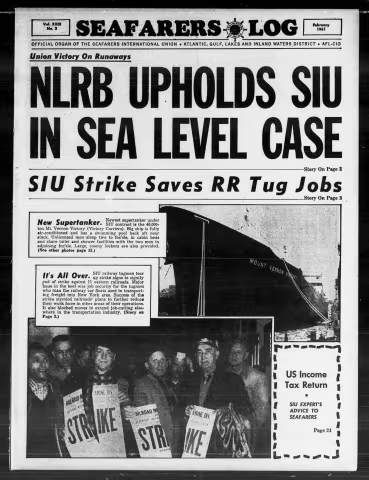
M Newcst suDBrtanker under
new oupertanKer. siu contract is the 46,000-
ton Mt. Vernon Victory (Victory Carriers). Big ship is fully
air-conditioned and has a swimming pool back aft near
stack. Unlicensed men'sleep two to foc'sle, in cabin beds
and share toilet and shower facilities with the two men in
adjoining foc'sle. Large, roomy lockers are also provided.
(See other photos page 12.)
I#'c All OiFAr SIU railway tugmen tear
S' 9 #«rff • up strike signs to signify
end of strike against 11 eastern railroads. Major
issue in the beef was job security for the tugmen
who man the railway car floats used in transport
ing freighf" into New York area. Success of the
strike stymied railroads' plans to further reduce
their work force in other areas of their operations.
It also blocked moves to extend job-cutting else
where in the transportation industry. (Story on
Page 3.)
US Income
Tax Return
SIU EXPERT'S
ADVICE TO
SEAFARERS
Page 24
i
I
I
I
t
I
I
f
I
I
J
Face Twe SEAFARERS LOG Febmanr. IMl
l^-
l?'v
t
m~
1^"
I i
IW-
|[^;-
1K'.' •
NLRB Rules For SlU
In Key Runaway Case
WASHINGTON, February 16—The
Seafarers International Union scored a
most important victory for all American
seamen when the National Labor Re
lations Board ruled, late today, to take
jurisdiction over American-owned ships
flying runaway flags, if these ships operate
regularly" from US ports. In a case involv
ing the Liberian-flag SS Sea Level, of the
West India Fruit and Steamship Company, the
Board ruled that the employer must deal with the
SIU as the representative of the ship's crew-
members. The decision was by a 3 to 2 vote.
The ruling came in a case which had been
universally recognized as a landmark in American
maritime unions' efforts to organize runaway-flag
shins. In fact, the case was considered so impor
tant that enormous pressure had been brought to
bear on the Board to rule against the Union.
Those aopearing against the SIU in the case in
cluded the US State Department, US Department
of Defense and a committee representing the giant
steel, oil and aluminum combines, headed up by
Standard Oil of New Jersey. It is expected that
an appeal will be forthcoming to the courts.
The Sea Level case was one of four pending
before the Board, all of which had similar char
acteristics and were docketed together. The others
involved SIU charges against the owners of the
SS Yarmouth for firing the crew after they a.sked
for an SIU contract; the P&O Steamship Com
pany, operators of the Liberian-flag SS Florida,
for refusing to bargain, and a National Maritime
Union case against Honduran-flag vessels owned
by the United Fruit Company.
The SIU scored the first breakthrough on the
runaway issue when the NLRB agreed that the
Union had the right to organize the Liberian-flag
ships of the P&O Steamship Company. The Board
had held that the ships were essentially Ameri
can because they operated out of American porta
in American foreign trade. Subsequently, the SIU
won a clear-cut election victory on the SS Florida,
and proceeded with organizing activities on other
runaway ships.
In addition, the SIU and the National Maritime
Union had formed the International Maritime
Workers Union. The IMWU has engaged < in a
number of runaway organizing efforts, including
the operations of National Bulk Carriers.
However; the giant oil and metals companies,
having an enormous stake in the runaway-flag
field, opened a campaign at the NLRB to secure
a reversal of the P&O decision. In this campaign
they were supported by the Elsenhower Adminis
tration, with the State Department and the De
partment of Defense both intervening on behalf
of the runaway-flag operation.
These open moves to pressure the NLRB were
assailed by the SIU and the Maritime Trades
Department. MTD President Paui Hall, in letters
to the heads of the government departments last
November declared that the clear purpose of the
intervention was to deny American unions the
right to organize runaway crews.
The Sea Level is well known to Seafarers as
the old SS Seatrain, one of the first ships to be
signed up and manned by the SIU back in the
late '30's. Following its sale, it was transferred to
the Liberian flag by its new owners, but con
tinued to operate between New Orleans and
Havana.
When the SIU organized the crew and petitioned
fbr representation, the owners fired the Cuban
crew while the ship was in Havana harbor. They
then forced them to repudiate their SIU pledge
cards to get their jobs back.
West India Fruit and Steamship, the vessel's
owner, is still operating regularly out of Havana,
beiiig one of the few American concerns whose
operations have not been halted by Castro.
American Ships To Cet More Farm,
Aid Cargoes; Job Step-Up Likeiy
WASHINGTON—A sharp turnaround in US Government policy 6n American-flag
shipping is in the making in Washington. If ^carried out as announced, it would go a long
way toward snapping the, American merchant marine out of the doldrums.
The new policy has new policy has two-^
major elements. One would
involve giving American-flag
ships up to 100 percent of foreign
aid cargo commitments in some
instances, as opposed to the slight
ly more than 50 percent they have
been receiving up until now. The
second part of the program would
involve a vast increase in ship
ments of surplus food abroad, of
which American ships now carry
at least half.
Typifying the reversal in policy,
the new Maritime Administrator,
Admiral Ralph E. Wilson, told a
shipping group on February 6
that, "we must have ships that we
control—^American-flag ships, with
American crews—if we are to as'-
sure, beyond the question of a
doubt, access to our supplies of
raw materials from abroad."
Under the Eisenhower adminis
tration, the Maritime Administra-
INDEX
To Departments
The SIU Inland Boatman
—Pages 8, 9
SIU Social Security Dep't
—Page 13
The Pacific Coast Seafarer
—Pages 22, 23
The Great Lakes Seafarer
—Pages 10. 11
The Fisherman and
Cannery Worker
-.-Page 18
The Canadian Seafarer
—Page 21
The SIU industrial Worker
—Page 25
SIU Safety Department
—Page 7
•
SIU Medical Department
—Page 19
•
SIU Food, Ship Sanitation
Dep't —Page 20
O
Editorial Cartoon —Page 15
•
A&G Deep Sea Shipping
Report -Page 6
•
Shipboord News
—Pages 27, 28, 29, 30
tion had follo\(red the "effective
control" line, supporting the idea
that runaway ships could be relied
on to carry US essential materials.
Wilson noted that "In the cold
war, in the conduct of peace
time-trade and commerce, our US
flag merchant ships truly become
our first line of defense. They are
our only sure guarantee for the
principal movement of our imports
and exports ..."
The foreign aid ruling is an
outgrowth of the troubles the
United States is" having with the
outflow of gold and dollars from
this country. One area of this out
flow is ocean shipping costs.
Under the ruling, the Interna
tional Cooperation Administration,
which administers the foreign aid
program, will pay the cost of ship
ping the aid material only if it is
carried on an American-flag ship.
If carried on a foreign-flag ship,
then the country receiving the aid
has to pay the cost of the ocean
freight. *
For practical purposes, its ex
pected that the ruling will give
most of these cargoes to American-
flag ships. The countries receiving
the foreign aid have very little
merchant shipping of their own
and would not be in g position to
pay other foreign-flag ship oper
ators to carry the aid cargoes to
them. Such countries, for example,
would bp Korea, Pakistan, Laos,
Formosa (Nationalist China) and
) South Vietnam.
Another Safe SIU Ship
Crewmen aboard Wild Ranger (Waterman) pose with SIU
safety award won recently. From left: P. Rubis, bosun; Mate
Aiiden; G. Lawson, AS and (in front) E. Johnson, AS. (For
other SIU safety awards, see centerfold.)
MTD Acts On Sea
Union Pacts, Cuba
BAL HARBOUR, Fla.—The Executive Council of the Mari
time Trades Department acted on several important maritime
issues in its winter meeting here, among them the problems
of national bargaining, the *•
continuation of Liberian-flag
trading operations with Cuba
and the growth of runaway-flags
on the Great Lakes.
Noting that the American-flag
shipping industry was now facing a
possible turning point, the Depart
ment went on record in full support
of proposals for a national bargain
ing set-up with US-flag operators.
Such bargaining should deal with
all the issues confronting US ship
ping, not just wages and hours.
It's the intention of the mari
time unions to meet with the op
erators and discuss subsidy policy,
domestic shipping problems,
American-owned runaway opera
tions and similar matters
The MTD group voted reactiva
tion of the Maritime Federation of
the Caribbean. Preliminary steps
had been taken in this direction
before the Castro regime in Cuba
torpedoed cooperation on the
problems of Caribbean seamen and
maritime workers. An immediate
problem for the Federation to deal
with is the operation of the run
away-flag West India Fruit and
Steamship Company between West
Palm Beach and Havana.
West India is at present running
a thriving business shipping cargo
from Canada in sealed boxcars,
some of it possibly contraband un
der present US regulations. Other
runaway operators are similarly
SEAFARERS LOG
Feb., 1961 Vol. XXIll, No. 2
PAUL HALL, President
HERBEBT BRAND, Editor. BERNARD SEA
MAN, Art Editor. HERMAN ARTHUR.
AL MASKIN, CHARLES BEAUMET, ALBERT
AMATEAU, ARTHUR MAHKOWIIZ, Staff
Writers.
Publlthaa rnonmiy
of th« Seafarers Inl
. et Ibja- headquarters
International Union, At-
l::ntlc Gulf, Lakes and inland Waters
District, AFL-CIO,- <75 Fourth Avenue,
Brooklyn 33, NY. Tel. HYaclnth 9«00.
Second class postage paid at the Post
Office In 'Arooklyn, NY, under the Act
of Aug. 24, 1912.
active in the Cuban trade. The
MTD plans to take steps to halt
this traffic by boycotting Cuban
cargo.
The board voted to endorse pre
vious action taken in Montreal to
set up a Great Lakes regional Fed
eration. This group is concentrat
ing on fighting the use of the Brit
ish flag as a runaway registry by
American and Canadian ship op
erators.
Presiding at the meeting of tha
Department, which has 31 union
affiliates in the .AFL-CIO, were
MTD President Paul Jlall and
Secretary-Treasurer Peter Mc-
Gavin.
SIU Improves
Travel Clause
In Ship Pacts
Through agreement with SIU-
contracted operators a new travel
and subsistence pay policy was put
into effect this month which per
mits a Seafarer to collect in cash
at the payoffs, a sum equal to first
class air fare, plus a day's pay and
subsistence, from the payoff port
back to the original port pi en
gagement.
Formerly under the transporta
tion clause, the Seafarer received
the equivalent of first class train
fare, including the price of a lower
berth at the payoff. In order to col
lect subsistence and travel pay, the
Seafarer was required to return to
the port of engagement within 30
days.
One reason for the shift in the
contract provision was that the
former rule covering lower berth
railroad fares was becoming ob
solete.
As before, transportation is pay
able under the provisions of
Article II, Section fi"! of the stand,
ard contract. This provides trans
portation pay where a ship's port
of engagement is in o le area and
the port of payoff in another area.
Febnury, Iftl SEAFARERS LOG Fage Thre*
RR Tugmen Win Job Security
SIC/ Plans
List For
Stewards
Acting to implement the rec
ommendations of the rank and file
steward department committee
elected last summer, the member
ship in all ports has approved a
separate registration category for
chief stewards.
The new registration category
will be group 1-S and will include
only chief stewards.
It is planned to start the new
registration category on or about
March 1. All Seafarers with
chief . steward's endorsement will
have the option of switching over
to group 1-S until the March 31
deadline.
Those who remain in group
will no longer ship to chief stew
ard Jobs, since group 1 will ap
ply to chief cooks artd bakers.
If a Seafarer now on the registra
tion list does switch over to group
1-S, he will receive full credit for
all the time on his shipping card.
Similarly, men coming oft the
ships after March 31 will have the
option of registering group 1-S or
group 1.
The new registration procedure
was one of nine recommendations
made by a five-man rank and file
committee elected on July B, 1960.
The recommendations were ap
proved by the August membership
meetings in all ports. They called
for the establishment of a training
school for stewards and a recertl-
ficatlon process to assure that all
men shipping chief steward are
fully-qualified to hold that rating.
The other proposals of the com
mittee will be acted upon at a later
date. The decision to set up sep
arate registration for stewards at
this time was prompted In part by
the action of the Coast Guard. That
agency has begun Issuing seamen's
..papers to steward department en
try ratings as "food handlers,"
without any specification that the
man Is an entry rating. This could
open the door to totally-Inexperi
enced men shipping in key ratings
such as chief steward.
SCHEDULE OF
SlU MEETINGS
SlU membership meet
ings are held regularly
once a month on days in
dicated by the SlU Con
stitution, at 2:30 PM in
the listed SlU ports below.
All Seafarers are ex
pected to attend. Those
who wish to be excused
should request permission
by telegram {be sure to
include registration num
ber). The next SlU meet
ings will be:
New York March 6
Philadelphia March 7
Baltimore March 8
Detroit March 10
Houston March 13
New Orleans March 14
Mobile March 15
Lonely picket stands vigil at Sunnyside yards of Pennsy Rail
roads where much of that road's passenger trains lie idle.
Picketing took place in five states, was extended as far as
Cincinnati.
MMP, MEBA Join In
Routing Job Cut Plan
NEW YORK—The plans of the railroad industry to
make railroad marine workers the first victims of theii;
drive to abolish jobs collapsed in utter defeat on Mon
day morning, January 23."
Early that morning the
railroad representatives
signed a new agreement
embodying the unions'
original demands to pre
serve the job security of the
railroad tugmen.
The agreement ended a 13-
day walkout of three unions, the
Railway- Marine Region of the
SlU'a Inland Boatmen's Union; the
Masters, Mates and Pilots and the
Marine Engineers' Beneficial Asso
ciation against 11 eastern railroads.
It provides that the status quo on
tugmen's jobs will be maintained
pending completion of a study of
the entire railroad manning ques
tion which Is to be conducted by a
Five State Picketing Stymied
Roads Despite Sub-Zero Cold
Any strike depends in large part on the effectiveness of picket lines. In the vast oper
ation involved in striking 11 major railroads in the dead of winter the picketing operation
was a massive one.
Most of the men who carry
a blue picket card as a me
mento of their participation in
this beef will have some tales to
tell their grandchildren. For one
thing, because of the nature of
the railroad operation, the picket
ing was carried on In areas rang
ing far and wide in the harbor and
In the Interior as well, as far west
as Cleveland. In New York City
alone, some 80 locations were
picketed, another 60 on the Jersey
side and dozens of Inland points.
As If It wasn't odd enough for
railroad tugman or Seafarer to
find himself picketing In Danbury,
Connecticut, or Poughkeepsie, New
York, to name two sites, the
weather turned to on the side of
the railroads with a vengeance.
During the course of the 13-day
strike, temperatures at some^picket
sites ranged down as low as 29
below zero and, especially in the
last week, never surpassed 20 de
gree? above at best. To top it off,
howling blizzard blew in on
Thursday evening, January 19, coV'
ering the eastern seaboard with
from ten to 25 inches of snow, on
top of previous snow storms.
Food, Foul Weather Gear
Consequently, In addition to the
enormous job of dispatching pick
ets around the clock to the 150-odd
picket locations, the strike ap
paratus had to contend with the
difficulties of getting food, foul
weather gear and eveh firewood to
pickets in the far-flung ?reas being
covered. At times there were sev
eral hundred pickets working a
single shift.
At its height, just before the
contract signing In the wee hours
of Monday, January 23, the strike
app^atus covered a five-state area
New York, New Jersey, Connec
ticut, Pennsylvania and Ohio—
with pickets coming from the Rail
way Marin;<» Region, SIU; the
Marine Engineers Beneficial Asso
ciation, the Masters, Mates and
Pilots and Seafarers of the deep
sea and Great Lakes districts. The
New York Central and New Haven
systems were completely closed
down and the Pennsylvania Rail
road was in the process of being
immobilized as the settlement was
signed. In fact, some 30 minutes
before the negotiators put their
signatures to the agreement, a
picket line shut down Penn RR in
stallations in Philadelphia and
pickets were setting up lines at
their Pennsy locations in that
state.
New York Central Shut
On the New York side, in addi
tion to picketing 80 rail yards and
railroad marine locations In the
city, the lines were also up at Al
bany and at rail power plants or
train assembly points in Yonkers,
White Plains, Irvington, Pough
keepsie,-Tuckahoe, Ossining, Har
mon, Croton and Brewster. The
Buffalo hall manned picket lines
in that city, Syracuse, Rochester,
Niagara Falls and the American
side of the rail bridge to Canada.
Subsequently, pickets were as
signed to the Cleveland terminal
of New York Central, shutting
down the 10,000-mile system from
end to end.
^In Connecticut, the New Haven
was bottled up by lines at Dan-
bury, Stamford, Cos Cob and the
road's main plant in New Haven
Itself.
Jersey pickets were stationed all
along Jersey shore treminals from
Hoboken to Bayonne, in addition
to Newark, Bloomfleld, Ruther
ford, Point Pleasant, Secaiicus,
South Kearney, South Amboy,
Elizabethport, Port Reading and
others.
Area commands were set up for
the New York operation out of
Brooklyn, Manhattan and the
Bronx. Picket registration, dis
patch' and communication centers
were manned day and night to
maintain close phone and vehicle
contact with all posts.
Two 24-hour strike kitchens
were in operation along with sev
eral coffee wagons on the move at
all hours. As weather conditions
worsened foul weather gear, fire
wood, and long Johns were distrib
uted. Arrangements were made
for makeshift sleeping accommo
dations for pickets unable to get
back home. At times, the Unions'
strike wagons with picket reliefs
or coffee were the only vehicles
clocked through metropolitan area
tunnels for hours at a stretch as
virtually all transport was para
lyzed by the snow.
The toughest picketing assign
ments were in outlying points
where, because of transportation
difficulties, it wasn't always pos
sible to relieve pickets on schedule.
Bishop
Reporting on . agreement
are Simmons, SIU; Col-
hoon, MEBA, and (belowL
Bishop, MM&P.
commission headed by outgoing
Labor Secretary James MitchelL
The new Secretary of Labor,
Arthur Goldberg, former AFL-
CIO general
counsel, played a
major role in
bringing about
the final settle
ment.
From the start"
of the strike, the
unions involved
were willing to
put the manning
issue aside until
the Mitchell Commission brought
in its recommendations. But the
railroads had other plans. They
thought they saw an opportunity
to establish a precedent, in aa-
vance of the Mitchell Commissioa
report, which could be usea
against one million members of the
various railroad brotherhoods. Con
sequently, they were adamant oa
this issue and were more than will
ing to take a strike if they could
establish, in writing, that they had
a free hand to fire men and reduce
manning scales as they pleased.
The consequence of the rail
roads' position, was the widespread
stoppage
The railroads' position was
weakened by the fact that they had
testified before the Presidential
fact-finding board that they had ntt
Issue with the present size of tug
boat crews.
The strike came after 15 months
of futile negotiations between the
(Continued on page 8)
The waving and clapping seen above signifies the sentiments
of New York area pickets just after RMR membership voted
to end strike against I i railroads. ^
t;-^--«*'«::
I;
F«*e SEAFARERS LOG mnury, IMl
Retired, He's
Heading For
Portugal
BALTIMORE—Permanently dis
abled by an .arthritic- condition,
Seafarer Jose Scares will never
sail again after spending a life
time of over 36 years at sea. He's
been receiving an SIU disability-
pension since last June.
Scares is now awaiting the-birth
of a child here in the States be
fore taking the family back to
bis native land of Portugal. "This
will give me at least one good
America," he explains. He
plans to \ return
to Portugal, be
cause his wife
cannot speak
English and "life
is very strange
for her here."
Still a young
man at 53,
Soares last sailed
two years ago on
the SS Calmar
A 30-foot-fall from the
the dock while secur-
Soores
SMffarer's Wife At Clinic
as an AB.
gangway to
Ing for sea permanently sidelined
the husky sea veteran. It left him
with a complex of spinal and leg
injuries.
Today, with the security of the
$35 weekly SIU benefits' check to
count on, Soares manages to keep
in touch with former shipmates
nearly every day. His home is
only a block from the hall here,
and this gives him plenty of op
portunities to visit, play cards
and wait out Job calls with them.
Mrs. Sarah Setliff has blood tampU taken by lab technician
at SlU's clinic in NY during recent examination day tor de
pendents. Her husband Samuel was last on the Portmar.
Baltimore Hall Gets
Clinic On Feb. 25
BALTIMORE—The Baltimore SIU clinic will open in its
new home on the third deck in the Baltimore Hall, 1216 East
Baltimore St., on February 25. The new location will make
•thp health center more con-
Remember When ...
FEBRUARY, 1939; The SIU Tampa port agent ran into a rough one
when he, along with the crew of the West Kyska, took some beefs to
the local inspector and the US shipping commissioner. Instead of act
ing on the beefs, they told the men to swear out affidavits, with the
commissioner warning them that the beefs better be correct or else
they would lose their certificates.
"In the face of all this opposition from men who are supposed to
represent all the people of the United States, and not a few, we decided
to try and set some satisfaction from you," the agent wrote in a letter
to the Commerce Department. Among the beefs listed were: badly-
equipped slop chest, little heat in the foc'sles, bad drinking water,
foc'sles awash in heavy weather, plus a steering engine which throws
oil, making it dangerous to oil and clean up when ship was underway.
4. 4. 4.
FEBRUARY, 1941: Rep. Everett M. Dirkseh, Illinois Republican,
earned the title of "Seamen's Enemy No. 1" with the introduction of a
bill that would outlaw union hiring halls, require the notorious Cope-
land fink book,—legalize any command prohibiting the dissemination
by seamen of any material "which in the opinion of the master is en
couraging, or is calculated to encourage, mutinous or rebellious conduct
. . . ," and require crews to be composed of 75 percent native-born or
naturalized citizens the remainder to have entered the country by 1925.
The bill, as the LOG points out, would injure the union by eliminating
union hiring halls, violated the civil rights of seamen and set native-
born citizens against foreign-born, "just another way of dividing the
ranks of seamen for the purpose of weakening the union."- Congress
had earlier defeated a bill by Dirksen to "make all crews on Ameri
can merchant ships members of the active naval reserve," and work
at wages from $21 to $84" per month. '
4" 4" 4"
FEBRUARY, 1942:, The Atlantic Fishermen's Union is getting the
run-around from boat operators on their request for $5,000 war risk
Insurance. The operators have locked out the fishermen and left their
fleets idle in Boston harbor. The shipowners are in open defiance of
the War Labor Board, which handed down a special decision instruct
ing operators to pay the premiums for insurance. The employees have
told the union they might "consider" the question if the union sur
rendered on the wages and hours issue. "We can imagine." the LOG
commented, "the howl that would have gone up if a union had balked
at a board decision."
4i 4> 4- ,
FEBRUARY, 1943: The Big Town, finally realizing that merchant
teamen keep things moving in the war, have opened up many canteens
and clubs for them. The best spot, is the American Theatre Wing Mer
chant Seamen's Club, an actor and actress-run canteen. It has distribu
ted 10,000 free tickets to theatres, movies, operas, radio shows and
boxing matches In the two weeks since its opening. And then there are
all those lovely hostesses to dance with. The newest canteen open for
seamen, the LOG reports, "is at the Ritz—no IcSsT Every Sunday night
the Ritz Towers on Park Ave., at 57th Street hold open house. Dancing,
floor show, hostesses from Park Ave., etc., etc.". . . Out of the foc'sle
tomes the report that "the brothers who were squawking about torpedo
^ns, victory pins or what have you, may now secure a ribbon from the
WSA for every time they survived a torpedoing, by writing to that
office.". . . SIU added $25,160 to the thousands of dollars already in-
Y««ted In war boadL
venient for SIU members and
their families. '
The move to the Baltimore hall
from a center some distance from
the hall is part of the SIU Medical
Department's program of making
the Union's health centers provide
greater service to Seafarers and
their families. Like other SIU
clinics the center is completely
equipped with examining rooms,
x-ray facilities, laboratory, electro
cardiograph, reception room and
doctors' offices. It provides free
head-to-toe medical check-up for
Seafarers, their wives, dependent
parents and children.
Many Services Offered
The examination, which would
cost $45 and up if purchased pri
vately, includes such services as
urineanalysis, blood tests, x-ray,
electrocardiography and, for de
pendents, gynecological and pedi
atric examinations.
Dr. Oscar Camp is in charge- of
the Baltimore clinic. His staff in
cluded three doctors available at
different times of the day, three
lab technicians and a clerical staff.
PHS Hospital
Visiting Hours
Seafarers and friends of SIU
men are urged to visit their
buddies in the PHS hospitals
whenever the opportunity arises.
The visiting hours at the va
rious hospitals are as follows:
Boston (Brighton PHS)
11 AM to 8 PM
Staten Island
Baltimore
Norfolk
Savannah
New Orleani
Galveston
2 PM to 8 PM
1 PM to 3 PM
7 PM to 8 PM
2 PM to 4 PM
6 PM to 8 PM
$ AM to 11 AM
1 PM to 5 PM
7 PM to 9 PM
2 PM to 3 PM
7'PM to 8 PM
2 PM to 3 PM
7 PM to 8 PM
San Francisco
12 Noon to 8:30 PM
(TB wards 3 PM to 8:30 PM)
Seattle 2 PM to 7 PM
LABOR
'BOUMrP THE WORLD
SOME OF THE PEOVISIONS OF FOREIGN LABOR contracts or
labor laws would seem odd, or even extreme. If placed In the United
States setting. For example, In Brazil, a worker with ten years on the
job can't be fired for any reason, except for violations of a major
national law. The layoffs at the end of nine years and 11 months must
ibe terrific. Strikes in Brazil have to be authorized by labor courts,
technically speaking. The unions are trying to get the right to strike
written into the constitution. An important factor in some jobs is if
the plant provides food and health services, because many workers
can't afford the cost outside. In Argentina, government awards are
what decide the wage pattern, rather than collective bargaining.
The Netherlands has a system whereby a board composed of govern
ment, employer and employee members checks on wage gains to de
termine whether they are inflationary. Italy, for the first time in
.history, is beginning to make a dent in traditionally huge unemploy
ment. Italian wages are still rock bottom In most areas, with unions
unable to do much about the situation because ItaUan workers, living
hand to mouth, can't survive strikes of any duration. IVest Germany
workers are making the biggest strides. Wages have doubled since
1950 and"are going up at seven to eight percent a year. The work week
there is finally heading down to the 40 hour standard which has been
ig existence in other western countries for miny years.
4i' 4^ ^
WHILE LIVING STANDARDS IN WEST EUROPE at least, are on
the way up in most areas, it's a different story on the Communist side
of the fence. In Yugoslavia, the official Communist Party newspaper
reported that seamen on .a Yugoslav coastal passenger ship were often '
putting in 20 bdurs a day for 25 percent additional pay over, their
eight hour base scale. The operators of the vessel refused to pay the
overtime stipulated by law, and that's that. There was no word of
protest made by the "Yugoslav unions. ^
t 4; 4.
DOWN IN ARUBA, THE HUGE OIL-REFINING island belonging to
the Netherlands, a strike of oil workers has been broken by the
government and the employers. The tactics followed were those which
are classic in the oil industry. After the Petroleum Workers Federation
of Aruba called the strike, the refinery set up a company union with
which it signed a contract. It then arrested, jailed or deported the
leaders of the oil workers. The strike was provoked in the first instance
by the employers when the company fired J. A. Hernandez, secretary
of the union and the government ordered his deportation since he ia
a citizen of Venezuela.
4- 4. *
THE FINNISH TRADE UNION FIGHT against Communist control
has taken a step forward with the organization of the Finnish Trade
Union Federation. The Federation was set up to counter the Finnish
Trade Union Council which has fallen under the control of Finnish
Communists and their allies. Participating at the founding meeting
were 11 unions with a membership of over 41,000 with several other
unions, whose total membership is over 20,000 pre.sent as observers.
It is expected that other unions will join the group. The opposing trade
union council had approximately 200,000 members originally, but at
least one third of the group has dropped away. .
4i 4> 4i
NON-OPERATING UNIONS ON CANADIAN railways were all set
to start a strike on a national scale when the Canadian government
pushed through special legislation banning the walkout. The legislation
put a.freeze on wages and strike action until May 15, compelling
120,000 non-operating railwaymen to work against their will until that
time. In the meantime, a Royal Commission will conduct an investiga
tion into the industry and bring in recommendations.
'$>
SOVIET TRADE UNIONS HAVE TO DO SOMETHING to pass the
time of day since its obvious to all that they have no role to play in
such matters as wages," hours, working conditions and o .-the-job
grievances. The latest bulletin put out by the World Federation of
Trade Unions quotes the official Russian "trade union" newspaper on
the "achievements" of Soviet unions. Major emphasis is placed on the
speed-up with the Russians boasting that over six million workers are
taking part in competition for the title of "Communist Labor Brigade"
and over 200,000 of them have won awards as "outstanding workers of
Communist labor." These titles are given workers whose production
rate" exceeds a-given standard.
•The Russian unions also boast of their program of convalescent
homes (no doubt, that's where the "outstanding workers of Communist
labor" rest up); summer camps, libraries and sports activities with
6,000 "masters of sport" in their memberships. In this review of
"achievements" there's not a word about any genuine trade union
function.
PORT O' CALL
E.BALTiA/oeE
lli
. .
,r^.-
rcilnntjr. 19« SEAPARERSI LOG P«C« Fiv*
Sill Convention Vote
SIU member Henry Viik Heft) signs up to cast his vote for
SlUNA's convention delegates. Other voting members to
rear are: Fred Harvey, Floyd Dominski and John Metsnit.
Seafarers Elect 12
To SIU Convention
Seafarers in all ports ended a secret ballot vote on Satur
day, February 11, completing the election of 12 delegates to
represent the SIU Atlantic, Gulf, Lakes and Inland Waters
District at next month's t- :
SIUNA convention.
The 12-man group named
was as follows; Steve Cardullo,
Paul Hall, A1 Kerr, Robert Mat
thews, Eddie Mooney, Earl Shep-
pard, Claude Simmons, Freddie
Stewart, A1 Tanner, Cal Tanner,
Keith Terpe and Lindsey Williams.
The nominations for the 12-man
group closed on January 19 and
the voting began on Monday, Jan
uary 30.
, The nomination procedure and
the eligibility requirements were
the same as those for other SIU
elective offices. Regular or special
meetings in all SIU ports during
the first week of January were no
tified of the opening of nomina
tions, as were all Union members
at their last known home addresses.
Nominations opened January 11,
with acceptances and notifications
closing midnight January 16. A
rank and file credentials committee
passed upon the qualifications of
the candidates after being chosen
at a special meeting in headquar
ters on January 19.
The SIU convention is being
held at the Hotel La Concha, San
Juan, Puerto Rico, starting on
Monday, March 13. In addition to
the 12 deep-sea delegates, there
are delegates who will represent
various SIU divisions, such as the
Inland Boatmen's Union and the
New Bedford Fisherman's Union.
Don't Send Your
Baggage COD
"^afarers are again warned
not to send their baggage COD
to any Union hall. The Union
cannot accept delivery of any
baggage where express charges
have not been prepaid.
Men who send baggage COD
to Union halls face the prospect
of having to go to a lot of trou
ble and red tape with the Rail
way Express Co.
Dock Law Appeals System
Sought By HY Port Council
NEW YORK—A proposal for a tri-partite appeals board to which longshoremen and
other waterfront workers could appeal rulings of the Waterfront Commission has been
made by the Maritime Port Council of Greater New York Harbor. The proposal was on»
of several presented by the'
group to the New York State
legislature, in order to assure
fairness in Waterfront Commission
procedures.
The port council, representing
25 waterfront unions with a mem
bership of 150,000, raised a number
of objections to proposed legisla
tion which would increase the com
mission's powers. It noted that pro
visions of the proposed legislation.
Involving loose and broad grants of
power to the commission, could be
used to restrict legitimate union
picket line activity by any union on
the waterfront.
In dealing with the commission's
hearing procedures, Anthony
Scotto, the council's president,
noted that the commission is the
investigating, prosecuting and
judging agent all in one, and that
the commissioners may, and do,
arbitrarily disregard the hearing
record in making their rulings.
"The arbitrary processes of the
commission are far harsher than
processes employed by .the Federal
government in matters of far great
er consequence," he said.
Appeals Board Sought
He called attention to the fact
that in the Coast Guard screening
program during the Korean War,
seamen accused of subversive con
nections had the right of appeal
from the Coast Guard ruling to a
board composed of industry, labor
and Coast Guard representatives.
Further, the hearing ofl'icer in the
first instance was a civilian, not a
Coast Guardsman.
This kind of procedure was sug
gested by the council to protect
the rights of longshoremen and
other waterfront workers. The
council proposed a similar tri
partite board, composed of repre
sentatives of labor, management
and the commission, to hear ap
peals.
At present, the only right of ap
peal a waterfront worker has is to
the courts, a costly and cumber
some process, usually taking many
months.
The port council also objected
to the "open end" nature of the
commission's penalties. Under the
commission's procedures, water-
froqt workers can be barred from
the docks for life for offenses com
mitted as far back as 25 to 30 years
ago. The Council noted that the
Federal Landrum-Griffin law has a
five-year "statute of limitations"
on barring individuals from par
ticipating in union affairs.
In addition, the council was criti
cal of the commissipn's bid to ex
tend its authority far beyond the
confines of the waterfront.
The port council, a local affiliate
of the Maritime Trades Depart
ment, AFL-CIO, has as its officers
Scotto, Jerry Wurf, American Fed
eration of State Council and Muni
cipal Workers; Joseph Powell,
Office Employees International
Union and Raymond J. Connors,.
International Longshoremen's As
sociation. Wurf is vice-president,
Powell, executive secretary and
Connors, field representative.
SIU To Operators: See
That Mail Goes Through
SlU-contracted companies have been notified by the Union
that they are expected to assure the prompt delivery of both
personal mail and Union communications to offshore ships
or else suffer an "appropriate-•
contract penalty."
The Union took this action
after receiving numerous com
plaints from the crews of offshore
ships about non-delivery of mail.
The Union informed all contracted
companies that "it is the clear re
sponsibility of the ship operators
to see to it that all their agents
carry out their obligations in this
respect."
The operations were put on no
tice that "if thig difficulty persists,
the Union will have no alternative
but to raise this as a contract issue
in future negotiations and demand
an appropriate contract penalty to
cover non-delivery of mail."
Agents' Laxity Cited
The Union communication'noted
that "if appears that the major
cause of the trouble is either the
laxity or deliberate evasion of re
sponsibility by some of the (foreign
port* agents." While "many agents
do discharge their responsibility,"
there are some who "absolutely re
fuse to forward mail," or "refuse
to deliver mail to the ship- and
then either throw it out, or return
it to the sender as undeliverable."
Included in the mail which has
missed ships are copies of the
SEAFARERS LOG airmailed to all
vessels at their next port of call.
Although the LOG Is sent regu
larly to all ships, some crews have
complained of non-delivery. At the
same time, the mail has not been
returned to headquarters, indicat
ing that it is simply being discard
ed at the receiving end.
Alcoa Ship
In Tokyo
Collision
A collision in Tokyo Bay be
tween the Alcoa Pioneer and the
Danish cargo vessel Laust Mae. sk
sank the Danish ship and killed
two of its crew. Three others are
reported missing.
Forty three other crewmen and
four American passengers were
rescued from the icy waters, thir
teen reportedly injured.
The crash occurred February 5
as the SlU-manned ship was leav
ing Yokohama for Europe via Kobe
and Korea. The bow of the 6.759-
ton Alcoa Pioneer was crushed and
the No. 1 hold was flooded. None
of the 43 crewmen were injured.
The ghip returned to port under
her own power and was drydocked
while the cargo in the flooded hold
was removed. The ship will be re-
jiaired in Japan after bids are put
out. Repairs are expected to tak*
a month to six weeks.
•m\
M
jeB^oscmP
ALSOO/^aiTBCAm^
^TBUfTF CAPABLB
OF PHOroORAPHlf^
.». AlO P/207SSr y>£7T
FfiOfA SUMiMERS'
AS30ClAriO/>l6.,r .
\\AR£L£A5^
TvNfci /MPfZISoAl£DA/ff _
FVRCE FUBRS /R oBvioiS
MCAlB TO SWBBTBf^
RBLATfoRS WITH
K£\W£DV AVMlf^iSTRA-VOf^.
_ TOPuroiyrRevizARper
FOR FORSION \/lSirOK9 TOHELP
cor OUTFIJOW OF DOLLARS ..,
U.S. TOURIST TARIFF-FREE SPiSslD-
ING A^AV CUT It?
WORLD'S WEA-msR.
epeciAusi5MEEriN
. FRteiDRS^VORR
A&REE THMCUtAATE
BGEWhlS COLDER*
ijRiriSA) ARREST F/\r
HNJ tOAtXPAl.. .OL\RSE
THEM lVnHSPy/A/(9 OA/
BOriSFA/AVYAMO /A/-
fVRMlRSM05C0lVer
SECRET DAJOBQERXhlP
RADIO*
. r DRif^< CLMimRV
6 \u SPEMD $34MILLIOJ4
r: OA/ AVS/ERTiSlRS CAM^
' PAm ro PEODLB- SODA
WATER,,,
<^OMMV/^lST ChllMA
MODIFfil^ RURAL
COMMUA^ AS FOOi>
SFORXAfSE &PREADS...
.ffe45ANTS TO WWB Rl^^T TO
OF THBIR.OWN FOOD*
Fife--
V
We Six SBAFARERS LOG Febniaryt IMl
SEAFARERS
ROTARY SRIPPINfi BOARD
(Figures On This Page Cover Deep Sea Shipping Only In thi SIU Atlantic, Gulf, Lakes and Inland Waters District.)
January 1 Through January 31, 1961 ^
To the surprise of no one, shipping took its usual dip in
the month of January, following a pattern of many years'
standing. December always produces hot shipping and a
, big turnover just before the holiday season, while January
Is traditionally slow. Consequently, the total jobs shipped
during the month were 2,246 compared to a high of 2,898
in December.
Interestingly enough though, Seafarers In the class A
seniority group held their own despite the sharp drop. A
total of 1,553 class A men shipped in January compared to
December's 1,573. In other words, the seniority protection,
worked out fine for the top-rated men, with the big ship
ping drop coming in the low-rated class C group. In De
cember this group shipped 461 jobs, dropping off to 178
In January. Similarly, class B shipping declined, although
not as sharply as shipping for 'C men.
Registration was also off for class A. In fact four more
"A" men shipped there registered, so that there was no
rise^in the class "A" on the beach totals, an excellent omen
during the traditionally slack shipping period.
On the ship activity side, the number of payoffs and sign
ons also dropped off, and total ship movements were down
to 449 from 454 the month before. Severe winter weathet
undoubtedly contributed to the shipping slack, although
the tankers were booming because of- an unprecedented
cold spell along the entire Eastern seaboard.
In fact, the tankermen can look forward to far better
shipping in the coming months than has been the case for
several years- now, since the tanker industry appears to be
snapping out of the doldrums which hit it early in 1957.
Ship Activify
Pay
Offs
Sign In
Oni Troni. TOTAL
Beitan 1 7 U
New York ... .37 9 48-- 94
Philadelphia . . 4 2 23 29
Baltimore .... .17 7 18 42
Norfolk — 28 29
Jocktonvlllo . . S 1 25 31
Miami — 13 14
Mobile 7 4 24
New Crleoni . . 9 13 38 60
Houston ".... .10 4 58 72
Wilmington .. . 1 — 12 13
Son Francisco. . 2 2 10 14
Seottio 2 3 11
TOTALS 114 48 287 449
DECK DEPARTMENT
Registered Registered Shipped Shipped Shipped TOTAL Registered On The Beach
CLASS A CLASS B CLASS A CLASS B CLASS C - SHIPPED CLASS A CLASS B
Port
GROUP GROUP GROUP GROUP GROUP CLASS GROUP GROUP
Port I 2 3 ALL 1 2 3 ALL 1 2 3 ALL 1 2 3 ALL 1 2 3 ALL A B C ALL 1 2 8 ALL 1 2 3 ALL
Boston 5 5 6 16 1 1 1 3 2 2 3 7 0 0 0 0 0 0 0 0 7 0 0 7 11 16 6 33 1 3 4 8
New York 27 63 19 109 4 16 15 35 38 58 21 117 4 5 11 20 3 2 9 14 117 20 14 151 69 143 30 242 7 23 34 64
Philadelphia 3 15 4 22 0 1 2 3 0 11 5 16 1 3 4 8 0 0 1 1 16 8 1 25 15 22 5 42 0 1 3 4
Baltimore 19 52 9 80 2 12 20 34 24 50 18 92 3 13 16 32 0 2 3 . 5 92 32 5 129 26 65 12 103 2 21 41 64
Norfolk 8 9 2 19 2 3 3 8 4 2 1 7 0 2 3 5 0 0 0 0 7 5 0 12 14 . 18 5 37 3 5 10 18
Jacksonville 9 12 3 24 1 4 6 11 11 19 2 32 0 4 5 9 2 2 6 10 32 9 10 51 5 16 3 24 1 1 4 6
Miami 0 3 0 3 0 1 0 1 0 / 0 0 0 0 0 0 0 0 0 0 0 0 0 0 0 0 7 1 8 0 1 1 2
Mobile 19 15 3 37 0 6 9 15 4 19 6 29 0 0 2 2 0 0 0 0 29 2 0 31 39 40 7 86 0 4 7 11
New Orleans 32 73 19 124 1 20 *9 30 33 57 19 109 1 9 11 21 2 0 6 8 109 21 8 138 61 111 24 196 4 22 21 47
Houston 47 27 28 102 0 25 23 48 46 55 16 117 4 18 19 41 3 0 1 4 117 41 4 162 36 38 21 95 7 17 18 42
Wilmington 11 13 3 27 2 5 4 11 9 12 2 23 1 3 6 10 0 0 2 2 23 10 2 35 9 9 1 19 1 8 5 14
San Francisco 11 12 2 25 1 6 3 10 3 8 6 17 1 1 2 4 0 0 0 0 17 4 0 21 26 22 3 51 1 12 7 20
Seattle 8 20 7 35 1 14 8 23 13 36 10 59 2 7 9 18 0 2 3 5 59 18 5 82 15 10 1 26 1 11 5 17
TOTALS 199 319 105 1 623 15 114 103 1 [232 187 329 109 1 625 17 65 88 1 170 10 8 31' 1 49 625 170 49 1 844 326 517 119 1 962 28 129 ] 160 1 317
ENGINE DEPARTMENT •
t Registered Registered Shipped Shipped Shipped TOTAL Registered On The Beach
CLASS A CLASS B CLASS A CLASS B CLASS C SHIPPED CLASS A CLASS B
Port
GROUP GROUP GROUP GROUP GROUP CLASS GROUP GROUP
Port 1 2 3 ALL 1 2 3 ALL 1 2 3 ALL 1 2 3 ALL 1, 2 3 ALL A B C ALL 1 2 S ALL 1 2 3 ALL
Boston 1 5 2 8 0 3 2 5 1 4 1 6 0 2 0 2 0 2 0 2 6 2 2 10 1 6 2 9 1 1 3. 5
New York 16 48 13 77 5 21 26 52 13 69 13 95 0 20 25 45 3 5 12 20 95 45 20 160 38 98 30 166 7 25 29 61
Philadelphia 3 9 7 19 0 2 6 8 2 2 5 9 0 2 4 6 0 1 0 1 9 6 1 16 2 34 7 43 0 2 8 10
Baltimore 10 40 7 57 0 27 18 45 7 57 8 72 2 13 18 33 0 1 0 1 72 33 1 106 10 61 10 81 2 38 29 69
Norfolk 5 8 0 13 2 3 2 7 1 6 2 9 1 2 0 3; 0 0 0 0 9 3 -0 12 10 12 2 24 2 6 4 12
Jacksonville ' 1 4 1 6 1 5 2 8 1 9 0 10 1 6 3 10 0 7 4 11 10 10 11 31 1 5 1 7 0 3 2 5
Miami 1 1 0 2 0 1 0 1 0 0 0 0 0 0 0 0 0 0 0 0 0 0 0 0 1 4 0 5 0 2 0 2
Mobile 8 22 5 35 0 6 3 9 2 19 8 29 0 3 4 7 0 0 0 0 29 7 0 36 14 42 6 62 0 11 3 14
New Orleans 18 59 10 87 2 26 6 34 15 59 10 84 1 16 6 23 1 1 7 9 84 23 9 116 36 83 9 128 4 26 23 53
Houston 26 62 8 96 4 41 23 68 20 55 16 91 2 25 17 44 1 3 2 6 91 44 6 141 39 40 7 86 5 13 8 26
Wilmington 4 8 2 14 1 7 2 10 3 19 1 23 1 7 2 10 0 0 2 2 23 10 2 35 2 5 2 9 1 5 4 10
San Francisco 2 13 . 2 17 0 1 3 4 0 12 4 16 0 0 5 5 0 0 0 0 16 5 0 21 10 33 5 48 1 6 8 15
Seattle 3 20 5 28 1 13 8 22 4 27 2 33 1 6 11 18 0 4 2 6 33 18 6 57 3 14 0 17 1 8 5 14
TOTALS 98 299 62 1 459 16 156 101 1 273 69 338 70 477 9 102 95 206 5 24 29 58 477 206 58 1 7411167 437 81 1 1 685 24 i4^ 126 1 "296
m'
1:.
DECK
ENGINE
STEWARD DEPARTMENT
Port
Boston TT
New York....
Philadelphia..
Baltimore
Norfolk
Jacksonville..
Miami
Mobile
New Orleans.
Houston
Wilmington. .
San Francisco
Seattle
TOTAJS
- « -
STEWARD
GRAND TOTALS
Registered Registered Shipped Shipped Shipped TOTAL Registered On The Beach
CLASS A CLASS B CLASS A CLASS B CLASS C SHIPPED CLASS A CLASS B
GROUP GROUP GROUP GROUP GROUP CLASS GROUP GROUP
1 2 3 ALL 1 2 3 ALL 1 2 3 ALL 1 2 3 ALL 1 2 3 ALL A B C ALL 1 2 3 ALL 1 2 3 ALL
3 1 1 5 3 0 3 6 1 0 2 3 0 0 2 '2 0 0 1 1 3 2 1 6 4 2 2 8 3 0 3 6
30 13 54 97 2 0 25 27 31 11 64 106 0 1 20 21 1 0 16 17 106 21 17 144 84 36 100 220 6 8 44 58
10 5 7 22 0 0 8 8 12 3 7 22 0 0 3 3 0 0 3 3 22 3 3 28 12 6 11 29 0 0 13 13
20 6 23 49 2 2 19 23 25 10 23 58 4 0 21 25 0 1 5 6 58 25 6 89 35 13 30 78 2 4 18 24
7 4 2 13 0 4 3 7 0 0 2 2 0 0 0 0 0 0 0 0 2 JO 0 2 17 6 5 28 1 5 7 13
10 2 3 15 1 . 1 1 3 8 3 6 17 2 0 4 6 0 1 18 19 17 6 19 42 8 3 3 14 1 1 0 2
1 0 4 5 0 0 0 0 0 0 0 0 0 0 0 0 0 0 0 0 0 0 0 0 3- 0 9 12 0 0 0 0
21 2 13 36 0 0 14 14 10 4 14 28 0 0 0 0 0 0 0 0 28 0 0 28 37 14 40 91 0 0 32 32
31 3 58 92 1 0 33 34 17 8 68 93 1 1 19 21 0 0 5 5 93 21 5 119 62 13 95 170 2 4 55 61
31 14 27 72 7 3 29 39 16 11 30 57 2 1 29 32 0 0 10 10 57 32 10 99 17 13 14 44 5 7 17 29
5 1 4 10 • 1 0 3 4 5 2 6 13 0 0 2 2 0 0 2 2 13 2 2 17 8 1 6 15 2 0 4 6
7 2 7 16 0 0 6 6 3 1 9 13 1 0 6 7 0 0 0 0 13 7 0 20 19 3 18 40 1 1 9 11
15 7 13 35 3 3 15 21 15 4 20 39 4 2 14 20 0 1 7 8 39 20 8 67 11 4 12 27 0 1 11 12
191 60 216 1 4671 ! 20 13 159 f 192 143 57 251 1 451 14 5 120 1 139 1 3 '67 1 r7i 451 139 '71 1 ! 6611317 114 345 776 23 31 213 1 267
-
SUMMARY
Registered Registered Shipped Shipped Shipped TOTAL Registered On The Beach
CLASS A CLASS B CLASS A CLASS B CLASS C SHIPPED CLASS A CLASS B
GROUP GROUP GROUP GROUP GROUP CLASS GROUP GROUP
1 2 3 ALL 1 2 3 ALL 1 2 3 ALL 1 2 3 ALL 1 2 3 ALL A B C ALL 1 2 3 ALL 1 2 3 ALL
199 319 105 1 623 15 114 103 1 232 187 329 109 1 625 17 65 88 1 170 10 8 •31 1 49 625 170 49 1 844 326 517 119 962 28 129 160 1 317
98 299 62 1 459 16 156 101 1 273 69 338 70 1 477 9 102 95 1 206 5 24 29 1 58 477 206 58 1 741 167 437 81 685 24 146 126 1 296
191 60 216 1467 20 13 159 1 192 143 57 251 1 451 14 5 120 1 i39 1 3 67 1 71 451 139 n 1 661 317 114 345" 776 23 31 213 I 267
488 678 383 jl549 51 283 363 1 697 399 724 430 11553 40 1721303 1 515 16 35 121 1 1 178 1553 515 178 |2246 810 1068 545 2423 75 306 499 | 880
Vebnuuy. INI SEAFARERS LOG Face SeTM
'Joe Alcinif Safety Director
Alarm Bells Have A Purpose
^ Experience proves that many "danger" signs and "caution" markers
openly posted or stertcilled around the ship tend to be completely
ignored after a while because everyone takes thenni for granted. You
generally have to have a bad accident before everybody wakes up.
This is one of the hard facts of life, whether you're on a ship, at home,
on the highway or anywhere else.
At typical situation -is one that's come Up on some West Coast ships
lately. A sign on an alarm bell in the galley is clearly marked: "When
This Bell Rings Go To The Ice Boxes." In several instances, the bell
was purposely rung by an inspector to check what would happen. The
results were pretty awful.
No Idea About "The Alarm
Most of the men in the galley on these occasions had no Idea at all
why the bell was ringing. A couple completely ignored it; others just
stood around wondering what to do. Some eventually went to the ice
boxes and just stood there by the doors. They thought they were sup
posed to stand by the ice boxes for some kind of drill.
Apparently very few had the Idea that the bell had a definite pur
pose; namely, get^the door opened in a hurry because somebody Is
locked inside. Almost nobody got the message that there was an emer
gency and, fortunately for all concerned, this was only a test. It
would seem that new men as well as old hands in the galley should be
reminded of this particular problem again and again.
_ Aboard ship certainly, an alarm bell—wherever it rings—has i partic
ular purpose. Anyone who .doesn't know what it is should ask. He
could be the guy in a plight the next time.
Clearer Signs Needed
On this same issue, it's obvious that the sign We're talking about
could also be worded more clearly. It might say: "Go To The Ice
Boxes When Thts Bell Rings—Someone Is Locked Inside" or, simply,
"Open All Ice ?ox Doors When This Bell Rings." Frequent reminders
on what this is all about wouldn't hurt in any ctfSe.
Obviously, whoever made up the sign assumed that the crewmem-
bers would know the purpose of the alarm bell, which just wasn't so
in the cases in question. The moral" is that warning signs and instruc
tions should always assume that the reader knows nothing about
the safety item at stake. In that way there is no question as to what
should be done.
There's a separate question here also. You could ask why was the
door locked in the first place since there s usually a hook-back gadget
on the bulkhead for the very purpose of keeping the door open. But con
struction varies from ship to ship and not all vessels have these hooks.
The best bet in such a case Is to have someone with you standing by
the door, especially if you're carrying something into the ice box. The
door may stay open awhile even if it's not hooked, but.once it starts
closing you can have a lot of grief. This is where there have been
serious accidents In the past, mainly due to such carelessness.
Another good precaution, since these boxes generally have a separate
padlock, is to stow the lock in your pocket when you go inside. In that
way, you can't get locked in completely—and sometimes with the only
key on the ship that can open the lock.
Warnings Also Differ
The situation we're talking about varies even more from ship to ship.
Some have an alarm bell that rings in the galley and also on the bridge;
others have a blinker light besides the alarm and some have a pilot light
outside that switches on when the lights go on inside the box.
Whatever the case, it's important to realize that these items are de
signed to help avoid accidents. Understand them; they're insurance
against a future problem of this kind around the galley or anywhere else
around the ship. And jf any safety device doesn't work, report it right
away so something can be done to get things working properly. It may
be a while to the next port or safety meeting. Keeping these things a
secret until then doesn't do anyone any good.
(Comments and suggestions are invited by the Department and can
be submitted to this column in care of the SEAFARERS LOG).
Get Lowdown On Lifeboats
First SlU lifeboat training class in 1961 completes classroom
work as bosun Bill Poak, instructor (standing, left), reviews
use of eea anchor. Pictured (from left around table) are A-.
iCiiKiwmiaiie, D. Donovon, A. Crasts, S. Birarro, H. Poeheco:
end A. LCMMB; standing, H. Oottschiidk
Seatrain Gets ICC Hearing-At Last
WASHINGTON—^After seven months' inactivity and delay, the Interstate Commerce
Commission has set February 28 as the date for the start of hearings on a Seatrain-railroad
dispute. The SlU-contracted company filed a complaint in June that the railroads are
blocking development of a**
On British-Canada Issue
A meeting of the executive .committee of the International
Transportworkers Federation has been scheduled for April in
Tel Aviv, Israel. Among other things, the meeting is to act
on the ITF Seafarers Section's"* *
ture, but the ICC has not
acted on it until now.
Seatraln's complaint charges
that the railroads—some 128 are
involved — "have banded together
for the purpose of driving water
carriers out of existence. This goal
is clearly evidenced by past selec
tive rate-making of the railroads
and their absolute refusal to coop
erate with water carriers in pur
suit of their daily activities."
Seatrain contends that the rail
roads are required by law to estab
lish joint rail-water rates for
freight shipments, and that the
ICC, in turn, is the Governmental
agency to compel the railroads to
fulfill their legal obligations and
to end the present abuse of the
law.
in refusing to set joint rates
with Seatrain, the railroads are
undercutting the carrier's business.
They usually establish long haul
rates for all-rail shipment of cargo
which are far less than the short
haul rate to and from the dock.
Seatrain and the maritime uniofis,
Including the SIU, have charged
that the railroad objective is to
put the company out of business.
A report by the Senate Transpor
tation Study Group held that the
railroads are required to establish
joint rates. In addition, the Landis.
report on transportation, made to
President Kennedy, recommended
that the Government should en
courage joint service between all
forms of transportation, with the
actual cost of operation being the
principal factor in determining a
transportation rate.
Christmas Baby
How many Christmas babies
were born to Seafarers? So far,
only one has been reported to
the LOG. He's Richard Papi
Jones, son of Jim and' Eloise
Jones of 3559 Anna Drive, Mo
bile, Alabama, who checked in
at seven pounds five and a
half ounces early Christmas
morning. Jim, married a year,
is an AB, working on a Mobile
Towing Co. ocean tug.
recommendation arising out of
the complaint of the National
Union of Seamen of Great Britain
against the SIU of North America.
The SIUNA was to have pre
sented its position on this issue at
the Seafarers Section meeting in
Antwerp last month, but the
Union's representatives were un
able to be present because of the
tugboat strike. SIU President Paul
Hall cabled ITF Secretary-General
Pieter deVries requesting post
ponement of the meeting until the
tug strike was settled. Internation
al Longshoremen's Association
President Bradley also cabled the
ITF for a postponement of the
Antwerp meeting, pointing out that
Hall, as president of the Maritime
Trades Department, had been re
quested to assist on legislative
matters vitally affecting the ILA
and other waterfront unions.
However, deVries advised the
SIU that changes in the meeting
could not be made and that the
group had discussed the issue. It
had recommended to the executive
committee that the SIU be sus
pended unless it met the terms of
a resolution which calls upon the
SIU to cease alleged Interference
in the affairs of the British union
and to make a public apology.
The SIU then requested a bill of
particulars containing full details
of the action.
The issue out of which the com
plaint arose was the practice of
Canadian shipowners registering
their ships under the British flag
or the flag of British colonies. Tliis
was being done even when ships
were trading exclusively in Cana
dian waters and especially with
Canadian-owned offshore ships.
Because Canadian seamen were
being knocked off these ships a"d
British and West Indian sa:i..an
replacing them at savings to the
shipowner of approximate'y 75
percent, the SIUNA took this is-, e
up with Sir Thomas Yates, pre i-
dent of the NUS. an ITF mee.hg
in January, 1959. Yates a''i "?d
that Canadian Seafarers had i e
right to organize and represent » ;e
crews of Canadian-owned ships in
Canadian waters, no matter w it
flag these ships flew. However,
the British union never honored
the agreement.
Since many of the ships flving
the British flag are in Canar'im
waters throughout the s'k i i-g
season, this practice works a s~ . e
hardship on seamen manni-g e
ships who have to get by on B t-
ish wages in the Canadian-US e >-
nomy, particul' r'y whe.a t'^oy r :e
the earnings of US and Canadian
seamen.
When a group of British sea nen
in Liverpool, cal'ing them o'ves
the reform movement, star.e' a
wildcat strike last sTrmmer, Br U
seamen in Canadian ports ea' y
followed suit, althoirh they r.n
the risk of jail terms British mari
time law.
US and Canadiaq operators in
Canadian waters and on the Sea
way can use the British flag freely
because (Canadian law has no provi
sions covering dorhestic tr-d?
To flght this practice, the SIU
and other maritime unions have
set up the Great Lakes Conference
of the MTD.
Alcoa Gets Sanitation Award
NEW ORLEANS—^The Public Health Service presented a sanitation fleet award to the
SlU-contracted Alcoa Steamship Company, Inc. for "an outstanding record of sanitation
maintainance." The award covers each of the 16 vessels operated by Alcoa during 1960. The
entire fleet's rating was 97
percent-.
The rating is based on the
inspection of 166 items of sanitary
construction and operation, includ
ing the control of food and drink
sources in port, the design and
operation of galleys, water sup
plies, waste disposal systems,
rodent and vermin control, numer
ous structual features involved in
marine architecture and the prep
aration and serving of food and
drink aboard carriers.
Such around the clock inspection
acts as a control in the prevention
of disease transmission and out
break, both aboard ship and among
the general population.
Presented In the pame of the
Surgeon General of the PHS, the
award is designed to promote the
highest attainable level of sanita
tion aboard all Interstate public
carriers-and ships of US registry.
T/Alf
VLJ. 7/?K Alcoa Steamship Co. received the USPHS Sanitation Award
last month for general shipboard cleanliness. Holding award
(1. to r.): R. K Schilling, Alcoa and Dr. W. H. Aufranc,
USPHS.
hi wmm
HcM SE4rARERS LOG Whnarr. UM
k
y
%
\
- ,i . ^
Rail Tug Strikers
Ylin Job Security
Pacific IBU Arctic Barge
(Continued from page 3)
union group and the roads. Picket-
lines were set up far and wide
throughout the harbor and in five
states, shutting down two roads,
the New York Central and New
Haven completely, and halting all
tug and ferry operations of the af
fected roads. (See story on picket
ing on page 3.)
Members of all the other rail
road unions—trainmen, telegra
phers, switchmen, clerks, office
employees and others—all sup
ported the walkout to the hilt. In
addition. Joint Council 16 of the
International Brotherhood of
Teamsters gave full support with
Council president John O'Rourke
pledging that the picket lines would
be fully respected.
The final agreement was reached
early Monday morning, January 23,
after a marathon, all-night bar
gaining session participated in by
Goldberg, New York's Governor
Kelson Rockefeller and Mayor
Robert Wagner along with union
and management representatives.
It was ratified overwhelmingly by
the Union members Involved
Aside from the job security is
sue, other provisions of the agree
ment called for the following:
• Cost of living increased incor
porated into the base rates.
• A two percent increase In base
rates, effective July 1, 1960, less a
subsequent cost of living raise^^
• Another two percent increase
on March 1, 1961.
• Elimination of the cost-of-liv
ing clause.
• A 45 cents per day additional
boost for mates and engineers to
cut down an inequity with the Port
of Philadelphia.
• Appointment of a bipartisan
committee, with a neutral chair
man to explore the possibilities of
health and welfare coverage, either
through existing union plans or
by establishment of a separate plan
for railway marinb workers.
z'
Woody Fuller, a floatman employed at Bush Terminal, Brook
lyn, casts his ballot at SlU hq last month as other RMR mem
bers voted to end tie-up of major New York railroads.
Solid Union Support
Shown In Tug Strike
NEW YORK—The strike of railway marine workers in this
port provided a smashing demonstration of trade union soli
darity by the railroad brotherhoods and other organized la
bor groups.
Among those organizations
which immediately pledged
their support to the striking tug
boat and ferry employees were the
Brotherhood of Railway and
Steamship Clerks, Teamsters Joint
Council 16 of New York, Interna
tional Longshoremen's Association,
AFL-CIO Maritime Port Council
of Greater New York, Locomotive
Firemen and Enginemen, Railroad
Trainmen, International Brother
hood of Electrical Workers, Main
tenance of Way Employees, Rail
road Signalmen, American Railway
Supervisors Association, Railway
Carmen, Railroad Telegraphers,
Sheet Metal Workers, Switchmen
and Office Employees.
Messages of thanks for their as
sistance have been sent by tlie
SlU to all supporting unions. The
messages read, in part, "We would
like to extend our sincerest thanks
to all officers and members of your
organization for their support and
assistance during the recent strike
of railway marine employees in
the Port of New York. This sup
port contributed immeasurably to
ward the winning of our dispute
with the railroads."
Alaska Barge's company boat is shovvn crammed with gear
for Dew Line summertime supply run.
SlU Tugs On Arctic Run
SEATTLE—For the past four years, members of the Inland-
boatmen's Union of the Pacific, an SIUNA affiliate, Jiave been
manning the tugs and barges used in a unique, seasonal oper
ation that nearly defied the re
sources of the Armed Forces.
At stake was the annual sum
mertime rush to get a year's sup
plies into the DEW Line, the Dis
tant Early Warning line of radar
stations in the Arctic.
Originally the Military Sea
Transportation Service handled
most of the project itself or with
seasonal charters. Then the IBU-
contracted Alaska Barge and
Transport Inc. won a contract
from the military to do the job.
The military was at first dubious
that the equipment at the com
pany's disposal was sufficient to
do the job. It consisted of a 299-
foot barge capable of handling
8,375 long tons of cargo and slight
ly over 3 million gallons of fuel;
a large power barge which dou
bles as a lighter, freighter and
towboat and a few smaller barges,
floating oil tanks and a small tug.
As a "cushion," the military an
nounced that the MSTS would be
utilized If Alaska Barge couldn't
get through.
But the IBU-contracted firm
successfully , carried out the sup
ply mission last summer, just
under the wire before ice made
the Arctic waters Impassible.
From all Indications, the com
pany will be on the job again
this coming summer.
Tug Justine's IBU 'Cookie'
ZNX.
Dick Shaw, cook aboard the IBU-manned fug Justine (Curtis
Bay), whips up a part of a multi-course meal to bo served to
hungry crewmembers. Tug was docked in Philadelphia.
Pay $9J64 in
IBU Benefits
NEW, ORLEANS—Atlantic and
Gulf Inland Boatmen Union mem
bers received $9,764.96 in welfare
benefits during the period of Jan
uary 1-20, according to Welfare
Plan headquarters here.
Of this sum, a $3,000 death ben
efit check was disbursed to each
of the designated beneficiaries of
McKlnley Ludgood and Robert
Johnson, who were employed re
spectively, by Radcliff Gravel Co.
and John I. Hay Co.
Other Inland Boatmen collect
ing welfare benefits of $200 or
higher were:, Lloyd Camus, Cres
cent Towing Co., Thomas R. Lan-
nie. Self Towing Co., and Raymond
Morgan, Mobile Bar Pilots.
Relief Work
Is Brisk In
Philly IBU
PHILADELPHIA — Tugboat
shipping here last month picked
up considerably over the prior
period due to the fact that many
IBU men had to take time off to
dig themselves out of the snow.
This meant steady work for tho
regular relief men, reports Joo
Trainor, IBU representative.
Last month and in December,
IBU tugs of Taylor & Anderson
Towing & Lighterage Co. were
hauling tremendous quantities of
coal to a new electric generating
plant on Dock Island, near Tren
ton, NJ. The firm expects to sup
ply the utility plant with at least
1,300,000 tons of coal this year
and an even larger amount in
1962. Also reported was .the fact
that Interstate Oil Transport's
barge 40 made its first run.
A sad 'note was added to
Trainor's report in the form of
an announcement of the death of
IBU member Matteo "Mike" Duda,
a longtime crewmember of the tug
Saturn (Independent Towing Co.).
Duda had been an employee of
the firm since 1935 and had
worked with the same skipper and
deckhand for about 28 years. He
is survived by his wife Anna, two
daughters and a brother. Trainor
added that his widow will receive
a $2,500 IBU welfare death benefit
and a $1,000 death benefit due
under the IBU pension plan.
WC Tug Sinks;
Crew Rescued
BANDON, Ore. —The tug Ellz-
abeth Olson (Oliver J. Olsen)
slammed into a Jetty in the harbor
here diiring rough seas several
weeks ago. Though the vessel
broke up badly and sank, all 11
crewmen were rescued by another
tug, the Rebel.
The 117-foot Elizabeth Olson,
whose unlicensed crewmen art
members of the IBU of the Pacific,
was used to tow barge loads of
lumber from the Pacific North
west to Los Angeles-Long Beach
harbors and into San Diego.
; Ifltl SEAFARERS LOG Pace Brim
X7D BOATMA.
New Tug For IBU Men
The IBU-contracfed tug Dravo Pioneer is pictured at dock-
side in Philiy. Tug is on bareboat charter to Interstate Oil
Transport Co., and will haul large oil barges.
Philly IBU Co. Charters
Big Oil Barge-Towing Tug
PHILADELPHIA — The IBU-contracted Interstate Oil
Transport Co., has chartered the 1,600-hp tug Dravo Pioneer
to tow oil barges in the Philadelphia and Chesapeake Bay
area and in limited coastwise^
service. As a result, the boat
is being manned by an IBU
crew for the first time.
The Dravo Pioneer, one of the
world's most unusual deepwater
tugs, is equipped with a Kort
Nozzle and steering system of the
type used on the most modern in
land river towboats. It recently
completed a six-month charter tq
Dalzell Towing in New York.
Last month, the Pioneer began
towing two of the largest oil
barges in service on the East Coast.
The new barges—one of 40,000
Lakes IBU Set
For Meeting
RIVER ROUGE — Members of
nine locals of the SlU-affiliated
Tu^ Firemen's Union late last
month were engaged in electing
delegates to the Union's first con
vention, which gets underway the
22nd of this month in Sault Ste.
Marie, Mich., according to reports
from headquarters.
One of the highlights of the Tug
Firemen's gathering will be a re
port by the Union's president, Gus
Wolf, who will cite the progress
the organization has made since
affiliating with the SIUNA in April
of last year.
Pact Talk Scheduled
Another item of business to be
handled will be the discussion of
proposals for coming contract nego
tiations, it has been reported.
Numerous officials of the SIUNA
have been invited to attend the
conclave, which is being held at
the Hotel Ojibway in Sauit Ste.
Marie. The convention will con
clude with a grand ball on Febru
ary 25 th.
barrel capacity and the other,
30,000 barrels—were picked up by
the Pioneer at Houston.
The larger of the barges is 285
feet in length and has a 16-foot
depth. It's maximum capacity Is
42,000 barrels of oil. Crew quarters
and galley are located aft.
Interstate's new barges will have
two or three times the capacity of
most oil barges on the East Coast,
which currently have a capacity of
15,000-20,000 barrels.
Vote Changes
Union's Name
As a result of the recent secret
referendum vote in which the mem
bers approved their new constitu
tion by at least a three-to-one ma
jority, SlU rail tugmen have a new
name, the Railway Marine Region
(formerly known as the Railroad
Marine Division of the SlU In
land Boatmen's Union.)
The new constitution reflects the
scope of the RMR and provides a
framework for its future opera
tions.
All members should take note
of the name change.
The activities of the various
Inland boatmen, railroad marine
tugs, deep sea tugs and harbor
craft under the SIU banner are
dealt with here. The SIU fam
ily includes various groups of
boatmen throughout the nation
—on the Atlantic and Gulf
Coasts, on the Mississippi and
Ohio Rivers, the Great Lakes
and in Pacific Coast ports.
These craft operate in support
of deep sea shipping and sup
plement such shipping in eon-
fined waters. Their activities
concern all seafaring trades.
Tug, Railway Delegates
For SIUNA Convention
Voted On By Members
NEW YORK — Railway Marine Region and Inland Boat-
n^n's Union delegates to the SIUNA's tenth biennial conven
tion were voted on in secret mail ballots by the memberships
of both Unions in all ports. *
The number of delegates au
thorized to represent the
members of both Unions at the
SIUNA's convention is spelled out
In the constitutions of each group.
In the case of the RMR, one dele
gate Is entitled to represent this
Union at the conclave. Candidates
for the RMR delegate post were
G. P. McGinty, Fred E. Murray and
W. J. Ryan.
In the case" of the IBU—who.se
constitution calls for four dele
gates—the following five men were
running for the four open slots:
William Cullison, Ray Herold, Sr.,
Frank McHale, Samuel Roman,
and Joseph Trainor.
Nominating Procedures
In compliance with law and ac
cepted practice, the following pro
cedure was used in nominating and
electing the IBU and RMR dele
gates:
The nominations were open as
of January 20,-1961, and any mem
ber not disqualified under law
had the right to nominate himself
as convention delegate.
All members nominated, or who
wished to be nominated, were re
quired to give notice, by wire, to
the secretary-treasurer . of their
respective unions by not later than
midnight, January 26, 1961. The
secretary-treasurer then prepared
the ballots for the secret mail
referendum for convention dele
gates.
The ballots were mailed to each
member's last known address, to
arrive by not later than February
3, 1961. The requirement was that
the member mark his ballot and
mail it to the designated PO box,
to reach the latter by no later than
midnight, February 10, 1961.
Ballots Picked Up
Three days later, on February
13, 1961, the secretary-treasurer
was required to pick up all the
ballots at the postoffice box and,
with three members of the execu
tive board, tally the votes cast and
report the results to the Union
offices in all ports.
The delegates elected will at
tend the SIUNA convention in San
Juan, Puerto Rico, commencing on
March 13, 1961. The Hotel La
Concha is the site of the meeting
in that city. (See convention story
on Page 5).
Also attending the convention
will be delegates from SIU affil
iates across the country.
Housfon Tug
Talks Cain
HOUSTON—The Inland Boat,
man's Union here is currently in
the process of negotiating a con
tract with National Marine Serv
ice, operators of eight boats on the
Mississippi and in the Gulf. The
IBU expects to wrap up the details
of the first-time agreement in the
near future.
At the same time, the IBIT
won another National Labor Re
lations Board election among tug
boat employees of Ellis Towing
Company, a Galveston company.
SIU Victorious
The IBU won the right to repre
sent the men in National Marine
Service in an NLRB election by a
count of 70 to 22. The one-sided
election victory came after the
company attempted to set up an
"independent" movement which
failed to get on the ballot.
Ellis Towing operates six boats
in and around the port of Galves
ton. The IBU had petitioned sev
eral months back at this company
but the voting had been delayed
by the objections of management
to the manner in which balloting
was to be conducted. Ellis has
been waging a determined cam
paign against the desire of their
crewmen to have IBU union repre
sentation.
Bait. IBU Shopmen On Location
Tug^ Dredge
Unions Hold
Lakes Talks
RIVER ROUGE—The SlU-affil-
iated Tug Firemen and the Dredge
Workers Union joined forces last
month in various Great Lakes ports
to outline their demands for forth
coming contract negotiations. Cur
rent contracts covering both unions
expire this coming April 1.
Welfare Plan Studied
Prior to scheduling the meetings,
the members of both unions re
ceived copies of a welfare plan for
an outlino, They were informed
that the plan was to serve as a
guide and model and that it would
have to be amended to suit their
respective fields of work prior to
its adoption. The presidents of the
two affiliates—Bob Jones of the
Dredge Workers and Gus Wolf of
the Tug Firemen—were in full
agreement that the plan would
have to undergo a few changes be
fore adoption, in order to serve
the best interests of their respec
tive members.
At an executive board meeting
scheduled for earlier this month,
the two Unions were slated to sum
marize prior meetings findings,
and to air proposals for the forth
coming negotiations.
The rajsponsibility of keeping fen tugboati in tip-top run
ning condition is in the hands of 12 IBU shopmen employed
at Curtis Bay Towing in Baltimore. A few of these IBU mem
bers are shown aboye. Top left: Mechancis David Beakley
and Dan Behrens (right) inspect rocker arms for engine
heads in shop. To^ right: Dan Behrens holds shop mascot
'Girlie.' Above, to r.) Barney Schuhart and John How«
land work in engLta room of Tug King's Point.
. .'.t^Jj'f- ;rr:>>;:5>,- ' -ff ^ 'tv''
Fate Tea SEAFARERS LOG Fckffoaiy. IKl
¥/:
h
Duped, By P-Af, Crews
Now See SlU As 'Hope'
DETROIT—A demand for protection and SIU representation is building up among the
unlicensed seamen of Pickards-Mather as they review the broken promises of the company
and the tighter employment picture on the Great Lakes.
Scores of P-M seamen have"* ^ "
told SIU representatives that
"it will be different in 1961"
«s a result of their disillusionment
at the hands of the company, which
recently sent a letter to all officers
congratulating them for helping
to defeat the SIU by their "han
dling of non-licensed personnel."
The letter by George Calialfan,
company vice president, praised
the officers as follows:
"We are grateful, too, for the
competent and careful attention
you gave to the problem which
confronted us in the union attempt
to organize Interlake non-licensed
personnel. tVe can repeat that the
hey to the union's failure was your
capable handling of non-licensed
personnel. (See letter adjoining).
After handling the "problem"
of the unlicensed seamen in the
National Labor Relations Board
election, the officers then bumped
them out of their jobs when the
The SIU Great Lakes Union
is a union of, by and for Great
Lakes seamen which has made
tremendous progress in advanc
ing the security of SIU men
sailing under its banner. One
of its greatest accomplishments
is the seniority and job security
system which gives Lakes men
protection under the seasonal
shipping set-up. Once confined
to inland waters, activities of
SIU men on the Lakes now have
greater significance with the
opening of the Seaway and its
use by hundreds of deep sea
ships. The Lakes have become
America's fourth seacoast and
developments there are of in
creasing interest to all men in
the SIU famiiy of unions.
company laid up 17 vessels shortly
after.
Despite; the heavy pressure P-M
exerted on its crews, including the
use of the ships' officers to brow
beat the men in line and the com
pany's false promises of job se
curity. 220 P-M seamen voted SIU
in the election. There were 320 no
union votes. Now that P-M sea
men have learned first hand what
the companyls promises were
worth, the SIU expects easier sled
ding in the next election.
See SIU. Benefits
P-M men also have an opportun
ity to observe the protection and
benefits won by SIU men in other
fleets which voted SIU last year,
including. Pioneer, Steinbrenner,
Buckeye and Boland and Cornelius.
One of the company's supervi
sors explained in a letter to the
SIU what the company had in mind
when it praised the officers for
"capable handling" of the unli
censed seamen.
"I'm sure you are familiar with
P-M's tactics as far as the officers
were concerned and their "instruc
tions" to us where the SIU was
concerned. Believe me, it Ivas
'either or else.'
"It certainly was difficult and
with all the officers being bumped
back, working conditions were hell.
Nothing but hoNvling and complain
ing around the clock until I just
couldn't stand it and had to get
off or have a nervous breakdown."
Not only did P-M seamen find
that they were duped Into voting
against the SIU by promises of job
protection and security, but many
were deprived of money that they
would have received under normal
policies and contracts on the Great
Lakes.
As an illustration (see story on
this page), one crewmember was
denied his weekly "maintenance
and cure" benefits after refusing to
sign accident report papers that
were filled in by the company.
For four months, September
through December, this P-M sea
man received no money from the
company that was due him under
P-M's insurance program.
la looking to the 1961 campaign,
the SIU has written to P-M sea
men warning them to be on the
alert against any attempt by the
company to maneuver ^ against
them. The SIU warned that an
other labor organization would,
probably seek a place on the ballot,
aiding the company in a move to
split the pro-union ballots.
The SIU reminded the P-M sea
men that the ony true choice for
P-M seamen was- either SIU and
security or .no union and empty
promises. Any other choice on the
ballot would only .aid the company.
Jfftt %nm FJUna
•--•K
Uv
V* ar* aaoloalng your tMnua ohaeic with our alnoaro arpr<M]atloa
•( your loyal, aarrlos durloa tba paat aaaaoa,.
Thla has haan anottaar yaar of Unusual prohlaaa for you and for
(our eoapany. wnila Interlaka managad to do about as wall aa any of
ha Croat Lakaa floats, our oparationa wars vary Buoh affaetad by ooodlw
tlona In ataal and iron ora which osrtalnly wars not what any of ua
Would hays lltcad to aaa,
Wa tri'ad to dlatrlbuta tha ayailabla work en tha falraat pesalblg
hasla with propar ragard for langth of sarrloa, and ws ragrat.vary wuoh
that wa oould nob giya a full aaason of work to many Intarlaka nan and
that others had to sa^ sows or all of tha aaason with a raduosd rating*
Thaaa sharply lowarad oparationa- naturally had a strong-adyeraa
sffaot on roTanus, and wa want to azpraaa.our appraolatlon now for you*
oooparatlon In working to kaap afflclanoy up and ooata down. This was
aapaolally laq^rtant with a poor aaaaoh in 1960 fallowing tha also dlffl*
suit yaara of 19}d and 19}9« .
>0" «*Ta
I Iggi.fgr oBBpttw* ;ng o'r'm,
99°fr9"9fAM» ^ tut
Pfrwaat;- .yy 9«d-rapa«Lt5i:jE
was your oanably handllna of non-lloanaad
SA
^ r paraonnal.
grgBll* ataviyt non
19 (iBi Wiw't fUWt
Tour attltuda and datarolnatlon to do a good job In tba faoa of
•11 of thaaa unusual problaaa la auch appraolatad.
With tha hops that tha oowlng aaaaon will ha a nora aueoaasful
•as, wa aand our boat wlahaa. for a liarry Chrlataaa and a Happy How Taara
Toura vary truly,
nig BrratLAXg enumxe OOUPAHT
'Reproduction of letter in which official of Pickands-Mather
congratulates officers for their help in defeating SIU at
tempts to organize unlicensed seamen. The seamen were
later bumped off their |obs by the officers.
Non-Union Crews Lack Job Security
P-M Promises Worthless, He Discovers
DETROIT—Seaman Elmer McLaughlin is another example of the many men who have
been forced to run the gauntlet of P-M's stalls, promises and abuses. McLaughlin was re
fused "maintenance and cure" benefits for four months from the company after being in
jured on a P-M ship. "*•
4-
The refusal came because
he didn't want to sign "acci
dent papers" that were filled out
for him by the company.
SIU Great Labe.s organizers
point to this as another example
of P-M job security.
The tactics employed by P-M
in this instance are typical of
Boland & Cornelius Men Learn SIU Methods
Boland and Cornelius delegates complete a two day meeting in SIU headquarters where they
were introduced to the SIU system of representation on ship through delegates and also
drafted proposals for working rules. SIU representative (extreme right) awarded certifi
cates to the delegates attesting to their participation in the meeting.
those used by non-union operators.
Seamen who insist on their rights
under law are liable to find them
selves out of a job. Hence it's easy
for these operators to beat men
out of their maintenance and cure
and other benefits.
On June 18, 1960 on the Fayette
Brown, McLaughlin was throwing
out cable while docking when the
cable backlashed. His knee was
injured. The only thing McLaugh
lin received was first aid. No ac
cident report was made out.
Normally, on a union ship, an
accident report fonn is made out
as soon as the seaman reports the
accident to his department head.
This assures that the man's right
to maintenance and cure is pro
tected.
It took two requests before the
captain finally made out an acci
dent report. This was not done
until the ship paid off.
Demoted From Job
He was transferred to the Walter
Watson after the Brown laid up.
Incidently, he was demoted from
an AB watchman's job to a deck
watch, on the Watson. This was
done even with higher-rated men
on the ship with less" seniority.
On the Watson his leg gave out
while working on a lifeboat. He
got a hospital ticket and was ad
vised by a doctor to wear a har
ness.
The big blow came when he re
ported back to the ship and the
captain laid him off. A call to
.the company produced no results.
The only thing he got was excuses.
McLaughlin got another check
by doctors and they advised sur
gery. An operation was performed
in early August.
McLaughlin called the P-M
McLaughllii
office and asked why he hadn't
been receiving
his "maintenance
and cure" bene
fits. He finally re
ceived two checks
along with a set
of papers for him
to sign.
"A . lawyer ad
vised me not to
sign these
papers," he said,
"because it took all responsibility
of the accident off the company.
So I didn't sign them."
Then began a long series of
phone calls and no benefit checks.
In September, October, November
and December McLaughlin re
ceived no "maintenance and cure"
benefits from the company.
In December, the company, o^er
the phone, admitted that he waa
injured aboard the Fayette Brown.
P-M asked him to dismiss his at
torneys and to come to their com
pany offices in Cleveland and "talk
it over." The company also offered
to send him money to cover the
costs.
McLaughlin once again refused
to be fooled by any more P-M
promises.
"We listened to their lies during
the election," he said, "and look
what we got. Nothing! Not a thing!
I'm not going to fall for their
line again. —
"In fact P-M's so-called great
company Insurance wouldn't even
bill.
"I know the P-M guys won't be
fooled this time. One time is
enough. If we would have gone SIU
there would be no bump back or
cheap chiseling."
F«bnurr. Iffl SEAFARERS LOG Face EleTjeB
KE:S S
Alpena Maritime Trades Councii Formed
A meeting of the newly-formed Alpena, Bay City and Northern Michigan Maritime Trades
Council was held at the SlU Alpena hall last montn. Officers, who were elected for a two-
year period, included SlU Port Agent Norman Jolicoeur.
Lakes Port Reports
Alpena Council Formed
ALPENA—SIU Port Agent Nor
man Jolicoeur writes that a port
council has been formed. The new
council is known as the Alpena,
Bay City and Northern Michigan
Maritime Trades Council,
A meeting was recently held at
their headquarters in the SIU Al
pena hall and officers were elected
for a two-year period. Officers
elected were: president, Norman
Jolicoeur, SIU; vice-president, Nor
man Bisanz, Local 24 Bricklayers
and Masons: secretary-treasurer'
Bay Skiba, Local 1237 Carpenters
Union, and recording secretary,
Mike Hackworth, Local 1423 La
borers Union.
t
Buffalo Ships 72 Jobs
BUFFALO—Since the last re
port, writes SIU Representative
Edward Mooney, more than 72
shifting jobs have been shipped
through the SIU Buffalo hall. With
all SlU-contracted companies call
ing SIU employment centers for
shifting gangs, SIU members are
enjoying an added source of in
come.
An MTD council meeting in the
making stage will consider the pro
posed constitution and by-laws pre
pared by the constiutional commit
tee. ~
t>
Cleveland Looks Ahead
CLEVELAND—SlU Port Agent
Stanley Wares reports that al
though the opening of the 1961
shipping season is still a couple of
months away, inquiries on shipping
are streaming into the hall. Scores
of letters coupled with phone calls
Indicate that Seafarers are ready to
go.
Wares adds that inquiries around
the local steamship companies are
still a bit too premature for an ac
curate prediction of the coming
season.
4". t
Detroit In SIU Drive
DETROIT—Headquarters writes
that since the last report, SIU rep
resentatives have been out in the
field contacting unorganized sea
men in the various fleets that are
1961 SIU organizing targets.
Shipping is down to a minimum
with only the Sparkman D. Fos-_
ter (Browning) operating. The
Foster is oq the winter run bring
ing, coal from Toledo to the Ford
Motor Co.
Headquarters reports that a few
overtime beefs that were pending
with two SlU-contracted compa
nies have been squared away and
the companies have sent checks
out to the men.
4> t
Toledo Shipping Slow
TOLEDO—Winter has ciosed in
on the port of Toiedo, writes
SIU Agent Ed Doherty, and has
slowed shipping down to a near
standstill with a few shifting jobs
being shipped through the hall. Of
jfourse, he says, the winter organ
izing campaign is in full swing and
hopes are strong for SIU vic
tories in 1961.
In the first full season of having
a hall, says Doherty, over 600 men
have been shipped from March 1
through December 31. Add to this
the 24 SlU-manned ships laid up
here and the result will be good
shipping in the spring.
Reports also have it that the
SlU-contracted Aguarama is sched
uled to make at least four trips
into this port under the sponsor
ship of a locfil business group.
4 J"
Chicago Council Active
CHICAGO—The recentiy formed
Port Council of Greater Chicago,
reports SIU Representative Scottie
Aubusson, consists of'20 locals and
from all indications it is expected
to be the largest council in the
Great Lakes.
Temporary offficials were named
to discuss and draw up for sub-
mittance to the body a constitu
tion for the council. Named to the
temporary positions - were; chair
man, James P. Crane, Operating
Engineers; executive vice-presi
dent, Robert Affieck, SlU-affiliated
Tug Firemen and secretary-treas
urer, Scottie Aubusson, SIU.
News also comes of the SIU-
contracted Milwaukee Clipper
(Wise. & Mich.) being trapped in
Ice about two miles off shore in
Lake Michigan. Coast Guard cut
ters finaliy broke through and
plowed a path through the ice for
the vessel.
4 4 4
Duluth Holds Election
DULUTH—SIU Port Agent Ger
ald Westphal reports that the an
nual election of officials for the
Maritime Trades Council was held
at the Superior Labor Temple last
month.
At the present time meetings are
being planned by all affiliated un
ions of the MTD, in this area, to
discuss -coming problems involving
"runaway" fiag ships on the Great
Lakes. It was agreed that what
ever steps necessary wili be taken
to protect the jobs and security of
American seamen.
A motion was carried unani
mously to urge civic action to elim
inate the problem of ships violat
ing the anti-dumping regulations
in the Duluth-Superior harbor
causing pollution and endangering
small pleasure craft with dunnage
being dumped on these ships.
4 4 4
Frankfort Ships Operate
FRANKFORT—SIU Port Agent
Floyd Hanmer reports that the
A. K. Atkinson and the Ann Ar
bor Carferry. No. 7 are operating
on a 20 and 8 schedule. The Str.
Wabash is on five and two and No.
5 is expected to fit out sometime
around the first of next month.
Hanmer says that with the ad
dition of office help in the hall,
he will be able to devote more time
serving the membership on the
boats.
Brothers Samuel Shuplery, Ervln
Donegan and Sheldon J. Gilbert
have been released .from the De
troit USPHS. Brother Raymond
Johnson has been released from
the Paul Oliver Hospital. Brothers
Oscar Mitdlyiig and Wilbur Saucier
are lii the Chicago USPHS.
Browning To Take Over
Midland Co. Dispatching
DETROIT—The SlU-contracted Browning Lines has an
nounced that it will take over the management of the four
vessels of the SlU-contracted Midland Steamship Co. of
Cleveland this spring.
Browning Vice President L.
D. Browning said that he and
Midland President Michael K.
Tewksbury have agreed that since
the firms are of almost equal size
and have similar operation, the use
of one central office would be
beneficial for both companies.
Administrative Move
Browning added that his com
pany will be responsible only for
the administrative functions of
Midland. He said that with both
companies serving the same cus
tomers and all of their unlicensed
seamen belonging to the SIU, the
boats can be managed for less
money if combined.
The step taken by the two SIU-
contr3cted companies shows that
the operators, as well as the sea
men who man their ships, can bene
fit when they all have agreements
with a single union. This allows
for interchangeable operation such
as set up here, something which
would not be feasible If the two
companies had separate hiring sys-
Another Co.
Going SIU
The crewmembers of the Chief
Wawatan of the Mackinac Trans
portation Company, which oper
ates year-round from St. Ignace to
Mackinaw City, have requested the
SIU to represent them.
The crewmembers, who now be
long to an independent union made
up of the crew, feel that they need
the protection of a strong seamen's
union; which Is why they chose
the SIU.
The men, as well as the head of
the independent union, became
dissatisfied with their union and
submitted pledge cards to the SIU.
The SIU has petitioned the Na
tional Mediation Board for an elec
tion and is expected to be notified
as to when the election will take
place. The election will be held
under the procedures of the Rail
way Labor Act.
tems and separate union agree
ments or no agreements.
With the present set-up. the op
erators can derive financial sav
ings and the seamen, in turn, have
the protection of Union-negotiated
job security, seniority and other
benefits in the Union contract.
Browning explained that the
Midiand boats will not be chart
ered, but that the Browning Co.
will receive a fee for dispatching
and managing them, as it has from
other companies in the past.
Browning's freighters are the
Sparkman D. Foster, Norman W.
Foy, John C. Hay and W. Wayne
Hancock. The company aiso oper
ates the tanker L. S. Wescoat.
Midland's bulk carriers are the
Baird Tewksbury, Michael K.
Tewksbury, Michael Gallagher and
the Carmi A. Thompson.
SIU Creaf Lakes
Union Halls
HEADQUARTERS
10223 W. Jefferson. River Rouge US. Mich.
Vinewood 3-4741
Fred J. Farnen. Secretary-Treasurer
Stanley F. Thompson. Asst. Sec.-Treaa.
ALPENA 127 River St.
Norman Jolicoeur. Agent. .Elmwood 4-3614
BUFFALO. NY 733 Washington St.
Roy J. Boudreau. Agent TL 3-9259
CHICAGO 9383 Ewing Ave.
South Chicago. UL
SAginaw 1-0733
CLEVELAND 1420 W. 25 St,
Stanley Wares. Agent MAin 1-0147
DULUTH 312 W. 2nd St.
Gerald Westphal. Agent. .RAndolph 2-4110
FRANKFORT. Mich. . • 413 Main St.
Address MaU to: P.O. Box 287
Floyd Hanmer. Agent ELgin 7-2441
TOLEDO 120 Summit St.
CHerry 8 2431
Great Lakes Shipping
Dec. 24, 1960 Through Jan. 27, 1961
PORT- DECK ENGINE STEWARD TOTAll
Alpena 0 • 0 0 0
BufTalo 2 0 0 2
Chicago 6 3 2 11
Cleveland 0 0 0 0
Detroit 15 9 2 26
Duluth 0 0 0 0
Frankfort 30 25 18 73
Toledo 2 6 0 . 9
TOTAL S6 43 22 121
f '
Pate Twehr* SEAFARERS LOC PelmurT. INl '/ •
i2^-
By SIDNEY MARGOLIUS
Home Repairs Can Cost You
us taniilies^ are investing record sums currently in home improve
ment and expansion—about $11 billion a year in'fact. Families are
getting bigger; many have outgrown the small homes built in the early
1950s.
A sound investment in home modernization requires these steps:
1—Avoid the high-pressure sellers..
2—Coibpare estimates among reputable local contractors.
3—Finance the least-costly way suitable to your project.
Complaints of abuses in home repairs are still so widespread that
the Better Business Bureau of^ew York recently launched a campaign
to combat such deceptions. The most frequent tricks are bait ads,
offering improvements at low prices with no intention of selling that
cheaply: deceptive ad layouts, giving the impression that the illustrated
Improvements are available at low prices; failure to make good on
guarantees, and the continued misuse of FHA completion certificates.
The Akron, Ohio, Better Business Bureau also has warned home
owners to protect themselves by getting from contractors a "lien
release" signed by the supplier- of
the materials. In that city a num
ber of homeowners recently paid a
siding installer in full for their
jobs. But he left town without pay
ing the siding supplier. The sup
plier then filed mechanics' liens to
collect his money from the home
owners.
It's always dangerous to arrange
for home improven>ents from a
contractor who is not known to
you. Check the reputation of any
contractor, and how long he has
been established in your area, with
your bank or savings assofiation
the Better Business Bureau and
other families for whom he has
done work. To make sure of a fair
price, get bids from at least three
reputable companies on any large
job, and inspect jobs they have
Many mortgages have an "open
end" clause. It permits you to re
borrow up to the original amount of your mortgage at the same interest
rate without large closing costs other than a service charge of often
$25-50.
For example, suppose you have a 25-year mortgage at five percent
Interest, and in ten years have repaid $3,000. You return to the
mortgage-holder and ask for a new advance of $2,000 for home expan
sion. If approved, the loan is added to your balance.
Ele€tn€ Industry OffUers Jailed
PHILADELPHIA—Seven top-ranking business managers, including vice-presidents, of
General Electric and Westinghouse, were sent to jail by a Federal judge for criminal con
spiracy to defraud the Government and the public. The seven received 30-day sentences
plus heavy fines for criminal
price - rigging. 'Another 25
company officials received
suspended 30-day sentences and
five years' probation.
In all, fines of almost $2 million
were imposed on 29 companies and
45 individual officials, with GE
and Westinghouse in the van.
The individuals and companies
involved had been accused by'Gov-
ernment attorneys of setting up an
elaborate code system to rig bids
on heavy electrical equipment. The
result was, the Government
charged, that the United States,
state and local governments and
various utility concerns across the
country were defrauded of huge
sums of money through overpay
ment for equipment.
US WUI Sue
Attorney General Robert Ken
nedy has announced that as a re
sult of the court findings the Gov
ernment would sue for recovery of
the over-charges which amount to
many millions of dollars. Similarly
local governments and local elec
tric utility companies can also sue
and in some instances recover
triple damages for the over-charges.
General Electric, in a post-trial
statement disclaimed any respon
sibility for the actions of its top
officers, asserting that they acted
against company policy. Federal
Judge J. Cullen Ganey, in impos
ing sentences, specifically placed
responsibility at the door of GE
and the other companies Involved,
noting that the law violations were
carried out by key officers, per
sisted over many years and In
volved an enormous segment of
the industry. There were 20 sepa
rate Indictments.
Westinghouse did not attempt to
disclaim responsibility but pleaded
that the officials involved were
"respected and valuable" civic
leaders.
In imposing the sentences Judge
Ganey castigated the two compa
nies for conduct which, he said,
made a mockery of the free enterr
prise system.
On past occasions, the Ifltlema-
tional Union ol Electrical Workers,
which represents the largest seg
ment of both GE and -Westing
house workers, had accused the
companies of engaging in price
rigging. GE has been a leader in
the new "get tough with unions"
strategy and also in encouraging
its top officials to participate In
politics and community affairs to
create a more favorable political
climate for big business.
Congress Sea Agenda:
Wages, Taxes, Subsidies
WASHINGTON—^Included in the flood of bills which have
been dropped into the legislative hopper by the Kennedy
Administration and by individual members of Congress are
a number ot interest to sea--*
men and the maritime indus
try.
Seamen would come under the
provisiops of the US Wage and
Hour Law for the first time under
a proposed Administration bill to
increase the minimum wage and
extend coverage to some four mil
lion workers not now covered. The
provision would apply only to base
wages and not overtime.
The legislation would apply to
inland waterway section of the
maritime industry. There are large
numbers of unorganized workers
on tugs, scows, barges and other
small craft working at wages less
than $1 an hour.
The Administration's tax pro
posals and its efforts to reverse the
trend would hit hard at runaway
ship loopholes. Runaways would be
required to pay US taxes on profits
made overseas.
Present tax laws were enacted
after World War 11 to encourage
investments in foreign nations.
Past attempts to tax profits of US
concerns from foreign sources had
been blocked by the Eisenhower
Administration.
Bills introduced by Individual
members of Congress of interest to
the maritime Industry include tho
following:
• An amendment to the Mer
chant Marine act to. provide an
operating subsidy to new tramps,
bulk carriers or independently-
owned tankers.
, • K bill to permit American-flag
passenger vessels to change their
cruise routes during their slow sea
son and still get an operating-dif
ferential subsidy for such cruises.
• A bill, now in committee hear
ings, to establish an Office of In
ternational Travel within the De
partment of Commerce and a
Travel Advisory Board aimed at
encouraging foreign nationals to
visit the US.
'.s
I f
fj"
Giant 51U TanksHip:
Afoun/ Vernon Victory
The newest SlU-manned supertanker to enter
service is the Mt. Vernon Victory (Victory Car
riers), currently finishing up its maiden run to
the West Indies and Hawaii. The vessel has many
features which meet the fancy of the crew, but
at the top of the list is air-conditioning—in foc'sles
especially. Then there's a modest sized swim
ming pool aft near the stack; a large mess hall-
lounge and plenty of space in each room which is
shared by two men who sleep in officer-style
blinks. Photos on this page were taken day ship
sailed on first trip.
Vast width of supertanker Is shown in above photo, looking aft.
Crew on catwalk were on d-heir way to lifeboat stations during
drill the day ship sailed. At left is a close-up view of huge stack.
Above Is over-all view of engine room which
houses equipment •capable of generating up to
15,000 ihaft horsepower.
Seafarer Joke Fediow, AB (above) takes it easy
in his foc'sle which is shared by another AB. A
shower and toilet adjoin each pair of rooms*
Above, Chief Steward John Ceyio (cap) talks
shop with cook-baker Chef Gaw^sch. All reef
ers end storerooms are one deck below.
Mnunr, IMI 8E. LOG r*tm Thirteea
SlUManCets . ̂gflndMMForDiyd^
$946 In
Hospital Pay
PHILADELPHIA—A check for
$946,' representing the largest
single payment of SIU hospital
benefits at one time, was presented
to Seafarer Thomas Murphy at the
Henry R. Landis State Hospital
here recently. The bulk of the
funds has since been deposited in
a special bank account opened in
Murphy's name.
Due to the seriousness of Mur
phy's condition and some uncer
tainty regarding his eligibility for
many months after he was hos
pitalized last February, SIU bene
fits kept accumulating on his be
half until he was well enough to
dear up the matter.
When he did, Murphy immedi
ately drew benefits at one clip cov
ering 307 days at the rate of $3
per da.v. He also received the reg
ular $25 bonus voted to hospital
ized Seafarers for the Christmas
hoIida.ys by Union and company
trustees of the Welfare Plan.
Paid Off Steel Artisan
Drydocked by an apparent TB
condition, Murphy went into the
Landis hospital several months af
ter he had paid off the Steel Arti
san in September, 1959. A mem
ber of tlie engine departme^t, he's
a native of Philadelphia and be
gan shipping with the SIU out pf
this port in 1946.
Contacted a number of times
during the course of his hospitali
zation by an SIU welfare represen
tative, Murphy ultimately decided
#that the wisest course regarding
the retrocative benefit monies was
to stow them in a local bank. Soon
after, the nccesgary signature cards
were obtained and the account was
opened in his name.
He's still on the idle list as he
continues his recuperation, but
benefits are comlng-regularly these
days. (See the full hospital list
on Page 14.)
Lump sum check covering almost a year's SIU hospital bene
fits is a real windfall for Seafarer Thomos-Murpfiy at Phila
delphia hospital. SIU Welfare Rep. Joe Compo presented
the $946 check.
Amcoal Veteran, 2 Other
Seafarers Go On Pension
BALTIMORE — Three more SIU oldtimers, including a
veteran of the 1957 American Coal beef irom this port, have
just been added to the growing roster of seamen retired on
SIU disability-pensions. This"^
follows the addition of nine
other veteran Seafarers to the
pension list in recent weeks, as re
ported in the last issue of the SEA
FARERS LOG.
Permanently unable to ship and
earn a livelihood, those on the lat
est list are ACS veteran Anthony
CzeczemskI, 66, and John J. Mc
Laughlin, 67, both of Baltimore,
and Hugh C. Randall, 61, of Tampa.
All three qualified during January
for lifetime benefits of $35 per
week as swell as other necessary
medlcal-hospital-surgical benefits
of the Welfare Plan.
AMBULANCE COST NOW
COVERED BY WELFARE
NEW YORK—Full payment for ambulance service under
the "hospital extras" feature of the SIU dependents* benefits
program has been authorized by SIU Welfare Plan trustees.
Thie new benefit was approved •
as the joint board of Union
and comoany trustees heM
their regular quarterly meeting
here on January 25.
The ambulance service benefit
provides for payment on ambu
lance-travel to or from a hospital
as well as from one hospital to
another. The cost will be covered
by the $200 allotted for miscel
laneous hospital charges during the
first 31 days of hospitalization.
This figure is doubled after 31 days
to a maximum of $400 covering
anesthesia, laboratory services,
x-rays, emergency room treatment
and other "extra" costs other than
routine room and board charges.
Claims on all these items must
be. filed with the Welfare Plan not
later than 130 days after surgery
or discharge from the hospital.
The am'julance service coverage
went into effect the same day as
the trustees meeting, on Janu
ary 25.
In other action at their quar
terly meetin ', the trustees took
occasion to urge all present and
potential applicants for the 1961
SIU scholarship awards to act
promptly on submitting the neces
sary documents. Applicants must
take the standard College Entrance
Board examinations on or before
March 18 in order to be consid
ered for an award when the im
partial scholarship committee
meeting meets again in May.
The most recent exam was held
February 4 throughout the coun
try although applicants in some
areas failed to take it due to bad
weathef. (They will be able to take
the March test Instead.) Supporting
documents in various stages of
completion have been submitted by
48 Seafarers or children of SIU
men seeking the 1961 awards.
Five scholarships worth $6,000
each are given each year, one of
which is reserved for an active
seaman. In the competition to
date, 38 scholarships with an ag
gregate value of $228,000 have
been awarded, half of the n won
by active Seafarers and half by
SIU youngsters just out of school.
With US seatime going back as
far as 1914, Brother CzeczemskI
readily qualified
for service dur
ing the '57 Amer
ican Coal -Ship
ping campaign
when, by court
order, hiring was
based on proven
seniority in the
Industry. He
served for a time
as wiper on the
ACS Liberty Thomas Paine.
His last regular SIU berth was as
Czeczemski
McLaughlin Randall
a fireman on the SS Dolphin
(flceanstar) in March. He began
shipping SIU in 1943 and is side
lined now by cardiovascular heart
disease.
A fellow Baltimorean is Brother
McLaughlin; a veteran tugboatman
with Baker & Whiteley Towing
since 1942 and a member of the
SIU's Inland Boatmen's Union
here for the past four years. He
last shipped as mate on the B&W
tug Progress and is likewise idled
by cardiovascular disease. Mc
Laughlin and his wife .Beatrice
make their home in Baltimore
Forced ashore by a combination
of ailments including asthma plus
an arteriosclerotic heart condition,
Brother Randall was one of the
earliest members of the SIU in
1938, also in Baltimore. He finally
had to call it quits after a 197-day-
trip in the black gang on the SS
Bienville (Sea-Land) last October
when he was permanently tagged
"not fit for duty." Randall and his
wife Tommle Lee live in Tampa.
Joseph Volpian, Social Security Director
SIU Benefits in '60: $4-1/4 Million
Looking back over the record, 1960 was a mighty good year for
Seafarers and their families. Benefits in the welfare-vacation field
continued to improve and expand; the combined outlay of both SIU
{•lans topped $4V4 million in cash items alone. We don't have to take
a back seat to anyone on this score.
On the vacation side, over 16,600 Individual claims accounted for
$2.7 million in cash payments. The welfare total of $1.6 million
covered over 62,000 different cash payments received by Seafarers and
their dependents. Other benefits, such as medical examinations and
training-upgrading facilities, represented additional cost Items that
don't show in the totals noted here.
Some of the highlights and changes during 1960 Included increas
ing the annual SIU vacation payment to $400; approval of a new,
liberalized surgical schedule for dependents; extension of the optical
benefit program to Boston and Chicago, and action on plans to install
brand-new SIU clinics right in the halls at New Orleans and Balti
more.
A major revision was the change in the method of paying hospital
benefits for seamen so that benefits are guaranteed for every day
spent in a hospital. Other amended procedures and rulings by the
joint Union-shipowner board of trustees expanded welfare payments
to cover many new areas, such as emergency room care, pre-surgical
medical services and similar items. All of these actions, when trans
lated, mean additional security for all hands.
The overall round-up of welfare social security operations show.s an
Impressive total of 9,644 medical examinations and check-ups given
to Seafarers, SIU wives and children visiting our clinics during the
year. In addition, the life-giving services of the SIU Blood Bank were
provided on 122 separate occasions all over the country to cover
emergency requests for over 400 pints of blood.-In this connection,
let's not overlook giving thanks to the many hundreds of SIU men
who contributed blood to the bank.
We can expect in coming months to see other changes and develop
ments In the social security structure of the SIU, just as we have in
the past. In the Interim, it seems just as certain we will witness a
number of changes arising from Washington, through the Congress,
and other agencies, that will have equal affect on welfare and social
security conditions. The new' administration has already made a series
of proposals to update the Federal social security system; we will be
reporting on them in detail from time to time.
For the present, there are five major suggested charges in the social
security benefit structure which could increase payments for almost
five million persons in the next 12 months. They would up the minimum
monthly benefit-for retired workers from $33 to $43 per month, allow
reduced benefits for men at age 62, increase benefits for aged widows,
broaden disability insurance protection and liberalize some eligibility
requirements. The hoped-for start on an effective medical care program
for the aged, under the social security system, has also been proposed.
At a critical time for our economy, these proposals would provide up
to $2 billion in new purchasing power for the needy aged and their
families.
(Comments and suggestions are invited by the Department and can
be submitted to this column in care of the SEAFARERS LOG.)
Gets Free Glasses In Mobile
Seafarer Mark B. Hairelson has eyeglasses fitted by Dr. R.
M. Sfiackieford in Mobile, one of the nine SIU ports covered
by the optical benefit program ut^er the Welfare Plan.
lere needed, are pro'
free of charge to Seafarers. Almost 5,000 pairs of gU
Complete eye exam and glasses, where needed, are provided
lasses,
including renewals, have been supplied so far.
r- - -- .
Pace Fonteca
• ^
SEAFAR^ERS L&G
•:r:
Febnury. INl
* Piracy' No Myth^
Ship Travelers Find
RECIFE, Brazil—This Brazilian port, home base for some
of the SlU-contracted Suwannee missile ship fleet, was the
stage for the last act of a "piracy" drama early this month.
Portuguese revolutionaries •
Warrior Becomes Transoceanic 'Contalnershlp'
who had boldly captured the
cruise ship Santa Maria at sea
finally gave up their expedition
here and released nearly a thou-
aand passengers and crewmem-
bers.
While technically not "piracy,"
because the act wasn't committed
for personal gain, the seizure of
the cruise ship had all the trap
pings of a Captain Kidd operation.
Thirty heavily-armed men were
smuggled aboard the Portuguese-
flag ship at Curacao, some of them
stowaways and others posing as
passengers. They brought with
them an assortment of tommy
guns, machetes, pistols and other
efficient weapons and seized the
vessel on Sunday, January 22,
while it was at sea. One crew-
member was killed In the process.
Eleven days later, the 607
passengers and 350 crewmen were
finally put ashore in Recife, after
the rebels received assurances
from Brazilian authorities that they
would not be arrested. The ship
was subsequently returned to its
owners and the rebels given politi
cal asylum.
Originally the rebels had hoped
the seizure would touch off a po
litical explosion in Portugal,
against the Salazar dictatorship.
From the time of the seizure, the
episode took on comic opera trap
pings as US Navy ships and planes
as well as other nation's vessels
spent three days hunting in vain
for the liner. Meanwhile, the liner
was transmitting regular radio
grams to commercial stations.
Finally, a Danish merchant ship
spared everybody considerable
embarassment by spotting the
vessel.
During the next few days, the
rebels and Navy officials entered
SIU Man
Makes 6th
31ood Gift
Seafarer Harold J. Steen Jr., has
established some sort of a record
for participation in the SIU blood
band at headquarters. He has do
nated six pints of blood to the
bank
Steen, who makes his home in
Essex, Conn., is 27 years old, an
ex-Navy man who
has been sailing
with the SIU
since the end of
1958. Late in Jan
uary of this year,
Steen made his
sixth blood do
nation to the
Union blood
bank.
He became as
sociated with the SIU in Novem
ber of 1958 when he completed
« course at the Andrew Furuseth
Training School for the rating of
messman.
• In addition to his Seafaring,
Steen also carries a deep sea
diver's rating. '
Steen
o'cm
Wihm'
upon negotiations with the in
surgents finally agreeing to discuss
the release of passengers.
The circus atmosphere reached a
peak after Navy Admiral Allen
Smith Jr. boarded the rebel-held
liner at sea. Two photographers
parachuted into the ocean in an
effort to cover the incident, with
other newsmen chartering tugs,
fishing boats and yachts in a
frantic race to get aboard.
The passengers were vastly-re
lieved to get off when it was all
over. While treated well, they were
never informed of where they were
going or how long they would be
aboard. Somehow, they didn't
cotton up to taking a cruise with
tommy-gunners as escorts.
Up until now, the use of trailer bodies'on ships has been limited largely to the domestic
trade. But^ at this photo shows, containers are starting to travel overseas. The huge trailer
box was put aboard the SlU-manned Warrior by a heavy lift at Erie Basin in New York.
SEAFARERS IN DRYDOCK
The Jollowing is the latest available list of Seafarers in hospitals around the country:
USPHS HOSPITAL
BALTIMORE, MARYLAND
Mack Acoita
AUen Bcverstock
T. W. Carmichael
Lonnie Cohe
Tom Danzey
Leonard Davla
Jolin Fernandez
Andrew Flegherty
Thomaa Foster
Henry Gordon
Chester lannoU
Okay Jones
Harry Letwinsky
Charles Locke
James Macunchuck
Edgar Marquardt
John E. Ross
Samuel Setliff
Donald Starling
Jake Tipton
John P. Trust
Jose Vazquez
Richard Waetrs
Joseph Williams
USPHS HOSPITAL
BRIGHTON, MASS.
Oswald Ergle Stanley Ostrom
Paul C. Norton
USPHS HOSPITAL
GALVESTON, TEXAS
Levi W. Carr Bernard Kamlnsky
David Dutton Ben Ladd
Edward E. Douglas John Lefco
Roy Granton Enos E. Ott
Monroe Gaddy H. O. Stubbs, Jr.
Joseph Jarvis
USPHS HOSPITAL
SAVANNAH, GEORGIA
John H. Fergusen Ernest Webb
Clyde Jernigat PhUip WoU
Thomas Kline
USPHS HOSPITAL
STATEN ISLAND, NY
Victor Begarano
Bacilio Bonafont
Robert Burton
Daniel Cerraent
Clarence Collins
Gabriel Colon
Thomas Danbeck
Peder Espeseth
George Fiance
Nick Gaylord
Estell Godfrey
Joseph Guiliory
Fleming Higgason
Antonio Ibarra
August Jensen
D. Kekis
Charles Kinnke
Thomas Lauer
Juan Leiba
Fidel Lukban
George May
Isaac McCants
Leonico Maisonet
William Murphy
Joseph Obreza
Kund Ostergaard
George Phifer, Jr.
Joe Ramos
Manuel Rodriquez
Francesco Romano
Colisto Siaran
Stephen Sloncskl
Lucien Theriot
William Vaughan
Christian Voss
USPHS HOSPITAL
NEW ORLEANS, LA.
Sidney Anderson Thomas D, Dailcy
J. C. Armstrong
Roderick Brooks
Byrd O. Buzbee
Salvatore Candela
AncU Cunningham
Millard M. Cutler
Imogens W. Dell
Guy Diviario
James R. Egan
Nathan H. Eldridge
Henry L. Falgout
Louis Farkas
Hugh ODonnell
Restetuto Olarte
Eugene O'Mara
WiUiam J. Moise
Leo Morsette
Bernard M. Moye
Joseph Munin
Woodrow Perking
Fred Peterson
Arvo Raninen
Calvin A. Rome
Arthur O. Roy
J. P. Sc'.ortino
Luther C. Spell
Charles E. Taylor
Juan Torres
Roy E. Truly
Ernest M. Wilson
Jacob Zimmer
Wm. W. Fassett
Wm. H. FUUngham
Peter Gallndo
James L. Gates
Ronald F. Gay
Leo C. Hannon
Wade B. Harrell
James B. Harris
Alvin Henderson
Sidney S. Irby
B. L. Jarrett
William T. Joneg
Edward Knapp
Leo Lang
Harold Laumann
G. K. Lima
Jenning J. Long
Earle Q. McCIure
Robert M. McEvoy
Alonzo W. Morris
USPHS HOSPITAL
NORFOLK, VIRGINIA
B. H. Balcer Vernon L. Sawyer
C. W. Hall R. F. Singleton
T. F. Johnson J. W. Win^on
H. L. Prultt
USPHS HOSPITAL
SAN FRANCISCO, CALIF.
James Barrett A. J. Scheving
Matthew Bruno John Spuron
James CartRU James D. Thacthcr
F. A. Cuellar Aughtley Worley
A. A. Franklin
USPHS HOSPITAL
SEATTLE, WASH.
Edward H. Heacox Laron A. Ready
James Heidt Chas. R. Robinson
T. S. Johnson Joseph O. Shyder
Joseph D. McGraw Stan T. Zetterman
VA HOSPITAL
FORT MILEY. CALIF.
Howard J. Watts '
MT. WILSON STATE HOSPITAI.
MT. WILSON. MARYLAND
James Sclman
VICTOR CULLEN STATE HOSPITAL
CULLEN, MARYLAND
Carlton Roberts
BELVEDERE NUR.SING HOME
BALTIMORE; MARYLAND
J. J. McLoughlin
SAILORS SNUG HARBOR
STATEN ISLAND, NY
Hennlng Bjork Alberto Gutierrez
Bart Guranick. Thomas Isaksen
USPHS HOSPITAL
FORT WORTH, TEXAS
Davis Danos Max Olson
Benjamin Delbler. Bozo G. Zelencie
Thomas Lehay
..OOOPOHOZCUKRCA"
An SIU Blood Donor Certificate (sample above) is given to every
person donating to the SIU Blood Bank, which is maintained through
the SIU Clinic in Brooklyn. The bank supplies Seafarers or members
of their families anywhere in the United States.
USPHS HOSPITAL
MEMPIUS, TENNESSEE
Albert DeForest James Strong
VA HOSPITAL
WEST HAVEN, CONN.
John DriscoU Henry E. Smitb
VA HOSPITAL •
WEST ROXBURY. MASS.
R. Araenault
VA HOSPITAL
NEW YORK, NY
Chas. O. Bergagna
VA HOSPITAL
KBRRVILLE, TEXAS
WlUard T. CahiU
VA HOSPITAL
HOUSTON, TEXAS
E. McElhenny
TRIBORO HOSPITAL
J.
James Russell
JAMAICA.
JSPr
. NI
US SOLDIERS' HOMltf
WASHINGTON, DC
Wm. H. Thomson
HENRY LANDIS STATE HOSPITAL
PHILADELPHIA
Thomas Murphy
PINE CREST NURSING HOME
COVINGTON, LOUISIANA
Frank Martin
LUCIEN MOSS HOSPITAL
PHILADELPHIA. PA.
Baldo Coccia
SIU Blood Bank
Inventory
Period: December, 1960
Pints Contributed
Pints Rejected ..
70
6
Pints Credited 82Vk
(Under a standard arrangement
with the Brooklyn Donor Center
Inc., 80% is alloted for service,
processing and storage.)
Previous Balance
Pints Used
Balance On Hand'
January'1, 1961 .
82
1141/4
40
74V*
BANK NEEDS 425V* PINTS TO
MEET GOAL OF 500
SIU Welfare, Vacation Plans
Cash Benefits Paid
December 19, 1960-January 15, 1961
Number
Of Benefits
Hospital Benefits (Welfare) .... 5750
Death Benefits (Welfare) 13
Disability Benefits (Welfare).. 833
Maternity Benefits (Welfare) .. 30
Dependents Benefits (Welfare) . 164
Optical Benefits (Welfare) .... 140
AMOUNT PAID
$16,323.74
48,500.00
33,910.00
6,000.00
41,493.25
1,369.36
Summary (Welfare) 6930 $147,596.39
Vocation benefits 1478 $245,348.43
TOTAL WELFARE, VACATION
BENEFITS PAID THIS PERIOD..: 8408 $392,944.78
None of the figures in the above summaries indicate the amounts
paid for various other Welfare Benefits for SIU men and their de
pendents, such as scholarship payments, meal books, training facilities,
medical examinations, and similar items. ^
Physical Exams— All SIU Clinics
Month Of December, 1960
Port Seamen Wives Children TOTAL
Baltimore .. 14 3 100
Houston .. 2 0 42
Mobile .... 1 1 41
New Orleans 5 4 166
New York .. 331 18 23 372
TOTAL 40 31 721
V "r
^^'^VibniMT.'INl SEAFAKERS LOO Face Firtees
'On The Dotted Line'
Jfe .
I iC-'- -
. ;,. 'r-x,-
s. A m A-'tL-' li.- -itV-i::'.;*,*
»
There' were two factors among others,
which were vital in the success of the riecent
SIU Railway Marine strike in New York
harbor. One was the fact that hundreds of
pickets braved below-zero temperatures,
complicated by snow, to picket around-the-
clock at. well over 100 railroad installations
throughout New York harbor and in five
eastern states. The second was the staunch
support the strikers received down the line*
from all of the rail brotherhoods, as well as
other unions involved in handling freight,
including Teamsters Joint Council 16, rep
resenting New York area Teamsters, and
the International Longshoremen's Associa
tion.
Obviously, the SIU railway marine men
and the two other unions involved, the
mates and the engineers, could not have
tied up the railroads' operations as com
pletely as they did without the support of
the operating and non-operating rail broth
erhoods. This support was given by all
crafts, including telephone operators and
other white collar workers at the New York
Central's headquarters. At the same time,
the picketing of so many railroad stations,
freight yards, roundhouses and waterfront
terminals was what made the complete
shutdown possible.
Obviously, the railroads were caught com
pletely by surprise by the scope of the
picketing and by the support given to the
striking railroad tugboatmen. The railroads'
management thought they had it made
when the strike began—that they would be
able to write the kind of contract they
wanted, giving them a free hand to abolish
jobs. Then they felt they could force the
rail brotherhoods nationally to accept the
same kind of contract provision. What they
forgot was that all railroad workers had a
common Interest in the outcome. The mem
bers of the rail brotherhoods by respecting
the picket lines, were helping themselves,
as well as helping railroad marine workers
win the kind of job security they needed.
X
Turnaround?
It's a little too early to tell yet, but It
looks like the American merchant marine
is in for some long overdue consideration
from^the United States Government. Steps
have been taken to give a larger share of
foreign aid cargoes and to expand agricul
tural surplus sales. Both of these proposals
would be a shot in the arm to the ailing
maritime industry.
In the offing too, are proposals to take
away some of the juicy tax advantages en
joyed by runaway operators as well as all
other American business operating abroad.
A key test of the new attitude toward
maritime will be the Administration's re
sponse on the application of the SlU-con-
tracted Ore Line for a construction subsidy
on two giant ore carriers. If approved, this
would indicate concern for the long-ne
glected bulk cargo business, which is the
major portion of US foreign trade.
Also pending is implementation of the
President's views on the need to revive
coastwise and intercoastal shipping.
Encouraging steps have already been
taken in this area in the form of proposals
to the President shake up the Interstate
Commerce Commission and give steamship
companies relief from cutthroat railroad
competition.
If all of these proposals materialize, then
the American merchant marine is in for
some kind of a revival after seven years of
being do^vn in the d;:mps and American
seamen will have assurance of ample job
opportunities.
SitJ
Zaegrislative
Bar Mordock, Director
FISH REPORTS—Faced with a declining catch of cod and herring
on the Norwegian Ashing banks, the Norwegian Aeetg are now Ashing
for tuna off the coast of West Africa. A ten-vessel experimental expe
dition is currently operating out of the port of Dakar. The expedition
is equipped with special gear for catching tuna and is accompanied
by a 1,200 ton deep-freezing ship. The frozen tuna is transported to
Puerto Rico in 500-ton refrigerated ships. An American tuna canning
company has contracted to buy 6,000 tons of this tuna at prevailing
prices . . . According to New Zealand press reports, a fisher:/ firm will
initiate, tuna Ashing off the northern coast of the North Island within
the next few weeks. The initial operation will be
' ouite limited in scope, but it is understood the com-
C pany has asked the New Zealand Govrenment for
Anancial a^istance in order to expand its opera
tion ... It has been reported that a Japanese Ash-
^ 1 ing Arm is negotiating with the Soviet Union for
-T* the exportation of large quantities of frozen tuna to
Russia. Up to now, the principal Japanese exporta
tion of frozen tuna has been to the United States,
Italy, and Yugoslavia. The Tunisian National Fish
eries Office announced that it is investigating the possibility of pur
chasing two oceangoing tuna clippers. The purchase price would
amount to about 400,000 dinars or $958,160. These clippers would b«
used to Ash in the Atlantic off the west coast of Africa and the catch
would be used to supply Tunisian canneries . . . The Japanese Fishery
Agency has sent a research vessel to explore tuna Ashing areas in the
West Atlantic and off the southwestern coast of Africa. Countries li':e
Japan, Norway and Tunisia are particularly interested in the fisheries
because they are meat-poor nations. With the world's population
rapidly-expanding, its expected that in future years fish will gradu
ally supplant meat as the main protein source.
HYDROFOILS—MA has signed a contract With Stanford Research
Institute to prepare an economic stud.v of the commercial potentiarty
of hydrofoil craft. The contract calls for completion of the study in 8
months at an estimated cost of $60,000. An experimental 104-foot, 80-
ton hydrofoil vessel is being built for MA by Grumman Aircraft En
gineering Corporation. The vessel will be ready for testS in mid-1961.
The objective of the study to be undertaken by the research institute
will be to identify trade routes of interest, to MA for hydrofoil sea-
craft operation, -and to evaluate both the economic and operation
feasibility of future commercial-hydrofoil craft. The route studies will
be restricted to those which could be served by Arst genera'ion hydro
foils. These are assumed to be limited to maximum speeds of some
60 or 70 knots, a gross weight of 500 tons, and a cruising ren e of
between 500 and 1,000 nautical miles. Routes for such craft are gen
erally thought to lie within The Great Lakes: along the coasts and in
the major harbors and bays of the continental United States; between
the West Coast of the United States and Alaska: among the Hawaiian
Islands; and from the continental United States to various United
States and foreign Islands. For each of the trade routes selected for
detailed analysis a study will be made to determine means by wh'ch
hydrofoils could be used to serve commerce now dependent up-in other
modes of transportation or to serve the needs of commerce which pro
not now served. The interest in hydrofoils has been stimulated by
reports from Moscow that the- Soviet Union is well-advanced in f i«
area and has a number of hydrofoils operating on Russian rivers as
high speed passenger transports. Other foreign countries are also
operating hydrofoils on a limited scale.
KENNEDY AND MARITIME —^ On December 15. 1960, Congress
man Herbert Bonner (Dem., NC.) and House Merchant Marine clnir-
man wrote to the President-elect Kennedy outlining the critical
problems facing the maritime industry. Bonner said, "Now we are
carrying only about 11 percent of our foreign commerce in an era of
expanding foreign trade. Our bulk-carrying Aeet is not only obsolete
but almost non-existent In the overseas trade. Coastal and intercoastal
shipping, which represented about 78 percent of our total tonnage
pre-war has now declined to the point where it represents no more
than a small fraction of that total. In an era of emphases on the in
dependence of small nations from the spirit of colonialism, we have
adopted a policy of dependence upon tankers under foreign registr>%
Aying "Aags of convenience' under the theory that, being American
Ananced, they are under "effcctivfe United States control". . . Under
prodding from the Congress, and with the vigor and foresight of a few
in the maritime agency in the past several years, we were able to meet
the Korean emergency, belatedly to start a replacement program in
the liner services authorized by the 1936 Act, even though on an inade
quate time schedule, and, very recently, to set Into motion a soundly
based research and development program. These efforts 'seem to have
been resisted at the executive level. While the last eight years have
seen the present Administration (meaning the Eisenhower Administra
tion) look myopically on our merchant marine, every other maritime
power in the world has been modernizing and expanding its Aeet
(including many who were not maritime nations before World War ID:
our gold supply has been rushing abroad abetted by foreign-flag ship
ping carrying the great bulk of United States foreign commerce: and
Soviet Russia, learning that massive land power is not enough, is con
centrating on the development of commercial as well as military sea
power, with a threat to 'bury' us . . . The merchant marine is a very
small part of our overall national economy. Though it touches in an
important way everyone in our Afty states, its visual manifestations
appear onlyin some of our coastal areas where the shipping lines a".d
shipyards have their headquarters and the seamen and shipyard work
ers are employed. There are relatively few major steamship and ship
building companies ... It (meaning the maritime industry) must be
subsidized by the Government if it is to stay alive in competition with
the lowzr living standards of competing foreign nations . . ." President
Kennedy has not yet replied to the Bonner letter.
-'/^•sn • : • «
Vkse Sizfcm SEAPAREtlS LOG Febnury. IMl
?> ,
k-'
siiiiiiiE-i
«
*
?iiili ®
A-;-^;;;:;:::::;:>v;::: XXIA":.
J^pB
:yxy::x>y;i
Steel Architect is another of 32 ships
to get the citation.
S ^
:=;5
.. .fi-.v;-y.wv;^v?':':
Theod<
safetyi
Holdir
(I. to I
San Francisco was sife of Young America's
citation.
They all gotoiit on deck on the Kysko
for award ceremony.
Seafarer A. Beck holds Robin Locksley award in
New York.
This one's for the Alcoa Partner for Its
outstanding program. •• ; 4
x'i^ryyyyy-'
iiii
, '
E. Lukowski, carp., posts award on Frances, as
sisted by E. Bonefont.
Safety Director Joe Algino presents
award to Seatroin New Jersey.
I. f^ nr-K;- >'jr,'. •- -•'-r ' •'y^'
VMtavanr, IMl SEAFARERS LOG Taf Seveaicca
i'^ ^:mmmmmx;mm
mmmwrnrnrnM
i||iiiiiiliii
;:A ?tr;;-.;::\;:X.:-:;--.-- ••*
|re Phelps, chief electrician on Dei Sol (white cap), gets individual
iward from company safety director E. R. Seamen (Delta Line).
ship's group award is Del Sol's skipper, William Rogers. Others
[) are Seafarers C. Banksfon, R. Irizarry ^nd E. Avrard.
Assistant Safety Director Bill Moody presents safety
award to Alcoa Roamer crew which has rolled up an
enviable string of accident-free days, almost five
years worth, in fact.
iiiililliilf
Mil®'"- ail
An SlU Ship
-•' -V. -r i.
a Safe Ship '
k
iillliiii
I
....
In John Beden of the Iberville holds award
ted by SlU Safety Director Joe Algina to
Over 300 individual awards have been dis-
Id to Seafarers.
Establlshecl four years ago, the SlU Joint Safety Program is the first formal
Union-management effort in the maritime industry set up to deal with ship
board hazards and means of reducing accidents. Its educational campaign has
achieved success in a number of areas, largely because the program* is based
on teamwork and the Union and ships' crews involved ore actively represented
as part of the team. This has been true also in the cose of individual compa
nies such as Alcoa whose own specialized programs have been highly effective.
The photographs here present a sampling of 32 SlU-monned vessels which,
in recent months, received SlU Safety Departnrient awards covering six-month,
accident-free periods. In addition, seven of the 32 ships hove also laid
claim to on award covering a full year. The certificates issued in each in
stance point up the fact that none of the unlicensed personnel aboard suf
fered a disabling (lost-time) accident during the entire period.
In addition, special certificates have been presented to Seafarers who
were aboard the affected vessels for the entire tim&ond thereby played a major
role in the award-winning effort. To date, 344 individual certificates have been
presented on the 32 ships, and more are issued each week as crew lists are ver-
fied.
Far more important than this type of recognition is the success achieved
in developing an attitude of safety-awareness aboard many SlU vessels. This
has served to moke every Seafarer a part of each shipboard safety team as
well as a committee of one dedicated to detecting and eliminating hazards on
his own vessel.
By means of regular safety meetings aboard ship^ accidents, "near-
misses" or other safety problems ore discussed in detail and recommendations
mode to company management and to the Joint Safety Committee ashore.
SlU safety training and education is continuing to pay dividends—in cutting
accident frequency rates aboard ship by as much as a half and in reducing
needless injuries and suffering. Seafarers can take pride in these facts and in
keeping SlU vessels the safest ships afloat.
Ill
mm
iiPiiiliii
iiiiiiia
iiw
t:-.:
t :
raee Eishtem SEAFARERS LOG rebnurr. IHl
m
M-
el '.J '
Atlantic Fishermen To Get
Contractyteltare Benefits
BOSTON—For the first time in several years, members of the Atlantic Tishermen's
Union are going to get a new contract. The AFU's newly - elected secretary - treasurer,
Thomas "Obie" O'Brien has entered into contract negotiations with the employers and
hopes to come, up with sev-^^
*AFU Matein Pilothouse
eral improvements in existing
practices.
O'Brien points out that since
the AFU was operating until re-
ceplly as an independent union,
outside the SIUNA, no attempt
was made to revise the existing
contract with the result that the
risherinen are now working" under
an outdated agreement.
Plan Trust Agreement
Among other items, the AFU
Intends to negotiate a trust agree
ment specifying the regulations
under which employer-paid trust
funds will operate as well as a
scale of benefits for fishermen and
their families. The union is hope
ful of being able to' get payment
of benefits underway In a couple
of months. ,
Very promising results have
come out of the union's recently-
undertaken organizing drive with
102 members signed up in the last
three weeks. This is the first time
in a long while that there has
been an increase in the union's
membership.
There is a huge organizing poten-
Sill West Coast Tuna Boats
Get Big Catches With Nets
TERMINAL ISLAND, Calif. — Tuna purse seiners, many
manned by members of the SIUNA-affiliated unions, have
been breaking records for big loads and short trips.
The record-breaking catches —~~— —
have been brougl^t in by the'
former tuna clippers which
were converted from hook-and-line
operations to the all-nylon purse-
seine method of fishing.
A total of 75 California tuna
clippers have been converted into
big purse seiners. Changes in fish
hold capacity by these seine con
versions have added an estimated
25,000 tons capacity to the fleet.
Typical of the converted clippers
Is the American Boy, mqnned by
SIUNA West Coast fishermen.
The American Boy is 125 feet
long and has a 28-foot beam. The
heart of the ship, the net plat
form, is equipped with an over
size all-nylon net — some 460
fathoms of it. The vessel has an
unusual silhouette: two crows'
nests tower above the decks. The
boat is driven by an 850-hp turbo-
charged diesel and a 120-hp auxil
iary in the engineroom and a 140-
hp engine on the main deck above
the engine room.
The purse winch is operated by
a .one-man hydraulic control sys
tem powered by a 50-horse motor.
The American Boy's skiff, used to
tow the net, is 28 feet long by 15
feet and is powered by a 100-hp
engine.
The American Boy fishes for Van
Camp Sea Food Co. Other tuna
clippers converted to purse seine
operations include Star-Kist Foods
fleet and other craft.
The seiner trips are averaging
from 20 to 30 days for a full load.
This compares with the old clipper
trips of an average 120 days. The
converted boats catch about 4,100
tons of tuna in 18 trips, averaging
256 tons per trip.
tlal in New England fishing ports,
especially in the state of Maine.
The AFU promises a vigorous cam
paign to organize non-union fisher
men in these ports.
Promotion Program
In addition to organizing and
contract negotiations, the union
has embarked on a promotion pro
gram to foster assistance to Ameri-
can-flag fishing fleets. O'Brien
points out that the US has given
some $10,800,000 to foreign coun
tries for development of boats and
fisheries, plus sonar equipment
and funds to develop fish fileting
machines. 'He is hopeful that the
change in Administration will
bring with it consideration of the
American fishing industry.
Plans Outlined
The new secretary - treasurer
spoke on February 9 to the Massa
chusetts Fisheries Association in
Boston, outlining the union's pro
posals for reviving the American-
flag fishing industryl
Peering through the fishflnderscope of the FV Carol & Jack
it the mate, Mil McForland of Brooklyn. The Carol & Jack
it contracted to the Alfciiitle nsbannan's Uaion, an affiliate
of the SIUNA. The vettel workt out of New-York't Fulton
Fish Market.
I
New Bedford Fleet Loses
5 Boats In Storms^ Fires
NEW BEDFORD—The winter of 1960-61 has taken a heavy toll in vessels contracted to
the NewJBedford Fisherman's Union. A blizzard in the New England area early in Decem
ber caught two of the vessels, a third sank in November and a fourth fishing boat sank in
January of this year. A fifth ves-^^ ——
New Bedford Boat Trial
sel sank at the Fairhaven dock
because of ice conditions in Feb
ruary.
The fishing vessel Carol & £s-
telle sank 30 miles southeast of
Great Round Shoal Buoy after an
engineroom fire on November 18.
Captain William Saunders and the
crew attempted to extinguish the
fire but were unable to. Another
New Bedford vessel, the New-
The recently-built New Bedford fishing vessel Kim is shown
here making atrial run before joining the New Bedford fish
ing fleet. The vesfel, under contract to the New Bedford
Fisherman's Union, is 73 feet long and cost about $90,000.
CG Helps
AFU Boat
NEW YORK —The 100-foot
Gloucester fishing vessel Sunbeam
ran into trouble recently when
she sprang a leak about 75 miles
from here.
The vessel, contracted to the
Atlantic Fisherman's Union, and
all hands were saved when the
Coast Guard dropped a pump and
the leak was sealed.
The crew included Captain Gene
Merina, chief engineer Russell
Thompson, cook James Gorgen and
William Lacey, Clarence Beadreau
and Nicholas Peracle.
A Coast Guard plane made the
successful drop of an auxiliary
pump after one attempt failed.
Also on hand were the cutter
Campbell and another fishing ves
sel, the Golden Eagle. The Sun
beam made the Fulton Fish Mar
ket dock here a day after running
into trouble.
foundland, took the eleven crew
members off the Carol & Estelle
before she exploded and sank.
Ironically enough, late In Jan
uary the Newfoundland, the ves
sel that aided in the rescue of the
Carol & Estelle crew, was Itself
the victim of a fire at sea.
The Newfoundland, skippered
by Captain Kief Murphey, suffered
the fire January 26 some 120 miles
east of Cape Cod. The vessel sank
in about 70 fathoms some 90 miles
southwest of Cape Sable, Nova
Scotia. The crew, of 11 men were
taken off the burning vessel by a
Coast G^ard cutter.
More than 300 bags of scallops
were aboard the Newfoundland
when she sank. The vessel was
partially Insured for $40,000.
Two Sink In A Day
The two vessels which sank In
the December blizzard were the
65-foot dragger Sharon Louise and
the 60-foot dragger Harmony. Both
were. destroyed the same day on
December 12 when a storm with
snow-laden winds of up to 70 miles
per hour lashed the New England
coastal area. All crewmembers
were saved in the shipwrecks.
The Sharon Louise crashed
against the rocks of the west Jetty
on Nantucket and its crew was
rescued by the Coast Guard. The
six man , crew, however, had a
rough time when the patrol boat
which picked them up was In turn
dashed against the shore at Dionin
Beach.
Seas estimated at 20 feet bat
tered the patrol boat whose engine
failed. The seas then washed the
craft onto the beach and a Coast
Guard seaman led the way to
safety for the Sharon Louise crew
and the rescuing Coast Guardsmen.
The FV Harmony caught fire in
the raging blizzard but its skipper,
Antonio M. Pereira and the five
crewmen were able to beach the
craft on the northern end of No-
mansland. Navy personnel on the
Island helped the crew who had
made their way to shore.
The 57-foot dragger Phyllis J
sank at the dock at Fairhaven on
February 2. Pressure of Ice on
the hull of the vessel apparently
opened the seams. No one was
aboard at the time, but three
NBFU members lost gear for which
they will be reimbursed.
The Phyllis J was lifted from the
bottom a day after she Sank and
is expected to be put back In oper
ation shortly.
Among unions In the SIU are
a number of groups of oommer-'
cial fishermen on all coasts, as
well as shoreside fish canneries
and processors. They are in
volved in such widely-diversi
fied fishing operations as scal
loping, tuna fishing, salmon
fisheries, cod, halibut and many
others. Groups involved include
the New Bedford Fishermen's
Union, Alaska Fishermen's
Union, tuna fish and cannery
unions operating out of Cali
fornia ports and groups in
Bristol. Bay, Kodiak, and else
where In the far northwest
Paeifie.
- ' : • ,*; •
Fcbrwuty, IHl SEAFARERS lOG 9m* Mactcm
="^"^
Joieph B. Loffucy MD^ Medical Director
Weight Loss Can Cut Pressure
One of the most frequent of the many abnormal physical findings at
our SIU clinics is "hypertension". This condition may' be defined as
a pathoiogic elevation of the blood pressure. It is a physical sign re>
fleeting an underlying'disturbance of the heart or blood vessels. An
elevated blood pressure may be produced by a variety of causes which
may, or may not, be of clinical importance.
Hypertensive disease, as opposed to simple elevation "of the blood
pressure, is a disorder ^hich is characterized by persistent elevation of
the blood pressure, and eventually, complications involving the heart,
kidney, retinal and cerebral vessels.
Pressure Rises With Age
The blood pressure varies normally as a result of body movement,
position, mental stress, pain and position, depending on the stimulus
and the Individual's reaction. The blood pressure shows a gradual
rise from birth to old age. In the age group 20-40, it is usually
120/80. The first is called the systolic pressures; the latter, disastolic
pressure. The blood pressure at 60 years is about 160/90. Thereafter,
the diastolic remains fairly constant.
These are the normal averages with a variation of possibly 10 per
cent. The further from the normal pressure, the more likelihood the
blood pressure is due to a disease condition. The important determina
tion is the mean blood pressure, which is the cardiac output against
the peripheral vascular resistance. This can only be measured by in
strumentation, but is considered more in line with the diastolic pressure.
Cause Difficult To Determliie
The cause of hypertension cannot always be determined. There are
certain known predisposing factors such as heredity, age, diabetes and
gout. One of the most frequent findings associated with hypertension
in our clinics is obesity. Life Insurance companies have shown clearly
that the death rate from hypertensive vascular disease is much higher
in the obese than in those of normal weight.
In acute hypertension, there are two diseases which are associated
with rapid rise in blood pressure. These are acute glomerulonephritis
and toxemias of pregnancy. These are usually aggravated by salt and
water retention. Under proper treatment, the hypertension usually sub
sides; occasionally however, it becomes chronic.
In chronic hypertension, there are many causes, but many of these
cases are sooner or later associated with renal diseasd'^or disease of
the adrenal cortex. This accounts for about 25 percent of the. cases.
The other cases are so similar in behavior that they may all be activated
through disturbance of kidney function. Which of these comes first?
Whether it's the hypertension or the pathological changes in the arteri
oles of the body, especially the kidney, is an unanswered question.
Heart, Ryes, Brain Vulnerablo
The course of the disease usually follows a set pattern. If slow, it is
called chronic or benign; if rapid, severe or malignant. In the chronic
or benign type, the onset is usually insidious with slow progression.
The diastolic blood pressure usually is between 100-120, and the
person may remain symptomless for yeafs. Eventually, there are symp
toms of headache, failing vision, dyspnea on exertion; anginal pains,
cerebro-va.scular accidents or coronary insufficiency. The vulnerable
organs are the heart, eye, brain and kidneys. The height of the blood
pressure does not always indicate the severity of the condition. Only
by evaluating the complications can the progress and severity of the
condition be properly determined.
Severe or malignant hypertension usually occurs in the younger group.
However, cases of mild hypertension in the old group may change to
severe hypertension, with rapid progress and "complications following
rapidly, such as cerebral symptoms, cardiac decompensation, retinal
changes, kidney failure and death. .
The diagnosis of advanced cases is easy, the borderline cases are
difficult. Take, for instance, a young person with blood pressure of
150/90 without symptoms, or any other pathological findings. He is cer
tainly suspect, and only by following the person over a period of time
can a definite diganosis be established. If the person is hypertensive,
then an effort to discover the cause is indicatd.
The prognosis in chronic or benign hypertension is extremely difficult
In any one individual case. The average life duration however is about
16 years. The prognosis is less favorable in men than in women. In
malignant hypertension, the average life duration is six months, rarely
a year. About 50 percent die from cardiac complication; 30 percent
cerebro-vascular accidents, and 10 percent from renal insufficiency.
Need To Avoid Excess
There is yet no evidence that life is prolonged by any present avail
able treatment. In the period of hypertension without symptoms, the
person should be reassured. His physical activity should be only slightly
limited, or not at all. He should avoid excesses in all things, however.
When symptoms develop, such as headaches, dizziness, insomnia, gid
diness, fatiguability and others, they should be treated symptomatic-ally.
For the high blood pressure, there are various anti-hypertensive end
depressor agents which should be used. Evidence seems to indicate
that if lowering of the blood pressure is accomplished, the underlying
vascular disease and complications improve. Various types of sym
pathetic operative procedures still have some vogue, with sometimes
spectacular results, but only in selective cases. Dietary measures are
indicated in the symptojPatic cases, especially the reduction of salt
Intake.
Our experience at the SIU clinics, shows that 80 percent of the cases
of hypertension result from overweight. We find, almost without ex
ception, that gradual weight reduction is accompanied by a decrease
in blood pressure, and an amelioration of symptoms in general, with
a feeling of well-being that cannot be accounted for by the general
psychological reaction to accomplishment,
(Comments and suogestions are invited by the Department and can
be submitted to this column in care of the SEAFARERS LOG.)
Ore Line Bidding For US
Aid On Super-Carriers
NEW YORK—The first step toward establishment of a modern Americim-flag ore-carry
ing fleet has been taken by the SlU-contracted Ore Navigation Corp. If carried through, it
would forecast revival of ore trade under the American flag.
The company has asked the
Federal Maritime Board to ap-
prove a construction-differen
tial subsidy on two proposed 50,-
000-ton ore carriers. The vessels
would be used to carry ore to
Bethlehem Steel's Sparrows Point
installation from such foreign ore
sources as Seven Isles, Quebec;
Venezuela, and Peru.
The Ore Line application will be
a test of the new administration's
policy toward US-dag maritime. If
approved, it would indicate a revi-
Newspaper
Scabs Have
Sticky Habit
PORTLAND, Ore. —The "Port
land Reporter" the publication put
out by newspaper strikers here, is
activating its plans to go on a daily
basis this month. Originally an
nounced in November, the daily
publication was delayed by equip
ment installation and by negotia
tions for Associated Press news
service vfhich have just been com
pleted., The new publication is
being dnanced by stock sale and
also by subscriptions from many
West Coast unions, including the
member unions of the SIU Pacidc
District.
The "Reporter" has been pub
lished for a year now by the
strikers and members of the edi
torial s'taffs who walked out in
their support. It has been dis
tributing 100,000 copies twice a
week in competition with two
struck Portland dailies.
Meanwhile, the arrest of another
strikebreaker who worked for the
struck newspapers has again given
the lie to the glowing description
put out by the publishers to de
scribe their Imported scab labor.
According to the publisher, "all
are good people, most of them
married, a large percent owning
their own homes and paying
Oregon taxes."
However, the "Oregon Labor
Press" reports that the FBI picked
up one strikebreaker recently for
"borrowing" an automobile. He is
now the guest of the United States
in Lompoc, Calif. The man had
been on parole from a previous
car theft while employed as a
strikebreaker. A few days earlier,
another strikebreaker was picked
up on a burglary charge. There
have been other arrests in prior
months.
The strikebreakers had been
supplied by the Bloor Schleppey
agency, an Indiana organization
which specializes in securing scabs
for struck newspapers.
lion In the US merchant marine
subsidy policy.
Until now, both construction
and operating subsidies have usual
ly been limited to dry cargo liners
carrying package cargo on speci
fied trade routes. This system-was
set up under the 1936 Merchant
Marine ^ct when the United States
was wholly self-sufficient in oil and
iron ore. As a result, there was
very little offshore trade in these
fields.
In the years since World War II,
the pattern of American foreign
trade has changed, with the United
States becoming heavily-dependent
on imports of vital raw materials.
However, because there was no
clear-cut policy for assisting bulk
carriers, 'practically all of this
trade has gone by default to run
away-flag and foreign-flag bulk
ships.
As a result, the US is dependent
on foreign ships and foreign crews
for essential raw materials.
The SIU as well as other mar
itime unions have long been criti
cal of the lopsided pattern of mer
chant marine subsidy, which ig
nores the tramps, tankers and bulk
ore-carriers. The recent maritime
union meeting which set up the
National Committee for Maritime
Bargaining called attention to this
problem and served notice that
it wished to discuss this issue,
among others, with American-flag
ship operators.
In recent years, the only assist
ance which has been granted to
non-subsidized operators has been
Government mortgage guarantees,
enabling them to borrow money
at a lesser rate of interest. In most
instances, operators would be un
able to borrow construction money
at all without some kind of Govern
ment guarantee.
Should the new administration
approve construction differentials
for the ore carriers, and should
Congress follow through with ap
propriations, it would undoubtedly
encourage the development of an
American-flag bulk-carrying fleet.
Actually, most of the world's ore
trade with the United States, in
volving a considerable number of
the most modern and largest ves
sels afloat.
The proposed new vessels would
replace two older Ore Navigation
ships which were built in the
1940's, the Feltore and the Oremar.
Both 'of the vessels are now up
for sale since, at 25.000 tons dead
weight, they are unable to compete
with larger, faster ships.
QUESTION: What was the most unusual or most persistent
shipboard beet you've run across?
Quitting Ship?
Notify Union
A reminder from SIU hesd-
quarters c.tutions oil Seafarers
leaving the.'r ships- to contact
the hall in ample time to allow
the L :ou to di! ...h a repl. "-
ment. Failure to give notice be
fore puving off may cause a de-
iayed sailing. fo.'*ce the ship to
sail short of the manniug re
quirements and needle.ssly make
the work tougher for your ship-
ttes.
W. J. Scbultz,. deck; A long
standing beef, though not in the
category of the
unusual, is the
fact that general
ly, all ships have
had. Inadequate
locker space for
years. I won't
bring my best
shore wear on a
trip because after
it stands weeks
In a small locker, it gets all wrin
kled and dirty. I believe the un
licensed men should have lockers
similar to those provided for offi
cers. -
4" i«
John Giordano, steward: One of
the most frequent beefs is the un
availability of air
conditioning—
on Persian Gulf
runs. It's just
too hot to sleep
nights. The fans
don't help either
when the temper
ature hits the 90's
at night. In the
daytime, when it
gets in the lOO's, many men are
overcome by heat prostration.
Tempers get shorter, too.
4" 4" 4"
Anthony Maiello, steward: In my
15 years with the SIU, I have wit
nessed consistent
discussions on the
desirability of
less men in a foe'
sle. It would be
ideal to have no
more than two
men to a room—
instea d of the
present three or
four. Key men,
such as the bosun, steward, chief
cook, etc., should have a foc'sle to
themselves. Such an arrangement
would make it easier for all.
Charles F. Henry, steward: Once
during the war I recall a rather
unusual beef at
the payoff . . .
when the SIU
was young. The
skipper thought
he could take ad
vantage of this
new Union by
disputing 90
hours GT in my
department and
the deck and engine departments.
The result: a patrolman stopped
payoff until agreement was reached
on payment.
t 4" 4"
Ray Griffith, deck; One of the
constant beefs I've heard of recent
ly is that of time
off — or lack
thereof. Many
men agree that
such a rule be in
corporated into
contracts. A day
off at either,end
of the run would
mean a lot to
both married and
single Seafarers. As a matter of
fact, even a half a day off would
help.
4" 4 4"
Anthony Suares, steward: I can't
comment on any unusual beefs but
there are two sit
uations I have
been exposed to.
One concerns the
armies of roaches
that invade ships
and the other is
the steel gratings
on deck in vege
table boxes. Reg
ular visits by an
exterminator would take care of
the insects. Steel gratings should
be replaced by easier-to-handl#
wooden ones.
Tage SEATARItttS LOG r«bnur]r. INl
1?:
»••
C'lifF Wilson, Food and Ship Sanitation Director
First Step Toward Recertification
Another important advance in the continuing effort to maintain
the best possible feeding and service on SIU vessels is about to get
underway. It is important to undersand these first steps as part of
• long-range procedure to develop a recertification program for SIU
chief stewards. This is in accord with the recommendations of a rank-
and-fiie fommittee of stewards, which were adopted at Union mem
bership meetings last summer. The details are explained in a sepa
rate story in this issue on page 3.
What this means, of course, is that it is high time to recognize
that the key rating of chief steward requires different specialized
skills than the otlier rating.s presently in Group 1. A man must be a
professional, trained steward today—and nothing else. TJiis is be
cause of skills applicable to the job of chief cook or baker are far
different than those applied to stewards. These other ratings do not
have the responsibility for supervising an entire, department and for
a hundred other details involving storing, inventory control and the
like. Stewards have to be specialists—period.
They may have to double as cooks or bakers in an emergency once
they're aboard a ship, but they are still primarily stewards trained
for a particular job. Therefore, in the best interests of all concerned,
they cannot work both sides of the fence, picking their spots in Group
1 according to the shipping conditions of the moment. This is one
of the prime objectives of the training process we are trying to de
velop.
Starting March 1, 1961 and until the end of March, anyone now
registered in Group 1 of the stevVard department will have the op
tion of shifting over to 1-S or remaining where is. If he declares him
self and registers in Group 1-S, he can ship only as a steward. Those
who stick in Group 1 can register and ship as either chief cook or
night cook and baker just as before.
This immediately eliminates a serious bit of friction in the depart
ment, since the man now certified to ship as a steward really has
two chances for a job, over the fellow who doesn't" have a steward's
endorsement.
Nobody loses out in this process of setting up Group 1-S because
all prior registration and seniority on the beach is protected in every
case. The man who shifts to Group l.-S now registers and ships as
a steward only; he also competes with stewards only, with men like
himself. The same applies in Group 1 starting March 1. Anyone
wanting to throw in for a chief cook's berth won't have to buck some
one who's also got a steward's endorsement and might'beat him out
for the job.
As stated before, all of this is a necessary first step for a future
recertification program involving stewards. Before it can start, the
stewards have to be separated from the other. Group 1 ratings. As a
matter of routine, we can expect, for a while anyway, there may be
some kinks in the registration and shipping procedure. Men coming
in off ships, from hospitals or from vacations will also have to make
a choice before they register in either Group 1 or 1-S, and this ap
plies any time on or after March 1.
However, when March is over and the men on the beach have picked
their spots, we can move ahead on setting up a proper recertification
procedure.
(Comments and suggestions are invited by the Department and can
he. submitted to this column in care of the SEAFARERS LOG.)
Seafarer Sues Over Skipper's .
LOG Entry On 'Mental Illness'
BALTIMORE—Prompted by an editorial comment "in the SEAFARERS LOG of April 1,
1960, a jgeafarer in this city is suing the skipper and operator of the vessel he was on because
of an allegedly libelous and false entry in the ship's log. The entry by the vessel's captain
held that the seaman was "re|
privatrf ported sick with mental dis
turbance."
In his suit, the SIU member has
charged that the logbook entry im
puted insanity and mental incom
petence. He is suing for $25,000
because of the "defamatory and li
belous" nature of the entry.
The LOG editorial referred to a
relatively new practice instituted
by the shipowners and the Coast
Guard in challenging the qualifi
cations of seamen. ". .. some ship
owners," the LOG said, "are seek
ing to use the Coast Guard as a
tool with which to knock seamen
off the ships for 'mental health'
reasons. Captains are being in
structed to make entries in log
books as to seamen's shipboard be
havior whenever it departs from
what they consider normal. From
there on, the Coast Guard will car
ry the ball,"
The editorial went on to seri
ously question the competence of
skippers to pass judgment on crew-
members' mental health, (See il
lustration.)
Apparently this is .exactly what
happened in the case in question.
After the skipper made his entry
in the logbook, the Coast Guard
tried to pick up the man's seaman's
certificate. When he refused to
surrender it, he was subpoenaed
and compelled to undergo.a hear
ing and take a psychiatric exam
ination.
As a result of the examination,
the seaman was declared "fit for
duty, psychiatrically" by the Pub
lic Health Service. It was then he
filed suit against the company.
The outcome of the suit will un
doubtedly be followed with close
interest by the Industry. Should it
be successful, it would put an end
to efforts to use the "mental
health" logbook entries as a gim
mick to lift seamen's papers. The
iraue of defining a seaman's fitness
for duty would then be left, and
properly so, in the hands of the
Public Health Service.
SEAFARERS WELFARE PLAN
ENROIIMENI-BENEFICIARY CARD
D OE
Room
1060, 11 Broadway, New York 4, N.Y.
Name.
Print:
Address
Print:
jp.HN ;
FintNnmn
';5rMAIN,.,..ST^
•"Nunibn' and Strsst
..Tf. *
"Ml'ddU InltiRl
3 .SM.l.IH
'ion. No.. County Slot.
"""'—999,99-999 ....
Social Security (J XRY • l ^ _
Date of Birth following nomination •'«'
further changei. Relationship ^ | pE
D OE to You. Name of JANE
Beneficiary
Print:
Addr§
Print: j
Date
99 MAI N ST - -MlpygiE
N.Y.
»»»••••••••••••
Stat*
Nuinb.r and m oCify
7^:
Zona NOi
. ha lltf J «• R«»0"« 5"**
'ifSynfy Slot.
.171
Is Your Card Filed Properly?
Seafarers who have not yet filed a new SIU Welfare Plan
enrollment-beneficiary card are urged to follow the sample above
in order to assure prompt servicing of any claim for benefits. The
card must be properly signed and dated by a Seafarer and also
signed by a witness in the appropriate space. Ail items should
be filed in. The postage-free card.s are available at any hall.
Inies.
Even Without such Government-imposed standards, sohie
shipowners are seeking to use the Coast Guard «s a tool with
which to knock seamen.off the ships for "mental health"
reasons. Captains are being instructed to make entries in
log books as. to seamen's shipboard behavior whenever It de
parts from what they consider normal. Prom there on, the
Coast Guard will carry-the baJI.
Nobody disputes the skipper's right to act if somebody
4akes to a fire ax, which is what captains have been doing
since time immemorial, but if ship operators think that skip
pers-are qualified to pass psychiatric judgements on crew-
members' mental health then they had better take a look into
la mirror to find but who is screwy. Next thing you know,
somebody will suggest a mental health examination fpr ship
operators, and then where would we be?
Despite it all, nobody has yet suggested that a neurosis is
the basis for disqualifying a man from working, for at that
rate, probably 25 percent of the population would be un-
enqjloyed-overnight.
am
Excerpt from LOG editorial of April I, I960, alluding to the
practice of using logbook entries on mental health as the
basis for depriving men of their seamen's papers.
Line-Handlers Needed
Lakes Mooring System .
Called Hazard To Crew
The greaflist safety hazard to seamen on ocean-going vessels
traveling the St. Lawrence Seaway is their use as line
handlers according to a report in the "Proceedings of the Mer
chant Marine Council," a-*'-
Coast Guard publication. The
report was made by Captain
A. Preede of States Marine Lines.
The Seaway authority does not
provide line handlers for .ships
passing through the many locks on
the route. The present method of
obtaining men to handle lines is
to swing a crewmember from tiie
ship to shore using a boom and
bosun's chair.
"Aside from the obvious danger
to life and limb due to the method
of putting the man on the dock."
Capt. Preede said, "there is the
additional danger of accidents to
the men on board the ship."
Crewmen of ships using the sea
way put in long hours of work—
the master is on the bridge for as
long as 60 hours or more—and
"with the double handicap of long
hours and reduced complement
occasioned by the loss of the men
on the dock, accidents are much
more likely to occur."
Groups concerned with the prob
lem have suggested the Seaway
authority provide line handlers at
the approach walls as well as on
the locks.
If this cannot be done, the re
port states "it might well be a
good investment to send line han
dlers on by car from lock to lock
to take the Vessel's line."
In maneuvering and entering a
lock, the lack of line handlers per
manently stationed on the shore
could result in damage to the dock
and ship.
"Under present conditions if the
wind is blowing a vessel off the
waiting wall side, it is extremely
dangerous to land one of the crew
men on the dock, because with a
breeze of any strcngtli the vessel
would have to have considerable
headway on her to hold the-bow up
into the wind and get it close
enough to the dock for the man
to land. At this speed there is every
likHihood that the man would be
injured when he struck the dork."
If the man does land safely, "by
the time be gets clear of the
bosun's chair and gets to his feet
and runs to where the heaving line
is and pulls the line ashore, the
vessel may be past the point where
the line could save her and the
dock from damage."
Other possible sources of dan-
ger~to crew or vessel include the
round shape of the bollard, with
no "ears" and from wli'ch lines
can slip off; nylon mooring lines
which can snap back if they slip
off their mooring and hit crew-
members;- and the use of ship
winches instead of tension winches
Ice Blocks
Albany Run
NEW YORK—The coldest win
ter in 13 years has slowed down
shipping on the Hudson Rivei\ In
the Albany area, northern terminus
for vessels using the waterway, an
extended period of sub-zero weath-
er has set a new record.
The Coast Guard reported that
four ships. Including the West-
wind, were used on icebreaking
duty. At various times during De
cember and January sections of
tlie river were frozen solid by the
ice, which was 18 inches thick-in
places.
A convoy system was used by
the Coast Guard to escort ships
on the 150-mile run from New York
to Albany, a trip that normally
takes 12 hours. Icebreakers were
also dispatched to break out in
dividual ships frozen in. At the
height of the freeze a four-ship
convoy covered about 10 miles in
two days despite the assistance of
three Coast Guaid vessels.
Grain and oil are the major com
modities transported on ships
through the Port of Albany. The
port is also an important junction
on the New York State Barge
Canal System which hBs been
closed down by the freezing
weather.
76ifaiC7^ 3SS1 SSAFASSSS LOS Wagm Tweafsr-Oac
New Year's Greetings Arrive
New Year's Day for the family of Canadian Seafarer Basil
Goodridge began at 8:45 PM when their new daughter ar
rived in St. Michel Hospital.
In Canadian Ports
Canadian SlU Wins Major
Cains For 3,000 Crewmen
MONTREAL—A new contract providing a package of wage increases and benefits for
3,000 members of the SIU Canadian District has been completed and approved by the mem
bership involved. The package agreement provides 16 percent in gains over a two year
period, it was announced by SIU Canadian District Secretary-Treasurer Hal Banks.
The agreement was com-j
Ferry Runs Aground
VANCOUVER—The Biack Ball
Ferry Quilliyute ran up on the
beach after striking a log which
holed her bottom. A water taxi
and a fishing boat took off the pas
sengers. There were no injuries.
4
Quebec Quiet
QUEBEC—The winter freeze has
pretty well shut things up in this
port, agent Ray Doucet reports.
However, some of the dredges and
tugs are still operating at Port
Cartler on a year-long contract.
4 4 4
New Canal Studied
iMONTREAL—The Federal Gov
ernment is reported to be studying
the possibilities of building a canal
from here to Georgian Bay. It Is
estimated that a 22-foot channel
would cost about $41 million.
4 4 4
Hazards On Lakes
THOROLD—The Great Lakes
are no place to be out In a boat
In bad weather, Thorold agent Paul
Gagne reports. The steamer_Star-
belle cracked its hull while on
Lake Superior with winds reaching
65 miles an hour, but the crew
brought her in safely.
4 4 4
Toronto Vends Food
TORONTO—Canadian Seafarers
using the Toronto hall are giving
a big play to vending machines
Canadian Seafarers, members
of the SIU Canadian District,
are a vital element in the mari
time picture generally and in
the SIU family of anions. They
man ships under Canadian
flag across-the-board—deep sea
off the Atlantic Coast, on the
Canadian West Coast, on the
Great Lakes and the Seaway.
The Canadian SIU also repre
sents large groups of Canadian
tugboatmen, dredgemen and al
lied crafts. The Canadian Dis
trict works closely with the
other SIU unions throughout
North America and the mutual
relationship has been of great
advantage to aH SIU members.
which have been installed in the
hall. The machines sell a variety
ftf soft drinks, fresh hot coffee, hot
chocolate and hot soups, which are
welcome in the "balmy" climate
here. Port Agent Dick Hardiman
also notes that this port now has
the Federal Pioneer, a deep sea
ship, in lay-up.
4 4 4
Halifax Quiet
HALIFAX — With the close of
the I960 Lake shipping season,
many men have stopped by to say
"Hello" before continuing home
for a well earned rest. A few have
registered here but shipping is
slow with few lay-ups during the
past weeks.
4 4 4
Grain Shipments Rise
FORT WILLIAM — Reviewing
the 1960 shipping season, agent
Bill Glasgow notes that grain ship
ments from the Lakeliead were
running two million bushels ahead
of the 1959 season. He reports lo
cal optimism for increases in deep
sea cargo out of this area.
pleted after four months of
negotiations between the six major
companies which make up the
Canadian dredging industry on the
Canadian East . Coast and union
representatives headed by Banks.
Over the two year period, Cana
dian Seafarers in the industry will
get base wage increases of from
$30 to $50 a month. In addition,
overtime rates are increased 20
and 27 cents an hour depending on
the overtime rate involved.
All boarding dredges will have
washing machines Installed aboard
for the convenience of the crew-
members. Battery operated radios
will be supplied on those dredges
which do not board crews.
Should travel between shore and
dredge be in excess of one hour
per day, the companies will pay
portal-to-p6rtal pay.
W^reck Benefits
A $300 benefit has been set up
in the event of shipwreck or other
marine disaster to cover loss of
personal' effects.
Other contract clauses, such as
coffee-breaks, transportation and
various working rules have been
clarified and improved.
The new agreement was signed
by the following companies:
Marine Industries Ltd., Russell
Construction Ltd., Beaver Dredg
ing, Canadian Dredge and Dock,
Harbor Development Co., Mc-
Namara Consti'uction Company.
Base Wage Scales
Base wage scales for the various
ratings will range from a low of
$307.04 for assistant cook, and
$287.20 for gaugemen to a high of
$505.50 for drill foreman in the
second year of the two year agree
ment. The second year scales take
effect on December 15, 1961. -Over
time rates will be $1.85 to $2.32
hourly while vacation pay will
range from $146.44 up to $235.90,
based on a 240-day work season.
The progress of the Canadian
District is shown in these figures,
which come close to comparable
scales on American operations.
When the District was revived in
1051, Canadian scales were far
below those in the United States.
Canadian Seafarers In Hospital
These three Canadian Seafarers hospitalized in Montreal
General Hospital pass the time with a card game. Th^^y are
(I. to r.) Romeo Gendron, cook; James Fitzpatrick, fireman;
Gordon Newell, assistant cook.
MV Eskimo In Srd Season
On Winter Run to Quebec
MONTREAL — It used to be that when winter struck on
the St. Lawrence, everything shut down. That isn't the case
now with the SlU-contracted freighter Eskimo in service.
The Eskimo was specially
built with a reinforced hull to
handle the ice problem on the
river. It is now running between
Holiday Dinners In Canadian SIU Headquarters
General view shown Seafareri and membern of their families who attended holiday dinner
served in the headguarters hall of the Canadian SIU in Montreal. Photo was taken on main
deck of the Canadian Hall wjth lunch counter in background.
Quebec and England, in its third
season of successiul operation.
A Danish shipping company,
Lauritzen, has also picked up the
idea of putting ships on an ice run.
It is using three large vessels
with appropriate reinforcing to
service the Quebec run.
The ships can handle normal ice
problems, but in case the ice does
get too thick for them there are
icebreakers available to give them
assistance.
It appears that this kind of
trade will grow in future years as
engineering progress is made in
designing ships which can cope
with ice conditions.
SIU Canadian
District Halls
FORT WILLJAM.
Ontario
HALWAX, N.S
MONTREAL.
QUEBEC ....
Quebec
THOROLD. Ontario.
TORONTO. Ontario.
<0a Simpson St.
Phone: 3-3221
128 Mollis St.
Phone 3 snil
634 St. James St. West
Victor 2-8161
. . 44 SauU-au-Matelot
LAfontaine .3-1569
52 St. David St.
CAnal 7 5212
- .272 KinK St. E.
EMpire 4^5719
VANCOUVER BC. . . 208 Main St.
ST. JOHN. NB in Prince Vvllliam St.
OX 2-5431
S5;>-
[•'Sf.
Pare Twenif'Twm SEAFARERS LOG Febmary, 1991
\
r^/- V,
Vv-. . •• •
1^
1'"^
|H
SUP, Mates Ask Probe
Of MSTS Alien Crews
SAN FRANCISCO—The Sailors Union of the Pacific and
West Coast Local 90 of the Masters, Mates and Pilots Union
have called upon congress to conduct a "thorough investiga
tion" of Military Sea Trans-
portation Service Far East
Area's continued policy of op
erating 17 LSTs with Japanese
crews.
SUP Secretary-Treasurer, Mor
ris Weisberger, and MM&P Local
90 President, Captain Robert E.
Durkin, told members of the Sen
ate Interstate and Foreign Com
merce Committee and House
Merchant Marine and Fisheries
Committee in a letter that the
operation^ which cost over $85,-
000,000 in recent years, "is directly
contrary to the best Interest of
the United States, not only from
the standpoint of the economic
best interests, but of the best in
terests and well-being of the
American Merchant Marine."
The "San Francisco News-Call
Bulletin" supported the two unions
In an editorial, "Jobs for Seamen,"
which said in part:
"Post-war democratized Japan
Deeded our help and it was given
without stint. Today the Japanese
maritime industry is in better
•hape than our own. There is a
shortage of Japanese seamen,
while 40 percent of American sea
men are on the beach looking for
• berth.
Spend $8 Million In Japan
"MSTS is spending about $8
million a year for Japanese crews
and in Japanese shipyards. We
agree with the contention of West
Coast maritime labor unions that
this money would be better spent
at home, and commend their pro
test to the urgent attention of the
Senate interestate and foreign
commerce and House maritime
committees."
MSTS claimed, in correpsond-
ence with the committees that
operations by Japanese nationals
"was considered important to In
ternational Relations and to be in
support of the Japanese economy,
particularly of the shipping and
ship repair industries during a dif
ficult period of transition," and on
the basis of the economy of oper
ational cost.
In the letter to Senator Warren
G. Magnuson and Congressman
Herbert C. Bonner, committee
chairmen, the two union leaders
explained that "subsequent devel
opments" necessitate a new look
at the practice. They cited the
following:
Balance Of Payment Loss
That the Presidential directive
called for all agencies "to make
every effort to improve our balance
of payment position"; in 1959 it
cost $6,525,000 to operate 18 ac
tive plus 15 inactive LSTs and
"this money went into the Japa
nese economy Instead of being re
absorbed into the US economy in
the form of wages to US seamen,
shipping' companies and ship
yards."
That Japan has recovered 87
percent of her pre-war fleet and
"now stands fourth in world rank
of shipping." while in shipbuild
ing, "Japan stood third in mer
chant vessels building or on order,
in the principal shipyard of the
world, as of January 1, 1960."
The practice is in violation of
a Defense Department and Com
merce Department agreement that
provided "first priority" for the
maximum utilization of the US
berth line vessels," then US mer
chant ships, "voluntarily made
available," then "Government-
owned ships" assigned to private
companies" and last "where no
American-flag shipping is avail
able, then foreign-flag shipping
may be used to meet urgent re
quirements."
Lundeberg Back In 1946
'Hawaiian King' On Monterey
MCS waitresses Mildred Cony and Theresa Thomas pose
before statuette of King Kamehameha on the Monterey
(Matsonl for which they made an authentic Hawaiian cus
tom. Occasion was an Aloha dinner.
The late Harry Lundeberg, former SUP secretary-treasurer,
is shown with SUP members in San Francisco during the 1946
general strike. SlU Pacific District unions marked 4th anni
versary of his death on January 27.
Memorial Service
o
Honors Lundeberg
SAN FRANCISCO—Members of SIU Pacific District unions
participated in memorial ceremonies commemorating tho 4th
anniversary of the death of Harry Lundeberg, founder and
first president of the Seafarers"
International Union of North
America. Lundeberg passed
away, on January 28, 1957, at the
age of 55.
As secretary-treasurer of the
Sailors Union of the Pacific from
1936 until his death, Lundeberg led
tho revival of seamen's unions. He
spent his life fighting for effective,
non-political trade unionism In op
position to ship operators. Gov
ernment agencies and the water
front section of the Communist
party.
For a time the Sailors Union and
Lundeberg were the only forces
standing in the way of a complete
Communist takeover in US mari
time.
A native of Norway, liUndeberg
first went to sea at the age of ten,
sailing under nine different flags.
He came to the United States in
1919, settling in Seattle. In 1934
he became port agent in that port
and became the leader of the 1934
West Coast strike which led to the
revival of maritime unions.
With Lundeberg's assistance and
support the SIU A&G District was
founded in 1939,'after Lundeberg
received a charter from the AFL
for the SIU of North America.
After World War II, Lundeberg
embarked on a drive to free West
Coast ships of the Communist-
dominated National Union of Ma
rine Cooks and Stewards. His ef
forts were crowned by a National
Labor Relations Board victory
which resulted in the certification
of the Marine Cooks and Stewards
Union and the elimination of the
last Communist-dominated organi
zation on the seagoing side of the
maritime industry.
The memorial services were con
ducted in front of the Sailors
Union headquarters in San Fran
cisco, with the placing of floral
wreaths from the SUP, MCS and
Marin# Firemen's Union at the
base of the Lundeberg statue.
A seagoing memorial to the late
SUP secretary-treasurer exists in
the form of the Kaiser Industries
gypsum carrier, the SS Hai;ry
Lundeberg.
MCS Plans
Conference
Of Agents
SAN FRANCISCO—An agent#
conference of the Marine Cooks
and Stewards Union will be called
in the near future, MCS Secre
tary-Treasurer Ed Turner an-
noupced, to deal with improve
ments in union procedures. Among
subjects to be discussed will be
standardized reporting procedures
for all agents to improve record
keeping and speedier methods of
handling pending beefs.
In addition, the agents will take
up several problems confronting
the shipping industry such as the
threat to seamen's jobs posed by
automation and the continuing
problem of runaway shipping. Tho
call for the conference noted that
shipping automation is a very
pressing issue and that the MCS
is planning to meet with other
maritime unions to take up the
threat it poses to the jobs of sea
men.
Draft A Program
Turner, in his report to the
membership said that the agents
would seek to draft a program to
unite the imion and provide for
the betterment of all its members.
The conference will also take
up proposals for strengthening
shipboard wages, conditions and
jobs. The Pacific District con
tracts run out on September 30,
1961, with 60-day notice of intent
to discuss a new agreement to be
issued before August 1. MCS mem
bers have already been asked to
submit proposals to the headquar
ters negotiating committee.
Portland Crew Back
PORTLAND—SUP, MCS and
MFOW members on the Portland
Trader were flown back here after
their ship hit a reef in the Sulu
Sea. Most of the crew was picked
up by the Liberian-flag tanker
Martita and the rest by the Nassa,
another Liberian tanker. MCS is
looking forward to action from
grain shipments to India to pick up
shipping slack in this port.
4- 4- !•
Seattle Tax Beef
SEATTLE—MCS reports that
companies have been hardtiming
some members on maintenance and
cure and urged they make sure to
report all illnesses and accidents to
the company, no matter how slight
they might seem . . . two MPOW
oldtimers here who were on pen
sion, Ed Schulty and Tom McKin-
ley, have passed away . . . Seattle
SUP men who have shipped on
vessels of California companies are
being dunned for California in
come taxes. The agent advises all
members involved to contact him.
New York Reefer Surplus
NEW YORK—MFOW reports a
surplus of reefers and electricians
in this port . . . MCS agent Is par
ticipating In actlvitie# of Uie.
Greater New York Maritime Port
Council.
4^ 4;
SF Sailing Board Change
SAN FRANCISCO—SUP, MFOW
and MCS port committee met over
shipload of beefs aboard the Santa
Adela. The company had changed
the sailing board without proper
notice and stranded three men.
Unions straightened this out with
men getting return plane fare, five
days' wages and five days' sub
sistence . MCS got a new wash
ing machine put aboard the Lur-
line for use by steward depart
ment members.
4" 4»
Wilmington Trial Run
WILMINGTON—SUP, MCS won
beef covering trial run on Mor-
maccape, new Mooremac ship at
Todd's Shipyard. Company at
tempted to have shipyard worker#
handle job, but shipyard union re
fused to take them as this has long
been recognized as within juris
diction of Pacific District Unions.
4" t 4"
ffonolulu Is Busy
HONOLULU—SUP reports large
number of ships in transit In thi#
port the latter part of January.
Shipping has been good the last
month.
W9*!*ma7, Iffl SEAFARERS LOG Fag« Twentr-ThiM
, 4
'."S
Seattle
Bid Gets
Leilani
SAN FRANCISCO—A Seattle
T drydock was the successful bidder
. on the passenger ship conversion
of the SS Leilani for American
President Lines, contracted to the
SIU Pacific District.
The Maritime Administration an-
- nounced early this month that the
Puget Sound Bridge & Drydock
Co., Seattle, Wash., with a six per
cent differential allowed for West
Coast companies on West Coast
jobs, took the bid at $7,750,993.
Actual low bid was from New
port News Shipbuilding & Drydock
of Newport News, Va., at $7,737,-
681. Other bidders on the Leilani
conversion were Bethlehem Steel,
Baltimore, Md.; Willamette Iron
& Steel, Portland, Ore.; Bethlehem
Steel, Terminal Island, Calif.; Todd
Shipyards, Alameda, Calif.
The two-stacker will be ready for
her first voyage in about nine
months. She will sail under the
name of the SS President Roose
velt and will run with the Presi
dents Cleveland and Wilson.
SIU Pacific
Districf Halls
SUP
HONOLULU Pier 8, Room 206
PHone 502-777
NEW ORLEANS 323 Bienville St.
Jackson 5-7428
NEW YORK 673 4th Ave., Brooklyn
HYnclnth 0-6603
PORTLAND 211 SW Clay St.
CApitol 3-4336
SAN FRANCISCO 430 Harrison St
Douglas 2-8363
GEATTLE 2505 1st Ave.
Main 2-0290
WILMINGTON 305 Marine Ave.
Terreiinal 3-6617
MC&S
HONOLULU Room 206. Pier 8
PHone 5-1714
NEW ORLEANS 323 Bienville St.
RAmond 7-428
NEW YORK 678 4th Ave., Brooklyn
"HYacinth 9-6600
PORTLAND 211 SW Clay St.
CApitol 7-3222
SAN FRANCISCO S-IO Fremont St.
E.Xbrook 7-5600
SEATTLE 2505 l«t Ave.
MAin 3-0088
WILMINGTON 602 Broad Ave.
TErmlnal 4-8538
MFOW
HONOLULU. , 56 North Nimlfi IliRhway
PHone 5-6077
NEW ORLEANS..../.. .623 Bienville St.
MAgnoIia 0404
NEW YORK.... 130 Greenwich St.
COrtlnnd 7-7094
PORTLAND 822 NW Everett St.
CApitol 3-7297-8
SAN FRANCISCO 240 Second St.
nougias Z-4592
SAN PEDRO 296 West 7th .St.
TErminal 3-4485
SEATTLE .. 2333 We.stern Ave.
MAin 2-6326
Louis Foyt of MCS
Passes Away At 44
SAN FRANCISCO—Louis Foyt, assistant secretary-treas
urer of the Marine Cooks and Stewards Union, passed away
on January 30 here. He was 44 years of age.
Known for his leading role
in helping to set up an effec
tive union of cooks and stew
ards to replace the former Com-
The late Louis Foyt
munist-domlnated NUMC&S, Foyt
had just been reelected to a three-
year term.
He first assumed office In the
Marine Cooks and Stewards as
patrolman in New York in 1954.
Later that year he became port
agent of the New York branch.
This was at the time the MCS was
conducting its successful campaign
to win recognition and certifica
tion as the representative of West
Coast cooks and stewards.
Well Known In New York
In January, 1958, he took office
as the union's assistant secretary-
treasurer, its second-ranking post.
Because of his four years' serv
ice in New York, Foyt was well-
known to members and officers of
the SIU on the East Coast and was
universally-respected as a' conscien
tious and effective official.
In paying tribute to Foyt's activi
ties, MCS Secretary-Treasurer Ed
Turner said, "Louis Foyt has rep
resented a quiet, but stalwart
source of strength in the Marine
Cooks and Stewards Union, both
while sailing and as an officer of
Pacific District Shipping
Port SUP
12/13 to 1/9
MFOW
1/1 to 1/31
MC&S
1/1 to 1/31
Total
San Fran. 588 189 308 1,085
SeatUe 88 60 42 190
Portland 74 62 45 181
Wilmington 320 tno hall) 78 398
New York 82 36 22 140
New Orleans 20 (no hall) 3 23
Honolulu 22 ^ 18 22 62
San Pedro (no hall) ^3 (no hall) 63
Total 1.194 428 m ^ "^142
the union. He will be sorely
missed."
Tributes to -Foyt were also ex
pressed by SIUNA President Paul
Hall; First Vice-President Morris
Weisberger of the Sailors Union of
the Pacific; Hal Banks, secretary-
treasurer of the Canadian District;
John Hawk, SIUNA secretary-treas-
urer> Ray McKay, vice-president of
the Marine Engineers Beneficial
Association; Captain Robert E. Dur-
kin, president of West Coast Local
90, MM&P and many others.
While Foyt's funeral took place
in Long Island, where his brother,
Joseph Foyt, lives, the MCS con
ducted special memorial cere
monies at Driscoll's Funeral Home
in San Francisco on January 31.
Shipping calls were cancelled and
the MCS hall was closed so that
MCS members could attend the
services conducted by Monsignor
Matthew Connolly, chaplain of the
Apostleship of the Sea.
Burial took place in the Most
Holy Trinity Ceremony, Brooklyn,
NY, on February 6.
Willoughby
Takes MC$
Second Post
SEATTLE—James O. Willoughby
Seattle port agent of the MC&S,
will succeed to the post of assistant
secretary-treasurer, the Union an
nounced early this month. He will
fiU the vacancy created by the
death on January 30, 1961, of Louis
Foyt.
Willoughby succeeds to the posi
tion in accordance with the MC&S
constituti o n
which provides
that the port
agent receiving
the largest num
ber of votes in
the preceding
election fills va
cancies.
The post of
Willoughby Seattle port agent
which Willough
by will leave will be taken over by
the present Seattle pkrolman,
Charles Green. The patrolman's
position will be filled later.
Willoughby began going to sea
in 1927 interrupted his career with
a hitch in the US Air Force during
the war, and resumed sailing in
1944. He became an organizer for
the MC&S in 1952, and later that
year became Seattle port agent, the
post he has held until named to
the second spot in the Union.
Willoughby, mari'ied, with a
grown son who is an Air Force
career man, is 57. He served the
Democratic party as a delegate
to the Niitional Convention and
has.served as tru.stee for the Seat
tle Labor Council.
SUP, MFOW Voting
For 1961 Officers
Ends; Count Ballots
SAN FRANCISCO—Voting for officers in two Pacific Dis
trict Unions, the SUP and the MF.OW, has ended and results
of the elections will be officially announced within a week.
Previously, the third Pacific
District union, the MC&S,
completed balloting for offi
cers with the result that most- of
the incumbents, headed by Ed Tur
ner, Secretary-Treasurer were re
elected.
In the SUP election, Secretary-
Treasurer Morris, Weisberger, who
is also first vice-president of the
SIUNA, was unopposed for the top
post in the Sailors Union.
Also unopposed was W. W. Jor
dan, who ran for the top post in
the Marine Firemen's Union. In
cumbent MFOW president Sam
Bennett was not a candidate for
reelection.
SUP ballots, which will also in
clude voting on a change in the
Union constitution and a change
in one of the shipping rules, are
being counted now. Voting ended
January 31, and the results will be
official after action by a Union
committee and publication in the
"West Coast Sailors."
A preliminary check of all the
ballots cast shows that a greater
number of votes were cast in this
election than in last year's voting.
Total ballots cast in the 1960
SUP election was 3,473, while a
total of 3,655 votes were cast in
all ports in this year's voting.
In the current election, 1,537
votes were cast in San Francisco;
. On these pages is news of
activities of the SIU Pacific
District representing the three
West Coast unlicensed unions,
the Sailors Union of the Pa
cific, the Marine Firemen's
Union and the Marine Cooks
and Stewards Union, who sail
under the SIU banner predomi
nantly in the Pacific trades to
Hawaii, Alaska, the Far East
and on 'round-the-world runs.
The-SIU Pacific District Unions
are a key group in the SIUNA,
representing as they do the
entire maritime industry on the
West Coast.
438 voted in Seattle; 287 ballots
were cast in Portland; 843 voted in
Wilmington; 235 voted in New
York; Honolulu ballots totaled 246,
and 69 ballots were cast in New
Orleans.
Consider Site
For WO Clime
SAN FRANCISCO — Further
progress has been made toward the
establishment of a joint clinic to
serve the memberships of the three
SIU Pacific District Unions — the
Sailors Union, Marine Cooks and
Marine Firemen's Union.
A number of locations are under
consideration as the best site for
the clinic, with indications that the
trustees of the Welfare and Pen
sion Fund will approve a location
at Howard and Fremont Streets.
The clinic would serve as a diag
nostic center for West Coast sea
men and for members of their fam
ilies.
SUP Man
Makes Erin
SAN FRANCISCO—The expert
seamanship of SUP brother Frank
Van Lew earned him a sizable
write-up and photograph in the
"Galloway Advertiser and Wig
townshire Free Press," an Irish
newspaper in County Down.
The paper reported that Van
Lew, taking advantage of the tidal
currents in the Irish Sea and-of
any available lee, successfully
piloted his 32-faot boat through
both fog and gale weather and, de
spite engine trouble, made port
after a voyage from Liverpool.
He went to Ireland to join his
wife, a school teacher in Porta-
ferry, and his children.
MC&S Skill on Lurllne
Part of the tkillful MC&S crevr of the SS Luriine stands be
hind an attractiva and eye-appealing holiday buffet table.
Paff« Tweatjr-roar SEAFAKKRS LOG juntM.
MEBA Assails Engine Room
Defects On States Marine Ships
NEW YORK—The Marine Engineers Beneficial Association is conducting its own safety-
investigation of ships operated under the States Marine house flag as a result of a series of de
fects turned up in various ships' power plants.
The MEBA acted after the
Meaf TIma On Robin Locksiey
chief engineer and an assistant
engineer on the Victory ship
Palmello State were brought up
on Coast Guard charges following
a boiler breakdown at sea. The
engineers union has charged that
the company knew the boilers and
generators were defective but or
dered the ship to sea without mak
ing necessary repairs.
Defects Noted On WC
The defects had been noted on
the West Coast, but nothing was
done about them until the boiler
breakdown en route to Tampa. In
addition to the boiler problems,
the MEBA found that the genera
tor was in dangerous condition.
Another ship, the Kej'stone
State, was held up for several days
in New York until the company
agreed to let the union inspect a
boiler that had been reported de
fective by the ship's engineers.
Subsequently, the brickwork in
the starboard boiler was con
demned by the American Bureau
of Shipping. The union also in
sisted that the stack be cleaned
and jacked Into proper position,
that watertight doors be over
hauled and other repairs made. In
spections here and on other ships
also included long overdue repairs
and painting in living quarters.
The MEBA attributed the dete
rioration of the company's ships to
its fast turn-around policy, which
does not allow sufficient time be
tween trips for repairing, or even
inspecting, important installations.
Engineers on board are being over
taxed to do complex and elaborate
repairs with inadequate equipment.
Working in th« galley of th« Robin Locksiey are (I. to r.)
F. Soils, E. Sims, chief cookr and G. Thornton.
TIPS ON SEAMEN'S INCOME TAX RETURNS
The following is an up-to-date revision of an apicle by the SIU's tax expert on questions
involving Seafarers' Federal income taxes.
Generally, with very few exceptions, seamen are treated no differently under the In
come tax laws than any other citizen or resident of the US.
(The non-resident -alien seaman must also file a return, but the rules are not the same
for him.)
WHO MUST FH^E. Those
under 65 years of age earning
over $600 and those over 65 earn
ing over $1,200 must file a Federal
tax return.
If earnings were less than the
minimum stated, and withholding
tax was deducted, a return should
be filed for a refund.
WHEN TO FILE. Tax returns
have to be filed by Aprii 15, 1961.
However, the April 15 deadline is
waived in cases where a sCaman is
at sea. In such instances, the sea
man must file his return at the first
opportunity, along with an affi
davit stating the reason.
Another rule governs situations
where a seaman signs on in one
This article deals only with
Federal taxes. An explanation
of state income tax rules Is un
der preparation and will ap
pear in the March issue of the
SEAFARERS LOG.
year, signs off the next and gets a
statement of his wages and the tax
withheld (W2 form) from the ship
ping company when he signs off.
Under such an arrangement, it is
possible for a seaman to have no
Income In one year and the equiv
alent of two years' income in an
other.*
In order to alleviate this, the
seaman can report his allotments,
slops, draws and other cash items
as income and then deduct this
amount from the total income re
ported on the W-2 form he gets the
second year. (See article below)
HOW TO FILE. The Seafarer
who has deductible expenses
(amounting to ten percent or less
of income) and an income of under
$10,000, consisting of wages on
which tax was withheld and not
more than $200 of other income
(for example, untaxed wages, divi
dends or interest earnings) is ad
vised to use the short form, 1040A.
There is a form 1040W, for those
who cannot use 1040A because they
wish to itemize deductions, claim
sick pay exciusion or estimated tax
paid, or who have $10,000 or over
in income. You can use this form
if your income consists of salary
and wages, regardless of the
amount, and not more than $200 in
dividends or interest and no more
Items of income.
Those Seafarers whose incomes
are $10,000 or more must use the
long form 1040.
EXEMPTIONS. Each taxpayer
is entitled to a personal exemption
of $600 for himself, $600 for his
wife, an additional $600 if he is
over 65 and another $600 if he is
blind. The exemptions for age and
blindness apply also to a taxpayer's
wife, and can also be claimed by
both of them.
In cases where a man's wife lives
in a foreign country, he can still
claim the $600 exemption for her
In addition, a taxpayer can claim
$600 for each child, parent, grand
parent, brother, brother-in-law,
sister, sister-in-law, and each uncle,
aunt, nephew or niece dependent
on him, if he provides more than
one-half of their support during the
calendar year. The dependent
must have less than $600 income
and live in the US, Canada, Pan
ama or the Canal Zone.
A child under 19, or a student
over 19 can earn over $600 and still
count as a dependent if the tax
payer provides more than one-half
of his support.
The law also enables a seaman
who is contributing (with other
relatives) more than ten percent
of the support of a dependent to
•claim an exemption for that individ
ual, provided the other contribu
tors file a declaration that they will
not claim the dependent that year.
CREDIT FOR EXCESS SOCIAL
SECURITY (FICA) TAX PAID. If
more than $120 was withheld from
wages during 1960 for Social Secu
rity purposes (if you worked for
more than one employer), the ex
cess you paid over $120 can be
credited as income tax paid. .
DIVIDEND INCOME. If a sea
man has income from stock divi
dends, he can exclude the first $50
he receives as dividend income
from his gross income. He may
be eligible to an additional credit
against his total tax liability up to
a maximum of four percent of the
balance of the dividends received
in 1960.
WELFARE BENEFITS. Benefits
received from the SIU Welfare
Plan do not have to be reported
as income with one exception. That
is for a Seafarer over 65 who is get
ting disability benefits.
GAMBLING GAINS. All net
gains from gambling must be re
ported as income. However, if
more was lost than gained during
the year, the losses are not deduc
tible, but simply cancel out the
gains.
TAX CREDIT FOR RETIRE
MENT INCOME. A tax credit of
up to $240 is allowed for individ
uals against retirement ipcome
such as rents, dividends^and earn
ings at odd jobs. However, an ad
justment must be made in this
credit for Social Security benefits.
The following items can be used
as deductions against income (If
YOU DO NOT TAKE THE STAND
ARD DEDUCTION):
CONTRIBUTIONS. A taxpayer
can deduct up to 20 percent of
gross income for contributions to
charitable institutions, and. an ad
ditional ten percent in contribu
tions to churches, hospitals and
educational institutions.
INTEREST. Interest paid to
banks and individuals oh ioans,
mortgages, etc., is deductible.
TAXES. State and city retail
sales taxes, property and school
taxes, .state income taxes on secu
rities, state gas taxes, auto license
and drivers' license fees and state
Income taxes actually paid within
the year are deductible.
MEDICAL AND DENTAL EX
PENSES. All expenses over three
percent of adjusted gross income
for doctors and dental bills; hos
pital bills, medical and hospital in
surance, nurse care and similar
costs can be deducted. Other such
How To Handle Long Trip Taxes
A major beef of seamen on taxes is that normally the taxes are withheld on earnings
not in the year they earned the money, but in the year the payoff took place. For example,
a seaman who signed on for a five-month trip in September, 1960, paying off in January, 1961,
would have all the five*
months' earnings appear on his
1961 W-2 slip and all the taxes
withheld in 1961, This practice
could increase his taxes in 1961,
even though his actual 1961 earn
ings might be less than those in
1960.
There are ways to minimize the
impact of this situation. For ex
ample, while on the ship in 1960,
the Seafarer undoubtedly took
draws and may have sent alloments
home. These can be reported as
1960 income.
Unfortunately, this raises an
other complication. The seaman
who reports these earnings in 1960
will not have a W-2 (withholding
statement) covering them. He will
have to list all allotments, draws
and slops on the tax return and ex
plain vyhy he doesn't have a W-2
for them. Furthermore, .since no
tax will have been withheld on
these earnings in 1960, he wiil
have to pay the fuil tax on them
with his 1960 return, at 20 percent
or upwards, depending on his tax
bracket.
The earnings will show up on his
1961 W-2. The seaman then, on his
1961 return, would have to explain
that he had reported some of the
earnings in 1960 and paid taxes on
tl^em. He would get a tax refund
accoi'dingly.
What happens then. In our hypo
thetical case, is this:
Is Procedure Justified?
• When the man pays off in
January, 1961, the employer with
holds taxes on all his earnings on
the trip, including allutments and
draws.
• At the same time, if he reports
the allotments and draws on his
1960 return, he pays taxes on them
with his return.
In essence, the seaman would pay
taxes twice on the same income and
then get a refund a year later.
While this will save the seaman
some tax money In the long run, it
means he Is out-of-pocket on some
of his earnings for a full year until
he gets his refund.
Also, this procedure would un
doubtedly cause Internal Revenue
to. examine his returns, since the
income reported would not jibe
with the totals on his W-2 forms.
That raises the question, is this
procedure justified? It is justified
only if a seaman had very little in
come in one year and very con
siderable income the next. Other
wise the tax saving is minor and
probably not worth the headache.
For example, if a seaman's payoffs
totaled $3,000 in I960 and $7,000 in
1961 because his longest 1960
voyage paid off in '61, he would
save a maximum of about $20 in
taxes by reporting his 1960 draws
and allotments on his 1960 return.
costs include such items as eye*
glasses, ambulance service, trans
portation to doctors' offices, rental
of wheelchairs and similar equip
ment, hearing aids, artificial limbs
and corrective devices.
However, if the Seafarer is re
imbursed by the Seafarers Welfare
Plan for any of these costs, such as
family hospital and surgical ex
pense, he cannot deduct the whole
bill, only that part in excess of the
benefits paid by the Plan.
All expenses over one percent ot
adjusted gross income for drugs
and medicine can be deducted. The
deductible portion is then com
bined, with other medical and den
tal expenses which are subject to
the normal three percent rule. The
three percent rule on medical serv
ices does not apply in cases where
a taxpayer is over 65, but the one
percent rule on medicines and
drugs does. In addition, the US
allows the taxpayer to deduct all
medical expenses of dependent
parents over 65. The one percent
rule on medicines and drugs'still
applies.
CHILD CARE. This allows a
deduction of up to $600 to a
widower, divorced or legally sepa
rated taxpayer toward the cost of
providing care of a child under 12
or a person physically or mentally
incapable of support, regardless of
age. This expense is deductibla
only if its purpose is to allow tha
taxpayer to remain gainfully em
ployed. It cannot be claimed if the
payment for child care went to a
person who is already claimed as a
dependent.
ALIMONY. Periodic payments
of alimony to a wife in accord with,
a written agreement between them
can be deducted.
CASUALTY LOSSES. The rea
sonable value of all clothing and
gear lost at sea due to storm, ves
sel damage, etc., for which the tax
payer is not otherwise compen
sated, can be deducted as an ex
pense. The same applies to fire
loss or losses in auto accidents
which are not compensated by in
surance.
WORK CLOTHES, TOOLS. The
cost and cleaning of uniforms and
work clothes which ordinarily can
not be used as dress wear can be
deducted. This includes protective
\fork shoes, gloves, caps, foul
weather gear, clothing ruined by
grease or paint, plus tools bought
for use- on the job, or books and
periodicals used in direct connec
tion with work.
UNION DUES. Dues and initia
tion fees paid to labor organiza
tions and most union. assessments
can be deducted.
»«knvy. iiil SEAFARERS LOG f^c a^ircmy-IiT*
Jay-Kay Workers Approve SlU Program
Sea of upraised hands shows enthusiastic acceptance of SlU programs to win decent contract
for Jay-Kay plant workers.
SlU Certified At 2 Jay-Kay Plants;
Workers Select Negotiating Team
NEW YORK — Some 275 UIW members — all employees of the Jay-Kay Corporation
—assembled in Long Island City earlier this month and approved a rank-and-file bargain
ing committee composed of all shop stewards representing departments in both plants. The
members also unanimously ^—
authorized a strike — to be
used only as a necessity in en
forcing their contract demands.
The meeting was the first since
the SIU Qiticially became certified
as bargaining agent for some 600
workers at the firm's plants, one
in Long Island City and another
in the Bronx. Notice of certifica
tion came from the NLRB in Wash
ington on January 27—almost 16
months after the first few UIW
pledge cards were signed by Jay-
Kay workers, all of whom wanted
genuine trade union representa
tion.
Almost from the start, the UIW
met with resistance from a "paper"
union known as Amalgamated
Local 355. This local announced
its intentions to continue repre
senting employees at both Jay-Kay
plants despite the efforts of SlU
organizers.
SIU Pledge Cards
But the SIU division through the
months obtained ample pledge
cards to call for a representation
election. Here is a chronological
review of the events that led to
the certification of the SIU last
month:
• September, 1960: National
Labor Relations Board orders elec
tion to take place within 30 days.
• October, 1960: 309 Jay-Kay
voters go to polls; almost another
300 employees who were caught by
seasonal layoffs were unable to
vote. The SIU received 183 votes;
Meef Your Shop Steward
Sal Lombardo
Of Super Metals
An oldtimer with Super Metal
Cablhets, Inc., Salvatorc Lombardo,
is the shop stew
ard featured this
month. Super
Metals, formerly
known as Unger
Metals Products,
is located at 63
Whipple Street,
Brooklyn, NY.
At the UIW-
Lombardo contracted plant.
Brother Lombardo is employed as
a sheet metal worker. He began
working there back in November
©f 1946. Lombardo, a native of
Italy, lives in Jersey City, NJ, with
bis wife, Grace.
98 were cast for Local 355. The
latter waited a few days, then filed
charges with the NLRB in New
York alleging pro-SlU sentiment
by some workers and the employ
er in certain election proceedings
and also that voting time was ex
tended by a half hour so that some
pro-SlU workers could get to the
polls. The SIU labeled this tactic
as designed to forestall certifica
tion. -
• November, 1960: Jay-Kay em
ployees elect 15 stewards in secret
ballot at their first official meeting
after SIU division won election.
• December, 1960: New York
Regional NLRB, after lengthy in
vestigation, rejects all charges
made by Local 355 against SIU,
and recommends NLRB in Wash
ington concur and issue certifica
tion soon as possible.
• January, 1961: SIU receives
word from NLRB in Washington
during last part of month that it
is certified as bargaining agent for
Jay-Kay workers. First member
ship^ meeting then set for Feb
ruary 3.
Draw Up Demands
At this latest meeting this
month, SIU representatives noti
fied the group that the rank-and-
file negotiating committee—all
who were elected as shop stewards
by the members in secret voting—
would meet with the SIU to dis
cuss members' contract demands.
At this time, the Union's demands
would be drawn up and then w;ould
be presented to management at an
early date.
The workers were told also that
the final contract would either be
accepted or rejected only by their
vote in secret balloting.
Jan. UIW Benefits
Mount To $6,784
The United Industrial Workers Welfare Plan paid out 36
benefit claims to UIW members or their dependents during
January according to the Plan. The total paid out for the
month was $6,784.65j, which
was down slightly from the
preceding month when $7,-
065.09 was disbursed to 47. memr
bers and their dependents.
The largest single payment dur
ing January went to UIW member
James Taft of A. A. Gallagher
Warehousing, who received a
check Tor $1,170 covering special
disability. (See story this page.)
Other members who received
benefit checks for $200 or more
were: George Zelllnger, Hill-
Chase Steel, $428.56; Charles
C. Landis of Porter - Matthews,
$317.10; Kenning Anderson of
Paulsen-Webber, $296.10; , Fred
erick Halvess of Stephen Laurie,
$271.78, and Hilkiah Murray, Dis
play and Advertising, $263.54.
Four Airmaster employees also
received benefit checks for better
than $200. These were: Carmen
The news on this page deals
with people working under the
SIU banner in shoreside estab
lishments engaged in maritime
production and allied fields.
Included among the items
made are cordage, canvas,
lifesaving equipment, ship's
gear and related industrial
products. Because there had
not been any organization avail
able to them, many of these
workers were formerly without
any union protection, until they
came under the SIU banner.
Developments in their area will
be reported here because they
are an important part of the
maritime industry.
iiSiiiiiii
iPy
Posing for cameraman before meeing gets underway are Jay-Kay UIW members who make
up the Employees Negotiating Committee. Group will present employees demands to SIU,
which will incorporate same into overall package for presentation to management. Seated
at table (I. to r.) with SIU rep John Dwyer (at left) are: Andre Paul-Noel, Esther Campbell,
Edna Brown, A, B, McMoth. Mary Smallwood, Joseph Smith and Clifford Charles. In rear (I.
to r.l: Charles Heard, Enoch Lloyd, Jerome Schoefer, James Watson, David Doiier,. Joseph
Amos, Enoch Merriweather, Clarence L Thomas, M. Rivera and A. Lancaster.
Severino, $240; Arthur Wheeler,
$232.80; Frazie Mitchell, $227, antK
David Robe, $219.
. There were nine payments for
maternity benefits during the
month, according to the UIW Wel
fare Plan.
Man Moves,
UIW Benefit
Finds Him
PHILADELPHIA — No matter
how long it takes, the Welfare
Plan always finds the person wlio's
entitled to benefits, in this case,
$1,170 in disability payments.
Take for example the case of
UIW member Taft James, an em
ployee of A. A. Gallagher Ware
housing in this city. James tiled
for the UIW di.sability bendfit
about a month after becoming d s-
abled on the job last year. He sent
in the prescribed forms to the UIW
but failed to include certain re
quired information.
The UIW returned the forms to
James and asked that he fully
complete them. But because the
UIW member had then since
moved, the envelope was returned
to the Union stamped "party un
known."
UIW welfare kept in touch with
the company over the next few
months in hopes of obtaining
James' address. Finaly, the com
pany later notified UIW tliat
James had been in touch with the
firm by phone and had left a for
warding address so that he could
collect his disability checks.
Consequently, the Welfare Plan
was able to contact him and Jamef
got his check.
These Are Your
Union Meetings
—Attend Them!
All union members should
regularly attend the member
ship meetings in their area.
These meetings are devoted
to discussions of matters vital to
the welfare and security of
every MAWD member and his
fami y.
What's more, these meetings
provide every MAWD member
with tha opportunity to speak up
and state his views about these
vital matters.
Here is the schedule of the
next meetings:
NEW YORK-Tuesday, March
7, ot 6 PM, SIU Hall, 675
Fourth Ave., B'klyn.
BALTlMORE-Friday, March
3, at 8 PM, SIU Hall, 1216
E. Baltimore St.
SUNBURY - Sunday, March
12, at 2 PM, Friendship Fire
Company.
PHILADELPHIA - Tuesday,
March 14, at 7:30 PM, SIU
Hall, 2604 S. 4th Street.
Pagm tweatr^Mir 9KA9ARSRS LOC im
¥1^
All of fho following 5IU familie$ havo ro»
celved a $200 maternity benefit plus a $25
bond from the Union in the baby's name,
representing a total of $8,400 in maternity
benefits and a maturity value of $1,050 in
bonds:
JoAnn Bentz, born January 9, 1961, to Seafarer and Mrs. Henry Bentz,
iiooklyn, NY.
Donald Broadiu, born December 15, 1960, to Seafarer and Mrs. John
nie Broadus, Mobile, Ala.
James Cabral, born January 4, 196^, to Seafarer and Mrs. John
Cabrai, Bristol, RI.
Sammy Fah, born January 9, 1961, to Seafarer'and Mrs. Wong Hwa
Fah. New York, NY.
Joseph Falasca, born December 15, 1960, to Seafarer and Mrs. Jo
seph Falasca, Yonkers; NY.
Martha Fisueroa, born September 13, 1960, to Seafarer and Mrs.
Carlos Figueroa, Bronx, NY.
Patricia Johnson, born December 14, 1960, to Seafarer and Mrs.
Stanley Johnson, Springfield Gardens, NY.
Richard Jones, born December 25, 1960, to Seafarer and Mrs, Janies
Jones, Mobile, Ala.
Donna Kolenovsky, born January 30, 1960, to Seafarer and Mrs.
Freddie Kolenovsky, Galveston, Texas.
Sherman Lupton, bom December 14, 1960, to Seafarer and Mrs.
Christopher Lupton, New Bern, NC. ^
William Maas, born December 22, 1960, to Seafarer and Mrs. Henry
Maas, New Orleans, La.
Patricia Mansell, born November 25, 1960, to Seafarer and Mrs.
Rojert Mansell, Bellmore, LI, NY.
Thomas Melton, born December 6, 1960, to Seafarer and Mrs. Thomas
Melton, Mt. Airy, NC.
Bonnie Mendali, born November 11, 1960, to Seafarer and Mrs. Ralph
Mendall, Jamaica Plains, Mass.
James Penton, born November 21, 1960, to Seafarer and Mrs. James
Penton, McLain, Miss.
Daniel Rentz, born November 29, 1960, to Seafarer and Mrs. Ken
neth Rentz, Baltimore, Md.
Lisa Ann Rodriguez, born January 8, 1961, to Seafarer and Mrs. John
Rodriguez, Galveston, Texas.
Jim Rodriquez, born December 14, 1960, to Seafarer and Mrs. Pablo
Rodriquez. Fajardo, Puerto Rico.
Leif Soj'.;a, born October 3, 1960, to Seafarer and Mrs. Robert Sojka,
M -speth. NY.
Valerie Sovich. born January 8, 1961, to Seafarer and Mrs. Michael
Sovich, Clifton, NJ.
Karen Thomas, born December 26, 1960, to Seafarer and Mrs. Charles
Thomas, Mobile, Ala.
Wilfred Walinski, born November 20, 1960, to Seafarer and Mrs.
Frank Walinski, Baltimore, Md.
Kathr.vn Wherrity, born December 10, 1960, to Seafarer and Mrs.
Francis Wherrity, Philadelphia^ Pa.
Johnny Williams, born October 27, 1960, to Seafarer and Mrs. Billy
R. Williams. Galveston, Texas.
Denise Sachs, bom January 14, 1961, to Seafarer and Mrs .Bernard
Sa.hs, Baltimore, Md.
Kelly Smith, born December 9, 1960, to Seafarer and Mrs. Donald
Smith, Columbus Grove. Ohio.
Carl Lundy, born September 6, 1960, to Seafargr and Mrs. Thomas
Lundy, Wing, Ala.
Juiie Fait, born September 19, 1960, to Seafarer and Mrs. Feaser
Fait, White Springs, Fla.
. Helen Sisk, born December 18, 1960, to Seafarer and Mrs. Wayne
Sisk, South Tampa, Fia.
Paula Smith, born December 31, 1960, to Seafarer and Mrs. Clyde
Smith, Mobile, Ala.
Kevin Reese, born November 17, 1960, to Seafarer and Mrs. Frank
Reese, Port Arthur, Texas.
Francisco Urbina, born January 29, 1961, to Seafarer and Mrs. Fran
cisco Urbina, Galveston, Texas.
Elizabeth Reyes, born December 1, 1960, to Seafarer and Mrs. Angelo
Reyes. Brooklyn, NY.
Sharon McNair, born January 22, 1961, to Seafarer and Mrs. Lloyd
McNair, Baltimore, Md. ,
Edith Elliott, born January 9, 1961, to Seafarer and Mrs. John El
liott. Pasadena, Texas.
Cheryl Reeves, born December 14, 1960, to Seafarer and Mrs. James
Reeves, Springhill, Ala.
Nelrita Sylvester, born December 29, 1960, to Seafarer and Mrs. Ed
ward A. Sylvester, Whistler, Ala.
Ronald Winkoru, born December 23, 1960, to Seafarer and Mrs.
Berthal Winborn, Bellovue, Wash.
Lorie Ann Powell, born November 28, 1960, to Seafarer and Mrs.
Howard Powell, Galveston, Texas.
Bruce Shannon, born November 29, 1960, to Seafarer and Mrs, John
R. Shannon, Philadelphia, Pa.
Sandra Nauman, born December 9, 1960, to Seafarer and Mrs. Allen
Kauman. Eureka, III.
Ave Rossa Bonefont, born October 15, I960, to Seafarer and Mrs.
Gabriel JBonefont, New,York, NY.
The deaths of the following Seafarers havejseen reported to the
Seafarers Welfare Plan and a total of $60,000 in benefits was paid,
(Any apparent delay in payment.of claims is norma/// due to late
filing, lack of a beneficiary card or necessary litigation for the dis
position of estates.)
Horace Ronntree, 41: Brother
Rountre'e died of a heart ailment
aboard^ the SS
Montauk Point at
Houston, Texas,
on Janua^ 7,
19"Sl. He had
been sailing In
the deck depart
ment since 1938.
Surviving is his
widow, Mrs. Mar
garet M. Roun-
tree of Thunderbolt, Ga. Burial
was at the Catholic Cemetery, Sa
vannah, Ga. Total benefit: $4,000.
i t-
Vincent J. Rianito, 51: A liver
condition was the cause of death
for Brother Riz-
zuto on ^January
5, 1961 at the
USPHS Hospital,
Baltimore, Md.
He had been a
member of the
engine depart
ment since 1949.
His widow, Mrs.
Ella E. Rizzuto of
Baltimore, survives. New Cathedral
Cemetery in Baltimore was the
place of burial. Total benefit:
$4,000.
4^ » »
Elma E. Wasden, 52: Brother
Wasden died of a coronary condi
tion on Novem-
ber 29, 1960
aboard the SS
Wacosta. He had
sailed since 1949
in the engine de
partment. S u r-
viving is his wid
ow, Mrs. Anna
W. Wasden of
Mobile, Ala. The
Memorial Garden in Mobile was
the place of burial. Total benefit:
$4,000,
t X X
Alfred Seegmiller, 54: Brother
Seegmiller died at home in New
Orleans, La., on
July 26, 1960 of
aNjung condition.
He" had shipped
since 1944 in the
engine depart
ment. He is sur-
V i V e d by his
brother, Floyd
Seegmiller of De
troit, Mich. Par
adise Cemetery at Kingsley, Mich.,
was the place of burial. Total
benefit: $4,000,
XXX
Roy T, Smith, 47: A coronary
ailment was the cause of death to
Brother Smith at
home in New Or
leans, La., on
January 10, 1961.
He had been
shipping in the
engine depart
ment since 1949.
Surviving Is his
mother, Mrs, Ny-
dia Fritscher of
New Orleans. Place of burial was
the Cypress Grove Cemetery, New
Orleans.. Total benefit: $4,000. •
Talb Hassan, 62: Brother Hassan
passed away at the USPHS Hospi
tal, Staten Island,
NY, on January
5, 1961 due to a
heart ailment. He
had been a mem
ber of the deck
department since
1941. Surviving
is his nephew,
James Hohari of
Brooklyn. NY.
His place of Jiurial was Heavenly
Rest Cemetery, Hanover, NJ. Total
benefit: $4,000.
i, X X
Francisco Z. Alcaln, 37: Brother
Alcain died of a heart condition on
August 22, 1960
aboard the SS
Montego Ses at
Bandar Shapur,
Iran, He had
shipped in the
steward depart
ment since 1948.
He is survived by
his father, Vin
cent Alcain of
Guipuzcoa, Spain. Burial was at
Holy Redeemer Cemetery, Balti
more, Md. Total benefit: $4,000.
X XX'
Roy A, Goddard, 40: Brother
Goddard died of injuries sustained
during the colii-
sion of the SS
Alcoa Corsair on
October 22, 1960.
He had been sail
ing since 1944 in
the steward de
partment. Sur
viving is his wid
ow, Mrs. Nellie
Goddard of Fo
ley, Ala. Pine Rest Cemetery in
Foley was the place of burial.
Total benefit: $4,000.
XXX ^
Alejandro Lopes, 69: Brother
Lopez died of heart disease at Bal
timore City Hos
pital, Baltimore,
Md., on Novem
ber 4, 1960. He
had been a mem
ber of the stew
ard department
since 1948. Sur
viving is his wid
ow, Mrs. Cecilia
Lopez of Balti
more. Burial was at St. Stanislaus
Cemetery, Baltimore, Total bene
fit: $4,000.
it 4 4^
Leo Mannangb, 60: Brother Man-
naugh died of a heart condition at
New Orleans, La.,
on May 26, 1960.
He had lieen a
•member of the
steward depart
ment since 1943.
Surviving is his
sister - in - law,
Mrs, Delia Man-
naugh of Rapid
City, SD. Burial
was at Fort Hudson National Cem
etery, New Orleans. Total benefit:
$4,000. .
Douglas B. Patterson, 64: Heart
disease was the cause of death to
Brother Patter
son on December
13, 1960 at the
USPHS Hospital,
Galveston, Texas.
He had been sail
ing in the stew
ard department
since 1948. His
widow, Mrs. Au
drey Patterson of
Galveston, survives. Burial was at
Galveston Memorial Park. Total
benefit: $4,000.
XXX
Harry T. Collier, 65: A heart at
tack was the cause of death to
Brother Collier
on December 9,
1960 at sea
aboard the SS
Santore. He had
shipped in the
deck department
since 1939, His
widow, Mrs. Vio
la Collier of Ha^-
erstown, Md., sur
vives. Burial was at sea. Total
benefit: $4,000.
XXX
Thomaa R. Gonzales, 61: A diges
tive ailment was the cause of death,
to Brother Gon
zalez at the
USPHS Hospital,
Ponce, Puerto Ri
co, on November
11, 1960. He had
sailed since 1941
in the deck de
partment. H i s
widow, Mrs. Es-
tefania Gonzales
of Ponce, survives. Burial was in
Ponce. Total benefit: $4,000.
XXX'
George W. Huber, 65: Brother
Huber died of a heart ailment oa
November 21,
1960 at New Or
leans, La. He had
sailed since 1947
in the steward
department. His
daughter, Renee
Huber of New
Orleans, survives
him. Burial was
at Greenwood
Cemetery, New Orleans. Total
benefit: $4,000.
XXX
Francis J, Boner, 35: Brother
Boner died on December 3, 1959
at the USPH3
HospiUl, Norfolk,
Va., of a kidney
condition. He had
sailed since 1953
in the deck de
partment, and is
survived by his
widow, Mrs. Paul--
ine D. Boner of
Norfolk. His
place of burial was not indicated.
Total benefit: $4,000.
Tell it to tht I/oj!
: • V "'•" - ^ ^ --'• ' -"'v /- .-•
T.v.':;/-"
Pcvrliwrjrt HSM. SEAFAREKtS LOG Wasi Tweair-Civem
DIL MAR (Delta), Dec. 11—Chaliw
man, J. M. Fetter; jUcretery, •• F.
Acliee. Captain woulii' not lift IOCL
Plclurei were acnt to the SEAFARERS
LOG. <789 on hand lii ihip'a fund.
Everything running tmootbly. Few
faoura dltputed OT. WIU try to re
move one tub in laundry room to
make room for another washing ma
chine.
PENN EXPLORER (Penn Shipping),
Dec. 4—Chairman, Boyd Amsberry;
Secretary, Peta Triantafillet. All minor
beefs settled. Elected a ship's dele
gate by acclamation. It was suggested
that all members take their beefs to
their delegates Instead of top side.
MADAKET (Waterman), Dec. 4 —
Chairman, A. H. Anderson; Secrotary,
John McElroy. Ship's delegate Broth
er Roy llassey passed away on Novem
ber 23. It was suggested that each
member contribute to 'ship's fund at
coming payoff. The mattresses are In
poor conditions and should be re
ported In time to requisition for new
ones.
ROBIN COODFELLOW (Moore-Mc-
Cormsck), Dee. 4—Chairmen, E. W.
Ooulding; Secretary, Raymond F.
Walker. Some disputed OT. $21.23 In
ship's fund. Everything going welL
Vote of thanks to steward department
and the electricians for Jobs well
done.
FORT HOSKIN8 (Cities Service),
Nov. 26—Chairman, Wm. Smith; Sec
retary, C. Swiff. Ship's delegate paid
off. It Is requested that the company
supply vessel with a better brand of
coffee. Discussion held on wipers
chipping cement In other than engine
department quarters. Also discussed
wipers painting chief cook's shower.
SEAMAR (Calmer), Dec. 15—Chair
man, J. R. Marshall; Secretary, J. V.
Nelson. One man missed ship In Bal
timore. Repair list not complete from
previous voyage. Eiected new ship's
delegate. Crew requests more canned
Hail for night lunch.
TEXMAR (Calmer), Dec. 4—Chair
man, Joseph Rudolph; Secretary,
Clark Waldron. Will distribute wel
fare cards. Eiected new ship's deie-
gate. It is asked of crew to please
refrain from throwing trash Into
toilets.
PACIFICU8 (Orion Shipping), Nov.
13—Chairman, S. P. Sokol; Secretary,
A. D. Hill. Only two crewmembers
stayed on from previous voyage. Crew
short one wiper. No disputed OT.
Elected new delegate. Members agreed
to keep natives out of midship house
whiie in port. A fresh water line will
be extended out on deck for natives
drinking water.
FLORIDIAN (Eric A St. Lawrence),
Nov. 27—Chairman, John Johnson;
Secretary, Raymond Rebby. No news
on new contract. Distributed bene
ficiary forms to all members present.
Held election for a new ship's dele
gate. Discu.s5ed the repair of present
TV antenna. Vote of thanks to the
steward department for wonderful
Thanksgiving dinner.
DEL CAMPO (Delta), Dec. 3—Chair
man, 6. E. Dalman; Secretary, J. M.
Syms. No major beefs. Chief steward
pas.sed awa.v Donation taken up from
crew and officers for notification to
headquarters and night letter to fam
ily. One brother hospitalised due to
auto accident. $40 in ship's fund.
MOUNT EVANS (Cargo Tankshlp),
Dec. 4—Chairman, M. C. Barton; Sec
retary, John W. PIcou. It Is asked
that tools be returned after use. No
one Is to be broueht Into crew quar
ters while in port.
STEEL ARCHITECT (Isthmian), Nov.
27—Chairman, B. C'rowtord; Secretary,
none. Few hours of di.sputed OT.
Everything is OK. .Soent safety award
money for TV set. Would like to have
shins running In the tropics air-con
ditioned.
DEL SOL (Mississippi), Nov. 1<—
Chairman, Robert Butler; Secretary,
Ramon Irlzarry. Thanksgiving dinner
served .at evening meal to give cooks
more time to nrcpare. Vessel has
been awarded STU safety award for
(he period be! ween .Tanuary. 1960 to
.Tune. 1060. $">3.38 in ship's fund. Will
see purser about placing shot cards
in pay envelopes at payoff ra that
r members do, not leave same behind.
It is requested that everyone come
into messhall properly dressed.
PRODUCER (M'rine Carriers), Dec.
4—Chairman, A. MeCloskev; Secretary,
Albert Oe Forest. E\'er,vthing running
smoothly. There will be no draw
upon arrival. Thanks to everyone for
their cooperation during the voyage.
177 hours of disputed OT. 35 addi
tional hours in disnnte over tank
eleapine rate. This OT is being dls-
nnted )n the deck department. 63
hours disn'/ed in eneine department.
Motion made to obtain clarification
before next vo.vace eoneerning dry-
lioiild eargo vessels in relaltons to
OT. and working rules. Delegate
feels that ehief engineer has been
riding him sinec he pointed out that
there are n'entv of men, paint and
time available at hand.
tary, J. HIggln. Ship's Eelagata ra-
algned at payoff in Philly, Will chack
ahortaga on food during meala.
FLORIDA STATE (Ponca Camant),
Dee. 1—Chairmen, Rusty KMgera; #ee-
ratary, D. Mollar. Reported on letter
from Welfare plan. All brothera wera
urged to comply and mall cardi
promptly. Vote of thanki to tha
ateward department. Request mora
canned fruit.
SEASARDEN (Peninsular Naviga
tion), Nov. 20—Chairman, Nona; Sec
retary, V. E. Monta. New fans needed
In roomi. Rooma Inefsted with
roaches. Mattresses are in bad shape.
Will have patrolman check repair lUt
and have repaira made.
CS BALTIMORE (Cities Service),
Dec. 12—Chairman, Cafade, Secretary,
C. MIshanski. 15.42 on hand In treas
ury. Discussion concerning posting of
shifting board. Vote of thanks to
steward department. New ship's dele
gate elected. Vote of thanks to de
parting deMgate.
ALCOA PIONEER (Alcoa), Dec. IS—
Chairman, Thomas Sanchez; Secretary,
Harry K. Long. Captain said there
would be a payoff this trip. No or
ders for next trip.' $19.50 in treasury.
Request made to Jiave foc'slei painted.
RAPHAEL SEMMES (Sea - Land),
Dee. 12—Chairman, B. Varn; Secre
tary, C. Henning. .Ship's delegate re
ported no beefs. Two men missed
•hip in Jacksonville since last meet
ing. All repairs taken care of. t2 in
ship's fund. Vote of thanks to stew
ard department for good service and
food.
STEEL SEAFARER (littimlan), Dec.
1$—Chairman, Lancelot Alexander;
Secretary, Dick Grant. Ship's dele
gate reported one man went to hos
pital at Khoramshahr. Everything
running smoothly aboard. No beefs.
All repairs turned in. $1.6.43 in ship's
fund. A special vote of thanks to
chief ste-^/ard and his department for
good feeding, good service and espe
cially an excellent Thanksgiving diner.
Ship's delegate. Robert Johanson. was
commended by crew for his Interest
and handling all beefs skillfully and
to the satisfaction of all concerned.
DE SOTO (Waterman), Dec. 11—
Chairman, J. Castronova; Secretary, J.
Fuller. No beefs reported aboard
ship. Crew requested to keep out of
pantry during meal hours and to take
clothes out of washing machine soon
er. Also to keep noise down as men
want to sleep.
STEEL SURVEYOR (Isthmian), Dec.
1»—Chairman, J. W. Adair. $14.44 in
ship's fund. No disputed OT. Re
quest made for keys for foc'sles. Also
request for supply of beer In slop
chest, request soogeeing deck dept.
foc'sles. and fumigating ship. Request
patrolman to have chief mate refrain
from giving orders to steward dept.
men and by-passing steward.
PENN VANGUARD (Fcnn Shipping),
Dec. 13—Chairman, Percey Beyer;
Secretary, W. W. BIckford. Repair
list taken care of. Captain will wire
in for draw money. No beefs. Will
see patrolman regarding collecting
launch service for two weeks at
Karachi.
DEL MAR (Mississippi), Dec. 26—
Chairman, N. W. Dubois; Secretary,
Jay F. Joyner, Jr. $.529 left in ahip's
fund. Will have Cinescope lens next
trip. All departments report no beefs.
Elected new ship's delegate. Anyone
getting off ship In foreign port Is to
receive $50 from ship's fund. All
delegates to discuss 12-year retire
ment plan. Vote of thanks to steward
department for Christmas dinner.
WACOSTA (Waterman), Dee. IS—
Chairman, John S. Burke; Secretary,
D. L. Dickersen. Three men missed
ship but rejoined. One man taken off
ahip and ho.spitalized In Okinawa. AB
Carl Mann taken off ship at Midway
Island by Navy. $8.65 left In ship's
fund. Request Seattle patrolman to
meet ship in Portland. Oregon. Vote
of thanks to Capt. H. R. Anderson
and chief mate, O. Pascale. Also to
Navy ship Hovnet and airplane pilots
droncing medicine. And a vole of
thanks to the doctor off the Hornet
for giving the captain the proper di
rections on how to administer medi
cine to Carl Mann. All hands request
to he paid off.
OMNIUM FREIGHTER (Mol), Dee. 4
—Chairman, Dick BIrmlnqham; Secre
tary, Frank Russo. Fulton Hendrix
elected shin's delegate. List of re
pairs drawn up,
HURRICANE (Waterman), Dee. 26—
Chairman, Richard Pardo; Secretary,
Eugene Ray. All hands doing a fine
Job. Vote ot thanks to steward dept.
for good feeding the entire trip, as
well as the fine holiday meals and
the printed menus distributed to each
member of the crew. Ship is one ot
the cleanest afloat. Captaim Inspects
every room daily.
MT. MeKlNLEY (Cargo A Tankshlp),
Dec. 17—Ctialrman, W. Taylor; Secre
tary, S. Emerson. No beefs. One
man signed on as saloon messman at
Calcutta. S.aloon messman promoted
to baker. Vote of thanks to steward
dept. for good meals under short-
handed conditions.
MAE (Boll), Dec. 24—Chslrman, Wil
liam Morris; Seeretsry, Furston. .Te.sse
Mctcaif elected new shin's delegate.
Everything In order. $3 In ship's
fund. Crew requests nfr-condlttoners
on all SOT shins especially those run
ning to the tropics.
BENTS FORT (Cities Service), Dei
7—cheif-meh, Richflfd Jones; Secre-
FA1RLAND (Sea-Land)r Dee.
Chairman. Pat Mtlllgan; Secretary,
Chps. Goldstein. . Safety meeting was
exnlnlncd. It was suggested that Joe'
Algina be contacted to come down
to the ship and point out different
hnzardn.
Monfego Sky Men Endure
Coffee Crisis On Grain Run
(The following article, submitted to the LOG by William Calefato, voiper, relates the highlights and
lowspots of the Montego Sky grain voyage to the Far Edst last month.)
•
It was only a few hours after the Montego Sky left Seattle that the drama began to un
fold. The long series of events that was to harass the crew was more comedy than disaster.
But nothing really surprises Seafarers, even when they sign on an old.Liberty ship for a
voyage to India.
How important is a cup of
coffee on a ship at sea? The
question was answered when the
Montego Sky coffee pot failed to
percolate. A crowd gathered to
examine the electric cord and Its
recepticle. There were as many
opinions and suggestions as there
were witnesses. One observer was
the chief engineer who was looking
for a hot "cupacawfee."
The steward offered some opin
ions and then was urged to produce
new cords which proved ineffec
tive. Some suggested, "Can't go
all the way to Yoko without elec
tric cords." "Have the bid man
turn the ship around." "No, let's
ask for a helicopter to bring some
cords . . . cheaper for the com
pany that way."
Wiper To The Rescue
Meanwhil^, one of the wipers
who knew about such things, pro
duced a socket from his suitcase
and in ten minutes all hands were
drinking that good old -seamen's
brew.
Only on old Liberty ships like
the Montego Sky is it realized that
a ship is as good as its galley range.
Christmas was near and the cooks
were saying that they had never
seen the likes of the galley stove on
any ship. The chief engineer blew
his stack, and this got some action
—a new unit was installed.
As it sometimes happens on
grain ships, there was a threatened
shortage of the supply of fresh
water when the Montego Sky was
four days but bf Seattle.
Laundry Detail
The laundry was locked during
weekdays, but the spirit of the
Montego Sky is strong. The black
gang did' their laundry In tin pails
while the steward department used
the wash basins. What the deck de
partment did was a secret. Even
with a threatened shortage of fresh
water, the members of the "elite"
department are always clean.
But SILT ingenuity came to the
rescue and an AB proved helpful
when the wipers needed a sail
needle to sew the towel material
on the boiler water grease ex
tractor. The AB loaned the needle,
and then came up with a lucrative
proposition. In exchange for some
film, he would let the wipers keep
the needle and he also offered a
plug socket that a wiper mysteri
ously lost during the coffee crisis.
Enjoying Christmas Eve in the recreation room of the Mon
tego Sky (Standard Marine) are (I. to r.) John Stotchen.
AB; "Done" Pedersen, oiler; John Whitlock, wiper, and "Seo-
guH" Hunsoker. Photo by Willie Coiefoto.
What makes the deck gang the
shipboard darling's may seem like
a mystery, hut the answer was
given in coffee - time sessions:
There were sailors before there
were engines, so the sailors he-
came the proudest of the depart
ments and held the tradition to
this day. On the Montego Sky, the
deck department invented a new
trend; now they control the weath
er.
The 12 to four watch claimed the
fairest days, hut the eight to 12
watch insisted that it fixed the
weather fine. Meanwhile, the winds
howled and the sea struck, the port
holes with a noise never known to
landlubbers.
Fear Being Adrift
Oldtimers kept hoping that the
seas would settle enough to let the
ship reach port. They admitted
their dred of being adrift with no
fuel. They need not have been
ashamed of their fear. A stalled
Liberty, even if it was once called
Monarch Of The Sea, is no match
for the wintry fury of the Pacific.
But the grain is so Important
(the comedians on the Sky said it's
more important that the safety
and comfort of the people who
work on the ship) that some skip
pers and officials were even weigh
ing the crewmembers as they
signed on.
The captain scrutinizes each man
about to sign on and tries to guest
his weight. He is disappointed
when those 250-pounders comB
aboard. If the captain's calculations
are only nearly right, there is a
shortage of fresh water.
Crucial Repair List
Another crucial moment comet
when the repair list of the preced
ing crew is examined after the ship
leaves port. On the Montego Sky,
portholes are the important items.
At the first big swell, the foc'sles
and messhall were pretty wet
places.
At these times, when there is
a rainstorm or a wave washes over
the boat deck, water cascades down
a bulkhead through a crack in the
boat deck, and as the ship rolls,
the crew gets its feet washed by
the water swishing across the deck.
But necessity becomes the moth
er of invention. The wet half of
the messhall is evacuated and the
recreation room was set up as a
black gang mess hall.
John Statchen, AB, maintained
that water has habits all its own,
like dousing him completely when
he is sitting in the head reading
a stimulating magazine.
But in spite of all the irony, the
men are cheerful. The attitude that
prevails aboard is (as it is In the
make believe world of show busi
ness where the show must go on)
"The grain must go through."
This shot of seagulls homesteading on the Montego Sky, taken by Williom Coiefoto, is the fa
vorite of the crew. The bird in front is named after an AB, Hunsoksr. Although they don't
talk about it much, most Seafarers' like the birds.
I?
"• r. rv Twttily SK4W4RSRS LOG
Wild Ranger Saves 6 Colombians
Shipwrecked Near Panama Canal
Six Colombian seamen were mighty thankful that an SIU ship passed near "them early
in January.
The Colombians were picked up from"' a sinking skiff five hours from the Panama Canal
on the Pacific side by the C-2* ^
W4d Ranger (Waterman).
G. C. Lawson, deck delegate
aboard the Wild Ranger related
the story of the rescue at sea. He
• said that the Wild Ranger skipper,
who decided to change the ship's
route, pulled out of the regular sea
lane, so it was only by luck that
the survivors were spotted.
"It was about 2:30 PM and winds
were blowing at about 35 miles per
hour," Lawson recalled, "We spot
ted the survivors in the skiff wav
ing a flag. We heaved to, but it took
an hour and a half to get them
aboard.
When tha survivors, tha mate
and five seamen, were brought
aboard, they were given clothing
and food. They told how they had
been in the skiff for about four
days. The . Wild Ranger skipper
figured that tha Uttla skiff was
carrying about 1,000 pounds.
Life Raft Missing
The survivors were part of a
crew of a 100-ton capacity patrol-
type boat. The patrol boat ran into
trouble and sank in five minutes.
However, the skiff with tha six
men, and an army-fypa lifa raft
were launched.
Tha Ufe raft held tha boat's
master (father of the mate rescued
by the Wild Ranger) and four sea
men. The skiff and the raft were
lashed together until the day be
fore the Wild Ranger made the
rescue. The ra|t and it five occu
pants are still missing.
The Wild Ranger made New York
in January and the six grateful
survivors were taken to the Co
lombian consul. They then went
aboard a Colombian freigther for
repatriation. The SIU crew took
up a tarpaulin muster and came up
with over $200 for the survivors.
Lars Nielsen's Photo Serapbook
Yogi poses with Nielsen near
Bombay, India. Nielsen was
invited to yogi's residence.
Steel Architect dayman watches girl in Panang,
Malaya using bike tire for hula hoop.* Photos by
Seafarer Nielsen.
MONARCH OR THI ••A* (WaMfb
m4Ui),. DM. H—Chalrmsii, P«t« ei*.
lack; Saeratary, JImmla Darauaa.
Shlp'a delegate reported averyUiing
runolns amoothly. Botun broke hla
leg. la In hoapltal in San Juan. Neee
boaun waa ahipped in San Juan. Dia-
cuation to get mora money aboard
ahlp. WIU take matter up with pa
trolman.
ORION COMBT (Orion), Dec. 1*—
Chairman, John Short; Secretary, C.
V. Berg, One man mlaacd ahlp In
Sasebo, Japan. Captain will have
travelera' checka for crew In Yokosu-
ko. Captain haa contacted Ceylon
an(U-(adlo operator atanding by for
anawer In regard to medical aid for
crewmernber. Dlacuaalon on food and
to ba broaisht to tha attaBtloa ^ pa
trolman. Raqgaat that gaUay and
•tore room ba fumlgatod..
ACeOA RANOIR (Alcaa), Dac. 14—
Chairman, N. Flowers; Sacrstary, L.
J. Fata. Shlp'a delagata reported aa
beefa. Ship received safety award for
800 accldeat-freo dayt. S1B.23 in ahlp'a
fund. Somo disputed overtlmo In deck
department. Nona concurred wUh
item In LOO for' men to take vacation
and go back to same ship. Crew com-
Jilalned about too much garUc la
ood. Requested different variety of
fruit to be ordered. Alao that hot
drinks bo served In cold weatbcr.
STEEL EXECUTIVE (Isthmian), Dca.
11—Chairman, Henry Gordon; Socra-
tary, Cedrick Wood. Ship's fund
SB.39. No disputed OT.
Improvement of menua and varieties
of meats. Things to ba taken up with
captain are. replacements, sougeeing
out tha rooms, coffee percolators,
American coffee when the present
runs out, repairs to washing machine,
more milk, condemning bad flour,
chairs for the messhall. Bosun re
quests a new draw Ust ba mada.
ALCOA FLANTER (Alcoa), Dae. 1g
—Chairman, L. W. Faradtau; Saera-
tary, Zaa Y. Chlng. »21.85 In shlp'a
fund. Motion made that Union offi
cials request company to aend trav
elers' checks at draw In foreign ports.
Motion made to have new type per
sonal clothes lockers Installed. Crew
requests air condiitoncrs be installed
on all ships running In tropics. Also
to have ship fumigated for roaches
In crew's quarters. Vote of thanks to
steward department for good service
and Improved menus.
NATIONAL DEFENDER (National
Shipping), Dec. IS—Chairman, J. Bul
lock; Secretary, J. E. Hannon. Ship's
delegate reported everything running
aiaoothly. Ship will pay off at New
port News and all men are requested
to stay on until payoff. Some con
troversy regarding using soma Japa
nese meats.
FENN TRADER (Penn Shipping),
Dec. 4—Chairman, R. Queen; Secre
tary, t. Santa Ana. A. Fctchko elected
ahip's delegate. AU departments re
ported no beefs.
CITY OP ALMA (Waterman), Dee.
14—Chairman, James Pullsim; Sscre-
tsry, Ernest Harris. Ship's delegate
had to get off ahlp due to illoess.
S6.40 In ship's fund, $10 being used
for movie fund since last meeting.
Suggest ship's fund and movie fund
be kept separately In the future.
Victor Harding electe* ehlp's delegate.
No beefs.
STEEL EXECUTIVE (Isthmian), Dec,
II—Chslrmao, Henry Gordon; Secre
tary, Cedric Wood. Captain reports
that crew can go ashore at Suez at
own risk. Letters for mailing to be
given to chief steward arrival day
not later than 7 P.M. Repair lists
given te department heads. Balance
In ship's fund is $8.39. Two men
logged. Motion made that ship's hos
pital bs kept in readinegp at all times.
CAPT. NICHOLAS SITINAS (Cargg
A Tankship), Nov. 13—Chairman, J.
M. Lundy; Secretary, A. Bryan. Some
men have failed to turn In shipping
cards to delegates. New ship's dele-
gats elected. Crewmembers are asked
to take notice of "no smoking" signs
for the safety of everyone. Water
cooler heeded In crew messroom.
KYSKA (Waterman), Dec. 3t —
Chairman, D. C. Gay; Secretary, R. H.
Simpson. AH beefs In all departments
squared away.
ELIZABETH (Bull), Jan. 1—Chair
man, L. H. Jonas; Secretary, R. Her
nandez. Ship's delegate reported that
some foc'sles, toilets and showers
need to be painted. No beefs re
ported. Peter Sarchio elected ship's
delegate. Suggestion made to have
the locks of the engine department
showers and toilet changed. Issuing
r»w keys to every man in engine de
partment. Vote of thanks to steward
department for Job weU done.
SEATRAIN LOUISIANA (Seatrain),
Nov. 37—Chairman, Edward Jones;
Secretary, Edward Yates. No beefs.
$91.20 in ship's fund. Laundry room
to be kept clean at all times. Timer
for washing machine to be bought
out of ship's fund. All members. If .
possible, should go to the halls In
New York or Houston to vote.
STEEL FLYER (Isthmian), Nov. 20
—Chairman, Don Keddy; Secretary,
Robert F. Black. Disputed lodging
and OT from Singapore was approved
and will be paid at the end of this
voyage. $6.71 in ship's treasury. $5
donated to American Seaman's fund.
Improved service In the stewards de
partment. Need 40a more cartons of
.cigarettes.
STEEL APPRENTICE (Isthmtsn),
Dee. 27—Chsirman, Crawford; Secre
tary, Perry. Ship's delegate reported -
that considering the length of trip
this has been a good voyage. To data
there has been no major accident.
S19 in treasury. Motion to have Union
officials Investigate sea chest. Motion
made that all key rating men should
be certined by some Union certiilca-
tion committee to Improve standard
of men shipping under these ratings.
Crew request that medicine chest bs
checked as it Is inadequately supplied.
Discussion with regard to the slop-
chest on board. Crew complained
about Inferior quality of merchandise.
Suggestion that stepj be taken to
step up negotiations for a more favor
able retirement plan. Possible retire
ment after 20 years of active mem
bership In SIU. Benefit for retirement
be raised from $150 per month to
$200. Seamen should be treated by
their own doctor instead of USPH
hospital. Welfare Plan be amended
to permit seamen to be admitted to
any hospital of their choice and to be
treated by reputable doctors. Sugges
tion that foc'sles bo alr-condltloned on,
all vessels making runs to hot coun
tries.
PORTMAR (Calmar), Nov. 20—Chair-
- man, Obraza; Sacrotary, Clark S. In-
man. Some repairs still remain to ba
done. Voted unanimously to keep tha
ship's delegate because of a good job
done previously. Discussed raising of
slo'pchest prices to cover OT for
bringing slopchest aboard: tu be taken
up in port of payoff.
ROBIN HOOD (Robin), Nov. 14—
Chairman, T. Ratcliff; Secretary, Ray
Sedowskl. Everything running smooth
ly so far. Crew requested to change
linen on linen day and not two or
three days later. Crewmembers asked
to keep natives out of midship house
while ship Is in port.
ATLAS (Cargo & Tankship), Nov. 27
—Chairman, Ange Panagopoulos; Sec
retary, Edward Marten. One man
missed ship and was arrested, re
leased and removed from ship. All
men should cooperate in keeping the
messroom and pantry clean at night.
Anyone swapping watches must have
permission from chief mate.
EDITH (Bull Lines), Nov. 34—Chair
man, P. Murphy; Secretary, Bob High.
Elected a ship's delegate. Request
new library. Voluntary donations are
asked for a Chrislnias party.
ROBIN SHERWOOD (Mormac), Dec.
IB—Chairman, Frank Pasaluk; Secre
tary, Pat Devlne. Ship's delegate re
ported it has been a good trip with
no special beefs. S18.05 in ship's fund.
Discussion on who orders sanitary
supplies for each department. Also on
safety conditions. Delegate to see the
mate about respirators for deck de
partment. Crew asked to keep mess-
hall clean.
SEATRAIN NEW YORK (Seatrain),
Dec. 27—Chairman, Albert Palqe;
Secretary, Phillip Wagner. Shin's
delegate reported no beefs except for
small amount of disputed OT. Ship
paying off this trip.
SANTA VENETIA (Elam), Dee. 7—
Chairman, F. M. Jones; Secretary,
Ralph R. Maldonada. OS was put in
spare room and kept locked by cap
tain since November 20. 1969, till
arrival in Lake Charles. La. Captain
claims this man is mentally 111. Cap
tain will put out draw on arrival.
$.1.5 tn ship's fund was used to send
several wires to Union. Bosun was
injured aboard ship and was trans
ferred to a passenger ship heading
for England. Vote of thanks to stew
ard for Job well done during refriger
ation failure for 18 days. Also vota
of thanks to steward departmant for
a wonderful Thanksglvnig dinner and
every day menus and service.
DEL ORO (Mississippi), Dec. IB—
ChaTrman, G. H. McFall; Secretary,
A. S. Freenan. Ninety day's stores
requested. Ship's fund. $23.46. Broth
er G. Montosano was elected new
Ehlp's delegate.
LOSMAR (CalmT), Dec. 18—Chafr-t
man, Georqe Stanley; Secretary,
Thomas Ulisse. New wringer and agi
tator to be ordered for washing ma
chine. Steward requested to Imnrove
menu and not to substitute the fish
eau.ght by crew for the m.aln dl.sh on
the menu. Vote of thanks to baker,
Charles MosS.
MT. HOOD (Carqo A Tankship), Dec.
25—Chairman, Raymond Bnlling; See-
retar/, Robert W. Duff. Shin's dele
gate reported shore leave disnu'ed in
Calcutta. One brother mi 'sed shin in
Mobile. Some disputed OT. Vote of
thanks to steward department.
SEATRAIN TEXAS (Seatrain), Dee.
27—Chairman, T. F. Jernloan; Secre
tary, T. F; Greaney. $123.49 In .shlp'a
fund. Vote of thanks to steward de
partment for the Christmas dinner
and Thanksgiving dinner.
GATEWAY CITY (Sea-LantD, Dec.
31)—Chairman, P. Reya; Secretary, A.
Case. One 'man in steward dent, fir,.d
and logged. Shin's fund $511. De
layed sailing disputed. Deek delea-te
to have patro'm.an Inform maTe a* to
when aea watches are set. when shin
sails In A.M. Inoulrv made rcarding
Munnlles of atures nliowed to stew.ard
MT. Me KIN1.EY (Carqo A Tank-
Ehloi, Nov. «—Chairman, Stephen
Fmerson: Secretary, Walter Taylor.
.Chin's delegate rennr("d on draws.
*15 draw p»r man In DUhnutl. Enough
Ameriran money on shin for small
xtraw In iwgdras. Tndia. Mo American
money aboar.-" shin. N'aht mok and
hairao lo ni'hnutl.
) i|
rcbnuurr, iffl SEAFARERS LOG Page Tweatf-Nime
'Steward Needs Good Men'
The following article on the steward department was submitted to the LOG by Leonard
t, ship's delegate, and Zee Young Ching, ship's reporter, both of the SS Alcoa Planter. Paradeau
A good steward department is
not made by the steward alone. It
is the members ot the department,
all of them, which really counts.
Many times we have heard a
steward department Seafarer say
In self-c|eprecation "I am only a
messman, utility man, or third
cook."
In our experience, every Job in
the steward department is im
portant, from the steward on down.
All vegetables cooked by the sec
ond or third cook must match the
tasty entrees cooked by the chief
cook, and they must be prepared
well.
Also, you cannot have a good
meal without the services of a good
messman. Pantrymen must make
good salads and dressings for
greens. Salads are important; they
help make a meal more complete.
Utility men should know how to
make up beds, clean quarters,
shower rooms and passageways so
that the crew lives in decent con
ditions. .
We suggest that all steward de
partment men carry at least three
pairs of working trousers and two
pairs of work shoes, especially
when they are on long trips.
On the Alcoa Planter's voyage
122, conditions In the deck and
engine departments were good and
'Turning To' By Zhemeek
the men did a fine Job. Things
were made difficult in the steward
department when two men missed
the ship. On our return voyage
from Korea to Sitka, Alaska, we
had some rough weather and heavy
seas.
Ship Talk:
Hospital
And Steak
Hospital slips, and topside's re
luctance to issue them, were topics
of interest aboard SlU-contracted
ships recently.
On the Council Grove (Cities
Service), Seafarers noted that when
some men who were paying off to
go to a USPHS hospital asked for
certificates from the vessel's mas
ter, they were told to use their
discharges—all they needed, it was
alleged.
On another ship, Ames Victory
(Victory Carriers), Seafarers re
ported that they were getting a
hard time whenever they requested
hospital slips. The matter is being
brought to the attention of various
patrolmen.
Seafarers on the Steel Executive
(Isthmian) have developed a crav
ing for sirloin" steaks. They dis
cussed having them twice a week,
in addition to minute steaks, club
steaks and hamburger steaks. The
steel ship crew also has a distinct
preference for canned peaches—
they want them regularly.
Del Mar, Steel Maker Meif
• The deck department of the Del Mar (Mississippi) gathers
around a table in the crew's messroom to talk over the
events of the watch during the ship's voyage 92. The
trip ^as made just right by the showing of movies every
night. The photo is by C. G. McLeiian, ship's reporter.
A typical shipboard meetihg, with Seafarer Charles Purdoe
as chairman, is being held aboard the Steel Maker (Isth
mian) during a-far East Voyage. Photo by C. G. McLellan.
La. Yule Party
Was Success
To the Editor:
A vote of appreciation is cer
tainly due the various officials
and brothers who worked so
tirelessly prior to, and during
Christmas Day at the New Or
leans hall to make the event
and dinner a huge success. It
was an appropriate farewell to
the old hall on Bienville Street.
The comments of the various
members of families of Seafar
ers and their guests and the
children was heart-warming.
-They were appreciated by the
brothers who unselfishly gave
their time and effort to make
the dinner a great occasion.
Among the many officers and
brothers who participated and
contributed to the success of
the occasion were Tommy
Beatty, Don - Collins, Herman
Troxclair, Bob White, Charlie
Tannehlll, and Clyde "Whitey"
Lanier, who acted as maitre.
Tommy Beatty acted as Santa"
Glaus to the delight of the chil
dren and amusement of the
adults. A special word^of thanks
to Johnny Doyle of the SIU
shore gang, and Marty DeSalvo
who hung the decorations and
did a beautiful job.
A "well done" and a pat on
the back, brothers—you each
earned it.
. K. M. "Jeep" Cole
SS Penn Transporter
t 4. i
Correction
On Obituary
To the Editor:
I would like to correct a mis
take which appeared in the
SEAFARERS LOG last month
in the death columns. In the
LOG, you had Edward W.
Ketschke'listed as 45 years old.
He was only 35 years old when
he passed away.
Edward Ketschke was sur
vived by myself, his widow, and
not, as was listed in the LOG,
by a sister. I would like this
correction to appear in the LOG.
Thank you.
Mrs. Edward W. Ketschke
i it
Welfare Plan
Aids Family
To the Editor:
The family Joins me In thank
ing the SIU for the benefit
check received on the death of
my husband. Seafarer Claude
A. Virgin, who passed away in
New Orleans.
We thank the SIU and its
members for the lovely floral
wreath sent to him. It is with
heartfelt thanks that we re
member how quickly, the serv
ices of the SIU Welfare Plan
came to our aid through the
kindly assistance of C. J.
Stevens, New Oi'leans port
agent.
We also wish to thank the
officers and crew on the SS
LaSalle, on which Mr. Virgin
was a crew member when he
became 111, for the wonderful
treatment given him which no
doubt contributed to his com
fort.
Again we wish to thank the
Welfare Plan for the hospital
ization and the educational
benefits througlr the scholar-;
ship program. May God bless
the SIU and all the members.
Mrs. C.'A. Virgin Jr.,
and Family
USPHS Hospital
Thanks Union
To the Editor:
In behalf of the ambulant
patients and dietary staff of the
US Public Health Service Hos
pital, Staten Island 4, New
York, I wish to thank the SIU
for the beautiful fiberglass
drapes which your contribution
of $100 helped to make possible.
We are most pleased with the
< '
All letters to the Editor for
publication in the SEAFARERS
LOG must be signed by the
•writer. Names will be withheld
upon request.
final results and wish to extend
an invitation to any interested
members of your Union staff to
visit the patients' cafeteria and
dining room ..to see the overall
effect.
The patients' comments were
most favorable. The moment
they were put up, I told the pa
tients the names of the organ
izations that had contributed
funds to this project. Again we
thank you.
Myrtle M. Vincent
Director of Dietetics
USPHS Staten Island
4i i. 4^
Wife Thanks
SIU Welfare
To the Editor:
I want to extend my thanks
to the Seafarers Welfare Plan.
I was In the hospital twice with
in three.- months. When the
blanks were filled out and sent
to the Welfare Plan, I was sur
prised at the prompt and quick
action they had taken in making
a complete settlement of my
hospital bill. Things like this
makes me proud that my hus
band is a member of the SIU. I
also enjoy the LOG very much.
Mrs. Frank Doyle
4* 4- 4"
Widow Thanks
Union For Help
To the Editor:
Your kind and sympathetic
letter was received with the
benefit check on the death of
my dear beloved husband. I
want you to know that it is
very much appreciated and I
want to thank you for your
kind thoughts and also the
beautiful bouquet.
Please give my kind regards
to all the members of the
Union. May God bless you and
I pray for the continued suc
cess of your organization.
Mrs. Vincent J. Rizzuto
4> 4< 4"
Invite Seamen
To Restaurant
To the Editor:
In a little place at 207 South
Broadway, Baltimore 31, Md.,
there is a little restaurant, the
"Texas" which I run. I would
like all seamen who come into
Baltimore and who live there to
stop over. It's open all day and
all week. We will have LOGs
to give to brothers coming into
the place—and of course, we
serve all kinds of the best food.
This is a special invitation to
SIU men.
George Litchfield
Death Benefit
Heips Widow
To the Editor:
I wish to notify you that I
have just received your letter
containing a check in the
amount of $4,000 for the death
of my dear husband, Philip Bil
bao. I give my most heartfelt
thanks for the benefit received.
Appreciating the services you
have given me, I am very grate
ful to you.
Teresa R. Vda. de Bilbao
if
Weifare Aids
Wife, Daughter
To the Editor:
I wish to thank the Welfare
Plan for their prompt atten
tion to hospital and doctor bills
for both my daughter and my
self. It's a great relief to know
that at any hour, one can and
will be admitted to the hospital
without red tape. Thanks again
for everything. I enjoy the LOG
very much.
Mrs. Robert F. D'Ferrafiet
4 4-4.
Retired Seaman
Thanks SIU
To the Editor:
The Weifare Plan check for
$270 has been received by me
and my wife. We heartily thank
you. the Welfare trustees and
all our Union brothers for their
kindly support.
I am very sorry that I cannot
sail any more with my Union
brothers around the world. We
both thank again all the broth
ers and the Welfare Plan for
our benefit.
Alexander Chemey
Anna Chemey
Face Thirty SEAFARERS LOG Febnuty. IMl
_ »
Shipboard Shots
The happy crew of the Santa Venetia (Cargo & Tankship
Mgf.) gathers round the Christmas tree at sea. Photo was
submitted by F. J. Mondesire.
"Genius at Work" Is the title given this photo of Grady
Fairelofh, chief cook aboard the Cities Service Miami, who
is trimming a ham for the crew's dinner.
LOG-A-RHYTHM;
The Accepted Time
By C. W. Cothran
There are only three dayt
Yesterday, today and tomorrow;
But yesterday's gone, irrevocably
lost.
And you can't borrow time from
tomorrow.
Let bygones be gone—the dead
hath departed;
Waters o'er the dam have no
power;
Why live with a corpse of a
yesterday.
Or walk a desolate bower?
The snake slinks away from its
shedded skin;
The moth forsakes its cocoon.
A lesson I grant you, suffice it
to say:
Yesterday's the life of a loon.
Tomorrow's a bypass from action
today—
A mirage on the desert of life;
Tomorrow's lake no thirst can
quench- . . .
Today is the fountain of life.
/
Neither look backward nor too far
ahead
Stay abreast with the present
time;
The past and the future are non
existent
Today is the accepted time.
Remember! he who says: "I will
tomorrow,"
Makes himself some future
sorrow;
But he who .says: "I will today,"
Is the maestro all the way.
Retired Seafarer
Hits Runaways
To the Editor:
I'd like to answer Brother
Morris Horton, radio operator,
SS Evelyn. God bless you
Brother Horton for your won
derful article in the LOG. Yes,
I say with all my heart, let the
American operator of runaway
ships get all the foreign coun
tries which have our ships—
especially the Panlibhonco—to
do their fighting.
With what was in the White
House for eight years, more
ships went under foreign flag
than ever before. Sure they
hate the American, seaman for
his wages, conditions, etc.
The previous administration's
last act in office was to turn
down a "50-50" quota for oil
imports. They vetoed all liberal
legislation — anything to kick '
the American workman.
My dear Brother Horton, I
started to sea in 1912 and I saw
many a rough year. I joined the
old ISU, but it didn't mean a
thing in those days, especially
under fink Republican adminis
trations, because they and big
business controlled the works.
We went on strike in 1921
and we lost. We might as well
have stayed in the hall. And
here's one for the books; while
I was on strike in Philadelphia,
walking the picket line on Dela
ware Avenue in front of Pier
98,1 got a call from a Mr. Suss-
ler who was port steward for
the US Shipping Board. He
asked me to take a ship to
Europe but I refused point
blank. I told him I was a union
man, not a scab.
I was promptly put on the
little old blacklist, but I didn't
know that at the time. Natur
ally we lost the strike and our
union broke up. So I went back
to Eighth and Chestnut because
I had to work to support my
mother and family. I was told
in no uncertain terms, "there
are no ships for you."
A fellow overheard the argu
ment and put me wise to see
Capt. Powers who was the big
cheese. I did and he promptly
called in this phoney bum and
told him that under the Con
stitution I have every right to
defend my rights. "Give that
man a ship," he said.
Was I surprised—a man with
all that brass helping me, only a
lowly chief steward who didn't
stand a chance. I sailed until
1929 and did some organizing
on my own, but was told by
several skippers "none of that
or you'll be on the bricks with
out a job, period."
Then I worked ashore; got
fired out of several places for
union activities, and when the
war broke out I decided to go
to sea again and do my bit. I
found things changed when I
arrived in Mobile; there really
was a Union, and what a Union.
I couldn't wait to get into the
hall and find out things for my
self.
I got a ship, Ihe Maiden
Creek—later sunk/ on a trip
card on January 22, ••1940, and
I was taken In this great Union
May 15, 1941. Oiin Banks was
agent. And I am happy to say
I proudly served in the greatest
maritime Union in the world,
until I retired last spring. I
surely didn't want to, but it was
doctor's orders.
I'll never lose Interest in this
BETTERS
To Th.e £ditor 1
.....v..:;...'. . T .;.4
All letters to the editor for
publication in the SEAFARERS
LOG must be signed by the
writer. Names will be withheld
upon request. -
great organization of ours—God
bless it. And many many thanks
to our executive board and to
our officers for the swell job
they do.
George H. Seeberger
t>
Wants To Buy
Florida Home
To the Editor:
Just these few lines to let
you know that I'm aboard the
MV Sword Knot, Suwanee mis
sile-tracking vessel. My real
purpose in writing is to let th^
membership know that I'm in
the market to buy a house, big
enough for my prospective wife
and four youngsters, in the
vicinity of Jacksonville, Fla.
It must be at- a bargain price,
and I would prefer it to be
somewhere between Jax and
Cape Canaveral, If at all pos
sible. But any location In a
warm climate would be satis
factory.
When writing, please include
any advantages which are in
the sale and note any marine-
type homes, which would re
ceive priority In my considera
tion. I want to get away from
those bitter Northern winters
which seem to become more se
vere with the passing of each
year.
If cash will be any Incentive
to your selling me a better
home In a good location, I
should be able to buy within
the year. I have a case for dam
ages pending settlement, so no
sweat there.
Any Seafarer holding prop
erty in the vicinty of Pennsyl
vania, from Pittsburgh to the
New York state lines. Is also
requested to send full particu
lars concerning the property to
my address: Clarence L. Cou
sins, Bk. C-59, c/o Sword Knot,
Suwannee SS Co., PO Box
4187, Patrick Air Force Base,
Fla. Thanks in advance for
your Very kind cooperation.
Fraternally,
Clarence L. Cousins
Wants Film
t On Furuseth
To the Editor:
A thought has been running
through my head while here in
the hospital. I am quite sure
that you will give my sugges
tion some serious consideration.
Would It be possible to have a
motion picture made by otie of
the big studios concerning the
life of Andrew Furuseth. It
would be most timely, for our
present members as well as the
new fellows who from year to
•year come into our organiza
tion to follow the sea.
There are lots of fellows sail
ing today who take everything
for granted; they do not know
of old Andy and his struggle.
A film would wake up a Jot of
people, including some of these
Johnny-Come-Lately . shipown
ers and operators, and Con
gressmen in both parties who
seem disinterested in the van
ishing merEhant marine.
This type of picture would
create a lot of good will in this
country and overseas; people all
over would certainly be im
pressed by the progress made
until today's wonderful hiring
halls in all our ports. I for one
will always have old Andy in
mind. I've made quite a study
of him.
Vincent J. Fitzgerald
t. t. t-
Retired Seaman
Sends Message
To the Editor:
These few lines are to thank
the SIU Welfare Plan for their
prompt service of my applica
tion for disability pension re
tirement.
It is also to thank the officers
and the brothers for voting the
Christmas gift.
I am always glad to get the
LOG—to keep up with the do
ings in the maritime industry
and also the work of the Union
for the betterment of maritime.
It is also fine to read the
shipboard digest of the meet
ings, but sad news when you
read about the death of a fellow
crewmember. The last was Sea
farer Fred Turok, an excellent
chief cook and a fine shipmate.
It was great to see the smil
ing faces of Thanksgiving
gatherings at the halls. Keep
the LOG coming—it's great to
get. Lots of the best wishes and
hopes for the continued growth
of the SIU of NA.
James Mitchell
t> tr t> ^
Widow Thanks
Santore Crew
To the Editor:
I want to extend special
thanks to the master and crew
of the SS Santore foi- the great
kindness shown my husband,
Harry T. Collier who passed
away on December 9, 1960. Sin
cerely,
Mrs. Viola M. Collier
ty
V
. V-
rcferaaiT* IMl SEAFARERS LOG Fare Thfrty-One
*i . » f/
>»•>» •... * ft_...ryf.....-t- . ^ ' <26
FINANCTAIi REPORTS, Th« constitution of the SlU Atlantic, Gulf, Lakes and'In-
land 'Vaters District makes specific provision for safeguardlnE the membership's
money: and Union finances. The constitution requires a detailed CPA audit
every three months by a rank and file auditing coranlttee elected by the mem
bership, 'All Union records are available at SIU headquarters in Brooklyn.
Should any member, for any reason, be refused his constitutional right to In
spect these records, notify SIU President Paul Hall by certified mall, return
receipt requested.
m
TRUST FUNPe. All trust funds of the SIU Atlantic, Gulf, Lakes and Inland
Waters District ai;e administered In accordance with the provisions of various
trust fund agreements. All these agreements specify that the trustees In
charge of these funds shall consist equally of union and management represent
atives and their alternates. All expenditures and disbursements of trust fluids
are made only upon approval by a majority of the trustees. All trust fund
financial records are available at the headquarters of the various trust funds.
If, at any time, you are denied Information about any SIU trust fund, notify
SIU President Paul Hall at SIU headquarters by certified mall, return receipt
requested.
v?'-
M.
SIIIPPIWO RIGirrs, your shipping Tights and seniority are protected by the con
tracts of the SIU Atlantic, Gulf, Lakes and Inland Waters District, and by
Union shipping rules, which are Incorporated In the contract. Get to know
your shipping rights. If you feel there has been any violation of your ship
ping or seniority rights, first notify the Beafarers Appeals Board. Also
notify SIU President Paul Hall at headquarters, by certified mall, return re
ceipt requested.
® CONTRACTS. Copies of all SIU contracts are available In all SIU halls. These
contracts specify the wages and conditions under which you work and live aboard
ship. Know your contract rights, as well as your obligations, such as filing
for or on the proper sheets and In the proper manner. If, at any time, any
SIU patrolman or other Union official. In your opinion, fails to protect your
contract rights properly, contact the nearest SIU port agent. In addition,
notify SIU President Paul Ifall by certified mail, return receipt requested.
•' ' lui... "•"i.. .......
EDITORIAL POLICY—SEAFABRRS LOG, The LOG has traditionally refrained from
publishing any article serving the political purposes of any Individual In the
Union, officer or member. It has also refrained from publishing articles deem
ed harmful to the Union qr Its collective membership. This established policy
has been reaffirmed by membership action at the September meetings In all
constitutional ports. The responsibility for LOG policy Is vested In an edl--
torial board which consists of the Executive Board of the Union, The Exec
utive Board may delegate, from among Its ranks, one Individual to carry out
this responsibility.
"<
PAYHENT OF MONIES. No monies are to bo paid to anyone In any official capacity
In the SIU unless an official Union receipt Is given for same. Under no cir
cumstance should any member pay any money for any reason unless he is given
such receipt. If in the event anyone attempts to require any such payment be
made without supplying a receipt, or If a member Is required to make a payment
and^ given an oTflclal receipt, but feels that he should not have been re
quired to make such payment, this should immediately be called to the attention
of SIU President Paul Hall by certified mail, return receipt requested.
- m mmm mm - mi
si:
COHSTITUTIOWAL RIGHTS AND OBLIGATIONS. The SIU publishes every six months In
the SE/AFARERS LOG a verbatim copy of Its constitution. In addition, copies
are available In all Union halls. All members should obtain copies of this
constitution so as to familiarize themselves with Its contents. Any time you
feel any member.or officer Is attempting to deprive you of any constitutional
right or o'ullgatlon by any methods such as dealing with charges, trials, etc.,
as well as all other details, then the member so affected should immediately
notify SIU President Paul Hall by certified mall, return receipt requested.
RETIRED SEAFARERS. Old-time SIU members drawing disability-pension bene
fits have always been encouraged to continue their union activities.. In
cluding attendance at membership meetings. And like all other SIU members
at these Union meetings, they are encouraged to take an active role in all
rank-and-file functions, including service on rank-and-file committees.
Because these oldtiraers cannot take shipboard employment, the membership
has reaffirmed the long-standing Union policy of allowing them to retain
thoir good standing through the waiving of their dues.
liiiSiiliiiiiiiiBiiiiliiiM :
Porfmar, Aformoc Ship Collide
NEW YORK — No injuries were reported in the collision between the SlU-manned Port-
mar and the Mormacguide on January 25 in the East River off East 138th Street, about
two miles north of Hell Gate, near South Brothers Island between the Bronx and Queens.
The accident of undeterm
Editor,
SEAFARERS LOG.
675 Fourth Ave.,
Brooklyn 32, NY
I would like to receive the SEAFARERS LOG—
please put my nome on your mailing list. (Prim information)
NAME . .;. .
STREET ADDRESS
CITY ; . ZONE STATE
TO AVOID DUPIICATICN; If you ore cn old lubscrlbor and havo a thango
of oddreu pleas* give your former address below:
ADDRESS
CITY ZONE. STATE
ined origin took place shortly
before 11:30 p.m. in good visi
bility.
The bow of the 7,133-ton Port-
mar, of the Calmar Steamship
Corp., was staved in on the star-
hoard side for about 15 feet above
the water line. Repairs were made
in Baltimore.
The 7,959-ton Mooremack vessel
had a large hole gashed into her
starboard side, opposite the engine
room, above the waterline. Mor-
macguide's captain first radioed at
11:32 p.m., the vessel was taking
water and needed help. Three
Coast Guard craft and a helicopter,
two pcliee launches and a firehoat
were 4'spatched. A second message
at ^2:01 a.m. said there was no
danger.
Anthony J, Pranlo
Please contact your sister at
4820 Queens Chapel Terr., NE,
Wasl^ingto.n 17, DC.
Thomas S. Klein
Contact Aunt Florence. Urgent.
Paul Aubain
Contact John Greaux at PO Box
7, St. Thomas, Virgin Islands, im
mediately. The above - named
brother was last known to be
aboard the Lucile Bloomfield.
Terrence McNee
Please get in touch with Ed Ken
nedy or Leon Whitt at 2745 Yar-
nold Road, Baltimore Highlands,
Baltimore, Md.
A. Swenson, S-428
Your discharge papers and other
personal effects are at the records
department in headquarters.
Ore, Calmar Checks
Following men have cheeks at
Baltimore hall from Ore and Cal
mar Lines: Charles Bartlett, Stever
Bernaldes, Maurice Gulp, C. Fos
ter, Edgar Kurz, Raul Estrada,
Howard W. Hall, Robert Duff,
Billie Hughes, Richard Eveihart,
Hubert Jackson, Joe Kordich, Leon
Lowe, John Likeness, Luis Moya,
Frank G. Ortiz, Vincento Russo,
kiguel Viera.
Emile Glaser
Bill Oppenhorst
Write to W. Karlak, c/o SS Steel
Executive, Isthmian Steamship
Company, 90 Broad Street, New
York City.
William Jennings Stephens
Contact Milton Talkin, attorney,
827 St. Paul Street, Baltimore 2,
Md.
Henry E. Hicks
Phone your wife as soon as pos
sible at PArk 8-0814, or get in
touch with her at 1515 Park Ave
nue, Baltimore 17.
Guy Thornton
Contact Tommy Markham. Write
to 2111^ Canal Street, New^ Or
leans, La.
Frank Panette
Get in touch with Thelma Wise
as soon as possible. Write PO Box
95, Nags Head, NC, or call Nags
Head 3577. Urgent.
John H. Murray
Important you contact your son
at Brownell Street.
George Shumaker
Get in touch with Mr. R. A. Shu
maker, 208 Market Street, Hali
fax, Pa.
Charles Lynskey
Very Important you get in touch
with your family at 5545 West
Park Drive, North Hollywood, Calif.
Joeph E. Barringer, Jr.
Important that you get in touch
with your cousin, Harold Barrin
ger, in Memphis, Tennessee,
BRoadway 4-7683.
Fred C. Hill
Get In touch with Mr. J. Mc-
Clanahan, 908 Westover Drive,
Birmingham 9, Ala.
William A. Ryan
Important you get in touch with
the Department of Welfare. City
of New York at 250 Church Street.
^ Robert J. Bird
Contact the First National City
Bank of New York, PO Box 1136,
Grand Central Station, New York
17, NY:
Anyone who owes money to the
late Peter McGrath, who recently
passed away, is requested to get in
touch with his widow, Mrs. Helen
McGrath, 2527 Bath Avenue,
Brooklyn 14, NY.
Seafarers interested in purchas
ing 160-acre Minnesota woodland
site should contact Victor Pigg,
c/o Sailors Union of the Pacific,
675 4th Avenue, Brooklyn 32, NY.
Site is near Mahnomen, Minnesota,
100 miles west of Duluth. Has lake,
is on good road with electric and
telephone lines, mail service and
school bus service. Can he farmed
if cleared or used for hunting
lodge as Is. Full price $1,800, or
$600 down, two years to pay bal
ance at six percent.
Lewis H. Hertzog
Contact Martin J. Jarvis, attor
ney, c/o Marine Firemen's Union,
240 Second .Street, San Francisco 5.
Phillip Ledbettera
Get in touch with your mother,
Mrs. R. P. Ledbetters, 2010 Bar
nard Street, Savannah, Ga.
Friends of Tommy R. Danzey
are asked to get in touch with him
at the Mount Wilson Hospital,
where he expects to he for at least
a year.
The following men have checks
waiting for them in the Baltimore
mail room:
Bailey, G. E., Carraway, R. K.,
Cliit, Frank A., Coale, H. M., Col-
ley,-Jr., W. R. Da Cunha, J., De-
lise, J. R., frain, J. N., Francis,
L. H., Fuller, Charles H., Jaynes,
H. F., Jones. Darius Clay, Mi'Ier,
Charles T., Shandl, Frank Joseph,
Swohoda, James W., Tresnick,
E. S., Turner, Kenneth C.
Audley Cardwick Foster
Contact your brother. Bender D.
Foster, who is holding very im
portant mail for you as well as
some important news. You can
reach him at 8203 Elmer Street,
Tampa 4,-Fla.
A! Whitmer
Get in touch with Fabian Fur-
manek, R No. 2, Wausau, Wiscon
sin.,
William R. "Bill" Dixon
Anybody knowing the where
abouts of the above is urred to
contact Sophia F. Baker, 1315 So.
26th Place. Lawton, Okla., Tele
phone ELgin 5-4577.
Larry Moore
Please get in touch with Mrs.
Helen McGrath. 2527 Bath Avenue,
Brooklyn 14, NY.
Lewis H. Hertzog
Contact Martin J. Jarvis, attor
ney, 240 Second Street, San Fran
cisco, Calif.
John Scott
Your wife is anxious to hear
from you. You can reach her at
136 Crown Street, Queenstown,
British Guiana.
pIEEgTCyRY
SIU Atlantic, Gulf
Lakes & Inland Waters
District
PRESIDENT
Paul Hall
EXECUTIVE VICE-PRESIDENT
Cal Tanner
VICE PRESIDENTS
Claude Simmons Lindsey Williame
Earl Shoppard AI Tanner
SECRETARY-TREASURER
AI Kerr
HEADQUAR-I ERS REPRESENTA ' n ES
Bill Hall Ed Mooney Fred Stewart
BALTIMORE 1216 E. Baltimore St.
Rex Dickey, Agent E.Astern 7 4100
BOSTON 276 State St.
John Arabascz, Agent Richmond 2-0140
DETROIT 10223 W. JciTcrson Ave.
Paul Drozak, -Agent VTnewood .•1-4741
HEADQUARTERS 675 4th Ave.. Bklyn
HYacinth 0 ' iO
HOUSTON 4202 Canal St.
R. Matthews. Agent CApital .2-4089: 3-408(
JACKSONVILLE 2608 Pearl St., SE.. .• x
William .Morris. Agent ELgin .2-0987
MIA.Ml 744 W Flagler St.
Ben Gonzales. Agent FRanklin 7-2.';(:4
MOBILE 1 South Lawrenee St.
Louis .Neira. Agent HEmloik 2 17.14
NEW ORT.EANS 52.2 Bienviilr ct.
Buck Stephens. Agent Tele.: 524—8026
NEW YORK 675 4th Ave.. Brooklvo
HYacinth 9 00
NORFOLK 416 Collev Ivc.
Paul Gonsoichik, Agent MAUisun 7-1083
PHILADELPHIA 2C04 S 4.h St.
S. CarduIIo. Agent DEwey fi 'TIO
SAN FRANCISCO . . 450 Harrison St.
Waller Sibley. Agent Douglas 2-4401
S.ANTURCE. PR 1313 Fernandez .lumos,
Sto-i 20
Keith Terpe. Hq. Rep. Phone 2 .1996
SEATTLE 2505 1st Ave.
I'e l K.ihknwski. Agent lain ;< .34
WILMINGTON, CaUf 508 N, Marine Ave.
Reed Humphries. Agent Terminal 4-2528
Vol. XXiii
No. 2 SEAFARERS
OFFICIAL ORGAN OF THE SEAFARERS INTERNATIONAL UNION . ATLANTIC, GULF, LAKM AND INLAND WATERS DISTRICT . AFL-CIO
! ••• -
'
\P
[*!
Is Your Repair List ReaclY?
•A- • • 1
K
; ,..'7 , ^
• V-
- -v .i'. -^r-"
i-r'
EEPING crew's quarters and equipment ship-shapo
is an essential requirement for shipboard comfort
and safety. That's why tho Union has made up re
pair list forms for every crew to use. Following the rec
ommended procedures on filing of repair lists simplifies
and speeds up the completion of the work.
By giving the skipper a copy of the list three days be
fore hitting port, and then turning over a duplioate of
that list to the Union patrolman, the crew makes sure that
all parties concerned are familiar with what's needed. So
before you hit port, check on your gear and then list your
'needs on the official Union repair list form. It's step
number one toward proper maintenance of shipboard
quarters.
• •„
'.'%r
J.:
1:1
' ^ • jr-- :
' A
• ' ' '-f
•
irti-v',' It. I -1.. VI I r ^ v. , -T FA,; t 'j. "^K ^
J
•jS
•m\
•^1
'iV? - --
—r • "-•• -•t- . \ . J
"\'V
1 .'r.
•• '-J
OFFICIAL ORGAN OF THE SEAFARERS INTERNATIONAL UNION • ATLANTIC, GULF, LAKES AND INLAND WATERS DISTRICT • AFL-CIO
Union Victory On Hunaways
i-
N SEA LEVa CASE
-Story On Page 2
SlU Strike Saves RR Tug Jobs
-Story On Page 3
M Newcst suDBrtanker under
new oupertanKer. siu contract is the 46,000-
ton Mt. Vernon Victory (Victory Carriers). Big ship is fully
air-conditioned and has a swimming pool back aft near
stack. Unlicensed men'sleep two to foc'sle, in cabin beds
and share toilet and shower facilities with the two men in
adjoining foc'sle. Large, roomy lockers are also provided.
(See other photos page 12.)
I#'c All OiFAr SIU railway tugmen tear
S' 9 #«rff • up strike signs to signify
end of strike against 11 eastern railroads. Major
issue in the beef was job security for the tugmen
who man the railway car floats used in transport
ing freighf" into New York area. Success of the
strike stymied railroads' plans to further reduce
their work force in other areas of their operations.
It also blocked moves to extend job-cutting else
where in the transportation industry. (Story on
Page 3.)
US Income
Tax Return
SIU EXPERT'S
ADVICE TO
SEAFARERS
Page 24
i
I
I
I
t
I
I
f
I
I
J
Face Twe SEAFARERS LOG Febmanr. IMl
l^-
l?'v
t
m~
1^"
I i
IW-
|[^;-
1K'.' •
NLRB Rules For SlU
In Key Runaway Case
WASHINGTON, February 16—The
Seafarers International Union scored a
most important victory for all American
seamen when the National Labor Re
lations Board ruled, late today, to take
jurisdiction over American-owned ships
flying runaway flags, if these ships operate
regularly" from US ports. In a case involv
ing the Liberian-flag SS Sea Level, of the
West India Fruit and Steamship Company, the
Board ruled that the employer must deal with the
SIU as the representative of the ship's crew-
members. The decision was by a 3 to 2 vote.
The ruling came in a case which had been
universally recognized as a landmark in American
maritime unions' efforts to organize runaway-flag
shins. In fact, the case was considered so impor
tant that enormous pressure had been brought to
bear on the Board to rule against the Union.
Those aopearing against the SIU in the case in
cluded the US State Department, US Department
of Defense and a committee representing the giant
steel, oil and aluminum combines, headed up by
Standard Oil of New Jersey. It is expected that
an appeal will be forthcoming to the courts.
The Sea Level case was one of four pending
before the Board, all of which had similar char
acteristics and were docketed together. The others
involved SIU charges against the owners of the
SS Yarmouth for firing the crew after they a.sked
for an SIU contract; the P&O Steamship Com
pany, operators of the Liberian-flag SS Florida,
for refusing to bargain, and a National Maritime
Union case against Honduran-flag vessels owned
by the United Fruit Company.
The SIU scored the first breakthrough on the
runaway issue when the NLRB agreed that the
Union had the right to organize the Liberian-flag
ships of the P&O Steamship Company. The Board
had held that the ships were essentially Ameri
can because they operated out of American porta
in American foreign trade. Subsequently, the SIU
won a clear-cut election victory on the SS Florida,
and proceeded with organizing activities on other
runaway ships.
In addition, the SIU and the National Maritime
Union had formed the International Maritime
Workers Union. The IMWU has engaged < in a
number of runaway organizing efforts, including
the operations of National Bulk Carriers.
However; the giant oil and metals companies,
having an enormous stake in the runaway-flag
field, opened a campaign at the NLRB to secure
a reversal of the P&O decision. In this campaign
they were supported by the Elsenhower Adminis
tration, with the State Department and the De
partment of Defense both intervening on behalf
of the runaway-flag operation.
These open moves to pressure the NLRB were
assailed by the SIU and the Maritime Trades
Department. MTD President Paui Hall, in letters
to the heads of the government departments last
November declared that the clear purpose of the
intervention was to deny American unions the
right to organize runaway crews.
The Sea Level is well known to Seafarers as
the old SS Seatrain, one of the first ships to be
signed up and manned by the SIU back in the
late '30's. Following its sale, it was transferred to
the Liberian flag by its new owners, but con
tinued to operate between New Orleans and
Havana.
When the SIU organized the crew and petitioned
fbr representation, the owners fired the Cuban
crew while the ship was in Havana harbor. They
then forced them to repudiate their SIU pledge
cards to get their jobs back.
West India Fruit and Steamship, the vessel's
owner, is still operating regularly out of Havana,
beiiig one of the few American concerns whose
operations have not been halted by Castro.
American Ships To Cet More Farm,
Aid Cargoes; Job Step-Up Likeiy
WASHINGTON—A sharp turnaround in US Government policy 6n American-flag
shipping is in the making in Washington. If ^carried out as announced, it would go a long
way toward snapping the, American merchant marine out of the doldrums.
The new policy has new policy has two-^
major elements. One would
involve giving American-flag
ships up to 100 percent of foreign
aid cargo commitments in some
instances, as opposed to the slight
ly more than 50 percent they have
been receiving up until now. The
second part of the program would
involve a vast increase in ship
ments of surplus food abroad, of
which American ships now carry
at least half.
Typifying the reversal in policy,
the new Maritime Administrator,
Admiral Ralph E. Wilson, told a
shipping group on February 6
that, "we must have ships that we
control—^American-flag ships, with
American crews—if we are to as'-
sure, beyond the question of a
doubt, access to our supplies of
raw materials from abroad."
Under the Eisenhower adminis
tration, the Maritime Administra-
INDEX
To Departments
The SIU Inland Boatman
—Pages 8, 9
SIU Social Security Dep't
—Page 13
The Pacific Coast Seafarer
—Pages 22, 23
The Great Lakes Seafarer
—Pages 10. 11
The Fisherman and
Cannery Worker
-.-Page 18
The Canadian Seafarer
—Page 21
The SIU industrial Worker
—Page 25
SIU Safety Department
—Page 7
•
SIU Medical Department
—Page 19
•
SIU Food, Ship Sanitation
Dep't —Page 20
O
Editorial Cartoon —Page 15
•
A&G Deep Sea Shipping
Report -Page 6
•
Shipboord News
—Pages 27, 28, 29, 30
tion had follo\(red the "effective
control" line, supporting the idea
that runaway ships could be relied
on to carry US essential materials.
Wilson noted that "In the cold
war, in the conduct of peace
time-trade and commerce, our US
flag merchant ships truly become
our first line of defense. They are
our only sure guarantee for the
principal movement of our imports
and exports ..."
The foreign aid ruling is an
outgrowth of the troubles the
United States is" having with the
outflow of gold and dollars from
this country. One area of this out
flow is ocean shipping costs.
Under the ruling, the Interna
tional Cooperation Administration,
which administers the foreign aid
program, will pay the cost of ship
ping the aid material only if it is
carried on an American-flag ship.
If carried on a foreign-flag ship,
then the country receiving the aid
has to pay the cost of the ocean
freight. *
For practical purposes, its ex
pected that the ruling will give
most of these cargoes to American-
flag ships. The countries receiving
the foreign aid have very little
merchant shipping of their own
and would not be in g position to
pay other foreign-flag ship oper
ators to carry the aid cargoes to
them. Such countries, for example,
would bp Korea, Pakistan, Laos,
Formosa (Nationalist China) and
) South Vietnam.
Another Safe SIU Ship
Crewmen aboard Wild Ranger (Waterman) pose with SIU
safety award won recently. From left: P. Rubis, bosun; Mate
Aiiden; G. Lawson, AS and (in front) E. Johnson, AS. (For
other SIU safety awards, see centerfold.)
MTD Acts On Sea
Union Pacts, Cuba
BAL HARBOUR, Fla.—The Executive Council of the Mari
time Trades Department acted on several important maritime
issues in its winter meeting here, among them the problems
of national bargaining, the *•
continuation of Liberian-flag
trading operations with Cuba
and the growth of runaway-flags
on the Great Lakes.
Noting that the American-flag
shipping industry was now facing a
possible turning point, the Depart
ment went on record in full support
of proposals for a national bargain
ing set-up with US-flag operators.
Such bargaining should deal with
all the issues confronting US ship
ping, not just wages and hours.
It's the intention of the mari
time unions to meet with the op
erators and discuss subsidy policy,
domestic shipping problems,
American-owned runaway opera
tions and similar matters
The MTD group voted reactiva
tion of the Maritime Federation of
the Caribbean. Preliminary steps
had been taken in this direction
before the Castro regime in Cuba
torpedoed cooperation on the
problems of Caribbean seamen and
maritime workers. An immediate
problem for the Federation to deal
with is the operation of the run
away-flag West India Fruit and
Steamship Company between West
Palm Beach and Havana.
West India is at present running
a thriving business shipping cargo
from Canada in sealed boxcars,
some of it possibly contraband un
der present US regulations. Other
runaway operators are similarly
SEAFARERS LOG
Feb., 1961 Vol. XXIll, No. 2
PAUL HALL, President
HERBEBT BRAND, Editor. BERNARD SEA
MAN, Art Editor. HERMAN ARTHUR.
AL MASKIN, CHARLES BEAUMET, ALBERT
AMATEAU, ARTHUR MAHKOWIIZ, Staff
Writers.
Publlthaa rnonmiy
of th« Seafarers Inl
. et Ibja- headquarters
International Union, At-
l::ntlc Gulf, Lakes and inland Waters
District, AFL-CIO,- <75 Fourth Avenue,
Brooklyn 33, NY. Tel. HYaclnth 9«00.
Second class postage paid at the Post
Office In 'Arooklyn, NY, under the Act
of Aug. 24, 1912.
active in the Cuban trade. The
MTD plans to take steps to halt
this traffic by boycotting Cuban
cargo.
The board voted to endorse pre
vious action taken in Montreal to
set up a Great Lakes regional Fed
eration. This group is concentrat
ing on fighting the use of the Brit
ish flag as a runaway registry by
American and Canadian ship op
erators.
Presiding at the meeting of tha
Department, which has 31 union
affiliates in the .AFL-CIO, were
MTD President Paul Jlall and
Secretary-Treasurer Peter Mc-
Gavin.
SIU Improves
Travel Clause
In Ship Pacts
Through agreement with SIU-
contracted operators a new travel
and subsistence pay policy was put
into effect this month which per
mits a Seafarer to collect in cash
at the payoffs, a sum equal to first
class air fare, plus a day's pay and
subsistence, from the payoff port
back to the original port pi en
gagement.
Formerly under the transporta
tion clause, the Seafarer received
the equivalent of first class train
fare, including the price of a lower
berth at the payoff. In order to col
lect subsistence and travel pay, the
Seafarer was required to return to
the port of engagement within 30
days.
One reason for the shift in the
contract provision was that the
former rule covering lower berth
railroad fares was becoming ob
solete.
As before, transportation is pay
able under the provisions of
Article II, Section fi"! of the stand,
ard contract. This provides trans
portation pay where a ship's port
of engagement is in o le area and
the port of payoff in another area.
Febnury, Iftl SEAFARERS LOG Fage Thre*
RR Tugmen Win Job Security
SIC/ Plans
List For
Stewards
Acting to implement the rec
ommendations of the rank and file
steward department committee
elected last summer, the member
ship in all ports has approved a
separate registration category for
chief stewards.
The new registration category
will be group 1-S and will include
only chief stewards.
It is planned to start the new
registration category on or about
March 1. All Seafarers with
chief . steward's endorsement will
have the option of switching over
to group 1-S until the March 31
deadline.
Those who remain in group
will no longer ship to chief stew
ard Jobs, since group 1 will ap
ply to chief cooks artd bakers.
If a Seafarer now on the registra
tion list does switch over to group
1-S, he will receive full credit for
all the time on his shipping card.
Similarly, men coming oft the
ships after March 31 will have the
option of registering group 1-S or
group 1.
The new registration procedure
was one of nine recommendations
made by a five-man rank and file
committee elected on July B, 1960.
The recommendations were ap
proved by the August membership
meetings in all ports. They called
for the establishment of a training
school for stewards and a recertl-
ficatlon process to assure that all
men shipping chief steward are
fully-qualified to hold that rating.
The other proposals of the com
mittee will be acted upon at a later
date. The decision to set up sep
arate registration for stewards at
this time was prompted In part by
the action of the Coast Guard. That
agency has begun Issuing seamen's
..papers to steward department en
try ratings as "food handlers,"
without any specification that the
man Is an entry rating. This could
open the door to totally-Inexperi
enced men shipping in key ratings
such as chief steward.
SCHEDULE OF
SlU MEETINGS
SlU membership meet
ings are held regularly
once a month on days in
dicated by the SlU Con
stitution, at 2:30 PM in
the listed SlU ports below.
All Seafarers are ex
pected to attend. Those
who wish to be excused
should request permission
by telegram {be sure to
include registration num
ber). The next SlU meet
ings will be:
New York March 6
Philadelphia March 7
Baltimore March 8
Detroit March 10
Houston March 13
New Orleans March 14
Mobile March 15
Lonely picket stands vigil at Sunnyside yards of Pennsy Rail
roads where much of that road's passenger trains lie idle.
Picketing took place in five states, was extended as far as
Cincinnati.
MMP, MEBA Join In
Routing Job Cut Plan
NEW YORK—The plans of the railroad industry to
make railroad marine workers the first victims of theii;
drive to abolish jobs collapsed in utter defeat on Mon
day morning, January 23."
Early that morning the
railroad representatives
signed a new agreement
embodying the unions'
original demands to pre
serve the job security of the
railroad tugmen.
The agreement ended a 13-
day walkout of three unions, the
Railway- Marine Region of the
SlU'a Inland Boatmen's Union; the
Masters, Mates and Pilots and the
Marine Engineers' Beneficial Asso
ciation against 11 eastern railroads.
It provides that the status quo on
tugmen's jobs will be maintained
pending completion of a study of
the entire railroad manning ques
tion which Is to be conducted by a
Five State Picketing Stymied
Roads Despite Sub-Zero Cold
Any strike depends in large part on the effectiveness of picket lines. In the vast oper
ation involved in striking 11 major railroads in the dead of winter the picketing operation
was a massive one.
Most of the men who carry
a blue picket card as a me
mento of their participation in
this beef will have some tales to
tell their grandchildren. For one
thing, because of the nature of
the railroad operation, the picket
ing was carried on In areas rang
ing far and wide in the harbor and
In the Interior as well, as far west
as Cleveland. In New York City
alone, some 80 locations were
picketed, another 60 on the Jersey
side and dozens of Inland points.
As If It wasn't odd enough for
railroad tugman or Seafarer to
find himself picketing In Danbury,
Connecticut, or Poughkeepsie, New
York, to name two sites, the
weather turned to on the side of
the railroads with a vengeance.
During the course of the 13-day
strike, temperatures at some^picket
sites ranged down as low as 29
below zero and, especially in the
last week, never surpassed 20 de
gree? above at best. To top it off,
howling blizzard blew in on
Thursday evening, January 19, coV'
ering the eastern seaboard with
from ten to 25 inches of snow, on
top of previous snow storms.
Food, Foul Weather Gear
Consequently, In addition to the
enormous job of dispatching pick
ets around the clock to the 150-odd
picket locations, the strike ap
paratus had to contend with the
difficulties of getting food, foul
weather gear and eveh firewood to
pickets in the far-flung ?reas being
covered. At times there were sev
eral hundred pickets working a
single shift.
At its height, just before the
contract signing In the wee hours
of Monday, January 23, the strike
app^atus covered a five-state area
New York, New Jersey, Connec
ticut, Pennsylvania and Ohio—
with pickets coming from the Rail
way Marin;<» Region, SIU; the
Marine Engineers Beneficial Asso
ciation, the Masters, Mates and
Pilots and Seafarers of the deep
sea and Great Lakes districts. The
New York Central and New Haven
systems were completely closed
down and the Pennsylvania Rail
road was in the process of being
immobilized as the settlement was
signed. In fact, some 30 minutes
before the negotiators put their
signatures to the agreement, a
picket line shut down Penn RR in
stallations in Philadelphia and
pickets were setting up lines at
their Pennsy locations in that
state.
New York Central Shut
On the New York side, in addi
tion to picketing 80 rail yards and
railroad marine locations In the
city, the lines were also up at Al
bany and at rail power plants or
train assembly points in Yonkers,
White Plains, Irvington, Pough
keepsie,-Tuckahoe, Ossining, Har
mon, Croton and Brewster. The
Buffalo hall manned picket lines
in that city, Syracuse, Rochester,
Niagara Falls and the American
side of the rail bridge to Canada.
Subsequently, pickets were as
signed to the Cleveland terminal
of New York Central, shutting
down the 10,000-mile system from
end to end.
^In Connecticut, the New Haven
was bottled up by lines at Dan-
bury, Stamford, Cos Cob and the
road's main plant in New Haven
Itself.
Jersey pickets were stationed all
along Jersey shore treminals from
Hoboken to Bayonne, in addition
to Newark, Bloomfleld, Ruther
ford, Point Pleasant, Secaiicus,
South Kearney, South Amboy,
Elizabethport, Port Reading and
others.
Area commands were set up for
the New York operation out of
Brooklyn, Manhattan and the
Bronx. Picket registration, dis
patch' and communication centers
were manned day and night to
maintain close phone and vehicle
contact with all posts.
Two 24-hour strike kitchens
were in operation along with sev
eral coffee wagons on the move at
all hours. As weather conditions
worsened foul weather gear, fire
wood, and long Johns were distrib
uted. Arrangements were made
for makeshift sleeping accommo
dations for pickets unable to get
back home. At times, the Unions'
strike wagons with picket reliefs
or coffee were the only vehicles
clocked through metropolitan area
tunnels for hours at a stretch as
virtually all transport was para
lyzed by the snow.
The toughest picketing assign
ments were in outlying points
where, because of transportation
difficulties, it wasn't always pos
sible to relieve pickets on schedule.
Bishop
Reporting on . agreement
are Simmons, SIU; Col-
hoon, MEBA, and (belowL
Bishop, MM&P.
commission headed by outgoing
Labor Secretary James MitchelL
The new Secretary of Labor,
Arthur Goldberg, former AFL-
CIO general
counsel, played a
major role in
bringing about
the final settle
ment.
From the start"
of the strike, the
unions involved
were willing to
put the manning
issue aside until
the Mitchell Commission brought
in its recommendations. But the
railroads had other plans. They
thought they saw an opportunity
to establish a precedent, in aa-
vance of the Mitchell Commissioa
report, which could be usea
against one million members of the
various railroad brotherhoods. Con
sequently, they were adamant oa
this issue and were more than will
ing to take a strike if they could
establish, in writing, that they had
a free hand to fire men and reduce
manning scales as they pleased.
The consequence of the rail
roads' position, was the widespread
stoppage
The railroads' position was
weakened by the fact that they had
testified before the Presidential
fact-finding board that they had ntt
Issue with the present size of tug
boat crews.
The strike came after 15 months
of futile negotiations between the
(Continued on page 8)
The waving and clapping seen above signifies the sentiments
of New York area pickets just after RMR membership voted
to end strike against I i railroads. ^
t;-^--«*'«::
I;
F«*e SEAFARERS LOG mnury, IMl
Retired, He's
Heading For
Portugal
BALTIMORE—Permanently dis
abled by an .arthritic- condition,
Seafarer Jose Scares will never
sail again after spending a life
time of over 36 years at sea. He's
been receiving an SIU disability-
pension since last June.
Scares is now awaiting the-birth
of a child here in the States be
fore taking the family back to
bis native land of Portugal. "This
will give me at least one good
America," he explains. He
plans to \ return
to Portugal, be
cause his wife
cannot speak
English and "life
is very strange
for her here."
Still a young
man at 53,
Soares last sailed
two years ago on
the SS Calmar
A 30-foot-fall from the
the dock while secur-
Soores
SMffarer's Wife At Clinic
as an AB.
gangway to
Ing for sea permanently sidelined
the husky sea veteran. It left him
with a complex of spinal and leg
injuries.
Today, with the security of the
$35 weekly SIU benefits' check to
count on, Soares manages to keep
in touch with former shipmates
nearly every day. His home is
only a block from the hall here,
and this gives him plenty of op
portunities to visit, play cards
and wait out Job calls with them.
Mrs. Sarah Setliff has blood tampU taken by lab technician
at SlU's clinic in NY during recent examination day tor de
pendents. Her husband Samuel was last on the Portmar.
Baltimore Hall Gets
Clinic On Feb. 25
BALTIMORE—The Baltimore SIU clinic will open in its
new home on the third deck in the Baltimore Hall, 1216 East
Baltimore St., on February 25. The new location will make
•thp health center more con-
Remember When ...
FEBRUARY, 1939; The SIU Tampa port agent ran into a rough one
when he, along with the crew of the West Kyska, took some beefs to
the local inspector and the US shipping commissioner. Instead of act
ing on the beefs, they told the men to swear out affidavits, with the
commissioner warning them that the beefs better be correct or else
they would lose their certificates.
"In the face of all this opposition from men who are supposed to
represent all the people of the United States, and not a few, we decided
to try and set some satisfaction from you," the agent wrote in a letter
to the Commerce Department. Among the beefs listed were: badly-
equipped slop chest, little heat in the foc'sles, bad drinking water,
foc'sles awash in heavy weather, plus a steering engine which throws
oil, making it dangerous to oil and clean up when ship was underway.
4. 4. 4.
FEBRUARY, 1941: Rep. Everett M. Dirkseh, Illinois Republican,
earned the title of "Seamen's Enemy No. 1" with the introduction of a
bill that would outlaw union hiring halls, require the notorious Cope-
land fink book,—legalize any command prohibiting the dissemination
by seamen of any material "which in the opinion of the master is en
couraging, or is calculated to encourage, mutinous or rebellious conduct
. . . ," and require crews to be composed of 75 percent native-born or
naturalized citizens the remainder to have entered the country by 1925.
The bill, as the LOG points out, would injure the union by eliminating
union hiring halls, violated the civil rights of seamen and set native-
born citizens against foreign-born, "just another way of dividing the
ranks of seamen for the purpose of weakening the union."- Congress
had earlier defeated a bill by Dirksen to "make all crews on Ameri
can merchant ships members of the active naval reserve," and work
at wages from $21 to $84" per month. '
4" 4" 4"
FEBRUARY, 1942:, The Atlantic Fishermen's Union is getting the
run-around from boat operators on their request for $5,000 war risk
Insurance. The operators have locked out the fishermen and left their
fleets idle in Boston harbor. The shipowners are in open defiance of
the War Labor Board, which handed down a special decision instruct
ing operators to pay the premiums for insurance. The employees have
told the union they might "consider" the question if the union sur
rendered on the wages and hours issue. "We can imagine." the LOG
commented, "the howl that would have gone up if a union had balked
at a board decision."
4i 4> 4- ,
FEBRUARY, 1943: The Big Town, finally realizing that merchant
teamen keep things moving in the war, have opened up many canteens
and clubs for them. The best spot, is the American Theatre Wing Mer
chant Seamen's Club, an actor and actress-run canteen. It has distribu
ted 10,000 free tickets to theatres, movies, operas, radio shows and
boxing matches In the two weeks since its opening. And then there are
all those lovely hostesses to dance with. The newest canteen open for
seamen, the LOG reports, "is at the Ritz—no IcSsT Every Sunday night
the Ritz Towers on Park Ave., at 57th Street hold open house. Dancing,
floor show, hostesses from Park Ave., etc., etc.". . . Out of the foc'sle
tomes the report that "the brothers who were squawking about torpedo
^ns, victory pins or what have you, may now secure a ribbon from the
WSA for every time they survived a torpedoing, by writing to that
office.". . . SIU added $25,160 to the thousands of dollars already in-
Y««ted In war boadL
venient for SIU members and
their families. '
The move to the Baltimore hall
from a center some distance from
the hall is part of the SIU Medical
Department's program of making
the Union's health centers provide
greater service to Seafarers and
their families. Like other SIU
clinics the center is completely
equipped with examining rooms,
x-ray facilities, laboratory, electro
cardiograph, reception room and
doctors' offices. It provides free
head-to-toe medical check-up for
Seafarers, their wives, dependent
parents and children.
Many Services Offered
The examination, which would
cost $45 and up if purchased pri
vately, includes such services as
urineanalysis, blood tests, x-ray,
electrocardiography and, for de
pendents, gynecological and pedi
atric examinations.
Dr. Oscar Camp is in charge- of
the Baltimore clinic. His staff in
cluded three doctors available at
different times of the day, three
lab technicians and a clerical staff.
PHS Hospital
Visiting Hours
Seafarers and friends of SIU
men are urged to visit their
buddies in the PHS hospitals
whenever the opportunity arises.
The visiting hours at the va
rious hospitals are as follows:
Boston (Brighton PHS)
11 AM to 8 PM
Staten Island
Baltimore
Norfolk
Savannah
New Orleani
Galveston
2 PM to 8 PM
1 PM to 3 PM
7 PM to 8 PM
2 PM to 4 PM
6 PM to 8 PM
$ AM to 11 AM
1 PM to 5 PM
7 PM to 9 PM
2 PM to 3 PM
7'PM to 8 PM
2 PM to 3 PM
7 PM to 8 PM
San Francisco
12 Noon to 8:30 PM
(TB wards 3 PM to 8:30 PM)
Seattle 2 PM to 7 PM
LABOR
'BOUMrP THE WORLD
SOME OF THE PEOVISIONS OF FOREIGN LABOR contracts or
labor laws would seem odd, or even extreme. If placed In the United
States setting. For example, In Brazil, a worker with ten years on the
job can't be fired for any reason, except for violations of a major
national law. The layoffs at the end of nine years and 11 months must
ibe terrific. Strikes in Brazil have to be authorized by labor courts,
technically speaking. The unions are trying to get the right to strike
written into the constitution. An important factor in some jobs is if
the plant provides food and health services, because many workers
can't afford the cost outside. In Argentina, government awards are
what decide the wage pattern, rather than collective bargaining.
The Netherlands has a system whereby a board composed of govern
ment, employer and employee members checks on wage gains to de
termine whether they are inflationary. Italy, for the first time in
.history, is beginning to make a dent in traditionally huge unemploy
ment. Italian wages are still rock bottom In most areas, with unions
unable to do much about the situation because ItaUan workers, living
hand to mouth, can't survive strikes of any duration. IVest Germany
workers are making the biggest strides. Wages have doubled since
1950 and"are going up at seven to eight percent a year. The work week
there is finally heading down to the 40 hour standard which has been
ig existence in other western countries for miny years.
4i' 4^ ^
WHILE LIVING STANDARDS IN WEST EUROPE at least, are on
the way up in most areas, it's a different story on the Communist side
of the fence. In Yugoslavia, the official Communist Party newspaper
reported that seamen on .a Yugoslav coastal passenger ship were often '
putting in 20 bdurs a day for 25 percent additional pay over, their
eight hour base scale. The operators of the vessel refused to pay the
overtime stipulated by law, and that's that. There was no word of
protest made by the "Yugoslav unions. ^
t 4; 4.
DOWN IN ARUBA, THE HUGE OIL-REFINING island belonging to
the Netherlands, a strike of oil workers has been broken by the
government and the employers. The tactics followed were those which
are classic in the oil industry. After the Petroleum Workers Federation
of Aruba called the strike, the refinery set up a company union with
which it signed a contract. It then arrested, jailed or deported the
leaders of the oil workers. The strike was provoked in the first instance
by the employers when the company fired J. A. Hernandez, secretary
of the union and the government ordered his deportation since he ia
a citizen of Venezuela.
4- 4. *
THE FINNISH TRADE UNION FIGHT against Communist control
has taken a step forward with the organization of the Finnish Trade
Union Federation. The Federation was set up to counter the Finnish
Trade Union Council which has fallen under the control of Finnish
Communists and their allies. Participating at the founding meeting
were 11 unions with a membership of over 41,000 with several other
unions, whose total membership is over 20,000 pre.sent as observers.
It is expected that other unions will join the group. The opposing trade
union council had approximately 200,000 members originally, but at
least one third of the group has dropped away. .
4i 4> 4i
NON-OPERATING UNIONS ON CANADIAN railways were all set
to start a strike on a national scale when the Canadian government
pushed through special legislation banning the walkout. The legislation
put a.freeze on wages and strike action until May 15, compelling
120,000 non-operating railwaymen to work against their will until that
time. In the meantime, a Royal Commission will conduct an investiga
tion into the industry and bring in recommendations.
'$>
SOVIET TRADE UNIONS HAVE TO DO SOMETHING to pass the
time of day since its obvious to all that they have no role to play in
such matters as wages," hours, working conditions and o .-the-job
grievances. The latest bulletin put out by the World Federation of
Trade Unions quotes the official Russian "trade union" newspaper on
the "achievements" of Soviet unions. Major emphasis is placed on the
speed-up with the Russians boasting that over six million workers are
taking part in competition for the title of "Communist Labor Brigade"
and over 200,000 of them have won awards as "outstanding workers of
Communist labor." These titles are given workers whose production
rate" exceeds a-given standard.
•The Russian unions also boast of their program of convalescent
homes (no doubt, that's where the "outstanding workers of Communist
labor" rest up); summer camps, libraries and sports activities with
6,000 "masters of sport" in their memberships. In this review of
"achievements" there's not a word about any genuine trade union
function.
PORT O' CALL
E.BALTiA/oeE
lli
. .
,r^.-
rcilnntjr. 19« SEAPARERSI LOG P«C« Fiv*
Sill Convention Vote
SIU member Henry Viik Heft) signs up to cast his vote for
SlUNA's convention delegates. Other voting members to
rear are: Fred Harvey, Floyd Dominski and John Metsnit.
Seafarers Elect 12
To SIU Convention
Seafarers in all ports ended a secret ballot vote on Satur
day, February 11, completing the election of 12 delegates to
represent the SIU Atlantic, Gulf, Lakes and Inland Waters
District at next month's t- :
SIUNA convention.
The 12-man group named
was as follows; Steve Cardullo,
Paul Hall, A1 Kerr, Robert Mat
thews, Eddie Mooney, Earl Shep-
pard, Claude Simmons, Freddie
Stewart, A1 Tanner, Cal Tanner,
Keith Terpe and Lindsey Williams.
The nominations for the 12-man
group closed on January 19 and
the voting began on Monday, Jan
uary 30.
, The nomination procedure and
the eligibility requirements were
the same as those for other SIU
elective offices. Regular or special
meetings in all SIU ports during
the first week of January were no
tified of the opening of nomina
tions, as were all Union members
at their last known home addresses.
Nominations opened January 11,
with acceptances and notifications
closing midnight January 16. A
rank and file credentials committee
passed upon the qualifications of
the candidates after being chosen
at a special meeting in headquar
ters on January 19.
The SIU convention is being
held at the Hotel La Concha, San
Juan, Puerto Rico, starting on
Monday, March 13. In addition to
the 12 deep-sea delegates, there
are delegates who will represent
various SIU divisions, such as the
Inland Boatmen's Union and the
New Bedford Fisherman's Union.
Don't Send Your
Baggage COD
"^afarers are again warned
not to send their baggage COD
to any Union hall. The Union
cannot accept delivery of any
baggage where express charges
have not been prepaid.
Men who send baggage COD
to Union halls face the prospect
of having to go to a lot of trou
ble and red tape with the Rail
way Express Co.
Dock Law Appeals System
Sought By HY Port Council
NEW YORK—A proposal for a tri-partite appeals board to which longshoremen and
other waterfront workers could appeal rulings of the Waterfront Commission has been
made by the Maritime Port Council of Greater New York Harbor. The proposal was on»
of several presented by the'
group to the New York State
legislature, in order to assure
fairness in Waterfront Commission
procedures.
The port council, representing
25 waterfront unions with a mem
bership of 150,000, raised a number
of objections to proposed legisla
tion which would increase the com
mission's powers. It noted that pro
visions of the proposed legislation.
Involving loose and broad grants of
power to the commission, could be
used to restrict legitimate union
picket line activity by any union on
the waterfront.
In dealing with the commission's
hearing procedures, Anthony
Scotto, the council's president,
noted that the commission is the
investigating, prosecuting and
judging agent all in one, and that
the commissioners may, and do,
arbitrarily disregard the hearing
record in making their rulings.
"The arbitrary processes of the
commission are far harsher than
processes employed by .the Federal
government in matters of far great
er consequence," he said.
Appeals Board Sought
He called attention to the fact
that in the Coast Guard screening
program during the Korean War,
seamen accused of subversive con
nections had the right of appeal
from the Coast Guard ruling to a
board composed of industry, labor
and Coast Guard representatives.
Further, the hearing ofl'icer in the
first instance was a civilian, not a
Coast Guardsman.
This kind of procedure was sug
gested by the council to protect
the rights of longshoremen and
other waterfront workers. The
council proposed a similar tri
partite board, composed of repre
sentatives of labor, management
and the commission, to hear ap
peals.
At present, the only right of ap
peal a waterfront worker has is to
the courts, a costly and cumber
some process, usually taking many
months.
The port council also objected
to the "open end" nature of the
commission's penalties. Under the
commission's procedures, water-
froqt workers can be barred from
the docks for life for offenses com
mitted as far back as 25 to 30 years
ago. The Council noted that the
Federal Landrum-Griffin law has a
five-year "statute of limitations"
on barring individuals from par
ticipating in union affairs.
In addition, the council was criti
cal of the commissipn's bid to ex
tend its authority far beyond the
confines of the waterfront.
The port council, a local affiliate
of the Maritime Trades Depart
ment, AFL-CIO, has as its officers
Scotto, Jerry Wurf, American Fed
eration of State Council and Muni
cipal Workers; Joseph Powell,
Office Employees International
Union and Raymond J. Connors,.
International Longshoremen's As
sociation. Wurf is vice-president,
Powell, executive secretary and
Connors, field representative.
SIU To Operators: See
That Mail Goes Through
SlU-contracted companies have been notified by the Union
that they are expected to assure the prompt delivery of both
personal mail and Union communications to offshore ships
or else suffer an "appropriate-•
contract penalty."
The Union took this action
after receiving numerous com
plaints from the crews of offshore
ships about non-delivery of mail.
The Union informed all contracted
companies that "it is the clear re
sponsibility of the ship operators
to see to it that all their agents
carry out their obligations in this
respect."
The operations were put on no
tice that "if thig difficulty persists,
the Union will have no alternative
but to raise this as a contract issue
in future negotiations and demand
an appropriate contract penalty to
cover non-delivery of mail."
Agents' Laxity Cited
The Union communication'noted
that "if appears that the major
cause of the trouble is either the
laxity or deliberate evasion of re
sponsibility by some of the (foreign
port* agents." While "many agents
do discharge their responsibility,"
there are some who "absolutely re
fuse to forward mail," or "refuse
to deliver mail to the ship- and
then either throw it out, or return
it to the sender as undeliverable."
Included in the mail which has
missed ships are copies of the
SEAFARERS LOG airmailed to all
vessels at their next port of call.
Although the LOG Is sent regu
larly to all ships, some crews have
complained of non-delivery. At the
same time, the mail has not been
returned to headquarters, indicat
ing that it is simply being discard
ed at the receiving end.
Alcoa Ship
In Tokyo
Collision
A collision in Tokyo Bay be
tween the Alcoa Pioneer and the
Danish cargo vessel Laust Mae. sk
sank the Danish ship and killed
two of its crew. Three others are
reported missing.
Forty three other crewmen and
four American passengers were
rescued from the icy waters, thir
teen reportedly injured.
The crash occurred February 5
as the SlU-manned ship was leav
ing Yokohama for Europe via Kobe
and Korea. The bow of the 6.759-
ton Alcoa Pioneer was crushed and
the No. 1 hold was flooded. None
of the 43 crewmen were injured.
The ghip returned to port under
her own power and was drydocked
while the cargo in the flooded hold
was removed. The ship will be re-
jiaired in Japan after bids are put
out. Repairs are expected to tak*
a month to six weeks.
•m\
M
jeB^oscmP
ALSOO/^aiTBCAm^
^TBUfTF CAPABLB
OF PHOroORAPHlf^
.». AlO P/207SSr y>£7T
FfiOfA SUMiMERS'
AS30ClAriO/>l6.,r .
\\AR£L£A5^
TvNfci /MPfZISoAl£DA/ff _
FVRCE FUBRS /R oBvioiS
MCAlB TO SWBBTBf^
RBLATfoRS WITH
K£\W£DV AVMlf^iSTRA-VOf^.
_ TOPuroiyrRevizARper
FOR FORSION \/lSirOK9 TOHELP
cor OUTFIJOW OF DOLLARS ..,
U.S. TOURIST TARIFF-FREE SPiSslD-
ING A^AV CUT It?
WORLD'S WEA-msR.
epeciAusi5MEEriN
. FRteiDRS^VORR
A&REE THMCUtAATE
BGEWhlS COLDER*
ijRiriSA) ARREST F/\r
HNJ tOAtXPAl.. .OL\RSE
THEM lVnHSPy/A/(9 OA/
BOriSFA/AVYAMO /A/-
fVRMlRSM05C0lVer
SECRET DAJOBQERXhlP
RADIO*
. r DRif^< CLMimRV
6 \u SPEMD $34MILLIOJ4
r: OA/ AVS/ERTiSlRS CAM^
' PAm ro PEODLB- SODA
WATER,,,
<^OMMV/^lST ChllMA
MODIFfil^ RURAL
COMMUA^ AS FOOi>
SFORXAfSE &PREADS...
.ffe45ANTS TO WWB Rl^^T TO
OF THBIR.OWN FOOD*
Fife--
V
We Six SBAFARERS LOG Febniaryt IMl
SEAFARERS
ROTARY SRIPPINfi BOARD
(Figures On This Page Cover Deep Sea Shipping Only In thi SIU Atlantic, Gulf, Lakes and Inland Waters District.)
January 1 Through January 31, 1961 ^
To the surprise of no one, shipping took its usual dip in
the month of January, following a pattern of many years'
standing. December always produces hot shipping and a
, big turnover just before the holiday season, while January
Is traditionally slow. Consequently, the total jobs shipped
during the month were 2,246 compared to a high of 2,898
in December.
Interestingly enough though, Seafarers In the class A
seniority group held their own despite the sharp drop. A
total of 1,553 class A men shipped in January compared to
December's 1,573. In other words, the seniority protection,
worked out fine for the top-rated men, with the big ship
ping drop coming in the low-rated class C group. In De
cember this group shipped 461 jobs, dropping off to 178
In January. Similarly, class B shipping declined, although
not as sharply as shipping for 'C men.
Registration was also off for class A. In fact four more
"A" men shipped there registered, so that there was no
rise^in the class "A" on the beach totals, an excellent omen
during the traditionally slack shipping period.
On the ship activity side, the number of payoffs and sign
ons also dropped off, and total ship movements were down
to 449 from 454 the month before. Severe winter weathet
undoubtedly contributed to the shipping slack, although
the tankers were booming because of- an unprecedented
cold spell along the entire Eastern seaboard.
In fact, the tankermen can look forward to far better
shipping in the coming months than has been the case for
several years- now, since the tanker industry appears to be
snapping out of the doldrums which hit it early in 1957.
Ship Activify
Pay
Offs
Sign In
Oni Troni. TOTAL
Beitan 1 7 U
New York ... .37 9 48-- 94
Philadelphia . . 4 2 23 29
Baltimore .... .17 7 18 42
Norfolk — 28 29
Jocktonvlllo . . S 1 25 31
Miami — 13 14
Mobile 7 4 24
New Crleoni . . 9 13 38 60
Houston ".... .10 4 58 72
Wilmington .. . 1 — 12 13
Son Francisco. . 2 2 10 14
Seottio 2 3 11
TOTALS 114 48 287 449
DECK DEPARTMENT
Registered Registered Shipped Shipped Shipped TOTAL Registered On The Beach
CLASS A CLASS B CLASS A CLASS B CLASS C - SHIPPED CLASS A CLASS B
Port
GROUP GROUP GROUP GROUP GROUP CLASS GROUP GROUP
Port I 2 3 ALL 1 2 3 ALL 1 2 3 ALL 1 2 3 ALL 1 2 3 ALL A B C ALL 1 2 8 ALL 1 2 3 ALL
Boston 5 5 6 16 1 1 1 3 2 2 3 7 0 0 0 0 0 0 0 0 7 0 0 7 11 16 6 33 1 3 4 8
New York 27 63 19 109 4 16 15 35 38 58 21 117 4 5 11 20 3 2 9 14 117 20 14 151 69 143 30 242 7 23 34 64
Philadelphia 3 15 4 22 0 1 2 3 0 11 5 16 1 3 4 8 0 0 1 1 16 8 1 25 15 22 5 42 0 1 3 4
Baltimore 19 52 9 80 2 12 20 34 24 50 18 92 3 13 16 32 0 2 3 . 5 92 32 5 129 26 65 12 103 2 21 41 64
Norfolk 8 9 2 19 2 3 3 8 4 2 1 7 0 2 3 5 0 0 0 0 7 5 0 12 14 . 18 5 37 3 5 10 18
Jacksonville 9 12 3 24 1 4 6 11 11 19 2 32 0 4 5 9 2 2 6 10 32 9 10 51 5 16 3 24 1 1 4 6
Miami 0 3 0 3 0 1 0 1 0 / 0 0 0 0 0 0 0 0 0 0 0 0 0 0 0 0 7 1 8 0 1 1 2
Mobile 19 15 3 37 0 6 9 15 4 19 6 29 0 0 2 2 0 0 0 0 29 2 0 31 39 40 7 86 0 4 7 11
New Orleans 32 73 19 124 1 20 *9 30 33 57 19 109 1 9 11 21 2 0 6 8 109 21 8 138 61 111 24 196 4 22 21 47
Houston 47 27 28 102 0 25 23 48 46 55 16 117 4 18 19 41 3 0 1 4 117 41 4 162 36 38 21 95 7 17 18 42
Wilmington 11 13 3 27 2 5 4 11 9 12 2 23 1 3 6 10 0 0 2 2 23 10 2 35 9 9 1 19 1 8 5 14
San Francisco 11 12 2 25 1 6 3 10 3 8 6 17 1 1 2 4 0 0 0 0 17 4 0 21 26 22 3 51 1 12 7 20
Seattle 8 20 7 35 1 14 8 23 13 36 10 59 2 7 9 18 0 2 3 5 59 18 5 82 15 10 1 26 1 11 5 17
TOTALS 199 319 105 1 623 15 114 103 1 [232 187 329 109 1 625 17 65 88 1 170 10 8 31' 1 49 625 170 49 1 844 326 517 119 1 962 28 129 ] 160 1 317
ENGINE DEPARTMENT •
t Registered Registered Shipped Shipped Shipped TOTAL Registered On The Beach
CLASS A CLASS B CLASS A CLASS B CLASS C SHIPPED CLASS A CLASS B
Port
GROUP GROUP GROUP GROUP GROUP CLASS GROUP GROUP
Port 1 2 3 ALL 1 2 3 ALL 1 2 3 ALL 1 2 3 ALL 1, 2 3 ALL A B C ALL 1 2 S ALL 1 2 3 ALL
Boston 1 5 2 8 0 3 2 5 1 4 1 6 0 2 0 2 0 2 0 2 6 2 2 10 1 6 2 9 1 1 3. 5
New York 16 48 13 77 5 21 26 52 13 69 13 95 0 20 25 45 3 5 12 20 95 45 20 160 38 98 30 166 7 25 29 61
Philadelphia 3 9 7 19 0 2 6 8 2 2 5 9 0 2 4 6 0 1 0 1 9 6 1 16 2 34 7 43 0 2 8 10
Baltimore 10 40 7 57 0 27 18 45 7 57 8 72 2 13 18 33 0 1 0 1 72 33 1 106 10 61 10 81 2 38 29 69
Norfolk 5 8 0 13 2 3 2 7 1 6 2 9 1 2 0 3; 0 0 0 0 9 3 -0 12 10 12 2 24 2 6 4 12
Jacksonville ' 1 4 1 6 1 5 2 8 1 9 0 10 1 6 3 10 0 7 4 11 10 10 11 31 1 5 1 7 0 3 2 5
Miami 1 1 0 2 0 1 0 1 0 0 0 0 0 0 0 0 0 0 0 0 0 0 0 0 1 4 0 5 0 2 0 2
Mobile 8 22 5 35 0 6 3 9 2 19 8 29 0 3 4 7 0 0 0 0 29 7 0 36 14 42 6 62 0 11 3 14
New Orleans 18 59 10 87 2 26 6 34 15 59 10 84 1 16 6 23 1 1 7 9 84 23 9 116 36 83 9 128 4 26 23 53
Houston 26 62 8 96 4 41 23 68 20 55 16 91 2 25 17 44 1 3 2 6 91 44 6 141 39 40 7 86 5 13 8 26
Wilmington 4 8 2 14 1 7 2 10 3 19 1 23 1 7 2 10 0 0 2 2 23 10 2 35 2 5 2 9 1 5 4 10
San Francisco 2 13 . 2 17 0 1 3 4 0 12 4 16 0 0 5 5 0 0 0 0 16 5 0 21 10 33 5 48 1 6 8 15
Seattle 3 20 5 28 1 13 8 22 4 27 2 33 1 6 11 18 0 4 2 6 33 18 6 57 3 14 0 17 1 8 5 14
TOTALS 98 299 62 1 459 16 156 101 1 273 69 338 70 477 9 102 95 206 5 24 29 58 477 206 58 1 7411167 437 81 1 1 685 24 i4^ 126 1 "296
m'
1:.
DECK
ENGINE
STEWARD DEPARTMENT
Port
Boston TT
New York....
Philadelphia..
Baltimore
Norfolk
Jacksonville..
Miami
Mobile
New Orleans.
Houston
Wilmington. .
San Francisco
Seattle
TOTAJS
- « -
STEWARD
GRAND TOTALS
Registered Registered Shipped Shipped Shipped TOTAL Registered On The Beach
CLASS A CLASS B CLASS A CLASS B CLASS C SHIPPED CLASS A CLASS B
GROUP GROUP GROUP GROUP GROUP CLASS GROUP GROUP
1 2 3 ALL 1 2 3 ALL 1 2 3 ALL 1 2 3 ALL 1 2 3 ALL A B C ALL 1 2 3 ALL 1 2 3 ALL
3 1 1 5 3 0 3 6 1 0 2 3 0 0 2 '2 0 0 1 1 3 2 1 6 4 2 2 8 3 0 3 6
30 13 54 97 2 0 25 27 31 11 64 106 0 1 20 21 1 0 16 17 106 21 17 144 84 36 100 220 6 8 44 58
10 5 7 22 0 0 8 8 12 3 7 22 0 0 3 3 0 0 3 3 22 3 3 28 12 6 11 29 0 0 13 13
20 6 23 49 2 2 19 23 25 10 23 58 4 0 21 25 0 1 5 6 58 25 6 89 35 13 30 78 2 4 18 24
7 4 2 13 0 4 3 7 0 0 2 2 0 0 0 0 0 0 0 0 2 JO 0 2 17 6 5 28 1 5 7 13
10 2 3 15 1 . 1 1 3 8 3 6 17 2 0 4 6 0 1 18 19 17 6 19 42 8 3 3 14 1 1 0 2
1 0 4 5 0 0 0 0 0 0 0 0 0 0 0 0 0 0 0 0 0 0 0 0 3- 0 9 12 0 0 0 0
21 2 13 36 0 0 14 14 10 4 14 28 0 0 0 0 0 0 0 0 28 0 0 28 37 14 40 91 0 0 32 32
31 3 58 92 1 0 33 34 17 8 68 93 1 1 19 21 0 0 5 5 93 21 5 119 62 13 95 170 2 4 55 61
31 14 27 72 7 3 29 39 16 11 30 57 2 1 29 32 0 0 10 10 57 32 10 99 17 13 14 44 5 7 17 29
5 1 4 10 • 1 0 3 4 5 2 6 13 0 0 2 2 0 0 2 2 13 2 2 17 8 1 6 15 2 0 4 6
7 2 7 16 0 0 6 6 3 1 9 13 1 0 6 7 0 0 0 0 13 7 0 20 19 3 18 40 1 1 9 11
15 7 13 35 3 3 15 21 15 4 20 39 4 2 14 20 0 1 7 8 39 20 8 67 11 4 12 27 0 1 11 12
191 60 216 1 4671 ! 20 13 159 f 192 143 57 251 1 451 14 5 120 1 139 1 3 '67 1 r7i 451 139 '71 1 ! 6611317 114 345 776 23 31 213 1 267
-
SUMMARY
Registered Registered Shipped Shipped Shipped TOTAL Registered On The Beach
CLASS A CLASS B CLASS A CLASS B CLASS C SHIPPED CLASS A CLASS B
GROUP GROUP GROUP GROUP GROUP CLASS GROUP GROUP
1 2 3 ALL 1 2 3 ALL 1 2 3 ALL 1 2 3 ALL 1 2 3 ALL A B C ALL 1 2 3 ALL 1 2 3 ALL
199 319 105 1 623 15 114 103 1 232 187 329 109 1 625 17 65 88 1 170 10 8 •31 1 49 625 170 49 1 844 326 517 119 962 28 129 160 1 317
98 299 62 1 459 16 156 101 1 273 69 338 70 1 477 9 102 95 1 206 5 24 29 1 58 477 206 58 1 741 167 437 81 685 24 146 126 1 296
191 60 216 1467 20 13 159 1 192 143 57 251 1 451 14 5 120 1 i39 1 3 67 1 71 451 139 n 1 661 317 114 345" 776 23 31 213 I 267
488 678 383 jl549 51 283 363 1 697 399 724 430 11553 40 1721303 1 515 16 35 121 1 1 178 1553 515 178 |2246 810 1068 545 2423 75 306 499 | 880
Vebnuuy. INI SEAFARERS LOG Face SeTM
'Joe Alcinif Safety Director
Alarm Bells Have A Purpose
^ Experience proves that many "danger" signs and "caution" markers
openly posted or stertcilled around the ship tend to be completely
ignored after a while because everyone takes thenni for granted. You
generally have to have a bad accident before everybody wakes up.
This is one of the hard facts of life, whether you're on a ship, at home,
on the highway or anywhere else.
At typical situation -is one that's come Up on some West Coast ships
lately. A sign on an alarm bell in the galley is clearly marked: "When
This Bell Rings Go To The Ice Boxes." In several instances, the bell
was purposely rung by an inspector to check what would happen. The
results were pretty awful.
No Idea About "The Alarm
Most of the men in the galley on these occasions had no Idea at all
why the bell was ringing. A couple completely ignored it; others just
stood around wondering what to do. Some eventually went to the ice
boxes and just stood there by the doors. They thought they were sup
posed to stand by the ice boxes for some kind of drill.
Apparently very few had the Idea that the bell had a definite pur
pose; namely, get^the door opened in a hurry because somebody Is
locked inside. Almost nobody got the message that there was an emer
gency and, fortunately for all concerned, this was only a test. It
would seem that new men as well as old hands in the galley should be
reminded of this particular problem again and again.
_ Aboard ship certainly, an alarm bell—wherever it rings—has i partic
ular purpose. Anyone who .doesn't know what it is should ask. He
could be the guy in a plight the next time.
Clearer Signs Needed
On this same issue, it's obvious that the sign We're talking about
could also be worded more clearly. It might say: "Go To The Ice
Boxes When Thts Bell Rings—Someone Is Locked Inside" or, simply,
"Open All Ice ?ox Doors When This Bell Rings." Frequent reminders
on what this is all about wouldn't hurt in any ctfSe.
Obviously, whoever made up the sign assumed that the crewmem-
bers would know the purpose of the alarm bell, which just wasn't so
in the cases in question. The moral" is that warning signs and instruc
tions should always assume that the reader knows nothing about
the safety item at stake. In that way there is no question as to what
should be done.
There's a separate question here also. You could ask why was the
door locked in the first place since there s usually a hook-back gadget
on the bulkhead for the very purpose of keeping the door open. But con
struction varies from ship to ship and not all vessels have these hooks.
The best bet in such a case Is to have someone with you standing by
the door, especially if you're carrying something into the ice box. The
door may stay open awhile even if it's not hooked, but.once it starts
closing you can have a lot of grief. This is where there have been
serious accidents In the past, mainly due to such carelessness.
Another good precaution, since these boxes generally have a separate
padlock, is to stow the lock in your pocket when you go inside. In that
way, you can't get locked in completely—and sometimes with the only
key on the ship that can open the lock.
Warnings Also Differ
The situation we're talking about varies even more from ship to ship.
Some have an alarm bell that rings in the galley and also on the bridge;
others have a blinker light besides the alarm and some have a pilot light
outside that switches on when the lights go on inside the box.
Whatever the case, it's important to realize that these items are de
signed to help avoid accidents. Understand them; they're insurance
against a future problem of this kind around the galley or anywhere else
around the ship. And jf any safety device doesn't work, report it right
away so something can be done to get things working properly. It may
be a while to the next port or safety meeting. Keeping these things a
secret until then doesn't do anyone any good.
(Comments and suggestions are invited by the Department and can
be submitted to this column in care of the SEAFARERS LOG).
Get Lowdown On Lifeboats
First SlU lifeboat training class in 1961 completes classroom
work as bosun Bill Poak, instructor (standing, left), reviews
use of eea anchor. Pictured (from left around table) are A-.
iCiiKiwmiaiie, D. Donovon, A. Crasts, S. Birarro, H. Poeheco:
end A. LCMMB; standing, H. Oottschiidk
Seatrain Gets ICC Hearing-At Last
WASHINGTON—^After seven months' inactivity and delay, the Interstate Commerce
Commission has set February 28 as the date for the start of hearings on a Seatrain-railroad
dispute. The SlU-contracted company filed a complaint in June that the railroads are
blocking development of a**
On British-Canada Issue
A meeting of the executive .committee of the International
Transportworkers Federation has been scheduled for April in
Tel Aviv, Israel. Among other things, the meeting is to act
on the ITF Seafarers Section's"* *
ture, but the ICC has not
acted on it until now.
Seatraln's complaint charges
that the railroads—some 128 are
involved — "have banded together
for the purpose of driving water
carriers out of existence. This goal
is clearly evidenced by past selec
tive rate-making of the railroads
and their absolute refusal to coop
erate with water carriers in pur
suit of their daily activities."
Seatrain contends that the rail
roads are required by law to estab
lish joint rail-water rates for
freight shipments, and that the
ICC, in turn, is the Governmental
agency to compel the railroads to
fulfill their legal obligations and
to end the present abuse of the
law.
in refusing to set joint rates
with Seatrain, the railroads are
undercutting the carrier's business.
They usually establish long haul
rates for all-rail shipment of cargo
which are far less than the short
haul rate to and from the dock.
Seatrain and the maritime uniofis,
Including the SIU, have charged
that the railroad objective is to
put the company out of business.
A report by the Senate Transpor
tation Study Group held that the
railroads are required to establish
joint rates. In addition, the Landis.
report on transportation, made to
President Kennedy, recommended
that the Government should en
courage joint service between all
forms of transportation, with the
actual cost of operation being the
principal factor in determining a
transportation rate.
Christmas Baby
How many Christmas babies
were born to Seafarers? So far,
only one has been reported to
the LOG. He's Richard Papi
Jones, son of Jim and' Eloise
Jones of 3559 Anna Drive, Mo
bile, Alabama, who checked in
at seven pounds five and a
half ounces early Christmas
morning. Jim, married a year,
is an AB, working on a Mobile
Towing Co. ocean tug.
recommendation arising out of
the complaint of the National
Union of Seamen of Great Britain
against the SIU of North America.
The SIUNA was to have pre
sented its position on this issue at
the Seafarers Section meeting in
Antwerp last month, but the
Union's representatives were un
able to be present because of the
tugboat strike. SIU President Paul
Hall cabled ITF Secretary-General
Pieter deVries requesting post
ponement of the meeting until the
tug strike was settled. Internation
al Longshoremen's Association
President Bradley also cabled the
ITF for a postponement of the
Antwerp meeting, pointing out that
Hall, as president of the Maritime
Trades Department, had been re
quested to assist on legislative
matters vitally affecting the ILA
and other waterfront unions.
However, deVries advised the
SIU that changes in the meeting
could not be made and that the
group had discussed the issue. It
had recommended to the executive
committee that the SIU be sus
pended unless it met the terms of
a resolution which calls upon the
SIU to cease alleged Interference
in the affairs of the British union
and to make a public apology.
The SIU then requested a bill of
particulars containing full details
of the action.
The issue out of which the com
plaint arose was the practice of
Canadian shipowners registering
their ships under the British flag
or the flag of British colonies. Tliis
was being done even when ships
were trading exclusively in Cana
dian waters and especially with
Canadian-owned offshore ships.
Because Canadian seamen were
being knocked off these ships a"d
British and West Indian sa:i..an
replacing them at savings to the
shipowner of approximate'y 75
percent, the SIUNA took this is-, e
up with Sir Thomas Yates, pre i-
dent of the NUS. an ITF mee.hg
in January, 1959. Yates a''i "?d
that Canadian Seafarers had i e
right to organize and represent » ;e
crews of Canadian-owned ships in
Canadian waters, no matter w it
flag these ships flew. However,
the British union never honored
the agreement.
Since many of the ships flving
the British flag are in Canar'im
waters throughout the s'k i i-g
season, this practice works a s~ . e
hardship on seamen manni-g e
ships who have to get by on B t-
ish wages in the Canadian-US e >-
nomy, particul' r'y whe.a t'^oy r :e
the earnings of US and Canadian
seamen.
When a group of British sea nen
in Liverpool, cal'ing them o'ves
the reform movement, star.e' a
wildcat strike last sTrmmer, Br U
seamen in Canadian ports ea' y
followed suit, althoirh they r.n
the risk of jail terms British mari
time law.
US and Canadiaq operators in
Canadian waters and on the Sea
way can use the British flag freely
because (Canadian law has no provi
sions covering dorhestic tr-d?
To flght this practice, the SIU
and other maritime unions have
set up the Great Lakes Conference
of the MTD.
Alcoa Gets Sanitation Award
NEW ORLEANS—^The Public Health Service presented a sanitation fleet award to the
SlU-contracted Alcoa Steamship Company, Inc. for "an outstanding record of sanitation
maintainance." The award covers each of the 16 vessels operated by Alcoa during 1960. The
entire fleet's rating was 97
percent-.
The rating is based on the
inspection of 166 items of sanitary
construction and operation, includ
ing the control of food and drink
sources in port, the design and
operation of galleys, water sup
plies, waste disposal systems,
rodent and vermin control, numer
ous structual features involved in
marine architecture and the prep
aration and serving of food and
drink aboard carriers.
Such around the clock inspection
acts as a control in the prevention
of disease transmission and out
break, both aboard ship and among
the general population.
Presented In the pame of the
Surgeon General of the PHS, the
award is designed to promote the
highest attainable level of sanita
tion aboard all Interstate public
carriers-and ships of US registry.
T/Alf
VLJ. 7/?K Alcoa Steamship Co. received the USPHS Sanitation Award
last month for general shipboard cleanliness. Holding award
(1. to r.): R. K Schilling, Alcoa and Dr. W. H. Aufranc,
USPHS.
hi wmm
HcM SE4rARERS LOG Whnarr. UM
k
y
%
\
- ,i . ^
Rail Tug Strikers
Ylin Job Security
Pacific IBU Arctic Barge
(Continued from page 3)
union group and the roads. Picket-
lines were set up far and wide
throughout the harbor and in five
states, shutting down two roads,
the New York Central and New
Haven completely, and halting all
tug and ferry operations of the af
fected roads. (See story on picket
ing on page 3.)
Members of all the other rail
road unions—trainmen, telegra
phers, switchmen, clerks, office
employees and others—all sup
ported the walkout to the hilt. In
addition. Joint Council 16 of the
International Brotherhood of
Teamsters gave full support with
Council president John O'Rourke
pledging that the picket lines would
be fully respected.
The final agreement was reached
early Monday morning, January 23,
after a marathon, all-night bar
gaining session participated in by
Goldberg, New York's Governor
Kelson Rockefeller and Mayor
Robert Wagner along with union
and management representatives.
It was ratified overwhelmingly by
the Union members Involved
Aside from the job security is
sue, other provisions of the agree
ment called for the following:
• Cost of living increased incor
porated into the base rates.
• A two percent increase In base
rates, effective July 1, 1960, less a
subsequent cost of living raise^^
• Another two percent increase
on March 1, 1961.
• Elimination of the cost-of-liv
ing clause.
• A 45 cents per day additional
boost for mates and engineers to
cut down an inequity with the Port
of Philadelphia.
• Appointment of a bipartisan
committee, with a neutral chair
man to explore the possibilities of
health and welfare coverage, either
through existing union plans or
by establishment of a separate plan
for railway marinb workers.
z'
Woody Fuller, a floatman employed at Bush Terminal, Brook
lyn, casts his ballot at SlU hq last month as other RMR mem
bers voted to end tie-up of major New York railroads.
Solid Union Support
Shown In Tug Strike
NEW YORK—The strike of railway marine workers in this
port provided a smashing demonstration of trade union soli
darity by the railroad brotherhoods and other organized la
bor groups.
Among those organizations
which immediately pledged
their support to the striking tug
boat and ferry employees were the
Brotherhood of Railway and
Steamship Clerks, Teamsters Joint
Council 16 of New York, Interna
tional Longshoremen's Association,
AFL-CIO Maritime Port Council
of Greater New York, Locomotive
Firemen and Enginemen, Railroad
Trainmen, International Brother
hood of Electrical Workers, Main
tenance of Way Employees, Rail
road Signalmen, American Railway
Supervisors Association, Railway
Carmen, Railroad Telegraphers,
Sheet Metal Workers, Switchmen
and Office Employees.
Messages of thanks for their as
sistance have been sent by tlie
SlU to all supporting unions. The
messages read, in part, "We would
like to extend our sincerest thanks
to all officers and members of your
organization for their support and
assistance during the recent strike
of railway marine employees in
the Port of New York. This sup
port contributed immeasurably to
ward the winning of our dispute
with the railroads."
Alaska Barge's company boat is shovvn crammed with gear
for Dew Line summertime supply run.
SlU Tugs On Arctic Run
SEATTLE—For the past four years, members of the Inland-
boatmen's Union of the Pacific, an SIUNA affiliate, Jiave been
manning the tugs and barges used in a unique, seasonal oper
ation that nearly defied the re
sources of the Armed Forces.
At stake was the annual sum
mertime rush to get a year's sup
plies into the DEW Line, the Dis
tant Early Warning line of radar
stations in the Arctic.
Originally the Military Sea
Transportation Service handled
most of the project itself or with
seasonal charters. Then the IBU-
contracted Alaska Barge and
Transport Inc. won a contract
from the military to do the job.
The military was at first dubious
that the equipment at the com
pany's disposal was sufficient to
do the job. It consisted of a 299-
foot barge capable of handling
8,375 long tons of cargo and slight
ly over 3 million gallons of fuel;
a large power barge which dou
bles as a lighter, freighter and
towboat and a few smaller barges,
floating oil tanks and a small tug.
As a "cushion," the military an
nounced that the MSTS would be
utilized If Alaska Barge couldn't
get through.
But the IBU-contracted firm
successfully , carried out the sup
ply mission last summer, just
under the wire before ice made
the Arctic waters Impassible.
From all Indications, the com
pany will be on the job again
this coming summer.
Tug Justine's IBU 'Cookie'
ZNX.
Dick Shaw, cook aboard the IBU-manned fug Justine (Curtis
Bay), whips up a part of a multi-course meal to bo served to
hungry crewmembers. Tug was docked in Philadelphia.
Pay $9J64 in
IBU Benefits
NEW, ORLEANS—Atlantic and
Gulf Inland Boatmen Union mem
bers received $9,764.96 in welfare
benefits during the period of Jan
uary 1-20, according to Welfare
Plan headquarters here.
Of this sum, a $3,000 death ben
efit check was disbursed to each
of the designated beneficiaries of
McKlnley Ludgood and Robert
Johnson, who were employed re
spectively, by Radcliff Gravel Co.
and John I. Hay Co.
Other Inland Boatmen collect
ing welfare benefits of $200 or
higher were:, Lloyd Camus, Cres
cent Towing Co., Thomas R. Lan-
nie. Self Towing Co., and Raymond
Morgan, Mobile Bar Pilots.
Relief Work
Is Brisk In
Philly IBU
PHILADELPHIA — Tugboat
shipping here last month picked
up considerably over the prior
period due to the fact that many
IBU men had to take time off to
dig themselves out of the snow.
This meant steady work for tho
regular relief men, reports Joo
Trainor, IBU representative.
Last month and in December,
IBU tugs of Taylor & Anderson
Towing & Lighterage Co. were
hauling tremendous quantities of
coal to a new electric generating
plant on Dock Island, near Tren
ton, NJ. The firm expects to sup
ply the utility plant with at least
1,300,000 tons of coal this year
and an even larger amount in
1962. Also reported was .the fact
that Interstate Oil Transport's
barge 40 made its first run.
A sad 'note was added to
Trainor's report in the form of
an announcement of the death of
IBU member Matteo "Mike" Duda,
a longtime crewmember of the tug
Saturn (Independent Towing Co.).
Duda had been an employee of
the firm since 1935 and had
worked with the same skipper and
deckhand for about 28 years. He
is survived by his wife Anna, two
daughters and a brother. Trainor
added that his widow will receive
a $2,500 IBU welfare death benefit
and a $1,000 death benefit due
under the IBU pension plan.
WC Tug Sinks;
Crew Rescued
BANDON, Ore. —The tug Ellz-
abeth Olson (Oliver J. Olsen)
slammed into a Jetty in the harbor
here diiring rough seas several
weeks ago. Though the vessel
broke up badly and sank, all 11
crewmen were rescued by another
tug, the Rebel.
The 117-foot Elizabeth Olson,
whose unlicensed crewmen art
members of the IBU of the Pacific,
was used to tow barge loads of
lumber from the Pacific North
west to Los Angeles-Long Beach
harbors and into San Diego.
; Ifltl SEAFARERS LOG Pace Brim
X7D BOATMA.
New Tug For IBU Men
The IBU-contracfed tug Dravo Pioneer is pictured at dock-
side in Philiy. Tug is on bareboat charter to Interstate Oil
Transport Co., and will haul large oil barges.
Philly IBU Co. Charters
Big Oil Barge-Towing Tug
PHILADELPHIA — The IBU-contracted Interstate Oil
Transport Co., has chartered the 1,600-hp tug Dravo Pioneer
to tow oil barges in the Philadelphia and Chesapeake Bay
area and in limited coastwise^
service. As a result, the boat
is being manned by an IBU
crew for the first time.
The Dravo Pioneer, one of the
world's most unusual deepwater
tugs, is equipped with a Kort
Nozzle and steering system of the
type used on the most modern in
land river towboats. It recently
completed a six-month charter tq
Dalzell Towing in New York.
Last month, the Pioneer began
towing two of the largest oil
barges in service on the East Coast.
The new barges—one of 40,000
Lakes IBU Set
For Meeting
RIVER ROUGE — Members of
nine locals of the SlU-affiliated
Tu^ Firemen's Union late last
month were engaged in electing
delegates to the Union's first con
vention, which gets underway the
22nd of this month in Sault Ste.
Marie, Mich., according to reports
from headquarters.
One of the highlights of the Tug
Firemen's gathering will be a re
port by the Union's president, Gus
Wolf, who will cite the progress
the organization has made since
affiliating with the SIUNA in April
of last year.
Pact Talk Scheduled
Another item of business to be
handled will be the discussion of
proposals for coming contract nego
tiations, it has been reported.
Numerous officials of the SIUNA
have been invited to attend the
conclave, which is being held at
the Hotel Ojibway in Sauit Ste.
Marie. The convention will con
clude with a grand ball on Febru
ary 25 th.
barrel capacity and the other,
30,000 barrels—were picked up by
the Pioneer at Houston.
The larger of the barges is 285
feet in length and has a 16-foot
depth. It's maximum capacity Is
42,000 barrels of oil. Crew quarters
and galley are located aft.
Interstate's new barges will have
two or three times the capacity of
most oil barges on the East Coast,
which currently have a capacity of
15,000-20,000 barrels.
Vote Changes
Union's Name
As a result of the recent secret
referendum vote in which the mem
bers approved their new constitu
tion by at least a three-to-one ma
jority, SlU rail tugmen have a new
name, the Railway Marine Region
(formerly known as the Railroad
Marine Division of the SlU In
land Boatmen's Union.)
The new constitution reflects the
scope of the RMR and provides a
framework for its future opera
tions.
All members should take note
of the name change.
The activities of the various
Inland boatmen, railroad marine
tugs, deep sea tugs and harbor
craft under the SIU banner are
dealt with here. The SIU fam
ily includes various groups of
boatmen throughout the nation
—on the Atlantic and Gulf
Coasts, on the Mississippi and
Ohio Rivers, the Great Lakes
and in Pacific Coast ports.
These craft operate in support
of deep sea shipping and sup
plement such shipping in eon-
fined waters. Their activities
concern all seafaring trades.
Tug, Railway Delegates
For SIUNA Convention
Voted On By Members
NEW YORK — Railway Marine Region and Inland Boat-
n^n's Union delegates to the SIUNA's tenth biennial conven
tion were voted on in secret mail ballots by the memberships
of both Unions in all ports. *
The number of delegates au
thorized to represent the
members of both Unions at the
SIUNA's convention is spelled out
In the constitutions of each group.
In the case of the RMR, one dele
gate Is entitled to represent this
Union at the conclave. Candidates
for the RMR delegate post were
G. P. McGinty, Fred E. Murray and
W. J. Ryan.
In the case" of the IBU—who.se
constitution calls for four dele
gates—the following five men were
running for the four open slots:
William Cullison, Ray Herold, Sr.,
Frank McHale, Samuel Roman,
and Joseph Trainor.
Nominating Procedures
In compliance with law and ac
cepted practice, the following pro
cedure was used in nominating and
electing the IBU and RMR dele
gates:
The nominations were open as
of January 20,-1961, and any mem
ber not disqualified under law
had the right to nominate himself
as convention delegate.
All members nominated, or who
wished to be nominated, were re
quired to give notice, by wire, to
the secretary-treasurer . of their
respective unions by not later than
midnight, January 26, 1961. The
secretary-treasurer then prepared
the ballots for the secret mail
referendum for convention dele
gates.
The ballots were mailed to each
member's last known address, to
arrive by not later than February
3, 1961. The requirement was that
the member mark his ballot and
mail it to the designated PO box,
to reach the latter by no later than
midnight, February 10, 1961.
Ballots Picked Up
Three days later, on February
13, 1961, the secretary-treasurer
was required to pick up all the
ballots at the postoffice box and,
with three members of the execu
tive board, tally the votes cast and
report the results to the Union
offices in all ports.
The delegates elected will at
tend the SIUNA convention in San
Juan, Puerto Rico, commencing on
March 13, 1961. The Hotel La
Concha is the site of the meeting
in that city. (See convention story
on Page 5).
Also attending the convention
will be delegates from SIU affil
iates across the country.
Housfon Tug
Talks Cain
HOUSTON—The Inland Boat,
man's Union here is currently in
the process of negotiating a con
tract with National Marine Serv
ice, operators of eight boats on the
Mississippi and in the Gulf. The
IBU expects to wrap up the details
of the first-time agreement in the
near future.
At the same time, the IBIT
won another National Labor Re
lations Board election among tug
boat employees of Ellis Towing
Company, a Galveston company.
SIU Victorious
The IBU won the right to repre
sent the men in National Marine
Service in an NLRB election by a
count of 70 to 22. The one-sided
election victory came after the
company attempted to set up an
"independent" movement which
failed to get on the ballot.
Ellis Towing operates six boats
in and around the port of Galves
ton. The IBU had petitioned sev
eral months back at this company
but the voting had been delayed
by the objections of management
to the manner in which balloting
was to be conducted. Ellis has
been waging a determined cam
paign against the desire of their
crewmen to have IBU union repre
sentation.
Bait. IBU Shopmen On Location
Tug^ Dredge
Unions Hold
Lakes Talks
RIVER ROUGE—The SlU-affil-
iated Tug Firemen and the Dredge
Workers Union joined forces last
month in various Great Lakes ports
to outline their demands for forth
coming contract negotiations. Cur
rent contracts covering both unions
expire this coming April 1.
Welfare Plan Studied
Prior to scheduling the meetings,
the members of both unions re
ceived copies of a welfare plan for
an outlino, They were informed
that the plan was to serve as a
guide and model and that it would
have to be amended to suit their
respective fields of work prior to
its adoption. The presidents of the
two affiliates—Bob Jones of the
Dredge Workers and Gus Wolf of
the Tug Firemen—were in full
agreement that the plan would
have to undergo a few changes be
fore adoption, in order to serve
the best interests of their respec
tive members.
At an executive board meeting
scheduled for earlier this month,
the two Unions were slated to sum
marize prior meetings findings,
and to air proposals for the forth
coming negotiations.
The rajsponsibility of keeping fen tugboati in tip-top run
ning condition is in the hands of 12 IBU shopmen employed
at Curtis Bay Towing in Baltimore. A few of these IBU mem
bers are shown aboye. Top left: Mechancis David Beakley
and Dan Behrens (right) inspect rocker arms for engine
heads in shop. To^ right: Dan Behrens holds shop mascot
'Girlie.' Above, to r.) Barney Schuhart and John How«
land work in engLta room of Tug King's Point.
. .'.t^Jj'f- ;rr:>>;:5>,- ' -ff ^ 'tv''
Fate Tea SEAFARERS LOG Fckffoaiy. IKl
¥/:
h
Duped, By P-Af, Crews
Now See SlU As 'Hope'
DETROIT—A demand for protection and SIU representation is building up among the
unlicensed seamen of Pickards-Mather as they review the broken promises of the company
and the tighter employment picture on the Great Lakes.
Scores of P-M seamen have"* ^ "
told SIU representatives that
"it will be different in 1961"
«s a result of their disillusionment
at the hands of the company, which
recently sent a letter to all officers
congratulating them for helping
to defeat the SIU by their "han
dling of non-licensed personnel."
The letter by George Calialfan,
company vice president, praised
the officers as follows:
"We are grateful, too, for the
competent and careful attention
you gave to the problem which
confronted us in the union attempt
to organize Interlake non-licensed
personnel. tVe can repeat that the
hey to the union's failure was your
capable handling of non-licensed
personnel. (See letter adjoining).
After handling the "problem"
of the unlicensed seamen in the
National Labor Relations Board
election, the officers then bumped
them out of their jobs when the
The SIU Great Lakes Union
is a union of, by and for Great
Lakes seamen which has made
tremendous progress in advanc
ing the security of SIU men
sailing under its banner. One
of its greatest accomplishments
is the seniority and job security
system which gives Lakes men
protection under the seasonal
shipping set-up. Once confined
to inland waters, activities of
SIU men on the Lakes now have
greater significance with the
opening of the Seaway and its
use by hundreds of deep sea
ships. The Lakes have become
America's fourth seacoast and
developments there are of in
creasing interest to all men in
the SIU famiiy of unions.
company laid up 17 vessels shortly
after.
Despite; the heavy pressure P-M
exerted on its crews, including the
use of the ships' officers to brow
beat the men in line and the com
pany's false promises of job se
curity. 220 P-M seamen voted SIU
in the election. There were 320 no
union votes. Now that P-M sea
men have learned first hand what
the companyls promises were
worth, the SIU expects easier sled
ding in the next election.
See SIU. Benefits
P-M men also have an opportun
ity to observe the protection and
benefits won by SIU men in other
fleets which voted SIU last year,
including. Pioneer, Steinbrenner,
Buckeye and Boland and Cornelius.
One of the company's supervi
sors explained in a letter to the
SIU what the company had in mind
when it praised the officers for
"capable handling" of the unli
censed seamen.
"I'm sure you are familiar with
P-M's tactics as far as the officers
were concerned and their "instruc
tions" to us where the SIU was
concerned. Believe me, it Ivas
'either or else.'
"It certainly was difficult and
with all the officers being bumped
back, working conditions were hell.
Nothing but hoNvling and complain
ing around the clock until I just
couldn't stand it and had to get
off or have a nervous breakdown."
Not only did P-M seamen find
that they were duped Into voting
against the SIU by promises of job
protection and security, but many
were deprived of money that they
would have received under normal
policies and contracts on the Great
Lakes.
As an illustration (see story on
this page), one crewmember was
denied his weekly "maintenance
and cure" benefits after refusing to
sign accident report papers that
were filled in by the company.
For four months, September
through December, this P-M sea
man received no money from the
company that was due him under
P-M's insurance program.
la looking to the 1961 campaign,
the SIU has written to P-M sea
men warning them to be on the
alert against any attempt by the
company to maneuver ^ against
them. The SIU warned that an
other labor organization would,
probably seek a place on the ballot,
aiding the company in a move to
split the pro-union ballots.
The SIU reminded the P-M sea
men that the ony true choice for
P-M seamen was- either SIU and
security or .no union and empty
promises. Any other choice on the
ballot would only .aid the company.
Jfftt %nm FJUna
•--•K
Uv
V* ar* aaoloalng your tMnua ohaeic with our alnoaro arpr<M]atloa
•( your loyal, aarrlos durloa tba paat aaaaoa,.
Thla has haan anottaar yaar of Unusual prohlaaa for you and for
(our eoapany. wnila Interlaka managad to do about as wall aa any of
ha Croat Lakaa floats, our oparationa wars vary Buoh affaetad by ooodlw
tlona In ataal and iron ora which osrtalnly wars not what any of ua
Would hays lltcad to aaa,
Wa tri'ad to dlatrlbuta tha ayailabla work en tha falraat pesalblg
hasla with propar ragard for langth of sarrloa, and ws ragrat.vary wuoh
that wa oould nob giya a full aaason of work to many Intarlaka nan and
that others had to sa^ sows or all of tha aaason with a raduosd rating*
Thaaa sharply lowarad oparationa- naturally had a strong-adyeraa
sffaot on roTanus, and wa want to azpraaa.our appraolatlon now for you*
oooparatlon In working to kaap afflclanoy up and ooata down. This was
aapaolally laq^rtant with a poor aaaaoh in 1960 fallowing tha also dlffl*
suit yaara of 19}d and 19}9« .
>0" «*Ta
I Iggi.fgr oBBpttw* ;ng o'r'm,
99°fr9"9fAM» ^ tut
Pfrwaat;- .yy 9«d-rapa«Lt5i:jE
was your oanably handllna of non-lloanaad
SA
^ r paraonnal.
grgBll* ataviyt non
19 (iBi Wiw't fUWt
Tour attltuda and datarolnatlon to do a good job In tba faoa of
•11 of thaaa unusual problaaa la auch appraolatad.
With tha hops that tha oowlng aaaaon will ha a nora aueoaasful
•as, wa aand our boat wlahaa. for a liarry Chrlataaa and a Happy How Taara
Toura vary truly,
nig BrratLAXg enumxe OOUPAHT
'Reproduction of letter in which official of Pickands-Mather
congratulates officers for their help in defeating SIU at
tempts to organize unlicensed seamen. The seamen were
later bumped off their |obs by the officers.
Non-Union Crews Lack Job Security
P-M Promises Worthless, He Discovers
DETROIT—Seaman Elmer McLaughlin is another example of the many men who have
been forced to run the gauntlet of P-M's stalls, promises and abuses. McLaughlin was re
fused "maintenance and cure" benefits for four months from the company after being in
jured on a P-M ship. "*•
4-
The refusal came because
he didn't want to sign "acci
dent papers" that were filled out
for him by the company.
SIU Great Labe.s organizers
point to this as another example
of P-M job security.
The tactics employed by P-M
in this instance are typical of
Boland & Cornelius Men Learn SIU Methods
Boland and Cornelius delegates complete a two day meeting in SIU headquarters where they
were introduced to the SIU system of representation on ship through delegates and also
drafted proposals for working rules. SIU representative (extreme right) awarded certifi
cates to the delegates attesting to their participation in the meeting.
those used by non-union operators.
Seamen who insist on their rights
under law are liable to find them
selves out of a job. Hence it's easy
for these operators to beat men
out of their maintenance and cure
and other benefits.
On June 18, 1960 on the Fayette
Brown, McLaughlin was throwing
out cable while docking when the
cable backlashed. His knee was
injured. The only thing McLaugh
lin received was first aid. No ac
cident report was made out.
Normally, on a union ship, an
accident report fonn is made out
as soon as the seaman reports the
accident to his department head.
This assures that the man's right
to maintenance and cure is pro
tected.
It took two requests before the
captain finally made out an acci
dent report. This was not done
until the ship paid off.
Demoted From Job
He was transferred to the Walter
Watson after the Brown laid up.
Incidently, he was demoted from
an AB watchman's job to a deck
watch, on the Watson. This was
done even with higher-rated men
on the ship with less" seniority.
On the Watson his leg gave out
while working on a lifeboat. He
got a hospital ticket and was ad
vised by a doctor to wear a har
ness.
The big blow came when he re
ported back to the ship and the
captain laid him off. A call to
.the company produced no results.
The only thing he got was excuses.
McLaughlin got another check
by doctors and they advised sur
gery. An operation was performed
in early August.
McLaughlin called the P-M
McLaughllii
office and asked why he hadn't
been receiving
his "maintenance
and cure" bene
fits. He finally re
ceived two checks
along with a set
of papers for him
to sign.
"A . lawyer ad
vised me not to
sign these
papers," he said,
"because it took all responsibility
of the accident off the company.
So I didn't sign them."
Then began a long series of
phone calls and no benefit checks.
In September, October, November
and December McLaughlin re
ceived no "maintenance and cure"
benefits from the company.
In December, the company, o^er
the phone, admitted that he waa
injured aboard the Fayette Brown.
P-M asked him to dismiss his at
torneys and to come to their com
pany offices in Cleveland and "talk
it over." The company also offered
to send him money to cover the
costs.
McLaughlin once again refused
to be fooled by any more P-M
promises.
"We listened to their lies during
the election," he said, "and look
what we got. Nothing! Not a thing!
I'm not going to fall for their
line again. —
"In fact P-M's so-called great
company Insurance wouldn't even
bill.
"I know the P-M guys won't be
fooled this time. One time is
enough. If we would have gone SIU
there would be no bump back or
cheap chiseling."
F«bnurr. Iffl SEAFARERS LOG Face EleTjeB
KE:S S
Alpena Maritime Trades Councii Formed
A meeting of the newly-formed Alpena, Bay City and Northern Michigan Maritime Trades
Council was held at the SlU Alpena hall last montn. Officers, who were elected for a two-
year period, included SlU Port Agent Norman Jolicoeur.
Lakes Port Reports
Alpena Council Formed
ALPENA—SIU Port Agent Nor
man Jolicoeur writes that a port
council has been formed. The new
council is known as the Alpena,
Bay City and Northern Michigan
Maritime Trades Council,
A meeting was recently held at
their headquarters in the SIU Al
pena hall and officers were elected
for a two-year period. Officers
elected were: president, Norman
Jolicoeur, SIU; vice-president, Nor
man Bisanz, Local 24 Bricklayers
and Masons: secretary-treasurer'
Bay Skiba, Local 1237 Carpenters
Union, and recording secretary,
Mike Hackworth, Local 1423 La
borers Union.
t
Buffalo Ships 72 Jobs
BUFFALO—Since the last re
port, writes SIU Representative
Edward Mooney, more than 72
shifting jobs have been shipped
through the SIU Buffalo hall. With
all SlU-contracted companies call
ing SIU employment centers for
shifting gangs, SIU members are
enjoying an added source of in
come.
An MTD council meeting in the
making stage will consider the pro
posed constitution and by-laws pre
pared by the constiutional commit
tee. ~
t>
Cleveland Looks Ahead
CLEVELAND—SlU Port Agent
Stanley Wares reports that al
though the opening of the 1961
shipping season is still a couple of
months away, inquiries on shipping
are streaming into the hall. Scores
of letters coupled with phone calls
Indicate that Seafarers are ready to
go.
Wares adds that inquiries around
the local steamship companies are
still a bit too premature for an ac
curate prediction of the coming
season.
4". t
Detroit In SIU Drive
DETROIT—Headquarters writes
that since the last report, SIU rep
resentatives have been out in the
field contacting unorganized sea
men in the various fleets that are
1961 SIU organizing targets.
Shipping is down to a minimum
with only the Sparkman D. Fos-_
ter (Browning) operating. The
Foster is oq the winter run bring
ing, coal from Toledo to the Ford
Motor Co.
Headquarters reports that a few
overtime beefs that were pending
with two SlU-contracted compa
nies have been squared away and
the companies have sent checks
out to the men.
4> t
Toledo Shipping Slow
TOLEDO—Winter has ciosed in
on the port of Toiedo, writes
SIU Agent Ed Doherty, and has
slowed shipping down to a near
standstill with a few shifting jobs
being shipped through the hall. Of
jfourse, he says, the winter organ
izing campaign is in full swing and
hopes are strong for SIU vic
tories in 1961.
In the first full season of having
a hall, says Doherty, over 600 men
have been shipped from March 1
through December 31. Add to this
the 24 SlU-manned ships laid up
here and the result will be good
shipping in the spring.
Reports also have it that the
SlU-contracted Aguarama is sched
uled to make at least four trips
into this port under the sponsor
ship of a locfil business group.
4 J"
Chicago Council Active
CHICAGO—The recentiy formed
Port Council of Greater Chicago,
reports SIU Representative Scottie
Aubusson, consists of'20 locals and
from all indications it is expected
to be the largest council in the
Great Lakes.
Temporary offficials were named
to discuss and draw up for sub-
mittance to the body a constitu
tion for the council. Named to the
temporary positions - were; chair
man, James P. Crane, Operating
Engineers; executive vice-presi
dent, Robert Affieck, SlU-affiliated
Tug Firemen and secretary-treas
urer, Scottie Aubusson, SIU.
News also comes of the SIU-
contracted Milwaukee Clipper
(Wise. & Mich.) being trapped in
Ice about two miles off shore in
Lake Michigan. Coast Guard cut
ters finaliy broke through and
plowed a path through the ice for
the vessel.
4 4 4
Duluth Holds Election
DULUTH—SIU Port Agent Ger
ald Westphal reports that the an
nual election of officials for the
Maritime Trades Council was held
at the Superior Labor Temple last
month.
At the present time meetings are
being planned by all affiliated un
ions of the MTD, in this area, to
discuss -coming problems involving
"runaway" fiag ships on the Great
Lakes. It was agreed that what
ever steps necessary wili be taken
to protect the jobs and security of
American seamen.
A motion was carried unani
mously to urge civic action to elim
inate the problem of ships violat
ing the anti-dumping regulations
in the Duluth-Superior harbor
causing pollution and endangering
small pleasure craft with dunnage
being dumped on these ships.
4 4 4
Frankfort Ships Operate
FRANKFORT—SIU Port Agent
Floyd Hanmer reports that the
A. K. Atkinson and the Ann Ar
bor Carferry. No. 7 are operating
on a 20 and 8 schedule. The Str.
Wabash is on five and two and No.
5 is expected to fit out sometime
around the first of next month.
Hanmer says that with the ad
dition of office help in the hall,
he will be able to devote more time
serving the membership on the
boats.
Brothers Samuel Shuplery, Ervln
Donegan and Sheldon J. Gilbert
have been released .from the De
troit USPHS. Brother Raymond
Johnson has been released from
the Paul Oliver Hospital. Brothers
Oscar Mitdlyiig and Wilbur Saucier
are lii the Chicago USPHS.
Browning To Take Over
Midland Co. Dispatching
DETROIT—The SlU-contracted Browning Lines has an
nounced that it will take over the management of the four
vessels of the SlU-contracted Midland Steamship Co. of
Cleveland this spring.
Browning Vice President L.
D. Browning said that he and
Midland President Michael K.
Tewksbury have agreed that since
the firms are of almost equal size
and have similar operation, the use
of one central office would be
beneficial for both companies.
Administrative Move
Browning added that his com
pany will be responsible only for
the administrative functions of
Midland. He said that with both
companies serving the same cus
tomers and all of their unlicensed
seamen belonging to the SIU, the
boats can be managed for less
money if combined.
The step taken by the two SIU-
contr3cted companies shows that
the operators, as well as the sea
men who man their ships, can bene
fit when they all have agreements
with a single union. This allows
for interchangeable operation such
as set up here, something which
would not be feasible If the two
companies had separate hiring sys-
Another Co.
Going SIU
The crewmembers of the Chief
Wawatan of the Mackinac Trans
portation Company, which oper
ates year-round from St. Ignace to
Mackinaw City, have requested the
SIU to represent them.
The crewmembers, who now be
long to an independent union made
up of the crew, feel that they need
the protection of a strong seamen's
union; which Is why they chose
the SIU.
The men, as well as the head of
the independent union, became
dissatisfied with their union and
submitted pledge cards to the SIU.
The SIU has petitioned the Na
tional Mediation Board for an elec
tion and is expected to be notified
as to when the election will take
place. The election will be held
under the procedures of the Rail
way Labor Act.
tems and separate union agree
ments or no agreements.
With the present set-up. the op
erators can derive financial sav
ings and the seamen, in turn, have
the protection of Union-negotiated
job security, seniority and other
benefits in the Union contract.
Browning explained that the
Midiand boats will not be chart
ered, but that the Browning Co.
will receive a fee for dispatching
and managing them, as it has from
other companies in the past.
Browning's freighters are the
Sparkman D. Foster, Norman W.
Foy, John C. Hay and W. Wayne
Hancock. The company aiso oper
ates the tanker L. S. Wescoat.
Midland's bulk carriers are the
Baird Tewksbury, Michael K.
Tewksbury, Michael Gallagher and
the Carmi A. Thompson.
SIU Creaf Lakes
Union Halls
HEADQUARTERS
10223 W. Jefferson. River Rouge US. Mich.
Vinewood 3-4741
Fred J. Farnen. Secretary-Treasurer
Stanley F. Thompson. Asst. Sec.-Treaa.
ALPENA 127 River St.
Norman Jolicoeur. Agent. .Elmwood 4-3614
BUFFALO. NY 733 Washington St.
Roy J. Boudreau. Agent TL 3-9259
CHICAGO 9383 Ewing Ave.
South Chicago. UL
SAginaw 1-0733
CLEVELAND 1420 W. 25 St,
Stanley Wares. Agent MAin 1-0147
DULUTH 312 W. 2nd St.
Gerald Westphal. Agent. .RAndolph 2-4110
FRANKFORT. Mich. . • 413 Main St.
Address MaU to: P.O. Box 287
Floyd Hanmer. Agent ELgin 7-2441
TOLEDO 120 Summit St.
CHerry 8 2431
Great Lakes Shipping
Dec. 24, 1960 Through Jan. 27, 1961
PORT- DECK ENGINE STEWARD TOTAll
Alpena 0 • 0 0 0
BufTalo 2 0 0 2
Chicago 6 3 2 11
Cleveland 0 0 0 0
Detroit 15 9 2 26
Duluth 0 0 0 0
Frankfort 30 25 18 73
Toledo 2 6 0 . 9
TOTAL S6 43 22 121
f '
Pate Twehr* SEAFARERS LOC PelmurT. INl '/ •
i2^-
By SIDNEY MARGOLIUS
Home Repairs Can Cost You
us taniilies^ are investing record sums currently in home improve
ment and expansion—about $11 billion a year in'fact. Families are
getting bigger; many have outgrown the small homes built in the early
1950s.
A sound investment in home modernization requires these steps:
1—Avoid the high-pressure sellers..
2—Coibpare estimates among reputable local contractors.
3—Finance the least-costly way suitable to your project.
Complaints of abuses in home repairs are still so widespread that
the Better Business Bureau of^ew York recently launched a campaign
to combat such deceptions. The most frequent tricks are bait ads,
offering improvements at low prices with no intention of selling that
cheaply: deceptive ad layouts, giving the impression that the illustrated
Improvements are available at low prices; failure to make good on
guarantees, and the continued misuse of FHA completion certificates.
The Akron, Ohio, Better Business Bureau also has warned home
owners to protect themselves by getting from contractors a "lien
release" signed by the supplier- of
the materials. In that city a num
ber of homeowners recently paid a
siding installer in full for their
jobs. But he left town without pay
ing the siding supplier. The sup
plier then filed mechanics' liens to
collect his money from the home
owners.
It's always dangerous to arrange
for home improven>ents from a
contractor who is not known to
you. Check the reputation of any
contractor, and how long he has
been established in your area, with
your bank or savings assofiation
the Better Business Bureau and
other families for whom he has
done work. To make sure of a fair
price, get bids from at least three
reputable companies on any large
job, and inspect jobs they have
Many mortgages have an "open
end" clause. It permits you to re
borrow up to the original amount of your mortgage at the same interest
rate without large closing costs other than a service charge of often
$25-50.
For example, suppose you have a 25-year mortgage at five percent
Interest, and in ten years have repaid $3,000. You return to the
mortgage-holder and ask for a new advance of $2,000 for home expan
sion. If approved, the loan is added to your balance.
Ele€tn€ Industry OffUers Jailed
PHILADELPHIA—Seven top-ranking business managers, including vice-presidents, of
General Electric and Westinghouse, were sent to jail by a Federal judge for criminal con
spiracy to defraud the Government and the public. The seven received 30-day sentences
plus heavy fines for criminal
price - rigging. 'Another 25
company officials received
suspended 30-day sentences and
five years' probation.
In all, fines of almost $2 million
were imposed on 29 companies and
45 individual officials, with GE
and Westinghouse in the van.
The individuals and companies
involved had been accused by'Gov-
ernment attorneys of setting up an
elaborate code system to rig bids
on heavy electrical equipment. The
result was, the Government
charged, that the United States,
state and local governments and
various utility concerns across the
country were defrauded of huge
sums of money through overpay
ment for equipment.
US WUI Sue
Attorney General Robert Ken
nedy has announced that as a re
sult of the court findings the Gov
ernment would sue for recovery of
the over-charges which amount to
many millions of dollars. Similarly
local governments and local elec
tric utility companies can also sue
and in some instances recover
triple damages for the over-charges.
General Electric, in a post-trial
statement disclaimed any respon
sibility for the actions of its top
officers, asserting that they acted
against company policy. Federal
Judge J. Cullen Ganey, in impos
ing sentences, specifically placed
responsibility at the door of GE
and the other companies Involved,
noting that the law violations were
carried out by key officers, per
sisted over many years and In
volved an enormous segment of
the industry. There were 20 sepa
rate Indictments.
Westinghouse did not attempt to
disclaim responsibility but pleaded
that the officials involved were
"respected and valuable" civic
leaders.
In imposing the sentences Judge
Ganey castigated the two compa
nies for conduct which, he said,
made a mockery of the free enterr
prise system.
On past occasions, the Ifltlema-
tional Union ol Electrical Workers,
which represents the largest seg
ment of both GE and -Westing
house workers, had accused the
companies of engaging in price
rigging. GE has been a leader in
the new "get tough with unions"
strategy and also in encouraging
its top officials to participate In
politics and community affairs to
create a more favorable political
climate for big business.
Congress Sea Agenda:
Wages, Taxes, Subsidies
WASHINGTON—^Included in the flood of bills which have
been dropped into the legislative hopper by the Kennedy
Administration and by individual members of Congress are
a number ot interest to sea--*
men and the maritime indus
try.
Seamen would come under the
provisiops of the US Wage and
Hour Law for the first time under
a proposed Administration bill to
increase the minimum wage and
extend coverage to some four mil
lion workers not now covered. The
provision would apply only to base
wages and not overtime.
The legislation would apply to
inland waterway section of the
maritime industry. There are large
numbers of unorganized workers
on tugs, scows, barges and other
small craft working at wages less
than $1 an hour.
The Administration's tax pro
posals and its efforts to reverse the
trend would hit hard at runaway
ship loopholes. Runaways would be
required to pay US taxes on profits
made overseas.
Present tax laws were enacted
after World War 11 to encourage
investments in foreign nations.
Past attempts to tax profits of US
concerns from foreign sources had
been blocked by the Eisenhower
Administration.
Bills introduced by Individual
members of Congress of interest to
the maritime Industry include tho
following:
• An amendment to the Mer
chant Marine act to. provide an
operating subsidy to new tramps,
bulk carriers or independently-
owned tankers.
, • K bill to permit American-flag
passenger vessels to change their
cruise routes during their slow sea
son and still get an operating-dif
ferential subsidy for such cruises.
• A bill, now in committee hear
ings, to establish an Office of In
ternational Travel within the De
partment of Commerce and a
Travel Advisory Board aimed at
encouraging foreign nationals to
visit the US.
'.s
I f
fj"
Giant 51U TanksHip:
Afoun/ Vernon Victory
The newest SlU-manned supertanker to enter
service is the Mt. Vernon Victory (Victory Car
riers), currently finishing up its maiden run to
the West Indies and Hawaii. The vessel has many
features which meet the fancy of the crew, but
at the top of the list is air-conditioning—in foc'sles
especially. Then there's a modest sized swim
ming pool aft near the stack; a large mess hall-
lounge and plenty of space in each room which is
shared by two men who sleep in officer-style
blinks. Photos on this page were taken day ship
sailed on first trip.
Vast width of supertanker Is shown in above photo, looking aft.
Crew on catwalk were on d-heir way to lifeboat stations during
drill the day ship sailed. At left is a close-up view of huge stack.
Above Is over-all view of engine room which
houses equipment •capable of generating up to
15,000 ihaft horsepower.
Seafarer Joke Fediow, AB (above) takes it easy
in his foc'sle which is shared by another AB. A
shower and toilet adjoin each pair of rooms*
Above, Chief Steward John Ceyio (cap) talks
shop with cook-baker Chef Gaw^sch. All reef
ers end storerooms are one deck below.
Mnunr, IMI 8E. LOG r*tm Thirteea
SlUManCets . ̂gflndMMForDiyd^
$946 In
Hospital Pay
PHILADELPHIA—A check for
$946,' representing the largest
single payment of SIU hospital
benefits at one time, was presented
to Seafarer Thomas Murphy at the
Henry R. Landis State Hospital
here recently. The bulk of the
funds has since been deposited in
a special bank account opened in
Murphy's name.
Due to the seriousness of Mur
phy's condition and some uncer
tainty regarding his eligibility for
many months after he was hos
pitalized last February, SIU bene
fits kept accumulating on his be
half until he was well enough to
dear up the matter.
When he did, Murphy immedi
ately drew benefits at one clip cov
ering 307 days at the rate of $3
per da.v. He also received the reg
ular $25 bonus voted to hospital
ized Seafarers for the Christmas
hoIida.ys by Union and company
trustees of the Welfare Plan.
Paid Off Steel Artisan
Drydocked by an apparent TB
condition, Murphy went into the
Landis hospital several months af
ter he had paid off the Steel Arti
san in September, 1959. A mem
ber of tlie engine departme^t, he's
a native of Philadelphia and be
gan shipping with the SIU out pf
this port in 1946.
Contacted a number of times
during the course of his hospitali
zation by an SIU welfare represen
tative, Murphy ultimately decided
#that the wisest course regarding
the retrocative benefit monies was
to stow them in a local bank. Soon
after, the nccesgary signature cards
were obtained and the account was
opened in his name.
He's still on the idle list as he
continues his recuperation, but
benefits are comlng-regularly these
days. (See the full hospital list
on Page 14.)
Lump sum check covering almost a year's SIU hospital bene
fits is a real windfall for Seafarer Thomos-Murpfiy at Phila
delphia hospital. SIU Welfare Rep. Joe Compo presented
the $946 check.
Amcoal Veteran, 2 Other
Seafarers Go On Pension
BALTIMORE — Three more SIU oldtimers, including a
veteran of the 1957 American Coal beef irom this port, have
just been added to the growing roster of seamen retired on
SIU disability-pensions. This"^
follows the addition of nine
other veteran Seafarers to the
pension list in recent weeks, as re
ported in the last issue of the SEA
FARERS LOG.
Permanently unable to ship and
earn a livelihood, those on the lat
est list are ACS veteran Anthony
CzeczemskI, 66, and John J. Mc
Laughlin, 67, both of Baltimore,
and Hugh C. Randall, 61, of Tampa.
All three qualified during January
for lifetime benefits of $35 per
week as swell as other necessary
medlcal-hospital-surgical benefits
of the Welfare Plan.
AMBULANCE COST NOW
COVERED BY WELFARE
NEW YORK—Full payment for ambulance service under
the "hospital extras" feature of the SIU dependents* benefits
program has been authorized by SIU Welfare Plan trustees.
Thie new benefit was approved •
as the joint board of Union
and comoany trustees heM
their regular quarterly meeting
here on January 25.
The ambulance service benefit
provides for payment on ambu
lance-travel to or from a hospital
as well as from one hospital to
another. The cost will be covered
by the $200 allotted for miscel
laneous hospital charges during the
first 31 days of hospitalization.
This figure is doubled after 31 days
to a maximum of $400 covering
anesthesia, laboratory services,
x-rays, emergency room treatment
and other "extra" costs other than
routine room and board charges.
Claims on all these items must
be. filed with the Welfare Plan not
later than 130 days after surgery
or discharge from the hospital.
The am'julance service coverage
went into effect the same day as
the trustees meeting, on Janu
ary 25.
In other action at their quar
terly meetin ', the trustees took
occasion to urge all present and
potential applicants for the 1961
SIU scholarship awards to act
promptly on submitting the neces
sary documents. Applicants must
take the standard College Entrance
Board examinations on or before
March 18 in order to be consid
ered for an award when the im
partial scholarship committee
meeting meets again in May.
The most recent exam was held
February 4 throughout the coun
try although applicants in some
areas failed to take it due to bad
weathef. (They will be able to take
the March test Instead.) Supporting
documents in various stages of
completion have been submitted by
48 Seafarers or children of SIU
men seeking the 1961 awards.
Five scholarships worth $6,000
each are given each year, one of
which is reserved for an active
seaman. In the competition to
date, 38 scholarships with an ag
gregate value of $228,000 have
been awarded, half of the n won
by active Seafarers and half by
SIU youngsters just out of school.
With US seatime going back as
far as 1914, Brother CzeczemskI
readily qualified
for service dur
ing the '57 Amer
ican Coal -Ship
ping campaign
when, by court
order, hiring was
based on proven
seniority in the
Industry. He
served for a time
as wiper on the
ACS Liberty Thomas Paine.
His last regular SIU berth was as
Czeczemski
McLaughlin Randall
a fireman on the SS Dolphin
(flceanstar) in March. He began
shipping SIU in 1943 and is side
lined now by cardiovascular heart
disease.
A fellow Baltimorean is Brother
McLaughlin; a veteran tugboatman
with Baker & Whiteley Towing
since 1942 and a member of the
SIU's Inland Boatmen's Union
here for the past four years. He
last shipped as mate on the B&W
tug Progress and is likewise idled
by cardiovascular disease. Mc
Laughlin and his wife .Beatrice
make their home in Baltimore
Forced ashore by a combination
of ailments including asthma plus
an arteriosclerotic heart condition,
Brother Randall was one of the
earliest members of the SIU in
1938, also in Baltimore. He finally
had to call it quits after a 197-day-
trip in the black gang on the SS
Bienville (Sea-Land) last October
when he was permanently tagged
"not fit for duty." Randall and his
wife Tommle Lee live in Tampa.
Joseph Volpian, Social Security Director
SIU Benefits in '60: $4-1/4 Million
Looking back over the record, 1960 was a mighty good year for
Seafarers and their families. Benefits in the welfare-vacation field
continued to improve and expand; the combined outlay of both SIU
{•lans topped $4V4 million in cash items alone. We don't have to take
a back seat to anyone on this score.
On the vacation side, over 16,600 Individual claims accounted for
$2.7 million in cash payments. The welfare total of $1.6 million
covered over 62,000 different cash payments received by Seafarers and
their dependents. Other benefits, such as medical examinations and
training-upgrading facilities, represented additional cost Items that
don't show in the totals noted here.
Some of the highlights and changes during 1960 Included increas
ing the annual SIU vacation payment to $400; approval of a new,
liberalized surgical schedule for dependents; extension of the optical
benefit program to Boston and Chicago, and action on plans to install
brand-new SIU clinics right in the halls at New Orleans and Balti
more.
A major revision was the change in the method of paying hospital
benefits for seamen so that benefits are guaranteed for every day
spent in a hospital. Other amended procedures and rulings by the
joint Union-shipowner board of trustees expanded welfare payments
to cover many new areas, such as emergency room care, pre-surgical
medical services and similar items. All of these actions, when trans
lated, mean additional security for all hands.
The overall round-up of welfare social security operations show.s an
Impressive total of 9,644 medical examinations and check-ups given
to Seafarers, SIU wives and children visiting our clinics during the
year. In addition, the life-giving services of the SIU Blood Bank were
provided on 122 separate occasions all over the country to cover
emergency requests for over 400 pints of blood.-In this connection,
let's not overlook giving thanks to the many hundreds of SIU men
who contributed blood to the bank.
We can expect in coming months to see other changes and develop
ments In the social security structure of the SIU, just as we have in
the past. In the Interim, it seems just as certain we will witness a
number of changes arising from Washington, through the Congress,
and other agencies, that will have equal affect on welfare and social
security conditions. The new' administration has already made a series
of proposals to update the Federal social security system; we will be
reporting on them in detail from time to time.
For the present, there are five major suggested charges in the social
security benefit structure which could increase payments for almost
five million persons in the next 12 months. They would up the minimum
monthly benefit-for retired workers from $33 to $43 per month, allow
reduced benefits for men at age 62, increase benefits for aged widows,
broaden disability insurance protection and liberalize some eligibility
requirements. The hoped-for start on an effective medical care program
for the aged, under the social security system, has also been proposed.
At a critical time for our economy, these proposals would provide up
to $2 billion in new purchasing power for the needy aged and their
families.
(Comments and suggestions are invited by the Department and can
be submitted to this column in care of the SEAFARERS LOG.)
Gets Free Glasses In Mobile
Seafarer Mark B. Hairelson has eyeglasses fitted by Dr. R.
M. Sfiackieford in Mobile, one of the nine SIU ports covered
by the optical benefit program ut^er the Welfare Plan.
lere needed, are pro'
free of charge to Seafarers. Almost 5,000 pairs of gU
Complete eye exam and glasses, where needed, are provided
lasses,
including renewals, have been supplied so far.
r- - -- .
Pace Fonteca
• ^
SEAFAR^ERS L&G
•:r:
Febnury. INl
* Piracy' No Myth^
Ship Travelers Find
RECIFE, Brazil—This Brazilian port, home base for some
of the SlU-contracted Suwannee missile ship fleet, was the
stage for the last act of a "piracy" drama early this month.
Portuguese revolutionaries •
Warrior Becomes Transoceanic 'Contalnershlp'
who had boldly captured the
cruise ship Santa Maria at sea
finally gave up their expedition
here and released nearly a thou-
aand passengers and crewmem-
bers.
While technically not "piracy,"
because the act wasn't committed
for personal gain, the seizure of
the cruise ship had all the trap
pings of a Captain Kidd operation.
Thirty heavily-armed men were
smuggled aboard the Portuguese-
flag ship at Curacao, some of them
stowaways and others posing as
passengers. They brought with
them an assortment of tommy
guns, machetes, pistols and other
efficient weapons and seized the
vessel on Sunday, January 22,
while it was at sea. One crew-
member was killed In the process.
Eleven days later, the 607
passengers and 350 crewmen were
finally put ashore in Recife, after
the rebels received assurances
from Brazilian authorities that they
would not be arrested. The ship
was subsequently returned to its
owners and the rebels given politi
cal asylum.
Originally the rebels had hoped
the seizure would touch off a po
litical explosion in Portugal,
against the Salazar dictatorship.
From the time of the seizure, the
episode took on comic opera trap
pings as US Navy ships and planes
as well as other nation's vessels
spent three days hunting in vain
for the liner. Meanwhile, the liner
was transmitting regular radio
grams to commercial stations.
Finally, a Danish merchant ship
spared everybody considerable
embarassment by spotting the
vessel.
During the next few days, the
rebels and Navy officials entered
SIU Man
Makes 6th
31ood Gift
Seafarer Harold J. Steen Jr., has
established some sort of a record
for participation in the SIU blood
band at headquarters. He has do
nated six pints of blood to the
bank
Steen, who makes his home in
Essex, Conn., is 27 years old, an
ex-Navy man who
has been sailing
with the SIU
since the end of
1958. Late in Jan
uary of this year,
Steen made his
sixth blood do
nation to the
Union blood
bank.
He became as
sociated with the SIU in Novem
ber of 1958 when he completed
« course at the Andrew Furuseth
Training School for the rating of
messman.
• In addition to his Seafaring,
Steen also carries a deep sea
diver's rating. '
Steen
o'cm
Wihm'
upon negotiations with the in
surgents finally agreeing to discuss
the release of passengers.
The circus atmosphere reached a
peak after Navy Admiral Allen
Smith Jr. boarded the rebel-held
liner at sea. Two photographers
parachuted into the ocean in an
effort to cover the incident, with
other newsmen chartering tugs,
fishing boats and yachts in a
frantic race to get aboard.
The passengers were vastly-re
lieved to get off when it was all
over. While treated well, they were
never informed of where they were
going or how long they would be
aboard. Somehow, they didn't
cotton up to taking a cruise with
tommy-gunners as escorts.
Up until now, the use of trailer bodies'on ships has been limited largely to the domestic
trade. But^ at this photo shows, containers are starting to travel overseas. The huge trailer
box was put aboard the SlU-manned Warrior by a heavy lift at Erie Basin in New York.
SEAFARERS IN DRYDOCK
The Jollowing is the latest available list of Seafarers in hospitals around the country:
USPHS HOSPITAL
BALTIMORE, MARYLAND
Mack Acoita
AUen Bcverstock
T. W. Carmichael
Lonnie Cohe
Tom Danzey
Leonard Davla
Jolin Fernandez
Andrew Flegherty
Thomaa Foster
Henry Gordon
Chester lannoU
Okay Jones
Harry Letwinsky
Charles Locke
James Macunchuck
Edgar Marquardt
John E. Ross
Samuel Setliff
Donald Starling
Jake Tipton
John P. Trust
Jose Vazquez
Richard Waetrs
Joseph Williams
USPHS HOSPITAL
BRIGHTON, MASS.
Oswald Ergle Stanley Ostrom
Paul C. Norton
USPHS HOSPITAL
GALVESTON, TEXAS
Levi W. Carr Bernard Kamlnsky
David Dutton Ben Ladd
Edward E. Douglas John Lefco
Roy Granton Enos E. Ott
Monroe Gaddy H. O. Stubbs, Jr.
Joseph Jarvis
USPHS HOSPITAL
SAVANNAH, GEORGIA
John H. Fergusen Ernest Webb
Clyde Jernigat PhUip WoU
Thomas Kline
USPHS HOSPITAL
STATEN ISLAND, NY
Victor Begarano
Bacilio Bonafont
Robert Burton
Daniel Cerraent
Clarence Collins
Gabriel Colon
Thomas Danbeck
Peder Espeseth
George Fiance
Nick Gaylord
Estell Godfrey
Joseph Guiliory
Fleming Higgason
Antonio Ibarra
August Jensen
D. Kekis
Charles Kinnke
Thomas Lauer
Juan Leiba
Fidel Lukban
George May
Isaac McCants
Leonico Maisonet
William Murphy
Joseph Obreza
Kund Ostergaard
George Phifer, Jr.
Joe Ramos
Manuel Rodriquez
Francesco Romano
Colisto Siaran
Stephen Sloncskl
Lucien Theriot
William Vaughan
Christian Voss
USPHS HOSPITAL
NEW ORLEANS, LA.
Sidney Anderson Thomas D, Dailcy
J. C. Armstrong
Roderick Brooks
Byrd O. Buzbee
Salvatore Candela
AncU Cunningham
Millard M. Cutler
Imogens W. Dell
Guy Diviario
James R. Egan
Nathan H. Eldridge
Henry L. Falgout
Louis Farkas
Hugh ODonnell
Restetuto Olarte
Eugene O'Mara
WiUiam J. Moise
Leo Morsette
Bernard M. Moye
Joseph Munin
Woodrow Perking
Fred Peterson
Arvo Raninen
Calvin A. Rome
Arthur O. Roy
J. P. Sc'.ortino
Luther C. Spell
Charles E. Taylor
Juan Torres
Roy E. Truly
Ernest M. Wilson
Jacob Zimmer
Wm. W. Fassett
Wm. H. FUUngham
Peter Gallndo
James L. Gates
Ronald F. Gay
Leo C. Hannon
Wade B. Harrell
James B. Harris
Alvin Henderson
Sidney S. Irby
B. L. Jarrett
William T. Joneg
Edward Knapp
Leo Lang
Harold Laumann
G. K. Lima
Jenning J. Long
Earle Q. McCIure
Robert M. McEvoy
Alonzo W. Morris
USPHS HOSPITAL
NORFOLK, VIRGINIA
B. H. Balcer Vernon L. Sawyer
C. W. Hall R. F. Singleton
T. F. Johnson J. W. Win^on
H. L. Prultt
USPHS HOSPITAL
SAN FRANCISCO, CALIF.
James Barrett A. J. Scheving
Matthew Bruno John Spuron
James CartRU James D. Thacthcr
F. A. Cuellar Aughtley Worley
A. A. Franklin
USPHS HOSPITAL
SEATTLE, WASH.
Edward H. Heacox Laron A. Ready
James Heidt Chas. R. Robinson
T. S. Johnson Joseph O. Shyder
Joseph D. McGraw Stan T. Zetterman
VA HOSPITAL
FORT MILEY. CALIF.
Howard J. Watts '
MT. WILSON STATE HOSPITAI.
MT. WILSON. MARYLAND
James Sclman
VICTOR CULLEN STATE HOSPITAL
CULLEN, MARYLAND
Carlton Roberts
BELVEDERE NUR.SING HOME
BALTIMORE; MARYLAND
J. J. McLoughlin
SAILORS SNUG HARBOR
STATEN ISLAND, NY
Hennlng Bjork Alberto Gutierrez
Bart Guranick. Thomas Isaksen
USPHS HOSPITAL
FORT WORTH, TEXAS
Davis Danos Max Olson
Benjamin Delbler. Bozo G. Zelencie
Thomas Lehay
..OOOPOHOZCUKRCA"
An SIU Blood Donor Certificate (sample above) is given to every
person donating to the SIU Blood Bank, which is maintained through
the SIU Clinic in Brooklyn. The bank supplies Seafarers or members
of their families anywhere in the United States.
USPHS HOSPITAL
MEMPIUS, TENNESSEE
Albert DeForest James Strong
VA HOSPITAL
WEST HAVEN, CONN.
John DriscoU Henry E. Smitb
VA HOSPITAL •
WEST ROXBURY. MASS.
R. Araenault
VA HOSPITAL
NEW YORK, NY
Chas. O. Bergagna
VA HOSPITAL
KBRRVILLE, TEXAS
WlUard T. CahiU
VA HOSPITAL
HOUSTON, TEXAS
E. McElhenny
TRIBORO HOSPITAL
J.
James Russell
JAMAICA.
JSPr
. NI
US SOLDIERS' HOMltf
WASHINGTON, DC
Wm. H. Thomson
HENRY LANDIS STATE HOSPITAL
PHILADELPHIA
Thomas Murphy
PINE CREST NURSING HOME
COVINGTON, LOUISIANA
Frank Martin
LUCIEN MOSS HOSPITAL
PHILADELPHIA. PA.
Baldo Coccia
SIU Blood Bank
Inventory
Period: December, 1960
Pints Contributed
Pints Rejected ..
70
6
Pints Credited 82Vk
(Under a standard arrangement
with the Brooklyn Donor Center
Inc., 80% is alloted for service,
processing and storage.)
Previous Balance
Pints Used
Balance On Hand'
January'1, 1961 .
82
1141/4
40
74V*
BANK NEEDS 425V* PINTS TO
MEET GOAL OF 500
SIU Welfare, Vacation Plans
Cash Benefits Paid
December 19, 1960-January 15, 1961
Number
Of Benefits
Hospital Benefits (Welfare) .... 5750
Death Benefits (Welfare) 13
Disability Benefits (Welfare).. 833
Maternity Benefits (Welfare) .. 30
Dependents Benefits (Welfare) . 164
Optical Benefits (Welfare) .... 140
AMOUNT PAID
$16,323.74
48,500.00
33,910.00
6,000.00
41,493.25
1,369.36
Summary (Welfare) 6930 $147,596.39
Vocation benefits 1478 $245,348.43
TOTAL WELFARE, VACATION
BENEFITS PAID THIS PERIOD..: 8408 $392,944.78
None of the figures in the above summaries indicate the amounts
paid for various other Welfare Benefits for SIU men and their de
pendents, such as scholarship payments, meal books, training facilities,
medical examinations, and similar items. ^
Physical Exams— All SIU Clinics
Month Of December, 1960
Port Seamen Wives Children TOTAL
Baltimore .. 14 3 100
Houston .. 2 0 42
Mobile .... 1 1 41
New Orleans 5 4 166
New York .. 331 18 23 372
TOTAL 40 31 721
V "r
^^'^VibniMT.'INl SEAFAKERS LOO Face Firtees
'On The Dotted Line'
Jfe .
I iC-'- -
. ;,. 'r-x,-
s. A m A-'tL-' li.- -itV-i::'.;*,*
»
There' were two factors among others,
which were vital in the success of the riecent
SIU Railway Marine strike in New York
harbor. One was the fact that hundreds of
pickets braved below-zero temperatures,
complicated by snow, to picket around-the-
clock at. well over 100 railroad installations
throughout New York harbor and in five
eastern states. The second was the staunch
support the strikers received down the line*
from all of the rail brotherhoods, as well as
other unions involved in handling freight,
including Teamsters Joint Council 16, rep
resenting New York area Teamsters, and
the International Longshoremen's Associa
tion.
Obviously, the SIU railway marine men
and the two other unions involved, the
mates and the engineers, could not have
tied up the railroads' operations as com
pletely as they did without the support of
the operating and non-operating rail broth
erhoods. This support was given by all
crafts, including telephone operators and
other white collar workers at the New York
Central's headquarters. At the same time,
the picketing of so many railroad stations,
freight yards, roundhouses and waterfront
terminals was what made the complete
shutdown possible.
Obviously, the railroads were caught com
pletely by surprise by the scope of the
picketing and by the support given to the
striking railroad tugboatmen. The railroads'
management thought they had it made
when the strike began—that they would be
able to write the kind of contract they
wanted, giving them a free hand to abolish
jobs. Then they felt they could force the
rail brotherhoods nationally to accept the
same kind of contract provision. What they
forgot was that all railroad workers had a
common Interest in the outcome. The mem
bers of the rail brotherhoods by respecting
the picket lines, were helping themselves,
as well as helping railroad marine workers
win the kind of job security they needed.
X
Turnaround?
It's a little too early to tell yet, but It
looks like the American merchant marine
is in for some long overdue consideration
from^the United States Government. Steps
have been taken to give a larger share of
foreign aid cargoes and to expand agricul
tural surplus sales. Both of these proposals
would be a shot in the arm to the ailing
maritime industry.
In the offing too, are proposals to take
away some of the juicy tax advantages en
joyed by runaway operators as well as all
other American business operating abroad.
A key test of the new attitude toward
maritime will be the Administration's re
sponse on the application of the SlU-con-
tracted Ore Line for a construction subsidy
on two giant ore carriers. If approved, this
would indicate concern for the long-ne
glected bulk cargo business, which is the
major portion of US foreign trade.
Also pending is implementation of the
President's views on the need to revive
coastwise and intercoastal shipping.
Encouraging steps have already been
taken in this area in the form of proposals
to the President shake up the Interstate
Commerce Commission and give steamship
companies relief from cutthroat railroad
competition.
If all of these proposals materialize, then
the American merchant marine is in for
some kind of a revival after seven years of
being do^vn in the d;:mps and American
seamen will have assurance of ample job
opportunities.
SitJ
Zaegrislative
Bar Mordock, Director
FISH REPORTS—Faced with a declining catch of cod and herring
on the Norwegian Ashing banks, the Norwegian Aeetg are now Ashing
for tuna off the coast of West Africa. A ten-vessel experimental expe
dition is currently operating out of the port of Dakar. The expedition
is equipped with special gear for catching tuna and is accompanied
by a 1,200 ton deep-freezing ship. The frozen tuna is transported to
Puerto Rico in 500-ton refrigerated ships. An American tuna canning
company has contracted to buy 6,000 tons of this tuna at prevailing
prices . . . According to New Zealand press reports, a fisher:/ firm will
initiate, tuna Ashing off the northern coast of the North Island within
the next few weeks. The initial operation will be
' ouite limited in scope, but it is understood the com-
C pany has asked the New Zealand Govrenment for
Anancial a^istance in order to expand its opera
tion ... It has been reported that a Japanese Ash-
^ 1 ing Arm is negotiating with the Soviet Union for
-T* the exportation of large quantities of frozen tuna to
Russia. Up to now, the principal Japanese exporta
tion of frozen tuna has been to the United States,
Italy, and Yugoslavia. The Tunisian National Fish
eries Office announced that it is investigating the possibility of pur
chasing two oceangoing tuna clippers. The purchase price would
amount to about 400,000 dinars or $958,160. These clippers would b«
used to Ash in the Atlantic off the west coast of Africa and the catch
would be used to supply Tunisian canneries . . . The Japanese Fishery
Agency has sent a research vessel to explore tuna Ashing areas in the
West Atlantic and off the southwestern coast of Africa. Countries li':e
Japan, Norway and Tunisia are particularly interested in the fisheries
because they are meat-poor nations. With the world's population
rapidly-expanding, its expected that in future years fish will gradu
ally supplant meat as the main protein source.
HYDROFOILS—MA has signed a contract With Stanford Research
Institute to prepare an economic stud.v of the commercial potentiarty
of hydrofoil craft. The contract calls for completion of the study in 8
months at an estimated cost of $60,000. An experimental 104-foot, 80-
ton hydrofoil vessel is being built for MA by Grumman Aircraft En
gineering Corporation. The vessel will be ready for testS in mid-1961.
The objective of the study to be undertaken by the research institute
will be to identify trade routes of interest, to MA for hydrofoil sea-
craft operation, -and to evaluate both the economic and operation
feasibility of future commercial-hydrofoil craft. The route studies will
be restricted to those which could be served by Arst genera'ion hydro
foils. These are assumed to be limited to maximum speeds of some
60 or 70 knots, a gross weight of 500 tons, and a cruising ren e of
between 500 and 1,000 nautical miles. Routes for such craft are gen
erally thought to lie within The Great Lakes: along the coasts and in
the major harbors and bays of the continental United States; between
the West Coast of the United States and Alaska: among the Hawaiian
Islands; and from the continental United States to various United
States and foreign Islands. For each of the trade routes selected for
detailed analysis a study will be made to determine means by wh'ch
hydrofoils could be used to serve commerce now dependent up-in other
modes of transportation or to serve the needs of commerce which pro
not now served. The interest in hydrofoils has been stimulated by
reports from Moscow that the- Soviet Union is well-advanced in f i«
area and has a number of hydrofoils operating on Russian rivers as
high speed passenger transports. Other foreign countries are also
operating hydrofoils on a limited scale.
KENNEDY AND MARITIME —^ On December 15. 1960, Congress
man Herbert Bonner (Dem., NC.) and House Merchant Marine clnir-
man wrote to the President-elect Kennedy outlining the critical
problems facing the maritime industry. Bonner said, "Now we are
carrying only about 11 percent of our foreign commerce in an era of
expanding foreign trade. Our bulk-carrying Aeet is not only obsolete
but almost non-existent In the overseas trade. Coastal and intercoastal
shipping, which represented about 78 percent of our total tonnage
pre-war has now declined to the point where it represents no more
than a small fraction of that total. In an era of emphases on the in
dependence of small nations from the spirit of colonialism, we have
adopted a policy of dependence upon tankers under foreign registr>%
Aying "Aags of convenience' under the theory that, being American
Ananced, they are under "effcctivfe United States control". . . Under
prodding from the Congress, and with the vigor and foresight of a few
in the maritime agency in the past several years, we were able to meet
the Korean emergency, belatedly to start a replacement program in
the liner services authorized by the 1936 Act, even though on an inade
quate time schedule, and, very recently, to set Into motion a soundly
based research and development program. These efforts 'seem to have
been resisted at the executive level. While the last eight years have
seen the present Administration (meaning the Eisenhower Administra
tion) look myopically on our merchant marine, every other maritime
power in the world has been modernizing and expanding its Aeet
(including many who were not maritime nations before World War ID:
our gold supply has been rushing abroad abetted by foreign-flag ship
ping carrying the great bulk of United States foreign commerce: and
Soviet Russia, learning that massive land power is not enough, is con
centrating on the development of commercial as well as military sea
power, with a threat to 'bury' us . . . The merchant marine is a very
small part of our overall national economy. Though it touches in an
important way everyone in our Afty states, its visual manifestations
appear onlyin some of our coastal areas where the shipping lines a".d
shipyards have their headquarters and the seamen and shipyard work
ers are employed. There are relatively few major steamship and ship
building companies ... It (meaning the maritime industry) must be
subsidized by the Government if it is to stay alive in competition with
the lowzr living standards of competing foreign nations . . ." President
Kennedy has not yet replied to the Bonner letter.
-'/^•sn • : • «
Vkse Sizfcm SEAPAREtlS LOG Febnury. IMl
?> ,
k-'
siiiiiiiE-i
«
*
?iiili ®
A-;-^;;;:;:::::;:>v;::: XXIA":.
J^pB
:yxy::x>y;i
Steel Architect is another of 32 ships
to get the citation.
S ^
:=;5
.. .fi-.v;-y.wv;^v?':':
Theod<
safetyi
Holdir
(I. to I
San Francisco was sife of Young America's
citation.
They all gotoiit on deck on the Kysko
for award ceremony.
Seafarer A. Beck holds Robin Locksley award in
New York.
This one's for the Alcoa Partner for Its
outstanding program. •• ; 4
x'i^ryyyyy-'
iiii
, '
E. Lukowski, carp., posts award on Frances, as
sisted by E. Bonefont.
Safety Director Joe Algino presents
award to Seatroin New Jersey.
I. f^ nr-K;- >'jr,'. •- -•'-r ' •'y^'
VMtavanr, IMl SEAFARERS LOG Taf Seveaicca
i'^ ^:mmmmmx;mm
mmmwrnrnrnM
i||iiiiiiliii
;:A ?tr;;-.;::\;:X.:-:;--.-- ••*
|re Phelps, chief electrician on Dei Sol (white cap), gets individual
iward from company safety director E. R. Seamen (Delta Line).
ship's group award is Del Sol's skipper, William Rogers. Others
[) are Seafarers C. Banksfon, R. Irizarry ^nd E. Avrard.
Assistant Safety Director Bill Moody presents safety
award to Alcoa Roamer crew which has rolled up an
enviable string of accident-free days, almost five
years worth, in fact.
iiiililliilf
Mil®'"- ail
An SlU Ship
-•' -V. -r i.
a Safe Ship '
k
iillliiii
I
....
In John Beden of the Iberville holds award
ted by SlU Safety Director Joe Algina to
Over 300 individual awards have been dis-
Id to Seafarers.
Establlshecl four years ago, the SlU Joint Safety Program is the first formal
Union-management effort in the maritime industry set up to deal with ship
board hazards and means of reducing accidents. Its educational campaign has
achieved success in a number of areas, largely because the program* is based
on teamwork and the Union and ships' crews involved ore actively represented
as part of the team. This has been true also in the cose of individual compa
nies such as Alcoa whose own specialized programs have been highly effective.
The photographs here present a sampling of 32 SlU-monned vessels which,
in recent months, received SlU Safety Departnrient awards covering six-month,
accident-free periods. In addition, seven of the 32 ships hove also laid
claim to on award covering a full year. The certificates issued in each in
stance point up the fact that none of the unlicensed personnel aboard suf
fered a disabling (lost-time) accident during the entire period.
In addition, special certificates have been presented to Seafarers who
were aboard the affected vessels for the entire tim&ond thereby played a major
role in the award-winning effort. To date, 344 individual certificates have been
presented on the 32 ships, and more are issued each week as crew lists are ver-
fied.
Far more important than this type of recognition is the success achieved
in developing an attitude of safety-awareness aboard many SlU vessels. This
has served to moke every Seafarer a part of each shipboard safety team as
well as a committee of one dedicated to detecting and eliminating hazards on
his own vessel.
By means of regular safety meetings aboard ship^ accidents, "near-
misses" or other safety problems ore discussed in detail and recommendations
mode to company management and to the Joint Safety Committee ashore.
SlU safety training and education is continuing to pay dividends—in cutting
accident frequency rates aboard ship by as much as a half and in reducing
needless injuries and suffering. Seafarers can take pride in these facts and in
keeping SlU vessels the safest ships afloat.
Ill
mm
iiPiiiliii
iiiiiiia
iiw
t:-.:
t :
raee Eishtem SEAFARERS LOG rebnurr. IHl
m
M-
el '.J '
Atlantic Fishermen To Get
Contractyteltare Benefits
BOSTON—For the first time in several years, members of the Atlantic Tishermen's
Union are going to get a new contract. The AFU's newly - elected secretary - treasurer,
Thomas "Obie" O'Brien has entered into contract negotiations with the employers and
hopes to come, up with sev-^^
*AFU Matein Pilothouse
eral improvements in existing
practices.
O'Brien points out that since
the AFU was operating until re-
ceplly as an independent union,
outside the SIUNA, no attempt
was made to revise the existing
contract with the result that the
risherinen are now working" under
an outdated agreement.
Plan Trust Agreement
Among other items, the AFU
Intends to negotiate a trust agree
ment specifying the regulations
under which employer-paid trust
funds will operate as well as a
scale of benefits for fishermen and
their families. The union is hope
ful of being able to' get payment
of benefits underway In a couple
of months. ,
Very promising results have
come out of the union's recently-
undertaken organizing drive with
102 members signed up in the last
three weeks. This is the first time
in a long while that there has
been an increase in the union's
membership.
There is a huge organizing poten-
Sill West Coast Tuna Boats
Get Big Catches With Nets
TERMINAL ISLAND, Calif. — Tuna purse seiners, many
manned by members of the SIUNA-affiliated unions, have
been breaking records for big loads and short trips.
The record-breaking catches —~~— —
have been brougl^t in by the'
former tuna clippers which
were converted from hook-and-line
operations to the all-nylon purse-
seine method of fishing.
A total of 75 California tuna
clippers have been converted into
big purse seiners. Changes in fish
hold capacity by these seine con
versions have added an estimated
25,000 tons capacity to the fleet.
Typical of the converted clippers
Is the American Boy, mqnned by
SIUNA West Coast fishermen.
The American Boy is 125 feet
long and has a 28-foot beam. The
heart of the ship, the net plat
form, is equipped with an over
size all-nylon net — some 460
fathoms of it. The vessel has an
unusual silhouette: two crows'
nests tower above the decks. The
boat is driven by an 850-hp turbo-
charged diesel and a 120-hp auxil
iary in the engineroom and a 140-
hp engine on the main deck above
the engine room.
The purse winch is operated by
a .one-man hydraulic control sys
tem powered by a 50-horse motor.
The American Boy's skiff, used to
tow the net, is 28 feet long by 15
feet and is powered by a 100-hp
engine.
The American Boy fishes for Van
Camp Sea Food Co. Other tuna
clippers converted to purse seine
operations include Star-Kist Foods
fleet and other craft.
The seiner trips are averaging
from 20 to 30 days for a full load.
This compares with the old clipper
trips of an average 120 days. The
converted boats catch about 4,100
tons of tuna in 18 trips, averaging
256 tons per trip.
tlal in New England fishing ports,
especially in the state of Maine.
The AFU promises a vigorous cam
paign to organize non-union fisher
men in these ports.
Promotion Program
In addition to organizing and
contract negotiations, the union
has embarked on a promotion pro
gram to foster assistance to Ameri-
can-flag fishing fleets. O'Brien
points out that the US has given
some $10,800,000 to foreign coun
tries for development of boats and
fisheries, plus sonar equipment
and funds to develop fish fileting
machines. 'He is hopeful that the
change in Administration will
bring with it consideration of the
American fishing industry.
Plans Outlined
The new secretary - treasurer
spoke on February 9 to the Massa
chusetts Fisheries Association in
Boston, outlining the union's pro
posals for reviving the American-
flag fishing industryl
Peering through the fishflnderscope of the FV Carol & Jack
it the mate, Mil McForland of Brooklyn. The Carol & Jack
it contracted to the Alfciiitle nsbannan's Uaion, an affiliate
of the SIUNA. The vettel workt out of New-York't Fulton
Fish Market.
I
New Bedford Fleet Loses
5 Boats In Storms^ Fires
NEW BEDFORD—The winter of 1960-61 has taken a heavy toll in vessels contracted to
the NewJBedford Fisherman's Union. A blizzard in the New England area early in Decem
ber caught two of the vessels, a third sank in November and a fourth fishing boat sank in
January of this year. A fifth ves-^^ ——
New Bedford Boat Trial
sel sank at the Fairhaven dock
because of ice conditions in Feb
ruary.
The fishing vessel Carol & £s-
telle sank 30 miles southeast of
Great Round Shoal Buoy after an
engineroom fire on November 18.
Captain William Saunders and the
crew attempted to extinguish the
fire but were unable to. Another
New Bedford vessel, the New-
The recently-built New Bedford fishing vessel Kim is shown
here making atrial run before joining the New Bedford fish
ing fleet. The vesfel, under contract to the New Bedford
Fisherman's Union, is 73 feet long and cost about $90,000.
CG Helps
AFU Boat
NEW YORK —The 100-foot
Gloucester fishing vessel Sunbeam
ran into trouble recently when
she sprang a leak about 75 miles
from here.
The vessel, contracted to the
Atlantic Fisherman's Union, and
all hands were saved when the
Coast Guard dropped a pump and
the leak was sealed.
The crew included Captain Gene
Merina, chief engineer Russell
Thompson, cook James Gorgen and
William Lacey, Clarence Beadreau
and Nicholas Peracle.
A Coast Guard plane made the
successful drop of an auxiliary
pump after one attempt failed.
Also on hand were the cutter
Campbell and another fishing ves
sel, the Golden Eagle. The Sun
beam made the Fulton Fish Mar
ket dock here a day after running
into trouble.
foundland, took the eleven crew
members off the Carol & Estelle
before she exploded and sank.
Ironically enough, late In Jan
uary the Newfoundland, the ves
sel that aided in the rescue of the
Carol & Estelle crew, was Itself
the victim of a fire at sea.
The Newfoundland, skippered
by Captain Kief Murphey, suffered
the fire January 26 some 120 miles
east of Cape Cod. The vessel sank
in about 70 fathoms some 90 miles
southwest of Cape Sable, Nova
Scotia. The crew, of 11 men were
taken off the burning vessel by a
Coast G^ard cutter.
More than 300 bags of scallops
were aboard the Newfoundland
when she sank. The vessel was
partially Insured for $40,000.
Two Sink In A Day
The two vessels which sank In
the December blizzard were the
65-foot dragger Sharon Louise and
the 60-foot dragger Harmony. Both
were. destroyed the same day on
December 12 when a storm with
snow-laden winds of up to 70 miles
per hour lashed the New England
coastal area. All crewmembers
were saved in the shipwrecks.
The Sharon Louise crashed
against the rocks of the west Jetty
on Nantucket and its crew was
rescued by the Coast Guard. The
six man , crew, however, had a
rough time when the patrol boat
which picked them up was In turn
dashed against the shore at Dionin
Beach.
Seas estimated at 20 feet bat
tered the patrol boat whose engine
failed. The seas then washed the
craft onto the beach and a Coast
Guard seaman led the way to
safety for the Sharon Louise crew
and the rescuing Coast Guardsmen.
The FV Harmony caught fire in
the raging blizzard but its skipper,
Antonio M. Pereira and the five
crewmen were able to beach the
craft on the northern end of No-
mansland. Navy personnel on the
Island helped the crew who had
made their way to shore.
The 57-foot dragger Phyllis J
sank at the dock at Fairhaven on
February 2. Pressure of Ice on
the hull of the vessel apparently
opened the seams. No one was
aboard at the time, but three
NBFU members lost gear for which
they will be reimbursed.
The Phyllis J was lifted from the
bottom a day after she Sank and
is expected to be put back In oper
ation shortly.
Among unions In the SIU are
a number of groups of oommer-'
cial fishermen on all coasts, as
well as shoreside fish canneries
and processors. They are in
volved in such widely-diversi
fied fishing operations as scal
loping, tuna fishing, salmon
fisheries, cod, halibut and many
others. Groups involved include
the New Bedford Fishermen's
Union, Alaska Fishermen's
Union, tuna fish and cannery
unions operating out of Cali
fornia ports and groups in
Bristol. Bay, Kodiak, and else
where In the far northwest
Paeifie.
- ' : • ,*; •
Fcbrwuty, IHl SEAFARERS lOG 9m* Mactcm
="^"^
Joieph B. Loffucy MD^ Medical Director
Weight Loss Can Cut Pressure
One of the most frequent of the many abnormal physical findings at
our SIU clinics is "hypertension". This condition may' be defined as
a pathoiogic elevation of the blood pressure. It is a physical sign re>
fleeting an underlying'disturbance of the heart or blood vessels. An
elevated blood pressure may be produced by a variety of causes which
may, or may not, be of clinical importance.
Hypertensive disease, as opposed to simple elevation "of the blood
pressure, is a disorder ^hich is characterized by persistent elevation of
the blood pressure, and eventually, complications involving the heart,
kidney, retinal and cerebral vessels.
Pressure Rises With Age
The blood pressure varies normally as a result of body movement,
position, mental stress, pain and position, depending on the stimulus
and the Individual's reaction. The blood pressure shows a gradual
rise from birth to old age. In the age group 20-40, it is usually
120/80. The first is called the systolic pressures; the latter, disastolic
pressure. The blood pressure at 60 years is about 160/90. Thereafter,
the diastolic remains fairly constant.
These are the normal averages with a variation of possibly 10 per
cent. The further from the normal pressure, the more likelihood the
blood pressure is due to a disease condition. The important determina
tion is the mean blood pressure, which is the cardiac output against
the peripheral vascular resistance. This can only be measured by in
strumentation, but is considered more in line with the diastolic pressure.
Cause Difficult To Determliie
The cause of hypertension cannot always be determined. There are
certain known predisposing factors such as heredity, age, diabetes and
gout. One of the most frequent findings associated with hypertension
in our clinics is obesity. Life Insurance companies have shown clearly
that the death rate from hypertensive vascular disease is much higher
in the obese than in those of normal weight.
In acute hypertension, there are two diseases which are associated
with rapid rise in blood pressure. These are acute glomerulonephritis
and toxemias of pregnancy. These are usually aggravated by salt and
water retention. Under proper treatment, the hypertension usually sub
sides; occasionally however, it becomes chronic.
In chronic hypertension, there are many causes, but many of these
cases are sooner or later associated with renal diseasd'^or disease of
the adrenal cortex. This accounts for about 25 percent of the. cases.
The other cases are so similar in behavior that they may all be activated
through disturbance of kidney function. Which of these comes first?
Whether it's the hypertension or the pathological changes in the arteri
oles of the body, especially the kidney, is an unanswered question.
Heart, Ryes, Brain Vulnerablo
The course of the disease usually follows a set pattern. If slow, it is
called chronic or benign; if rapid, severe or malignant. In the chronic
or benign type, the onset is usually insidious with slow progression.
The diastolic blood pressure usually is between 100-120, and the
person may remain symptomless for yeafs. Eventually, there are symp
toms of headache, failing vision, dyspnea on exertion; anginal pains,
cerebro-va.scular accidents or coronary insufficiency. The vulnerable
organs are the heart, eye, brain and kidneys. The height of the blood
pressure does not always indicate the severity of the condition. Only
by evaluating the complications can the progress and severity of the
condition be properly determined.
Severe or malignant hypertension usually occurs in the younger group.
However, cases of mild hypertension in the old group may change to
severe hypertension, with rapid progress and "complications following
rapidly, such as cerebral symptoms, cardiac decompensation, retinal
changes, kidney failure and death. .
The diagnosis of advanced cases is easy, the borderline cases are
difficult. Take, for instance, a young person with blood pressure of
150/90 without symptoms, or any other pathological findings. He is cer
tainly suspect, and only by following the person over a period of time
can a definite diganosis be established. If the person is hypertensive,
then an effort to discover the cause is indicatd.
The prognosis in chronic or benign hypertension is extremely difficult
In any one individual case. The average life duration however is about
16 years. The prognosis is less favorable in men than in women. In
malignant hypertension, the average life duration is six months, rarely
a year. About 50 percent die from cardiac complication; 30 percent
cerebro-vascular accidents, and 10 percent from renal insufficiency.
Need To Avoid Excess
There is yet no evidence that life is prolonged by any present avail
able treatment. In the period of hypertension without symptoms, the
person should be reassured. His physical activity should be only slightly
limited, or not at all. He should avoid excesses in all things, however.
When symptoms develop, such as headaches, dizziness, insomnia, gid
diness, fatiguability and others, they should be treated symptomatic-ally.
For the high blood pressure, there are various anti-hypertensive end
depressor agents which should be used. Evidence seems to indicate
that if lowering of the blood pressure is accomplished, the underlying
vascular disease and complications improve. Various types of sym
pathetic operative procedures still have some vogue, with sometimes
spectacular results, but only in selective cases. Dietary measures are
indicated in the symptojPatic cases, especially the reduction of salt
Intake.
Our experience at the SIU clinics, shows that 80 percent of the cases
of hypertension result from overweight. We find, almost without ex
ception, that gradual weight reduction is accompanied by a decrease
in blood pressure, and an amelioration of symptoms in general, with
a feeling of well-being that cannot be accounted for by the general
psychological reaction to accomplishment,
(Comments and suogestions are invited by the Department and can
be submitted to this column in care of the SEAFARERS LOG.)
Ore Line Bidding For US
Aid On Super-Carriers
NEW YORK—The first step toward establishment of a modern Americim-flag ore-carry
ing fleet has been taken by the SlU-contracted Ore Navigation Corp. If carried through, it
would forecast revival of ore trade under the American flag.
The company has asked the
Federal Maritime Board to ap-
prove a construction-differen
tial subsidy on two proposed 50,-
000-ton ore carriers. The vessels
would be used to carry ore to
Bethlehem Steel's Sparrows Point
installation from such foreign ore
sources as Seven Isles, Quebec;
Venezuela, and Peru.
The Ore Line application will be
a test of the new administration's
policy toward US-dag maritime. If
approved, it would indicate a revi-
Newspaper
Scabs Have
Sticky Habit
PORTLAND, Ore. —The "Port
land Reporter" the publication put
out by newspaper strikers here, is
activating its plans to go on a daily
basis this month. Originally an
nounced in November, the daily
publication was delayed by equip
ment installation and by negotia
tions for Associated Press news
service vfhich have just been com
pleted., The new publication is
being dnanced by stock sale and
also by subscriptions from many
West Coast unions, including the
member unions of the SIU Pacidc
District.
The "Reporter" has been pub
lished for a year now by the
strikers and members of the edi
torial s'taffs who walked out in
their support. It has been dis
tributing 100,000 copies twice a
week in competition with two
struck Portland dailies.
Meanwhile, the arrest of another
strikebreaker who worked for the
struck newspapers has again given
the lie to the glowing description
put out by the publishers to de
scribe their Imported scab labor.
According to the publisher, "all
are good people, most of them
married, a large percent owning
their own homes and paying
Oregon taxes."
However, the "Oregon Labor
Press" reports that the FBI picked
up one strikebreaker recently for
"borrowing" an automobile. He is
now the guest of the United States
in Lompoc, Calif. The man had
been on parole from a previous
car theft while employed as a
strikebreaker. A few days earlier,
another strikebreaker was picked
up on a burglary charge. There
have been other arrests in prior
months.
The strikebreakers had been
supplied by the Bloor Schleppey
agency, an Indiana organization
which specializes in securing scabs
for struck newspapers.
lion In the US merchant marine
subsidy policy.
Until now, both construction
and operating subsidies have usual
ly been limited to dry cargo liners
carrying package cargo on speci
fied trade routes. This system-was
set up under the 1936 Merchant
Marine ^ct when the United States
was wholly self-sufficient in oil and
iron ore. As a result, there was
very little offshore trade in these
fields.
In the years since World War II,
the pattern of American foreign
trade has changed, with the United
States becoming heavily-dependent
on imports of vital raw materials.
However, because there was no
clear-cut policy for assisting bulk
carriers, 'practically all of this
trade has gone by default to run
away-flag and foreign-flag bulk
ships.
As a result, the US is dependent
on foreign ships and foreign crews
for essential raw materials.
The SIU as well as other mar
itime unions have long been criti
cal of the lopsided pattern of mer
chant marine subsidy, which ig
nores the tramps, tankers and bulk
ore-carriers. The recent maritime
union meeting which set up the
National Committee for Maritime
Bargaining called attention to this
problem and served notice that
it wished to discuss this issue,
among others, with American-flag
ship operators.
In recent years, the only assist
ance which has been granted to
non-subsidized operators has been
Government mortgage guarantees,
enabling them to borrow money
at a lesser rate of interest. In most
instances, operators would be un
able to borrow construction money
at all without some kind of Govern
ment guarantee.
Should the new administration
approve construction differentials
for the ore carriers, and should
Congress follow through with ap
propriations, it would undoubtedly
encourage the development of an
American-flag bulk-carrying fleet.
Actually, most of the world's ore
trade with the United States, in
volving a considerable number of
the most modern and largest ves
sels afloat.
The proposed new vessels would
replace two older Ore Navigation
ships which were built in the
1940's, the Feltore and the Oremar.
Both 'of the vessels are now up
for sale since, at 25.000 tons dead
weight, they are unable to compete
with larger, faster ships.
QUESTION: What was the most unusual or most persistent
shipboard beet you've run across?
Quitting Ship?
Notify Union
A reminder from SIU hesd-
quarters c.tutions oil Seafarers
leaving the.'r ships- to contact
the hall in ample time to allow
the L :ou to di! ...h a repl. "-
ment. Failure to give notice be
fore puving off may cause a de-
iayed sailing. fo.'*ce the ship to
sail short of the manniug re
quirements and needle.ssly make
the work tougher for your ship-
ttes.
W. J. Scbultz,. deck; A long
standing beef, though not in the
category of the
unusual, is the
fact that general
ly, all ships have
had. Inadequate
locker space for
years. I won't
bring my best
shore wear on a
trip because after
it stands weeks
In a small locker, it gets all wrin
kled and dirty. I believe the un
licensed men should have lockers
similar to those provided for offi
cers. -
4" i«
John Giordano, steward: One of
the most frequent beefs is the un
availability of air
conditioning—
on Persian Gulf
runs. It's just
too hot to sleep
nights. The fans
don't help either
when the temper
ature hits the 90's
at night. In the
daytime, when it
gets in the lOO's, many men are
overcome by heat prostration.
Tempers get shorter, too.
4" 4" 4"
Anthony Maiello, steward: In my
15 years with the SIU, I have wit
nessed consistent
discussions on the
desirability of
less men in a foe'
sle. It would be
ideal to have no
more than two
men to a room—
instea d of the
present three or
four. Key men,
such as the bosun, steward, chief
cook, etc., should have a foc'sle to
themselves. Such an arrangement
would make it easier for all.
Charles F. Henry, steward: Once
during the war I recall a rather
unusual beef at
the payoff . . .
when the SIU
was young. The
skipper thought
he could take ad
vantage of this
new Union by
disputing 90
hours GT in my
department and
the deck and engine departments.
The result: a patrolman stopped
payoff until agreement was reached
on payment.
t 4" 4"
Ray Griffith, deck; One of the
constant beefs I've heard of recent
ly is that of time
off — or lack
thereof. Many
men agree that
such a rule be in
corporated into
contracts. A day
off at either,end
of the run would
mean a lot to
both married and
single Seafarers. As a matter of
fact, even a half a day off would
help.
4" 4 4"
Anthony Suares, steward: I can't
comment on any unusual beefs but
there are two sit
uations I have
been exposed to.
One concerns the
armies of roaches
that invade ships
and the other is
the steel gratings
on deck in vege
table boxes. Reg
ular visits by an
exterminator would take care of
the insects. Steel gratings should
be replaced by easier-to-handl#
wooden ones.
Tage SEATARItttS LOG r«bnur]r. INl
1?:
»••
C'lifF Wilson, Food and Ship Sanitation Director
First Step Toward Recertification
Another important advance in the continuing effort to maintain
the best possible feeding and service on SIU vessels is about to get
underway. It is important to undersand these first steps as part of
• long-range procedure to develop a recertification program for SIU
chief stewards. This is in accord with the recommendations of a rank-
and-fiie fommittee of stewards, which were adopted at Union mem
bership meetings last summer. The details are explained in a sepa
rate story in this issue on page 3.
What this means, of course, is that it is high time to recognize
that the key rating of chief steward requires different specialized
skills than the otlier rating.s presently in Group 1. A man must be a
professional, trained steward today—and nothing else. TJiis is be
cause of skills applicable to the job of chief cook or baker are far
different than those applied to stewards. These other ratings do not
have the responsibility for supervising an entire, department and for
a hundred other details involving storing, inventory control and the
like. Stewards have to be specialists—period.
They may have to double as cooks or bakers in an emergency once
they're aboard a ship, but they are still primarily stewards trained
for a particular job. Therefore, in the best interests of all concerned,
they cannot work both sides of the fence, picking their spots in Group
1 according to the shipping conditions of the moment. This is one
of the prime objectives of the training process we are trying to de
velop.
Starting March 1, 1961 and until the end of March, anyone now
registered in Group 1 of the stevVard department will have the op
tion of shifting over to 1-S or remaining where is. If he declares him
self and registers in Group 1-S, he can ship only as a steward. Those
who stick in Group 1 can register and ship as either chief cook or
night cook and baker just as before.
This immediately eliminates a serious bit of friction in the depart
ment, since the man now certified to ship as a steward really has
two chances for a job, over the fellow who doesn't" have a steward's
endorsement.
Nobody loses out in this process of setting up Group 1-S because
all prior registration and seniority on the beach is protected in every
case. The man who shifts to Group l.-S now registers and ships as
a steward only; he also competes with stewards only, with men like
himself. The same applies in Group 1 starting March 1. Anyone
wanting to throw in for a chief cook's berth won't have to buck some
one who's also got a steward's endorsement and might'beat him out
for the job.
As stated before, all of this is a necessary first step for a future
recertification program involving stewards. Before it can start, the
stewards have to be separated from the other. Group 1 ratings. As a
matter of routine, we can expect, for a while anyway, there may be
some kinks in the registration and shipping procedure. Men coming
in off ships, from hospitals or from vacations will also have to make
a choice before they register in either Group 1 or 1-S, and this ap
plies any time on or after March 1.
However, when March is over and the men on the beach have picked
their spots, we can move ahead on setting up a proper recertification
procedure.
(Comments and suggestions are invited by the Department and can
he. submitted to this column in care of the SEAFARERS LOG.)
Seafarer Sues Over Skipper's .
LOG Entry On 'Mental Illness'
BALTIMORE—Prompted by an editorial comment "in the SEAFARERS LOG of April 1,
1960, a jgeafarer in this city is suing the skipper and operator of the vessel he was on because
of an allegedly libelous and false entry in the ship's log. The entry by the vessel's captain
held that the seaman was "re|
privatrf ported sick with mental dis
turbance."
In his suit, the SIU member has
charged that the logbook entry im
puted insanity and mental incom
petence. He is suing for $25,000
because of the "defamatory and li
belous" nature of the entry.
The LOG editorial referred to a
relatively new practice instituted
by the shipowners and the Coast
Guard in challenging the qualifi
cations of seamen. ". .. some ship
owners," the LOG said, "are seek
ing to use the Coast Guard as a
tool with which to knock seamen
off the ships for 'mental health'
reasons. Captains are being in
structed to make entries in log
books as to seamen's shipboard be
havior whenever it departs from
what they consider normal. From
there on, the Coast Guard will car
ry the ball,"
The editorial went on to seri
ously question the competence of
skippers to pass judgment on crew-
members' mental health, (See il
lustration.)
Apparently this is .exactly what
happened in the case in question.
After the skipper made his entry
in the logbook, the Coast Guard
tried to pick up the man's seaman's
certificate. When he refused to
surrender it, he was subpoenaed
and compelled to undergo.a hear
ing and take a psychiatric exam
ination.
As a result of the examination,
the seaman was declared "fit for
duty, psychiatrically" by the Pub
lic Health Service. It was then he
filed suit against the company.
The outcome of the suit will un
doubtedly be followed with close
interest by the Industry. Should it
be successful, it would put an end
to efforts to use the "mental
health" logbook entries as a gim
mick to lift seamen's papers. The
iraue of defining a seaman's fitness
for duty would then be left, and
properly so, in the hands of the
Public Health Service.
SEAFARERS WELFARE PLAN
ENROIIMENI-BENEFICIARY CARD
D OE
Room
1060, 11 Broadway, New York 4, N.Y.
Name.
Print:
Address
Print:
jp.HN ;
FintNnmn
';5rMAIN,.,..ST^
•"Nunibn' and Strsst
..Tf. *
"Ml'ddU InltiRl
3 .SM.l.IH
'ion. No.. County Slot.
"""'—999,99-999 ....
Social Security (J XRY • l ^ _
Date of Birth following nomination •'«'
further changei. Relationship ^ | pE
D OE to You. Name of JANE
Beneficiary
Print:
Addr§
Print: j
Date
99 MAI N ST - -MlpygiE
N.Y.
»»»••••••••••••
Stat*
Nuinb.r and m oCify
7^:
Zona NOi
. ha lltf J «• R«»0"« 5"**
'ifSynfy Slot.
.171
Is Your Card Filed Properly?
Seafarers who have not yet filed a new SIU Welfare Plan
enrollment-beneficiary card are urged to follow the sample above
in order to assure prompt servicing of any claim for benefits. The
card must be properly signed and dated by a Seafarer and also
signed by a witness in the appropriate space. Ail items should
be filed in. The postage-free card.s are available at any hall.
Inies.
Even Without such Government-imposed standards, sohie
shipowners are seeking to use the Coast Guard «s a tool with
which to knock seamen.off the ships for "mental health"
reasons. Captains are being instructed to make entries in
log books as. to seamen's shipboard behavior whenever It de
parts from what they consider normal. Prom there on, the
Coast Guard will carry-the baJI.
Nobody disputes the skipper's right to act if somebody
4akes to a fire ax, which is what captains have been doing
since time immemorial, but if ship operators think that skip
pers-are qualified to pass psychiatric judgements on crew-
members' mental health then they had better take a look into
la mirror to find but who is screwy. Next thing you know,
somebody will suggest a mental health examination fpr ship
operators, and then where would we be?
Despite it all, nobody has yet suggested that a neurosis is
the basis for disqualifying a man from working, for at that
rate, probably 25 percent of the population would be un-
enqjloyed-overnight.
am
Excerpt from LOG editorial of April I, I960, alluding to the
practice of using logbook entries on mental health as the
basis for depriving men of their seamen's papers.
Line-Handlers Needed
Lakes Mooring System .
Called Hazard To Crew
The greaflist safety hazard to seamen on ocean-going vessels
traveling the St. Lawrence Seaway is their use as line
handlers according to a report in the "Proceedings of the Mer
chant Marine Council," a-*'-
Coast Guard publication. The
report was made by Captain
A. Preede of States Marine Lines.
The Seaway authority does not
provide line handlers for .ships
passing through the many locks on
the route. The present method of
obtaining men to handle lines is
to swing a crewmember from tiie
ship to shore using a boom and
bosun's chair.
"Aside from the obvious danger
to life and limb due to the method
of putting the man on the dock."
Capt. Preede said, "there is the
additional danger of accidents to
the men on board the ship."
Crewmen of ships using the sea
way put in long hours of work—
the master is on the bridge for as
long as 60 hours or more—and
"with the double handicap of long
hours and reduced complement
occasioned by the loss of the men
on the dock, accidents are much
more likely to occur."
Groups concerned with the prob
lem have suggested the Seaway
authority provide line handlers at
the approach walls as well as on
the locks.
If this cannot be done, the re
port states "it might well be a
good investment to send line han
dlers on by car from lock to lock
to take the Vessel's line."
In maneuvering and entering a
lock, the lack of line handlers per
manently stationed on the shore
could result in damage to the dock
and ship.
"Under present conditions if the
wind is blowing a vessel off the
waiting wall side, it is extremely
dangerous to land one of the crew
men on the dock, because with a
breeze of any strcngtli the vessel
would have to have considerable
headway on her to hold the-bow up
into the wind and get it close
enough to the dock for the man
to land. At this speed there is every
likHihood that the man would be
injured when he struck the dork."
If the man does land safely, "by
the time be gets clear of the
bosun's chair and gets to his feet
and runs to where the heaving line
is and pulls the line ashore, the
vessel may be past the point where
the line could save her and the
dock from damage."
Other possible sources of dan-
ger~to crew or vessel include the
round shape of the bollard, with
no "ears" and from wli'ch lines
can slip off; nylon mooring lines
which can snap back if they slip
off their mooring and hit crew-
members;- and the use of ship
winches instead of tension winches
Ice Blocks
Albany Run
NEW YORK—The coldest win
ter in 13 years has slowed down
shipping on the Hudson Rivei\ In
the Albany area, northern terminus
for vessels using the waterway, an
extended period of sub-zero weath-
er has set a new record.
The Coast Guard reported that
four ships. Including the West-
wind, were used on icebreaking
duty. At various times during De
cember and January sections of
tlie river were frozen solid by the
ice, which was 18 inches thick-in
places.
A convoy system was used by
the Coast Guard to escort ships
on the 150-mile run from New York
to Albany, a trip that normally
takes 12 hours. Icebreakers were
also dispatched to break out in
dividual ships frozen in. At the
height of the freeze a four-ship
convoy covered about 10 miles in
two days despite the assistance of
three Coast Guaid vessels.
Grain and oil are the major com
modities transported on ships
through the Port of Albany. The
port is also an important junction
on the New York State Barge
Canal System which hBs been
closed down by the freezing
weather.
76ifaiC7^ 3SS1 SSAFASSSS LOS Wagm Tweafsr-Oac
New Year's Greetings Arrive
New Year's Day for the family of Canadian Seafarer Basil
Goodridge began at 8:45 PM when their new daughter ar
rived in St. Michel Hospital.
In Canadian Ports
Canadian SlU Wins Major
Cains For 3,000 Crewmen
MONTREAL—A new contract providing a package of wage increases and benefits for
3,000 members of the SIU Canadian District has been completed and approved by the mem
bership involved. The package agreement provides 16 percent in gains over a two year
period, it was announced by SIU Canadian District Secretary-Treasurer Hal Banks.
The agreement was com-j
Ferry Runs Aground
VANCOUVER—The Biack Ball
Ferry Quilliyute ran up on the
beach after striking a log which
holed her bottom. A water taxi
and a fishing boat took off the pas
sengers. There were no injuries.
4
Quebec Quiet
QUEBEC—The winter freeze has
pretty well shut things up in this
port, agent Ray Doucet reports.
However, some of the dredges and
tugs are still operating at Port
Cartler on a year-long contract.
4 4 4
New Canal Studied
iMONTREAL—The Federal Gov
ernment is reported to be studying
the possibilities of building a canal
from here to Georgian Bay. It Is
estimated that a 22-foot channel
would cost about $41 million.
4 4 4
Hazards On Lakes
THOROLD—The Great Lakes
are no place to be out In a boat
In bad weather, Thorold agent Paul
Gagne reports. The steamer_Star-
belle cracked its hull while on
Lake Superior with winds reaching
65 miles an hour, but the crew
brought her in safely.
4 4 4
Toronto Vends Food
TORONTO—Canadian Seafarers
using the Toronto hall are giving
a big play to vending machines
Canadian Seafarers, members
of the SIU Canadian District,
are a vital element in the mari
time picture generally and in
the SIU family of anions. They
man ships under Canadian
flag across-the-board—deep sea
off the Atlantic Coast, on the
Canadian West Coast, on the
Great Lakes and the Seaway.
The Canadian SIU also repre
sents large groups of Canadian
tugboatmen, dredgemen and al
lied crafts. The Canadian Dis
trict works closely with the
other SIU unions throughout
North America and the mutual
relationship has been of great
advantage to aH SIU members.
which have been installed in the
hall. The machines sell a variety
ftf soft drinks, fresh hot coffee, hot
chocolate and hot soups, which are
welcome in the "balmy" climate
here. Port Agent Dick Hardiman
also notes that this port now has
the Federal Pioneer, a deep sea
ship, in lay-up.
4 4 4
Halifax Quiet
HALIFAX — With the close of
the I960 Lake shipping season,
many men have stopped by to say
"Hello" before continuing home
for a well earned rest. A few have
registered here but shipping is
slow with few lay-ups during the
past weeks.
4 4 4
Grain Shipments Rise
FORT WILLIAM — Reviewing
the 1960 shipping season, agent
Bill Glasgow notes that grain ship
ments from the Lakeliead were
running two million bushels ahead
of the 1959 season. He reports lo
cal optimism for increases in deep
sea cargo out of this area.
pleted after four months of
negotiations between the six major
companies which make up the
Canadian dredging industry on the
Canadian East . Coast and union
representatives headed by Banks.
Over the two year period, Cana
dian Seafarers in the industry will
get base wage increases of from
$30 to $50 a month. In addition,
overtime rates are increased 20
and 27 cents an hour depending on
the overtime rate involved.
All boarding dredges will have
washing machines Installed aboard
for the convenience of the crew-
members. Battery operated radios
will be supplied on those dredges
which do not board crews.
Should travel between shore and
dredge be in excess of one hour
per day, the companies will pay
portal-to-p6rtal pay.
W^reck Benefits
A $300 benefit has been set up
in the event of shipwreck or other
marine disaster to cover loss of
personal' effects.
Other contract clauses, such as
coffee-breaks, transportation and
various working rules have been
clarified and improved.
The new agreement was signed
by the following companies:
Marine Industries Ltd., Russell
Construction Ltd., Beaver Dredg
ing, Canadian Dredge and Dock,
Harbor Development Co., Mc-
Namara Consti'uction Company.
Base Wage Scales
Base wage scales for the various
ratings will range from a low of
$307.04 for assistant cook, and
$287.20 for gaugemen to a high of
$505.50 for drill foreman in the
second year of the two year agree
ment. The second year scales take
effect on December 15, 1961. -Over
time rates will be $1.85 to $2.32
hourly while vacation pay will
range from $146.44 up to $235.90,
based on a 240-day work season.
The progress of the Canadian
District is shown in these figures,
which come close to comparable
scales on American operations.
When the District was revived in
1051, Canadian scales were far
below those in the United States.
Canadian Seafarers In Hospital
These three Canadian Seafarers hospitalized in Montreal
General Hospital pass the time with a card game. Th^^y are
(I. to r.) Romeo Gendron, cook; James Fitzpatrick, fireman;
Gordon Newell, assistant cook.
MV Eskimo In Srd Season
On Winter Run to Quebec
MONTREAL — It used to be that when winter struck on
the St. Lawrence, everything shut down. That isn't the case
now with the SlU-contracted freighter Eskimo in service.
The Eskimo was specially
built with a reinforced hull to
handle the ice problem on the
river. It is now running between
Holiday Dinners In Canadian SIU Headquarters
General view shown Seafareri and membern of their families who attended holiday dinner
served in the headguarters hall of the Canadian SIU in Montreal. Photo was taken on main
deck of the Canadian Hall wjth lunch counter in background.
Quebec and England, in its third
season of successiul operation.
A Danish shipping company,
Lauritzen, has also picked up the
idea of putting ships on an ice run.
It is using three large vessels
with appropriate reinforcing to
service the Quebec run.
The ships can handle normal ice
problems, but in case the ice does
get too thick for them there are
icebreakers available to give them
assistance.
It appears that this kind of
trade will grow in future years as
engineering progress is made in
designing ships which can cope
with ice conditions.
SIU Canadian
District Halls
FORT WILLJAM.
Ontario
HALWAX, N.S
MONTREAL.
QUEBEC ....
Quebec
THOROLD. Ontario.
TORONTO. Ontario.
<0a Simpson St.
Phone: 3-3221
128 Mollis St.
Phone 3 snil
634 St. James St. West
Victor 2-8161
. . 44 SauU-au-Matelot
LAfontaine .3-1569
52 St. David St.
CAnal 7 5212
- .272 KinK St. E.
EMpire 4^5719
VANCOUVER BC. . . 208 Main St.
ST. JOHN. NB in Prince Vvllliam St.
OX 2-5431
S5;>-
[•'Sf.
Pare Twenif'Twm SEAFARERS LOG Febmary, 1991
\
r^/- V,
Vv-. . •• •
1^
1'"^
|H
SUP, Mates Ask Probe
Of MSTS Alien Crews
SAN FRANCISCO—The Sailors Union of the Pacific and
West Coast Local 90 of the Masters, Mates and Pilots Union
have called upon congress to conduct a "thorough investiga
tion" of Military Sea Trans-
portation Service Far East
Area's continued policy of op
erating 17 LSTs with Japanese
crews.
SUP Secretary-Treasurer, Mor
ris Weisberger, and MM&P Local
90 President, Captain Robert E.
Durkin, told members of the Sen
ate Interstate and Foreign Com
merce Committee and House
Merchant Marine and Fisheries
Committee in a letter that the
operation^ which cost over $85,-
000,000 in recent years, "is directly
contrary to the best Interest of
the United States, not only from
the standpoint of the economic
best interests, but of the best in
terests and well-being of the
American Merchant Marine."
The "San Francisco News-Call
Bulletin" supported the two unions
In an editorial, "Jobs for Seamen,"
which said in part:
"Post-war democratized Japan
Deeded our help and it was given
without stint. Today the Japanese
maritime industry is in better
•hape than our own. There is a
shortage of Japanese seamen,
while 40 percent of American sea
men are on the beach looking for
• berth.
Spend $8 Million In Japan
"MSTS is spending about $8
million a year for Japanese crews
and in Japanese shipyards. We
agree with the contention of West
Coast maritime labor unions that
this money would be better spent
at home, and commend their pro
test to the urgent attention of the
Senate interestate and foreign
commerce and House maritime
committees."
MSTS claimed, in correpsond-
ence with the committees that
operations by Japanese nationals
"was considered important to In
ternational Relations and to be in
support of the Japanese economy,
particularly of the shipping and
ship repair industries during a dif
ficult period of transition," and on
the basis of the economy of oper
ational cost.
In the letter to Senator Warren
G. Magnuson and Congressman
Herbert C. Bonner, committee
chairmen, the two union leaders
explained that "subsequent devel
opments" necessitate a new look
at the practice. They cited the
following:
Balance Of Payment Loss
That the Presidential directive
called for all agencies "to make
every effort to improve our balance
of payment position"; in 1959 it
cost $6,525,000 to operate 18 ac
tive plus 15 inactive LSTs and
"this money went into the Japa
nese economy Instead of being re
absorbed into the US economy in
the form of wages to US seamen,
shipping' companies and ship
yards."
That Japan has recovered 87
percent of her pre-war fleet and
"now stands fourth in world rank
of shipping." while in shipbuild
ing, "Japan stood third in mer
chant vessels building or on order,
in the principal shipyard of the
world, as of January 1, 1960."
The practice is in violation of
a Defense Department and Com
merce Department agreement that
provided "first priority" for the
maximum utilization of the US
berth line vessels," then US mer
chant ships, "voluntarily made
available," then "Government-
owned ships" assigned to private
companies" and last "where no
American-flag shipping is avail
able, then foreign-flag shipping
may be used to meet urgent re
quirements."
Lundeberg Back In 1946
'Hawaiian King' On Monterey
MCS waitresses Mildred Cony and Theresa Thomas pose
before statuette of King Kamehameha on the Monterey
(Matsonl for which they made an authentic Hawaiian cus
tom. Occasion was an Aloha dinner.
The late Harry Lundeberg, former SUP secretary-treasurer,
is shown with SUP members in San Francisco during the 1946
general strike. SlU Pacific District unions marked 4th anni
versary of his death on January 27.
Memorial Service
o
Honors Lundeberg
SAN FRANCISCO—Members of SIU Pacific District unions
participated in memorial ceremonies commemorating tho 4th
anniversary of the death of Harry Lundeberg, founder and
first president of the Seafarers"
International Union of North
America. Lundeberg passed
away, on January 28, 1957, at the
age of 55.
As secretary-treasurer of the
Sailors Union of the Pacific from
1936 until his death, Lundeberg led
tho revival of seamen's unions. He
spent his life fighting for effective,
non-political trade unionism In op
position to ship operators. Gov
ernment agencies and the water
front section of the Communist
party.
For a time the Sailors Union and
Lundeberg were the only forces
standing in the way of a complete
Communist takeover in US mari
time.
A native of Norway, liUndeberg
first went to sea at the age of ten,
sailing under nine different flags.
He came to the United States in
1919, settling in Seattle. In 1934
he became port agent in that port
and became the leader of the 1934
West Coast strike which led to the
revival of maritime unions.
With Lundeberg's assistance and
support the SIU A&G District was
founded in 1939,'after Lundeberg
received a charter from the AFL
for the SIU of North America.
After World War II, Lundeberg
embarked on a drive to free West
Coast ships of the Communist-
dominated National Union of Ma
rine Cooks and Stewards. His ef
forts were crowned by a National
Labor Relations Board victory
which resulted in the certification
of the Marine Cooks and Stewards
Union and the elimination of the
last Communist-dominated organi
zation on the seagoing side of the
maritime industry.
The memorial services were con
ducted in front of the Sailors
Union headquarters in San Fran
cisco, with the placing of floral
wreaths from the SUP, MCS and
Marin# Firemen's Union at the
base of the Lundeberg statue.
A seagoing memorial to the late
SUP secretary-treasurer exists in
the form of the Kaiser Industries
gypsum carrier, the SS Hai;ry
Lundeberg.
MCS Plans
Conference
Of Agents
SAN FRANCISCO—An agent#
conference of the Marine Cooks
and Stewards Union will be called
in the near future, MCS Secre
tary-Treasurer Ed Turner an-
noupced, to deal with improve
ments in union procedures. Among
subjects to be discussed will be
standardized reporting procedures
for all agents to improve record
keeping and speedier methods of
handling pending beefs.
In addition, the agents will take
up several problems confronting
the shipping industry such as the
threat to seamen's jobs posed by
automation and the continuing
problem of runaway shipping. Tho
call for the conference noted that
shipping automation is a very
pressing issue and that the MCS
is planning to meet with other
maritime unions to take up the
threat it poses to the jobs of sea
men.
Draft A Program
Turner, in his report to the
membership said that the agents
would seek to draft a program to
unite the imion and provide for
the betterment of all its members.
The conference will also take
up proposals for strengthening
shipboard wages, conditions and
jobs. The Pacific District con
tracts run out on September 30,
1961, with 60-day notice of intent
to discuss a new agreement to be
issued before August 1. MCS mem
bers have already been asked to
submit proposals to the headquar
ters negotiating committee.
Portland Crew Back
PORTLAND—SUP, MCS and
MFOW members on the Portland
Trader were flown back here after
their ship hit a reef in the Sulu
Sea. Most of the crew was picked
up by the Liberian-flag tanker
Martita and the rest by the Nassa,
another Liberian tanker. MCS is
looking forward to action from
grain shipments to India to pick up
shipping slack in this port.
4- 4- !•
Seattle Tax Beef
SEATTLE—MCS reports that
companies have been hardtiming
some members on maintenance and
cure and urged they make sure to
report all illnesses and accidents to
the company, no matter how slight
they might seem . . . two MPOW
oldtimers here who were on pen
sion, Ed Schulty and Tom McKin-
ley, have passed away . . . Seattle
SUP men who have shipped on
vessels of California companies are
being dunned for California in
come taxes. The agent advises all
members involved to contact him.
New York Reefer Surplus
NEW YORK—MFOW reports a
surplus of reefers and electricians
in this port . . . MCS agent Is par
ticipating In actlvitie# of Uie.
Greater New York Maritime Port
Council.
4^ 4;
SF Sailing Board Change
SAN FRANCISCO—SUP, MFOW
and MCS port committee met over
shipload of beefs aboard the Santa
Adela. The company had changed
the sailing board without proper
notice and stranded three men.
Unions straightened this out with
men getting return plane fare, five
days' wages and five days' sub
sistence . MCS got a new wash
ing machine put aboard the Lur-
line for use by steward depart
ment members.
4" 4»
Wilmington Trial Run
WILMINGTON—SUP, MCS won
beef covering trial run on Mor-
maccape, new Mooremac ship at
Todd's Shipyard. Company at
tempted to have shipyard worker#
handle job, but shipyard union re
fused to take them as this has long
been recognized as within juris
diction of Pacific District Unions.
4" t 4"
ffonolulu Is Busy
HONOLULU—SUP reports large
number of ships in transit In thi#
port the latter part of January.
Shipping has been good the last
month.
W9*!*ma7, Iffl SEAFARERS LOG Fag« Twentr-ThiM
, 4
'."S
Seattle
Bid Gets
Leilani
SAN FRANCISCO—A Seattle
T drydock was the successful bidder
. on the passenger ship conversion
of the SS Leilani for American
President Lines, contracted to the
SIU Pacific District.
The Maritime Administration an-
- nounced early this month that the
Puget Sound Bridge & Drydock
Co., Seattle, Wash., with a six per
cent differential allowed for West
Coast companies on West Coast
jobs, took the bid at $7,750,993.
Actual low bid was from New
port News Shipbuilding & Drydock
of Newport News, Va., at $7,737,-
681. Other bidders on the Leilani
conversion were Bethlehem Steel,
Baltimore, Md.; Willamette Iron
& Steel, Portland, Ore.; Bethlehem
Steel, Terminal Island, Calif.; Todd
Shipyards, Alameda, Calif.
The two-stacker will be ready for
her first voyage in about nine
months. She will sail under the
name of the SS President Roose
velt and will run with the Presi
dents Cleveland and Wilson.
SIU Pacific
Districf Halls
SUP
HONOLULU Pier 8, Room 206
PHone 502-777
NEW ORLEANS 323 Bienville St.
Jackson 5-7428
NEW YORK 673 4th Ave., Brooklyn
HYnclnth 0-6603
PORTLAND 211 SW Clay St.
CApitol 3-4336
SAN FRANCISCO 430 Harrison St
Douglas 2-8363
GEATTLE 2505 1st Ave.
Main 2-0290
WILMINGTON 305 Marine Ave.
Terreiinal 3-6617
MC&S
HONOLULU Room 206. Pier 8
PHone 5-1714
NEW ORLEANS 323 Bienville St.
RAmond 7-428
NEW YORK 678 4th Ave., Brooklyn
"HYacinth 9-6600
PORTLAND 211 SW Clay St.
CApitol 7-3222
SAN FRANCISCO S-IO Fremont St.
E.Xbrook 7-5600
SEATTLE 2505 l«t Ave.
MAin 3-0088
WILMINGTON 602 Broad Ave.
TErmlnal 4-8538
MFOW
HONOLULU. , 56 North Nimlfi IliRhway
PHone 5-6077
NEW ORLEANS..../.. .623 Bienville St.
MAgnoIia 0404
NEW YORK.... 130 Greenwich St.
COrtlnnd 7-7094
PORTLAND 822 NW Everett St.
CApitol 3-7297-8
SAN FRANCISCO 240 Second St.
nougias Z-4592
SAN PEDRO 296 West 7th .St.
TErminal 3-4485
SEATTLE .. 2333 We.stern Ave.
MAin 2-6326
Louis Foyt of MCS
Passes Away At 44
SAN FRANCISCO—Louis Foyt, assistant secretary-treas
urer of the Marine Cooks and Stewards Union, passed away
on January 30 here. He was 44 years of age.
Known for his leading role
in helping to set up an effec
tive union of cooks and stew
ards to replace the former Com-
The late Louis Foyt
munist-domlnated NUMC&S, Foyt
had just been reelected to a three-
year term.
He first assumed office In the
Marine Cooks and Stewards as
patrolman in New York in 1954.
Later that year he became port
agent of the New York branch.
This was at the time the MCS was
conducting its successful campaign
to win recognition and certifica
tion as the representative of West
Coast cooks and stewards.
Well Known In New York
In January, 1958, he took office
as the union's assistant secretary-
treasurer, its second-ranking post.
Because of his four years' serv
ice in New York, Foyt was well-
known to members and officers of
the SIU on the East Coast and was
universally-respected as a' conscien
tious and effective official.
In paying tribute to Foyt's activi
ties, MCS Secretary-Treasurer Ed
Turner said, "Louis Foyt has rep
resented a quiet, but stalwart
source of strength in the Marine
Cooks and Stewards Union, both
while sailing and as an officer of
Pacific District Shipping
Port SUP
12/13 to 1/9
MFOW
1/1 to 1/31
MC&S
1/1 to 1/31
Total
San Fran. 588 189 308 1,085
SeatUe 88 60 42 190
Portland 74 62 45 181
Wilmington 320 tno hall) 78 398
New York 82 36 22 140
New Orleans 20 (no hall) 3 23
Honolulu 22 ^ 18 22 62
San Pedro (no hall) ^3 (no hall) 63
Total 1.194 428 m ^ "^142
the union. He will be sorely
missed."
Tributes to -Foyt were also ex
pressed by SIUNA President Paul
Hall; First Vice-President Morris
Weisberger of the Sailors Union of
the Pacific; Hal Banks, secretary-
treasurer of the Canadian District;
John Hawk, SIUNA secretary-treas-
urer> Ray McKay, vice-president of
the Marine Engineers Beneficial
Association; Captain Robert E. Dur-
kin, president of West Coast Local
90, MM&P and many others.
While Foyt's funeral took place
in Long Island, where his brother,
Joseph Foyt, lives, the MCS con
ducted special memorial cere
monies at Driscoll's Funeral Home
in San Francisco on January 31.
Shipping calls were cancelled and
the MCS hall was closed so that
MCS members could attend the
services conducted by Monsignor
Matthew Connolly, chaplain of the
Apostleship of the Sea.
Burial took place in the Most
Holy Trinity Ceremony, Brooklyn,
NY, on February 6.
Willoughby
Takes MC$
Second Post
SEATTLE—James O. Willoughby
Seattle port agent of the MC&S,
will succeed to the post of assistant
secretary-treasurer, the Union an
nounced early this month. He will
fiU the vacancy created by the
death on January 30, 1961, of Louis
Foyt.
Willoughby succeeds to the posi
tion in accordance with the MC&S
constituti o n
which provides
that the port
agent receiving
the largest num
ber of votes in
the preceding
election fills va
cancies.
The post of
Willoughby Seattle port agent
which Willough
by will leave will be taken over by
the present Seattle pkrolman,
Charles Green. The patrolman's
position will be filled later.
Willoughby began going to sea
in 1927 interrupted his career with
a hitch in the US Air Force during
the war, and resumed sailing in
1944. He became an organizer for
the MC&S in 1952, and later that
year became Seattle port agent, the
post he has held until named to
the second spot in the Union.
Willoughby, mari'ied, with a
grown son who is an Air Force
career man, is 57. He served the
Democratic party as a delegate
to the Niitional Convention and
has.served as tru.stee for the Seat
tle Labor Council.
SUP, MFOW Voting
For 1961 Officers
Ends; Count Ballots
SAN FRANCISCO—Voting for officers in two Pacific Dis
trict Unions, the SUP and the MF.OW, has ended and results
of the elections will be officially announced within a week.
Previously, the third Pacific
District union, the MC&S,
completed balloting for offi
cers with the result that most- of
the incumbents, headed by Ed Tur
ner, Secretary-Treasurer were re
elected.
In the SUP election, Secretary-
Treasurer Morris, Weisberger, who
is also first vice-president of the
SIUNA, was unopposed for the top
post in the Sailors Union.
Also unopposed was W. W. Jor
dan, who ran for the top post in
the Marine Firemen's Union. In
cumbent MFOW president Sam
Bennett was not a candidate for
reelection.
SUP ballots, which will also in
clude voting on a change in the
Union constitution and a change
in one of the shipping rules, are
being counted now. Voting ended
January 31, and the results will be
official after action by a Union
committee and publication in the
"West Coast Sailors."
A preliminary check of all the
ballots cast shows that a greater
number of votes were cast in this
election than in last year's voting.
Total ballots cast in the 1960
SUP election was 3,473, while a
total of 3,655 votes were cast in
all ports in this year's voting.
In the current election, 1,537
votes were cast in San Francisco;
. On these pages is news of
activities of the SIU Pacific
District representing the three
West Coast unlicensed unions,
the Sailors Union of the Pa
cific, the Marine Firemen's
Union and the Marine Cooks
and Stewards Union, who sail
under the SIU banner predomi
nantly in the Pacific trades to
Hawaii, Alaska, the Far East
and on 'round-the-world runs.
The-SIU Pacific District Unions
are a key group in the SIUNA,
representing as they do the
entire maritime industry on the
West Coast.
438 voted in Seattle; 287 ballots
were cast in Portland; 843 voted in
Wilmington; 235 voted in New
York; Honolulu ballots totaled 246,
and 69 ballots were cast in New
Orleans.
Consider Site
For WO Clime
SAN FRANCISCO — Further
progress has been made toward the
establishment of a joint clinic to
serve the memberships of the three
SIU Pacific District Unions — the
Sailors Union, Marine Cooks and
Marine Firemen's Union.
A number of locations are under
consideration as the best site for
the clinic, with indications that the
trustees of the Welfare and Pen
sion Fund will approve a location
at Howard and Fremont Streets.
The clinic would serve as a diag
nostic center for West Coast sea
men and for members of their fam
ilies.
SUP Man
Makes Erin
SAN FRANCISCO—The expert
seamanship of SUP brother Frank
Van Lew earned him a sizable
write-up and photograph in the
"Galloway Advertiser and Wig
townshire Free Press," an Irish
newspaper in County Down.
The paper reported that Van
Lew, taking advantage of the tidal
currents in the Irish Sea and-of
any available lee, successfully
piloted his 32-faot boat through
both fog and gale weather and, de
spite engine trouble, made port
after a voyage from Liverpool.
He went to Ireland to join his
wife, a school teacher in Porta-
ferry, and his children.
MC&S Skill on Lurllne
Part of the tkillful MC&S crevr of the SS Luriine stands be
hind an attractiva and eye-appealing holiday buffet table.
Paff« Tweatjr-roar SEAFAKKRS LOG juntM.
MEBA Assails Engine Room
Defects On States Marine Ships
NEW YORK—The Marine Engineers Beneficial Association is conducting its own safety-
investigation of ships operated under the States Marine house flag as a result of a series of de
fects turned up in various ships' power plants.
The MEBA acted after the
Meaf TIma On Robin Locksiey
chief engineer and an assistant
engineer on the Victory ship
Palmello State were brought up
on Coast Guard charges following
a boiler breakdown at sea. The
engineers union has charged that
the company knew the boilers and
generators were defective but or
dered the ship to sea without mak
ing necessary repairs.
Defects Noted On WC
The defects had been noted on
the West Coast, but nothing was
done about them until the boiler
breakdown en route to Tampa. In
addition to the boiler problems,
the MEBA found that the genera
tor was in dangerous condition.
Another ship, the Kej'stone
State, was held up for several days
in New York until the company
agreed to let the union inspect a
boiler that had been reported de
fective by the ship's engineers.
Subsequently, the brickwork in
the starboard boiler was con
demned by the American Bureau
of Shipping. The union also in
sisted that the stack be cleaned
and jacked Into proper position,
that watertight doors be over
hauled and other repairs made. In
spections here and on other ships
also included long overdue repairs
and painting in living quarters.
The MEBA attributed the dete
rioration of the company's ships to
its fast turn-around policy, which
does not allow sufficient time be
tween trips for repairing, or even
inspecting, important installations.
Engineers on board are being over
taxed to do complex and elaborate
repairs with inadequate equipment.
Working in th« galley of th« Robin Locksiey are (I. to r.)
F. Soils, E. Sims, chief cookr and G. Thornton.
TIPS ON SEAMEN'S INCOME TAX RETURNS
The following is an up-to-date revision of an apicle by the SIU's tax expert on questions
involving Seafarers' Federal income taxes.
Generally, with very few exceptions, seamen are treated no differently under the In
come tax laws than any other citizen or resident of the US.
(The non-resident -alien seaman must also file a return, but the rules are not the same
for him.)
WHO MUST FH^E. Those
under 65 years of age earning
over $600 and those over 65 earn
ing over $1,200 must file a Federal
tax return.
If earnings were less than the
minimum stated, and withholding
tax was deducted, a return should
be filed for a refund.
WHEN TO FILE. Tax returns
have to be filed by Aprii 15, 1961.
However, the April 15 deadline is
waived in cases where a sCaman is
at sea. In such instances, the sea
man must file his return at the first
opportunity, along with an affi
davit stating the reason.
Another rule governs situations
where a seaman signs on in one
This article deals only with
Federal taxes. An explanation
of state income tax rules Is un
der preparation and will ap
pear in the March issue of the
SEAFARERS LOG.
year, signs off the next and gets a
statement of his wages and the tax
withheld (W2 form) from the ship
ping company when he signs off.
Under such an arrangement, it is
possible for a seaman to have no
Income In one year and the equiv
alent of two years' income in an
other.*
In order to alleviate this, the
seaman can report his allotments,
slops, draws and other cash items
as income and then deduct this
amount from the total income re
ported on the W-2 form he gets the
second year. (See article below)
HOW TO FILE. The Seafarer
who has deductible expenses
(amounting to ten percent or less
of income) and an income of under
$10,000, consisting of wages on
which tax was withheld and not
more than $200 of other income
(for example, untaxed wages, divi
dends or interest earnings) is ad
vised to use the short form, 1040A.
There is a form 1040W, for those
who cannot use 1040A because they
wish to itemize deductions, claim
sick pay exciusion or estimated tax
paid, or who have $10,000 or over
in income. You can use this form
if your income consists of salary
and wages, regardless of the
amount, and not more than $200 in
dividends or interest and no more
Items of income.
Those Seafarers whose incomes
are $10,000 or more must use the
long form 1040.
EXEMPTIONS. Each taxpayer
is entitled to a personal exemption
of $600 for himself, $600 for his
wife, an additional $600 if he is
over 65 and another $600 if he is
blind. The exemptions for age and
blindness apply also to a taxpayer's
wife, and can also be claimed by
both of them.
In cases where a man's wife lives
in a foreign country, he can still
claim the $600 exemption for her
In addition, a taxpayer can claim
$600 for each child, parent, grand
parent, brother, brother-in-law,
sister, sister-in-law, and each uncle,
aunt, nephew or niece dependent
on him, if he provides more than
one-half of their support during the
calendar year. The dependent
must have less than $600 income
and live in the US, Canada, Pan
ama or the Canal Zone.
A child under 19, or a student
over 19 can earn over $600 and still
count as a dependent if the tax
payer provides more than one-half
of his support.
The law also enables a seaman
who is contributing (with other
relatives) more than ten percent
of the support of a dependent to
•claim an exemption for that individ
ual, provided the other contribu
tors file a declaration that they will
not claim the dependent that year.
CREDIT FOR EXCESS SOCIAL
SECURITY (FICA) TAX PAID. If
more than $120 was withheld from
wages during 1960 for Social Secu
rity purposes (if you worked for
more than one employer), the ex
cess you paid over $120 can be
credited as income tax paid. .
DIVIDEND INCOME. If a sea
man has income from stock divi
dends, he can exclude the first $50
he receives as dividend income
from his gross income. He may
be eligible to an additional credit
against his total tax liability up to
a maximum of four percent of the
balance of the dividends received
in 1960.
WELFARE BENEFITS. Benefits
received from the SIU Welfare
Plan do not have to be reported
as income with one exception. That
is for a Seafarer over 65 who is get
ting disability benefits.
GAMBLING GAINS. All net
gains from gambling must be re
ported as income. However, if
more was lost than gained during
the year, the losses are not deduc
tible, but simply cancel out the
gains.
TAX CREDIT FOR RETIRE
MENT INCOME. A tax credit of
up to $240 is allowed for individ
uals against retirement ipcome
such as rents, dividends^and earn
ings at odd jobs. However, an ad
justment must be made in this
credit for Social Security benefits.
The following items can be used
as deductions against income (If
YOU DO NOT TAKE THE STAND
ARD DEDUCTION):
CONTRIBUTIONS. A taxpayer
can deduct up to 20 percent of
gross income for contributions to
charitable institutions, and. an ad
ditional ten percent in contribu
tions to churches, hospitals and
educational institutions.
INTEREST. Interest paid to
banks and individuals oh ioans,
mortgages, etc., is deductible.
TAXES. State and city retail
sales taxes, property and school
taxes, .state income taxes on secu
rities, state gas taxes, auto license
and drivers' license fees and state
Income taxes actually paid within
the year are deductible.
MEDICAL AND DENTAL EX
PENSES. All expenses over three
percent of adjusted gross income
for doctors and dental bills; hos
pital bills, medical and hospital in
surance, nurse care and similar
costs can be deducted. Other such
How To Handle Long Trip Taxes
A major beef of seamen on taxes is that normally the taxes are withheld on earnings
not in the year they earned the money, but in the year the payoff took place. For example,
a seaman who signed on for a five-month trip in September, 1960, paying off in January, 1961,
would have all the five*
months' earnings appear on his
1961 W-2 slip and all the taxes
withheld in 1961, This practice
could increase his taxes in 1961,
even though his actual 1961 earn
ings might be less than those in
1960.
There are ways to minimize the
impact of this situation. For ex
ample, while on the ship in 1960,
the Seafarer undoubtedly took
draws and may have sent alloments
home. These can be reported as
1960 income.
Unfortunately, this raises an
other complication. The seaman
who reports these earnings in 1960
will not have a W-2 (withholding
statement) covering them. He will
have to list all allotments, draws
and slops on the tax return and ex
plain vyhy he doesn't have a W-2
for them. Furthermore, .since no
tax will have been withheld on
these earnings in 1960, he wiil
have to pay the fuil tax on them
with his 1960 return, at 20 percent
or upwards, depending on his tax
bracket.
The earnings will show up on his
1961 W-2. The seaman then, on his
1961 return, would have to explain
that he had reported some of the
earnings in 1960 and paid taxes on
tl^em. He would get a tax refund
accoi'dingly.
What happens then. In our hypo
thetical case, is this:
Is Procedure Justified?
• When the man pays off in
January, 1961, the employer with
holds taxes on all his earnings on
the trip, including allutments and
draws.
• At the same time, if he reports
the allotments and draws on his
1960 return, he pays taxes on them
with his return.
In essence, the seaman would pay
taxes twice on the same income and
then get a refund a year later.
While this will save the seaman
some tax money In the long run, it
means he Is out-of-pocket on some
of his earnings for a full year until
he gets his refund.
Also, this procedure would un
doubtedly cause Internal Revenue
to. examine his returns, since the
income reported would not jibe
with the totals on his W-2 forms.
That raises the question, is this
procedure justified? It is justified
only if a seaman had very little in
come in one year and very con
siderable income the next. Other
wise the tax saving is minor and
probably not worth the headache.
For example, if a seaman's payoffs
totaled $3,000 in I960 and $7,000 in
1961 because his longest 1960
voyage paid off in '61, he would
save a maximum of about $20 in
taxes by reporting his 1960 draws
and allotments on his 1960 return.
costs include such items as eye*
glasses, ambulance service, trans
portation to doctors' offices, rental
of wheelchairs and similar equip
ment, hearing aids, artificial limbs
and corrective devices.
However, if the Seafarer is re
imbursed by the Seafarers Welfare
Plan for any of these costs, such as
family hospital and surgical ex
pense, he cannot deduct the whole
bill, only that part in excess of the
benefits paid by the Plan.
All expenses over one percent ot
adjusted gross income for drugs
and medicine can be deducted. The
deductible portion is then com
bined, with other medical and den
tal expenses which are subject to
the normal three percent rule. The
three percent rule on medical serv
ices does not apply in cases where
a taxpayer is over 65, but the one
percent rule on medicines and
drugs does. In addition, the US
allows the taxpayer to deduct all
medical expenses of dependent
parents over 65. The one percent
rule on medicines and drugs'still
applies.
CHILD CARE. This allows a
deduction of up to $600 to a
widower, divorced or legally sepa
rated taxpayer toward the cost of
providing care of a child under 12
or a person physically or mentally
incapable of support, regardless of
age. This expense is deductibla
only if its purpose is to allow tha
taxpayer to remain gainfully em
ployed. It cannot be claimed if the
payment for child care went to a
person who is already claimed as a
dependent.
ALIMONY. Periodic payments
of alimony to a wife in accord with,
a written agreement between them
can be deducted.
CASUALTY LOSSES. The rea
sonable value of all clothing and
gear lost at sea due to storm, ves
sel damage, etc., for which the tax
payer is not otherwise compen
sated, can be deducted as an ex
pense. The same applies to fire
loss or losses in auto accidents
which are not compensated by in
surance.
WORK CLOTHES, TOOLS. The
cost and cleaning of uniforms and
work clothes which ordinarily can
not be used as dress wear can be
deducted. This includes protective
\fork shoes, gloves, caps, foul
weather gear, clothing ruined by
grease or paint, plus tools bought
for use- on the job, or books and
periodicals used in direct connec
tion with work.
UNION DUES. Dues and initia
tion fees paid to labor organiza
tions and most union. assessments
can be deducted.
»«knvy. iiil SEAFARERS LOG f^c a^ircmy-IiT*
Jay-Kay Workers Approve SlU Program
Sea of upraised hands shows enthusiastic acceptance of SlU programs to win decent contract
for Jay-Kay plant workers.
SlU Certified At 2 Jay-Kay Plants;
Workers Select Negotiating Team
NEW YORK — Some 275 UIW members — all employees of the Jay-Kay Corporation
—assembled in Long Island City earlier this month and approved a rank-and-file bargain
ing committee composed of all shop stewards representing departments in both plants. The
members also unanimously ^—
authorized a strike — to be
used only as a necessity in en
forcing their contract demands.
The meeting was the first since
the SIU Qiticially became certified
as bargaining agent for some 600
workers at the firm's plants, one
in Long Island City and another
in the Bronx. Notice of certifica
tion came from the NLRB in Wash
ington on January 27—almost 16
months after the first few UIW
pledge cards were signed by Jay-
Kay workers, all of whom wanted
genuine trade union representa
tion.
Almost from the start, the UIW
met with resistance from a "paper"
union known as Amalgamated
Local 355. This local announced
its intentions to continue repre
senting employees at both Jay-Kay
plants despite the efforts of SlU
organizers.
SIU Pledge Cards
But the SIU division through the
months obtained ample pledge
cards to call for a representation
election. Here is a chronological
review of the events that led to
the certification of the SIU last
month:
• September, 1960: National
Labor Relations Board orders elec
tion to take place within 30 days.
• October, 1960: 309 Jay-Kay
voters go to polls; almost another
300 employees who were caught by
seasonal layoffs were unable to
vote. The SIU received 183 votes;
Meef Your Shop Steward
Sal Lombardo
Of Super Metals
An oldtimer with Super Metal
Cablhets, Inc., Salvatorc Lombardo,
is the shop stew
ard featured this
month. Super
Metals, formerly
known as Unger
Metals Products,
is located at 63
Whipple Street,
Brooklyn, NY.
At the UIW-
Lombardo contracted plant.
Brother Lombardo is employed as
a sheet metal worker. He began
working there back in November
©f 1946. Lombardo, a native of
Italy, lives in Jersey City, NJ, with
bis wife, Grace.
98 were cast for Local 355. The
latter waited a few days, then filed
charges with the NLRB in New
York alleging pro-SlU sentiment
by some workers and the employ
er in certain election proceedings
and also that voting time was ex
tended by a half hour so that some
pro-SlU workers could get to the
polls. The SIU labeled this tactic
as designed to forestall certifica
tion. -
• November, 1960: Jay-Kay em
ployees elect 15 stewards in secret
ballot at their first official meeting
after SIU division won election.
• December, 1960: New York
Regional NLRB, after lengthy in
vestigation, rejects all charges
made by Local 355 against SIU,
and recommends NLRB in Wash
ington concur and issue certifica
tion soon as possible.
• January, 1961: SIU receives
word from NLRB in Washington
during last part of month that it
is certified as bargaining agent for
Jay-Kay workers. First member
ship^ meeting then set for Feb
ruary 3.
Draw Up Demands
At this latest meeting this
month, SIU representatives noti
fied the group that the rank-and-
file negotiating committee—all
who were elected as shop stewards
by the members in secret voting—
would meet with the SIU to dis
cuss members' contract demands.
At this time, the Union's demands
would be drawn up and then w;ould
be presented to management at an
early date.
The workers were told also that
the final contract would either be
accepted or rejected only by their
vote in secret balloting.
Jan. UIW Benefits
Mount To $6,784
The United Industrial Workers Welfare Plan paid out 36
benefit claims to UIW members or their dependents during
January according to the Plan. The total paid out for the
month was $6,784.65j, which
was down slightly from the
preceding month when $7,-
065.09 was disbursed to 47. memr
bers and their dependents.
The largest single payment dur
ing January went to UIW member
James Taft of A. A. Gallagher
Warehousing, who received a
check Tor $1,170 covering special
disability. (See story this page.)
Other members who received
benefit checks for $200 or more
were: George Zelllnger, Hill-
Chase Steel, $428.56; Charles
C. Landis of Porter - Matthews,
$317.10; Kenning Anderson of
Paulsen-Webber, $296.10; , Fred
erick Halvess of Stephen Laurie,
$271.78, and Hilkiah Murray, Dis
play and Advertising, $263.54.
Four Airmaster employees also
received benefit checks for better
than $200. These were: Carmen
The news on this page deals
with people working under the
SIU banner in shoreside estab
lishments engaged in maritime
production and allied fields.
Included among the items
made are cordage, canvas,
lifesaving equipment, ship's
gear and related industrial
products. Because there had
not been any organization avail
able to them, many of these
workers were formerly without
any union protection, until they
came under the SIU banner.
Developments in their area will
be reported here because they
are an important part of the
maritime industry.
iiSiiiiiii
iPy
Posing for cameraman before meeing gets underway are Jay-Kay UIW members who make
up the Employees Negotiating Committee. Group will present employees demands to SIU,
which will incorporate same into overall package for presentation to management. Seated
at table (I. to r.) with SIU rep John Dwyer (at left) are: Andre Paul-Noel, Esther Campbell,
Edna Brown, A, B, McMoth. Mary Smallwood, Joseph Smith and Clifford Charles. In rear (I.
to r.l: Charles Heard, Enoch Lloyd, Jerome Schoefer, James Watson, David Doiier,. Joseph
Amos, Enoch Merriweather, Clarence L Thomas, M. Rivera and A. Lancaster.
Severino, $240; Arthur Wheeler,
$232.80; Frazie Mitchell, $227, antK
David Robe, $219.
. There were nine payments for
maternity benefits during the
month, according to the UIW Wel
fare Plan.
Man Moves,
UIW Benefit
Finds Him
PHILADELPHIA — No matter
how long it takes, the Welfare
Plan always finds the person wlio's
entitled to benefits, in this case,
$1,170 in disability payments.
Take for example the case of
UIW member Taft James, an em
ployee of A. A. Gallagher Ware
housing in this city. James tiled
for the UIW di.sability bendfit
about a month after becoming d s-
abled on the job last year. He sent
in the prescribed forms to the UIW
but failed to include certain re
quired information.
The UIW returned the forms to
James and asked that he fully
complete them. But because the
UIW member had then since
moved, the envelope was returned
to the Union stamped "party un
known."
UIW welfare kept in touch with
the company over the next few
months in hopes of obtaining
James' address. Finaly, the com
pany later notified UIW tliat
James had been in touch with the
firm by phone and had left a for
warding address so that he could
collect his disability checks.
Consequently, the Welfare Plan
was able to contact him and Jamef
got his check.
These Are Your
Union Meetings
—Attend Them!
All union members should
regularly attend the member
ship meetings in their area.
These meetings are devoted
to discussions of matters vital to
the welfare and security of
every MAWD member and his
fami y.
What's more, these meetings
provide every MAWD member
with tha opportunity to speak up
and state his views about these
vital matters.
Here is the schedule of the
next meetings:
NEW YORK-Tuesday, March
7, ot 6 PM, SIU Hall, 675
Fourth Ave., B'klyn.
BALTlMORE-Friday, March
3, at 8 PM, SIU Hall, 1216
E. Baltimore St.
SUNBURY - Sunday, March
12, at 2 PM, Friendship Fire
Company.
PHILADELPHIA - Tuesday,
March 14, at 7:30 PM, SIU
Hall, 2604 S. 4th Street.
Pagm tweatr^Mir 9KA9ARSRS LOC im
¥1^
All of fho following 5IU familie$ havo ro»
celved a $200 maternity benefit plus a $25
bond from the Union in the baby's name,
representing a total of $8,400 in maternity
benefits and a maturity value of $1,050 in
bonds:
JoAnn Bentz, born January 9, 1961, to Seafarer and Mrs. Henry Bentz,
iiooklyn, NY.
Donald Broadiu, born December 15, 1960, to Seafarer and Mrs. John
nie Broadus, Mobile, Ala.
James Cabral, born January 4, 196^, to Seafarer and Mrs. John
Cabrai, Bristol, RI.
Sammy Fah, born January 9, 1961, to Seafarer'and Mrs. Wong Hwa
Fah. New York, NY.
Joseph Falasca, born December 15, 1960, to Seafarer and Mrs. Jo
seph Falasca, Yonkers; NY.
Martha Fisueroa, born September 13, 1960, to Seafarer and Mrs.
Carlos Figueroa, Bronx, NY.
Patricia Johnson, born December 14, 1960, to Seafarer and Mrs.
Stanley Johnson, Springfield Gardens, NY.
Richard Jones, born December 25, 1960, to Seafarer and Mrs, Janies
Jones, Mobile, Ala.
Donna Kolenovsky, born January 30, 1960, to Seafarer and Mrs.
Freddie Kolenovsky, Galveston, Texas.
Sherman Lupton, bom December 14, 1960, to Seafarer and Mrs.
Christopher Lupton, New Bern, NC. ^
William Maas, born December 22, 1960, to Seafarer and Mrs. Henry
Maas, New Orleans, La.
Patricia Mansell, born November 25, 1960, to Seafarer and Mrs.
Rojert Mansell, Bellmore, LI, NY.
Thomas Melton, born December 6, 1960, to Seafarer and Mrs. Thomas
Melton, Mt. Airy, NC.
Bonnie Mendali, born November 11, 1960, to Seafarer and Mrs. Ralph
Mendall, Jamaica Plains, Mass.
James Penton, born November 21, 1960, to Seafarer and Mrs. James
Penton, McLain, Miss.
Daniel Rentz, born November 29, 1960, to Seafarer and Mrs. Ken
neth Rentz, Baltimore, Md.
Lisa Ann Rodriguez, born January 8, 1961, to Seafarer and Mrs. John
Rodriguez, Galveston, Texas.
Jim Rodriquez, born December 14, 1960, to Seafarer and Mrs. Pablo
Rodriquez. Fajardo, Puerto Rico.
Leif Soj'.;a, born October 3, 1960, to Seafarer and Mrs. Robert Sojka,
M -speth. NY.
Valerie Sovich. born January 8, 1961, to Seafarer and Mrs. Michael
Sovich, Clifton, NJ.
Karen Thomas, born December 26, 1960, to Seafarer and Mrs. Charles
Thomas, Mobile, Ala.
Wilfred Walinski, born November 20, 1960, to Seafarer and Mrs.
Frank Walinski, Baltimore, Md.
Kathr.vn Wherrity, born December 10, 1960, to Seafarer and Mrs.
Francis Wherrity, Philadelphia^ Pa.
Johnny Williams, born October 27, 1960, to Seafarer and Mrs. Billy
R. Williams. Galveston, Texas.
Denise Sachs, bom January 14, 1961, to Seafarer and Mrs .Bernard
Sa.hs, Baltimore, Md.
Kelly Smith, born December 9, 1960, to Seafarer and Mrs. Donald
Smith, Columbus Grove. Ohio.
Carl Lundy, born September 6, 1960, to Seafargr and Mrs. Thomas
Lundy, Wing, Ala.
Juiie Fait, born September 19, 1960, to Seafarer and Mrs. Feaser
Fait, White Springs, Fla.
. Helen Sisk, born December 18, 1960, to Seafarer and Mrs. Wayne
Sisk, South Tampa, Fia.
Paula Smith, born December 31, 1960, to Seafarer and Mrs. Clyde
Smith, Mobile, Ala.
Kevin Reese, born November 17, 1960, to Seafarer and Mrs. Frank
Reese, Port Arthur, Texas.
Francisco Urbina, born January 29, 1961, to Seafarer and Mrs. Fran
cisco Urbina, Galveston, Texas.
Elizabeth Reyes, born December 1, 1960, to Seafarer and Mrs. Angelo
Reyes. Brooklyn, NY.
Sharon McNair, born January 22, 1961, to Seafarer and Mrs. Lloyd
McNair, Baltimore, Md. ,
Edith Elliott, born January 9, 1961, to Seafarer and Mrs. John El
liott. Pasadena, Texas.
Cheryl Reeves, born December 14, 1960, to Seafarer and Mrs. James
Reeves, Springhill, Ala.
Nelrita Sylvester, born December 29, 1960, to Seafarer and Mrs. Ed
ward A. Sylvester, Whistler, Ala.
Ronald Winkoru, born December 23, 1960, to Seafarer and Mrs.
Berthal Winborn, Bellovue, Wash.
Lorie Ann Powell, born November 28, 1960, to Seafarer and Mrs.
Howard Powell, Galveston, Texas.
Bruce Shannon, born November 29, 1960, to Seafarer and Mrs, John
R. Shannon, Philadelphia, Pa.
Sandra Nauman, born December 9, 1960, to Seafarer and Mrs. Allen
Kauman. Eureka, III.
Ave Rossa Bonefont, born October 15, I960, to Seafarer and Mrs.
Gabriel JBonefont, New,York, NY.
The deaths of the following Seafarers havejseen reported to the
Seafarers Welfare Plan and a total of $60,000 in benefits was paid,
(Any apparent delay in payment.of claims is norma/// due to late
filing, lack of a beneficiary card or necessary litigation for the dis
position of estates.)
Horace Ronntree, 41: Brother
Rountre'e died of a heart ailment
aboard^ the SS
Montauk Point at
Houston, Texas,
on Janua^ 7,
19"Sl. He had
been sailing In
the deck depart
ment since 1938.
Surviving is his
widow, Mrs. Mar
garet M. Roun-
tree of Thunderbolt, Ga. Burial
was at the Catholic Cemetery, Sa
vannah, Ga. Total benefit: $4,000.
i t-
Vincent J. Rianito, 51: A liver
condition was the cause of death
for Brother Riz-
zuto on ^January
5, 1961 at the
USPHS Hospital,
Baltimore, Md.
He had been a
member of the
engine depart
ment since 1949.
His widow, Mrs.
Ella E. Rizzuto of
Baltimore, survives. New Cathedral
Cemetery in Baltimore was the
place of burial. Total benefit:
$4,000.
4^ » »
Elma E. Wasden, 52: Brother
Wasden died of a coronary condi
tion on Novem-
ber 29, 1960
aboard the SS
Wacosta. He had
sailed since 1949
in the engine de
partment. S u r-
viving is his wid
ow, Mrs. Anna
W. Wasden of
Mobile, Ala. The
Memorial Garden in Mobile was
the place of burial. Total benefit:
$4,000,
t X X
Alfred Seegmiller, 54: Brother
Seegmiller died at home in New
Orleans, La., on
July 26, 1960 of
aNjung condition.
He" had shipped
since 1944 in the
engine depart
ment. He is sur-
V i V e d by his
brother, Floyd
Seegmiller of De
troit, Mich. Par
adise Cemetery at Kingsley, Mich.,
was the place of burial. Total
benefit: $4,000,
XXX
Roy T, Smith, 47: A coronary
ailment was the cause of death to
Brother Smith at
home in New Or
leans, La., on
January 10, 1961.
He had been
shipping in the
engine depart
ment since 1949.
Surviving Is his
mother, Mrs, Ny-
dia Fritscher of
New Orleans. Place of burial was
the Cypress Grove Cemetery, New
Orleans.. Total benefit: $4,000. •
Talb Hassan, 62: Brother Hassan
passed away at the USPHS Hospi
tal, Staten Island,
NY, on January
5, 1961 due to a
heart ailment. He
had been a mem
ber of the deck
department since
1941. Surviving
is his nephew,
James Hohari of
Brooklyn. NY.
His place of Jiurial was Heavenly
Rest Cemetery, Hanover, NJ. Total
benefit: $4,000.
i, X X
Francisco Z. Alcaln, 37: Brother
Alcain died of a heart condition on
August 22, 1960
aboard the SS
Montego Ses at
Bandar Shapur,
Iran, He had
shipped in the
steward depart
ment since 1948.
He is survived by
his father, Vin
cent Alcain of
Guipuzcoa, Spain. Burial was at
Holy Redeemer Cemetery, Balti
more, Md. Total benefit: $4,000.
X XX'
Roy A, Goddard, 40: Brother
Goddard died of injuries sustained
during the colii-
sion of the SS
Alcoa Corsair on
October 22, 1960.
He had been sail
ing since 1944 in
the steward de
partment. Sur
viving is his wid
ow, Mrs. Nellie
Goddard of Fo
ley, Ala. Pine Rest Cemetery in
Foley was the place of burial.
Total benefit: $4,000.
XXX ^
Alejandro Lopes, 69: Brother
Lopez died of heart disease at Bal
timore City Hos
pital, Baltimore,
Md., on Novem
ber 4, 1960. He
had been a mem
ber of the stew
ard department
since 1948. Sur
viving is his wid
ow, Mrs. Cecilia
Lopez of Balti
more. Burial was at St. Stanislaus
Cemetery, Baltimore, Total bene
fit: $4,000.
it 4 4^
Leo Mannangb, 60: Brother Man-
naugh died of a heart condition at
New Orleans, La.,
on May 26, 1960.
He had lieen a
•member of the
steward depart
ment since 1943.
Surviving is his
sister - in - law,
Mrs, Delia Man-
naugh of Rapid
City, SD. Burial
was at Fort Hudson National Cem
etery, New Orleans. Total benefit:
$4,000. .
Douglas B. Patterson, 64: Heart
disease was the cause of death to
Brother Patter
son on December
13, 1960 at the
USPHS Hospital,
Galveston, Texas.
He had been sail
ing in the stew
ard department
since 1948. His
widow, Mrs. Au
drey Patterson of
Galveston, survives. Burial was at
Galveston Memorial Park. Total
benefit: $4,000.
XXX
Harry T. Collier, 65: A heart at
tack was the cause of death to
Brother Collier
on December 9,
1960 at sea
aboard the SS
Santore. He had
shipped in the
deck department
since 1939, His
widow, Mrs. Vio
la Collier of Ha^-
erstown, Md., sur
vives. Burial was at sea. Total
benefit: $4,000.
XXX
Thomaa R. Gonzales, 61: A diges
tive ailment was the cause of death,
to Brother Gon
zalez at the
USPHS Hospital,
Ponce, Puerto Ri
co, on November
11, 1960. He had
sailed since 1941
in the deck de
partment. H i s
widow, Mrs. Es-
tefania Gonzales
of Ponce, survives. Burial was in
Ponce. Total benefit: $4,000.
XXX'
George W. Huber, 65: Brother
Huber died of a heart ailment oa
November 21,
1960 at New Or
leans, La. He had
sailed since 1947
in the steward
department. His
daughter, Renee
Huber of New
Orleans, survives
him. Burial was
at Greenwood
Cemetery, New Orleans. Total
benefit: $4,000.
XXX
Francis J, Boner, 35: Brother
Boner died on December 3, 1959
at the USPH3
HospiUl, Norfolk,
Va., of a kidney
condition. He had
sailed since 1953
in the deck de
partment, and is
survived by his
widow, Mrs. Paul--
ine D. Boner of
Norfolk. His
place of burial was not indicated.
Total benefit: $4,000.
Tell it to tht I/oj!
: • V "'•" - ^ ^ --'• ' -"'v /- .-•
T.v.':;/-"
Pcvrliwrjrt HSM. SEAFAREKtS LOG Wasi Tweair-Civem
DIL MAR (Delta), Dec. 11—Chaliw
man, J. M. Fetter; jUcretery, •• F.
Acliee. Captain woulii' not lift IOCL
Plclurei were acnt to the SEAFARERS
LOG. <789 on hand lii ihip'a fund.
Everything running tmootbly. Few
faoura dltputed OT. WIU try to re
move one tub in laundry room to
make room for another washing ma
chine.
PENN EXPLORER (Penn Shipping),
Dec. 4—Chairman, Boyd Amsberry;
Secretary, Peta Triantafillet. All minor
beefs settled. Elected a ship's dele
gate by acclamation. It was suggested
that all members take their beefs to
their delegates Instead of top side.
MADAKET (Waterman), Dec. 4 —
Chairman, A. H. Anderson; Secrotary,
John McElroy. Ship's delegate Broth
er Roy llassey passed away on Novem
ber 23. It was suggested that each
member contribute to 'ship's fund at
coming payoff. The mattresses are In
poor conditions and should be re
ported In time to requisition for new
ones.
ROBIN COODFELLOW (Moore-Mc-
Cormsck), Dee. 4—Chairmen, E. W.
Ooulding; Secretary, Raymond F.
Walker. Some disputed OT. $21.23 In
ship's fund. Everything going welL
Vote of thanks to steward department
and the electricians for Jobs well
done.
FORT HOSKIN8 (Cities Service),
Nov. 26—Chairman, Wm. Smith; Sec
retary, C. Swiff. Ship's delegate paid
off. It Is requested that the company
supply vessel with a better brand of
coffee. Discussion held on wipers
chipping cement In other than engine
department quarters. Also discussed
wipers painting chief cook's shower.
SEAMAR (Calmer), Dec. 15—Chair
man, J. R. Marshall; Secretary, J. V.
Nelson. One man missed ship In Bal
timore. Repair list not complete from
previous voyage. Eiected new ship's
delegate. Crew requests more canned
Hail for night lunch.
TEXMAR (Calmer), Dec. 4—Chair
man, Joseph Rudolph; Secretary,
Clark Waldron. Will distribute wel
fare cards. Eiected new ship's deie-
gate. It is asked of crew to please
refrain from throwing trash Into
toilets.
PACIFICU8 (Orion Shipping), Nov.
13—Chairman, S. P. Sokol; Secretary,
A. D. Hill. Only two crewmembers
stayed on from previous voyage. Crew
short one wiper. No disputed OT.
Elected new delegate. Members agreed
to keep natives out of midship house
whiie in port. A fresh water line will
be extended out on deck for natives
drinking water.
FLORIDIAN (Eric A St. Lawrence),
Nov. 27—Chairman, John Johnson;
Secretary, Raymond Rebby. No news
on new contract. Distributed bene
ficiary forms to all members present.
Held election for a new ship's dele
gate. Discu.s5ed the repair of present
TV antenna. Vote of thanks to the
steward department for wonderful
Thanksgiving dinner.
DEL CAMPO (Delta), Dec. 3—Chair
man, 6. E. Dalman; Secretary, J. M.
Syms. No major beefs. Chief steward
pas.sed awa.v Donation taken up from
crew and officers for notification to
headquarters and night letter to fam
ily. One brother hospitalised due to
auto accident. $40 in ship's fund.
MOUNT EVANS (Cargo Tankshlp),
Dec. 4—Chairman, M. C. Barton; Sec
retary, John W. PIcou. It Is asked
that tools be returned after use. No
one Is to be broueht Into crew quar
ters while in port.
STEEL ARCHITECT (Isthmian), Nov.
27—Chairman, B. C'rowtord; Secretary,
none. Few hours of di.sputed OT.
Everything is OK. .Soent safety award
money for TV set. Would like to have
shins running In the tropics air-con
ditioned.
DEL SOL (Mississippi), Nov. 1<—
Chairman, Robert Butler; Secretary,
Ramon Irlzarry. Thanksgiving dinner
served .at evening meal to give cooks
more time to nrcpare. Vessel has
been awarded STU safety award for
(he period be! ween .Tanuary. 1960 to
.Tune. 1060. $">3.38 in ship's fund. Will
see purser about placing shot cards
in pay envelopes at payoff ra that
r members do, not leave same behind.
It is requested that everyone come
into messhall properly dressed.
PRODUCER (M'rine Carriers), Dec.
4—Chairman, A. MeCloskev; Secretary,
Albert Oe Forest. E\'er,vthing running
smoothly. There will be no draw
upon arrival. Thanks to everyone for
their cooperation during the voyage.
177 hours of disputed OT. 35 addi
tional hours in disnnte over tank
eleapine rate. This OT is being dls-
nnted )n the deck department. 63
hours disn'/ed in eneine department.
Motion made to obtain clarification
before next vo.vace eoneerning dry-
lioiild eargo vessels in relaltons to
OT. and working rules. Delegate
feels that ehief engineer has been
riding him sinec he pointed out that
there are n'entv of men, paint and
time available at hand.
tary, J. HIggln. Ship's Eelagata ra-
algned at payoff in Philly, Will chack
ahortaga on food during meala.
FLORIDA STATE (Ponca Camant),
Dee. 1—Chairmen, Rusty KMgera; #ee-
ratary, D. Mollar. Reported on letter
from Welfare plan. All brothera wera
urged to comply and mall cardi
promptly. Vote of thanki to tha
ateward department. Request mora
canned fruit.
SEASARDEN (Peninsular Naviga
tion), Nov. 20—Chairman, Nona; Sec
retary, V. E. Monta. New fans needed
In roomi. Rooma Inefsted with
roaches. Mattresses are in bad shape.
Will have patrolman check repair lUt
and have repaira made.
CS BALTIMORE (Cities Service),
Dec. 12—Chairman, Cafade, Secretary,
C. MIshanski. 15.42 on hand In treas
ury. Discussion concerning posting of
shifting board. Vote of thanks to
steward department. New ship's dele
gate elected. Vote of thanks to de
parting deMgate.
ALCOA PIONEER (Alcoa), Dec. IS—
Chairman, Thomas Sanchez; Secretary,
Harry K. Long. Captain said there
would be a payoff this trip. No or
ders for next trip.' $19.50 in treasury.
Request made to Jiave foc'slei painted.
RAPHAEL SEMMES (Sea - Land),
Dee. 12—Chairman, B. Varn; Secre
tary, C. Henning. .Ship's delegate re
ported no beefs. Two men missed
•hip in Jacksonville since last meet
ing. All repairs taken care of. t2 in
ship's fund. Vote of thanks to stew
ard department for good service and
food.
STEEL SEAFARER (littimlan), Dec.
1$—Chairman, Lancelot Alexander;
Secretary, Dick Grant. Ship's dele
gate reported one man went to hos
pital at Khoramshahr. Everything
running smoothly aboard. No beefs.
All repairs turned in. $1.6.43 in ship's
fund. A special vote of thanks to
chief ste-^/ard and his department for
good feeding, good service and espe
cially an excellent Thanksgiving diner.
Ship's delegate. Robert Johanson. was
commended by crew for his Interest
and handling all beefs skillfully and
to the satisfaction of all concerned.
DE SOTO (Waterman), Dec. 11—
Chairman, J. Castronova; Secretary, J.
Fuller. No beefs reported aboard
ship. Crew requested to keep out of
pantry during meal hours and to take
clothes out of washing machine soon
er. Also to keep noise down as men
want to sleep.
STEEL SURVEYOR (Isthmian), Dec.
1»—Chairman, J. W. Adair. $14.44 in
ship's fund. No disputed OT. Re
quest made for keys for foc'sles. Also
request for supply of beer In slop
chest, request soogeeing deck dept.
foc'sles. and fumigating ship. Request
patrolman to have chief mate refrain
from giving orders to steward dept.
men and by-passing steward.
PENN VANGUARD (Fcnn Shipping),
Dec. 13—Chairman, Percey Beyer;
Secretary, W. W. BIckford. Repair
list taken care of. Captain will wire
in for draw money. No beefs. Will
see patrolman regarding collecting
launch service for two weeks at
Karachi.
DEL MAR (Mississippi), Dec. 26—
Chairman, N. W. Dubois; Secretary,
Jay F. Joyner, Jr. $.529 left in ahip's
fund. Will have Cinescope lens next
trip. All departments report no beefs.
Elected new ship's delegate. Anyone
getting off ship In foreign port Is to
receive $50 from ship's fund. All
delegates to discuss 12-year retire
ment plan. Vote of thanks to steward
department for Christmas dinner.
WACOSTA (Waterman), Dee. IS—
Chairman, John S. Burke; Secretary,
D. L. Dickersen. Three men missed
ship but rejoined. One man taken off
ahip and ho.spitalized In Okinawa. AB
Carl Mann taken off ship at Midway
Island by Navy. $8.65 left In ship's
fund. Request Seattle patrolman to
meet ship in Portland. Oregon. Vote
of thanks to Capt. H. R. Anderson
and chief mate, O. Pascale. Also to
Navy ship Hovnet and airplane pilots
droncing medicine. And a vole of
thanks to the doctor off the Hornet
for giving the captain the proper di
rections on how to administer medi
cine to Carl Mann. All hands request
to he paid off.
OMNIUM FREIGHTER (Mol), Dee. 4
—Chairman, Dick BIrmlnqham; Secre
tary, Frank Russo. Fulton Hendrix
elected shin's delegate. List of re
pairs drawn up,
HURRICANE (Waterman), Dee. 26—
Chairman, Richard Pardo; Secretary,
Eugene Ray. All hands doing a fine
Job. Vote ot thanks to steward dept.
for good feeding the entire trip, as
well as the fine holiday meals and
the printed menus distributed to each
member of the crew. Ship is one ot
the cleanest afloat. Captaim Inspects
every room daily.
MT. MeKlNLEY (Cargo A Tankshlp),
Dec. 17—Ctialrman, W. Taylor; Secre
tary, S. Emerson. No beefs. One
man signed on as saloon messman at
Calcutta. S.aloon messman promoted
to baker. Vote of thanks to steward
dept. for good meals under short-
handed conditions.
MAE (Boll), Dec. 24—Chslrman, Wil
liam Morris; Seeretsry, Furston. .Te.sse
Mctcaif elected new shin's delegate.
Everything In order. $3 In ship's
fund. Crew requests nfr-condlttoners
on all SOT shins especially those run
ning to the tropics.
BENTS FORT (Cities Service), Dei
7—cheif-meh, Richflfd Jones; Secre-
FA1RLAND (Sea-Land)r Dee.
Chairman. Pat Mtlllgan; Secretary,
Chps. Goldstein. . Safety meeting was
exnlnlncd. It was suggested that Joe'
Algina be contacted to come down
to the ship and point out different
hnzardn.
Monfego Sky Men Endure
Coffee Crisis On Grain Run
(The following article, submitted to the LOG by William Calefato, voiper, relates the highlights and
lowspots of the Montego Sky grain voyage to the Far Edst last month.)
•
It was only a few hours after the Montego Sky left Seattle that the drama began to un
fold. The long series of events that was to harass the crew was more comedy than disaster.
But nothing really surprises Seafarers, even when they sign on an old.Liberty ship for a
voyage to India.
How important is a cup of
coffee on a ship at sea? The
question was answered when the
Montego Sky coffee pot failed to
percolate. A crowd gathered to
examine the electric cord and Its
recepticle. There were as many
opinions and suggestions as there
were witnesses. One observer was
the chief engineer who was looking
for a hot "cupacawfee."
The steward offered some opin
ions and then was urged to produce
new cords which proved ineffec
tive. Some suggested, "Can't go
all the way to Yoko without elec
tric cords." "Have the bid man
turn the ship around." "No, let's
ask for a helicopter to bring some
cords . . . cheaper for the com
pany that way."
Wiper To The Rescue
Meanwhil^, one of the wipers
who knew about such things, pro
duced a socket from his suitcase
and in ten minutes all hands were
drinking that good old -seamen's
brew.
Only on old Liberty ships like
the Montego Sky is it realized that
a ship is as good as its galley range.
Christmas was near and the cooks
were saying that they had never
seen the likes of the galley stove on
any ship. The chief engineer blew
his stack, and this got some action
—a new unit was installed.
As it sometimes happens on
grain ships, there was a threatened
shortage of the supply of fresh
water when the Montego Sky was
four days but bf Seattle.
Laundry Detail
The laundry was locked during
weekdays, but the spirit of the
Montego Sky is strong. The black
gang did' their laundry In tin pails
while the steward department used
the wash basins. What the deck de
partment did was a secret. Even
with a threatened shortage of fresh
water, the members of the "elite"
department are always clean.
But SILT ingenuity came to the
rescue and an AB proved helpful
when the wipers needed a sail
needle to sew the towel material
on the boiler water grease ex
tractor. The AB loaned the needle,
and then came up with a lucrative
proposition. In exchange for some
film, he would let the wipers keep
the needle and he also offered a
plug socket that a wiper mysteri
ously lost during the coffee crisis.
Enjoying Christmas Eve in the recreation room of the Mon
tego Sky (Standard Marine) are (I. to r.) John Stotchen.
AB; "Done" Pedersen, oiler; John Whitlock, wiper, and "Seo-
guH" Hunsoker. Photo by Willie Coiefoto.
What makes the deck gang the
shipboard darling's may seem like
a mystery, hut the answer was
given in coffee - time sessions:
There were sailors before there
were engines, so the sailors he-
came the proudest of the depart
ments and held the tradition to
this day. On the Montego Sky, the
deck department invented a new
trend; now they control the weath
er.
The 12 to four watch claimed the
fairest days, hut the eight to 12
watch insisted that it fixed the
weather fine. Meanwhile, the winds
howled and the sea struck, the port
holes with a noise never known to
landlubbers.
Fear Being Adrift
Oldtimers kept hoping that the
seas would settle enough to let the
ship reach port. They admitted
their dred of being adrift with no
fuel. They need not have been
ashamed of their fear. A stalled
Liberty, even if it was once called
Monarch Of The Sea, is no match
for the wintry fury of the Pacific.
But the grain is so Important
(the comedians on the Sky said it's
more important that the safety
and comfort of the people who
work on the ship) that some skip
pers and officials were even weigh
ing the crewmembers as they
signed on.
The captain scrutinizes each man
about to sign on and tries to guest
his weight. He is disappointed
when those 250-pounders comB
aboard. If the captain's calculations
are only nearly right, there is a
shortage of fresh water.
Crucial Repair List
Another crucial moment comet
when the repair list of the preced
ing crew is examined after the ship
leaves port. On the Montego Sky,
portholes are the important items.
At the first big swell, the foc'sles
and messhall were pretty wet
places.
At these times, when there is
a rainstorm or a wave washes over
the boat deck, water cascades down
a bulkhead through a crack in the
boat deck, and as the ship rolls,
the crew gets its feet washed by
the water swishing across the deck.
But necessity becomes the moth
er of invention. The wet half of
the messhall is evacuated and the
recreation room was set up as a
black gang mess hall.
John Statchen, AB, maintained
that water has habits all its own,
like dousing him completely when
he is sitting in the head reading
a stimulating magazine.
But in spite of all the irony, the
men are cheerful. The attitude that
prevails aboard is (as it is In the
make believe world of show busi
ness where the show must go on)
"The grain must go through."
This shot of seagulls homesteading on the Montego Sky, taken by Williom Coiefoto, is the fa
vorite of the crew. The bird in front is named after an AB, Hunsoksr. Although they don't
talk about it much, most Seafarers' like the birds.
I?
"• r. rv Twttily SK4W4RSRS LOG
Wild Ranger Saves 6 Colombians
Shipwrecked Near Panama Canal
Six Colombian seamen were mighty thankful that an SIU ship passed near "them early
in January.
The Colombians were picked up from"' a sinking skiff five hours from the Panama Canal
on the Pacific side by the C-2* ^
W4d Ranger (Waterman).
G. C. Lawson, deck delegate
aboard the Wild Ranger related
the story of the rescue at sea. He
• said that the Wild Ranger skipper,
who decided to change the ship's
route, pulled out of the regular sea
lane, so it was only by luck that
the survivors were spotted.
"It was about 2:30 PM and winds
were blowing at about 35 miles per
hour," Lawson recalled, "We spot
ted the survivors in the skiff wav
ing a flag. We heaved to, but it took
an hour and a half to get them
aboard.
When tha survivors, tha mate
and five seamen, were brought
aboard, they were given clothing
and food. They told how they had
been in the skiff for about four
days. The . Wild Ranger skipper
figured that tha Uttla skiff was
carrying about 1,000 pounds.
Life Raft Missing
The survivors were part of a
crew of a 100-ton capacity patrol-
type boat. The patrol boat ran into
trouble and sank in five minutes.
However, the skiff with tha six
men, and an army-fypa lifa raft
were launched.
Tha Ufe raft held tha boat's
master (father of the mate rescued
by the Wild Ranger) and four sea
men. The skiff and the raft were
lashed together until the day be
fore the Wild Ranger made the
rescue. The ra|t and it five occu
pants are still missing.
The Wild Ranger made New York
in January and the six grateful
survivors were taken to the Co
lombian consul. They then went
aboard a Colombian freigther for
repatriation. The SIU crew took
up a tarpaulin muster and came up
with over $200 for the survivors.
Lars Nielsen's Photo Serapbook
Yogi poses with Nielsen near
Bombay, India. Nielsen was
invited to yogi's residence.
Steel Architect dayman watches girl in Panang,
Malaya using bike tire for hula hoop.* Photos by
Seafarer Nielsen.
MONARCH OR THI ••A* (WaMfb
m4Ui),. DM. H—Chalrmsii, P«t« ei*.
lack; Saeratary, JImmla Darauaa.
Shlp'a delegate reported averyUiing
runolns amoothly. Botun broke hla
leg. la In hoapltal in San Juan. Neee
boaun waa ahipped in San Juan. Dia-
cuation to get mora money aboard
ahlp. WIU take matter up with pa
trolman.
ORION COMBT (Orion), Dec. 1*—
Chairman, John Short; Secretary, C.
V. Berg, One man mlaacd ahlp In
Sasebo, Japan. Captain will have
travelera' checka for crew In Yokosu-
ko. Captain haa contacted Ceylon
an(U-(adlo operator atanding by for
anawer In regard to medical aid for
crewmernber. Dlacuaalon on food and
to ba broaisht to tha attaBtloa ^ pa
trolman. Raqgaat that gaUay and
•tore room ba fumlgatod..
ACeOA RANOIR (Alcaa), Dac. 14—
Chairman, N. Flowers; Sacrstary, L.
J. Fata. Shlp'a delagata reported aa
beefa. Ship received safety award for
800 accldeat-freo dayt. S1B.23 in ahlp'a
fund. Somo disputed overtlmo In deck
department. Nona concurred wUh
item In LOO for' men to take vacation
and go back to same ship. Crew com-
Jilalned about too much garUc la
ood. Requested different variety of
fruit to be ordered. Alao that hot
drinks bo served In cold weatbcr.
STEEL EXECUTIVE (Isthmian), Dca.
11—Chairman, Henry Gordon; Socra-
tary, Cedrick Wood. Ship's fund
SB.39. No disputed OT.
Improvement of menua and varieties
of meats. Things to ba taken up with
captain are. replacements, sougeeing
out tha rooms, coffee percolators,
American coffee when the present
runs out, repairs to washing machine,
more milk, condemning bad flour,
chairs for the messhall. Bosun re
quests a new draw Ust ba mada.
ALCOA FLANTER (Alcoa), Dae. 1g
—Chairman, L. W. Faradtau; Saera-
tary, Zaa Y. Chlng. »21.85 In shlp'a
fund. Motion made that Union offi
cials request company to aend trav
elers' checks at draw In foreign ports.
Motion made to have new type per
sonal clothes lockers Installed. Crew
requests air condiitoncrs be installed
on all ships running In tropics. Also
to have ship fumigated for roaches
In crew's quarters. Vote of thanks to
steward department for good service
and Improved menus.
NATIONAL DEFENDER (National
Shipping), Dec. IS—Chairman, J. Bul
lock; Secretary, J. E. Hannon. Ship's
delegate reported everything running
aiaoothly. Ship will pay off at New
port News and all men are requested
to stay on until payoff. Some con
troversy regarding using soma Japa
nese meats.
FENN TRADER (Penn Shipping),
Dec. 4—Chairman, R. Queen; Secre
tary, t. Santa Ana. A. Fctchko elected
ahip's delegate. AU departments re
ported no beefs.
CITY OP ALMA (Waterman), Dee.
14—Chairman, James Pullsim; Sscre-
tsry, Ernest Harris. Ship's delegate
had to get off ahlp due to illoess.
S6.40 In ship's fund, $10 being used
for movie fund since last meeting.
Suggest ship's fund and movie fund
be kept separately In the future.
Victor Harding electe* ehlp's delegate.
No beefs.
STEEL EXECUTIVE (Isthmian), Dec,
II—Chslrmao, Henry Gordon; Secre
tary, Cedric Wood. Captain reports
that crew can go ashore at Suez at
own risk. Letters for mailing to be
given to chief steward arrival day
not later than 7 P.M. Repair lists
given te department heads. Balance
In ship's fund is $8.39. Two men
logged. Motion made that ship's hos
pital bs kept in readinegp at all times.
CAPT. NICHOLAS SITINAS (Cargg
A Tankship), Nov. 13—Chairman, J.
M. Lundy; Secretary, A. Bryan. Some
men have failed to turn In shipping
cards to delegates. New ship's dele-
gats elected. Crewmembers are asked
to take notice of "no smoking" signs
for the safety of everyone. Water
cooler heeded In crew messroom.
KYSKA (Waterman), Dec. 3t —
Chairman, D. C. Gay; Secretary, R. H.
Simpson. AH beefs In all departments
squared away.
ELIZABETH (Bull), Jan. 1—Chair
man, L. H. Jonas; Secretary, R. Her
nandez. Ship's delegate reported that
some foc'sles, toilets and showers
need to be painted. No beefs re
ported. Peter Sarchio elected ship's
delegate. Suggestion made to have
the locks of the engine department
showers and toilet changed. Issuing
r»w keys to every man in engine de
partment. Vote of thanks to steward
department for Job weU done.
SEATRAIN LOUISIANA (Seatrain),
Nov. 37—Chairman, Edward Jones;
Secretary, Edward Yates. No beefs.
$91.20 in ship's fund. Laundry room
to be kept clean at all times. Timer
for washing machine to be bought
out of ship's fund. All members. If .
possible, should go to the halls In
New York or Houston to vote.
STEEL FLYER (Isthmian), Nov. 20
—Chairman, Don Keddy; Secretary,
Robert F. Black. Disputed lodging
and OT from Singapore was approved
and will be paid at the end of this
voyage. $6.71 in ship's treasury. $5
donated to American Seaman's fund.
Improved service In the stewards de
partment. Need 40a more cartons of
.cigarettes.
STEEL APPRENTICE (Isthmtsn),
Dee. 27—Chsirman, Crawford; Secre
tary, Perry. Ship's delegate reported -
that considering the length of trip
this has been a good voyage. To data
there has been no major accident.
S19 in treasury. Motion to have Union
officials Investigate sea chest. Motion
made that all key rating men should
be certined by some Union certiilca-
tion committee to Improve standard
of men shipping under these ratings.
Crew request that medicine chest bs
checked as it Is inadequately supplied.
Discussion with regard to the slop-
chest on board. Crew complained
about Inferior quality of merchandise.
Suggestion that stepj be taken to
step up negotiations for a more favor
able retirement plan. Possible retire
ment after 20 years of active mem
bership In SIU. Benefit for retirement
be raised from $150 per month to
$200. Seamen should be treated by
their own doctor instead of USPH
hospital. Welfare Plan be amended
to permit seamen to be admitted to
any hospital of their choice and to be
treated by reputable doctors. Sugges
tion that foc'sles bo alr-condltloned on,
all vessels making runs to hot coun
tries.
PORTMAR (Calmar), Nov. 20—Chair-
- man, Obraza; Sacrotary, Clark S. In-
man. Some repairs still remain to ba
done. Voted unanimously to keep tha
ship's delegate because of a good job
done previously. Discussed raising of
slo'pchest prices to cover OT for
bringing slopchest aboard: tu be taken
up in port of payoff.
ROBIN HOOD (Robin), Nov. 14—
Chairman, T. Ratcliff; Secretary, Ray
Sedowskl. Everything running smooth
ly so far. Crew requested to change
linen on linen day and not two or
three days later. Crewmembers asked
to keep natives out of midship house
while ship Is in port.
ATLAS (Cargo & Tankship), Nov. 27
—Chairman, Ange Panagopoulos; Sec
retary, Edward Marten. One man
missed ship and was arrested, re
leased and removed from ship. All
men should cooperate in keeping the
messroom and pantry clean at night.
Anyone swapping watches must have
permission from chief mate.
EDITH (Bull Lines), Nov. 34—Chair
man, P. Murphy; Secretary, Bob High.
Elected a ship's delegate. Request
new library. Voluntary donations are
asked for a Chrislnias party.
ROBIN SHERWOOD (Mormac), Dec.
IB—Chairman, Frank Pasaluk; Secre
tary, Pat Devlne. Ship's delegate re
ported it has been a good trip with
no special beefs. S18.05 in ship's fund.
Discussion on who orders sanitary
supplies for each department. Also on
safety conditions. Delegate to see the
mate about respirators for deck de
partment. Crew asked to keep mess-
hall clean.
SEATRAIN NEW YORK (Seatrain),
Dec. 27—Chairman, Albert Palqe;
Secretary, Phillip Wagner. Shin's
delegate reported no beefs except for
small amount of disputed OT. Ship
paying off this trip.
SANTA VENETIA (Elam), Dee. 7—
Chairman, F. M. Jones; Secretary,
Ralph R. Maldonada. OS was put in
spare room and kept locked by cap
tain since November 20. 1969, till
arrival in Lake Charles. La. Captain
claims this man is mentally 111. Cap
tain will put out draw on arrival.
$.1.5 tn ship's fund was used to send
several wires to Union. Bosun was
injured aboard ship and was trans
ferred to a passenger ship heading
for England. Vote of thanks to stew
ard for Job well done during refriger
ation failure for 18 days. Also vota
of thanks to steward departmant for
a wonderful Thanksglvnig dinner and
every day menus and service.
DEL ORO (Mississippi), Dec. IB—
ChaTrman, G. H. McFall; Secretary,
A. S. Freenan. Ninety day's stores
requested. Ship's fund. $23.46. Broth
er G. Montosano was elected new
Ehlp's delegate.
LOSMAR (CalmT), Dec. 18—Chafr-t
man, Georqe Stanley; Secretary,
Thomas Ulisse. New wringer and agi
tator to be ordered for washing ma
chine. Steward requested to Imnrove
menu and not to substitute the fish
eau.ght by crew for the m.aln dl.sh on
the menu. Vote of thanks to baker,
Charles MosS.
MT. HOOD (Carqo A Tankship), Dec.
25—Chairman, Raymond Bnlling; See-
retar/, Robert W. Duff. Shin's dele
gate reported shore leave disnu'ed in
Calcutta. One brother mi 'sed shin in
Mobile. Some disputed OT. Vote of
thanks to steward department.
SEATRAIN TEXAS (Seatrain), Dee.
27—Chairman, T. F. Jernloan; Secre
tary, T. F; Greaney. $123.49 In .shlp'a
fund. Vote of thanks to steward de
partment for the Christmas dinner
and Thanksgiving dinner.
GATEWAY CITY (Sea-LantD, Dec.
31)—Chairman, P. Reya; Secretary, A.
Case. One 'man in steward dent, fir,.d
and logged. Shin's fund $511. De
layed sailing disputed. Deek delea-te
to have patro'm.an Inform maTe a* to
when aea watches are set. when shin
sails In A.M. Inoulrv made rcarding
Munnlles of atures nliowed to stew.ard
MT. Me KIN1.EY (Carqo A Tank-
Ehloi, Nov. «—Chairman, Stephen
Fmerson: Secretary, Walter Taylor.
.Chin's delegate rennr("d on draws.
*15 draw p»r man In DUhnutl. Enough
Ameriran money on shin for small
xtraw In iwgdras. Tndia. Mo American
money aboar.-" shin. N'aht mok and
hairao lo ni'hnutl.
) i|
rcbnuurr, iffl SEAFARERS LOG Page Tweatf-Nime
'Steward Needs Good Men'
The following article on the steward department was submitted to the LOG by Leonard
t, ship's delegate, and Zee Young Ching, ship's reporter, both of the SS Alcoa Planter. Paradeau
A good steward department is
not made by the steward alone. It
is the members ot the department,
all of them, which really counts.
Many times we have heard a
steward department Seafarer say
In self-c|eprecation "I am only a
messman, utility man, or third
cook."
In our experience, every Job in
the steward department is im
portant, from the steward on down.
All vegetables cooked by the sec
ond or third cook must match the
tasty entrees cooked by the chief
cook, and they must be prepared
well.
Also, you cannot have a good
meal without the services of a good
messman. Pantrymen must make
good salads and dressings for
greens. Salads are important; they
help make a meal more complete.
Utility men should know how to
make up beds, clean quarters,
shower rooms and passageways so
that the crew lives in decent con
ditions. .
We suggest that all steward de
partment men carry at least three
pairs of working trousers and two
pairs of work shoes, especially
when they are on long trips.
On the Alcoa Planter's voyage
122, conditions In the deck and
engine departments were good and
'Turning To' By Zhemeek
the men did a fine Job. Things
were made difficult in the steward
department when two men missed
the ship. On our return voyage
from Korea to Sitka, Alaska, we
had some rough weather and heavy
seas.
Ship Talk:
Hospital
And Steak
Hospital slips, and topside's re
luctance to issue them, were topics
of interest aboard SlU-contracted
ships recently.
On the Council Grove (Cities
Service), Seafarers noted that when
some men who were paying off to
go to a USPHS hospital asked for
certificates from the vessel's mas
ter, they were told to use their
discharges—all they needed, it was
alleged.
On another ship, Ames Victory
(Victory Carriers), Seafarers re
ported that they were getting a
hard time whenever they requested
hospital slips. The matter is being
brought to the attention of various
patrolmen.
Seafarers on the Steel Executive
(Isthmian) have developed a crav
ing for sirloin" steaks. They dis
cussed having them twice a week,
in addition to minute steaks, club
steaks and hamburger steaks. The
steel ship crew also has a distinct
preference for canned peaches—
they want them regularly.
Del Mar, Steel Maker Meif
• The deck department of the Del Mar (Mississippi) gathers
around a table in the crew's messroom to talk over the
events of the watch during the ship's voyage 92. The
trip ^as made just right by the showing of movies every
night. The photo is by C. G. McLeiian, ship's reporter.
A typical shipboard meetihg, with Seafarer Charles Purdoe
as chairman, is being held aboard the Steel Maker (Isth
mian) during a-far East Voyage. Photo by C. G. McLellan.
La. Yule Party
Was Success
To the Editor:
A vote of appreciation is cer
tainly due the various officials
and brothers who worked so
tirelessly prior to, and during
Christmas Day at the New Or
leans hall to make the event
and dinner a huge success. It
was an appropriate farewell to
the old hall on Bienville Street.
The comments of the various
members of families of Seafar
ers and their guests and the
children was heart-warming.
-They were appreciated by the
brothers who unselfishly gave
their time and effort to make
the dinner a great occasion.
Among the many officers and
brothers who participated and
contributed to the success of
the occasion were Tommy
Beatty, Don - Collins, Herman
Troxclair, Bob White, Charlie
Tannehlll, and Clyde "Whitey"
Lanier, who acted as maitre.
Tommy Beatty acted as Santa"
Glaus to the delight of the chil
dren and amusement of the
adults. A special word^of thanks
to Johnny Doyle of the SIU
shore gang, and Marty DeSalvo
who hung the decorations and
did a beautiful job.
A "well done" and a pat on
the back, brothers—you each
earned it.
. K. M. "Jeep" Cole
SS Penn Transporter
t 4. i
Correction
On Obituary
To the Editor:
I would like to correct a mis
take which appeared in the
SEAFARERS LOG last month
in the death columns. In the
LOG, you had Edward W.
Ketschke'listed as 45 years old.
He was only 35 years old when
he passed away.
Edward Ketschke was sur
vived by myself, his widow, and
not, as was listed in the LOG,
by a sister. I would like this
correction to appear in the LOG.
Thank you.
Mrs. Edward W. Ketschke
i it
Welfare Plan
Aids Family
To the Editor:
The family Joins me In thank
ing the SIU for the benefit
check received on the death of
my husband. Seafarer Claude
A. Virgin, who passed away in
New Orleans.
We thank the SIU and its
members for the lovely floral
wreath sent to him. It is with
heartfelt thanks that we re
member how quickly, the serv
ices of the SIU Welfare Plan
came to our aid through the
kindly assistance of C. J.
Stevens, New Oi'leans port
agent.
We also wish to thank the
officers and crew on the SS
LaSalle, on which Mr. Virgin
was a crew member when he
became 111, for the wonderful
treatment given him which no
doubt contributed to his com
fort.
Again we wish to thank the
Welfare Plan for the hospital
ization and the educational
benefits througlr the scholar-;
ship program. May God bless
the SIU and all the members.
Mrs. C.'A. Virgin Jr.,
and Family
USPHS Hospital
Thanks Union
To the Editor:
In behalf of the ambulant
patients and dietary staff of the
US Public Health Service Hos
pital, Staten Island 4, New
York, I wish to thank the SIU
for the beautiful fiberglass
drapes which your contribution
of $100 helped to make possible.
We are most pleased with the
< '
All letters to the Editor for
publication in the SEAFARERS
LOG must be signed by the
•writer. Names will be withheld
upon request.
final results and wish to extend
an invitation to any interested
members of your Union staff to
visit the patients' cafeteria and
dining room ..to see the overall
effect.
The patients' comments were
most favorable. The moment
they were put up, I told the pa
tients the names of the organ
izations that had contributed
funds to this project. Again we
thank you.
Myrtle M. Vincent
Director of Dietetics
USPHS Staten Island
4i i. 4^
Wife Thanks
SIU Welfare
To the Editor:
I want to extend my thanks
to the Seafarers Welfare Plan.
I was In the hospital twice with
in three.- months. When the
blanks were filled out and sent
to the Welfare Plan, I was sur
prised at the prompt and quick
action they had taken in making
a complete settlement of my
hospital bill. Things like this
makes me proud that my hus
band is a member of the SIU. I
also enjoy the LOG very much.
Mrs. Frank Doyle
4* 4- 4"
Widow Thanks
Union For Help
To the Editor:
Your kind and sympathetic
letter was received with the
benefit check on the death of
my dear beloved husband. I
want you to know that it is
very much appreciated and I
want to thank you for your
kind thoughts and also the
beautiful bouquet.
Please give my kind regards
to all the members of the
Union. May God bless you and
I pray for the continued suc
cess of your organization.
Mrs. Vincent J. Rizzuto
4> 4< 4"
Invite Seamen
To Restaurant
To the Editor:
In a little place at 207 South
Broadway, Baltimore 31, Md.,
there is a little restaurant, the
"Texas" which I run. I would
like all seamen who come into
Baltimore and who live there to
stop over. It's open all day and
all week. We will have LOGs
to give to brothers coming into
the place—and of course, we
serve all kinds of the best food.
This is a special invitation to
SIU men.
George Litchfield
Death Benefit
Heips Widow
To the Editor:
I wish to notify you that I
have just received your letter
containing a check in the
amount of $4,000 for the death
of my dear husband, Philip Bil
bao. I give my most heartfelt
thanks for the benefit received.
Appreciating the services you
have given me, I am very grate
ful to you.
Teresa R. Vda. de Bilbao
if
Weifare Aids
Wife, Daughter
To the Editor:
I wish to thank the Welfare
Plan for their prompt atten
tion to hospital and doctor bills
for both my daughter and my
self. It's a great relief to know
that at any hour, one can and
will be admitted to the hospital
without red tape. Thanks again
for everything. I enjoy the LOG
very much.
Mrs. Robert F. D'Ferrafiet
4 4-4.
Retired Seaman
Thanks SIU
To the Editor:
The Weifare Plan check for
$270 has been received by me
and my wife. We heartily thank
you. the Welfare trustees and
all our Union brothers for their
kindly support.
I am very sorry that I cannot
sail any more with my Union
brothers around the world. We
both thank again all the broth
ers and the Welfare Plan for
our benefit.
Alexander Chemey
Anna Chemey
Face Thirty SEAFARERS LOG Febnuty. IMl
_ »
Shipboard Shots
The happy crew of the Santa Venetia (Cargo & Tankship
Mgf.) gathers round the Christmas tree at sea. Photo was
submitted by F. J. Mondesire.
"Genius at Work" Is the title given this photo of Grady
Fairelofh, chief cook aboard the Cities Service Miami, who
is trimming a ham for the crew's dinner.
LOG-A-RHYTHM;
The Accepted Time
By C. W. Cothran
There are only three dayt
Yesterday, today and tomorrow;
But yesterday's gone, irrevocably
lost.
And you can't borrow time from
tomorrow.
Let bygones be gone—the dead
hath departed;
Waters o'er the dam have no
power;
Why live with a corpse of a
yesterday.
Or walk a desolate bower?
The snake slinks away from its
shedded skin;
The moth forsakes its cocoon.
A lesson I grant you, suffice it
to say:
Yesterday's the life of a loon.
Tomorrow's a bypass from action
today—
A mirage on the desert of life;
Tomorrow's lake no thirst can
quench- . . .
Today is the fountain of life.
/
Neither look backward nor too far
ahead
Stay abreast with the present
time;
The past and the future are non
existent
Today is the accepted time.
Remember! he who says: "I will
tomorrow,"
Makes himself some future
sorrow;
But he who .says: "I will today,"
Is the maestro all the way.
Retired Seafarer
Hits Runaways
To the Editor:
I'd like to answer Brother
Morris Horton, radio operator,
SS Evelyn. God bless you
Brother Horton for your won
derful article in the LOG. Yes,
I say with all my heart, let the
American operator of runaway
ships get all the foreign coun
tries which have our ships—
especially the Panlibhonco—to
do their fighting.
With what was in the White
House for eight years, more
ships went under foreign flag
than ever before. Sure they
hate the American, seaman for
his wages, conditions, etc.
The previous administration's
last act in office was to turn
down a "50-50" quota for oil
imports. They vetoed all liberal
legislation — anything to kick '
the American workman.
My dear Brother Horton, I
started to sea in 1912 and I saw
many a rough year. I joined the
old ISU, but it didn't mean a
thing in those days, especially
under fink Republican adminis
trations, because they and big
business controlled the works.
We went on strike in 1921
and we lost. We might as well
have stayed in the hall. And
here's one for the books; while
I was on strike in Philadelphia,
walking the picket line on Dela
ware Avenue in front of Pier
98,1 got a call from a Mr. Suss-
ler who was port steward for
the US Shipping Board. He
asked me to take a ship to
Europe but I refused point
blank. I told him I was a union
man, not a scab.
I was promptly put on the
little old blacklist, but I didn't
know that at the time. Natur
ally we lost the strike and our
union broke up. So I went back
to Eighth and Chestnut because
I had to work to support my
mother and family. I was told
in no uncertain terms, "there
are no ships for you."
A fellow overheard the argu
ment and put me wise to see
Capt. Powers who was the big
cheese. I did and he promptly
called in this phoney bum and
told him that under the Con
stitution I have every right to
defend my rights. "Give that
man a ship," he said.
Was I surprised—a man with
all that brass helping me, only a
lowly chief steward who didn't
stand a chance. I sailed until
1929 and did some organizing
on my own, but was told by
several skippers "none of that
or you'll be on the bricks with
out a job, period."
Then I worked ashore; got
fired out of several places for
union activities, and when the
war broke out I decided to go
to sea again and do my bit. I
found things changed when I
arrived in Mobile; there really
was a Union, and what a Union.
I couldn't wait to get into the
hall and find out things for my
self.
I got a ship, Ihe Maiden
Creek—later sunk/ on a trip
card on January 22, ••1940, and
I was taken In this great Union
May 15, 1941. Oiin Banks was
agent. And I am happy to say
I proudly served in the greatest
maritime Union in the world,
until I retired last spring. I
surely didn't want to, but it was
doctor's orders.
I'll never lose Interest in this
BETTERS
To Th.e £ditor 1
.....v..:;...'. . T .;.4
All letters to the editor for
publication in the SEAFARERS
LOG must be signed by the
writer. Names will be withheld
upon request. -
great organization of ours—God
bless it. And many many thanks
to our executive board and to
our officers for the swell job
they do.
George H. Seeberger
t>
Wants To Buy
Florida Home
To the Editor:
Just these few lines to let
you know that I'm aboard the
MV Sword Knot, Suwanee mis
sile-tracking vessel. My real
purpose in writing is to let th^
membership know that I'm in
the market to buy a house, big
enough for my prospective wife
and four youngsters, in the
vicinity of Jacksonville, Fla.
It must be at- a bargain price,
and I would prefer it to be
somewhere between Jax and
Cape Canaveral, If at all pos
sible. But any location In a
warm climate would be satis
factory.
When writing, please include
any advantages which are in
the sale and note any marine-
type homes, which would re
ceive priority In my considera
tion. I want to get away from
those bitter Northern winters
which seem to become more se
vere with the passing of each
year.
If cash will be any Incentive
to your selling me a better
home In a good location, I
should be able to buy within
the year. I have a case for dam
ages pending settlement, so no
sweat there.
Any Seafarer holding prop
erty in the vicinty of Pennsyl
vania, from Pittsburgh to the
New York state lines. Is also
requested to send full particu
lars concerning the property to
my address: Clarence L. Cou
sins, Bk. C-59, c/o Sword Knot,
Suwannee SS Co., PO Box
4187, Patrick Air Force Base,
Fla. Thanks in advance for
your Very kind cooperation.
Fraternally,
Clarence L. Cousins
Wants Film
t On Furuseth
To the Editor:
A thought has been running
through my head while here in
the hospital. I am quite sure
that you will give my sugges
tion some serious consideration.
Would It be possible to have a
motion picture made by otie of
the big studios concerning the
life of Andrew Furuseth. It
would be most timely, for our
present members as well as the
new fellows who from year to
•year come into our organiza
tion to follow the sea.
There are lots of fellows sail
ing today who take everything
for granted; they do not know
of old Andy and his struggle.
A film would wake up a Jot of
people, including some of these
Johnny-Come-Lately . shipown
ers and operators, and Con
gressmen in both parties who
seem disinterested in the van
ishing merEhant marine.
This type of picture would
create a lot of good will in this
country and overseas; people all
over would certainly be im
pressed by the progress made
until today's wonderful hiring
halls in all our ports. I for one
will always have old Andy in
mind. I've made quite a study
of him.
Vincent J. Fitzgerald
t. t. t-
Retired Seaman
Sends Message
To the Editor:
These few lines are to thank
the SIU Welfare Plan for their
prompt service of my applica
tion for disability pension re
tirement.
It is also to thank the officers
and the brothers for voting the
Christmas gift.
I am always glad to get the
LOG—to keep up with the do
ings in the maritime industry
and also the work of the Union
for the betterment of maritime.
It is also fine to read the
shipboard digest of the meet
ings, but sad news when you
read about the death of a fellow
crewmember. The last was Sea
farer Fred Turok, an excellent
chief cook and a fine shipmate.
It was great to see the smil
ing faces of Thanksgiving
gatherings at the halls. Keep
the LOG coming—it's great to
get. Lots of the best wishes and
hopes for the continued growth
of the SIU of NA.
James Mitchell
t> tr t> ^
Widow Thanks
Santore Crew
To the Editor:
I want to extend special
thanks to the master and crew
of the SS Santore foi- the great
kindness shown my husband,
Harry T. Collier who passed
away on December 9, 1960. Sin
cerely,
Mrs. Viola M. Collier
ty
V
. V-
rcferaaiT* IMl SEAFARERS LOG Fare Thfrty-One
*i . » f/
>»•>» •... * ft_...ryf.....-t- . ^ ' <26
FINANCTAIi REPORTS, Th« constitution of the SlU Atlantic, Gulf, Lakes and'In-
land 'Vaters District makes specific provision for safeguardlnE the membership's
money: and Union finances. The constitution requires a detailed CPA audit
every three months by a rank and file auditing coranlttee elected by the mem
bership, 'All Union records are available at SIU headquarters in Brooklyn.
Should any member, for any reason, be refused his constitutional right to In
spect these records, notify SIU President Paul Hall by certified mall, return
receipt requested.
m
TRUST FUNPe. All trust funds of the SIU Atlantic, Gulf, Lakes and Inland
Waters District ai;e administered In accordance with the provisions of various
trust fund agreements. All these agreements specify that the trustees In
charge of these funds shall consist equally of union and management represent
atives and their alternates. All expenditures and disbursements of trust fluids
are made only upon approval by a majority of the trustees. All trust fund
financial records are available at the headquarters of the various trust funds.
If, at any time, you are denied Information about any SIU trust fund, notify
SIU President Paul Hall at SIU headquarters by certified mall, return receipt
requested.
v?'-
M.
SIIIPPIWO RIGirrs, your shipping Tights and seniority are protected by the con
tracts of the SIU Atlantic, Gulf, Lakes and Inland Waters District, and by
Union shipping rules, which are Incorporated In the contract. Get to know
your shipping rights. If you feel there has been any violation of your ship
ping or seniority rights, first notify the Beafarers Appeals Board. Also
notify SIU President Paul Hall at headquarters, by certified mall, return re
ceipt requested.
® CONTRACTS. Copies of all SIU contracts are available In all SIU halls. These
contracts specify the wages and conditions under which you work and live aboard
ship. Know your contract rights, as well as your obligations, such as filing
for or on the proper sheets and In the proper manner. If, at any time, any
SIU patrolman or other Union official. In your opinion, fails to protect your
contract rights properly, contact the nearest SIU port agent. In addition,
notify SIU President Paul Ifall by certified mail, return receipt requested.
•' ' lui... "•"i.. .......
EDITORIAL POLICY—SEAFABRRS LOG, The LOG has traditionally refrained from
publishing any article serving the political purposes of any Individual In the
Union, officer or member. It has also refrained from publishing articles deem
ed harmful to the Union qr Its collective membership. This established policy
has been reaffirmed by membership action at the September meetings In all
constitutional ports. The responsibility for LOG policy Is vested In an edl--
torial board which consists of the Executive Board of the Union, The Exec
utive Board may delegate, from among Its ranks, one Individual to carry out
this responsibility.
"<
PAYHENT OF MONIES. No monies are to bo paid to anyone In any official capacity
In the SIU unless an official Union receipt Is given for same. Under no cir
cumstance should any member pay any money for any reason unless he is given
such receipt. If in the event anyone attempts to require any such payment be
made without supplying a receipt, or If a member Is required to make a payment
and^ given an oTflclal receipt, but feels that he should not have been re
quired to make such payment, this should immediately be called to the attention
of SIU President Paul Hall by certified mail, return receipt requested.
- m mmm mm - mi
si:
COHSTITUTIOWAL RIGHTS AND OBLIGATIONS. The SIU publishes every six months In
the SE/AFARERS LOG a verbatim copy of Its constitution. In addition, copies
are available In all Union halls. All members should obtain copies of this
constitution so as to familiarize themselves with Its contents. Any time you
feel any member.or officer Is attempting to deprive you of any constitutional
right or o'ullgatlon by any methods such as dealing with charges, trials, etc.,
as well as all other details, then the member so affected should immediately
notify SIU President Paul Hall by certified mall, return receipt requested.
RETIRED SEAFARERS. Old-time SIU members drawing disability-pension bene
fits have always been encouraged to continue their union activities.. In
cluding attendance at membership meetings. And like all other SIU members
at these Union meetings, they are encouraged to take an active role in all
rank-and-file functions, including service on rank-and-file committees.
Because these oldtiraers cannot take shipboard employment, the membership
has reaffirmed the long-standing Union policy of allowing them to retain
thoir good standing through the waiving of their dues.
liiiSiiliiiiiiiiBiiiiliiiM :
Porfmar, Aformoc Ship Collide
NEW YORK — No injuries were reported in the collision between the SlU-manned Port-
mar and the Mormacguide on January 25 in the East River off East 138th Street, about
two miles north of Hell Gate, near South Brothers Island between the Bronx and Queens.
The accident of undeterm
Editor,
SEAFARERS LOG.
675 Fourth Ave.,
Brooklyn 32, NY
I would like to receive the SEAFARERS LOG—
please put my nome on your mailing list. (Prim information)
NAME . .;. .
STREET ADDRESS
CITY ; . ZONE STATE
TO AVOID DUPIICATICN; If you ore cn old lubscrlbor and havo a thango
of oddreu pleas* give your former address below:
ADDRESS
CITY ZONE. STATE
ined origin took place shortly
before 11:30 p.m. in good visi
bility.
The bow of the 7,133-ton Port-
mar, of the Calmar Steamship
Corp., was staved in on the star-
hoard side for about 15 feet above
the water line. Repairs were made
in Baltimore.
The 7,959-ton Mooremack vessel
had a large hole gashed into her
starboard side, opposite the engine
room, above the waterline. Mor-
macguide's captain first radioed at
11:32 p.m., the vessel was taking
water and needed help. Three
Coast Guard craft and a helicopter,
two pcliee launches and a firehoat
were 4'spatched. A second message
at ^2:01 a.m. said there was no
danger.
Anthony J, Pranlo
Please contact your sister at
4820 Queens Chapel Terr., NE,
Wasl^ingto.n 17, DC.
Thomas S. Klein
Contact Aunt Florence. Urgent.
Paul Aubain
Contact John Greaux at PO Box
7, St. Thomas, Virgin Islands, im
mediately. The above - named
brother was last known to be
aboard the Lucile Bloomfield.
Terrence McNee
Please get in touch with Ed Ken
nedy or Leon Whitt at 2745 Yar-
nold Road, Baltimore Highlands,
Baltimore, Md.
A. Swenson, S-428
Your discharge papers and other
personal effects are at the records
department in headquarters.
Ore, Calmar Checks
Following men have cheeks at
Baltimore hall from Ore and Cal
mar Lines: Charles Bartlett, Stever
Bernaldes, Maurice Gulp, C. Fos
ter, Edgar Kurz, Raul Estrada,
Howard W. Hall, Robert Duff,
Billie Hughes, Richard Eveihart,
Hubert Jackson, Joe Kordich, Leon
Lowe, John Likeness, Luis Moya,
Frank G. Ortiz, Vincento Russo,
kiguel Viera.
Emile Glaser
Bill Oppenhorst
Write to W. Karlak, c/o SS Steel
Executive, Isthmian Steamship
Company, 90 Broad Street, New
York City.
William Jennings Stephens
Contact Milton Talkin, attorney,
827 St. Paul Street, Baltimore 2,
Md.
Henry E. Hicks
Phone your wife as soon as pos
sible at PArk 8-0814, or get in
touch with her at 1515 Park Ave
nue, Baltimore 17.
Guy Thornton
Contact Tommy Markham. Write
to 2111^ Canal Street, New^ Or
leans, La.
Frank Panette
Get in touch with Thelma Wise
as soon as possible. Write PO Box
95, Nags Head, NC, or call Nags
Head 3577. Urgent.
John H. Murray
Important you contact your son
at Brownell Street.
George Shumaker
Get in touch with Mr. R. A. Shu
maker, 208 Market Street, Hali
fax, Pa.
Charles Lynskey
Very Important you get in touch
with your family at 5545 West
Park Drive, North Hollywood, Calif.
Joeph E. Barringer, Jr.
Important that you get in touch
with your cousin, Harold Barrin
ger, in Memphis, Tennessee,
BRoadway 4-7683.
Fred C. Hill
Get In touch with Mr. J. Mc-
Clanahan, 908 Westover Drive,
Birmingham 9, Ala.
William A. Ryan
Important you get in touch with
the Department of Welfare. City
of New York at 250 Church Street.
^ Robert J. Bird
Contact the First National City
Bank of New York, PO Box 1136,
Grand Central Station, New York
17, NY:
Anyone who owes money to the
late Peter McGrath, who recently
passed away, is requested to get in
touch with his widow, Mrs. Helen
McGrath, 2527 Bath Avenue,
Brooklyn 14, NY.
Seafarers interested in purchas
ing 160-acre Minnesota woodland
site should contact Victor Pigg,
c/o Sailors Union of the Pacific,
675 4th Avenue, Brooklyn 32, NY.
Site is near Mahnomen, Minnesota,
100 miles west of Duluth. Has lake,
is on good road with electric and
telephone lines, mail service and
school bus service. Can he farmed
if cleared or used for hunting
lodge as Is. Full price $1,800, or
$600 down, two years to pay bal
ance at six percent.
Lewis H. Hertzog
Contact Martin J. Jarvis, attor
ney, c/o Marine Firemen's Union,
240 Second .Street, San Francisco 5.
Phillip Ledbettera
Get in touch with your mother,
Mrs. R. P. Ledbetters, 2010 Bar
nard Street, Savannah, Ga.
Friends of Tommy R. Danzey
are asked to get in touch with him
at the Mount Wilson Hospital,
where he expects to he for at least
a year.
The following men have checks
waiting for them in the Baltimore
mail room:
Bailey, G. E., Carraway, R. K.,
Cliit, Frank A., Coale, H. M., Col-
ley,-Jr., W. R. Da Cunha, J., De-
lise, J. R., frain, J. N., Francis,
L. H., Fuller, Charles H., Jaynes,
H. F., Jones. Darius Clay, Mi'Ier,
Charles T., Shandl, Frank Joseph,
Swohoda, James W., Tresnick,
E. S., Turner, Kenneth C.
Audley Cardwick Foster
Contact your brother. Bender D.
Foster, who is holding very im
portant mail for you as well as
some important news. You can
reach him at 8203 Elmer Street,
Tampa 4,-Fla.
A! Whitmer
Get in touch with Fabian Fur-
manek, R No. 2, Wausau, Wiscon
sin.,
William R. "Bill" Dixon
Anybody knowing the where
abouts of the above is urred to
contact Sophia F. Baker, 1315 So.
26th Place. Lawton, Okla., Tele
phone ELgin 5-4577.
Larry Moore
Please get in touch with Mrs.
Helen McGrath. 2527 Bath Avenue,
Brooklyn 14, NY.
Lewis H. Hertzog
Contact Martin J. Jarvis, attor
ney, 240 Second Street, San Fran
cisco, Calif.
John Scott
Your wife is anxious to hear
from you. You can reach her at
136 Crown Street, Queenstown,
British Guiana.
pIEEgTCyRY
SIU Atlantic, Gulf
Lakes & Inland Waters
District
PRESIDENT
Paul Hall
EXECUTIVE VICE-PRESIDENT
Cal Tanner
VICE PRESIDENTS
Claude Simmons Lindsey Williame
Earl Shoppard AI Tanner
SECRETARY-TREASURER
AI Kerr
HEADQUAR-I ERS REPRESENTA ' n ES
Bill Hall Ed Mooney Fred Stewart
BALTIMORE 1216 E. Baltimore St.
Rex Dickey, Agent E.Astern 7 4100
BOSTON 276 State St.
John Arabascz, Agent Richmond 2-0140
DETROIT 10223 W. JciTcrson Ave.
Paul Drozak, -Agent VTnewood .•1-4741
HEADQUARTERS 675 4th Ave.. Bklyn
HYacinth 0 ' iO
HOUSTON 4202 Canal St.
R. Matthews. Agent CApital .2-4089: 3-408(
JACKSONVILLE 2608 Pearl St., SE.. .• x
William .Morris. Agent ELgin .2-0987
MIA.Ml 744 W Flagler St.
Ben Gonzales. Agent FRanklin 7-2.';(:4
MOBILE 1 South Lawrenee St.
Louis .Neira. Agent HEmloik 2 17.14
NEW ORT.EANS 52.2 Bienviilr ct.
Buck Stephens. Agent Tele.: 524—8026
NEW YORK 675 4th Ave.. Brooklvo
HYacinth 9 00
NORFOLK 416 Collev Ivc.
Paul Gonsoichik, Agent MAUisun 7-1083
PHILADELPHIA 2C04 S 4.h St.
S. CarduIIo. Agent DEwey fi 'TIO
SAN FRANCISCO . . 450 Harrison St.
Waller Sibley. Agent Douglas 2-4401
S.ANTURCE. PR 1313 Fernandez .lumos,
Sto-i 20
Keith Terpe. Hq. Rep. Phone 2 .1996
SEATTLE 2505 1st Ave.
I'e l K.ihknwski. Agent lain ;< .34
WILMINGTON, CaUf 508 N, Marine Ave.
Reed Humphries. Agent Terminal 4-2528
Vol. XXiii
No. 2 SEAFARERS
OFFICIAL ORGAN OF THE SEAFARERS INTERNATIONAL UNION . ATLANTIC, GULF, LAKM AND INLAND WATERS DISTRICT . AFL-CIO
! ••• -
'
\P
[*!
Is Your Repair List ReaclY?
•A- • • 1
K
; ,..'7 , ^
• V-
- -v .i'. -^r-"
i-r'
EEPING crew's quarters and equipment ship-shapo
is an essential requirement for shipboard comfort
and safety. That's why tho Union has made up re
pair list forms for every crew to use. Following the rec
ommended procedures on filing of repair lists simplifies
and speeds up the completion of the work.
By giving the skipper a copy of the list three days be
fore hitting port, and then turning over a duplioate of
that list to the Union patrolman, the crew makes sure that
all parties concerned are familiar with what's needed. So
before you hit port, check on your gear and then list your
'needs on the official Union repair list form. It's step
number one toward proper maintenance of shipboard
quarters.
• •„
'.'%r
J.:
1:1
' ^ • jr-- :
' A
• ' ' '-f
•
irti-v',' It. I -1.. VI I r ^ v. , -T FA,; t 'j. "^K ^
J
•jS
•m\
•^1
'iV? - --
—r • "-•• -•t- . \ . J
"\'V
1 .'r.
•• '-J