Media
Issue Date
1965-05-28
Volume
27
Issue Number
11
Plaintext
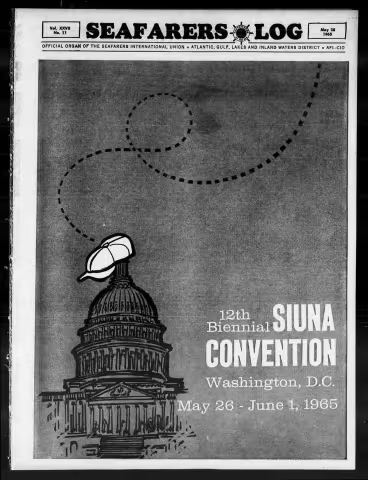
• it. r SEAFARERSmOG
OFFICIAL GROAN OF THE SEAFARERS INTERNATIONAL UNION • ATLANTIC, GULF, LAKES AND INLAND WATERS DISTRICT • AFL-CIO
I'iC
w:
r
; cy
Ir...
I.
I,
11
• r ir-
'
I
\ •[;
\
'i. J-
>
r. "•
.Vf
V
iV
Ir
Pare Twe SEA l^AR ERA "
President Urges 14(b) Repeal, Other Labor Goats
AFL'CIO Council Hails
LBJ's Labor Message
^ WASHINGTON—^The AFL-CIO has hailed President Johnson^s "forthright and forward-
looking" labor message and pledged an intensive effort to translate his proposals into "legis
lative reality."
The President's message
calling for repeal of Sec. 14(b)
of the Taft-Hartley Act, broad
er coverage and overtime penalties
under the wage-hour law and an
Improved unemployment compen
sation system "will go far to bring
about long-needed reforms in
America," the Executive Council
said.
AFL-CIO Pres. George Meany
declared at a press conference at
ttie council's spring meeting here
that the federation still has as its
"top priority" for the current legis
lative session repeal of Sec. 14(b)
that allows states to adopt "right-
to-work" laws. He said a canvass
of the House indicates that "we
have the votes" to secure repeal
and that prospects in the Senate
are "quite good."
He added that the abolition
of so-called "rigbt-to-work"
laws would have the effect of
raising wages in the 19 states
new barring union security
provisions and giving an Im-
. mediate lift to the wage levels
of the lowest-paid workers.
The council statement pointed
up the President's "clear and un
equivocal" call for repeal of Sec.
14(b), and his correctness in stress-
For the highlights of Pres
ident Johnson's labor mes
sage: to Congress see the
backpage of this issue.
urged that full tax savings be
passed on to consumers through
lower retail prices.
• Urged the House to retain an
all-inclusive ban on the poll tax
in its version of the voting rights
bill and inclusion of such a ban in
any bill emerging from a Senate-
House conference.
Ing the divisive effects of repeated
battles over "work" laws. "With
his support, we are confident that
Sec. 14(b) will be repeated."
Labor Sec. W. Willard Wirtz will
lead off for the Administration on
repeal of Sec. 14(b) when a House
Labor subcommittee opens hear
ings May 24. Meany is scheduled
to testify on May 25.
The statement on the President's
labor message topped a two-day
discussion of domestic and inter
national developments during
which the council:
• Supported Pres. Johnson's
proposal to reduce excise taxes and
SEAFARERS LOG
May 28,1965 Vol. XXVii, No. 11
Official Publication of the SIUNA
Atlantic, Gulf, Lakes & Inland Waters
District. AFL-CIO
Executive Board
PAUL HALL, President
CAL TANNEB EAHL SHEPARD
Exec. Vice-Pres. Vice-President
AL KERR LINDSEV WILUAMS
Sec.-Treas. Vice-President
HOB. A. MATTHEWS AL TANNER
Vice-President Vice-President
HERBERT BRAND
Director of Organizing and
Publications
Managing Editor: MIKE POLLACK: Asst.
Editor: NATHAN SKYER; Staff Writers:
ROBERT ARONSON, PETE CARMEN; ROBERT
UILCROM; Art Editor: BERNARD SEAMAN.
Published biweekly af the headquarters
of the Seafarers International Union, At
lantic, Gulf, Lakes and Inland Waters
District, AFL-CIO, «75 Fourth Avenue,
Brooklyn, NY, 11232. Tel. HYaclhth 9-6600.
Second class postage paid at the Post
Office in Brooklyn, NY, uiider the Act
•f Aug. >24, 1912.
120
ifiHuMtOiih
• Voiced its "unequivocal sup
port" of Johnson's policies in Viet
Nam and the Dominican Republic
and underscored the relationship
between the crises in the two coun
tries by the "fifth columns of
Communist imperialism."
• Approved a subcommittee re
port recommending that the AFL-
CIO seek federal legislation
banning lie detectors and request
ing the President to issue an execu
tive order banning use of the
instruments in the federal govern
ment. The use of lie detectors, the
subcommittee report said, "violates
basic considerations of human
dignity in that they involve the
invasion of privacy, self-incrimina
tion and the concept of 'guilty
until proven innocent'."
• Initiated a study of the Trade
Act of 1962 and its specific provis
ions of aid to workers in juried by
provisions of the act. Meany said
that in the two years since the
act's passage the Tariff Commis
sion has rejected every union appli
cation for aid under the injury pro
visions. These provisions are "not
working in the way we expected
them to work," v^hen the AFL-CIO
supported passage, he emphasized.
If some relief is not achieved, la
bor will have to seek relief through
new legislation, he added, com
menting that the Tariff Commission
has apparently closed its mind to
our problems."
• Took a "very strong position"
against extending the most-favored-
nation principle in international
trade to any Communist country
and voiced strong opposition to
scrapping the law providing that at
least 50 percent of all grains and
other foreign aid materials be
shipped in American vessels. The
council said also it will take a close
look at the sharp rate of increase of
American firms setting up over
seas companies and importing the
goods back into the U.S.
The President's message rec
ommended extension of cover
age of the Fair Labor Stand
ards Act to 4.6 million more
workers "most in need of
wage and hour protection" and
amendment of the FLSA to re
quire payment at the rate of
doubletime for all work done
by covered employes beyond
48 hours a week, a ceiling that
would drop to 45 hours in
three years. (Story Page 1.)
He urged creation of a perma
nent federal program of extended
unemployment compensation for
long-term jobless who have ex
hausted benefits under state pro
grams and enactment of federal
standards which state unemploy
ment insurance systems must meet
by July 1, 1967, to receive full tax
credit.
The council statement declared
the AFL-CIO's agreement with the
President that the federal mini
mum wage, should be . ijncreased
from .time to time, adding "suet a
time has now arrived."- Ileany
said the federation will ask Con
gress to adopt a $2 an hour mini
mum wage when it testifies on a
wage-hour bill.
Extension of coverage to addi
tional millions of workers and in
creasing the overtime penalty also
won the council's approval. It
termed the President's wage-hour
proposals "mighty weapons in the
war against poverty."
Shorter Week Need^
The council welcomed the Presi
dent's request for a full study ol
the need for a shorter workweek
by the Automation Commission and
reiterated its "confidence" that a
comprehensive study will bear out
labor's contention that a 35-hour
week is essential to the economy.
The proposals for moderniz
ing the unemployment com
pensation system was hailed
by the council as meeting long
over due needs. "His pro
posals," the statement said,
"would at last enable unem
ployment compensation to
meet In twin objectives—the
alleviation of individual
distress and the protection of
the economy from a disastrous
drop In purchasing power
among the jobless."
Sorry!
Due to the heavy activity
brought about by prepara
tions for the opening of the
12th Biennial SIUNA Con
vention, the customary 24-
page edition of the Seafarers
LOG has been reduced to 16
pages. With the cutback in
1 pages, several of the regular
LOG features will not ap
pear in this issue.
However, with the publi
cation of the June 11 issue
of the LOG. the paper will
revert to its normal size.
By Paul Hail
Some Problems Facing Convention
The 12th Biennial Convention of the Seafarers International Union
of North America opened this week in Washington. In attendance arp
delegates from the 33 affiliated unions which make up the SIUNA
family. Events move swiftly between Conventions, and it hardly
seemed that the last one had ended before plans began for the next.
This is to be expected. We work in an industry which has undergone
many changes in recent years, many of them negative and some of
them positive. Your Union has had to stay on top of the ever-fluctuating
situation in the merchant marine in order to be able to set a proper
course for the SIUNA. Moreover, we have had to battle on occasion,
before the Administration and Congress as well as before the ship
operators, to obtain a proper consideration of our position. All ha^
certainly not been roses since the last Convention as far as the ,
merchant marine is concerned. The U.S.-flag fleet has continued to
decline, while competition from the runaways and foreign-flag oper
ators has continued to rise.
Because of recent events, however, the SIUNA has reason for a
certain amount of optimism regarding the merchant marine picture as •
we go into the Convention. The Federal Government appears to be
taking an even greater interest in preserving and strengthening our.
American-flag fleet. Two years ago, the President established a Mar^, ,
time Advisory Committee composed of representatives of maritime.. ,
labor, industry, the government and the public, which,' if nothing else,
has given us a chance to ipresent our case before the nation. Addi-.
tionally, legislation has been proposed in Congress that seeks tp,
bolster the position of the. non-subsidized segment of the merchant ^
marine, including the declining bulk carrier fleet. The legislation .
would also aid the nation's Ashing fleet.
The delegates to the SIUNA Convention will have the chance to
sift the latest maritime winds coming from the Administration and
other places and will be able to take the necessary action to show
the Administration what the Union feels about the policies being
considered. The optimism which may be called for at this stage of the
maritime crisis, of course, should he tempered with a realistic view
towards what is actually taking place.
To prove that all is not roses, the SIUNA has had to point out the
way in which the Government's lack of a positive maritime policy is
creating an unfavorable atmosphere for the collective bargaining now
undehvay to meet the June 15 contract eiqiiration date in large
sections of the maritime industry. To document its charge, the SIUNA
presented a 12,000-word statement to all the members of the Maritime
Advisory Committee during its recent meeting in Washington.
The SIUNA charged that the Maritime Administration, in its current
presentation, has attempted to horn into legitimate collective bargain
ing areas by unilaterally issuing a series of edicts virtually ordering a
number of American-flag shipping companies to make so-called "eco
nomies" in their operations. Using these edicts as justifications, ship
owners have attempted to reduce the size of their crews and have
refused any realistic or positive negotiations on manning and other
traditional contract issues.
While we realize that in today's world, the Maritime Administration .
must and will have • certain influence on collective bargaining, if only
by Its existence and the kind of job delegated to it, certain Issues must
remain the exclusive province of the Union and the employers. Manning
is most certainly one of these issues.
Only when the government and the ship owners disoiay a more
positive attitude toward the problems confronting the merchant marine,
including the expansion of the fleet and the improvement of job
opportunities, will the machinery of collective bargaining be able to
be used most fully and most efficently.
West Gulf Ports Council Dinner-DaniDe
The West Gulf Ports^Council of the AFL-CIO Maritime Trades Department held its first annual
dinner-dance in Houston recently, and speakers included many representatives of Gulf labor.
Spealcing.above is SlU Vipe-President Lipdsey Williams; Others (l-r), are West Gulf Ports
Council Pre^sident C. E.'Defries; SlU Houston Port Agent Paul Drozak; and International Long
shoremen's Association President Teddy Gleasort.
Mar M. ItM SEAFARRRS LOG
« I
SlU Raps Gov't Failure
To Develop Positive
U.S. Maritime Program
WASHINGTON—The Seafarers International Union of
North America has charged maritime management and the
U.S. Government with creating an unfavorable atmosphere
for collective bargaining by-*-
failing to develop a positive
and affirmative attitude
towards the future development of
the American-flag merchant
marine.
The contracis of various SIUNA-
affiiiated unions expire June 15,
as do the contracts of a number
of other American maritime
unions, and both management and
government officials have voiced
fears of a widespread tie-up of
American-flag shipping at that
time.
The SIUNA's view on this
matter was set forth in a 12,-
000-word statement presented
to all members of the Presi
dent's Maritime Advisory
Committee. The statement Is
entitled: "Position of the Sea
farers Union of North America
on Automation and Manning
of the American-flag Merchant
Fleet."
The Maritime Advisory Com
mittee was established by Execu
tive Order of President Johnson
last June to consider the problems
of the American maritime indus
try, but has never discussed the
impact of automation on the
American-flag fleet or job oppor
tunities for American merchant
seamen.
SIU Represented on MAC
The committee consists of Secre
tary of Commerce John T. Con
nor, chairman; Secretary of Labor
W. Willard Wirtz, and 15 non-
Government members representing
maritime management, labor and
the public. The SIUNA represen
tative on the committee is its
president, Paul Hall. Also partici
pating in the discussions of the
committee are a number of other
Government officials, including
Maritime Administrator Nicholas
Johnson and William E. Simkin,
director of the Federal Mediation
and Conciliation Service. Simkin
is one of those recently indicating
concern over the possibility of a
maritime strike.
The SlU charged in Its cur
rent presentation that the
Maritime Administration has
attempted to inject Itself Into
the collective bargaining area
and has muddied the collective
bargaining outlook by uni
laterally issuing a series of
edicts virtually ordering a
number of American-flag
steamship companies to effect
economies In their operations.
Clarification
An Executive Board mo-
; tlon clarifying when as
sessments are due and pay
able has been approved by
the membership at regular
meetings.
The motion provides that
commencing with the year
1966, all annual assessments
shall be due and payable at
the same time as the first
quarter's dues in each year
are payable as per the con
stitution. With regard to the
1965 assessments, they are
due and payable no later
than the time when third
quarter dues are due and
payable, July 1.' 1965.
Shipowners, on the other hand,
have seized upon these Gov
ernment edicts as Justifications
for attempting to reduce the
size of their crews and refus
ing to negotiate realistically
on manning and other tradi
tional contract issues, the SIU
added.
The SIU said that both manage
ment and the Government had
called upon the SIU, as well as
other maritime unions, to co
operate in automating the Ameri
can-flag fleet, particularly by
agreeing to reductions in manning
scales on automated and retro
fitted ships.
The SIU asserted that American
maritime unions have been co
operative In this respect and noted
that the "statesmanlike attitude"
of these unions has been com
mended by the Maritime Adminis
trator.
The SIU charged, however, that
neither management nor the Mari
time Administration have been
willing to exhibit a quid pro quo
attitude, nor indicated any affirma
tive desire to work toward ex
pansion of the total American
merchant fleet as a means of cre
ating new jobs to replace those
which union members are being
asked to give away.
The SIU said that this lack of
a quid pro quo attitude was the
chief reason for the impasse
which resulted on the West Coast,
where SlU-affiliated unions as far
back as last Fall began to negotiate
on manning reductions proposed
by the Pacific Maritime Associa
tion. PMA represents the oper
ators of some 120 West Coast
vessels.
No Automation Assurances
As an example, the SIU cited
the fact that its West Coast unions
have been unable to obtain any
assurance from the Maritime Ad
ministration that any savings ac
cruing to the Government, as a
result of crew reductions on auto
mated vessels, would be utilized
for improvement and expansion of
the fleet.
The SIU said its West Coast
unions have been unable to obtain
any positiye statement from the
Maritime Administration, although
a request for the MA's position on
this matter was submitted in
writing more than 15 months ago,
during the course of the negotia
tions with PMA.
, The SIU said it recognized that
decisions by the Maritime Admin
istration have an impact on col
lective bargaining. The SIU made
it clear, however, that collective
bargaining must remain the ex
clusive province of management
and labor. It added that manning
and other traditional contract is
sues would continue to be the sub
ject of exclusive negotiations be
tween the unions and companies
involved, and that It would oppose
interference in these negotiations
by any third party—Government
or otherwise.
The union also pointed out,
however, that a more positive
attitude by the Government,
as well as management, toward
expansion of the fleet and the
Improvement of Job opportunl-
(Continued on page 10)
SIUNA Convention
Faces Vital Labor,
Maritime Problems
WASHINGTON—AFL-CIO President George Meany and Under Secretary of Labor John
F. Henning were among the speakers representing the Government, maritime industry and
organized labor, who addressed the more than 200 delegates and guests here at the opening
session of the 12th Biennials-
Convention of the Seafarers
International Union of North
America on May 26.
The Convention is being
held at the Gramercy Inn,
1616 Rhode Island Avenue, and
will continue through June 1.
Meany, in his convention address,
placed the blame for the decline
of the American merchant marine
at the doorstep of government
agencies "who simply wish the
American merchant marine prob
lem would disappear without a
fuss, and that American seamen
would allow their occupations and
their industry to disappear with
out a fuss."
The AFL-CIO President said
St. Louis Taxi Vote
SIU Cabbies Scuttle
Teamster Raid Bid
ST. LOUIS—Taxi workers of the SIUNA-affiliated Local 1
of the Transportation Services and Allied Workers Union de
feated a raiding bid by the Teamsters Union here in a hotly-
fought NLRB representations
election held on May 21.
Drivers for St. Louis' Yellow
Cab Company voted to remain
with the AFL-CIO and the Trans
portation Services and Ailied
Workers, giving the SIUNA affili
ate its third election victory over
the Teamsters in as many weeks.
TS&AW locals turned back the
Teamos in Chicago by a whopping
two-to-one margin in the first in
stance, and beat Jimmy Hoffa on
his home grounds in Detroit in the
second vote.
Lloyd Young, piresident of
TS&AW Local 1 here, called the
election result a "victory for de
cent, honest trade unionism. The
drivers In St. Louis, Just as the
drivers In Detroit and Chicago,
wanted a decent union and voted
for one."
"This makes it three in a row
over James R. Hoffa's Teamsters,
and we appreciate this member
ship support," Young said.
Local 1 had the full support of
the St. Louis AFL-CIO and the
Missouri State AFL-CIO. Joseph
P. Clark, president of the St. Louis
AFL-CIO Labor Council, said that
the Council "stands solidly with
your Local 1, through which you
can gain every benefit and security
without sacrificing your personal
thoughts, your voice, your ideas,
and your ideals."
St. Louis cabbies voted for the
TS&AW by 118 to 92, with just
two blank ballots and one chal
lenged vote. The election was con
ducted by the St. Louis office of
the National Labor Relations
Board. -*•
that the answer to the problems of
the merchant marine "rests with
those who have the responsibility
and the power to take the neces
sary steps to revive and expand
the maritime industry." Meany
cited laxity and indifference on the
parts of the Defense, Agriculture
and State Departments as con
tributing greatly to the decline of
the American merchant marine.
"The only strong consistent voice
over the years on behalf of a bet
ter merchant marine, to provide a
decent standard of living for our
people, has been the voice of
American unions in this field,"
Meany declared.
Meany called on Government
agencies to enact a positive, con
structive program aimed at the
revival and expansion of the Amer
ican merchant marine. In his con
vention remarks, Meany also
stressed the importance of extend
ing minimum wage coverage to
millions .of workers who are pres
ently not covered, and he urged
that the minimum wage level be
raised to $2 an hour from the
present $1.25, which the AFL-CIO
President described as "being
below the poverty level."
Meany added that greater
Government expenditures are
needed to meet the growing needs
of this country, particularly in the
areas of schools and housing.
Under Secretary of Labor John
F. Henning, in his address to Con
vention delegates at the opening
session, emphasized that so-called
'right-to-work' laws have served to
drive down the wages and living
conditions of workers employed In
•right-to-work' states. '
House Majority Whip Hale Boggs
(Continued on page 16)
SIU Prasldant Paul Hall, flanlcad by Rapraiantatlva Emmanuel Ceiler (left) and SIUNA Execu
tive Vice-President Morris Weisberger, is shown addressing delegates, representatives of labor
and government and others at the jest biennial convention of the SIUNA held in Washington
1963. AFL-CIO President George Meany was the leadoff speaker for the Twelfth Biennial
' SIUNA Convention which began this week, also in Washington^
in
Pace FMV SEAWAREM-S tOG May Xf, IMf
Three Seafarer Veterans
Join SlU Pension Ranks
The Seafarers Welfare Board of Trustees has approved the pension applications
three more SIU veterans. The three new pensioners join the growing list of Seafarers
ready enjoying the comfort and secvimty of their lifetime $150 monthly pension checks.
of
al-
Th three new pensioners
are Diego Martinez, 67, James
McConathy, 38, and Olaf
Olson, 71.
Martinez joined the SIU in tiie
port of Baltimore, sailing as a
cook in the stew
ard department.
Born in Curacao,
Netherlands An
tilles, Brother
Martinez now
makes his home
in Baltimore,
Maryland with
his wife Mar-
Moreinon Mornnez shipped o u t
aboard the SS Chatam.
McConathy signed on with the
SIU in the port of Mobile, where
he sailed as a member of the engine
department. He was born in Ala
bama, but now makes his home in
Chattanooga Tennessee. His last
ship was the SS Steel Age. Brother
Three IBU
Boatmen
On Pension
Three new members of the SIU
Inland Boatmen's Union joined
the growing ranks of IBU men
already on the SIU pension roster
as their applications were
processed and ap^oved by the
Seafarers Welfare Board of
Trustees.
The three new IBU pension
holders are Thomas Englesbee, 55,
Harrison C. Wini^ow, 67. and
George Winston, 65.
Englesbee
joined the IBU
in the port of
Ashtabula, sail
ing as a fireman,
oiler and line
man. He last
shipped out as an
employee of the
Great Lakes Tow
ing Company. He
and his wife
Luella now make their home in
Erie Pennsylvania. Brother
Englesbee and his wife are both
looking forward to retirement that
is secured by the $150-a-month
IBU pension benefits.
Winslow signed on with the IBU
in Baltimore. Born and bred in
the state of Maryland, he makes
Englesbee
Wttislow Winston
his home in Baltimore. Winslow
shipped as a member of the
steward department, last sailing
for the Arundel Corporation.
Winston joined the IBU in the
port of Mobile, Alabama where he
shipped as a cook in the steward
department. Born in Mandeville,
La,, he and his wife Neugirtha
now make their home in Mobile.
He last sailed for the Mobile Tow
ing and Wrecking Company.
McConathy is looking forward to a
future protected by his SIU pension
benefits.
Olson Joined the SIU in the
port of Buffalo, sailing as a
deckhand. A native of Sweden, he
now makes his home in Kenmore,
New York. Olson last sailed for
the Great Lakes Dredge and Dock
Company. He will spend his re
tirement years in Kenmore with his
wife Anna. McConathy Olson
AFL-CIO Ui^es Ban
On Lie Detector Use
WASHINGTON—The AFL-CIO Executive Council approved a re
port urging federal legislation to ban the use of "lie detectors" and a
presidential executive order barring the use of the instruments in the
federal government.
The recommendations high
lighted a detailed report on the
use of polygraphs — popularly
termed "lie detectors" by a coun
cil subcommittee of Vice Presi
dents A1 J. Hayes and James A.
Suffridge.
Recommendations
The committee, acting, on the
basis of a resolution adopted by
the coiuicil in February 1965
deploring the use of lie detectors,
recommended also that the AFL-
CIO:
• Encoura^ and assist anti-
polygraph campaigns at state and
local levels.
• Distribute lie detector facts
as widely as possible.
• Survey afUliates to gain more
information on the extent of the
use of lie detectors.
• Request that the congres
sional investigation into federal
polygraph use be broadened to in
clude use In all segments of
American society.
The committee report noted
the "alarming spread" In the
use of lie detectors in recent
years and tJiat in order to get
or keep a Job, "woAers with
estaldlslied records of
honesty, dependability and
integrity in their pmonai and
employment lives must suffer
themsel ves to be hooked up to
a machine and answer a whole
gamut of questions about their
past, present and future
activities «m and off the Job."
The report emphasized that
"tiiere Is no Tie detector"* and
the use of tfae;e machines is
based cm "deception and myth."
It added:
VSidates Basic Rights
"The use of 'lie detectors* vio
lates basic considerations of
human dignity in that they hi-
volve the invasion of privacy, self-
incrimination and the concept of
'guilty until proven innoorait'"
It noted that six states and
two cities have statutes pro
hibiting use of file machinea
in all private employment,
and with the exception of one,
in public employment and
that similar measures''are un
der consideratien in nine
other states. It commented,
however, that "it would take
many years" to secure mean-
Ingfiil legislation in the 44
states currently allo\dng the
use of lie detectors and state
laws would create "a hodge
podge of ineqaitles,*' under
scoring the need for a federal
law.
The committee urged unions to
include in collective bargaining
agreements clauses prohibiting
the use of lie detectors and sug
gested the following language as
a guide:
"The company shall not re
quire, request or suggest that an
employe or applicant for em
ployment take a polygraph or any
ottier form of He detector test."
The 31-page report and ac
companying exhibits covers the
theory of the lie detector opera
tion and probes deeply into a
number of assumptions governing
their use as well as marshalling
expert testimony against the
machines and their usage.
House Bill
Would Block
PHS Closings
WASHINGTON—A . bUl ..that
would blodc the proposed closing
of seven U.S. Public Healtih
Seivice hospitals has been intro
duced into the House of Repre
sentatives by Ccmgressman Herb
ert C. Bonner (D.-N.C.). The North
Carolina repr^entative recoitly
presided as chairman at hearings
conducted by fiie House Mercfaant
iMarine and Fisheries Committee,
at which the SIU attacked the
proposed closings.
Under a plan advanced by the
D^artment of Health, Education
and Welfare, seven U.S. Public
Health Service hospitals would be
closed and seamen receiving
teeatment at these facilities would
be transferred to Veteran Ad
ministration hospitals. Hospitals
scheduled for closing are located
in Norfolk, Va., Savannah, Ga.,
Boston, Galveston, Memphis and
Detroit.
After hearing severe criticism
of the HEW closing plan. Chair
man Bonner inteoduced his bill
(H.R. 6160). His proposal will be
considered by his own committee.
ly Earl (But!) Shepard. Vice-President, AHantk
SIU Convention Underway
The Seafarers International Union temporarily moved its major ac
tivities to Washington last week for the Union's 12th biennial conven
tion. Representatives of all the SIU affiliates converged on the Gram-
ercy Inn convention site to discuss and act on the problems facing the
American merchant marine and the men who go to sea. The convention
was still going on as this column was written, so that a full report on
activities affecting the Atlantic Coast will have to wait until the next
issue of he LOG.
New York
Shipping held steady in New York at a fairly good level. During the
last period 17 vessels paid off, six signed on and 16 were serviced in
transit. The outlook is good for the next period.
E. Wang, who sails in the steward department, spent two years on
the research ship Anton Bruun exploring in the Indian Ocean. He says
that he liked it so much he wants to get back on another research ship.
It looks like he's turning into a regular professor with all that research
time at sea.
WilHam Miller, last aboard the Hercules Victory as an AB, wants a
ship this time that's going to take him around the world.
Joe Samicola's been telling all the Seafarers at the New York Hall
about his new baby, bom just last •
December. With another member
of the family, Joe, who last
shipped on the Oceanic Cloud, is
looking for a coasthugger so he
can stay close to home.
ClifTord HenrJng last sailed in
the engine room on the Trans-
globe. Now he's watching the
shipping board for the first wiper's
job on a ship heading overseas.
Boston
Shipping has been slow in Bos
ton, with just one payoff and one
ship serviced in transit during the
last period. Shipping is expected
to improve, however, when the
summer ships start running.
Charles Perrin, a 20-year union
man, was sorry to see his last
floating hotel, the Mt. Washing
ton, go into layup. He was aboard
her for a year. Now he plans on
spending some time with the fam
ily before shipping again.
Waiting for his ffd in drydock
right now is John Gala. A quarter-
century SIU man. John last sailed
as a wiper aboard the Cities Serv
ice Baltimore. As soon as he's fit,
he says he will grab the first job.
PhUadelphia
Shipping has been on the slow
bell in Philly also. With several
ships due in for payoffs or in
transit servicing during the com
ing period, shipping is expected
to improve.
Angel Rosa, who sails as bos'n,
had to get off the Commander be
cause of. illness in the family. Ev
erything is now squared away, and
Angel says he's ready to ship again.
Pat Dorrlan, who's been sailing
for 17 years, was last aboard the
Potomac. Rig'ht now he's waiting
for a Europe-bound ship on which
he can sail as an oiler or fireman-
watertender.
William Geory, a 20-year vete
ran, got off the Calmar for a happ^
reason—^his sister's wedding". Bill
says you can't beat the Calmar
ships and he's set to take the first
FWT job on a Calmar ship that
comes along.
Dimas Riviera, who's been in
the SIU for 25 years, got off the
Aicoa Trader due to illness. He Is
BOW waiting for his fit for duty
slip so tfaat he can ship on the first
Alcoa ship.
Baltimore
Shipping was very good in Bal
timore during the last period, with
three payoffs, ten sign-ons and 11
ships serviced through the port
in transit. The prospect for the
coming period is only fair. On
the local labor front, the AFL-CIO
Newspaper Guild is still on strike
against the Sun papers here. The
picket lines are holding solid and
the Guildsmen are maintaining
high spirits despite the fact that
a long strike is anticipated.
A 19-year veteran of the stew
ard department, James Temple
last sailed on the Mt. Vernon Vicr
tory as chief cook and baker. He
says he thought her officers and
crew were tops and hated to see
the ship lay up. He is hoping to
make it back to the same ship
when she crews up again.
Jacob R. Gnagney, a 20-year
SIU man, had to pay off the Los-
mar because of an injury he suf
fered. Currently taking treatment
at the USPHS here, he hopes to
have his ffd in the near future so
he can get back to his old ship.
Edgar F. Armstrong, who sails
as an electrician, says he has
proudly watched the union grow
in every respect uid thinks the
SIU has the best welfare plan in
the maritime industry.
Norfolk
Shipping has been good here
also. The De Soto paid off and
tortc practically a whole new crew
for her trip to Viet Nam. The Hall
was just about cleared out, and
the outlook is even brighter. Dur
ing the last period there were two
payoffs, two sign-ons and seven
ships serviced in transit.
Carl Carlson, a 22-year SIU man
who last sailed aboard the Poto
mac as deck maint., paid off so he
could get in a little fishing. Carl
claims that this is the time of the
year that the crokers are running.
Andy Noah, who sails in the
steward department, had to get off
the Potomac to go into drydock.
He says she was a fine ship and
that he hated to leave her.
Guy Whitehurst, last aboard the
Andrew Jackson, is in drydock
now, but the report is that he is
coming along nicely.
Puerto Rico
Shipping has been fair in sunny
San Juan, with 23 vessels contact
ed in the last period. The outlook,
though clouded somewhat by lo
cal beefs concerning the ILA, is
good.
The SIU of Puerto Rico mem
bership was saddened by the death
of oldtimer Concepcion Rivera,
who succombed to a heart attack
while sailing as a fireman-water-
tehder on the Alcoa Runner.
Phil Rnbish is back at the Hall
after a couple of months aboard
the Bienville. Tony Gonzalez left
his bos'n's job aboard the Florida
State so he could get a look at his
new baby.
.-^^arV',^
-r 3" M.''
Mi^ INS SkAFAUEBS loa
"Crapes Of Wrafh" Revisited-The
MIGRANT WORKER
HELP WANTED
Salary—50 cents an hour.
Hours—sunrise till sunset. . • „
Woifcing conditions—^baekbreaking ..
"stoop" labor, food like the menu
of a concentration camp."
Living conditions—tin shack, unheated,
no cooking stove, no bathroom, no water,
burlap room dividers, bare wall, floors,
owned by the boss—$5 a week rent.
Security—none. Future—none.
A "want ad" like the one above wouldn't be
expected to draw many applicants, but it is
precisely what big farm interests in the South
and West are offering to farm workers.
To get away with these starvation wages and
sweat shop conditions, they have mounted a tre
mendous propaganda campaign to pressure Con
gress into bringing back the so-called "bracero"
program.
The bracero program, revoked by Congress as
of December, 1964, has for years allow^ these
rich growers to bring cheap, foreign farm labor
into the U.S. from Mexico and the British West
Indies. With unemployment rampant among
American farm workers, the growers imported
foreign laborers and exploited them unmercifully
for greater profit—offering them little and often
cheating them out of even that.
Plenty Of Time
When Congress terminated Public Law 78
which allowed the bracero program to exist, it
allowed a full year before the revocation took
effect to give the growers plenty of time to re
cruit American farm workers, which are plenty-
ful, to fill their needs. The growers chose instead
to spend this time putting together a massive
propaganda program aimed at bringing back the
braceros. Instead of farm workers they hired
public relations men to amass heaps of distortions
and outright untruths aimed at making it seem
that the growers could not continue to exist with
out the braceros.
Their phony campaign to bring back the old
bracero system involves three basic claims, stated
in the Florida Citrus Manual on behalf of the
Florida agricultural industry—one of the grow
ers' propoganda sheets—in a recent article called
"A Case History of Failure & Losses to Florida
Agriculture." These claims are:
• Under the bracero system farm workers'
wages, working and housing conditions improved
constantly.
• Although they have a positive recruitment
program there is an insufficient supply of Amer
ican farm labor.
• Because they cannot get a sufficient supply
of American farm workers they are suffering
great crop losses.
The truth is that the growers have been prac
ticing systematic discouragement of American
farm workers who do apply for work and many
growers absolutely refuse to comply with pre
scribed decent wages and working conditions.
Unfortunately, Florida growers are among the
worst offenders, and farm worker wages and
conditions in that notorious "right-to-work" state
are deplorable. The propaganda put out by the
growers is refuted by on the spot interviews
and reports collected by the National Advisory
Committee on Farm Labor, a voluntary, non
profit organization dedicated to getting a fair
shake for the American migrant worker.
Propaganda vs. Truth
Growers' claim—^"^constantly improving wages,
working, housing conditions . . ."
The truth? During the 10-year period (1951-
1961) wages paid by the major Florida usere of
foreign agricultural labor increased from 50 cents
an hour to only, 60 cents an hour.
The going rate for potato pickers is six cents
a crate. Crates hold 70 to 72 pounds, so to earn
a dollar a worker would have to pick 16 crates,
or slightly more than half a ton of potatoes .
"I was a fruit-picker, and this is the way fruit
pickers work. You have to be on the job at 8 in
the morning . . . You wind up 85 miles from your
starting point . . . When you get to your destina
tion you may have to hang around an hour and
a half until the dew is off the oranges. That would
be about noon. Then when you start picking, they
know that they have you way-out, so they tell
you they are paying 30 cents a box . . . You have
to travel back to the plant which is another 2%
hours, and you don't get one red cent for travel
time . . ."
"Slave Labor"
". . . The swill they serve at meals is like the
menu of a concentration camn . . . The whole set
up smells of slave labor ..."
". . . There are no camps in Dade County with
indoor plumbing for each cabin. The electrical
outlet provides a bare bulb for light . . . Some
times burlap is the only privacy between rooms.
The floors and walls are generally bare, unpaint-
ed planks. Families with 10 and 12 children can
live in one two-room shack for $8 to $10 a week;
The children are bedded down on the floor . . ."
Growers claim — "a positive recruitment pro
gram but insufficient supply of American farm
labor."
The truth? .. They could get nlenty of domes
tic cutters if they'd pay enough. These Jamaicans
and other islanders are no better man for man
than our own people . . . The owners keep bring
ing them in to keep the wages down."
"I was able to line up several hundred experi
enced workers who were willing to go to Florida
for farm work. On March 17th I went to the local
Farm placement office and told that there were
no requests from Florida growers for additional
workers. Rural people are used to heavy work;
many of these men chopped cotton for years. They
want farm work but can't find any."
". . . There are plenty of workers in the groves,
in vegetables, and in the packing houses ... I
would say there has been a great publicity cam
paign across the country on the so-called short
age of agricultural labor. Most of the big growers
did not get ready for the end of Public Law 78
and the cut-off of foreign farm workers. They had
always pressured the government into a con
tinuance. They believed they could do it again."
Growers' claim—"disastrous crop losses caused
by insufficient supply of American form workers."
The truth? "... Prophecies of disaster flow daily
.. The swill they serve at meals is like the menu
of a concentration camp . . . The whole setup
smells of slave labor . . . . There are no
camps in Dade County with indoor plumbing for
each cabin . . . Families with 10 and 12 children
can live in one two-room shack . .
from many growers, though none of the prophe
cies has yet been fulfilled. Despite loud alarms
at the first of the year, lettuce growars in Cali
fornia's Imperial Valley harvested their entire
crop. The early and midseason harvesting of
Florida citrus will be completed by next week
with little more than the usual 5-percent loss;
Florida found enough workers to replace British
West Indians to harvest 5,500,000 boxes of citrus
the last week in January, the largest harvest in
a week in three years."
Growers' Scare Tactics
". . . One claim that has been recently made is
that crops . . . are rotting on the ground, unhar-
vested because domestic labor cannot be found
to do the job . . . Thanks to a reporter for the St.
Petersburg Time, Peter Kramer, this spurious
claim has been exposed as a half-truth, to put it
gently. The facts are, as Mr. Kramer learned
while working in the groves himself, that excep
tional weather conditions caused the fruit to drop
early."
With all their phonv claims refuted, the
true aims of the big farm interests are re
vealed. They wish to continue their planned
exploitation, growing fat on the misery and
suffering of the migrant farm workers. They
will not improve wages or conditions unless
they are compelled to by law.
To improve the lot of these migrant farm work
ers, and abolish forever what has. been called the
"Blue-Sky Sweatshop," the AFL-CIO is pressing
for congressional action to bring farm workers
under the minimum wage provisions of the Fair
Labor Standards Act and to insure their right to
organize and bargain collectively under the Na
tional Labor Relations Act.
This is possibly the most important and
most needed measure to help migrant farm
workers to help themselves. Until they are
provided protection by the National Labor
Relations Act, farm workers who join unions
will continue to he fired and blacklisted at'
will, without legal recourse, especially in anti-
labor "right-to-work" states like Florida.
Likewise, farm employers can continue to re
fuse to bargain with, or even recognize, a bona
fide union even if 100 percent of their em
ployes ask for its recognition.
Above all. Congress must continue to resist
iressure from the growers to bring back the
jraceros. With this supply of cheap, almost slave
: abor at their disposal, the growers would be able
to continue to thumb their noses at all attempts
to aid the domestic migrant farm worker.
race SB SEAFARERS LOG Mar M, INI
(Figures On This Page Cover Deep Sea Shipping Only in the SW Atlantic Gulf Lakes and Inland Waters District.)
Shipping activity slackened off in the last two week
period, with 1,054 men taking job calls as compared with
1,147 during the previous period. Shipping along the East
Coast dipped in all ports except Baltimore, which experi
enced a sharp upturn, and Philadelphia, where shipping
remained at the same level as in the last period.
Shipping also declined in the Gulf ports. Tampa
showed the biggest drop percentage-wise. Mobile job
calls were off by more than 50 percent, and a loss was
also registered in New Orleans. Houston was the only
Gulf port where shipping showed a sharp improvement
as compared with the last period. On the West Coast,
Wilmington showed an appreciable gain, while San
Francisco declined. Seattle, where shipping had reached
a very high level in recent weeks, began to settle to a
more normal level.
The job breakdown by department shows only the
engine department gaining over the last period. The
largest loss was suffered by the deck department, fol
lowed by the steward denartment.
The drop in job calls was matched by a drop in the
May 8 to May 21, 1965
number of men registering. During this period 1,135
Seafarers registered; during the last period the number
registering was 1,206. The number of men registering on
the beach also dipped. In the last period there were
3,804 beach registrations; in this period there 3,624 men
registered on the beach.
The seniority situation reflected the decrease in jobs.
The percentage of Class A men shipping rose from 51 to
54 percent during the two week period. Seafarers hold
ing Class B cards who shipped declined by three percent
over the period, their share of the total slipping from 36
to 33 percent. Holding constant as compared with the
last period were Class C men, who accounted for 13 per
cent of the total number of men shipped.
Following the generally slow trend, ship activity fig
ures were also down. Payoffs dropped to 55, as com
pared with 61 in the last period. Sign-ons dropped to 41,
as compared with 43 last time. The number of vessels
serviced in transit, however, rose by one ship, with 101
Ship Acffvi'fy
in transits reported, compared with ICQ in the last period.
Olb
Betten 1
Nttw York .... 17
Philodolphlo.. 5
Rolrlmoro .... 3
Norfolk 2
Joehtoflvlllo .. 1
Tompo 0
Mobllo «
New OrlooM.. 4
HooftoM B
Wilmington .. 1
Son Froncftco. 7
SootHo 3
Sign In
On< Trant. TOTAL
0
4
3
10
2
1
0
2
3
*
1
6
1
1
U
4
11
7
•
3
2
0
14
4^
15
5
2
39
14
24
11
11
3
10
15
25
4
20
9
TOTALS ... 55 41 101 197
DECK DEPARTMENT
Port
Boston
New York....
Piiiladelphia .
Baltimore
Norfolk
.'.icksonville .
Tampa
r^obile
New Orleans.
Houston
Wilmington
Pan Francisco
Seattle ....
TOTALS
Reqistered Registered Shipped Shipped Shipped TOTAL Registered On The Beach
CLASS A CLASS B CLASS A CLASS B CLASS C Shipped CLASS A CLASS B
GRO"P GROUP GROUP GROUP GROUP CLASS GROUP GROUP
1 o 3 ALL 1 2 3 ALL 1 2 3 ALL 1 2 3 ALL 1 2 3 ALL A B C ALL 1 2 3 ALL 1 2 S ALL
2 3 0 51 0 1 2 3 1 0 0 1 0 0 0 0 0 0 0 0 1 0 0 1 5 20 1 26 0 5 3 8
25 SO 9 64 1 14 13 28 13 32 6 51 2 8 5 15. 0 2 4 6 51 15 6 72 78 124 32 234 10 29 57 96
6 9 0 15 0 3 7 10: 3 8 0 0 2 3 5 1 1 0 2 11 5 2 18 21 20 5 46 ! 0 8 17 25
9 14 3 26 1 6 13 20 11 26 4 4ll 2 5 10 17 0 2 2 4 41 17 4 62 33 47 8 88 3 14 27 44
4 3 0 7 0 0 5 5 3 0 0 3 0 1 4 5 0 0 0 0 3 5 0 8 12 16 1 29 0 2 11 13
2 0 0 2 1 ® 1 3 4 2 0 0 2 2 0 2 4 1 0 0 1 2 4 1 7, 5 6 0 11 2 3 8 13
7 2 1 5 1 1 0 1 2 0 0 0 0 0 0 0 0 0 0 0 0 0 0 0 0, 4 8 1 13 2 1 3 6
13 9 1 23 , 1 3 4 8 7 5 1 13 3 1 1 5 1 1 4 6 13 5 6 24 34 34 3 71 0 6 21 27
19 27 7 53 . 1 17 16 34 14 18 8 40 1 14 8 23; 0 1 1 2 40 23 2 65 87 78 9 174 5 52 84 141
12 24 2 38 0 5 9 14 6 23 4 33 2 9 9 20 0 2 3 5 33 20 5 58 64 91 16 171 4 10 28 42
' 2 4 0 6 , 2 2 4 8 5 4 1 10 1 3 3 7; 0 0 0 0 10 7 0 17 11 14 2 27 1 7 8 16
9 11 2 22 1 4 6 11 10 12 5 27 3 9 6 18 0 5 8 13 27 18 13 58 10 70 2 32 2 6 2 10
9 10 1 20 0 7 5 12 2 _ 13 2 17, 0 6 6 12| 0 1 0 1 17 12 1 30 25 18 2 45 1 13 11 25
114 146 26 1 286 8 63 88 1 1 159 77 141 31 1 1 249 16 58 57 1 131 i 3 15 22 1 1 40 249 131 40 1 420 389 496 82 1 1 9671 30 156 280 1 1 466
ENGINE DEPARTMENT
Registered CLASS B Shipped Shipped Shipped TOTAL Registered On The Beach
CLASS A Registered CLASS A CLASS B CLASS C Shipped CLASS A 1 CLASS B
0% » GROTTp GROUP GROUP GROUP GROUP CLASS GROUP GROUP
Port 1 2 3 ALL 1 2 3 ALL 1 2 3 ALL 1 2 3 ALL 1 2 3 ALL A B C ALL 1 2 3 ALL 1 2 3 ALL
Boston 1 2 2 5 0 0 0 0 0 0 0 0 0 0 0 0 0 0 0 0 0 0 0 0 2 9 4 15 0 1 0 1
New York 18 33 5 56 2 15 10 27 8 25 5 38! 1 7 8 16 0 4 5 9 38 16 9 63 56 105 13 174 5 48 60 103
Philadelphia 1 13 2 16 0 6 6 12 1 10 1 12' 0 3 4 7 0 2 1 3 12 7 3 22 3 32 7 42 0 12 10 22
-Baltimore 10 14 3 271 2 16 8 26 8 25 1 34 2 16 8 26 0 1 2 3 34 26 3 63 8 47 4 59 2 21 17 40
Norfolk 2 4 1 7. 2 2 4 8 0 3 0 3 0 3 2 5 0 0 3 3 3 5 3 11 4 15 2 21 2 3 10 15
icksonville 0 1 0 1 0 3 1 4 0 0 0 0 0 4 1 5 0 2 1 3 0 5 3 8 1 2 0 3 1 3 3 7
Tampa 0 0 1 ll 0 0 1 1 0 0 0 0 0 0 0 0 0 0 0 0, 0 0 0 0 1 4 0 5 0 1 3 4
Mobile 6 11 1 18 0 5 7 12 - 2 5 0 7 0 1 5 0 1 0 1 7 6 1 14 13 20 3 36 1 11 15 27
-•w Orleans 4 24 2 30! 2 13 10 25; 6 24 5 35 1 7 7 15 0 1 0 1 35 15 1 511 29 77 8 114 8 56 58 122
Houston 8 18 1 271 2 13 14 29' 6 12 1 19 1 19 8 28 0 1 0 1 19 28 1 48 30 71 4 105 11 53 54 118
Wilmington 0 2 0 2 1 4 0 5 2 4 3 2 2 0 4| 0 0 0 0 9 4 0 6 11 1 18 3 9 5 17
San Francisco 8 8 1 17| 1 3 6 10 7 11 4 22 4 2 2 8 0 4 7 11 22 8 11 41' 5 20 2 27 0 5 6 11
Seattle 0 9 0 5 0 4 2 6 1 9 3 13 0 4 5 9 0 0 1 1 13 9 1 23 4 2 2 8 1 5 0 6
TOTALS ~58 139 19 1 216 12 84 69 1 165 41 128 23 1 192 11 68 50 1 129 0 16 20 1 36'192 129 36 1 357 162 415 50 1 627 34 228 231 1 493
STEWARD DEPARTMENT
Registered Registered Shipped Shipped Shipped TOTAL Registered On The Beach
CLASS A CLASS B CLASS A CLASS B CLASS C 1 Shipped CLASS A 1 CLASS B
Poit
GROUP ! GROUP GROUP GROUP GROUP CLASS GROUP GROUP
Poit 1-s 1 2 3 ALL 1 2 3 ALL 1-8 1 2 3 ALL 1 2 3 ALL 1 2 3 ALL A B C ALL 1-8 1 2 3 ALL 1 2 3 ALL
Eos 0 0 0 1 1 1 0 1 0 0 0 0 0 0 0 0 0 0 0 0 0 0 0 0 0 1 4 2 5 12 1 0 1 2
NY 5 12 9 17 43 3 3 9 15 1 6 5 9 21 0 1 10 11 0 0 6 6 21 11 6 38 24 50 28 84 186 7 14 41 62
Phil 1 1 2 3 7 0 1 5 6 1 4 0 2 7 0 0 9 9 0 2 0 2 7 9 2 18 2 9 6 8 25 1 3 9 13
Bal 0 6 5 6 17 1 0 12 13 2 9 3 5 19 0 0 14 14 0 0 6 6 19 14 6 39 11 20 9 19 59 2 0 SO 32
Nor 0 0 1 1 2 0 2 5 7 0 1 1 0 2 0 0 3 3 1 1 2 4 2 3 4 9 4 7 5 4 20 2 2 17 21
Jac 1 1 0 0 2 1 0 3 4 0 0 0 0 0 0 0 2 2 0 0 0 0 0 2 0 2 2 2 1 0 5 1 0 4 5
Tarn 0 3 0 3 6 0 0 1 1 1 0 0 0 1' 0 0 0 0 0 0 0 0 1 0 0 1 0 5 2 7 14 1 1 2 4
Mob 1 6 4 4 15 0 0 11 11 0 1 0 0 l' 0 0 8 8 0 0 2 2 1 8 2 11 9 22 11 19 61 2 2 13 17
NO 2 6 4 16 28 4 1 30 35 0 5 2 15 22 1 1 9 11 0 0 0 0 22 11 0 33 29 41 20 76 166 13 5 111 129
Hon 1 8 5 5 19 2 4 9 15 3 4 1 0 8 3 0 0 3 11 17 4 32 8 3 82 12 44 16 17 89 8 8 34 50
Wil 3 1 2 2 8 1 0 0 1 2 1 2 1 6 2 0 4 6 0 0 0 0 6 6 0 12' 3 1 5 5 14 0 1 3 4
SF 2 9 5 6 22 3 2 8 13 0 8 6 5 19, 1 0 10 11 0 0 14 14 19 11 14 44 7 11 a 9 35 0 2 1 3
Sea 2 4 0 3 9 0 0 8 8 2 2 4 5 13, 1 2 10 13 1 0 1 2 13 13 1 27 5 1 5 8 19 1 4 19 24
TOTALS 18 57 37 67 1 179 16 13 101 1 130 12 41 24 42 1 119 8 4 79 1 91 13 20 35 1 68, 119 91 67 277 109 217 118 261 1 705! 39 42 285 1. 366
SUMMARY
DECK
ENGINE
STEWARD
GRAND TOTAIS
_ CLASS A
OROllF
I 2
114 14S 26 I 286
d Registered SHIPPED SHIPPED SHIPPED TOTAL Registered On The Beach
CLASS B CLASS A CLASS B CLASS C SHIPPED CLASS A CLASS B
GROUP GROUP GROUP GROUP CLASS GROUP GROUP
ALL 123 ALL 123 ALL 123 ALL 123 ALL ABC ALL 123 ALL 123 ALL
1 286 8 63 88 1 159 i 77141' 31 1 249 i_16 58 57 i 131 3 15 22 1 40 249 131 40 | 420 389 496 82 [ 967 30 156 280J 466
75 37 67 I 179| 16 13 101 | 130 53 24 42 | 119 8 4 79 1 91'"l3_20^35 1 68 119 91 67 | 277 326 118 261 | 705 39
^47 312 112 I 6811 36 160 258 | .454 171 293 96 1.560 35 ,130 186 j 351 16 . 51 77 | 144 560 351 143 |1054 877 1029 393 |2299 103 426 796 11325
I > > 6 «d' J >
, >»r..
SEAFARERS tOG hre^SOTea
"Replacement of the unworkable Condon-Wadlln law with one guar
anteeing full labor relations rights to government workers la one of
the most meaningful pieces of legislation backed by labor at this
session in Albany," Raymond Corbett, president oi the two-million-
member New York State AJL-CIO, said recently.
He made the statement In commenting on one attributed in the New
York Times to Sen. Joseph Zaretzki, Senate Majority Leader, that
organized labor did not have any "desire for a meaningful bill" as a
replacement for the Condon-Wadlin law.
"There is a very meaningful bill available to the Legislature,
supported by the State AFL-CIO," Mr. Corbett said. "It was introduced
by Senator (Edward S.) Lentol on April 6.
''It would guarantee government workers the right to form unions,
bargain collectively, represent members in grievance procedures.
Like the Railway Labor Act it would provide for a series of eooling-
off periods in an impasse in negotiating a contract, including mediation,
fact-finding and advisory arbitration.
"Certinly there has been nothing less positively meaningful than
the Condon-Wadlin law," he said. "It has been unworkable because
it hasn't prevented strikes and because it hasn't provided the means
to take care of government workers' labor relations needs — the sur
est way heading off strikes.
"This law is a form of segregation at its worst, because It denies
to these workers rights and privileges of all other groups of workers.
It commands loyal public servants to continue working regardless of
the conditions existing, and defies them to do otherwise.
"The time has arrived for this Democratic-controlled Legislature
to open the doors of this Condon-Wadlin law cage that was built by
Governor (Thomas E.) Dewey in 1947. The bill the State AFL-CIO
backs would accomplish this."
A 32-day strike against glove
. manufacturers in the Gloversville,
N.Y. area which closed 60 plants
ended with an agreement between
the Amalgamated Clothing Work
ers Union and the companies
which will provide more than 500
workers with wage increases,
larger hospitalization and surgical
benefits and other improvements.
Beginning next April, the employ
ers will finance an expanded
health and welfare program.
Pickets lines set up by members
of cutters and shavers Local 1714
of the Clothing Workers were re
spected by the 2,500 members of
the unaffiliated United Glove
Workers.
t t
Air Line Dispatchers have won
a new two-year contract with
, United Aiir Lines which provides
across the board increases to $40
a month, raising the new top to
$1,140. Another $35 a month in
crease will follow in the second
year of the contract. Dispatchers
assistants won wage increases of
$25 a month.
4"
Raymond Klescewski, an Inter
national Representative of the Pa-
permakers and Paperwdrkc^s Un
ion, was elected an international
vice president of the union at a
special regional convention in
Green Bay, Wisconsin. He will fill
the remaining term of Arthur E.
Pinten, who passed away in March.
Klescewski will also become direc
tor of the union's Region X, which
includes Wisconsin. Minnesota,
North and South Dakota and the
Upper Peninsula of Michigan,
i 4
The American Federation of
Teachers, on a snowbaiiing organ
izing drive, won three recent rep
resentation elections, defeating the
National Education Association in
a'l of them. The AFT triumphed
over the NEA in Yonkers, N.Y. by
r 733 to 449 margin. In Mastic,
N.Y., the AFT won by a 60-55 vote,
.. v-hile the winning vote in Ashland,
Wisconsin, was 50 to 38. In each
instance the union bad drawn col
lective bargaining proposals wMb
school officials that call for higher
salary schedules, smaller classes,
cumulative sick leave and better
opportunities for disadvantaged
children. The NEA, which the
AFT ran against, is a national or
ganization of teachers which shuns
collective bargaining for a so-
called "professional" approach
which emphasizes the teacher's
status but has done little to raise
wages or improve conditions for
teachers.
4 4 4
More than 500 members of the
Amalgamated Clothing Woilcers in
El Paso, Texas, have been walking
picket lines tor over a month in
an effort to get a first contract at
the Top Notch Manufacturing
Company, a subsidiary of the Levi
Strauss Company, manufacturers
of jeans and levis. The union has
laid the blame for the strike on
the determination of the El Paso
Manufacturers Association to keep
the area's apparel industry non
union. There are about 10,000 un
organized apparel workers in Ei
Paso, most of whom commute to
work from nearby Juarez, Mexico..
4 4 4
Mark Darroch, president of Elec
trical, Radio and Machine Workers
Local 510 in Brockville, Ontario,
was named "Citizen of the Year"
by the local Chamber of Commerce
for his work in the labor move
ment, his support of other conVmu-
nity projects and his activities on
behalf of youth.
4 4 4
The AFL - CIO has appointed
labor attorney James P. Doherty
to the post of AFL-CIO legisla
tive representative. During the
past year Doherty served as an
attorney In the Solicitor's Office
of the Department of Labor. He
was for four years legal director
of the Upholsterers Union and
previously had been staff counsel
for:the Papermakers and Paper-
workers.
"For Your Considerafion" h
^ o »
The Twelfth Biennial Convention of the
Seafarers International Union of North
America got under way at the Gramercy
Inn in Washington, B.C., on May 26, with a
heavy and important list of items for consid
eration and action by the delegates. Those
delegates represent the 80.000 members of
the SIUNA and all its affiliate unions. In
cluded in the 33 unions which make up the
SIUNA are those of deepsea sailors, staff
officers, radio operators, railroad marine and
harbor tugmen, inland boatmen, dredgemen,
fishermen, cannery workers and allied work
ers in every part of the United States, and
in Canada, Puerto Rico and Trinidad.
The chief problem that will occupy the
minds of the delegates will be, of course,
the continuing crisis faced by the American
paerchant marine. That problem — always
with us—is even more acute this year be
cause Seafarers and other maritime workers
are currently negotiating new contracts with
management.
Despite the problems we face in the in
dustry, the SIUNA Convention began on an
ontimistic note. The Federal Government,
after long years of neglect, finally has be
come aware of our nation's maritime crisis.
For the first time in many years, programs
and formulas to ease the crisis are being
thrashed out by labor, industry,and govern
ment. Additionally, nositive legislation has
been introduced in Congress to implement
the President's call for a "new policy" for
the merchant marine.
It was that call, in President Johnson's
State of the Union message, that provided
at least part of the impetus for the current
increase in interest toward maritime prob
lems. The renewed attention being given
maritime, though welcome, will not even
begin to help solve the problem.
A massive effort, spread over a period
of years, will be needed to revitalize the
U.S.-flag fleet and provide jobs for maritime
workers. Every effort counts, however, and
the delegates and guests of the SIUNA
Convention can be expected to offer a posi
tive contribution.
Also at the top of the Convention's calen
dar will be those problems faced not only
by maritime labor, but by the labor move
ment and the nation generally. As good
trade unionists, members of the AFL-CIO,
the Convention delegates will set forth the
suggestions and criticisms on those issues
that reflect the wishes well-being and aspira
tions of the SIUNA membership.
The repeal of anti-labor Section 14(b) of'
the Taft-Hartley Act, often mentioned in
this editorial column, will be considered by
the delegates and their resolution for action
will be sent to the appropriate organizations.
Other issues which will probablv be
touched upon are resolutions concerning:
• Enforcement and strengthening of the
Cargo preference laws so that U.S.-flag ships
may carry their proper share of government-
generated cargoes.
• Support of the Administration's Foreign
Aid bill.
• Support of the Administration's proposal
to reduce federal excise taxes with the pro
vision that tax savings be passed on to the
consumer.
• Support for the Voting Rights Bill, in
cluding an all-inclusive ban on the poll tax.
• Extension of the Fair Labor Standards
Act to the more than four million workers
^currently not covered by the Act.
These are only a few of the problems the
delegates to the SIUNA Convention will
consider during the busy week before them.
They will also consider problems affecting
the SIUNA, the maintenance of the Union's
high standards, ways to further improve
practices and procedures to the benefit of
the members and similar matters.
In addition, they will hear from leading
law-makers and government and labor offi
cials. It promises to be a most productive
Convention, the kind of Convention that
can and will help to shape and guide a
bigger and better SIUNA that will be play
ing an increasing role in solving the prob
lems facing all Americans.
Pare Eirbt SEAFARERS LOG May ta, IMS
Rapa Employera^'CaptivB Audhnev' Tmehntque
AFL-CIO Seeks 'Equal Time'
Ruling To Speak To Workers
WASHINGTON — The AFL-CIO has urged the National Labor Relations Board to assure workers
the chance to make "a free and reasoned choice" In representation elections by guaranteeing unions
the right to address lists of employes and "equal time" to respond to management "captive audience"
speeches. -f ——
In a brief filed with the board,
the federation emphasized that
NLRB rules aimed merely at
"equality of access" to employes
may not be enough to assure a
fair election, and the goal should
be "an election where the in
dividual employe can enter the
voting booth after a thorough ex
posure to meaningful persuasion,
without having been subjected to
undue Influence from any source."
The federation brief was filed
in connection with an NLRB hear
ing involving four cases in which
unions which lost elections ob-
By A| Tanner, Vice President
and fi-ed Farnen, Secretory-Treasurer. Great Lakes
Shipping Good On The Lakes
Shipping has been very good on the lakes recently with shortages
of rated men appearing on several occasions. Now is a good time for
men who want to ship to bead for the hails and check up on what's
needed in the way of manpower.
DETROIT
The SlU-contracted Buckeye Steamship Company recently bought
the J. A. Campbell from Pickands-Mather, the only non-union fleet
left on the Great Lakes, and renamed this vessel the Buckeye Monitor.
For the first tiine in many years we posted three permanent wheels
man's jobs on our Shipping Board, and believe it or not, it took all day
to fill these jobs. This is just an example of the good shipping here in
the Port of Detroit.
The S.S. Hastings (Waterman Steamship Company) signed on Foreign
Articles May 21st, and is now on her way to India via Montreal and the
Seaway. Some of the old timers who made jobs on the Hastings were
Jimmy McQuaid, Claire Otis, and Teddy Tiiiicia. Our professional
"BR," Vem Ratering, passed this one up hoping for a European run.
Vern says he has been to India so many times that he is now saving
bis money for the day he can travel to Mecca.
CHICAGO ^
Registrations and shipping in all
departments are at their peak. We
find a lot of new faces showing
up at this port, but it isn't long
before they, too, are shipped out.
Many oldtimers are wondering
and asking about "Coast to Coast
on a Piece of Toast," namely,
Stanley Modzelewski, who hasn't
been around this port for two
years. All are wishing him well
and smooth sailing.
Two sallies seeking their re
tirement are Hjaimar Oloffsson of
the Black Gang, and Claus Nelson,
Wheelsman from Gartland Com
pany who will retire in sunny
Florida.
BUFFALO
The Port of Buffalo, along with
the other ports on the Great Lakes,
is beginning to get well into the
shipping season. We have been
fortunate in being able to replace
men on the vessels as they are
needed, and hope to be able to
continue doing so.
ALPENA
Shipping in this port is booming
and we have very few members
registered on the board. Alpena,
as all other ports on the Great
Lakes, is having difficulty filling
jobs, especially rated jobs.
Almost everyday we have a visit
from one of our SIU pensioners,
Edward "Shy ' Ryan.
DULUTH
Shipping is very good in this
port. We have only a few members
left registered on the board. Some
AB's are waiting for wheeling jobs.
Shipping has been tremendous for
firemen in the last couple of
weeks, and we have filled all of
these jobs. We hope our luck
holds out -
The oldtimer and standby, Alf
Bensman, registered and shipped
in one day, and was elated, to say
the least, that this could happen
to him. He didn't get to spend
any time in our wonderful port.
FRANKFURT
The MV Arthur K. Atkinson was
back in operation as of May 20th.
The Ann Arbor #5 went into the
"mud" on May 18th until further
notice. The crew was paid off,
and many of those crewmembers
have already placed themselves on
other vessels in the Ann Arbor
fleet. Others are taking a brief
rest before going back.
Shipping is good in this port and
we still have a shortage of rated
men.
George Charters has received
his special disability pension and
has joined the ranks of the retired.
He'll probably be spending a lot
of time fishing, as Edward Fitz-
hugh, also on pension, has been
doing. Whitefish are really biting
right now, and we hear that Ed
has got his limit.
CLEVELAND
This port has started a rebuild
ing program of manpower, since
all members and even the biggest
part of the non-pro list have been
used as replacements at fitout. Al
though we are doing pretty good
at building an unrated list, rated
men are breaking the door down
trying to get into the hall to reg
ister.
In for a short visit before ship
ping out again was Leon Striler,
who didn't have to wait long once
he decided to ship. Also dropping
into this port to try their luck
are George ^oebler and James
Gibson who are gojng to wait, for
that special, ship. Hope they. iget,
what they waqt., , ,
jected to employer conduct in pre
election campaigning.
Offenders
The companies and the unions
involved are the Auto Workers
and McCullooh Corp. of Los An
geles; the Electrical, Radio &
Machine Workers and General
Electric Co.; the Clothing Workers
and Excelsior Underwear, Inc.,
and Saluda Knitting, Inc., of
Saluda, S. C.; and the Operating
Engineers and K. L. Kellogg &
Sons of Long Beach, Calif.
The brief based its argu
ments on the experience of the
federation's organizing staff
in 780 representation elections
during 1964 and on "a cross-
section of the views of leading
sociologists, social psycholo
gists, and other experts
regarding the factors influenc
ing voters' minds and the
effectiveness of various cam
paign techniques."
From these sources, the brief
developed "two cardinal prin
ciples" which it said "must govern
all realistic thinking" on the prob
lem of fair representation elctions.
Principles
• Any employer starts an elec
tion campaign "with certain built-
in advantages over the union
flowing from his employes' aware
ness of "the crucial job control
he exercises and from his position
as a paternal figure, advantages
frequently reinforced by commun
ity attitudes as expressed in the
local news paper, by civic leaders
and sometimes even by churches.
Personal contacts are "the
single most important source of
influence in determining the way
most persons make up their minds
in a representation election or a
political campaign."
Cases Cited
The federation cited a number
of studies of NLRB elections
showing the effectiveness of com
pany "captive audience" speeches
attacking union organization ef
forts and the significance attached
to management's presentations by
the workers involved.
"A fair and free election
cannot be held" where an em
ployer makes such a speech
and a union has no chance to
reply, the brief declared. It
urged the NLRB to adopt a
rule that "an employer mak
ing a captive audience speech
to a unit of any size at any
time after a petition has been
filed . . . should be required
to grant the union equal time
to reply.''
On the question of address lists
the AFL-CIO noted that in this
respect, too, the employer starts
a campaign with "the enormous
advantage" of having a complete,
up-to-date list covering every em
ploye, whereas union organizers
must devote "an inordinate
amount of their time to what is
only a partially successful effort
to track down the names and ad
dresses' through their own efforts
and through in-plant committees.
"This imbalance can be re
dressed," the brief asserted, "only
by compelling the employer to
supply the union on request with
ft complete address list, preferably
when the board's regional director
accepts the union's, sbqwing of
interest . , ,,
By Frank Drozak, West Coast Representative
California Labor Scores Gains
The state of California reported a boom in labor beefs for the
first three months of 1965. The Industrial Relations Department said
there were 80 strikes or lockouts for the period, the highest number
since 1953. Fewer man-hours of working time were lost, however, than
in 1964. Most of the heavy total of 80 beefs were over fast. Three
large strikes accounted for a good percentage of the lost time. Unionists
were forced to strike American and Continental Can (Steelworkers),
Pan American Airlines (Pilots) and Ford Motor Company (Auto
Workers) to achieve contract improvements and prevent employers
from trying to take back previously won gains.
The SIU Pacific District contracted Chena (Alaska Steamship) was
awarded the highest honor given U.S.-fiag ships for safety training and
discipline. It's the "Ship Safety Achievement" award of the National
Safety Council. The Chena won the honor for the heroic job performed
by the crew during the 1964 Alaska earthquake. The crew not only did
a magnificent job of saving their own ship during a tidal wave, but
also maintained the lines of communication between the small Alaskan
town of Valdez, which was almost totally destroyed, and the outside
world until the Army and other government agencies could take over
the relief work. 4-
The SIU's seagoing West Coast
affiliates will take part in a big
buffet dinner for SPAD, the politi
cal action arm of hte SlU, to be
held by the Marine Cooks and
Stewards at their Hall in San
Francisco. The dinner, to be held
June 5, will also honor MSC secre
tary-treasurer Ed Turner for his
long contribution to the union.
Several hundred are expected to
attend. West Coast members are
urged to get their tickets before
they are all gone.
San Francisco
Shipping has been very good in
San Francisco, especially for rat
ings in the deck and engine de
partments. Entry ratings are also
good in the steward department.
During the last period the Long-
view Victory paid off and signed
on. The Express Buffalo (formerly
the Senaca) also signed on. Ships
hitting the port in transit were
the Penmar and Steel Recorder.
Earlier payoffs, like the Santa
Emilia, Norberto Capay and Ocean
Dinny, finished up loading here
after several weeks in the port and
headed out for the Far East.
Expected payoffs during the
next period are the Wild Raneer,
Cities Service Norfolk and Steel
Flyer. In transits expected are the
Express Buffalo, Ocean Ulla,
Bowling Green, Elizabethport,
Ames Victory, Steel Traveler, Steel
Admiral, Montpelier Victory, Coe
Victory and Robin Hood.
A number of Gulf Seafarers have
come out to sunny California to
take advantage of the good shipping
and good weather. Among the
Gulfers registered here are K. C.
Smith, who sails as chief pump
man; E. B. J. Granada, and J. V.
Doland.
A couple of oldtimers who've
stopped by the Hall after payoffs
are D. Grayiano, R. L. Williams
«nd G. Elot.
Wilmington
Shipping activity here was very
good, with the Western Clipper
paying off and signing on. In
transits were the Iberville, Long-
view Victory, Penmar and Eliza
bethport. Some nine ships are ex
pected through the port in transit
during the coming period.
Stan Sokol, a 20-year Union man
who has been sliipping out of Wil
mington recently, piled off the
Longview Victory after a trip to
Guam. He says he will be ready to
go again after a short vacation.
Stan also says he doesn't personally
believe in too much beach time
between ships.
Harry "Popeye" Gronin has been
a regular visitor at the Hall sipce
he went on SIU pensipq twp, yparq
ago. He plans to visit his old ship
mates as often as possible, he says.
Seattle
Shipping remains good in
Seattle, with three payoffs during
the last period. They were the'
Jefferson City Victory, Summit'
and Eagle Voyager. In transit ves
sels serviced through the port were
the Anchorage, Flomar, Losinar,
Alamar and Seattle. The super
tanker Manhattan was in Portland
and' Seattle since the last report.
She took 100,000 tons of grain to
Karachi, Pakistan. Besides being
the largest bulk load ever moved
out of a Pacific Northwest port, it
was the first time since the Man
hattan was built that she was able
to load up fully at dockside. Since
the ship is able to load dockside in
Seattle, it is expected that she will
be seen more often in the port.
The best shipping during the last
period was for ABs, FWTs, Oilers
and Group 1 jobs in the steward
department. The picture is ex
pected to remain bright.
John Clapp, just off the Choctaw
Victory where he sailed as an AB,
really raves about the feeding on
that ship. John says he plans on
staying on the beach for about a
month before trying for a,
'sharang" job heading anywhere.
John A. Sullivan, who sails as a
deck engineer, fwt or oiler, is
waiting for a job in the first
category. A union member for 23
years, John likes to compare bene
fits then with the SIU Welfare
Plan we have today. A big differ
ence, John says.
Charles H. Foster, who last sailed
as a baker on the Seattle, is look
ing for another baker's job. He
says he is not particular where
the ship is godng, either. Charles
has been an SIU man for 23 years.
Turned Down OT?
Don't Beef On $$
Headquarters wishes to re
mind Seafarers that men who
are choosy about working cer
tain overtime cannot expect an
equal number of OT hours with
the rest of their department. In
some crews men have been
turning down unpleasant OT
jobs and then demanding to
come up with equal overtime
when the easier jobs come -lor
This practice is unfair to Sea
farers who take OT job"- as they
come.
The general objective is to
equalize OT as muoii as possible
but if a man refuses disagree
able jobs there is no require
ment that when an easier joti
comes along he can m?'-- up the
overtime he turned down before,
Maf », Itfi SEAFARERS LOG Pace NIM
I
QUESTION: Now Hiot worm
er woother is coming, do you
have any special formula for
keeping cool?
John Mueller: I aail In the deck
department and usually the air
moves pretty
well, especially
on the Atlantic
runs. I think it
might be a good
idea if each man
were issued his
own fan that
he could adjust
as he saw fit —
low, medium or
high. But let's not kid ourselves,
summer is summer, and lots of
people suffer in the city too.
4" 4" '
Jose R. Yelez: The best way
know of keeping cool is to take
as many showers
as possible on my
time off. I also
recommend wear
ing a' hat and
sunglasses to
protect ' aghinst
injury from the
sun. Another
good idea is to
switch from hot
drinks like coffee and tea to cold
ones.
t t
Israel Rhoden: Working In the
steward department can get really
hot and uncom
fortable, especial
ly in the sum
mer. The best so
lution would be
to install air con
ditioning in the
galley. In the
meantime, we
could use larger
and more numer
ous fans. As of now there are only
two small fans in the galley
$
William R. Miller: I wear
khakis while I work and take
showers three or
four times a day.
At night, I sleep
out on the deck
— anything to
beat the heat.
Probably the
worst heat runs
are those made
to India and the
Persian Gulf.
Those are really something.
4 ^ 4i
Duke Gardner: At night, I sleep
out on deck. When things get
really tough. I
stand under the
galley fans. Lay
ing off the heavy
food helps as
does changing
over to cold
drinks at coffee
time. Also, it is
a good idea to
wear a hat and
' generally lighter gear. As for the
rest, well you just have to sweat
it out.
4 4. 4
Robert Russ: I'm a deckhand,
so a hat to protect against the sun
is a must. When
I sail into the
real tropics —
like India — I
peel my shirt.
When the weath
er turns hot, I
turn to a lighter
menu which real
ly helps against
the heat. At
night, cots are issued so that you
can sleep on deck •> ; < •
&
By Robert A. Matthews,
Vice-President, Contracts, & Bill Hall, Headquarters Rep.
Questions On Standing Watches
The Contracts Department received the following series of questions
ahout watch standing in foreign ports from crewmemhers aboard a tank
er In the Far East. The first query was:
Question: While in the shipyard in Japan, is the company required to
have crewmemhers stand gangway watches?
Answer: The ship is required to have a member of the Deck Depart
ment stand gangway watches when a vessel is not loading or discharging.
Reference: Standard Tanker Agreement, Article III, Section 8 (b),
which reads as follows: "Deck Department's Duties In Port. Quarter
masters or any other unlicensed personnel in the deck department shall
stand tank watches and shall handle valves in connection with the load
ing or discharging of cargo or ballast. When vessels are not loading or
discharging, deck department members shall stand gangway watches.
Quartermasters shall not be required to chip, scale, sougee or polish
brass. When watches are broken, deck department crewmemhers shall
be required to stand gangway watches."
The second was:
Question: Is overtime payable between the hours of 5:00 p.m. and 8:00
a.m. on weekdays for the standing of such watches?
Answer: Overtime is payable for the
between 5:00 p.m. and 8:00 a.m. f
on weekdays.
ShlpbuildwB Cownctf Citea Gloomy Figure§
'Shipbuilding Race'-U.S. Plays
Tortoise To Swift Red Hare
SEATTLE—The Russians are engaging us in a "lop-sided
ocean space race" which they can hardly fail to win if U.S.
shipbuilding continues at its present low level, a shipbuilding
industry spokesman warned at f
standing of these watches
Reference: Standard Tanker
Agreement, Article III, Section
0 (b) and (c), which reads as fol
lows:
"(b) In port when sea watches
are broken the hours of labor
shall be 8 a.m. to 12:00 noon and
1:00 p.m. to 5:00 p.m. Monday
through Friday. Any work out
side of these hours or on Satur
days, Sundays and Holidays shall
be paid for at the regular over
time rate for the respective
ratings."
"(c) In port when sea watches
are not broken, members in the
Deck Department shall stand their
regular watches, and perform
their regular duties. Employees
standing these watches shall assist
the officer on watch in attending
mooring lines, tending gangway
lights, handle valves and blanks,
handle, connect and disconnect
vessel's cargo and bunker hoses
on board the ship, replace butter-
worth plates and close tank tops
when necessary for cargo opera
tions. Men on watch may assist
Pumpman In pumprooms when
accompanied by Pumpman to
make changes for handling cargo,
but not to do repair work.
On Saturdays, Sundays and
Holidays, or between the hours of
p.m. and 8 a.m. on weekdays,
overtime shall be paid for such
watches."
We received the following in
quiry recently from the Deck De
partment on the Mankato Victory
where the crew was required to
stand by In the holds and watch
cargo. Their question was:
Question: "Our job is to stand
by in the holds and watch cargo.
The hours were from 8 a.m. to
12 noon, 2 p.m. to 5 p.m. and 8 p.m.
to 8 a.m. Are we entitled to
straight overtime between 8 a.m.
and 5 p.m. and 1^ between 5
p.m. and 8 a.m., week-days and the
same on Saturdays and Sundays."
recognized and customary duties
of his particular rating."
Finally, we received this inquiry
from a representative of the Deck
Department on the Western
Clipper.
Question: "I am writing this
letter at the request of the Chief
Mate aboard our ship. He requests
that I ask you if the members of
the Deck Department, on their
regular working hours, are entitled
to overtime for placing and remov
ing thermometers in tanks. Some
of the crewmemhers have put in
overtime for this, and it has been
disputed.
Answer: This is not considered
part of the routine duties of the
Deck Department, therefore, over
time would be payable.
Reference: Standard Tanker
Agreement, Article II, Section 10,
whioh reads as follows:
"Customary Duties.. Members of
all departments shall perform the
necessary and customary duties of
that department. Each member of
all departments shall perform only
the recognized and customary
duties of his particular rating.
When it is necessary to shift a
man to fill a vacancy, the man so
shifted shall perform his duties of
the rating to wihich he is assigned."
The contract department is hold
ing checks for the following Sea
farers, and they can be received
by notifying this department in
writing.
R. V. Robert Conrad—^Disputed
Overtime, Readus R. Wheelington
(IBU).
S. T. Manhattan—Disputed Over
time—Wage Differential for Tank
Answer: Since the work you are
performing is not the customary
duties of the Deck Department,
all of the crewmemhers involved
are entitled to straight overtime
for all hours worked while watch
ing cargo.
Reference: Standard Freightship
Agreement, Article II, Section 10,
first paragraph, which reads as
follows:
"Memibers of all departments
shall perform the necessary and'
customary duties of that depart
ment. Each membtir all depart
ments shall perfottn only the
Cleaning, L. Harvey.
S. S. Hercules Victory- -Disputed
Overtime, Murry Carrol, Edward
Jensen, Erness J. Lichtensen,
Robert Smith, George Stanley.
S. S. Valiant Hope—Transporta
tion Checks, Thomas E. Bewley,
Edward E. Edinger, Thomas E.
Hanson, Donald Kershaw.
,S. S. St. Lawrence—Subsistence
due ex-crewmembers, Nicholas
Sakellarides.
S. S. Ames Victory—Transporta
tion Check, Ralph L. Jones.
S. S. Niagara—^Disputed Over
time, Richard Heckman, Francis
M. Greenwell.
Lodging Dispute, John Bennett,
Joseph Cayou, Harry Dean, Wil
liam Knapp, Warren Weiss.
S. S. Natalie—Checks covering
one day's wages, James R. Boone,
Spiros D. Cassimis, Howard W.
Gibbs, Alfred D. Kirkconnel, Jose
Ortiguerra, Frank G. Valerie,
Aldoph. Vante. . •
a meeting here of naval archi
tects and marine engineers.
Not only is the national security
of the United States at stake in
the coming race on the high seas,
but also the collective security of
the entire free world, Edwin M.
Hood, president of the Shipbuild
ers Council of America said.
"As of February 1, 1965, for
example, 612 merchant vessels
totaling slightly more than
four million deadweight tons
were on order or under con
struction for the Russians. As
of the same date, there were
only 44 merchant ships total
ing less than 650,000 dead
weight tons on order or
under construction in U.S.
shipyards." Hood pointed out.
"Deliveries of new ships for the
Russian merchant marine have
exceeded 100 vessels annually for
the past several years. In sharp
contrast, U.S. shipyards delivered
only 16 merchant vessels during
the entire year of 1964. These
trends cannot continue indefinitely
without consequent peril to our na
tional security as well as our na
tional strength."
Mass Obscdescence
Hood noted that while the
Soviets are building a modern sea
power, America's fleet continues to
grow more ancient and inefficient.
"About 90 percent of all U.S.-flag
dry cargo ships and 55 percent of
our tankers are 20 years of age or
more," he said. "The average age
of the ships in our Great Lakes
fleet is 47 years."
The Soviets are aiming at
a modern fleet of more than
2,500 vessels by 1970, Hood
said. At its present rate of
retrogression,. the. U.S.-flag
fleet will consist of only about
650 ships by 1970. Of the
1,600 vessels, mainly of World
War II vintage, now in the
government's reserve fleet,
few are expected to ever see
service again. Almost all would
he relatively useless in time of
emergency.
Hood pointed out that there Is
now a revolution between conflict
ing ideas and beliefs in the world
today—a revolution with centers
of gravity in both Moscow and
Washington. A showdown in this
revolution is likely to take place
at sea. "It could be a contest be
tween conflicting national strate
gies which rely in varying degree
on the importance of sea power to
the attainment of national
objectives."
For this approaching contest, the
U.S. must be prepared—with suffi
cient ships to meet the Soviet
challenge on the high seas.
By Cal Tanner, Executive Vice-President
'User Tax' Levy Proposed Again
President Johnson's program to build up a head of steam in the
American economy through a series of excise and income tax cuts has
w(Mi the approval of American labor. The tax cuts are designed to put
more purchasing power (cash) in the consumer's pocket when he goes
to the marketplace. Every good idea, however, has its drawbacks. The
drawback in the President's tax plan is in the new com>pensating levies
he has asked Ciongress to impose on the transporation industry, and,
more particularly, on the inland waterways industry.
The Administration has proposed that a two-cents-a-gallon tax be
levied on the fuel used by the inland boats. Referred to as the "water
way user tax," it had been called for by other Administrations, but,
thankfully, it never won the support of Congress. In its new version,
the user tax would only bring an additional $8 million to the govern
ment — a drop in the bucket when compared to the nearly $4 billion
in excise tax cuts the President has called for.
This $8 million, however, would be taken from an industry that is
currently hard-pressed to maintain its competitive position against the
railroads. If approved by Congress, the user tax could, and probably
would, bring a sharp decline in the inland waterway industry. This
country's inland water carriers must be able to provide cheaper rates
than competing forms of transportation in order to survive.
Cheaper rates for freight moving on the nation's rivers and canals
is the only benefit that encourages manufactures from using other,
quicker forms of transportation. It is no surprise that the railroads
have been using their Washington lobbyists to press for increased
tax burdens on water carriers. With the water carriers out of the
picture, the railroads would be in a position to charge whatever the
traffic would bear for the movement of bulk freight. The only thing
now standing between the total domination of the nation's domestic
bulk freight commerce by the rail lines is the competitive rates the
inland water carriers are now able to offer.
It has also been pointed out that this new form of tax on the inland
shipping industry is only the first sign of the kind of injurious legisla
tion which could plague the shipping industry for years to come.
There is nothing to stop Congress from extending the User tax prin
ciple first to harbor craft and coastal shipping, and then to deep sea
shipping itself. Should such an eventuality come to pass, it would be
another major drawback in the U.S.-flag fleet's long and painful
struggle for survival.
It is certainly to be hoped'that the Congress will again turn down
this misguided proposal as it has done in the past. Seafarers and
inland boatmen, are advised to' write to their Congressmen and
Senators urging them .to oppose the inland-waters "user tax''.qieasure. ̂
Pacre Tea SEAFAkERS LOO
Ai'
The terrible power unleashed by the earthquake which struck
Alaska in March, 1964 is clear from this picture of smashed
and broken fishing boats left high and dry at Kodiak, Alaska.
The SlU Pacific District-manned Cheno crewmembers not
only saved their ship but also provided vital aid and' assist
ance to the hard hit town of Yaldez.
By Al Kerr, Secretary-Treasurer
Qualifications For SlU Scholarships
The last issue of the LOG carried the story of the Seafarer and
children of four SIU members who won the 1965 Seafarers Scholar
ship Award. This benefit, which provides important financial aid for
Seafarers and their children, was established by the Union through
its bargaining relationship with various employers.
The Scholarship Benefit was originally established on Augst 3, 1952.
Those eligible to participate in the receiving of this benefit are eligible
seamen themselves or their dependent children. For either seaman or
children, the seaman must have at least three years actual covered
employment with companies signatory to the Seafarers' Welfare Plan,
in addition to having ninety days employment time in the year prior
to applying for the benefit, as well as one day In the six month period
prior to applying.
The seamen must be under the age of thirty-five but this age limita
tion may be waived for the active seaman having completed one or
more years in an accredited college or university during the three-year
period immediately preceding his application for this benefit and pro
vided he has maintained an average in high school or college in the
top one-third of his class. Applicants who are dependent children of
seamen must be unmarried when they apply, otherwise they are not
considered dependent. Marriage, >
after the scholarship is awarded
will not effect the Scholarship.
Adopted children of eligible sea
men are also able to apply for thi^
benefit, provided they have been
adopted by the eligible seamen for
a period of at least five years prior
to their making this application.
All applicants for the benefit are
required to take the college en
trance examination. Each applicant
must pay his own examination fee.
The Scholarship awards may be
SIU Paeific Ship Wins Award
For Alaskan Quake Rescues
WASHINGTON—The S.S.-Chena, operated by the SIU Pacific District-contracted Alaska
Steamship Company, has won the highest maritime safety award for the fast, effective and
heroic action displayed by its Union crewmembers during the disastrous earthquake that
struck Alaska in March, 1964.
The Chena Was presented the
Ship Safety Achievement
Award by. the National Safety
Council; the highest honor that can
be won by a U.S. vessel for per
formance of duty that demonstrates
the high standards of Its safety
training and discipline.
The citation accompanying the
award said that It was present
ed in recognition of the out
standing feat performed by the
crewmembers and master of the
Chena who were responsible for
saving many lives as well as the
ship itself during the devastat
ing earthquake. The Chena was
caught at Vaidez on March 27,
1964 near the center of the most
disastrous earthquake ever to
strike the United States.
The crewmembers of the Chena
re.sponded with almost unbeliev
able heroism at a moment when
it literally appeared that the
earth was about to swallow them
up. The citation describes how the
vessel was lifted 30 to 50 feet in
the air and then dropped to roll
on the bottom where the dock had
stood seconds before. As a great
tidal wave smashed through the
harbor at Vaidez, the Chena was
lifted and dropped time after
time.
The violent forces of nature
spun the ship around and then
seized her and carried her broad
side onto the beach. The Chena
would have remained toUlly
helpless on the beach if it had
not been for the immediate, ef
fective and outstanding re
sponse of her crew.
Her SIU crewmembers not
only saved the ship from almost
certain destruction, but were
able to provide aid and assist
ance to the town of Vaidez. Dur
ing the chaotio hours fol
lowing the earthquake and sub
sequent tidal waves, the Chena
provided the only communica
tion service available to the out
side world until Army forces
arrived some time later.
Rear Admiral R. D. Sohmid't-
man, commander of the 13tti Coast
Guard District, made the presen
tation of the award which is made
annually by the Marine Section of
the National Safety Council. The
award consists of a Green Cross
of Safety pennant which will be
flown by the ship for one year.
Seafarers Log
Wins AFL-CIO
Press Award
WASHINGTON —The Seafarers
LOG has been named one of the
winners of the AFL-CIO Execu
tive Council's 1965 awards contest
for the LOG'S coverage of the
problem of "Health Care for the
Elderly." This is the first such
award to be made by the AFL-CIO
Executive Council.
The LOG took third place in
the competition which included the
finest publications in the Interna
tional Labor Press Association.
Other winners were the Milwau
kee Labor Press and the Machinist.
The ILPA observed that "This
award is perhaps the most mean
ingful of all awards and honors
available in the labor press field."
used for post-graduate work in
those instances where the Scholar
ship avvard winner completed his
under-graduate work prior to hav
ing used-the full four years of his
scholarship award. However, in
each case of this type, where the
Scholarship award is to be used
for post-graduate work, the
Trustees mu.st agree in advance to
the Scholarship award being used
for that purpose. In addition to the
foregoing, eligible dependent chil
dren of pensioners are eligible to
participate in the scholarship award
program.
In the event that a seaman wins
one of the Scholarship Awards, his
welfare eligibility is automatically
extended for the effective period
of the scholarship, based on the
eligibility he had at the time of
his application for the scholarship.
In the selection of the scholarship
winners, the following persons, all
of whom are connected in some
official capacity with a university,
are the trustees:
Dr. R. M. Keefe, Deart of Ad
missions of St. Louis University.
Dr. C. D. O'Connell, Director of
Admissions of the University of
Chicago.
Dr. F. D. Wilkinson, Research
Associate, Howard University.
Dr. B. P. Ireland, Northeast
Regional Director, College En
trance Examination Board.
Miss Edna Newby, Assistant
Dean of Douglas College.
Dr. E. C. Kastner, Dean of Reg
istration and Financial Aid, New
York University!.
Maritime Policy
(Continued from page 3)
ties for merchant seamen
could notably Improve the
climate for collective bargain
ing.
"Only when such an attitude Is
displayed," said the SIU, "will the
proper aura for collective bargain
ing be created. Only then, we
believe, will it be possible for
management and labor properly
to utilize the collective bargaining
machinery as an instrument for
reaching agreement in the mani
fold and complex problems which
automation is creating, not only for
seamen and shipowners, but for
the Government as well."
Administration's Views
During the course of the same
meeting. Commerce Secretary Con
nor set forth the Administration's
position on the American-flag
merchant marine. Connor said that
U.S.-flag must carry a greater
share of the nation's export-import
trade than the less than 10 percent
of that trade they now carry.
He also said that the size of the
U.S.-flag liquid and bulk carrier
fleet should be increased. In a gen
eral statement, Connor reported,
however, "that there is still no new
government policy for the merchant
marine." While calling for help
from all Interested segments of the
merchant marine to help formulate
a new policy, Connor said he did
not believe that the government
would increase its aid to the U.S.-
fiag fleet to any great extent.
By Lindsey Williams, Vice-President, Gulf Area
Delta To Get New Ships
The Maritime Administration declared bids open In Washington
for the construction of five spanking new modified C-3s for the SIU-
contracted Delta Lines. Tbe apparent low bidder as this Issue went to
press was the Ingalls Shipbuilding Corporation of Pascagoula, Missis
sippi. The Ingalls bid was nearly $10.5 million per ship, for a total
cost of $53.8 million.
Seafarers will be happy to know that the five Delta ships oh order
will be modern In every respect. They will be big (13,250 deadweight
tons and 522 feet long) and fast (18.6 knots on steam turbines). In its
bid. Ingalls said they could deliver the first ship in 810 days, with
the other four to follow at 90-day intervals thereafter. Passenger
accommodations on the ships have been set at four instead of the
usual twelve. Seafarers will probably be lining up early to get a job
on one of these sharp new ships.
If the proposed but controversial expressway through New Orleans'
Latin Quarter ever get built. Seafarer traveling from the Hall to the
Delta facility on the Galvez Street Wharf will have their trip shortened
considerably. Right now, that same trip means six miles of trafTic jams.
The New Orleans SIU played host recently to a delegation from
Iceland that was on a State Department tour of the United States.
The delegates were especially lm-4-
pressed by their visit to the SIU
clinic here. The operations of the
SIU Hall, they Indicated, also im
pressed them greatly.
On the maritime industry scene,
a top executive of the SlU-con-
tracted Delta Lines, in a speech
delivered in St. Louis, warned
against the increasing use of third-
nation shipping in this nation's
commerce. Norway already hauls
15 percent of all U.S. oceanborne
commerce, while U.S.-flag ships
carry only nine percent of our
nation's cargoes. It's certainly not
a situation America can be proud
of.
Mobile
Shipping has been slow in
Mobile and beach registration
light. Seven ships are currently
in lay up here. They are the
Monticeiio Victory, Ocean Anna,
Mayflower, Transbartford, Trans-
texas, Afoundria and Warrior. No
crewing dates have yet been re
ceived for any of these ships.
E. C. Craddock, an oldtimer who
has been sailing out of Mobile
since the early days of the SIU,
was last aboard the Mon^elier
Victory, where he served as Deck
Maint. E. C. says that for his
money the coastwise super tankers
are the best ships to sail aboard.
T. P. Crawford, currently re
gistered in Group 1 Deck Depart
ment* has decided to ship out of
Mobile after shipping out of vari
ous Gulf and East Coast ports for
years. His last ship was the
Oceanic Ciond, where he sailed
as bos'n.
P. O. Mack, registered Group 1
in the blackgang, wants to get back
on his last ship, the Monticeiio
Victory. She laid up when she
could not pickup a charter. Mack
had been shipping mpstly ppt of
Texas.
Jack Groen, who has been ship
ping out of the Gulf since 1940, is
currently watching the board for
anything headed out to sea. Jack
makes his home in the Mobile area
with his wife and daughter. He
last sailed for six months on the
J. B. Waterman.
W. E. Harper, currently reg
istered In Group 1 Steward De
partment, has been sailing as a
steward for a while, but would like
to try his hand at cooking. He last
sailed on the Ocean UUa, where
he made five or six coastwise
trips. W. E. is married and lives
in Lucedale, Mississippi.
W. R. Stone spent about a year
on the Transorleans as chief cook.
He had to pile off when she laid
up because of a lack of available
cargo. Now registered in Group I
Steward Department, he's listen
ing to the calls carefully.
Houston
The shipping picture remained
sort of dim on the Gulf Coast and
in Texas ports. During the last
period only 23 ships were serviced
through the port of Houstoh. The
outlook for coming weeks appears
brighter, however.
Mike DembroskI, an oldtimer
from the West Coast, piled off the
Choctaw Victory recently. Mike
says shd was a real money maker
and the best feeder in the SIU-
contracted fleet. He had his own
personal vote of thanks for the
variety-filled menus prepared bv
chief steward Fred Sullins and
night cook and baker Whitey
Johnson. Mike will be ready to
ship again soon.
John "Chichi" Glancola jiist got
off the Penn Exporter. He says she
made a poor trip to Egypt. Now on
the beach, he is waiting for an
other ship, going Just about, any
where.
Mw M. IftI RS LOG
E'',r
I
fiBIAFABOItS FOBSCB C»> VRB W<»tU>
mmmmmmmmrnaimmtmmmmmmmmmmmmmmmmmmmm
la &• foutlk<
wt ci yanwnitliL if it^
lOft teiporttnt Idand ol
Thf beautiful ialand of Curacao,
em Caribbean off the oU'doh eo«ft
largeet (178 aquare milea) and meet teiportant iakand of
the Netherlanda Antilles. Curacao's economy is de|>endent
on the refining and shipment of crude petroleum and the
care and mtertalnment of tourists.
Both the tourists and the crude oil arrive by sea, as often
as not aboard American-flag vessels. The SlU-manned ships
of the Delta Line make regular calls at Cmacao, and many
SlU-contracted tankers have called at tiie Island also.
The Island was first discovered in 1499 by the Spanish
navigator Alonso de Ojeda. In 1634, the Dutch landed and
drove the Spaniards out. In subsequent years both England
and France tried to take control of the Island, but their
efforts were unsuccessful and Holland retained sovereignty.
Once a center of the slave trade, Curacao lost much of its
economic importance with the death of servitude In the
Americas. The establishment of an oil refining complex in
1916 finally brought a measure of prosperity to the Island.
Willemsted, the capital of Curacao and the whole Neth
erlands Antilles, is an attractive colonial-style dty with a
population of nearly 50,000. Hotels, restaurants and Other
facilities for visitors are modern and plentiful. The city Is
well-known as a Caribbean shopping center, and Seafarers
should be able to find good bargains there in cameras,
watches and other manufactured products. Local handi
craft products can be gotten at the Home Industry Ex
change on Plaza Piar.
The city's best hotel is the Curacao Intercontinental. It
has a bar, restaurants, shops, swimming pool and many
other facilities. There are also two seamen's clubs in town
which offer lodgings, food and diversions. The better res
taurants in Curacao include the Chunking and San Marco
downtown and the Ritz snackbar in Breedestraat. Good
Chinese eating places are the Formosa, Lide and Afro.
Along the south coast of the Island are a number of quiet,
sheltered bays with fine sandy beaches. The swimming and
underwater fishing is reported to be excellent. West of
Willemsted is Piscadera Bay. Here the Island's Marine
Biological Institute and Aquarium are located.
The whole island is only 38 miles long and seven miles
wide at its broadest point. Rented cars are available, and a
Seafarer will find that a tour of the island, with it's many
picturesque small towns and beautiful coves, is weU
worth it.
A good place to get a look at almost the entire island is
from the top of Fort Nassau, an ancient fortification on the
•peak of a hill. A bar and restaurant specializing in Dutch
cooking are located at the fort.
A shopping street In downtown Willemsted. The Island
offers many bargains for the visiting Seafarers, Including
low-priced hobby, household and other Items.
The Del Norte of the SlU-contracted Delta Lines is a regular
visitor to Curacao. Many SlU-contracted tankers have also
• visited • the tropical Caribbean Island.
CURACAO
Fort Nassau offers a view of the entire
Island. Modern V-shaped building (top
photo) Is the Intercontinental Hotel.
The Governor's Palace In Willemsted
(above) is the White House of the
Netherlands Antilles.
iJlVJJ S i I I
The colorful waterfront on Willemstad attract visitors by the score. The two mainstays of
the Curacao economy are tourism, which flourishes in the winter, and the refining cf Vene
zuelan crude oil, a year-round activity.
Pace Twelve SEAFARERS LOG
-A,. . . A<
Mac U, INS
Cutting It Close
The crew on board the San Francisco (Sea Land) is so happy with the galley staff that
they have issued a lengthy and detailed report praising and describing each member of the
mess gang and listing the particular skills and virtues of each. Ship's delegate Howard G.
Glisson puts it this way: "The-*--
Glisson
crew of the San Francisco
wish to record their praise of
cook Victor Silva's talents. Victor
has been keeping us fat and happy
(SIU clinics take
notice) with cot-
fee-time goodies,
fine pastries,
crisp roils and
fancy deserts.
Vic just doesn't
know when to
stop. We wish to
thank the entire
steward depart
ment for a job
well done. Knowing that they cant
please everyone no matter how
hard they try, they continue their
efforts to please the majority.
Our steward Roger Hall and
Modesto Velei, our chief cook,
have only the men in mind and
they are always anxious and will
ing to come up with some^ing
new and different. Chuck Johnson,
the third cook, is a jewel in any
galley. He turns out the very finest
sandwiches and cold plates and
Rafael Rios, the saloon meseman
also puts out his best for the men.
Charles Kavanagh, our New-
foundler, is 72 years young and
makes some of the younger boys
look like old men. He's still going
strong. Wish we had his secret.
it from me," Brother Ortega de
clares, "our chief noate is a mean
man with a paint brush."
t t
Seafarers sailing aboard the Del-
monte (Delta Lines) have extended
a rousing vote of thanks to dele
gates from all departments for a
job well done. Ship's delegate
Howard Mem reports that when
delegates are on the ball, all con
cerned have a pleasant and easy
trip. "A smooth functioning crew
of delegates keeps beefs down to
a minimum and makes for a good
voyage and a tight ship," he says.
"The important thing is to estal*-
llsh and maintain good working
relations between licensed and tm-
licensed personnel."
X- t.
4" 4"
Willie Henandex is the BR here.
Our new addition is Jim
(Baseball) Francisco, the crew
messman. Jim hails from Boston.
Tony (Shorty, 6'6") Roberts is
crew pantryman. We wonder why
he spends his time banging his
head on low tops and hanging over
shipside bunks when he should be
dropping them through the hoop
on a basketball court. We are now
headed west on the Intercoastal
run after a spell on the Puerto
Rican swing. The West Coast boys
can get some time at home and
then it's back to the shipyards for
us," Seafarer Howard Glisson
concluded.
4 4 4)
Ship's delegate A. Ortega of the
M/V Floridian (S.A.&C.I.) reports
that spring is
definitely here.
"Ail signs point
to it," he says.
"The birds are
singing, the sun
is shining, the
offshore breezes
are fresh and
warm—and most
of ali, spring
cleaning is un-
Seafarers abctmd the Alpena
(Wya Trans Co) have pulled a
switch on the time honored t.v.
snack tradition. Instead of snack-
ing at the video, the Alpena crew
has brought the video into the
dining room. "We like to see a
good program while we chow
down," explains delegate Art Gar-
retson. "It's a lot cleaner and
more convenient to move the t.v.
set into the dining room than to
carry food into the t.v. room. May
be we'li start a trend," he adds,
"a t.v. in every kitchen."
4 4 4
T.V., or not T.V. was the ques
tion aboard the Steel Chemist
(Isthmian), but
the boys are back
on the beam now
that their set is
in service again.
"It sure was
rough going
there for a
w h i 1 e," sighs
ship's deiegate
H. Orlando. "The
crew was partic-
says Brother Ashe, "and the crew
is for it 100%."
4 4 4
"Excellent!" that was the con
sensus of opinion about the food
and service aboard the following
vessels. Each of the mess staffs
concerned was rewarded for spe
cial care and effort by an all hands
vote of thanks "for those who
cared enough to cook the very
best."
Transindia (Hudson Waterways);
Pilot Rock (West Coast); Trans-
eastern (Transeastem SS); Morn
ing Light (Waterman); Del Snd
(Delta)—baker takes a bow; John
B. Waterman (Waterman); De Soto
(Waterman); Globe Progress
(Maritime Overseas).
4 4 4
The ship shape crew aboard
the Del Norte (Delta) has ex
tended an all hands vote of thanks
to first engineer HUbert Desplas
"for going all-out to take care of
the repairs needed on the last
voyage. Everything we brought
to him—^from soup to nuts—he
took care of at once," declared
the crew. According to delegate
Robert Callahan, Desplas is an
absolute wizard of repair magic.
"That Desplas is amazing," Calla
han reports. "He mends every
thing but broken hearts.
4 4 4
Seafarers are known for their
consideration to fellow shipmates
and for their
Seafarer George Evens who sails in the engine department
gets expert haircut in Now York Hall from barber Jimmy
Gaetani. According to Brother Evans, "clipper Gaestani
really knows how to cut into those waves."
Orlando
Ortega
der way aboard the vessel. In fact,
for the new season, the Floridian
is going to get a face lifting. All
rooms on the vessel will receive
a spanking new fresh coat of paint.
The chief mate will start painting
rooms as soon as the paint ship
ment arrives In Miami. And take
ularly miffed about missing their
weekly Installments of McHales
Navy and Gilligan's Island — two
prominent seafaring shows. But
thanks to Brother Shaky who re
paired a faulty antenna, we're
tuned in again and everything is
looking good.
4 4 4 .
Safety Instruction is a matter of
grave concern for all who take to
the seas. Aboard the Niagara Mo
hawk (Boland) a safety education
program geared to the sipecial re
quirements of Seafarers at sea is
being initiated. According to
ship's delegate John Ashe, safety
meetings will be held once a
month on a "rotary basis." Each
month a different watch wiU par
ticipate in the meetings, enabling
all crewmembers to eventually
take advantage of the discussions.
"It looks like a fine program,"
Wells
general cleanli
ness. The boys on
board the Hast
ings (Waterman)
are living up to
the letter of their
reputation. Dele
gate John Wells
reports that he
and h i s mates
have just finished
cleaning up rooms and stripping
bunks in preparation for the new
crew that will board, "It's always
wise to help the next guy," Brother
Wells points out. "You never know
when you may need his help."
4 4 4
Leon Striler, ships delegate
aboard the Henry Steinbreher,
(Kinsman Transportation Co.) re
ports that "steward R. C. Ruther
ford should be awarded a medal
for being one of the cleanest and
most accommodating cooks on the
Great Lakes. The crew is very
lucky to be blessed with such a
wonderful cook. We certainly hope
that he stays with us. I've never
tasted better or more varied
chow."
4 4 4
Ships delegate Joseph S. Youna,
sailing aboard the Joseph S.
Youna (B&C), announces that a
daughter has been born to Sea
farer Carl Ulricb and his wife.
PENN CARRIER (Penn), May II
Chairman, R. DaBaissiera; ^Secratar
mant delegates. Brother 'palph O.
Nona. No beefs reported depa
King was elected to serve as ship's
delegate.
STEEL ROVER (Isthmian], May 8—
Chairman, Harry Huston; Secretary,
Henry Martin. Brother Chuck Carlson
was elected to serve as ship's dele
gate. Discussion on draws. $25.00 in
ship's fund. No beefs reported by de
partment delegates. Letter from head
quarters read pertaining to retirement
and pensions.
ping on deck early In the morning.
Also to sea if the hot water line to
crew's laundry room can be opened
to run mora frealy. Suggestion mada
to keep library locked while in port.
GENEVA (U.S. Steal), May B-Chair-
man, Frank Pasaluk; SacraUry, An
tonio Alfonso. $143.10 In ship's fund.
$50.00 was donated to Brother Joa
Slonn when his father passed away.
Brother Richard Heffley was elected
to serve as ship's delegate. Vote of
thanks to electrician for repairs mada
in crew's rooms.
LUCILE BLOOMFIELD (Bloomfield),
April 11—Chairman, J. Rawlins. Sec
retary, S. Rothschild. Ship's delegate
reported that everything is in order.
No beefs were reported. $19.00 in
ship's fund. Brother Y. E. Johnny
Pedraza was elected to serve as ship's
delegate. Vote of thanks to former
ship's delegate, Harold Werms, for a
Job well done.
SEATTLE (Sea-Und), May 3—Chair-
man, Wally Mason; SecraUry, Charlia
Hippard. No beefs. Everything going
MERRIMAC (Oriental Transport),
May 17—Chairman, T.. P. Hagmann;
Secretary, Ken Hayes. Ship's delegate
spoke on the very bad water situation.
Most of the water is very muddy. To
see captain and chief engineer about
same. Crew demand that something
be done immediately about the
water.
going smoothly. $44.04 in ship's 'fund.
Some disputed OT In deck depart
ment.
. MERRIMAC (Oriental Exporters),
May 10—Chairman, L. P. Hagmann;
Secretary, Bill Doran. Brother C.
Quinnt was elected to serve as new
ship's delegate. Much repairs to be
done as ship was laid up in Bombay
for 2 years. Engine utility and deck
maintenance already at work on them.
Discussion by steward regarding co
operation of all three departments to
make the trip enjoyable. Discussion
on dirty water which is being used
for drinking and washing purposes.
Tanks need cleaning,
DEL VALLE (Delta), May 2—Chair
man, G. M. Bowdre; Secretary, Charles
P. Moore. Safety award $70,000. $53.83
spent for books and magazines. Bal
ance of $16.14 remaining in ship's
fund. Brief discussion on library
books, toilets, etc. No beefs reported
by department delegates.
LONGVIEW VICTORY (Victory Car-
riers). May 9—Chairman, J. A. Wit-
Chen; Secretary, W. C. Sink. Ship
sailed short a galley man. Soma dis
puted OT in deck department. Discus
sion about getting the old washing
machine repaired. To see patrolman
about the 1st assistant engineer chip-
JEFFERSON CITY (Victory Carriers),
May 11—Chairman, R. A. Barrett; Seo-
retary, G. Lothrop. No beefs and no
disputed OT reported. Discussion on
negotiating for 100% bonus for ships
going to Saigon. Also that next con
tract with companies ba O.K.'d by
membership, and to have pension
plan at 15 years seatime or 20 years
Union membership. Vote of thanks to
the steward department.
WILMAR (Calmer), May 14—Chair
man, T. A. Jackson; Secretary, T. A.
Jackson. Few hours disputed OT in
deck department. Motion to ask for
sea time to be lowered to 13 years and
age limited to 60 years of age for
retirement benefits. Vote of thanks
to the steward department.
AH,WmADA//
roSBOUf/j
COMKY'
DEL SANTOS (Delta), May 9-Chair-
man, Herbert Knowles; Secretary,
Howard L. Campbell. Ship's delegate
reported that all is running smoothly.
$3.00 in ship's fund. Soma disputed
OT in deck and engine departments.
It was suggested that a letter be
written thanking the crew of the SS
HOPE for their hospitality in Conakry.
Suggestion made that a letter be writ
ten to Bob Matthews regarding some
Improvements in new contract.
^oAie&u^s
AfevER KWOM/
WELL OFF..i
May M, INS SEAFARERS LOG tMf lUrteea
Fish Arm Jumping
m
1
Seafarer Lloyd Arnold and hii two ktds, Karen (leftl and
Richard, were really reeling fhem in out af the lake. Fishing
through the ice, Karen pulled up a 12 pound lake trout and
Richard hauled in a 9 pounder. Daddy way along to bait
their hooks.
Seafarer Lauds
Welfare Plan
To the Editor:
I wish to express my most
sincere thanks for the assist
ance I received through the
Seafarers Welfare Plan.
Recently, my daughter was
hospitalized with a kidney in
fection. After recovering, she
had a tonsilectomy performed.
All letters to the editor for
publication in the SEAFARERS-
LOG must be signed by the
writer. Names will be withheld
upon request.
In both cases, all hospital,
medical and surgical expenses
were paid for by the Seafarers
Welfare Plan.
As the wife of a Seafarer, it
Is truly a relief to know of the
wonderful assistance you re
ceive when your husband is at
sea.
Mrs. Kassim Samat
4"
Union Aid
Brings Thanks
To the Editor:
My wife and I take this op
portunity to thank all union
officers for their aid and kind
ness during my recent illness
and surgery. Union representa
tives never failed to visit me
both at the hospital in Chicago
and here in Memphis where I
am still under doctor's care.
And let me tell you, it would
have been a black prospect in
deed without the SIU Welfare
payments.
Speaking of black prospects,
it will be a bad day for seamen
if they succeed in closing the
doors of the USPHS hospitals.
The USPHS surgeons in
Memphis are the best in the
area. The same goes for Chi
cago where they pulled me out
of an operation so serious that
it might easily have been the
end of me.
So thanks again to everyone.
Paul Lacy
t 3^ 4"
Pensioner
Thanks SIU
To the Editor:
I want to thank the SIU and
all the men in it for everything
the Union has done for me both
during my stay in the USPHS
hospitals and ndw that I am
collecting my pension checks.
No one wiil ever know just
how much the SIU has meant to
me. It gave me more than
twenty wonderful years at sea
and provided me with the best
shipmates a man could hope
for.
Now that I am retiring, the
Union has once again stepped
in to take care of my needs.
Because of the Seafarer's Pen
sion Plan, I will never have to
worry about money as long as
I live.
May God' bless the SIU and
the entire membership. Thank
you all for a wonderful life at
sea with the helping brother
hood of SIU shipmates.
Sincerely yours in Union
fraternity.
James C. Mitchell
Seafarer Hit By Tornado
Blown Down But Not Out
Seafarer Leonard Kirchoff and his family have taken a first big step on the road to re
covery after being almost completely wiped out by one of the most devastating tornados in
recent U.S. history.
The Kirchoffs lost their
home near Toledo, two autos,
new household fxurnishings
and most of their personal
possesions to the savage mid-April
twister which swept through the
mid-west with such destructive
fury that President Johnson was
forced to declare parts of Min
nesota, Ohio, Indiana and Michigan
major disaster areas.
Kirchoff, his two sons, Edwin
12, and Donald 10. and his wife
Freida, were all
painfully in
jured by the
storm, Mrs.
Kirchoff so se
verely that she
was hospitalized
for a consider
able period of
time.
On a swing Kirchoff
through the
tornado ravaged area. President
Johnson paused for a special visit
with the Kirchoffs, commiserating
with them over their loss. Ob
serving the tragic shambles to
which the storm had reduced
their home, the President extend
ed his sympathy and promised that
massive federal aid would be
funneled into the area. In a speech
at the end of his tour, Johnson
referred to Edwin, who had re
ceived a head wound during the
height of the storm, as "the boy
with the hole in his head."
Kirchoff, who, in the aftermath
of the storm, has donated his time
and effort working to help his
neighbors dig out from beneath
the ruins, Is now engaged in the
process of rebuilding—a heroic,
cooperative endeavor in which the
entire community Is participating.
As Kirchoff struggles, his SIU
Union brothers are kicking in to
make up his hours on the job so
that he can continue to draw his
salary, and Kirchofrs employer,
L. C. Turner, Cleveland President
of the Great Lakes Towing Com
pany, has donated a $200 check to
help put him back on his feet.
Ftroud of Their Home
Brother Kirchoff, 36, joined the
SIU in 1961, sailing as a fireman
for the Great Lakes Towing Com
pany. He and his wife Freida were
justifiably proud of their 2-year-
old, $19,800 Toledo home. They
had just finished refurnishing and
redecorating the boys* bedroom.
They had a new $550 stereo-record
player. The family planted 100
tulip bulbs and 20 pounds of daf
fodils in the yard.
"We were looking forward to
a good spring," Kirchoff says.
Above all, the Kirchoffs appre
ciated the neighborhood's closely
knit communal ties which bound
residents together in an almost
"family" relationship.
"It was a close neighborhood,"
Kirchoff explains. "Everybody
was like brother and sister."
Calm Before Storm
On Sunday, May 11, the Kirch
offs retired at 9 p.m. Outside the
streets grew strangely still and
the sky darkened ominiously. Then
it began to hail and Mrs. Kirchoff
arose and looked out a window.
The slreet lights flickered and
blacked out. She feared that the
electric power in the house mi^t
go next.
"I decided that I might as
well stay up for a while because
if the power went out I would
have to reset the electric ciock
when it came back on," she re-
eails.
She went to the family room
and sat down to wait, nervously
lighting a cigarette.
Suddenly, all the exhaust fans
in the house started up as the
vacuum of the tornado hit them.
All the air seemed to be sucked
out the house.
"Then I heard the terrible
crash of the garage being
slammed to the ground," she
remembers, "and I tried to
bury myself in the coUch."
Kirchoff, in bed when ttie
tornado hit, recalls that in the
house the windows blew out
first and tb.sn "everything just
went flying."
"I experienced a sensation of
rising through the air. I re
member hanging on to the
couch, and then I let go," Mrs.
Kirchoff says. "And it's a
lucky thing I did, because
later they found the couch
cmnpletely demolished."
When the intensity of the tor
nado and passed, the Kirchoffs
called to one another in the dark.
Eddie pulled Donnie from beneath
a bedroom desk which had fallen
on him, and the family regrouped
around Mrs. Kirchoff who was
sitting with a piece of lumber
lying across her legs. All were
injured, but none critically. Kir
choff found a mattress and a
blanket and improvised a rude
shelter to protect them from the
continuing fall of rain and hail.
They huddled in prayer, waiting
for help to come.
Sends Neighbor Aid
"The first to arrive was a neigh
bor, Gene Cerveny, who was out
trying to. find out who had been
hurt," Kirchoff recalls. "I told him
we were all O.K. and to go over
to the Binns' house next door
because we had heard Mrs. Binns
yelling for help."
A short time later the police
arrived. A patrolman picked up
Mrs. Kirchoff and carried her out
to a patrol wagon. She remembers
seeing the general destruction of
her home but says that it did not
really dawn on her that almost
everything was gone until hours
later at the hospital. Even then,
her basic reaction was one of
thankfulness that all members of
her family were alive and not
seriously hurt.
Mrs. Kirchoff was kept bed-
bound for more than a week,
hospitalized with severe leg and
back bruises. Kirchoff received
minor cuts and bruises. Eddie had
to have five stitches sewn in his
hand and three in his elbow. Don
nie had a half-dozen stitches taken
in his head. It was the patch
that had to be shaved on DonnJe's
head in order to sew the stitches
that prompted President Johnson
to refer to him as "the boy with
the hole in the head."
"The hospital was really on the
ball that night," Mrs. Kirchoff
says. "They rushed me in and I
bet l_h; d a dozen doctors checking
me."
While Mrs. Kirchoff and Donnie
remained in the hospital, Kirchoff
and Eddie went to the home of
"Waldie" Waidrop, a friend.
Waiting For Dawn
"I stayed up all night at the
Waldrops, smoking a lot of ciga
rettes and talking about what we .
were going to do when dawn came
and we" could return to Creek-
side," Brother Kirchoff recalls.
"I decided that the first things
I would try to salvage would be
clothing and important papers —
things like my insurance policies
and checks that my wife had al
ready written but had not mailed
—and my wallet. We also did a
lot of talking about how lucky we
were."
About 6:30 a.m. the next morn
ing, Kirchoff returned to Creek-
side. Police allowed him to enter
the area, but would not permit
anyone to go onto any of the lots.
The scene of destruction that
awaited Brother Kirchoff was
awesome. The house was re
duced to a confused mass of rub
ble, bricks and broken lumber.
A neighbor's auto was sitting in
what had once been the living
room. A broken utility pole was
lying in the family room. One
of Kirchoff's cars bad been
blown 100 yards down the road.
The other was in the back yaird.
Both vehicles were totally
wrecked. Two steel poles that
had been set in concrete for a
laundry line had been bent al
most double by the force of the
storm.
"I had been talking to my wife
the other day about moving those
poles closer to the house in order
to save her steps," Kirchoff re
members. "I guess there's no sense
in moving them now."
The Kirchoffs clothes dryer had
been blown into the creek. A
bathtub was perched atop the de
bris of the home but, according to
Kirchoff, it^ impossible to tell to
whom it belongs "because all these
houses had the same type of bath
tubs."
This was typical of the inter
mingling of items between demol
ished homes. Later, when the res
idents started salvage operations,
they just dumped items into pails
and boxes and carried them away
to be sorted and returned to their
proper owners later.
While waiting for the police to
allow them onto their property.
Brother Kirchoff and other Creek-
side residents exchanged greetings
and news of how they and neigh
bors had fared in the storm.
"Operation Love"
"As soon as they (friends and
neighbors) would see you," Kirch
off declares, "they'd run up to you
and hug you."
Kirchoff found his wallet and
some cash, but most of his papers
and possessions were lost. Friends,
relative and neighbors are chip
ping in to help, and the Immanuel
Lutheran Church has organized a
drive c.^lled "Operation Love" to
aid the Kirchoff family.
"We're starting to rebuild," he
says. "The heck with all those
tangible things we lost. I still
have Freida and the kids and
they're O.K. It'll just be starting
all over again, but we're a lot bet
ter off than when we were fii-st
married. Thanks to all the help
we're getting, we're bound to be
all right.' '
Pare Foarfeen - r SEAFARERS LOa Mar SI, liK
All of the following SIU families have received maternity benefits from the Seafarers
Welfare Plan, plus a $25 bond from the Union in the baby's name:
Michele Malloy, born January
16. 1965, to the Thomas Malloys,
Sault Ste. Marie, Mioh.
^
Jeffrey Violanti, born December
18, 1964, to the Joseph Violantis,
Toledo, Ohio.
^ ^
Elizabeth Foster, born January 1,
1965, to the Henry Fosters, Bel-
haven, N.C.
4.
Karen Cave, born February 15,
1965, to the Joseph Caves, Kenner,
La.
4" 4" 4"
Gary Michael Cuilen, born Tune
9, 1964, to the James CuIIens,
Arlington, New Jersey.
4 t 4'
Amy Hughes, born January 26,
1965, to the Billie Hughes, Trinity,
N.C.
4 4 4
Alfred Thompson, born Septem
ber 26, 1964, to the Alfred D.
Thompsons, Flomaton, Ala.
Lisa Marie De Fazio, born April
22, 1965, to the John De Fazios,
Staten Island, N.Y.
4 4 4
Lisa Michele Gable, born Janu
ary 31, 1965, to the Henry Gables,
Whistler, Ala.
4 4 4
Lawrence Perez, born March 28,
1965, to the Laureano Perezs,
Baltimore, Md.
4 4 4
Troy Michael Farley, born April
5, 1965, to the Alfred M. Farleys,
Manis'tique, Mich.
4 4 4
Tamie Jaramlllo, born April 12,
1965, to the Amos J. Jaramillos,
Denver, Colorado.
4 4 4
Jack Buzali, born March 20,
1965, to the Sal Buzalis, New
Orleans, La.
4 4 4
Neil Nelancon, born January 30,
1965 to the Lawrence Nelancons,
Piaquemine, La.
The deatha of the following Seafarers have been reported
to the Seafarers Welfare Plan (any apparent delay in payment
of claims is normally due to late filing, lack of beneficiary
card «r necessary litigation for the disposition of estates):
Brooklyn,
Martin Patrick Linskey, 55: Skin
cancer proved fatal to brother
Linskey on De
cember 30, 1964
at the Savannah
USPHS Hospital.
A member of the
deck department,
he joined the
Union in 1939.
He is survived by
his daughter
Jane Linskey
Hines and by his son Jean Linskey.
Place of burial was the Laurel
Grove Cemetery, Savannah,
Georgia.
4 4 4
Robert M. Ellis, 76: Brother
Ellis succumbed to heart disease
on April 5, 1965
at his home in
Brooklyn, New.
York. A member
of the union
since 1939, he
sailed as a stew
ard. He is sur
vived by his wife
Muriel. Place of
burial was the
Evergreen Cemetery,
New York.
4 4 4
Willard Johnson, 53: Brother
Johnson died of a heart attack
April 30, 1965 at
St. Mary's Hospi
tal Deluth, Minn.
A member of the
Union since
1961, he sailed
as a fireman in
the engine dept.
He is survived
by his wife
Elizabeth. Place
of Burial was Park Hill Cemetery,
Deluth, Minn.
4 4 4
Bille Anderson, 66: Heart fail
ure proved fatal to brother Ander
son in the Albert
Einstein M.C. So.
Division Hospital,
Philadelphia, Pa.
A member of the
Union since 1962,
he sailed as a
diver, tender and
rigger. He is sur
vived by Ragnar
Gunderson, a fel
low worker. Place of burial was
the Fernwood; Cemetery, Fern-
>wood> ,Pa. .
Everett J. May, 59: Heart failure
proved fatal to Brother May April
24, 1965 at the
Alpena General
Hospital, A mem
ber of the Union
since 1953, he
sailed in the gal
ley department.
He was buried in
the Evergreen
Cemetery, Al
pena, Michigan.
Surviving is his wife. Opal M.
May.
4 4 4
Henry M. Robinson, 56: Brother
Robinson died of lung cancer
April 2, 1965 in
the Baptist Hos
pital, Dade Coun
ty, Florida. A
member of the
Union since 1941,
he sailed as a
chief electrician
in the engine de
partment. He Is
survived by a
friend, Morris H. Elliot. He was
buried in Miami Memorial Park
Cemetery, Miami, Florida.
4 4 4
Raymond Cazallis, Jr., 54:
Brother Cazallis died of an in
testinal disorder
Dec. 19, 1964 at
the Chicago Os
teopathic Hospi
tal, Chicago 111.
A member of the
Union since 1961,
he shipped as a
t u g m a n. He is
survived by his
wife, Martha.
Place of burial was Oaklawn
Cemetery, Homewood, 111.
4 4 4
Robert Joseph King, 29: Heart
seizure proved fatal to brother
King Feb. 10,
1965 in the Bos
ton USPHS Hos
pital, Boston
Mass. A member
of the Union
since 1959, he
sailed as a mess-
man in the stew
ard department.
He is survived
'by Margaret Waldron, his sister.
Place of burial was Hbly Cross
Cemetery, Mald.en, Mass., :•
Jeffrey Allen De Camp, born
March 31, 1965, to the William De
Camps, Buffalo, N.Y.
4 4 4
Rafaela Calvillo, born April 12,
1965, to the Edward R. Calvillos,
Los Angeles, Calif.
4 4 4
Bennie Gill, born May 25, 1965,
to the J. B. Gills, Amite, La.
4 4 4
Sheila Odette Gullett, born
August 2^, 1964, to the Clifton
Gulietts, Mobile, Ala.
4 4 4
Bridget Fuselier, born December
4, 1964, to the Mayer C. Fuseliers,
Oberlin, La.
4 4 4
Gayle Bailey, born April 14,
1965, to the John Baileys, Detroit,
Mich.
4 4 4
Kim Marie Barletter, born April
9, 1965, to the Harold R. Barlelters,
New Orleans, La.
4 4 4
Ronald Sylvester, born March
27, 1965, to the Eddie Sylvesters,
Mobile, ^la.
UNION l^LLS
SIU Atlantic, Gulf, Lakes
& Inland Waters
PRESIDENT
Paul BaU
EXECUTIVE VICE-PRESIDENT
Cal Tanner
VICE PRESIDENTS
Earl Shepard Lindsey WlUlama
A1 Tanner Robert Matthewa
SECRETARY-TREASURER
A1 Kerr
HEADQUARTERS REPRESENTATIVES
Bill HaU Ed Mooney Fred Stewart
BALTIMORE 1218 E. Baltimore St.
Rex Dickey. Agent EAstern 7-4900
BOSTON 177 State St.
Ed Riley. Agent Richmond 2-0140
DETTROn 10223 W. Jefferson Ave.
VInewood 3-4741
HEADQUARTERS ....675 4th Ave., Bklyn
HYaclnth 8-6600
HOUSTON 5804 Canal St.
Paul Drozak, Agent WAlnut 8-3207
JACKSONVILLE. 2608 Pearl St., SE., Jax
WUUam Morris, Agent ELgln 3-0987
MIAMI 744 W. Flagler St.
Ben Gonzales, Agent FRanklin 7-3564
MOBILE 1 South Lawrence St.
Louis Nelra, Agent HEmlock 2-1754
NEW ORLEANS 630 Jackson Ave.
Buck Stephens. Agent Tel. 529-7546
NEW YORK 673 4th Ave.. Brooklyn
HYaclnth 9-6600
NORFOLK 115 3rd St.
Gordon Spencer. Aetlng Agent ..622-1892
PHILADELPHIA 2604 S. 4th St.
John Fay. Acting Agent DEwey 6-3818
SAN FRANCISCO 350 Freemont St.
Paul Gonsorchlk. Agent ..DOuglas 2-4401
Frank Drozak. West Coast Rep.
SANTURCE PR ..1313 Fernandex Juncos
Stop 20
Keith Terpe. Hq. Rep.' ....Phone 723-8594
SEATTLE ...2505 1st Ave.
Ted BabkowsU. Agent MAln 3-4334
Know Your Rights
FINANCIAL REPORTS. The constitution of the SIU Atlantlo. Gidf. Lakee
and Inland Waters District makes specific provision for safeguarding the
membership's money and Union finances. The constitution requires a detaUed
CPA audit every three months by a rank and file auditing committee elected
by the membership. All Union records are available at SIU headquarters
in Brooklyn.
TRUST FUNDS. AU trust funds of the SIU Atlantic. Gulf, Lakes and Inland
Waters District are administered in accordance with the provisions of
various trust fund agreements. AU these agreements specify that the trustees
in charge of these funds shall consist equally of union and management
repnesentatives and their alternates. All expenditures and disbursements of
trust funds are made only upon approval by a majority of the trustees. AU
trust fund financial records are avaUable at the headquarters of the various
trust funds.
SHIPPINO RIGHTS. Your shipping rights and seniority are protected
exclusively I>y the contracts between the Union and the shipowners. Get to
know your shipping rights. Copies of these contracts are posted, and avaU
able in aU Union halls. If you feel there has been any violation of your
shipping or seniority rights as contained in the contracts between the Union
and the shipowners, notify the Seafarers Appeals Board by certified mail,
return receipt requested. The proper address for this Is:
Earl Shepard. Chairman. Seafarers Appeals Board
17 Battery Place. Suite 1930, New York 4. N.Y.
Full copies of contracts as referred to are available to you at aU times,
either by writing directly to the Union or to the Seafarers Aopeals Board.
CONTRACTS. Copies of aU SIU contracts are available In aU SIU haUs.
These contracts specify the wages and conditions under which you work and
Uve aboard ship. Know your contract rights, as weU as your obligations,
such as filing for OT on the proper sheets and In the proper manner. If.
at any time, any SIU patrolman or other Union official, in your opinion,
fails to protect your contract rights properly, contact the nearest SIU port
agent.
EDITORIAL POLICY—SEAFARERS LOO. The LOG has traditlonaUy
refrained from publishing any article serving the political purposes of any
individual In the Union, officer or member. It has also refrained from pub
lishing articles deemed harmful to the Union or Its collective membership.
This established policy lias been reaffirmed by membership action at the
September, 1960, meetings in all constitutional ports. The responsibility for
LOG policy is vested in an editorial board which consists of the Executive
Board of the Union. The Executive Board may delegate, from among tta
ranks, one individual to carry out this responsibility.
PAYMENT OP MONIES. No monies are to be paid to anyone in any
official capacity in the SIU unless an official Union receipt is given for
same. Under no circumstance should any member pay any money for any
reason unless he is given such receipt. In the event anyone attempts to
require any such payment bo made without supplying a receipt, or if a
member is required to make a payment and Is given an official receipt, but
feels that he should not have been required to make such payment, this
should immediately be reported to headquarters.
CONSTITUTIONAL RIGHTS AND OBLIGATIONS. The SIU publishes
every six months in the SEAFARERS LOG a verbatim copy of its constitu
tion. In addition, copies are available In all Union halls. All members
should obtain copies of this constitution so as to familiarize themselves
with its contents. Any time you feel any member or officer is attempting
to deprive you of any constitutional right or obligation by any methods such
as dealing with charges, trials, etc., as well as all other details, then the
member so affected should immediately notify headquarters.
RETIRED SEAFARERS. Old-time SIU members drawing disabllity-pensloil
benefits have always been encouraged to continue their union activities,
including attendance at membership meetings. And like all other SIU mem
bers at these Union meetings, they are encouraged to take an active role la
ail rank-and-file functions, including service on rank-and-file committees.
Because these oldtimers cannot take shipboard employment, the membership
has reaffirmed the long-standing Union policy of allowing them to retain
their good standing through the waiving of their dues.
EQUAL RIGHTS. AU Seafarers are guaranteed equal rights in empioyment
and as members of the SIU. These rights are clearly set forth in the SIU
constitution and in the contracts which the Union has negotiated with the
employers. Consequently, no Seafarer may bo discriminated against because
of race, creed, color, national or geographic origin. If any member feels
that he is denied the equal rights to which he is entitled, he should notify
headquarters.
SEAFARERS POLITICAL ACTIVITY DONATIONS. One of the basic rights
of Seafarers is the right to pursue legislative and political objectives which
wiU serve the best interests of themselves, their famiUes and their Union.
To achieve these objectives, the Seafarers Political Activity Donation was
established. Donations to SPAD are entirely voluntary and constitute the
funds through which legislative and poUtical activities are conducted for
the benefit of the membership and the Union.
. If af any time a Seafarer feeis that any of the above riglifs have been
violated, or that he has been denied his ;Con'ttitutlojial. right of'access ta_
' Union records or Information, he shqiild Immediately notify SIU Presldenr
-Paul Ha|l at hoadquarters by - cartlflad'inall,' return rocalpt riquastod. '
TAMPA 312 Harrison St.
Jeff GUlette, Agent 320-2788
WILMINGTON. CaUf 508 N. Marino Ave.
Frank Boyne. Agent TErminal 4-2528
Great Lakes
SECRETARY-TREASURER
Fred J. Farnen
ASSISTANT SECRETARY-TREASURER
Roy Boudreau
ALPENA 127 River St.
EL. 4-3616
BUFFALO. NY 735 Washington
TL 3-9259
CHICAGO 0383 Ewlng Ave.
So. Chicago, m. SAglnaw 1-0733
CLEVELAND 1420 West 25th St.
MAln 1-5450
DULUTH 312 W. 2nd St.
RAndolph 2-4110
FRANKFORT. Mich 415 Main St.
MaU Address: P.O. Box 287 ELgln 7-2441
HEADQUARTERS 10225 W. Jefferson Av.
River Rouge 18 Mich. VInewood 3-4741
Inland Boatmen's Union
NATIONAL DIRECTOR
Robert Matthews
GREAT LAKES AREA DIRECTOR
Pat Flnnerty
BALTIMORE ....1216 E. Baltinriora St.
.EAstern 7-4900
BOSTON 278 State St.
.Richmond 2-0140
HEADQUARTERS 673 4th Ave.. Brooklyn
HYaclnth 9-6600
HOUSTON 5804 Canal St.
WAlnut 8-3207
JACKSONVILLE 2608 Pearl St.. SE. Jax
ELgln 3-0987
MIAMI 744 W. Flagler St.
FRanklin 7-3564
MOBILE 1 South Lawrence St.
HEmlock 2-1754
NEW ORLEANS 630 Jackson Ave.
Tel 529-7540
PHILADELPHIA 2604 S 4th SL
Tel. 622-1892-3
NORFOLK 115 Third St.
DEwey 6-3838
TAMPA 312 Harrison SL
Tel. 329-2788
i GREAT LAKES TUG S DREDGE REGION
REGIONAL DIRECTOR
Robert Jones
Dradqe Workers SacHen
ASSISTANT DIRECTOR
Richard L. Tillman
BUFFALO 94 Henrietta Ave.
Arthur MiUer. Agent TR 5-1536
CHICAGO 2300 N. KimbaU
Trygve Varden, Agent ALbany 2-1154
CLEVELAND 1420 W. 25th St.
Tom Gerrity. Agent 621-5450
DETROIT 1570 Liberty Ave.
Lincoln Park. Mich.
Ernest Demerse. Agent DU 2-7694
DULUTH 312 W. Second St.
RAndolph 7-8222
SAULT STE. MARIE
Address maU to Brimley. Mich.
Wayne Weston. Agent. .BRimley 14-R 8
TOLEDO 423 Central St.
CH 2-7751
Tug Firemen, Linemen,
Oilers A Watchman's Section
ASSISTANT DIRECTOR
Tom Burns
ASHTABULA, 0 1644 W. Third St.
John Mero. Agent WOodman 4-8532
BUFFALO 18 Portland St.
Tom Burns. Agent TA 3-7095
CHICAGO 9383 Ewlng. S. Chicago
Robert Affleck, Agent ESsex 5-§570
CLEVELAND 1420 W. 25th St.
W. Hearns, Pro-Tem Agrnt MA 1-5450
DETROIT-TOLEDO 12948 Edison St.
Max Tobin. Agent Southgate. Mich.
AVenue 4-0071
DULUTH Box No. 66
South Range, Wis.
Ray Thomson. Agent EXport 8-3024
LORAIN. 0 118 E. Parish St.
Sandusky. Ohio
Harold Rutlisatz. Agent MAln 6-4573
MILWAUKEE ....2722 A. So. Shore Dr.
Joseph Miller. Agent ..SHerman 4-6643
SAULT STE. MARIE ....1086 Maple St.
Wm. J. Lackey. Agent ..MElrose 2-8847
Rivers Section
ST. LOUIS, MO 805 Del Mar
L. J. Colvis, Agent CE 1-1434
PORT ARTHUR, Tex 1348 7th St.
Arthur Bcndhelm. Agent
RAILWAY MARINE REGION
HEADQUARTERS ....99 Montgomery St.
Jersey City 2, NJ HEnderson 3-0104
REGIONAL DIRECTOR
G. P. McGinty
ASSISTANT REGIONAL DIRECTORS
E. B. Pulver R. H. Avery
BALTIMORE....1216 E. Baltimore St.
EAstern 7-4PO0
NORFOLK 115 Third St.
622-1892-3
PHILADELPHIA 2604 S. 4th St.
DEwey 6-3818
United Industrial Workers
BALTIMORE 1216 B. Baltimore St.
EAstern 7-4900
BOSTON 276 State St.
Richmond 2-0140
HEADQUARTERS 675 4th Ave Brooklyn
HYacinlh 9-6600
HOUSTON ...... 5804 Canal St.
WAlnut 8-3207
JACKSONVILLE 2608 Pearl St. SE
ELgln 3-0987
MIARH 744 W. Flagler St.
FRanklin 7-3504
MOBILE ; 1 S. Lawrence St.
HEmlock 2-1754
NEW ORLEANS .630 Jackson Ave.
Phone 529-7543
NORFOLK . ............. 115 Third St.
. Phone 622-1882-3
PHILADELPHIA . .2604 S. 4tli St.
"•i ' -• • • DEwey 6-3813
TAMPA ..312..HarrUon St.
. Plfonli'220-2788
May aC uH SEAFAREkS LOG rwvffwtMi
fx
in
f»
' I k • /
.i
ii
*' Vi
I'l.
i
schedule of
Membership Meetingig
SlU-AGLIWD Meetings
Regular memjiershlp meetings for members of the SIU Atlantic,
Gulf, Lakes nnd Inland Waters District are held regularly once a
month on days indicated by the SIU Constitution, at 2:30 PM in the
listed SIU ports below. All Seafarers are expected to attend.
Those who wish to be excused should request permission by tele-
gram= (be sure to Include registration number). The next SIU
meetings will be:
New York
Philadelphia
Baltimore ..
June 7
June 8
June 9
Mobile .....
Detroit
Houston
New Orleans
June 19
,. June 11
...June 14
.. June 15
West Coast SiU-AGLIWD Meetings
SIU headquarters has issued the foliowing schedule for the
monthly informational meetings to be held in West Coa.st ports for
the benefit of Seafarers shipping from Wilmington, San Francisco
and Seattle, or who are due to return from the Far East. All
Seafarers are expected to attend these meetings, in accord with
an Executive Board resolution adopted in December, 1961. Meet
ings in Wilmington are on Monday, San Francisco on Wednesday
and: Seattle on Friday, starting at 2 PM local time.
'Wilmington
June 21
San Francisco
June 23
Seatae
June 25
Great lakes SIU Meetings
Regular, membership meetings
on the Great lakes are held on
the first and third Mondays of
each month in all ports at 7 PM
local ' time, except at Detroit,
where meetings are held at 2 PM.
The next meetings will be:
Detroit . June 7—2 P.M.
Alpena, Buffalo, Chicago,
Cleveland, Duluth, Frankfort,
June 7—7 P.M.
t
SIU Inland Boatmen's Union
Regular membership meetings
for IBU, members are scheduled
each month in various ports. The
next meetings will be:
Phlla. .. . June 8—5 P.M.
Baltimore Gieensed and nn-
(Licensed June. 9—5 P.M.
Houston .
Norfolk .
N'Orleans
Mobile ..
.. June 14—5 P.M.
...June 10—7 P.M.
.. June 15—5 P.M.
...June 16—5 P.M.
RAILWAY MARINI REOION
Regular membership meetings
for Railway Marine Region-IBU
members are scheduled each
month in the various ports at 10
AM and 8 PM. The next meetings
will be:
Jersey City
Philadelphia
Baltimore ..
*Norfolk ...
June
June
June
June
14
15
19
17
OREAT LAKES TUO AND
REGION
DREDGi
Regular membership meet
ings for Great Lakes Tug and
Dredge Region IBU memters are
scheduled each month in the vari
ous ports at 7:30 PM. The next
meetings will oe:
Detroit June 14
Milwaukee June 14
Chicago June 15
Buffalo .June 19
tSault Ste. Marie ...June 17
Duluth ..June 18
L(H-ain June 19
(For meeting place, contaci Har
old Ruthsatz, 118 Ease Parish.
Sandusky, Ohio).
Cleveland June 19
.. Toledo June 19
Ashtabula June 19
(For meeting place, contact John
Mero, 1644 West 3rd Street, Ash
tabula, Ohio).
4" S*
United Industrial Workers
Regular membership .meetings
for UIW members are Scheduled
each montL at 7 PM in various
ports. The next meetings will be:
New York June- 7
Baltimore ..
Philadelphia
^Houston ...
MobUe
New Orleans
June 9
..... June 8
.....June 14
June 19
June 15
Ntw-• Maatlno* b«M at Laoor Tampia,
pert Nawt.
t Maatlns held at Labor Temple, Sault
Sta. Marls, Mich.
t Meeting held at Oalvetten wharves.
Willoughby C. Byrd
You are requested to contact
Mrs. Ruby C. Byrd at R.R. No. 7,
Glasgow, Kentudiy 42141.
Bernard Morton
You are asked to contact Miss
Gloria Lassalle at 48-52 J, George
Street, ,Port of Spain, Trindad,
T.W.I. Also, mail is being held for
you at the New York hall.
John Dietsch
Please contact your sister Terri.
Very important.
Frank Pryznpyska
You are requested to write or
phone E. 'L. Meise, General Public
Loan Corp., 70 Bay Street, Staten
Island, New York.
Richard Anthony Quinn
You are requested to contact
your wife Mrs. Maria Herrera
Quinn at AC-28 Calle 45, URB,
Santa Juanita, Bayamon, Puerto
Rico.
Claude W. Pritchett
Mabel wants you to know that
Luther p^sed away on the 19th of
May. I'lfease contact Harvey Prit
chett, Route I, Box 83, Alberta,
Virginia.
Income tax refund checks are
being held for the SIU members
listed below by Jack Lynch, Room
201, SUP Building, 450 Harrison
Street, San Francisco 5, California.
Margarito Borja; Orla S. Bus-
hold; Clemente EHo; Robert W.
Fernandiz; D. R. Frezza; Williard
R. Layton; James Lear (2); Poten-
oiano Paculba; J. W. Pulliam Jr.;
J. S. Renfro; Emil H. Riutta; Henry
R. Smith; Grover Turner.
Arthur Young-ex Ocean Ulla
electrician
Please contact your son Richard
as soon as possible.
Harrry White—Z No. 164913D2
You are asked to contact your
sister Mrs. Margaret White Serfass
at 87 Market Street, Clifton, New
Jersey.
Harry L. Cakes
Please contact Camille Oaks,
Phone No. 112T6865304 concerning
death in the family and legal
matters.
All hospitalized Seafarers would appreciate mail and visits whenever possible. The
following is the latest available list of SIU men in the hospitah
USPHS HOSPITAL
STATEN ISLAND, NEW YORK
Ben Allen
Harris Arceneaux
Paul Bates
Conway Beard
Ed Boles
Hertiert Burgesser
Robert Burton
James Cann
Michael Cekot
Michael Cleary
Chester Coumas
Thomas Cox
James Cronin
F. Dacanay
Billie Darley
Hert>ert Dierking
Ed Duffy
Chris Elliott
James Farr
Michael Filosa
Dominick Fois
George Gibney
James Gillian
Julio Gonzalez
Charles Haymond
Antonio Ibarra
USPHS HOSPITAL
JACKSONVILLE, FLORIDA
R. B. Pardo J. H. Morris
W. T. Matthews
USPHS HOSPITAL
NEW ORLEANS, LOUISIANA
Riley F. Beech Clyde E. Kelley
Howard A. Bergina Wesley J. Lewis
James V. Boring Jimmie M. Carlos
Grant Johnson
Lawrence Kehoo
Derek Lamb
Ed Lane
Juan Leiba
Jamee Lannon
D. Leventis
John Lynch
M. Makatangay
Robert McDavitt
Harvey Morris
Frank O'Brien
Kurt Olsen
Norman Pettersoh
Julio Quinone
Escolastico Reyes
Rot>ert Roedel
Joe Sexton
Anthony Scaturro
Warren Smith
John Skinner
Carl Trullemans
Alfred Uhler
Attilio Vecchione
Manuel Vidal
Francis Bass
Forney W. Bowen
Ardell Burkett
Jack Cheramie
Lawyer McGrew
Robert A. Medicus
Dalton H. Morgan
Carl J. Palmquist
Joseph C. Childress G. A. Perdreaville
A. E. Cunningham Charles E. Perdue
Harry D. Emmett
Luis Franco
W. R. Gammons
G. C. Gierczie
Stanton L. Grica
Emmett L. Harvey
Leon M. Hinson
Timothy R. Holt
F. H. Houck
C. H. HouRhtling
Frank F. ames
Sam Robinson
Patrick J. Scanlon
John W. Smith
Daniel W. Sommer
Sam Stanley
James J. Swank
Joe Tamborella
Angel J. Urti
Raymond Vaughn
James l_ Waldrop
Anthony J. Zenca
USPHS HOSPITAL
SEATTLE, WASHINGTON
E. A. Ainsworth R. N. Shaffner
R. W. Bunner B. Spear
1. M. Cogley A. Valenzuela
C. W. Lane
USPHS HOSPITAL
GALVESTON, TEXAS
Thomas A. Borden Gustavo Osuna
Jack 0. Brock W. H. Powell
Charles Copeman Louis J. Prince
C. C. Flowers Harry Reynolds
Gilbert R. Gonzales William C. Scruggs
Leon C. Harper L V. Springs
G. L. Hernandez R. L. Sorrells
Frank Taylor
Joseph T. Vaughn
Jack Wenger
J. Wenger
E. C. Yeaman
Paul M. Landry
Waitus Lockerman
Junior Moncrief
Cecil C. Morris
August Mussman
W. H. McDonald
USPHS HOSPITAL
. CHICAGO, ILLINOIS
Wm. J. Shadeck L. W. Johnson
USPHS HOSPITAL
BRIGHTON, MASSACHUSETTS
Frank Burns Leo Doucette
Lawrence Campbell
USPHS HOSPITAL
NORFOLK, VIRGINIA
John Armistead
V. F. Baum
James C. Everett
H. M. Fentress
Thomas M. Gower
Alfred P. Hargis
Charlie V. Norton
William H. Mason
Andy C. Noah
J. A. Robertson
Vernon L. Sawyer
T. P. Sullivan
Ralph V. Twiddy
Guy Whitehurst
USPHS HOSPITAL
DETROIT, MICHIGAN
Clarence Lenhart
Homer Smith
E. J. F. Theisen
Clarence Troy
A. Urbanovicz
John E. Webster
John Waterman
Leroy Axline
John W. Bailey
Andrew Blahnik
Robert Banktson
Gerald Fast
Gerald Fizell
Mohomed Russian
Marcus Langston
USPHS HOSPITAL
BALTIMORE, MARYLAND
W. W. Batch William Nickel
Johnny Broodus Frank Ortiz
Richard A. Carter Claude Sturgis
E. Czosnowski Kary Thomas
Noble Duhadaway Ralph F. Tyree
Phillip Jeffers Francis Wherrity
Erie Johnson Price Willoughby
Chester M. Miller
USPHS HOSPITAL
FORT WORTH, TEXAS
Benjamin Deibler Abraham Mander
Abe Gordon Max Olson
Thomas Lehay J. Thibodeaux
SAILORS SNUG HARBOR
STATEN ISLAND, NEW YORK
Daniel Gorman William Kenny
Alberto Gutierrez Thomas Lowe
Edwin Harriman Harry MacDohald
Thomas Isaksen
ST. VINCENT'S HOSPITAL
GREEN BAY, WISCONSIN
Percy Johnson
US SOLDIERS HOME HOSPITAL
WASHINGTON, D.C.
William Thomson
CENTRAL ISLIP STATE HOSPIT.AL
CENTRAL ISLIP, NEW YORK
Charles Rozea
USPHS HOSPITAL
MEMPHIS, .TENNESSEE
James McGee
VA HOSPITAL
HOUSTON, TEXAS .
Thomas Manion
USPHS" HOSPITAL
SAN FRANCISCO, CALIFORNIA
L. E. Bartlett S. Bateluna
B. N. Broderick
Mervll H. Black
Edison R. Brown
WInfred S. Denial
Vincent Genco
V. Oontarsky
VA HOSPITAL
WEST HAVEN, CONNECTICUT
Paul Kolesnick
John 0. Mitchell
Pablo R. OJera
Eugane Piarik
Prank C. Przybyska
H. K. Shellenberger
VA HOSPITAL
HINES, ILLINOIS
Oacar Kvaas
VA HOSPITAL
LONG BEACH, CALIFORNIA
R. Arsenault
VA HOSPITAL
ANN ARBOR, MICHIGAN
Robert Asbahr
JEAN LA FITTE (Watennan), April
t2 — Chairman, W. Siblty; Sacretaiy,
H. Ridgaway. Brother J, Misakian
resigned as ahip'a delegate and was
extended a vote of thanks. He re
ported that everything was O.K. on
board. Brother V. A. Reid was elected
to serve as new ship's delegate. No
beefs were reported by department
delegates. Life boats to be checked
when ship gets back to States.
HASTINGS (Wattrraan), May 3 —
Chairman, Daniel Fitzpatrick; Secre
tary, John Wells. One man hospital
ized in Karachi, Pakistan. Some
disputed OT and beefs to be taken
up with patrolman. Men requested to
clean their rooms and strip their
bunks so that new crew will have
everything in good' shape.
Union attempt to persuade compa
nies to allow crewmembers and
their families to ride as passengers
at half fare. Vote of thanks to the
baker and other memtiers of the
steward department for their cooper
ation with the deck department party.
DEL MAR (Delta), March 20—Chair
man, R. Ransome; Secretary, J. Ar
nold. Brother A. W. Hanson was
elected to serve as ship's delegate.
He reported that all is running
smoothly with no beefs aboard. $29.00
in ship's funds.
NIAGARA MOHAWK (Boland Cor
nelius), May 3 — Chairman, Deriyl
Elowslv; Secretary, John Ashe. All
members contributed 50 cents to the
ship's fund. Beef about first mate
referred to union hall In Detroit
JOE S. MORROW (Red Arrow),
April 2$—Chairman, Tony Brumfield;
Secretary, James Effinger. Discussion
on the subject of clearance cards.
$4.15 in ship's fund. Discussion on
the subject of mates working on
deck. First mate said he would
restrict persons involved from any
further work on deck.
GENEVA (U.S. Steel), April 2a —
Chairman, Frank Pasaluk; Secretary,
Antonio AHonso. Ship's delegate re
ported no beefs. $272.00 in ship's
fund. Brother Fred Israel was elected
to serve as new ship's delegate.
Some rooms need to be repaired and
painted.
Everything is running smoothly in
ttie engine and steward departments.
Skipper informed crew that they
would hold safety meeting once a
month.
DIAMOND ALKALI (Boland I. Cor
nelius), May 4 — Chairman, Jessa
R. Bostic; Secretary Harvey Diheff.
$19.30 in ships fund. No beefs re
ported by department delegates.
PHILIP MINCH (Kinsman Transit),
May 1 — Chairman, Horace Brown;
Secretary, Eirra P. Antila. Washing
machine has not t>een replaced as.
yet. TV set installed on board. Every
thing O.K. in each department.
Brother Arthur Ponte was elected to
serve as ship's treasurer. Crew re
quested to keep galley clean.
ADAM E. CORNELIUS (Boland •<
Cornelius), April 14 — Chairman,
Edward J. Dorry; Secretary, Donald
Raymond. Brother Edward J. Derry
was elected to serve as ship's dele
gate. Discussed problem of old hatch
cables.
JOSEPH S. YOUNG (Boland & Cor
nelius), April 24 — Chairman, Robert
Skelly; Secretary, George Kerr. Elec
tion of delegates. Men request that
they be informed as to what pro
posals are being made for future
contract In July. Daughter born to
Mr. & Mrs. Carl Ulrich.
STEEL SEAFARER (Isthmian), April
IS—Chairman, Frank 8. Rowell; Sec
retary, S. Kemp. No beefs reported
by department delegates. Brother
Sanford Kemp was elected to serve
, as new ship's delegate.
OCEANIC SPRAY (Trans-World Ma
rine), April 11—Chairman, Oriscell;
Secretary, Gardner, Ship's delegate
reports that there was 8 hours dls-
" puted OT for most of the crew. He
extended a vote of thanks to the
crew for their cooF>eration. No beefs
were reported by department dele
gates. Motion made to have repairs
made before ship sails on next voy
age. Request that ihip be fumigated
for rats and mice. Request for latest
clarifications from SIU be placed
aboard all contracted vessels. Vote
of thanks to the steward department.
JOHN B. WATERMAN ((Waterman),
April 2S—Chairman, J. Morris; Sec
retary, W. E. Morse. All repairs have
been taken care of except for a few
that will be done in port. Vote of
thanks extended to the steward de-
?artment for a job well done. Brother
aylor was re-elected to serve as
ship's delegate.
DEL MONTE (Delta), May 1—Ghaiiv
man, Howard Menz; Secretary, Albert
6. Espeneda. No beefs reported by
department delegates. One man left
in Santos, Brazil due to illness. $9.28
in ship's fund. Few hours disputed
OT in Deck and steward departments.
Vote of thanks to all delegates and
brothers for making this trip easy.
Subject of better menus to tre taken
up with the food committee.
DEL MAR (Delta), April 28—Chaliv
man, R. Ransome; Secretary, J. Ar
nold. Ship's delegate reported no
beefs. Some disputed OT In deck de
partment After pools and donations
there is $284.(XI In movie funds. Three
men had to leave vessel due to Ill
ness. Motion made to have dryer in
crew's leundry. Motion made that
FLORIOIAN (South Atlantic), May
2 — Chairman, A. Ortega; Secretary,
T. Arenica. Brother Al Kastenhutrer
resigned as ship's delegate. Brother
Waldo Banks was elected new ship's
delegate. No t>eefs and no disputed
OT reported. Vote of thanks to the
entire steward department for a job
well done.
STEEL NAVIGATOR (Isthmian), May
1—Chairman, C. J. Scofield; Secretary,
J. J. Kulas. No tieefs and no disputes.
Discussion about food and drinks.
Vol. XXVII
No. 10 SEAFARERS LOG May 2t
196S
OFFICIAL ORGAN OF THE SEAFARERS INTIRNATIONAL UNION • ATLANTIC, GULF, LAKES AND INLAND WATERS DISTRICT • AFL-CIO
Excerpts From LBJ's
Message On Labor
President Johnson on May 18 sent to Congress a met.
sage urging repeal of the Taft-Hartley Act's Sea, li(h),
the section that authorizes state "right-to-work" laws,
and urging both a stronger unemployment compensation
system and broader coverage of workers under the Fair
Labor Standards Act (wage-hour law). Excerpts from the
text follow:
To the Congress of the United States:
The last 30 years have seen unprecedented economia
development in this country and unparalleled improve,
ment in the general standard of living of the working
men and women of America.
Most of this has been accomplished privately. These
are the fruits of free enterprise.
This process of economic and human growth has been
helped by wise legislative enactment, much of It begin
ning in the decade of the 1930's.
But progress is never complete. Experience under
various existing laws suggests changes which will make
them . serve even better their purpose, ttie natiimis
workers, and the economy.
I am accordingly urging early action to:
• Amend the Fair Labor Standards Act to extend its
protection to an additional 4.5 million workers, and re
strict excessive overtime work through the payment of
doubletime. ~
• Strengthen the unemployment insurance program by
providing a permanent program of federal extended bene
fits for long-term unemployed with substantial work his
tories.
• Ensure uniform application of our national labor
relations policy by the repeal of Sec. 14(b) of the Na
tional Labor Relations Act.
I am transmitting herewith draft bills on the first two
proposals. Bills embodying the third have already been
Introduced in Congress.
Fair Labor Standards
More than a generation of Americans has entered the
labor force since we committed ourselves as a nation to
the policy of improving the substandard living conditions
of millions of our workers.
That policy proposed to eliminate conditions which are
"detrimental to the maintenance of the minimum stand
ard of living necessary for health, efficiency and general
well-being of workers" in industries engaged In inter
state commerce.
Many American workers whose employment Is clearly
within the reach of this law have never enjoyed its
benefits. Unfortunately, these workers are generally In
the lowest wage groups and most in need of wage and
hour protection. We must extend minimum wage and
overtime protection to them.
Unemployment Insurance
Improvements in our unemployment compensation sys
tem are essential if the program Is to exert a stronger
stabilizing effect on the economy and provide people with
adequate income when out of work. The system has not
kept pace with the times. No major improvements have
been made since its original enactment 30 years ago.
There are still many workers who are not protected
by unemployment compensation. Other workers, through
no fault of their own, experience excessively long periods
of uncompensated unemployment.
The plight of the long-term unemployed results
primarily from economic factors such as automation,
other technological changes, and relocation of Industry.
Their unemployment is a phenomenon of normal as well
as recession periods. It can be dealt with effectively only
through a nationally coordinated program.
The wider coverage, extended benefit periods, and in
creased benefit amounts provided in the bill will lessen
the hardship and suffering that accompany unemploy
ment and, at the same time, provide stimulus to th»
economy when it is most needed.
Sec. 14(b)
Finally, with thj hope of reducing conflicts in our
national labor policy that for several years have divided
Ameriens in various states, I recommend the repeal
of Sec. 14(b) of the Taft-Hartley Act with such other
technical changes as are made necessary by this action.
I urge that early and favorable consideration be given
to the enactment of these three legislative proposals.
SI UNA Convention Faces
Maritime^ Labor Issues
(Continued from page 3)
(D.-La.) also addressed the open
ing session of tho Convention.
Labor Secretary W. Willard
Wirtz is scheduled to address the
delegates today at 10 A.M. Others
who are scheduled to speak during
the course of the i week-long con
vention are Senators Vance Hartke
(D.-Ind.), Daniel Inouye (R.
Hawaii), Joseph Tydings (D.-Md.),
U.S. Maritime Administrator
Nicholas Johnson, U.S. Navy Under
Secretary Kenneth E. BeLieu, As
sistant Secretary of Labor James
Reynolds, and Edwin M. Hood,
president of the Shipbuilders
Council of Amerioa.
Also scheduled to speak at the
convention are Paul Jennings,
newly elected president of the
International Union of Electrical,
Radio and Machine Workers; Jay
Lovestone, director of the AFL-
CIO Department of International
Affairs; Leo Perlis, director of the
AFL-OIO Department of Com
munity Services; Nelson Cruik-
shank, director of the AFL-CIO
Department of Social Security;
Don Slaiman, director of tho AFL-
CIO Civil Rights Department;
Thomas W. Gleason, president of
the International Longshoremen's
Association and Theodore Rheel,
public member of President John
son's Maritime Advisory Commit
tee and noted labor arbitrator.
The delegates were welcomed
to the nation's capital by J. C.
Turner, president of the Washing
ton, D.C. Central Labor Council.
Paul Hall, president of the
SIUNA, said the union's conven
tion occurs at a "time when the
American merchant marine is on
the verge of significant change. He
said the convention will present
positive recommendations to
strengthen the U.S. maritime in-
American President Launches
New Monroe On West Coast
SAN DIEGO — The new President Monroe was launched here last
week by SIU Pacific District-contracted American President Lines.
The new 14,120-ton combination passenger-cargo vessel will replace
the old President Monroe, which-f
is being withdrawn from service
in the APL modernization pro
gram.
The new vessel will have greater
cargo capacity and a smaller pas
senger capacity than its prede
cessor, with 14,120 ton capacity
instead of the 0,260 gross tons of
the old Monroe, and deluxe ac
commodations of Its namesake.
She is expected to enter regular
service in Decediber.
The old Monroe has a proud
history. Along with her sistership,
the President Polk—^which is also
slated for mothballing—the Mon
roe made her first round-the-world
trip in 1940 and 1941 respectively.
In December, 1941 they were
requisitioned by the Federal Gov
ernment, given a coat of gray
paint, and started a new life as
attack transports for the Navy. In
1946 they were returned to APL,
got a fresh coat of white paint,
and started their long-distance
passenger-cargo service once more.
dustry and to improve the security
of American seamen."
Hall said, "Now, with the Presi
dent's creation of the Maritinm Ad
visory Committee, and his State
of the Union pronouncement that
a new policy for the American
merchant marine is necessary,
there is every indication that the
maritime industry is at a point of
significant change. These changes
will have a serious impact on the
union's membership. Therefore,
the work of this convention will
be of the utmost Importance for
the SIUNA."
The convention delegates will
also deal with a number of critical
issues, including the current con
tract negotiations covering seamen
on the East, Gulf and West Coasts,
automation knd manning, and the
need to preserve Public Health
Service facilities for U.S. seamen.
Also scheduled for discussion is
the status of the SIU's merger dis
cussions with the National Mari
time Union.
The delegates will hear reports
on the union's three recent taxi
workers' election victories over
Jimmy Hoffa's Teamsters involving
over 8,500 taxi workers in Detroit,
Chicago and St. Louis. Plans for
stepping up taxi workers organiz
ing activities against the Hoffa or
ganization will be formulated at
the convention.
Delegates from the SIU of Can
ada will present a report on the
activities of their organization.
Hall said that the delegates
would also deal with the problems
of fishermen, fish cannery workers,
inland boatmen, railroad marine
tugmen and workers in the trans
portation services and other nxari-
time industry crafts who make up
the membership of the Interna
tional.
Mrs. William S. Mailliard,
wife of the California Con-'
gressman, took a mighty
swipe at the hull of the new
American President Lines'
cargoliner President Mon>
roe at San Diego last week,
and the vessel slid grace
fully down the ways.
Launching of the new Presi
dent Monroe was part of
SIU Pacific District-con
tracted APL's ship replace
ment program.
f
• ?
(i
!ii"
OFFICIAL GROAN OF THE SEAFARERS INTERNATIONAL UNION • ATLANTIC, GULF, LAKES AND INLAND WATERS DISTRICT • AFL-CIO
I'iC
w:
r
; cy
Ir...
I.
I,
11
• r ir-
'
I
\ •[;
\
'i. J-
>
r. "•
.Vf
V
iV
Ir
Pare Twe SEA l^AR ERA "
President Urges 14(b) Repeal, Other Labor Goats
AFL'CIO Council Hails
LBJ's Labor Message
^ WASHINGTON—^The AFL-CIO has hailed President Johnson^s "forthright and forward-
looking" labor message and pledged an intensive effort to translate his proposals into "legis
lative reality."
The President's message
calling for repeal of Sec. 14(b)
of the Taft-Hartley Act, broad
er coverage and overtime penalties
under the wage-hour law and an
Improved unemployment compen
sation system "will go far to bring
about long-needed reforms in
America," the Executive Council
said.
AFL-CIO Pres. George Meany
declared at a press conference at
ttie council's spring meeting here
that the federation still has as its
"top priority" for the current legis
lative session repeal of Sec. 14(b)
that allows states to adopt "right-
to-work" laws. He said a canvass
of the House indicates that "we
have the votes" to secure repeal
and that prospects in the Senate
are "quite good."
He added that the abolition
of so-called "rigbt-to-work"
laws would have the effect of
raising wages in the 19 states
new barring union security
provisions and giving an Im-
. mediate lift to the wage levels
of the lowest-paid workers.
The council statement pointed
up the President's "clear and un
equivocal" call for repeal of Sec.
14(b), and his correctness in stress-
For the highlights of Pres
ident Johnson's labor mes
sage: to Congress see the
backpage of this issue.
urged that full tax savings be
passed on to consumers through
lower retail prices.
• Urged the House to retain an
all-inclusive ban on the poll tax
in its version of the voting rights
bill and inclusion of such a ban in
any bill emerging from a Senate-
House conference.
Ing the divisive effects of repeated
battles over "work" laws. "With
his support, we are confident that
Sec. 14(b) will be repeated."
Labor Sec. W. Willard Wirtz will
lead off for the Administration on
repeal of Sec. 14(b) when a House
Labor subcommittee opens hear
ings May 24. Meany is scheduled
to testify on May 25.
The statement on the President's
labor message topped a two-day
discussion of domestic and inter
national developments during
which the council:
• Supported Pres. Johnson's
proposal to reduce excise taxes and
SEAFARERS LOG
May 28,1965 Vol. XXVii, No. 11
Official Publication of the SIUNA
Atlantic, Gulf, Lakes & Inland Waters
District. AFL-CIO
Executive Board
PAUL HALL, President
CAL TANNEB EAHL SHEPARD
Exec. Vice-Pres. Vice-President
AL KERR LINDSEV WILUAMS
Sec.-Treas. Vice-President
HOB. A. MATTHEWS AL TANNER
Vice-President Vice-President
HERBERT BRAND
Director of Organizing and
Publications
Managing Editor: MIKE POLLACK: Asst.
Editor: NATHAN SKYER; Staff Writers:
ROBERT ARONSON, PETE CARMEN; ROBERT
UILCROM; Art Editor: BERNARD SEAMAN.
Published biweekly af the headquarters
of the Seafarers International Union, At
lantic, Gulf, Lakes and Inland Waters
District, AFL-CIO, «75 Fourth Avenue,
Brooklyn, NY, 11232. Tel. HYaclhth 9-6600.
Second class postage paid at the Post
Office in Brooklyn, NY, uiider the Act
•f Aug. >24, 1912.
120
ifiHuMtOiih
• Voiced its "unequivocal sup
port" of Johnson's policies in Viet
Nam and the Dominican Republic
and underscored the relationship
between the crises in the two coun
tries by the "fifth columns of
Communist imperialism."
• Approved a subcommittee re
port recommending that the AFL-
CIO seek federal legislation
banning lie detectors and request
ing the President to issue an execu
tive order banning use of the
instruments in the federal govern
ment. The use of lie detectors, the
subcommittee report said, "violates
basic considerations of human
dignity in that they involve the
invasion of privacy, self-incrimina
tion and the concept of 'guilty
until proven innocent'."
• Initiated a study of the Trade
Act of 1962 and its specific provis
ions of aid to workers in juried by
provisions of the act. Meany said
that in the two years since the
act's passage the Tariff Commis
sion has rejected every union appli
cation for aid under the injury pro
visions. These provisions are "not
working in the way we expected
them to work," v^hen the AFL-CIO
supported passage, he emphasized.
If some relief is not achieved, la
bor will have to seek relief through
new legislation, he added, com
menting that the Tariff Commission
has apparently closed its mind to
our problems."
• Took a "very strong position"
against extending the most-favored-
nation principle in international
trade to any Communist country
and voiced strong opposition to
scrapping the law providing that at
least 50 percent of all grains and
other foreign aid materials be
shipped in American vessels. The
council said also it will take a close
look at the sharp rate of increase of
American firms setting up over
seas companies and importing the
goods back into the U.S.
The President's message rec
ommended extension of cover
age of the Fair Labor Stand
ards Act to 4.6 million more
workers "most in need of
wage and hour protection" and
amendment of the FLSA to re
quire payment at the rate of
doubletime for all work done
by covered employes beyond
48 hours a week, a ceiling that
would drop to 45 hours in
three years. (Story Page 1.)
He urged creation of a perma
nent federal program of extended
unemployment compensation for
long-term jobless who have ex
hausted benefits under state pro
grams and enactment of federal
standards which state unemploy
ment insurance systems must meet
by July 1, 1967, to receive full tax
credit.
The council statement declared
the AFL-CIO's agreement with the
President that the federal mini
mum wage, should be . ijncreased
from .time to time, adding "suet a
time has now arrived."- Ileany
said the federation will ask Con
gress to adopt a $2 an hour mini
mum wage when it testifies on a
wage-hour bill.
Extension of coverage to addi
tional millions of workers and in
creasing the overtime penalty also
won the council's approval. It
termed the President's wage-hour
proposals "mighty weapons in the
war against poverty."
Shorter Week Need^
The council welcomed the Presi
dent's request for a full study ol
the need for a shorter workweek
by the Automation Commission and
reiterated its "confidence" that a
comprehensive study will bear out
labor's contention that a 35-hour
week is essential to the economy.
The proposals for moderniz
ing the unemployment com
pensation system was hailed
by the council as meeting long
over due needs. "His pro
posals," the statement said,
"would at last enable unem
ployment compensation to
meet In twin objectives—the
alleviation of individual
distress and the protection of
the economy from a disastrous
drop In purchasing power
among the jobless."
Sorry!
Due to the heavy activity
brought about by prepara
tions for the opening of the
12th Biennial SIUNA Con
vention, the customary 24-
page edition of the Seafarers
LOG has been reduced to 16
pages. With the cutback in
1 pages, several of the regular
LOG features will not ap
pear in this issue.
However, with the publi
cation of the June 11 issue
of the LOG. the paper will
revert to its normal size.
By Paul Hail
Some Problems Facing Convention
The 12th Biennial Convention of the Seafarers International Union
of North America opened this week in Washington. In attendance arp
delegates from the 33 affiliated unions which make up the SIUNA
family. Events move swiftly between Conventions, and it hardly
seemed that the last one had ended before plans began for the next.
This is to be expected. We work in an industry which has undergone
many changes in recent years, many of them negative and some of
them positive. Your Union has had to stay on top of the ever-fluctuating
situation in the merchant marine in order to be able to set a proper
course for the SIUNA. Moreover, we have had to battle on occasion,
before the Administration and Congress as well as before the ship
operators, to obtain a proper consideration of our position. All ha^
certainly not been roses since the last Convention as far as the ,
merchant marine is concerned. The U.S.-flag fleet has continued to
decline, while competition from the runaways and foreign-flag oper
ators has continued to rise.
Because of recent events, however, the SIUNA has reason for a
certain amount of optimism regarding the merchant marine picture as •
we go into the Convention. The Federal Government appears to be
taking an even greater interest in preserving and strengthening our.
American-flag fleet. Two years ago, the President established a Mar^, ,
time Advisory Committee composed of representatives of maritime.. ,
labor, industry, the government and the public, which,' if nothing else,
has given us a chance to ipresent our case before the nation. Addi-.
tionally, legislation has been proposed in Congress that seeks tp,
bolster the position of the. non-subsidized segment of the merchant ^
marine, including the declining bulk carrier fleet. The legislation .
would also aid the nation's Ashing fleet.
The delegates to the SIUNA Convention will have the chance to
sift the latest maritime winds coming from the Administration and
other places and will be able to take the necessary action to show
the Administration what the Union feels about the policies being
considered. The optimism which may be called for at this stage of the
maritime crisis, of course, should he tempered with a realistic view
towards what is actually taking place.
To prove that all is not roses, the SIUNA has had to point out the
way in which the Government's lack of a positive maritime policy is
creating an unfavorable atmosphere for the collective bargaining now
undehvay to meet the June 15 contract eiqiiration date in large
sections of the maritime industry. To document its charge, the SIUNA
presented a 12,000-word statement to all the members of the Maritime
Advisory Committee during its recent meeting in Washington.
The SIUNA charged that the Maritime Administration, in its current
presentation, has attempted to horn into legitimate collective bargain
ing areas by unilaterally issuing a series of edicts virtually ordering a
number of American-flag shipping companies to make so-called "eco
nomies" in their operations. Using these edicts as justifications, ship
owners have attempted to reduce the size of their crews and have
refused any realistic or positive negotiations on manning and other
traditional contract issues.
While we realize that in today's world, the Maritime Administration .
must and will have • certain influence on collective bargaining, if only
by Its existence and the kind of job delegated to it, certain Issues must
remain the exclusive province of the Union and the employers. Manning
is most certainly one of these issues.
Only when the government and the ship owners disoiay a more
positive attitude toward the problems confronting the merchant marine,
including the expansion of the fleet and the improvement of job
opportunities, will the machinery of collective bargaining be able to
be used most fully and most efficently.
West Gulf Ports Council Dinner-DaniDe
The West Gulf Ports^Council of the AFL-CIO Maritime Trades Department held its first annual
dinner-dance in Houston recently, and speakers included many representatives of Gulf labor.
Spealcing.above is SlU Vipe-President Lipdsey Williams; Others (l-r), are West Gulf Ports
Council Pre^sident C. E.'Defries; SlU Houston Port Agent Paul Drozak; and International Long
shoremen's Association President Teddy Gleasort.
Mar M. ItM SEAFARRRS LOG
« I
SlU Raps Gov't Failure
To Develop Positive
U.S. Maritime Program
WASHINGTON—The Seafarers International Union of
North America has charged maritime management and the
U.S. Government with creating an unfavorable atmosphere
for collective bargaining by-*-
failing to develop a positive
and affirmative attitude
towards the future development of
the American-flag merchant
marine.
The contracis of various SIUNA-
affiiiated unions expire June 15,
as do the contracts of a number
of other American maritime
unions, and both management and
government officials have voiced
fears of a widespread tie-up of
American-flag shipping at that
time.
The SIUNA's view on this
matter was set forth in a 12,-
000-word statement presented
to all members of the Presi
dent's Maritime Advisory
Committee. The statement Is
entitled: "Position of the Sea
farers Union of North America
on Automation and Manning
of the American-flag Merchant
Fleet."
The Maritime Advisory Com
mittee was established by Execu
tive Order of President Johnson
last June to consider the problems
of the American maritime indus
try, but has never discussed the
impact of automation on the
American-flag fleet or job oppor
tunities for American merchant
seamen.
SIU Represented on MAC
The committee consists of Secre
tary of Commerce John T. Con
nor, chairman; Secretary of Labor
W. Willard Wirtz, and 15 non-
Government members representing
maritime management, labor and
the public. The SIUNA represen
tative on the committee is its
president, Paul Hall. Also partici
pating in the discussions of the
committee are a number of other
Government officials, including
Maritime Administrator Nicholas
Johnson and William E. Simkin,
director of the Federal Mediation
and Conciliation Service. Simkin
is one of those recently indicating
concern over the possibility of a
maritime strike.
The SlU charged in Its cur
rent presentation that the
Maritime Administration has
attempted to inject Itself Into
the collective bargaining area
and has muddied the collective
bargaining outlook by uni
laterally issuing a series of
edicts virtually ordering a
number of American-flag
steamship companies to effect
economies In their operations.
Clarification
An Executive Board mo-
; tlon clarifying when as
sessments are due and pay
able has been approved by
the membership at regular
meetings.
The motion provides that
commencing with the year
1966, all annual assessments
shall be due and payable at
the same time as the first
quarter's dues in each year
are payable as per the con
stitution. With regard to the
1965 assessments, they are
due and payable no later
than the time when third
quarter dues are due and
payable, July 1.' 1965.
Shipowners, on the other hand,
have seized upon these Gov
ernment edicts as Justifications
for attempting to reduce the
size of their crews and refus
ing to negotiate realistically
on manning and other tradi
tional contract issues, the SIU
added.
The SIU said that both manage
ment and the Government had
called upon the SIU, as well as
other maritime unions, to co
operate in automating the Ameri
can-flag fleet, particularly by
agreeing to reductions in manning
scales on automated and retro
fitted ships.
The SIU asserted that American
maritime unions have been co
operative In this respect and noted
that the "statesmanlike attitude"
of these unions has been com
mended by the Maritime Adminis
trator.
The SIU charged, however, that
neither management nor the Mari
time Administration have been
willing to exhibit a quid pro quo
attitude, nor indicated any affirma
tive desire to work toward ex
pansion of the total American
merchant fleet as a means of cre
ating new jobs to replace those
which union members are being
asked to give away.
The SIU said that this lack of
a quid pro quo attitude was the
chief reason for the impasse
which resulted on the West Coast,
where SlU-affiliated unions as far
back as last Fall began to negotiate
on manning reductions proposed
by the Pacific Maritime Associa
tion. PMA represents the oper
ators of some 120 West Coast
vessels.
No Automation Assurances
As an example, the SIU cited
the fact that its West Coast unions
have been unable to obtain any
assurance from the Maritime Ad
ministration that any savings ac
cruing to the Government, as a
result of crew reductions on auto
mated vessels, would be utilized
for improvement and expansion of
the fleet.
The SIU said its West Coast
unions have been unable to obtain
any positiye statement from the
Maritime Administration, although
a request for the MA's position on
this matter was submitted in
writing more than 15 months ago,
during the course of the negotia
tions with PMA.
, The SIU said it recognized that
decisions by the Maritime Admin
istration have an impact on col
lective bargaining. The SIU made
it clear, however, that collective
bargaining must remain the ex
clusive province of management
and labor. It added that manning
and other traditional contract is
sues would continue to be the sub
ject of exclusive negotiations be
tween the unions and companies
involved, and that It would oppose
interference in these negotiations
by any third party—Government
or otherwise.
The union also pointed out,
however, that a more positive
attitude by the Government,
as well as management, toward
expansion of the fleet and the
Improvement of Job opportunl-
(Continued on page 10)
SIUNA Convention
Faces Vital Labor,
Maritime Problems
WASHINGTON—AFL-CIO President George Meany and Under Secretary of Labor John
F. Henning were among the speakers representing the Government, maritime industry and
organized labor, who addressed the more than 200 delegates and guests here at the opening
session of the 12th Biennials-
Convention of the Seafarers
International Union of North
America on May 26.
The Convention is being
held at the Gramercy Inn,
1616 Rhode Island Avenue, and
will continue through June 1.
Meany, in his convention address,
placed the blame for the decline
of the American merchant marine
at the doorstep of government
agencies "who simply wish the
American merchant marine prob
lem would disappear without a
fuss, and that American seamen
would allow their occupations and
their industry to disappear with
out a fuss."
The AFL-CIO President said
St. Louis Taxi Vote
SIU Cabbies Scuttle
Teamster Raid Bid
ST. LOUIS—Taxi workers of the SIUNA-affiliated Local 1
of the Transportation Services and Allied Workers Union de
feated a raiding bid by the Teamsters Union here in a hotly-
fought NLRB representations
election held on May 21.
Drivers for St. Louis' Yellow
Cab Company voted to remain
with the AFL-CIO and the Trans
portation Services and Ailied
Workers, giving the SIUNA affili
ate its third election victory over
the Teamsters in as many weeks.
TS&AW locals turned back the
Teamos in Chicago by a whopping
two-to-one margin in the first in
stance, and beat Jimmy Hoffa on
his home grounds in Detroit in the
second vote.
Lloyd Young, piresident of
TS&AW Local 1 here, called the
election result a "victory for de
cent, honest trade unionism. The
drivers In St. Louis, Just as the
drivers In Detroit and Chicago,
wanted a decent union and voted
for one."
"This makes it three in a row
over James R. Hoffa's Teamsters,
and we appreciate this member
ship support," Young said.
Local 1 had the full support of
the St. Louis AFL-CIO and the
Missouri State AFL-CIO. Joseph
P. Clark, president of the St. Louis
AFL-CIO Labor Council, said that
the Council "stands solidly with
your Local 1, through which you
can gain every benefit and security
without sacrificing your personal
thoughts, your voice, your ideas,
and your ideals."
St. Louis cabbies voted for the
TS&AW by 118 to 92, with just
two blank ballots and one chal
lenged vote. The election was con
ducted by the St. Louis office of
the National Labor Relations
Board. -*•
that the answer to the problems of
the merchant marine "rests with
those who have the responsibility
and the power to take the neces
sary steps to revive and expand
the maritime industry." Meany
cited laxity and indifference on the
parts of the Defense, Agriculture
and State Departments as con
tributing greatly to the decline of
the American merchant marine.
"The only strong consistent voice
over the years on behalf of a bet
ter merchant marine, to provide a
decent standard of living for our
people, has been the voice of
American unions in this field,"
Meany declared.
Meany called on Government
agencies to enact a positive, con
structive program aimed at the
revival and expansion of the Amer
ican merchant marine. In his con
vention remarks, Meany also
stressed the importance of extend
ing minimum wage coverage to
millions .of workers who are pres
ently not covered, and he urged
that the minimum wage level be
raised to $2 an hour from the
present $1.25, which the AFL-CIO
President described as "being
below the poverty level."
Meany added that greater
Government expenditures are
needed to meet the growing needs
of this country, particularly in the
areas of schools and housing.
Under Secretary of Labor John
F. Henning, in his address to Con
vention delegates at the opening
session, emphasized that so-called
'right-to-work' laws have served to
drive down the wages and living
conditions of workers employed In
•right-to-work' states. '
House Majority Whip Hale Boggs
(Continued on page 16)
SIU Prasldant Paul Hall, flanlcad by Rapraiantatlva Emmanuel Ceiler (left) and SIUNA Execu
tive Vice-President Morris Weisberger, is shown addressing delegates, representatives of labor
and government and others at the jest biennial convention of the SIUNA held in Washington
1963. AFL-CIO President George Meany was the leadoff speaker for the Twelfth Biennial
' SIUNA Convention which began this week, also in Washington^
in
Pace FMV SEAWAREM-S tOG May Xf, IMf
Three Seafarer Veterans
Join SlU Pension Ranks
The Seafarers Welfare Board of Trustees has approved the pension applications
three more SIU veterans. The three new pensioners join the growing list of Seafarers
ready enjoying the comfort and secvimty of their lifetime $150 monthly pension checks.
of
al-
Th three new pensioners
are Diego Martinez, 67, James
McConathy, 38, and Olaf
Olson, 71.
Martinez joined the SIU in tiie
port of Baltimore, sailing as a
cook in the stew
ard department.
Born in Curacao,
Netherlands An
tilles, Brother
Martinez now
makes his home
in Baltimore,
Maryland with
his wife Mar-
Moreinon Mornnez shipped o u t
aboard the SS Chatam.
McConathy signed on with the
SIU in the port of Mobile, where
he sailed as a member of the engine
department. He was born in Ala
bama, but now makes his home in
Chattanooga Tennessee. His last
ship was the SS Steel Age. Brother
Three IBU
Boatmen
On Pension
Three new members of the SIU
Inland Boatmen's Union joined
the growing ranks of IBU men
already on the SIU pension roster
as their applications were
processed and ap^oved by the
Seafarers Welfare Board of
Trustees.
The three new IBU pension
holders are Thomas Englesbee, 55,
Harrison C. Wini^ow, 67. and
George Winston, 65.
Englesbee
joined the IBU
in the port of
Ashtabula, sail
ing as a fireman,
oiler and line
man. He last
shipped out as an
employee of the
Great Lakes Tow
ing Company. He
and his wife
Luella now make their home in
Erie Pennsylvania. Brother
Englesbee and his wife are both
looking forward to retirement that
is secured by the $150-a-month
IBU pension benefits.
Winslow signed on with the IBU
in Baltimore. Born and bred in
the state of Maryland, he makes
Englesbee
Wttislow Winston
his home in Baltimore. Winslow
shipped as a member of the
steward department, last sailing
for the Arundel Corporation.
Winston joined the IBU in the
port of Mobile, Alabama where he
shipped as a cook in the steward
department. Born in Mandeville,
La,, he and his wife Neugirtha
now make their home in Mobile.
He last sailed for the Mobile Tow
ing and Wrecking Company.
McConathy is looking forward to a
future protected by his SIU pension
benefits.
Olson Joined the SIU in the
port of Buffalo, sailing as a
deckhand. A native of Sweden, he
now makes his home in Kenmore,
New York. Olson last sailed for
the Great Lakes Dredge and Dock
Company. He will spend his re
tirement years in Kenmore with his
wife Anna. McConathy Olson
AFL-CIO Ui^es Ban
On Lie Detector Use
WASHINGTON—The AFL-CIO Executive Council approved a re
port urging federal legislation to ban the use of "lie detectors" and a
presidential executive order barring the use of the instruments in the
federal government.
The recommendations high
lighted a detailed report on the
use of polygraphs — popularly
termed "lie detectors" by a coun
cil subcommittee of Vice Presi
dents A1 J. Hayes and James A.
Suffridge.
Recommendations
The committee, acting, on the
basis of a resolution adopted by
the coiuicil in February 1965
deploring the use of lie detectors,
recommended also that the AFL-
CIO:
• Encoura^ and assist anti-
polygraph campaigns at state and
local levels.
• Distribute lie detector facts
as widely as possible.
• Survey afUliates to gain more
information on the extent of the
use of lie detectors.
• Request that the congres
sional investigation into federal
polygraph use be broadened to in
clude use In all segments of
American society.
The committee report noted
the "alarming spread" In the
use of lie detectors in recent
years and tJiat in order to get
or keep a Job, "woAers with
estaldlslied records of
honesty, dependability and
integrity in their pmonai and
employment lives must suffer
themsel ves to be hooked up to
a machine and answer a whole
gamut of questions about their
past, present and future
activities «m and off the Job."
The report emphasized that
"tiiere Is no Tie detector"* and
the use of tfae;e machines is
based cm "deception and myth."
It added:
VSidates Basic Rights
"The use of 'lie detectors* vio
lates basic considerations of
human dignity in that they hi-
volve the invasion of privacy, self-
incrimination and the concept of
'guilty until proven innoorait'"
It noted that six states and
two cities have statutes pro
hibiting use of file machinea
in all private employment,
and with the exception of one,
in public employment and
that similar measures''are un
der consideratien in nine
other states. It commented,
however, that "it would take
many years" to secure mean-
Ingfiil legislation in the 44
states currently allo\dng the
use of lie detectors and state
laws would create "a hodge
podge of ineqaitles,*' under
scoring the need for a federal
law.
The committee urged unions to
include in collective bargaining
agreements clauses prohibiting
the use of lie detectors and sug
gested the following language as
a guide:
"The company shall not re
quire, request or suggest that an
employe or applicant for em
ployment take a polygraph or any
ottier form of He detector test."
The 31-page report and ac
companying exhibits covers the
theory of the lie detector opera
tion and probes deeply into a
number of assumptions governing
their use as well as marshalling
expert testimony against the
machines and their usage.
House Bill
Would Block
PHS Closings
WASHINGTON—A . bUl ..that
would blodc the proposed closing
of seven U.S. Public Healtih
Seivice hospitals has been intro
duced into the House of Repre
sentatives by Ccmgressman Herb
ert C. Bonner (D.-N.C.). The North
Carolina repr^entative recoitly
presided as chairman at hearings
conducted by fiie House Mercfaant
iMarine and Fisheries Committee,
at which the SIU attacked the
proposed closings.
Under a plan advanced by the
D^artment of Health, Education
and Welfare, seven U.S. Public
Health Service hospitals would be
closed and seamen receiving
teeatment at these facilities would
be transferred to Veteran Ad
ministration hospitals. Hospitals
scheduled for closing are located
in Norfolk, Va., Savannah, Ga.,
Boston, Galveston, Memphis and
Detroit.
After hearing severe criticism
of the HEW closing plan. Chair
man Bonner inteoduced his bill
(H.R. 6160). His proposal will be
considered by his own committee.
ly Earl (But!) Shepard. Vice-President, AHantk
SIU Convention Underway
The Seafarers International Union temporarily moved its major ac
tivities to Washington last week for the Union's 12th biennial conven
tion. Representatives of all the SIU affiliates converged on the Gram-
ercy Inn convention site to discuss and act on the problems facing the
American merchant marine and the men who go to sea. The convention
was still going on as this column was written, so that a full report on
activities affecting the Atlantic Coast will have to wait until the next
issue of he LOG.
New York
Shipping held steady in New York at a fairly good level. During the
last period 17 vessels paid off, six signed on and 16 were serviced in
transit. The outlook is good for the next period.
E. Wang, who sails in the steward department, spent two years on
the research ship Anton Bruun exploring in the Indian Ocean. He says
that he liked it so much he wants to get back on another research ship.
It looks like he's turning into a regular professor with all that research
time at sea.
WilHam Miller, last aboard the Hercules Victory as an AB, wants a
ship this time that's going to take him around the world.
Joe Samicola's been telling all the Seafarers at the New York Hall
about his new baby, bom just last •
December. With another member
of the family, Joe, who last
shipped on the Oceanic Cloud, is
looking for a coasthugger so he
can stay close to home.
ClifTord HenrJng last sailed in
the engine room on the Trans-
globe. Now he's watching the
shipping board for the first wiper's
job on a ship heading overseas.
Boston
Shipping has been slow in Bos
ton, with just one payoff and one
ship serviced in transit during the
last period. Shipping is expected
to improve, however, when the
summer ships start running.
Charles Perrin, a 20-year union
man, was sorry to see his last
floating hotel, the Mt. Washing
ton, go into layup. He was aboard
her for a year. Now he plans on
spending some time with the fam
ily before shipping again.
Waiting for his ffd in drydock
right now is John Gala. A quarter-
century SIU man. John last sailed
as a wiper aboard the Cities Serv
ice Baltimore. As soon as he's fit,
he says he will grab the first job.
PhUadelphia
Shipping has been on the slow
bell in Philly also. With several
ships due in for payoffs or in
transit servicing during the com
ing period, shipping is expected
to improve.
Angel Rosa, who sails as bos'n,
had to get off the Commander be
cause of. illness in the family. Ev
erything is now squared away, and
Angel says he's ready to ship again.
Pat Dorrlan, who's been sailing
for 17 years, was last aboard the
Potomac. Rig'ht now he's waiting
for a Europe-bound ship on which
he can sail as an oiler or fireman-
watertender.
William Geory, a 20-year vete
ran, got off the Calmar for a happ^
reason—^his sister's wedding". Bill
says you can't beat the Calmar
ships and he's set to take the first
FWT job on a Calmar ship that
comes along.
Dimas Riviera, who's been in
the SIU for 25 years, got off the
Aicoa Trader due to illness. He Is
BOW waiting for his fit for duty
slip so tfaat he can ship on the first
Alcoa ship.
Baltimore
Shipping was very good in Bal
timore during the last period, with
three payoffs, ten sign-ons and 11
ships serviced through the port
in transit. The prospect for the
coming period is only fair. On
the local labor front, the AFL-CIO
Newspaper Guild is still on strike
against the Sun papers here. The
picket lines are holding solid and
the Guildsmen are maintaining
high spirits despite the fact that
a long strike is anticipated.
A 19-year veteran of the stew
ard department, James Temple
last sailed on the Mt. Vernon Vicr
tory as chief cook and baker. He
says he thought her officers and
crew were tops and hated to see
the ship lay up. He is hoping to
make it back to the same ship
when she crews up again.
Jacob R. Gnagney, a 20-year
SIU man, had to pay off the Los-
mar because of an injury he suf
fered. Currently taking treatment
at the USPHS here, he hopes to
have his ffd in the near future so
he can get back to his old ship.
Edgar F. Armstrong, who sails
as an electrician, says he has
proudly watched the union grow
in every respect uid thinks the
SIU has the best welfare plan in
the maritime industry.
Norfolk
Shipping has been good here
also. The De Soto paid off and
tortc practically a whole new crew
for her trip to Viet Nam. The Hall
was just about cleared out, and
the outlook is even brighter. Dur
ing the last period there were two
payoffs, two sign-ons and seven
ships serviced in transit.
Carl Carlson, a 22-year SIU man
who last sailed aboard the Poto
mac as deck maint., paid off so he
could get in a little fishing. Carl
claims that this is the time of the
year that the crokers are running.
Andy Noah, who sails in the
steward department, had to get off
the Potomac to go into drydock.
He says she was a fine ship and
that he hated to leave her.
Guy Whitehurst, last aboard the
Andrew Jackson, is in drydock
now, but the report is that he is
coming along nicely.
Puerto Rico
Shipping has been fair in sunny
San Juan, with 23 vessels contact
ed in the last period. The outlook,
though clouded somewhat by lo
cal beefs concerning the ILA, is
good.
The SIU of Puerto Rico mem
bership was saddened by the death
of oldtimer Concepcion Rivera,
who succombed to a heart attack
while sailing as a fireman-water-
tehder on the Alcoa Runner.
Phil Rnbish is back at the Hall
after a couple of months aboard
the Bienville. Tony Gonzalez left
his bos'n's job aboard the Florida
State so he could get a look at his
new baby.
.-^^arV',^
-r 3" M.''
Mi^ INS SkAFAUEBS loa
"Crapes Of Wrafh" Revisited-The
MIGRANT WORKER
HELP WANTED
Salary—50 cents an hour.
Hours—sunrise till sunset. . • „
Woifcing conditions—^baekbreaking ..
"stoop" labor, food like the menu
of a concentration camp."
Living conditions—tin shack, unheated,
no cooking stove, no bathroom, no water,
burlap room dividers, bare wall, floors,
owned by the boss—$5 a week rent.
Security—none. Future—none.
A "want ad" like the one above wouldn't be
expected to draw many applicants, but it is
precisely what big farm interests in the South
and West are offering to farm workers.
To get away with these starvation wages and
sweat shop conditions, they have mounted a tre
mendous propaganda campaign to pressure Con
gress into bringing back the so-called "bracero"
program.
The bracero program, revoked by Congress as
of December, 1964, has for years allow^ these
rich growers to bring cheap, foreign farm labor
into the U.S. from Mexico and the British West
Indies. With unemployment rampant among
American farm workers, the growers imported
foreign laborers and exploited them unmercifully
for greater profit—offering them little and often
cheating them out of even that.
Plenty Of Time
When Congress terminated Public Law 78
which allowed the bracero program to exist, it
allowed a full year before the revocation took
effect to give the growers plenty of time to re
cruit American farm workers, which are plenty-
ful, to fill their needs. The growers chose instead
to spend this time putting together a massive
propaganda program aimed at bringing back the
braceros. Instead of farm workers they hired
public relations men to amass heaps of distortions
and outright untruths aimed at making it seem
that the growers could not continue to exist with
out the braceros.
Their phony campaign to bring back the old
bracero system involves three basic claims, stated
in the Florida Citrus Manual on behalf of the
Florida agricultural industry—one of the grow
ers' propoganda sheets—in a recent article called
"A Case History of Failure & Losses to Florida
Agriculture." These claims are:
• Under the bracero system farm workers'
wages, working and housing conditions improved
constantly.
• Although they have a positive recruitment
program there is an insufficient supply of Amer
ican farm labor.
• Because they cannot get a sufficient supply
of American farm workers they are suffering
great crop losses.
The truth is that the growers have been prac
ticing systematic discouragement of American
farm workers who do apply for work and many
growers absolutely refuse to comply with pre
scribed decent wages and working conditions.
Unfortunately, Florida growers are among the
worst offenders, and farm worker wages and
conditions in that notorious "right-to-work" state
are deplorable. The propaganda put out by the
growers is refuted by on the spot interviews
and reports collected by the National Advisory
Committee on Farm Labor, a voluntary, non
profit organization dedicated to getting a fair
shake for the American migrant worker.
Propaganda vs. Truth
Growers' claim—^"^constantly improving wages,
working, housing conditions . . ."
The truth? During the 10-year period (1951-
1961) wages paid by the major Florida usere of
foreign agricultural labor increased from 50 cents
an hour to only, 60 cents an hour.
The going rate for potato pickers is six cents
a crate. Crates hold 70 to 72 pounds, so to earn
a dollar a worker would have to pick 16 crates,
or slightly more than half a ton of potatoes .
"I was a fruit-picker, and this is the way fruit
pickers work. You have to be on the job at 8 in
the morning . . . You wind up 85 miles from your
starting point . . . When you get to your destina
tion you may have to hang around an hour and
a half until the dew is off the oranges. That would
be about noon. Then when you start picking, they
know that they have you way-out, so they tell
you they are paying 30 cents a box . . . You have
to travel back to the plant which is another 2%
hours, and you don't get one red cent for travel
time . . ."
"Slave Labor"
". . . The swill they serve at meals is like the
menu of a concentration camn . . . The whole set
up smells of slave labor ..."
". . . There are no camps in Dade County with
indoor plumbing for each cabin. The electrical
outlet provides a bare bulb for light . . . Some
times burlap is the only privacy between rooms.
The floors and walls are generally bare, unpaint-
ed planks. Families with 10 and 12 children can
live in one two-room shack for $8 to $10 a week;
The children are bedded down on the floor . . ."
Growers claim — "a positive recruitment pro
gram but insufficient supply of American farm
labor."
The truth? .. They could get nlenty of domes
tic cutters if they'd pay enough. These Jamaicans
and other islanders are no better man for man
than our own people . . . The owners keep bring
ing them in to keep the wages down."
"I was able to line up several hundred experi
enced workers who were willing to go to Florida
for farm work. On March 17th I went to the local
Farm placement office and told that there were
no requests from Florida growers for additional
workers. Rural people are used to heavy work;
many of these men chopped cotton for years. They
want farm work but can't find any."
". . . There are plenty of workers in the groves,
in vegetables, and in the packing houses ... I
would say there has been a great publicity cam
paign across the country on the so-called short
age of agricultural labor. Most of the big growers
did not get ready for the end of Public Law 78
and the cut-off of foreign farm workers. They had
always pressured the government into a con
tinuance. They believed they could do it again."
Growers' claim—"disastrous crop losses caused
by insufficient supply of American form workers."
The truth? "... Prophecies of disaster flow daily
.. The swill they serve at meals is like the menu
of a concentration camp . . . The whole setup
smells of slave labor . . . . There are no
camps in Dade County with indoor plumbing for
each cabin . . . Families with 10 and 12 children
can live in one two-room shack . .
from many growers, though none of the prophe
cies has yet been fulfilled. Despite loud alarms
at the first of the year, lettuce growars in Cali
fornia's Imperial Valley harvested their entire
crop. The early and midseason harvesting of
Florida citrus will be completed by next week
with little more than the usual 5-percent loss;
Florida found enough workers to replace British
West Indians to harvest 5,500,000 boxes of citrus
the last week in January, the largest harvest in
a week in three years."
Growers' Scare Tactics
". . . One claim that has been recently made is
that crops . . . are rotting on the ground, unhar-
vested because domestic labor cannot be found
to do the job . . . Thanks to a reporter for the St.
Petersburg Time, Peter Kramer, this spurious
claim has been exposed as a half-truth, to put it
gently. The facts are, as Mr. Kramer learned
while working in the groves himself, that excep
tional weather conditions caused the fruit to drop
early."
With all their phonv claims refuted, the
true aims of the big farm interests are re
vealed. They wish to continue their planned
exploitation, growing fat on the misery and
suffering of the migrant farm workers. They
will not improve wages or conditions unless
they are compelled to by law.
To improve the lot of these migrant farm work
ers, and abolish forever what has. been called the
"Blue-Sky Sweatshop," the AFL-CIO is pressing
for congressional action to bring farm workers
under the minimum wage provisions of the Fair
Labor Standards Act and to insure their right to
organize and bargain collectively under the Na
tional Labor Relations Act.
This is possibly the most important and
most needed measure to help migrant farm
workers to help themselves. Until they are
provided protection by the National Labor
Relations Act, farm workers who join unions
will continue to he fired and blacklisted at'
will, without legal recourse, especially in anti-
labor "right-to-work" states like Florida.
Likewise, farm employers can continue to re
fuse to bargain with, or even recognize, a bona
fide union even if 100 percent of their em
ployes ask for its recognition.
Above all. Congress must continue to resist
iressure from the growers to bring back the
jraceros. With this supply of cheap, almost slave
: abor at their disposal, the growers would be able
to continue to thumb their noses at all attempts
to aid the domestic migrant farm worker.
race SB SEAFARERS LOG Mar M, INI
(Figures On This Page Cover Deep Sea Shipping Only in the SW Atlantic Gulf Lakes and Inland Waters District.)
Shipping activity slackened off in the last two week
period, with 1,054 men taking job calls as compared with
1,147 during the previous period. Shipping along the East
Coast dipped in all ports except Baltimore, which experi
enced a sharp upturn, and Philadelphia, where shipping
remained at the same level as in the last period.
Shipping also declined in the Gulf ports. Tampa
showed the biggest drop percentage-wise. Mobile job
calls were off by more than 50 percent, and a loss was
also registered in New Orleans. Houston was the only
Gulf port where shipping showed a sharp improvement
as compared with the last period. On the West Coast,
Wilmington showed an appreciable gain, while San
Francisco declined. Seattle, where shipping had reached
a very high level in recent weeks, began to settle to a
more normal level.
The job breakdown by department shows only the
engine department gaining over the last period. The
largest loss was suffered by the deck department, fol
lowed by the steward denartment.
The drop in job calls was matched by a drop in the
May 8 to May 21, 1965
number of men registering. During this period 1,135
Seafarers registered; during the last period the number
registering was 1,206. The number of men registering on
the beach also dipped. In the last period there were
3,804 beach registrations; in this period there 3,624 men
registered on the beach.
The seniority situation reflected the decrease in jobs.
The percentage of Class A men shipping rose from 51 to
54 percent during the two week period. Seafarers hold
ing Class B cards who shipped declined by three percent
over the period, their share of the total slipping from 36
to 33 percent. Holding constant as compared with the
last period were Class C men, who accounted for 13 per
cent of the total number of men shipped.
Following the generally slow trend, ship activity fig
ures were also down. Payoffs dropped to 55, as com
pared with 61 in the last period. Sign-ons dropped to 41,
as compared with 43 last time. The number of vessels
serviced in transit, however, rose by one ship, with 101
Ship Acffvi'fy
in transits reported, compared with ICQ in the last period.
Olb
Betten 1
Nttw York .... 17
Philodolphlo.. 5
Rolrlmoro .... 3
Norfolk 2
Joehtoflvlllo .. 1
Tompo 0
Mobllo «
New OrlooM.. 4
HooftoM B
Wilmington .. 1
Son Froncftco. 7
SootHo 3
Sign In
On< Trant. TOTAL
0
4
3
10
2
1
0
2
3
*
1
6
1
1
U
4
11
7
•
3
2
0
14
4^
15
5
2
39
14
24
11
11
3
10
15
25
4
20
9
TOTALS ... 55 41 101 197
DECK DEPARTMENT
Port
Boston
New York....
Piiiladelphia .
Baltimore
Norfolk
.'.icksonville .
Tampa
r^obile
New Orleans.
Houston
Wilmington
Pan Francisco
Seattle ....
TOTALS
Reqistered Registered Shipped Shipped Shipped TOTAL Registered On The Beach
CLASS A CLASS B CLASS A CLASS B CLASS C Shipped CLASS A CLASS B
GRO"P GROUP GROUP GROUP GROUP CLASS GROUP GROUP
1 o 3 ALL 1 2 3 ALL 1 2 3 ALL 1 2 3 ALL 1 2 3 ALL A B C ALL 1 2 3 ALL 1 2 S ALL
2 3 0 51 0 1 2 3 1 0 0 1 0 0 0 0 0 0 0 0 1 0 0 1 5 20 1 26 0 5 3 8
25 SO 9 64 1 14 13 28 13 32 6 51 2 8 5 15. 0 2 4 6 51 15 6 72 78 124 32 234 10 29 57 96
6 9 0 15 0 3 7 10: 3 8 0 0 2 3 5 1 1 0 2 11 5 2 18 21 20 5 46 ! 0 8 17 25
9 14 3 26 1 6 13 20 11 26 4 4ll 2 5 10 17 0 2 2 4 41 17 4 62 33 47 8 88 3 14 27 44
4 3 0 7 0 0 5 5 3 0 0 3 0 1 4 5 0 0 0 0 3 5 0 8 12 16 1 29 0 2 11 13
2 0 0 2 1 ® 1 3 4 2 0 0 2 2 0 2 4 1 0 0 1 2 4 1 7, 5 6 0 11 2 3 8 13
7 2 1 5 1 1 0 1 2 0 0 0 0 0 0 0 0 0 0 0 0 0 0 0 0, 4 8 1 13 2 1 3 6
13 9 1 23 , 1 3 4 8 7 5 1 13 3 1 1 5 1 1 4 6 13 5 6 24 34 34 3 71 0 6 21 27
19 27 7 53 . 1 17 16 34 14 18 8 40 1 14 8 23; 0 1 1 2 40 23 2 65 87 78 9 174 5 52 84 141
12 24 2 38 0 5 9 14 6 23 4 33 2 9 9 20 0 2 3 5 33 20 5 58 64 91 16 171 4 10 28 42
' 2 4 0 6 , 2 2 4 8 5 4 1 10 1 3 3 7; 0 0 0 0 10 7 0 17 11 14 2 27 1 7 8 16
9 11 2 22 1 4 6 11 10 12 5 27 3 9 6 18 0 5 8 13 27 18 13 58 10 70 2 32 2 6 2 10
9 10 1 20 0 7 5 12 2 _ 13 2 17, 0 6 6 12| 0 1 0 1 17 12 1 30 25 18 2 45 1 13 11 25
114 146 26 1 286 8 63 88 1 1 159 77 141 31 1 1 249 16 58 57 1 131 i 3 15 22 1 1 40 249 131 40 1 420 389 496 82 1 1 9671 30 156 280 1 1 466
ENGINE DEPARTMENT
Registered CLASS B Shipped Shipped Shipped TOTAL Registered On The Beach
CLASS A Registered CLASS A CLASS B CLASS C Shipped CLASS A 1 CLASS B
0% » GROTTp GROUP GROUP GROUP GROUP CLASS GROUP GROUP
Port 1 2 3 ALL 1 2 3 ALL 1 2 3 ALL 1 2 3 ALL 1 2 3 ALL A B C ALL 1 2 3 ALL 1 2 3 ALL
Boston 1 2 2 5 0 0 0 0 0 0 0 0 0 0 0 0 0 0 0 0 0 0 0 0 2 9 4 15 0 1 0 1
New York 18 33 5 56 2 15 10 27 8 25 5 38! 1 7 8 16 0 4 5 9 38 16 9 63 56 105 13 174 5 48 60 103
Philadelphia 1 13 2 16 0 6 6 12 1 10 1 12' 0 3 4 7 0 2 1 3 12 7 3 22 3 32 7 42 0 12 10 22
-Baltimore 10 14 3 271 2 16 8 26 8 25 1 34 2 16 8 26 0 1 2 3 34 26 3 63 8 47 4 59 2 21 17 40
Norfolk 2 4 1 7. 2 2 4 8 0 3 0 3 0 3 2 5 0 0 3 3 3 5 3 11 4 15 2 21 2 3 10 15
icksonville 0 1 0 1 0 3 1 4 0 0 0 0 0 4 1 5 0 2 1 3 0 5 3 8 1 2 0 3 1 3 3 7
Tampa 0 0 1 ll 0 0 1 1 0 0 0 0 0 0 0 0 0 0 0 0, 0 0 0 0 1 4 0 5 0 1 3 4
Mobile 6 11 1 18 0 5 7 12 - 2 5 0 7 0 1 5 0 1 0 1 7 6 1 14 13 20 3 36 1 11 15 27
-•w Orleans 4 24 2 30! 2 13 10 25; 6 24 5 35 1 7 7 15 0 1 0 1 35 15 1 511 29 77 8 114 8 56 58 122
Houston 8 18 1 271 2 13 14 29' 6 12 1 19 1 19 8 28 0 1 0 1 19 28 1 48 30 71 4 105 11 53 54 118
Wilmington 0 2 0 2 1 4 0 5 2 4 3 2 2 0 4| 0 0 0 0 9 4 0 6 11 1 18 3 9 5 17
San Francisco 8 8 1 17| 1 3 6 10 7 11 4 22 4 2 2 8 0 4 7 11 22 8 11 41' 5 20 2 27 0 5 6 11
Seattle 0 9 0 5 0 4 2 6 1 9 3 13 0 4 5 9 0 0 1 1 13 9 1 23 4 2 2 8 1 5 0 6
TOTALS ~58 139 19 1 216 12 84 69 1 165 41 128 23 1 192 11 68 50 1 129 0 16 20 1 36'192 129 36 1 357 162 415 50 1 627 34 228 231 1 493
STEWARD DEPARTMENT
Registered Registered Shipped Shipped Shipped TOTAL Registered On The Beach
CLASS A CLASS B CLASS A CLASS B CLASS C 1 Shipped CLASS A 1 CLASS B
Poit
GROUP ! GROUP GROUP GROUP GROUP CLASS GROUP GROUP
Poit 1-s 1 2 3 ALL 1 2 3 ALL 1-8 1 2 3 ALL 1 2 3 ALL 1 2 3 ALL A B C ALL 1-8 1 2 3 ALL 1 2 3 ALL
Eos 0 0 0 1 1 1 0 1 0 0 0 0 0 0 0 0 0 0 0 0 0 0 0 0 0 1 4 2 5 12 1 0 1 2
NY 5 12 9 17 43 3 3 9 15 1 6 5 9 21 0 1 10 11 0 0 6 6 21 11 6 38 24 50 28 84 186 7 14 41 62
Phil 1 1 2 3 7 0 1 5 6 1 4 0 2 7 0 0 9 9 0 2 0 2 7 9 2 18 2 9 6 8 25 1 3 9 13
Bal 0 6 5 6 17 1 0 12 13 2 9 3 5 19 0 0 14 14 0 0 6 6 19 14 6 39 11 20 9 19 59 2 0 SO 32
Nor 0 0 1 1 2 0 2 5 7 0 1 1 0 2 0 0 3 3 1 1 2 4 2 3 4 9 4 7 5 4 20 2 2 17 21
Jac 1 1 0 0 2 1 0 3 4 0 0 0 0 0 0 0 2 2 0 0 0 0 0 2 0 2 2 2 1 0 5 1 0 4 5
Tarn 0 3 0 3 6 0 0 1 1 1 0 0 0 1' 0 0 0 0 0 0 0 0 1 0 0 1 0 5 2 7 14 1 1 2 4
Mob 1 6 4 4 15 0 0 11 11 0 1 0 0 l' 0 0 8 8 0 0 2 2 1 8 2 11 9 22 11 19 61 2 2 13 17
NO 2 6 4 16 28 4 1 30 35 0 5 2 15 22 1 1 9 11 0 0 0 0 22 11 0 33 29 41 20 76 166 13 5 111 129
Hon 1 8 5 5 19 2 4 9 15 3 4 1 0 8 3 0 0 3 11 17 4 32 8 3 82 12 44 16 17 89 8 8 34 50
Wil 3 1 2 2 8 1 0 0 1 2 1 2 1 6 2 0 4 6 0 0 0 0 6 6 0 12' 3 1 5 5 14 0 1 3 4
SF 2 9 5 6 22 3 2 8 13 0 8 6 5 19, 1 0 10 11 0 0 14 14 19 11 14 44 7 11 a 9 35 0 2 1 3
Sea 2 4 0 3 9 0 0 8 8 2 2 4 5 13, 1 2 10 13 1 0 1 2 13 13 1 27 5 1 5 8 19 1 4 19 24
TOTALS 18 57 37 67 1 179 16 13 101 1 130 12 41 24 42 1 119 8 4 79 1 91 13 20 35 1 68, 119 91 67 277 109 217 118 261 1 705! 39 42 285 1. 366
SUMMARY
DECK
ENGINE
STEWARD
GRAND TOTAIS
_ CLASS A
OROllF
I 2
114 14S 26 I 286
d Registered SHIPPED SHIPPED SHIPPED TOTAL Registered On The Beach
CLASS B CLASS A CLASS B CLASS C SHIPPED CLASS A CLASS B
GROUP GROUP GROUP GROUP CLASS GROUP GROUP
ALL 123 ALL 123 ALL 123 ALL 123 ALL ABC ALL 123 ALL 123 ALL
1 286 8 63 88 1 159 i 77141' 31 1 249 i_16 58 57 i 131 3 15 22 1 40 249 131 40 | 420 389 496 82 [ 967 30 156 280J 466
75 37 67 I 179| 16 13 101 | 130 53 24 42 | 119 8 4 79 1 91'"l3_20^35 1 68 119 91 67 | 277 326 118 261 | 705 39
^47 312 112 I 6811 36 160 258 | .454 171 293 96 1.560 35 ,130 186 j 351 16 . 51 77 | 144 560 351 143 |1054 877 1029 393 |2299 103 426 796 11325
I > > 6 «d' J >
, >»r..
SEAFARERS tOG hre^SOTea
"Replacement of the unworkable Condon-Wadlln law with one guar
anteeing full labor relations rights to government workers la one of
the most meaningful pieces of legislation backed by labor at this
session in Albany," Raymond Corbett, president oi the two-million-
member New York State AJL-CIO, said recently.
He made the statement In commenting on one attributed in the New
York Times to Sen. Joseph Zaretzki, Senate Majority Leader, that
organized labor did not have any "desire for a meaningful bill" as a
replacement for the Condon-Wadlin law.
"There is a very meaningful bill available to the Legislature,
supported by the State AFL-CIO," Mr. Corbett said. "It was introduced
by Senator (Edward S.) Lentol on April 6.
''It would guarantee government workers the right to form unions,
bargain collectively, represent members in grievance procedures.
Like the Railway Labor Act it would provide for a series of eooling-
off periods in an impasse in negotiating a contract, including mediation,
fact-finding and advisory arbitration.
"Certinly there has been nothing less positively meaningful than
the Condon-Wadlin law," he said. "It has been unworkable because
it hasn't prevented strikes and because it hasn't provided the means
to take care of government workers' labor relations needs — the sur
est way heading off strikes.
"This law is a form of segregation at its worst, because It denies
to these workers rights and privileges of all other groups of workers.
It commands loyal public servants to continue working regardless of
the conditions existing, and defies them to do otherwise.
"The time has arrived for this Democratic-controlled Legislature
to open the doors of this Condon-Wadlin law cage that was built by
Governor (Thomas E.) Dewey in 1947. The bill the State AFL-CIO
backs would accomplish this."
A 32-day strike against glove
. manufacturers in the Gloversville,
N.Y. area which closed 60 plants
ended with an agreement between
the Amalgamated Clothing Work
ers Union and the companies
which will provide more than 500
workers with wage increases,
larger hospitalization and surgical
benefits and other improvements.
Beginning next April, the employ
ers will finance an expanded
health and welfare program.
Pickets lines set up by members
of cutters and shavers Local 1714
of the Clothing Workers were re
spected by the 2,500 members of
the unaffiliated United Glove
Workers.
t t
Air Line Dispatchers have won
a new two-year contract with
, United Aiir Lines which provides
across the board increases to $40
a month, raising the new top to
$1,140. Another $35 a month in
crease will follow in the second
year of the contract. Dispatchers
assistants won wage increases of
$25 a month.
4"
Raymond Klescewski, an Inter
national Representative of the Pa-
permakers and Paperwdrkc^s Un
ion, was elected an international
vice president of the union at a
special regional convention in
Green Bay, Wisconsin. He will fill
the remaining term of Arthur E.
Pinten, who passed away in March.
Klescewski will also become direc
tor of the union's Region X, which
includes Wisconsin. Minnesota,
North and South Dakota and the
Upper Peninsula of Michigan,
i 4
The American Federation of
Teachers, on a snowbaiiing organ
izing drive, won three recent rep
resentation elections, defeating the
National Education Association in
a'l of them. The AFT triumphed
over the NEA in Yonkers, N.Y. by
r 733 to 449 margin. In Mastic,
N.Y., the AFT won by a 60-55 vote,
.. v-hile the winning vote in Ashland,
Wisconsin, was 50 to 38. In each
instance the union bad drawn col
lective bargaining proposals wMb
school officials that call for higher
salary schedules, smaller classes,
cumulative sick leave and better
opportunities for disadvantaged
children. The NEA, which the
AFT ran against, is a national or
ganization of teachers which shuns
collective bargaining for a so-
called "professional" approach
which emphasizes the teacher's
status but has done little to raise
wages or improve conditions for
teachers.
4 4 4
More than 500 members of the
Amalgamated Clothing Woilcers in
El Paso, Texas, have been walking
picket lines tor over a month in
an effort to get a first contract at
the Top Notch Manufacturing
Company, a subsidiary of the Levi
Strauss Company, manufacturers
of jeans and levis. The union has
laid the blame for the strike on
the determination of the El Paso
Manufacturers Association to keep
the area's apparel industry non
union. There are about 10,000 un
organized apparel workers in Ei
Paso, most of whom commute to
work from nearby Juarez, Mexico..
4 4 4
Mark Darroch, president of Elec
trical, Radio and Machine Workers
Local 510 in Brockville, Ontario,
was named "Citizen of the Year"
by the local Chamber of Commerce
for his work in the labor move
ment, his support of other conVmu-
nity projects and his activities on
behalf of youth.
4 4 4
The AFL - CIO has appointed
labor attorney James P. Doherty
to the post of AFL-CIO legisla
tive representative. During the
past year Doherty served as an
attorney In the Solicitor's Office
of the Department of Labor. He
was for four years legal director
of the Upholsterers Union and
previously had been staff counsel
for:the Papermakers and Paper-
workers.
"For Your Considerafion" h
^ o »
The Twelfth Biennial Convention of the
Seafarers International Union of North
America got under way at the Gramercy
Inn in Washington, B.C., on May 26, with a
heavy and important list of items for consid
eration and action by the delegates. Those
delegates represent the 80.000 members of
the SIUNA and all its affiliate unions. In
cluded in the 33 unions which make up the
SIUNA are those of deepsea sailors, staff
officers, radio operators, railroad marine and
harbor tugmen, inland boatmen, dredgemen,
fishermen, cannery workers and allied work
ers in every part of the United States, and
in Canada, Puerto Rico and Trinidad.
The chief problem that will occupy the
minds of the delegates will be, of course,
the continuing crisis faced by the American
paerchant marine. That problem — always
with us—is even more acute this year be
cause Seafarers and other maritime workers
are currently negotiating new contracts with
management.
Despite the problems we face in the in
dustry, the SIUNA Convention began on an
ontimistic note. The Federal Government,
after long years of neglect, finally has be
come aware of our nation's maritime crisis.
For the first time in many years, programs
and formulas to ease the crisis are being
thrashed out by labor, industry,and govern
ment. Additionally, nositive legislation has
been introduced in Congress to implement
the President's call for a "new policy" for
the merchant marine.
It was that call, in President Johnson's
State of the Union message, that provided
at least part of the impetus for the current
increase in interest toward maritime prob
lems. The renewed attention being given
maritime, though welcome, will not even
begin to help solve the problem.
A massive effort, spread over a period
of years, will be needed to revitalize the
U.S.-flag fleet and provide jobs for maritime
workers. Every effort counts, however, and
the delegates and guests of the SIUNA
Convention can be expected to offer a posi
tive contribution.
Also at the top of the Convention's calen
dar will be those problems faced not only
by maritime labor, but by the labor move
ment and the nation generally. As good
trade unionists, members of the AFL-CIO,
the Convention delegates will set forth the
suggestions and criticisms on those issues
that reflect the wishes well-being and aspira
tions of the SIUNA membership.
The repeal of anti-labor Section 14(b) of'
the Taft-Hartley Act, often mentioned in
this editorial column, will be considered by
the delegates and their resolution for action
will be sent to the appropriate organizations.
Other issues which will probablv be
touched upon are resolutions concerning:
• Enforcement and strengthening of the
Cargo preference laws so that U.S.-flag ships
may carry their proper share of government-
generated cargoes.
• Support of the Administration's Foreign
Aid bill.
• Support of the Administration's proposal
to reduce federal excise taxes with the pro
vision that tax savings be passed on to the
consumer.
• Support for the Voting Rights Bill, in
cluding an all-inclusive ban on the poll tax.
• Extension of the Fair Labor Standards
Act to the more than four million workers
^currently not covered by the Act.
These are only a few of the problems the
delegates to the SIUNA Convention will
consider during the busy week before them.
They will also consider problems affecting
the SIUNA, the maintenance of the Union's
high standards, ways to further improve
practices and procedures to the benefit of
the members and similar matters.
In addition, they will hear from leading
law-makers and government and labor offi
cials. It promises to be a most productive
Convention, the kind of Convention that
can and will help to shape and guide a
bigger and better SIUNA that will be play
ing an increasing role in solving the prob
lems facing all Americans.
Pare Eirbt SEAFARERS LOG May ta, IMS
Rapa Employera^'CaptivB Audhnev' Tmehntque
AFL-CIO Seeks 'Equal Time'
Ruling To Speak To Workers
WASHINGTON — The AFL-CIO has urged the National Labor Relations Board to assure workers
the chance to make "a free and reasoned choice" In representation elections by guaranteeing unions
the right to address lists of employes and "equal time" to respond to management "captive audience"
speeches. -f ——
In a brief filed with the board,
the federation emphasized that
NLRB rules aimed merely at
"equality of access" to employes
may not be enough to assure a
fair election, and the goal should
be "an election where the in
dividual employe can enter the
voting booth after a thorough ex
posure to meaningful persuasion,
without having been subjected to
undue Influence from any source."
The federation brief was filed
in connection with an NLRB hear
ing involving four cases in which
unions which lost elections ob-
By A| Tanner, Vice President
and fi-ed Farnen, Secretory-Treasurer. Great Lakes
Shipping Good On The Lakes
Shipping has been very good on the lakes recently with shortages
of rated men appearing on several occasions. Now is a good time for
men who want to ship to bead for the hails and check up on what's
needed in the way of manpower.
DETROIT
The SlU-contracted Buckeye Steamship Company recently bought
the J. A. Campbell from Pickands-Mather, the only non-union fleet
left on the Great Lakes, and renamed this vessel the Buckeye Monitor.
For the first tiine in many years we posted three permanent wheels
man's jobs on our Shipping Board, and believe it or not, it took all day
to fill these jobs. This is just an example of the good shipping here in
the Port of Detroit.
The S.S. Hastings (Waterman Steamship Company) signed on Foreign
Articles May 21st, and is now on her way to India via Montreal and the
Seaway. Some of the old timers who made jobs on the Hastings were
Jimmy McQuaid, Claire Otis, and Teddy Tiiiicia. Our professional
"BR," Vem Ratering, passed this one up hoping for a European run.
Vern says he has been to India so many times that he is now saving
bis money for the day he can travel to Mecca.
CHICAGO ^
Registrations and shipping in all
departments are at their peak. We
find a lot of new faces showing
up at this port, but it isn't long
before they, too, are shipped out.
Many oldtimers are wondering
and asking about "Coast to Coast
on a Piece of Toast," namely,
Stanley Modzelewski, who hasn't
been around this port for two
years. All are wishing him well
and smooth sailing.
Two sallies seeking their re
tirement are Hjaimar Oloffsson of
the Black Gang, and Claus Nelson,
Wheelsman from Gartland Com
pany who will retire in sunny
Florida.
BUFFALO
The Port of Buffalo, along with
the other ports on the Great Lakes,
is beginning to get well into the
shipping season. We have been
fortunate in being able to replace
men on the vessels as they are
needed, and hope to be able to
continue doing so.
ALPENA
Shipping in this port is booming
and we have very few members
registered on the board. Alpena,
as all other ports on the Great
Lakes, is having difficulty filling
jobs, especially rated jobs.
Almost everyday we have a visit
from one of our SIU pensioners,
Edward "Shy ' Ryan.
DULUTH
Shipping is very good in this
port. We have only a few members
left registered on the board. Some
AB's are waiting for wheeling jobs.
Shipping has been tremendous for
firemen in the last couple of
weeks, and we have filled all of
these jobs. We hope our luck
holds out -
The oldtimer and standby, Alf
Bensman, registered and shipped
in one day, and was elated, to say
the least, that this could happen
to him. He didn't get to spend
any time in our wonderful port.
FRANKFURT
The MV Arthur K. Atkinson was
back in operation as of May 20th.
The Ann Arbor #5 went into the
"mud" on May 18th until further
notice. The crew was paid off,
and many of those crewmembers
have already placed themselves on
other vessels in the Ann Arbor
fleet. Others are taking a brief
rest before going back.
Shipping is good in this port and
we still have a shortage of rated
men.
George Charters has received
his special disability pension and
has joined the ranks of the retired.
He'll probably be spending a lot
of time fishing, as Edward Fitz-
hugh, also on pension, has been
doing. Whitefish are really biting
right now, and we hear that Ed
has got his limit.
CLEVELAND
This port has started a rebuild
ing program of manpower, since
all members and even the biggest
part of the non-pro list have been
used as replacements at fitout. Al
though we are doing pretty good
at building an unrated list, rated
men are breaking the door down
trying to get into the hall to reg
ister.
In for a short visit before ship
ping out again was Leon Striler,
who didn't have to wait long once
he decided to ship. Also dropping
into this port to try their luck
are George ^oebler and James
Gibson who are gojng to wait, for
that special, ship. Hope they. iget,
what they waqt., , ,
jected to employer conduct in pre
election campaigning.
Offenders
The companies and the unions
involved are the Auto Workers
and McCullooh Corp. of Los An
geles; the Electrical, Radio &
Machine Workers and General
Electric Co.; the Clothing Workers
and Excelsior Underwear, Inc.,
and Saluda Knitting, Inc., of
Saluda, S. C.; and the Operating
Engineers and K. L. Kellogg &
Sons of Long Beach, Calif.
The brief based its argu
ments on the experience of the
federation's organizing staff
in 780 representation elections
during 1964 and on "a cross-
section of the views of leading
sociologists, social psycholo
gists, and other experts
regarding the factors influenc
ing voters' minds and the
effectiveness of various cam
paign techniques."
From these sources, the brief
developed "two cardinal prin
ciples" which it said "must govern
all realistic thinking" on the prob
lem of fair representation elctions.
Principles
• Any employer starts an elec
tion campaign "with certain built-
in advantages over the union
flowing from his employes' aware
ness of "the crucial job control
he exercises and from his position
as a paternal figure, advantages
frequently reinforced by commun
ity attitudes as expressed in the
local news paper, by civic leaders
and sometimes even by churches.
Personal contacts are "the
single most important source of
influence in determining the way
most persons make up their minds
in a representation election or a
political campaign."
Cases Cited
The federation cited a number
of studies of NLRB elections
showing the effectiveness of com
pany "captive audience" speeches
attacking union organization ef
forts and the significance attached
to management's presentations by
the workers involved.
"A fair and free election
cannot be held" where an em
ployer makes such a speech
and a union has no chance to
reply, the brief declared. It
urged the NLRB to adopt a
rule that "an employer mak
ing a captive audience speech
to a unit of any size at any
time after a petition has been
filed . . . should be required
to grant the union equal time
to reply.''
On the question of address lists
the AFL-CIO noted that in this
respect, too, the employer starts
a campaign with "the enormous
advantage" of having a complete,
up-to-date list covering every em
ploye, whereas union organizers
must devote "an inordinate
amount of their time to what is
only a partially successful effort
to track down the names and ad
dresses' through their own efforts
and through in-plant committees.
"This imbalance can be re
dressed," the brief asserted, "only
by compelling the employer to
supply the union on request with
ft complete address list, preferably
when the board's regional director
accepts the union's, sbqwing of
interest . , ,,
By Frank Drozak, West Coast Representative
California Labor Scores Gains
The state of California reported a boom in labor beefs for the
first three months of 1965. The Industrial Relations Department said
there were 80 strikes or lockouts for the period, the highest number
since 1953. Fewer man-hours of working time were lost, however, than
in 1964. Most of the heavy total of 80 beefs were over fast. Three
large strikes accounted for a good percentage of the lost time. Unionists
were forced to strike American and Continental Can (Steelworkers),
Pan American Airlines (Pilots) and Ford Motor Company (Auto
Workers) to achieve contract improvements and prevent employers
from trying to take back previously won gains.
The SIU Pacific District contracted Chena (Alaska Steamship) was
awarded the highest honor given U.S.-fiag ships for safety training and
discipline. It's the "Ship Safety Achievement" award of the National
Safety Council. The Chena won the honor for the heroic job performed
by the crew during the 1964 Alaska earthquake. The crew not only did
a magnificent job of saving their own ship during a tidal wave, but
also maintained the lines of communication between the small Alaskan
town of Valdez, which was almost totally destroyed, and the outside
world until the Army and other government agencies could take over
the relief work. 4-
The SIU's seagoing West Coast
affiliates will take part in a big
buffet dinner for SPAD, the politi
cal action arm of hte SlU, to be
held by the Marine Cooks and
Stewards at their Hall in San
Francisco. The dinner, to be held
June 5, will also honor MSC secre
tary-treasurer Ed Turner for his
long contribution to the union.
Several hundred are expected to
attend. West Coast members are
urged to get their tickets before
they are all gone.
San Francisco
Shipping has been very good in
San Francisco, especially for rat
ings in the deck and engine de
partments. Entry ratings are also
good in the steward department.
During the last period the Long-
view Victory paid off and signed
on. The Express Buffalo (formerly
the Senaca) also signed on. Ships
hitting the port in transit were
the Penmar and Steel Recorder.
Earlier payoffs, like the Santa
Emilia, Norberto Capay and Ocean
Dinny, finished up loading here
after several weeks in the port and
headed out for the Far East.
Expected payoffs during the
next period are the Wild Raneer,
Cities Service Norfolk and Steel
Flyer. In transits expected are the
Express Buffalo, Ocean Ulla,
Bowling Green, Elizabethport,
Ames Victory, Steel Traveler, Steel
Admiral, Montpelier Victory, Coe
Victory and Robin Hood.
A number of Gulf Seafarers have
come out to sunny California to
take advantage of the good shipping
and good weather. Among the
Gulfers registered here are K. C.
Smith, who sails as chief pump
man; E. B. J. Granada, and J. V.
Doland.
A couple of oldtimers who've
stopped by the Hall after payoffs
are D. Grayiano, R. L. Williams
«nd G. Elot.
Wilmington
Shipping activity here was very
good, with the Western Clipper
paying off and signing on. In
transits were the Iberville, Long-
view Victory, Penmar and Eliza
bethport. Some nine ships are ex
pected through the port in transit
during the coming period.
Stan Sokol, a 20-year Union man
who has been sliipping out of Wil
mington recently, piled off the
Longview Victory after a trip to
Guam. He says he will be ready to
go again after a short vacation.
Stan also says he doesn't personally
believe in too much beach time
between ships.
Harry "Popeye" Gronin has been
a regular visitor at the Hall sipce
he went on SIU pensipq twp, yparq
ago. He plans to visit his old ship
mates as often as possible, he says.
Seattle
Shipping remains good in
Seattle, with three payoffs during
the last period. They were the'
Jefferson City Victory, Summit'
and Eagle Voyager. In transit ves
sels serviced through the port were
the Anchorage, Flomar, Losinar,
Alamar and Seattle. The super
tanker Manhattan was in Portland
and' Seattle since the last report.
She took 100,000 tons of grain to
Karachi, Pakistan. Besides being
the largest bulk load ever moved
out of a Pacific Northwest port, it
was the first time since the Man
hattan was built that she was able
to load up fully at dockside. Since
the ship is able to load dockside in
Seattle, it is expected that she will
be seen more often in the port.
The best shipping during the last
period was for ABs, FWTs, Oilers
and Group 1 jobs in the steward
department. The picture is ex
pected to remain bright.
John Clapp, just off the Choctaw
Victory where he sailed as an AB,
really raves about the feeding on
that ship. John says he plans on
staying on the beach for about a
month before trying for a,
'sharang" job heading anywhere.
John A. Sullivan, who sails as a
deck engineer, fwt or oiler, is
waiting for a job in the first
category. A union member for 23
years, John likes to compare bene
fits then with the SIU Welfare
Plan we have today. A big differ
ence, John says.
Charles H. Foster, who last sailed
as a baker on the Seattle, is look
ing for another baker's job. He
says he is not particular where
the ship is godng, either. Charles
has been an SIU man for 23 years.
Turned Down OT?
Don't Beef On $$
Headquarters wishes to re
mind Seafarers that men who
are choosy about working cer
tain overtime cannot expect an
equal number of OT hours with
the rest of their department. In
some crews men have been
turning down unpleasant OT
jobs and then demanding to
come up with equal overtime
when the easier jobs come -lor
This practice is unfair to Sea
farers who take OT job"- as they
come.
The general objective is to
equalize OT as muoii as possible
but if a man refuses disagree
able jobs there is no require
ment that when an easier joti
comes along he can m?'-- up the
overtime he turned down before,
Maf », Itfi SEAFARERS LOG Pace NIM
I
QUESTION: Now Hiot worm
er woother is coming, do you
have any special formula for
keeping cool?
John Mueller: I aail In the deck
department and usually the air
moves pretty
well, especially
on the Atlantic
runs. I think it
might be a good
idea if each man
were issued his
own fan that
he could adjust
as he saw fit —
low, medium or
high. But let's not kid ourselves,
summer is summer, and lots of
people suffer in the city too.
4" 4" '
Jose R. Yelez: The best way
know of keeping cool is to take
as many showers
as possible on my
time off. I also
recommend wear
ing a' hat and
sunglasses to
protect ' aghinst
injury from the
sun. Another
good idea is to
switch from hot
drinks like coffee and tea to cold
ones.
t t
Israel Rhoden: Working In the
steward department can get really
hot and uncom
fortable, especial
ly in the sum
mer. The best so
lution would be
to install air con
ditioning in the
galley. In the
meantime, we
could use larger
and more numer
ous fans. As of now there are only
two small fans in the galley
$
William R. Miller: I wear
khakis while I work and take
showers three or
four times a day.
At night, I sleep
out on the deck
— anything to
beat the heat.
Probably the
worst heat runs
are those made
to India and the
Persian Gulf.
Those are really something.
4 ^ 4i
Duke Gardner: At night, I sleep
out on deck. When things get
really tough. I
stand under the
galley fans. Lay
ing off the heavy
food helps as
does changing
over to cold
drinks at coffee
time. Also, it is
a good idea to
wear a hat and
' generally lighter gear. As for the
rest, well you just have to sweat
it out.
4 4. 4
Robert Russ: I'm a deckhand,
so a hat to protect against the sun
is a must. When
I sail into the
real tropics —
like India — I
peel my shirt.
When the weath
er turns hot, I
turn to a lighter
menu which real
ly helps against
the heat. At
night, cots are issued so that you
can sleep on deck •> ; < •
&
By Robert A. Matthews,
Vice-President, Contracts, & Bill Hall, Headquarters Rep.
Questions On Standing Watches
The Contracts Department received the following series of questions
ahout watch standing in foreign ports from crewmemhers aboard a tank
er In the Far East. The first query was:
Question: While in the shipyard in Japan, is the company required to
have crewmemhers stand gangway watches?
Answer: The ship is required to have a member of the Deck Depart
ment stand gangway watches when a vessel is not loading or discharging.
Reference: Standard Tanker Agreement, Article III, Section 8 (b),
which reads as follows: "Deck Department's Duties In Port. Quarter
masters or any other unlicensed personnel in the deck department shall
stand tank watches and shall handle valves in connection with the load
ing or discharging of cargo or ballast. When vessels are not loading or
discharging, deck department members shall stand gangway watches.
Quartermasters shall not be required to chip, scale, sougee or polish
brass. When watches are broken, deck department crewmemhers shall
be required to stand gangway watches."
The second was:
Question: Is overtime payable between the hours of 5:00 p.m. and 8:00
a.m. on weekdays for the standing of such watches?
Answer: Overtime is payable for the
between 5:00 p.m. and 8:00 a.m. f
on weekdays.
ShlpbuildwB Cownctf Citea Gloomy Figure§
'Shipbuilding Race'-U.S. Plays
Tortoise To Swift Red Hare
SEATTLE—The Russians are engaging us in a "lop-sided
ocean space race" which they can hardly fail to win if U.S.
shipbuilding continues at its present low level, a shipbuilding
industry spokesman warned at f
standing of these watches
Reference: Standard Tanker
Agreement, Article III, Section
0 (b) and (c), which reads as fol
lows:
"(b) In port when sea watches
are broken the hours of labor
shall be 8 a.m. to 12:00 noon and
1:00 p.m. to 5:00 p.m. Monday
through Friday. Any work out
side of these hours or on Satur
days, Sundays and Holidays shall
be paid for at the regular over
time rate for the respective
ratings."
"(c) In port when sea watches
are not broken, members in the
Deck Department shall stand their
regular watches, and perform
their regular duties. Employees
standing these watches shall assist
the officer on watch in attending
mooring lines, tending gangway
lights, handle valves and blanks,
handle, connect and disconnect
vessel's cargo and bunker hoses
on board the ship, replace butter-
worth plates and close tank tops
when necessary for cargo opera
tions. Men on watch may assist
Pumpman In pumprooms when
accompanied by Pumpman to
make changes for handling cargo,
but not to do repair work.
On Saturdays, Sundays and
Holidays, or between the hours of
p.m. and 8 a.m. on weekdays,
overtime shall be paid for such
watches."
We received the following in
quiry recently from the Deck De
partment on the Mankato Victory
where the crew was required to
stand by In the holds and watch
cargo. Their question was:
Question: "Our job is to stand
by in the holds and watch cargo.
The hours were from 8 a.m. to
12 noon, 2 p.m. to 5 p.m. and 8 p.m.
to 8 a.m. Are we entitled to
straight overtime between 8 a.m.
and 5 p.m. and 1^ between 5
p.m. and 8 a.m., week-days and the
same on Saturdays and Sundays."
recognized and customary duties
of his particular rating."
Finally, we received this inquiry
from a representative of the Deck
Department on the Western
Clipper.
Question: "I am writing this
letter at the request of the Chief
Mate aboard our ship. He requests
that I ask you if the members of
the Deck Department, on their
regular working hours, are entitled
to overtime for placing and remov
ing thermometers in tanks. Some
of the crewmemhers have put in
overtime for this, and it has been
disputed.
Answer: This is not considered
part of the routine duties of the
Deck Department, therefore, over
time would be payable.
Reference: Standard Tanker
Agreement, Article II, Section 10,
whioh reads as follows:
"Customary Duties.. Members of
all departments shall perform the
necessary and customary duties of
that department. Each member of
all departments shall perform only
the recognized and customary
duties of his particular rating.
When it is necessary to shift a
man to fill a vacancy, the man so
shifted shall perform his duties of
the rating to wihich he is assigned."
The contract department is hold
ing checks for the following Sea
farers, and they can be received
by notifying this department in
writing.
R. V. Robert Conrad—^Disputed
Overtime, Readus R. Wheelington
(IBU).
S. T. Manhattan—Disputed Over
time—Wage Differential for Tank
Answer: Since the work you are
performing is not the customary
duties of the Deck Department,
all of the crewmemhers involved
are entitled to straight overtime
for all hours worked while watch
ing cargo.
Reference: Standard Freightship
Agreement, Article II, Section 10,
first paragraph, which reads as
follows:
"Memibers of all departments
shall perform the necessary and'
customary duties of that depart
ment. Each membtir all depart
ments shall perfottn only the
Cleaning, L. Harvey.
S. S. Hercules Victory- -Disputed
Overtime, Murry Carrol, Edward
Jensen, Erness J. Lichtensen,
Robert Smith, George Stanley.
S. S. Valiant Hope—Transporta
tion Checks, Thomas E. Bewley,
Edward E. Edinger, Thomas E.
Hanson, Donald Kershaw.
,S. S. St. Lawrence—Subsistence
due ex-crewmembers, Nicholas
Sakellarides.
S. S. Ames Victory—Transporta
tion Check, Ralph L. Jones.
S. S. Niagara—^Disputed Over
time, Richard Heckman, Francis
M. Greenwell.
Lodging Dispute, John Bennett,
Joseph Cayou, Harry Dean, Wil
liam Knapp, Warren Weiss.
S. S. Natalie—Checks covering
one day's wages, James R. Boone,
Spiros D. Cassimis, Howard W.
Gibbs, Alfred D. Kirkconnel, Jose
Ortiguerra, Frank G. Valerie,
Aldoph. Vante. . •
a meeting here of naval archi
tects and marine engineers.
Not only is the national security
of the United States at stake in
the coming race on the high seas,
but also the collective security of
the entire free world, Edwin M.
Hood, president of the Shipbuild
ers Council of America said.
"As of February 1, 1965, for
example, 612 merchant vessels
totaling slightly more than
four million deadweight tons
were on order or under con
struction for the Russians. As
of the same date, there were
only 44 merchant ships total
ing less than 650,000 dead
weight tons on order or
under construction in U.S.
shipyards." Hood pointed out.
"Deliveries of new ships for the
Russian merchant marine have
exceeded 100 vessels annually for
the past several years. In sharp
contrast, U.S. shipyards delivered
only 16 merchant vessels during
the entire year of 1964. These
trends cannot continue indefinitely
without consequent peril to our na
tional security as well as our na
tional strength."
Mass Obscdescence
Hood noted that while the
Soviets are building a modern sea
power, America's fleet continues to
grow more ancient and inefficient.
"About 90 percent of all U.S.-flag
dry cargo ships and 55 percent of
our tankers are 20 years of age or
more," he said. "The average age
of the ships in our Great Lakes
fleet is 47 years."
The Soviets are aiming at
a modern fleet of more than
2,500 vessels by 1970, Hood
said. At its present rate of
retrogression,. the. U.S.-flag
fleet will consist of only about
650 ships by 1970. Of the
1,600 vessels, mainly of World
War II vintage, now in the
government's reserve fleet,
few are expected to ever see
service again. Almost all would
he relatively useless in time of
emergency.
Hood pointed out that there Is
now a revolution between conflict
ing ideas and beliefs in the world
today—a revolution with centers
of gravity in both Moscow and
Washington. A showdown in this
revolution is likely to take place
at sea. "It could be a contest be
tween conflicting national strate
gies which rely in varying degree
on the importance of sea power to
the attainment of national
objectives."
For this approaching contest, the
U.S. must be prepared—with suffi
cient ships to meet the Soviet
challenge on the high seas.
By Cal Tanner, Executive Vice-President
'User Tax' Levy Proposed Again
President Johnson's program to build up a head of steam in the
American economy through a series of excise and income tax cuts has
w(Mi the approval of American labor. The tax cuts are designed to put
more purchasing power (cash) in the consumer's pocket when he goes
to the marketplace. Every good idea, however, has its drawbacks. The
drawback in the President's tax plan is in the new com>pensating levies
he has asked Ciongress to impose on the transporation industry, and,
more particularly, on the inland waterways industry.
The Administration has proposed that a two-cents-a-gallon tax be
levied on the fuel used by the inland boats. Referred to as the "water
way user tax," it had been called for by other Administrations, but,
thankfully, it never won the support of Congress. In its new version,
the user tax would only bring an additional $8 million to the govern
ment — a drop in the bucket when compared to the nearly $4 billion
in excise tax cuts the President has called for.
This $8 million, however, would be taken from an industry that is
currently hard-pressed to maintain its competitive position against the
railroads. If approved by Congress, the user tax could, and probably
would, bring a sharp decline in the inland waterway industry. This
country's inland water carriers must be able to provide cheaper rates
than competing forms of transportation in order to survive.
Cheaper rates for freight moving on the nation's rivers and canals
is the only benefit that encourages manufactures from using other,
quicker forms of transportation. It is no surprise that the railroads
have been using their Washington lobbyists to press for increased
tax burdens on water carriers. With the water carriers out of the
picture, the railroads would be in a position to charge whatever the
traffic would bear for the movement of bulk freight. The only thing
now standing between the total domination of the nation's domestic
bulk freight commerce by the rail lines is the competitive rates the
inland water carriers are now able to offer.
It has also been pointed out that this new form of tax on the inland
shipping industry is only the first sign of the kind of injurious legisla
tion which could plague the shipping industry for years to come.
There is nothing to stop Congress from extending the User tax prin
ciple first to harbor craft and coastal shipping, and then to deep sea
shipping itself. Should such an eventuality come to pass, it would be
another major drawback in the U.S.-flag fleet's long and painful
struggle for survival.
It is certainly to be hoped'that the Congress will again turn down
this misguided proposal as it has done in the past. Seafarers and
inland boatmen, are advised to' write to their Congressmen and
Senators urging them .to oppose the inland-waters "user tax''.qieasure. ̂
Pacre Tea SEAFAkERS LOO
Ai'
The terrible power unleashed by the earthquake which struck
Alaska in March, 1964 is clear from this picture of smashed
and broken fishing boats left high and dry at Kodiak, Alaska.
The SlU Pacific District-manned Cheno crewmembers not
only saved their ship but also provided vital aid and' assist
ance to the hard hit town of Yaldez.
By Al Kerr, Secretary-Treasurer
Qualifications For SlU Scholarships
The last issue of the LOG carried the story of the Seafarer and
children of four SIU members who won the 1965 Seafarers Scholar
ship Award. This benefit, which provides important financial aid for
Seafarers and their children, was established by the Union through
its bargaining relationship with various employers.
The Scholarship Benefit was originally established on Augst 3, 1952.
Those eligible to participate in the receiving of this benefit are eligible
seamen themselves or their dependent children. For either seaman or
children, the seaman must have at least three years actual covered
employment with companies signatory to the Seafarers' Welfare Plan,
in addition to having ninety days employment time in the year prior
to applying for the benefit, as well as one day In the six month period
prior to applying.
The seamen must be under the age of thirty-five but this age limita
tion may be waived for the active seaman having completed one or
more years in an accredited college or university during the three-year
period immediately preceding his application for this benefit and pro
vided he has maintained an average in high school or college in the
top one-third of his class. Applicants who are dependent children of
seamen must be unmarried when they apply, otherwise they are not
considered dependent. Marriage, >
after the scholarship is awarded
will not effect the Scholarship.
Adopted children of eligible sea
men are also able to apply for thi^
benefit, provided they have been
adopted by the eligible seamen for
a period of at least five years prior
to their making this application.
All applicants for the benefit are
required to take the college en
trance examination. Each applicant
must pay his own examination fee.
The Scholarship awards may be
SIU Paeific Ship Wins Award
For Alaskan Quake Rescues
WASHINGTON—The S.S.-Chena, operated by the SIU Pacific District-contracted Alaska
Steamship Company, has won the highest maritime safety award for the fast, effective and
heroic action displayed by its Union crewmembers during the disastrous earthquake that
struck Alaska in March, 1964.
The Chena Was presented the
Ship Safety Achievement
Award by. the National Safety
Council; the highest honor that can
be won by a U.S. vessel for per
formance of duty that demonstrates
the high standards of Its safety
training and discipline.
The citation accompanying the
award said that It was present
ed in recognition of the out
standing feat performed by the
crewmembers and master of the
Chena who were responsible for
saving many lives as well as the
ship itself during the devastat
ing earthquake. The Chena was
caught at Vaidez on March 27,
1964 near the center of the most
disastrous earthquake ever to
strike the United States.
The crewmembers of the Chena
re.sponded with almost unbeliev
able heroism at a moment when
it literally appeared that the
earth was about to swallow them
up. The citation describes how the
vessel was lifted 30 to 50 feet in
the air and then dropped to roll
on the bottom where the dock had
stood seconds before. As a great
tidal wave smashed through the
harbor at Vaidez, the Chena was
lifted and dropped time after
time.
The violent forces of nature
spun the ship around and then
seized her and carried her broad
side onto the beach. The Chena
would have remained toUlly
helpless on the beach if it had
not been for the immediate, ef
fective and outstanding re
sponse of her crew.
Her SIU crewmembers not
only saved the ship from almost
certain destruction, but were
able to provide aid and assist
ance to the town of Vaidez. Dur
ing the chaotio hours fol
lowing the earthquake and sub
sequent tidal waves, the Chena
provided the only communica
tion service available to the out
side world until Army forces
arrived some time later.
Rear Admiral R. D. Sohmid't-
man, commander of the 13tti Coast
Guard District, made the presen
tation of the award which is made
annually by the Marine Section of
the National Safety Council. The
award consists of a Green Cross
of Safety pennant which will be
flown by the ship for one year.
Seafarers Log
Wins AFL-CIO
Press Award
WASHINGTON —The Seafarers
LOG has been named one of the
winners of the AFL-CIO Execu
tive Council's 1965 awards contest
for the LOG'S coverage of the
problem of "Health Care for the
Elderly." This is the first such
award to be made by the AFL-CIO
Executive Council.
The LOG took third place in
the competition which included the
finest publications in the Interna
tional Labor Press Association.
Other winners were the Milwau
kee Labor Press and the Machinist.
The ILPA observed that "This
award is perhaps the most mean
ingful of all awards and honors
available in the labor press field."
used for post-graduate work in
those instances where the Scholar
ship avvard winner completed his
under-graduate work prior to hav
ing used-the full four years of his
scholarship award. However, in
each case of this type, where the
Scholarship award is to be used
for post-graduate work, the
Trustees mu.st agree in advance to
the Scholarship award being used
for that purpose. In addition to the
foregoing, eligible dependent chil
dren of pensioners are eligible to
participate in the scholarship award
program.
In the event that a seaman wins
one of the Scholarship Awards, his
welfare eligibility is automatically
extended for the effective period
of the scholarship, based on the
eligibility he had at the time of
his application for the scholarship.
In the selection of the scholarship
winners, the following persons, all
of whom are connected in some
official capacity with a university,
are the trustees:
Dr. R. M. Keefe, Deart of Ad
missions of St. Louis University.
Dr. C. D. O'Connell, Director of
Admissions of the University of
Chicago.
Dr. F. D. Wilkinson, Research
Associate, Howard University.
Dr. B. P. Ireland, Northeast
Regional Director, College En
trance Examination Board.
Miss Edna Newby, Assistant
Dean of Douglas College.
Dr. E. C. Kastner, Dean of Reg
istration and Financial Aid, New
York University!.
Maritime Policy
(Continued from page 3)
ties for merchant seamen
could notably Improve the
climate for collective bargain
ing.
"Only when such an attitude Is
displayed," said the SIU, "will the
proper aura for collective bargain
ing be created. Only then, we
believe, will it be possible for
management and labor properly
to utilize the collective bargaining
machinery as an instrument for
reaching agreement in the mani
fold and complex problems which
automation is creating, not only for
seamen and shipowners, but for
the Government as well."
Administration's Views
During the course of the same
meeting. Commerce Secretary Con
nor set forth the Administration's
position on the American-flag
merchant marine. Connor said that
U.S.-flag must carry a greater
share of the nation's export-import
trade than the less than 10 percent
of that trade they now carry.
He also said that the size of the
U.S.-flag liquid and bulk carrier
fleet should be increased. In a gen
eral statement, Connor reported,
however, "that there is still no new
government policy for the merchant
marine." While calling for help
from all Interested segments of the
merchant marine to help formulate
a new policy, Connor said he did
not believe that the government
would increase its aid to the U.S.-
fiag fleet to any great extent.
By Lindsey Williams, Vice-President, Gulf Area
Delta To Get New Ships
The Maritime Administration declared bids open In Washington
for the construction of five spanking new modified C-3s for the SIU-
contracted Delta Lines. Tbe apparent low bidder as this Issue went to
press was the Ingalls Shipbuilding Corporation of Pascagoula, Missis
sippi. The Ingalls bid was nearly $10.5 million per ship, for a total
cost of $53.8 million.
Seafarers will be happy to know that the five Delta ships oh order
will be modern In every respect. They will be big (13,250 deadweight
tons and 522 feet long) and fast (18.6 knots on steam turbines). In its
bid. Ingalls said they could deliver the first ship in 810 days, with
the other four to follow at 90-day intervals thereafter. Passenger
accommodations on the ships have been set at four instead of the
usual twelve. Seafarers will probably be lining up early to get a job
on one of these sharp new ships.
If the proposed but controversial expressway through New Orleans'
Latin Quarter ever get built. Seafarer traveling from the Hall to the
Delta facility on the Galvez Street Wharf will have their trip shortened
considerably. Right now, that same trip means six miles of trafTic jams.
The New Orleans SIU played host recently to a delegation from
Iceland that was on a State Department tour of the United States.
The delegates were especially lm-4-
pressed by their visit to the SIU
clinic here. The operations of the
SIU Hall, they Indicated, also im
pressed them greatly.
On the maritime industry scene,
a top executive of the SlU-con-
tracted Delta Lines, in a speech
delivered in St. Louis, warned
against the increasing use of third-
nation shipping in this nation's
commerce. Norway already hauls
15 percent of all U.S. oceanborne
commerce, while U.S.-flag ships
carry only nine percent of our
nation's cargoes. It's certainly not
a situation America can be proud
of.
Mobile
Shipping has been slow in
Mobile and beach registration
light. Seven ships are currently
in lay up here. They are the
Monticeiio Victory, Ocean Anna,
Mayflower, Transbartford, Trans-
texas, Afoundria and Warrior. No
crewing dates have yet been re
ceived for any of these ships.
E. C. Craddock, an oldtimer who
has been sailing out of Mobile
since the early days of the SIU,
was last aboard the Mon^elier
Victory, where he served as Deck
Maint. E. C. says that for his
money the coastwise super tankers
are the best ships to sail aboard.
T. P. Crawford, currently re
gistered in Group 1 Deck Depart
ment* has decided to ship out of
Mobile after shipping out of vari
ous Gulf and East Coast ports for
years. His last ship was the
Oceanic Ciond, where he sailed
as bos'n.
P. O. Mack, registered Group 1
in the blackgang, wants to get back
on his last ship, the Monticeiio
Victory. She laid up when she
could not pickup a charter. Mack
had been shipping mpstly ppt of
Texas.
Jack Groen, who has been ship
ping out of the Gulf since 1940, is
currently watching the board for
anything headed out to sea. Jack
makes his home in the Mobile area
with his wife and daughter. He
last sailed for six months on the
J. B. Waterman.
W. E. Harper, currently reg
istered In Group 1 Steward De
partment, has been sailing as a
steward for a while, but would like
to try his hand at cooking. He last
sailed on the Ocean UUa, where
he made five or six coastwise
trips. W. E. is married and lives
in Lucedale, Mississippi.
W. R. Stone spent about a year
on the Transorleans as chief cook.
He had to pile off when she laid
up because of a lack of available
cargo. Now registered in Group I
Steward Department, he's listen
ing to the calls carefully.
Houston
The shipping picture remained
sort of dim on the Gulf Coast and
in Texas ports. During the last
period only 23 ships were serviced
through the port of Houstoh. The
outlook for coming weeks appears
brighter, however.
Mike DembroskI, an oldtimer
from the West Coast, piled off the
Choctaw Victory recently. Mike
says shd was a real money maker
and the best feeder in the SIU-
contracted fleet. He had his own
personal vote of thanks for the
variety-filled menus prepared bv
chief steward Fred Sullins and
night cook and baker Whitey
Johnson. Mike will be ready to
ship again soon.
John "Chichi" Glancola jiist got
off the Penn Exporter. He says she
made a poor trip to Egypt. Now on
the beach, he is waiting for an
other ship, going Just about, any
where.
Mw M. IftI RS LOG
E'',r
I
fiBIAFABOItS FOBSCB C»> VRB W<»tU>
mmmmmmmmrnaimmtmmmmmmmmmmmmmmmmmmmm
la &• foutlk<
wt ci yanwnitliL if it^
lOft teiporttnt Idand ol
Thf beautiful ialand of Curacao,
em Caribbean off the oU'doh eo«ft
largeet (178 aquare milea) and meet teiportant iakand of
the Netherlanda Antilles. Curacao's economy is de|>endent
on the refining and shipment of crude petroleum and the
care and mtertalnment of tourists.
Both the tourists and the crude oil arrive by sea, as often
as not aboard American-flag vessels. The SlU-manned ships
of the Delta Line make regular calls at Cmacao, and many
SlU-contracted tankers have called at tiie Island also.
The Island was first discovered in 1499 by the Spanish
navigator Alonso de Ojeda. In 1634, the Dutch landed and
drove the Spaniards out. In subsequent years both England
and France tried to take control of the Island, but their
efforts were unsuccessful and Holland retained sovereignty.
Once a center of the slave trade, Curacao lost much of its
economic importance with the death of servitude In the
Americas. The establishment of an oil refining complex in
1916 finally brought a measure of prosperity to the Island.
Willemsted, the capital of Curacao and the whole Neth
erlands Antilles, is an attractive colonial-style dty with a
population of nearly 50,000. Hotels, restaurants and Other
facilities for visitors are modern and plentiful. The city Is
well-known as a Caribbean shopping center, and Seafarers
should be able to find good bargains there in cameras,
watches and other manufactured products. Local handi
craft products can be gotten at the Home Industry Ex
change on Plaza Piar.
The city's best hotel is the Curacao Intercontinental. It
has a bar, restaurants, shops, swimming pool and many
other facilities. There are also two seamen's clubs in town
which offer lodgings, food and diversions. The better res
taurants in Curacao include the Chunking and San Marco
downtown and the Ritz snackbar in Breedestraat. Good
Chinese eating places are the Formosa, Lide and Afro.
Along the south coast of the Island are a number of quiet,
sheltered bays with fine sandy beaches. The swimming and
underwater fishing is reported to be excellent. West of
Willemsted is Piscadera Bay. Here the Island's Marine
Biological Institute and Aquarium are located.
The whole island is only 38 miles long and seven miles
wide at its broadest point. Rented cars are available, and a
Seafarer will find that a tour of the island, with it's many
picturesque small towns and beautiful coves, is weU
worth it.
A good place to get a look at almost the entire island is
from the top of Fort Nassau, an ancient fortification on the
•peak of a hill. A bar and restaurant specializing in Dutch
cooking are located at the fort.
A shopping street In downtown Willemsted. The Island
offers many bargains for the visiting Seafarers, Including
low-priced hobby, household and other Items.
The Del Norte of the SlU-contracted Delta Lines is a regular
visitor to Curacao. Many SlU-contracted tankers have also
• visited • the tropical Caribbean Island.
CURACAO
Fort Nassau offers a view of the entire
Island. Modern V-shaped building (top
photo) Is the Intercontinental Hotel.
The Governor's Palace In Willemsted
(above) is the White House of the
Netherlands Antilles.
iJlVJJ S i I I
The colorful waterfront on Willemstad attract visitors by the score. The two mainstays of
the Curacao economy are tourism, which flourishes in the winter, and the refining cf Vene
zuelan crude oil, a year-round activity.
Pace Twelve SEAFARERS LOG
-A,. . . A<
Mac U, INS
Cutting It Close
The crew on board the San Francisco (Sea Land) is so happy with the galley staff that
they have issued a lengthy and detailed report praising and describing each member of the
mess gang and listing the particular skills and virtues of each. Ship's delegate Howard G.
Glisson puts it this way: "The-*--
Glisson
crew of the San Francisco
wish to record their praise of
cook Victor Silva's talents. Victor
has been keeping us fat and happy
(SIU clinics take
notice) with cot-
fee-time goodies,
fine pastries,
crisp roils and
fancy deserts.
Vic just doesn't
know when to
stop. We wish to
thank the entire
steward depart
ment for a job
well done. Knowing that they cant
please everyone no matter how
hard they try, they continue their
efforts to please the majority.
Our steward Roger Hall and
Modesto Velei, our chief cook,
have only the men in mind and
they are always anxious and will
ing to come up with some^ing
new and different. Chuck Johnson,
the third cook, is a jewel in any
galley. He turns out the very finest
sandwiches and cold plates and
Rafael Rios, the saloon meseman
also puts out his best for the men.
Charles Kavanagh, our New-
foundler, is 72 years young and
makes some of the younger boys
look like old men. He's still going
strong. Wish we had his secret.
it from me," Brother Ortega de
clares, "our chief noate is a mean
man with a paint brush."
t t
Seafarers sailing aboard the Del-
monte (Delta Lines) have extended
a rousing vote of thanks to dele
gates from all departments for a
job well done. Ship's delegate
Howard Mem reports that when
delegates are on the ball, all con
cerned have a pleasant and easy
trip. "A smooth functioning crew
of delegates keeps beefs down to
a minimum and makes for a good
voyage and a tight ship," he says.
"The important thing is to estal*-
llsh and maintain good working
relations between licensed and tm-
licensed personnel."
X- t.
4" 4"
Willie Henandex is the BR here.
Our new addition is Jim
(Baseball) Francisco, the crew
messman. Jim hails from Boston.
Tony (Shorty, 6'6") Roberts is
crew pantryman. We wonder why
he spends his time banging his
head on low tops and hanging over
shipside bunks when he should be
dropping them through the hoop
on a basketball court. We are now
headed west on the Intercoastal
run after a spell on the Puerto
Rican swing. The West Coast boys
can get some time at home and
then it's back to the shipyards for
us," Seafarer Howard Glisson
concluded.
4 4 4)
Ship's delegate A. Ortega of the
M/V Floridian (S.A.&C.I.) reports
that spring is
definitely here.
"Ail signs point
to it," he says.
"The birds are
singing, the sun
is shining, the
offshore breezes
are fresh and
warm—and most
of ali, spring
cleaning is un-
Seafarers abctmd the Alpena
(Wya Trans Co) have pulled a
switch on the time honored t.v.
snack tradition. Instead of snack-
ing at the video, the Alpena crew
has brought the video into the
dining room. "We like to see a
good program while we chow
down," explains delegate Art Gar-
retson. "It's a lot cleaner and
more convenient to move the t.v.
set into the dining room than to
carry food into the t.v. room. May
be we'li start a trend," he adds,
"a t.v. in every kitchen."
4 4 4
T.V., or not T.V. was the ques
tion aboard the Steel Chemist
(Isthmian), but
the boys are back
on the beam now
that their set is
in service again.
"It sure was
rough going
there for a
w h i 1 e," sighs
ship's deiegate
H. Orlando. "The
crew was partic-
says Brother Ashe, "and the crew
is for it 100%."
4 4 4
"Excellent!" that was the con
sensus of opinion about the food
and service aboard the following
vessels. Each of the mess staffs
concerned was rewarded for spe
cial care and effort by an all hands
vote of thanks "for those who
cared enough to cook the very
best."
Transindia (Hudson Waterways);
Pilot Rock (West Coast); Trans-
eastern (Transeastem SS); Morn
ing Light (Waterman); Del Snd
(Delta)—baker takes a bow; John
B. Waterman (Waterman); De Soto
(Waterman); Globe Progress
(Maritime Overseas).
4 4 4
The ship shape crew aboard
the Del Norte (Delta) has ex
tended an all hands vote of thanks
to first engineer HUbert Desplas
"for going all-out to take care of
the repairs needed on the last
voyage. Everything we brought
to him—^from soup to nuts—he
took care of at once," declared
the crew. According to delegate
Robert Callahan, Desplas is an
absolute wizard of repair magic.
"That Desplas is amazing," Calla
han reports. "He mends every
thing but broken hearts.
4 4 4
Seafarers are known for their
consideration to fellow shipmates
and for their
Seafarer George Evens who sails in the engine department
gets expert haircut in Now York Hall from barber Jimmy
Gaetani. According to Brother Evans, "clipper Gaestani
really knows how to cut into those waves."
Orlando
Ortega
der way aboard the vessel. In fact,
for the new season, the Floridian
is going to get a face lifting. All
rooms on the vessel will receive
a spanking new fresh coat of paint.
The chief mate will start painting
rooms as soon as the paint ship
ment arrives In Miami. And take
ularly miffed about missing their
weekly Installments of McHales
Navy and Gilligan's Island — two
prominent seafaring shows. But
thanks to Brother Shaky who re
paired a faulty antenna, we're
tuned in again and everything is
looking good.
4 4 4 .
Safety Instruction is a matter of
grave concern for all who take to
the seas. Aboard the Niagara Mo
hawk (Boland) a safety education
program geared to the sipecial re
quirements of Seafarers at sea is
being initiated. According to
ship's delegate John Ashe, safety
meetings will be held once a
month on a "rotary basis." Each
month a different watch wiU par
ticipate in the meetings, enabling
all crewmembers to eventually
take advantage of the discussions.
"It looks like a fine program,"
Wells
general cleanli
ness. The boys on
board the Hast
ings (Waterman)
are living up to
the letter of their
reputation. Dele
gate John Wells
reports that he
and h i s mates
have just finished
cleaning up rooms and stripping
bunks in preparation for the new
crew that will board, "It's always
wise to help the next guy," Brother
Wells points out. "You never know
when you may need his help."
4 4 4
Leon Striler, ships delegate
aboard the Henry Steinbreher,
(Kinsman Transportation Co.) re
ports that "steward R. C. Ruther
ford should be awarded a medal
for being one of the cleanest and
most accommodating cooks on the
Great Lakes. The crew is very
lucky to be blessed with such a
wonderful cook. We certainly hope
that he stays with us. I've never
tasted better or more varied
chow."
4 4 4
Ships delegate Joseph S. Youna,
sailing aboard the Joseph S.
Youna (B&C), announces that a
daughter has been born to Sea
farer Carl Ulricb and his wife.
PENN CARRIER (Penn), May II
Chairman, R. DaBaissiera; ^Secratar
mant delegates. Brother 'palph O.
Nona. No beefs reported depa
King was elected to serve as ship's
delegate.
STEEL ROVER (Isthmian], May 8—
Chairman, Harry Huston; Secretary,
Henry Martin. Brother Chuck Carlson
was elected to serve as ship's dele
gate. Discussion on draws. $25.00 in
ship's fund. No beefs reported by de
partment delegates. Letter from head
quarters read pertaining to retirement
and pensions.
ping on deck early In the morning.
Also to sea if the hot water line to
crew's laundry room can be opened
to run mora frealy. Suggestion mada
to keep library locked while in port.
GENEVA (U.S. Steal), May B-Chair-
man, Frank Pasaluk; SacraUry, An
tonio Alfonso. $143.10 In ship's fund.
$50.00 was donated to Brother Joa
Slonn when his father passed away.
Brother Richard Heffley was elected
to serve as ship's delegate. Vote of
thanks to electrician for repairs mada
in crew's rooms.
LUCILE BLOOMFIELD (Bloomfield),
April 11—Chairman, J. Rawlins. Sec
retary, S. Rothschild. Ship's delegate
reported that everything is in order.
No beefs were reported. $19.00 in
ship's fund. Brother Y. E. Johnny
Pedraza was elected to serve as ship's
delegate. Vote of thanks to former
ship's delegate, Harold Werms, for a
Job well done.
SEATTLE (Sea-Und), May 3—Chair-
man, Wally Mason; SecraUry, Charlia
Hippard. No beefs. Everything going
MERRIMAC (Oriental Transport),
May 17—Chairman, T.. P. Hagmann;
Secretary, Ken Hayes. Ship's delegate
spoke on the very bad water situation.
Most of the water is very muddy. To
see captain and chief engineer about
same. Crew demand that something
be done immediately about the
water.
going smoothly. $44.04 in ship's 'fund.
Some disputed OT In deck depart
ment.
. MERRIMAC (Oriental Exporters),
May 10—Chairman, L. P. Hagmann;
Secretary, Bill Doran. Brother C.
Quinnt was elected to serve as new
ship's delegate. Much repairs to be
done as ship was laid up in Bombay
for 2 years. Engine utility and deck
maintenance already at work on them.
Discussion by steward regarding co
operation of all three departments to
make the trip enjoyable. Discussion
on dirty water which is being used
for drinking and washing purposes.
Tanks need cleaning,
DEL VALLE (Delta), May 2—Chair
man, G. M. Bowdre; Secretary, Charles
P. Moore. Safety award $70,000. $53.83
spent for books and magazines. Bal
ance of $16.14 remaining in ship's
fund. Brief discussion on library
books, toilets, etc. No beefs reported
by department delegates.
LONGVIEW VICTORY (Victory Car-
riers). May 9—Chairman, J. A. Wit-
Chen; Secretary, W. C. Sink. Ship
sailed short a galley man. Soma dis
puted OT in deck department. Discus
sion about getting the old washing
machine repaired. To see patrolman
about the 1st assistant engineer chip-
JEFFERSON CITY (Victory Carriers),
May 11—Chairman, R. A. Barrett; Seo-
retary, G. Lothrop. No beefs and no
disputed OT reported. Discussion on
negotiating for 100% bonus for ships
going to Saigon. Also that next con
tract with companies ba O.K.'d by
membership, and to have pension
plan at 15 years seatime or 20 years
Union membership. Vote of thanks to
the steward department.
WILMAR (Calmer), May 14—Chair
man, T. A. Jackson; Secretary, T. A.
Jackson. Few hours disputed OT in
deck department. Motion to ask for
sea time to be lowered to 13 years and
age limited to 60 years of age for
retirement benefits. Vote of thanks
to the steward department.
AH,WmADA//
roSBOUf/j
COMKY'
DEL SANTOS (Delta), May 9-Chair-
man, Herbert Knowles; Secretary,
Howard L. Campbell. Ship's delegate
reported that all is running smoothly.
$3.00 in ship's fund. Soma disputed
OT in deck and engine departments.
It was suggested that a letter be
written thanking the crew of the SS
HOPE for their hospitality in Conakry.
Suggestion made that a letter be writ
ten to Bob Matthews regarding some
Improvements in new contract.
^oAie&u^s
AfevER KWOM/
WELL OFF..i
May M, INS SEAFARERS LOG tMf lUrteea
Fish Arm Jumping
m
1
Seafarer Lloyd Arnold and hii two ktds, Karen (leftl and
Richard, were really reeling fhem in out af the lake. Fishing
through the ice, Karen pulled up a 12 pound lake trout and
Richard hauled in a 9 pounder. Daddy way along to bait
their hooks.
Seafarer Lauds
Welfare Plan
To the Editor:
I wish to express my most
sincere thanks for the assist
ance I received through the
Seafarers Welfare Plan.
Recently, my daughter was
hospitalized with a kidney in
fection. After recovering, she
had a tonsilectomy performed.
All letters to the editor for
publication in the SEAFARERS-
LOG must be signed by the
writer. Names will be withheld
upon request.
In both cases, all hospital,
medical and surgical expenses
were paid for by the Seafarers
Welfare Plan.
As the wife of a Seafarer, it
Is truly a relief to know of the
wonderful assistance you re
ceive when your husband is at
sea.
Mrs. Kassim Samat
4"
Union Aid
Brings Thanks
To the Editor:
My wife and I take this op
portunity to thank all union
officers for their aid and kind
ness during my recent illness
and surgery. Union representa
tives never failed to visit me
both at the hospital in Chicago
and here in Memphis where I
am still under doctor's care.
And let me tell you, it would
have been a black prospect in
deed without the SIU Welfare
payments.
Speaking of black prospects,
it will be a bad day for seamen
if they succeed in closing the
doors of the USPHS hospitals.
The USPHS surgeons in
Memphis are the best in the
area. The same goes for Chi
cago where they pulled me out
of an operation so serious that
it might easily have been the
end of me.
So thanks again to everyone.
Paul Lacy
t 3^ 4"
Pensioner
Thanks SIU
To the Editor:
I want to thank the SIU and
all the men in it for everything
the Union has done for me both
during my stay in the USPHS
hospitals and ndw that I am
collecting my pension checks.
No one wiil ever know just
how much the SIU has meant to
me. It gave me more than
twenty wonderful years at sea
and provided me with the best
shipmates a man could hope
for.
Now that I am retiring, the
Union has once again stepped
in to take care of my needs.
Because of the Seafarer's Pen
sion Plan, I will never have to
worry about money as long as
I live.
May God' bless the SIU and
the entire membership. Thank
you all for a wonderful life at
sea with the helping brother
hood of SIU shipmates.
Sincerely yours in Union
fraternity.
James C. Mitchell
Seafarer Hit By Tornado
Blown Down But Not Out
Seafarer Leonard Kirchoff and his family have taken a first big step on the road to re
covery after being almost completely wiped out by one of the most devastating tornados in
recent U.S. history.
The Kirchoffs lost their
home near Toledo, two autos,
new household fxurnishings
and most of their personal
possesions to the savage mid-April
twister which swept through the
mid-west with such destructive
fury that President Johnson was
forced to declare parts of Min
nesota, Ohio, Indiana and Michigan
major disaster areas.
Kirchoff, his two sons, Edwin
12, and Donald 10. and his wife
Freida, were all
painfully in
jured by the
storm, Mrs.
Kirchoff so se
verely that she
was hospitalized
for a consider
able period of
time.
On a swing Kirchoff
through the
tornado ravaged area. President
Johnson paused for a special visit
with the Kirchoffs, commiserating
with them over their loss. Ob
serving the tragic shambles to
which the storm had reduced
their home, the President extend
ed his sympathy and promised that
massive federal aid would be
funneled into the area. In a speech
at the end of his tour, Johnson
referred to Edwin, who had re
ceived a head wound during the
height of the storm, as "the boy
with the hole in his head."
Kirchoff, who, in the aftermath
of the storm, has donated his time
and effort working to help his
neighbors dig out from beneath
the ruins, Is now engaged in the
process of rebuilding—a heroic,
cooperative endeavor in which the
entire community Is participating.
As Kirchoff struggles, his SIU
Union brothers are kicking in to
make up his hours on the job so
that he can continue to draw his
salary, and Kirchofrs employer,
L. C. Turner, Cleveland President
of the Great Lakes Towing Com
pany, has donated a $200 check to
help put him back on his feet.
Ftroud of Their Home
Brother Kirchoff, 36, joined the
SIU in 1961, sailing as a fireman
for the Great Lakes Towing Com
pany. He and his wife Freida were
justifiably proud of their 2-year-
old, $19,800 Toledo home. They
had just finished refurnishing and
redecorating the boys* bedroom.
They had a new $550 stereo-record
player. The family planted 100
tulip bulbs and 20 pounds of daf
fodils in the yard.
"We were looking forward to
a good spring," Kirchoff says.
Above all, the Kirchoffs appre
ciated the neighborhood's closely
knit communal ties which bound
residents together in an almost
"family" relationship.
"It was a close neighborhood,"
Kirchoff explains. "Everybody
was like brother and sister."
Calm Before Storm
On Sunday, May 11, the Kirch
offs retired at 9 p.m. Outside the
streets grew strangely still and
the sky darkened ominiously. Then
it began to hail and Mrs. Kirchoff
arose and looked out a window.
The slreet lights flickered and
blacked out. She feared that the
electric power in the house mi^t
go next.
"I decided that I might as
well stay up for a while because
if the power went out I would
have to reset the electric ciock
when it came back on," she re-
eails.
She went to the family room
and sat down to wait, nervously
lighting a cigarette.
Suddenly, all the exhaust fans
in the house started up as the
vacuum of the tornado hit them.
All the air seemed to be sucked
out the house.
"Then I heard the terrible
crash of the garage being
slammed to the ground," she
remembers, "and I tried to
bury myself in the coUch."
Kirchoff, in bed when ttie
tornado hit, recalls that in the
house the windows blew out
first and tb.sn "everything just
went flying."
"I experienced a sensation of
rising through the air. I re
member hanging on to the
couch, and then I let go," Mrs.
Kirchoff says. "And it's a
lucky thing I did, because
later they found the couch
cmnpletely demolished."
When the intensity of the tor
nado and passed, the Kirchoffs
called to one another in the dark.
Eddie pulled Donnie from beneath
a bedroom desk which had fallen
on him, and the family regrouped
around Mrs. Kirchoff who was
sitting with a piece of lumber
lying across her legs. All were
injured, but none critically. Kir
choff found a mattress and a
blanket and improvised a rude
shelter to protect them from the
continuing fall of rain and hail.
They huddled in prayer, waiting
for help to come.
Sends Neighbor Aid
"The first to arrive was a neigh
bor, Gene Cerveny, who was out
trying to. find out who had been
hurt," Kirchoff recalls. "I told him
we were all O.K. and to go over
to the Binns' house next door
because we had heard Mrs. Binns
yelling for help."
A short time later the police
arrived. A patrolman picked up
Mrs. Kirchoff and carried her out
to a patrol wagon. She remembers
seeing the general destruction of
her home but says that it did not
really dawn on her that almost
everything was gone until hours
later at the hospital. Even then,
her basic reaction was one of
thankfulness that all members of
her family were alive and not
seriously hurt.
Mrs. Kirchoff was kept bed-
bound for more than a week,
hospitalized with severe leg and
back bruises. Kirchoff received
minor cuts and bruises. Eddie had
to have five stitches sewn in his
hand and three in his elbow. Don
nie had a half-dozen stitches taken
in his head. It was the patch
that had to be shaved on DonnJe's
head in order to sew the stitches
that prompted President Johnson
to refer to him as "the boy with
the hole in the head."
"The hospital was really on the
ball that night," Mrs. Kirchoff
says. "They rushed me in and I
bet l_h; d a dozen doctors checking
me."
While Mrs. Kirchoff and Donnie
remained in the hospital, Kirchoff
and Eddie went to the home of
"Waldie" Waidrop, a friend.
Waiting For Dawn
"I stayed up all night at the
Waldrops, smoking a lot of ciga
rettes and talking about what we .
were going to do when dawn came
and we" could return to Creek-
side," Brother Kirchoff recalls.
"I decided that the first things
I would try to salvage would be
clothing and important papers —
things like my insurance policies
and checks that my wife had al
ready written but had not mailed
—and my wallet. We also did a
lot of talking about how lucky we
were."
About 6:30 a.m. the next morn
ing, Kirchoff returned to Creek-
side. Police allowed him to enter
the area, but would not permit
anyone to go onto any of the lots.
The scene of destruction that
awaited Brother Kirchoff was
awesome. The house was re
duced to a confused mass of rub
ble, bricks and broken lumber.
A neighbor's auto was sitting in
what had once been the living
room. A broken utility pole was
lying in the family room. One
of Kirchoff's cars bad been
blown 100 yards down the road.
The other was in the back yaird.
Both vehicles were totally
wrecked. Two steel poles that
had been set in concrete for a
laundry line had been bent al
most double by the force of the
storm.
"I had been talking to my wife
the other day about moving those
poles closer to the house in order
to save her steps," Kirchoff re
members. "I guess there's no sense
in moving them now."
The Kirchoffs clothes dryer had
been blown into the creek. A
bathtub was perched atop the de
bris of the home but, according to
Kirchoff, it^ impossible to tell to
whom it belongs "because all these
houses had the same type of bath
tubs."
This was typical of the inter
mingling of items between demol
ished homes. Later, when the res
idents started salvage operations,
they just dumped items into pails
and boxes and carried them away
to be sorted and returned to their
proper owners later.
While waiting for the police to
allow them onto their property.
Brother Kirchoff and other Creek-
side residents exchanged greetings
and news of how they and neigh
bors had fared in the storm.
"Operation Love"
"As soon as they (friends and
neighbors) would see you," Kirch
off declares, "they'd run up to you
and hug you."
Kirchoff found his wallet and
some cash, but most of his papers
and possessions were lost. Friends,
relative and neighbors are chip
ping in to help, and the Immanuel
Lutheran Church has organized a
drive c.^lled "Operation Love" to
aid the Kirchoff family.
"We're starting to rebuild," he
says. "The heck with all those
tangible things we lost. I still
have Freida and the kids and
they're O.K. It'll just be starting
all over again, but we're a lot bet
ter off than when we were fii-st
married. Thanks to all the help
we're getting, we're bound to be
all right.' '
Pare Foarfeen - r SEAFARERS LOa Mar SI, liK
All of the following SIU families have received maternity benefits from the Seafarers
Welfare Plan, plus a $25 bond from the Union in the baby's name:
Michele Malloy, born January
16. 1965, to the Thomas Malloys,
Sault Ste. Marie, Mioh.
^
Jeffrey Violanti, born December
18, 1964, to the Joseph Violantis,
Toledo, Ohio.
^ ^
Elizabeth Foster, born January 1,
1965, to the Henry Fosters, Bel-
haven, N.C.
4.
Karen Cave, born February 15,
1965, to the Joseph Caves, Kenner,
La.
4" 4" 4"
Gary Michael Cuilen, born Tune
9, 1964, to the James CuIIens,
Arlington, New Jersey.
4 t 4'
Amy Hughes, born January 26,
1965, to the Billie Hughes, Trinity,
N.C.
4 4 4
Alfred Thompson, born Septem
ber 26, 1964, to the Alfred D.
Thompsons, Flomaton, Ala.
Lisa Marie De Fazio, born April
22, 1965, to the John De Fazios,
Staten Island, N.Y.
4 4 4
Lisa Michele Gable, born Janu
ary 31, 1965, to the Henry Gables,
Whistler, Ala.
4 4 4
Lawrence Perez, born March 28,
1965, to the Laureano Perezs,
Baltimore, Md.
4 4 4
Troy Michael Farley, born April
5, 1965, to the Alfred M. Farleys,
Manis'tique, Mich.
4 4 4
Tamie Jaramlllo, born April 12,
1965, to the Amos J. Jaramillos,
Denver, Colorado.
4 4 4
Jack Buzali, born March 20,
1965, to the Sal Buzalis, New
Orleans, La.
4 4 4
Neil Nelancon, born January 30,
1965 to the Lawrence Nelancons,
Piaquemine, La.
The deatha of the following Seafarers have been reported
to the Seafarers Welfare Plan (any apparent delay in payment
of claims is normally due to late filing, lack of beneficiary
card «r necessary litigation for the disposition of estates):
Brooklyn,
Martin Patrick Linskey, 55: Skin
cancer proved fatal to brother
Linskey on De
cember 30, 1964
at the Savannah
USPHS Hospital.
A member of the
deck department,
he joined the
Union in 1939.
He is survived by
his daughter
Jane Linskey
Hines and by his son Jean Linskey.
Place of burial was the Laurel
Grove Cemetery, Savannah,
Georgia.
4 4 4
Robert M. Ellis, 76: Brother
Ellis succumbed to heart disease
on April 5, 1965
at his home in
Brooklyn, New.
York. A member
of the union
since 1939, he
sailed as a stew
ard. He is sur
vived by his wife
Muriel. Place of
burial was the
Evergreen Cemetery,
New York.
4 4 4
Willard Johnson, 53: Brother
Johnson died of a heart attack
April 30, 1965 at
St. Mary's Hospi
tal Deluth, Minn.
A member of the
Union since
1961, he sailed
as a fireman in
the engine dept.
He is survived
by his wife
Elizabeth. Place
of Burial was Park Hill Cemetery,
Deluth, Minn.
4 4 4
Bille Anderson, 66: Heart fail
ure proved fatal to brother Ander
son in the Albert
Einstein M.C. So.
Division Hospital,
Philadelphia, Pa.
A member of the
Union since 1962,
he sailed as a
diver, tender and
rigger. He is sur
vived by Ragnar
Gunderson, a fel
low worker. Place of burial was
the Fernwood; Cemetery, Fern-
>wood> ,Pa. .
Everett J. May, 59: Heart failure
proved fatal to Brother May April
24, 1965 at the
Alpena General
Hospital, A mem
ber of the Union
since 1953, he
sailed in the gal
ley department.
He was buried in
the Evergreen
Cemetery, Al
pena, Michigan.
Surviving is his wife. Opal M.
May.
4 4 4
Henry M. Robinson, 56: Brother
Robinson died of lung cancer
April 2, 1965 in
the Baptist Hos
pital, Dade Coun
ty, Florida. A
member of the
Union since 1941,
he sailed as a
chief electrician
in the engine de
partment. He Is
survived by a
friend, Morris H. Elliot. He was
buried in Miami Memorial Park
Cemetery, Miami, Florida.
4 4 4
Raymond Cazallis, Jr., 54:
Brother Cazallis died of an in
testinal disorder
Dec. 19, 1964 at
the Chicago Os
teopathic Hospi
tal, Chicago 111.
A member of the
Union since 1961,
he shipped as a
t u g m a n. He is
survived by his
wife, Martha.
Place of burial was Oaklawn
Cemetery, Homewood, 111.
4 4 4
Robert Joseph King, 29: Heart
seizure proved fatal to brother
King Feb. 10,
1965 in the Bos
ton USPHS Hos
pital, Boston
Mass. A member
of the Union
since 1959, he
sailed as a mess-
man in the stew
ard department.
He is survived
'by Margaret Waldron, his sister.
Place of burial was Hbly Cross
Cemetery, Mald.en, Mass., :•
Jeffrey Allen De Camp, born
March 31, 1965, to the William De
Camps, Buffalo, N.Y.
4 4 4
Rafaela Calvillo, born April 12,
1965, to the Edward R. Calvillos,
Los Angeles, Calif.
4 4 4
Bennie Gill, born May 25, 1965,
to the J. B. Gills, Amite, La.
4 4 4
Sheila Odette Gullett, born
August 2^, 1964, to the Clifton
Gulietts, Mobile, Ala.
4 4 4
Bridget Fuselier, born December
4, 1964, to the Mayer C. Fuseliers,
Oberlin, La.
4 4 4
Gayle Bailey, born April 14,
1965, to the John Baileys, Detroit,
Mich.
4 4 4
Kim Marie Barletter, born April
9, 1965, to the Harold R. Barlelters,
New Orleans, La.
4 4 4
Ronald Sylvester, born March
27, 1965, to the Eddie Sylvesters,
Mobile, ^la.
UNION l^LLS
SIU Atlantic, Gulf, Lakes
& Inland Waters
PRESIDENT
Paul BaU
EXECUTIVE VICE-PRESIDENT
Cal Tanner
VICE PRESIDENTS
Earl Shepard Lindsey WlUlama
A1 Tanner Robert Matthewa
SECRETARY-TREASURER
A1 Kerr
HEADQUARTERS REPRESENTATIVES
Bill HaU Ed Mooney Fred Stewart
BALTIMORE 1218 E. Baltimore St.
Rex Dickey. Agent EAstern 7-4900
BOSTON 177 State St.
Ed Riley. Agent Richmond 2-0140
DETTROn 10223 W. Jefferson Ave.
VInewood 3-4741
HEADQUARTERS ....675 4th Ave., Bklyn
HYaclnth 8-6600
HOUSTON 5804 Canal St.
Paul Drozak, Agent WAlnut 8-3207
JACKSONVILLE. 2608 Pearl St., SE., Jax
WUUam Morris, Agent ELgln 3-0987
MIAMI 744 W. Flagler St.
Ben Gonzales, Agent FRanklin 7-3564
MOBILE 1 South Lawrence St.
Louis Nelra, Agent HEmlock 2-1754
NEW ORLEANS 630 Jackson Ave.
Buck Stephens. Agent Tel. 529-7546
NEW YORK 673 4th Ave.. Brooklyn
HYaclnth 9-6600
NORFOLK 115 3rd St.
Gordon Spencer. Aetlng Agent ..622-1892
PHILADELPHIA 2604 S. 4th St.
John Fay. Acting Agent DEwey 6-3818
SAN FRANCISCO 350 Freemont St.
Paul Gonsorchlk. Agent ..DOuglas 2-4401
Frank Drozak. West Coast Rep.
SANTURCE PR ..1313 Fernandex Juncos
Stop 20
Keith Terpe. Hq. Rep.' ....Phone 723-8594
SEATTLE ...2505 1st Ave.
Ted BabkowsU. Agent MAln 3-4334
Know Your Rights
FINANCIAL REPORTS. The constitution of the SIU Atlantlo. Gidf. Lakee
and Inland Waters District makes specific provision for safeguarding the
membership's money and Union finances. The constitution requires a detaUed
CPA audit every three months by a rank and file auditing committee elected
by the membership. All Union records are available at SIU headquarters
in Brooklyn.
TRUST FUNDS. AU trust funds of the SIU Atlantic. Gulf, Lakes and Inland
Waters District are administered in accordance with the provisions of
various trust fund agreements. AU these agreements specify that the trustees
in charge of these funds shall consist equally of union and management
repnesentatives and their alternates. All expenditures and disbursements of
trust funds are made only upon approval by a majority of the trustees. AU
trust fund financial records are avaUable at the headquarters of the various
trust funds.
SHIPPINO RIGHTS. Your shipping rights and seniority are protected
exclusively I>y the contracts between the Union and the shipowners. Get to
know your shipping rights. Copies of these contracts are posted, and avaU
able in aU Union halls. If you feel there has been any violation of your
shipping or seniority rights as contained in the contracts between the Union
and the shipowners, notify the Seafarers Appeals Board by certified mail,
return receipt requested. The proper address for this Is:
Earl Shepard. Chairman. Seafarers Appeals Board
17 Battery Place. Suite 1930, New York 4. N.Y.
Full copies of contracts as referred to are available to you at aU times,
either by writing directly to the Union or to the Seafarers Aopeals Board.
CONTRACTS. Copies of aU SIU contracts are available In aU SIU haUs.
These contracts specify the wages and conditions under which you work and
Uve aboard ship. Know your contract rights, as weU as your obligations,
such as filing for OT on the proper sheets and In the proper manner. If.
at any time, any SIU patrolman or other Union official, in your opinion,
fails to protect your contract rights properly, contact the nearest SIU port
agent.
EDITORIAL POLICY—SEAFARERS LOO. The LOG has traditlonaUy
refrained from publishing any article serving the political purposes of any
individual In the Union, officer or member. It has also refrained from pub
lishing articles deemed harmful to the Union or Its collective membership.
This established policy lias been reaffirmed by membership action at the
September, 1960, meetings in all constitutional ports. The responsibility for
LOG policy is vested in an editorial board which consists of the Executive
Board of the Union. The Executive Board may delegate, from among tta
ranks, one individual to carry out this responsibility.
PAYMENT OP MONIES. No monies are to be paid to anyone in any
official capacity in the SIU unless an official Union receipt is given for
same. Under no circumstance should any member pay any money for any
reason unless he is given such receipt. In the event anyone attempts to
require any such payment bo made without supplying a receipt, or if a
member is required to make a payment and Is given an official receipt, but
feels that he should not have been required to make such payment, this
should immediately be reported to headquarters.
CONSTITUTIONAL RIGHTS AND OBLIGATIONS. The SIU publishes
every six months in the SEAFARERS LOG a verbatim copy of its constitu
tion. In addition, copies are available In all Union halls. All members
should obtain copies of this constitution so as to familiarize themselves
with its contents. Any time you feel any member or officer is attempting
to deprive you of any constitutional right or obligation by any methods such
as dealing with charges, trials, etc., as well as all other details, then the
member so affected should immediately notify headquarters.
RETIRED SEAFARERS. Old-time SIU members drawing disabllity-pensloil
benefits have always been encouraged to continue their union activities,
including attendance at membership meetings. And like all other SIU mem
bers at these Union meetings, they are encouraged to take an active role la
ail rank-and-file functions, including service on rank-and-file committees.
Because these oldtimers cannot take shipboard employment, the membership
has reaffirmed the long-standing Union policy of allowing them to retain
their good standing through the waiving of their dues.
EQUAL RIGHTS. AU Seafarers are guaranteed equal rights in empioyment
and as members of the SIU. These rights are clearly set forth in the SIU
constitution and in the contracts which the Union has negotiated with the
employers. Consequently, no Seafarer may bo discriminated against because
of race, creed, color, national or geographic origin. If any member feels
that he is denied the equal rights to which he is entitled, he should notify
headquarters.
SEAFARERS POLITICAL ACTIVITY DONATIONS. One of the basic rights
of Seafarers is the right to pursue legislative and political objectives which
wiU serve the best interests of themselves, their famiUes and their Union.
To achieve these objectives, the Seafarers Political Activity Donation was
established. Donations to SPAD are entirely voluntary and constitute the
funds through which legislative and poUtical activities are conducted for
the benefit of the membership and the Union.
. If af any time a Seafarer feeis that any of the above riglifs have been
violated, or that he has been denied his ;Con'ttitutlojial. right of'access ta_
' Union records or Information, he shqiild Immediately notify SIU Presldenr
-Paul Ha|l at hoadquarters by - cartlflad'inall,' return rocalpt riquastod. '
TAMPA 312 Harrison St.
Jeff GUlette, Agent 320-2788
WILMINGTON. CaUf 508 N. Marino Ave.
Frank Boyne. Agent TErminal 4-2528
Great Lakes
SECRETARY-TREASURER
Fred J. Farnen
ASSISTANT SECRETARY-TREASURER
Roy Boudreau
ALPENA 127 River St.
EL. 4-3616
BUFFALO. NY 735 Washington
TL 3-9259
CHICAGO 0383 Ewlng Ave.
So. Chicago, m. SAglnaw 1-0733
CLEVELAND 1420 West 25th St.
MAln 1-5450
DULUTH 312 W. 2nd St.
RAndolph 2-4110
FRANKFORT. Mich 415 Main St.
MaU Address: P.O. Box 287 ELgln 7-2441
HEADQUARTERS 10225 W. Jefferson Av.
River Rouge 18 Mich. VInewood 3-4741
Inland Boatmen's Union
NATIONAL DIRECTOR
Robert Matthews
GREAT LAKES AREA DIRECTOR
Pat Flnnerty
BALTIMORE ....1216 E. Baltinriora St.
.EAstern 7-4900
BOSTON 278 State St.
.Richmond 2-0140
HEADQUARTERS 673 4th Ave.. Brooklyn
HYaclnth 9-6600
HOUSTON 5804 Canal St.
WAlnut 8-3207
JACKSONVILLE 2608 Pearl St.. SE. Jax
ELgln 3-0987
MIAMI 744 W. Flagler St.
FRanklin 7-3564
MOBILE 1 South Lawrence St.
HEmlock 2-1754
NEW ORLEANS 630 Jackson Ave.
Tel 529-7540
PHILADELPHIA 2604 S 4th SL
Tel. 622-1892-3
NORFOLK 115 Third St.
DEwey 6-3838
TAMPA 312 Harrison SL
Tel. 329-2788
i GREAT LAKES TUG S DREDGE REGION
REGIONAL DIRECTOR
Robert Jones
Dradqe Workers SacHen
ASSISTANT DIRECTOR
Richard L. Tillman
BUFFALO 94 Henrietta Ave.
Arthur MiUer. Agent TR 5-1536
CHICAGO 2300 N. KimbaU
Trygve Varden, Agent ALbany 2-1154
CLEVELAND 1420 W. 25th St.
Tom Gerrity. Agent 621-5450
DETROIT 1570 Liberty Ave.
Lincoln Park. Mich.
Ernest Demerse. Agent DU 2-7694
DULUTH 312 W. Second St.
RAndolph 7-8222
SAULT STE. MARIE
Address maU to Brimley. Mich.
Wayne Weston. Agent. .BRimley 14-R 8
TOLEDO 423 Central St.
CH 2-7751
Tug Firemen, Linemen,
Oilers A Watchman's Section
ASSISTANT DIRECTOR
Tom Burns
ASHTABULA, 0 1644 W. Third St.
John Mero. Agent WOodman 4-8532
BUFFALO 18 Portland St.
Tom Burns. Agent TA 3-7095
CHICAGO 9383 Ewlng. S. Chicago
Robert Affleck, Agent ESsex 5-§570
CLEVELAND 1420 W. 25th St.
W. Hearns, Pro-Tem Agrnt MA 1-5450
DETROIT-TOLEDO 12948 Edison St.
Max Tobin. Agent Southgate. Mich.
AVenue 4-0071
DULUTH Box No. 66
South Range, Wis.
Ray Thomson. Agent EXport 8-3024
LORAIN. 0 118 E. Parish St.
Sandusky. Ohio
Harold Rutlisatz. Agent MAln 6-4573
MILWAUKEE ....2722 A. So. Shore Dr.
Joseph Miller. Agent ..SHerman 4-6643
SAULT STE. MARIE ....1086 Maple St.
Wm. J. Lackey. Agent ..MElrose 2-8847
Rivers Section
ST. LOUIS, MO 805 Del Mar
L. J. Colvis, Agent CE 1-1434
PORT ARTHUR, Tex 1348 7th St.
Arthur Bcndhelm. Agent
RAILWAY MARINE REGION
HEADQUARTERS ....99 Montgomery St.
Jersey City 2, NJ HEnderson 3-0104
REGIONAL DIRECTOR
G. P. McGinty
ASSISTANT REGIONAL DIRECTORS
E. B. Pulver R. H. Avery
BALTIMORE....1216 E. Baltimore St.
EAstern 7-4PO0
NORFOLK 115 Third St.
622-1892-3
PHILADELPHIA 2604 S. 4th St.
DEwey 6-3818
United Industrial Workers
BALTIMORE 1216 B. Baltimore St.
EAstern 7-4900
BOSTON 276 State St.
Richmond 2-0140
HEADQUARTERS 675 4th Ave Brooklyn
HYacinlh 9-6600
HOUSTON ...... 5804 Canal St.
WAlnut 8-3207
JACKSONVILLE 2608 Pearl St. SE
ELgln 3-0987
MIARH 744 W. Flagler St.
FRanklin 7-3504
MOBILE ; 1 S. Lawrence St.
HEmlock 2-1754
NEW ORLEANS .630 Jackson Ave.
Phone 529-7543
NORFOLK . ............. 115 Third St.
. Phone 622-1882-3
PHILADELPHIA . .2604 S. 4tli St.
"•i ' -• • • DEwey 6-3813
TAMPA ..312..HarrUon St.
. Plfonli'220-2788
May aC uH SEAFAREkS LOG rwvffwtMi
fx
in
f»
' I k • /
.i
ii
*' Vi
I'l.
i
schedule of
Membership Meetingig
SlU-AGLIWD Meetings
Regular memjiershlp meetings for members of the SIU Atlantic,
Gulf, Lakes nnd Inland Waters District are held regularly once a
month on days indicated by the SIU Constitution, at 2:30 PM in the
listed SIU ports below. All Seafarers are expected to attend.
Those who wish to be excused should request permission by tele-
gram= (be sure to Include registration number). The next SIU
meetings will be:
New York
Philadelphia
Baltimore ..
June 7
June 8
June 9
Mobile .....
Detroit
Houston
New Orleans
June 19
,. June 11
...June 14
.. June 15
West Coast SiU-AGLIWD Meetings
SIU headquarters has issued the foliowing schedule for the
monthly informational meetings to be held in West Coa.st ports for
the benefit of Seafarers shipping from Wilmington, San Francisco
and Seattle, or who are due to return from the Far East. All
Seafarers are expected to attend these meetings, in accord with
an Executive Board resolution adopted in December, 1961. Meet
ings in Wilmington are on Monday, San Francisco on Wednesday
and: Seattle on Friday, starting at 2 PM local time.
'Wilmington
June 21
San Francisco
June 23
Seatae
June 25
Great lakes SIU Meetings
Regular, membership meetings
on the Great lakes are held on
the first and third Mondays of
each month in all ports at 7 PM
local ' time, except at Detroit,
where meetings are held at 2 PM.
The next meetings will be:
Detroit . June 7—2 P.M.
Alpena, Buffalo, Chicago,
Cleveland, Duluth, Frankfort,
June 7—7 P.M.
t
SIU Inland Boatmen's Union
Regular membership meetings
for IBU, members are scheduled
each month in various ports. The
next meetings will be:
Phlla. .. . June 8—5 P.M.
Baltimore Gieensed and nn-
(Licensed June. 9—5 P.M.
Houston .
Norfolk .
N'Orleans
Mobile ..
.. June 14—5 P.M.
...June 10—7 P.M.
.. June 15—5 P.M.
...June 16—5 P.M.
RAILWAY MARINI REOION
Regular membership meetings
for Railway Marine Region-IBU
members are scheduled each
month in the various ports at 10
AM and 8 PM. The next meetings
will be:
Jersey City
Philadelphia
Baltimore ..
*Norfolk ...
June
June
June
June
14
15
19
17
OREAT LAKES TUO AND
REGION
DREDGi
Regular membership meet
ings for Great Lakes Tug and
Dredge Region IBU memters are
scheduled each month in the vari
ous ports at 7:30 PM. The next
meetings will oe:
Detroit June 14
Milwaukee June 14
Chicago June 15
Buffalo .June 19
tSault Ste. Marie ...June 17
Duluth ..June 18
L(H-ain June 19
(For meeting place, contaci Har
old Ruthsatz, 118 Ease Parish.
Sandusky, Ohio).
Cleveland June 19
.. Toledo June 19
Ashtabula June 19
(For meeting place, contact John
Mero, 1644 West 3rd Street, Ash
tabula, Ohio).
4" S*
United Industrial Workers
Regular membership .meetings
for UIW members are Scheduled
each montL at 7 PM in various
ports. The next meetings will be:
New York June- 7
Baltimore ..
Philadelphia
^Houston ...
MobUe
New Orleans
June 9
..... June 8
.....June 14
June 19
June 15
Ntw-• Maatlno* b«M at Laoor Tampia,
pert Nawt.
t Maatlns held at Labor Temple, Sault
Sta. Marls, Mich.
t Meeting held at Oalvetten wharves.
Willoughby C. Byrd
You are requested to contact
Mrs. Ruby C. Byrd at R.R. No. 7,
Glasgow, Kentudiy 42141.
Bernard Morton
You are asked to contact Miss
Gloria Lassalle at 48-52 J, George
Street, ,Port of Spain, Trindad,
T.W.I. Also, mail is being held for
you at the New York hall.
John Dietsch
Please contact your sister Terri.
Very important.
Frank Pryznpyska
You are requested to write or
phone E. 'L. Meise, General Public
Loan Corp., 70 Bay Street, Staten
Island, New York.
Richard Anthony Quinn
You are requested to contact
your wife Mrs. Maria Herrera
Quinn at AC-28 Calle 45, URB,
Santa Juanita, Bayamon, Puerto
Rico.
Claude W. Pritchett
Mabel wants you to know that
Luther p^sed away on the 19th of
May. I'lfease contact Harvey Prit
chett, Route I, Box 83, Alberta,
Virginia.
Income tax refund checks are
being held for the SIU members
listed below by Jack Lynch, Room
201, SUP Building, 450 Harrison
Street, San Francisco 5, California.
Margarito Borja; Orla S. Bus-
hold; Clemente EHo; Robert W.
Fernandiz; D. R. Frezza; Williard
R. Layton; James Lear (2); Poten-
oiano Paculba; J. W. Pulliam Jr.;
J. S. Renfro; Emil H. Riutta; Henry
R. Smith; Grover Turner.
Arthur Young-ex Ocean Ulla
electrician
Please contact your son Richard
as soon as possible.
Harrry White—Z No. 164913D2
You are asked to contact your
sister Mrs. Margaret White Serfass
at 87 Market Street, Clifton, New
Jersey.
Harry L. Cakes
Please contact Camille Oaks,
Phone No. 112T6865304 concerning
death in the family and legal
matters.
All hospitalized Seafarers would appreciate mail and visits whenever possible. The
following is the latest available list of SIU men in the hospitah
USPHS HOSPITAL
STATEN ISLAND, NEW YORK
Ben Allen
Harris Arceneaux
Paul Bates
Conway Beard
Ed Boles
Hertiert Burgesser
Robert Burton
James Cann
Michael Cekot
Michael Cleary
Chester Coumas
Thomas Cox
James Cronin
F. Dacanay
Billie Darley
Hert>ert Dierking
Ed Duffy
Chris Elliott
James Farr
Michael Filosa
Dominick Fois
George Gibney
James Gillian
Julio Gonzalez
Charles Haymond
Antonio Ibarra
USPHS HOSPITAL
JACKSONVILLE, FLORIDA
R. B. Pardo J. H. Morris
W. T. Matthews
USPHS HOSPITAL
NEW ORLEANS, LOUISIANA
Riley F. Beech Clyde E. Kelley
Howard A. Bergina Wesley J. Lewis
James V. Boring Jimmie M. Carlos
Grant Johnson
Lawrence Kehoo
Derek Lamb
Ed Lane
Juan Leiba
Jamee Lannon
D. Leventis
John Lynch
M. Makatangay
Robert McDavitt
Harvey Morris
Frank O'Brien
Kurt Olsen
Norman Pettersoh
Julio Quinone
Escolastico Reyes
Rot>ert Roedel
Joe Sexton
Anthony Scaturro
Warren Smith
John Skinner
Carl Trullemans
Alfred Uhler
Attilio Vecchione
Manuel Vidal
Francis Bass
Forney W. Bowen
Ardell Burkett
Jack Cheramie
Lawyer McGrew
Robert A. Medicus
Dalton H. Morgan
Carl J. Palmquist
Joseph C. Childress G. A. Perdreaville
A. E. Cunningham Charles E. Perdue
Harry D. Emmett
Luis Franco
W. R. Gammons
G. C. Gierczie
Stanton L. Grica
Emmett L. Harvey
Leon M. Hinson
Timothy R. Holt
F. H. Houck
C. H. HouRhtling
Frank F. ames
Sam Robinson
Patrick J. Scanlon
John W. Smith
Daniel W. Sommer
Sam Stanley
James J. Swank
Joe Tamborella
Angel J. Urti
Raymond Vaughn
James l_ Waldrop
Anthony J. Zenca
USPHS HOSPITAL
SEATTLE, WASHINGTON
E. A. Ainsworth R. N. Shaffner
R. W. Bunner B. Spear
1. M. Cogley A. Valenzuela
C. W. Lane
USPHS HOSPITAL
GALVESTON, TEXAS
Thomas A. Borden Gustavo Osuna
Jack 0. Brock W. H. Powell
Charles Copeman Louis J. Prince
C. C. Flowers Harry Reynolds
Gilbert R. Gonzales William C. Scruggs
Leon C. Harper L V. Springs
G. L. Hernandez R. L. Sorrells
Frank Taylor
Joseph T. Vaughn
Jack Wenger
J. Wenger
E. C. Yeaman
Paul M. Landry
Waitus Lockerman
Junior Moncrief
Cecil C. Morris
August Mussman
W. H. McDonald
USPHS HOSPITAL
. CHICAGO, ILLINOIS
Wm. J. Shadeck L. W. Johnson
USPHS HOSPITAL
BRIGHTON, MASSACHUSETTS
Frank Burns Leo Doucette
Lawrence Campbell
USPHS HOSPITAL
NORFOLK, VIRGINIA
John Armistead
V. F. Baum
James C. Everett
H. M. Fentress
Thomas M. Gower
Alfred P. Hargis
Charlie V. Norton
William H. Mason
Andy C. Noah
J. A. Robertson
Vernon L. Sawyer
T. P. Sullivan
Ralph V. Twiddy
Guy Whitehurst
USPHS HOSPITAL
DETROIT, MICHIGAN
Clarence Lenhart
Homer Smith
E. J. F. Theisen
Clarence Troy
A. Urbanovicz
John E. Webster
John Waterman
Leroy Axline
John W. Bailey
Andrew Blahnik
Robert Banktson
Gerald Fast
Gerald Fizell
Mohomed Russian
Marcus Langston
USPHS HOSPITAL
BALTIMORE, MARYLAND
W. W. Batch William Nickel
Johnny Broodus Frank Ortiz
Richard A. Carter Claude Sturgis
E. Czosnowski Kary Thomas
Noble Duhadaway Ralph F. Tyree
Phillip Jeffers Francis Wherrity
Erie Johnson Price Willoughby
Chester M. Miller
USPHS HOSPITAL
FORT WORTH, TEXAS
Benjamin Deibler Abraham Mander
Abe Gordon Max Olson
Thomas Lehay J. Thibodeaux
SAILORS SNUG HARBOR
STATEN ISLAND, NEW YORK
Daniel Gorman William Kenny
Alberto Gutierrez Thomas Lowe
Edwin Harriman Harry MacDohald
Thomas Isaksen
ST. VINCENT'S HOSPITAL
GREEN BAY, WISCONSIN
Percy Johnson
US SOLDIERS HOME HOSPITAL
WASHINGTON, D.C.
William Thomson
CENTRAL ISLIP STATE HOSPIT.AL
CENTRAL ISLIP, NEW YORK
Charles Rozea
USPHS HOSPITAL
MEMPHIS, .TENNESSEE
James McGee
VA HOSPITAL
HOUSTON, TEXAS .
Thomas Manion
USPHS" HOSPITAL
SAN FRANCISCO, CALIFORNIA
L. E. Bartlett S. Bateluna
B. N. Broderick
Mervll H. Black
Edison R. Brown
WInfred S. Denial
Vincent Genco
V. Oontarsky
VA HOSPITAL
WEST HAVEN, CONNECTICUT
Paul Kolesnick
John 0. Mitchell
Pablo R. OJera
Eugane Piarik
Prank C. Przybyska
H. K. Shellenberger
VA HOSPITAL
HINES, ILLINOIS
Oacar Kvaas
VA HOSPITAL
LONG BEACH, CALIFORNIA
R. Arsenault
VA HOSPITAL
ANN ARBOR, MICHIGAN
Robert Asbahr
JEAN LA FITTE (Watennan), April
t2 — Chairman, W. Siblty; Sacretaiy,
H. Ridgaway. Brother J, Misakian
resigned as ahip'a delegate and was
extended a vote of thanks. He re
ported that everything was O.K. on
board. Brother V. A. Reid was elected
to serve as new ship's delegate. No
beefs were reported by department
delegates. Life boats to be checked
when ship gets back to States.
HASTINGS (Wattrraan), May 3 —
Chairman, Daniel Fitzpatrick; Secre
tary, John Wells. One man hospital
ized in Karachi, Pakistan. Some
disputed OT and beefs to be taken
up with patrolman. Men requested to
clean their rooms and strip their
bunks so that new crew will have
everything in good' shape.
Union attempt to persuade compa
nies to allow crewmembers and
their families to ride as passengers
at half fare. Vote of thanks to the
baker and other memtiers of the
steward department for their cooper
ation with the deck department party.
DEL MAR (Delta), March 20—Chair
man, R. Ransome; Secretary, J. Ar
nold. Brother A. W. Hanson was
elected to serve as ship's delegate.
He reported that all is running
smoothly with no beefs aboard. $29.00
in ship's funds.
NIAGARA MOHAWK (Boland Cor
nelius), May 3 — Chairman, Deriyl
Elowslv; Secretary, John Ashe. All
members contributed 50 cents to the
ship's fund. Beef about first mate
referred to union hall In Detroit
JOE S. MORROW (Red Arrow),
April 2$—Chairman, Tony Brumfield;
Secretary, James Effinger. Discussion
on the subject of clearance cards.
$4.15 in ship's fund. Discussion on
the subject of mates working on
deck. First mate said he would
restrict persons involved from any
further work on deck.
GENEVA (U.S. Steel), April 2a —
Chairman, Frank Pasaluk; Secretary,
Antonio AHonso. Ship's delegate re
ported no beefs. $272.00 in ship's
fund. Brother Fred Israel was elected
to serve as new ship's delegate.
Some rooms need to be repaired and
painted.
Everything is running smoothly in
ttie engine and steward departments.
Skipper informed crew that they
would hold safety meeting once a
month.
DIAMOND ALKALI (Boland I. Cor
nelius), May 4 — Chairman, Jessa
R. Bostic; Secretary Harvey Diheff.
$19.30 in ships fund. No beefs re
ported by department delegates.
PHILIP MINCH (Kinsman Transit),
May 1 — Chairman, Horace Brown;
Secretary, Eirra P. Antila. Washing
machine has not t>een replaced as.
yet. TV set installed on board. Every
thing O.K. in each department.
Brother Arthur Ponte was elected to
serve as ship's treasurer. Crew re
quested to keep galley clean.
ADAM E. CORNELIUS (Boland •<
Cornelius), April 14 — Chairman,
Edward J. Dorry; Secretary, Donald
Raymond. Brother Edward J. Derry
was elected to serve as ship's dele
gate. Discussed problem of old hatch
cables.
JOSEPH S. YOUNG (Boland & Cor
nelius), April 24 — Chairman, Robert
Skelly; Secretary, George Kerr. Elec
tion of delegates. Men request that
they be informed as to what pro
posals are being made for future
contract In July. Daughter born to
Mr. & Mrs. Carl Ulrich.
STEEL SEAFARER (Isthmian), April
IS—Chairman, Frank 8. Rowell; Sec
retary, S. Kemp. No beefs reported
by department delegates. Brother
Sanford Kemp was elected to serve
, as new ship's delegate.
OCEANIC SPRAY (Trans-World Ma
rine), April 11—Chairman, Oriscell;
Secretary, Gardner, Ship's delegate
reports that there was 8 hours dls-
" puted OT for most of the crew. He
extended a vote of thanks to the
crew for their cooF>eration. No beefs
were reported by department dele
gates. Motion made to have repairs
made before ship sails on next voy
age. Request that ihip be fumigated
for rats and mice. Request for latest
clarifications from SIU be placed
aboard all contracted vessels. Vote
of thanks to the steward department.
JOHN B. WATERMAN ((Waterman),
April 2S—Chairman, J. Morris; Sec
retary, W. E. Morse. All repairs have
been taken care of except for a few
that will be done in port. Vote of
thanks extended to the steward de-
?artment for a job well done. Brother
aylor was re-elected to serve as
ship's delegate.
DEL MONTE (Delta), May 1—Ghaiiv
man, Howard Menz; Secretary, Albert
6. Espeneda. No beefs reported by
department delegates. One man left
in Santos, Brazil due to illness. $9.28
in ship's fund. Few hours disputed
OT in Deck and steward departments.
Vote of thanks to all delegates and
brothers for making this trip easy.
Subject of better menus to tre taken
up with the food committee.
DEL MAR (Delta), April 28—Chaliv
man, R. Ransome; Secretary, J. Ar
nold. Ship's delegate reported no
beefs. Some disputed OT In deck de
partment After pools and donations
there is $284.(XI In movie funds. Three
men had to leave vessel due to Ill
ness. Motion made to have dryer in
crew's leundry. Motion made that
FLORIOIAN (South Atlantic), May
2 — Chairman, A. Ortega; Secretary,
T. Arenica. Brother Al Kastenhutrer
resigned as ship's delegate. Brother
Waldo Banks was elected new ship's
delegate. No t>eefs and no disputed
OT reported. Vote of thanks to the
entire steward department for a job
well done.
STEEL NAVIGATOR (Isthmian), May
1—Chairman, C. J. Scofield; Secretary,
J. J. Kulas. No tieefs and no disputes.
Discussion about food and drinks.
Vol. XXVII
No. 10 SEAFARERS LOG May 2t
196S
OFFICIAL ORGAN OF THE SEAFARERS INTIRNATIONAL UNION • ATLANTIC, GULF, LAKES AND INLAND WATERS DISTRICT • AFL-CIO
Excerpts From LBJ's
Message On Labor
President Johnson on May 18 sent to Congress a met.
sage urging repeal of the Taft-Hartley Act's Sea, li(h),
the section that authorizes state "right-to-work" laws,
and urging both a stronger unemployment compensation
system and broader coverage of workers under the Fair
Labor Standards Act (wage-hour law). Excerpts from the
text follow:
To the Congress of the United States:
The last 30 years have seen unprecedented economia
development in this country and unparalleled improve,
ment in the general standard of living of the working
men and women of America.
Most of this has been accomplished privately. These
are the fruits of free enterprise.
This process of economic and human growth has been
helped by wise legislative enactment, much of It begin
ning in the decade of the 1930's.
But progress is never complete. Experience under
various existing laws suggests changes which will make
them . serve even better their purpose, ttie natiimis
workers, and the economy.
I am accordingly urging early action to:
• Amend the Fair Labor Standards Act to extend its
protection to an additional 4.5 million workers, and re
strict excessive overtime work through the payment of
doubletime. ~
• Strengthen the unemployment insurance program by
providing a permanent program of federal extended bene
fits for long-term unemployed with substantial work his
tories.
• Ensure uniform application of our national labor
relations policy by the repeal of Sec. 14(b) of the Na
tional Labor Relations Act.
I am transmitting herewith draft bills on the first two
proposals. Bills embodying the third have already been
Introduced in Congress.
Fair Labor Standards
More than a generation of Americans has entered the
labor force since we committed ourselves as a nation to
the policy of improving the substandard living conditions
of millions of our workers.
That policy proposed to eliminate conditions which are
"detrimental to the maintenance of the minimum stand
ard of living necessary for health, efficiency and general
well-being of workers" in industries engaged In inter
state commerce.
Many American workers whose employment Is clearly
within the reach of this law have never enjoyed its
benefits. Unfortunately, these workers are generally In
the lowest wage groups and most in need of wage and
hour protection. We must extend minimum wage and
overtime protection to them.
Unemployment Insurance
Improvements in our unemployment compensation sys
tem are essential if the program Is to exert a stronger
stabilizing effect on the economy and provide people with
adequate income when out of work. The system has not
kept pace with the times. No major improvements have
been made since its original enactment 30 years ago.
There are still many workers who are not protected
by unemployment compensation. Other workers, through
no fault of their own, experience excessively long periods
of uncompensated unemployment.
The plight of the long-term unemployed results
primarily from economic factors such as automation,
other technological changes, and relocation of Industry.
Their unemployment is a phenomenon of normal as well
as recession periods. It can be dealt with effectively only
through a nationally coordinated program.
The wider coverage, extended benefit periods, and in
creased benefit amounts provided in the bill will lessen
the hardship and suffering that accompany unemploy
ment and, at the same time, provide stimulus to th»
economy when it is most needed.
Sec. 14(b)
Finally, with thj hope of reducing conflicts in our
national labor policy that for several years have divided
Ameriens in various states, I recommend the repeal
of Sec. 14(b) of the Taft-Hartley Act with such other
technical changes as are made necessary by this action.
I urge that early and favorable consideration be given
to the enactment of these three legislative proposals.
SI UNA Convention Faces
Maritime^ Labor Issues
(Continued from page 3)
(D.-La.) also addressed the open
ing session of tho Convention.
Labor Secretary W. Willard
Wirtz is scheduled to address the
delegates today at 10 A.M. Others
who are scheduled to speak during
the course of the i week-long con
vention are Senators Vance Hartke
(D.-Ind.), Daniel Inouye (R.
Hawaii), Joseph Tydings (D.-Md.),
U.S. Maritime Administrator
Nicholas Johnson, U.S. Navy Under
Secretary Kenneth E. BeLieu, As
sistant Secretary of Labor James
Reynolds, and Edwin M. Hood,
president of the Shipbuilders
Council of Amerioa.
Also scheduled to speak at the
convention are Paul Jennings,
newly elected president of the
International Union of Electrical,
Radio and Machine Workers; Jay
Lovestone, director of the AFL-
CIO Department of International
Affairs; Leo Perlis, director of the
AFL-OIO Department of Com
munity Services; Nelson Cruik-
shank, director of the AFL-CIO
Department of Social Security;
Don Slaiman, director of tho AFL-
CIO Civil Rights Department;
Thomas W. Gleason, president of
the International Longshoremen's
Association and Theodore Rheel,
public member of President John
son's Maritime Advisory Commit
tee and noted labor arbitrator.
The delegates were welcomed
to the nation's capital by J. C.
Turner, president of the Washing
ton, D.C. Central Labor Council.
Paul Hall, president of the
SIUNA, said the union's conven
tion occurs at a "time when the
American merchant marine is on
the verge of significant change. He
said the convention will present
positive recommendations to
strengthen the U.S. maritime in-
American President Launches
New Monroe On West Coast
SAN DIEGO — The new President Monroe was launched here last
week by SIU Pacific District-contracted American President Lines.
The new 14,120-ton combination passenger-cargo vessel will replace
the old President Monroe, which-f
is being withdrawn from service
in the APL modernization pro
gram.
The new vessel will have greater
cargo capacity and a smaller pas
senger capacity than its prede
cessor, with 14,120 ton capacity
instead of the 0,260 gross tons of
the old Monroe, and deluxe ac
commodations of Its namesake.
She is expected to enter regular
service in Decediber.
The old Monroe has a proud
history. Along with her sistership,
the President Polk—^which is also
slated for mothballing—the Mon
roe made her first round-the-world
trip in 1940 and 1941 respectively.
In December, 1941 they were
requisitioned by the Federal Gov
ernment, given a coat of gray
paint, and started a new life as
attack transports for the Navy. In
1946 they were returned to APL,
got a fresh coat of white paint,
and started their long-distance
passenger-cargo service once more.
dustry and to improve the security
of American seamen."
Hall said, "Now, with the Presi
dent's creation of the Maritinm Ad
visory Committee, and his State
of the Union pronouncement that
a new policy for the American
merchant marine is necessary,
there is every indication that the
maritime industry is at a point of
significant change. These changes
will have a serious impact on the
union's membership. Therefore,
the work of this convention will
be of the utmost Importance for
the SIUNA."
The convention delegates will
also deal with a number of critical
issues, including the current con
tract negotiations covering seamen
on the East, Gulf and West Coasts,
automation knd manning, and the
need to preserve Public Health
Service facilities for U.S. seamen.
Also scheduled for discussion is
the status of the SIU's merger dis
cussions with the National Mari
time Union.
The delegates will hear reports
on the union's three recent taxi
workers' election victories over
Jimmy Hoffa's Teamsters involving
over 8,500 taxi workers in Detroit,
Chicago and St. Louis. Plans for
stepping up taxi workers organiz
ing activities against the Hoffa or
ganization will be formulated at
the convention.
Delegates from the SIU of Can
ada will present a report on the
activities of their organization.
Hall said that the delegates
would also deal with the problems
of fishermen, fish cannery workers,
inland boatmen, railroad marine
tugmen and workers in the trans
portation services and other nxari-
time industry crafts who make up
the membership of the Interna
tional.
Mrs. William S. Mailliard,
wife of the California Con-'
gressman, took a mighty
swipe at the hull of the new
American President Lines'
cargoliner President Mon>
roe at San Diego last week,
and the vessel slid grace
fully down the ways.
Launching of the new Presi
dent Monroe was part of
SIU Pacific District-con
tracted APL's ship replace
ment program.
f
• ?
(i
!ii"