Media
Issue Date
1966-01-07
Volume
28
Issue Number
1
Plaintext
SEAFARERS^LOC
OmClAl OF THE SEAFARERS INTERNATIONAL UNION • ATLANTIC, GULF, LAKES AND INLAND WATERS DISTRICT • AFL-CIO
ir -
I»
I
fi
i' |»
h
iif
fate Tw» SEAFARERS LOG Janaary 7, 1M<
The fireboat Deluge ifands alongside the SlU ship Neva West In the Mississippi River near
Belle Chasse to aid In fighting a fire In the hold of the vessel where 137 tons of small arms
ammunition were stored. The fire was extinguished and there were no serious Injuries,
although several firemen suffered from smoke Inhalation.
Neva West Safe After Fire
Threatens Ammunition Cargo
NEW ORLEANS — Seafarers and local firefighters successfully extinguished a fire
aboard the Neva West (Bloomfield), which threatened a cargo of 137 tons of military small
arms ammunition while the vessel was enroute to this port from Europe.
There were no serious inju-'*
ries during the firefighting op
eration, although several local
firemen suffered smoke inhalation.
The fire was first noted early on
December 27 as the 6,145-ton Neva
West passed Port Sulfur on the
way to New Orleans, when smoke
was observed coming from the No.
3 hold, which contained a cargo of
hop* in the lower hold and 127
tons of ammunition in the upper
sections, along with furniture.
When the fire was discovered,
the ship's ventilators were turned
off to keep air from getting to the
blaze and nearly 5,600 pounds of
carbon dioxide and foam were
poured into the hold through the
vessel's internal firefighting sys
tem.
A Coast Guard vessel and a fire-
boat sped to the scene, and the
fire, which had been contained by
sealing the No. 3 hold and pouring
in carbon dioxide, blazed again
when firemen opened the hatch in
an attempt to get at the source of
the fire.
To finally extinguish the blaze.
By Paul Hall
The new ye.ar of 1966 should have a considerable influence on the
shaping of the future of the merchant marine. It might well be a year
of decision for U.S. shipping a.s a new policy on the American mer
chant marine may be set by the President of the United States in
the months ahead.
There are two sets of guidelines on which he can base his new
policy. One is the report adopted by the President's Maritime
Advisory Committee which represents a majority view and was
adoi)ted by a majority of the M.AC. On the other hand he has the
Bo\d repoid. which represents the view of all those Government
agencies who have been intent on .smothering the U.S. maritime history.
The past year was to some degree on the plus side to those who
seek to preserve the American maritime industry. There was a con
siderable amount of work done to crystallize the inrportance of a
strong U.S. flag fleet.
To a great extent the Pre'-ideni's .Maritime Advi.sory Committee
performed a very vital and useful funclion in this area. 11 served
as a vehicle on a national level for the exchange of ideas and informa
tion and the development of positive point of view on upgrading the
maritime industi-y.
The committee accumulated considerable data on all facets of
American shipping in the vital areas where assistance was needed—
to which our own organization contributed.
1965 was important because it showed a great coaMtion of maritime
labor and otheu- segments of the industry who jointly marshalled their
forces to fight for the enactment of programs which would expand and
upgrade the maritime industry.
And at the end of the year a tremendous element of support came
from the entire organized labor movement, when Uie AFL-CIO, meeting
in convention in San Francisco, threw its full support into the fight for
a strong U.S. merchant fleet. The Federation unanimously endorsed
a 17-Foint program—^the most comprehensive maritime policy program
ever adopted by the organized labor movement—aimed at the expan
sion of American shipping.
So in the corruing year we face the struggle for a strong merchant
marine with considerable support not only from the labor movement
but from many members of the legislature who have voiced concern
about the present sorry plight of the U.S.-flag fleet.
We must resolve as we have in the previous years, to not relent in
the fight to obtain for Seafarers and other maritime workers the
right to earn a living in a most vital and important industry.
Standing anxiously on a levee of the Mississippi River near
Belle Chasse, La., wife and brothers of Seafarer Robert
Sheffield wait for news while the fire Is being fought
aboard the ammunltlon-bearing Neva West. From left to
right, James Sheffield, Mrs. Sheffield and Jack Sheffield.
the vessel was finally beached on hold reopened, the fire was found
the East Bank of the river about
30 miles from New Orleans and the
No. 3 hold was flooded. After the
water was pumped out and the
to be still smouldering so the pro
cedure was repeated.
The damaged cargo was later
unloaded onto barges.
SEAFARERS LOG
Jon. 7, '66 Vol. XXVIIf, No. 1
Official Publication of the SIUNA
Aliantic, Gulf. Lakes & Inland Waten
District. AFL-CIO
Executive Board
PAUL HALL. President
CAL TANNFH
Exec. Vice-Prea.
AL KIRR
Sec.-Treas.
ROB. A. MATTHEWS
Vice-President
EARL SnEFARft
Vice-President
LINDSEY WILLIAM!
Vice-President
AL TANNER
Vice-President
HERBERT BRAND
Director of Organizing and
Publications
Managing Editor: MIRE POLLACK; Asst
Editor: NATHAN SKYER; Staff Writer:
MELVIN PURVIS; Art Editor: BERNARD
SEAMAN.
Senior Citizens Urge Congress
Ban Foreign-Flag Fire Traps
WASHINGTON—Legislation by Congress aimed at pro
tecting American citizens from the dangers of obsolete, un
safe and poorly manned foreign-flag cruise ships like the
ill-fated Yarmouth Castle, has*
been called for by the Nation-'
Meany Urges U.S. Continue
Fighting Communism, Poverty
politicians and businessmen
who seek to use the Viet Nam war as an excuse to cut down on
funds to achieve the Johnson Administration's "Great So
ciety goals were sharply
buked by AFL-CIO George | to abandon progress in the name
Meany m his annual New of war would subvert the camse
Year's statempnt ! itsnif cause
al Council of Senior Citizens.
"Mofiit of the 84 passengers who
died in the (Yarmouth Castle) hola- i mouith Castle, bound from Miami
zens club, located at Pomipano
Beach, Florida, all went to their
deaths wthen the oruise ship Yar-
Publlthed bIwMkly at tha haadquarter
of tha Saafarars Intarnatlonal Union, At
lantic, Oulfi Lakas and Inland Wateri
Diitrlct, AFL-CIO, «75 Fourth Avenue,
Brooklyn, NY, 1113J. Tel. HYaclnth 9-6400.
Second class postage paid at tha Post
Cffica In Brooklyn, NY, under the Act
of Aug. 14, 1912.
IM
uaust or were otherwise reported
missing were elderly people,"
President John W. Edclman of the
to Nassau witli 550 persons on
board, burned and sank on the
morning of Saturday, November
National Council of Senior Citizens 13, 1965. Sixty members of the
noted in ca^lMng for Congres.sional j Pompwno Beach club had sailed on
action, "and all the elderly people I t'he week-end cruise that ended in
in our clubs across the nation have tragedy.
a right to ask their lawmakers o ^
what steps Congress can take to Senior Citizens Council
protect us from future di.saslers American mydime
of this kind " unions have for years urged Con
gress to adopt legislation to pre-
An article in Senior Citizen.'; vent forei'-'n fla-g cnii.ce ships from
News, a publication of the Senior operating out nf U.S. port.s unle.ss
Citizens Council, notes that 21'tiiey can comply fully with U.S.
members ci just one senior ciii-|.salety regulations.-
Year's statement.
While urging that the war in
Viet Nam be carried on to victory,
Meany declared that the United
States is powerful enough to win
both the war against the Com
munists abroad and the war
against poverty at home.
"The last five years have proved
that economic expansion and
social progress are natural part
ners, that investment in America
pays dividends to stockholders as
wel! as to those who are the direct
beneficiaries," Meany said. "They
have proved that higher public
investment .md lower tax rates
can add up to a better budgetary
balance confounding the book
keeping pessimists of the pa.s-t."
"So let us proceed with this
new confidence—this old confi
dence, newly restored, toward the
year ahead," he continued. "Young
Americans may be forced to fight
in Viet Nam in 1966, and for years
thereafter. They may be called to
duty on other fronts, now unfor-
seen. It is tragic that such
sacrifices should be asked, yet
they are essential to the survival
of human freedom."
But. Meany warned, it is
itself.
The United States must move
forward. The unfinished business
must ever be attacked. For only as
America is true to itself can the
cai«e of America prevail and the
Id '""eedom shine out to the
Meany listed the "unfinished
business that still faces the United
States. He said:
"Full freedom of collective
bargaining must be made nation-
tbe repeal of Section
14'h). Ttie minimum wage must be
substantially increased and the
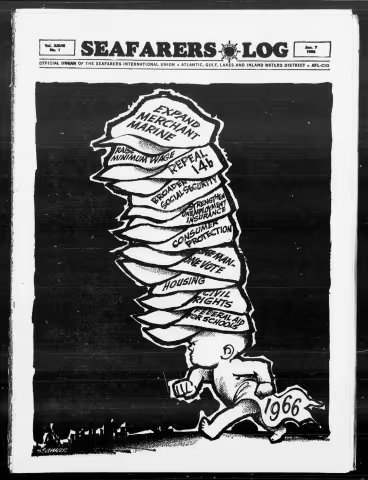
law's coverage broadened. The un
employment insurance system
must be strengthened by a system
of federal minimum standards
Consumers must be better pro
tected against deception and
usury. All this and much more
mitft be done, and each year will
bring a new set of goals. The
search for perfection in the chang
ing society is endlees."
Commenting on the Viet Nam
war and the sacrifices that it will
entail, Meany said:
"The American people did not
,, -- want this war and they do not
equally essential to continue want it now. Yet the ovei-whelming
progressing toward realization of majority of them share the con-
the American ideal. viction of the AFL-CIO that the
"Those who cry 'guns or butter' war must be fought until the Corn-
have lost touch with reality," he munists cease and desist in their
said. "Perhaps tJie twin obligations , attempts to dominate and control
of war abroad and progress at 1 South Vict Nam and all the other
home will cost more money;-but nations of Asia.
f
iW
%
rt-;'
,<A,
January 7. 19M SEAFARERS LOG Pac« Tlir««
SIU^ MEBA, D/sfricf 2 To Set Up Joint Program
License Training Starts Feb. 1
Major Provisions Of
Joint Training Program
Provisions of the new training program being offered as a
result of the reciprocal agreement between the SIU and the
Marine Engineers Beneficial Association District 2 include the
following:
• In order to qualify an applicant must be 19 years of age or
|; over and have three years watch standing time.
• The first class will start on February 1. Seafarer applicants
^ can enter on that day and any day thereafter.
• Seafarers participating in the course of instruction will be
|t provided with meals, hotel lodgings and subsistence payments
g of $110 per week while in training and will be able to ship as
I? engineer immediately upon obtaining a license.
I-
I • The period of instruction will range from 30 to 90 days and
I will be determined by the member's individual ability and knowl-
edge and the instructors satisfaction of his readiness to take
I the exam.
• Under the reciprocal agreement with MEBA District 2,
pension benefits built up by Seafarers under the Seafarers
J, Pension Plan will be fully credited and protected and SIU
I pensions will be supplemented by the MEBA Pension Plan in
|: approximately an equal amount.
if • All welfare benefits will be covered and protected.
|j • Seafarers who qualify for their engineers licenses and sail
I abroad MEBA contracted ships, shall not be required to pay
j the MEBA $1,000 initiation fee. It shall be waived in Its entirety.
I • Seafarers will not be required to drop their SIU membership
if they do not wish to do so.
I • All SIU men who now possess engineer's licenses In any
rating and who are not sailing on their licenses because they
wish to protect their SIU Pension and Welfare Credits are
eligible for immediate shipping on their licenses with full pro
tection of their pension and welfare benefits, as well as protec
tion of all other benefits and security provided in this program.
All such Seafarers should contact SIU headquarters or the
nearest SIU port.
Full details and applications for the Engineers Training Pro
gram can be obtained at any SIU hall or by writing directly to
SIU headquarters, 675 Fourth Avenue, Brooklyn, N.Y. 11232.
Union To Assist Engine Men
To Obtain Licenses; Pensions,
Yf elf are Benefits Are Protected
Engine department Seafarers now have an unprecedented opportunity to
obtain an engineers license under a new training program being oflFered by the
SIU's Harry Lundeberg School of Seamanship in conjunction with District 2
of the Marine Engineers
Beneficial Association.
The new training pro
gram, operated under a recip
rocal agreement between the
SIU and MEBA, District 2,
represents the first of its type
to be established in the mari
time industry. The program
will not only aid in meeting
manpower shortages In key
ratings, but will enable SIU men
in the engine department to re
ceive instructions that will enable
them to sit for an engineers
license. The program will begin on
February 1 and applicants will be
able to begin receiving instruc
tions at anytime after that date.
Over a period of time, the SIU
discussed with all licensed officers
unions, the possibilities of estab
lishing a joint training program.
The SIU's desire to accomplish
this program has been intensified
by the Vietnam War and the re
sulting shortage of marine
engineers. However, the new
agreement between the SIU and
MEBA, District 2 marks the first
time that this type of training pro
gram has become a reality. The
SIU expressed the hope that the
program could be extended to
other licensed officers groups
within the near future. In addi
tion, the SIU and the MEBA wiU
shortly enter dicussions aimed at
extending the program to Gt.
Lakes shipping. It is hoped that a
program of this type for the Great
Lakes can soon be culminated.
Under the present agreement
with MEBA, District 2, SIU men
who participate in this program
are eligible for the following:
• Seafarers who participate in
the course of instruction will be
provided with meals, hotel lodg
ings and subsistence payments of
$110 per week while in training.
• The period of instruction will
range from 30 to 90 days and will
be determined by the member's
individual ability and knowledge
and the instructors satisfaction of
his readiness to take the exam.
• Pension benefits built up by
Seafarers under the Seafarers Pen
sion Plan will be fully credited and
protected and SIU pensions will be
supplemented by the MEBA, Dis-
(Continued on page 4)
MSTU Granted Autonomy
As Affiliate Of SlUNA
SAN FRANCISCO — The Military Sea Transportation
Union has been granted its full autonomy as an affiliate of
the Seafarers International Union of North America.
The MSTU was notified of*
its new status in a communi
cation sent by SIUNA presi
dent Paul Hall to Joseph Leal,
MSTU secretary-treasurer ". . . Ef
fective January 1, 1966, the Mili
tary Sea Transportation Union is
a fully and completely autonomous
affiliate of the Seafarers Interna
tional Union of North America,
governed in accordance with the
provisions of its own constitution,"
the SIUNA president's message
said
On behalf of the SIUNA and its
Hall Paps Bid To Build U.S, Ships Abroad
NEW YORK, N.Y.—Paul Hall, President of the Seafarers International Union of North America, asserted this week that
permission for foreign-built vessels to operate under the American flag in all American trades, including the domestic
trades, would bring about a further decline of the American merchant marine.
Hall, who is a member of^
the Maritime Advisory Com
mittee created by President
Johnson a year and a half ago to
study the problems of our dwin
dling merchant, fleet, sef forth his
views la a letter to Secretary of
Commerce John T. Connor, the
Advisory Committee chairman.
Hall noted in his letter that an
other Advisory Committee mem
ber—H. Lee White, the president
of Marine Transport Lines—had
recently filed a statement with
the Secretary of Commerce which
generally supported the measures
on foreign shipbuilding proposed
by the Interagency Maritime Task
Force, and which opposed a pro
gram adopted by the Maritime
Advisory Committee at its last
meeting in Washington on Novem
ber 30.
The Interagency Task Force,
composed of representatives of
various Federal agencies con
cerned with maritime policy, had
some months ago issued a report
which caused widespread conster
nation in the maritime industry
and which called essentially for a
drastic reduction of Federal ex
penditures for maritime purposes
and for a smaller merchant fleet
which would carry less of our
foreign cargoes and provide fewer
jobs for workers in the maritime
industries.
Among other things, the Inter
agency report had proposed that
American shipowners be per
mitted to build or buy their ves
sels abroad and operaite them in
all trades, including the domestic
ones.
The Maritime Advisory Com
mittee, at its meeting on October
7, had voted not to accept the
Interagency report and on Novem
ber 30 had adopted an alternative
report, prepared by the public
members of the committee, which
called for a substantial expansion
of the fleet and for the building
of all vessels under the program
in American yards. This has been
widely supported by management
and labor groups in the maritime
industry.
The adoption vote was 11-2, with
two members of the 15-man com
mittee absent and two dissenting
—White and Joseph Androae, gen
eral manager of the marine de
partment of the Humble Oil
Company.
Humble Oil is the chief domestic
affiliate of Standard Oil of New
Jersey, which operates the biggest
fleet of runaway-flag vessels,
while White's company is also a
major runaway-flag operator, op
erating some 26 foreign-flag ves
sels, primarily under the Liberian
flag.
Hall noted in his letter that
White, in his dissent to the Ad
visory Committee report, had ad
vanced tliree basic arguments
—'that the subsidy proposals of the
.Vdvisory Committee were too
costly, that the real answer to the
problems of the merchant marine
is to permit American owners to
build abroad, and that this latter
solution would result in an ex
panded merchant marine at no
additional expense to the Ameri
can taxpayer.
Taking the arguments one by
one. Hall pointed out, first, that
the Advisory Committee proposals
are not costly.
At present, he noted, the Fed
eral Government—although it is
spending $60 out of every $100 of
the Federal budget for defense
purposes—is allocating only 40c
out of every $100 for Its fourth
arm of defense, the meicliaiil
marine. Moreover, assuming the
Federal budget will continue to
increase at no faster a rate than
It has in the past 10 years, the
allocation for the merchant marine,
under the .Advisory Committee
proposals, will remain constant at
about 40c out of every $100, he
pointed out.
In terms of gross national prod
uct, he noted, the .\merican people
are now allocating about 6c out
of every $100 of their national
wealth to support their merchant
marine, and assuming that our
gross national pipduct will climb
as predicted by leading econo
mists, expenditures for the
merchant marine will still remain
at about 6c out of every $100.
Second, Hall asserted that the
proposal to allow foreign-built
ahipa to enter the domestic trades
would bring about a further de
struction of this segment of the
(Continued on page 6)
officers and members, Hall wel
comed the MSTU "into our family
. . . and looked forward to a most
successful association with our or
ganization and your members."
In advising the MSTU of its
autonomous status, the SIUNA
president noted that all of the re
quirements which had been laid
down by the international at its
twelfth biennial convention last
May had been met.
Procedures for the granting of
autonomy to MSTU were recom
mended by the SIUNA president
and adopted by the convention
delegates. The convention provided
that the procedures should be de
signed to effect autonomy for the
MSTU no later than Dec. 31, 1965.
Shortly after the convention
machinery was set in motion to
implement the procedures adopted
by convention delegates. Accord
ingly, an MSTU rank and file com
mittee was elected to draft a
permanent constitution, which was
completed by late summer.
Balloting was conducted on the
proposed constitution in a secret
referendum conducted from Sep
tember 1 to September 30. The
constitution was adopted by a 9 to
1 vote, and the first .MSTU elec
tion under terms of its own con
stitution got underway on Novem
ber 8 and concluded on Decem
ber 8.
The election was the final step
of the procedures " hich had been
called for at the S1UN.\ conven
tion which was preparatory to
granting of autonomy.
Elected secretary-treasurer was
Joseph Leel and elected business
agents were Darroll Dan Auker,
Raleigh Minix and George Grier.
International vice-president
Frank Drozak, who had been
assigned by Hall to carry out the
directive of the convention, filed
a report documenting the steps
that had been taken in fulf.l'.meiit
of the convention cell. It was at
this point that M;e internaiioual
president fornMlly granted the
MSTU ita autonomy, effective aa
of January 1, 1966.
Pace Four SEAFARERS LOO
lunuT T, IfU
'The Anti-Leadership Vaccine'
Poses A New National Problem
(This column is excerpted from the nightly
broadcasts of Edvoard P. Morgan, ABC com
mentator sponsored by the AFL CIO over the
ABC network Monday through Friday at 7 p.m.,
EST.)
A constant, continuing dilemma of the open
society is how to produce leaders of sufficient
dynamism and breadth of vision to keep society
open and not make it a diosed arena for their own
selfish ambitions.
In its recently released annual report on its
philanthropic and educational activities, the Car
negie Corp. published an essay entitled "The Anti-
leadership Vaccine" which was remarkable on two
counts. Its perceptive content and its authorship.
It was written by John W. Gardner before he took
leave of the firm's presidency to become Secretary
of Health, Education & Welfare. His sensitive
analysis of the problem deserves wide attention.
Our concept of and training for leadership,
Gardner argues, must be enlarged. "The sad truth
is," he wrote, "that a great many of our organiza
tions are badly managed or badly led." One reason:
the reluctance to face the responsibility of making
tough decisions, the tendency, in an age of tech
nology and specialization, to rely on polls, "elabor.ita
statistical systems, cost;accounting systems, informa
tion-processing systems" and the like to provide the
answer.
Not that facts are unimportant, but "rarely do the
facts provide unqualified guidance." To support the
poitit that more than data are necessary he cited
the case of the school girl who said she was going
to draw a picture of God. "But, Mary," the teacher
exclaimed, "no one knows what God looks like."
And Mary replied, "They will when I get through."
Gardner's picture of the ideal American
leader Is neither a "Man of Destiny" nor a
"Nervous Nelly," but a citizen of balance. This
commodity Is In short supply. This he blames
In part on the academic world, "which appears
to he approaching a point at which everyone
will want to educate the technical expert who
advises the leader, or the Intellectual who
stands off and criticizes the leader, but no one
will want to educate the leader himself."
He maintains that "we are in danger of falling
under the leadership of men who lack the confi
dence to lead. And we are in danger of destroying
the effectiveness of those who have a natural gift
for leadership." How? Why? In American colleges
and universities, he argues, "the best students are
carefully schooled to avoid leadership responsi
bilities." And the ones who go on to graduate
school are "powerfully Indoctrinated" in a set of
License Training
attitudes appropriate to their calling, pointedly
specialized, perhaps, but damagingly detached from
the broader needs of an increasingly complex
society.
"Very few of our most prominent people,"
his essay goes on, "take a really large view of
the leadership assignment. Most of them are
simply tending the machinery of that part of
society to which they belong. . . . (They) may
tend it very well indeed, but they are not pur
suing a vision of what the total society needs. ...
"Yet it is doubtful that we can any longer afford
such widespread inattention to the largest questions
facing us. We achieved greatness in an era when
changes came more slowly than now. The problems
facing the society took shape at a stately pace. We
could afford to be slow in recognizing them, slow
in coping with them. Today, problems of enormous
import hit us swiftly. Great social changes emerge
with frightening speed. We can no longer afford to
respond in a leisurely fashion."
TO THOSE CRITICAL of "big government,"
Gardner counsels that one of the vital ways to keep
a problem from being passed on to Washington is
to make nongovernmental leadership groups more
capable of handling them on lower levels by creat
ing better channels of communication among them.
What is Gardner talking about? The cutting edge
of his advice seems clearly to be that no longer
can specific segments of society shirk their larger
responsibilities to society as a whole. Nor is it
enough simply for the businessman, the labor
leader, the technician, the scientist to contribute to
the Community Chest, attend PTA meetings and
vote in elections.
Industry, trade unions and others must eon-
slder their requirements and demands, their
policies and goals, in terms of their impact on
the community and the country- This is goinff
to take some doing, some stretching of narrow
preparations, some loosening of tight, seifish
concepts.
"So much of our energy has been devoted to
tending the machinery of our complex society,"
Gardner reemphasizes in conclusion,' "that we have
neglected the (moral) element in leadership." By
"moral" he referred to the "shared values that must
undergird any functioning society. . . . When leaders
lose their credibility or their moral authority, then
the society begins to disintegrate."
It Is almost redundant to emphasize that citizens
with the leadership dimensions of John Gardner are
scarce, but it is reassuring that both the private
and the public sectors of our society have been
given the benefits of his own wisdom and talents.
1
By Eari (Bull) Shepard. Vice-President, Ariontic
Shipping was good in the port of New York during the last period
and the outlook for the future remains very good.
"Dutch" Palmer who last shipped on the Steel Recorder was in
drydock here for a few weeks, but now says that he Is feeling fine
and ready to ship out again. Bob Anderson, who's also off the Steel
Recorder, said that he plans to sit-
for his 3rd engineers license
shortly.
Bob O' Brien, who was in town
with his family for the holidays,
was on the Steel Designer for nine
months and is now looking for an
electricians slot aboard any Isthmi
an ship.
Philadelphia
Shipping has been on the slow
bell here but is expected to pick
up shortly.
Pedro Arteaga who's been with
the SIU for the past 21 years, is
now ready to ship after enjoying
vessel, the Marore had a break
down at sea, had to unload cargo
and go to a shipyard in Gibraltar.
Tim has been a member of the
SIU for the past 22 years.
Gil Wolfe, who's last ve.ssel was
the Bethflor, is registered here and
ready to ship. Gil said that he
prefers an intercoastal or coast
wise run. Also registered and ready
to go here is Ashley Harrison,
whose last ship was the Chilore.
Ashley is a lifetime SIU member.
Boston
Shipping has been on the slow
bell in Boston recently, but is ex-
the holidays at home. He last sailed | pected to pickup shortly. John Fan-
on the Commander. icutt, who's been a member of the
SIU for the past twenty years, is
waiting for the first coast hugger
the i to hit the board.
Amos Buizelle, was glad to have
the opportunity to spend the holi
day with his family and will grab
the first job that is put on the
board.
Norfolk
Shipping was fair in Norfolk
during the last shipping period
with a good outlook for the im
mediate future.
Norfolk had a large turnout for
the annual Christmas Dinner and
there were many favorable com
ments about the fine meal and
good fellowship.
Sam Warren, who spent the holi
days here, expects to ship out
(Continued on page 8)
George Leach,
who's been a
member of
SIU for twelve
years, is now on
the beach after
getting off the
Geneva. Another
SIU oldtimer on
the beach here is
Gil Borge, who's
been a member
of the union for the past 19 years
and who just got off the Command
er after a six month run. John
Kozar, a member of the SIU for
the past 23 years, is also on the
beach here.
Baltimore
Leach
Shipping for the past two weeks
has been on the slow bell, but
things should start to pick up
within the next shipping period.
At the present time we have the
Alamar laid up. During the past
shipping period we signed on three
ships, paid off three and had nine
in transits.
Tim Sullivan, who ships i;, the
deck department, is waiting for a
long trip to the Far East. His last
(Continued from page 3)
trict 2 Pension Plan In approxi
mately an equal amount.
• All welfare benefits will be
covered and protected.
• Seafarers qualifying for their
engineer's licenses and sailing
aboard MEBA contracted ships,
shall not be required to pay the
MEBA, District 2, $1,000 initiation
fee. It shall be waived in its en
tirety.
• Seafarers will not be required
to drop their SIU membership if
they do not wish to do so.
• SIU men who now possess en
gineers licenses in any rating and
who are not sailing on their li
censes because they wish to pro
tect their SIU pension and welfare
credits, are eligible for immediate
shipping on theli- licenses with
Union Has
Cable Address
Seafarers overseas who want
to get in touch with headquar
ters in a hurry can do so by
cabling the Union at its cable
address. SEAFARERS NEW
YORK. Use of this address as
sures speedy transmission on all
messages and faster service for
the men involved.
s X ' '
full protection of their pension and
welfare benefits, as well as protec
tion of all other benefits and secur
ity provided in the program.
Here are the major requirements
needed to qualify for the training
course.
• Applicant must be 19 years of
age or over.
• Applicant should have three
years of watch standing time in
the engine department (in many
cases, credit will be given across
the board, for non-watch standing
ratings above wiper, and for serv
ice in the U.S. Navy and Coast
Guard).
In addition to unlicensed person
nel seeking their original 3rd en
gineers license, the School for
Marine Engineers will provide in
struction to enable licensed en
gineers to upgrade their licenses.
The instruction will be provided
in the School for Marine Engineers
operated by MEBA, District 2. The
school is located opposite SIU
headquarters in Brooklyn.
The School for Marine Engineers
is under the directorship of Roland
R. Spencer, one of New Yoi k's most
highly regarded instructors of ma
rine engineering.
Spencer is a licensed marine en
gineer and a licensed teacher in
(he states of New York, New Jersey
and Pennsylvania.
Union Hiring Hall Upheld
By Court In R-T-W State
SAN FRANCISCO—State "right to work" laws cannot be
interpreted to prevent collective bargaining on subjects over
which Congress did not give the states jurisdiction, the 9th U.S.
Circuit Court of Appeals ruled here.
A three-judge panel upheld a National Labor Relations Board
finding that Tom Joyce Floors, Inc., of Reno, Nev., illegally re
fused to bargain with Painters Local 567 on a non-discriminatory
hiring hall arrangement proposed by the union in 1962 contract
talks.
Joyce's employes went on strike and were replaced by strike
breakers. The NLRB, and the appeals court, found Joyce had
forced the strike by refusing to bargain with the union, and
ordered the firm to rehire the strikers and resume bargaining.
Joyce refused, saying hiring halls are illegal under the Nevada
"right to work" law and citing a Nevada state court decision.
The 9th Circuit judges said the court, and the NLRB, are
"bound by the construction which the courts of Nevada place
upon the statutes of that state." They therefore accept the
proposition that the hiring hall proposal is forbidden by the
Nevada "right to work" laws, the judges continued.
But Section H'b) of the Taft-Hartley Act does not protect a
state law which is so broadly stated, they said, and the proposed
hiring hall did not give the union exclusive right to its use.
Therefore the provision is "not the type of agreement which was
left to state regulation" under 14(bl, and the Nevada law is not
controlling, the appeals court ruled.
Section 14ib) allows states to prohibit agreements which re
quire union membership as a condition of employment, the
judges observed, adding "the extent to which Section 14'b)
authorizes states to limit collective bargaining is a federal
question."
Philadelphia
Expects New
Cargo Record
Phlladelpfcia, along with lie
neighboring ports on the Delaware
River are predicting that the 1965
volume totals of import-export
shipping will top all other U.S. sea
ports in foreign trade for the sixth
consecutive year. A total of more
than 54 million tons is indicated by
preliminary statistical totals.
Cargo moving through the Dela
ware River porta exceeded 27 mil
lion tons dnring the first six
months oi the year, and with no
slackening of the pace during the
last six months, a cargo gain of
about one million tons over the
1964 totals is expected.
Projects For Future
Several port area projects are
planned for the future to main
tain and expand llie Delaware
ports' growth. Three hig non-mari
time projects, a rapid transit sys
tem and the construction of two
bridges across the Delaware, are
expected to cost over SToO.OOO over
the next five yeais.
Philadelphia itself i.s aiming at
improvement projecl.s for the port
area to increa.se it.s share of gen
eral cargo trade in relation to
Baltimore, New York, and other
ports. These include a general car
go pier con.sti'uction program,
navigational impro\einent.s in the
Delaware River and the Chesa
peake and Delaware Canal, port
highway improvements and im
proved governments services such
as cu.stoms and quartine facilitie.'i.
taamurj 1. INC
SEAFARERS LOG Pace Fire
Highlights Of Labor 1965
Organized labor chalked up more suc
cesses in 1063 — although mixed with
some frustrations—than for a long, long
time.
A review of the year from AFL-CIO
News, shows that activity reached into
many areas with these highlights;
• Record welfare legislation passed by
the first session of the 89th Congress in
cluded medicare and education bills. But
there was disappointment in failure to
repeal Section 14(b) or to pass other
labor-supported measures.
• An atmosphere of unity accentuated
in 10th year of AFL-CIO merger.
• Union membership reversed trend-
now on the upswing.
• Increased economic gains scored at
the collective bargaining tables.
January
In a New Year's message, AFL-CIO
Pres. Ceorge Meany predicted "unpre
cedented progress, both economic and
social," in 1965 . . . AFL-CIO Legisla
tive Director Andrew J. Biemiller says on
the legislative front: "It'a been a long
time since we have had the opportunities
we now have" ... Pres. Johnson pledges to
work for repeal of Section 14ibi . . . 14-
point legislative program pushed by AFL-
CIO at legislative conference . . .
February
Building trades. Industry peace plan
signed in White House ceremonies . . .
LBJ, Meany hit treatment of Selma, Ala.,
Negroes . . . Philadelphia teachers vote
for Teachers' Union in landmark election
. . . New Mexico Senate rejects "right
to work" proposal . . . Five rail unions
win pacts to protect jobs . . . Frank Raf-
tery elected president of Painters . . .
March
^ Craft, industrial unions agree on situs
picketing plan , . . AFL-CIO Executive
Council pushes jobs, decent wages, $2
minimum; called vital to victory on pov
erty . . . 32,000 Steelworkers strike two
can firms . . . Montana legislature urges
repeal of 14fb) . . . Appalachia, first
"Great Society" measure, passes 80th
Congress . . . Economist Galbraith backs
union drive for $2 wage floor, shorter
work week . . . Seima, Ala., Sheriff Jim
Clark revealed as having first organized
civilian posse to fight unions . . . LBJ's
plan to end voting barriers backed by
labor . , . Construction, factory jobs reach
new levels . . . World entertainment un
ions set up international body . . . Edward
Keating, founding editor of Labor news
paper, dies at 89 . . . Situs picketing bill
introduced in Congress . . . Youngstown
newspaper strike moves into eight month
. . . 32,000 Glass Bottle Blowers strike . . .
Sam Zagoria, former Washington News
paper Guild president, named to NLRB
. . . Unionists join civil rights marchers
from Selma to Montgomery . . . After
seven years, House Ways & Means Com
mittee approves medicare, ups social se
curity benefits . . .
April
Supreme Court rules lockout is okay
as economic weapon . . . Humphrey says
U.S. in debt to free labor movement . . .
Glass Bottle Blowers win 11-day strike
. . . Building trades legislative conference
sets top goals as situs picketing, 14(b) re
peal . . . Afro-Asian Institute makes big
gains in free labor activity . . . Paul Jen
nings elected to head lUE . . . Jobless
rate drops to 4.7 percest; lowest since
1957 . . . Medicare passes by lop-sided
count in House . . . AFL-CIO plans for
equal job opportunity section of 1964
civil rights law effective July 2 . . .
May
Lie detector probe pushed by Congress
. . . Labor strongly opposes Dirksen
amendments to undercut Supreme Court's
"one man, one vote" ruling . . . Labor
joins campaign to defend consumer
against electric power lobby . . . Johnson
again presses for repeal of 14(b) , .
June
House hearings continue on 14(b) re
peal; cross section of U.S. leaders urge
repeal . . . AFL-CIO backs immigration
bill . . . State appeals court knocks out
ctiy "work" laws in Kentucky . , . Two
key Supreme Court rulings expose unions
to anti-trust laws . . . 89th Congress
heads for record as more bills pass . . v
Spokesmen for three religious groups
give "ethical" basis for "work" law op
position . . . House Labor Committee
backs repeal of 14ib) . . . AFL-CIO af
filiates offering $1 million in scholarships
. . , Wirtz, Haggerty ask for action on
situs picketing . . . Excise tax cuts open
way to boom in purchasing power . , .
House okays cabinet-level Urban Affairs
Dept. . . .
July
NLRB orders employer to bargain with
union he tried to run away from . . .
Fair employment practices become law of
the land with labor backing . . . Food
price scare fizzles as move for braceros
is derailed . . . Overwhelming vote in
Senate assures medicare passage after
conference with House . . . Voting rights
bill wins Senate, House approval . . .
Labor mourns death of Adlai Stevenson
. . . Johnson praises AFL-CIO as advocate
of people's interests . . . Medicare finally-
law; 20 million to benefit . . .
August
NLRB says 69 workers illegally fired
by J. P. Stevens textile company . . .
House votes repeal of 14(b) . . . Congress
probes "inhuman" treatment of rail fire
men . . . Building Trades Dept. and Red
Cross launch major first aid program . . .
ILGWU sets up home loan program for
Negroes in intergrated areas . . . House
unit passes $1.75 minimum wage extends
coverage to 6.2 million more workers . . .
Senate rejects Dirksen scheme to under
cut "one man, one vote" . . . Johnson
signs voting rights bill . . . Wirtz, Meany
urge jobless pay modernization as House
committee opens hearings . . . Pipe Fitters
win new national contract . . . Senate
Labor Committee approves 14(b) repeal
September
New steel strike deadline set as John
son takes hand In bargaining , . . Urban
Affairs Dept. passed by Congress . . .
Dirksen plans to filibuster against 14(b)
repeal . . . Guild strikes New York Times;
other papers lock out employes . . .AFL-
CIO council calls atalling on minimum
wage "abominable" . . .
October
Pre-filibuster against taking up 14(b)
starts . . . New York Times strike settled
. . . Meany makes strong appeal to Sen
ate for 14'b) repeal . . . Senate rejects
cloture on filibuster on taking up
repeal of 14(b); Mansfield says repeal
dropped for this session . . . Medicare
architect, AFL-CIO's Nelson Cruikshank,
and Serafino Romualdl, AIFLD director,
retire . . . Final days of 89th Congress
lose earlier glitter as labor bills get side
tracked . . .
November
AFL-CIO Executive Council scores
Dirksen for fighting against letting 14'b)
come to a vote . . . NLRB decision points
to need of situs picketing bill . . . Neigh
borhood Youth Corps reports that it is
preparing 370,000 for skilled jobs . . .
AFL-CIO asks action to stop wage chisel
ing . . . Unemployment continues to drop
. . . Bircher's Welch admits that his
society is fighting against repeal of 14'b)
. . . Paul Hall says U.S. merchant fleet
should be doubled . . .
December
Jobless rate hits lowest level since 1957
. . . Wirtz, at Building Trades Dept. con
vention, warns against putting breaks on
the economy . . . Federal Reserve in
creases discount interest rate; Meany
blasts action . . . Metal Trades Dept. hears
report on spurt in organizing of federal
emplbyes . . . AFL-CIO convention opens
—Meany says federation on threshold of
great growth . . . Humphrey credits AFL-
CIO with "historic" legislation role . . .
Meany, Schnitzler re-elected; eight new
vice presidents elected by AFL - CIO
convention . . . AFL-CIO supports U.S.
policy in Viet Nam ...
By Lindsey Williams, Vice-President. Gulf Area
Shipping has remained good in the entire Gulf area and the out
look for the coming period is the same.
The Dock Board announced recently, that the port of New Orleans
will register a year's-end increase in cargo tonnage despite the
damage and disruption of shipping caused by Hurricane Betsy.
The SlU-manned Del Sud loaded
the Gemini 5 sfpace capsule in
Houston recently for shipment to
South America, where it will be
shown at industrial fairs in Rio de
Janeiro and Buenos Aires
For upgrading Louisiana's edu
cational standards, Nash C. Rob
erts, chairman of the Louisiana
State Advisory Committee on Lite
racy and of the Adult Instruction
Membership Conunittee, was hon
ored at the SIU hall on December
21 by the Greater New Orleans
AFL-CIO. Roberts received the
group's fourth annual Community
Services Award.
Todd Shipyard in New Orleans,
which has been operating at about
50 percent of capacity since the
loss of one of its floating drydocks
during Hurricane Betsy expects to
return to normal operation by the
middle of January. Todd is mov
ing a 12,000-ton, six-section dry-
dock from its Houston yard to
temporarily replace the one which
capsized during Betsy.
New Orleans
Anthony Rodrlgnex expects to
be on the beach here until after
Carnival, which falls on Washing
ton's Birthday, February 22, this
year. After that Tony wants
either a North Europe or South
America run. George Annis has
his fifd again after being laid
up for about 10 months. Annis.
whose last ship was the Del
Santos, filled in for us as photog
rapher and took the pictures for
the Christmas party at the hall.
After a long spell as second
steward aboard the Del Mar,
Bennle Gnarino got off to be home
for the Holidays with his family.
Houston
Hugo B. Jeffcoat, whose last
ship was the Transhudson, is re
maining on the
beach here for
the holidays and
expects to ship
out again shortly
after the new
year. Berkey
Shuler is hoping
his broken leg
heals quickly
enough so he can
get his ffd and
ship again in February. F. Szoblik
Social Security Boost Gives
Americans Increased Benefits
That extra deduction in the pay envelopes of America's wage-earners this year will
help pay for the biggest package of benefits ever added to the Social Security system.
Matched by an increase in the Social Security tax paid by employers, the added
revenue will finance. Bigger *-
Jeffcoat
(Continued on page 11)
retirement benefits for work
ers and their families and the
longer a worker pays, at the higher
rate, the bigger his pension on re
tirement.
The added" revenue will also pro
vide for:
• Higher insurance benefits for
widows and children of workers
who die either before or after re
tirement.
• Payment for hospital and
nursing home care for workers and
their families at age 65. And assur
ance that younger families will be
free from the fear of budget-crush
ing medical bills resulting from the
illness of parents and other elderly
relatives.
• A 7 percent increase in cash
benefits for persons on the Social
Security rolls—already in effect for
a year.
• Easier qualification for dis
ability benefits and liberalization of
many other provisions, including
continuation of suvivorship bene
fits to children over 18 who are in
school.
This year's increase in Social
Security taxes amounts to only pen
nies a week for lower-paid workers
and a moderate increase for those
in the higher brackets.
The increase is less than it ap
pears at first glance because even
without the changes, the rate was
scheduled to go up in 1966 to pay
for improvements made in previous
years.
There will be further step-ups
until, by 1987, workers and em
ployers each pay 4.85 percent of
the first $6,600 of earnings for
basic social security benefits and
eight-tenths of 1 percent for hos
pital insurance. For 1966, the rate
is 3.85 percent for social security
and 35 one-liundredtivs of 1 per
cent for hospital oare.
More significant than the minor
adjustment in the tax rale is Uie
higlier amount of earnings subject
to the social security tax. The im
mediate effect is a bigger bite out
of current pay checks since the tax
will be computed on earnings up
to $6,600 instead of $4,800. The
eventual effect will be social se
curity retirement incomes up to
$168 instead of $127 for an in
dividual and $252 in.stead of
$190.50 or a couple with a maxi
mum family survivorship benefits
of $368 instead of $254.
In dollars and cents terms, here
is how the payroll deductions af
fect the worker making the aver
age manufacturing wage of $109.30
a week—or $5,683.60 a year:
In 1965, he paid $174 in social
security taxes—^the amount paid by
all workers earning more than
$4,800 a year.
During 1966, he will pay a total
of $238.71. Of this, $19.89 will be
the hospital insurance deduction.
Retired workers with earnings
from part-time or temporary work
will gain by provisions of the new
law which permit greater outside
earnings than previously without
loss of benefits.
Everyone over 65 will be eligi
ble for basic hospital insurance
starting July 1, 1966. and for nurs
ing home benefits starting Jan. 1,
1967. The payroll deduction for
the program begins this month.
There is no payroll deduction
for tlie voluntary medicare pro
gram. which covers doctor bills
and most health expense not in
cluded in the hospital insurance.
That program goes into effect
July 1. financed by $3-a-\month
premiums paid by persons over 65
matched by an equal amount paid
by the government.
Face Six SEAFARERS LOG JuwiT T, INf
To Top Oceons^ Riches
U.S. Urged To Launch
More Undersea Probes
NEW YORK—The moon race will someday give way to a
great race to the bottom of the sea in which nations will
rush to claim huge diuiiks of underwater territory rich in
food and minerals, a noted
oceanographer has predicted.
Such a race could change
the world's power structure,
oceanographer Dr. Wllbert Mc-
Leod Chapman said, and suggested
that the United States should put
"a few men down on one of the
higher spots of the Atlantic Ridge
for a while." That first station
could become a base for deeper
exploration where the riches will
be found, he said.
Food, Minerals
Those riches in the sea. Chapman
said, could feed the world and pro-
telligent and determined effort, he
predicts.
The U.S. has already taken pre-
lim.inary steps toward working out
the mechanics of living and work
ing beneath the sea with the recent
Sealab II experiment in which
! teams of aquanauts lived and
worked for two-week periods on
the U.S. continentai shelf, 205 feet
benea'h the surface of the Pacific
Ocean off La Jolla, California.
Much more study and explora
tion is needed, according to Chap
man, before we can profitably
harvest the aea. He said the
vide it with minerals for centuries I mechanics of producing food from
to come. He notes that the U.S.
produces only, a little more than
two million tons of fish a year but
consumes six million tons, buying
the rest from foreign countries.
Our taeafood harvest could be in
creased to 11 million tons with in-
the sea are not too well under
stood, but noted that we already
realize its enormous magnitude
and can now tell in a general way
which areas of the sea. are richly
productive valley lands and which
are the barren desert stretches.
QUESTION: Was 1965 a good year for you and why?
Whitney Martin, Jr.: The first
part of last year was good for me,
although I've run
into a little bad
luck during the
last two or three
months. Several
very good trips
came my way,
and I got to see a
good part of the
world. Both of
my kids received
high marks in
high school during 1965, and my
oldest boy made the first string on
the basketball team. I have great
hopes for him during the coming
year.
^ ^
Robert Russ: I'd call the year
1965 a pretty good season for my
self and the SlU.
It seems that the
Union has pro-
ceeded along
smoothly, and I
had good luck In
shipping out and
ran into no major
difficulties. In
fact, I consider
myself very
lucky, since I was
one of the crew on the Niagara
when she began losing plates, and
we made it home safely, while
there was a chance of elnking.
^ ^
Fazil Ali: I had a good 1965 with
things going real well. Financially
my family and I
were stable, and
I got to spend a
good bit of time
with my wife and
kids. Too, I
thought shipping
was very good,
and I never hurt
for work. It sort
of balanced the
year having
steady employment and some free
time to spend with my family.
Thomas Morton: I considered it
good year for shipping, but
otherwise things
were rather ordi
nary for me with
nothing extra
special happen
ing. I did,
though, make
several interest
ing trips to
Northern Europe.
I think the SIU
did well in secur
ing the new contract—a raise in
pay is always welcome! Too, I con
sider the lifeboat training I re
ceived in 1965 to be very useful.
^ ^ i,
Richard Yareaower: Yes, It was
definitely a good year for me,
because I got
married and a
daughter, Lisa
was born a few
months ago. My
family and my
self settled down
in Brooklyn last
year. Also, I met
several new peo
ple and made
lasting friend
ships around the Union Hall. And
to top it all off, I have started off
the New Year with a berth on an
SIU ship.
4 4. 4.
Bill White: I had a very good
year, partially due to the fact that
I got married and
have a child on
the way. It's good
to be settled
down. Also, ship
ping was above
average, and I
held a steady Job,
go things went
well with me
financially. My
wife and I moved
into an apartment in Brooklyn last
year, and married life is running
along very well
DISPATCHERS Wat«r« Di«trl«t
December 18 to December 31
DECK DEPARTMENT
TOTAL REGISTERED TOTAL SHIPPED NOW ON THE BEACH
AH Groups AU Gronps All Groups
Port Class A Class B Class A Class B ClassC ClassA ClanB
Boston 4 0 4 1 0 14 1
New York 68 26 45 23 15 £23 61
Philadelphia 12 3 10 10 5 38 11
Baltimore 26 18 14 15 1 106 47
Norfolk 7 3 5 3 0 22 16
Jacksonville 5 5 2 4 2 12 9
Tampa 5 0 1 1 0 13 6
Mobile 12 3 13 1 1 82 26
New Orleans 54 37 44 19 0 169 105
Houston 55 28 50 38 27 140 73
Wilmington 13 7 7 1 11 17 8
San Francisco .... 30 17 27 11 13 61 25
Seattle 22 8 22 7 6 47 11
Totals 313 155 244 134 81 944 399
ENGINE DEPARTMENT
TOTAL REGISTEP.ED TOTAL SHIPPED NOW ON THE BEACH
All Groups All Groups All Groups
Port Class A Class B Class A Class B Class C Class A Class B
Boston 3 0 3 0 0 5 2
New York 57 39 43 25 13 152 61
Philadelphia 10 8 7 9 2 32 21
Baltimore 24 5 12 8 3 62 46
Norfolk 4 5 2 5 0 27 16
Jacksonville 0 4 0 2 2 5 11
Tampa 3 1 3 1 1 10 3
Mobile 11 3 7 4 2 43 15
New Orleans 40 34 32 22 3 128 85
Houston 36 31 34 36 19 79 69
Wilmington 10 11 3 2 7 19 11
San Francisco 23 13 21 18 17 51 9
Seattle 8 8 9 8 5 22 13
Totals 229 162 176 140 74 635 362
STEWARD DEPARTMENT
TOTAL REGISTERED TOTAL SHIPPED NOW ON THE BEACH
All Groups All Groups All Groups
Port Class A Class B Class A Class B Class C Class A ClassB
Boston 2 0 3 0 1 5 2
New York 57 14 32 13 14 130 25
Philadelphia 14 4 2 3 9 28 9
Baltimore 18 9 15 13 1 70 35
Norfolk 1 3 3 1 2 14 21
Jacksonville 1 3 1 2 3 4 7
Tampa 1 0 1 0 0 12 0
Mobile 9 8 4 3 0 57 27
New Orleans 36 23 33 22 6 145 86
Houston 22 19 21 20 32 52 21
Wilmington ....... 7 8 0 2 2 20 13
San Francisco 11 2 9 7 25 35 5
Seattle 11 5 10 4 9 18 11
Totals 190 98 134 90 104 590 262
Raps Plan To Build Ships Abroad
(Continued from page 3)
industry by forcing American
shipowners now operating vessels
built in American j-ards to com
pete against vessels built in foreign
yards at lower costs.
"Mr. White," Mr. Hall said in
his letter, "already enjoys the
privilege of building ships abroad
and operatdng them in the foreign
trades—at a very nice profit, ac
cording to our understand/ing. And
so there would seem to be no par
ticular advantage to him or in
centive for him to register his
foreign-trading ships under the
American flag and have to use
American crews which he has fre
quently claimed demand so much
in wages as to make profitable
operation virtually impossible.
"That being the case, what Is
the purpose of the suggestion Mr.
White has made, that we legalize
the use of foreign-built vessels in
all trades? We can only conclude
that Mr. White, not content with
the profits he is making by using
runaway flags in the overseas
trades, now would like to increase
these profits by invading the only
protected stronghold we have and,
in effect, bringing the runaway,
flag Into the domestic trades."
Because of this threat. Hall
asserted, a number of banks and
lending institutions in this country
have already begun to show an in
creasing reluctance to finance new
shipping ventures by domestically-
built vessels.
Finally, the SIU president took
Issue with White's .statements con
cerning the subsidy burden of the
Advisory Committee proposals.
"Mr. White's concern for the
American taxpayer is touching of
course," he said. "But the fact is
that the privilege the United
States Government now gives to
Mr. White, to operate his vessels
under runaway flags and thereby
amass profits by evading the taxes,
wages and other costs borne by
American ship owners is just as
much of a subsidy as the money
given to American shipowners for
the construction and operation of
American vessels.
"These runaway operators, as
we have pointed out many times
before, do not pay the same
Federal taxes paid by American
shipping companies and other
American business enterprises.
They do not employ American sea
men who would pay personal in
come taxes to the Government and
who would spend their money with
other Americans who, in turn,
would pay taxes. They do not serv
ice, store or repair their vessels
In American yards or help to sup
port American shipyard workers
and others, who would also pay
taxes.
"Instead, by increasing Ameri
can unemployment, by reducing
American purchasing power, by
contributing to our balance of pay
ments deficit, and in many other
ways, these runaway operators
throw a heavy burden upon the
American economy, the American
Government and the American
people.
"Thus, each time an American
shipowner operates a vessel under
a runaway flag it costs the Ameri
can taxpayer money—and we sub
mit that this money, although a
hidden subsidy, is as surely a sub
sidy as the money we spend to
build chips in American yards or
operate them under the American
flag.
"We believe," Hall concluded,
"that Mr. White's dissenting
opinion has been motivated only
by self-interest, and we believe
that his proposals. If implemented,
would result in a stili f^her
decimation of the American-flag
merchant fleet which the Mari
time Advisory Committee is at
tempting to preserve."
Atlantic Coast
(Continued from page 4)
shortly. Cecil Jennette, who last
sailed aboard the Belfium Victory,
is now fit for duty and ready to
ship after a few stints in the hos
pital.
Alfred Sawyer, a member of the
SIU for the past twenty-two years
was home for the holidays and is
ready to ship out again. Al's last
ship, the Hastings, collided with a
German ship in the English chan-
nel and was drydocked in a Ger
man shipyard for 18 days.
San Juan
Democratic Senator Gayiord Nel
son has been named chairman of
a Senate Labor sub-committee
scheduled ^ to hold hearings on
pending minimum wage legislation
in Puerto Rico from January 3-5.
The Republican member will be
Senator Javits of New York.
Anibal Albe, after seven months
on the Seatrain Georgia, dropped
down here recently for a short va
cation. Also dropping by the Hall
here during the Alcoa Runner's
last stay in San Juan was Prime
Fernandez,
II
I:
A
1*
if
I u
A
»«
4
4
•H
• H
4
4
if
H
-I
4
4
4
4
: •'•1
!**
i4ii'
•A"
i
mi
T.
SEAFARERS LOG
'fi
M
:
A
V.
it
u
A
Total COPE Effort
Urged By AFL-CIO
Warnii^ againat tha resurgent political atrength of right wing and
eonaervative forcea, tha recent AFL-CIO convention urged all unlona
and union meiribera to total effort in behalf of liberala in tha 1966
congressional elections and full support of COPE.
A convention resolution pointed out "history and tradition are not
on our aide." It noted the party in control <rf the White House usually
loses seats in off-year congressional elections. The average loss in tha
past 60 years has been 37 House seats and five Senate seats.
The resolution warned the special targets of rightist political action
will be the 51 new liberal congressmen elected in 1964. Without them,
the convention said, the flow of progressive legislation enacted in 1965
—medicare, aid to education, war on poverty, housing, social security
increases, voting rights and other programs—would not have been
possible.
The resolution called on every AFL-CIO affiliate to "render all
a-ssistance and support to the policies and programs" of COPE to help
re-elect labor's friends in 1966.
It spelled out these six points;
1. We hold it to be a primary obligation of each trade union member
to be a registered voter, and of affiliated national and international
unions, local unions and central bodies to encourage the achieve
ment of this goal, we commend those national and international
unions which have made a registrar or COPE chairman a constitutional
officer for each local union and urge others to follow their example.
Membership lists should be made available to the properly con
stituted COPE organization for processing in reglstration-and-vote
campaigns, particularly in those areas where pilot projects employing
data processing equipment are underway.
2. We call upon all affiliated national and international unions
to designate one or more full-time staff members to work with their
local unions in buiiding effective COPE programs.
3. We urge each local union to appoint a COPE committee which
will coordinate its program with the city or county COPE in its area
to the end that every union member will be assisted in becoming
eligible to vote and will have the opportunity to participate fully in all
phases of the COPE program.
4. We commend affiliates which accept the responsibiiity of meet
ing their financial obligations to COPE. We urge those which have
not to do so. COPE cannot achieve its full potential without full
support. We therefore urge all affiliates (a) to accept the obligation
of meeting the COPE quota, and (b) to promote the voluntary dollar
drive vigorously and resourcefully.
5. The lines of communication to allied groups outside the labor
movement should be carefully tended and extended. A prerequisite to
our political auccess is a united effort with thoaa who shara common
goais, such as friendly farm organizations, senior citzens and minority
groups.
I
6. We urge tno continuation and extension of those endorsement |
procedures which ensure broad participation by tha affiliates of state j
•iMl local central bodies and careful selection of candidates based only,
•a issues and ability.
"O Captain, My Captain ..
Members of Anserleaa Bakery 4c
Coafectioiiery Woi^ers Local 503,
who last Angrnt gave labor Its first
representation election victory in
nearly 30 years in an anti-union
stronghold, have won their first
union contract after a tumultuous
one-week strike. The Wellon Can
dy Company of Dunn, South Caro
lina, the employer, forced the
strike by persisting in the anti
union tactics it used at the time of
the election. During the seven-day
walkout 27 strikers were arrested
and an injunction severely limited
picketing.
t J. t
The Electrical, Radio 4c Machine
Workers have begun a subscription
campaign of 31 'per member in vol
untary donations to establish a ref
ugee resettlement village in South
Vietnam. The union executive
board said it acted on appeals from
President Johnson and others for
increased participation by free
world agencies in volunteer efforts
to help the Vietnamese people,
ilv ^ ^
Albert J. Koban, former National
Labor Relations Board attorney
and field examiner and a former
arbiter, has been named Boston
NLRB regional director, effective
January 1. He succeeds Bernard
L. Alpert, who died after 20 years
in the post. Hoban, 54, was for 12
y^ars an a.s.sistant attorney general
of Rhode Island and served as an
adviser to governors of that state
ori labor matters.
The American Federation af
Teachers will award research
grants of 3190 to 31.000 to profes
sors, teachers and advanced stu
dents for original studies or ar
ticles in education, social or phy
sical science, and labor-manage
ment relations.
The union Vrants research that,
avoiding the "ivory tower" ap
proach, will "help the classroom
teacher, provoke the 'fat cats' in
education and stir the layman to
action," said Research Director
Pete Schnaufer.
The AFT expects that more than
100 researchers will be awarded
grants during the first year of op
eration. A scanning committee in
cludes AFT President Charles Co-
gen, Vice President Alfred J. Tap-
son and Schnaufer. A short
summary of proposed articles, an
idea as to approach and an indica
tion of sources should be sent to
Schnaufer at 716 N. Rush St., Chi
cago, 111. 60611.
i" 4" 4"
Five hundred refugee families in
South Viet Nam are having a hap
pier hoiiday season because the
AFL-CIO Building 8c Construction
Trades Department didn't send out
departmental Christmas cards.
Instead, BCTD President C. J.
Haggerty sent a check for $500 to
CARE and specified that it be used
for .500 CARE packages "to be sent
to tiiose deserving" In South Viet
Nam.
The U.S. merchant marine has often been
called our fourth arm of defense—and
rightly so. In peacetfme it carries the com
merce which keeps our economy strong. In
wartime and in emergency situations such
as the present situation in Vietnam, the
merchant marine carries the cargoes which
keep our fighting men supplied in the far-
flung corners of the world.
Under the U.S. Constitution, the President
is the commander-in-chief of our armed
forces. It is his duty and responsibility to
see to it that our defenses remain strong at
all times. However the Vietnam emergency
has shown beyond a doubt that the U.S.
merchant marine, our vital fourth arm of
defense, is not strong. It is weak, riddled
with decay. Our active merchant marine
has proved too small to adequately handle
even such a relatively small emergency as
Vietnam.
It is tim.-; for the President to act, before
it is too late. He is at the helm—placed
there by the American people, who trusted
in his wisdom and determination to keep
America strong. The fate of the merchant
marine can no longer be left in the hands
of government agencies and administrators,
who have consistently downgraded the mer
chant marine and allowed the entire mar
itime industry to decline to the point where
its weakness endangers the entire nation.
The President has the means at hand, in
the President's Maritime Advisory Commit
tee report, to take the steps necessary to put
the U.S. merchant marine back on the road
to health and strength. He also has at hand,
n the Interagency Task Force report, which
advocates further undermining the merchant
marine and in effect dealing a death blow
to our maritime industry, proof that the
future of the merchant marine must be taken
out of the hands of petty government
bureaucrats.
The President must act now to implement
the recommendations of the Maritime Advi
sory Committee report. The MAC already
rejected the Interagency Task Force report,
which proposed maintaining the U.S.-flag
share of our own cargoes at about 8.6 jjer-
cent and allowing foreign-flag and foreign-
built ships in the U.S. trades.
The MAC report recognizes that an ex
panded and improved American-flag mer
chant fleet is one of the nation's vital needs.
It calls for an expansion of the fleet through
stepped-up Government aid, to a point
where it carries at least 30 percent of this
country's foreign commerce. It calls for
direct subsidy of American shipyards instead
of allowing our capacity to build ships
decay. It calls for faster replacement of
obsolete vessels with modern ships and
advocates paying increased attention to the
vital bulk segment of our fleet. It endorses
an oil import quota instead of leavi.ng this
important trade to runaway-flag vessels and
urges retention of U.S. passenger ships. It
recognizes that seamen's jobs must not be
further reduced but must be maintained
through an overall expansion of the fleet.
All these measures have been advocated
before by the SIU and other American ma
ritime unions. They have been repeated
now by the President's own advisory com
mittee. It is time now for the President
himself to act. A new policy toward mari
time must be formulated on the highest level.
The public interest demands positive action
now to rebuild the merchant fleet
k'-,;'' = -
Juiurr T. INt
Seafarers and families who enjoyed Christmas
dinner at SiU hall in Now Orleans were greeted
by brightly decorated Christmas tree.
Seafarer Robbie J. Moos and his family gath
ered around the well-set table at the New
Orleans hall and enjoyed the festivities.
Family and friends of Seafarer Lorenzo Corras-
quillo were among the many who enjoyed big
Christmas dinner at the New Orleans Hall.
Seafarer David Blonstein, flanked by his wife and two sons, Noil and Charlie, was photo
graphed by the LOG cameraman at the New York fiall on Christmas Day. The hall was
crowded with Seafarers and families enjoying the traditional dinner with all the fixings.
It was family day at the New York SIU hall for Mrs. Irene
Jedrzejewski end her children, from left to right, George,
Mary, Victor, Creston and Catherine.
Christmas is an especially big day for the children, who
were o.n hand in force at the New Orleans hall on Christ-
mes day. Here they gather on stairway for a group photo.
Jose Gonzales (far right), who sails it] the deck department, was
on hand for Christmas dinner in New York with members of his
family. Gonzales makes his home in New York.
Carmen Bonefont (right), wife of Seafarer Juan Bonefont,
attended Christmas dinner in the New York hall along with
daughter Judith Bonefonte.
Seafarer Henry Bailey and his family
enjoyed SIU Christmas dinner with all
the fixings at Frankfurt, Michigan.
At Frankfort, Michigan, SIU Christmas
dinner was served to a big turnout, in
cluding Seafarer Fast and wife.
Mrs. Robert Ullom of Frankfort and her
children turned out for the Christmas
festivities with other SIU families.
No Christmas is complete without Santa Claus. Children
of Seafarers include Donny and Dean Lanier, and Harold,
Charlene and Dawn McClure, in New Orleans. On hand for Christmas dinner at Wilmington were (I-r) SIU United Industrial Workers mem
bers Antonio Guerrero and Manuel Avlla; Seafarer Charies Kath and wifei SIU aoent Frank
f.i I* I r" •oBMe.a • ' ^Miue muwrn
Doyno isranaingji oeararer ca rnrcnara and wite.
iy>%
IftiPlilSffrl
Shortly efter this photo was taken. Seafarer oldtimer W. P.
Andereon, shown above with his family at Christmas dinner
In Houston, sailed aboard the Transhartford.
Although Seafarer J. L. Bass was at sea aboard the Penn Exporter, his family joined in
the Christmas celebration with other Seafarers and families at ttie Houston hall. For
families of Seafarers away from home. It was a chance to spend the day with SIU friends.
The traditional SIU Christmas dinner saw a good turnout
of Seafarers and families at the Philadelphia hall. Big
fluffy fur hat at right drew favorable comments from all
the Philadelphians present.
The serving lines were long at the Wilmington hall, but the
food was delicious and well worth the short wait. Both
SIU and SUP members and /emilies were on hand.
Every half hour from 12 p.m. to 3 p.m., SIU rep M. J. Blanton
gave out presents to e different group of SIU kids during the
Christmas dinner at the Houston hall.
Seafarer oldtimer Lenard Pretiaut (standing) was at the Houston hall with his whole
family en Christmas day. Reports from all the SIU facilities in ell of the major ports
show that the Christmas dinners were very well attended.
P»C« Tea SEAFdUEMS toe Jmuj T. INt
Hard-Won tmisun TImo Fuf To Good Um
Trade Unionists Donate Time,
Leadership, To Aid Boy Scouts
WASHINGTON—Increased leisure won in union contracts has helped strengthen labor's
long-standing partnership with the Boy Scouts, AFL-CIO Community Service Activities
has reported. >
Current nationwide interest
in the children of the poor
has accelerated the rapport
between the nation's largest labor
center and its largest organization
of boys, CSA Director Leo Perlis
told federation President George
Meany.
Labor union members provide
some 25 percent of all scoutmasters
and sponsor more than 230 Scout
troops. Cub Scout packs and Ex
plorer Scout units, Perlis said in
summarizing a report prepared by
O. W. Moody, Jr., AFL-CIO liaison
man with the Boy Scouts of Amej>
ica.
"Bill" Moody, who devoted 17
years to the Seafarers Internation
al Union and the labor movement,
was appointed during 1964 as As
sistant to the National director of
the Finance Service of the Boy
Scouts of America. In this post he
is responsible for liaison between
the Boy Scouts and the Commu
nity Services Department of the
AFL-CIO.
The range of cooperation be
tween labor and Scout groups ex
tends from sponsoring troops, serv
ing on Scouts boards and helping
secure financial aid to building
camps with donated labor—$150,-
000 worth in one area.
In Colorado, unions in the Pueb
lo County Building & Construction
Trades Council agreed to furnish
all the labor needed on the Scouts'
newly acquired San Isabel Scout
Ranch.
In Waterloo, la., the Blackhawk
County AFL-CIO sponsors a Sea
Scout ship and i^ a co-sponsor of
the annual Scout-O-Rama show.
Labor help In Philadelphia In
cludes supplying meeting places—
by the SIU and the Textile
Workers Union of America; spon
soring scout uniita arid helping
raise funds—^Amalgamated Cloth
ing Workers, International Ladies'
Garment Workers and Electrical,
Radio & Machine Workers; provid
ing music for the annual dinner
—^the American Federation of
Musioi»is,
Five unions rronated their serv
ices to complete a rangers' resi
dence and a Council ofbce at a
Scout camp in the Paducah, Ky.,
area.
At Ballston Spa., N.Y. members
of Carpenters Local 1015 came to
Camp Saratoga and gave a full
day of skilled labor toward the
erection of a camp lodge.
Retail Clerks locals in Washing
ton, D.C., have given money and
leadership to encourage scouting
in a low-income and high-delin
quency area.
Said Perlis of other examples;
'This is a service that labor cheer
fully performs for its sons, neigh
bors, and the community. More of
our people are volunteering as
their union wins more leisure time
for them at the collKtive bargain
ing table."
New Matson
Containership
Begins Service
•msm mm
By Frank IhronA, West Ceasl RcprasMtotivn
Shipping continues to be good in San Francisco especially for entry
ratings in all three departments. Tbe outlook for tbe rennunder of
January also looks very good. 4-
Ships paying off during the last
shipping period were the Fairp<Ki,
Yaka. Sio Grande and the Trans-
western ships. Signing on in
cluded the Fairport, Yaka, and Rio
Grande.
Ships in transit were the Eagle
Voyager, Steel Architect, York-
mar. Elizabethport, Choctaw, Steel
Flyer. Steel Apprentice, Portmar,
Transglobe, Marymar and the
Longview Victory.
Ships due in for the next period
include the Rachel V. De Soto,
Fanwood, Young America, Santa
Emelia, Beloit Victory, Fairisle,
Panoceanic, Faith, Penmar and tbe
San Francisco.
On the beach we have B. E.
Broderick, a real SIU oldtimer
who piled off
Hopkil
the Express Buf-
f a I o recently.
Also on the
beach is Juan
Hopkins who re
cently got off
the Elizabethport
and said that
he's looking for
a Far East
run.
to Alaska. Jack has been a mem
ber of the SIU foi 19 years.
Bob Cossibbin, who had to get
off the T^;MI Topa to go into dry-
dock for awhile is now fit for duty
and waiting for the first job to
hit the boards. Bob has been a
member of the SIU for 24 years
and has participated in many of
the beefs that the union has had
through the years.
Bjorne Granberg, who last
sailed on the
Transpacific, is
FFD again now
and should be
ready to go again
in about a week
or so. Bjorne has
been a member
of the SIU for
twenty years.
We had a won-
d e r f u1 turnout
Granberg
Seattle
Shipping has been good in Se
attle for all ratings since the last
period, and from all indications it
looks like it will continue for some
time to come due to grain coming
out of here and the situation in
Vietnam.
On the beach here is Jack
Strouffb who got oif the Summit
to spend the holida.va at home and
is now waiting for a ship going
for our annual Christmas -dinner
here and a good time was had by
alL
Wilmington
Shipping for all ratings In the
port of Wilmington has been very
good. During the past two week
period we had the Steel Flyer and
the Choctaw payoff and also had
seven ships in transit.
Vic Egel blew into town after a
4-month trip on the San Francisco
as O.S. After a short vacation on
the beach he will be ready to go
again.
We held our Christmas party in
the hall on December 23 and bad
a good turnout of members and
their families. A good time was
had by alL
SAN FRANCISCO—The Hawai
ian Queen, second of two just-
completed combination container-
ships, automobile carriers and bulk
sugar freighters of SIU Pacific
District-contracted Matson Naviga
tion Company, is scheduled to be
gin regular service early in 1966.
The jumboized C-4 vessel will
enter the Los Angeles to Hawaii
trade in which her sistership, the
Hawaiian Monarch, has been op
erating since September. Con
version of the two former troop
ships for their specialized trade
cost about $16.5 million.
Over 190 "live" automobiles,
with gas in tanks and batteries
connected, can be carried on eight
levels in the No. 1 hold. Containers
of up to 12,800 tons of bulk sugar
can be_carried in holds 2, 3 and 4.
Additional autos can be carried as
containerized cargo, but gas must
be drained and batteries discon
nected.
Addition of the Hawaiian Queen
and Hawaiian Monarch allow Mat-
son to abift the all-container
Hawaiian Citizen and Hawaiian
Merchant to service the Portland-
Seattle-Honolulu and a m a 11 e r
Hawaiian Island run.
By Al Taanar, Vica PrasldMt
oad Frad Fcrneii. Sdcratary-IrMstirar, Graot Lakra
Tbe Oil Chemical and Atomic Workers have been successful in
their 227 day strike against the Wyandotte Chemicals Corporation.
The OCAW recently sent a letter to the SIU Gt. Lakes District
thanking us for the support we gave them during the strike.
We are proud to say that during this period not one SIU ship
discharged any cargo at the Wyandotte Plants. The SIU Gt. Lakee
District also gave Christmas baskets to needy families of the strikers,
some of whom had as many as eleven children.
Pete Moore, the President of striking OCAW Local 7-627 recently
sent a letter to the SIU Gt. Lakes District thanking us for the support
that we gave them during the strike.
The letter read as follows: "Now that our strike against the Wyan
dotte Chemicals Corporation is over, I would like to thank you and
your piembership for the wonderful support that your union gave
our Local during the seven month strike.
"If all of the other unions would have cooperated as yours did,
the strike might have been over a long time ago.^ Our membership
and I will always remember the cooperation that your union gave
us."
DETROIT
During the years 1962-1964 we had several SIU Atlantic and Gulf
contracted ships arrive here; however, in 1965 only two SIU A&G
ships arrived on the Lakes (the Hastings (Waterman) and the Jofan C.
(Atlantic Carriers).
CHICAGO
Shipping has finally coma to a standstill In this area with the last
vessel, the Henry Ptatt, of Gartland, laying up in Chicago on Christmas
Eve. The only thing operating in this area now is the Tanker Detroit.
Three members were hospitalized in Chicago at the Vets Research
Hospital, and have since been discharged with the exception of one
man, Joe Wljiecieoswkl, off the Harris Snyder, with bad back injuries.
This has been a good year relative to shipping and Job opportunities,
and next season looks brighter yet. We would like to say again
that all members with sufficient time should take a few days to
study and upgrade, thereby giving themselves the advantage of
securing better paying jobs during the 1966 season. All Ports and
Agcmts will be available, giving complete assistance to those who
wish to take advantage of the SIU Educational Program.
FRANKFORT
Tbe Ann Arbor Railroad Company is again hauling taconite from
Manistique to Frankfort in the carferries.
All of the Ann Arbor fleet laid in for weather on Christmas Day,
giving many of the men a chance to to be with their families.
BUFFALO
With twenty ships laid up In this port with storage grain, the
indication is that there will be a fair amount of shifting work during
the Winter months.
The last ship in for lay up was the CMeege Trader, that arrived
early In the A.M. of December 24th, so at least some ef the men
made It home for Ciiristmas,
Gus Wolf would like to extend his gratitude to ell the members
who remembered him with Christmas cards this year.
Lifeboat Class No. 142 Graduates
After successfully completing lifeboat training course at the Harry Lundeberg School of
Seamanship, SIU Lifeboat Class No. 142 assembled for graduation picture. Newest batch
of lifeboat ticket holders are (l-r, bottom row): WiHiam Jenkins, Thomos Lyach. Middia
row: Jim Brawn. Levi Chase, Charles Tucker. George Georgoussis, James Saluadore and
Fernanda Zaualo. Top row: George Chang. Jose A. AlBite. Henry Torres, Jr.. Manuel
Moldonado and instructor Ami Bjornsson.
'iS
'?r!|
'V
•A]
Juraary 1, MM SEAF ARERM LOG rat* KICTW
to Bett^'iJll^j^
By SIDNEY MARGOLIUS
January Buying Calendar
Your family will have to cope with hlyher Hvlny oosU ayaln In
1966 after yolng: through, in 1965, the largest Increase In prices In
this decade. At the beginning of the year we predicted a living-cost
increase of about IV^ per cent. The actual increase in the past 12
months has been 1.8 per cent, despite the cut In excisp taxes on
some goods.
For 1966, we can expect another living-cost increase In the neigh
borhood of 2 per cent. Any erosion this size in the buying power
of the dollar qualifles as actual inflation, not merely the usual creeping
inflation of 1 to per cent a year.
The most serious problem you will have to deal with In 1966 is
the high price of food. The Administration has been trying, with
some success, to battle price increases on basic materials by releasing
part of its own stockpiles of aluminum, copper, wheat, etc. But one
retired worker told a recent consumer conference sponsored by Denver
Labor Federation Community .Services: "The price increases I have
to pay on food this year make the aluminum and copper increases
look like pikers!" He proved it with examples, and got big applause.
Tnere is some evidence that processors and distributors are in
creasing prices of finished products more than hikes on raw materials
warrant. Several food items have gone up more than abundant
supplies seem to warrant. The big price increase in shoes is much
larger than justified by prices of hides, farm representatives have
written to this column.
On January 1, 1966, several additional excise-tax reductions go
into effect, and will help your family. The 10 per cent tax on phone
service drops to 3. Some theater and sports admissions' taxes will
be eliminated or reduced. The taxes on auto parts and accessories
installed by dealers, and electric light bulbs, will be eliminated.
The manufacturers' excise tax on cars, reduced from 10 to 7 per cent
last summer, now drops to 6.
Selective In Buying
Bargain of the year is household appliances. Even after successive
price cuts since the 1957-59 period, appliances have gone down another
5 per cent this year.
Here are buying tips for 1966:
FOOD: Meats especially are high. Some pork cuts already are
10 to 24 cents a pound higher than a year ago. Beef has not gone
up as drastically, but most beefsteaks also co-st 10 cents a pound more.
The price, hike on red meats has affected other foods. Even though
turkey supplies are bigger, prices have been slightly higher. Eggs,
too, cost more than last year. However, despite these Increases, your
best buys in protein foods for 1966, to stretch costly meat, will be
turkeys, eggs, broilers and other chicken, cheese and frozen fish.
Broiler supplies will be heavy. In red meats, chuck with bone in,
chopped beef, Boston butts and calls are your best buys. The butt
and call (or picnic) are cut from the shoulder. The butt has more
lean meat than the call, or any other pork cut. Even at its higher
price, the butt is a better buy.
CLOTHING: The real problem Is shoe prices, expected to go up
another 50 cents to $1 on top of last fall's similar hike. Our advice
is to shop the January shoe sales for current needs. You'll save two
ways—on the sale price an1 by anticipating the forthcoming increase.
Look for good buys in January clothing clearances. Including
children's wear, expected to cost morp this spring. Especially take
advantage of sales of "durable press" slacks and shirts foi^ men
and boys.
HOME EQUIPMENT: Among the outstanding values are the low
prices available this year on vacuum cleaners, washing machines,
dryers, ranges and refrigeratdrs.
Great Lakes States Oppose
Seaway, Inland Waterway Tolls
to tolls in Canadian shipping cir
cles.
In spite of constantly rising car
goes and revenues, the Seaway has
been running in the red, meeting
its operating costs and more in the
Lake Ontario-Montreal section but
not having enough to cover its de
ferred interest charges.
CLEVELAND—Opposition to all proposed waterway tolls
on the St. Lawrence Seaway, has been voted unanimously
sion, representing all eight states bordering on the Lakes.
A
Chairman of the Commis
sion's Commerce and Naviga
tion Committee, Louis C. Pur-
dey, declared that any toll or
charge at all, on any waterway,
was a form of discrimination
against a mode of transport. Tolls
or user charges on Inland water
ways are contrary to all treaties
and precedents, in which U.S. pol
icy has always been to oppose any
form of restriction on access to in
land waters, he said.
He left no doubt that the com
mittee's recommended motion to
the full committee was intended to
apply to the St. Lawrence Seaway
in addition to domestic inland wa
terways.
Tolls Opposed
Under an agreement between the
U.S. and Canada, the cost of the
St. Lawrence Seaway is to be
amortized with revenue from tolls
over a 50-year period. Next year
an International Joint Commission
is to make recommendations con
cerning the level of Seaway tolls.
However, there is strong opposition
and charges, including the tolls
by the Great Lakes Commis-
In addition, a "user" tax on the
fuel used by U.S. inland water car
riers has been proposed for the
past several years. U.S. inland wa
ter carriers have strongly opposed
such a user tax as discriminatory
against one mode of transport and
has thus far had the support of
Congress in this view.
Canada Eyes Plan To Break
Worst Seaway Bottlenecks
OTTAWA—Two St. Lawrence Seaway canal improvement
projects designed to eliminate the worst bottlenecks in the
Seaway system, will be considered by the Canadian Cabinet,
according to Minister of^
Transport John W h i t n e y of the Seaway system's worst bot-
Pickersgill.
The project proposals call for
an 81^-mile bypass to straighten
the canal and take it around the
city of Welland, where five city
bridges now cause periodic slow
downs and which is considered one
Gulf Coast Column
(Continued from page 5*
reports a .s^month voyage as chief
cook aboard the Mount Washing
ton. Louis P. Hagman, who got off
the Merrimac to enjoy the holidays
on the beach, says he would like
nothing better than to be able to
be able to get his chief steward
slot back aboard the Merrimac
again because he really likes that
ship.
Mobile
F. Finch, who last sailed as
bosun aboard the Producer on a
trip to India is spending the holi
days here with his wife. Finch
has been shipping out of the Gulf
since the Union's inception in va
rious deck department ratings.
F. Lta Miller is in drydock here
with a knee injury he suffered
back in September. His last ship
was the Transhartford. Miller,
who makes his home in Florida
and has been shipping out of the
Gulf area for the last twenty years
or so, can hardly wait for his knee
to get back in shape so he can
grab a deck department slot on
the first tiling smoking.
Spending the holidays with his
wife and family here, Joseph J.
Logan last sailed on the bauxite
run aboard the Alcoa Commander.
An oiler's job going anywhere is
his first resolution for the new
year. Oldtimer Theodore R.
Maples is enjoying the holiday sea-
season by getting in some deer
hunting. His last ship was the
Montepeller Victory, on which he
sailed as FWT.
After a long spell as steward
aboard the Halcyon Panthetr, Har
old Westphall is on the beach,
spending the holidays at home
with his wife and family in nearby
Satsuma, Alabama. Home for the
holidays for the first time in a
long while is LaFrance Smith, who
last sailed in the steward depart
ment aboard the Producer. Before
that he sailed aboard the John B.
Wateirman.
Negative Income Tax
Would Aid The Poor
WASHINGTON—A "negative income tax" and the crea
tion of socially useful jobs f9r the unskilled have been
proposed as part of a comprehensive, five-year attack on
poverty by R. Sargent
Shriver, director of the Office
of Economic Opportunity.
The negative income tax would
use the Government's income tax
machinery to supplement the in
come of the poor by allowing ^n
individual or family with an in
come below the tax-paying level
to claim a payment based on the
unused portion of his current
exemptions.
A family of four, for example
with no income would get a pay
ment from the Government of
$420, or 14 percent (the lowest tax
rate) of $3,000, the level at which'
the family's income becomes tax-
table.
The second proposal would
create jobs for the unskilled in
areas where the poor are con
centrated. These socially useful
jobs would be in the nature of
hospital orderlies, nurses aides or
maintenance and custodial workers
in public institutions and parks.
Creation of these jobs for the
unskilled would relieve the highly
skilled workers of necessary duties
in which their skills are not
utilized, much as the parking
meter maids relieve trained police
men for more important duties.
Many such jobs remain un
created, Shriver says, because
local governments and institutions
do not have adequate funds. Under
his plan, the Federal Government
would put up 90 percent of the
cost, which would amount to $1
billion or $2 billion a year.
The negative income tax pro
posal is designed to help close the
so-called "poverty gap" of about
$12 billion, which is the amount
necessary to remove everybody
from the definition of poverty. A
city family of four with less than
$3,150 yearly income is presently
considered poor. This program
would cost the Government an
estimated billion a year under
present projections.
tlenecks. The bypass would be
considerably wider than the
channel.
The second proposal is for the
construction of additional locks at
Beauharnois, a two-lock system
which studies of traffic increases
predict will become the next major
Seaway bottleneck unless action is
taken.
A project has already been start
ed to twin all 'Welland locks to
allow shipping to flow in both di
rections at the same time. Coupled
with the proposed bypass, this
would dramatically reduce the time
required for vessels to transit the
27-mile link between Lakes Erie
and Ontario.
Although the bypass projects,
which would cost an estimated
"hundreds of millions of dollars"
have not yet been approved or
even considered by the Canadian
Cabinet, preparatory steps have
been taken by expropriation of the
necessary land for these projects
to prevent land speculation, .\bout
4,000 acres east of Welland has
been acquired for the proposed
Welland Canal bypass plus 275
acres beside the Beauharnois Ca
nal, near Montreal, for additional
locks.
SlU Welfare, Vacation Plans
CASH BENEFITS PAID; Sept. 1-Sept. 30, 1965
CUIMS AMOUNT PAID
Hospital Benefits 7,518 $ 70,285.01
Death Benefits 18 39,885.50
Pension-Disability Benefits 769 115,350.00
Maternity Benefits 39 7,726.70
Dependent Benefits 817 97,089.13
Optical Benefits 556 7,571,21
Out-Potient Benefits 4,502 35,954.50
Vacation Benefits 1,303 430,569.55
TOTAL WELFARE. VACATION
BENEFITS PAID THIS PERIOD... 15,522 $804,431.60
SH
Two Ships
Added To
Cuba Blacklist
WASHINGTON—Two ships have
been added to the U.S. Govern
ment blacklist of ships which have
been to Cuba since January 1, 1963,
bringing the number of ships in
eligible to haul U.S. Government-
generated cargoes to 244.
The vessels added during the
two-week period ended December
13 were the 7,134 gross ton British
flag "Elicos," and the 7,245 gross
ton Cypriot flag ".Alexandros,"
the Maritime Administration an
nounced.
Although vessels may be re
moved from the blacklist on prom
ise of their owners to keep them
and all other ships under the same
control out of the Cuban trade,
no ships were removed from the
list during the latest reporting
period.
British-flag ships still lead all
others on the list with 74 in the
Cuban trade< With the addition of
the Alexandres, there are now
12 Cypriot ships on the blacklist.
The total of 244 ships listed come
to a total of 1,709,743 gross tons.
Pac« Twelv* SEAFARERS LOO Jammarr T. INt
SlU Pensioner Recalls Youth
During Tour Of The Far West
By FRED HARVEY
It being to my mind a nice time to go traveling, I decided
to take a trip to the Pacific Northwest, so I just bought a
ticket on the next day's train out of New York and left the
city on the afternoon of Au->
gust the 16th. Arriving in
Chicago the following day, I
hurried on out to Crystal Lake to
visit with my brother and his fam
ily. He is 84 years old and still
going strong. Myself, I'm only 79.
After a round of visits here and
there and seeing many places from
my very early childhood and meet
ing some of the old settlers, my
left me sitting on the ground. It
didn't hurt much at the moment,
so I Just climbed back aboard; but
on dismounting back at the fair
grounds, found my knee aching
and swollen.
Old fashioned remedies are the
best cures for things like sprained
ankles and their like. I found a
bottle of liniment and holed up in
nephew took me up to the tip of my room for two days.
the Kewounee Penninsular in
Wisconsin to visit my younger
About that time I decided I'd
had enough of Montana and fi-
brother's place at Yill's Rock. We gured it was better to move on
stayed there a whole week, riding
around and looking over the coun
try. On one of our rides we
stopped by a wooden statue of
Chief Oskosih of the Menominee
Tribe that was posed by his grand-
«on, who is now chief of the tribe.
The next leg of my journey,
with stopovers here and there,
took me to Miles City, Montana,
where I had passed through many
years before. It seems that for a
couple of blocks in town, there
was a saloon and gambling house
every other block, where pictures
of days gone by adorn the walls.
In the mornings I visited the fair-
groundfi and stockyards and
would sit in on a few hands of
poker in the afternoon at tl^
"Range Riders' ^loon."
Then, in order to see the "Lit
tle Big Horn country," I hired a
car to take a trip in that direction,
passing herds of buffalo and
horses all along the way. I also
took a four-day tour (rf Yellow
stone National Park.
When I got back to Miles City, I
decided to try my luck on a horse,
which I hadn't been aboard in over
ten years. After galloping over
the prairie for about an hour, the
pony stepped in a gopher hole and
further west. It was aibout four in
the afternoon of September 2,
when I left Miles City, and got to
Butte, Montana by dark. That is
quite a stretch of country, where
you go down the hills to Butte,
which seems to lay as If it were in
a bowl. I surely admired the skill
of the bus driver, maneuvering
down those twisting roads. They
are crackerjack drivers.
We got into Missoula, Montana
and the Idaho panhandle is of the
wildest sort—mountain ranges cov
ered with acre after acre of white
pine, rocky trails and cool clear
streams.
San Francisco was one of the
highlights of my journey. They
really believe in free enterprise
there, with the saloons swinging
their doors open at six in the morn
ing, even on Sunday. But my
favorite of course was the Mari
time Museum, which I make a
point of visiting every time I'm
in Frisco. I took a much needed
rest following the 24-hour ride on
the bus, then went over to the
museum and aboard the "Bale-
lutha," the full-rigged ship belong
ing to the museum.
The next day I met with the
director, Karl Kartum, and Lib-
Seventy-nine year old Fred Harvey made it back from his
trip to the far West in time for Christmas dinner at the New
York'SIU Hall. He is shown with his wife and a guest, Maria
Da Rosa, whom the Harveys sponsored for citizenship.
Pensioner Fred Harvey
rests for a moment in Egg
Harbor, Wisconsin, under
the statue of Chief Oskosh.
rarian A1 Harmon. We just sat
around talking about whaleships
and sailing boats in general, with
the conversation being taped. I
had several pictures taken »id got
myself on television for thirty
minutes.
Also, I went down to the SIU
Hall and eaw my old friend Paul
Yonso, who was just getting ready
to ship a bunch of .Seafarers out to
Saigon. If I had wanted in, I
probably could have been shang
haied out of San Francisco, even
though I am pushing eighty.
Just before I pulled out of
Frisco, I stopped by the Barbary
Coast and Chinatown and tried to
remember where the old dance
hall used to be, places such as the
Thalia and the Hippodrome. I
found out that sixty years makes
a lot of difference. Nearly all of
my old hangouts had been gone
for quite a while.
On the way to Salt Lake City
early in the morning it began to
snow, and when we got to Rock
Springs, Wyoming, the country
was covered by a white blanket.
After being delayed for two hours
due to a traffic jam ,we started up
the hill toward Rawlings, Wyo
ming. We were traveling along
what was called the "Bear Moun
tain Road, about 8,000 feet above
sea level. Everything rolled along
smoothly for a while, but just be
fore reaching the summit, the bus
was stopped by another roadblock.
The way to Cheyenne was liter
ally teeming with wildlife. The
graceful antelopes and deer had
been driven from the woods by
the blizzard and the consequent
lack of food, and they were all
grazing in the snow.
I fell In bed at the hotel in
Cheyenne a.nd woke up feeling
that I'd had just about enough.
After a good night's sleep, I packed
up the old suitca>se and bought a
ticket for Chicago and New York.
Welfare Benefits
Draw Thanks
To tbo Editori
I wish to expreae my heart
felt appreciation to tho Sea
farers International Union of
North America, which has
helped me at all times and
especially in the last four
years, as I have been under the
constant care of doctors since I
was placed on the disability
list. Everyone has gone out
his way to be helpful.
Also, I wish to say that it is
a privilege to be a member of
such a wonderful union ae the
SIU.
The SIU has set up programs
to ease the member's burdens
when they are going to sea, as
well as lo<^ng after them and
their needs when they are not
able te continue their life as a
seaman. It is a plan that looks
into the future to make life
more secure and worthwhile for
them when help is most need
ed.
Trouble comes very often
when it is least expected, and
medical problems are among the
most expansive. The aid from
my Union was most appreciated.
Frsternallr yours,
Lawrence O. Russell
% % %.
Brothers Rally
For SIU Marriage
To the Editor:
I just wanit to publicly ac
knowledge and again thank my
fellow crewmembers aboard the
Steel Fabricator.
I was married on our last
trip to Boavbay, India, end h>>
vited the whole erew to aw
wedding. In the true fiUU spiril
and tradition of the Brother^
hood of the Sea all my ship
mates turned out to help me in
various ways.
Bosun Wallace Simpson was
considerate enough to arrange
for my time off in port, other
AB's and Ordinaries stood
my watches, and second cook
and baker Frank Constagno
served as my best man. Then to
T lk E d i t Qi!
All letters to the Editor lor
publication in the SEAFARERS
LOG must be signed by the
writer. Names unll be withheld
upon request.
top it ali off, Charles Johnson
of the steward department
took up a eolleotion for a
wedding present from the crew.
All these things I will never
forget, and It makes me proud
to be a member of a union that
lives up to its standards. It was
a time when a Seafarer needs
his Brothers to prove their
kindness through action, and
deeds, and not merely words.
Fellows, a vols of thanks from
Marlens and myself to all of
you.
Fraternally,
Fidel De DIos
Final Departures
Charles H. Juntikka, 45: Ac
cidental causes claimed the life of
Brother Jun-
tikka, when he
was overcome by
carbon monoxide
during a house-
fire. Last serving
with the Kinsman
Marine Transit
Company, he was
a member of the
deck department.
Juntikku Is survived by his broth
er, John, and burial took place in
the Atlantic Mine Cemetery In
Houghton County, Michigan.
4" 4" 4"
Arthur John Queary, 39: Brother
Queary succumbed to a heart
attack while at
sea near Edge-
water, New Jer
sey. A :nember of
tlie deck depart
ment, he last ser
ved aboard the
Seatrain Texas.
Queary was a
native of Brook
lyn, New York,
and lists his grandmother, Mrs. F.
Nergler, as his beneficiary.
A
to
Edward John Cichorek, 52:
heart attack proved fatal
Brother Cichorek.
Last shipping
out aboard the
Keva Ideal, he
was a member of
the engine de
partment. Cicho
rek listed his last
address as 618
Pike Street in
Seattle, Washing
ton, and was buried in the Holy-
rood Cemetery, King County,
Washington.
4 4 4
Theodore E. Shu pick, 61:
Brother Shupick died of a liver
ailment in tha St.
Mary's Hospital
in Superior, Wis
consin. A mem
ber of tho deck
department, h e
last sailed with
the American
Steanvshlp Com
pany. Brother
Shupick is sur
vived by a friend, Liney Randolph,
and was buried In the Forest Lawn
Cemetery In Detroit, Michigan.
V
Jnivarr T, IfM SEAFARERS LOG Face TfcirtecB
LOG-A-RHYTHM:
Sea Spirit
By Fanl Rnfflii, AB
Barren teat and causes tragic
And dreams of those we left behind
With hopes that white and moving water
Will soon erase them from our mind.
Winter'* chills and summer's heat.
The strain of schedules day by day,
A startled ship shedding memories.
Plodding the ocean's unmarked way.
Stairs of whitecaps, not of wood
Rolling bedposts far from land,
A ceiling that is mostly sky,
A harbor that is mostly sand.
The sea has called us and we came
By choice and by chance combined.
The ocean's call we all have answered,
A clarion harsh but not unkind.
The day has changed but not the call.
The work but not the breed.
And the ship's that sail the ocean's loastes
Are bound by an ageless creed.
A creed that dictates, "You shall sail.
While others on land remain.
A pitching deck shall be your home
With wind and stars and rain.
"Wind and stars and a loneliness
That whispers through the soul
And stops when docked at foreign ports
Where foreign things are sold."
Stranye streets like withered flowers
Have an odor all their own.
Dark ahd twisting alleyioays
That never lead toward home.
A seamen's club in Napoli
Beckons the sailor in,
A park, a bench and a crooked tree
Stares at the stranded men.
Softly, softly murmuring
In tones one scarce can hear.
Water passes under pilings
Tidal currents under piers.
Weary hours of waiting.
Straining ears to hear the horn.
The sound that signals anchors weighing.
The sailing ship's returning tone.
And yet when ship and turning screws
Have brought the seaman home.
Still he strains to hear the water.
Still he listens for the horn.
For the sea has called him.
Answering, he came.
He now awaits the hour
When the sea shall call again.
Making The Bread
> H>W > \ X " /.
Baker Pedro Notes adds a touch of yeast to the mixer
aboard the Robin Locksley before he switches on the
machine. Due to the impossibility of carrying fresh bread
on a long voyage, it is baked aboard ship.
Seamar Crewmen Praised
For Rescue On High Seas
The skill and readiness with which Seafarers cope with emergencies at sea figured
prominently on the Seamar in the rescue of an imidentlfied man floundering in the water.
The incident took place off the west coast of Mexico nearly 100 miles from land!
On an afternoon in mid-
December the SIU ship was
smoothly cruising along on
her course when the officer on
the bridge heard a cry from the
water and saw a man there. He
immediately threw a ring life
buoy overboard and gave the
order "hard right" to the helms
man, Seafarer Clifford B. J.
Brown.
It was clearly a time for quick
thinking and fast action.
The ship veered hard to the
starboard as Brother Brown began
to execute the Williamson Turn,
a standard maneuver in all cases
of "man overboard." The turn war
expertly completed, and the man
was found to be only a half ship's
length away.
But Brother Brown was not the
only Seafarer swinging Into
action.
While the turn was being com
pleted, the number two lifeboat
was being readied for launching
—the tarpaulin was stripped away,
oars and oarlocks and other equip
ment thoroughly checked, and the
block and tackle made ready.
Soon the lifeboat was launched in
good order and proceeding toward
the survivor.
"The Seafarers acted very
DONOTBiuY
Seafarers and their families are
urged to support a consumer boy
cott by trade unionists against
various companies whose products
are produced under non-union
conditions,
"Lee" brand tires
(United Rubber, Cork, Linoleum
& Plastic Workers)
S-
Eastern Alt Lines
(Flight Engineers)
4" t !•
H. I. Siege!
"HIS" brand men's clothes
(Amalgamated Clothing Workers)
tit
Bears, Roebuck Company
Retail stores & products
(Retail Clerks)
Stitzel-WeUer Distilleries
"Old Fitzgerald," "Old Elk"
"Cabin StlU," "W. L. Weller"
Bourbon whiskeys
(Distillery Workers)
til'
J. R. Simplot Potato Co.
Frozen potato products
(Grain Millers)
if if if
Kingsport Press
"World Book," "Childcraft"
(Printing Pressmen)
(Typographers, Bookbinders)
(Machinists, StereotjT)ers)
Empire State Bedding Co.
"Sealy Mattresses"
(Textile Workers)
t 4
Pepsi Cola Company
(Soft Drink Workers, Local 812)
4 4 4
Jamestown Sterling Corp.
Furnitnre and Bedding
White Furniture Co.
United Furniture Workers
diligently in launching the boaA
and getting away from the side of
the ship," according to Ship's
Delegate S. Furtado. "They should
be commended for doing such a
fine Job when help was needed
on such short notice. The total
elapsed time from the original
sighting until the man was taken
aboard the rescue boat was under
nineteen minutes!"
The ship's delegate went on to
describe the man as being about
28-years-old, a native of Amster
dam and sailing as an AB, among
other things. He also noted that
the man was Incoherent from the
length of his exposure In the
water.
The man was later identified as
a Dutch crewman named Hahn
van Felder off the German
freighter Constantia.
The crew on the rescue boat
consisted of Seafarers Furtado,
J. R. Mattox, M. R. Kniclcman,
John P. Schaefer, B. R. Hireen,
B. R. OJeda and 2nd Officer
Royal Hightower, a former SIU
brother.
ALCOA RANGER (Alcoa), November
28—Chairman, H. W. Miller) Secretary,
A. a. Nail. No t)«ets reported by de
partment delegates. Motion made
that cleaning cargo holds to be reg
ular OT rate.
ATLAS (A. L Burbank), November
•—Chairman, P. Rubith; Secretary,
M. Quran. Brother Bob Fletcher was
ciacted to serve as new ship's dele
gate. Disputed OT tn Port of Chris-
tobal. Canal Zone. Motion made that
all ships t>e air-conditioned. Repair
list to be brought up to date and sub
mitted to the captain. Need new
washing machine badly.
SEAMAR (Celmar Steamship), Dec.
II—Chairman, Robert Raid; Secre
tary, R. K. Holt Ship's delegate re
ported that a letter was received
from Earl Shepard regarding the
conditions aboard this vessel. More
of a variety is requested on menu.
No beefs reported by department
delegates. Ship's delegate was re
imbursed for phone calls. Collec
tion taken up for man rescued from
sea. Job well dona to all hands In
rescue opertion. Special attention
will be made by N.Y. patrolman re
garding the food.
in letters to be received. There Is
shortage of porthole screens. When
In India and other foreign ports keep
doors locked. Captain will obtain
more keys and locks In Bombay.
Recreation room needs cleaning up
regularly. Some disputed OT in deck
department. Crew is asked to please
keep their feet off the chairs and
tables in the messroom. Bosun
states that when ship Is not |as
free, absolutely no smoking outside
of authorized spaces end no transis
tor radios on lookout watch.
STEEL ARCHITECT (Isthmian
Lines), Deo. 18—Chairman, Michael
J. Anzalonc; Secretary, A. Laitar.
vy- -if- • •
LONG LINES (Isthmian), Nov. S—
Chairman, H. Libby; Secretary, Dick
Grant. Ship's delegate reported let
ter was forwarded to New York
headquarters regarding disputed OT.
Washing machines need repairs to
see Chief engineer.
OCEANIC SPRAY (Transworld Ma
rine), Dec. 12 — Chairman, Frank
Natale; Secretary, H. Kennedy.
Ship's delegate reported that every
thing running smoothly. One man
was sick but since has returned to
work. Vote of thanks to the Steward
department. No beefs reported by
department delegates. Steward de
partment requests that crew take a
little more time and bring back all
dirty linens and cups that they use.
Discussion about having patrolman
In San Francisco to straighten out
beats. $120 In ship's fund. No t>eefs
reported by department delegates.
Brother O'Connel was elected to
serve as new ship's delegate. Motion
made to have better launch service
in Manila. Motion made to buy new
wall clock. Everyone cooperated In
keeping heads clean. Repair list to
t>e made up as soon as possible. Or
ganize detail to clean laundry and
library. Kays should ba mada for
showers and toilets, also paint crew
quarters and pantry.
FANWOOD (Waterman), Nov.
Chairman, D. Missimer; Secretaryr
S. Heinfling. Brother Seymour Heln-
fling was elected to serve as new
ship's delegate. No beefs reported
by department delegates.
OCEAN ULLA (Maritime Overseas),
Dec. 14—Chairman, Jamas 0. Bruso;
Secretary, Jamts M. Nelson. New
contracts have not been received by
crew. Ship's delegate reported that
everything Is running smoothly. No
beefs reported by department dele
gates. Vote of thanks to the steward
department. Ship's delegate sug
gested that all brothers put In for
10 nights lodging white In shipyard
due to excessive noise and no hot
water.
OCEANIC TIDE (Transworld Ma
rine)), Nov. 21—Chairman, John F.
Dickerson; Secretary, J. D. Williams.
Ship's delegate reported that Cap
tain said there will be no money
draws on overtime. No t>eefs re
ported by department delegates.
Crew is requested to please keep
the natives out of the fosc'les In
Port Said. Vote of thanks to the
Steward department.
TRUSTCO (Marme Carriers), Dec.
12—Chairman, Juan Oquendo, Jr-i
Secretary, Robert Moody. Ship's
delegate reported that at Bombay,
crew can draw 50c of base pay less
one months allotment in currency
next draw to t>e in travelers checks.
All crew members to advise corre
spondents to Include name of ship
GENEVA (U.S. Steel), Deo. 18 —
Chairman, Richard Heffley; Secre
tary, Larry Mundy. Ship's delegate
reported 1 oiler missed ship in Mor-
risville. Some disputed OT in deck
department. Negotiations underway
to allow all hands time off as per
SIU freightship agreement. Sugges
tion to repair air conditioners In
messhall and recreation room.
' •• .. M
S^AfAMRS LOG,
BfooMyn 32,, NY
(PriRt lnforPS0t0Ai |
K
I
9
I
t
I NAM!
8
f ' z;--'" «
9 to melve
put my ttome on your
•• 4 -:4>:'-..
5 smEETADDR^ n
I CITY . ; ZONE....,. STATE... .1 •
J TO AVOin PM«tlCATlOi^! ffyoo sr. w J
! :of stJrffW ptessa qfvrf your former - z" v •• ' z-Z ^ ^ J
] •' -'6'
Fas« FoartcM SEAF ARERS LOG Janotty 1, ItM
Deck, Engine, Steward Depots At Werk Aiieard Dei Santos
AB John W. Allstat hosei down
fhe ship as a part of his routin*
duties on deck.
Seafarer Louis Gdusko takes a
turn at the wheei while the ship is
underway on an overseas run.
Oiler Roiiort L. Thomphint per<
forms one of the essential chores
down in the engine room.
After the meal is finished, Chief
Steward Alton R. Booth, the
"Strawberry Man," takes a break.
Although Christmas has long been passed and remains in our mind only as a holiday last
year, reports by delayed overseas mail continue to indicate that Seafarers all over the world
enjoyed quite a meal aboard their respective ships. Brother Manuel Silva, ship's delegate
aboard the Montpelier Vic--t
tory, sends a favorable report
of the Yuletide celebration on
his vessel. "Our Christmas menu
would have done justice to the
hnest restaurant," he said. "Tur
key, Virginia
Ham, roast Long
Island Duckling
and prime ribs of
beef were only a
few of the tasty
items our steward
dcpa rtment,
headed by Broth
er W. T. Lang-
ford, served up
for the crew. This
Borry
Longford
ship is on a real dream run, in ad
dition to the splendid work by the
boys in the galley—two coastwise
and one intercoastal trips—and the
rumor is that we will be on this one
for a year."
% K.
The ship's meeting aboard the
Thetis (Rye Marine) began with
a discussion about unionism and
Its practices. All
crew members
agreed that, since
the SIU has stuck
by their rank and
hie, the members
should also make
a point to be loy
al to the Union.
Brother J. E.
Cline was re
elected as ships
delegate and also given a solid vote
of confidence, according to Meeting
Chairman Dave Barry. Both the
delegate and the steward depart
ment were awarded vote of thanks.
4" 4"
A discussion on the crew-fi
nanced movie projector and film
was an important topic at the meet
ing aboard the
Brigham Victory
(Bloo m field
Steamship Com
pany), according
to Meeting Chair
man Albert Bour-
got. Each broth
er tossed in $17
which added up
to a grand total
of $300 to be used
for new reels. The film will be
collected when the ship bits Long
Beach, California.
Meeting chairman David Pash-
koff aboard the Hercules Victory
(Wall Street Traders Inc.) reports
favorably on
Ship's Delegate
Albert Paige. It
seems that both
the deck delegate
and several of
the members
agreed .that he
was doing a good
job, and everyone
hopes that he
keeps the posi
tion. "He does the job like it should
be done," Pashkoff noted.
Pnshkeff
Donnelly
i t 4.
Crew members aboard the Del
Norte (Delta Steamship Lines)
again demon
strated that Sea
farers are always
ready to come to
the aid of a
Brother in dis
tress. They unani
mously voted to
use a portion of
the ship's funds
for a radiogram
and floral wreath
to the family of Sankey Edwards
whose sister recently died. They
also sent a radiogram to Seafarer
Albert Stout on the death of his
Mother, according to Galley Dele
gate Henry B. Donnelly.
4> 41 41
Ship's delegate Charlie Mazur
of the Columbia Victory (Columbia
Steamship) reports that the crew
is having an exceptionally good
trip aboard a fine vessel. "Every
thing is just great," he says,
"especially the steward depart
ment. Those guys are doing a really
wonderful job. They've truly
earned the vote of thanks that the
crew gave them."
4 4^^
According to ship's delegate
Wesley Leanard, things j u a t
couldn't be going any better than
they are aboard the Cabins (Texas
City Refinery.). "It's a good trip,
a clean ship, and a wonderful crew
with everyone pitching In and
working together," he reports. "An
•specially outstanding Job is being
turned in by the steward depart
ment," he continues. "The chow
and service are tops. The run is
being made according to the high
est SIU standards of work and
behavior."
4 4 4
Seafarers aboard the Del Mar
(Delta Lines) awarded a vote of
thanks to the ship's movie director
who did a fine job of obtaining
films and keeping the equipment
functioning in A-1 shape. "We saw
some terrific films this time out,"
says ship's meeting secretary
Joseph V. Whaler Jr. "An SIU
crew always appreciates a job well
done."
4 4 4
A special menu and a special
dinner highlighted Thanksgiving
Day on the Fan-
wood (Waterman),
according to
Ship's Delegate
Seymour Hein-
fling. The theme
of the festive oc
casion was Kip
ling's "Ballad of
East and West,"
and each item on
the menu was
followed by an apropos quotation
from such writers as Jfouvenal, Vol
taire, Cervantes and Shakespeare.
A special vote of thanks was ex
tended to the steward department
for a Job excellently done.
Joseph P. Adams, 3rd cook, and Redoriek Kepf. chief cook,
busy themselves in the galley with the preparing of the day's
meal.
Heinfling
LOG-A-RHYTHM:
A Stairway
By Linda Mustakaa
Every stairway must begin
Though each must end as well,
A life may be compared as such—
In fact, a parallel.
Each step a lesson to be learned,
A challenge, if you may.
An invitation to succeed
Through knowledge, day by day.
The path is long and straight before.
And time is not to waste;
For never shall the clocks reverse.
Nor shall mistakes erase.
Thus time well spent and fortitude,
As every step you weigh.
Attain the goal for which you strive—
Let nothing bar your way.
AMES VICTORY (Victory Carriers),
Oct. 31—Chairman, K. A. Helleman;
Secretary, D. M. Woods. No beefs
reported. Some disputed OT In en
gine and steward departments. Vote
of thanks extended to the ship's
delegate, deck, engine and steward
delegates.
Secretary, W. T. Langford. Discus
sion on mattresses which were to t)e
ordered and so far nothing has been
done about same. Ship's delegate
reported that ship will pay off in
Delaware City and for replacement
list to be turned In as early as pos-
HERCULES VICTORY (Wall Street
Traders), Nov. 22—Chairman, David
Pashkoff; Secretary, I. M. Pcacoch.
$10 In ship's fund. Disputed OT In
deck and engine departments. Vote
of thanks extended to Brother Paige
for doing a good job as ship's dele
gate. One man hospitalized in Naha.
MERRIMAC (Merrimac Transport),
Nov. 21—Chairman, S. Homko; Sec
retary, L. P. Hagamann. Ship's dele
gate reported everything running
smoothly. Repair list submitted thie
trip will t>e handled as soon as pos
sible. Some disputed OT in engine
department
drew Hemphill. Ship's delegate re
ported vote of thanks to cro'W for
cooperation. Soma disputed OT In
deck and engine departments. Vote
of thanks to baker and steward d»
partment Vote of thanks to ship's
delegate Brother Bennie Lowder-
back.
FAIRISLE (Pan Oceanic), Aug. 12—
Chairman, J. Wolanski; Secretary, V.
Douglas. No beefs reported by de
partment delegates. Brother Q.
Litchfield was elected to serve as
new ship's delegate. Fans are to be
obtained In Long Beech. Also see
about fixing crew's showers.
sible. No beefs reported by depart
ment delegates. Motion made that
no crew member pay off until all
beefs sre settled satisfactorily.
Washing machine to be repaired.
MONTPILim VICTORY (Victory
Oarriors), Boo. S—Chairman. J. Lowis;
VINORI (Vonero), Nov. Si—Chair,
man, iamee Hsrmsni Sooretary, An-
STKIL ROVM (Isthmian), Dee. IS
^hsirman, Oresta Vslst SsereUry,
T. Psulknar. $20.2S In ship's fund.
No beefs reported by department
delegates. Brother Oresta Vole waa
olacted to serve as now ship's dele
gate. Water tanks used for drinking
water needs cleaning. Craw Is rC
quested te keep library clean.
7. IMf SEAFARERS LOG Pace Ptnces
mmmmmmm.
i
u
s">
m
I
FINANCIAL RIPORTI. The conitltuUon of the SIU Atlantic. Gulf, Lakee
end Inland Watera District makes specific provision for safegnardinf the
membership's money and Union finances. The constitution requires a detailed
CPA audit every three months by a rank and file auditing committee elected
by the membership. All Union records are avaUable at SIU headquartera
In Brooklyn.
TRUfT FUNDS. All trust funds of the SIU Atlantic, Gulf, Lakes and Inland
Waters District are administered in accordance with the provisions of
vaiious trust fund agreements. All these agreements specify that the trustees
In charge of these funds shall consist equaUy of union and management
representatives and their alternates. All expenditures and disbursements of
trust funds are made only upon approval by a majority of the trustees. All
trust fund financial records are available at the headquarters of the various
trust funds.
SHIPPIND RIOHTt. Tour shipping rights and seniority are protectea
exclusively by the oontracts between the Union and the shipowner*. Get to
know your shipping rlghta. Copies of these contracts are posted and avail
able In all Union halls, if you feel there has been any violation of your
shipping or seniority rights as contained In ti\e contracts between the Union
and the shipowners, notify the Seafarers Appeal.s Board by certified mall,
return receipt requested. The proper address for this Is;
Earl Shepard. Chairman, Seafarers Appeals Board
17 Battery Place, Suite 1930. New York 4, N.T.
Full copies of contracts as 'eferred to are available to you at all tlrats,
either by writing directly to the Union or to the Seafarers Anpeala Board.
CONTRACTS. Copies of all SIU contracts are availabte In all SIU halla.
These contracts specify the wages and conditions under wtilcb you work and
live aboard ship. Know your contract rights, as well as yotir obllgatkma.
such as filing for OT on the proper sheets and In the proper aaanner. If,
at any time, any SIU patrolman or other Union ofHelaL la yotir oplalou,
falls to proSecl vnur contract rights properly, contact the tiearesl SIU port
agent.
EDITORIAL POLICY—SEAFARERS LOO, The LOG has tradltlonaUy
refrained from publishing any article serving the political purposes of any
Individual In the Union, officer or member. It has also refrained from pub
lishing articles deemed harmful to the Union or Its collective membership.
This established policy has been reaffirmed by membership action at th*
September, 1960, meetings In all constitutional ports. The responsibility for
LOG policy Is vested In an editorial board which consists of the Executlva
Board of the Union. The Executive Board may delegate, from among Its
ranks, x>na individual to carry out this responsibility.
Know Your Kights
PAYMENT OF MONIES. No monies ara to bo paid to anyone In any
oWctal capacity tn the SIU imless an official Uideh receipt is given for
same. Under no circumstance should any member pay any money for any
reason unless be Is given such receipt. In the event anyone attempts to
require any such payment be made without supplying a receipt, or If a
member is required to make a payment and Is given an official receipt, but
feels that he should not have been required to make such payment, this
should immediately be reported to headquarters.
CONSTfTUTfONAl RI«NTt AND OBLIOATIONS, The SIU publishee
every six months In the SEAFARERS LOG a verbatim copy of Its constitu
tion. In addition, copies ara available In all Union halls. All members
should obtain copies of this constitution so as to familiarize themselves
with its contents. Any time you feel any member or officer is attempting
to deprive you of any constitutional right or obligation by any methods such
as dealing with charges, trials, etc., as well as all ether detalla. then the
aiemher so affected ahould immediately notify headquarter*.
RETIRED SEAFARERS. Old-tlrae SIU members drawing disability-pension
tienefits have always been encouraged to continue their onion activities,
including attendance at membership meetings. And like all other SIU mem-
btrs at these Union meetings, they are encouraged to take an active role In
all rank-and-file functions, including service on rank-and-file committees.
Because these oldtimers cannot take shipboard employment, the membership
has reaffirmed the long-standing Union policy of allowing them to retain
their good standing through the waiving of their dues.
EDUAL RIGHTS. AU Seafarers are guaranteed equal rights la employment
and as members of the SIU. These rights are clearly set fOrth In the SIU
constitution and In the contracts which the Utdon has negotiated with the
employer*. Conaequently, no Seafarer may be dlacriminated against because
"t race, creed, color, national or geographic origin. If any member feels
that he Is denied the equal rights to which he Is entitled, he should notify
headquarters.
SEAFARER! POLITICAL ACTIVITY DONATIONS. One of the baste rights
of Seafarers is the right to pursue legislative and political objectives which
will serve tlie best interests of themselves, their fassilics and their Union,
To achieve these objectives, the Seafarers Political Activity Donation was
established. Donations to SPAD are entirely voluntary and constitute th*
funds through which legislative and political activities are conducted for
the benefit of the membership and the Union.
If at any thwe a Soafsrer feols that any of the above rights havs boon
violated, or fhaf be bat bnsn dtniad hit constitutional right of accost fn
Union records or Infer mat loo, he should Immediately notify SIU President
Paul Hail at twodqaorters by certified mail, return receipt requested.
SlU-AGLIWO Meetings
New York Tek. 7—2:3# PJB.
Philadelphia ... Feb. 8—2:30 pjn,
Baltimore Feb, 9—2:30 p.m.
Detroit Jan, 14—2:30 p.nu
Honston Jan. 17—2:30 P.M.
New Orleans . .Jan. 18—2:30 P.M.
Mobile Jan, 19—2:30 P.M.
Wilmington Jan. 17—2 P.M.
San Francisca ....Jan. 19—2 P.M.
Seattle Jan. 21—2 P.M.
t 4" 4>
Great Lakes SIU Meetings
Detroit Jan. 17—2 P.M.
Alpena Jan. 17—7 P.M.
Buffalo Jan. 17—7 P.M.
Chicago Jan, 17—7 P.M.
Cleveland ....... Jan. 17—7 P.M.
Doluth Jan. 17—7 P.M.
Frankfurt Jan. 17—7 P.M.
4> 4> 4*
tREAT LAKES TUG AND DREDGE
REGION
Detroit Jan. 10—7:30 P.M.
Milwaukee ...Jan. 10—7:30 P.M.
Chicago Jan. 11—7:30 P.M.
Buffalo Jan. 12—7:30 P.M.
tSa't Ste. Marie Jan. 18—7:30 P.M.
Duluth Jan. 14—7:30 P.M.
aeveland ... Jan. 14—7:30 P.M.
Toledo Jan. 14—7:30 P.M.
4. ^ »
SIU Inland Boatmen's Union
Philadelphia .. .. Feb. 8—5 P.M.
Baltimore (licensed and
unlicensed) Feb. 9—5 P.M.
Houston Jan. 10—5 P.M.
Norfolk Feb. 10—5 P.M.
New Orleans Jan. 11—5 P.M.
Mablle Jan. 12—5 P.M.
^ 4) 4)
RAILWAY MARINE REGION
Jersey City
Jan. 10—10 A.M. A S P.M.
Hilladeiphia
Jan. 11—10 A.M. ft 8 P.M.
Baltimore
Jan. 12—10 A.M. ft 8 P.M.
•Norfolk
Jan. 13—10 A.M. ft 8 P.M.
» ^ »
United. Industriar Workers
New York ....... Frt. 7—7 P.M.
BalUmore Feb. 9—7 P.M.
PMladelphia ...... Feb. 8—7 P.M.
^Houston Jan. 10—7 P.M.
Mobile .. Jan. 12—7 P.M.
New Orleans . Jan. 11—7. P.M.
* Mesting htid at Labor Temple, New
pert News.
t Meeting held at Labpt Temple, Spull
Sta. Marie, Mich.
t Meeting held at Galveston srharves.
Dlrectery Of
UNION HALLS
SIU Atlantic, Gulf, Lakes
& Inland Waters
Inland Boatmen's Union
United Industrial Workers
PRESIDENT
Paul Hall
EXECUTIVE VICE PRESIDENT
Cal -Tanner
VICE PRESIDENTS
Earl Shepard Lindsey Williams
Al Tanner Robert Matthews
SECRETARY-TREASURER
Al Kerr
HEADQUARTERS ... 675 4th Ave., Bklyn.
HY 9-6600
ALPENA, Mich. . 127 River SL
^ EL 4-3616
BALTIMORE, Md. ...1216 E. Baltimore St.
EA 7-4900
BOSTON, Mass. 177 State St
Rl 2-0140
BUFFALO, N.Y. 735 Washington SL
TL 3-9259
CHICAGO, III 9383 Ewing Ave.
SA 1-0733
CLEVELAND, Ohio ..... 1420 W. 25th St.
MA 1-5450
DETROIT, Mich. . 102?5 W. Jefferson^V(L
DULUTH, Minn. 312 W^^2n^St
FRANKFORT, Mich. P-O-.Box ^7
415 Mam St.
EL 7-2441
HOUSTON, Te*. 5804^nal SL
WA B-3ZU7
JACKSONVILLE, Ra 2608 Peai" St.
EL 3-0987
JERSEY CITY, NJ. .99
MIAMI. Fla 744 W.
MOBILE. Ala. ... 1 South '••*{;®^247M
NEW ORLEANS, La. ... BSC JKKSOT A^.
TW. 5Z9-7540
Tel!®6^1^2
PHILADELPHfA,-Penna. ^ St-
DE 6-3olo
PORT ARTHUR. Tex. 1348 Seventh St.
SAN FRANCISCO, Calif. 350
SANTURCE, P.R. 1313 Fernandez Juncbs
Stop 20
Tel. 724-2848
SEATTLE, wash. .....2505
ST. LOUIS, Ma
TAMPA, Eto. ..,..312
WILMINGTON. Calif. . 505 N.
SIU Arrivals
Warren Scott Ellis, bom October 5,
1965, to the Fin« A. Ellis, Kreole, Miss.
4 4.
Yzaniar Velcr, born June 23. 1965,
to the Portlrio Velezs, Rio Piedras, P.R.
4 4 4'
John Robert Smith, born November 14,
1965, to the Robert L. Smiths,
Manlstlque, Mich.
4 4 4
Dorothy Carey, t>om April 23, 1965, to
the Thomas E. Careys, Brooklyn, New
York.
4 4 4
Katherine Skendelas, born September
18, 1965, to the Gus Skendelas, Seattle,
Wash.
Randsfl M. Cone, tx>m October 16,
1965, to the William M. Cones, Genoa,
Ohio.
4 4 4
Deiwrah Mercer, born October 3, 1965,
to the James F. Mercers, Glen Ellyn,
Ills
4 4 4
Sharon Denise Mallery, t>om October
22, 1965, to the Grady Mallorys, Mobile,
Ala.
4 4 4
Petar. Jay Olson, born November 18,
1965, to the Floyd D. Olsons, Duluth,
Minn.
4 4 4
Sandra Joy Bixtsr, born October 30,
1965, to the Bradley A. Baxters, New
Orleans, La.
Friends of Russell Lund
Russell Lund would like very
much to keep in touch with his old
Seafarering buddies Oscar Soren-
son, Thad DeLoach, Oscar Blain
and Robert Riveria. He requests
they send their addresses to him
as soon as possible at 931 Cecelia
Drive, Glen Ellen, California.
4 4 4
William "Bill" Shea
Your Mother woold like very
much to hear from you at 65 Frady
Apt. 175, East Boston, Massa
chusetts.
4 4 4
John Wesley Smith S-1119
Your Mother, Mrs. Alta M.
Smith of 35 Station Road, Salem,
Massachusetts, would like you to
contact her.
4 4 4
Edward P. Marsh PB-30657
Mrs. M. T. Judge of 207 Ryland
Lane, Mobile, Alabama, 36607, is
seeking your whereabouts.
4 4 4
Philip K<N«1 K-456
Would you contact your sister,
Mrs. Marie DeCarlo, at 1371 East
15th Street, Brooklyn, New York
11230.
4 4 4
Philip Rubish
It has been requested that you
contact Mr. William H. Engelman,
attorney for James C. Mitchell, at
1845 . Maryland National Bank
Building, Baltimore, Maryland
21202.
4 4
Jose M. Gomez
Your address is being sought by
your wife, Mrs. Olga L. Gomez, 19
Windwardside, Saba, The Nether
lands Antilles.
Epifanio Rodriguez
Your current address is being
sought by the Selective Service
System, Local Board Number 1,
346 Broadway, New York, N.Y.
10013.
4 4 4
Friends of Laurence Roy Edwards
Would anyone knowing the
whereabouts of Laurence Edwards
please contact Mrs. Violet
Edwards, 12483 Cedar Road, Apt.
C, Cleveland, Ohio 44106,
4 4 4
Julio Valentin
It is very important that you con
tact Juan Sanchez, D-28 Los
Angeles, Loiza Station, Saiiluice,
Puerto Rico.
4 4 4
Vincent Stankiewicz
Please get in touch with Mrs.
Virginia Duld at Route 1, Box 92,
Meadows of Dan, Virginia, 24120.
4 4 4
Tax Refund Checks
Income tax refund checks are
being held- for the following SIU
members by Jack Lynch, Room
201, SUP Building, 450 Harrison
Street, San Francisco 5, California:
Alexander Ansaldo, Oria' S.
Bushold, Hans J. L. Pedersen (2)
and Potenciano Paculba.
4 4 4
John F. Williams
Your address has been re
quested by Louis G. Neumann,
i 1111 San Jacinto Building, Orleans
at Fannin, Beaumont, Texas.
4 4 4
Herman W. Girard
Bertha B. Griffin, your sister,
would like to hear from you at 136
East Avenue 41, Los Angeles,
California. 90031.
Qglchgr 31—CtMinnan, Hwtaft P.
KMWlts; Secretary, Paul L Whitlow.
Somo dlsp:ite<t OT in deck depart
ment. othtrwise all is running
smoothly. Iloorty vote of tfumks to
the steward department for a job
well done. Crew is very well satis
fied. Motion made that the outports
be supplied with sufficient OT
sheets and agreements, so that the
ship leaving the ports will be suf
ficiently supplied.
WARM SPRINGS (Columbia), No
vember 19—Chairman, L. M. Kelly;
Secretary; Alfred Bertrand. No tieefs
reported by department delegates.
Some disputed OT in engine and
steward departments, to be taken up
with patrolman.
STEEL SEAFARER (Isthmian), No-
vembtr 23—Chairman, E. Riley; Sec
retary, Henry Bilde. Motion made to
accept new contracts.
STEEL SEAFARER (Isthmian), No
vember 18—Chairman, Wm. Hand;
Secretary, Steve Kolina. Two men
missed ship in Spain. No launch
service in two ports. Disputed OT
in deck and engine departments. Pa
trolman to be contacted regarding
painting of steward departrnent
rooms. Steward thanks his men for
working together. Best ho had in
years.
THETIS (Rye Marine), November 14
—Chairman, Dave Barry; Secretary,
R. L. Morrow. Brother J. E. Cline was
re-elected to servo as ship'^ delegate.
He was givon a vole of thanks for
a Job well dona Vote of thanks to
the steward department for a Job
well done.
STEEL DESIGNER (Isthmian), No-
vtmber T—Chainnan, A. Anderson;
Socretary, P. Cofonm. $29 in ship's
fund. No boofs roported by depart
ment delegates.
SEATRAIN SAVANNAH (Seatrain),
November 2t—Cnairman, H. Serrano;
Sacratary, F. Aponte. No beefs re
ported by department delegates. Vote
of thanks extended to the steward
department for the well-served Thanks
giving Day dinner.
STEEL RECORDER (Isthinian), No
vember 3—Chairman, William Home;
Secretary, Angel Seda. $250 In ship's
fund. Everything is running smooth
ly. Everybody is happy.
COUNCIL GROVE (Cities Service),
November •—Chairman, J. Chiancse;
Secretary, Nona. No beefs reported
by department delegates. Brother
Jesse Metcalf was elected to serve as
ship's delegate.
RAPHAEL SEMMES (Sea-Land). No
vember 8—Chairman, None; Secre
tary, Nona. Brother Evens was elect
ed to serve as new ship's delegate.
$20.74 in ship's fund. No beefs re
ported.
BRIGHAM VICTORY (Bloomfield),
November •—Chairman, Albsrt Bour-
got; Secretary, Stephen H. Fulford.
$20 in ship's fund to be used for
movie projector parts. Some disputed
OT in each department. A few beefs
discussed.
DELAWARE (Bulk Transport). Octo
ber 31—Chairman, Roland A. Wiman;
Secretary, H. F. Munzert Brother A.
Roy was elected to serve as ship's
delegate. Company to be contacted
regarding awnings for aft poop. No
beefs reported by department dele
gates.
DEL MONTE (DelU), December •—
Chairman, Howard Mtnz; Secretary,
Albert G. Espeneda No beefs report
ed by department delegates. $2.90 in
ship's fund. Some disputed OT In
engine department. Special vote of
thanks to the steward department for
their fine Thanksgiving dinner.
FAIRPORT (Waterman), November
12—Chairman, John Citiecki; Secre
tary, Joseph N. Rioux. All repairs
taken care of. No beefs reported by
department delegates. $10 in ship's
fund. Vote of thanks to the steward
department for a job welt done.
FAIRISLE (Panoceanic), November
28—Chairman, Joseph Walanski; Sec
retary, George Litchfiald. Ship's dele
gate thanked crew for their coopera
tion. Some disputed OT in engine
and steward departments. Motion
made to have SIU representative in
Far East. Vote of tahnks to the stew
ard department and to the ship's del
egate.
DEL NORTE (Delta), November 28
—Chairman, Robtrt Callahan; Secre
tary, Bill Kaiser. $28 in ship's fund
and $394 in movie fund. No beefs
and no disputed OT reported by de
partment delegates.
STEEL ARCHITECT (Isthmian). No
vember 29—Chairman, Edward Riley;
Secretary, Roy R. Thomas. Motion
made to accept new contracts.
KYSKA (Waterman), November 28
—Chairman, Mann; Secretary, Rer-
ger. Few hours disputed OT in en
gine department. Crew requested to
keep pantry and messroom clean.
Steward department wee extended a
vote of thanks for thp Thanksgiving
dinner, and the regular meals.
SEAFARERS^LOG IfM
OFFICIAL ORGAN OF THE SEAFARERS INTiRNATIONAL UNION • ATLANTIC, GULF, LAKES AND INLAND WATERS DISTRICT • APL-CrO
FOR SEAFARERS IN ENGINE DEPARTMENT
Upgrading
to
Engineer's License
Seafarers sailing in the engine department—
hers is your chance to get your engineers license.
If you are nineteen years of age or over and
have three years of engine department watch
standing time, you can qualify immediately to
train for an engineer's license at no cost under
a program (rffered by the SIU's Harry Lundeberg
School of Seamanship.
The first class will get undenvay on February
1st. Applicants will be able to begin receiving
Instruction at any time after that date.
You Will be provided with meals, hotel lodging
and subsistence payments of $110 per week while
you are in training and will be able to ship as
en^neer immediately upon obtaining your
license.
The period of instruction will range from 30
to 90 days and will be determined by the mem
bers' individual ability and knowledge and tha
Instructors satisfaction of his readiness to take
the exam.
As a result of a reciprocal agreement with Ma
rine Engineers Beneficial Association, District 2,
you will receive full credit and complete protec
tion for all of your pensiqn benefits that you have
built up under the Seafarers Pension Plan. In
addition, your SIU pension will be supplemented
by the MEBA, District 2 Pension Plan in ap
proximately an equal amount while you are
sailing as an engineer. Your welfare benefits
will also be completely covered.
Seafarers who sail aboard MEBA District 2
contracted ships, upon obtaining their licenses,
shall not be required to pay the MEBA $1,000
initiation fee, and they will not be required to
drop their SIU mendMrship if they do not wish
to do so.
All SIU men who now posseat engineer'i
licenses in any rating and who are not aaiUng on
their licenses because they wish to protect their
SIU pension and welfare benefits, are eligible
for immdiate shipping on their licensee with
full protection of pension and welfare benefits,
as well as protection of all other benefits and
security provided in this program.
Training will be provided in the School of
Marine Engineering operated by MEBA District 2
for the purpose of training qualified unlicensed
personnel and to enable licensed engineers tO
upgrade their present licenses.
The training school is located opposite SIU
headquarters in Brooklyn.
Get details and applications at any SIU hall
or by writing to SIU headquarters, 675 Fourth
Avenue, Brooklyn, New York 112.32.
Make your application now.
news*
Maine:
Book No.'
Address:
D.«J61neaSlU..
Ratings:
2
»»•••••**
• *
1
m
« -A
APPLY NOW!
OmClAl OF THE SEAFARERS INTERNATIONAL UNION • ATLANTIC, GULF, LAKES AND INLAND WATERS DISTRICT • AFL-CIO
ir -
I»
I
fi
i' |»
h
iif
fate Tw» SEAFARERS LOG Janaary 7, 1M<
The fireboat Deluge ifands alongside the SlU ship Neva West In the Mississippi River near
Belle Chasse to aid In fighting a fire In the hold of the vessel where 137 tons of small arms
ammunition were stored. The fire was extinguished and there were no serious Injuries,
although several firemen suffered from smoke Inhalation.
Neva West Safe After Fire
Threatens Ammunition Cargo
NEW ORLEANS — Seafarers and local firefighters successfully extinguished a fire
aboard the Neva West (Bloomfield), which threatened a cargo of 137 tons of military small
arms ammunition while the vessel was enroute to this port from Europe.
There were no serious inju-'*
ries during the firefighting op
eration, although several local
firemen suffered smoke inhalation.
The fire was first noted early on
December 27 as the 6,145-ton Neva
West passed Port Sulfur on the
way to New Orleans, when smoke
was observed coming from the No.
3 hold, which contained a cargo of
hop* in the lower hold and 127
tons of ammunition in the upper
sections, along with furniture.
When the fire was discovered,
the ship's ventilators were turned
off to keep air from getting to the
blaze and nearly 5,600 pounds of
carbon dioxide and foam were
poured into the hold through the
vessel's internal firefighting sys
tem.
A Coast Guard vessel and a fire-
boat sped to the scene, and the
fire, which had been contained by
sealing the No. 3 hold and pouring
in carbon dioxide, blazed again
when firemen opened the hatch in
an attempt to get at the source of
the fire.
To finally extinguish the blaze.
By Paul Hall
The new ye.ar of 1966 should have a considerable influence on the
shaping of the future of the merchant marine. It might well be a year
of decision for U.S. shipping a.s a new policy on the American mer
chant marine may be set by the President of the United States in
the months ahead.
There are two sets of guidelines on which he can base his new
policy. One is the report adopted by the President's Maritime
Advisory Committee which represents a majority view and was
adoi)ted by a majority of the M.AC. On the other hand he has the
Bo\d repoid. which represents the view of all those Government
agencies who have been intent on .smothering the U.S. maritime history.
The past year was to some degree on the plus side to those who
seek to preserve the American maritime industry. There was a con
siderable amount of work done to crystallize the inrportance of a
strong U.S. flag fleet.
To a great extent the Pre'-ideni's .Maritime Advi.sory Committee
performed a very vital and useful funclion in this area. 11 served
as a vehicle on a national level for the exchange of ideas and informa
tion and the development of positive point of view on upgrading the
maritime industi-y.
The committee accumulated considerable data on all facets of
American shipping in the vital areas where assistance was needed—
to which our own organization contributed.
1965 was important because it showed a great coaMtion of maritime
labor and otheu- segments of the industry who jointly marshalled their
forces to fight for the enactment of programs which would expand and
upgrade the maritime industry.
And at the end of the year a tremendous element of support came
from the entire organized labor movement, when Uie AFL-CIO, meeting
in convention in San Francisco, threw its full support into the fight for
a strong U.S. merchant fleet. The Federation unanimously endorsed
a 17-Foint program—^the most comprehensive maritime policy program
ever adopted by the organized labor movement—aimed at the expan
sion of American shipping.
So in the corruing year we face the struggle for a strong merchant
marine with considerable support not only from the labor movement
but from many members of the legislature who have voiced concern
about the present sorry plight of the U.S.-flag fleet.
We must resolve as we have in the previous years, to not relent in
the fight to obtain for Seafarers and other maritime workers the
right to earn a living in a most vital and important industry.
Standing anxiously on a levee of the Mississippi River near
Belle Chasse, La., wife and brothers of Seafarer Robert
Sheffield wait for news while the fire Is being fought
aboard the ammunltlon-bearing Neva West. From left to
right, James Sheffield, Mrs. Sheffield and Jack Sheffield.
the vessel was finally beached on hold reopened, the fire was found
the East Bank of the river about
30 miles from New Orleans and the
No. 3 hold was flooded. After the
water was pumped out and the
to be still smouldering so the pro
cedure was repeated.
The damaged cargo was later
unloaded onto barges.
SEAFARERS LOG
Jon. 7, '66 Vol. XXVIIf, No. 1
Official Publication of the SIUNA
Aliantic, Gulf. Lakes & Inland Waten
District. AFL-CIO
Executive Board
PAUL HALL. President
CAL TANNFH
Exec. Vice-Prea.
AL KIRR
Sec.-Treas.
ROB. A. MATTHEWS
Vice-President
EARL SnEFARft
Vice-President
LINDSEY WILLIAM!
Vice-President
AL TANNER
Vice-President
HERBERT BRAND
Director of Organizing and
Publications
Managing Editor: MIRE POLLACK; Asst
Editor: NATHAN SKYER; Staff Writer:
MELVIN PURVIS; Art Editor: BERNARD
SEAMAN.
Senior Citizens Urge Congress
Ban Foreign-Flag Fire Traps
WASHINGTON—Legislation by Congress aimed at pro
tecting American citizens from the dangers of obsolete, un
safe and poorly manned foreign-flag cruise ships like the
ill-fated Yarmouth Castle, has*
been called for by the Nation-'
Meany Urges U.S. Continue
Fighting Communism, Poverty
politicians and businessmen
who seek to use the Viet Nam war as an excuse to cut down on
funds to achieve the Johnson Administration's "Great So
ciety goals were sharply
buked by AFL-CIO George | to abandon progress in the name
Meany m his annual New of war would subvert the camse
Year's statempnt ! itsnif cause
al Council of Senior Citizens.
"Mofiit of the 84 passengers who
died in the (Yarmouth Castle) hola- i mouith Castle, bound from Miami
zens club, located at Pomipano
Beach, Florida, all went to their
deaths wthen the oruise ship Yar-
Publlthed bIwMkly at tha haadquarter
of tha Saafarars Intarnatlonal Union, At
lantic, Oulfi Lakas and Inland Wateri
Diitrlct, AFL-CIO, «75 Fourth Avenue,
Brooklyn, NY, 1113J. Tel. HYaclnth 9-6400.
Second class postage paid at tha Post
Cffica In Brooklyn, NY, under the Act
of Aug. 14, 1912.
IM
uaust or were otherwise reported
missing were elderly people,"
President John W. Edclman of the
to Nassau witli 550 persons on
board, burned and sank on the
morning of Saturday, November
National Council of Senior Citizens 13, 1965. Sixty members of the
noted in ca^lMng for Congres.sional j Pompwno Beach club had sailed on
action, "and all the elderly people I t'he week-end cruise that ended in
in our clubs across the nation have tragedy.
a right to ask their lawmakers o ^
what steps Congress can take to Senior Citizens Council
protect us from future di.saslers American mydime
of this kind " unions have for years urged Con
gress to adopt legislation to pre-
An article in Senior Citizen.'; vent forei'-'n fla-g cnii.ce ships from
News, a publication of the Senior operating out nf U.S. port.s unle.ss
Citizens Council, notes that 21'tiiey can comply fully with U.S.
members ci just one senior ciii-|.salety regulations.-
Year's statement.
While urging that the war in
Viet Nam be carried on to victory,
Meany declared that the United
States is powerful enough to win
both the war against the Com
munists abroad and the war
against poverty at home.
"The last five years have proved
that economic expansion and
social progress are natural part
ners, that investment in America
pays dividends to stockholders as
wel! as to those who are the direct
beneficiaries," Meany said. "They
have proved that higher public
investment .md lower tax rates
can add up to a better budgetary
balance confounding the book
keeping pessimists of the pa.s-t."
"So let us proceed with this
new confidence—this old confi
dence, newly restored, toward the
year ahead," he continued. "Young
Americans may be forced to fight
in Viet Nam in 1966, and for years
thereafter. They may be called to
duty on other fronts, now unfor-
seen. It is tragic that such
sacrifices should be asked, yet
they are essential to the survival
of human freedom."
But. Meany warned, it is
itself.
The United States must move
forward. The unfinished business
must ever be attacked. For only as
America is true to itself can the
cai«e of America prevail and the
Id '""eedom shine out to the
Meany listed the "unfinished
business that still faces the United
States. He said:
"Full freedom of collective
bargaining must be made nation-
tbe repeal of Section
14'h). Ttie minimum wage must be
substantially increased and the
law's coverage broadened. The un
employment insurance system
must be strengthened by a system
of federal minimum standards
Consumers must be better pro
tected against deception and
usury. All this and much more
mitft be done, and each year will
bring a new set of goals. The
search for perfection in the chang
ing society is endlees."
Commenting on the Viet Nam
war and the sacrifices that it will
entail, Meany said:
"The American people did not
,, -- want this war and they do not
equally essential to continue want it now. Yet the ovei-whelming
progressing toward realization of majority of them share the con-
the American ideal. viction of the AFL-CIO that the
"Those who cry 'guns or butter' war must be fought until the Corn-
have lost touch with reality," he munists cease and desist in their
said. "Perhaps tJie twin obligations , attempts to dominate and control
of war abroad and progress at 1 South Vict Nam and all the other
home will cost more money;-but nations of Asia.
f
iW
%
rt-;'
,<A,
January 7. 19M SEAFARERS LOG Pac« Tlir««
SIU^ MEBA, D/sfricf 2 To Set Up Joint Program
License Training Starts Feb. 1
Major Provisions Of
Joint Training Program
Provisions of the new training program being offered as a
result of the reciprocal agreement between the SIU and the
Marine Engineers Beneficial Association District 2 include the
following:
• In order to qualify an applicant must be 19 years of age or
|; over and have three years watch standing time.
• The first class will start on February 1. Seafarer applicants
^ can enter on that day and any day thereafter.
• Seafarers participating in the course of instruction will be
|t provided with meals, hotel lodgings and subsistence payments
g of $110 per week while in training and will be able to ship as
I? engineer immediately upon obtaining a license.
I-
I • The period of instruction will range from 30 to 90 days and
I will be determined by the member's individual ability and knowl-
edge and the instructors satisfaction of his readiness to take
I the exam.
• Under the reciprocal agreement with MEBA District 2,
pension benefits built up by Seafarers under the Seafarers
J, Pension Plan will be fully credited and protected and SIU
I pensions will be supplemented by the MEBA Pension Plan in
|: approximately an equal amount.
if • All welfare benefits will be covered and protected.
|j • Seafarers who qualify for their engineers licenses and sail
I abroad MEBA contracted ships, shall not be required to pay
j the MEBA $1,000 initiation fee. It shall be waived in Its entirety.
I • Seafarers will not be required to drop their SIU membership
if they do not wish to do so.
I • All SIU men who now possess engineer's licenses In any
rating and who are not sailing on their licenses because they
wish to protect their SIU Pension and Welfare Credits are
eligible for immediate shipping on their licenses with full pro
tection of their pension and welfare benefits, as well as protec
tion of all other benefits and security provided in this program.
All such Seafarers should contact SIU headquarters or the
nearest SIU port.
Full details and applications for the Engineers Training Pro
gram can be obtained at any SIU hall or by writing directly to
SIU headquarters, 675 Fourth Avenue, Brooklyn, N.Y. 11232.
Union To Assist Engine Men
To Obtain Licenses; Pensions,
Yf elf are Benefits Are Protected
Engine department Seafarers now have an unprecedented opportunity to
obtain an engineers license under a new training program being oflFered by the
SIU's Harry Lundeberg School of Seamanship in conjunction with District 2
of the Marine Engineers
Beneficial Association.
The new training pro
gram, operated under a recip
rocal agreement between the
SIU and MEBA, District 2,
represents the first of its type
to be established in the mari
time industry. The program
will not only aid in meeting
manpower shortages In key
ratings, but will enable SIU men
in the engine department to re
ceive instructions that will enable
them to sit for an engineers
license. The program will begin on
February 1 and applicants will be
able to begin receiving instruc
tions at anytime after that date.
Over a period of time, the SIU
discussed with all licensed officers
unions, the possibilities of estab
lishing a joint training program.
The SIU's desire to accomplish
this program has been intensified
by the Vietnam War and the re
sulting shortage of marine
engineers. However, the new
agreement between the SIU and
MEBA, District 2 marks the first
time that this type of training pro
gram has become a reality. The
SIU expressed the hope that the
program could be extended to
other licensed officers groups
within the near future. In addi
tion, the SIU and the MEBA wiU
shortly enter dicussions aimed at
extending the program to Gt.
Lakes shipping. It is hoped that a
program of this type for the Great
Lakes can soon be culminated.
Under the present agreement
with MEBA, District 2, SIU men
who participate in this program
are eligible for the following:
• Seafarers who participate in
the course of instruction will be
provided with meals, hotel lodg
ings and subsistence payments of
$110 per week while in training.
• The period of instruction will
range from 30 to 90 days and will
be determined by the member's
individual ability and knowledge
and the instructors satisfaction of
his readiness to take the exam.
• Pension benefits built up by
Seafarers under the Seafarers Pen
sion Plan will be fully credited and
protected and SIU pensions will be
supplemented by the MEBA, Dis-
(Continued on page 4)
MSTU Granted Autonomy
As Affiliate Of SlUNA
SAN FRANCISCO — The Military Sea Transportation
Union has been granted its full autonomy as an affiliate of
the Seafarers International Union of North America.
The MSTU was notified of*
its new status in a communi
cation sent by SIUNA presi
dent Paul Hall to Joseph Leal,
MSTU secretary-treasurer ". . . Ef
fective January 1, 1966, the Mili
tary Sea Transportation Union is
a fully and completely autonomous
affiliate of the Seafarers Interna
tional Union of North America,
governed in accordance with the
provisions of its own constitution,"
the SIUNA president's message
said
On behalf of the SIUNA and its
Hall Paps Bid To Build U.S, Ships Abroad
NEW YORK, N.Y.—Paul Hall, President of the Seafarers International Union of North America, asserted this week that
permission for foreign-built vessels to operate under the American flag in all American trades, including the domestic
trades, would bring about a further decline of the American merchant marine.
Hall, who is a member of^
the Maritime Advisory Com
mittee created by President
Johnson a year and a half ago to
study the problems of our dwin
dling merchant, fleet, sef forth his
views la a letter to Secretary of
Commerce John T. Connor, the
Advisory Committee chairman.
Hall noted in his letter that an
other Advisory Committee mem
ber—H. Lee White, the president
of Marine Transport Lines—had
recently filed a statement with
the Secretary of Commerce which
generally supported the measures
on foreign shipbuilding proposed
by the Interagency Maritime Task
Force, and which opposed a pro
gram adopted by the Maritime
Advisory Committee at its last
meeting in Washington on Novem
ber 30.
The Interagency Task Force,
composed of representatives of
various Federal agencies con
cerned with maritime policy, had
some months ago issued a report
which caused widespread conster
nation in the maritime industry
and which called essentially for a
drastic reduction of Federal ex
penditures for maritime purposes
and for a smaller merchant fleet
which would carry less of our
foreign cargoes and provide fewer
jobs for workers in the maritime
industries.
Among other things, the Inter
agency report had proposed that
American shipowners be per
mitted to build or buy their ves
sels abroad and operaite them in
all trades, including the domestic
ones.
The Maritime Advisory Com
mittee, at its meeting on October
7, had voted not to accept the
Interagency report and on Novem
ber 30 had adopted an alternative
report, prepared by the public
members of the committee, which
called for a substantial expansion
of the fleet and for the building
of all vessels under the program
in American yards. This has been
widely supported by management
and labor groups in the maritime
industry.
The adoption vote was 11-2, with
two members of the 15-man com
mittee absent and two dissenting
—White and Joseph Androae, gen
eral manager of the marine de
partment of the Humble Oil
Company.
Humble Oil is the chief domestic
affiliate of Standard Oil of New
Jersey, which operates the biggest
fleet of runaway-flag vessels,
while White's company is also a
major runaway-flag operator, op
erating some 26 foreign-flag ves
sels, primarily under the Liberian
flag.
Hall noted in his letter that
White, in his dissent to the Ad
visory Committee report, had ad
vanced tliree basic arguments
—'that the subsidy proposals of the
.Vdvisory Committee were too
costly, that the real answer to the
problems of the merchant marine
is to permit American owners to
build abroad, and that this latter
solution would result in an ex
panded merchant marine at no
additional expense to the Ameri
can taxpayer.
Taking the arguments one by
one. Hall pointed out, first, that
the Advisory Committee proposals
are not costly.
At present, he noted, the Fed
eral Government—although it is
spending $60 out of every $100 of
the Federal budget for defense
purposes—is allocating only 40c
out of every $100 for Its fourth
arm of defense, the meicliaiil
marine. Moreover, assuming the
Federal budget will continue to
increase at no faster a rate than
It has in the past 10 years, the
allocation for the merchant marine,
under the .Advisory Committee
proposals, will remain constant at
about 40c out of every $100, he
pointed out.
In terms of gross national prod
uct, he noted, the .\merican people
are now allocating about 6c out
of every $100 of their national
wealth to support their merchant
marine, and assuming that our
gross national pipduct will climb
as predicted by leading econo
mists, expenditures for the
merchant marine will still remain
at about 6c out of every $100.
Second, Hall asserted that the
proposal to allow foreign-built
ahipa to enter the domestic trades
would bring about a further de
struction of this segment of the
(Continued on page 6)
officers and members, Hall wel
comed the MSTU "into our family
. . . and looked forward to a most
successful association with our or
ganization and your members."
In advising the MSTU of its
autonomous status, the SIUNA
president noted that all of the re
quirements which had been laid
down by the international at its
twelfth biennial convention last
May had been met.
Procedures for the granting of
autonomy to MSTU were recom
mended by the SIUNA president
and adopted by the convention
delegates. The convention provided
that the procedures should be de
signed to effect autonomy for the
MSTU no later than Dec. 31, 1965.
Shortly after the convention
machinery was set in motion to
implement the procedures adopted
by convention delegates. Accord
ingly, an MSTU rank and file com
mittee was elected to draft a
permanent constitution, which was
completed by late summer.
Balloting was conducted on the
proposed constitution in a secret
referendum conducted from Sep
tember 1 to September 30. The
constitution was adopted by a 9 to
1 vote, and the first .MSTU elec
tion under terms of its own con
stitution got underway on Novem
ber 8 and concluded on Decem
ber 8.
The election was the final step
of the procedures " hich had been
called for at the S1UN.\ conven
tion which was preparatory to
granting of autonomy.
Elected secretary-treasurer was
Joseph Leel and elected business
agents were Darroll Dan Auker,
Raleigh Minix and George Grier.
International vice-president
Frank Drozak, who had been
assigned by Hall to carry out the
directive of the convention, filed
a report documenting the steps
that had been taken in fulf.l'.meiit
of the convention cell. It was at
this point that M;e internaiioual
president fornMlly granted the
MSTU ita autonomy, effective aa
of January 1, 1966.
Pace Four SEAFARERS LOO
lunuT T, IfU
'The Anti-Leadership Vaccine'
Poses A New National Problem
(This column is excerpted from the nightly
broadcasts of Edvoard P. Morgan, ABC com
mentator sponsored by the AFL CIO over the
ABC network Monday through Friday at 7 p.m.,
EST.)
A constant, continuing dilemma of the open
society is how to produce leaders of sufficient
dynamism and breadth of vision to keep society
open and not make it a diosed arena for their own
selfish ambitions.
In its recently released annual report on its
philanthropic and educational activities, the Car
negie Corp. published an essay entitled "The Anti-
leadership Vaccine" which was remarkable on two
counts. Its perceptive content and its authorship.
It was written by John W. Gardner before he took
leave of the firm's presidency to become Secretary
of Health, Education & Welfare. His sensitive
analysis of the problem deserves wide attention.
Our concept of and training for leadership,
Gardner argues, must be enlarged. "The sad truth
is," he wrote, "that a great many of our organiza
tions are badly managed or badly led." One reason:
the reluctance to face the responsibility of making
tough decisions, the tendency, in an age of tech
nology and specialization, to rely on polls, "elabor.ita
statistical systems, cost;accounting systems, informa
tion-processing systems" and the like to provide the
answer.
Not that facts are unimportant, but "rarely do the
facts provide unqualified guidance." To support the
poitit that more than data are necessary he cited
the case of the school girl who said she was going
to draw a picture of God. "But, Mary," the teacher
exclaimed, "no one knows what God looks like."
And Mary replied, "They will when I get through."
Gardner's picture of the ideal American
leader Is neither a "Man of Destiny" nor a
"Nervous Nelly," but a citizen of balance. This
commodity Is In short supply. This he blames
In part on the academic world, "which appears
to he approaching a point at which everyone
will want to educate the technical expert who
advises the leader, or the Intellectual who
stands off and criticizes the leader, but no one
will want to educate the leader himself."
He maintains that "we are in danger of falling
under the leadership of men who lack the confi
dence to lead. And we are in danger of destroying
the effectiveness of those who have a natural gift
for leadership." How? Why? In American colleges
and universities, he argues, "the best students are
carefully schooled to avoid leadership responsi
bilities." And the ones who go on to graduate
school are "powerfully Indoctrinated" in a set of
License Training
attitudes appropriate to their calling, pointedly
specialized, perhaps, but damagingly detached from
the broader needs of an increasingly complex
society.
"Very few of our most prominent people,"
his essay goes on, "take a really large view of
the leadership assignment. Most of them are
simply tending the machinery of that part of
society to which they belong. . . . (They) may
tend it very well indeed, but they are not pur
suing a vision of what the total society needs. ...
"Yet it is doubtful that we can any longer afford
such widespread inattention to the largest questions
facing us. We achieved greatness in an era when
changes came more slowly than now. The problems
facing the society took shape at a stately pace. We
could afford to be slow in recognizing them, slow
in coping with them. Today, problems of enormous
import hit us swiftly. Great social changes emerge
with frightening speed. We can no longer afford to
respond in a leisurely fashion."
TO THOSE CRITICAL of "big government,"
Gardner counsels that one of the vital ways to keep
a problem from being passed on to Washington is
to make nongovernmental leadership groups more
capable of handling them on lower levels by creat
ing better channels of communication among them.
What is Gardner talking about? The cutting edge
of his advice seems clearly to be that no longer
can specific segments of society shirk their larger
responsibilities to society as a whole. Nor is it
enough simply for the businessman, the labor
leader, the technician, the scientist to contribute to
the Community Chest, attend PTA meetings and
vote in elections.
Industry, trade unions and others must eon-
slder their requirements and demands, their
policies and goals, in terms of their impact on
the community and the country- This is goinff
to take some doing, some stretching of narrow
preparations, some loosening of tight, seifish
concepts.
"So much of our energy has been devoted to
tending the machinery of our complex society,"
Gardner reemphasizes in conclusion,' "that we have
neglected the (moral) element in leadership." By
"moral" he referred to the "shared values that must
undergird any functioning society. . . . When leaders
lose their credibility or their moral authority, then
the society begins to disintegrate."
It Is almost redundant to emphasize that citizens
with the leadership dimensions of John Gardner are
scarce, but it is reassuring that both the private
and the public sectors of our society have been
given the benefits of his own wisdom and talents.
1
By Eari (Bull) Shepard. Vice-President, Ariontic
Shipping was good in the port of New York during the last period
and the outlook for the future remains very good.
"Dutch" Palmer who last shipped on the Steel Recorder was in
drydock here for a few weeks, but now says that he Is feeling fine
and ready to ship out again. Bob Anderson, who's also off the Steel
Recorder, said that he plans to sit-
for his 3rd engineers license
shortly.
Bob O' Brien, who was in town
with his family for the holidays,
was on the Steel Designer for nine
months and is now looking for an
electricians slot aboard any Isthmi
an ship.
Philadelphia
Shipping has been on the slow
bell here but is expected to pick
up shortly.
Pedro Arteaga who's been with
the SIU for the past 21 years, is
now ready to ship after enjoying
vessel, the Marore had a break
down at sea, had to unload cargo
and go to a shipyard in Gibraltar.
Tim has been a member of the
SIU for the past 22 years.
Gil Wolfe, who's last ve.ssel was
the Bethflor, is registered here and
ready to ship. Gil said that he
prefers an intercoastal or coast
wise run. Also registered and ready
to go here is Ashley Harrison,
whose last ship was the Chilore.
Ashley is a lifetime SIU member.
Boston
Shipping has been on the slow
bell in Boston recently, but is ex-
the holidays at home. He last sailed | pected to pickup shortly. John Fan-
on the Commander. icutt, who's been a member of the
SIU for the past twenty years, is
waiting for the first coast hugger
the i to hit the board.
Amos Buizelle, was glad to have
the opportunity to spend the holi
day with his family and will grab
the first job that is put on the
board.
Norfolk
Shipping was fair in Norfolk
during the last shipping period
with a good outlook for the im
mediate future.
Norfolk had a large turnout for
the annual Christmas Dinner and
there were many favorable com
ments about the fine meal and
good fellowship.
Sam Warren, who spent the holi
days here, expects to ship out
(Continued on page 8)
George Leach,
who's been a
member of
SIU for twelve
years, is now on
the beach after
getting off the
Geneva. Another
SIU oldtimer on
the beach here is
Gil Borge, who's
been a member
of the union for the past 19 years
and who just got off the Command
er after a six month run. John
Kozar, a member of the SIU for
the past 23 years, is also on the
beach here.
Baltimore
Leach
Shipping for the past two weeks
has been on the slow bell, but
things should start to pick up
within the next shipping period.
At the present time we have the
Alamar laid up. During the past
shipping period we signed on three
ships, paid off three and had nine
in transits.
Tim Sullivan, who ships i;, the
deck department, is waiting for a
long trip to the Far East. His last
(Continued from page 3)
trict 2 Pension Plan In approxi
mately an equal amount.
• All welfare benefits will be
covered and protected.
• Seafarers qualifying for their
engineer's licenses and sailing
aboard MEBA contracted ships,
shall not be required to pay the
MEBA, District 2, $1,000 initiation
fee. It shall be waived in its en
tirety.
• Seafarers will not be required
to drop their SIU membership if
they do not wish to do so.
• SIU men who now possess en
gineers licenses in any rating and
who are not sailing on their li
censes because they wish to pro
tect their SIU pension and welfare
credits, are eligible for immediate
shipping on theli- licenses with
Union Has
Cable Address
Seafarers overseas who want
to get in touch with headquar
ters in a hurry can do so by
cabling the Union at its cable
address. SEAFARERS NEW
YORK. Use of this address as
sures speedy transmission on all
messages and faster service for
the men involved.
s X ' '
full protection of their pension and
welfare benefits, as well as protec
tion of all other benefits and secur
ity provided in the program.
Here are the major requirements
needed to qualify for the training
course.
• Applicant must be 19 years of
age or over.
• Applicant should have three
years of watch standing time in
the engine department (in many
cases, credit will be given across
the board, for non-watch standing
ratings above wiper, and for serv
ice in the U.S. Navy and Coast
Guard).
In addition to unlicensed person
nel seeking their original 3rd en
gineers license, the School for
Marine Engineers will provide in
struction to enable licensed en
gineers to upgrade their licenses.
The instruction will be provided
in the School for Marine Engineers
operated by MEBA, District 2. The
school is located opposite SIU
headquarters in Brooklyn.
The School for Marine Engineers
is under the directorship of Roland
R. Spencer, one of New Yoi k's most
highly regarded instructors of ma
rine engineering.
Spencer is a licensed marine en
gineer and a licensed teacher in
(he states of New York, New Jersey
and Pennsylvania.
Union Hiring Hall Upheld
By Court In R-T-W State
SAN FRANCISCO—State "right to work" laws cannot be
interpreted to prevent collective bargaining on subjects over
which Congress did not give the states jurisdiction, the 9th U.S.
Circuit Court of Appeals ruled here.
A three-judge panel upheld a National Labor Relations Board
finding that Tom Joyce Floors, Inc., of Reno, Nev., illegally re
fused to bargain with Painters Local 567 on a non-discriminatory
hiring hall arrangement proposed by the union in 1962 contract
talks.
Joyce's employes went on strike and were replaced by strike
breakers. The NLRB, and the appeals court, found Joyce had
forced the strike by refusing to bargain with the union, and
ordered the firm to rehire the strikers and resume bargaining.
Joyce refused, saying hiring halls are illegal under the Nevada
"right to work" law and citing a Nevada state court decision.
The 9th Circuit judges said the court, and the NLRB, are
"bound by the construction which the courts of Nevada place
upon the statutes of that state." They therefore accept the
proposition that the hiring hall proposal is forbidden by the
Nevada "right to work" laws, the judges continued.
But Section H'b) of the Taft-Hartley Act does not protect a
state law which is so broadly stated, they said, and the proposed
hiring hall did not give the union exclusive right to its use.
Therefore the provision is "not the type of agreement which was
left to state regulation" under 14(bl, and the Nevada law is not
controlling, the appeals court ruled.
Section 14ib) allows states to prohibit agreements which re
quire union membership as a condition of employment, the
judges observed, adding "the extent to which Section 14'b)
authorizes states to limit collective bargaining is a federal
question."
Philadelphia
Expects New
Cargo Record
Phlladelpfcia, along with lie
neighboring ports on the Delaware
River are predicting that the 1965
volume totals of import-export
shipping will top all other U.S. sea
ports in foreign trade for the sixth
consecutive year. A total of more
than 54 million tons is indicated by
preliminary statistical totals.
Cargo moving through the Dela
ware River porta exceeded 27 mil
lion tons dnring the first six
months oi the year, and with no
slackening of the pace during the
last six months, a cargo gain of
about one million tons over the
1964 totals is expected.
Projects For Future
Several port area projects are
planned for the future to main
tain and expand llie Delaware
ports' growth. Three hig non-mari
time projects, a rapid transit sys
tem and the construction of two
bridges across the Delaware, are
expected to cost over SToO.OOO over
the next five yeais.
Philadelphia itself i.s aiming at
improvement projecl.s for the port
area to increa.se it.s share of gen
eral cargo trade in relation to
Baltimore, New York, and other
ports. These include a general car
go pier con.sti'uction program,
navigational impro\einent.s in the
Delaware River and the Chesa
peake and Delaware Canal, port
highway improvements and im
proved governments services such
as cu.stoms and quartine facilitie.'i.
taamurj 1. INC
SEAFARERS LOG Pace Fire
Highlights Of Labor 1965
Organized labor chalked up more suc
cesses in 1063 — although mixed with
some frustrations—than for a long, long
time.
A review of the year from AFL-CIO
News, shows that activity reached into
many areas with these highlights;
• Record welfare legislation passed by
the first session of the 89th Congress in
cluded medicare and education bills. But
there was disappointment in failure to
repeal Section 14(b) or to pass other
labor-supported measures.
• An atmosphere of unity accentuated
in 10th year of AFL-CIO merger.
• Union membership reversed trend-
now on the upswing.
• Increased economic gains scored at
the collective bargaining tables.
January
In a New Year's message, AFL-CIO
Pres. Ceorge Meany predicted "unpre
cedented progress, both economic and
social," in 1965 . . . AFL-CIO Legisla
tive Director Andrew J. Biemiller says on
the legislative front: "It'a been a long
time since we have had the opportunities
we now have" ... Pres. Johnson pledges to
work for repeal of Section 14ibi . . . 14-
point legislative program pushed by AFL-
CIO at legislative conference . . .
February
Building trades. Industry peace plan
signed in White House ceremonies . . .
LBJ, Meany hit treatment of Selma, Ala.,
Negroes . . . Philadelphia teachers vote
for Teachers' Union in landmark election
. . . New Mexico Senate rejects "right
to work" proposal . . . Five rail unions
win pacts to protect jobs . . . Frank Raf-
tery elected president of Painters . . .
March
^ Craft, industrial unions agree on situs
picketing plan , . . AFL-CIO Executive
Council pushes jobs, decent wages, $2
minimum; called vital to victory on pov
erty . . . 32,000 Steelworkers strike two
can firms . . . Montana legislature urges
repeal of 14fb) . . . Appalachia, first
"Great Society" measure, passes 80th
Congress . . . Economist Galbraith backs
union drive for $2 wage floor, shorter
work week . . . Seima, Ala., Sheriff Jim
Clark revealed as having first organized
civilian posse to fight unions . . . LBJ's
plan to end voting barriers backed by
labor . , . Construction, factory jobs reach
new levels . . . World entertainment un
ions set up international body . . . Edward
Keating, founding editor of Labor news
paper, dies at 89 . . . Situs picketing bill
introduced in Congress . . . Youngstown
newspaper strike moves into eight month
. . . 32,000 Glass Bottle Blowers strike . . .
Sam Zagoria, former Washington News
paper Guild president, named to NLRB
. . . Unionists join civil rights marchers
from Selma to Montgomery . . . After
seven years, House Ways & Means Com
mittee approves medicare, ups social se
curity benefits . . .
April
Supreme Court rules lockout is okay
as economic weapon . . . Humphrey says
U.S. in debt to free labor movement . . .
Glass Bottle Blowers win 11-day strike
. . . Building trades legislative conference
sets top goals as situs picketing, 14(b) re
peal . . . Afro-Asian Institute makes big
gains in free labor activity . . . Paul Jen
nings elected to head lUE . . . Jobless
rate drops to 4.7 percest; lowest since
1957 . . . Medicare passes by lop-sided
count in House . . . AFL-CIO plans for
equal job opportunity section of 1964
civil rights law effective July 2 . . .
May
Lie detector probe pushed by Congress
. . . Labor strongly opposes Dirksen
amendments to undercut Supreme Court's
"one man, one vote" ruling . . . Labor
joins campaign to defend consumer
against electric power lobby . . . Johnson
again presses for repeal of 14(b) , .
June
House hearings continue on 14(b) re
peal; cross section of U.S. leaders urge
repeal . . . AFL-CIO backs immigration
bill . . . State appeals court knocks out
ctiy "work" laws in Kentucky . , . Two
key Supreme Court rulings expose unions
to anti-trust laws . . . 89th Congress
heads for record as more bills pass . . v
Spokesmen for three religious groups
give "ethical" basis for "work" law op
position . . . House Labor Committee
backs repeal of 14ib) . . . AFL-CIO af
filiates offering $1 million in scholarships
. . , Wirtz, Haggerty ask for action on
situs picketing . . . Excise tax cuts open
way to boom in purchasing power . , .
House okays cabinet-level Urban Affairs
Dept. . . .
July
NLRB orders employer to bargain with
union he tried to run away from . . .
Fair employment practices become law of
the land with labor backing . . . Food
price scare fizzles as move for braceros
is derailed . . . Overwhelming vote in
Senate assures medicare passage after
conference with House . . . Voting rights
bill wins Senate, House approval . . .
Labor mourns death of Adlai Stevenson
. . . Johnson praises AFL-CIO as advocate
of people's interests . . . Medicare finally-
law; 20 million to benefit . . .
August
NLRB says 69 workers illegally fired
by J. P. Stevens textile company . . .
House votes repeal of 14(b) . . . Congress
probes "inhuman" treatment of rail fire
men . . . Building Trades Dept. and Red
Cross launch major first aid program . . .
ILGWU sets up home loan program for
Negroes in intergrated areas . . . House
unit passes $1.75 minimum wage extends
coverage to 6.2 million more workers . . .
Senate rejects Dirksen scheme to under
cut "one man, one vote" . . . Johnson
signs voting rights bill . . . Wirtz, Meany
urge jobless pay modernization as House
committee opens hearings . . . Pipe Fitters
win new national contract . . . Senate
Labor Committee approves 14(b) repeal
September
New steel strike deadline set as John
son takes hand In bargaining , . . Urban
Affairs Dept. passed by Congress . . .
Dirksen plans to filibuster against 14(b)
repeal . . . Guild strikes New York Times;
other papers lock out employes . . .AFL-
CIO council calls atalling on minimum
wage "abominable" . . .
October
Pre-filibuster against taking up 14(b)
starts . . . New York Times strike settled
. . . Meany makes strong appeal to Sen
ate for 14'b) repeal . . . Senate rejects
cloture on filibuster on taking up
repeal of 14(b); Mansfield says repeal
dropped for this session . . . Medicare
architect, AFL-CIO's Nelson Cruikshank,
and Serafino Romualdl, AIFLD director,
retire . . . Final days of 89th Congress
lose earlier glitter as labor bills get side
tracked . . .
November
AFL-CIO Executive Council scores
Dirksen for fighting against letting 14'b)
come to a vote . . . NLRB decision points
to need of situs picketing bill . . . Neigh
borhood Youth Corps reports that it is
preparing 370,000 for skilled jobs . . .
AFL-CIO asks action to stop wage chisel
ing . . . Unemployment continues to drop
. . . Bircher's Welch admits that his
society is fighting against repeal of 14'b)
. . . Paul Hall says U.S. merchant fleet
should be doubled . . .
December
Jobless rate hits lowest level since 1957
. . . Wirtz, at Building Trades Dept. con
vention, warns against putting breaks on
the economy . . . Federal Reserve in
creases discount interest rate; Meany
blasts action . . . Metal Trades Dept. hears
report on spurt in organizing of federal
emplbyes . . . AFL-CIO convention opens
—Meany says federation on threshold of
great growth . . . Humphrey credits AFL-
CIO with "historic" legislation role . . .
Meany, Schnitzler re-elected; eight new
vice presidents elected by AFL - CIO
convention . . . AFL-CIO supports U.S.
policy in Viet Nam ...
By Lindsey Williams, Vice-President. Gulf Area
Shipping has remained good in the entire Gulf area and the out
look for the coming period is the same.
The Dock Board announced recently, that the port of New Orleans
will register a year's-end increase in cargo tonnage despite the
damage and disruption of shipping caused by Hurricane Betsy.
The SlU-manned Del Sud loaded
the Gemini 5 sfpace capsule in
Houston recently for shipment to
South America, where it will be
shown at industrial fairs in Rio de
Janeiro and Buenos Aires
For upgrading Louisiana's edu
cational standards, Nash C. Rob
erts, chairman of the Louisiana
State Advisory Committee on Lite
racy and of the Adult Instruction
Membership Conunittee, was hon
ored at the SIU hall on December
21 by the Greater New Orleans
AFL-CIO. Roberts received the
group's fourth annual Community
Services Award.
Todd Shipyard in New Orleans,
which has been operating at about
50 percent of capacity since the
loss of one of its floating drydocks
during Hurricane Betsy expects to
return to normal operation by the
middle of January. Todd is mov
ing a 12,000-ton, six-section dry-
dock from its Houston yard to
temporarily replace the one which
capsized during Betsy.
New Orleans
Anthony Rodrlgnex expects to
be on the beach here until after
Carnival, which falls on Washing
ton's Birthday, February 22, this
year. After that Tony wants
either a North Europe or South
America run. George Annis has
his fifd again after being laid
up for about 10 months. Annis.
whose last ship was the Del
Santos, filled in for us as photog
rapher and took the pictures for
the Christmas party at the hall.
After a long spell as second
steward aboard the Del Mar,
Bennle Gnarino got off to be home
for the Holidays with his family.
Houston
Hugo B. Jeffcoat, whose last
ship was the Transhudson, is re
maining on the
beach here for
the holidays and
expects to ship
out again shortly
after the new
year. Berkey
Shuler is hoping
his broken leg
heals quickly
enough so he can
get his ffd and
ship again in February. F. Szoblik
Social Security Boost Gives
Americans Increased Benefits
That extra deduction in the pay envelopes of America's wage-earners this year will
help pay for the biggest package of benefits ever added to the Social Security system.
Matched by an increase in the Social Security tax paid by employers, the added
revenue will finance. Bigger *-
Jeffcoat
(Continued on page 11)
retirement benefits for work
ers and their families and the
longer a worker pays, at the higher
rate, the bigger his pension on re
tirement.
The added" revenue will also pro
vide for:
• Higher insurance benefits for
widows and children of workers
who die either before or after re
tirement.
• Payment for hospital and
nursing home care for workers and
their families at age 65. And assur
ance that younger families will be
free from the fear of budget-crush
ing medical bills resulting from the
illness of parents and other elderly
relatives.
• A 7 percent increase in cash
benefits for persons on the Social
Security rolls—already in effect for
a year.
• Easier qualification for dis
ability benefits and liberalization of
many other provisions, including
continuation of suvivorship bene
fits to children over 18 who are in
school.
This year's increase in Social
Security taxes amounts to only pen
nies a week for lower-paid workers
and a moderate increase for those
in the higher brackets.
The increase is less than it ap
pears at first glance because even
without the changes, the rate was
scheduled to go up in 1966 to pay
for improvements made in previous
years.
There will be further step-ups
until, by 1987, workers and em
ployers each pay 4.85 percent of
the first $6,600 of earnings for
basic social security benefits and
eight-tenths of 1 percent for hos
pital insurance. For 1966, the rate
is 3.85 percent for social security
and 35 one-liundredtivs of 1 per
cent for hospital oare.
More significant than the minor
adjustment in the tax rale is Uie
higlier amount of earnings subject
to the social security tax. The im
mediate effect is a bigger bite out
of current pay checks since the tax
will be computed on earnings up
to $6,600 instead of $4,800. The
eventual effect will be social se
curity retirement incomes up to
$168 instead of $127 for an in
dividual and $252 in.stead of
$190.50 or a couple with a maxi
mum family survivorship benefits
of $368 instead of $254.
In dollars and cents terms, here
is how the payroll deductions af
fect the worker making the aver
age manufacturing wage of $109.30
a week—or $5,683.60 a year:
In 1965, he paid $174 in social
security taxes—^the amount paid by
all workers earning more than
$4,800 a year.
During 1966, he will pay a total
of $238.71. Of this, $19.89 will be
the hospital insurance deduction.
Retired workers with earnings
from part-time or temporary work
will gain by provisions of the new
law which permit greater outside
earnings than previously without
loss of benefits.
Everyone over 65 will be eligi
ble for basic hospital insurance
starting July 1, 1966. and for nurs
ing home benefits starting Jan. 1,
1967. The payroll deduction for
the program begins this month.
There is no payroll deduction
for tlie voluntary medicare pro
gram. which covers doctor bills
and most health expense not in
cluded in the hospital insurance.
That program goes into effect
July 1. financed by $3-a-\month
premiums paid by persons over 65
matched by an equal amount paid
by the government.
Face Six SEAFARERS LOG JuwiT T, INf
To Top Oceons^ Riches
U.S. Urged To Launch
More Undersea Probes
NEW YORK—The moon race will someday give way to a
great race to the bottom of the sea in which nations will
rush to claim huge diuiiks of underwater territory rich in
food and minerals, a noted
oceanographer has predicted.
Such a race could change
the world's power structure,
oceanographer Dr. Wllbert Mc-
Leod Chapman said, and suggested
that the United States should put
"a few men down on one of the
higher spots of the Atlantic Ridge
for a while." That first station
could become a base for deeper
exploration where the riches will
be found, he said.
Food, Minerals
Those riches in the sea. Chapman
said, could feed the world and pro-
telligent and determined effort, he
predicts.
The U.S. has already taken pre-
lim.inary steps toward working out
the mechanics of living and work
ing beneath the sea with the recent
Sealab II experiment in which
! teams of aquanauts lived and
worked for two-week periods on
the U.S. continentai shelf, 205 feet
benea'h the surface of the Pacific
Ocean off La Jolla, California.
Much more study and explora
tion is needed, according to Chap
man, before we can profitably
harvest the aea. He said the
vide it with minerals for centuries I mechanics of producing food from
to come. He notes that the U.S.
produces only, a little more than
two million tons of fish a year but
consumes six million tons, buying
the rest from foreign countries.
Our taeafood harvest could be in
creased to 11 million tons with in-
the sea are not too well under
stood, but noted that we already
realize its enormous magnitude
and can now tell in a general way
which areas of the sea. are richly
productive valley lands and which
are the barren desert stretches.
QUESTION: Was 1965 a good year for you and why?
Whitney Martin, Jr.: The first
part of last year was good for me,
although I've run
into a little bad
luck during the
last two or three
months. Several
very good trips
came my way,
and I got to see a
good part of the
world. Both of
my kids received
high marks in
high school during 1965, and my
oldest boy made the first string on
the basketball team. I have great
hopes for him during the coming
year.
^ ^
Robert Russ: I'd call the year
1965 a pretty good season for my
self and the SlU.
It seems that the
Union has pro-
ceeded along
smoothly, and I
had good luck In
shipping out and
ran into no major
difficulties. In
fact, I consider
myself very
lucky, since I was
one of the crew on the Niagara
when she began losing plates, and
we made it home safely, while
there was a chance of elnking.
^ ^
Fazil Ali: I had a good 1965 with
things going real well. Financially
my family and I
were stable, and
I got to spend a
good bit of time
with my wife and
kids. Too, I
thought shipping
was very good,
and I never hurt
for work. It sort
of balanced the
year having
steady employment and some free
time to spend with my family.
Thomas Morton: I considered it
good year for shipping, but
otherwise things
were rather ordi
nary for me with
nothing extra
special happen
ing. I did,
though, make
several interest
ing trips to
Northern Europe.
I think the SIU
did well in secur
ing the new contract—a raise in
pay is always welcome! Too, I con
sider the lifeboat training I re
ceived in 1965 to be very useful.
^ ^ i,
Richard Yareaower: Yes, It was
definitely a good year for me,
because I got
married and a
daughter, Lisa
was born a few
months ago. My
family and my
self settled down
in Brooklyn last
year. Also, I met
several new peo
ple and made
lasting friend
ships around the Union Hall. And
to top it all off, I have started off
the New Year with a berth on an
SIU ship.
4 4. 4.
Bill White: I had a very good
year, partially due to the fact that
I got married and
have a child on
the way. It's good
to be settled
down. Also, ship
ping was above
average, and I
held a steady Job,
go things went
well with me
financially. My
wife and I moved
into an apartment in Brooklyn last
year, and married life is running
along very well
DISPATCHERS Wat«r« Di«trl«t
December 18 to December 31
DECK DEPARTMENT
TOTAL REGISTERED TOTAL SHIPPED NOW ON THE BEACH
AH Groups AU Gronps All Groups
Port Class A Class B Class A Class B ClassC ClassA ClanB
Boston 4 0 4 1 0 14 1
New York 68 26 45 23 15 £23 61
Philadelphia 12 3 10 10 5 38 11
Baltimore 26 18 14 15 1 106 47
Norfolk 7 3 5 3 0 22 16
Jacksonville 5 5 2 4 2 12 9
Tampa 5 0 1 1 0 13 6
Mobile 12 3 13 1 1 82 26
New Orleans 54 37 44 19 0 169 105
Houston 55 28 50 38 27 140 73
Wilmington 13 7 7 1 11 17 8
San Francisco .... 30 17 27 11 13 61 25
Seattle 22 8 22 7 6 47 11
Totals 313 155 244 134 81 944 399
ENGINE DEPARTMENT
TOTAL REGISTEP.ED TOTAL SHIPPED NOW ON THE BEACH
All Groups All Groups All Groups
Port Class A Class B Class A Class B Class C Class A Class B
Boston 3 0 3 0 0 5 2
New York 57 39 43 25 13 152 61
Philadelphia 10 8 7 9 2 32 21
Baltimore 24 5 12 8 3 62 46
Norfolk 4 5 2 5 0 27 16
Jacksonville 0 4 0 2 2 5 11
Tampa 3 1 3 1 1 10 3
Mobile 11 3 7 4 2 43 15
New Orleans 40 34 32 22 3 128 85
Houston 36 31 34 36 19 79 69
Wilmington 10 11 3 2 7 19 11
San Francisco 23 13 21 18 17 51 9
Seattle 8 8 9 8 5 22 13
Totals 229 162 176 140 74 635 362
STEWARD DEPARTMENT
TOTAL REGISTERED TOTAL SHIPPED NOW ON THE BEACH
All Groups All Groups All Groups
Port Class A Class B Class A Class B Class C Class A ClassB
Boston 2 0 3 0 1 5 2
New York 57 14 32 13 14 130 25
Philadelphia 14 4 2 3 9 28 9
Baltimore 18 9 15 13 1 70 35
Norfolk 1 3 3 1 2 14 21
Jacksonville 1 3 1 2 3 4 7
Tampa 1 0 1 0 0 12 0
Mobile 9 8 4 3 0 57 27
New Orleans 36 23 33 22 6 145 86
Houston 22 19 21 20 32 52 21
Wilmington ....... 7 8 0 2 2 20 13
San Francisco 11 2 9 7 25 35 5
Seattle 11 5 10 4 9 18 11
Totals 190 98 134 90 104 590 262
Raps Plan To Build Ships Abroad
(Continued from page 3)
industry by forcing American
shipowners now operating vessels
built in American j-ards to com
pete against vessels built in foreign
yards at lower costs.
"Mr. White," Mr. Hall said in
his letter, "already enjoys the
privilege of building ships abroad
and operatdng them in the foreign
trades—at a very nice profit, ac
cording to our understand/ing. And
so there would seem to be no par
ticular advantage to him or in
centive for him to register his
foreign-trading ships under the
American flag and have to use
American crews which he has fre
quently claimed demand so much
in wages as to make profitable
operation virtually impossible.
"That being the case, what Is
the purpose of the suggestion Mr.
White has made, that we legalize
the use of foreign-built vessels in
all trades? We can only conclude
that Mr. White, not content with
the profits he is making by using
runaway flags in the overseas
trades, now would like to increase
these profits by invading the only
protected stronghold we have and,
in effect, bringing the runaway,
flag Into the domestic trades."
Because of this threat. Hall
asserted, a number of banks and
lending institutions in this country
have already begun to show an in
creasing reluctance to finance new
shipping ventures by domestically-
built vessels.
Finally, the SIU president took
Issue with White's .statements con
cerning the subsidy burden of the
Advisory Committee proposals.
"Mr. White's concern for the
American taxpayer is touching of
course," he said. "But the fact is
that the privilege the United
States Government now gives to
Mr. White, to operate his vessels
under runaway flags and thereby
amass profits by evading the taxes,
wages and other costs borne by
American ship owners is just as
much of a subsidy as the money
given to American shipowners for
the construction and operation of
American vessels.
"These runaway operators, as
we have pointed out many times
before, do not pay the same
Federal taxes paid by American
shipping companies and other
American business enterprises.
They do not employ American sea
men who would pay personal in
come taxes to the Government and
who would spend their money with
other Americans who, in turn,
would pay taxes. They do not serv
ice, store or repair their vessels
In American yards or help to sup
port American shipyard workers
and others, who would also pay
taxes.
"Instead, by increasing Ameri
can unemployment, by reducing
American purchasing power, by
contributing to our balance of pay
ments deficit, and in many other
ways, these runaway operators
throw a heavy burden upon the
American economy, the American
Government and the American
people.
"Thus, each time an American
shipowner operates a vessel under
a runaway flag it costs the Ameri
can taxpayer money—and we sub
mit that this money, although a
hidden subsidy, is as surely a sub
sidy as the money we spend to
build chips in American yards or
operate them under the American
flag.
"We believe," Hall concluded,
"that Mr. White's dissenting
opinion has been motivated only
by self-interest, and we believe
that his proposals. If implemented,
would result in a stili f^her
decimation of the American-flag
merchant fleet which the Mari
time Advisory Committee is at
tempting to preserve."
Atlantic Coast
(Continued from page 4)
shortly. Cecil Jennette, who last
sailed aboard the Belfium Victory,
is now fit for duty and ready to
ship after a few stints in the hos
pital.
Alfred Sawyer, a member of the
SIU for the past twenty-two years
was home for the holidays and is
ready to ship out again. Al's last
ship, the Hastings, collided with a
German ship in the English chan-
nel and was drydocked in a Ger
man shipyard for 18 days.
San Juan
Democratic Senator Gayiord Nel
son has been named chairman of
a Senate Labor sub-committee
scheduled ^ to hold hearings on
pending minimum wage legislation
in Puerto Rico from January 3-5.
The Republican member will be
Senator Javits of New York.
Anibal Albe, after seven months
on the Seatrain Georgia, dropped
down here recently for a short va
cation. Also dropping by the Hall
here during the Alcoa Runner's
last stay in San Juan was Prime
Fernandez,
II
I:
A
1*
if
I u
A
»«
4
4
•H
• H
4
4
if
H
-I
4
4
4
4
: •'•1
!**
i4ii'
•A"
i
mi
T.
SEAFARERS LOG
'fi
M
:
A
V.
it
u
A
Total COPE Effort
Urged By AFL-CIO
Warnii^ againat tha resurgent political atrength of right wing and
eonaervative forcea, tha recent AFL-CIO convention urged all unlona
and union meiribera to total effort in behalf of liberala in tha 1966
congressional elections and full support of COPE.
A convention resolution pointed out "history and tradition are not
on our aide." It noted the party in control <rf the White House usually
loses seats in off-year congressional elections. The average loss in tha
past 60 years has been 37 House seats and five Senate seats.
The resolution warned the special targets of rightist political action
will be the 51 new liberal congressmen elected in 1964. Without them,
the convention said, the flow of progressive legislation enacted in 1965
—medicare, aid to education, war on poverty, housing, social security
increases, voting rights and other programs—would not have been
possible.
The resolution called on every AFL-CIO affiliate to "render all
a-ssistance and support to the policies and programs" of COPE to help
re-elect labor's friends in 1966.
It spelled out these six points;
1. We hold it to be a primary obligation of each trade union member
to be a registered voter, and of affiliated national and international
unions, local unions and central bodies to encourage the achieve
ment of this goal, we commend those national and international
unions which have made a registrar or COPE chairman a constitutional
officer for each local union and urge others to follow their example.
Membership lists should be made available to the properly con
stituted COPE organization for processing in reglstration-and-vote
campaigns, particularly in those areas where pilot projects employing
data processing equipment are underway.
2. We call upon all affiliated national and international unions
to designate one or more full-time staff members to work with their
local unions in buiiding effective COPE programs.
3. We urge each local union to appoint a COPE committee which
will coordinate its program with the city or county COPE in its area
to the end that every union member will be assisted in becoming
eligible to vote and will have the opportunity to participate fully in all
phases of the COPE program.
4. We commend affiliates which accept the responsibiiity of meet
ing their financial obligations to COPE. We urge those which have
not to do so. COPE cannot achieve its full potential without full
support. We therefore urge all affiliates (a) to accept the obligation
of meeting the COPE quota, and (b) to promote the voluntary dollar
drive vigorously and resourcefully.
5. The lines of communication to allied groups outside the labor
movement should be carefully tended and extended. A prerequisite to
our political auccess is a united effort with thoaa who shara common
goais, such as friendly farm organizations, senior citzens and minority
groups.
I
6. We urge tno continuation and extension of those endorsement |
procedures which ensure broad participation by tha affiliates of state j
•iMl local central bodies and careful selection of candidates based only,
•a issues and ability.
"O Captain, My Captain ..
Members of Anserleaa Bakery 4c
Coafectioiiery Woi^ers Local 503,
who last Angrnt gave labor Its first
representation election victory in
nearly 30 years in an anti-union
stronghold, have won their first
union contract after a tumultuous
one-week strike. The Wellon Can
dy Company of Dunn, South Caro
lina, the employer, forced the
strike by persisting in the anti
union tactics it used at the time of
the election. During the seven-day
walkout 27 strikers were arrested
and an injunction severely limited
picketing.
t J. t
The Electrical, Radio 4c Machine
Workers have begun a subscription
campaign of 31 'per member in vol
untary donations to establish a ref
ugee resettlement village in South
Vietnam. The union executive
board said it acted on appeals from
President Johnson and others for
increased participation by free
world agencies in volunteer efforts
to help the Vietnamese people,
ilv ^ ^
Albert J. Koban, former National
Labor Relations Board attorney
and field examiner and a former
arbiter, has been named Boston
NLRB regional director, effective
January 1. He succeeds Bernard
L. Alpert, who died after 20 years
in the post. Hoban, 54, was for 12
y^ars an a.s.sistant attorney general
of Rhode Island and served as an
adviser to governors of that state
ori labor matters.
The American Federation af
Teachers will award research
grants of 3190 to 31.000 to profes
sors, teachers and advanced stu
dents for original studies or ar
ticles in education, social or phy
sical science, and labor-manage
ment relations.
The union Vrants research that,
avoiding the "ivory tower" ap
proach, will "help the classroom
teacher, provoke the 'fat cats' in
education and stir the layman to
action," said Research Director
Pete Schnaufer.
The AFT expects that more than
100 researchers will be awarded
grants during the first year of op
eration. A scanning committee in
cludes AFT President Charles Co-
gen, Vice President Alfred J. Tap-
son and Schnaufer. A short
summary of proposed articles, an
idea as to approach and an indica
tion of sources should be sent to
Schnaufer at 716 N. Rush St., Chi
cago, 111. 60611.
i" 4" 4"
Five hundred refugee families in
South Viet Nam are having a hap
pier hoiiday season because the
AFL-CIO Building 8c Construction
Trades Department didn't send out
departmental Christmas cards.
Instead, BCTD President C. J.
Haggerty sent a check for $500 to
CARE and specified that it be used
for .500 CARE packages "to be sent
to tiiose deserving" In South Viet
Nam.
The U.S. merchant marine has often been
called our fourth arm of defense—and
rightly so. In peacetfme it carries the com
merce which keeps our economy strong. In
wartime and in emergency situations such
as the present situation in Vietnam, the
merchant marine carries the cargoes which
keep our fighting men supplied in the far-
flung corners of the world.
Under the U.S. Constitution, the President
is the commander-in-chief of our armed
forces. It is his duty and responsibility to
see to it that our defenses remain strong at
all times. However the Vietnam emergency
has shown beyond a doubt that the U.S.
merchant marine, our vital fourth arm of
defense, is not strong. It is weak, riddled
with decay. Our active merchant marine
has proved too small to adequately handle
even such a relatively small emergency as
Vietnam.
It is tim.-; for the President to act, before
it is too late. He is at the helm—placed
there by the American people, who trusted
in his wisdom and determination to keep
America strong. The fate of the merchant
marine can no longer be left in the hands
of government agencies and administrators,
who have consistently downgraded the mer
chant marine and allowed the entire mar
itime industry to decline to the point where
its weakness endangers the entire nation.
The President has the means at hand, in
the President's Maritime Advisory Commit
tee report, to take the steps necessary to put
the U.S. merchant marine back on the road
to health and strength. He also has at hand,
n the Interagency Task Force report, which
advocates further undermining the merchant
marine and in effect dealing a death blow
to our maritime industry, proof that the
future of the merchant marine must be taken
out of the hands of petty government
bureaucrats.
The President must act now to implement
the recommendations of the Maritime Advi
sory Committee report. The MAC already
rejected the Interagency Task Force report,
which proposed maintaining the U.S.-flag
share of our own cargoes at about 8.6 jjer-
cent and allowing foreign-flag and foreign-
built ships in the U.S. trades.
The MAC report recognizes that an ex
panded and improved American-flag mer
chant fleet is one of the nation's vital needs.
It calls for an expansion of the fleet through
stepped-up Government aid, to a point
where it carries at least 30 percent of this
country's foreign commerce. It calls for
direct subsidy of American shipyards instead
of allowing our capacity to build ships
decay. It calls for faster replacement of
obsolete vessels with modern ships and
advocates paying increased attention to the
vital bulk segment of our fleet. It endorses
an oil import quota instead of leavi.ng this
important trade to runaway-flag vessels and
urges retention of U.S. passenger ships. It
recognizes that seamen's jobs must not be
further reduced but must be maintained
through an overall expansion of the fleet.
All these measures have been advocated
before by the SIU and other American ma
ritime unions. They have been repeated
now by the President's own advisory com
mittee. It is time now for the President
himself to act. A new policy toward mari
time must be formulated on the highest level.
The public interest demands positive action
now to rebuild the merchant fleet
k'-,;'' = -
Juiurr T. INt
Seafarers and families who enjoyed Christmas
dinner at SiU hall in Now Orleans were greeted
by brightly decorated Christmas tree.
Seafarer Robbie J. Moos and his family gath
ered around the well-set table at the New
Orleans hall and enjoyed the festivities.
Family and friends of Seafarer Lorenzo Corras-
quillo were among the many who enjoyed big
Christmas dinner at the New Orleans Hall.
Seafarer David Blonstein, flanked by his wife and two sons, Noil and Charlie, was photo
graphed by the LOG cameraman at the New York fiall on Christmas Day. The hall was
crowded with Seafarers and families enjoying the traditional dinner with all the fixings.
It was family day at the New York SIU hall for Mrs. Irene
Jedrzejewski end her children, from left to right, George,
Mary, Victor, Creston and Catherine.
Christmas is an especially big day for the children, who
were o.n hand in force at the New Orleans hall on Christ-
mes day. Here they gather on stairway for a group photo.
Jose Gonzales (far right), who sails it] the deck department, was
on hand for Christmas dinner in New York with members of his
family. Gonzales makes his home in New York.
Carmen Bonefont (right), wife of Seafarer Juan Bonefont,
attended Christmas dinner in the New York hall along with
daughter Judith Bonefonte.
Seafarer Henry Bailey and his family
enjoyed SIU Christmas dinner with all
the fixings at Frankfurt, Michigan.
At Frankfort, Michigan, SIU Christmas
dinner was served to a big turnout, in
cluding Seafarer Fast and wife.
Mrs. Robert Ullom of Frankfort and her
children turned out for the Christmas
festivities with other SIU families.
No Christmas is complete without Santa Claus. Children
of Seafarers include Donny and Dean Lanier, and Harold,
Charlene and Dawn McClure, in New Orleans. On hand for Christmas dinner at Wilmington were (I-r) SIU United Industrial Workers mem
bers Antonio Guerrero and Manuel Avlla; Seafarer Charies Kath and wifei SIU aoent Frank
f.i I* I r" •oBMe.a • ' ^Miue muwrn
Doyno isranaingji oeararer ca rnrcnara and wite.
iy>%
IftiPlilSffrl
Shortly efter this photo was taken. Seafarer oldtimer W. P.
Andereon, shown above with his family at Christmas dinner
In Houston, sailed aboard the Transhartford.
Although Seafarer J. L. Bass was at sea aboard the Penn Exporter, his family joined in
the Christmas celebration with other Seafarers and families at ttie Houston hall. For
families of Seafarers away from home. It was a chance to spend the day with SIU friends.
The traditional SIU Christmas dinner saw a good turnout
of Seafarers and families at the Philadelphia hall. Big
fluffy fur hat at right drew favorable comments from all
the Philadelphians present.
The serving lines were long at the Wilmington hall, but the
food was delicious and well worth the short wait. Both
SIU and SUP members and /emilies were on hand.
Every half hour from 12 p.m. to 3 p.m., SIU rep M. J. Blanton
gave out presents to e different group of SIU kids during the
Christmas dinner at the Houston hall.
Seafarer oldtimer Lenard Pretiaut (standing) was at the Houston hall with his whole
family en Christmas day. Reports from all the SIU facilities in ell of the major ports
show that the Christmas dinners were very well attended.
P»C« Tea SEAFdUEMS toe Jmuj T. INt
Hard-Won tmisun TImo Fuf To Good Um
Trade Unionists Donate Time,
Leadership, To Aid Boy Scouts
WASHINGTON—Increased leisure won in union contracts has helped strengthen labor's
long-standing partnership with the Boy Scouts, AFL-CIO Community Service Activities
has reported. >
Current nationwide interest
in the children of the poor
has accelerated the rapport
between the nation's largest labor
center and its largest organization
of boys, CSA Director Leo Perlis
told federation President George
Meany.
Labor union members provide
some 25 percent of all scoutmasters
and sponsor more than 230 Scout
troops. Cub Scout packs and Ex
plorer Scout units, Perlis said in
summarizing a report prepared by
O. W. Moody, Jr., AFL-CIO liaison
man with the Boy Scouts of Amej>
ica.
"Bill" Moody, who devoted 17
years to the Seafarers Internation
al Union and the labor movement,
was appointed during 1964 as As
sistant to the National director of
the Finance Service of the Boy
Scouts of America. In this post he
is responsible for liaison between
the Boy Scouts and the Commu
nity Services Department of the
AFL-CIO.
The range of cooperation be
tween labor and Scout groups ex
tends from sponsoring troops, serv
ing on Scouts boards and helping
secure financial aid to building
camps with donated labor—$150,-
000 worth in one area.
In Colorado, unions in the Pueb
lo County Building & Construction
Trades Council agreed to furnish
all the labor needed on the Scouts'
newly acquired San Isabel Scout
Ranch.
In Waterloo, la., the Blackhawk
County AFL-CIO sponsors a Sea
Scout ship and i^ a co-sponsor of
the annual Scout-O-Rama show.
Labor help In Philadelphia In
cludes supplying meeting places—
by the SIU and the Textile
Workers Union of America; spon
soring scout uniita arid helping
raise funds—^Amalgamated Cloth
ing Workers, International Ladies'
Garment Workers and Electrical,
Radio & Machine Workers; provid
ing music for the annual dinner
—^the American Federation of
Musioi»is,
Five unions rronated their serv
ices to complete a rangers' resi
dence and a Council ofbce at a
Scout camp in the Paducah, Ky.,
area.
At Ballston Spa., N.Y. members
of Carpenters Local 1015 came to
Camp Saratoga and gave a full
day of skilled labor toward the
erection of a camp lodge.
Retail Clerks locals in Washing
ton, D.C., have given money and
leadership to encourage scouting
in a low-income and high-delin
quency area.
Said Perlis of other examples;
'This is a service that labor cheer
fully performs for its sons, neigh
bors, and the community. More of
our people are volunteering as
their union wins more leisure time
for them at the collKtive bargain
ing table."
New Matson
Containership
Begins Service
•msm mm
By Frank IhronA, West Ceasl RcprasMtotivn
Shipping continues to be good in San Francisco especially for entry
ratings in all three departments. Tbe outlook for tbe rennunder of
January also looks very good. 4-
Ships paying off during the last
shipping period were the Fairp<Ki,
Yaka. Sio Grande and the Trans-
western ships. Signing on in
cluded the Fairport, Yaka, and Rio
Grande.
Ships in transit were the Eagle
Voyager, Steel Architect, York-
mar. Elizabethport, Choctaw, Steel
Flyer. Steel Apprentice, Portmar,
Transglobe, Marymar and the
Longview Victory.
Ships due in for the next period
include the Rachel V. De Soto,
Fanwood, Young America, Santa
Emelia, Beloit Victory, Fairisle,
Panoceanic, Faith, Penmar and tbe
San Francisco.
On the beach we have B. E.
Broderick, a real SIU oldtimer
who piled off
Hopkil
the Express Buf-
f a I o recently.
Also on the
beach is Juan
Hopkins who re
cently got off
the Elizabethport
and said that
he's looking for
a Far East
run.
to Alaska. Jack has been a mem
ber of the SIU foi 19 years.
Bob Cossibbin, who had to get
off the T^;MI Topa to go into dry-
dock for awhile is now fit for duty
and waiting for the first job to
hit the boards. Bob has been a
member of the SIU for 24 years
and has participated in many of
the beefs that the union has had
through the years.
Bjorne Granberg, who last
sailed on the
Transpacific, is
FFD again now
and should be
ready to go again
in about a week
or so. Bjorne has
been a member
of the SIU for
twenty years.
We had a won-
d e r f u1 turnout
Granberg
Seattle
Shipping has been good in Se
attle for all ratings since the last
period, and from all indications it
looks like it will continue for some
time to come due to grain coming
out of here and the situation in
Vietnam.
On the beach here is Jack
Strouffb who got oif the Summit
to spend the holida.va at home and
is now waiting for a ship going
for our annual Christmas -dinner
here and a good time was had by
alL
Wilmington
Shipping for all ratings In the
port of Wilmington has been very
good. During the past two week
period we had the Steel Flyer and
the Choctaw payoff and also had
seven ships in transit.
Vic Egel blew into town after a
4-month trip on the San Francisco
as O.S. After a short vacation on
the beach he will be ready to go
again.
We held our Christmas party in
the hall on December 23 and bad
a good turnout of members and
their families. A good time was
had by alL
SAN FRANCISCO—The Hawai
ian Queen, second of two just-
completed combination container-
ships, automobile carriers and bulk
sugar freighters of SIU Pacific
District-contracted Matson Naviga
tion Company, is scheduled to be
gin regular service early in 1966.
The jumboized C-4 vessel will
enter the Los Angeles to Hawaii
trade in which her sistership, the
Hawaiian Monarch, has been op
erating since September. Con
version of the two former troop
ships for their specialized trade
cost about $16.5 million.
Over 190 "live" automobiles,
with gas in tanks and batteries
connected, can be carried on eight
levels in the No. 1 hold. Containers
of up to 12,800 tons of bulk sugar
can be_carried in holds 2, 3 and 4.
Additional autos can be carried as
containerized cargo, but gas must
be drained and batteries discon
nected.
Addition of the Hawaiian Queen
and Hawaiian Monarch allow Mat-
son to abift the all-container
Hawaiian Citizen and Hawaiian
Merchant to service the Portland-
Seattle-Honolulu and a m a 11 e r
Hawaiian Island run.
By Al Taanar, Vica PrasldMt
oad Frad Fcrneii. Sdcratary-IrMstirar, Graot Lakra
Tbe Oil Chemical and Atomic Workers have been successful in
their 227 day strike against the Wyandotte Chemicals Corporation.
The OCAW recently sent a letter to the SIU Gt. Lakes District
thanking us for the support we gave them during the strike.
We are proud to say that during this period not one SIU ship
discharged any cargo at the Wyandotte Plants. The SIU Gt. Lakee
District also gave Christmas baskets to needy families of the strikers,
some of whom had as many as eleven children.
Pete Moore, the President of striking OCAW Local 7-627 recently
sent a letter to the SIU Gt. Lakes District thanking us for the support
that we gave them during the strike.
The letter read as follows: "Now that our strike against the Wyan
dotte Chemicals Corporation is over, I would like to thank you and
your piembership for the wonderful support that your union gave
our Local during the seven month strike.
"If all of the other unions would have cooperated as yours did,
the strike might have been over a long time ago.^ Our membership
and I will always remember the cooperation that your union gave
us."
DETROIT
During the years 1962-1964 we had several SIU Atlantic and Gulf
contracted ships arrive here; however, in 1965 only two SIU A&G
ships arrived on the Lakes (the Hastings (Waterman) and the Jofan C.
(Atlantic Carriers).
CHICAGO
Shipping has finally coma to a standstill In this area with the last
vessel, the Henry Ptatt, of Gartland, laying up in Chicago on Christmas
Eve. The only thing operating in this area now is the Tanker Detroit.
Three members were hospitalized in Chicago at the Vets Research
Hospital, and have since been discharged with the exception of one
man, Joe Wljiecieoswkl, off the Harris Snyder, with bad back injuries.
This has been a good year relative to shipping and Job opportunities,
and next season looks brighter yet. We would like to say again
that all members with sufficient time should take a few days to
study and upgrade, thereby giving themselves the advantage of
securing better paying jobs during the 1966 season. All Ports and
Agcmts will be available, giving complete assistance to those who
wish to take advantage of the SIU Educational Program.
FRANKFORT
Tbe Ann Arbor Railroad Company is again hauling taconite from
Manistique to Frankfort in the carferries.
All of the Ann Arbor fleet laid in for weather on Christmas Day,
giving many of the men a chance to to be with their families.
BUFFALO
With twenty ships laid up In this port with storage grain, the
indication is that there will be a fair amount of shifting work during
the Winter months.
The last ship in for lay up was the CMeege Trader, that arrived
early In the A.M. of December 24th, so at least some ef the men
made It home for Ciiristmas,
Gus Wolf would like to extend his gratitude to ell the members
who remembered him with Christmas cards this year.
Lifeboat Class No. 142 Graduates
After successfully completing lifeboat training course at the Harry Lundeberg School of
Seamanship, SIU Lifeboat Class No. 142 assembled for graduation picture. Newest batch
of lifeboat ticket holders are (l-r, bottom row): WiHiam Jenkins, Thomos Lyach. Middia
row: Jim Brawn. Levi Chase, Charles Tucker. George Georgoussis, James Saluadore and
Fernanda Zaualo. Top row: George Chang. Jose A. AlBite. Henry Torres, Jr.. Manuel
Moldonado and instructor Ami Bjornsson.
'iS
'?r!|
'V
•A]
Juraary 1, MM SEAF ARERM LOG rat* KICTW
to Bett^'iJll^j^
By SIDNEY MARGOLIUS
January Buying Calendar
Your family will have to cope with hlyher Hvlny oosU ayaln In
1966 after yolng: through, in 1965, the largest Increase In prices In
this decade. At the beginning of the year we predicted a living-cost
increase of about IV^ per cent. The actual increase in the past 12
months has been 1.8 per cent, despite the cut In excisp taxes on
some goods.
For 1966, we can expect another living-cost increase In the neigh
borhood of 2 per cent. Any erosion this size in the buying power
of the dollar qualifles as actual inflation, not merely the usual creeping
inflation of 1 to per cent a year.
The most serious problem you will have to deal with In 1966 is
the high price of food. The Administration has been trying, with
some success, to battle price increases on basic materials by releasing
part of its own stockpiles of aluminum, copper, wheat, etc. But one
retired worker told a recent consumer conference sponsored by Denver
Labor Federation Community .Services: "The price increases I have
to pay on food this year make the aluminum and copper increases
look like pikers!" He proved it with examples, and got big applause.
Tnere is some evidence that processors and distributors are in
creasing prices of finished products more than hikes on raw materials
warrant. Several food items have gone up more than abundant
supplies seem to warrant. The big price increase in shoes is much
larger than justified by prices of hides, farm representatives have
written to this column.
On January 1, 1966, several additional excise-tax reductions go
into effect, and will help your family. The 10 per cent tax on phone
service drops to 3. Some theater and sports admissions' taxes will
be eliminated or reduced. The taxes on auto parts and accessories
installed by dealers, and electric light bulbs, will be eliminated.
The manufacturers' excise tax on cars, reduced from 10 to 7 per cent
last summer, now drops to 6.
Selective In Buying
Bargain of the year is household appliances. Even after successive
price cuts since the 1957-59 period, appliances have gone down another
5 per cent this year.
Here are buying tips for 1966:
FOOD: Meats especially are high. Some pork cuts already are
10 to 24 cents a pound higher than a year ago. Beef has not gone
up as drastically, but most beefsteaks also co-st 10 cents a pound more.
The price, hike on red meats has affected other foods. Even though
turkey supplies are bigger, prices have been slightly higher. Eggs,
too, cost more than last year. However, despite these Increases, your
best buys in protein foods for 1966, to stretch costly meat, will be
turkeys, eggs, broilers and other chicken, cheese and frozen fish.
Broiler supplies will be heavy. In red meats, chuck with bone in,
chopped beef, Boston butts and calls are your best buys. The butt
and call (or picnic) are cut from the shoulder. The butt has more
lean meat than the call, or any other pork cut. Even at its higher
price, the butt is a better buy.
CLOTHING: The real problem Is shoe prices, expected to go up
another 50 cents to $1 on top of last fall's similar hike. Our advice
is to shop the January shoe sales for current needs. You'll save two
ways—on the sale price an1 by anticipating the forthcoming increase.
Look for good buys in January clothing clearances. Including
children's wear, expected to cost morp this spring. Especially take
advantage of sales of "durable press" slacks and shirts foi^ men
and boys.
HOME EQUIPMENT: Among the outstanding values are the low
prices available this year on vacuum cleaners, washing machines,
dryers, ranges and refrigeratdrs.
Great Lakes States Oppose
Seaway, Inland Waterway Tolls
to tolls in Canadian shipping cir
cles.
In spite of constantly rising car
goes and revenues, the Seaway has
been running in the red, meeting
its operating costs and more in the
Lake Ontario-Montreal section but
not having enough to cover its de
ferred interest charges.
CLEVELAND—Opposition to all proposed waterway tolls
on the St. Lawrence Seaway, has been voted unanimously
sion, representing all eight states bordering on the Lakes.
A
Chairman of the Commis
sion's Commerce and Naviga
tion Committee, Louis C. Pur-
dey, declared that any toll or
charge at all, on any waterway,
was a form of discrimination
against a mode of transport. Tolls
or user charges on Inland water
ways are contrary to all treaties
and precedents, in which U.S. pol
icy has always been to oppose any
form of restriction on access to in
land waters, he said.
He left no doubt that the com
mittee's recommended motion to
the full committee was intended to
apply to the St. Lawrence Seaway
in addition to domestic inland wa
terways.
Tolls Opposed
Under an agreement between the
U.S. and Canada, the cost of the
St. Lawrence Seaway is to be
amortized with revenue from tolls
over a 50-year period. Next year
an International Joint Commission
is to make recommendations con
cerning the level of Seaway tolls.
However, there is strong opposition
and charges, including the tolls
by the Great Lakes Commis-
In addition, a "user" tax on the
fuel used by U.S. inland water car
riers has been proposed for the
past several years. U.S. inland wa
ter carriers have strongly opposed
such a user tax as discriminatory
against one mode of transport and
has thus far had the support of
Congress in this view.
Canada Eyes Plan To Break
Worst Seaway Bottlenecks
OTTAWA—Two St. Lawrence Seaway canal improvement
projects designed to eliminate the worst bottlenecks in the
Seaway system, will be considered by the Canadian Cabinet,
according to Minister of^
Transport John W h i t n e y of the Seaway system's worst bot-
Pickersgill.
The project proposals call for
an 81^-mile bypass to straighten
the canal and take it around the
city of Welland, where five city
bridges now cause periodic slow
downs and which is considered one
Gulf Coast Column
(Continued from page 5*
reports a .s^month voyage as chief
cook aboard the Mount Washing
ton. Louis P. Hagman, who got off
the Merrimac to enjoy the holidays
on the beach, says he would like
nothing better than to be able to
be able to get his chief steward
slot back aboard the Merrimac
again because he really likes that
ship.
Mobile
F. Finch, who last sailed as
bosun aboard the Producer on a
trip to India is spending the holi
days here with his wife. Finch
has been shipping out of the Gulf
since the Union's inception in va
rious deck department ratings.
F. Lta Miller is in drydock here
with a knee injury he suffered
back in September. His last ship
was the Transhartford. Miller,
who makes his home in Florida
and has been shipping out of the
Gulf area for the last twenty years
or so, can hardly wait for his knee
to get back in shape so he can
grab a deck department slot on
the first tiling smoking.
Spending the holidays with his
wife and family here, Joseph J.
Logan last sailed on the bauxite
run aboard the Alcoa Commander.
An oiler's job going anywhere is
his first resolution for the new
year. Oldtimer Theodore R.
Maples is enjoying the holiday sea-
season by getting in some deer
hunting. His last ship was the
Montepeller Victory, on which he
sailed as FWT.
After a long spell as steward
aboard the Halcyon Panthetr, Har
old Westphall is on the beach,
spending the holidays at home
with his wife and family in nearby
Satsuma, Alabama. Home for the
holidays for the first time in a
long while is LaFrance Smith, who
last sailed in the steward depart
ment aboard the Producer. Before
that he sailed aboard the John B.
Wateirman.
Negative Income Tax
Would Aid The Poor
WASHINGTON—A "negative income tax" and the crea
tion of socially useful jobs f9r the unskilled have been
proposed as part of a comprehensive, five-year attack on
poverty by R. Sargent
Shriver, director of the Office
of Economic Opportunity.
The negative income tax would
use the Government's income tax
machinery to supplement the in
come of the poor by allowing ^n
individual or family with an in
come below the tax-paying level
to claim a payment based on the
unused portion of his current
exemptions.
A family of four, for example
with no income would get a pay
ment from the Government of
$420, or 14 percent (the lowest tax
rate) of $3,000, the level at which'
the family's income becomes tax-
table.
The second proposal would
create jobs for the unskilled in
areas where the poor are con
centrated. These socially useful
jobs would be in the nature of
hospital orderlies, nurses aides or
maintenance and custodial workers
in public institutions and parks.
Creation of these jobs for the
unskilled would relieve the highly
skilled workers of necessary duties
in which their skills are not
utilized, much as the parking
meter maids relieve trained police
men for more important duties.
Many such jobs remain un
created, Shriver says, because
local governments and institutions
do not have adequate funds. Under
his plan, the Federal Government
would put up 90 percent of the
cost, which would amount to $1
billion or $2 billion a year.
The negative income tax pro
posal is designed to help close the
so-called "poverty gap" of about
$12 billion, which is the amount
necessary to remove everybody
from the definition of poverty. A
city family of four with less than
$3,150 yearly income is presently
considered poor. This program
would cost the Government an
estimated billion a year under
present projections.
tlenecks. The bypass would be
considerably wider than the
channel.
The second proposal is for the
construction of additional locks at
Beauharnois, a two-lock system
which studies of traffic increases
predict will become the next major
Seaway bottleneck unless action is
taken.
A project has already been start
ed to twin all 'Welland locks to
allow shipping to flow in both di
rections at the same time. Coupled
with the proposed bypass, this
would dramatically reduce the time
required for vessels to transit the
27-mile link between Lakes Erie
and Ontario.
Although the bypass projects,
which would cost an estimated
"hundreds of millions of dollars"
have not yet been approved or
even considered by the Canadian
Cabinet, preparatory steps have
been taken by expropriation of the
necessary land for these projects
to prevent land speculation, .\bout
4,000 acres east of Welland has
been acquired for the proposed
Welland Canal bypass plus 275
acres beside the Beauharnois Ca
nal, near Montreal, for additional
locks.
SlU Welfare, Vacation Plans
CASH BENEFITS PAID; Sept. 1-Sept. 30, 1965
CUIMS AMOUNT PAID
Hospital Benefits 7,518 $ 70,285.01
Death Benefits 18 39,885.50
Pension-Disability Benefits 769 115,350.00
Maternity Benefits 39 7,726.70
Dependent Benefits 817 97,089.13
Optical Benefits 556 7,571,21
Out-Potient Benefits 4,502 35,954.50
Vacation Benefits 1,303 430,569.55
TOTAL WELFARE. VACATION
BENEFITS PAID THIS PERIOD... 15,522 $804,431.60
SH
Two Ships
Added To
Cuba Blacklist
WASHINGTON—Two ships have
been added to the U.S. Govern
ment blacklist of ships which have
been to Cuba since January 1, 1963,
bringing the number of ships in
eligible to haul U.S. Government-
generated cargoes to 244.
The vessels added during the
two-week period ended December
13 were the 7,134 gross ton British
flag "Elicos," and the 7,245 gross
ton Cypriot flag ".Alexandros,"
the Maritime Administration an
nounced.
Although vessels may be re
moved from the blacklist on prom
ise of their owners to keep them
and all other ships under the same
control out of the Cuban trade,
no ships were removed from the
list during the latest reporting
period.
British-flag ships still lead all
others on the list with 74 in the
Cuban trade< With the addition of
the Alexandres, there are now
12 Cypriot ships on the blacklist.
The total of 244 ships listed come
to a total of 1,709,743 gross tons.
Pac« Twelv* SEAFARERS LOO Jammarr T. INt
SlU Pensioner Recalls Youth
During Tour Of The Far West
By FRED HARVEY
It being to my mind a nice time to go traveling, I decided
to take a trip to the Pacific Northwest, so I just bought a
ticket on the next day's train out of New York and left the
city on the afternoon of Au->
gust the 16th. Arriving in
Chicago the following day, I
hurried on out to Crystal Lake to
visit with my brother and his fam
ily. He is 84 years old and still
going strong. Myself, I'm only 79.
After a round of visits here and
there and seeing many places from
my very early childhood and meet
ing some of the old settlers, my
left me sitting on the ground. It
didn't hurt much at the moment,
so I Just climbed back aboard; but
on dismounting back at the fair
grounds, found my knee aching
and swollen.
Old fashioned remedies are the
best cures for things like sprained
ankles and their like. I found a
bottle of liniment and holed up in
nephew took me up to the tip of my room for two days.
the Kewounee Penninsular in
Wisconsin to visit my younger
About that time I decided I'd
had enough of Montana and fi-
brother's place at Yill's Rock. We gured it was better to move on
stayed there a whole week, riding
around and looking over the coun
try. On one of our rides we
stopped by a wooden statue of
Chief Oskosih of the Menominee
Tribe that was posed by his grand-
«on, who is now chief of the tribe.
The next leg of my journey,
with stopovers here and there,
took me to Miles City, Montana,
where I had passed through many
years before. It seems that for a
couple of blocks in town, there
was a saloon and gambling house
every other block, where pictures
of days gone by adorn the walls.
In the mornings I visited the fair-
groundfi and stockyards and
would sit in on a few hands of
poker in the afternoon at tl^
"Range Riders' ^loon."
Then, in order to see the "Lit
tle Big Horn country," I hired a
car to take a trip in that direction,
passing herds of buffalo and
horses all along the way. I also
took a four-day tour (rf Yellow
stone National Park.
When I got back to Miles City, I
decided to try my luck on a horse,
which I hadn't been aboard in over
ten years. After galloping over
the prairie for about an hour, the
pony stepped in a gopher hole and
further west. It was aibout four in
the afternoon of September 2,
when I left Miles City, and got to
Butte, Montana by dark. That is
quite a stretch of country, where
you go down the hills to Butte,
which seems to lay as If it were in
a bowl. I surely admired the skill
of the bus driver, maneuvering
down those twisting roads. They
are crackerjack drivers.
We got into Missoula, Montana
and the Idaho panhandle is of the
wildest sort—mountain ranges cov
ered with acre after acre of white
pine, rocky trails and cool clear
streams.
San Francisco was one of the
highlights of my journey. They
really believe in free enterprise
there, with the saloons swinging
their doors open at six in the morn
ing, even on Sunday. But my
favorite of course was the Mari
time Museum, which I make a
point of visiting every time I'm
in Frisco. I took a much needed
rest following the 24-hour ride on
the bus, then went over to the
museum and aboard the "Bale-
lutha," the full-rigged ship belong
ing to the museum.
The next day I met with the
director, Karl Kartum, and Lib-
Seventy-nine year old Fred Harvey made it back from his
trip to the far West in time for Christmas dinner at the New
York'SIU Hall. He is shown with his wife and a guest, Maria
Da Rosa, whom the Harveys sponsored for citizenship.
Pensioner Fred Harvey
rests for a moment in Egg
Harbor, Wisconsin, under
the statue of Chief Oskosh.
rarian A1 Harmon. We just sat
around talking about whaleships
and sailing boats in general, with
the conversation being taped. I
had several pictures taken »id got
myself on television for thirty
minutes.
Also, I went down to the SIU
Hall and eaw my old friend Paul
Yonso, who was just getting ready
to ship a bunch of .Seafarers out to
Saigon. If I had wanted in, I
probably could have been shang
haied out of San Francisco, even
though I am pushing eighty.
Just before I pulled out of
Frisco, I stopped by the Barbary
Coast and Chinatown and tried to
remember where the old dance
hall used to be, places such as the
Thalia and the Hippodrome. I
found out that sixty years makes
a lot of difference. Nearly all of
my old hangouts had been gone
for quite a while.
On the way to Salt Lake City
early in the morning it began to
snow, and when we got to Rock
Springs, Wyoming, the country
was covered by a white blanket.
After being delayed for two hours
due to a traffic jam ,we started up
the hill toward Rawlings, Wyo
ming. We were traveling along
what was called the "Bear Moun
tain Road, about 8,000 feet above
sea level. Everything rolled along
smoothly for a while, but just be
fore reaching the summit, the bus
was stopped by another roadblock.
The way to Cheyenne was liter
ally teeming with wildlife. The
graceful antelopes and deer had
been driven from the woods by
the blizzard and the consequent
lack of food, and they were all
grazing in the snow.
I fell In bed at the hotel in
Cheyenne a.nd woke up feeling
that I'd had just about enough.
After a good night's sleep, I packed
up the old suitca>se and bought a
ticket for Chicago and New York.
Welfare Benefits
Draw Thanks
To tbo Editori
I wish to expreae my heart
felt appreciation to tho Sea
farers International Union of
North America, which has
helped me at all times and
especially in the last four
years, as I have been under the
constant care of doctors since I
was placed on the disability
list. Everyone has gone out
his way to be helpful.
Also, I wish to say that it is
a privilege to be a member of
such a wonderful union ae the
SIU.
The SIU has set up programs
to ease the member's burdens
when they are going to sea, as
well as lo<^ng after them and
their needs when they are not
able te continue their life as a
seaman. It is a plan that looks
into the future to make life
more secure and worthwhile for
them when help is most need
ed.
Trouble comes very often
when it is least expected, and
medical problems are among the
most expansive. The aid from
my Union was most appreciated.
Frsternallr yours,
Lawrence O. Russell
% % %.
Brothers Rally
For SIU Marriage
To the Editor:
I just wanit to publicly ac
knowledge and again thank my
fellow crewmembers aboard the
Steel Fabricator.
I was married on our last
trip to Boavbay, India, end h>>
vited the whole erew to aw
wedding. In the true fiUU spiril
and tradition of the Brother^
hood of the Sea all my ship
mates turned out to help me in
various ways.
Bosun Wallace Simpson was
considerate enough to arrange
for my time off in port, other
AB's and Ordinaries stood
my watches, and second cook
and baker Frank Constagno
served as my best man. Then to
T lk E d i t Qi!
All letters to the Editor lor
publication in the SEAFARERS
LOG must be signed by the
writer. Names unll be withheld
upon request.
top it ali off, Charles Johnson
of the steward department
took up a eolleotion for a
wedding present from the crew.
All these things I will never
forget, and It makes me proud
to be a member of a union that
lives up to its standards. It was
a time when a Seafarer needs
his Brothers to prove their
kindness through action, and
deeds, and not merely words.
Fellows, a vols of thanks from
Marlens and myself to all of
you.
Fraternally,
Fidel De DIos
Final Departures
Charles H. Juntikka, 45: Ac
cidental causes claimed the life of
Brother Jun-
tikka, when he
was overcome by
carbon monoxide
during a house-
fire. Last serving
with the Kinsman
Marine Transit
Company, he was
a member of the
deck department.
Juntikku Is survived by his broth
er, John, and burial took place in
the Atlantic Mine Cemetery In
Houghton County, Michigan.
4" 4" 4"
Arthur John Queary, 39: Brother
Queary succumbed to a heart
attack while at
sea near Edge-
water, New Jer
sey. A :nember of
tlie deck depart
ment, he last ser
ved aboard the
Seatrain Texas.
Queary was a
native of Brook
lyn, New York,
and lists his grandmother, Mrs. F.
Nergler, as his beneficiary.
A
to
Edward John Cichorek, 52:
heart attack proved fatal
Brother Cichorek.
Last shipping
out aboard the
Keva Ideal, he
was a member of
the engine de
partment. Cicho
rek listed his last
address as 618
Pike Street in
Seattle, Washing
ton, and was buried in the Holy-
rood Cemetery, King County,
Washington.
4 4 4
Theodore E. Shu pick, 61:
Brother Shupick died of a liver
ailment in tha St.
Mary's Hospital
in Superior, Wis
consin. A mem
ber of tho deck
department, h e
last sailed with
the American
Steanvshlp Com
pany. Brother
Shupick is sur
vived by a friend, Liney Randolph,
and was buried In the Forest Lawn
Cemetery In Detroit, Michigan.
V
Jnivarr T, IfM SEAFARERS LOG Face TfcirtecB
LOG-A-RHYTHM:
Sea Spirit
By Fanl Rnfflii, AB
Barren teat and causes tragic
And dreams of those we left behind
With hopes that white and moving water
Will soon erase them from our mind.
Winter'* chills and summer's heat.
The strain of schedules day by day,
A startled ship shedding memories.
Plodding the ocean's unmarked way.
Stairs of whitecaps, not of wood
Rolling bedposts far from land,
A ceiling that is mostly sky,
A harbor that is mostly sand.
The sea has called us and we came
By choice and by chance combined.
The ocean's call we all have answered,
A clarion harsh but not unkind.
The day has changed but not the call.
The work but not the breed.
And the ship's that sail the ocean's loastes
Are bound by an ageless creed.
A creed that dictates, "You shall sail.
While others on land remain.
A pitching deck shall be your home
With wind and stars and rain.
"Wind and stars and a loneliness
That whispers through the soul
And stops when docked at foreign ports
Where foreign things are sold."
Stranye streets like withered flowers
Have an odor all their own.
Dark ahd twisting alleyioays
That never lead toward home.
A seamen's club in Napoli
Beckons the sailor in,
A park, a bench and a crooked tree
Stares at the stranded men.
Softly, softly murmuring
In tones one scarce can hear.
Water passes under pilings
Tidal currents under piers.
Weary hours of waiting.
Straining ears to hear the horn.
The sound that signals anchors weighing.
The sailing ship's returning tone.
And yet when ship and turning screws
Have brought the seaman home.
Still he strains to hear the water.
Still he listens for the horn.
For the sea has called him.
Answering, he came.
He now awaits the hour
When the sea shall call again.
Making The Bread
> H>W > \ X " /.
Baker Pedro Notes adds a touch of yeast to the mixer
aboard the Robin Locksley before he switches on the
machine. Due to the impossibility of carrying fresh bread
on a long voyage, it is baked aboard ship.
Seamar Crewmen Praised
For Rescue On High Seas
The skill and readiness with which Seafarers cope with emergencies at sea figured
prominently on the Seamar in the rescue of an imidentlfied man floundering in the water.
The incident took place off the west coast of Mexico nearly 100 miles from land!
On an afternoon in mid-
December the SIU ship was
smoothly cruising along on
her course when the officer on
the bridge heard a cry from the
water and saw a man there. He
immediately threw a ring life
buoy overboard and gave the
order "hard right" to the helms
man, Seafarer Clifford B. J.
Brown.
It was clearly a time for quick
thinking and fast action.
The ship veered hard to the
starboard as Brother Brown began
to execute the Williamson Turn,
a standard maneuver in all cases
of "man overboard." The turn war
expertly completed, and the man
was found to be only a half ship's
length away.
But Brother Brown was not the
only Seafarer swinging Into
action.
While the turn was being com
pleted, the number two lifeboat
was being readied for launching
—the tarpaulin was stripped away,
oars and oarlocks and other equip
ment thoroughly checked, and the
block and tackle made ready.
Soon the lifeboat was launched in
good order and proceeding toward
the survivor.
"The Seafarers acted very
DONOTBiuY
Seafarers and their families are
urged to support a consumer boy
cott by trade unionists against
various companies whose products
are produced under non-union
conditions,
"Lee" brand tires
(United Rubber, Cork, Linoleum
& Plastic Workers)
S-
Eastern Alt Lines
(Flight Engineers)
4" t !•
H. I. Siege!
"HIS" brand men's clothes
(Amalgamated Clothing Workers)
tit
Bears, Roebuck Company
Retail stores & products
(Retail Clerks)
Stitzel-WeUer Distilleries
"Old Fitzgerald," "Old Elk"
"Cabin StlU," "W. L. Weller"
Bourbon whiskeys
(Distillery Workers)
til'
J. R. Simplot Potato Co.
Frozen potato products
(Grain Millers)
if if if
Kingsport Press
"World Book," "Childcraft"
(Printing Pressmen)
(Typographers, Bookbinders)
(Machinists, StereotjT)ers)
Empire State Bedding Co.
"Sealy Mattresses"
(Textile Workers)
t 4
Pepsi Cola Company
(Soft Drink Workers, Local 812)
4 4 4
Jamestown Sterling Corp.
Furnitnre and Bedding
White Furniture Co.
United Furniture Workers
diligently in launching the boaA
and getting away from the side of
the ship," according to Ship's
Delegate S. Furtado. "They should
be commended for doing such a
fine Job when help was needed
on such short notice. The total
elapsed time from the original
sighting until the man was taken
aboard the rescue boat was under
nineteen minutes!"
The ship's delegate went on to
describe the man as being about
28-years-old, a native of Amster
dam and sailing as an AB, among
other things. He also noted that
the man was Incoherent from the
length of his exposure In the
water.
The man was later identified as
a Dutch crewman named Hahn
van Felder off the German
freighter Constantia.
The crew on the rescue boat
consisted of Seafarers Furtado,
J. R. Mattox, M. R. Kniclcman,
John P. Schaefer, B. R. Hireen,
B. R. OJeda and 2nd Officer
Royal Hightower, a former SIU
brother.
ALCOA RANGER (Alcoa), November
28—Chairman, H. W. Miller) Secretary,
A. a. Nail. No t)«ets reported by de
partment delegates. Motion made
that cleaning cargo holds to be reg
ular OT rate.
ATLAS (A. L Burbank), November
•—Chairman, P. Rubith; Secretary,
M. Quran. Brother Bob Fletcher was
ciacted to serve as new ship's dele
gate. Disputed OT tn Port of Chris-
tobal. Canal Zone. Motion made that
all ships t>e air-conditioned. Repair
list to be brought up to date and sub
mitted to the captain. Need new
washing machine badly.
SEAMAR (Celmar Steamship), Dec.
II—Chairman, Robert Raid; Secre
tary, R. K. Holt Ship's delegate re
ported that a letter was received
from Earl Shepard regarding the
conditions aboard this vessel. More
of a variety is requested on menu.
No beefs reported by department
delegates. Ship's delegate was re
imbursed for phone calls. Collec
tion taken up for man rescued from
sea. Job well dona to all hands In
rescue opertion. Special attention
will be made by N.Y. patrolman re
garding the food.
in letters to be received. There Is
shortage of porthole screens. When
In India and other foreign ports keep
doors locked. Captain will obtain
more keys and locks In Bombay.
Recreation room needs cleaning up
regularly. Some disputed OT in deck
department. Crew is asked to please
keep their feet off the chairs and
tables in the messroom. Bosun
states that when ship Is not |as
free, absolutely no smoking outside
of authorized spaces end no transis
tor radios on lookout watch.
STEEL ARCHITECT (Isthmian
Lines), Deo. 18—Chairman, Michael
J. Anzalonc; Secretary, A. Laitar.
vy- -if- • •
LONG LINES (Isthmian), Nov. S—
Chairman, H. Libby; Secretary, Dick
Grant. Ship's delegate reported let
ter was forwarded to New York
headquarters regarding disputed OT.
Washing machines need repairs to
see Chief engineer.
OCEANIC SPRAY (Transworld Ma
rine), Dec. 12 — Chairman, Frank
Natale; Secretary, H. Kennedy.
Ship's delegate reported that every
thing running smoothly. One man
was sick but since has returned to
work. Vote of thanks to the Steward
department. No beefs reported by
department delegates. Steward de
partment requests that crew take a
little more time and bring back all
dirty linens and cups that they use.
Discussion about having patrolman
In San Francisco to straighten out
beats. $120 In ship's fund. No t>eefs
reported by department delegates.
Brother O'Connel was elected to
serve as new ship's delegate. Motion
made to have better launch service
in Manila. Motion made to buy new
wall clock. Everyone cooperated In
keeping heads clean. Repair list to
t>e made up as soon as possible. Or
ganize detail to clean laundry and
library. Kays should ba mada for
showers and toilets, also paint crew
quarters and pantry.
FANWOOD (Waterman), Nov.
Chairman, D. Missimer; Secretaryr
S. Heinfling. Brother Seymour Heln-
fling was elected to serve as new
ship's delegate. No beefs reported
by department delegates.
OCEAN ULLA (Maritime Overseas),
Dec. 14—Chairman, Jamas 0. Bruso;
Secretary, Jamts M. Nelson. New
contracts have not been received by
crew. Ship's delegate reported that
everything Is running smoothly. No
beefs reported by department dele
gates. Vote of thanks to the steward
department. Ship's delegate sug
gested that all brothers put In for
10 nights lodging white In shipyard
due to excessive noise and no hot
water.
OCEANIC TIDE (Transworld Ma
rine)), Nov. 21—Chairman, John F.
Dickerson; Secretary, J. D. Williams.
Ship's delegate reported that Cap
tain said there will be no money
draws on overtime. No t>eefs re
ported by department delegates.
Crew is requested to please keep
the natives out of the fosc'les In
Port Said. Vote of thanks to the
Steward department.
TRUSTCO (Marme Carriers), Dec.
12—Chairman, Juan Oquendo, Jr-i
Secretary, Robert Moody. Ship's
delegate reported that at Bombay,
crew can draw 50c of base pay less
one months allotment in currency
next draw to t>e in travelers checks.
All crew members to advise corre
spondents to Include name of ship
GENEVA (U.S. Steel), Deo. 18 —
Chairman, Richard Heffley; Secre
tary, Larry Mundy. Ship's delegate
reported 1 oiler missed ship in Mor-
risville. Some disputed OT in deck
department. Negotiations underway
to allow all hands time off as per
SIU freightship agreement. Sugges
tion to repair air conditioners In
messhall and recreation room.
' •• .. M
S^AfAMRS LOG,
BfooMyn 32,, NY
(PriRt lnforPS0t0Ai |
K
I
9
I
t
I NAM!
8
f ' z;--'" «
9 to melve
put my ttome on your
•• 4 -:4>:'-..
5 smEETADDR^ n
I CITY . ; ZONE....,. STATE... .1 •
J TO AVOin PM«tlCATlOi^! ffyoo sr. w J
! :of stJrffW ptessa qfvrf your former - z" v •• ' z-Z ^ ^ J
] •' -'6'
Fas« FoartcM SEAF ARERS LOG Janotty 1, ItM
Deck, Engine, Steward Depots At Werk Aiieard Dei Santos
AB John W. Allstat hosei down
fhe ship as a part of his routin*
duties on deck.
Seafarer Louis Gdusko takes a
turn at the wheei while the ship is
underway on an overseas run.
Oiler Roiiort L. Thomphint per<
forms one of the essential chores
down in the engine room.
After the meal is finished, Chief
Steward Alton R. Booth, the
"Strawberry Man," takes a break.
Although Christmas has long been passed and remains in our mind only as a holiday last
year, reports by delayed overseas mail continue to indicate that Seafarers all over the world
enjoyed quite a meal aboard their respective ships. Brother Manuel Silva, ship's delegate
aboard the Montpelier Vic--t
tory, sends a favorable report
of the Yuletide celebration on
his vessel. "Our Christmas menu
would have done justice to the
hnest restaurant," he said. "Tur
key, Virginia
Ham, roast Long
Island Duckling
and prime ribs of
beef were only a
few of the tasty
items our steward
dcpa rtment,
headed by Broth
er W. T. Lang-
ford, served up
for the crew. This
Borry
Longford
ship is on a real dream run, in ad
dition to the splendid work by the
boys in the galley—two coastwise
and one intercoastal trips—and the
rumor is that we will be on this one
for a year."
% K.
The ship's meeting aboard the
Thetis (Rye Marine) began with
a discussion about unionism and
Its practices. All
crew members
agreed that, since
the SIU has stuck
by their rank and
hie, the members
should also make
a point to be loy
al to the Union.
Brother J. E.
Cline was re
elected as ships
delegate and also given a solid vote
of confidence, according to Meeting
Chairman Dave Barry. Both the
delegate and the steward depart
ment were awarded vote of thanks.
4" 4"
A discussion on the crew-fi
nanced movie projector and film
was an important topic at the meet
ing aboard the
Brigham Victory
(Bloo m field
Steamship Com
pany), according
to Meeting Chair
man Albert Bour-
got. Each broth
er tossed in $17
which added up
to a grand total
of $300 to be used
for new reels. The film will be
collected when the ship bits Long
Beach, California.
Meeting chairman David Pash-
koff aboard the Hercules Victory
(Wall Street Traders Inc.) reports
favorably on
Ship's Delegate
Albert Paige. It
seems that both
the deck delegate
and several of
the members
agreed .that he
was doing a good
job, and everyone
hopes that he
keeps the posi
tion. "He does the job like it should
be done," Pashkoff noted.
Pnshkeff
Donnelly
i t 4.
Crew members aboard the Del
Norte (Delta Steamship Lines)
again demon
strated that Sea
farers are always
ready to come to
the aid of a
Brother in dis
tress. They unani
mously voted to
use a portion of
the ship's funds
for a radiogram
and floral wreath
to the family of Sankey Edwards
whose sister recently died. They
also sent a radiogram to Seafarer
Albert Stout on the death of his
Mother, according to Galley Dele
gate Henry B. Donnelly.
4> 41 41
Ship's delegate Charlie Mazur
of the Columbia Victory (Columbia
Steamship) reports that the crew
is having an exceptionally good
trip aboard a fine vessel. "Every
thing is just great," he says,
"especially the steward depart
ment. Those guys are doing a really
wonderful job. They've truly
earned the vote of thanks that the
crew gave them."
4 4^^
According to ship's delegate
Wesley Leanard, things j u a t
couldn't be going any better than
they are aboard the Cabins (Texas
City Refinery.). "It's a good trip,
a clean ship, and a wonderful crew
with everyone pitching In and
working together," he reports. "An
•specially outstanding Job is being
turned in by the steward depart
ment," he continues. "The chow
and service are tops. The run is
being made according to the high
est SIU standards of work and
behavior."
4 4 4
Seafarers aboard the Del Mar
(Delta Lines) awarded a vote of
thanks to the ship's movie director
who did a fine job of obtaining
films and keeping the equipment
functioning in A-1 shape. "We saw
some terrific films this time out,"
says ship's meeting secretary
Joseph V. Whaler Jr. "An SIU
crew always appreciates a job well
done."
4 4 4
A special menu and a special
dinner highlighted Thanksgiving
Day on the Fan-
wood (Waterman),
according to
Ship's Delegate
Seymour Hein-
fling. The theme
of the festive oc
casion was Kip
ling's "Ballad of
East and West,"
and each item on
the menu was
followed by an apropos quotation
from such writers as Jfouvenal, Vol
taire, Cervantes and Shakespeare.
A special vote of thanks was ex
tended to the steward department
for a Job excellently done.
Joseph P. Adams, 3rd cook, and Redoriek Kepf. chief cook,
busy themselves in the galley with the preparing of the day's
meal.
Heinfling
LOG-A-RHYTHM:
A Stairway
By Linda Mustakaa
Every stairway must begin
Though each must end as well,
A life may be compared as such—
In fact, a parallel.
Each step a lesson to be learned,
A challenge, if you may.
An invitation to succeed
Through knowledge, day by day.
The path is long and straight before.
And time is not to waste;
For never shall the clocks reverse.
Nor shall mistakes erase.
Thus time well spent and fortitude,
As every step you weigh.
Attain the goal for which you strive—
Let nothing bar your way.
AMES VICTORY (Victory Carriers),
Oct. 31—Chairman, K. A. Helleman;
Secretary, D. M. Woods. No beefs
reported. Some disputed OT In en
gine and steward departments. Vote
of thanks extended to the ship's
delegate, deck, engine and steward
delegates.
Secretary, W. T. Langford. Discus
sion on mattresses which were to t)e
ordered and so far nothing has been
done about same. Ship's delegate
reported that ship will pay off in
Delaware City and for replacement
list to be turned In as early as pos-
HERCULES VICTORY (Wall Street
Traders), Nov. 22—Chairman, David
Pashkoff; Secretary, I. M. Pcacoch.
$10 In ship's fund. Disputed OT In
deck and engine departments. Vote
of thanks extended to Brother Paige
for doing a good job as ship's dele
gate. One man hospitalized in Naha.
MERRIMAC (Merrimac Transport),
Nov. 21—Chairman, S. Homko; Sec
retary, L. P. Hagamann. Ship's dele
gate reported everything running
smoothly. Repair list submitted thie
trip will t>e handled as soon as pos
sible. Some disputed OT in engine
department
drew Hemphill. Ship's delegate re
ported vote of thanks to cro'W for
cooperation. Soma disputed OT In
deck and engine departments. Vote
of thanks to baker and steward d»
partment Vote of thanks to ship's
delegate Brother Bennie Lowder-
back.
FAIRISLE (Pan Oceanic), Aug. 12—
Chairman, J. Wolanski; Secretary, V.
Douglas. No beefs reported by de
partment delegates. Brother Q.
Litchfield was elected to serve as
new ship's delegate. Fans are to be
obtained In Long Beech. Also see
about fixing crew's showers.
sible. No beefs reported by depart
ment delegates. Motion made that
no crew member pay off until all
beefs sre settled satisfactorily.
Washing machine to be repaired.
MONTPILim VICTORY (Victory
Oarriors), Boo. S—Chairman. J. Lowis;
VINORI (Vonero), Nov. Si—Chair,
man, iamee Hsrmsni Sooretary, An-
STKIL ROVM (Isthmian), Dee. IS
^hsirman, Oresta Vslst SsereUry,
T. Psulknar. $20.2S In ship's fund.
No beefs reported by department
delegates. Brother Oresta Vole waa
olacted to serve as now ship's dele
gate. Water tanks used for drinking
water needs cleaning. Craw Is rC
quested te keep library clean.
7. IMf SEAFARERS LOG Pace Ptnces
mmmmmmm.
i
u
s">
m
I
FINANCIAL RIPORTI. The conitltuUon of the SIU Atlantic. Gulf, Lakee
end Inland Watera District makes specific provision for safegnardinf the
membership's money and Union finances. The constitution requires a detailed
CPA audit every three months by a rank and file auditing committee elected
by the membership. All Union records are avaUable at SIU headquartera
In Brooklyn.
TRUfT FUNDS. All trust funds of the SIU Atlantic, Gulf, Lakes and Inland
Waters District are administered in accordance with the provisions of
vaiious trust fund agreements. All these agreements specify that the trustees
In charge of these funds shall consist equaUy of union and management
representatives and their alternates. All expenditures and disbursements of
trust funds are made only upon approval by a majority of the trustees. All
trust fund financial records are available at the headquarters of the various
trust funds.
SHIPPIND RIOHTt. Tour shipping rights and seniority are protectea
exclusively by the oontracts between the Union and the shipowner*. Get to
know your shipping rlghta. Copies of these contracts are posted and avail
able In all Union halls, if you feel there has been any violation of your
shipping or seniority rights as contained In ti\e contracts between the Union
and the shipowners, notify the Seafarers Appeal.s Board by certified mall,
return receipt requested. The proper address for this Is;
Earl Shepard. Chairman, Seafarers Appeals Board
17 Battery Place, Suite 1930. New York 4, N.T.
Full copies of contracts as 'eferred to are available to you at all tlrats,
either by writing directly to the Union or to the Seafarers Anpeala Board.
CONTRACTS. Copies of all SIU contracts are availabte In all SIU halla.
These contracts specify the wages and conditions under wtilcb you work and
live aboard ship. Know your contract rights, as well as yotir obllgatkma.
such as filing for OT on the proper sheets and In the proper aaanner. If,
at any time, any SIU patrolman or other Union ofHelaL la yotir oplalou,
falls to proSecl vnur contract rights properly, contact the tiearesl SIU port
agent.
EDITORIAL POLICY—SEAFARERS LOO, The LOG has tradltlonaUy
refrained from publishing any article serving the political purposes of any
Individual In the Union, officer or member. It has also refrained from pub
lishing articles deemed harmful to the Union or Its collective membership.
This established policy has been reaffirmed by membership action at th*
September, 1960, meetings In all constitutional ports. The responsibility for
LOG policy Is vested In an editorial board which consists of the Executlva
Board of the Union. The Executive Board may delegate, from among Its
ranks, x>na individual to carry out this responsibility.
Know Your Kights
PAYMENT OF MONIES. No monies ara to bo paid to anyone In any
oWctal capacity tn the SIU imless an official Uideh receipt is given for
same. Under no circumstance should any member pay any money for any
reason unless be Is given such receipt. In the event anyone attempts to
require any such payment be made without supplying a receipt, or If a
member is required to make a payment and Is given an official receipt, but
feels that he should not have been required to make such payment, this
should immediately be reported to headquarters.
CONSTfTUTfONAl RI«NTt AND OBLIOATIONS, The SIU publishee
every six months In the SEAFARERS LOG a verbatim copy of Its constitu
tion. In addition, copies ara available In all Union halls. All members
should obtain copies of this constitution so as to familiarize themselves
with its contents. Any time you feel any member or officer is attempting
to deprive you of any constitutional right or obligation by any methods such
as dealing with charges, trials, etc., as well as all ether detalla. then the
aiemher so affected ahould immediately notify headquarter*.
RETIRED SEAFARERS. Old-tlrae SIU members drawing disability-pension
tienefits have always been encouraged to continue their onion activities,
including attendance at membership meetings. And like all other SIU mem-
btrs at these Union meetings, they are encouraged to take an active role In
all rank-and-file functions, including service on rank-and-file committees.
Because these oldtimers cannot take shipboard employment, the membership
has reaffirmed the long-standing Union policy of allowing them to retain
their good standing through the waiving of their dues.
EDUAL RIGHTS. AU Seafarers are guaranteed equal rights la employment
and as members of the SIU. These rights are clearly set fOrth In the SIU
constitution and In the contracts which the Utdon has negotiated with the
employer*. Conaequently, no Seafarer may be dlacriminated against because
"t race, creed, color, national or geographic origin. If any member feels
that he Is denied the equal rights to which he Is entitled, he should notify
headquarters.
SEAFARER! POLITICAL ACTIVITY DONATIONS. One of the baste rights
of Seafarers is the right to pursue legislative and political objectives which
will serve tlie best interests of themselves, their fassilics and their Union,
To achieve these objectives, the Seafarers Political Activity Donation was
established. Donations to SPAD are entirely voluntary and constitute th*
funds through which legislative and political activities are conducted for
the benefit of the membership and the Union.
If at any thwe a Soafsrer feols that any of the above rights havs boon
violated, or fhaf be bat bnsn dtniad hit constitutional right of accost fn
Union records or Infer mat loo, he should Immediately notify SIU President
Paul Hail at twodqaorters by certified mail, return receipt requested.
SlU-AGLIWO Meetings
New York Tek. 7—2:3# PJB.
Philadelphia ... Feb. 8—2:30 pjn,
Baltimore Feb, 9—2:30 p.m.
Detroit Jan, 14—2:30 p.nu
Honston Jan. 17—2:30 P.M.
New Orleans . .Jan. 18—2:30 P.M.
Mobile Jan, 19—2:30 P.M.
Wilmington Jan. 17—2 P.M.
San Francisca ....Jan. 19—2 P.M.
Seattle Jan. 21—2 P.M.
t 4" 4>
Great Lakes SIU Meetings
Detroit Jan. 17—2 P.M.
Alpena Jan. 17—7 P.M.
Buffalo Jan. 17—7 P.M.
Chicago Jan, 17—7 P.M.
Cleveland ....... Jan. 17—7 P.M.
Doluth Jan. 17—7 P.M.
Frankfurt Jan. 17—7 P.M.
4> 4> 4*
tREAT LAKES TUG AND DREDGE
REGION
Detroit Jan. 10—7:30 P.M.
Milwaukee ...Jan. 10—7:30 P.M.
Chicago Jan. 11—7:30 P.M.
Buffalo Jan. 12—7:30 P.M.
tSa't Ste. Marie Jan. 18—7:30 P.M.
Duluth Jan. 14—7:30 P.M.
aeveland ... Jan. 14—7:30 P.M.
Toledo Jan. 14—7:30 P.M.
4. ^ »
SIU Inland Boatmen's Union
Philadelphia .. .. Feb. 8—5 P.M.
Baltimore (licensed and
unlicensed) Feb. 9—5 P.M.
Houston Jan. 10—5 P.M.
Norfolk Feb. 10—5 P.M.
New Orleans Jan. 11—5 P.M.
Mablle Jan. 12—5 P.M.
^ 4) 4)
RAILWAY MARINE REGION
Jersey City
Jan. 10—10 A.M. A S P.M.
Hilladeiphia
Jan. 11—10 A.M. ft 8 P.M.
Baltimore
Jan. 12—10 A.M. ft 8 P.M.
•Norfolk
Jan. 13—10 A.M. ft 8 P.M.
» ^ »
United. Industriar Workers
New York ....... Frt. 7—7 P.M.
BalUmore Feb. 9—7 P.M.
PMladelphia ...... Feb. 8—7 P.M.
^Houston Jan. 10—7 P.M.
Mobile .. Jan. 12—7 P.M.
New Orleans . Jan. 11—7. P.M.
* Mesting htid at Labor Temple, New
pert News.
t Meeting held at Labpt Temple, Spull
Sta. Marie, Mich.
t Meeting held at Galveston srharves.
Dlrectery Of
UNION HALLS
SIU Atlantic, Gulf, Lakes
& Inland Waters
Inland Boatmen's Union
United Industrial Workers
PRESIDENT
Paul Hall
EXECUTIVE VICE PRESIDENT
Cal -Tanner
VICE PRESIDENTS
Earl Shepard Lindsey Williams
Al Tanner Robert Matthews
SECRETARY-TREASURER
Al Kerr
HEADQUARTERS ... 675 4th Ave., Bklyn.
HY 9-6600
ALPENA, Mich. . 127 River SL
^ EL 4-3616
BALTIMORE, Md. ...1216 E. Baltimore St.
EA 7-4900
BOSTON, Mass. 177 State St
Rl 2-0140
BUFFALO, N.Y. 735 Washington SL
TL 3-9259
CHICAGO, III 9383 Ewing Ave.
SA 1-0733
CLEVELAND, Ohio ..... 1420 W. 25th St.
MA 1-5450
DETROIT, Mich. . 102?5 W. Jefferson^V(L
DULUTH, Minn. 312 W^^2n^St
FRANKFORT, Mich. P-O-.Box ^7
415 Mam St.
EL 7-2441
HOUSTON, Te*. 5804^nal SL
WA B-3ZU7
JACKSONVILLE, Ra 2608 Peai" St.
EL 3-0987
JERSEY CITY, NJ. .99
MIAMI. Fla 744 W.
MOBILE. Ala. ... 1 South '••*{;®^247M
NEW ORLEANS, La. ... BSC JKKSOT A^.
TW. 5Z9-7540
Tel!®6^1^2
PHILADELPHfA,-Penna. ^ St-
DE 6-3olo
PORT ARTHUR. Tex. 1348 Seventh St.
SAN FRANCISCO, Calif. 350
SANTURCE, P.R. 1313 Fernandez Juncbs
Stop 20
Tel. 724-2848
SEATTLE, wash. .....2505
ST. LOUIS, Ma
TAMPA, Eto. ..,..312
WILMINGTON. Calif. . 505 N.
SIU Arrivals
Warren Scott Ellis, bom October 5,
1965, to the Fin« A. Ellis, Kreole, Miss.
4 4.
Yzaniar Velcr, born June 23. 1965,
to the Portlrio Velezs, Rio Piedras, P.R.
4 4 4'
John Robert Smith, born November 14,
1965, to the Robert L. Smiths,
Manlstlque, Mich.
4 4 4
Dorothy Carey, t>om April 23, 1965, to
the Thomas E. Careys, Brooklyn, New
York.
4 4 4
Katherine Skendelas, born September
18, 1965, to the Gus Skendelas, Seattle,
Wash.
Randsfl M. Cone, tx>m October 16,
1965, to the William M. Cones, Genoa,
Ohio.
4 4 4
Deiwrah Mercer, born October 3, 1965,
to the James F. Mercers, Glen Ellyn,
Ills
4 4 4
Sharon Denise Mallery, t>om October
22, 1965, to the Grady Mallorys, Mobile,
Ala.
4 4 4
Petar. Jay Olson, born November 18,
1965, to the Floyd D. Olsons, Duluth,
Minn.
4 4 4
Sandra Joy Bixtsr, born October 30,
1965, to the Bradley A. Baxters, New
Orleans, La.
Friends of Russell Lund
Russell Lund would like very
much to keep in touch with his old
Seafarering buddies Oscar Soren-
son, Thad DeLoach, Oscar Blain
and Robert Riveria. He requests
they send their addresses to him
as soon as possible at 931 Cecelia
Drive, Glen Ellen, California.
4 4 4
William "Bill" Shea
Your Mother woold like very
much to hear from you at 65 Frady
Apt. 175, East Boston, Massa
chusetts.
4 4 4
John Wesley Smith S-1119
Your Mother, Mrs. Alta M.
Smith of 35 Station Road, Salem,
Massachusetts, would like you to
contact her.
4 4 4
Edward P. Marsh PB-30657
Mrs. M. T. Judge of 207 Ryland
Lane, Mobile, Alabama, 36607, is
seeking your whereabouts.
4 4 4
Philip K<N«1 K-456
Would you contact your sister,
Mrs. Marie DeCarlo, at 1371 East
15th Street, Brooklyn, New York
11230.
4 4 4
Philip Rubish
It has been requested that you
contact Mr. William H. Engelman,
attorney for James C. Mitchell, at
1845 . Maryland National Bank
Building, Baltimore, Maryland
21202.
4 4
Jose M. Gomez
Your address is being sought by
your wife, Mrs. Olga L. Gomez, 19
Windwardside, Saba, The Nether
lands Antilles.
Epifanio Rodriguez
Your current address is being
sought by the Selective Service
System, Local Board Number 1,
346 Broadway, New York, N.Y.
10013.
4 4 4
Friends of Laurence Roy Edwards
Would anyone knowing the
whereabouts of Laurence Edwards
please contact Mrs. Violet
Edwards, 12483 Cedar Road, Apt.
C, Cleveland, Ohio 44106,
4 4 4
Julio Valentin
It is very important that you con
tact Juan Sanchez, D-28 Los
Angeles, Loiza Station, Saiiluice,
Puerto Rico.
4 4 4
Vincent Stankiewicz
Please get in touch with Mrs.
Virginia Duld at Route 1, Box 92,
Meadows of Dan, Virginia, 24120.
4 4 4
Tax Refund Checks
Income tax refund checks are
being held- for the following SIU
members by Jack Lynch, Room
201, SUP Building, 450 Harrison
Street, San Francisco 5, California:
Alexander Ansaldo, Oria' S.
Bushold, Hans J. L. Pedersen (2)
and Potenciano Paculba.
4 4 4
John F. Williams
Your address has been re
quested by Louis G. Neumann,
i 1111 San Jacinto Building, Orleans
at Fannin, Beaumont, Texas.
4 4 4
Herman W. Girard
Bertha B. Griffin, your sister,
would like to hear from you at 136
East Avenue 41, Los Angeles,
California. 90031.
Qglchgr 31—CtMinnan, Hwtaft P.
KMWlts; Secretary, Paul L Whitlow.
Somo dlsp:ite<t OT in deck depart
ment. othtrwise all is running
smoothly. Iloorty vote of tfumks to
the steward department for a job
well done. Crew is very well satis
fied. Motion made that the outports
be supplied with sufficient OT
sheets and agreements, so that the
ship leaving the ports will be suf
ficiently supplied.
WARM SPRINGS (Columbia), No
vember 19—Chairman, L. M. Kelly;
Secretary; Alfred Bertrand. No tieefs
reported by department delegates.
Some disputed OT in engine and
steward departments, to be taken up
with patrolman.
STEEL SEAFARER (Isthmian), No-
vembtr 23—Chairman, E. Riley; Sec
retary, Henry Bilde. Motion made to
accept new contracts.
STEEL SEAFARER (Isthmian), No
vember 18—Chairman, Wm. Hand;
Secretary, Steve Kolina. Two men
missed ship in Spain. No launch
service in two ports. Disputed OT
in deck and engine departments. Pa
trolman to be contacted regarding
painting of steward departrnent
rooms. Steward thanks his men for
working together. Best ho had in
years.
THETIS (Rye Marine), November 14
—Chairman, Dave Barry; Secretary,
R. L. Morrow. Brother J. E. Cline was
re-elected to servo as ship'^ delegate.
He was givon a vole of thanks for
a Job well dona Vote of thanks to
the steward department for a Job
well done.
STEEL DESIGNER (Isthmian), No-
vtmber T—Chainnan, A. Anderson;
Socretary, P. Cofonm. $29 in ship's
fund. No boofs roported by depart
ment delegates.
SEATRAIN SAVANNAH (Seatrain),
November 2t—Cnairman, H. Serrano;
Sacratary, F. Aponte. No beefs re
ported by department delegates. Vote
of thanks extended to the steward
department for the well-served Thanks
giving Day dinner.
STEEL RECORDER (Isthinian), No
vember 3—Chairman, William Home;
Secretary, Angel Seda. $250 In ship's
fund. Everything is running smooth
ly. Everybody is happy.
COUNCIL GROVE (Cities Service),
November •—Chairman, J. Chiancse;
Secretary, Nona. No beefs reported
by department delegates. Brother
Jesse Metcalf was elected to serve as
ship's delegate.
RAPHAEL SEMMES (Sea-Land). No
vember 8—Chairman, None; Secre
tary, Nona. Brother Evens was elect
ed to serve as new ship's delegate.
$20.74 in ship's fund. No beefs re
ported.
BRIGHAM VICTORY (Bloomfield),
November •—Chairman, Albsrt Bour-
got; Secretary, Stephen H. Fulford.
$20 in ship's fund to be used for
movie projector parts. Some disputed
OT in each department. A few beefs
discussed.
DELAWARE (Bulk Transport). Octo
ber 31—Chairman, Roland A. Wiman;
Secretary, H. F. Munzert Brother A.
Roy was elected to serve as ship's
delegate. Company to be contacted
regarding awnings for aft poop. No
beefs reported by department dele
gates.
DEL MONTE (DelU), December •—
Chairman, Howard Mtnz; Secretary,
Albert G. Espeneda No beefs report
ed by department delegates. $2.90 in
ship's fund. Some disputed OT In
engine department. Special vote of
thanks to the steward department for
their fine Thanksgiving dinner.
FAIRPORT (Waterman), November
12—Chairman, John Citiecki; Secre
tary, Joseph N. Rioux. All repairs
taken care of. No beefs reported by
department delegates. $10 in ship's
fund. Vote of thanks to the steward
department for a job welt done.
FAIRISLE (Panoceanic), November
28—Chairman, Joseph Walanski; Sec
retary, George Litchfiald. Ship's dele
gate thanked crew for their coopera
tion. Some disputed OT in engine
and steward departments. Motion
made to have SIU representative in
Far East. Vote of tahnks to the stew
ard department and to the ship's del
egate.
DEL NORTE (Delta), November 28
—Chairman, Robtrt Callahan; Secre
tary, Bill Kaiser. $28 in ship's fund
and $394 in movie fund. No beefs
and no disputed OT reported by de
partment delegates.
STEEL ARCHITECT (Isthmian). No
vember 29—Chairman, Edward Riley;
Secretary, Roy R. Thomas. Motion
made to accept new contracts.
KYSKA (Waterman), November 28
—Chairman, Mann; Secretary, Rer-
ger. Few hours disputed OT in en
gine department. Crew requested to
keep pantry and messroom clean.
Steward department wee extended a
vote of thanks for thp Thanksgiving
dinner, and the regular meals.
SEAFARERS^LOG IfM
OFFICIAL ORGAN OF THE SEAFARERS INTiRNATIONAL UNION • ATLANTIC, GULF, LAKES AND INLAND WATERS DISTRICT • APL-CrO
FOR SEAFARERS IN ENGINE DEPARTMENT
Upgrading
to
Engineer's License
Seafarers sailing in the engine department—
hers is your chance to get your engineers license.
If you are nineteen years of age or over and
have three years of engine department watch
standing time, you can qualify immediately to
train for an engineer's license at no cost under
a program (rffered by the SIU's Harry Lundeberg
School of Seamanship.
The first class will get undenvay on February
1st. Applicants will be able to begin receiving
Instruction at any time after that date.
You Will be provided with meals, hotel lodging
and subsistence payments of $110 per week while
you are in training and will be able to ship as
en^neer immediately upon obtaining your
license.
The period of instruction will range from 30
to 90 days and will be determined by the mem
bers' individual ability and knowledge and tha
Instructors satisfaction of his readiness to take
the exam.
As a result of a reciprocal agreement with Ma
rine Engineers Beneficial Association, District 2,
you will receive full credit and complete protec
tion for all of your pensiqn benefits that you have
built up under the Seafarers Pension Plan. In
addition, your SIU pension will be supplemented
by the MEBA, District 2 Pension Plan in ap
proximately an equal amount while you are
sailing as an engineer. Your welfare benefits
will also be completely covered.
Seafarers who sail aboard MEBA District 2
contracted ships, upon obtaining their licenses,
shall not be required to pay the MEBA $1,000
initiation fee, and they will not be required to
drop their SIU mendMrship if they do not wish
to do so.
All SIU men who now posseat engineer'i
licenses in any rating and who are not aaiUng on
their licenses because they wish to protect their
SIU pension and welfare benefits, are eligible
for immdiate shipping on their licensee with
full protection of pension and welfare benefits,
as well as protection of all other benefits and
security provided in this program.
Training will be provided in the School of
Marine Engineering operated by MEBA District 2
for the purpose of training qualified unlicensed
personnel and to enable licensed engineers tO
upgrade their present licenses.
The training school is located opposite SIU
headquarters in Brooklyn.
Get details and applications at any SIU hall
or by writing to SIU headquarters, 675 Fourth
Avenue, Brooklyn, New York 112.32.
Make your application now.
news*
Maine:
Book No.'
Address:
D.«J61neaSlU..
Ratings:
2
»»•••••**
• *
1
m
« -A
APPLY NOW!