Media
Issue Date
1966-05-13
Volume
28
Issue Number
10
Plaintext
Vol. XXViii
No. 10 SEAFARERSWLOG
OFFICIAL ORGAN OF THE SEAFARERS INTERNATIONAL UNION * ATLANTIC. GULF. LAKES AND INLAND WATERS DISTRICT • AFL-CIO
§& , • • -
'^li M
Jiiili
I:';,
:
\fi^
\ 1,
^ I '
* 1
i' ' 1
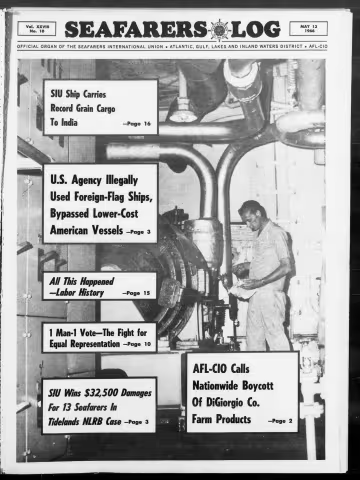
SIU Ship Carries
Record Grain Cargo
To India —Pa^e 16
^ -Hi !
' '» ' 1
U.S. Agency Illegally
Used Foreign-Flag Ships,
Bypassed Lower-Cost
American Vessels —Page 3
AH This Happened
—Labor History —Page 15
1 Man-1 Vote—The Fight for
Equal Representation —Page 10
' .I,-:
SiU Wins $32,500 Damages
for 13 Seafarms in
Tideiands HLRB Case —Page 3
'"'vi i". I
*' 1
•"' •*.
.k
~ V,
•%,- ••" .
J'
i#i;;W'-'
V- ' -
»f ^ - .'-.''J
AFL-CIO Calls
Nationwide Boycott
Of DiGiorgio Co.
Farm Products —Page 2
.. ' 'I
f-r- "il
\ '
f *3
V ' i
i M
Page Two SEAFARERS LOG May l3, 1966
Report of
International President
by Paul Hall
The attitude of neglect and contempt which Government agencies
and federal bureaucrats continue to display toward maritime was
spotlighted recently when the General Accounting Office of the U.S.
Government filed charges accusing the Military Sea Transportation
Service with ignoring the law of the land by shipping cargoes on
foreign-flag ships when the law specifically stated that such cargoes
were to be shipped aboard American-flag ships.
Actually, examples of instances in which Government administra
tors have flouted the laws passed by Congress to aid the maritime in
dustry are unfortunately not difficult to find, and many other examples
could be cited. In one way however, the present example is perhaps
unique. Normally, when taken to task for illegally using foreign-flag
shipping to move Government cargoes even though'American ships
are available, the bureaucrats involved immediately fall back on the
claim that they did what they did in order to save the American tax
payer money by taking advantage of lower foreign-flag freight rates.
This claim is always open to considerable doubt because the American
tax dollars paid to foreign shipowners is all lost money, which leaves
the U.S. never to return and can therefore play no further part in
maintaining and strengthening the U.S. economy—as would be the
case if it were paid to American shipping companies and to American
seamen as wages.
But in the present case even this "saving the taxpayers' money"
routine won't work as an excuse for the bureaucrats involved because,
as the General Accounting Office pointed out in its report to Congress,
it actually cost the Government over $19,000 more to ship the cargoes
by foreign-flag ships than it would have cost aboard American ships.
The General Accounting Office, which investigated the matter and
brought the charges against MSTS, did not do so because of the flagrant
manner in which the Government agency flouted the laws designed
to protect U.S. maritime. The GAO acts as a watchdog over federal
spending. It is concerned specifically with the $19,000 overcharge
resulting from the MSTS's illegal action and not with the vastly
greater waste'of money which occurs daily, both directly and indirectly,
because of Government agency neglect of U.S. maritime and the laws
designed to protect it.
The same flagrant disregard of the law for which the GAO repri
manded MSTS in the present example, is practiced by many other
Government agencies as well. In many instances the abuses are much
more detrimental to the welfare of U.S. maritime. This is the case
especially with regard to the Cargo Preference or 50-50 laws, which
were passed by Congress to guarantee that at least 50 percent of all
Government-financed cargoes are moved aboard American-flag vessels.
Enforcement of the 50-50 laws has been so lax as to be completely in
effective.
The most flagrant abuse of the law of course, has been practiced
with regard to the Merchant Marine Act of 1936, which calls for a
strong U.S. merchant marine, adequate for national defense emer
gencies, for carrying all domestic waterborne commerce and a sub
stantial part of waterborne export and import, commerce. Abuses of
this basic mandate have been so consistent and widespread that the
United States has today become a fifth-rate maritime nation, incapable
of supplying sufficient shipping to meet national defense emergencies.
AFL-QO Supports National Boytott
Of KCioiyio Co. Farm ProJatts
WASHINGTON—The AFL-CIO Executive Council took action on several issues of vital impor
tance to American labor at a recent one-day meeting held here in Washington. Resolutions adopted
by the AFL-CIO's governing body included:
A pledge of full support for
the national consumer boycott of
food products grown and mar
keted by the DiGiorgio Company
of Delano, California, instituted
by the AFL-CIO Agricultural
Workers Organizing Committee
and the National Farm Workers
Association.
• Reaffirmed its full support
of the On Site Picketing Bill and
called on House Labor Commit
tee Chairman Adam C. Powell
(D-N. Y.) to permit the bill, which
has the overwhelming endorse
ment of his committee, to come
to the floor for a vote.
• Urged immediate Congres
sional action on pending legisla
tion for "long overdue" improve
ments in the wage-hour and unem
ployment compensation laws.
• Pledged the "utmost" sup
port of the AFL-CIO for passage
of President Johnson's new civil
rights bill, which covers the major
goals unanimously approved at the
last AFL-CIO convention.
Symbol of Resistance
In pledging full support for the
boycott of DiGiorgio Company
food products, the Council char
acterized DiGiorgio as the "sym
bol and leader of resistance" to
organization of agricultural work
ers. The company grows grapes
and other fruits and markets wine
and allied products.
A strike jointly conducted by
the AFL-CIO Agricultural Work
ers Organizing Committe and the
National Farm Workers Associa
tion is in progress against nearly 40
companies in the Delano, Cali
fornia area. DiGiorgio is "not only
the biggest" grower, but the spear
head of resistance to unionism.
Reaffirming its support of the
On Site Picketing Bill, the Council
sharply criticized Representative
Powell for defying "basic demo
cratic principles" and showing
"contempt" for his obligations as
House Labor Committee Chair
man refusing to call up the bill
for a vote on the floor even though
it has won the overwhelming en
dorsement of his committee, and
"has constituted himself a one-
man roadblock" to further action
on the measure.
The Council noted that the situs
picketing bill "would simply grant
building and construction work
ers the same picketing rights now
extended to industrial work
ers. . . . Four Administrations
have approved this bill; leaders of
both parties have made commit
ments for a vote. . . . the House
Education & Labor Committee
over-whelmingly voted for the bill
and the Rules Cornmittee has
scheduled it for floor action."
In urging prompt Congressional
action on legislation to improve
the wage-hour and unemployment
compensation laws, the Council
noted that Fair Labor Standards
Act improvements "will do more
than any other piece of legisla
tion to fight the root causes of
poverty." It further noted that
pending improvements in the un
employment compensation stiand-
ards law will do much "to elimi
nate fear of mass unemployment
and the crippling impact of reces
sion."
Calling for passage of the Presi
dent's new civil rights bill, the
AFL-CIO Executive Council
termed the legislation "essential if
the objectives of earlier civil
rights legislation are to be realized
in fact than theory." "Discrimina
tion in housing is the root of many
civil rights evils" and must be
eliminated, the Council declared,
and noted that civil rights advo
cates "need and deserve federal
protection" against the violence
of bigots."
The Council also urged speedy
Senate approval of the House-
passed bill to strengthen the pow
ers of the Equal Employment Op
portunity Commission.
The one-day Executive Council
meeting was held on May 6 in
Washington.
Ackert to Speak
For U.S. At World
Fishing Conference
BOSTON—James D. Ack
ert, president of the SlUNA
Atlantic Fishermen's Union,
has been selected by the In
ternational Commission of
North Atlantic Fisheries to
represent the federal govern-1
ment at a 20-nation world
fishing industry conference at
Madrid, Spain, from June 6
to 15.
All nations whose fishing
fleets operate off the Eastern
seaboard of the United States
will have representatives at
the conference. Signatories to i
a 20-nation North Atlantic
agreement include the U. S.,
Russia, Great Britain, Can
ada, Spain, Germany, Nor
way and a number of other
nations that operate fleets.
Holds Slidw
In Baftimoil
BAIMMCHIE THe^ AFl^^CTGf;
Union Label and Service Trades De
partment staged its annual exhibition
f of union label processes and products
at Baltimore's Fifth Regiment Ar
mory for six days early this month.
It was the first time the show has
SiUNA exhibit drew large crowds at AFL-CIO Union-industries ^®^ere^were^morf'than 130 ex- Baltimore Port Agent Rex Dickey (rig^ ahd SlUNA Vice-
, Seafarers International Union of
North America. The SIUNA exhibit
was among those at which union-
made products were distributed free
as gifts and prizes. Canned tuna fish
• processed by members of SIU West
Coast fish and cannery unions were
raffled periodically during the show.
SIU deep sea sailors from the Fort, „
< of Baltimore gave demonstrations andy
i^tructions on knot-tying to the
ow's visitors.
The SIU booth was manned by
afarers and directed by SIUNA
Vice-President Les Balinger of San , '
and Steve Edney of Los Ange-
cases of tuna fish processed by
Poor for a home for the aged. " j
H Comptroller Louis Goldstein, Rep, Clarence Long and RCT^^'oickw^ fish to one of the Skinners of'the raffles which weL'^To'IidtSeJ
<;IHNA SIU booth, -Annual Union Label -how. f.. . visited SIUNA exhibit.
. " . ," , .'-Tr,'At';
May 13, 1966 SEAFARERS LOG Page Three
a Congress Excerpts Front
On Illegal Use Of Foreign Ships
The General Accounting Office, "watchdog" agency in federal
^ spending, has issued a report to the Congress on the illegal use of
r^ fofeign ships to transport Defense Department military personnel's
I private vehicles at "excessive costs" to the U.S. government when
American vessels were available at lower rates. The following text
was excerpted from the report:
"This report is being issued to the Congress because we are
concerned that officials of the Military Sea Transportation Serv
ice, who are responsible for significant expenditures of public
foods, failed to seek guidance from appropriate officials or to
initiate action to obtain congressional authority to use foreign-flag
Vessels for the transportation of privately owned vehicles, al
though they possessed ample information to determine that the
use of such ships for that purpose was not authorized by law.
"Copies of this report are being sent to the President of the
Cnited States, the Secritary of Defense, and the Secretaries of
the Army, Navy, and Air Force."
" "MSTS paid about $141,000 to transport these POVs on Dan
ish-registered vessels of the Torm Line between the United States
and Port Lyautey, Morocco, Africa. During the same period,
there were over 25 sailings of American-flag vessels eastbound
and westbound between the United States and Casablanca, Mo
rocco, a point located about 90 miles from Port Lyautey, MSTS
had contracts with these American carriers under which the
same POVs could have been transported to and from Casablanca
dn American vessels for approximately $122,000, or a saving in
transportation costs of about $19,000.
"Since 1958 MSTS has contracted for shipping rates directly
with the Torm Line, a company organized under the laws of the
Kingdom of Denmark as A/S Dampskibsselskabet Torm with
home offices in Copenhagen, Denmark.^ During the period cov-
eread by our review, the MSTS contract rate with the Torm Line
was.76id cents per cubic foot, which amounts to about $380 for
transporting the average size American automobile, across the
Atlantic. At the same time, American-flag carriers offered to
MSTS contract rates between the United States and Morocco of
$25.80 per measurement ton, westbound, and $28.60 per meas
urement ton, eastbound, or about $315 and $355, respectively,
per vehicle.
"The following table compares the cost of transporting POVs
between the United States and Port Lyautey via the Torm Line
during fiscal year 1964 with the cost that would have been in
curred had the vehicles been transported between the United
States and Casablanca by America-flag vessels:
From
Morocco to United States
United States to Morocco
Total
Costs via Bhccess
No. of Danish American cost via
POVs vessels vessels Torm Lines
234 $ 89,380 $ 73,610 $15,770
134 51,470 48,105 .3,365
368 $140,850 $121,715 $19,135*
•This excess transportation cost -would he reduced by about $5,000 to cover
the loading and unloading costs at Casablanca. The Danish contract rate
, includes the cost of these services at Port Lyautey; -whereas the contract
iu-ansportation rate of American carriers at Casablanca does not.
SlU Wins $32,500Damage A ward
For 13 Seafarers ia Jidelaads Case
HOUSTON—The SIU has won a total of $32,500 in damages
for 13 members of the SIU Inland Boatman's Union in an unfair
labor practices case-against the Tidelands Marine Services, Inc.
The decision, rendered by the ^
National Labor Relations Board,
included $2,318.92 in interest
to be distributed to each member
in proportion to his monetary
claim.
The case, in which the SIU
successfully charged Tideland Ma
rine with unfair labor practices,
stemmed from an organizing drive
in April of 1956, a result of which
the SIU won an NLRB election
in the company's tug fleet.
Shortly after the election, the
company began hardtiming and
firing the members of the Inland
Boatman's Union of the SIU. The
SIU immediately filed charges
with the Board.
The NLRB held that Tideland
Marine was guilty of discriminat
ing in respect to the hire and ten
ure of employees for the purpose
of discouraging membership in the
Union. The Board also found the
company guilty of interfering with,
restraining, coercing and threaten
ing employees on the basis of their
Union affiliation; and also instruct
ing their supervisors to devise pre
texts for getting rid of employees
because of their support for the
SIU.
Members of the Union who
were awarded damages by the
Board and the amounts they re
ceived are as follows: Peter An-
nino, $8,065.00; Charles Dunn,
$3,839.97; the estate of- Trout
Felker, $5,716.69; Jerome Gas-
pard, $247.83; James G. Gau-
treau, $676.68; Chester Holtz,
$1,937.68; the estate of George
Jacobus, $1,536.58; Percy Ken
nedy, $1,426.32; David Moore,
$1,395.07; John P. Murphy, $2,-
401.39; John Murry, $2,386.74;
Curtis Stewart, $2,828.70; and
Phillip Wagner, $41.35.
The NLRB also ordered the
company to post a notice for 60
days, stating that it will "not in
any manner threaten, discriminate
against, discharge or coerce em
ployees because of their affiliation
with the Union." The Board also
directed the company to advertise
the notice in the New Orleans
Times Picayune.
^Watchdog* Unites Piscfosure to Congress;
Cov't Used Foreign Ships Illegally;
Lower-Cost US Vessels Bypassed
WASHINGTON—An agency of the U. S. government illegally spent approximately $240,000 to
transport privately-owned vehicles of Defense Department military personnel aboard foreign-flag ships
and in doing so paid rates higher than those prevailing on American vessels which were available
at the time. ^
Details of the shipping viola
tions became known after a re
port was submitted to the Con
gress recently by the General Ac
counting Office, which acts as a
"watchdog" agency over federal
spending, disclosing that the Mil
itary Sea Transportation Service
shipped servicemen's automobiles
to and from Morocco during 1964
aboard Danish-flag ships in viola
tion of existing U.S. laws. More
over, the report revealed the MSTS
paid $19,000 more for the use of
the foreign-flag ships than the
shipping charges would have cost
on American ships.
The incident, which took place
during the fiscal year 1964, was
not only illegal the GAO said, but
"resulted in excessive transporta
tion costs to the government."
The SIU is protesting the gov
ernment agency violation. It con
demned the action as a classic ex
ample of the manner in which the
American merchant marine is be
ing destroyed as a result of the
refusal of government agencies to
observe federal law and regula
tions.
While this bypassing of Ameri
can ships in favor of foreign-flag
vessels, in violation of federal re
quirements, is but one more ex
ample of government agency tor
pedoing of the American merchant
marine, it presents a clear and
precise illustration of what SIU
and other maritime groups have
been charging in regard to the
abuse of U. S. shipping by gov
ernment agencies.
The GAO said that the matter
was being referred to Congress be
cause "we are concerned that offi
cials of the Military Sea Transpor
tation Service, who are responsible
for significant expenditures of pub
lic funds, failed to seek guidance
from appropriate officials or to in
itiate action to obtain Congres
sional authority to use foreign-flag
vessels .. . although they possessed
ample information to determine
that the use of such ships for that
purpose was not authorized by
law."
The GAO report spelled out the
manner in which the violations had
occurred by directing attention to
the MSTS's use of the Danish-flag
Torm Lines to transport private
vehicles for the Department of
Defense to and from Morocco.
During the twelve-month period
studied, the GAO discovered that
368 vehicles were shipped out of
Port Lyautey at a cost of $140,850
although they could have been
shipped out of Casablanca, 90
miles from Lyautey, on American
ships for $121,715 without incon
veniencing the servicemen or the
government.
The GAO pointed out that dur
ing the period in question, there
were over 25 sailings of American-
flag vessels eastbound and west
bound from the area, and that
MSTS had contracts with these
American carriers under which the
shipments could have been made
at a great savings in government
funds.
A draft of the GAO's report
was submitted to the agencies in
volved, and in September 1965,
an assistant secretary of the Navy
replied that according to the
agency's interpretation of the law
it was felt that the shipments were
proper and not illegal.
However, in its final report, the
GAO stated "we have determined,
as did the Department of Defense's
own General Counsel, that the use
of foreign-flag vessels for the trans
portation of POVs at government
expense was illegal ..."
Hall Addresses Defense Dept.^NSIA Briefing Session
U.S. Accused of Causing Maritime Decline
WASHINGTON—Because of the Government's negative attitude, the American-flag merchant
marine is threatened with extinction, SIUNA President Paul Hall told some 800 defense industry
leaders and Department of Defense officials here recently.
Hall was the principal speaker
at an advanced planning briefing
at the Sheraton Park Hotel on
April 28 jointly sponsored by the
Department of Defense and the
National Security Industrial Asso
ciation, an organization of indus
tries engaged in defense work.
Citing the spectacular booms
occurring in other industries such
as steel, automobiles and aircraft.
Hall contrasted the prosperity of
these industries—all of which re
ceive substantial Federal assist
ance—with the steady decline of
the merchant marine, due primar
ily to governmental indifference
and neglect.
Hall also cited the defense value
of the fleet, noted that foreign-flag
ships jacked up their rates by
2,000 percent when America was
caught without a merchant fleet in
World War I, and questioned the
judgment of Secretary of Defense
McNamara in downgrading the
defense value of a merchant ma
rine.
Under McNamara, Hall told his
audience, the Defense Department
has placed reliance on reserve fleet
vessels, runaway-flags and NATO
ships. But DeGaulle, he pointed
out, has spurned NATO while
other of our allies have been quick
to pounce upon our established
trade routes as soon as U. S. ves
sels are diverted to military serv
ice.
Hall was also critical of Secre
tary of Agriculture Orville Free
man who, he said, "would toss the
bodies of American sailors into
the furnace in order to sell 10
more bushels of wheat."
The State Department, he said,
"would trade away the U. S. fleet
tomorrow to achieve even a minor
diplomatic victory."
Discussing N. Y. Taxi Drivers' Situation
SIU President Paul Hall (seated, center) discusses tax drivers' prob
lems with AFL-CIO Taxi Drivers Organizing Committee and AFL-CIO
representatives. Behind Hall is Central Labor Council President Harry
Van Arsdale, flanked by Regional Director Michael Mann (left) and Rev.
Peter O'Reilly of university teachers. In center rear is Council Treas
urer William Bowe; at right is Council Secretary Morris lushewitz.
I
.3 { -
••
I '• 1
Page Four SEAFARERS LOG May 13, 1966
SlU Sponsored Hockey Team Tops League
Laster joined
the Union in
1939 in Jackson
ville, Florida. He
sailed with the
deck department
as an AB. Bom
in Georgia, he
first went to sea
in 1931. His last
ship was the cable
ship USAF 050-1816. He lives
with his wife Louise Hettie Lase-
ter in Guyton, Ga., since his re-
Laster
tirement on December 1, 1965.
Sullivan joineo
the SIU in New
York. He has
been a union
member since
1940 when he be
gan work for the
New York, New
Haven & Hart
ford Railroad.
Born in New
York, he still lives there with his
wife, Geraldine. He retired from
Sullivan
The Gulf Coast
by Undsey Williams, Vice-President, Gulf Area
The 21st Mississippi Valley World Trade Conference was held re
cently in New Orleans. The theme of the conference was, "World
Trade Expansion—Modem Necessity."
Captain Clark, president of the SlU-contracted Delta Steamship
Lines spoke at the conference and stated that "certain trends in trade
patterns of the world make it im-
perative that United States efforts
to strengthen commercial ties with
its traditional trading partners and
with developing nations of the
free world be accelerated."
New Orleans
J. D. RIchoux, who has been
on the beach here is waiting for
one of the new-
type Delta Line
freighters. J. D.
took a liking to
the new Delta
Line ships while
sailing on the Del
Rio.
George Curry
will take the first
Steward's job to
hit the board. George was previ
ously on the cable ship LongUnes.
T. Smlgjelsld, whose last ship
Was the Couer D'AIene Victory,
is looking forward to a couple of
weeks vacation, and he will look
for a slot on a tanker.
Houston
J. D. Gribble, a member of the
Deck department for over 10
years is on the beach now. He
reports he's looking for a long
trip, preferably to South America.
SIU members here are expected
to turnout at the polls. May 7,
and we hope some friends of labor
will gain public office.
MobOe
William A. Wade, whose last
ship was the Alcoa Commander,
is looking for an
other good run.
He has been ship
ping out of the
Gulf Coast area
for the last twenty
years in the deck
department.
J. C. Keel, reg
istered group one
deck department,
who makes his home in Atmore,
Ala., is looking for ship out of
the Gulf.
Wade
Bickford
his job as a Bridge and Motorman
on March 1, 1966.
Bickford joined
the SIU in New
York in 1944. His
last ship was the
Ocean Ulla on
which he sailed as
Chief Steward. A
veteran of the
U. S. Marine
Corps. Bickford
served from 1935
to 1939. He is retiring to the
Baton Rouge home of his mother,
Mrs. Maudie Tatum.
Vilasis joined
the Union in New
York and sailed
in the steward de
partment. His last
ship was the Flor
ida State where
he was a mess-
man. Born in
Cuba, he is a vet
eran of the U. S.
Army and served from 1942 to
1943. Since his retirement went
into effect on January 1, 1966, he
has retired to Miami where he
lives with his sister, Mrs. Angela
Gil.
Stewart joined
the SIU in Buf
falo, New York.
The veteran AB
sailed as a mem
ber of the deck
department. Born
in Scotland he
had over 37 years
at sea when he
retired in 1965.
His last ship was the Day Peckin-
paugh (Erie). He and his wife,
Evelyn, make their home in Ken-
more, New York.
' :k
VUasIs
Stewart
The Atlantic Coast
by Earl (Bull) Shepard, Vice-President, Atlantic Coast Area
Products manufactured by affiliates of the Seafarers International
Union of North America were a part of the 21st AFL-CIO Union-
Industries Show which took place at Baltimore's Fifth Regiment
Armory. It was the show's first visit to this strongly union city since
the AFL-CIO's Union Label and Service Trades Department began
its annual exhibition of union-label processes and products.
Shipping is good in the port of
This year's City League championship hockey team from Sault Ste. Marie, Michigan is shown above.
Team, sponsored by the Seafarers International Union-Inland Boatmens Union, proved their mettle by tak
ing on all comers and winding up on top during the I 965-1966 season. Picture includes (back row, first and
second from left), SlU-IBU Sault Ste. Marie agent John E. Bernard and team manager F. H. Zimmerman.
At extreme right in back row is Jack Ruelle, who coached boys in some of the finer points of ice hockey.
f/ve Additional Seafarer Veterans
Join Growing SIU Pension Roster
Five more names have been added to the long list of Seafarers who are receiving pension checks
of $150 every month. The members who have been added to the retirement rolls are: Jesse C. Laster,
James J. Sullivan, Willard W. Bickford, Jose Vilasis and John Stewart.
New York and jobs are going
about as fast as we can put them
on the board. Cal James, who re
cently completed a trip as bosun,
was in the hall to register and
spend a little time with old friends.
William Jones is in town after
sailing on the LongUnes.
Boston
Shipping has picked up some
what and the outlook for the next
period is expected to be fair.
Monroe Hall was sorry he had
to leave the Miami where he was
a messman. Garrett Wile, a 20-
year SIU seafarer, recently signed
off the Ponce where he sailed as
AB. Says he had to get off this
hotel to feed the horses at Suffolk
Downs.
Baltimore
Shipping has been very good
the past two weeks with prospects
looking just as fine for the next
period. There have been six pay
offs, two sign ons and 11 ships are
in transit. The Alamar and the
Bethtex are laid up here. The
Bethtex should take on a crew in
a couple of weeks.
Ed Broadens has been hos
pitalized on the West Coast. Ed,
who has shipped SIU for 25
years, reports he will take any
thing as soon as he's ready for
duty. Carroll Harper is now fit
for duty and will take first job on
the board.
Norfolk
Shipping has been very good
here and the outlook for the next
few months is bright. There are
ten ships in transit and there have
been three payoffs and as many
sign ons.
Harper Meacham
Hugh Meacham, who has sailed
SIU for 20 years, just got out of
the hospital and hopes to be fit
for duty soon. His last vessel
was the Commander. Bert Win-
field, a 15 year union member, is
waiting for a Far Eastern run. He
last shipped on the Keva Ideal.
Philadelphia
James McLinden is around the
hall after sailing with the Geneva
in the Deck department. Dimas
Rivera, fresh off the Alcoa Trader,
is ready to ship out. Gerald
Shaffer is on the beach and pre
paring to enter the SIU's Engi
neers Licensing School in New
York.
Puerto Rico
aiff Malners has been enjoying
himself in San Juan. He just got
off the Monarch of the Seas after
a long trip. Jose Prats, just off
the Detroit after sailing as steward
is on the beach.
Mary Chopin, Retired Stewardess,
Dies in New Orleans at Age of 79
NEW ORLEANS—Mrs. Laurence Mary Chopin, 79, a former
stewardess with the SIU contracted Delta Line, died recently of a
cerebral thrombosis at her home in Mt. Airy, Louisiana. She sailed
obvious reasans the LC
:annot print any letters or t
communications sent by Seafa
the author signs his nar
If circumstances justify, the 1
will wUhhold..a
as a Delta Line stewardess and
retired on SIU pension benefits
in 1958.
Mrs. Chopin sailed over 20
years with the steward department
of the SIU and was one of the
crewmembers on the Del Valle
when the vessel was attacked and
sunk by torpedoes from a German
submarine in the Caribbean on
April 12, 1942. Details of the har
rowing experience were vivid
memories to the late Seafarer.
The ship went down 17 minutes
after the torpedo struck, but crew-
nembers and passengers evacuated
the Del Valle so quickly that only
one life was lost, that of the ship's
doctor.
After drifting in lifeboats for
17 hours, the survivors were
picked up by a Navy rescue boat
Sister Chopin came through the
ordeal with flying colors, receiving
only a ducking when she jumped
from the Jacob's ladder while she
was descending to a waiting life
boat. Mrs. Chopin returned to
New Orleans after the disaster and
shipped out again on the first avail
able vessel. She sailed the remain
ing war years without further mis
hap.
After the war. Sister Chopin
sailed for many years as stew
ardess on the Delta Line passenger
runs to South America before go
ing on pension.
|May 13, 1966 Vol. XXVlii, Na. 10
\ Official PublicsUon of the SHJNA ^
Atlantic, Gulf. Lakes & Inland Wntera
District. AFL-CIO |
Sxeeutivt Board k
PAUL HALL, President g
CAL TANNEK
Exee. Viee-Pre#.,
AL KEBR
. SeB.-Treos,
WiBBto MAMMBWii:
. Viod-Pretident , :
EARL SHEPARD »
•yice-Preeidenf j
LlMUSEk WlLLlAUBi
•^Viee-Preaident |
- AL TANNER ' • |
\Viooji'r«Ment'
HERBBRP BSANO
DireeiOr of OrgoMxing and
PubUeaiiona
Managing Editor
MIKB POLLACK
Assistant Editor
NATHAN SKYER
Art Editor
BERNARD SEAKAN
Staff Writert
MELVIN PURVIS
PETER WEBS
fiklltkM) klsMSkly tt SIO «kMl» ItiaMI Avsitu
'I.E.; Wsihlditw, 0. C. 20018 ipfte
iliffiRilmtl UnlH, Atlutis, Ofllt, Lako anil
Ilaai Waisn Itlffi'lit, Ari-cio, 875 Fatrik An-
CftraollyB, 8.*. 11232. Tal, BVaelnth
eWO. tiaM aaiiaae paM at Wuklnp
B.C.
ITUASTEB'E ATTEKTIOB: Fma 3S7i> Mrtl
iM k* Mat ta Ssafarsr* Intsraaiiaaal Unlaa,
tiairtle. fialt, Laku awt Inland WaUn DlMrtit.
'LlCIB, 875 Faprtli AW»M. Bftaklw, 8.Y.
•a
•a
May 13, 1966 SEA/AR ERS LOG Page Five
The Great Lakes
by
Al Tanner, Vice-President and Fred Farnen,Secretary-Treasurer,Great Lakes
SIU Great Lakes District officials, along with other affiliates from
the Atlantic, Gulf and West Coast, are continuing their fight against
proposed crew reductions on Lakes vessels which are scheduled to be
automated. The Great Lakes District of the SIU will be represented
by Fred Farnen and Jack Bluitt at the U. S. Coast Guard hearings in
Washington.
Presently, representatives from
the Great Lakes are hitting SIU-
contracted vessels at docks
throughout the region, obtaining
information on all types of engine-
room ratings. The SIU plans to re
iterate the fact that the proposals
for cutting engine crews does not
take into consideration even the
minimum requirements involving
work on watch, general mainte
nance as well as health and safety.
The steamer Raymond Reiss,
operated by the Reiss Steamship
Company, recently underwent re-
powering at the Frazer-Nelson
shipyard in Superior, Wisconsin,
and will need a crew for her trial
run.
Headquarters has noted that
many claims being submitted un
der the Seafarers Welfare Plan are
being mailed in incomplete. To
assure a speedy payment of the
various benefits, all port agents
will assist any applicant with the
filling out of the necessary docu
ments.
Detroit
Many representatives of orga
nized labor paid their respects to
Senator Pat McNamara (D.
Mich.), when the legislator was
laid to rest at Mount Olivette
Cemetery in Detroit. The Senator
was well known to labor organiza
tions in the State of Michigan,
having gotten his start as a labor-
endorsed candidate. Senator Mc
Namara was a former president
of Local 636 of the Pipefitters
Union, as well as vice president
of the Detroit Federation of La
bor from 1939 to 1945. In 1934,
McNamara also served as the first
state president of the Automobile
Workers of America, the forerun
ner to the United Auto Workers.
Senator McNamara, who was ac
tive in fostering social legislation,
will be missed by the people of
Michigan, as well as the entire
country.
Algonac
The service launch, SIUNA,
well known by Great Lakes Dis
trict members on the river, will be
on its St. Claire River station two
weeks early this year, weather per
mitting. As in the past, all ship's
delegates are being urged to have
all necessary materials ready for
boarding patrolmen when they ar
rive to service the ship.
SIU Joins In Appeal To Congress
Legislation To Protect U.S. Public
Called For By Xonsumer Assembly'
The first national assembly on behalf of American consumers was held in Washington, this month
with delegates representing the AFL-CIO unions, including the SIU, senior citizens groups and civil
rights groups, calling for far-reaching legislation in packaging, lending, auto safety, pre-testing of
drugs and cosmetics, water and ^
air pollution and lower-cost
medical and utility rates.
Panelists and speakers agreed
enforceable legislation would
come only after a greater effort
by a coalition of organizations,
like the 32 that gathered for the
assembly. Other groups participat
ing included, farmers groups,
women's clubs, cooperatives, cred
it unions, veterans and religious
organizations.
Mrs. Esther Peterson, special
assistant to President Johnson for
consumer affairs, spoke to the as-
sembley and proposed the crea
tion of a national federation of
organizations to protect the Amer
ican consumer.
Stated Mrs. Peterson, "The
power of the consumer is now
split into 197 million parts. All of
the special interest groups are very
well organized to exert their in
fluence loudly and clearly in the
nation's capital. In contrast, the
consumer interest is so widely di
versified and disorganized that it is
barely heard above a whisper."
Senator Philip A. Hart (D-
Mich.) told the assembly that
Loch Ness Sea Monster Stars in Rim
From the earliest days of sail
ing ships right up to the present,
seafaring men have often gotten a
reputation as "tellers of tall tales"
by coming back from a long voy
age with stories of sighting huge,
mysterious beasts in mid-ocean.
Shorebound cynics have tradition
ally scoffed at such tales—with
the exception of many people liv
ing near or visiting the Loch Ness
region of Scotland.
Within the last fifty or so years
there have been literally hundreds
of people swearing they have seen
a monster, in the shape of a giant
reptile, in Loch Ness—a large,
exceptionally deep lake.
Now film has been produced,
with actual moving shots of the
legendary beast, and this spool
has been studied and scrutinized
by experts until they all came to
a single conclusion: something is
there, something about 90 feet
long, and not less than six feet
wide and five feet high—and it
wasn't a power boat.
British Defense Ministry an
alysts described the object as
"animate," meaning alive; and
although the Joint Air Reconnais
sance Intelligence Center (JARIC)
did not come right out and say
that the object was the monster,
neither did they deny it. That
should be quite enough to keep
the tourist trade going.
The Loch Ness region of Scot
land is an eerie, misty land of
lakes and hills and sea on the
northeast coast of the country.
Though the word "loch" is trans
lated "lake," it can also mean a
bay fed by the ocean.
The film of the mysterious ob
ject moving along in those waters
was taken in 1959 by aeronautical
engineer, Tom Disdale, and was
shown on television in Britain the
following year.
David James, a former member
of Parliament who heads the
"Loch Ness Phenomena Investi
gations Bureau, passed the film on
to the Air Force Defense Minis
try, who in turn gave it to JARIC
experts to work on.
It was the first time that actual
pictures of the "monster" had been
subjected to extensive scrutiny.
the 24-mile-long, 750-feet-deep
lake has been passed down among
the Gaellic people since the 6th
century when St. Columba was
said to have fought the monster.
The latest sightings started in a
big way when a road was being
built along the loch in 1933.
Theorists say that the dynamiting
along the lake caused the prehis
toric creature to come up from
the huge depths of the lake.
The photographic division of
the intelligence center took meas
urements on every frame of the
film, taking into consideration re
flections, light conditions, the
angle of the object and the posi
tion of the camera. It shows a dark
object knifing its way through the
water in a series of jerky move
ments.
Lord Shackleton, Defense Min
ister for the Royal Air Force who
has always expressed his disbelief
in the monster, said that he was
"surprised" and "mystified" by
these latest findings. "I find it diffi
cult to discount the findings of
this report," he said.
The existence of something in
Fresh Water
Maker Tested
Aboard Ships
In the not-so-distant future sea
men may not have to worry over
the conservation of water while
aboard ships at sea—if the now
experimental seawaters distillers
prove to be a success.
A new 8,000-gallon-per-day sea-
water distiller developed by Gen
eral Electric has been installed in
about a dozen ships, while other
pilot evaporators have been op
erating under field conditions for
more than two and a half years.
These new distiller prototypes
operate on the principle of thin
film distillation and the technique
used, called the "double-flute" is
a high heat transfer service. The
double-flute tube produces and
maintains thin films of water when
evaporating and condensing. This
means that a maximum usage of
heat is possible with a minimum
surface and temperature differ
ence, and makes possible a small,
inexpensive shipboard unit.
there was hope for his truth-in-
packaging bill in the current Con
gress despite the lack of attention
it has received during the four
years since the 1961 investigation
of packaging and labeling prac
tices. Senator Hart stated that, al
though eventual passage seems as
sured, "the timing depends in part
on how clearly Congress hears the
message of this assembly."
Urging a permanent action
group for consumers, Representa
tive Wright Patman (D-Tex.) said
the assembly was a "giant step for
ward in putting organized muscle
into consumer action."
Senator Paul A. Douglas (D-
111.) told the assembly that "the
truth-in-lending bill still remains
buried within the Committee on
Banking and Currency, and even
more distressing, self-improvement
within the industry in order to pro
tect consumers from the shady
devices of unethical lenders has
failed completely to materialize."
Ralph Nader, author of "Unsafe
at any Speed," spoke to the as
sembly and condemned the auto
industry for secrecy in safety engi
neering and refusing to cooperate
in research and crash tests. In this
connection Representative James
A. Mackay (D-Ga.) called for a
Federal Automobile Administra
tion which would be charged with
enforcing mandatory standards for
manufacturers.
The Pacific Coast
by Frank Drozak, West Coast Representative
The Political wars are on again, in California, with the governorship
of California, Oregon and Washington as the big prize.
We urge all seafarers to register and get out to the polls for the
June primary and November general election, and cast your vote for
the COPE endorsed candidates for office. Members who are on ships
during the elections can cast an
absentee ballot. Seafarers' in need
of information on casting an ab
sentee ballot, or in need of general
election information, are asked to
contact their nearest SIU hall.
San Francisco
Shipping is booming in the port
of San Francisco. Plenty of jobs
are available for all ratings.
Last period we paid off the fol
lowing ships: Robin Trent, Cuba
Victory, Coe Victory, Meridian
Victory, Fenn Victory, Fairisle
and the Couer D'AIene Victory.
Signed on were the: Robin
Trent, Santa Emilia, Meridian Vic
tory, and Cuba Victory.
Ships due in for the next pe
riod for payoffs are the: Lucille
Bloomfield, Columbia Victory,
Oceanic Spray, Steel Flyer, Ocean
ic Tide, Loma Victory. In transit
we are expecting the: Steel Ap
prentice, Steel Worker, Losmar,
Penmar, Long Beacb, and the Los
Angeles.
In transit are the: San Juan and
the Calmar.
Among some of the old timers
pulling in from the Gulf is W. F.
Randall Steward Department, who
was shipped as a chief cook on
the Santa Emilia to the Vietnam
area.
C. Dawson, pulled in from
Baltimore and was shipped as an
A. B. on the Meridian Victory,
which is also the Vietnam run. We
have also shipped E. Adams, who
left on the Fairisle as Bos'n.
Seattle
Shipping continues at a brisk
pace here in the Northwest, especi
ally for Group 2 in the deck and
engine departments, and from all
indications it will continue to be
good. The following ships paid off
and signed on: Barre Victory,
Anchorage, Transnorthem, Cita
del Victorj', Seattle and Ridgefield
Victory. The Hastings paid off
and the Express Baltimore signed
on for this period.
One of the old-timers on the
beach is Oskar Johannessen, who
got off the Hastings to attend to
some personal business. Oskar
sailed as a fireman-watertender
and should be ready to go again in
about another week. L. Behm was
last on the Walter Rice as Night
Cook and Baker, and a SIU mem
ber for over 20 years. Len Filer
off to catch a Far East run. J. W.
Allen, SIU member for 15 years
just paid off the Seattle as Deck
maintenance man and would like
to catch the Alaskan run after tak
ing it easy for a spell.
Behm Wolfe
Wilmington
During the past two weeks we
have had the Iberville sign on,
and had four ships in transit.
Shipping has been on the slow
bell here and we have been trying
to assist San Francisco with the
heavy shipping activity in that
area. This slowup is only tem
porary, as we have a heavy sche(ti ,
ule anticipated for the next two
weeks.
Les Wolfe just blew into town
after a trip as pumpman on the
Overseas Joyce. He has no desire
to sit around on the beach and is
ready to grab the first pumpman's
job that hits the board. a
i,>
Page Six SEAFARERS LOG May 13, 1966
5IU Crew Wins Safety Award
SlU-contracted Del Oro has been awarded Delta Line Certificate
of Merit for a safety record of no chargeable injuries to per
sonnel according to National Safety Council standards. In addi
tion to certificate, ship's recreational fund benefited from
$100 prize that went along with award. At presentation ceremony
above are (l-r): chief electrician L. K. Evans: Purser C. Wright;
chief Engineer E. L. Bell; Delta port captain E. R. Seamen; ship's
captain J. F. Owens; Delta safety director Paul Pollatt; engine
utility man V. Federsovich and ship's chief mate C. S. Randies.
IPHE INQIJIBINO SEAEA.RER
When a stranger discovers that
you are a professional seaman,
what kind of questions does he ask
you ahout a seafaring life?
James Russell: Of course, when
a man finds out that I make my
living as a profes
sional seafarer, he
has all the con
ventional ques
tions such as how
do I like the life,
what countries
visited and
^ what they are like,
' ̂ " and some ask me
about the kind of work I do. But
the biggest question that comes
up from strangers concerns the
amount of pay we receive, and
when I clue them in, they are
simply amazed that we are paid as
well as we are.
<1>
V. Joseph: Men who have never
been to sea can bombard a Sea
farer with enough
questions to keep
him busy for sev
eral days. The old
standbys are such
as how do you
like a life at sea,
do you eat well
out there, some
even want to
know whether a man sleeps well
when the ship's pitching and roll
ing in a storm. But it always gets
back to the thing most men find
themselves worrying about: how
much are we paid?
Edward John Taylon People
who work on the beach and find
out that I make a
living as a Sea
farer are always
curious about the
different foreign
ports of call. If
it's a man I'm
talking to, he's cu-
^ ^ rious about the
•" * womenfolk in oth
er countries and how they differ
from the gals in the United States.
Others want to know about the
various customs in foreign coun
tries and just how they compare
with those over here. Most peo
ple who have spent their whole
life in the continental United
States are naturally curious about
places they've never visited.
^—
Hubert Landry: Most of the
landlocked crowd wants to know
what a Seafarer
does on a vessel.
They seem to
think that a ship
just sails itself,
and we don't have
anything to do but
sit around and
watch the sunsets.
That's because
many of them have hardly even
seen a ship, much less ever had a
job on one; and they never failed
to be surprised when they find out
exactly what we do to keep the
vessel moving. In fact, there's
quite a few people who don't con
sider seafaring to be real work,
but I soon set them straight on
this matter.
Lawrence Hogan: Being a Sea
farer and living a kind of life that
few people are fa
miliar with, I get
many questions,
some reasonable
and a few on the
ridiculous side.
One fellow actu
ally asked me had
I ever seen a mer
maid, and I told
him, "Why, certainjy I see mer
maids pretty often." This usually
shuts them up, which is a good
thing, since anybody stupid enough
to ask that would hardly be worth
talking to. I am also invariably
asked about seasickness, which I'm
not ever bothered with, but I tell
them that some people suck a
lemon to avoid it.
REPORT Atlantic^ Gulf & Inland Wafnn District
April 23 to May 6, 1966
DECK DEPARTMENT
TOTAL REGISTERED TOTAL SHIPPED
All Groups
NOW ON THE REACH
Fort Class A Class B Class A Class B Class C Class A Class B
-»
Boston 9 1 4 0 2 23 2
New York 62 19 63 22 11 163 47 f'
-*• Philadelphia 11 3 2 1 0 38 16
f'
-*•
Baltimore 39 14 . 25 11 0 84 45
Norfolk 4 4 13 4 1 21 16
Jacksonville 10 6 6 3 2 18 9 •*
Tampa 3 5 5 7 2 13 6
Mobile 15 6 3 0 0 90 22
New Orleans 45 22 22 13 4 122 58 A
Houston 52 28 37 11 6 160 88 ••
Wilmington 5 5 5 3 3 30 3 • i.
San Francisco .... 38 19 4 23 37 61 20
Seattle 19 9 16 12 6 35 6
Totals 312 141 205 110 74 858 338 A
EN IGI INE DEPARTMENT
TOTAL REGISTERED TOTAL SHIPPED NOW ON THE BEACH
All Groups AH Groups All Groups
Port Class A Class B Class A Class B Class C Class A Class B
•f
Boston 1 1 2 1 0 5 3
New York 45 22 34 18 20 145 51
Philadelphia 5 5 7 3 2 21 18
Baltimore 26 19 21 15 3 51 52
Norfolk 4 8 9 4 2 19 19
Jacksonville 7 6 3 2 4 12 11
Tampa 3 5 5 1 2 4 3
Mobile 10 2 3 2 1 52 17
New Orleans 15 27 21 21 4 78 63
Houston 36 32 20 8 9 92 77
Wilmington 15 4 6 4 9 23 4
San Francisco 28 16 39 11 29 41 13 A,
Seattle 18 14 20 7 5 25 13 1'
Totals 213 161 190 97 90 569 344
STEl IVRD DEPARTMENT
<
TOTAL REGISTERED TOTAL SHIPPED NOW ON THE BEACH
All Groups All Groups All Groups ••
Port Class A Class B Class A Class B Class C Class A Class B 1 1 ' Boston 2 1 2 1 2 5 4 1 1 New York 35 11 41 9 10 109 32 1 Philadelphia 5 3 2 3 1 10 9
Baltimore 21 11 13 13 2 50 33
Norfolk 5 4 3 6 1 9 11
Jacksonville 6 2 2 3 6 7 6
-^1
Tampa 5 2 5 1 1 7 4
,4
Mobile 10 7 4 1 0 60 18
New Orleans 27 15 6 6 0 139 85 -
Houston 31 16 22 15 5 105 43
Wilmington 6 0 4 2 2 18 0 J
San Francisco .... 28 11 33 11 64 43 12
Seattle 12 9 7 8 11 27 21 r*
Totals .'... 193 92 144 79 105 589 278 i
US Shipbuilding Shows Slight Gain
But Lags Behind 8 Smaiier Nations
The United States moved up three places in world shipbuilding for the first three months of 1966,
but the production of U.S. yards still lags behind the shipbuilding of eight smaller nations. Accord
ing to the latest issue of Lloyd's Register of Shipping, the tonnage constructed in the U.S. rose 86,-
183 tons to a total of 424,160 ^
tons for the three month period.
However, the following na
tions still hold the lead over the
U. S.: Japan, 3,251,897 tons;
Britain, 1,383,356 tons; West
Germany, 1,073,602 tons; Swed
en, 880,178 tons; Italy, 719,755
tons; Spain, 538,133 tons; France,
456,020 tons;' and Poland, 429,-
790 tons. Although exact figures
are not available for Red China,
East Germany or Russia, all three
Communist nations are known to
be conducting energetic shipbuild
ing programs.
Lloyd's reports that the coun
tries making the largest additions
to their merchant marines are
Japan, 1,434,071 tons; Norway,
1,395,667 tons; Britain, 1,288,547
tons; Liberia, 975,246 tons; and
Russia, 721,836 tons.
Although American yards
gained in production during the
first quarter of 1966, U. S. ship
building experts are not optimistic
about the future of the industry in
the U. S. In recent testimony be
fore the House Merchant Marine
and Fisheries subcommittee on
Merchant Marine, Edwin M.
Hood, president of the Shipbuild
ers Council of America, forecast
that the cost of ship construction
in the U. S. will be increasing for
some time to come due to the lack
of modern facilities.
"Even if a new (merchant ma
rine) policy were to be adopted in
the next 6 to 12 months, an un
likely prospect judging from pres
ent signs, and even if the need for
a shipbuilding program of larger
proportion were to be recognized
at long last, the results would not
be appreciable for another 18 to
24 months," Mr. Hood told con
gressmen. However, he added, if
the U. S. Government were will
ing to go ahead with a more realis
tic program for shipbuilding, the
shipyards would be able to invest
in the modern facilities needed to
reduce ship prices.
According to the testimony of
Mr. Hood and other witnesses at
the hearings, and in the opinion
of several congressmen, U. S.
shipbuilding will not make any
long term gains until a sound and
substantial program for the whole
merchant marine is begun by the
Government.
1, Vacation Plaiif
Cash Benefits Ptild^March 1-March 31, 1966
Hospital Benefits ^,
Death Benefitit .
Disability Benefits . V
; ̂ Maternity Benefits
Dependent Benefits
(Avera^di $203.00^
Optical Benefits ..;
Out-Patlent Beitefitis
Summary
Vacation Benefits ..
Number of Amount
Benefits Paid
8,457 $ 87,614.68
29 84,958.00
752 126,300.00
68 13,571.00
ill''-777 157,804.46
526 7,754.12
6,557 45,375.90
17,166 523,378.16^
1,742 ^2,269.24
TOTAL WELFARE, VACATION
BENEFITS PAID THIS PBtlOD 18,908 $1,211,647.40
May 13, 1966 SEAFARERS LOG Page Seven
AFL-CIO Urges Congress
iden School Aid Program
The AFL-CIO urged Congress to continue and expand federal aid
to elementary and secondary education, particularly by increasing
appropriations.
Andrew J. Biemiller, director of the federation's Department of
Legislation, told the education subcommittee of the Senate Labor Com
mittee that the "great educational strides" of the 89th Congress need
to be carried further.
"More remains to be accomplished, and it would be a grave dis
service to America's future to curtail the programs enacted thus far
or even to freeze them at their present levels," he said. "The AFL-CIO
does not for one moment accept the argument that anything in the
present international situation necessitates lower expenditures at home
for the health, education and well-being of our people."
What is "most needed," Biemiller testified, is an increase in federal
funds for local school districts from "considerably less than 10 percent
of all such outlays to about 25 percent. He noted that spokesmen for
large cities, for suburban communities and for rural areas have each
called for added support to meet their special problems.
"All of these arguments are convincing," he commented.
The AFL-CIO spokesman warmly supported a proposed rise in the
basis for fund distribution from the present standard—the number of
children in families with $2,000 or less income—to a $3,000 income
figure. He recalled that the latter had been the labor movement's
original recommendation.
However, Biemiller opposed a parallel provision to eliminate in
centive grants to school districts which increase their budgets. He
acknowledged that problems had arisen in the actual operation of the
incentive program, but expressed the hope that "Congress will try to
work out the problems rather than discard the program."
He also called for four-year authorization for all programs begun
under the Elementary & Secondary School Act of 1965, on the ground
that "school districts must be able to make reasonably long-range
plans ... to better fulfill the purposes of the legislation."
Biemiller vigorously defended the impacted aid program, which
helps school districts where there are large concentrations of federal
military and civilian personnel. He opposed Administration plans to
cut back the program and called instead for expansion of the impact
approach to problems of rapid growth or of economic decline; to
school segregation, whether by court order or voluntarily undertaken,
and to rural areas.
"We are confident that this Congress, having set forth on a major
program of federal support for elementary and secondary education,
will share our view that programs now in existence should be strength
ened and improved, rather than being curtailed and phased out," he
said.
Biemiller expressed concern about another bill before the sub
committee, which would place full responsibility for federally-assisted
adult education programs in the public schools. He said the public
schools' adult education personnel had often proved ineffective in
reaching adults who are most in need of basic education, and that
those in the South "simply do not have any mechanism for dealing
with the educational needs of adult Negroes, particularly in the rural
areas." He suggested "additional consideration" by the subcommittee
of the bill's proposals.
Stanley Ruttenberg, former
AFL-CIO research director, was
appointed to the post of assistant
secretary of labor manpower by
President Johnson. Ruttenberg
had been Labor Department man
power administrator. The appoint
ment also carries the chairman
ship of the President's Committee
on Manpower. Ruttenberg is 49
and joined the staff of the former
CIO in 1938. He became research
director in 1948. His position is a
redesigned post, formerly desig
nated as assistant secretary of la
bor for policy planning and re
search.
The Air Line Pilots have urged
the Federal Aviation Agency to
restore the 120-miles of "lateral
separation" between planes flying
the North Atlantic Route. The
FAA ordered a reduction to 90
nautical miles. ALPA President
Charles H. Ruby and ten union
witnesses said maximum space is
needed to avoid accidents, espe
cially. with 450-passenger planes
in the planning stage. Ruby told
an FAA public hearing that a
120-mile separation should be
"available to all pilots on all flights
at all flight levels."
<1>
A raid by Teamsters on Local
51 of the Glass Bottle Blowers of
Defiance, O., was defeated when
the AFL-CIO union won a runoff
election at the Johns-Manville
plant. The Teamsters had been
ousted for unfair tactics in starting
their campaign while Local 51 was
on strike. The National Labor Re
lations Board set aside the previ
ous election. The final tally in the
runoff election was 308-212.
The Building Service Employes
have launched a drive for "rights,
votes and jobs," to assure that
segregation is eliminated from lo
cal unions and their field of em
ployment, to re-elect pro-labor
congressional candidates and to
make certain graduates of anti-
poverty training programs have
jobs waiting for them. President
David Sullivan urged locals to
eliminate barriers to integration.
Sullivan declared, "The nation has
undertaken a War on Poverty and
we must support that effort."
"Your Money AND Your Life!"
V> »
^jpJi-
AFL-CIO Supports Consumer Legislation
"The power of the consumer is now split
into 197 million parts. All of the special in
terest groups are very well organized to exert
their influence loudly and clearly in the na
tion's Capitol. In contrast the consumer in
terest is so widely diversified and disorgan
ized that it is hardly heard above a whisper."
These were the words of Mrs. Esther Pe
terson, special assistant on consumer affajrs
to President Johnson, who spoke to repre
sentatives of the AFL-CIO unions, includ
ing the SIU, farmers and senior citizens
groups, veterans and religious organizations
attending the first national assembly on be
half of American consumers in Washington
this month.
The reason for the meeting was concern.
Concern over the fact that millions of Ameri
can consumers are getting bilked of hard
earned dollars by unscrupulous manufactur
ers, merchants and money lenders through
the use of false advertising and inferior prod
ucts.
Revelations of the auto industry's careless
approach to the safety of its products and
the practices of a free-wheeling pharmaceu
tical "industry underline the actual menace
to life where the responsibility of business
is simply profits.
Two bills—the fair packaging bill spon
sored by Senator Philip A. Hart (D. Mich.)
and the "truth-in-lending" bill sponsored by
Senator Paul A. Douglas—are still mired in
Congress and are being diligently opposed
by the special interest groups which Mrs.
Peterson referred to in her address.
It is only through the combined efforts of
consumer "special interest" groups that these
two essential pieces of legislation will be
come law.
The trade unionist as a consumer certainly
has his special interests to protect—namely
his pocketbook and his life. It is now time for
the consumer voice to rise above a "whis
per." It is time for the consumer to let his
Congressmen and Senators know that he is
tired of being abused and duped in the mar
ketplace and that he wants immediate legis
lation that will put a harness on the disrepu
table practices of manufacturers.
Write and let your Congressman and
Senators know where you stand on these
vital issues. Do it today!
Register And Vote To KO Right Wingers
The John Birch society and other right-
wing groups are loading up their campaign
warchests over the country and preparing to
launch an all-out drive which they hope will
elect conservative candidates in 325 con
gressional districts in November.
The right-wingers are not dismayed by the
solid tromping which conservative candi
dates received during the last presidential
election. Right-wing organizations hope to
raise 38 million to support Birch candidates
in the upcoming November elections.
In addition, radio and TV programs un
der right-wing sponsorship are deluging lis
teners with over 10,000 programs a week
attacking labor unions, the Supreme Court,
the Federal government, Civil rights, the
United Nations and local PTA's.
Trade unionists and all American citizens
can do something to silence the attacks on
these institutions by the right-wing element.
They must be rebuffed at the polling booth
by a sound majority of American voters.
•' r -
HI
> I
Page Eight SEAFARERS LOG May 13, 1966
l'1
! annual job of fitdng^ut Great
Lakes ships is a well«knonnn pro
cedure to those SIU members who
jsail in the Great Lakes Dhifrict.
I it involves getting the huge ships,
I which have been in layup over
^the long winter mondis, back in
tip-top shape for the spring ship
ping season. Mudi of the flavor
of spring fit-out is captured in
the photos shown on these pages.
./C
Wiper Alix H. Fa+teh, who sails
aboard the William Reiss, checks
call-back list in Detroit hall.
Toledo SIU patrolman Don Cubic waves to crew when the
steamer J. F. Schbellkopf Jr. departed from Toledo with first
load of coal of season. Cargo was bound for Bay City, Mich.
Watchman Dennis Frarck rtgTllfe ring
in brackets aboard the Henry LaLiberte
in preparation for frrst 1966 voyage.
Wheelsman Angus MacDonald
distributes life jackets aboard
Buckeye Monitor during fit-out.
Larry Trembley, 2nd cook, sets
table for lunch aboard Diamond
Alkali before leaving Toledo, O. on the
r , .
; : -V-
SIU didtimer Arrie ©rah^^^
wheelsman aboard the Henry
EjLeLiberte, secures carbide can.
Fireman Etno Autio .keeps care
ful watch on firebox in the J
Buckeye Monitor's engineroom.
1966
(W
• 7«-\ - - 'r* • •!: "T^t "'"r'lwt;," jf t ' w*~t» i—ulcss • 015*^1*tc^ in&mioftrs ••
carefully checked seniority call-back lists posted in each Union H
hall on the Lakes. Photo above was taken at the SIU Detroit hall.
® attraction for children and Coot Ben WitliaHl ̂ har
the huge Great Lakes carriers Reiss Brothers and William A. Monitor's kitchen in top shape and '
I ' 'i " turns his attention to the noon mej^l,..^/-*,
yevl^^lSr
in with gusto. They ore (clockwise): Eino Autio, Lee Rowell, Loyde J.'F. _ « MV
Jenson, Howard Basley, Bob Fouchy, Gary Dunn, Sheldon Fontaine. ,, ship gets ready to begin another busy season on" the Labi- ' - i^ess'er'wa?
ms"'.
May 13, 1966 SEAFARERS LOG Page Nine
^SIU Deiroit patrolman Paul Simms (left) checks out
crew seniority with oiler Burton Knudson aboard
^Buckeye Monitor before ship sailed on season opener.
Following an SlU Great Lakes District membership meeting.
Lakes Seafarers Duncan MacKay and Urban Reddinger
j chatted with SlU-SLD secretary-treasurer Fred Farnen.
Coast Guard inspector
views Seafarers manning
the LaLiberte lifeboat.
•Fireman Eino Autio demonstrates the action of the
dump grates for SlU patrolman Don Bensman while
the Buckeye Monitor was being fitted out at Detroit.
Y. Nabasama, vice-presi
dent, Japan Seamens Un
ion, watched Lakes fit-out.
r
f'l
Cook Arnold Kempainen
trims fat from roast in gal
ley of the Henry LaLiberte.
Tim- Maddon (right) ships as
ordinary on the Piatt Jr.
His brother Tom is with him.
I? I •
- IP;':
Sheldon Fontaine, Bob Oldtimer Arne Graham
Diamond Alkali prepare to pull a roast from galley Fouchy scrub down Buck- and Don Olsen bring up
. bven to provide fit-out crew with hot noon meal, -^eye Monitor pilbt house. liferings on LaLiberte.
•J'
.1.
UP"
I--I
or spring tit-out to get underway, SlU Great Lakes |
District seamen enjoy cards^ chess, checkers and other rec-' |
reatipnal pursuits at the Union hall in Detroit, Michigan. ;
MM
.•ILL:
"Crewmembers aboard the Henry LaLiberte lower Huge elevators on the Lakes discharge grain cargoes
,away lifeboat during drill testing techniques and directly into Lakes carriers' enormous holds. Grain,
equipment to assure that all on vessel is shipshape. along with coal and iron ore, is major Lakes cargo.
-r
pr:
'
sut
Page Ten SEAFARERS LOG May 13, 1966
_ •
"vi
•Ui
^QUAL representation for all voters is a BSsic demo
cratic principle. But in most State legislatures, this
principle long has been violated in such a way that
rural areas are over-represented, while city and suburban
voters are under-represented.
Thus, a small minority of rural area voters often is able
to block the needs of the urban majority—which means
seven out of 10 Americans—by dominating the State legis
latures. The badly apportioned State legislatures fought
against attempts to reapportion themselves to make them
more representative, because those in power did not want
to relinquish the control they had under the existing sys
tem.
In 1962, the U.S.. Supreme Court opened the way to
correct this inequity in our political system. The Supreme
Court ruled that federal courts could require reapportion
ment of a State legislature. Then, in 1964, the Court held
that population must be the only basis of apportionment of
State legislatures. The 1964 Supreme Court ruling said:
"Legislators represent people, not trees or acres. Legis
lators are elected by voters, not farms or cities or economic
interests. As long as ours is a representative form of gov
ernment and our legislatures are those instruments of gov
ernment elected directly by and directly representative to
the people, the right to elect legislators in a free and unim
paired fashion is a bedrock of our political system."
Therefore, the court declared, the "equal protection"
clause of the 14th Amendment of the U.S. Constitution "re
quires that the seats in both houses of a bicameral state leg
islature must be apportioned on a population basis," which
means on the basis of "one man-one vote."
To date, 37 states have complied with the one man-one
vote ruling and court actions are under way to force the
remaining states into line with the reapportionment deci
sion. •
The issue of one man-one vote is the concern of all
American workers, as it is of all Americans. Here are some
questions and answers which ihay be helpful to an under
standing of this highly irnportant fight for equal representa
tion for tdl:
How are legislatures set np?
RefHesentational districts are established within certain
geographical boundaries. Legislative seats are then appor-
^^^^^^^^||p-;tioned'among the districts.
What is the meaning the one maa-ohe vote principle?
The one man-one vote principle holds that legislative
Seats must be apportioned on the basis of population only—
the vote of one man should be of the same value as the
vote of another whether he lives in a rural or an urban
area.
rural areas to the cities, the majority of state legislatures
have been controlled by a minority of citizens in rural areas.
In the California state senate for instance, members repre
senting 11 percent of the state's population could produce
a majority of voting strength. In Arkansas, 14 percent Of
the people could elect a majority in the upper house, while
33 percent could control the lower house. In Illinois, 29
percent of the population could control the upper house.
In Vermont, only 12 percent of the state's voters could
control the lower house.
A recent survey showed that of the 50 states, only in 19
did 35 percent or more of the population elect a majority
of the members of both houses of the legislatures. Even in
these 19 states only a few came anywhere near true rep
resentation.
What does this mean to American labor?
Because most workers live in cjties today, and the'city
populations were grossly under-represented in state legisIaR
tures, the American worker has suffered the most from
malapportionment. State legislatures controlled by a small
minority of rural voters meant that American workers in
llie cities were largely disenfranchised—Iheir votes did not'
count, their needs remained unmet because minority-conr,
trolled rural-oriented legislatures have been unwilling and
unable to cope with the increasing problems of the grow
ing urban areas.
In Michigan for example, prior to the recent court- ;
ordered reapportionment, a bill to provide an unemploy
ment insurance increase of $3 was killed by senators reprfr^'|
senting only 2.4 million voters—in spite of the fact that thef |
bill was supported by senators representing 3.5 milliohl
voters. It is also interesting to note that 16 of the 19 stated
that currently have anti-labor "right-to-work" laws also
represent some of the worst cases of control of the state
legislature by a rural minority.
What was the Hirksen amendment?
This was a proposed amendment to the United State
Constitution, introduced and supported by Senator Everetl|
McKinley Dirksen (R-IIL). It was defeated recently in thei
Senate for the third time. The Dirksen amendment would
have blocked the Supreme Court's one man-one vote re
apportionment decision and preserved the old "rotten
borough" legislatures—the term for legislative districts
which no longer have sufficient population to justify the
representation allotted to them.
Why is legislative reapportionment on a one man-tme vote
basis necessary for the nation as a whole?
Every citizen's vote should be weighted equally. Reap
portionment is long overdue and made increasingly neces-£
sary by the continuing shifts of population from raral areas
to cities. This population shift has produced problems of
housing, schools, mass transit, air and water pollution and
i-j#i
1 i
'
May 13, 1966 SEAFARERS LOG Page Eleven
Ships at Sei
'Hie crew of the Del Norte (Delta) will be viewing plenty of movies if Meeting Secretary Bill Kaiser
has his way. Bill reports he just rented 22 films in Houston and there is still a total of $131.44 in the
ships fund. Henry B. Donnelly of the Steward department replaced Kurt K. Binemanls as ship's delegate.
Kurt resigned while the ship was —
Donnelly
Diaz
in New Orleans. The Steward de
partment was awarded a vote of
thanks for their
fine Easter lunch
which consisted
of grilled steaks,
colored eggs,
baked potatoes,
smoked sausages,
salads, fruit
punch and lots of
trimmings. Every
thing is going well
as the ship heads for a New Or
leans payoff, via Houston.
<1>
Pete Patrick on the Erna Eliza
beth (Albatross Tankers) says the
vessel is headed
for Singapore to
take on fuel oil
before heading for
the Persian Gulf.
All were reminded
by ship's delegate
J. K. Coats to re
turn all linen at
exchange. The
men expect to be
using the recreation room soon.
Steward delegate J. R. Diaz told
the brothers that the second cook
has been busy spraying the head
and store rooms to keep down in
sects as well as possible.
<I>
A good crew of Seafarers took
most of the problems out of a
rough voyage to
G r e e c e . O. P.
Oakley on the
Platte (Bulk
Trans.) says the
men can't wait
for the new
washing machine
and that the
company has also
promised a new
ice cube machine. It was the first
trip for the ship in over three
years. William E. Scott says, "It's
always rough on a ship that's
been out of service for a long
time and considering everything
there were few beefs."
C. A, Bellamy says that the
Transbay is going to try and ob
tain an agitator
for the crew
washing machine
in Bombay. The
old agitator was
broken and the
crew's laundry is
piling up. F. S.
Paylor, Jr. noted
that the overtime
sheets that were
brought on board at payoff are to
be returned to the ship's delegate.
Motion made to keep non-crew-
members out of crew's quarters.
Scott
Bellamy
4 iy
Stories about Seafarers eating
some of the best food on earth
keep coming in
and the crew
aboard the Re
becca is no excep
tion to this rule.
Freddy, the chief
cook on the Re
becca, was given a
big thanks from
the crew for do
ing such a good
job. In other news from the ships,
keys have been made for the fo-
castles and everyone on board can
have one. Ted Weems recom
mended a vote of thanks to the
crew for assistance given to a sick
pumpman and the quick dispatch
of him to the Azores. Fred Isirel,
meeting chairman, reports that
everything else on the ship is run
ning smoothly.
Weems
Ship's delegate John Pennell re
ports that the crew of the Penn
Sailer (Penn Lines) have been re
ceiving their mail and logs regu
larly and hope this good mail serv
ice will continue during their long
voyage on the Persian Gulf. New
mattresses were
delivered in Hous
ton and they will
be distributed to
the crew after the
ship puts out to
sea bound for
Bombay. Voyage
repairs were han
dled in Houston
and there was a
vote of thanks to the entire stew
ard department by the crew. Col
lie Loper, Jr., who is the steward
department delegate, is one of the
Brothers responsible for putting
out the good food.
Loper
LOG-A-RHYTHM
Things
By John Liebman
Slices from childhood and slices from yesterday
Were the things of the seaman's dream,
And the difference in between
Were far divided by the unrecalling years
Barren and spent in the bitter whirl of memory.
Years which also divided and split
Into unrecognized months and weeks
Leading fast to bleak today;
An entity now because of age and fall
Breaks to seconds ticking.
Revolving around a world, these dreams,
Broken like all things by chance missed,
Women unloved in other ports, thoughts unsaid.
Chances missed, opportunities flown.
Which all but the smug can look back upon.
The smug whose bland faces
Sustained by paste and suspenders.
And above all things that waste that prompts
Fair lives to blacken, engines to rust.
And greatness lost to ineptitude.
Dreams that do not fold 'twixt spaces
Like neat letters creasing.
Reflections cleaved with rotting paper,
After the crease unread and molding,
As if were never written.
Not so the dream beyond recall
Portraying houses, roof topped. by blank windows,
Evaporated by memories of the quay,
Though returning with the day
In all their vague and mellowed misery.
Racked and mangered by modern taste.
Built with iindefinable greed
And place on an uncomprehending earth.
They stood like the dream.
Resembling the age and its misery.
Age claims and does not renew
Even with the pleasantry of oldness and russet,
Far gone things of youth missed and unreclaimed.
For once things are necessarily spent
And seldom find their past in yesterday.
Coffee Break Before Long Voyage
With only a few hours left before the Steel Designer leaves for
a round-the-world trip, Second Electrician Eugeniusz Sieradzici
and Chief Electrician Ronald Garrecht (left to right) relax
over a cup of coffee. While the Seafarers were readying for the
voyage, professional divers were busy checking the vessel's hull.
PERSONALS
Wyatt Lewis
Please contact your sister in
Houston or your brother in New
Orleans on an important matter
involving your late father's estate.
Merrill Rabon
Your friend. Tucker Daly, still
has your leather suitcase at his
home in Seattle, but he is chang
ing addresses and would like you
either to drop by and pick up
your gear or send him your ad
dress, so he can tell you where to
pick it up.
Willy Baron
Your father would like for you
to get in touch with him very
shortly on important family mat
ters.
John R. Blow
Mike, Horace, Bill and David
have left their duffel bags at your
house and have tried to call you
on several pccasions to find out
when you would next be home.
Would you write them as to when
it would be convenient for them to
drop by and pick up their stuff.
Trip Home Delayed
Carlos Camino would like to
inform all his seafaring friends in
New York that he is taking a
short vacation in Hong Kong and
will not be home for at least three
weeks.
<I>
Martin Silvia
Please contact your wife as
soon as possible at 717 Lippit
Street, Bo Obero, Santurce, Puerto
Rico.
George Lafleur
Please contact your mother,
Mrs. J. B. Lafleur at 614 East
Long Street, Ville Platte, Louisi
ana, Zip Code 70586.
WilUam Sallinger
Your sister-in-law, Mrs. Deele
Serakowski, would like to get in
touch with you. Her address is
1775 Davidson Avenue, Bronx,
New York 10453, Phone CY
9-6205.
Smitty Jones
Please contact your sister im
mediately.
BUI Link
Please contact Dick Maley at
4351 NE 15th Terr., Pompano
Beach, Florida.
— <!> —
Friends of CharUe Goldstein
Friends of Charlie Goldstein
can contact him at Doctors Hos
pital, Freeport, Long Island, New
York. He has entered the hos
pital for a checkup and would
like to hear from former ship
mates. His home address is 1055
Boulevard, East Weehawken, New
Jersey.
Whitey Merineth and
Jimmy Kovatis
Thomas "Okinawa" Maynes re
quests you call or visit him in the
Methodist Hospital, Room No.
609, Minor Bldg., 6th St. & 7th
Ave., Brooklyn, New York. He
says it is very important. Brother
Maynes would like his friends
and Brothers to visit him. The
phone number is 780-3624.
HBY, MALCOLM -YOJ'VEII TAB SAIPh MOVIB
COLLECTED 41^7 FORFUND. WLIEAI DOYiE
GET TO GEB SOMB^
MOVtH?
WHY.euRLY-VIDN'r
I TELL YOU THE
MOVIE FOMD
WAS FOR-
MY
SCREEN
Page Twelve SEAFARERS LOG
May 13, 1966
Golfing Bosun Keeps Clubs on Ship
And Wins Cup At Le Havre Match
To Bosun Mac McCall, professional Seafarer
along on an SlU ship is just as ordinary as the
McCall has a few days on the beach, he makes
teresting people, in addition to ^
the pleasure derived from the
sport.
In fact, Mac got married that
way.
"I was playing on the Lincoln
Park Course in San Francisco," he
explained, "and we were looking
for another player to fill out the
foursome. Everybody in the group
knew I didn't like to play golf with
women, but the name 'Jerry' came
up on the board, and we accepted
it. This 'Jerry' turned out to be a
woman and a good golfer to boot.
My face fell at first, and I ended
up marrying her."
Brother McCall started off as a
caddy in his hometown of Fair
mont, Minnesota, and he returned
a few years back to shoot the best
score of his life, a three under par.
Usually, Mac is a seven handicap
man, and his favorite course is the
Royal Singapore Country Club.
And there was another golf
course which Mac remembers
fondly.
"I had just arrived in Le Havre,
France," Seafarer McCall said,
"and went out to the country club
to play a few rounds. When I
talked to the pro, he told me they
were having a big tournament and
they invited me to play in it. I
thought it damned gracious of
them. 1 had only explained that I
was a sailor and a stranger and
would enjoy a round of golf.
Won the Trophy
"I will never forget that tourna
ment," Brother McCall went on to
say. "It was one of my best days.
I shot a 73 and won a trophy, the
trophy that had been donated to
the club by the ex-president of
France, Rene Coty. I understand
that Coty is dead now, but ap
parently during his lifetime and
under the terms of his will, a
trophy is given in his memory at
this particular country club. Any
way, I went home with it and was
darn proud to show it to my golf
ing spouse. Although things like
that don't happen every day, each
time I get out on the links I meet
some new character."
Mac, like all sportsmen, has his
own theory on the game of golf;
but unlike most enthusiasts, he has
no formula for holding the club,
for stance, follow-through and all
those things which fledgling golfers
get in the form of lectures when
they take lessons from a pro. This
golfer-Seafarer believes that suc
cess on the greens is more or less
a natural thing.
When asked about his theory of
what it takes to make a good
golfer. Brother McCall just shrug-
• TE
and amateur Golfer, carrying his golf bag and clubs
next man packing an extra shirt. Any time Brother
a beeline for the links—and sometimes he meets in-
StAFAfteRSbDG
^D'£t4/Af...
47S/Vi//eWA\^
axtaafayA>,A/.y.
Bosun Mac McCall makes sure his
golf clubs are aboard the Steel
Designer before the ship takes
off for a round-the-world trip.
ged and said, "Actually, I've got
no theory at all. Just like in so
many other fields, a man's got to
learn the fundamentals; that goes
without saying. After that, he can
either play or he can't.
"But any way you cut the cake,"
Mac concluded, "whether your
ambition is to break a hundred or
seventy, if you like the game,
you'll have a good time playing.
There's some great sense of rap
port between people who frequent
the links and get together at the
nineteenth hole for drinks and
conversation, like the time after
the tournament in Le Havre when
I was socializing with the French
golfers after capturing their
trophy. I don't even speak any
French, but after all, we were
probably speaking a universal lan
guage—the language of golf."
SlU Lifeboatmen Graduate
Graduates of SlU Lifeboat Class No. 150 gathered to have their
photo taken after completing the Harry Lundeberg School of Sea
manship's lifeboat training. Latest graduates include (seated, l-r)
Bartol Cruz, Justin LaDico, Jeff Heisler, John Griffin and Paul
S. Howe. Standing (l-r): Walter Shulski, Jose A. Caballero, Michael
Rucker, Samuel Robinson and class instructor Ami Bjornsson.
SIU ARRIVALS
Yvonda Kay Garland, born Sep
tember 14, 1965, to the Paul Gar
lands, Johnson City, Tenn.
Bonnie Theresa Laffarque, born
February 2, 1966, to the Law
rence Laffarques, New Orleans,
La.
SlU Crew's Efforts Cited
In life-Death' Race
(The following report of a death at sea and the efforts of the entire
crew and captain to save a fellow seaman's life was sent to the LOG
by Seafarer L. P. Hagmann, ship's reporter on the Globe Explorer.
The story, though tragic in content, is illustrative of the teamwork
displayed by all Seafarers in the face of an emergency).
On April 26, 1966, the Globe Explorer while enroute to Au
gusta, Sicily for a shipment of bunkers, participated in a race
with the Grim Reaper.
At 8:30 A.M. on this date, Hayden Crabb, the first assistant
engineer from Fort Worth, Texas, suffered a heart attack while
on the upper grating of the engine room. Engine department
Seafarers immediately transferred him to his room and notified
Captain Myron H. Meyers of his condition.
Mrs. Carolyn Meyers, the Captain's wife who was accompany
ing her husband on the voyage and is a registered nurse, immedi
ately assumed charge of the patient and began to apply artificial
respiration.
Meanwhile, Captain Meyers had Radio Operator J. Winn ap
peal for medical help over the air. Several ships in the area re
sponded to the call for assistance, but the Italian passenger liner
Michaelangelo, out of Gibraltar and bound for Naples,-was the
nearest vessel and accepted the responsibility of advising Mrs.
Meyers what to do. At the same time their ship's doctor was
handling the medical end. Captain Meyers was arranging for a
rendezvous with the Italian vessel.
Chief Engineer James A. Ada rigged up an oxygen tank and
had his third assistant and an SIU wiper standing by to see that
the proper amount of oxygen was being released from the tank.
SIU crewmembers stood by in relay teams to administer arti
ficial resplratjon and serve as messengers between Mrs. Meyers
and the radio operator.
At 12:15, rendezvous was made with the Michaelangelo. Upon
examination by their physician, Crabb was pronounced "finished
with the engine." It was to our sorrow that we lost the race.
At 12:45, the body was removed to the Michaelangelo to be
taken to Naples and from there sent back to the United States.
We as Seafarers are proud to be under the command of Captain
Myron H. Meyers and the other officers aboard who did eyery-
thing possible to save the enginwr's life,;' Aod to - Mrsi > MeyerSiii
the entire SIU crew wishes to extend then* th^ks fipr h%^:S^
in not giving up, until the doctor arrived and pronounced Hayden
Cr&b ''finished with engine."
To the officers and crew of the Uner Michaelangelo. we can
only say, "Good sailing, and may we meet again some day, when
our meeting will not be marred by sadness."
Jeffrey Keith Foreman, born
December 1, 1965, to the George
H. Foremans, Belhaven, N.C.
<1>
John Wayne Bryant, born Jan
uary 27, 1966, to the George H.
Bryants, Seattle, Washington.
Lisa Sican, born October 24,
1965, to the Alfredo C. Sicans,
Seattle, Washington.
Reinaldo Roman, Jr., born Jan
uary 3, 1966, to the Reinaldo S.
Romans, Brooklyn, New York.
Donna Ann Lasalie, born Jan
uary 16, 1966, to the James La-
salles, N. Bergen, New Jersey.
Dawn Ann Sconfienza, born
October 13, 1965, to the Freder
ick Sconfienzas, Union City, N. J.
^1>
Carlos Ignacio Ramirez, born
January 1, 1966, to the Lius Ra-
ntirezs, Caguas, P. R.
Carren Denise Pike, born Jan
uary 31, 1966, to the Larry Fikes,
San Pedro, Calif.
<1>
Tammy Jane Cook, born Octo
ber 13, 1965, to the Lewis T.
Cooks, Glen Burnie, Md.
Carolyn Janet Rumball, born
November 9, 1965, to the Robert
F. Rumballs, Erie, Pa.
Dean Albert, born March 26,
1966, to the Maurice Alberts, Mo
bile, Alabama.
John Funk, born March 19,
1966, to the John E. Funks, Staten
Island, New York.
Christine Walsh, born Decem
ber 13, 1965, to the John J.
Walshs, Cleveland, Ohio.
Shelantha Ross, bom March 5,
1966, to the Leo G. Ross, Gretna,
La.
Christine Lesch, born Decem
ber 3, 1965, to the Gerald G.
Leschs, Chicago, 111.
Carlos Racheco, born March
18, 1966, to the Angel C. Pas-
checos, San Francisco, Calif.
Edna Benitez, born February
19, 1966, to the Ramon Benitezs,
Puerto Rico.
Dorothy Harris, born February
25, 1966, to the O. W. Harris,
Conroe, Texas.
Nancy Bankston, born Decem
ber 19, 1965, to the Jerry Banks-
tons, Ocean Spring, Miss.
Tinay Fleck, born February 16,
1966, to the Raymond Flecks, Al
pena, Mich.
Terraine Mark Saunders, born
March 4, 1966, to the Wendell
Saunders, Baltimore, Md.
— 4, —
Allen Robert Stadnick, born
December 13, 1965, to the Robert
Stadnicks, New Orleans, La.
<1>
Janice Lynn Greece, born April
5, 1966, to the Odis Greeces, Jr.,
New York, N.Y.
— ^i> —
Stephen Ray Parker, born
March 19, 1966, to the Jack R.
Parkers, Basile, La.
4>
Norman Sayer, born September
21, 1965, to the James Sayers,
Mobile, Ala.
James Corcoran, born February
28, 1966, to the James H. Corco-
rans, N. Y., N. Y.
— ^i> —
Erik Johansson, bom February
19, 1966 to Sven Johanssons, New
Orleans, La.
—
Diana Jo Tenney, born Febru
ary 11, 1966, to the Earl Tenneys,
Clearmont Harbor, Miss.
<1>
Arthur Wilken, bom April 2,
1966, to the Pierre R. Wilkens,
Clyde, Ohio.
May 13, 1966 SEAFARERS LOG Page Thirteen
Seafarer Urges Govt,
Protect Fishing Areas
To the EdHon
I'd like to say I thoroughly sup
port efforts being made -to extend
the territorial limit of the United
States to 12 miles instead of the
present three-mile limit.
Foreign countries are doing
more to protect fishermen than
our government. Russia, in addi
tion to taking fish away from
Americans are using small nets
which catch young fish, killing
breeders of future fish. This will
endanger the fish supply in coming
years.
American fishermen are being
deprived of their livelihood and
consumers robbed of an impor
tant part of their diet. U.S. fish
ing fleets are not permitted to get
so close to other countries so why
can't our laws be just as strict?
John M. ROey
Seafarer's Widow
Fond LOG Reader
To the Editor:
I would like to let you know
how much my late husband, S. A.
Lenzner, enjoyed reading the
LOG. He always read it from
beginning to end, and now that
he is gone, I still read it myself.
It's sort of my way of keeping up
with the Union that did so much
for our family. Thanks for every
thing.
Adde Lenzner
LETTERS
To The Editor
Welfare Plan Aids
Seafarer's Wife
To dte EditoR
I wish to express my gratitude
on behalf of my husband, Herbert
P. Knowles as well as myself for
your welfare plan. The welfare
plan has shown me every courtesy
while having to be hospitalized for
surgery twice in the past five
months, It is indeed gratifying to
know that the SIU welfare plan
takes care of not only seamen,
^ut their families as well.
^ Mrs. H. P. Knowles
fUr00'No''Chaa '^0'
'/To the EdjfOR.
In the April 15th issue of the
I LOG there is an article about the
raising of the Plimsoll Mark,
something that 60 nations agreed
upon at a convention in London,
England,/.,
Is such raising of the Plimsoll
Mark not detrimental to the safe
ty of the men who sail on thoSe
sMps?. •
It means that more cargo vs^ill
be allowed to be put on the ships
ride heavier in the water, also it
causes more strain on the ship in
heavy seas tferehy making the
ship more likely to sink in heavy
weather. If the ship springs a
leak, it would have less buoyancy
^|t^.afloat:ontbe'ships..puraps^^
„ of the Plimsoll Mark
i^ms inconsistent to all the talk
ibout Safety on Ships, especially
(\merican ships.
I appreciate the fact that put-
10 to 20 percent more cargo
profit for the owners and/or op
erators of those ships. Not 10 to
20 percent more profit but more
likely 100 percent more profit,
because the first 80 percent of
the cargo carried goes for op
erating expenses, the last 10 to
20 percent of the cargo carried
is profit—then 10 to 20 percent
more cargo carried means 50 to
100 percent, more profit per voy
age.
Is there such a thing as water
tight hatch covers. Surely there
is no air tight hatch cover to
prevent the air from escaping if
the ship springs a leak.
Let us not return to the days
of "The Floating Coffins" as
those overloaded ships were
called during Samuel Plimsoll's
days. Let us leave the Plimsoll
Mark as it was decided in 1930,
for the safety of the men who
sail the ships.
A Log Reader
(Name Witkheld on HetjiiestJ
Urges Limitation
On Plimsoll Mark
To the Editor:
I noticed in the LOG of April
15, that a movement is under
way in international circles to
raise the Plimsoll mark, which
would enable ships to cany more
cargo. Although the convention
has cited all the advantages of
such a move, I personally think
that the situation requires care
ful thought, involving individual
studies of each ship being af
fected.
I would be the first to admit
that probably the majority of
vessels now carrying oil and
cargo could safely increase their
tonnage without any adverse ef-
ects. This would, of course, have
its advantage in the fact that
ships could work more efficient
ly, which might prompt Ameri
can-flag companies to expand
their fleets.
However, I have seen many
freighters and tankers that are
now already overioadedj and if
they get the go-ahead to raise
• their Plimsoll Mark, the safety
of seamen will be jeopardized.
While most operators would not
purposely endanger the lives of
their crews, there are those, as
I'm sure all Seafarers arc aware,
who would do anything for the
Almighty Dollar—even risk hu^
man lives. I am especially think
ing of foreign-flag ^
who have already demonstrated |
their flagrant disregard of proper
safety standards. And for that
matter, there are a few Ameri-
can-flag operators who just
might hang the dollar on the
mast above the safety standard.
I have no truck with the run
away-flag operators, but I do not ,
want to see any fellow seaman •
drown in stormy seas, because a j
new internationd cohvenbon haa I
allowed ship's operators to over-
load their ships. Since the ves
sels are insured, only the owners y
would benefit from ah excess of s
cargo. • •
So let this new convention
regulating the raising of the
Plimsoll Mark be applied to each /
ship individually according to
individual needs, so that the
lives of seamen will be pro
tected. Such seemed to be the
original purpose of the Plimsoll
Mark when it was first brought
into being.
Bxperiemes During Seafaring Life
Enlivens Deckmans Short Stories
Gerald Spafford is a Seafarer who has learned how to put his spare time aboard ship to good use.
Spafford spends his off hours writing and has recently published another short story, this time in Man
hunt Magazine.
Spafford
"I get my material from my
experiences and observations
while aboard ship and in foreign
ports of call," said Seafarer Spaf
ford who sails in the deck depart
ment. "What 1 write has more or
less depended on my backgrounc
at sea. 1 couldn't have written it
otherwise."
Brother Spaf
ford explains that
he does most of
his writing dur
ing his off hours
while aboard the
ship. Although he
prefers to use a
typewriter, he
says that he often
has to do all his
writing in longhand, since the
rattling of a typewriter doesn't
allow his cabinmates to get any
sleep.
Typewriter Disturbing
"1 really can't blame them at
all," said Spafford. "While most
of them don't mind the light
burning while they're racked out,
a typewriter is just another thing.
So I solved the "problem by stick
ing to the fountain pen or pencil,
and shipping the stuff home to my
wife to type up. In that way, it's
ready for me when I get home.
"But," said Spafford, "I am be
ginning to get personal letters
from the editors which anyone
who has attempted writing knows
to be a good sign. At the outset,
all I received were the printed
slips with the bad news on them;
and when you get specific com
ments from the book houses, you
know you are making progress."
Pens Short Story
The deck department Seafarer,
who was born in Manhattan and
now makes his home in Astoria,
called his recently published story
"Dunlop's Revenge," although the
magazine editor later changed' its
title to "Blood Brother."
Brother Spafford set out at the
age of 19 to pursue a life at sea.
At first, he walked the waterfront
stopping at each shipping otfice
until they finally signed him on
a Panamanian vessel. "Brother,
was it bad," he said, "terrible con
ditions. Now that I'm used to the
conditions on American-flag ves
sels, I would never go through
that again.
"On my last trip," Spafford
continued, "I ran across quite a
sight that might or might not
be good material for another
story. The Malaysian and the
Japanese soccer teams had just
finished a soccer match and were
having dinner together, when a
real old-fashioned brawl broke
out. I think that one team ac
cused the other of rough tactics
in the game, but whatever caused
the ruckus, it was quite a sight.
Game Spirit
"Tables were overturned, bottles
were flying through the air and
fists were swinging. The incident,
took place on a big lawn patio
overlooking the Malabar Hotel in
India where I was then staying. If
I cooked up a yarn about that, I
believe I'd call it 'Game Spirit'—
even though I never did find out
who won the game. I didn't find
out who won the fight either, be
cause they were still swinging
when 1 pulled out."
Spafford has worked on many
newspapers before he made sea
faring his career. One of the ma
jor events he covered was the
Trans-Pacific Yacht race, while
he was employed by the Hawaiian
Watersports News. He started on
the paper by selling ads and ended
up as advertising manager still
taking time out to write feature
stories.
And when you get down to it,
there are very few places aboard
a ship where a man can get
enough privacy to get any writing
done. Then, too, there's the diffi
culty when a ship is pitching and
rolling, and the chair keeps slid
ing across the floor so that a
person can hardly stay in it.
Once, though, I started using the
utility room amidship, which was
used during the day as a tool
storage area and a barber shop.
That worked out fine, but it was
an exception."
Although Brother Spafford has
published several short stories
and articles, he has also had his
discouraging moments. Like all
authors, he has had his share of
stories turned down by publishers,
and Spafford boasts of "a suitcase
full of rejection slips." Too, he
has completed three novels in the
last three years, which are still
making their rounds of the vari
ous publishers.
FINAL DEPARTURES
John J. Davies, 71: Brother
Davies passed away in Seattle,
Washington where he had made
his home for the past 39 years.
Death came in March at the Seat
tle USPHS Hospital from Pneu
monia. He sailed
with the steward
department as a
utility messman.
He is survived by
his son, James A.
Davies of Kirk-
land, Washington.
Brother Davies
was cremated at
the Bleitz Crematorium in Seattle.
He had joined the Union in 1948
at the Port of New York.
Robert Andrew Barrett, 57:
Brother Barrett passed away in
January, 1966 at the Long Is
land College Hos
pital in Brooklyn,
New York. He
sailed with the
Davies
Edward Saladyga, 43: Brother
Saladyga passed away in his home
in Buffalo, New York which was
his place of birth.
He died in Febru
ary, 1966 from
heart failure.
Brother Saladyga
joined the Union
in Detroit, Michi
gan in 1960 and
sailed in the en
gine room. He is
survived by his brother Joseph
Saladyga of Cheektowaga, N. Y.
He was buried in St. Stanislaus'
Cemetery in Cheektowaga.
Saladyga
Barrett
engine room as
chief electrician.
Death resulted
from a heart at
tack. A native of
New York City
he had over 25 years at sea. Broth
er Barrett joined the Union in
New York in 1943. Survivors
include his wife, Doris Mary Bar
rett and their daughter, Susan.
Rudy Catungal Dulay, 53:
Brother Dulay died in Saigon,
Vietnam at the 3d Field Hos
pital on Decem
ber 30, 1965. He
had been taken
there from his
ship, the Antin-
ous. The cause of
death was heart
failure. Brother
Dulay was a mess-
man and joined
the Union in 1960 at the Port
of New York. He was born in
Philippine Islands. His wife, Mrs.
Yuriko Tsujimoto Dulay of Yoko-
tiama, Japan survives him.
Dulay
Alfred Stout, 63; Brother Stout
died in New Orleans of Pneu
monia. He was a member of the
SIU for the past
20 years and
maintained his
home in New Or
leans for most of
his life. He was
born in Illinois
and joined the un
ion in New Or
leans. He sailed
with the SIU in the deck depart
ment. During the second World
War he saw a great deal of action
as a member of the U.S. Navy.
He is survived by his sister, Nora
Clark of Urbana, Illinois.
Stout
Cari Bush, 68: Brother Bush
came to this country from Aus
tria and sailed on the tugs of the
Chesapeake Bay
Towing Company.
He was a member
of the deck de
partment and
lived in Chesa
peake, Virginia.
Brother Bush is
survived by his
wife, Effie 'Wright
Bush of Chesapeake, Va. His
death was attributed to a lung
disease and burial will take place
in Chesapeake.
Bush
: ({
Page Fourteen SEAFARERS LOG May 13, 1966
Schedule of
Membership Meetings
SIU-AGLIWD Meetings
New York . June 6—2:30 p.m.
Philadelphia June 7—2:30 p.m.
Baltimore ..June 8—2:30p.m.
Detroit . . . .June 10—2:30 p.m.
Houston .. . June 13—2:30 p.m.
New Orleans June 14—2:30 p.m.
Mobile ... .June 15—2:30 p.m.
Wilmington June 20—2 p.m.
San Francisco
June 22—2 p.m.
Seattle June 24—2 p.m.
Great Lakes SIU Meetings
Detroit May 16—2 p.m.
Alpena May 16—7 p.m.
Buffalo May 16—7 p.m.
Chicago May 16—7 p.m.
Cleveland May 16—7 p.m.
Duluth May 16—7 p.m.
Frankfiul May 16—7 p.m.
Great Lakes Tug and
Dredge Region
Detroit .... June 13—7:30 p.m.
Milwaukee . June 13—7:30 p.m.
Chicago ... June 14—7:30 p.m.
tSauIt Ste. Marie
June 14—7:30 p.m.
Buffalo ... .June 15—7:30 p.m.
Duluth .... June 17—7:30 p.m;
Cleveland . .June 17—7:30 p.m.
Toledo June 17—7:30 p.m
SIU Inland Boatmen's Union
Philadelphia ..June 7—5p.m.
Baltimore (licensed and
unlicensed) . . June 8—5 p.m.
Norfolk June 9—5 p.m.
Houston June 13—5 p.m.
New Orleans . .June 14—5 p.m.
Mobile June 15—5 p.m.
Railway Marine Region
Jersey City
June 13—10 a.m. & 8 p.m.
Philadelphia
June 14—10 a.m. & 8 p.m.
Baltimore
June 15—10 a.m. & 8 p.m.
•Norfolk
June 16—10 a.m. & 8 p.m.
United Industrial Workers
New York .... June 6—7 p.m.
Philadelphia ... June 7—7 p.m.
Baltimore June 8—7 p.m.
:i:Houston June 13—7 p.m.
New Orleans . .June 14—7 p.m.
Mobile June 15—7 p.m.
* Meetine held at Labor Temple, New
port News.
t Meeting: held at Labor Temple, Saolt
Ste. Marie, Mich,
t Meeting: held at Galveston wharves.
DIRRCTORYof
UNION HALLS
SIU Atianfic, Gulf, Lakes
& inland Waters
Inland Boatmen's Union
United Industrial Workers
PRESIDENT
Paul Hall
EXECUTIVE VICE PRESIDENT
Gal Tanner
VICE PRESIDENTS
Earl Shepard Lindsay Williams
Al Tanner Robert Matthews
SECRETARY-TREASURER
Al Kerr
HEADQUARTERS 675 Oh Ave., Bklyn,
HY 9-6600
ALPENA. Mich 127 River St.
EL 4-3616
BALTIMORE, MD 1216 E. Baltimore St.
EA 7-4900
BOSTON, Mass 177 State St.
Rl 2-0140
BUFFALO, N.Y 735 Washington St.
TL 3-9259
CHICAGO, III 93B3 Ewing Ave.
SA 1-0733
CLEVELAND, Ohio 1420 W. 25th St.
MA 1-5450
DETROIT, Mich. .. 10225 W. Jefferson Ave.
VI 3-4741
DULUTH, Minn 312 W. 2nd St.
RA 2-4110
FRANKFORT, Mich P.O. Box 287
415 Main St.
EL 7-2441
HOUSTON, Tex 5804 Canal St.
WA 8-3207
JACKSONVILLE, Fla 2608 Pearl St.
EL 3-0987
JERSEY CITY, N.J 99 Montgomery St.
HE 3-0104
MOBILE, Ala I South Lawrence St.
HE 2-1754
NEW ORLEANS, La 630 Jackson Ave.
Tel. 529-7546
NORFOLK, Va 115 3rd St.
Tel. 622-1892
PHILADELPHIA, Pa 2604 S. 4th St.
DE 6-3818
PORT ARTHUR, Tex 1348 Seventh St.
SAN FRANCISCO, Calif. 350 Freemont St.
DO 2-4401
SANTURCE, P.R. ...1313 Fernandez Juncos
Stop 20
Tel. 723-8594
SEATTLE, Wash 7505 First Avenue
MA 3-4334
ST. LOUIS, Mo. ...' 805 Del Mar
CE-l-1434
TAMPA, Fla 312 Harrison St.
Tel. 229-2788
WILMINGTON, Calif. ...505 N. Marine Ave.
TE 4-2523
COBUR D'ALENE VICTORY (Victory
Carriers). March 14—Chairman, G.
Wheat; Secretary, F. Pehler. No beefs
reported by departihent delegates.
WALTER BICE (Reynolds Metals),
April 1—Chairman, P. T. Mnldonado;
Secretary, W. B. Yarbrough. Ship's dele
gate reported that this was a good trip.
Matter of steward doing carpenter's work
will be turned over to patrolman.
WARM SPRINGS (Columbia), March
30—Chairman, C. J. Burns; Secretary,
Lang M. Kelly. Ship's delegate reported
that there were some beefs and will try
to get them settled upon arrival in port.
Patrolman to be contacted about money
draws in Saigon and Tiawan. Food beef
to be straightened out.
YORKMAR (Calmar). March 29—
Chairman, J, K. Sheets; Secretary, J.
Marshall. No beefs reported by depart
ment delegates. It was suggested that the
company supply bed springs for bunks.
Vote of thanks to the steward department.
ALCOA RANGER (Alcoa). April &—
Chairman, Henry W. Miller; Swretary,
Carrol Martin. $88.30 in T.V. fund. Few
hours disputed OT in deck department.
Motion made to negotiate with steamship
companies for a day to day pay, regard
less what articles a crew signs on.
PENN EXPORTER (Penn Shipping).
February 6-—Chairman. Durell McCorvey;
Secretary, Z. A. Markris. No beefs re
ported by department delegates. Motion
nt&de to have negotiating conomittee try
to negotiate for a retirement program
for seamen regardiesa of age if they Imve
the sea time. Petitfon will be made up
and signed by crewmembers for the re
tirement program and will be sent to
headquarters. Brother S. F. Sokol was
elected to serve as ship's delegate. Vote
of thanks to the steward department for
a job well done and for trying tc keep
crew happy with good food and service.
SAN FRANCISCO (Sea-Land), April
II—Chairman, Juan S. Rueda; Secretaryi
D. C. Mann. Ship's delegate reports
that there was 2 hours disputed OT to
be taken up with patroiman. Beef on
distribution of OT in engine department.
Steward complimented the crew for their
cooperation, and for being one of the
best crew he has sailed with.
DEL MONTE (Delta), April 80—Chair
man, Howard Henz; Secretary, Albert
Ehpeneda. $2.90 in ship's fund. No beefs
reported by department delegates. Vote
of thanks to the ship's delegate for a
job well done.
STEEL EXECUTIVE (Isthmian), Ap-
ril 25—Chairman, P. Seruyk; Secretary,
H. L. Bennett. $18.00 in ship's fund.
Some disputed OT in each department.
Vote of thanks extended to the steward
department for a job well done.
ROBIN LOCKSLBY f (Moore-McCor-
mack), March 26—Chairman, Frank
Myatt; Secretary, Luther Gadson. Ship's
delegate reported that everything is in
good shape. Few hours disputed OT in
engine department.
PENNMAR (Calmar), April 18—
Chairman, 0. C, Sypher; Secretary, Jo
seph Mereier. No major beefs reported.
Patrolman to be • contacted regarding
clarification on working rules for oilers
in port. Letter sent to headquarters to
that effect. Discussion held on retirement
pension plan. Seeking information on
progress.
DEL NORTE (Delta), April 10—Chair
man, Robert Callahan; Secretair. Bill
Kaiser. Ship's delegate resigned in New
Orleans. $131.04 in ship's fund and $13.60
in movie fund. Brother Henry B. Don
nelly was elected to serve as new ship's
delegate. Vote of thanks to the steward
department for the Easter Barbecue;.
KEVA IDEAL (Ideal Cement), April
8—Chairman, John Parks; Secretary,
None. Brother Vertis C. Smith was
elected to serve as ship's delegate. $38.56
In ship's fund. Nq beefs reported by
department delegates. $80.00 donated by.
crew for flowers for crewmembcr'a dc-
'ceased-wife. ,, -
STEEL ARTISAN (Isthmian), April
KH-Chairman, Fred Tyson; Secretary,
Pete Molleggi. Ship's delegate reported
that everything ia running smoothly with
no beefs. $6.31 in ship's fund.
MERRIMAC (Mcrrimac), December 19
—Chairman, C. A. Welch; Secretary. Paul
J. McGahara. Brother C. A. Welch was
elected to serve as ship's delegate. Some
disputed OT in engine department.
SPITFIRE (American Bulk). January
16—Chairman, A. K Weaver; SecreUry.
W. K. Morgan. No beefs reported by
department delegates.
PECOS (Pecos Transport), March 27—
Chairman, S. Henka: Secretary, E. C.
Caudill. $20.00 in ship's fund. Vote of
thanks to crew messman and pantryman
for doing a good job. Discussion regard
ing holding a safety meeting.
ALICE BROWN (Bloomfleld), April
13—Chairman, W. W. Perkins ; Secretary,
F. J. Brink. Ship sailed short one A.B.
and 1 oiler. Brother Thomas Gannon was
elected to serve as ship's delegate. Vote
of thanks to entire steward department
for a job well done.
DIGEST
of SIU
MEETINGS
CLAIBORNE (Sea-Land), March 31—
Chairman, Henry Koppersmith; Secre
tary, Jamea K. Pursell. Ship's delegate
reported that everything ia running
smoothly with no be^s. Ship sailed short
two men in the deck department from
Puerto Rico. Vote of thanks extended to
resigning ship's delegate. New ship's dele
gate to be elected. It was suggested that
headquarters notify the membership what
procedure is being taken on pension
,plan. Vote of thanks to the steward de
partment.
DEL AIRES (Delta), April 22—Chair
man, William T. Briggs; Secretary, F. R.
Chameee. No beefs reported by depart
ment delegates. Bosun extended vote of
thanks to the chief steward, Joe Powers,
for the wonderful Easter luncheon. .
LOS ANGELES (Sea-Land), AiwH 28
•—Chairman, O. Castro; Secretary, J.
Wolden. Ship Won 1966 Safety Award.
$8.00 in ship's fund. Disputed OT in deck
department to be taken up with patrol
man. Ship's delegate resigned.
April 17—
Secretary,
NEVA WEST (Bloomfleld
Chairman, Arthur Rudnicki .
V. E Monte. Brother Arthur Rudnicki
was elected to serve as ship's delegate.
No beefs and no disputed OT reported
by department delegates.
STEEL SCIENTIST (Isthmian), April
10—Chairman, W. H. HarrcU; Secretary,
F. S. Omega. No beefs and no dispute
OT reported. Brother Angelo Maldonado
was re-elected to serve as ship's delegate.
There was a discussion about the short
age of water, and the ship's delegate will
look into the matter.
SEATRAIN TEXAS (Seatraln), April
17—Chairman, Robert Pionk; Secretary,
O. Eios. Brother Pedro Del Valle was
elected to serve as ship's delegate. No
beefs reported by department delegates.
Patrolman will be contacted regarding
clarification on time off. Some disputed
OT in deck and steward departments.
STEEL ADVOCATE (Isthmian), April
22—Chairman, R. Principe; Secretary,
James B. Phillips. $16.25 in ship's fund.
Some disputed OT in engine department.
Steward extended a vote of thanks to
the crew for the donation given him due
to. death in family. Vote of thanks to
the steward department. , :
KNOW YOUR RIGHTS
FINANCIAL REPORTS. The constitution of the SIU Atlantic, Gulf, Lakes and
Inland Waters District makes specific provision for safeguarding the membership's
money and Union finances. The constitution requires a detailed CPA audit every
three months by a rank and file auditing committee elected by the membership. All
Union records are available at SIU headquarters in Brooklyn.
TRUST FUNDS. All trust funds of the SIU Atlantic, Gulf, Lakes and Inland
Waters District are administered in accordance with the provisions of various trust
fund agreements. All these agreements specify that the trustees in charge of these funds
shall equally consist of union and management representatives and their alternates.
All expenditures and disbursements of trust funds are made only upon approval
by a majority of the trustees. All trust fund financial records are available at the
headquarters of the various trust funds.
SHIPPING RIGHTS. Your shipping rights and seniority are protected exclusively
by the contracts between the Union and the shipowners. Get to know your shipping
rights. Copies of these contracts are posted and available in all Union halls. If you
feel there has been any violation of your shipping or seniority rights as contained in
the contracts between the Union and the shipowners, notify the Seafarers Appeals
Board by certified mail, return receipt requested. The proper address for this is:
£kirl Shepard, Chairman, Seafarers Appeals Board
17 Battery Place, Suite 1930, New York 4, N. Y.
Full copies of contracts as referred to are available to you at all times, either by
writing directly to the Union or to the Seafarers Appeals Board.
CONTRACTS. Copies of all SIU contracts are available in all SIU halls. These
contracts specify the wages and conditions under which you work and live aboard
ship. Know your contract rights, as well as your obligations, such as filing for OT
on the proper sheets and in the proper manner. If, at any time, any SIU patrolman
pr other Union offlcial, in your opinion, fails to protect your contract rights prop
erly, contact the nearest SIU port agent.
EDITORIAL POLICY—SEAFARERS LOG. The LOG has traditionally refrained
from publishing any article serving the political purposes of any individual in the
Union, officer or vaembn. It has also refrained from publishing articles deemed
harmful to the Union or its collective membership. This established policy hag been
reaffirmed by membership action at the September, 1960, meetings in all constitu
tional ports. The responsibility for LOG policy is vested in an editorial board which
consists of the Executive Board of the Union. The Executive Board may delegate,
from among ito ranks, one individual to carry out this responsibility.
PAYMENT OF MONIES. No monies are to be i>aid to anyone in any official
capacity in the SIU unless an official Union receipt is given for same. Under no
circumstances should any member pay any money for any reason unless he is given
such receipt. In the event anyone attempts to require any such payment be made
without supplying a receipt, or if a member is required to make a payment and is
given an official receipt, but feels that he should not have been required to make
such payment, this should immediately be reported to headquarters.
CONSTITUTIONAL RIGHTS AND OBLIGATIONS. The SIU publishes every six
months in the SEAFARERS LOG a verbatim copy of its constitution. In addition,
copies are available in all Union halls. All members should obtain copies of this
constitution so as to familiarize themselves with its contents. Any time you feel any
member or officer is attempting to deprive you of any constitutional right or obli
gation by any methods such as dealing with charges, trials, etc., as well as all other
details, then the member so affected should immediately notify headquarters.
RETIRED SEAFARERS. Old-time SIU members drawing disability-pension bene
fits have always been encouraged to continue their union activities, including attend
ance at membership meetings. And like all other SIU members at these Union meet
ings, they are encov,raged to take an active role in ail rank-and-file functions, in
cluding service on rank-and-file committees. Because these oldtimers cannot take
shipboard employment, the membership has reaffirmed the long-standing Union pol
icy of allowing them to retain their g(^ standing through the waiving of their dues.
EQUAL RIGHTS.' All Seafarers are guaranteed equal rights in employment and
as members of the SIU. These rights are clearly set forth in the SIU constitution
and in the contracts which the Union has negotiated with the employers. Conse
quently, no Seafarer may be discriminated against because of race, creed, color,
national or geographic origin. If any member feels that he is denied the equal rights
to which he is entitled, he should notify headquarters.
SEAFARERS POLITICAL ACTIVITY DONATIONS. One of the basic rights of
Seafarers is the right to pursue legislative and political objectives which will serve
the best interests of themselves, their famlHes and their Union. To achieve these
'objectives, the Seafarers Political Activity Donation was established. Donations to
SPAD are entirely voluntary and constitute the funds through which legislative and
political activities are conducted for the benefit of the membership and the Union.
If at any time a Seafarer feels that any of the above rights have been violated,
or that he has :>een denied his constltntional right of access to Union records or in
formation, he ohonld immediaUly notify SIU Preoident PanI Hall at headqnartero by
eertlfled mail, retnm receipt reqnested.
UNFAIB
TO LABOR
DO NOT BUY
Seafarers anci their families are
urged to support a consumer boy
cott by trade unionists against
various companies whose products
are produced under non-union
conditions, or which are "unfair
to labor." (This listing carries the
name of the AFL-CIO unions in
volved, and will be amended from
time to time.)
"Lee" brand tires
(United Rubber, Cork, Linoleum
& Plastic Workers)
H. 1. Siegel
"HIS" brand men's clotbes
(Amalgamated Clothing Workers)
Sears, Roebuck Company
Retail stores & products
(Retail Clerks)
Stitzel-Welier Distilleries
"Old Fitzgerald," "Old Elk"
"Cabin Still," W. L. Weller
Bourbon whiskeys
(Distillery Workers)
J. R. Slmplot Potato Co.
Frozen potato products
(Grain Millers)
— ^3> —
Klngsport Press
"World Book," "Chlldcraft"
(Printing Pressmen)
(Typographers, Bookbinders)
(Machinists, Stereotypers)
Jamestown Sterilng Corp.
Southern Furniture Mfg. Co.
Furniture and Bedding
(United Furniture Workers)
Empire State Bedding Co.
"Sealy Mattresses"
(Textile Workers)
White Furniture Co.
(United Furniture Workers of
America)
^
Genesco Shoe Mfg. Co.
Work Shoes . . .
Sentry, Cedar Chest,
Statler
Men's Shoes . . .
Jarman, Johnson &
Murphy, Crestworth,
W. L. Douglas, Flagg
Brothers, Kingston,
Davidson.
(Boot and Shoe Workers' Union)
<1>
Tyson's Poultry, Inc.
Rock Cornish Tyson's Pride
Manor House-Safeway
Wishhone-Kroger
Cornish Game-Armour
and A & P's Super-
Right Cornish Game Hen
(Food Handlers Local 425 of the
Amalgamated Meat Cutters &
Butcher Workmen of N. America)
May 13, 1966 SEAFARERS LOG Page Fifteen
M:
AUTHIS
THE STORY OF
AMERICAN LABOR
HE decade of the 1920's was a time of
danger for the American labor movement.
Employers emerged from World War /
•richer and more powerful than ever before and
determined to weaken or destroy the unions,
'ffimes were good and the nation was soon com-
dtitted totally to the "Roaring Twenties." Un
ions had experienced tremendous growth dur-
'ing the war years and showed increased mili
tancy in the early post-war years. But under
in 1929 the economy collapli^
experienced the worst depression in historyl
Evictions of families were very common sigh1N|
-•si'
pany Unions, which benefited nobody but th^
employer, became common. Workers every-
i I where lost the gains they had made during the
war. American business was riding high, im-
posing its Will everywhere. Then came Black?
I? Thursday, October 24, 1929, the day the Stoclc
Market crashed and shook the whole economic
structure of the nation. The United States wasg
C plunged into the worst economic depression the
is world ha^ ever known. The theory that the
nation's welfare could depend on business inr
ri"! HE NRA provided organized labor with a||
iJ-.i
the rampant business expansion, speculation terests to run the country was destroyed.
cmd high employment of the twenties labor i'-
^militartcy was tempered. Samuel Gompers died:
^n 1924 and was replaced as AFL President byN
WPiUiam Green. In the heady atmosphere of
Roaring Twenties employers returned suc
cessfully to their union busting tactics and open,
>p drives. Lethargy settled over American
abor. But not for long. In 1929 the GreaT
epression struck the nation. ?
HE strong anti-union attitudes of Ameri
can business were felt as soon as World
War I ended. Propaganda began almost
mediately for the so-called American Plan,
-lihich was a scheme for the open shop. Business
raised tremendous war chests to push for open
jShop legislation. Many employers resorted to
|)lacklisting, labor spies and strikebreakers to
;ftestroy the unions. At the Same time their
n^on-busting tactics began to lean heavily on
Company Unions and Yellow Dog Contracts.
It was early in this anti-labor decade that the
largest seamen's strike in American history up
that time took place.
Y 1932, 14 million Americans were out of
work. Factories across the nation closed
their doors. Breadlines grew longer and
Banks foreclosed on mortgages and
then closed themselves when the mortgages
I proved to be worthless. The Depression tight-
I ened its grip ever more firmly on the whole
I nation. The business-oriented Republican ad
ministration of Herbert Hoover was stunned
; and bewildered by the business collapse and
Tthe Government seemed incapable of taking
action to alleviate the situation. All attempts
to get business going again failed. The cries
- of starving unemployed workers and their fami
lies went largely unheeded and hunger walked
the streets of the world's wealthiest nation.
Stalked by hunger, the American people voted
for a New Deal in 1932 and elected Franklin
substantial boost after its membership had j
been thinned drastically by unemployment ^
and general hopelessness. Union militancy re-(:|
i ' vived as workers sought to obtain protection and I
security through union recognition. But the? |
employers, even in the midst of their greatest
' debacle, refused to change their ways or give?
an inch to labor. Business refused to adhere';
to the codes of the NRA, which had no effec
tive means of enforcement, and the Act was||
0 eventually declared unconstitutional. Labor re
ceived other protections to replace it however.?
The Norris-LaGuardia Act had already been
; passed in 1932 placing strict controls on the |
tise of court injunctions as strikebreaking de-|3
vices—thus eliminating to a large degree one, |
of management's most effective and most i
abused anti-labor weapons. To this was added'
in 1935 the National Labor Relations Act of??l
Wagner Act, which guaranteed workers the!I
right to organize, to select unions to represent||
them and to bargain collectively with their em
ployers. Management was prevented from
forcing workers to sign Yellow Dog contracts,/ ?
threatening workers for joining a union, dis
criminating against union men, refusing to ne
gotiate with a union, hiring labor spies or using
blacklists to eliminate pro-union employees. ?
mm
// Delano Roosevelt President.
These guarantees of labor's rights spurred ,
union organization. Though this was the law
•tr.
•W
A
W i A
of the land, the employers bitterly resisted and|g
made every-.effort to smash the labor move
ment.
llS; In 1921 the International Seamen's Union
went on strike against ship operators' attempts
|p cut wages by 25 percent, abolish the three-
watch system and abolish overtime pay. Ship
ping was soon paralyzed from Maine to Texas
and ships on the Pacific Coast found it difficult
to recruit crews. However the shipowners re- -4
Ceived invaluable aid in breaking the strike
from the U. S. Government Shipping Boardi|
Jyhich decl ared that the lower rates would be J
Sput into effect aboard all Government owned
or leased vessels. In addition, the shipowneris
• got anti-strike injunetions frOm several friendly
- judges, pickets were restrained, and police
: along the struck coasts cooperated by jailing!
striking seamen for vagrancy and other charges.
The strike was broken. Blacklisting, discrimi-
/ nation and other traditional anti-union abuses
again became the way of life in the shipping
industry../•.•///•;•?
Where Hoover had offered aid to the busi
ness interests rather than the unemployed
. workers in the vain hope that money spent at
the top would trickle down to the bottom some-
:• how, Roosevelt recognized that the real sufferr
ing and greatest need was at the bottom of the
/ economic ladder. To his reassuring words that
: "There is nothing to fear but fear itself,''he ^ ..
: < added a more practical and irnportam observe- - vrcious aeti-uoion attitudes
' tton-^ 'Qur great primary task is to put people
DESPITE the nation's new public policy in
which the rights of labor were clearly ||
spelled out in law, employers generally
to work.
ft' < , .
To put people to work. Government agencies
set up. The Public Works Administra-
|fion (PWA)--—later the Works Projects Ad-
/ ministration (WPA)—^put people to work
|building bridges, highways, dams and ;
I buildings. The Giviliah^^^^^^^G^^
they had in earlier years. Though they opposed
union activity in virtually every form, the em
ployers reacted most bitterly to the attempts of |
the trade union movement to organize workers '
in the unorganized industries.
Blacklists against pro-union workers became
«standard throughout American industry. Tc>
gain employmeht workers more and more often
.were forced to sign Yellow Dog contracts stipu-
;that^ey/;W9WW: not join.;a ;uh|og?.//G
/(GCC) pfit Roving people to work po fr'rest/
epnseryation Many naore people were
/ put to work by other means,
Industrial Recovery Act (NRA) was estab-
= lished to stimulate business through fair com-
, petition, control of production and price regu
lation so that business /would nm again fun/
wild and bring about the downfall of the econ
omy. As another way of regulating business
, the NRA established codes of minimum wages
and hours and gave workers the right to orga
nize and bargain collectively without employer
. interference.
4 If'
i.;
They refused to reconcile themselves to the"
. fact that the worker had a legal right to bargain
collectively through a union of his choosing,
II The employers mustered every possible re-g/i
source to prevent this from happening. Where
company unions failed to do the job, they used
more violent means by establishing company ;!;
police forces and goon squads. And, when
strikes erupted in many areas, the employers' :;
ii Strikebreakers were protected by National?
Guardsmeh and deputized police. But labor!
//rniiitancy fanhigh and in spite of the employer- •
instigated violence, with its kidnappings, beat
ings and murders of workers across the rtatii
•f { . € ••
. the trade union movement was on the inarch. i
it:
M
Vol. XXViii
No. 10 SEAFAREIt»*I.OG
OFFICIAL ORGAN OF THE SEAFARERS INTERNATIONAL UNION « ATLANTIC. GULF. LAKES AND INLAND WATERS DISTRICT • AFL-CIO
Manhattan's deck during loading operation Loading operation of the giant tanker was
is maze of pipes and valves. Tugs aided completed at the Continental Grain Eleva-
/"ooring lines to keep ship alongside dock. for in Westwego, La. on April 16, 1966.
rwmr-'
Grain discharges directly from
elevators Into vessel's tanks.
Shovels take care of spillage.
Wmm R A ^ n" M ® D the Manhattan includes L. Karalunas, ship's .
? T^d^T Pfr Gunn-not del.: J. R/Sherman, shipping commissionerr K. Jeremis. master: P.
+ryman T. Huddle, ch. cook J. Sabuler, and cook M. Potts. Peter Rabbit-by crew. Warren. SlU patrolman: J. S. McGill. wiper: R. James, stew, utility...
I
3 ^
I Waiting to sign on for record gram trip to India SlU crewmen (above) had picture fa- " Photograph above of Manhattan sign-on 'fn New Orleans
^Jcen by l^G photogr^er. Buck. T. , inch. C. Hill, W. Harris, C. Sig- farers Berford Harris, >John Nussi^ f^dfericic b R.
_^moT\. L. Karalunas. F. Shuler, J. Philljps, H, Demetrio, L. Jabert and 8. E. Harris, • James. William S. Montgomery. S. J. Ardoin and Clark Medley Jr
No. 10 SEAFARERSWLOG
OFFICIAL ORGAN OF THE SEAFARERS INTERNATIONAL UNION * ATLANTIC. GULF. LAKES AND INLAND WATERS DISTRICT • AFL-CIO
§& , • • -
'^li M
Jiiili
I:';,
:
\fi^
\ 1,
^ I '
* 1
i' ' 1
SIU Ship Carries
Record Grain Cargo
To India —Pa^e 16
^ -Hi !
' '» ' 1
U.S. Agency Illegally
Used Foreign-Flag Ships,
Bypassed Lower-Cost
American Vessels —Page 3
AH This Happened
—Labor History —Page 15
1 Man-1 Vote—The Fight for
Equal Representation —Page 10
' .I,-:
SiU Wins $32,500 Damages
for 13 Seafarms in
Tideiands HLRB Case —Page 3
'"'vi i". I
*' 1
•"' •*.
.k
~ V,
•%,- ••" .
J'
i#i;;W'-'
V- ' -
»f ^ - .'-.''J
AFL-CIO Calls
Nationwide Boycott
Of DiGiorgio Co.
Farm Products —Page 2
.. ' 'I
f-r- "il
\ '
f *3
V ' i
i M
Page Two SEAFARERS LOG May l3, 1966
Report of
International President
by Paul Hall
The attitude of neglect and contempt which Government agencies
and federal bureaucrats continue to display toward maritime was
spotlighted recently when the General Accounting Office of the U.S.
Government filed charges accusing the Military Sea Transportation
Service with ignoring the law of the land by shipping cargoes on
foreign-flag ships when the law specifically stated that such cargoes
were to be shipped aboard American-flag ships.
Actually, examples of instances in which Government administra
tors have flouted the laws passed by Congress to aid the maritime in
dustry are unfortunately not difficult to find, and many other examples
could be cited. In one way however, the present example is perhaps
unique. Normally, when taken to task for illegally using foreign-flag
shipping to move Government cargoes even though'American ships
are available, the bureaucrats involved immediately fall back on the
claim that they did what they did in order to save the American tax
payer money by taking advantage of lower foreign-flag freight rates.
This claim is always open to considerable doubt because the American
tax dollars paid to foreign shipowners is all lost money, which leaves
the U.S. never to return and can therefore play no further part in
maintaining and strengthening the U.S. economy—as would be the
case if it were paid to American shipping companies and to American
seamen as wages.
But in the present case even this "saving the taxpayers' money"
routine won't work as an excuse for the bureaucrats involved because,
as the General Accounting Office pointed out in its report to Congress,
it actually cost the Government over $19,000 more to ship the cargoes
by foreign-flag ships than it would have cost aboard American ships.
The General Accounting Office, which investigated the matter and
brought the charges against MSTS, did not do so because of the flagrant
manner in which the Government agency flouted the laws designed
to protect U.S. maritime. The GAO acts as a watchdog over federal
spending. It is concerned specifically with the $19,000 overcharge
resulting from the MSTS's illegal action and not with the vastly
greater waste'of money which occurs daily, both directly and indirectly,
because of Government agency neglect of U.S. maritime and the laws
designed to protect it.
The same flagrant disregard of the law for which the GAO repri
manded MSTS in the present example, is practiced by many other
Government agencies as well. In many instances the abuses are much
more detrimental to the welfare of U.S. maritime. This is the case
especially with regard to the Cargo Preference or 50-50 laws, which
were passed by Congress to guarantee that at least 50 percent of all
Government-financed cargoes are moved aboard American-flag vessels.
Enforcement of the 50-50 laws has been so lax as to be completely in
effective.
The most flagrant abuse of the law of course, has been practiced
with regard to the Merchant Marine Act of 1936, which calls for a
strong U.S. merchant marine, adequate for national defense emer
gencies, for carrying all domestic waterborne commerce and a sub
stantial part of waterborne export and import, commerce. Abuses of
this basic mandate have been so consistent and widespread that the
United States has today become a fifth-rate maritime nation, incapable
of supplying sufficient shipping to meet national defense emergencies.
AFL-QO Supports National Boytott
Of KCioiyio Co. Farm ProJatts
WASHINGTON—The AFL-CIO Executive Council took action on several issues of vital impor
tance to American labor at a recent one-day meeting held here in Washington. Resolutions adopted
by the AFL-CIO's governing body included:
A pledge of full support for
the national consumer boycott of
food products grown and mar
keted by the DiGiorgio Company
of Delano, California, instituted
by the AFL-CIO Agricultural
Workers Organizing Committee
and the National Farm Workers
Association.
• Reaffirmed its full support
of the On Site Picketing Bill and
called on House Labor Commit
tee Chairman Adam C. Powell
(D-N. Y.) to permit the bill, which
has the overwhelming endorse
ment of his committee, to come
to the floor for a vote.
• Urged immediate Congres
sional action on pending legisla
tion for "long overdue" improve
ments in the wage-hour and unem
ployment compensation laws.
• Pledged the "utmost" sup
port of the AFL-CIO for passage
of President Johnson's new civil
rights bill, which covers the major
goals unanimously approved at the
last AFL-CIO convention.
Symbol of Resistance
In pledging full support for the
boycott of DiGiorgio Company
food products, the Council char
acterized DiGiorgio as the "sym
bol and leader of resistance" to
organization of agricultural work
ers. The company grows grapes
and other fruits and markets wine
and allied products.
A strike jointly conducted by
the AFL-CIO Agricultural Work
ers Organizing Committe and the
National Farm Workers Associa
tion is in progress against nearly 40
companies in the Delano, Cali
fornia area. DiGiorgio is "not only
the biggest" grower, but the spear
head of resistance to unionism.
Reaffirming its support of the
On Site Picketing Bill, the Council
sharply criticized Representative
Powell for defying "basic demo
cratic principles" and showing
"contempt" for his obligations as
House Labor Committee Chair
man refusing to call up the bill
for a vote on the floor even though
it has won the overwhelming en
dorsement of his committee, and
"has constituted himself a one-
man roadblock" to further action
on the measure.
The Council noted that the situs
picketing bill "would simply grant
building and construction work
ers the same picketing rights now
extended to industrial work
ers. . . . Four Administrations
have approved this bill; leaders of
both parties have made commit
ments for a vote. . . . the House
Education & Labor Committee
over-whelmingly voted for the bill
and the Rules Cornmittee has
scheduled it for floor action."
In urging prompt Congressional
action on legislation to improve
the wage-hour and unemployment
compensation laws, the Council
noted that Fair Labor Standards
Act improvements "will do more
than any other piece of legisla
tion to fight the root causes of
poverty." It further noted that
pending improvements in the un
employment compensation stiand-
ards law will do much "to elimi
nate fear of mass unemployment
and the crippling impact of reces
sion."
Calling for passage of the Presi
dent's new civil rights bill, the
AFL-CIO Executive Council
termed the legislation "essential if
the objectives of earlier civil
rights legislation are to be realized
in fact than theory." "Discrimina
tion in housing is the root of many
civil rights evils" and must be
eliminated, the Council declared,
and noted that civil rights advo
cates "need and deserve federal
protection" against the violence
of bigots."
The Council also urged speedy
Senate approval of the House-
passed bill to strengthen the pow
ers of the Equal Employment Op
portunity Commission.
The one-day Executive Council
meeting was held on May 6 in
Washington.
Ackert to Speak
For U.S. At World
Fishing Conference
BOSTON—James D. Ack
ert, president of the SlUNA
Atlantic Fishermen's Union,
has been selected by the In
ternational Commission of
North Atlantic Fisheries to
represent the federal govern-1
ment at a 20-nation world
fishing industry conference at
Madrid, Spain, from June 6
to 15.
All nations whose fishing
fleets operate off the Eastern
seaboard of the United States
will have representatives at
the conference. Signatories to i
a 20-nation North Atlantic
agreement include the U. S.,
Russia, Great Britain, Can
ada, Spain, Germany, Nor
way and a number of other
nations that operate fleets.
Holds Slidw
In Baftimoil
BAIMMCHIE THe^ AFl^^CTGf;
Union Label and Service Trades De
partment staged its annual exhibition
f of union label processes and products
at Baltimore's Fifth Regiment Ar
mory for six days early this month.
It was the first time the show has
SiUNA exhibit drew large crowds at AFL-CIO Union-industries ^®^ere^were^morf'than 130 ex- Baltimore Port Agent Rex Dickey (rig^ ahd SlUNA Vice-
, Seafarers International Union of
North America. The SIUNA exhibit
was among those at which union-
made products were distributed free
as gifts and prizes. Canned tuna fish
• processed by members of SIU West
Coast fish and cannery unions were
raffled periodically during the show.
SIU deep sea sailors from the Fort, „
< of Baltimore gave demonstrations andy
i^tructions on knot-tying to the
ow's visitors.
The SIU booth was manned by
afarers and directed by SIUNA
Vice-President Les Balinger of San , '
and Steve Edney of Los Ange-
cases of tuna fish processed by
Poor for a home for the aged. " j
H Comptroller Louis Goldstein, Rep, Clarence Long and RCT^^'oickw^ fish to one of the Skinners of'the raffles which weL'^To'IidtSeJ
<;IHNA SIU booth, -Annual Union Label -how. f.. . visited SIUNA exhibit.
. " . ," , .'-Tr,'At';
May 13, 1966 SEAFARERS LOG Page Three
a Congress Excerpts Front
On Illegal Use Of Foreign Ships
The General Accounting Office, "watchdog" agency in federal
^ spending, has issued a report to the Congress on the illegal use of
r^ fofeign ships to transport Defense Department military personnel's
I private vehicles at "excessive costs" to the U.S. government when
American vessels were available at lower rates. The following text
was excerpted from the report:
"This report is being issued to the Congress because we are
concerned that officials of the Military Sea Transportation Serv
ice, who are responsible for significant expenditures of public
foods, failed to seek guidance from appropriate officials or to
initiate action to obtain congressional authority to use foreign-flag
Vessels for the transportation of privately owned vehicles, al
though they possessed ample information to determine that the
use of such ships for that purpose was not authorized by law.
"Copies of this report are being sent to the President of the
Cnited States, the Secritary of Defense, and the Secretaries of
the Army, Navy, and Air Force."
" "MSTS paid about $141,000 to transport these POVs on Dan
ish-registered vessels of the Torm Line between the United States
and Port Lyautey, Morocco, Africa. During the same period,
there were over 25 sailings of American-flag vessels eastbound
and westbound between the United States and Casablanca, Mo
rocco, a point located about 90 miles from Port Lyautey, MSTS
had contracts with these American carriers under which the
same POVs could have been transported to and from Casablanca
dn American vessels for approximately $122,000, or a saving in
transportation costs of about $19,000.
"Since 1958 MSTS has contracted for shipping rates directly
with the Torm Line, a company organized under the laws of the
Kingdom of Denmark as A/S Dampskibsselskabet Torm with
home offices in Copenhagen, Denmark.^ During the period cov-
eread by our review, the MSTS contract rate with the Torm Line
was.76id cents per cubic foot, which amounts to about $380 for
transporting the average size American automobile, across the
Atlantic. At the same time, American-flag carriers offered to
MSTS contract rates between the United States and Morocco of
$25.80 per measurement ton, westbound, and $28.60 per meas
urement ton, eastbound, or about $315 and $355, respectively,
per vehicle.
"The following table compares the cost of transporting POVs
between the United States and Port Lyautey via the Torm Line
during fiscal year 1964 with the cost that would have been in
curred had the vehicles been transported between the United
States and Casablanca by America-flag vessels:
From
Morocco to United States
United States to Morocco
Total
Costs via Bhccess
No. of Danish American cost via
POVs vessels vessels Torm Lines
234 $ 89,380 $ 73,610 $15,770
134 51,470 48,105 .3,365
368 $140,850 $121,715 $19,135*
•This excess transportation cost -would he reduced by about $5,000 to cover
the loading and unloading costs at Casablanca. The Danish contract rate
, includes the cost of these services at Port Lyautey; -whereas the contract
iu-ansportation rate of American carriers at Casablanca does not.
SlU Wins $32,500Damage A ward
For 13 Seafarers ia Jidelaads Case
HOUSTON—The SIU has won a total of $32,500 in damages
for 13 members of the SIU Inland Boatman's Union in an unfair
labor practices case-against the Tidelands Marine Services, Inc.
The decision, rendered by the ^
National Labor Relations Board,
included $2,318.92 in interest
to be distributed to each member
in proportion to his monetary
claim.
The case, in which the SIU
successfully charged Tideland Ma
rine with unfair labor practices,
stemmed from an organizing drive
in April of 1956, a result of which
the SIU won an NLRB election
in the company's tug fleet.
Shortly after the election, the
company began hardtiming and
firing the members of the Inland
Boatman's Union of the SIU. The
SIU immediately filed charges
with the Board.
The NLRB held that Tideland
Marine was guilty of discriminat
ing in respect to the hire and ten
ure of employees for the purpose
of discouraging membership in the
Union. The Board also found the
company guilty of interfering with,
restraining, coercing and threaten
ing employees on the basis of their
Union affiliation; and also instruct
ing their supervisors to devise pre
texts for getting rid of employees
because of their support for the
SIU.
Members of the Union who
were awarded damages by the
Board and the amounts they re
ceived are as follows: Peter An-
nino, $8,065.00; Charles Dunn,
$3,839.97; the estate of- Trout
Felker, $5,716.69; Jerome Gas-
pard, $247.83; James G. Gau-
treau, $676.68; Chester Holtz,
$1,937.68; the estate of George
Jacobus, $1,536.58; Percy Ken
nedy, $1,426.32; David Moore,
$1,395.07; John P. Murphy, $2,-
401.39; John Murry, $2,386.74;
Curtis Stewart, $2,828.70; and
Phillip Wagner, $41.35.
The NLRB also ordered the
company to post a notice for 60
days, stating that it will "not in
any manner threaten, discriminate
against, discharge or coerce em
ployees because of their affiliation
with the Union." The Board also
directed the company to advertise
the notice in the New Orleans
Times Picayune.
^Watchdog* Unites Piscfosure to Congress;
Cov't Used Foreign Ships Illegally;
Lower-Cost US Vessels Bypassed
WASHINGTON—An agency of the U. S. government illegally spent approximately $240,000 to
transport privately-owned vehicles of Defense Department military personnel aboard foreign-flag ships
and in doing so paid rates higher than those prevailing on American vessels which were available
at the time. ^
Details of the shipping viola
tions became known after a re
port was submitted to the Con
gress recently by the General Ac
counting Office, which acts as a
"watchdog" agency over federal
spending, disclosing that the Mil
itary Sea Transportation Service
shipped servicemen's automobiles
to and from Morocco during 1964
aboard Danish-flag ships in viola
tion of existing U.S. laws. More
over, the report revealed the MSTS
paid $19,000 more for the use of
the foreign-flag ships than the
shipping charges would have cost
on American ships.
The incident, which took place
during the fiscal year 1964, was
not only illegal the GAO said, but
"resulted in excessive transporta
tion costs to the government."
The SIU is protesting the gov
ernment agency violation. It con
demned the action as a classic ex
ample of the manner in which the
American merchant marine is be
ing destroyed as a result of the
refusal of government agencies to
observe federal law and regula
tions.
While this bypassing of Ameri
can ships in favor of foreign-flag
vessels, in violation of federal re
quirements, is but one more ex
ample of government agency tor
pedoing of the American merchant
marine, it presents a clear and
precise illustration of what SIU
and other maritime groups have
been charging in regard to the
abuse of U. S. shipping by gov
ernment agencies.
The GAO said that the matter
was being referred to Congress be
cause "we are concerned that offi
cials of the Military Sea Transpor
tation Service, who are responsible
for significant expenditures of pub
lic funds, failed to seek guidance
from appropriate officials or to in
itiate action to obtain Congres
sional authority to use foreign-flag
vessels .. . although they possessed
ample information to determine
that the use of such ships for that
purpose was not authorized by
law."
The GAO report spelled out the
manner in which the violations had
occurred by directing attention to
the MSTS's use of the Danish-flag
Torm Lines to transport private
vehicles for the Department of
Defense to and from Morocco.
During the twelve-month period
studied, the GAO discovered that
368 vehicles were shipped out of
Port Lyautey at a cost of $140,850
although they could have been
shipped out of Casablanca, 90
miles from Lyautey, on American
ships for $121,715 without incon
veniencing the servicemen or the
government.
The GAO pointed out that dur
ing the period in question, there
were over 25 sailings of American-
flag vessels eastbound and west
bound from the area, and that
MSTS had contracts with these
American carriers under which the
shipments could have been made
at a great savings in government
funds.
A draft of the GAO's report
was submitted to the agencies in
volved, and in September 1965,
an assistant secretary of the Navy
replied that according to the
agency's interpretation of the law
it was felt that the shipments were
proper and not illegal.
However, in its final report, the
GAO stated "we have determined,
as did the Department of Defense's
own General Counsel, that the use
of foreign-flag vessels for the trans
portation of POVs at government
expense was illegal ..."
Hall Addresses Defense Dept.^NSIA Briefing Session
U.S. Accused of Causing Maritime Decline
WASHINGTON—Because of the Government's negative attitude, the American-flag merchant
marine is threatened with extinction, SIUNA President Paul Hall told some 800 defense industry
leaders and Department of Defense officials here recently.
Hall was the principal speaker
at an advanced planning briefing
at the Sheraton Park Hotel on
April 28 jointly sponsored by the
Department of Defense and the
National Security Industrial Asso
ciation, an organization of indus
tries engaged in defense work.
Citing the spectacular booms
occurring in other industries such
as steel, automobiles and aircraft.
Hall contrasted the prosperity of
these industries—all of which re
ceive substantial Federal assist
ance—with the steady decline of
the merchant marine, due primar
ily to governmental indifference
and neglect.
Hall also cited the defense value
of the fleet, noted that foreign-flag
ships jacked up their rates by
2,000 percent when America was
caught without a merchant fleet in
World War I, and questioned the
judgment of Secretary of Defense
McNamara in downgrading the
defense value of a merchant ma
rine.
Under McNamara, Hall told his
audience, the Defense Department
has placed reliance on reserve fleet
vessels, runaway-flags and NATO
ships. But DeGaulle, he pointed
out, has spurned NATO while
other of our allies have been quick
to pounce upon our established
trade routes as soon as U. S. ves
sels are diverted to military serv
ice.
Hall was also critical of Secre
tary of Agriculture Orville Free
man who, he said, "would toss the
bodies of American sailors into
the furnace in order to sell 10
more bushels of wheat."
The State Department, he said,
"would trade away the U. S. fleet
tomorrow to achieve even a minor
diplomatic victory."
Discussing N. Y. Taxi Drivers' Situation
SIU President Paul Hall (seated, center) discusses tax drivers' prob
lems with AFL-CIO Taxi Drivers Organizing Committee and AFL-CIO
representatives. Behind Hall is Central Labor Council President Harry
Van Arsdale, flanked by Regional Director Michael Mann (left) and Rev.
Peter O'Reilly of university teachers. In center rear is Council Treas
urer William Bowe; at right is Council Secretary Morris lushewitz.
I
.3 { -
••
I '• 1
Page Four SEAFARERS LOG May 13, 1966
SlU Sponsored Hockey Team Tops League
Laster joined
the Union in
1939 in Jackson
ville, Florida. He
sailed with the
deck department
as an AB. Bom
in Georgia, he
first went to sea
in 1931. His last
ship was the cable
ship USAF 050-1816. He lives
with his wife Louise Hettie Lase-
ter in Guyton, Ga., since his re-
Laster
tirement on December 1, 1965.
Sullivan joineo
the SIU in New
York. He has
been a union
member since
1940 when he be
gan work for the
New York, New
Haven & Hart
ford Railroad.
Born in New
York, he still lives there with his
wife, Geraldine. He retired from
Sullivan
The Gulf Coast
by Undsey Williams, Vice-President, Gulf Area
The 21st Mississippi Valley World Trade Conference was held re
cently in New Orleans. The theme of the conference was, "World
Trade Expansion—Modem Necessity."
Captain Clark, president of the SlU-contracted Delta Steamship
Lines spoke at the conference and stated that "certain trends in trade
patterns of the world make it im-
perative that United States efforts
to strengthen commercial ties with
its traditional trading partners and
with developing nations of the
free world be accelerated."
New Orleans
J. D. RIchoux, who has been
on the beach here is waiting for
one of the new-
type Delta Line
freighters. J. D.
took a liking to
the new Delta
Line ships while
sailing on the Del
Rio.
George Curry
will take the first
Steward's job to
hit the board. George was previ
ously on the cable ship LongUnes.
T. Smlgjelsld, whose last ship
Was the Couer D'AIene Victory,
is looking forward to a couple of
weeks vacation, and he will look
for a slot on a tanker.
Houston
J. D. Gribble, a member of the
Deck department for over 10
years is on the beach now. He
reports he's looking for a long
trip, preferably to South America.
SIU members here are expected
to turnout at the polls. May 7,
and we hope some friends of labor
will gain public office.
MobOe
William A. Wade, whose last
ship was the Alcoa Commander,
is looking for an
other good run.
He has been ship
ping out of the
Gulf Coast area
for the last twenty
years in the deck
department.
J. C. Keel, reg
istered group one
deck department,
who makes his home in Atmore,
Ala., is looking for ship out of
the Gulf.
Wade
Bickford
his job as a Bridge and Motorman
on March 1, 1966.
Bickford joined
the SIU in New
York in 1944. His
last ship was the
Ocean Ulla on
which he sailed as
Chief Steward. A
veteran of the
U. S. Marine
Corps. Bickford
served from 1935
to 1939. He is retiring to the
Baton Rouge home of his mother,
Mrs. Maudie Tatum.
Vilasis joined
the Union in New
York and sailed
in the steward de
partment. His last
ship was the Flor
ida State where
he was a mess-
man. Born in
Cuba, he is a vet
eran of the U. S.
Army and served from 1942 to
1943. Since his retirement went
into effect on January 1, 1966, he
has retired to Miami where he
lives with his sister, Mrs. Angela
Gil.
Stewart joined
the SIU in Buf
falo, New York.
The veteran AB
sailed as a mem
ber of the deck
department. Born
in Scotland he
had over 37 years
at sea when he
retired in 1965.
His last ship was the Day Peckin-
paugh (Erie). He and his wife,
Evelyn, make their home in Ken-
more, New York.
' :k
VUasIs
Stewart
The Atlantic Coast
by Earl (Bull) Shepard, Vice-President, Atlantic Coast Area
Products manufactured by affiliates of the Seafarers International
Union of North America were a part of the 21st AFL-CIO Union-
Industries Show which took place at Baltimore's Fifth Regiment
Armory. It was the show's first visit to this strongly union city since
the AFL-CIO's Union Label and Service Trades Department began
its annual exhibition of union-label processes and products.
Shipping is good in the port of
This year's City League championship hockey team from Sault Ste. Marie, Michigan is shown above.
Team, sponsored by the Seafarers International Union-Inland Boatmens Union, proved their mettle by tak
ing on all comers and winding up on top during the I 965-1966 season. Picture includes (back row, first and
second from left), SlU-IBU Sault Ste. Marie agent John E. Bernard and team manager F. H. Zimmerman.
At extreme right in back row is Jack Ruelle, who coached boys in some of the finer points of ice hockey.
f/ve Additional Seafarer Veterans
Join Growing SIU Pension Roster
Five more names have been added to the long list of Seafarers who are receiving pension checks
of $150 every month. The members who have been added to the retirement rolls are: Jesse C. Laster,
James J. Sullivan, Willard W. Bickford, Jose Vilasis and John Stewart.
New York and jobs are going
about as fast as we can put them
on the board. Cal James, who re
cently completed a trip as bosun,
was in the hall to register and
spend a little time with old friends.
William Jones is in town after
sailing on the LongUnes.
Boston
Shipping has picked up some
what and the outlook for the next
period is expected to be fair.
Monroe Hall was sorry he had
to leave the Miami where he was
a messman. Garrett Wile, a 20-
year SIU seafarer, recently signed
off the Ponce where he sailed as
AB. Says he had to get off this
hotel to feed the horses at Suffolk
Downs.
Baltimore
Shipping has been very good
the past two weeks with prospects
looking just as fine for the next
period. There have been six pay
offs, two sign ons and 11 ships are
in transit. The Alamar and the
Bethtex are laid up here. The
Bethtex should take on a crew in
a couple of weeks.
Ed Broadens has been hos
pitalized on the West Coast. Ed,
who has shipped SIU for 25
years, reports he will take any
thing as soon as he's ready for
duty. Carroll Harper is now fit
for duty and will take first job on
the board.
Norfolk
Shipping has been very good
here and the outlook for the next
few months is bright. There are
ten ships in transit and there have
been three payoffs and as many
sign ons.
Harper Meacham
Hugh Meacham, who has sailed
SIU for 20 years, just got out of
the hospital and hopes to be fit
for duty soon. His last vessel
was the Commander. Bert Win-
field, a 15 year union member, is
waiting for a Far Eastern run. He
last shipped on the Keva Ideal.
Philadelphia
James McLinden is around the
hall after sailing with the Geneva
in the Deck department. Dimas
Rivera, fresh off the Alcoa Trader,
is ready to ship out. Gerald
Shaffer is on the beach and pre
paring to enter the SIU's Engi
neers Licensing School in New
York.
Puerto Rico
aiff Malners has been enjoying
himself in San Juan. He just got
off the Monarch of the Seas after
a long trip. Jose Prats, just off
the Detroit after sailing as steward
is on the beach.
Mary Chopin, Retired Stewardess,
Dies in New Orleans at Age of 79
NEW ORLEANS—Mrs. Laurence Mary Chopin, 79, a former
stewardess with the SIU contracted Delta Line, died recently of a
cerebral thrombosis at her home in Mt. Airy, Louisiana. She sailed
obvious reasans the LC
:annot print any letters or t
communications sent by Seafa
the author signs his nar
If circumstances justify, the 1
will wUhhold..a
as a Delta Line stewardess and
retired on SIU pension benefits
in 1958.
Mrs. Chopin sailed over 20
years with the steward department
of the SIU and was one of the
crewmembers on the Del Valle
when the vessel was attacked and
sunk by torpedoes from a German
submarine in the Caribbean on
April 12, 1942. Details of the har
rowing experience were vivid
memories to the late Seafarer.
The ship went down 17 minutes
after the torpedo struck, but crew-
nembers and passengers evacuated
the Del Valle so quickly that only
one life was lost, that of the ship's
doctor.
After drifting in lifeboats for
17 hours, the survivors were
picked up by a Navy rescue boat
Sister Chopin came through the
ordeal with flying colors, receiving
only a ducking when she jumped
from the Jacob's ladder while she
was descending to a waiting life
boat. Mrs. Chopin returned to
New Orleans after the disaster and
shipped out again on the first avail
able vessel. She sailed the remain
ing war years without further mis
hap.
After the war. Sister Chopin
sailed for many years as stew
ardess on the Delta Line passenger
runs to South America before go
ing on pension.
|May 13, 1966 Vol. XXVlii, Na. 10
\ Official PublicsUon of the SHJNA ^
Atlantic, Gulf. Lakes & Inland Wntera
District. AFL-CIO |
Sxeeutivt Board k
PAUL HALL, President g
CAL TANNEK
Exee. Viee-Pre#.,
AL KEBR
. SeB.-Treos,
WiBBto MAMMBWii:
. Viod-Pretident , :
EARL SHEPARD »
•yice-Preeidenf j
LlMUSEk WlLLlAUBi
•^Viee-Preaident |
- AL TANNER ' • |
\Viooji'r«Ment'
HERBBRP BSANO
DireeiOr of OrgoMxing and
PubUeaiiona
Managing Editor
MIKB POLLACK
Assistant Editor
NATHAN SKYER
Art Editor
BERNARD SEAKAN
Staff Writert
MELVIN PURVIS
PETER WEBS
fiklltkM) klsMSkly tt SIO «kMl» ItiaMI Avsitu
'I.E.; Wsihlditw, 0. C. 20018 ipfte
iliffiRilmtl UnlH, Atlutis, Ofllt, Lako anil
Ilaai Waisn Itlffi'lit, Ari-cio, 875 Fatrik An-
CftraollyB, 8.*. 11232. Tal, BVaelnth
eWO. tiaM aaiiaae paM at Wuklnp
B.C.
ITUASTEB'E ATTEKTIOB: Fma 3S7i> Mrtl
iM k* Mat ta Ssafarsr* Intsraaiiaaal Unlaa,
tiairtle. fialt, Laku awt Inland WaUn DlMrtit.
'LlCIB, 875 Faprtli AW»M. Bftaklw, 8.Y.
•a
•a
May 13, 1966 SEA/AR ERS LOG Page Five
The Great Lakes
by
Al Tanner, Vice-President and Fred Farnen,Secretary-Treasurer,Great Lakes
SIU Great Lakes District officials, along with other affiliates from
the Atlantic, Gulf and West Coast, are continuing their fight against
proposed crew reductions on Lakes vessels which are scheduled to be
automated. The Great Lakes District of the SIU will be represented
by Fred Farnen and Jack Bluitt at the U. S. Coast Guard hearings in
Washington.
Presently, representatives from
the Great Lakes are hitting SIU-
contracted vessels at docks
throughout the region, obtaining
information on all types of engine-
room ratings. The SIU plans to re
iterate the fact that the proposals
for cutting engine crews does not
take into consideration even the
minimum requirements involving
work on watch, general mainte
nance as well as health and safety.
The steamer Raymond Reiss,
operated by the Reiss Steamship
Company, recently underwent re-
powering at the Frazer-Nelson
shipyard in Superior, Wisconsin,
and will need a crew for her trial
run.
Headquarters has noted that
many claims being submitted un
der the Seafarers Welfare Plan are
being mailed in incomplete. To
assure a speedy payment of the
various benefits, all port agents
will assist any applicant with the
filling out of the necessary docu
ments.
Detroit
Many representatives of orga
nized labor paid their respects to
Senator Pat McNamara (D.
Mich.), when the legislator was
laid to rest at Mount Olivette
Cemetery in Detroit. The Senator
was well known to labor organiza
tions in the State of Michigan,
having gotten his start as a labor-
endorsed candidate. Senator Mc
Namara was a former president
of Local 636 of the Pipefitters
Union, as well as vice president
of the Detroit Federation of La
bor from 1939 to 1945. In 1934,
McNamara also served as the first
state president of the Automobile
Workers of America, the forerun
ner to the United Auto Workers.
Senator McNamara, who was ac
tive in fostering social legislation,
will be missed by the people of
Michigan, as well as the entire
country.
Algonac
The service launch, SIUNA,
well known by Great Lakes Dis
trict members on the river, will be
on its St. Claire River station two
weeks early this year, weather per
mitting. As in the past, all ship's
delegates are being urged to have
all necessary materials ready for
boarding patrolmen when they ar
rive to service the ship.
SIU Joins In Appeal To Congress
Legislation To Protect U.S. Public
Called For By Xonsumer Assembly'
The first national assembly on behalf of American consumers was held in Washington, this month
with delegates representing the AFL-CIO unions, including the SIU, senior citizens groups and civil
rights groups, calling for far-reaching legislation in packaging, lending, auto safety, pre-testing of
drugs and cosmetics, water and ^
air pollution and lower-cost
medical and utility rates.
Panelists and speakers agreed
enforceable legislation would
come only after a greater effort
by a coalition of organizations,
like the 32 that gathered for the
assembly. Other groups participat
ing included, farmers groups,
women's clubs, cooperatives, cred
it unions, veterans and religious
organizations.
Mrs. Esther Peterson, special
assistant to President Johnson for
consumer affairs, spoke to the as-
sembley and proposed the crea
tion of a national federation of
organizations to protect the Amer
ican consumer.
Stated Mrs. Peterson, "The
power of the consumer is now
split into 197 million parts. All of
the special interest groups are very
well organized to exert their in
fluence loudly and clearly in the
nation's capital. In contrast, the
consumer interest is so widely di
versified and disorganized that it is
barely heard above a whisper."
Senator Philip A. Hart (D-
Mich.) told the assembly that
Loch Ness Sea Monster Stars in Rim
From the earliest days of sail
ing ships right up to the present,
seafaring men have often gotten a
reputation as "tellers of tall tales"
by coming back from a long voy
age with stories of sighting huge,
mysterious beasts in mid-ocean.
Shorebound cynics have tradition
ally scoffed at such tales—with
the exception of many people liv
ing near or visiting the Loch Ness
region of Scotland.
Within the last fifty or so years
there have been literally hundreds
of people swearing they have seen
a monster, in the shape of a giant
reptile, in Loch Ness—a large,
exceptionally deep lake.
Now film has been produced,
with actual moving shots of the
legendary beast, and this spool
has been studied and scrutinized
by experts until they all came to
a single conclusion: something is
there, something about 90 feet
long, and not less than six feet
wide and five feet high—and it
wasn't a power boat.
British Defense Ministry an
alysts described the object as
"animate," meaning alive; and
although the Joint Air Reconnais
sance Intelligence Center (JARIC)
did not come right out and say
that the object was the monster,
neither did they deny it. That
should be quite enough to keep
the tourist trade going.
The Loch Ness region of Scot
land is an eerie, misty land of
lakes and hills and sea on the
northeast coast of the country.
Though the word "loch" is trans
lated "lake," it can also mean a
bay fed by the ocean.
The film of the mysterious ob
ject moving along in those waters
was taken in 1959 by aeronautical
engineer, Tom Disdale, and was
shown on television in Britain the
following year.
David James, a former member
of Parliament who heads the
"Loch Ness Phenomena Investi
gations Bureau, passed the film on
to the Air Force Defense Minis
try, who in turn gave it to JARIC
experts to work on.
It was the first time that actual
pictures of the "monster" had been
subjected to extensive scrutiny.
the 24-mile-long, 750-feet-deep
lake has been passed down among
the Gaellic people since the 6th
century when St. Columba was
said to have fought the monster.
The latest sightings started in a
big way when a road was being
built along the loch in 1933.
Theorists say that the dynamiting
along the lake caused the prehis
toric creature to come up from
the huge depths of the lake.
The photographic division of
the intelligence center took meas
urements on every frame of the
film, taking into consideration re
flections, light conditions, the
angle of the object and the posi
tion of the camera. It shows a dark
object knifing its way through the
water in a series of jerky move
ments.
Lord Shackleton, Defense Min
ister for the Royal Air Force who
has always expressed his disbelief
in the monster, said that he was
"surprised" and "mystified" by
these latest findings. "I find it diffi
cult to discount the findings of
this report," he said.
The existence of something in
Fresh Water
Maker Tested
Aboard Ships
In the not-so-distant future sea
men may not have to worry over
the conservation of water while
aboard ships at sea—if the now
experimental seawaters distillers
prove to be a success.
A new 8,000-gallon-per-day sea-
water distiller developed by Gen
eral Electric has been installed in
about a dozen ships, while other
pilot evaporators have been op
erating under field conditions for
more than two and a half years.
These new distiller prototypes
operate on the principle of thin
film distillation and the technique
used, called the "double-flute" is
a high heat transfer service. The
double-flute tube produces and
maintains thin films of water when
evaporating and condensing. This
means that a maximum usage of
heat is possible with a minimum
surface and temperature differ
ence, and makes possible a small,
inexpensive shipboard unit.
there was hope for his truth-in-
packaging bill in the current Con
gress despite the lack of attention
it has received during the four
years since the 1961 investigation
of packaging and labeling prac
tices. Senator Hart stated that, al
though eventual passage seems as
sured, "the timing depends in part
on how clearly Congress hears the
message of this assembly."
Urging a permanent action
group for consumers, Representa
tive Wright Patman (D-Tex.) said
the assembly was a "giant step for
ward in putting organized muscle
into consumer action."
Senator Paul A. Douglas (D-
111.) told the assembly that "the
truth-in-lending bill still remains
buried within the Committee on
Banking and Currency, and even
more distressing, self-improvement
within the industry in order to pro
tect consumers from the shady
devices of unethical lenders has
failed completely to materialize."
Ralph Nader, author of "Unsafe
at any Speed," spoke to the as
sembly and condemned the auto
industry for secrecy in safety engi
neering and refusing to cooperate
in research and crash tests. In this
connection Representative James
A. Mackay (D-Ga.) called for a
Federal Automobile Administra
tion which would be charged with
enforcing mandatory standards for
manufacturers.
The Pacific Coast
by Frank Drozak, West Coast Representative
The Political wars are on again, in California, with the governorship
of California, Oregon and Washington as the big prize.
We urge all seafarers to register and get out to the polls for the
June primary and November general election, and cast your vote for
the COPE endorsed candidates for office. Members who are on ships
during the elections can cast an
absentee ballot. Seafarers' in need
of information on casting an ab
sentee ballot, or in need of general
election information, are asked to
contact their nearest SIU hall.
San Francisco
Shipping is booming in the port
of San Francisco. Plenty of jobs
are available for all ratings.
Last period we paid off the fol
lowing ships: Robin Trent, Cuba
Victory, Coe Victory, Meridian
Victory, Fenn Victory, Fairisle
and the Couer D'AIene Victory.
Signed on were the: Robin
Trent, Santa Emilia, Meridian Vic
tory, and Cuba Victory.
Ships due in for the next pe
riod for payoffs are the: Lucille
Bloomfield, Columbia Victory,
Oceanic Spray, Steel Flyer, Ocean
ic Tide, Loma Victory. In transit
we are expecting the: Steel Ap
prentice, Steel Worker, Losmar,
Penmar, Long Beacb, and the Los
Angeles.
In transit are the: San Juan and
the Calmar.
Among some of the old timers
pulling in from the Gulf is W. F.
Randall Steward Department, who
was shipped as a chief cook on
the Santa Emilia to the Vietnam
area.
C. Dawson, pulled in from
Baltimore and was shipped as an
A. B. on the Meridian Victory,
which is also the Vietnam run. We
have also shipped E. Adams, who
left on the Fairisle as Bos'n.
Seattle
Shipping continues at a brisk
pace here in the Northwest, especi
ally for Group 2 in the deck and
engine departments, and from all
indications it will continue to be
good. The following ships paid off
and signed on: Barre Victory,
Anchorage, Transnorthem, Cita
del Victorj', Seattle and Ridgefield
Victory. The Hastings paid off
and the Express Baltimore signed
on for this period.
One of the old-timers on the
beach is Oskar Johannessen, who
got off the Hastings to attend to
some personal business. Oskar
sailed as a fireman-watertender
and should be ready to go again in
about another week. L. Behm was
last on the Walter Rice as Night
Cook and Baker, and a SIU mem
ber for over 20 years. Len Filer
off to catch a Far East run. J. W.
Allen, SIU member for 15 years
just paid off the Seattle as Deck
maintenance man and would like
to catch the Alaskan run after tak
ing it easy for a spell.
Behm Wolfe
Wilmington
During the past two weeks we
have had the Iberville sign on,
and had four ships in transit.
Shipping has been on the slow
bell here and we have been trying
to assist San Francisco with the
heavy shipping activity in that
area. This slowup is only tem
porary, as we have a heavy sche(ti ,
ule anticipated for the next two
weeks.
Les Wolfe just blew into town
after a trip as pumpman on the
Overseas Joyce. He has no desire
to sit around on the beach and is
ready to grab the first pumpman's
job that hits the board. a
i,>
Page Six SEAFARERS LOG May 13, 1966
5IU Crew Wins Safety Award
SlU-contracted Del Oro has been awarded Delta Line Certificate
of Merit for a safety record of no chargeable injuries to per
sonnel according to National Safety Council standards. In addi
tion to certificate, ship's recreational fund benefited from
$100 prize that went along with award. At presentation ceremony
above are (l-r): chief electrician L. K. Evans: Purser C. Wright;
chief Engineer E. L. Bell; Delta port captain E. R. Seamen; ship's
captain J. F. Owens; Delta safety director Paul Pollatt; engine
utility man V. Federsovich and ship's chief mate C. S. Randies.
IPHE INQIJIBINO SEAEA.RER
When a stranger discovers that
you are a professional seaman,
what kind of questions does he ask
you ahout a seafaring life?
James Russell: Of course, when
a man finds out that I make my
living as a profes
sional seafarer, he
has all the con
ventional ques
tions such as how
do I like the life,
what countries
visited and
^ what they are like,
' ̂ " and some ask me
about the kind of work I do. But
the biggest question that comes
up from strangers concerns the
amount of pay we receive, and
when I clue them in, they are
simply amazed that we are paid as
well as we are.
<1>
V. Joseph: Men who have never
been to sea can bombard a Sea
farer with enough
questions to keep
him busy for sev
eral days. The old
standbys are such
as how do you
like a life at sea,
do you eat well
out there, some
even want to
know whether a man sleeps well
when the ship's pitching and roll
ing in a storm. But it always gets
back to the thing most men find
themselves worrying about: how
much are we paid?
Edward John Taylon People
who work on the beach and find
out that I make a
living as a Sea
farer are always
curious about the
different foreign
ports of call. If
it's a man I'm
talking to, he's cu-
^ ^ rious about the
•" * womenfolk in oth
er countries and how they differ
from the gals in the United States.
Others want to know about the
various customs in foreign coun
tries and just how they compare
with those over here. Most peo
ple who have spent their whole
life in the continental United
States are naturally curious about
places they've never visited.
^—
Hubert Landry: Most of the
landlocked crowd wants to know
what a Seafarer
does on a vessel.
They seem to
think that a ship
just sails itself,
and we don't have
anything to do but
sit around and
watch the sunsets.
That's because
many of them have hardly even
seen a ship, much less ever had a
job on one; and they never failed
to be surprised when they find out
exactly what we do to keep the
vessel moving. In fact, there's
quite a few people who don't con
sider seafaring to be real work,
but I soon set them straight on
this matter.
Lawrence Hogan: Being a Sea
farer and living a kind of life that
few people are fa
miliar with, I get
many questions,
some reasonable
and a few on the
ridiculous side.
One fellow actu
ally asked me had
I ever seen a mer
maid, and I told
him, "Why, certainjy I see mer
maids pretty often." This usually
shuts them up, which is a good
thing, since anybody stupid enough
to ask that would hardly be worth
talking to. I am also invariably
asked about seasickness, which I'm
not ever bothered with, but I tell
them that some people suck a
lemon to avoid it.
REPORT Atlantic^ Gulf & Inland Wafnn District
April 23 to May 6, 1966
DECK DEPARTMENT
TOTAL REGISTERED TOTAL SHIPPED
All Groups
NOW ON THE REACH
Fort Class A Class B Class A Class B Class C Class A Class B
-»
Boston 9 1 4 0 2 23 2
New York 62 19 63 22 11 163 47 f'
-*• Philadelphia 11 3 2 1 0 38 16
f'
-*•
Baltimore 39 14 . 25 11 0 84 45
Norfolk 4 4 13 4 1 21 16
Jacksonville 10 6 6 3 2 18 9 •*
Tampa 3 5 5 7 2 13 6
Mobile 15 6 3 0 0 90 22
New Orleans 45 22 22 13 4 122 58 A
Houston 52 28 37 11 6 160 88 ••
Wilmington 5 5 5 3 3 30 3 • i.
San Francisco .... 38 19 4 23 37 61 20
Seattle 19 9 16 12 6 35 6
Totals 312 141 205 110 74 858 338 A
EN IGI INE DEPARTMENT
TOTAL REGISTERED TOTAL SHIPPED NOW ON THE BEACH
All Groups AH Groups All Groups
Port Class A Class B Class A Class B Class C Class A Class B
•f
Boston 1 1 2 1 0 5 3
New York 45 22 34 18 20 145 51
Philadelphia 5 5 7 3 2 21 18
Baltimore 26 19 21 15 3 51 52
Norfolk 4 8 9 4 2 19 19
Jacksonville 7 6 3 2 4 12 11
Tampa 3 5 5 1 2 4 3
Mobile 10 2 3 2 1 52 17
New Orleans 15 27 21 21 4 78 63
Houston 36 32 20 8 9 92 77
Wilmington 15 4 6 4 9 23 4
San Francisco 28 16 39 11 29 41 13 A,
Seattle 18 14 20 7 5 25 13 1'
Totals 213 161 190 97 90 569 344
STEl IVRD DEPARTMENT
<
TOTAL REGISTERED TOTAL SHIPPED NOW ON THE BEACH
All Groups All Groups All Groups ••
Port Class A Class B Class A Class B Class C Class A Class B 1 1 ' Boston 2 1 2 1 2 5 4 1 1 New York 35 11 41 9 10 109 32 1 Philadelphia 5 3 2 3 1 10 9
Baltimore 21 11 13 13 2 50 33
Norfolk 5 4 3 6 1 9 11
Jacksonville 6 2 2 3 6 7 6
-^1
Tampa 5 2 5 1 1 7 4
,4
Mobile 10 7 4 1 0 60 18
New Orleans 27 15 6 6 0 139 85 -
Houston 31 16 22 15 5 105 43
Wilmington 6 0 4 2 2 18 0 J
San Francisco .... 28 11 33 11 64 43 12
Seattle 12 9 7 8 11 27 21 r*
Totals .'... 193 92 144 79 105 589 278 i
US Shipbuilding Shows Slight Gain
But Lags Behind 8 Smaiier Nations
The United States moved up three places in world shipbuilding for the first three months of 1966,
but the production of U.S. yards still lags behind the shipbuilding of eight smaller nations. Accord
ing to the latest issue of Lloyd's Register of Shipping, the tonnage constructed in the U.S. rose 86,-
183 tons to a total of 424,160 ^
tons for the three month period.
However, the following na
tions still hold the lead over the
U. S.: Japan, 3,251,897 tons;
Britain, 1,383,356 tons; West
Germany, 1,073,602 tons; Swed
en, 880,178 tons; Italy, 719,755
tons; Spain, 538,133 tons; France,
456,020 tons;' and Poland, 429,-
790 tons. Although exact figures
are not available for Red China,
East Germany or Russia, all three
Communist nations are known to
be conducting energetic shipbuild
ing programs.
Lloyd's reports that the coun
tries making the largest additions
to their merchant marines are
Japan, 1,434,071 tons; Norway,
1,395,667 tons; Britain, 1,288,547
tons; Liberia, 975,246 tons; and
Russia, 721,836 tons.
Although American yards
gained in production during the
first quarter of 1966, U. S. ship
building experts are not optimistic
about the future of the industry in
the U. S. In recent testimony be
fore the House Merchant Marine
and Fisheries subcommittee on
Merchant Marine, Edwin M.
Hood, president of the Shipbuild
ers Council of America, forecast
that the cost of ship construction
in the U. S. will be increasing for
some time to come due to the lack
of modern facilities.
"Even if a new (merchant ma
rine) policy were to be adopted in
the next 6 to 12 months, an un
likely prospect judging from pres
ent signs, and even if the need for
a shipbuilding program of larger
proportion were to be recognized
at long last, the results would not
be appreciable for another 18 to
24 months," Mr. Hood told con
gressmen. However, he added, if
the U. S. Government were will
ing to go ahead with a more realis
tic program for shipbuilding, the
shipyards would be able to invest
in the modern facilities needed to
reduce ship prices.
According to the testimony of
Mr. Hood and other witnesses at
the hearings, and in the opinion
of several congressmen, U. S.
shipbuilding will not make any
long term gains until a sound and
substantial program for the whole
merchant marine is begun by the
Government.
1, Vacation Plaiif
Cash Benefits Ptild^March 1-March 31, 1966
Hospital Benefits ^,
Death Benefitit .
Disability Benefits . V
; ̂ Maternity Benefits
Dependent Benefits
(Avera^di $203.00^
Optical Benefits ..;
Out-Patlent Beitefitis
Summary
Vacation Benefits ..
Number of Amount
Benefits Paid
8,457 $ 87,614.68
29 84,958.00
752 126,300.00
68 13,571.00
ill''-777 157,804.46
526 7,754.12
6,557 45,375.90
17,166 523,378.16^
1,742 ^2,269.24
TOTAL WELFARE, VACATION
BENEFITS PAID THIS PBtlOD 18,908 $1,211,647.40
May 13, 1966 SEAFARERS LOG Page Seven
AFL-CIO Urges Congress
iden School Aid Program
The AFL-CIO urged Congress to continue and expand federal aid
to elementary and secondary education, particularly by increasing
appropriations.
Andrew J. Biemiller, director of the federation's Department of
Legislation, told the education subcommittee of the Senate Labor Com
mittee that the "great educational strides" of the 89th Congress need
to be carried further.
"More remains to be accomplished, and it would be a grave dis
service to America's future to curtail the programs enacted thus far
or even to freeze them at their present levels," he said. "The AFL-CIO
does not for one moment accept the argument that anything in the
present international situation necessitates lower expenditures at home
for the health, education and well-being of our people."
What is "most needed," Biemiller testified, is an increase in federal
funds for local school districts from "considerably less than 10 percent
of all such outlays to about 25 percent. He noted that spokesmen for
large cities, for suburban communities and for rural areas have each
called for added support to meet their special problems.
"All of these arguments are convincing," he commented.
The AFL-CIO spokesman warmly supported a proposed rise in the
basis for fund distribution from the present standard—the number of
children in families with $2,000 or less income—to a $3,000 income
figure. He recalled that the latter had been the labor movement's
original recommendation.
However, Biemiller opposed a parallel provision to eliminate in
centive grants to school districts which increase their budgets. He
acknowledged that problems had arisen in the actual operation of the
incentive program, but expressed the hope that "Congress will try to
work out the problems rather than discard the program."
He also called for four-year authorization for all programs begun
under the Elementary & Secondary School Act of 1965, on the ground
that "school districts must be able to make reasonably long-range
plans ... to better fulfill the purposes of the legislation."
Biemiller vigorously defended the impacted aid program, which
helps school districts where there are large concentrations of federal
military and civilian personnel. He opposed Administration plans to
cut back the program and called instead for expansion of the impact
approach to problems of rapid growth or of economic decline; to
school segregation, whether by court order or voluntarily undertaken,
and to rural areas.
"We are confident that this Congress, having set forth on a major
program of federal support for elementary and secondary education,
will share our view that programs now in existence should be strength
ened and improved, rather than being curtailed and phased out," he
said.
Biemiller expressed concern about another bill before the sub
committee, which would place full responsibility for federally-assisted
adult education programs in the public schools. He said the public
schools' adult education personnel had often proved ineffective in
reaching adults who are most in need of basic education, and that
those in the South "simply do not have any mechanism for dealing
with the educational needs of adult Negroes, particularly in the rural
areas." He suggested "additional consideration" by the subcommittee
of the bill's proposals.
Stanley Ruttenberg, former
AFL-CIO research director, was
appointed to the post of assistant
secretary of labor manpower by
President Johnson. Ruttenberg
had been Labor Department man
power administrator. The appoint
ment also carries the chairman
ship of the President's Committee
on Manpower. Ruttenberg is 49
and joined the staff of the former
CIO in 1938. He became research
director in 1948. His position is a
redesigned post, formerly desig
nated as assistant secretary of la
bor for policy planning and re
search.
The Air Line Pilots have urged
the Federal Aviation Agency to
restore the 120-miles of "lateral
separation" between planes flying
the North Atlantic Route. The
FAA ordered a reduction to 90
nautical miles. ALPA President
Charles H. Ruby and ten union
witnesses said maximum space is
needed to avoid accidents, espe
cially. with 450-passenger planes
in the planning stage. Ruby told
an FAA public hearing that a
120-mile separation should be
"available to all pilots on all flights
at all flight levels."
<1>
A raid by Teamsters on Local
51 of the Glass Bottle Blowers of
Defiance, O., was defeated when
the AFL-CIO union won a runoff
election at the Johns-Manville
plant. The Teamsters had been
ousted for unfair tactics in starting
their campaign while Local 51 was
on strike. The National Labor Re
lations Board set aside the previ
ous election. The final tally in the
runoff election was 308-212.
The Building Service Employes
have launched a drive for "rights,
votes and jobs," to assure that
segregation is eliminated from lo
cal unions and their field of em
ployment, to re-elect pro-labor
congressional candidates and to
make certain graduates of anti-
poverty training programs have
jobs waiting for them. President
David Sullivan urged locals to
eliminate barriers to integration.
Sullivan declared, "The nation has
undertaken a War on Poverty and
we must support that effort."
"Your Money AND Your Life!"
V> »
^jpJi-
AFL-CIO Supports Consumer Legislation
"The power of the consumer is now split
into 197 million parts. All of the special in
terest groups are very well organized to exert
their influence loudly and clearly in the na
tion's Capitol. In contrast the consumer in
terest is so widely diversified and disorgan
ized that it is hardly heard above a whisper."
These were the words of Mrs. Esther Pe
terson, special assistant on consumer affajrs
to President Johnson, who spoke to repre
sentatives of the AFL-CIO unions, includ
ing the SIU, farmers and senior citizens
groups, veterans and religious organizations
attending the first national assembly on be
half of American consumers in Washington
this month.
The reason for the meeting was concern.
Concern over the fact that millions of Ameri
can consumers are getting bilked of hard
earned dollars by unscrupulous manufactur
ers, merchants and money lenders through
the use of false advertising and inferior prod
ucts.
Revelations of the auto industry's careless
approach to the safety of its products and
the practices of a free-wheeling pharmaceu
tical "industry underline the actual menace
to life where the responsibility of business
is simply profits.
Two bills—the fair packaging bill spon
sored by Senator Philip A. Hart (D. Mich.)
and the "truth-in-lending" bill sponsored by
Senator Paul A. Douglas—are still mired in
Congress and are being diligently opposed
by the special interest groups which Mrs.
Peterson referred to in her address.
It is only through the combined efforts of
consumer "special interest" groups that these
two essential pieces of legislation will be
come law.
The trade unionist as a consumer certainly
has his special interests to protect—namely
his pocketbook and his life. It is now time for
the consumer voice to rise above a "whis
per." It is time for the consumer to let his
Congressmen and Senators know that he is
tired of being abused and duped in the mar
ketplace and that he wants immediate legis
lation that will put a harness on the disrepu
table practices of manufacturers.
Write and let your Congressman and
Senators know where you stand on these
vital issues. Do it today!
Register And Vote To KO Right Wingers
The John Birch society and other right-
wing groups are loading up their campaign
warchests over the country and preparing to
launch an all-out drive which they hope will
elect conservative candidates in 325 con
gressional districts in November.
The right-wingers are not dismayed by the
solid tromping which conservative candi
dates received during the last presidential
election. Right-wing organizations hope to
raise 38 million to support Birch candidates
in the upcoming November elections.
In addition, radio and TV programs un
der right-wing sponsorship are deluging lis
teners with over 10,000 programs a week
attacking labor unions, the Supreme Court,
the Federal government, Civil rights, the
United Nations and local PTA's.
Trade unionists and all American citizens
can do something to silence the attacks on
these institutions by the right-wing element.
They must be rebuffed at the polling booth
by a sound majority of American voters.
•' r -
HI
> I
Page Eight SEAFARERS LOG May 13, 1966
l'1
! annual job of fitdng^ut Great
Lakes ships is a well«knonnn pro
cedure to those SIU members who
jsail in the Great Lakes Dhifrict.
I it involves getting the huge ships,
I which have been in layup over
^the long winter mondis, back in
tip-top shape for the spring ship
ping season. Mudi of the flavor
of spring fit-out is captured in
the photos shown on these pages.
./C
Wiper Alix H. Fa+teh, who sails
aboard the William Reiss, checks
call-back list in Detroit hall.
Toledo SIU patrolman Don Cubic waves to crew when the
steamer J. F. Schbellkopf Jr. departed from Toledo with first
load of coal of season. Cargo was bound for Bay City, Mich.
Watchman Dennis Frarck rtgTllfe ring
in brackets aboard the Henry LaLiberte
in preparation for frrst 1966 voyage.
Wheelsman Angus MacDonald
distributes life jackets aboard
Buckeye Monitor during fit-out.
Larry Trembley, 2nd cook, sets
table for lunch aboard Diamond
Alkali before leaving Toledo, O. on the
r , .
; : -V-
SIU didtimer Arrie ©rah^^^
wheelsman aboard the Henry
EjLeLiberte, secures carbide can.
Fireman Etno Autio .keeps care
ful watch on firebox in the J
Buckeye Monitor's engineroom.
1966
(W
• 7«-\ - - 'r* • •!: "T^t "'"r'lwt;," jf t ' w*~t» i—ulcss • 015*^1*tc^ in&mioftrs ••
carefully checked seniority call-back lists posted in each Union H
hall on the Lakes. Photo above was taken at the SIU Detroit hall.
® attraction for children and Coot Ben WitliaHl ̂ har
the huge Great Lakes carriers Reiss Brothers and William A. Monitor's kitchen in top shape and '
I ' 'i " turns his attention to the noon mej^l,..^/-*,
yevl^^lSr
in with gusto. They ore (clockwise): Eino Autio, Lee Rowell, Loyde J.'F. _ « MV
Jenson, Howard Basley, Bob Fouchy, Gary Dunn, Sheldon Fontaine. ,, ship gets ready to begin another busy season on" the Labi- ' - i^ess'er'wa?
ms"'.
May 13, 1966 SEAFARERS LOG Page Nine
^SIU Deiroit patrolman Paul Simms (left) checks out
crew seniority with oiler Burton Knudson aboard
^Buckeye Monitor before ship sailed on season opener.
Following an SlU Great Lakes District membership meeting.
Lakes Seafarers Duncan MacKay and Urban Reddinger
j chatted with SlU-SLD secretary-treasurer Fred Farnen.
Coast Guard inspector
views Seafarers manning
the LaLiberte lifeboat.
•Fireman Eino Autio demonstrates the action of the
dump grates for SlU patrolman Don Bensman while
the Buckeye Monitor was being fitted out at Detroit.
Y. Nabasama, vice-presi
dent, Japan Seamens Un
ion, watched Lakes fit-out.
r
f'l
Cook Arnold Kempainen
trims fat from roast in gal
ley of the Henry LaLiberte.
Tim- Maddon (right) ships as
ordinary on the Piatt Jr.
His brother Tom is with him.
I? I •
- IP;':
Sheldon Fontaine, Bob Oldtimer Arne Graham
Diamond Alkali prepare to pull a roast from galley Fouchy scrub down Buck- and Don Olsen bring up
. bven to provide fit-out crew with hot noon meal, -^eye Monitor pilbt house. liferings on LaLiberte.
•J'
.1.
UP"
I--I
or spring tit-out to get underway, SlU Great Lakes |
District seamen enjoy cards^ chess, checkers and other rec-' |
reatipnal pursuits at the Union hall in Detroit, Michigan. ;
MM
.•ILL:
"Crewmembers aboard the Henry LaLiberte lower Huge elevators on the Lakes discharge grain cargoes
,away lifeboat during drill testing techniques and directly into Lakes carriers' enormous holds. Grain,
equipment to assure that all on vessel is shipshape. along with coal and iron ore, is major Lakes cargo.
-r
pr:
'
sut
Page Ten SEAFARERS LOG May 13, 1966
_ •
"vi
•Ui
^QUAL representation for all voters is a BSsic demo
cratic principle. But in most State legislatures, this
principle long has been violated in such a way that
rural areas are over-represented, while city and suburban
voters are under-represented.
Thus, a small minority of rural area voters often is able
to block the needs of the urban majority—which means
seven out of 10 Americans—by dominating the State legis
latures. The badly apportioned State legislatures fought
against attempts to reapportion themselves to make them
more representative, because those in power did not want
to relinquish the control they had under the existing sys
tem.
In 1962, the U.S.. Supreme Court opened the way to
correct this inequity in our political system. The Supreme
Court ruled that federal courts could require reapportion
ment of a State legislature. Then, in 1964, the Court held
that population must be the only basis of apportionment of
State legislatures. The 1964 Supreme Court ruling said:
"Legislators represent people, not trees or acres. Legis
lators are elected by voters, not farms or cities or economic
interests. As long as ours is a representative form of gov
ernment and our legislatures are those instruments of gov
ernment elected directly by and directly representative to
the people, the right to elect legislators in a free and unim
paired fashion is a bedrock of our political system."
Therefore, the court declared, the "equal protection"
clause of the 14th Amendment of the U.S. Constitution "re
quires that the seats in both houses of a bicameral state leg
islature must be apportioned on a population basis," which
means on the basis of "one man-one vote."
To date, 37 states have complied with the one man-one
vote ruling and court actions are under way to force the
remaining states into line with the reapportionment deci
sion. •
The issue of one man-one vote is the concern of all
American workers, as it is of all Americans. Here are some
questions and answers which ihay be helpful to an under
standing of this highly irnportant fight for equal representa
tion for tdl:
How are legislatures set np?
RefHesentational districts are established within certain
geographical boundaries. Legislative seats are then appor-
^^^^^^^^||p-;tioned'among the districts.
What is the meaning the one maa-ohe vote principle?
The one man-one vote principle holds that legislative
Seats must be apportioned on the basis of population only—
the vote of one man should be of the same value as the
vote of another whether he lives in a rural or an urban
area.
rural areas to the cities, the majority of state legislatures
have been controlled by a minority of citizens in rural areas.
In the California state senate for instance, members repre
senting 11 percent of the state's population could produce
a majority of voting strength. In Arkansas, 14 percent Of
the people could elect a majority in the upper house, while
33 percent could control the lower house. In Illinois, 29
percent of the population could control the upper house.
In Vermont, only 12 percent of the state's voters could
control the lower house.
A recent survey showed that of the 50 states, only in 19
did 35 percent or more of the population elect a majority
of the members of both houses of the legislatures. Even in
these 19 states only a few came anywhere near true rep
resentation.
What does this mean to American labor?
Because most workers live in cjties today, and the'city
populations were grossly under-represented in state legisIaR
tures, the American worker has suffered the most from
malapportionment. State legislatures controlled by a small
minority of rural voters meant that American workers in
llie cities were largely disenfranchised—Iheir votes did not'
count, their needs remained unmet because minority-conr,
trolled rural-oriented legislatures have been unwilling and
unable to cope with the increasing problems of the grow
ing urban areas.
In Michigan for example, prior to the recent court- ;
ordered reapportionment, a bill to provide an unemploy
ment insurance increase of $3 was killed by senators reprfr^'|
senting only 2.4 million voters—in spite of the fact that thef |
bill was supported by senators representing 3.5 milliohl
voters. It is also interesting to note that 16 of the 19 stated
that currently have anti-labor "right-to-work" laws also
represent some of the worst cases of control of the state
legislature by a rural minority.
What was the Hirksen amendment?
This was a proposed amendment to the United State
Constitution, introduced and supported by Senator Everetl|
McKinley Dirksen (R-IIL). It was defeated recently in thei
Senate for the third time. The Dirksen amendment would
have blocked the Supreme Court's one man-one vote re
apportionment decision and preserved the old "rotten
borough" legislatures—the term for legislative districts
which no longer have sufficient population to justify the
representation allotted to them.
Why is legislative reapportionment on a one man-tme vote
basis necessary for the nation as a whole?
Every citizen's vote should be weighted equally. Reap
portionment is long overdue and made increasingly neces-£
sary by the continuing shifts of population from raral areas
to cities. This population shift has produced problems of
housing, schools, mass transit, air and water pollution and
i-j#i
1 i
'
May 13, 1966 SEAFARERS LOG Page Eleven
Ships at Sei
'Hie crew of the Del Norte (Delta) will be viewing plenty of movies if Meeting Secretary Bill Kaiser
has his way. Bill reports he just rented 22 films in Houston and there is still a total of $131.44 in the
ships fund. Henry B. Donnelly of the Steward department replaced Kurt K. Binemanls as ship's delegate.
Kurt resigned while the ship was —
Donnelly
Diaz
in New Orleans. The Steward de
partment was awarded a vote of
thanks for their
fine Easter lunch
which consisted
of grilled steaks,
colored eggs,
baked potatoes,
smoked sausages,
salads, fruit
punch and lots of
trimmings. Every
thing is going well
as the ship heads for a New Or
leans payoff, via Houston.
<1>
Pete Patrick on the Erna Eliza
beth (Albatross Tankers) says the
vessel is headed
for Singapore to
take on fuel oil
before heading for
the Persian Gulf.
All were reminded
by ship's delegate
J. K. Coats to re
turn all linen at
exchange. The
men expect to be
using the recreation room soon.
Steward delegate J. R. Diaz told
the brothers that the second cook
has been busy spraying the head
and store rooms to keep down in
sects as well as possible.
<I>
A good crew of Seafarers took
most of the problems out of a
rough voyage to
G r e e c e . O. P.
Oakley on the
Platte (Bulk
Trans.) says the
men can't wait
for the new
washing machine
and that the
company has also
promised a new
ice cube machine. It was the first
trip for the ship in over three
years. William E. Scott says, "It's
always rough on a ship that's
been out of service for a long
time and considering everything
there were few beefs."
C. A, Bellamy says that the
Transbay is going to try and ob
tain an agitator
for the crew
washing machine
in Bombay. The
old agitator was
broken and the
crew's laundry is
piling up. F. S.
Paylor, Jr. noted
that the overtime
sheets that were
brought on board at payoff are to
be returned to the ship's delegate.
Motion made to keep non-crew-
members out of crew's quarters.
Scott
Bellamy
4 iy
Stories about Seafarers eating
some of the best food on earth
keep coming in
and the crew
aboard the Re
becca is no excep
tion to this rule.
Freddy, the chief
cook on the Re
becca, was given a
big thanks from
the crew for do
ing such a good
job. In other news from the ships,
keys have been made for the fo-
castles and everyone on board can
have one. Ted Weems recom
mended a vote of thanks to the
crew for assistance given to a sick
pumpman and the quick dispatch
of him to the Azores. Fred Isirel,
meeting chairman, reports that
everything else on the ship is run
ning smoothly.
Weems
Ship's delegate John Pennell re
ports that the crew of the Penn
Sailer (Penn Lines) have been re
ceiving their mail and logs regu
larly and hope this good mail serv
ice will continue during their long
voyage on the Persian Gulf. New
mattresses were
delivered in Hous
ton and they will
be distributed to
the crew after the
ship puts out to
sea bound for
Bombay. Voyage
repairs were han
dled in Houston
and there was a
vote of thanks to the entire stew
ard department by the crew. Col
lie Loper, Jr., who is the steward
department delegate, is one of the
Brothers responsible for putting
out the good food.
Loper
LOG-A-RHYTHM
Things
By John Liebman
Slices from childhood and slices from yesterday
Were the things of the seaman's dream,
And the difference in between
Were far divided by the unrecalling years
Barren and spent in the bitter whirl of memory.
Years which also divided and split
Into unrecognized months and weeks
Leading fast to bleak today;
An entity now because of age and fall
Breaks to seconds ticking.
Revolving around a world, these dreams,
Broken like all things by chance missed,
Women unloved in other ports, thoughts unsaid.
Chances missed, opportunities flown.
Which all but the smug can look back upon.
The smug whose bland faces
Sustained by paste and suspenders.
And above all things that waste that prompts
Fair lives to blacken, engines to rust.
And greatness lost to ineptitude.
Dreams that do not fold 'twixt spaces
Like neat letters creasing.
Reflections cleaved with rotting paper,
After the crease unread and molding,
As if were never written.
Not so the dream beyond recall
Portraying houses, roof topped. by blank windows,
Evaporated by memories of the quay,
Though returning with the day
In all their vague and mellowed misery.
Racked and mangered by modern taste.
Built with iindefinable greed
And place on an uncomprehending earth.
They stood like the dream.
Resembling the age and its misery.
Age claims and does not renew
Even with the pleasantry of oldness and russet,
Far gone things of youth missed and unreclaimed.
For once things are necessarily spent
And seldom find their past in yesterday.
Coffee Break Before Long Voyage
With only a few hours left before the Steel Designer leaves for
a round-the-world trip, Second Electrician Eugeniusz Sieradzici
and Chief Electrician Ronald Garrecht (left to right) relax
over a cup of coffee. While the Seafarers were readying for the
voyage, professional divers were busy checking the vessel's hull.
PERSONALS
Wyatt Lewis
Please contact your sister in
Houston or your brother in New
Orleans on an important matter
involving your late father's estate.
Merrill Rabon
Your friend. Tucker Daly, still
has your leather suitcase at his
home in Seattle, but he is chang
ing addresses and would like you
either to drop by and pick up
your gear or send him your ad
dress, so he can tell you where to
pick it up.
Willy Baron
Your father would like for you
to get in touch with him very
shortly on important family mat
ters.
John R. Blow
Mike, Horace, Bill and David
have left their duffel bags at your
house and have tried to call you
on several pccasions to find out
when you would next be home.
Would you write them as to when
it would be convenient for them to
drop by and pick up their stuff.
Trip Home Delayed
Carlos Camino would like to
inform all his seafaring friends in
New York that he is taking a
short vacation in Hong Kong and
will not be home for at least three
weeks.
<I>
Martin Silvia
Please contact your wife as
soon as possible at 717 Lippit
Street, Bo Obero, Santurce, Puerto
Rico.
George Lafleur
Please contact your mother,
Mrs. J. B. Lafleur at 614 East
Long Street, Ville Platte, Louisi
ana, Zip Code 70586.
WilUam Sallinger
Your sister-in-law, Mrs. Deele
Serakowski, would like to get in
touch with you. Her address is
1775 Davidson Avenue, Bronx,
New York 10453, Phone CY
9-6205.
Smitty Jones
Please contact your sister im
mediately.
BUI Link
Please contact Dick Maley at
4351 NE 15th Terr., Pompano
Beach, Florida.
— <!> —
Friends of CharUe Goldstein
Friends of Charlie Goldstein
can contact him at Doctors Hos
pital, Freeport, Long Island, New
York. He has entered the hos
pital for a checkup and would
like to hear from former ship
mates. His home address is 1055
Boulevard, East Weehawken, New
Jersey.
Whitey Merineth and
Jimmy Kovatis
Thomas "Okinawa" Maynes re
quests you call or visit him in the
Methodist Hospital, Room No.
609, Minor Bldg., 6th St. & 7th
Ave., Brooklyn, New York. He
says it is very important. Brother
Maynes would like his friends
and Brothers to visit him. The
phone number is 780-3624.
HBY, MALCOLM -YOJ'VEII TAB SAIPh MOVIB
COLLECTED 41^7 FORFUND. WLIEAI DOYiE
GET TO GEB SOMB^
MOVtH?
WHY.euRLY-VIDN'r
I TELL YOU THE
MOVIE FOMD
WAS FOR-
MY
SCREEN
Page Twelve SEAFARERS LOG
May 13, 1966
Golfing Bosun Keeps Clubs on Ship
And Wins Cup At Le Havre Match
To Bosun Mac McCall, professional Seafarer
along on an SlU ship is just as ordinary as the
McCall has a few days on the beach, he makes
teresting people, in addition to ^
the pleasure derived from the
sport.
In fact, Mac got married that
way.
"I was playing on the Lincoln
Park Course in San Francisco," he
explained, "and we were looking
for another player to fill out the
foursome. Everybody in the group
knew I didn't like to play golf with
women, but the name 'Jerry' came
up on the board, and we accepted
it. This 'Jerry' turned out to be a
woman and a good golfer to boot.
My face fell at first, and I ended
up marrying her."
Brother McCall started off as a
caddy in his hometown of Fair
mont, Minnesota, and he returned
a few years back to shoot the best
score of his life, a three under par.
Usually, Mac is a seven handicap
man, and his favorite course is the
Royal Singapore Country Club.
And there was another golf
course which Mac remembers
fondly.
"I had just arrived in Le Havre,
France," Seafarer McCall said,
"and went out to the country club
to play a few rounds. When I
talked to the pro, he told me they
were having a big tournament and
they invited me to play in it. I
thought it damned gracious of
them. 1 had only explained that I
was a sailor and a stranger and
would enjoy a round of golf.
Won the Trophy
"I will never forget that tourna
ment," Brother McCall went on to
say. "It was one of my best days.
I shot a 73 and won a trophy, the
trophy that had been donated to
the club by the ex-president of
France, Rene Coty. I understand
that Coty is dead now, but ap
parently during his lifetime and
under the terms of his will, a
trophy is given in his memory at
this particular country club. Any
way, I went home with it and was
darn proud to show it to my golf
ing spouse. Although things like
that don't happen every day, each
time I get out on the links I meet
some new character."
Mac, like all sportsmen, has his
own theory on the game of golf;
but unlike most enthusiasts, he has
no formula for holding the club,
for stance, follow-through and all
those things which fledgling golfers
get in the form of lectures when
they take lessons from a pro. This
golfer-Seafarer believes that suc
cess on the greens is more or less
a natural thing.
When asked about his theory of
what it takes to make a good
golfer. Brother McCall just shrug-
• TE
and amateur Golfer, carrying his golf bag and clubs
next man packing an extra shirt. Any time Brother
a beeline for the links—and sometimes he meets in-
StAFAfteRSbDG
^D'£t4/Af...
47S/Vi//eWA\^
axtaafayA>,A/.y.
Bosun Mac McCall makes sure his
golf clubs are aboard the Steel
Designer before the ship takes
off for a round-the-world trip.
ged and said, "Actually, I've got
no theory at all. Just like in so
many other fields, a man's got to
learn the fundamentals; that goes
without saying. After that, he can
either play or he can't.
"But any way you cut the cake,"
Mac concluded, "whether your
ambition is to break a hundred or
seventy, if you like the game,
you'll have a good time playing.
There's some great sense of rap
port between people who frequent
the links and get together at the
nineteenth hole for drinks and
conversation, like the time after
the tournament in Le Havre when
I was socializing with the French
golfers after capturing their
trophy. I don't even speak any
French, but after all, we were
probably speaking a universal lan
guage—the language of golf."
SlU Lifeboatmen Graduate
Graduates of SlU Lifeboat Class No. 150 gathered to have their
photo taken after completing the Harry Lundeberg School of Sea
manship's lifeboat training. Latest graduates include (seated, l-r)
Bartol Cruz, Justin LaDico, Jeff Heisler, John Griffin and Paul
S. Howe. Standing (l-r): Walter Shulski, Jose A. Caballero, Michael
Rucker, Samuel Robinson and class instructor Ami Bjornsson.
SIU ARRIVALS
Yvonda Kay Garland, born Sep
tember 14, 1965, to the Paul Gar
lands, Johnson City, Tenn.
Bonnie Theresa Laffarque, born
February 2, 1966, to the Law
rence Laffarques, New Orleans,
La.
SlU Crew's Efforts Cited
In life-Death' Race
(The following report of a death at sea and the efforts of the entire
crew and captain to save a fellow seaman's life was sent to the LOG
by Seafarer L. P. Hagmann, ship's reporter on the Globe Explorer.
The story, though tragic in content, is illustrative of the teamwork
displayed by all Seafarers in the face of an emergency).
On April 26, 1966, the Globe Explorer while enroute to Au
gusta, Sicily for a shipment of bunkers, participated in a race
with the Grim Reaper.
At 8:30 A.M. on this date, Hayden Crabb, the first assistant
engineer from Fort Worth, Texas, suffered a heart attack while
on the upper grating of the engine room. Engine department
Seafarers immediately transferred him to his room and notified
Captain Myron H. Meyers of his condition.
Mrs. Carolyn Meyers, the Captain's wife who was accompany
ing her husband on the voyage and is a registered nurse, immedi
ately assumed charge of the patient and began to apply artificial
respiration.
Meanwhile, Captain Meyers had Radio Operator J. Winn ap
peal for medical help over the air. Several ships in the area re
sponded to the call for assistance, but the Italian passenger liner
Michaelangelo, out of Gibraltar and bound for Naples,-was the
nearest vessel and accepted the responsibility of advising Mrs.
Meyers what to do. At the same time their ship's doctor was
handling the medical end. Captain Meyers was arranging for a
rendezvous with the Italian vessel.
Chief Engineer James A. Ada rigged up an oxygen tank and
had his third assistant and an SIU wiper standing by to see that
the proper amount of oxygen was being released from the tank.
SIU crewmembers stood by in relay teams to administer arti
ficial resplratjon and serve as messengers between Mrs. Meyers
and the radio operator.
At 12:15, rendezvous was made with the Michaelangelo. Upon
examination by their physician, Crabb was pronounced "finished
with the engine." It was to our sorrow that we lost the race.
At 12:45, the body was removed to the Michaelangelo to be
taken to Naples and from there sent back to the United States.
We as Seafarers are proud to be under the command of Captain
Myron H. Meyers and the other officers aboard who did eyery-
thing possible to save the enginwr's life,;' Aod to - Mrsi > MeyerSiii
the entire SIU crew wishes to extend then* th^ks fipr h%^:S^
in not giving up, until the doctor arrived and pronounced Hayden
Cr&b ''finished with engine."
To the officers and crew of the Uner Michaelangelo. we can
only say, "Good sailing, and may we meet again some day, when
our meeting will not be marred by sadness."
Jeffrey Keith Foreman, born
December 1, 1965, to the George
H. Foremans, Belhaven, N.C.
<1>
John Wayne Bryant, born Jan
uary 27, 1966, to the George H.
Bryants, Seattle, Washington.
Lisa Sican, born October 24,
1965, to the Alfredo C. Sicans,
Seattle, Washington.
Reinaldo Roman, Jr., born Jan
uary 3, 1966, to the Reinaldo S.
Romans, Brooklyn, New York.
Donna Ann Lasalie, born Jan
uary 16, 1966, to the James La-
salles, N. Bergen, New Jersey.
Dawn Ann Sconfienza, born
October 13, 1965, to the Freder
ick Sconfienzas, Union City, N. J.
^1>
Carlos Ignacio Ramirez, born
January 1, 1966, to the Lius Ra-
ntirezs, Caguas, P. R.
Carren Denise Pike, born Jan
uary 31, 1966, to the Larry Fikes,
San Pedro, Calif.
<1>
Tammy Jane Cook, born Octo
ber 13, 1965, to the Lewis T.
Cooks, Glen Burnie, Md.
Carolyn Janet Rumball, born
November 9, 1965, to the Robert
F. Rumballs, Erie, Pa.
Dean Albert, born March 26,
1966, to the Maurice Alberts, Mo
bile, Alabama.
John Funk, born March 19,
1966, to the John E. Funks, Staten
Island, New York.
Christine Walsh, born Decem
ber 13, 1965, to the John J.
Walshs, Cleveland, Ohio.
Shelantha Ross, bom March 5,
1966, to the Leo G. Ross, Gretna,
La.
Christine Lesch, born Decem
ber 3, 1965, to the Gerald G.
Leschs, Chicago, 111.
Carlos Racheco, born March
18, 1966, to the Angel C. Pas-
checos, San Francisco, Calif.
Edna Benitez, born February
19, 1966, to the Ramon Benitezs,
Puerto Rico.
Dorothy Harris, born February
25, 1966, to the O. W. Harris,
Conroe, Texas.
Nancy Bankston, born Decem
ber 19, 1965, to the Jerry Banks-
tons, Ocean Spring, Miss.
Tinay Fleck, born February 16,
1966, to the Raymond Flecks, Al
pena, Mich.
Terraine Mark Saunders, born
March 4, 1966, to the Wendell
Saunders, Baltimore, Md.
— 4, —
Allen Robert Stadnick, born
December 13, 1965, to the Robert
Stadnicks, New Orleans, La.
<1>
Janice Lynn Greece, born April
5, 1966, to the Odis Greeces, Jr.,
New York, N.Y.
— ^i> —
Stephen Ray Parker, born
March 19, 1966, to the Jack R.
Parkers, Basile, La.
4>
Norman Sayer, born September
21, 1965, to the James Sayers,
Mobile, Ala.
James Corcoran, born February
28, 1966, to the James H. Corco-
rans, N. Y., N. Y.
— ^i> —
Erik Johansson, bom February
19, 1966 to Sven Johanssons, New
Orleans, La.
—
Diana Jo Tenney, born Febru
ary 11, 1966, to the Earl Tenneys,
Clearmont Harbor, Miss.
<1>
Arthur Wilken, bom April 2,
1966, to the Pierre R. Wilkens,
Clyde, Ohio.
May 13, 1966 SEAFARERS LOG Page Thirteen
Seafarer Urges Govt,
Protect Fishing Areas
To the EdHon
I'd like to say I thoroughly sup
port efforts being made -to extend
the territorial limit of the United
States to 12 miles instead of the
present three-mile limit.
Foreign countries are doing
more to protect fishermen than
our government. Russia, in addi
tion to taking fish away from
Americans are using small nets
which catch young fish, killing
breeders of future fish. This will
endanger the fish supply in coming
years.
American fishermen are being
deprived of their livelihood and
consumers robbed of an impor
tant part of their diet. U.S. fish
ing fleets are not permitted to get
so close to other countries so why
can't our laws be just as strict?
John M. ROey
Seafarer's Widow
Fond LOG Reader
To the Editor:
I would like to let you know
how much my late husband, S. A.
Lenzner, enjoyed reading the
LOG. He always read it from
beginning to end, and now that
he is gone, I still read it myself.
It's sort of my way of keeping up
with the Union that did so much
for our family. Thanks for every
thing.
Adde Lenzner
LETTERS
To The Editor
Welfare Plan Aids
Seafarer's Wife
To dte EditoR
I wish to express my gratitude
on behalf of my husband, Herbert
P. Knowles as well as myself for
your welfare plan. The welfare
plan has shown me every courtesy
while having to be hospitalized for
surgery twice in the past five
months, It is indeed gratifying to
know that the SIU welfare plan
takes care of not only seamen,
^ut their families as well.
^ Mrs. H. P. Knowles
fUr00'No''Chaa '^0'
'/To the EdjfOR.
In the April 15th issue of the
I LOG there is an article about the
raising of the Plimsoll Mark,
something that 60 nations agreed
upon at a convention in London,
England,/.,
Is such raising of the Plimsoll
Mark not detrimental to the safe
ty of the men who sail on thoSe
sMps?. •
It means that more cargo vs^ill
be allowed to be put on the ships
ride heavier in the water, also it
causes more strain on the ship in
heavy seas tferehy making the
ship more likely to sink in heavy
weather. If the ship springs a
leak, it would have less buoyancy
^|t^.afloat:ontbe'ships..puraps^^
„ of the Plimsoll Mark
i^ms inconsistent to all the talk
ibout Safety on Ships, especially
(\merican ships.
I appreciate the fact that put-
10 to 20 percent more cargo
profit for the owners and/or op
erators of those ships. Not 10 to
20 percent more profit but more
likely 100 percent more profit,
because the first 80 percent of
the cargo carried goes for op
erating expenses, the last 10 to
20 percent of the cargo carried
is profit—then 10 to 20 percent
more cargo carried means 50 to
100 percent, more profit per voy
age.
Is there such a thing as water
tight hatch covers. Surely there
is no air tight hatch cover to
prevent the air from escaping if
the ship springs a leak.
Let us not return to the days
of "The Floating Coffins" as
those overloaded ships were
called during Samuel Plimsoll's
days. Let us leave the Plimsoll
Mark as it was decided in 1930,
for the safety of the men who
sail the ships.
A Log Reader
(Name Witkheld on HetjiiestJ
Urges Limitation
On Plimsoll Mark
To the Editor:
I noticed in the LOG of April
15, that a movement is under
way in international circles to
raise the Plimsoll mark, which
would enable ships to cany more
cargo. Although the convention
has cited all the advantages of
such a move, I personally think
that the situation requires care
ful thought, involving individual
studies of each ship being af
fected.
I would be the first to admit
that probably the majority of
vessels now carrying oil and
cargo could safely increase their
tonnage without any adverse ef-
ects. This would, of course, have
its advantage in the fact that
ships could work more efficient
ly, which might prompt Ameri
can-flag companies to expand
their fleets.
However, I have seen many
freighters and tankers that are
now already overioadedj and if
they get the go-ahead to raise
• their Plimsoll Mark, the safety
of seamen will be jeopardized.
While most operators would not
purposely endanger the lives of
their crews, there are those, as
I'm sure all Seafarers arc aware,
who would do anything for the
Almighty Dollar—even risk hu^
man lives. I am especially think
ing of foreign-flag ^
who have already demonstrated |
their flagrant disregard of proper
safety standards. And for that
matter, there are a few Ameri-
can-flag operators who just
might hang the dollar on the
mast above the safety standard.
I have no truck with the run
away-flag operators, but I do not ,
want to see any fellow seaman •
drown in stormy seas, because a j
new internationd cohvenbon haa I
allowed ship's operators to over-
load their ships. Since the ves
sels are insured, only the owners y
would benefit from ah excess of s
cargo. • •
So let this new convention
regulating the raising of the
Plimsoll Mark be applied to each /
ship individually according to
individual needs, so that the
lives of seamen will be pro
tected. Such seemed to be the
original purpose of the Plimsoll
Mark when it was first brought
into being.
Bxperiemes During Seafaring Life
Enlivens Deckmans Short Stories
Gerald Spafford is a Seafarer who has learned how to put his spare time aboard ship to good use.
Spafford spends his off hours writing and has recently published another short story, this time in Man
hunt Magazine.
Spafford
"I get my material from my
experiences and observations
while aboard ship and in foreign
ports of call," said Seafarer Spaf
ford who sails in the deck depart
ment. "What 1 write has more or
less depended on my backgrounc
at sea. 1 couldn't have written it
otherwise."
Brother Spaf
ford explains that
he does most of
his writing dur
ing his off hours
while aboard the
ship. Although he
prefers to use a
typewriter, he
says that he often
has to do all his
writing in longhand, since the
rattling of a typewriter doesn't
allow his cabinmates to get any
sleep.
Typewriter Disturbing
"1 really can't blame them at
all," said Spafford. "While most
of them don't mind the light
burning while they're racked out,
a typewriter is just another thing.
So I solved the "problem by stick
ing to the fountain pen or pencil,
and shipping the stuff home to my
wife to type up. In that way, it's
ready for me when I get home.
"But," said Spafford, "I am be
ginning to get personal letters
from the editors which anyone
who has attempted writing knows
to be a good sign. At the outset,
all I received were the printed
slips with the bad news on them;
and when you get specific com
ments from the book houses, you
know you are making progress."
Pens Short Story
The deck department Seafarer,
who was born in Manhattan and
now makes his home in Astoria,
called his recently published story
"Dunlop's Revenge," although the
magazine editor later changed' its
title to "Blood Brother."
Brother Spafford set out at the
age of 19 to pursue a life at sea.
At first, he walked the waterfront
stopping at each shipping otfice
until they finally signed him on
a Panamanian vessel. "Brother,
was it bad," he said, "terrible con
ditions. Now that I'm used to the
conditions on American-flag ves
sels, I would never go through
that again.
"On my last trip," Spafford
continued, "I ran across quite a
sight that might or might not
be good material for another
story. The Malaysian and the
Japanese soccer teams had just
finished a soccer match and were
having dinner together, when a
real old-fashioned brawl broke
out. I think that one team ac
cused the other of rough tactics
in the game, but whatever caused
the ruckus, it was quite a sight.
Game Spirit
"Tables were overturned, bottles
were flying through the air and
fists were swinging. The incident,
took place on a big lawn patio
overlooking the Malabar Hotel in
India where I was then staying. If
I cooked up a yarn about that, I
believe I'd call it 'Game Spirit'—
even though I never did find out
who won the game. I didn't find
out who won the fight either, be
cause they were still swinging
when 1 pulled out."
Spafford has worked on many
newspapers before he made sea
faring his career. One of the ma
jor events he covered was the
Trans-Pacific Yacht race, while
he was employed by the Hawaiian
Watersports News. He started on
the paper by selling ads and ended
up as advertising manager still
taking time out to write feature
stories.
And when you get down to it,
there are very few places aboard
a ship where a man can get
enough privacy to get any writing
done. Then, too, there's the diffi
culty when a ship is pitching and
rolling, and the chair keeps slid
ing across the floor so that a
person can hardly stay in it.
Once, though, I started using the
utility room amidship, which was
used during the day as a tool
storage area and a barber shop.
That worked out fine, but it was
an exception."
Although Brother Spafford has
published several short stories
and articles, he has also had his
discouraging moments. Like all
authors, he has had his share of
stories turned down by publishers,
and Spafford boasts of "a suitcase
full of rejection slips." Too, he
has completed three novels in the
last three years, which are still
making their rounds of the vari
ous publishers.
FINAL DEPARTURES
John J. Davies, 71: Brother
Davies passed away in Seattle,
Washington where he had made
his home for the past 39 years.
Death came in March at the Seat
tle USPHS Hospital from Pneu
monia. He sailed
with the steward
department as a
utility messman.
He is survived by
his son, James A.
Davies of Kirk-
land, Washington.
Brother Davies
was cremated at
the Bleitz Crematorium in Seattle.
He had joined the Union in 1948
at the Port of New York.
Robert Andrew Barrett, 57:
Brother Barrett passed away in
January, 1966 at the Long Is
land College Hos
pital in Brooklyn,
New York. He
sailed with the
Davies
Edward Saladyga, 43: Brother
Saladyga passed away in his home
in Buffalo, New York which was
his place of birth.
He died in Febru
ary, 1966 from
heart failure.
Brother Saladyga
joined the Union
in Detroit, Michi
gan in 1960 and
sailed in the en
gine room. He is
survived by his brother Joseph
Saladyga of Cheektowaga, N. Y.
He was buried in St. Stanislaus'
Cemetery in Cheektowaga.
Saladyga
Barrett
engine room as
chief electrician.
Death resulted
from a heart at
tack. A native of
New York City
he had over 25 years at sea. Broth
er Barrett joined the Union in
New York in 1943. Survivors
include his wife, Doris Mary Bar
rett and their daughter, Susan.
Rudy Catungal Dulay, 53:
Brother Dulay died in Saigon,
Vietnam at the 3d Field Hos
pital on Decem
ber 30, 1965. He
had been taken
there from his
ship, the Antin-
ous. The cause of
death was heart
failure. Brother
Dulay was a mess-
man and joined
the Union in 1960 at the Port
of New York. He was born in
Philippine Islands. His wife, Mrs.
Yuriko Tsujimoto Dulay of Yoko-
tiama, Japan survives him.
Dulay
Alfred Stout, 63; Brother Stout
died in New Orleans of Pneu
monia. He was a member of the
SIU for the past
20 years and
maintained his
home in New Or
leans for most of
his life. He was
born in Illinois
and joined the un
ion in New Or
leans. He sailed
with the SIU in the deck depart
ment. During the second World
War he saw a great deal of action
as a member of the U.S. Navy.
He is survived by his sister, Nora
Clark of Urbana, Illinois.
Stout
Cari Bush, 68: Brother Bush
came to this country from Aus
tria and sailed on the tugs of the
Chesapeake Bay
Towing Company.
He was a member
of the deck de
partment and
lived in Chesa
peake, Virginia.
Brother Bush is
survived by his
wife, Effie 'Wright
Bush of Chesapeake, Va. His
death was attributed to a lung
disease and burial will take place
in Chesapeake.
Bush
: ({
Page Fourteen SEAFARERS LOG May 13, 1966
Schedule of
Membership Meetings
SIU-AGLIWD Meetings
New York . June 6—2:30 p.m.
Philadelphia June 7—2:30 p.m.
Baltimore ..June 8—2:30p.m.
Detroit . . . .June 10—2:30 p.m.
Houston .. . June 13—2:30 p.m.
New Orleans June 14—2:30 p.m.
Mobile ... .June 15—2:30 p.m.
Wilmington June 20—2 p.m.
San Francisco
June 22—2 p.m.
Seattle June 24—2 p.m.
Great Lakes SIU Meetings
Detroit May 16—2 p.m.
Alpena May 16—7 p.m.
Buffalo May 16—7 p.m.
Chicago May 16—7 p.m.
Cleveland May 16—7 p.m.
Duluth May 16—7 p.m.
Frankfiul May 16—7 p.m.
Great Lakes Tug and
Dredge Region
Detroit .... June 13—7:30 p.m.
Milwaukee . June 13—7:30 p.m.
Chicago ... June 14—7:30 p.m.
tSauIt Ste. Marie
June 14—7:30 p.m.
Buffalo ... .June 15—7:30 p.m.
Duluth .... June 17—7:30 p.m;
Cleveland . .June 17—7:30 p.m.
Toledo June 17—7:30 p.m
SIU Inland Boatmen's Union
Philadelphia ..June 7—5p.m.
Baltimore (licensed and
unlicensed) . . June 8—5 p.m.
Norfolk June 9—5 p.m.
Houston June 13—5 p.m.
New Orleans . .June 14—5 p.m.
Mobile June 15—5 p.m.
Railway Marine Region
Jersey City
June 13—10 a.m. & 8 p.m.
Philadelphia
June 14—10 a.m. & 8 p.m.
Baltimore
June 15—10 a.m. & 8 p.m.
•Norfolk
June 16—10 a.m. & 8 p.m.
United Industrial Workers
New York .... June 6—7 p.m.
Philadelphia ... June 7—7 p.m.
Baltimore June 8—7 p.m.
:i:Houston June 13—7 p.m.
New Orleans . .June 14—7 p.m.
Mobile June 15—7 p.m.
* Meetine held at Labor Temple, New
port News.
t Meeting: held at Labor Temple, Saolt
Ste. Marie, Mich,
t Meeting: held at Galveston wharves.
DIRRCTORYof
UNION HALLS
SIU Atianfic, Gulf, Lakes
& inland Waters
Inland Boatmen's Union
United Industrial Workers
PRESIDENT
Paul Hall
EXECUTIVE VICE PRESIDENT
Gal Tanner
VICE PRESIDENTS
Earl Shepard Lindsay Williams
Al Tanner Robert Matthews
SECRETARY-TREASURER
Al Kerr
HEADQUARTERS 675 Oh Ave., Bklyn,
HY 9-6600
ALPENA. Mich 127 River St.
EL 4-3616
BALTIMORE, MD 1216 E. Baltimore St.
EA 7-4900
BOSTON, Mass 177 State St.
Rl 2-0140
BUFFALO, N.Y 735 Washington St.
TL 3-9259
CHICAGO, III 93B3 Ewing Ave.
SA 1-0733
CLEVELAND, Ohio 1420 W. 25th St.
MA 1-5450
DETROIT, Mich. .. 10225 W. Jefferson Ave.
VI 3-4741
DULUTH, Minn 312 W. 2nd St.
RA 2-4110
FRANKFORT, Mich P.O. Box 287
415 Main St.
EL 7-2441
HOUSTON, Tex 5804 Canal St.
WA 8-3207
JACKSONVILLE, Fla 2608 Pearl St.
EL 3-0987
JERSEY CITY, N.J 99 Montgomery St.
HE 3-0104
MOBILE, Ala I South Lawrence St.
HE 2-1754
NEW ORLEANS, La 630 Jackson Ave.
Tel. 529-7546
NORFOLK, Va 115 3rd St.
Tel. 622-1892
PHILADELPHIA, Pa 2604 S. 4th St.
DE 6-3818
PORT ARTHUR, Tex 1348 Seventh St.
SAN FRANCISCO, Calif. 350 Freemont St.
DO 2-4401
SANTURCE, P.R. ...1313 Fernandez Juncos
Stop 20
Tel. 723-8594
SEATTLE, Wash 7505 First Avenue
MA 3-4334
ST. LOUIS, Mo. ...' 805 Del Mar
CE-l-1434
TAMPA, Fla 312 Harrison St.
Tel. 229-2788
WILMINGTON, Calif. ...505 N. Marine Ave.
TE 4-2523
COBUR D'ALENE VICTORY (Victory
Carriers). March 14—Chairman, G.
Wheat; Secretary, F. Pehler. No beefs
reported by departihent delegates.
WALTER BICE (Reynolds Metals),
April 1—Chairman, P. T. Mnldonado;
Secretary, W. B. Yarbrough. Ship's dele
gate reported that this was a good trip.
Matter of steward doing carpenter's work
will be turned over to patrolman.
WARM SPRINGS (Columbia), March
30—Chairman, C. J. Burns; Secretary,
Lang M. Kelly. Ship's delegate reported
that there were some beefs and will try
to get them settled upon arrival in port.
Patrolman to be contacted about money
draws in Saigon and Tiawan. Food beef
to be straightened out.
YORKMAR (Calmar). March 29—
Chairman, J, K. Sheets; Secretary, J.
Marshall. No beefs reported by depart
ment delegates. It was suggested that the
company supply bed springs for bunks.
Vote of thanks to the steward department.
ALCOA RANGER (Alcoa). April &—
Chairman, Henry W. Miller; Swretary,
Carrol Martin. $88.30 in T.V. fund. Few
hours disputed OT in deck department.
Motion made to negotiate with steamship
companies for a day to day pay, regard
less what articles a crew signs on.
PENN EXPORTER (Penn Shipping).
February 6-—Chairman. Durell McCorvey;
Secretary, Z. A. Markris. No beefs re
ported by department delegates. Motion
nt&de to have negotiating conomittee try
to negotiate for a retirement program
for seamen regardiesa of age if they Imve
the sea time. Petitfon will be made up
and signed by crewmembers for the re
tirement program and will be sent to
headquarters. Brother S. F. Sokol was
elected to serve as ship's delegate. Vote
of thanks to the steward department for
a job well done and for trying tc keep
crew happy with good food and service.
SAN FRANCISCO (Sea-Land), April
II—Chairman, Juan S. Rueda; Secretaryi
D. C. Mann. Ship's delegate reports
that there was 2 hours disputed OT to
be taken up with patroiman. Beef on
distribution of OT in engine department.
Steward complimented the crew for their
cooperation, and for being one of the
best crew he has sailed with.
DEL MONTE (Delta), April 80—Chair
man, Howard Henz; Secretary, Albert
Ehpeneda. $2.90 in ship's fund. No beefs
reported by department delegates. Vote
of thanks to the ship's delegate for a
job well done.
STEEL EXECUTIVE (Isthmian), Ap-
ril 25—Chairman, P. Seruyk; Secretary,
H. L. Bennett. $18.00 in ship's fund.
Some disputed OT in each department.
Vote of thanks extended to the steward
department for a job well done.
ROBIN LOCKSLBY f (Moore-McCor-
mack), March 26—Chairman, Frank
Myatt; Secretary, Luther Gadson. Ship's
delegate reported that everything is in
good shape. Few hours disputed OT in
engine department.
PENNMAR (Calmar), April 18—
Chairman, 0. C, Sypher; Secretary, Jo
seph Mereier. No major beefs reported.
Patrolman to be • contacted regarding
clarification on working rules for oilers
in port. Letter sent to headquarters to
that effect. Discussion held on retirement
pension plan. Seeking information on
progress.
DEL NORTE (Delta), April 10—Chair
man, Robert Callahan; Secretair. Bill
Kaiser. Ship's delegate resigned in New
Orleans. $131.04 in ship's fund and $13.60
in movie fund. Brother Henry B. Don
nelly was elected to serve as new ship's
delegate. Vote of thanks to the steward
department for the Easter Barbecue;.
KEVA IDEAL (Ideal Cement), April
8—Chairman, John Parks; Secretary,
None. Brother Vertis C. Smith was
elected to serve as ship's delegate. $38.56
In ship's fund. Nq beefs reported by
department delegates. $80.00 donated by.
crew for flowers for crewmembcr'a dc-
'ceased-wife. ,, -
STEEL ARTISAN (Isthmian), April
KH-Chairman, Fred Tyson; Secretary,
Pete Molleggi. Ship's delegate reported
that everything ia running smoothly with
no beefs. $6.31 in ship's fund.
MERRIMAC (Mcrrimac), December 19
—Chairman, C. A. Welch; Secretary. Paul
J. McGahara. Brother C. A. Welch was
elected to serve as ship's delegate. Some
disputed OT in engine department.
SPITFIRE (American Bulk). January
16—Chairman, A. K Weaver; SecreUry.
W. K. Morgan. No beefs reported by
department delegates.
PECOS (Pecos Transport), March 27—
Chairman, S. Henka: Secretary, E. C.
Caudill. $20.00 in ship's fund. Vote of
thanks to crew messman and pantryman
for doing a good job. Discussion regard
ing holding a safety meeting.
ALICE BROWN (Bloomfleld), April
13—Chairman, W. W. Perkins ; Secretary,
F. J. Brink. Ship sailed short one A.B.
and 1 oiler. Brother Thomas Gannon was
elected to serve as ship's delegate. Vote
of thanks to entire steward department
for a job well done.
DIGEST
of SIU
MEETINGS
CLAIBORNE (Sea-Land), March 31—
Chairman, Henry Koppersmith; Secre
tary, Jamea K. Pursell. Ship's delegate
reported that everything ia running
smoothly with no be^s. Ship sailed short
two men in the deck department from
Puerto Rico. Vote of thanks extended to
resigning ship's delegate. New ship's dele
gate to be elected. It was suggested that
headquarters notify the membership what
procedure is being taken on pension
,plan. Vote of thanks to the steward de
partment.
DEL AIRES (Delta), April 22—Chair
man, William T. Briggs; Secretary, F. R.
Chameee. No beefs reported by depart
ment delegates. Bosun extended vote of
thanks to the chief steward, Joe Powers,
for the wonderful Easter luncheon. .
LOS ANGELES (Sea-Land), AiwH 28
•—Chairman, O. Castro; Secretary, J.
Wolden. Ship Won 1966 Safety Award.
$8.00 in ship's fund. Disputed OT in deck
department to be taken up with patrol
man. Ship's delegate resigned.
April 17—
Secretary,
NEVA WEST (Bloomfleld
Chairman, Arthur Rudnicki .
V. E Monte. Brother Arthur Rudnicki
was elected to serve as ship's delegate.
No beefs and no disputed OT reported
by department delegates.
STEEL SCIENTIST (Isthmian), April
10—Chairman, W. H. HarrcU; Secretary,
F. S. Omega. No beefs and no dispute
OT reported. Brother Angelo Maldonado
was re-elected to serve as ship's delegate.
There was a discussion about the short
age of water, and the ship's delegate will
look into the matter.
SEATRAIN TEXAS (Seatraln), April
17—Chairman, Robert Pionk; Secretary,
O. Eios. Brother Pedro Del Valle was
elected to serve as ship's delegate. No
beefs reported by department delegates.
Patrolman will be contacted regarding
clarification on time off. Some disputed
OT in deck and steward departments.
STEEL ADVOCATE (Isthmian), April
22—Chairman, R. Principe; Secretary,
James B. Phillips. $16.25 in ship's fund.
Some disputed OT in engine department.
Steward extended a vote of thanks to
the crew for the donation given him due
to. death in family. Vote of thanks to
the steward department. , :
KNOW YOUR RIGHTS
FINANCIAL REPORTS. The constitution of the SIU Atlantic, Gulf, Lakes and
Inland Waters District makes specific provision for safeguarding the membership's
money and Union finances. The constitution requires a detailed CPA audit every
three months by a rank and file auditing committee elected by the membership. All
Union records are available at SIU headquarters in Brooklyn.
TRUST FUNDS. All trust funds of the SIU Atlantic, Gulf, Lakes and Inland
Waters District are administered in accordance with the provisions of various trust
fund agreements. All these agreements specify that the trustees in charge of these funds
shall equally consist of union and management representatives and their alternates.
All expenditures and disbursements of trust funds are made only upon approval
by a majority of the trustees. All trust fund financial records are available at the
headquarters of the various trust funds.
SHIPPING RIGHTS. Your shipping rights and seniority are protected exclusively
by the contracts between the Union and the shipowners. Get to know your shipping
rights. Copies of these contracts are posted and available in all Union halls. If you
feel there has been any violation of your shipping or seniority rights as contained in
the contracts between the Union and the shipowners, notify the Seafarers Appeals
Board by certified mail, return receipt requested. The proper address for this is:
£kirl Shepard, Chairman, Seafarers Appeals Board
17 Battery Place, Suite 1930, New York 4, N. Y.
Full copies of contracts as referred to are available to you at all times, either by
writing directly to the Union or to the Seafarers Appeals Board.
CONTRACTS. Copies of all SIU contracts are available in all SIU halls. These
contracts specify the wages and conditions under which you work and live aboard
ship. Know your contract rights, as well as your obligations, such as filing for OT
on the proper sheets and in the proper manner. If, at any time, any SIU patrolman
pr other Union offlcial, in your opinion, fails to protect your contract rights prop
erly, contact the nearest SIU port agent.
EDITORIAL POLICY—SEAFARERS LOG. The LOG has traditionally refrained
from publishing any article serving the political purposes of any individual in the
Union, officer or vaembn. It has also refrained from publishing articles deemed
harmful to the Union or its collective membership. This established policy hag been
reaffirmed by membership action at the September, 1960, meetings in all constitu
tional ports. The responsibility for LOG policy is vested in an editorial board which
consists of the Executive Board of the Union. The Executive Board may delegate,
from among ito ranks, one individual to carry out this responsibility.
PAYMENT OF MONIES. No monies are to be i>aid to anyone in any official
capacity in the SIU unless an official Union receipt is given for same. Under no
circumstances should any member pay any money for any reason unless he is given
such receipt. In the event anyone attempts to require any such payment be made
without supplying a receipt, or if a member is required to make a payment and is
given an official receipt, but feels that he should not have been required to make
such payment, this should immediately be reported to headquarters.
CONSTITUTIONAL RIGHTS AND OBLIGATIONS. The SIU publishes every six
months in the SEAFARERS LOG a verbatim copy of its constitution. In addition,
copies are available in all Union halls. All members should obtain copies of this
constitution so as to familiarize themselves with its contents. Any time you feel any
member or officer is attempting to deprive you of any constitutional right or obli
gation by any methods such as dealing with charges, trials, etc., as well as all other
details, then the member so affected should immediately notify headquarters.
RETIRED SEAFARERS. Old-time SIU members drawing disability-pension bene
fits have always been encouraged to continue their union activities, including attend
ance at membership meetings. And like all other SIU members at these Union meet
ings, they are encov,raged to take an active role in ail rank-and-file functions, in
cluding service on rank-and-file committees. Because these oldtimers cannot take
shipboard employment, the membership has reaffirmed the long-standing Union pol
icy of allowing them to retain their g(^ standing through the waiving of their dues.
EQUAL RIGHTS.' All Seafarers are guaranteed equal rights in employment and
as members of the SIU. These rights are clearly set forth in the SIU constitution
and in the contracts which the Union has negotiated with the employers. Conse
quently, no Seafarer may be discriminated against because of race, creed, color,
national or geographic origin. If any member feels that he is denied the equal rights
to which he is entitled, he should notify headquarters.
SEAFARERS POLITICAL ACTIVITY DONATIONS. One of the basic rights of
Seafarers is the right to pursue legislative and political objectives which will serve
the best interests of themselves, their famlHes and their Union. To achieve these
'objectives, the Seafarers Political Activity Donation was established. Donations to
SPAD are entirely voluntary and constitute the funds through which legislative and
political activities are conducted for the benefit of the membership and the Union.
If at any time a Seafarer feels that any of the above rights have been violated,
or that he has :>een denied his constltntional right of access to Union records or in
formation, he ohonld immediaUly notify SIU Preoident PanI Hall at headqnartero by
eertlfled mail, retnm receipt reqnested.
UNFAIB
TO LABOR
DO NOT BUY
Seafarers anci their families are
urged to support a consumer boy
cott by trade unionists against
various companies whose products
are produced under non-union
conditions, or which are "unfair
to labor." (This listing carries the
name of the AFL-CIO unions in
volved, and will be amended from
time to time.)
"Lee" brand tires
(United Rubber, Cork, Linoleum
& Plastic Workers)
H. 1. Siegel
"HIS" brand men's clotbes
(Amalgamated Clothing Workers)
Sears, Roebuck Company
Retail stores & products
(Retail Clerks)
Stitzel-Welier Distilleries
"Old Fitzgerald," "Old Elk"
"Cabin Still," W. L. Weller
Bourbon whiskeys
(Distillery Workers)
J. R. Slmplot Potato Co.
Frozen potato products
(Grain Millers)
— ^3> —
Klngsport Press
"World Book," "Chlldcraft"
(Printing Pressmen)
(Typographers, Bookbinders)
(Machinists, Stereotypers)
Jamestown Sterilng Corp.
Southern Furniture Mfg. Co.
Furniture and Bedding
(United Furniture Workers)
Empire State Bedding Co.
"Sealy Mattresses"
(Textile Workers)
White Furniture Co.
(United Furniture Workers of
America)
^
Genesco Shoe Mfg. Co.
Work Shoes . . .
Sentry, Cedar Chest,
Statler
Men's Shoes . . .
Jarman, Johnson &
Murphy, Crestworth,
W. L. Douglas, Flagg
Brothers, Kingston,
Davidson.
(Boot and Shoe Workers' Union)
<1>
Tyson's Poultry, Inc.
Rock Cornish Tyson's Pride
Manor House-Safeway
Wishhone-Kroger
Cornish Game-Armour
and A & P's Super-
Right Cornish Game Hen
(Food Handlers Local 425 of the
Amalgamated Meat Cutters &
Butcher Workmen of N. America)
May 13, 1966 SEAFARERS LOG Page Fifteen
M:
AUTHIS
THE STORY OF
AMERICAN LABOR
HE decade of the 1920's was a time of
danger for the American labor movement.
Employers emerged from World War /
•richer and more powerful than ever before and
determined to weaken or destroy the unions,
'ffimes were good and the nation was soon com-
dtitted totally to the "Roaring Twenties." Un
ions had experienced tremendous growth dur-
'ing the war years and showed increased mili
tancy in the early post-war years. But under
in 1929 the economy collapli^
experienced the worst depression in historyl
Evictions of families were very common sigh1N|
-•si'
pany Unions, which benefited nobody but th^
employer, became common. Workers every-
i I where lost the gains they had made during the
war. American business was riding high, im-
posing its Will everywhere. Then came Black?
I? Thursday, October 24, 1929, the day the Stoclc
Market crashed and shook the whole economic
structure of the nation. The United States wasg
C plunged into the worst economic depression the
is world ha^ ever known. The theory that the
nation's welfare could depend on business inr
ri"! HE NRA provided organized labor with a||
iJ-.i
the rampant business expansion, speculation terests to run the country was destroyed.
cmd high employment of the twenties labor i'-
^militartcy was tempered. Samuel Gompers died:
^n 1924 and was replaced as AFL President byN
WPiUiam Green. In the heady atmosphere of
Roaring Twenties employers returned suc
cessfully to their union busting tactics and open,
>p drives. Lethargy settled over American
abor. But not for long. In 1929 the GreaT
epression struck the nation. ?
HE strong anti-union attitudes of Ameri
can business were felt as soon as World
War I ended. Propaganda began almost
mediately for the so-called American Plan,
-lihich was a scheme for the open shop. Business
raised tremendous war chests to push for open
jShop legislation. Many employers resorted to
|)lacklisting, labor spies and strikebreakers to
;ftestroy the unions. At the Same time their
n^on-busting tactics began to lean heavily on
Company Unions and Yellow Dog Contracts.
It was early in this anti-labor decade that the
largest seamen's strike in American history up
that time took place.
Y 1932, 14 million Americans were out of
work. Factories across the nation closed
their doors. Breadlines grew longer and
Banks foreclosed on mortgages and
then closed themselves when the mortgages
I proved to be worthless. The Depression tight-
I ened its grip ever more firmly on the whole
I nation. The business-oriented Republican ad
ministration of Herbert Hoover was stunned
; and bewildered by the business collapse and
Tthe Government seemed incapable of taking
action to alleviate the situation. All attempts
to get business going again failed. The cries
- of starving unemployed workers and their fami
lies went largely unheeded and hunger walked
the streets of the world's wealthiest nation.
Stalked by hunger, the American people voted
for a New Deal in 1932 and elected Franklin
substantial boost after its membership had j
been thinned drastically by unemployment ^
and general hopelessness. Union militancy re-(:|
i ' vived as workers sought to obtain protection and I
security through union recognition. But the? |
employers, even in the midst of their greatest
' debacle, refused to change their ways or give?
an inch to labor. Business refused to adhere';
to the codes of the NRA, which had no effec
tive means of enforcement, and the Act was||
0 eventually declared unconstitutional. Labor re
ceived other protections to replace it however.?
The Norris-LaGuardia Act had already been
; passed in 1932 placing strict controls on the |
tise of court injunctions as strikebreaking de-|3
vices—thus eliminating to a large degree one, |
of management's most effective and most i
abused anti-labor weapons. To this was added'
in 1935 the National Labor Relations Act of??l
Wagner Act, which guaranteed workers the!I
right to organize, to select unions to represent||
them and to bargain collectively with their em
ployers. Management was prevented from
forcing workers to sign Yellow Dog contracts,/ ?
threatening workers for joining a union, dis
criminating against union men, refusing to ne
gotiate with a union, hiring labor spies or using
blacklists to eliminate pro-union employees. ?
mm
// Delano Roosevelt President.
These guarantees of labor's rights spurred ,
union organization. Though this was the law
•tr.
•W
A
W i A
of the land, the employers bitterly resisted and|g
made every-.effort to smash the labor move
ment.
llS; In 1921 the International Seamen's Union
went on strike against ship operators' attempts
|p cut wages by 25 percent, abolish the three-
watch system and abolish overtime pay. Ship
ping was soon paralyzed from Maine to Texas
and ships on the Pacific Coast found it difficult
to recruit crews. However the shipowners re- -4
Ceived invaluable aid in breaking the strike
from the U. S. Government Shipping Boardi|
Jyhich decl ared that the lower rates would be J
Sput into effect aboard all Government owned
or leased vessels. In addition, the shipowneris
• got anti-strike injunetions frOm several friendly
- judges, pickets were restrained, and police
: along the struck coasts cooperated by jailing!
striking seamen for vagrancy and other charges.
The strike was broken. Blacklisting, discrimi-
/ nation and other traditional anti-union abuses
again became the way of life in the shipping
industry../•.•///•;•?
Where Hoover had offered aid to the busi
ness interests rather than the unemployed
. workers in the vain hope that money spent at
the top would trickle down to the bottom some-
:• how, Roosevelt recognized that the real sufferr
ing and greatest need was at the bottom of the
/ economic ladder. To his reassuring words that
: "There is nothing to fear but fear itself,''he ^ ..
: < added a more practical and irnportam observe- - vrcious aeti-uoion attitudes
' tton-^ 'Qur great primary task is to put people
DESPITE the nation's new public policy in
which the rights of labor were clearly ||
spelled out in law, employers generally
to work.
ft' < , .
To put people to work. Government agencies
set up. The Public Works Administra-
|fion (PWA)--—later the Works Projects Ad-
/ ministration (WPA)—^put people to work
|building bridges, highways, dams and ;
I buildings. The Giviliah^^^^^^^G^^
they had in earlier years. Though they opposed
union activity in virtually every form, the em
ployers reacted most bitterly to the attempts of |
the trade union movement to organize workers '
in the unorganized industries.
Blacklists against pro-union workers became
«standard throughout American industry. Tc>
gain employmeht workers more and more often
.were forced to sign Yellow Dog contracts stipu-
;that^ey/;W9WW: not join.;a ;uh|og?.//G
/(GCC) pfit Roving people to work po fr'rest/
epnseryation Many naore people were
/ put to work by other means,
Industrial Recovery Act (NRA) was estab-
= lished to stimulate business through fair com-
, petition, control of production and price regu
lation so that business /would nm again fun/
wild and bring about the downfall of the econ
omy. As another way of regulating business
, the NRA established codes of minimum wages
and hours and gave workers the right to orga
nize and bargain collectively without employer
. interference.
4 If'
i.;
They refused to reconcile themselves to the"
. fact that the worker had a legal right to bargain
collectively through a union of his choosing,
II The employers mustered every possible re-g/i
source to prevent this from happening. Where
company unions failed to do the job, they used
more violent means by establishing company ;!;
police forces and goon squads. And, when
strikes erupted in many areas, the employers' :;
ii Strikebreakers were protected by National?
Guardsmeh and deputized police. But labor!
//rniiitancy fanhigh and in spite of the employer- •
instigated violence, with its kidnappings, beat
ings and murders of workers across the rtatii
•f { . € ••
. the trade union movement was on the inarch. i
it:
M
Vol. XXViii
No. 10 SEAFAREIt»*I.OG
OFFICIAL ORGAN OF THE SEAFARERS INTERNATIONAL UNION « ATLANTIC. GULF. LAKES AND INLAND WATERS DISTRICT • AFL-CIO
Manhattan's deck during loading operation Loading operation of the giant tanker was
is maze of pipes and valves. Tugs aided completed at the Continental Grain Eleva-
/"ooring lines to keep ship alongside dock. for in Westwego, La. on April 16, 1966.
rwmr-'
Grain discharges directly from
elevators Into vessel's tanks.
Shovels take care of spillage.
Wmm R A ^ n" M ® D the Manhattan includes L. Karalunas, ship's .
? T^d^T Pfr Gunn-not del.: J. R/Sherman, shipping commissionerr K. Jeremis. master: P.
+ryman T. Huddle, ch. cook J. Sabuler, and cook M. Potts. Peter Rabbit-by crew. Warren. SlU patrolman: J. S. McGill. wiper: R. James, stew, utility...
I
3 ^
I Waiting to sign on for record gram trip to India SlU crewmen (above) had picture fa- " Photograph above of Manhattan sign-on 'fn New Orleans
^Jcen by l^G photogr^er. Buck. T. , inch. C. Hill, W. Harris, C. Sig- farers Berford Harris, >John Nussi^ f^dfericic b R.
_^moT\. L. Karalunas. F. Shuler, J. Philljps, H, Demetrio, L. Jabert and 8. E. Harris, • James. William S. Montgomery. S. J. Ardoin and Clark Medley Jr