Media
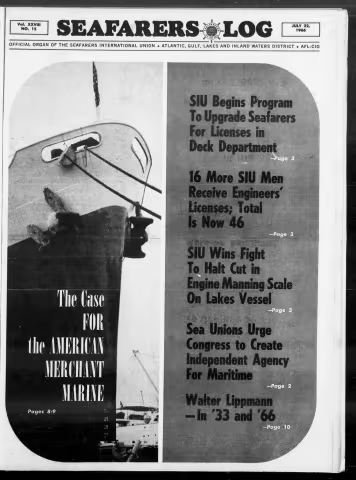
Issue Date
1966-07-22
Volume
28
Issue Number
15
Plaintext
Vol. XXViii
NO. 15 SEAFARERSALOG
OFFICIAL ORGAN OF THE SEAFARERS INTERNATIONAL UNION • ATLANTIC, GULF, LAKES AND INLAND WATERS DISTRICT . AFL-CIO
A.',,H •'« •
i 1
I '-i
Page Two SEAFARERS LOG July 22, 1966
I < '
• r
I i-itr .
Jil.
m
^ Hall Testifies In Behalf of Maritime Labor
Marine Unions Tell House Committee
Marad Must Be Independent Agency
Seafarers International Union President Paul Hall, testifying for maritime labor before the House
Merchant Marine Committee urged the creation of an independent Federal Maritime Administration.
Hall told the Committee at its hearing last Wednesday that the AFL-CIO maritime unions favored
the enactment of two bills,
V
H.R. 15567 and S. 3530 be
cause they most accurately em
body the proposals for an inde
pendent agency made by the un
ions in a joint position submitted
by Hall before the Senate and
SlU OH Annate
Wm NLRB Vote
h Alaska ReRuery
The SIUNA-afiiliated Interna
tional Union of Petroleum Work
ers has won an important Na
tional Labor Relations Board
election establishing them as bar
gaining representatives for em
ployees at the Standard Oil Re
finery, Kenai, Alaska.
The lUPW win came despite a
determined effort by the Stand
ard Oil Company to urge work
ers to vote no-union. Two weeks
before the election, held last
April, the company sent an in
dustrial expert into the field to
convince refinery workers to vote
against union representation. The
effort failed. Also involved in the
election was the Alaska Petroleum
Craft Council.
The lUPW has also won bar
gaining rights for employees at
the Polar Oil Field Services Co.,
a new oil field servicing contrac
tor groups operating in Alaska.
The signing up of both these
groups, an lUPW representative
said, was "most important to our
plan to organize the whole of the
Alaskan Oil industry."
The union has reached a ten
tative agreement with manage
ment for employees at Polar Oil
and is presently negotiating with
Standard Oil for the refinery
workers.
House Subcommittees on Gov
ernment Operations on May 18
and 19 in regard to the proposed
new Department of Transporta
tion.
Under a proposed reorganiza
tion of the nation's transportation
agencies, the departments dealing
with rail, air and maritime would
be incorporated in one Depart
ment of Transportation.
The House committee, chaired
by Representative Edward A. Gar-
matz (D-Md.) has begun hearings
on a number of measures all ba
sically designed to remove the
Maritime Administration from the
Department of Commerce and to
reconstitute it as an independent
Federal agency.
Hall, speaking for all seamen,
shipyard workers, longshoremen
and allied maritime workers, rep
resented by the AFL-CIO's Mari
time Trades Department, Metal
Trades Department and Maritime
Committee warned that if the
Maritime Administration were in
cluded in the Department of
Transportation, the nation's mari
time industry "would be complete
ly swallowed up within the mam
moth, complex structure of the
proposed department."
The SIU president added that
"maritime concerns would be
shunted aside or pigeonholed in a
bureaucratic web, and no proper
representation would be given to
maritime's interest."
The American merchant mar
ine, he said, would have a much
better chance to survive and pros
per if its affairs were under the
jurisdiction of a Federal agency
whose sole interest centered about
the nation's merchant marine.
The companion bills supported
by the unions, H.R. 15567 and
S. 3530, were introduced by Con
gressman Frank M. Clark of Penn
sylvania and Senator E. L. Bart-
lett of Alaska. They call not only
for an independent Maritime Ad
ministration, but for a relatively
autonomous Maritime Subsidy
Board within the Maritime Ad
ministration, with full and final
authority to determine all subsidy
matters.
AFL-CIO Calls For Halt in Subsidy
Of Interstate Plant Piraty Pratlsce
WASHINGTON—Congress should act now to expose the
scandal of interstate plant piracy and end the federal subsidy of
the destructive practice, the AFL-CIO has urged.
More states and bigger com- ^
panics are resorting to the device
of tax-free municipal bonds to
achieve instant development and
easy profits, according to an ar
ticle in the current issue of the
AFL-CIO American Federation-
ist.
Frank Fernbach, assistant di
rector of the AFL-CIO Depart
ment of Research, points out in
his article, "Subsidized Plant Mig-
Philip Pearl Is Dead at 62;
Was Veteran Union Publicist
WASHINGTON—^Philip Pearl, a veteran of nearly 30 years in
public relations for the trade union movement and first director of
public relations for the AFL-CIO, died of a heart ailment in a Silver
Spring, Md., hospital on July 9 ^
at the age of 62. At his death
Pearl represented the AFL-CIO
Maritime Trades Department
along with a number of other
major labor unions and AFL-CIO
constitutional departments.
Pearl's death was mourned by
AFL-CIO President George
Meany, who said Pearl "was a
devoted trade unionist, a fine and
decent man and a warm personal
friend. The trade union move
ment and all who knew him per
sonally mourn his untimely death."
A native of New York, Pearl
entered the newspaper field as a
reporter for the World and the
American and later the Universal
Service, a news-gathering agency.
In 1937, he went to the AFL
as its first and only public rela
tions director. He was founding
editor of the AFL News-Reporter,
the federation's first weekly news
paper.
In 1955, President Meany ap
pointed him as director of public
relations for the newly merged
AFL-CIO. His health failing.
Pearl left the AFL-CIO post in
1957 but remained active in labor
public relations.
In addition to representing the
MTD, Pearl represented the AFL-
CIO Building and Construction
Trade Department, the Plumbers
and Pipefitters union, the Retail
Clerks International Association
and many other unions.
In the Thirties, while he was
with Universal, Pearl went to Al
bany, N. v., as a correspondent.
There he became closely associ
ated with the then Gov. Franklin
D. Roosevelt. When Roosevelt
became President, Pearl followed
him to Washington as White
House correspondent for the news
service.
Pearl is survived by his widow,
Mrs. Marilyn Miller Pearl; a son,
Jonathan; a daughter, Elizabeth,
and a sister, Mrs. Jacob R. Men-
delbaum.
ration," that the problem appears
to be getting out of hand.
He writes that this new econom
ic "war between the states" has
gathered force since 1960. Fif
teen more states, making a total
of 30, have acted to authorize
the issuance of tax-free industrial
development bonds. Some states
claimed they acted reluctantly and
in self-defense, he noted.
Fernbach pointed out that in
dustrial bond sales more than
doubled to $85 million between
1960 and 1962. In 1965, they
totaled $216 million. In the first
four months of 1966 alone, these
sales ran to $228 million and ex
ceeded last year's total.
Fernbach said these estimates
of the Investment Bankers Asso
ciation are conceded to be under
stated. A New York investment
firm in this field puts last year's
sales at about $1 billion.
What has been occurring, Fern
bach explains, is a perversion of
what was originally a constructive
federal tax exemption. The fed
eral government long ago granted
state and local governments the
right to issue tax-exempt bonds
for the purpose of helping them to
reduce their costs when borrowing
to finance public facilities like
schools, hospitals and roads.
Low Interest Rates
Because the buyers of such
bonds are not required to pay any
federal tax on the interest they
receive, state and local govern
ments can offer the securities at
a low interest rate. The federal
government thus forgoes these
tax revenues.
"This is clearly a federal sub
sidy that, in effect, all American
taxpayers underwrite," Fernbach
said.
Report of
International President
by Paul Hall
For many years foreign-flag shipowners with an eye on fat Amer
ican cargoes have been critical of this country for giving direct aid
to its merchant marine.
The most criticized aspect of our aid to the American-flag fleet
has been the 50-50 Cargo Preference Act. Under this law at least
fifty per cent of all Government-aid cargoes sent overseas must be
shipped in American vessels.
In order to get this law passed the maritime industry had to band
together and fight opposition within Government and without. Foreign-
flag shipowners and their governments, supported by various U.S.
agencies, sought to block passage of the cargo preference requirement.
Even after we won the fight for half of these cargoes, special interests
within the Government found ways to circumvent the law and deprive
the industry of its fair share of cargoes.
Now a Maritime Administration report has pointed out some in
teresting facts concerning flag-preference and cargo support. Many of
the nations who have been bitterly attacking us for the 50-50 cargo
Preference Act, are practicing it themselves. These nations, particu
larly the Latin American countries, have been more successful in
protecting their maritime industry than we have.
Guaranteeing cargoes for the U.S. merchant fleet is just as essen
tial to the maritime industry as placing tariffs on manufactured goods
threatened by the import of foreign-made goods sold at cut-rate
prices.
The American Merchant Marine is just as important a part of the
national economy as other U.S. industries and deserves the same
Governmental protection they enjoy.
a * a
The passage of the Medicare Bill granting health benefits to the
elderly through Social Security has brought a great sense of accom
plishment to the AFL-CIO which has been fighting many years for
just such a measure.
The Medicare Bill has broken away the years of confusion cast
upon the idea of making certain that our senior citizens, through the
aid of the Government, could obtain decent medical care. No longer
will they have to fear financial ruin when they are beset by the
illnesses that accompany old age.
Just recently a magazine article probing the long history of AMA
antagonism towards social health benefits |or the elderly pointed
out that if the AMA had spent the money it used in fighting Medi
care for training doctors, they would have financed the educations
of 9,000 physicians, enough to care for six million people.
The Medicare Bill as it stands now is inadequate in many areas.
It does not provide for much needed fringe medical services such
as glasses, hearing aids or dental plates. These health aids are often
beyond the limited budgets of old folks who suffer without them.
Instead of criticizing needed health legislation, more should be done
by the AMA to help provide proper medical facilities for our citi
zens. There is a serious lack of nurses, hospitals and doctors in this
country. As one of the most advanced nations in the world we are
woefully behind fess advantaged countries when it comes to decent
medical facilities for our citizens. We should all be working together
to eliminate this evil instead of fighting each other.
Building U.S. Skips in Foreign Yards
Is 'Trojan Horse Program/ Polly Says
Congressman Thomas Pelly (R-Wash.) in a recent speech before
the House of Representatives urged Congress to insist that all
naval vessels be built in American shipyards. He characterized
the building of military vessels
in foreign yards as a "Trojan
horse program."
Pelly, a member of the House
Merchant Marine Committee, re
ferred in particular to the recent
successful bid by Fairfields of
Glasgow, Scotland to build two
survey ships for the Navy Depart
ment. He pointed out that the
British have continued to allow
their ships to transport goods,
including armaments, to the North
Vietnamese.
Pelly said that "no great world
power with any sense would ever
depend upon foreign nations to
supply it with weapons or facili
ties or ships of war. Two naval
survey ships might not seem im
portant and not too serious were
it not a precedent. Once the
United States establishes a new
policy the damage will have been
done."
Fairfields shipyards Underbid
two United States yards to win
the Defense Department contract.
Pelly condemned the foreign yards
as low wage outfits.
He also took exception to the
"holier-than-thou attitude of John
Bull" referring to the mounting
criticism of United States Viet
Nam policy in England.
Since Britain has said she will
not sell arms to us. Pelly said that
they should follow through in their
ideals and refuse to build military
vessels for us, even though they
might be of a non-combatant
nature.
The Congressman called for the
House Comniittee on Armed Serv
ices to hold hearings on his bill
to require all naval vessels to be
constructed in American ship
yards.
, I
.. i
H
r<
M
-<
-<
-1
-«
f
•*l.
1
•i;
July 22, 1966
SEAFARERS LOG Page Tluree
•,'^1
j : •
T<
• { /
i
•*,
•4
Sixteen More Pass Coast Guard Exams
46th SlU Member Is Licensed
To Sail As Ship's Engineer
Twelve more SIU men have passed U.S. Coast Guard examina
tions and have been issued their engineer's licenses after attending
the training school jointly-sponsored by the SIU and District 2 of
the Marine Engineers Beneficial
Association. This brings the
number of SIU men who have
obtained their engineers licenses
to 42.
MuUeri Black
The qualifying Seafarers are
sailing or are about to' sail in
engineers' berths aboard. Ameri
can-flag ships.
Eleven of the men who re
cently passed their Coast Guard
examinations were licensed as
Third Assistant Engineers, while
the twelfth man received a Second
Engineer's license.
The new third Engineers are:
Ernest Mulieri, 47 years old,
an SIU member since 1948 who
sailed as fireman-water tender;
James Black, 32, who sailed
as a fireman-water tender and has
been a member of the SIU since
1957;
Christopher A. Bobbe, 42, who
sailed as an electrician, oiler and
fireman-watertender as an SIU
MEBA, DISTRICT 2
UPGRADING
In addition to the 43 Seafarers
who have obtained their engi
neers licenses as a result of the
joint SIU-MEBA District 2 train
ing program, 25 members of
MEBA District 2 have raised
their licenses after preparing at
the jointly operated school.
Of the 25 MEBA men up
graded, nine raised their licenses
to Chief Engineer, seven to First
Assistant Engineer and nine to
Second Assistant Engineer.
A total of 68 men have there
fore received either their original
licenses or upgraded existing li
censes since the program started.
S/U Launches Program to Assist
Deck Seafarers to Obtain Licenses
Seafarers sailing in the deck department have an unusual opportunity to obtain deck officers
licenses as the result of a new training program now being offered by the SIU's Harry Lundeberg School
of Seamanship. Applications are now being accepted from qualified SIU men who are interested
member for 18 years;
Miguel A. Velez, 55, a union
Bobbe Velez
member since 1948 who has sailed
as a fireman-watertender and oiler;
(Continued on page 10)
in upgrading.
The unprecedented SIU deck
officers training program will en
able Seafarers in the deck depart
ment to receive a course of in
struction to prepare them to sit
for the Coast Guard licensing
examination.
SIU deck department men in
terested in preparing for their li
censes should make application at
once at any SIU hall or by writing
directly to SIU headquarters at
675 4th Avenue, Brooklyn, N. Y.
11232. The telephone number is
HY. 9-6600.
Applicants can begin receiving
instruction at any time. The pe
riod of instruction will be deter
mined by each member's individ
ual ability and knowledge, and
the instructors' satisfaction of his
readiness to take the examinations.
The training program was in
stituted in line with the SIU's
objective of encouraging and as
sisting unlicensed personnel to up
grade themselves.
Seafarers can participate in the
course of instruction at no cost to
themselves. They will be pro
vided with meals, hotel lodgings
and subsistance payments of $110
per week while in training.
Cong. Edwards Says Lack of Adaiiaistratioa Support
Is Major Maritime Problem, Urges Positive Policy
WASHINGTON—Representative Jack Edwards (R-Ala.), a member of the House Merchant
Marine Committee, sees strong indications that the Joint Committee on the Organization of Congress
will recommend abolition of the House Merchant Marine Committee.
"The Johnson administration f
will be dealing still another seri
ous blow to the U.S. Merchant
Marine if it allows the House
Merchant Marine Committee to
go out of existence," Edwards said
in a statement issued through his
office recently.
"It would be a gigantic irony
if the President would allow the
merchant marine committee to die
when it appears to be the one
government group trying to alert
the nation to the merchant ma
rine problem, and the one group
trying to solve that problem in
the face of almost total lack of
presidential interest and support,"
he said.
Merchant Marine Committee
members have stressed in recent
years the need for revitalization
of the U.S. Merchant fleet.
"We (the government) have no
policy for revitalization of the
merchant marine, and no sign
that we are devising a policy,"
Edwards said. "Our merchant
marine fleet strength is going
bankrupt, and nobody in the ad
ministration seems to care."
Edwards proposed three steps
as a beginning toward develop
ment of a working policy for the
merchant marine: ^ve the mari
time administrator independent
status in the government, appoint
a topnotch administrator, and re
tain the house merchant marine
committee.
Edwards said President John
son does not appear to compre
hend the seriousness of the mer-
Congressman Jack Edwards (left) discusses problems of merchant
marine with SIU Vice President Lindsey Williams (second from right),
SIU Mobile Agent Louis Neira (right) and SIU New Orleans Agent
Buck Stephens. The SIU representatives met with the Alabama con
gressman in his office while they were in Washington to attend confer
ence called to launch campaign to revitalize U.S. shipping industry.
chant fleet problem.
"I call upon him to exert the
leadership needed now to give
this nation the pride and excel
lence in our merchant fleet which
we used to have and which is a
vital need of our national secu
rity today," Edwards said.
Edwards also stated in re
marks made earlier that. Russia
is well ahead of the U.S. in the
"wet war" for sea supremacy. He
called for a rejuvenation of the
U.S. Merchant Marine as an an
swer to the Soviet threat.
He said that "it is essential that
we halt the drift and deterioration
of our merchant marine ... to
meet the challenge presented by
the Soviet Union."
This in-training assistance is the
same as available to engine de
partment Seafarers who are en
rolled in the union training pro
gram to prepare engine depart
ment men for their licensed engi
neers examination. The course
of instruction is patterned after
the engineer's training program
which has had such successful re
sults.
In order to qualify for the train
ing course. Seafarers must:
• Be nineteen years of age or
over;
• Have 24 months of watch
standing time in the deck depart
ment and an ABs endorsement
on their seamen's papers.
In addition to achieving its ob
jective of assisting qualified deck
department men to obtain their
deck officers licenses, the SIU
deck training program will help
alleviate the shortage of deck of
ficers arising out of demands made
on the American merchant mar
ine by the Viet Nam conflict.
The SIU is hopeful that it can
work out a reciprocal program
with licensed officers unions sim
ilar to the arrangement between
the SIU and MEBA District 2
which would give deck men ob
taining their licenses credits for
their pension and welfare benefits
built up as unlicensed seamen.
Toward this end the SIU will seek
to open discussions with the Mas
ters Mates and Pilots and Ameri
can Maritime Officers unions.
The new deck department train
ing program will be located at
SIU headquarters in Brooklyn. Ex
perienced, qualified instructors
will be responsible for the training.
Seafarers interested in the pro
gram can begin their course of
study at any time. Full details for
applications for the deck officers
training program can be obtained
at any SIU hall.
SIU Wins Fight to Prevent
Cut In Manning of Lakes Ship
The SIU has won an important victory in its fight against any
arbitrary reduction of manning scales on Great Lakes vessels.
The Coast Guard has issued a decision meeting the union's de
mand for maintaining the three
oilers on watch aboard the SIU-
contracted MV Diamond Alkali.
The regulatory agency's deci
sion, of which the union was in
formed of last week, reverses a
previously issued Coast Guard
temporary manning certificate for
the vessel which arbitrarily eli
minated the oilers on watch, sub
stituting for them one Q.M.E.D.
(Qualified Member of the Engine
Department).
In announcing its decision the
Coast Guard said it had placed
observers aboard the vessel and
found that the oiler "actually per
formed the functions outlined" in
the SIU's presentation.
The Coast Guard had not ad
vised the union of the reduction
in its requirement and the union
learned of it through a commu
nication from the company, ask
ing for an engine room personnel
reduction in accordance with the
Coast Guard temporary certifi
cate. The Coast Guard arbitrarily
and unilaterally made a reduction
upon the company request.
As a result of the Coast Guard
action on the Diamond Alkali and
the reduction of manning scales
aboard Lakes vessels under con
tract to other unions, the SIU and
the other maritime unions met
with the Coast Guard in Washing
ton on May 14 to register united
opposition to any arbitrary reduc
tion of Great Lakes manning
scales.
Appearing for the SIU were
Great Lakes District Secretary-
Treasurer Fred Farnen, SIUNA
Vice-President William Jordan,
and Jack Bluitt. Representatives
also were present from the AFL-
CIO Maritime Trades Department,
the Maritime Committee, Marine
Engineers Beneficial Association,
Steelworkers, and the
United Mine Workers.
In protesting the Coast Guard
temporary manning certificate to
eliminate oilers on the Diamond
Alkali, the SIU pointed out that
oilers' duties and functions have
continued the same since the ves
sel was retrofitted in 1964.
In presenting its position, the
SIU submitted a documented pic
torial study of the duties of the
Diamond Alkali oilers, and the
need for continuing those duties,
as a result of which the Coast
Guard announced it would review
its position. (A feature on the
Union's documented study was
carried in the Seafarers Log on
June 10.)
SEAFARERS#LOG
Jul/ 22, 1966 Vol. XXVlii, No. 15
Official Publication of the SIUNA
Atlantic, Gulf, Lakes & Inland Waters
District, AFL-CIO
Executive Board
PAUL HALL, President
CAL TANNER EARL SHEPARD
Exec. Vice-Prea. Vice-President
AL KERR LINDSEY WILLIAMS
Sec.-Treas. Vice-President
ROBERT MATTHEWS AL TANNER
Vice-President Vice-President
HERBERT BRAND
Director of Organixing and
Publications
Managing Editor
MIKE POLLACK
Assistant Editor
NATHAN SKYER
Art Editor
BERNARD SEAMAN
Staff Writers
DON BEVONA
PBrrra WEISS
Pikllihed bIwNkly at 810 Rhod* lilud Avsnn
N.E.. Washington, D. C. 20018 by tho Sufarors
Intemailonal Union, AtlantM, Golf, Lskis and
inland Wators District, AFL-CIO, 675 Foirth Avt-
nao, Brooklyn, N.Y. 11232. Tel. HVaclnth
9-6600. Second class postage paid at Washing
ton, D. C.
POSTMASTER'S ATTENTION: Form 3579 cards
shoild he sent to Seafarers International Union,
Atlantic, Gilf, Lakes and Inland Waters District,
AFL-CIO, 675 Foirth Asenis, Brooklyn, N.Y.
11232.
f-
^-,1 .a
: i'::
L.v
•ill
I
t
I
oie^i.
Page Four SEAFARERS LOG July 22, 1966
• i|;i
m:
SlU Urges Fair Shake For Shipping
In Federal Food Transport Policy
The Seafarers International Union has urged that all segments of the U.S. economy, including the
shipping industry, be allowed to benefit from national policy relating to overseas transportation of
agricultural commodities. <$>• The SIU stated its position
before the National Advisory
Commission on Food and Fiber
which has been holding hearings
on various aspects of U. S. agri
cultural and related trade policies.
The commission was created by
President Johnson to consider
United States policy for the trans
portation of foods and fibers as
well as technical assistance and
surplus food distribution to needy
nations.
A1 Maskin, SIU Research Di
rector, presented the union's posi
tion a week ago at a commission
hearing in New York on July 13.
The SIU spokesman told the com
mission that today Government-
financed agricultural exports make
up the major portion of the car
goes available to the American-
flag merchant marine.
The SIU position explained
that 30 years ago when the Mer
chant Marine Act was passed the
American-flag merchant navy
mostly carried mixed general
cargo of the "so-called package
variety" and little agricultural
commodities.
Today, the SIU pointed out,
American-flag ships "because of
the manner in which our Govern
ment has allowed the merchant
fleet to deteriorate—are carrying
only about eight per cent of our
total foreign waterbome com
merce."
Half of this eight per cent con
sists of Government-aide cargoes,
three-quarters of which are agri
cultural shipments sent abroad by
the Department of Agriculture,
the SIU stated.
".. . it is easy to see how impor
tant these Government-financed
agricultural cargoes are to the
American-flag merchant marine,"
the SIU continued. "Even our
subsidized liners, which receive
Government assistance in both
construction and operating
spheres, probably could not con
tinue to survive without aid car
goes, since they make up nearly
half of all export cargoes which
they carry."
Under the 50-50 Cargo Prefer
ence Act, half of all Government
foreign-aid cargoes shipped over
seas must be sent in American-
flag ships.
The SIU explained to the com
mission that the nation's unsub-
sidized fleet "which now makes up
two-thirds of our total active
fleet" is dependent for its very
existence on agricultural cargoes.
Government-aid shipments, the
Union said, make up "over 70
The Pacific Coast
by Frank Drozak, West Coast Representative
More than 90 per cent of the West Coast's eligible hospitals have
been approved under Title 6 of the Civil Rights Act of 1964 for partici
pation in the National Medicare program which went into operation
last week. A total of 90.8 per cent have been approved as of June 17,
1966, according to the United States Department of Health, Education
and Welfare.
San Francisco
Shipping here in the port of
very active San Francisco is still
and we have plenty of jobs open
for AB's, Oilers, FWTs, Electri
cians, Cooks and Bakers.
Paying off during the last period
were the RIdgefield Victory, Dela
ware, John €., Montpelier Vic
tory, and Mount Vernon Victory
in Honolulu.
The Bowling Green, Trans
pacific and Coeur De Alene were
signing on crews while the Port-
mar was in transit. Ships sched
uled to come in soon include the
Pecos, Hercnles, Free America,
Ames Victory, Our Lady of Peace
and Meridian Victory.
Walter H. Sibley, an SIU Bos'n
who just pulled in after an eastern
seaboard vacation, is ready to sail
on the first ship he can get to the
Far East. Brother Sibley is a 20-
year SIU man. Charies Faircloth
came into town after a short vaca
tion in Mobile to catch the Bos'n's
job aboard the freighter Delaware.
Brother Faircloth, with the SIU
for 22 years, has been shipping
from the West Coast for the past
two years.
Wilmington
Shipping is extremely good from
this port but we still have plenty
of jobs for all ratings. The Iber
ville and Penn Victory paid off
during the past shipping period
and eleven ships were in transit.
Carrol Sypber received his Sec
ond Mate's license a few days ago
and wasted no time in shipping
out. He said he was very pleased
to be making his first trip as a
mate on an SlU-vessel and hopes
to ship out here regularly so he
can keep track of his old ship
mates.
Seattle
Shipping has been extremely
good for all ratings and indica
tions point to continued good
shipping.
Sullivan Arsbon
The freighters Mauldin Victory,
Duke Victory and Fairisle had
pay-offs since the last report and
a total of six ships were in transit.
John Sullivan, a 20-year SIU
member, made his last trip out
as an oiler aboard the Delaware.
Jack Ryan, who has been an SIU,
member for 16 years, is now on
the beach waiting for the first
bosun's job that hits the board.
Jacob Arsbon, now sailing with
the Seattle, dropped by to let us
know that it is a fine ship with
a fine crew.
per cent of all exports by United
States tankers and some 96 per
cent of all exports carried by
United States dry-cargo tramps."
The SIU maintained that the
commission should first consider
the importance of maintaining the
"defense and commercial value of
the American" fleet in formulating
its policies.
"We should make every effort
to increase the volume of our ex
ports, including agricultural com
modities both for economic and
humanitarian reasons," the SIU
position pointed out, but not "at
the expense of a vital and integral
segment of our economy and our
national defense structure—our
maritime industry."
Rep. Keith Urges
U.5. Launch Study
On Coust Fishing
The United States is failing to
develop its coastal fishing re
sources, the "richest and most ex
tensive" in the world.
Representative Hastings Keith
(R-Mass.) charged in a speech be
fore the House recently as he
urged passage of a Senate resolu
tion authorizing a survey of United
States fishing.
The resolution (S. J. Res. 29),
now before the Fish and Wildlife
Conservation Subcommittee of the
House Merchant Marine and Fish
eries Comimttee, would allocate
$200,000 to start an inventory on
the population and migration of
fish along the nation's coasts.
Representative Keith said that
without such a survey "we cannot
make reasonable regulations for
fisheries, nor can we exploit these
resources."
He said that America's coastal
waters could yield 28 billion
pounds of fish annually instead of
the present five billion pound haul.
Proof of the richness of the fish
in our coastal waters is the fact
that many foreign fishing vessels
are being attracted to the waters
off the United States.
"My own area—Cape Cod and
the Islands—has had this problem
for several years and we are, of
course, aware of the potential
problem of foreign fishermen who
may not follow good conservation
principles and over whom our reg
ulations have no control," he said.
The convention, he said, recog
nizes a nation's basic right to uti
lize and protect its coastal fishery
resources and added that unless
action is taken "it is likely that the
foreign fisherman will not auto
matically practice the convention
measures that we feel are neces
sary."
Representative Keith said that
the United States had better take
quick steps to implement the 1958
Geneva Convention on Fishing
and Conservation of the Living
Resources of the High Seas.
Without the Senate move being
passed. Representative Keith
pointed out, the United States will
not have the information it needs
for both conservation and exploi
tation of its rich seafood resource.
The Gulf Coast
by Undsey Williams, Vice-President, Gull Area
A five-million-bushel grain elevator is planned for the New Orleans
area. It will be built by the Farmers' Export Company and will have
facilities for receiving grain from barge, rail and truck as well as have
the necessary deep water berth for shipment overseas by ocean-going
vessels. Its location in this area will mean an increase of grain ships
through the port of New Orleans.
Also, the Dock Board has al
lotted more than $758,000 for
improvement of. and equipment
for, its port facilities. Part of the
allocation is for an engineering
study to improve various wharves
in the port.
New Orleans
Joe Savoca, who has been sail
ing for nearly 45 years, is on the
beach having just
completed two
trips on the Del
Campo as Bos'n.
After Joe settles
some family mat
ters he looks for
ward to another
Delta Line ship to
South America.
He said that, "the
Del Campo was a good ship, a
good run, and especially, a good
crew."
Chief Cook Woody Perkins left
the Alice Brown for medical rea
sons. He had nothing but praise
for the entire crew. TThe last eleven
months were spent on the Viet
Nam run. Woody says he will rest
a couple of months, then will look
forward to a steward's job on any
ship, any run.
Seafarer Nolan Savoie flew
home from LaGuaira, Venezuela,
where he left the Del Mar because
of kidney stones. Savoie is now
fit for duty and ready to ship.
Mobile
Two SIU oldtimers B. E. Dunn
and B. J. Brewer are on the beach
Savoca
here. Brother Dunn, who has been
shipping in the deck department
for the last twenty years, was last
on the Penn Vanguard carrying
flour to the Far East. Brother
Brewer, with twenty years in the
engine dept.. recently left the
Ocean Anna where he was Chief
Pumpman. Also Junior F. Aus
tin, who sailed as steward on the
Ocean Evelyn is now waiting for
a ship.
Enjoying his stay on the beach
is Chief Electrician J. D. Cantrell
who last sailed on the Alcoa
Mariner.
John E. Sam
uels, who recently
ended a tour on
the Fanwood as
chief cook, is re
newing old ac
quaintances
around the hall.
All hands were
glad to see Sea
farer Dan W.
Summer back in good shape after
a year in the hospital. Sommer's
last ship was the Penn Vanguard.
Houston
Waiting for a South American
run is A. B. C. Dammeyer whose
last ship was the Yellowstone.
Dammeyer made two trips on the
Yellowstone and said that he'd
like to get another .ship just like
her. Also taking in the Texas sun
shine is W. Cosgrove, most re
cently on the Coeur D'Alene
Victory which just returned from
the Far East.
Samuels
SIU Great Lakes District Vote
Gets Underway On August 1
DETROIT—The SIU Great Lakes District Credentials Com
mittee report on nominations for the 1966 union elections was
concurred in at ports holding regular Great Lakes District mem
bership meetings on July 18. ^
The report was submitted in
compliance with the Secretary-
Treasurer's Pre-Balloting Report
and the Union constitution.
The offices to be filled and the
qualifying nominees are: Secre
tary-Treasurer, Fred Farnen; As
sistant Secretary-Treasurer, Roy
Boudreau; Buffalo Agent, Stanley
Wares; Chicago Agent, Scotty Au-
busson; Duluth Agent, Don Bens-
man, Arnold Perry; and Frankfort
Agent, Floyd Hamner. (Frankfort
balloting is on a separate ballot
in accordance with the constitu
tion.)
In determining the eligibility of
all candidates, the Credentials
Committee checked the seniority
shipping records and the welfare
plan records, as well as the union
records.
The election will be held be
tween August 1 and August 31,
1966. Polling places will be lo
cated in all SIU Union halls in
Duluth, Chicago, Frankfort, Al
pena, Cleveland, Detroit and Buf
falo as well as aboard all SIU-
Great Lakes District contracted
vessels as per the constitution.
Members are reminded that they
must present their full union books
(in good standing) before they will
be allowed to vote.
Nomination notices and elec
tions notices were sent to all mem
bers at their last known address,
utilizing the union's records. No
tices were also sent to all SIU-
Lakes District contracted vessels
and union halls for posting.
Credential Committee members
elected on July 5 were Joseph
Arnold (Book No. 8680), Vern
Battering (Book No. 9508), and
Joseph Salisbury (Book No. 12-
710). The alternates were S. Quin-
livan (Book No. 8623), William
Doyle (Book No. 11753) and R. C.
Rafferty (Book No. 12781). Due
to the fact that J. Salisbury was
not present at 9:30 a.m. at head
quarters on July 16, 1966, he was
replaced by elected alternate S.
Quinlivan, in accordance with the
constitution.
In addition to having been sub
mitted and approved in those ports
holding regular Great Lakes Dist
rict membership meetings on July
18, 1966, the Credentials Commit
tee report has been posted in all
Great Lakes District Union halls,
in accordance with.Article XIII,
Section 2 of the constitution.
Juljr 22, 1966
The Great Lakes
FJA SEAF/ARERS LOG Page Five
by
Al Tanner, Vice-President and Fred Farnen, Secretary-Treasurer,Great Lakes
Election ballots have been mailed to all members of the Great Lakes
District at their last known addresses, as well as all contracted vessels
and all SIU halls throughout the Great Lakes District for posting. On
June 10th the Seafarers' Log carried an article giving details on the
nomination and election procedures.
The Defense Department an
nounced that the Great Lakes
ports will be given an even break
in competition for government
shipping of military cargoes. Sen
ator William Proxmire (D-Wis.)
applauded the decision stating that
it was long overdue, but mighty
welcome. Proxmire was one of
the 12 senators, who last month
urged the department to include
Great Lakes traffic in competi
tive bidding on military cargo.
Dredging operations have been
completed, opening the Calumet
River to bigger ocean-going vessels
for the 6.2 miles into Lake Calu
met. Deepening of the 200 foot
wide channel from 21 to 27 feet
means full utilization of the St.
Lawrence Seaway into Chicago by
ships of the 25,000 ton class, and
full use of the port by big lake
carriers.
The tanker, Transbay, paid off
in Lorain, Ohio which was a
surprise at this time of the year,
since most deep-sea ships are out
on the West Coast. The crew had
been aboard for five and one-
half months. All hands consid
ered the trip a good one. The
steward department was rewarded
with a vote of thanks from the
crew.
The Transbay will be cut in
half and a 70 foot midsection will
be added. It is anticipated that
the job will take a couple of
months. Some time in September
the Transbay will probably crew
up again.
A complete rebuilding of the
'St. Lawrence Seaway is distinctly
on the maritime horizon, Dr.
Pierre Camu, President of the St.
Lawrence Seaway Authority of
Canada, told a meeting of the
International Association of Great
Lakes Ports of projected plans
for a new and improved Seaway.
'$>-
He described plans for a series
of four "super-locks" on the all-
Canadian Welland Canal between
Lake Ontario and Lake Erie. He
forecast that the canal would be
able to accommodate over a 100
million tons of cargo in a naviga
tion season. Its capacity is ap
proximately 60 million tons and it
is expected to rise to 70 million
tons after the completion of cur
rent improvements due in 1970.
Dr. Camu made it clear that
Canadian authorities are not think
ing in terms of only domestic
Great Lakes traffic. He pointed
to the campaign of Japanese ship
builders to produce ever larger
super-carriers as the trend toward
newer efforts in transportation
economies. An additional advan
tage of enlarging the locks to ac
commodate the new super-carriers
would be that they could handle
two conventional ocean ships at
a time, thus improving traffic
movement along the Seaway.
Eventually, Dr. Camu foresees
eliminating the seven locks by
replacing them with a concept of
four "super-locks."
latin American Nations Aid Fleets
Through Cargo Preference Laws
WASHINGTON—The United States is not the only nation that supports its merchant marine
through cargo preference laws and other assistance, a recently released Maritime Administration
study indicates, but it has been one of the least successful in channeling cargoes to its own vessels.
The report revealed that many f
Latin American nations are also
giving extensive aid to their in
dividual national fleets. These
South American fleets, the report
notes, are also for the most part
government-owned and controlled.
Critics within the United States
Government have been attacking
the nation's 50-50 cargo prefer
ence laws which, require that half
of all U. S. Government-generated
cargoes be carried in American-
flag ships. These critics claim that
our 50-50 laws are offensive
toward other maritime nations and
engender hard feelings toward the
United States which could result
in retaliatory action in the area of
shipping.
Many of the Latin American
nations who complain most bitter
ly about U. S. cargo preference
laws themselves offer cargo pref
erence and other subsidy aids to
their own national fleets. Some
have offered these aids for genera
tions, and many of the Latin
American cargo preference regu
lations are far more stringent than
the U. S. law.
In general these nations have
also been far more successful than
the United States in guaranteeing
cargo for it's ships, the report
notes.
The U. S. for instance, has been
Cov't Charges Doctors' Group
With Anti-Trust Conspiracy
The College of American Pathologists, an association of about
4,500 medical doctors specializing in pathology, has been charged
with anti-trust conspiracy by the Justice Department. Members of
the college own virtually all the ^
20,000 commercial medical lab
oratories in the U. S.
Attorney General Katzenbach
said that the public has been
forced to pay excessive prices for
blood tests, urinalysis and other
SIU Hosts Japanese Unionists ...
Members of the Kanagawa Regional Labor Team from Japan visited
SIU facilities in the port of Detroit recently on a two-day inspec
tion tour. The group is shown at Metropolitan Airport prior to
departing for New Orleans. Left to right, are, interpreter Matsuo;
K, Koono, jsresident of the Toshiba Workers Union; .T. Yoshida,
of the All Japan Seamen's Union; Pat Finnerty, representing the
SIU Great Lakes District; T. Yashuda, of the Yokohama Mitsu
bishi Heavy Industrial Workers Union; Fred Dough from- the
inited States Labor Department; H. Kuze, of the All Japan Auto
medical laboratory services. The
laboratories have sales totaling in
excess of $3 billion.
The civil suit filed by the Jus
tice Department in Chicago,
stated that the association and its
members are engaged in a con
spiracy aimed at complete control
of all commercial medical labora
tories solely for the profit of path
ologists.
The College was also charged
with making price-fixing agree
ments under which prices for
laboratory services have been
maintained at artificially high
levels and under which prices for
goods and services purchased by
laboratories from hospitals and
other institutions have been main
tained at artificially low levels.
As a result of these actions, the
Justice Department charged, the
public has been forced to pay
higher prices for medical labora
tory services and for insurance
covering these services. The De
partment said that laboratories not
operated solely for the profit of
pathologists, are prevented from
expanding their markets because
of the unreasonable restraints im
posed by the College of Pathol
ogists.
The Justice Department has
asked for an injuction against
further .monopolistic practices by
the College and an order requiring
whatever action is judged neces
sary to restore competition to the
laboratory testing industry.
able to attract only 8.3 percent of
its international waterborne com
merce to U. S.-flag ships. Nicara
gua on the other hand, has been
able to attract 25 percent of its
foreign waterborne trade to its
own vessels. Columbia has suc
ceeded to the tune of 30 percent.
To do this, these nations have
provided their merchant fleets
with such varied indirect aids as
favorable tax rates, accelerated
depreciation, loans at low inter
est rates, preference arrangements
and the reservation of their cabo
tage trade to ships of their own
registry—plus the direct assistance
of operating and construction sub
sidies.
The principle means of support
ing these fleets was found to be
through cargo preference how
ever. The report found that be
tween 1964 and 1965 the gross
tonnage of 15 Latin American
seagoing nations increased by
676,000 gross tons or better than
9 per cent.
The report admitted that "as
sistance in one form of another to
a nation's maritime industries has
been accepted as a necessity by
many governments.
"Other nations whose entry in
to maritime affairs was more re
cent, found that if such industries
were to survive in one of the most
competitive of international busi
nesses, they too would have to
extend one or more kinds of
assistance to their shipbuilding in
dustries."
The Atlantic Coast
by Earl (Bull) Shepard, Vice-President, Atlantic Coast Area
A recent newspaper article pointed out that extreme right-wing
groups will attempt to infiltrate legitimate democratic organizations in
the hope of eventually controlling them.
The Minutemen, Birchers and others of the same like have failed
to sell their trash on the open market of American opinion and now
will resort to subversion of legi- ^
timate groups. Labor members
who have fought hard for their
rights as union men should re
member that these are the same
people we have had to fight since
the beginning of the labor move
ment; only the names have
changed.
Philadelphia
John Pierce is spending a week
with his family before he starts
shipping again.
Rick Rest is ready
to go with the
first bosun's job
that appears. Jim
my Chadzak said
that he would like
to ride a coal ship
come the end of
the month. An
thony Adomatis
expects to be fit for duty and
ready to ship in the near future.
Chadzak
New York
Stopping by the hall to see old
friends after paying off the Globe
Carrier in Norfolk was J. R. Shan
non. He plans to take a rest be
fore his next trip. O. P. Oakley is
also taking a small vacation prior
to looking for his next ship. Broth
er Oakley was last on the Platte
where he was chief steward for
a year. P. J. Garcia is on the
beach waiting for a bos'n's job
heading for Puerto Rico. Enjoy
ing the heat wave with Garcia was
F. Teti who dropped by to say
hello.
Baltimore
Shipping has been very good
during the last period and it ap
pears that it will continue for
the next two weeks. Ascension
Torres, a Seafarer since 1948, is
on the beach waiting for an oil
er's berth. Torres was last on
the Chilore as an oiler. Seafarer
Oliver Lewis recently left the
Yorkmar to get a physical check
up. He's ready now for any run
that appears on the board. Lewis
has -been a union member since
1944. Also watching the board
for a good job is Ira Wilioughby,
Jr. His last ship was the Alcoa
Master.
• Norfolk
Looking forward to a well-
earned rest is Walt Butterton after
a long trip as bosun on the Duval.
Also, recently off the Duval is
Carl Carlson who would like to
sign on the ship again when she
crews up after a ten day lay up.
Edwin Thomas is now fit for duty
and hoping for a fireman's job
soon. Looking for a steward's job
is John Harris. His last ship was
the Eagle Traveler.
Boston
Armond Ramos watching the
board. Armond says he will take
first job that
shows. After eight
months on the
beach Paul Nor
ton is looking for
a floating hotel.
Amos Buzzelle is
anxious to get to
sea again. Buz
zelle was last on
the Rohin Gray
Ramos
as third cook.
Puerto Rico
A month long stand against
participating in Medicare by 25
Puerto Rican private hospitals
ended last week when the U.S.
Labor Department stated that
existing federal minimum wages
would not apply to hospital per
sonnel. Also in regard to Medi
care the Department of Health
said that they will pay most of the
bills not covered by Medicare in
cases involving impoverished pa
tients.
Eugenio Nunez took a brief
rest after an extended stay on
the Alcoa Explorer. Calixto Gon
zalez was on the same ship and
is ready to go again.
Page Six SEAFARERS LOG July 22, 1966
QUESTION; Have you learned
any foreign languages during
your years of sailing.
Mashack Battle: Yes, French
and Spanish. I found learning
Spanish easiest
since I had stu
died it in high
school. A langu
age is learned fas
ter when you
have to speak it
to get along. Hav
ing shipmates
who speak a for
eign language also helps a per
son to become fluent in a particu
lar language. However, in most
countries you will find that the
people speak at least a little Eng
lish.
^l>
Adam Swiszczowski: I learned
Portuguese after a number of
trips to Brazil. I
also know a little
Polish and a little
French. The Pol
ish I learned at
home as you
might guess. The
French I picked
up around the
M e d i t e r r a-
nean ports that I have visited dur
ing my years of sailing. I find
that English is good almost every
where, and it seems that Spanish
is second as far as general world
wide usage.
Chuck Ellis: No, I never have
learned a foreign language through
sailing. However,
I think that this is
because, of all the
countries I've
been to I have
been able to get
along with the two
languages I al
ready knew, Eng
lish and German.
I have only sailed to Europe and I
have found that English or Ger
man can get you around anywhere
in Europe. Sailing certainly offers
a good opportunity for a Seafarer
to learn a foreign language.
<|>
John Fanoll: Yes, I've learned
a smattering of Spanish, French,
Indian and Japa
nese. Surprisingly,
I think Japanese
is an easy lan
guage to leam.
Of course, I spent
some time in Jap
an while I was in
the Navy. English
is a universal lan
guage and will work for you any
place in the world. I was in Sai
gon and I think that is the most
difficult place to get around with
out knowing the local language.
Fazil All: Yes, I learned Dutch
while on an Atlantic run. I think
most Seafarers
learn a foreign
language after
they have gone to
a particular coun
try often enough.
Usually, they pick
up a few impor
tant words that
will help them get
around. And of course slang. I
think France is the most difficult
place to get around without know
ing the native language.
Edgar Vazquez: No, I never
learned a foreign language. But, I
have found it easy
to get along speak
ing Spanish and
English. Even in
the Far East a
Seafarer can get
along with Span
ish and English.
However, I think
that India is the
hardest place to get around if
someone is not familiar with the
language. Not many people seem
to be aware of English there. I
think most Seafarers are able to
get around without speaking a for
eign language.
SlU of Canada Ship Narrowly A verts
Head-On Collision With Oil Tanker
The SIU of Canada-contracted lakes carrier Frankcliffe Hall nar
rowly averted a collision with a large oil tanker on July 13. A rain
squall had shifted an anchored, fully-loaded oil tanker into a posi
tion where it blocked the chan- f- ;
aster that could have matched the
recent New York harbor disas-
nel off Longue Point in the East
End of Montreal Harbor. The
tanker, Petro Emperor, was heav
ily loaded with high octane.
The Frankcliffe Hall, upbound
in the St. Lawrence river, was a
mere 1,000 yards from the tanker
before the pilot spotted it through
the dense rain and mist. The
laker immediately dropped an
chor and veered aside, barely
missing the tanker.
In its efforts to avoid a colli
sion with the tanker the Frank
cliffe Hall scraped the bow of
another anchored ship, the freight
er Gloxenia, and ran aground at
a yacht club amidst a group of
anchored pleasure craft. Damage
to the Frankcliffe Hall and the
Gloxenia were described as
"light". There was no damage to
the tanker. If there had been a
collision between the tanker and
the carrier, observers felt a dis-
ter, would have been probable.
The Frankcliffe Hall is owned
by the Hall Corporation of Can
ada. It is the third ship of the
company to be involved in a col
lision on the St. Lawrence in re
cent years.
The Lawrencecliffe Hall, a sis
ter ship of the Frankcliffe Hall,
collided with the freighter Sunek
off the Island of Orleans. The
vessel capsized and sank, but was
later refloated and is scheduled
to be back in operation shortly.
The Leecliffe Hall sank on Sep
tember 5, 1964, after colliding
with the freighter Apollania, east
of Ile-aux-Coudres.
The 20,000 ton Frankcliffe
Hall proved more fortunate than
her sister ships. After a cursory
check of damage, the vessel con
tinued her trip up the St. Law
rence to the Seaway.
'm:.
Oilif ft bilmMl Wat«ri
July 1 to July 14, 1966
DECK DEPARTMENT
Port
Boston
New York ...
Philadelphia .
Baltimore
Norfolk
Jacksonville ..
Tampa
Mobile
New Orleans .
Houston
Wilmingd;on ..
San Francisco
Seattle
Totals
TOTAL REGISTERED
All Groups
TOTAL SHIPPED REGISTERED on BEACH
Class A Class B
7
56
4
36
6
4
1
11
49
35
12
47
9
1
24
2
11
3
9
2
18
33
13
2
17
6
277 151
All Groui )S All Groups
Class A Class E ( Class C Class A Class B
1 0 0 24 4
31 17 21 171 66
9 3 0 32 18
19 4 6 102 44
0 1 0 21 16
5 5 4 10 11
3 1 1 9 8
19 14 16 75 23
37 23 6 127 64
43 30 14 135 48
7 2 6 19 0
41 11 24 50 1
7 6 1 36 4
222 117 97 811 307
ENGINE DEPARTMENT
TOTAL REGISTERED TOTAL SHIPPED
All Groups
REGISTERED on BEACH
Port Class A Class B Class A Class B Class C Class A Class B
Boston 1 2 0 1 1 7 2
New York 56 32 33 19 18 136 51
Philadelphia 4 4 2 4 5 18 18
Baltimore 16 15 16 9 4 69 44
Norfolk 2 4 4 3 0 9 16
Jacksonville 5 5 1 5 5 7 5
Tampa 4 1 4 0 2 7 5
Mobile 20 13 15 16 4 41 20
New Orleans 44 22 60 16 5 78 59
Houston 15 20 24 23 10 98 100
Wilmington 11 6 8 5 11 14 2
San Francisco 19 23 21 22 34 48 1
Seattle 14 6 9 8 7 32 6
Totals 231 153 197 131 107 564 329
SJF ARD DEPARTMENT
TOTAL REGISTERED TOTAL SHIPPED REGISTERED on BEACH
All Groups All Groups All Groups
Port Class A Class B Class A Class B Class C Class A Class B
Boston 1 0 0 0 1 4 3
New York 42 7 28 3 17 128 40
Philadelphia 4 3 4 5 4 17 11
Baltimore 18 9 8 9 3 60 35
Norfolk 1 4 1 0 0 6 13
Jacksonville 4 4 2 5 0 8 6
Tampa 5 0 3 0 0 13 0
Mobile 12 9 10 6 13 45 16
New Orleans 36 32 30 21 2 108 73
Houston 20 16 18 10 18 83 38
Wilmington 8 4 6 4 10 7 2
San Francisco 31 15 14 11 39 48 0
Seattle 6 10 3 4 7 27 13
Totals 188 113 137 78 117 554 250
YOUR DOULAR'S WORTH
igSeafarer's Gqide to Better Buying
By Sidney Margolius
A man named James L. Goddard, the new Com-
misisoner of the U.S. Food and Drug Administration,
is putting on a determined campaign that can save
your family money on vitamins and medicines.
In a series of actions, Dr. Goddard is requiring
drug and vitamin manufacturers to label their prod
ucts more truthfully. Thus you, and in some cases
your doctor too, will be able to know more accurately
what you are buying, whether you really need it, and
to compare values more knowledgeably.
The drug and vitamin manufacturers are threaten
ing to kick up a row over some of Dr. Goddard's new
rules. But the scientific facts and the law are on his
side, and quite evidently, he's on the consumer's side.
In his latest action, the Commissioner has clamped
down on the labeling of vitamin products and food
supplements. There is little doubt that some people
over-use such products, buying them over the counter
or from door-to-door salesmen without consulting a
doctor first to see whether the vitamins are actually
needed.
It would even be less expensive to ask a doctor,
as well as safer. Multi-vitamin preparations cost a
lot of money. While some ill people and small chil
dren may need vitamin supplements, most people eat
a sufficiently varied diet to get the vitamins they
require.
Excess vitamins of the water-soluble types are
merely excreted from your body, but overconsump-
tion of some types of vitamins may affect your well-
being if they accumulate in your body.
Unless the vitamin manufacturers manage to knock
out the proposed restrictions in forthcoming hearings,
about six months from now you are going to see quite
a change in the labels of vitamin products. They all
will say on their packages: "Vitamins and minerals
are supplied in abundant amounts by the foods we
we eat. The Food and Nutrition Board of the Na
tional Research Council recommends that dietary
needs be satisfied by foods. Except for persons with
special medical needs, there is no scientific basis for
recommending routine use of dietary supplements."
Moreover, the labels will no longer use the words
"minimum daily requirements." Manufacturers have
been playing on these words to boast that the various
vitamins in their capsules, tablets or liquids provide,
for example, twice the minimum requirements for
vitamin D, five times the MDR for vitamin Bl, and
so on.
But. says the Food and Drug AdminisU-ation, the
"minimum daily requirement" guide it established 25
years ago, "has been widely misunderstood and fre
quently abused. The implication seemed to be that
more than the 'minimum' was beneficial to health."
The FDA also points out that some vitamin sup
plements contain as many as 75 ingredients, only a
few of which have any real value as food supple
ments.
Under the forthcoming rules, such supplements will
be restricted to 11 vitamins and six minerals.
They also should bd cheaper on that basis. But in
any case, there is a wide disparity between name-
brand vitamin products and the private brands of
large retailers. The wholesale prices indicate that the
brand-name vitamin packages charge the public 500
to 600 per ce..: more than the wholesale cost.
The Direct Drug Service, in Washington, D. C.,
operated by co-ops, the Senior Citizens and the Farm
ers' Union, sell such preparations used by older peo
ple, as "Tonic Tabs" for $1.95 per 100 tablets, com
pared to $4.95 for the widely-advertised Geritol.
"We have become habituated to the use of drugs
and automatically reach for a bottle of medicine to
relieve any distress we have," Dr. K. V. R. Wright-
man, Professor of Medicine at Toronto University,
told a conference of the Consumers Association of
Canada. Among other points he made: "If you have
a sore throat, don't reach for a wonder drug. Salt
and water, are a tried and true remedy."
i
- I
July 22, 19M
SEAFARERS LOG Pace Seven
i-Man, One-Vote Ruling
Compjled With In 46 States
The shift to population-based apportionment in the country's 50
state legislatures has almost been completed, a Congressional Quarterly
survey shows.
While minor adjustments still will be required in some states, the
latest count shows 46 of the 50 state legislatures will enter elections
this year and next with districts based substantially on the population
principle.
The four states which still deviate the most from the Supreme
Court s one-man, one-vote" standard appear to be Lx)uisiana, Mis
sissippi, Hawaii and Maine—but additional reapportionment is expected
in all of these within the next two years. Many other states still have
a few districts vap^ing to a lesser degree from the population principle
and may be required to correct these defects in future years.
The move toward population-based apportionment began immediately
after the Supreme Court's landmark 1962 decision in Baker v. Carr
and accelerated rapidly following the 1964 Reynolds v. Sims decision
that made it clear that not just one but both houses of each legislature
must meet the "one-man, one-vote" test.
The process of achieving a clear population base of apportionment,
however, has not been without political battles of proportions never
before witnessed at the state legislative level.
In virtually every one of the states where apportionment action oc
curred, there was a determined but losing struggle by rural elements
to retain a controlling voice.
But with the prodding of the courts, the vast bulk of the states
have moved decisively to change representation to reflect the new
urban- suburban majorities. Reapportionment plans have been effected
in 49 states since 1962. (Oregon, the only exception, already had strict
population-based apportionment.)
Where legislatures were hesitant or refused to act, the courts inter
vened directly to speed legislative action or even handed down appor
tionment plans of their own. Court-devised apportionment schemes
have been ordered into effect in 12 states—Alabama, Arizona, Illinois,
Michigan, Montana, New Mexico, New York, North Dakota, Okla
homa, Pennsylvania, Wisconsin and Wyoming.
The U.S. Supreme Court itself has been involved in reapportion
ment cases from 21 states since its 1962 ruling in a case in which the
Tennessee General Assembly was being challenged. In addition to
Tennessee, the states whose cases have been carried to the high court
include Alabama, Arkansas, Colorado, Connecticut, Delaware, Florida,
Georgia, Hawaii, Idaho, Illinois, Iowa, Maryland, Michigan, New
York, Ohio, Oklahoma, Pennsylvania, Virginia, Washington and Wyo
ming.
The Textile Workers of America
have re-elected William Pollock as
president and John Chupka as
secretary-treasurer at their con
vention in Montreal. The dele
gates approved resolutions calling
for a Congressional investigation
of the J. P. Stevens Co., the anti
union Southern textile firm; at
tacked wage guidelines in the ab
sence of price and profit limita
tions; supported pending civil
rights legislation and supported
the President on Viet Nam while
calling for more economic assist
ance to that nation.
AFL-CIO president George
Meany has announced a change in
the regional structure of the AFL-
CIO along with the appointment
of two regional directors. George
Craig has been named director
of the newly reorganized Region
III and John Schreier, director of
Region XI, Michigan. Under the
reorganization plan Region II
made up of New York and New
Jersey will now cover only New
York. Region IV, covering Dela
ware, Maryland, Virginia and the
District of Columbia will exclude
Delaware. The new Region III,
now covering Pennsylvania will
include Delaware and New Jersey.
Western Greyhound Lines
workers have won a six-week
strike that granted them wage in
creases, dental care for office em
ployees and an employer-financed
pension plan. The dental care
program was the first in the indus
try for the 5,500 people employed
by the line. The settlement also
raises wage rates for the drivers
and provides for a management-
financed pension plan.
Women workers now repre
sent 35 percent of the total work
force, according to the Labor De
partment's new 1965 Handbook
of Women Workers. Women
workers have accounted for more
than 60 per cent of the gain in
the nation's work force between
1940 and 1964. Projections indi
cate that the present 26 million
women workers are likely to in
crease by 41 percent between
1964 and 1980, while male work
ers will gain only 27 per cent.
Half of all women workers are
more than 40 years old and
nearly 40 percent are 45 or older.
Half of all women between the
ages of 45 and 54 are in the
workforce.
Union, Mississippi, was the site
of a victory by the United Furni
ture Workers of America. The
union not only faced stiff com
pany opposition, but also had to
contend with harrassment by the
Ku Klux Klan. Both company
and Klan were repudiated in an
NLRB election when the UFWA
came out on top 85-42. Klan
members spread racist rumors
and prevented the union from
finding a hall where all workers
could meet. Workers solved that
problem by meeting outdoors in
a field. The company equated a
vote for the union as a vote for
the NAACP. Workers responded
by wearing union buttons on the
job.
What's the Matter With Uncle Sam?
The position of the U.S. as a major polit
ical and economic power demands that it
have a first-rate shipping industry. Instead,
it has a fifth-rate industry, and except for
the resurgence of shipping activity necessi
tated by the demands of the Viet Nam con
flict, its decline would be continuing even
now.
Foreign maritime nations, which under
stand the importance of their merchant fleets
and are determined to assure their growth
and expansion, are not unhappy with the
plight of U.S. shipping. In fact they fervently
hope that our Government's indifference and
sabotage of the American maritime industry
continues. They hope for the day when the
U.S. flag-ships would be driven from the
seas and they could take over its functions
and they could deal with the U.S. as a "have-
not" nation in respect to a merchant marine
and all that it would imply. The attitude of
the foreign maritime nations is not difficult
to understand. It is based on their own
self-interest.
What is difficult to accept is that our own
Government is pushing us toward the point
where, if there is not a reversal of attitude
and policy, the U. S. could become a nation
without a merchant marine.
The basic argument for allowing the mer
chant marine to dwindle as advanced by
the so-called advisors to our Government
seems to boil down to "foreign-flag ships
are cheaper."
Well, so is everything else that is produced
abroad. Workers and industries outside the
U. S. do not participate in the American
standard of living. If the Government atti
tude toward maritime was extended to other
American industries and the concept was to
favor foreign industries which produce at
lower costs and wages than our own, then
you could kiss America goodbye.
It is Government's responsibility to pro
tect the American standard of living and to
do so by providing the atmosphere and poli
cies that makes it possible for every segment
of our economy to grow and share in the
national prosperity. It applies to maritime
as it does to other U. S. industry.
A Healthy Reversal
The failure to repeal section 14(b) of the
Taft-Hartley Act was in part due to the neg
ative attitude of the nation's press. Too often
the editorial pages parroted the management
cliches whereby "right to work" was pictured
as the last stand for free enterprise in
America. Too often there was no presenta
tion of the labor viewpoint.
An editorial entitled "Right to Work Laws
a Fraud," which appeared in the Dominion
News of Morgantown, W. Va., is a healthy
reversal of the standard editorial on 14(b).
The News points out that right to work
laws do "not give anyone the right to work
but rather give him the dubious privilege
to be unorganized and at the mercy of any
employer."
"Right to Work" is a catchy slogan cal
culated to appeal to the American sense of
fair play and the protection of individual
rights. In fact the principle of "right to
work" is hypocritical doubletalk. It denies
the laborer his basic right: the right to
organize and bargain collectively for decent
wages and conditions.
The editorial explains that "the union
shop is not compulsory unionism," but rather
that it is a "basic principle that a worker
benefiting from collective bargaining should
pay his share and not become a freeloader."
"Right to work" laws, the editorial points
out, deny to labor what is unquestioned
among professional and business groups.
These laws are less than subtle efforts at
union busting. The Dominion News has
named them for what they are: frauds—
frauds perpetrated not only against the work
ing man, but against the general public.
II-
U-
I f!
J.
i|:"
iff
Page Eight SEAFARERS LOG July 22, 1966
miMA- The we
<• A , t'i ' • ij ,. " A .
' ,1 ^ .V . 1 ^ ^
Jnlr 22, 1966
SEAFARERS LOG Pmge Nine
OVER the last twenty years the U.S. economy
has been expanding steadily. In 1945, the
gross national product was 213.6 billions
of dollars; in 1964 the gross national product had
advanced to 622.6 billions of dollars. In recent
years the gross national product has been increas
ing at the rate of better than 5 % annually.
—
In the same period the nation's foreign com
merce has more than doubled. But the U.S. mari
time industry has been declining dangerously
during this period of boom and prosperity. While
there were some 5,(K)0 US ships in 1945, there
are today less than 1,000 active vessels.
The U.S. shipping industry, like other domestic
industries, provides jobs for thousands of seamen
and other workers in the building and repair yards
and in the many allied and related service indust
ries. The seamen who man the ships are paid
wages based on-the U.S. standard of living. Mari
time workers and the industry generally contribute
to the economy by the payment of taxes to the
Federal Government and to states and municipali
ties. The industry and its workers are an integral
part of the American economy. In these respects
maritime is like any other domestic industry.
IN one other respect, however, the Maritime
industry is unlike any other segment of our
economy. And in this difference lies the rea
son that the U. S. shipping industry has not been
able to share in the expanding Ameriean economy;
in fact, while the economy generally expands,
while other industries grow and prosper, the U. S.
shipping industry continues to decline.
The reason for. this difference between the
State of the mari&ne industry and other key
industries is that our Government does not assist
or protect maritime in the same way it does other
industries.
Because of its pecuUar nature, U. S. shippings
faces problems uiilike those of the rest of the
economy. For example^ the shipping industry
must compete on a more open Gompetitive market
than industries based and operating in the United:
States.; In seeking cargo in the open market-
both in the United States and abroad—American
vessels>must compete directly with vessels of na
tions whose crews are paid less than American
seaman, just as auto workers, textile workers^i
'.isteel workers, watch makers, and all other work-^
' era in foreign nations are paid less than their
iitoerican counterparts.
given a wide range of support by their own govern
ments to assure that they are able to compete
effectively.
WHILE U. S. shipping is allowed to suffer
and deteriorate from the effects of lower
cost, low-wage, foreign competition, most
other American industries are protected against
such competition by various means, among them
protective tariffs—taxes which are placed on im
ported raw materials and manufactured goods
that compete in the American market with Amer
ican products.
This form of protection, in addition to a range
of other forms of assistance to assure their con
tinued functioning, is made available by our Gov
ernment to virtually every U. S. industry con
fronted with foreign competition. The qamera
manufacturing industry is protected. The watch
making industry is protected. So are the drug,
plastics, chemical, petroleum, textiles, sugar, wear
ing apparel, steel and auto industries.
Without the tariff and the other forms of
assistance and protection which these industries
receive from Government, it is certain that they
would be in the same danger of extinction that
U.S. maritime now faces.
TTOW long, for example, could the American
XI auto industry survive, if Tower cost foreign
cars could be shipped into this country and
sold in our cities more cheaply than comparable
American cars? Not long. Without the protec
tion of tariff, Detroit would become a ghost city
in no time and American auto workers would be
lucky to work a few weeks a year, until the indus
try disappeared entirely. That is why a tariff is
placed on a foreign made car sold in the United^
States. In virtually every industry the story is
the same. For no U, S. industry can compete
with goods and services from abroad if we are
to maintain the American standard of living which
has made this nation a major economic and
political power.
Our nation is quite obviously determined to
maintain the Americanv standard of living by
protecting domestic industry against the otherwise^
services.
ON an imported watch valued at $10.00 there
is a tariff of $2.25, plus 35 % of the value
plus 12ViC for each jewel. Thus there is
a tax of approximately $3.15 on a watch valued
at $10.00. On drugs the tariff amounts to 25%
of the value. In many chemical products there
is a tax amounting to half of the value of the
products. Similar protection is given in the form
of quotas and tariffs on sugar and petroleum pro
ducts. Protection is also provided for the domes
tic plastics industry, textile industry, apparel in
dustry, automobile and steel and others.
If protective tariffs, depletion allowances, im
port quotas and other forms of assistance and
protection are deemed essential for most Ameri
can domestic industry, what is the logic and sense
in saying that in respect to shipping this nation
should depend for the carriage of its foreign com
merce on foreign flag vessels because they are
cheaper—as many
responsible for establishing policy have been ad
vocating?
If the American maritime industry is forced to
compete with low cost foreign competition with
out support or assistance from our Government,
then it surely cannot survive. But then neither
could any oAer American industry survive if it
was forced to compete with low cost foreign in
dustry without the protections they now enjoy.
IT is extremely dangerous for anyone concerned
with the preservation of American standards
to accept the concept that American industry
should be protected against foreign competition—•
with the exception of the American maritime
industry. Such a concept has within it the seeds
of destruction of the American standard and the
American economy.
If the U. S. shipping is cut adrift and allowed
to sink for the lack of Government protection,
what assurance is there that the same line of
reasoning will not be applied next to the camera
industry which under such circumstances would
also surely die? And then to the drug industry,
and to textiles, to chemicals, to wearing apparel
land so on, down the line.
''v-'ilfe'a
„
TMiile the American maritime industry must
For example, on camera equipment brough|£3^
in from abroad, tariffs must be paid ranging from
|| 12 to 25 percent of the value of the producti On
also meet the higher U. S. safety and opera- • a motion picture camera of $:^ value or higher, ,
rion^ standards, it must compete with forei^ - a tariff of 12 to 15 percent of the vahie is im^^
ijh^^hich„amiiee of these standairia: an^ i|||ased, in addition to $50 per camerav Thttt, Ghp''
further able to operate morc <dieaply^|gi^ $100 camcmr;: a nrinimum tariff of ; $70 is ; ii^
; The U. S. shipping industry makes an impor
tant contribution to the American economy and
to the well being of all American citizens. It is
: in the national interest that the United States
I have a thriving shipping setup, one that shares
f in our expansion and development as a nation.
Should the American maritime industry he aban
doned, the effects will not be felt alone by marl'
: time workers. The whole nation will be affected
t, and weakened.
The maritime indnstiy's ooe for survival and
•?'-1 •1"
i. i
I- r
-• 1;
Page Ten SEAFARERS LOG Jnlr 22, 1966
One of the sharpest critics of United States pol
icy in Viet Nam is the noted American columnist
Walter Lippmann, whose articles appear in News
week magazine and in hundreds of newspapers
throughout the nation. They are widely read here
and abroad and many people consider his views on
international affairs as authoritative. In regard to
Viet Nam, Lippmann contends that the U. S. ex
aggerates the threat of Communist expansion and
of Communist China's aspirations to dominate
Southeast Asia.
Lippmann's views are no doubt shared by other
Americans, but what makes his particularly sig
nificant is that he is, as a syndicated columnist, an
influence on public opinion. His estimate today of
the character and aims of Communist totalitarian
ism recalls how he underestimated another totali
tarian regime—Hitler's Nazi setup in Germany—
back on May 19, 1933. Although it was already
clear that Hitlerism was bent on the destruction of
the liberty of minorities and trade unionists, Lipp
mann urged the world to believe that Hitler was
sincere in his desire for peace and urged the world
to accept "the evidence of German goodwill and
seek by all possible means to meet it and justify it."
The suffering and destruction that Hitler later
visited on the world underscored the error of
Lippmann's judgment. Lippmann's readers today
should weigh his evaluation of Hitler's foreign
policy as set down in his article of May 19, 1933,
reprinted below against his current judgment on
Viet Nam.
It was evident from the first impression of Hen-
Hitler's speech that he had chosen the path opened
to him by President Roosevelt, and that the im
mediate crisis had therefore been surmounted. A
close reading of the full English text of the address
is even more reassuring. In so far as words can
bind the actions of a people the Chancellor went
further than any one had dared to hope in offering
specific guarantees that he does not wish to disturb
the peace. Not only was he definitely reassuring
on those very points which are at the root of the
European political disorder, but in the manner
which he employed to present the German case
no fair-minded person can fail to recognize that
the bitter truculence of the Nazi propaganda was
singularly lacking, and that Herr Hitler remained
strictly within the limits of honest indignation at
the injustices and humiliation to which Germany
had been subjected.
The specific assurances are to be found in his
discussion of the problem of the frontiers. Thus,
after saying that Versailles had failed to find a
solution of the eastern boundaries which "met
Poland's understandable claims just the same as
Germany's natural rights," the Chancellor stated
that "nevertheless no German government will of
its own volition break an agreement that cannot
be abrogated except by substituting a better one.
However, this acknowledgment of the legal char
acter of such a treaty can only be a general one.
Not only the victor has claims to the rights granted
therein, but also the vanquished. The right to
demand revision of this treaty, however, is founded
on the treaty itself. As the motif and measure of
its demand, Germany desires nothing but the ex
periences thus far attained, and the undeniable
findings of logical, critical reason." Unless I am
greatly mistaken, this is the most definite pledge
that has yet been given by any German govern
ment that it would pursue its .claim for revision
within the framework of the Covenant of the
League of Nations. For it is in the Covenant, most
particularly in Article XIX, that the right of the
"vanquished" to appeal to the "findings of logical,
critical reason" is stipulated.
This pledge as to the territorial ambitions of
Germany was supplemented by a specific offer
which is certainly of the utmost importance. This
was in the Chancellor's emphasis on that part of
the MacDonald plan, which is also a fundamental
requirement of the French plans, that armaments
should be subjected to international supervision.
What is important here is that he offered, provided
other nations took a similar position, to submit
not only the Germany army to international super
vision, but all the semi-military and semi-official
organizations, such as the Nazi storm troops and
the Steel Helmets. That such supervision of all
kinds of actual and potential military force is
fundamental to any kind of disarmament by iieaty
has long been evident to those who have worked
on the problem. The Chancellor's willingness to
submit the whole German military power to inter
national inspection is, therefore, as definite an
evidence of good faith as it was in his power to
offer the world.
For the address itself, both as to its substance
and its manner, there must be a very high degree
of general approval. The difficulty, which will
cause the world to be reserved in its judgment,
will come from trying to reconcile it with the
Nazi propaganda, with Herr Hitler's own speeches
in the past, with the recent speeches of some of
his own ministers, with the ruthless injustice of
the treatment meted out to the German Jews, with
the violence of the attack, as symbolized by the
burning of the books, upon the spirit of peace and
international comity. How does one reconcile the
genuinely statesman-like address with official words
and official actions that have caused consternation
throughout the civilized world?
There will be some who will say that the address
is merely a shrewd maneuver and that it must
be rejected as insincere. I do not take this view.
The truer explanation, I believe, is that we have
heard once more, through the fog and the din, the
hysteria and the animal passions of a great revolu
tion, the authentic voice of a genuinely civilized
people. I am not only willing to believe that, but
it seems to me that all historical experience compels
one to believe it. The idea that any people is
intrinsically outcast has no foundation except in
ignorance and cupidity. It was an intolerable idea
when it was applied to the German nation and
written like the Treaty of Versailles, and it is an
intolerable idea when it is applied now by the
Germans themselves to an integral part of their
own nation. To deny today that Germany can
speak as a civilized power, because uncivilized
things are being said and done in Germany, is in
itstelf a deep form of intolerance. Like all in
tolerance it betrays a lack of moral wisdom, in
this case the moral wisdom of religious insight
into the dual nature of man.
Those who have that wisdom will pass judgment
upon the actions of men but never upon their
whole natures. Who that has studied history and
cares for the truth would judge the French people
by what went on during the Terror? Or the British
people by what happened in Ireland? Or the Amer
ican people by the hideous record of lynchings?
Or the Catholic Church by the Spanish Inquisition?
Or Protestantism by the Ku-Klux-Klan? Or the
Jews by their parvenus? Who then shall judge
finally the Germans by the frightfulness of war
times and of the present revolution? If a people is
to be judged solely by its crimes and its sins, all
the peoples of this planet are utterly damned. Such
judgments can produce only the deepest kind of
anarchy. The civilized judgment, on which de
pends all the possibilities of a decent human life,
requires that men, while condemning and resisting
evil deeds, should be unfaltering in their faith in
and their response to the healing impulses of their
fellow men.
So the outer world will do well to accept the
evidence of German goodwill and seek by al
possible means to meet it and to justify it. He;
Hitler has said that "the generation of this youn;
Germany, which in its life hitherto came to kno
only the distress, misery and woe of its own people,
has suffered too tremendously under the madness
of our time to intend to inflict the same upon
others." It is the intention of the young Germany
which Adolph Hitler leads that has troubled man
kind, as the German Chancellor must know from
the reports of every honest German diplomat and
emissary in the outer world. He will find that
the further he can go to prove that it is not the
intention of young Germany to inflict upon others
the misery and humiliation it has suffered, the
greater will be Germany's dignity and power in,
the council of nations. For the world, and most'
certainly the American part of it, desires neither
that Germany should be morally isolated or poli
tically encircled or economically destroyed, and
every interest of the American nation is to prevent
that from happening. This is not 1914. As world
power is now distributed, Germany can become
isolated or encircled only in so far as she rejects
the common standards of civilized men and by
deliberate injustice or calculated violence cuts her
self off from the confidence of mankind.
46th SlU Member Is Lkensed
To Sail As Ship's Engineer
(Continued from page 3)
Joseph Zeschitz, 49, an eleven-
year union member who sailed as
a fireman-watertender;
Richard Ranly, 43, who sailed
with the SIU for 14 pars in all
engine department ratings;
William Biskas, 48, a member
of the SIU for 21-years has sailed
as a fireman-watertender and oiler;
Alfred Davis, 35, has been sail
ing with the SIU since 1962 as
Michaels Barnes
a wiper, fireman-watertender and
tankerman.
Jim Smith, 47, an SIU member
since 1939 who sailed as electri
cian;
Walter Dawson, 39, a five-year
union member, who shipped as
a fireman-watertender, oiler and
pumpman;
Harry Mitchell, Jr., 26, who
joined the union in 1964 and sailed
as a fireman-watertender and oiler;
Zeschitz Davis
Thomas Barnes, 31, an SIU
member since 1956, who sailed as
oiler;
Thomas Scanlon, 33, a 10-year
SIU man, with ratings of oiler and
fireman-watertender;
William McChesney, 56, fire
man-watertender and oiler, who
has been an SIU member for 15
years.
The Seafarers who obtained
Smith Dawson
their Second Engineers licenses
are:
Charles Michaels, 50, an SIU
member for 10 years, who sailed
as electrician;
Adolph Rodriguez, 36-years
old, who has been a member of
the SIU 10 years and sailed as a
fireman-watertender.
The SIU-MEBA District 2
training program is the first of
its kind in maritime history. It
allows engine department seafar
ers to obtain instruction in pre
paration for their Third Engineer's
License, their Temporary Third
Engineer's License, or their ori
ginal Second Assistant Engineer's
Rodriguez Mitchell
License in either steam or motor
vessel classifications.
The training school is oper-
meals, hotel lodging and subsis
tence payment of $110 per week
while in training.
Engine department Seafarers
are eligible to apply for any of
the upgrading programs if they
are 19 years of age or older and
have 18 months of Q.M.E.D.
watch standing time in the engine
Ranly Biskas
department, plus six months ex
perience as a wiper or equivalent.
The joint Union training pro
gram was instituted to enable Sea-
ated under a reciprocal agreement
between the SIU and District 2
of MEBA. SIU men who enroll
in the program are provided with
farers to obtain their licenses and
to help meet the shortage of mar
ine engineers arising from the
Viet Nam crisis.
McChesney Scanlon
The joint SIU-MEBA District 2
licensed engineers training pro
gram is the first opportunity that
unlicensed seamen have had to
obtain a license and employment
as engineers, at no cost to them
selves.
SIU engine department men in
terested in the program should ap
ply immediately, or obtain addi
tional informatioil at any SIU
hall, or directly at SIU headquar
ters, 675 Fourth Avenue, Brook
lyn, N. Y. 11232. The telephone
number is HYacinth 9=6600.
CASH BENEFITS PAID
Hospital Benefits . . .
Death Benefits ....
Disability Benefits ,
Maternity Benefits
Dependent Benefits
Optical Benefits . . . .
Out-Patient Benefits
Number of
Benefits
6,610
47
870
43
675
966
5,373
$
Amount
Paid
68.541.90
113,020.83
130,500.00
8,507.32
134,726.05
14.510.91
37,899.50
TOTAL WELFARE, VACATION
BENEFiT5 PAID THIS PERIOD 16^)35 $1A>83,806.23
Jalr 22, 1966
SEAFARERS LOG Page Eleven
lod#
Pension Possible
To The EditoR
I have been an SIU pensioner
for eight years and I wanted to
sit down and write you a letter
expressing my thanks and my
appreciation to the SIU for mak-
tnjg it possible.
Back in 1942,1, and probably
most of my fellow seafarets,
never dreamed it would someday
be possible for a seaman to re-
I tire on pension. The Union has
I made this possible and words
cannot express my gratitude.
Many dianks to the SBU.
William Pat DriscoH
LETTERS
To The Editor
!f • • =
fhanks Seafarers
For Condolences
|To Bie EditoR
j I wish to thank all the crew-
ihembers aboard the Canton Vic
tory for their kindness and the
help they extended to me after
I the death of ray mother. It
l^rtainly was a pleasure to be
.jjll; associatedWith them all.
BIDIe L. Masoni.
Seafarer Criticizes
Rsjnaway Shippers
To the EdiftKR
I read in the last issue of the
that Liberia heads the list
if ship tonnage lost by wreck
foundering. This is sonae-
ling that should come as no
irprise to seafarers.
It has long been known that
iberia is a favorite haven for
idy U. S. shipowners. It is
ipt only a risk for them to send
argoes on these ships but the
:ieamen who sail these vessels do
|M> at an unnecessary risk to their
|wn liv^s: Many of these ships
lire death traps. In addition,
,!|:onditions for seamen and wages
^re way behind the times,
i It is time for the United States
j|3overnment to close the tax
loopholes that permits these ship
fowners to run away to Liberia
^nd other runaway flag nations.
I The United States also has
|the dubious honor of leading the
|ist in ship scrapping, another
ample of this country's lack
f eiSbrt in keeping the Mer-
;hant Marine among the world's
leadei^o.-;;;
Altos'^ WStehriDL
ieafarersWidovif
frat^ul to SIU
I T wish to express my fhahks
id gratitude to the SIU for the
lost sympathetic letter I re-
Upon the death of my
lusband.
I would also like to thank the
tmion for the death benefit check.
jMy son and I deeply appreciate
all the kindness and considerar
tion extended to us by the union.
Mr& Mabdl S, Marini^.
Gordon Marbuiy^
Shipping Helpful
TotheEdltoR
1 am grateful that the SIU and
other maritime unions are doing
such a fine job in trying to prod
the Government into action on a
; of our merchant fleet. Perhaps,
stmn our government officials
will come to the realization that
our nation needs a Merchant
Manne, but for the time being
the unions nrust remind the gov
ernment of the vital role the
merchant marine plays in the
health and welfare of our coum
try.
Washmgton has been seem
ingly indifferent to the future of
Merchant Marine and the many
men who are dependent on the
merchant marine for their liveli
hoods.
I am thankful for the fight that
the SIU and other maritime un
ions are waging is behalf of the
American seamen.
lohnRawlii^
Praises Alice Brown
StewardUepaffmeht
To The EdftoR
There are two plaques dis
played on the Saloon mess bulk
head of the Alice Brown which
read; "In recognition of their
maintaining the highest stand
ards of cleanliness and sanitary
excellence, and for achieving a
perfect score of 100% ." I'd like
to use this as the basis for a com
mendation to the steward depart
ment aboaid the Alice Brown.
In addition, I'd like to say, the
officers and crew of this vessel
deeply appreciate the high stand
ards of cleanliness and culinary
excellence the steward depart
ment maintained aboard ship.
AtS far as we are concerned,
these men are number one.
With special emphasis and
commendation, to Mr. Woodrow
W. (Woody) Perkins, chief cook,
who never for one meal let up
oh his culinaiy genius hnd who
never failed to deliver up an
epicurean delight. To quote his
motto, "Seasoning is to food as
charm Is to a woman. It can
only make it better."
To a Teal menace to naviga
tion, the bane of all dieters, Mr.
Leon Franklin, for his never
ceasing efforts to provide pas
tries and other delists that both ^
please the palate and broaden the
waistline, my genuine vote o|
thanks. Mr. Duane Hendricks;
genius of the vegetable arts, who
mak^ Our canned stuff taste like
it came straight from the gar
den, a full round of applause fpr
his efforts. -V,,
To all other membera of the
steward department, a vote of
thanks for a job well done. Since
my own personal experience is
limited to saloon messman Char
lie Johnson, I'd iike to say that
I have never in all my years at
sea been treated so well nor
served so well and expertly. I
think Charlie is wasting his tal-
ents at sea, he should be at the
Waldorf Astoria.
Don't think that Mr, Brosig,
our Chief steward is forgotten.
I've saved hira for last. His ad
ministration has made possible a
all the service, good food, good
will and harmony throughout his
department and reflected
throughout the entire ship. I'd
like to thank him and wish him
well on hjs forthcoming retire
ment. The industry will lose a
good man. .
This letter will not only be ;
read to the* entire crew aboard
the S, S. Alice Brown, but will be
.sent to the Seafarer's Log. I
want the entire membership:^.!©
know and appreciate these men
as we aboard this vessel do,
L. H. Howard. M '
tf. E. Cohen. Chief
WHitmr Of 7965 StU Sthofarship
Graduates College WiOi Honors
Karen Hilyer, a 1962 SIU scholarship winner, graduated in June with honors from Fairleigh
Dickinson University, Teaneck, N. J., and is now working as an actuary trainee. Karen is the
daughter of Seafarer and Mrs. Vincent Hilyer of Bergenfield, N. J.
In a letter to the SIU, she ex
pressed her thanks to the union
for "The assistance you have
given me throughout my college
career. I owe the Seafarer's Union
much more than just thanks. I
hope I can always honor them by
saying they sponsored my college
career."
Karen maintained a fine scho
lastic record graduating "Cum
Laude." A math major, she
minored in English and was a
member of the Dean's List. Her
hobbies include reading, sports,
dressmaking and art. In the sum
mer of 1964 Karen also took
a course in Logic.
Karen is a graduate of the
Academy of the Holy Angels High
School in Fort Lee, N. J. In
high school she was president of
her art class and won numerous
awards for her work. Karen was
also a member of the Catholic
Youth Organization.
Karen's father, Vincent Hilyer,
sails aboard SlU-contracted rail
road tugs in the port of New York.
Hilyer served in the Infantry En
gineers during World War II. He
is a native of New York City.
The SIU scholarship plan has
been operating on an annual basis
for the past 13 years. Of the
68 awards to date 44 have gone
to the dependents of SIU men,
and 24 have been awarded to
Seafarers themselves.
Michele Snyder, born June 17,
1966, to the John Snyders,
Brooklyn, New York.
Car! Edward Willis, born April
10, 1966, to the Thomas Willis,
Winnsboro, Texas.
<t>
Lori Patricia Currie, born May
7, 1966, to the Norman Curries,
Baltimore, Md.
4/
June Nandkeshwar, born June
22, 1966, to the R. Nandkesh-
wars, Brooklyn, New York.
—
Diann Schrieber, born May 6,
1966, to the A. Schriebers, Biloxi,
Miss.
— 4/ —
John Anthony Forhes, bom
June 17, 1966, to the John Forbes,
Mobile, Ala.
Amy Cahral, born June 16,
1966, to the J. Cabrals, Bristol,
R.I.
— 4^ —
James Richard Logan, born
June 27, 1966, to the J, Logans,
Valley Stream, N. Y.
<|>
Sheriil Amundsen, born June
24, 1966, to the C. Amundsens,
Jif., Port Arthur, Texas.
Karen Hilyer, an SIU scholarship winner and a 1966 graduate with
honors from Fairleigh Dickinson University, is shown with her father.
Seafarer Vincent Hilyer and her mother, Rita, at h"er High School
graduation in 1962. Karen is now working as an actuary trainee.
The SIU Scholarship Plan is
recognized as one of the most
liberal no-strings-attached pro
grams of its kind, and Seafarers
as well as their children are eli
gible to compete for the awards.
Bill Cahlan, ship's quar
termaster. keeps steady
hand on wheel as captain,
John P. Emmans observes
view on the radar screen. •
_
Willard Huggins, an oiler'
from Mobile, takes advan
tage of haircutting talents
of Robert N. McRight
and gets. quick trim.
'
iMkBoscin' Tex Alexander
I drops by the galley to
' chat with Chief Cook Bill
ay thanks of
crew for first-rate chow.
Ray Cranford (standing)
pays visit to fellow oiler.;
Eddie Wisenhandt, The
Seafarers hail from the
same area in Alabama,
!1
Page Twelve SEAFARERS LOG
July 22, 1966
I
•f
r-
'i
When hot weather rolls around, there's nothing like a dip in the pool and that is what the crew of
the Alice Brown (Bloomfield) can look forward to, Woodrow (Woody) Perkins informs us. The
crew and officers are constructing a swimming pool for the return trip from Viet Nam. This will
surely be the favorite form of ^
Gannon
recreation until the vessel
reaches Wilmington, N. C., and
the payoff. A vote of thanks was
extended the steward department
for the truly outstanding job they
did, according to
meeting secretary
Frank Brink.
Ship's delegate
Tom Gannon re
quested seafarers
to familiarize
themselves with
the shipping rules.
Mail was received
periodically, there
were no beefs and only a little dis
puted overtime. Gannon said the
entire crew was cooperative and
the trip was a pleasant one.
Edward Laroda was elected new
ship's delegate by acclamation
aboard the Robert
D. Conrad (Mari
time Operations).
Tokyo is a swing
ing port, crew
members report
and they had a
good time while
ashore there.
Meeting secretary
M. P. Smith re
ports that the crew is looking for
ward to returning to New York
after visiting Adak, Victoria and
Panama. Due to a water shortage,
seafarers aboard the vessel have
all been doing their part in con
serving water. There has been
some disputed overtime in the
Smith
Richard Seiling
Please get in touch with your
wife, Mary, in San Francisco in
regard to your income tax papers,
as soon as you can.
vl>
Peter F. Di Capua
Please contact your sisters as
soon as possible, in regard to an
urgent matter.
<1>
C. J. Rollins
Please contact, Floyd Rollins at
199 Messick Road, Poquoson, Va.,
as soon as you possibly can.
— 4^ —
Roland Lanoue
Please contact headquarters as
soon as possible. They are holding
your check from J. H. Winchester
& Co., Inc.
ItEION f AYOFP?
I.EAVE CLEAN SHIP^
Seafarers are reminded that;
when they leave a ship after ;
articles expire in a foreign port,
the obligation to leave a cleeh i
ship for the next crew is the
same as in any JStateside port^ j
Attention to details of house
keeping and efforts to l|ave
quarters, messrooms and other
Working Spaces clean will he-
appreciated by the new crew,
it comes
Robinson
deck department. Mail is coming
in regularly.
Two new additions to the stew
ard department made a big hit
with the crew of
the Meridian Vic
tory (Waterman),
meeting secretary
Edward Martin
writes. Eugene
Salvador, chief
steward and
Thomas Robin
son, chief cook
have both done
such a fine job that Robinson was
voted ship's delegates and Salva
dor, meeting secretary. The entire
steward department came in for
a vote of thanks for the excellent
food they prepared. The vessel has
been shuttling to Saigon for about
eight months, now. Robinson re
ports the crew is hoping a fieet
post office can be set up soon in
Saigon to speed up mail delivery.
— 4^ —
Some painting is in store for
the crew of the Wingless Vic
tory (Consoli
dated Mariners),
meeting chair
man, M. Casa
nova reports. The
messroom, pantry
and galley are on
the list and deck
department sea
farers will be
brushing up soon.
Larry Santa Ana, meeting secre
tary, writes that chairs in the rec
reation room have been fixed.
Everything is running smoothly
and there are no beefs.
Casanova
4^
Sampson
One of the problems of being
a seafarer is long absences away
from home but
the crew of the
R. E. Webster
(Kinsmen) has
solved that prob
lem. The crew
has each chipped
in a quarter for
phone calls, meet
ing chairman Ro
bert Sampson
writes. The money was given to
Joseph Mikloczak, engine room
delegate for safe keeping. Now
seafarers can talk to their families
on those long voyages. Another
item to keep the crew happy is
the new coffee urn in the galley,
the old one gave it's last cup.
Chocolate milk will be provided,
awnings fore and aft and two deck
benches for the crew. All the com
forts of the home for Webster
crewmembers.
4^
Nollie Towns resigned his post
as ship's delegate on the Oceanic
Cloud (Trans-
World) with a
vote of thanks
from the crew.
He wants to give
someone else a
shot at the job,
meeting secretary
J. M. Nelson re
ports. R. Spencer
is the new ship's
delegate. Jack Trusclair says all
hands are asked to keep the laun
dry and recreation rooms clean.
There are no beefs and mail is
TOWTIS
arriving regularly as the ship heads
for Yokohama. A suggestion was
made not to use the galley as a
passageway since it is already
crowded.
— 4^ —
A 16mm sound projector was
purchased by the crew of the Steel
Recorder (Isth
mian) out of the
ship's funds, meet
ing secretary An
gel Seda writes.
Films will be rent
ed in San Fran
cisco, with the $10
fee contributed by
Seafarers aboard
the vessel. Meet
ing chairman Charles Palmer re
ports the projector cost $250. By
ron C. Barnes, ship's delegate re
ports everything is running
smoothly with no beefs. Barnes
replaced Palmer as delegate, the
latter getting a vote of thanks
from the crews for a job well
done.
Adams Brothers
Of the SlU
Meet in Viet
Palmer
Eddie (left) and Earl Adams are
shown on Earl's ship, the Trans-
northern in Viet Nam after their
chance meeting in a local bar.
Two seafaring brothers discov
ered it's a small world after all
during a recent trip to Viet Nam.
When Eddie Adams walked into
a local bar, he saw his brother
Earl having a couple of cool ones.
"Boy, were we surprised,"
Eddie told the Log. Not only was
this the first time they had met
while shipping out, it was also
their father's birthday. "We went
to town and had a party," Eddie
said. Earl, who was crew mess-
man on the Transnorthern, spent
the night on his brother's ship,
the Fairisle. Eddie was Bos'n on
the Fairisle.
"He made me sleep on a cot
and on the deck," Eddie relates.
Eddie is headed back to Viet Nam
as Bos'n on the Southwestern Vic
tory, while Earl returned home to
visit his new bom daughter.
SIGN LETTERS
I'or obvious reasons the i.OG
cannot print any letters other
conimunicatiyns sent ii>' Seaf'tirers
unless (,he atithor' signs his name.
if circumstances jiisiify.'the I'OG
will withhold a signature on re
quest.
FINAL DEPARTURES
Joseph Vanacor, 36: Brother
Vanacor died of a heart attack on
April 29, in New
Orleans, La. He
was a tugboat
captain employed
by the Coyle
Lines. Brother
Vanacor was born
in Westwe"^ •, La.
and resi .d in
New Orlta.iS. A
member of the
SIU Inland Boatman's Union, he
last sailed on the MV Mobile. He
is survived by his wife, Doris.
Burial was in Westwego.
4^
Hazen Schneider, 60: Pneumo
nia proved fatal to Brother Schnei
der, June 10, in
Community Me
morial Hospital,
Mackinaw City,
Mich. A member
of the Engine
department, he
joined the union
in Detroit. He was
born in Michigan
and resided in Mackinaw City
with his wife, Irene. Schneider
sailed as an oiler, FWT. Burial
was in Aloha Township Cemetery,
Sheboygan, Mich.
4^
Frank Kubek, 58: Heart dis
ease claimed the life of Brother
Kubek in Bay-
onne, N. J., June
' 16. He was born
in Bayonne, where
he made his home
with his wife,
/'i Hohanna. Kubek
= " sailed in the stew
ard department
where he was a
chief cook. His last ship was the
Linfield. The seafarer joined the
union in the port of Norfolk.
Burial was in Bayonne.
Joseph Lae, 49: A nerve ail
ment caused the death of Brother
Lae at the U. S.
Public Health
Service Hospital
in New Orleans,
La., May 2 8.
Born in New Or
leans where he
made his home,
the seafarer sailed
in the steward de
partment. His last
vessel was the Alice Brown. He
is survived by his widow, Alda.
Burial was in New Orleans.
Editor, .-V
SEAFARERS LOG,
675 Fourth Ave.,
Brooklyn, N. Y. 11232
Joe Balatbat, 62: Heart failure
claimed the life of Seafarer Joe
Balatbat in Yoka-
hama, Japan, on
June 15. A mem
ber of the engine
department, he
^ sailed as a wiper.
I\M: Balatbat joined
the SIU in the
port of Seattle,
where he resided
with his wife, Iva May. Brother
Balatbat was a native of the Philip
pines. He served two years in the
Navy. The body was returned to
the United States for burial.
— 4^ —
James William Cox, 53:
Brother Cox died of an intestinal
ailment in Pam-
panga, Philippine
Islands, on March
5. Born in West
Virginia, he join
ed the SIU in
New York in
1948. Brother
Cox sailed with
the Steward de
partment. He was in the U.S. Ma
rines from 1937 to 1947. Sur
viving are his wife, Lottie S. Cox
of Baltimore, Md.; and their seven
children, Patricia, James, William,
David, Lonnie, Marcella and Phyl
lis. Brother Cox was buried in
Fairfield, Calif.
— 4.—
Frederick Burrus, 39: A heart
attack claimed the life of Sea
farer Burrus on
May 21, in Nags
Head, N. C.
Brother Burrus
had sailed in the
deck department
as a bosun and
AB. He joined the
union in the port
of Norfolk. Broth
er Burrus was born in Manteo,
N. C. He is survived by his fa
ther, Orlando Burrus of Manteo.
Burial was in Wanchese, N. C.
— 4^ —
John Buttimer, 51: A lung ail
ment claimed the life of Brother
Buttimer at the
U. S. Public
Health Service in
New Orleans, La.,
March 2. He was
born in Georgia
> and resided in
Mobile, Ala.,
where he joined
the SIU. The sea
farer sailed in the
engine department. Surviving is
his wife, Louise. Burial was in the
Catholic Cemetery, Mobile.
•• 1
• I
v. • ...l
1 would like to receive the SEAFARERS tO(5—please puf nty I
name on your mailing jiist, rtvinf tnfprmoMon) •
NAME
STREET ADDRESS 4 -I
CITY •. StATE : ZIP,I
TO AVOID .bWUCATtON!; If y6o ar^ an old subscriber land change :j|
6f address, please give your fenner address below: |
ADDRESS
^'7Y STATE ZfP,\ I
K'SHS ̂ -
Julr 22, 1966 SEAFARERS LOG Page Thirteen
Sill Lifeboat Class No. 155 Casts Off
Recent graduates of SlU Lifeboat Class No. 155 pose for their
class photo following graduating ceremonies. The newest addition
to the list of lifeboat ticket holders to complete the course at
the Harry Lundeberg School of Seamanship in New York includes
(seated, l-r): John Pandermalis, Ellwood Perlie, Randolph Torres
and Joseph Zechewitz. Standing (l-r) are: Edward Grindle, Paul
Hartwig, Jackie Lee Spencer and class instructor Ami Bjornsson.
STEEL APPRENTICE (Isthmian),
June 19—Chairman, Leyal Joseph; Sec
retary, Mae Caampued. Ship's delegate
reported everythink OK. No beefs re
ported by department delegates. Request
to have water tanks cleaned, especially
drinking water. Crew asked steward de
partment to improve on the menu. Also
that the chief steward be around at
mealtime. Request that patrolman con
tact company and captain about manila
Iniinch service which is very poor caus
ing men to come back late. Crew was
requested to keep feet off messroom
chairs. Crew was also requested to help
keep messroom and pantry clean at night
and between watches. Discussion to be
careful with washing machine. Motion
made to have galleyman put hack on
the C3 ships as they are very much
needed and creates a lot of hardship in
galley at meal time. Motion made to
have company live up to the agreement
and put a crew TV set in messroom.
DIGEST
of SIU
MEETHSTGS
WALTER RICE (Reynolds Metals).
February 20—Chairman. P. T. Maldon-
ado; Secretary, W. B. Yarbrough. Every
thing is running smoothly. No beefs and
no disputed OT reported. Crew requested
to continue to keep ship clean,
OVERSEAS JOYCE (Maritime Over
seas). March 2—Chairman. Cecil Wig
gins ; Secretary, James T. Mann. $44.00
in ship's fund. One man hospitalized in
Canal Zone. No action taken on crew's
request for installation of pop-up toilet
seats, as per order of Public Health.
Vote of thanks to the steward depart
ment.
STEEL FABRICATOR (Isthmian).
March fi—Chairman. Joe Kramer; Secre
tary, W. J. Miles. Disputed OT from
coastwise trip was sent to headquarters.
Two men were hospitalized in Bombay.
Crew donated $116.00 to be split be
tween them. A letter of appreciation
was received from both crew members.
Motion made that the negotiating com
mittee request a minimum of two hours
for deck department when called to work
overtime.
DEL MUNDO (Delta). February 21—
Chairman. E. P. Leonard; Secretary.
Michael Toth. Brother Benjamin C. Ben-
gert resigned as ship's delegate and
Brother Dominick DeMaio was elected
to serve as new ship's delegate. $27.39
in ship's fund. Everything is running
smoothly. No complaints.
DELAWARE (Atlas). February 13—
Chairman. Wm. F. Chapman ; Secretary.
J. R. Bgan. No beefs and no disputed
OT reported. Crew requested to clean
washing machine after using. Also to
keep screens in portholes and screen doors
closed in port.
ALCOA RUNNER (Alcoa). March 5—
Chairman. C. E. Turner; Secretary. B.
Ortiz. Ship's delegate reported that ev
erything is running smoothly. Crew re
quested to cooperate in keeping crew's
pantry clean at night. Vote of thanks to
the steward department for a job well
done.
BELGIUM VICTORY (Isthmian).
March 6—Chairman. Vernon Porter; Sec
retary. R. L. Huddleston. Ship's dele
gate informed crew that no action was
taken by company regarding mail de
liveries. Ship has not received any com
munications from the Union for the en
tire voyage.
COLUMBIA (Oriental) January 16—
Chairman. E. Wheeler: Secretary. J.
Wong. No beefs reported by department
delegates. New trip nothing to report.
ALCOA RANGER (Alcoa). March 3—
Chairman. Henry W. Miller; Secretary,
rr. H. Sanchez. Disputed OT to he taken
up with boarding patrolman. Donation
taken up for one brother who. left ship
due to illness. Motion made that regard
less of what articles a crew signs, they
be paid day for day.
CHATHAM (Waterman). March 3—
Chairman. M. T. Morris: Secretary. T. A.
Jackson. Performing in engine depart
ment to be taken up with patrolman
at payoff. Vote of thanks to the steward
for getting milk.
TAMARA GUILDEN (Transport Com
mercial). March 6—Chairman. H. Har
row ; Secretary. R. Carrigan. Some dis
puted OT in deck department. To con
tact patrolmen regarding duties of stew
ard utility.
DE SOTO (Waterman). January 30—
Chairman. William McArthur. Jr.: Sec
retary. J. F. Castronover. $20.75 in
ship's fund. No beefs reported by de
partment delegates.
OCEAN DINNY (Maritime Overseas),
March 1.3—Chairman. Thomas Self ; Sec
retary. Peter Goodzuk. Ship's delegate
reported that everything is running okay.
Vote of thanks extended to the steward
department.
SIU Man Records Events of Big Blow
That Struck His Ship Off Fla. Coast
Sailing through a hurricane is a harrowing experience for any seafarer, no matter how many years he's
sailed and Seafarer Howard Campbell is no exception. Campbell saw first hand the effects of one of these
storms in the Straits of Florida in November, 1963, while sailing in the Deck department aboard the Trans-
easterri (Transeastern). The seafarer describes his adventures while the Transeastern battled the hurricane.
WE started North after picking up a load of fuel
oil for the port of New York. The weather
coming out of the Gulf was typically Gulf,
sunny and rather warm for that time of year. As
we rounded the tip of Florida and headed North
through the Straits of Florida, the radio operator
picked up reports of a storm brewing up about the
latitude of Jacksonville—we were due up there within
30 hours at our present rate of speed.
The Chief Mate and Bos'n were brief and to the
point: "Let's get the ship secured and ready for the
blow men, for it looks as if we're headed into hurri
cane force winds." It took no further urging, for all
of us m the deck department realized the importance
of having a secure ship in such weather. Several
hours later the Bos'n knocked off all hands who were
not on watch—we had tied, screwed, or bolted down
everything that we had any idea might move about
in any type sea—much less hurricane force winds.
The storm hit us late that night, the first indication
for most of us was that the ship commenced to
gently roll and the wind came up rather strong.
Within a very short time it went from a gentle moan
to a rather eerie howl as she made her way through
the rigging. The sea of course, as if acting in concert,
commenced to show its strength and beauty, as only
the sea and wind of the Atlantic can.
Water Breaks Over Vessel
- Even to a veteran seaman,-this is a beautiful, yet
awe-inspiring sight. As we continued on into the
hurricane, the wind rose to all its mighty hurricane
strength and the seas mounted until they easily broke
over the bow. The seafarers in the wheel house some
50 feet above the water level were receiving a solid
sheet of water every time the ship took her bit of
water trying to inch her way forward, and just as
determinedly the sea and winds seemed to be united
in a determined effort to drive us back to the Gulf
of Mexico.
The first day of the storm we awoke to a dull
gray day with driving wind and a sea that was both
threatening and aggressive. There was no let-up in
the driving intensity of either and our ship rolled and
heaved in the giant waves and swells. She rolled and
heaved as if she were a small boat instead of the giant
super tanker that she was. Late that afternoon one
of our big evacuator machines broke loose from her
moorings just aft of the forepeak and came crashing
to the deck, knocking down everything in its mad
dash. Rushing first one way, then the next, depending
on the tilting of the ship, the machine made its way
over 200 feet.
I was in the mid-ship house with some other men,
waiting for an opportunity to get down on deck and
resecure the machine. I thought she would wedge
herself against the house, but no such luck. Just as
the machine came to a stop, the ship gave a mighty
lurch to port, sending the machine leaping at least
30 feet over all the center deck pipes and ended up
lying precariously against the port side safety chains.
Just then, the Bos'n, Chief Mate and three day
men made a dash for the machine and worked with
the greatest speed possible under the circumstances
to secure the machine to nearby cleats and anything
that was solid and handy. All the time, the ship was
wallowing in swells and taking water in great gulps
over the bows, but it looked like we were going to
save the valuable machine.
Just when we thought the situation was under con
trol, the ship gave a snap type of roll in a great swell
that sent machine, cables, lines and everything else,
flying in a graceful arch into the boiling sea. Five
men came back up quite unhappy that the sea had
beat them but fully realizing that the odds had been
with the sea all the time.
Slowly, almost painfully, we plowed, fought, and
at times, it seemed, clawed at the sea to inch our
way toward New York. It was still tough eating on
the third day of the hurricane, and while the meals
were not up to the usual standards of our cooks,
they were more than adequate. Indications were that
we would be out of the storm in 24 to 30 hours, so
we ate our scrambled eggs, held on to our coffee cups
and talked about the weather.
The fourth day of the storm saw the sun high in
the sky and the wind, while still strong was nothing
more than a good stiff breeze. We knew the storm
was behind us and within a few hours we would
sight "old faithful," Ambrose lightship and start our
way into New York harbor. We maiJe the lightship
right on the nose that afternoon at 4 p.m.
Leaves Storm Behind
The sea was now calm and it was hard for us to
look out at the peaceful section of the Atlantic and
realize that just a few short miles down the coast,
the other arm of this great body of water was giving
the entire East Coast, a real lacing.
We tied up at the oil pier about 7 p.m., all our
thoughts of the storm gone. Now, all we thought
about was getting on land as quickly as we could.
However, the storm was still very much in the minds
of the Captain and Chief Mate who were busy making
out their reports on damage and loss of the evacuator
machine.
It was said later that damage amounted to $7,000,
which we felt was slight, considering the intensity of
the storm and its duration. We picked her up South
of Jacksonville and did not get out of it until we
were just north of Philadelphia. That there was no
loss of life, no injuries and slight loss of property
was a tribute to both the officers and men abroad this
ship.
i
%
'ANV>
Page Fourteen SEAFARERS LOG July 22, 1966
; 0EI, CAMPO a)elta Steamsiip), July
2—Chsirman, N. Hagaa; Secretary, Clay
ton Thompaon. beefs reported by deck
and e&Kine departments. Some disputed
OT reported by steward department.
Special vote of thanks Btvo to men in
deck department for cooperation and fine
job. Vote of thanks srive to steward
department for job well done. Motion
made to send SIU representative to
Washington to fight taxes taken from
seamans pay.
AIXIOA VOYAGER (Alcoa Steamship),
July 4—Chairman. McBride; Secretary,
i Larry Chapman. Some disputed OT re
port^ by department delegate. Crew
was requested to help keep messhall
clean. Galley asked that only the men
working in the galley be permitted to use
galley.
'FEKN VICTORY (Waterman), July 4
-rGhairman, R. R, Paschal; Secretary,
Arthur Coleman. Ship sailed short two
men. No beefs reported by department
delegates. Crew gave vote Of thanks to
the steward department. Suggestion made
that all new locks be put on the doors
to the crews quarters.
MANKATO VICTORY (Victory Car-
tiers), June 26 — Chairman, A. J^
Marano; Secretary. B. Mace. No beefs
reported by department delegates. Crew
members said that steward is incapable
of performing his job satisfactorily, this
matter to be taken up with the boarding
patrolman. Motion made that the mem
bers aboard the Mankato Victory are in
sympathy with the British National
Union <Mf Seaman and show our sym-
athy by donating 1,000 pounds toward
lurclmsing of groeeri^, old clothes for
* iildren of striking seaman and furf
^or the fsmiiies of strikers. Being as
he main issue of the strike is a 40 hr.
eek (which we had far 20 years), we
pfeel that the National Union of Seamen
^ave a just cause for striking and the
IpITT should come out and give them
;|nora} and financial support. Motion ac
cepted unanimously.
DIOEST
of SIU
MANHATTAff (Hudson WaUrwiiys),
June 20—Chairman, William R. Daviesj
Secretary, H. L. Ringo. Disputed OT in
engine department. No beefs reported
by department delegates.
COTTONWOOD CREEK (Oriental),
Juno IB—Chairman, J. Dickerson; Sec
retary, S. Rothschild. Ship's delegates
reported that everything is running
smoothly.
MADAKET (Waterman), May 29 —
Chairman, Victor Bernell; Secretary.
Clavence V, Dyer. Brother Herbert
Laiche was elected to serve as ship's
delegate. 68.00 in ship's fund. No be^s
reported by department delegates.
TRANSGLOBE (Hudson Waterways),
June 6—Chairman, J. Kucharski; Sec
retary, J. L. Gibbon. $28.00 in ship's
fund. No beefs reported by department
delegates. Motion made that negotiations
be opened for a $60.00 monthly raise.
Schedule of
Memberahip Meetingrs
- ROBERT 0. CONRAD (Maritime
Operations), June 14—Chairman, G. B.
Gapac; Secretary, M. P. Smith. Disputed
OT in deck department. Brother Edward
Laroda was elected to serve as ship's
delegate. Motion made that ship's crew
receive bonus due to 10% tons of explo
sives aboard.
CHATHAM (Waterman), June 26"—
Chairman, Edward Sherris; Secretary
Thomas Jackson. Few hours disputed OT
In engine department.
MEETINGS
• CALMIAR (Calmar Steai
JJO-^haliman, Elbert Hoggs r Secretary,
y. Douglas. No beefs reported by de
partment delegates. Brother !<. P. Ccn-
ticillo! was elected to serve as new
ship's delegate. Crew is requested to
•keep recreation room locked while in
seacB---pott TV must be fixed.- 'l.'iVv-
' WINGLESS VICTORY (Consolidated
Mariners), July 3—Chairman, M. Casa
nova ; Secretary, Larry Santa Ana. Ship's
delegate reported everything running
smoothly. Ship sailed short one man.
No beefs reported by department dele
gates. Paint crew messroom, pahtry and
galley. Check on; washing machine. Keep
door cl<»ed to fengine room on main deck
at all times. Chairs have been fixed in
••recrtation .room; • : .
IBERVILLE (Waterman). July 8 —
Chairman. T. Liles: Secretary, J. Q.
Lindley. Some disputed OT reported in
engine and steward departments. Bted
discussion on the subject of running out
of food at meal time. Crew gave vote
of thanks to baker.
MERIDIAN VICTORY (Waterman),
April 9—Chairman, Edward Martin; Sec
retary, Eugene O. Salvador. Brother
Thomas Robinson elected to serve as new
ships delegate. Some disputed OT re
ported by deck and stewards departments.
Crew gave vote of thanks to steward
department for job well done.
JEFFERSON CITY VICTORY (Vic
tory CaHfiera), June 89—Chairman. B.
Noom^f; Secretary, H. L. Skyles. $5.00
in ship's fund. No beefs reimrted by de
partment delegates. Discussion held that
there isn't enough milk being taken cm
board. New ice box needed in the crew
messroom.
DEL AIRES (Delta Line), June 28—
Chairman, Frank'B. Rowell ; Secretary,
F. R. Charneco. BroJUier Stanley A.
Freeman whs .elected to serve as new
ship's delegate. No beefs rspcrtsd by;
depatimcni delegate. Ship's delegate re
ported that he 'will see patrolman about
getting crew passageways painted. Vote
of thanks given to steward , dqiartment.
Vote of thanks was extended from the
Steward d^mrtment to the deck depart
ment standing watch at night for kecp-
.;itog ;i«e8«lMdL-'C|ean; i/'-^./V-'^.-V-
'STEBL NAVIGATOR (Isthmian), June
;j2---<!hairihah, W. J. Miles : Secretary,
George Flnklea. No beef# reported by
;depart»jettt delegates. Request made that
hteward put more cups, put at coffee
tfrwh; Request made to have wind scoops:
put on portholes. Motion made to have
phe pmiife of silence for our departed
brothers. Discussion had em ; menus he-
•ihftMdrinted^JinoTev riesriy.^ • . •
ALICE BROWN (Bloomfield). July 2—
Chairman, Woodrow Perkins; Secretary,
Frank Brink. Request made that aH
crew members familiariie themselves
with the shipping rules and the new
agreement. Grievance concerning launch
service for shore leave in Quin Nhon to
be taken up with boarding patrolman.
Some disputed OT reported by engine
department. Steward department extends
vote of thanks to the crew for being;
appreciative. Vote of thanks to the ste--
ward department for job well done.
GENEVA (U. S. Steel), July li-r;
'"Chahmjan. Richard rHefley;' Shcretaisl
Richard Marcucoi. No beefs reported by
department delegate. Vote of thanks
given to the steward department for
•job well done. Also vote of thanks was
given to the ship's delegate for job;
well done.
• OCEAN PIONEER (Pioneer Tankers) j
January 8—Chairman, J. Selby ; Secre
tary, T. R. Sanford. Brother Sanford
resigned'as ship's delegate and Brother
Simmons was elected to serve in his
place. No beefs were reported by depart
ment delegates.
VBNORB (VeiiCre), February 18—
Cb.ain«an, Ssbert A. Clarke; Secretary;
M. Olsoit- No beafs reported by departi
ment delegates- Some disputed OT in deck;
aud.-sngiue depsrtsneats..;
LINFIELD• • VICTORY^- (Alcoa), FS>-;
ruary 19i—Chairman, John Nash: Secrev
tary, Norman D. Tober. No beefs m
ported Iw department delegates. BvCiyv
Hting-;ib;:runn{ng .smoothly,'.;
: DEL: MAR,.. . (Delta), v .-^^rch •:;6—Chalr»<'
man, P. Blalaek; Secretary, J. R. John
son. Vote of thanks was extended- to
^ip's delegate who is residing. Brother
J. V. Whalen, Jr., was eiireted to serve
as new ship's delegate. No beefs were
resported by department delegates. $l06.94
in Movie Fund.
SIU-AGLIWD Meetings
New York . . Aug. 8—2:30 p.m.
Philadelphia Aug. 9—2:30 p.m.
Baltimore . . Aug. 10—^2:30 p.m.
Detroit .... Aug. 12—2:30 p.m.
Houston . . .Aug. 15—2.30 p.m.
New Orleans Aug. 16—2:30 p.m.
Mobile Aug. 17—2:30 p.m.
Wilmington Aug. 22—2 p.m.
San Francisco
Aug. 24—2 p.m.
Seattle Aug. 26—2 p.m.
Great Lakes SIU Meetings
Detroit Aug. 1—2 p.m.
Alpena Aug. 1—7 p.m.
Buffalo Aug. 1—7 p.m.
Chicago Aug. 1—7 p.m.
Cleveland Aug. 1—7 p.m.
Duluth Aug. 1—1 p.m.
Frankport Aug. 1—1 p.m.
Great Lakes Tug and
Dredge Region
Detroit . .. .Aug. 15—7:30p.m.
Milwaukee .Aug. 15—7:30p.m.
Chicago ... Aug. 16—^7:30 p.m.
tSault Ste. Marie
Aug. 18—7:30 p.m.
Buffalo ... .Aug. 17—^7:30 p.m.
Duluth ... .Aug. 19—7:30 p.m.
Cleveland .. Aug. 19—^7:30 p.m.
Toledo Aug. 19—7:30 p.m.
SIU Inland Boatmen's Union
Philadelphia .. Aug. 9—5 p.m.
Baltimore (licensed and
unlicensed) .. Aug. 10—5 p.m.
Norfolk Aug. 11—5 p.m.
Houston Aug. 15—5 p.m.
New Orleans . .Aug. 16—5 p.m.
Mobile Aug. 17—5 p.m.
Railway Marine Region
Jersey City
Aug. 15—10 a.m. & 8 p.m.
Philadelphia
Aug. 16—10 a.m. & 8 p.m.
Baltimore
Aug. 17—10 a.m. & 8 p.m.
•Norfolk
Aug. 18—10 a.m. & 8 p.m.
United Industrial WiHkers
New Yoric Aug. 8—1 p.m.
Philadelphia ... Aug. 9—7 p.m.
Baltimore Aug. 10—7 p.m.
tHouston Aug. 15—1 p.m.
New Orleans .. Aug. 16—1 p.m.
Mobile Aug. 17—7 p.m.
• Meetlny held at Labor Temple, New-
port News.
fMeetinr held at Labor Temple, SanI
Ste. Marie, Mich.
t Meetiny held at Galveston wharves.
DIBECTORYof
UNION HAUiS
SIU Aflantic, Gulf, Lakes
& Inland Wafers
Inland Boatmen's Union
United Industrial Workers
PRKIDENT
Paul Hall
EXECUTIVE VICE PRESIDENT
Cat Tanaar
VICE PRESIDENTS
Earl Shapard Lindioy Wllllami
Ai Tahnar Robtrt Matthswi
SECRETARY.TREASURER
AI Xarr
HEADOUARTERS 475 4ih Ave.. Bvlvn
HY ¥-6600
ALPENA, Mich. 127 River St.
EL 4-3616
•BALTIMORE. MD. T2I6 E. Baitiaore St.
EA 7.4900
177 Stete St.
Ri 2-0140
735 Waihington St.
TL 3-92S?
... ¥383 Ewing Ave.
SA 1-0733
1420 W. 25th St.
MA 1-5430
DETROIT, Mich. . , I922S W. Jefferson Ave;
VI 3^4741
E,... 312 W. 2nd St.
RA 2-4110
P.O. Box 287
? 415 Main St.
EL 7-2441
5804 Canal St;
WA 8-3207
BOSTON. Maw, ...
BUFFALO. N.Y. ..;
CHICAGO, 111. ;
CLEVELAND. Ohio
DULUTH. Minn. ...
FRANKFORT. Mteb.
HOUSTON. Tex.
i JACKSONVILLE. FlawSi..2408 Pearl St.
. EL 3-0987
JERSEY CITY, N-J. v-..99 Montgomery St.
".,HE3-0I04.
MOBILE, Ala. ...W.I South Lawrence St.
HE2-I7S4
NEW ORLEANS. La. .. 630 Jackson Ave.
Tel. 529-7546
NORFOLK, Va. ..I.,.'........... IIS 3rd St.
Tel. 622-1892
PHIUDELPHIA, Pa 2604 S. 4th St.
OE 6-3616
PORT ARTHUR. Tax; . . ...1348 Seventh St.
SAN FRANCISCO. Calif. 350 Frenmont St.
••••;-••.DO 2-4401
; SANTURCE. P.R; 1313 Fernandez Juncos
Stop 20
' Tel. 723rBS94-
i SEATTLE, Wash. 2505 First Avenue
; • MA 3 4334
; ST. LOUIS, Mo; 805 Del Mar
CE-I.t434
TAMPA. Fla 312 Harrison St.
Tel. 229'2788
WILMINGTON, Calif. , . .505 N. Marine Ave.
-.•.•.-.••'ir;:-''";;;-':; '•TE,4-2523
KNOW YOUR RIGHTS
FINANCIAL EEPOR'TS, (the cohatitutidn of the SIU Atlantic; Gulf, Lakes and
Inland Waters District makes specifie provision for saf^yuardiny the mcmbewhip'a
money and Union finances. We constitution requires a detailed CPA audit every
three months by a rank and file auditing committee eteeted by the member^ip. All
Union records are aysllable af SIU beadquairters in Brooklyn;-
i: JTBUST, FUNDS. Ail frusi funds of the SIU AtlantJc, Guff; lAkes ahd^^^^^^
i Watein District are administered in accordance with the prdvisioha of various trust
; fnnd aKreemehts. All th^ agreements specify that the trastem in cfuwge of these funds
i shall equally eonslet; of union and management representatives and their alternates.
I All expenditures add dfsbursmnehts of trust futt'te are made only upon approval
|hy a ;m«joidty of the trustees. All trust fund financial records are available at the
I headquarters''of :;.the:;'eariotw trust funds-;.'
' . ..
PAYMENT OP MONIBE.; Hd nidnies are: id hd paid to anyone Id
capacity in the SIU unless an official Union receipt ia: given for .same. Under no
circumstances should any member pay any money for any reaaon unless he is given
such receipt. In the event anyone attempts to require any such payment be ma&
without supplying a receipt, or if a mmnber is required to moke a payment and is
given an official receipt, but feeis that he should not have been required to
such payident, this should imtuediately, be reported to headquarters.
dng r^hts and seniorit^^re protected exclusively ';:;SHlPPIiSfG,;KlGBiT8. ^Your/shh , . _
by the contracts between; the Union and the shipownerd. Get to know your shipping
rights; Cdmles of theee Contracts are posted and available id all Union halls. If you
feel; there has been any violation of your shipping or seniority rights as contained in
the' Cdntracts between the Union and the shipowners, notify the Seafarers Appeals
Board by certified maB, return receipt requested. /n»e proper address.for this is;
Battery Flac^ Suite 1980. New York 4, N. Y.
FuU :«;Wes of are available to you at all; times, either by
writing didBcSJy to the union or
iuOlWTRACTE. CoideS;^Mt in all SIU halls: Thme
yontracid 'sp«rif> the wages and conditions under which you work and live abOaxd
hip; Know jU)ur contract rights, M asVyoud tditigations, such filing for GT
n the proper sheets and Id the prpp^ jgumnmr. If; at any ;time, any SIU Patrolman
T other Union official, in your opinion, fails to protect your contract rights prop-
•ly, contact the nearest SIU port agent.
E03TOE1AL POLICY—8BAFABEBS LOG. The LOG has traditionally refrained
ae^wllshing any urtivlc ssryiss the peliti^l purpo-ss <rf,any individual in the
*didd, oifficei' or lOeniher. It has from publtthidg articles; deemed
irmful to the Union cr its ooUactive memhenihip. This estahltobed policy has been
art's
CONSTltUTlONAL BIGtlTS AND OBiaGATIONS. 'The SIU publisbCs evei
months in the SEAFAEERS LOG a verbatim copy of Ha constitutioM. In ad<
copies are available in alt Union Iddld Ali dmmbeiv sldwId obtain copies of tl^^
constitution so as to familiarise thediselvm with its contents. Any time you fe^ add'
member or, ofltc«r Is attempting to deprive you Of any constitdtional right Or d)d&
gation by any methUds such as deaiffig with chgigee, trials, rite., «ui well as all '
de^Bs, then the idembmr so afiTected should; Immediately notify beadquartera.
;';RBTIBED SBAFABEES;: "Old-time' SIU' meinberB' diwwidg ;;di8abBity>pension bwuS
fits have always been encouraged to continue their union actlrities, including attend^
ance at dtemberiBiip meetings. And like all other SIU memheri) at these Umon mee#;
ings, they are encouraged to take an active role in all rank-and-file functions, in
cluding service cm rank-and-file committees. Because these oldtimcrs cannot takfi
shipboard employment, the membership has reaffirmed the lottg-staddlng Union pol«j
icy of atlpwing them to retain their good standidg through tlw waiving of their du«|i
; . EQUAL BIGHTS, AU Seafaren are guaradt^ equal riiihts in employment an|P
; ;a8;;me>dhers; of the SIU. Tb«de righm ire clearly set forth.in the, SIU eonstitdl
sdd in the Contracts which the Union haa negotiated with the; employers,
quently, no Seafarer mdy be discriminated against because of race, creed, «doi
national or geographic origin. If any member feela that.hd; ia denied the <N)oai ridhi
to which be is ^titled, he rd^^ notily headquarters.
SEAFABEB8 POLITICAL ACTIVITr DONATIONS. One of the bwic rights
; S^ifarem di^ td' pnd^ smd political; <d>|iMtivea which will
'';;tlm;bd»t;lntxsftiM»';'Of;;thdmsBlv««,:;thrit."Yawaies^ To achieve'_
•;;;:dMccri9da,:;tlto.;s Seifdrmf«-';PriitlcaL.:A«liiltir;;;I^ ;:eatahl^ed.: Donations
SPAD;;arU tmilrely voluntary and eonsUtate ̂ ; funds through vvbich legislative e-
piriiticaJ ariiVities are condu bmiefit Of' the mmnbershlp and the Union:
If at any Gme a Seafarer fed* that any of the above righta have been viatatad,
or that ho haa been donlcd bis cenatltntioaal right of aeeesa te Union reeards or "
.'"•iOrindtbsn»;1h»;;shenld;lmmedtately!;rM|%icS^ Pael;HaU .at headqaarteiw;
efrtMcd jnail, mmm receipt roqueatad., ^
UNFAIR
TO LABOR
DO NOT BUY
Seafarers and their families are
urged to support a consumer boy
cott by trade unionists against
various companies whose products
are produced under non-union
conditions, or which are "unfair
to labor." (This listing carries the
name of the AFL-CIO unions in
volved, and will be amended from
time to time.)
H. I. Siegel
"HIS" brand men's clothes
(Amalgamated Clothing Workers)
Sears, Roebuck Company
Retail stores & products
(Retail Clerks)
Stitzel-Weller Distilleries
"Old Fitzgerald," "Old Elk"
"Cabin StiH," W. L. Weller
Bourbon whiriieys
(Distillery Workers)
J. R. Simplot Potato Co.
Frozen potato products
(Grain Millers)
— —
Kingsport Press
"World Book," "Chfldcraft"
(Printing Pressmen)
(Typographers, Bookbinders)
(Machinists, Stereotypers)
— 4lF —
Jamestown Sterling Corp.
(United Furniture Workers)
— —
Empire State Bedding Co.
"Sealy Mattresses"
(Textile Workers)
White Furniture Co.
(United Furniture Workers of
America)
Genesco Shoe Mfg. Co.
Work Shoes . . .
Sentry, Cedar Chest,
Statler
Men's Shoes ...
Jarman, Johnson &
Murphy, Crestworth,
(Boot and Shoe Workers' Union)
^
Tyson's Poultry, Inc.
Rock Cornish 'Eysmi's Pride
Manor House-Safeway
Cornish Game-Armour
and A & P's Super-
Right Cornish Game Hen
(Food Handlers Local 425 of the
Amalgamated Meat Cutters &
Butcher Wprkmen of N. America)
<l>
Di Giorgio Fruit Corp.
S and W Fine Foods
Treesweet
(National Farm Workers
Association)
, t
r
« ij
y 'J
I; i
^ 1
) I
t
i' \
(; f
4
; ^
\
4
s
t
••
V
•f
i
f
I
I
.. t; *•
July 22, 1966
SEAFARERS LOG Page Fifteen
In photo at right chief cook Santos Reyes (left) watches George Register, AB, lower
gangway during Beauregard's recent arrival at Sea Lahd's N. J. terminal. Above,
(l-r), SlU representative Bill Hall chats with Floyd Fritz, AB and Register prior to pay off.
t' :ll
I . I
f
Seafarer Luis S. Medina, steward, signs for his pay as
steward Howard Robinson looks on. Seated are paymaster
Mike Beshada (left) and Mayaguez master J. F. Randolph.
Seafarer Andy Lavezoli, AB (right), looks over overtime sheets with SlU headquarters representative Bill Hall
(right) and SlU patrolman Freddie Stewart at payoff of the Mayaguez at Port Elizabeth, N. J. The voyage
produced no major beefs but there were some questions about overtime that needed some clarification.
I
} 'i I
•• /I
Vol. XXVIII
NO. 15 SEAFARERSlk^LOG
OFFICIAL ORGAN OF THE SEAFARERS INTERNATIONAL UNION • ATLANTIC, GULF, LAKES AND INLAND WATERS DISTRICT . AFL-CIO
For Seafarers in the Deck Department
Deck Department Seafarers, here is your chance to get your deck officers license
—at no cost to you!
^ If you are 19 yeare of age or over and have 24 months of watch standing time
in the deck department ^d an ABs endorsement on your Seaman's papers, you
can qualify immediately to prepare for a deck officers license under the new training
program offered to Seaifarers by the SIU's Harry Lundcberg School of Seamanship.
While you are enrolled in^the program you will be provided with meals, hotel
lodging and subsistence payments of $110 per week.
You can start the course of mstruction at any time. The period of instruction
The training school is located at SIU Headquarters in Brooklyn.
•
HURRY IUMDEBSR® f®"®®*"
Of SSAIRAMSHIP
-»C
Name .
Address ^ ̂ sjumber
. . No. Years Seatlme.. Book No.
Date Joined SlU
Ratings • •
Tim.
AB Bosun.
Dk. Maint.
Slg,n«turo
Full details and apidicatlons may be ob*
talned at any SIU hall w from SIU Head'
quarters, 675 Fourth Avenue, Bnxddyn,
N. Y. 11232. The telephone number is
HYacinth 9-6600.
IVfoke your application now!
/
.,r"-
•SI •
NO. 15 SEAFARERSALOG
OFFICIAL ORGAN OF THE SEAFARERS INTERNATIONAL UNION • ATLANTIC, GULF, LAKES AND INLAND WATERS DISTRICT . AFL-CIO
A.',,H •'« •
i 1
I '-i
Page Two SEAFARERS LOG July 22, 1966
I < '
• r
I i-itr .
Jil.
m
^ Hall Testifies In Behalf of Maritime Labor
Marine Unions Tell House Committee
Marad Must Be Independent Agency
Seafarers International Union President Paul Hall, testifying for maritime labor before the House
Merchant Marine Committee urged the creation of an independent Federal Maritime Administration.
Hall told the Committee at its hearing last Wednesday that the AFL-CIO maritime unions favored
the enactment of two bills,
V
H.R. 15567 and S. 3530 be
cause they most accurately em
body the proposals for an inde
pendent agency made by the un
ions in a joint position submitted
by Hall before the Senate and
SlU OH Annate
Wm NLRB Vote
h Alaska ReRuery
The SIUNA-afiiliated Interna
tional Union of Petroleum Work
ers has won an important Na
tional Labor Relations Board
election establishing them as bar
gaining representatives for em
ployees at the Standard Oil Re
finery, Kenai, Alaska.
The lUPW win came despite a
determined effort by the Stand
ard Oil Company to urge work
ers to vote no-union. Two weeks
before the election, held last
April, the company sent an in
dustrial expert into the field to
convince refinery workers to vote
against union representation. The
effort failed. Also involved in the
election was the Alaska Petroleum
Craft Council.
The lUPW has also won bar
gaining rights for employees at
the Polar Oil Field Services Co.,
a new oil field servicing contrac
tor groups operating in Alaska.
The signing up of both these
groups, an lUPW representative
said, was "most important to our
plan to organize the whole of the
Alaskan Oil industry."
The union has reached a ten
tative agreement with manage
ment for employees at Polar Oil
and is presently negotiating with
Standard Oil for the refinery
workers.
House Subcommittees on Gov
ernment Operations on May 18
and 19 in regard to the proposed
new Department of Transporta
tion.
Under a proposed reorganiza
tion of the nation's transportation
agencies, the departments dealing
with rail, air and maritime would
be incorporated in one Depart
ment of Transportation.
The House committee, chaired
by Representative Edward A. Gar-
matz (D-Md.) has begun hearings
on a number of measures all ba
sically designed to remove the
Maritime Administration from the
Department of Commerce and to
reconstitute it as an independent
Federal agency.
Hall, speaking for all seamen,
shipyard workers, longshoremen
and allied maritime workers, rep
resented by the AFL-CIO's Mari
time Trades Department, Metal
Trades Department and Maritime
Committee warned that if the
Maritime Administration were in
cluded in the Department of
Transportation, the nation's mari
time industry "would be complete
ly swallowed up within the mam
moth, complex structure of the
proposed department."
The SIU president added that
"maritime concerns would be
shunted aside or pigeonholed in a
bureaucratic web, and no proper
representation would be given to
maritime's interest."
The American merchant mar
ine, he said, would have a much
better chance to survive and pros
per if its affairs were under the
jurisdiction of a Federal agency
whose sole interest centered about
the nation's merchant marine.
The companion bills supported
by the unions, H.R. 15567 and
S. 3530, were introduced by Con
gressman Frank M. Clark of Penn
sylvania and Senator E. L. Bart-
lett of Alaska. They call not only
for an independent Maritime Ad
ministration, but for a relatively
autonomous Maritime Subsidy
Board within the Maritime Ad
ministration, with full and final
authority to determine all subsidy
matters.
AFL-CIO Calls For Halt in Subsidy
Of Interstate Plant Piraty Pratlsce
WASHINGTON—Congress should act now to expose the
scandal of interstate plant piracy and end the federal subsidy of
the destructive practice, the AFL-CIO has urged.
More states and bigger com- ^
panics are resorting to the device
of tax-free municipal bonds to
achieve instant development and
easy profits, according to an ar
ticle in the current issue of the
AFL-CIO American Federation-
ist.
Frank Fernbach, assistant di
rector of the AFL-CIO Depart
ment of Research, points out in
his article, "Subsidized Plant Mig-
Philip Pearl Is Dead at 62;
Was Veteran Union Publicist
WASHINGTON—^Philip Pearl, a veteran of nearly 30 years in
public relations for the trade union movement and first director of
public relations for the AFL-CIO, died of a heart ailment in a Silver
Spring, Md., hospital on July 9 ^
at the age of 62. At his death
Pearl represented the AFL-CIO
Maritime Trades Department
along with a number of other
major labor unions and AFL-CIO
constitutional departments.
Pearl's death was mourned by
AFL-CIO President George
Meany, who said Pearl "was a
devoted trade unionist, a fine and
decent man and a warm personal
friend. The trade union move
ment and all who knew him per
sonally mourn his untimely death."
A native of New York, Pearl
entered the newspaper field as a
reporter for the World and the
American and later the Universal
Service, a news-gathering agency.
In 1937, he went to the AFL
as its first and only public rela
tions director. He was founding
editor of the AFL News-Reporter,
the federation's first weekly news
paper.
In 1955, President Meany ap
pointed him as director of public
relations for the newly merged
AFL-CIO. His health failing.
Pearl left the AFL-CIO post in
1957 but remained active in labor
public relations.
In addition to representing the
MTD, Pearl represented the AFL-
CIO Building and Construction
Trade Department, the Plumbers
and Pipefitters union, the Retail
Clerks International Association
and many other unions.
In the Thirties, while he was
with Universal, Pearl went to Al
bany, N. v., as a correspondent.
There he became closely associ
ated with the then Gov. Franklin
D. Roosevelt. When Roosevelt
became President, Pearl followed
him to Washington as White
House correspondent for the news
service.
Pearl is survived by his widow,
Mrs. Marilyn Miller Pearl; a son,
Jonathan; a daughter, Elizabeth,
and a sister, Mrs. Jacob R. Men-
delbaum.
ration," that the problem appears
to be getting out of hand.
He writes that this new econom
ic "war between the states" has
gathered force since 1960. Fif
teen more states, making a total
of 30, have acted to authorize
the issuance of tax-free industrial
development bonds. Some states
claimed they acted reluctantly and
in self-defense, he noted.
Fernbach pointed out that in
dustrial bond sales more than
doubled to $85 million between
1960 and 1962. In 1965, they
totaled $216 million. In the first
four months of 1966 alone, these
sales ran to $228 million and ex
ceeded last year's total.
Fernbach said these estimates
of the Investment Bankers Asso
ciation are conceded to be under
stated. A New York investment
firm in this field puts last year's
sales at about $1 billion.
What has been occurring, Fern
bach explains, is a perversion of
what was originally a constructive
federal tax exemption. The fed
eral government long ago granted
state and local governments the
right to issue tax-exempt bonds
for the purpose of helping them to
reduce their costs when borrowing
to finance public facilities like
schools, hospitals and roads.
Low Interest Rates
Because the buyers of such
bonds are not required to pay any
federal tax on the interest they
receive, state and local govern
ments can offer the securities at
a low interest rate. The federal
government thus forgoes these
tax revenues.
"This is clearly a federal sub
sidy that, in effect, all American
taxpayers underwrite," Fernbach
said.
Report of
International President
by Paul Hall
For many years foreign-flag shipowners with an eye on fat Amer
ican cargoes have been critical of this country for giving direct aid
to its merchant marine.
The most criticized aspect of our aid to the American-flag fleet
has been the 50-50 Cargo Preference Act. Under this law at least
fifty per cent of all Government-aid cargoes sent overseas must be
shipped in American vessels.
In order to get this law passed the maritime industry had to band
together and fight opposition within Government and without. Foreign-
flag shipowners and their governments, supported by various U.S.
agencies, sought to block passage of the cargo preference requirement.
Even after we won the fight for half of these cargoes, special interests
within the Government found ways to circumvent the law and deprive
the industry of its fair share of cargoes.
Now a Maritime Administration report has pointed out some in
teresting facts concerning flag-preference and cargo support. Many of
the nations who have been bitterly attacking us for the 50-50 cargo
Preference Act, are practicing it themselves. These nations, particu
larly the Latin American countries, have been more successful in
protecting their maritime industry than we have.
Guaranteeing cargoes for the U.S. merchant fleet is just as essen
tial to the maritime industry as placing tariffs on manufactured goods
threatened by the import of foreign-made goods sold at cut-rate
prices.
The American Merchant Marine is just as important a part of the
national economy as other U.S. industries and deserves the same
Governmental protection they enjoy.
a * a
The passage of the Medicare Bill granting health benefits to the
elderly through Social Security has brought a great sense of accom
plishment to the AFL-CIO which has been fighting many years for
just such a measure.
The Medicare Bill has broken away the years of confusion cast
upon the idea of making certain that our senior citizens, through the
aid of the Government, could obtain decent medical care. No longer
will they have to fear financial ruin when they are beset by the
illnesses that accompany old age.
Just recently a magazine article probing the long history of AMA
antagonism towards social health benefits |or the elderly pointed
out that if the AMA had spent the money it used in fighting Medi
care for training doctors, they would have financed the educations
of 9,000 physicians, enough to care for six million people.
The Medicare Bill as it stands now is inadequate in many areas.
It does not provide for much needed fringe medical services such
as glasses, hearing aids or dental plates. These health aids are often
beyond the limited budgets of old folks who suffer without them.
Instead of criticizing needed health legislation, more should be done
by the AMA to help provide proper medical facilities for our citi
zens. There is a serious lack of nurses, hospitals and doctors in this
country. As one of the most advanced nations in the world we are
woefully behind fess advantaged countries when it comes to decent
medical facilities for our citizens. We should all be working together
to eliminate this evil instead of fighting each other.
Building U.S. Skips in Foreign Yards
Is 'Trojan Horse Program/ Polly Says
Congressman Thomas Pelly (R-Wash.) in a recent speech before
the House of Representatives urged Congress to insist that all
naval vessels be built in American shipyards. He characterized
the building of military vessels
in foreign yards as a "Trojan
horse program."
Pelly, a member of the House
Merchant Marine Committee, re
ferred in particular to the recent
successful bid by Fairfields of
Glasgow, Scotland to build two
survey ships for the Navy Depart
ment. He pointed out that the
British have continued to allow
their ships to transport goods,
including armaments, to the North
Vietnamese.
Pelly said that "no great world
power with any sense would ever
depend upon foreign nations to
supply it with weapons or facili
ties or ships of war. Two naval
survey ships might not seem im
portant and not too serious were
it not a precedent. Once the
United States establishes a new
policy the damage will have been
done."
Fairfields shipyards Underbid
two United States yards to win
the Defense Department contract.
Pelly condemned the foreign yards
as low wage outfits.
He also took exception to the
"holier-than-thou attitude of John
Bull" referring to the mounting
criticism of United States Viet
Nam policy in England.
Since Britain has said she will
not sell arms to us. Pelly said that
they should follow through in their
ideals and refuse to build military
vessels for us, even though they
might be of a non-combatant
nature.
The Congressman called for the
House Comniittee on Armed Serv
ices to hold hearings on his bill
to require all naval vessels to be
constructed in American ship
yards.
, I
.. i
H
r<
M
-<
-<
-1
-«
f
•*l.
1
•i;
July 22, 1966
SEAFARERS LOG Page Tluree
•,'^1
j : •
T<
• { /
i
•*,
•4
Sixteen More Pass Coast Guard Exams
46th SlU Member Is Licensed
To Sail As Ship's Engineer
Twelve more SIU men have passed U.S. Coast Guard examina
tions and have been issued their engineer's licenses after attending
the training school jointly-sponsored by the SIU and District 2 of
the Marine Engineers Beneficial
Association. This brings the
number of SIU men who have
obtained their engineers licenses
to 42.
MuUeri Black
The qualifying Seafarers are
sailing or are about to' sail in
engineers' berths aboard. Ameri
can-flag ships.
Eleven of the men who re
cently passed their Coast Guard
examinations were licensed as
Third Assistant Engineers, while
the twelfth man received a Second
Engineer's license.
The new third Engineers are:
Ernest Mulieri, 47 years old,
an SIU member since 1948 who
sailed as fireman-water tender;
James Black, 32, who sailed
as a fireman-water tender and has
been a member of the SIU since
1957;
Christopher A. Bobbe, 42, who
sailed as an electrician, oiler and
fireman-watertender as an SIU
MEBA, DISTRICT 2
UPGRADING
In addition to the 43 Seafarers
who have obtained their engi
neers licenses as a result of the
joint SIU-MEBA District 2 train
ing program, 25 members of
MEBA District 2 have raised
their licenses after preparing at
the jointly operated school.
Of the 25 MEBA men up
graded, nine raised their licenses
to Chief Engineer, seven to First
Assistant Engineer and nine to
Second Assistant Engineer.
A total of 68 men have there
fore received either their original
licenses or upgraded existing li
censes since the program started.
S/U Launches Program to Assist
Deck Seafarers to Obtain Licenses
Seafarers sailing in the deck department have an unusual opportunity to obtain deck officers
licenses as the result of a new training program now being offered by the SIU's Harry Lundeberg School
of Seamanship. Applications are now being accepted from qualified SIU men who are interested
member for 18 years;
Miguel A. Velez, 55, a union
Bobbe Velez
member since 1948 who has sailed
as a fireman-watertender and oiler;
(Continued on page 10)
in upgrading.
The unprecedented SIU deck
officers training program will en
able Seafarers in the deck depart
ment to receive a course of in
struction to prepare them to sit
for the Coast Guard licensing
examination.
SIU deck department men in
terested in preparing for their li
censes should make application at
once at any SIU hall or by writing
directly to SIU headquarters at
675 4th Avenue, Brooklyn, N. Y.
11232. The telephone number is
HY. 9-6600.
Applicants can begin receiving
instruction at any time. The pe
riod of instruction will be deter
mined by each member's individ
ual ability and knowledge, and
the instructors' satisfaction of his
readiness to take the examinations.
The training program was in
stituted in line with the SIU's
objective of encouraging and as
sisting unlicensed personnel to up
grade themselves.
Seafarers can participate in the
course of instruction at no cost to
themselves. They will be pro
vided with meals, hotel lodgings
and subsistance payments of $110
per week while in training.
Cong. Edwards Says Lack of Adaiiaistratioa Support
Is Major Maritime Problem, Urges Positive Policy
WASHINGTON—Representative Jack Edwards (R-Ala.), a member of the House Merchant
Marine Committee, sees strong indications that the Joint Committee on the Organization of Congress
will recommend abolition of the House Merchant Marine Committee.
"The Johnson administration f
will be dealing still another seri
ous blow to the U.S. Merchant
Marine if it allows the House
Merchant Marine Committee to
go out of existence," Edwards said
in a statement issued through his
office recently.
"It would be a gigantic irony
if the President would allow the
merchant marine committee to die
when it appears to be the one
government group trying to alert
the nation to the merchant ma
rine problem, and the one group
trying to solve that problem in
the face of almost total lack of
presidential interest and support,"
he said.
Merchant Marine Committee
members have stressed in recent
years the need for revitalization
of the U.S. Merchant fleet.
"We (the government) have no
policy for revitalization of the
merchant marine, and no sign
that we are devising a policy,"
Edwards said. "Our merchant
marine fleet strength is going
bankrupt, and nobody in the ad
ministration seems to care."
Edwards proposed three steps
as a beginning toward develop
ment of a working policy for the
merchant marine: ^ve the mari
time administrator independent
status in the government, appoint
a topnotch administrator, and re
tain the house merchant marine
committee.
Edwards said President John
son does not appear to compre
hend the seriousness of the mer-
Congressman Jack Edwards (left) discusses problems of merchant
marine with SIU Vice President Lindsey Williams (second from right),
SIU Mobile Agent Louis Neira (right) and SIU New Orleans Agent
Buck Stephens. The SIU representatives met with the Alabama con
gressman in his office while they were in Washington to attend confer
ence called to launch campaign to revitalize U.S. shipping industry.
chant fleet problem.
"I call upon him to exert the
leadership needed now to give
this nation the pride and excel
lence in our merchant fleet which
we used to have and which is a
vital need of our national secu
rity today," Edwards said.
Edwards also stated in re
marks made earlier that. Russia
is well ahead of the U.S. in the
"wet war" for sea supremacy. He
called for a rejuvenation of the
U.S. Merchant Marine as an an
swer to the Soviet threat.
He said that "it is essential that
we halt the drift and deterioration
of our merchant marine ... to
meet the challenge presented by
the Soviet Union."
This in-training assistance is the
same as available to engine de
partment Seafarers who are en
rolled in the union training pro
gram to prepare engine depart
ment men for their licensed engi
neers examination. The course
of instruction is patterned after
the engineer's training program
which has had such successful re
sults.
In order to qualify for the train
ing course. Seafarers must:
• Be nineteen years of age or
over;
• Have 24 months of watch
standing time in the deck depart
ment and an ABs endorsement
on their seamen's papers.
In addition to achieving its ob
jective of assisting qualified deck
department men to obtain their
deck officers licenses, the SIU
deck training program will help
alleviate the shortage of deck of
ficers arising out of demands made
on the American merchant mar
ine by the Viet Nam conflict.
The SIU is hopeful that it can
work out a reciprocal program
with licensed officers unions sim
ilar to the arrangement between
the SIU and MEBA District 2
which would give deck men ob
taining their licenses credits for
their pension and welfare benefits
built up as unlicensed seamen.
Toward this end the SIU will seek
to open discussions with the Mas
ters Mates and Pilots and Ameri
can Maritime Officers unions.
The new deck department train
ing program will be located at
SIU headquarters in Brooklyn. Ex
perienced, qualified instructors
will be responsible for the training.
Seafarers interested in the pro
gram can begin their course of
study at any time. Full details for
applications for the deck officers
training program can be obtained
at any SIU hall.
SIU Wins Fight to Prevent
Cut In Manning of Lakes Ship
The SIU has won an important victory in its fight against any
arbitrary reduction of manning scales on Great Lakes vessels.
The Coast Guard has issued a decision meeting the union's de
mand for maintaining the three
oilers on watch aboard the SIU-
contracted MV Diamond Alkali.
The regulatory agency's deci
sion, of which the union was in
formed of last week, reverses a
previously issued Coast Guard
temporary manning certificate for
the vessel which arbitrarily eli
minated the oilers on watch, sub
stituting for them one Q.M.E.D.
(Qualified Member of the Engine
Department).
In announcing its decision the
Coast Guard said it had placed
observers aboard the vessel and
found that the oiler "actually per
formed the functions outlined" in
the SIU's presentation.
The Coast Guard had not ad
vised the union of the reduction
in its requirement and the union
learned of it through a commu
nication from the company, ask
ing for an engine room personnel
reduction in accordance with the
Coast Guard temporary certifi
cate. The Coast Guard arbitrarily
and unilaterally made a reduction
upon the company request.
As a result of the Coast Guard
action on the Diamond Alkali and
the reduction of manning scales
aboard Lakes vessels under con
tract to other unions, the SIU and
the other maritime unions met
with the Coast Guard in Washing
ton on May 14 to register united
opposition to any arbitrary reduc
tion of Great Lakes manning
scales.
Appearing for the SIU were
Great Lakes District Secretary-
Treasurer Fred Farnen, SIUNA
Vice-President William Jordan,
and Jack Bluitt. Representatives
also were present from the AFL-
CIO Maritime Trades Department,
the Maritime Committee, Marine
Engineers Beneficial Association,
Steelworkers, and the
United Mine Workers.
In protesting the Coast Guard
temporary manning certificate to
eliminate oilers on the Diamond
Alkali, the SIU pointed out that
oilers' duties and functions have
continued the same since the ves
sel was retrofitted in 1964.
In presenting its position, the
SIU submitted a documented pic
torial study of the duties of the
Diamond Alkali oilers, and the
need for continuing those duties,
as a result of which the Coast
Guard announced it would review
its position. (A feature on the
Union's documented study was
carried in the Seafarers Log on
June 10.)
SEAFARERS#LOG
Jul/ 22, 1966 Vol. XXVlii, No. 15
Official Publication of the SIUNA
Atlantic, Gulf, Lakes & Inland Waters
District, AFL-CIO
Executive Board
PAUL HALL, President
CAL TANNER EARL SHEPARD
Exec. Vice-Prea. Vice-President
AL KERR LINDSEY WILLIAMS
Sec.-Treas. Vice-President
ROBERT MATTHEWS AL TANNER
Vice-President Vice-President
HERBERT BRAND
Director of Organixing and
Publications
Managing Editor
MIKE POLLACK
Assistant Editor
NATHAN SKYER
Art Editor
BERNARD SEAMAN
Staff Writers
DON BEVONA
PBrrra WEISS
Pikllihed bIwNkly at 810 Rhod* lilud Avsnn
N.E.. Washington, D. C. 20018 by tho Sufarors
Intemailonal Union, AtlantM, Golf, Lskis and
inland Wators District, AFL-CIO, 675 Foirth Avt-
nao, Brooklyn, N.Y. 11232. Tel. HVaclnth
9-6600. Second class postage paid at Washing
ton, D. C.
POSTMASTER'S ATTENTION: Form 3579 cards
shoild he sent to Seafarers International Union,
Atlantic, Gilf, Lakes and Inland Waters District,
AFL-CIO, 675 Foirth Asenis, Brooklyn, N.Y.
11232.
f-
^-,1 .a
: i'::
L.v
•ill
I
t
I
oie^i.
Page Four SEAFARERS LOG July 22, 1966
• i|;i
m:
SlU Urges Fair Shake For Shipping
In Federal Food Transport Policy
The Seafarers International Union has urged that all segments of the U.S. economy, including the
shipping industry, be allowed to benefit from national policy relating to overseas transportation of
agricultural commodities. <$>• The SIU stated its position
before the National Advisory
Commission on Food and Fiber
which has been holding hearings
on various aspects of U. S. agri
cultural and related trade policies.
The commission was created by
President Johnson to consider
United States policy for the trans
portation of foods and fibers as
well as technical assistance and
surplus food distribution to needy
nations.
A1 Maskin, SIU Research Di
rector, presented the union's posi
tion a week ago at a commission
hearing in New York on July 13.
The SIU spokesman told the com
mission that today Government-
financed agricultural exports make
up the major portion of the car
goes available to the American-
flag merchant marine.
The SIU position explained
that 30 years ago when the Mer
chant Marine Act was passed the
American-flag merchant navy
mostly carried mixed general
cargo of the "so-called package
variety" and little agricultural
commodities.
Today, the SIU pointed out,
American-flag ships "because of
the manner in which our Govern
ment has allowed the merchant
fleet to deteriorate—are carrying
only about eight per cent of our
total foreign waterbome com
merce."
Half of this eight per cent con
sists of Government-aide cargoes,
three-quarters of which are agri
cultural shipments sent abroad by
the Department of Agriculture,
the SIU stated.
".. . it is easy to see how impor
tant these Government-financed
agricultural cargoes are to the
American-flag merchant marine,"
the SIU continued. "Even our
subsidized liners, which receive
Government assistance in both
construction and operating
spheres, probably could not con
tinue to survive without aid car
goes, since they make up nearly
half of all export cargoes which
they carry."
Under the 50-50 Cargo Prefer
ence Act, half of all Government
foreign-aid cargoes shipped over
seas must be sent in American-
flag ships.
The SIU explained to the com
mission that the nation's unsub-
sidized fleet "which now makes up
two-thirds of our total active
fleet" is dependent for its very
existence on agricultural cargoes.
Government-aid shipments, the
Union said, make up "over 70
The Pacific Coast
by Frank Drozak, West Coast Representative
More than 90 per cent of the West Coast's eligible hospitals have
been approved under Title 6 of the Civil Rights Act of 1964 for partici
pation in the National Medicare program which went into operation
last week. A total of 90.8 per cent have been approved as of June 17,
1966, according to the United States Department of Health, Education
and Welfare.
San Francisco
Shipping here in the port of
very active San Francisco is still
and we have plenty of jobs open
for AB's, Oilers, FWTs, Electri
cians, Cooks and Bakers.
Paying off during the last period
were the RIdgefield Victory, Dela
ware, John €., Montpelier Vic
tory, and Mount Vernon Victory
in Honolulu.
The Bowling Green, Trans
pacific and Coeur De Alene were
signing on crews while the Port-
mar was in transit. Ships sched
uled to come in soon include the
Pecos, Hercnles, Free America,
Ames Victory, Our Lady of Peace
and Meridian Victory.
Walter H. Sibley, an SIU Bos'n
who just pulled in after an eastern
seaboard vacation, is ready to sail
on the first ship he can get to the
Far East. Brother Sibley is a 20-
year SIU man. Charies Faircloth
came into town after a short vaca
tion in Mobile to catch the Bos'n's
job aboard the freighter Delaware.
Brother Faircloth, with the SIU
for 22 years, has been shipping
from the West Coast for the past
two years.
Wilmington
Shipping is extremely good from
this port but we still have plenty
of jobs for all ratings. The Iber
ville and Penn Victory paid off
during the past shipping period
and eleven ships were in transit.
Carrol Sypber received his Sec
ond Mate's license a few days ago
and wasted no time in shipping
out. He said he was very pleased
to be making his first trip as a
mate on an SlU-vessel and hopes
to ship out here regularly so he
can keep track of his old ship
mates.
Seattle
Shipping has been extremely
good for all ratings and indica
tions point to continued good
shipping.
Sullivan Arsbon
The freighters Mauldin Victory,
Duke Victory and Fairisle had
pay-offs since the last report and
a total of six ships were in transit.
John Sullivan, a 20-year SIU
member, made his last trip out
as an oiler aboard the Delaware.
Jack Ryan, who has been an SIU,
member for 16 years, is now on
the beach waiting for the first
bosun's job that hits the board.
Jacob Arsbon, now sailing with
the Seattle, dropped by to let us
know that it is a fine ship with
a fine crew.
per cent of all exports by United
States tankers and some 96 per
cent of all exports carried by
United States dry-cargo tramps."
The SIU maintained that the
commission should first consider
the importance of maintaining the
"defense and commercial value of
the American" fleet in formulating
its policies.
"We should make every effort
to increase the volume of our ex
ports, including agricultural com
modities both for economic and
humanitarian reasons," the SIU
position pointed out, but not "at
the expense of a vital and integral
segment of our economy and our
national defense structure—our
maritime industry."
Rep. Keith Urges
U.5. Launch Study
On Coust Fishing
The United States is failing to
develop its coastal fishing re
sources, the "richest and most ex
tensive" in the world.
Representative Hastings Keith
(R-Mass.) charged in a speech be
fore the House recently as he
urged passage of a Senate resolu
tion authorizing a survey of United
States fishing.
The resolution (S. J. Res. 29),
now before the Fish and Wildlife
Conservation Subcommittee of the
House Merchant Marine and Fish
eries Comimttee, would allocate
$200,000 to start an inventory on
the population and migration of
fish along the nation's coasts.
Representative Keith said that
without such a survey "we cannot
make reasonable regulations for
fisheries, nor can we exploit these
resources."
He said that America's coastal
waters could yield 28 billion
pounds of fish annually instead of
the present five billion pound haul.
Proof of the richness of the fish
in our coastal waters is the fact
that many foreign fishing vessels
are being attracted to the waters
off the United States.
"My own area—Cape Cod and
the Islands—has had this problem
for several years and we are, of
course, aware of the potential
problem of foreign fishermen who
may not follow good conservation
principles and over whom our reg
ulations have no control," he said.
The convention, he said, recog
nizes a nation's basic right to uti
lize and protect its coastal fishery
resources and added that unless
action is taken "it is likely that the
foreign fisherman will not auto
matically practice the convention
measures that we feel are neces
sary."
Representative Keith said that
the United States had better take
quick steps to implement the 1958
Geneva Convention on Fishing
and Conservation of the Living
Resources of the High Seas.
Without the Senate move being
passed. Representative Keith
pointed out, the United States will
not have the information it needs
for both conservation and exploi
tation of its rich seafood resource.
The Gulf Coast
by Undsey Williams, Vice-President, Gull Area
A five-million-bushel grain elevator is planned for the New Orleans
area. It will be built by the Farmers' Export Company and will have
facilities for receiving grain from barge, rail and truck as well as have
the necessary deep water berth for shipment overseas by ocean-going
vessels. Its location in this area will mean an increase of grain ships
through the port of New Orleans.
Also, the Dock Board has al
lotted more than $758,000 for
improvement of. and equipment
for, its port facilities. Part of the
allocation is for an engineering
study to improve various wharves
in the port.
New Orleans
Joe Savoca, who has been sail
ing for nearly 45 years, is on the
beach having just
completed two
trips on the Del
Campo as Bos'n.
After Joe settles
some family mat
ters he looks for
ward to another
Delta Line ship to
South America.
He said that, "the
Del Campo was a good ship, a
good run, and especially, a good
crew."
Chief Cook Woody Perkins left
the Alice Brown for medical rea
sons. He had nothing but praise
for the entire crew. TThe last eleven
months were spent on the Viet
Nam run. Woody says he will rest
a couple of months, then will look
forward to a steward's job on any
ship, any run.
Seafarer Nolan Savoie flew
home from LaGuaira, Venezuela,
where he left the Del Mar because
of kidney stones. Savoie is now
fit for duty and ready to ship.
Mobile
Two SIU oldtimers B. E. Dunn
and B. J. Brewer are on the beach
Savoca
here. Brother Dunn, who has been
shipping in the deck department
for the last twenty years, was last
on the Penn Vanguard carrying
flour to the Far East. Brother
Brewer, with twenty years in the
engine dept.. recently left the
Ocean Anna where he was Chief
Pumpman. Also Junior F. Aus
tin, who sailed as steward on the
Ocean Evelyn is now waiting for
a ship.
Enjoying his stay on the beach
is Chief Electrician J. D. Cantrell
who last sailed on the Alcoa
Mariner.
John E. Sam
uels, who recently
ended a tour on
the Fanwood as
chief cook, is re
newing old ac
quaintances
around the hall.
All hands were
glad to see Sea
farer Dan W.
Summer back in good shape after
a year in the hospital. Sommer's
last ship was the Penn Vanguard.
Houston
Waiting for a South American
run is A. B. C. Dammeyer whose
last ship was the Yellowstone.
Dammeyer made two trips on the
Yellowstone and said that he'd
like to get another .ship just like
her. Also taking in the Texas sun
shine is W. Cosgrove, most re
cently on the Coeur D'Alene
Victory which just returned from
the Far East.
Samuels
SIU Great Lakes District Vote
Gets Underway On August 1
DETROIT—The SIU Great Lakes District Credentials Com
mittee report on nominations for the 1966 union elections was
concurred in at ports holding regular Great Lakes District mem
bership meetings on July 18. ^
The report was submitted in
compliance with the Secretary-
Treasurer's Pre-Balloting Report
and the Union constitution.
The offices to be filled and the
qualifying nominees are: Secre
tary-Treasurer, Fred Farnen; As
sistant Secretary-Treasurer, Roy
Boudreau; Buffalo Agent, Stanley
Wares; Chicago Agent, Scotty Au-
busson; Duluth Agent, Don Bens-
man, Arnold Perry; and Frankfort
Agent, Floyd Hamner. (Frankfort
balloting is on a separate ballot
in accordance with the constitu
tion.)
In determining the eligibility of
all candidates, the Credentials
Committee checked the seniority
shipping records and the welfare
plan records, as well as the union
records.
The election will be held be
tween August 1 and August 31,
1966. Polling places will be lo
cated in all SIU Union halls in
Duluth, Chicago, Frankfort, Al
pena, Cleveland, Detroit and Buf
falo as well as aboard all SIU-
Great Lakes District contracted
vessels as per the constitution.
Members are reminded that they
must present their full union books
(in good standing) before they will
be allowed to vote.
Nomination notices and elec
tions notices were sent to all mem
bers at their last known address,
utilizing the union's records. No
tices were also sent to all SIU-
Lakes District contracted vessels
and union halls for posting.
Credential Committee members
elected on July 5 were Joseph
Arnold (Book No. 8680), Vern
Battering (Book No. 9508), and
Joseph Salisbury (Book No. 12-
710). The alternates were S. Quin-
livan (Book No. 8623), William
Doyle (Book No. 11753) and R. C.
Rafferty (Book No. 12781). Due
to the fact that J. Salisbury was
not present at 9:30 a.m. at head
quarters on July 16, 1966, he was
replaced by elected alternate S.
Quinlivan, in accordance with the
constitution.
In addition to having been sub
mitted and approved in those ports
holding regular Great Lakes Dist
rict membership meetings on July
18, 1966, the Credentials Commit
tee report has been posted in all
Great Lakes District Union halls,
in accordance with.Article XIII,
Section 2 of the constitution.
Juljr 22, 1966
The Great Lakes
FJA SEAF/ARERS LOG Page Five
by
Al Tanner, Vice-President and Fred Farnen, Secretary-Treasurer,Great Lakes
Election ballots have been mailed to all members of the Great Lakes
District at their last known addresses, as well as all contracted vessels
and all SIU halls throughout the Great Lakes District for posting. On
June 10th the Seafarers' Log carried an article giving details on the
nomination and election procedures.
The Defense Department an
nounced that the Great Lakes
ports will be given an even break
in competition for government
shipping of military cargoes. Sen
ator William Proxmire (D-Wis.)
applauded the decision stating that
it was long overdue, but mighty
welcome. Proxmire was one of
the 12 senators, who last month
urged the department to include
Great Lakes traffic in competi
tive bidding on military cargo.
Dredging operations have been
completed, opening the Calumet
River to bigger ocean-going vessels
for the 6.2 miles into Lake Calu
met. Deepening of the 200 foot
wide channel from 21 to 27 feet
means full utilization of the St.
Lawrence Seaway into Chicago by
ships of the 25,000 ton class, and
full use of the port by big lake
carriers.
The tanker, Transbay, paid off
in Lorain, Ohio which was a
surprise at this time of the year,
since most deep-sea ships are out
on the West Coast. The crew had
been aboard for five and one-
half months. All hands consid
ered the trip a good one. The
steward department was rewarded
with a vote of thanks from the
crew.
The Transbay will be cut in
half and a 70 foot midsection will
be added. It is anticipated that
the job will take a couple of
months. Some time in September
the Transbay will probably crew
up again.
A complete rebuilding of the
'St. Lawrence Seaway is distinctly
on the maritime horizon, Dr.
Pierre Camu, President of the St.
Lawrence Seaway Authority of
Canada, told a meeting of the
International Association of Great
Lakes Ports of projected plans
for a new and improved Seaway.
'$>-
He described plans for a series
of four "super-locks" on the all-
Canadian Welland Canal between
Lake Ontario and Lake Erie. He
forecast that the canal would be
able to accommodate over a 100
million tons of cargo in a naviga
tion season. Its capacity is ap
proximately 60 million tons and it
is expected to rise to 70 million
tons after the completion of cur
rent improvements due in 1970.
Dr. Camu made it clear that
Canadian authorities are not think
ing in terms of only domestic
Great Lakes traffic. He pointed
to the campaign of Japanese ship
builders to produce ever larger
super-carriers as the trend toward
newer efforts in transportation
economies. An additional advan
tage of enlarging the locks to ac
commodate the new super-carriers
would be that they could handle
two conventional ocean ships at
a time, thus improving traffic
movement along the Seaway.
Eventually, Dr. Camu foresees
eliminating the seven locks by
replacing them with a concept of
four "super-locks."
latin American Nations Aid Fleets
Through Cargo Preference Laws
WASHINGTON—The United States is not the only nation that supports its merchant marine
through cargo preference laws and other assistance, a recently released Maritime Administration
study indicates, but it has been one of the least successful in channeling cargoes to its own vessels.
The report revealed that many f
Latin American nations are also
giving extensive aid to their in
dividual national fleets. These
South American fleets, the report
notes, are also for the most part
government-owned and controlled.
Critics within the United States
Government have been attacking
the nation's 50-50 cargo prefer
ence laws which, require that half
of all U. S. Government-generated
cargoes be carried in American-
flag ships. These critics claim that
our 50-50 laws are offensive
toward other maritime nations and
engender hard feelings toward the
United States which could result
in retaliatory action in the area of
shipping.
Many of the Latin American
nations who complain most bitter
ly about U. S. cargo preference
laws themselves offer cargo pref
erence and other subsidy aids to
their own national fleets. Some
have offered these aids for genera
tions, and many of the Latin
American cargo preference regu
lations are far more stringent than
the U. S. law.
In general these nations have
also been far more successful than
the United States in guaranteeing
cargo for it's ships, the report
notes.
The U. S. for instance, has been
Cov't Charges Doctors' Group
With Anti-Trust Conspiracy
The College of American Pathologists, an association of about
4,500 medical doctors specializing in pathology, has been charged
with anti-trust conspiracy by the Justice Department. Members of
the college own virtually all the ^
20,000 commercial medical lab
oratories in the U. S.
Attorney General Katzenbach
said that the public has been
forced to pay excessive prices for
blood tests, urinalysis and other
SIU Hosts Japanese Unionists ...
Members of the Kanagawa Regional Labor Team from Japan visited
SIU facilities in the port of Detroit recently on a two-day inspec
tion tour. The group is shown at Metropolitan Airport prior to
departing for New Orleans. Left to right, are, interpreter Matsuo;
K, Koono, jsresident of the Toshiba Workers Union; .T. Yoshida,
of the All Japan Seamen's Union; Pat Finnerty, representing the
SIU Great Lakes District; T. Yashuda, of the Yokohama Mitsu
bishi Heavy Industrial Workers Union; Fred Dough from- the
inited States Labor Department; H. Kuze, of the All Japan Auto
medical laboratory services. The
laboratories have sales totaling in
excess of $3 billion.
The civil suit filed by the Jus
tice Department in Chicago,
stated that the association and its
members are engaged in a con
spiracy aimed at complete control
of all commercial medical labora
tories solely for the profit of path
ologists.
The College was also charged
with making price-fixing agree
ments under which prices for
laboratory services have been
maintained at artificially high
levels and under which prices for
goods and services purchased by
laboratories from hospitals and
other institutions have been main
tained at artificially low levels.
As a result of these actions, the
Justice Department charged, the
public has been forced to pay
higher prices for medical labora
tory services and for insurance
covering these services. The De
partment said that laboratories not
operated solely for the profit of
pathologists, are prevented from
expanding their markets because
of the unreasonable restraints im
posed by the College of Pathol
ogists.
The Justice Department has
asked for an injuction against
further .monopolistic practices by
the College and an order requiring
whatever action is judged neces
sary to restore competition to the
laboratory testing industry.
able to attract only 8.3 percent of
its international waterborne com
merce to U. S.-flag ships. Nicara
gua on the other hand, has been
able to attract 25 percent of its
foreign waterborne trade to its
own vessels. Columbia has suc
ceeded to the tune of 30 percent.
To do this, these nations have
provided their merchant fleets
with such varied indirect aids as
favorable tax rates, accelerated
depreciation, loans at low inter
est rates, preference arrangements
and the reservation of their cabo
tage trade to ships of their own
registry—plus the direct assistance
of operating and construction sub
sidies.
The principle means of support
ing these fleets was found to be
through cargo preference how
ever. The report found that be
tween 1964 and 1965 the gross
tonnage of 15 Latin American
seagoing nations increased by
676,000 gross tons or better than
9 per cent.
The report admitted that "as
sistance in one form of another to
a nation's maritime industries has
been accepted as a necessity by
many governments.
"Other nations whose entry in
to maritime affairs was more re
cent, found that if such industries
were to survive in one of the most
competitive of international busi
nesses, they too would have to
extend one or more kinds of
assistance to their shipbuilding in
dustries."
The Atlantic Coast
by Earl (Bull) Shepard, Vice-President, Atlantic Coast Area
A recent newspaper article pointed out that extreme right-wing
groups will attempt to infiltrate legitimate democratic organizations in
the hope of eventually controlling them.
The Minutemen, Birchers and others of the same like have failed
to sell their trash on the open market of American opinion and now
will resort to subversion of legi- ^
timate groups. Labor members
who have fought hard for their
rights as union men should re
member that these are the same
people we have had to fight since
the beginning of the labor move
ment; only the names have
changed.
Philadelphia
John Pierce is spending a week
with his family before he starts
shipping again.
Rick Rest is ready
to go with the
first bosun's job
that appears. Jim
my Chadzak said
that he would like
to ride a coal ship
come the end of
the month. An
thony Adomatis
expects to be fit for duty and
ready to ship in the near future.
Chadzak
New York
Stopping by the hall to see old
friends after paying off the Globe
Carrier in Norfolk was J. R. Shan
non. He plans to take a rest be
fore his next trip. O. P. Oakley is
also taking a small vacation prior
to looking for his next ship. Broth
er Oakley was last on the Platte
where he was chief steward for
a year. P. J. Garcia is on the
beach waiting for a bos'n's job
heading for Puerto Rico. Enjoy
ing the heat wave with Garcia was
F. Teti who dropped by to say
hello.
Baltimore
Shipping has been very good
during the last period and it ap
pears that it will continue for
the next two weeks. Ascension
Torres, a Seafarer since 1948, is
on the beach waiting for an oil
er's berth. Torres was last on
the Chilore as an oiler. Seafarer
Oliver Lewis recently left the
Yorkmar to get a physical check
up. He's ready now for any run
that appears on the board. Lewis
has -been a union member since
1944. Also watching the board
for a good job is Ira Wilioughby,
Jr. His last ship was the Alcoa
Master.
• Norfolk
Looking forward to a well-
earned rest is Walt Butterton after
a long trip as bosun on the Duval.
Also, recently off the Duval is
Carl Carlson who would like to
sign on the ship again when she
crews up after a ten day lay up.
Edwin Thomas is now fit for duty
and hoping for a fireman's job
soon. Looking for a steward's job
is John Harris. His last ship was
the Eagle Traveler.
Boston
Armond Ramos watching the
board. Armond says he will take
first job that
shows. After eight
months on the
beach Paul Nor
ton is looking for
a floating hotel.
Amos Buzzelle is
anxious to get to
sea again. Buz
zelle was last on
the Rohin Gray
Ramos
as third cook.
Puerto Rico
A month long stand against
participating in Medicare by 25
Puerto Rican private hospitals
ended last week when the U.S.
Labor Department stated that
existing federal minimum wages
would not apply to hospital per
sonnel. Also in regard to Medi
care the Department of Health
said that they will pay most of the
bills not covered by Medicare in
cases involving impoverished pa
tients.
Eugenio Nunez took a brief
rest after an extended stay on
the Alcoa Explorer. Calixto Gon
zalez was on the same ship and
is ready to go again.
Page Six SEAFARERS LOG July 22, 1966
QUESTION; Have you learned
any foreign languages during
your years of sailing.
Mashack Battle: Yes, French
and Spanish. I found learning
Spanish easiest
since I had stu
died it in high
school. A langu
age is learned fas
ter when you
have to speak it
to get along. Hav
ing shipmates
who speak a for
eign language also helps a per
son to become fluent in a particu
lar language. However, in most
countries you will find that the
people speak at least a little Eng
lish.
^l>
Adam Swiszczowski: I learned
Portuguese after a number of
trips to Brazil. I
also know a little
Polish and a little
French. The Pol
ish I learned at
home as you
might guess. The
French I picked
up around the
M e d i t e r r a-
nean ports that I have visited dur
ing my years of sailing. I find
that English is good almost every
where, and it seems that Spanish
is second as far as general world
wide usage.
Chuck Ellis: No, I never have
learned a foreign language through
sailing. However,
I think that this is
because, of all the
countries I've
been to I have
been able to get
along with the two
languages I al
ready knew, Eng
lish and German.
I have only sailed to Europe and I
have found that English or Ger
man can get you around anywhere
in Europe. Sailing certainly offers
a good opportunity for a Seafarer
to learn a foreign language.
<|>
John Fanoll: Yes, I've learned
a smattering of Spanish, French,
Indian and Japa
nese. Surprisingly,
I think Japanese
is an easy lan
guage to leam.
Of course, I spent
some time in Jap
an while I was in
the Navy. English
is a universal lan
guage and will work for you any
place in the world. I was in Sai
gon and I think that is the most
difficult place to get around with
out knowing the local language.
Fazil All: Yes, I learned Dutch
while on an Atlantic run. I think
most Seafarers
learn a foreign
language after
they have gone to
a particular coun
try often enough.
Usually, they pick
up a few impor
tant words that
will help them get
around. And of course slang. I
think France is the most difficult
place to get around without know
ing the native language.
Edgar Vazquez: No, I never
learned a foreign language. But, I
have found it easy
to get along speak
ing Spanish and
English. Even in
the Far East a
Seafarer can get
along with Span
ish and English.
However, I think
that India is the
hardest place to get around if
someone is not familiar with the
language. Not many people seem
to be aware of English there. I
think most Seafarers are able to
get around without speaking a for
eign language.
SlU of Canada Ship Narrowly A verts
Head-On Collision With Oil Tanker
The SIU of Canada-contracted lakes carrier Frankcliffe Hall nar
rowly averted a collision with a large oil tanker on July 13. A rain
squall had shifted an anchored, fully-loaded oil tanker into a posi
tion where it blocked the chan- f- ;
aster that could have matched the
recent New York harbor disas-
nel off Longue Point in the East
End of Montreal Harbor. The
tanker, Petro Emperor, was heav
ily loaded with high octane.
The Frankcliffe Hall, upbound
in the St. Lawrence river, was a
mere 1,000 yards from the tanker
before the pilot spotted it through
the dense rain and mist. The
laker immediately dropped an
chor and veered aside, barely
missing the tanker.
In its efforts to avoid a colli
sion with the tanker the Frank
cliffe Hall scraped the bow of
another anchored ship, the freight
er Gloxenia, and ran aground at
a yacht club amidst a group of
anchored pleasure craft. Damage
to the Frankcliffe Hall and the
Gloxenia were described as
"light". There was no damage to
the tanker. If there had been a
collision between the tanker and
the carrier, observers felt a dis-
ter, would have been probable.
The Frankcliffe Hall is owned
by the Hall Corporation of Can
ada. It is the third ship of the
company to be involved in a col
lision on the St. Lawrence in re
cent years.
The Lawrencecliffe Hall, a sis
ter ship of the Frankcliffe Hall,
collided with the freighter Sunek
off the Island of Orleans. The
vessel capsized and sank, but was
later refloated and is scheduled
to be back in operation shortly.
The Leecliffe Hall sank on Sep
tember 5, 1964, after colliding
with the freighter Apollania, east
of Ile-aux-Coudres.
The 20,000 ton Frankcliffe
Hall proved more fortunate than
her sister ships. After a cursory
check of damage, the vessel con
tinued her trip up the St. Law
rence to the Seaway.
'm:.
Oilif ft bilmMl Wat«ri
July 1 to July 14, 1966
DECK DEPARTMENT
Port
Boston
New York ...
Philadelphia .
Baltimore
Norfolk
Jacksonville ..
Tampa
Mobile
New Orleans .
Houston
Wilmingd;on ..
San Francisco
Seattle
Totals
TOTAL REGISTERED
All Groups
TOTAL SHIPPED REGISTERED on BEACH
Class A Class B
7
56
4
36
6
4
1
11
49
35
12
47
9
1
24
2
11
3
9
2
18
33
13
2
17
6
277 151
All Groui )S All Groups
Class A Class E ( Class C Class A Class B
1 0 0 24 4
31 17 21 171 66
9 3 0 32 18
19 4 6 102 44
0 1 0 21 16
5 5 4 10 11
3 1 1 9 8
19 14 16 75 23
37 23 6 127 64
43 30 14 135 48
7 2 6 19 0
41 11 24 50 1
7 6 1 36 4
222 117 97 811 307
ENGINE DEPARTMENT
TOTAL REGISTERED TOTAL SHIPPED
All Groups
REGISTERED on BEACH
Port Class A Class B Class A Class B Class C Class A Class B
Boston 1 2 0 1 1 7 2
New York 56 32 33 19 18 136 51
Philadelphia 4 4 2 4 5 18 18
Baltimore 16 15 16 9 4 69 44
Norfolk 2 4 4 3 0 9 16
Jacksonville 5 5 1 5 5 7 5
Tampa 4 1 4 0 2 7 5
Mobile 20 13 15 16 4 41 20
New Orleans 44 22 60 16 5 78 59
Houston 15 20 24 23 10 98 100
Wilmington 11 6 8 5 11 14 2
San Francisco 19 23 21 22 34 48 1
Seattle 14 6 9 8 7 32 6
Totals 231 153 197 131 107 564 329
SJF ARD DEPARTMENT
TOTAL REGISTERED TOTAL SHIPPED REGISTERED on BEACH
All Groups All Groups All Groups
Port Class A Class B Class A Class B Class C Class A Class B
Boston 1 0 0 0 1 4 3
New York 42 7 28 3 17 128 40
Philadelphia 4 3 4 5 4 17 11
Baltimore 18 9 8 9 3 60 35
Norfolk 1 4 1 0 0 6 13
Jacksonville 4 4 2 5 0 8 6
Tampa 5 0 3 0 0 13 0
Mobile 12 9 10 6 13 45 16
New Orleans 36 32 30 21 2 108 73
Houston 20 16 18 10 18 83 38
Wilmington 8 4 6 4 10 7 2
San Francisco 31 15 14 11 39 48 0
Seattle 6 10 3 4 7 27 13
Totals 188 113 137 78 117 554 250
YOUR DOULAR'S WORTH
igSeafarer's Gqide to Better Buying
By Sidney Margolius
A man named James L. Goddard, the new Com-
misisoner of the U.S. Food and Drug Administration,
is putting on a determined campaign that can save
your family money on vitamins and medicines.
In a series of actions, Dr. Goddard is requiring
drug and vitamin manufacturers to label their prod
ucts more truthfully. Thus you, and in some cases
your doctor too, will be able to know more accurately
what you are buying, whether you really need it, and
to compare values more knowledgeably.
The drug and vitamin manufacturers are threaten
ing to kick up a row over some of Dr. Goddard's new
rules. But the scientific facts and the law are on his
side, and quite evidently, he's on the consumer's side.
In his latest action, the Commissioner has clamped
down on the labeling of vitamin products and food
supplements. There is little doubt that some people
over-use such products, buying them over the counter
or from door-to-door salesmen without consulting a
doctor first to see whether the vitamins are actually
needed.
It would even be less expensive to ask a doctor,
as well as safer. Multi-vitamin preparations cost a
lot of money. While some ill people and small chil
dren may need vitamin supplements, most people eat
a sufficiently varied diet to get the vitamins they
require.
Excess vitamins of the water-soluble types are
merely excreted from your body, but overconsump-
tion of some types of vitamins may affect your well-
being if they accumulate in your body.
Unless the vitamin manufacturers manage to knock
out the proposed restrictions in forthcoming hearings,
about six months from now you are going to see quite
a change in the labels of vitamin products. They all
will say on their packages: "Vitamins and minerals
are supplied in abundant amounts by the foods we
we eat. The Food and Nutrition Board of the Na
tional Research Council recommends that dietary
needs be satisfied by foods. Except for persons with
special medical needs, there is no scientific basis for
recommending routine use of dietary supplements."
Moreover, the labels will no longer use the words
"minimum daily requirements." Manufacturers have
been playing on these words to boast that the various
vitamins in their capsules, tablets or liquids provide,
for example, twice the minimum requirements for
vitamin D, five times the MDR for vitamin Bl, and
so on.
But. says the Food and Drug AdminisU-ation, the
"minimum daily requirement" guide it established 25
years ago, "has been widely misunderstood and fre
quently abused. The implication seemed to be that
more than the 'minimum' was beneficial to health."
The FDA also points out that some vitamin sup
plements contain as many as 75 ingredients, only a
few of which have any real value as food supple
ments.
Under the forthcoming rules, such supplements will
be restricted to 11 vitamins and six minerals.
They also should bd cheaper on that basis. But in
any case, there is a wide disparity between name-
brand vitamin products and the private brands of
large retailers. The wholesale prices indicate that the
brand-name vitamin packages charge the public 500
to 600 per ce..: more than the wholesale cost.
The Direct Drug Service, in Washington, D. C.,
operated by co-ops, the Senior Citizens and the Farm
ers' Union, sell such preparations used by older peo
ple, as "Tonic Tabs" for $1.95 per 100 tablets, com
pared to $4.95 for the widely-advertised Geritol.
"We have become habituated to the use of drugs
and automatically reach for a bottle of medicine to
relieve any distress we have," Dr. K. V. R. Wright-
man, Professor of Medicine at Toronto University,
told a conference of the Consumers Association of
Canada. Among other points he made: "If you have
a sore throat, don't reach for a wonder drug. Salt
and water, are a tried and true remedy."
i
- I
July 22, 19M
SEAFARERS LOG Pace Seven
i-Man, One-Vote Ruling
Compjled With In 46 States
The shift to population-based apportionment in the country's 50
state legislatures has almost been completed, a Congressional Quarterly
survey shows.
While minor adjustments still will be required in some states, the
latest count shows 46 of the 50 state legislatures will enter elections
this year and next with districts based substantially on the population
principle.
The four states which still deviate the most from the Supreme
Court s one-man, one-vote" standard appear to be Lx)uisiana, Mis
sissippi, Hawaii and Maine—but additional reapportionment is expected
in all of these within the next two years. Many other states still have
a few districts vap^ing to a lesser degree from the population principle
and may be required to correct these defects in future years.
The move toward population-based apportionment began immediately
after the Supreme Court's landmark 1962 decision in Baker v. Carr
and accelerated rapidly following the 1964 Reynolds v. Sims decision
that made it clear that not just one but both houses of each legislature
must meet the "one-man, one-vote" test.
The process of achieving a clear population base of apportionment,
however, has not been without political battles of proportions never
before witnessed at the state legislative level.
In virtually every one of the states where apportionment action oc
curred, there was a determined but losing struggle by rural elements
to retain a controlling voice.
But with the prodding of the courts, the vast bulk of the states
have moved decisively to change representation to reflect the new
urban- suburban majorities. Reapportionment plans have been effected
in 49 states since 1962. (Oregon, the only exception, already had strict
population-based apportionment.)
Where legislatures were hesitant or refused to act, the courts inter
vened directly to speed legislative action or even handed down appor
tionment plans of their own. Court-devised apportionment schemes
have been ordered into effect in 12 states—Alabama, Arizona, Illinois,
Michigan, Montana, New Mexico, New York, North Dakota, Okla
homa, Pennsylvania, Wisconsin and Wyoming.
The U.S. Supreme Court itself has been involved in reapportion
ment cases from 21 states since its 1962 ruling in a case in which the
Tennessee General Assembly was being challenged. In addition to
Tennessee, the states whose cases have been carried to the high court
include Alabama, Arkansas, Colorado, Connecticut, Delaware, Florida,
Georgia, Hawaii, Idaho, Illinois, Iowa, Maryland, Michigan, New
York, Ohio, Oklahoma, Pennsylvania, Virginia, Washington and Wyo
ming.
The Textile Workers of America
have re-elected William Pollock as
president and John Chupka as
secretary-treasurer at their con
vention in Montreal. The dele
gates approved resolutions calling
for a Congressional investigation
of the J. P. Stevens Co., the anti
union Southern textile firm; at
tacked wage guidelines in the ab
sence of price and profit limita
tions; supported pending civil
rights legislation and supported
the President on Viet Nam while
calling for more economic assist
ance to that nation.
AFL-CIO president George
Meany has announced a change in
the regional structure of the AFL-
CIO along with the appointment
of two regional directors. George
Craig has been named director
of the newly reorganized Region
III and John Schreier, director of
Region XI, Michigan. Under the
reorganization plan Region II
made up of New York and New
Jersey will now cover only New
York. Region IV, covering Dela
ware, Maryland, Virginia and the
District of Columbia will exclude
Delaware. The new Region III,
now covering Pennsylvania will
include Delaware and New Jersey.
Western Greyhound Lines
workers have won a six-week
strike that granted them wage in
creases, dental care for office em
ployees and an employer-financed
pension plan. The dental care
program was the first in the indus
try for the 5,500 people employed
by the line. The settlement also
raises wage rates for the drivers
and provides for a management-
financed pension plan.
Women workers now repre
sent 35 percent of the total work
force, according to the Labor De
partment's new 1965 Handbook
of Women Workers. Women
workers have accounted for more
than 60 per cent of the gain in
the nation's work force between
1940 and 1964. Projections indi
cate that the present 26 million
women workers are likely to in
crease by 41 percent between
1964 and 1980, while male work
ers will gain only 27 per cent.
Half of all women workers are
more than 40 years old and
nearly 40 percent are 45 or older.
Half of all women between the
ages of 45 and 54 are in the
workforce.
Union, Mississippi, was the site
of a victory by the United Furni
ture Workers of America. The
union not only faced stiff com
pany opposition, but also had to
contend with harrassment by the
Ku Klux Klan. Both company
and Klan were repudiated in an
NLRB election when the UFWA
came out on top 85-42. Klan
members spread racist rumors
and prevented the union from
finding a hall where all workers
could meet. Workers solved that
problem by meeting outdoors in
a field. The company equated a
vote for the union as a vote for
the NAACP. Workers responded
by wearing union buttons on the
job.
What's the Matter With Uncle Sam?
The position of the U.S. as a major polit
ical and economic power demands that it
have a first-rate shipping industry. Instead,
it has a fifth-rate industry, and except for
the resurgence of shipping activity necessi
tated by the demands of the Viet Nam con
flict, its decline would be continuing even
now.
Foreign maritime nations, which under
stand the importance of their merchant fleets
and are determined to assure their growth
and expansion, are not unhappy with the
plight of U.S. shipping. In fact they fervently
hope that our Government's indifference and
sabotage of the American maritime industry
continues. They hope for the day when the
U.S. flag-ships would be driven from the
seas and they could take over its functions
and they could deal with the U.S. as a "have-
not" nation in respect to a merchant marine
and all that it would imply. The attitude of
the foreign maritime nations is not difficult
to understand. It is based on their own
self-interest.
What is difficult to accept is that our own
Government is pushing us toward the point
where, if there is not a reversal of attitude
and policy, the U. S. could become a nation
without a merchant marine.
The basic argument for allowing the mer
chant marine to dwindle as advanced by
the so-called advisors to our Government
seems to boil down to "foreign-flag ships
are cheaper."
Well, so is everything else that is produced
abroad. Workers and industries outside the
U. S. do not participate in the American
standard of living. If the Government atti
tude toward maritime was extended to other
American industries and the concept was to
favor foreign industries which produce at
lower costs and wages than our own, then
you could kiss America goodbye.
It is Government's responsibility to pro
tect the American standard of living and to
do so by providing the atmosphere and poli
cies that makes it possible for every segment
of our economy to grow and share in the
national prosperity. It applies to maritime
as it does to other U. S. industry.
A Healthy Reversal
The failure to repeal section 14(b) of the
Taft-Hartley Act was in part due to the neg
ative attitude of the nation's press. Too often
the editorial pages parroted the management
cliches whereby "right to work" was pictured
as the last stand for free enterprise in
America. Too often there was no presenta
tion of the labor viewpoint.
An editorial entitled "Right to Work Laws
a Fraud," which appeared in the Dominion
News of Morgantown, W. Va., is a healthy
reversal of the standard editorial on 14(b).
The News points out that right to work
laws do "not give anyone the right to work
but rather give him the dubious privilege
to be unorganized and at the mercy of any
employer."
"Right to Work" is a catchy slogan cal
culated to appeal to the American sense of
fair play and the protection of individual
rights. In fact the principle of "right to
work" is hypocritical doubletalk. It denies
the laborer his basic right: the right to
organize and bargain collectively for decent
wages and conditions.
The editorial explains that "the union
shop is not compulsory unionism," but rather
that it is a "basic principle that a worker
benefiting from collective bargaining should
pay his share and not become a freeloader."
"Right to work" laws, the editorial points
out, deny to labor what is unquestioned
among professional and business groups.
These laws are less than subtle efforts at
union busting. The Dominion News has
named them for what they are: frauds—
frauds perpetrated not only against the work
ing man, but against the general public.
II-
U-
I f!
J.
i|:"
iff
Page Eight SEAFARERS LOG July 22, 1966
miMA- The we
<• A , t'i ' • ij ,. " A .
' ,1 ^ .V . 1 ^ ^
Jnlr 22, 1966
SEAFARERS LOG Pmge Nine
OVER the last twenty years the U.S. economy
has been expanding steadily. In 1945, the
gross national product was 213.6 billions
of dollars; in 1964 the gross national product had
advanced to 622.6 billions of dollars. In recent
years the gross national product has been increas
ing at the rate of better than 5 % annually.
—
In the same period the nation's foreign com
merce has more than doubled. But the U.S. mari
time industry has been declining dangerously
during this period of boom and prosperity. While
there were some 5,(K)0 US ships in 1945, there
are today less than 1,000 active vessels.
The U.S. shipping industry, like other domestic
industries, provides jobs for thousands of seamen
and other workers in the building and repair yards
and in the many allied and related service indust
ries. The seamen who man the ships are paid
wages based on-the U.S. standard of living. Mari
time workers and the industry generally contribute
to the economy by the payment of taxes to the
Federal Government and to states and municipali
ties. The industry and its workers are an integral
part of the American economy. In these respects
maritime is like any other domestic industry.
IN one other respect, however, the Maritime
industry is unlike any other segment of our
economy. And in this difference lies the rea
son that the U. S. shipping industry has not been
able to share in the expanding Ameriean economy;
in fact, while the economy generally expands,
while other industries grow and prosper, the U. S.
shipping industry continues to decline.
The reason for. this difference between the
State of the mari&ne industry and other key
industries is that our Government does not assist
or protect maritime in the same way it does other
industries.
Because of its pecuUar nature, U. S. shippings
faces problems uiilike those of the rest of the
economy. For example^ the shipping industry
must compete on a more open Gompetitive market
than industries based and operating in the United:
States.; In seeking cargo in the open market-
both in the United States and abroad—American
vessels>must compete directly with vessels of na
tions whose crews are paid less than American
seaman, just as auto workers, textile workers^i
'.isteel workers, watch makers, and all other work-^
' era in foreign nations are paid less than their
iitoerican counterparts.
given a wide range of support by their own govern
ments to assure that they are able to compete
effectively.
WHILE U. S. shipping is allowed to suffer
and deteriorate from the effects of lower
cost, low-wage, foreign competition, most
other American industries are protected against
such competition by various means, among them
protective tariffs—taxes which are placed on im
ported raw materials and manufactured goods
that compete in the American market with Amer
ican products.
This form of protection, in addition to a range
of other forms of assistance to assure their con
tinued functioning, is made available by our Gov
ernment to virtually every U. S. industry con
fronted with foreign competition. The qamera
manufacturing industry is protected. The watch
making industry is protected. So are the drug,
plastics, chemical, petroleum, textiles, sugar, wear
ing apparel, steel and auto industries.
Without the tariff and the other forms of
assistance and protection which these industries
receive from Government, it is certain that they
would be in the same danger of extinction that
U.S. maritime now faces.
TTOW long, for example, could the American
XI auto industry survive, if Tower cost foreign
cars could be shipped into this country and
sold in our cities more cheaply than comparable
American cars? Not long. Without the protec
tion of tariff, Detroit would become a ghost city
in no time and American auto workers would be
lucky to work a few weeks a year, until the indus
try disappeared entirely. That is why a tariff is
placed on a foreign made car sold in the United^
States. In virtually every industry the story is
the same. For no U, S. industry can compete
with goods and services from abroad if we are
to maintain the American standard of living which
has made this nation a major economic and
political power.
Our nation is quite obviously determined to
maintain the Americanv standard of living by
protecting domestic industry against the otherwise^
services.
ON an imported watch valued at $10.00 there
is a tariff of $2.25, plus 35 % of the value
plus 12ViC for each jewel. Thus there is
a tax of approximately $3.15 on a watch valued
at $10.00. On drugs the tariff amounts to 25%
of the value. In many chemical products there
is a tax amounting to half of the value of the
products. Similar protection is given in the form
of quotas and tariffs on sugar and petroleum pro
ducts. Protection is also provided for the domes
tic plastics industry, textile industry, apparel in
dustry, automobile and steel and others.
If protective tariffs, depletion allowances, im
port quotas and other forms of assistance and
protection are deemed essential for most Ameri
can domestic industry, what is the logic and sense
in saying that in respect to shipping this nation
should depend for the carriage of its foreign com
merce on foreign flag vessels because they are
cheaper—as many
responsible for establishing policy have been ad
vocating?
If the American maritime industry is forced to
compete with low cost foreign competition with
out support or assistance from our Government,
then it surely cannot survive. But then neither
could any oAer American industry survive if it
was forced to compete with low cost foreign in
dustry without the protections they now enjoy.
IT is extremely dangerous for anyone concerned
with the preservation of American standards
to accept the concept that American industry
should be protected against foreign competition—•
with the exception of the American maritime
industry. Such a concept has within it the seeds
of destruction of the American standard and the
American economy.
If the U. S. shipping is cut adrift and allowed
to sink for the lack of Government protection,
what assurance is there that the same line of
reasoning will not be applied next to the camera
industry which under such circumstances would
also surely die? And then to the drug industry,
and to textiles, to chemicals, to wearing apparel
land so on, down the line.
''v-'ilfe'a
„
TMiile the American maritime industry must
For example, on camera equipment brough|£3^
in from abroad, tariffs must be paid ranging from
|| 12 to 25 percent of the value of the producti On
also meet the higher U. S. safety and opera- • a motion picture camera of $:^ value or higher, ,
rion^ standards, it must compete with forei^ - a tariff of 12 to 15 percent of the vahie is im^^
ijh^^hich„amiiee of these standairia: an^ i|||ased, in addition to $50 per camerav Thttt, Ghp''
further able to operate morc <dieaply^|gi^ $100 camcmr;: a nrinimum tariff of ; $70 is ; ii^
; The U. S. shipping industry makes an impor
tant contribution to the American economy and
to the well being of all American citizens. It is
: in the national interest that the United States
I have a thriving shipping setup, one that shares
f in our expansion and development as a nation.
Should the American maritime industry he aban
doned, the effects will not be felt alone by marl'
: time workers. The whole nation will be affected
t, and weakened.
The maritime indnstiy's ooe for survival and
•?'-1 •1"
i. i
I- r
-• 1;
Page Ten SEAFARERS LOG Jnlr 22, 1966
One of the sharpest critics of United States pol
icy in Viet Nam is the noted American columnist
Walter Lippmann, whose articles appear in News
week magazine and in hundreds of newspapers
throughout the nation. They are widely read here
and abroad and many people consider his views on
international affairs as authoritative. In regard to
Viet Nam, Lippmann contends that the U. S. ex
aggerates the threat of Communist expansion and
of Communist China's aspirations to dominate
Southeast Asia.
Lippmann's views are no doubt shared by other
Americans, but what makes his particularly sig
nificant is that he is, as a syndicated columnist, an
influence on public opinion. His estimate today of
the character and aims of Communist totalitarian
ism recalls how he underestimated another totali
tarian regime—Hitler's Nazi setup in Germany—
back on May 19, 1933. Although it was already
clear that Hitlerism was bent on the destruction of
the liberty of minorities and trade unionists, Lipp
mann urged the world to believe that Hitler was
sincere in his desire for peace and urged the world
to accept "the evidence of German goodwill and
seek by all possible means to meet it and justify it."
The suffering and destruction that Hitler later
visited on the world underscored the error of
Lippmann's judgment. Lippmann's readers today
should weigh his evaluation of Hitler's foreign
policy as set down in his article of May 19, 1933,
reprinted below against his current judgment on
Viet Nam.
It was evident from the first impression of Hen-
Hitler's speech that he had chosen the path opened
to him by President Roosevelt, and that the im
mediate crisis had therefore been surmounted. A
close reading of the full English text of the address
is even more reassuring. In so far as words can
bind the actions of a people the Chancellor went
further than any one had dared to hope in offering
specific guarantees that he does not wish to disturb
the peace. Not only was he definitely reassuring
on those very points which are at the root of the
European political disorder, but in the manner
which he employed to present the German case
no fair-minded person can fail to recognize that
the bitter truculence of the Nazi propaganda was
singularly lacking, and that Herr Hitler remained
strictly within the limits of honest indignation at
the injustices and humiliation to which Germany
had been subjected.
The specific assurances are to be found in his
discussion of the problem of the frontiers. Thus,
after saying that Versailles had failed to find a
solution of the eastern boundaries which "met
Poland's understandable claims just the same as
Germany's natural rights," the Chancellor stated
that "nevertheless no German government will of
its own volition break an agreement that cannot
be abrogated except by substituting a better one.
However, this acknowledgment of the legal char
acter of such a treaty can only be a general one.
Not only the victor has claims to the rights granted
therein, but also the vanquished. The right to
demand revision of this treaty, however, is founded
on the treaty itself. As the motif and measure of
its demand, Germany desires nothing but the ex
periences thus far attained, and the undeniable
findings of logical, critical reason." Unless I am
greatly mistaken, this is the most definite pledge
that has yet been given by any German govern
ment that it would pursue its .claim for revision
within the framework of the Covenant of the
League of Nations. For it is in the Covenant, most
particularly in Article XIX, that the right of the
"vanquished" to appeal to the "findings of logical,
critical reason" is stipulated.
This pledge as to the territorial ambitions of
Germany was supplemented by a specific offer
which is certainly of the utmost importance. This
was in the Chancellor's emphasis on that part of
the MacDonald plan, which is also a fundamental
requirement of the French plans, that armaments
should be subjected to international supervision.
What is important here is that he offered, provided
other nations took a similar position, to submit
not only the Germany army to international super
vision, but all the semi-military and semi-official
organizations, such as the Nazi storm troops and
the Steel Helmets. That such supervision of all
kinds of actual and potential military force is
fundamental to any kind of disarmament by iieaty
has long been evident to those who have worked
on the problem. The Chancellor's willingness to
submit the whole German military power to inter
national inspection is, therefore, as definite an
evidence of good faith as it was in his power to
offer the world.
For the address itself, both as to its substance
and its manner, there must be a very high degree
of general approval. The difficulty, which will
cause the world to be reserved in its judgment,
will come from trying to reconcile it with the
Nazi propaganda, with Herr Hitler's own speeches
in the past, with the recent speeches of some of
his own ministers, with the ruthless injustice of
the treatment meted out to the German Jews, with
the violence of the attack, as symbolized by the
burning of the books, upon the spirit of peace and
international comity. How does one reconcile the
genuinely statesman-like address with official words
and official actions that have caused consternation
throughout the civilized world?
There will be some who will say that the address
is merely a shrewd maneuver and that it must
be rejected as insincere. I do not take this view.
The truer explanation, I believe, is that we have
heard once more, through the fog and the din, the
hysteria and the animal passions of a great revolu
tion, the authentic voice of a genuinely civilized
people. I am not only willing to believe that, but
it seems to me that all historical experience compels
one to believe it. The idea that any people is
intrinsically outcast has no foundation except in
ignorance and cupidity. It was an intolerable idea
when it was applied to the German nation and
written like the Treaty of Versailles, and it is an
intolerable idea when it is applied now by the
Germans themselves to an integral part of their
own nation. To deny today that Germany can
speak as a civilized power, because uncivilized
things are being said and done in Germany, is in
itstelf a deep form of intolerance. Like all in
tolerance it betrays a lack of moral wisdom, in
this case the moral wisdom of religious insight
into the dual nature of man.
Those who have that wisdom will pass judgment
upon the actions of men but never upon their
whole natures. Who that has studied history and
cares for the truth would judge the French people
by what went on during the Terror? Or the British
people by what happened in Ireland? Or the Amer
ican people by the hideous record of lynchings?
Or the Catholic Church by the Spanish Inquisition?
Or Protestantism by the Ku-Klux-Klan? Or the
Jews by their parvenus? Who then shall judge
finally the Germans by the frightfulness of war
times and of the present revolution? If a people is
to be judged solely by its crimes and its sins, all
the peoples of this planet are utterly damned. Such
judgments can produce only the deepest kind of
anarchy. The civilized judgment, on which de
pends all the possibilities of a decent human life,
requires that men, while condemning and resisting
evil deeds, should be unfaltering in their faith in
and their response to the healing impulses of their
fellow men.
So the outer world will do well to accept the
evidence of German goodwill and seek by al
possible means to meet it and to justify it. He;
Hitler has said that "the generation of this youn;
Germany, which in its life hitherto came to kno
only the distress, misery and woe of its own people,
has suffered too tremendously under the madness
of our time to intend to inflict the same upon
others." It is the intention of the young Germany
which Adolph Hitler leads that has troubled man
kind, as the German Chancellor must know from
the reports of every honest German diplomat and
emissary in the outer world. He will find that
the further he can go to prove that it is not the
intention of young Germany to inflict upon others
the misery and humiliation it has suffered, the
greater will be Germany's dignity and power in,
the council of nations. For the world, and most'
certainly the American part of it, desires neither
that Germany should be morally isolated or poli
tically encircled or economically destroyed, and
every interest of the American nation is to prevent
that from happening. This is not 1914. As world
power is now distributed, Germany can become
isolated or encircled only in so far as she rejects
the common standards of civilized men and by
deliberate injustice or calculated violence cuts her
self off from the confidence of mankind.
46th SlU Member Is Lkensed
To Sail As Ship's Engineer
(Continued from page 3)
Joseph Zeschitz, 49, an eleven-
year union member who sailed as
a fireman-watertender;
Richard Ranly, 43, who sailed
with the SIU for 14 pars in all
engine department ratings;
William Biskas, 48, a member
of the SIU for 21-years has sailed
as a fireman-watertender and oiler;
Alfred Davis, 35, has been sail
ing with the SIU since 1962 as
Michaels Barnes
a wiper, fireman-watertender and
tankerman.
Jim Smith, 47, an SIU member
since 1939 who sailed as electri
cian;
Walter Dawson, 39, a five-year
union member, who shipped as
a fireman-watertender, oiler and
pumpman;
Harry Mitchell, Jr., 26, who
joined the union in 1964 and sailed
as a fireman-watertender and oiler;
Zeschitz Davis
Thomas Barnes, 31, an SIU
member since 1956, who sailed as
oiler;
Thomas Scanlon, 33, a 10-year
SIU man, with ratings of oiler and
fireman-watertender;
William McChesney, 56, fire
man-watertender and oiler, who
has been an SIU member for 15
years.
The Seafarers who obtained
Smith Dawson
their Second Engineers licenses
are:
Charles Michaels, 50, an SIU
member for 10 years, who sailed
as electrician;
Adolph Rodriguez, 36-years
old, who has been a member of
the SIU 10 years and sailed as a
fireman-watertender.
The SIU-MEBA District 2
training program is the first of
its kind in maritime history. It
allows engine department seafar
ers to obtain instruction in pre
paration for their Third Engineer's
License, their Temporary Third
Engineer's License, or their ori
ginal Second Assistant Engineer's
Rodriguez Mitchell
License in either steam or motor
vessel classifications.
The training school is oper-
meals, hotel lodging and subsis
tence payment of $110 per week
while in training.
Engine department Seafarers
are eligible to apply for any of
the upgrading programs if they
are 19 years of age or older and
have 18 months of Q.M.E.D.
watch standing time in the engine
Ranly Biskas
department, plus six months ex
perience as a wiper or equivalent.
The joint Union training pro
gram was instituted to enable Sea-
ated under a reciprocal agreement
between the SIU and District 2
of MEBA. SIU men who enroll
in the program are provided with
farers to obtain their licenses and
to help meet the shortage of mar
ine engineers arising from the
Viet Nam crisis.
McChesney Scanlon
The joint SIU-MEBA District 2
licensed engineers training pro
gram is the first opportunity that
unlicensed seamen have had to
obtain a license and employment
as engineers, at no cost to them
selves.
SIU engine department men in
terested in the program should ap
ply immediately, or obtain addi
tional informatioil at any SIU
hall, or directly at SIU headquar
ters, 675 Fourth Avenue, Brook
lyn, N. Y. 11232. The telephone
number is HYacinth 9=6600.
CASH BENEFITS PAID
Hospital Benefits . . .
Death Benefits ....
Disability Benefits ,
Maternity Benefits
Dependent Benefits
Optical Benefits . . . .
Out-Patient Benefits
Number of
Benefits
6,610
47
870
43
675
966
5,373
$
Amount
Paid
68.541.90
113,020.83
130,500.00
8,507.32
134,726.05
14.510.91
37,899.50
TOTAL WELFARE, VACATION
BENEFiT5 PAID THIS PERIOD 16^)35 $1A>83,806.23
Jalr 22, 1966
SEAFARERS LOG Page Eleven
lod#
Pension Possible
To The EditoR
I have been an SIU pensioner
for eight years and I wanted to
sit down and write you a letter
expressing my thanks and my
appreciation to the SIU for mak-
tnjg it possible.
Back in 1942,1, and probably
most of my fellow seafarets,
never dreamed it would someday
be possible for a seaman to re-
I tire on pension. The Union has
I made this possible and words
cannot express my gratitude.
Many dianks to the SBU.
William Pat DriscoH
LETTERS
To The Editor
!f • • =
fhanks Seafarers
For Condolences
|To Bie EditoR
j I wish to thank all the crew-
ihembers aboard the Canton Vic
tory for their kindness and the
help they extended to me after
I the death of ray mother. It
l^rtainly was a pleasure to be
.jjll; associatedWith them all.
BIDIe L. Masoni.
Seafarer Criticizes
Rsjnaway Shippers
To the EdiftKR
I read in the last issue of the
that Liberia heads the list
if ship tonnage lost by wreck
foundering. This is sonae-
ling that should come as no
irprise to seafarers.
It has long been known that
iberia is a favorite haven for
idy U. S. shipowners. It is
ipt only a risk for them to send
argoes on these ships but the
:ieamen who sail these vessels do
|M> at an unnecessary risk to their
|wn liv^s: Many of these ships
lire death traps. In addition,
,!|:onditions for seamen and wages
^re way behind the times,
i It is time for the United States
j|3overnment to close the tax
loopholes that permits these ship
fowners to run away to Liberia
^nd other runaway flag nations.
I The United States also has
|the dubious honor of leading the
|ist in ship scrapping, another
ample of this country's lack
f eiSbrt in keeping the Mer-
;hant Marine among the world's
leadei^o.-;;;
Altos'^ WStehriDL
ieafarersWidovif
frat^ul to SIU
I T wish to express my fhahks
id gratitude to the SIU for the
lost sympathetic letter I re-
Upon the death of my
lusband.
I would also like to thank the
tmion for the death benefit check.
jMy son and I deeply appreciate
all the kindness and considerar
tion extended to us by the union.
Mr& Mabdl S, Marini^.
Gordon Marbuiy^
Shipping Helpful
TotheEdltoR
1 am grateful that the SIU and
other maritime unions are doing
such a fine job in trying to prod
the Government into action on a
; of our merchant fleet. Perhaps,
stmn our government officials
will come to the realization that
our nation needs a Merchant
Manne, but for the time being
the unions nrust remind the gov
ernment of the vital role the
merchant marine plays in the
health and welfare of our coum
try.
Washmgton has been seem
ingly indifferent to the future of
Merchant Marine and the many
men who are dependent on the
merchant marine for their liveli
hoods.
I am thankful for the fight that
the SIU and other maritime un
ions are waging is behalf of the
American seamen.
lohnRawlii^
Praises Alice Brown
StewardUepaffmeht
To The EdftoR
There are two plaques dis
played on the Saloon mess bulk
head of the Alice Brown which
read; "In recognition of their
maintaining the highest stand
ards of cleanliness and sanitary
excellence, and for achieving a
perfect score of 100% ." I'd like
to use this as the basis for a com
mendation to the steward depart
ment aboaid the Alice Brown.
In addition, I'd like to say, the
officers and crew of this vessel
deeply appreciate the high stand
ards of cleanliness and culinary
excellence the steward depart
ment maintained aboard ship.
AtS far as we are concerned,
these men are number one.
With special emphasis and
commendation, to Mr. Woodrow
W. (Woody) Perkins, chief cook,
who never for one meal let up
oh his culinaiy genius hnd who
never failed to deliver up an
epicurean delight. To quote his
motto, "Seasoning is to food as
charm Is to a woman. It can
only make it better."
To a Teal menace to naviga
tion, the bane of all dieters, Mr.
Leon Franklin, for his never
ceasing efforts to provide pas
tries and other delists that both ^
please the palate and broaden the
waistline, my genuine vote o|
thanks. Mr. Duane Hendricks;
genius of the vegetable arts, who
mak^ Our canned stuff taste like
it came straight from the gar
den, a full round of applause fpr
his efforts. -V,,
To all other membera of the
steward department, a vote of
thanks for a job well done. Since
my own personal experience is
limited to saloon messman Char
lie Johnson, I'd iike to say that
I have never in all my years at
sea been treated so well nor
served so well and expertly. I
think Charlie is wasting his tal-
ents at sea, he should be at the
Waldorf Astoria.
Don't think that Mr, Brosig,
our Chief steward is forgotten.
I've saved hira for last. His ad
ministration has made possible a
all the service, good food, good
will and harmony throughout his
department and reflected
throughout the entire ship. I'd
like to thank him and wish him
well on hjs forthcoming retire
ment. The industry will lose a
good man. .
This letter will not only be ;
read to the* entire crew aboard
the S, S. Alice Brown, but will be
.sent to the Seafarer's Log. I
want the entire membership:^.!©
know and appreciate these men
as we aboard this vessel do,
L. H. Howard. M '
tf. E. Cohen. Chief
WHitmr Of 7965 StU Sthofarship
Graduates College WiOi Honors
Karen Hilyer, a 1962 SIU scholarship winner, graduated in June with honors from Fairleigh
Dickinson University, Teaneck, N. J., and is now working as an actuary trainee. Karen is the
daughter of Seafarer and Mrs. Vincent Hilyer of Bergenfield, N. J.
In a letter to the SIU, she ex
pressed her thanks to the union
for "The assistance you have
given me throughout my college
career. I owe the Seafarer's Union
much more than just thanks. I
hope I can always honor them by
saying they sponsored my college
career."
Karen maintained a fine scho
lastic record graduating "Cum
Laude." A math major, she
minored in English and was a
member of the Dean's List. Her
hobbies include reading, sports,
dressmaking and art. In the sum
mer of 1964 Karen also took
a course in Logic.
Karen is a graduate of the
Academy of the Holy Angels High
School in Fort Lee, N. J. In
high school she was president of
her art class and won numerous
awards for her work. Karen was
also a member of the Catholic
Youth Organization.
Karen's father, Vincent Hilyer,
sails aboard SlU-contracted rail
road tugs in the port of New York.
Hilyer served in the Infantry En
gineers during World War II. He
is a native of New York City.
The SIU scholarship plan has
been operating on an annual basis
for the past 13 years. Of the
68 awards to date 44 have gone
to the dependents of SIU men,
and 24 have been awarded to
Seafarers themselves.
Michele Snyder, born June 17,
1966, to the John Snyders,
Brooklyn, New York.
Car! Edward Willis, born April
10, 1966, to the Thomas Willis,
Winnsboro, Texas.
<t>
Lori Patricia Currie, born May
7, 1966, to the Norman Curries,
Baltimore, Md.
4/
June Nandkeshwar, born June
22, 1966, to the R. Nandkesh-
wars, Brooklyn, New York.
—
Diann Schrieber, born May 6,
1966, to the A. Schriebers, Biloxi,
Miss.
— 4/ —
John Anthony Forhes, bom
June 17, 1966, to the John Forbes,
Mobile, Ala.
Amy Cahral, born June 16,
1966, to the J. Cabrals, Bristol,
R.I.
— 4^ —
James Richard Logan, born
June 27, 1966, to the J, Logans,
Valley Stream, N. Y.
<|>
Sheriil Amundsen, born June
24, 1966, to the C. Amundsens,
Jif., Port Arthur, Texas.
Karen Hilyer, an SIU scholarship winner and a 1966 graduate with
honors from Fairleigh Dickinson University, is shown with her father.
Seafarer Vincent Hilyer and her mother, Rita, at h"er High School
graduation in 1962. Karen is now working as an actuary trainee.
The SIU Scholarship Plan is
recognized as one of the most
liberal no-strings-attached pro
grams of its kind, and Seafarers
as well as their children are eli
gible to compete for the awards.
Bill Cahlan, ship's quar
termaster. keeps steady
hand on wheel as captain,
John P. Emmans observes
view on the radar screen. •
_
Willard Huggins, an oiler'
from Mobile, takes advan
tage of haircutting talents
of Robert N. McRight
and gets. quick trim.
'
iMkBoscin' Tex Alexander
I drops by the galley to
' chat with Chief Cook Bill
ay thanks of
crew for first-rate chow.
Ray Cranford (standing)
pays visit to fellow oiler.;
Eddie Wisenhandt, The
Seafarers hail from the
same area in Alabama,
!1
Page Twelve SEAFARERS LOG
July 22, 1966
I
•f
r-
'i
When hot weather rolls around, there's nothing like a dip in the pool and that is what the crew of
the Alice Brown (Bloomfield) can look forward to, Woodrow (Woody) Perkins informs us. The
crew and officers are constructing a swimming pool for the return trip from Viet Nam. This will
surely be the favorite form of ^
Gannon
recreation until the vessel
reaches Wilmington, N. C., and
the payoff. A vote of thanks was
extended the steward department
for the truly outstanding job they
did, according to
meeting secretary
Frank Brink.
Ship's delegate
Tom Gannon re
quested seafarers
to familiarize
themselves with
the shipping rules.
Mail was received
periodically, there
were no beefs and only a little dis
puted overtime. Gannon said the
entire crew was cooperative and
the trip was a pleasant one.
Edward Laroda was elected new
ship's delegate by acclamation
aboard the Robert
D. Conrad (Mari
time Operations).
Tokyo is a swing
ing port, crew
members report
and they had a
good time while
ashore there.
Meeting secretary
M. P. Smith re
ports that the crew is looking for
ward to returning to New York
after visiting Adak, Victoria and
Panama. Due to a water shortage,
seafarers aboard the vessel have
all been doing their part in con
serving water. There has been
some disputed overtime in the
Smith
Richard Seiling
Please get in touch with your
wife, Mary, in San Francisco in
regard to your income tax papers,
as soon as you can.
vl>
Peter F. Di Capua
Please contact your sisters as
soon as possible, in regard to an
urgent matter.
<1>
C. J. Rollins
Please contact, Floyd Rollins at
199 Messick Road, Poquoson, Va.,
as soon as you possibly can.
— 4^ —
Roland Lanoue
Please contact headquarters as
soon as possible. They are holding
your check from J. H. Winchester
& Co., Inc.
ItEION f AYOFP?
I.EAVE CLEAN SHIP^
Seafarers are reminded that;
when they leave a ship after ;
articles expire in a foreign port,
the obligation to leave a cleeh i
ship for the next crew is the
same as in any JStateside port^ j
Attention to details of house
keeping and efforts to l|ave
quarters, messrooms and other
Working Spaces clean will he-
appreciated by the new crew,
it comes
Robinson
deck department. Mail is coming
in regularly.
Two new additions to the stew
ard department made a big hit
with the crew of
the Meridian Vic
tory (Waterman),
meeting secretary
Edward Martin
writes. Eugene
Salvador, chief
steward and
Thomas Robin
son, chief cook
have both done
such a fine job that Robinson was
voted ship's delegates and Salva
dor, meeting secretary. The entire
steward department came in for
a vote of thanks for the excellent
food they prepared. The vessel has
been shuttling to Saigon for about
eight months, now. Robinson re
ports the crew is hoping a fieet
post office can be set up soon in
Saigon to speed up mail delivery.
— 4^ —
Some painting is in store for
the crew of the Wingless Vic
tory (Consoli
dated Mariners),
meeting chair
man, M. Casa
nova reports. The
messroom, pantry
and galley are on
the list and deck
department sea
farers will be
brushing up soon.
Larry Santa Ana, meeting secre
tary, writes that chairs in the rec
reation room have been fixed.
Everything is running smoothly
and there are no beefs.
Casanova
4^
Sampson
One of the problems of being
a seafarer is long absences away
from home but
the crew of the
R. E. Webster
(Kinsmen) has
solved that prob
lem. The crew
has each chipped
in a quarter for
phone calls, meet
ing chairman Ro
bert Sampson
writes. The money was given to
Joseph Mikloczak, engine room
delegate for safe keeping. Now
seafarers can talk to their families
on those long voyages. Another
item to keep the crew happy is
the new coffee urn in the galley,
the old one gave it's last cup.
Chocolate milk will be provided,
awnings fore and aft and two deck
benches for the crew. All the com
forts of the home for Webster
crewmembers.
4^
Nollie Towns resigned his post
as ship's delegate on the Oceanic
Cloud (Trans-
World) with a
vote of thanks
from the crew.
He wants to give
someone else a
shot at the job,
meeting secretary
J. M. Nelson re
ports. R. Spencer
is the new ship's
delegate. Jack Trusclair says all
hands are asked to keep the laun
dry and recreation rooms clean.
There are no beefs and mail is
TOWTIS
arriving regularly as the ship heads
for Yokohama. A suggestion was
made not to use the galley as a
passageway since it is already
crowded.
— 4^ —
A 16mm sound projector was
purchased by the crew of the Steel
Recorder (Isth
mian) out of the
ship's funds, meet
ing secretary An
gel Seda writes.
Films will be rent
ed in San Fran
cisco, with the $10
fee contributed by
Seafarers aboard
the vessel. Meet
ing chairman Charles Palmer re
ports the projector cost $250. By
ron C. Barnes, ship's delegate re
ports everything is running
smoothly with no beefs. Barnes
replaced Palmer as delegate, the
latter getting a vote of thanks
from the crews for a job well
done.
Adams Brothers
Of the SlU
Meet in Viet
Palmer
Eddie (left) and Earl Adams are
shown on Earl's ship, the Trans-
northern in Viet Nam after their
chance meeting in a local bar.
Two seafaring brothers discov
ered it's a small world after all
during a recent trip to Viet Nam.
When Eddie Adams walked into
a local bar, he saw his brother
Earl having a couple of cool ones.
"Boy, were we surprised,"
Eddie told the Log. Not only was
this the first time they had met
while shipping out, it was also
their father's birthday. "We went
to town and had a party," Eddie
said. Earl, who was crew mess-
man on the Transnorthern, spent
the night on his brother's ship,
the Fairisle. Eddie was Bos'n on
the Fairisle.
"He made me sleep on a cot
and on the deck," Eddie relates.
Eddie is headed back to Viet Nam
as Bos'n on the Southwestern Vic
tory, while Earl returned home to
visit his new bom daughter.
SIGN LETTERS
I'or obvious reasons the i.OG
cannot print any letters other
conimunicatiyns sent ii>' Seaf'tirers
unless (,he atithor' signs his name.
if circumstances jiisiify.'the I'OG
will withhold a signature on re
quest.
FINAL DEPARTURES
Joseph Vanacor, 36: Brother
Vanacor died of a heart attack on
April 29, in New
Orleans, La. He
was a tugboat
captain employed
by the Coyle
Lines. Brother
Vanacor was born
in Westwe"^ •, La.
and resi .d in
New Orlta.iS. A
member of the
SIU Inland Boatman's Union, he
last sailed on the MV Mobile. He
is survived by his wife, Doris.
Burial was in Westwego.
4^
Hazen Schneider, 60: Pneumo
nia proved fatal to Brother Schnei
der, June 10, in
Community Me
morial Hospital,
Mackinaw City,
Mich. A member
of the Engine
department, he
joined the union
in Detroit. He was
born in Michigan
and resided in Mackinaw City
with his wife, Irene. Schneider
sailed as an oiler, FWT. Burial
was in Aloha Township Cemetery,
Sheboygan, Mich.
4^
Frank Kubek, 58: Heart dis
ease claimed the life of Brother
Kubek in Bay-
onne, N. J., June
' 16. He was born
in Bayonne, where
he made his home
with his wife,
/'i Hohanna. Kubek
= " sailed in the stew
ard department
where he was a
chief cook. His last ship was the
Linfield. The seafarer joined the
union in the port of Norfolk.
Burial was in Bayonne.
Joseph Lae, 49: A nerve ail
ment caused the death of Brother
Lae at the U. S.
Public Health
Service Hospital
in New Orleans,
La., May 2 8.
Born in New Or
leans where he
made his home,
the seafarer sailed
in the steward de
partment. His last
vessel was the Alice Brown. He
is survived by his widow, Alda.
Burial was in New Orleans.
Editor, .-V
SEAFARERS LOG,
675 Fourth Ave.,
Brooklyn, N. Y. 11232
Joe Balatbat, 62: Heart failure
claimed the life of Seafarer Joe
Balatbat in Yoka-
hama, Japan, on
June 15. A mem
ber of the engine
department, he
^ sailed as a wiper.
I\M: Balatbat joined
the SIU in the
port of Seattle,
where he resided
with his wife, Iva May. Brother
Balatbat was a native of the Philip
pines. He served two years in the
Navy. The body was returned to
the United States for burial.
— 4^ —
James William Cox, 53:
Brother Cox died of an intestinal
ailment in Pam-
panga, Philippine
Islands, on March
5. Born in West
Virginia, he join
ed the SIU in
New York in
1948. Brother
Cox sailed with
the Steward de
partment. He was in the U.S. Ma
rines from 1937 to 1947. Sur
viving are his wife, Lottie S. Cox
of Baltimore, Md.; and their seven
children, Patricia, James, William,
David, Lonnie, Marcella and Phyl
lis. Brother Cox was buried in
Fairfield, Calif.
— 4.—
Frederick Burrus, 39: A heart
attack claimed the life of Sea
farer Burrus on
May 21, in Nags
Head, N. C.
Brother Burrus
had sailed in the
deck department
as a bosun and
AB. He joined the
union in the port
of Norfolk. Broth
er Burrus was born in Manteo,
N. C. He is survived by his fa
ther, Orlando Burrus of Manteo.
Burial was in Wanchese, N. C.
— 4^ —
John Buttimer, 51: A lung ail
ment claimed the life of Brother
Buttimer at the
U. S. Public
Health Service in
New Orleans, La.,
March 2. He was
born in Georgia
> and resided in
Mobile, Ala.,
where he joined
the SIU. The sea
farer sailed in the
engine department. Surviving is
his wife, Louise. Burial was in the
Catholic Cemetery, Mobile.
•• 1
• I
v. • ...l
1 would like to receive the SEAFARERS tO(5—please puf nty I
name on your mailing jiist, rtvinf tnfprmoMon) •
NAME
STREET ADDRESS 4 -I
CITY •. StATE : ZIP,I
TO AVOID .bWUCATtON!; If y6o ar^ an old subscriber land change :j|
6f address, please give your fenner address below: |
ADDRESS
^'7Y STATE ZfP,\ I
K'SHS ̂ -
Julr 22, 1966 SEAFARERS LOG Page Thirteen
Sill Lifeboat Class No. 155 Casts Off
Recent graduates of SlU Lifeboat Class No. 155 pose for their
class photo following graduating ceremonies. The newest addition
to the list of lifeboat ticket holders to complete the course at
the Harry Lundeberg School of Seamanship in New York includes
(seated, l-r): John Pandermalis, Ellwood Perlie, Randolph Torres
and Joseph Zechewitz. Standing (l-r) are: Edward Grindle, Paul
Hartwig, Jackie Lee Spencer and class instructor Ami Bjornsson.
STEEL APPRENTICE (Isthmian),
June 19—Chairman, Leyal Joseph; Sec
retary, Mae Caampued. Ship's delegate
reported everythink OK. No beefs re
ported by department delegates. Request
to have water tanks cleaned, especially
drinking water. Crew asked steward de
partment to improve on the menu. Also
that the chief steward be around at
mealtime. Request that patrolman con
tact company and captain about manila
Iniinch service which is very poor caus
ing men to come back late. Crew was
requested to keep feet off messroom
chairs. Crew was also requested to help
keep messroom and pantry clean at night
and between watches. Discussion to be
careful with washing machine. Motion
made to have galleyman put hack on
the C3 ships as they are very much
needed and creates a lot of hardship in
galley at meal time. Motion made to
have company live up to the agreement
and put a crew TV set in messroom.
DIGEST
of SIU
MEETHSTGS
WALTER RICE (Reynolds Metals).
February 20—Chairman. P. T. Maldon-
ado; Secretary, W. B. Yarbrough. Every
thing is running smoothly. No beefs and
no disputed OT reported. Crew requested
to continue to keep ship clean,
OVERSEAS JOYCE (Maritime Over
seas). March 2—Chairman. Cecil Wig
gins ; Secretary, James T. Mann. $44.00
in ship's fund. One man hospitalized in
Canal Zone. No action taken on crew's
request for installation of pop-up toilet
seats, as per order of Public Health.
Vote of thanks to the steward depart
ment.
STEEL FABRICATOR (Isthmian).
March fi—Chairman. Joe Kramer; Secre
tary, W. J. Miles. Disputed OT from
coastwise trip was sent to headquarters.
Two men were hospitalized in Bombay.
Crew donated $116.00 to be split be
tween them. A letter of appreciation
was received from both crew members.
Motion made that the negotiating com
mittee request a minimum of two hours
for deck department when called to work
overtime.
DEL MUNDO (Delta). February 21—
Chairman. E. P. Leonard; Secretary.
Michael Toth. Brother Benjamin C. Ben-
gert resigned as ship's delegate and
Brother Dominick DeMaio was elected
to serve as new ship's delegate. $27.39
in ship's fund. Everything is running
smoothly. No complaints.
DELAWARE (Atlas). February 13—
Chairman. Wm. F. Chapman ; Secretary.
J. R. Bgan. No beefs and no disputed
OT reported. Crew requested to clean
washing machine after using. Also to
keep screens in portholes and screen doors
closed in port.
ALCOA RUNNER (Alcoa). March 5—
Chairman. C. E. Turner; Secretary. B.
Ortiz. Ship's delegate reported that ev
erything is running smoothly. Crew re
quested to cooperate in keeping crew's
pantry clean at night. Vote of thanks to
the steward department for a job well
done.
BELGIUM VICTORY (Isthmian).
March 6—Chairman. Vernon Porter; Sec
retary. R. L. Huddleston. Ship's dele
gate informed crew that no action was
taken by company regarding mail de
liveries. Ship has not received any com
munications from the Union for the en
tire voyage.
COLUMBIA (Oriental) January 16—
Chairman. E. Wheeler: Secretary. J.
Wong. No beefs reported by department
delegates. New trip nothing to report.
ALCOA RANGER (Alcoa). March 3—
Chairman. Henry W. Miller; Secretary,
rr. H. Sanchez. Disputed OT to he taken
up with boarding patrolman. Donation
taken up for one brother who. left ship
due to illness. Motion made that regard
less of what articles a crew signs, they
be paid day for day.
CHATHAM (Waterman). March 3—
Chairman. M. T. Morris: Secretary. T. A.
Jackson. Performing in engine depart
ment to be taken up with patrolman
at payoff. Vote of thanks to the steward
for getting milk.
TAMARA GUILDEN (Transport Com
mercial). March 6—Chairman. H. Har
row ; Secretary. R. Carrigan. Some dis
puted OT in deck department. To con
tact patrolmen regarding duties of stew
ard utility.
DE SOTO (Waterman). January 30—
Chairman. William McArthur. Jr.: Sec
retary. J. F. Castronover. $20.75 in
ship's fund. No beefs reported by de
partment delegates.
OCEAN DINNY (Maritime Overseas),
March 1.3—Chairman. Thomas Self ; Sec
retary. Peter Goodzuk. Ship's delegate
reported that everything is running okay.
Vote of thanks extended to the steward
department.
SIU Man Records Events of Big Blow
That Struck His Ship Off Fla. Coast
Sailing through a hurricane is a harrowing experience for any seafarer, no matter how many years he's
sailed and Seafarer Howard Campbell is no exception. Campbell saw first hand the effects of one of these
storms in the Straits of Florida in November, 1963, while sailing in the Deck department aboard the Trans-
easterri (Transeastern). The seafarer describes his adventures while the Transeastern battled the hurricane.
WE started North after picking up a load of fuel
oil for the port of New York. The weather
coming out of the Gulf was typically Gulf,
sunny and rather warm for that time of year. As
we rounded the tip of Florida and headed North
through the Straits of Florida, the radio operator
picked up reports of a storm brewing up about the
latitude of Jacksonville—we were due up there within
30 hours at our present rate of speed.
The Chief Mate and Bos'n were brief and to the
point: "Let's get the ship secured and ready for the
blow men, for it looks as if we're headed into hurri
cane force winds." It took no further urging, for all
of us m the deck department realized the importance
of having a secure ship in such weather. Several
hours later the Bos'n knocked off all hands who were
not on watch—we had tied, screwed, or bolted down
everything that we had any idea might move about
in any type sea—much less hurricane force winds.
The storm hit us late that night, the first indication
for most of us was that the ship commenced to
gently roll and the wind came up rather strong.
Within a very short time it went from a gentle moan
to a rather eerie howl as she made her way through
the rigging. The sea of course, as if acting in concert,
commenced to show its strength and beauty, as only
the sea and wind of the Atlantic can.
Water Breaks Over Vessel
- Even to a veteran seaman,-this is a beautiful, yet
awe-inspiring sight. As we continued on into the
hurricane, the wind rose to all its mighty hurricane
strength and the seas mounted until they easily broke
over the bow. The seafarers in the wheel house some
50 feet above the water level were receiving a solid
sheet of water every time the ship took her bit of
water trying to inch her way forward, and just as
determinedly the sea and winds seemed to be united
in a determined effort to drive us back to the Gulf
of Mexico.
The first day of the storm we awoke to a dull
gray day with driving wind and a sea that was both
threatening and aggressive. There was no let-up in
the driving intensity of either and our ship rolled and
heaved in the giant waves and swells. She rolled and
heaved as if she were a small boat instead of the giant
super tanker that she was. Late that afternoon one
of our big evacuator machines broke loose from her
moorings just aft of the forepeak and came crashing
to the deck, knocking down everything in its mad
dash. Rushing first one way, then the next, depending
on the tilting of the ship, the machine made its way
over 200 feet.
I was in the mid-ship house with some other men,
waiting for an opportunity to get down on deck and
resecure the machine. I thought she would wedge
herself against the house, but no such luck. Just as
the machine came to a stop, the ship gave a mighty
lurch to port, sending the machine leaping at least
30 feet over all the center deck pipes and ended up
lying precariously against the port side safety chains.
Just then, the Bos'n, Chief Mate and three day
men made a dash for the machine and worked with
the greatest speed possible under the circumstances
to secure the machine to nearby cleats and anything
that was solid and handy. All the time, the ship was
wallowing in swells and taking water in great gulps
over the bows, but it looked like we were going to
save the valuable machine.
Just when we thought the situation was under con
trol, the ship gave a snap type of roll in a great swell
that sent machine, cables, lines and everything else,
flying in a graceful arch into the boiling sea. Five
men came back up quite unhappy that the sea had
beat them but fully realizing that the odds had been
with the sea all the time.
Slowly, almost painfully, we plowed, fought, and
at times, it seemed, clawed at the sea to inch our
way toward New York. It was still tough eating on
the third day of the hurricane, and while the meals
were not up to the usual standards of our cooks,
they were more than adequate. Indications were that
we would be out of the storm in 24 to 30 hours, so
we ate our scrambled eggs, held on to our coffee cups
and talked about the weather.
The fourth day of the storm saw the sun high in
the sky and the wind, while still strong was nothing
more than a good stiff breeze. We knew the storm
was behind us and within a few hours we would
sight "old faithful," Ambrose lightship and start our
way into New York harbor. We maiJe the lightship
right on the nose that afternoon at 4 p.m.
Leaves Storm Behind
The sea was now calm and it was hard for us to
look out at the peaceful section of the Atlantic and
realize that just a few short miles down the coast,
the other arm of this great body of water was giving
the entire East Coast, a real lacing.
We tied up at the oil pier about 7 p.m., all our
thoughts of the storm gone. Now, all we thought
about was getting on land as quickly as we could.
However, the storm was still very much in the minds
of the Captain and Chief Mate who were busy making
out their reports on damage and loss of the evacuator
machine.
It was said later that damage amounted to $7,000,
which we felt was slight, considering the intensity of
the storm and its duration. We picked her up South
of Jacksonville and did not get out of it until we
were just north of Philadelphia. That there was no
loss of life, no injuries and slight loss of property
was a tribute to both the officers and men abroad this
ship.
i
%
'ANV>
Page Fourteen SEAFARERS LOG July 22, 1966
; 0EI, CAMPO a)elta Steamsiip), July
2—Chsirman, N. Hagaa; Secretary, Clay
ton Thompaon. beefs reported by deck
and e&Kine departments. Some disputed
OT reported by steward department.
Special vote of thanks Btvo to men in
deck department for cooperation and fine
job. Vote of thanks srive to steward
department for job well done. Motion
made to send SIU representative to
Washington to fight taxes taken from
seamans pay.
AIXIOA VOYAGER (Alcoa Steamship),
July 4—Chairman. McBride; Secretary,
i Larry Chapman. Some disputed OT re
port^ by department delegate. Crew
was requested to help keep messhall
clean. Galley asked that only the men
working in the galley be permitted to use
galley.
'FEKN VICTORY (Waterman), July 4
-rGhairman, R. R, Paschal; Secretary,
Arthur Coleman. Ship sailed short two
men. No beefs reported by department
delegates. Crew gave vote Of thanks to
the steward department. Suggestion made
that all new locks be put on the doors
to the crews quarters.
MANKATO VICTORY (Victory Car-
tiers), June 26 — Chairman, A. J^
Marano; Secretary. B. Mace. No beefs
reported by department delegates. Crew
members said that steward is incapable
of performing his job satisfactorily, this
matter to be taken up with the boarding
patrolman. Motion made that the mem
bers aboard the Mankato Victory are in
sympathy with the British National
Union <Mf Seaman and show our sym-
athy by donating 1,000 pounds toward
lurclmsing of groeeri^, old clothes for
* iildren of striking seaman and furf
^or the fsmiiies of strikers. Being as
he main issue of the strike is a 40 hr.
eek (which we had far 20 years), we
pfeel that the National Union of Seamen
^ave a just cause for striking and the
IpITT should come out and give them
;|nora} and financial support. Motion ac
cepted unanimously.
DIOEST
of SIU
MANHATTAff (Hudson WaUrwiiys),
June 20—Chairman, William R. Daviesj
Secretary, H. L. Ringo. Disputed OT in
engine department. No beefs reported
by department delegates.
COTTONWOOD CREEK (Oriental),
Juno IB—Chairman, J. Dickerson; Sec
retary, S. Rothschild. Ship's delegates
reported that everything is running
smoothly.
MADAKET (Waterman), May 29 —
Chairman, Victor Bernell; Secretary.
Clavence V, Dyer. Brother Herbert
Laiche was elected to serve as ship's
delegate. 68.00 in ship's fund. No be^s
reported by department delegates.
TRANSGLOBE (Hudson Waterways),
June 6—Chairman, J. Kucharski; Sec
retary, J. L. Gibbon. $28.00 in ship's
fund. No beefs reported by department
delegates. Motion made that negotiations
be opened for a $60.00 monthly raise.
Schedule of
Memberahip Meetingrs
- ROBERT 0. CONRAD (Maritime
Operations), June 14—Chairman, G. B.
Gapac; Secretary, M. P. Smith. Disputed
OT in deck department. Brother Edward
Laroda was elected to serve as ship's
delegate. Motion made that ship's crew
receive bonus due to 10% tons of explo
sives aboard.
CHATHAM (Waterman), June 26"—
Chairman, Edward Sherris; Secretary
Thomas Jackson. Few hours disputed OT
In engine department.
MEETINGS
• CALMIAR (Calmar Steai
JJO-^haliman, Elbert Hoggs r Secretary,
y. Douglas. No beefs reported by de
partment delegates. Brother !<. P. Ccn-
ticillo! was elected to serve as new
ship's delegate. Crew is requested to
•keep recreation room locked while in
seacB---pott TV must be fixed.- 'l.'iVv-
' WINGLESS VICTORY (Consolidated
Mariners), July 3—Chairman, M. Casa
nova ; Secretary, Larry Santa Ana. Ship's
delegate reported everything running
smoothly. Ship sailed short one man.
No beefs reported by department dele
gates. Paint crew messroom, pahtry and
galley. Check on; washing machine. Keep
door cl<»ed to fengine room on main deck
at all times. Chairs have been fixed in
••recrtation .room; • : .
IBERVILLE (Waterman). July 8 —
Chairman. T. Liles: Secretary, J. Q.
Lindley. Some disputed OT reported in
engine and steward departments. Bted
discussion on the subject of running out
of food at meal time. Crew gave vote
of thanks to baker.
MERIDIAN VICTORY (Waterman),
April 9—Chairman, Edward Martin; Sec
retary, Eugene O. Salvador. Brother
Thomas Robinson elected to serve as new
ships delegate. Some disputed OT re
ported by deck and stewards departments.
Crew gave vote of thanks to steward
department for job well done.
JEFFERSON CITY VICTORY (Vic
tory CaHfiera), June 89—Chairman. B.
Noom^f; Secretary, H. L. Skyles. $5.00
in ship's fund. No beefs reimrted by de
partment delegates. Discussion held that
there isn't enough milk being taken cm
board. New ice box needed in the crew
messroom.
DEL AIRES (Delta Line), June 28—
Chairman, Frank'B. Rowell ; Secretary,
F. R. Charneco. BroJUier Stanley A.
Freeman whs .elected to serve as new
ship's delegate. No beefs rspcrtsd by;
depatimcni delegate. Ship's delegate re
ported that he 'will see patrolman about
getting crew passageways painted. Vote
of thanks given to steward , dqiartment.
Vote of thanks was extended from the
Steward d^mrtment to the deck depart
ment standing watch at night for kecp-
.;itog ;i«e8«lMdL-'C|ean; i/'-^./V-'^.-V-
'STEBL NAVIGATOR (Isthmian), June
;j2---<!hairihah, W. J. Miles : Secretary,
George Flnklea. No beef# reported by
;depart»jettt delegates. Request made that
hteward put more cups, put at coffee
tfrwh; Request made to have wind scoops:
put on portholes. Motion made to have
phe pmiife of silence for our departed
brothers. Discussion had em ; menus he-
•ihftMdrinted^JinoTev riesriy.^ • . •
ALICE BROWN (Bloomfield). July 2—
Chairman, Woodrow Perkins; Secretary,
Frank Brink. Request made that aH
crew members familiariie themselves
with the shipping rules and the new
agreement. Grievance concerning launch
service for shore leave in Quin Nhon to
be taken up with boarding patrolman.
Some disputed OT reported by engine
department. Steward department extends
vote of thanks to the crew for being;
appreciative. Vote of thanks to the ste--
ward department for job well done.
GENEVA (U. S. Steel), July li-r;
'"Chahmjan. Richard rHefley;' Shcretaisl
Richard Marcucoi. No beefs reported by
department delegate. Vote of thanks
given to the steward department for
•job well done. Also vote of thanks was
given to the ship's delegate for job;
well done.
• OCEAN PIONEER (Pioneer Tankers) j
January 8—Chairman, J. Selby ; Secre
tary, T. R. Sanford. Brother Sanford
resigned'as ship's delegate and Brother
Simmons was elected to serve in his
place. No beefs were reported by depart
ment delegates.
VBNORB (VeiiCre), February 18—
Cb.ain«an, Ssbert A. Clarke; Secretary;
M. Olsoit- No beafs reported by departi
ment delegates- Some disputed OT in deck;
aud.-sngiue depsrtsneats..;
LINFIELD• • VICTORY^- (Alcoa), FS>-;
ruary 19i—Chairman, John Nash: Secrev
tary, Norman D. Tober. No beefs m
ported Iw department delegates. BvCiyv
Hting-;ib;:runn{ng .smoothly,'.;
: DEL: MAR,.. . (Delta), v .-^^rch •:;6—Chalr»<'
man, P. Blalaek; Secretary, J. R. John
son. Vote of thanks was extended- to
^ip's delegate who is residing. Brother
J. V. Whalen, Jr., was eiireted to serve
as new ship's delegate. No beefs were
resported by department delegates. $l06.94
in Movie Fund.
SIU-AGLIWD Meetings
New York . . Aug. 8—2:30 p.m.
Philadelphia Aug. 9—2:30 p.m.
Baltimore . . Aug. 10—^2:30 p.m.
Detroit .... Aug. 12—2:30 p.m.
Houston . . .Aug. 15—2.30 p.m.
New Orleans Aug. 16—2:30 p.m.
Mobile Aug. 17—2:30 p.m.
Wilmington Aug. 22—2 p.m.
San Francisco
Aug. 24—2 p.m.
Seattle Aug. 26—2 p.m.
Great Lakes SIU Meetings
Detroit Aug. 1—2 p.m.
Alpena Aug. 1—7 p.m.
Buffalo Aug. 1—7 p.m.
Chicago Aug. 1—7 p.m.
Cleveland Aug. 1—7 p.m.
Duluth Aug. 1—1 p.m.
Frankport Aug. 1—1 p.m.
Great Lakes Tug and
Dredge Region
Detroit . .. .Aug. 15—7:30p.m.
Milwaukee .Aug. 15—7:30p.m.
Chicago ... Aug. 16—^7:30 p.m.
tSault Ste. Marie
Aug. 18—7:30 p.m.
Buffalo ... .Aug. 17—^7:30 p.m.
Duluth ... .Aug. 19—7:30 p.m.
Cleveland .. Aug. 19—^7:30 p.m.
Toledo Aug. 19—7:30 p.m.
SIU Inland Boatmen's Union
Philadelphia .. Aug. 9—5 p.m.
Baltimore (licensed and
unlicensed) .. Aug. 10—5 p.m.
Norfolk Aug. 11—5 p.m.
Houston Aug. 15—5 p.m.
New Orleans . .Aug. 16—5 p.m.
Mobile Aug. 17—5 p.m.
Railway Marine Region
Jersey City
Aug. 15—10 a.m. & 8 p.m.
Philadelphia
Aug. 16—10 a.m. & 8 p.m.
Baltimore
Aug. 17—10 a.m. & 8 p.m.
•Norfolk
Aug. 18—10 a.m. & 8 p.m.
United Industrial WiHkers
New Yoric Aug. 8—1 p.m.
Philadelphia ... Aug. 9—7 p.m.
Baltimore Aug. 10—7 p.m.
tHouston Aug. 15—1 p.m.
New Orleans .. Aug. 16—1 p.m.
Mobile Aug. 17—7 p.m.
• Meetlny held at Labor Temple, New-
port News.
fMeetinr held at Labor Temple, SanI
Ste. Marie, Mich.
t Meetiny held at Galveston wharves.
DIBECTORYof
UNION HAUiS
SIU Aflantic, Gulf, Lakes
& Inland Wafers
Inland Boatmen's Union
United Industrial Workers
PRKIDENT
Paul Hall
EXECUTIVE VICE PRESIDENT
Cat Tanaar
VICE PRESIDENTS
Earl Shapard Lindioy Wllllami
Ai Tahnar Robtrt Matthswi
SECRETARY.TREASURER
AI Xarr
HEADOUARTERS 475 4ih Ave.. Bvlvn
HY ¥-6600
ALPENA, Mich. 127 River St.
EL 4-3616
•BALTIMORE. MD. T2I6 E. Baitiaore St.
EA 7.4900
177 Stete St.
Ri 2-0140
735 Waihington St.
TL 3-92S?
... ¥383 Ewing Ave.
SA 1-0733
1420 W. 25th St.
MA 1-5430
DETROIT, Mich. . , I922S W. Jefferson Ave;
VI 3^4741
E,... 312 W. 2nd St.
RA 2-4110
P.O. Box 287
? 415 Main St.
EL 7-2441
5804 Canal St;
WA 8-3207
BOSTON. Maw, ...
BUFFALO. N.Y. ..;
CHICAGO, 111. ;
CLEVELAND. Ohio
DULUTH. Minn. ...
FRANKFORT. Mteb.
HOUSTON. Tex.
i JACKSONVILLE. FlawSi..2408 Pearl St.
. EL 3-0987
JERSEY CITY, N-J. v-..99 Montgomery St.
".,HE3-0I04.
MOBILE, Ala. ...W.I South Lawrence St.
HE2-I7S4
NEW ORLEANS. La. .. 630 Jackson Ave.
Tel. 529-7546
NORFOLK, Va. ..I.,.'........... IIS 3rd St.
Tel. 622-1892
PHIUDELPHIA, Pa 2604 S. 4th St.
OE 6-3616
PORT ARTHUR. Tax; . . ...1348 Seventh St.
SAN FRANCISCO. Calif. 350 Frenmont St.
••••;-••.DO 2-4401
; SANTURCE. P.R; 1313 Fernandez Juncos
Stop 20
' Tel. 723rBS94-
i SEATTLE, Wash. 2505 First Avenue
; • MA 3 4334
; ST. LOUIS, Mo; 805 Del Mar
CE-I.t434
TAMPA. Fla 312 Harrison St.
Tel. 229'2788
WILMINGTON, Calif. , . .505 N. Marine Ave.
-.•.•.-.••'ir;:-''";;;-':; '•TE,4-2523
KNOW YOUR RIGHTS
FINANCIAL EEPOR'TS, (the cohatitutidn of the SIU Atlantic; Gulf, Lakes and
Inland Waters District makes specifie provision for saf^yuardiny the mcmbewhip'a
money and Union finances. We constitution requires a detailed CPA audit every
three months by a rank and file auditing committee eteeted by the member^ip. All
Union records are aysllable af SIU beadquairters in Brooklyn;-
i: JTBUST, FUNDS. Ail frusi funds of the SIU AtlantJc, Guff; lAkes ahd^^^^^^
i Watein District are administered in accordance with the prdvisioha of various trust
; fnnd aKreemehts. All th^ agreements specify that the trastem in cfuwge of these funds
i shall equally eonslet; of union and management representatives and their alternates.
I All expenditures add dfsbursmnehts of trust futt'te are made only upon approval
|hy a ;m«joidty of the trustees. All trust fund financial records are available at the
I headquarters''of :;.the:;'eariotw trust funds-;.'
' . ..
PAYMENT OP MONIBE.; Hd nidnies are: id hd paid to anyone Id
capacity in the SIU unless an official Union receipt ia: given for .same. Under no
circumstances should any member pay any money for any reaaon unless he is given
such receipt. In the event anyone attempts to require any such payment be ma&
without supplying a receipt, or if a mmnber is required to moke a payment and is
given an official receipt, but feeis that he should not have been required to
such payident, this should imtuediately, be reported to headquarters.
dng r^hts and seniorit^^re protected exclusively ';:;SHlPPIiSfG,;KlGBiT8. ^Your/shh , . _
by the contracts between; the Union and the shipownerd. Get to know your shipping
rights; Cdmles of theee Contracts are posted and available id all Union halls. If you
feel; there has been any violation of your shipping or seniority rights as contained in
the' Cdntracts between the Union and the shipowners, notify the Seafarers Appeals
Board by certified maB, return receipt requested. /n»e proper address.for this is;
Battery Flac^ Suite 1980. New York 4, N. Y.
FuU :«;Wes of are available to you at all; times, either by
writing didBcSJy to the union or
iuOlWTRACTE. CoideS;^Mt in all SIU halls: Thme
yontracid 'sp«rif> the wages and conditions under which you work and live abOaxd
hip; Know jU)ur contract rights, M asVyoud tditigations, such filing for GT
n the proper sheets and Id the prpp^ jgumnmr. If; at any ;time, any SIU Patrolman
T other Union official, in your opinion, fails to protect your contract rights prop-
•ly, contact the nearest SIU port agent.
E03TOE1AL POLICY—8BAFABEBS LOG. The LOG has traditionally refrained
ae^wllshing any urtivlc ssryiss the peliti^l purpo-ss <rf,any individual in the
*didd, oifficei' or lOeniher. It has from publtthidg articles; deemed
irmful to the Union cr its ooUactive memhenihip. This estahltobed policy has been
art's
CONSTltUTlONAL BIGtlTS AND OBiaGATIONS. 'The SIU publisbCs evei
months in the SEAFAEERS LOG a verbatim copy of Ha constitutioM. In ad<
copies are available in alt Union Iddld Ali dmmbeiv sldwId obtain copies of tl^^
constitution so as to familiarise thediselvm with its contents. Any time you fe^ add'
member or, ofltc«r Is attempting to deprive you Of any constitdtional right Or d)d&
gation by any methUds such as deaiffig with chgigee, trials, rite., «ui well as all '
de^Bs, then the idembmr so afiTected should; Immediately notify beadquartera.
;';RBTIBED SBAFABEES;: "Old-time' SIU' meinberB' diwwidg ;;di8abBity>pension bwuS
fits have always been encouraged to continue their union actlrities, including attend^
ance at dtemberiBiip meetings. And like all other SIU memheri) at these Umon mee#;
ings, they are encouraged to take an active role in all rank-and-file functions, in
cluding service cm rank-and-file committees. Because these oldtimcrs cannot takfi
shipboard employment, the membership has reaffirmed the lottg-staddlng Union pol«j
icy of atlpwing them to retain their good standidg through tlw waiving of their du«|i
; . EQUAL BIGHTS, AU Seafaren are guaradt^ equal riiihts in employment an|P
; ;a8;;me>dhers; of the SIU. Tb«de righm ire clearly set forth.in the, SIU eonstitdl
sdd in the Contracts which the Union haa negotiated with the; employers,
quently, no Seafarer mdy be discriminated against because of race, creed, «doi
national or geographic origin. If any member feela that.hd; ia denied the <N)oai ridhi
to which be is ^titled, he rd^^ notily headquarters.
SEAFABEB8 POLITICAL ACTIVITr DONATIONS. One of the bwic rights
; S^ifarem di^ td' pnd^ smd political; <d>|iMtivea which will
'';;tlm;bd»t;lntxsftiM»';'Of;;thdmsBlv««,:;thrit."Yawaies^ To achieve'_
•;;;:dMccri9da,:;tlto.;s Seifdrmf«-';PriitlcaL.:A«liiltir;;;I^ ;:eatahl^ed.: Donations
SPAD;;arU tmilrely voluntary and eonsUtate ̂ ; funds through vvbich legislative e-
piriiticaJ ariiVities are condu bmiefit Of' the mmnbershlp and the Union:
If at any Gme a Seafarer fed* that any of the above righta have been viatatad,
or that ho haa been donlcd bis cenatltntioaal right of aeeesa te Union reeards or "
.'"•iOrindtbsn»;1h»;;shenld;lmmedtately!;rM|%icS^ Pael;HaU .at headqaarteiw;
efrtMcd jnail, mmm receipt roqueatad., ^
UNFAIR
TO LABOR
DO NOT BUY
Seafarers and their families are
urged to support a consumer boy
cott by trade unionists against
various companies whose products
are produced under non-union
conditions, or which are "unfair
to labor." (This listing carries the
name of the AFL-CIO unions in
volved, and will be amended from
time to time.)
H. I. Siegel
"HIS" brand men's clothes
(Amalgamated Clothing Workers)
Sears, Roebuck Company
Retail stores & products
(Retail Clerks)
Stitzel-Weller Distilleries
"Old Fitzgerald," "Old Elk"
"Cabin StiH," W. L. Weller
Bourbon whiriieys
(Distillery Workers)
J. R. Simplot Potato Co.
Frozen potato products
(Grain Millers)
— —
Kingsport Press
"World Book," "Chfldcraft"
(Printing Pressmen)
(Typographers, Bookbinders)
(Machinists, Stereotypers)
— 4lF —
Jamestown Sterling Corp.
(United Furniture Workers)
— —
Empire State Bedding Co.
"Sealy Mattresses"
(Textile Workers)
White Furniture Co.
(United Furniture Workers of
America)
Genesco Shoe Mfg. Co.
Work Shoes . . .
Sentry, Cedar Chest,
Statler
Men's Shoes ...
Jarman, Johnson &
Murphy, Crestworth,
(Boot and Shoe Workers' Union)
^
Tyson's Poultry, Inc.
Rock Cornish 'Eysmi's Pride
Manor House-Safeway
Cornish Game-Armour
and A & P's Super-
Right Cornish Game Hen
(Food Handlers Local 425 of the
Amalgamated Meat Cutters &
Butcher Wprkmen of N. America)
<l>
Di Giorgio Fruit Corp.
S and W Fine Foods
Treesweet
(National Farm Workers
Association)
, t
r
« ij
y 'J
I; i
^ 1
) I
t
i' \
(; f
4
; ^
\
4
s
t
••
V
•f
i
f
I
I
.. t; *•
July 22, 1966
SEAFARERS LOG Page Fifteen
In photo at right chief cook Santos Reyes (left) watches George Register, AB, lower
gangway during Beauregard's recent arrival at Sea Lahd's N. J. terminal. Above,
(l-r), SlU representative Bill Hall chats with Floyd Fritz, AB and Register prior to pay off.
t' :ll
I . I
f
Seafarer Luis S. Medina, steward, signs for his pay as
steward Howard Robinson looks on. Seated are paymaster
Mike Beshada (left) and Mayaguez master J. F. Randolph.
Seafarer Andy Lavezoli, AB (right), looks over overtime sheets with SlU headquarters representative Bill Hall
(right) and SlU patrolman Freddie Stewart at payoff of the Mayaguez at Port Elizabeth, N. J. The voyage
produced no major beefs but there were some questions about overtime that needed some clarification.
I
} 'i I
•• /I
Vol. XXVIII
NO. 15 SEAFARERSlk^LOG
OFFICIAL ORGAN OF THE SEAFARERS INTERNATIONAL UNION • ATLANTIC, GULF, LAKES AND INLAND WATERS DISTRICT . AFL-CIO
For Seafarers in the Deck Department
Deck Department Seafarers, here is your chance to get your deck officers license
—at no cost to you!
^ If you are 19 yeare of age or over and have 24 months of watch standing time
in the deck department ^d an ABs endorsement on your Seaman's papers, you
can qualify immediately to prepare for a deck officers license under the new training
program offered to Seaifarers by the SIU's Harry Lundcberg School of Seamanship.
While you are enrolled in^the program you will be provided with meals, hotel
lodging and subsistence payments of $110 per week.
You can start the course of mstruction at any time. The period of instruction
The training school is located at SIU Headquarters in Brooklyn.
•
HURRY IUMDEBSR® f®"®®*"
Of SSAIRAMSHIP
-»C
Name .
Address ^ ̂ sjumber
. . No. Years Seatlme.. Book No.
Date Joined SlU
Ratings • •
Tim.
AB Bosun.
Dk. Maint.
Slg,n«turo
Full details and apidicatlons may be ob*
talned at any SIU hall w from SIU Head'
quarters, 675 Fourth Avenue, Bnxddyn,
N. Y. 11232. The telephone number is
HYacinth 9-6600.
IVfoke your application now!
/
.,r"-
•SI •