Media
Issue Date
1966-08-05
Volume
28
Issue Number
16
Plaintext
Vol. XXViii
NO. 16 SEAFARERS wLOG
OFFICIAL ORGAN OF THE SEAFARERS INTERNATIONAL UNION • ATLANTIC, GULF, LAKES AND INLAND WATERS DISTRICT • AFL-CIO
Page Two SEAFARERS LOG
' Farm Unions Merge As AFL-CIO Unit,
Get Set for Election in DiGiorglo
SAN FRANCISCO—^The two unions which have worked side by side to organize California grape
workers will appear on the ballot as a merged AFL-CIO affiliate in union representation elections
among DiGiorgio Corp. farm workers,
Oreanizing Direc- ^ Delano," said Chavez, ".hen there
tor William L. Kircher, who
announced the unity action at a
press conference here, said it for
malizes the close ties at the striker-
worker level that exist between
members of the hitherto unaffi
liated National Farm Workers As
sociation and the AFL-CIO Agri
cultural Workers Organizing Com
mittee.
Federation President George
Meany wired approval of the link
ing of the two groups on the rep
resentation ballots and said the
formal request of the merged units
for an AFL-CIO charter will be
acted on at the August 22 meeting
of the federation's Executive
Council.
Flanking Kircher as he an
nounced the merger plan were
Cesar Chavez, director of the
NFWA; Larry Itliong, the AWOC
strike director, and Exec. Sec.-
Treas. Thomas L. Pitts of the Cali
fornia State AFL-CIO.
Opposing the merged AFL-CIO
organizations in the August 30th
elections at two DiGiorgio loca
tions will be the Teamster Farm
Workers Union. Elections at
other locations are expected to
follow.
Greeted With Enthusiasm
Kircher and Chavez reported
the move towards formal merger
was greeted with enthusiasm by
members of both groups, who
have walked side by side on picket
lines and marched together to rally
nationwide support for the Delano
grape strikers.
The formal step towards merger
was hastened, Kircher said, by the
desire to ensure that DiGiorgio
grape workers know that the two
groups are nof competitive and
that the full support of the entire
AFL-CIO is behind the joint or
ganizing effort.
The union leaders made it clear
they expected the merger to spur
the big job of organizing farm
workers throughout the nation and
bring them long-denied rights of
collective bargaining, social insur
ance, decent wages and union
protection.
"First we will finish the job in
SEAFARERSmOG
August 5, 1966 Vol. XXVIII, No. 16
OfSeial Publication of the SIUNA
Atlantic, Gulf, Lakes & Inland Waters
District, AFL-CIO
Executive Board
PAUI. HAU,, Preeident
will be organizing drives like the
campaigns we already have under
way with substantial progress in
Texas and in other parts of Cali
fornia.
"Prior to this, we have had a
joint project by two unions. The
difference now will be that we
will be one union with organic
unity."
The merger, Pitts said, "repre
sents unity of the labor movement
for all the things we have been at
tempting to do over the years for
the farm workers. I am sure this
will bring about justice for them
and it will bring about recognition
by many growers that here is a
potent organization which offers a
way to solve labor-management
problems."
Exact mechanics of the merger
have yet to be worked out and no
name has yet been selected. The
application before the AFL-CIO is
for an organizing committee char
ter.
The initial strength, in workers
under contract and the much lar
ger number who have signed au
thorization cards, runs into many
thousands, Kircher told the press
conference.
Once in business, the union will
have the huge job of organizing
the hundreds of thousands of farm
workers who have been left out
in labor's march toward decent
living standards and dignity.
The united efforts of the merged
group, Itliong said, "will immense
ly strengthen the ability of the
AFL-CIO to organize farm work
ers."
The merger agreement came af
ter many conferences of leaders,
of the two groups with Kircher
and representatives of the Cali
fornia labor movement.
Lmk of Positive US Shipfuog Poiisy
Hits Repair Yard Manpower Needs
Despite the repeated warnings sounded over the years by mari
time labor, the Federal government's failure to heed the need for
a positive shipping policy is plaguing the nation's shipyards. The
reactivation of merchant vessels ^ , ....
shipbuilding
EARL SHEPARD
Vice-President
LINDSEY WILLIAMS
Vice-President
AL TANNER
Vice-President
CAL TANNER
Exec. Vice-Pres.
AL KERR
Sec.-Treas.
ROBERT MATTHEWS
Vice-President
HERBERT BRAND
Director of Oraonizing and
Publications
Urging Editor Art Editor
MIKE POLLACK BERNARD SEAMAN
Assistant Editor
NATHAN SKYER staff Writers
DON BEVONA
PBTEB WEISS m
PirtlhkN MwNkly it 810 Mii4« lilta* Ami*
•.E., WMklnftm, D. C. 20018 ky tlM SMfVM
IstWHitlMil UnlM, Atluitle, Gilf, Ukw Ml
lilul Wstin Dlitrlit, AFL-CIO, 675 Fiirtk Ava-
BM. 8rirtlyR, H.Y. 11252. T«l. HViclirtb
9-6600. iNMl llau M*tiH PsM it Wuklii-
tM, 0. C.
POSTBASTErs ATTEHTIOB: Fans 5579 suit
UIMII ki MBt ti Snfinrt iRtimtlMil ORIIB,
Atlmtli. Gilf, LakH Ml IRIMI Watan Dlitriat,
AFL-eii, 675 Faartb AHSM. Bnakiya, B.Y.
"232.
from the mothball fleet for serv
ice in Viet Nam operations has
been slowed down because of a
lack of skilled and unskilled ship
repair workers who have left the
declining industry as a result of
governmental indifference to the
necessity for a strong and stable
maritime operation.
Dwindling work opportunities
in recent years have so depleted
the shipbuilding industry's reser
voir of manpower that it does not
have enough men to meet present
demands.
Several shipyards on the Atlantic
Coast have not even bid on the re
activation work on ships which
the Maritime Administration re
cently pulled out of lay up. Lack
of manpower is acknowledged as
one of the factors affecting their
bidding capabilities.
Steady Warning
Page Groton, director of the
AFL-CIO Boilermakers and Iron
Shipbuilders Marine Council, told
the SEAFARERS LOG that the
Norfolk Pilot Crews
Go SlU In NLRB Vote
NORFOLK—The SIU Inland
Boatmen's Union has won an
overwhelming National Labor Re
lations Board election victory at
the previously unorganized Vir
ginia Pilot Association here. The
election was conducted on July
27.
The 41 employees of the asso
ciation voted for the SIU-IBU as
their bargaining agent by a count
of 28-10, with ten votes for no
union. The employees represented
the crews of the pilot boats M/V
Va., and M/V Relief, in addition
to six dispatchers and three chauf
feurs. Up until the SIU-IBU elec
tion win, the association had re
sisted union organizing efforts for
the 100 years of it's existence.
unions have been
warning the Government of the in
creasing shortage of workers for
years.
Groton said that without steady
employment opportunities these
workers have gradually been leav
ing the industry. "We have said
it again and again," Groton said,
"before Congressional committees
and everywhere else that we could
—but the Government has been
deaf."
Now that the shortage of ship
yard workers is affecting the work
on ships pulled out for Viet Nam
service, the point is being under
stood, Groton said.
To date about 150 merchant
ships have been ordered out of
the lay up fleet, with more than
100 of them in service. On the
East Coast the Maritime Admin
istration issued invitations to bid
on the reactivation work to about
30 qualified yards from Boston to
Jacksonville.
Shipyard officials have pointed
out that the shipyard labor force
was getting thin in several port
cities. The recent closing of the
Brooklyn Navy Yard was expected
to make hundreds of skilled work
ers available for work in private
ship repair yards, but they have
disappeared. A repair plant offi
cial in New York said that the
shipyard industry cannot attract
men because it offers only tempo
rary work.
Another shipyard representative
said there must be longer range
work opportunities for the men
we are trying to attract.
The need for a permanent pol
icy with respect to the shipbuild
ing section of the maritime indus
try was one of the major points
stressed at the recent conference
in Washington called by the Amer
ican Committee to Save Our Ship
ping, sponsored by the AFL-CIO
Maritime Trades Department and
the Maritime Committee.
Reports from Washington indicate that the Government has just
about reached the bottom of the barrel as far as Reserve Fleet Vic
tory ships are concerned. The latest callup of 10 more ships as part
of the Vietnam buildup leaves only an estimated 54 more Victorys
in the Reserve Fleet, most of these in pretty poor condition. When
they are gone, or if they are found to be in such a state of decay that
they cannot be reactivated, the Government will have to start pulling
out Liberty ships to keep up with growing Vietnam supply demands.
Such a necessity would be ironic in view of history and the many
warnings which the SIU and other maritime unions have continually
given the Government not to repeat the mistake of the past by allow
ing the merchant fleet to decline to the point where it cannot meet
our vital supply needs in time of an emergency.
The Liberty type ships were themselves emergency-built early in
World War II to fill the gap in our tonnage capability that developed
through Government neglect of maritime after the crash building
programs of World War I. They were stop-gap measure, and their
deficiencies were so evident that just one year after the first Liberty's
keel was laid, the Victory type was designed and put into production.
These Liberty ships are now about 25 years old, and much the
worse for wear, but they are all we have left to put into service. Plod
ding along at probably considerably less than their rated speed of 10
knots, they will be carrying badly-needed supplies to our fighting men
in Vietnam. Twenty years of Government neglect of maritime since
the end of World War II has again left the nation without a sufficient
merchant marine to meet its vital needs.
Numerous warnings by maritime unions, enlightened legislators
and concerned citizens about the steady decline of the U.S. merchant
fleet have been ignored in the past by the bureaucrats of those Gov
ernment agencies which are supposedly responsible for maintaining
a strong merchant marine adequate to the nation's needs.
Putting the old Libertys back into service would be the last step
the Government could take to avoid facing up to the truth about the
inadequacies of our maritime capability, because after the Libertys
the nation has nothing left to fall back on.
A shameful statistic is again before us. The world has reachdd an
all-time shipbuilding high while the United States still languishes as a
tenth-place shipbuilding nation.
Lloyd's Register of Shipbuilding revealed that there is a record 11.8
million gross tons of shipping being built or on order. The American-
flag fleet's share is 385,571 tons. We are behind such nations as Com
munist Poland and little Holland.
All this is happening while the Administration persists in an ostrich-
in-the-sand attitude towards the United States merchant marine. But
not only is the fleet ignored but the law is deliberately being broken.
The Defense Department has let a contract with British shipyards
to construct two Navy survey ships, a policy move that is definitely
against the law.
The Defense Appropriations Act requires that none of the money
for the construction or conversion of any naval vessel be spent in for
eign yards for the purpose of constructing the hull or superstructure of
any Navy ship.
The reason that the Defense Department gives for its flouting of
the law is that the contract award is a sort of money "gift" to Great
Britain to offset heavy expenditures that it has made here for military
supplies.
We have heard similar arguments before when Government agencies
were searching desperately for an excuse for circumventing the intent
of Congress in regard to maritime policy. None of these arguments has
ever stood up under careful scrutiny.
This latest excuse is just another attempt by a Government agency
to explain away their blatent circumvention of laws designed to pro
tect the American maritime industry.
Reserve Fleet Nears Bottom of Barrel
With Break-Out of Ten More Vessels
Reports from Washington indicate that the United States will
soon be scraping the bottom of its reserve ship fleet barrel.
A government source said that the latest call-up of ten Victory
ships leaves only 54 Victorys in
various Federal Reserve Fleets
around the nation. These Vic
torys are in comparatively worse
shape than the ones recently re
activated.
The Government spokesman
said that there would soon be
nothing left to break out of the
Reserve fleets except the moth-
balled Liberty ships of World War
II and Pre-World War II vintage.
Several of the vessels recently
ordered out of the reserve fleet by
the Military Sea Transportation
Service will be operated by SIU-
contracted companies. They in
clude the Joplin Victory, operated
by Marine Carriers Corporation,
the Baylor Victory, operated by
Victory Carriers and the Albion
Victory, operated by Bulk Trans
port.
The vessels are reactivated in
order to maintain the nation's sea-
lift of supplies to Viet Nam.
The Navy said that the ships
now being broken out of the re
serve fleets will not be ready for
service until October. The list of
vessel taken from the fleets now
stands at 151. In addition to these
Government-owned ships the
Navy has chartered close to 100
privately - owned American - flag
merchant ships to supply Viet
Nam.
Ansnat 5, 1966 SEAFARERS. LOG Page Three
--it;;
"4.
'M T
Sen. Brewster Hits McNamara
For Antl-U.S. Shipping Views
WASHINGTON—Suggestions by Secretary of Defense Robert
S. McNamara urging the elimination of U.S. Cargo Preference laws
for all except military cargoes, have come under strong attack from
Senator Daniel Brewster (D-
Md.), who warned that McNa-'
mara's proposed scrapping of
the cargo preference laws "would
be disastrous" if put into effect.
McNamara's statements urging
the end of 50-50, which were
made earlier this year before a
House appropriations subcommit
tee but only recently released,
brought sharp and immediate cri
ticism from all segments of mari
time labor and industry and from
U.S. legislators as well.
In his testimony before the
House subcommittee, McNamara
told the legislators "I will say
without any qualification that I
can see no excuse for insistence
on the use of U.S. bottoms for
shipping anything other than mili
tary goods as a foundation for
maintaining a merchant marine
capability for defense purposes."
The Secretary of Defense in
sisted that "we have an adequate
merchant marine, and we can
maintain one without this (cargo
preference) requirement." He re
peatedly insisted that an adequate
active merchant fleet was available
to defense, and would, with or
without the reserve fleet, "or from
the fleet that would exist without
this requirement that agricultural
products or some other products,
be shipped to such and such a de
gree—50 percent, or whatever it
may be—in American bottoms."
Views Attacked
These contentions by McNa
mara were sharply attacked by
Senator Brewster as "another illus
tration of Mr. McNamara's in
credible failure to understand the
role of the merchant marine in
our national defense," and added
that adoption of the Defense Sec
retary's proposals "would be dis
astrous" to the U.S.-flag merchant
fleet and the nation's defense capa
bility.
"If we restrict our cargo prefer
ence to military goods, as the Sec
retary seems to be suggesting,"
Senator Brewster pointed out,
"then our total cargo capacity will
shrink. Our fleet will carry an
even smaller share of foreign com
merce—it only carriers 9 percent
now. If our military requirements
expand, we will be unable to meet
them. Already military authorities
say that our fleet could not handle
a second battlefront."
The Maryland legislator attack-
.ed both McNamara's proposals
for the elimination of 50-50 and
his plans to put the shipments of
military cargoes on a competitive
rate basis rather than a negotiated
one.
'Disastrous' Suggestion
"Despite Secretary McNamara's
preference for air transportation,"
he said, "he knows very well that
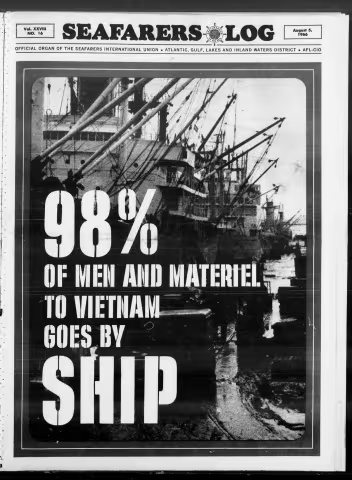
98 percent of our growing mili
tary cargoes to Vietnam are car
ried by sea. The adoption of his
suggestion would be disastrous.
We must not abandon our pro
gram of preference for both mili
tary and non-military cargoes, and
we must not turn the military car
go preference into a chaotic and
disruptive competitive bidding sys
tem."
The anti-cargo preference pro
posals recently voiced by Defense
Secretary McNamara are merely
the latest of many attempts he has
made to downgrade the impor
tance of the U.S. merchant marine
and violate the intent of Congress
in providing aid to the U.S. mer
chant fleet in the face of mounting
evidence of the vital importance
of a strong merchant marine to
the peacetime and national defense
needs of the nation.
Jm Fight to Save Mmtime;
Your Comussmau, How!
Legislation to create a new Department of Transportation
which would lump the Maritime Administration and 10 other
Federal units into one agency is expected to be the subject
of debate in the House of Representatives within the next
week or 10 days.
This legislation is being opposed vigorously by the SIU and
all other AFL-CIO maritime unions because it would further
jeopardize U. S. shipping. The unions are urging instead that
the Maritime Adminstration be reconstituted as a completely
independent agency. They point out that lumping the Mari
time Administration along with the other agencies into a
single department would lead to further serious weakening of
the nation's merchant fleet.
This matter is of vital importance to the future of the mer
chant marine and all Seafarers should join in the fight to save
their industry by immediately writing or telegraphing their
Congressmen, urging them to keep the Maritime Administra
tion out of the Department of Transportation and to make it
a completely independent agency.
A complete list by States of the members of Congress was
printed in the June 24, 1966 issue of the SEAFARERS LOG,
copies of which can be checked at any SIU hall.
Write your Congressman now! Tell him to oppose the plan
to put the Maritime Administration in the new Department
of Transportation. Tell him that for the merchant marine
to survive and grow it must be under an independent Maritime
agency.
Help in the fight to protect your industry and your jobs!
58 SIU Men Licensed As Engineers
As 12 More Complete Union Course
Twelve more Seafarers have passed the U. S. Coast Guard examination and have been issued
their engineers licenses after attending the training school jointly sponsored by the SIU and District
2 of the Marine Engineers Beneficial Association. A total of 58 Seafarers have now received their
engineer's licenses as a result of ^
the recently instituted program.
The newly-licensed engineers
are sailing or about to sail in en
gineer berths aboard American-
flag ships.
Of the SIU men who recently
passed their Coast Guard examin
ation eight were licensed as Third
Assistant Engineers and four re
ceived their licenses as Second
Assistant Engineers.
Those SIU men who passed
their Coast Guard examinations
this week and were licensed as
Second assistant Engineers are:
James Michael Faust, 55, a Sea
farer since 1955, has sailed as an
oiler and in other engine depart
ment ratings;
Faust Reed
Franklin F. Reed, Jr., 51, a
member of the SIU since 1943;
I. Pedersen, 38, an SIU mem
ber since 1952.
Pedersen McCormick
Edward McCormick, 47 years
old, who sailed as a fireman and
oiler and has been a member of
the SIU since 1952.
The newly-licensed Third As
sistant Engineers are:
James M. Young, who sailed as
flreman-watertender, is 31 years
old and has been a member of
the SIU since 1961;
Young Valdson
Herbert Valdson, 54, who has
sailed in most engineroom ratings,
has been a member since 1963;
Michaels Foley
Charles Michaels, 49, has been
sailing in various engine room
ratings since joining the SIU in
1955;
George Foley, Jr., 42, for
twenty-three years sailing with the
SIU as oilen, and fireman water-
tender, joined the Union in 1943;
Thomas W. Barnes, 31, a union
member since 1962, who sailed as
oiler and fireman watertender;
Barnes Weise
William Weise, 42, an engine
room SIU member since 1943
when he joined the Union in New
York;
David McGrath, 28, an SIU
member since 1959, who sailed as
oiler;
Richard Vincent, 34, an oiler
who has sailed with the SIU since
1962.
The SIU-MEBA District 2
training program is the first of its
kind in maritime history. It as
sists engine department seafarers
to obtain instruction in prepara
tion for their Third Assistant En
gineer's license. Temporary Third
Assistant Engineer's license, or
Original Second Assistant Engi
neer's license in either steam or
motor vessel classifications.
The training school is operated
under a reciprocal agreement be
tween the SIU and District 2 of
MEBA. SIU men who enroll in
the program are provided with
meals, hotel lodging and subsist
ence payments of $110 per week
while in training.
Engine department Seafarers are
eligible to apply for any of the
upgrading programs if they are 19
years of age or older and have 18
months of Q.M.E.D. watch stand
ing time in the engine department,
plus six months' experience as a
wiper or equivalent.
•4
McGrath Vincent
SIU engine department men in
terested in the program should ap
ply immediately, or obtain addi
tional information at any SIU hall,
or directly at SIU headquarters,
675 Fourth Avenue, Brooklyn,
New York 11232. The telephone
number is HYacinth 9-6600.
Freighter Coliftles With Transpacific
In Tokyo Bay; Ail Hands Are Safe
ripped away in collision with Libenan-t
F Tokyo Bay reveals part of Transpacific's ammunition cargo.
Fortunately, was no ;
<s>-
Quick action by the crew of the SlU-contracted freighter Trans
pacific avoided a catastrophe after the vessel collided with the
Liberian freighter Union Venus in poor visibility off the narrow
mouth of Tokyo Bay.
The Transpacific, loaded with
volatile cargo, suffered a 35 by
18-foot hole ripped from the deck
1o the keel. A Seafarer describing
the incident to the LOG said it
was "as if it were being made by a
giant can, opener."
Seconds after the collision, the
entire crew sped to the impact
area to fight what was thought of
first as being a fire. But "luck was
on the side of the seamen," a crew
member said, "because when the
water hit the breakage, the smoke
was still white and signified that
it was not a fire but a ruptured
line."
The Liberian freighter stood by
for a short while to see if there
was anything it could do tp.aid
the Transpacific. It then left the
scene, apparently none the worse
for its encounter.
The Transpacific limped into
the United States Naval Base at
Yokohama under its own power
and managed to safely unload its
dangerous cargo.
"It's a miracle how you guys
survived such an impact," one
expert said." If the ship did blow
up, it would have blown up the
city of Yokohama too."
The Transpacific's master
praised Seafarers aboard the ves
sel for expert seamanship "in such
a precarious situation." The
freighter then put in for repairs
that took two and a half weeks at
a Yokohama yard.
Page Fonr SEAFARERS LOG August 5, 1966
Letter of Protest Scores Defense Department
^ Shipbuilders' Union Blasts Navy Plan
To Build U.S. Ships in British Yard
WASHINGTON—Defense Department plans to construct two naval survey ships in British ship
yards have been sharply denounced as an outrageous threat to the welfare of the entire U.S. ship
building industry.
In a letter to Secretary of ^
Defense Robert S. McNamara,
John J. Grogan, President of
the Industrial Union of Marine
and Shipbuilding Workers of
America, asked if the Defense
Department was planning to "re
peat the bankrupt, short-sighted,
indifferent and dangerous policy
with the construction of naval ves
sels that has played havoc with
our merchant shipbuilding indus
try?"
Noting a recent report of a
Senate Subcommittee investigating
national security, which called
shipyards "the taproot of a na
tion's sea power," Grogan pointed
out that over twenty American
yards have gone out of business
during the past fifteen years be
cause of insufficient work volume.
"The last ten years has wit
nessed the greatest migration of
skilled shipyard workers to other
industries," Grogan noted. "The
shipyard mechanics, with decades
of experience in their specialties.
The Atlantic Coast
by Ear! (Bull) Shepard, Vice-President, Atlantic Coast Area
Senator Clifford P. Case (R-N.J.) has introduced legislation to
lessen the navigational hazards in congested Newark Bay. He stated
that the traffic has almost doubled between 1954 and 1964 and that
during that period there were ship accidents.
The Senator's bill would widen a portion of the ship channel in
Newark Bay and dredge areas
where two ships are able to manu-
ever. The Newark Bay channel
would be widened from 400 to
700 feet for a short distance both
above and below the Jersey Cen
tral Drawbridge. The Army Corps
of Engineers said that this would
make it easier for larger cargo
ships to align themselves with the
drawbridge before passing be
neath it. *
New York
Seafarer Red RatcIilF has re
cently returned from a vacation
trip in Illinois. Red is now look
ing for a coastwise run or some
thing going to Puerto Rico. After
leaving the Arizpa, Francisco Sar-
oiento is considering a rest on
the beach before berth-hunting
again. Sarmento had spent a year
on the Arizpa. Around the hall,
looking for a long trip as a chief
steward is L. Krawczyk. E. T.
Glazdez came by the hall and
picked up a job as third cook on
the Duval. TTie Duval will soon
be sailing for the Mediterranean.
Baltimore
Last on the Del Norte, Stanley
Edwards is now looking for a
billet as a BR on a Far East run.
Jessie Winfleld, an SIU veteran
of 22 years; he just finished six
months as messman on the Cai
man Waiting for a coastwise run
to come along Bill Kehrwieder
is relaxing after his last ship, the
Chilore.
Boston
Happiness is the family and
summer and home for Seafarer
Maurice McCat-
ty. He was last
on the Elizabeth-
port. Just off the
Maiden Victory,
Bosun John
"Fish" Rubery is
glad to lounge on
the beach for a
spell, but he's
keeping an eye
out for another slot. AnnosJans-
aon, a twenty year SIU veteran,
is on the beach taking it easy
for a while.
Philadelphia
Mike Schalestock, a twenty-
year Seafarer, is in drydock for
the time being. Mike is anxious
to ship out again soon. Francis
Sortillo is watching out for a
Steward Dept. job. Carpenter Ed
Johnson will take the first berth
that shows. Recently off the Steel
King, Winfield Downs is relaxing
on a well-earned vacation.
^ Norfolk
After setting up a new place
to hang his hat Vince Sherwood
is looking for an
other trip to Viet
Nam. R^dy Nel
son, recently off
the Sapphire Etta,
has renewed his
clinic card and
looking for a
chief electrician's
job. The Duval
has laid up and
Chief Cook George Abaii had to
give her up. George said he en
joyed the trips and that the Duval
was a good ship. Looking to
ward the Far East, Lacy Walker
recently finished a trip on the
Steel Chemist.
Walker
Puerto Rico
Jansson
The SlU-Puerto Rico Division
has filed a complaint with the
National Labor Relations Board
charging that the Shell Oil Com
pany has illegally discharged
about ninety employees. Informa
tional picket lines were placed
around various Shell facilities to
assist in the battle to reinstate the
fired workers.
After keeping the winches in
shape on the Maiden Creek, Justo
Velazquez is spending a few days
with his family before going to
New York to enroll in the joined
SIU-MEBA District 2 engineer
training program. Seafarer Joa
quin Maldonado will not be in
circulation for about a month.
Maldonado seriously injured his
arm recently.
have abandoned the industry be
cause of the insurmountable hard
ships and obstacles in obtaining
steady, uninterrupted work."
In protesting the proposed
building of U.S. naval ships in
foreign yards, Grogan warned that
"There is no easy shortcut for
providing shipyard skills vital in
a crisis," and that the reasons
given by Government agencies for
following policies that are putting
U.S. shipyards out of business
". . . will be no substitute for the
manning of our yards in the event
of war."
The serious danger to our na
tional security brought about by
the continuing deterioration of our
shipbuilding and ship repair ca
pability has been spotlighted re
cently by the difficulty reported
by the Marine Administration in
finding qualified shipyard and
skilled shipyard workers to reac
tivate vessels from the reserve fleet
pressed into service for the Viet
nam emergency.
Shortages of ship repair facili
ties and of skilled shipyard work
ers has been blamed for slowing
down the pace of reactivation of
the old. World War II ships, which
need extensive repairs before they
can be placed into service.
The heavy shipping needs of
the Vietnam emergency has borne
out these warnings. The U.S.
merchant fleet has shrunk to the
point where 152 old ships have
been ordered out of mothballs to
fill the shipping gap. The deterio
ration in our ship repair capability
has made it difficult to even reacti
vate these old vessels. Yet pleas
by the SIU and other maritime
unions for a strong and positive
maritime policy to reverse this
trend continue to go unheeded by
those Government agencies re
sponsible for maintaining a strong
U.S. maritime.
The Gulf Coast
by Lindsay Williams, Vice-President, Gulf Area
Endorsements for four judgeship races in New Orleans have been
made by the Greater New Orleans AFL-CIO Committee on Political
Education (COPE), and the Maritime Trades Council of Greater New
Orleans and Vicinity of which the SIU is an active member. The
Democratic primary will be held August 13, 1966.
Endorsed in the New Orleans
races are Judge Arthur J. O'Keefe,
for Section A, First City Court;
City Councilman Walter Marcus,
Jr., for Section I, Civil District
Court; Maurice B. Friedman and
Louis P. Trent to fill the two new
Traffic Court judgeships.
These men were endorsed by
the Maritime Trades Council and
the SIU because of their public
records, qualifications, and favor
able attitudes toward issues affect
ing the working men and women
of New Orleans. All members are
urged to work and vote for the
election of these candidates and all
labor-backed candidates through
out the State of Louisiana in the
coming Democratic primary of
August 13, 1966.
SIU men who have the neces
sary seatime are urged to go up
for FOWT or AB tickets. With
quite a few SIU members taking
advantage of the joint SIU-MEBA
District 2 upgrading program there
is a greater opportunity for SIU
members who get their FOWT
papers to further upgrade them.
Information on upgrading is avail
able at all SIU halls.
New Orleans
Stanley Hawkins, recently off
the Del Mar for an operation, is
now fit for duty after convalescing
at his home
among the pines
in Kentwood, La.
While on the
beach Walter
Harris is cam
paigning to make
his daughter
queen of the Eb-
enezer Baptist
Church. Just off
the Alcoa Commander, Harris is
waiting for his fit-for-duty to take
another Steward Dept. slot. Still
on the beach after a shoreside
accident William Meehan is mak-
Hawkins
mg a fast recovery. He was
last on the Del Santos where he
made two trips. After five-and-
one-half months as chief cook on
the Del Sol, Joseph (Champ) Bar
ron is spending some time on the
beach parlaying the nags. He says
he enjoys sailing the new Delta
Line ships very much.
Resting after seven months as
Bosun on the Steel Advocate, C. P.
(Jack) Diltz says she was such a
good ship, crew and run and that
he hated to get off. Jack is now
looking for a Deck Dept. slot,
preferably a bosun's job.
Houston
Just off the Delta Line romance
run, engiiteman E. S. Johnsen is
looking to ship out again. Deck-
man W. Fontenot is now on the
beach and looking for a long, long
trip.
Mobile
Albert A. Richards is currently
taking it easy on the beach after
sailing on the Oakland. Richards,
a long-time SIU
member, makes
his home in Mo
bile. Ready to go,
preferably on a
tanker, A. J. Mel-
anson is watching
r 1 a the board. He was
last on the Ocean
Ulla. Albert Mas-
cielo is off on a
vacation around his home up in
Minnesota. He recently spent a
year on the Council Grove on the
grain run.
Also off on vacation up in New
foundland is William T. Roche.
Roche finished two years on the
Alcoa Ranger. Another veteran
of the bauxite run who's on the
beach, Herman H. Hickman, re
cently paid off the Alcoa Runner.
Hickman makes his home in
Montgomery, Ala.
Richards
S/x Additional Seafarer Veterans
Added to Roster of SIU Pensioners
Warren SetUff Nugent Ayers Montcalm Godwin
the union in
New York. He was born in
Virginia and resides in West-
port, Conn, with his wife, Sarah.
Setliff was a member of the Deck
department. His last vessel was
the Seatrain Savannah.
Nugent joined the SIU in
Frankfort. Born in Michigan, he
was a member of the Engine de
partment, sailing as an oiler. He
lives in Frankfort with his wife.
Six more Seafarers have been added to the steadily growing roster of SIU veterans who are now
collecting $150 lifetime pensions. The latest additions to the pension rolls are: Sam Setliff, Wil
liam Nugent, Robert Ayers, Robert Montcalm, George Godwin, and Truman Warren.
Setliff joined the union in J En^^a. His last shin was the Ann I Hpuston. Ayers last sailed on the
Express Virginia.
Godwin joined the union in the
port of Baltimore and sailed in
the Deck department. He was
born in Baltimore and resides
there with his wife. Myrtle.
Warren joined the union in El-
berta, Mich. He sailed in the
Steward department. Born in
Michigan, he resides in Frankfort
with his wife, Gladys. His last
I in Washington and resides in ship was the Ann Arbor.
Emma. His last ship was the Ann
Arbor.
Montcalm sailed in the Stew
ard department and joined the
SIU in San Francisco. Born in
Florida, he resides in San Fran
cisco with his wife, Lilian. His
last vessel was the Norberto Ca-
pay.
Ayers joined the union in the
port of Mobile and sailed with the
Steward department. He was born
in Washington and resides in
-<
J,
fn
•A
Ht
A •<
Au^t 5, 1966 SEAFARERS LOG Pmge Five
A
-<
Anemia A Danger Signal,
Dr. Weisberger Says
The following article dealing with the diagnosis of anemia as a medi
cal tool in the treatment of other diseases was written by Dr. Austin
Weisberger, brother of SIUNA Vice-President Morris Weisberger, who \
also serves as Secretary-Treasurer of the Sailors Union of the Pacific.
Dr. Weisberger, who has won worldwide renown for his research on
diseases of the blood, including leukemia, is Professor of Medicine at
Western Reserve University in Cleveland and Chief of the Department
of Medicine at Cleveland University Hospitals.
The article below is reprinted in its entirety from the Thursday, June
23, 1966 edition of the Cleveland Plain Dealer.
There are certain complaints which you may have which will
cause you to seek medical attention. For instance, you may con
sult your doctor because of fever, loss of weight, a lump, short
ness of breath or because of a pain.
None of these symptoms tells exactly what is wrong with you,
but they indicate that something is wrong. Because of this, your
doctor will examine you and do various tests to get at the
basic difficulty.
This is exactly what he must do if you have anemia. In other
words, anemia is a sign that something is wrong.
If you have anemia, you may complain of weakness, fatigue,
shortness of breath or you may just not feel well. Now, you
can get these symptoms in many other conditions even when
you don't have anemia. Therefore, your doctor will do a num
ber of blood tests to make sure you do have anemia.
Not all anemias are the same. In certain diseases which
cause anemia there may be specific changes in the size or shape
of the red blood cells as well as a decrease in the number of
red blood cells.
Strangely enough, the amount of hemoglobin within the cells
and the amount of iron in your body may actually be increased
in some anemias rather than decreased.
Fortunately, a large number of tests are available to help your
doctor determine which kind of anemia you may have. TTiese
tests in turn will help him decide what is causing the anemia
and may even lead to an otherwise obscure diagnosis.
The causes of anemia are many and include such underlying
conditions as kidney disease, liver disease, glandular disorders,
hidden infection, cancer or blood loss.
Because of these different causes, not all anemias respond to
the same type of treatment. As a matter of fact, in most in
stances each type of anemia responds to only one particular type
of treatment, and other treatments are not effective.
Therefore, I want to emphasize that the term anemia is not
a diagnosis. Anemia is almost always a sign of the presence of i
an important underlying disease. Careful and extensive diagnos-1
tic tests may be necessary to establish the cause.
If you start treatment without determining the cause of the
anemia, the treatment may not be effective but, what is worse,
it may also disguise an important danger signal and make it
hard to figure out what is causing the anemia.
Iron deficiency anemias are a striking example of the im
portance in making a diagnosis. In these anemias the red blood
cells are small and contain a decreased amount of hemoglobin.
In addition, the amount of iron in the blood is low. Now
doctors have learned that when they find this particular type of I
anemia, it means that in almost all cases the patient is losing
blood somewhere. The loss of blood may be from a stomach
ulcer, or some obvious cause such as extensive nose bleeds, heavy
menstrual blood flow and other benign conditions.
However, a common cause of blood loss which should be
looked for in certain age groups is an intestinal cancer. If this
cause of the blood loss is looked for and discovered soon enough,
surgical removal and cure of the cancer is frequently possible.
If there is too long a wait, surgical removal and cure may not
be possible.
Anemia, in these cases, signals a hidden danger and treatment
without looking for the cause may lead to a dangerous delay.
SlU WELFARE, VACATION PLANS
June 1 - June 30, 1966
Number of Amount
Benefits Paid
Hospital Benefits 6,125 $ 63,529.14
Death Benefits 32 73,799.64
Disability Benefits 873 130,950.00
Maternity Benefits ........ 36 7,227.50
Dependent Benefits 440 88,910.69
Optical Benefits 419 6,256.95
Out-Patient Benefits 4,742 ' 37,931.00
Vacation Benefits 1,604 689,494.62
TOTAL WELFARE, VACATION
BENEFITS PAID THIS PERIOD 14,271 $1,098,099.54
European Common Market Nations
Plan Increased Shipbuilding Subsidies
While the United States is sitting on its hands and doing nothing to modernize the nation's in
adequate shipbuilding subsidy system, Common Market countries are planning a series of ship
construction subsidies that will enable them to build up their fleets and compete in the world mar
ket.
The American Government,
by contrast, is destroying what
little is left of our shipbuilding
industry by allowing construction
of some naval warships abroad
and by toying with the idea of
building American-flag merchant
ships in foreign yards.
The Common Market, also
known as the European Economic
Community, was formed in 1958
to provide its members with a
larger market place to do busi
ness. Member nations are France,
Germany, Holland, Italy, Belgium
and Luxembourg.
Within the Common Market,
industries have beep able to effect
a greater economy in production
and compete with larger industrial
nations. New industries also
sprang up because of the needs
of the expanded market. Where
it once was uneconomical for a
manufacturer in a small nation
to make specialized goods be
cause of limited demand, it has
now become profitable within the
Common Market.
Common Market officials are
also using the advantages of the
larger market area to improve
shipbuilding. They feel that a
united effort in shipbuilding is es
sential to their member nations
rder to operate profitably in
construction.
Add Eight Ships
To Cuba, Hanoi
Trade Blacklists
WASHINGTON—The Mari
time Administration has added
seven more ships to the blacklist
of vessels that have called at ports
in North Vietnam since last June
25, bringing the total of ships on
that blacklist to 24.
In addition, one vessel was
added to the blacklist of ships in
the Cuban trade, raising that list
to 253 ships.
Of the 24 ships now on the
blacklist for trading with North
Vietnam, seven are British, four
Cypriot, two Greek, one Maltese
and 10 Polish. The vessel added
to the Cuban blacklist was a Cyp-
riot-fiag ship, the Ammon.
There are eight vessels which
appear on both blacklists for
having violated U.S. policy by
trading "with both Cuba and North
Vietnam. These include the Am
mon and three other Cypriot ves
sels, three British-flag ships and
one Maltese.
Vessels on either blacklist are
barred from carrying any United
States Government-financed car
goes, such as defense supplies,
surplus food or foreign aid ship
ments. They may regain their
eligibility if their owners give the
Federal Government assurances
that they will never again engage
in the blacklisted trade.
Exceptions are made for ships
under contractual obligation made
before the blacklists were made
effective, but assurances must be
given that these vessels will with
draw from the trade at the earliest
opportunity.
The Common Market Commis
sion plans call for a flat ten per
cent subsidy for each ship ordered.
This, they feel, will offset the gov
ernment aid given the heavily sub
sidized Japanese yards.
Despite various national differ
ences, Common Market shipbuild
ers expect the new subsidies to
enable them to compete with the
Japanese who now construct the
greatest amount of shipbuilding
tonnage of any nation in the
world. Under proposed plans,
member nations will each be able
to attach specific conditions to
the subsidies individual yards will
be given.
The ten per cent subsidy level
is expected to be high enough
to allow competition with the huge
Japanese yards as long as Com
mon Market shipbuilders create
super-size ship construction facili
ties, similar to those operated by
the Japanese.
The Great Lakes
by
Al Tanner, Vice-President and Fred Farnen, Secretary-Treasurer,Great Lakes
We will begin to vote crews on August 1 aboard all SIU Gt. Lakes
District contracted vessels for the election of Union officers. The bal
loting will take place all through the month of August and we will be
contacting most of the crews in the Ste. Claire River at Algonace. The
patrolmen will be boarding vessels with the ballot boxes to give all
crewmembers the opportunity to
vote aboard ship. Members on the
Rafferty
beach, of course, can vote in the
Union halls.
Robert Rafferty shipped as cook
aboard the Boland self-unloader
J. F. Schoellkopf.
Bob was on the
beach for a few
weeks waiting for
the right ship. Joe
Arnold and Vem
Ratering shipped
as cook and por
ter on the tug
Coode. Brother
Ratering recently
paid off after a month trip out on
the Coast and is taking it easy just
shipping relief jobs.
"Scottie" Quinlivan is back
sailing again as wheelsman on the
Joe Young after quitting the U.S.
Gypsum for a shore job with the
riggers. Scottie said he couldn't
save any money working on the
beach. Neil Mahaney and Ray
Klien, oiler and gateman off the
A. E. Cornelius, stopped in the
hall to pick up their clearance
cards after a 15-day vacation
leave. Neil and Ray said they had
a good time but are ready to re
turn now and finish the season.
Duluth, Frankfort, Chicago,
Cleveland and Buffalo all report
good shipping and these ports have
plenty of jobs open for rated men.
Negotiation talks are continuing
relative to setting up an industry
wide vacation plan on the Great
Lakes. The membership will be
kept posted through the SEA
FARERS LOG and at the mem
bership meetings on all phases of
these negotiations.
Reuss (D-Wis) has indicated
that he will introduce a bill mak
ing it unnecessary to raise tolls on
the St. Lawrence Seaway. Reuss
contends that even a limited in
crease in Seaway tolls will en
danger traffic, causing it to shift
to other ports and to competing
means of transportation.
Reuss' solution revolves around
changing the present system of
financing the Seaway. His bill
would change the status of the
Federal government's investment
in the Seaway from that of a re
payable loan to one of a perma
nent investment with a fair return
accruing on that investment per
petually.
Gt, Lakes Credentials Committee
SIU Great Lakes District Credentials Committee met recently at
Detroit headquarters to check qualifications on nominees for office
in upcoming month-long Great Lakes District elections. Committee
members (l-r) are: Ernest "Scottie" Quinlivan, Vern Ratering, Joe
Arnold and Robert Rafferty. Balloting will take place during August.
f - ii
iP:i
I 'I
n I
If:
I I
^ 'I
.'ii' 'l
•A J::: J
Page Six SEAFARERS LOG Ancoat 5, 1966
The Pacific Coast
by Frank Drozak, West Coast Representative
The West Coast and national jobless rate have remained unchanged
at 4.7 and 4.0 respectively between May and June. Despite this, how
ever, total employment both national and regional have risen to rceord
levels.
Employment in California was 7.198 million last month, 4.4 per
cent higher—301,000—than in
June, 1965 and 74,000 higher than
the previous month. Total national
employment was 75.7 million—2
million more than in May.
San Francisco
This port, where shipping is ex
tremely good, needs AB's, oilers,
Electricians and FWTs.
The Montpeller Victory, Pecos,
John €., Ames Victory, Rio
Grande and Iberville paid off and
signed on crews while the Bowl
ing Green, Steel Flyer, Steel Re
corder, Ridgefield Victory, Keva
Ideal and San Francisco passed
through in transit. The port is ex
pecting the Lady of Peace, Free
America, Brigham Victory and
Steel Admiral in soon.
Carlton A. Roberts, AB one of
the real SIU oldtimers, expects to
catch the next ship to the Far
East. James E. Gross, Baltimore-
bom and a 21-year union man,
hopes to hit the first ship on the
board as a cook and baker.
Wilmington
Shipping is still pretty good at
this port and there are still plenty
of jobs for all ratings in the deck
and engine departments. Cooks
and bakers ratings are also plenti
ful. The Penn Victory, Topa Topa
and Steel Flyer paid off here and
two ships were signed on with 12
in transit.
Andy EUingsen, an old-timer
around these parts, has been re
patriated from the Rachel after
suffering a heart attack. He had
been chief electrician on the ship
for about quite some time before
he became ill. Seafarers on the
West Coast all wish him a speedy
recovery.
Dorwin L. Coy, who had been
looking to sign on as an oiler final
ly took a fireman's job and seeing
that electricians are making a lot
of money brought along a good
supply of study material on how
to become an electrician.
Seattle
Shipping is still good here for
all ratings. Paying off in the port
were the Hercules Victory, Merid
ian Victory, and Belgium Victory.
The Transnortbem, Duke Victory
and Linfield Victory were signed
on since the last report and the
Portmar, Inger, Anctorage, Peim-
mar and Seattle were in transit.
Dennis Brazell, who is a 20-year
Seafarer, piled off the Belgium
Victory after making one trip and
shipped out on the Hercules Vic
tory.
THE INQUraiNCS SEiU^AJ^
QUESTION: When you have a
vacation, w^t do you like to do
and where do you go?
Angel Salaman: I like to go to
Puerto Rico when I have a vaca
tion. That's where
I come from and
it gives me a
chance to visit my
wife, two kids and
parents. You can
have a lot of fun
down there and I
like to go to the
beach and the race
track. I always get out of New
York City when I get a vacation.
<1>
Egbert Goulding: On my last
vacation, I spent two weeks in
Jamaica. I visited
the historical
spots and visited
some relatives. I
rode around the
island and also
spent some time
at the mineral
baths, trying to
lose a little
weight. As a rule, I don't go away
too often, since I spent most of my
time on ship. I did have a very
good time in Jajnaica.
^
Elmer Kent: I like to go to the
beach, just walk along the board
walk and buy some hotdogs. I go
to Victory Lake
in upstate New
York, quite often.
I would like to
go to Spain some
day on a long
vacation. I've seen
quite a bit of the
world, but I don't
think any seafarer
ever seen all there is to see.
Eari Wilcox: I usually stay at
home when I get a vacation. Home
for me is a marina
and I do some
work around the
place. Sometimes
I come down to
the hall to visit my
friends. I have a
hobby of working
with yachts and
boats and a friend
of mine and I will cruise up and
down the Hudson River. I've seen
a lot shipping out and there's really
nothing new to see on a vacation.
^
Nick Sakallarides: Puerto Rico
is the place I'll go when I get my
next vacation. I
expect to spend a
few weeks there,
San Juan and
Ponce. It's a great
place to visit as
something is al
ways going on, I
come from Mary
land and I go to
Ocean City, quite often. It's a
nice resort and a pleasant place
.to spend a vacation.
—
Albert Jensen; I just like to stay
home and help my wife around
the house. It's
good to relax and
take it easy. I
spent some 40
years at sea and
seen a lot and
there's really no
place to go any
more. I'm retiring
this year and I
guess I've seen enough of the
world, Germany, France, Spain
and Denmark are the places I've
enjoyed the most.
AHoiitleif SM* ̂ DIrtflel
July 15 to July 28, 1966
DECK DEPARTMENT
TOTAL REGISTERED TOTAL SHIPPED
All Groups
Port Class A Class B
Boston 11 1
New York 66 28
Philadelphia 7 7
Baltimore 21 16
Norfolk 11 10
Jacksonville 8 2
Tampa 2 4
Mobile 19 13
New Orleans 47 32
Houston 56 23
Wilmington 6 10
San Francisco 26 23
Seattle 23 6
Totals 303 174
All Groups All Groups
Class A Class B Class C Class A class B
2 2 5 31 2
48 15 21 224 76
4 4 4 31 15
7 5 8 97 48
4 4 6 23 19
8 6 7 16 5
3 13 11 6
14 10 2 71 16
35 32 13 130 41
42 28 24 186 13
4 11 6 21 1
17 18 8 51 0
8 9 8 45 2
196 145 115 937 244
ENGINE DB>ARTMENT
TOTAL REGISTERED TOTAL SHIPPED REGISTERED on BEACH
Port Class A Class B Class A Class B Class C
Boston 2 1 0 14
New York 50 10 25 11 10
Philadelphia 9 3 3 3 3
Baltimore 19 7 6 7 1
Norfolk 4 14 15 3
Jacksonville 5 2 4 3 5
Tampa 5 2 2 0 0
Mobile 9 3 8 6 3
New Orleans 27 23 28 14 5
Houston 26 18 22 21 16
Wilmington 6 3 2 3 11
San Francisco 27 10 6 4 13
Seattle 7 7 10 5 8
Totals 196 103 117 83 82
STEWARD DEPARTMENT
TOTAL REGISTERED TOTAL SHIPPED REGISTERED oil BEACH
All Groups AH Group: All Groups
Port Class A Class B Class A Class B Class C Class A Class B
Boston 3 0 1 0 2 11 2
New York 62 31 48 21 16 124 74
Philadelphia 7 5 2 3 4 17 9
Baltimore 18 19 11 11 7 62 36
Norfolk 8 6 3 5 5 11 10
Jacksonville 4 3 6 4 11 3 3
Tampa 4 1 1 0 0 11 6
Mobile 13 9 19 10 2 34 7
New Orleans 38 36 36 26 13 73 45
Houston 34 41 39 38 18 83 110
Wilmington 6 2 7 2 13 13 1
San Francisco 13 16 9 8 7 32 0
Seattle 14 6 14 6 6 28 2
Totals 224 175 196 134 104 502 305
Gov't May Be Waking Up to Need
For Protecting US Fishing Industry
The United States, with some of the largest—but long-neglected—natural fishery resources in
the world, may finally be taking steps to put new life into the nation's ailing fishing industry.
If it does, it will mean that the efforts of the SIUNA and its affiliated fishermen's unions, which
have been waging a strong fight ^
to obtain Federal action to pro
tect the domestic fishing indus
try, have not been in vain.
Pressures from foreign fishing
sian, who have been profitably
fleets, notably Japansese and Rus-
working the fish-rich costal waters
off the United States, caused Con
gress to seek ways to halt the
decline of the naation's fishing
industry.
They have begun by making
funds available for the develop
ment of new fishing grounds,
spurring the catch of new fish
species and finding ways to have
fishing boats land higher quality
products faster or to land fish of
higher value.
Moves are also afoot to change
the nation's traditional three-mile
limit to twelve and building newer
more efficient fishing boats.
Cannot Compete
American fishermen sailing
small coastal boats cannot compete
with the large fishing expeditions
sent out by Russia and Japan.
Robert F. Allen, of the Marine
Design Co., Seattle, testified before
the Marine Technology Society in
Washington that:
- "The psychological effect of
fishing on an American vessel of
70-80 feet with 300 to 400 horse
power, alongside a modern Rus
sian or Japanese trawler three
times the length and with three or
four times the horsepower is in
deed demoralizing."
The fishing industry has been
going downhill along with the rest
of the American-flag merchant
marine because of Governmental
indifference. The United States,
which has the world's richest fish
eries has now become a fish-impor
ting nation.
ImpiHis Up
Last year was the third consecu
tive year in which the United
States held the role of the world's
largest fish importing nation.
Japanese exports of canned
mackerel to the United States in
1965 increased to a total of about
86,000 cases. One of the contribu
ting factors was the poor catch
that the small American-flag boats
were able to land off the California
coast.
Secretary of the Interior Robert
Udall noted in 1964 that over half
of the nation's fish and shellfish
supply was of foreign origin. The
estimated weight of edible and in
dustrial fishery products imported
that year came to 7,509 million
pounds, 62 per cent of the total
United Staites supply of 12,032
pounds. /
The United States Navy is sup
porting legislation to extend the
fisheries jurisdiction of the United
States to 12 miles off shore. Rear
Admiral Wilfred Hearn, Judge
Advocate of the Navy told the
House Fisheries Subcommittee
that the new 12-mile limit can be
supported legally under interna
tional law, hut that any further
limit cannot.
Navy Approves
He said that the Navy has al
ways opposed any extension of
the three mile limit but is now
accepting the position outlined by
the State Department that fishing
rights and sovereignty can be sep
arate.
Many maritime experts main
tain that a nation's sea limits can
be extended as far out as its navy
is able to defend.
Explaining the Navy's position
on sovereignty of the seas. Admir
al Hearn said, "We consider it
imperative from the standpoint of
security, to preserve the right of
freedom of navigation on the high
seas for warships and aircraft.
"We believe that our security
interests are bes,t served when na
tions are limited to narrow terri-
orial seas which interfere only
slightly with this freedom of navi
gation."
AH Groups
Class A . Class B
5 3 <
163 33
21 6
60 40
9 18
6 2
18 10
47 13 M
106 68
89 31
11 0
55 0 J
20 7
610 221
August 5, 1966 SEAFARERS. LOG Page Seven II
I; Labor-Sacked Medical Aid Bill
Becomes Law In N. Y. State
Passage of New York's new medical assistance law providing almost
total tax-paid health care for an estimated 7 million low-income per
sons was a high point of labor-backed achievements at the six-month
session of the state legislature.
For example, a family of four with one wage earner, with $6,000
income after taxes, half that amount of savings and a maximum $1,000
face value of life insurance for each person, would be eligible under
the new law for tax-paid hospital, medical, surgical, dental and opto-
metric care, drugs, plasma. X-rays, dentures, eye-glasses and many
other needs after paying an initial $60 to $70 toward such costs.
With a split legislature, the New York State AFL-CIO saw a score
or more of bills on its program passed by the overwhelmingly Demo
cratic Assembly but quietly killed by being held in committee in the
Republican-dominated Senate.
A major disappointment was the Senate refusal to bring to a vote,
after it was reported out, a bill to update workmen's compensation
benefits still tied to wages of up to 40 years ago.
A similar bill had received overwhelming bipartisan approval a year
ago, only to be vetoed by Gov. Nelson A. Rockefeller on grounds of
alleged inadequate financing. This objection was fully met by the
1966 draft of the bill. State AFL-CIO Pres. Raymond R. Corbett
noted as he pleaded unsuccessfully for passage on behalf of disabled
workers and the widows and children of those killed on the job.
On the plus side were enactment of the $1.50 state minimum wage,
approved despite vetoes of two such bills a year ago, admission that
the state's public worker labor relations law was a failure through
passage and signing of bills exempting transit, welfare and ferry work
ers from any of the punishment mandated by the law, and a measure
prohibiting firing of a worker because of a single wage garnishment.
Different bills to ban use of one so-called lie detectors by employers
to screen workers were passed by each house of the legislature, but
became victims of inter-party conflict. An anti-professional strike
breaker measure was reported out but was never allowed to come to
a vote in the Senate.
Among more than 30 other labor-endorsed measures that became
law—others still await signature or veto—were bills that give labor
relations rights to employees of non-profit restaurants and hotels,
return to longshoremen and their employers the right to limit inflow
of casuals to waterfront jobs and assure a guaranteed annual wage to
permanent workers, apply workmen's compensation coverage to farm
workers, extend the home-work industry ban to include mailing opera
tions, create a major construction fund for expansion of the New York
City University, and provide a fairer share of state education aid for
city school systems.
Bad faith bargaining has shut
down 10 Nabisco plants all over
the country. A strike by 130 bak
ers for a first-time contract at the
newest National Biscuit Company
plant was forced when manage
ment offered them wages 25 cents
an hour below the lowest rate in
any other Nabisco plant.
v|>
Hunter College High School stu
dents in New York are firmly be
hind the International Ladies Gar
ment Workers Union boycott of
Judy Bond blouses. The juniors at
the school voted to buy a union
label blouse as their official class
blouse, reversing an earlier vote
for the Judy Bond blouses. The
union charges that Judy Bond "ran
away" from a union contract and
opened a non-union shop in the
South. Buying the banned blouse,
a Hunter College High girl said
would "be worse than crossing a
picket line."
vl>
John A. Sessions, assistant direc
tor of the AFL-CIO Department
of Education, has been named a
member of the District of Colum
bia Board of Education. He was
one of three new members ap
pointed by the judges of the Dis
trict Court to fill vacancies caused
by resignations. Sessions is a vice-
president of the Washington Chap
ter of Americans for Democratic
Action and is regarded as an au
thority on educational legislation,
new teaching methods and school
financing.
Martin J. Ward, Sr., 82, a vet
eran trade unionist who had been
a member of the Plumbers and
Pipe Fitters for 53 years, died re
cently in Chicago. He is survived
by a son Martin, secretary-treas
urer of the union, two other sons,
Francis M. and John T. Ward and
two daughters, Mrs. Mary Sana-
ghan and Mrs. Katherine Dorgan.
—
Nicholas Kurko has been ap
pointed director of AFL-CIO Re
gion 17 in Texas, a post vacant
since the death of Lester Graham
on May 30. Kurko, a member of
the Oil, Chemical & Atomic
Workers Union, has 20 years of
organizing experience, largely in
the South. Since the merger of
the AFL and CIO he had been
assigned to the regional office in
Knoxville, Tenn.
The Labor Department reported
a record low of foreign seasonal
agricultural workers employed
throughout the United States at
the end of June. There were only
154 foreign workers employed
compared with 2,200 last year
and more than 65,000 in 1964.
The employed are Japanese na
tionals working in California in
date and strawberry fields under
a U.S.-Japanese agreement. Mass
importation of foreign farm work
ers ended with the expiration of
Public Law 78 on December 31,
1964.
y
"Listen—How'd This Happen?!!"
An Embarrassing Situation
We in the United States like to think of
ourselves as a nation that handles its busi
ness cleverly and efficiently and that is,suffi
ciently sharp to cope with its problems effec
tively. On one point—in our own backyard
of maritime—mounting evidence seems to in
dicate that our national self-esteem may be
based more on myth than fact.
The case in point is the situation with
regard to the plight of the shipyards in the
reactivation of the somewhat antiquated ves
sels that are being hauled out of the bone-
yard to meet shipping needs for operations
in Viet Nam.
In the past week there have been rum
blings and embarrassment over the fact that
the yards up and down the coast do not have
sufficient skilled and unskilled manpower.
Nobody should be surprised. The people
in shipping and shipbuilding have been hol
lering for years about the government's fail
ure to concern itself with the need for a
stable maritime industry.
The government itself should certainly not
be surprised. For many years, it has dis
played nothing but indifference and outright
Good News for Farm Workers
The recent merger of the two unions which
have been so instrumental in the drive to
bring twentieth century working standards to
thousands of farm workers in California,
demonstrates the resolution of the organized
labor to finish a job which has just been
started.
The two unions involved are the previously
unaffiliated National Farm Workers Asso
ciation and the AFL-CIO Agricultural Or
ganizing Committee.
The merging of these two unions under the
AFL-CIO banner will enable them to launch
neglect of its responsibility to provide the
nation with a shipping industry that can effec
tively serve in peace and in crisis. It has
expressed itself as favoring the use of foreign
shipyards and foreign-flag vessels over our
own. It has given none but pitifully inade
quate support for ships and shipbuilding.
So it is no wonder that shipyard workers
have been gradually leaving their industry,
which as the New York Times pointed out
last week,"offering as it does only temporary
work, simply no longer attracts men." And,
as the Times quoted a shipyard official: "The
government is trying to get lower prices.
Moreover, they want the ships in a hurry,
and it isn't as though we could work on one
ship after another, thus offering longer range
work opportunity for men we are trying to
attract."
Really, this embarrassing dilemma is the
fault of no one but Uncle Sam. He has done
everything possible to discourage the ship
building industry and its workers from re
garding their job as permanent.
Let's hope he still has enough sense to do
something about it before it causes irrepar
able harm to the nation.
a unified drive to bring union protection to
farm workers in California and other areas of
the country.
Migrant workers have long been denied
the two essential rights which union members
have long become accustomed to: decent
working and living conditions and human
dignity.
The merger of the two unions is a giant
step in the direction of rectifying many of the
evils which have been perpetrated against the
farm wqrkers by greedy employers.
If ,
i
i
I ;
s
;i- -
1 i
Page Eight SEAFARERS LOG AuguBt 5, 1966 Angiut 5, 1966 SEAFARERS LOG
• •
Seafarers Charles Collins (left) and Gil Eban (center) were waiting tor payoff Bosun Bernard Kitchens takes ad-
aboard the Steel Navigator recently when the SEAFARERS LOG photographer vantage of a quick break to rest in
visited the ship in Port Newark. Standing at right in photo is longshoreman. messhall between deckside chores.
» i-) \ ° . > «• .. 1 • - , *
I
Steel Navigator s gaHey gang, composed (l-r) of night cook & baker Gil Eban. chief steward Charles Collins, third Steel Navigator engine department member Vic-
cpok Ed Barry and chief cook John Pastrano were among those responsible for the fine meals reported during the tor Santos used some of the time spent waiting
ships voyage. The Navigator was |ust back from a voyage^that took it to Spain, India, and the U.S. Gulf Coast. for payoff by catching up on news in the LOG
'¥-.r , ' f |; 9,
Seafarer Leroy Swigger, chief pumpman, takes
a smoke break on deck of SlU-contracted tanker
Transbay on recent voyage to India with grain.
Second cook Charlie Foster (right) and bosun "Frenchy" Fruge
enjoy a cup of freshly brewed coffee on Transbay's deck beneath
the Indian sun. Vessel unloaded grain cargo at Port of Bombay.
Seafarer Jessie Parrish, oiler, makes himself
comfortable atop mooring lines on Trans-
bay's deck to catch up with his reading.
Getting worn work shoes mended was no problem for the Transbay crew while
Vwaiting to unload. Indian shoemaker above came aboard with all his tools
and pretty soon there wasn't a flapping sole or worn heel on the whole ship.
Getting haircuts was another routine chore that proved no problem for the Transbay
crew. Indian barber above wields the clippers for SlU crewman. Transbay photos
were taken and submitted by Seafarer William Calefato, a regular LOG contributor.
\
Impact tore away deck plates and smashed
boxes of ammunition in ship's No. 3 hold. Com
plete story of Transpacific collision on page 3.
No Seafarers were injured in what might have been a major disaster when the Transpacific, loaded with Vietnam-bound
ammunition, was involved in a collision with the Liberian-flag Union Venus at the mouth of Tokyo Bay. An 18-foot-wide
hole was ripped from deck to keel in Transpacific's side, but luckily no fire broke out and ship proceeded to Yokosuka.
Transpacific utility messman Jess J. Green Jr.
takes care of galley cleanup chores after vessel,
repairs completed, returned to San Francisco.
Seafarer members take a break from shipboard chores Transpacific deck department members under direction
to enjoy noontime meal in the Transpacific's messroom of bosun Bill Home did some necessary maintenance
before sailing from San Francisco bound for Subic Bay. on lifeboats while vessel was at San Francisco berth.
Seafarer James Allen Jones, who sails as fireman
aboard the Transpacific, prepares to light off
ship's boiler prior to vessel's scheduled sailing.
Saloon messman Victor B. Carreon (right) gets multiple
orders of pork roast from Transpacific's chief cook to
serve to hungry crewmembers awaiting noontime meal.
Transpacific deck gang, under direction of bosun Bill
Home, got ship's lines all squared away as sailing
time approached. Fine weather aided the procedure.
One of the mainstays of Transpacific's engine
room is Seafarer Jim Ryan, oiler, shown above at
his post getting vessel prepared for departure.
]• Ir
; I
A .
I
i :
t
MM
/
Page Ten SEAFARERS LOG Angiut 5, 1966
Proposed Bill Would Widen, Deepen
Newark Bay to Prevent Collisions
WASHINGTON—A New Jersey Congressman has introduced legislation aimed at preventing
future ship collisions and ending hazardous congestion in Newark Bay.
Sen. Clifford P. Case, (R-N.J.), explained that ship traffic in the area has almost doubled. It rose
from 25,784 in 1954 to 42,334
in 1964. During this period 39
ship accidents occured.
The Senator's bill, which calls
for the spending of $3.93 million
in Federal funds, will widen a por-
• tion of the ship channel in Newark
Bay and dredge areas where two
ships can manuever.
Quick action, he warned, was
needed for improved safety in the
crowded waters. He used two re
cent accidents as examples—the
collision of the naptha-laden tan
ker Alva Cap with the tanker Tex
aco Massachussetts which killed
33 seamen and the ramming of the
Jersey Central Railroad Draw
bridge by an ocean-going vessel.
Under the proposed legislation
ship manuevering areas would be
dredged north and south of the
Jersey Central Drawbridge. The
two areas would allow oncoming
vessels enough room to manuever
out of each other's way. One ves
sel could wait while the other ship
passes by eliminating the present
World Shipbuilding
Hits New High Mark,
US Still Far Behind
The United States is trailing in
tenth place as a shipbuilding na
tion amidst a record boom in
world ship construction, accord
ing to Lloyd's Register of Ship
ping figures for the second quar-
' ter of the year.
Russia whicti is not covered by
Lloyd's statistics, was reported by
international maritime experts to
have 5.5 million tons of shipping
under construction in both foreign
and home yards making her the
world's leader in ships under con
struction.
Japan, the Free World's lead
ing builder, had almost 5 million
tons under construction. But most
of this was for foreign shipown
ers. The majority of Russian ships
are being built to fly the Soviet
Flag.
Lloyd's figures showed that
world ship construction reached
a record 11.8 million tons. The
Statistics do not include Commu
nist China, East Germany and
the Soviet Union except when
they are building vessels in Free
World shipyards.
The United States, in tenth
place, trailed behind Poland and
little Holland with only 385,571
tons. This was just half^he 641,-
789 tons of shipping built by the
Soviet Union in Free World yards.
Great Britain trailed Japan as
the leading shipbuilder with 1,-
328,638 tons under construction.
Japan has 42.8 per cent of all
the world's ship construction con
tracts. West Germany was next
with 946,637 tons of shipping—
a drop of almost 100,000 from the
previous period.
The total gross tonnage under
construction—11,818,877 tons—
consisted of 1,481 steamships and
motor vessels and 156 tankers.
About 37 per cent of the tonnage
represented tank ships. Lloyd's
pointed out that this was the low
est percentage for tanker construc
tion since March, 1949.
competition between ships for
space in the now narrow channel.
The Newark Bay channel would
be widened for a short distance
both above and below the Jersey
Central Drawbridge from 400 to
700 feet.
The Army Corps of Engineers
said that tljis would make it easier
for larger cargo ships to align
themselves with the drawbridge
before passing beneath it.
AFL-CIO Sponsored Labor Day Film
Set For Third Nationwide Showing
The widely-hailed documentary film, "When the Day's Work is
Done" will include a newly-filmed segment when it appears na
tionally on television during this year's Labor Day holiday period.
The AFL-CIO-produced film,
first shown on 150 television
stations during the 1964 Labor
Day holiday, examines the uses
Americans are making of their
ever-increasing leisure time, with
particular emphasis on union
members who utilize their after-
work hours for community better
ment.
In the new sequence, AFL-CIO
President George Meany and Vice
President Joseph A. Beirne are in
terviewed by television star Dave
Garroway. Beirne, who was re
cently elected president of United
Community Funds & Councils of
America, joins Meany in discus
sing the basic reasons organized
labor goes beyond the plant gates
to take part in such varied activi
ties as community cultural proj
ects, health facilities, disaster aid
and programs for the very young
and the very old.
The half-hour film features
scenes of union activities in New
York, California, New Jersey,
West Virginia and Washington,
D. C. as well as community proj
ects in Florida, Louisiana, Michi
gan, Pennsylvania and Connecti
cut.
Union members, who give a
larger percentage of money to
charity than any other group of
Americans, will find in the film
achievements realized by their
gifts, as well as the uses being
made of labor-donated aids, such
as mobile Travelers Aid and Red
Cross disaster units.
Arrangements for showing the
film are now being made with
commercial and educational tele
vision stations in areas where there
is a heavy concentration of union
members.
MONEY DUE
Checks are being held at SIU Headquarters, 675 Fourth Ave.,
Brooklyn, N. Y., for the Seafarers listed below for money due
them on the vessels shown. Men whose names are listed should
get in touch with Union headquarters as soon as possible.
Name Vessel For
Reamer, Ear! Penn Carrier OT
Boone, James N. Natalie One Day's Wages
Carlson, Jorgen Sea Pioneer Lodging
Chapeau, Joseph L. Kent Lodging
Diaz, A. Midlake Stand-by Wages
Gauthier, Cyrol Kent Lodging
Gleason, James Seatrain New York Lodging
Gore, E. Midlake Stand-by Wages
Greenwell, Francis M. Niagara OT
Greeson, Clyde Transwestern OT
Hanson, Thomas E. Valiant Hope Transportation
Hassein, Aldo T. Kent Lodging
Jensen, Edward Hercules Victory OT
Kershaw, Donald Valiant Hope Transportation
Lewis, Andrew Sea Pioneer Lodging
McKenna, George Sea Pioneer Lodging
McLarsen, Daniel Transwestern OT
O'Mara, James P. Valiant Hope Transportation
Ortiguerra, Jose Natalie One Day's Wages
Parsons, Aubrey Sea Pioneer Lodging
Paterson, Fred Seatrain New York Lodging
Quinn, O. Midlake Stand-by Wages
Resmondo, Earl Seatrain New York Lodging
Ross, Jose Azalea City Transportation
Satelli, Silvo D. Sapphire Sandy Unearned Wages
Shattuck, D. Midlake Stand-by Wages
Smith, Calvin Transwestern OT
Smith, Robert Hercules Victory OT
Stapies, F. Midlake Stand-by Wages
Valerie, Frank G. Natalie One Day's Wages
Walsh, J. Midlake Stand-by Wages
Weiss, Warren Niagara Lodging
YOUR DOLLAR'S WORTH
Seafarer's Guide to Better Buying
« i ' i,
By Sidney Margolius
Lenders advertising a "new way" to pay dental bills really are offer
ing you just another personal-loan plan on which you pay finance
charges. By no means should you consider such "postpayment" plans
to be similar to "prepayment" plans offered by group health and other
insurance organizations, which provide dental services for a family for
an annual premium.
Recent ads for such "new ways" to pay dental bills may say that they
are approved by the local dental societies. Even if they are, they are
still the same old loan plans. The ads may claim that such plans "eases
strain of paying for dental care." They really don't ease the strain. They
add to it. You then have to pay credit fees on top of the dental bill.
The ads also may say that to apply for this plan you simply fill out a
form "in the privacy of your dentist's office. No trip to the bank
needed." But you will make plenty of trips to the bank later (unless
you plan to mail in your payments.)
This way of financing actually raises the cost of dental care. You
see, the bank or other lenders operating the plan charges the dentists
an agreed-upon percentage, as well as charging you a fee. A bank or
other operator of such a financing plan may charge the participating
dentists or doctors 2 per cent of the total amount of the bill, for ex
ample, in addition to charging you a credit fee of $5 to $7 per $100.
In the case of a $400 bill, the dentist probably would get $392. As
suming the bank's finance charge is $6 per $100 a year, and you pay
back in 18 months, you pay back $436. Thus the true cost of your
dental care—$392—is increased 11 per cent.
In many cases you may pay even more. Rates for such plans as ob
served by this writer or reported by others, range anywhere from $5
to $8 per $100. These are the equivalent of true annual interest rates
of 10 to 16 per cent.
If you do take the trouble to ask the lender or dentist what the
finance charge will be (most people don't even ask), and you are told,
for example, that it is "5 per cent add on", don't assume this is a true
annual 5 per cent rate. This means they charge you 5 per cent of the
original amount of the bill ($5 per $100). But since you repay monthly,
over the life of the loan you owe an average of only about half of the
original debt. Thus the "5 per cent add on" is the equivalent of true
annual interest of 10 per cent.
Even if you don't have the money to pay for a dental bill you may
not need such a plan. If a dentist suggests it to make his fees seem less
painful if not his dentistry, it seems fair to tell him you will arrange
your own payments if he will deduct from his bill the fee he is charged
by the lender. If you can save that amount, you can arrange for a loan
through your own bank at similar or sometimes lower rates.
You also may be able to manage part of the bill out of your savings,
or accelerate the payments, and save some of the finance charges.
In some cities dental loan plans are heavily used. In Chicago, for
example, dental patients borrowed almost \VA million dollars in 1964
from just one bank operating a loan plan in conjunction with the local
dental society. The average loan ran about $370.
Unlike the dental "postpayment" loan plans, genuine dental "pre
payment" insurance is designed to reduce a family's dental expenses,
points out Lenore Turner, vice-president of Group Health Dental In
surance, Inc.
Group dental care of various types is in fact the fastest-growing type
of health insurance. But while the number of persons covered by such
plans has almost tripled since I960, only about 2 million persons do
have such coverage.
Genuine dental insurance is much needed. One Detroit employer
who provides dental insurance for his workers recently wrote an article
saying "It's the Best 5 Cents We Ever Spent," (referring to the cost
to him of 5 cents an hour for the plan). During the first year, about
90 per cent of the workers and their dependents took advantage of
the plan to get dental care, compared to an average of about 40-50
per cent of the population.
"More than 20 per cent of our employees had a backlog of urgent,
unmet dental needs," this employer reported. "Money—not ignorance
or the fear of pain—was keeping them from seeing a dentist."
Usually two types of group dental-care plans are available. One is
dental insurance, in which you choose your own dentist from among
those participating in the plan. The other type is direct service provided
by an increasing number of labor health clinics and community-wide
medical-care cooperatives, through their own staffs of dentists.
As an example of a comprehensive dental insurance plan. Group
Health Dental Insurance provides coverage for members and their
families. Members can choose any dentist anywhere, but if they use
one of the 5000 participating dentists, and family income is $8500
or less, they receive covered dental services without any additional fee.
Many group dental insurance plans sponsored by commercial com
panies call for a "deductible" (the family pays the first part of the
dental bill). For example, recent plans arranged in York, Pa., and
Seattle, by a private company, and in Indiana and Kansas by Blue
Cross and Blue Shield, require the family to pay the first $25, and
20 per cent, of the remainder of the expense (called "co-insurance").
A "deductible" reduces the price of the insurance itself, but is not
necessarily a good idea dentally speaking, since it may tend to dis
courage families from seeking preventive care. Full dental insurance
cuts costs in the long run by preventing dental problems before they
start, or by finding them while still small and inexpensive to treat.
One Philadelphia labor union medical director advises that members
are encouraged to come in for examination and cleaning, even when
they don't need other work, because professional cleaning itself helps
to preserve teeth.
Ausust S, 1966 SEAFARERS LOG Pace Eleven
TSSmWorliers Gains'
Praised by Seafarer
To (be Editor:
It is interesting to read about
the farm workers in California
finally getting somewhere in their
strike. For too long the farm
workers have been pushed
around and forgotten. All major
legislation has passed them by
over the past years. As a long
time resident of California I had
occasion to witness the squalor
l^and humiliating conditions in
which these people lived, or I
should say, were forced to live.
These workers of the field
factories have never known a
minimum wage. It is only now
$hat they know what labor organ
ization is all about and the bene-
jfits that can be derived from
Organization. It is heartening to
read that these things are finally
coming to pass.
John Pieisqna.
Baiks if Stand
lit Viet Nam
To flie Editon
I read with interest the article
reprinting the story Walter Lipp-
man wrote in 1933, urging the
world to try and make peace with
Hitler, which is important when
compared with his current views
on Viet Nam.
Having made several trips to
LETTERS
To The Editor
• Viet Nam, I sincerely believe
that Lippman is in error when
he says the United States mis
judges the aims of the Commu
nists in Asia. Anyone who has
seenThe suffering the Reds have
caused would have little doubt in
the justice of the American goals.
Perhaps, if the U. S. and other
free world countries had moved
quicker. World War Two may
have been avoided.
I truly believe that most peo
ple opposed to our Viet Nam
position have not had the chance
to see first hand, the injustice
the people have undergone at the
Cornmunist hands. The ones
who are aghast at our bombing
of the Reds; would they be juM
as horrified at the terrorists
liyities of the Communists?
I Imt^w jt is a shame that
i^ericans haye to die in Viet
Wfttn Km T txrsll Irirtlr
—7—• —r li'vrwfH-A-w 'rv*a«'
at both sides of the coin before
condemn oi?f actions in
this war,
John Ryan.
about time Congress recognize*
the valid position of labor uh
• ion's in this area.
Marcus Snltli.
Widow Grateful
for SlU's Help
To the Editor:
I would like to express our
heart felt gratitude to the SIU
for the way they provided for
us during the three years of my
husband's illness, and the many
times they took care of hospital
bills for us,
Hazen said, so many time,
I thank God for a union like
the SIU. He had peace of mind
knowing he could depend On
the SIU.
The $4,000 check death bene
fit check is greatly appreciated
at this time. Again, thank you
for everything. May God bless
you -all.
Mrs. Hazen Schneider
and family
'And Then There's
The One About ,,
To the Editor: '
I made the European run on
the Columbian Victory and it was
a gOod trip with a good crew.
There was plenty of story telling
oh the voyage and at times it
seemed as though the exchange
of stories should have been call
ed "Can You Top This?"
The stories were wild, like
the one told by an OS of a
firemah-watertender buying a
ship's boiler for $5,000 and seli4
ing it for $18,000. And the wipeiS
who kept in shape .by running up|
town to get supplies that were|
needed by the engineer in just^
about every port.
We had an 8 to 12 FWT who
had more sack time than anyone
else on the ship. In fact, he
just about needed a new mat
tress because of all the time he
spent in it. He's the only man
who can miss meal after meal
and still put on weight. He was
kbsent from the messhall so many
times that whenever he did show
up everyone swore he was a
new man aboard.
As I said, it was a good trip
with a good crew.
Walter Karlak.
Va, Paper's Stand
On 14(b) Lauded
To the Editor;
I was happy to read in the
UOG editorial page about the
Dominion News of W. Va. giv-
ag some consideration to the
abor viewpoint in their paper;
tJnion men are used to their
viewpoint being misinterpreted
tt the editorial press hnd it is
leartening to see where the Ipbbi'
iitioB is for a
' All union members should get
behind efforts to repeal 14(b) of
the Taft-Hartley bill. Labor has
ttoss around its-
J a time. It is
lip^pnii JM
Interested Him
To the Edlton
The article in the July 2I i
sue of the LOG dealing with th
position of the columnist Walte
Lippraann on Communist aims ii
Southeast Asia today and com
paring it with the view he tool
in 1933 of Germany's aims wai
interesting reading.
T don't see how any intelli
gent person can be taken ir
by totalitarian systems, whethei
they can be Ctomtiuinist or F^
ist or Nad or any other kind
A man like Lippmann shouk
know better than any of us that
dictatorships can never be taken
at their word. They determine
their policies in accordance with
What they are trying to achieve
at the moment. They don't have
to explain to anybody, and I
don't think they really care
whether anyone believes them
or not.
Let Lippmann show us any
dictatorship that ever did any
thing but lead people to destruc
tion. -
f. T, Robbiii.
Crewmembers of Western Planet
Save Seamen from Watery Grave
Fast work by the crew of the SlU-manned Western Planet recently saved the life of a Norwegian
seaman who fell from his ship and spent several hours in the waters off the South China Sea. The
incident was related to the LOG in a letter from Seafarer S. J. Hutchinson, who sails in the deck de
partment of the Western Planet f
and was serving as ship's dele
gate at the time.
Hutchinson, who took part in
the rescue, related how his fellow
Seafarers responded quickly to the
emergency.
"I was awaken
ed by the ship's
alarm bell," Hut
chinson said, "and
immediately pull
ed on a pair of
trousers and snea
kers, grabbed my
life jacket and ran
out on deck." On
deck he learned that fellow Sea
farer Frank Pasquali, who was
lookout and Kirk Anderson, man
ning the wheel, had spotted a
man in the water, waving and
shouting.
The cry, "man overboard," was
heard and the ship's master, Cap-
Hutchlnson
tain Grey Burns, came to the
bridge and ordered hard right.
Soon bosun Albert Van Dyke and
Chief Officer Doherty joined the
Captain on the bridge and star
board one lifeboat was quickly
launched. "It was about 6:30 in
the morning and the sea was over
cast and moderate," Hutchinson
said.
Pulled Into Lifeboat
"It didn't take us long to get
to the fellow and pull him into
the lifeboat," said Hutchinson. AI
Rohloff was in command of the
lifeboat and Hutchinson was on
stroke oar. J. Hurd, I. B. Soren-
sen and Pasquali manned the other
oars. John Young, third cook and
RaPols were additional crew.
"After we took the man aboard
the ship and secured the boat once
more, we learned his name was
Helge Janassen and was a seaman
on a Rasmussen Lines ship, the
M/T Ben Oil." Chief steward
Alexander Brodie took the man
below and gave him what clothes
he could from the limited supply
left in the slop chest.
"Janassen told us he had been
in the water about five or six
hours. Before we picked him up
he spotted a passenger ship, but
they did not hear his yells. Cap
tain Burns notified his ship that
he had been rescued," Hutchinson
related. The Norwegian vessel
was bound for Manila.
"The Captain notified the com
pany in New York and the proper
officials in Singapore and the sea
man was taken off in Singapore
two days later," said Seafarer
Hutchinson. The Western Planet
was bound for the Perisan Gulf
from Subic Bay when the rescue
was made.
FINAL DEPARTURES
Gerald Forlano, 45: A heart
attack claimed the life of Seafarer
Forlano, in Wil
mington, Del., on
June 3. Forlano
joined the union
in the Port of
Philadelphia. He
was bom in Wil
kes - Barre, Pa.,
and resided in Els-
mere, Del. Broth
er Forlano served in the Army
for two years. Surviving is his
wife, Alice and two children.
Burial was in Wyoming, Pa.
^1>
Arthur Baker, 40; Seafarer
Baker died an accidental death on
June 6, in New
York City. He
was born in Okla
homa and resided
in Madill, Okla.
He sailed as a
fireman - water-
tender and oiler.
Baker joined the
SIU in the port of
New York. His
last vessel was the Wacosta.
Brother Baker served in the Army.
He is survived by his wife, Doris
and his parents, Mr. and Mrs. Wil
liam Baker. Burial was in Tulsa,
Okla.
<1>
Daniel Hutto, 44; Brother Hutto
died of a massive edema, on June
6 at Baltimore,
Md. He was born
in Florida and re
sided in San Fran
cisco, Calif. The
Seafarer joined
the union in the
port of New
York. Sailing as
an AB, his last
ship was the Hast
ings. Surviving is his. uncle, Wiley
L. Hutto, of Tampa, Fla. Burial
was in Baltimore.
Charles E. Slater, 50: Brother
Slater died from drowning on
April 17 in Tai
wan, Formosa. A
resident of New
Orleans, La., he
was born in Indi
ana. Slater sailec
in the Stewart
department and
joined the SIU in
the port of Mo
bile, Ala. He had been sailing on
the Kenmar at the time of his
death. Slater is survived by his
wife, Lois of New Orleans, where
the burial took place.
Richard D. Shoemaker, 37: An
accident claimed the life of
Brother Shoemak
er, in Houston,
Tex., May 2. The
Seafarer was a
member of the
Deck department
and joined the
SIU in the port
of New York.
Bom in Brooklyn,
N. Y., he was a
lifelong resident. His last Vessel
was the Chilore. Surviving is his
mother, Mrs. Anne J. McCall, of
Brooklyn. Burial was in the Holy
Cross Cemetery, Brooklyn.
Ardeli Burkett, 64: Pneumonia
claimed the life of Brother Bur
kett on June 25
at the Rowan Me
morial Hospital,
Salisbury, N. C.
Burkett had sailed
in the Engine de-
partment. He
joined the union
in the port of Phi
ladelphia. The
Seafarer is survived by his wife,
Gertrude. Brother Burkett was
buried in Salisbury, where he had
made his home.
Joseph Obreza, 53: A heart ail
ment proved fatal to Brother
Obreza in Baby
lon, N. Y., June
23. Bom in West
Virginia, he made
his home in Lind-
enhurst, N. Y.
Obreza joined the
SIU in the port of
f New York and
sailed in the Deck
department as an
AB and Bosun. His last vessel was
the Beauregard. Surviving is his
wife, Helen. Burial was in Long
Island City, N. Y.
'.v;v.V.V.W.'AWWW.V.S\SV.\%V.V.»A«-.S\«.*iWW.V.V
Money Due
I Checks for the Seafarers listed |
I below for service aboard the SSi
I BONANZA are being held by^
|SIU Secretary-Treasurer Al Kerr|
I at Union headquarters in New^
I York. The brothers are urged to |
I get in touch with the Secretary-1
fTreasurer as soon as possible so|
I that the checks can be issued to^
Nhem. I
Andereon, William T. |
Bailey, Lowell T. |
Bareford, George T. |
Beard, Conway W.
Bilksvaer, Roald
Carpenter, Ronald S.
Carvalho, Andre
Collins, Howard L.
Gondzer, Stanley
Grob, Steven H.
Gromek, Henry T.
Helgoth, James S.
Hopson, Edward B.
Keauney, James G.
Linkowsid, Roman F.
Robinson, William L.
Ruiz, Carlos
Russ, Robert C.
Torres, Carlos
Williamson, Calvin
I",
•1 •
I •
Ancnat S, 1966
John Pastrano and GU Eban will be missed by their fellow Seafarers aboard the Steel Navigator
(Isthmian). Pastrano, chief cook, and Eban, night cook and baker, did a fine job, according to the
men who sailed with them. "They are two of the best men I've ever had in my department, said
Chief Steward Charles Collins.
Pastrano
Cannella
They were conscientious and, in.
the words of Joe Shefuleski of
the deck department, "always will
ing to do you a favor." Pastrano
and Eban are from the Philip
pines. They are
looking forward
to seeing their
j families. Pastrano
! will have a phy
sical checkup be
fore heading for
his home. Bosun
Ray Kitchem was
also praised for
the fine job he
turned in. The Steel Navigator
had a good trip to Spain, India,
Lebanon, Egypt and the Gulf
Coast.
^ Because of a new guard at
the gate in San Juan, Meeting
I secretary Eduar-
do Bonefont re
ports that crew-
members on the
Seatrain New Jer
sey (Seatrain) ran
into a foul up in
the time they left
and returned to
the ship. This
could cause some
disputed overtime, he reports.
Frank Cannella, Meeting secretary
said a request was made for keys
to all focsles. The ship is ex
pected to lay up soon for repairs.
A smooth running ship plus a
good crew should make the long
trip to Viet Nam
a pleasant one for
the crew of the
Mlankato Victory
(Victory) meeting,
secretary Bernard
Mace reports.
Ship's delegate
Paul Matsos con
sulted the captaiii
about the possi
bility of installing a water fountain
for the crew. A new washing ma
chine will be purchased when the
ship docks at San Pedro, Calif.
Ship's delegate Luke Ciamboli
reports that the Captain of the
Meridian Victory
(Waterman) paid
a visit to the ship's
meeting to thank
the crew of Sea
farers for making
his job easier. It
was one of the
best bunch of men
he's sailed with,
he told them. A
Mace
Ciamboli
Parker
ship's fund will be started when
the vessel reaches San Francisco
for their payoff, John Carey, meet
ing chairman, reported. Seafarers
aboard the vessel would like to
construct an awning to make that
tropical weather more comfort
able.
<1>
The men on the Norina (Wall
Street Traders), through the ef
forts of Skipper
Ted Ellis, have
been able to ob
tain regular mail
service. Skipper
Ellis and Chief
Steward Steve Ko-
lina, along with
Charles Parker,
the chief cook, are
promoting "Satur
day night on the stems," featuring
tape recorder music, hors d'oeuv-
res, and ice-cold beverage. Ship's
delegate Stanley T. Lowery reports
the ship is hoping for a payoff in
Baltimore early in August, after
a run to India with a load of
wheat.
Shrimp-loving Seafarers aboard
the M/V Del Monte (Delta), had
a ball recently
when they had a
shrimp boil,
Daniel Rohinson,
meeting secretary
reports. The feast
was paid for with
$20 from the
ship's fund. Meet-
ing chairman
Howard Menz
reports the, ship's fund now has
$20 left. Both the department del
egates and the crew were thanked
for their cooperation in making
the voyage a good one. Some re
pairs were made during the trip.
The crewmembers of the Gen
eva (U. S. Steel) will be watching
their favorite TV
programs on a
new set if ship's
delegate Richard
Hefley has his
way. Hefley re
quested the set,
plus a washing
machine. The
steward depart
ment has request
ed a new ironing board. Meeting
clerk Thomas Maglietta reports
no disputed overtime or beefs.
Both Hefley and the steward de-
parement came in for a vote of
thanks, according to meeting sec-
retar}' Richard Marcucci.
Rohinson
Hefley
Editor,
SEAFARERS LOG,
675 Fourth Ave.,
Brooklyn, N. Y. 11232
I would like to receive the SEAFARERS tOO--pleas6 puf^W^^
I
I
I
I
I
i i name on your mailing list; fPririt Mormotion}
f
I INAM|
j STREET
I
! TO AVOID DUPUCATIONf If yov are an eld jubscfiber and have a chan
• of eddfCM, pleasa give your former address below:
I
.-- '' '' • - • 1
I ojivi.1,1 ADDRESS . •••• ••.
I crry - STATE ZIP.
i Tft AVOID DUPKCATIONi If y<Hi are an eld subscriber and have a change
Powers
The crew of the Del Aires (Del
ta) hopes Joe Powers will have
a speedy recovery
in New Orleans
after illness
caused him to
leave the vessel in
Conakry, Guinea,
Meeting Secretary
Frank Chameco
informs us. Ar
thur Maillet,
meeting chairman
reports a happy SIU crew with
few beefs and some disputed over
time.
Stanley Freeman, ship's dele
gate on the Del Aires (Delta) asked
his fellow Seafar
ers to report any
beefs to their de
partment dele
gates. Deck de
partment watch-
standers came in
for a vote of
thanks from the
Steward for keep
ing the mess hall
and pantry clean at night. The
crew is hoping for a TV set in the
near future, meeting secretary F.
R. Chameco reports.
B. E. Lynn replaced F. G. Mc-
Quagge as ship's delegate on the
Globe Progress
(Maritime Over
seas), F. Radzvil-
la, meeting chair
man reported, E.
Christian was
named new treas
urer, and will ad
minister the ship's
fund. The fund
now totals $16.10
and new collection will be taken
up shortly. P. L. Shauger said that
crew members were requested to
turn the washing machine off when
finished and keep the mess hall
doors closed.
Chameco
Shauger
<|>
The crew of the Ocean Evelyn
(Maritime Overseas Corp.) has
won the plaudits
of the captain,
V. J. Fitzgerald,
meeting secretary
reports. The ship
has just left Subic
Bay and is head
ing for San Fran
cisco where the
crew will be paid
off. George Vis-
takis has just been elected ship's
delegate, according to Herh
Knowles, meeting chairinan. The
ship has a new washing machine
and ice machine. Seafarers aboard
the vessel would also like a small
hot water urn for the pantry.
The Deck department drew a
vote of thanks for keeping the
pantry clean.
Knowles
POOL-snt
OH THE PACIFIC
i-li
SIGH LETTERS
For bbyious reasons the LOG
cannot print any letters or other
communications sent by Seafarers
unless the author signs his name.
If circumstances justify, the LO"
ill withhold a signature on
quest.
• I
.rv^
...
Crewmen on the Alice
Brown enjoy dip tn pool
they fnade on return from
Viet Nam. Front (l-r): Sea
farer Tom Gannon, Ch.
Eng. Cohen, Capt. How
ard and, rear, Seafarer
John Bergeron wears hat.
Members of the,Alice Brown's crew get swimming pool ready
for hot weather relief. Left to right, Steve Travis, Toth
Gannon, James Eglotre, Woody Perkins and Charles Johnson.
Hard workers include (l-r): H. E. Cohen, Ch. Eng.,^ Duane
Hendricks, 3rd cook, Jim Vinning, Ch. Mate, Captain How
ard, Woody Perkins, Ch. Cook,, rear, Dick O'Burg, 2nd Eng.,
Jennifer Norris, born June 5,
1966, to the J. A. Norris, Buf
falo, N. Y.
<t>
Doc Gillis, Jr., bom March 22,
1966, to the Doc Gillis', Deer
Park, Texas.
Sherri Estelle Toups, born June
4, 1966, to the John H. Toups,
Sabinq. Pass, Texas.
Donna Marie Rotondella, born
February 3, 1966, to the Louis G.
Rotondellas, Jersey City, New
Jersey. ^
v|>
Kerry Cole, born May 6, 1966,
to the La Vern Coles, Petoskey,
Mich.
<1>
Marie Hughes, born June 15,
1966, to the Floyd W. Hughes,
New Orleans, La.
Constance Yolanda Levingston,
born March 2, 1966, to the O.
Levingstons, Prichard, Ala.
— 4/ —
Arthur Derry, born June 29,
1966, to the Edward Derrys, Rog
ers City, Mich.
— 4^
David Wayne Hudsop, bom
April 12, 1966, to the V. Hud-
sons, Syracuse, Ohio.
— 4f —
Tlmmy Ogston, born May 27,
1966, to the W. Ogstons, Jr., Sault
St. Marie, Mich.
1 Tonsori al Splendor
iC^cLaughiin switches from regik
tar duties to apply his skill
fiaircutting on Bill Tank, Bill wHp
^ips as fireman-watertender is
ine of the beet watchpartnerf
pjys Thurston Lewis, who toe
Ihoto aboard Dei pro on way;.i
Aucuflt S, 1966 SEAFARERS LOG Pace Thirteen
SlU Lifeboat Class No, 156 Casts Off
ly?
Recent a^lditions to the list of SlU lifeboat ticket holders are
shown after graduating Lifeboat Class No. 156. Newest batch of
Seafarers who completed course at the Harry Lundeberg School
of Seamanship in New York are (seated, l-r): Clifford Men-Dell,1
John Natoli, and Grady B. Williamson, Standing are; Larry Combs,j
Thad Veliotia and the lifeboat class instructor. Ami Bjornsson.
Briton Asks Log Aid to Keep Alive
Memory of American Cre w's Heroism
The heroism and superb seamanship of American sailors aboard
the S.S. Apache in holding their ship in the face of a severe storm
off the South Carolina Coast in 1911 is proudly revered by an
English family in Kent. o-
The deed prompted the pas
sengers aboard the Apache to
present a commemorative gift—
a silver loving cup to Captain W.
Staples and the Apache's crew.
The cup's present owner, H. W.
Staples, of Frindsbury, Rochester,
Kent, England,^lad the cup passed
down to him through the years.
Hoping to shed more light on
the story he wrote to the United
States Department of Commerce
and they suggested that he get in
touch with the SEAFARERS
LOG.
Staples in his letter to the LOG,
expressed the hope that some of
the surviving crew members or
their families will know that the
fine seamanship shown by these
men has not been forgotten.
The gift, presented to Captain
W. Staples reads: "Presented to
Captain W. Staples, officers and
crew by the passengers of the S.S.
Apache on her 330th voyage as
a token of appreciation of their
untiring exertion and fidelity to
duty under circumstances when
only heroism by true heroes could
avail against the terrific storm off
the South Carolina coast, August
27 and 28, 1911."
The cup came into the English
branch of the family. Staples
writes, when he "was quite young.
At that time it stirred my "magina-
tion tremendously." He said the
cup would continue to be handed
down in the Staples family and
he hopes that future holders will
continue to be "worthy custodians
of this token of appreciation to
the officers and crew of the S.S.
Apache."
Ted Densmare
Please contact Howard C. Ross,
at 4008 Harrisburg, C/0 Pistols
Cafe, Houston, Texas, to let him
know where he can pick up his
gear.
— —
Oliver Kendrick
Please contact Howard C. Ross,
at 4008 Harrisburg, C/0 Pistols
Cafe, Houston, Texas, as soon as
possible in regard to an important
matter,
<I>
Clinton L. Dumas, Jr.
Please contact your father, Clin
ton L. Dumas, Sr., P. O. Kim-
brough, Ala., as soon as you possi
bly can.
Quick Action by Norinas SlU Crew
Saves Seafarer in Bay of Katch
A crewmember who fell overboard from the SlU-manned Venore was pulled from the sea recently
by fellow Seafarers of another SlU-manned vessel, the Norina. The man was caught by a strong
current in Indian waters and was drifting out to sea when the Norina crewmen came to the rescue.
Seafarer Stanley T. Lowery,
ship's delegate and one of the
Norina crewmembers who res
cued the> man, recounted the
day's happenings in a letter to
the LOG.
It was 3:45 PM, May 31, Low
ery said, and the Norina was at
anchor in the Gulf of Kutch off
Kandla, India when "Radio Of
ficer Vollstedt received a distress
message from the Venore and re
layed it to the ship's master. Cap
tain Ted Ellis. The Captain or
dered number three motor life
boat launched under the com
mand of Chief Mate "Van" Van-
denberg.
Participating in the rescue were
Lowery, bosun Drew Gay, AB's
Carl Francum, Melvine Diggs,
and Tony "Red" Deblich, deck
maintenance man "Sea Biscuit"
DIGEST
of SIU
MEETINGS
^TEBL CMEMIST {iBthmUnl, Jtdy ̂
Chairman, Bill Rose; Secretary, none,'
No beefa reported by department deler
Kates. Brother F. McGarry was elected
to serve as new ship's delegate. Vote of
ihanks to the steward department for a
job well done.
•[f
DEL MONTE (Delta), July 10—Chair-
man, Howard P. Menz; Secrrtary, Daniel
Robinson. Ship's delegate report^ everyr
thing running smoothly. Vote of thanks
given to the department delegates and
to the crew for cooperation during voy
age. Very pleasant trip. $2.00 in ship's
fund. No beefs reported by department
delegates. Discussion about food and its'
preparaton. Crew requested to keep pan
try clean.
MISSOURI (Meadowbrook Transport),
July 4—Chairman, C. James: Secretary,!
W. Moore. No beefs reported by depart-J;
ijnent delegates. Brother Howard C. Ros#'
was elected to serve as new ship's delet:
gate. Discussion about fresh coffee beingL
Served at every meal.
MERIDIAN VICTORY (Watefman),
July 10—Chairman, John Garey; Secre-.'
tary, Luke A. Ciamboi. Motion made to*
have awning, and to tnstall ice machine!
on ship. Ship's delegate reported that it
has been a good trip so far, and he has:
received good cooperation from the crew.'
Crew extended vote of thanks to the
CapMiin for a job well done. No beefs::
reported by department delegates. Captain*:
Cambrel thanked the ship's delegate.:,
Luke A. Ciamboli and the crew for mak4:
ing his job easier and by far one of the.
best. Motion was made to have vice-presi-f;
dent of contracts clarify and make parti
Of the agreement that men of the same;
rating shall equalize all overtime includ-;
big e&rsb time, ag;hearly as possible.
Crewmembers aboard the SlU-manned Norina, who participated in
the rescue of a Seafarer from another SlU-manned vessel, the Venore,
in the Bay of Kutch, are shown on the Norina's deck shortly after
the litesaving operation. In the back row (l-r) are: Seafarer Mel-
vin Diggs: First Assistant Engineer George Starr; Seafarers Carl
Francum and Stanley Lowery; and First Mate "Van" Vandenberg.
Second row (l-r) are Seafarers Jim Jerscheid, "Red" Debelich; Ches
ter Wilson and "Sea Biscuit" McFarlin. In front row (l-r) are Cap
tain Ted Ellis and Bosun Drew Gay. Rescue took place on May 31.
McFarlin and OS Jim Jerscheid—
in addition to Chief Mate "Van"
Vandenberg, who was in com
mand of the lifeboat and First
Assistant Engineer George Starr.
The Norina, en route from
Baltimore to Kandla with her
cargo of wheat was caught in a
congested port situation at
Kandla, and lay at anchor 16
miles from the port for nearly
a month.
"It was a smooth operation, ex
emplifying good seamanship,"
Lowery remarked. "We had to
push through force six winds in
the southwest monsoon, with a
heavy swell. After proceeding
some two miles, we rescued the
man and landed him at the Ve-
nore's gangway," Lowery said.
"The Venore, we discovered,
had attempted to rescue him, but
their lifeboat, although motor
ized, could make no progress to
wards the victim and was forced
instead by the strong current to
wards the Arabian Sea."
The Venore's Captain, John
Marsden, radioed his thanks to
Norina skipper Ellis and the
crew. "We then proceeded to
Kandla with our cargo of 24,000
tons of wheat," said Lowery.
OCEAN EVELfl« (Maritime Overseas).
: July 3----Ch8irman. 'Herb Knowles; Secre-
tary, V. J. Fitzgerald. Captain veryj
?|ilea3^ with new crew. Ice machine li3»|
'been repaired and a new washing ma-l
chine ia aboard. No beefs were rei>qtted|
fey department delegates. Brother Gcoige|
Viatakis was elected to serve as abip'si
delegate. Vote of thanks extended to; thei
deck .d^artOMsnt for keeping mesaroom|
Clean. '• 1
Seafarer's Poem to Luci
Gets White House Thanks
A letter from the White House, signed by Luci Johnson, the
President's daughter, will undoubtedly be among the most cherished
possessions of Seafarer Nils H. Richardson. Miss Johnson wrote
to thank Richardson for a poem f r:^ — ~
, , , J J- „ J / t. poem while sailing on the Co-
he had written, (ledicated to her ^
upcoming engagement.
The letter, postmarked June 9,
read: "Thank you so very much
for your kind words concerning
my engagement. It means so
much to hear that others share
in my happiness during this, the
most meaningful time in my life.
The poem was a thoughtful and
considerate remembrance. I thank
you so much for the time and
talent which you put into creating
it for me."
Seafarer Richardson wrote the
iumbia, in September, 1965, af
ter rumors of Luci's engagement
had spread.
Seafarer Richardson sails in the
deck department and is one of
the original members of the SIU.
He well remembers a trip to
Egypt on the liberty ship, "Jo
seph Hughes", in 1942. "It was
a seven-month trip," Richardson
said, and "we docked in New
York on New Year's Day." The
ship had to zig-zag much of the
way to avoid German submarines,
he said.
la
If
V
Page Fourteen SEAFARERS LOG August S, 1966
SIU-AGLIWD Meetings
New York .. Aug. 8—2:30 p.m.
Philadelpliia Aug. 9—2:30 p.m.
Baltimore . .Aug. 10—^2:30 p.m.
Detroit Aug. 12—^2:30 p.m.
Houston .. .Aug. 15—^2.30 p.m.
New Orleans Aug. 16—2:30 p.m.
Mobfle ... .Aug. 17—^2:30 p.m.
Wilmington Aug. 22—2 p.m.
San FraiKisco
Aug. 24—2 p.m.
Seattle .... Aug. 26—2 p.m.
Great Lakes SIU Meetings
Detroit Aug. 15—2 p.m.
Alpena Aug. 15—7 p.m.
Buffalo Aug. 15—7 p.m.
Chicago Aug. 15—7 p.m.
Cleveland Aug. 15—7 p.m
Duluth Aug. 15—7 p.m
Frankport .... Aug. 15—7 p.m
Great Lakes Tug and
Dredge Region
Detrtdt Aug. 15—7:30 p.m.
Milwaukee .Aug. 15—7:30p.m.
Chicago ... Aug. 16—^7:30 p.m.
tSault Ste. Marie
Aug. 18—7:30 p.m.
Buffalo Aug. 17—^7:30 p.m.
Duluth Aug. 19—^7:30 p.m.
Qevdand .. Aug. 19—^7:30 p.m.
Toledo ,,.. Aug. 19—^7:30 p.m.
SIU Inland Boatmen's Union
Philadelphia .. Aug. 9—5 p.m.
Baltimore (licensed and
unlicensed) .. Aug. 10—5 p.m.
Norfolk Aug. 11—5 p.m.
Houston Aug. 15—5 p.m.
New Orleans . .Aug. 16—5 p.m.
Mobile Aug. 17—5 p.m.
Railway Marine Region
Jersey City
Aug. 15—10 a.m. & 8 p.m.
Philadelphia
Aug. 16—10 a.m. & 8 p.m.
Baltimore
Aug. 17—10 a.m. & 8 p.m.
^Norfolk
Aug. 18—10 a.m. & 8 p.m.
United Industrial Wwrkers
New York Aug. 8—^7p.m.
Philadelphia .. .Aug. 9—7 p.m.
Baltimore Aug. 10—7 p.m.
^Houston Aug. 15—7 p.m.
New Orleans .. Aug. 16—7 p.m.
Mobile Aug. 17—7 p.m.
t Meeting held •; Labor Temple, Saolt
Ste. Marie, Mich.
• Meetinp held at Labor Temple, New
port News.
t Meeting held at Galrcaton wharrea.
SIU Atlantic, Gulf, Lakes
& Inland Waters
Inland Boatmen's Union
United Industrial Workers
PRESIDENT
Paul Hall
EXECUTIVE VICE PRESIDENT
Cal Tanner
VICE PRESIDENTS
Earl Shapard Lindiay Williams
Al Tanner Robert Matthews
SECRETARY-TREASURER
Al Karr
HEADQUARTERS 675 Oh Ave., Bklyn.
HY 9-6600
ALPENA, Mich 127 River St.
EL 4-3616
BALTIMORE, MD 1216 E. Baltimore Sit.
EA 7-4900
BOSTON. Mass 177 State St.
Rl 2-0140
BUFFALO. N.Y 735 Washington St.
TL 3-9259
CHICAGO. Ill 9383 Ewing Ave.
SA 1-0733
CLEVELAND. Ohio 1420 W. 25th St.
MA 1-5450
DETROIT. Mich. .. 10225 W. Jefferson Ave.
VI 3-4741
DULUTH. Minn 312 W. 2nd St.
RA 2-4110
FRANKFORT. Mich P.O. Box 287
415 Main St.
EL 7-2441
HOUSTON. Tex 5804 Canal St.
WA 8-3207
JACKSONVILLE. Fla 2608 Pearl St.
EL 3-0987
JERSEY CITY. N.J 99 Montgomery St.
HE 3-0104
MOBILE. Ala I South Lawrence St.
HE 2-1754
NEW ORLEANS. La 630 Jackson Ave.
Tel. 529-7546
NORFOLK. Va 115 3rd St.
Tel. 622-1892
PHILADELPHIA. Pa 2604 S. 4th St.
DE 6-3818
PORT ARTHUR. Tex 1348 Seventh St.
SAN FRANCISCO. Calif. 350 Freemont St.
DO 2-4401
SANTURCE. P.R. ...1313 Fernandez Juncos
Stop 20
Tel. 723-8594
SEAHLE. Wash 2505 First Avenue
MA 3-4334
ST. LOUIS. Mo 805 Del Mar
CE-l-1434
TAMPA. Fla ...312 Harrison Sit.
Tel. 229-2788
WILMINGTON. Calif. ...505 N. Marine Ave.
TE 4-2523
y«r), Fehruaxy RO—Cbiiirnilui. Petstr Vmif
*Tick: Secretary, Ira K. Coats. Crew
: awaitinir answer from headqoartera re-
KttrdinK draws. Union sboald contact
company. regardinit the Xorwardins Of,
maii
MINOT VICTOKY (A. t. Btirbank),
March 6—Chairman, J, Browne: Secre
tary, A. Alfonso. Beef in deck d^sart-
par
ment to be taken tip with hoarding
patrolman. Delayed sailing disputed in
engine department. Vote of thanks to
the steward department for a Job wdl
done. The chief steward extended a vote
oX thanks to the deck and engine depart
ment for their eooperation in solving alh
minor and maior problems in repairs.
CALBIAB (Calmar), March W—Chair
man, Albert Hoggie; Beeretsry, 0. Ek
Gibbe. Ship's delegate reported some dis
puted OT in deck department- also a
few beefs wht^ wH! be taken up wfth
patrolman at phyoff. Motion made that
if men do not their day off* as per
agreement, they be. eompensated 8 hours
OT. this to be paid by the eowpahyv
ANNISTON VICTOBY (Waterman).
March 5—Cheirnian, John Dunn: Seete^
tary, Charles J. Mitchell. Some disputed
OT in engine and steward departmentsV
Discussion regarding the fresh water
tanks which should be inspected by the
Blealth Department. Vote of thanks to
the department delegates, and to the
'jsteward department, ,
LOS ANGELES (SeLlemd)./March Ti''
—Chairman. J, Bowman ; SeOretary^ H.
to restock
fill attempt
3.M
Bjsrring. Captain is going, to restock
slop chest on West Coast. Will attem
to fill personal reguesfef for items. W.
in ship's fund; 16.00 spent on new TV-
cable. No beefs; reportM by department
delegates. Matter of rmity wash water to?
be taken ep with patrolman- ^ >
BETHFLOR (Bethlehem Steel), Majreh
IS—Chairman, John Mehalov; Secretary-
Iff. Young. A, few beefs to be taken apf"
with boarding patroiman. - •
DIGEST
of SIU
MEETINGS
LONOVISW ViCTOlty (Victory Casw
i riers). Frfjruary 28—Chairman, Hehry
: Sieber; Secretary, W. C- Sink. $0,07 in
i ship's; fund. Motion made to contact
; headquarters regarding : dra)vs in Japa- ,
':''hese : Yen Thstsad- of, 'American* 'ihohey®''
: while in Yokohama. Vote of thanks, to
j the steward department, ship's delegate
l and to the first assistant engineer for
their cooperation.
MT. WASHINGTON (Victory _
-riers), Frf)ra8ty 20—Chairman, T.
s Moore; Sccretary» M* C. Barton. Vote
I of thanks exbmded to the steward ito-
f partment for job well done.
HUBBICANE (Waterman). March 12
—Chairman, Sddie Hernandfe; Secretary,
, James Moore. Some disputed OT in the
I deck department to be taken up with
;; boarding patrolman. Vote of thanks to
? the steward department for a job well
done.
OCEANIC 8PBAT (Trans-World Ma
rine), February 25---Ghalrmah, Frank
, Natale; Secretary, H. (Tiny) Kennedy,
i Ship's delegate advised all Watchsfand-
< ers about upgrading school. $16.00; in
I ship's fund. No beefs -reported by
I partment delr-gstes.'. /
5 ' MlSSOVBI (Meadowbrdok Transport),
s February 27—Chairman, A. Ri Volkerfs;
Secretaiy, W. J. Moore. Brother Bichard
5 Toler was elected to serre as ship's dele-
i gate., •
FBODUCER (Marine Carriers), June
l2^-Chairmah, hi. D. Brendle;: Secretary,
Tony Bergine,; Kb heefs reported by ;:de-;;
man. Brother Be**l«e waa elected , to
serve as new ship's delegate. Discussion to
have drinking fountain and deck dept.
blower fixed. Also to k«g> messball clean.
Suggestion made to take better care of
washing machine.
PRODITCBE (Marine Carriers), July 4
—Chairman O. Pittfleld: Secretory, J.
Nolan. Ship's delegate reported vote of
thanks for crew for handling themselves
80 well. Deck department reported there
was some disputed OT. Had discussion on
obtaining new water fountains also on
logging. Dbcussion held on venereal
disease «md treatment of such.
STISBL RBCOBDEai (Isthmian), June,
26—Chairman, Charles W. Palmer; Seore-g
tary. Angel Beda. Ship's delegelo reportol *
that everything running smoothly. No
beefs reported by department delegates.
New 16 mm projector purchased in New #
York from ship's fund. Brother Byron C.f '
Barnes was elected to serve as new shtp'*!
delegate. Vote of thanks 'was given to-
Charlies W. Palmer from all the crew for !
; a job well done as ship'* drf^fate. : ; !
CITIES SEEVIcir NORFOLK (Citlesi
Service) July 6—Chairman. David Fair;
Secretary, Peter V. Hammel, No beefs re
ported by department delegates, Brother
Allen Manuel was elected to serve as new
ship's delegate. Ship's delegate to see
steward about having a better grade Of
meats. Also to have more of a variety
on the menu. Discussion on having new
(mBttre8se»;fiw .the, crew, -
;-: ;^PKNN' VICTOBY <*Watcrman), July !4"
-i-Chalrraan, B. B. Parchal; Secretary,
Arthur Coleman. No beefs reported by j,
department delegates. Vote of thanks Was «
iKven' to the steward dept. Discussion on
having new locks for the crew's quarters.
Crbw was asked to take better care of #
their cots. Need fire extinguisher and first l>
aid, Mt in the engine room.
STEEL FLYER (IsthmiMi), July 18-^
Chairman, Kevin Byan; Seeretory, Joseph
A. Morrison, Ship's delegate reported that g
ship is expected to arrive in Long Beach *
and then will see patrolman about a new
-TV set for the crew. $6.86 in ship's fund.
disputed OT reported by deck de,
partment. Discussion on having new wash-
ing machine put on board. Vote of thanks
was given to steward department. Vote |
toanks was extended to all depart-v
:ment delegates. Grew Is asked to keep all j
d<mrs locked while in foreign porta. -'i
YirafOKB (Venore TransportatiottV, ?
July 8—Chafirman, Ei, L>amb; Secretary, J. |
Wagner. Diseassion on mall service and '
Haceh seiyice in Kandln, India. No beefe
reported by department detegates. Vote of
rthanks was given to steward department
Sfgirijoh-'We^- done, . ^
DEL 8UD (Delta), Jnly »—Chsimaa,
Karold Crane; Secretary, James, Tucker;
$18.00 in ship's fund. Few hours disputed
OT in deck department. Discussion re
garding movies, Discussion about DSFHS
and the need of keeping hoepltals Open. ,
!r; •ANTINOtFS (wSoan),' July. Jo4-^
Chairman, John Der; Secaretary, I. Patew«.
son. $11.00-in ship's fund. No disputed
OT and no beefs reported by department
delates. Brother John Der resigned as
ship's delegate and Brother H. Moody s
was elected to serve in his place. '
ALCOA KUNNEB (ALCOA), July 14— |
Chairman, K. P. Coleman; Seeretary, G.
E. Turner. No beefs reported by depart-:
ment delegates. Motion made to see |
patrolman about having ship fumigated f
for roaches. Everyone was asked to donate
to the ship's fund. Motion made to have
crew messroom air-conditioned. Messroom
js recreation room also. Vote of thanks
to the steward department.
OCEANIC CLOUD (Trans - World),
Jtme 25—Chairmsn. Jack Trusclair: Sec-: ,
retary, James M, Nelson. Ship's delegate
repoitod everything rtmning smoothly. No .
beefs reported by department delegates. |
Brother K. Spencer was elected to serve
as new ship's delegate. Brother NolHe
Towiis was given vote of thans for ship's
delegate job well done on last voyage.
Crew was asked to keep laundry room
clean. Suggestion made not to use galley
as passageway because of being already
crowded, ______ '
ANDKEW JACKSON (Waterman).
July 2—Chairman, M. M. Cross; Secre
tary, Cesar A. Bene. $7.00 in ship's fund, s
No beefs deported by department dnle^
I; I <
FINANCIAL BEFOBTS. The constitution of the SIU Atlantic, Gulf, Lakes and
Inland Waters District makes specific provision for sBfegUardinK the membership's
money and Union finances. The constitution requires a detailed CPA audit every
three months by a rank and file auditing committee elected by the membership. All
Union records are available at SIU headquarters in Brooklyn.
TRUST FUNDS. All trust funds of the SIU Atlantic, Gulf, Lakes and Inland
Waters District are administered in accordance with the provisions of various trust
fund agreements. All these agreements specify that the trustees in charge of these funds
shall equally consist of union and management representatives and their alternates.
All expenditures and disbursements of trust funds are made only upon approval
by a majority of the trustees. All trust fund financial records are available at the
headquarters of the various trust funds.
SHIPPING BIGHTS. Your shipping rights and seniority are protected exclusively
by the contracts between the Union and the shipowners. Get to know your shipping
rights. Copies of these contracts are posted and avsilable in all Union halls. If you
feel there has been any violation of your shipping or seniority rights as contained in
the contracts between the Union and the shipowners, notify the Seafarers Appeals
Board by certified mail, return receipt requested. The proper address for this is:
Earl Shepard, Chairman, Seafarers Appeals Board
17 Battery Place, Suite 1930, New York 4. N. Y.
Full copies of contracts as referred to are available to you at all times, either by
writing directly to the Union or to the Seafarers Appeals Board.
CONTRACTS. Copies of all SIU contracts are available in all SIU halls. These
contracts specify the wages and conditions under which you work and live aboard
ship. Know your contract rights, as well as your obligations, such as filing for OT
on the proper sheets and in the proper manner. If, at any time, any SIU patrolman
or other Union official, in your opinion, fails to protect your contract rights prop
erly, contact the nearest SIU port agent.
EDITORIAL POLICY—8EAFABEKS LOG. The LOG has traditionally refrained
from publishing any article serving the political purposes of any individual in the
Union, officer or membCT. It has also refrained from publishing articles deemed
harmful to the Union or its collective membership. This established policy has been
reaffirmed by memberahip action at the September, 1960, meetings in all constitu
tional ports. The responsibility for LOG policy is vested in an editorial board which
consists of the Executive Board of the Union. The Executive Board may delegate,
fro,a among its ranks, one individual to carry out this responsibility.
.iiWuq oa'jnuiiiJx aa.- J,
PAYMENT OF MONIES. No monies are to be paid to anyone in any official
capacity in the SIU unless an offlcial Union receipt is given for seme. Under no
circumstances should any member pay any money for any reason unless he is given
such receipt. In the event anyone attempts to require any such payment be made
without supplying a receipt, or if a member is required to make a payment and is
given an official receipt, but feels that he should not have been required to make
such payment, this should immediately be reported to headquarters.
CONSTITUTIONAL RIGHTS AND OBLIGATIONS. The SIU publUhes every six
months in the SEAFARERS LOG a verbatim copy of its constitution. In addition,
copies are available in all Union halls. All members should obtain copies of this
constitution so as to familiarize themselves with its contents. Any time you feel any
member or officer is attempting to deprive you of any constitutional right or obli
gation by any methods such as dealing with charges, trials, etc., as well as all other
details, then the member so aifected should immediately notify headquarters.
RETIRED SEAFARERS. Old-time SIU members drawing disability-pension bene
fits have always been encouraged to continue their union activities, including attend
ance at membership meetings. And like all other SIU members at these Union meet
ings, they are encouraged to take an active role in all rank-and-file functions, in
cluding service on rank-and-file committees. Because these oldtimeia cannot take
shipboard employment, the membership has reaffirmed the long-standing Union pol
icy of allowing them to retain their good standing through the waiving of their dues.
EQUAL RIGHTS. All Seafarers are guaranteed equal rights in employment and
as members of the SIU. These rights are clearly set forth in the SIU constitution
and in the contracts which the Union has negotiated with the employers. Conse
quently, no Seafarer may be discriminated against because of race, creed, color,
national or geographic origin. If any member feels that he is denied the equal rights
to which be is entitled, he should notify headquarters.
SEAFARERS POLITICAL ACTIVITY DONATIONS. One of the basic rights of
Seafarers is the right to pursue legislative and political objectives which will serve
the best interests of themselves, their families and their Union. To achieve these
objectives, the Seafarers Political Activity Donation was established. Donations to
SPAD are entirely voluntary and constitute the funds through which legislative and
political activities are conducted for the benefit of the membership and the Union.
If at any tine a Seafarer feds that any of ths abovs rights have been violated;
or that he has been denied hie eonetltntlonal-'rlght of access to Union records or in
formation, he ihonid Immediately notify SIU Prealdent Paul HaU at hcadqurters by
eertMcd mail, retnm receipt reqaested.
Brother Leo Sideskie was
to servo aa ship's delegate. Motion mad4
to hav« headquarters start formulatini
plans for an early retirement based o?
eeatime. Crew requmted to donate U
ship's fund.
MANKATO VIC^RY (Victory). Jul:
10—Chairman, none; Secretary, Beman
Maee. Ship's delegate repoitod every
thing running smoothly. Ship'e delegati
to eoBsuit Captain Bograding on havint
new ice machine put aboard. Also to hav<
new washing machine installed. Cantair
said Ite will try to have All of these wngi
taken care of in San Pedro. Calif. Vott
of thanks given to crew for
* helpfulness.
HNEAIH
TOLABOB
DO NOT BUY
Seafarers and their families are
urged to support a consumer boy
cott by trade unionists against
various companies whose products
are produced under non-union
conditions, or which are "unfair
to labor." (This listing carries the
name of the AFL-CIO unions in
volved, and will be amended from
time to time.)
H. I. Siegel
"HIS" brand men's clothes
(Amalgamated Clothing Workers)
Scars, Roebuck Company
Retail stores & products
(Retail Clerks)
<I>
Stitzel-Weller Distilleries
"Old Fitzgerald," "Did EDt"
"Cabin Stiff," W. L. Weiier
Bourbon whMeys
(Distillery Workers)
J. R. Simplot Potato Co.
Frozen potato products
(Grain Millers)
Kingsport Press
"World Book," "Chffdcraft"
(Printing Pressmen)
(Typographers, Bookbinders)
(Machinists, Stereotypers)
'I
I
' —
Jamestown Staling Corp.
(United Furniture Workers)
— ̂ —
Empire State Bedding Co.
"Scaly Mattresses"
(Textile Workers)
White Furniture Co.
(United Furniture Workers of
America)
A1>
Genesco Shoe Mfg. Co.
Work Shoes ...
Sentry, Cedar Chest,
Statler
Men's Shoes ...
Jarman, Johnson &
Murphy, Crestwoith,
(Boot and Shoe Workers' Union)
— 4/ — '"
Di Giorgio Fhti^Corp.
S and W Fine Foods
Treesweet
(National Farm Workers
Association)
Aucost S, 1966 SEAFARERS LOG Page Fifteen
I*
h-i
•f
t
I
V
! V
k
I
sr.'.
•0.
ERE Is a list of a few of the most hostile
anti-union companies which trade union
members and their families are urged to
^ boycott. The companies, their products, and the
unions which are fighting them to achieve decent
^^onditions and security, are as follows (the listing
based on the latest available information):
SEARS ROEBUCK & CO.-—This company has been
fighting the Retail Clerb International Union's at
tempt to protect Sears'* workers for many years.
Sears is insistent on establishing its own brand of
phony right-to-work regulations within all of its fa
cilities. Sears absolutely refuses to bargain with the ,
clerks on the issue of union security and to grant. :
their employees their rights under the National La^
bor Relations Act.
KINGSPORT PRESS—^This Tennessee publishing !
house has been struck for the past Ihree years by |
five unions; the Printing Pressmen, Typographers,
Bookbinders, Machinists and Stereotypers. The
walkout began after futile attempts to negotiate a
contract. Kingsport Press recruited scabs and main-;
tains that these people are permanently employed.
JAMESTOWN STERLING CORP.-This company
manufactures bedroom and living room furniture and
has had a four-year long beef with the United Furni-
ture Workers of America over the company's refusal
.to bargain in good faith. The company refused tp;
^accept a compromise contract agreement drawn up;
by impartial arbitrators and-closed several of its
plants and is reduced to employing 100 scabs.
EMPIRE STATE BEDDING—This company is a re-"
|gional manufacturer of Ssaly Mattresses in Albany,
|New York. The Textile Workers of America have
?been on strike, against the company for the past,
year in a dispute that centers on a proposed con- '
.tract which offers no real collective bargaining :
^position.
THE WHITE FURNITURE CX).-This manufacturer
5 of bedroom and living room furniture has refused
to negotiate a contract that has any union security.
written into it with the United Furnitura Workers -
of America. They also refuse to disclose cer+alh^
information needed by the union in order to draw f'
up a fair contract.
JUDY BOND—^This maker of women's blouses has |
been involved in a labor dispute with the Inter
national Ladies Garment Workers Union for the
past four years. The company ran away from ja
union, contract and opened a non-union shop in the;
. South. • • • • ,I
STITZEILrWELLER DiSTiLLING CO--This Kentuckp
Distilling firm has been struck by Local 36 of the
Distillery, Rectifying, Wine and Allied Workers-'
International Union for five years. Legal loopholes
allowad the company to refuse tp negotiate a
contract and deal with an organization which has all
* the marks of a company inspired organization.
'Though Local 36 was forced to call off its strike
they have successfully initiated e boycott of Stitzel-
|Weller products such as: Old Fitzgerald, Cabin Still,^
jiPId, Elk and NAL L. Wellecv Tfiei bpycott has cuf
down-the company's scope but still has not
it to bargain with a boita fide labor grdup
gpl GIORGIO FRUIT CORPv—This company, strucfe
y the National Farm Workers of America and the
~^jOlO Agricultural Workers Organizing Commfi--
, has been attempting +o thwart the holding of
^ inloh flections by their employees. The P^anizing
dispute centers around Di Giorgio's attempt tp get:
a sweetheart contract by fixing the elections. The
company has intimidated its workers, Prdered them
tg vote the '-right way'' and infringed pn their right
to choose their own bargaining agent. The farm
workers and the AFL-CIO Agricultural Workers Or-
gahizing Comfnittee have set up a boycott against
Oi Giorgio Products, which include S & W Products
and Treesweet Fruits. . .
GENERAL SHOE CORP, (GENESCOL-The Boot
and Shoe Worker's Union is On strike against Ge-
rtesco's Tennessee plant and picketing the compahy'sj
warehouses all over the nation. The GenesCo strike
was started after months of fruitless effort to nego^
tiate a fair contract and union refusal to sign e;
meaningless contract.
WHAT iT MEANS TO YOU
r I iHE consumer boycott of goods and services pro-
i duced or supplied imder non-union conditions by
firms which' are unfair to labor has proved to be one
of the most effective methods in bringing an anti
union employer to the bargaining table.
The AFL-CIO "Don't Buy List," published regu
larly and kept up-to-date by the AFL-CIO Union
Label & Service Trades Department, is carried as a
regular feature in union newspapers and other labor
publications, including the SEAFARERS LOG, in
big and small cities all across the nation.
The Don't Buy List is a compilation of those em
ployers who refuse to provide decent wages or work
ing conditions to their employees, who refuse to bar
gain in good faith with a duly elected union repre
senting their employees, have replaced their union
workers with scab labor and are guilty of strikebreak
ing or union-busting attempts, or are unfair to labor
in any way.
The consumer boycott has proved to be a potent
weapon because it hits the unfair employer on a
national scale where it hurts the most—in the market
place arid in his pocket. The Don't Buy List has
made it possible for trade unionists, their families
and friends, to spot such goods or services imme
diately and give them a wide berth so that union-
earned wages will not be spent to support employers
who remain unfair to labor.
The effectiveness of the AFL-CIO supported con
sumer boycott has been demonstrated many times in
recent years. Direct boycott action by consumers in
the marketplace has been credited with helping to end
many bitter disputes by making it clear to unfair em
ployers that the entire weight of the American labor
movement was solidly backing their striking union
brothers and that so long as the employer persisted
in treating his employees unfairly, his product or
service would be denied the patronage of American
trade union families.
The Don't Buy List and the consumer boycott how
ever, are only one facet of the program by the AFL-
CIO Union Label & Service Trades Department to
encourage American consumers to exert pressure in
the marketplace by buying only union-made products
and services and boycotting all non-union goods and
services. v
To better achieve this, the Department sponsor
and publicizes the Union Label, Shop Card, Store
Card and Service Button, which are all symbols de
signed to inform the consumer that the product or
service he buys is union-made by union craftsmen
enjoying union wages and working conditions. To
demonstrate to the public the importance of the union
label, the Department carries on a continuing cam
paign to publicize these union-made goods and serv
ices. During the year the Department prepares and
sends out pamphlets, posters, advertising mats and
other information and material explaining the im
portance of the union label and urging patronage of
union goods and services.
The highlight of this continuing campaign is the
annual Union Industries Show, which this year took
place in Baltimore early in May. Each year the
Union Industries Show brings American consumers
into direct contact with not only union goods and
services but also with the American trade union mem
bers who produce them.
This year more than 203,000 visitors toured Balti
more's Fifth Regiment Armory to view over 130 ex
hibits of the products, services, and community ac
tivities of American trade union members. They saw
the products and services of union workers first hand,
including the products bearing the union label of the
SIUNA-affiliated West Coast fish and cannery work
ers unions and bearing the brand names of Breast-O-
Chicken tuna and Cal-Pack products.
Visitors to the annual show leam that products
bearing the union label are the finest products in the
world, produced by the finest craftsmen in the world.
This is the ultimate goal of the AFL-CIO Union
Label & Service Trades Department. The show dem
onstrates to visitors that buying union-made products
makes sense in many ways. First of all, the buyer gets
for his money the finest quality products made any
where in the world. Secondly, buying union-made
goods and services allows the public to support the
American labor movement's fight for high quality
craftsmanship produced under the finest wages and
working conditions enjoyed anywhere.
In these ways—by discouraging the purchase of
goods and services produced under conditions unfair
to labor through the Don't Buy List, and by encour
aging consumer patronage of products and services
produced under union wages and working conditions
and bearing the union label—the AFL-CIO Union
Label & Service Trades Department carries American
labor's fi^t for decent wages and working condi
tions directly to the American public.
"i ;
.1
1 i
ilLS. OVERSEAS
i
'; Honolulu Seamens
Inatitute
Baldcauwlla
Honolulu, Hawaii
Pi«r H Tavern
967 aoth Ave.,
Honolulu 16, Hawaii
Sad Sam's
188 N. Hotel Street.
Honolulu, Hawaii
U. S. Marine Dispensary
Honolulu, Hawaii
United Seamens Service
Byukyu Island
Naba, Okinawa
Hoichant Seamens Club
Naba, Okinawa
AFL-CIO, Puerto Rico,
804 Poncer De Leon Ave.,
Santurce, P. R.
Clinica
Ponce, Puerto Rico
Don's Restaurant
Caparra Heights.
Puerto Rico
Father Lavin
Puerta de Tierra
Puerto Rico
United Seamens Service
Asana, Guam
Sbippintr Commissioner
BaKoa, Canal Zon^
Canal Zone Library
Balboa Helrbts,
Canal Zone
Quarantined
Immigration Station
Cristobal, Canal Zone
St. Croix Labor Union
Frddericksted, St. Croix,
Virgin Islands
Seafarers International
Union
St. Tlmmas.
Virgin Islands
CANADA
Cburchill Hospital
Churchill, Manitoba
H<«pital de le Hotel
Dieu de Gaspe
Gaspft Que.
U.S. Consulate
Halifax, M. S.
Catholic Sailors Club
829 Common St.,
Montreal, Que.
Seamens Institute
Quebec. Que.
Prince William Hotel
160 Prince Wm. St.,
St. Jriin, N. B.
British SaBors SoCieW
8 Selby St..
Toronto, Ont.
General Hospital
Vancouver, S. C.
Vancouver Sailors Home
1301 Robdki St.,
Vancouver, B. C.
EUROPE
A. Maris
Iteliriei 72
Antwerp, Belgiuna
Swedish Seameiis Union
Falconpiein 25
^^twerp, Belgium
CafeKeptune
Kaai 10-B
Antwerp, Belgium
Marcel Convent
Houwerstraat 17
V K O S
Antwerp, Belgium
Norwegian Seamens
. Union
Minderbroedersrui 25
Antwerp, Belgium
Schipper Straat Cafe
Antwerp, Belgium
Flybig Angel
18 PI. Van Schoonbek
Antwerp, Belgium
Gasirkeuken
118 Albertook
Antwerp, Belgium
Charlies Bar
Norderlaan 1000
Antwerp, Belgium
Belgian Transport
66 Manch Aux Chevanx
Antwerp, Belgium
Scbippers Luchtbal
Uana&laan 245
Antwerp, Belgium
U.S. Consulate
.109 Ave. de France
/ Antwerp, Belgium
Uafe Belmont
26 Panlusplaats ;
Antwerp, Belgium
Hsrthen Shipping Service
Mrin 1
Antwerp, Belgium
Adrienue
Platinkaai 12
Aniwer;^ Eklgium
Conf. Des Syndicats
. 'Ohreti'' /
»nedeimigjil2r^^^^^
Briissells. ^^iuin
JVu Regitxea Hotel,
Deiberg8gadei'2'\""':v .•/
Aarbus, Denmark / /
Sosnsendenes
Porbundi Denmark
Herluf ttollesgsde
Copenhagen, Deninark
Restaurant Tria .
IV Nansens PJadsKtr/
i.^Danmaris/•
Firemsna Unkm of
Denmark
Kobenhavn, Deninark
G, A Price
34 A Kingsdown Parade
Bristm, Bngland
U.S. Consulate
18 Baldwin St.
Bristol, England
National Union of
Seamen
Hill Dam
Deerham, England
Apostleship of the Sea
42 Comwallis St.
Barrow in Furness
Lanes, England
U.S. ConsulBtei
Cunard Bldg., 2nd Fl.
Pier Head,
Liverpool, England
Ocean Club
James St.
Liverpool, England
American Bar
Lime St.
Liverpool, Ekigland
Nav. and Ikigineer
Officers Union
78 Leadenhall St.
London, EC 3, Bngland
Custom House Hotel
277 Victoria Dick
East Dock 16
London, England
U.S. Embassy USIS
Grosvenor Squarei
London, W 1, England
Maritime House
Clapham
London, SW 4, Ehgland
U.S. Consulate
Parsonage Gardens
Arkwright House
Manchester, England
National Union of
Seamen
SooHiampton, Haverloek
Bigland
S. H. PoweU
St. Leonard on Sea
76 Paynton Rd. Silverhil
Sussex, England
Radio Officers Union
Upminster, Eksex
England
Finnish Seamens Union
Passivourig 6
Helsinki, Finland
U.S. Consulate -
Ostra Brunsparket 21
HelsiugfuiTB, r Inland
U.S. Consulate
4 Rue Espirit Deslois
Bordeaux, France
ABC Cafe
La Pallice
France
Maxims Bar
97 Cours de la Rep
Le Havre, Prance •
U.S. Consulate
Le Havre, France
Fed. Natl, de la Marin
St. Denis
Paris, France
Bremoi TSilinsbohe
Chriatopferweg IS
Bremen, Germany
F. Fietzak
Am der Shpttenrieme
Bremen, Germany
Seemannsheim
Emden, Germany
U.S. Consulate
Richtweg 32
Bremen, Germany
Bootsmann Seppel Kuzyk
Utbremer-Ring 169
Bremen, Findorf,
Germany
United Seamans Service
18 Fritz Reuterstrasse
Brepiarhaven, Germany
F. Anneri
Gewerkscbaft De T V
Cuxbaven, Germany
U.S. Consulate
Ferdinandstrasse 76
Hamburg, Germany
Seemannsheim
Lubeck
Germany
Seemannsheim
Holtenan
Germany
N. Bechlivanis
Isl Pallea Psara
Greece
John Bun Bar
89 Acty Miaouly
Pireaous, Greece
San Francisco Bar
Genoa
Italy
U.S. Ckmsulate
Piazza Portello 9
Genoa, Italy
United Seamens Service
Piazza Principe 4
Genoa, Italy
Librarr
U.S^ Consulate.
Naples, Ttaly
United Seamens Service
Via Action 18
Naples. Italy
Fed. Italian Lavor Del
Via Cassfodffiro IS
. .Bmne.Ttaly.
U,S. Consulate
: IS Merioti Square
Palgrave Murphy
17 Eden Quay
Dublin, Ireland
U.S. Consulate
1 Donegal Sq. So.
Belfast, Northern Ireland
S. Maris
Deruyterkade 101
Amsterdam, Holland
American Bar
Mwe. Nieowstraet 18
Amsterdam, Holland
International Trans. Fed.
61 Vondelstraat
Amsterdam, Holland
U.S. Consulate
Oule Waal 20
Amsterdam, Netherlands
Top Hat Bar
Oldenbameveldts 138
Botterdam, Holland
U.S. Consulate
Park Flaee
Royal Chambers
LATIN AMERICA
Antlgna Trade A Lab.
Unkm
St Johns, Antigua, WJ.
Weleome Bar
Dock Sud.
Buenos Aires, Argentine
Apostolado Dei Mar
Buenos Aires, Argentina
J. L. Da Silveira
Independencia 26
Buenos Aires, Argentina
May Sullivan Bar
25 De Mayo 692
Buenos Aires, Argentina
WesscI Duval A Coi,
Casilla 96 V
Valparaiso, Chile
U.S. Consulate
Ediflcio Lignarolo
Buenaventura, Colombia
U.S. Consulate
Malcon A Blvd. 9
De Oct
Guayaquil, Ecuador
Maritime House
St. Georges,
Grenada, W.L
United Nations Mariners
Club
Georgetown, Guyana
Madrid Bar
IS A Water St
Georgetown, Guyana
J, Consalves
18 Lying St
Guyana, So. America
•*
SEAFARERS *LOG
OfflCiAt ORSAN OF THE 5E*f«l»£HS INTERWATION*L UNIQW » ATLANTIC. GUIF. 18KES AWO tHl*ND WATCRS DISTRICT . AFL CIO
WORLD-WIDE
SERVICE
that Seafarers aboard SlU-contracted vessels in all
^ parts of the world can keep informed of the activities
and developments within their union, along with the
news of the maritime Industry and the labor movement,
copies of each issue of the SEAFARERS LOG are air
mailed to every ship as they come off the presses. Copies
are also air-expressed to all SIU union halls and mailed
to the homes of SIU members.
In addition, the Union publication is forwarded to a
great many locations in ports of call throughout the world.
On this page is a listing of the places outside the continen
tal limits of the U. S. where the LOG is available. This
page can be removed and posted on ships' bulleiin boards
for reference.
SIU men who wish to add locations anywhere in the
world at which the LOG should be available to visiting
Seafarers can do so by sending the addresses to the SEA
FARERS LOG, 675 Fourth Avenue, Brooklyn, N. Y.
Amer. Seamens Serv.
19 Korfmakersstreet
Botterdam, Holland
Pacific Bar
Katendreet
23 Sumstraweg
Botterdam, Holland
Apostle of the S^
Stella Maris
38 Van VoUenhovenstaiadt
Rotterdam, Holland
Cafe Ventef Jor
Like Rundt Hjornet
Nieuwe Binnenweg 268
Rotterdam, Holland
Coney Isl. Bar
Nieuwe Binnenweg
Botterdam, Holland
Danish Seamens Home
Rotterdam, Holland
Norsk Siomannsforbund
Grev Wedels Plass 6
Oslo, Norway
Seamens Union
Zwiasek Marynarsy PI.
Kaszurskl 11
Go>oia, Poland
U.S. Consulate
10 B. Dock St.
Dundee, Scotland
U.S. Consulate
71 George St.
Edinburgh, Scotland
U.S. Consulate
66 W. Regent St.
Glasgow, Scotland
Seven Sea Club
Buchanan St.
Glasgow, Scotland
A, Harv^
66 Hugo St., N.W. ;
Glasgow, Scotland
Bucks Head Hotel
Stranraer
Scotland
U.S. Consulate
Plaza Catalina 22
Barcelona, Spain,
U.S. Consulate
Rodriguez Arias 8
BUbad, Spain
UJS, Consulate-'
Ave De Lii^dade 288 r '
Lisbon, Portugal r;'
U.S. Consulate
Sodra Hamngatan 6
Goteborg, Sweden / "
Svenska Sjofolks
Barnhnsgatan 12.
Forbnndet
Stoekholm, Sweden
British Ho^ital
Bridel A Casaneos
Buenos Aires, Argentina
Star American Bar
Juan D. De Soils 1837
Buenoe Aires, .^gentins
Royal Winder House ;
Fairchild St.
Bridgewater
Barbados, B.W.L-
New York Bar
Bay St.
Barbados, B.W.L
seUors Home
hbmiiton ' '
Bermuda'-../ ^/.'/•^-
Texas Bar
Recife
Pemambnco, Brazil
Moulin Roime
Av Marque De Olinda 802
Recife, Brazil
Cafe Central
Recife
Brazil . , i / ,:;////•
Charles '
Av Rio Branco 11 ' /,
Rio de Janeiro, Brazil
Florida Bar
Praca Maua 7
Rio de Janeiro, Brazil
A. Waenzelmann
St. Barroeo 152 A '
Rio Grande Sul, Brazil
Washington Bar
Santos
Brazil
. Chave De Ouro
Rua JoBO Octavio 8
Eiqina Gnl. Camara / •/:
; Santos, Brazil
Bar Scandinavia
Ebtado De San Faqlo/Q / /;
Santos, Brad/ —v •
Amer. Star Bar
Estado DO Sah PauWw
Santos, Brazil
Bar ABC
Rua Joao Oetavio
'-^Esquina 'Rua
'"Santos, Brazil,
; /Casa Blanea Bar
,.Santos: :«/,Ivi
Braail
D. Bodden
;W«lt Kofi
Cayaum, Brae,, B.W,L:;,;S;/r
U.S Consula^
Calls* Washington 887
s, Chil* Antofagasta,
BIblioteea
Casilla 9017 ;
/."De^La O-LT;.::///
£ ;-SantiftSo, Chile ^
Amer. Hotel A Grill
Georgetown, Guyana
A. B. Obey , /
22 Lombard A Suaser St.
Georgetown, Gnyana
U.S. Consulate
Rues A 4
Cap Hatieh, Haiti
U.S. ^bassy
Port Au Prince
Haiti
Navy Bar
Port Au Prince
Haiti
/ Big Apple Cafe
20 East St.
Kingston, Jamaica
Olympia Hes, Hotel
, 34 University Cres./
Kingston, Jamaica
National Workers Union
• 180 132 East St
. Kingston, Jamaica
U.S. Consulate
Mexico City
i^Mexico
Catino Palaeios
Tampico
Mexico
Intl. Seamens Club
San Nichols,
Aruba, N.W.T.
Seamen
Club of U.S.S. Aruba
Netherland, West India. .
/ Charlies Bar' "
/ San Nicholas ,
Aruba, N.W.L
.'Petrol Workers Fed.
'/jWilliemstad,
Z Curacadi N.A.
,U.S. Consulate ^
.'^'Managua • , •
.-.Nicaragua •'
Anglo American Bar
Callao
Peru .
TiAgeneia Idaratime de
Supp
./...Callao," Peru'../
yi^ihican-.-.---;.- :,'/
/lsiiidleatd/de iia^ ,
^'a%Hi»rCaiSt«B .'-r' '•'v \
/;.''dalle Vlncente.''
/HhntiO Doming Z.,v//-Zv-';
'/'ibvoy'-Reataurint
16 Park St
Port of Spain
Trinidad. B.W.I,
Rouae^ . ' ,
-/.•72 Ariatit* Ave, "
iyiToodbroidc, Port of Spdhi
, :St Plaza Hotdl .H,-.--;>7^4;>ff
. Port of 8pain--f . v.-/?;/ ,
Trinidad, B.W.L
British Merchant Navy
Club
Port of Spain
Trinidad, B.W.I.
Trinidad A Tobago
Seamen'a Union
Port of Spain
Trinidad, B.W.L
Salvation Army Men's
Hotel
Port of Spain
Trinidad, B.W.I.
Mariners Club
Port of Spain
Trinidad, B.W.I.
Hotel De Paris
Port of Spain
Trinidad, B.W.L
Seamen A Waterfront
Workers Trade Union
ID Wrightson Bead
Port of Spain, Trinidad
London Bar
274 Piedra Calls
Montevideo, Uruguay
California Bar
Yaecar# 1688
Montevideo, Uruguay
Bar New Orleans
Calle Colon 1519
Montevideo, Uruguay
Tango Bar
Yacare 1596
Montevideo, Uruguay
AnCia Bar
Juan C. Gomes 1678
Montevideo, Uruguay
U.S. Consulate
De Julio 841
Avenida 18
Montevideo, Uruguay
United Seamen'a Service
Ertado Monagas
Caripito, Venezuela
U.S. Consulate
Calle Comereio
La Gnaira, Venezuela
United Seamen'a Service
Judibana Office
Laspiedraa
Bdo Falcon, Venezuela
Coeomoto Hospital
Muracaibo, Venezuela ,
U.S. Consulate
Calle Comeroio 3
Maracaibo, Venezuela
Plaza Saloon
Puerto Caiieiio
Venezuela
U.S. Vice Consul
Puerto La Cruz
Venezuela
United Seamen's Service
Funto Fijo
Venezuela
AFRICA
U.S. CoBsolste •
119 Rue Miebelet
• Ahriers, Ateeria
Seamen's Institute
Rue Dangkor
Foyer da Marin, Algeria
U.S. Consulate
Fonda Delgada
Azores
U.S. Consulaie
Mombasa
Kenya
Anchor Bar
Mallnchi Rd.
Mombasa, Kenya
Atlantic Bar
Monrovia, Idberia .
United Seamen's Service
Abderrabmane
118 Bd Moulay
Casablanca, Morocco
O Zundunu
186N P. A. Qtrs.
Apapa Lagos :
Nigeria
/U.S. Consulate
Beira
Portuguese East Africa
U.S. Consulate
24 Rua Infante D
Mozambique, Henrique
Lonrenco Marques
Bar Arcadia
Beira, Africa
Casa Quaresma,
Av 18 De Maio .
Lourenco Marques
Hotel Central
Restauranfe Bar
Rua Salazar . ,
tiorenco Marques
Po-riPguese/East iUriea
Bar Minerva
Xenofon Kutsudakis
Beira
Portuguese East Africa
Palace Bar Bestaursnt
Box 646
Lourenco Marques _
Portuguese East Africa
Cafe Penguin
Rau AUsuio 114 / ^ /
Lourenco Marquea :
/Portuguese East Africa
Amer, Consulate '
Blvd. Pinet Lap
Dakar, Sen
Monasty Hospital
Sea Point
Capetown, Soutii Africa
Boston Cafe
Capetown
South Afrt^
ififSSeamen'a Institutq^^i
Point Bd. , , :
Durban, South Africa
U.S. Coniulat*
886 Smith St
Durban, South Africa
Misakma to Seamen
Walvis Bay. S.W. Africa
H. Splendid
Dar El Salaam
Tanzania
T. R. A. Union
Dares Salaam
Tanzania
Plantation Hotel
Miwara
Tanzania
MIDDLE EAST
U.S. Consulate
The Crescent
Aden. Arabia
Seamen'a Canteen
Raa Tanurs
Saudi Arabia
U.S. Consulate
2 Rue Fouadler
Alexander, Egypt
B. Azzom
IS Sharia Sesostria
Hellopolis, Cairo, Egypt
Rehab Sharkawi Store
10 Fouad St
Port Said, Egypt
U.S. Cmuulate
Saltan Huasein St
Fort Said. Egypt
MS. Cherry A Co.
.8 Camae Rd.
2 Annes Chambera
Bombay, India
S. R. Mohan Daa
Hornby Bd. Fort
2A Prospeet Chambera
Bombay 1, India
lafhmian Linea, Inc.
4 Ballard Plaee
Bombay, India
Boyal Bombay Seamen's
Nieol Bd. Bsllardest
Bombay, India
U.S. Consulate
Construction House
Ballard Estate
. Bombay, India
Maritime Union of India
D Naoroji Rd.
Bombay 1, India
U.S. Consulate
9 Esplanade Manalons
Calcutta, India
Marine Club '
2 Nimakmshall Rd.
Kidderpore
Calcutta, India
St Teressa Church
92 Lower Circular Rd.
Calcutta, India
Merchant Navy Club
WUlingdon Island
Cochin, S. IndU
Malabar Hotel
WUlingdon Island
Cochin, S. India
Setti'Srers Chih
Madras, In^a
U:S. Consulate
Dare House
Parrys Comer
Madras, India
Curios International
New Kandla, India
United Seamen's Service
Bawarda Seamen'a Ctr.
Abadan Khuzistan, Iran
Hotel Msrjan
Javahery Bapdar
Sharpor
Iran
The Log
lOHanamalSt
Haifa, Israel
Seamen's Union
Haifa, Israel
U.S. Consulate
Haifa, Israel
Seamen's Club
116 Kingsway
Haifa, Israel
Amer. Univ. of Beirut
Seamen's Library
Rue Bliss
Beirut, Ijebanon
Titanic Bar
Beirut -
I^ehanon
U.S. Consulate
Rue De Lamerique
Beirut Lebanon
Merchant Nn'vy Club
Chinna Creek Bridge
Karachi, P^istan
U.S. Consulate
Sassoon Bldg.
McLeod Rd.
Karachi, Pakistan
J. Boyailan
Kounsieb Jesr
El snighour, Syria
A. K. Zaaihi
Alhader
Hams,. Syria • : :
U.S. Consulate
/'^Angora- .;/••
-'Turkey -" /
Turkish Sawneh's lihion
Getata, IstahhUl
F. L. Admiral Briatol
Heap- •
latanbul, Turkey -
'U.A' Coonnlat*. -
Adriald^ Auatralls^'/
Seamen'a Unkm! fe?
.Brisbane •
Auatralla
U.S. Consulate
Perth
Western Australia
Australian Trades Hall
Sydney, Anstralla ,
Australian Stewards-
Union
Trades Han
Sydney, Australia ?-•
Bmral New Zealand
Navy Canteen
Suva, Fiji Islands -
Seamens' Institute
Wauchi District
Hongkong, Chins
Club Rose
483 Chome Shimoyamataj
Dori Ikuta Ku, Japan
Bar Sea Hawk
No. 32 7 Obome
Sannomiys Cho Ikutaku
Kobe, Japan if
•'W
All Japan Seamen's / ;»
Union - /
21 Asabn Zaimoku Cho
Minato Ku, Tokyo,
Japan
United Seamen's Servie*
21 Yaraashita Cho
Box 286 Naka U
Yokohama, Japan
Pilot House Club
Nafcaku 218
Yamasbita Cho
Yokohama, Japan
Clnh High Society |
No. 644 Chomo Minamf / ;
Nakador Nidta Ku
Yokohama, Japan ' - ,
A. D. Brodie -
Kaisha 88 8 Chome Honchzii
Naka Ku, Yokthama - &
Japan ...
Maxies Chinatown Shop
Y^ohama : .
Japan
Seamen's Overseaa
Service.
ChtrngsngdoBg ^
Inchon, Korea
United Seamen's Servlea i
Pusan, Korea
Seamen's Overseas
Service Club
Pusan, Korea , ... j
British Seamen's CluR'
• Port Swettenham -/"'I
Malaysia
U.S. Consulate
Queen A Customs Stsa
Auckland, New Zealan^^ f
Auckland Club - 3//'
84 Shortland Sfc
Auckland, Now Zealand |»
U.S. Consulate
118A Gloucester St.
Lyttriton, New Zealand ||
Fed. Seamen's Union
Vlellington, New Zealand!
C. Alingasas
Alimodian Hotel
Philippine Islands
P. Guanga , . ,
. Fa Maurieo ii kM
Cavite, Philippines
Kirbys Bar A Hotel .v|
Buendia Rd. .•.l''?!
Finlandia St. -
Makati Riial, --
Philippinea • ' '
United Seamen's Servlei
216 Myers Bldg.
122 18 St.
Manila, P.I.
A. Ludovlco. .
8L6 Canonigo
Pace Manila
Philippine Islands , .
Intl. Seafarers Center :: r^
8th St. Bonafaclo Dr.
ManlU, Philippinea, 4:
San Miguel Garden
18th St. Port Area
Manila, Philippines
New Shamrock Bar'
168 IS St.
Manila. Philippines
Somen's Un. of Fhllil^
118 Del Pan Ext.
.Tondb, Manila, P.
American Legion / -
Oiongapo, ZambaseS '
Philippinea
Union Bkr
199 Anson Rd. ?
.Singapore
Judys Central Bar '
624 Serangooh Rd.
Singapore
Singapore Nursing Hcnnsi |
Chancery Lane
•Singapore
Gleneagles HoepitaLc
"Singapore , :y. g
Master Hariners '
Assoc. of China |
. Taipei,. Taiwan
Chinese Fed. Railway^ '
';..:'Woik«rt-• 'v '//.,...,
Taipei. Taiwan
it •
- tl
tr.s.
Izmir
Tnrkqr
Consulate
U.S. Consulate
Sathom Rd.'
Rangkok Siam
Thailand
San Souei Bar
Moaquito Bar ;
/New Harbor ' "• /./;;
- Bangk^, iThaflihd.sgl
ii
NO. 16 SEAFARERS wLOG
OFFICIAL ORGAN OF THE SEAFARERS INTERNATIONAL UNION • ATLANTIC, GULF, LAKES AND INLAND WATERS DISTRICT • AFL-CIO
Page Two SEAFARERS LOG
' Farm Unions Merge As AFL-CIO Unit,
Get Set for Election in DiGiorglo
SAN FRANCISCO—^The two unions which have worked side by side to organize California grape
workers will appear on the ballot as a merged AFL-CIO affiliate in union representation elections
among DiGiorgio Corp. farm workers,
Oreanizing Direc- ^ Delano," said Chavez, ".hen there
tor William L. Kircher, who
announced the unity action at a
press conference here, said it for
malizes the close ties at the striker-
worker level that exist between
members of the hitherto unaffi
liated National Farm Workers As
sociation and the AFL-CIO Agri
cultural Workers Organizing Com
mittee.
Federation President George
Meany wired approval of the link
ing of the two groups on the rep
resentation ballots and said the
formal request of the merged units
for an AFL-CIO charter will be
acted on at the August 22 meeting
of the federation's Executive
Council.
Flanking Kircher as he an
nounced the merger plan were
Cesar Chavez, director of the
NFWA; Larry Itliong, the AWOC
strike director, and Exec. Sec.-
Treas. Thomas L. Pitts of the Cali
fornia State AFL-CIO.
Opposing the merged AFL-CIO
organizations in the August 30th
elections at two DiGiorgio loca
tions will be the Teamster Farm
Workers Union. Elections at
other locations are expected to
follow.
Greeted With Enthusiasm
Kircher and Chavez reported
the move towards formal merger
was greeted with enthusiasm by
members of both groups, who
have walked side by side on picket
lines and marched together to rally
nationwide support for the Delano
grape strikers.
The formal step towards merger
was hastened, Kircher said, by the
desire to ensure that DiGiorgio
grape workers know that the two
groups are nof competitive and
that the full support of the entire
AFL-CIO is behind the joint or
ganizing effort.
The union leaders made it clear
they expected the merger to spur
the big job of organizing farm
workers throughout the nation and
bring them long-denied rights of
collective bargaining, social insur
ance, decent wages and union
protection.
"First we will finish the job in
SEAFARERSmOG
August 5, 1966 Vol. XXVIII, No. 16
OfSeial Publication of the SIUNA
Atlantic, Gulf, Lakes & Inland Waters
District, AFL-CIO
Executive Board
PAUI. HAU,, Preeident
will be organizing drives like the
campaigns we already have under
way with substantial progress in
Texas and in other parts of Cali
fornia.
"Prior to this, we have had a
joint project by two unions. The
difference now will be that we
will be one union with organic
unity."
The merger, Pitts said, "repre
sents unity of the labor movement
for all the things we have been at
tempting to do over the years for
the farm workers. I am sure this
will bring about justice for them
and it will bring about recognition
by many growers that here is a
potent organization which offers a
way to solve labor-management
problems."
Exact mechanics of the merger
have yet to be worked out and no
name has yet been selected. The
application before the AFL-CIO is
for an organizing committee char
ter.
The initial strength, in workers
under contract and the much lar
ger number who have signed au
thorization cards, runs into many
thousands, Kircher told the press
conference.
Once in business, the union will
have the huge job of organizing
the hundreds of thousands of farm
workers who have been left out
in labor's march toward decent
living standards and dignity.
The united efforts of the merged
group, Itliong said, "will immense
ly strengthen the ability of the
AFL-CIO to organize farm work
ers."
The merger agreement came af
ter many conferences of leaders,
of the two groups with Kircher
and representatives of the Cali
fornia labor movement.
Lmk of Positive US Shipfuog Poiisy
Hits Repair Yard Manpower Needs
Despite the repeated warnings sounded over the years by mari
time labor, the Federal government's failure to heed the need for
a positive shipping policy is plaguing the nation's shipyards. The
reactivation of merchant vessels ^ , ....
shipbuilding
EARL SHEPARD
Vice-President
LINDSEY WILLIAMS
Vice-President
AL TANNER
Vice-President
CAL TANNER
Exec. Vice-Pres.
AL KERR
Sec.-Treas.
ROBERT MATTHEWS
Vice-President
HERBERT BRAND
Director of Oraonizing and
Publications
Urging Editor Art Editor
MIKE POLLACK BERNARD SEAMAN
Assistant Editor
NATHAN SKYER staff Writers
DON BEVONA
PBTEB WEISS m
PirtlhkN MwNkly it 810 Mii4« lilta* Ami*
•.E., WMklnftm, D. C. 20018 ky tlM SMfVM
IstWHitlMil UnlM, Atluitle, Gilf, Ukw Ml
lilul Wstin Dlitrlit, AFL-CIO, 675 Fiirtk Ava-
BM. 8rirtlyR, H.Y. 11252. T«l. HViclirtb
9-6600. iNMl llau M*tiH PsM it Wuklii-
tM, 0. C.
POSTBASTErs ATTEHTIOB: Fans 5579 suit
UIMII ki MBt ti Snfinrt iRtimtlMil ORIIB,
Atlmtli. Gilf, LakH Ml IRIMI Watan Dlitriat,
AFL-eii, 675 Faartb AHSM. Bnakiya, B.Y.
"232.
from the mothball fleet for serv
ice in Viet Nam operations has
been slowed down because of a
lack of skilled and unskilled ship
repair workers who have left the
declining industry as a result of
governmental indifference to the
necessity for a strong and stable
maritime operation.
Dwindling work opportunities
in recent years have so depleted
the shipbuilding industry's reser
voir of manpower that it does not
have enough men to meet present
demands.
Several shipyards on the Atlantic
Coast have not even bid on the re
activation work on ships which
the Maritime Administration re
cently pulled out of lay up. Lack
of manpower is acknowledged as
one of the factors affecting their
bidding capabilities.
Steady Warning
Page Groton, director of the
AFL-CIO Boilermakers and Iron
Shipbuilders Marine Council, told
the SEAFARERS LOG that the
Norfolk Pilot Crews
Go SlU In NLRB Vote
NORFOLK—The SIU Inland
Boatmen's Union has won an
overwhelming National Labor Re
lations Board election victory at
the previously unorganized Vir
ginia Pilot Association here. The
election was conducted on July
27.
The 41 employees of the asso
ciation voted for the SIU-IBU as
their bargaining agent by a count
of 28-10, with ten votes for no
union. The employees represented
the crews of the pilot boats M/V
Va., and M/V Relief, in addition
to six dispatchers and three chauf
feurs. Up until the SIU-IBU elec
tion win, the association had re
sisted union organizing efforts for
the 100 years of it's existence.
unions have been
warning the Government of the in
creasing shortage of workers for
years.
Groton said that without steady
employment opportunities these
workers have gradually been leav
ing the industry. "We have said
it again and again," Groton said,
"before Congressional committees
and everywhere else that we could
—but the Government has been
deaf."
Now that the shortage of ship
yard workers is affecting the work
on ships pulled out for Viet Nam
service, the point is being under
stood, Groton said.
To date about 150 merchant
ships have been ordered out of
the lay up fleet, with more than
100 of them in service. On the
East Coast the Maritime Admin
istration issued invitations to bid
on the reactivation work to about
30 qualified yards from Boston to
Jacksonville.
Shipyard officials have pointed
out that the shipyard labor force
was getting thin in several port
cities. The recent closing of the
Brooklyn Navy Yard was expected
to make hundreds of skilled work
ers available for work in private
ship repair yards, but they have
disappeared. A repair plant offi
cial in New York said that the
shipyard industry cannot attract
men because it offers only tempo
rary work.
Another shipyard representative
said there must be longer range
work opportunities for the men
we are trying to attract.
The need for a permanent pol
icy with respect to the shipbuild
ing section of the maritime indus
try was one of the major points
stressed at the recent conference
in Washington called by the Amer
ican Committee to Save Our Ship
ping, sponsored by the AFL-CIO
Maritime Trades Department and
the Maritime Committee.
Reports from Washington indicate that the Government has just
about reached the bottom of the barrel as far as Reserve Fleet Vic
tory ships are concerned. The latest callup of 10 more ships as part
of the Vietnam buildup leaves only an estimated 54 more Victorys
in the Reserve Fleet, most of these in pretty poor condition. When
they are gone, or if they are found to be in such a state of decay that
they cannot be reactivated, the Government will have to start pulling
out Liberty ships to keep up with growing Vietnam supply demands.
Such a necessity would be ironic in view of history and the many
warnings which the SIU and other maritime unions have continually
given the Government not to repeat the mistake of the past by allow
ing the merchant fleet to decline to the point where it cannot meet
our vital supply needs in time of an emergency.
The Liberty type ships were themselves emergency-built early in
World War II to fill the gap in our tonnage capability that developed
through Government neglect of maritime after the crash building
programs of World War I. They were stop-gap measure, and their
deficiencies were so evident that just one year after the first Liberty's
keel was laid, the Victory type was designed and put into production.
These Liberty ships are now about 25 years old, and much the
worse for wear, but they are all we have left to put into service. Plod
ding along at probably considerably less than their rated speed of 10
knots, they will be carrying badly-needed supplies to our fighting men
in Vietnam. Twenty years of Government neglect of maritime since
the end of World War II has again left the nation without a sufficient
merchant marine to meet its vital needs.
Numerous warnings by maritime unions, enlightened legislators
and concerned citizens about the steady decline of the U.S. merchant
fleet have been ignored in the past by the bureaucrats of those Gov
ernment agencies which are supposedly responsible for maintaining
a strong merchant marine adequate to the nation's needs.
Putting the old Libertys back into service would be the last step
the Government could take to avoid facing up to the truth about the
inadequacies of our maritime capability, because after the Libertys
the nation has nothing left to fall back on.
A shameful statistic is again before us. The world has reachdd an
all-time shipbuilding high while the United States still languishes as a
tenth-place shipbuilding nation.
Lloyd's Register of Shipbuilding revealed that there is a record 11.8
million gross tons of shipping being built or on order. The American-
flag fleet's share is 385,571 tons. We are behind such nations as Com
munist Poland and little Holland.
All this is happening while the Administration persists in an ostrich-
in-the-sand attitude towards the United States merchant marine. But
not only is the fleet ignored but the law is deliberately being broken.
The Defense Department has let a contract with British shipyards
to construct two Navy survey ships, a policy move that is definitely
against the law.
The Defense Appropriations Act requires that none of the money
for the construction or conversion of any naval vessel be spent in for
eign yards for the purpose of constructing the hull or superstructure of
any Navy ship.
The reason that the Defense Department gives for its flouting of
the law is that the contract award is a sort of money "gift" to Great
Britain to offset heavy expenditures that it has made here for military
supplies.
We have heard similar arguments before when Government agencies
were searching desperately for an excuse for circumventing the intent
of Congress in regard to maritime policy. None of these arguments has
ever stood up under careful scrutiny.
This latest excuse is just another attempt by a Government agency
to explain away their blatent circumvention of laws designed to pro
tect the American maritime industry.
Reserve Fleet Nears Bottom of Barrel
With Break-Out of Ten More Vessels
Reports from Washington indicate that the United States will
soon be scraping the bottom of its reserve ship fleet barrel.
A government source said that the latest call-up of ten Victory
ships leaves only 54 Victorys in
various Federal Reserve Fleets
around the nation. These Vic
torys are in comparatively worse
shape than the ones recently re
activated.
The Government spokesman
said that there would soon be
nothing left to break out of the
Reserve fleets except the moth-
balled Liberty ships of World War
II and Pre-World War II vintage.
Several of the vessels recently
ordered out of the reserve fleet by
the Military Sea Transportation
Service will be operated by SIU-
contracted companies. They in
clude the Joplin Victory, operated
by Marine Carriers Corporation,
the Baylor Victory, operated by
Victory Carriers and the Albion
Victory, operated by Bulk Trans
port.
The vessels are reactivated in
order to maintain the nation's sea-
lift of supplies to Viet Nam.
The Navy said that the ships
now being broken out of the re
serve fleets will not be ready for
service until October. The list of
vessel taken from the fleets now
stands at 151. In addition to these
Government-owned ships the
Navy has chartered close to 100
privately - owned American - flag
merchant ships to supply Viet
Nam.
Ansnat 5, 1966 SEAFARERS. LOG Page Three
--it;;
"4.
'M T
Sen. Brewster Hits McNamara
For Antl-U.S. Shipping Views
WASHINGTON—Suggestions by Secretary of Defense Robert
S. McNamara urging the elimination of U.S. Cargo Preference laws
for all except military cargoes, have come under strong attack from
Senator Daniel Brewster (D-
Md.), who warned that McNa-'
mara's proposed scrapping of
the cargo preference laws "would
be disastrous" if put into effect.
McNamara's statements urging
the end of 50-50, which were
made earlier this year before a
House appropriations subcommit
tee but only recently released,
brought sharp and immediate cri
ticism from all segments of mari
time labor and industry and from
U.S. legislators as well.
In his testimony before the
House subcommittee, McNamara
told the legislators "I will say
without any qualification that I
can see no excuse for insistence
on the use of U.S. bottoms for
shipping anything other than mili
tary goods as a foundation for
maintaining a merchant marine
capability for defense purposes."
The Secretary of Defense in
sisted that "we have an adequate
merchant marine, and we can
maintain one without this (cargo
preference) requirement." He re
peatedly insisted that an adequate
active merchant fleet was available
to defense, and would, with or
without the reserve fleet, "or from
the fleet that would exist without
this requirement that agricultural
products or some other products,
be shipped to such and such a de
gree—50 percent, or whatever it
may be—in American bottoms."
Views Attacked
These contentions by McNa
mara were sharply attacked by
Senator Brewster as "another illus
tration of Mr. McNamara's in
credible failure to understand the
role of the merchant marine in
our national defense," and added
that adoption of the Defense Sec
retary's proposals "would be dis
astrous" to the U.S.-flag merchant
fleet and the nation's defense capa
bility.
"If we restrict our cargo prefer
ence to military goods, as the Sec
retary seems to be suggesting,"
Senator Brewster pointed out,
"then our total cargo capacity will
shrink. Our fleet will carry an
even smaller share of foreign com
merce—it only carriers 9 percent
now. If our military requirements
expand, we will be unable to meet
them. Already military authorities
say that our fleet could not handle
a second battlefront."
The Maryland legislator attack-
.ed both McNamara's proposals
for the elimination of 50-50 and
his plans to put the shipments of
military cargoes on a competitive
rate basis rather than a negotiated
one.
'Disastrous' Suggestion
"Despite Secretary McNamara's
preference for air transportation,"
he said, "he knows very well that
98 percent of our growing mili
tary cargoes to Vietnam are car
ried by sea. The adoption of his
suggestion would be disastrous.
We must not abandon our pro
gram of preference for both mili
tary and non-military cargoes, and
we must not turn the military car
go preference into a chaotic and
disruptive competitive bidding sys
tem."
The anti-cargo preference pro
posals recently voiced by Defense
Secretary McNamara are merely
the latest of many attempts he has
made to downgrade the impor
tance of the U.S. merchant marine
and violate the intent of Congress
in providing aid to the U.S. mer
chant fleet in the face of mounting
evidence of the vital importance
of a strong merchant marine to
the peacetime and national defense
needs of the nation.
Jm Fight to Save Mmtime;
Your Comussmau, How!
Legislation to create a new Department of Transportation
which would lump the Maritime Administration and 10 other
Federal units into one agency is expected to be the subject
of debate in the House of Representatives within the next
week or 10 days.
This legislation is being opposed vigorously by the SIU and
all other AFL-CIO maritime unions because it would further
jeopardize U. S. shipping. The unions are urging instead that
the Maritime Adminstration be reconstituted as a completely
independent agency. They point out that lumping the Mari
time Administration along with the other agencies into a
single department would lead to further serious weakening of
the nation's merchant fleet.
This matter is of vital importance to the future of the mer
chant marine and all Seafarers should join in the fight to save
their industry by immediately writing or telegraphing their
Congressmen, urging them to keep the Maritime Administra
tion out of the Department of Transportation and to make it
a completely independent agency.
A complete list by States of the members of Congress was
printed in the June 24, 1966 issue of the SEAFARERS LOG,
copies of which can be checked at any SIU hall.
Write your Congressman now! Tell him to oppose the plan
to put the Maritime Administration in the new Department
of Transportation. Tell him that for the merchant marine
to survive and grow it must be under an independent Maritime
agency.
Help in the fight to protect your industry and your jobs!
58 SIU Men Licensed As Engineers
As 12 More Complete Union Course
Twelve more Seafarers have passed the U. S. Coast Guard examination and have been issued
their engineers licenses after attending the training school jointly sponsored by the SIU and District
2 of the Marine Engineers Beneficial Association. A total of 58 Seafarers have now received their
engineer's licenses as a result of ^
the recently instituted program.
The newly-licensed engineers
are sailing or about to sail in en
gineer berths aboard American-
flag ships.
Of the SIU men who recently
passed their Coast Guard examin
ation eight were licensed as Third
Assistant Engineers and four re
ceived their licenses as Second
Assistant Engineers.
Those SIU men who passed
their Coast Guard examinations
this week and were licensed as
Second assistant Engineers are:
James Michael Faust, 55, a Sea
farer since 1955, has sailed as an
oiler and in other engine depart
ment ratings;
Faust Reed
Franklin F. Reed, Jr., 51, a
member of the SIU since 1943;
I. Pedersen, 38, an SIU mem
ber since 1952.
Pedersen McCormick
Edward McCormick, 47 years
old, who sailed as a fireman and
oiler and has been a member of
the SIU since 1952.
The newly-licensed Third As
sistant Engineers are:
James M. Young, who sailed as
flreman-watertender, is 31 years
old and has been a member of
the SIU since 1961;
Young Valdson
Herbert Valdson, 54, who has
sailed in most engineroom ratings,
has been a member since 1963;
Michaels Foley
Charles Michaels, 49, has been
sailing in various engine room
ratings since joining the SIU in
1955;
George Foley, Jr., 42, for
twenty-three years sailing with the
SIU as oilen, and fireman water-
tender, joined the Union in 1943;
Thomas W. Barnes, 31, a union
member since 1962, who sailed as
oiler and fireman watertender;
Barnes Weise
William Weise, 42, an engine
room SIU member since 1943
when he joined the Union in New
York;
David McGrath, 28, an SIU
member since 1959, who sailed as
oiler;
Richard Vincent, 34, an oiler
who has sailed with the SIU since
1962.
The SIU-MEBA District 2
training program is the first of its
kind in maritime history. It as
sists engine department seafarers
to obtain instruction in prepara
tion for their Third Assistant En
gineer's license. Temporary Third
Assistant Engineer's license, or
Original Second Assistant Engi
neer's license in either steam or
motor vessel classifications.
The training school is operated
under a reciprocal agreement be
tween the SIU and District 2 of
MEBA. SIU men who enroll in
the program are provided with
meals, hotel lodging and subsist
ence payments of $110 per week
while in training.
Engine department Seafarers are
eligible to apply for any of the
upgrading programs if they are 19
years of age or older and have 18
months of Q.M.E.D. watch stand
ing time in the engine department,
plus six months' experience as a
wiper or equivalent.
•4
McGrath Vincent
SIU engine department men in
terested in the program should ap
ply immediately, or obtain addi
tional information at any SIU hall,
or directly at SIU headquarters,
675 Fourth Avenue, Brooklyn,
New York 11232. The telephone
number is HYacinth 9-6600.
Freighter Coliftles With Transpacific
In Tokyo Bay; Ail Hands Are Safe
ripped away in collision with Libenan-t
F Tokyo Bay reveals part of Transpacific's ammunition cargo.
Fortunately, was no ;
<s>-
Quick action by the crew of the SlU-contracted freighter Trans
pacific avoided a catastrophe after the vessel collided with the
Liberian freighter Union Venus in poor visibility off the narrow
mouth of Tokyo Bay.
The Transpacific, loaded with
volatile cargo, suffered a 35 by
18-foot hole ripped from the deck
1o the keel. A Seafarer describing
the incident to the LOG said it
was "as if it were being made by a
giant can, opener."
Seconds after the collision, the
entire crew sped to the impact
area to fight what was thought of
first as being a fire. But "luck was
on the side of the seamen," a crew
member said, "because when the
water hit the breakage, the smoke
was still white and signified that
it was not a fire but a ruptured
line."
The Liberian freighter stood by
for a short while to see if there
was anything it could do tp.aid
the Transpacific. It then left the
scene, apparently none the worse
for its encounter.
The Transpacific limped into
the United States Naval Base at
Yokohama under its own power
and managed to safely unload its
dangerous cargo.
"It's a miracle how you guys
survived such an impact," one
expert said." If the ship did blow
up, it would have blown up the
city of Yokohama too."
The Transpacific's master
praised Seafarers aboard the ves
sel for expert seamanship "in such
a precarious situation." The
freighter then put in for repairs
that took two and a half weeks at
a Yokohama yard.
Page Fonr SEAFARERS LOG August 5, 1966
Letter of Protest Scores Defense Department
^ Shipbuilders' Union Blasts Navy Plan
To Build U.S. Ships in British Yard
WASHINGTON—Defense Department plans to construct two naval survey ships in British ship
yards have been sharply denounced as an outrageous threat to the welfare of the entire U.S. ship
building industry.
In a letter to Secretary of ^
Defense Robert S. McNamara,
John J. Grogan, President of
the Industrial Union of Marine
and Shipbuilding Workers of
America, asked if the Defense
Department was planning to "re
peat the bankrupt, short-sighted,
indifferent and dangerous policy
with the construction of naval ves
sels that has played havoc with
our merchant shipbuilding indus
try?"
Noting a recent report of a
Senate Subcommittee investigating
national security, which called
shipyards "the taproot of a na
tion's sea power," Grogan pointed
out that over twenty American
yards have gone out of business
during the past fifteen years be
cause of insufficient work volume.
"The last ten years has wit
nessed the greatest migration of
skilled shipyard workers to other
industries," Grogan noted. "The
shipyard mechanics, with decades
of experience in their specialties.
The Atlantic Coast
by Ear! (Bull) Shepard, Vice-President, Atlantic Coast Area
Senator Clifford P. Case (R-N.J.) has introduced legislation to
lessen the navigational hazards in congested Newark Bay. He stated
that the traffic has almost doubled between 1954 and 1964 and that
during that period there were ship accidents.
The Senator's bill would widen a portion of the ship channel in
Newark Bay and dredge areas
where two ships are able to manu-
ever. The Newark Bay channel
would be widened from 400 to
700 feet for a short distance both
above and below the Jersey Cen
tral Drawbridge. The Army Corps
of Engineers said that this would
make it easier for larger cargo
ships to align themselves with the
drawbridge before passing be
neath it. *
New York
Seafarer Red RatcIilF has re
cently returned from a vacation
trip in Illinois. Red is now look
ing for a coastwise run or some
thing going to Puerto Rico. After
leaving the Arizpa, Francisco Sar-
oiento is considering a rest on
the beach before berth-hunting
again. Sarmento had spent a year
on the Arizpa. Around the hall,
looking for a long trip as a chief
steward is L. Krawczyk. E. T.
Glazdez came by the hall and
picked up a job as third cook on
the Duval. TTie Duval will soon
be sailing for the Mediterranean.
Baltimore
Last on the Del Norte, Stanley
Edwards is now looking for a
billet as a BR on a Far East run.
Jessie Winfleld, an SIU veteran
of 22 years; he just finished six
months as messman on the Cai
man Waiting for a coastwise run
to come along Bill Kehrwieder
is relaxing after his last ship, the
Chilore.
Boston
Happiness is the family and
summer and home for Seafarer
Maurice McCat-
ty. He was last
on the Elizabeth-
port. Just off the
Maiden Victory,
Bosun John
"Fish" Rubery is
glad to lounge on
the beach for a
spell, but he's
keeping an eye
out for another slot. AnnosJans-
aon, a twenty year SIU veteran,
is on the beach taking it easy
for a while.
Philadelphia
Mike Schalestock, a twenty-
year Seafarer, is in drydock for
the time being. Mike is anxious
to ship out again soon. Francis
Sortillo is watching out for a
Steward Dept. job. Carpenter Ed
Johnson will take the first berth
that shows. Recently off the Steel
King, Winfield Downs is relaxing
on a well-earned vacation.
^ Norfolk
After setting up a new place
to hang his hat Vince Sherwood
is looking for an
other trip to Viet
Nam. R^dy Nel
son, recently off
the Sapphire Etta,
has renewed his
clinic card and
looking for a
chief electrician's
job. The Duval
has laid up and
Chief Cook George Abaii had to
give her up. George said he en
joyed the trips and that the Duval
was a good ship. Looking to
ward the Far East, Lacy Walker
recently finished a trip on the
Steel Chemist.
Walker
Puerto Rico
Jansson
The SlU-Puerto Rico Division
has filed a complaint with the
National Labor Relations Board
charging that the Shell Oil Com
pany has illegally discharged
about ninety employees. Informa
tional picket lines were placed
around various Shell facilities to
assist in the battle to reinstate the
fired workers.
After keeping the winches in
shape on the Maiden Creek, Justo
Velazquez is spending a few days
with his family before going to
New York to enroll in the joined
SIU-MEBA District 2 engineer
training program. Seafarer Joa
quin Maldonado will not be in
circulation for about a month.
Maldonado seriously injured his
arm recently.
have abandoned the industry be
cause of the insurmountable hard
ships and obstacles in obtaining
steady, uninterrupted work."
In protesting the proposed
building of U.S. naval ships in
foreign yards, Grogan warned that
"There is no easy shortcut for
providing shipyard skills vital in
a crisis," and that the reasons
given by Government agencies for
following policies that are putting
U.S. shipyards out of business
". . . will be no substitute for the
manning of our yards in the event
of war."
The serious danger to our na
tional security brought about by
the continuing deterioration of our
shipbuilding and ship repair ca
pability has been spotlighted re
cently by the difficulty reported
by the Marine Administration in
finding qualified shipyard and
skilled shipyard workers to reac
tivate vessels from the reserve fleet
pressed into service for the Viet
nam emergency.
Shortages of ship repair facili
ties and of skilled shipyard work
ers has been blamed for slowing
down the pace of reactivation of
the old. World War II ships, which
need extensive repairs before they
can be placed into service.
The heavy shipping needs of
the Vietnam emergency has borne
out these warnings. The U.S.
merchant fleet has shrunk to the
point where 152 old ships have
been ordered out of mothballs to
fill the shipping gap. The deterio
ration in our ship repair capability
has made it difficult to even reacti
vate these old vessels. Yet pleas
by the SIU and other maritime
unions for a strong and positive
maritime policy to reverse this
trend continue to go unheeded by
those Government agencies re
sponsible for maintaining a strong
U.S. maritime.
The Gulf Coast
by Lindsay Williams, Vice-President, Gulf Area
Endorsements for four judgeship races in New Orleans have been
made by the Greater New Orleans AFL-CIO Committee on Political
Education (COPE), and the Maritime Trades Council of Greater New
Orleans and Vicinity of which the SIU is an active member. The
Democratic primary will be held August 13, 1966.
Endorsed in the New Orleans
races are Judge Arthur J. O'Keefe,
for Section A, First City Court;
City Councilman Walter Marcus,
Jr., for Section I, Civil District
Court; Maurice B. Friedman and
Louis P. Trent to fill the two new
Traffic Court judgeships.
These men were endorsed by
the Maritime Trades Council and
the SIU because of their public
records, qualifications, and favor
able attitudes toward issues affect
ing the working men and women
of New Orleans. All members are
urged to work and vote for the
election of these candidates and all
labor-backed candidates through
out the State of Louisiana in the
coming Democratic primary of
August 13, 1966.
SIU men who have the neces
sary seatime are urged to go up
for FOWT or AB tickets. With
quite a few SIU members taking
advantage of the joint SIU-MEBA
District 2 upgrading program there
is a greater opportunity for SIU
members who get their FOWT
papers to further upgrade them.
Information on upgrading is avail
able at all SIU halls.
New Orleans
Stanley Hawkins, recently off
the Del Mar for an operation, is
now fit for duty after convalescing
at his home
among the pines
in Kentwood, La.
While on the
beach Walter
Harris is cam
paigning to make
his daughter
queen of the Eb-
enezer Baptist
Church. Just off
the Alcoa Commander, Harris is
waiting for his fit-for-duty to take
another Steward Dept. slot. Still
on the beach after a shoreside
accident William Meehan is mak-
Hawkins
mg a fast recovery. He was
last on the Del Santos where he
made two trips. After five-and-
one-half months as chief cook on
the Del Sol, Joseph (Champ) Bar
ron is spending some time on the
beach parlaying the nags. He says
he enjoys sailing the new Delta
Line ships very much.
Resting after seven months as
Bosun on the Steel Advocate, C. P.
(Jack) Diltz says she was such a
good ship, crew and run and that
he hated to get off. Jack is now
looking for a Deck Dept. slot,
preferably a bosun's job.
Houston
Just off the Delta Line romance
run, engiiteman E. S. Johnsen is
looking to ship out again. Deck-
man W. Fontenot is now on the
beach and looking for a long, long
trip.
Mobile
Albert A. Richards is currently
taking it easy on the beach after
sailing on the Oakland. Richards,
a long-time SIU
member, makes
his home in Mo
bile. Ready to go,
preferably on a
tanker, A. J. Mel-
anson is watching
r 1 a the board. He was
last on the Ocean
Ulla. Albert Mas-
cielo is off on a
vacation around his home up in
Minnesota. He recently spent a
year on the Council Grove on the
grain run.
Also off on vacation up in New
foundland is William T. Roche.
Roche finished two years on the
Alcoa Ranger. Another veteran
of the bauxite run who's on the
beach, Herman H. Hickman, re
cently paid off the Alcoa Runner.
Hickman makes his home in
Montgomery, Ala.
Richards
S/x Additional Seafarer Veterans
Added to Roster of SIU Pensioners
Warren SetUff Nugent Ayers Montcalm Godwin
the union in
New York. He was born in
Virginia and resides in West-
port, Conn, with his wife, Sarah.
Setliff was a member of the Deck
department. His last vessel was
the Seatrain Savannah.
Nugent joined the SIU in
Frankfort. Born in Michigan, he
was a member of the Engine de
partment, sailing as an oiler. He
lives in Frankfort with his wife.
Six more Seafarers have been added to the steadily growing roster of SIU veterans who are now
collecting $150 lifetime pensions. The latest additions to the pension rolls are: Sam Setliff, Wil
liam Nugent, Robert Ayers, Robert Montcalm, George Godwin, and Truman Warren.
Setliff joined the union in J En^^a. His last shin was the Ann I Hpuston. Ayers last sailed on the
Express Virginia.
Godwin joined the union in the
port of Baltimore and sailed in
the Deck department. He was
born in Baltimore and resides
there with his wife. Myrtle.
Warren joined the union in El-
berta, Mich. He sailed in the
Steward department. Born in
Michigan, he resides in Frankfort
with his wife, Gladys. His last
I in Washington and resides in ship was the Ann Arbor.
Emma. His last ship was the Ann
Arbor.
Montcalm sailed in the Stew
ard department and joined the
SIU in San Francisco. Born in
Florida, he resides in San Fran
cisco with his wife, Lilian. His
last vessel was the Norberto Ca-
pay.
Ayers joined the union in the
port of Mobile and sailed with the
Steward department. He was born
in Washington and resides in
-<
J,
fn
•A
Ht
A •<
Au^t 5, 1966 SEAFARERS LOG Pmge Five
A
-<
Anemia A Danger Signal,
Dr. Weisberger Says
The following article dealing with the diagnosis of anemia as a medi
cal tool in the treatment of other diseases was written by Dr. Austin
Weisberger, brother of SIUNA Vice-President Morris Weisberger, who \
also serves as Secretary-Treasurer of the Sailors Union of the Pacific.
Dr. Weisberger, who has won worldwide renown for his research on
diseases of the blood, including leukemia, is Professor of Medicine at
Western Reserve University in Cleveland and Chief of the Department
of Medicine at Cleveland University Hospitals.
The article below is reprinted in its entirety from the Thursday, June
23, 1966 edition of the Cleveland Plain Dealer.
There are certain complaints which you may have which will
cause you to seek medical attention. For instance, you may con
sult your doctor because of fever, loss of weight, a lump, short
ness of breath or because of a pain.
None of these symptoms tells exactly what is wrong with you,
but they indicate that something is wrong. Because of this, your
doctor will examine you and do various tests to get at the
basic difficulty.
This is exactly what he must do if you have anemia. In other
words, anemia is a sign that something is wrong.
If you have anemia, you may complain of weakness, fatigue,
shortness of breath or you may just not feel well. Now, you
can get these symptoms in many other conditions even when
you don't have anemia. Therefore, your doctor will do a num
ber of blood tests to make sure you do have anemia.
Not all anemias are the same. In certain diseases which
cause anemia there may be specific changes in the size or shape
of the red blood cells as well as a decrease in the number of
red blood cells.
Strangely enough, the amount of hemoglobin within the cells
and the amount of iron in your body may actually be increased
in some anemias rather than decreased.
Fortunately, a large number of tests are available to help your
doctor determine which kind of anemia you may have. TTiese
tests in turn will help him decide what is causing the anemia
and may even lead to an otherwise obscure diagnosis.
The causes of anemia are many and include such underlying
conditions as kidney disease, liver disease, glandular disorders,
hidden infection, cancer or blood loss.
Because of these different causes, not all anemias respond to
the same type of treatment. As a matter of fact, in most in
stances each type of anemia responds to only one particular type
of treatment, and other treatments are not effective.
Therefore, I want to emphasize that the term anemia is not
a diagnosis. Anemia is almost always a sign of the presence of i
an important underlying disease. Careful and extensive diagnos-1
tic tests may be necessary to establish the cause.
If you start treatment without determining the cause of the
anemia, the treatment may not be effective but, what is worse,
it may also disguise an important danger signal and make it
hard to figure out what is causing the anemia.
Iron deficiency anemias are a striking example of the im
portance in making a diagnosis. In these anemias the red blood
cells are small and contain a decreased amount of hemoglobin.
In addition, the amount of iron in the blood is low. Now
doctors have learned that when they find this particular type of I
anemia, it means that in almost all cases the patient is losing
blood somewhere. The loss of blood may be from a stomach
ulcer, or some obvious cause such as extensive nose bleeds, heavy
menstrual blood flow and other benign conditions.
However, a common cause of blood loss which should be
looked for in certain age groups is an intestinal cancer. If this
cause of the blood loss is looked for and discovered soon enough,
surgical removal and cure of the cancer is frequently possible.
If there is too long a wait, surgical removal and cure may not
be possible.
Anemia, in these cases, signals a hidden danger and treatment
without looking for the cause may lead to a dangerous delay.
SlU WELFARE, VACATION PLANS
June 1 - June 30, 1966
Number of Amount
Benefits Paid
Hospital Benefits 6,125 $ 63,529.14
Death Benefits 32 73,799.64
Disability Benefits 873 130,950.00
Maternity Benefits ........ 36 7,227.50
Dependent Benefits 440 88,910.69
Optical Benefits 419 6,256.95
Out-Patient Benefits 4,742 ' 37,931.00
Vacation Benefits 1,604 689,494.62
TOTAL WELFARE, VACATION
BENEFITS PAID THIS PERIOD 14,271 $1,098,099.54
European Common Market Nations
Plan Increased Shipbuilding Subsidies
While the United States is sitting on its hands and doing nothing to modernize the nation's in
adequate shipbuilding subsidy system, Common Market countries are planning a series of ship
construction subsidies that will enable them to build up their fleets and compete in the world mar
ket.
The American Government,
by contrast, is destroying what
little is left of our shipbuilding
industry by allowing construction
of some naval warships abroad
and by toying with the idea of
building American-flag merchant
ships in foreign yards.
The Common Market, also
known as the European Economic
Community, was formed in 1958
to provide its members with a
larger market place to do busi
ness. Member nations are France,
Germany, Holland, Italy, Belgium
and Luxembourg.
Within the Common Market,
industries have beep able to effect
a greater economy in production
and compete with larger industrial
nations. New industries also
sprang up because of the needs
of the expanded market. Where
it once was uneconomical for a
manufacturer in a small nation
to make specialized goods be
cause of limited demand, it has
now become profitable within the
Common Market.
Common Market officials are
also using the advantages of the
larger market area to improve
shipbuilding. They feel that a
united effort in shipbuilding is es
sential to their member nations
rder to operate profitably in
construction.
Add Eight Ships
To Cuba, Hanoi
Trade Blacklists
WASHINGTON—The Mari
time Administration has added
seven more ships to the blacklist
of vessels that have called at ports
in North Vietnam since last June
25, bringing the total of ships on
that blacklist to 24.
In addition, one vessel was
added to the blacklist of ships in
the Cuban trade, raising that list
to 253 ships.
Of the 24 ships now on the
blacklist for trading with North
Vietnam, seven are British, four
Cypriot, two Greek, one Maltese
and 10 Polish. The vessel added
to the Cuban blacklist was a Cyp-
riot-fiag ship, the Ammon.
There are eight vessels which
appear on both blacklists for
having violated U.S. policy by
trading "with both Cuba and North
Vietnam. These include the Am
mon and three other Cypriot ves
sels, three British-flag ships and
one Maltese.
Vessels on either blacklist are
barred from carrying any United
States Government-financed car
goes, such as defense supplies,
surplus food or foreign aid ship
ments. They may regain their
eligibility if their owners give the
Federal Government assurances
that they will never again engage
in the blacklisted trade.
Exceptions are made for ships
under contractual obligation made
before the blacklists were made
effective, but assurances must be
given that these vessels will with
draw from the trade at the earliest
opportunity.
The Common Market Commis
sion plans call for a flat ten per
cent subsidy for each ship ordered.
This, they feel, will offset the gov
ernment aid given the heavily sub
sidized Japanese yards.
Despite various national differ
ences, Common Market shipbuild
ers expect the new subsidies to
enable them to compete with the
Japanese who now construct the
greatest amount of shipbuilding
tonnage of any nation in the
world. Under proposed plans,
member nations will each be able
to attach specific conditions to
the subsidies individual yards will
be given.
The ten per cent subsidy level
is expected to be high enough
to allow competition with the huge
Japanese yards as long as Com
mon Market shipbuilders create
super-size ship construction facili
ties, similar to those operated by
the Japanese.
The Great Lakes
by
Al Tanner, Vice-President and Fred Farnen, Secretary-Treasurer,Great Lakes
We will begin to vote crews on August 1 aboard all SIU Gt. Lakes
District contracted vessels for the election of Union officers. The bal
loting will take place all through the month of August and we will be
contacting most of the crews in the Ste. Claire River at Algonace. The
patrolmen will be boarding vessels with the ballot boxes to give all
crewmembers the opportunity to
vote aboard ship. Members on the
Rafferty
beach, of course, can vote in the
Union halls.
Robert Rafferty shipped as cook
aboard the Boland self-unloader
J. F. Schoellkopf.
Bob was on the
beach for a few
weeks waiting for
the right ship. Joe
Arnold and Vem
Ratering shipped
as cook and por
ter on the tug
Coode. Brother
Ratering recently
paid off after a month trip out on
the Coast and is taking it easy just
shipping relief jobs.
"Scottie" Quinlivan is back
sailing again as wheelsman on the
Joe Young after quitting the U.S.
Gypsum for a shore job with the
riggers. Scottie said he couldn't
save any money working on the
beach. Neil Mahaney and Ray
Klien, oiler and gateman off the
A. E. Cornelius, stopped in the
hall to pick up their clearance
cards after a 15-day vacation
leave. Neil and Ray said they had
a good time but are ready to re
turn now and finish the season.
Duluth, Frankfort, Chicago,
Cleveland and Buffalo all report
good shipping and these ports have
plenty of jobs open for rated men.
Negotiation talks are continuing
relative to setting up an industry
wide vacation plan on the Great
Lakes. The membership will be
kept posted through the SEA
FARERS LOG and at the mem
bership meetings on all phases of
these negotiations.
Reuss (D-Wis) has indicated
that he will introduce a bill mak
ing it unnecessary to raise tolls on
the St. Lawrence Seaway. Reuss
contends that even a limited in
crease in Seaway tolls will en
danger traffic, causing it to shift
to other ports and to competing
means of transportation.
Reuss' solution revolves around
changing the present system of
financing the Seaway. His bill
would change the status of the
Federal government's investment
in the Seaway from that of a re
payable loan to one of a perma
nent investment with a fair return
accruing on that investment per
petually.
Gt, Lakes Credentials Committee
SIU Great Lakes District Credentials Committee met recently at
Detroit headquarters to check qualifications on nominees for office
in upcoming month-long Great Lakes District elections. Committee
members (l-r) are: Ernest "Scottie" Quinlivan, Vern Ratering, Joe
Arnold and Robert Rafferty. Balloting will take place during August.
f - ii
iP:i
I 'I
n I
If:
I I
^ 'I
.'ii' 'l
•A J::: J
Page Six SEAFARERS LOG Ancoat 5, 1966
The Pacific Coast
by Frank Drozak, West Coast Representative
The West Coast and national jobless rate have remained unchanged
at 4.7 and 4.0 respectively between May and June. Despite this, how
ever, total employment both national and regional have risen to rceord
levels.
Employment in California was 7.198 million last month, 4.4 per
cent higher—301,000—than in
June, 1965 and 74,000 higher than
the previous month. Total national
employment was 75.7 million—2
million more than in May.
San Francisco
This port, where shipping is ex
tremely good, needs AB's, oilers,
Electricians and FWTs.
The Montpeller Victory, Pecos,
John €., Ames Victory, Rio
Grande and Iberville paid off and
signed on crews while the Bowl
ing Green, Steel Flyer, Steel Re
corder, Ridgefield Victory, Keva
Ideal and San Francisco passed
through in transit. The port is ex
pecting the Lady of Peace, Free
America, Brigham Victory and
Steel Admiral in soon.
Carlton A. Roberts, AB one of
the real SIU oldtimers, expects to
catch the next ship to the Far
East. James E. Gross, Baltimore-
bom and a 21-year union man,
hopes to hit the first ship on the
board as a cook and baker.
Wilmington
Shipping is still pretty good at
this port and there are still plenty
of jobs for all ratings in the deck
and engine departments. Cooks
and bakers ratings are also plenti
ful. The Penn Victory, Topa Topa
and Steel Flyer paid off here and
two ships were signed on with 12
in transit.
Andy EUingsen, an old-timer
around these parts, has been re
patriated from the Rachel after
suffering a heart attack. He had
been chief electrician on the ship
for about quite some time before
he became ill. Seafarers on the
West Coast all wish him a speedy
recovery.
Dorwin L. Coy, who had been
looking to sign on as an oiler final
ly took a fireman's job and seeing
that electricians are making a lot
of money brought along a good
supply of study material on how
to become an electrician.
Seattle
Shipping is still good here for
all ratings. Paying off in the port
were the Hercules Victory, Merid
ian Victory, and Belgium Victory.
The Transnortbem, Duke Victory
and Linfield Victory were signed
on since the last report and the
Portmar, Inger, Anctorage, Peim-
mar and Seattle were in transit.
Dennis Brazell, who is a 20-year
Seafarer, piled off the Belgium
Victory after making one trip and
shipped out on the Hercules Vic
tory.
THE INQUraiNCS SEiU^AJ^
QUESTION: When you have a
vacation, w^t do you like to do
and where do you go?
Angel Salaman: I like to go to
Puerto Rico when I have a vaca
tion. That's where
I come from and
it gives me a
chance to visit my
wife, two kids and
parents. You can
have a lot of fun
down there and I
like to go to the
beach and the race
track. I always get out of New
York City when I get a vacation.
<1>
Egbert Goulding: On my last
vacation, I spent two weeks in
Jamaica. I visited
the historical
spots and visited
some relatives. I
rode around the
island and also
spent some time
at the mineral
baths, trying to
lose a little
weight. As a rule, I don't go away
too often, since I spent most of my
time on ship. I did have a very
good time in Jajnaica.
^
Elmer Kent: I like to go to the
beach, just walk along the board
walk and buy some hotdogs. I go
to Victory Lake
in upstate New
York, quite often.
I would like to
go to Spain some
day on a long
vacation. I've seen
quite a bit of the
world, but I don't
think any seafarer
ever seen all there is to see.
Eari Wilcox: I usually stay at
home when I get a vacation. Home
for me is a marina
and I do some
work around the
place. Sometimes
I come down to
the hall to visit my
friends. I have a
hobby of working
with yachts and
boats and a friend
of mine and I will cruise up and
down the Hudson River. I've seen
a lot shipping out and there's really
nothing new to see on a vacation.
^
Nick Sakallarides: Puerto Rico
is the place I'll go when I get my
next vacation. I
expect to spend a
few weeks there,
San Juan and
Ponce. It's a great
place to visit as
something is al
ways going on, I
come from Mary
land and I go to
Ocean City, quite often. It's a
nice resort and a pleasant place
.to spend a vacation.
—
Albert Jensen; I just like to stay
home and help my wife around
the house. It's
good to relax and
take it easy. I
spent some 40
years at sea and
seen a lot and
there's really no
place to go any
more. I'm retiring
this year and I
guess I've seen enough of the
world, Germany, France, Spain
and Denmark are the places I've
enjoyed the most.
AHoiitleif SM* ̂ DIrtflel
July 15 to July 28, 1966
DECK DEPARTMENT
TOTAL REGISTERED TOTAL SHIPPED
All Groups
Port Class A Class B
Boston 11 1
New York 66 28
Philadelphia 7 7
Baltimore 21 16
Norfolk 11 10
Jacksonville 8 2
Tampa 2 4
Mobile 19 13
New Orleans 47 32
Houston 56 23
Wilmington 6 10
San Francisco 26 23
Seattle 23 6
Totals 303 174
All Groups All Groups
Class A Class B Class C Class A class B
2 2 5 31 2
48 15 21 224 76
4 4 4 31 15
7 5 8 97 48
4 4 6 23 19
8 6 7 16 5
3 13 11 6
14 10 2 71 16
35 32 13 130 41
42 28 24 186 13
4 11 6 21 1
17 18 8 51 0
8 9 8 45 2
196 145 115 937 244
ENGINE DB>ARTMENT
TOTAL REGISTERED TOTAL SHIPPED REGISTERED on BEACH
Port Class A Class B Class A Class B Class C
Boston 2 1 0 14
New York 50 10 25 11 10
Philadelphia 9 3 3 3 3
Baltimore 19 7 6 7 1
Norfolk 4 14 15 3
Jacksonville 5 2 4 3 5
Tampa 5 2 2 0 0
Mobile 9 3 8 6 3
New Orleans 27 23 28 14 5
Houston 26 18 22 21 16
Wilmington 6 3 2 3 11
San Francisco 27 10 6 4 13
Seattle 7 7 10 5 8
Totals 196 103 117 83 82
STEWARD DEPARTMENT
TOTAL REGISTERED TOTAL SHIPPED REGISTERED oil BEACH
All Groups AH Group: All Groups
Port Class A Class B Class A Class B Class C Class A Class B
Boston 3 0 1 0 2 11 2
New York 62 31 48 21 16 124 74
Philadelphia 7 5 2 3 4 17 9
Baltimore 18 19 11 11 7 62 36
Norfolk 8 6 3 5 5 11 10
Jacksonville 4 3 6 4 11 3 3
Tampa 4 1 1 0 0 11 6
Mobile 13 9 19 10 2 34 7
New Orleans 38 36 36 26 13 73 45
Houston 34 41 39 38 18 83 110
Wilmington 6 2 7 2 13 13 1
San Francisco 13 16 9 8 7 32 0
Seattle 14 6 14 6 6 28 2
Totals 224 175 196 134 104 502 305
Gov't May Be Waking Up to Need
For Protecting US Fishing Industry
The United States, with some of the largest—but long-neglected—natural fishery resources in
the world, may finally be taking steps to put new life into the nation's ailing fishing industry.
If it does, it will mean that the efforts of the SIUNA and its affiliated fishermen's unions, which
have been waging a strong fight ^
to obtain Federal action to pro
tect the domestic fishing indus
try, have not been in vain.
Pressures from foreign fishing
sian, who have been profitably
fleets, notably Japansese and Rus-
working the fish-rich costal waters
off the United States, caused Con
gress to seek ways to halt the
decline of the naation's fishing
industry.
They have begun by making
funds available for the develop
ment of new fishing grounds,
spurring the catch of new fish
species and finding ways to have
fishing boats land higher quality
products faster or to land fish of
higher value.
Moves are also afoot to change
the nation's traditional three-mile
limit to twelve and building newer
more efficient fishing boats.
Cannot Compete
American fishermen sailing
small coastal boats cannot compete
with the large fishing expeditions
sent out by Russia and Japan.
Robert F. Allen, of the Marine
Design Co., Seattle, testified before
the Marine Technology Society in
Washington that:
- "The psychological effect of
fishing on an American vessel of
70-80 feet with 300 to 400 horse
power, alongside a modern Rus
sian or Japanese trawler three
times the length and with three or
four times the horsepower is in
deed demoralizing."
The fishing industry has been
going downhill along with the rest
of the American-flag merchant
marine because of Governmental
indifference. The United States,
which has the world's richest fish
eries has now become a fish-impor
ting nation.
ImpiHis Up
Last year was the third consecu
tive year in which the United
States held the role of the world's
largest fish importing nation.
Japanese exports of canned
mackerel to the United States in
1965 increased to a total of about
86,000 cases. One of the contribu
ting factors was the poor catch
that the small American-flag boats
were able to land off the California
coast.
Secretary of the Interior Robert
Udall noted in 1964 that over half
of the nation's fish and shellfish
supply was of foreign origin. The
estimated weight of edible and in
dustrial fishery products imported
that year came to 7,509 million
pounds, 62 per cent of the total
United Staites supply of 12,032
pounds. /
The United States Navy is sup
porting legislation to extend the
fisheries jurisdiction of the United
States to 12 miles off shore. Rear
Admiral Wilfred Hearn, Judge
Advocate of the Navy told the
House Fisheries Subcommittee
that the new 12-mile limit can be
supported legally under interna
tional law, hut that any further
limit cannot.
Navy Approves
He said that the Navy has al
ways opposed any extension of
the three mile limit but is now
accepting the position outlined by
the State Department that fishing
rights and sovereignty can be sep
arate.
Many maritime experts main
tain that a nation's sea limits can
be extended as far out as its navy
is able to defend.
Explaining the Navy's position
on sovereignty of the seas. Admir
al Hearn said, "We consider it
imperative from the standpoint of
security, to preserve the right of
freedom of navigation on the high
seas for warships and aircraft.
"We believe that our security
interests are bes,t served when na
tions are limited to narrow terri-
orial seas which interfere only
slightly with this freedom of navi
gation."
AH Groups
Class A . Class B
5 3 <
163 33
21 6
60 40
9 18
6 2
18 10
47 13 M
106 68
89 31
11 0
55 0 J
20 7
610 221
August 5, 1966 SEAFARERS. LOG Page Seven II
I; Labor-Sacked Medical Aid Bill
Becomes Law In N. Y. State
Passage of New York's new medical assistance law providing almost
total tax-paid health care for an estimated 7 million low-income per
sons was a high point of labor-backed achievements at the six-month
session of the state legislature.
For example, a family of four with one wage earner, with $6,000
income after taxes, half that amount of savings and a maximum $1,000
face value of life insurance for each person, would be eligible under
the new law for tax-paid hospital, medical, surgical, dental and opto-
metric care, drugs, plasma. X-rays, dentures, eye-glasses and many
other needs after paying an initial $60 to $70 toward such costs.
With a split legislature, the New York State AFL-CIO saw a score
or more of bills on its program passed by the overwhelmingly Demo
cratic Assembly but quietly killed by being held in committee in the
Republican-dominated Senate.
A major disappointment was the Senate refusal to bring to a vote,
after it was reported out, a bill to update workmen's compensation
benefits still tied to wages of up to 40 years ago.
A similar bill had received overwhelming bipartisan approval a year
ago, only to be vetoed by Gov. Nelson A. Rockefeller on grounds of
alleged inadequate financing. This objection was fully met by the
1966 draft of the bill. State AFL-CIO Pres. Raymond R. Corbett
noted as he pleaded unsuccessfully for passage on behalf of disabled
workers and the widows and children of those killed on the job.
On the plus side were enactment of the $1.50 state minimum wage,
approved despite vetoes of two such bills a year ago, admission that
the state's public worker labor relations law was a failure through
passage and signing of bills exempting transit, welfare and ferry work
ers from any of the punishment mandated by the law, and a measure
prohibiting firing of a worker because of a single wage garnishment.
Different bills to ban use of one so-called lie detectors by employers
to screen workers were passed by each house of the legislature, but
became victims of inter-party conflict. An anti-professional strike
breaker measure was reported out but was never allowed to come to
a vote in the Senate.
Among more than 30 other labor-endorsed measures that became
law—others still await signature or veto—were bills that give labor
relations rights to employees of non-profit restaurants and hotels,
return to longshoremen and their employers the right to limit inflow
of casuals to waterfront jobs and assure a guaranteed annual wage to
permanent workers, apply workmen's compensation coverage to farm
workers, extend the home-work industry ban to include mailing opera
tions, create a major construction fund for expansion of the New York
City University, and provide a fairer share of state education aid for
city school systems.
Bad faith bargaining has shut
down 10 Nabisco plants all over
the country. A strike by 130 bak
ers for a first-time contract at the
newest National Biscuit Company
plant was forced when manage
ment offered them wages 25 cents
an hour below the lowest rate in
any other Nabisco plant.
v|>
Hunter College High School stu
dents in New York are firmly be
hind the International Ladies Gar
ment Workers Union boycott of
Judy Bond blouses. The juniors at
the school voted to buy a union
label blouse as their official class
blouse, reversing an earlier vote
for the Judy Bond blouses. The
union charges that Judy Bond "ran
away" from a union contract and
opened a non-union shop in the
South. Buying the banned blouse,
a Hunter College High girl said
would "be worse than crossing a
picket line."
vl>
John A. Sessions, assistant direc
tor of the AFL-CIO Department
of Education, has been named a
member of the District of Colum
bia Board of Education. He was
one of three new members ap
pointed by the judges of the Dis
trict Court to fill vacancies caused
by resignations. Sessions is a vice-
president of the Washington Chap
ter of Americans for Democratic
Action and is regarded as an au
thority on educational legislation,
new teaching methods and school
financing.
Martin J. Ward, Sr., 82, a vet
eran trade unionist who had been
a member of the Plumbers and
Pipe Fitters for 53 years, died re
cently in Chicago. He is survived
by a son Martin, secretary-treas
urer of the union, two other sons,
Francis M. and John T. Ward and
two daughters, Mrs. Mary Sana-
ghan and Mrs. Katherine Dorgan.
—
Nicholas Kurko has been ap
pointed director of AFL-CIO Re
gion 17 in Texas, a post vacant
since the death of Lester Graham
on May 30. Kurko, a member of
the Oil, Chemical & Atomic
Workers Union, has 20 years of
organizing experience, largely in
the South. Since the merger of
the AFL and CIO he had been
assigned to the regional office in
Knoxville, Tenn.
The Labor Department reported
a record low of foreign seasonal
agricultural workers employed
throughout the United States at
the end of June. There were only
154 foreign workers employed
compared with 2,200 last year
and more than 65,000 in 1964.
The employed are Japanese na
tionals working in California in
date and strawberry fields under
a U.S.-Japanese agreement. Mass
importation of foreign farm work
ers ended with the expiration of
Public Law 78 on December 31,
1964.
y
"Listen—How'd This Happen?!!"
An Embarrassing Situation
We in the United States like to think of
ourselves as a nation that handles its busi
ness cleverly and efficiently and that is,suffi
ciently sharp to cope with its problems effec
tively. On one point—in our own backyard
of maritime—mounting evidence seems to in
dicate that our national self-esteem may be
based more on myth than fact.
The case in point is the situation with
regard to the plight of the shipyards in the
reactivation of the somewhat antiquated ves
sels that are being hauled out of the bone-
yard to meet shipping needs for operations
in Viet Nam.
In the past week there have been rum
blings and embarrassment over the fact that
the yards up and down the coast do not have
sufficient skilled and unskilled manpower.
Nobody should be surprised. The people
in shipping and shipbuilding have been hol
lering for years about the government's fail
ure to concern itself with the need for a
stable maritime industry.
The government itself should certainly not
be surprised. For many years, it has dis
played nothing but indifference and outright
Good News for Farm Workers
The recent merger of the two unions which
have been so instrumental in the drive to
bring twentieth century working standards to
thousands of farm workers in California,
demonstrates the resolution of the organized
labor to finish a job which has just been
started.
The two unions involved are the previously
unaffiliated National Farm Workers Asso
ciation and the AFL-CIO Agricultural Or
ganizing Committee.
The merging of these two unions under the
AFL-CIO banner will enable them to launch
neglect of its responsibility to provide the
nation with a shipping industry that can effec
tively serve in peace and in crisis. It has
expressed itself as favoring the use of foreign
shipyards and foreign-flag vessels over our
own. It has given none but pitifully inade
quate support for ships and shipbuilding.
So it is no wonder that shipyard workers
have been gradually leaving their industry,
which as the New York Times pointed out
last week,"offering as it does only temporary
work, simply no longer attracts men." And,
as the Times quoted a shipyard official: "The
government is trying to get lower prices.
Moreover, they want the ships in a hurry,
and it isn't as though we could work on one
ship after another, thus offering longer range
work opportunity for men we are trying to
attract."
Really, this embarrassing dilemma is the
fault of no one but Uncle Sam. He has done
everything possible to discourage the ship
building industry and its workers from re
garding their job as permanent.
Let's hope he still has enough sense to do
something about it before it causes irrepar
able harm to the nation.
a unified drive to bring union protection to
farm workers in California and other areas of
the country.
Migrant workers have long been denied
the two essential rights which union members
have long become accustomed to: decent
working and living conditions and human
dignity.
The merger of the two unions is a giant
step in the direction of rectifying many of the
evils which have been perpetrated against the
farm wqrkers by greedy employers.
If ,
i
i
I ;
s
;i- -
1 i
Page Eight SEAFARERS LOG AuguBt 5, 1966 Angiut 5, 1966 SEAFARERS LOG
• •
Seafarers Charles Collins (left) and Gil Eban (center) were waiting tor payoff Bosun Bernard Kitchens takes ad-
aboard the Steel Navigator recently when the SEAFARERS LOG photographer vantage of a quick break to rest in
visited the ship in Port Newark. Standing at right in photo is longshoreman. messhall between deckside chores.
» i-) \ ° . > «• .. 1 • - , *
I
Steel Navigator s gaHey gang, composed (l-r) of night cook & baker Gil Eban. chief steward Charles Collins, third Steel Navigator engine department member Vic-
cpok Ed Barry and chief cook John Pastrano were among those responsible for the fine meals reported during the tor Santos used some of the time spent waiting
ships voyage. The Navigator was |ust back from a voyage^that took it to Spain, India, and the U.S. Gulf Coast. for payoff by catching up on news in the LOG
'¥-.r , ' f |; 9,
Seafarer Leroy Swigger, chief pumpman, takes
a smoke break on deck of SlU-contracted tanker
Transbay on recent voyage to India with grain.
Second cook Charlie Foster (right) and bosun "Frenchy" Fruge
enjoy a cup of freshly brewed coffee on Transbay's deck beneath
the Indian sun. Vessel unloaded grain cargo at Port of Bombay.
Seafarer Jessie Parrish, oiler, makes himself
comfortable atop mooring lines on Trans-
bay's deck to catch up with his reading.
Getting worn work shoes mended was no problem for the Transbay crew while
Vwaiting to unload. Indian shoemaker above came aboard with all his tools
and pretty soon there wasn't a flapping sole or worn heel on the whole ship.
Getting haircuts was another routine chore that proved no problem for the Transbay
crew. Indian barber above wields the clippers for SlU crewman. Transbay photos
were taken and submitted by Seafarer William Calefato, a regular LOG contributor.
\
Impact tore away deck plates and smashed
boxes of ammunition in ship's No. 3 hold. Com
plete story of Transpacific collision on page 3.
No Seafarers were injured in what might have been a major disaster when the Transpacific, loaded with Vietnam-bound
ammunition, was involved in a collision with the Liberian-flag Union Venus at the mouth of Tokyo Bay. An 18-foot-wide
hole was ripped from deck to keel in Transpacific's side, but luckily no fire broke out and ship proceeded to Yokosuka.
Transpacific utility messman Jess J. Green Jr.
takes care of galley cleanup chores after vessel,
repairs completed, returned to San Francisco.
Seafarer members take a break from shipboard chores Transpacific deck department members under direction
to enjoy noontime meal in the Transpacific's messroom of bosun Bill Home did some necessary maintenance
before sailing from San Francisco bound for Subic Bay. on lifeboats while vessel was at San Francisco berth.
Seafarer James Allen Jones, who sails as fireman
aboard the Transpacific, prepares to light off
ship's boiler prior to vessel's scheduled sailing.
Saloon messman Victor B. Carreon (right) gets multiple
orders of pork roast from Transpacific's chief cook to
serve to hungry crewmembers awaiting noontime meal.
Transpacific deck gang, under direction of bosun Bill
Home, got ship's lines all squared away as sailing
time approached. Fine weather aided the procedure.
One of the mainstays of Transpacific's engine
room is Seafarer Jim Ryan, oiler, shown above at
his post getting vessel prepared for departure.
]• Ir
; I
A .
I
i :
t
MM
/
Page Ten SEAFARERS LOG Angiut 5, 1966
Proposed Bill Would Widen, Deepen
Newark Bay to Prevent Collisions
WASHINGTON—A New Jersey Congressman has introduced legislation aimed at preventing
future ship collisions and ending hazardous congestion in Newark Bay.
Sen. Clifford P. Case, (R-N.J.), explained that ship traffic in the area has almost doubled. It rose
from 25,784 in 1954 to 42,334
in 1964. During this period 39
ship accidents occured.
The Senator's bill, which calls
for the spending of $3.93 million
in Federal funds, will widen a por-
• tion of the ship channel in Newark
Bay and dredge areas where two
ships can manuever.
Quick action, he warned, was
needed for improved safety in the
crowded waters. He used two re
cent accidents as examples—the
collision of the naptha-laden tan
ker Alva Cap with the tanker Tex
aco Massachussetts which killed
33 seamen and the ramming of the
Jersey Central Railroad Draw
bridge by an ocean-going vessel.
Under the proposed legislation
ship manuevering areas would be
dredged north and south of the
Jersey Central Drawbridge. The
two areas would allow oncoming
vessels enough room to manuever
out of each other's way. One ves
sel could wait while the other ship
passes by eliminating the present
World Shipbuilding
Hits New High Mark,
US Still Far Behind
The United States is trailing in
tenth place as a shipbuilding na
tion amidst a record boom in
world ship construction, accord
ing to Lloyd's Register of Ship
ping figures for the second quar-
' ter of the year.
Russia whicti is not covered by
Lloyd's statistics, was reported by
international maritime experts to
have 5.5 million tons of shipping
under construction in both foreign
and home yards making her the
world's leader in ships under con
struction.
Japan, the Free World's lead
ing builder, had almost 5 million
tons under construction. But most
of this was for foreign shipown
ers. The majority of Russian ships
are being built to fly the Soviet
Flag.
Lloyd's figures showed that
world ship construction reached
a record 11.8 million tons. The
Statistics do not include Commu
nist China, East Germany and
the Soviet Union except when
they are building vessels in Free
World shipyards.
The United States, in tenth
place, trailed behind Poland and
little Holland with only 385,571
tons. This was just half^he 641,-
789 tons of shipping built by the
Soviet Union in Free World yards.
Great Britain trailed Japan as
the leading shipbuilder with 1,-
328,638 tons under construction.
Japan has 42.8 per cent of all
the world's ship construction con
tracts. West Germany was next
with 946,637 tons of shipping—
a drop of almost 100,000 from the
previous period.
The total gross tonnage under
construction—11,818,877 tons—
consisted of 1,481 steamships and
motor vessels and 156 tankers.
About 37 per cent of the tonnage
represented tank ships. Lloyd's
pointed out that this was the low
est percentage for tanker construc
tion since March, 1949.
competition between ships for
space in the now narrow channel.
The Newark Bay channel would
be widened for a short distance
both above and below the Jersey
Central Drawbridge from 400 to
700 feet.
The Army Corps of Engineers
said that tljis would make it easier
for larger cargo ships to align
themselves with the drawbridge
before passing beneath it.
AFL-CIO Sponsored Labor Day Film
Set For Third Nationwide Showing
The widely-hailed documentary film, "When the Day's Work is
Done" will include a newly-filmed segment when it appears na
tionally on television during this year's Labor Day holiday period.
The AFL-CIO-produced film,
first shown on 150 television
stations during the 1964 Labor
Day holiday, examines the uses
Americans are making of their
ever-increasing leisure time, with
particular emphasis on union
members who utilize their after-
work hours for community better
ment.
In the new sequence, AFL-CIO
President George Meany and Vice
President Joseph A. Beirne are in
terviewed by television star Dave
Garroway. Beirne, who was re
cently elected president of United
Community Funds & Councils of
America, joins Meany in discus
sing the basic reasons organized
labor goes beyond the plant gates
to take part in such varied activi
ties as community cultural proj
ects, health facilities, disaster aid
and programs for the very young
and the very old.
The half-hour film features
scenes of union activities in New
York, California, New Jersey,
West Virginia and Washington,
D. C. as well as community proj
ects in Florida, Louisiana, Michi
gan, Pennsylvania and Connecti
cut.
Union members, who give a
larger percentage of money to
charity than any other group of
Americans, will find in the film
achievements realized by their
gifts, as well as the uses being
made of labor-donated aids, such
as mobile Travelers Aid and Red
Cross disaster units.
Arrangements for showing the
film are now being made with
commercial and educational tele
vision stations in areas where there
is a heavy concentration of union
members.
MONEY DUE
Checks are being held at SIU Headquarters, 675 Fourth Ave.,
Brooklyn, N. Y., for the Seafarers listed below for money due
them on the vessels shown. Men whose names are listed should
get in touch with Union headquarters as soon as possible.
Name Vessel For
Reamer, Ear! Penn Carrier OT
Boone, James N. Natalie One Day's Wages
Carlson, Jorgen Sea Pioneer Lodging
Chapeau, Joseph L. Kent Lodging
Diaz, A. Midlake Stand-by Wages
Gauthier, Cyrol Kent Lodging
Gleason, James Seatrain New York Lodging
Gore, E. Midlake Stand-by Wages
Greenwell, Francis M. Niagara OT
Greeson, Clyde Transwestern OT
Hanson, Thomas E. Valiant Hope Transportation
Hassein, Aldo T. Kent Lodging
Jensen, Edward Hercules Victory OT
Kershaw, Donald Valiant Hope Transportation
Lewis, Andrew Sea Pioneer Lodging
McKenna, George Sea Pioneer Lodging
McLarsen, Daniel Transwestern OT
O'Mara, James P. Valiant Hope Transportation
Ortiguerra, Jose Natalie One Day's Wages
Parsons, Aubrey Sea Pioneer Lodging
Paterson, Fred Seatrain New York Lodging
Quinn, O. Midlake Stand-by Wages
Resmondo, Earl Seatrain New York Lodging
Ross, Jose Azalea City Transportation
Satelli, Silvo D. Sapphire Sandy Unearned Wages
Shattuck, D. Midlake Stand-by Wages
Smith, Calvin Transwestern OT
Smith, Robert Hercules Victory OT
Stapies, F. Midlake Stand-by Wages
Valerie, Frank G. Natalie One Day's Wages
Walsh, J. Midlake Stand-by Wages
Weiss, Warren Niagara Lodging
YOUR DOLLAR'S WORTH
Seafarer's Guide to Better Buying
« i ' i,
By Sidney Margolius
Lenders advertising a "new way" to pay dental bills really are offer
ing you just another personal-loan plan on which you pay finance
charges. By no means should you consider such "postpayment" plans
to be similar to "prepayment" plans offered by group health and other
insurance organizations, which provide dental services for a family for
an annual premium.
Recent ads for such "new ways" to pay dental bills may say that they
are approved by the local dental societies. Even if they are, they are
still the same old loan plans. The ads may claim that such plans "eases
strain of paying for dental care." They really don't ease the strain. They
add to it. You then have to pay credit fees on top of the dental bill.
The ads also may say that to apply for this plan you simply fill out a
form "in the privacy of your dentist's office. No trip to the bank
needed." But you will make plenty of trips to the bank later (unless
you plan to mail in your payments.)
This way of financing actually raises the cost of dental care. You
see, the bank or other lenders operating the plan charges the dentists
an agreed-upon percentage, as well as charging you a fee. A bank or
other operator of such a financing plan may charge the participating
dentists or doctors 2 per cent of the total amount of the bill, for ex
ample, in addition to charging you a credit fee of $5 to $7 per $100.
In the case of a $400 bill, the dentist probably would get $392. As
suming the bank's finance charge is $6 per $100 a year, and you pay
back in 18 months, you pay back $436. Thus the true cost of your
dental care—$392—is increased 11 per cent.
In many cases you may pay even more. Rates for such plans as ob
served by this writer or reported by others, range anywhere from $5
to $8 per $100. These are the equivalent of true annual interest rates
of 10 to 16 per cent.
If you do take the trouble to ask the lender or dentist what the
finance charge will be (most people don't even ask), and you are told,
for example, that it is "5 per cent add on", don't assume this is a true
annual 5 per cent rate. This means they charge you 5 per cent of the
original amount of the bill ($5 per $100). But since you repay monthly,
over the life of the loan you owe an average of only about half of the
original debt. Thus the "5 per cent add on" is the equivalent of true
annual interest of 10 per cent.
Even if you don't have the money to pay for a dental bill you may
not need such a plan. If a dentist suggests it to make his fees seem less
painful if not his dentistry, it seems fair to tell him you will arrange
your own payments if he will deduct from his bill the fee he is charged
by the lender. If you can save that amount, you can arrange for a loan
through your own bank at similar or sometimes lower rates.
You also may be able to manage part of the bill out of your savings,
or accelerate the payments, and save some of the finance charges.
In some cities dental loan plans are heavily used. In Chicago, for
example, dental patients borrowed almost \VA million dollars in 1964
from just one bank operating a loan plan in conjunction with the local
dental society. The average loan ran about $370.
Unlike the dental "postpayment" loan plans, genuine dental "pre
payment" insurance is designed to reduce a family's dental expenses,
points out Lenore Turner, vice-president of Group Health Dental In
surance, Inc.
Group dental care of various types is in fact the fastest-growing type
of health insurance. But while the number of persons covered by such
plans has almost tripled since I960, only about 2 million persons do
have such coverage.
Genuine dental insurance is much needed. One Detroit employer
who provides dental insurance for his workers recently wrote an article
saying "It's the Best 5 Cents We Ever Spent," (referring to the cost
to him of 5 cents an hour for the plan). During the first year, about
90 per cent of the workers and their dependents took advantage of
the plan to get dental care, compared to an average of about 40-50
per cent of the population.
"More than 20 per cent of our employees had a backlog of urgent,
unmet dental needs," this employer reported. "Money—not ignorance
or the fear of pain—was keeping them from seeing a dentist."
Usually two types of group dental-care plans are available. One is
dental insurance, in which you choose your own dentist from among
those participating in the plan. The other type is direct service provided
by an increasing number of labor health clinics and community-wide
medical-care cooperatives, through their own staffs of dentists.
As an example of a comprehensive dental insurance plan. Group
Health Dental Insurance provides coverage for members and their
families. Members can choose any dentist anywhere, but if they use
one of the 5000 participating dentists, and family income is $8500
or less, they receive covered dental services without any additional fee.
Many group dental insurance plans sponsored by commercial com
panies call for a "deductible" (the family pays the first part of the
dental bill). For example, recent plans arranged in York, Pa., and
Seattle, by a private company, and in Indiana and Kansas by Blue
Cross and Blue Shield, require the family to pay the first $25, and
20 per cent, of the remainder of the expense (called "co-insurance").
A "deductible" reduces the price of the insurance itself, but is not
necessarily a good idea dentally speaking, since it may tend to dis
courage families from seeking preventive care. Full dental insurance
cuts costs in the long run by preventing dental problems before they
start, or by finding them while still small and inexpensive to treat.
One Philadelphia labor union medical director advises that members
are encouraged to come in for examination and cleaning, even when
they don't need other work, because professional cleaning itself helps
to preserve teeth.
Ausust S, 1966 SEAFARERS LOG Pace Eleven
TSSmWorliers Gains'
Praised by Seafarer
To (be Editor:
It is interesting to read about
the farm workers in California
finally getting somewhere in their
strike. For too long the farm
workers have been pushed
around and forgotten. All major
legislation has passed them by
over the past years. As a long
time resident of California I had
occasion to witness the squalor
l^and humiliating conditions in
which these people lived, or I
should say, were forced to live.
These workers of the field
factories have never known a
minimum wage. It is only now
$hat they know what labor organ
ization is all about and the bene-
jfits that can be derived from
Organization. It is heartening to
read that these things are finally
coming to pass.
John Pieisqna.
Baiks if Stand
lit Viet Nam
To flie Editon
I read with interest the article
reprinting the story Walter Lipp-
man wrote in 1933, urging the
world to try and make peace with
Hitler, which is important when
compared with his current views
on Viet Nam.
Having made several trips to
LETTERS
To The Editor
• Viet Nam, I sincerely believe
that Lippman is in error when
he says the United States mis
judges the aims of the Commu
nists in Asia. Anyone who has
seenThe suffering the Reds have
caused would have little doubt in
the justice of the American goals.
Perhaps, if the U. S. and other
free world countries had moved
quicker. World War Two may
have been avoided.
I truly believe that most peo
ple opposed to our Viet Nam
position have not had the chance
to see first hand, the injustice
the people have undergone at the
Cornmunist hands. The ones
who are aghast at our bombing
of the Reds; would they be juM
as horrified at the terrorists
liyities of the Communists?
I Imt^w jt is a shame that
i^ericans haye to die in Viet
Wfttn Km T txrsll Irirtlr
—7—• —r li'vrwfH-A-w 'rv*a«'
at both sides of the coin before
condemn oi?f actions in
this war,
John Ryan.
about time Congress recognize*
the valid position of labor uh
• ion's in this area.
Marcus Snltli.
Widow Grateful
for SlU's Help
To the Editor:
I would like to express our
heart felt gratitude to the SIU
for the way they provided for
us during the three years of my
husband's illness, and the many
times they took care of hospital
bills for us,
Hazen said, so many time,
I thank God for a union like
the SIU. He had peace of mind
knowing he could depend On
the SIU.
The $4,000 check death bene
fit check is greatly appreciated
at this time. Again, thank you
for everything. May God bless
you -all.
Mrs. Hazen Schneider
and family
'And Then There's
The One About ,,
To the Editor: '
I made the European run on
the Columbian Victory and it was
a gOod trip with a good crew.
There was plenty of story telling
oh the voyage and at times it
seemed as though the exchange
of stories should have been call
ed "Can You Top This?"
The stories were wild, like
the one told by an OS of a
firemah-watertender buying a
ship's boiler for $5,000 and seli4
ing it for $18,000. And the wipeiS
who kept in shape .by running up|
town to get supplies that were|
needed by the engineer in just^
about every port.
We had an 8 to 12 FWT who
had more sack time than anyone
else on the ship. In fact, he
just about needed a new mat
tress because of all the time he
spent in it. He's the only man
who can miss meal after meal
and still put on weight. He was
kbsent from the messhall so many
times that whenever he did show
up everyone swore he was a
new man aboard.
As I said, it was a good trip
with a good crew.
Walter Karlak.
Va, Paper's Stand
On 14(b) Lauded
To the Editor;
I was happy to read in the
UOG editorial page about the
Dominion News of W. Va. giv-
ag some consideration to the
abor viewpoint in their paper;
tJnion men are used to their
viewpoint being misinterpreted
tt the editorial press hnd it is
leartening to see where the Ipbbi'
iitioB is for a
' All union members should get
behind efforts to repeal 14(b) of
the Taft-Hartley bill. Labor has
ttoss around its-
J a time. It is
lip^pnii JM
Interested Him
To the Edlton
The article in the July 2I i
sue of the LOG dealing with th
position of the columnist Walte
Lippraann on Communist aims ii
Southeast Asia today and com
paring it with the view he tool
in 1933 of Germany's aims wai
interesting reading.
T don't see how any intelli
gent person can be taken ir
by totalitarian systems, whethei
they can be Ctomtiuinist or F^
ist or Nad or any other kind
A man like Lippmann shouk
know better than any of us that
dictatorships can never be taken
at their word. They determine
their policies in accordance with
What they are trying to achieve
at the moment. They don't have
to explain to anybody, and I
don't think they really care
whether anyone believes them
or not.
Let Lippmann show us any
dictatorship that ever did any
thing but lead people to destruc
tion. -
f. T, Robbiii.
Crewmembers of Western Planet
Save Seamen from Watery Grave
Fast work by the crew of the SlU-manned Western Planet recently saved the life of a Norwegian
seaman who fell from his ship and spent several hours in the waters off the South China Sea. The
incident was related to the LOG in a letter from Seafarer S. J. Hutchinson, who sails in the deck de
partment of the Western Planet f
and was serving as ship's dele
gate at the time.
Hutchinson, who took part in
the rescue, related how his fellow
Seafarers responded quickly to the
emergency.
"I was awaken
ed by the ship's
alarm bell," Hut
chinson said, "and
immediately pull
ed on a pair of
trousers and snea
kers, grabbed my
life jacket and ran
out on deck." On
deck he learned that fellow Sea
farer Frank Pasquali, who was
lookout and Kirk Anderson, man
ning the wheel, had spotted a
man in the water, waving and
shouting.
The cry, "man overboard," was
heard and the ship's master, Cap-
Hutchlnson
tain Grey Burns, came to the
bridge and ordered hard right.
Soon bosun Albert Van Dyke and
Chief Officer Doherty joined the
Captain on the bridge and star
board one lifeboat was quickly
launched. "It was about 6:30 in
the morning and the sea was over
cast and moderate," Hutchinson
said.
Pulled Into Lifeboat
"It didn't take us long to get
to the fellow and pull him into
the lifeboat," said Hutchinson. AI
Rohloff was in command of the
lifeboat and Hutchinson was on
stroke oar. J. Hurd, I. B. Soren-
sen and Pasquali manned the other
oars. John Young, third cook and
RaPols were additional crew.
"After we took the man aboard
the ship and secured the boat once
more, we learned his name was
Helge Janassen and was a seaman
on a Rasmussen Lines ship, the
M/T Ben Oil." Chief steward
Alexander Brodie took the man
below and gave him what clothes
he could from the limited supply
left in the slop chest.
"Janassen told us he had been
in the water about five or six
hours. Before we picked him up
he spotted a passenger ship, but
they did not hear his yells. Cap
tain Burns notified his ship that
he had been rescued," Hutchinson
related. The Norwegian vessel
was bound for Manila.
"The Captain notified the com
pany in New York and the proper
officials in Singapore and the sea
man was taken off in Singapore
two days later," said Seafarer
Hutchinson. The Western Planet
was bound for the Perisan Gulf
from Subic Bay when the rescue
was made.
FINAL DEPARTURES
Gerald Forlano, 45: A heart
attack claimed the life of Seafarer
Forlano, in Wil
mington, Del., on
June 3. Forlano
joined the union
in the Port of
Philadelphia. He
was bom in Wil
kes - Barre, Pa.,
and resided in Els-
mere, Del. Broth
er Forlano served in the Army
for two years. Surviving is his
wife, Alice and two children.
Burial was in Wyoming, Pa.
^1>
Arthur Baker, 40; Seafarer
Baker died an accidental death on
June 6, in New
York City. He
was born in Okla
homa and resided
in Madill, Okla.
He sailed as a
fireman - water-
tender and oiler.
Baker joined the
SIU in the port of
New York. His
last vessel was the Wacosta.
Brother Baker served in the Army.
He is survived by his wife, Doris
and his parents, Mr. and Mrs. Wil
liam Baker. Burial was in Tulsa,
Okla.
<1>
Daniel Hutto, 44; Brother Hutto
died of a massive edema, on June
6 at Baltimore,
Md. He was born
in Florida and re
sided in San Fran
cisco, Calif. The
Seafarer joined
the union in the
port of New
York. Sailing as
an AB, his last
ship was the Hast
ings. Surviving is his. uncle, Wiley
L. Hutto, of Tampa, Fla. Burial
was in Baltimore.
Charles E. Slater, 50: Brother
Slater died from drowning on
April 17 in Tai
wan, Formosa. A
resident of New
Orleans, La., he
was born in Indi
ana. Slater sailec
in the Stewart
department and
joined the SIU in
the port of Mo
bile, Ala. He had been sailing on
the Kenmar at the time of his
death. Slater is survived by his
wife, Lois of New Orleans, where
the burial took place.
Richard D. Shoemaker, 37: An
accident claimed the life of
Brother Shoemak
er, in Houston,
Tex., May 2. The
Seafarer was a
member of the
Deck department
and joined the
SIU in the port
of New York.
Bom in Brooklyn,
N. Y., he was a
lifelong resident. His last Vessel
was the Chilore. Surviving is his
mother, Mrs. Anne J. McCall, of
Brooklyn. Burial was in the Holy
Cross Cemetery, Brooklyn.
Ardeli Burkett, 64: Pneumonia
claimed the life of Brother Bur
kett on June 25
at the Rowan Me
morial Hospital,
Salisbury, N. C.
Burkett had sailed
in the Engine de-
partment. He
joined the union
in the port of Phi
ladelphia. The
Seafarer is survived by his wife,
Gertrude. Brother Burkett was
buried in Salisbury, where he had
made his home.
Joseph Obreza, 53: A heart ail
ment proved fatal to Brother
Obreza in Baby
lon, N. Y., June
23. Bom in West
Virginia, he made
his home in Lind-
enhurst, N. Y.
Obreza joined the
SIU in the port of
f New York and
sailed in the Deck
department as an
AB and Bosun. His last vessel was
the Beauregard. Surviving is his
wife, Helen. Burial was in Long
Island City, N. Y.
'.v;v.V.V.W.'AWWW.V.S\SV.\%V.V.»A«-.S\«.*iWW.V.V
Money Due
I Checks for the Seafarers listed |
I below for service aboard the SSi
I BONANZA are being held by^
|SIU Secretary-Treasurer Al Kerr|
I at Union headquarters in New^
I York. The brothers are urged to |
I get in touch with the Secretary-1
fTreasurer as soon as possible so|
I that the checks can be issued to^
Nhem. I
Andereon, William T. |
Bailey, Lowell T. |
Bareford, George T. |
Beard, Conway W.
Bilksvaer, Roald
Carpenter, Ronald S.
Carvalho, Andre
Collins, Howard L.
Gondzer, Stanley
Grob, Steven H.
Gromek, Henry T.
Helgoth, James S.
Hopson, Edward B.
Keauney, James G.
Linkowsid, Roman F.
Robinson, William L.
Ruiz, Carlos
Russ, Robert C.
Torres, Carlos
Williamson, Calvin
I",
•1 •
I •
Ancnat S, 1966
John Pastrano and GU Eban will be missed by their fellow Seafarers aboard the Steel Navigator
(Isthmian). Pastrano, chief cook, and Eban, night cook and baker, did a fine job, according to the
men who sailed with them. "They are two of the best men I've ever had in my department, said
Chief Steward Charles Collins.
Pastrano
Cannella
They were conscientious and, in.
the words of Joe Shefuleski of
the deck department, "always will
ing to do you a favor." Pastrano
and Eban are from the Philip
pines. They are
looking forward
to seeing their
j families. Pastrano
! will have a phy
sical checkup be
fore heading for
his home. Bosun
Ray Kitchem was
also praised for
the fine job he
turned in. The Steel Navigator
had a good trip to Spain, India,
Lebanon, Egypt and the Gulf
Coast.
^ Because of a new guard at
the gate in San Juan, Meeting
I secretary Eduar-
do Bonefont re
ports that crew-
members on the
Seatrain New Jer
sey (Seatrain) ran
into a foul up in
the time they left
and returned to
the ship. This
could cause some
disputed overtime, he reports.
Frank Cannella, Meeting secretary
said a request was made for keys
to all focsles. The ship is ex
pected to lay up soon for repairs.
A smooth running ship plus a
good crew should make the long
trip to Viet Nam
a pleasant one for
the crew of the
Mlankato Victory
(Victory) meeting,
secretary Bernard
Mace reports.
Ship's delegate
Paul Matsos con
sulted the captaiii
about the possi
bility of installing a water fountain
for the crew. A new washing ma
chine will be purchased when the
ship docks at San Pedro, Calif.
Ship's delegate Luke Ciamboli
reports that the Captain of the
Meridian Victory
(Waterman) paid
a visit to the ship's
meeting to thank
the crew of Sea
farers for making
his job easier. It
was one of the
best bunch of men
he's sailed with,
he told them. A
Mace
Ciamboli
Parker
ship's fund will be started when
the vessel reaches San Francisco
for their payoff, John Carey, meet
ing chairman, reported. Seafarers
aboard the vessel would like to
construct an awning to make that
tropical weather more comfort
able.
<1>
The men on the Norina (Wall
Street Traders), through the ef
forts of Skipper
Ted Ellis, have
been able to ob
tain regular mail
service. Skipper
Ellis and Chief
Steward Steve Ko-
lina, along with
Charles Parker,
the chief cook, are
promoting "Satur
day night on the stems," featuring
tape recorder music, hors d'oeuv-
res, and ice-cold beverage. Ship's
delegate Stanley T. Lowery reports
the ship is hoping for a payoff in
Baltimore early in August, after
a run to India with a load of
wheat.
Shrimp-loving Seafarers aboard
the M/V Del Monte (Delta), had
a ball recently
when they had a
shrimp boil,
Daniel Rohinson,
meeting secretary
reports. The feast
was paid for with
$20 from the
ship's fund. Meet-
ing chairman
Howard Menz
reports the, ship's fund now has
$20 left. Both the department del
egates and the crew were thanked
for their cooperation in making
the voyage a good one. Some re
pairs were made during the trip.
The crewmembers of the Gen
eva (U. S. Steel) will be watching
their favorite TV
programs on a
new set if ship's
delegate Richard
Hefley has his
way. Hefley re
quested the set,
plus a washing
machine. The
steward depart
ment has request
ed a new ironing board. Meeting
clerk Thomas Maglietta reports
no disputed overtime or beefs.
Both Hefley and the steward de-
parement came in for a vote of
thanks, according to meeting sec-
retar}' Richard Marcucci.
Rohinson
Hefley
Editor,
SEAFARERS LOG,
675 Fourth Ave.,
Brooklyn, N. Y. 11232
I would like to receive the SEAFARERS tOO--pleas6 puf^W^^
I
I
I
I
I
i i name on your mailing list; fPririt Mormotion}
f
I INAM|
j STREET
I
! TO AVOID DUPUCATIONf If yov are an eld jubscfiber and have a chan
• of eddfCM, pleasa give your former address below:
I
.-- '' '' • - • 1
I ojivi.1,1 ADDRESS . •••• ••.
I crry - STATE ZIP.
i Tft AVOID DUPKCATIONi If y<Hi are an eld subscriber and have a change
Powers
The crew of the Del Aires (Del
ta) hopes Joe Powers will have
a speedy recovery
in New Orleans
after illness
caused him to
leave the vessel in
Conakry, Guinea,
Meeting Secretary
Frank Chameco
informs us. Ar
thur Maillet,
meeting chairman
reports a happy SIU crew with
few beefs and some disputed over
time.
Stanley Freeman, ship's dele
gate on the Del Aires (Delta) asked
his fellow Seafar
ers to report any
beefs to their de
partment dele
gates. Deck de
partment watch-
standers came in
for a vote of
thanks from the
Steward for keep
ing the mess hall
and pantry clean at night. The
crew is hoping for a TV set in the
near future, meeting secretary F.
R. Chameco reports.
B. E. Lynn replaced F. G. Mc-
Quagge as ship's delegate on the
Globe Progress
(Maritime Over
seas), F. Radzvil-
la, meeting chair
man reported, E.
Christian was
named new treas
urer, and will ad
minister the ship's
fund. The fund
now totals $16.10
and new collection will be taken
up shortly. P. L. Shauger said that
crew members were requested to
turn the washing machine off when
finished and keep the mess hall
doors closed.
Chameco
Shauger
<|>
The crew of the Ocean Evelyn
(Maritime Overseas Corp.) has
won the plaudits
of the captain,
V. J. Fitzgerald,
meeting secretary
reports. The ship
has just left Subic
Bay and is head
ing for San Fran
cisco where the
crew will be paid
off. George Vis-
takis has just been elected ship's
delegate, according to Herh
Knowles, meeting chairinan. The
ship has a new washing machine
and ice machine. Seafarers aboard
the vessel would also like a small
hot water urn for the pantry.
The Deck department drew a
vote of thanks for keeping the
pantry clean.
Knowles
POOL-snt
OH THE PACIFIC
i-li
SIGH LETTERS
For bbyious reasons the LOG
cannot print any letters or other
communications sent by Seafarers
unless the author signs his name.
If circumstances justify, the LO"
ill withhold a signature on
quest.
• I
.rv^
...
Crewmen on the Alice
Brown enjoy dip tn pool
they fnade on return from
Viet Nam. Front (l-r): Sea
farer Tom Gannon, Ch.
Eng. Cohen, Capt. How
ard and, rear, Seafarer
John Bergeron wears hat.
Members of the,Alice Brown's crew get swimming pool ready
for hot weather relief. Left to right, Steve Travis, Toth
Gannon, James Eglotre, Woody Perkins and Charles Johnson.
Hard workers include (l-r): H. E. Cohen, Ch. Eng.,^ Duane
Hendricks, 3rd cook, Jim Vinning, Ch. Mate, Captain How
ard, Woody Perkins, Ch. Cook,, rear, Dick O'Burg, 2nd Eng.,
Jennifer Norris, born June 5,
1966, to the J. A. Norris, Buf
falo, N. Y.
<t>
Doc Gillis, Jr., bom March 22,
1966, to the Doc Gillis', Deer
Park, Texas.
Sherri Estelle Toups, born June
4, 1966, to the John H. Toups,
Sabinq. Pass, Texas.
Donna Marie Rotondella, born
February 3, 1966, to the Louis G.
Rotondellas, Jersey City, New
Jersey. ^
v|>
Kerry Cole, born May 6, 1966,
to the La Vern Coles, Petoskey,
Mich.
<1>
Marie Hughes, born June 15,
1966, to the Floyd W. Hughes,
New Orleans, La.
Constance Yolanda Levingston,
born March 2, 1966, to the O.
Levingstons, Prichard, Ala.
— 4/ —
Arthur Derry, born June 29,
1966, to the Edward Derrys, Rog
ers City, Mich.
— 4^
David Wayne Hudsop, bom
April 12, 1966, to the V. Hud-
sons, Syracuse, Ohio.
— 4f —
Tlmmy Ogston, born May 27,
1966, to the W. Ogstons, Jr., Sault
St. Marie, Mich.
1 Tonsori al Splendor
iC^cLaughiin switches from regik
tar duties to apply his skill
fiaircutting on Bill Tank, Bill wHp
^ips as fireman-watertender is
ine of the beet watchpartnerf
pjys Thurston Lewis, who toe
Ihoto aboard Dei pro on way;.i
Aucuflt S, 1966 SEAFARERS LOG Pace Thirteen
SlU Lifeboat Class No, 156 Casts Off
ly?
Recent a^lditions to the list of SlU lifeboat ticket holders are
shown after graduating Lifeboat Class No. 156. Newest batch of
Seafarers who completed course at the Harry Lundeberg School
of Seamanship in New York are (seated, l-r): Clifford Men-Dell,1
John Natoli, and Grady B. Williamson, Standing are; Larry Combs,j
Thad Veliotia and the lifeboat class instructor. Ami Bjornsson.
Briton Asks Log Aid to Keep Alive
Memory of American Cre w's Heroism
The heroism and superb seamanship of American sailors aboard
the S.S. Apache in holding their ship in the face of a severe storm
off the South Carolina Coast in 1911 is proudly revered by an
English family in Kent. o-
The deed prompted the pas
sengers aboard the Apache to
present a commemorative gift—
a silver loving cup to Captain W.
Staples and the Apache's crew.
The cup's present owner, H. W.
Staples, of Frindsbury, Rochester,
Kent, England,^lad the cup passed
down to him through the years.
Hoping to shed more light on
the story he wrote to the United
States Department of Commerce
and they suggested that he get in
touch with the SEAFARERS
LOG.
Staples in his letter to the LOG,
expressed the hope that some of
the surviving crew members or
their families will know that the
fine seamanship shown by these
men has not been forgotten.
The gift, presented to Captain
W. Staples reads: "Presented to
Captain W. Staples, officers and
crew by the passengers of the S.S.
Apache on her 330th voyage as
a token of appreciation of their
untiring exertion and fidelity to
duty under circumstances when
only heroism by true heroes could
avail against the terrific storm off
the South Carolina coast, August
27 and 28, 1911."
The cup came into the English
branch of the family. Staples
writes, when he "was quite young.
At that time it stirred my "magina-
tion tremendously." He said the
cup would continue to be handed
down in the Staples family and
he hopes that future holders will
continue to be "worthy custodians
of this token of appreciation to
the officers and crew of the S.S.
Apache."
Ted Densmare
Please contact Howard C. Ross,
at 4008 Harrisburg, C/0 Pistols
Cafe, Houston, Texas, to let him
know where he can pick up his
gear.
— —
Oliver Kendrick
Please contact Howard C. Ross,
at 4008 Harrisburg, C/0 Pistols
Cafe, Houston, Texas, as soon as
possible in regard to an important
matter,
<I>
Clinton L. Dumas, Jr.
Please contact your father, Clin
ton L. Dumas, Sr., P. O. Kim-
brough, Ala., as soon as you possi
bly can.
Quick Action by Norinas SlU Crew
Saves Seafarer in Bay of Katch
A crewmember who fell overboard from the SlU-manned Venore was pulled from the sea recently
by fellow Seafarers of another SlU-manned vessel, the Norina. The man was caught by a strong
current in Indian waters and was drifting out to sea when the Norina crewmen came to the rescue.
Seafarer Stanley T. Lowery,
ship's delegate and one of the
Norina crewmembers who res
cued the> man, recounted the
day's happenings in a letter to
the LOG.
It was 3:45 PM, May 31, Low
ery said, and the Norina was at
anchor in the Gulf of Kutch off
Kandla, India when "Radio Of
ficer Vollstedt received a distress
message from the Venore and re
layed it to the ship's master. Cap
tain Ted Ellis. The Captain or
dered number three motor life
boat launched under the com
mand of Chief Mate "Van" Van-
denberg.
Participating in the rescue were
Lowery, bosun Drew Gay, AB's
Carl Francum, Melvine Diggs,
and Tony "Red" Deblich, deck
maintenance man "Sea Biscuit"
DIGEST
of SIU
MEETINGS
^TEBL CMEMIST {iBthmUnl, Jtdy ̂
Chairman, Bill Rose; Secretary, none,'
No beefa reported by department deler
Kates. Brother F. McGarry was elected
to serve as new ship's delegate. Vote of
ihanks to the steward department for a
job well done.
•[f
DEL MONTE (Delta), July 10—Chair-
man, Howard P. Menz; Secrrtary, Daniel
Robinson. Ship's delegate report^ everyr
thing running smoothly. Vote of thanks
given to the department delegates and
to the crew for cooperation during voy
age. Very pleasant trip. $2.00 in ship's
fund. No beefs reported by department
delegates. Discussion about food and its'
preparaton. Crew requested to keep pan
try clean.
MISSOURI (Meadowbrook Transport),
July 4—Chairman, C. James: Secretary,!
W. Moore. No beefs reported by depart-J;
ijnent delegates. Brother Howard C. Ros#'
was elected to serve as new ship's delet:
gate. Discussion about fresh coffee beingL
Served at every meal.
MERIDIAN VICTORY (Watefman),
July 10—Chairman, John Garey; Secre-.'
tary, Luke A. Ciamboi. Motion made to*
have awning, and to tnstall ice machine!
on ship. Ship's delegate reported that it
has been a good trip so far, and he has:
received good cooperation from the crew.'
Crew extended vote of thanks to the
CapMiin for a job well done. No beefs::
reported by department delegates. Captain*:
Cambrel thanked the ship's delegate.:,
Luke A. Ciamboli and the crew for mak4:
ing his job easier and by far one of the.
best. Motion was made to have vice-presi-f;
dent of contracts clarify and make parti
Of the agreement that men of the same;
rating shall equalize all overtime includ-;
big e&rsb time, ag;hearly as possible.
Crewmembers aboard the SlU-manned Norina, who participated in
the rescue of a Seafarer from another SlU-manned vessel, the Venore,
in the Bay of Kutch, are shown on the Norina's deck shortly after
the litesaving operation. In the back row (l-r) are: Seafarer Mel-
vin Diggs: First Assistant Engineer George Starr; Seafarers Carl
Francum and Stanley Lowery; and First Mate "Van" Vandenberg.
Second row (l-r) are Seafarers Jim Jerscheid, "Red" Debelich; Ches
ter Wilson and "Sea Biscuit" McFarlin. In front row (l-r) are Cap
tain Ted Ellis and Bosun Drew Gay. Rescue took place on May 31.
McFarlin and OS Jim Jerscheid—
in addition to Chief Mate "Van"
Vandenberg, who was in com
mand of the lifeboat and First
Assistant Engineer George Starr.
The Norina, en route from
Baltimore to Kandla with her
cargo of wheat was caught in a
congested port situation at
Kandla, and lay at anchor 16
miles from the port for nearly
a month.
"It was a smooth operation, ex
emplifying good seamanship,"
Lowery remarked. "We had to
push through force six winds in
the southwest monsoon, with a
heavy swell. After proceeding
some two miles, we rescued the
man and landed him at the Ve-
nore's gangway," Lowery said.
"The Venore, we discovered,
had attempted to rescue him, but
their lifeboat, although motor
ized, could make no progress to
wards the victim and was forced
instead by the strong current to
wards the Arabian Sea."
The Venore's Captain, John
Marsden, radioed his thanks to
Norina skipper Ellis and the
crew. "We then proceeded to
Kandla with our cargo of 24,000
tons of wheat," said Lowery.
OCEAN EVELfl« (Maritime Overseas).
: July 3----Ch8irman. 'Herb Knowles; Secre-
tary, V. J. Fitzgerald. Captain veryj
?|ilea3^ with new crew. Ice machine li3»|
'been repaired and a new washing ma-l
chine ia aboard. No beefs were rei>qtted|
fey department delegates. Brother Gcoige|
Viatakis was elected to serve as abip'si
delegate. Vote of thanks extended to; thei
deck .d^artOMsnt for keeping mesaroom|
Clean. '• 1
Seafarer's Poem to Luci
Gets White House Thanks
A letter from the White House, signed by Luci Johnson, the
President's daughter, will undoubtedly be among the most cherished
possessions of Seafarer Nils H. Richardson. Miss Johnson wrote
to thank Richardson for a poem f r:^ — ~
, , , J J- „ J / t. poem while sailing on the Co-
he had written, (ledicated to her ^
upcoming engagement.
The letter, postmarked June 9,
read: "Thank you so very much
for your kind words concerning
my engagement. It means so
much to hear that others share
in my happiness during this, the
most meaningful time in my life.
The poem was a thoughtful and
considerate remembrance. I thank
you so much for the time and
talent which you put into creating
it for me."
Seafarer Richardson wrote the
iumbia, in September, 1965, af
ter rumors of Luci's engagement
had spread.
Seafarer Richardson sails in the
deck department and is one of
the original members of the SIU.
He well remembers a trip to
Egypt on the liberty ship, "Jo
seph Hughes", in 1942. "It was
a seven-month trip," Richardson
said, and "we docked in New
York on New Year's Day." The
ship had to zig-zag much of the
way to avoid German submarines,
he said.
la
If
V
Page Fourteen SEAFARERS LOG August S, 1966
SIU-AGLIWD Meetings
New York .. Aug. 8—2:30 p.m.
Philadelpliia Aug. 9—2:30 p.m.
Baltimore . .Aug. 10—^2:30 p.m.
Detroit Aug. 12—^2:30 p.m.
Houston .. .Aug. 15—^2.30 p.m.
New Orleans Aug. 16—2:30 p.m.
Mobfle ... .Aug. 17—^2:30 p.m.
Wilmington Aug. 22—2 p.m.
San FraiKisco
Aug. 24—2 p.m.
Seattle .... Aug. 26—2 p.m.
Great Lakes SIU Meetings
Detroit Aug. 15—2 p.m.
Alpena Aug. 15—7 p.m.
Buffalo Aug. 15—7 p.m.
Chicago Aug. 15—7 p.m.
Cleveland Aug. 15—7 p.m
Duluth Aug. 15—7 p.m
Frankport .... Aug. 15—7 p.m
Great Lakes Tug and
Dredge Region
Detrtdt Aug. 15—7:30 p.m.
Milwaukee .Aug. 15—7:30p.m.
Chicago ... Aug. 16—^7:30 p.m.
tSault Ste. Marie
Aug. 18—7:30 p.m.
Buffalo Aug. 17—^7:30 p.m.
Duluth Aug. 19—^7:30 p.m.
Qevdand .. Aug. 19—^7:30 p.m.
Toledo ,,.. Aug. 19—^7:30 p.m.
SIU Inland Boatmen's Union
Philadelphia .. Aug. 9—5 p.m.
Baltimore (licensed and
unlicensed) .. Aug. 10—5 p.m.
Norfolk Aug. 11—5 p.m.
Houston Aug. 15—5 p.m.
New Orleans . .Aug. 16—5 p.m.
Mobile Aug. 17—5 p.m.
Railway Marine Region
Jersey City
Aug. 15—10 a.m. & 8 p.m.
Philadelphia
Aug. 16—10 a.m. & 8 p.m.
Baltimore
Aug. 17—10 a.m. & 8 p.m.
^Norfolk
Aug. 18—10 a.m. & 8 p.m.
United Industrial Wwrkers
New York Aug. 8—^7p.m.
Philadelphia .. .Aug. 9—7 p.m.
Baltimore Aug. 10—7 p.m.
^Houston Aug. 15—7 p.m.
New Orleans .. Aug. 16—7 p.m.
Mobile Aug. 17—7 p.m.
t Meeting held •; Labor Temple, Saolt
Ste. Marie, Mich.
• Meetinp held at Labor Temple, New
port News.
t Meeting held at Galrcaton wharrea.
SIU Atlantic, Gulf, Lakes
& Inland Waters
Inland Boatmen's Union
United Industrial Workers
PRESIDENT
Paul Hall
EXECUTIVE VICE PRESIDENT
Cal Tanner
VICE PRESIDENTS
Earl Shapard Lindiay Williams
Al Tanner Robert Matthews
SECRETARY-TREASURER
Al Karr
HEADQUARTERS 675 Oh Ave., Bklyn.
HY 9-6600
ALPENA, Mich 127 River St.
EL 4-3616
BALTIMORE, MD 1216 E. Baltimore Sit.
EA 7-4900
BOSTON. Mass 177 State St.
Rl 2-0140
BUFFALO. N.Y 735 Washington St.
TL 3-9259
CHICAGO. Ill 9383 Ewing Ave.
SA 1-0733
CLEVELAND. Ohio 1420 W. 25th St.
MA 1-5450
DETROIT. Mich. .. 10225 W. Jefferson Ave.
VI 3-4741
DULUTH. Minn 312 W. 2nd St.
RA 2-4110
FRANKFORT. Mich P.O. Box 287
415 Main St.
EL 7-2441
HOUSTON. Tex 5804 Canal St.
WA 8-3207
JACKSONVILLE. Fla 2608 Pearl St.
EL 3-0987
JERSEY CITY. N.J 99 Montgomery St.
HE 3-0104
MOBILE. Ala I South Lawrence St.
HE 2-1754
NEW ORLEANS. La 630 Jackson Ave.
Tel. 529-7546
NORFOLK. Va 115 3rd St.
Tel. 622-1892
PHILADELPHIA. Pa 2604 S. 4th St.
DE 6-3818
PORT ARTHUR. Tex 1348 Seventh St.
SAN FRANCISCO. Calif. 350 Freemont St.
DO 2-4401
SANTURCE. P.R. ...1313 Fernandez Juncos
Stop 20
Tel. 723-8594
SEAHLE. Wash 2505 First Avenue
MA 3-4334
ST. LOUIS. Mo 805 Del Mar
CE-l-1434
TAMPA. Fla ...312 Harrison Sit.
Tel. 229-2788
WILMINGTON. Calif. ...505 N. Marine Ave.
TE 4-2523
y«r), Fehruaxy RO—Cbiiirnilui. Petstr Vmif
*Tick: Secretary, Ira K. Coats. Crew
: awaitinir answer from headqoartera re-
KttrdinK draws. Union sboald contact
company. regardinit the Xorwardins Of,
maii
MINOT VICTOKY (A. t. Btirbank),
March 6—Chairman, J, Browne: Secre
tary, A. Alfonso. Beef in deck d^sart-
par
ment to be taken tip with hoarding
patrolman. Delayed sailing disputed in
engine department. Vote of thanks to
the steward department for a Job wdl
done. The chief steward extended a vote
oX thanks to the deck and engine depart
ment for their eooperation in solving alh
minor and maior problems in repairs.
CALBIAB (Calmar), March W—Chair
man, Albert Hoggie; Beeretsry, 0. Ek
Gibbe. Ship's delegate reported some dis
puted OT in deck department- also a
few beefs wht^ wH! be taken up wfth
patrolman at phyoff. Motion made that
if men do not their day off* as per
agreement, they be. eompensated 8 hours
OT. this to be paid by the eowpahyv
ANNISTON VICTOBY (Waterman).
March 5—Cheirnian, John Dunn: Seete^
tary, Charles J. Mitchell. Some disputed
OT in engine and steward departmentsV
Discussion regarding the fresh water
tanks which should be inspected by the
Blealth Department. Vote of thanks to
the department delegates, and to the
'jsteward department, ,
LOS ANGELES (SeLlemd)./March Ti''
—Chairman. J, Bowman ; SeOretary^ H.
to restock
fill attempt
3.M
Bjsrring. Captain is going, to restock
slop chest on West Coast. Will attem
to fill personal reguesfef for items. W.
in ship's fund; 16.00 spent on new TV-
cable. No beefs; reportM by department
delegates. Matter of rmity wash water to?
be taken ep with patrolman- ^ >
BETHFLOR (Bethlehem Steel), Majreh
IS—Chairman, John Mehalov; Secretary-
Iff. Young. A, few beefs to be taken apf"
with boarding patroiman. - •
DIGEST
of SIU
MEETINGS
LONOVISW ViCTOlty (Victory Casw
i riers). Frfjruary 28—Chairman, Hehry
: Sieber; Secretary, W. C- Sink. $0,07 in
i ship's; fund. Motion made to contact
; headquarters regarding : dra)vs in Japa- ,
':''hese : Yen Thstsad- of, 'American* 'ihohey®''
: while in Yokohama. Vote of thanks, to
j the steward department, ship's delegate
l and to the first assistant engineer for
their cooperation.
MT. WASHINGTON (Victory _
-riers), Frf)ra8ty 20—Chairman, T.
s Moore; Sccretary» M* C. Barton. Vote
I of thanks exbmded to the steward ito-
f partment for job well done.
HUBBICANE (Waterman). March 12
—Chairman, Sddie Hernandfe; Secretary,
, James Moore. Some disputed OT in the
I deck department to be taken up with
;; boarding patrolman. Vote of thanks to
? the steward department for a job well
done.
OCEANIC 8PBAT (Trans-World Ma
rine), February 25---Ghalrmah, Frank
, Natale; Secretary, H. (Tiny) Kennedy,
i Ship's delegate advised all Watchsfand-
< ers about upgrading school. $16.00; in
I ship's fund. No beefs -reported by
I partment delr-gstes.'. /
5 ' MlSSOVBI (Meadowbrdok Transport),
s February 27—Chairman, A. Ri Volkerfs;
Secretaiy, W. J. Moore. Brother Bichard
5 Toler was elected to serre as ship's dele-
i gate., •
FBODUCER (Marine Carriers), June
l2^-Chairmah, hi. D. Brendle;: Secretary,
Tony Bergine,; Kb heefs reported by ;:de-;;
man. Brother Be**l«e waa elected , to
serve as new ship's delegate. Discussion to
have drinking fountain and deck dept.
blower fixed. Also to k«g> messball clean.
Suggestion made to take better care of
washing machine.
PRODITCBE (Marine Carriers), July 4
—Chairman O. Pittfleld: Secretory, J.
Nolan. Ship's delegate reported vote of
thanks for crew for handling themselves
80 well. Deck department reported there
was some disputed OT. Had discussion on
obtaining new water fountains also on
logging. Dbcussion held on venereal
disease «md treatment of such.
STISBL RBCOBDEai (Isthmian), June,
26—Chairman, Charles W. Palmer; Seore-g
tary. Angel Beda. Ship's delegelo reportol *
that everything running smoothly. No
beefs reported by department delegates.
New 16 mm projector purchased in New #
York from ship's fund. Brother Byron C.f '
Barnes was elected to serve as new shtp'*!
delegate. Vote of thanks 'was given to-
Charlies W. Palmer from all the crew for !
; a job well done as ship'* drf^fate. : ; !
CITIES SEEVIcir NORFOLK (Citlesi
Service) July 6—Chairman. David Fair;
Secretary, Peter V. Hammel, No beefs re
ported by department delegates, Brother
Allen Manuel was elected to serve as new
ship's delegate. Ship's delegate to see
steward about having a better grade Of
meats. Also to have more of a variety
on the menu. Discussion on having new
(mBttre8se»;fiw .the, crew, -
;-: ;^PKNN' VICTOBY <*Watcrman), July !4"
-i-Chalrraan, B. B. Parchal; Secretary,
Arthur Coleman. No beefs reported by j,
department delegates. Vote of thanks Was «
iKven' to the steward dept. Discussion on
having new locks for the crew's quarters.
Crbw was asked to take better care of #
their cots. Need fire extinguisher and first l>
aid, Mt in the engine room.
STEEL FLYER (IsthmiMi), July 18-^
Chairman, Kevin Byan; Seeretory, Joseph
A. Morrison, Ship's delegate reported that g
ship is expected to arrive in Long Beach *
and then will see patrolman about a new
-TV set for the crew. $6.86 in ship's fund.
disputed OT reported by deck de,
partment. Discussion on having new wash-
ing machine put on board. Vote of thanks
was given to steward department. Vote |
toanks was extended to all depart-v
:ment delegates. Grew Is asked to keep all j
d<mrs locked while in foreign porta. -'i
YirafOKB (Venore TransportatiottV, ?
July 8—Chafirman, Ei, L>amb; Secretary, J. |
Wagner. Diseassion on mall service and '
Haceh seiyice in Kandln, India. No beefe
reported by department detegates. Vote of
rthanks was given to steward department
Sfgirijoh-'We^- done, . ^
DEL 8UD (Delta), Jnly »—Chsimaa,
Karold Crane; Secretary, James, Tucker;
$18.00 in ship's fund. Few hours disputed
OT in deck department. Discussion re
garding movies, Discussion about DSFHS
and the need of keeping hoepltals Open. ,
!r; •ANTINOtFS (wSoan),' July. Jo4-^
Chairman, John Der; Secaretary, I. Patew«.
son. $11.00-in ship's fund. No disputed
OT and no beefs reported by department
delates. Brother John Der resigned as
ship's delegate and Brother H. Moody s
was elected to serve in his place. '
ALCOA KUNNEB (ALCOA), July 14— |
Chairman, K. P. Coleman; Seeretary, G.
E. Turner. No beefs reported by depart-:
ment delegates. Motion made to see |
patrolman about having ship fumigated f
for roaches. Everyone was asked to donate
to the ship's fund. Motion made to have
crew messroom air-conditioned. Messroom
js recreation room also. Vote of thanks
to the steward department.
OCEANIC CLOUD (Trans - World),
Jtme 25—Chairmsn. Jack Trusclair: Sec-: ,
retary, James M, Nelson. Ship's delegate
repoitod everything rtmning smoothly. No .
beefs reported by department delegates. |
Brother K. Spencer was elected to serve
as new ship's delegate. Brother NolHe
Towiis was given vote of thans for ship's
delegate job well done on last voyage.
Crew was asked to keep laundry room
clean. Suggestion made not to use galley
as passageway because of being already
crowded, ______ '
ANDKEW JACKSON (Waterman).
July 2—Chairman, M. M. Cross; Secre
tary, Cesar A. Bene. $7.00 in ship's fund, s
No beefs deported by department dnle^
I; I <
FINANCIAL BEFOBTS. The constitution of the SIU Atlantic, Gulf, Lakes and
Inland Waters District makes specific provision for sBfegUardinK the membership's
money and Union finances. The constitution requires a detailed CPA audit every
three months by a rank and file auditing committee elected by the membership. All
Union records are available at SIU headquarters in Brooklyn.
TRUST FUNDS. All trust funds of the SIU Atlantic, Gulf, Lakes and Inland
Waters District are administered in accordance with the provisions of various trust
fund agreements. All these agreements specify that the trustees in charge of these funds
shall equally consist of union and management representatives and their alternates.
All expenditures and disbursements of trust funds are made only upon approval
by a majority of the trustees. All trust fund financial records are available at the
headquarters of the various trust funds.
SHIPPING BIGHTS. Your shipping rights and seniority are protected exclusively
by the contracts between the Union and the shipowners. Get to know your shipping
rights. Copies of these contracts are posted and avsilable in all Union halls. If you
feel there has been any violation of your shipping or seniority rights as contained in
the contracts between the Union and the shipowners, notify the Seafarers Appeals
Board by certified mail, return receipt requested. The proper address for this is:
Earl Shepard, Chairman, Seafarers Appeals Board
17 Battery Place, Suite 1930, New York 4. N. Y.
Full copies of contracts as referred to are available to you at all times, either by
writing directly to the Union or to the Seafarers Appeals Board.
CONTRACTS. Copies of all SIU contracts are available in all SIU halls. These
contracts specify the wages and conditions under which you work and live aboard
ship. Know your contract rights, as well as your obligations, such as filing for OT
on the proper sheets and in the proper manner. If, at any time, any SIU patrolman
or other Union official, in your opinion, fails to protect your contract rights prop
erly, contact the nearest SIU port agent.
EDITORIAL POLICY—8EAFABEKS LOG. The LOG has traditionally refrained
from publishing any article serving the political purposes of any individual in the
Union, officer or membCT. It has also refrained from publishing articles deemed
harmful to the Union or its collective membership. This established policy has been
reaffirmed by memberahip action at the September, 1960, meetings in all constitu
tional ports. The responsibility for LOG policy is vested in an editorial board which
consists of the Executive Board of the Union. The Executive Board may delegate,
fro,a among its ranks, one individual to carry out this responsibility.
.iiWuq oa'jnuiiiJx aa.- J,
PAYMENT OF MONIES. No monies are to be paid to anyone in any official
capacity in the SIU unless an offlcial Union receipt is given for seme. Under no
circumstances should any member pay any money for any reason unless he is given
such receipt. In the event anyone attempts to require any such payment be made
without supplying a receipt, or if a member is required to make a payment and is
given an official receipt, but feels that he should not have been required to make
such payment, this should immediately be reported to headquarters.
CONSTITUTIONAL RIGHTS AND OBLIGATIONS. The SIU publUhes every six
months in the SEAFARERS LOG a verbatim copy of its constitution. In addition,
copies are available in all Union halls. All members should obtain copies of this
constitution so as to familiarize themselves with its contents. Any time you feel any
member or officer is attempting to deprive you of any constitutional right or obli
gation by any methods such as dealing with charges, trials, etc., as well as all other
details, then the member so aifected should immediately notify headquarters.
RETIRED SEAFARERS. Old-time SIU members drawing disability-pension bene
fits have always been encouraged to continue their union activities, including attend
ance at membership meetings. And like all other SIU members at these Union meet
ings, they are encouraged to take an active role in all rank-and-file functions, in
cluding service on rank-and-file committees. Because these oldtimeia cannot take
shipboard employment, the membership has reaffirmed the long-standing Union pol
icy of allowing them to retain their good standing through the waiving of their dues.
EQUAL RIGHTS. All Seafarers are guaranteed equal rights in employment and
as members of the SIU. These rights are clearly set forth in the SIU constitution
and in the contracts which the Union has negotiated with the employers. Conse
quently, no Seafarer may be discriminated against because of race, creed, color,
national or geographic origin. If any member feels that he is denied the equal rights
to which be is entitled, he should notify headquarters.
SEAFARERS POLITICAL ACTIVITY DONATIONS. One of the basic rights of
Seafarers is the right to pursue legislative and political objectives which will serve
the best interests of themselves, their families and their Union. To achieve these
objectives, the Seafarers Political Activity Donation was established. Donations to
SPAD are entirely voluntary and constitute the funds through which legislative and
political activities are conducted for the benefit of the membership and the Union.
If at any tine a Seafarer feds that any of ths abovs rights have been violated;
or that he has been denied hie eonetltntlonal-'rlght of access to Union records or in
formation, he ihonid Immediately notify SIU Prealdent Paul HaU at hcadqurters by
eertMcd mail, retnm receipt reqaested.
Brother Leo Sideskie was
to servo aa ship's delegate. Motion mad4
to hav« headquarters start formulatini
plans for an early retirement based o?
eeatime. Crew requmted to donate U
ship's fund.
MANKATO VIC^RY (Victory). Jul:
10—Chairman, none; Secretary, Beman
Maee. Ship's delegate repoitod every
thing running smoothly. Ship'e delegati
to eoBsuit Captain Bograding on havint
new ice machine put aboard. Also to hav<
new washing machine installed. Cantair
said Ite will try to have All of these wngi
taken care of in San Pedro. Calif. Vott
of thanks given to crew for
* helpfulness.
HNEAIH
TOLABOB
DO NOT BUY
Seafarers and their families are
urged to support a consumer boy
cott by trade unionists against
various companies whose products
are produced under non-union
conditions, or which are "unfair
to labor." (This listing carries the
name of the AFL-CIO unions in
volved, and will be amended from
time to time.)
H. I. Siegel
"HIS" brand men's clothes
(Amalgamated Clothing Workers)
Scars, Roebuck Company
Retail stores & products
(Retail Clerks)
<I>
Stitzel-Weller Distilleries
"Old Fitzgerald," "Did EDt"
"Cabin Stiff," W. L. Weiier
Bourbon whMeys
(Distillery Workers)
J. R. Simplot Potato Co.
Frozen potato products
(Grain Millers)
Kingsport Press
"World Book," "Chffdcraft"
(Printing Pressmen)
(Typographers, Bookbinders)
(Machinists, Stereotypers)
'I
I
' —
Jamestown Staling Corp.
(United Furniture Workers)
— ̂ —
Empire State Bedding Co.
"Scaly Mattresses"
(Textile Workers)
White Furniture Co.
(United Furniture Workers of
America)
A1>
Genesco Shoe Mfg. Co.
Work Shoes ...
Sentry, Cedar Chest,
Statler
Men's Shoes ...
Jarman, Johnson &
Murphy, Crestwoith,
(Boot and Shoe Workers' Union)
— 4/ — '"
Di Giorgio Fhti^Corp.
S and W Fine Foods
Treesweet
(National Farm Workers
Association)
Aucost S, 1966 SEAFARERS LOG Page Fifteen
I*
h-i
•f
t
I
V
! V
k
I
sr.'.
•0.
ERE Is a list of a few of the most hostile
anti-union companies which trade union
members and their families are urged to
^ boycott. The companies, their products, and the
unions which are fighting them to achieve decent
^^onditions and security, are as follows (the listing
based on the latest available information):
SEARS ROEBUCK & CO.-—This company has been
fighting the Retail Clerb International Union's at
tempt to protect Sears'* workers for many years.
Sears is insistent on establishing its own brand of
phony right-to-work regulations within all of its fa
cilities. Sears absolutely refuses to bargain with the ,
clerks on the issue of union security and to grant. :
their employees their rights under the National La^
bor Relations Act.
KINGSPORT PRESS—^This Tennessee publishing !
house has been struck for the past Ihree years by |
five unions; the Printing Pressmen, Typographers,
Bookbinders, Machinists and Stereotypers. The
walkout began after futile attempts to negotiate a
contract. Kingsport Press recruited scabs and main-;
tains that these people are permanently employed.
JAMESTOWN STERLING CORP.-This company
manufactures bedroom and living room furniture and
has had a four-year long beef with the United Furni-
ture Workers of America over the company's refusal
.to bargain in good faith. The company refused tp;
^accept a compromise contract agreement drawn up;
by impartial arbitrators and-closed several of its
plants and is reduced to employing 100 scabs.
EMPIRE STATE BEDDING—This company is a re-"
|gional manufacturer of Ssaly Mattresses in Albany,
|New York. The Textile Workers of America have
?been on strike, against the company for the past,
year in a dispute that centers on a proposed con- '
.tract which offers no real collective bargaining :
^position.
THE WHITE FURNITURE CX).-This manufacturer
5 of bedroom and living room furniture has refused
to negotiate a contract that has any union security.
written into it with the United Furnitura Workers -
of America. They also refuse to disclose cer+alh^
information needed by the union in order to draw f'
up a fair contract.
JUDY BOND—^This maker of women's blouses has |
been involved in a labor dispute with the Inter
national Ladies Garment Workers Union for the
past four years. The company ran away from ja
union, contract and opened a non-union shop in the;
. South. • • • • ,I
STITZEILrWELLER DiSTiLLING CO--This Kentuckp
Distilling firm has been struck by Local 36 of the
Distillery, Rectifying, Wine and Allied Workers-'
International Union for five years. Legal loopholes
allowad the company to refuse tp negotiate a
contract and deal with an organization which has all
* the marks of a company inspired organization.
'Though Local 36 was forced to call off its strike
they have successfully initiated e boycott of Stitzel-
|Weller products such as: Old Fitzgerald, Cabin Still,^
jiPId, Elk and NAL L. Wellecv Tfiei bpycott has cuf
down-the company's scope but still has not
it to bargain with a boita fide labor grdup
gpl GIORGIO FRUIT CORPv—This company, strucfe
y the National Farm Workers of America and the
~^jOlO Agricultural Workers Organizing Commfi--
, has been attempting +o thwart the holding of
^ inloh flections by their employees. The P^anizing
dispute centers around Di Giorgio's attempt tp get:
a sweetheart contract by fixing the elections. The
company has intimidated its workers, Prdered them
tg vote the '-right way'' and infringed pn their right
to choose their own bargaining agent. The farm
workers and the AFL-CIO Agricultural Workers Or-
gahizing Comfnittee have set up a boycott against
Oi Giorgio Products, which include S & W Products
and Treesweet Fruits. . .
GENERAL SHOE CORP, (GENESCOL-The Boot
and Shoe Worker's Union is On strike against Ge-
rtesco's Tennessee plant and picketing the compahy'sj
warehouses all over the nation. The GenesCo strike
was started after months of fruitless effort to nego^
tiate a fair contract and union refusal to sign e;
meaningless contract.
WHAT iT MEANS TO YOU
r I iHE consumer boycott of goods and services pro-
i duced or supplied imder non-union conditions by
firms which' are unfair to labor has proved to be one
of the most effective methods in bringing an anti
union employer to the bargaining table.
The AFL-CIO "Don't Buy List," published regu
larly and kept up-to-date by the AFL-CIO Union
Label & Service Trades Department, is carried as a
regular feature in union newspapers and other labor
publications, including the SEAFARERS LOG, in
big and small cities all across the nation.
The Don't Buy List is a compilation of those em
ployers who refuse to provide decent wages or work
ing conditions to their employees, who refuse to bar
gain in good faith with a duly elected union repre
senting their employees, have replaced their union
workers with scab labor and are guilty of strikebreak
ing or union-busting attempts, or are unfair to labor
in any way.
The consumer boycott has proved to be a potent
weapon because it hits the unfair employer on a
national scale where it hurts the most—in the market
place arid in his pocket. The Don't Buy List has
made it possible for trade unionists, their families
and friends, to spot such goods or services imme
diately and give them a wide berth so that union-
earned wages will not be spent to support employers
who remain unfair to labor.
The effectiveness of the AFL-CIO supported con
sumer boycott has been demonstrated many times in
recent years. Direct boycott action by consumers in
the marketplace has been credited with helping to end
many bitter disputes by making it clear to unfair em
ployers that the entire weight of the American labor
movement was solidly backing their striking union
brothers and that so long as the employer persisted
in treating his employees unfairly, his product or
service would be denied the patronage of American
trade union families.
The Don't Buy List and the consumer boycott how
ever, are only one facet of the program by the AFL-
CIO Union Label & Service Trades Department to
encourage American consumers to exert pressure in
the marketplace by buying only union-made products
and services and boycotting all non-union goods and
services. v
To better achieve this, the Department sponsor
and publicizes the Union Label, Shop Card, Store
Card and Service Button, which are all symbols de
signed to inform the consumer that the product or
service he buys is union-made by union craftsmen
enjoying union wages and working conditions. To
demonstrate to the public the importance of the union
label, the Department carries on a continuing cam
paign to publicize these union-made goods and serv
ices. During the year the Department prepares and
sends out pamphlets, posters, advertising mats and
other information and material explaining the im
portance of the union label and urging patronage of
union goods and services.
The highlight of this continuing campaign is the
annual Union Industries Show, which this year took
place in Baltimore early in May. Each year the
Union Industries Show brings American consumers
into direct contact with not only union goods and
services but also with the American trade union mem
bers who produce them.
This year more than 203,000 visitors toured Balti
more's Fifth Regiment Armory to view over 130 ex
hibits of the products, services, and community ac
tivities of American trade union members. They saw
the products and services of union workers first hand,
including the products bearing the union label of the
SIUNA-affiliated West Coast fish and cannery work
ers unions and bearing the brand names of Breast-O-
Chicken tuna and Cal-Pack products.
Visitors to the annual show leam that products
bearing the union label are the finest products in the
world, produced by the finest craftsmen in the world.
This is the ultimate goal of the AFL-CIO Union
Label & Service Trades Department. The show dem
onstrates to visitors that buying union-made products
makes sense in many ways. First of all, the buyer gets
for his money the finest quality products made any
where in the world. Secondly, buying union-made
goods and services allows the public to support the
American labor movement's fight for high quality
craftsmanship produced under the finest wages and
working conditions enjoyed anywhere.
In these ways—by discouraging the purchase of
goods and services produced under conditions unfair
to labor through the Don't Buy List, and by encour
aging consumer patronage of products and services
produced under union wages and working conditions
and bearing the union label—the AFL-CIO Union
Label & Service Trades Department carries American
labor's fi^t for decent wages and working condi
tions directly to the American public.
"i ;
.1
1 i
ilLS. OVERSEAS
i
'; Honolulu Seamens
Inatitute
Baldcauwlla
Honolulu, Hawaii
Pi«r H Tavern
967 aoth Ave.,
Honolulu 16, Hawaii
Sad Sam's
188 N. Hotel Street.
Honolulu, Hawaii
U. S. Marine Dispensary
Honolulu, Hawaii
United Seamens Service
Byukyu Island
Naba, Okinawa
Hoichant Seamens Club
Naba, Okinawa
AFL-CIO, Puerto Rico,
804 Poncer De Leon Ave.,
Santurce, P. R.
Clinica
Ponce, Puerto Rico
Don's Restaurant
Caparra Heights.
Puerto Rico
Father Lavin
Puerta de Tierra
Puerto Rico
United Seamens Service
Asana, Guam
Sbippintr Commissioner
BaKoa, Canal Zon^
Canal Zone Library
Balboa Helrbts,
Canal Zone
Quarantined
Immigration Station
Cristobal, Canal Zone
St. Croix Labor Union
Frddericksted, St. Croix,
Virgin Islands
Seafarers International
Union
St. Tlmmas.
Virgin Islands
CANADA
Cburchill Hospital
Churchill, Manitoba
H<«pital de le Hotel
Dieu de Gaspe
Gaspft Que.
U.S. Consulate
Halifax, M. S.
Catholic Sailors Club
829 Common St.,
Montreal, Que.
Seamens Institute
Quebec. Que.
Prince William Hotel
160 Prince Wm. St.,
St. Jriin, N. B.
British SaBors SoCieW
8 Selby St..
Toronto, Ont.
General Hospital
Vancouver, S. C.
Vancouver Sailors Home
1301 Robdki St.,
Vancouver, B. C.
EUROPE
A. Maris
Iteliriei 72
Antwerp, Belgiuna
Swedish Seameiis Union
Falconpiein 25
^^twerp, Belgium
CafeKeptune
Kaai 10-B
Antwerp, Belgium
Marcel Convent
Houwerstraat 17
V K O S
Antwerp, Belgium
Norwegian Seamens
. Union
Minderbroedersrui 25
Antwerp, Belgium
Schipper Straat Cafe
Antwerp, Belgium
Flybig Angel
18 PI. Van Schoonbek
Antwerp, Belgium
Gasirkeuken
118 Albertook
Antwerp, Belgium
Charlies Bar
Norderlaan 1000
Antwerp, Belgium
Belgian Transport
66 Manch Aux Chevanx
Antwerp, Belgium
Scbippers Luchtbal
Uana&laan 245
Antwerp, Belgium
U.S. Consulate
.109 Ave. de France
/ Antwerp, Belgium
Uafe Belmont
26 Panlusplaats ;
Antwerp, Belgium
Hsrthen Shipping Service
Mrin 1
Antwerp, Belgium
Adrienue
Platinkaai 12
Aniwer;^ Eklgium
Conf. Des Syndicats
. 'Ohreti'' /
»nedeimigjil2r^^^^^
Briissells. ^^iuin
JVu Regitxea Hotel,
Deiberg8gadei'2'\""':v .•/
Aarbus, Denmark / /
Sosnsendenes
Porbundi Denmark
Herluf ttollesgsde
Copenhagen, Deninark
Restaurant Tria .
IV Nansens PJadsKtr/
i.^Danmaris/•
Firemsna Unkm of
Denmark
Kobenhavn, Deninark
G, A Price
34 A Kingsdown Parade
Bristm, Bngland
U.S. Consulate
18 Baldwin St.
Bristol, England
National Union of
Seamen
Hill Dam
Deerham, England
Apostleship of the Sea
42 Comwallis St.
Barrow in Furness
Lanes, England
U.S. ConsulBtei
Cunard Bldg., 2nd Fl.
Pier Head,
Liverpool, England
Ocean Club
James St.
Liverpool, England
American Bar
Lime St.
Liverpool, Ekigland
Nav. and Ikigineer
Officers Union
78 Leadenhall St.
London, EC 3, Bngland
Custom House Hotel
277 Victoria Dick
East Dock 16
London, England
U.S. Embassy USIS
Grosvenor Squarei
London, W 1, England
Maritime House
Clapham
London, SW 4, Ehgland
U.S. Consulate
Parsonage Gardens
Arkwright House
Manchester, England
National Union of
Seamen
SooHiampton, Haverloek
Bigland
S. H. PoweU
St. Leonard on Sea
76 Paynton Rd. Silverhil
Sussex, England
Radio Officers Union
Upminster, Eksex
England
Finnish Seamens Union
Passivourig 6
Helsinki, Finland
U.S. Consulate -
Ostra Brunsparket 21
HelsiugfuiTB, r Inland
U.S. Consulate
4 Rue Espirit Deslois
Bordeaux, France
ABC Cafe
La Pallice
France
Maxims Bar
97 Cours de la Rep
Le Havre, Prance •
U.S. Consulate
Le Havre, France
Fed. Natl, de la Marin
St. Denis
Paris, France
Bremoi TSilinsbohe
Chriatopferweg IS
Bremen, Germany
F. Fietzak
Am der Shpttenrieme
Bremen, Germany
Seemannsheim
Emden, Germany
U.S. Consulate
Richtweg 32
Bremen, Germany
Bootsmann Seppel Kuzyk
Utbremer-Ring 169
Bremen, Findorf,
Germany
United Seamans Service
18 Fritz Reuterstrasse
Brepiarhaven, Germany
F. Anneri
Gewerkscbaft De T V
Cuxbaven, Germany
U.S. Consulate
Ferdinandstrasse 76
Hamburg, Germany
Seemannsheim
Lubeck
Germany
Seemannsheim
Holtenan
Germany
N. Bechlivanis
Isl Pallea Psara
Greece
John Bun Bar
89 Acty Miaouly
Pireaous, Greece
San Francisco Bar
Genoa
Italy
U.S. Ckmsulate
Piazza Portello 9
Genoa, Italy
United Seamens Service
Piazza Principe 4
Genoa, Italy
Librarr
U.S^ Consulate.
Naples, Ttaly
United Seamens Service
Via Action 18
Naples. Italy
Fed. Italian Lavor Del
Via Cassfodffiro IS
. .Bmne.Ttaly.
U,S. Consulate
: IS Merioti Square
Palgrave Murphy
17 Eden Quay
Dublin, Ireland
U.S. Consulate
1 Donegal Sq. So.
Belfast, Northern Ireland
S. Maris
Deruyterkade 101
Amsterdam, Holland
American Bar
Mwe. Nieowstraet 18
Amsterdam, Holland
International Trans. Fed.
61 Vondelstraat
Amsterdam, Holland
U.S. Consulate
Oule Waal 20
Amsterdam, Netherlands
Top Hat Bar
Oldenbameveldts 138
Botterdam, Holland
U.S. Consulate
Park Flaee
Royal Chambers
LATIN AMERICA
Antlgna Trade A Lab.
Unkm
St Johns, Antigua, WJ.
Weleome Bar
Dock Sud.
Buenos Aires, Argentine
Apostolado Dei Mar
Buenos Aires, Argentina
J. L. Da Silveira
Independencia 26
Buenos Aires, Argentina
May Sullivan Bar
25 De Mayo 692
Buenos Aires, Argentina
WesscI Duval A Coi,
Casilla 96 V
Valparaiso, Chile
U.S. Consulate
Ediflcio Lignarolo
Buenaventura, Colombia
U.S. Consulate
Malcon A Blvd. 9
De Oct
Guayaquil, Ecuador
Maritime House
St. Georges,
Grenada, W.L
United Nations Mariners
Club
Georgetown, Guyana
Madrid Bar
IS A Water St
Georgetown, Guyana
J, Consalves
18 Lying St
Guyana, So. America
•*
SEAFARERS *LOG
OfflCiAt ORSAN OF THE 5E*f«l»£HS INTERWATION*L UNIQW » ATLANTIC. GUIF. 18KES AWO tHl*ND WATCRS DISTRICT . AFL CIO
WORLD-WIDE
SERVICE
that Seafarers aboard SlU-contracted vessels in all
^ parts of the world can keep informed of the activities
and developments within their union, along with the
news of the maritime Industry and the labor movement,
copies of each issue of the SEAFARERS LOG are air
mailed to every ship as they come off the presses. Copies
are also air-expressed to all SIU union halls and mailed
to the homes of SIU members.
In addition, the Union publication is forwarded to a
great many locations in ports of call throughout the world.
On this page is a listing of the places outside the continen
tal limits of the U. S. where the LOG is available. This
page can be removed and posted on ships' bulleiin boards
for reference.
SIU men who wish to add locations anywhere in the
world at which the LOG should be available to visiting
Seafarers can do so by sending the addresses to the SEA
FARERS LOG, 675 Fourth Avenue, Brooklyn, N. Y.
Amer. Seamens Serv.
19 Korfmakersstreet
Botterdam, Holland
Pacific Bar
Katendreet
23 Sumstraweg
Botterdam, Holland
Apostle of the S^
Stella Maris
38 Van VoUenhovenstaiadt
Rotterdam, Holland
Cafe Ventef Jor
Like Rundt Hjornet
Nieuwe Binnenweg 268
Rotterdam, Holland
Coney Isl. Bar
Nieuwe Binnenweg
Botterdam, Holland
Danish Seamens Home
Rotterdam, Holland
Norsk Siomannsforbund
Grev Wedels Plass 6
Oslo, Norway
Seamens Union
Zwiasek Marynarsy PI.
Kaszurskl 11
Go>oia, Poland
U.S. Consulate
10 B. Dock St.
Dundee, Scotland
U.S. Consulate
71 George St.
Edinburgh, Scotland
U.S. Consulate
66 W. Regent St.
Glasgow, Scotland
Seven Sea Club
Buchanan St.
Glasgow, Scotland
A, Harv^
66 Hugo St., N.W. ;
Glasgow, Scotland
Bucks Head Hotel
Stranraer
Scotland
U.S. Consulate
Plaza Catalina 22
Barcelona, Spain,
U.S. Consulate
Rodriguez Arias 8
BUbad, Spain
UJS, Consulate-'
Ave De Lii^dade 288 r '
Lisbon, Portugal r;'
U.S. Consulate
Sodra Hamngatan 6
Goteborg, Sweden / "
Svenska Sjofolks
Barnhnsgatan 12.
Forbnndet
Stoekholm, Sweden
British Ho^ital
Bridel A Casaneos
Buenos Aires, Argentina
Star American Bar
Juan D. De Soils 1837
Buenoe Aires, .^gentins
Royal Winder House ;
Fairchild St.
Bridgewater
Barbados, B.W.L-
New York Bar
Bay St.
Barbados, B.W.L
seUors Home
hbmiiton ' '
Bermuda'-../ ^/.'/•^-
Texas Bar
Recife
Pemambnco, Brazil
Moulin Roime
Av Marque De Olinda 802
Recife, Brazil
Cafe Central
Recife
Brazil . , i / ,:;////•
Charles '
Av Rio Branco 11 ' /,
Rio de Janeiro, Brazil
Florida Bar
Praca Maua 7
Rio de Janeiro, Brazil
A. Waenzelmann
St. Barroeo 152 A '
Rio Grande Sul, Brazil
Washington Bar
Santos
Brazil
. Chave De Ouro
Rua JoBO Octavio 8
Eiqina Gnl. Camara / •/:
; Santos, Brazil
Bar Scandinavia
Ebtado De San Faqlo/Q / /;
Santos, Brad/ —v •
Amer. Star Bar
Estado DO Sah PauWw
Santos, Brazil
Bar ABC
Rua Joao Oetavio
'-^Esquina 'Rua
'"Santos, Brazil,
; /Casa Blanea Bar
,.Santos: :«/,Ivi
Braail
D. Bodden
;W«lt Kofi
Cayaum, Brae,, B.W,L:;,;S;/r
U.S Consula^
Calls* Washington 887
s, Chil* Antofagasta,
BIblioteea
Casilla 9017 ;
/."De^La O-LT;.::///
£ ;-SantiftSo, Chile ^
Amer. Hotel A Grill
Georgetown, Guyana
A. B. Obey , /
22 Lombard A Suaser St.
Georgetown, Gnyana
U.S. Consulate
Rues A 4
Cap Hatieh, Haiti
U.S. ^bassy
Port Au Prince
Haiti
Navy Bar
Port Au Prince
Haiti
/ Big Apple Cafe
20 East St.
Kingston, Jamaica
Olympia Hes, Hotel
, 34 University Cres./
Kingston, Jamaica
National Workers Union
• 180 132 East St
. Kingston, Jamaica
U.S. Consulate
Mexico City
i^Mexico
Catino Palaeios
Tampico
Mexico
Intl. Seamens Club
San Nichols,
Aruba, N.W.T.
Seamen
Club of U.S.S. Aruba
Netherland, West India. .
/ Charlies Bar' "
/ San Nicholas ,
Aruba, N.W.L
.'Petrol Workers Fed.
'/jWilliemstad,
Z Curacadi N.A.
,U.S. Consulate ^
.'^'Managua • , •
.-.Nicaragua •'
Anglo American Bar
Callao
Peru .
TiAgeneia Idaratime de
Supp
./...Callao," Peru'../
yi^ihican-.-.---;.- :,'/
/lsiiidleatd/de iia^ ,
^'a%Hi»rCaiSt«B .'-r' '•'v \
/;.''dalle Vlncente.''
/HhntiO Doming Z.,v//-Zv-';
'/'ibvoy'-Reataurint
16 Park St
Port of Spain
Trinidad. B.W.I,
Rouae^ . ' ,
-/.•72 Ariatit* Ave, "
iyiToodbroidc, Port of Spdhi
, :St Plaza Hotdl .H,-.--;>7^4;>ff
. Port of 8pain--f . v.-/?;/ ,
Trinidad, B.W.L
British Merchant Navy
Club
Port of Spain
Trinidad, B.W.I.
Trinidad A Tobago
Seamen'a Union
Port of Spain
Trinidad, B.W.L
Salvation Army Men's
Hotel
Port of Spain
Trinidad, B.W.I.
Mariners Club
Port of Spain
Trinidad, B.W.I.
Hotel De Paris
Port of Spain
Trinidad, B.W.L
Seamen A Waterfront
Workers Trade Union
ID Wrightson Bead
Port of Spain, Trinidad
London Bar
274 Piedra Calls
Montevideo, Uruguay
California Bar
Yaecar# 1688
Montevideo, Uruguay
Bar New Orleans
Calle Colon 1519
Montevideo, Uruguay
Tango Bar
Yacare 1596
Montevideo, Uruguay
AnCia Bar
Juan C. Gomes 1678
Montevideo, Uruguay
U.S. Consulate
De Julio 841
Avenida 18
Montevideo, Uruguay
United Seamen'a Service
Ertado Monagas
Caripito, Venezuela
U.S. Consulate
Calle Comereio
La Gnaira, Venezuela
United Seamen'a Service
Judibana Office
Laspiedraa
Bdo Falcon, Venezuela
Coeomoto Hospital
Muracaibo, Venezuela ,
U.S. Consulate
Calle Comeroio 3
Maracaibo, Venezuela
Plaza Saloon
Puerto Caiieiio
Venezuela
U.S. Vice Consul
Puerto La Cruz
Venezuela
United Seamen's Service
Funto Fijo
Venezuela
AFRICA
U.S. CoBsolste •
119 Rue Miebelet
• Ahriers, Ateeria
Seamen's Institute
Rue Dangkor
Foyer da Marin, Algeria
U.S. Consulate
Fonda Delgada
Azores
U.S. Consulaie
Mombasa
Kenya
Anchor Bar
Mallnchi Rd.
Mombasa, Kenya
Atlantic Bar
Monrovia, Idberia .
United Seamen's Service
Abderrabmane
118 Bd Moulay
Casablanca, Morocco
O Zundunu
186N P. A. Qtrs.
Apapa Lagos :
Nigeria
/U.S. Consulate
Beira
Portuguese East Africa
U.S. Consulate
24 Rua Infante D
Mozambique, Henrique
Lonrenco Marques
Bar Arcadia
Beira, Africa
Casa Quaresma,
Av 18 De Maio .
Lourenco Marques
Hotel Central
Restauranfe Bar
Rua Salazar . ,
tiorenco Marques
Po-riPguese/East iUriea
Bar Minerva
Xenofon Kutsudakis
Beira
Portuguese East Africa
Palace Bar Bestaursnt
Box 646
Lourenco Marques _
Portuguese East Africa
Cafe Penguin
Rau AUsuio 114 / ^ /
Lourenco Marquea :
/Portuguese East Africa
Amer, Consulate '
Blvd. Pinet Lap
Dakar, Sen
Monasty Hospital
Sea Point
Capetown, Soutii Africa
Boston Cafe
Capetown
South Afrt^
ififSSeamen'a Institutq^^i
Point Bd. , , :
Durban, South Africa
U.S. Coniulat*
886 Smith St
Durban, South Africa
Misakma to Seamen
Walvis Bay. S.W. Africa
H. Splendid
Dar El Salaam
Tanzania
T. R. A. Union
Dares Salaam
Tanzania
Plantation Hotel
Miwara
Tanzania
MIDDLE EAST
U.S. Consulate
The Crescent
Aden. Arabia
Seamen'a Canteen
Raa Tanurs
Saudi Arabia
U.S. Consulate
2 Rue Fouadler
Alexander, Egypt
B. Azzom
IS Sharia Sesostria
Hellopolis, Cairo, Egypt
Rehab Sharkawi Store
10 Fouad St
Port Said, Egypt
U.S. Cmuulate
Saltan Huasein St
Fort Said. Egypt
MS. Cherry A Co.
.8 Camae Rd.
2 Annes Chambera
Bombay, India
S. R. Mohan Daa
Hornby Bd. Fort
2A Prospeet Chambera
Bombay 1, India
lafhmian Linea, Inc.
4 Ballard Plaee
Bombay, India
Boyal Bombay Seamen's
Nieol Bd. Bsllardest
Bombay, India
U.S. Consulate
Construction House
Ballard Estate
. Bombay, India
Maritime Union of India
D Naoroji Rd.
Bombay 1, India
U.S. Consulate
9 Esplanade Manalons
Calcutta, India
Marine Club '
2 Nimakmshall Rd.
Kidderpore
Calcutta, India
St Teressa Church
92 Lower Circular Rd.
Calcutta, India
Merchant Navy Club
WUlingdon Island
Cochin, S. IndU
Malabar Hotel
WUlingdon Island
Cochin, S. India
Setti'Srers Chih
Madras, In^a
U:S. Consulate
Dare House
Parrys Comer
Madras, India
Curios International
New Kandla, India
United Seamen's Service
Bawarda Seamen'a Ctr.
Abadan Khuzistan, Iran
Hotel Msrjan
Javahery Bapdar
Sharpor
Iran
The Log
lOHanamalSt
Haifa, Israel
Seamen's Union
Haifa, Israel
U.S. Consulate
Haifa, Israel
Seamen's Club
116 Kingsway
Haifa, Israel
Amer. Univ. of Beirut
Seamen's Library
Rue Bliss
Beirut, Ijebanon
Titanic Bar
Beirut -
I^ehanon
U.S. Consulate
Rue De Lamerique
Beirut Lebanon
Merchant Nn'vy Club
Chinna Creek Bridge
Karachi, P^istan
U.S. Consulate
Sassoon Bldg.
McLeod Rd.
Karachi, Pakistan
J. Boyailan
Kounsieb Jesr
El snighour, Syria
A. K. Zaaihi
Alhader
Hams,. Syria • : :
U.S. Consulate
/'^Angora- .;/••
-'Turkey -" /
Turkish Sawneh's lihion
Getata, IstahhUl
F. L. Admiral Briatol
Heap- •
latanbul, Turkey -
'U.A' Coonnlat*. -
Adriald^ Auatralls^'/
Seamen'a Unkm! fe?
.Brisbane •
Auatralla
U.S. Consulate
Perth
Western Australia
Australian Trades Hall
Sydney, Anstralla ,
Australian Stewards-
Union
Trades Han
Sydney, Australia ?-•
Bmral New Zealand
Navy Canteen
Suva, Fiji Islands -
Seamens' Institute
Wauchi District
Hongkong, Chins
Club Rose
483 Chome Shimoyamataj
Dori Ikuta Ku, Japan
Bar Sea Hawk
No. 32 7 Obome
Sannomiys Cho Ikutaku
Kobe, Japan if
•'W
All Japan Seamen's / ;»
Union - /
21 Asabn Zaimoku Cho
Minato Ku, Tokyo,
Japan
United Seamen's Servie*
21 Yaraashita Cho
Box 286 Naka U
Yokohama, Japan
Pilot House Club
Nafcaku 218
Yamasbita Cho
Yokohama, Japan
Clnh High Society |
No. 644 Chomo Minamf / ;
Nakador Nidta Ku
Yokohama, Japan ' - ,
A. D. Brodie -
Kaisha 88 8 Chome Honchzii
Naka Ku, Yokthama - &
Japan ...
Maxies Chinatown Shop
Y^ohama : .
Japan
Seamen's Overseaa
Service.
ChtrngsngdoBg ^
Inchon, Korea
United Seamen's Servlea i
Pusan, Korea
Seamen's Overseas
Service Club
Pusan, Korea , ... j
British Seamen's CluR'
• Port Swettenham -/"'I
Malaysia
U.S. Consulate
Queen A Customs Stsa
Auckland, New Zealan^^ f
Auckland Club - 3//'
84 Shortland Sfc
Auckland, Now Zealand |»
U.S. Consulate
118A Gloucester St.
Lyttriton, New Zealand ||
Fed. Seamen's Union
Vlellington, New Zealand!
C. Alingasas
Alimodian Hotel
Philippine Islands
P. Guanga , . ,
. Fa Maurieo ii kM
Cavite, Philippines
Kirbys Bar A Hotel .v|
Buendia Rd. .•.l''?!
Finlandia St. -
Makati Riial, --
Philippinea • ' '
United Seamen's Servlei
216 Myers Bldg.
122 18 St.
Manila, P.I.
A. Ludovlco. .
8L6 Canonigo
Pace Manila
Philippine Islands , .
Intl. Seafarers Center :: r^
8th St. Bonafaclo Dr.
ManlU, Philippinea, 4:
San Miguel Garden
18th St. Port Area
Manila, Philippines
New Shamrock Bar'
168 IS St.
Manila. Philippines
Somen's Un. of Fhllil^
118 Del Pan Ext.
.Tondb, Manila, P.
American Legion / -
Oiongapo, ZambaseS '
Philippinea
Union Bkr
199 Anson Rd. ?
.Singapore
Judys Central Bar '
624 Serangooh Rd.
Singapore
Singapore Nursing Hcnnsi |
Chancery Lane
•Singapore
Gleneagles HoepitaLc
"Singapore , :y. g
Master Hariners '
Assoc. of China |
. Taipei,. Taiwan
Chinese Fed. Railway^ '
';..:'Woik«rt-• 'v '//.,...,
Taipei. Taiwan
it •
- tl
tr.s.
Izmir
Tnrkqr
Consulate
U.S. Consulate
Sathom Rd.'
Rangkok Siam
Thailand
San Souei Bar
Moaquito Bar ;
/New Harbor ' "• /./;;
- Bangk^, iThaflihd.sgl
ii