Media
Issue Date
1966-09-02
Volume
28
Issue Number
18
Plaintext
House Votes to Keep MARAD Out ef Trunsportutien Depurtment
Page 3
Vol. XXViii
NO. 18 SEAFARERS»LOG
OFFICIAL ORGAN OF THE SEAFARERS INTERNATIONAL UNION . ATLANTIC, GULF, LAKES AND INLAND WATERS DISTRICT • AFL-CIO
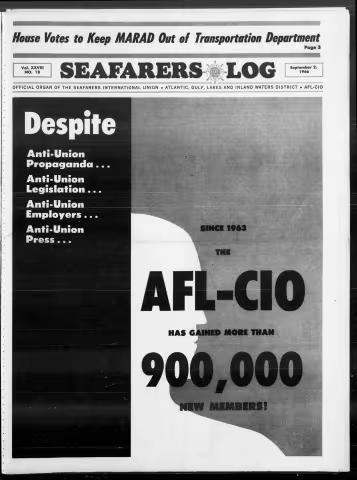
Despite
Anti-Union
Propaganda...
Anti-Union
Legislation...
Anti-Union
Employers...
Anti-Union
Press... !
.. • U'rr'-. I ^ .'ili L'.~ : >il<^
Page Two SEAFARERS LOG September 2, 1966
, f
AFL-CIOCxec CountU Stresses Need
For Fronomk Balance in Nation
The AFL-CIO at its mid-summer meeting here marshalled the basic weapons of the
movement—organizing, free collective bargaining, legislative activity and political ac-
CHICAGO
trade union
tion—to win a fair share for the American worker and help keep the economy on an even keel.
The federation's Executive
Council took a close look at the
current problems of increased
living costs, spiraling interest rates,
employer resistance to new con
tract improvements and civil rights
and came up with a comprehen
sive analysis and program.
It laid the groundwork for a
new farm workers organization to
help win economic and social jus
tice for exploited agricultural la
bor.
It found the AFL-CIO in good
health and growing, with a gain
of 900,000 members over a three-
year period and the organization's
Internal Disputes Plan functioning
smoothly.
In international affairs the coun
cil reaffirmed its strong support of
President Johnson's policies in
Viet Nam, urged union involve
ment in economic planning in
Latin America and strongly com
mended the work of the American
Institute for Free Labor Develop
ment.
This is what happened at the
three-day meeting:
21 More Victory Ships Slated
For Reserve Fleet Break-Out
Twenty-one more Victory ships are being broken out of the Reserve
Fleet in order to meet the increased demands of the Viet Nam military
sealift. This will bring to 141 the total number of reserve ships re
activated since July of last year.
The new break out was re
quested by the Military Sea Trans
portation Service from the Mari
time Administration. MARAD of
ficials noted that the action will
leave only 33 Victorys in the
United States standby reserve
fleet.
The Victory ships being called
up are old and have been lying
in various local reserve fleets for
many years, some since the end
of the Second World War. Most
have not been thoroughly moth-
balled and will take a long time
to be reactivated.
Maritime labor has been warn
ing the Government for many
years that just such a situation
would occur if the nation ever
developed a quick need for mer
chant ships. The almost prohibi
tive cost of reactivating these Vic
torys at United States yards has
forced the Defense Department to
move slowly in calling up reserve
vessels. Each ship has been esti
mated as needing almost a half-
million dollars worth of repairs
and conversion in order to be
SEAFAREBS^LOO
Offlctal Publication of the SfUNA
Atlantic, Gulf, Lakes & Inland Waters
District, AFL-CIO
Executive Board
PAUL HALL, President
CAL TANNER
Exec. Vice-Pree.
EARL SHEPARD
Vice-President
AL KERR
See.-Treae.
ROBERT MATTHEWS
Fice-Presidenf
HERBERT BRAND
Director of Organizing and
Publications
Managing Editor
MIKE POLLACK
Assistant Editor
NATHAN SKYER
LINDSEV WILLIAMS
Vice-President
AL TANNER
Vice-President
Art Editor
BERNARD SEAMAN
Staff Writers
DON BEVONA
PETER WEISS
PibllshnI biweekly at 810 Rhode liland
Aranae H.E., Washington, D. C. 20018 by
the Seafarers International Union, Atlantic,
Golf, Lakes and Inland Waters District,
AFL-CIO, 675 Foirth Avenae, Brooklyn.
M. Y. 12252. Tel. HYaclnih 9-6600. Second
alasa gostan Raid at Washington, D. C.
MSTHASTErS ATTERTIOII: Form 3579
cards eboald be sent to Seafarers Interna-
tlanal Unlaw, Atlantic, Galf, Lakes and In
land Wateis District, AFL-CIO, 675 Foarth
Aaanac, Bnchlyn, H. Y. 11232.
able to sail again.
Another important factor that
delays getting Reserve fleet Vic
torys on the high seas again is
that there are too few shipyard
workers around to perform the
job. The lack of trained shipyard
workers has been caused by the
administration's past attitude of in
difference and neglect towards the
American merchant marine. The
government, in its failure to im
plement the Merchant Marine Act
of 1936 and sponsor an adequate
program of shipbuilding and car
go support, has contributed to the
flight of trained shipyard workers
to other industries. It is primarily
because of this that United States
shipyards cannot compete efficient
ly for the current reactivation
work and get the reserve fleet
ships ready promptly.
On the organizing front it gave
new momentum to the drive to
organize farm workers in Cali
fornia by granting a charter to the
United Farm Workers Organizing
Committee, made up of groups
that have merged their, efforts in
the Delano grape strike.
AFL-CIO President George
Meany said the charter was an
"essential step toward winning a
measure of economic justice for
farm workers" and termed it an
event of "great importance."
On the bargaining front the
council gave its unqualified sup
port to unions in the electrical
and communications industries in
their current negotiations for new
contracts.
It pledged "complete and un
stinting support of the efforts of
the Communications Workers to
achieved an equitable contract for
its members at the Western Elec
tric division of the Bell System
and reaffirmed its all-out backing
"without reservation" of the ob
jectives of the AFL-CIO National
Committee on Collective Bargain
ing with General Electric and
Westinghouse.
The council voiced its support
also for strikes of the Boot «& Shoe
Workers at a Genesco plant, in
Tennessee and the Washington-
Baltirnore Newspaper Guild's
struggle at the Bureau of National
Affairs.
Meany told a press conference
that coordinated bargaining in the
electrical industry is an effective
approach and could well form a
pattern in other situations where
a number of unions hold contracts
with the same company.
Report of
International President
by Paul Hall
Support for an independent maritime agency has grown tremen
dously during the last year among the nation's legislators. It is be-
becoming increasingly clear to them that the national security of the
United States is already in real peril because of the deterioration of
U.S. Maritime capability brought about by continuing bureaucratic
neglect of maritime.
The need for such an independent maritime agency, free from en
tanglement in the bureaucratic mire of the Department of Commerce
or the proposed Department of Transportation, has been called for by
the AFL-CIO at its last convention and by the AFL-CIO Maritime
Trades Department, as well as by the SIU and other maritime unions.
The increasing interest in such an independent agency is reflected in
legislation already introduced into congress which would remove the
Maritime Administration from the proposed Department of Transporta
tion and set it up on its own with an Administrator empowered to
make independent decisions based solely on the needs of maritime.
Many of the nation's legislators have voiced their support for such
legislation, both at the recent Save Our Shipping Conference and in the
halls of Congress. The proposal has already been approved by the House
Merchant Marine Committee.
The importance of an independent maritime agency cannot be over-
stressed in terms of the future of the U.S. maritime industry and the
national security which it directly affects. During the years that the
Maritime Administration has been a part of the Department of Com
merce the maritime industry was allowed to fall into a steep decline
which has brought it to the point where it is now necessary to break
out 25-year-old vessels from the reserve fleet to meet demands brought
about by the Vietnam conflict.
The ships in our active fleet have become worn out and obsolete.
The ships in our reserve fleet have proven to be in little better condition
and are, in any case, almost gone. Action to save the U.S. maritime
industry must come now, and the establishment of an independent
maritime agency would be the first step.
The latest statistics available on average weekly earnings of factory
production workers in southern "right-to-work" states continues to be
the most eloquent plea possible for the importance of repealing Section
14B of the Taft-Hartley Act, which makes such "right-to-work" laws
possible.
Factory production workers in these states continue to be the worst
paid in the nation, with average weekly earnings in some cases less than
half of what workers in similar jobs earn in states that have rejected
"right-to-work" legislation.
The direct relationship between the existence of "right-to-work" laws
and low wages is dramatically revealed in the fact that the one southern
state that does not have a "right-to-work" statute on the books is also
the state in which southern production workers enjoy the highest aver
age weekly wages.
It is for these reasons that the AFL-CIO has pledged a continuing
fight to repeal Section 14B vvhich makes possible the abolition of the
union shop in these states through the so-called "right-to-work" laws.
Union Training Program Graduates New Total 76
Eight More Seafarers Win Engineers Licenses
Eight more Seafarers have passed the U. S. Coast Guard examination and have been issued their engineers licenses after preparing
at the training school jointly sponsored by the SIU and District 2 of the Marine Engineers Beneficial Association. A total of 76 Sea
farers have now received their engineer's licenses as a result of the recently instituted program.
Of the SIU men who recently
passed their Coast Guard exami
nation six were licensed as Third
Assistant Engineers and two re
ceived their licenses as Second
Assistant Engineers.
Seafarers receiving their licenses
as Second Assistant Engineers are:
Emile Glaser, 43, sailing with
the SIU as FOWT and oiler, has
been a union member since 1946;
Clinton Webb, 40, SIU member
since 1946, has sailed in all engine
room ratings;
The newly licensed third assist
ant engineers are:
Beryl Peterson, 51, who has
shipped in the SIU since 1951 and
sailed as reefer, oiler and FOWT;
Robert Simmons, 31, an SIU
member since 1961, has sailed in
the ratings of oiler and FOWT;
Thomas Carter, 44, has sailed
most engine room ratings, includ
ing deck engineer and electrician
Glaser Webb
Peterson Simmons
and has been a book member since
1953;
James Barnette, 43, has sailed
as oiler, FOWT, pumpman and
deck engineer, and joined the
union in 1946;
Lonnie Dooley, 41, an SIU
member since 1955 and has
shipped as FOWT, oiler, and ordi
nary seaman;
Charles Eschenbach, 39, holder
of FOWT and oiler endorsements,
joined the union in 1953.
The SIU-MEBA District 2
training program is the first of its
kind in maritime history. It as
sists engine department Seafarers
to obtain instruction in prepara
tion for their Third Assistant En
gineers license. Temporary Third
Assistant Engineer's license or
Original Second Assistant Engi
neer's license in either steam or
motor vessel classifications.
The training school is operated
under a reciprocal agreement be
tween the SIU and District 2 of
MEBA. SIU men who enroll in
the program are provided with
meals, hotel lodging and subsist-
Carter Barnette
ence payments of $110 per week
whjle in training.
Engine department Seafarers
are eligible to apply for any of the
upgrading programs if they are 19
years of age or older and have 18
months of Q.M.E.D. watch stand-
Dooley Escbenbacb
ing time in the engine department,
plus six months' experience as a
wiper or equivalent.
SIU engine department men in
terested in the program should ap
ply immediately, or obtain addi
tional information at any SIU
hall, or directly at SIU headquar
ters, 675 Fourth Avenue, Brook
lyn, New York 11232. The tele
phone number is HYacinth 9-
6600.
September 2, 1966 Page Three
MTD Board Raps Legislation
Threatening Right to Strike
CHICAGO—The AFL-CIO Maritime Trades Department Ex
ecutive Board at its quarterly meeting here voted full support for
legislation to create an independent maritime agency outside the
proposed new Transportation
Department, and strong opposi
tion to legislation that would
threaten the right to strike. '
SIU President Paul Hall, who is
also president of the MTD, served
as chairman of the two-day meet
ing which took place in Chicago
August 18 and 19.
In calling for the establishment
of an independent Federal Mari
time Administration as proposed
in pending House legislation (HR-
15963), the Board cited the need
to focus greater attention on the
growing problems of the maritime
industry and provide a better or
ganization for dealing with them.
Branding the present Maritime
Administration a "stepchild of the
Department of Commerce, lost
within already complex and over
burdened administrative machin
ery," the resolution pointed out
that "The history of departmental
reorganization shows that our mer
chant marine made greater prog
ress when its administration had
the most independence."
In going on record as unalter
ably opposed to any type of
strike-ban legislation, such as that
proposed during the recent Ma
chinists' strike against the airlines,
the MTD condemned this still-
pending legislation and those who
have supported governmental in
tervention in labor disputes. The
resolution urged all.organized la
bor to resist any and all attacks on
the free collective bargaining sys-
APl-CIO Retards
Sharp Cain
In Membership
CHICAGO — AFL-CIO
membership has grown rapidly
in 1966, with a gain of 347,000
in the first six months of the
year, the Executive Council re
ported.
The sharp gain continues a
three-year trend during which
the membership of the feder
ation in the United States
moved from a low point of
12,464,000 in the 12 months
ending June 1963 to 13,385,-
000 for the same period ending
in June 1966.
For the first half of 1966, the
council said, membership
topped 13.5 million. This does
not include about 1 million
members of AFL-CIO unions
in Canada.
These unions pay per capita
on their members in Canada
to the Canadian Labor Con
gress and the figures are not
included in the AFL-CIO tabu
lation, which is based on actual
per capita payments to the fed
eration.
The total gain over the three-
year period has been about
900,000. About 403,000 of
that increase came in the 12-
month period July 1964 to
June 1965.
The council reported that
slightly less than half the 130
national and international un
ions affiliated with the AFL-
CIO expanded their member
ship during the 1963-65 period.
tern by Congress or the Adminis
tration, noting that it is the "type
of action that could be used in the
future to club labor into accepting
management offers that are un
reasonable and unrealistic."
In other actions, the MTD Ex
ecutive Board adopted resolutions:
• Calling for the immediate
adoption of a program for the con
struction of a strong American-
flag bulk carrier fleet.
• Urging a program designed
to aid the U.S. fishing industry
through fleet modernization, eco
nomic incentives, research and
conservation.
• Opposing Military Sea Trans
portation Service plans to replace
U.S. crews aboard six MSTS ves
sels with foreign crews.
• Blasted Secretary of Defense
McNamara's "callously indiffer
ent" attitude to the U.S. maritime
industry.
• Urged strict adherence to the
provisions of the 50-50 laws.
• Demanded that U.S. unsub-
sidized lines be accorded fair and
equitable treatment by MARAD
in the allocation of reserve fleet
ships.
• Warned of the need for a
positive government policy toward
maritime and sea research in view
of the Soviet Union's recent mas
sive strides in shipbuilding, fishing
and oceanography.
SEAFAHERS LOG
House Votes to Keep MARAD Out
Of New Transportation Department
WASHINGTON, Aug. 30—^The House of Representatives voted today to keep the Maritiine
Administration out of the proposed new Department of Transportation. The vote was 260 to 117.
The House action came on an amendment to the Administration bill to create a cabinet-level
transportation department. As originally proposed the bill would have lumped within the new
department a number of federal agencies, including the Maritime Administration, Coast Guard,
Bureau of Public Roads, Federal Aviation Agency, and the safety functions of the Interstate Com
merce Commission and the
Civil Aeronautics Board.
After passing the amendment
to delete the provisions of the
Transportation Department bill
for the transfer of the Maritime
Administration to the new De
partment, the House rejected an
amendment to keep the Coast
Guard out too.
Following the action on these
and other amendments, the House
approved the measure to create
the new department by a vote of
336 to 42.
A significant factor in the fight
to keep MARAD from being
buried in the new department was
the vigorously and united effort
made by all segments of the mari
time industry-labor and manage
ment. The campaign to block
transfer of MARAD to the new
department and to set it up as a
completely independent agency
was a highlight of the emergency
conference to save U. S. shipping-
that was sponsored by the AFL-
CIO's Maritime Trades Depart
ment and Maritime Committee in
Washington in July.
The House Merchant Marine
and Fisheries Committee has ap
proved a bill to make MARAD
an independent agency. The
House is expected to consider
the measure next month.
Rep. Edward Garmatz (D.-
Md.), chairman of the House
Merchant Marine Committee, in
troduced the amendment calling
for the removal of the Maritime
Administration from the trans
portation department bill and
spearheaded the successful floor
fight to win its passage.
Strong support for the amend
ment came from the AFL-CIO
Executive Council, which last
week warned that the third-rate
status "which gravely threatens
the security of the nation," will
continue, "if the Maritime Ad
ministration is permitted to be
buried in another government de
partment, whether Transportation
or Commerce."
The AFL-CIO Council then
strongly endorsed the concept of
an independent Maritime Admin
istration—free from control by
any overall government depart
ment.
The transportation department
bill now goes to the Senate, where
committee hearings have been
completed but no action taken.
Today's decision by tbe House
to keep the Maritime Administra
tion of out of the proposed Trans
portation Department and the de
cisiveness of its vote indicated the
degree of Congressional aware
ness and concern over the plight
of the nation's merchant marine.
With the Maritime Administra
tion as part of the Department of
Commerce, the industry has been
declining steadily to the point
where U.S.-flag ships carry less
than nine per cent of the nation's
foreign commerce and its ship re
pair and building capacity are on
the verge of disintegration.
With the increasing demands
for more U.S. tonnage to meet the
needs of military operations in
Viet Nam, the neglect which the
maritime industry has suffered at
government agency hands has
been driven home very clearly.
The successful fight in the
House to keep maritime from be
ing lumped in an overall trans
portation department is regarded
as a step toward the only logical
resolution of the nation's shipping
problem—the establishment of
completely independent agency. ceai^r
Viet Cong Mine Rips SIU Pacific DIst. Ship; 7 Die
The Baton Rouge Victory, an SIU Pacific District manned freighter, was ripped by a Viet Cong mine in the Long Tao channel of
the Saigon river, about 22 miles east of Saigon on Aug. 23. Seven crewmen—five of them members of the SIU Pacific District Mar
ine Firemen's Union and two engine officers of the Marine Engineer's Beneficial Association—were killed in the explosion that flooded
the engine room. No injuries engine room,
were reported among the rest
of the crew.
The SIU Pacific Marine Fire
men members killed were:
Ray Barrett, Chief Electrician;
R. J. Rowe, Fireman—^Water-
tender;
J. MacBride, Oiler;
Earl Erickson, Second Electri
cian;
M. Reardoii, Oiler.
The MEBA members killed
were:
John Bishop, First Assistant En
gineer;
C. Rummei, Second Assistant
Engineer.
Following the explosion the
ship's captain, Konrad Carlson, of
Seattle, ran the vessel into the
bank of the river to avoid blocking
the channel. The ship then sank to
its main deck.
The chief engineer, Herbert F.
Kenyon, of San Francisco, was
also in the engine room, but was
unharmed. He and an oiler were
on a platform about 20 feet above
the area where the others were
working.
"Suddenly, there was this great
blast," he said. "It knocked me
down and stunned the oil man
next to me. I helped him out of
the engine room and went back.
... I rushed to get help, but it
was hopeless."
^ Salvage crews went to work to
refloat the 8,000-ton Baton Rouge
Victory and to recover the bodies
of the seven crew members and
SIU Pacific District-manned Baton Rouge Victory lies on bank of Saigon River about 20 miles south
east of Saigon a few hours after she was hit by communist mine that ripped hole in her port side.
Two small South Vietnamese gunboats are pulled up directly alongside stricken vessel to give aid.
save the cargo of U.S. supplies.
The Baton Rouge Victory was
the first vessel to be sunk in the
Saigon channel during the period
of intense American involvement
in the war.
Official sources said the Viet-
cong were trying to mine an am
munition ship that had been sched
uled to travel up the river ahead
of the Baton Rouge Victory. The
ammunition ship however was de
layed and the Baton Rouge Vic
tory was hit instead. U.S. river
patrol boats and armed helicopters
provided protective cover for the
salvage operations.
The Baton Rouge Victory, op
erated by States Steamship Com
pany of Seattle, sailed from San
Francisco July 28th carrying gen
eral • cargo, mostly trucks and
heavy gear and a crew of 45.
A World War II—built freight
er, recently withdrawn from the
reserve fleet for service in the Viet
nam sealift, the Baton Rouge
Victory was under charter to the
Military Sea Transportation Serv
ice.
The vessel's surviving crew
members—SIU Pacific District
SUP men on deck and Marine
Cooks and Stewards in the galley
—are being repatriated to the
West Coast.
5^"
•1:
Page FOOT SEAFARERS LOG September 2, 1966
Eight Additional Seafarer Oldtimers
Join Growing Union Pension Roster
The names of eight more Seafarers have been added to the list of men who are now receiving
union pensions. Newcomers to the SIU pension ranks include Johannes Kari, Anthony Conti,
George Crabtree, Gustav S. Carlson, Alex Woodward, Sidney Day, James Dueitt, Oscar Holton,
Jr., and Thomas McLaughlin.
Johannes Kari joined the SIU
in the port of New York. Born
in Estonia, he lives in Mastic
Beach, L. I., with his wife, Hilda.
He sailed as an AB and bosun
Kari Woodward
i
and his last vessel was the Lin-
field.
Anthony Conti sailed as a mem
ber of the steward department. He
joined the union in the port of
New Orleans which was his place
of birth. Conti lives in Slidell,
La., with his wife, Leona. His
last ship was the Del Norte.
George Crabtree was born in
North Carolina and joined the un
ion in Norfolk. A member of
the steward department, Crabtree
sailed as a cook. A resident of
New York City, his last ship was
the Julia.
Gustav Carlson, a member of
the Deck department, was born
in Sweden and now resides in
Texas City, Texas, with his wife
Ruth. He joined the union in the
port of New York. Carlson sailed
as a bosun. His last ship was the
Seatrain Savannah.
Alex Woodward joined the SIU
in the port of Port Arthur, Texas,
where he resides with his wife,
Lelal. Bom in Louisiana, the Sea-
Daeltt
farer sailed in the engine depart
ment and was last employed by
the Picton Towing Co.
Sidney Day joined the union in
Cruise Ship Biii Passed by Senate;
Weaid Bar Unsafe Ships from US
WASHINGTON—^A cruise ship safety bill designed to bar from
U.S. ports all passenger vessels considered to be tmsafe by the Coast
Guard has been passed by the Senate. The bill now goes back to
the House for approval of Sen
ate introduced amendments that
make the legislation both stiller
and more inclusive than the origi
nal House-passed measure.
As it now stands the bill slaps
both safety and financial respon
sibility rules on cmise ships sail
ing from U.S. ports. The "get
tough" provisions inserted by the
Senate are a direct result of the
Yarmouth Castle fire disaster in
which over ninety people died.
The House had already voted on
Delta Line Orders
Fhre New Cargoilners
The first new cargoliner of a
scheduled five will be delivered to
the SlU-contracted Delta Steam
ship Lines of New Orleans by the
early fall of next year. The keel
was recently laid by Ingalls Ship
building Corporation at Pasca-
goula, Mississippi.
The five new cargoliners are the
second group in the company's
long-range replacement program.
Five new vessels are already in
service on the South American
and West African runs. Thirteen
vessels in all will be replaced when
the program is finished.
The new ships will be 522 feet
long and have a width of 70 feet,
with a deadweight capacity of
13,250 tons. Each will have ship
board cranes aboard permitting
efficient loading and discharge of
cargo. ,
Additionally, the ships will as
sist in the fight against water pol
lution, common to many ports, by
the installation and use of sewage
treatment units.
The first vessel will be launched
next summer and delivery is ex
pected in early autumn.
the original measure before the
Panamanian-flag Yarmouth Castle
disaster occurred.
As passed by the Senate, the
main purpose of the bill is to
police unscrupulous foreign-flag
passenger ships which have been
sailing out of United States ports
without the rigid safety checks
that American-flag passenger ships
must undergo.
In addition to barring from
U.S. ports any vessels deemed un-
seaworthy by the Coast Guard,
the legislation would:
• Require all passenger vessels
to disclose their safety standards
on all advertising literature.
• Make owners of such ships
establish financial responsibility in
case of death or injury to passen
gers and repay passengers if the
ship failed to sail.
• Require that American-flag
ships affected by the law meet up-
to-date U.S. ship safety standards
by 1968.
The SIU and other maritime
unions, in addition to other U.S.
groups have repeatedly called
upon Congress to stiffen the regu
lations governing foreign-flag
cruise ships operating from U.S.
ports.
However, the Senate will not
move this session to include a pro
vision in the "safety at sea" meas
ure that will compensate the rela
tives of American passengers who
lose , their lives at sea.
A • spokesman for the Senate
Commerce Committee said that
the measure has been set aside for
further study. The new liability
measure will be designed to elimi
nate an old law limiting shipown
ers to only $60 a ship ton in com
pensation in case any passenger
was injured or lost his life in a
shipboard accident at sea.
Mobile. A native of Louisiana, he
now resides in Baltimore. Day
sailed as AB and boatswain, and
his last vessel was the De Soto.
Oscar Holton, Jr., sailed SIU
ships in the deck department after
joining in the port of Norfolk. He
Holton Conti
was born in Portsmouth, Va., and
now resides in Chesapeake, Va. He
was last employed by the Pennsyl
vania Railroad of Va.
James Dueitt was born in
Leakesville, Miss, and now resides
in Lucedale, Miss., with his wife,
Virgie. A member of the engine
department, he joined the union
in New Orleans. His last ship
was the Radcliff.
Thomas McLaughlin was born
in Plattsburg, N. Y. A resident
McLaughlin Crabtree
of West Hollywood, Fla., with his
wife, Emma. McLaughlin sailed
as a tankerman for the Interstate
Oil Transport Co, He joined the
union in Philadelphia, McLaugh
lin is a Navy veteran.
U.S. Shipbuilders
Rap Navy Contracts
With British Yards
WASHINGTON — The U.S.
shipbuilding industry has re
newed its protests against the con
struction of U.S. naval ships in
foreign shipyards following a
Government announcement that
a $24 million contract has been
awarded to British shipyards to
construct three new vessels.
The new protests are against
the foreign construction of an
oceangoing tug at a cost of $7.3
million and two naval survey ships
at a total cost of $16.7 million.
The U.S. Government has de
fended the award of the contracts
to British yards with the conten
tion that it is part of a reciprocal
agreement for the purchase by
Britain of U.S. warplanes.
The U.S. shipyard industry has
warned however that such a
build-abroad" program threatens
the future of the already-de
pressed U.S. shipbuilding indus
try.
American shipyard men have
also questioned the price of $7.3
million for the oceangoing tug,
noting that the largest and most
powerful tugs presently in the
U.S. fleet cost only about $1 mil
lion, and a 10,000 horsepower
heavy duty tug being built in
Japan cost only about $2 million.
The Atlantic Coast
by Eari (Bull) Shepard, Vice-President. Atlantic Coast Area]
The SIU is successfully meeting maritime manpower requirements
brought on by the Viet Nam conflict. Through its various upgrading
programs the SIU has managed to man all the many ships revived from
the mothball fleet that have been assigned to SlU-contracted com
panies.
In cooperation with District 2
of MEBA we have also assisted
in the upgrading of unlicensed
personnel to licensed status. This
program has helped meet the call
for personnel in that area.
Additionally, the SIU's pro
gram of preparing members for
advancement to higher endorse
ments has raised the level of en
dorsements for many Seafarers. In
this program ordinary seamen are
assisted in obtaining AB ratings,
and wipers are aided in their ef
forts to become oilers, firemen,
and water tenders.
The SIU will continue, through
its many programs, to meet the
manpower requirements of the
American merchant marine. In
formation on all these programs is
available at all SIU halls.
With the opening of the new
clinic in Cleveland, the number of
SIU medical facilities is raised to
twenty-one.
New Ym-k
John Simonelli, last on the Vel
lowstone, is renewing friendships
while waiting for his next trip.
Also, looking up old pals around
the hall is Frits Nilson. Frits is
keeping one eye on the big board.
His vacation is over now and Al
fred H. Neilson is around the hall
looking for the good run. He was
last on the Sapphire Gladys. P. L.
Hass, who just piled off the Rice
Victory, is looldng forward to a
long stay on the beach.
Baltiniore
At present the Alamar, Losmar,
and Trustee are laid up, but the
Helen "D", will be crewing up
soon. Shipping continues to be
fair.
On the beach just off the Ban
gor, George R. Graham is prepar
ing for his vaca
tion. Chester B.
"Chet" Wilson, an
SIU member
since 1938, had to
leave the Norina
because of a brok
en thumb. Chet
sails as bos'n and
carpenter and is
ready now to get
WilBon
back into action. Oswald Seppet
was recalling for his shipmates a
day in 1944 when he was tor
pedoed off the coast of Spain.
His last ship was the Alcoa Ma
riner.
Philadelphia
Elmer "Ted" Wheeler, an SIU
black gang member for sixteen
years, last sailed on the Com
mander. Ted is waiting for his fit
for duty. Last on the Merrimac,
Jack Arellanes, is raring and
ready to go again. Jack sails in
the deck department.
Vacationing after a few trips on
the Merrimac, Joseph Doyle is
spending time on the homestead
doing odd jobs. Frank Cake is
looking at the board anxious to
take the first oiler's job that shows.
Norfolk
Larry Comhs, an SIU member
for twelve years, will be glad to
get back to sea. Larry has just
been discharged from the Army.
Buren Elliott wants a couple of
weeks on the beach before he
ships again. Buren just completed
a trip to Vietnam aboard the
Beaver Victory. He has been a
member of the SIU for nineteen
years.
After a vacation in Puerto Rico,
Luis Ollvera will start thinking
about his next ship. His last ship
was the Yellowstone. Dallas Hill
recently got off the Annlston Vic
tory for a routine check-up.
Puerto Rico
After an extended stay on-the
beach Felix Serrano felt it was
time to get his sea
legs in shape
again. He grabbed
a job as AB on
the Ponee. Off to
India on the Al
coa Voyager,
Frank Mateo will
be riding in the
oiler's berth. In-
Mateo junctions have
been handed down by a Chief
U. S. District judge requiring two
local trucking firms to comply
with the Federal Wage and Hour
Law. The Senate Labor Commit
tee recently finished its hearings
on the minimum wage law in
Puerto Rico.
Boston
Far away from the hustle and
bustle William "Cappy" Costa is
enjoying himself at his summer
retreat. He is relaxing and doing
a bit of fishing at his camp. His
last ship was the Robin Trent.
Also vacationing with his family
is Fred Rashld. Fred's last sea
going hotel was the Norfolk where
he was an AB. Just out of dry-
dock George "Swlfty" Swift is
looking for the first job to hit the
board. Swifty last saw duty as an
oiler on the Azalea City.
S/U Boatmen
fleet New
Union Offiters
Members of the SIU Inland
Boatmens Union went to the polls
in June and elected officers for the
Atlantic and Gulf Coast Regions
of the IBU.
Balloting was held on the June
union meeting dates in each re
spective city where meetings are
held, and on the day after the
meeting.
SIU-IBU members also made
their choices known through mail
ballots. Those elected, as an
nounced by the IBU Tallying
Committee are:
Atlantic Coast Regional Direc
tor, Robert A. Matthews; Assist
ant Regional Director for port of
New York, Earl Shepard; for
Philadelphia, Joseph Trainor; for
Baltimore, Raymond J. Herold,
Sr.; Port Representative for port
of New York, A1 Kerr; for Phila
delphia, John Hoare; for Balti
more, John J. Syplewski.
Gulf Coast IBU Regional Di
rector, Lindsey J. Williams; As
sistant Regional Director for the
port of Mobile, Luke LeBlanc;
for New Orleans, C. J. Stephens;
for Houston, Paul Drozak.
I
•!) •'!)
September 2, 1966 SE/iFARERS LOG Page Five
The Gulf Coast
by Lindsey Williams, Vice-President, Gulf Area
Local candidates endorsed by COPE and the New Orleans Maritime
Trades Department fared well in the Democratic primary election held
August 13, 1966. Of the four endorsed candidates in the judgeship
races, Arthur J. O'Keefe, Jr. was elected to the bench in the First City
Court; Walter F. Marcus, Jr. led a field of four for judge of the Civil
District Court, and missed being
elected in the first primary by a
mere 4200 votes out of 98,000
cast; Louis Trent and Maurice
Friedman ran first and second re
spectively in the contest for two
new traffic court positions. Mar
cus, Trent and Friedman face a
run-off.
The second primary election
will be held September 24, 1966
and all union members, their fam
ilies and friends, are urged to vote
and work for the election of
COPE and MTD endorsed candi
dates.
Mobile
Currently registered and ready
to ship out is John W. McNellage
who has recently completed two
years aboard the bauxite-carrying
Alcoa Ranger. He has shipped
from Gulf ports for the past
twenty years. Last aboard the
Warrior, Charles R. Sanchex is
almost resting: he is doing some
work on his home. Relaxing with
the family in Mobile after a
couple of trips to the islands
Charles L. Reeves says he enjoyed
the Alcoa Commander, but plans
to take it easy before shipping
again.
Hemington Hurlstone, just off
the Claiborne, is
currently regis
tered in group
one deck waiting
for a run to strike
his fancy. SIU
veferan George
Saucier, an SIU
member since the
inception of the
union, recently
paid off on the Alcoa Ranger.
Earl K. Whatley who just paid
off the Alcoa Commander after a
long trip, says that he plans to
take it easy for awhile.
New Orleans
Pensioner James P. (Sloppy)
Creel, a regular at the monthly
membership meetings, called to
Hurlstone
Sherman
say he could not be in for the
latest meeting. Creel, who was
dry docked recently, says that
things get mighty lonely in the
piney woods without a few words
from old shipmates: His address
is Route 2, McComb, Mississippi.
After six months as FWT on
the Iberville, J.
Adams is looking
for a run on a
Delta Liner to
South America.
Also scouting a
Delta Line run is
Charles Cassard,
last on the Del
Campo. Monk
Sherman finished
two trips on the Del Mar and
plans to hang around New Or
leans for the remainder of the
summer.
Around the New Orleans hall
chewing the fat with old ship
mates were pensioners Frank
Vivero, Sam Hurst, Ignace De-
careaux, Niels Hansen, Rufus
Stough, Phil O'Connor, Percy
Boyer, Frank Kouns, Joe Munin,
Edward Boyd, and Ralph Suhat.
All of these oldtimers can be
reached by mail through the New
Orleans hall.
Houston
Saturday, August 27, 1966
marked the Second Annual Din
ner-Dance of the West Gulf Ports
Council. Featured speakers were
Congressman Bob Eckhardt, ILA
President Teddy Gleason and
SIUNA President Paul Hall.
Houston Port Agent Paul Drozak
was a member of the Sponsoring
Committee which took care of
preparations for the event.
John Ziereis, veteran deck man
recently off the Midlake, is getting
tired of soaking up Texas sunshine
and is looking forward to a long
trip. G. Lee is anxiously waiting
to start the engineer upgrading
school in New York. Lee says
he's ready to give it hell.
Foreign Bulh Midbodies Subject
To Customs Charges, Court Rules
Foreign-built midbodies used in constructing American-flag mer
chant ships are now subject to Customs duty as a result of a decision
handed down by the United States Court of Customs and Patents.
The legal body ruled that the
foreign-built midbodies are not
vessels and therefore not en
titled to duty-free status upon their
importation into the United States.
The motion reversed an action in
a lower Customs court which said
that the midbodies were vessels
and not subject to customs duties.
The action was originally start
ed by a group of importers who
protested against a decision made
by the Collector of Customs in
labelling the structures under the
Tariff Act as "articles wholly or
in chief value of iron or steel not
specifically provided for." Under
this application importers were li
able for customs duty.
The higher court said that since
the exclusive purpose of the struc
ture was to serve as a mid-section
* of an ore carrier, they are not
vessels and cannot be entitled to
the "duty free status. No other
claim having been advanced in
support of the protest against the
classification found by the cus
toms collector, we find the classi
fication of the customs collector
to be correct and the decision of
the Customs Court is therefore
reversed."
Midbodies are often used to
jumboize older American tonnage
to create larger tankers and bulk
carriers from smaller vessels. The
process involves inserting the new
midbody between the fore and aft
sections of an older ship to in
crease cargo capacity.
The insertion of the midbodies
is one temporary method U.S.
shipowners have used to upgrade
their fleets and improve their com
petitive position.
Growing Ship Shortage Endanger
US Serurity, Congressman Warns
WASHINGTON—The United States has just about played out all its shipping cards in support
ing the Vietnam War, according to Representative Thomas N. Downing (D.-Va.), who said
that the nation would not have enough ships to support another military build-up anywhere else in
the world. - Provide enticing enough sub-
.iii 0 .OCi 'jt.l I
Downing made his statement
as a panelist on the Navy League
Symposium on seapower in Wash
ington. He said that if the Viet
nam war "escalates into Red
China, we have had it," because
"we now have almost every avail
able ship on the bridge of ships
to Vietnam. We have taken them
off the paying run and given this
business to foreigners, and we are
going to have a hard time getting
it back."
He urged that the Administra
tion lay out an additional $100
million a year to enable the United
States merchant marine to build
at least 20 new ships annually for
at least ten years in order to re
main a leading mercantile naval
power.
Representative Downing de
clared that he would prefer to
spend a dollar and not need it
rather than reduce the nation's
security to such a low ebb that its
survival is at stake.
Suggests Program
The shipping crisis facing the
United States, he said, can be
solved in the following ways:
• Create an independent Mari
time Administration
• Develop a fleet of nuclear
powered ships
SlU-inW Beets
Regmnal OfRters
A full slate of officers for the
Atlantic and Gulf Regions of the
United Industrial Workers has
been elected as UIW members
went to the polls in June to select
the candidates of their choice.
The elections were provided for
under the terms of the regional
constitutions in effect since August
1962.
Balloting for UIW members in
Atlantic and Gulf Regions took
place on the June Union meeting
date in each respective city where
meetings were held. In addition,
mail ballots were sent out for the
convenience of those members in
cities where the constitution
makes no provision for members
to vote in person.
A membership-elected tallying
committee supervised the voting
in both the Atlatnic and Gulf Re
gions. Voting has now been com
pleted in both regions and all the
ballots have been counted. The
results of the election have been
certified by the respective tallying
committees.
Candidates elected in the two
regions are:
Atlantic Coast Regional Direc
tor, Ralph Quinnonez; Assistant
Regional Directors for the port of
New York, Frederick Stewart; of
Philadelphia, John Fay; of Balti
more, Warren R. Leader; Local
Representatives for the port of
New York, John Dwyer; of Phila
delphia, Albert Bernstein.
Gulf Coast Region—Regional
Director, Lindsey J. Williams; As
sistant Regional Directors for the
port of New Orleans, Ysmael Paz;
of Houston, Paul Drozak.
i.' , i !•) •• ; •; f.i;'
sidies so that shipowners can be
gin to replace their worn-out ton
nage.
• Let the people of the United
States find out exactly how badly
off their merchant navy really is
so that they, once aware of the
true situation, will be able to in
fluence future budget decisions in
Washington.
This action is necessary, he said,
because there appears to be no
thrust or focus from any corner
of the Administration to "bolster
our lagging maritime fleet." He
noted that on the "contrary there
seems to be a thrust in the direc
tion of reducing if not eliminating
shipping subsidies."
Other panelists who spoke in
cluded Rear Admiral Ralph K.
James (ret.), executive director of
the Committee for American
Steamship Lines and Maitland
Pennington, special assistant to
the Maritime Administrator.
Admiral James said that the
Russian merchant marine has
1,315 merchant ships today com
pared with 1,012 American-flag
vessels. Even though these ships
are smaller and the Soviet Union
is behind by about 6 million tons,
it is increasing its fleet by more
than one million tons yearly.
Admiral James pointed out
that "The Russian Minister of
Merchant Shipping, Viktor
Bakayev, is the most powerful
man in world shipping today, bar
none. By 1980 Bakayev expects
to have between 20 million and
25 million tons of new ships mak
ing him Czar of the world's largest
merchant fleet.
The Pacific Coast
by Frank Drozak, West Coast Representative
Highlights of the AFL-CIO's California Labor Federation Conven
tion included a pledge made by the labor body to mount an unprece
dented election campaign against "the forces of extremism."
The state's civil rights problems and the impending election at the
DiGiorgio complexes at Delano and Borrego Farms were also discussed
at the meeting. Speakers included '^Artisan and Geneva were in travel.
United States Undersecretary of
Labor John F. Henning and State
Controller Alan Cranston.
SIU President Paul Hall attend
ed as a special representative of
A F L - CI O President George
Meany.
Seatfle
The shipping picture now is real
good, and the outlook for the
next couple of weeks looks like it
will be the same for all rated man
in all departments.
Payoffs for the last period have
been the following: Rice Victory,
Anniston Victory,
Transeastem and
Penn Sailor.
The Rice Vic
tory and Anniston
V i c t o ry were
signed on since
the last report and
the Walter Rice,
Seattle, Anchor
age and Calmar
were in transit.
Hubert Halfhill, whose last ship
was the Summit may try the Viet
Nam run for a change of scenery.
Charley Crossland, is just off
the Transeastem and will be grab
bing the next AB's job hitting the
board.
San Francisco
Shipping here in the port of
San Francisco is still very active
and we have plenty of jobs open
for AB's, Oilers, FWTs, Electri
cians, Cooks and Bakers.
The Freedom Victory, Overseas
Dinny, Beaver Victory, Delaware,
Rio Grande, Los Angeles, Cor
nell Victory, Santa Emilia, Cour
D'Arlene, Young America, Free
America and Northwestern Vic
tory paid off and signed on crews
while the Yorkmar, Oakland, Cal
mar, Steel Admiral, Steel Flyer,
Bethfwd, Vantage Progress, Steel
Halfhill
C. T. Scott AB, and one of the
real SIU oldtimers, expects to
catch a short vacation after spend
ing seven months in Vietnam and
two months in the hospital for a
leg injury. Brother Scott is Mary
land bora and a 27-year SIU man.
V. Valencia, just out of the
USPHS hospital in San Francisco
is waiting for the next job opening
that hits the board.
Wilmington
Shipping actvity remains good
here with 11 ships passing through
in transit and the Steel Architect
and Vantage Progress scheduled
to pay off. All men in all ratings
are finding it very easy to ship in
Wilmington.
FOWT's, AB's, and Cooks are
still hard to come by at times with
shipping as busy
as it is. The out
look is still good,
too, and we wel
come all rated
men.
Ken Gibbs, af
ter spending some
time on the beach,
has decided it's
time to start ship
ping again.
Bennie Magnano was recently
repatriated from the Erna Eliza
beth after staying on her for a
year as Deck Maintenance. On his
first visit to the USPHS he was
declared fit for duty and is quite
upset that the Doctor in Trinidad
took him off such a good ship for
an apparently minor problem. He
is registered now and hopes.to
take a Bosun's job pretty quick.
George Cortez is on the beach
here and hopes he will soon be,
given his "Fit for Duty" slip. He's
been laid up since June and would
much prefer working to sitting
around on the beach. We wish him
a speedy recovery.
Gibbs
J
Pmge Six SEAFARERS LOG September 2, 1966
N
The Great Lakes
by
Al Tanner, Vice-President and Fred Farnen, Secretary-Treasurer,Great Lakes
A new SIU clinic facility to service Seafarers and their dependents
in the Cleveland area is now located at 200 Republic Building, Cleve
land, Ohio 44115—Phone number 621-1600. This is the late.st addi-
.tion to the Union clinic service available to SIU men and their families
in all major ports across the country and in Puerto Rico.
Voting in the 1966 Biennial
Election of Officers is continuing
at a steady pace during the month
of August. During the first two
weeks we boarded and voted
forty-eight ships in the Ste. Clair
and Detroit rivers. As many as
six ships were voted in one day,
with patrolmen getting off one
ship via the SIU service launch
"SIUNA" and going downstream
again to board another vessel.
During the last weeks of August
we voted the Ann Arbor Railroad
carferries in Frankfort and the
Arnold Transit Fleet at St. Ignace,
Michigan. Because many of our
full book members are sailing out
on the coast we expect a light
vote.
Negotiations are continuing on
the industry-wide vacation plan
for SIU Great Lakes District
members. The Union submitted
its latest proposal last week to the
GLAMO Negotiating Committee
and we expect to hear from them
shortly.
The tanker Transbay (Atlantic
& Gulf) is expected to call for a
crew late in October. The Trans-
bay is presently in the American
Shipyard at Lorain, Ohio and is
being jumboized, which will add
an additional seventy feet to her
length. Hudson Waterways, own
ers of the Transbay, also have
two more vessels in Great Lakes
yards that will be ready sometime
next year.
The Great Lakes "ship of the
future" has been described in a St.
Lawrence Seaway Administrator's
report as a "hybrid" vessel of over
17,060 tons capable of traversing
the Seaway carrying cargoes di
rectly between Great Lakes and
foreign ports. This type of ship
has been increasing on the Sea
way in recent years according to
the report, and still bigger ships
are in the offing, it predicts.
THE INQUIRING SEAFARER
Question: Do you agree that
football is replacing baseball as
the national pastime in the U. S.?
Carmelo Clemente: From con
versations I've had with my ship-
mates I think
football is moving
up on baseball as
the number one
sport, although in
my native Puerto
Rico, baseball is
very popular.
Most of the guys
think football has
more action. Frankly, I'm not to
crazy about either sport. I prefer
boxing for real action even though
interest in the sport is declining.
In boxing, you need to be in per
fect physical condition and it is
very interesting.
Charles Kerns: I think that
baseball is still on top. If you con
sider the sched
ules of each sport
you'll find that on
the average base
ball draws as
many, if not
more, fans than
does football.
Baseball is as
strong as ever.
When the race is as tight as it is
in the National League a lot of in
terest is generated, but the Amer
ican League is too far lopsided to
be of any interest.
— 4,—
Gerald Knight: Football is def
initely more popular with today's
fans. I think this
is because baseball
does not have
enough action. On
the other hand,
football is a game
that is colorful
and full of action.
I personally pre
fer footbaU. I
think that there is more player
contact and the action is continu
ous. Baseball is a drag.
<1>
Rodney Buckingham: Yes, ex
cept in Baltimore; that's where
I'm from. In Bal
timore everybody
is excited about
the Orioles being
so far out in front.
I think that base
ball's long sched
ule makes it dull
for most people.
But football
which is played only once a week
is something to look forward to.
Julius M. Prochownik: I think
the sports are about equal. Since
baseball is a sum
mer sport and
football .a winter
sport, they each
have their season.
Perhaps football
has a slight edge
since the crowds
are so large, but
there are fewer
games for the fans to see. In Bal
timore, where I live, the Orioles
are on top of the American
League and there is great interest
in them. In recent years, the Colts
were wildly popular. I think both
sports have their following.
— 4^
John Galloway: I believe foot
ball is gaining on baseball. Most
guys seem to talk
more about it
than they do base
ball. I find that
football has more
action. I like to
see as many
games as I can
and am a great
fan of the Green
Bay Packers. I'm sure that if foot
ball isn't number one now, it will
be soon. Baseball is a good sport,
but it's kind of slow.
• •''•'I.I I ••i'. 1. I r,
From Aug. 12 to Aug. 25, 1966
DKK DEPARTMENT
TOTAL REGISTERED
Port
Boston
New York ...
Philadelphia .
Baltimore ....
Norfolk
Jacksonville ..
Tampa
Mobile
New Orleans .
Houston
Wilmington ..
San Francisco
Seattle
Totals
All Groups
Class A Class B
4 2
87 41
19 12
37 15
17 6
12 3
5 2
26 12
58 35
40 27
7 3
37 21
18 10
367 189
TOTAL SHIPPED REGISTERED on BEACH
All Groups All Groups
Class A Class B Class C Class A Class R
1 2 1 25 5
43 25 44 299 103 1
12 3 2 38 17
17 6 3 129 42
7 9 4 33 12
4 0 2 15 3
0 0 0 15 8
12 11 4 85 14
44 28 19 146 80
31 20 12 136 33
1 3 8 31 1 -
25 12 " 29 69 2
17 4 16 48 24 n
214 123 144 1,059 344
ENGINE
TOTAL REGISTERED
DEPARTMENT
TOTAL SHIPPED REGISTERED on BEACH
Tentative Conservation Agreement Reached
Soviets Agree to Honor Twelve-Mile
U.S. Fishing Zone Along West Coast
Efforts by the SIUNA-affliated West Coast fishermen's unions to preserve California's off-shore
fisheries have begun to show some results. California's Governor Ednrmnd G. Brown announced re
cently that the Soviet Union has tentatively agreed that the Russians will not fish from vessels within
12-miles of the U. S. Pacific
Coast.
The tentative agreement,
made at a Moscow meeting of
U.S. and Soviet officials, came
after the Governor's recent Wash
ington conference with Secretary
of State Dean Rusk in which
Brown told Rusk that the future
of California's fishing industry de
manded immediate action.
A special State Department del
egation, headed by William C.
Harrington and representatives of
the U.S. Fish and Wildlife Serv
ice met with Russian officials on
the fish conservation problem.
After a successful meeting,
Harrington reported that the dele-
New Union Clinic Facility Provided
For Cleveland SIU Members
CLEVELAND—^The latest addition to the growing system of
SIU clinics has begun serving members and their families in the
Cleveland area. The clinic is located in the Republic Building,
Room 200. Phone: 621-1600.
The facility will provide free diagnostic service to the many SIU
Great Lakes District members, SIU Great Lakes Tug and Dredge-
men and SIU Inland Boatmen's Union members in the area as
well as to their dependents.
SIU clinic facilities are already available to Seafarers and thsir
families in the Great Lakes ports of Buffalo, Duluth, Sauk Ste.
Marie, Toledo, Superior, Wis., Melvindale, and Alpena, Mich.
The system of SIU clinics was begun in 1957 with the opening
of the first facility in New York. Other union clinics are located
in Boston, Philadelphia, Baltimore, Norfolk, Tampa, San Juan,
Ponce, New Orleans, San Francisco, Seattle, and San Pedro, Calif.
'I.! V.I/"./-./A.H iiiii -I ) v ^r»uin.
gations of both nations would
make the following recommenda
tions to their governments:
• The Russians would agree
that their vessels would not en
gage in fishing within 12-miles of
the Pacific Coast of the United
States.
• The Russians would reiterate
their instructions to their fleet in
the area off the Pacific Coast not
to fish for salmon.
• Both governments would
agree to take steps to reduce the
concentration of fishing vessels on
other fishing grounds in order to
prevent the depletion of resources.
Within the next few weeks
there will be an exchange of fish
ing personnel and scientists be
tween American and Russian fish
ing boats in order to map ways to
help preserve the fisheries.
Harrington said that there will
be another Moscow meeting No
vember 13 to discuss conservation
programs and establish rules on a
long-term basis for both Atlantic
and Pacific coastal waters.
The Senate Commerce Com
mittee has recently approved legis
lation to bar foreign fishing ves
sels from operating within 12-
miles of the coast of the United
States.
tbiu (. •• • • ...
Port Class A Class B Class A Class B Class C Class A Class B
Boston 3 1 1 1 0 12 1
New York 70 44 37 30 31 179 89
Philadelphia
Baltimore
7
17
7
20
4
18
4
17
3
4
19
72
11
39
Norfolk 9 8 1 6 7 24 8
Jacksonville 5 7 2 2 5 8 6
Tampa 4 2 3 2 0 12 6
Mobile 13 10 12 11 7 34 4
New Orleans .....
Houston
37
38
35
34
37
41
25
29
22
10
87
85
47
44
Wilmington 6 1 3 0 7 11 2
San Francisco
Seattle
7
9
12
12
21
15
7
7
29
12
45
23
2
6
Totals 225 193 195 141 137 611 265
STEWARD DEPARTMENT
TOTAL REGISTERED TOTAL SHIPPED
All Groups All Groups
REGISTERED on BEACH
All Groups
Port Class A Class B Class A Class B Class C Class A Class B
Boston 4 1 1 0 0 10 4
New York 40 16 34 12 24 174 39
Philadelphia
Baltimore
6
17
6
15
7
4 .
5
14
6
2
20
79
16
19
Norfolk 5 8 0 2 2 11 26
Jacksonville 1 1 2 1 5 9 2
Tampa 7 1 0 0 1 24 2
Mobile 12 3 9 2 4 54 7
New Orleans
Houston
42
27
36
14
36
15
38
14
6
8
121
72
66
31
Wilmington 6 5 1 1 4 16 1
San Francisco ....
Seattle
22
19
6
4
9
8
7
7
38
6
41
18.
1
3
Totals 208 116 116' 103 106 649 217
i~ 'i-; • .
SEAFARERS LOG Page Seven
Meany Asks Admimstration
To Halt Interest Rate Rise
AFL-CIO President George Meany has asked the Administration
to step in and halt the sudden upward rise in interest rates that are
afiecting the bulk of Americans. The hike in interest rates, he charged
IS boosting prices and throwing residential construction into a panic
and he demanded that these loan rates be rolled back to reasonable
levels.
'Interest rates, "Meany said, "are higher than at any time since
the 1920's. "That era, as everyone is well aware, was the lull before
the big depression, a boom time when credit began tightening and inter
est rates ran high. A 33VS increase in the price of money since last
December is robbing the average salary earner of a chance to benefit
himself by financing the building, renovation or purchase of a home."
The consumers, small businessmen and farmers of the United States
are being immobilized by the commercial banks in this country"
Meany said, because they are not able to afford loans at high interest
rates. The money they are forced to borrow must now be repayable
by interest rates that are as high as ten per cent or more. The only
winners in the current interest rate squeeze play, he added, are com
mercial banks and the privileged group of individuals and organiza
tions who hold large blocks of Government and commercial bonds.
• • «
An auto safety standards bill has won House passage. The Senate
had passed a similar, though weaker, measure in June. Conflicts be
tween the bills will be worked out by a Joint House-Senate Conference
committee.
Both bills direct the Secretary of Commerce to establish interim
safety standards for 1968 model cars. However, full implementation
of the bill is not anticipated until the 1969 model year.
An advisory panel will set up standards to guide foreign or domestic
car makers. It is assumed that the panel will devise standards
similar to those required of automobiles and trucks which are bought
by the government for its own use. Such standards have long been em
ployed by the General Services Administration.
Used car safety is also touched on in both bills, though the Senate
bill only requires a study of used car safety while the House bill allows
the government to set used car safety standards.
Violations of safety standards, once established, are punishable by
a $1,000 fine for each violation, not to exceed $400,000. There afe
no provisions for criminal conviction in either bill.
Tire safety and grading standards are also included in both bills.
"First Down!"
William Schoenberg, founding
president of the Cement, Lime
and Gypsum Workers, died in a
suburban Des Plaines hospital
after an illness of several months.
He was 88. His union activity
began in 1913, when he was
named a representative of the
Chicago district of the Machinists.
A few years later he was appointed
lAM general representative, and
in 1933 was named AFL general
representative in the Midwest. He
was placed in charge of AFL or
ganization of Portland cement
plant employees and in September
1939 was elected president of the
Cement, Line and Gypsum Work
ers when it was chartered by the
AFL. He retired in 1955 and was
designated president emeritus.
Surviving are his widow. Bertha,
and two sons, William, Jr., and
Alfred.
<I>
Dr. Joseph Mire, executive di
rector of the National Institute of
Labor Education for the past
eleven years, has been appointed
a research professor at the Ameri
can University in Washington's
Department of Economics. The
Austrian-born Dr. Mire had been
economics and labor advisor for
the Chamber of Labor in Vienna
for 14 years and taught at such
schools as Ruskin College and
Oxford University.
4/
A sportswear firm which clan
destinely "ran away" from Peru,
Indiana, to a new $250,000 city-
built plant in Uniontown, Ala
bama, should be . compelled to
offer jobs in the Alabama plant to
the employees it deserted, pay all
their family moving expenses and
make up their iost income, a Na
tional Labor Relations Board trial
examiner has recommended. The
examiner, rejecting the employer's
argument that an employer "has
the right to close his entire busi
ness" even if the closing is moti
vated by "vindictiveness toward
the union," ruled that the Mc-
Loughlin Manufacturing Corpora
tion of Peru did not actually go
out of business but instead moved
its machines to Alabama and
formed a new firm called Lady Jo,
Incorporated.
^
A locomotive fireman who
shoved two boys from the path of
a moving freight train last winter
was honored at a public luncheon
in Indianapolis. Nelson D. Rey
nolds, 30, of Evansville, who
works for the Chicago and East
ern Illinois Railroad, received
$250 and a plaque as winner of
the quarterly safety award of his
union, the Locomotive Firemen
and Enginemen. Reynolds worked
his way to the front of his engine
in Poseyville, Indiana, grabbed
the handbar with one hand and
swept the frightened young,sters
to the side of the track.
Racists and anti-union pres
sures lost out in Canton, Missis
sippi, after workers at the Udico
Manufacturing Co., plant here
voted for union representation in
a National Labor Relations Board
election. Workers at Udico, a
run-away shop from California,
were harassed by Canton's mayor,
city councilmen and business lead
ers who warned them to expect
trouble if they voted for the Elec
trical, Radio & Machine Workers
Union. Bread and butter issues of
such greater importance as a wage
hike, seniority and grievance ma
chinery won out.
The House Takes a Step in the Right Direction
The action of the House of Representa
tives to keep the Maritime Administration
out of the proposed new Department of
Transportation is a hopeful sign.
By the decisive vote in which the House
members approved an amendment to exclude
the Maritime Administration from among
the agencies which would be lumped in the
new transportation setup, it appears that the
issue was very clear.
The legislators passed the bill to create a
new cabinet-level Transportation Department
by a vote of 336 to 42, but first they
amended the measure to delete the provi
sions that -would have transferred the Mari
time Administration from the Commerce De
partment to the proposed transportation de
partment. The vote on this amendment was
260 to 117.
This important House vote indicates that
the members of that branch of the legislature
are concerned about the state of the Ameri
can merchant marine, and that they recog
nize the dangers to the nation in its con
tinued decline.
They obviously do not want any further
damage to the position of the merchant ma
rine, which would be inevitable were the
Maritime Administration and the business of
the maritime industry placed in the proposed
new transportation department. There it
would be buried in a welter of other gov
ernment agencies, and subjected to the abuses
and antagonisms that are an inherent part of
their attitude toward maritime.
Under such conditions, maritime would
not only be unable to develop and expand,
it would very likely be hard put to survive.
By their vote, the House members appear
to understand this problem. The House
Merchant Marine Committee Chairman,
Rep. Edward Garmatz, who comes from the
port city of Baltimore, and who spearheaded
the effort on the House floor to keep
MARAD out of the new department, ap
parently got the seriousness of the situation
across to his colleagues.
The successful outcome of the vote in the
House is also evidence of the effectiveness
of a maritime industry in getting its story
understood when it is united across the
board—every labor and management seg
ment in the industry. The lesson to be
learned from the effective manner in which
the industry functioned on this issue is that
it can do a job in the interest of the total
industry and of the nation when its efforts
are coordinated and concentrated on the real
objective of all concerned.
Important as it was, the House action is
only the first step in what must be a long
and arduous campaign if the maritime in
dustry's continuing decline is to be reversed
and a healthy, expanding industry is ulti
mately to be achieved.
The Transportation Department bill now
goes to the &nate for action. It is hoped
that the Senate will take action similar to
that of the House.
Meanwhile, the fight must go on to win
the creation of a completely independent
maritime agency, which could then offer the
means whereby the industry could at long
last be revitalized, and the U. S. could have
a shipping industry that fulfills its require
ments.
As the AFL-CIO Executive Council
pointed out at its Chicago meeting preced
ing the House vote, the nation must adopt
the concept of an independent Maritime Ad
ministration. Subordination to a Transpor
tation Department or the Commerce Depart
ment, in which MARAD presently lies, the
Council said in a strong resolution, would
result in the "essential needs" of maritime
"being continually ignored and submerged."
Rightly, the Council called for a reversal
of the trend through the upgrading of the
agency charged with overseeing the merchant
marine.
m
Pace Elcht SEAFARERS LOG Septmnlier 2, 1966
i .
t !•
. r.
; "s
i 1:,.
; <!
. ;'
I J J
J
Nowhere to go
but Union
The Desperate R^t
Ram Werkers
te Sam
Deeeat Cea^la^
aim^
FARM workers have for a long
time been the most poverty-
stricken depressed and under
privileged working people in Amer
ica. They earn on the average about
$1,000 a year in agriculture. Many
earn less than 75c an hour. They
often must travel hundreds of miles
at their own expense to find jobs of
short duration, and sometimes to
find no jobs at all. Their housing is
usually miserable, health conditions
scandalous, and education for their
children is usually inadequate, if
available at all.
They are treated as second-class
citizens or worse. They do not even
enjoy the minimal protections af
forded other American workers un
der the Minimum Wage and Hour
Law and the Fair Labor Standard
Act. Abandoned and ignored by the
social legislation other Americans
take for granted, they enjoy no social
security, no protection against child
labor, receive no unemployment in
surance in any but one state and are
totally excluded from the provisions
of the National Labor Relations Act
—something that has hampered
their organizing into unions for
many years.
But American farm workers today
are moving toward the only answer
to their problem. They are organiz
ing into unions and acting collec
tively to improve their condition.
Farm workers have taken strike ac
tion in Florida, Texas, Arizona,
Mississippi, California and else
where. For the most part their de
mands are only to be paid the Fed
eral minimum wage in return for
their backbreaking labor. Strikes are
underway within California's $3.5
billion agricultural industry against
some of the state's biggest, most
powerful powers, and the movement
is spreading to other states. One
large California grower, Schenley
Industries, Inc., has already signed
a contract with the farm workers'
union and negotiations are presently,
underway with another big com
pany, Christian Brothers.
Other big growers, most notably
the huge DiGiorgio Company, which
alone has yearly net sales of over
$200 million, remain intractable to
the farm workers' organizatimi and
to any improvement in farm work
ers' wages and conditions. But the
workers, though not strrnig in wealth
and power as are the big growers,
are tough, determined, and stead
fast in their purpose. With the solid
backing of the AFL-CIO and other
groups interested in their welfare
they have made great strides in a
short time and can look to the future
with hope.
How did this drastic change in
the hopes and aspirations of Ameri
can farm workers come about?
In large measure their new hope
for the future was made possible by
the successful struggle waged in the
halls of Congress by the AFL-CIO
that culminated in legislation out
lawing the importation of the so-
called "Braceros"—cheap, tempo
rary farm labor from outside the
United States.
Passage of the anti-bracero act in
1964 denied to the big U.S. growers
one of the strongest levers at their
disposal to use against American
farm workers. In most cases the
growers could no longer undermine
American farm workers' organizing
attempts by importing thousands of
foreign laborers to take their jobs
and starve the American workers
- into submission.
The growers fought long and hard
against anti-bracero legislation. They
raise cries of doom for the industry
and warned of gigantic crop failures
all over the nation. The AFL-CIO
persevered, however, and the legis
lation was passed. Harvest time
came and went without braceros and
there was no disaster. The harvest,
picked by American workers, was
the greatest in history.
Meanwhile, the AFL-CIO con
tinues the struggle for farm workers'
rights demanding the inclusion of
farm workers under the Fair Labor
Standards Act, the National Labor
Relations Act and minimum wage
and hour legislation. But money that
the growers refuse to pay to their
farm labor pours into Washington
to pay lobbyists to help defeat the
legislation. Legislators from states
in which the growers are strong are
threatened with political extinction
unless the legislation is killed. The
massive dose of money and political
blackmail has succeeded temporarily
in preventing passage of the AFL-
CIO sponsored measures. The fight
for this legislation is going on, how
ever, and will succeed. But with or
without this new legislation, the
scene was already set for direct ac
tion by the workers themselves.
Although in California the farm
workers are striking against more
than 30 big growers in the Kern and
Delano County areas, the fight for
recognition has centered itself
around the huge DiGiorgio Fruit
Corp.
The California strike was called
1 in September, 1964, by the AFL-
CIO Agricultural Workers Organiz
ing Committee (AWOC), which was
set up first in 1959 to begin the or
ganization of farm workers. The
strike was later joined by the Na
tional Farm Workers Association
(NFWA) formed in 1962 as a self-
help organization for Mexican-
American farm workers. These two
organizations recently merged under
the AFL-CIO banner and now pre-
As effectiveness of strike grew, big growers drafted six and seven-year-old
children as scabs and set California county sheriff's deputies to stand guard to
see that they stayed In the fields, completely Ignoring state's child labor law.
September 2, 1966
SEAFARERS LOG Pace Nine
sent a solid front to the growers
during the continuing strike,
(As the Log goes to press, a rep
resentation election is underway
among workers of the DiGiorgio
Corp.)
m
The strike in the fields has been
bitter. Farm worker pickets have
been arrested and jailed on the slight
est pretext, "accidentally" sprayed
with insecticide by low flying planes,
evicted from houses in which they
have lived for 20 years, seen their
jobs taken by scabs, their picket
signs torn down and burned by com
pany goons and "special deputies."
Led by the DiGiorgio Corp., most
of the growers have remained in
tractable, refusing to recognize the
union or bargain in good faith. Di
Giorgio set up a company union,
staged its own union representation
election on two days notice and ex
cluded strikers. Company represent
atives accompanied voters into the
polling places and supervisors voted.
The striking unions absolutely re
jected the results of such an election.
While the strike goes on, a mas
sive boycott of the products of the
struck firms has been instituted by
the AFL-CIO. These products have
been placed on the "Don't Buy" list
and publicized in trade union pub
lications across the country.
Farm workers are fighting in 1966
a battle that most American workers
fought and won 20, 30, 40 or more
years ago. They are fighting for a
living wage to raise their yearly in
come above the basic poverty level.
They are fighting to eliminate child
labor in the fields. They are striking
to gain an education for their chil-j^
dren. They are striking to back up
their claim to first-class citizenship
after many years of being treated as
second-class citizens or worse.
Boycott of fruits and wines produced and marketed by DiGiorgio Co. was backed
up by informational picket lines manned by striking workers, their families and
friends. Boycott has cut deeply into company's annual sales of over $200 million.
Voices of striking California vineyard workers calling "Huelga" (strike) to workers
in the fields were drowned out by tractors without mufflers driven by company
foremen. Other strikers were sprayed with insecticide from crop dusting planes.
AFL-CIO President George Meany (left) issues new farm union charter to Cesar
Chavez and Larry Itliong as AFL-CIO Organization Director William Kircher
looks on. Presentation took place during Executive Council's Chicago meeting.
"Huelga (Strike) Day" was proclaimed in San Francisco and support for grape
workers' strike and boycott of DiGiorgio Company products was voiced during
Market St. parade. AFL-CIO instituted nationwide boycott of DiGiorgio products.
Today American farm workers are
determined to do the impossible and
break, through their own efforts, the
vicious cycle of poverty-ignorance-
poverty. And they are succeeding,
with the help of the organized labor
movement.
Against them is ranged the vast
monetary and political power of the
nation's big farm industry. These in
terests do their best to foster the
belief that American agriculture is
still made up of small "family
farms," that would be stifled and
destroyed if farm workers were paid
decent wages and guaranteed decent
conditions under federal law. The
truth, however, is that the "family
farm" is on the wane in the United
States and would not be affected by
such legislation in any case because
such farms do not employ enough
help for sufficient periods to come
under the laws' provisions.
The things the American farm
workers need, are fighting for, and
will achieve through union organiza
tion are simple. They include protec
tion under the National Labor Re
lations Act, the Fair Labor Stand
ards Act, and the Child Labor Act;
unemployment insurance; minimum
wage and hour protection; work
men's compensation; social security
coverage, and decent educational
standards for their children.
For too many years the most af
fluent nation in the world has treated
those who pick and tend its crops
as second-class citizens somehow
outside the mainstream of American
society. Through their own efforts
and with the aid and support of the
American organized labor move
ment these forgotten citizens are
now determined to enter the main
stream of American life. And they
will not be denied.
Over 8,000 supporters of striking grape workers gathered at the California state
capitol at end of 300 mile march in Sacramento on Easter Sunday to demonstrate
striking workers' determination to win decent farm wages and union recognition.
/
Page Ten SEAFARERS LOG September 2, 1966
f:i •
Eric Chittenden, who sails as AB, Preparing a roast beef lunch for a bunch of
and oiler Gene Stewart, catch hungry Seafarers are C. Guevara, saloon mess-
up on shipping news in the LOG. man and Oliver Celestine, the Chief Cook.
Pete Marozas, AB, thanks Oliver Celestine Ship's delegate George Stanley
for great job Steward department turned in. said Goodfellow Seafarers ranked
Whole crew agreed their work was the best. with the best he's sailed with.
W. "Sleepy" Matthews, bosun, chats with George
"Duck" Owen and Ed Blevins of Deck department
while waiting for payoff after African voyage.
Bob Fowler, electrician,
catches up on some work
in the ship's engine room.
Hard at work on deck is
Luis Bonafont, OS. Luis
hails from Puerto Rico.
Taking time out for a smoke and conversation on
deck are George Owen, C. Sherpinski, O. Lee and
E. Smith. Ship's watchman joins in the chatter.
Ready for some relaxation ashore are Donald Keith,
ship's purser, and V. R. Coscarelli of Deck de
partment, Don wants to show off his new shirt,
Francisco Tirado pours Dan Dougherty, OS, has
a cup of coffee. He was gear all packed and Is
member of Steward Dept. ready to leave vessel.
Talking over trip in the ship's messhall are Dan
Dougherty, Ed Blevins, C. Sherpinski, R. Aragones,
ancT Sam BIsin. All hands agreed it was a good trip.
September 2, 1966
SEAFARERS LOG Page Eleven
Object Of Their Affection Port O'Call Mystery Maid's Name
Promotes Strong Seafarer Debates
The intriguing and subtle female has always aroused men's curiosity and interest. Seafarers know
this full well because they have their own special mystery girl at the Port O'Call Bar in New York.
. Thirsty seamen who come in for a drink always smile at her and sometimes kiss and embrace her.
And the nice part about it all is ^>—7—r r .. , ^ ~ , , , , , .J who she was, he said, but was cer-
Chester Coumas, Tom Delaney and Joe Sloan (l-r) gather around the
mermaid woodcarving in the Port O'Call bar in the New York Union
Hall to ponder who she may be. Mermaid herself isn't talking.
SIU
ARRIVALS
Patrick Alters, bom July 27,
, 1966, to the Paul Allers St. Ignace,
Michigan.
— 4/ —
Mark Leonard Wescott, born
June 20, 1966, to the J. A. Wes-
cotts, Lynn-, Mass.
i
Timothy Paul Tremmel, born
July 21, 1966, to the Ronald
Tremmels, Toledo, Ohio.
<t>
Jean Rainier, born May 14,
1966, to the Harold Rainiers,
Mathews, Va.
James Andrew Nitz, born July
28, 1966, to the Carl Nitzs,
Cherry Hill, N. J.
— —
Linnette Ctdby, bom April 29,
1966, to the Raymond Colbys,
Maple, Wise.
Margaret Dofredo, bom June
30, 1966, to the Domingo Dofre-
dos, Seattle, Wash.
Raenell Ann Tesser, born June
10, 1966, to the Ralph Tessers,
Duluth, Minn.
Dawn Tamlyn, born July 4,
1966, to the R. T. Tamlyns, St.
Ignace, Michigan.
^
Tammy Odom, born July 2,
1966, to the Thomas Odoms,
Uriah, Ala.
<1>
Betty Moore, born December
12, 1965, to the W. W. Moores,
Orange, Texas.
that she's always there provid
ing a bit of female companion
ship for everyone.
The only trouble though is, that
no one really knows who she is.
This beauty has no voice. She
is an attractive wooden figurehead
with long flowing hair and a shiny
well-laquered face. Her amply-
built figure regally holds up the
front end of the ship-like Port
O'Call Bar. She has a fish's body
and a figure reminiscent of the
Valkyries, legendary maidens who
carried Vikings who died in battle
up to Valhalla heaven for an
eternity of feasting and drinking.
Tommy the bartender, who
draws tall beers and cool drinks
for the Seafarers, said that he al
ways thought she was called "Min
nie the Mermaid, as far as I
know." She has always been a
favorite, he said, with Seafarers
who frequent the bar.
Good Luck Omen
"I've known guys to come in
and kiss her after they pulled in
from a bad crossing. A lot of
them come to see Minnie right
after their ship berths. She's their
good luck charm" Tommy ex
plained.
Young and old Seafarers also
have their doubts about who she
is. The Seafarer's Log has the gen^
eyal impression that Minnie is a
figurehead copied from a famous
museum masterpiece, but just
which museum is a mystery.
"But she's gotta have a name,"
most seamen who come into the
bar feel.
Seafarer Joe Sloan, who was
having a cool beer recently at the
Port O'Call said that Minnie was
a mystery to him. He didn't know
Cecil Jennette
Please contact Donald White,
P. O. 7121, Portsmouth, Va., as
soon as you can.
Kyla G. Tincher, bom January
25, 1966, to the Kyle M. Tinchers,
Tampa, Fla.
^
Barbara Reed, bom May 18,
1966, to the Charles Reeds,
Gretna, La.
Kevin Samuels, bom May 13,
1966, to the John Samuels,
Mobile, Ala.
vt'
Tammy Snsan Smith, bom May
20, 1966, to the Norman Smiths,
Marine City, Mich.
——
DeFani Smith, bom May 12,
1966, to the E. J. Smiths, New
Orleans, La.
Y. R. (George) Tallherg
Please get in touch with your
wife at Route 2, Box 939, Punta
Gorda, Fla., 33951, as soon as
possible.
Joseph M. Novatny
Please contact Ann Novatny of
Portage, Pa., concerning a family
matter.
<1>
E. L. Avery
Please contact R. A. Yar-
borough at the Seattle Hall in re
gard to an urgent matter as soon
as possible.
"Red" Strickland
Please contact Mrs. Charles
Slater, 1854 Annunciation St.,
New Orleans, in regard to the per
sonal effects of Charles Slater.
Newton Paine
Please contact your wife, at
home, as soon as possible.
— —
William C. Cronan
Please contact Doc Gorton at
61 Appleton Ave., Pittsfield, Mass.
<t>
Richard R. Conlin
Please contact SIU Headquar
ters in New York, third deck, in
regard to a ring lost on the Rafael
Semmes.
Tax Refunds Held
Income tax refund checks are
being held by Jack Lynch, room
201, SUP Building, 450 Harrison
St., San Francisco, Calif., for the
following Seafarers: Margarito
Borja, W. R. Layton, Alii Nasroen,
Wong M. Sing, Charies E. Switzer
and W. O. Wallace.
Charles Louis McCuHoch
Please contact the firm of
Ungar, Dulitz and Martzell, at
328 Chartres St., Suite 100, New
Orleans, La., as soon as you possi
bly can in regard to a very im
portant matter.
tainly curious to find out. Old
timer Tom Delaney said that he
was sure Minnie was a grown-up
copy of the "little girl on the rock
in Copenhagen harbor."
Many Theories
Other Seafarers had interesting
theories. T. Daley thought she
was simply called "Gertude,"
while Fred Boyne, a Seafarer who
hails from Liverpool was always
under the impression the young
lady represented Maggie May, the
famous tart from Lime Street in
Liverpool.
Seafarer Chester R. Coumas
came up with the most interesting
theory. He said that Minnie could
be a number of mythological
maidens. Perhaps, she was the
goddess Fortuna, a copy of the
statue that the Etruscans put up
on their ships. Fortuna was the
first and only goddess of Fortune,
Coumas said, and a particularly
appropriate symbol for seamen.
He also said that she might be
the Queen of the Mermaids or one
of the Naiades', water nymphs
who were believed in the ancient
world to inhabit and rule over
waterways, oceans, rivers, lakes
and springs.
Coumas also offered the clew
that since the mermaid had some
thing of a Nordic cast about her
she might be Frieda, the Ger
manic Goddess of Peace. The
Frieda theory seems a little better
than the rest according to Coumas
who noted that the Port O'Call
Bar to which the mermaid is at
tached has a clinker-type hull con
struction, slat over slat, much in
the way the ancient vikings built
their longboats.
However, despite all the learned
observation of Seafarers on the
name and lineage "Minnie the
Maiden," the subject still is a mat
ter of conjecture.
The real "Minnie the Mermaid"
is yet to be discovered and any
information on the origins of this
beautiful lady will be welcomed
by the LOG.
FINAL DEPARTURES
Peter Raptakis, 58: Seafarer
Raptakis died, July 1, in Staten
Island, N. Y., af
ter an illness.
Born in Nafplion,
Greece, he lived
in Brooklyn. The
Seafarer joined
the SIU in San
Francisco. A
member of the
Deck department,
he was certified to sail as bosun.
He is survived by a cousin, Harik-
lia Glamboury of Greece. Burial
was in Brooklyn.
Carl Anderson, 63: Heart di
sease caused the death of Brother
Anderson at St.
Mary's Hospital,
Duluth, Minn. He
was a lineman for
the Great Lakes
Towing Company
and joined the un
ion in the port of
Duluth, where he
lived with his
wife, Esther. He was born in
Sweden. Burial was at Sunrise
Memorial Park, Duluth.
:
WiUlam G. Sargent, 57: Brother
Sargent was lost at sea, while
sailing as an oiler
on the New York
er on the Viet
Nam run, June
16. He joined the
SIU in the port
of Philadelphia.
Born in Maine,
Sargent resided in
Brooklyn, with his
wife, Marie. Prior to serving on
the New Yorker, he sailed on
the Rice Victory. He held a jun
ior engineer rating.
Eric Johnson, 68: Cancer
claimed the life of Seafarer John
son on May 20.
He sailed in the
Deck department
as an AB. John
son was bom in
Sweden and re
sided in Brooklyn,
N. Y. He joined
the SIU in the
port of Seattle,
Wash. Surviving is his wife, Lem-
pi. Johnson's last ship was the
Hercules Victory. Burial was in
Greenwood Cemetery, Brooklyn.
Calleja Saturnino, 73: Heart
disease claimed the life of Sea-
f a r e r Saturnino
in Brooklyn,
N. Y., March 20.
Born in Spain, he
was a U. S. citi
zen and made his
home in Brook
lyn. He sailed in
the Engine de
partment as a
FWT. Brother Saturnino joined
the SIU in the port of New York.
Surviving is his sister, Adela.
Burial was in Linden, N. J.
Clarence Osborne, 48: Brother
Osborne died of cancer in New
Orleans, March
28. A messman in
the steward de
partment, Os-
bom joined the
union in New Or
leans. He was
bom in Alexan
dria, La., and re
sided in Gretna,
La., with his wife Rit?i. Hi^ last
vessel was the Oceanic Cloud.
Burial was in the Christian Social
Cemetery, Gretna, La.
Pags Twelve SEAFARERS LOG September 2, 1966
^kin Poti Moys
ttsOrainOimlivery
to flte £dit<»r:
; I have just come off a run to
India where we were stuck for
three weeks off Bombay wait
ing to unload. Why in heaven's
name must we sit around these
Indian ports when the Indian
Government needs the grain we
carry so badly? Anybody who
has sat around one of these ports
for this length of time will know
just what I mean.
Something should be done
about it and soon. I don't think
anybody likes the situation any-
I more than I do.
R. Folsom
LETTERS
To The Editor
Building of Ships
Overseas Rapped
To The EditoK
11 cannot understand how some
ji&ple in Washington can say
there is to much unemployment,
then approve of plans to build
navy ships in overseas yards.
This hypocrisy will keep work
ers in the United States from
working at a time when countless
phipy^d employees,/ men - with
great skill in their professioni are
leaving for industries that offw
sSteady work. American yards are
closing while the U. S. aids for
eign ship yards- Some of these
nations pay us back by allowing
fheir ships to trade with North
ietnam, a country that is at war
ith the United States. /
Ships coming out of mothball
heed extensive repair work be
cause of years of inactivity. I do
not think the U. S; Government
wants to be responsible for any
accidents that occur to these
vessels because the repair work
was inferioi' England, the bene-
rficia^ of the American warships ,
to constructed, is one of the
nations that has traided with
Noith Vict Nam. This Can be
called fattening their pockets
from both sides of; the fence,
I' , Ed .Green :
Pdlley
The Edtton
V I would like to say that I feel
it is a shame that Secretary of
Defense Robert McNamara is
! undermining the role of the
i Merchant Marine during the
!i yietnamese crisis, when U. S,
i^ips are playing such a vital
i part in the war effort,
- In spite of the fact American
1 ships carry 98 per cent of the
war supjplies, McN^ara urges
elimination of U. S. Cargo pref
erence laws for all except mili
tary cargoes. Military authori
ties say our fleet is inadequate to
handle a second battle front. We
eamipt limit o^ cargo prefer
ence to military goods of our
total cargo capacity will shrink.
McNamara has been one of
the leaders in the attempt to
dpvrirgrade\:the''''M€^^ ;Ma-C
rine. The industry has proved it's
worth countless times but the
i^retary continues to hamper
ifforts by Congress to aid the
hipping industry. He continues
our fleet is adequate when
bunding. In
the United States is among the
leaders in scrapping ships.
In addition, the United States
is approaching the bottom of it's
reserve fleet and the Vietnam
war is showing signs of expand
ing before it ends, which would
tax the Merchant Marine even
more. I think the Union should
do everything it can to make the
American people and perhaps
even Mr. McNamara aware of
this dangerous situation.
Frank Henderson
^
Shipyard Workers
Find Other Work
To The Editor:
The Government indifference
to the shipping industry has
come home to roost. Now that
ships are needed, due to the war
in Viet Nam, skilled workers for
the nation's shipyards are no
longer available.
The shipyard worker had little
opportunity for steady work and
when some shipyards like the
Brooklyn Navy Yard closed, he
got fed up and left the industry.
We don't need a large Mer
chant Marine, the Government
said. Now, the need for ships is
great, but yards cannot meet the
manpower requirements.
Workers left for jobs in other
industries where employment
was steady and conditions better.
It is not too late for the Govern
ment to act and help the in
dustry by offering steady work
for skilled people.
. nutTaeker
thanks SlU Far
Welfare BeneRfe:>f
To tiie £dit<m
We are a husband arid wife
who are deeply grateful to the
union for taking care of oxir
hospital bills.
Thank God for the SIU. I
don't know what we would have
done without them during my
vrife's last stay in the hospital.
Thank you again from the bot-
tom of our hearts for everything. •'
Q. X and Daii^ Iez2i
<1> ——
Ur0es Brothers Vote
in iP66 Mleetions
To the Editor:
I think the elections coming i
up this fall throughout the coun
try are going to be very hot
and very important.
A lot of progress has been
made during the past couple Of
years, thanks to the work of the
unions, which are really the only
outfits that support the kind of |
laws that benefit all the people.
I'm speaking of the type of
law like Medicare, which il
really a big lift to older folks
who have no other way to meet
their big medical expenses, and
which helps their families—^sons
and daughters — who had -0
meet the bills for them.
We have to keep men in Con
gress who support the aims of
the working people. If we don't,
a lot of important laws will
never get passed, and the ones
that have been passed will be
in danger of being wiped off
the books.
So all SIU men should 01
their part by juaking sure that
all of us vote in the coming elec-;.
tions for the kind of people whq
will represent us. And we should,/
get our families and friends fo
From tlie SHips at Se
A suggestion was made by Ernest Puras on the Del Norte (Delta) that timers be purchased for
the washing machines. The machines would automatically stop after twenty minutes so the crew-
members won't have to wait long periods of time for the previous user to come back for his clothes.
"Red" Hancock suggested a
washing machine be taken from
Puras
Smith
George bortllo BaMday
the crew laundry and installed
in the aft galley. Crewmembers
are asked not to let the machines
run all night as it wears the ma
chine out and
disturbs sleeping
seafarers. Meeting
chairman Robert
Callahan reports
that a Brother had
a heart attack in
Houston. He was
treated at St. Jo
seph Hospital. It
was suggested that
Seafarers carry their last two dis
charges with them while ashore.
The ship's fund totals $175 and
the movie fund, $377. Bakers
Carl Jordan and Goon P. Thiu
were applauded for an excellent
job as was the chief electrician.
The ship will be in Rio and Buenos
Aires soon.
The first thing Julius Smith did
when he was reelected ship's dele
gate on the Fairisie (Pan Oceanic)
was request his
fellow Seafarers
to keep up the
good work on a
smoothly run ship.
No beefs are re
ported and if any
arise, crewmem
bers are asked to
partmental dele-
go staight to de-
gates. It was suggested by Seafar
er Ira Brown that a repair list be
compiled prior to arrival in port
for the next shipyard survey. Cari
Heiiman, meeting chairman re
ports that Seafarers aboard the
vessel were reminded to continue
their cooperation in keeping the
ship clean. A vote of thanks was
extended the steward department
and ship's delegate Smith.
—J,—
A fine crew of Seafarers plus
a good Stewart department to
cook good food
and serve it pro
perly is the com
bination needed
to beat the heat
on the Persian
Gulf shuttle, C.
Walker, meeting
chairman on the
Western Clipper
(Western Agency)
reports. Walker has just been
elected ship's delegate. S. Escobar,
meeting secretary says it has been
a good trip but one of the crew-
members has been requested not
to move from seat to seat during
meals since, this confuses the
messman. The ship is heading for
Okinawa and a regular supply of
mail and logs is helping to keep the
Seafarers happy aboard the vessel.
-— —
The suggestion was made on
the Steel Director (Isthmian) to
hold a general
meeting before
payoff, Meeting
Secretary J. P.
Balldny reports.
E. Quigley had to
get off in Alex
andria, Egypt, to
recover from ill
ness, L. E. EUand,
meeting chairman
Walker
informs us. The ship just paid
off in New York and from all
reports it was a good trip. There
were no beefs and the Steward
department got a vote of thanks.
Bugs have met their downfall on
the Alcoa Runner (Alcoa) after
the ship was
sprayed on the
last voyage, meet
ing chairman R.
P. Coleman re
ports. A new lead
wire will be put
on the TV anten
na. Ship's treas
urer J. A. Waith
reports that the
ships fund totals $12.50. No beefs
are reported as the ship heads foifc
a Mobile payoff.
Coleman
Ship's delegate John Dickerson
suggested on the Cottonwood
Creek (Bulk
Transport) that the
importance of oc
casional safety
meetings during
each voyage
should be stressed.
Dickerson and the
steward depart-
ment were
thanked for the
fine work they did. Seafarers were
reminded to be quiet at night in
the passageways. New screens for
the vent blower in the fan room
and some work on the water foun
tains heads the repair list, meeting
secretary S. Rothschild reported.
There are no beefs, Rothschild
writes.
Rothschild
R. Marrero, ship's treasurer on
the Transyork (Commodity), re
ports that $22 was
collected for the
ship's fund. A
balance of $4.35
remained after
$ 10 was spent for
flowers and $7.65
for a radio mes
sage to SIU head
quarters. C r e w-
members Charles
Longerbeam and Frank Moron-
gello received medical treatment
in Keelung, Formosa. The crew
had uncomplementary reports on
sanitary conditions in the town.
The ship will be paid off in Nor
folk.
Marrero
CoUler
New fans will be installed in the
crew rooms on the Beaver Victory
(Bulk Transport),
Sidney Garner
meeting secretary
reports. Garner
said 24 new fans
have been or-
d e r e d. Brother
Leslie Bryant was
elected ship's del
egate in Danang.
I. Bergstrom,
meeting chairman, said all dele
gates did a fine job and received
votes of thanks. James Newsome
of the engine department was
hospitalized in Japan.
Gamer
Mutual administration by the
Steward department and crew of
the Kent (Ameri
can Bulk) was ex
pressed during a
recent voyage, ac
cording to meet
ing chairman E.
P. Covert. The
Steward depart
ment was extend
ed a vote of
thanks by the
crew for the fine food they pre
pared and they in turn thanked
the crew for keeping the mess-
room clean. Covert was elected
ship's delegate and Ralph Collier
was named treasurer. His first re
port stated that $2.44 was in the
ship's fund and he requested any
Seafarer with loose change to put
it in the kitty. The Deck depart
ment says they have too much
overtime and not enough sack
time but they aren't complaining.
George Stanley, ship's delegate
aboard the Robin Goodfellow,
(Robin Line) re
ported it was one
of the best crews
he ever sailed
with. "The ship
is the best feeder
in the SIU",
George said and
most of the sea
farers aboard
agreed. Chief
Cook Oliver Celestine and Chris
Markris, baker, came in for high
praise from the crew. Markris,
who used to own a bakery on Da
vis Ave. in Mobile, kept the men
happy with his superb pies.
Markris
Editor,
SEAFARERS LOG,
675 Fourth Ave.,
Brooklyn, N. Y. *11232 'V
i would like to receive the SEAFARERS LOG—please put my
name on your mailing list/
NAAAE i
STREET ADDRESS J-
CITY STATE,,...... TiP . •!
• 4 V • • i
STREET
^ITY J, , STATE,ZIP.....
T0 AVpfD OUPUCATIONs » you ar« an old subscriber and have a char
^' address, please give your former address below;
1
I
I
i
I
I
I •
IM
i
i
IDPESS t
September 2, 1966 SEAFARERS LOG Page Thirteen
Lifeboat Class No, 158 Casts Off
The newest group of SlU lifeboat ticket holders gather for pic
tures shortly after graduating from Lifeboat Class No, 158. Meri
completed the course at the Harry Lundeburg School of Seamanship
in New York City. Seated, left to right, are: Dick Average, Luis
Perez, Konstantinos Keramidas, and John Wirtshafter. Standing
are: Adolph Demarco, Mike Heckert, William Myles, John Spahr,
Joe McCarthy, and the lifeboat class instructor. Ami Bjornsson.
From Monkeys to Ostriches,
SlU Manned Ships Had 'Em All
The recent story in the LOG about ships' mascots touched off much
discussion among Seafarers not only on the question of mascots, but
animals that have been carried as part of the cargo on SlU-manned
vessels
_ • , , , in the Catskills. Crewmembers
Seafarers who sailed on the
Delta Lines ship, Del Monte a
few years ago, have fond mem
ories of "Slipper" the seal. The
seal was found in Angola, West
Africa, by fisherman and brought
back to America on the Del
Monte. The seal was turned over
to the New Orleans zoo as a gift
from the crew.
The crew of the Robin Locks-
ley had the company of an ostrich
a few years ago. The bird de
parted the ship in Brooklyn for
transportation to a game farm
aboard the Robin Trent had a
zebra aboard back in 1952.
A Penn ship once had a mas
cot called "Jocko," a small mon
key who liked to drink from a
cup while perched on a Seafarer's
shoulder. Another ship had a mon
key with a penchant for wearing
an SIU T-shirt and cap. Most
of the crew thought he looked
pretty good.
Another SIU ship carried
horses, while one vessel recently
completed a trip to Puerto Rico
with a load of cattle.
Typical of the many different varieties of animals which have sail
ed as mascots or cargo aboard SlU-contracted ships is the ostrich
shown above, which the Robin Locksley carried to U.S. from Africa.
More Dangers on Land Than Sea,
Seafarer Discovers In Viet Nam
Getting caught on barbed wire in Saigon isn't the type of experience John K. Donnelly of the En
gine Department would like to go through every voyage, but it happened to him on a recent trip to
Viet Nam aboard the Cuba Victory.
Donnelly
'We were in Na Bay, about
15 miles from Saigon," John
said, "and this road had been the
scene of a lot of ambushes." After
leaving town by taxi, the Sea
farer had to get out and walk the
remaining distance since local
drivers were not too fond of night
travel. "It was pitch black," Don
nelly said, when
suddenly he was
entangled in
barbed wire.
"The more I
s t r u g g 1 e d, the
worse it got.
There was a
compound of
South Vietnamese
soldiers nearby
and they turned on flood lights.
For awhile, I thought I'd get shot.
I shouted at them, that I was an
American." Fortunately for Don
nelly, the Vietnamese recognized
him as an American helped him
out.
"I still have scars on my back,"
Donnelly said. The Seafarer spent
84 days in Viet Nam on that run.
There were some restrictions, he
pointed out, and crew members
were told they would have to go
ashore at their own risk in towns
that were off limits. Seafarers were
not permitted to carry weapons for
defense, he said.
"There were six specially
trained MP's standing guard while
the ship was in port," Donnelly
said. "They would throw concus
sion grenades overboard to keep
the Viet Cong from swimming un-
.;i' ebNBA0;-titejtime::.,
eration), Awist I—Ohairtnan, G. B. GiS!
pttc; S^retary, M&e Smith. There Is
still some disputed or in the deck depart*
ment although some has been straight-^
ened out. Ship should be fumigated for
roaches, etc. Reauest patrolman meet ship
in Victoria in order to get some very
{ngjortant matters straightened out as;
there is still auite a trip ahead; Men off ;
watch would like to know if they can
claim subsistence from OSOfl to 1600 due
•to chipping oyer quarters that keeps them
awake. . •
der the ship to plant mines." Al
though the Cuba Victory was
never attacked, a Navy LST was
bombed near them. "There was a
hole in the vessel, but not much
damage," John stated.
Sounds of war were heard all
the time, Donnelly pointed out. A
Navy destroyer poured shells into
suspected enemy positions for
hours on end, and Seafarers found
it difficult to sleep with the con
stant barrage going on around
them. Crewmembers also watched
helicopters drop troops into battle
positions at the mouth of a river
outside Saigon.
Donnelly is currently at the
SIU's upgrading school and will
soon be taking his tests for oiler
and FWT. He's been sailing SIU
ships for six years. The Seafarer
comes from New York, where he
makes his home.
Reaches Milestone
Seafarer Alvin C. Carpenter became the first two-gallon contrib
utor since the SIU Blood Bank began in January of 1959. Carpenter
sails in steward department. Mary Larsen, RN, lends helping hand.
OGSANIC TIDE (Trans-World), August
7—Chairman, J. Jursng ; Secretary, H. d.
ScHrelner. $7.60 In ship's fund. Also to
have Board of Health ekamino meat and
fish boxes. One man hospitalized in
Singapore.
EXPRESS VIRGINIA (Marine Car
riers), August 4—Chairman, B. Lowder-
:^k: Secretary, A. I^h. 0»e
misled ship in Okinawa. Motfoh made
thatN3oropany pay transportation td' hew
crewmembers joining the ship, whether hV
local bus, when available, or taxi to dock
area. Ship's delegate'urged crew to pre
vent dock workers from using ship's
facilities and messhall. ; $9.14 in ship'a
'fund. •••••••..•..vv'.'
STEEL ROVER (States Martne),; Jnly
28---Chairman. Lester C. Long; Secretary,;
Praiik Van Dhsen; Hhip'a delegate re-;^
ported that all, id runnihg smoothly.;
$44.81 in ship's fund. No beefs yepofted ,
;bse,; department • delegates.,;; Brothferi Ijester
.wm alwrtd^shipls fdelednte,/
_ _ _ _ ^ _ . .
, ludson Waterways),
tno ;19—Chairinah,; Bill Horne : Secre-;
jary.' O. Frezzii, Brother Irving Futter-
|nan was elected to serve as ship's dele
gate. No beefs reported. Everything is
runnihg smoothly. Motion made to piaee
;::TV-.aets'^Dn .all, ships.;
HENRY STBINRRENNBW (Kinsman
Marine), July Sl-^^Dhairman, Charles Ot-
teiin ; Secretary, Grant K. Lewis. Men
aboartl still waiting ior copies of Wel
fare Plan Program. Everything Is O.K.
• JAMES DAVIDSON (Buckeye). July
dd—Ghairman, Gary D. Soonds: Secre
tary, Terry D. Orton, Discussion on
safety, sanitation and consideration for
fellow crewmembers. "No beefs reported
that w«rt not taken care of.
DICEST
of SIU
MEETINGS
SAVER VICTORr (Bum TTans.,
May 17—Ghairman, William Parker; Sec.
rctery, Sidney A: Garner. Brother Nor
man Wroton, Jr. was elected to serve as '
ship's delegate. Patrolman to be conr;
tacted regarding delayed sailing and smne
small matters. Members would like; rcj
tirement before 65 years of age. ,
BEAVER VICTORY (Bulk 'Transport),
July 31—Chairman, J. Bergstrom; Se^;
retary, Sidney Gamer. Some disputed OT
in engine department. All members voted
for a better retirement plan,—lowering
the age and shortening the sea time.
Brother Leslie Bryant was elected to serve
as ship's delegate. Vote of thanks ex
tended to all delegates for a job wit
done.
PRODUCER (Marine Carriers), July Si;
—Chairman, James Smith; Secretary;
Herbert Welch. Ship sailed short a
steward. Dmiartment delegates will collect
$1.06 from each member of their reapeci;
tive department for ship's fund. Deck
delegate thanked his department for their
cooperation. No beefs reported by depart
ment delegate. Ship's delegate retiuested
all hands to cooperate in keeping mess-
hall and pantry clean and taking proper
care of washing machines. Vote of thanks
to deck engineer for prompt repair of
washing machine drains.
PENN TRANSPORTER (Penn Ship-;
pfttg). August 7—Chairman, W. H. DCal;;
Srtretary, R. A. Sanchez. Batrolman fe*;
be eontSeted in regards to repairs.
thing 0,K. and no hegEe reported.
V
DID YOO PUT
gACKf
I'M euRpR\eBv AT y'oul
SWAT'S A RorrgAi/
roDoi
Page Fourteen SEAFARERS LOG September 2, 1966
Meetings
TRANSYORK (Commodity Chirtering).
August 7—Cbnirmsn, I. Buckley; Secre
tary. D. Blumlo. Some disputed OT in
ench department. Lost five men during
this trip and picked up four as replncc-
ments. Voyage has been fair to average.
Balancci in ship's fund, S4.S6. The mem
bership on board voted to have SIU head
quarters contact this company concerning
the doctor and medical facilities in Kec-
; lung. Formosa. More modern medical
focitities should be available.
SIU-AGLIWD Meetings
New York. .Sept 6—^2:30p.m.
Philadelphia Sept. 6—2:30 p.m.
Baltimore . . Sept. 7—2:30 p.m.
Detroit .... Sept. 9—^2:30 p.m.
Houston .. . Sept. 12—2:30 p.m.
New Orleans Sept. 13—2:30 p.m.
Mobile .... Sept. 14—2:30 p.m.
Wilmington Sept. 19—2 p.m.
San Francisco
Sept. 21—2 p.m.
Seattle .... Sept. 23—2 . p.m.
Great Lakes SIU Meetings
Detroit Sept. 6—2 p.m.
Alpena Sept. 6—7 p.m.
Buffalo Sept 6—7 p.m.
Chicago Sept 6—7 p.m.,
Cleveland Sept 6—7 p.m.
Duhith Sept 6—1 p.m.
Frankfort Sept. 6—7 p.m.
Great Lakes Tug and
Dredge Region
Detroit ... .Sept 12—7:30 p.m.
Milwaukee .Sept 12—7:30 p.m.
Chicago .. . Sspt 13—7:30 p.m.
tSauIt Ste. Marie
Sept 15—7:30 p.m.
Buffalo ... .Sept. 14—7:30 p.m.
Duhith .... Sept. 16—^7:30 p.m.
Cleveland . .Sept. 16—7:30 p.m.
Toledo ... .Sept 16—7:30 p.m.
SIU Inland Boatmen's Union
Philadelphia . . Sept. 6—5 p.m.
Baltimore (licensed and
unlicensed) .. Sept. 7—5 p.m.
Norfolk Sept. 8—5 p.m.
Houston Sept 12—5 p.m.
New Orleans . .Sept 13—5p.m.
Mobile Sept 14—5 p.m.
Railway Marine Region
Jersey City
Sept 12—10 a.m. & 8 p.m.
Philadelphia
Sept. 13—10 a.m. & 8 p.m.
Baltimore
Sept 14—10 a.m. & 8 p.m.
•Norfolk
Sept IS—10 a.m. & 8 p.m.
United Industrial Workers
New York .... Sept. 6—7 p.m.
Philadelphia .. Sept 6—1 p.m.
Baltimore .... Sept. 7—7 p.m.
^Houston Sept. 12—7 p.m.
New Orleans . . Sept. 13—7 p.m.
Mobile Sept 14—7 p.m.
t Meeting held at Labor Temple, Sanit
Ste. Marie, Mich.
* Meeting held at Labor Temple, New
port News.
^ Meeting held at Galveaton wharrea.
DEL NORTB (Delta), August 7—Chair
man, Robert Callahan ; Secretary, Bill
Kaiser. Ship sailed short one man in San
tos. Picked up man in Rio de Janeiro. Ship
; low on ice the. whole trip. $175.66 in
; ship's fund and $877.35 in movie fund.
Motion made to have patrolman check to
see why rooms are not being painted,
since it has been over two years ainee
they were painted. Discussion about ask
ing the Union about having blood type
put on health cards. Bakera given a big
vote of thanks for a job well done.
piRECTORYof
UNION HALliS
SIU Atlantic, Gulf, Lakes
& Inland Waters
Inland Boatmen's Union
United Industrial Workers
PRESIDENT
Paul Hall
EXECUTIVE VICE PRESIDENT
Cal Tanner
VICE PRESIDENTS
Earl Shapard Lindsay Williams
Al Tanner Robert Matthews
SECRETARY-TREASURER
Al Karr
HEADQUARTERS 675 4(5 Ave., Bklyn.
HY 9-4400
ALPENA, Mich 127 River St.
EL 4-3414
BALTIMORE, MD 1214 E. Baltimore S<t.
EA 7-4900
BOSTON. Mass 177 State St.
Rl 2-0140
BUFFALO, N.Y 735 Washington St.
TL 3-9259
CHICAGO. Ill 93B3 Ewing Ave.
SA 1-0733
CLEVELAND, Ohio 1420 W. 25th St.
MA 1-5450
DETROIT, Mich. .. 10225 W. Jefferson Ave.
VI 3-4741
DULUTH, Minn 312 W. 2nd St.
RA 2-4110
FRANKFORT. Mich P.O. Box 287
415 Main St.
EL 7-2441
HOUSTON. Tax 5B04 Canal St.
WA 8-3207
JACKSONVILLE. Fla 2408 Pearl St.
EL 3-0987
JERSEY CITY, N.J 99 Montgomery St.
HE 3-0104
MOBILE, Ala I South Lawrence St.
HE 2-1754
NEW ORLEANS, La. ... 430 Jackson Ave.
Tel. 529-7544
NORFOLK, Va IIS 3rd St.
Tel. 422-1892
PHILADELPHIA. Pa 2404 S. 4th St.
DE 4-3818
PORT ARTHUR, Tex 1348 Seventh St.
SAN FRANCISCO, Calif. 350 Freemont St.
DO 2-4401
SANTURCE, P.R. ...1313 Fernandez Juncos
Stop 20
Tel. 723-8594
SEATTLE, Wash 2505 First Avenue
MA 3-4334
ST. LOUIS. Mo 805 Del Mar
CE-l-1434
TAMPA. Fla 312 Harrison Sit.
Tel. 229-2788
WILMINGTON, Calif. ...SOS N. Marine Ave.
TE 4-2523
DEL ALBA (Delta), July 31—Chaiiv
man, J. ColllnB; Secretary, Z. Y. Ching.
Ship's delegate reported that ship had
nice crew and it was a nice trip. No dls-
s puted OT and no beefs. Ship to be fttwi-
I gated for rosiches. Vote of thanks to the
s steward department for a job well done.
COTTONWOOD CBEEK (Bulk Trans
port), July 80—Chairman, J. Dickerson ;
Secretary, S. Rothschild. Department de
legates reported that everything is run
ning smoothly. Motion made to stress the
importance of occasional safety meetings,
each voyage. Some companies are very
las in this respect; Ship should be fumi
gated for roaches. Vote of thanks to the
steward department for a job well done.
Vote of thanks to Ship's Delegate J.
Dickerson for a job well done in every
respect.
DEL SANTOS (Delta), August 7—-
Chairman, John Calan^a ; Secretary, Don
ald Bowe. Disputed OT in each depart
ment. One man missed ship. "Three men
hospitalized sent back to the States,
DIGEST
of SIU
MEETINGS
ALCO MARKETER (Aleoa), August
18—Chairman, Carl Pmnelun; Secretary,
H. H. Busby. Some repairs have bren
completed. Disputed OT in deck and en
gine departments. Condition of food to
beSreported to patrolman.
BANGOR (Bermuda Shipping), August
3—Chairman, Wm. Roblnron : Sojretary,
Elrnest Harris, Some disputed OT in deck
department. One man in steward depart
ment missed ship in New Orleans.
BANGOB (Bermuda), Augmst 8—Chair-
\ man, Wm. Biobinaon; Secretary, E Har
ris. Some disputed OT in deck and en
gine departments. Brother Selice was
elected to serve as ship's delegate.
THETIS August 8 -(Rye Marine
Chairman. Richard V. Gelling; Secretary,
Grover C. Turner. No beefs reported by
department delegates. Ship's delegate
to find out if allotment checks are going
home O.K. Also to check on mail. Broth
er Addrew A. Thompson was elected to
serve as new ship's delegate. Laundry
room to be locked while in Singapore.
OCEANIC TIDE (Trans-World Ma-
I rine), June 6—Chairman, H. S. Schreiner;
I Secretary, R, Buie. Ship's delegate re
ported that everything is running smooth
ly with no beefs. One man missed ship
in San Francisco. Motion mode that crew
cooperate and keep natives out of passage
and quarters.
DEL OBO (Delta). July 24—Chairman,
Sherman E Miller; Secretary, Ramon
Irizarry. Ship's delegate reported that all
I the repair lists are comple^ and ready
'• to be turned in upon arrival in port.
Everything is running smoothly in spite
of the shortage of men. $144.88 in ship's
fund. Vote of thanks to the steward de-
i pazdment for a job well done. Vote of
i ihanks to ship's d9l^f>to fw a job .well
, ,done.
THBITS (Bye Marine), July 81—Chair
man, Richard V. Ceiling; Secretary,
Grover C, Turner. Some disputed OT ^
ported by deck and steward departimcnt J
delegates. Chief engineer will put locks j
on air conditioner. Brother L. Gibbon
was elected to serve as ship's delegate.
PENN VANGUARD (Penn Shipping),
Augrust 16—-Chairman, O'Nefl; Secretary,
H. Pruge. Vote of thanks given to old
ship's delegate. No beefs reported by de
partment delegates. Crew was ask^ to
help keep messroom and pantry clean.
Brother Walter Colley was elected tb
serve as new ship's delegate.
INGEB (Reynolds Metals), August 13
—Chairman, A. J, FYlcks; Secretary, G.
CoRman. Ship sailed short two men.
Some disputed OT reported by deck and
steward departments. Had discnssiim on
food and the quality of such.
i
CONSUMERS POWER (American),
July 26—Chairman, Gary W. Panknin;
Secretary, D. Barber. Crew would like
better quality and preparation of meals.
More variety. No other complaints.
DEL NORTE (Delta), July 2—Chair-
man, Robert Callahan ,* Secretary, Bill
Kaiser. Skip's delegate reported that crew
had a good trip last voyage and hope
they have the same this trip. $83.65 in
ship's fund and 86c in movie fund. It
was suggested that every one carry their,
last two discbarges while ashore whiclt
4--
FINANCIAL REPORTS. The constitution of the SIU Atlantic, Gulf, Lakes and
Inland Waters District makes specific provision for safeguarding the membership's
money and Union finances. The constitution requires a detailed CPA audit every
three months by a rank and file auditing committee elected by the membership. All
Union records are available at SIU headquarters in Brooklyn.
TRUST FUNDS. AH trust funds of the SIU Atlantic, Gulf, Lakes and Inland
Waters District are administered in accordance with the provisions of various trust
fund agreements. AH these agreements specify that the trustees in charge of these funds
shall equally consist of union and management representatives and their alternates.
AH expenditures and disbursements of trust funds are made only upon approval
by a majority of the trustees. AH trust fund financial records are available at the
headquarters of the various trust funds.
SHIPPING BIGHTS. Your shipping rights and seniority are protected exclusively
by the contracts between the Union and the shipowneia. Get to know your shipping
rights. Copies of these contracts are posted and available in all Union halls. If you
feel there has been any violation of your shipping or seniority rights as contained in
the contacts between the Union and the shipowners, notify the Seafarers Appeals
Board by certified mail, return receipt requested. The proper address for this is:
Earl Shepard, Chairman, Seafarers Apjieals Board
17 Batterir Place, Suite 1930, New York 4, N. Y.
Full copies of contracts as referred to are available to you at all times, either by
writing directly to the Union or to the Seafarers Appeals Board.
CONTRACTS. Copies of all SIU contracts are available in all SIU halls. These
contracts specify the wages and conditions under which you work and live aboard
ship. Know your contract rights, as well as your obligations, such as filing for OT
on die proper sheets and in the proper manner. If, at any time, any SIU patrolman
or other Union official, in your opinion, fails to protect your contract rights prop
erly, contact the nearest SIU port agent.
EDITORIAL POLICY—SEAFARERS LOG. The LOG has traditionally refrained
from publishing any article serving the political purposes of any individual in the
Union, officer or member. It has also refrained from publishing articles deemed
harmful to the Union or its coHective membership. This established policy has been
reaffirmed by membership action at the September, 1660, meetings in all constitu
tional ports. The lesponsibUity for LOG policy is vested in an editorial board which
consists of the Executive Board of the Union. The Executive Board may delegate,
fhMD anMDg ita raoka, one individual to carry out thU reaponsibility.
>)
PAYMENT OF MONIES. No monies are to be paid to anyone in any official
capacity in the SIU unless an official Union receipt ia given for same. Under no
circumstances should any member pay any money for any reason unless he is given
such receipt. In the event anyone attempts to require any such payment be made
without supplying a receipt, or if a member is required to make a payment and is
given an official receipt, but feels that he should not have been required to make
such payment, this should immediately be reported to headquarters.
CONSTITUTIONAL RIGHTS AND OBLIGATIONS. The SIU publishes eveiy six
months in the SEAFARERS LOG a verbatim copy of its constitution. In addition,
copies are available in all Union halls. AH members should obtain copies of this
constitution so as to familiarize themselves with its contents. Any time you feel any
member or officer is attempting to deprive you of any constitutional right or obli
gation by any methods such as dealing with charges, trials, etc., as well as all other
details, then the member so affected should immediately notify headquarters.
RETIRED SEAFARERS. Old-time SIU members drawing disability-pension bene
fits have always been encouraged to continue their union activities, including attend
ance at membership meetings. And Hke all other SIU members at these Union meet
ings, they are encouraged to take an active role in all rank-and-file functions, in
cluding service on rank-and-file committees. Because these oldtimers cannot take
shipboard employment, the membership has reaffirmed the long-standing Union pol
icy of allowing them to retain their good standing through the waiving of their dues.
EQUAL RIGHTS. AH Seiffarers are guaranteed equal righte in employment and
OS members of the SIU. These rights are clearly set forth in the SIU constitution
and in the contracts which the Union has negotiated with the employers. Conse
quently, no Seafarer may be discriminated against because of race, creed, color,
national or geographic origin. If any member feels that he ia denied the equal rights
to which he is entitled, he should notify beadquarten.
SEAFARERS FOLITICAL ACTIVITr DONATIONS. One of the basic rights of
Seafarers is the right to pursue legislative and political objectives which wUl serve
the best interests of themselves, their families and their Union. To achieve these
objectives, the Seafarers Political Activity Donation was established. Donations to
SPAD are entirely voluntary and constitute the funds through which legislative and
political actlrities are conducted for the benefit of the membership and the Union.
If at any tlaie a Seafarer feels that any of the above righu have been violated,
or that he has been denied his constltntional right of access to Union records or in-
rornmtion, he shonid immcdiaUiy notify SIU President Fnni HoU at bcadqnartcrs by
cortiSed mail, return receipt requested.
FAIRISLE (Pan Oceanic Tankers); ,
July 8—Chairman, Carl Hellman; Secro- )
tary, Ira C. Brown. Brother Julius B. »
Smitli was re-elected to act as ship's delete j
gate, with a vote of thanks from all |
hands. He reported that everything was .
running smoothly. Vote of thanks to the j
cooks and steward for tho good food.
BARRE VICTORY (Delts), August 12 ,
—Chairman, W. R. Gels ; Secretary, James
U Blanchard. $8.01 in ship's fund. No ;
beefs reported by department delegates.
WINGLESS VICTORY (Consolidated
Mariners). July S—Chairnian. M, Caso-
nova : Secretary, I,arry Santa Ana. Ship's
delegate reported everything running
smoothly. Ship saUed short one man.
$1.00 in ship's fund. No beefs reported
by department delegates. Discussion had
on painting crews messroom pantry and
galley. Crew was asked to keep doors
to engine room closed at all time,
WINGLESS VICTORY (Consolidated
Mariners), August' 7—Chairman, G. Fers-
berg; Secretary, Larry Santa Ana. Ship's
delegate reported everything running
smoothly. Some disputed OT reported by
deck department. Ordered new washing
machine. Vote of thanks given to ship's
delegate for job well done.
YAKA (Waterman), July 81—Chair
man. A. L. Adams: Secretary, D. Qemei-
ner. Some disputed OT reported in deck
and engine departments.
ALCOA RUNNER (Alcoa Stwimship),
August 10—Chairman, R. P. Coleman:
Secretary, H. Smith. Ship's delegate re
ported everything running smoothly. Sug
gested having new wire to antenna put
on. $12.50 in ship's fund. No beefs re
ported by department delegates. Motion ^
made to have the negotiating committee^'
enter negotiations with all companies
under contract to qirovide air conditioned y
messroome and pantries on aU ships ini)>
the bauxite trade or any runs similar T
where the port holes and ventHations ays-
tems have to be closed at all times. If
no agreement can be reached on that
]>oint, then it was suggested that the crew
will be paid room allowance while ves
sels are being loaded and discharged.
Motion carried. Vote of thanks given to
the steward department for job well done.
Ship's delegate will sec boarding patrol
man ahout the deck coating that is being ,
used. It is harmful to the men whfle
shipping and painting the decks. Also to ,
see about the time when chipping is to
hd done around the sleeping quarters..
imfAIB
TO LABOB;
DO NOT BUY
Seafarers and their families are
urged to support a consumer boy
cott by trade unionists against
various companies whose products
are produced under non-union
conditions, or which are "unfair
to labor." (This listing carries the
name of the AFL-CIO unions in
volved, and will be amended from
time to time.)
H. I. Siegel
"HIS" brand men's clothes
(Amalgamated Clothing Workers)
^
Sears, Roebuck Company
RetaU stores & products
(Retail Clerks)
<|>
Stitzel-Welier Distifferies
"Old Fitzgerald," "Old Elk"
"Cabin Still," W. L. Weller
Bourbon whiskeys
(Distillery Workers)
J. R. SImpIot Potato Co.
Frozen potato products
(Grain Millers)
— ̂ —
KIngsport Press
"World Book," "Cluldcraft"
(Printing Pressmen)
(Typographers, Bookbinders)
(Machinists, Stereo'ypers)
—
Jamestown Sterling Corp.
(United Furniture Workers)
Empire State Bedding Co.
"Sealy Mattresses"
(Textile Workers)
— —
White Furniture Co.
(United Furniture Workers of
America)
Genesco Shoe Mfg. Co.
Work Shoes . . .
Sentry, Cedar Chest,
Statler
Men's Shoes . . .
Jarman, Johnson &
Murphy, Crestwortb,
(Boot and Shoe Workers* Union)
Dl Giorgio Fruit Corp.
S and W Fine Foods
Treesweet
(National Farm Workers
Association)
SIGN Lnms,.
For obvious reason.s • the'CdG
canppt 0^ letters or other
eommiuMcations sent by Seafarers
unless the author signs his name.
If circumstances jusiify, the LOG
will withhold a signature on re
quest. '
September 2, 1966 SEAFARERS LOG Page Fifteen
PORTS
ofthe
World
BUENOS AIRES, the largest, most sophisti
cated city in South America is a favorite
port for Seafarers. This cosmopolitan me
tropolis with its wide avenues and magnificent
plazas is a world show place.
Juan de Garay founded Buenos Aires in 1580.
He gave the city its present name which, trans
lated roughly means, "healthy climate" and start
ed the Argentine beef industry by bringing along
thirty head of cattle with him.
The city is built on a block plan and the main
streets run in parallels down to the port area.
Corrientes, the principal avenue, is the glittering,
bustling Times Square and Broadway of Buenos
Aires. It features the best steakhouses and the
largest and most important theaters in the city.
World famous artists are common attractions
along this thoroughfare. Some of the popular
spots frequented by Seafarers are the Jouston
Hotel (pronounced Hugh-ston) and the Long
Horn Bar and Grill.
North of the old docks is the old and charm
ing quarter of the city called La Boca. This
area has been a favorite seaman's haunt for cen
turies. Riverside Avenue (Costanera) which winds
along the riverfront is the site of a popular bathing
beach. The Boca district also has its own night
life attractions.
Just off the Avenida 9 de Julio, reputed to be
the widest avenue of the world, is the large pub
lic market called the Mercado del Plata. Nearby
the Avenida 9 de Julio is the Plaza Lavalle which
has a huge complex of movie houses ahd theaters
which hardly ever close.
Among the SlU-contracted ships making stops
at this delightful port is the Delta line which has
a regularly scheduled run to Argentina. The
popular American-flag luxury liners of the Delta
Line, the Del Norte, Del Mar and Del Sud are
frequent visitors to Buenos Aires.
1
The tall, white obelisk commemorating the anniver
sary of the city's founding stands high above the
traffic on a congested part of the Corrientes.
Heavy overcoats on Lavalle Street stroll
ers reveal that when it is summer in the
United States it is winter in Argentina.
Florida Street is closed to traffic during the afternoon
and it becomes filled with portenos (the people of Buenos
Aires) who shop and walk about during lunch hour.
Among the many SlU-contracted vessels that are frequent visitors to Buenos Aires is the Delta Lines lux
ury passenger ship Del Sud. The 10,373 gross ton, 467-foot long cruise liner is shown about to leave
the port of New Orleans with flags flying on its traditional passenger run down to Buenos Aires.
Buenos Aires, a favorite city for Seafarers is a sprawling, bustling and very active seaport. The
waterfront area, perhaps the largest in the Southern Hemisphere, is often so crowded that deep-sea
merchant vessels haye to tie up side by side because there is no room for them at the crowded quays.
Vol. XXViii
NO. 18 SEAFARERS«U>G
OFFICIAL ORGAN OF THE SEAFARERS INTERNATIONAL
UNION . ATLANTIC, GULF, LAKES AND INLAND WATERS DISTRICT . AFL-CIO
DARI-ING of REACTIQil
•4/
VER since theif ̂ erwhelming defeat in the^
1964 presidential- election the reactionary,
right wing forces have been casting about for
a Hollywood-type leading man around whom they
could renew their efforts to turn back the clock in
the United States. They think they have come up
with" the right man for the role in the person of
Ronald Reagan—ex-motion picture and T.V.
actor turned politician and representative of big
business. He is running for Governor of Califor
nia on the Republican ticket. He has taken the
V place of Barry Goldwater as the golden sword-
^ fbearer of the Right Wing.
• Although he has abandoned—^temporarily, at
least—the silver screen, Reagan now mouths
what is probably the worst script of his career—
the credo of the Right Wing. His slogans are
anti-labor, anti-union, anti-medicare, anti-social
security, anti-unemployment insurance. He is
against low cost housing, against aid to education,
against unionization of farm workers and against
the war on poverty.
He is wholeheartedly for Taft-Hartley Section
14B, "right-to-work" laws and the open shop.
Reagan has not forgotten the skills of the a^tor,
however. With an eye toward pulling the wool
over the eyes of the vast majority of California
voters he has suddenly adopted the role of a "mod
erate" Republican. His extreme right wng state
ments have been temporarily laid aside, or at
least toned down considerably. His contempt for
the poor, the sick, the aged, the unemployed and
the uneducated is not so evident as before. His
opposition to the organized labor movement and
all it stands for is not so loudly proclaimed.
Reagan's true beliefs are on record, however,
and dog his political footsteps. He has repeated
them loudly and often—^first when he toured the
country on the payroll of the General Electric
Cdmpany and later on behalf of the Presidential
candidacy of Barry Goldwatef With minor vari
ations he has delivered and had reprinted the
same speech, so many tintes that it has become
known as"The Speech." He has repeated it so
often that it must be considered to represent his
ttu6 philosophy, no matter what tuhe he sings
now out of political expediency.
, .^^t is Reagan's 'philosophy?" Even a quick
i^reading of the Speech shows that ff represents no
real thou^t at all, but is simply a catalogue of
petty spites apd beefs tied together hy ^.thread of
people. It is simply a blind attack on the federal
government's efforts to improve the quality of
American life and the security of the American
people. It offers no alternatives to the programs
it berates and behttles. It offers po cures whatso
ever for existing social problems, and refuses to
even admit that any real problems exist.
REAGAN'S absolute contempt for the poor
shows clearly in his attack on the anti-
poyerty program. "We were told four years
ago," he says in The Speech, "that 17 million
people went to bed hvmgry every night. Well, Aat
was probably true. They were all on a diet."
Addressing a Republican dinner in California,
Reagan attacked unemployment insurance. "Un
employment insurance," he »iid, "is a prepaid
vacation plan fm freeloaders."
A Reagan attack on labor was reported in the
Los Angeles Times. "I favmr Section 14(b) of the
Taft-Hartley Act, permitting states to outlaw the
union shop," the actmr s^.
He attacked civil rights in a San Francisco ad
dress on October 20, 1965, saying, "I would have
voted against the avil Ri^ Act of, 1964."
He attacked medicare in a Sacramento, Cali
fornia, address on August 3, 1965. ". . . the
doctors' fight against socialized medicine (medi
care) is our figU," he said.
The catalogue is endless. He blasted urban
renewal programs in another speech. "Mean-
whUe," he told his listeners, "hack in the ctty (he
had previously been attackhig the farm program),
under urban renewal, the assault on freedom
carries on. (It is) a program thid takes fnnn the
needy and pves to tfhe greedy,..."
Ripping a leaf directly from the right wing
extremist handbook, he hints in another address
that the progressive income tax is communist-
inspired. "We have," he decided, "received this
progressive tax from Karl Mara who designed it
as the prime essential of a socialist state."
REAGAN has attacked TVA, the income tax,
foreign aid, the United Nations, housing,
civil rights laws, aid to ^ucatioh, Social
Security, farm programs, the gold drain, unbal'r
anced budgets, federal programs generally ^ "The
advance of socialism," unenq)loyment insurance,
labor medicare, the Supreme Court, urban renewal,
anti-poverty measures, and much more.
His "arguments" and "statistics" more often
than not have been mere echoes of the wild claitns
and charges made by various right wing extr^st
groups. In ur^g reactionaries to bombard Con
gress with mail supporting right wing causes, he
cites statistics taken directly from the Blue Book
of the John Birch Society. In attacking social
security he cites "statistics" quoted by John Rous-
selot, former California congressman and admitted
Bircher. Other arguments he uses come either
directly or indirectly from such extreme rightist
groups as those of Gerald L. K. Smith, Fred
Schwarz, Rev. Billy James Hargis and others.
Attacking and ridiculing programs is easy, how
ever. The test of a leader or even a potential
leader's worth is his constructive suggestions, ^at
does he suggest to eliminate Or alleviate existing
problems. What does he propose to replace an
existing program which he deems objectionable,
but which is so important to the welfare of the
American people? ||
ON the basis of this test, Reagan has proven
himself not worthy of a single vote. There
is nothing constructive in any of his state- j
ments. He would knock down what already exists
without being able to build anything to replace it,
The political aspirations of Barry Goldwater
and Richard Nixon came to grief for this very
reason, and rightly so. A leader must know where
he is going. He must plan for the future to cope
with the changing ne^s of the people. Reagan
and his fellow conservatives seem to know only
the past, and lacking imagination and ability they
wish only to return to the long outdated and in-^
adequate solutions of the past.
His new political makeup men are hard at work
trying to make the conservative, right wing Reagan
look like a new man-r-a clear-thinking moderate,
with plans for a better future for all Americans.
But Reagan was never a character actmr and the '
new part he plays does not suit him. He rehiains
what he is—an extreme right winger, devmd ot
constnictive ideas and fiUed wth contempJt for tte
American peoplo j^
.;;AmeriM'• •
-1
•f
'i
.iy•' t.'ViTi,':!». - h
Page 3
Vol. XXViii
NO. 18 SEAFARERS»LOG
OFFICIAL ORGAN OF THE SEAFARERS INTERNATIONAL UNION . ATLANTIC, GULF, LAKES AND INLAND WATERS DISTRICT • AFL-CIO
Despite
Anti-Union
Propaganda...
Anti-Union
Legislation...
Anti-Union
Employers...
Anti-Union
Press... !
.. • U'rr'-. I ^ .'ili L'.~ : >il<^
Page Two SEAFARERS LOG September 2, 1966
, f
AFL-CIOCxec CountU Stresses Need
For Fronomk Balance in Nation
The AFL-CIO at its mid-summer meeting here marshalled the basic weapons of the
movement—organizing, free collective bargaining, legislative activity and political ac-
CHICAGO
trade union
tion—to win a fair share for the American worker and help keep the economy on an even keel.
The federation's Executive
Council took a close look at the
current problems of increased
living costs, spiraling interest rates,
employer resistance to new con
tract improvements and civil rights
and came up with a comprehen
sive analysis and program.
It laid the groundwork for a
new farm workers organization to
help win economic and social jus
tice for exploited agricultural la
bor.
It found the AFL-CIO in good
health and growing, with a gain
of 900,000 members over a three-
year period and the organization's
Internal Disputes Plan functioning
smoothly.
In international affairs the coun
cil reaffirmed its strong support of
President Johnson's policies in
Viet Nam, urged union involve
ment in economic planning in
Latin America and strongly com
mended the work of the American
Institute for Free Labor Develop
ment.
This is what happened at the
three-day meeting:
21 More Victory Ships Slated
For Reserve Fleet Break-Out
Twenty-one more Victory ships are being broken out of the Reserve
Fleet in order to meet the increased demands of the Viet Nam military
sealift. This will bring to 141 the total number of reserve ships re
activated since July of last year.
The new break out was re
quested by the Military Sea Trans
portation Service from the Mari
time Administration. MARAD of
ficials noted that the action will
leave only 33 Victorys in the
United States standby reserve
fleet.
The Victory ships being called
up are old and have been lying
in various local reserve fleets for
many years, some since the end
of the Second World War. Most
have not been thoroughly moth-
balled and will take a long time
to be reactivated.
Maritime labor has been warn
ing the Government for many
years that just such a situation
would occur if the nation ever
developed a quick need for mer
chant ships. The almost prohibi
tive cost of reactivating these Vic
torys at United States yards has
forced the Defense Department to
move slowly in calling up reserve
vessels. Each ship has been esti
mated as needing almost a half-
million dollars worth of repairs
and conversion in order to be
SEAFAREBS^LOO
Offlctal Publication of the SfUNA
Atlantic, Gulf, Lakes & Inland Waters
District, AFL-CIO
Executive Board
PAUL HALL, President
CAL TANNER
Exec. Vice-Pree.
EARL SHEPARD
Vice-President
AL KERR
See.-Treae.
ROBERT MATTHEWS
Fice-Presidenf
HERBERT BRAND
Director of Organizing and
Publications
Managing Editor
MIKE POLLACK
Assistant Editor
NATHAN SKYER
LINDSEV WILLIAMS
Vice-President
AL TANNER
Vice-President
Art Editor
BERNARD SEAMAN
Staff Writers
DON BEVONA
PETER WEISS
PibllshnI biweekly at 810 Rhode liland
Aranae H.E., Washington, D. C. 20018 by
the Seafarers International Union, Atlantic,
Golf, Lakes and Inland Waters District,
AFL-CIO, 675 Foirth Avenae, Brooklyn.
M. Y. 12252. Tel. HYaclnih 9-6600. Second
alasa gostan Raid at Washington, D. C.
MSTHASTErS ATTERTIOII: Form 3579
cards eboald be sent to Seafarers Interna-
tlanal Unlaw, Atlantic, Galf, Lakes and In
land Wateis District, AFL-CIO, 675 Foarth
Aaanac, Bnchlyn, H. Y. 11232.
able to sail again.
Another important factor that
delays getting Reserve fleet Vic
torys on the high seas again is
that there are too few shipyard
workers around to perform the
job. The lack of trained shipyard
workers has been caused by the
administration's past attitude of in
difference and neglect towards the
American merchant marine. The
government, in its failure to im
plement the Merchant Marine Act
of 1936 and sponsor an adequate
program of shipbuilding and car
go support, has contributed to the
flight of trained shipyard workers
to other industries. It is primarily
because of this that United States
shipyards cannot compete efficient
ly for the current reactivation
work and get the reserve fleet
ships ready promptly.
On the organizing front it gave
new momentum to the drive to
organize farm workers in Cali
fornia by granting a charter to the
United Farm Workers Organizing
Committee, made up of groups
that have merged their, efforts in
the Delano grape strike.
AFL-CIO President George
Meany said the charter was an
"essential step toward winning a
measure of economic justice for
farm workers" and termed it an
event of "great importance."
On the bargaining front the
council gave its unqualified sup
port to unions in the electrical
and communications industries in
their current negotiations for new
contracts.
It pledged "complete and un
stinting support of the efforts of
the Communications Workers to
achieved an equitable contract for
its members at the Western Elec
tric division of the Bell System
and reaffirmed its all-out backing
"without reservation" of the ob
jectives of the AFL-CIO National
Committee on Collective Bargain
ing with General Electric and
Westinghouse.
The council voiced its support
also for strikes of the Boot «& Shoe
Workers at a Genesco plant, in
Tennessee and the Washington-
Baltirnore Newspaper Guild's
struggle at the Bureau of National
Affairs.
Meany told a press conference
that coordinated bargaining in the
electrical industry is an effective
approach and could well form a
pattern in other situations where
a number of unions hold contracts
with the same company.
Report of
International President
by Paul Hall
Support for an independent maritime agency has grown tremen
dously during the last year among the nation's legislators. It is be-
becoming increasingly clear to them that the national security of the
United States is already in real peril because of the deterioration of
U.S. Maritime capability brought about by continuing bureaucratic
neglect of maritime.
The need for such an independent maritime agency, free from en
tanglement in the bureaucratic mire of the Department of Commerce
or the proposed Department of Transportation, has been called for by
the AFL-CIO at its last convention and by the AFL-CIO Maritime
Trades Department, as well as by the SIU and other maritime unions.
The increasing interest in such an independent agency is reflected in
legislation already introduced into congress which would remove the
Maritime Administration from the proposed Department of Transporta
tion and set it up on its own with an Administrator empowered to
make independent decisions based solely on the needs of maritime.
Many of the nation's legislators have voiced their support for such
legislation, both at the recent Save Our Shipping Conference and in the
halls of Congress. The proposal has already been approved by the House
Merchant Marine Committee.
The importance of an independent maritime agency cannot be over-
stressed in terms of the future of the U.S. maritime industry and the
national security which it directly affects. During the years that the
Maritime Administration has been a part of the Department of Com
merce the maritime industry was allowed to fall into a steep decline
which has brought it to the point where it is now necessary to break
out 25-year-old vessels from the reserve fleet to meet demands brought
about by the Vietnam conflict.
The ships in our active fleet have become worn out and obsolete.
The ships in our reserve fleet have proven to be in little better condition
and are, in any case, almost gone. Action to save the U.S. maritime
industry must come now, and the establishment of an independent
maritime agency would be the first step.
The latest statistics available on average weekly earnings of factory
production workers in southern "right-to-work" states continues to be
the most eloquent plea possible for the importance of repealing Section
14B of the Taft-Hartley Act, which makes such "right-to-work" laws
possible.
Factory production workers in these states continue to be the worst
paid in the nation, with average weekly earnings in some cases less than
half of what workers in similar jobs earn in states that have rejected
"right-to-work" legislation.
The direct relationship between the existence of "right-to-work" laws
and low wages is dramatically revealed in the fact that the one southern
state that does not have a "right-to-work" statute on the books is also
the state in which southern production workers enjoy the highest aver
age weekly wages.
It is for these reasons that the AFL-CIO has pledged a continuing
fight to repeal Section 14B vvhich makes possible the abolition of the
union shop in these states through the so-called "right-to-work" laws.
Union Training Program Graduates New Total 76
Eight More Seafarers Win Engineers Licenses
Eight more Seafarers have passed the U. S. Coast Guard examination and have been issued their engineers licenses after preparing
at the training school jointly sponsored by the SIU and District 2 of the Marine Engineers Beneficial Association. A total of 76 Sea
farers have now received their engineer's licenses as a result of the recently instituted program.
Of the SIU men who recently
passed their Coast Guard exami
nation six were licensed as Third
Assistant Engineers and two re
ceived their licenses as Second
Assistant Engineers.
Seafarers receiving their licenses
as Second Assistant Engineers are:
Emile Glaser, 43, sailing with
the SIU as FOWT and oiler, has
been a union member since 1946;
Clinton Webb, 40, SIU member
since 1946, has sailed in all engine
room ratings;
The newly licensed third assist
ant engineers are:
Beryl Peterson, 51, who has
shipped in the SIU since 1951 and
sailed as reefer, oiler and FOWT;
Robert Simmons, 31, an SIU
member since 1961, has sailed in
the ratings of oiler and FOWT;
Thomas Carter, 44, has sailed
most engine room ratings, includ
ing deck engineer and electrician
Glaser Webb
Peterson Simmons
and has been a book member since
1953;
James Barnette, 43, has sailed
as oiler, FOWT, pumpman and
deck engineer, and joined the
union in 1946;
Lonnie Dooley, 41, an SIU
member since 1955 and has
shipped as FOWT, oiler, and ordi
nary seaman;
Charles Eschenbach, 39, holder
of FOWT and oiler endorsements,
joined the union in 1953.
The SIU-MEBA District 2
training program is the first of its
kind in maritime history. It as
sists engine department Seafarers
to obtain instruction in prepara
tion for their Third Assistant En
gineers license. Temporary Third
Assistant Engineer's license or
Original Second Assistant Engi
neer's license in either steam or
motor vessel classifications.
The training school is operated
under a reciprocal agreement be
tween the SIU and District 2 of
MEBA. SIU men who enroll in
the program are provided with
meals, hotel lodging and subsist-
Carter Barnette
ence payments of $110 per week
whjle in training.
Engine department Seafarers
are eligible to apply for any of the
upgrading programs if they are 19
years of age or older and have 18
months of Q.M.E.D. watch stand-
Dooley Escbenbacb
ing time in the engine department,
plus six months' experience as a
wiper or equivalent.
SIU engine department men in
terested in the program should ap
ply immediately, or obtain addi
tional information at any SIU
hall, or directly at SIU headquar
ters, 675 Fourth Avenue, Brook
lyn, New York 11232. The tele
phone number is HYacinth 9-
6600.
September 2, 1966 Page Three
MTD Board Raps Legislation
Threatening Right to Strike
CHICAGO—The AFL-CIO Maritime Trades Department Ex
ecutive Board at its quarterly meeting here voted full support for
legislation to create an independent maritime agency outside the
proposed new Transportation
Department, and strong opposi
tion to legislation that would
threaten the right to strike. '
SIU President Paul Hall, who is
also president of the MTD, served
as chairman of the two-day meet
ing which took place in Chicago
August 18 and 19.
In calling for the establishment
of an independent Federal Mari
time Administration as proposed
in pending House legislation (HR-
15963), the Board cited the need
to focus greater attention on the
growing problems of the maritime
industry and provide a better or
ganization for dealing with them.
Branding the present Maritime
Administration a "stepchild of the
Department of Commerce, lost
within already complex and over
burdened administrative machin
ery," the resolution pointed out
that "The history of departmental
reorganization shows that our mer
chant marine made greater prog
ress when its administration had
the most independence."
In going on record as unalter
ably opposed to any type of
strike-ban legislation, such as that
proposed during the recent Ma
chinists' strike against the airlines,
the MTD condemned this still-
pending legislation and those who
have supported governmental in
tervention in labor disputes. The
resolution urged all.organized la
bor to resist any and all attacks on
the free collective bargaining sys-
APl-CIO Retards
Sharp Cain
In Membership
CHICAGO — AFL-CIO
membership has grown rapidly
in 1966, with a gain of 347,000
in the first six months of the
year, the Executive Council re
ported.
The sharp gain continues a
three-year trend during which
the membership of the feder
ation in the United States
moved from a low point of
12,464,000 in the 12 months
ending June 1963 to 13,385,-
000 for the same period ending
in June 1966.
For the first half of 1966, the
council said, membership
topped 13.5 million. This does
not include about 1 million
members of AFL-CIO unions
in Canada.
These unions pay per capita
on their members in Canada
to the Canadian Labor Con
gress and the figures are not
included in the AFL-CIO tabu
lation, which is based on actual
per capita payments to the fed
eration.
The total gain over the three-
year period has been about
900,000. About 403,000 of
that increase came in the 12-
month period July 1964 to
June 1965.
The council reported that
slightly less than half the 130
national and international un
ions affiliated with the AFL-
CIO expanded their member
ship during the 1963-65 period.
tern by Congress or the Adminis
tration, noting that it is the "type
of action that could be used in the
future to club labor into accepting
management offers that are un
reasonable and unrealistic."
In other actions, the MTD Ex
ecutive Board adopted resolutions:
• Calling for the immediate
adoption of a program for the con
struction of a strong American-
flag bulk carrier fleet.
• Urging a program designed
to aid the U.S. fishing industry
through fleet modernization, eco
nomic incentives, research and
conservation.
• Opposing Military Sea Trans
portation Service plans to replace
U.S. crews aboard six MSTS ves
sels with foreign crews.
• Blasted Secretary of Defense
McNamara's "callously indiffer
ent" attitude to the U.S. maritime
industry.
• Urged strict adherence to the
provisions of the 50-50 laws.
• Demanded that U.S. unsub-
sidized lines be accorded fair and
equitable treatment by MARAD
in the allocation of reserve fleet
ships.
• Warned of the need for a
positive government policy toward
maritime and sea research in view
of the Soviet Union's recent mas
sive strides in shipbuilding, fishing
and oceanography.
SEAFAHERS LOG
House Votes to Keep MARAD Out
Of New Transportation Department
WASHINGTON, Aug. 30—^The House of Representatives voted today to keep the Maritiine
Administration out of the proposed new Department of Transportation. The vote was 260 to 117.
The House action came on an amendment to the Administration bill to create a cabinet-level
transportation department. As originally proposed the bill would have lumped within the new
department a number of federal agencies, including the Maritime Administration, Coast Guard,
Bureau of Public Roads, Federal Aviation Agency, and the safety functions of the Interstate Com
merce Commission and the
Civil Aeronautics Board.
After passing the amendment
to delete the provisions of the
Transportation Department bill
for the transfer of the Maritime
Administration to the new De
partment, the House rejected an
amendment to keep the Coast
Guard out too.
Following the action on these
and other amendments, the House
approved the measure to create
the new department by a vote of
336 to 42.
A significant factor in the fight
to keep MARAD from being
buried in the new department was
the vigorously and united effort
made by all segments of the mari
time industry-labor and manage
ment. The campaign to block
transfer of MARAD to the new
department and to set it up as a
completely independent agency
was a highlight of the emergency
conference to save U. S. shipping-
that was sponsored by the AFL-
CIO's Maritime Trades Depart
ment and Maritime Committee in
Washington in July.
The House Merchant Marine
and Fisheries Committee has ap
proved a bill to make MARAD
an independent agency. The
House is expected to consider
the measure next month.
Rep. Edward Garmatz (D.-
Md.), chairman of the House
Merchant Marine Committee, in
troduced the amendment calling
for the removal of the Maritime
Administration from the trans
portation department bill and
spearheaded the successful floor
fight to win its passage.
Strong support for the amend
ment came from the AFL-CIO
Executive Council, which last
week warned that the third-rate
status "which gravely threatens
the security of the nation," will
continue, "if the Maritime Ad
ministration is permitted to be
buried in another government de
partment, whether Transportation
or Commerce."
The AFL-CIO Council then
strongly endorsed the concept of
an independent Maritime Admin
istration—free from control by
any overall government depart
ment.
The transportation department
bill now goes to the Senate, where
committee hearings have been
completed but no action taken.
Today's decision by tbe House
to keep the Maritime Administra
tion of out of the proposed Trans
portation Department and the de
cisiveness of its vote indicated the
degree of Congressional aware
ness and concern over the plight
of the nation's merchant marine.
With the Maritime Administra
tion as part of the Department of
Commerce, the industry has been
declining steadily to the point
where U.S.-flag ships carry less
than nine per cent of the nation's
foreign commerce and its ship re
pair and building capacity are on
the verge of disintegration.
With the increasing demands
for more U.S. tonnage to meet the
needs of military operations in
Viet Nam, the neglect which the
maritime industry has suffered at
government agency hands has
been driven home very clearly.
The successful fight in the
House to keep maritime from be
ing lumped in an overall trans
portation department is regarded
as a step toward the only logical
resolution of the nation's shipping
problem—the establishment of
completely independent agency. ceai^r
Viet Cong Mine Rips SIU Pacific DIst. Ship; 7 Die
The Baton Rouge Victory, an SIU Pacific District manned freighter, was ripped by a Viet Cong mine in the Long Tao channel of
the Saigon river, about 22 miles east of Saigon on Aug. 23. Seven crewmen—five of them members of the SIU Pacific District Mar
ine Firemen's Union and two engine officers of the Marine Engineer's Beneficial Association—were killed in the explosion that flooded
the engine room. No injuries engine room,
were reported among the rest
of the crew.
The SIU Pacific Marine Fire
men members killed were:
Ray Barrett, Chief Electrician;
R. J. Rowe, Fireman—^Water-
tender;
J. MacBride, Oiler;
Earl Erickson, Second Electri
cian;
M. Reardoii, Oiler.
The MEBA members killed
were:
John Bishop, First Assistant En
gineer;
C. Rummei, Second Assistant
Engineer.
Following the explosion the
ship's captain, Konrad Carlson, of
Seattle, ran the vessel into the
bank of the river to avoid blocking
the channel. The ship then sank to
its main deck.
The chief engineer, Herbert F.
Kenyon, of San Francisco, was
also in the engine room, but was
unharmed. He and an oiler were
on a platform about 20 feet above
the area where the others were
working.
"Suddenly, there was this great
blast," he said. "It knocked me
down and stunned the oil man
next to me. I helped him out of
the engine room and went back.
... I rushed to get help, but it
was hopeless."
^ Salvage crews went to work to
refloat the 8,000-ton Baton Rouge
Victory and to recover the bodies
of the seven crew members and
SIU Pacific District-manned Baton Rouge Victory lies on bank of Saigon River about 20 miles south
east of Saigon a few hours after she was hit by communist mine that ripped hole in her port side.
Two small South Vietnamese gunboats are pulled up directly alongside stricken vessel to give aid.
save the cargo of U.S. supplies.
The Baton Rouge Victory was
the first vessel to be sunk in the
Saigon channel during the period
of intense American involvement
in the war.
Official sources said the Viet-
cong were trying to mine an am
munition ship that had been sched
uled to travel up the river ahead
of the Baton Rouge Victory. The
ammunition ship however was de
layed and the Baton Rouge Vic
tory was hit instead. U.S. river
patrol boats and armed helicopters
provided protective cover for the
salvage operations.
The Baton Rouge Victory, op
erated by States Steamship Com
pany of Seattle, sailed from San
Francisco July 28th carrying gen
eral • cargo, mostly trucks and
heavy gear and a crew of 45.
A World War II—built freight
er, recently withdrawn from the
reserve fleet for service in the Viet
nam sealift, the Baton Rouge
Victory was under charter to the
Military Sea Transportation Serv
ice.
The vessel's surviving crew
members—SIU Pacific District
SUP men on deck and Marine
Cooks and Stewards in the galley
—are being repatriated to the
West Coast.
5^"
•1:
Page FOOT SEAFARERS LOG September 2, 1966
Eight Additional Seafarer Oldtimers
Join Growing Union Pension Roster
The names of eight more Seafarers have been added to the list of men who are now receiving
union pensions. Newcomers to the SIU pension ranks include Johannes Kari, Anthony Conti,
George Crabtree, Gustav S. Carlson, Alex Woodward, Sidney Day, James Dueitt, Oscar Holton,
Jr., and Thomas McLaughlin.
Johannes Kari joined the SIU
in the port of New York. Born
in Estonia, he lives in Mastic
Beach, L. I., with his wife, Hilda.
He sailed as an AB and bosun
Kari Woodward
i
and his last vessel was the Lin-
field.
Anthony Conti sailed as a mem
ber of the steward department. He
joined the union in the port of
New Orleans which was his place
of birth. Conti lives in Slidell,
La., with his wife, Leona. His
last ship was the Del Norte.
George Crabtree was born in
North Carolina and joined the un
ion in Norfolk. A member of
the steward department, Crabtree
sailed as a cook. A resident of
New York City, his last ship was
the Julia.
Gustav Carlson, a member of
the Deck department, was born
in Sweden and now resides in
Texas City, Texas, with his wife
Ruth. He joined the union in the
port of New York. Carlson sailed
as a bosun. His last ship was the
Seatrain Savannah.
Alex Woodward joined the SIU
in the port of Port Arthur, Texas,
where he resides with his wife,
Lelal. Bom in Louisiana, the Sea-
Daeltt
farer sailed in the engine depart
ment and was last employed by
the Picton Towing Co.
Sidney Day joined the union in
Cruise Ship Biii Passed by Senate;
Weaid Bar Unsafe Ships from US
WASHINGTON—^A cruise ship safety bill designed to bar from
U.S. ports all passenger vessels considered to be tmsafe by the Coast
Guard has been passed by the Senate. The bill now goes back to
the House for approval of Sen
ate introduced amendments that
make the legislation both stiller
and more inclusive than the origi
nal House-passed measure.
As it now stands the bill slaps
both safety and financial respon
sibility rules on cmise ships sail
ing from U.S. ports. The "get
tough" provisions inserted by the
Senate are a direct result of the
Yarmouth Castle fire disaster in
which over ninety people died.
The House had already voted on
Delta Line Orders
Fhre New Cargoilners
The first new cargoliner of a
scheduled five will be delivered to
the SlU-contracted Delta Steam
ship Lines of New Orleans by the
early fall of next year. The keel
was recently laid by Ingalls Ship
building Corporation at Pasca-
goula, Mississippi.
The five new cargoliners are the
second group in the company's
long-range replacement program.
Five new vessels are already in
service on the South American
and West African runs. Thirteen
vessels in all will be replaced when
the program is finished.
The new ships will be 522 feet
long and have a width of 70 feet,
with a deadweight capacity of
13,250 tons. Each will have ship
board cranes aboard permitting
efficient loading and discharge of
cargo. ,
Additionally, the ships will as
sist in the fight against water pol
lution, common to many ports, by
the installation and use of sewage
treatment units.
The first vessel will be launched
next summer and delivery is ex
pected in early autumn.
the original measure before the
Panamanian-flag Yarmouth Castle
disaster occurred.
As passed by the Senate, the
main purpose of the bill is to
police unscrupulous foreign-flag
passenger ships which have been
sailing out of United States ports
without the rigid safety checks
that American-flag passenger ships
must undergo.
In addition to barring from
U.S. ports any vessels deemed un-
seaworthy by the Coast Guard,
the legislation would:
• Require all passenger vessels
to disclose their safety standards
on all advertising literature.
• Make owners of such ships
establish financial responsibility in
case of death or injury to passen
gers and repay passengers if the
ship failed to sail.
• Require that American-flag
ships affected by the law meet up-
to-date U.S. ship safety standards
by 1968.
The SIU and other maritime
unions, in addition to other U.S.
groups have repeatedly called
upon Congress to stiffen the regu
lations governing foreign-flag
cruise ships operating from U.S.
ports.
However, the Senate will not
move this session to include a pro
vision in the "safety at sea" meas
ure that will compensate the rela
tives of American passengers who
lose , their lives at sea.
A • spokesman for the Senate
Commerce Committee said that
the measure has been set aside for
further study. The new liability
measure will be designed to elimi
nate an old law limiting shipown
ers to only $60 a ship ton in com
pensation in case any passenger
was injured or lost his life in a
shipboard accident at sea.
Mobile. A native of Louisiana, he
now resides in Baltimore. Day
sailed as AB and boatswain, and
his last vessel was the De Soto.
Oscar Holton, Jr., sailed SIU
ships in the deck department after
joining in the port of Norfolk. He
Holton Conti
was born in Portsmouth, Va., and
now resides in Chesapeake, Va. He
was last employed by the Pennsyl
vania Railroad of Va.
James Dueitt was born in
Leakesville, Miss, and now resides
in Lucedale, Miss., with his wife,
Virgie. A member of the engine
department, he joined the union
in New Orleans. His last ship
was the Radcliff.
Thomas McLaughlin was born
in Plattsburg, N. Y. A resident
McLaughlin Crabtree
of West Hollywood, Fla., with his
wife, Emma. McLaughlin sailed
as a tankerman for the Interstate
Oil Transport Co, He joined the
union in Philadelphia, McLaugh
lin is a Navy veteran.
U.S. Shipbuilders
Rap Navy Contracts
With British Yards
WASHINGTON — The U.S.
shipbuilding industry has re
newed its protests against the con
struction of U.S. naval ships in
foreign shipyards following a
Government announcement that
a $24 million contract has been
awarded to British shipyards to
construct three new vessels.
The new protests are against
the foreign construction of an
oceangoing tug at a cost of $7.3
million and two naval survey ships
at a total cost of $16.7 million.
The U.S. Government has de
fended the award of the contracts
to British yards with the conten
tion that it is part of a reciprocal
agreement for the purchase by
Britain of U.S. warplanes.
The U.S. shipyard industry has
warned however that such a
build-abroad" program threatens
the future of the already-de
pressed U.S. shipbuilding indus
try.
American shipyard men have
also questioned the price of $7.3
million for the oceangoing tug,
noting that the largest and most
powerful tugs presently in the
U.S. fleet cost only about $1 mil
lion, and a 10,000 horsepower
heavy duty tug being built in
Japan cost only about $2 million.
The Atlantic Coast
by Eari (Bull) Shepard, Vice-President. Atlantic Coast Area]
The SIU is successfully meeting maritime manpower requirements
brought on by the Viet Nam conflict. Through its various upgrading
programs the SIU has managed to man all the many ships revived from
the mothball fleet that have been assigned to SlU-contracted com
panies.
In cooperation with District 2
of MEBA we have also assisted
in the upgrading of unlicensed
personnel to licensed status. This
program has helped meet the call
for personnel in that area.
Additionally, the SIU's pro
gram of preparing members for
advancement to higher endorse
ments has raised the level of en
dorsements for many Seafarers. In
this program ordinary seamen are
assisted in obtaining AB ratings,
and wipers are aided in their ef
forts to become oilers, firemen,
and water tenders.
The SIU will continue, through
its many programs, to meet the
manpower requirements of the
American merchant marine. In
formation on all these programs is
available at all SIU halls.
With the opening of the new
clinic in Cleveland, the number of
SIU medical facilities is raised to
twenty-one.
New Ym-k
John Simonelli, last on the Vel
lowstone, is renewing friendships
while waiting for his next trip.
Also, looking up old pals around
the hall is Frits Nilson. Frits is
keeping one eye on the big board.
His vacation is over now and Al
fred H. Neilson is around the hall
looking for the good run. He was
last on the Sapphire Gladys. P. L.
Hass, who just piled off the Rice
Victory, is looldng forward to a
long stay on the beach.
Baltiniore
At present the Alamar, Losmar,
and Trustee are laid up, but the
Helen "D", will be crewing up
soon. Shipping continues to be
fair.
On the beach just off the Ban
gor, George R. Graham is prepar
ing for his vaca
tion. Chester B.
"Chet" Wilson, an
SIU member
since 1938, had to
leave the Norina
because of a brok
en thumb. Chet
sails as bos'n and
carpenter and is
ready now to get
WilBon
back into action. Oswald Seppet
was recalling for his shipmates a
day in 1944 when he was tor
pedoed off the coast of Spain.
His last ship was the Alcoa Ma
riner.
Philadelphia
Elmer "Ted" Wheeler, an SIU
black gang member for sixteen
years, last sailed on the Com
mander. Ted is waiting for his fit
for duty. Last on the Merrimac,
Jack Arellanes, is raring and
ready to go again. Jack sails in
the deck department.
Vacationing after a few trips on
the Merrimac, Joseph Doyle is
spending time on the homestead
doing odd jobs. Frank Cake is
looking at the board anxious to
take the first oiler's job that shows.
Norfolk
Larry Comhs, an SIU member
for twelve years, will be glad to
get back to sea. Larry has just
been discharged from the Army.
Buren Elliott wants a couple of
weeks on the beach before he
ships again. Buren just completed
a trip to Vietnam aboard the
Beaver Victory. He has been a
member of the SIU for nineteen
years.
After a vacation in Puerto Rico,
Luis Ollvera will start thinking
about his next ship. His last ship
was the Yellowstone. Dallas Hill
recently got off the Annlston Vic
tory for a routine check-up.
Puerto Rico
After an extended stay on-the
beach Felix Serrano felt it was
time to get his sea
legs in shape
again. He grabbed
a job as AB on
the Ponee. Off to
India on the Al
coa Voyager,
Frank Mateo will
be riding in the
oiler's berth. In-
Mateo junctions have
been handed down by a Chief
U. S. District judge requiring two
local trucking firms to comply
with the Federal Wage and Hour
Law. The Senate Labor Commit
tee recently finished its hearings
on the minimum wage law in
Puerto Rico.
Boston
Far away from the hustle and
bustle William "Cappy" Costa is
enjoying himself at his summer
retreat. He is relaxing and doing
a bit of fishing at his camp. His
last ship was the Robin Trent.
Also vacationing with his family
is Fred Rashld. Fred's last sea
going hotel was the Norfolk where
he was an AB. Just out of dry-
dock George "Swlfty" Swift is
looking for the first job to hit the
board. Swifty last saw duty as an
oiler on the Azalea City.
S/U Boatmen
fleet New
Union Offiters
Members of the SIU Inland
Boatmens Union went to the polls
in June and elected officers for the
Atlantic and Gulf Coast Regions
of the IBU.
Balloting was held on the June
union meeting dates in each re
spective city where meetings are
held, and on the day after the
meeting.
SIU-IBU members also made
their choices known through mail
ballots. Those elected, as an
nounced by the IBU Tallying
Committee are:
Atlantic Coast Regional Direc
tor, Robert A. Matthews; Assist
ant Regional Director for port of
New York, Earl Shepard; for
Philadelphia, Joseph Trainor; for
Baltimore, Raymond J. Herold,
Sr.; Port Representative for port
of New York, A1 Kerr; for Phila
delphia, John Hoare; for Balti
more, John J. Syplewski.
Gulf Coast IBU Regional Di
rector, Lindsey J. Williams; As
sistant Regional Director for the
port of Mobile, Luke LeBlanc;
for New Orleans, C. J. Stephens;
for Houston, Paul Drozak.
I
•!) •'!)
September 2, 1966 SE/iFARERS LOG Page Five
The Gulf Coast
by Lindsey Williams, Vice-President, Gulf Area
Local candidates endorsed by COPE and the New Orleans Maritime
Trades Department fared well in the Democratic primary election held
August 13, 1966. Of the four endorsed candidates in the judgeship
races, Arthur J. O'Keefe, Jr. was elected to the bench in the First City
Court; Walter F. Marcus, Jr. led a field of four for judge of the Civil
District Court, and missed being
elected in the first primary by a
mere 4200 votes out of 98,000
cast; Louis Trent and Maurice
Friedman ran first and second re
spectively in the contest for two
new traffic court positions. Mar
cus, Trent and Friedman face a
run-off.
The second primary election
will be held September 24, 1966
and all union members, their fam
ilies and friends, are urged to vote
and work for the election of
COPE and MTD endorsed candi
dates.
Mobile
Currently registered and ready
to ship out is John W. McNellage
who has recently completed two
years aboard the bauxite-carrying
Alcoa Ranger. He has shipped
from Gulf ports for the past
twenty years. Last aboard the
Warrior, Charles R. Sanchex is
almost resting: he is doing some
work on his home. Relaxing with
the family in Mobile after a
couple of trips to the islands
Charles L. Reeves says he enjoyed
the Alcoa Commander, but plans
to take it easy before shipping
again.
Hemington Hurlstone, just off
the Claiborne, is
currently regis
tered in group
one deck waiting
for a run to strike
his fancy. SIU
veferan George
Saucier, an SIU
member since the
inception of the
union, recently
paid off on the Alcoa Ranger.
Earl K. Whatley who just paid
off the Alcoa Commander after a
long trip, says that he plans to
take it easy for awhile.
New Orleans
Pensioner James P. (Sloppy)
Creel, a regular at the monthly
membership meetings, called to
Hurlstone
Sherman
say he could not be in for the
latest meeting. Creel, who was
dry docked recently, says that
things get mighty lonely in the
piney woods without a few words
from old shipmates: His address
is Route 2, McComb, Mississippi.
After six months as FWT on
the Iberville, J.
Adams is looking
for a run on a
Delta Liner to
South America.
Also scouting a
Delta Line run is
Charles Cassard,
last on the Del
Campo. Monk
Sherman finished
two trips on the Del Mar and
plans to hang around New Or
leans for the remainder of the
summer.
Around the New Orleans hall
chewing the fat with old ship
mates were pensioners Frank
Vivero, Sam Hurst, Ignace De-
careaux, Niels Hansen, Rufus
Stough, Phil O'Connor, Percy
Boyer, Frank Kouns, Joe Munin,
Edward Boyd, and Ralph Suhat.
All of these oldtimers can be
reached by mail through the New
Orleans hall.
Houston
Saturday, August 27, 1966
marked the Second Annual Din
ner-Dance of the West Gulf Ports
Council. Featured speakers were
Congressman Bob Eckhardt, ILA
President Teddy Gleason and
SIUNA President Paul Hall.
Houston Port Agent Paul Drozak
was a member of the Sponsoring
Committee which took care of
preparations for the event.
John Ziereis, veteran deck man
recently off the Midlake, is getting
tired of soaking up Texas sunshine
and is looking forward to a long
trip. G. Lee is anxiously waiting
to start the engineer upgrading
school in New York. Lee says
he's ready to give it hell.
Foreign Bulh Midbodies Subject
To Customs Charges, Court Rules
Foreign-built midbodies used in constructing American-flag mer
chant ships are now subject to Customs duty as a result of a decision
handed down by the United States Court of Customs and Patents.
The legal body ruled that the
foreign-built midbodies are not
vessels and therefore not en
titled to duty-free status upon their
importation into the United States.
The motion reversed an action in
a lower Customs court which said
that the midbodies were vessels
and not subject to customs duties.
The action was originally start
ed by a group of importers who
protested against a decision made
by the Collector of Customs in
labelling the structures under the
Tariff Act as "articles wholly or
in chief value of iron or steel not
specifically provided for." Under
this application importers were li
able for customs duty.
The higher court said that since
the exclusive purpose of the struc
ture was to serve as a mid-section
* of an ore carrier, they are not
vessels and cannot be entitled to
the "duty free status. No other
claim having been advanced in
support of the protest against the
classification found by the cus
toms collector, we find the classi
fication of the customs collector
to be correct and the decision of
the Customs Court is therefore
reversed."
Midbodies are often used to
jumboize older American tonnage
to create larger tankers and bulk
carriers from smaller vessels. The
process involves inserting the new
midbody between the fore and aft
sections of an older ship to in
crease cargo capacity.
The insertion of the midbodies
is one temporary method U.S.
shipowners have used to upgrade
their fleets and improve their com
petitive position.
Growing Ship Shortage Endanger
US Serurity, Congressman Warns
WASHINGTON—The United States has just about played out all its shipping cards in support
ing the Vietnam War, according to Representative Thomas N. Downing (D.-Va.), who said
that the nation would not have enough ships to support another military build-up anywhere else in
the world. - Provide enticing enough sub-
.iii 0 .OCi 'jt.l I
Downing made his statement
as a panelist on the Navy League
Symposium on seapower in Wash
ington. He said that if the Viet
nam war "escalates into Red
China, we have had it," because
"we now have almost every avail
able ship on the bridge of ships
to Vietnam. We have taken them
off the paying run and given this
business to foreigners, and we are
going to have a hard time getting
it back."
He urged that the Administra
tion lay out an additional $100
million a year to enable the United
States merchant marine to build
at least 20 new ships annually for
at least ten years in order to re
main a leading mercantile naval
power.
Representative Downing de
clared that he would prefer to
spend a dollar and not need it
rather than reduce the nation's
security to such a low ebb that its
survival is at stake.
Suggests Program
The shipping crisis facing the
United States, he said, can be
solved in the following ways:
• Create an independent Mari
time Administration
• Develop a fleet of nuclear
powered ships
SlU-inW Beets
Regmnal OfRters
A full slate of officers for the
Atlantic and Gulf Regions of the
United Industrial Workers has
been elected as UIW members
went to the polls in June to select
the candidates of their choice.
The elections were provided for
under the terms of the regional
constitutions in effect since August
1962.
Balloting for UIW members in
Atlantic and Gulf Regions took
place on the June Union meeting
date in each respective city where
meetings were held. In addition,
mail ballots were sent out for the
convenience of those members in
cities where the constitution
makes no provision for members
to vote in person.
A membership-elected tallying
committee supervised the voting
in both the Atlatnic and Gulf Re
gions. Voting has now been com
pleted in both regions and all the
ballots have been counted. The
results of the election have been
certified by the respective tallying
committees.
Candidates elected in the two
regions are:
Atlantic Coast Regional Direc
tor, Ralph Quinnonez; Assistant
Regional Directors for the port of
New York, Frederick Stewart; of
Philadelphia, John Fay; of Balti
more, Warren R. Leader; Local
Representatives for the port of
New York, John Dwyer; of Phila
delphia, Albert Bernstein.
Gulf Coast Region—Regional
Director, Lindsey J. Williams; As
sistant Regional Directors for the
port of New Orleans, Ysmael Paz;
of Houston, Paul Drozak.
i.' , i !•) •• ; •; f.i;'
sidies so that shipowners can be
gin to replace their worn-out ton
nage.
• Let the people of the United
States find out exactly how badly
off their merchant navy really is
so that they, once aware of the
true situation, will be able to in
fluence future budget decisions in
Washington.
This action is necessary, he said,
because there appears to be no
thrust or focus from any corner
of the Administration to "bolster
our lagging maritime fleet." He
noted that on the "contrary there
seems to be a thrust in the direc
tion of reducing if not eliminating
shipping subsidies."
Other panelists who spoke in
cluded Rear Admiral Ralph K.
James (ret.), executive director of
the Committee for American
Steamship Lines and Maitland
Pennington, special assistant to
the Maritime Administrator.
Admiral James said that the
Russian merchant marine has
1,315 merchant ships today com
pared with 1,012 American-flag
vessels. Even though these ships
are smaller and the Soviet Union
is behind by about 6 million tons,
it is increasing its fleet by more
than one million tons yearly.
Admiral James pointed out
that "The Russian Minister of
Merchant Shipping, Viktor
Bakayev, is the most powerful
man in world shipping today, bar
none. By 1980 Bakayev expects
to have between 20 million and
25 million tons of new ships mak
ing him Czar of the world's largest
merchant fleet.
The Pacific Coast
by Frank Drozak, West Coast Representative
Highlights of the AFL-CIO's California Labor Federation Conven
tion included a pledge made by the labor body to mount an unprece
dented election campaign against "the forces of extremism."
The state's civil rights problems and the impending election at the
DiGiorgio complexes at Delano and Borrego Farms were also discussed
at the meeting. Speakers included '^Artisan and Geneva were in travel.
United States Undersecretary of
Labor John F. Henning and State
Controller Alan Cranston.
SIU President Paul Hall attend
ed as a special representative of
A F L - CI O President George
Meany.
Seatfle
The shipping picture now is real
good, and the outlook for the
next couple of weeks looks like it
will be the same for all rated man
in all departments.
Payoffs for the last period have
been the following: Rice Victory,
Anniston Victory,
Transeastem and
Penn Sailor.
The Rice Vic
tory and Anniston
V i c t o ry were
signed on since
the last report and
the Walter Rice,
Seattle, Anchor
age and Calmar
were in transit.
Hubert Halfhill, whose last ship
was the Summit may try the Viet
Nam run for a change of scenery.
Charley Crossland, is just off
the Transeastem and will be grab
bing the next AB's job hitting the
board.
San Francisco
Shipping here in the port of
San Francisco is still very active
and we have plenty of jobs open
for AB's, Oilers, FWTs, Electri
cians, Cooks and Bakers.
The Freedom Victory, Overseas
Dinny, Beaver Victory, Delaware,
Rio Grande, Los Angeles, Cor
nell Victory, Santa Emilia, Cour
D'Arlene, Young America, Free
America and Northwestern Vic
tory paid off and signed on crews
while the Yorkmar, Oakland, Cal
mar, Steel Admiral, Steel Flyer,
Bethfwd, Vantage Progress, Steel
Halfhill
C. T. Scott AB, and one of the
real SIU oldtimers, expects to
catch a short vacation after spend
ing seven months in Vietnam and
two months in the hospital for a
leg injury. Brother Scott is Mary
land bora and a 27-year SIU man.
V. Valencia, just out of the
USPHS hospital in San Francisco
is waiting for the next job opening
that hits the board.
Wilmington
Shipping actvity remains good
here with 11 ships passing through
in transit and the Steel Architect
and Vantage Progress scheduled
to pay off. All men in all ratings
are finding it very easy to ship in
Wilmington.
FOWT's, AB's, and Cooks are
still hard to come by at times with
shipping as busy
as it is. The out
look is still good,
too, and we wel
come all rated
men.
Ken Gibbs, af
ter spending some
time on the beach,
has decided it's
time to start ship
ping again.
Bennie Magnano was recently
repatriated from the Erna Eliza
beth after staying on her for a
year as Deck Maintenance. On his
first visit to the USPHS he was
declared fit for duty and is quite
upset that the Doctor in Trinidad
took him off such a good ship for
an apparently minor problem. He
is registered now and hopes.to
take a Bosun's job pretty quick.
George Cortez is on the beach
here and hopes he will soon be,
given his "Fit for Duty" slip. He's
been laid up since June and would
much prefer working to sitting
around on the beach. We wish him
a speedy recovery.
Gibbs
J
Pmge Six SEAFARERS LOG September 2, 1966
N
The Great Lakes
by
Al Tanner, Vice-President and Fred Farnen, Secretary-Treasurer,Great Lakes
A new SIU clinic facility to service Seafarers and their dependents
in the Cleveland area is now located at 200 Republic Building, Cleve
land, Ohio 44115—Phone number 621-1600. This is the late.st addi-
.tion to the Union clinic service available to SIU men and their families
in all major ports across the country and in Puerto Rico.
Voting in the 1966 Biennial
Election of Officers is continuing
at a steady pace during the month
of August. During the first two
weeks we boarded and voted
forty-eight ships in the Ste. Clair
and Detroit rivers. As many as
six ships were voted in one day,
with patrolmen getting off one
ship via the SIU service launch
"SIUNA" and going downstream
again to board another vessel.
During the last weeks of August
we voted the Ann Arbor Railroad
carferries in Frankfort and the
Arnold Transit Fleet at St. Ignace,
Michigan. Because many of our
full book members are sailing out
on the coast we expect a light
vote.
Negotiations are continuing on
the industry-wide vacation plan
for SIU Great Lakes District
members. The Union submitted
its latest proposal last week to the
GLAMO Negotiating Committee
and we expect to hear from them
shortly.
The tanker Transbay (Atlantic
& Gulf) is expected to call for a
crew late in October. The Trans-
bay is presently in the American
Shipyard at Lorain, Ohio and is
being jumboized, which will add
an additional seventy feet to her
length. Hudson Waterways, own
ers of the Transbay, also have
two more vessels in Great Lakes
yards that will be ready sometime
next year.
The Great Lakes "ship of the
future" has been described in a St.
Lawrence Seaway Administrator's
report as a "hybrid" vessel of over
17,060 tons capable of traversing
the Seaway carrying cargoes di
rectly between Great Lakes and
foreign ports. This type of ship
has been increasing on the Sea
way in recent years according to
the report, and still bigger ships
are in the offing, it predicts.
THE INQUIRING SEAFARER
Question: Do you agree that
football is replacing baseball as
the national pastime in the U. S.?
Carmelo Clemente: From con
versations I've had with my ship-
mates I think
football is moving
up on baseball as
the number one
sport, although in
my native Puerto
Rico, baseball is
very popular.
Most of the guys
think football has
more action. Frankly, I'm not to
crazy about either sport. I prefer
boxing for real action even though
interest in the sport is declining.
In boxing, you need to be in per
fect physical condition and it is
very interesting.
Charles Kerns: I think that
baseball is still on top. If you con
sider the sched
ules of each sport
you'll find that on
the average base
ball draws as
many, if not
more, fans than
does football.
Baseball is as
strong as ever.
When the race is as tight as it is
in the National League a lot of in
terest is generated, but the Amer
ican League is too far lopsided to
be of any interest.
— 4,—
Gerald Knight: Football is def
initely more popular with today's
fans. I think this
is because baseball
does not have
enough action. On
the other hand,
football is a game
that is colorful
and full of action.
I personally pre
fer footbaU. I
think that there is more player
contact and the action is continu
ous. Baseball is a drag.
<1>
Rodney Buckingham: Yes, ex
cept in Baltimore; that's where
I'm from. In Bal
timore everybody
is excited about
the Orioles being
so far out in front.
I think that base
ball's long sched
ule makes it dull
for most people.
But football
which is played only once a week
is something to look forward to.
Julius M. Prochownik: I think
the sports are about equal. Since
baseball is a sum
mer sport and
football .a winter
sport, they each
have their season.
Perhaps football
has a slight edge
since the crowds
are so large, but
there are fewer
games for the fans to see. In Bal
timore, where I live, the Orioles
are on top of the American
League and there is great interest
in them. In recent years, the Colts
were wildly popular. I think both
sports have their following.
— 4^
John Galloway: I believe foot
ball is gaining on baseball. Most
guys seem to talk
more about it
than they do base
ball. I find that
football has more
action. I like to
see as many
games as I can
and am a great
fan of the Green
Bay Packers. I'm sure that if foot
ball isn't number one now, it will
be soon. Baseball is a good sport,
but it's kind of slow.
• •''•'I.I I ••i'. 1. I r,
From Aug. 12 to Aug. 25, 1966
DKK DEPARTMENT
TOTAL REGISTERED
Port
Boston
New York ...
Philadelphia .
Baltimore ....
Norfolk
Jacksonville ..
Tampa
Mobile
New Orleans .
Houston
Wilmington ..
San Francisco
Seattle
Totals
All Groups
Class A Class B
4 2
87 41
19 12
37 15
17 6
12 3
5 2
26 12
58 35
40 27
7 3
37 21
18 10
367 189
TOTAL SHIPPED REGISTERED on BEACH
All Groups All Groups
Class A Class B Class C Class A Class R
1 2 1 25 5
43 25 44 299 103 1
12 3 2 38 17
17 6 3 129 42
7 9 4 33 12
4 0 2 15 3
0 0 0 15 8
12 11 4 85 14
44 28 19 146 80
31 20 12 136 33
1 3 8 31 1 -
25 12 " 29 69 2
17 4 16 48 24 n
214 123 144 1,059 344
ENGINE
TOTAL REGISTERED
DEPARTMENT
TOTAL SHIPPED REGISTERED on BEACH
Tentative Conservation Agreement Reached
Soviets Agree to Honor Twelve-Mile
U.S. Fishing Zone Along West Coast
Efforts by the SIUNA-affliated West Coast fishermen's unions to preserve California's off-shore
fisheries have begun to show some results. California's Governor Ednrmnd G. Brown announced re
cently that the Soviet Union has tentatively agreed that the Russians will not fish from vessels within
12-miles of the U. S. Pacific
Coast.
The tentative agreement,
made at a Moscow meeting of
U.S. and Soviet officials, came
after the Governor's recent Wash
ington conference with Secretary
of State Dean Rusk in which
Brown told Rusk that the future
of California's fishing industry de
manded immediate action.
A special State Department del
egation, headed by William C.
Harrington and representatives of
the U.S. Fish and Wildlife Serv
ice met with Russian officials on
the fish conservation problem.
After a successful meeting,
Harrington reported that the dele-
New Union Clinic Facility Provided
For Cleveland SIU Members
CLEVELAND—^The latest addition to the growing system of
SIU clinics has begun serving members and their families in the
Cleveland area. The clinic is located in the Republic Building,
Room 200. Phone: 621-1600.
The facility will provide free diagnostic service to the many SIU
Great Lakes District members, SIU Great Lakes Tug and Dredge-
men and SIU Inland Boatmen's Union members in the area as
well as to their dependents.
SIU clinic facilities are already available to Seafarers and thsir
families in the Great Lakes ports of Buffalo, Duluth, Sauk Ste.
Marie, Toledo, Superior, Wis., Melvindale, and Alpena, Mich.
The system of SIU clinics was begun in 1957 with the opening
of the first facility in New York. Other union clinics are located
in Boston, Philadelphia, Baltimore, Norfolk, Tampa, San Juan,
Ponce, New Orleans, San Francisco, Seattle, and San Pedro, Calif.
'I.! V.I/"./-./A.H iiiii -I ) v ^r»uin.
gations of both nations would
make the following recommenda
tions to their governments:
• The Russians would agree
that their vessels would not en
gage in fishing within 12-miles of
the Pacific Coast of the United
States.
• The Russians would reiterate
their instructions to their fleet in
the area off the Pacific Coast not
to fish for salmon.
• Both governments would
agree to take steps to reduce the
concentration of fishing vessels on
other fishing grounds in order to
prevent the depletion of resources.
Within the next few weeks
there will be an exchange of fish
ing personnel and scientists be
tween American and Russian fish
ing boats in order to map ways to
help preserve the fisheries.
Harrington said that there will
be another Moscow meeting No
vember 13 to discuss conservation
programs and establish rules on a
long-term basis for both Atlantic
and Pacific coastal waters.
The Senate Commerce Com
mittee has recently approved legis
lation to bar foreign fishing ves
sels from operating within 12-
miles of the coast of the United
States.
tbiu (. •• • • ...
Port Class A Class B Class A Class B Class C Class A Class B
Boston 3 1 1 1 0 12 1
New York 70 44 37 30 31 179 89
Philadelphia
Baltimore
7
17
7
20
4
18
4
17
3
4
19
72
11
39
Norfolk 9 8 1 6 7 24 8
Jacksonville 5 7 2 2 5 8 6
Tampa 4 2 3 2 0 12 6
Mobile 13 10 12 11 7 34 4
New Orleans .....
Houston
37
38
35
34
37
41
25
29
22
10
87
85
47
44
Wilmington 6 1 3 0 7 11 2
San Francisco
Seattle
7
9
12
12
21
15
7
7
29
12
45
23
2
6
Totals 225 193 195 141 137 611 265
STEWARD DEPARTMENT
TOTAL REGISTERED TOTAL SHIPPED
All Groups All Groups
REGISTERED on BEACH
All Groups
Port Class A Class B Class A Class B Class C Class A Class B
Boston 4 1 1 0 0 10 4
New York 40 16 34 12 24 174 39
Philadelphia
Baltimore
6
17
6
15
7
4 .
5
14
6
2
20
79
16
19
Norfolk 5 8 0 2 2 11 26
Jacksonville 1 1 2 1 5 9 2
Tampa 7 1 0 0 1 24 2
Mobile 12 3 9 2 4 54 7
New Orleans
Houston
42
27
36
14
36
15
38
14
6
8
121
72
66
31
Wilmington 6 5 1 1 4 16 1
San Francisco ....
Seattle
22
19
6
4
9
8
7
7
38
6
41
18.
1
3
Totals 208 116 116' 103 106 649 217
i~ 'i-; • .
SEAFARERS LOG Page Seven
Meany Asks Admimstration
To Halt Interest Rate Rise
AFL-CIO President George Meany has asked the Administration
to step in and halt the sudden upward rise in interest rates that are
afiecting the bulk of Americans. The hike in interest rates, he charged
IS boosting prices and throwing residential construction into a panic
and he demanded that these loan rates be rolled back to reasonable
levels.
'Interest rates, "Meany said, "are higher than at any time since
the 1920's. "That era, as everyone is well aware, was the lull before
the big depression, a boom time when credit began tightening and inter
est rates ran high. A 33VS increase in the price of money since last
December is robbing the average salary earner of a chance to benefit
himself by financing the building, renovation or purchase of a home."
The consumers, small businessmen and farmers of the United States
are being immobilized by the commercial banks in this country"
Meany said, because they are not able to afford loans at high interest
rates. The money they are forced to borrow must now be repayable
by interest rates that are as high as ten per cent or more. The only
winners in the current interest rate squeeze play, he added, are com
mercial banks and the privileged group of individuals and organiza
tions who hold large blocks of Government and commercial bonds.
• • «
An auto safety standards bill has won House passage. The Senate
had passed a similar, though weaker, measure in June. Conflicts be
tween the bills will be worked out by a Joint House-Senate Conference
committee.
Both bills direct the Secretary of Commerce to establish interim
safety standards for 1968 model cars. However, full implementation
of the bill is not anticipated until the 1969 model year.
An advisory panel will set up standards to guide foreign or domestic
car makers. It is assumed that the panel will devise standards
similar to those required of automobiles and trucks which are bought
by the government for its own use. Such standards have long been em
ployed by the General Services Administration.
Used car safety is also touched on in both bills, though the Senate
bill only requires a study of used car safety while the House bill allows
the government to set used car safety standards.
Violations of safety standards, once established, are punishable by
a $1,000 fine for each violation, not to exceed $400,000. There afe
no provisions for criminal conviction in either bill.
Tire safety and grading standards are also included in both bills.
"First Down!"
William Schoenberg, founding
president of the Cement, Lime
and Gypsum Workers, died in a
suburban Des Plaines hospital
after an illness of several months.
He was 88. His union activity
began in 1913, when he was
named a representative of the
Chicago district of the Machinists.
A few years later he was appointed
lAM general representative, and
in 1933 was named AFL general
representative in the Midwest. He
was placed in charge of AFL or
ganization of Portland cement
plant employees and in September
1939 was elected president of the
Cement, Line and Gypsum Work
ers when it was chartered by the
AFL. He retired in 1955 and was
designated president emeritus.
Surviving are his widow. Bertha,
and two sons, William, Jr., and
Alfred.
<I>
Dr. Joseph Mire, executive di
rector of the National Institute of
Labor Education for the past
eleven years, has been appointed
a research professor at the Ameri
can University in Washington's
Department of Economics. The
Austrian-born Dr. Mire had been
economics and labor advisor for
the Chamber of Labor in Vienna
for 14 years and taught at such
schools as Ruskin College and
Oxford University.
4/
A sportswear firm which clan
destinely "ran away" from Peru,
Indiana, to a new $250,000 city-
built plant in Uniontown, Ala
bama, should be . compelled to
offer jobs in the Alabama plant to
the employees it deserted, pay all
their family moving expenses and
make up their iost income, a Na
tional Labor Relations Board trial
examiner has recommended. The
examiner, rejecting the employer's
argument that an employer "has
the right to close his entire busi
ness" even if the closing is moti
vated by "vindictiveness toward
the union," ruled that the Mc-
Loughlin Manufacturing Corpora
tion of Peru did not actually go
out of business but instead moved
its machines to Alabama and
formed a new firm called Lady Jo,
Incorporated.
^
A locomotive fireman who
shoved two boys from the path of
a moving freight train last winter
was honored at a public luncheon
in Indianapolis. Nelson D. Rey
nolds, 30, of Evansville, who
works for the Chicago and East
ern Illinois Railroad, received
$250 and a plaque as winner of
the quarterly safety award of his
union, the Locomotive Firemen
and Enginemen. Reynolds worked
his way to the front of his engine
in Poseyville, Indiana, grabbed
the handbar with one hand and
swept the frightened young,sters
to the side of the track.
Racists and anti-union pres
sures lost out in Canton, Missis
sippi, after workers at the Udico
Manufacturing Co., plant here
voted for union representation in
a National Labor Relations Board
election. Workers at Udico, a
run-away shop from California,
were harassed by Canton's mayor,
city councilmen and business lead
ers who warned them to expect
trouble if they voted for the Elec
trical, Radio & Machine Workers
Union. Bread and butter issues of
such greater importance as a wage
hike, seniority and grievance ma
chinery won out.
The House Takes a Step in the Right Direction
The action of the House of Representa
tives to keep the Maritime Administration
out of the proposed new Department of
Transportation is a hopeful sign.
By the decisive vote in which the House
members approved an amendment to exclude
the Maritime Administration from among
the agencies which would be lumped in the
new transportation setup, it appears that the
issue was very clear.
The legislators passed the bill to create a
new cabinet-level Transportation Department
by a vote of 336 to 42, but first they
amended the measure to delete the provi
sions that -would have transferred the Mari
time Administration from the Commerce De
partment to the proposed transportation de
partment. The vote on this amendment was
260 to 117.
This important House vote indicates that
the members of that branch of the legislature
are concerned about the state of the Ameri
can merchant marine, and that they recog
nize the dangers to the nation in its con
tinued decline.
They obviously do not want any further
damage to the position of the merchant ma
rine, which would be inevitable were the
Maritime Administration and the business of
the maritime industry placed in the proposed
new transportation department. There it
would be buried in a welter of other gov
ernment agencies, and subjected to the abuses
and antagonisms that are an inherent part of
their attitude toward maritime.
Under such conditions, maritime would
not only be unable to develop and expand,
it would very likely be hard put to survive.
By their vote, the House members appear
to understand this problem. The House
Merchant Marine Committee Chairman,
Rep. Edward Garmatz, who comes from the
port city of Baltimore, and who spearheaded
the effort on the House floor to keep
MARAD out of the new department, ap
parently got the seriousness of the situation
across to his colleagues.
The successful outcome of the vote in the
House is also evidence of the effectiveness
of a maritime industry in getting its story
understood when it is united across the
board—every labor and management seg
ment in the industry. The lesson to be
learned from the effective manner in which
the industry functioned on this issue is that
it can do a job in the interest of the total
industry and of the nation when its efforts
are coordinated and concentrated on the real
objective of all concerned.
Important as it was, the House action is
only the first step in what must be a long
and arduous campaign if the maritime in
dustry's continuing decline is to be reversed
and a healthy, expanding industry is ulti
mately to be achieved.
The Transportation Department bill now
goes to the &nate for action. It is hoped
that the Senate will take action similar to
that of the House.
Meanwhile, the fight must go on to win
the creation of a completely independent
maritime agency, which could then offer the
means whereby the industry could at long
last be revitalized, and the U. S. could have
a shipping industry that fulfills its require
ments.
As the AFL-CIO Executive Council
pointed out at its Chicago meeting preced
ing the House vote, the nation must adopt
the concept of an independent Maritime Ad
ministration. Subordination to a Transpor
tation Department or the Commerce Depart
ment, in which MARAD presently lies, the
Council said in a strong resolution, would
result in the "essential needs" of maritime
"being continually ignored and submerged."
Rightly, the Council called for a reversal
of the trend through the upgrading of the
agency charged with overseeing the merchant
marine.
m
Pace Elcht SEAFARERS LOG Septmnlier 2, 1966
i .
t !•
. r.
; "s
i 1:,.
; <!
. ;'
I J J
J
Nowhere to go
but Union
The Desperate R^t
Ram Werkers
te Sam
Deeeat Cea^la^
aim^
FARM workers have for a long
time been the most poverty-
stricken depressed and under
privileged working people in Amer
ica. They earn on the average about
$1,000 a year in agriculture. Many
earn less than 75c an hour. They
often must travel hundreds of miles
at their own expense to find jobs of
short duration, and sometimes to
find no jobs at all. Their housing is
usually miserable, health conditions
scandalous, and education for their
children is usually inadequate, if
available at all.
They are treated as second-class
citizens or worse. They do not even
enjoy the minimal protections af
forded other American workers un
der the Minimum Wage and Hour
Law and the Fair Labor Standard
Act. Abandoned and ignored by the
social legislation other Americans
take for granted, they enjoy no social
security, no protection against child
labor, receive no unemployment in
surance in any but one state and are
totally excluded from the provisions
of the National Labor Relations Act
—something that has hampered
their organizing into unions for
many years.
But American farm workers today
are moving toward the only answer
to their problem. They are organiz
ing into unions and acting collec
tively to improve their condition.
Farm workers have taken strike ac
tion in Florida, Texas, Arizona,
Mississippi, California and else
where. For the most part their de
mands are only to be paid the Fed
eral minimum wage in return for
their backbreaking labor. Strikes are
underway within California's $3.5
billion agricultural industry against
some of the state's biggest, most
powerful powers, and the movement
is spreading to other states. One
large California grower, Schenley
Industries, Inc., has already signed
a contract with the farm workers'
union and negotiations are presently,
underway with another big com
pany, Christian Brothers.
Other big growers, most notably
the huge DiGiorgio Company, which
alone has yearly net sales of over
$200 million, remain intractable to
the farm workers' organizatimi and
to any improvement in farm work
ers' wages and conditions. But the
workers, though not strrnig in wealth
and power as are the big growers,
are tough, determined, and stead
fast in their purpose. With the solid
backing of the AFL-CIO and other
groups interested in their welfare
they have made great strides in a
short time and can look to the future
with hope.
How did this drastic change in
the hopes and aspirations of Ameri
can farm workers come about?
In large measure their new hope
for the future was made possible by
the successful struggle waged in the
halls of Congress by the AFL-CIO
that culminated in legislation out
lawing the importation of the so-
called "Braceros"—cheap, tempo
rary farm labor from outside the
United States.
Passage of the anti-bracero act in
1964 denied to the big U.S. growers
one of the strongest levers at their
disposal to use against American
farm workers. In most cases the
growers could no longer undermine
American farm workers' organizing
attempts by importing thousands of
foreign laborers to take their jobs
and starve the American workers
- into submission.
The growers fought long and hard
against anti-bracero legislation. They
raise cries of doom for the industry
and warned of gigantic crop failures
all over the nation. The AFL-CIO
persevered, however, and the legis
lation was passed. Harvest time
came and went without braceros and
there was no disaster. The harvest,
picked by American workers, was
the greatest in history.
Meanwhile, the AFL-CIO con
tinues the struggle for farm workers'
rights demanding the inclusion of
farm workers under the Fair Labor
Standards Act, the National Labor
Relations Act and minimum wage
and hour legislation. But money that
the growers refuse to pay to their
farm labor pours into Washington
to pay lobbyists to help defeat the
legislation. Legislators from states
in which the growers are strong are
threatened with political extinction
unless the legislation is killed. The
massive dose of money and political
blackmail has succeeded temporarily
in preventing passage of the AFL-
CIO sponsored measures. The fight
for this legislation is going on, how
ever, and will succeed. But with or
without this new legislation, the
scene was already set for direct ac
tion by the workers themselves.
Although in California the farm
workers are striking against more
than 30 big growers in the Kern and
Delano County areas, the fight for
recognition has centered itself
around the huge DiGiorgio Fruit
Corp.
The California strike was called
1 in September, 1964, by the AFL-
CIO Agricultural Workers Organiz
ing Committee (AWOC), which was
set up first in 1959 to begin the or
ganization of farm workers. The
strike was later joined by the Na
tional Farm Workers Association
(NFWA) formed in 1962 as a self-
help organization for Mexican-
American farm workers. These two
organizations recently merged under
the AFL-CIO banner and now pre-
As effectiveness of strike grew, big growers drafted six and seven-year-old
children as scabs and set California county sheriff's deputies to stand guard to
see that they stayed In the fields, completely Ignoring state's child labor law.
September 2, 1966
SEAFARERS LOG Pace Nine
sent a solid front to the growers
during the continuing strike,
(As the Log goes to press, a rep
resentation election is underway
among workers of the DiGiorgio
Corp.)
m
The strike in the fields has been
bitter. Farm worker pickets have
been arrested and jailed on the slight
est pretext, "accidentally" sprayed
with insecticide by low flying planes,
evicted from houses in which they
have lived for 20 years, seen their
jobs taken by scabs, their picket
signs torn down and burned by com
pany goons and "special deputies."
Led by the DiGiorgio Corp., most
of the growers have remained in
tractable, refusing to recognize the
union or bargain in good faith. Di
Giorgio set up a company union,
staged its own union representation
election on two days notice and ex
cluded strikers. Company represent
atives accompanied voters into the
polling places and supervisors voted.
The striking unions absolutely re
jected the results of such an election.
While the strike goes on, a mas
sive boycott of the products of the
struck firms has been instituted by
the AFL-CIO. These products have
been placed on the "Don't Buy" list
and publicized in trade union pub
lications across the country.
Farm workers are fighting in 1966
a battle that most American workers
fought and won 20, 30, 40 or more
years ago. They are fighting for a
living wage to raise their yearly in
come above the basic poverty level.
They are fighting to eliminate child
labor in the fields. They are striking
to gain an education for their chil-j^
dren. They are striking to back up
their claim to first-class citizenship
after many years of being treated as
second-class citizens or worse.
Boycott of fruits and wines produced and marketed by DiGiorgio Co. was backed
up by informational picket lines manned by striking workers, their families and
friends. Boycott has cut deeply into company's annual sales of over $200 million.
Voices of striking California vineyard workers calling "Huelga" (strike) to workers
in the fields were drowned out by tractors without mufflers driven by company
foremen. Other strikers were sprayed with insecticide from crop dusting planes.
AFL-CIO President George Meany (left) issues new farm union charter to Cesar
Chavez and Larry Itliong as AFL-CIO Organization Director William Kircher
looks on. Presentation took place during Executive Council's Chicago meeting.
"Huelga (Strike) Day" was proclaimed in San Francisco and support for grape
workers' strike and boycott of DiGiorgio Company products was voiced during
Market St. parade. AFL-CIO instituted nationwide boycott of DiGiorgio products.
Today American farm workers are
determined to do the impossible and
break, through their own efforts, the
vicious cycle of poverty-ignorance-
poverty. And they are succeeding,
with the help of the organized labor
movement.
Against them is ranged the vast
monetary and political power of the
nation's big farm industry. These in
terests do their best to foster the
belief that American agriculture is
still made up of small "family
farms," that would be stifled and
destroyed if farm workers were paid
decent wages and guaranteed decent
conditions under federal law. The
truth, however, is that the "family
farm" is on the wane in the United
States and would not be affected by
such legislation in any case because
such farms do not employ enough
help for sufficient periods to come
under the laws' provisions.
The things the American farm
workers need, are fighting for, and
will achieve through union organiza
tion are simple. They include protec
tion under the National Labor Re
lations Act, the Fair Labor Stand
ards Act, and the Child Labor Act;
unemployment insurance; minimum
wage and hour protection; work
men's compensation; social security
coverage, and decent educational
standards for their children.
For too many years the most af
fluent nation in the world has treated
those who pick and tend its crops
as second-class citizens somehow
outside the mainstream of American
society. Through their own efforts
and with the aid and support of the
American organized labor move
ment these forgotten citizens are
now determined to enter the main
stream of American life. And they
will not be denied.
Over 8,000 supporters of striking grape workers gathered at the California state
capitol at end of 300 mile march in Sacramento on Easter Sunday to demonstrate
striking workers' determination to win decent farm wages and union recognition.
/
Page Ten SEAFARERS LOG September 2, 1966
f:i •
Eric Chittenden, who sails as AB, Preparing a roast beef lunch for a bunch of
and oiler Gene Stewart, catch hungry Seafarers are C. Guevara, saloon mess-
up on shipping news in the LOG. man and Oliver Celestine, the Chief Cook.
Pete Marozas, AB, thanks Oliver Celestine Ship's delegate George Stanley
for great job Steward department turned in. said Goodfellow Seafarers ranked
Whole crew agreed their work was the best. with the best he's sailed with.
W. "Sleepy" Matthews, bosun, chats with George
"Duck" Owen and Ed Blevins of Deck department
while waiting for payoff after African voyage.
Bob Fowler, electrician,
catches up on some work
in the ship's engine room.
Hard at work on deck is
Luis Bonafont, OS. Luis
hails from Puerto Rico.
Taking time out for a smoke and conversation on
deck are George Owen, C. Sherpinski, O. Lee and
E. Smith. Ship's watchman joins in the chatter.
Ready for some relaxation ashore are Donald Keith,
ship's purser, and V. R. Coscarelli of Deck de
partment, Don wants to show off his new shirt,
Francisco Tirado pours Dan Dougherty, OS, has
a cup of coffee. He was gear all packed and Is
member of Steward Dept. ready to leave vessel.
Talking over trip in the ship's messhall are Dan
Dougherty, Ed Blevins, C. Sherpinski, R. Aragones,
ancT Sam BIsin. All hands agreed it was a good trip.
September 2, 1966
SEAFARERS LOG Page Eleven
Object Of Their Affection Port O'Call Mystery Maid's Name
Promotes Strong Seafarer Debates
The intriguing and subtle female has always aroused men's curiosity and interest. Seafarers know
this full well because they have their own special mystery girl at the Port O'Call Bar in New York.
. Thirsty seamen who come in for a drink always smile at her and sometimes kiss and embrace her.
And the nice part about it all is ^>—7—r r .. , ^ ~ , , , , , .J who she was, he said, but was cer-
Chester Coumas, Tom Delaney and Joe Sloan (l-r) gather around the
mermaid woodcarving in the Port O'Call bar in the New York Union
Hall to ponder who she may be. Mermaid herself isn't talking.
SIU
ARRIVALS
Patrick Alters, bom July 27,
, 1966, to the Paul Allers St. Ignace,
Michigan.
— 4/ —
Mark Leonard Wescott, born
June 20, 1966, to the J. A. Wes-
cotts, Lynn-, Mass.
i
Timothy Paul Tremmel, born
July 21, 1966, to the Ronald
Tremmels, Toledo, Ohio.
<t>
Jean Rainier, born May 14,
1966, to the Harold Rainiers,
Mathews, Va.
James Andrew Nitz, born July
28, 1966, to the Carl Nitzs,
Cherry Hill, N. J.
— —
Linnette Ctdby, bom April 29,
1966, to the Raymond Colbys,
Maple, Wise.
Margaret Dofredo, bom June
30, 1966, to the Domingo Dofre-
dos, Seattle, Wash.
Raenell Ann Tesser, born June
10, 1966, to the Ralph Tessers,
Duluth, Minn.
Dawn Tamlyn, born July 4,
1966, to the R. T. Tamlyns, St.
Ignace, Michigan.
^
Tammy Odom, born July 2,
1966, to the Thomas Odoms,
Uriah, Ala.
<1>
Betty Moore, born December
12, 1965, to the W. W. Moores,
Orange, Texas.
that she's always there provid
ing a bit of female companion
ship for everyone.
The only trouble though is, that
no one really knows who she is.
This beauty has no voice. She
is an attractive wooden figurehead
with long flowing hair and a shiny
well-laquered face. Her amply-
built figure regally holds up the
front end of the ship-like Port
O'Call Bar. She has a fish's body
and a figure reminiscent of the
Valkyries, legendary maidens who
carried Vikings who died in battle
up to Valhalla heaven for an
eternity of feasting and drinking.
Tommy the bartender, who
draws tall beers and cool drinks
for the Seafarers, said that he al
ways thought she was called "Min
nie the Mermaid, as far as I
know." She has always been a
favorite, he said, with Seafarers
who frequent the bar.
Good Luck Omen
"I've known guys to come in
and kiss her after they pulled in
from a bad crossing. A lot of
them come to see Minnie right
after their ship berths. She's their
good luck charm" Tommy ex
plained.
Young and old Seafarers also
have their doubts about who she
is. The Seafarer's Log has the gen^
eyal impression that Minnie is a
figurehead copied from a famous
museum masterpiece, but just
which museum is a mystery.
"But she's gotta have a name,"
most seamen who come into the
bar feel.
Seafarer Joe Sloan, who was
having a cool beer recently at the
Port O'Call said that Minnie was
a mystery to him. He didn't know
Cecil Jennette
Please contact Donald White,
P. O. 7121, Portsmouth, Va., as
soon as you can.
Kyla G. Tincher, bom January
25, 1966, to the Kyle M. Tinchers,
Tampa, Fla.
^
Barbara Reed, bom May 18,
1966, to the Charles Reeds,
Gretna, La.
Kevin Samuels, bom May 13,
1966, to the John Samuels,
Mobile, Ala.
vt'
Tammy Snsan Smith, bom May
20, 1966, to the Norman Smiths,
Marine City, Mich.
——
DeFani Smith, bom May 12,
1966, to the E. J. Smiths, New
Orleans, La.
Y. R. (George) Tallherg
Please get in touch with your
wife at Route 2, Box 939, Punta
Gorda, Fla., 33951, as soon as
possible.
Joseph M. Novatny
Please contact Ann Novatny of
Portage, Pa., concerning a family
matter.
<1>
E. L. Avery
Please contact R. A. Yar-
borough at the Seattle Hall in re
gard to an urgent matter as soon
as possible.
"Red" Strickland
Please contact Mrs. Charles
Slater, 1854 Annunciation St.,
New Orleans, in regard to the per
sonal effects of Charles Slater.
Newton Paine
Please contact your wife, at
home, as soon as possible.
— —
William C. Cronan
Please contact Doc Gorton at
61 Appleton Ave., Pittsfield, Mass.
<t>
Richard R. Conlin
Please contact SIU Headquar
ters in New York, third deck, in
regard to a ring lost on the Rafael
Semmes.
Tax Refunds Held
Income tax refund checks are
being held by Jack Lynch, room
201, SUP Building, 450 Harrison
St., San Francisco, Calif., for the
following Seafarers: Margarito
Borja, W. R. Layton, Alii Nasroen,
Wong M. Sing, Charies E. Switzer
and W. O. Wallace.
Charles Louis McCuHoch
Please contact the firm of
Ungar, Dulitz and Martzell, at
328 Chartres St., Suite 100, New
Orleans, La., as soon as you possi
bly can in regard to a very im
portant matter.
tainly curious to find out. Old
timer Tom Delaney said that he
was sure Minnie was a grown-up
copy of the "little girl on the rock
in Copenhagen harbor."
Many Theories
Other Seafarers had interesting
theories. T. Daley thought she
was simply called "Gertude,"
while Fred Boyne, a Seafarer who
hails from Liverpool was always
under the impression the young
lady represented Maggie May, the
famous tart from Lime Street in
Liverpool.
Seafarer Chester R. Coumas
came up with the most interesting
theory. He said that Minnie could
be a number of mythological
maidens. Perhaps, she was the
goddess Fortuna, a copy of the
statue that the Etruscans put up
on their ships. Fortuna was the
first and only goddess of Fortune,
Coumas said, and a particularly
appropriate symbol for seamen.
He also said that she might be
the Queen of the Mermaids or one
of the Naiades', water nymphs
who were believed in the ancient
world to inhabit and rule over
waterways, oceans, rivers, lakes
and springs.
Coumas also offered the clew
that since the mermaid had some
thing of a Nordic cast about her
she might be Frieda, the Ger
manic Goddess of Peace. The
Frieda theory seems a little better
than the rest according to Coumas
who noted that the Port O'Call
Bar to which the mermaid is at
tached has a clinker-type hull con
struction, slat over slat, much in
the way the ancient vikings built
their longboats.
However, despite all the learned
observation of Seafarers on the
name and lineage "Minnie the
Maiden," the subject still is a mat
ter of conjecture.
The real "Minnie the Mermaid"
is yet to be discovered and any
information on the origins of this
beautiful lady will be welcomed
by the LOG.
FINAL DEPARTURES
Peter Raptakis, 58: Seafarer
Raptakis died, July 1, in Staten
Island, N. Y., af
ter an illness.
Born in Nafplion,
Greece, he lived
in Brooklyn. The
Seafarer joined
the SIU in San
Francisco. A
member of the
Deck department,
he was certified to sail as bosun.
He is survived by a cousin, Harik-
lia Glamboury of Greece. Burial
was in Brooklyn.
Carl Anderson, 63: Heart di
sease caused the death of Brother
Anderson at St.
Mary's Hospital,
Duluth, Minn. He
was a lineman for
the Great Lakes
Towing Company
and joined the un
ion in the port of
Duluth, where he
lived with his
wife, Esther. He was born in
Sweden. Burial was at Sunrise
Memorial Park, Duluth.
:
WiUlam G. Sargent, 57: Brother
Sargent was lost at sea, while
sailing as an oiler
on the New York
er on the Viet
Nam run, June
16. He joined the
SIU in the port
of Philadelphia.
Born in Maine,
Sargent resided in
Brooklyn, with his
wife, Marie. Prior to serving on
the New Yorker, he sailed on
the Rice Victory. He held a jun
ior engineer rating.
Eric Johnson, 68: Cancer
claimed the life of Seafarer John
son on May 20.
He sailed in the
Deck department
as an AB. John
son was bom in
Sweden and re
sided in Brooklyn,
N. Y. He joined
the SIU in the
port of Seattle,
Wash. Surviving is his wife, Lem-
pi. Johnson's last ship was the
Hercules Victory. Burial was in
Greenwood Cemetery, Brooklyn.
Calleja Saturnino, 73: Heart
disease claimed the life of Sea-
f a r e r Saturnino
in Brooklyn,
N. Y., March 20.
Born in Spain, he
was a U. S. citi
zen and made his
home in Brook
lyn. He sailed in
the Engine de
partment as a
FWT. Brother Saturnino joined
the SIU in the port of New York.
Surviving is his sister, Adela.
Burial was in Linden, N. J.
Clarence Osborne, 48: Brother
Osborne died of cancer in New
Orleans, March
28. A messman in
the steward de
partment, Os-
bom joined the
union in New Or
leans. He was
bom in Alexan
dria, La., and re
sided in Gretna,
La., with his wife Rit?i. Hi^ last
vessel was the Oceanic Cloud.
Burial was in the Christian Social
Cemetery, Gretna, La.
Pags Twelve SEAFARERS LOG September 2, 1966
^kin Poti Moys
ttsOrainOimlivery
to flte £dit<»r:
; I have just come off a run to
India where we were stuck for
three weeks off Bombay wait
ing to unload. Why in heaven's
name must we sit around these
Indian ports when the Indian
Government needs the grain we
carry so badly? Anybody who
has sat around one of these ports
for this length of time will know
just what I mean.
Something should be done
about it and soon. I don't think
anybody likes the situation any-
I more than I do.
R. Folsom
LETTERS
To The Editor
Building of Ships
Overseas Rapped
To The EditoK
11 cannot understand how some
ji&ple in Washington can say
there is to much unemployment,
then approve of plans to build
navy ships in overseas yards.
This hypocrisy will keep work
ers in the United States from
working at a time when countless
phipy^d employees,/ men - with
great skill in their professioni are
leaving for industries that offw
sSteady work. American yards are
closing while the U. S. aids for
eign ship yards- Some of these
nations pay us back by allowing
fheir ships to trade with North
ietnam, a country that is at war
ith the United States. /
Ships coming out of mothball
heed extensive repair work be
cause of years of inactivity. I do
not think the U. S; Government
wants to be responsible for any
accidents that occur to these
vessels because the repair work
was inferioi' England, the bene-
rficia^ of the American warships ,
to constructed, is one of the
nations that has traided with
Noith Vict Nam. This Can be
called fattening their pockets
from both sides of; the fence,
I' , Ed .Green :
Pdlley
The Edtton
V I would like to say that I feel
it is a shame that Secretary of
Defense Robert McNamara is
! undermining the role of the
i Merchant Marine during the
!i yietnamese crisis, when U. S,
i^ips are playing such a vital
i part in the war effort,
- In spite of the fact American
1 ships carry 98 per cent of the
war supjplies, McN^ara urges
elimination of U. S. Cargo pref
erence laws for all except mili
tary cargoes. Military authori
ties say our fleet is inadequate to
handle a second battle front. We
eamipt limit o^ cargo prefer
ence to military goods of our
total cargo capacity will shrink.
McNamara has been one of
the leaders in the attempt to
dpvrirgrade\:the''''M€^^ ;Ma-C
rine. The industry has proved it's
worth countless times but the
i^retary continues to hamper
ifforts by Congress to aid the
hipping industry. He continues
our fleet is adequate when
bunding. In
the United States is among the
leaders in scrapping ships.
In addition, the United States
is approaching the bottom of it's
reserve fleet and the Vietnam
war is showing signs of expand
ing before it ends, which would
tax the Merchant Marine even
more. I think the Union should
do everything it can to make the
American people and perhaps
even Mr. McNamara aware of
this dangerous situation.
Frank Henderson
^
Shipyard Workers
Find Other Work
To The Editor:
The Government indifference
to the shipping industry has
come home to roost. Now that
ships are needed, due to the war
in Viet Nam, skilled workers for
the nation's shipyards are no
longer available.
The shipyard worker had little
opportunity for steady work and
when some shipyards like the
Brooklyn Navy Yard closed, he
got fed up and left the industry.
We don't need a large Mer
chant Marine, the Government
said. Now, the need for ships is
great, but yards cannot meet the
manpower requirements.
Workers left for jobs in other
industries where employment
was steady and conditions better.
It is not too late for the Govern
ment to act and help the in
dustry by offering steady work
for skilled people.
. nutTaeker
thanks SlU Far
Welfare BeneRfe:>f
To tiie £dit<m
We are a husband arid wife
who are deeply grateful to the
union for taking care of oxir
hospital bills.
Thank God for the SIU. I
don't know what we would have
done without them during my
vrife's last stay in the hospital.
Thank you again from the bot-
tom of our hearts for everything. •'
Q. X and Daii^ Iez2i
<1> ——
Ur0es Brothers Vote
in iP66 Mleetions
To the Editor:
I think the elections coming i
up this fall throughout the coun
try are going to be very hot
and very important.
A lot of progress has been
made during the past couple Of
years, thanks to the work of the
unions, which are really the only
outfits that support the kind of |
laws that benefit all the people.
I'm speaking of the type of
law like Medicare, which il
really a big lift to older folks
who have no other way to meet
their big medical expenses, and
which helps their families—^sons
and daughters — who had -0
meet the bills for them.
We have to keep men in Con
gress who support the aims of
the working people. If we don't,
a lot of important laws will
never get passed, and the ones
that have been passed will be
in danger of being wiped off
the books.
So all SIU men should 01
their part by juaking sure that
all of us vote in the coming elec-;.
tions for the kind of people whq
will represent us. And we should,/
get our families and friends fo
From tlie SHips at Se
A suggestion was made by Ernest Puras on the Del Norte (Delta) that timers be purchased for
the washing machines. The machines would automatically stop after twenty minutes so the crew-
members won't have to wait long periods of time for the previous user to come back for his clothes.
"Red" Hancock suggested a
washing machine be taken from
Puras
Smith
George bortllo BaMday
the crew laundry and installed
in the aft galley. Crewmembers
are asked not to let the machines
run all night as it wears the ma
chine out and
disturbs sleeping
seafarers. Meeting
chairman Robert
Callahan reports
that a Brother had
a heart attack in
Houston. He was
treated at St. Jo
seph Hospital. It
was suggested that
Seafarers carry their last two dis
charges with them while ashore.
The ship's fund totals $175 and
the movie fund, $377. Bakers
Carl Jordan and Goon P. Thiu
were applauded for an excellent
job as was the chief electrician.
The ship will be in Rio and Buenos
Aires soon.
The first thing Julius Smith did
when he was reelected ship's dele
gate on the Fairisie (Pan Oceanic)
was request his
fellow Seafarers
to keep up the
good work on a
smoothly run ship.
No beefs are re
ported and if any
arise, crewmem
bers are asked to
partmental dele-
go staight to de-
gates. It was suggested by Seafar
er Ira Brown that a repair list be
compiled prior to arrival in port
for the next shipyard survey. Cari
Heiiman, meeting chairman re
ports that Seafarers aboard the
vessel were reminded to continue
their cooperation in keeping the
ship clean. A vote of thanks was
extended the steward department
and ship's delegate Smith.
—J,—
A fine crew of Seafarers plus
a good Stewart department to
cook good food
and serve it pro
perly is the com
bination needed
to beat the heat
on the Persian
Gulf shuttle, C.
Walker, meeting
chairman on the
Western Clipper
(Western Agency)
reports. Walker has just been
elected ship's delegate. S. Escobar,
meeting secretary says it has been
a good trip but one of the crew-
members has been requested not
to move from seat to seat during
meals since, this confuses the
messman. The ship is heading for
Okinawa and a regular supply of
mail and logs is helping to keep the
Seafarers happy aboard the vessel.
-— —
The suggestion was made on
the Steel Director (Isthmian) to
hold a general
meeting before
payoff, Meeting
Secretary J. P.
Balldny reports.
E. Quigley had to
get off in Alex
andria, Egypt, to
recover from ill
ness, L. E. EUand,
meeting chairman
Walker
informs us. The ship just paid
off in New York and from all
reports it was a good trip. There
were no beefs and the Steward
department got a vote of thanks.
Bugs have met their downfall on
the Alcoa Runner (Alcoa) after
the ship was
sprayed on the
last voyage, meet
ing chairman R.
P. Coleman re
ports. A new lead
wire will be put
on the TV anten
na. Ship's treas
urer J. A. Waith
reports that the
ships fund totals $12.50. No beefs
are reported as the ship heads foifc
a Mobile payoff.
Coleman
Ship's delegate John Dickerson
suggested on the Cottonwood
Creek (Bulk
Transport) that the
importance of oc
casional safety
meetings during
each voyage
should be stressed.
Dickerson and the
steward depart-
ment were
thanked for the
fine work they did. Seafarers were
reminded to be quiet at night in
the passageways. New screens for
the vent blower in the fan room
and some work on the water foun
tains heads the repair list, meeting
secretary S. Rothschild reported.
There are no beefs, Rothschild
writes.
Rothschild
R. Marrero, ship's treasurer on
the Transyork (Commodity), re
ports that $22 was
collected for the
ship's fund. A
balance of $4.35
remained after
$ 10 was spent for
flowers and $7.65
for a radio mes
sage to SIU head
quarters. C r e w-
members Charles
Longerbeam and Frank Moron-
gello received medical treatment
in Keelung, Formosa. The crew
had uncomplementary reports on
sanitary conditions in the town.
The ship will be paid off in Nor
folk.
Marrero
CoUler
New fans will be installed in the
crew rooms on the Beaver Victory
(Bulk Transport),
Sidney Garner
meeting secretary
reports. Garner
said 24 new fans
have been or-
d e r e d. Brother
Leslie Bryant was
elected ship's del
egate in Danang.
I. Bergstrom,
meeting chairman, said all dele
gates did a fine job and received
votes of thanks. James Newsome
of the engine department was
hospitalized in Japan.
Gamer
Mutual administration by the
Steward department and crew of
the Kent (Ameri
can Bulk) was ex
pressed during a
recent voyage, ac
cording to meet
ing chairman E.
P. Covert. The
Steward depart
ment was extend
ed a vote of
thanks by the
crew for the fine food they pre
pared and they in turn thanked
the crew for keeping the mess-
room clean. Covert was elected
ship's delegate and Ralph Collier
was named treasurer. His first re
port stated that $2.44 was in the
ship's fund and he requested any
Seafarer with loose change to put
it in the kitty. The Deck depart
ment says they have too much
overtime and not enough sack
time but they aren't complaining.
George Stanley, ship's delegate
aboard the Robin Goodfellow,
(Robin Line) re
ported it was one
of the best crews
he ever sailed
with. "The ship
is the best feeder
in the SIU",
George said and
most of the sea
farers aboard
agreed. Chief
Cook Oliver Celestine and Chris
Markris, baker, came in for high
praise from the crew. Markris,
who used to own a bakery on Da
vis Ave. in Mobile, kept the men
happy with his superb pies.
Markris
Editor,
SEAFARERS LOG,
675 Fourth Ave.,
Brooklyn, N. Y. *11232 'V
i would like to receive the SEAFARERS LOG—please put my
name on your mailing list/
NAAAE i
STREET ADDRESS J-
CITY STATE,,...... TiP . •!
• 4 V • • i
STREET
^ITY J, , STATE,ZIP.....
T0 AVpfD OUPUCATIONs » you ar« an old subscriber and have a char
^' address, please give your former address below;
1
I
I
i
I
I
I •
IM
i
i
IDPESS t
September 2, 1966 SEAFARERS LOG Page Thirteen
Lifeboat Class No, 158 Casts Off
The newest group of SlU lifeboat ticket holders gather for pic
tures shortly after graduating from Lifeboat Class No, 158. Meri
completed the course at the Harry Lundeburg School of Seamanship
in New York City. Seated, left to right, are: Dick Average, Luis
Perez, Konstantinos Keramidas, and John Wirtshafter. Standing
are: Adolph Demarco, Mike Heckert, William Myles, John Spahr,
Joe McCarthy, and the lifeboat class instructor. Ami Bjornsson.
From Monkeys to Ostriches,
SlU Manned Ships Had 'Em All
The recent story in the LOG about ships' mascots touched off much
discussion among Seafarers not only on the question of mascots, but
animals that have been carried as part of the cargo on SlU-manned
vessels
_ • , , , in the Catskills. Crewmembers
Seafarers who sailed on the
Delta Lines ship, Del Monte a
few years ago, have fond mem
ories of "Slipper" the seal. The
seal was found in Angola, West
Africa, by fisherman and brought
back to America on the Del
Monte. The seal was turned over
to the New Orleans zoo as a gift
from the crew.
The crew of the Robin Locks-
ley had the company of an ostrich
a few years ago. The bird de
parted the ship in Brooklyn for
transportation to a game farm
aboard the Robin Trent had a
zebra aboard back in 1952.
A Penn ship once had a mas
cot called "Jocko," a small mon
key who liked to drink from a
cup while perched on a Seafarer's
shoulder. Another ship had a mon
key with a penchant for wearing
an SIU T-shirt and cap. Most
of the crew thought he looked
pretty good.
Another SIU ship carried
horses, while one vessel recently
completed a trip to Puerto Rico
with a load of cattle.
Typical of the many different varieties of animals which have sail
ed as mascots or cargo aboard SlU-contracted ships is the ostrich
shown above, which the Robin Locksley carried to U.S. from Africa.
More Dangers on Land Than Sea,
Seafarer Discovers In Viet Nam
Getting caught on barbed wire in Saigon isn't the type of experience John K. Donnelly of the En
gine Department would like to go through every voyage, but it happened to him on a recent trip to
Viet Nam aboard the Cuba Victory.
Donnelly
'We were in Na Bay, about
15 miles from Saigon," John
said, "and this road had been the
scene of a lot of ambushes." After
leaving town by taxi, the Sea
farer had to get out and walk the
remaining distance since local
drivers were not too fond of night
travel. "It was pitch black," Don
nelly said, when
suddenly he was
entangled in
barbed wire.
"The more I
s t r u g g 1 e d, the
worse it got.
There was a
compound of
South Vietnamese
soldiers nearby
and they turned on flood lights.
For awhile, I thought I'd get shot.
I shouted at them, that I was an
American." Fortunately for Don
nelly, the Vietnamese recognized
him as an American helped him
out.
"I still have scars on my back,"
Donnelly said. The Seafarer spent
84 days in Viet Nam on that run.
There were some restrictions, he
pointed out, and crew members
were told they would have to go
ashore at their own risk in towns
that were off limits. Seafarers were
not permitted to carry weapons for
defense, he said.
"There were six specially
trained MP's standing guard while
the ship was in port," Donnelly
said. "They would throw concus
sion grenades overboard to keep
the Viet Cong from swimming un-
.;i' ebNBA0;-titejtime::.,
eration), Awist I—Ohairtnan, G. B. GiS!
pttc; S^retary, M&e Smith. There Is
still some disputed or in the deck depart*
ment although some has been straight-^
ened out. Ship should be fumigated for
roaches, etc. Reauest patrolman meet ship
in Victoria in order to get some very
{ngjortant matters straightened out as;
there is still auite a trip ahead; Men off ;
watch would like to know if they can
claim subsistence from OSOfl to 1600 due
•to chipping oyer quarters that keeps them
awake. . •
der the ship to plant mines." Al
though the Cuba Victory was
never attacked, a Navy LST was
bombed near them. "There was a
hole in the vessel, but not much
damage," John stated.
Sounds of war were heard all
the time, Donnelly pointed out. A
Navy destroyer poured shells into
suspected enemy positions for
hours on end, and Seafarers found
it difficult to sleep with the con
stant barrage going on around
them. Crewmembers also watched
helicopters drop troops into battle
positions at the mouth of a river
outside Saigon.
Donnelly is currently at the
SIU's upgrading school and will
soon be taking his tests for oiler
and FWT. He's been sailing SIU
ships for six years. The Seafarer
comes from New York, where he
makes his home.
Reaches Milestone
Seafarer Alvin C. Carpenter became the first two-gallon contrib
utor since the SIU Blood Bank began in January of 1959. Carpenter
sails in steward department. Mary Larsen, RN, lends helping hand.
OGSANIC TIDE (Trans-World), August
7—Chairman, J. Jursng ; Secretary, H. d.
ScHrelner. $7.60 In ship's fund. Also to
have Board of Health ekamino meat and
fish boxes. One man hospitalized in
Singapore.
EXPRESS VIRGINIA (Marine Car
riers), August 4—Chairman, B. Lowder-
:^k: Secretary, A. I^h. 0»e
misled ship in Okinawa. Motfoh made
thatN3oropany pay transportation td' hew
crewmembers joining the ship, whether hV
local bus, when available, or taxi to dock
area. Ship's delegate'urged crew to pre
vent dock workers from using ship's
facilities and messhall. ; $9.14 in ship'a
'fund. •••••••..•..vv'.'
STEEL ROVER (States Martne),; Jnly
28---Chairman. Lester C. Long; Secretary,;
Praiik Van Dhsen; Hhip'a delegate re-;^
ported that all, id runnihg smoothly.;
$44.81 in ship's fund. No beefs yepofted ,
;bse,; department • delegates.,;; Brothferi Ijester
.wm alwrtd^shipls fdelednte,/
_ _ _ _ ^ _ . .
, ludson Waterways),
tno ;19—Chairinah,; Bill Horne : Secre-;
jary.' O. Frezzii, Brother Irving Futter-
|nan was elected to serve as ship's dele
gate. No beefs reported. Everything is
runnihg smoothly. Motion made to piaee
;::TV-.aets'^Dn .all, ships.;
HENRY STBINRRENNBW (Kinsman
Marine), July Sl-^^Dhairman, Charles Ot-
teiin ; Secretary, Grant K. Lewis. Men
aboartl still waiting ior copies of Wel
fare Plan Program. Everything Is O.K.
• JAMES DAVIDSON (Buckeye). July
dd—Ghairman, Gary D. Soonds: Secre
tary, Terry D. Orton, Discussion on
safety, sanitation and consideration for
fellow crewmembers. "No beefs reported
that w«rt not taken care of.
DICEST
of SIU
MEETINGS
SAVER VICTORr (Bum TTans.,
May 17—Ghairman, William Parker; Sec.
rctery, Sidney A: Garner. Brother Nor
man Wroton, Jr. was elected to serve as '
ship's delegate. Patrolman to be conr;
tacted regarding delayed sailing and smne
small matters. Members would like; rcj
tirement before 65 years of age. ,
BEAVER VICTORY (Bulk 'Transport),
July 31—Chairman, J. Bergstrom; Se^;
retary, Sidney Gamer. Some disputed OT
in engine department. All members voted
for a better retirement plan,—lowering
the age and shortening the sea time.
Brother Leslie Bryant was elected to serve
as ship's delegate. Vote of thanks ex
tended to all delegates for a job wit
done.
PRODUCER (Marine Carriers), July Si;
—Chairman, James Smith; Secretary;
Herbert Welch. Ship sailed short a
steward. Dmiartment delegates will collect
$1.06 from each member of their reapeci;
tive department for ship's fund. Deck
delegate thanked his department for their
cooperation. No beefs reported by depart
ment delegate. Ship's delegate retiuested
all hands to cooperate in keeping mess-
hall and pantry clean and taking proper
care of washing machines. Vote of thanks
to deck engineer for prompt repair of
washing machine drains.
PENN TRANSPORTER (Penn Ship-;
pfttg). August 7—Chairman, W. H. DCal;;
Srtretary, R. A. Sanchez. Batrolman fe*;
be eontSeted in regards to repairs.
thing 0,K. and no hegEe reported.
V
DID YOO PUT
gACKf
I'M euRpR\eBv AT y'oul
SWAT'S A RorrgAi/
roDoi
Page Fourteen SEAFARERS LOG September 2, 1966
Meetings
TRANSYORK (Commodity Chirtering).
August 7—Cbnirmsn, I. Buckley; Secre
tary. D. Blumlo. Some disputed OT in
ench department. Lost five men during
this trip and picked up four as replncc-
ments. Voyage has been fair to average.
Balancci in ship's fund, S4.S6. The mem
bership on board voted to have SIU head
quarters contact this company concerning
the doctor and medical facilities in Kec-
; lung. Formosa. More modern medical
focitities should be available.
SIU-AGLIWD Meetings
New York. .Sept 6—^2:30p.m.
Philadelphia Sept. 6—2:30 p.m.
Baltimore . . Sept. 7—2:30 p.m.
Detroit .... Sept. 9—^2:30 p.m.
Houston .. . Sept. 12—2:30 p.m.
New Orleans Sept. 13—2:30 p.m.
Mobile .... Sept. 14—2:30 p.m.
Wilmington Sept. 19—2 p.m.
San Francisco
Sept. 21—2 p.m.
Seattle .... Sept. 23—2 . p.m.
Great Lakes SIU Meetings
Detroit Sept. 6—2 p.m.
Alpena Sept. 6—7 p.m.
Buffalo Sept 6—7 p.m.
Chicago Sept 6—7 p.m.,
Cleveland Sept 6—7 p.m.
Duhith Sept 6—1 p.m.
Frankfort Sept. 6—7 p.m.
Great Lakes Tug and
Dredge Region
Detroit ... .Sept 12—7:30 p.m.
Milwaukee .Sept 12—7:30 p.m.
Chicago .. . Sspt 13—7:30 p.m.
tSauIt Ste. Marie
Sept 15—7:30 p.m.
Buffalo ... .Sept. 14—7:30 p.m.
Duhith .... Sept. 16—^7:30 p.m.
Cleveland . .Sept. 16—7:30 p.m.
Toledo ... .Sept 16—7:30 p.m.
SIU Inland Boatmen's Union
Philadelphia . . Sept. 6—5 p.m.
Baltimore (licensed and
unlicensed) .. Sept. 7—5 p.m.
Norfolk Sept. 8—5 p.m.
Houston Sept 12—5 p.m.
New Orleans . .Sept 13—5p.m.
Mobile Sept 14—5 p.m.
Railway Marine Region
Jersey City
Sept 12—10 a.m. & 8 p.m.
Philadelphia
Sept. 13—10 a.m. & 8 p.m.
Baltimore
Sept 14—10 a.m. & 8 p.m.
•Norfolk
Sept IS—10 a.m. & 8 p.m.
United Industrial Workers
New York .... Sept. 6—7 p.m.
Philadelphia .. Sept 6—1 p.m.
Baltimore .... Sept. 7—7 p.m.
^Houston Sept. 12—7 p.m.
New Orleans . . Sept. 13—7 p.m.
Mobile Sept 14—7 p.m.
t Meeting held at Labor Temple, Sanit
Ste. Marie, Mich.
* Meeting held at Labor Temple, New
port News.
^ Meeting held at Galveaton wharrea.
DEL NORTB (Delta), August 7—Chair
man, Robert Callahan ; Secretary, Bill
Kaiser. Ship sailed short one man in San
tos. Picked up man in Rio de Janeiro. Ship
; low on ice the. whole trip. $175.66 in
; ship's fund and $877.35 in movie fund.
Motion made to have patrolman check to
see why rooms are not being painted,
since it has been over two years ainee
they were painted. Discussion about ask
ing the Union about having blood type
put on health cards. Bakera given a big
vote of thanks for a job well done.
piRECTORYof
UNION HALliS
SIU Atlantic, Gulf, Lakes
& Inland Waters
Inland Boatmen's Union
United Industrial Workers
PRESIDENT
Paul Hall
EXECUTIVE VICE PRESIDENT
Cal Tanner
VICE PRESIDENTS
Earl Shapard Lindsay Williams
Al Tanner Robert Matthews
SECRETARY-TREASURER
Al Karr
HEADQUARTERS 675 4(5 Ave., Bklyn.
HY 9-4400
ALPENA, Mich 127 River St.
EL 4-3414
BALTIMORE, MD 1214 E. Baltimore S<t.
EA 7-4900
BOSTON. Mass 177 State St.
Rl 2-0140
BUFFALO, N.Y 735 Washington St.
TL 3-9259
CHICAGO. Ill 93B3 Ewing Ave.
SA 1-0733
CLEVELAND, Ohio 1420 W. 25th St.
MA 1-5450
DETROIT, Mich. .. 10225 W. Jefferson Ave.
VI 3-4741
DULUTH, Minn 312 W. 2nd St.
RA 2-4110
FRANKFORT. Mich P.O. Box 287
415 Main St.
EL 7-2441
HOUSTON. Tax 5B04 Canal St.
WA 8-3207
JACKSONVILLE. Fla 2408 Pearl St.
EL 3-0987
JERSEY CITY, N.J 99 Montgomery St.
HE 3-0104
MOBILE, Ala I South Lawrence St.
HE 2-1754
NEW ORLEANS, La. ... 430 Jackson Ave.
Tel. 529-7544
NORFOLK, Va IIS 3rd St.
Tel. 422-1892
PHILADELPHIA. Pa 2404 S. 4th St.
DE 4-3818
PORT ARTHUR, Tex 1348 Seventh St.
SAN FRANCISCO, Calif. 350 Freemont St.
DO 2-4401
SANTURCE, P.R. ...1313 Fernandez Juncos
Stop 20
Tel. 723-8594
SEATTLE, Wash 2505 First Avenue
MA 3-4334
ST. LOUIS. Mo 805 Del Mar
CE-l-1434
TAMPA. Fla 312 Harrison Sit.
Tel. 229-2788
WILMINGTON, Calif. ...SOS N. Marine Ave.
TE 4-2523
DEL ALBA (Delta), July 31—Chaiiv
man, J. ColllnB; Secretary, Z. Y. Ching.
Ship's delegate reported that ship had
nice crew and it was a nice trip. No dls-
s puted OT and no beefs. Ship to be fttwi-
I gated for rosiches. Vote of thanks to the
s steward department for a job well done.
COTTONWOOD CBEEK (Bulk Trans
port), July 80—Chairman, J. Dickerson ;
Secretary, S. Rothschild. Department de
legates reported that everything is run
ning smoothly. Motion made to stress the
importance of occasional safety meetings,
each voyage. Some companies are very
las in this respect; Ship should be fumi
gated for roaches. Vote of thanks to the
steward department for a job well done.
Vote of thanks to Ship's Delegate J.
Dickerson for a job well done in every
respect.
DEL SANTOS (Delta), August 7—-
Chairman, John Calan^a ; Secretary, Don
ald Bowe. Disputed OT in each depart
ment. One man missed ship. "Three men
hospitalized sent back to the States,
DIGEST
of SIU
MEETINGS
ALCO MARKETER (Aleoa), August
18—Chairman, Carl Pmnelun; Secretary,
H. H. Busby. Some repairs have bren
completed. Disputed OT in deck and en
gine departments. Condition of food to
beSreported to patrolman.
BANGOR (Bermuda Shipping), August
3—Chairman, Wm. Roblnron : Sojretary,
Elrnest Harris, Some disputed OT in deck
department. One man in steward depart
ment missed ship in New Orleans.
BANGOB (Bermuda), Augmst 8—Chair-
\ man, Wm. Biobinaon; Secretary, E Har
ris. Some disputed OT in deck and en
gine departments. Brother Selice was
elected to serve as ship's delegate.
THETIS August 8 -(Rye Marine
Chairman. Richard V. Gelling; Secretary,
Grover C. Turner. No beefs reported by
department delegates. Ship's delegate
to find out if allotment checks are going
home O.K. Also to check on mail. Broth
er Addrew A. Thompson was elected to
serve as new ship's delegate. Laundry
room to be locked while in Singapore.
OCEANIC TIDE (Trans-World Ma-
I rine), June 6—Chairman, H. S. Schreiner;
I Secretary, R, Buie. Ship's delegate re
ported that everything is running smooth
ly with no beefs. One man missed ship
in San Francisco. Motion mode that crew
cooperate and keep natives out of passage
and quarters.
DEL OBO (Delta). July 24—Chairman,
Sherman E Miller; Secretary, Ramon
Irizarry. Ship's delegate reported that all
I the repair lists are comple^ and ready
'• to be turned in upon arrival in port.
Everything is running smoothly in spite
of the shortage of men. $144.88 in ship's
fund. Vote of thanks to the steward de-
i pazdment for a job well done. Vote of
i ihanks to ship's d9l^f>to fw a job .well
, ,done.
THBITS (Bye Marine), July 81—Chair
man, Richard V. Ceiling; Secretary,
Grover C, Turner. Some disputed OT ^
ported by deck and steward departimcnt J
delegates. Chief engineer will put locks j
on air conditioner. Brother L. Gibbon
was elected to serve as ship's delegate.
PENN VANGUARD (Penn Shipping),
Augrust 16—-Chairman, O'Nefl; Secretary,
H. Pruge. Vote of thanks given to old
ship's delegate. No beefs reported by de
partment delegates. Crew was ask^ to
help keep messroom and pantry clean.
Brother Walter Colley was elected tb
serve as new ship's delegate.
INGEB (Reynolds Metals), August 13
—Chairman, A. J, FYlcks; Secretary, G.
CoRman. Ship sailed short two men.
Some disputed OT reported by deck and
steward departments. Had discnssiim on
food and the quality of such.
i
CONSUMERS POWER (American),
July 26—Chairman, Gary W. Panknin;
Secretary, D. Barber. Crew would like
better quality and preparation of meals.
More variety. No other complaints.
DEL NORTE (Delta), July 2—Chair-
man, Robert Callahan ,* Secretary, Bill
Kaiser. Skip's delegate reported that crew
had a good trip last voyage and hope
they have the same this trip. $83.65 in
ship's fund and 86c in movie fund. It
was suggested that every one carry their,
last two discbarges while ashore whiclt
4--
FINANCIAL REPORTS. The constitution of the SIU Atlantic, Gulf, Lakes and
Inland Waters District makes specific provision for safeguarding the membership's
money and Union finances. The constitution requires a detailed CPA audit every
three months by a rank and file auditing committee elected by the membership. All
Union records are available at SIU headquarters in Brooklyn.
TRUST FUNDS. AH trust funds of the SIU Atlantic, Gulf, Lakes and Inland
Waters District are administered in accordance with the provisions of various trust
fund agreements. AH these agreements specify that the trustees in charge of these funds
shall equally consist of union and management representatives and their alternates.
AH expenditures and disbursements of trust funds are made only upon approval
by a majority of the trustees. AH trust fund financial records are available at the
headquarters of the various trust funds.
SHIPPING BIGHTS. Your shipping rights and seniority are protected exclusively
by the contracts between the Union and the shipowneia. Get to know your shipping
rights. Copies of these contracts are posted and available in all Union halls. If you
feel there has been any violation of your shipping or seniority rights as contained in
the contacts between the Union and the shipowners, notify the Seafarers Appeals
Board by certified mail, return receipt requested. The proper address for this is:
Earl Shepard, Chairman, Seafarers Apjieals Board
17 Batterir Place, Suite 1930, New York 4, N. Y.
Full copies of contracts as referred to are available to you at all times, either by
writing directly to the Union or to the Seafarers Appeals Board.
CONTRACTS. Copies of all SIU contracts are available in all SIU halls. These
contracts specify the wages and conditions under which you work and live aboard
ship. Know your contract rights, as well as your obligations, such as filing for OT
on die proper sheets and in the proper manner. If, at any time, any SIU patrolman
or other Union official, in your opinion, fails to protect your contract rights prop
erly, contact the nearest SIU port agent.
EDITORIAL POLICY—SEAFARERS LOG. The LOG has traditionally refrained
from publishing any article serving the political purposes of any individual in the
Union, officer or member. It has also refrained from publishing articles deemed
harmful to the Union or its coHective membership. This established policy has been
reaffirmed by membership action at the September, 1660, meetings in all constitu
tional ports. The lesponsibUity for LOG policy is vested in an editorial board which
consists of the Executive Board of the Union. The Executive Board may delegate,
fhMD anMDg ita raoka, one individual to carry out thU reaponsibility.
>)
PAYMENT OF MONIES. No monies are to be paid to anyone in any official
capacity in the SIU unless an official Union receipt ia given for same. Under no
circumstances should any member pay any money for any reason unless he is given
such receipt. In the event anyone attempts to require any such payment be made
without supplying a receipt, or if a member is required to make a payment and is
given an official receipt, but feels that he should not have been required to make
such payment, this should immediately be reported to headquarters.
CONSTITUTIONAL RIGHTS AND OBLIGATIONS. The SIU publishes eveiy six
months in the SEAFARERS LOG a verbatim copy of its constitution. In addition,
copies are available in all Union halls. AH members should obtain copies of this
constitution so as to familiarize themselves with its contents. Any time you feel any
member or officer is attempting to deprive you of any constitutional right or obli
gation by any methods such as dealing with charges, trials, etc., as well as all other
details, then the member so affected should immediately notify headquarters.
RETIRED SEAFARERS. Old-time SIU members drawing disability-pension bene
fits have always been encouraged to continue their union activities, including attend
ance at membership meetings. And Hke all other SIU members at these Union meet
ings, they are encouraged to take an active role in all rank-and-file functions, in
cluding service on rank-and-file committees. Because these oldtimers cannot take
shipboard employment, the membership has reaffirmed the long-standing Union pol
icy of allowing them to retain their good standing through the waiving of their dues.
EQUAL RIGHTS. AH Seiffarers are guaranteed equal righte in employment and
OS members of the SIU. These rights are clearly set forth in the SIU constitution
and in the contracts which the Union has negotiated with the employers. Conse
quently, no Seafarer may be discriminated against because of race, creed, color,
national or geographic origin. If any member feels that he ia denied the equal rights
to which he is entitled, he should notify beadquarten.
SEAFARERS FOLITICAL ACTIVITr DONATIONS. One of the basic rights of
Seafarers is the right to pursue legislative and political objectives which wUl serve
the best interests of themselves, their families and their Union. To achieve these
objectives, the Seafarers Political Activity Donation was established. Donations to
SPAD are entirely voluntary and constitute the funds through which legislative and
political actlrities are conducted for the benefit of the membership and the Union.
If at any tlaie a Seafarer feels that any of the above righu have been violated,
or that he has been denied his constltntional right of access to Union records or in-
rornmtion, he shonid immcdiaUiy notify SIU President Fnni HoU at bcadqnartcrs by
cortiSed mail, return receipt requested.
FAIRISLE (Pan Oceanic Tankers); ,
July 8—Chairman, Carl Hellman; Secro- )
tary, Ira C. Brown. Brother Julius B. »
Smitli was re-elected to act as ship's delete j
gate, with a vote of thanks from all |
hands. He reported that everything was .
running smoothly. Vote of thanks to the j
cooks and steward for tho good food.
BARRE VICTORY (Delts), August 12 ,
—Chairman, W. R. Gels ; Secretary, James
U Blanchard. $8.01 in ship's fund. No ;
beefs reported by department delegates.
WINGLESS VICTORY (Consolidated
Mariners). July S—Chairnian. M, Caso-
nova : Secretary, I,arry Santa Ana. Ship's
delegate reported everything running
smoothly. Ship saUed short one man.
$1.00 in ship's fund. No beefs reported
by department delegates. Discussion had
on painting crews messroom pantry and
galley. Crew was asked to keep doors
to engine room closed at all time,
WINGLESS VICTORY (Consolidated
Mariners), August' 7—Chairman, G. Fers-
berg; Secretary, Larry Santa Ana. Ship's
delegate reported everything running
smoothly. Some disputed OT reported by
deck department. Ordered new washing
machine. Vote of thanks given to ship's
delegate for job well done.
YAKA (Waterman), July 81—Chair
man. A. L. Adams: Secretary, D. Qemei-
ner. Some disputed OT reported in deck
and engine departments.
ALCOA RUNNER (Alcoa Stwimship),
August 10—Chairman, R. P. Coleman:
Secretary, H. Smith. Ship's delegate re
ported everything running smoothly. Sug
gested having new wire to antenna put
on. $12.50 in ship's fund. No beefs re
ported by department delegates. Motion ^
made to have the negotiating committee^'
enter negotiations with all companies
under contract to qirovide air conditioned y
messroome and pantries on aU ships ini)>
the bauxite trade or any runs similar T
where the port holes and ventHations ays-
tems have to be closed at all times. If
no agreement can be reached on that
]>oint, then it was suggested that the crew
will be paid room allowance while ves
sels are being loaded and discharged.
Motion carried. Vote of thanks given to
the steward department for job well done.
Ship's delegate will sec boarding patrol
man ahout the deck coating that is being ,
used. It is harmful to the men whfle
shipping and painting the decks. Also to ,
see about the time when chipping is to
hd done around the sleeping quarters..
imfAIB
TO LABOB;
DO NOT BUY
Seafarers and their families are
urged to support a consumer boy
cott by trade unionists against
various companies whose products
are produced under non-union
conditions, or which are "unfair
to labor." (This listing carries the
name of the AFL-CIO unions in
volved, and will be amended from
time to time.)
H. I. Siegel
"HIS" brand men's clothes
(Amalgamated Clothing Workers)
^
Sears, Roebuck Company
RetaU stores & products
(Retail Clerks)
<|>
Stitzel-Welier Distifferies
"Old Fitzgerald," "Old Elk"
"Cabin Still," W. L. Weller
Bourbon whiskeys
(Distillery Workers)
J. R. SImpIot Potato Co.
Frozen potato products
(Grain Millers)
— ̂ —
KIngsport Press
"World Book," "Cluldcraft"
(Printing Pressmen)
(Typographers, Bookbinders)
(Machinists, Stereo'ypers)
—
Jamestown Sterling Corp.
(United Furniture Workers)
Empire State Bedding Co.
"Sealy Mattresses"
(Textile Workers)
— —
White Furniture Co.
(United Furniture Workers of
America)
Genesco Shoe Mfg. Co.
Work Shoes . . .
Sentry, Cedar Chest,
Statler
Men's Shoes . . .
Jarman, Johnson &
Murphy, Crestwortb,
(Boot and Shoe Workers* Union)
Dl Giorgio Fruit Corp.
S and W Fine Foods
Treesweet
(National Farm Workers
Association)
SIGN Lnms,.
For obvious reason.s • the'CdG
canppt 0^ letters or other
eommiuMcations sent by Seafarers
unless the author signs his name.
If circumstances jusiify, the LOG
will withhold a signature on re
quest. '
September 2, 1966 SEAFARERS LOG Page Fifteen
PORTS
ofthe
World
BUENOS AIRES, the largest, most sophisti
cated city in South America is a favorite
port for Seafarers. This cosmopolitan me
tropolis with its wide avenues and magnificent
plazas is a world show place.
Juan de Garay founded Buenos Aires in 1580.
He gave the city its present name which, trans
lated roughly means, "healthy climate" and start
ed the Argentine beef industry by bringing along
thirty head of cattle with him.
The city is built on a block plan and the main
streets run in parallels down to the port area.
Corrientes, the principal avenue, is the glittering,
bustling Times Square and Broadway of Buenos
Aires. It features the best steakhouses and the
largest and most important theaters in the city.
World famous artists are common attractions
along this thoroughfare. Some of the popular
spots frequented by Seafarers are the Jouston
Hotel (pronounced Hugh-ston) and the Long
Horn Bar and Grill.
North of the old docks is the old and charm
ing quarter of the city called La Boca. This
area has been a favorite seaman's haunt for cen
turies. Riverside Avenue (Costanera) which winds
along the riverfront is the site of a popular bathing
beach. The Boca district also has its own night
life attractions.
Just off the Avenida 9 de Julio, reputed to be
the widest avenue of the world, is the large pub
lic market called the Mercado del Plata. Nearby
the Avenida 9 de Julio is the Plaza Lavalle which
has a huge complex of movie houses ahd theaters
which hardly ever close.
Among the SlU-contracted ships making stops
at this delightful port is the Delta line which has
a regularly scheduled run to Argentina. The
popular American-flag luxury liners of the Delta
Line, the Del Norte, Del Mar and Del Sud are
frequent visitors to Buenos Aires.
1
The tall, white obelisk commemorating the anniver
sary of the city's founding stands high above the
traffic on a congested part of the Corrientes.
Heavy overcoats on Lavalle Street stroll
ers reveal that when it is summer in the
United States it is winter in Argentina.
Florida Street is closed to traffic during the afternoon
and it becomes filled with portenos (the people of Buenos
Aires) who shop and walk about during lunch hour.
Among the many SlU-contracted vessels that are frequent visitors to Buenos Aires is the Delta Lines lux
ury passenger ship Del Sud. The 10,373 gross ton, 467-foot long cruise liner is shown about to leave
the port of New Orleans with flags flying on its traditional passenger run down to Buenos Aires.
Buenos Aires, a favorite city for Seafarers is a sprawling, bustling and very active seaport. The
waterfront area, perhaps the largest in the Southern Hemisphere, is often so crowded that deep-sea
merchant vessels haye to tie up side by side because there is no room for them at the crowded quays.
Vol. XXViii
NO. 18 SEAFARERS«U>G
OFFICIAL ORGAN OF THE SEAFARERS INTERNATIONAL
UNION . ATLANTIC, GULF, LAKES AND INLAND WATERS DISTRICT . AFL-CIO
DARI-ING of REACTIQil
•4/
VER since theif ̂ erwhelming defeat in the^
1964 presidential- election the reactionary,
right wing forces have been casting about for
a Hollywood-type leading man around whom they
could renew their efforts to turn back the clock in
the United States. They think they have come up
with" the right man for the role in the person of
Ronald Reagan—ex-motion picture and T.V.
actor turned politician and representative of big
business. He is running for Governor of Califor
nia on the Republican ticket. He has taken the
V place of Barry Goldwater as the golden sword-
^ fbearer of the Right Wing.
• Although he has abandoned—^temporarily, at
least—the silver screen, Reagan now mouths
what is probably the worst script of his career—
the credo of the Right Wing. His slogans are
anti-labor, anti-union, anti-medicare, anti-social
security, anti-unemployment insurance. He is
against low cost housing, against aid to education,
against unionization of farm workers and against
the war on poverty.
He is wholeheartedly for Taft-Hartley Section
14B, "right-to-work" laws and the open shop.
Reagan has not forgotten the skills of the a^tor,
however. With an eye toward pulling the wool
over the eyes of the vast majority of California
voters he has suddenly adopted the role of a "mod
erate" Republican. His extreme right wng state
ments have been temporarily laid aside, or at
least toned down considerably. His contempt for
the poor, the sick, the aged, the unemployed and
the uneducated is not so evident as before. His
opposition to the organized labor movement and
all it stands for is not so loudly proclaimed.
Reagan's true beliefs are on record, however,
and dog his political footsteps. He has repeated
them loudly and often—^first when he toured the
country on the payroll of the General Electric
Cdmpany and later on behalf of the Presidential
candidacy of Barry Goldwatef With minor vari
ations he has delivered and had reprinted the
same speech, so many tintes that it has become
known as"The Speech." He has repeated it so
often that it must be considered to represent his
ttu6 philosophy, no matter what tuhe he sings
now out of political expediency.
, .^^t is Reagan's 'philosophy?" Even a quick
i^reading of the Speech shows that ff represents no
real thou^t at all, but is simply a catalogue of
petty spites apd beefs tied together hy ^.thread of
people. It is simply a blind attack on the federal
government's efforts to improve the quality of
American life and the security of the American
people. It offers no alternatives to the programs
it berates and behttles. It offers po cures whatso
ever for existing social problems, and refuses to
even admit that any real problems exist.
REAGAN'S absolute contempt for the poor
shows clearly in his attack on the anti-
poyerty program. "We were told four years
ago," he says in The Speech, "that 17 million
people went to bed hvmgry every night. Well, Aat
was probably true. They were all on a diet."
Addressing a Republican dinner in California,
Reagan attacked unemployment insurance. "Un
employment insurance," he »iid, "is a prepaid
vacation plan fm freeloaders."
A Reagan attack on labor was reported in the
Los Angeles Times. "I favmr Section 14(b) of the
Taft-Hartley Act, permitting states to outlaw the
union shop," the actmr s^.
He attacked civil rights in a San Francisco ad
dress on October 20, 1965, saying, "I would have
voted against the avil Ri^ Act of, 1964."
He attacked medicare in a Sacramento, Cali
fornia, address on August 3, 1965. ". . . the
doctors' fight against socialized medicine (medi
care) is our figU," he said.
The catalogue is endless. He blasted urban
renewal programs in another speech. "Mean-
whUe," he told his listeners, "hack in the ctty (he
had previously been attackhig the farm program),
under urban renewal, the assault on freedom
carries on. (It is) a program thid takes fnnn the
needy and pves to tfhe greedy,..."
Ripping a leaf directly from the right wing
extremist handbook, he hints in another address
that the progressive income tax is communist-
inspired. "We have," he decided, "received this
progressive tax from Karl Mara who designed it
as the prime essential of a socialist state."
REAGAN has attacked TVA, the income tax,
foreign aid, the United Nations, housing,
civil rights laws, aid to ^ucatioh, Social
Security, farm programs, the gold drain, unbal'r
anced budgets, federal programs generally ^ "The
advance of socialism," unenq)loyment insurance,
labor medicare, the Supreme Court, urban renewal,
anti-poverty measures, and much more.
His "arguments" and "statistics" more often
than not have been mere echoes of the wild claitns
and charges made by various right wing extr^st
groups. In ur^g reactionaries to bombard Con
gress with mail supporting right wing causes, he
cites statistics taken directly from the Blue Book
of the John Birch Society. In attacking social
security he cites "statistics" quoted by John Rous-
selot, former California congressman and admitted
Bircher. Other arguments he uses come either
directly or indirectly from such extreme rightist
groups as those of Gerald L. K. Smith, Fred
Schwarz, Rev. Billy James Hargis and others.
Attacking and ridiculing programs is easy, how
ever. The test of a leader or even a potential
leader's worth is his constructive suggestions, ^at
does he suggest to eliminate Or alleviate existing
problems. What does he propose to replace an
existing program which he deems objectionable,
but which is so important to the welfare of the
American people? ||
ON the basis of this test, Reagan has proven
himself not worthy of a single vote. There
is nothing constructive in any of his state- j
ments. He would knock down what already exists
without being able to build anything to replace it,
The political aspirations of Barry Goldwater
and Richard Nixon came to grief for this very
reason, and rightly so. A leader must know where
he is going. He must plan for the future to cope
with the changing ne^s of the people. Reagan
and his fellow conservatives seem to know only
the past, and lacking imagination and ability they
wish only to return to the long outdated and in-^
adequate solutions of the past.
His new political makeup men are hard at work
trying to make the conservative, right wing Reagan
look like a new man-r-a clear-thinking moderate,
with plans for a better future for all Americans.
But Reagan was never a character actmr and the '
new part he plays does not suit him. He rehiains
what he is—an extreme right winger, devmd ot
constnictive ideas and fiUed wth contempJt for tte
American peoplo j^
.;;AmeriM'• •
-1
•f
'i
.iy•' t.'ViTi,':!». - h