Media
Issue Date
1966-09-30
Volume
28
Issue Number
20
Plaintext
Vol. XXViii
NO. 20 SEAFARERSj^LOG
OFFICIAL ORGAN OF THE SEAFARERS INTERNATIONAL UNION • ATLANTIC, GULF, LAKES AND INLAND WATERS DISTRICT • AFL-CIO
W- ••i'
.'i
L.
'mw:
1^'jS
m's
m !
s,
6-®i
•'li
ti i
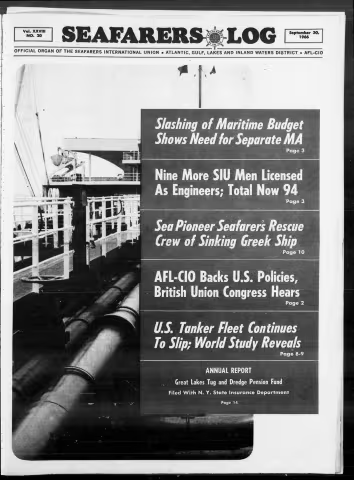
Slashing of Maritime Budget
Shows Need for Separate MA
Page 3
Nine More SlU Men Licensed
As Engineers; Total Now 94
Page 3
Sea Pioneer Seafarers Rescue
Crew of Sinking Grpek Ship
Page 10
AFL-CIO Backs U.S. Policies,
British Union Congress Hears
Page 2
US Tanker Fleet Continues
To Slip; World Study Reveafs
Page 8-9
ANNUAL REPORT
Great Lakes Tug and Dredge Pension Fund
Filed With N. Y. State Insurance Department
• Page 14 ' ^
Two SEAFARERS LOG SeptemlMr 30, 1966
HaWy As Fraternal Pelegatey Addresses Blackpool Session
Aa-CIO Batks US Fomgn Polity,
British Trade Union Congress Hears
BLACKPOOL, Eng.—The AFL-CIO "most emphatically" supports the foreign policy of the United
States including "our commitment in Viet Nam," AFL-CIO Vice President Paul Hall told the British
Trades Union Congress here early this month.
Hall, president of the Sea
farers International Union and
AFL-CIO fraternal delegate to
the annual TUC meeting, vigor
ously defended U.S. policies al
though, as he said, he was "keenly
aware that the course of the U.S.
in Southeast Asia is, to put it
mildly, not fully supported here."
(The fuU text of SIU President
Hall's remarks before the TUC Is
carried on the back page of this
issne of the LOG.)
His fellow-fraternal delegate.
Executive Vice President William
J. Parson of the Newspaper Guild,
reviewed domestic problems and
progress the AFL-CIO has ex
perienced in the past year and
pointed to the beginnings of "new
and dramatic activity" which he
said could lead to significant
change in the U.S. and in which
Miganized labor is "very much in
volved."
Hall emphasized that the AFL-
00 is "absolutely dedicated" to
the cause of peace with freedom,
and specifically is for a peaceful
settlement in Viet Nam.
"This is the settlement which
the U.S. government has sought
to bring about through negotia
tions," he emphasized.
"Your government, as co-chair
man with the Soviet government of
the -Geneva Conference has made
efforts to have it reconvened for
the purpose of seeking a peaceful
settlement of the present conflict.
But these efforts were fruitless, be
cause Moscow would not do a
thing to get the problem to the
conference table. We, like you,
believe in negotiated settlements.
But it takes two sides to negotiate."
Sabotage Attempted
Hall said he was "frankly be
wildered" by claims that "Viet
Gong terrorists represent the will"
of the South Vietnamese. South
V«t Nam leaders proposed the
SEAB
S^. 30,1966 • Vol. XXVIII, No. 20
Official Publication of the SIUNA
Atlantic, Gulf, Lakes & Inland Waters
District, AFL-CIO
Executive Board
PAUL HALL, President
CAL TANNER
Exec. Vice-Prea.
AL KERR
Sec.-Treas.
ROBB®T MATTHEWS
Vice-President
EARL SHEPARD
Vtce-Prestdenf
LINDSEV WILLIAMS
Pice-President
AL TANNER
Vice-President
HERBERT BRAND
Director of Organizing and
Bublications
Managing Editor
MIKE POLLACK , ,
, . Art Editor
Assistant Editor BERNARD SEAMAN
NATHAN SKYER
Staff Writers
DON BEVONA
PETER WEISS
llsmkly at 810 Rhsds liland
Amn N.E.. Wathlngtsn, D, C. 20018 ky
the Ssafarsrt Intsmatlsnal Union, Atlantis,
Calf, LakH and Inland Waton Dlitrlet,
AFL-CIO, 875 Foirtb Annao, Brooklyn,
1. T. 12232. Tol. HVaelntk 9-6600. Socand
oiaH yootago Raid at Wasblaiton, 0. 0.
PBfTaASTErS ATTERTIiil: For* 3579
aarft okeaM ko sont ta Saafaron Intwaa-
UMMI Oalan, Atlaatio, Calf, Lakao and in-
iawl Watora DMrist, AFL-CIB, 675 Faartk
irsaklyn, N. Y. 11232.
election held Sept. 11, while the
Communists tried to "sabotage"
it, he pointed out.
Farson said that "thanks to or
ganized labor's success in electing
the right kind of people to office,"
the U.S. has "finally come around
to putting some of the finishing
touches" on the New Deal.
"And more than that, we have
moved on to try to deal with
some of the problems of a more
recent change, he said. "There is
resistance, of course. But through
out our history, the AFL-CIO has
confronted the same sort of re
sistance—and overcome it—in our
inevitable march toward social
progress and economic justice. I
am confident that we -shall con
tinue do so."
Among the problems Farson
pointed up was price increases in
the face of lowering linit labor
costs in manufacturing.
"If we have any kind of in
flation in the U.S. today, it is a
profit inflation," he said. "And it
means not only distortions in in
come distribution, but it has other
serious consequences as well. The
huge profits that have been flowing
into the corporate coffers, when
combined with the incentive for
investment which our present tax
laws provide, have resulted in
excessive spending and investment
for new plants.
"Over the past three years, in
vestment spending has been grow
ing twice as fast as the total output
of the economy. This is an im
balance which cannot be permitted
to continue."
Meany Hits Use of Filibuster
To Block Rights, 14(b) Repeal
The 1966 civil rights bill was blocked by the same "shabby"
filibuster tactics used to block repeal of Taft-Hartley's "right-to-
work" Section 14(b), AFL-CIO President George Meany declared
recently.
Meany, in pointing out the
similarity between the filibuster
tactics said that: "It is with sincere
regret that I am forced to repeat
the exact words that I used when
the Senate, using the very same
tactics, killed the bill fo repeal
Section 14(b). I said then, and I
repeat now:
" 'The AFL-CIO is, of course,
deeply disappointed that the dem
ocratic process in the Senate has
been thwarted by the shabby par
liamentary tactics of Senator Dirk-
sen and a minority of senators.'"
The Senate dropped the House-
passed civil rights bill as it had
dropped the House-passed 14(b)
reperier—after two cloture votes
showed a majority in favor of
bringing the legislation to a vote,
but not the two-thirds required un
der Senate rules to shut off debate.
On the second cloture try, the
official vote was 52-41. Including
absent senators who were paired
or whose positions were offlcially
announced, the Senate division
was 57-43 for ending the filibuster.
On a party breakdown, 45 of the
67 Democrats supported cloture
while 22 of the 34 Republicans
followed Dirksen's lead in oppos
ing consideration of the bill.
It was a Mississippi Democrat,
Senator James O. Eastland, who
pointed up another aspect of the
filibuster battle.
Eastland issued a press state
ment declaring: "The old-time co
alition of southern Democrats and
Republicans were united and ef
fective."
Looking ahead, Eastland went
on to predict that it would not be
long before "we can start the fight
to repeal these vicious measures,"
referring to civil rights bills passed
in recent years.
Civil rights supporters in both
parties pledged a renewed drive
for the legislation and AFLGIO
President George Meany ham
mered home the 14(b) analogy in
a speech to the Steelwprkers con-
ventiori.
Meany told the delegates that
Dirksen has again "won a battle"
by keeping the Senate from acting.
Meany added: "But this does not
mean that the war is lost. We will
pass additional civil rights legisla
tion in the years to come despite"
all that Mr. Dirksen can do, and
we will pass the repeal of 14(b)."
J
SIU Fishennen,
Cannery Wotfcers
Conference Held
SEATTLE—An SIUNA Fisher
man and Cannery Workers confer
ence was held on September 10,
at Seattle, Washington. Represent
atives from SlUNA-affiliated fish-
ermens' cannery workers' and in
dustrial workers' unions attended
the conference.
Included among the issues
placed under discussion at the con
ference were safety regulations for
Shoalwater Bay oyster workers
and legislation pending in Con
gress for the establishment of a
12-mile fishing limit.
Lester Balinger, secretary-treas
urer of the Cannery Workers and
Fishermen's Union of San Diego,
acted as chairman.
Other SIUNA unions represent
ed were: Seafarers' International
Union of North America; Alaska
Fishermen's Union; United Indus
trial Workers Union of the Pacific;
Atlantic Fishermen's Union, Bos
ton; New Bedford Fishermen's
Union; Inland Boatmen's Union;
Cannery Workers and Fishermen's
Union of Terminal Island; Seine
and Line Fishermen's Union; Sea
farers International Union, A&G
District; Seafarers International
Union, Canada.
Report of
International President
by Paul Hall
It is a well-known rule of thumb that the majority party in Congress
loses seats during non-presidential election years. About 40 lost seats
has been the recognized average during past off-year elections.
A similar loss in this year's elections would be a serious blow to the
goals of the American labor movement because it would mean a big
loss of liberal voting congressmen and their replacement with con
servatives.
In the House, for instance, 48 liberal Democratic freshmen Repre
sentatives are fighting to retain their seats. It was-the liberal voting
record of these freshman Representatives that made possible passage
of much of the Great Society legislation—including Medicare. It
was their votes that made possible passage, at least by the Hout.c, of
such important legislation as repeal of Taft-Hartley Section 14(b) and
the controversial open housing section of the 1966 Civil Rights Act.
If these freshman Representatives had not been in the House for the
last two years none of this important legislation would have had the
slightest chance of passage. If a significant number of them lose their
seats in the upcoming election there will be little chance of passing im
portant social reform legislation for the next few years at least.
A similar situation exists in the Senate and in numerous state cap-
itols. On the state level, the best example is the upcoming showdown
in California between incumbent Democratic Governor Edmund (Pat)
Brown and Conservative Republican challenger Ronald Reagan. Reagan
is the representative for all the conservative, anti-labor forces in Cali
fornia and his election would be a setback for the legislative goals of
the American labor movement.
The progressive, liberal voting records of many of the freshmen
congressmen now fighting to retain their seats has been a big factor in
helping the American labor movement achieve its legislative goals in
recent years. When a vote was called, they stood up to be counted on
the side of long-overdue progressive social and economic legislation.
It is time now for the American voter to stand up and be counted
by supporting these liberal legislators in voting booths across the nation
this November. Every American working man and woman must, by
exercising his ballot, reaffirm approval of the progressive position these
men have taken in the past and return them to Congress so they can
continue the important job that has just begun.
Despite the spectre of jammed to overflowing hospitals and national
bankruptcy raised by the American Medical Association during its
long and well-financed anti-Medicare campaign. Medicare is working
well, is on a sound financial footing, and the nation's hospitals are not
jammed with older citizens enjoying free but unnecessary medical care.
The only serious problem Medicare seems to be encountering is
fee-gouging by many doctors. In many cases doctors have doubled
their fees for people over 65 since Medicare is helping with the bills.
Apparently they see nothing wrong with such a practice.
Private hospitals and nursing homes, on the other hand, are trying
to cash in on Medicare in their own way. The Department of Health,
Education and Welfare is presently studying proposals to use Medicare
funds to help finance the expansion of private profit-making hospitals
and nursing homes—favoring such facilities over public, non-profit
facilities.
The AFLGIO has stated its strong opposition to any such proposal.
Profit-making operations should finance their own expansion out of
profits or from borrowed capital, and not be allowed to dip into public
funds for this purpose.
For a group that fought tooth and nail against aiding the nation's
older citizens' medical needs, some members of the American medical
community now seem to be growing very interested in how they can use
Medicare money for their own purposes.
New Orleans Labor Day Ceremonies
SIU Vice-President Lindsey Williams, (left) welcomed Congressman
Hale Boggs (D^La.) and New Orleans Mayor Victor Schiro (rig'Kt)
to the Labor Day ceremonies held at the SIU hall In New Orleans.
Representatives of Gulf area labor and government were present.
September 30, 1966 SEAF/IRERS LOG Page Three
Nine More SlU Men Licensed
As Engineers; Total Now at 94
The Engineers Training School, jointly sponsored by the SIU
and District 2 of the Marine Engineers Beneficial Association has
helped nine more Seafarers to pass U.S. Coast Guard examinations
and obtain engineer officers f
licenses.
A total of 94 Seafarers have
Pilalis Welch
now received their engineer's li
cense after passing the Coast
Guard examinations.
Of the nine newly licensed SIU
Grennan Krcha
men, four received licenses as
Third Assistant Engineers and
five Seafarers obtained licenses as
Second Assistant Engineers.
Seafarers who received their
licenses as Third Assistant Engi
neers were:
Harry Pilalis, 23, who sailed as
SIU Fishennen's
Strike Ties Up
Clmicester Desks
GLOUCESTER, Mass.—Mem
bers of the SIUNA-affiliated At
lantic Fishermen's Union have hit
the bricks here in a dispute over
a new contract, tying up the big
commercial fishing vessels in the
port. Some 400 fishermen are af
fected by the work stoppage.
AFU President James A. Ackert
ordered picketlines set up on the
city's piers after the Union and
representatives of the Gloucester
Boat Owners Association failed to
reach agreement in talks with fed
eral and state mediators.
A number of the fishing boats
affected by the walkout were still
at sea when the strike was called.
The crews aboard these vessels will
join the strike as soon as they
reach home port, Ackert said.
The old contract expired May 1.
Both sides agreed to an extension
of the contract while issues were
discussed. The Union is seeking a
contribution of one-half of 1 per
cent of the gross stock for a pen
sion fund for the Gloucester fish
ermen and the elimination of
radar, sounding equipment and
watch bill costs. It also asked for
a ceiling on the amount the fisher
men paid for the cost of oil used
in the boats.
Ackert noted that the Union is
only seeking benefits similar to
those already negotiated in other
major fishing ports such as Bos
ton, New Bedford and New York
City.
Federal mediator John Sullivan
and state mediator David Grodsky
participated in the stalemated
Gloucester negotiations.
a fireman-watertender and oiler.
Charles Welch, 45, who shipped
as a fireman-watertender and oil
er, and has been a member of the
SIU for 21 years.
Vlachos Shaffer
Patrick J. Grennan, 52, who
has shipped as a wiper and fire
man, oiler and watertender.
Edward Krcha, 41, who has
sailed as fireman-watertender and
Allen Bridges
Strickmann
oiler and has been a Seafarer for
nine years.
The newly licensed Second En
gineers are:
Jerry Vlachos, 34, a fireman,
oiler, watertender and pumpman,
who has been sailing SIU for
several years.
Gerald Shaffer, 40, who shipped
out as a fireman-watertender, oiler
and pumpman, and has been a
Seafarer for 22 years.
William S. Allen, 34, who has
sailed as fireman-water tender and
oiler has been with the SIU for
22 years.
Ira C. Bridges,
42, Seafarer for
23 years who sail
ed in the engine
department, as
fireman-water-
tender and oiler.
Udo Strick-
mann, 38, who
sailed as a fire
man - watertender
and pumpman and has been a
member of the SIU for'four years.
The joint SIU-MEBA District 2
upgrading school offers Seafarers
and Engineers qualified instruction
in preparing for their Third As
sistant Engineer, Temporary Third
Assistant Engineer or Original Sec
ond Engineers licenses in either
steam or motor vessel classifica
tions.
Seafarers who enroll in the pro
gram are eligible to apply for any
of the upgrading courses offered
by the school if they are 19 years
of age or older and have 18
months of Q.M.E.D, watch stand
ing time in the engine department,
plus six month's experience as wip
er or equivilent.
Seafarers in the engine depart
ment who are interested in the
program should obtain additional
information and apply for the
course at any SIU hall or write
directly to SIU Headquarters at
675 Fourth Avenue, Brooklyn,
New York, 11232. The telephone
number is HYacinth 9-6600.
Slashing of '67 Maritime BaJget
Shows Need for Independent MA
WASHINGTON—The vital need for the establishment of an independent Maritime administra
tion completely outside any other Government agency is spotlighted in recently-released testimony
given at Federal hearings on the fiscal 1967 budget—in which maritime received a severe short
changing from Secretary of ^
Commerce John T. Connor, in
whose department MARAD is
presently included.
The record indicates the manner
in which the maritime budget
originally recommended by the
then-Maritime Administrator,
Nicholas Johnson, was battered
and slashed by Secretary Connor
and the Budget Bureau until it
was knocked down to less than a
third of what was originally re
quested.
What was left after the Connor
hatchet-job, has been blasted as
"the most inadequate" maritime
budget request in many years by
louse Maritime Committee Chair
man Edward A. Garmatz (D-Md.).
During the hearings it was
shown that Maritime Administra
tor Johnson, had asked the Secre
tary of Commerce to recommend
a total shipbuilding appropriation
of $258.05 million. This request
was sliced by Connor to $134,325
million, and when he submitted it
to the Bureau of the Budget the
amount was slashed even further
to $85 million.
The money requested by the
Maritime Administrator would
have been enought to build 25
cargo ships and five dry bulk
carriers.
Instead, there is only enough
money to build nine American-
flag ships in fiscal 1967.
Johnson had also asked Secre
tary Connor for $212 million to
cover the cost of operating-differ
ential subsidies for fiscal 1967 but
the Secretary cut this to $200 mil
lion and the Bureau of the Budget
dropped the figure down to $175
million.
Another maritime industry offi
cial to appear at the meeting,
Andrew A. Pettis, national vice-
president and Washington repre
sentative of the Industrial Union
of Marine and Shipbuilding Work
ers of America, attacked the sub
sidy cut. He said that at the end
of World War II, the industry
thought that the American Gov
ernment would realize the basic
economic problems of the nation's
merchant fleet and that they would
be solved.
"We were hoping that this
country would not fall into the
same morass of error that mired
the industry in between World
Wars 1 and II, which cost us
hundreds of millions of dollars to
reactivate," he said.
Since the end of World War II
he explained, various administra
tions and Congress were warned
time and again of the importance
of keeping up the nation's ship
building industry in case of any
national emergency.
Pettis strongly urged that the
committee, "in light of the serious
shipping situation in Viet Nam and
the build-up of the Russian mer
chant marine restore the $45-50
million cut from the Maritime
Administration budget." "We
think," he said, "that the budget
request for fiscal 1967 is most
alarming. It is sadly inadequate to
carry out the basic concept of the
Merchant Marine Act of 1936-
'Promote and further the advance
ment of the American Merchant
Marine'."
Amendment Passed
Earlier this month the House
voted on an amendment to the
Transportation Department Bill,
introduced by Representative Ed
ward Garmatz, (D-Md.), head of
the House Merchant Marine and
Fisheries Committee, which would
exclude the Maritime Administra
tion from being part of the pro
posed Transportation Department.
The vote was 270-117 in favor of
removing MARAD from the
Transportation Department. Fol
lowing this action, the House
voted overwhelmingly by a mar
gin of 336-42—to pass the amend
ed Transportation Department Bill
which had the Maritime Admin
istration removed from it.
The House Merchant Marine
and fisheries Committee has ap
proved a bill to make MARAD an
independent agency. The measure
is expected to be considered by
the House next month.
Strong support for an independ
ent Maritime Administration came
last July from the AFL-CIO Mari
time Trades Department and
Maritime Committee. The MTD
also warned recently that the third-
rate status "which gravely threat
ens the security of the nation, will
continue if the Maritime Admin
istration is permitted to be buried
in another department, whether
Transportation or Commerce."
A Senate operations subcom
mittee is now holding hearings on
a Senate Transportation Bill
which, as of now, includes the
Maritime Administration lumped
together with a number of other
Federal agencies.
SlU-Cotttrasted Companies to Man
Twelve Newly-Reactivated Vessels
WASHINGTON—The Department of Defense has ordered 19
more ships broken out of the nation's stand-by fleet in order to
meet the growing demands of the Viet Nam sealift. They include
four Victorys and 15 smaller, ̂ " .. ' r;^ r: . , . ^ . ments with the Maritime Admm-
slower cargo ships.
This latest breakout is the first
time that the Government has or
dered slower war-built tonnage out
of mothballs for use in the South
East Asian crisis.
SlU-contracted companies are
being allocated 12 of these vessels
including the four Victorys. The
shipping companies are getting the
ships under general agency agree-
St. Lawrence Port Council Dinner
lH^ LE CONSEILPORTUAIRE DU SAmTUURENT ET SES AFMEKTS '^•jH
^•1 ST. LAWRENCE AND TRIBUTARIES TORT COUNCIL
HHm 1* DINtR DANSAMT ANNUEL • n.Mrc
SIU Vice-President Earl Shepard addresses U.S. and Canadian labor
representatives at the First Annual Dinner of the St. Lawrence
and Tributaries Port Council, held recently in Montreal. Left to
right are Shepard. Quebec Federation of Labour President Louis
Laberge, and Dr. Denoit Deshaies of the Popular Medical Polyclinic.
istration and will operate them for
the Military Sea Transportation
Service.
The 19 cargo ships are part of
a projected 100 vessels that are
being reactivated from the nation's
mothball fleet within the next six
months for use in Viet Nam.
When these vessels are pulled out
there will-no longer be any of the
larger World War II tonnage left
in the Reserve Fleet, only 184
slower Libertys.
Victory ships are 10,000 dead
weight tpn vessels which can op
erate at an estimated 15-17 knots.
The 15 smaller ships are C-l's,
9,137 deadweight ton vessels whieh
have a maximum cruising speed of
14 knots.
The next group of Reserve fleet
ships is scheduled to be withdrawn
from the nation's reserve ship
fleets in November and December.
Three out of the eight ships be
ing broken out of the East Coast
stand-by fleets will go to SlU-con-
tracted companies and two out of
four coming from Gulf Coast re
serve fleets will be SlU-manned as
well as all seven cargo ships being
pulled out of West Coast mothball
fleets.
Ten to 12 additional vessels will
follow this initial group of 19 ships
into active Viet Nam service every
month until the 100, vessels are
pulled out. To date 40 ships out
of the 100 ships have been pulled
from the Reserve fleets.
' .'•I
•HI mil III iwm III
Page Four SEAFARERS LOG September 30, 1966
f:
Six Additional Seafarer Veterans
Join Crowing Union Pension Roster
Orencio Walter Cardoso Byrne Arcediano Blahnik
The names of six more Seafarers have been added to the growing list of men now receiving union
pensions. The newcomers to the SIU pension ranks include Vincent Orencio, Frank Walter, Noe
Cardoso, Brian Byrne, Andrew Blahnik, and Anthony Arcediano.
Orencio was bom in the Philip- ^
pines and joined the SIU in the
port of New York. He sailed in
the Steward department. A resi
dent of San Francisco, Orencio
last shipped on the Overseas Rose.
Walter joined the union in the
port of Baltimore, where he re
sides with his wife, Virginia. Born
in New York City, he was a mem
ber of the Deck department.
The Pacific Coast
by Frank Drozak, West Coast Representative
Governor Edmund G. "Pat" Brown won a resounding and unani
mous endorsement for re-election from the more than 500 AFL-CIO
delegates participating in the pre-general convention of the Labor
Coimcil on Political Education (COPE), the political arm of Cali
fornia's AFL-CIO, in San Francisco last week. Governor Brown is
running against reactionary (re-
cently turned "moderate") Ronald
Reagan.
San Francisco
Shipping in the Port of San
Francisco continues to be active
and there are plenty of jobs open
for AB's, oilers, FWT's, elec
tricians, cooks and bakers.
Ships that paid off and signed
on crews during the past two
weeks include the Bowling Green,
Citadel Victory, Transwestern,
Elizabethport, Meridian Victory,
Robin Sherwood, Steel Traveler,
Columbia and the Longview Vic
tory.
Ships in transit were the Steel
Worker, Steel Architect, Panama,
Penmar, Marymar, and the Over
seas Rose.
Ralph Fitzpatrick is looking
for the next BR job that hits the
board. He just stepped off the
Wild Ranger after a three-month
trip around the Central Pacific
area.
Seattle
Shipping is brisk here with
plenty of jobs for rated men. Ships
which have paid off and signed on
during this recent period include
the Mankato Victory, Warm
Springs, Mauldin Victory, Ridge-
field Victory, Beloit Victory, Fair-
port, Overseas Rose, and the Nor-
berto Capay.
Wesley (Chris) Christianson is
cutting short his vacation due to
an active shipping picture. Mean
while, he is trying to hook a fish
big enough to brag about.
Wilmington
Shipping in Wilmington has
slowed down somewhat, but the
outlook for the near future indi
cates that activity will pick up
again shortly. Despite the slack,
Wilmington has plenty of jobs
open for rated men in all depart
ments.
During the last couple of weeks
the Faiiport, Dforymar, Wingless
Victory, Steel Seafarer, and the
Hercules Victory were in transit.
There were no pay olfs or sign
ons, however. The Hercules Vic
tory had been scheduled to pay
off in Wilmington but she headed
for the East Coast with all but
two or her men staying aboard.
Congratulations to C. E. Mosley,
deck delegate J. Fancutt, engine
delegate Frank Gustav, and stew-
Cardoso sailed in the Engine de
partment. Born in Portugal, he
joined the SIU in New York. He
and his wife. Maria, are residents
of Marcus Hook, Pa.
Blahnik joined the union in the
port of Detroit. He was bom in
Nadeaw, Mich., and now resides
in Frankfort, Mich., with his wife,
Grace. Blahnik sailed as AB.
Arcediano was born in Italy and
joined the union in the port of
New York. He makes his home
in Hoboken, N.J., with his wife,
Anna. Arcediano sailed in the
Deck department and was last em
ployed by Erie Lackawanna Rail
road.
Byrne joined the union in the
port of Chicago. A deckhand and
oiler on tugboats, he was em
ployed by the Great Lakes Towing
Company. Byrne lives in Chicago
with his wife, Madge.
ard delegate Del Cruz. They
brought in a very clean ship.
Administration Urges Senate Adopt
New International Load Line Rules
President Johnson is urging the Senate to accept the new cargo
ship load line standards that have been drawn up by the Interna
tional Convention of Load Lines in London this Spring.
The Convention, which was^
signed by the United States on
April 5, establishes new uniform
rules concerning the limits to
which ships on international voy
ages may be loaded. The purpose
of the meeting was to amend the
load line limits in view of modern
ship construction and new tech
niques in loading and unloading
vessels.
Pending favorable action by the
Senate, the load line, known as the
Plimsoll Line, will be raised for
this first time in 36 years on tank
ers, ore carriers and bulk carriers
of more than 328 feet length. Dry
cargo freighters will also be al
lowed to raise their Plimsoll line
levels if they are fitted with water
tight hatch covers.
President Johnson said that
"since 1930 when the existing
Load Line Convention was signed
there have been significant changes
and improvements in ship design
and a general increase in the size
of ships. In many cases deeper
loading of ships cannot be safely
permitted.
"The new convention," he add
ed," should bring improvements in
safety of ships as well as in the
economics of shipping. I there
fore recommend that the Senate
give it early and favorable con
sideration."
Before the new agreement be
comes binding for the United
States, it follows a traditional pro
cedure for international agree
ments. The agreement, after it is
tentatively signed by the delegate
to the convention is sent to the
State Department where the Sec
retary of State personally signs
the text. Then the agreement is
sent to the White House with
various recommendations.
The President next offers the
Senate the treaty with his ap
proval for what is termed "advice
and consent" which is really a vote
on the issue. The Senate holds
hearings on the bill and normally,
following the President's wishes,
approves the measure. After the
Senate votes its approval, the
agreement is returned to the Presi
dent who signs it and officially
ratifies the agreement. The House
of Representatives is in no way in
volved in the proceedings.
The Plimsoll Mark or line is
named for Samuel Plimsoll, an
English reformer who took great
interest in the welfare of seamen.
He was particularly appalled by
the then common practice among
British shipowners to send over
loaded vessels to sea in the hope
that they would founder and heavy
insurance fees could be collected.
As a member of Parliament
from 1868-80, Plimsoll vigorously
pursued legislation limiting the
loading of ships. As a result the
load line was required to be mark
ed on every vessel showing the
depth to which ships could be
legally loaded.
The Atlantic Coast
by Earl (Bull) Shepard, Vice-President, Atlantic Coast Areaj
In spite of the continual downgrading of maritime by many U. S.
government officials, the importance of shipborne commerce to the
U. S. economy was pointed out recently in a study released by the
Maritime Administration. The study shows that U. S. shipborne com
merce contributes more than $15 billion annually to the American
economy. It further shows that
almost 6 percent of the natioi\'s
workers make their living from
employment which, in one way or
another, depends on the nation's
import-export trade—virtually all
of which moves by ship. Those in
side and outside of government
who take every opportunity to
downgrade the importance of the
American maritime industry
should read this report carefully
and give serious thought to its
meaning before continuing their
undermining of such a vital por
tion of our national economy.
New York
Shipping continues to be good
here and the prospects are bright
for the season. Dave Manzanet
just returned from Vietnam on the
Rachel V. Following pay off in
San Francisco, Dave plans to stay
home for a couple of weeks be
fore shipping out again.
A. R. Colom just stepped off the
Azalea City for a vacation. He
says he will be ready to travel
again in two weeks. Oldtimer
John Hummel dropped by the hall
to talk with old friends. John Gal
lagher says he's ready to ship again
and is looking for a steel ship.
Baltimore
Shipping from here has been
fair for the past two weeks and the
outlook for the next two weeks is
good. The Alamar, Losmar, and
Trustco are laid up, while the Ohio
and the Bethflor have arrived in
the last two weeks. The Bethflor
should crew up in the next ten
days, but there is no report as yet
on the crewing of the others. Dur
ing the two week period, we paid
off four ships, signed on three, and
had nine others in transit.
Manzanet Gallagher
John Eddlns, a member of the
deck department for about 20
years, just paid oflF the Alcoa
Trader. He reports that the crew
and officers were the best, and says
he feels that the SIU welfare and
vacation plan is the best in the in
dustry. John now plans to take it
easy for awhile before shipping
out again.
Philadelphia
Shipping has been good here the
last two weeks. Edwin (Hound
Dog) Davis, who sails in the deck
department, says he is ready to
take the first coal ship that comes
along. Hound Dog, an SIU man
for the past 19 years, last shipped
out on the Globe Carrier.
Robert Duff, who works in the
steward department, is enjoying a
few weeks at home, and says he
will be ready to go soon.
Steve Homka, an old hand in
the deck department, is vacation
ing at home with his family.
Norfolk
Shipping here has been very
good, and the outlook for the fu
ture is excellent. Robert King,
who last shipped out on the Globe
Carrier as an AB. was recently de
clared fit for duty and is now
waiting to go again. He's been a
member of the SIU for about 19
years.
Another 19-year man, Clarence
E. Cornelius, who ships as an AB,
is ready to hit the deck again after
enjoying the summer at home.
Clarence last shipped on the Com
mander.
Boston
Shipping has been fair this pe
riod and is expected to be good
during the next two weeks. Twenty-
year SIU man Peter Choplinski,
who sails as dayman, is waiting for
the first job put on the board. Pete
last shipped on the C-S Norfolk.
Another man off the C-S Nor
folk, Leo Gallagher, who sails as
an AB, is ready and willing to ship
out. He's been with the SIU more
than 22 years.
Puerto Rico
The new federal Minimum
Wage Law will take effect in
Puerto Rico on April 2, 1967, and
should aid the Island's economy
by putting more money in circula
tion through increased buying
power for many workers here.
Walter Stovall, quartermaster
aboard the Seatrain New York,
dropped in at the hall recently, as
he always does when he hits port,
to see the many friends he has
made on the Island during his
many years at sea. After several
months on the San Juan, Oliver
Flynn says his short break is over
and he's looking for an inter-
coastal run.
S/ff Seeks Talks
On Safety Rales For
Synthetk Ship Hues
NEW YORK—SIU Safety Di
rector Joe Algina has requested a
jneeting with the Marine Safety
Division of the U. S. Coast Guard
to discuss the use of synthetic lines
aboard ship.
The meeting was requested be
cause of recent evidence that the
increasing use of these synthetic
lines aboard American-flag vessels
has produced a serious safety
problem for SIU crewmembers—
particularly in the deck depart
ment.
Two characteristics of synthetic
line that post the most serious
safety problems are their relatively
greater strength when compared
with natural fiber lines and their
elasticity.
The relatively greater strength
of synthetic lines can be a serious
safety hazard, particularly when
they are used in conjunction with
natural fiber lines of relatively
lesser strength.
This hazard is compounded by
the high elasticity of synthetic
lines, because if they part under
strain they tend to whip back with
great force and, depending on the
length of the parted section, can
kill or injure seamen working even
in "safe" areas of the vessel far
from the point of initial danger.
September 30, 1966 SEAFARERS LOC Pope Five
The Gulf Coast
by Lindsey Williams, Vice-President, Guif Area
A team of eleven Turkish trade union officials visiting the United
States paid a call at the New Orleans Hall recently and took a com
plete tour of the union's facilities. The team was composed of trade
union officials who represented Turkish construction workers, cement
workers, tobacco workers, wood workers, journalists, irrigation work
ers and seamen.
The purpose of the trip was to
observe the operation of the U.S.
trade union movement.
New Orleans
After a long trip on the Alice
Brown as night cook and baker,
Leon Franklin left the ship reluc
tantly because she wasn't return
ing to New Orleans. Franklin had
just returned from Viet Nam and
was anxious to spend a little time
with his family. Now he says
he's ready and willing to go again
in any group one steward depart
ment job.
Henry "Smokey" Schreiner has
recently completed two runs to
Viet Nam on two different ships.
Smokey was steward on the Coe
Victory and the Oceanic Tide. He
left his last ship ailing and is
spending time recuperating before
his next voyage.
Pensioner Alexander ''Jumping
Daddy" Martin is living the easy
life. Jumping Daddy was down at
the hall renewing
old friendships
and making new
ones. His last ship
was the Alcoa
Partner. Seafarer
Ray Vaughn is
showing fellow
seafarers around
the hall his
crutch-walking
skill. An unfortunate accident has
left Brother Vaughn without the
full use of his legs for the time
being. But Ray still seems to spark
along.
Mobfle
Roy B. Evans bosun on the
Hastings for nine months, is now
relaxing with the family at his
Mobile homestead. Evans feels
he'll be ready for another deck
Vaughan
dept. slot in about two weeks.
Electrician Charles W. Howard
has been shipping as an engineer.
No longer though. Howard dis
covered that he is allergic to oil
and oil fumes. From now on its
back to electrician slots for him.
Seafarer Harvey M. Lee last on
the Cities Service Bradford Is
lands, is currently registered in
group one steward department and
is scanning the board for the
"right" job.
Lawrence L, Maples is an en
thusiastic supporter of the inter-
coastal run. He recently piled off
the Oakland and
is busy telling
everyone who will
listen about the
virtues of inter-
coastal runs. After
leaving the Over
seas Joyce, Evie
E. Kinman rushed
home to his Grove
Hill, Alabama
home for a well-earned rest. Kin-
man has been shipping with the
SIU out of the Gulf area for over
twenty years. Seafarer Charles L.
Shirah, last shipped out on the
supertanker Ocean Pioneer. Stew
ard department member Shirah
makes his home in Mobile with his
wife and family.
Houston
Frank Radzvilla is heading for
vacationland after sailing for many
months on the Globe Progress. He
hopes to soak up some of the
late summer sun before sailing
again.
Mike Cuellar is looking for
an engine room slot on a coast
wise run. Cuellar just finished a
six month trip and will wait a
couple of weeks before shipping
again.
Kinman
Turkish Unionists Visit New Orleans SIU
Turkish trade unionists on a 12-week tour of the United States paid
a visit to the New Orleans SIU hall recently. Representing a broad
spectrum of Turkish labor, they are touring the U.S. under sponsor
ship of the Agency for International Development. Left to right
above are interpreter Ozdemir Duranoglu; Ahmet Karahan of the
Turkish Seamen's Union; Cemal Ozgen of the Petroleum Workers:
interpreter H. Cingi; and SIU New Orleans port agent Buck Stephens.
Garmatz Raps ^67 Maritime Budget
As 'Most Inadequate' in Many Years
WASHINGTON—Alarmed at what he calls "the most inadequate (Maritime) budget proposal sub
mitted to the Congress in many years," House Merchant Marine Committee Chairman Edward A.
Garmatz (D-Md.) has appealed to a subcommittee of the House Appropriations Committee for
more shipping subsidy funds
than have been asked for by
the Administration.
The Administration has re
quested $85 million for construc
tion subsidies, enough to build
only about 9 vessels, and has
asked for $175 million for oper
ating-differential subsidies for fis
cal 1967. The construction sub
sidy request covers the building
of even less ships than the 1966
V
budget, which called for—a 13
new vessel figure that Garmatz
considers also highly inadequate
for the nation's needs.
The House Merchant Marine
Committee Chairman again point
ed out that the U.S. is about 100
ships behind in the declared pro
gram for replacement of our sub
sidized liner fleet. In addition, he
noted that nothing is being done
about the replacement of our
Studies Seek New Safety Standard
Fw Ships Oaryii^ Grain Cargoes
Scientific studies by the National Cargo Bureau and the United
States Coast Guard might result in a new standard of safety for
grain carriers which will reduce the dangers of vessels capsizing
during heavy weather because'S'
of shifting cargoes.
Since the Safety of Life at
Sea Convention (SOLAS) adopted
new regulations in 1960 for the
loading of grain ships, there have
been four grain ship sinkings
during heavy weather in which
73 seamen lost their lives. The
new SOLAS safety regulations
eliminated the old rule calling for
the establishment of centerline
bulkheads in and below feeders
in hatches where full cargoes of
grain had been loaded, and ships
carried grain without them.
Centerline boards such as these
have always been aboard grain
ships since the ancients trans
ported grain in order to prevent
grain shifting when the ship rolled
or pitched during a storm. The
cost to install such boards on
modem merchant ships is a dollar
a square foot. These boards, it
is felt, help keep the grain from
shifting from the port side to star
board during the working of the
vessel.
Delegates to the SOLAS Con
vention in 1960 felt that the cen
terline shifting board was un
necessary and they voted to elimi
nate it from future SOLAS re
quirements.
Two years after the SOLAS
convention maritime representa
tives began questioning the aban
donment of the rule. U.S. rep
resentatives at the Intergovern
mental Maritime Consultative Or
ganization argued at that time that
the SOLAS rules pertaining to
grain cargoes were not that safe.
The Coast Guard and the Na
tional Cargo Bureau, a non-profit
organization that certifies the safe
stowage of freight and clears
cargo ship gear, then began to
study the problem.
They used a specially-built
plexiglass model of a ship's cargo
hold which was loaded with 3/4
tons of grain and began shifting
the centerboard in different posi
tions. Each position was studied
while the«ship model was put into
various angles and tilted to simul
ate conditions in heavy seas.
The Coast Guard also queried
some 300 grain ships to find out
how grain settled during their
voyages. The result showed that
the amount of settling varied di
rectly with the amount of rough
weather encountered. If the voy
age was made in a flat calm there
was no grain settling.
With the plexiglass model the
Coast Guard and the NCB could
watch the shift of the wheat and
observe the various voids as they
occurred. Data gleaned from the
tests and other findings is now
being evaluated with the help of
Coast Guard computers in Wash
ington so it can be determined
which board is most beneficial.
The last test of the effective
ness of the center boards, the
Coast Guard said, will be made
when the data from the plexi
glass model will be used in a con
ventional dry cargo ship carrying
grain.
SIU l^kes District Announces
Results of Election of Officers
DETROIT—The results of the SIU Great Lakes District Elec
tion have been aimotmced by the district's Committee on Election.
Fred J. Famen was re-elected Secretary-Treasurer for a two-
term and Roy Boudreau^
Secretary-Treas-
ageing bulk carrier fleet "which
is nevertheless being called upon
extensively to support the mili
tary effort in Vietnam."
He further pointed out that be
cause so much of the inadequate
U.S.-fiag merchant fleet has be
come engaged in supporting the
Vietnam war effort, our commer
cial trade is suffering. "As our
commercial trade suffers, so does
our balance of payments."
"Our maritime industry should
be a major and vibrant part of
our economy," he told the sub
committee. "If properly pro
moted, the merchant marine
could by itself overcome our ad
verse balance of international
payments.
Representative Garmatz also
called last week for passage of
more stringent safety regulations
for foreign-flag passenger ships
calling at U.S. ports.
Pointing to the recent fire
aboard the German-flag passenger
ship Hanseatic at her New York
Harbor berth, he predicted that
had the fire occurred at sea there
would have been another Yar
mouth Castle disaster.
Backing up this claim, he noted
that being in port at the time of
the fire permitted the prompt
evacuation of those aboard the
ship and made available some
forty-five pieces of shoreside fire-
fighting equipment and three fire-
boats—^vastly more than the ship's
own equipment.
year
as Assistant
urer.
Also elected for two-year terms
were Stanley Wares, Buffalo Port
Agent; Frank "Scottie" Aubusson,
Chicago Agent; Donald Bensman,
Duluth Agent and Floyd R. Han-
mer. Lake Michigan Carferry
Agent.
The election results were tallied
up by the Committee on Elections.
Serving on the Committee on
Elections were Vem Rattering,
Harry Buccilli and John Stevens.
This committee was elected at a
special membership meeting held
in the Port of Detroit September
9.
A report on all election nomin
ations was concurred in at ports
holding regular Great Lakes Dis
trict Membership meetings on July
18. In determining the eligibility of
the candidates, a Credentials Com
mittee elected on July 5 checked
the seniority, shipping records and
the welfare plan records as well
as the tmion records. The Cre
dentials Committee was made up
of Vem Rattering, Joseph Arnold
and Joseph Salisbury.
After the candidates were
checked out by the Credentials
Committee, nomination notices
and elections notices were sent out
to all members at their last known
address, utilizing the union's rec
ords. Notices were also sent out
to all SlU-contracted vessels in the
Lakes District and to union halls
for posting.
Polling took place at union halls
in Duluth, Chicago, Frankfort,
Alpena, Cleveland, Detroit and
Buffalo as well as aboard all SlU-
contracted Great Lakes vessels.
Only members in good standing
who had full books and presented
them were allowed to vote.
Money Due
Texas City Refining, Inc., is
holding checks for unclaimed
wages for the following men
who are to contact the company
direct at P. O. Box 1271, Texas
City, Texas, giving their Social
Security number, "Z" number
and instructions regarding pay
ment.
Allen, WiUiam S.
Bailey, Elmer E.
Boggan, Sigmiere E.
Cony, William R.
Funk, John E.
Galloway, Aveiy B.
Gorman, Edward G.
Mackey, Donald E.
River, Jose A.
Winberg, Robert W.
Wiigbt, Theodore H.
-niTT"'-
Page Six SEAFARERS LOG September 30, 1966
h
i i
\
f:
£,
The Great Lakes
by
Al Tanner, Vice-President and Fred Farnen, Secretary-Treasurer,Great Lakes
Shipping in Detroit remains at an all time high and we have plenty
of jobs for rated men.
The MEBA has announced that a correspondence course in Marine
Engineering will be mailed to engineers and unlicensed engine depart
ment personnel who apply for admission to the District 2, Safety
and Education Plan's new Great , 7"; T
three-deck, 210 foot long vessel
also sailed out of Toledo as a
From tept. 9 to Sept. 22, 1966
DECK DEPARTMENT
TOTAL REGISTERED TOTAL SHIPPED
All Groups
REGISTERED on BEACH
Lakes School of Marine Engineer
ing. Ed Pierce, director of the
school, said that study kits are
now completed and will be for
warded to applicants so they can
prepare for classes in January,
1967. The study kit includes
typical examination questions sim
ilar to those asked by the U. S.
Coast Guard when a member
writes for a license. All SIU mem
bers employed on vessels that are
under contract to MEBA District
2 are eligible.
The Interstate Commerce Com
mission has granted the New
York Central Railroad a new rate
of $2.20 a ton where coal would
be shipped direct from Sunny
Hill to Essexville by unit trains.
This new rate, if allowed, would
mean a loss of 2.5 million tons of
coal normally shipped by water
transportation. The Maritime
Trades Department and other
maritime interests have filed for
mal complaints with the Inter
state Commerce Commission over
this new rate.
The old SIU contracted pas
senger steamer Canadiana, that
sailed for years as an excursion
boat from Buffalo to Crystal
Beach, Ontario, has been towed
to Eastlake, Ohio, where she is .,
to be converted into a floating
nightclub and restaurant. The
sight-seeing boat until it crashed
in 1958. The Canadiana was un
der SIU contract for more than
twenty years.
We were, indeed, happy to see
the Maritime Administration ex
cluded from the proposed De
partment of Transportation Bill
when voted on recently by mem
bers of the House of Representa
tives.
SIU members on lakes vessels
that wrote and sent telegrams to
Washington urging support of the
Garmatz Amendment played an
important role in the outcome of
the House vote.
With the navigation season
more than six months gone, many
observers are predicting a late
closing this year. Since the de
mand for ore is holding up well,
some fleets expect to keep run
ning late in December, providing
they get a break in the weather.
Last season, mild temperatures
throughout the lakes allowed
many vessels to sail later than
usual.
The Boilermaker's Local 58
and the Machinists' Local 105
voted down the latest company
offer and it ^ooks like the ship
yard strike irf Lorain and Toledo
will continue for some time.
QUESTION: What is the most
unusual cargo you have ever car
ried?
Howard Campbell: I was on a
ship, the Morning Lieht that had
a Finnish - made
sailing ship pur
chased by some
guy in the states.
We took her to
Long Beach from
Hong Kong and
kept her on deck
because it was to
* ° • big to fit in the
cargo hold. We were told it cost
$25,000.
^J>
James Elliott: I was on the
Young America coming back from
Vietnam to Seat
tle. We <vere car
rying a pet Falcon
that had been pur-
chased by the
Captain some
where in Asia. I'll
tell you, those
birds are not the
friendliest pets in
the world.
Norm Wroton: The Ocean Eve
lyn carried a cargo of Nike-Ajax
missiles once, but
I' the atomic war
heads weren't acti
vated, of course.
They were kept in
separate holds for
extra safety. We
took about 55 of
them to Formosa
for the National
ist Chinese,
Ed Kaznowski: The Robin
Adair once carried a shipment of
gold from Cape
town to New
York. I've sailed
on ships that have
carried all types
of cargo, ijut
from what I was
told, we had over
a million dollars
worth of gold on
the ship. I guess that's the closest
I'll ever get to that kind of money.
Frank Rodriguez: I've been on
several ships that carried horses
and cows. We fre
quently take them
to Puerto Rico. It
presents some
problems since
some of the crew-
members have to
take care of the
animals and feed
them, not to men
tion the problems when the ani
mals give birth.
^
Harry Kaufman: I remember
about ten years ago, I was sail
ing on a Steel ship
and we were
asked by the In
donesian Govern
ment to transport
a cargo of Rus
sian jeeps from
one end of the
island to the oth
er. In fact, I wrote
a little article about it that was
published in the LOG,
Port Class A Class B Class A Class B Class C Class A Class B
Boston
NPW York
8
105
1
35
5
33
1
22
2
23
24
319
3
92
Philadelphia 10
45
5
15
6
11
6
8
5
8
30
152
12
35
Norfolk 5 3 5 3 3 25 12
.Tacksonville 11 6 13 8 12 15 2
Tamoa •« • 9 4 5 1 2 13 5
Mobile 49 15 15 7 1 87 19
New Orleans
Houston
54
40
30
29
46
20
26
14
16
5
155
138
57
48
Wilmington 5 6 8 2 20 14 3
San Francisco ....
Seattle
32
17
19
6
21
9
6
4
25
21
56
36
1
4
1 390 174 197 108 148 1,064 293
ENGINE DEPARTMENT
TOTAL REGISTERED TOTAL SHIPPED
All Groups All Groups
REGISTERED on BEACH
All Groups
Port Class A Class B Class A Class B Class C Class A Class B
Boston 6 1 2 0 3 10 2
New York 62 44 31 32 49 184 76
Philadelphia
Baltimore
7
27
5
14
6
12
6
6
2
9
19
74
6
33
Norfolk 4 2 2 2 3 26 9
Jacksonville 4 4 7 3 9 2 4
Tamna 6 3 5 7 5 3 7
Mobile 24 14 18 10 11 41 13
New Orleans
Houston
48
33
29
24
40
19
25
21
20
9
84
152
45
50
Wilmington 7 5 5 3 17 10 2
San Francisco
Seattle
39
8
15
8
18
5
10
5
33
22
28
18
1
3
Totals 275 168 170 130 192 651 251
STEWARD DEPARTMENT
TOTAL REGISTERED TOTAL SHIPPED REGISTERED on BEACH
All Groups All Groups All Groups
Port Class A Class B Class A Class B Class C Class A Class B
Boston 3 2 1 1 2 9 5
New York 71 23 34 10 29 170 37
Philadelphia 11 6 4 2 4 20 14
Baltimore 23 13 14 5 10 75 28
Norfolk 5 7 4 4 0 13 26
Jacksonville 5 6 6 3 11 6 3
Tampa 4 2 5 0 0 3 4
Mobile 27 5 19 3 6 57 9
New Orleans 35 32 45 22 15 104 73
Houston •. 23 20 14 9 2 74 44
Wilmington 10 2 5 2 11 15 1
San Francisco 31 12 13 8 32 26 1
Seattle 12 5 11 4 14 20 1
Totals 260 135 171 73 136 592 246
ttS. Ocean Trade Pours $15 Billion
Into Iconomy Yearly, Study Shows
Shipbome export and import traffic through the 117 major U.S. ports pumps more than $15
billion into the American economy each year and provides more than four million jobs in direct
export and import-related industries, according to a recent study by the Maritime Administration.
The study totally dispels the f
myth that the nation's ocean
ports are of major economic im
portance only to the nearby com
munity, a MARAD spokesman
told a recent convention of the
American Association of Port
Authorities.
About 3.1 million Americans
make their livings in direct export
and export-related industries, and
some 2.5 million of these workers
are in the 28 maritime states, the
study showed. It also pointed out
however, that nearly six out of.
every hundred workers in the na
tion make their living on farms
and in factories that depend on
exports for their operation and in
35 of the continental states more
than 5 percent of the total state
employment depends on exports.
"Even in a land locked state
like Arkansas, for example, 14 out
of every 100 workers hold jobs
dependent on our export trade.
Mississippi has nearly as many.
Texas, South Carolina, Washing
ton, Alabama, Arizona, Georgia,
Montana, North Dakota each have
more than 7 percent of the workers
employed in such industries."
About 13 percent of total farm
jobs are directly related to export
trade and almost 5 percent of total
private non-farm employment.
This comes to about 950,000 farm
workers and about 1.4 million
workers in manufacturing.
Our import trade, on the other
hand, provides employment for an
estimated 941,000 Americans.
Ocean and Great Lakes ports
naturally benefit the most directly
from the export-import trade. One
ton of general cargo can mean be
tween $16 and $20 in direct
revenue to a port comunity. In
1963 U.S. port cities earned about
$5.3 million from waterfront
cargoes.
New York is about the best
example- of the importance of
waterborne cargoes to a com
munity. Port of New York jobs
employ at least 430,000 people
with an annual payroll of $?.l
billion. Each of these jobs gener
ates additional jobs until it is
estimated that the port supports
one out of every four people who
live in the district.
SIU WELFARE, VACATION PLANS
July 1 - Jwiy 3L 1966
Number of Amount
Benefits Paid
Hospital Bonelits , . j; . ... 5,024 • $ 52,134.77
Death Benefits .., , , . i > i.•;••••• • 23 •••'•• 62,000.00
Disability Benefits ^, i V * 890 133,500.00
Mptemity Benefits , y 34 6,800.00
Dependent Benefits ...... 79,715.17
^ Optical • Benefits y' y^w: S02 • . 7,523.83
V(Hft-Patient Benefits . 1, . ̂ 25,935.00
SUMMARY ... 10,114 367,608.7^
Iiydedtion Benefits , .. 1,538 637,877,3^
6 Sffeca
Sepiember 30, 1966
AFL-CIO Raps Profit Grab
Endangering Medicare Plan
Higher medicare payments to profit-making nursing homes and hos
pitals would be unjustified and could inflate the cost of the entire med-
program, AFL-CIO President George Meany warned recently.
Meany wrote Health, Education & Welfare Secretary John W. G^d-
ner that labor opposes revising the medicare reimbursement formula so
dlities profit-making institutions over public and non-profit fa-
A proposal to include part of the cost of capital expansion in pay-
ment to nursing homes and hospitals is under study by the department.
A profit-making hospital or nursing home should, like any other
profit-making institution, finance growth and development out of profits
and borrowed capital," Meany said, "and not expect the medicare pro
gram to finance its capital requirements."
Meany cautioned Gardner that an unnecessarily high payment to
health institutions could raise the costs of medicare above estimates,
require additional increases in the social security tax and delay much-
needed improvements in the medicare program."
The AFL-CIO president agreed that "there is a need for greater funds
to modernize and construct more of these facilities." But he said that
"this worthwhile goal should be accomplished through-other programs."
Meany suggested "as a first step" the "rapid expansion of the Hill-
Burton propam as well as additional federal legislation to assist in the
modernization and construction of public and nonprofit hospitals anc
nursing homes."
Commenting that "the greatest single barrier to adequate health care
Is cost, Meany said that if there is any revision of the reimbursement
formula in favor of profit-making institutions, "it should have a mini
mum impact on the cost structure of the program."
» • •
The AFL-CIO has endorsed legislation to encourage states to keep
records of on-the-job exposure of workers to radiation and to meet
federal standards for workmen's compensation coverage of radiation-
caused ailments.
Legislative Director Andrew J. Biemiller testified before the Congres
sional Joint Committee on Atomic Energy in general support of Ad
ministration proposals. But he urged that the bill be strengthened by
making certain provisions mandatory rather than permissive. Biemiller's
testimony was in line with unanimous recommendations of the Atomic
Energy Commission's Labor-Management Advisory Committee.
The proposed legislation would allow the AEC to allocate funds to
states to help them set up a uniform system of record-keeping for
workers in occupations involving exposure to dangerous radiation.
This, Biemiller noted, would accomplish a threefold purpose:
• It would greatly assist research on the relationship between
"chronic low-level doses of radiation" and ailments which are sus
pected of being caused or aggravated by radiation.
• It would lead to more effective safeguards against exposure of
workers to radiation.
• It would improve adjudication of workmen's compensation cases.
The Administration bill specifies that standards set by the Atomic
Energy Commission as a condition for grants to the states "may" in
clude requirements for workmen's compensation coverage.
Biemiller argued that "this leaves entirely too much latitude to
the commission." He urged that workmen's compensation standards be
made mandatory by changing the word "may" to "shall."
He also urged that a time limit be set for states receiving grants to
comply fully with federal standards.
SEAFARERS LOG Page Sei
Gerald A. Brown has been ap
pointed to his second five-ySar
term on the National Labor Rela
tions Board by President Johnson.
The President has made the ap
pointment despite the protests of
the United States Chamber of
Commerce who had complained
that Brown was "too pro-union."
The nomination was approved by
the Senate in a routine voice-vote.
<1>
The City Council of Oak Ridge,
Tennessee has urged the trustees
of Oak Ridge Hospital to bargain
with Building Services Local 150T
which represents 200 Hospital
workers. The Union has been on
strike since July 9 but hospital
officials said that it would not
recognize the union as employee
representatives. The hospital
trustees as long ago as 1958 prom
ised their workers that if em
ployees voted for union represen
tation they would recognize the
uqion and bargain with it. The
employees voted to be represented
by Local 150T a few months back.
<|>
The California Federation of
Labor has blasted the McDonald's
hamburger stand chain as "non
union and anti-union" in a reso
lution passed at their recent state
convention. The Federation
pledged to support 18 locals of
the Hotel, Restaurant Employees
Union who are trying to organize
the chain.
Musicians union members
working in network TV and
radio have ratified an agreement
between the AFM and the three
major networks by better than
a 2-1 margin. The new pact pro
vides for a wage increase, im
proved vacations and working
conditions and other benefits.
4/
The Hotel and Restaurant Em
ployees have broken through em
ployer opposition and won a
consent election to represent Sher
aton-Oklahoma workers in Okla
homa City, after a two-and-a-half
year fight. During the campaign
the union struck for five months
in support of a union member who
had ^en discharged illegally. The
employee won $6,000 in back pay
after the issue was processed as an
unfair labor practice.
"How're We Doing?'
Uncle Sam Rides the Wrong Ships
The ugly facts that point up the United
States' loss of strength as a major maritime
nation continue to pile up. The picture is
such that the question looms large as to
whether this nation will be able much longer
to lay claim to its status as one of the world's
major maritime nations. Every day in every
way our position becomes weaker and
weaker.
The facts revealed in the Sun Oil Com
pany's 24th annual survey of world tank ship
fleets simply adds more fuel to the charge
that while our government is asleep foreign
nations are doing everything they can to ex
pand their shipping operations. Their fleets
are getting bigger, while ours continues to
shrink. The sorry picture of U. S. tankers
in relation to those of other nations is graph
ically presented in the spread in the center
of this issue of the SEAFARERS LOG.
Although it is the largest user of petro
leum in the world, the U. S. ignores the need
for policies to assure the maintenance of an
adequate American-flag tanker fleet. In fact,
while it gives no assistance to the privately-
owned U. S.-flag tanker fleet, it virtually en
courages the use of runaway registries by
American operators. One company alone.
Standard Oil of New Jersey, operates 43 of
its tankers under the Panamanian flag. Yet
it continues to enjoy many forms of govern
ment assistance and allowances in its oil op
erations.
The facts about government apathy, in
difference and hostility to American-flag
shipping have been with us a long time. Only
lately have they been getting across to the
American people. If we keep punching
away, maybe the condition can be corrected.
A Setback for Truth-In-Packaging
a set-
"Truth
The American consumer suffered
back recently when the labor-backed
In Packaging" bill, which has already been
passed by Senate, was passed by the House
Commerce Committee in a much diluted
form.
The bill as passed by the Senate by a 71-9
vote in June, gave authority to the govern
ment to regulate the variety of weights and
measures in which food and most items
found on supermarket shelves could be pack
aged. The Government would intervene if
the manufacturers couldn't agree on volun
tary standards.
The House Commerce Committee amend
ed the Senate Bill to authorize only volun
tary standards. In the absence of industry
agreement, the Secretary of Commerce would
have to seek specific authority from Congress
to set standards.
The Truth-In-Packaging Bill was designed
to help the consumer get a fair shake in the
marketplace by placing some standards on
the confusing mixture of packages, weights
and sizes presently used by manufacturers
to make it impossible for the shopper to tell
whether she is getting fair value for her
money in the goods she buys.
The American labor movement will con
tinue and increase pressure for passage erf
strong "Truth In Packaging" legislation un
til the consumer is finally assured of getting
a fair amount of goods for his hard-earned
dollars. ,;w;j I
•';^l
T
ii
F-
h.
"I
'ij.
• ;;f' ;
Page Eii^t SEAFARERS LOG September 50, 1966 September 30, 1966 SEAFARERS LOG Page Nine
m
",ym
The U.S.Tanker Fleet
SINKING...
SINKING.. •
rW^HE condition of American-flag shipping
continues to become more deqpeiate
with each passing year. The victim of
government apathy and hostility, U. S. ship
ping sinks lower and lower, while foreign-
flag operations are expanding steadily. No
segment of the American industry is im
mune. The state of the U. S. tanker opera
tions is particularly alarming, as is revealed
in the recentiy-released ''Analysis of World
Tank Ship Fleet, December 31, 1965," the
24th such study prepared by the Sun Oil
Company.
Nowhere in the analysis is there a single
bright spot insofar as U. S. tanker shipping
is concerned. Last year, for example, more
American tankers were scrapped than those
of any other nation. The graphic iilustrations
on these pages paint a vivid picture of the
state of American shipping affairs
UiOW
WORU AVERAGE
7 YEARS, 7 MONTHS
U.S. AVERAGE
14 YEARS, 9 MONTHS
THE STANDARD OIL CO. OPERATES 142 TANKERS...
TANKER TONNAGE
Hr,. '
-ONLY 19 FLY TNDAMERICAN FLAG!
USSR
BUILT 50%
of its present
fleet
BUILT 5%
of its present
fleet
'wMlIlfcph.eio
•''•ploee...|„,„eyearl
• 1
• -4
:|
.
' -r'f , •T'
Page Ten SEAFARERS LOG September 30, 1966
fa
f
I
i;
"A . '1
i: K;
ia f
I
SlU patrolman Luke La Blanc, second from right, checks
the overtime sheets while Seafarers John Savoca and Jim
Kennedy (seated) and Seafarer Harry Luckey look on.
Clinton Overstreet
sailed as pantryman
during the recent trip.
Patrolman Tom Gould, right, gets
good reports from ship's delegate
Vance Reid of Engine department.
Seafarer Carl Trullemans didn't
have to wait long for patrolman
Le Blanc to check over OT sheets.
Alan Bell keeps up
with the latest ship
ping news in LOG.
Among the Seafarers waiting for their payoff were: Vance
Reid, Alley Hassett, Paul Bates and William Seidenstricken.
Bates, who was the third mate, is a former Seafarer.
SlU-Mannedl Sea Pioneer Rescues
Full Crew of Siukiug Greek Ship
MIAMI—dramatic rescue by the crew of the SlU-manned Sea Pioneer (Sea Tankers) last July
saved the lives of 28 Greek seamen—^the entire crew of the foundering Greek freighter Elias Day-
fas II.
The rescue operation was ^ rescue operation
made in the middle of the night
on July 4 when the 422-foot,
7,000 deadweight - ton Greek
freighter sent out an urgent dis
tress call reporting that it was
sinking in calm seas in the Yuca
tan Channel between Cuba and
Mexico. The radio operator
aboard the sinking ship, accord
ing to the Coast Guard, said that
the vessel was going under be
cause of a flood of water in its
engine room.
Soon after the distress call, the
vessel's radio transmitter was put
on an automatic distress signal in
dicating that the ship had been
abandoned by its crew.
Diverted Course
The Sea Pioneer, which was in a
nearby position, diverted course
to aid the stricken ship. It arrived
on the scene and rescued 20
Greek sailors who were in life
boats by their listing vessel. The
captain remained aboard the ship
and seven Greek crewmen stood
by in a lifeboat waiting to go to
Veteran Seafarers
Son Is Wounded
Serving in Viet Nam
Many Seafarers have sailed on
ships carrying cargos to Vietnam,
but to Seafarer Leroy Eckhoff the
situation in the strife-torn coun
try has a more personal meaning.
Eckholf's son. Marine Sergeant
Robert L. Eckhoff, was wounded
on September 9 in the vicinity of
Danang.
Young Robert was riding in an
AMTRAC when the vehicle deto
nated an enemy explosive device.
He sustained a concussion, but was
last reported in good condition at
the Third Medical Battalion. Sea
farer and Mrs. Eckhoff were noti
fied of their son's injury through
the office of Marine Commandant
Wallace M. Green, Jr.
The letter stated in part, "Your
anxiety is realized and you may
be assured that he is receiving the
best of care." Young Eckhoff is
married. He had served in Viet
Nam several months prior to his
injury.
Seafarer Eckhoff, sails in the
engine dept. and is a veteran of
27 years in the SIU. Born in
Reform, Ala., he currently resides
in Whistler. He joined the union
in Mobile. Eckhoff and his wife,
Mary, have five children.
''' ,
SEAFARERS LOG.
675 Fourth Ave.,
Brooklyn, N. Y. 11232
the captain's aid in case he needed
them to aid in saving the ship.
The Sea Pioneer radioed the
Coast Guard in Miami that there
were no injuries among the crew
of the Greek freighter. The listing
ship was then taken under tow and
the Sea Pioneer proceeded to the
Panama Canal.
The Elias Dayfas II soon began
crew rescued the Greek freighter's
captain and the remaining seven
crewmen. The Elias Dayfas, which
had been going to South Viet
Nam with a 9,500-ton cargo of
flour, then slowly sank.
The Greek crewmen were
warmly received by the crew of
the Sea Pioneer who offered dry
clothing and shared their quarters
with the unfortunate seamen. The
listing very dangerously. The mas
ter of the Sea Pioneer ordered the
tow lines cut and the tanker's
steward's department, did a real
ly fine job of providing extra chow
for the crewmembers of the strick
en vessel.
The Sea Pioneer proceeded
slowly to the Panama Canal,
where the Greek crewmen de
barked. The tanker proceeded to
Yokohama, discharged its cargo
and sailed for the Persian Gulf to
load oil. The ship is now scheduled
to carry a cargo of oil to South
Viet Nam and Yokohama before
returning to the States.
FINAL DEPARTURES
John J. Harty, Jr., 43: Lung
cancer claimed the life of Brother
Harty, Jan. 21,
1965, at the
Brighton Marine
Hospital, Boston.
He was a mem
ber of the SIU
for 22 years and
union
r ' '>1 the port of
Mobile, Ala. Born
in Massachusetts, he resided in
Revere, Mass. Harty sailed in the
Steward department as a cook.
His last vessel was the Del Norte.
Burial was in Holy Cross Ceme
tery, Maiden, Mass.
^
Nicholas Mark, 57: Brother
Mark died, Aug. 26, in Queens,
N. Y., after an
accident. He was
born in New York
City and lived in
Queens. Mark
sailed in the deck
department and
his last vessel was
the Transglobe.
He joined the SIU
in the port of New York. Mark
sailed as a bosun.
John Pryor, 65: Brother Pryor
died in Salisbury, Md., July 15,
from a cerebral
hemorrhage. He
was retired at the
time of death.
Pryor sailed as a
tankerman for the
Interstate Oil
Transport Co.
Bom in Salisbury,
he joined the SIU
I would like to receive the SEAFARERS LOG—please put n
name on your mailing list. fPrmj Mormation)
TO AVOID DOFlfCATlOlN; if ydu are M old jufawriber and have
Of addreat,. pleaaa give year formir addfesa below;
in the port of Philadelphia. Sur
viving is his brother, Orvilje, of
Salisbury. Burial was in Union
Church Cemetery, Wilcomico
County, Md.
Hughey Hodges, 40: Brother
Hodges died of accidental drown
ing, May 10, near
Oscar, La. He was
a resident of Ba
ton Rogue, La.
Brother Hodges
was bom in La.,
and joined the un
ion in New York.
A member of the
Deck department,
Hodges sailed as an AB. He was
a veteran of the U.S. Marines. He
is survived by his brother, John
of Baton Rouge. Burial was in
Resthaven Gardens, Baton
Rouge.
<|>
Joel Huher, 40: Brother Huber
died in Hawaii, June 2, after he
was stmck by a
car while a pedes
trian. Huber was
born in San An
tonio, Texas and
resided in Port
land, Ore. He
joined the union
in the port of Gal
veston, Texas and
sailed in the Deck department. His
last vessel was the Transbay.
Huber was a veteran of the Army.
He was cremated at the Windward
Crematory, Honolulu.
First Pension Cheek
Thomas Hudgins, right, receives
his first pension check from SIU
Norfolk rep. Richard Avery, Jr.
A member of Deck department,
I Hudgins worked on tugs 32 years.
J
September 30, 1966
SEAFARERS LOG Pmge Eleven
SlU Lifeboat Class No. 160 Sets Sail
Recent graduates of SlU Lifeboat Class No. 160 pose for photog
rapher following graduating ceremonies. The newest addition to
the ranks of lifeboat ticket holders who have completed courses
at the Harry Lundeberg School of Seamanship in New York includes
(seated, l-r): Charles Koch, Michael Gaasbeck, S. Robert Pereira
and Bill Johnson. Standing (l-r) are: George Scholander, Lloyd
Kayser, Ed Woods and lifeboat class instructor, Ami Bjornsson.
ABRIVALS
Deborah Morris, born April 17,
1966, to the C. Morris, Rogers
City, Mich.
^
John Jones, born June 6, 1966,
to the James C. Jones, Franklin-
ton, La.
<I>
Margretta Loper, bom July 11,
1966, to the C. Lopers, Mobile,
Ala.
Matthew Timmons, born July
18, 1966, to the P. Timmons Ta-
coma, Washington.
Rodney Wilcox, born June 25,
1966, to the Gerald Wilcoxs
Sault St. Marie, Mich.
<|>
Michele Diane Eldridge, born
July 2, 1966, to the.Nathan El-
dridges. Mobile, Ala.
— —
Richard Johnson, born July. 8,
1966, to the Charles Johnsons San
Francisco, Calif.
Beth Ann Reillv, born June 30,
1966, to the T. Reillys, Belleville,
N. J.
Rebecca Ellen Arellano, born
July 4, 1966, to the Jorge Arel
lanos, New Orleans, La.
\1>
Denlse Yvonne Query, born
June, 1966, to the Leo F. Querys,
Chesapeake, Va.
Paul Angelo Cachola, bom July
12, 1966, to the William Cacholas,
Baltimore, Maryland. —\i>—
Oren Dowd, bom August 30,
1966, to the Oren Dowds, Chicka
saw, Alabama.
Sharron Lee Buxton, born Jan
uary 14, 1964, to the Vernon Bux-
tons, Orange, Texas.
^
John Schultz, born December
24, 1965, to the Henry E. Schultzs,
Bronx, New York.
<I>
Norma Iris De Jesus, born Sep
tember 4, 1966, to the Guillermo
De Jesus, Dorado, Puerto Rico.
<I>
June Marie Wilkinson, born
August 2, 1966, to the Sheldon
Wilkinsons, Duluth, Minnesota.
——
William Preston Hall, bom Oc
tober 29, 1965, to the Howard W.
Halls, Laurel, Delaware.
^
Regiua Locklear, born July 26,
1966, to the Maurice W. Lock-
lears, Baltimore, Maryland.
^
Frank Edward Folks, born Au
gust 2, 1966, to the Frank Folks,
Orange, Texas.
Jorge Soto, born July 12, 1966,
to the Jorge C. Sotos, Brooklyn,
New York.
Seafarers on the R/V Robert D. Conrad (Maritime Operations) are many miles away from the legis
lative scene in Washington, but they are doing their part in calling attention to the need for an indepen
dent maritime agency. Meeting Chairman G. Gopac reports that several seafarers took time out to
write to their Congressmen urg-
Smith
ing them to support this vital
legislation. Gopac reports that
cooperation on the vessel is ex
cellent. A vote of thanks was ex
tended to the SIU
hall in Seattle for
their efforts in
keeping the Sea
farers informed
on union activity.
The Seafarers are
looking forward
to the payoff in
October after a
year at sea. "Keep
a light burning for us, we'll soon
be there," Meeting Secretary Mike
Smith writes. Everything is run
ning smoothly under the new cap
tain, no major beefs, but some dis
puted overtime. Ship's treasury
has a balance of $6 and contribu
tions will be accepted. The Stew
ard department was thanked for
their outstanding meals and a spe
cial mention was extended to
Brother Howard Giernier for his
fine work.
W. E. Oliver, meeting secre
tary on the Ocean Anna (Mari
time Overseas),
reports that the
steward has been
asked by his fel
low Seafarers to
take care of the
mail and see that
it gets to the dele
gates of each de
partment. Some
repairs have been made and there
are no beefs or disputed overtime,
Oliver reports. Meeting Chairman
C. A. Hall reports the ship is in
good order with a fine voyage
shaping up. Deck department
members have been making lots of
overtime, the deck delegates
writes. Seafarers are reminded to
be careful with cigarettes when
approaching decks and not to
throw bxitts in the passageways
near the pump room.
Seafarers on the Missouri
(Meadowbrook Transport) will be
cutting into some
juicy steaks with
the new knives
the Steward de
partment has or
dered, Meeting
Secretary Wilfred
J. Moore reports.
James Abrams
has been elected
ship's delegate, Charles James,
meeting chairman, writes. The
treasury has a balance of $11 as
the ship heads for Rijeka, Yugo
slavia, before the voyage home
Oliver
Abrams
Reese
Brander
and a payoff in Houston. There
were no beefs or disputed over
time, Moore reported.
i
Meeting Secretary S. Escobar
writes from the Western Clipper
(Western) that
Charles Walker
has resigned as
ship's delegate
and Jewell Ben
nett has been
elected by the
crew to replace
him. New mat
tresses and a mov
ie projector will be taken aboard
the ship, soon. Meeting Chairman
Frank Reese reports logs and mail
are being received regularly and
there are no major beefs.
i
Seafarers aboard the William
A. Reiss (Reiss) extend their hopes
for a speedy re
covery to David
Brander of the
Deck department
who had to be
taken off the ship
due to illness.
Meeting Chair
man Eniott Grae-
bert reports that
everything is in order and there
are no beefs or disputed overtime.
Meeting Secretary Robert Dia
mond writes that the crew is well
fed on a real good ship.
.1.—
Meeting Chairman John Burke
of the Wingless Victoiy (Consol
idated) reports
three men were
hospitalized in
Panama. They
were replaced by
two from the
states and one
from Panama.
James Jones, en
gine delegate and
deck delegate Sidney White, re
port a few hours of disputed over
time. A vote of thanks was ex
tended to the Steward department.
White, who doubles as meeting
secretary, reports the crew has a
new washing machine.
4/
Seafarers aboard the Merrimac
(Merrimac) extended a vote of
thanks to Nicho
las Hatgimisios of
the Steward de
partment for the
time he took to
show films to the
crew during a re
cent voyage of
the Merrimac
(Merrimac).
Meeting Chairman Peter Moreni
Burke
HatgimiMos
Annis
reports that Hatgimisios son,
Theodore, also made the voyage
as a member of the crew. All re
pairs have been taken care of and
there are no beefs, Moreni reports.
A new ship's delegate, Anthony
Adomaitis, has been elected.
What to do with time off won't
be a problem for Seafarers aboard
the Del Mar (Del
ta). Meeting
Chairman Joe
Whalen, Jr., re
ports a total of 14
movies are on
hand for Seafar
ers enjoyment,
and plenty of
money still left in
the movie fund.
Crewmembers who don't like
movies can have a barbeque with
the $40 in the barbeque fund.
Joe McLaren was elected ship's
delegate. Meeting Secretary Nor
man D. Boie reports $113 in the
deck fund. Boie reports that every
thing is running smoothly, logs
and mail are arriving regularly
and Seafarers are looking forward
to payoff in New Orleans. Out
going ship's delegate George Annis
was extended a vote of thanks.
A broken television antenna no
longer plagues the crew of the
Bethflor (Bethle
hem), according
to Meeting Secre
tary George Hair.
A new antenna
was installed, and
in addition, the
Seafarers have a
new washing ma
chine. Meeting
Chairman Pete
Blalack writes that some minor
beefs were settled through the
department heads to the satisfac
tion of everyone.
Seafarers on the Flmidian
(South Atlantic & Caribbean)
have extended
their thanks to
Esteban Cruz and
Dario Rios for
their excellent job
in the Steward de
partment. Meet
ing Chairman
Tony Aronica re
ports they have
done a fine job
preparing food and providing va
ried menus. Meeting Secretary F.
Alvarez says "Red" Rosolf was
extended a vote of thanks for his
fine job as ship's delegate.
Hair
Aronica
I
H vi
i.
Page Twelve SEAFARERS LOG Seplemiier 30, 1966
F f
X
Finds LOG Covers
Important Topics
To The Editor:
I have enjoyed reading the
June 10 issue not only for the
valuable articles on the state of
our Merchant Marine, and also
the articles on truth-in-packag-
ing, deficient automobile tires
palmed off on the unwary, the
history of American Labor, "All
This Happened, Part 9," anti
pollution bill backing, and of
course, the article about the pas
sage of the Merchant Marine
Act of 1936.
Freeman Cook
Seafarer Attacks
Reagan Candidacy
To The Editon
I am pleased to see the SIU
taking a firm stand against the
candidacy of Ronald Reagan for
Governor of California.
It would indeed be a sad
thing if our largest state was
turned over to the radical right
as represented by Mr. Reagan.
Reagan is an enemy of labor as
his proposal to ban the union
shop indicates. Right now, the
National Farm Workers Associa
tion is fighting the Di Giorgio
Fruit Corporation in a bitter la
bor dispute. Di Giorgio has used
eVdry anti-union tactic to break
the strike and would doubtless
be overjoyed to have a supporter
in the Governor's chair.
In addition to his anti-union
stand, Reagon is against almost
all the liberal benefits achieved
through the years. I hope the
people of California will not be
deceived by this man's charm
and see him as he really is, a
stooge for Republican extrem
ism.
Hany Davis
LETTERS
To Tlie Editor
Father Was Seafarer
To The Very End
To The Editor:
I'm writing this as a final tri
bute to my father, an SIU man
to the end. He was a seaman
and organizer as far back as I
can remember.
John Van Dyke suddenly col
lapsed and died on Aug. 26. He
was an ardent Seafarer and un
ion man to the end. John always
had his heart and soul in the
union and the sea, and shipped
with various shipping lines, such
as Waterman, Cities Service,
Tanker Corp., Calmar SS Corp.,
etc. His last ship was the Geneva
for United States Steel Corp.
My father retired in 1964 af
ter a short 55 years as a true
seaman. He was buried in the
Oakwood Cemetery, Bay Shore,
L.I.
He is survived by myself, Jan-
set M. Schwizer; Son-In-Law,
|jonas, and three grandchildren,
|Gary, Debra and Terri Lee.
| i ' Janet M. Schwizer
p'iTheflEidRonx-Q ' '1-
W3S amazed that the Govern- v
IsM has fejected the mdtm
ity and occupation because of
the role it is playing in Viet
Nam.
Surely, the Government lead
ers must realize that the ships
delivery the vast majority of war
materials to Viet Nam and ob
viously, it takes supplies to fight
a war. 1 do not understand the
Government's policy. It's as
though they ww hindering the
efforts of tlwir own fighting men.
If supplies dwindled down,
would the Merchant Marine take
the blame?
It is bad enought thaf some
of our leaders are complaining
about the shortage of vessels and
the lack of seaworthiness in oth
ers. I hope this unfortunate situ
ation is cleared up fast.
Jack Regis
Lauds Farm Workers
Election Win
To The Edit<H^
I was glad to see the AFL-CIO
has won the fight to represent
the farm workers in the recent
election at DiGiorgio in Cali
fornia.
The farm workers have been
on the short end of the. stick for
a long time and I hope they will
finally have a chance to bargain
for the decent wages and living
conditions they so richly deserve.
I was proud of the part the SIU
played in the election. The
money the Seafarers contributed,
plus the work many of them did
in the field, such as handing out
campaign literature, I am sure
was very important in the win
ning battle.
Again, best of luck to the
farm workers in the future.
Frank Lipmann
C/.5. Fishermen Need
Twelve-Mile Zone
To The Editon
I' am glad to see that the
Senate has approved a bill setting
up a 12-mile fishing «one for ex
clusive United States use. This is
something that was long overdue.
The Soviet Union and Japan
have for many years infringed on
American territorial waters to
catch fish, indeed so have many
other nations. Now, finally, we
are telling these nations they
must honor international law de
signed to protect a nation's fish
ing rights. Our fishermen do not
infringe upon another countries
fishing areas but our Govern
ment does nothing to stop some
other countries from robbing our
fish supply.
I hope all nations will cooper
ate in the future to see that
international fishing laws are res
pected.
Ralph Monfagelo
Gains Knowledge
Of Labor's Goals
To the Editor
A friend of mine, who is a
member of your Union, lets me
borrow his copy of the Seafarers
LOG after he gets done with it.
I knew little about the history or
the purpose of unions, but after
reading the history of American
Labor in your newspaper, I find
that I can better understand the
reason why unions came into be
ing and why a strike is necessary
on occasions to win benefits fbt.;jj
workers.! wish contintied succes||
to your union and entifi|i
labor movenient. in?
for a better standard of living?
their meint^i '
SIU Crew's Gift to India Orphanage
Honors Memory of York's Skipper
The generosity of the SIU crew aboard the York (Bulk Carriers) has resulted in a $500 donation
for children of the Villa Theresa Convent in Bombay, India. The money was used to build a play
ground in the memory of the ship's late Captain, Thomas R. Quigley, who died in Aden after an
illne.ss.
Chief Cook Jack Wood, who
represented the Seafarers at the
presentation ceremony, said the
money was donated in the Cap
tain's name and the playground
will be named after Captain Qui
gley. "We wanted to honor him
and, since he had no children of
his own, we thought he would ap
preciate this", Wood said. The
Captain's widow, Florence, resides
in Jacksonville, Florida.
The convent was well known to
the Seafarers because whenever
the York was at anchor, the Sisters
would visit the ship to sell handi
crafts to the crew. The money was
used to meet the school's expenses.
Wood reported the crew collected
5,000 rupees, which amounts to
some $500 in American money.
The York, an American Bulk
Carriers ship, sailed from Houston,
Texas to Bombay with a cargo of
19,000 tons of wheat. Seafarers
encountered a difficult trip, with
a severe storm in the Atlantic pre
ceding the death of Captain Quig
ley. The York was battered by
waves as high as 50 feet.
William R. Dixon
Please contact Jessica and
Richard Dixon c/o Baker's, 1315
So. 26th Place, Lawton, Okla
homa, as soon as possible in re
gard to an important matter.
<1>
J. R. Thompson
Please contact your wife. Dot-
tie, in Texas City, Texas, as soon
as possible, in regard to an urgent
matter.
<1>
Robert Persol
Please contact Alfred Kuske in
care of the LOG concerning a
very urgent matter, as soon as
possible.
-<I>
Friends of Nick De Marco
Mrs. Honey Parisi is accepting
condolences on the recent death
of her brother, Nick De Marco,
who sailed in the deck depart
ment. Friends may write, c/o
484 Buffalo Ave., Lindenhurst,
New York.
Hugh Hall, third officer, and Seafarer Jack Wood, chief cook, seem
to enjoy the new playground at the Villa Theresa Convent in
Bombay, as much as the children. Seafarers on the York raised
some $5,000 to build the playground, which was dedicated to the
memory of the ship's late Captain, Thomas Quigley. Captain Quig
ley died in Aden after suffering an illness during recent voyage.
Retires on Pension
AMEBICAN SUN (Marine Carriers),
August 6—Cbairman, H. Weatphail; Sec
retary, None. $6.34 in ship's fund. Pienty
of disputed OT. Brother George Jarosek
was elected to serve as ship's deiesate.
Vote of thanks to engineers and officers
for keeping ship running smoothly.
DEL AIRES (Delta), July 16—Chair
man, Frank (Snake); Secretary, Frank
Chainess. Disputed OT in deck and
steward departments. Beef about Captain
who crew feels violates agreement and
constitution. Letter to be sent to head
quarters regarding same.
HATTISBURG VICTORY (Alcoa). June
6—Chairman, Jimnde Bartlett; Secretary,
P. S. Stirk, Jr. Brother Robert B. Byrne
was elected- to serve as ship's delegate.
No beefs and no disputed OT reported
by department delegates. Steward extended
a vote of thanks to the deck department
for keeping raesshall and pantry clean
during watches at night.
DEL AIRES (Delta), June 26—Chair
man, F. R. Chameco; Secretary, None.
Brother Stanley A. Freeman was elected
to serve as ship's delegate. No beefs re
ported by department delegates. Motion
made to see why the Company does not
install a TV aboard ship. Steward gave
vote of thanks to the deck department
watchstanders for keeping pantry clean.
COTTONWOOD CREEK (Bulk Trans-
port), September 11 — Chairman, M.
Brightwell; Secretary, J. P. Dickerson.
No beefs reported by department dele
gates. Vote of thanks was extended to
the steward and the baker. Brother P.
Cain, for a job well done.
BETHFLOR (Bethlehem Steel), Sep
tember 11—Chairman, Pete Bialack ; Sec
retary, George Hair. New washing ma
chine was received this voyage. Except
for a few hours disputed OT in each
department, everything is running
smoothly.
MONEY DUE
Checks are being held at SIU Headquarters, 675 Fourth Ave.,
Jake Cleveland, right, receives
first pension check from Thomas
Glidewell, Port Arthur agent. A
tugboat captain for 20 years,
Cleveland joined Sabine Towing
Company a? a deckhand in 1938,
Brooklyn, N. Y., for the Seafarers listed below for money due them
on the vessels shown. Men whose names arc ! listed should get in
touch with Union headquarters as soon as possible.
Name Vessel For
Beamer, Earl Penn Carrier OT
Boone, James N. Natalie Wages
Collins, Howard T. Bonanza Wages
Chapeau, Joseph L. Kent Lodging
Diaz, A. Midlake . Stand-by Wages
Ganthier, Cyrol Kent Lodging
Gore, E. Midlake Stand-by Wages
Gromek, Henry T. Bonanza Wages
Greerson, Cly^ Transwestern OT
Hanson, Thomas E. Valiant Hope Transportation
Hassein, Aldo T. Kent Lodging
Jensen, Edward Hercules Victory OT
Kershaw, Donald Valiant Hope Transportation
Lewis, Andrew Sea Pioneer Lodging
Linkowski, Roman F. Bonanza Wages
McLaren, Daniel Transwestern OT
O'Mara, James P. Valiant Hope Transportation
Parsons, Anhrey Sea Pioneer Lodging
Paterson, Fred Seatrain New York Lodging
Resmondo, Earl Seatrain New York Lodging
Robinson, William L. Bonanza Wages
Ruis, Carlos Bonanza Wages
Satelli, Silvo D. Sapphire Sandy Unearned Wages
Shattuck, D. Midlake Stand-by Wages
Smith, Calvin Transwestern OT
Smith, Robert Hercules Victory OT
Staples, F. Midlake Stand-by Wages
Torres, Carlos
Valerie, Fraidc G.
Bonanza Wages Torres, Carlos
Valerie, Fraidc G. Natalie One Day's Wages
Walsh, J. Midlake Stand-by Wages
Weiss, Wanen Niagara Lodging
»(,W(
I'l- .—iif yifa
1 -
Sepleinber 30, 1966 SEAFARERS LOG Page Thirteen
CHOCTAW VICTORY (Columbia), Au-
aruat 19—Chairmaii. Tom Ralnejr; Secre
tary, H. S. RIcci. Everythingr goingr along
smoothly with no beefs and no disputed
OT. Pew repairs needed.
WINGLESS VICTORY (Consolidated
Mariners, September 11—Chairman, John
S. Burke; S«retary, g. A. White. Some
disputed (3T reported. Three men hospital
ised at Christobal, Panama. Vote of
thanks to the steward department for a
job well done.
DEL NORTE (Delta) August 21—
Chairman, Robert Callahan; Secretary,
Bill Kaiser. $145.72 in ship's fund and
$222.86 in movie fund. Brother Albert
Estrada was elected to serve as ship's
delegate. Motion was made that the ship's
delegate see about getting the days' lodg
ing due from last voyage when crew was
without air-conditioning. Motion made
that water fountain in engine room be re
paired. Motion made that additional ice-
making equipment be put aboard. Dis
cussion about rusty drinking water.
MERRIHAC (Merrimac Transport),
September 4—Chairman, Peter Moreni;
Secretary, Nicholas Hatgimisios. Brother
Anthony Adomaitis was elected to serve
as new ship's delegate. Most of the re
pairs were taken care of. Everything is
O.K. Vote of thanks to the Steward for
showing movies to the crew.
RIDGEFIELD VICTORY (Columbia),
August 28—Chairman, Mike Curry; Sec-
retary. None. Discussion about contact
ing patrolman about the condition of
rooms, and to see about getting an ice
machine, or to get more ice for voyage.
Also, a new washing machine Is needed.
No beefs reported by department dele
gates. Vote of thanks to the steward
department for a job well done.
MALDEN VICTORY (Alcoa), August
28—Chairman, John Thompson; Secre
tary, A. Z. Deheza. One man missed ship
in Portland, Oregon on sailing day. One
man picked up in Saigon. Couple of
hours disputed OT In engine department.
Vote of thanks to the steward depart
ment for a job well done.
DIGEST
of SiU
SHIP
MEETINGS
gat^ for roaches. Crew is looking for-
r In New York
In October, after a years' cruising.
ROBERT D. CONRAD (Maritime Op
erations), August 19—Chairman, Gerry
Gopac; Secretary, Michael P. Smith. $6.00
In ship s fund. No beefs reported by de-
partment delegates. Vote of thanks to the
ship 8 delegate. Vote of thanks to the
steward department for the outstanding
meals being served. Men were requested
to keep the ship in order, especially the
crew messhali. Vote of thanks extended
to Seattle patrolman, Steve Zubovich, for
coming to Victoria.
ANNISTON VICTORY (Waterman),
September 4—Chairman, Clyde L. Van
Epps : Secretary, John D. Pennell. Every
thing is running smoothly with no beefs.
Some disputed OT in engine department.
Crew extended a vote of t)mnka to the
steward and his entire department for a
very good job.
STEEL ADVOCATE (Isthmian), Sep
tember 4—Chairman, Mike Reed ; Secre
tary, Brown Huszar. $8.50 in ship's fund.
No beefs reported by department dele
gates. Entire crew extended a vote of
thanks to the steward department for a
job well done.
CALMAR (Calmar), August 28—Chair
man, E. W. Carter; Secretary, V. Doug
las. Ship's delegate reported that thei:e
were a few beefs to be taken care of
when ship arrives in Port.
WARRIOR (Sea-Land), September 6—
Chairman, M. J. Gallier; Secretary,
Frank Buhl. No beefs reported by depart
ment delegates. Motion made that frozen,
ground and cubed meats be eliminated
and food plan representative informed of
this. Motion made to have payoff at sea
because of limited time in Port. Steward
was elected to serve as temporary ship's
delegate. Crew wants night lunch brought
up to par with topside. Equalization of
steward department OT to be straighten
ed out at payoff.
FLORIDIAN (South Atlantic), Septem
ber 8—Chairman, Tony Aronica ; Secre
tary, F. Alvarez. Brother N. Sabin was
elected to serve as new ship's delegate.
Vote of thanks extended to Brother "Red"
Rosoff, outgoing ship's del^ate. Vote of
thanks to Steward/Cook Elsteban Cruz
and to Cook/Baker Dario Rios for a job
well done.
DEL CAMPO (Delta), August 26—
Chairman, D. Ramsey; Secretary, C.
Galb. Use of extra rooms on main deck
to be looked into by Union and Company.
Repairs lists have been turned in. Six
hours disputed OT in engine department.
Vote of thanks to the Steward and cooks
for the good food.
LA SALLE (Waterman), August 28—
Chairman, John Fanoli; Secretary, Carl
O. Trullemans. Ship's delegate extended
a vote of thanks to crew for their cooper
ation. Crew extended a vote of thanks to
the ship's delegate. Brother Vance A.
Reid, and to the steward department for
a job well done.
WILD RANGER (Waterman), Septem
ber 3—Chairman, J. Martin ; Secretary,
R W. Ferrandiz. No beefs and no dis
puted OT reported. $44.00 in ship's
fund. Steward ordered ice machine.
Check on MSTS mail service.
ROBERT D, CONRAD (Maritime Op-
erations), September 6 — Chairman,
Gerry Gopac; Secretary, Mike Smith.
$6.00 in ship's fund. Ship's delegate re
ported that with the new captain, all is
running smoothly. Ship needs to be fumi-
EXPRESS VIRGINIA (Marine Car
riers), July 29—Chairman, Lee Harvery;
Secretary. L. Young. Some disputed OT
in deck department to be brought up at
payoff. What is being done about pension
plan 7 This should be brought up and dis
cussed at membership meetings up and
down the coast, to see what kind of a
plan the membership would like. Ques
tion of black gang being changed to dif
ferent watches, to be taken up with
chief engineer by ship's and engine dele
gates.
NORINA (Wall Street Traders), Au
gust 27—Chairman, Kenneth Gahagan ;
Secretary, Kenneth Gahagan. Everything
is O.K. except for some repairs which
have to be taken care of. Some disputed
OT in deck department. Discussion on
seeing captain about having a draw in
Suez Canal.
DEL SUD (Delta), September 9—Chair
man, M. Dunn; Secretary, J. Craft. No
beefs were reported by department dele
gates. Brother Hans Spiegel was elected
to serve as ship's delegate. Motion made
that deck department toilets not be paint
ed on sailing days, as this prevents men
working on deck from adequately shower
ing and cleaning after work.
BELOrr VICTORY fWall Street Ma
rine), September 4—Chairman, C. Miller;
Secretary, Sherman Wright. Collection
was taken up for crew pantryman who
went to hospital in Manila. No beefs
were reported by department delegates.
Vote of thanks to the ship's delegate for
time and effort involved in bringing in a
clean payoff. Thanks to the steward de
partment for excellent food and service.
SEA PIONEER (Pioneer Tankers),
July 10—Chairman, O. G. Collins; Sec
retary, William H. Thompson. Brother
O. G. Collins was elected to serve as
ship's delegate. Some disputed OT in
deck department. Chief engineer was
asked to repair the drinking fountains.
Vote of thanks to the steward department
for the good feeding to crew and the
survivors of the sunken SS Elias Dayfas
11.
ALCOA VOYAGER (Alcoa), Septem
ber 11—Chairman, J. J. Kane; Secretary,
Earl W. Gay. No beefs reported by de
partment delegates. Some disputed OT in
engine department. Crewmembers were
asked to help messman keep messhali
clean at night.
Schedule of
Membership Meetli^s
SIU-AGLIWD Meetings
New York . .Nov. 7—2:30 p.m.
Philadelphia . Oct. 4—2:30 p.m.
Baltimore . . . Oct. 5—2:30 p.m.
Detroit Oct. 14—2:30 p.m.
Houston . . . .Oct. 10—2:30 p.m.
New Orleans.Oct. 11—2:30 p.m.
Mobile Oct. 12—2:30 p.m.
Wilmington . Oct. 17—2 p.m.
San Francisco
Oct. 19—2 p.m.
Seattle ..... Oct. 21—2 p.m.
Great Lakes SIU Meetings
Detroit Oct. 17—2 p.m.
Alpena Oct. 17—7 p.m.
Buffalo Oct. 17—7 p.m.
Chicago Oct. 17—7 p.m.
Cleveland ... .Oct. 17—7p.m.
Duluth Oct. 17—7 p.m.
Frankfort .... Oct. 17—7 p.m.
Great Lakes Tug and
Dredge Region
Detroit Oct. 10—^7:30 p.m.
Milwaukee . .Oct. 10—7:30 p.m.
Chicago ... .Oct. 11—7:30 p.m.
tSauIt Ste. Marie
Oct. 13—7:30 p.m.
Buffalo Oct. 12—7:30 p.m.
Duluth Oct. 14—7:30 p.m.
Cleveland .. .Oct. 14—7:30 p.m.
Toledo Oct. 14—7:30 p.m.
SIU Inland Boatmen's Union
Philadelphia . . . Oct. 4—5 p.m.
Baltimore (licensed and
unlicensed) . . Oct. 5—5 p.m.
Norfolk Oct. 6—5 p.m.
Houston Oct. 10—5 p.m.
New Orleans . . . Oct. 11—5 p.m.
Mobile Oct. 12—5 p.m.
Railway Marine Region
Jersey City
Oct. 10—10 a.m. & 8 p.m.
Philadelphia
Oct. 11—10 a.m. & 8 p.m.
Baltimore
Oct. 12—10 a.m. & 8 p.m.
•Norfolk
Oct. 13—10 a.m. & 8 p.m.
United Industrial Workers
New York Nov. 7 p.m.
Philadelphia . . . Oct. 4—7 p.m.
Baltimore Oct. 5—7 p.m.
^Houston Oct. 10—7 p.m.
New Orleans . . .Oct. ll-r—7 p.m.
Mobile Oct.l2—7 p.m.
t Meeting held at Labor Temple, Sault
Ste. Marie, Mich.
* Meeting held at Labor Temple, New
port News.
$ Meeting held at Galveston wharves.
DIRECTORYof
UNION HAULS
SIU Atlantic, Gulf, Lakes
& Inland Waters
Inland Boatmen's Union
United Industrial Workers
PRESIDENT
Paul Hall
EXECUTIVE VICE PRESIDENT
Cal Tanner
VICE PRESIDENTS
Earl Shspard Lindsey Wllllami
Al Tanner Robert tdatthews
SECRETARY-TREASURER
Al Kerr
HEADQUARTERS 675 4th Ave., Bklyn.
HY 9-6600
ALPENA, Mich 127 River St.
EL 4-3616
BALTIMORE, MD 1216 E. Baltimore St.
EA 7-4900
BOSTON, Matt 177 State St.
Rl 2-0140
BUFFALO, N.Y. ...... 735 Washington St.
TL 3-9259
CHICAGO, III 93B3 Ewing Ave.
SA 1-0733
CLEVELAND, Ohio 1420 W. 25th St.
MA 1-5450
DETROIT, Mich. .. 10225 W. Jefferson Ave.
VI 3-4741
DULUTH, Minn 312 W. 2nd St.
RA 2-4110
FRANKFORT, Mich P.O. Box 287
415 Main St.
EL 7-2441
HOUSTON, Tex 5804 Canal St.
WA 8-3207
JACKSONVILLE, Fla 2608 Pearl St.
EL 3-0987
JERSEY CITY, N.J 99 Montgomery St.
HE 3-0104
MOBILE, Ala I South Lawrence St.
JHE 2-1754
NEW ORLEANS, La 630 Jackson Ave.
Tel. 529-7546
NORFOLK. Va 115 3rd St.
Tel. 622-1892
PHILADELPHIA, Pa 2604 S. 4th St.
DE 6-3818
PORT ARTHUR, Tex 1348 Seventh St.
SAN FRANCISCO, Calif. 350 Freemont St.
DO 2-4401
SANTURCE, P.R. ...1313 Fernandez Juncos
Stop 20
Tel. 723-8594
SEAnLE, Wash 2505 First Avenue
MA 3-4334
ST. LOUIS, Mo 805 Del Mar
CE-l-1434
TAMPA, Fla 312 Harrison St.
Tel. 229-2788
WILMINGTON, Calif. ...505 N. Marine Ave.
TE 4-2523
FINANCIAL REPORTS. The constitution of the SIU Atlantic, Gulf, Lakes and
Inland Waters District makes specific provision for safeguarding the membership's
money and Union finances. The constitution requires a detailed CPA audit every
three months by a rank and file auditing committee elected by the membership. All
Union records are available at SIU headquarters in Brooklyn.
TRUST FUNDS. All trust funds of the SIU Atlantic, Gulf, Lakes and Inland
Waters District are administered in accordance with the provisions of various trust
fund agreements. All these agreements specify that the trustees in charge of these funds
shall equally consist of union and management representatives and their alternates.
All expenditures and disbursements of trust funds are made only upon approval
by a majority of the trustees. All trust fund financial records are available at the
headquarters of the various trust funds.
SHIPPING RIGHTS. Your shipping rights and seniority are protected exclusively
by the contracts between the Union and the shipowners. Get to know your shipping
rights. Copies of these contracts are posted and available in all Union halls. If you
feel there has been any violation of your shipping or seniority rights as conUiued in
the conti^acts between the Union and the shipowners, notify the Seafarers Appeals
Board by certified mail, return receipt requested. The proper address for this is:
Earl Shepard, Chairman, Seafarers AppeaU Board
17 Batteiy Place, Suite 1980, New York 4, N. Y.
Full copies of contracts as referred to are available to you at all times, either by
writing directly to the Union or to the Seafarers Appeals Board.
CONTRACTS. Copies of all SIU contracts are available in all SIU halls. Thw
eontracts specify the wages and conditions under which you work and live abo^
ship. Know your contract rights, as well as your obligations, such "
on the proper sheets and in the proper manner. If, at any time, any SIU i^trolman
or other Union ofBcial, in your opinion, fails to protect your contract rights prop
erly, contact the nearest SIU port agent.
EDITORIAL POLICY—SEAFARERS LOG. The LOG has traditionally refrain^
from publUhing any article serving the political purposes of any individiml
Union, ofHcer or member. It has also rrfrainrf from publbhing •^=1"
harmful to the Union or its collective membership,
reaffirmed by iSembetahip action at the September, 1960, meetings in all MnsUtu-
tional ports. The nsponslbility for LOO i^liey
consists of the Ekacutive Board of the Union. The.Executive may delegate,
tnmt ——g Ma fsaka. OSM individual to carry out this nspaasibUlty.
PAYMENT OF MONIES. 'No monies are to be paid to anyone in any official
capacity in the SIU unless an official Union receipt is given for same. Under no
circumstances should any member pay any money for any reason unless he is given
such receipt. In the event anyone attempts to require any such payment be made
without supplying a receipt, or if a member is required to make a payment and is
given an official receipt, but feels that he should not have been required to make
such payment, this should immediately be reported to headquarters.
CONSTITUTIONAL RIGHTS AND OBLIGATIONS. The SIU publishes every six
months in the SEIAFARERS LOG a verbatim copy of its constitution. In addition,
copies are available in all Union halls. All members should obtain copies of this
constitution so as to familiarize themselves with its contents. Any time you feel any
member or officer is attempting to deprive you of any constitutional right or obli
gation by any methods such as dealing with charges, trials, etc., as well as all other
details, then the member so affected should immediately notify headquarters.
RETIRED SEAFARERS. Old-time SIU members drawing disability-pension bene
fits have always been encouraged to continue their union activities, including attend
ance at membership meetings. And like all other SIU members at these Union meet
ings, they are encouraged to take an active role in all rank-and-file functions, in
cluding service on rank-and-file committees. Because these oldtimers cannot take
shipboard employment, the membership has reaffirmed the long-standing Union pol
icy of allowing tiiem to retain their good standing through the waiving of their dues.
EQUAL RIGHTS. All Seafarers are guaranteed equal rights in emplojrment and
as members of the SIU. These rights are clearly set forth in the SIU constitution
and in the contracts which the Union has negotiated with the employers. Conse
quently, no Seafarer may be discriminated against because of race, creed, color,
national or geographic orWn. If any member feels that he is denied the equal rights
to which he is entitled, he should notify headquarters.
SEAFARERS POLITICAL ACTIVITY DONATIONS. One of the basic rights of
Seafarers is the right to pureue legislative and political objectives which will serve
the beat interests of themselves, their families and their Union. To achieve these
objectives, the Seafarers Political Activity Donation was established. Donations to
SPAD are entirdy voluntary and constitute the funds through which legislative and
political activities are conducted tor the benefit of the membcnhip and the Union.
If at any time a Seafarer feels that any of the above rights have been violatsd.
sr that ho has hemi denied his constltntional right of accsss to Union rocords or in
formation. ho shonid immediately nottfy SIU President PanI HaU at headqnarters by
eertiied mail, rotnm receipt retnested.
UNfeAlS
TO LABOR
DO NOT BUY
Seafarers and their families are
urged to support a consumer boy
cott by trade unionists against
various companies whose products
are produced under non-union
conditions, or which are "unfair
to labor." (This listing carries the
name of the AFL-CIO unions in
volved, and will be amended from
time to time.)
H. 1. Siegel
"HIS" brand men's clothes
(Amalgamated Clothing Workers)
Sears, Roebuck Company
Retail stores & products
(Retail Clerks)
Stitzel-Weller Distilleries
"Old Fitzgerald," "Old Elk"
"Cabin Still," W. L. Weller
Bourbon whiskeys
(Distillery Workers)
r;
Kingsport Press
"World Book," "Childcraft"
(Printing Pressmen)
(Typographers, Bookbinders)
(Machinists, Stereotypers)
Jamestown Sterling Corp.
(United Furniture Workers)
li'
'J H
w
••T
Empire State Bedding Co.
"Sealy Mattresses"
(Textile Workers)
White Furniture Co.
(United Furniture Workers of
America)
Genesco Shoe Mfg. Co.
Work Shoes . . .
Sentry, Cedar Chest,
Statler
Men's Shoes . . .
Jarman, Johnson &
Murphy, Crestworth,
(Boot and Shoe Workers' Union)
Di Giorgio Fruit Corp.
S and W Fine Foods
Treesweet
(National Farm Workers
Association)
. •4 I
'J I
m
-i.'f I
. Ott fO-
Page Fourteen SEAFARERS LOG September 30, 1966
ANNUAL REPORT
For the fiscal year ended March 31, 1966
GREAT LAKES TUG AND DREDGE PENSION FUND
275 20th Street, Brooklyn, N. Y. 11215
to the
SUPERINTENDENT OF INSURANCE
of the
STATE OF NEW YORK
The data contained herein is for the purpose of providing general information as
to the condition and affairs of the fund. The presentation is necessarily abbreviated.
For a more comprehensive treatment, refer to the Annual Statement; copies of
which may be inspected at the office of the fund, or at the New York State Insurance
Department, 55 John Street, New York, N. Y. 10638.
EXHIBIT B-1
SUMMARY STATEMENT OF ASSETS AND LIABILITIES ̂
As of March 31, 1966
(Name of plan) Great Lakes Tug and Dredge Pension Plan
(Address of plan's principal office) 275 20th Street, Brooklyn, N. Y. 11215
ASSETS2
1. Cash
2. Bonds and debentures
(a) Government obligations
(b) Nongovernment bonds
(c) Total bonds and debentures .
3. Stocks
(a) Preferred
(b) Common
4. U. S. Treasury bills at cost
5. Heal estate loans and mortgages ..,..
6. Operated real estate
7. Other investment assets ;
8. Accrued income receivable on invest
ments
9. Prepaid expenses
10. Other assets
(a) Exchanges
(b) Accrued interest paid on bonds
purchased
Column
(1)
Column Column®
(2) (3)
$ 2,716.16
$ 29,934.39
337,039.90
366,974.29
49,281.01
371,536.66
50,534.03
NOT
APPLICABLE >. ;•
838,325.99
164.27
27.08 191.35
11. Total assets $841,233.50
LIABILITIES AND FUNDS
12. Insurance and annuity premiums pay
able
13. Reserve for unpaid claims (not covered
by insurance)
14. Accounts payable
15. Accrued payrolls, taxes and other ex
penses
16. Total liabilities
17. Funds and reserves
(a) Reserve for future benefits
and expenses
(b)
(c)
(d)
18. Total liabilities and funds
841,233.50
841,233.50
$841,233.50
^ Indicate accounting: basis by check: Cash I
statement of sianiiicant unrecorded assets and 1
3 Accrual
abilities.
Plans on a cash basis should attach a
attachment.
"The assets listed in this statement must be valued in column (1) on the basis regularly used in
valuing investments held in the fund and reported to the U. S. Treasury Department, or shall be valued
at their aggregate cost or present value, whichever is lower, if such a statement is not so required to
filed With the U. S. Treasury Department (Act, sec. 7 (c) and (f) (1) (B). State basis of determining
the amount at which securities are carried and shown in column (1): Bonds, stocks and U. S. Treasury
bills at cost.
U' ̂ item 13, PART III is checked "Yes," show in this column the cost or present value,
whichever is lower, of investments summarized in lines 2c, 3a, and 3b, if such value differs from that
reported in column (1).
EXHIBIT B.2
SUMMARY STATEMENT OF RECEIPTS AND DISBURSEMENTS
For year ending March 31, 1966
(Name of plan) Great Lakes Tug and Dredge Pension Plan
(Address of plan's principal office) 275 20th Street, Brooklyn, N. Y. 11216,
2. Interest, dividends, and other investment net income
3. Gain (or loss) from disposal of assets, net
4. Dividends and experience rating refunds from
insurance companies
5. Other receipts
(c) Other (Specify)
(a)
(c)
6. Total lines 1 to 5, inclusive
33,241.72
8,610.37
$195,996.35
DISBURSEMENTS
7. Insurance and annuity premiums paid to
insurance companies for participants benefits .
8. Benefits provided other than through insurance
carriers or other service organizations
9. Administrative expenses
(a) Salaries (Schedule 1)
(b) Fees and commissions
(c) Interest
(d) Taxes
(e) Rent
(f) Other administrative expenses
10. Other disbursements
(a) Trustees meeting expense
(b) Travel
11. Total lines 7 to 10, inclusive
12. Excess (deficiency) of receipts over disbursements
(line 6, less line 11)
$11,080.67
$9,288.42
5,139.09
489.61
764.85
5,270.29 20,952.26
980.15
43.38 1,023.53
33,056.46
$162,939.89
RECONCILIATION OF FUND BALANCES
13. Fund balance at beginning of year
14. Excess (deficiency) of receipts over disbursements
(line 12)
15. Other increases or decreases in funds
(a) Net increase or decrease by adjustment in
asset values of investments
(b) Reserve for future benefits and expenses
16. Fund balance end of year
162,939.89
(162,939.89) (162,939.89)
GREAT LAKES TUG AND DREDGE PENSION PLAN
ATTACHMENT TO ANNUAL REPORT-FORM D-2
March 31, 1966
Page 1—Item 1
Great Lakes Tug and Dredge Pension Plan is identified with the Great Lakes
Tug & Dredge Region, Inland Boatmen's Union of the Seafarers International
Union, Atlantic, Gulf, Lakes and Inland Waters District, AFL-CIO and various
signatory employers operating the Great Lakes Area.
Part III—Item 12
Valuation Certificate Attached.
EXHIBIT B-1—Statement of Unrecorded Assets and Liabilities
ASSETS
Interest receivable
Contributions receivable
5,859.80
7,332.64
$13,192.44
LIABILITIES
Expenses payable $ 4,279.01
ANNUAL REPORT OP THE
Great Lakes Tug and Dredge Pension Fund
STATE OF ^ 1
COUNTY OF
ss.
and
Trustees of the Fund and..
being duly sworn, each for himself deposes and says that this Annual Report is true to the best of his informa
tion, lomwledge and belief.
Emplivtfr trustee:
7
Others (Indicate titles):
Subscribed and sworn to before me this
day of
RECEIPTS
1. Contributions
(a) Employer (see attachment)
(b) Employees (see attachment)
(c) Other (Specify)
$ 90,360.42
63,783.84
HARWD X MAHBR
Noitty AMcs Slito Bl HMV
No. 34-2474150
QIMHM In KIII0I CoMNy
CmmHttion Ixpirw Mvdi tW
' '-riV i '• .-
V- b-'.i' M. 4c-,* r •». .is*,*' -
IMWrKT,-'
I September 30, 1966 SEAFARERS LOG Pttge Fifteen
PORTS
®'the
World
L ONDON is a sailor's city. It is one of the
J greatest ports of the world and offers a warm
welcome to Seafarers who get a chance to
stop there for a day or two. It is a big city. So big
that it has been called "metropolis of the world."
The city itself, oddly enough, is many miles
from the sea. It is a major port because of the
Thames River which runs through London and
provides a safe harbor and deep-water berths for
ocean-going vessels.
Historians have dubbed the famous Thames
"liquid history" because of the many centuries
in which it has served as the gateway to the Eng
lish-speaking world abroad. Maritime history is
closely linked with London. Located there is the
famous Baltic Exchange, the greatest ship broker
age house of them all. Modern admiralty law was
first derived in London from the Code of Amalfi.
The center of the city is a long way from the
docks and the amusement center of London at
the West End is easily accessible by bus or sub
way. A short distance from Trafalgar Square is
Nelson's Column and the National Gallery. Di
rectly behind the National Gallery is Leicester
Square which has a large number of movie houses.
Shaftesbury Avenue is a short distance from the
square, on either side of which is Soho, London's
nightclub, restaurant and legitimate theater dis
trict.
The English pubs, which have been a subjeet
of story and song, are a commonplace sight
throughout London. In pubs you can find a wide
variety of beer and ales (usually served warm)
and a sampling of the famous British pastries—
meat pies.
Among the many SlU-manned ships to stop
at the world-famous Port of London is the Water
man Lines freighter Wild Ranger. TTiis cargo ship
is on a regular run to Northern European ports
as well as London.
Albert Warren, owner of the 250-year old pub
The Cricketers, shows one of the 600 antique
pistols and guns in the bar to some of his customers.
The SlU-crewed freighter Wild Ranger is
one of many SlU-contracted ships making
regular runs to the famous Port of London.
Pearlie queens singing together at a fund-raising for charity.
Pearlies are Cockneys who sport fine clothes adorned with
very ornate pearl buttons sewn on in elaborate designs.
London's Piccadilly Circus in a rare moment of traffic calm. This famous square, familiar gathering place
for allied servicemen during World War II, is famed for its winged statue of Eros, Greek God of Love.
Traffic in Piccadilly Circus is normally as thick and congested as that found in New York City's Times Square.
Spanning the River Thames is the historical Tower Bridge and in the foreground is the famed Tower of
London, which still guards the epproaches to the Bridge. At the upper far right a freighter is berthed,
while all along this busy stretch of river small craft work the port. The Thames is popular tourist attraction.
- *
i
I
Vol. XXViii
NO. 20 SEAFARERS.LOG
OFFICIAL ORGAN OF THE SEAFARERS INTERNATIONAL UNION • ATLANTIC, GULF, LAKES AND INLAND WATERS DISTRICT • AFL-CIO
AFL-CIO DELCGATFPAUL HALL
AFFIRMS AMERICAN LABOR SUPPORT
OF US. FOREIGN POLICY
AT BRITISH LABOR CONGRESS CIO at TUC
IT is a great honor for me to be here, as a repre
sentative of the AFL-CIO, to speak to you about
some world-wide problems that are of as much
concern to your great organization as they are to us.
I am keenly aware that the course of the United
States in South East Asia is, to put it mildly, not
fully supported here. To a lesser degree, there is
controversy over this problem also in my own coun
try. In one sense, the controversy is natural enough
in both cases. For it is literally true that what is at
stake is world peace and human freedom.
Yet, it is also true that much of the controversy in
both our countries is based upon insufficient under
standing. If, in the next few minutes, I can help to
bring about better understanding of our position on
your part, then I will feel richly rewarded.
Let me first of all tell you, most emphatically, that
the AFL-CIO supports the basic foreign policy of the
United States—including our commitment in Viet
Nam.
Let me add at once, with equal emphasis, that the
AFL-CIO is absolutely dedicated to the cause of
peace—peace with freedom.
There are some who find trouble accommodating
these positions. But I assure you, they are perfectly
consistent in our eyes, and, we believe, in the light
of history.
The AFL-CIO—or at that time, the AFL and most
of the old CIO—was ahead of the United States gov
ernment in opposing the appeasement of Hitler that
reached its climax at Munich.
We were against dictatorship in any form. We
were against the subjugation of free peoples, whether
by subversion or by force of arms.
That was our position then; that is our position
now.
We do not think it matters at all whether a dic
tatorship calls itself fascist, or the "dictatorship of
the proletariat."
We do not think it matters at all whether the peo
ple mark'ed for subjugation and slavery are Poles or
Czechs or Dutch, on the one hand—or Koreans or
Indonesians or Vietnamese, on the other.
We are against subjugation and enslavement, any
time, anywhere, of anyone.
But, I repeat, we in the AFL-CIO are for peace.
We are for a peaceful settlement in Viet Nam. This
is the settlement which the United States government
has sought to bring about through negotiations. Your
government, as co-chairman with the Soviet govern
ment, of the Geneva Conference, has made many
efforts to have it reconvened for the purpose of
seeking a peaceful settlement of the present conflict.
But these efforts were fruitless, because Moscow
would not do a thing to get the problem to the
conference table. We, like you, believe in negotiated
settlements. But it takes two sides to negotiate. And
the alternative is a strike.
The United States has been forced on strike, if you
will, on the issue of refusal to bargain. This is no
more an act of aggression than a strike of workers
against an employer who refuses to deal with them.
There are not many employers in Great Britain, I
understand, against whom such a charge could be
made—if, indeed, there are any at all. We still have
a few of them in the United States. And unfortu
nately, there are still governments in the world—
particularly dictatorships—which are equally opposed
to coming to the bargaining table.
All of us in the United States most earnestly want
an early end to this conflict. But it must come through
an honorable settlement, under which both sides can
live in peace.
If I may digress for a moment, I am frankly be
wildered by those who maintain that the Viet Cong
terrorists represent the will of the people in South
Viet Nam. It is the South Viet Nam leaders who are
proposing an election; it is the communists who are
trying to sabotage it. If the communists really be
lieved they had a majority in South Viet Nam, they
should welcome a vote, even under restrictive rules.
Let none forget that nowhere have communists ever
come to power through free elections.
I do not pretend that a South Vietnamese election
would conform to the democratic practices which pre
vail in our two countries fully. But it would come
as close as a beleaguered people, inexperienced in
the democratic process, could be expected to achieve.
And surely it would be better than those societies—
including North Viet Nam—where no free or even
semi-free elections of any kind have ever been held.
Suppose the threat, from outside is eliminated.
Suppose that South Viet Nam is left alone.
I assure you, the United States would not neglect
this needy, developing nation any more than it
neglected to help the war-torn nations of Europe after
World War II. With generous American assistance,
as pledged by President Johnson, there could be an
economic flowering in Southeast Asia which would
be without precedent; and that could change the
whole course of the world.
This process is under way, all too slowly, among
other peoples and on other continents. It is even
under way, under the most difficult circumstances,
in South Viet Nam.
Some of you may have reservations about the
policy of the United States in other respects, but I
think I can say this for my country: For nearly half
a century, at least as far back as the days following
the first war, the American people and the American
government have recognized that freedom and de
mocracy tend to flourish best on full stomachs, on a
tolerable present and a hopeful future—except, as
in the case of Czechoslovakia whose democracy was
subverted and destroyed by a fifth column backed
by Russian military threats and pressures.
The AFL-CIO is wholly in accord with that policy,
and seeks to further it in many ways. Our chief
function has been to assist, as best we can, the
formation and growth of free, democratic trade
union movements in every nation where this is possi
ble. We have done this through the ICFTU and, on
our own, where necessary.
We firmly believe that a free, democratic trade
union movement, not dominated by government, is
essential to a free and stable society. Where such a
movement exists, there can be no dictators, of the
so-called left or of the right. Where such a move
ment is forbidden, freedom is forbidden, too.
We have learned that building the free institutions
and the economic strength of other democracies is a
practical matter—a practical weapon in the struggle
of the free world against totalitarianism. We have
learned that what helps other free nations, or what
helps new nations to be free, is also helpful to us.
We think it is. And make no apologies for it.
In conclusion, let me note that we in the United
States are quite aware of the economic difficulties
with which you in the United Kingdom are faced.
It is not my part to comment on either the difficulties
or the proposed solutions. I do want to leave you
with these thoughts:
First, gifted by the perspective of distance, just
as you are gifted by the perspective of history, I take
liberty of reminding you that this is by no means
your first economic crisis. You have survived the
others, and you will survive this one as well.
We of the American trade union movement don't
go along with those who talk so much about the
stagnation of Britain. God save us from the economic
experts—at least from most of them. History does not
show a single case in which a nation has gone down
because its standard of living has been rising, because
its working people have gotten a more just share
of what they produced. We of American labor do
not believe that rising domestic consumption ruins a
nation's capacity to export. In fact, British export
sales rose last year by 7 percent and today you are
touching a 9 percent increase for this year. For the
great mass of people, the problem is not living beyond
their income, but getting an income on which they
can live, in comparative comfort, in our high-priced
affluent society. I know this is true even in prosperous
America. We are for the health of the Pound and
the Dollar, but the experts should know that, without a
healthy population, the currency can't be worth much
for long.
Every great nation has its hour of great difficulties.
It's not the hour, but the people meeting the hour,
that is decisive. We both have had difficult hours and
have been helpful to each other. You can count on
us today, just as you did in the days of Ernest Bevin
and Sir Stafford Cripps when American labor took the
lead in rallying our country for their appeal for
assistance in meeting difficulties.
Second-—and as you quite understand, I speak as
one American, I think as a typical American in view
point, and not as an official of any kind—you can be
sure that if your difficulties multiply despite all your
efforts, hope is not lost. You will find the United
States ready to help in this crisis, as in earlier ones.
To me, the bond between our countries and our
labor movements has been forged out of shared his
tory, shared principles and shared perils. For you
and for us, our ideals and vital interests are. basically
the same, though we may, on occasion, differ on how
to implement them. And it is in that spirit that I
bring to you the warmest best wishes of the AFL-
CIO, its President George Meany, and its Executive
Council for your historic Congress being fruitful in
its deliberations and decisions.
NO. 20 SEAFARERSj^LOG
OFFICIAL ORGAN OF THE SEAFARERS INTERNATIONAL UNION • ATLANTIC, GULF, LAKES AND INLAND WATERS DISTRICT • AFL-CIO
W- ••i'
.'i
L.
'mw:
1^'jS
m's
m !
s,
6-®i
•'li
ti i
Slashing of Maritime Budget
Shows Need for Separate MA
Page 3
Nine More SlU Men Licensed
As Engineers; Total Now 94
Page 3
Sea Pioneer Seafarers Rescue
Crew of Sinking Grpek Ship
Page 10
AFL-CIO Backs U.S. Policies,
British Union Congress Hears
Page 2
US Tanker Fleet Continues
To Slip; World Study Reveafs
Page 8-9
ANNUAL REPORT
Great Lakes Tug and Dredge Pension Fund
Filed With N. Y. State Insurance Department
• Page 14 ' ^
Two SEAFARERS LOG SeptemlMr 30, 1966
HaWy As Fraternal Pelegatey Addresses Blackpool Session
Aa-CIO Batks US Fomgn Polity,
British Trade Union Congress Hears
BLACKPOOL, Eng.—The AFL-CIO "most emphatically" supports the foreign policy of the United
States including "our commitment in Viet Nam," AFL-CIO Vice President Paul Hall told the British
Trades Union Congress here early this month.
Hall, president of the Sea
farers International Union and
AFL-CIO fraternal delegate to
the annual TUC meeting, vigor
ously defended U.S. policies al
though, as he said, he was "keenly
aware that the course of the U.S.
in Southeast Asia is, to put it
mildly, not fully supported here."
(The fuU text of SIU President
Hall's remarks before the TUC Is
carried on the back page of this
issne of the LOG.)
His fellow-fraternal delegate.
Executive Vice President William
J. Parson of the Newspaper Guild,
reviewed domestic problems and
progress the AFL-CIO has ex
perienced in the past year and
pointed to the beginnings of "new
and dramatic activity" which he
said could lead to significant
change in the U.S. and in which
Miganized labor is "very much in
volved."
Hall emphasized that the AFL-
00 is "absolutely dedicated" to
the cause of peace with freedom,
and specifically is for a peaceful
settlement in Viet Nam.
"This is the settlement which
the U.S. government has sought
to bring about through negotia
tions," he emphasized.
"Your government, as co-chair
man with the Soviet government of
the -Geneva Conference has made
efforts to have it reconvened for
the purpose of seeking a peaceful
settlement of the present conflict.
But these efforts were fruitless, be
cause Moscow would not do a
thing to get the problem to the
conference table. We, like you,
believe in negotiated settlements.
But it takes two sides to negotiate."
Sabotage Attempted
Hall said he was "frankly be
wildered" by claims that "Viet
Gong terrorists represent the will"
of the South Vietnamese. South
V«t Nam leaders proposed the
SEAB
S^. 30,1966 • Vol. XXVIII, No. 20
Official Publication of the SIUNA
Atlantic, Gulf, Lakes & Inland Waters
District, AFL-CIO
Executive Board
PAUL HALL, President
CAL TANNER
Exec. Vice-Prea.
AL KERR
Sec.-Treas.
ROBB®T MATTHEWS
Vice-President
EARL SHEPARD
Vtce-Prestdenf
LINDSEV WILLIAMS
Pice-President
AL TANNER
Vice-President
HERBERT BRAND
Director of Organizing and
Bublications
Managing Editor
MIKE POLLACK , ,
, . Art Editor
Assistant Editor BERNARD SEAMAN
NATHAN SKYER
Staff Writers
DON BEVONA
PETER WEISS
llsmkly at 810 Rhsds liland
Amn N.E.. Wathlngtsn, D, C. 20018 ky
the Ssafarsrt Intsmatlsnal Union, Atlantis,
Calf, LakH and Inland Waton Dlitrlet,
AFL-CIO, 875 Foirtb Annao, Brooklyn,
1. T. 12232. Tol. HVaelntk 9-6600. Socand
oiaH yootago Raid at Wasblaiton, 0. 0.
PBfTaASTErS ATTERTIiil: For* 3579
aarft okeaM ko sont ta Saafaron Intwaa-
UMMI Oalan, Atlaatio, Calf, Lakao and in-
iawl Watora DMrist, AFL-CIB, 675 Faartk
irsaklyn, N. Y. 11232.
election held Sept. 11, while the
Communists tried to "sabotage"
it, he pointed out.
Farson said that "thanks to or
ganized labor's success in electing
the right kind of people to office,"
the U.S. has "finally come around
to putting some of the finishing
touches" on the New Deal.
"And more than that, we have
moved on to try to deal with
some of the problems of a more
recent change, he said. "There is
resistance, of course. But through
out our history, the AFL-CIO has
confronted the same sort of re
sistance—and overcome it—in our
inevitable march toward social
progress and economic justice. I
am confident that we -shall con
tinue do so."
Among the problems Farson
pointed up was price increases in
the face of lowering linit labor
costs in manufacturing.
"If we have any kind of in
flation in the U.S. today, it is a
profit inflation," he said. "And it
means not only distortions in in
come distribution, but it has other
serious consequences as well. The
huge profits that have been flowing
into the corporate coffers, when
combined with the incentive for
investment which our present tax
laws provide, have resulted in
excessive spending and investment
for new plants.
"Over the past three years, in
vestment spending has been grow
ing twice as fast as the total output
of the economy. This is an im
balance which cannot be permitted
to continue."
Meany Hits Use of Filibuster
To Block Rights, 14(b) Repeal
The 1966 civil rights bill was blocked by the same "shabby"
filibuster tactics used to block repeal of Taft-Hartley's "right-to-
work" Section 14(b), AFL-CIO President George Meany declared
recently.
Meany, in pointing out the
similarity between the filibuster
tactics said that: "It is with sincere
regret that I am forced to repeat
the exact words that I used when
the Senate, using the very same
tactics, killed the bill fo repeal
Section 14(b). I said then, and I
repeat now:
" 'The AFL-CIO is, of course,
deeply disappointed that the dem
ocratic process in the Senate has
been thwarted by the shabby par
liamentary tactics of Senator Dirk-
sen and a minority of senators.'"
The Senate dropped the House-
passed civil rights bill as it had
dropped the House-passed 14(b)
reperier—after two cloture votes
showed a majority in favor of
bringing the legislation to a vote,
but not the two-thirds required un
der Senate rules to shut off debate.
On the second cloture try, the
official vote was 52-41. Including
absent senators who were paired
or whose positions were offlcially
announced, the Senate division
was 57-43 for ending the filibuster.
On a party breakdown, 45 of the
67 Democrats supported cloture
while 22 of the 34 Republicans
followed Dirksen's lead in oppos
ing consideration of the bill.
It was a Mississippi Democrat,
Senator James O. Eastland, who
pointed up another aspect of the
filibuster battle.
Eastland issued a press state
ment declaring: "The old-time co
alition of southern Democrats and
Republicans were united and ef
fective."
Looking ahead, Eastland went
on to predict that it would not be
long before "we can start the fight
to repeal these vicious measures,"
referring to civil rights bills passed
in recent years.
Civil rights supporters in both
parties pledged a renewed drive
for the legislation and AFLGIO
President George Meany ham
mered home the 14(b) analogy in
a speech to the Steelwprkers con-
ventiori.
Meany told the delegates that
Dirksen has again "won a battle"
by keeping the Senate from acting.
Meany added: "But this does not
mean that the war is lost. We will
pass additional civil rights legisla
tion in the years to come despite"
all that Mr. Dirksen can do, and
we will pass the repeal of 14(b)."
J
SIU Fishennen,
Cannery Wotfcers
Conference Held
SEATTLE—An SIUNA Fisher
man and Cannery Workers confer
ence was held on September 10,
at Seattle, Washington. Represent
atives from SlUNA-affiliated fish-
ermens' cannery workers' and in
dustrial workers' unions attended
the conference.
Included among the issues
placed under discussion at the con
ference were safety regulations for
Shoalwater Bay oyster workers
and legislation pending in Con
gress for the establishment of a
12-mile fishing limit.
Lester Balinger, secretary-treas
urer of the Cannery Workers and
Fishermen's Union of San Diego,
acted as chairman.
Other SIUNA unions represent
ed were: Seafarers' International
Union of North America; Alaska
Fishermen's Union; United Indus
trial Workers Union of the Pacific;
Atlantic Fishermen's Union, Bos
ton; New Bedford Fishermen's
Union; Inland Boatmen's Union;
Cannery Workers and Fishermen's
Union of Terminal Island; Seine
and Line Fishermen's Union; Sea
farers International Union, A&G
District; Seafarers International
Union, Canada.
Report of
International President
by Paul Hall
It is a well-known rule of thumb that the majority party in Congress
loses seats during non-presidential election years. About 40 lost seats
has been the recognized average during past off-year elections.
A similar loss in this year's elections would be a serious blow to the
goals of the American labor movement because it would mean a big
loss of liberal voting congressmen and their replacement with con
servatives.
In the House, for instance, 48 liberal Democratic freshmen Repre
sentatives are fighting to retain their seats. It was-the liberal voting
record of these freshman Representatives that made possible passage
of much of the Great Society legislation—including Medicare. It
was their votes that made possible passage, at least by the Hout.c, of
such important legislation as repeal of Taft-Hartley Section 14(b) and
the controversial open housing section of the 1966 Civil Rights Act.
If these freshman Representatives had not been in the House for the
last two years none of this important legislation would have had the
slightest chance of passage. If a significant number of them lose their
seats in the upcoming election there will be little chance of passing im
portant social reform legislation for the next few years at least.
A similar situation exists in the Senate and in numerous state cap-
itols. On the state level, the best example is the upcoming showdown
in California between incumbent Democratic Governor Edmund (Pat)
Brown and Conservative Republican challenger Ronald Reagan. Reagan
is the representative for all the conservative, anti-labor forces in Cali
fornia and his election would be a setback for the legislative goals of
the American labor movement.
The progressive, liberal voting records of many of the freshmen
congressmen now fighting to retain their seats has been a big factor in
helping the American labor movement achieve its legislative goals in
recent years. When a vote was called, they stood up to be counted on
the side of long-overdue progressive social and economic legislation.
It is time now for the American voter to stand up and be counted
by supporting these liberal legislators in voting booths across the nation
this November. Every American working man and woman must, by
exercising his ballot, reaffirm approval of the progressive position these
men have taken in the past and return them to Congress so they can
continue the important job that has just begun.
Despite the spectre of jammed to overflowing hospitals and national
bankruptcy raised by the American Medical Association during its
long and well-financed anti-Medicare campaign. Medicare is working
well, is on a sound financial footing, and the nation's hospitals are not
jammed with older citizens enjoying free but unnecessary medical care.
The only serious problem Medicare seems to be encountering is
fee-gouging by many doctors. In many cases doctors have doubled
their fees for people over 65 since Medicare is helping with the bills.
Apparently they see nothing wrong with such a practice.
Private hospitals and nursing homes, on the other hand, are trying
to cash in on Medicare in their own way. The Department of Health,
Education and Welfare is presently studying proposals to use Medicare
funds to help finance the expansion of private profit-making hospitals
and nursing homes—favoring such facilities over public, non-profit
facilities.
The AFLGIO has stated its strong opposition to any such proposal.
Profit-making operations should finance their own expansion out of
profits or from borrowed capital, and not be allowed to dip into public
funds for this purpose.
For a group that fought tooth and nail against aiding the nation's
older citizens' medical needs, some members of the American medical
community now seem to be growing very interested in how they can use
Medicare money for their own purposes.
New Orleans Labor Day Ceremonies
SIU Vice-President Lindsey Williams, (left) welcomed Congressman
Hale Boggs (D^La.) and New Orleans Mayor Victor Schiro (rig'Kt)
to the Labor Day ceremonies held at the SIU hall In New Orleans.
Representatives of Gulf area labor and government were present.
September 30, 1966 SEAF/IRERS LOG Page Three
Nine More SlU Men Licensed
As Engineers; Total Now at 94
The Engineers Training School, jointly sponsored by the SIU
and District 2 of the Marine Engineers Beneficial Association has
helped nine more Seafarers to pass U.S. Coast Guard examinations
and obtain engineer officers f
licenses.
A total of 94 Seafarers have
Pilalis Welch
now received their engineer's li
cense after passing the Coast
Guard examinations.
Of the nine newly licensed SIU
Grennan Krcha
men, four received licenses as
Third Assistant Engineers and
five Seafarers obtained licenses as
Second Assistant Engineers.
Seafarers who received their
licenses as Third Assistant Engi
neers were:
Harry Pilalis, 23, who sailed as
SIU Fishennen's
Strike Ties Up
Clmicester Desks
GLOUCESTER, Mass.—Mem
bers of the SIUNA-affiliated At
lantic Fishermen's Union have hit
the bricks here in a dispute over
a new contract, tying up the big
commercial fishing vessels in the
port. Some 400 fishermen are af
fected by the work stoppage.
AFU President James A. Ackert
ordered picketlines set up on the
city's piers after the Union and
representatives of the Gloucester
Boat Owners Association failed to
reach agreement in talks with fed
eral and state mediators.
A number of the fishing boats
affected by the walkout were still
at sea when the strike was called.
The crews aboard these vessels will
join the strike as soon as they
reach home port, Ackert said.
The old contract expired May 1.
Both sides agreed to an extension
of the contract while issues were
discussed. The Union is seeking a
contribution of one-half of 1 per
cent of the gross stock for a pen
sion fund for the Gloucester fish
ermen and the elimination of
radar, sounding equipment and
watch bill costs. It also asked for
a ceiling on the amount the fisher
men paid for the cost of oil used
in the boats.
Ackert noted that the Union is
only seeking benefits similar to
those already negotiated in other
major fishing ports such as Bos
ton, New Bedford and New York
City.
Federal mediator John Sullivan
and state mediator David Grodsky
participated in the stalemated
Gloucester negotiations.
a fireman-watertender and oiler.
Charles Welch, 45, who shipped
as a fireman-watertender and oil
er, and has been a member of the
SIU for 21 years.
Vlachos Shaffer
Patrick J. Grennan, 52, who
has shipped as a wiper and fire
man, oiler and watertender.
Edward Krcha, 41, who has
sailed as fireman-watertender and
Allen Bridges
Strickmann
oiler and has been a Seafarer for
nine years.
The newly licensed Second En
gineers are:
Jerry Vlachos, 34, a fireman,
oiler, watertender and pumpman,
who has been sailing SIU for
several years.
Gerald Shaffer, 40, who shipped
out as a fireman-watertender, oiler
and pumpman, and has been a
Seafarer for 22 years.
William S. Allen, 34, who has
sailed as fireman-water tender and
oiler has been with the SIU for
22 years.
Ira C. Bridges,
42, Seafarer for
23 years who sail
ed in the engine
department, as
fireman-water-
tender and oiler.
Udo Strick-
mann, 38, who
sailed as a fire
man - watertender
and pumpman and has been a
member of the SIU for'four years.
The joint SIU-MEBA District 2
upgrading school offers Seafarers
and Engineers qualified instruction
in preparing for their Third As
sistant Engineer, Temporary Third
Assistant Engineer or Original Sec
ond Engineers licenses in either
steam or motor vessel classifica
tions.
Seafarers who enroll in the pro
gram are eligible to apply for any
of the upgrading courses offered
by the school if they are 19 years
of age or older and have 18
months of Q.M.E.D, watch stand
ing time in the engine department,
plus six month's experience as wip
er or equivilent.
Seafarers in the engine depart
ment who are interested in the
program should obtain additional
information and apply for the
course at any SIU hall or write
directly to SIU Headquarters at
675 Fourth Avenue, Brooklyn,
New York, 11232. The telephone
number is HYacinth 9-6600.
Slashing of '67 Maritime BaJget
Shows Need for Independent MA
WASHINGTON—The vital need for the establishment of an independent Maritime administra
tion completely outside any other Government agency is spotlighted in recently-released testimony
given at Federal hearings on the fiscal 1967 budget—in which maritime received a severe short
changing from Secretary of ^
Commerce John T. Connor, in
whose department MARAD is
presently included.
The record indicates the manner
in which the maritime budget
originally recommended by the
then-Maritime Administrator,
Nicholas Johnson, was battered
and slashed by Secretary Connor
and the Budget Bureau until it
was knocked down to less than a
third of what was originally re
quested.
What was left after the Connor
hatchet-job, has been blasted as
"the most inadequate" maritime
budget request in many years by
louse Maritime Committee Chair
man Edward A. Garmatz (D-Md.).
During the hearings it was
shown that Maritime Administra
tor Johnson, had asked the Secre
tary of Commerce to recommend
a total shipbuilding appropriation
of $258.05 million. This request
was sliced by Connor to $134,325
million, and when he submitted it
to the Bureau of the Budget the
amount was slashed even further
to $85 million.
The money requested by the
Maritime Administrator would
have been enought to build 25
cargo ships and five dry bulk
carriers.
Instead, there is only enough
money to build nine American-
flag ships in fiscal 1967.
Johnson had also asked Secre
tary Connor for $212 million to
cover the cost of operating-differ
ential subsidies for fiscal 1967 but
the Secretary cut this to $200 mil
lion and the Bureau of the Budget
dropped the figure down to $175
million.
Another maritime industry offi
cial to appear at the meeting,
Andrew A. Pettis, national vice-
president and Washington repre
sentative of the Industrial Union
of Marine and Shipbuilding Work
ers of America, attacked the sub
sidy cut. He said that at the end
of World War II, the industry
thought that the American Gov
ernment would realize the basic
economic problems of the nation's
merchant fleet and that they would
be solved.
"We were hoping that this
country would not fall into the
same morass of error that mired
the industry in between World
Wars 1 and II, which cost us
hundreds of millions of dollars to
reactivate," he said.
Since the end of World War II
he explained, various administra
tions and Congress were warned
time and again of the importance
of keeping up the nation's ship
building industry in case of any
national emergency.
Pettis strongly urged that the
committee, "in light of the serious
shipping situation in Viet Nam and
the build-up of the Russian mer
chant marine restore the $45-50
million cut from the Maritime
Administration budget." "We
think," he said, "that the budget
request for fiscal 1967 is most
alarming. It is sadly inadequate to
carry out the basic concept of the
Merchant Marine Act of 1936-
'Promote and further the advance
ment of the American Merchant
Marine'."
Amendment Passed
Earlier this month the House
voted on an amendment to the
Transportation Department Bill,
introduced by Representative Ed
ward Garmatz, (D-Md.), head of
the House Merchant Marine and
Fisheries Committee, which would
exclude the Maritime Administra
tion from being part of the pro
posed Transportation Department.
The vote was 270-117 in favor of
removing MARAD from the
Transportation Department. Fol
lowing this action, the House
voted overwhelmingly by a mar
gin of 336-42—to pass the amend
ed Transportation Department Bill
which had the Maritime Admin
istration removed from it.
The House Merchant Marine
and fisheries Committee has ap
proved a bill to make MARAD an
independent agency. The measure
is expected to be considered by
the House next month.
Strong support for an independ
ent Maritime Administration came
last July from the AFL-CIO Mari
time Trades Department and
Maritime Committee. The MTD
also warned recently that the third-
rate status "which gravely threat
ens the security of the nation, will
continue if the Maritime Admin
istration is permitted to be buried
in another department, whether
Transportation or Commerce."
A Senate operations subcom
mittee is now holding hearings on
a Senate Transportation Bill
which, as of now, includes the
Maritime Administration lumped
together with a number of other
Federal agencies.
SlU-Cotttrasted Companies to Man
Twelve Newly-Reactivated Vessels
WASHINGTON—The Department of Defense has ordered 19
more ships broken out of the nation's stand-by fleet in order to
meet the growing demands of the Viet Nam sealift. They include
four Victorys and 15 smaller, ̂ " .. ' r;^ r: . , . ^ . ments with the Maritime Admm-
slower cargo ships.
This latest breakout is the first
time that the Government has or
dered slower war-built tonnage out
of mothballs for use in the South
East Asian crisis.
SlU-contracted companies are
being allocated 12 of these vessels
including the four Victorys. The
shipping companies are getting the
ships under general agency agree-
St. Lawrence Port Council Dinner
lH^ LE CONSEILPORTUAIRE DU SAmTUURENT ET SES AFMEKTS '^•jH
^•1 ST. LAWRENCE AND TRIBUTARIES TORT COUNCIL
HHm 1* DINtR DANSAMT ANNUEL • n.Mrc
SIU Vice-President Earl Shepard addresses U.S. and Canadian labor
representatives at the First Annual Dinner of the St. Lawrence
and Tributaries Port Council, held recently in Montreal. Left to
right are Shepard. Quebec Federation of Labour President Louis
Laberge, and Dr. Denoit Deshaies of the Popular Medical Polyclinic.
istration and will operate them for
the Military Sea Transportation
Service.
The 19 cargo ships are part of
a projected 100 vessels that are
being reactivated from the nation's
mothball fleet within the next six
months for use in Viet Nam.
When these vessels are pulled out
there will-no longer be any of the
larger World War II tonnage left
in the Reserve Fleet, only 184
slower Libertys.
Victory ships are 10,000 dead
weight tpn vessels which can op
erate at an estimated 15-17 knots.
The 15 smaller ships are C-l's,
9,137 deadweight ton vessels whieh
have a maximum cruising speed of
14 knots.
The next group of Reserve fleet
ships is scheduled to be withdrawn
from the nation's reserve ship
fleets in November and December.
Three out of the eight ships be
ing broken out of the East Coast
stand-by fleets will go to SlU-con-
tracted companies and two out of
four coming from Gulf Coast re
serve fleets will be SlU-manned as
well as all seven cargo ships being
pulled out of West Coast mothball
fleets.
Ten to 12 additional vessels will
follow this initial group of 19 ships
into active Viet Nam service every
month until the 100, vessels are
pulled out. To date 40 ships out
of the 100 ships have been pulled
from the Reserve fleets.
' .'•I
•HI mil III iwm III
Page Four SEAFARERS LOG September 30, 1966
f:
Six Additional Seafarer Veterans
Join Crowing Union Pension Roster
Orencio Walter Cardoso Byrne Arcediano Blahnik
The names of six more Seafarers have been added to the growing list of men now receiving union
pensions. The newcomers to the SIU pension ranks include Vincent Orencio, Frank Walter, Noe
Cardoso, Brian Byrne, Andrew Blahnik, and Anthony Arcediano.
Orencio was bom in the Philip- ^
pines and joined the SIU in the
port of New York. He sailed in
the Steward department. A resi
dent of San Francisco, Orencio
last shipped on the Overseas Rose.
Walter joined the union in the
port of Baltimore, where he re
sides with his wife, Virginia. Born
in New York City, he was a mem
ber of the Deck department.
The Pacific Coast
by Frank Drozak, West Coast Representative
Governor Edmund G. "Pat" Brown won a resounding and unani
mous endorsement for re-election from the more than 500 AFL-CIO
delegates participating in the pre-general convention of the Labor
Coimcil on Political Education (COPE), the political arm of Cali
fornia's AFL-CIO, in San Francisco last week. Governor Brown is
running against reactionary (re-
cently turned "moderate") Ronald
Reagan.
San Francisco
Shipping in the Port of San
Francisco continues to be active
and there are plenty of jobs open
for AB's, oilers, FWT's, elec
tricians, cooks and bakers.
Ships that paid off and signed
on crews during the past two
weeks include the Bowling Green,
Citadel Victory, Transwestern,
Elizabethport, Meridian Victory,
Robin Sherwood, Steel Traveler,
Columbia and the Longview Vic
tory.
Ships in transit were the Steel
Worker, Steel Architect, Panama,
Penmar, Marymar, and the Over
seas Rose.
Ralph Fitzpatrick is looking
for the next BR job that hits the
board. He just stepped off the
Wild Ranger after a three-month
trip around the Central Pacific
area.
Seattle
Shipping is brisk here with
plenty of jobs for rated men. Ships
which have paid off and signed on
during this recent period include
the Mankato Victory, Warm
Springs, Mauldin Victory, Ridge-
field Victory, Beloit Victory, Fair-
port, Overseas Rose, and the Nor-
berto Capay.
Wesley (Chris) Christianson is
cutting short his vacation due to
an active shipping picture. Mean
while, he is trying to hook a fish
big enough to brag about.
Wilmington
Shipping in Wilmington has
slowed down somewhat, but the
outlook for the near future indi
cates that activity will pick up
again shortly. Despite the slack,
Wilmington has plenty of jobs
open for rated men in all depart
ments.
During the last couple of weeks
the Faiiport, Dforymar, Wingless
Victory, Steel Seafarer, and the
Hercules Victory were in transit.
There were no pay olfs or sign
ons, however. The Hercules Vic
tory had been scheduled to pay
off in Wilmington but she headed
for the East Coast with all but
two or her men staying aboard.
Congratulations to C. E. Mosley,
deck delegate J. Fancutt, engine
delegate Frank Gustav, and stew-
Cardoso sailed in the Engine de
partment. Born in Portugal, he
joined the SIU in New York. He
and his wife. Maria, are residents
of Marcus Hook, Pa.
Blahnik joined the union in the
port of Detroit. He was bom in
Nadeaw, Mich., and now resides
in Frankfort, Mich., with his wife,
Grace. Blahnik sailed as AB.
Arcediano was born in Italy and
joined the union in the port of
New York. He makes his home
in Hoboken, N.J., with his wife,
Anna. Arcediano sailed in the
Deck department and was last em
ployed by Erie Lackawanna Rail
road.
Byrne joined the union in the
port of Chicago. A deckhand and
oiler on tugboats, he was em
ployed by the Great Lakes Towing
Company. Byrne lives in Chicago
with his wife, Madge.
ard delegate Del Cruz. They
brought in a very clean ship.
Administration Urges Senate Adopt
New International Load Line Rules
President Johnson is urging the Senate to accept the new cargo
ship load line standards that have been drawn up by the Interna
tional Convention of Load Lines in London this Spring.
The Convention, which was^
signed by the United States on
April 5, establishes new uniform
rules concerning the limits to
which ships on international voy
ages may be loaded. The purpose
of the meeting was to amend the
load line limits in view of modern
ship construction and new tech
niques in loading and unloading
vessels.
Pending favorable action by the
Senate, the load line, known as the
Plimsoll Line, will be raised for
this first time in 36 years on tank
ers, ore carriers and bulk carriers
of more than 328 feet length. Dry
cargo freighters will also be al
lowed to raise their Plimsoll line
levels if they are fitted with water
tight hatch covers.
President Johnson said that
"since 1930 when the existing
Load Line Convention was signed
there have been significant changes
and improvements in ship design
and a general increase in the size
of ships. In many cases deeper
loading of ships cannot be safely
permitted.
"The new convention," he add
ed," should bring improvements in
safety of ships as well as in the
economics of shipping. I there
fore recommend that the Senate
give it early and favorable con
sideration."
Before the new agreement be
comes binding for the United
States, it follows a traditional pro
cedure for international agree
ments. The agreement, after it is
tentatively signed by the delegate
to the convention is sent to the
State Department where the Sec
retary of State personally signs
the text. Then the agreement is
sent to the White House with
various recommendations.
The President next offers the
Senate the treaty with his ap
proval for what is termed "advice
and consent" which is really a vote
on the issue. The Senate holds
hearings on the bill and normally,
following the President's wishes,
approves the measure. After the
Senate votes its approval, the
agreement is returned to the Presi
dent who signs it and officially
ratifies the agreement. The House
of Representatives is in no way in
volved in the proceedings.
The Plimsoll Mark or line is
named for Samuel Plimsoll, an
English reformer who took great
interest in the welfare of seamen.
He was particularly appalled by
the then common practice among
British shipowners to send over
loaded vessels to sea in the hope
that they would founder and heavy
insurance fees could be collected.
As a member of Parliament
from 1868-80, Plimsoll vigorously
pursued legislation limiting the
loading of ships. As a result the
load line was required to be mark
ed on every vessel showing the
depth to which ships could be
legally loaded.
The Atlantic Coast
by Earl (Bull) Shepard, Vice-President, Atlantic Coast Areaj
In spite of the continual downgrading of maritime by many U. S.
government officials, the importance of shipborne commerce to the
U. S. economy was pointed out recently in a study released by the
Maritime Administration. The study shows that U. S. shipborne com
merce contributes more than $15 billion annually to the American
economy. It further shows that
almost 6 percent of the natioi\'s
workers make their living from
employment which, in one way or
another, depends on the nation's
import-export trade—virtually all
of which moves by ship. Those in
side and outside of government
who take every opportunity to
downgrade the importance of the
American maritime industry
should read this report carefully
and give serious thought to its
meaning before continuing their
undermining of such a vital por
tion of our national economy.
New York
Shipping continues to be good
here and the prospects are bright
for the season. Dave Manzanet
just returned from Vietnam on the
Rachel V. Following pay off in
San Francisco, Dave plans to stay
home for a couple of weeks be
fore shipping out again.
A. R. Colom just stepped off the
Azalea City for a vacation. He
says he will be ready to travel
again in two weeks. Oldtimer
John Hummel dropped by the hall
to talk with old friends. John Gal
lagher says he's ready to ship again
and is looking for a steel ship.
Baltimore
Shipping from here has been
fair for the past two weeks and the
outlook for the next two weeks is
good. The Alamar, Losmar, and
Trustco are laid up, while the Ohio
and the Bethflor have arrived in
the last two weeks. The Bethflor
should crew up in the next ten
days, but there is no report as yet
on the crewing of the others. Dur
ing the two week period, we paid
off four ships, signed on three, and
had nine others in transit.
Manzanet Gallagher
John Eddlns, a member of the
deck department for about 20
years, just paid oflF the Alcoa
Trader. He reports that the crew
and officers were the best, and says
he feels that the SIU welfare and
vacation plan is the best in the in
dustry. John now plans to take it
easy for awhile before shipping
out again.
Philadelphia
Shipping has been good here the
last two weeks. Edwin (Hound
Dog) Davis, who sails in the deck
department, says he is ready to
take the first coal ship that comes
along. Hound Dog, an SIU man
for the past 19 years, last shipped
out on the Globe Carrier.
Robert Duff, who works in the
steward department, is enjoying a
few weeks at home, and says he
will be ready to go soon.
Steve Homka, an old hand in
the deck department, is vacation
ing at home with his family.
Norfolk
Shipping here has been very
good, and the outlook for the fu
ture is excellent. Robert King,
who last shipped out on the Globe
Carrier as an AB. was recently de
clared fit for duty and is now
waiting to go again. He's been a
member of the SIU for about 19
years.
Another 19-year man, Clarence
E. Cornelius, who ships as an AB,
is ready to hit the deck again after
enjoying the summer at home.
Clarence last shipped on the Com
mander.
Boston
Shipping has been fair this pe
riod and is expected to be good
during the next two weeks. Twenty-
year SIU man Peter Choplinski,
who sails as dayman, is waiting for
the first job put on the board. Pete
last shipped on the C-S Norfolk.
Another man off the C-S Nor
folk, Leo Gallagher, who sails as
an AB, is ready and willing to ship
out. He's been with the SIU more
than 22 years.
Puerto Rico
The new federal Minimum
Wage Law will take effect in
Puerto Rico on April 2, 1967, and
should aid the Island's economy
by putting more money in circula
tion through increased buying
power for many workers here.
Walter Stovall, quartermaster
aboard the Seatrain New York,
dropped in at the hall recently, as
he always does when he hits port,
to see the many friends he has
made on the Island during his
many years at sea. After several
months on the San Juan, Oliver
Flynn says his short break is over
and he's looking for an inter-
coastal run.
S/ff Seeks Talks
On Safety Rales For
Synthetk Ship Hues
NEW YORK—SIU Safety Di
rector Joe Algina has requested a
jneeting with the Marine Safety
Division of the U. S. Coast Guard
to discuss the use of synthetic lines
aboard ship.
The meeting was requested be
cause of recent evidence that the
increasing use of these synthetic
lines aboard American-flag vessels
has produced a serious safety
problem for SIU crewmembers—
particularly in the deck depart
ment.
Two characteristics of synthetic
line that post the most serious
safety problems are their relatively
greater strength when compared
with natural fiber lines and their
elasticity.
The relatively greater strength
of synthetic lines can be a serious
safety hazard, particularly when
they are used in conjunction with
natural fiber lines of relatively
lesser strength.
This hazard is compounded by
the high elasticity of synthetic
lines, because if they part under
strain they tend to whip back with
great force and, depending on the
length of the parted section, can
kill or injure seamen working even
in "safe" areas of the vessel far
from the point of initial danger.
September 30, 1966 SEAFARERS LOC Pope Five
The Gulf Coast
by Lindsey Williams, Vice-President, Guif Area
A team of eleven Turkish trade union officials visiting the United
States paid a call at the New Orleans Hall recently and took a com
plete tour of the union's facilities. The team was composed of trade
union officials who represented Turkish construction workers, cement
workers, tobacco workers, wood workers, journalists, irrigation work
ers and seamen.
The purpose of the trip was to
observe the operation of the U.S.
trade union movement.
New Orleans
After a long trip on the Alice
Brown as night cook and baker,
Leon Franklin left the ship reluc
tantly because she wasn't return
ing to New Orleans. Franklin had
just returned from Viet Nam and
was anxious to spend a little time
with his family. Now he says
he's ready and willing to go again
in any group one steward depart
ment job.
Henry "Smokey" Schreiner has
recently completed two runs to
Viet Nam on two different ships.
Smokey was steward on the Coe
Victory and the Oceanic Tide. He
left his last ship ailing and is
spending time recuperating before
his next voyage.
Pensioner Alexander ''Jumping
Daddy" Martin is living the easy
life. Jumping Daddy was down at
the hall renewing
old friendships
and making new
ones. His last ship
was the Alcoa
Partner. Seafarer
Ray Vaughn is
showing fellow
seafarers around
the hall his
crutch-walking
skill. An unfortunate accident has
left Brother Vaughn without the
full use of his legs for the time
being. But Ray still seems to spark
along.
Mobfle
Roy B. Evans bosun on the
Hastings for nine months, is now
relaxing with the family at his
Mobile homestead. Evans feels
he'll be ready for another deck
Vaughan
dept. slot in about two weeks.
Electrician Charles W. Howard
has been shipping as an engineer.
No longer though. Howard dis
covered that he is allergic to oil
and oil fumes. From now on its
back to electrician slots for him.
Seafarer Harvey M. Lee last on
the Cities Service Bradford Is
lands, is currently registered in
group one steward department and
is scanning the board for the
"right" job.
Lawrence L, Maples is an en
thusiastic supporter of the inter-
coastal run. He recently piled off
the Oakland and
is busy telling
everyone who will
listen about the
virtues of inter-
coastal runs. After
leaving the Over
seas Joyce, Evie
E. Kinman rushed
home to his Grove
Hill, Alabama
home for a well-earned rest. Kin-
man has been shipping with the
SIU out of the Gulf area for over
twenty years. Seafarer Charles L.
Shirah, last shipped out on the
supertanker Ocean Pioneer. Stew
ard department member Shirah
makes his home in Mobile with his
wife and family.
Houston
Frank Radzvilla is heading for
vacationland after sailing for many
months on the Globe Progress. He
hopes to soak up some of the
late summer sun before sailing
again.
Mike Cuellar is looking for
an engine room slot on a coast
wise run. Cuellar just finished a
six month trip and will wait a
couple of weeks before shipping
again.
Kinman
Turkish Unionists Visit New Orleans SIU
Turkish trade unionists on a 12-week tour of the United States paid
a visit to the New Orleans SIU hall recently. Representing a broad
spectrum of Turkish labor, they are touring the U.S. under sponsor
ship of the Agency for International Development. Left to right
above are interpreter Ozdemir Duranoglu; Ahmet Karahan of the
Turkish Seamen's Union; Cemal Ozgen of the Petroleum Workers:
interpreter H. Cingi; and SIU New Orleans port agent Buck Stephens.
Garmatz Raps ^67 Maritime Budget
As 'Most Inadequate' in Many Years
WASHINGTON—Alarmed at what he calls "the most inadequate (Maritime) budget proposal sub
mitted to the Congress in many years," House Merchant Marine Committee Chairman Edward A.
Garmatz (D-Md.) has appealed to a subcommittee of the House Appropriations Committee for
more shipping subsidy funds
than have been asked for by
the Administration.
The Administration has re
quested $85 million for construc
tion subsidies, enough to build
only about 9 vessels, and has
asked for $175 million for oper
ating-differential subsidies for fis
cal 1967. The construction sub
sidy request covers the building
of even less ships than the 1966
V
budget, which called for—a 13
new vessel figure that Garmatz
considers also highly inadequate
for the nation's needs.
The House Merchant Marine
Committee Chairman again point
ed out that the U.S. is about 100
ships behind in the declared pro
gram for replacement of our sub
sidized liner fleet. In addition, he
noted that nothing is being done
about the replacement of our
Studies Seek New Safety Standard
Fw Ships Oaryii^ Grain Cargoes
Scientific studies by the National Cargo Bureau and the United
States Coast Guard might result in a new standard of safety for
grain carriers which will reduce the dangers of vessels capsizing
during heavy weather because'S'
of shifting cargoes.
Since the Safety of Life at
Sea Convention (SOLAS) adopted
new regulations in 1960 for the
loading of grain ships, there have
been four grain ship sinkings
during heavy weather in which
73 seamen lost their lives. The
new SOLAS safety regulations
eliminated the old rule calling for
the establishment of centerline
bulkheads in and below feeders
in hatches where full cargoes of
grain had been loaded, and ships
carried grain without them.
Centerline boards such as these
have always been aboard grain
ships since the ancients trans
ported grain in order to prevent
grain shifting when the ship rolled
or pitched during a storm. The
cost to install such boards on
modem merchant ships is a dollar
a square foot. These boards, it
is felt, help keep the grain from
shifting from the port side to star
board during the working of the
vessel.
Delegates to the SOLAS Con
vention in 1960 felt that the cen
terline shifting board was un
necessary and they voted to elimi
nate it from future SOLAS re
quirements.
Two years after the SOLAS
convention maritime representa
tives began questioning the aban
donment of the rule. U.S. rep
resentatives at the Intergovern
mental Maritime Consultative Or
ganization argued at that time that
the SOLAS rules pertaining to
grain cargoes were not that safe.
The Coast Guard and the Na
tional Cargo Bureau, a non-profit
organization that certifies the safe
stowage of freight and clears
cargo ship gear, then began to
study the problem.
They used a specially-built
plexiglass model of a ship's cargo
hold which was loaded with 3/4
tons of grain and began shifting
the centerboard in different posi
tions. Each position was studied
while the«ship model was put into
various angles and tilted to simul
ate conditions in heavy seas.
The Coast Guard also queried
some 300 grain ships to find out
how grain settled during their
voyages. The result showed that
the amount of settling varied di
rectly with the amount of rough
weather encountered. If the voy
age was made in a flat calm there
was no grain settling.
With the plexiglass model the
Coast Guard and the NCB could
watch the shift of the wheat and
observe the various voids as they
occurred. Data gleaned from the
tests and other findings is now
being evaluated with the help of
Coast Guard computers in Wash
ington so it can be determined
which board is most beneficial.
The last test of the effective
ness of the center boards, the
Coast Guard said, will be made
when the data from the plexi
glass model will be used in a con
ventional dry cargo ship carrying
grain.
SIU l^kes District Announces
Results of Election of Officers
DETROIT—The results of the SIU Great Lakes District Elec
tion have been aimotmced by the district's Committee on Election.
Fred J. Famen was re-elected Secretary-Treasurer for a two-
term and Roy Boudreau^
Secretary-Treas-
ageing bulk carrier fleet "which
is nevertheless being called upon
extensively to support the mili
tary effort in Vietnam."
He further pointed out that be
cause so much of the inadequate
U.S.-fiag merchant fleet has be
come engaged in supporting the
Vietnam war effort, our commer
cial trade is suffering. "As our
commercial trade suffers, so does
our balance of payments."
"Our maritime industry should
be a major and vibrant part of
our economy," he told the sub
committee. "If properly pro
moted, the merchant marine
could by itself overcome our ad
verse balance of international
payments.
Representative Garmatz also
called last week for passage of
more stringent safety regulations
for foreign-flag passenger ships
calling at U.S. ports.
Pointing to the recent fire
aboard the German-flag passenger
ship Hanseatic at her New York
Harbor berth, he predicted that
had the fire occurred at sea there
would have been another Yar
mouth Castle disaster.
Backing up this claim, he noted
that being in port at the time of
the fire permitted the prompt
evacuation of those aboard the
ship and made available some
forty-five pieces of shoreside fire-
fighting equipment and three fire-
boats—^vastly more than the ship's
own equipment.
year
as Assistant
urer.
Also elected for two-year terms
were Stanley Wares, Buffalo Port
Agent; Frank "Scottie" Aubusson,
Chicago Agent; Donald Bensman,
Duluth Agent and Floyd R. Han-
mer. Lake Michigan Carferry
Agent.
The election results were tallied
up by the Committee on Elections.
Serving on the Committee on
Elections were Vem Rattering,
Harry Buccilli and John Stevens.
This committee was elected at a
special membership meeting held
in the Port of Detroit September
9.
A report on all election nomin
ations was concurred in at ports
holding regular Great Lakes Dis
trict Membership meetings on July
18. In determining the eligibility of
the candidates, a Credentials Com
mittee elected on July 5 checked
the seniority, shipping records and
the welfare plan records as well
as the tmion records. The Cre
dentials Committee was made up
of Vem Rattering, Joseph Arnold
and Joseph Salisbury.
After the candidates were
checked out by the Credentials
Committee, nomination notices
and elections notices were sent out
to all members at their last known
address, utilizing the union's rec
ords. Notices were also sent out
to all SlU-contracted vessels in the
Lakes District and to union halls
for posting.
Polling took place at union halls
in Duluth, Chicago, Frankfort,
Alpena, Cleveland, Detroit and
Buffalo as well as aboard all SlU-
contracted Great Lakes vessels.
Only members in good standing
who had full books and presented
them were allowed to vote.
Money Due
Texas City Refining, Inc., is
holding checks for unclaimed
wages for the following men
who are to contact the company
direct at P. O. Box 1271, Texas
City, Texas, giving their Social
Security number, "Z" number
and instructions regarding pay
ment.
Allen, WiUiam S.
Bailey, Elmer E.
Boggan, Sigmiere E.
Cony, William R.
Funk, John E.
Galloway, Aveiy B.
Gorman, Edward G.
Mackey, Donald E.
River, Jose A.
Winberg, Robert W.
Wiigbt, Theodore H.
-niTT"'-
Page Six SEAFARERS LOG September 30, 1966
h
i i
\
f:
£,
The Great Lakes
by
Al Tanner, Vice-President and Fred Farnen, Secretary-Treasurer,Great Lakes
Shipping in Detroit remains at an all time high and we have plenty
of jobs for rated men.
The MEBA has announced that a correspondence course in Marine
Engineering will be mailed to engineers and unlicensed engine depart
ment personnel who apply for admission to the District 2, Safety
and Education Plan's new Great , 7"; T
three-deck, 210 foot long vessel
also sailed out of Toledo as a
From tept. 9 to Sept. 22, 1966
DECK DEPARTMENT
TOTAL REGISTERED TOTAL SHIPPED
All Groups
REGISTERED on BEACH
Lakes School of Marine Engineer
ing. Ed Pierce, director of the
school, said that study kits are
now completed and will be for
warded to applicants so they can
prepare for classes in January,
1967. The study kit includes
typical examination questions sim
ilar to those asked by the U. S.
Coast Guard when a member
writes for a license. All SIU mem
bers employed on vessels that are
under contract to MEBA District
2 are eligible.
The Interstate Commerce Com
mission has granted the New
York Central Railroad a new rate
of $2.20 a ton where coal would
be shipped direct from Sunny
Hill to Essexville by unit trains.
This new rate, if allowed, would
mean a loss of 2.5 million tons of
coal normally shipped by water
transportation. The Maritime
Trades Department and other
maritime interests have filed for
mal complaints with the Inter
state Commerce Commission over
this new rate.
The old SIU contracted pas
senger steamer Canadiana, that
sailed for years as an excursion
boat from Buffalo to Crystal
Beach, Ontario, has been towed
to Eastlake, Ohio, where she is .,
to be converted into a floating
nightclub and restaurant. The
sight-seeing boat until it crashed
in 1958. The Canadiana was un
der SIU contract for more than
twenty years.
We were, indeed, happy to see
the Maritime Administration ex
cluded from the proposed De
partment of Transportation Bill
when voted on recently by mem
bers of the House of Representa
tives.
SIU members on lakes vessels
that wrote and sent telegrams to
Washington urging support of the
Garmatz Amendment played an
important role in the outcome of
the House vote.
With the navigation season
more than six months gone, many
observers are predicting a late
closing this year. Since the de
mand for ore is holding up well,
some fleets expect to keep run
ning late in December, providing
they get a break in the weather.
Last season, mild temperatures
throughout the lakes allowed
many vessels to sail later than
usual.
The Boilermaker's Local 58
and the Machinists' Local 105
voted down the latest company
offer and it ^ooks like the ship
yard strike irf Lorain and Toledo
will continue for some time.
QUESTION: What is the most
unusual cargo you have ever car
ried?
Howard Campbell: I was on a
ship, the Morning Lieht that had
a Finnish - made
sailing ship pur
chased by some
guy in the states.
We took her to
Long Beach from
Hong Kong and
kept her on deck
because it was to
* ° • big to fit in the
cargo hold. We were told it cost
$25,000.
^J>
James Elliott: I was on the
Young America coming back from
Vietnam to Seat
tle. We <vere car
rying a pet Falcon
that had been pur-
chased by the
Captain some
where in Asia. I'll
tell you, those
birds are not the
friendliest pets in
the world.
Norm Wroton: The Ocean Eve
lyn carried a cargo of Nike-Ajax
missiles once, but
I' the atomic war
heads weren't acti
vated, of course.
They were kept in
separate holds for
extra safety. We
took about 55 of
them to Formosa
for the National
ist Chinese,
Ed Kaznowski: The Robin
Adair once carried a shipment of
gold from Cape
town to New
York. I've sailed
on ships that have
carried all types
of cargo, ijut
from what I was
told, we had over
a million dollars
worth of gold on
the ship. I guess that's the closest
I'll ever get to that kind of money.
Frank Rodriguez: I've been on
several ships that carried horses
and cows. We fre
quently take them
to Puerto Rico. It
presents some
problems since
some of the crew-
members have to
take care of the
animals and feed
them, not to men
tion the problems when the ani
mals give birth.
^
Harry Kaufman: I remember
about ten years ago, I was sail
ing on a Steel ship
and we were
asked by the In
donesian Govern
ment to transport
a cargo of Rus
sian jeeps from
one end of the
island to the oth
er. In fact, I wrote
a little article about it that was
published in the LOG,
Port Class A Class B Class A Class B Class C Class A Class B
Boston
NPW York
8
105
1
35
5
33
1
22
2
23
24
319
3
92
Philadelphia 10
45
5
15
6
11
6
8
5
8
30
152
12
35
Norfolk 5 3 5 3 3 25 12
.Tacksonville 11 6 13 8 12 15 2
Tamoa •« • 9 4 5 1 2 13 5
Mobile 49 15 15 7 1 87 19
New Orleans
Houston
54
40
30
29
46
20
26
14
16
5
155
138
57
48
Wilmington 5 6 8 2 20 14 3
San Francisco ....
Seattle
32
17
19
6
21
9
6
4
25
21
56
36
1
4
1 390 174 197 108 148 1,064 293
ENGINE DEPARTMENT
TOTAL REGISTERED TOTAL SHIPPED
All Groups All Groups
REGISTERED on BEACH
All Groups
Port Class A Class B Class A Class B Class C Class A Class B
Boston 6 1 2 0 3 10 2
New York 62 44 31 32 49 184 76
Philadelphia
Baltimore
7
27
5
14
6
12
6
6
2
9
19
74
6
33
Norfolk 4 2 2 2 3 26 9
Jacksonville 4 4 7 3 9 2 4
Tamna 6 3 5 7 5 3 7
Mobile 24 14 18 10 11 41 13
New Orleans
Houston
48
33
29
24
40
19
25
21
20
9
84
152
45
50
Wilmington 7 5 5 3 17 10 2
San Francisco
Seattle
39
8
15
8
18
5
10
5
33
22
28
18
1
3
Totals 275 168 170 130 192 651 251
STEWARD DEPARTMENT
TOTAL REGISTERED TOTAL SHIPPED REGISTERED on BEACH
All Groups All Groups All Groups
Port Class A Class B Class A Class B Class C Class A Class B
Boston 3 2 1 1 2 9 5
New York 71 23 34 10 29 170 37
Philadelphia 11 6 4 2 4 20 14
Baltimore 23 13 14 5 10 75 28
Norfolk 5 7 4 4 0 13 26
Jacksonville 5 6 6 3 11 6 3
Tampa 4 2 5 0 0 3 4
Mobile 27 5 19 3 6 57 9
New Orleans 35 32 45 22 15 104 73
Houston •. 23 20 14 9 2 74 44
Wilmington 10 2 5 2 11 15 1
San Francisco 31 12 13 8 32 26 1
Seattle 12 5 11 4 14 20 1
Totals 260 135 171 73 136 592 246
ttS. Ocean Trade Pours $15 Billion
Into Iconomy Yearly, Study Shows
Shipbome export and import traffic through the 117 major U.S. ports pumps more than $15
billion into the American economy each year and provides more than four million jobs in direct
export and import-related industries, according to a recent study by the Maritime Administration.
The study totally dispels the f
myth that the nation's ocean
ports are of major economic im
portance only to the nearby com
munity, a MARAD spokesman
told a recent convention of the
American Association of Port
Authorities.
About 3.1 million Americans
make their livings in direct export
and export-related industries, and
some 2.5 million of these workers
are in the 28 maritime states, the
study showed. It also pointed out
however, that nearly six out of.
every hundred workers in the na
tion make their living on farms
and in factories that depend on
exports for their operation and in
35 of the continental states more
than 5 percent of the total state
employment depends on exports.
"Even in a land locked state
like Arkansas, for example, 14 out
of every 100 workers hold jobs
dependent on our export trade.
Mississippi has nearly as many.
Texas, South Carolina, Washing
ton, Alabama, Arizona, Georgia,
Montana, North Dakota each have
more than 7 percent of the workers
employed in such industries."
About 13 percent of total farm
jobs are directly related to export
trade and almost 5 percent of total
private non-farm employment.
This comes to about 950,000 farm
workers and about 1.4 million
workers in manufacturing.
Our import trade, on the other
hand, provides employment for an
estimated 941,000 Americans.
Ocean and Great Lakes ports
naturally benefit the most directly
from the export-import trade. One
ton of general cargo can mean be
tween $16 and $20 in direct
revenue to a port comunity. In
1963 U.S. port cities earned about
$5.3 million from waterfront
cargoes.
New York is about the best
example- of the importance of
waterborne cargoes to a com
munity. Port of New York jobs
employ at least 430,000 people
with an annual payroll of $?.l
billion. Each of these jobs gener
ates additional jobs until it is
estimated that the port supports
one out of every four people who
live in the district.
SIU WELFARE, VACATION PLANS
July 1 - Jwiy 3L 1966
Number of Amount
Benefits Paid
Hospital Bonelits , . j; . ... 5,024 • $ 52,134.77
Death Benefits .., , , . i > i.•;••••• • 23 •••'•• 62,000.00
Disability Benefits ^, i V * 890 133,500.00
Mptemity Benefits , y 34 6,800.00
Dependent Benefits ...... 79,715.17
^ Optical • Benefits y' y^w: S02 • . 7,523.83
V(Hft-Patient Benefits . 1, . ̂ 25,935.00
SUMMARY ... 10,114 367,608.7^
Iiydedtion Benefits , .. 1,538 637,877,3^
6 Sffeca
Sepiember 30, 1966
AFL-CIO Raps Profit Grab
Endangering Medicare Plan
Higher medicare payments to profit-making nursing homes and hos
pitals would be unjustified and could inflate the cost of the entire med-
program, AFL-CIO President George Meany warned recently.
Meany wrote Health, Education & Welfare Secretary John W. G^d-
ner that labor opposes revising the medicare reimbursement formula so
dlities profit-making institutions over public and non-profit fa-
A proposal to include part of the cost of capital expansion in pay-
ment to nursing homes and hospitals is under study by the department.
A profit-making hospital or nursing home should, like any other
profit-making institution, finance growth and development out of profits
and borrowed capital," Meany said, "and not expect the medicare pro
gram to finance its capital requirements."
Meany cautioned Gardner that an unnecessarily high payment to
health institutions could raise the costs of medicare above estimates,
require additional increases in the social security tax and delay much-
needed improvements in the medicare program."
The AFL-CIO president agreed that "there is a need for greater funds
to modernize and construct more of these facilities." But he said that
"this worthwhile goal should be accomplished through-other programs."
Meany suggested "as a first step" the "rapid expansion of the Hill-
Burton propam as well as additional federal legislation to assist in the
modernization and construction of public and nonprofit hospitals anc
nursing homes."
Commenting that "the greatest single barrier to adequate health care
Is cost, Meany said that if there is any revision of the reimbursement
formula in favor of profit-making institutions, "it should have a mini
mum impact on the cost structure of the program."
» • •
The AFL-CIO has endorsed legislation to encourage states to keep
records of on-the-job exposure of workers to radiation and to meet
federal standards for workmen's compensation coverage of radiation-
caused ailments.
Legislative Director Andrew J. Biemiller testified before the Congres
sional Joint Committee on Atomic Energy in general support of Ad
ministration proposals. But he urged that the bill be strengthened by
making certain provisions mandatory rather than permissive. Biemiller's
testimony was in line with unanimous recommendations of the Atomic
Energy Commission's Labor-Management Advisory Committee.
The proposed legislation would allow the AEC to allocate funds to
states to help them set up a uniform system of record-keeping for
workers in occupations involving exposure to dangerous radiation.
This, Biemiller noted, would accomplish a threefold purpose:
• It would greatly assist research on the relationship between
"chronic low-level doses of radiation" and ailments which are sus
pected of being caused or aggravated by radiation.
• It would lead to more effective safeguards against exposure of
workers to radiation.
• It would improve adjudication of workmen's compensation cases.
The Administration bill specifies that standards set by the Atomic
Energy Commission as a condition for grants to the states "may" in
clude requirements for workmen's compensation coverage.
Biemiller argued that "this leaves entirely too much latitude to
the commission." He urged that workmen's compensation standards be
made mandatory by changing the word "may" to "shall."
He also urged that a time limit be set for states receiving grants to
comply fully with federal standards.
SEAFARERS LOG Page Sei
Gerald A. Brown has been ap
pointed to his second five-ySar
term on the National Labor Rela
tions Board by President Johnson.
The President has made the ap
pointment despite the protests of
the United States Chamber of
Commerce who had complained
that Brown was "too pro-union."
The nomination was approved by
the Senate in a routine voice-vote.
<1>
The City Council of Oak Ridge,
Tennessee has urged the trustees
of Oak Ridge Hospital to bargain
with Building Services Local 150T
which represents 200 Hospital
workers. The Union has been on
strike since July 9 but hospital
officials said that it would not
recognize the union as employee
representatives. The hospital
trustees as long ago as 1958 prom
ised their workers that if em
ployees voted for union represen
tation they would recognize the
uqion and bargain with it. The
employees voted to be represented
by Local 150T a few months back.
<|>
The California Federation of
Labor has blasted the McDonald's
hamburger stand chain as "non
union and anti-union" in a reso
lution passed at their recent state
convention. The Federation
pledged to support 18 locals of
the Hotel, Restaurant Employees
Union who are trying to organize
the chain.
Musicians union members
working in network TV and
radio have ratified an agreement
between the AFM and the three
major networks by better than
a 2-1 margin. The new pact pro
vides for a wage increase, im
proved vacations and working
conditions and other benefits.
4/
The Hotel and Restaurant Em
ployees have broken through em
ployer opposition and won a
consent election to represent Sher
aton-Oklahoma workers in Okla
homa City, after a two-and-a-half
year fight. During the campaign
the union struck for five months
in support of a union member who
had ^en discharged illegally. The
employee won $6,000 in back pay
after the issue was processed as an
unfair labor practice.
"How're We Doing?'
Uncle Sam Rides the Wrong Ships
The ugly facts that point up the United
States' loss of strength as a major maritime
nation continue to pile up. The picture is
such that the question looms large as to
whether this nation will be able much longer
to lay claim to its status as one of the world's
major maritime nations. Every day in every
way our position becomes weaker and
weaker.
The facts revealed in the Sun Oil Com
pany's 24th annual survey of world tank ship
fleets simply adds more fuel to the charge
that while our government is asleep foreign
nations are doing everything they can to ex
pand their shipping operations. Their fleets
are getting bigger, while ours continues to
shrink. The sorry picture of U. S. tankers
in relation to those of other nations is graph
ically presented in the spread in the center
of this issue of the SEAFARERS LOG.
Although it is the largest user of petro
leum in the world, the U. S. ignores the need
for policies to assure the maintenance of an
adequate American-flag tanker fleet. In fact,
while it gives no assistance to the privately-
owned U. S.-flag tanker fleet, it virtually en
courages the use of runaway registries by
American operators. One company alone.
Standard Oil of New Jersey, operates 43 of
its tankers under the Panamanian flag. Yet
it continues to enjoy many forms of govern
ment assistance and allowances in its oil op
erations.
The facts about government apathy, in
difference and hostility to American-flag
shipping have been with us a long time. Only
lately have they been getting across to the
American people. If we keep punching
away, maybe the condition can be corrected.
A Setback for Truth-In-Packaging
a set-
"Truth
The American consumer suffered
back recently when the labor-backed
In Packaging" bill, which has already been
passed by Senate, was passed by the House
Commerce Committee in a much diluted
form.
The bill as passed by the Senate by a 71-9
vote in June, gave authority to the govern
ment to regulate the variety of weights and
measures in which food and most items
found on supermarket shelves could be pack
aged. The Government would intervene if
the manufacturers couldn't agree on volun
tary standards.
The House Commerce Committee amend
ed the Senate Bill to authorize only volun
tary standards. In the absence of industry
agreement, the Secretary of Commerce would
have to seek specific authority from Congress
to set standards.
The Truth-In-Packaging Bill was designed
to help the consumer get a fair shake in the
marketplace by placing some standards on
the confusing mixture of packages, weights
and sizes presently used by manufacturers
to make it impossible for the shopper to tell
whether she is getting fair value for her
money in the goods she buys.
The American labor movement will con
tinue and increase pressure for passage erf
strong "Truth In Packaging" legislation un
til the consumer is finally assured of getting
a fair amount of goods for his hard-earned
dollars. ,;w;j I
•';^l
T
ii
F-
h.
"I
'ij.
• ;;f' ;
Page Eii^t SEAFARERS LOG September 50, 1966 September 30, 1966 SEAFARERS LOG Page Nine
m
",ym
The U.S.Tanker Fleet
SINKING...
SINKING.. •
rW^HE condition of American-flag shipping
continues to become more deqpeiate
with each passing year. The victim of
government apathy and hostility, U. S. ship
ping sinks lower and lower, while foreign-
flag operations are expanding steadily. No
segment of the American industry is im
mune. The state of the U. S. tanker opera
tions is particularly alarming, as is revealed
in the recentiy-released ''Analysis of World
Tank Ship Fleet, December 31, 1965," the
24th such study prepared by the Sun Oil
Company.
Nowhere in the analysis is there a single
bright spot insofar as U. S. tanker shipping
is concerned. Last year, for example, more
American tankers were scrapped than those
of any other nation. The graphic iilustrations
on these pages paint a vivid picture of the
state of American shipping affairs
UiOW
WORU AVERAGE
7 YEARS, 7 MONTHS
U.S. AVERAGE
14 YEARS, 9 MONTHS
THE STANDARD OIL CO. OPERATES 142 TANKERS...
TANKER TONNAGE
Hr,. '
-ONLY 19 FLY TNDAMERICAN FLAG!
USSR
BUILT 50%
of its present
fleet
BUILT 5%
of its present
fleet
'wMlIlfcph.eio
•''•ploee...|„,„eyearl
• 1
• -4
:|
.
' -r'f , •T'
Page Ten SEAFARERS LOG September 30, 1966
fa
f
I
i;
"A . '1
i: K;
ia f
I
SlU patrolman Luke La Blanc, second from right, checks
the overtime sheets while Seafarers John Savoca and Jim
Kennedy (seated) and Seafarer Harry Luckey look on.
Clinton Overstreet
sailed as pantryman
during the recent trip.
Patrolman Tom Gould, right, gets
good reports from ship's delegate
Vance Reid of Engine department.
Seafarer Carl Trullemans didn't
have to wait long for patrolman
Le Blanc to check over OT sheets.
Alan Bell keeps up
with the latest ship
ping news in LOG.
Among the Seafarers waiting for their payoff were: Vance
Reid, Alley Hassett, Paul Bates and William Seidenstricken.
Bates, who was the third mate, is a former Seafarer.
SlU-Mannedl Sea Pioneer Rescues
Full Crew of Siukiug Greek Ship
MIAMI—dramatic rescue by the crew of the SlU-manned Sea Pioneer (Sea Tankers) last July
saved the lives of 28 Greek seamen—^the entire crew of the foundering Greek freighter Elias Day-
fas II.
The rescue operation was ^ rescue operation
made in the middle of the night
on July 4 when the 422-foot,
7,000 deadweight - ton Greek
freighter sent out an urgent dis
tress call reporting that it was
sinking in calm seas in the Yuca
tan Channel between Cuba and
Mexico. The radio operator
aboard the sinking ship, accord
ing to the Coast Guard, said that
the vessel was going under be
cause of a flood of water in its
engine room.
Soon after the distress call, the
vessel's radio transmitter was put
on an automatic distress signal in
dicating that the ship had been
abandoned by its crew.
Diverted Course
The Sea Pioneer, which was in a
nearby position, diverted course
to aid the stricken ship. It arrived
on the scene and rescued 20
Greek sailors who were in life
boats by their listing vessel. The
captain remained aboard the ship
and seven Greek crewmen stood
by in a lifeboat waiting to go to
Veteran Seafarers
Son Is Wounded
Serving in Viet Nam
Many Seafarers have sailed on
ships carrying cargos to Vietnam,
but to Seafarer Leroy Eckhoff the
situation in the strife-torn coun
try has a more personal meaning.
Eckholf's son. Marine Sergeant
Robert L. Eckhoff, was wounded
on September 9 in the vicinity of
Danang.
Young Robert was riding in an
AMTRAC when the vehicle deto
nated an enemy explosive device.
He sustained a concussion, but was
last reported in good condition at
the Third Medical Battalion. Sea
farer and Mrs. Eckhoff were noti
fied of their son's injury through
the office of Marine Commandant
Wallace M. Green, Jr.
The letter stated in part, "Your
anxiety is realized and you may
be assured that he is receiving the
best of care." Young Eckhoff is
married. He had served in Viet
Nam several months prior to his
injury.
Seafarer Eckhoff, sails in the
engine dept. and is a veteran of
27 years in the SIU. Born in
Reform, Ala., he currently resides
in Whistler. He joined the union
in Mobile. Eckhoff and his wife,
Mary, have five children.
''' ,
SEAFARERS LOG.
675 Fourth Ave.,
Brooklyn, N. Y. 11232
the captain's aid in case he needed
them to aid in saving the ship.
The Sea Pioneer radioed the
Coast Guard in Miami that there
were no injuries among the crew
of the Greek freighter. The listing
ship was then taken under tow and
the Sea Pioneer proceeded to the
Panama Canal.
The Elias Dayfas II soon began
crew rescued the Greek freighter's
captain and the remaining seven
crewmen. The Elias Dayfas, which
had been going to South Viet
Nam with a 9,500-ton cargo of
flour, then slowly sank.
The Greek crewmen were
warmly received by the crew of
the Sea Pioneer who offered dry
clothing and shared their quarters
with the unfortunate seamen. The
listing very dangerously. The mas
ter of the Sea Pioneer ordered the
tow lines cut and the tanker's
steward's department, did a real
ly fine job of providing extra chow
for the crewmembers of the strick
en vessel.
The Sea Pioneer proceeded
slowly to the Panama Canal,
where the Greek crewmen de
barked. The tanker proceeded to
Yokohama, discharged its cargo
and sailed for the Persian Gulf to
load oil. The ship is now scheduled
to carry a cargo of oil to South
Viet Nam and Yokohama before
returning to the States.
FINAL DEPARTURES
John J. Harty, Jr., 43: Lung
cancer claimed the life of Brother
Harty, Jan. 21,
1965, at the
Brighton Marine
Hospital, Boston.
He was a mem
ber of the SIU
for 22 years and
union
r ' '>1 the port of
Mobile, Ala. Born
in Massachusetts, he resided in
Revere, Mass. Harty sailed in the
Steward department as a cook.
His last vessel was the Del Norte.
Burial was in Holy Cross Ceme
tery, Maiden, Mass.
^
Nicholas Mark, 57: Brother
Mark died, Aug. 26, in Queens,
N. Y., after an
accident. He was
born in New York
City and lived in
Queens. Mark
sailed in the deck
department and
his last vessel was
the Transglobe.
He joined the SIU
in the port of New York. Mark
sailed as a bosun.
John Pryor, 65: Brother Pryor
died in Salisbury, Md., July 15,
from a cerebral
hemorrhage. He
was retired at the
time of death.
Pryor sailed as a
tankerman for the
Interstate Oil
Transport Co.
Bom in Salisbury,
he joined the SIU
I would like to receive the SEAFARERS LOG—please put n
name on your mailing list. fPrmj Mormation)
TO AVOID DOFlfCATlOlN; if ydu are M old jufawriber and have
Of addreat,. pleaaa give year formir addfesa below;
in the port of Philadelphia. Sur
viving is his brother, Orvilje, of
Salisbury. Burial was in Union
Church Cemetery, Wilcomico
County, Md.
Hughey Hodges, 40: Brother
Hodges died of accidental drown
ing, May 10, near
Oscar, La. He was
a resident of Ba
ton Rogue, La.
Brother Hodges
was bom in La.,
and joined the un
ion in New York.
A member of the
Deck department,
Hodges sailed as an AB. He was
a veteran of the U.S. Marines. He
is survived by his brother, John
of Baton Rouge. Burial was in
Resthaven Gardens, Baton
Rouge.
<|>
Joel Huher, 40: Brother Huber
died in Hawaii, June 2, after he
was stmck by a
car while a pedes
trian. Huber was
born in San An
tonio, Texas and
resided in Port
land, Ore. He
joined the union
in the port of Gal
veston, Texas and
sailed in the Deck department. His
last vessel was the Transbay.
Huber was a veteran of the Army.
He was cremated at the Windward
Crematory, Honolulu.
First Pension Cheek
Thomas Hudgins, right, receives
his first pension check from SIU
Norfolk rep. Richard Avery, Jr.
A member of Deck department,
I Hudgins worked on tugs 32 years.
J
September 30, 1966
SEAFARERS LOG Pmge Eleven
SlU Lifeboat Class No. 160 Sets Sail
Recent graduates of SlU Lifeboat Class No. 160 pose for photog
rapher following graduating ceremonies. The newest addition to
the ranks of lifeboat ticket holders who have completed courses
at the Harry Lundeberg School of Seamanship in New York includes
(seated, l-r): Charles Koch, Michael Gaasbeck, S. Robert Pereira
and Bill Johnson. Standing (l-r) are: George Scholander, Lloyd
Kayser, Ed Woods and lifeboat class instructor, Ami Bjornsson.
ABRIVALS
Deborah Morris, born April 17,
1966, to the C. Morris, Rogers
City, Mich.
^
John Jones, born June 6, 1966,
to the James C. Jones, Franklin-
ton, La.
<I>
Margretta Loper, bom July 11,
1966, to the C. Lopers, Mobile,
Ala.
Matthew Timmons, born July
18, 1966, to the P. Timmons Ta-
coma, Washington.
Rodney Wilcox, born June 25,
1966, to the Gerald Wilcoxs
Sault St. Marie, Mich.
<|>
Michele Diane Eldridge, born
July 2, 1966, to the.Nathan El-
dridges. Mobile, Ala.
— —
Richard Johnson, born July. 8,
1966, to the Charles Johnsons San
Francisco, Calif.
Beth Ann Reillv, born June 30,
1966, to the T. Reillys, Belleville,
N. J.
Rebecca Ellen Arellano, born
July 4, 1966, to the Jorge Arel
lanos, New Orleans, La.
\1>
Denlse Yvonne Query, born
June, 1966, to the Leo F. Querys,
Chesapeake, Va.
Paul Angelo Cachola, bom July
12, 1966, to the William Cacholas,
Baltimore, Maryland. —\i>—
Oren Dowd, bom August 30,
1966, to the Oren Dowds, Chicka
saw, Alabama.
Sharron Lee Buxton, born Jan
uary 14, 1964, to the Vernon Bux-
tons, Orange, Texas.
^
John Schultz, born December
24, 1965, to the Henry E. Schultzs,
Bronx, New York.
<I>
Norma Iris De Jesus, born Sep
tember 4, 1966, to the Guillermo
De Jesus, Dorado, Puerto Rico.
<I>
June Marie Wilkinson, born
August 2, 1966, to the Sheldon
Wilkinsons, Duluth, Minnesota.
——
William Preston Hall, bom Oc
tober 29, 1965, to the Howard W.
Halls, Laurel, Delaware.
^
Regiua Locklear, born July 26,
1966, to the Maurice W. Lock-
lears, Baltimore, Maryland.
^
Frank Edward Folks, born Au
gust 2, 1966, to the Frank Folks,
Orange, Texas.
Jorge Soto, born July 12, 1966,
to the Jorge C. Sotos, Brooklyn,
New York.
Seafarers on the R/V Robert D. Conrad (Maritime Operations) are many miles away from the legis
lative scene in Washington, but they are doing their part in calling attention to the need for an indepen
dent maritime agency. Meeting Chairman G. Gopac reports that several seafarers took time out to
write to their Congressmen urg-
Smith
ing them to support this vital
legislation. Gopac reports that
cooperation on the vessel is ex
cellent. A vote of thanks was ex
tended to the SIU
hall in Seattle for
their efforts in
keeping the Sea
farers informed
on union activity.
The Seafarers are
looking forward
to the payoff in
October after a
year at sea. "Keep
a light burning for us, we'll soon
be there," Meeting Secretary Mike
Smith writes. Everything is run
ning smoothly under the new cap
tain, no major beefs, but some dis
puted overtime. Ship's treasury
has a balance of $6 and contribu
tions will be accepted. The Stew
ard department was thanked for
their outstanding meals and a spe
cial mention was extended to
Brother Howard Giernier for his
fine work.
W. E. Oliver, meeting secre
tary on the Ocean Anna (Mari
time Overseas),
reports that the
steward has been
asked by his fel
low Seafarers to
take care of the
mail and see that
it gets to the dele
gates of each de
partment. Some
repairs have been made and there
are no beefs or disputed overtime,
Oliver reports. Meeting Chairman
C. A. Hall reports the ship is in
good order with a fine voyage
shaping up. Deck department
members have been making lots of
overtime, the deck delegates
writes. Seafarers are reminded to
be careful with cigarettes when
approaching decks and not to
throw bxitts in the passageways
near the pump room.
Seafarers on the Missouri
(Meadowbrook Transport) will be
cutting into some
juicy steaks with
the new knives
the Steward de
partment has or
dered, Meeting
Secretary Wilfred
J. Moore reports.
James Abrams
has been elected
ship's delegate, Charles James,
meeting chairman, writes. The
treasury has a balance of $11 as
the ship heads for Rijeka, Yugo
slavia, before the voyage home
Oliver
Abrams
Reese
Brander
and a payoff in Houston. There
were no beefs or disputed over
time, Moore reported.
i
Meeting Secretary S. Escobar
writes from the Western Clipper
(Western) that
Charles Walker
has resigned as
ship's delegate
and Jewell Ben
nett has been
elected by the
crew to replace
him. New mat
tresses and a mov
ie projector will be taken aboard
the ship, soon. Meeting Chairman
Frank Reese reports logs and mail
are being received regularly and
there are no major beefs.
i
Seafarers aboard the William
A. Reiss (Reiss) extend their hopes
for a speedy re
covery to David
Brander of the
Deck department
who had to be
taken off the ship
due to illness.
Meeting Chair
man Eniott Grae-
bert reports that
everything is in order and there
are no beefs or disputed overtime.
Meeting Secretary Robert Dia
mond writes that the crew is well
fed on a real good ship.
.1.—
Meeting Chairman John Burke
of the Wingless Victoiy (Consol
idated) reports
three men were
hospitalized in
Panama. They
were replaced by
two from the
states and one
from Panama.
James Jones, en
gine delegate and
deck delegate Sidney White, re
port a few hours of disputed over
time. A vote of thanks was ex
tended to the Steward department.
White, who doubles as meeting
secretary, reports the crew has a
new washing machine.
4/
Seafarers aboard the Merrimac
(Merrimac) extended a vote of
thanks to Nicho
las Hatgimisios of
the Steward de
partment for the
time he took to
show films to the
crew during a re
cent voyage of
the Merrimac
(Merrimac).
Meeting Chairman Peter Moreni
Burke
HatgimiMos
Annis
reports that Hatgimisios son,
Theodore, also made the voyage
as a member of the crew. All re
pairs have been taken care of and
there are no beefs, Moreni reports.
A new ship's delegate, Anthony
Adomaitis, has been elected.
What to do with time off won't
be a problem for Seafarers aboard
the Del Mar (Del
ta). Meeting
Chairman Joe
Whalen, Jr., re
ports a total of 14
movies are on
hand for Seafar
ers enjoyment,
and plenty of
money still left in
the movie fund.
Crewmembers who don't like
movies can have a barbeque with
the $40 in the barbeque fund.
Joe McLaren was elected ship's
delegate. Meeting Secretary Nor
man D. Boie reports $113 in the
deck fund. Boie reports that every
thing is running smoothly, logs
and mail are arriving regularly
and Seafarers are looking forward
to payoff in New Orleans. Out
going ship's delegate George Annis
was extended a vote of thanks.
A broken television antenna no
longer plagues the crew of the
Bethflor (Bethle
hem), according
to Meeting Secre
tary George Hair.
A new antenna
was installed, and
in addition, the
Seafarers have a
new washing ma
chine. Meeting
Chairman Pete
Blalack writes that some minor
beefs were settled through the
department heads to the satisfac
tion of everyone.
Seafarers on the Flmidian
(South Atlantic & Caribbean)
have extended
their thanks to
Esteban Cruz and
Dario Rios for
their excellent job
in the Steward de
partment. Meet
ing Chairman
Tony Aronica re
ports they have
done a fine job
preparing food and providing va
ried menus. Meeting Secretary F.
Alvarez says "Red" Rosolf was
extended a vote of thanks for his
fine job as ship's delegate.
Hair
Aronica
I
H vi
i.
Page Twelve SEAFARERS LOG Seplemiier 30, 1966
F f
X
Finds LOG Covers
Important Topics
To The Editor:
I have enjoyed reading the
June 10 issue not only for the
valuable articles on the state of
our Merchant Marine, and also
the articles on truth-in-packag-
ing, deficient automobile tires
palmed off on the unwary, the
history of American Labor, "All
This Happened, Part 9," anti
pollution bill backing, and of
course, the article about the pas
sage of the Merchant Marine
Act of 1936.
Freeman Cook
Seafarer Attacks
Reagan Candidacy
To The Editon
I am pleased to see the SIU
taking a firm stand against the
candidacy of Ronald Reagan for
Governor of California.
It would indeed be a sad
thing if our largest state was
turned over to the radical right
as represented by Mr. Reagan.
Reagan is an enemy of labor as
his proposal to ban the union
shop indicates. Right now, the
National Farm Workers Associa
tion is fighting the Di Giorgio
Fruit Corporation in a bitter la
bor dispute. Di Giorgio has used
eVdry anti-union tactic to break
the strike and would doubtless
be overjoyed to have a supporter
in the Governor's chair.
In addition to his anti-union
stand, Reagon is against almost
all the liberal benefits achieved
through the years. I hope the
people of California will not be
deceived by this man's charm
and see him as he really is, a
stooge for Republican extrem
ism.
Hany Davis
LETTERS
To Tlie Editor
Father Was Seafarer
To The Very End
To The Editor:
I'm writing this as a final tri
bute to my father, an SIU man
to the end. He was a seaman
and organizer as far back as I
can remember.
John Van Dyke suddenly col
lapsed and died on Aug. 26. He
was an ardent Seafarer and un
ion man to the end. John always
had his heart and soul in the
union and the sea, and shipped
with various shipping lines, such
as Waterman, Cities Service,
Tanker Corp., Calmar SS Corp.,
etc. His last ship was the Geneva
for United States Steel Corp.
My father retired in 1964 af
ter a short 55 years as a true
seaman. He was buried in the
Oakwood Cemetery, Bay Shore,
L.I.
He is survived by myself, Jan-
set M. Schwizer; Son-In-Law,
|jonas, and three grandchildren,
|Gary, Debra and Terri Lee.
| i ' Janet M. Schwizer
p'iTheflEidRonx-Q ' '1-
W3S amazed that the Govern- v
IsM has fejected the mdtm
ity and occupation because of
the role it is playing in Viet
Nam.
Surely, the Government lead
ers must realize that the ships
delivery the vast majority of war
materials to Viet Nam and ob
viously, it takes supplies to fight
a war. 1 do not understand the
Government's policy. It's as
though they ww hindering the
efforts of tlwir own fighting men.
If supplies dwindled down,
would the Merchant Marine take
the blame?
It is bad enought thaf some
of our leaders are complaining
about the shortage of vessels and
the lack of seaworthiness in oth
ers. I hope this unfortunate situ
ation is cleared up fast.
Jack Regis
Lauds Farm Workers
Election Win
To The Edit<H^
I was glad to see the AFL-CIO
has won the fight to represent
the farm workers in the recent
election at DiGiorgio in Cali
fornia.
The farm workers have been
on the short end of the. stick for
a long time and I hope they will
finally have a chance to bargain
for the decent wages and living
conditions they so richly deserve.
I was proud of the part the SIU
played in the election. The
money the Seafarers contributed,
plus the work many of them did
in the field, such as handing out
campaign literature, I am sure
was very important in the win
ning battle.
Again, best of luck to the
farm workers in the future.
Frank Lipmann
C/.5. Fishermen Need
Twelve-Mile Zone
To The Editon
I' am glad to see that the
Senate has approved a bill setting
up a 12-mile fishing «one for ex
clusive United States use. This is
something that was long overdue.
The Soviet Union and Japan
have for many years infringed on
American territorial waters to
catch fish, indeed so have many
other nations. Now, finally, we
are telling these nations they
must honor international law de
signed to protect a nation's fish
ing rights. Our fishermen do not
infringe upon another countries
fishing areas but our Govern
ment does nothing to stop some
other countries from robbing our
fish supply.
I hope all nations will cooper
ate in the future to see that
international fishing laws are res
pected.
Ralph Monfagelo
Gains Knowledge
Of Labor's Goals
To the Editor
A friend of mine, who is a
member of your Union, lets me
borrow his copy of the Seafarers
LOG after he gets done with it.
I knew little about the history or
the purpose of unions, but after
reading the history of American
Labor in your newspaper, I find
that I can better understand the
reason why unions came into be
ing and why a strike is necessary
on occasions to win benefits fbt.;jj
workers.! wish contintied succes||
to your union and entifi|i
labor movenient. in?
for a better standard of living?
their meint^i '
SIU Crew's Gift to India Orphanage
Honors Memory of York's Skipper
The generosity of the SIU crew aboard the York (Bulk Carriers) has resulted in a $500 donation
for children of the Villa Theresa Convent in Bombay, India. The money was used to build a play
ground in the memory of the ship's late Captain, Thomas R. Quigley, who died in Aden after an
illne.ss.
Chief Cook Jack Wood, who
represented the Seafarers at the
presentation ceremony, said the
money was donated in the Cap
tain's name and the playground
will be named after Captain Qui
gley. "We wanted to honor him
and, since he had no children of
his own, we thought he would ap
preciate this", Wood said. The
Captain's widow, Florence, resides
in Jacksonville, Florida.
The convent was well known to
the Seafarers because whenever
the York was at anchor, the Sisters
would visit the ship to sell handi
crafts to the crew. The money was
used to meet the school's expenses.
Wood reported the crew collected
5,000 rupees, which amounts to
some $500 in American money.
The York, an American Bulk
Carriers ship, sailed from Houston,
Texas to Bombay with a cargo of
19,000 tons of wheat. Seafarers
encountered a difficult trip, with
a severe storm in the Atlantic pre
ceding the death of Captain Quig
ley. The York was battered by
waves as high as 50 feet.
William R. Dixon
Please contact Jessica and
Richard Dixon c/o Baker's, 1315
So. 26th Place, Lawton, Okla
homa, as soon as possible in re
gard to an important matter.
<1>
J. R. Thompson
Please contact your wife. Dot-
tie, in Texas City, Texas, as soon
as possible, in regard to an urgent
matter.
<1>
Robert Persol
Please contact Alfred Kuske in
care of the LOG concerning a
very urgent matter, as soon as
possible.
-<I>
Friends of Nick De Marco
Mrs. Honey Parisi is accepting
condolences on the recent death
of her brother, Nick De Marco,
who sailed in the deck depart
ment. Friends may write, c/o
484 Buffalo Ave., Lindenhurst,
New York.
Hugh Hall, third officer, and Seafarer Jack Wood, chief cook, seem
to enjoy the new playground at the Villa Theresa Convent in
Bombay, as much as the children. Seafarers on the York raised
some $5,000 to build the playground, which was dedicated to the
memory of the ship's late Captain, Thomas Quigley. Captain Quig
ley died in Aden after suffering an illness during recent voyage.
Retires on Pension
AMEBICAN SUN (Marine Carriers),
August 6—Cbairman, H. Weatphail; Sec
retary, None. $6.34 in ship's fund. Pienty
of disputed OT. Brother George Jarosek
was elected to serve as ship's deiesate.
Vote of thanks to engineers and officers
for keeping ship running smoothly.
DEL AIRES (Delta), July 16—Chair
man, Frank (Snake); Secretary, Frank
Chainess. Disputed OT in deck and
steward departments. Beef about Captain
who crew feels violates agreement and
constitution. Letter to be sent to head
quarters regarding same.
HATTISBURG VICTORY (Alcoa). June
6—Chairman, Jimnde Bartlett; Secretary,
P. S. Stirk, Jr. Brother Robert B. Byrne
was elected- to serve as ship's delegate.
No beefs and no disputed OT reported
by department delegates. Steward extended
a vote of thanks to the deck department
for keeping raesshall and pantry clean
during watches at night.
DEL AIRES (Delta), June 26—Chair
man, F. R. Chameco; Secretary, None.
Brother Stanley A. Freeman was elected
to serve as ship's delegate. No beefs re
ported by department delegates. Motion
made to see why the Company does not
install a TV aboard ship. Steward gave
vote of thanks to the deck department
watchstanders for keeping pantry clean.
COTTONWOOD CREEK (Bulk Trans-
port), September 11 — Chairman, M.
Brightwell; Secretary, J. P. Dickerson.
No beefs reported by department dele
gates. Vote of thanks was extended to
the steward and the baker. Brother P.
Cain, for a job well done.
BETHFLOR (Bethlehem Steel), Sep
tember 11—Chairman, Pete Bialack ; Sec
retary, George Hair. New washing ma
chine was received this voyage. Except
for a few hours disputed OT in each
department, everything is running
smoothly.
MONEY DUE
Checks are being held at SIU Headquarters, 675 Fourth Ave.,
Jake Cleveland, right, receives
first pension check from Thomas
Glidewell, Port Arthur agent. A
tugboat captain for 20 years,
Cleveland joined Sabine Towing
Company a? a deckhand in 1938,
Brooklyn, N. Y., for the Seafarers listed below for money due them
on the vessels shown. Men whose names arc ! listed should get in
touch with Union headquarters as soon as possible.
Name Vessel For
Beamer, Earl Penn Carrier OT
Boone, James N. Natalie Wages
Collins, Howard T. Bonanza Wages
Chapeau, Joseph L. Kent Lodging
Diaz, A. Midlake . Stand-by Wages
Ganthier, Cyrol Kent Lodging
Gore, E. Midlake Stand-by Wages
Gromek, Henry T. Bonanza Wages
Greerson, Cly^ Transwestern OT
Hanson, Thomas E. Valiant Hope Transportation
Hassein, Aldo T. Kent Lodging
Jensen, Edward Hercules Victory OT
Kershaw, Donald Valiant Hope Transportation
Lewis, Andrew Sea Pioneer Lodging
Linkowski, Roman F. Bonanza Wages
McLaren, Daniel Transwestern OT
O'Mara, James P. Valiant Hope Transportation
Parsons, Anhrey Sea Pioneer Lodging
Paterson, Fred Seatrain New York Lodging
Resmondo, Earl Seatrain New York Lodging
Robinson, William L. Bonanza Wages
Ruis, Carlos Bonanza Wages
Satelli, Silvo D. Sapphire Sandy Unearned Wages
Shattuck, D. Midlake Stand-by Wages
Smith, Calvin Transwestern OT
Smith, Robert Hercules Victory OT
Staples, F. Midlake Stand-by Wages
Torres, Carlos
Valerie, Fraidc G.
Bonanza Wages Torres, Carlos
Valerie, Fraidc G. Natalie One Day's Wages
Walsh, J. Midlake Stand-by Wages
Weiss, Wanen Niagara Lodging
»(,W(
I'l- .—iif yifa
1 -
Sepleinber 30, 1966 SEAFARERS LOG Page Thirteen
CHOCTAW VICTORY (Columbia), Au-
aruat 19—Chairmaii. Tom Ralnejr; Secre
tary, H. S. RIcci. Everythingr goingr along
smoothly with no beefs and no disputed
OT. Pew repairs needed.
WINGLESS VICTORY (Consolidated
Mariners, September 11—Chairman, John
S. Burke; S«retary, g. A. White. Some
disputed (3T reported. Three men hospital
ised at Christobal, Panama. Vote of
thanks to the steward department for a
job well done.
DEL NORTE (Delta) August 21—
Chairman, Robert Callahan; Secretary,
Bill Kaiser. $145.72 in ship's fund and
$222.86 in movie fund. Brother Albert
Estrada was elected to serve as ship's
delegate. Motion was made that the ship's
delegate see about getting the days' lodg
ing due from last voyage when crew was
without air-conditioning. Motion made
that water fountain in engine room be re
paired. Motion made that additional ice-
making equipment be put aboard. Dis
cussion about rusty drinking water.
MERRIHAC (Merrimac Transport),
September 4—Chairman, Peter Moreni;
Secretary, Nicholas Hatgimisios. Brother
Anthony Adomaitis was elected to serve
as new ship's delegate. Most of the re
pairs were taken care of. Everything is
O.K. Vote of thanks to the Steward for
showing movies to the crew.
RIDGEFIELD VICTORY (Columbia),
August 28—Chairman, Mike Curry; Sec-
retary. None. Discussion about contact
ing patrolman about the condition of
rooms, and to see about getting an ice
machine, or to get more ice for voyage.
Also, a new washing machine Is needed.
No beefs reported by department dele
gates. Vote of thanks to the steward
department for a job well done.
MALDEN VICTORY (Alcoa), August
28—Chairman, John Thompson; Secre
tary, A. Z. Deheza. One man missed ship
in Portland, Oregon on sailing day. One
man picked up in Saigon. Couple of
hours disputed OT In engine department.
Vote of thanks to the steward depart
ment for a job well done.
DIGEST
of SiU
SHIP
MEETINGS
gat^ for roaches. Crew is looking for-
r In New York
In October, after a years' cruising.
ROBERT D. CONRAD (Maritime Op
erations), August 19—Chairman, Gerry
Gopac; Secretary, Michael P. Smith. $6.00
In ship s fund. No beefs reported by de-
partment delegates. Vote of thanks to the
ship 8 delegate. Vote of thanks to the
steward department for the outstanding
meals being served. Men were requested
to keep the ship in order, especially the
crew messhali. Vote of thanks extended
to Seattle patrolman, Steve Zubovich, for
coming to Victoria.
ANNISTON VICTORY (Waterman),
September 4—Chairman, Clyde L. Van
Epps : Secretary, John D. Pennell. Every
thing is running smoothly with no beefs.
Some disputed OT in engine department.
Crew extended a vote of t)mnka to the
steward and his entire department for a
very good job.
STEEL ADVOCATE (Isthmian), Sep
tember 4—Chairman, Mike Reed ; Secre
tary, Brown Huszar. $8.50 in ship's fund.
No beefs reported by department dele
gates. Entire crew extended a vote of
thanks to the steward department for a
job well done.
CALMAR (Calmar), August 28—Chair
man, E. W. Carter; Secretary, V. Doug
las. Ship's delegate reported that thei:e
were a few beefs to be taken care of
when ship arrives in Port.
WARRIOR (Sea-Land), September 6—
Chairman, M. J. Gallier; Secretary,
Frank Buhl. No beefs reported by depart
ment delegates. Motion made that frozen,
ground and cubed meats be eliminated
and food plan representative informed of
this. Motion made to have payoff at sea
because of limited time in Port. Steward
was elected to serve as temporary ship's
delegate. Crew wants night lunch brought
up to par with topside. Equalization of
steward department OT to be straighten
ed out at payoff.
FLORIDIAN (South Atlantic), Septem
ber 8—Chairman, Tony Aronica ; Secre
tary, F. Alvarez. Brother N. Sabin was
elected to serve as new ship's delegate.
Vote of thanks extended to Brother "Red"
Rosoff, outgoing ship's del^ate. Vote of
thanks to Steward/Cook Elsteban Cruz
and to Cook/Baker Dario Rios for a job
well done.
DEL CAMPO (Delta), August 26—
Chairman, D. Ramsey; Secretary, C.
Galb. Use of extra rooms on main deck
to be looked into by Union and Company.
Repairs lists have been turned in. Six
hours disputed OT in engine department.
Vote of thanks to the Steward and cooks
for the good food.
LA SALLE (Waterman), August 28—
Chairman, John Fanoli; Secretary, Carl
O. Trullemans. Ship's delegate extended
a vote of thanks to crew for their cooper
ation. Crew extended a vote of thanks to
the ship's delegate. Brother Vance A.
Reid, and to the steward department for
a job well done.
WILD RANGER (Waterman), Septem
ber 3—Chairman, J. Martin ; Secretary,
R W. Ferrandiz. No beefs and no dis
puted OT reported. $44.00 in ship's
fund. Steward ordered ice machine.
Check on MSTS mail service.
ROBERT D, CONRAD (Maritime Op-
erations), September 6 — Chairman,
Gerry Gopac; Secretary, Mike Smith.
$6.00 in ship's fund. Ship's delegate re
ported that with the new captain, all is
running smoothly. Ship needs to be fumi-
EXPRESS VIRGINIA (Marine Car
riers), July 29—Chairman, Lee Harvery;
Secretary. L. Young. Some disputed OT
in deck department to be brought up at
payoff. What is being done about pension
plan 7 This should be brought up and dis
cussed at membership meetings up and
down the coast, to see what kind of a
plan the membership would like. Ques
tion of black gang being changed to dif
ferent watches, to be taken up with
chief engineer by ship's and engine dele
gates.
NORINA (Wall Street Traders), Au
gust 27—Chairman, Kenneth Gahagan ;
Secretary, Kenneth Gahagan. Everything
is O.K. except for some repairs which
have to be taken care of. Some disputed
OT in deck department. Discussion on
seeing captain about having a draw in
Suez Canal.
DEL SUD (Delta), September 9—Chair
man, M. Dunn; Secretary, J. Craft. No
beefs were reported by department dele
gates. Brother Hans Spiegel was elected
to serve as ship's delegate. Motion made
that deck department toilets not be paint
ed on sailing days, as this prevents men
working on deck from adequately shower
ing and cleaning after work.
BELOrr VICTORY fWall Street Ma
rine), September 4—Chairman, C. Miller;
Secretary, Sherman Wright. Collection
was taken up for crew pantryman who
went to hospital in Manila. No beefs
were reported by department delegates.
Vote of thanks to the ship's delegate for
time and effort involved in bringing in a
clean payoff. Thanks to the steward de
partment for excellent food and service.
SEA PIONEER (Pioneer Tankers),
July 10—Chairman, O. G. Collins; Sec
retary, William H. Thompson. Brother
O. G. Collins was elected to serve as
ship's delegate. Some disputed OT in
deck department. Chief engineer was
asked to repair the drinking fountains.
Vote of thanks to the steward department
for the good feeding to crew and the
survivors of the sunken SS Elias Dayfas
11.
ALCOA VOYAGER (Alcoa), Septem
ber 11—Chairman, J. J. Kane; Secretary,
Earl W. Gay. No beefs reported by de
partment delegates. Some disputed OT in
engine department. Crewmembers were
asked to help messman keep messhali
clean at night.
Schedule of
Membership Meetli^s
SIU-AGLIWD Meetings
New York . .Nov. 7—2:30 p.m.
Philadelphia . Oct. 4—2:30 p.m.
Baltimore . . . Oct. 5—2:30 p.m.
Detroit Oct. 14—2:30 p.m.
Houston . . . .Oct. 10—2:30 p.m.
New Orleans.Oct. 11—2:30 p.m.
Mobile Oct. 12—2:30 p.m.
Wilmington . Oct. 17—2 p.m.
San Francisco
Oct. 19—2 p.m.
Seattle ..... Oct. 21—2 p.m.
Great Lakes SIU Meetings
Detroit Oct. 17—2 p.m.
Alpena Oct. 17—7 p.m.
Buffalo Oct. 17—7 p.m.
Chicago Oct. 17—7 p.m.
Cleveland ... .Oct. 17—7p.m.
Duluth Oct. 17—7 p.m.
Frankfort .... Oct. 17—7 p.m.
Great Lakes Tug and
Dredge Region
Detroit Oct. 10—^7:30 p.m.
Milwaukee . .Oct. 10—7:30 p.m.
Chicago ... .Oct. 11—7:30 p.m.
tSauIt Ste. Marie
Oct. 13—7:30 p.m.
Buffalo Oct. 12—7:30 p.m.
Duluth Oct. 14—7:30 p.m.
Cleveland .. .Oct. 14—7:30 p.m.
Toledo Oct. 14—7:30 p.m.
SIU Inland Boatmen's Union
Philadelphia . . . Oct. 4—5 p.m.
Baltimore (licensed and
unlicensed) . . Oct. 5—5 p.m.
Norfolk Oct. 6—5 p.m.
Houston Oct. 10—5 p.m.
New Orleans . . . Oct. 11—5 p.m.
Mobile Oct. 12—5 p.m.
Railway Marine Region
Jersey City
Oct. 10—10 a.m. & 8 p.m.
Philadelphia
Oct. 11—10 a.m. & 8 p.m.
Baltimore
Oct. 12—10 a.m. & 8 p.m.
•Norfolk
Oct. 13—10 a.m. & 8 p.m.
United Industrial Workers
New York Nov. 7 p.m.
Philadelphia . . . Oct. 4—7 p.m.
Baltimore Oct. 5—7 p.m.
^Houston Oct. 10—7 p.m.
New Orleans . . .Oct. ll-r—7 p.m.
Mobile Oct.l2—7 p.m.
t Meeting held at Labor Temple, Sault
Ste. Marie, Mich.
* Meeting held at Labor Temple, New
port News.
$ Meeting held at Galveston wharves.
DIRECTORYof
UNION HAULS
SIU Atlantic, Gulf, Lakes
& Inland Waters
Inland Boatmen's Union
United Industrial Workers
PRESIDENT
Paul Hall
EXECUTIVE VICE PRESIDENT
Cal Tanner
VICE PRESIDENTS
Earl Shspard Lindsey Wllllami
Al Tanner Robert tdatthews
SECRETARY-TREASURER
Al Kerr
HEADQUARTERS 675 4th Ave., Bklyn.
HY 9-6600
ALPENA, Mich 127 River St.
EL 4-3616
BALTIMORE, MD 1216 E. Baltimore St.
EA 7-4900
BOSTON, Matt 177 State St.
Rl 2-0140
BUFFALO, N.Y. ...... 735 Washington St.
TL 3-9259
CHICAGO, III 93B3 Ewing Ave.
SA 1-0733
CLEVELAND, Ohio 1420 W. 25th St.
MA 1-5450
DETROIT, Mich. .. 10225 W. Jefferson Ave.
VI 3-4741
DULUTH, Minn 312 W. 2nd St.
RA 2-4110
FRANKFORT, Mich P.O. Box 287
415 Main St.
EL 7-2441
HOUSTON, Tex 5804 Canal St.
WA 8-3207
JACKSONVILLE, Fla 2608 Pearl St.
EL 3-0987
JERSEY CITY, N.J 99 Montgomery St.
HE 3-0104
MOBILE, Ala I South Lawrence St.
JHE 2-1754
NEW ORLEANS, La 630 Jackson Ave.
Tel. 529-7546
NORFOLK. Va 115 3rd St.
Tel. 622-1892
PHILADELPHIA, Pa 2604 S. 4th St.
DE 6-3818
PORT ARTHUR, Tex 1348 Seventh St.
SAN FRANCISCO, Calif. 350 Freemont St.
DO 2-4401
SANTURCE, P.R. ...1313 Fernandez Juncos
Stop 20
Tel. 723-8594
SEAnLE, Wash 2505 First Avenue
MA 3-4334
ST. LOUIS, Mo 805 Del Mar
CE-l-1434
TAMPA, Fla 312 Harrison St.
Tel. 229-2788
WILMINGTON, Calif. ...505 N. Marine Ave.
TE 4-2523
FINANCIAL REPORTS. The constitution of the SIU Atlantic, Gulf, Lakes and
Inland Waters District makes specific provision for safeguarding the membership's
money and Union finances. The constitution requires a detailed CPA audit every
three months by a rank and file auditing committee elected by the membership. All
Union records are available at SIU headquarters in Brooklyn.
TRUST FUNDS. All trust funds of the SIU Atlantic, Gulf, Lakes and Inland
Waters District are administered in accordance with the provisions of various trust
fund agreements. All these agreements specify that the trustees in charge of these funds
shall equally consist of union and management representatives and their alternates.
All expenditures and disbursements of trust funds are made only upon approval
by a majority of the trustees. All trust fund financial records are available at the
headquarters of the various trust funds.
SHIPPING RIGHTS. Your shipping rights and seniority are protected exclusively
by the contracts between the Union and the shipowners. Get to know your shipping
rights. Copies of these contracts are posted and available in all Union halls. If you
feel there has been any violation of your shipping or seniority rights as conUiued in
the conti^acts between the Union and the shipowners, notify the Seafarers Appeals
Board by certified mail, return receipt requested. The proper address for this is:
Earl Shepard, Chairman, Seafarers AppeaU Board
17 Batteiy Place, Suite 1980, New York 4, N. Y.
Full copies of contracts as referred to are available to you at all times, either by
writing directly to the Union or to the Seafarers Appeals Board.
CONTRACTS. Copies of all SIU contracts are available in all SIU halls. Thw
eontracts specify the wages and conditions under which you work and live abo^
ship. Know your contract rights, as well as your obligations, such "
on the proper sheets and in the proper manner. If, at any time, any SIU i^trolman
or other Union ofBcial, in your opinion, fails to protect your contract rights prop
erly, contact the nearest SIU port agent.
EDITORIAL POLICY—SEAFARERS LOG. The LOG has traditionally refrain^
from publUhing any article serving the political purposes of any individiml
Union, ofHcer or member. It has also rrfrainrf from publbhing •^=1"
harmful to the Union or its collective membership,
reaffirmed by iSembetahip action at the September, 1960, meetings in all MnsUtu-
tional ports. The nsponslbility for LOO i^liey
consists of the Ekacutive Board of the Union. The.Executive may delegate,
tnmt ——g Ma fsaka. OSM individual to carry out this nspaasibUlty.
PAYMENT OF MONIES. 'No monies are to be paid to anyone in any official
capacity in the SIU unless an official Union receipt is given for same. Under no
circumstances should any member pay any money for any reason unless he is given
such receipt. In the event anyone attempts to require any such payment be made
without supplying a receipt, or if a member is required to make a payment and is
given an official receipt, but feels that he should not have been required to make
such payment, this should immediately be reported to headquarters.
CONSTITUTIONAL RIGHTS AND OBLIGATIONS. The SIU publishes every six
months in the SEIAFARERS LOG a verbatim copy of its constitution. In addition,
copies are available in all Union halls. All members should obtain copies of this
constitution so as to familiarize themselves with its contents. Any time you feel any
member or officer is attempting to deprive you of any constitutional right or obli
gation by any methods such as dealing with charges, trials, etc., as well as all other
details, then the member so affected should immediately notify headquarters.
RETIRED SEAFARERS. Old-time SIU members drawing disability-pension bene
fits have always been encouraged to continue their union activities, including attend
ance at membership meetings. And like all other SIU members at these Union meet
ings, they are encouraged to take an active role in all rank-and-file functions, in
cluding service on rank-and-file committees. Because these oldtimers cannot take
shipboard employment, the membership has reaffirmed the long-standing Union pol
icy of allowing tiiem to retain their good standing through the waiving of their dues.
EQUAL RIGHTS. All Seafarers are guaranteed equal rights in emplojrment and
as members of the SIU. These rights are clearly set forth in the SIU constitution
and in the contracts which the Union has negotiated with the employers. Conse
quently, no Seafarer may be discriminated against because of race, creed, color,
national or geographic orWn. If any member feels that he is denied the equal rights
to which he is entitled, he should notify headquarters.
SEAFARERS POLITICAL ACTIVITY DONATIONS. One of the basic rights of
Seafarers is the right to pureue legislative and political objectives which will serve
the beat interests of themselves, their families and their Union. To achieve these
objectives, the Seafarers Political Activity Donation was established. Donations to
SPAD are entirdy voluntary and constitute the funds through which legislative and
political activities are conducted tor the benefit of the membcnhip and the Union.
If at any time a Seafarer feels that any of the above rights have been violatsd.
sr that ho has hemi denied his constltntional right of accsss to Union rocords or in
formation. ho shonid immediately nottfy SIU President PanI HaU at headqnarters by
eertiied mail, rotnm receipt retnested.
UNfeAlS
TO LABOR
DO NOT BUY
Seafarers and their families are
urged to support a consumer boy
cott by trade unionists against
various companies whose products
are produced under non-union
conditions, or which are "unfair
to labor." (This listing carries the
name of the AFL-CIO unions in
volved, and will be amended from
time to time.)
H. 1. Siegel
"HIS" brand men's clothes
(Amalgamated Clothing Workers)
Sears, Roebuck Company
Retail stores & products
(Retail Clerks)
Stitzel-Weller Distilleries
"Old Fitzgerald," "Old Elk"
"Cabin Still," W. L. Weller
Bourbon whiskeys
(Distillery Workers)
r;
Kingsport Press
"World Book," "Childcraft"
(Printing Pressmen)
(Typographers, Bookbinders)
(Machinists, Stereotypers)
Jamestown Sterling Corp.
(United Furniture Workers)
li'
'J H
w
••T
Empire State Bedding Co.
"Sealy Mattresses"
(Textile Workers)
White Furniture Co.
(United Furniture Workers of
America)
Genesco Shoe Mfg. Co.
Work Shoes . . .
Sentry, Cedar Chest,
Statler
Men's Shoes . . .
Jarman, Johnson &
Murphy, Crestworth,
(Boot and Shoe Workers' Union)
Di Giorgio Fruit Corp.
S and W Fine Foods
Treesweet
(National Farm Workers
Association)
. •4 I
'J I
m
-i.'f I
. Ott fO-
Page Fourteen SEAFARERS LOG September 30, 1966
ANNUAL REPORT
For the fiscal year ended March 31, 1966
GREAT LAKES TUG AND DREDGE PENSION FUND
275 20th Street, Brooklyn, N. Y. 11215
to the
SUPERINTENDENT OF INSURANCE
of the
STATE OF NEW YORK
The data contained herein is for the purpose of providing general information as
to the condition and affairs of the fund. The presentation is necessarily abbreviated.
For a more comprehensive treatment, refer to the Annual Statement; copies of
which may be inspected at the office of the fund, or at the New York State Insurance
Department, 55 John Street, New York, N. Y. 10638.
EXHIBIT B-1
SUMMARY STATEMENT OF ASSETS AND LIABILITIES ̂
As of March 31, 1966
(Name of plan) Great Lakes Tug and Dredge Pension Plan
(Address of plan's principal office) 275 20th Street, Brooklyn, N. Y. 11215
ASSETS2
1. Cash
2. Bonds and debentures
(a) Government obligations
(b) Nongovernment bonds
(c) Total bonds and debentures .
3. Stocks
(a) Preferred
(b) Common
4. U. S. Treasury bills at cost
5. Heal estate loans and mortgages ..,..
6. Operated real estate
7. Other investment assets ;
8. Accrued income receivable on invest
ments
9. Prepaid expenses
10. Other assets
(a) Exchanges
(b) Accrued interest paid on bonds
purchased
Column
(1)
Column Column®
(2) (3)
$ 2,716.16
$ 29,934.39
337,039.90
366,974.29
49,281.01
371,536.66
50,534.03
NOT
APPLICABLE >. ;•
838,325.99
164.27
27.08 191.35
11. Total assets $841,233.50
LIABILITIES AND FUNDS
12. Insurance and annuity premiums pay
able
13. Reserve for unpaid claims (not covered
by insurance)
14. Accounts payable
15. Accrued payrolls, taxes and other ex
penses
16. Total liabilities
17. Funds and reserves
(a) Reserve for future benefits
and expenses
(b)
(c)
(d)
18. Total liabilities and funds
841,233.50
841,233.50
$841,233.50
^ Indicate accounting: basis by check: Cash I
statement of sianiiicant unrecorded assets and 1
3 Accrual
abilities.
Plans on a cash basis should attach a
attachment.
"The assets listed in this statement must be valued in column (1) on the basis regularly used in
valuing investments held in the fund and reported to the U. S. Treasury Department, or shall be valued
at their aggregate cost or present value, whichever is lower, if such a statement is not so required to
filed With the U. S. Treasury Department (Act, sec. 7 (c) and (f) (1) (B). State basis of determining
the amount at which securities are carried and shown in column (1): Bonds, stocks and U. S. Treasury
bills at cost.
U' ̂ item 13, PART III is checked "Yes," show in this column the cost or present value,
whichever is lower, of investments summarized in lines 2c, 3a, and 3b, if such value differs from that
reported in column (1).
EXHIBIT B.2
SUMMARY STATEMENT OF RECEIPTS AND DISBURSEMENTS
For year ending March 31, 1966
(Name of plan) Great Lakes Tug and Dredge Pension Plan
(Address of plan's principal office) 275 20th Street, Brooklyn, N. Y. 11216,
2. Interest, dividends, and other investment net income
3. Gain (or loss) from disposal of assets, net
4. Dividends and experience rating refunds from
insurance companies
5. Other receipts
(c) Other (Specify)
(a)
(c)
6. Total lines 1 to 5, inclusive
33,241.72
8,610.37
$195,996.35
DISBURSEMENTS
7. Insurance and annuity premiums paid to
insurance companies for participants benefits .
8. Benefits provided other than through insurance
carriers or other service organizations
9. Administrative expenses
(a) Salaries (Schedule 1)
(b) Fees and commissions
(c) Interest
(d) Taxes
(e) Rent
(f) Other administrative expenses
10. Other disbursements
(a) Trustees meeting expense
(b) Travel
11. Total lines 7 to 10, inclusive
12. Excess (deficiency) of receipts over disbursements
(line 6, less line 11)
$11,080.67
$9,288.42
5,139.09
489.61
764.85
5,270.29 20,952.26
980.15
43.38 1,023.53
33,056.46
$162,939.89
RECONCILIATION OF FUND BALANCES
13. Fund balance at beginning of year
14. Excess (deficiency) of receipts over disbursements
(line 12)
15. Other increases or decreases in funds
(a) Net increase or decrease by adjustment in
asset values of investments
(b) Reserve for future benefits and expenses
16. Fund balance end of year
162,939.89
(162,939.89) (162,939.89)
GREAT LAKES TUG AND DREDGE PENSION PLAN
ATTACHMENT TO ANNUAL REPORT-FORM D-2
March 31, 1966
Page 1—Item 1
Great Lakes Tug and Dredge Pension Plan is identified with the Great Lakes
Tug & Dredge Region, Inland Boatmen's Union of the Seafarers International
Union, Atlantic, Gulf, Lakes and Inland Waters District, AFL-CIO and various
signatory employers operating the Great Lakes Area.
Part III—Item 12
Valuation Certificate Attached.
EXHIBIT B-1—Statement of Unrecorded Assets and Liabilities
ASSETS
Interest receivable
Contributions receivable
5,859.80
7,332.64
$13,192.44
LIABILITIES
Expenses payable $ 4,279.01
ANNUAL REPORT OP THE
Great Lakes Tug and Dredge Pension Fund
STATE OF ^ 1
COUNTY OF
ss.
and
Trustees of the Fund and..
being duly sworn, each for himself deposes and says that this Annual Report is true to the best of his informa
tion, lomwledge and belief.
Emplivtfr trustee:
7
Others (Indicate titles):
Subscribed and sworn to before me this
day of
RECEIPTS
1. Contributions
(a) Employer (see attachment)
(b) Employees (see attachment)
(c) Other (Specify)
$ 90,360.42
63,783.84
HARWD X MAHBR
Noitty AMcs Slito Bl HMV
No. 34-2474150
QIMHM In KIII0I CoMNy
CmmHttion Ixpirw Mvdi tW
' '-riV i '• .-
V- b-'.i' M. 4c-,* r •». .is*,*' -
IMWrKT,-'
I September 30, 1966 SEAFARERS LOG Pttge Fifteen
PORTS
®'the
World
L ONDON is a sailor's city. It is one of the
J greatest ports of the world and offers a warm
welcome to Seafarers who get a chance to
stop there for a day or two. It is a big city. So big
that it has been called "metropolis of the world."
The city itself, oddly enough, is many miles
from the sea. It is a major port because of the
Thames River which runs through London and
provides a safe harbor and deep-water berths for
ocean-going vessels.
Historians have dubbed the famous Thames
"liquid history" because of the many centuries
in which it has served as the gateway to the Eng
lish-speaking world abroad. Maritime history is
closely linked with London. Located there is the
famous Baltic Exchange, the greatest ship broker
age house of them all. Modern admiralty law was
first derived in London from the Code of Amalfi.
The center of the city is a long way from the
docks and the amusement center of London at
the West End is easily accessible by bus or sub
way. A short distance from Trafalgar Square is
Nelson's Column and the National Gallery. Di
rectly behind the National Gallery is Leicester
Square which has a large number of movie houses.
Shaftesbury Avenue is a short distance from the
square, on either side of which is Soho, London's
nightclub, restaurant and legitimate theater dis
trict.
The English pubs, which have been a subjeet
of story and song, are a commonplace sight
throughout London. In pubs you can find a wide
variety of beer and ales (usually served warm)
and a sampling of the famous British pastries—
meat pies.
Among the many SlU-manned ships to stop
at the world-famous Port of London is the Water
man Lines freighter Wild Ranger. TTiis cargo ship
is on a regular run to Northern European ports
as well as London.
Albert Warren, owner of the 250-year old pub
The Cricketers, shows one of the 600 antique
pistols and guns in the bar to some of his customers.
The SlU-crewed freighter Wild Ranger is
one of many SlU-contracted ships making
regular runs to the famous Port of London.
Pearlie queens singing together at a fund-raising for charity.
Pearlies are Cockneys who sport fine clothes adorned with
very ornate pearl buttons sewn on in elaborate designs.
London's Piccadilly Circus in a rare moment of traffic calm. This famous square, familiar gathering place
for allied servicemen during World War II, is famed for its winged statue of Eros, Greek God of Love.
Traffic in Piccadilly Circus is normally as thick and congested as that found in New York City's Times Square.
Spanning the River Thames is the historical Tower Bridge and in the foreground is the famed Tower of
London, which still guards the epproaches to the Bridge. At the upper far right a freighter is berthed,
while all along this busy stretch of river small craft work the port. The Thames is popular tourist attraction.
- *
i
I
Vol. XXViii
NO. 20 SEAFARERS.LOG
OFFICIAL ORGAN OF THE SEAFARERS INTERNATIONAL UNION • ATLANTIC, GULF, LAKES AND INLAND WATERS DISTRICT • AFL-CIO
AFL-CIO DELCGATFPAUL HALL
AFFIRMS AMERICAN LABOR SUPPORT
OF US. FOREIGN POLICY
AT BRITISH LABOR CONGRESS CIO at TUC
IT is a great honor for me to be here, as a repre
sentative of the AFL-CIO, to speak to you about
some world-wide problems that are of as much
concern to your great organization as they are to us.
I am keenly aware that the course of the United
States in South East Asia is, to put it mildly, not
fully supported here. To a lesser degree, there is
controversy over this problem also in my own coun
try. In one sense, the controversy is natural enough
in both cases. For it is literally true that what is at
stake is world peace and human freedom.
Yet, it is also true that much of the controversy in
both our countries is based upon insufficient under
standing. If, in the next few minutes, I can help to
bring about better understanding of our position on
your part, then I will feel richly rewarded.
Let me first of all tell you, most emphatically, that
the AFL-CIO supports the basic foreign policy of the
United States—including our commitment in Viet
Nam.
Let me add at once, with equal emphasis, that the
AFL-CIO is absolutely dedicated to the cause of
peace—peace with freedom.
There are some who find trouble accommodating
these positions. But I assure you, they are perfectly
consistent in our eyes, and, we believe, in the light
of history.
The AFL-CIO—or at that time, the AFL and most
of the old CIO—was ahead of the United States gov
ernment in opposing the appeasement of Hitler that
reached its climax at Munich.
We were against dictatorship in any form. We
were against the subjugation of free peoples, whether
by subversion or by force of arms.
That was our position then; that is our position
now.
We do not think it matters at all whether a dic
tatorship calls itself fascist, or the "dictatorship of
the proletariat."
We do not think it matters at all whether the peo
ple mark'ed for subjugation and slavery are Poles or
Czechs or Dutch, on the one hand—or Koreans or
Indonesians or Vietnamese, on the other.
We are against subjugation and enslavement, any
time, anywhere, of anyone.
But, I repeat, we in the AFL-CIO are for peace.
We are for a peaceful settlement in Viet Nam. This
is the settlement which the United States government
has sought to bring about through negotiations. Your
government, as co-chairman with the Soviet govern
ment, of the Geneva Conference, has made many
efforts to have it reconvened for the purpose of
seeking a peaceful settlement of the present conflict.
But these efforts were fruitless, because Moscow
would not do a thing to get the problem to the
conference table. We, like you, believe in negotiated
settlements. But it takes two sides to negotiate. And
the alternative is a strike.
The United States has been forced on strike, if you
will, on the issue of refusal to bargain. This is no
more an act of aggression than a strike of workers
against an employer who refuses to deal with them.
There are not many employers in Great Britain, I
understand, against whom such a charge could be
made—if, indeed, there are any at all. We still have
a few of them in the United States. And unfortu
nately, there are still governments in the world—
particularly dictatorships—which are equally opposed
to coming to the bargaining table.
All of us in the United States most earnestly want
an early end to this conflict. But it must come through
an honorable settlement, under which both sides can
live in peace.
If I may digress for a moment, I am frankly be
wildered by those who maintain that the Viet Cong
terrorists represent the will of the people in South
Viet Nam. It is the South Viet Nam leaders who are
proposing an election; it is the communists who are
trying to sabotage it. If the communists really be
lieved they had a majority in South Viet Nam, they
should welcome a vote, even under restrictive rules.
Let none forget that nowhere have communists ever
come to power through free elections.
I do not pretend that a South Vietnamese election
would conform to the democratic practices which pre
vail in our two countries fully. But it would come
as close as a beleaguered people, inexperienced in
the democratic process, could be expected to achieve.
And surely it would be better than those societies—
including North Viet Nam—where no free or even
semi-free elections of any kind have ever been held.
Suppose the threat, from outside is eliminated.
Suppose that South Viet Nam is left alone.
I assure you, the United States would not neglect
this needy, developing nation any more than it
neglected to help the war-torn nations of Europe after
World War II. With generous American assistance,
as pledged by President Johnson, there could be an
economic flowering in Southeast Asia which would
be without precedent; and that could change the
whole course of the world.
This process is under way, all too slowly, among
other peoples and on other continents. It is even
under way, under the most difficult circumstances,
in South Viet Nam.
Some of you may have reservations about the
policy of the United States in other respects, but I
think I can say this for my country: For nearly half
a century, at least as far back as the days following
the first war, the American people and the American
government have recognized that freedom and de
mocracy tend to flourish best on full stomachs, on a
tolerable present and a hopeful future—except, as
in the case of Czechoslovakia whose democracy was
subverted and destroyed by a fifth column backed
by Russian military threats and pressures.
The AFL-CIO is wholly in accord with that policy,
and seeks to further it in many ways. Our chief
function has been to assist, as best we can, the
formation and growth of free, democratic trade
union movements in every nation where this is possi
ble. We have done this through the ICFTU and, on
our own, where necessary.
We firmly believe that a free, democratic trade
union movement, not dominated by government, is
essential to a free and stable society. Where such a
movement exists, there can be no dictators, of the
so-called left or of the right. Where such a move
ment is forbidden, freedom is forbidden, too.
We have learned that building the free institutions
and the economic strength of other democracies is a
practical matter—a practical weapon in the struggle
of the free world against totalitarianism. We have
learned that what helps other free nations, or what
helps new nations to be free, is also helpful to us.
We think it is. And make no apologies for it.
In conclusion, let me note that we in the United
States are quite aware of the economic difficulties
with which you in the United Kingdom are faced.
It is not my part to comment on either the difficulties
or the proposed solutions. I do want to leave you
with these thoughts:
First, gifted by the perspective of distance, just
as you are gifted by the perspective of history, I take
liberty of reminding you that this is by no means
your first economic crisis. You have survived the
others, and you will survive this one as well.
We of the American trade union movement don't
go along with those who talk so much about the
stagnation of Britain. God save us from the economic
experts—at least from most of them. History does not
show a single case in which a nation has gone down
because its standard of living has been rising, because
its working people have gotten a more just share
of what they produced. We of American labor do
not believe that rising domestic consumption ruins a
nation's capacity to export. In fact, British export
sales rose last year by 7 percent and today you are
touching a 9 percent increase for this year. For the
great mass of people, the problem is not living beyond
their income, but getting an income on which they
can live, in comparative comfort, in our high-priced
affluent society. I know this is true even in prosperous
America. We are for the health of the Pound and
the Dollar, but the experts should know that, without a
healthy population, the currency can't be worth much
for long.
Every great nation has its hour of great difficulties.
It's not the hour, but the people meeting the hour,
that is decisive. We both have had difficult hours and
have been helpful to each other. You can count on
us today, just as you did in the days of Ernest Bevin
and Sir Stafford Cripps when American labor took the
lead in rallying our country for their appeal for
assistance in meeting difficulties.
Second-—and as you quite understand, I speak as
one American, I think as a typical American in view
point, and not as an official of any kind—you can be
sure that if your difficulties multiply despite all your
efforts, hope is not lost. You will find the United
States ready to help in this crisis, as in earlier ones.
To me, the bond between our countries and our
labor movements has been forged out of shared his
tory, shared principles and shared perils. For you
and for us, our ideals and vital interests are. basically
the same, though we may, on occasion, differ on how
to implement them. And it is in that spirit that I
bring to you the warmest best wishes of the AFL-
CIO, its President George Meany, and its Executive
Council for your historic Congress being fruitful in
its deliberations and decisions.