Media
Issue Date
1966-10-28
Volume
28
Issue Number
22
Plaintext
p.
Vol. XXViii
NO. 22 SEAFARERS*LOG October 28,
1966
IP
I
r* •
fi'
OFFICIAL ORGAN OF THE SEAFARERS INTERNATIONAL UNION • ATLANTIC, GULF, LAKES AND INLAND WATERS DISTRICT • AFL-CIO
r
•! I
SlU Training Program
Graduates
100th Engineer
10 Canadian Seafarers
Lose lives As
Dredge Capsizes
California Taxi Drivers
Vote for SlU
Representation
MARAD Is Excluded
From New Dept.
of Transportation
Exploring Mysteries
Of the Seas
New Orleans Unions
Honor Father Twomey
Last Cabinet Meeting
Of President Kennedy
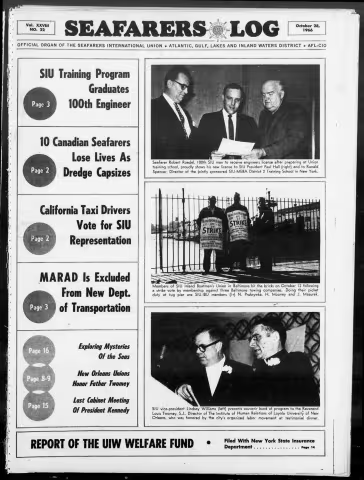
Seafarer Robert Roedel, 100th SlU man to receive engineers license after preparing at Union
training school, proudly shows his new license to SlU President Paul Hall (right) and to Ronald
Spencer. Director of the jointly sponsored SlU-MEBA District 2 Training School in New York.
Members of SlU Inland Boatmen's Union in Baltimore hit the bricks on October 12 following
a strike vote by membership against three Baltimore towing companies. Doing their picket
duty at tug pier are SlU-IBU members (l-r) N. Prokrywka, H. Mooney and J. Mazurek.
SlU vice-president Lindsay Williams (left) presents souvenir book of program to the Reverend
Louis Twomey, S.J., Director of The Institute of Human Relations of Loyola University of New
Orleans, who was honored by the city's organized labor movement at testimonial dinner.
REPORT OF THE UIW WELFARE FUND Filed With New York State insurance
Department pag* M
r
J
Paipe Two SEAFARERS LOG
All Hands Safe in Separate Freighter Mishap
Ten Canadian Seafarers Lose lives
As Dredge Capsizes in St. Lawrence
QUEBEC—^Ten Canadian Seafarers were killed or are missing and presumed dead in the recent
capsizing and sinking of the dredge Manseau 101 in the St. Lawrence River near Quebec City. Eight
of the dead or missing were members of the SIU of Canada, and two were licensed engineers, mem
bers of the SIUNA-affiliated ^
Canadian Marine Officers Un
ion.
In a separate collision, no Ca
nadian Seafarers were reported in
jured in the sinking of the Cana
dian freighter Stonefax after she
was involved in a collision with
the Norwegian ship Arthur Stove
in the Welland Canal.
The dredge Manseau 101 was
swamped and capsized in heavy
weather near the Quebec City
bridge, about 10 miles west of
the city, while being towed from
Montreal to a berth at Plage Gar-
neau on the south shore opposite
Quebec.
As the LOG went to press, three
bodies had been recovered—in
cluding those of SIU of Canada
members Real Parent and Law
rence Monbourquett. The third
body recovered has not been in-
dentified.
Still missing are: Armand Tes-
sier, Dio Phoumiotis, Victorien
Gamelin, Real Parenteau, Pat
Larosse, and Real Bergeron of the
SIU of Canada, and Alfred Pelo-
quin and Lucien Guevremont of
the SIUNA-affiliated Canadian
Marine Officers Union.
A full inquiry of the disaster
has been ordered by the Canadian
federal government, and the Que
bec provincial government has
also ordered its own inquiry. The
SIU of Canada has arranged for
counsel to represent the interests
of the survivors of the deceased
members.
Divers who went down to in
spect the wreck said that they
could locate no bodies still aboard
the vessel.
The dredge capsized about 8
p.m. on September 30 while bat
tling an incoming tide and high
winds from behind which created
waves up to nine feet high. She
was under tow by the tugs Captain
SEAFARERi
Oct. 28. 1966 • Vol. XXVIII. No. 22
Official Publication of the
Seafarers International Union
of North America,
Atlantic, Gulf, Lakes
and Inland Waters District,
APL-CIO
Executive Board
PAUL HALL, President
CAL TANNER EARL SHEPARD
Exec. Vice-Free. Vice-President
AL KERR LINDSEY WILLIAMS
Sec.-Treae. Vice-President
ROBERT MATTHEWS AL TANNER
Vice-President Vice-President
HERBERT BRAND
Director of Organizing and
Publications
Managing Editor
MIKE POLLACK
Assistant Editor
NATHAN SKYER
Art Editor
BERNARD SEAMAN
Staff Writers
DON BEVONA
PETTES WEISS
Psfcllihsil blweskty at 810 Rhmie liland Avsnse
N.E.. Washington, D. C. 20018 by the Seafar
ers International Union, Atlantic, Gilf, Lakes
and Inland Waters District, AFL-CIO, 675
Fonrth Avenie, Brooklyn, N.V. 11232. Tel.
HVaelntb 9-6600. Second ciati postage paid
at Washington, D. C.
POSTMASTEB'S ATTENTION: Form 3579
cards shosid be sent to Seafarers International
Union, Atlantic, Calf, Lakes and Inland Waters
District, AFL-CIO, 675 Foirth A«enH, Brook
lyn. N.y. 11232.
ir ST
.-.J
Simard, Rene Simard and Pierre
Simard, and was also towing a
scow astern.
The heavy toll in lost lives might
have been even higher, but as
weather conditions grew steadil
worse the dredge's Captain or
dered eight crewmenbers off the
vessel to a nearby tug just before
the swamping. ITie remainder
the dredge crew were ordered up
and all had their life jackets on.
Many attributed the high death
toll to the fact that a bunker broke
aboard the dredge as she went
over, filling the water with thick
choking oil. Others reported that
the dredge, which was already in
trouble because of wind and
waves, began shipping water when
she was hit by the wash createc
by a passing vessel.
Fourteen crewmembers saved
themselves by leaping to the deck
of the tug Rene Simard, which was
attached to the side of the dredge
at the time of the accident. The
quick thinking of a crewmember,
who cast off the lines holding the
tug to the dredge, was credited
with saving the Rene Simard. The
other tugs had cast off their lines
when it became obvious that they
were in imminent danger.
Fight for Survival
One of the rescued crewmem
bers, Andre Peloquin, who was
engaged in lowering large pillars
to anchor the dredge when the ac
cident occured, told of his fight for
survival.
Peloquin said he was thrown
into the water by the shock while
about 10 fellows" jumped aboard
the tug Rene Simard. "I shouted
to the cook, but he didn't answer
and I saw clearly he was dead.
"I was lowering the pillar which
holds the dredge in place when
the craft began to tip and I found
myself in the water." He was in
the freezing water of the St. Law
rence for about 15 minutes when
he saw a spotlight.
^ shouted with all the strength
in my lungs, and the tug came,"
he said thankfully. "There was
one guv who grabbed me by the
jacket but he couldn't hold on to
me. I was covered with oil and
that's slippery. When he dropped
me, I said 'Well, I guess this is
the end'."
"They threw me a rope and I
grabbed it. They pulled and then
someone grabb^ me by the col
lar and I found myself on the tug."
Another crewmember, Ray
mond Demers said: 'T was in the
water, I had my lifebelt and I was
fighting and I found myself in
the dark underneath a barge the
dredge was towing.
"I was breathing, but instead of
air I was swallowing oil and
water. Then I felt wind on my
face and I started to breathe.
"I managed to grab a thick
plank and that's what saved me.
I was no longer capable of any
thing and was starting to pass out."
In the second accident, in which
no injuries are reported, the Ca
nadian freighter Stonefax was sub
merged in the Welland Canal with
only ,t|i€-superstructure land .aft
section above water after a colli
sion in the early morning of
October 14 with the Norwegian
freighter Arthur Stove.
The Stonefax proceeded about
a half-mile after the collision, and
was grounded when she seemed
in danger of sinking. The SIU of
Canada crew left the ship by life
boat without incident.
The Norwegian vessel was only
slightly damaged and proceeded
to Port Colbome under its own
power.
Just a few months ago, SIU of
Canada President Leonard (Red)
McLaughlin warned of the danger
involved in the careless, hand-off
approach toward safety adopted
by the Canadian government in al
lowing shipowners to eliminate
watchstanders aboard Canadian
vessels.
McLaughlin noted neglect of
the safety factor in the elimination
by several shipowners of the look
out man on the deck watch and
the oiler in the engine crew. He
said that it was a government
responsibility to set minimum
standards for the manning and
grading of watchkeeping person
nel.
The accident rates of Canadian
shipping, he pointed out, is more
than four time higher than the
general industrial accident rate
across Canada, and Canadian
seamen's accident rate is about
150 percent higher than that
among seamen of other maritime
nations.
There is an even wider margin
when it comes to deaths caused
by accidents, he noted. In the
ast year of complete statistics,
1963, there were 9.2 deaths per
0,000 seamen compared with
1.8 in other industries.
J
Calif, Cab Drivers
VoteforTS&AW
Representation
OCEANSIDE, Calif. — Ocean-
side cab drivers, representing the
Yellow, Bluebird, Checker and
Red cab companies, voted on Sep
tember 29 to become affiliated
with San Diego Local 101 of the
SI UNA Transportation Service
and Allied Workers, successfully
culminating an organizing drive
which started in July.
Local 101 president Edward
Allenworth said that a "deter
mined organizing drive by mem-
lers of the Local preceded the
election.'' He noted that the "con
tract negotiations are going well
with no major problems."
The Union is demanding a con
tract calling for an increase in
commissions and health and wel-
are benefits as well as paid vaca
tions after a year's employment.
The Transportation Service and
Allied Workers of the Seafarers
International Union of North
America, also represents cab driv
ers in St. Louis, San Diego, Detroit
and Chicago, w , ^ . t- -
•Y
Report of
International President
by Paul Hall
October 28, 1966
Two bills recently introduced in Congress
the Senate-Demonstrate again the increasing one in
one in the House and
alarm felt by
many legislators over the continuing deterioration of the U.S. merchant
fleet.
The companion measures, introduced by Representative Edward
A. Garmatz in the House and Daniel Brewster in the Senate, would
give the House Merchant Marine Committee, which Garmatz heads,
and the Senate Commerce Committee, of which Brewster is a member,
a voice in the size of the appropriation for such Martitime Administra
tion functions as construction subsidies and operating differential sub
sidies, for each fiscal year. Appropriations for these activities would
have to be preceded by specific legislative authority by the House and
Senate Committees.
The proposed bills represent an attempt by legislators concerned
over the sad plight of the American-flag merchant fleet to end the
short-changing which maritime has been getting year after year at
the hands of Government administrators who prefer to turn their
backs as the U.S. merchant fleet sinks lower and lower.
Although the deterioration of our merchant fleet has been going on
at an accelerating pace for many years, these administrators chose to
ignore the fact. The SIU and other maritime unions have pointed out
the declining percentage of American foreign commerce being carried
aboard American-flag vessels. The shrinking size of the fleet was noted
time and again.
To all these signs of decay the supposedly responsible administrators
turned deaf ears. The shrinking size of the fleet and the amount of
U.S. foreign commerce it carried they discounted, insisting that a
strong merchant fleet was no longer vital for the national security. In
totaling up the size of the fleet they inflated its numbers by including
the National Defense Reserve Fleet ships—ignoring the fact that
these vessels were inactive and in the main part obsolete.
The Vietnam buildup brought an end to the complacency into which
these government bureaucrats had lulled the nation. We needed ships
and they were not readily available. The foreign crews of foreign-flag
vessels refused to carry U.S. military cargoes. Forced to dip again into
the Reserve Fleet, the nation discovered how pitifully inadequate and
obsolete it was. It was however, all we had to fall back on. But now
even that is just about used up.
Through the recently proposed bills, concerned legislators are seek
ing a means by which they can see to it that the intent of Congress
that we should have a strong, modern American-flag merchant fleet
is carried out. The proposed measures would allow the members of
the House Merchant Marine Committee and the Senate Commerce
Committee, men who have studied the problems of maritime more
deeply than many of their colleagues and have a more intimate knowl
edge of the needs of maritime, a greater voices in maritime's budgetary
allocations.
J
SfU ADantk Fishermen's Unhm
Cantimies Strike in Cioueester
GLOUCESTER, Mass.—Representatives of the SlU-affiliated
Atlantic Fishermen's Union are engaging in round-the-clock nego
tiations aimed at reaching agreement with the Gloucester Boat
Owners Association on a new ^
contract covering 400 fishermen
who have been on strike for four
weeks.
Four fishing boats here have
signed a memorandum of agree
ment, and Union officials are talk
ing with other boat owners. Efforts
to land a load of fish in Boston in
a Gloucester boat manned by scabs
failed recently when Boston dock
workers refused to touch the fish
on the docks. Thirty fishing boats
altogether are involved in the dis
pute, resulting in picketing on the
Gloucester docks by dedicated
trade unionists seeking new ben
efits for themselves and their fam
ilies.
AFU president James Ackert
and AFU Gloucester port agent
Mike Orlando are engaged in the
active negotiations.
The strike began after the Union
sought to gain the same benefits
for Gloucester fishermen as en
joyed by their Brother fishermen
in Boston, New Bedford and New
York City. Those boats agreeing
to the terms in recent days have
returned to fishing. Among the
issues was a Union demand for
continued benefits to the families
of the fishermen,"4iich' as' h&spit- -
alization and medical fees, and a
request by the Union that Glouce
ster fishermen be allowed to take
"benefit" credits with them if they
at any time decided to fish out of
Boston, New Bedford or elsewhere
where the Atlantic Fishermen's
Union is the bargaining agent.
The Gloucester Boat Owners
Association proposed that one
percent of the gross stock on each
trip be put aside for a fishermen's
insurance policy, but it was not
explained exactly how or through
who it would be handled.
Union representatives said that
the Boatowners plan is inadequate
and provides less benefits than the
men are now receiving in health
and welfare.
In rejecting the Boatowners pro
posal the Union also protested
against the high cost of oil used
by the Gloucester boat owners
since Union fishermen traditional
ly have had to pay a share of this
cost. The Union as.ked that the
costs be kept in line with those
charged for oil in Boston, with a
slight additional cost to pay for
the cost of transporting it over the
road from Boston to Gloucester.
- - (CdMiHUid' on 'page'S) '
T-'.ri' •.-••-
October 28, 1966 SEAFARERS LOG Page Three
I'
100th Seafarer Wins Engineer's License
Milestone In SlU Training Program
Marked at Coast Gaard Ceremonies
The 100th SIU member has received his engineers license as a result of the engineer training pro
gram jointly sponsored by the Marine Engineers Beneficial Association, District, 2, and the Seafarers
International Union, Atlantic and Gulf District,
SIU member Robert Roedel,
Seafarer Robert Roedel (left), 100th joint SlU-MEBA District 2
Training School graduate to win an engineer's license, is sworn in
as Third Assistant Engineer by Capt. William F. Rea, Coast Guard
Officer in Charge of Marine Inspection for the Port of New York.
Final Version excludes MAHAD
President Signs Bill Creating
New Dept. of Transportation
WASHINGTON—President Johnson has signed a bill creating
a new Department of Transportation which includes units of the
nation's rail, highway, aviation and railroad agencies.
The new department will not
include the Maritime Adminis
tration which will remain under
the Department of Commerce.
The exclusion of the Maritime
Administration from the new De
partment of Transportation was
made after a long, hard fight by
maritime labor.
A House-Senate Conference
Committee agreed early this
month to exclude the maritime
Administration from the proposed
new Department of Transporta
tion.
The bill to create the new De
partment of Transportation went
to the House-Senate conference
committee because the House
voted last month 260 to 117 for
a labor-backed amendment to
keep the Maritime Administration
out of the new Department. The
Senate had already adopted the
transportation department bill
without the amendment.
The issue thus had to go to a
joint conference committee of
both houses of Congress to be
resolved before the transportation
department bill could be finally
approved. The conferees agreed to
adopt the House version excluding
the Maritime Administration,
clearing the way for final passage
of the department bill.
Under terms of the Transporta
tion Department bill, a 12th cab
inet-lev^ department Will be
created in the federal government
in which the agencies dealing with
aviation, highways, and railroads
and the Coast Guard would be
consolidated.
The. prjgjr^I, , ex
cluding* MAR AD from the new
Department, was introduced in
the House last month by Rep.
Edward Garmatz (D-Md.), chair
man of the House Merchant Ma
rine Committee and floor leader
of the fight for its adoption.
Labor-supported bills to set up
the Maritime Administration as a
completely independent agency
have been approved in committee
in the House and Senate and are
awaiting further action.
\J
S/a Boatmen
Wt the Bricks'
In Bnho. Strike
BALTIMORE — Members of
SIU Inland Boatmen's Union have
struck the Baltimore Towage &
Lighterage Co., Curtis Bay Tow
ing Co., and Baker-Whiteley Tow
ing Co. The strike began on
Wednesday, October 12 following
a strike vote by the membership.
The Union, which is seeking
improvements in wages, hours and
working conditions rejected man
agement's "final offer" as being
insufficient.
Although many unresolved
areas remain, one of the Union's
prime demands is that a man re
ceive 24 hour notice before being
given a day off by the company.
Strike action is being coordi
nated by SIU Vice President
Eat;Li|fvlli.Sh.^r^..n -i.i- ->1.
26, received his Third Assistant
Engineer's license at ceremonies
held on October 17, at the office
of Capt. William F. Rea, U.S.
Coast Guard Officer in Charge of
Marine Inspection for the port of
New York.
Roedel received his license after
completing the course of studies at
the School for Marine Engineering
operated jointly by MEBA District
2 and the SIU A&G District, and
after successfully passing the U.S.
Coast Guard Third Assistant Engi
neer examination.
Roedel, a resident of Brooklyn,
N. v., has been a member of the
SIU since 1961. Prior to receiving
his Third Assistant Engineer's li
cense he had sailed in the engine
department as fireman-oiler-water-
tender.
Roedel had attended the SIU's
Harry Lundeberg School of Sea
manship prior to the start of his
seafaring career. He had also at
tended the SIU's Engine Depart
ment Upgrading Program, where
he received his fireman-oiler-
watertendeT rating.
By the end of October, which
makes the ninth month since the
inception of the program, licensed
graduates of the SIU-MEBA pro
gram are "expected to exceed the
total number of graduates from
the Merchant Marine Academy at.
Kings Point, Long Island, for a
similar period," Ronald Spencer,
Director of the school, announced
during the ceremonies at which
Roedel received his license.
Since the school's inception in
January, 45 MEBA members who
already possess engineer's licenses
have upgraded themselves to high
er ratings with the aid of training
received at the school, in addition
to the 117 SIU members who re
ceived officer ratings for the first
time.
In a joint statement, SIU Presi
dent Paul Hall and Raymond T.
McKay, MEBA District 2 Presi
dent and Executive Vice President
of the National MEBA, said that
"the program is making an impor
tant contribution in helping to
meet the need for trained engi
neers for the Vietnam sealift."
Establishment of the engineer
training program was spurred by
the growing shortage of licensed
marine engineers aboard Ameri
can-flag ships, particularly as a re
sult of the demands placed on
American shipping by the conflict
in Vietnam.
The SIU-MEBA District 2 train
ing program is the first of its kind
in maritime history. It assists en
gine department seafarers to ob
tain instruction in preparation for
their Third Assistant Engineer's
license. Temporary Third Assistant
Engineer's license, or Original Sec
ond Assistant Engineer's license in
either steam or motor vessel classi
fications. In addition, MEBA Dis
trict 2 members who already pos
sess engineer's licenses may up
grade themselves to higher ratings.
The training school is operated
under a reciprocal agreement be
tween the SIU and District 2 of
MEBA. SIU men who enroll in
the program . are provided with
meals, hotel lodging and subsist
ence payments of $110 per week
while in training.
Tuition costs are free to MEBA
members who attend the school to
upgrade their licenses.
As a result of the reciprocal
agreement between MEBA Dis
trict 2 and the SIU, unlicensed
SIU men receive full credit and
complete protection for all of their
accumulated pension and welfare
credits. While sailing as engineers,
they will also receive jjension and
welfare credits. As a result, upon
reaching retirement eligibility,
their pensions will be paid based
on combined time.
MEBA District 2 has waived
its $1,000 initiation fee for all men
who begin sailing as licensed engi
neers under the joint program dur
ing the period of the Vietnam
crisis.
Engine department Seafarers are
eligible to apply for any of the
upgrading programs if they are 19
years of age or older and have 18
months of Q.M.E.D. watch stand
ing time in the engine department,
plus six months' experience as a
wiper or equivalent.
SIU engine department men in
terested in the program should ap
ply immediately, or obtain addi
tional information at any SIU hall,
or directly at SIU headquarters,
675 Fourth Avenue, Brooklyn,
New York 11232. The telephone
number is HYacinth 9-6600.
/ N. Y. Port Council
Award Presented
To Rep. Garmatz
NEW YORK—The maritime
service award of the Greater New
York and vicinity Maritime Port
Council, was presented last week
to Representative Edward A. Gar
matz (D-Md.) chairman of the
House Merchant Marine and Fish
eries Committee.
Garmatz, who as a member of
the House Maritime Committee,
has introduced and supported im
portant legislation aimed at
strengthening the American-flag
merchant fleet, accepted the award
at presentation ceremonies held at
the American Hotel here.
In accepting the honor, Garmatz
praised the united struggle being
• waged by maritime labor to create
a strong American merchant ma
rine. He added that this is the kind
of unity we must have in the fu
ture to continue forward with our
goals of revitalizing the maritime
industry.
Presentation of Third Assistant Engineer's License to Seafarer Robert Roedel (second from right), 100th
Graduate of joint SIU-MEBA District 2 Engineer Training School to win license, took place last week
at Coast Guard office in New York. Left to right above are: Tony Gonclaves, Administratpr, SIU
Harry Lundeberg School of Seamanship: Ronald Spencer, Director of the Engineer Training School;
George McCartney, SIU Representative: Commander Wm. D. Derr, Coast Guard, Ralph Raulerson, Chief
.Engineer in charge of.exatnirwktions: Seafarer :Roedel:-aqd^Capt. ̂ Wm. Rea,.Marine JqspectioA Officer,.
'i
.3
•i
I
1 • /
•:H
r
ii
-r.
. Pi
1
i
• S ,
Page Font SEAFARERS LOG October 28, 1966
J
Unemployment Rate Drops to 3.8%
But Negro, Unskllled Rate Still High
The nation's unemployment rate edged down to 3.8 percent in September but government job ex
perts apparently were giving up hope of reaching 3.5 percent by year's end.
The Labor Dept.'s monthly report showed the September job situation continuing strong for quali
fied and experienced workers and ^
with substantia! job gains for adult
women.
A major problem remained in
tractable, with the Labor Dept.
reporting that "the job situation
for Negroes and for unskilled
workers showed no significant
change after a deterioration from
April to August."
On the unemployment side of
the picture, the number of people
seeking work and failing to find it
totaled 2.6 million. This was a
seasonal decline of 350,000 from
August.
Unemployment usually edges
down in October and then rises
with cutbacks in agriculture, con
struction and other seasonal activ
ities, the report observed. Thus
far this year, unemployment has
deviated little from seasonal pat
terns, the report added.
Using the national jobless rate
of 3.8 percent as a standard, the
situation of particular groups may
be illuminated.
The Negro jobless rate hung
high at 7.8 percent in September,
not significantly changed from the
7.9 percent average in the May to
August period. The jobless rate
The Gulf Coast
by Lindsey Williams, Vice-President, Gulf Area
The Greater New Orleans AFL-CIO has endorsed Representative
Hale Boggs (D.-La.) for reelection in November. Representative Boggs
has supported maritime labor's fight for an independent maritime ad
ministration and has also supported many AFL-CIO backed bills in the
past. Seafarers and all Louisiana labor union members are urged to
get out the vote for Representa- «>-
tive Boggs.
New Orieans
Seafarer Waltw Coniey, who
last sailed on the Del Aires, an out
patient since February 1966, is off
the outpatient list and ready to go
again. Coniey sails as fireman-
watertender. He says he liked the
Del Aires and hopes he'll have a
chance to make it again when she
comes in. Steward Milford Alex
ander has enjoyed his stay on the
beach and is now keeping one eye
glued to the shipping board and
waiting for the right ship to come
along. Alexander last shipped on
the Colorado.
Seafarer Robert "Bob" White
still manages to get down to the
hall to see his old shipmates. Bob
no longer ships, but still maintains
his book and an active interest in
the union. Oiler H. B. Williams
piled off the Neva West to make a
quick trip home to Kingsport, Ten
nessee. After relaxing there for a
while he is now waiting for the
first oiler's job going to Saigon.
Job E. Mullen, who last sailed
on the Steel Seafarer, was around
the hall recently. Job makes his
home in New Orleans and has
been with the union since 1944.
Edward Wicak recently signed off
the Globe Explorer and is present
ly just taking it easy. ;^die is
looking for another oiler's job
preferably to Japan, his favorite
home away from home.
James "Sargeant" Hand, Sr.,
owner for over thirty years of the
Austin Inn, died on September 13,
1966, after a long illness. Sarge
Hand was known worldwide for
his friendship toward Seafarers
and toward the SIU in particular.
Many of his friends will miss him.
Mobile
Autrey L. Johnson recently fin
ished a tour aboard the Yellow-
stfHie as third cook and now is
ready to take it easy for awhile
with his family. Veteran seafarer
Frank Catchot has spent the last
six months recuperating from an
operation. Catchot has sailed with
the SIU out of the Gulf for over
twenty years. Back from the baux
ite country and off the Alcoa Com-
for whites was 3.3 percent in Sep
tember compared with 3.4 per
cent in the May-August period.
"The ratio of Negro to white
unemployment rates continues at
2.4 to 1, a considerable rise from
the 2 to 1 ratio which has been
prevalent in recent years," the
Labor Dept. said.
"The deterioration in the Negro
job situation during the late spring
and summer resulted from inade
quate employment gains for Ne
groes in the semi-skilled, unskilled
and farm occupations, with a con
sequent rise in the level of unem
ployment among inexperienced
workers."
Ross offered figures which com
pared the first four months with
the second four months of recent
years. In the 1963-65 period, job
lessness among experienced Negro
workers declined by an average of
114,000 between the two quarters
of each year. In 1966, however,
unemployment in this group rose
by 31,000.
Ross tentatively suggested that
automation and mechanization on
the farm and in the factory may
be wiping out Negro-held jobs.
The job picture for workers
with good professional or manual
skills and with good training and
experience remains very favorable,
the report said. The jobless rates
were 2.3 percent for white-collar
workers and 1.8 percent for skill
ed craftsmen.
Married men, who make up
more than half the labor force,
(lad a jobless rate of only 1.9
percent.
On the other hand, those with
ess skill and experience fare poor-
y. The jobless rate for unskilled
workers stood at 5.8 percent.
mander after several trips, Ewl^e
N. Bracewell is going to stay on
the beach for awhile to spend
some time with his family who live
in Mobile. Bracewell has shipped
AB from the Gulf ports for over
fifteen years.
Charles O. E. Lee, deck mainte
nance, whose last ship was the
American Victory, is now making
his home in Tampa, Florida. Lee
has shipped out of the Gulf since
joining the union. Seafarer Al-
phonse J. Tremer, who is resting
up after a long trip on the Coe
Victory, recently returned from
Vietnam. Steward Robert A San
chez is recovering from a broken
leg which he received recently on
the Pen^ Transporter.
CAavez, Miong Named to Head
AFL-CIO Farm Woricers Union
WASHINGTON—AFL-CIO President George Meany an
nounced the apf)ointment of Cesar Chavez as director and Larry
Itliong as assistant director of the federation's United Farm Workers
Organizing Committee. ^
The UFWOC was chartered by
the AFL-CIO Executive Council
at its August meeting in Chicago,
following a merger of the National
Farm Workers Association and the
Agricultural Workers Organizing
Committee, AFL-CIO.
Chavez was the founder anu
leader of the NFWA and Itliong
was the Delano (Calif.) director
of the AWOC and the leader of its
grape strike there.
Meany's announcement fol
lowed the first meeting of a newly
established special committee of
the council, charged with aiding
organization of farm workers. Be
sides Meany, the committee in
cludes AFL-CIO Vice Presidents
James A. Suffridge, I. W. Abel,
Ralph Helstein and Paul Phillips.
The committee heard a report
from AFL-CIO Organization Di
rector William L. Kircher on cur
rent AFL-CIO organizing cam
paigns of farm workers in Cali
fornia and Texas.
Negotiations Begin
In the key California drive,
Kircher said, contract negotiations
have begun with the DiGiorgio
Corp. where the UFWOC won an
overwhelming representation elec
tion victory over the Teamsters in
, late August. The UFWOC is now
seeking another election for work
ers at the giant King ranch of Di
Giorgio in Arvin, Calif.
The chances for an election at
the King ranch dimmed consider
ably when the Teamsters refused
to accept election recommenda
tions from Governor Brown's spe
cial farm labor election expert,
Kircher said^
Kircher said word was received
Oct. 11 from the Teamsters that
they would not accept the recom
mendations.
"It is apparent that the Team
sters know they cannot win and
do not want to experience the
same humiliating defeat that oc
curred at the DiGiorgio ranch in
Buena Vista where, with the full
support of the company and the
Delano newspaper, they were still
more than 200 votes short of beat
ing the AFL-CIO Farm Workers,"
Kircher said.
The Atlantic Coast
by Earl (Bull) Shepard, Vice-President, Atlantic Coast Area
1 have been in Baltimore the past few weeks aiding our brothers
in the Inland Boatmen's Union in their strike against several tug
boat operators in the Baltimore area. Right now negotiations are at a
standstill as the operators refuse to do any real bargaining on the issues
involved. The SIU is ready to start negotiating again as soon as the
operators are honestly ready to ^
consider our proposals to hike
wages and better the working
conditions of members of the SIU
Inland Boatmen's Union in Balti
more.
New York
Richard W. Gallant, who stop
ped by to say hello to all his
friends, was last aboard the Azalea
City and hopes to ship out again
on a good feeder.
Lester Miles, who was having
a good game of rummy with the
boys at the hall, is hoping to
ship out as soon as possible.
Lee Joseph who has just come
off the Hurricane, wants to ship
out again as soon as he has a
little shoreside rest.
Tim McCarthy, who was last
aboard the Baltimore, said she was
a good ship and a good feeder. He
hopes to go out on another run as
soon as he has a little rest. Joseph
Bourgeois, who was the bosum
aboard the Steel Recorder expects
to ship out again soon after a
short stay on the beach.
Baltimore
Shipping has been good for the
past two weeks here with a bright
outlook for the future. The Los-
Gallant Watson
mar, Alamar, Ohio and Maine
are presently laid up here. Over
the last period we have paid off
five ships, signed on three and had
ten vessels in transit.
Frank E. Holland is just back
from a long voyage aboard the
Kenmar. Frank has been a Sea
farer for 25-years.
Harry E. Schockney Jr., a 23-
year Seafarer, who was last aboard
the Alcoa Explorer as an oiler, is
waiting for a run on one of his
favorite ships, the Calmar.
Joseph Pozzuoli, another 23-
year Seafarer who last shipped out
on the Mayaguez is now waiting
for the first AB job thart hits the
boards.
Philadelphia
Shipping has slowed down here
over the last period.
John Nolde, who sailed in the
deck departmeiit, was last aboard
the Merrimac. He is now ready to
ship out again after a few days at
home. Steve Mosakowski, who has
been with the SIU for 26-years,
is registered and raring to go. He
sails as bosun and his last berth
was aboard the Merrimac.
James McPhaul was chief stew
ard aboard the Commander which
is now in drydock. Yincenzo "Jim"
Russo, an SIU oldtimer is on the
beach and will be ready to go
again in a few weeks. Jim sails in
the steward department.
Norfolk
Shipping has been good from
this port and is expected to hold
up the same way for the immediate
future as the Penn Challenger is
expected to crew up soon.
Thomas Gower, a 15-year SIU
man broke his hand while on the
Baltimore and had to be flown
back to the States. He hopes to be
in shape soon.
Charles Majette, a Seafarer for
19 years, was the bosun on the
Commander for the past ten
months. He hated to see the ship
laid up in Philadelphia and said
that the bosun's job aboard the
Commander was a mightly fine
one.
Boston
Shipping has been fair for the
past period and is expected to
pickup a little in the future.
Peter Jomfdes, a 23-year union
man whose last ship was the
Maiden Victory, has enjoyed the
summer at home. He is now ready
to ship out again as an oiler on
the first ship that hits the board.
John Anderson, a 25-year union
man, was last aboard the Con
necticut as chief cook. "Andy"
had to get off and is presently in
drydock. He expects to be ready
to ship out again soon.
Don Watson, a 10-year Seafarer
who last shipped aboard the Steel
Apprentice was forced to leave
the ship because of illness at home.
Don said that he will be looking
for another foreign run as soon as
possible.
Puerto Rico
The South Atlantic Caribbean
Line which operates the Floridian
between Miami and San Juan, will
operate three ships for the govern
ment—the Selma Victory, the De-
pauw Victory and the Cape
Catoche.
The Baylor Victory is in port
for repairs. Some of the finest
old timers in the union are
aboard the ship including Charlie
Thompson, Bosun Barney Swear-
ingen and Charlie Rice whp is the
steward aboard the vessel.
Caligiura Retires
Seafarer Ernest A. Caligiura
picked up his first regular month
ly $150 SIU pension check re
cently at N.Y. headquarters.
Caligiura who last sailed as
messman aboard the Marymar,
makes hfs home in the Bronx, N.Y.
J.
October 28, 1966 SEAFARERS LOG Page Five
i I
n
I
I'
f'::
The Great Lakes
by
Al Tanner, Vice-President and Fred Farnen,Secretary-Treasurer,Great Lakes
On October 4th, the United States Court of Appeals in Cincinnati,
Ohio, ruled that the Checker Cab Company in EXetroit must sit down
and negotiate with Transportation Services and Allied Workers,
Local 10, SlU. The court, in sustaining the National Labor Relations
Boards' decision, on behalf of Local 10 stated that the record of this
case was reviewed and recited <5"
and the Court has no doubt that
there is substantial evidence to
support the findings of the evi
dence of the Board.
Shipping usually slows down
this time of year since we are
close to bonus and vacation time,
however, many rated and unrated
jobs are on the open board. We
would once again like to remind
the membership that, by passing
up these jobs, the Union is ship
ping many new members in order
to fill the vacancies, and if ship
ping gets bad, these new men will
be holding seniority in most of the
fleets. We, therefore, urge the
membership to take these jobs on
the open board when the oppor
tunity arises.
Your Union is still fighting to
preserve jobs on certain so called
"automated ships." Earlier this
year we were successful in our
efforts to maintain oilers on watch
on the M/V Diamond Alkali. As
reported in the Seafarers Log, the
United States Coast Guard re
scinded their action by putting the
oilers back on the certificate of
inspection on this vessel. We are
now faced with a similar prob
lem with two Reiss vessels, the
M/V John A. Kling and the
M/V Raymond Reiss. Both of
these vessels were converted to
diesel last winter during lay-up.
When the vessels were ready to
sail, the company stated they did
not need oilers on these ships. Ac
cording to the company, all of the
work performed by the Oilers had
been eliminated through automa
tion. An investigation by Union
Officials proved the company to be
wrong. Although the ballast system
was set up in a central location,
the responsibility of pumping bal
last was still there, and the only
thing eliminated was the turning
of valves by hand. We pointed out
to the company that the Oilers
have always pumped ballast and
if the company made the job
easier by installing electric pumps,
thev nevertheless did not eliminate
the job. The same would apply to
tending the boiler water level.
Oilers were maintained on these
ve.ssels, and for the first couple of
months, the Oilers did do the
pumping, tend water and other
routine duties while on watch.
However, due to no wipers be
ing employed on these vessels, the
Oilers were assigned wiper's duties
which resulted in the collection
of some 300 hours of overtime.
In order to combat this, the com
pany issued orders to the En
gineers not to allow the Oilers
in the Console Room, and to in
sist that they were not Oilers, but
Engine men who could be as
signed to perform maintenance
work 24 hours a day. The Engi
neers than assumed all of the
Oilers' duties including pumping
ballast, tending water, cleaning
strainers, oiling and greasing
pumps, oiling fuel oil racks, and
many other duties normally per
formed by the Oilers.
The one man watch in the En
gine Room has yet to be proven,
/.'•'I ,\rcM8 ni ?ii''
even aboard the new highly auto
mated vessel now being built out
on the Coast. According to the
U.S. Coast Guard, an automated
vessel is a vessel built from the
keel up—not a vessel 30 years old
that converts from coal to oil.
Chicago
Shipping for this period has
been exceptionally good which is
keeping our shipping board clean
at all times. The W. E. Fitzgerald
came in to Chicago last night with
problems in the stem end—the
result was that she hit a low bridge
and topped off one of her masts.
She will be at the American Ship
yard for a few days, but is not
expected to lay-up for any con
siderable time.
Duluth
The Port of Duluth has had
very good shipping for all ratings.
Andy Haydon, a fireman, aboard
the Kinsman Enterprise was hurt
aboard ship this spring and has
now returned to work. Sheldon
Wilkinson's wife just had a baby
girl. Congratulations Shelley!
Buffalo
Shipping remains good in Buf
falo and with the last lap of the
season in view the men are stay
ing on the job and the demand
for replacements is gradually tap
ering off. We still have a few men
looking to get on one more job
before the season closes.
The P.A.C. Dinner was a huge
success and the MTD held a meet
ing recently to officially endorse
the candidate of their choice for
the coming election.
Cleveland
Although we are now into the
last six weeks of sailing, shipping
is still as good as ever with plenty
of jobs for all who want to ship.
A check of the records on ship
ping for this season shows that
jobs have come up to par with last
season and we met all manning re
quirements.
After his usual summer rest,
Jim Kissick is back on the Taplln.
Radio Pete finally found a home
on the sand boat Lakewood.
George Karr, porter de-luxe, is
still looking for that certain ship.
Frankfort
The City of Green Bay is still
in the Manitowoc shipyard for its
annual inspection. The ship should
be leaving the shipyard in another
week or so.
Jesse Pace, one of our pension
ers, was in the Paul Oliver Memo
rial Hospital for a brief period,
but is out now and regularly visit
ing the SIU Hall. Another pen
sioner, Carl Johnson is confined
to the USPHS Hospital in Detroit.
A speedy recovery is wished from
all of the SIU Brothers in Frank
fort.
Alpena
Shipping still remains good in
the Port of Alpena although ship
ping in the past week or so has
tapered off from what it was
earlier in the season.
I rnot't tK'Cg .losd 'uri
7
Senate Committee Bill Similar To House Measure
Senate Commerce Committee Bill
Asks Voice In MARAD Allotments
WASHINGTON—A bill requiring that future appropriations for the Maritime Administration he
authorized hy the legislative Committees of the Senate has been introduced by Senator Daniel Brew
ster (D-Md.), a member of the Senate Commerce Committee.
Brewster's bill (S-3914) is a
companion proposal to one intro
duced into the House of Repre
sentatives recently by Representa
tive Edward A. Garmatz (D-Md.),
chairman of the House Merchant
Marine Committee, which has al
ready favorably reported the meas
ure to the House.
The measures, which have the
full support of the SIU, would re
quire that appropriations for .the
principal activities of the Mari-
SIU nshermea
Strike Gloucester
Boatowners
(Continued from page 2)
Boston dealers sell oil to the fish
ing trawlers for 12.8 cents per
gallon while in Gloucester it's been
costing between 16 and 17.3 cents
a gallon.
As four Union boats reached
terms in the second week of the
strike, it was agreed to put the
issue of oil costs over to discus
sion. The memorandum of agree
ment signed with the four vessel
owners will expire on May 1,1968.
It provides for a deduction of
one-half of one per cent from
the gross stock for the establish
ment of a pension fund for the
fishermen, and one percent for a
welfare fund, to be administered
by a joint board composed of three
boat owners and three Union
trustees. It further provided for the
immediate elimination of the gross
stock deduction for radar, a cost
formerly shared by the fishermen
and the owners.
The new contract also provides
that on May 1, 1967 the gross
stock deduction for sounding
machines on the boats also will
be eliminated, doing away with
another cost charged to the fish
ermen. In addition, the pact pro
vided that the hourly rate for
work performed when the boats
are in port shall be increased from
$l-an-hour to $2.5()-an-hour.
The memorandum of agreement
also states, "It is further under
stood and agreed by the parties,
that if any contract is negotiated
with the majority of the vessels, for
merly contracted with the Union,
with the provisions different from
those contained therein that the
parties herein agree to accept and
abide by such other provisions."
The four fishing boats signing
the memorandum agreement were
the Terranova, Leonard & Nancy,
Valiant and Neptune. This fol
lowed more than three months of
negotiations with the Gloucester
Boat Owners Assn., by the Union's
officials. Federal Mediator John
Sullivan and State Conciliator
David Grodsky.
Both Ackert, president of the
Atlantic Fishermen's Union and
Port Agent Orlando, also urged
the officials in Gloucester's city
government to. take a greater in
terest in the fishing fleet now,
such as was taken in New Bed
ford where new city piers have
been erected.
I l.i r T
time Administration be preceded
by specific legislative authority for
appropriations each fiscal year.
The purpose of the proposed
legislation is to give the respective
House and Senate committees
which have legislative respohsibil-
ity for maritime policies and pro
grams a greater voice in the
amounts budgeted each year for
construction and repair of vessels,
construction subsidies, operating
differential subsidies, and other
items covered in the Maritime
Administration allocations. Nu
merous legislators have voiced the
opinion recently that Maritime
has been severely short-changed
in recent budget requests.
Senator Brewster clarified this
view when he told delegates to
the Annual Convention of the As
sociation of Water Transportation
Accounting Officers that the lack
of Government policy is most at
fault for the present dilemma of
the merchant marine. He describ
ed Government conduct toward
maritime affairs as "drift."
"We have had no anchor in pol
icy, no seamanship at the wheel,
and no propulsion to move us for
ward," he stated.
Deterioration of the maritime
industry, he warned, endangers
U.S. security as well as the na
tion's economy. Weaknesses in the
current maritime posture, he not
ed, are inherent in runaway flags,
slashed budgets, idle shipyards,
and decreasing numbers of skilled
operators and laborers.
•Present administration of the
U.S. maritime program, Brewster
asserted, fails to meet the consti
tutional responsibility of the gov
ernment. "It is high time that
this country reassessed its mari
time strength in terms of its con
stitutional obligation to adequate
ly defend the nation and protect
its lifeline in international trade."
"We must understand," he
warned, "that if we do not sustain
our fleet . . . then all other ex
penditures for social and eco
nomic improvement niight some
day be sacrificed to international
disaster."
"American sea power has been
shockingly neglected, and I be
lieve that it is your responsibility
and mine ... to do everything in
our power to provide this nation
with a merchant marine, built in
American shipyards, manned by
American seamen, carrying the
bulk of American exports, and
second to no other fleet on the
high seas."
QUESTION; When you were a
boy, what did you want to be
when you grew up?
Evarlsto Pantoja: My ambition
was to join the army so I could
learn a trade. I
really wanted to
be in the Air
Force, but they
said they didn't
need anybody. I
was already ship
ping out when the
war came around,
so they classified
me 2-A. I joined the union about
1942, so I never did get into the
army.
Ronald K. Kester: I guess I al
ways wanted to be a basketball
player. I'm six
feet seven. But I
couldn't make the
grade. So I start
ed working in the
Champion Spark
Plug plant in
Burlington, Iowa.
But I got bored so
my buddy and I
decided to try the sea, and here
I am. •
Robert Bruno: I wanted to be a
baseball player when I was 14 or
15, but I didn't
keep it up and
started in con
struction, mill
work, and fishing.
Now I'm a sea
man and I find it
very interesting
because it gives a
guy a chance to
move around. I enjoy the life of
I .irxifeif-jv'^r tj-.-jfico xdm /'
a Seafarer and I plan to remain a
seaman.
Leo Altscbul: I don't know. I
guess when I was a kid I wanted
to be a seaman. I
guess a lot of guys
have wild dreams
about being the
President or
something like
that. But not me.
When I grew up I
became a sea
man. I've been
sailing for years, and I wouldn't
have it any other way.
if
Edward J. Taylor: I'll tell you.
I always wanted to be in business
for myself. I
started in the
trucking business
shipping wax pa
per in boxes. But
I lost the truck
and ended up in
the Merchant Ma
rine. I'm retired
now, and if I hit
the sweepstakes, 1 might try the
restaurant business.
j>
Billy Nuckols: Brother, I'll tell
you, I never wanted to be a sailor!
But I've been at it
now for 15 or 20
years and I like it.
If I had to do it
over again, I think
I'd probably still
be a sailor. Some
times it gets to
i you, but most of
^ the time it's a
pretty interesting profession.
: '-rj ro rUu /J.uor.- -yj.
• V
/ill.
.x- -
; >•-
1r
a,
•I
•f:
-•Nil
: S''
' '¥
Page Six SEAFARERS LOG October 28, 1966
The Pacific Coast
by Frank Orozak, West Coast Representative
The California gubernatorial election is drawing near and every Sea
farer is urged to get out and vote for Governor Edmund G. Brown.
Brown has consistently supported liberal legislation and he is the man
we would like to see in the Governor's chair after the November 8 elec
tion. Reagan is supported by the most radical elements of the right wing
and any vote for him will surely
result in a vote against any pro
gressive, liberal legislation in this
state. By casting your vote for
Brown you will be picking a man
who can best serve California and
the country.
San Francisco
Shipping is still booming and
will remain so because of ten
MiUer Ruley
pay-offs coming up. This past ship
ping period, Seafarers here paid off
the Duke Victory, Anniston Vic-
lory, Delaware, Montpelier Vic
tory, Kenmar and Brigham Vic
tory.
L. Smith, just got off the Los
Angeles after a short Far Eastern
trip and expects to take a vacation
before shipping out again. M.T.
Doherty, in from the Gt. Lakes
and an SlU-man for the past 22-
years, shipped out aboard the
Robin Sherwood as deck main
tenance.
Seattle
Shipping remains excellent here
in the Pacific Northwest and the
outlook for the next few weeks is
good. We expect to have several
Isthmian Line ships coming in to
pay off as well as some Govern
ment-chartered Victorys.
We have paid off the Antinous,
Iberville, Hudson, Seattle, Penn
Carrier, Venore and Beloit Vic
tory (to be laid up a month for
repairs) since our last report while
the San Francisco, Seattle and An
chorage were in transit.
Clyde Miller, A Seafarer for
20-year& had to get off the Beloit
Victory because of the vessel going
into drydock. He hated to leave
because it is a good ship and he
had been on it for a couple of runs
as bosun. He plans to take a short
vacation before shipping out again.
Charles Dyer, a 20-year Sea
farer, is having a short stay on the
beach before shipping out again.
He was last aboard the Summit as
an oiler. Another 20-year SIU
man, Edward Ruley, who sailed on
the Belgium Victory as Bosun was
forced off the ship in Manila due
to an injury.
Wilmington
Shipping is booming here and
the heavy shipping is expected to
continue for quite awhile. The
Beaver Victory, Robin Trent and
John C. signed off here and the
Eagle TravelCT is due to pay off.
There were two days here when
we had no ships due in and some
of the men here shuttled over to
Seattle to fill jobs. But shipping is
active here once again and there
are plenty of jobs on the board.
Carter Chambers, an SIU pen
sioner, recently received a new
hearing aid from the Seafarers
Welfare Plan. Carter said it open
ed a whole new world for him be
cause now he doesn't have to rely
on lip reading in order to hear.
Carter expresses his deepest ap
preciation to the SIU Welfare Plan
and says that he is proud to belong
to a union which gives such
thorough consideration to its pen
sioners.
Kenny Coats just blew into
town a few days ago after a 14-
month trip on the Ema Elizabeth.
He stopped by the hall a few
minutes to say hello to some of
his old shipmates.
Passei^er Vessel Safety Bill
Retelves Approval By Coagress
The Senate has approved a compromise ship safety bill provid
ing certain safety and financial responsibility standards for pas
senger vessels operating from United States ports. The measure
is now awaiting White House ^
action.
The legislation is a compro
mise between previous House and
Senate passed versions of the bill
and includes leeway for other ma
jor maritime powers to enforce
stricter international safety regu
lations into effect before Ameri
can law will affect them.
The bill calls for stringent regu
lations that will make passenger
ships fire-proof if they are to sail
from United States ports and
affects American-flag as well as
foreign-flag passenger ships hav
ing accomodations for fifty or
more passengers.
The bill also requires that pro
spective passengers be notified of
the safety standards on a passen
ger ship and that this information
be also included in the company's
ads and promotional literature.
In addition, the legislation
forces shipping companies to es-^
tablish financial security to satisfy
any judgment against them for
death or injuries and to refund
ticket money to a passenger in
case the ship cannot sail on a
scheduled voyage.
Presently a 16-nation subcom
mittee of the Intergovernmental
Maritime Consultative Organiza
tion's Maritime Safety Committee
is meeting in closed conference
to amend the 1960 Safety of Life
At Sea convention to include fire
proof requirements on new pass
enger ships.
These safety provisions are ex
pected to meet those that have
been set up by Congress in its ship
safety bill. However, if foreign-
flag ships do not measure up to
these American safety standards
by November, 1968 (when the
new SOLAS Convention rules are
expected to be in force) the
United States will unilaterally en-
fpfcp its, ship safety , law,., ,
REPORT*
From Oct. 7 to Oct. 20, 1966
DECK
TOTAL REGISTERED
DEPARTMENT
TOTAL SHIPPED
All Groups All Groups All Groups
Port Class A Class B Class A Class B Class C Class A Class R
Boston 13 3 5 1 2 32 5
New York 64 31 48 17 26 275 95
Philadelphia 14 5 5 1 26 47 17
Baltimore 26 16 26 8 7 158 42
Norfolk 9 5 2 1 1 25 14
Jacksonville 8 5 7 3 2 17 6
Tampa 2 1 0 2 0 13 5
Mobile 18 9 18 13 5 66 14
New Orleans 56 30 40 20 11 139 58
Houston 37 30 21 21 8 162 99
Wilmington 9 6 7 8 2 19 1
San Francisco 38 18 31 18 19 48 1
Seattle 30 13 12 6 7 51 6
Totals 324 172 222 119 92 1.052 363
• K
ENGINE DEPARTMENT
TOTAL REGISTERED TOTAL SHIPPED REGISTERED on BEACH
All Groups All Group s All Groups
Port Class A Class B Class A Class B Class C Class A Class B
Boston 1 0 2 1 2 11 2
New York 42 31 43 24 25 161 79
Philadelphia 8 4 4 0 1 17 8
Baltimore 21 19 11 19 3 79 29
Norfolk 7 5 3 4 4 25 9
Jacksonville 7 2 • 4 3 3 4 3
Tampa 4 1 0 0 0 9 2
Mobile 13 13 17 16 1 41 11
New Orleans 47 26 42 26 13 79 43
Houston 21 30 29 25 12 131 105
Wilmington 8 6 3 4 8 17 3
San Francisco .... 30 14 22 13 15 26 1
Seattle 21 12 7 8 16 25 2
Totals 230 163 187 143 103 625 297
STEWARD DEPARTMENT ,
TOTAL REGISTERED TOTAL SHIPPED REGISTERED on BEACH
All Groups All Group s All Groups
Port Class A Class B Class A Class B Class C Class A Class B
Boston 5 1 3 2 6 11 3
New York 47 11 46 5 16 152 37
Philadelphia 6 2 7 3 0 20 13
Baltimore 20 5 19 1 3 86 29
Norfolk 5 5 2 6 1 13 23
Jacksonville 4 ^ 2 0 2 2 8 6
Tampa 2 1 0 0 0 9 5
Mobile 17 4 14 5 8 43 4
New Orleans ,41 24 36 16 10 113 70
Houston 25 21 12 10 11 84 49
Wilmington 5 2 2 2 9 12 1
San Francisco 31 6 17 4 26 27 1
Seattle 21 7 8 3 10 24 5
Totpls 249 91 166 59 102 602 246
NiEBA Fight Measures To Revise Rail Rates
Waterway Carriers Continue Fight
Against RR Rate-Cutting Schemes
The Great Lakes shipping industry recently won a round in its continuing struggle against railroad
attempts to force them out of business through dis criminatory rate cutting when the Interstate Com
merce Committee suspended indefinitely the use of revised rail rates for the shipment of grain.
The rates, proposed by the ^
New York Central Railroad,
were designed to encourage rail
shipment of grain from the Upper
Lakes to the East Coast—bypass
ing Buffalo and forcing the water
carriers out of competition.
The ICC suspension of the pro
posed rail rates was supported by
the SIU, MEBA, the Buffalo,
N.Y. Maritime Trades Depart
ment in addition to the Lakes
carriers.
The New York Central attempt
to cut the rates on grain shipments
however, is only the latest of
many rate cutting schemes de
signed by the railroads to gain
monopoly control over the move
ment of cargoes between the
Great Lakes and the East and
South. A growing battle is being
waged in the Courts and before
the ICC over discriminatory rail
road rate cutting.
Traditionally, the ICC has been
sympathetic to the railroad point
of view. The battle lines have
been stiffening recently however,
and more and more the water car
riers are going to the courts to
prevent railroad rate-cutting.
The. rajlrQad .planning has in
the past been to force water car
riers out of a competitive position
by cutting rates to the bones, often
losing money on routes where
they are in competition with water
carriers, and charging exhorbitant
rates in areas where there is no
competition from water transpor
tation.
Still being fought is an attempt
by the railroads to force water-
borne coal carriers out of business
on the Lakes through the use of
so-called 'unit trains.'
A Pair of Pensioners
Seafarers John Hudgins and George Sturgis picked up their first
regular monthly SIU pension checks at the Norfolk SIU hall re
cently. Double-header check presentation above includes (l-r): SIU
rep. Maryin. H.ujf, hjy^^Jfjj^ Sfurgis. and Union rep.^^t^ve fapuchjs,
October 28, 1966 /
:
SEAFARERS LOG Page Seven
President to Ask Congress
For Hike In Social Security
Substantial increases in social security benefits will be recommended
to Congress next January, President Johnson recently announced to
some 30,000 federal workers who helped launch the medicare program
last July 1.
Without disclosing all the details of his upcoming proposals, the
President told employees at the Social Security Administration head
quarters here they will include:
• An average increase in monthly benefits of 10 percent or more,
with proportionately higher increases going to those in the lower
brackets. Payments now run from a minimum of $44 to a maximum
of $134 per month.
• A basic monthly minimum payment of $100 a month to every
worker who retires after being on the social security rolls for 25 years.
• An increase in the permissible earnings an individual may make
if he chooses to work part time after being retired from his regular job,
without forfeiting his right to social security benefits. The current
maximum is $1,500 per year in earnings.
• The extension of hospital and medical care to more than a million
social security beneficiaries who are drawing payments as a result of
disability.
In addition, the President said, he was setting up a special task force
under Secretary John W. Gardner of the Department of Health, Edu
cation and Welfare and former Gov. Farris Bryant of Florida to de
velop "a truly modem program for nursing home construction."
Administration spokesmen estimated the cost of the President's pro
posed broader benefits at $2 billion plus a year, but suggested that
much of this would be covered by the present schedule of social secu
rity taxes because payments into the system's Trust Fund was sur
passing earlier projections.
The remainder might be covered either by an increase in the tax rate
or by broadening the wage-base on which taxes are payable from the
current figure of $6,600 a year to $7,800 a year, spokesmen said.
The President paid tribute to the efficiency with which social security
operations are handled, pointing out that "the cost of administering"
the programs "is only 2.2 cents out of each dollar" paid in through
worker contributions.
Payments to beneficiaries are now running at about $20 billion a
year, with some 22 million people on the rolls.
Johnson took the occasion of his speech to remind social security
workers that when the bill creating the program was pending in 1935,
seven minority members of the House Ways and Means Committee
denounced it as threatening "a crushing burden on industry and labor"
and added that it would "destroy old-age retirement systems set up
by private industry."
House opponents tried to kill the bill by sending it back to committee
but lost on a 253-149 vote, he remarked, and most of them then tried
to "hide their vote" by supporting the measure on passage.
When the medicare fight was pending last year, the President ob
served, he "had the strange feeling that it had all happened before."
"The nay-sayers dusted off all their old speeches of 30 years ago,"
he continued, calling the program such things as "socialism, a political
hodgepodge and a cruel hoax." They even repeated the tactics of trying
to kill it on a motion to recommit but lost again, and 76 House mem
bers switched to vote for it on final passage, he commented.
Actor's Equity and the League
of Resident Theaters have reached
agreement on the union's first con
tract covering employment of
Equity members in the League's
26 U. S. theaters. The three-year
pact sets salary ranges of $90 to
$135 a week to start which will
rise to $95 to $150 by 1969. The
pay scale is geared to four differ
ent categories based on gross box
office receipts. The contract also
calls for improved sick benefits
and salary payments from the first
day of rehearsal.
American Airlines mechanics
and other ground personnel have
won a new contract that they ac
cepted on the eve of a September
28 strike deadline. The 12,000
members of the Transport Work
ers Union employed by American
voted to ratify a contract calling
for three wage increases of five
per cent each payable within 15
months; three weeks vacation after
five years; four after 15; Good
Friday as a ninth paid holiday; a
50 per cent company contribution
to employee pension costs and im
proved grievance machinery as
well as other gains.
The collected papers of two his
toric labor leaders—John Fitzpat-
rick, president of the former Chi
cago AFL from 1904 to 1946 and
Victor Orlander, secretary-treas
urer of the former Illinois AFL
from 1914 to 1949, have been
given to the Chicago Historical So
ciety. The papers, which include
50,000 items dating from 1910 to
1935 are expected to be valuable
in documenting organized labor's
many contributions towards im
proving working, living, social, ed
ucational and political conditions
within the community and the na
tion.
A meeting of the AFL-CIO
General Board has been called for
Nov. 17 at 10 a.m. in the Shera-
ton-Park Hotel in Washington,
D. C. The board is made up of the
principal officer of each affiliated
national or international union
and each trade and industrial de
partment, plus members of the
AFL-CIO Executive Council.
The general board meeting will
follow the three-day session of
the Executive Council, to be held
in Washington Nov. 14-16.
The Fact Behind The Figures
The U.S. unemployment rate is continu
ing to drop and is now down to 3.8 percent,
according to the latest Labor Department
report on unemployment.
Behind this drop lurks a less encouraging
statistic however. The negro jobless rate
stands at 7.8 percent, more than two and a
half times the white rate, and an increase
over the rate which has prevailed in recent
years. The jobless rate of unskilled work
ers generally, stands at 5.8 percent also con
siderably higher than the overall average.
The disparity is all-too familiar. The
figures differ only slightly from year to
year, with the scarcity of jobs most acute
for the negro and other minority groups,
the unskilled, the poorly educated. In many
ways it merely reflects the discouraging cycle
of poverty-ignorance-poverty in which too
many Americans have become trapped.
These are the hard-core unemployed. Re
ducing the unusually high jobless rate for
these Americans is the real aim of the war
on poverty, job training programs, aid to
education, civil rights legislation and other
Great Society programs. The goal of these
programs is to help the nation's disadvan
taged to help themselves—^the only way in
which help can be truly meaningful.
With non-skilled and even semi-skilled
job opportunities declining in the United
States, job training and educational upgrad
ing are the only feasible cure for this hard
core unemployment.
By removing racial barriers to employ
ment, by teaching job skills, by raising the
general level of education and aspiration,
this hard core of unemployed can become
productive Americans in every sense of the
word—producing a better life for them
selves and their children and a better future
for the entire nation.
Good Unionism In The Market Place
The holiday season is not too far off now
and the gift-buying splurge that accompanies
this joyful season will soon be packing de
partment stores around the country.
These stores all carry products manufac
tured by a wide range of U.S. manufacturers.
Some of these manufacturers are well known
to families through the use of nationwide ad
vertising.
However, just as the consumer is dis
criminating in the quality of merchandise that
he purchases—he must be equally discrimi
nating in making certain that the products
purchased are not manufactured by a com
pany which denies its employees the right to
fair wages and working conditions through
unionization.
Many of these companys will undoubtedly
launch huge advertising campaigns with the
advent of the holiday season and will be.
wishing the world peace and goodwill for the
coming year. This peace and goodwill is ob
viously not wished to their own employees
who are subjected to substandard pay and
working conditions.
Each issue, the Seafarers LOG, along with
many other trade union publications, prints a
Don't Buy column which lists those manu
facturers who have denied their employees
the right to bargain collectively for decent
wages and working conditions.
These manufacturers do not deserve the
patronage of the American consumer, and to
support them is to support the very evils
which they represent.
Seafarers and all trade unionists are urged
to study this list carefully so that they may
use the ultimate weapon in the marketplace
—a boycott against all products produced by
anti-union employers.
W-
i-:.
ii-fe
V
fe;:
i &•
. r:
4
•s:
•a ;
Page Eight SEAFARERS LOG October 28, 1966
^ i'
^ : !'i
tfTr , Xt. 'v, y,. =
W'i
•' %
••Wi''"'
•"-
- > -•
. ;»^v,vfft-..<s, v.r- !>^jSr%Jal«3/^-
uc ' -
jFf^^••- •...•• .•
THE First Annual Testimonial Banquet of the
Organized Labor Movement of Greater New
Orleans was held recently at the SIU hall in New
Orleans honoring the Reverend Louis J. Twomey,
S.J., Director of the Institute of Human Relations
of Loyola University.
Proceeds of the Dinner, which was attended
by top civic, labor, political, business and religious
leaders in the state, were donated to the Institute.
A check for $7,000 was presented to Father
Twomey to further the work of the Institute in
fostering better labor-management relations, ac
celerating social progress and improving inter-
American relations.
SIU Vice-President Lindsey Williams served as
Master of Ceremonies at the Dinner, at which the
principal speaker was Victor Bussie, president of
the Louisiana AFL-CIO. Other speakers included
Representative Hale Boggs (D-La.).
Telegrams honoring Father Twomey and his
work were received from President Lyndon B.
Johnson, Vice-President Hubert H. Humphrey,
Labor Secretary W. Willard Wirtz, AFL-CIO
President George Meany and SIU President Paul
Hall, among others.
In his address, Louisiana AFL-CIO President
Bussie cited Father Twomey's firm stand against
a Louisiana ri^t-to-work law as an example of
his determination to help to defend the rigjits of
v , "S" .
p"
iilifi.:-: g
s V . labor. "All of us recall the dark days of 1954,'
Bussie noted, when "anti-labor forces in the Legis
lature pushed through the so-called right-to-work
law. Father Twomey spoke out publicly on three
different occasions against the legislation. No one
who heard his plea before the legislature could
doubt that he w^as there solely because he felt
a wrong was being done—that working men and
women were being hint and that our state would
suffer severely. ..."
Bussie continued: "The Institute on Human
Relations most clearly defines the life and pur
pose of Father Twomey, for its objective is *to
make the dignity of man the heart of economic
efficiency.'"
Father Twomey has been director of the Insti
tute of Human Relations since its inception in
1947. He has also served dn the National Man
power Advisory Committee of the U.S. Labor
Department and is a regular speaker and lecturer
on labor-management and related problems.
The Institute of Human Relations of Loyola
University was founded in October 1947. At
that time it was called the Institute of Industrial
Relations.
The Institute was originally conceived as an
agency to guide labor-management relations. This
remains one of its principal aims. It became evi
dent that to best pursue this goal the Institute
would have to broaden its scope and outlook.
This led to the establishment of separate divi
sions under three broad classifications—^theLabor-
I. Management .Center, the Social Order Center, and
i • the Inter-American Center.
Under this new setup, the Institute has incor
porated within its functions special training
courses which are being conducted in cooperation
with the State and Federal Governments. These
courses are designed chiefly to meet the growing
jpfoblem of unemployment caused by the elimina
tion of . whole categories of job opportunities
through technological change. In this connection
it strives to analyze the. human and economic
v-i ̂ A- V- •• - •' • . " •
teisWSfc':';
implications of an economy that is moving with
accelerated pace from one of scarcity toward one
of abundance, with the overall objective of creat
ing a society in which the dignity of the human
person will be acknowledged.
As part of this analysis the Institute enlists the
best resources at its disposal to suggest at least
tentative answers to the serious problems being
created in the transition period, such as those of
maintaining effective purchasing power, of equita
ble distribution of goods and services of rational
use Of leisure time, of collective bargaining in the
age of automation, etc.
Still further, the Institute makes available to
specialized groups like union and management
officials, school teachers, social actionists, etc.,
through conferences, workshops and consultation,
the opportunity to increase their knowledge of
and to sharpen their skills in helping to solve
specific social problems.
This is done through regular classroom work
and through regularly conducted seminars on^
labor-management problems. SIU President Paul
Hall, along with other American labor representa
tives, has taken part in these seminars for some
time and has helped to make clear to students
of labor-management relations the aims and goals
of organized labor and the process of collective
bargaining through which these goals are achieved.
Finally, the Institute after several years of plan
ning has entered the field of Inter-American rela
tions. Under an agreement with the Agency for
International Development of the U.S. Depart
ment of State, the Institute has committed itself
to a leadership pfogram for the youth of Central
America, Panama and the Dominican Republic.
Selected young men and women come to Loyola
University in New Orleans and under the responsi
bility of the Institute are given intensive training
in the political, economic and cultural develop
ment necessary to propiote democratic freedom
and security in their respective countries.
Father Twomey greets his brother John,
who came all the way from Floriada.;
Archbishop Hannon (left) and Louisiana
State AFL-CIO President Victor Bussie.
SIU Vice President Lindsey Williams,
introduces Father twomey to guests,
-! -
October 28, 1966 SEAFARERS LOG
••SICI. ,:i.
Page Nine
':%tm
father Twomey addressed the assembled guests to offer his thanks for the honor bestowed on him. "l' Greater N.O. AFL-CIO Pres. Pat Stoddard presents watch
feel that this is an accolade of the work we have been doing rather than a personal adulation" he said. to Father Twomey as token of esteem for service to humanity. | |S|
'8
6
•1-
•EiHI
''•1:18
Gerald Siefken (left), of Loyola University, presented plaque The main, room at the SlU New Orleans hall was filled to capacity by the hundreds attending the
to Father Twomey. Rep. Hale Boggs (D-La.) is at right. testimonial dinner, who represented top state, civic, labor, political, business and religious leaders.
: :LJ
' f
• y
|i i- :
At the end of the testimonial dinner the assemblage rose
for the benediction, given by Rabbi Julian A. Feibelman.
SlU Vice President Lindsey Williams
presents check to aid institute's work.
Guests seated at dais included (l-r) Judge F. Heebe, John
Twomey, Victor Bussie, B. R. Ariatti and Lindsey Williams.
•iThis is a tremendous expe
rience," Father Twomey said.
Loyola University Human Relations Institute is dedicated to the Father Twomey lectures before Central American delegation
Improvement of society. Above is University's Marquette Hall. at the Human Relations Institute's Inter-American Center.
•: i". ••
Father Twomey and Rep. Hale
Boggs during the benediction.
Better race relations is
prime concern of Institute.
Class at Institute's Social Order Center
gets instruction from Father Twomey.
Class at Institute's Labor-Management Center hears Father
Twomey describe importance of free collective bargaining.
11
-r;.!
II-
.'ii. 1,1
ijt
r;s5
' 'r'
i'\
|!
•tit
ll'S
-I
VI
'-li
f'
i'l
• 'f-1
14 T 'li
'h
V'
:1 p
J'
• t Page Ten SEAFARERS LOG October 28, 1966
SlU Lifeboat Class No, f 62 Graduates Seafarers Aboard R-V Robert Conrad
Help Probe Secrets Of Ocean Deptbs
Seafarers on most SlU-manned vessels carry cargos consisting of grain, machinery, etc., but the
SlU-contracted R/V Robert Conrad hand en eitirely different mission. The cargo of Conrad consisted
of scientists and equipment designed to probe the geographic mysteries of the sea. The voyage, which
lasted a year, took the R/V
sspri9.i966 .
Recent graduates of SlU Lifeboat Class No. 162 gathered for their
class photo after successfully completing course of lifeboat train
ing at the Harry Lundeberg School of Seamanship in New York.
The latest group of lifeboat ticket holders includes (seated, l-r):
Erich Saar, William Hill, Richard Dixon and Louis Valentino. Stand
ing (l-r) are: John Bailey, Herbert Won, Milton Adams, Joseph
Petrusewicz and the SlU lifeboat class instructor Ami Bjornsson.
year,
Robert Conrad to places far re
moved from the normal ship
ping routes.
The voyage was sponsored by
Columbia University in affiliation
with Lamont Geological Observa
tory. .The purpose of the trip was
to gather gravity and magnetic
data, depth soundings, water and
geology samples.
During the course of the voy
age, scientists gathered core sedi
ment from the ocean bottom. A
1,000 pound core head was driven
by a pipe three inches in diameter,
into the mud many feet below the
ocean surface. Scientists then took
mud samples for study.
Seafarer Leslie Chase, who
shipped on the R/V Robert Con
rad, is a veteran of many research
voyages, having previously sailed
on the SlU-contracted Anton
Brunn for nine months. "We
spent a lot of our time taking
cores and surveying," Chase, who
sailed as AB, said. Chase, a native
of New Hampshire, joined the
vessel in New York last Detem-
ber. From New York, Chase and
his fellow shipmates went to Ber
muda, Jamaica, Panama, Mexico,
Thaiti, Australia, some remote
Pacific Islands, Alaska, Bering
Sea, British Columbia, back to
Panama and then home to New
York.
The R/V Robert Conrad cov
ered 54,900 miles, two and one-
half times around the world. "We
spent a lot of time reading and
playing cards," Seafarer William
Barnes of the Engine department
said. Barnes explained that the
Seafairers had to use more tech
nical equipment than they would
on a regular freighter or tanker.
The engine room had much of
the latest equipment and Barnes
Maritime Overseas Corporation is holding unclaimed wages for the seafarers listed below. Men whose names are listed should get
in touch either in person or by mail with Mr. O. E. Manna, Maritime Overseas Corporation, 511 Fifth Avenue, New York, New
York, as soon as possible.
Name Vessel Amount Name Vessel Amount
Akerg, Clifton W. Jr. Natalie $36.57 Homuth, Karl Overseas Rose 11.87
Akin, Lloyd F. Ocean Ulla 19.52 Hover, Fred A. Jr. Ocean Ulla 5.53
Alston, James Ocean Eva 43.54 Huckaba, Hugh Thomas Ocean Anna 53.27
Amber, John W. Ocean Deborah 66.07 Huszar, J. B. Globe Explorer 4.00
Amerson, Jack Overseas Eva 14.60 Jarman, James Globe Traveler 19.18
Amora, Felix P. Ocean Evelyn 9.00 Johnson, Everett Fay Globe Carrier 3.68
Anastasion, Christo Overseas Rose 11.87 Johnson, Walter A. Ocean Deborah 99.88
Aquino, Gregorio C. Ocean Ulla 194.05 Johnson, William Overseas Rose 11.87
Arlinehaus, Harold E. Natalie 2.06 Johnson, William H. Natalie 84.67
Auser, Jean A. J. Globe Carrier 162.03 Johnson, William H. Natalie 8.33
Anstin, W. T. Globe Progress 10.00 Kamedra, Andrew F. Ocean Deborah 14.18
Baltazar, Francisco E. Rebecca 6.00 Karlson, Charlie B. Ocean Evelyn 9.00
Barber, Walter E. Rebecca 5.00 Kelley, Francis W. Ocean Eivelyn 25.46
Barcinas, Roman A, Ocean Ulla ( 111.81 Kelley, Floyd D. Globe Explorer 5.40
Barclay, William Globe Traveler 33.55 Kohut, Walter Globe Progress 80.42
Beasley, Will Overseas Rose 11.87 Krause, Jesse J. Ocean Ulla 13.64
Bednar, Willie Overseas Joyce 8.00 Krawczynski, S. Globe Explorer 3.00
Benish, William J. Ocean Dinny 23.46 LaBombard, Raymond Overseas Rose 22.00
Biscup, Carl J. Globe Explorer 5.00 Lawson, H. Q. Globe Explorer 8.00
Bishop, Joseph A. Ocean Ulla 34.66 Leiter, Alexander, J. Globe Traveler 19.00
Bohn, R. E. Globe Explorer 10.00 Lestes, Audrey, M.
Limbaugh, Henry 0.
Natalie 2.91
Borden, Thomas A. Ocean Ulla 3.45
Lestes, Audrey, M.
Limbaugh, Henry 0. Ocean Nora 11.05
Bradshaw, Perry F. Rebecca 8.00 Lindberg, Charles A. Globe Carrier 4.73
Brennick, Charles J. Ocean Evelyn 5.00 Lockler, Jessie J. Ocean Dinny 79.00
Calhoun, John, Jr. Ocean Joyce 1.60 Logan, James Richard Globe Progress 7.82
Cavan, Paul Overseas Eva 11.40 Lopez, L. Overseas Eva 16.30
CHiristian, Robert H. Globe Carrier 49.27 Lopez, Lucas Overseas Rose 9.27
Cieslak, Stanley J. Ocean Ulla 22.00 Lowther, Harry, J. Natalie 41.94
Clark, Terrill Glen Globe Traveler 18.76 Lueth, Gustay Natalie 12.00
Clawson, Francis Globe Progress 24.00 Malone, Thomas J, Rebecca 18.46
Coburn, Charles Overseas Rose 11.87 Marrero, Catalino Overseas Rose 9.27
Coldwell, Artway Globe Traveler 10.16 Marsh, Robert Ocean Evelyn 10.15
Colin, Antonio, L, Globe Traveler 22.29 Mason, C. L. Globe Explorer 1.25
Cook, John J. Ocean Evelyn 9.00 Massey, William Overseas Eva 71.79
Cooper, Fred C. Ocean Joyce 1.77 Mazuk, Cheater E. Ocean Deborah 43.42
Daniels, Edward M. Mayflower 23.00 McCoskey, M. P. Ocean Evelyn 1.48
Darrah, Harry H. Ocean Dinny 5.04 McDonald, John W. Rebecca 63.55
Da Vila, Juan Ocean Ulla 20.00 McFarlain, Jerald C. Ocean Dinny 62.69
Davis, Robert Natalie 38.50 McKarek, John Ocean Evelyn 9.00
Deico, Lawrence Rebecca 8.00 McMahon, William E. Globe Explorer 14.12
Demeyer, Wilfred Ocean Dinny 8.67 McNabb, Paul G. Ocean Nimet 6.89
Dhein, J. Overseas Eva 8.07 Miller, Ralph Ocean Deborah 2.19
DiCapua, Peter P. Globe Explorer 22.17 Montgomery, W. S. Globe Explorer 1.00
Donery, E. Ocean Alice 21.99 Moody, William G. Globe Traveler 5.94
Dore, Eusrene N. Overseas Rose 16.40 . Morrison, Donald Ocean Evelyn 3.15
Doroba, Charles Ocean Eva 13.28 Mottram, Richard P. Ocean Ulla 67.00
Dowel 1, Homer Ocean Nimet 51.00 Nelson, Roddy Overseas Rose 12.14
Doyle, John P. Overseas Joyce 10.00 Norczyk, Leon J. Rebecca 7.00
Drake, CUir A. Ocean Deborah 21.96 Padgett, William A. Rebecca 7.62
Duphaisir, Louis W. Rebecca 43.08 Pafford, Charles Globe Progress 9.91
Dwyer, James F. Rebecca 6.00 Payne, Johnie L, Ocean Anna 28.04
Endrody, L. Jr. Globe Explorer 1.00 Pedersen, Perry Overseas Rose 12.14
Enirland, Fred R. _ Rebecca 36.99 Plahn, Guy F. Rebecca 56.98
Esteban, Pedro C. Ocean Evelyn 11.31 Pontius, Richard Ocean E^relyn 10.40
Evans, Marcus N. Ocean Ebrelyn 7.83 Prendergast, Frank Overseas Rose 9.27
Farhi, I. Ocean Explorer 1.00 Rankin, Aubrey A. Globe Traveler 61.01
Fitxserald, Jack Overseas Dinny 108.91 Redden, Lee E. Rebecca 7.00
Fletcher, Bobby E. Overseas Rose 11.87 Reemeke, W. Ocean Dinny 11.92
Foreman, R. L. Globe Explorer 1.00 Ringo, Jess W. Oeeati Eva 22.92
Garrigues, Dale H. Globe Explorer 1.05 Ringo, Jess W. Natalie 10.08
Gates, Earl H. Ocean Dinny 60.49 Rodriquez, Albert Ocean Dinny 6.04
Geislcr, Robert F. Overseas Rose 9.27 Rogers, J. L, Globe Bbcplorer 1.06
Giardino, Vincent Natalie 12.33 Ruddy, Donald Rebecca 13.04
Gomez, Joaquin Rebecca 27.25 Rudio, Henry Overseas lUbecca 105.22
Gontha, Edward J. Overseas Rose 9.27 Ryan, J. M. Globe Explorer 1.00
Gorlin, Peter N. Overseas Rose 9.27 Salerno, Ignatius Overseas Rose 11.87
Goumas, Styllanoa Overseas Rose 5.94 Samson, Arthur Globe Progress 9.97
Guernsey, William A. Ocean Evelyn 9.00 Sanchez, Grogorlo Q, Ocean Ulla 378.42
Haeshberger, Marty Globe Ebcplorer 3.82 Saveat, John Overseas Rose 9.27
Hammond, Martin M. Vivan 30.00 Schafer, William Ocean Rose 82.60
Hancock, Charles Rebecca 9.92 Sek, S. Overseas Eva 16.68
Harp. R. M. Globe Explorer 6.00 Shaffer, Gerald F. Globe Ibcplorer 8.40
Havard, Howard E. Ocean Ulla 20.76 Shea, J. A.' Globe Explorer 6.00
Heacoz, Edward Ocean Alice 24.09 Sheahan, Joseph Overseas Rose 11.87
Ho, Cheun Ah Ocean Dinny 43.60 Sheflctt, George Overseas Joyce 26.00
•V'"* t.'^ *11- L'-* W;* 'W-' A • -*1 ' •'•i*: . -A a- . - 'a - < To -be continued iu next issue ,» ,T > .4' S. 4 f -• ;t ;.f , :
said the Seafarers worked hard to
keep the engine room clean. Be
fore becoming a Seafarer Barnes
worked for awhile as a waiter in
the famous Copacabana. "I met
a lot of celebrities," he joked.
Two facets of the trip that ap
pealed to the crew were the ex
cellent chow and the air condi
tioning. The steward 3epartment
came in for a lot of praise during
the voyage, especially from the
scientists aboard the ship. "The
food was great," one of the scien
tists said and added that he "never
realized food could be that good
aboard a ship."
Plenty of Filing
Seafarers aboard the vessel did
a lot of deep sea fishing during the
course of the voyage. Ed La
Roda, who sailed in the Engine
department and was the ship's
delegate, said a number of sharks
and squid were caught by Seafar
ers adept with the hook and line.
One Seafarer who did a lot of
angling was Jeff Ocean, an OS.
"We used a hook and line with
beef or pork fat for bait," he said.
"When we caught a shark, it took
three guys to pull him onto the
ship," Ocean said. Once, Ocean
related, one of the men was pull
ing a shark aboard when the fish
had his mouth open. The fellow
narrowly escaped having his arm
ripped off. Ocean said. One mem
ber of the crew who really wanted
to catch a shark was Dick Bou
cher, the messman. "He finally
got one a few days before we
reached a port," Ocean related. "A
big one, too, some 10 or 12 feet."
Victoria was a popular port
with the Conrad crew. They found
it friendly and enjoyable. Barney's
Hideaway, located in a downtown
hotel, was a favorite hangout for
visiting seamen.
In Tahiti, the men rented motor
scooters and rode all over the is-
and.
When the voyage was over.
Captain L. B. Melson, assistant
Chief for research at the Lamont
Geological Observatory, sent the
following telegraph message to the
ship: "Congratulations on very
successful cruise of Conrad. Please
convey a well done to the chief
scientists and scientific staff who
participated on various legs and
also to the master and crew for
their efforts."
A Jusf Reward
Voyager Seafarers line up
for Erie Basin payoff after com
pleting coast-wise voyage. From
left, Tony Ghezzo, deck, Ed
Ramirez, steward, and Donnie
October 28, 1966 SEAFARERS LOG Page Eleven
1 ^
§IU Scholarship
fuWUs Son's Wish
To The Editor:
This is just a personal note
af thanks. We are the parents
of Anthony E. Cernosek, schol
arship awardee.
I have never written you be-
"ore but my son did, to thank
;ou. I have never been so grate-
Iful to anyone as I am you the
blU. You have helped fulfill
lAnthony's wish to go to Notre
loame. We could not afford it
|until you gave him the scholar-
|ship.
I Thank you again;
iMr. and Mrs. A. B. Ceniosek
I Galveston, Texas
LETTERS
To The Editor
Djakarta Pure Hell^
Seafarer Complains
: To The Editor;
' This is to bring to your atten-
I tion the situation sailors have to
' face when their ships visit Indo-
; nesia.
In this port of Djakarta, it is
pure hell. The Indonesians are
; stealing the crew and ship blind,
; they are breaking locks, stealing
money, clothing and shoes,
mooring lines, and ships gear.
They have guards and troops
watching everything but they
don't seem to see anything except
What we sailors are doing.
So please pass the word along
in the Log for future ship's crew
infonnation.
Jimmy Maxey
; ; Ship's Delegate
English Couple's Son
On Express Virginia
To The Editor:
Our son Derrick Lamb is a
merriber of your union and has
just finished a round trip on the
Express Virginia. My good lady
and I take a great delight in read
ing yout newspaper, the Seafar
ers Log. ~
It is a pleasure to read about
the life of your seamen in Amer
ica. We think your union is the
f)est in the world. We also thank
yoii for sending the Log as we
look forward to it every month.
Mr. and Mrs. Lamb
Leigh-Lanes
^ En^nd
Pl^sei Senator for
i foV.5. fleet
r« The Editor:
T recently read a story in the
IjOG about Senator Russell Long
f|)f Louisiana urging the construc
tion of 50 new American-flag
ihips a year for 10 years.
J Senator Long is a great friend
jf and has fought
tard fhf a strong rnerchant ma-
•ihe. He played a rnajor role in
cCeping MARAD out of the De-
saWipent of Tfanspbrtation. The
Senator kuUws that the Merc^
vfarine is vitally important and
lias worked hard to pump new
i^ into thia important industry.
Grafmul To Crew
For Aiding IfuSbOntlH
To The Editor:
I would appreciate it very
much if you would relay a mes-
Mge to a group of men who were ]
on board the S, S. Ponce on
Aug. 19.
My husband, Edmond "Pat"
Cain, OS, was severely injured,
and I would like to express ray
thanks to all these men for their
thoughtfulness and contribution, t
I would like to express in partic- j
ular my thanks to one, "Moose" •
Drzewicki, and also to: Ed. Pu- ,
chalski (bosun). Lance Rodri-
quez, L. Cook, E. Ceccato, Doug
Sier, Captain Myrdah, and the j
Chief Engineer, Chief Mate,
Steward and Radio Operator.
Mrs. Pat Cain and
Edmond L. "Pat" Cain
Baltimore, Md, •
Seafarer Finds Union
Forums Educational
To The EditoK
I would like to take this op
portunity to say how much I en
joy the new membership forums
every morning at the New York
Hall.
I think this affords the seamen
an excellent chance to express
himself on issues concerning the
SIU and his job as well as many
issues involving the maritime in
dustry that affect a seaman, as
well as problems involved with
the pension plan, contracts, etc.
The forum gives everyone a
chance tO settle problems and
clear up points he might be un
clear, on.
MQIke Warner
—~
Log Feature Recalls
Many Memories
To The Editon
I'd like to say how much I en
joy the series, "Ports of the
World," it certainly brings back
memories of many places I have
visited during my years at sea.
This is a very fine series and I
am sure it brings back memories
for other Seafarers as well.
Jack Reichauer
Fight on MARAD
Paid Off, He Says
To the Editor;
I wonder how many of the
brothers have stopped to think
about the big job our Union and
the membership have accom
plished in .the recent victory to
keep the Maritime Administra-
lion from being swallowed up in
the new Department of Trans
portation? ;
That victory, is probably the
greatest that has been won in re
cent years in the fight to try to
put the American merchant ma
rine in a stronger position. May
be now we can push ahead until
we get the kind of merchant ma
rine that this count.-y needs.
When the SEAFARERS LOG
a few issues back printed the
names of all the Congressmen
and urged us to write them a.sk-
ing tltpt they vote to keep the
Maritime Administration out of
the new Department it was sug
gesting a very practical way in
which we could all help. Many
of the; hrpthefs did write
: ,£^ngres^en,'at«I:the::^
proof that it pays to do your bit.
R, B. Kincald
Add the Yellowstone (Rio
Grande Transport) to the list of
• ships on which
Seafarers have
contributed to the
SlU's campaign
against inclusion
of the Maritime
Administration in
the Department of
Transportation.
Meeting Secretary
R. N. Sessions re
ported that all hands agreed to
send a cable to their Congressman
or Senator urging support for an
independent MARAD. Ship's dele
gate John J. Miller sent a cable
gram to Sen. Ralph Yarborough
of Texas, on behalf of the crew.
Seafarer J. M. Davis wrote to his
Congressman, James Martin of
Alabama. His cablegram said in
part, "Please do not let them give
us away to foreign flags as they
have given everything but the
Statue of Liberty." Sessions re
ported a pleasant voyage with no
beefs.
—4^—
A. W. Morales, meeting chair
man reports that aboard the Con
necticut (Connect-
cut Tankers) An
oiler and the sec
ond pumpman
were taken ill and
had to leave the
ship in Madras,
India. The chief
i cook and the third
VanDyck cook also took
sick, he reported.
Two replacements were taken on,
leaving the ship three men short.
Morales writes. A special meeting
was held to elect a ship's dele
gate to replace William Van Dyck.
Thomas Cox was voted the honor.
j>
Bosun Bernard Kitchens sug
gested that the messroom door on
The Steel Naviga
tor (Isthmian) be
locked at all times,
H. Boron, meet-
ing chairman
writes. According
to Boron, all
hands agreed to
have a passkey so
Kitchens """
members would
have access to the messroom. A.
Alfonso, meeting secretary reports
$6 in the ship's fund. It was re
quested that the vessel's water
tanks be cleaned. Except for some
disputed overtime, no beefs were
reported at the recent payoff in
New York.
^ u • Joseph Powers, meeting chair
man on the Del Mundo (Delta),
reports that the
crew was happy
with the job done
by the depart
ment delegates. A
vote of thanks was
extended by the
crew to Bohby
Statsworth, ship's
delegate, Richard,
Hopkins, Deck
delegate. Las' Roy Moore, Engine
delegate and Harry Hammond,
Steward department delegate. The
Steward department did an out
standing job. Powers writes. The
ship's fund totals $97.39. Stats
worth, who doubles as meeting
secretary, reports that the ship is
on the West African run and
everything is going wejl.,,^^ ,
Powers
Adams
Seafarers who signed on for the
recent voyage of the Rambam
(American Bulk)
will be given eight
days retroactive
pay at the payoff
in Houston, Dec.
22, Andrew P.
Purdy, ship's del
egate, informed
the LOG. Sea
farers will also re
ceive a flat draw
when the ship hits Madras. D. L.
Ricketts, meeting secretary, writes
that there are no beefs or disputed
overtime as the ship heads for
Karachi. The crew has been asked
to help conserve water, according
to J. G. Lakwyk, meeting chair
man.
—4/—
The cleanest ship in port was
the accolade paid to the South
western Victory
(Delta) after a re
cent voyage.
Meeting Secretary
M. Greenwald
reported. Green
wald reports that
the Seafarers had
plenty of good
words for Captain
Rose, who "treat
ed the men very square," Green
wald reported to the LOG. Ed
ward Adams, meeting chairman
reported that the bosun aboard
the vessel did an outstanding job.
There was some disputed over
time but it was a good trip,
Adams writes.
—4f—
The Steel Recorder (Isthmian)
recently completed a round-the-
world trip without
a single hours of
disputed overtime
or even minor
beefs. Meeting
Chairman J.
Howison reports
that the captain
and officers came
in for a vote of
thanks from Sea
farers for their fine cooperation
during the voyage. Chief Steward
Angel Seda and the entire steward
department were given a vote of
thanks by the crew. Ship's Dele
gate Byron Barnes reported that
the Seafarers who operated the
movie projector received a vote of
thanks from the crew. Charles
Palmer, deck delegate, and his fel
low Seafarers in the engine and
steward departments, Clarence
Ayers and Alii Nasroen all did an
outstanding job. The only thing
that marred the voyage was the
hospitalization of two men in
Bangkok.
Editor,
SEAFARERS LOG
675 Fourth Ave
Brooklyn, N. Y. 11232
Palmer
Menz
Webb
Crewmembers on the Del Monte
(Delta) had to get along without
hot water in New
Orleans while re
pair work was
performed on the
boiler, Howard
V, Menz, meeting
chairman reports.
Seafarers discuss-
! ed the problem of
some crewmem
bers leaving the
washing machine on after use and
decided to get a timer. The ship's
fund is down to $2, Albert Espen-
eda, treasurer, reported.
i .
Leon Webb, meeting chairman
on the Chatham (Waterman)
writes that Robert
Kelley was elected
ship's delegate.
Kelley's first task
was to see about
getting the wash
ing machine fixed,
Meeting Secretary
Roy Hodges re
ported. Except for
a few hours dis
puted overtime in the Deck de
partment, the crew had no major
disputes as they left La Harve for
a New Orleans payoff.
— 4f —
A request was made to Seafarers
in each department of the Young
America (A. L.
Burbank) to make
sure they keep the
laundry room and
slop sink in shape
when it is their
week to cleanup.
Meeting Chair
man Cleveland R.
Wolfe reported.
Calvin Smith,
meeting secretary, reports Thomas
Robinson has assumed the duties
of ship's delegate. No beefs have
been reported.
^
Rov Corns the ship's delegate
on the Steel Flyer (Isthmian)
writes that A.
MacDonald, an
AB, was hospi
talized in Kobe,
Japan with a bad
back. The crew
wished him a
speedy recovery.
Meeting Chair
man K. Ryan re
ports that Corns
requested an envelope be placed in
the chart room for men wishing
to have mail sent ashore in the
Canal Zone. J. Nagy, meeting sec
retary reports that Seafarers
stranded in Yokahoma during the
typhoon will be given financial aid.
Wolfe
Nagy
I would like to receive the SEAFARERS LOG-piease put my j
name on your mailing list. (Print information)
ITY .. STATE , ZIP,j
AVOID DUPllCATIONi If you are an old subscriber and have' a change f
raddress, please give your former address below: J
a a a V ^ . e ir e e -e V s » a V « s s * * V e ^
ia
i.r
I T,
• '=4
0 ' ( • '
1
h:''
; ; I
i5:
^ -If
'.1
I
. i s
il
'I.-
•:3"
i i
. '. J ~
l':i I ii|
, ^
Li
' 'j
: S3
' • i
lit
I
:5
• I
V «•-
'I i
%
'• a
Page Twelve SEAFARERS LOG October 28, 1966
FINiyL DEF/lRTURiiS
Thomas Blackledge, 64: Sea
farer Blackledge died of a heart
ailment on Aug.
18, at the U. S.
Public Health
Service Hospital
in New Orleans.
Blackledge sailed
in the Steward de-
Jlf^partment. Born in
Mississippi, he
joined the SIU in
the port of New Orleans and made
his residence in Paradis, La. On
SIU pension at the time of death,
his last vessel as the Del Valle. He
is survived by his wife. Aureola.
Burial was in Minninite Cemetery,
Des Allemands, La.
Cloise Coats, 54: Brother Coats
died in New Orleans, Aug. 18,
from emphysema.
He sailed in the
Engine depart
ment. Brother
Coats was born in
Neshoba, Missis
sippi, and lived in
(Greenwood, Miss.
1 He joined the SIU
'in the port of
New Orleans. His last vessel was
the Norina. Surviving is his moth
er, Mrs. Bardie Coats of Green
wood. Burial was in Union, Miss.
Philip Colca, 59: Seafarer Colca
died Sept. 2 in New Orleans. Colca
jwas bom in Lou-
lisiana and joined
I the union in New
Orleans where he
made his home.
He sailed in the
Deck department
and last shipped
on the Del Sud.
Seafarer Colca
was an SIU pensioner at the time
of death. Surviving is his sister,
Mrs. Lena Darato of New Orleans.
Burial was in New Orleans.
—
Frank Gibson, 39: Brother Gib
son died in Temple Hospital, Phil-
^adelphia. Pa.,
Aug. 31, from a
disease of the ner
vous system. He
15 was bom in Phil
adelphia and join
ed the SIU in that
port. A lifetime
'resident there, he
lis survived by his
wife, Dorothy. Gibson was em
ployed by the Precision Aluminum
Products Co. He was an Army
veteran. Burial was in Philadel
phia.
Veikko Annala, 52: A heart ail
ment claimed the life of Brother
Annala on Feb.
13, in New York
City. A bridge
tender for the
Penn R. R., he
joined the union
in New York City.
Born in Vermont,
he was a resident
of Mastic, N. Y.
Surviving is a daughter, Linda.
Burial was in Long Island Nation
al Cemetery, Pinelawn, N. Y.
George Reier, 71: Seafarer
Reier died on Feb. 17 in Balti
more, Md. A
member of the
Deck depart
ment, Brother
Reier sailed as a
bosun. He was
born in Baltimore
4 , and joined the
fSIU in the port
^ of Philadelphia.
Reier last sailed on the Edith and
was on SIU pension at the time
of his death. Seafarer Reier was
buried in Baltimore.
Benjamin Baum, 65: A circula
tory ailment claimed the life of
Brother Baum on
August 1st at the
Cooper Hospital
in Camden, N. J.
He joined the
union in the port
of Philadelphia.
Bom in Fairfield,
N. C., he lived in
Camden with his
wife. Phoebe. Baum was employed
as a tugboat captain by the Marine
Towing Co. He was on an SIU
pension at the time of his death.
Keith Pierce, 38: Brother Pierce
died accidentally in Bathurst,
Gambia, on Dec.
3,1965. An oiler,
he joined the SIU
in the port of Se
attle, Wash. Pierce
was born in Cali-
fomia and resid-
rt'V Redlands,
' ^0)0^Calif. He was a
\ Hveteran of the
Navy, serving from 1944 to 1948.
He was sailing on the Del Mundo
at the time of death. Surviving
are his father and step-mother,
Mr. and Mrs. Charles Pierce of
Redlands, Calif.
Two Nags Quoted at $17,000 Each
Hosted By SIU Crew Aboard Detroit
Two of the 23 horses brought to New York from Puerto Rico by the
SlU-contracted Detroit, wait to be removed from the ship at Port
Elizabeth. Ropes can be seen attached to their stalls. The horse
on right waits patiently while his buddy polishes off some hay.
A pair of $17,000 horses were
among the cargo carried recently
by the SlU-manned Detroit (Sea-
Land) on a trip from Puerto Rico.
The horses were enroute to New
York to perform in the National
Horse Show in Madison Square
Garden.
A total of 24 horses were un
loaded at Port Elizabeth. They
were cared for by a handler who
accompanied them on the voyage.
Ferdinand Pueto, who sails in
the Steward dept., told the LOG
that the horses showed a tremen
dous appetite for apples and many
aboard the vessel took great de
light in feeding the animals.
The animals are show horses
who perform an assortment of
tricks. The two $17,00 horses
are jumpers, including one called
"Black Mist," a 17-year-old vet
eran of a number of horse shows.
They were kept on the Detroit's
deck along with the ship's cargo.
When the ship docked at Port
Elizabeth, ropes were fastened to
the stalls they were kept in and
the horses were carried off the
ship where they were placed on
vans parked on the dock.
James Williams, born February
6, 1966, to the Charles Williams,
Norfolk, Va.
<1>
Laura Peterson, bom Septem-
mer 9, 1966, to the Henry J.
Petersons, Mobile, Alabama.
^
Iris Antoinette Wilson, born
September 17, 1966, to the Orie
A Wilsons, Mobile, Alabama.
Michelle Ann Simmons, bom
August 2, 1966, to the Edwin R.
Simmons, Gretna, Louisiana.
<1>
Ivy Marie Goldfinger, born to
the Nathan Goldfingers, New Or
leans, TLa.
Howard Gibson, born August 1,
1966, to the Howard Gibsons, Jr.,
Virginia Beach, Va.
i
Kimberly Blan, born April 19,
1966, to the Jerry W. Blans, Kin-
byville, Texas.
Ricky Paul Mouton, bom Octo
ber 30, 1965, to the Nathan J.
Moutons, LaMarque, Texas.
Nancy Cann, bom October 22,
1965, to the James Canns, Brook
lyn, N. Y.
Bemadette Artificio, born Octo
ber 2, 1966, to the Michael A.
Artificios, Jersey City, N. J.
<1>
John Richards, born July 29,
1966, to the John W. Richards,
New Orleans, La.
i
Danna Blaine Archie, born Sep
tember 7, 1966, to the James B.
Archies, Baltimore, Md.
John Patrick Ryan, born Sep
tember 27, 1966, to the John P.
Ryans, Pottsville, Pa.
i
CoBsuelo Marqiiez, born Au-
_gust 23, 1966, to the Felix Mar-
quez's, Bronx, N. Y.
Jeffrey Johnson, born December
13, 1965, to the Elwood E. John
sons, Jr., Sunbury, Pa.
^
Michelle Marie, born Septem
ber 4, 1966, to the James Mitch
ells, Mahanoy City Pa.,
Norma Jean Beech, bom Octo
ber 9, 1965, to the Riley Beech's,
State Line, Miss.
r-
Robeit J. Harper, bom August
24, 1966, to the Robert Harpers,
Blackwood, N. J.
Denise Martine, born September
24, 1966, to the Julian C. Mar
tins, Bay City, Mich.
Edward Atkins
Please contact Van H. Hendrix
of the law firm of Newton B.
Schwartz, 500 Branard, Houston,
Texas, as soon as possible in re
gard lo an urgent matter.
Albert H. Schwartz
Please contact Pauline F.
Schwartz, P.O. Box 966, Midland,
Texas 79701, as soon as possible.
——
John C. Rounds
Please contact your sister. Faith
Rounds Young regarding your
mother's will as soon as possible.
NUTBY, DO ME A FAvtonZ - \ WOTSAMlWR.^
STOP PLAYING tMAT I YOO UkE MUSIC? I CM
•iSsekVlaUAlZ,'^ iMAiCE-THlSVlOLIHTALK...-
,1* •!?
i^i
iW
Gcxio! LET'S
HEAR irSAV
(gisx'ioW yidUifaiO bnn iQ
•r-siiiiifiss?.;
October 28, 1966 SEAFARERS LOG Page Thirteen
> DEL SANTOS {Delta); September 1—
ChBlrmeri, Alton Booth ; Secretary, Frank
P. Busao. No beefs rei>orted by depart
ment delegates. Brother Prank P. Russo
was elected to serve as ship's delegate.
Motfon made that heddquarters act on ex
tension of hospital eligibility from 60
days to 6 months. Crewmembers request
ed to cooperate in keeping crew pantry
clean, and to refrain from making un
necessary noise in passageways.
DEL MUNDO (Delta), September 18—
Chairman, Joseph Powers; Secretary, B,
Stalsworth. Ship sailed three men short.
Beef about the 8-12 oiler complaining
that the 8-12 fireman coming to bed late
and waking other crewmembers. This
resulted in an argument between the oiler
and fireman. New drinking fountain to
be placed on the starboard side passage
way. Some disputed OT in engine and
steward department. The Ship's dele
gate, engine delegate and steward dele
gate were given a vote of thanks for a
job well done.
STEEL EXECUTIVE (Isthmian), Sep
tember 26—Chairman, P. Sernyk ; Secre
tary, W. R. Kleimola. Motion made that
ship should have a galley man in galley.
Engine department foc'sle to be painted.
Crew suggested that food should be pre
pared with more core.
DEL MONTE (Delta), October 3 —
Chairman, Howard F. Menz; Secretary,
Albert E. Espenda. Ship's delegate re
ported that there were no beefs and ship
is in good shape. He extended a vote of
thanks to all brothers for making it a
smooth trip. All rooms were painted and
repair work done at sea. One man missed
ship in Paranama, Brazil and rejoined
in Santos, Brazil. Few hours disputed OT
in engine department will be settled at
port of payoff.
5E03WELL VICTORY (Blornnflddlv
October 2—Chairman, A. Alford; Secre-
tary, J. Easterling. Few hours disputed
OT in deck and engine departments to
be squared away at payoff. Vote of
thanks to the steward department for
a job well done. No beefs reported.
YOUNG AMERICA (A. L. Burbank),
September 24—Chairman, Cleveland R.
Wolfe; Secretary. Calvin Smith. Brother
Thomas A. Robinson was elected to serve
as ship's delegate. No beefs reported by
department delegates.
ALCOA MARINER (Alcoa), August 19
—Chairman, Alfred H. Anderson; Secre
tary, Oscar B. Smith. No beefs reported
by department delegates. It was sug
gested that a letter be written to head
quarters regarding type of cargo carried
aboard this vessel.
LOS ANGELES (Sea-Land), October 2
—Chairman, Ralph H. Smith; Secretary,
H. D. Braunstein. Brother Hubert Pous-
son was elected to serve as ship's dele
gate. Crew requested to keep shoreaide
people out of aft house.
RID6EFIELD VICTORY (Columbia),
September 29 — Chairman, Roy Pierce;
Secretary, Dlmitir Gotseff. Port time
disputed in steward department and will
be taken up with patrolman at payoff.
. Motion made that food representative
: from Union hall be aboard ship when
3 steward is receiving voyage stores. Mo
tion made to send letter to headquarters
requesting action on putting full canopy
on fantail. Vote of thanks to the steward
department for a job well done.
DIGEST
of SIU
MEETINGS
CHARLES C. WEST (Reiss), October '
8—Chairman, Stephen Herman; Secre
tary, Harold Johnson. Ship's delegate
read letter from Fred Pamen concerning
the new vacation plan. Disputed OT in
steward department. Matter of not
enough variety of lunch meat in the
night lunch has been taken up with the
steward.
CHATHAM (Waterman)* September 18
-Chairman, Leon J. Webb: Secretary,
loy Hodges. Brother Robert N. Kelly
vas elected to serve as ship's delegate.
Some disputed OT in deck department..
Ship's delegate to see about getting waah-
fng machine repaired. •
STEEL NAVIGATOR (Isthmiah), Oc
ober 2—Chairman, H. Boron; Secretary.
|A. Alfonso. Repair list was given to the
pdoster. Water tanks should be cleaned
Tind Chief Engineer suggested to see SIU
patrolman upon arrival in New York.
S6.00 in ship's fund. Some, disputed OT
in deck and steward departments. Bosun
suggested that messroom door should be
locked and only crew members given a
pass key for door.
ROSWELL VICTORY (Bloorafield),
May 29—Chairman, Parker: Secretary,
Wilson. No beefs and no disputed OT
reported by department delegates.
STEEL FLYER (Isthmian), October 9
—Chairman. K. Ryan; Secretary, J.
Nagy. Ship's delegate requested that an
envelope be placed in the chart room
where men wishing to have mail sent
ashore in the Canal Zone could deposit
same with their postage. Discussion with
the chief engineer regarding dirty wash
water. The Chief suggested that the
Union should pressure the Company to
make a change and have the tanks
cleaned and cemented. Some disputed OT
in the deck department. One man was
left in hospital in Kobe. Japan, with a
bad back. $6.35 in ship's fund. Discus
sion with the Captain concerning draws
and subsistence for men stranded ashore
during a typhoon in Yokohama. Discussed
other matters including poor and im
proper stores and insufficient supplies in
slop cheat,
MANHATTAN (Hudson Waterways);
September 28—Chairman, D. Nelson ; Sec
retary, J. J. Marrero. Some disputed OT
in deck and engine departments. Ship's
delegate in his report suggested to «n»\
orove transportation and the use of
British hospital and medical .staff in
Chittagong as this la open to U.S. sea
men. This is also recommended at Kharg;;
Island and Bandar Mashnr in the Fersiah i
Gulf. Regarding launch service in Chitta-v
gong, it was suggested that headquarters,:
contact officials in Washington, D.C. to;
try and eliminate the unreliable launch
Service at the Port. Ship's delegate re--;
;portcd at length : rei^.rd}ng- anchorage;
and .^securlia? "wirtehes 'W ship is in
Ohitiagong. He recommended 4hat wheh")
this ship goes to the shipyard fhr repairs,?
that" it he remodeled to allow each nn-v
licensed personnel a room to himself with ;
a-shower and toilet accommodations aa',
required. Also an air conditioning system'
to each room- He stated that if at all
possible, the Union should at once start
action to get better living conditions and
accommodations on this shin. He added
that watertight doors be placed at aft.
end of passageway, main deck leading
to fantail from crew's quarters, for im
proved escape route and ventilation. : ' V
Schedule of
Membership Meetings
RAMBAM (Americal Bulk), October IC
—^Chairman, J. G. Lakwyk; Secretary,
D. L. Ricketts. Ship's delegate reported;
that all men who signed on for the voy
age are to receive 8 days retroactive pay
at payoff. Plat draw for Madeira. No
beefs and no disputed OT reported by
department delegates. Ship's drfegate to
write letter to headquarters asking for;
information on wage scale for wiper, util-f;
ity and ordinary seaman and day raan.1;
Crew requested to help conserve water*;?!
JOHN B. WATERMAN, October 9 ~
Chairman, G. Trosclair; Secretary, " J.
Smith. Deck delegate reported there are
82 hours disputed OT to be taken up
with patrolman. Discussion on having
ship sprayed for roaches* etc.
CLAIBORNE (Sea-Land). October 10—
Chairman, Danny Merrill; Secretary,,
James K. Pursell. No beefs reported by
department delegates. Brother A. Green ?
was elected to serve as ship's delegate.
It was suggested that headquarters keep
open negotiations for pension plan, for a
certain amount of sea time, similar to;
that of other maritime unions. Also, that -
headquarters notify the membership as *
to what procedure is being taken on this?
matter.
SIU-AGLIWD Meetings
New York . .Nov. 7—2:30 p.m.
Philadelphia Nov. 8—2:30 p.m.
Baltimore . .Nov. 9—2:30 p.m.
Detroit . . . .Nov. 11—2:30 p.m.
Houston . . . Nov. 14—2:30 p.m.
New Orleans Nov. 15—2:30 p.m.
Mobile . . . .Nov. 16—2:30 p.m.
Wilmington .Nov. 21—2 p.m.
San Francisco
Nov. 23—2 p.m.
Seattle Nov. 25—2 p.m.
Great Lakes SIU Meetings
Detroit Nov. 7—2 p.m.
Alpena Nov. 7—7 p.m.
Buffalo Nov. 7—7 p.m.
Chicago Nov. 7—7 p.m.
Cleveland Nov. 7—1 p.m.
Duluth Nov. 7—7 p.m.
Frankfort Nov. 7—7 p.m.
Great Lakes Tug and
Dredge Region
Detroit ... .Nov. 14—7:30 p.m.
Milwaukee .Nov. 14—7:30 p.m.
Chicago . . .Nov. 15—7:30 p.m.
tSauIt Ste. Marie
Nov. 17—7:30 p.m.
Buffalo Nov. 16—^7:30 p.m.
Duluth ... .Nov. 18—7:30 p.m.
Cleveland . .Nov. 18—7:30 p.m.
Toledo .. . .Nov. 18—^7:30 p.m.
SIU Inland Boatmen's Union
Philadelphia . .Nov. 8—5 p.m.
Baltimore (licen^ied and
unlicensed) .Nov. 9—5 p.m.
Norfolk Nov. 10—5 p.m.
Houston Nov. 14—5 p.m.
New Orleans . .Nov. 15—5 p.m.
Mobile Nov. 16—5 p.m.
Railway Marine Region
Jersey City
Nov. 14—10 a.m. & 8 p.m.
Philadelphia
Nov. 15—10 a.m. & 8 p.m.
Baltimore
Nov. 16—10 a.m. & 8 p.m.
*Norfolk
Nov. 17—10 a.m. & 8 p.m.
United Industrial Workers
New York . . . Nov. 7—7 p.m.
Philadelphia . .Nov. 8—7 p.m.
Baltimore .. .Nov. 9—7 p.m.
tHonston Nov. 14—7 p.m.
New Orleans .Nov. 15—7 p.m.
Mobile Nov. 16—7 p.m.
t Meeting held at Labor Temple, Saolt
Ste. Marie. Mich.
• Meeting held at Labor Temple, New
port News.
8 Meeting held at Galveston wharves.
DIRECTORYof
UNION HALLS
SIU Atlantic, Gulf, Lakes
& Inland Waters
Inland Boatmen's Union
United Industrial Workers
PRESIDENT
Paul Hall
EXECUTIVE VICE PRESIDENT
Cal Tanner
VICE PRESIDENTS
Earl Shapard
Al Tanner
Lindsay Williams
Robert Matthews
SECRETARY-TREASURER
Al Kerr
HEADQUARTERS 675 4th Ave., Bklyn.
HY 9-6600
ALPENA, Mich 127 River St.
EL 4-3616
BALTIMORE. MD 1216 E. Baltimore Sit.
EA 7-4900
BOSTON. Mass 177 State St.
Rl 2-0I4O
BUFFALO. N.Y 735 Washington St.
TL 3-9259
CHICAGO. Ml 9383 Ewing Ave.
SA 1-0733
CLEVELAND, Ohio 1420 W. 25th St.
MA 1-5450
DETROIT, Mich. .. 10225 W. Jefferson Ave.
VI 3-474!
DULUTH, Minn 312 W. 2nd St.
RA 2-4110
FRANKFORT, Mich P.O. Box 287
415 Main St.
EL 7-2441
HOUSTON, Tex 5804 Canal St.
WA 8-3207
JACKSONVILLE. Fla 2608 Pearl St.
EL 3-0987
JERSEY CITY, N.J 99 Montgomery St.
HE 3-0104
MOBILE, Ala I South Lawrence St.
HE 2-1754
NEW ORLEANS, La 630 Jackson Ave.
Tel. 529-7546
NORFOLK, Va 115 3rd St.
Tel. 622-1892
PHILADELPHIA. Pa 2604 S. 4th St.
DE 6-3818
PORT ARTHUR, Tax 1348 Seventh St.
SAN FRANCISCO, Calif. 350 Freemont St.
DO 2-4401
SANTURCE, P.R. ...1313 Fernandez Juncos
Stop 20
Tel. 723-8594
SEATTLE, Wash 2505 First Avenue
MA 3-4334
ST. LOUIS, Mo 805 Del Mar
CE-l-1434
TAMPA, Fla 312 Harrison Sit.
Tel. 229-2788
WILMINGTON, Calif. ...505 N. Marine Ave.
834-2528
FINANCIAL REPORTS. The constitution of the SIU Atlantic, Gulf, Lakes and
Inland Waters District makes specific provision for safeguarding the membership's
money and Union finances. The constitution requires a detailed CPA audit every
three months by a rank and file auditing committee elected by the membership. All
Union records are available at SIU headquarters in Brooklyn.
TRUST FUNDS. All trust funds of the SIU Atlantic, Gulf, Lakes and Inland
Waters District are administered in accordance with the provisions of various trust
fund agreements. All these agreements specify that the trustees in charge of these funds
shall equally consist of union and management representatives and their alternates.
AH expenditures and disbursements of trust funds are made only upon approval
by a majority of the trustees. All trust fund financial records are available at the
headquarters of the various trust funds.
SHIPPING RIGHTS. Your shipping rights and seniority are protected exclusively
by the contracts between the Union and the shipowners. Get to know your shipping
rights. Copies of these contracts are posted and available in all Union halls. If you
feel there has been any violation of your shipping or seniority rights u contained in
the contracts between the Union and the shipowners, notify the Seafarers Appeals
Board by certified maU, return receipt requested. The proper address for this is:
Earl Shepard, Chairman, Seafarers Appeals Board
17 Battery Place, Suite 1980, New York 4, N. Y.
Full copies of contracts as referred to are available to you at all times, either by
writlnflT directly to Ae Union or to the Seafarers Appeals Board.
CONTRACTS. Copies of all SIU contracts arc available in all SIU Imlls. ^ese
contracts specify the wages and conditions under which you yrork and live aboard
ship. Know your contract righto, as well as your obligations, such
on the proper sheets and in the proper manner. If, at any time, any SIU imtrolmsn
or other Union official. In your opinion, falls to protect your contract rights prop
erly, contact the nearest SIU port agent.
EDITORIAL POLICY—SBAPABERS LOG. Tlie LOG ha. traditionally refrainrf
from publishing any article serving the pollUcal purpcees of «ny in^^ldual in
Union, officer or member. It has also refrained from publbhiiv
harmful to the Union or it. collective taemberehlp. ThU eeUbllyhed policy hu
reaffirmed by memhenhip action at the September. 1960. meetinn Jn all institu
tional port.. The liponelbHIty for LOG TOllcy
eonetet. of the Bbcecutive Board of the Union. The Executive Bo^ may delegate,
from among it* rank*, one Individual to carry out thto laaponalbUity.
PAYMENT OF MONIES. No monies are to be paid to anyone in any official
capacity in the SIU unless an official Union receipt is given for same. Under no
circumstances should any member pay any money for any reason unless he is given
such receipt In the event anyone attempts to require any such payment be made
without supplying a receipt, or if a member is required to make a payment and is
given an official receipt, but feels that he should not have been required to make
such payment, this should immediately be reported to headquarters.
CONSTITUTIONAL RIGHTS AND OBLIGATIONS. The SIU publishes every six
months in the SEAFARERS LOG a verbatim copy of its constitution. In addition,
copies are available in all Union halls. AH noembers should obtain copies of this
constitution so as to familiarize themselves with its contents. Any time you feel any
member or officer is attempting to deprive you of any constitutional right or <d>li-
gation by any methods such as dealing with charges, trials, etc., as well as all other
details, then the member so affected should inunediately notify headquarters.
RETTIRED SEAFARERS. Old-time SIU members drawing disability-pension bene
fits have always been encouraged to continue their union activities, including attend
ance at membership meetings. And like all other SIU members at these Union meet
ings, they are encouraged to take an active role in all rank-and-file functions, in-
eluding service on rank-and-file committees. Because these oldtimers cannot take
shipboard employment, the membership has reaffirmed the long-standing Union pol
icy of allowing them to retain their good standing through the waiving of their dues.
EQUAL RIGHTS. AH Seafarers are guaranteed equal rights in employment and
as members of the SIU. These right, ue clearly set forth in the SIU constitution
and in the contracts which the Union ha. negoti.ted with the employers. Conse
quently. no Seafarer may he discriminated against hecauM of race, creed, color,
national or geographic origin. If any monher feel, that he is denied the equal right,
to which he is entitled, he should notify headquarters.
SEAFARERS POLITICAL ACTrVITY DONATIONS. One of the basic rights of
Seafarers is the right to pursue legislative and political objectives which wUl serve
the best interests of themselves, their families and their Union. To achieve these
objectives, the Seafarers Political Activity Donation was established. Donations to
SPAD are entirely voluntary and coostitute the funds through which legislative and
political activities are conducted for the benefit of the membership and the Union.
If at any time a Seafarer feels that any af the above rights have been vloiated.
sr that he has bean Ssnlsd Us censtltntleBal right af access to Union rocords or In-
formation, he shonld immsdiataly nottfy SIU PrasMnt Pan! HnU at hsadqnartsrs hy
eortilsd msU. rstnm roeoipt rsqnsstod.
M .iny.
UNE!4m
TO LABOB
DO NOT BUY
Seafarers and their families are
urged to support a consumer boy
cott by trade unionists against
various companies whose products
are produced under non-union
conditions, or which are "unfair
to labor." (This listing carries the
name of the AFL-CIO unions in
volved, and will be amended from
time to time.)
Sears, Roebuck Company
Retail stores & products
(Retail Clerks)
Stitzel-Weller Distilleries
"Old Fitzgerald," "Old Elk"
"Cabin Still," W, L. Weller
Bourbon whiskeys
(Distillery Workers)
^3>
Kingsport Press
"World Book," "Childcraft"
(Printing Pressmen)
(Typographers, Bookbinders)
(Machinists, Stereotypers)
Jamestown Sterling Corp.
(United Furniture Workers)
— —
Empire State Bedding Co.
"Sealy Mattresses"
(Textile Workers)
\1>
White Furniture Co.
(United Furniture Workers of
America)
Genesco Shoe Mfg. Co.
Work Shoes . . .
Sentry, Cedar Chest,
Statler
Men's Shoes . . .
Jarman, Johnson &
Murphy, Crestworth,
(Boot and Shoe Workers' Union)
Di Giorgio Fruit Corp.
S and W Fine Foods
Treesweet
(National Farm Workers
Association)
<1>
Baltimore Luggage Co.
Lady Baltimore, Amelia Earhart
Starlite luggage
Starflite luggage
(International Leather Goods,
Plastics and Novelty Workers
Union)
"HIS" brand men's clothes
Kaynee Boyswear, Judy Bond
blouses, Hanes Knitwear, Randa
Ties, Boss Gloves, Richman
Brothers and Sewell Suits,
Wing Shirts
(Amalgamated Clothing Workers
of America)
<1>
R. J. Reynolds Tobacco Co.
Camels, Winston, Tempo,
Brandon, Cavalier and Salem
cigarettes
(Tobacco Workers International
Union)
<|>
Peavy Paper Mill Products
(United Papermakers and
Paperworkers Union)
Comet Rice IVGIIs Co. products
(International Union of United
Brewery, Flour, Cereal, Soft
Drinks and Distillery Workers)
•'i!i
'
i!' ' (-•«.
I .-i
•yi •
- i
il
i'll 'I
'II
-li M
iH
-1 J
I I I
• I
^ ( J:
li t
(3 'I I ' i!: it
il
S,
p
r
1 ji
2
( i
;,i 0
(1 •i''
11
r fi
Page Fourteen SEAFARERS LOG October 28, 1966
li
ji j!
t' I
« 1 ^
!'< I;
P I
ANNUAL REPORT
For the fiscal year ended April 30, 1966
UNITED INDUSTRIAL WORKERS OF NORTH AMERICA
WELFARE FUND
275 20th Street, Brooklyn, N. Y. 11215
to the
SUPERINTENDENT OF INSURANCE
of the
STATE OF NEW YORK
The data contained herein is for the purpose of providing general information as
to the condition and affairs of the fund. The presentation is necessarily ahhreviated.
For a more comprehensive treatment, refer to the Annual Statement, copies of which
may he inspected at the office of the fund, or at the New York State Insurance
Department, 123 William Street, New York 38, N.Y.
EXHIBIT B-1
SUMMARY STAT^ENT OF ASSETS AND LIABILITIES ̂
As of April 30, 1966
(Name of plan) United Industrial Workers of North America Welfare Fund
(Address of plan's principal office) 275-20th Street, Brooklyn, N.Y. 11215
ASSETS*
Column Column Column^
1. Cash $100®125 2. Bonds and debentures $100,571.25
(a) Government obligations .... $ 45,768.47
(b) Nongovernment bonds 0
(c) Total bonds and debentures . 45,768.47 NOT
3. Stocks
—0— APPLICABLE
(b) Common —0—
4. U.S. Treasury bills at cost 43,984.34
5. Real estate loans and mortgages .. 0
6. Operated real estate _0
7. Other investment assets 89 752.81
8. Accrued income receivable on invest- '
ments _0_
9. Prepaid expenses 0
10. Other assets
(a) Furniture & fixtures 555.70
(b) (Less: 100% reserve) —0—
(c) _0_
11. Total assets $190,324.06
LIABILITIES AND FUNDS
12. Insurance and annuity premiums pay
able 0
13. Reserve for unpaid claims (not cov
ered by insurance) —0
14. Exchanges 7,911.55
15. Accrued payrolls, taxes and other ex
penses —0
16. Total liabilities 7,911.55
17. Funds and reserves '
(a) Reserve for future benefits
and expenses 182,412.51
(b) —0—
(d) Total funds and reserves 182,412.51
18. Total liabilities and funds $190,324.06
1 Indicate acccranting; basis by check: Cash X Accrual •. Plans on a cash basis should attech a
statement of significant unrecorded assets and liabilities. See attachment.
"The assets listed in this statement must be valued in column (1) on the basis regularly used in
valuing investments held in the fund and reported to the U. S. Treasury Department, or shall be valued
at their aggr^ate cost or present value, whichever is lower, if such a statement is not so required to
be filed with the U. S. Treasury Department (Act, sec. 7 (e) and (f) (1) (B). State basis of determining
the amount at which securities are carried and shown in column (1) : Cost.
A (2) in item 13, PART III is checked "Yes," show in this column the cost or present value,
whichever is lower, of investments summarized in lines 2c, 3a, and 3b, if such value differs from that
reported in column (1).
DISBURSEMENTS
7. Insurance and annuity premiums paid to insurance
companies for participants benefits ^
8. Benefits provided other than through insurance car
riers or other service organizations
9. Administicitive expenses
(a) Salaries (Schedule 1) $ 44,929.20
(b) Fees and commissions 7,431.21
(c) Interest —0—
(d) Taxes 3,352.52
(e) Rent 1,820.51
(f) Other administrative expenses 19,373.88
10. Other disbursements
(a) Trustees' meeting expense 454.93
(b) Travel 61.62
11. Total lines 7 to 10, inclusive
12. Excess (deficiency) of receipts over disbursements
(line 6, less line 11)
RECONCILIATION OF FUND BALANCES
13. Fund balance at beginning of year
14. Excess (deficiency) of receipts over disbursements
(line 12)
15. Other increases or decreases in funds
(a) Net increase or decrease by adjustment in
asset values of investments
(b)
(c) •
16. Fund balance end of year
281,885.47
76,907.32
516.55
359,309.34
90,979.61
91,432.90
90,979.61
—0—
$182,412.51
UNITED INDUSTRIAL WORKERS OF NORTH AMERICA WELFARE PLAN
ATTACHMENT TO ANNUAL REPORT—FORM D-2
FOR THE YEAR ENDING APRIL 30, 1966
Item Number 1
United Industrial Workers of North America Plan is identified with the United
Industrial Workers of North America of the Seafarers International Union of
North America, Atlantic, Gulf, Lakes and Inland Waters District, AFL-CIO and
its various contracted employers.
EXHIBIT B-1—Line 2(a)
These bonds are held by state agencies to secure the Fund's liability to pay the
disability benefits under the Plan.
Statement of Significant Unrecorded Assets and Liabilities
ASSETS
Contributions receivable $169,330.02
Accrued interest receivable 484.38
$169,814.40 -
LIABILITIES
Expenses payable $ 12,296.12
Benefits payable 55,614.48
$ 67,910.60
ANNUAL REPORT OF THE
Khreo iNOustaui. woRxeNS or HORIM AMSWM
WELTAXE FUND
STATE or.. .iM.E.5i).....yc
COUNTT OP.. .Ki :|
u.
r.R.e.ei?)..!6.._....^.: .juid.. E.RR,..
Tnuteei of the Fund and„
being duly iworn, each for himaelf
tionrlcnowledge and belief,
and laya that thia Annual Report la true to the beat of hia infonna-
•mfl
EXHIBIT B-2
SUMMARY STATEMENT OF RECEIPTS AND DISBURSEMENTS
For year ending April 30, 1966
(Name of plan) United Industrial Workers of North America Welfare Fund
(Address of plan's principal office) 275-20th Street, Brooklyn, N.Y. 11215
RECEIPTS
1. Contributions
(a) Employer (Schedule attached) $448 222 60
(b) Employees '
(c) Other (Specify)
2. Interest, dividends, and other investment net income 2 (
3. Gain (or loss) from disposal of assets, net '
4. Dividends and experience rating refunds from insur
ance companies
6. Other receipts
(a)
6. Total lines 1 to 6, inclusive 460,288.95
Employee truatee:
Others (Indicate titlea):
Subscribed and sworn to beforo on thia
-a^lULday "l
- V-' HAROLD J. MAHER
NiMry PuUlc, SlW* ol Nmr Y«it
No. 14.2474390
- -' fliidiL'l tn rirHi ^mmn-
Cw*55rBipkl* Mirdi la 1?«7
October 28, 1966 SEAFARERS LOG Page Fifteen
The Last
eeting
of
President Kennedy
PRESIDENT John F. Kennedy's last Cabinet
meeting took place on October 29, 1963,
slightly less than a month before he was
felled by an assassin's bullet in Dallas, Texas.
What was on President Kennedy's mind at
that time and what was discussed at that last
Cabinet meeting? Doodled notes he made on a
scrap of note paper during the meeting and re
cently made public give us some new insights
into his thoughts and concerns during this last
month of his life.
Prominent on the page is a rough sketch of a
sailboat—attesting to the fact that JFK's lifelong
love of ships and sailing was then, as always, in
his thoughts. The bulk of the page however is
taken up with more weighty matters.
The word "Poverty" appears no less than six
times at the bottom of the page—showing that
the problem of alleviating the plight of the nation's
underprivileged was already receiving active con
sideration. The War on Poverty was being
planned.
Most of the page is taken up with another
pressing issue of the time however—the then-
upcoming Russian grain purchases and the ap
plication of Public Law 480 (50-50 Law) for any
shipments of U.S. grain to Soviet-bloc nations.
Careful observation shows the word "Wheat"
several times, once enclosed within the rough out
line of a ship and in close conjunction with the
word "Canadian." The names "Continental" and
"Cargill" appear. These are the two biggest U.S.
grain trading firms authorized to handle the U.S.
Soviet wheat deal. "P.L. 480" is heavily circled
on the page. Many numbers appear, representing
the amount of wheat the Soviets were expected
V.Oti-W .
To?l
to purchase, the latest price of wheat, and the
amount of wheat normally exported by the U.S.
With this in mind, a complete picture of what
these hastily scribbled notes really represent can
be learned by referring to back issues of the SEA
FARERS LOG for late 1963 and early 1964.
Because of a disastrous crop failure in Russia
and Soviet-satellite nations in 1963 they were
forced to seek grain from the free world to get
them through the winter. Massive purchases were
made from Canada and Australia, but they needed
still more and approached the United States. In
agreeing to the sale of U.S. grain to the Soviet-
bloc, Kennedy stipulated that the "wheat we sell
to the Soviet Union will be carried in available
American ships, supplemented by ships of other
countries."
This was a re-affirmation of Public Law 480
which authorized the disposal of surplus farm
products under the Food For Peace program. The
law provided that at least 50 percent of such
sales must be carried in American-flag bottoms,
although various government agencies, most
notably the Department of Agriculture, had con
sistently ignored the law in spite of vigorous pro
tests from the SIU and other maritime unions.
In spite of President Kennedy's clearly stated
intentions, the dictums of P.L. 480 were again
ignored in the U.S. Soviet wheat deal and foreign
bottoms began grabbing up the vast majority of
grain cargoes while the American-flag fleet,
which was legally entitled to these cargoes, was
ignored. This came about mainly through the
maneuverings of Cargill, Inc. and Continental
Grain Co. the biggest U.S. grain exporters—aided
by U.S. government agencies.
Under the terms of the U.S.-Soviet wheat deal,
these grain traders were to offer the Soviets a
price for wheat covering all costs, incuding ship
ping arrangements. As they had done in the past,
they immediately used every strategy in the book
to violate the law in order to increase their al
ready huge profits. Wherever they could, they re
fused to ship in American bottoms, even when
offered rates well within the guidelines set up by
the Maritime Administration. In other cases they
applied for waivers of the P.L. 480 50-50 pro
vision and were granted such waivers by U.S.
Government agencies. In other cases they re
routed ships and grain in such a way that Ameri
can-flag vessels found it impossible to load car
goes profitably.
The situation was finally brought to a head by
a joint stand adopted by the AFL-CIO maritime
unions that culminated in a refusal by the Inter
national Longshoremen's Union to load any
Soviet-bound wheat shipments until the Govern
ment gave iron-bound assurances that the pro
visions of the 50-50 Laws would be adhered to.
As usual, maritime labor had to fight every inch of
the way before it could achieve even those rights
which the U.S. merchant marine was supposedly
assured by law.
Many of these events occurred after the Ken
nedy assassination. But the problem was obvious
ly already on his mind during that last Cabinet
meeting.
.0/li'jlj.ii r.J i JOJiil If.'cl" .e
I .
,1 „•
; ' I
1,
J
Ui"
y-i >
It
f;^ I
t
Vol. XXViii
NO. 22 SEAFARERS*L06
OFFICIAL ORGAN OF THE SEAFARERS INTERNATIONAL UNION • ATLANTIC, GULF, LAKES AND INLAND WATERS DISTRICT ® AFL-CIO
Among the Seafarers who helped keep fhe engine room going were, Ed
La Roda, William Barnes and Mike Smith. Ship had latest equipment.
Chuck Hubbard, chief engineer,
shows daughter a rock sample.
^ ' • *"T ,'f 'Kl .1
©. Sopac is all packed and set for'
some shore leave after a long tnp.
Bill Barnes bought this leather al
ligator during Panama shore leave. of the
Leslie Chase, AB,. sailed nine
months on the R/V Anton Brunn.
Mrs. Wiyllis Epstein and children
enjoy a visit to the Robert Conrad.
Talking over voyage are, George
Dickinson, J. Ocean, and M. Smith,
rlii| J-
f
Union rep. E. B; McCauleY looks oh,
as E. La Rbda shows LOS to visttorl •
Im
h'"'<
'
I ' A member of steward de
partment was N. Orencio.
, J
George Dickinson, J.ames Nelson and C,
Jeff Ocean sailed in the dock deptj
lert Conrad attracted a large crowd of visitors front nearby
area .when it'arrived in New Jersey after a voyage of over 54,000 miles.
Ldmphere pye^;
^ stores • ih,r,shfp^:'-MlleyJ?•-
•'¥
The R/V Joseph Conrad recently
docked in New Jersey after a geolo
gical research mission that took tbo
vessel and her SlU-manned crew two
and a half times around the world. The
voyage, which was sponsored by Colum
bia University and the Lament Geolo
gical Institute, involved taking core
samples from the ocean bottom to deter
mine the composition of its sediment.
To accomplish this, scientists drilled
core heads into the ocean floor and ex- ,,
tracted samples which they hope will /'
be helpful in unravelling many of the|^^^
mysteries of the sea and the universe. J,
During the course of the research?^^
voyage the Conrad visited such places^
as Bermuda, Jamaica, Mexico, Tahiti,
British Columbia and some remote Paci
fic Islands.
A wide variety of scientific equipment
was placed in tihe engine room of the
Conrad and Seafarers aboard the vessel
aided scientists in keeping the deli
cate gear in top-notch condition.
Many Seafarers aboard the Gonratf;;
took advantage of the good fishing to|^
be had during the course of the voyage.r
Seafarers as well as the scientists aboard
the vessel praised the steward depart
ment for the excellent chow that they
turned out. In all it was a very "cool
trip" as one Seafarer pointed out as the
vessel was entirely air-conditioned and
many Seafarers aboard the vessel said
that they found the research mission
to be more interesting than the conven
tional voyage aboanl a tanker or
freighter.
Chief Sciehtisf Robert Leyden
checkt on valuable core heads.
Coming up stairs is Wijlie Grant
who ships in steward dept.
Bill Barnes gives
to .vessel's engine department;,
I
Vol. XXViii
NO. 22 SEAFARERS*LOG October 28,
1966
IP
I
r* •
fi'
OFFICIAL ORGAN OF THE SEAFARERS INTERNATIONAL UNION • ATLANTIC, GULF, LAKES AND INLAND WATERS DISTRICT • AFL-CIO
r
•! I
SlU Training Program
Graduates
100th Engineer
10 Canadian Seafarers
Lose lives As
Dredge Capsizes
California Taxi Drivers
Vote for SlU
Representation
MARAD Is Excluded
From New Dept.
of Transportation
Exploring Mysteries
Of the Seas
New Orleans Unions
Honor Father Twomey
Last Cabinet Meeting
Of President Kennedy
Seafarer Robert Roedel, 100th SlU man to receive engineers license after preparing at Union
training school, proudly shows his new license to SlU President Paul Hall (right) and to Ronald
Spencer. Director of the jointly sponsored SlU-MEBA District 2 Training School in New York.
Members of SlU Inland Boatmen's Union in Baltimore hit the bricks on October 12 following
a strike vote by membership against three Baltimore towing companies. Doing their picket
duty at tug pier are SlU-IBU members (l-r) N. Prokrywka, H. Mooney and J. Mazurek.
SlU vice-president Lindsay Williams (left) presents souvenir book of program to the Reverend
Louis Twomey, S.J., Director of The Institute of Human Relations of Loyola University of New
Orleans, who was honored by the city's organized labor movement at testimonial dinner.
REPORT OF THE UIW WELFARE FUND Filed With New York State insurance
Department pag* M
r
J
Paipe Two SEAFARERS LOG
All Hands Safe in Separate Freighter Mishap
Ten Canadian Seafarers Lose lives
As Dredge Capsizes in St. Lawrence
QUEBEC—^Ten Canadian Seafarers were killed or are missing and presumed dead in the recent
capsizing and sinking of the dredge Manseau 101 in the St. Lawrence River near Quebec City. Eight
of the dead or missing were members of the SIU of Canada, and two were licensed engineers, mem
bers of the SIUNA-affiliated ^
Canadian Marine Officers Un
ion.
In a separate collision, no Ca
nadian Seafarers were reported in
jured in the sinking of the Cana
dian freighter Stonefax after she
was involved in a collision with
the Norwegian ship Arthur Stove
in the Welland Canal.
The dredge Manseau 101 was
swamped and capsized in heavy
weather near the Quebec City
bridge, about 10 miles west of
the city, while being towed from
Montreal to a berth at Plage Gar-
neau on the south shore opposite
Quebec.
As the LOG went to press, three
bodies had been recovered—in
cluding those of SIU of Canada
members Real Parent and Law
rence Monbourquett. The third
body recovered has not been in-
dentified.
Still missing are: Armand Tes-
sier, Dio Phoumiotis, Victorien
Gamelin, Real Parenteau, Pat
Larosse, and Real Bergeron of the
SIU of Canada, and Alfred Pelo-
quin and Lucien Guevremont of
the SIUNA-affiliated Canadian
Marine Officers Union.
A full inquiry of the disaster
has been ordered by the Canadian
federal government, and the Que
bec provincial government has
also ordered its own inquiry. The
SIU of Canada has arranged for
counsel to represent the interests
of the survivors of the deceased
members.
Divers who went down to in
spect the wreck said that they
could locate no bodies still aboard
the vessel.
The dredge capsized about 8
p.m. on September 30 while bat
tling an incoming tide and high
winds from behind which created
waves up to nine feet high. She
was under tow by the tugs Captain
SEAFARERi
Oct. 28. 1966 • Vol. XXVIII. No. 22
Official Publication of the
Seafarers International Union
of North America,
Atlantic, Gulf, Lakes
and Inland Waters District,
APL-CIO
Executive Board
PAUL HALL, President
CAL TANNER EARL SHEPARD
Exec. Vice-Free. Vice-President
AL KERR LINDSEY WILLIAMS
Sec.-Treae. Vice-President
ROBERT MATTHEWS AL TANNER
Vice-President Vice-President
HERBERT BRAND
Director of Organizing and
Publications
Managing Editor
MIKE POLLACK
Assistant Editor
NATHAN SKYER
Art Editor
BERNARD SEAMAN
Staff Writers
DON BEVONA
PETTES WEISS
Psfcllihsil blweskty at 810 Rhmie liland Avsnse
N.E.. Washington, D. C. 20018 by the Seafar
ers International Union, Atlantic, Gilf, Lakes
and Inland Waters District, AFL-CIO, 675
Fonrth Avenie, Brooklyn, N.V. 11232. Tel.
HVaelntb 9-6600. Second ciati postage paid
at Washington, D. C.
POSTMASTEB'S ATTENTION: Form 3579
cards shosid be sent to Seafarers International
Union, Atlantic, Calf, Lakes and Inland Waters
District, AFL-CIO, 675 Foirth A«enH, Brook
lyn. N.y. 11232.
ir ST
.-.J
Simard, Rene Simard and Pierre
Simard, and was also towing a
scow astern.
The heavy toll in lost lives might
have been even higher, but as
weather conditions grew steadil
worse the dredge's Captain or
dered eight crewmenbers off the
vessel to a nearby tug just before
the swamping. ITie remainder
the dredge crew were ordered up
and all had their life jackets on.
Many attributed the high death
toll to the fact that a bunker broke
aboard the dredge as she went
over, filling the water with thick
choking oil. Others reported that
the dredge, which was already in
trouble because of wind and
waves, began shipping water when
she was hit by the wash createc
by a passing vessel.
Fourteen crewmembers saved
themselves by leaping to the deck
of the tug Rene Simard, which was
attached to the side of the dredge
at the time of the accident. The
quick thinking of a crewmember,
who cast off the lines holding the
tug to the dredge, was credited
with saving the Rene Simard. The
other tugs had cast off their lines
when it became obvious that they
were in imminent danger.
Fight for Survival
One of the rescued crewmem
bers, Andre Peloquin, who was
engaged in lowering large pillars
to anchor the dredge when the ac
cident occured, told of his fight for
survival.
Peloquin said he was thrown
into the water by the shock while
about 10 fellows" jumped aboard
the tug Rene Simard. "I shouted
to the cook, but he didn't answer
and I saw clearly he was dead.
"I was lowering the pillar which
holds the dredge in place when
the craft began to tip and I found
myself in the water." He was in
the freezing water of the St. Law
rence for about 15 minutes when
he saw a spotlight.
^ shouted with all the strength
in my lungs, and the tug came,"
he said thankfully. "There was
one guv who grabbed me by the
jacket but he couldn't hold on to
me. I was covered with oil and
that's slippery. When he dropped
me, I said 'Well, I guess this is
the end'."
"They threw me a rope and I
grabbed it. They pulled and then
someone grabb^ me by the col
lar and I found myself on the tug."
Another crewmember, Ray
mond Demers said: 'T was in the
water, I had my lifebelt and I was
fighting and I found myself in
the dark underneath a barge the
dredge was towing.
"I was breathing, but instead of
air I was swallowing oil and
water. Then I felt wind on my
face and I started to breathe.
"I managed to grab a thick
plank and that's what saved me.
I was no longer capable of any
thing and was starting to pass out."
In the second accident, in which
no injuries are reported, the Ca
nadian freighter Stonefax was sub
merged in the Welland Canal with
only ,t|i€-superstructure land .aft
section above water after a colli
sion in the early morning of
October 14 with the Norwegian
freighter Arthur Stove.
The Stonefax proceeded about
a half-mile after the collision, and
was grounded when she seemed
in danger of sinking. The SIU of
Canada crew left the ship by life
boat without incident.
The Norwegian vessel was only
slightly damaged and proceeded
to Port Colbome under its own
power.
Just a few months ago, SIU of
Canada President Leonard (Red)
McLaughlin warned of the danger
involved in the careless, hand-off
approach toward safety adopted
by the Canadian government in al
lowing shipowners to eliminate
watchstanders aboard Canadian
vessels.
McLaughlin noted neglect of
the safety factor in the elimination
by several shipowners of the look
out man on the deck watch and
the oiler in the engine crew. He
said that it was a government
responsibility to set minimum
standards for the manning and
grading of watchkeeping person
nel.
The accident rates of Canadian
shipping, he pointed out, is more
than four time higher than the
general industrial accident rate
across Canada, and Canadian
seamen's accident rate is about
150 percent higher than that
among seamen of other maritime
nations.
There is an even wider margin
when it comes to deaths caused
by accidents, he noted. In the
ast year of complete statistics,
1963, there were 9.2 deaths per
0,000 seamen compared with
1.8 in other industries.
J
Calif, Cab Drivers
VoteforTS&AW
Representation
OCEANSIDE, Calif. — Ocean-
side cab drivers, representing the
Yellow, Bluebird, Checker and
Red cab companies, voted on Sep
tember 29 to become affiliated
with San Diego Local 101 of the
SI UNA Transportation Service
and Allied Workers, successfully
culminating an organizing drive
which started in July.
Local 101 president Edward
Allenworth said that a "deter
mined organizing drive by mem-
lers of the Local preceded the
election.'' He noted that the "con
tract negotiations are going well
with no major problems."
The Union is demanding a con
tract calling for an increase in
commissions and health and wel-
are benefits as well as paid vaca
tions after a year's employment.
The Transportation Service and
Allied Workers of the Seafarers
International Union of North
America, also represents cab driv
ers in St. Louis, San Diego, Detroit
and Chicago, w , ^ . t- -
•Y
Report of
International President
by Paul Hall
October 28, 1966
Two bills recently introduced in Congress
the Senate-Demonstrate again the increasing one in
one in the House and
alarm felt by
many legislators over the continuing deterioration of the U.S. merchant
fleet.
The companion measures, introduced by Representative Edward
A. Garmatz in the House and Daniel Brewster in the Senate, would
give the House Merchant Marine Committee, which Garmatz heads,
and the Senate Commerce Committee, of which Brewster is a member,
a voice in the size of the appropriation for such Martitime Administra
tion functions as construction subsidies and operating differential sub
sidies, for each fiscal year. Appropriations for these activities would
have to be preceded by specific legislative authority by the House and
Senate Committees.
The proposed bills represent an attempt by legislators concerned
over the sad plight of the American-flag merchant fleet to end the
short-changing which maritime has been getting year after year at
the hands of Government administrators who prefer to turn their
backs as the U.S. merchant fleet sinks lower and lower.
Although the deterioration of our merchant fleet has been going on
at an accelerating pace for many years, these administrators chose to
ignore the fact. The SIU and other maritime unions have pointed out
the declining percentage of American foreign commerce being carried
aboard American-flag vessels. The shrinking size of the fleet was noted
time and again.
To all these signs of decay the supposedly responsible administrators
turned deaf ears. The shrinking size of the fleet and the amount of
U.S. foreign commerce it carried they discounted, insisting that a
strong merchant fleet was no longer vital for the national security. In
totaling up the size of the fleet they inflated its numbers by including
the National Defense Reserve Fleet ships—ignoring the fact that
these vessels were inactive and in the main part obsolete.
The Vietnam buildup brought an end to the complacency into which
these government bureaucrats had lulled the nation. We needed ships
and they were not readily available. The foreign crews of foreign-flag
vessels refused to carry U.S. military cargoes. Forced to dip again into
the Reserve Fleet, the nation discovered how pitifully inadequate and
obsolete it was. It was however, all we had to fall back on. But now
even that is just about used up.
Through the recently proposed bills, concerned legislators are seek
ing a means by which they can see to it that the intent of Congress
that we should have a strong, modern American-flag merchant fleet
is carried out. The proposed measures would allow the members of
the House Merchant Marine Committee and the Senate Commerce
Committee, men who have studied the problems of maritime more
deeply than many of their colleagues and have a more intimate knowl
edge of the needs of maritime, a greater voices in maritime's budgetary
allocations.
J
SfU ADantk Fishermen's Unhm
Cantimies Strike in Cioueester
GLOUCESTER, Mass.—Representatives of the SlU-affiliated
Atlantic Fishermen's Union are engaging in round-the-clock nego
tiations aimed at reaching agreement with the Gloucester Boat
Owners Association on a new ^
contract covering 400 fishermen
who have been on strike for four
weeks.
Four fishing boats here have
signed a memorandum of agree
ment, and Union officials are talk
ing with other boat owners. Efforts
to land a load of fish in Boston in
a Gloucester boat manned by scabs
failed recently when Boston dock
workers refused to touch the fish
on the docks. Thirty fishing boats
altogether are involved in the dis
pute, resulting in picketing on the
Gloucester docks by dedicated
trade unionists seeking new ben
efits for themselves and their fam
ilies.
AFU president James Ackert
and AFU Gloucester port agent
Mike Orlando are engaged in the
active negotiations.
The strike began after the Union
sought to gain the same benefits
for Gloucester fishermen as en
joyed by their Brother fishermen
in Boston, New Bedford and New
York City. Those boats agreeing
to the terms in recent days have
returned to fishing. Among the
issues was a Union demand for
continued benefits to the families
of the fishermen,"4iich' as' h&spit- -
alization and medical fees, and a
request by the Union that Glouce
ster fishermen be allowed to take
"benefit" credits with them if they
at any time decided to fish out of
Boston, New Bedford or elsewhere
where the Atlantic Fishermen's
Union is the bargaining agent.
The Gloucester Boat Owners
Association proposed that one
percent of the gross stock on each
trip be put aside for a fishermen's
insurance policy, but it was not
explained exactly how or through
who it would be handled.
Union representatives said that
the Boatowners plan is inadequate
and provides less benefits than the
men are now receiving in health
and welfare.
In rejecting the Boatowners pro
posal the Union also protested
against the high cost of oil used
by the Gloucester boat owners
since Union fishermen traditional
ly have had to pay a share of this
cost. The Union as.ked that the
costs be kept in line with those
charged for oil in Boston, with a
slight additional cost to pay for
the cost of transporting it over the
road from Boston to Gloucester.
- - (CdMiHUid' on 'page'S) '
T-'.ri' •.-••-
October 28, 1966 SEAFARERS LOG Page Three
I'
100th Seafarer Wins Engineer's License
Milestone In SlU Training Program
Marked at Coast Gaard Ceremonies
The 100th SIU member has received his engineers license as a result of the engineer training pro
gram jointly sponsored by the Marine Engineers Beneficial Association, District, 2, and the Seafarers
International Union, Atlantic and Gulf District,
SIU member Robert Roedel,
Seafarer Robert Roedel (left), 100th joint SlU-MEBA District 2
Training School graduate to win an engineer's license, is sworn in
as Third Assistant Engineer by Capt. William F. Rea, Coast Guard
Officer in Charge of Marine Inspection for the Port of New York.
Final Version excludes MAHAD
President Signs Bill Creating
New Dept. of Transportation
WASHINGTON—President Johnson has signed a bill creating
a new Department of Transportation which includes units of the
nation's rail, highway, aviation and railroad agencies.
The new department will not
include the Maritime Adminis
tration which will remain under
the Department of Commerce.
The exclusion of the Maritime
Administration from the new De
partment of Transportation was
made after a long, hard fight by
maritime labor.
A House-Senate Conference
Committee agreed early this
month to exclude the maritime
Administration from the proposed
new Department of Transporta
tion.
The bill to create the new De
partment of Transportation went
to the House-Senate conference
committee because the House
voted last month 260 to 117 for
a labor-backed amendment to
keep the Maritime Administration
out of the new Department. The
Senate had already adopted the
transportation department bill
without the amendment.
The issue thus had to go to a
joint conference committee of
both houses of Congress to be
resolved before the transportation
department bill could be finally
approved. The conferees agreed to
adopt the House version excluding
the Maritime Administration,
clearing the way for final passage
of the department bill.
Under terms of the Transporta
tion Department bill, a 12th cab
inet-lev^ department Will be
created in the federal government
in which the agencies dealing with
aviation, highways, and railroads
and the Coast Guard would be
consolidated.
The. prjgjr^I, , ex
cluding* MAR AD from the new
Department, was introduced in
the House last month by Rep.
Edward Garmatz (D-Md.), chair
man of the House Merchant Ma
rine Committee and floor leader
of the fight for its adoption.
Labor-supported bills to set up
the Maritime Administration as a
completely independent agency
have been approved in committee
in the House and Senate and are
awaiting further action.
\J
S/a Boatmen
Wt the Bricks'
In Bnho. Strike
BALTIMORE — Members of
SIU Inland Boatmen's Union have
struck the Baltimore Towage &
Lighterage Co., Curtis Bay Tow
ing Co., and Baker-Whiteley Tow
ing Co. The strike began on
Wednesday, October 12 following
a strike vote by the membership.
The Union, which is seeking
improvements in wages, hours and
working conditions rejected man
agement's "final offer" as being
insufficient.
Although many unresolved
areas remain, one of the Union's
prime demands is that a man re
ceive 24 hour notice before being
given a day off by the company.
Strike action is being coordi
nated by SIU Vice President
Eat;Li|fvlli.Sh.^r^..n -i.i- ->1.
26, received his Third Assistant
Engineer's license at ceremonies
held on October 17, at the office
of Capt. William F. Rea, U.S.
Coast Guard Officer in Charge of
Marine Inspection for the port of
New York.
Roedel received his license after
completing the course of studies at
the School for Marine Engineering
operated jointly by MEBA District
2 and the SIU A&G District, and
after successfully passing the U.S.
Coast Guard Third Assistant Engi
neer examination.
Roedel, a resident of Brooklyn,
N. v., has been a member of the
SIU since 1961. Prior to receiving
his Third Assistant Engineer's li
cense he had sailed in the engine
department as fireman-oiler-water-
tender.
Roedel had attended the SIU's
Harry Lundeberg School of Sea
manship prior to the start of his
seafaring career. He had also at
tended the SIU's Engine Depart
ment Upgrading Program, where
he received his fireman-oiler-
watertendeT rating.
By the end of October, which
makes the ninth month since the
inception of the program, licensed
graduates of the SIU-MEBA pro
gram are "expected to exceed the
total number of graduates from
the Merchant Marine Academy at.
Kings Point, Long Island, for a
similar period," Ronald Spencer,
Director of the school, announced
during the ceremonies at which
Roedel received his license.
Since the school's inception in
January, 45 MEBA members who
already possess engineer's licenses
have upgraded themselves to high
er ratings with the aid of training
received at the school, in addition
to the 117 SIU members who re
ceived officer ratings for the first
time.
In a joint statement, SIU Presi
dent Paul Hall and Raymond T.
McKay, MEBA District 2 Presi
dent and Executive Vice President
of the National MEBA, said that
"the program is making an impor
tant contribution in helping to
meet the need for trained engi
neers for the Vietnam sealift."
Establishment of the engineer
training program was spurred by
the growing shortage of licensed
marine engineers aboard Ameri
can-flag ships, particularly as a re
sult of the demands placed on
American shipping by the conflict
in Vietnam.
The SIU-MEBA District 2 train
ing program is the first of its kind
in maritime history. It assists en
gine department seafarers to ob
tain instruction in preparation for
their Third Assistant Engineer's
license. Temporary Third Assistant
Engineer's license, or Original Sec
ond Assistant Engineer's license in
either steam or motor vessel classi
fications. In addition, MEBA Dis
trict 2 members who already pos
sess engineer's licenses may up
grade themselves to higher ratings.
The training school is operated
under a reciprocal agreement be
tween the SIU and District 2 of
MEBA. SIU men who enroll in
the program . are provided with
meals, hotel lodging and subsist
ence payments of $110 per week
while in training.
Tuition costs are free to MEBA
members who attend the school to
upgrade their licenses.
As a result of the reciprocal
agreement between MEBA Dis
trict 2 and the SIU, unlicensed
SIU men receive full credit and
complete protection for all of their
accumulated pension and welfare
credits. While sailing as engineers,
they will also receive jjension and
welfare credits. As a result, upon
reaching retirement eligibility,
their pensions will be paid based
on combined time.
MEBA District 2 has waived
its $1,000 initiation fee for all men
who begin sailing as licensed engi
neers under the joint program dur
ing the period of the Vietnam
crisis.
Engine department Seafarers are
eligible to apply for any of the
upgrading programs if they are 19
years of age or older and have 18
months of Q.M.E.D. watch stand
ing time in the engine department,
plus six months' experience as a
wiper or equivalent.
SIU engine department men in
terested in the program should ap
ply immediately, or obtain addi
tional information at any SIU hall,
or directly at SIU headquarters,
675 Fourth Avenue, Brooklyn,
New York 11232. The telephone
number is HYacinth 9-6600.
/ N. Y. Port Council
Award Presented
To Rep. Garmatz
NEW YORK—The maritime
service award of the Greater New
York and vicinity Maritime Port
Council, was presented last week
to Representative Edward A. Gar
matz (D-Md.) chairman of the
House Merchant Marine and Fish
eries Committee.
Garmatz, who as a member of
the House Maritime Committee,
has introduced and supported im
portant legislation aimed at
strengthening the American-flag
merchant fleet, accepted the award
at presentation ceremonies held at
the American Hotel here.
In accepting the honor, Garmatz
praised the united struggle being
• waged by maritime labor to create
a strong American merchant ma
rine. He added that this is the kind
of unity we must have in the fu
ture to continue forward with our
goals of revitalizing the maritime
industry.
Presentation of Third Assistant Engineer's License to Seafarer Robert Roedel (second from right), 100th
Graduate of joint SIU-MEBA District 2 Engineer Training School to win license, took place last week
at Coast Guard office in New York. Left to right above are: Tony Gonclaves, Administratpr, SIU
Harry Lundeberg School of Seamanship: Ronald Spencer, Director of the Engineer Training School;
George McCartney, SIU Representative: Commander Wm. D. Derr, Coast Guard, Ralph Raulerson, Chief
.Engineer in charge of.exatnirwktions: Seafarer :Roedel:-aqd^Capt. ̂ Wm. Rea,.Marine JqspectioA Officer,.
'i
.3
•i
I
1 • /
•:H
r
ii
-r.
. Pi
1
i
• S ,
Page Font SEAFARERS LOG October 28, 1966
J
Unemployment Rate Drops to 3.8%
But Negro, Unskllled Rate Still High
The nation's unemployment rate edged down to 3.8 percent in September but government job ex
perts apparently were giving up hope of reaching 3.5 percent by year's end.
The Labor Dept.'s monthly report showed the September job situation continuing strong for quali
fied and experienced workers and ^
with substantia! job gains for adult
women.
A major problem remained in
tractable, with the Labor Dept.
reporting that "the job situation
for Negroes and for unskilled
workers showed no significant
change after a deterioration from
April to August."
On the unemployment side of
the picture, the number of people
seeking work and failing to find it
totaled 2.6 million. This was a
seasonal decline of 350,000 from
August.
Unemployment usually edges
down in October and then rises
with cutbacks in agriculture, con
struction and other seasonal activ
ities, the report observed. Thus
far this year, unemployment has
deviated little from seasonal pat
terns, the report added.
Using the national jobless rate
of 3.8 percent as a standard, the
situation of particular groups may
be illuminated.
The Negro jobless rate hung
high at 7.8 percent in September,
not significantly changed from the
7.9 percent average in the May to
August period. The jobless rate
The Gulf Coast
by Lindsey Williams, Vice-President, Gulf Area
The Greater New Orleans AFL-CIO has endorsed Representative
Hale Boggs (D.-La.) for reelection in November. Representative Boggs
has supported maritime labor's fight for an independent maritime ad
ministration and has also supported many AFL-CIO backed bills in the
past. Seafarers and all Louisiana labor union members are urged to
get out the vote for Representa- «>-
tive Boggs.
New Orieans
Seafarer Waltw Coniey, who
last sailed on the Del Aires, an out
patient since February 1966, is off
the outpatient list and ready to go
again. Coniey sails as fireman-
watertender. He says he liked the
Del Aires and hopes he'll have a
chance to make it again when she
comes in. Steward Milford Alex
ander has enjoyed his stay on the
beach and is now keeping one eye
glued to the shipping board and
waiting for the right ship to come
along. Alexander last shipped on
the Colorado.
Seafarer Robert "Bob" White
still manages to get down to the
hall to see his old shipmates. Bob
no longer ships, but still maintains
his book and an active interest in
the union. Oiler H. B. Williams
piled off the Neva West to make a
quick trip home to Kingsport, Ten
nessee. After relaxing there for a
while he is now waiting for the
first oiler's job going to Saigon.
Job E. Mullen, who last sailed
on the Steel Seafarer, was around
the hall recently. Job makes his
home in New Orleans and has
been with the union since 1944.
Edward Wicak recently signed off
the Globe Explorer and is present
ly just taking it easy. ;^die is
looking for another oiler's job
preferably to Japan, his favorite
home away from home.
James "Sargeant" Hand, Sr.,
owner for over thirty years of the
Austin Inn, died on September 13,
1966, after a long illness. Sarge
Hand was known worldwide for
his friendship toward Seafarers
and toward the SIU in particular.
Many of his friends will miss him.
Mobile
Autrey L. Johnson recently fin
ished a tour aboard the Yellow-
stfHie as third cook and now is
ready to take it easy for awhile
with his family. Veteran seafarer
Frank Catchot has spent the last
six months recuperating from an
operation. Catchot has sailed with
the SIU out of the Gulf for over
twenty years. Back from the baux
ite country and off the Alcoa Com-
for whites was 3.3 percent in Sep
tember compared with 3.4 per
cent in the May-August period.
"The ratio of Negro to white
unemployment rates continues at
2.4 to 1, a considerable rise from
the 2 to 1 ratio which has been
prevalent in recent years," the
Labor Dept. said.
"The deterioration in the Negro
job situation during the late spring
and summer resulted from inade
quate employment gains for Ne
groes in the semi-skilled, unskilled
and farm occupations, with a con
sequent rise in the level of unem
ployment among inexperienced
workers."
Ross offered figures which com
pared the first four months with
the second four months of recent
years. In the 1963-65 period, job
lessness among experienced Negro
workers declined by an average of
114,000 between the two quarters
of each year. In 1966, however,
unemployment in this group rose
by 31,000.
Ross tentatively suggested that
automation and mechanization on
the farm and in the factory may
be wiping out Negro-held jobs.
The job picture for workers
with good professional or manual
skills and with good training and
experience remains very favorable,
the report said. The jobless rates
were 2.3 percent for white-collar
workers and 1.8 percent for skill
ed craftsmen.
Married men, who make up
more than half the labor force,
(lad a jobless rate of only 1.9
percent.
On the other hand, those with
ess skill and experience fare poor-
y. The jobless rate for unskilled
workers stood at 5.8 percent.
mander after several trips, Ewl^e
N. Bracewell is going to stay on
the beach for awhile to spend
some time with his family who live
in Mobile. Bracewell has shipped
AB from the Gulf ports for over
fifteen years.
Charles O. E. Lee, deck mainte
nance, whose last ship was the
American Victory, is now making
his home in Tampa, Florida. Lee
has shipped out of the Gulf since
joining the union. Seafarer Al-
phonse J. Tremer, who is resting
up after a long trip on the Coe
Victory, recently returned from
Vietnam. Steward Robert A San
chez is recovering from a broken
leg which he received recently on
the Pen^ Transporter.
CAavez, Miong Named to Head
AFL-CIO Farm Woricers Union
WASHINGTON—AFL-CIO President George Meany an
nounced the apf)ointment of Cesar Chavez as director and Larry
Itliong as assistant director of the federation's United Farm Workers
Organizing Committee. ^
The UFWOC was chartered by
the AFL-CIO Executive Council
at its August meeting in Chicago,
following a merger of the National
Farm Workers Association and the
Agricultural Workers Organizing
Committee, AFL-CIO.
Chavez was the founder anu
leader of the NFWA and Itliong
was the Delano (Calif.) director
of the AWOC and the leader of its
grape strike there.
Meany's announcement fol
lowed the first meeting of a newly
established special committee of
the council, charged with aiding
organization of farm workers. Be
sides Meany, the committee in
cludes AFL-CIO Vice Presidents
James A. Suffridge, I. W. Abel,
Ralph Helstein and Paul Phillips.
The committee heard a report
from AFL-CIO Organization Di
rector William L. Kircher on cur
rent AFL-CIO organizing cam
paigns of farm workers in Cali
fornia and Texas.
Negotiations Begin
In the key California drive,
Kircher said, contract negotiations
have begun with the DiGiorgio
Corp. where the UFWOC won an
overwhelming representation elec
tion victory over the Teamsters in
, late August. The UFWOC is now
seeking another election for work
ers at the giant King ranch of Di
Giorgio in Arvin, Calif.
The chances for an election at
the King ranch dimmed consider
ably when the Teamsters refused
to accept election recommenda
tions from Governor Brown's spe
cial farm labor election expert,
Kircher said^
Kircher said word was received
Oct. 11 from the Teamsters that
they would not accept the recom
mendations.
"It is apparent that the Team
sters know they cannot win and
do not want to experience the
same humiliating defeat that oc
curred at the DiGiorgio ranch in
Buena Vista where, with the full
support of the company and the
Delano newspaper, they were still
more than 200 votes short of beat
ing the AFL-CIO Farm Workers,"
Kircher said.
The Atlantic Coast
by Earl (Bull) Shepard, Vice-President, Atlantic Coast Area
1 have been in Baltimore the past few weeks aiding our brothers
in the Inland Boatmen's Union in their strike against several tug
boat operators in the Baltimore area. Right now negotiations are at a
standstill as the operators refuse to do any real bargaining on the issues
involved. The SIU is ready to start negotiating again as soon as the
operators are honestly ready to ^
consider our proposals to hike
wages and better the working
conditions of members of the SIU
Inland Boatmen's Union in Balti
more.
New York
Richard W. Gallant, who stop
ped by to say hello to all his
friends, was last aboard the Azalea
City and hopes to ship out again
on a good feeder.
Lester Miles, who was having
a good game of rummy with the
boys at the hall, is hoping to
ship out as soon as possible.
Lee Joseph who has just come
off the Hurricane, wants to ship
out again as soon as he has a
little shoreside rest.
Tim McCarthy, who was last
aboard the Baltimore, said she was
a good ship and a good feeder. He
hopes to go out on another run as
soon as he has a little rest. Joseph
Bourgeois, who was the bosum
aboard the Steel Recorder expects
to ship out again soon after a
short stay on the beach.
Baltimore
Shipping has been good for the
past two weeks here with a bright
outlook for the future. The Los-
Gallant Watson
mar, Alamar, Ohio and Maine
are presently laid up here. Over
the last period we have paid off
five ships, signed on three and had
ten vessels in transit.
Frank E. Holland is just back
from a long voyage aboard the
Kenmar. Frank has been a Sea
farer for 25-years.
Harry E. Schockney Jr., a 23-
year Seafarer, who was last aboard
the Alcoa Explorer as an oiler, is
waiting for a run on one of his
favorite ships, the Calmar.
Joseph Pozzuoli, another 23-
year Seafarer who last shipped out
on the Mayaguez is now waiting
for the first AB job thart hits the
boards.
Philadelphia
Shipping has slowed down here
over the last period.
John Nolde, who sailed in the
deck departmeiit, was last aboard
the Merrimac. He is now ready to
ship out again after a few days at
home. Steve Mosakowski, who has
been with the SIU for 26-years,
is registered and raring to go. He
sails as bosun and his last berth
was aboard the Merrimac.
James McPhaul was chief stew
ard aboard the Commander which
is now in drydock. Yincenzo "Jim"
Russo, an SIU oldtimer is on the
beach and will be ready to go
again in a few weeks. Jim sails in
the steward department.
Norfolk
Shipping has been good from
this port and is expected to hold
up the same way for the immediate
future as the Penn Challenger is
expected to crew up soon.
Thomas Gower, a 15-year SIU
man broke his hand while on the
Baltimore and had to be flown
back to the States. He hopes to be
in shape soon.
Charles Majette, a Seafarer for
19 years, was the bosun on the
Commander for the past ten
months. He hated to see the ship
laid up in Philadelphia and said
that the bosun's job aboard the
Commander was a mightly fine
one.
Boston
Shipping has been fair for the
past period and is expected to
pickup a little in the future.
Peter Jomfdes, a 23-year union
man whose last ship was the
Maiden Victory, has enjoyed the
summer at home. He is now ready
to ship out again as an oiler on
the first ship that hits the board.
John Anderson, a 25-year union
man, was last aboard the Con
necticut as chief cook. "Andy"
had to get off and is presently in
drydock. He expects to be ready
to ship out again soon.
Don Watson, a 10-year Seafarer
who last shipped aboard the Steel
Apprentice was forced to leave
the ship because of illness at home.
Don said that he will be looking
for another foreign run as soon as
possible.
Puerto Rico
The South Atlantic Caribbean
Line which operates the Floridian
between Miami and San Juan, will
operate three ships for the govern
ment—the Selma Victory, the De-
pauw Victory and the Cape
Catoche.
The Baylor Victory is in port
for repairs. Some of the finest
old timers in the union are
aboard the ship including Charlie
Thompson, Bosun Barney Swear-
ingen and Charlie Rice whp is the
steward aboard the vessel.
Caligiura Retires
Seafarer Ernest A. Caligiura
picked up his first regular month
ly $150 SIU pension check re
cently at N.Y. headquarters.
Caligiura who last sailed as
messman aboard the Marymar,
makes hfs home in the Bronx, N.Y.
J.
October 28, 1966 SEAFARERS LOG Page Five
i I
n
I
I'
f'::
The Great Lakes
by
Al Tanner, Vice-President and Fred Farnen,Secretary-Treasurer,Great Lakes
On October 4th, the United States Court of Appeals in Cincinnati,
Ohio, ruled that the Checker Cab Company in EXetroit must sit down
and negotiate with Transportation Services and Allied Workers,
Local 10, SlU. The court, in sustaining the National Labor Relations
Boards' decision, on behalf of Local 10 stated that the record of this
case was reviewed and recited <5"
and the Court has no doubt that
there is substantial evidence to
support the findings of the evi
dence of the Board.
Shipping usually slows down
this time of year since we are
close to bonus and vacation time,
however, many rated and unrated
jobs are on the open board. We
would once again like to remind
the membership that, by passing
up these jobs, the Union is ship
ping many new members in order
to fill the vacancies, and if ship
ping gets bad, these new men will
be holding seniority in most of the
fleets. We, therefore, urge the
membership to take these jobs on
the open board when the oppor
tunity arises.
Your Union is still fighting to
preserve jobs on certain so called
"automated ships." Earlier this
year we were successful in our
efforts to maintain oilers on watch
on the M/V Diamond Alkali. As
reported in the Seafarers Log, the
United States Coast Guard re
scinded their action by putting the
oilers back on the certificate of
inspection on this vessel. We are
now faced with a similar prob
lem with two Reiss vessels, the
M/V John A. Kling and the
M/V Raymond Reiss. Both of
these vessels were converted to
diesel last winter during lay-up.
When the vessels were ready to
sail, the company stated they did
not need oilers on these ships. Ac
cording to the company, all of the
work performed by the Oilers had
been eliminated through automa
tion. An investigation by Union
Officials proved the company to be
wrong. Although the ballast system
was set up in a central location,
the responsibility of pumping bal
last was still there, and the only
thing eliminated was the turning
of valves by hand. We pointed out
to the company that the Oilers
have always pumped ballast and
if the company made the job
easier by installing electric pumps,
thev nevertheless did not eliminate
the job. The same would apply to
tending the boiler water level.
Oilers were maintained on these
ve.ssels, and for the first couple of
months, the Oilers did do the
pumping, tend water and other
routine duties while on watch.
However, due to no wipers be
ing employed on these vessels, the
Oilers were assigned wiper's duties
which resulted in the collection
of some 300 hours of overtime.
In order to combat this, the com
pany issued orders to the En
gineers not to allow the Oilers
in the Console Room, and to in
sist that they were not Oilers, but
Engine men who could be as
signed to perform maintenance
work 24 hours a day. The Engi
neers than assumed all of the
Oilers' duties including pumping
ballast, tending water, cleaning
strainers, oiling and greasing
pumps, oiling fuel oil racks, and
many other duties normally per
formed by the Oilers.
The one man watch in the En
gine Room has yet to be proven,
/.'•'I ,\rcM8 ni ?ii''
even aboard the new highly auto
mated vessel now being built out
on the Coast. According to the
U.S. Coast Guard, an automated
vessel is a vessel built from the
keel up—not a vessel 30 years old
that converts from coal to oil.
Chicago
Shipping for this period has
been exceptionally good which is
keeping our shipping board clean
at all times. The W. E. Fitzgerald
came in to Chicago last night with
problems in the stem end—the
result was that she hit a low bridge
and topped off one of her masts.
She will be at the American Ship
yard for a few days, but is not
expected to lay-up for any con
siderable time.
Duluth
The Port of Duluth has had
very good shipping for all ratings.
Andy Haydon, a fireman, aboard
the Kinsman Enterprise was hurt
aboard ship this spring and has
now returned to work. Sheldon
Wilkinson's wife just had a baby
girl. Congratulations Shelley!
Buffalo
Shipping remains good in Buf
falo and with the last lap of the
season in view the men are stay
ing on the job and the demand
for replacements is gradually tap
ering off. We still have a few men
looking to get on one more job
before the season closes.
The P.A.C. Dinner was a huge
success and the MTD held a meet
ing recently to officially endorse
the candidate of their choice for
the coming election.
Cleveland
Although we are now into the
last six weeks of sailing, shipping
is still as good as ever with plenty
of jobs for all who want to ship.
A check of the records on ship
ping for this season shows that
jobs have come up to par with last
season and we met all manning re
quirements.
After his usual summer rest,
Jim Kissick is back on the Taplln.
Radio Pete finally found a home
on the sand boat Lakewood.
George Karr, porter de-luxe, is
still looking for that certain ship.
Frankfort
The City of Green Bay is still
in the Manitowoc shipyard for its
annual inspection. The ship should
be leaving the shipyard in another
week or so.
Jesse Pace, one of our pension
ers, was in the Paul Oliver Memo
rial Hospital for a brief period,
but is out now and regularly visit
ing the SIU Hall. Another pen
sioner, Carl Johnson is confined
to the USPHS Hospital in Detroit.
A speedy recovery is wished from
all of the SIU Brothers in Frank
fort.
Alpena
Shipping still remains good in
the Port of Alpena although ship
ping in the past week or so has
tapered off from what it was
earlier in the season.
I rnot't tK'Cg .losd 'uri
7
Senate Committee Bill Similar To House Measure
Senate Commerce Committee Bill
Asks Voice In MARAD Allotments
WASHINGTON—A bill requiring that future appropriations for the Maritime Administration he
authorized hy the legislative Committees of the Senate has been introduced by Senator Daniel Brew
ster (D-Md.), a member of the Senate Commerce Committee.
Brewster's bill (S-3914) is a
companion proposal to one intro
duced into the House of Repre
sentatives recently by Representa
tive Edward A. Garmatz (D-Md.),
chairman of the House Merchant
Marine Committee, which has al
ready favorably reported the meas
ure to the House.
The measures, which have the
full support of the SIU, would re
quire that appropriations for .the
principal activities of the Mari-
SIU nshermea
Strike Gloucester
Boatowners
(Continued from page 2)
Boston dealers sell oil to the fish
ing trawlers for 12.8 cents per
gallon while in Gloucester it's been
costing between 16 and 17.3 cents
a gallon.
As four Union boats reached
terms in the second week of the
strike, it was agreed to put the
issue of oil costs over to discus
sion. The memorandum of agree
ment signed with the four vessel
owners will expire on May 1,1968.
It provides for a deduction of
one-half of one per cent from
the gross stock for the establish
ment of a pension fund for the
fishermen, and one percent for a
welfare fund, to be administered
by a joint board composed of three
boat owners and three Union
trustees. It further provided for the
immediate elimination of the gross
stock deduction for radar, a cost
formerly shared by the fishermen
and the owners.
The new contract also provides
that on May 1, 1967 the gross
stock deduction for sounding
machines on the boats also will
be eliminated, doing away with
another cost charged to the fish
ermen. In addition, the pact pro
vided that the hourly rate for
work performed when the boats
are in port shall be increased from
$l-an-hour to $2.5()-an-hour.
The memorandum of agreement
also states, "It is further under
stood and agreed by the parties,
that if any contract is negotiated
with the majority of the vessels, for
merly contracted with the Union,
with the provisions different from
those contained therein that the
parties herein agree to accept and
abide by such other provisions."
The four fishing boats signing
the memorandum agreement were
the Terranova, Leonard & Nancy,
Valiant and Neptune. This fol
lowed more than three months of
negotiations with the Gloucester
Boat Owners Assn., by the Union's
officials. Federal Mediator John
Sullivan and State Conciliator
David Grodsky.
Both Ackert, president of the
Atlantic Fishermen's Union and
Port Agent Orlando, also urged
the officials in Gloucester's city
government to. take a greater in
terest in the fishing fleet now,
such as was taken in New Bed
ford where new city piers have
been erected.
I l.i r T
time Administration be preceded
by specific legislative authority for
appropriations each fiscal year.
The purpose of the proposed
legislation is to give the respective
House and Senate committees
which have legislative respohsibil-
ity for maritime policies and pro
grams a greater voice in the
amounts budgeted each year for
construction and repair of vessels,
construction subsidies, operating
differential subsidies, and other
items covered in the Maritime
Administration allocations. Nu
merous legislators have voiced the
opinion recently that Maritime
has been severely short-changed
in recent budget requests.
Senator Brewster clarified this
view when he told delegates to
the Annual Convention of the As
sociation of Water Transportation
Accounting Officers that the lack
of Government policy is most at
fault for the present dilemma of
the merchant marine. He describ
ed Government conduct toward
maritime affairs as "drift."
"We have had no anchor in pol
icy, no seamanship at the wheel,
and no propulsion to move us for
ward," he stated.
Deterioration of the maritime
industry, he warned, endangers
U.S. security as well as the na
tion's economy. Weaknesses in the
current maritime posture, he not
ed, are inherent in runaway flags,
slashed budgets, idle shipyards,
and decreasing numbers of skilled
operators and laborers.
•Present administration of the
U.S. maritime program, Brewster
asserted, fails to meet the consti
tutional responsibility of the gov
ernment. "It is high time that
this country reassessed its mari
time strength in terms of its con
stitutional obligation to adequate
ly defend the nation and protect
its lifeline in international trade."
"We must understand," he
warned, "that if we do not sustain
our fleet . . . then all other ex
penditures for social and eco
nomic improvement niight some
day be sacrificed to international
disaster."
"American sea power has been
shockingly neglected, and I be
lieve that it is your responsibility
and mine ... to do everything in
our power to provide this nation
with a merchant marine, built in
American shipyards, manned by
American seamen, carrying the
bulk of American exports, and
second to no other fleet on the
high seas."
QUESTION; When you were a
boy, what did you want to be
when you grew up?
Evarlsto Pantoja: My ambition
was to join the army so I could
learn a trade. I
really wanted to
be in the Air
Force, but they
said they didn't
need anybody. I
was already ship
ping out when the
war came around,
so they classified
me 2-A. I joined the union about
1942, so I never did get into the
army.
Ronald K. Kester: I guess I al
ways wanted to be a basketball
player. I'm six
feet seven. But I
couldn't make the
grade. So I start
ed working in the
Champion Spark
Plug plant in
Burlington, Iowa.
But I got bored so
my buddy and I
decided to try the sea, and here
I am. •
Robert Bruno: I wanted to be a
baseball player when I was 14 or
15, but I didn't
keep it up and
started in con
struction, mill
work, and fishing.
Now I'm a sea
man and I find it
very interesting
because it gives a
guy a chance to
move around. I enjoy the life of
I .irxifeif-jv'^r tj-.-jfico xdm /'
a Seafarer and I plan to remain a
seaman.
Leo Altscbul: I don't know. I
guess when I was a kid I wanted
to be a seaman. I
guess a lot of guys
have wild dreams
about being the
President or
something like
that. But not me.
When I grew up I
became a sea
man. I've been
sailing for years, and I wouldn't
have it any other way.
if
Edward J. Taylor: I'll tell you.
I always wanted to be in business
for myself. I
started in the
trucking business
shipping wax pa
per in boxes. But
I lost the truck
and ended up in
the Merchant Ma
rine. I'm retired
now, and if I hit
the sweepstakes, 1 might try the
restaurant business.
j>
Billy Nuckols: Brother, I'll tell
you, I never wanted to be a sailor!
But I've been at it
now for 15 or 20
years and I like it.
If I had to do it
over again, I think
I'd probably still
be a sailor. Some
times it gets to
i you, but most of
^ the time it's a
pretty interesting profession.
: '-rj ro rUu /J.uor.- -yj.
• V
/ill.
.x- -
; >•-
1r
a,
•I
•f:
-•Nil
: S''
' '¥
Page Six SEAFARERS LOG October 28, 1966
The Pacific Coast
by Frank Orozak, West Coast Representative
The California gubernatorial election is drawing near and every Sea
farer is urged to get out and vote for Governor Edmund G. Brown.
Brown has consistently supported liberal legislation and he is the man
we would like to see in the Governor's chair after the November 8 elec
tion. Reagan is supported by the most radical elements of the right wing
and any vote for him will surely
result in a vote against any pro
gressive, liberal legislation in this
state. By casting your vote for
Brown you will be picking a man
who can best serve California and
the country.
San Francisco
Shipping is still booming and
will remain so because of ten
MiUer Ruley
pay-offs coming up. This past ship
ping period, Seafarers here paid off
the Duke Victory, Anniston Vic-
lory, Delaware, Montpelier Vic
tory, Kenmar and Brigham Vic
tory.
L. Smith, just got off the Los
Angeles after a short Far Eastern
trip and expects to take a vacation
before shipping out again. M.T.
Doherty, in from the Gt. Lakes
and an SlU-man for the past 22-
years, shipped out aboard the
Robin Sherwood as deck main
tenance.
Seattle
Shipping remains excellent here
in the Pacific Northwest and the
outlook for the next few weeks is
good. We expect to have several
Isthmian Line ships coming in to
pay off as well as some Govern
ment-chartered Victorys.
We have paid off the Antinous,
Iberville, Hudson, Seattle, Penn
Carrier, Venore and Beloit Vic
tory (to be laid up a month for
repairs) since our last report while
the San Francisco, Seattle and An
chorage were in transit.
Clyde Miller, A Seafarer for
20-year& had to get off the Beloit
Victory because of the vessel going
into drydock. He hated to leave
because it is a good ship and he
had been on it for a couple of runs
as bosun. He plans to take a short
vacation before shipping out again.
Charles Dyer, a 20-year Sea
farer, is having a short stay on the
beach before shipping out again.
He was last aboard the Summit as
an oiler. Another 20-year SIU
man, Edward Ruley, who sailed on
the Belgium Victory as Bosun was
forced off the ship in Manila due
to an injury.
Wilmington
Shipping is booming here and
the heavy shipping is expected to
continue for quite awhile. The
Beaver Victory, Robin Trent and
John C. signed off here and the
Eagle TravelCT is due to pay off.
There were two days here when
we had no ships due in and some
of the men here shuttled over to
Seattle to fill jobs. But shipping is
active here once again and there
are plenty of jobs on the board.
Carter Chambers, an SIU pen
sioner, recently received a new
hearing aid from the Seafarers
Welfare Plan. Carter said it open
ed a whole new world for him be
cause now he doesn't have to rely
on lip reading in order to hear.
Carter expresses his deepest ap
preciation to the SIU Welfare Plan
and says that he is proud to belong
to a union which gives such
thorough consideration to its pen
sioners.
Kenny Coats just blew into
town a few days ago after a 14-
month trip on the Ema Elizabeth.
He stopped by the hall a few
minutes to say hello to some of
his old shipmates.
Passei^er Vessel Safety Bill
Retelves Approval By Coagress
The Senate has approved a compromise ship safety bill provid
ing certain safety and financial responsibility standards for pas
senger vessels operating from United States ports. The measure
is now awaiting White House ^
action.
The legislation is a compro
mise between previous House and
Senate passed versions of the bill
and includes leeway for other ma
jor maritime powers to enforce
stricter international safety regu
lations into effect before Ameri
can law will affect them.
The bill calls for stringent regu
lations that will make passenger
ships fire-proof if they are to sail
from United States ports and
affects American-flag as well as
foreign-flag passenger ships hav
ing accomodations for fifty or
more passengers.
The bill also requires that pro
spective passengers be notified of
the safety standards on a passen
ger ship and that this information
be also included in the company's
ads and promotional literature.
In addition, the legislation
forces shipping companies to es-^
tablish financial security to satisfy
any judgment against them for
death or injuries and to refund
ticket money to a passenger in
case the ship cannot sail on a
scheduled voyage.
Presently a 16-nation subcom
mittee of the Intergovernmental
Maritime Consultative Organiza
tion's Maritime Safety Committee
is meeting in closed conference
to amend the 1960 Safety of Life
At Sea convention to include fire
proof requirements on new pass
enger ships.
These safety provisions are ex
pected to meet those that have
been set up by Congress in its ship
safety bill. However, if foreign-
flag ships do not measure up to
these American safety standards
by November, 1968 (when the
new SOLAS Convention rules are
expected to be in force) the
United States will unilaterally en-
fpfcp its, ship safety , law,., ,
REPORT*
From Oct. 7 to Oct. 20, 1966
DECK
TOTAL REGISTERED
DEPARTMENT
TOTAL SHIPPED
All Groups All Groups All Groups
Port Class A Class B Class A Class B Class C Class A Class R
Boston 13 3 5 1 2 32 5
New York 64 31 48 17 26 275 95
Philadelphia 14 5 5 1 26 47 17
Baltimore 26 16 26 8 7 158 42
Norfolk 9 5 2 1 1 25 14
Jacksonville 8 5 7 3 2 17 6
Tampa 2 1 0 2 0 13 5
Mobile 18 9 18 13 5 66 14
New Orleans 56 30 40 20 11 139 58
Houston 37 30 21 21 8 162 99
Wilmington 9 6 7 8 2 19 1
San Francisco 38 18 31 18 19 48 1
Seattle 30 13 12 6 7 51 6
Totals 324 172 222 119 92 1.052 363
• K
ENGINE DEPARTMENT
TOTAL REGISTERED TOTAL SHIPPED REGISTERED on BEACH
All Groups All Group s All Groups
Port Class A Class B Class A Class B Class C Class A Class B
Boston 1 0 2 1 2 11 2
New York 42 31 43 24 25 161 79
Philadelphia 8 4 4 0 1 17 8
Baltimore 21 19 11 19 3 79 29
Norfolk 7 5 3 4 4 25 9
Jacksonville 7 2 • 4 3 3 4 3
Tampa 4 1 0 0 0 9 2
Mobile 13 13 17 16 1 41 11
New Orleans 47 26 42 26 13 79 43
Houston 21 30 29 25 12 131 105
Wilmington 8 6 3 4 8 17 3
San Francisco .... 30 14 22 13 15 26 1
Seattle 21 12 7 8 16 25 2
Totals 230 163 187 143 103 625 297
STEWARD DEPARTMENT ,
TOTAL REGISTERED TOTAL SHIPPED REGISTERED on BEACH
All Groups All Group s All Groups
Port Class A Class B Class A Class B Class C Class A Class B
Boston 5 1 3 2 6 11 3
New York 47 11 46 5 16 152 37
Philadelphia 6 2 7 3 0 20 13
Baltimore 20 5 19 1 3 86 29
Norfolk 5 5 2 6 1 13 23
Jacksonville 4 ^ 2 0 2 2 8 6
Tampa 2 1 0 0 0 9 5
Mobile 17 4 14 5 8 43 4
New Orleans ,41 24 36 16 10 113 70
Houston 25 21 12 10 11 84 49
Wilmington 5 2 2 2 9 12 1
San Francisco 31 6 17 4 26 27 1
Seattle 21 7 8 3 10 24 5
Totpls 249 91 166 59 102 602 246
NiEBA Fight Measures To Revise Rail Rates
Waterway Carriers Continue Fight
Against RR Rate-Cutting Schemes
The Great Lakes shipping industry recently won a round in its continuing struggle against railroad
attempts to force them out of business through dis criminatory rate cutting when the Interstate Com
merce Committee suspended indefinitely the use of revised rail rates for the shipment of grain.
The rates, proposed by the ^
New York Central Railroad,
were designed to encourage rail
shipment of grain from the Upper
Lakes to the East Coast—bypass
ing Buffalo and forcing the water
carriers out of competition.
The ICC suspension of the pro
posed rail rates was supported by
the SIU, MEBA, the Buffalo,
N.Y. Maritime Trades Depart
ment in addition to the Lakes
carriers.
The New York Central attempt
to cut the rates on grain shipments
however, is only the latest of
many rate cutting schemes de
signed by the railroads to gain
monopoly control over the move
ment of cargoes between the
Great Lakes and the East and
South. A growing battle is being
waged in the Courts and before
the ICC over discriminatory rail
road rate cutting.
Traditionally, the ICC has been
sympathetic to the railroad point
of view. The battle lines have
been stiffening recently however,
and more and more the water car
riers are going to the courts to
prevent railroad rate-cutting.
The. rajlrQad .planning has in
the past been to force water car
riers out of a competitive position
by cutting rates to the bones, often
losing money on routes where
they are in competition with water
carriers, and charging exhorbitant
rates in areas where there is no
competition from water transpor
tation.
Still being fought is an attempt
by the railroads to force water-
borne coal carriers out of business
on the Lakes through the use of
so-called 'unit trains.'
A Pair of Pensioners
Seafarers John Hudgins and George Sturgis picked up their first
regular monthly SIU pension checks at the Norfolk SIU hall re
cently. Double-header check presentation above includes (l-r): SIU
rep. Maryin. H.ujf, hjy^^Jfjj^ Sfurgis. and Union rep.^^t^ve fapuchjs,
October 28, 1966 /
:
SEAFARERS LOG Page Seven
President to Ask Congress
For Hike In Social Security
Substantial increases in social security benefits will be recommended
to Congress next January, President Johnson recently announced to
some 30,000 federal workers who helped launch the medicare program
last July 1.
Without disclosing all the details of his upcoming proposals, the
President told employees at the Social Security Administration head
quarters here they will include:
• An average increase in monthly benefits of 10 percent or more,
with proportionately higher increases going to those in the lower
brackets. Payments now run from a minimum of $44 to a maximum
of $134 per month.
• A basic monthly minimum payment of $100 a month to every
worker who retires after being on the social security rolls for 25 years.
• An increase in the permissible earnings an individual may make
if he chooses to work part time after being retired from his regular job,
without forfeiting his right to social security benefits. The current
maximum is $1,500 per year in earnings.
• The extension of hospital and medical care to more than a million
social security beneficiaries who are drawing payments as a result of
disability.
In addition, the President said, he was setting up a special task force
under Secretary John W. Gardner of the Department of Health, Edu
cation and Welfare and former Gov. Farris Bryant of Florida to de
velop "a truly modem program for nursing home construction."
Administration spokesmen estimated the cost of the President's pro
posed broader benefits at $2 billion plus a year, but suggested that
much of this would be covered by the present schedule of social secu
rity taxes because payments into the system's Trust Fund was sur
passing earlier projections.
The remainder might be covered either by an increase in the tax rate
or by broadening the wage-base on which taxes are payable from the
current figure of $6,600 a year to $7,800 a year, spokesmen said.
The President paid tribute to the efficiency with which social security
operations are handled, pointing out that "the cost of administering"
the programs "is only 2.2 cents out of each dollar" paid in through
worker contributions.
Payments to beneficiaries are now running at about $20 billion a
year, with some 22 million people on the rolls.
Johnson took the occasion of his speech to remind social security
workers that when the bill creating the program was pending in 1935,
seven minority members of the House Ways and Means Committee
denounced it as threatening "a crushing burden on industry and labor"
and added that it would "destroy old-age retirement systems set up
by private industry."
House opponents tried to kill the bill by sending it back to committee
but lost on a 253-149 vote, he remarked, and most of them then tried
to "hide their vote" by supporting the measure on passage.
When the medicare fight was pending last year, the President ob
served, he "had the strange feeling that it had all happened before."
"The nay-sayers dusted off all their old speeches of 30 years ago,"
he continued, calling the program such things as "socialism, a political
hodgepodge and a cruel hoax." They even repeated the tactics of trying
to kill it on a motion to recommit but lost again, and 76 House mem
bers switched to vote for it on final passage, he commented.
Actor's Equity and the League
of Resident Theaters have reached
agreement on the union's first con
tract covering employment of
Equity members in the League's
26 U. S. theaters. The three-year
pact sets salary ranges of $90 to
$135 a week to start which will
rise to $95 to $150 by 1969. The
pay scale is geared to four differ
ent categories based on gross box
office receipts. The contract also
calls for improved sick benefits
and salary payments from the first
day of rehearsal.
American Airlines mechanics
and other ground personnel have
won a new contract that they ac
cepted on the eve of a September
28 strike deadline. The 12,000
members of the Transport Work
ers Union employed by American
voted to ratify a contract calling
for three wage increases of five
per cent each payable within 15
months; three weeks vacation after
five years; four after 15; Good
Friday as a ninth paid holiday; a
50 per cent company contribution
to employee pension costs and im
proved grievance machinery as
well as other gains.
The collected papers of two his
toric labor leaders—John Fitzpat-
rick, president of the former Chi
cago AFL from 1904 to 1946 and
Victor Orlander, secretary-treas
urer of the former Illinois AFL
from 1914 to 1949, have been
given to the Chicago Historical So
ciety. The papers, which include
50,000 items dating from 1910 to
1935 are expected to be valuable
in documenting organized labor's
many contributions towards im
proving working, living, social, ed
ucational and political conditions
within the community and the na
tion.
A meeting of the AFL-CIO
General Board has been called for
Nov. 17 at 10 a.m. in the Shera-
ton-Park Hotel in Washington,
D. C. The board is made up of the
principal officer of each affiliated
national or international union
and each trade and industrial de
partment, plus members of the
AFL-CIO Executive Council.
The general board meeting will
follow the three-day session of
the Executive Council, to be held
in Washington Nov. 14-16.
The Fact Behind The Figures
The U.S. unemployment rate is continu
ing to drop and is now down to 3.8 percent,
according to the latest Labor Department
report on unemployment.
Behind this drop lurks a less encouraging
statistic however. The negro jobless rate
stands at 7.8 percent, more than two and a
half times the white rate, and an increase
over the rate which has prevailed in recent
years. The jobless rate of unskilled work
ers generally, stands at 5.8 percent also con
siderably higher than the overall average.
The disparity is all-too familiar. The
figures differ only slightly from year to
year, with the scarcity of jobs most acute
for the negro and other minority groups,
the unskilled, the poorly educated. In many
ways it merely reflects the discouraging cycle
of poverty-ignorance-poverty in which too
many Americans have become trapped.
These are the hard-core unemployed. Re
ducing the unusually high jobless rate for
these Americans is the real aim of the war
on poverty, job training programs, aid to
education, civil rights legislation and other
Great Society programs. The goal of these
programs is to help the nation's disadvan
taged to help themselves—^the only way in
which help can be truly meaningful.
With non-skilled and even semi-skilled
job opportunities declining in the United
States, job training and educational upgrad
ing are the only feasible cure for this hard
core unemployment.
By removing racial barriers to employ
ment, by teaching job skills, by raising the
general level of education and aspiration,
this hard core of unemployed can become
productive Americans in every sense of the
word—producing a better life for them
selves and their children and a better future
for the entire nation.
Good Unionism In The Market Place
The holiday season is not too far off now
and the gift-buying splurge that accompanies
this joyful season will soon be packing de
partment stores around the country.
These stores all carry products manufac
tured by a wide range of U.S. manufacturers.
Some of these manufacturers are well known
to families through the use of nationwide ad
vertising.
However, just as the consumer is dis
criminating in the quality of merchandise that
he purchases—he must be equally discrimi
nating in making certain that the products
purchased are not manufactured by a com
pany which denies its employees the right to
fair wages and working conditions through
unionization.
Many of these companys will undoubtedly
launch huge advertising campaigns with the
advent of the holiday season and will be.
wishing the world peace and goodwill for the
coming year. This peace and goodwill is ob
viously not wished to their own employees
who are subjected to substandard pay and
working conditions.
Each issue, the Seafarers LOG, along with
many other trade union publications, prints a
Don't Buy column which lists those manu
facturers who have denied their employees
the right to bargain collectively for decent
wages and working conditions.
These manufacturers do not deserve the
patronage of the American consumer, and to
support them is to support the very evils
which they represent.
Seafarers and all trade unionists are urged
to study this list carefully so that they may
use the ultimate weapon in the marketplace
—a boycott against all products produced by
anti-union employers.
W-
i-:.
ii-fe
V
fe;:
i &•
. r:
4
•s:
•a ;
Page Eight SEAFARERS LOG October 28, 1966
^ i'
^ : !'i
tfTr , Xt. 'v, y,. =
W'i
•' %
••Wi''"'
•"-
- > -•
. ;»^v,vfft-..<s, v.r- !>^jSr%Jal«3/^-
uc ' -
jFf^^••- •...•• .•
THE First Annual Testimonial Banquet of the
Organized Labor Movement of Greater New
Orleans was held recently at the SIU hall in New
Orleans honoring the Reverend Louis J. Twomey,
S.J., Director of the Institute of Human Relations
of Loyola University.
Proceeds of the Dinner, which was attended
by top civic, labor, political, business and religious
leaders in the state, were donated to the Institute.
A check for $7,000 was presented to Father
Twomey to further the work of the Institute in
fostering better labor-management relations, ac
celerating social progress and improving inter-
American relations.
SIU Vice-President Lindsey Williams served as
Master of Ceremonies at the Dinner, at which the
principal speaker was Victor Bussie, president of
the Louisiana AFL-CIO. Other speakers included
Representative Hale Boggs (D-La.).
Telegrams honoring Father Twomey and his
work were received from President Lyndon B.
Johnson, Vice-President Hubert H. Humphrey,
Labor Secretary W. Willard Wirtz, AFL-CIO
President George Meany and SIU President Paul
Hall, among others.
In his address, Louisiana AFL-CIO President
Bussie cited Father Twomey's firm stand against
a Louisiana ri^t-to-work law as an example of
his determination to help to defend the rigjits of
v , "S" .
p"
iilifi.:-: g
s V . labor. "All of us recall the dark days of 1954,'
Bussie noted, when "anti-labor forces in the Legis
lature pushed through the so-called right-to-work
law. Father Twomey spoke out publicly on three
different occasions against the legislation. No one
who heard his plea before the legislature could
doubt that he w^as there solely because he felt
a wrong was being done—that working men and
women were being hint and that our state would
suffer severely. ..."
Bussie continued: "The Institute on Human
Relations most clearly defines the life and pur
pose of Father Twomey, for its objective is *to
make the dignity of man the heart of economic
efficiency.'"
Father Twomey has been director of the Insti
tute of Human Relations since its inception in
1947. He has also served dn the National Man
power Advisory Committee of the U.S. Labor
Department and is a regular speaker and lecturer
on labor-management and related problems.
The Institute of Human Relations of Loyola
University was founded in October 1947. At
that time it was called the Institute of Industrial
Relations.
The Institute was originally conceived as an
agency to guide labor-management relations. This
remains one of its principal aims. It became evi
dent that to best pursue this goal the Institute
would have to broaden its scope and outlook.
This led to the establishment of separate divi
sions under three broad classifications—^theLabor-
I. Management .Center, the Social Order Center, and
i • the Inter-American Center.
Under this new setup, the Institute has incor
porated within its functions special training
courses which are being conducted in cooperation
with the State and Federal Governments. These
courses are designed chiefly to meet the growing
jpfoblem of unemployment caused by the elimina
tion of . whole categories of job opportunities
through technological change. In this connection
it strives to analyze the. human and economic
v-i ̂ A- V- •• - •' • . " •
teisWSfc':';
implications of an economy that is moving with
accelerated pace from one of scarcity toward one
of abundance, with the overall objective of creat
ing a society in which the dignity of the human
person will be acknowledged.
As part of this analysis the Institute enlists the
best resources at its disposal to suggest at least
tentative answers to the serious problems being
created in the transition period, such as those of
maintaining effective purchasing power, of equita
ble distribution of goods and services of rational
use Of leisure time, of collective bargaining in the
age of automation, etc.
Still further, the Institute makes available to
specialized groups like union and management
officials, school teachers, social actionists, etc.,
through conferences, workshops and consultation,
the opportunity to increase their knowledge of
and to sharpen their skills in helping to solve
specific social problems.
This is done through regular classroom work
and through regularly conducted seminars on^
labor-management problems. SIU President Paul
Hall, along with other American labor representa
tives, has taken part in these seminars for some
time and has helped to make clear to students
of labor-management relations the aims and goals
of organized labor and the process of collective
bargaining through which these goals are achieved.
Finally, the Institute after several years of plan
ning has entered the field of Inter-American rela
tions. Under an agreement with the Agency for
International Development of the U.S. Depart
ment of State, the Institute has committed itself
to a leadership pfogram for the youth of Central
America, Panama and the Dominican Republic.
Selected young men and women come to Loyola
University in New Orleans and under the responsi
bility of the Institute are given intensive training
in the political, economic and cultural develop
ment necessary to propiote democratic freedom
and security in their respective countries.
Father Twomey greets his brother John,
who came all the way from Floriada.;
Archbishop Hannon (left) and Louisiana
State AFL-CIO President Victor Bussie.
SIU Vice President Lindsey Williams,
introduces Father twomey to guests,
-! -
October 28, 1966 SEAFARERS LOG
••SICI. ,:i.
Page Nine
':%tm
father Twomey addressed the assembled guests to offer his thanks for the honor bestowed on him. "l' Greater N.O. AFL-CIO Pres. Pat Stoddard presents watch
feel that this is an accolade of the work we have been doing rather than a personal adulation" he said. to Father Twomey as token of esteem for service to humanity. | |S|
'8
6
•1-
•EiHI
''•1:18
Gerald Siefken (left), of Loyola University, presented plaque The main, room at the SlU New Orleans hall was filled to capacity by the hundreds attending the
to Father Twomey. Rep. Hale Boggs (D-La.) is at right. testimonial dinner, who represented top state, civic, labor, political, business and religious leaders.
: :LJ
' f
• y
|i i- :
At the end of the testimonial dinner the assemblage rose
for the benediction, given by Rabbi Julian A. Feibelman.
SlU Vice President Lindsey Williams
presents check to aid institute's work.
Guests seated at dais included (l-r) Judge F. Heebe, John
Twomey, Victor Bussie, B. R. Ariatti and Lindsey Williams.
•iThis is a tremendous expe
rience," Father Twomey said.
Loyola University Human Relations Institute is dedicated to the Father Twomey lectures before Central American delegation
Improvement of society. Above is University's Marquette Hall. at the Human Relations Institute's Inter-American Center.
•: i". ••
Father Twomey and Rep. Hale
Boggs during the benediction.
Better race relations is
prime concern of Institute.
Class at Institute's Social Order Center
gets instruction from Father Twomey.
Class at Institute's Labor-Management Center hears Father
Twomey describe importance of free collective bargaining.
11
-r;.!
II-
.'ii. 1,1
ijt
r;s5
' 'r'
i'\
|!
•tit
ll'S
-I
VI
'-li
f'
i'l
• 'f-1
14 T 'li
'h
V'
:1 p
J'
• t Page Ten SEAFARERS LOG October 28, 1966
SlU Lifeboat Class No, f 62 Graduates Seafarers Aboard R-V Robert Conrad
Help Probe Secrets Of Ocean Deptbs
Seafarers on most SlU-manned vessels carry cargos consisting of grain, machinery, etc., but the
SlU-contracted R/V Robert Conrad hand en eitirely different mission. The cargo of Conrad consisted
of scientists and equipment designed to probe the geographic mysteries of the sea. The voyage, which
lasted a year, took the R/V
sspri9.i966 .
Recent graduates of SlU Lifeboat Class No. 162 gathered for their
class photo after successfully completing course of lifeboat train
ing at the Harry Lundeberg School of Seamanship in New York.
The latest group of lifeboat ticket holders includes (seated, l-r):
Erich Saar, William Hill, Richard Dixon and Louis Valentino. Stand
ing (l-r) are: John Bailey, Herbert Won, Milton Adams, Joseph
Petrusewicz and the SlU lifeboat class instructor Ami Bjornsson.
year,
Robert Conrad to places far re
moved from the normal ship
ping routes.
The voyage was sponsored by
Columbia University in affiliation
with Lamont Geological Observa
tory. .The purpose of the trip was
to gather gravity and magnetic
data, depth soundings, water and
geology samples.
During the course of the voy
age, scientists gathered core sedi
ment from the ocean bottom. A
1,000 pound core head was driven
by a pipe three inches in diameter,
into the mud many feet below the
ocean surface. Scientists then took
mud samples for study.
Seafarer Leslie Chase, who
shipped on the R/V Robert Con
rad, is a veteran of many research
voyages, having previously sailed
on the SlU-contracted Anton
Brunn for nine months. "We
spent a lot of our time taking
cores and surveying," Chase, who
sailed as AB, said. Chase, a native
of New Hampshire, joined the
vessel in New York last Detem-
ber. From New York, Chase and
his fellow shipmates went to Ber
muda, Jamaica, Panama, Mexico,
Thaiti, Australia, some remote
Pacific Islands, Alaska, Bering
Sea, British Columbia, back to
Panama and then home to New
York.
The R/V Robert Conrad cov
ered 54,900 miles, two and one-
half times around the world. "We
spent a lot of time reading and
playing cards," Seafarer William
Barnes of the Engine department
said. Barnes explained that the
Seafairers had to use more tech
nical equipment than they would
on a regular freighter or tanker.
The engine room had much of
the latest equipment and Barnes
Maritime Overseas Corporation is holding unclaimed wages for the seafarers listed below. Men whose names are listed should get
in touch either in person or by mail with Mr. O. E. Manna, Maritime Overseas Corporation, 511 Fifth Avenue, New York, New
York, as soon as possible.
Name Vessel Amount Name Vessel Amount
Akerg, Clifton W. Jr. Natalie $36.57 Homuth, Karl Overseas Rose 11.87
Akin, Lloyd F. Ocean Ulla 19.52 Hover, Fred A. Jr. Ocean Ulla 5.53
Alston, James Ocean Eva 43.54 Huckaba, Hugh Thomas Ocean Anna 53.27
Amber, John W. Ocean Deborah 66.07 Huszar, J. B. Globe Explorer 4.00
Amerson, Jack Overseas Eva 14.60 Jarman, James Globe Traveler 19.18
Amora, Felix P. Ocean Evelyn 9.00 Johnson, Everett Fay Globe Carrier 3.68
Anastasion, Christo Overseas Rose 11.87 Johnson, Walter A. Ocean Deborah 99.88
Aquino, Gregorio C. Ocean Ulla 194.05 Johnson, William Overseas Rose 11.87
Arlinehaus, Harold E. Natalie 2.06 Johnson, William H. Natalie 84.67
Auser, Jean A. J. Globe Carrier 162.03 Johnson, William H. Natalie 8.33
Anstin, W. T. Globe Progress 10.00 Kamedra, Andrew F. Ocean Deborah 14.18
Baltazar, Francisco E. Rebecca 6.00 Karlson, Charlie B. Ocean Evelyn 9.00
Barber, Walter E. Rebecca 5.00 Kelley, Francis W. Ocean Eivelyn 25.46
Barcinas, Roman A, Ocean Ulla ( 111.81 Kelley, Floyd D. Globe Explorer 5.40
Barclay, William Globe Traveler 33.55 Kohut, Walter Globe Progress 80.42
Beasley, Will Overseas Rose 11.87 Krause, Jesse J. Ocean Ulla 13.64
Bednar, Willie Overseas Joyce 8.00 Krawczynski, S. Globe Explorer 3.00
Benish, William J. Ocean Dinny 23.46 LaBombard, Raymond Overseas Rose 22.00
Biscup, Carl J. Globe Explorer 5.00 Lawson, H. Q. Globe Explorer 8.00
Bishop, Joseph A. Ocean Ulla 34.66 Leiter, Alexander, J. Globe Traveler 19.00
Bohn, R. E. Globe Explorer 10.00 Lestes, Audrey, M.
Limbaugh, Henry 0.
Natalie 2.91
Borden, Thomas A. Ocean Ulla 3.45
Lestes, Audrey, M.
Limbaugh, Henry 0. Ocean Nora 11.05
Bradshaw, Perry F. Rebecca 8.00 Lindberg, Charles A. Globe Carrier 4.73
Brennick, Charles J. Ocean Evelyn 5.00 Lockler, Jessie J. Ocean Dinny 79.00
Calhoun, John, Jr. Ocean Joyce 1.60 Logan, James Richard Globe Progress 7.82
Cavan, Paul Overseas Eva 11.40 Lopez, L. Overseas Eva 16.30
CHiristian, Robert H. Globe Carrier 49.27 Lopez, Lucas Overseas Rose 9.27
Cieslak, Stanley J. Ocean Ulla 22.00 Lowther, Harry, J. Natalie 41.94
Clark, Terrill Glen Globe Traveler 18.76 Lueth, Gustay Natalie 12.00
Clawson, Francis Globe Progress 24.00 Malone, Thomas J, Rebecca 18.46
Coburn, Charles Overseas Rose 11.87 Marrero, Catalino Overseas Rose 9.27
Coldwell, Artway Globe Traveler 10.16 Marsh, Robert Ocean Evelyn 10.15
Colin, Antonio, L, Globe Traveler 22.29 Mason, C. L. Globe Explorer 1.25
Cook, John J. Ocean Evelyn 9.00 Massey, William Overseas Eva 71.79
Cooper, Fred C. Ocean Joyce 1.77 Mazuk, Cheater E. Ocean Deborah 43.42
Daniels, Edward M. Mayflower 23.00 McCoskey, M. P. Ocean Evelyn 1.48
Darrah, Harry H. Ocean Dinny 5.04 McDonald, John W. Rebecca 63.55
Da Vila, Juan Ocean Ulla 20.00 McFarlain, Jerald C. Ocean Dinny 62.69
Davis, Robert Natalie 38.50 McKarek, John Ocean Evelyn 9.00
Deico, Lawrence Rebecca 8.00 McMahon, William E. Globe Explorer 14.12
Demeyer, Wilfred Ocean Dinny 8.67 McNabb, Paul G. Ocean Nimet 6.89
Dhein, J. Overseas Eva 8.07 Miller, Ralph Ocean Deborah 2.19
DiCapua, Peter P. Globe Explorer 22.17 Montgomery, W. S. Globe Explorer 1.00
Donery, E. Ocean Alice 21.99 Moody, William G. Globe Traveler 5.94
Dore, Eusrene N. Overseas Rose 16.40 . Morrison, Donald Ocean Evelyn 3.15
Doroba, Charles Ocean Eva 13.28 Mottram, Richard P. Ocean Ulla 67.00
Dowel 1, Homer Ocean Nimet 51.00 Nelson, Roddy Overseas Rose 12.14
Doyle, John P. Overseas Joyce 10.00 Norczyk, Leon J. Rebecca 7.00
Drake, CUir A. Ocean Deborah 21.96 Padgett, William A. Rebecca 7.62
Duphaisir, Louis W. Rebecca 43.08 Pafford, Charles Globe Progress 9.91
Dwyer, James F. Rebecca 6.00 Payne, Johnie L, Ocean Anna 28.04
Endrody, L. Jr. Globe Explorer 1.00 Pedersen, Perry Overseas Rose 12.14
Enirland, Fred R. _ Rebecca 36.99 Plahn, Guy F. Rebecca 56.98
Esteban, Pedro C. Ocean Evelyn 11.31 Pontius, Richard Ocean E^relyn 10.40
Evans, Marcus N. Ocean Ebrelyn 7.83 Prendergast, Frank Overseas Rose 9.27
Farhi, I. Ocean Explorer 1.00 Rankin, Aubrey A. Globe Traveler 61.01
Fitxserald, Jack Overseas Dinny 108.91 Redden, Lee E. Rebecca 7.00
Fletcher, Bobby E. Overseas Rose 11.87 Reemeke, W. Ocean Dinny 11.92
Foreman, R. L. Globe Explorer 1.00 Ringo, Jess W. Oeeati Eva 22.92
Garrigues, Dale H. Globe Explorer 1.05 Ringo, Jess W. Natalie 10.08
Gates, Earl H. Ocean Dinny 60.49 Rodriquez, Albert Ocean Dinny 6.04
Geislcr, Robert F. Overseas Rose 9.27 Rogers, J. L, Globe Bbcplorer 1.06
Giardino, Vincent Natalie 12.33 Ruddy, Donald Rebecca 13.04
Gomez, Joaquin Rebecca 27.25 Rudio, Henry Overseas lUbecca 105.22
Gontha, Edward J. Overseas Rose 9.27 Ryan, J. M. Globe Explorer 1.00
Gorlin, Peter N. Overseas Rose 9.27 Salerno, Ignatius Overseas Rose 11.87
Goumas, Styllanoa Overseas Rose 5.94 Samson, Arthur Globe Progress 9.97
Guernsey, William A. Ocean Evelyn 9.00 Sanchez, Grogorlo Q, Ocean Ulla 378.42
Haeshberger, Marty Globe Ebcplorer 3.82 Saveat, John Overseas Rose 9.27
Hammond, Martin M. Vivan 30.00 Schafer, William Ocean Rose 82.60
Hancock, Charles Rebecca 9.92 Sek, S. Overseas Eva 16.68
Harp. R. M. Globe Explorer 6.00 Shaffer, Gerald F. Globe Ibcplorer 8.40
Havard, Howard E. Ocean Ulla 20.76 Shea, J. A.' Globe Explorer 6.00
Heacoz, Edward Ocean Alice 24.09 Sheahan, Joseph Overseas Rose 11.87
Ho, Cheun Ah Ocean Dinny 43.60 Sheflctt, George Overseas Joyce 26.00
•V'"* t.'^ *11- L'-* W;* 'W-' A • -*1 ' •'•i*: . -A a- . - 'a - < To -be continued iu next issue ,» ,T > .4' S. 4 f -• ;t ;.f , :
said the Seafarers worked hard to
keep the engine room clean. Be
fore becoming a Seafarer Barnes
worked for awhile as a waiter in
the famous Copacabana. "I met
a lot of celebrities," he joked.
Two facets of the trip that ap
pealed to the crew were the ex
cellent chow and the air condi
tioning. The steward 3epartment
came in for a lot of praise during
the voyage, especially from the
scientists aboard the ship. "The
food was great," one of the scien
tists said and added that he "never
realized food could be that good
aboard a ship."
Plenty of Filing
Seafarers aboard the vessel did
a lot of deep sea fishing during the
course of the voyage. Ed La
Roda, who sailed in the Engine
department and was the ship's
delegate, said a number of sharks
and squid were caught by Seafar
ers adept with the hook and line.
One Seafarer who did a lot of
angling was Jeff Ocean, an OS.
"We used a hook and line with
beef or pork fat for bait," he said.
"When we caught a shark, it took
three guys to pull him onto the
ship," Ocean said. Once, Ocean
related, one of the men was pull
ing a shark aboard when the fish
had his mouth open. The fellow
narrowly escaped having his arm
ripped off. Ocean said. One mem
ber of the crew who really wanted
to catch a shark was Dick Bou
cher, the messman. "He finally
got one a few days before we
reached a port," Ocean related. "A
big one, too, some 10 or 12 feet."
Victoria was a popular port
with the Conrad crew. They found
it friendly and enjoyable. Barney's
Hideaway, located in a downtown
hotel, was a favorite hangout for
visiting seamen.
In Tahiti, the men rented motor
scooters and rode all over the is-
and.
When the voyage was over.
Captain L. B. Melson, assistant
Chief for research at the Lamont
Geological Observatory, sent the
following telegraph message to the
ship: "Congratulations on very
successful cruise of Conrad. Please
convey a well done to the chief
scientists and scientific staff who
participated on various legs and
also to the master and crew for
their efforts."
A Jusf Reward
Voyager Seafarers line up
for Erie Basin payoff after com
pleting coast-wise voyage. From
left, Tony Ghezzo, deck, Ed
Ramirez, steward, and Donnie
October 28, 1966 SEAFARERS LOG Page Eleven
1 ^
§IU Scholarship
fuWUs Son's Wish
To The Editor:
This is just a personal note
af thanks. We are the parents
of Anthony E. Cernosek, schol
arship awardee.
I have never written you be-
"ore but my son did, to thank
;ou. I have never been so grate-
Iful to anyone as I am you the
blU. You have helped fulfill
lAnthony's wish to go to Notre
loame. We could not afford it
|until you gave him the scholar-
|ship.
I Thank you again;
iMr. and Mrs. A. B. Ceniosek
I Galveston, Texas
LETTERS
To The Editor
Djakarta Pure Hell^
Seafarer Complains
: To The Editor;
' This is to bring to your atten-
I tion the situation sailors have to
' face when their ships visit Indo-
; nesia.
In this port of Djakarta, it is
pure hell. The Indonesians are
; stealing the crew and ship blind,
; they are breaking locks, stealing
money, clothing and shoes,
mooring lines, and ships gear.
They have guards and troops
watching everything but they
don't seem to see anything except
What we sailors are doing.
So please pass the word along
in the Log for future ship's crew
infonnation.
Jimmy Maxey
; ; Ship's Delegate
English Couple's Son
On Express Virginia
To The Editor:
Our son Derrick Lamb is a
merriber of your union and has
just finished a round trip on the
Express Virginia. My good lady
and I take a great delight in read
ing yout newspaper, the Seafar
ers Log. ~
It is a pleasure to read about
the life of your seamen in Amer
ica. We think your union is the
f)est in the world. We also thank
yoii for sending the Log as we
look forward to it every month.
Mr. and Mrs. Lamb
Leigh-Lanes
^ En^nd
Pl^sei Senator for
i foV.5. fleet
r« The Editor:
T recently read a story in the
IjOG about Senator Russell Long
f|)f Louisiana urging the construc
tion of 50 new American-flag
ihips a year for 10 years.
J Senator Long is a great friend
jf and has fought
tard fhf a strong rnerchant ma-
•ihe. He played a rnajor role in
cCeping MARAD out of the De-
saWipent of Tfanspbrtation. The
Senator kuUws that the Merc^
vfarine is vitally important and
lias worked hard to pump new
i^ into thia important industry.
Grafmul To Crew
For Aiding IfuSbOntlH
To The Editor:
I would appreciate it very
much if you would relay a mes-
Mge to a group of men who were ]
on board the S, S. Ponce on
Aug. 19.
My husband, Edmond "Pat"
Cain, OS, was severely injured,
and I would like to express ray
thanks to all these men for their
thoughtfulness and contribution, t
I would like to express in partic- j
ular my thanks to one, "Moose" •
Drzewicki, and also to: Ed. Pu- ,
chalski (bosun). Lance Rodri-
quez, L. Cook, E. Ceccato, Doug
Sier, Captain Myrdah, and the j
Chief Engineer, Chief Mate,
Steward and Radio Operator.
Mrs. Pat Cain and
Edmond L. "Pat" Cain
Baltimore, Md, •
Seafarer Finds Union
Forums Educational
To The EditoK
I would like to take this op
portunity to say how much I en
joy the new membership forums
every morning at the New York
Hall.
I think this affords the seamen
an excellent chance to express
himself on issues concerning the
SIU and his job as well as many
issues involving the maritime in
dustry that affect a seaman, as
well as problems involved with
the pension plan, contracts, etc.
The forum gives everyone a
chance tO settle problems and
clear up points he might be un
clear, on.
MQIke Warner
—~
Log Feature Recalls
Many Memories
To The Editon
I'd like to say how much I en
joy the series, "Ports of the
World," it certainly brings back
memories of many places I have
visited during my years at sea.
This is a very fine series and I
am sure it brings back memories
for other Seafarers as well.
Jack Reichauer
Fight on MARAD
Paid Off, He Says
To the Editor;
I wonder how many of the
brothers have stopped to think
about the big job our Union and
the membership have accom
plished in .the recent victory to
keep the Maritime Administra-
lion from being swallowed up in
the new Department of Trans
portation? ;
That victory, is probably the
greatest that has been won in re
cent years in the fight to try to
put the American merchant ma
rine in a stronger position. May
be now we can push ahead until
we get the kind of merchant ma
rine that this count.-y needs.
When the SEAFARERS LOG
a few issues back printed the
names of all the Congressmen
and urged us to write them a.sk-
ing tltpt they vote to keep the
Maritime Administration out of
the new Department it was sug
gesting a very practical way in
which we could all help. Many
of the; hrpthefs did write
: ,£^ngres^en,'at«I:the::^
proof that it pays to do your bit.
R, B. Kincald
Add the Yellowstone (Rio
Grande Transport) to the list of
• ships on which
Seafarers have
contributed to the
SlU's campaign
against inclusion
of the Maritime
Administration in
the Department of
Transportation.
Meeting Secretary
R. N. Sessions re
ported that all hands agreed to
send a cable to their Congressman
or Senator urging support for an
independent MARAD. Ship's dele
gate John J. Miller sent a cable
gram to Sen. Ralph Yarborough
of Texas, on behalf of the crew.
Seafarer J. M. Davis wrote to his
Congressman, James Martin of
Alabama. His cablegram said in
part, "Please do not let them give
us away to foreign flags as they
have given everything but the
Statue of Liberty." Sessions re
ported a pleasant voyage with no
beefs.
—4^—
A. W. Morales, meeting chair
man reports that aboard the Con
necticut (Connect-
cut Tankers) An
oiler and the sec
ond pumpman
were taken ill and
had to leave the
ship in Madras,
India. The chief
i cook and the third
VanDyck cook also took
sick, he reported.
Two replacements were taken on,
leaving the ship three men short.
Morales writes. A special meeting
was held to elect a ship's dele
gate to replace William Van Dyck.
Thomas Cox was voted the honor.
j>
Bosun Bernard Kitchens sug
gested that the messroom door on
The Steel Naviga
tor (Isthmian) be
locked at all times,
H. Boron, meet-
ing chairman
writes. According
to Boron, all
hands agreed to
have a passkey so
Kitchens """
members would
have access to the messroom. A.
Alfonso, meeting secretary reports
$6 in the ship's fund. It was re
quested that the vessel's water
tanks be cleaned. Except for some
disputed overtime, no beefs were
reported at the recent payoff in
New York.
^ u • Joseph Powers, meeting chair
man on the Del Mundo (Delta),
reports that the
crew was happy
with the job done
by the depart
ment delegates. A
vote of thanks was
extended by the
crew to Bohby
Statsworth, ship's
delegate, Richard,
Hopkins, Deck
delegate. Las' Roy Moore, Engine
delegate and Harry Hammond,
Steward department delegate. The
Steward department did an out
standing job. Powers writes. The
ship's fund totals $97.39. Stats
worth, who doubles as meeting
secretary, reports that the ship is
on the West African run and
everything is going wejl.,,^^ ,
Powers
Adams
Seafarers who signed on for the
recent voyage of the Rambam
(American Bulk)
will be given eight
days retroactive
pay at the payoff
in Houston, Dec.
22, Andrew P.
Purdy, ship's del
egate, informed
the LOG. Sea
farers will also re
ceive a flat draw
when the ship hits Madras. D. L.
Ricketts, meeting secretary, writes
that there are no beefs or disputed
overtime as the ship heads for
Karachi. The crew has been asked
to help conserve water, according
to J. G. Lakwyk, meeting chair
man.
—4/—
The cleanest ship in port was
the accolade paid to the South
western Victory
(Delta) after a re
cent voyage.
Meeting Secretary
M. Greenwald
reported. Green
wald reports that
the Seafarers had
plenty of good
words for Captain
Rose, who "treat
ed the men very square," Green
wald reported to the LOG. Ed
ward Adams, meeting chairman
reported that the bosun aboard
the vessel did an outstanding job.
There was some disputed over
time but it was a good trip,
Adams writes.
—4f—
The Steel Recorder (Isthmian)
recently completed a round-the-
world trip without
a single hours of
disputed overtime
or even minor
beefs. Meeting
Chairman J.
Howison reports
that the captain
and officers came
in for a vote of
thanks from Sea
farers for their fine cooperation
during the voyage. Chief Steward
Angel Seda and the entire steward
department were given a vote of
thanks by the crew. Ship's Dele
gate Byron Barnes reported that
the Seafarers who operated the
movie projector received a vote of
thanks from the crew. Charles
Palmer, deck delegate, and his fel
low Seafarers in the engine and
steward departments, Clarence
Ayers and Alii Nasroen all did an
outstanding job. The only thing
that marred the voyage was the
hospitalization of two men in
Bangkok.
Editor,
SEAFARERS LOG
675 Fourth Ave
Brooklyn, N. Y. 11232
Palmer
Menz
Webb
Crewmembers on the Del Monte
(Delta) had to get along without
hot water in New
Orleans while re
pair work was
performed on the
boiler, Howard
V, Menz, meeting
chairman reports.
Seafarers discuss-
! ed the problem of
some crewmem
bers leaving the
washing machine on after use and
decided to get a timer. The ship's
fund is down to $2, Albert Espen-
eda, treasurer, reported.
i .
Leon Webb, meeting chairman
on the Chatham (Waterman)
writes that Robert
Kelley was elected
ship's delegate.
Kelley's first task
was to see about
getting the wash
ing machine fixed,
Meeting Secretary
Roy Hodges re
ported. Except for
a few hours dis
puted overtime in the Deck de
partment, the crew had no major
disputes as they left La Harve for
a New Orleans payoff.
— 4f —
A request was made to Seafarers
in each department of the Young
America (A. L.
Burbank) to make
sure they keep the
laundry room and
slop sink in shape
when it is their
week to cleanup.
Meeting Chair
man Cleveland R.
Wolfe reported.
Calvin Smith,
meeting secretary, reports Thomas
Robinson has assumed the duties
of ship's delegate. No beefs have
been reported.
^
Rov Corns the ship's delegate
on the Steel Flyer (Isthmian)
writes that A.
MacDonald, an
AB, was hospi
talized in Kobe,
Japan with a bad
back. The crew
wished him a
speedy recovery.
Meeting Chair
man K. Ryan re
ports that Corns
requested an envelope be placed in
the chart room for men wishing
to have mail sent ashore in the
Canal Zone. J. Nagy, meeting sec
retary reports that Seafarers
stranded in Yokahoma during the
typhoon will be given financial aid.
Wolfe
Nagy
I would like to receive the SEAFARERS LOG-piease put my j
name on your mailing list. (Print information)
ITY .. STATE , ZIP,j
AVOID DUPllCATIONi If you are an old subscriber and have' a change f
raddress, please give your former address below: J
a a a V ^ . e ir e e -e V s » a V « s s * * V e ^
ia
i.r
I T,
• '=4
0 ' ( • '
1
h:''
; ; I
i5:
^ -If
'.1
I
. i s
il
'I.-
•:3"
i i
. '. J ~
l':i I ii|
, ^
Li
' 'j
: S3
' • i
lit
I
:5
• I
V «•-
'I i
%
'• a
Page Twelve SEAFARERS LOG October 28, 1966
FINiyL DEF/lRTURiiS
Thomas Blackledge, 64: Sea
farer Blackledge died of a heart
ailment on Aug.
18, at the U. S.
Public Health
Service Hospital
in New Orleans.
Blackledge sailed
in the Steward de-
Jlf^partment. Born in
Mississippi, he
joined the SIU in
the port of New Orleans and made
his residence in Paradis, La. On
SIU pension at the time of death,
his last vessel as the Del Valle. He
is survived by his wife. Aureola.
Burial was in Minninite Cemetery,
Des Allemands, La.
Cloise Coats, 54: Brother Coats
died in New Orleans, Aug. 18,
from emphysema.
He sailed in the
Engine depart
ment. Brother
Coats was born in
Neshoba, Missis
sippi, and lived in
(Greenwood, Miss.
1 He joined the SIU
'in the port of
New Orleans. His last vessel was
the Norina. Surviving is his moth
er, Mrs. Bardie Coats of Green
wood. Burial was in Union, Miss.
Philip Colca, 59: Seafarer Colca
died Sept. 2 in New Orleans. Colca
jwas bom in Lou-
lisiana and joined
I the union in New
Orleans where he
made his home.
He sailed in the
Deck department
and last shipped
on the Del Sud.
Seafarer Colca
was an SIU pensioner at the time
of death. Surviving is his sister,
Mrs. Lena Darato of New Orleans.
Burial was in New Orleans.
—
Frank Gibson, 39: Brother Gib
son died in Temple Hospital, Phil-
^adelphia. Pa.,
Aug. 31, from a
disease of the ner
vous system. He
15 was bom in Phil
adelphia and join
ed the SIU in that
port. A lifetime
'resident there, he
lis survived by his
wife, Dorothy. Gibson was em
ployed by the Precision Aluminum
Products Co. He was an Army
veteran. Burial was in Philadel
phia.
Veikko Annala, 52: A heart ail
ment claimed the life of Brother
Annala on Feb.
13, in New York
City. A bridge
tender for the
Penn R. R., he
joined the union
in New York City.
Born in Vermont,
he was a resident
of Mastic, N. Y.
Surviving is a daughter, Linda.
Burial was in Long Island Nation
al Cemetery, Pinelawn, N. Y.
George Reier, 71: Seafarer
Reier died on Feb. 17 in Balti
more, Md. A
member of the
Deck depart
ment, Brother
Reier sailed as a
bosun. He was
born in Baltimore
4 , and joined the
fSIU in the port
^ of Philadelphia.
Reier last sailed on the Edith and
was on SIU pension at the time
of his death. Seafarer Reier was
buried in Baltimore.
Benjamin Baum, 65: A circula
tory ailment claimed the life of
Brother Baum on
August 1st at the
Cooper Hospital
in Camden, N. J.
He joined the
union in the port
of Philadelphia.
Bom in Fairfield,
N. C., he lived in
Camden with his
wife. Phoebe. Baum was employed
as a tugboat captain by the Marine
Towing Co. He was on an SIU
pension at the time of his death.
Keith Pierce, 38: Brother Pierce
died accidentally in Bathurst,
Gambia, on Dec.
3,1965. An oiler,
he joined the SIU
in the port of Se
attle, Wash. Pierce
was born in Cali-
fomia and resid-
rt'V Redlands,
' ^0)0^Calif. He was a
\ Hveteran of the
Navy, serving from 1944 to 1948.
He was sailing on the Del Mundo
at the time of death. Surviving
are his father and step-mother,
Mr. and Mrs. Charles Pierce of
Redlands, Calif.
Two Nags Quoted at $17,000 Each
Hosted By SIU Crew Aboard Detroit
Two of the 23 horses brought to New York from Puerto Rico by the
SlU-contracted Detroit, wait to be removed from the ship at Port
Elizabeth. Ropes can be seen attached to their stalls. The horse
on right waits patiently while his buddy polishes off some hay.
A pair of $17,000 horses were
among the cargo carried recently
by the SlU-manned Detroit (Sea-
Land) on a trip from Puerto Rico.
The horses were enroute to New
York to perform in the National
Horse Show in Madison Square
Garden.
A total of 24 horses were un
loaded at Port Elizabeth. They
were cared for by a handler who
accompanied them on the voyage.
Ferdinand Pueto, who sails in
the Steward dept., told the LOG
that the horses showed a tremen
dous appetite for apples and many
aboard the vessel took great de
light in feeding the animals.
The animals are show horses
who perform an assortment of
tricks. The two $17,00 horses
are jumpers, including one called
"Black Mist," a 17-year-old vet
eran of a number of horse shows.
They were kept on the Detroit's
deck along with the ship's cargo.
When the ship docked at Port
Elizabeth, ropes were fastened to
the stalls they were kept in and
the horses were carried off the
ship where they were placed on
vans parked on the dock.
James Williams, born February
6, 1966, to the Charles Williams,
Norfolk, Va.
<1>
Laura Peterson, bom Septem-
mer 9, 1966, to the Henry J.
Petersons, Mobile, Alabama.
^
Iris Antoinette Wilson, born
September 17, 1966, to the Orie
A Wilsons, Mobile, Alabama.
Michelle Ann Simmons, bom
August 2, 1966, to the Edwin R.
Simmons, Gretna, Louisiana.
<1>
Ivy Marie Goldfinger, born to
the Nathan Goldfingers, New Or
leans, TLa.
Howard Gibson, born August 1,
1966, to the Howard Gibsons, Jr.,
Virginia Beach, Va.
i
Kimberly Blan, born April 19,
1966, to the Jerry W. Blans, Kin-
byville, Texas.
Ricky Paul Mouton, bom Octo
ber 30, 1965, to the Nathan J.
Moutons, LaMarque, Texas.
Nancy Cann, bom October 22,
1965, to the James Canns, Brook
lyn, N. Y.
Bemadette Artificio, born Octo
ber 2, 1966, to the Michael A.
Artificios, Jersey City, N. J.
<1>
John Richards, born July 29,
1966, to the John W. Richards,
New Orleans, La.
i
Danna Blaine Archie, born Sep
tember 7, 1966, to the James B.
Archies, Baltimore, Md.
John Patrick Ryan, born Sep
tember 27, 1966, to the John P.
Ryans, Pottsville, Pa.
i
CoBsuelo Marqiiez, born Au-
_gust 23, 1966, to the Felix Mar-
quez's, Bronx, N. Y.
Jeffrey Johnson, born December
13, 1965, to the Elwood E. John
sons, Jr., Sunbury, Pa.
^
Michelle Marie, born Septem
ber 4, 1966, to the James Mitch
ells, Mahanoy City Pa.,
Norma Jean Beech, bom Octo
ber 9, 1965, to the Riley Beech's,
State Line, Miss.
r-
Robeit J. Harper, bom August
24, 1966, to the Robert Harpers,
Blackwood, N. J.
Denise Martine, born September
24, 1966, to the Julian C. Mar
tins, Bay City, Mich.
Edward Atkins
Please contact Van H. Hendrix
of the law firm of Newton B.
Schwartz, 500 Branard, Houston,
Texas, as soon as possible in re
gard lo an urgent matter.
Albert H. Schwartz
Please contact Pauline F.
Schwartz, P.O. Box 966, Midland,
Texas 79701, as soon as possible.
——
John C. Rounds
Please contact your sister. Faith
Rounds Young regarding your
mother's will as soon as possible.
NUTBY, DO ME A FAvtonZ - \ WOTSAMlWR.^
STOP PLAYING tMAT I YOO UkE MUSIC? I CM
•iSsekVlaUAlZ,'^ iMAiCE-THlSVlOLIHTALK...-
,1* •!?
i^i
iW
Gcxio! LET'S
HEAR irSAV
(gisx'ioW yidUifaiO bnn iQ
•r-siiiiifiss?.;
October 28, 1966 SEAFARERS LOG Page Thirteen
> DEL SANTOS {Delta); September 1—
ChBlrmeri, Alton Booth ; Secretary, Frank
P. Busao. No beefs rei>orted by depart
ment delegates. Brother Prank P. Russo
was elected to serve as ship's delegate.
Motfon made that heddquarters act on ex
tension of hospital eligibility from 60
days to 6 months. Crewmembers request
ed to cooperate in keeping crew pantry
clean, and to refrain from making un
necessary noise in passageways.
DEL MUNDO (Delta), September 18—
Chairman, Joseph Powers; Secretary, B,
Stalsworth. Ship sailed three men short.
Beef about the 8-12 oiler complaining
that the 8-12 fireman coming to bed late
and waking other crewmembers. This
resulted in an argument between the oiler
and fireman. New drinking fountain to
be placed on the starboard side passage
way. Some disputed OT in engine and
steward department. The Ship's dele
gate, engine delegate and steward dele
gate were given a vote of thanks for a
job well done.
STEEL EXECUTIVE (Isthmian), Sep
tember 26—Chairman, P. Sernyk ; Secre
tary, W. R. Kleimola. Motion made that
ship should have a galley man in galley.
Engine department foc'sle to be painted.
Crew suggested that food should be pre
pared with more core.
DEL MONTE (Delta), October 3 —
Chairman, Howard F. Menz; Secretary,
Albert E. Espenda. Ship's delegate re
ported that there were no beefs and ship
is in good shape. He extended a vote of
thanks to all brothers for making it a
smooth trip. All rooms were painted and
repair work done at sea. One man missed
ship in Paranama, Brazil and rejoined
in Santos, Brazil. Few hours disputed OT
in engine department will be settled at
port of payoff.
5E03WELL VICTORY (Blornnflddlv
October 2—Chairman, A. Alford; Secre-
tary, J. Easterling. Few hours disputed
OT in deck and engine departments to
be squared away at payoff. Vote of
thanks to the steward department for
a job well done. No beefs reported.
YOUNG AMERICA (A. L. Burbank),
September 24—Chairman, Cleveland R.
Wolfe; Secretary. Calvin Smith. Brother
Thomas A. Robinson was elected to serve
as ship's delegate. No beefs reported by
department delegates.
ALCOA MARINER (Alcoa), August 19
—Chairman, Alfred H. Anderson; Secre
tary, Oscar B. Smith. No beefs reported
by department delegates. It was sug
gested that a letter be written to head
quarters regarding type of cargo carried
aboard this vessel.
LOS ANGELES (Sea-Land), October 2
—Chairman, Ralph H. Smith; Secretary,
H. D. Braunstein. Brother Hubert Pous-
son was elected to serve as ship's dele
gate. Crew requested to keep shoreaide
people out of aft house.
RID6EFIELD VICTORY (Columbia),
September 29 — Chairman, Roy Pierce;
Secretary, Dlmitir Gotseff. Port time
disputed in steward department and will
be taken up with patrolman at payoff.
. Motion made that food representative
: from Union hall be aboard ship when
3 steward is receiving voyage stores. Mo
tion made to send letter to headquarters
requesting action on putting full canopy
on fantail. Vote of thanks to the steward
department for a job well done.
DIGEST
of SIU
MEETINGS
CHARLES C. WEST (Reiss), October '
8—Chairman, Stephen Herman; Secre
tary, Harold Johnson. Ship's delegate
read letter from Fred Pamen concerning
the new vacation plan. Disputed OT in
steward department. Matter of not
enough variety of lunch meat in the
night lunch has been taken up with the
steward.
CHATHAM (Waterman)* September 18
-Chairman, Leon J. Webb: Secretary,
loy Hodges. Brother Robert N. Kelly
vas elected to serve as ship's delegate.
Some disputed OT in deck department..
Ship's delegate to see about getting waah-
fng machine repaired. •
STEEL NAVIGATOR (Isthmiah), Oc
ober 2—Chairman, H. Boron; Secretary.
|A. Alfonso. Repair list was given to the
pdoster. Water tanks should be cleaned
Tind Chief Engineer suggested to see SIU
patrolman upon arrival in New York.
S6.00 in ship's fund. Some, disputed OT
in deck and steward departments. Bosun
suggested that messroom door should be
locked and only crew members given a
pass key for door.
ROSWELL VICTORY (Bloorafield),
May 29—Chairman, Parker: Secretary,
Wilson. No beefs and no disputed OT
reported by department delegates.
STEEL FLYER (Isthmian), October 9
—Chairman. K. Ryan; Secretary, J.
Nagy. Ship's delegate requested that an
envelope be placed in the chart room
where men wishing to have mail sent
ashore in the Canal Zone could deposit
same with their postage. Discussion with
the chief engineer regarding dirty wash
water. The Chief suggested that the
Union should pressure the Company to
make a change and have the tanks
cleaned and cemented. Some disputed OT
in the deck department. One man was
left in hospital in Kobe. Japan, with a
bad back. $6.35 in ship's fund. Discus
sion with the Captain concerning draws
and subsistence for men stranded ashore
during a typhoon in Yokohama. Discussed
other matters including poor and im
proper stores and insufficient supplies in
slop cheat,
MANHATTAN (Hudson Waterways);
September 28—Chairman, D. Nelson ; Sec
retary, J. J. Marrero. Some disputed OT
in deck and engine departments. Ship's
delegate in his report suggested to «n»\
orove transportation and the use of
British hospital and medical .staff in
Chittagong as this la open to U.S. sea
men. This is also recommended at Kharg;;
Island and Bandar Mashnr in the Fersiah i
Gulf. Regarding launch service in Chitta-v
gong, it was suggested that headquarters,:
contact officials in Washington, D.C. to;
try and eliminate the unreliable launch
Service at the Port. Ship's delegate re--;
;portcd at length : rei^.rd}ng- anchorage;
and .^securlia? "wirtehes 'W ship is in
Ohitiagong. He recommended 4hat wheh")
this ship goes to the shipyard fhr repairs,?
that" it he remodeled to allow each nn-v
licensed personnel a room to himself with ;
a-shower and toilet accommodations aa',
required. Also an air conditioning system'
to each room- He stated that if at all
possible, the Union should at once start
action to get better living conditions and
accommodations on this shin. He added
that watertight doors be placed at aft.
end of passageway, main deck leading
to fantail from crew's quarters, for im
proved escape route and ventilation. : ' V
Schedule of
Membership Meetings
RAMBAM (Americal Bulk), October IC
—^Chairman, J. G. Lakwyk; Secretary,
D. L. Ricketts. Ship's delegate reported;
that all men who signed on for the voy
age are to receive 8 days retroactive pay
at payoff. Plat draw for Madeira. No
beefs and no disputed OT reported by
department delegates. Ship's drfegate to
write letter to headquarters asking for;
information on wage scale for wiper, util-f;
ity and ordinary seaman and day raan.1;
Crew requested to help conserve water*;?!
JOHN B. WATERMAN, October 9 ~
Chairman, G. Trosclair; Secretary, " J.
Smith. Deck delegate reported there are
82 hours disputed OT to be taken up
with patrolman. Discussion on having
ship sprayed for roaches* etc.
CLAIBORNE (Sea-Land). October 10—
Chairman, Danny Merrill; Secretary,,
James K. Pursell. No beefs reported by
department delegates. Brother A. Green ?
was elected to serve as ship's delegate.
It was suggested that headquarters keep
open negotiations for pension plan, for a
certain amount of sea time, similar to;
that of other maritime unions. Also, that -
headquarters notify the membership as *
to what procedure is being taken on this?
matter.
SIU-AGLIWD Meetings
New York . .Nov. 7—2:30 p.m.
Philadelphia Nov. 8—2:30 p.m.
Baltimore . .Nov. 9—2:30 p.m.
Detroit . . . .Nov. 11—2:30 p.m.
Houston . . . Nov. 14—2:30 p.m.
New Orleans Nov. 15—2:30 p.m.
Mobile . . . .Nov. 16—2:30 p.m.
Wilmington .Nov. 21—2 p.m.
San Francisco
Nov. 23—2 p.m.
Seattle Nov. 25—2 p.m.
Great Lakes SIU Meetings
Detroit Nov. 7—2 p.m.
Alpena Nov. 7—7 p.m.
Buffalo Nov. 7—7 p.m.
Chicago Nov. 7—7 p.m.
Cleveland Nov. 7—1 p.m.
Duluth Nov. 7—7 p.m.
Frankfort Nov. 7—7 p.m.
Great Lakes Tug and
Dredge Region
Detroit ... .Nov. 14—7:30 p.m.
Milwaukee .Nov. 14—7:30 p.m.
Chicago . . .Nov. 15—7:30 p.m.
tSauIt Ste. Marie
Nov. 17—7:30 p.m.
Buffalo Nov. 16—^7:30 p.m.
Duluth ... .Nov. 18—7:30 p.m.
Cleveland . .Nov. 18—7:30 p.m.
Toledo .. . .Nov. 18—^7:30 p.m.
SIU Inland Boatmen's Union
Philadelphia . .Nov. 8—5 p.m.
Baltimore (licen^ied and
unlicensed) .Nov. 9—5 p.m.
Norfolk Nov. 10—5 p.m.
Houston Nov. 14—5 p.m.
New Orleans . .Nov. 15—5 p.m.
Mobile Nov. 16—5 p.m.
Railway Marine Region
Jersey City
Nov. 14—10 a.m. & 8 p.m.
Philadelphia
Nov. 15—10 a.m. & 8 p.m.
Baltimore
Nov. 16—10 a.m. & 8 p.m.
*Norfolk
Nov. 17—10 a.m. & 8 p.m.
United Industrial Workers
New York . . . Nov. 7—7 p.m.
Philadelphia . .Nov. 8—7 p.m.
Baltimore .. .Nov. 9—7 p.m.
tHonston Nov. 14—7 p.m.
New Orleans .Nov. 15—7 p.m.
Mobile Nov. 16—7 p.m.
t Meeting held at Labor Temple, Saolt
Ste. Marie. Mich.
• Meeting held at Labor Temple, New
port News.
8 Meeting held at Galveston wharves.
DIRECTORYof
UNION HALLS
SIU Atlantic, Gulf, Lakes
& Inland Waters
Inland Boatmen's Union
United Industrial Workers
PRESIDENT
Paul Hall
EXECUTIVE VICE PRESIDENT
Cal Tanner
VICE PRESIDENTS
Earl Shapard
Al Tanner
Lindsay Williams
Robert Matthews
SECRETARY-TREASURER
Al Kerr
HEADQUARTERS 675 4th Ave., Bklyn.
HY 9-6600
ALPENA, Mich 127 River St.
EL 4-3616
BALTIMORE. MD 1216 E. Baltimore Sit.
EA 7-4900
BOSTON. Mass 177 State St.
Rl 2-0I4O
BUFFALO. N.Y 735 Washington St.
TL 3-9259
CHICAGO. Ml 9383 Ewing Ave.
SA 1-0733
CLEVELAND, Ohio 1420 W. 25th St.
MA 1-5450
DETROIT, Mich. .. 10225 W. Jefferson Ave.
VI 3-474!
DULUTH, Minn 312 W. 2nd St.
RA 2-4110
FRANKFORT, Mich P.O. Box 287
415 Main St.
EL 7-2441
HOUSTON, Tex 5804 Canal St.
WA 8-3207
JACKSONVILLE. Fla 2608 Pearl St.
EL 3-0987
JERSEY CITY, N.J 99 Montgomery St.
HE 3-0104
MOBILE, Ala I South Lawrence St.
HE 2-1754
NEW ORLEANS, La 630 Jackson Ave.
Tel. 529-7546
NORFOLK, Va 115 3rd St.
Tel. 622-1892
PHILADELPHIA. Pa 2604 S. 4th St.
DE 6-3818
PORT ARTHUR, Tax 1348 Seventh St.
SAN FRANCISCO, Calif. 350 Freemont St.
DO 2-4401
SANTURCE, P.R. ...1313 Fernandez Juncos
Stop 20
Tel. 723-8594
SEATTLE, Wash 2505 First Avenue
MA 3-4334
ST. LOUIS, Mo 805 Del Mar
CE-l-1434
TAMPA, Fla 312 Harrison Sit.
Tel. 229-2788
WILMINGTON, Calif. ...505 N. Marine Ave.
834-2528
FINANCIAL REPORTS. The constitution of the SIU Atlantic, Gulf, Lakes and
Inland Waters District makes specific provision for safeguarding the membership's
money and Union finances. The constitution requires a detailed CPA audit every
three months by a rank and file auditing committee elected by the membership. All
Union records are available at SIU headquarters in Brooklyn.
TRUST FUNDS. All trust funds of the SIU Atlantic, Gulf, Lakes and Inland
Waters District are administered in accordance with the provisions of various trust
fund agreements. All these agreements specify that the trustees in charge of these funds
shall equally consist of union and management representatives and their alternates.
AH expenditures and disbursements of trust funds are made only upon approval
by a majority of the trustees. All trust fund financial records are available at the
headquarters of the various trust funds.
SHIPPING RIGHTS. Your shipping rights and seniority are protected exclusively
by the contracts between the Union and the shipowners. Get to know your shipping
rights. Copies of these contracts are posted and available in all Union halls. If you
feel there has been any violation of your shipping or seniority rights u contained in
the contracts between the Union and the shipowners, notify the Seafarers Appeals
Board by certified maU, return receipt requested. The proper address for this is:
Earl Shepard, Chairman, Seafarers Appeals Board
17 Battery Place, Suite 1980, New York 4, N. Y.
Full copies of contracts as referred to are available to you at all times, either by
writlnflT directly to Ae Union or to the Seafarers Appeals Board.
CONTRACTS. Copies of all SIU contracts arc available in all SIU Imlls. ^ese
contracts specify the wages and conditions under which you yrork and live aboard
ship. Know your contract righto, as well as your obligations, such
on the proper sheets and in the proper manner. If, at any time, any SIU imtrolmsn
or other Union official. In your opinion, falls to protect your contract rights prop
erly, contact the nearest SIU port agent.
EDITORIAL POLICY—SBAPABERS LOG. Tlie LOG ha. traditionally refrainrf
from publishing any article serving the pollUcal purpcees of «ny in^^ldual in
Union, officer or member. It has also refrained from publbhiiv
harmful to the Union or it. collective taemberehlp. ThU eeUbllyhed policy hu
reaffirmed by memhenhip action at the September. 1960. meetinn Jn all institu
tional port.. The liponelbHIty for LOG TOllcy
eonetet. of the Bbcecutive Board of the Union. The Executive Bo^ may delegate,
from among it* rank*, one Individual to carry out thto laaponalbUity.
PAYMENT OF MONIES. No monies are to be paid to anyone in any official
capacity in the SIU unless an official Union receipt is given for same. Under no
circumstances should any member pay any money for any reason unless he is given
such receipt In the event anyone attempts to require any such payment be made
without supplying a receipt, or if a member is required to make a payment and is
given an official receipt, but feels that he should not have been required to make
such payment, this should immediately be reported to headquarters.
CONSTITUTIONAL RIGHTS AND OBLIGATIONS. The SIU publishes every six
months in the SEAFARERS LOG a verbatim copy of its constitution. In addition,
copies are available in all Union halls. AH noembers should obtain copies of this
constitution so as to familiarize themselves with its contents. Any time you feel any
member or officer is attempting to deprive you of any constitutional right or <d>li-
gation by any methods such as dealing with charges, trials, etc., as well as all other
details, then the member so affected should inunediately notify headquarters.
RETTIRED SEAFARERS. Old-time SIU members drawing disability-pension bene
fits have always been encouraged to continue their union activities, including attend
ance at membership meetings. And like all other SIU members at these Union meet
ings, they are encouraged to take an active role in all rank-and-file functions, in-
eluding service on rank-and-file committees. Because these oldtimers cannot take
shipboard employment, the membership has reaffirmed the long-standing Union pol
icy of allowing them to retain their good standing through the waiving of their dues.
EQUAL RIGHTS. AH Seafarers are guaranteed equal rights in employment and
as members of the SIU. These right, ue clearly set forth in the SIU constitution
and in the contracts which the Union ha. negoti.ted with the employers. Conse
quently. no Seafarer may he discriminated against hecauM of race, creed, color,
national or geographic origin. If any monher feel, that he is denied the equal right,
to which he is entitled, he should notify headquarters.
SEAFARERS POLITICAL ACTrVITY DONATIONS. One of the basic rights of
Seafarers is the right to pursue legislative and political objectives which wUl serve
the best interests of themselves, their families and their Union. To achieve these
objectives, the Seafarers Political Activity Donation was established. Donations to
SPAD are entirely voluntary and coostitute the funds through which legislative and
political activities are conducted for the benefit of the membership and the Union.
If at any time a Seafarer feels that any af the above rights have been vloiated.
sr that he has bean Ssnlsd Us censtltntleBal right af access to Union rocords or In-
formation, he shonld immsdiataly nottfy SIU PrasMnt Pan! HnU at hsadqnartsrs hy
eortilsd msU. rstnm roeoipt rsqnsstod.
M .iny.
UNE!4m
TO LABOB
DO NOT BUY
Seafarers and their families are
urged to support a consumer boy
cott by trade unionists against
various companies whose products
are produced under non-union
conditions, or which are "unfair
to labor." (This listing carries the
name of the AFL-CIO unions in
volved, and will be amended from
time to time.)
Sears, Roebuck Company
Retail stores & products
(Retail Clerks)
Stitzel-Weller Distilleries
"Old Fitzgerald," "Old Elk"
"Cabin Still," W, L. Weller
Bourbon whiskeys
(Distillery Workers)
^3>
Kingsport Press
"World Book," "Childcraft"
(Printing Pressmen)
(Typographers, Bookbinders)
(Machinists, Stereotypers)
Jamestown Sterling Corp.
(United Furniture Workers)
— —
Empire State Bedding Co.
"Sealy Mattresses"
(Textile Workers)
\1>
White Furniture Co.
(United Furniture Workers of
America)
Genesco Shoe Mfg. Co.
Work Shoes . . .
Sentry, Cedar Chest,
Statler
Men's Shoes . . .
Jarman, Johnson &
Murphy, Crestworth,
(Boot and Shoe Workers' Union)
Di Giorgio Fruit Corp.
S and W Fine Foods
Treesweet
(National Farm Workers
Association)
<1>
Baltimore Luggage Co.
Lady Baltimore, Amelia Earhart
Starlite luggage
Starflite luggage
(International Leather Goods,
Plastics and Novelty Workers
Union)
"HIS" brand men's clothes
Kaynee Boyswear, Judy Bond
blouses, Hanes Knitwear, Randa
Ties, Boss Gloves, Richman
Brothers and Sewell Suits,
Wing Shirts
(Amalgamated Clothing Workers
of America)
<1>
R. J. Reynolds Tobacco Co.
Camels, Winston, Tempo,
Brandon, Cavalier and Salem
cigarettes
(Tobacco Workers International
Union)
<|>
Peavy Paper Mill Products
(United Papermakers and
Paperworkers Union)
Comet Rice IVGIIs Co. products
(International Union of United
Brewery, Flour, Cereal, Soft
Drinks and Distillery Workers)
•'i!i
'
i!' ' (-•«.
I .-i
•yi •
- i
il
i'll 'I
'II
-li M
iH
-1 J
I I I
• I
^ ( J:
li t
(3 'I I ' i!: it
il
S,
p
r
1 ji
2
( i
;,i 0
(1 •i''
11
r fi
Page Fourteen SEAFARERS LOG October 28, 1966
li
ji j!
t' I
« 1 ^
!'< I;
P I
ANNUAL REPORT
For the fiscal year ended April 30, 1966
UNITED INDUSTRIAL WORKERS OF NORTH AMERICA
WELFARE FUND
275 20th Street, Brooklyn, N. Y. 11215
to the
SUPERINTENDENT OF INSURANCE
of the
STATE OF NEW YORK
The data contained herein is for the purpose of providing general information as
to the condition and affairs of the fund. The presentation is necessarily ahhreviated.
For a more comprehensive treatment, refer to the Annual Statement, copies of which
may he inspected at the office of the fund, or at the New York State Insurance
Department, 123 William Street, New York 38, N.Y.
EXHIBIT B-1
SUMMARY STAT^ENT OF ASSETS AND LIABILITIES ̂
As of April 30, 1966
(Name of plan) United Industrial Workers of North America Welfare Fund
(Address of plan's principal office) 275-20th Street, Brooklyn, N.Y. 11215
ASSETS*
Column Column Column^
1. Cash $100®125 2. Bonds and debentures $100,571.25
(a) Government obligations .... $ 45,768.47
(b) Nongovernment bonds 0
(c) Total bonds and debentures . 45,768.47 NOT
3. Stocks
—0— APPLICABLE
(b) Common —0—
4. U.S. Treasury bills at cost 43,984.34
5. Real estate loans and mortgages .. 0
6. Operated real estate _0
7. Other investment assets 89 752.81
8. Accrued income receivable on invest- '
ments _0_
9. Prepaid expenses 0
10. Other assets
(a) Furniture & fixtures 555.70
(b) (Less: 100% reserve) —0—
(c) _0_
11. Total assets $190,324.06
LIABILITIES AND FUNDS
12. Insurance and annuity premiums pay
able 0
13. Reserve for unpaid claims (not cov
ered by insurance) —0
14. Exchanges 7,911.55
15. Accrued payrolls, taxes and other ex
penses —0
16. Total liabilities 7,911.55
17. Funds and reserves '
(a) Reserve for future benefits
and expenses 182,412.51
(b) —0—
(d) Total funds and reserves 182,412.51
18. Total liabilities and funds $190,324.06
1 Indicate acccranting; basis by check: Cash X Accrual •. Plans on a cash basis should attech a
statement of significant unrecorded assets and liabilities. See attachment.
"The assets listed in this statement must be valued in column (1) on the basis regularly used in
valuing investments held in the fund and reported to the U. S. Treasury Department, or shall be valued
at their aggr^ate cost or present value, whichever is lower, if such a statement is not so required to
be filed with the U. S. Treasury Department (Act, sec. 7 (e) and (f) (1) (B). State basis of determining
the amount at which securities are carried and shown in column (1) : Cost.
A (2) in item 13, PART III is checked "Yes," show in this column the cost or present value,
whichever is lower, of investments summarized in lines 2c, 3a, and 3b, if such value differs from that
reported in column (1).
DISBURSEMENTS
7. Insurance and annuity premiums paid to insurance
companies for participants benefits ^
8. Benefits provided other than through insurance car
riers or other service organizations
9. Administicitive expenses
(a) Salaries (Schedule 1) $ 44,929.20
(b) Fees and commissions 7,431.21
(c) Interest —0—
(d) Taxes 3,352.52
(e) Rent 1,820.51
(f) Other administrative expenses 19,373.88
10. Other disbursements
(a) Trustees' meeting expense 454.93
(b) Travel 61.62
11. Total lines 7 to 10, inclusive
12. Excess (deficiency) of receipts over disbursements
(line 6, less line 11)
RECONCILIATION OF FUND BALANCES
13. Fund balance at beginning of year
14. Excess (deficiency) of receipts over disbursements
(line 12)
15. Other increases or decreases in funds
(a) Net increase or decrease by adjustment in
asset values of investments
(b)
(c) •
16. Fund balance end of year
281,885.47
76,907.32
516.55
359,309.34
90,979.61
91,432.90
90,979.61
—0—
$182,412.51
UNITED INDUSTRIAL WORKERS OF NORTH AMERICA WELFARE PLAN
ATTACHMENT TO ANNUAL REPORT—FORM D-2
FOR THE YEAR ENDING APRIL 30, 1966
Item Number 1
United Industrial Workers of North America Plan is identified with the United
Industrial Workers of North America of the Seafarers International Union of
North America, Atlantic, Gulf, Lakes and Inland Waters District, AFL-CIO and
its various contracted employers.
EXHIBIT B-1—Line 2(a)
These bonds are held by state agencies to secure the Fund's liability to pay the
disability benefits under the Plan.
Statement of Significant Unrecorded Assets and Liabilities
ASSETS
Contributions receivable $169,330.02
Accrued interest receivable 484.38
$169,814.40 -
LIABILITIES
Expenses payable $ 12,296.12
Benefits payable 55,614.48
$ 67,910.60
ANNUAL REPORT OF THE
Khreo iNOustaui. woRxeNS or HORIM AMSWM
WELTAXE FUND
STATE or.. .iM.E.5i).....yc
COUNTT OP.. .Ki :|
u.
r.R.e.ei?)..!6.._....^.: .juid.. E.RR,..
Tnuteei of the Fund and„
being duly iworn, each for himaelf
tionrlcnowledge and belief,
and laya that thia Annual Report la true to the beat of hia infonna-
•mfl
EXHIBIT B-2
SUMMARY STATEMENT OF RECEIPTS AND DISBURSEMENTS
For year ending April 30, 1966
(Name of plan) United Industrial Workers of North America Welfare Fund
(Address of plan's principal office) 275-20th Street, Brooklyn, N.Y. 11215
RECEIPTS
1. Contributions
(a) Employer (Schedule attached) $448 222 60
(b) Employees '
(c) Other (Specify)
2. Interest, dividends, and other investment net income 2 (
3. Gain (or loss) from disposal of assets, net '
4. Dividends and experience rating refunds from insur
ance companies
6. Other receipts
(a)
6. Total lines 1 to 6, inclusive 460,288.95
Employee truatee:
Others (Indicate titlea):
Subscribed and sworn to beforo on thia
-a^lULday "l
- V-' HAROLD J. MAHER
NiMry PuUlc, SlW* ol Nmr Y«it
No. 14.2474390
- -' fliidiL'l tn rirHi ^mmn-
Cw*55rBipkl* Mirdi la 1?«7
October 28, 1966 SEAFARERS LOG Page Fifteen
The Last
eeting
of
President Kennedy
PRESIDENT John F. Kennedy's last Cabinet
meeting took place on October 29, 1963,
slightly less than a month before he was
felled by an assassin's bullet in Dallas, Texas.
What was on President Kennedy's mind at
that time and what was discussed at that last
Cabinet meeting? Doodled notes he made on a
scrap of note paper during the meeting and re
cently made public give us some new insights
into his thoughts and concerns during this last
month of his life.
Prominent on the page is a rough sketch of a
sailboat—attesting to the fact that JFK's lifelong
love of ships and sailing was then, as always, in
his thoughts. The bulk of the page however is
taken up with more weighty matters.
The word "Poverty" appears no less than six
times at the bottom of the page—showing that
the problem of alleviating the plight of the nation's
underprivileged was already receiving active con
sideration. The War on Poverty was being
planned.
Most of the page is taken up with another
pressing issue of the time however—the then-
upcoming Russian grain purchases and the ap
plication of Public Law 480 (50-50 Law) for any
shipments of U.S. grain to Soviet-bloc nations.
Careful observation shows the word "Wheat"
several times, once enclosed within the rough out
line of a ship and in close conjunction with the
word "Canadian." The names "Continental" and
"Cargill" appear. These are the two biggest U.S.
grain trading firms authorized to handle the U.S.
Soviet wheat deal. "P.L. 480" is heavily circled
on the page. Many numbers appear, representing
the amount of wheat the Soviets were expected
V.Oti-W .
To?l
to purchase, the latest price of wheat, and the
amount of wheat normally exported by the U.S.
With this in mind, a complete picture of what
these hastily scribbled notes really represent can
be learned by referring to back issues of the SEA
FARERS LOG for late 1963 and early 1964.
Because of a disastrous crop failure in Russia
and Soviet-satellite nations in 1963 they were
forced to seek grain from the free world to get
them through the winter. Massive purchases were
made from Canada and Australia, but they needed
still more and approached the United States. In
agreeing to the sale of U.S. grain to the Soviet-
bloc, Kennedy stipulated that the "wheat we sell
to the Soviet Union will be carried in available
American ships, supplemented by ships of other
countries."
This was a re-affirmation of Public Law 480
which authorized the disposal of surplus farm
products under the Food For Peace program. The
law provided that at least 50 percent of such
sales must be carried in American-flag bottoms,
although various government agencies, most
notably the Department of Agriculture, had con
sistently ignored the law in spite of vigorous pro
tests from the SIU and other maritime unions.
In spite of President Kennedy's clearly stated
intentions, the dictums of P.L. 480 were again
ignored in the U.S. Soviet wheat deal and foreign
bottoms began grabbing up the vast majority of
grain cargoes while the American-flag fleet,
which was legally entitled to these cargoes, was
ignored. This came about mainly through the
maneuverings of Cargill, Inc. and Continental
Grain Co. the biggest U.S. grain exporters—aided
by U.S. government agencies.
Under the terms of the U.S.-Soviet wheat deal,
these grain traders were to offer the Soviets a
price for wheat covering all costs, incuding ship
ping arrangements. As they had done in the past,
they immediately used every strategy in the book
to violate the law in order to increase their al
ready huge profits. Wherever they could, they re
fused to ship in American bottoms, even when
offered rates well within the guidelines set up by
the Maritime Administration. In other cases they
applied for waivers of the P.L. 480 50-50 pro
vision and were granted such waivers by U.S.
Government agencies. In other cases they re
routed ships and grain in such a way that Ameri
can-flag vessels found it impossible to load car
goes profitably.
The situation was finally brought to a head by
a joint stand adopted by the AFL-CIO maritime
unions that culminated in a refusal by the Inter
national Longshoremen's Union to load any
Soviet-bound wheat shipments until the Govern
ment gave iron-bound assurances that the pro
visions of the 50-50 Laws would be adhered to.
As usual, maritime labor had to fight every inch of
the way before it could achieve even those rights
which the U.S. merchant marine was supposedly
assured by law.
Many of these events occurred after the Ken
nedy assassination. But the problem was obvious
ly already on his mind during that last Cabinet
meeting.
.0/li'jlj.ii r.J i JOJiil If.'cl" .e
I .
,1 „•
; ' I
1,
J
Ui"
y-i >
It
f;^ I
t
Vol. XXViii
NO. 22 SEAFARERS*L06
OFFICIAL ORGAN OF THE SEAFARERS INTERNATIONAL UNION • ATLANTIC, GULF, LAKES AND INLAND WATERS DISTRICT ® AFL-CIO
Among the Seafarers who helped keep fhe engine room going were, Ed
La Roda, William Barnes and Mike Smith. Ship had latest equipment.
Chuck Hubbard, chief engineer,
shows daughter a rock sample.
^ ' • *"T ,'f 'Kl .1
©. Sopac is all packed and set for'
some shore leave after a long tnp.
Bill Barnes bought this leather al
ligator during Panama shore leave. of the
Leslie Chase, AB,. sailed nine
months on the R/V Anton Brunn.
Mrs. Wiyllis Epstein and children
enjoy a visit to the Robert Conrad.
Talking over voyage are, George
Dickinson, J. Ocean, and M. Smith,
rlii| J-
f
Union rep. E. B; McCauleY looks oh,
as E. La Rbda shows LOS to visttorl •
Im
h'"'<
'
I ' A member of steward de
partment was N. Orencio.
, J
George Dickinson, J.ames Nelson and C,
Jeff Ocean sailed in the dock deptj
lert Conrad attracted a large crowd of visitors front nearby
area .when it'arrived in New Jersey after a voyage of over 54,000 miles.
Ldmphere pye^;
^ stores • ih,r,shfp^:'-MlleyJ?•-
•'¥
The R/V Joseph Conrad recently
docked in New Jersey after a geolo
gical research mission that took tbo
vessel and her SlU-manned crew two
and a half times around the world. The
voyage, which was sponsored by Colum
bia University and the Lament Geolo
gical Institute, involved taking core
samples from the ocean bottom to deter
mine the composition of its sediment.
To accomplish this, scientists drilled
core heads into the ocean floor and ex- ,,
tracted samples which they hope will /'
be helpful in unravelling many of the|^^^
mysteries of the sea and the universe. J,
During the course of the research?^^
voyage the Conrad visited such places^
as Bermuda, Jamaica, Mexico, Tahiti,
British Columbia and some remote Paci
fic Islands.
A wide variety of scientific equipment
was placed in tihe engine room of the
Conrad and Seafarers aboard the vessel
aided scientists in keeping the deli
cate gear in top-notch condition.
Many Seafarers aboard the Gonratf;;
took advantage of the good fishing to|^
be had during the course of the voyage.r
Seafarers as well as the scientists aboard
the vessel praised the steward depart
ment for the excellent chow that they
turned out. In all it was a very "cool
trip" as one Seafarer pointed out as the
vessel was entirely air-conditioned and
many Seafarers aboard the vessel said
that they found the research mission
to be more interesting than the conven
tional voyage aboanl a tanker or
freighter.
Chief Sciehtisf Robert Leyden
checkt on valuable core heads.
Coming up stairs is Wijlie Grant
who ships in steward dept.
Bill Barnes gives
to .vessel's engine department;,
I