Media
Issue Date
1966-12-23
Volume
28
Issue Number
26
Plaintext
Vol. XXViil
No. 26 SEAFARERS^LOG
OFFICIAL ORGAN OF THE SEAFARERS INTERNATIONAL UNION • ATLANTIC, GULF, LAKES AND INLAND WATERS DISTRICT . AFL-CIO
'
li:
Page Two SEAFARERS LOG
J At Inquiry Into Loss of Morrell
SlU Lakes Distriet Questions CC
•t
December 23, 1966
V
Great Lakes Inspection Procedures
CLEVELAND—The adequacy of Coast Guard inspection procedures for Great Lakes vessels
has been called into question by the SIU Great Lakes District, the AFL-CIO Maritime Trades De
partment, and the survivors of four of the 28 crewmen who lost their lives in the recent sinking of
the ore carrier Daniel J. Mor- T ; I . one questions the adequacy of the
rell, which broke up and sank
during a Great Lakes storm.
A five-man Coast Guard Board
of Inquiry •^'tting in Cleveland
heard SIU attorney Victor G.
Hanson charge that Coast Guard
investigations into such sinkings as
the Morrell this year, the Carl D.
Bradley in 1958 and the Cedar-
ville in 1965 were "limited in
depth and conclusion."
"What it boils down to at all
these inquiries," he said, "is that
the company produces records at
testing that its vessel achieved
Coast Guard certification. But no
Dubinsky Honored
By International
RescueCommittee
NEW YORK—David Dubin
sky, who escaped from Czarist
tyranny as a youth to become a
leader of the American labor
movement, received the Freedom
Award of the International Rescue
Committee for having helped thou
sands escape from Nazi and Com
munist oppression.
AFL-CIO President George
Meany, winner of last year's Free
dom Award, led'a series of trib
utes from notables in all walks
of life who crowded the ballroom
of the Americana Hotel.
SIU President Paul Hall is a
mejmbex of , th.e_Rescue jCpmmit- _
tee's Board of Trustees along with
other representatives of the Ameri
can labor movement.
The Freedom Award was pre
sented by Leo Cheme, chairman
of the board of the Rescue Com
mittee, which provides relief and
rehabilitation services to demo
cratic refugees on five continents.
SEAFARERl
Dec. 23. 1966 • Vol. XXVIII, No. 26
OiBcUI Publication of the
Seafarers International Union
of North America,
Atlantic, Gulf, Ijakes
and Inland Waters District,
AFLr-CIO
Extentive Board
PAUL HALL, President
CAL TANNER EARL SHEPARD
Exee. Vtee-PreM. Vice-President
AL KERR LINDBEY WILLIAMS
See.-Treat. Viee-President
ROBERT MATTHEWS AL TANNER
Vice-President Viee-President
HERBERT BRAND
Director of Organiting and
Publications
Managing Editor
MIKE POLLACK
Assistant Editor
NATHAN SKYER
Art Editor
BERNARD SEAMAN
Staff Writers
PETER WEILL
PBTB WEISS
ED RUBBNSTBIN
Pibliiiiid kIwHkly at 810 Rhode liland Annas
H.E., Waiblniton, D. C. 20018 ky thi Ssafar-
era Intsrnatlsnal Union, Atlantic, Oalf, Lakes
and Inland Waters Dlitrlst, AFL-CIO, 675
Foirth Annas, Brooklyn, N.Y. 11232. Tel.
Hraslntk 9-6600. Second clan postage paid
at WaihlnptOB, D. C.
raSTHASTEI'S ATTE8TIDH: Fora 3579
sards shoald ks sent to Ssafarsrs International
Unloa, Atlantis, Oalf, Lakas and Inland Waters
Oistrlst, AFL-CIO, 675 Foarth Annas, Brook
lyn, H.r. 1123Z
Coast Guard inspection."
The 60-year-old Morrell was
owned by Bethlehem Steel Corp.'s
subsidiary, Cambria Steamship Co.
The vessel split in two and sank
off Harbor Beach in Lake Huron
during a storm on November 29.
"Too often, these things are writ
ten off as so-called 'acts of God,' "
the lawyer complained. "With all
the investigative techniques avail
able today, can you imagine an
auto accident or an airplane crash
being written off simply as an 'act
of God?' " he said.
Such an inquiry, the attorney
contended, should be as diligent
and thorough as those conducted
by the Civil Aeronautics Board
when an airliner crashes — with
surveys and metal samplings from
the actual wrecks.
Attorneys at the hearing point
ed out that while the Morrell broke
up in the storm, other ships on the
same lake made port safely.
"What the Coast Guard is do
ing," the SIU attorney declared,
"is to have the Coast Guard in
vestigate themselves in many in
stances."
As a result he wrote to the
Coast Guard commandaivt in
Washington requesting that the in
quiry board include a member
from outside the Coast Guard,
such as the Justice Department, or
Company Slows Contract Talks
at least a Coast Guard officer from
outside the district where the sink
ing occurred.
The attorney suggested that the
Coast Guard should be required
to conduct a wide open investiga
tion that impounds all evidence,
including the ship itself whenever
possible. A shipwreck should be
placed out of bounds to all salvage
scavengers and divers, he said, in
cluding those of the owner-com
pany, but excepting designated
agents of the government.
The SIU representative made
clear that basically he is not at
tacking the Coast Guard or the
shipowners, but the standards un
der which they operate.
"There are ships operating on
the Lakes that should not be sail
ing because they are too old and
have not really been adequately
inspected for fatigue," he pointed
out.
"Union attorneys don't want to
see the shipowners put out of busi
ness. The men they represent earn
their livelihood from them.
"But what we've got to do is
show that Great Lakes shipping,
which is vital to the national in
terest, is a marginal business need
ing federal subsidy. It costs $5
million to replace a Lakes vessel
by today's standards," he noted.
"That's why so many old ones are
still running."
SlUNA M Workers Vote to Strike
Standard Oil of Calif., if Necessary
SAN FRANCISCO-^Members of the SIUNA-affiliated Inter
national Union of Petroleum Workers have voted overwhelmingly
to authorize the Union negotiating committee to take any action
necessary, including strike ac
tion, to reach a settlement with
Standard Oil of California.
The negotiating committee an
nounced that some progress was
made at meetings held earlier this
month with company representa
tives. However no agreement has
been reached on many items
which the Union considers of
prime importance. Among such
"must" items are a Hospital, Med
ical, IDental Plan, a substantial
general wage increase, increased
shift differential, job bid system,
union shop and other demands.
Further meetings are planned
for the end of the month.
Negotiations between the lUPW
and the Bakersfield Refinery are
scheduled to resume soon. The
Bakersfield lUPW membership has
also voted to give their negotiating
committee authorization to strike
if necessary.
Meanwhile the Unions' United
Coordinating Committee, a joint
committee of unions representing
Standard Oil of California em
ployees, has agreed on a Health
and Welfare agreement which
would cover all unions. Further
boycott action against Standard
Oil was also planned.
. The unions representing Stand
ard Oil of California employees
had formed a United Coordinat
ing Committee to end traditional
fragmentation of bargaining with
Standard Oil of California and
had agreed that its affiliates should
permit other Standard Oil union
representatives to attend bargain
ing sessions as observers.
The Union's United Coordinat
ing Committee is composed of
representatives from the following
unions:
SIUNA-affiliated International
Union of Petroleum Workers; Oil,
Chemical and Atomic Workers
Local 1-561, Richmond and
1-547, EI Segundo; Machinists
Lodge 824; Operating Engineers
in El Paso and Big Springs, Texas;
Petroleum Workers Union Local
1 in the San Francisco Bay area,
and Local 9 in Sacramento;
Western States Service Station
Employees Union; Pipefitters
Local 159, Richmond; Sheet
Metal Workers Local 216 in Ala
meda and Contra Costa Counties;
Boilermakers Locals 317, Rich
mond 351, El Segundo; Richmond
Carpenters Local 642; Interna
tional Brotherhood of Electrical
Workers Contra Costa County Lo
cal 302; Teamsters Locals 315,
Contra Costa County and 986, Los
Angeles; and Operating Engineers
Local 12, Los Angeles.
Report of
International President
by Paul Hall
As 1966 draws to a close, the legislative battle waged by the SIU
to have the Maritime Administration removed from the new Depart
ment of Transportation and set up as an independent agency stands
out clearly as one of the most important of the many moves we have
undertaken to breath some new life into the American maritime in
dustry.
Part of that fight has already been successful. Before creating the
new Transportation Department, the 89th Congress removed MARAD
from its jurisdiction. Legislation still pending before the new Con
gress calls for the establishment of MARAD as an independent agency,
and the SIU will continue to press for passage of this legislation.
The importance of the SIU struggle to have MARAD removed
from the Transportation Department has already been demonstrated
by the appointment of Alan k Boyd to head the new department. The
controversial Boyd Report, which has been rejected by U.S. maritime
labor, proves beyond a doubt that Boyd does not understand the prob
lems being faced by the nation's maritime industry and is not in sym
pathy with the preservation of a strong maritime industry as an
important factor in the nation's commercial and military strength.
This important struggle is however just one of many which the
SIU has waged in the past and will continue to wage in the future to
insure that the best interests of the U.S. maritime industry are repre
sented on the highest legislative and administrative levels of govern
ment. The SIU will continue its insistence that the provisions of the
1936 Merchant Marine Act be adhered to and will maintain strict
vigilance over any infraction of those provisions—including the Cargo
Preference and 50-50 Laws.
The SiU views its role in these matters as two-fold. First we must
carefully protect ""that to which maritime labor is entitled to under
laws presently on the books. This often involves seeing to it that
the intent of the laws is not circumvented through administrative
interpretation of the language of the laws.
Secondly, and possibly most importantly, the SIU will continually
press for additional legislation reform leading to the rejuvenation and
upgrading of the entire industry'. Our goal is a fleet of modern merchant
vessels adequate to meet all the commercial and defense needs of
the nation, manned by American seamen. We will not cease our efforts
and we will not be swayed from our purpose until this goal is achieved.
* * *
Encouraged by the strong showing made by conservative candidates
in several state legislatures during the recent elections, the National
Right to Work Committee is mounting a new drive to outlaw the
union shop in these states.
In several states, including some which have already voted on and
rejected so-called "right-to-work" legislation in the past, coalitionk are
being formed of conservatives, radical right groups, Chambers of
Commerce and Farm Bureaus. Opponents of the union shop are
getting their heads together for another all-out assault on this basic right
of labor in such states as Oklahoma, Idaho,-New Mexico,-Montana and -
Delaware.
With probably unwarranted optimism, they are even eyeing big
industrial states where labor is strong such as California, New York,
Pennsylvania, Illinois, Massachusetts and Missouri.
The "right-to-work" forces are determined, well organized and willing
to spend freely from the huge war chest at their disposal. As in the
past, they can be depended upon to use every trick in the book to
grind their anti-labor axe.
No matter what new slogans or gimmicks the anti-labor forces
dream up to make "right-to-work" laws seem palatable to the voters,
such laws remain what they always have been—a means by which
employers can increase their profits by weakening labor unions to the
point where they can bring back the low wages, poor working condi
tions and insecurity which the American labor movement's struggles
made a thing of the past.
Strikers' Wives Do Their Bit
While their husbands manned picket lines, wives of striking Balti
more SIU Boatmen wrapped Christmas presents for presentation
to children of striking IBU members who attended Christmas party.
For latest develppments in the tug strike sea story, on page 5i
f
fgv
I
De'ember 23, 1966
SEAF/IRERS LOG Page Three
of the Marine Engineers Bene
ficial Association. A total of
112 Seafarers have now received
engineer's licenses as a result of
the joint program.
The newly-licensed engineers
are sailing or about to sail in
engineer's berths aboard Ameri
can-flag ships.
Those SIU men who passed
their Coast Guard examinations
this week and were licensed as
Third Assistant Engineers were:
Jernigan Mendez
Partha Jernigan, 42, who joined
the Union in 1947 and sailed as
an oiler, FWT and junior engi
neer.
Hector Mendez, 35, who was
born in Colombia and joined the
Union in New Orleans. He has
been sailing as a pumpman, oiler
and FWT.
The newly licensed Second As
sistant Engineers are:
Walter W. Mitchell, 41, who
has been a member of the SIU
since 1953 and has sailed as an
oiler and FWT.
Sigwart Nielsen, 60, who has
. been a member of the SIU for
18 years.
Seafarers who enroll in the pro
gram are eligible to apply for any
of the upgrading courses offered
at the Engineers School if they
are 19 years of age or older and
have 18 months of QMED watch
standing time in the engine depart
ment plus six months' experience
as wiper or equivalent.
The joint SIU-MEBA District
2 upgrading school offers Seafar
ers and Engineers qualified in
struction in preparing for their
Third Assistant Engineer, Tem
porary Third Assistant Engineer
MHcbeU Nielsen
or Original Second Engineer's li
censes in either steam or motor
vessel classifications.
SIU engine department men
who have the necessary require
ments and who want to enroll in
the school can obtain additional
information and apply for the
course at any SIU hall or write
directly to SIU headquarters at
675 Fourth Avenue, Brooklyn,
New York, 11232. The telephone
number is HYacinth 9-6600.
Ford, Garmatz Vow Fight to Strengthen Maritime
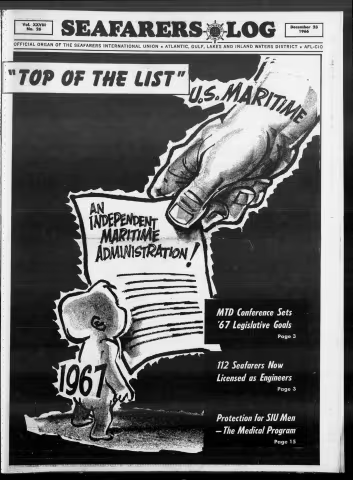
IndependentAgemyNo. IGoaiin '67,
MTD Legislative Conferente Agrees
WASHINGTON, Dec. 20—The creation of an independent maritime agency to strengthen U.S.
shipping emerged as the number one objective of all industry segments represented at the AFL-CIO
Maritime Trades Department's special legislative conference held here today. More than 300 rep
resentatives from labor and ^
Thomas W. (Teddy) Gleason, President of the ILA and Chairman of
MTD Legislative Committee, calls Department's special legislative
conference to order. At right is MTD President Paul Hall.
112th Seafarer Passes CG
Exam for Engineer's License
Four more Seafarers have passed the U.S. Coast Guard exami
nations and have been issued their engineer's licenses after attend
ing the training school jointly sponsored by the SIU and District 2
management in every type of
shipping and allied activity on
all coasts and the Great Lakes,
and government agencies attended
the day-long session.
Strong support for the Depart
ment's legislative program to
achieve the independent agency
and an effective national maritime
policy in the forthcoming Con
gress was pledged by key Con
gressional figures, including House
minority leader Gerald R. Ford
(R-Mich.) and House Merchant
Marine Committee chairman Ed
ward Garmatz (D-Md.).
Thomas (Teddy) Gleason, presi
dent of the International Long
shoremen's Association and chair
man of the MTD's maritime
legislative committee, chaired the
conference. The MTD is com
posed of 34 unions whose total
membership is approximately 7
million members, 700,000 of
whom work in shipping and allied
fields.
Rep. Ford assured the confer
ence participants that Republicans
in the House would "continue to
Rep. Gerald Ford
support measures which will re
vive the merchant marine and
keep a rejuvenated merchant ma
rine strong and growing." The
House minority leader deplored
the continuing shrinkage of the
American merchant marine and
said the Republicans would help
"rescue it from the Administra
tion's sea of inefficiency, delay
and waste."
Ford said that the fact that the
U.S. has only some 900 vessels,
two-thirds of which are obsolete,
carrying less than nine per cent
of our commerce, coupled with
the fact that the Russians, Scandi
navians and Japanese are "out
building and out-trading us for
cargoes is "disgraceful. We can
no longer call ourselves a mari
time nation," he said.
Ford reminded the conference
that the House Republican Policy
Committee has endorsed the con
cept "of an independent maritime
administration, free to grow as an
entity, free of Cornmerce Depart
ment domination." He added that
"we are committed to the develop
ment of a broader, stronger mer
chant fleet."
Rep. Garmatz said that his
House Merchant Marine Commit
tee would reintroduce a bill to
establish an independent maritime
agency and another which would
give Congress a chance to study
the adequacy of maritime budget
requests before appropriations are
fixed.'
Garmatz, who led the success
ful fight in the House in the last
session to keep the Maritime Ad
ministration out of the new De
partment of Transportation, said
that this was "merely a victory in
a battle, and the war is far from
won."
The ranking Republican mem
ber of the House Merchant Ma
rine Committee, Rep. William
Mailliard of California, and Rep.
•'^homas Felly (R-Wash.), both
strong proponents of strong U.S.
shipping and shipbuilding indus
tries, spoke of the bi-partisan de
termination in the committee to
create an independent maritime
administration and to develop an
effective merchant marine.
Ralph Casey, president of the
American Merchant Marine Insti
tute, said that introduction of the
two bills mentioned by Rep. Gar
matz "was an indispensable first
step toward changing the present
order of things."
Partial view of MTD Legislative Conference held in Washington attended by more than 300 repre
sentatives from maritime labor and management and government agencies. Peter McSavin, the MTD
Executive Secretary-Treasurer is reporting to session on the Department's expanded activities.
Rep. Edward Garmatz
Sustained support for the mer
chant marine and Congressional
action to "get more U.S.-flag ships
in the water" through adequate
appropriations was urged as essen
tial by Archibald E. King, chair
man of the American Maritime
Association, and president of
Isthmian Lines.
MTD President Paul Hall ex
pressed the Department's appre
ciation to all who had attended the
conference, and noted the cross-
section of industry representation.
He said that because of the uni
fied purpose and action, ".we are
awakening interest in the needs
of the industry in a way that the
industry has never before been
able to." Hall said that "the fight
to keep the Maritime Adminis
tration out of the Transportation
Department was a defensive fight
to preserve the ground on which
we stand," but tbat we must now
push forward to achieve our ob
jectives.
Hall expressed the "hope that
the Administration will take a
good look at the problems and
issues discussed here. Obviously
the Administration is not properly
informed or it wouldn't have
taken the steps that it did." He
noted that martiime labor and
management, and the legislature,
have demonstrated that they are
in total accord, but that the Exec
utive branch denies them the op
portunity and right to get their
views properly presented.
MTD Executive Secretary Peter
McGavin announced details of a
stepped-up program of activity by
the Department, including weekly
legislative meetings and monthly
maritime seminars.
Others who addressed the con
ference were Edwin Hood, presi
dent of the Shipbuilders Council
of America; Page Groton, director
the Boilermakers Iron Ship
builders Council; Andrew Biemil-
ler, AFL-CIO legislative director;
Jay Clark, president of the Com
mittee of American Steamship
Lines; Richard Kurrus, general
counsel to the American Tramp
Shipowners Association; and Mar
vin Cole, general counsel to the
Committee of American Tanker
Owners.
€ I
I
1 Page Four SEAFARERS LOG December 23, 1966
I
I
f.
'Apprentice Engineer' Rating, Threat
To Seamen's Jobs, Approved by C.G.
WASHINGTON — Admiral
Willard J. Smith, Coast Guard
commandant, announced on Dec.
8 his approval of proposed regula
tions to establish a rating of "ap-
rentice engineer." At the same
time Admiral Smith accepted
completion of an additional type
of approved training program as
qualifying experience for an origi
nal third assistant engineer's li
cense.
The apprentice engineer pro
posal had been initiated by MEBA
on the grounds that it would help
meet the needs of the Viet Nam
crisis. The program calls for one
year of classroom training and
one year of shipboard work be
fore a man could sit for an origi
nal third assistant engineer's li
cense.
The Coast Guard announce
ment followed hearings held last
month on the apprentice engineer
proposal, which was supported by
the National Maritime Union, the
Steelworkers Union and the Mas
ters, Mates and Pilots. The Sea
farers International Union of
North America and its affiliated
seagoing unions, and MEBA Dis
trict 2 opposed the proposal.
In announcing approval of the
apprentice engineer plan, the
Coast Guard said the rating would
not be required by Coast Guard
certificates of inspection, but that
should the owner of a vessel "re
quest that an apprentice engineer
be included in the manning of the
particular vessel, these regulations
now permit a man holding such
endorsement to be signed on ship
ping articles."
The SIU, which was represented
at the hearings by President Paul
Hall, Vice-President William Jor
dan, who also heads the AIU-
affiliated Marine Firemen's Union,
and SIU Great Lakes District Sec
retary-Treasurer Fred Famen, ob
jected to the establishment of an
apprentice engineer rating as a
threat to the jobs of unlicensed
American seamen, particularly
those of engine room personnel,
and to the jurisdiction of unli
censed unions.
The SIU cited its successful
joint program with MEBA Dis
trict 2 which has produced well
over 100 new engineers since it
began functioning earlier this year,
as well as upgrading approximate
ly 50 licensed engineers in the
same period. Under the appren
tice engineer plan it would take
a minimum of two years to pro
vide engineers.
MEBA District 2 maintained
that its engineer training program.
by Fred Farnen,Seeretery-rreasurer,6reat Lakes
From Duluth to Chicago, from Detroit to Montreal, sailors were
talking about the sinking of the Daniel J. MorrelL The 60-year-
old ore carrier, owned by Bethlehem Steel Corp., broke in two
and sank off Harbor Beach on November 29th, taking the lives
of all but one crewmember. This latest tragedy recalls to our
minds the sinking of the Carl
Bradley in storm-swept Lake
Michigan on November 18, 1958.
We wonder sometimes if the Coast
Guard is really doing its job in
carrying out the safety standards
under the laws governing marine
inspection. Immediately after the
sinking of the Morrell, several
ships were inspected for cracks in
their hulls. One of them, the
Edward Y. Townsend, sistership
of the Morrell, had her certificate
removed for being unseaworthy.
The Coast Guard appears too
lenient in its issuing of certificates.
Take the case of the 44-year-old
MV John A. Klfng and the 50-
year-old MV Raymond Reiss.
Both of these vessels were coal
burners and when converted to
diesel, the Coast Guard reclassi
fied them " automated ships." At
the request of the company, the
Coast Guard issued manning cer
tificates reducing the engine room
compliment to merely one unli
censed crew member.
The Daniel J. Morrell was a
typical Lakes freighter, carrying a
crew of thirty-three, twenty-four
of whom were unlicensed seamen.
On most Lake freighters the for
ward end, or deck department,
consisting of 12 unlicensed men,
has living quarters located in the
forward part, or bow section of
the vessel. The engine department
and steward's department live in
the after section or stern end of
the vessel, the same location as
. 'J i'. Je kx I'•J.-i.r,
the lifeboats. Of the 12 men in
the deck department, 65 percent
must be Able Seamen and must
have passed a test as a "qualified
lifeboatman." When the Morrell
broke in two, the Able Seamen
were cut off from the lifeboats.
No doubt this is one of the rea
sons why no boats were lowered
into the water. The lone survivor
was quoted as saying he saw some
crew members trying to lower the
lifeboats. However, if these men
were not "qualified lifeboatmen,"
it would be extremely difficult,
even under good conditions, for
them to lower any lifeboat. The
Coast Guard fails to take into con
sideration, when issuing manning
certificates, the fact that safety
standards are lowered when the
size of a crew is so drastically
reduced. *
jointly-sponsored with the SIU,
was the best and most effective
method of meeting the licensed
engineer shortage.
The SIU concern over the ap
prentice rating was based on the
view that any tampering with the
ship personnel structure was an
obvious threat to the security of
unlicensed in general and of en
gine room men in particular.
SIU President Paul Hall said
that the Coast Guard ruling put
the agency in the position of cre
ating jurisdictional disputes. He
stressed that "unlicensed seamen
cannot surrender any of the job
and jurisdictional rights which
they have struggled so long and so
hard to obtain." 7
U. S. Seeks Site
Fer New Ocean
Research Center
WASHINGTON — The new
Environmental Science Services
Administration of the federal gov
ernment is scouting up and down
the East Coast seeking a site for
its proposed multi-million dollar
oceanographic center.
The ESSA is a new government
agency combining weather, coast
and geodetic survey and other re
lated bureaus such as sea research.
Sites under consideration range
from Maine to Florida, including
Maryland, South Carolina, New
York, Massachusetts and Penn
sylvania.
The proposed oceanographic
center will also serve as home base
for at least two oceanographic
vessels, making the availability of
shipyard and ship repair facilities
a prime consideration in the selec
tion of the eventual site. Another
important consideration for locat
ing the new center is the avail
ability of other research facilities.
The center will be part of the
Institute for Oceanography, which
conducts research programs on the
physical characteristics of the
global ocean, the sea floor, and
of the interaction among sea, land
and atmosphere.
Construction of the center
which will employ more than 300
people on its research staff, will
represent a substantial increase in
ocean research facilities available
to U.S. scientists. In recent years
many nations, including the ^viet
Union, have been stepping up
their investigations of the world's
oceans as a source of food, miner
als, power and other resources
necessary to sustain continuing
population and industrial expan
sion.
SIU WELFARE, VACATION PLANS
October 1 - October 31, 1966
The Atlantic Coast
Hospital Benefits . .
Death Benefits . . . .
Disabiiit/ Benefits .
Maternit/ Benefits
Dependent Benefits
Optical Benefits . . .
Out-Patient Benefits
Vacation Benefits .
TOTAL WELFARE, VACATION
BENEFITS PAID THIS PERIOD
Number of Amount
Benefits Paid
4,761 $ 49,413.96
28 63,478.41
905 135,750.00
28 5,442.70
458 92,546.54
513 7,676.67
ZA79 23,512.00
1,377 598,447.55
11,549 $976,267.83
by Earl (Bull) Shepard, Vice-President, Atiantic Coast Area]
The tragic sinking of the ore carrier Daniel J. Morrell on Lake
Huron, which took with it the lives of 28 seamen, is yet another such
episode which points to the growing necessity for greater ship safety
measures. The Great Lakes storm, which badly buffeted the Daniel
J. Morrell until it split, churned up 65-mile-an-hour winds and 25-foot
waves. Since conditions such as these have long been a menace to
shipping on the Lakes, ships using those waterways need communica
tions and safety devices of a special nature. Since vigilance aboard
ship is vital, it would be particularly foolish to decrease manpower
on these vessels, for that would merely increase the safety harard.
One positive note can be seen in the marine board of inquiry investi
gating the Morrell incident. Already a number of sugegstioris have
been brought forth on ho,w shipping on the Great Lakes might be
made safer.
New York
Headquarters is decorated with
Christmas decorations from top to
bottom and a lot of Seafarers have
been by to see one another and to
share in the spirit of the season
Manuel Caldas checked the boards
for a chief steward's position re
cently. Manuel is an SIU veteran
of 24 years whose last ship was
the Gateway City. Nick Nomlkos
also has served 24 years in the
SIU. Nick now sails as chief stew
ard and last sailed in that capacity
aboard the San Juan. Joe Sullivan
serves up chow as a cook in the
steward department, which he's
been a part of for 23 years. Joe's
last vessel was the San Francisco.
Also by the hall lately was James
Martin, a Seafarer for 20 years
who sails FOW. His last vessel
was the Steel Vendor.
Norfolk
Will Beasley, a 14-year Seafarer
whose last ship was the Lucille
Bloomfield on the Viet Nam run,
says he had a good payoff with all
overtime settled in good fashion
by Harvey Mumford. Will plans
to ship out again right after the
holidays.
Walter Butterton, 20 years with
the SIU, last shipped on the Duval
to North Africa. Walt served her
a solid 2 years as bos'n so is stay
ing on the beach until February
to enjoy a well-earned vacation.
William Grimes, who last
shipped on the Transyork on the
Viet Nam run, has been a patient
at the USPHS hospital, Norfolk.
Wilfred Lachance also returned
recently from a voyage to Viet
Nam as electrician aboard the
Maiden Victory. Wilfred, who is
staying home for the holidays, will
take any run after the first of the
year.
Shipping has been very good in
Norfolk, improved oVer the previ
ous period, with 3 payoffs, 2 sign
ons, and 4 ships in transit. The
outlook for the immediate future
is also good.
Philadelphia
Shipping out of the City of
Brotherly Love has been fairly
good this past period and more of
the same is hoped for.
Comas Knight is an eager beav
er, having registered and being all
ready to ship before the holidays.
Comas sails as an oiler.
Robert Holt is registered too,
but will be ready to go after the
holidays have passed. Bob, who
sailed as bosun, last shipped on the
Producer.
Joseph "Red" Townsend had
some bad luck for a while but his
fellow Seafarers are glad to see
him registered to ship again after
he spent a long time on the beach
due to illness. Now FFD, Red is
going to wait for a job on the
Petrochem as an AB.
Ed Kresas was by the hall re-
'vPsitiqa jj i'iin iViv
cently to see some old friends and
to register for a deck dept. slot
on the first long trip to hit the
boards.
Baltimore
Shipping out of the Port of Bal
timore this past period has been
good, with 5 pay offs, 5 sign ons,
and 7 ships in transit. Prospects
for the next two weeks look very
good, too.
A number of Seafarers have
been by the hall recently to check
the boards and chat with some of
their fellow Seafarers.
Richard M. Harp is waiting for
another run to the Far East after
sailing in the steward department
aboard the Hastings for 10
months. He's a veteran of 20 years
at sea. Hosea N. McBride just ac
cepted the chief cook's slot aboard
the Marymar. Hosea's been sail
ing since 1946. Coley F. Crockett,
having just paid off the Raphael
Semmes, has acquired enough sea-
time to take life a little easy after
sailing in the deck department for
20 years. Coley's grateful to the
union for everything it's done for
him during that time and is look
ing forward to a pleasant retire
ment.
Boston
Shipping out of Beantown has
picked up a bit this period and it
is expected to remain at a fair level
during the coming one. We've had
the pleasure of seeing a number of
veteran Seafarers about the hall
recently. Among them was George
Hubner, 25 years in the SIU, who
last shipped on the CS Miami as
AB. George recently spent a little
time with his family in Maine and
is now ready to go and is looking
forward to a long run. William
Blakeley, also SIU for a quarter of
a century, sails in the engine de
partment as FWT. Bill was home
for a while, due to illness in the
family, but is now down at the
hall looking for the first job to hit
the board. Edward O'Connell of
the deck department was by to see
some buddies. Ed, who has been
SIU for 23 years, spent some time
at home with his family. He's
eager now for seatime and some
money to pay his Christmas bills.
/Mrs. Cruikshank
Dies in Washington
Mrs. Florence C. Cruikshank,
wife of Nelson H. Cruikshank,
who retired last year as director
of the AFL-CIO Dept. of Social
Security, died in Washington after
a short illness.
Cruikshank had sailed as a
member of the SIU's Great Lakes
District.
Also surviving are a daughter,
VIrs. Alice M. Hoffman; two
brothers, Theodore A. Crane and
James B. Crane, and three grand
children. Interment vyas private,
with a memorial service to be held
at a later date.
December 23, 1966
The Gulf Coast
by Lindsey Williams, Vice-President. Gulf Area
Judge James C. Gulotta of The Orleans Parish Juvenile Court re
vived the 5th annual Community Service Award of the Greater New
Orleans AFL-CIO at the organization's Annual Christmas Party on
Decem^r 22 at the SIU New Orleans hall. The award is based on an
outstanding record of achievement in the area of community service.
Judge Gulotta is a member of ^ ^ r^—
for the Del Santos. Also waiting
for the Dei Santos is Robert Ken-
SEAFARERS LOG -yC liri Page Fire
the board of directors of the Or
leans Neighborhood Center and
of the Social Welfare Planning
Council. He is also a member of
the Association for Retarded Chil
dren, chairman of the Pelican
Boys State Program of the Ameri
can Legion, City of New Orleans
Mayor's Youth Study Committee,
and has been appointed by the
Governor to the Louisiana Advis
ory Council on Research Centers
and Construction of Facilities for
Mentally Retarded.
Judge Gulotta received his
Bachelor of Arts degree in 1947
from Tulane University and his
LL.B degree in 1949 from Tulane.
He is now instructor of a course in
law and social work at the Tulane
University School of Social Work.
New Orleans
Vincent J. Fitzgerald of the
steward dept. has been lounging
in the hall, regaling old friends
with sea stories of his last voyage.
Fitzgerald recently made a four
month trip to Saigon on the Ocean
Evelyn as pantryman. Fitz is
ready to sail now "on anything
that floats." Seafarer George Lie-
bers, crew cook on the Del Norte
for the last couple of months, was
in the hall admiring the Christmas
decorations. He is now waiting
SIU Boatmen's
Strike Continues
in Baltimore
BALTIMORE —The SlU-In-
land Boatmen Union strike against
three Baltimore tugboat companies
has entered its eleventh week.
The union's major demand is
for a contract equivalent to the
one enjoyed by the TBU in Phila
delphia which provides for a 24-
hour notice before layoff and the
placement of one cook aboard
each tugboat.
While negotiations for a while
were at a complete halt, both
sides now are conducting periodic
bargaining sessions.
Baltimore's Mayor Theodore R.
McKeldin recently summoned
both the union and the companies
to city hall in order to discuss the
situation with the Maryland Port
Authority.
The Mayor did not act as an
arbitrator but he received per
mission from both parties to have
Dr. Leon Sachs sit in as an ob
server. Dr. Sachs has served for
25 years as permanent arbitrator
for the ILGWU and the Amalma-
gated Clothing Workers.
On Saturday, December 17, 200
strikers along with their wives and
children held a day-long Christmas
party featuring musicians, magi
cians, entertainment and food. The
festivities were sponsored by the
Baltimore Port Council of the
Maritime Trades Department.
nedy. Recently on the Del Sol,
he sailed as a bedroom steward.
Raymond Lewis wants to wait
until after Christmas before look
ing for a job. Lewis finished a
trip recently on the Halcycm Pan
ther and is now going to take it
Johns Perry
easy for awhile on vacation pay.
Chief Steward Clyde (Whitey)
Lanier completed a long trip on
the Del Sud and is looking for
ward to some time on the beach.
Whitey wants to be home with the
family and his many friends dur
ing the holiday season.
Mobile
Shipping has been on the slow
bell while the beach remains
small. Laid up for a while is the
Alcoa Roamer.
Robert Broadus, piling off the
Alcoa Voyager where he served
as AB for the past few months, is
currently registered but biding his
time before looking for another
billet. Last on the Alice Brown,
Wiiiiam D. Johns is relaxing on
the beach with his family. Johns
recently completed a four month
trip to Viet Nam. He intends to
spend some beach time at home
in Clanton, Alabama.
Murry Wilkerson plans to rus
tle up a couple of deer before the
season closes and before he be
gins to scan the board again.
Murry is back at his home in
Creola, Alabama, after a fast,
hundred day trip to the Far East
on the Loma Victory. Dawson
Perry recently underwent a hernia
operation and is now convales
cing. His last ship was the Ros-
weil Victory. Dawson has shipped
steward dept. for the last twenty
years out of Gulf ports.
Off the Alcoa Commander on
which he had been bosun for the
last six months is Fredmick John
son who has given up the bauxite
run for the warm, but slightly
brisk. Mobile winter beach.
Houstrm
John Fediw, a deck man for
many years, is eyeing the shipping
board for a vessel heading to
South America. John is justly
proud of passing his Coast Guard
test for a new AB ticket. Seafarer
John D. Moore got off the Del
Mundo after five months to be
home with his family for the
Christmas holidays. Moore said
that his vacation check will really
come in handy to take care of
Santa Claus. Mack Fortnes, hav
ing a run of bad luck, had to
leave the Keva Ideal with a not
fit for duty slip. All his friends
wish him a speedy recovery.
Report Urges Enforcement of Reforms
Presidential Panel Charges Industry
With Xonfusion, Deception, Fraud'
WASHINGTON—American consumers often fail to get their money's worth in the marketplace
because of "confusion and ignorance, some deception and even fraud," according to a report by the
Consumer Advisory Council to President Johnson, whose release has been imexplainedly delayed
for over six months following its
completion last June, at which
time it was submitted to the
President.
In the just-released report, the
consumer panel proposes broad
reforms in a number of areas, in
cluding the automobile industry,
health care, borrowing and credit,
and home maintenance and re
pairs.
By a 9 to 3 vote the 12-member
panel urged the creation of a new
Department of Consumers to pro
tect the public interest against the
abuses they cite.
No reasons were given for the
long delay in releasing the report,
but there was speculation that it
might have been held up because
its sharp criticism of business prac
tices could have angered Ameri
can business interests. It was also
felt that the President's busy sched
ule may have been responsible for
the delay in releasing the report.
Highlights of recommendations
made by the panel following its
year-long study include:
• The automobOe Industry.—
Many of the auto safety recom
mendations made by the panel
have already been put into effect
by Congress earlier this year de
spite strenuous protests from the
industry. However the panel
called for a complete study of
warranties and guarantees cover
ing new and used cars to make
sure that consumers know what
they are really getting.
The report leveled heavy criti
cism at automobile advertising,
saying:
"If as much money were spent
on consumer information about
construction durability and safety
features as the automobile manu
facturers now spend on advertis
ing other, more subjective features
of their products, competition in
the automobile market might be
operating along somewhat differ
ent lines than is now the case."
• Health services and care.—
The report called for Federal en
couragement of group practice ar
rangements by doctors, and the
elimination of duplication and
fragmentation of health services
under piecemeal arrangements.
The panel also urged "more effec
tive training and use of allied and
middle-professional health person
nel, thereby freeing physicians,
dentists and other professionals to
do the tasks for which they were
trained."
Millions Still Live at Poverty Level
In Spite of Generai U, S. Affluence
BENEATH the chrome-plated facade of af
fluence that America reflects lie the pitted
scars of poverty. This shiny facade of
affluence is the image presented to the rest of
the world. All too often, the same image lulls
more fortunate Americans, isolated in their
middle class enclaves, into forgetting the plight
of less fortunate citizens.
Of the 47 million families in the U.S., 9.3
million-one-fifth of the total—earn less than
$3,000 a year. Five million of these live in
cities, 4.3 million live in the south, 6 million
have a family head with less than a 9th grade
education, 2 million are non-white (a percent
age far higher than the non-white percentage of
over-all population), 2.3 million have a woman
as family head, and 3.2 million have a family
head over 65.
In total numbers, there are 35 million who
are part of families earning less than $3,000.
The $3,000 figure is used only because, in sta
tistics, there has to be a cut-off somewhere. In
clude those who hover just above the official
poverty level and you come up with some 50
million members of poor families in the United
States. Twenty-two million are children.
Poverty is pervasive. It's in the cities and on
the farms, the mountainsides of Appalachia and
the dead one-industry towns of southern Illi
nois. It's in the rat-ridden flats of urban slums
and the tumble-down shacks of rural slums.
Are the poor the shiftless wretches many op
ponents of the war on poverty picture them to
be? Not at all. Fifty-two percent of the heads
of poor families work full-time. Sixty-four per
cent work at least part-time.
And what about the non-working poor?
Aren't they squeezing too much out of us good
taxpayers already?
According to the President's Council of Eco
nomic Advisors, only one-fiffh of the 35 million
official" poor receive any public assistance
payments at all, federal, state or local. Those
who do reqeive assistance, the Council said, "do
qot receive enough to enable them to live at
even a minimal income level." The average
welfare payment for a family with three chil
dren is $1.15 a day per person for food, shelter,
clothing and all other necessities.
These, then, are the poor. But no statistics
can impart the reality of their lives. Figures
only hint at the cruelty of the condition and the
massive size of the problem.
The facts show that the war on poverty can
be won. In only two years, important ground
has been gained. Millions of poor have been
given the skills, the services, the education and
—most of all—the hope and the opportunity
they need to improve their circumstances.
Following are the statistics of the fight to
eradicate poverty in America:
• More than eight million poor have been
served by one or another of the agencies en
gaged in the war on poverty.
• Poverty programs have operated in 2,791
of the 3,132 counties in the U.S.
• Nearly 1,000 Community Action Pro
grams—the heart of the war on poverty—are
functioning and reach into areas where 70 per
cent of the nation's poor live.
• The anti-poverty program provided work
and training opportunities for over 600,000
poor in 1966, with 365,000 in the Neighbor
hood Youth Corps alone.
It has established 172 legal services projects
in cities and villages, on Indian reservations,
and in migrant camps. These legal service pro
grams are now available to 700,000 poor fam
ilies. Thirty-seven of the 50 largest cities have
received legal services grants.
Operation Head Start, the first national child
development program, has reached over half-a-
million poor children and their families in each
of the past two summers, and another 200,000
during the regular school year.
The war on poverty has recruited the largest
army of part and full-time volunteer Americans
in peacetime history. In Head Start alone, more
than 100,000 people have donated time and
talent.
More than 3,000 VISTA workers (Volun
teers in Service to America) have been recruit
ed, trained and. put to work in small neigh
borhoods.
There are more than 600 neighborhood so
cial service centers, of which 360 are urban
multi-purpose centers where a ran^ of services
is available to meet the total needs of the poor.
The 90th Congress will convene shortly. It
is hoped that the new Congress will follow in
the footsteps of the 89th Congress, and continue
to wage the war on poverty wherever it exists.
i'
Pace Six SEAFARERS LOG December 23, 1966
Calif. High Schod Textbooks Distort
Image of U.S. Labor, Study Rods
LOS ANGELES—Textbooks used by high school students here
give a distorted and unfavorable view of the American labor
movement, a study conducted at the University of California at
Los Angeles concludes.
The study, which confirms
charges made by the Los Ange
les County AFL-CIO, was made
by Will Scoggins, teacher and staff
member of UCLA's Institute of
Industrial Relations. He and other
researchers studied 70 textbooks
with 115 editions.
A series of topics was selected
by the researchers, and each text
book was studied to find how the
topics were treated.
For example, on the issue of
strikes, "in virtually every text
book analyzed, the emphasis on
violence is extremely pro
nounced . . ."
Without explaining the cause of
the strike or possible provocative
actions by management or govern
ment, one typical text described
the Pullman strike of 1894 by
saying:
"When violence broke out dur
ing the strike. President Cleveland
(over the protests of Governor
Altgeld) sent federal troops to
restore order, safeguard the mail,
and protect interstate commerce."
In the same text (West's Story
of Our Country, the author says
that "in many ways the workers
suffer more from a strike than
anyone else (and) strikes are
wasteful way of settling disputes,
as war is a wasteful way of settling
quarrels between nations."
Most of the texts, Scoggins said,
fail to show that often troubled
relations between management
and labor is a part of industrial
democracy and that the strike is
an indispensable part of a free
society.
Organized labor was the prime
advocate in the country for the
public school system, he says, but
most texts use the "great man
theory of history, ignore labor's
role in creating the public school
system and credit Horace Mann
with almost single handedly found
ing the system.
There is little to indicate in any
historical area in the texts that
"collective action or mass pres
sure may have often forced the
'great man' to act in a manner
which is now considered great to
keep his elected office," the study
contends.
There are other drawbacks to
the books, Scoggins found.
INQUIRING
OUESTION: Do you think it
important for man to get to the
moon?
Waiter Dunn: No. I really don't
see any reason for man going to
the moon. All that
money spent try
ing could be us^
better attempting
to get some place
on earth. We des
perately need bet
ter schools, better
housing facilities,
and better law en
forcement. We could wipe out
poverty if they would spend all
that money on the poor.
—4>—
Eugene Stanton: In one sense I
would have to say yes. If we
seriously want to
go out into space,
the moon will
have to be devel
oped as a way sta
tion. We might
eyen find new
forms of life up
there we don't
know about.
However, I think that we could
go a little, slower on the money
spending end.
Sam Hurst: Sure, I think we
ought to go just to see what's up
there. The natural
curiosity of man
is the main drive
behind going to
the moon. I be
lieve we should
beat the Russians
up there for many
reasons, partly as
a matter of pride
and also for strategic military pur
poses. And I might add that I
am sure that we will be first.
Charles Bums: Yes. We have to
in the interest of national defense.
Sure, curiosity
plays a big part
also. We all
would like to
know just what's
up there. We'll be
on the moon
soon, for sure,
perhaps as early
as 1970. Even-
in my generation
I think that we'll be exploring
Mars and Venus. We'll have to
let our children pioneer that space
aspect.
IC
tually, but not
.1.
Leon J. Webb: They can go to
the moon if they want, but they
shouldn't be so
free with taxpayer
money. It can be
done through pri
vate enterprise if
they want to do
it badly enough.
Perhaps in ten
years they'll have
men walking
around even living there. Event
ually, you'll have Seafarers in
space. They're a natural to switch
to space cruising.
<|>
Lanny Lebet: Whoever controls
the moon controls the world.
That's why it's
important for the
U.S. to be there
first. Therefore
the Government
should spend as
much money as
is necessary. It's
important for this
country and may
be for the entire free world. We
couldn't trust another country con
trolling ihe moon.
DISPATCHERS REPORT Atiantlc# Gulf A inland Watars Dfstrlct
December 2 to December 15, 1966
DECK DEPARTMENT
TOTAL REGISTERED TOTAL SHIPPED
All Groups All Groups All Groups
Port Class A Class B Class A Class B Class C Class A Class B
Boston 12 1 11 3 0 14 1
New York 106 42 52 27 20 259 72
Philadelphia 13 6 6 1 8 26 13
Baltimore 31 12 22 10 6 118 23
Norfolk 7 9 4 9 3 30 14
Jacksonville 15 14 4 12 10 17 8
Tampa 7 2 9 4 0 10 6
Mobile 23 8 13 8 4 88 14
New Orleans 62 38 35 10 12 178 102
Houston 43 26 23 - 18 9 177 109
Wilmington 25 6 10 6 24 37 0
San Francisco 18 22 30 12 51 63 11
Seattle 21 12 13 5 ^ 25 50 8
Totals 383 198 232 125 172 1,067 381
TOTAL REGISTERED
All Groups
ENGINE DEPARTMENT
TOTAL SHIPPED
All Groups
REGISTERED on BEACH
All Groups
Port Class A Class B Class A Class B Class C Class A Class B
Boston 6 3 6 2 2 6 2
New York 81 39 28 19 33 305 68
Philadelphia 7 6 3 2 5 14 6
Baltimore 20 22 16 17 8 85 35
Norfolk 1 6 4 4 8 13 7
Jacksonville 10 5 4 9 7 8 3
Tampa 6 0 5 4 4 10 1
Mobile 27 11 11 11 8 55 10
New Orleans 36 36 20 31 6 92 72
Houston 18 31 16 26 12 144 118
Wilmington 14 3 8 2 20 18 0
San Francisco ,,.. 18 19 32 20 55 38 2
Seattle 18 14 4 6 14 19 7
I'otals 262 195 157 153 182 807 331
STEWARD DEPARTMENT
TOTAL REGISTERED TOTAL SHIPPED REGISTERED on BEACH
All Groups All Group s All Groups
Port Class A Class B Class A Class B Clasat Class A Class B
Boston 0 1 2 3 3 10 1
New York 58 15 41 3 18 147 25
Philadelphia 12 5 6 2 4 19 8
Baltimore 24 14 13 12 5 60 35
Norfolk 6 10 6 6 8 14 25
Jacksonville 6 2 4 2 3 6 3
Tampa 3 1 8 5 3 6 2
Mobile 15 12 8 5 6 52 15
New Orleans 46 33 27 15 23 123 65
Houston 26 14 8 12 9 103 57
Wilmington 6 0 4 0 19 22 0
San Francisco ,,., 25 5 23 6 68 43 14
Seattle 19 3 13 13 15 23 2
Totals 246 115 163 84 184 628 252
eeanographers Score Pollution of Lakes
Human, Industrial Pollution Making
Great Lakes Old Before Their Time
When European explorers of North America first saw the Great Lakes, they were cold, clear,
deep and extremely pure. Such is no longer the case. Pollution of the waters of the Great Lakes has
taken its toll.
In recent times, many econo
mists have believed that the
Great Lakes region was likely to
become the fastest-growing region
of the United States because of the
superabundance of water.
"Unfortunately, the forecast is
now troubled by a large question
mark," write oceanographers
Charles F. Powers and Andrew
Robertson in the current issue of
Scientific American. "Viability of
this great water resource is by no
means assured."
Lakes Have Life Cycles
Every lake eventually becomes
extinct through natural and phys
ical biological processes.
But pollution is accelerating
these processes in the Great Lakes,
the greatest reseiyoir of fresh
water on Earth.
The two University of Michi
gan oceanographers contend that
in less than 150 years man has
brought about changes in the
Great Lakes that probably would
have taken many centuries under
natural conditions..
"No doubt the Great Lakes will
be here for a long time to come,"
the scientists say. "They are not
likely to dry up in the forseeable
future. But it will be a tragic
irony if one day we have to look
out over their vast waters and
reflect bitterly, with the Ancient
Mariner, that there is not a drop
to drink."
Encourages Plant Life
Pollution does more than render
water unclean. It also speeds up
degeneration by encouraging the
growth of plant life that adds
to the accumlation of bottom de
posits. Eventually the lake, how
ever deep, is entirely filled with
silt from its tributaries and with
plant debris.
As streams bring in nutrients,
such as phosphorus and nitrogen,
plant and animal organisms arise.
Over thousands of years, organic
deposits pile up on the lake bot
tom. The lake becomes smaller
and shallower. Its wafer becomes
warmer. Plants . take root in the
bottom and gradually take over
more and more space.
Eventually, the lake becomes a
marsh, is overrun by vegetation
from surrounding areas and thus
disappears.
A dramatic example of this,
scientists say, is Lake Zurich in
Switzerland. Its lower basin has
gone from youth to old age in less
than a century.
Youth, Maturity, Old Age
Similar rapid aging has been
seen in Lake Washington, Seattle,
and the Yahara lake chain in
Wisconsin. Lake Erie, most pol
luted of the Great Lakes, has spec
tacular growths of floating algae,
a certain sign of advance age. Its
volume of water is now too small
to dilute the pollutants effectively.
"In addition to Lake Erie, the
southern end of Lake Michigan
las become seriously polluted," the
scientists said. The" main discharge
into Lake Michigan comes from
the large industrial, complexes on
the southern shores.
Apart from the.,^puthern end,
most of the water ptJUkq Michi
gan is still of reasonably, '
quality, the scientists note. -
A
December 2^1966
SEAFARERS LOG Page Seven
AFL-CIO Challenges License
Of Ohio Radio Station
The AFL-CIO has challenged the fitness of an Ohio radio station
to retain its license as a result of its refusal to correct inaccuracies
in a series of critical editorials or to allow the federation air time
in which to reply.
In a complaint to the Federal Communications Commission, the
AFL-CIO charged radio station WMRN, Marion, O* with fla^ant
violations of the government's "fairness doctrine" in denying a "dis
cussion of conflicting views on an issue of public importance" and
for failure to give the AFL-CIO an opportunity to reply to personal
attacks.
The complaint climaxed a two-month-long exchange during which
the AFL-CIO sought to prove by documentary evidence that editorial
statements critical of the federation were based on misinterpretations.
Each attempt to correct the record was rejected, the federation charged,
only to be followed by another editorial more critical of organized
labor and AFL-CIO leadership.
The complaint asked that an FCC hearing be held to consider
revoking or not renewing the station's license when it expires on Oct. 1,
1967. The letter to the FCC was signed by AFL-CIO Public Relations
Director Albert J. Zack.
The dispute began on Aug. 14 when a station editorial claimed
that Pres. George Meany had threatened Congress with political
retaliation if airline anti-strike legislation were enacted. The editorial
declared that when Meany urged Congress not to "pass legislation
that you will regret for the rest of your lives^' he was threatening the
constitutional rights of freely elected representatives. The editorial
accused Meany and other union leaders of exercising "dictatorial
power undeserved and unjustified in a free society."
The AFL-CIO responded by offering for the station's examination
a transcript of the question-and-answer period which followed the
Meany statement, in which he specifically ruled out political retalia
tion. Meany told reporters, the transcript showed, that his statement
was a caution to Congress of the long-range effect such legislation
could have on the nation and the threat it posed to our democratic
structure.
The station ignored the documentation and the request that the
"erroneous implication" be corrected. Instead, a second editorial was
broadcast that repeated the charge and accused the AFL-CIO of
speaking from "prejudiced interests."
The AFL-CIO again attempted to set the record straight and again
was ignored. Two weeks later the station broadcast a third editorial
assailing AFL-CIO personnel.
The editorial charged that the AFL-CIO's reaction to the editorials
was typical of labor. "If you can't argue issues, attack the individual.
If a congressman or senator votes contrary to what labor wants he is
not granted the courtesy of having a mind of his own, principles and
ethics of his own, he is supposed to do just what labor wants and that
is all," the editorial declared.
At this point the AFL-CIO abandoned its plea for editorial correc
tions and asked that the station provide air time under the provisions
of the "fairness doctrine" for a presentation of the federation reply.
When the station failed to respond, the complaint was filed with the
FCC.
The AFL-CIO bases its complaint on the "fairness doctrine" provi
sion requiring that where organizations or individuals are attacked or
controversial issues are aired, the station has an obligation to broadcast
opposing opinions. The doctrine is based on the principle that the
station owner has a public trust in using the airwaves and his license
requires that he serve the entire public, not himself alone.
An about-face by the Chicago
City College System on terms for
bargaining with the Cook County
College Teachers Union sent 648
striking teachers back to their
junior college classrooms after a
three-day walkout on eight cam
puses. Local 1600 of the Ameri
can Federation of Teachers agreed
not to strike or disrupt classes for
the system's 38,000 pupils so long
as good faith bargaining continues.
The College Board of Education
withdrew its demands for a no-
strike pledge and its refusal to
negotiate a written contract. The
board committed itself, in writing,
to reach a collective bargaining
contract and not to exact any re
prisal of any sort against any fac
ulty member, against any clerk
or against any student who sup
ported the srtike.
• • *
The Clothing Workers have
given $100,000 and the Ladies
Garment Workers $50,000 for the
relief of victims of the recent
floods that ravaged the Po and
Arno River valleys in Italy, offi
cers of the two unions announced.
The ACWA gift was the union's
second for the aid of Italian flood
sufferers—in 1951 it raised $30,-
000 for relief work when the Po
valley was flooded. The ILGWU
gift was presented by President
Louis Stulberg to Italian Consul-
General Vittorio Cordero di Mon-
tezemolo for transmission to Presi
dent Giuseppe Saragat of Italy.
* * *
General increases totaling up
to $33 a week over a three-year
period were won by the Washing
ton-Baltimore Newspaper Guild
in new contracts with the Wash
ington Post, locally owned morn
ing daily, and the afternoon Daily
News, a Scripps-Howard news
paper. Minimum pay for experi
enced employes in key classifica
tions will rise to $233 a week—
highest in any daily newspaper
contract—at the Post, and to $228
at the News.
"Medic!"
Domestic Cutback Poses Threat To Nation
Hints and predictions that the Adminis
tration is planning a massive cutback in
Great Society programs because of the drain
on the nation's resources caused by the con
flict in Viet Nam again bring to the fore a
question which has been brought up before
but never truly resolved—whether or not the
United States' economy can afford both the
Viet Nam conflict and the war on poverty.
The nation can afford to continue both
the war against Communist expansion
abroad and the war against poverty at home.
The truth is that the nation cannot afford
not to continue the struggle against both
evils.
Viet Nam war costs cannot be used as an
excuse for abandoning important Great So- -
ciety anti-poverty programs. Our produc
tive capacity is immense and our already
huge gross national product is expanding at
a record pace. It is our duty to use this
tremendous economic capacity to aid those,
both at home and abroad, who most need
our aid.
The anti-poverty programs were initiated
because of staggering inequities that became
increasingly evident within American society.
The vision of the Great Society gave mil
lions of Americans new hope for a better
future for themselves and their children.
That hope must be fulfilled. Economic fac
tors demonstrate that the Great Society need
not be abandoned, and moral considerations
indicate that it should not and must not be
abandoned.
The Hoffa Matter and Individual Rights
The recent decision of the U. S. Supreme
Court in relation to Jimmy Hoffa once more
highlights a matter that bears careful scru
tiny by the American people.
The SIU has never been in sympathy with
Hoffa and has on many occasions past and
present fought against him tooth and nail.
We voted for his and his union's expul
sion from the AFL-CIO, for which we have
no regrets.
Nevertheless, we cannot condone the
methods which were used by the Department
of Justice under Robert F. Kennedy to "get
him."
Although there undoubtedly is much for
which Hoffa could be called to account, the
methods employed by the Government in
this matter have a*t times taken on the aspect
of a personal vendetta in which many of the
basic guarantees of the United States Con
stitution in the realm of impartial justice and
the protections afforded by the Bill of Rights
have been ignored.
The Government's handling of the Hoffa
matter presents ramifications that go beyond
Hoffa and the Teamsters, and beyond the
American labor movement in general. The
Government's actions and the justifications
presented for those' actions represent a clear
and present danger for every American.
If basic American rights are to be ignored
in the case of one individual, then the basic
rights of all Americans have been weakened.
It does not matter whether we consider Hoffa
guilty or innocent of the charges made
against him. If we are to remain a nation both
governed by law and protected by law, the
same law must apply to everyone.
•r-! •
If
ih'
y I
h
t 1
f'l I-''-
•; g-
i
i:
;•) I
:} i
^ i
Is
•i .
E ?
.
w
li
•'#g .- •
,i --.tif "•' -L
Pf ;;-
- ..f,.l.l'. •'•' .
'S''U
el'p
^ I
Page £i|^t SEAFARERS LOG Decembop 23, 1966
Bosun Max Wadlington^takes a final look at the forward deck area to make John Nuss of the Steward Department (left) and W. Connor of the Deck Depart-
sure that everything is shipshape before paying off. He praised his fel- ment watch as a load of stores for the galley is brought aboard for the
low SlU deck department men, saying they were cooperative and hardworking. next trip. The crew praised the Stewards for the "good meals they made.
Royal Glenmore, Utility Crewmembers of the S/S Henry line up at the deck railing, thinking of home, or, perhaps the next trip, as they E. Brecheen (top), C, Ca-
Man, is carrying new wait for the paying off. All hands agreed that the trip was a good one from many points of view. The ports hill (center) and John Nuss
kitchenware into galley, that they visited were found to be very interesting, and no really important beefs were reported by delegates, are putting stores aboard.
Leroy McClary of the Engine Depart
ment (left) and Hoyt Tanner discuss
their future plans in a passageway.
Ricardo Sandi, O.S., passes the time Laurence Walonen of the Engine De-
away before the paying off by examin- partment takes a final look at con
ing machinery in the Engine Room. ditions in the Henry's Engine Room.
Members of the Henry's crew enjoying
a final meal in the Messroom include
Seafarers R. Sandi and M. Wadlington.
Seafarers J. Spirto, S. Gopac, S. Sek and M. Marcelino chat in the galley. Paynnaster (right) and Ricardo Sandi (left) watch M. Wadlington sign for pay.
December 23, 1966
SEAFARERS LOG Page Nine
—l.J
N NOWMBER:.23,
^ ^ lasted fcsr ^
^ air bec^ jflcreaisingly unfit to breathe
IKMsot^s gasses thousands upon thpu^ti
i^ds ttf Chimneys and automobile exhausts slowlyH
tjrowded the life-giving oxygen from people's, lungs J
4 temperature inversion had clapped a lid '
; tsvef the %y, maki fresh air supply a:
X ^stagnhnt ^wer of human and industrial waste prod-'-
'liCtSi • The. prppoihon of harmful waste products in •'
the air; ro^^uicWy from its normal 12 percent, past?^
the danger ppint of 50 percent, and up to 60.6 per-
^cent. Ah Air Pollution Emfergency was de>lared!
^ ahd drastic measures y^re being considered Vhen
Mother hfatpm fort^^^^ decided to spare the .city
fc ^hte^er gjhf and the temperature inversion lifted.
poisons gasseS which had gathered oyer the
U guic^: dispersed so people could again breathe
|p |®r'??i^hic^ 12 percent polluted,
i ^ hot been so fortirnate in the
cities both in the ifnited Slates
Jn pecember 1953, New; York City mstained A
1temperature mVCTsion ihat killed 200 i»o-5'
id October 1946 polluted air of ^
.people and. made;']
X three days, four thousand Lon-
Xf dpa|^4^ in a single week in i952—murdered by
X m|;^i|gh|^shot fit to breathe. In; Oecember 1962
a mass of stagnant, filthy air settled on the U.S.
eaMOrn I ^i^rd from Massachusetts to Virginia-:
'Had df l^>4n'tuiiat!ely di^rsed just in time, the
l:lh»ted |t®^ l*'?ght have isulfered one pf the ̂
dpmi^tic disasters in its history.
Although Seafarers, who spend much of their time
breaking the clean air available for the most part
^ may not have the full
OTCtent of , the problem brdught home to them daU^^^
X; a% hfcr Ahtcficans do, what man has heeti doing
,.:;K;4.;^''4^'^'hfn^phcm:;f6r,man^ only be dc- „
i scribed as iouling his own nest. The air without
•which he cannot live for more than a few seconds
XXXXhas,;hc^;tiil^d^^ sewer. Into it pour the*
' smoky excrement of mtm's factories, furnaces, auto-
^ rhobdes—dusts and chemicals which can and do kill.
:aIwaysXb®sXnhd-..nl»A^ be
called upon to dispose of waste.-producls^ and cmi .
-process modest amounts without serious effects on
f: mankind. Trouble has been growing in recent years
I^ause the amount of pollutants being released into
X| atmosphere have risen far above the 'modest"
„ Almost 8,000 communules comprising over 60
P , percent of the total U.S population are today facing
XXJ an air pollution problem. The problem manifests
X.. -itself in death's and permanent injuries in the form
of chronic respiratory diseases, including the com-
mnn cold, chronic bronchitis, chronic constrictive
X^';-^^d^r^disea.se,;phltndh^.fiiup^ .X
-vS •asdtma-afid lung cancer. Emphysema, a disease once
restricted almost exclusively to miners forced to
:;r,.iX tccentiy become second only to heart disease as a
5 cause of disability in the U.S.
^ The co.st& of air pollution have become staggering.
- Airplane crashes ancTdelays caused by low visibility
•''1^ at airports "socked-in" by smog take a toll in lives
X aa4 snoney. Medical costs brought about hy smog-
"X aggravated diseases are immense. The poisonous
cltehlicals pumped into the atmosphere damage crops,
if Xdg^ttai!!^ timber, cause rapid deteriOra-
tioa ©f stone, metal and wOod buildings, weaken .
tiestroy
game animals and wildlife and corrode precision
Instruments and control systems. Millions are spehxp
" y^rly on electricity for increased, lighting becau^X'^
of imog induced tiarkness. Par^^ because;
X pf ohr ^seht methc^
often serves to increase the amount of smog in
air.
Airborne pollutants are capable of doing this vast^
amount of damage because of the highly poisonous"^
dtid corrosive nature of the chemicals involved. The:
average smog that descends over a city or largefX
-region contains varying amounts of the following':
''X:X;'St®r.:didxide;4vhichXisf^
• Xtff tir suhoric acid which literally, eats aw^ay stoneX
^id": 3^ fluoride, chlpOTO, hydrogen:
.XXS^bhldri^ oxides, ; hydr^ni,^^efX .ai^ll
• Others.
Possibly Xhc most vivid picture one canXg^
extent of air pollution in our cities is from an air-
f liner. While flying over the countiyside the air is
f;-, relatively clear and vision Unobkti-ucted. In the dis-.X
liitance, however, the city cM be sCen in a *
IvXhlkolcet of poisonous smog (smoke pollutants and fog|x
X^lir smite (smoke pdhutants and haze). As the oit^j
Sfeapprdaches thk pollbiiop inckeases aUti
to zero, which means, you're right in the, middle of ittp .|
Where do these poisons come from? Who are the
culprits? The truth is that each and every one of us
does our bit to pollute the air which we must then
breathe. From the time we get up in the morning
and turn up the furnace to warm the house we are
adding to the pollution of our air supply because
fire of almost any sort releases pollutants into the air.
Driving to work in our cars we become veritable
poison gas machines with a myriad of toxic gases
spewing from our exhausts. Getting rid of our gar
bage means fires which pollute the atmosphere. In
agriculture, crop dusts and sprays put poisonous
chemicals in our air. Evaporation of volatile pe
troleum products from open tanks is an offender.
There are more ways in which our air is being
polluted than we could possibly list here.
Although we must all share some of the guilt for
polluting our atmosphere, some are bigger polluters
than others. In the past our huge industrial centers
have, along with the automobile, been principal
offenders. Anyone who visited Pittsburgh, Pa., not
too many years ago could touch, taste and smell
the results of air pollution created by the area's many
steel plants, where open hearth furnaces spewed dust
and gasses into the air day and night. Basic changes
in furnace design plus the addition of equipment
to remove pollutants before they escape into the
atmosphere did much to make Pittsburgh's air more
breathable. Still however, there is much to be done,
there as elsewhere.
The fact is that although air pollution has become
a nationwide problem, with our expanding industrial
capacity and ever-increasing automobile ownership
making our air more and more unfit to breathe,
almost nothing has been done to see to it that we
don't simply poison ourselves out of existence. The
flollution catiSed by ©missions from automobilp ex-
Rausls Ts one of fhe primary confributors fo smo.^
majoritly of people in the U.S. are literally living
their lives at the bottom of a sewer that is shortening
the lives of themselves and their children. Yet they
do so without even complaining until what should be
a harmless combination of weather conditions makes
them gasp for breath and peer with stinging, swollen
eyes through an apparent twilight at midday.
Air pollution can and must be controlled. Strong
air pollution control measures are sometimes expen
sive, but the technology is available and must be
enforced. Continued research will certainly develop
new ways of controlling air pollution, but we cannot
afford to wait for the ultimate solution—^time is
growing short. The public must demand and be
willing to share the cost of needed improvements.
Air pollution is already costing billions. In the long
run the cost of clean air would probably be much
less.
Although Congress has passed a federal Clean Air
Act, the prime impetus for air pollution control must
come on the community level. Large regional plans
must be drawn up to direct local action however, if
such action is to be effective.
A very few communities are already tackling the
problem. Los Angeles, faced with one of the worst
air pollution problems in the nation, has possibly
taken the most action. Automobiles not equipped
with exhaust purification devices have been banned,
open fires have been outlawed, factory smokestacks
are regulated and equipped with control apparatus.
Results of such action are being observed and further
action planned. A few other cities have also taken
some action.
To clean up the sewer of air under which we all
live, every American must demand action. We all
have much to lose if we don't demand action now.
large ct+tes ancl smaller cornpiuhities. "^^
intlusitti smog culprlfs.
Page Ten SEAFARERS LOC December 23, 1966
J To Aid U.S. Farm Workers
AFL'CIO Seeks to Close Loophole
Still Allowing Bracoro Importation
The AFL-CIO asked the Labor Dept. to end an Immigration Act loophole that allows foreign
farm workers to be brought into the United States for temporary harvest work.
Conditions of U.S. farm workers have improved greatly since the end of the bracero program two
years ago eliminated the large-
The Pacific Coast
scale importation of foreign
farm workers, union witnesses
testified at a Labor Dept. hearing.
They cited evidence that there is
no shortage of domestic farm
workers when decent wages and
working conditions are offered.
If the Immigration Act loop
hole is not closed completely,
AFL-CIO spokesmen urged, at
least the Labor Dept. should raise
the minimum wages employers
must offer U.S. workers before
applying for the admission of alien
labor.
Current standards, set by the
secretary of labor on a state-by-
state basis, range from $1.15 to
$1.40 an hour. The Labor Dept.
hearings are to consider changes
in the existing standards.
Position Stated
AFL-CIO Assistant Research
Director Frank Fembach and
Arnold Mayer, legislative repre
sentative of the Meat Cutters and
chairman of the AFL-CIO farm
labor legislative subcommittee,
presented the federation's position.
Also testifying for an end to the
use of alien labor was Kerry Na-
puk, research director of the Pack
inghouse Workers.
The biggest step toward ending
the importation of farm workers
came in 1964, when Congress—
at the urging of labor and church
groups—refused to renew the bra
cero program. Since then, smaller
groups of foreign workers have
been admitted under a section of
the immigration law that allows
temporary importation of workers
when the secretary of labor certi
fies the need and determines that
it would have no adverse effect
on U.S. workers.
The number of alien farm
workers dropped from 200,000
in the last year of the bracero
program to 35,000 in 1965 and
25,000 this year.
As an alternative to complete
elimination of all foreign labor,
Fernbach proposed the following
standards that growers would have
to meet before they could apply
for admission of workers from
other countries to meet a labor
shortage:
• An hourly wage rate that
would not be below $1.55 an hour
in any state. Even this, Fernbach
noted, is "barely" above the pov
erty level.
• A higher minimum rate in
states with better conditions. "In
states where minimum hourly
rates are established by collective
bargaining—in California, for ex
ample — the adverse-effect rate
should be at least equal to the
negotiated minimum," including
fringes.
• A weekly wage guarantee
not less than $62 in any state.
• Higher rates for farm jobs
that are "particularly hazardous
or arduous."
Fernbach warned that "to do
less would further degrade em
ployment opportunities for Amer
icans in agriculture, properly lead
to the rejection of substandard
farm jobs by Americans when
better alternatives are available,
and thus inevitably restore cheap
imported labor as a major source
of manpower in our fields."
Gains Emphasized
Mayer stressed the gains that
had come to U.S. farm workers
since the end of the bracero pro
gram.
An estimated 80,000 to 100^-
000 new jobs were created for
U.S. workers, he said. Farm
wages rose an average of 15 per
cent in two years, with the biggest
gains in jobs formerly done by
braceros. "U.S. workers flocked
to the crops when the higher
wages were available," he noted.
Another important develop
ment, Mayer said, is the growing
organization of farm workers into
unions, now that "foreign strike
breakers are no longer available."
Despite warnings that crops
could not be harvested without
imported labor, "not a single ma
jor crop failure occurred because
of a lack of labor," he pointed
out.
Napuk testified that although
major improvements resulted from
the end of the bracero program,
"much higher and much better liv
ing and working conditions are
desperately required" for U.S.
farm workers.
by Frank Drozak, West Coast Representative
A $10.4 million port capital improvement program extending from
the present through the end of 1967 was approved last week by the
Oakland Board of Port Commissioners.
A total of $2.1 million will be spent for moderization of a portion
of the 14th Street pier in the outer harbor. This project will include
widening the pier apron to make
it suitable for container traffic
and for broad gauge container-
handling cranes.
Another major expenditure in
the program will be $2.6 million
for the construction of a 1,200
foot concrete wharf at the port's
Seventh Street Marine Terminal.
San Francisco
Shipping has been quite active
and is likely to remain so in the
Bay Area, especially for the AB's.
Electricians, OilerS and FWT's.
Seafarers paid off this past pe
riod. on the Express Virginia, Ex
press Baltimore, Cosmos Trader,
YOUR DOLLAR'S WORTH
Seafarer's Guide to Better Buying
In America, even the poor have credit cards, or
at least, the almost-poor, now that even discount
stores, department stores, and neighborhood stores
offer them. Apparently, the finance industry feels
there is no reason why moderate-income families
should be exempt from paying extra fees for charge
accounts.
But some astute working families are getting un
easy about how much they do have to pay in hidden
fees for credit cards which allow you to charge
in various stores in your area.
These area-wide credit cards usually are sponsored
by local banks or finance companies. By using one
of these cards you can charge virtually all your
needs. You live now, pay later. "Forget about cash
when you shop", one big Eastern bank advertises.
"Our credit card gives you charge privileges at thous
ands of stores."
But there are a couple of catches. One is that
after a number of days of "free" credit—^usually 10
to 30 days depending on the plan—you have to pay
a "carrying charge", generally VA or 1V2 per cent a
month. This sounds very little. But it is really the
equivalent of a true annual interest rate of 15 or 18
per cent a year. In comparison, the same banks pay
you only 4-5 per cent on your savings deposited
with them.
The other catch is that not only you, but the
store, pays a fee to the bank or finance company
sponsoring the credit cards. One observant reader,
Mr. C.P., who lives in California and has watched
the spread of credit cards there, warns that the
stores pay 2 per cent to the bank sponsoring the
credit cards. "Then the stores raise their prices on
all products by the 2 per cent, and most of our
people pay this extra charge whether they pay by
check or cash or use the credit card," Mr. P. points
out.
This is true. If there is no such thing as a free
lunch, there certainly is no such thing as free credit.
The cash customer must help pay the cost to the
store for offering these charge accounts. This is a
business expense added to the price of the goods
you buy.
Mr. P., for one, is not taking this situation lying
down. He reports that when he buys in stores offer
ing credit-card charge accounts, he demands a 2 per
cent discount for paying by cash or check. Most
of the stores will give it, he finds. "But you must
demand it."
People who pay cash at charge-account stores cer
tainly should be entitled to a discount. Whether the
store will give it, is another question. At one time,
many stores customarily gave a discount for cash.
Trade experts report that the practice of giving 10
per cent off for cash on furniture has become a well-
established practice injhe larger Southwestern cities.
There is another danger in the spreading use of
credit cards among even moderate-income families:
That is the risk of over-extending yourself, and also,
neglecting price comparisons because of the ease of
charging through a credit card.
One of the large oil companies, (Texaco) even is
sending credit cards to families in the mail, without
any request on their part, even families who don't
own cars. The oil company is not merely offering
credit privileges at its service stations, but for other
goods such as home workshops, typewriters, etc. The
letter says, for example "You are now a possessor of
a Texaco credit card. If you sign your name and
enter your number on the enclosed order form we
will send you a hotjie workshop to be paid for later."
Some people are obeying the company's instructions,
too, without checking prices and models elsewhere.
You now can even charge your medical bills on
another credit plan, sponsored by the American
Health Credit Plan, Inc. You get a checkbook of
certificates. You fill these out and give them to the
doctor, pharmacist, etc., instead of paying cash. You
get a bill from the plan for all the services you have
charged. If you pay within 30 days, there is no
credit fee. If not, you pay that innocuous-sounding
IV2 per cent a month.
If you do need credit for a medical service it
would be less costly for all concerned if you make
your own arrangements with the doctor, dentist or
druggist, and avoid using such a plan even if the
doctor suggests it.
Elmer Roessner, one of the more candid business
columnists, is especially concerned about experiments
some food supermarkets are making with similar
credit plans. These involve either a Wi per cent a
month service charge, or a fee of $1 a month. "The
danger is quite real," Roessner warned. "Families
are going through bankruptcy now at a, rate of more
than 100,000 a year. If the food bill is added on top
of the credit pyramid, the number of bankruptcies
may increase."
If you succumb to these various pressures to buy
almost everything on credit, you will find you have
added a permanent new living expense for the fees.
Credit should be reserved for larger purchases, and
only if the purchase cannot be postponed while you
save up all or part of the cost. If you do need
credit, the cheapest way to get it still is to borrow
the cash from a low-cost source such as credit union
or commercial bank, and shop with the cash in hand.
You also should read the small print in the agree
ment or contract you must sign for one of the new
retail credit cards, to see for what extra fees you may
be liable. Some of the largest plans state in the
agreement that df any amount due and payable is
referred for collection to an attorney, you agree to
pay an attorney's fee- of 20 per cent of the amount
owed.
Another low-cost way to borrow in this time of
rising interest rates is on your life insurance, if it is
the kind that has cash value. Most policies issued
after 1939 state that you can borrow at 5 per cent
(4 per cent on V.A, policies). This is a true 5 per
cent per annum. Even though interest rates on loans
generally have risen, the insurance companies can't
increase the loan rate stated in your policy. That's a
contract. This time it works in your favor.
Rice 'Victor, Pecos, and the Eliza-
bcthport.
Signing on were the Cosmos
Trader, Pecos, Achilles, Geneva
and the Tran^ork.
Ships in transit this period were
the Panama, Steel Flyer, Achilles,
Geneva, and the Ames Victory.
Oldtimer Charlie Bush, in retire
ment since last summer, came by
the hall to say hello to the gang.
Charlie, who still longs for the
sea, finds the beach is "just plain
boredom."
William M. Sing is waiting to
catch any ship to the Far East.
Brother Sing has been an SIU
member for 17 years and sails in
the Steward department. He and
his family reside in San Francisco.
Seattle
Shipping remains at an excel
lent height in the Seattle region
with all indications pointing to a
continuation of this splendid ship
ping activity.
Payoffs during the past period
included the Anchorage, Oceanic
Fitton
Tide, DeSoto, Western Hunter,
Cosmos Mariner and Seattle.
Ships signing on were the Over
seas Rose, Seattle, Santa Emelia,
Longview Victory, Beaver Vic
tory, Oceanic Tide, DeSoto and
Western Hunter.
We've had the following ships
in transit: The Elizahethport, and
the Calmar.
Oldtimers on the beach include
Charles F. Ries, who's just off the
Enid Victory following a four-
and-a-half month run to Viet
Nam. Charlie's enjoying a couple
of weeks on the beach before
grabbing another ship. He's been
sailing SIU these past 11 years.
Lewis T. Fitton's last ship was
the Baltimore. He's been laid up
on the beach unfit for duty but
Lewis, SIU for 16 years, is now
ready for any Far East run.
John S. B<»kamp is warming up
after a jaunt on the Alaska run
for Sealand Service by making
his way to Santa Anita for a fling
at the horses. John, who has been
SIU for 15 years, will enjoy the
beach as long as the horses are
kind to him.
Wilmington
During the past couple of weeks
we had the Del Alha, Hattieshurg
Victory, and the Fairport payoff.
There were 9 ships in transit and
shipping has been booming. So
we're suffering a shortage of all
ratings in all departments and it
looks as if shipping will remain at
a peak for the next several weeks.
Oscar Rosenfelt is on the beach
after a trip on the John C. Oscar
plans to stay home for the holi
days but he'll probably be talked
into taking an oiler's job shortly
after that.
[•mm '.^•'-
December 23, 1966
Lifeboat Class No. 165 Costs Off
The most recent graduating class of SlU lifeboatmen have just suc
cessfully taken the Coast Guard examination that has led to their
endorsement as lifeboatmen, necessary for getting a rating as AB.
Front row (l-r): Thomas E. Lipani, Ronald Glemser, A. B. Sandberg,
Louis A. Filippetti. Top row (l-r): Robert Caldwell, Klaus Ahmels,
Thomas Grimes, Robert J. Blackstock, Instructor Ami Bjornsson.
Edward Morales
Please contact your wife, Doris,
in Baltimore in regard to an urgent
matter as soon as you can.
Edward "Frenchy" Spalding
Please contact Stan Stashak,
3390 Magowan Drive, Santa
Rosa, Calif. 94505, as soon as
possible.
Sergio Anebola
Please contact Armand Cor
dova, 90 California St., Buffalo,
N. Y. 14213. He would like to
hear from you.
Thomas D. Weber
Please contact your wife, Mrs.
Delia H. Weber, at 2603 Dan St.,
National Hills, Augusta, Georgia
30904, as soon as possible in re
gard to an urgent matter.
John Singer
Please contact your family in
Cleveland as soon as possible
about an urgent matter.
John Vieira
Please contact your daughter
Cathy as soon as possible.
P. A. Thompson
Your income tax refund check
is waiting for you. It is being held
by Jack Lynch, Room 201, SUP
Building, 450 Harrison Street, San
Francisco, Calif. 94105.
Richard WaU
Please contact Robert J. Man-
thei, 252 River St., Apt. 204, East
Lansing, Mich. 48823, about his
personal effects which you have
in your possession.
Morris Berlowitz
Your income tax refund check
is being held by Jack Lynch,
Room 201, SUP Building, 450
Harrison Street, San Francisco,
Calif. 94105.
James A. Hammond
Please contact Ralph Williams,
922 Le Bean St., Arabi, La.,
70032, as soon as possible, or
phone 271-3477.
<1,
Terrance P. McDonough
Please get in touch with Carl T.
Rosander at Marine Cooks and
Stewards Union, 350 Fremont
Street, San Francisco, Calif.
! • SEAFARERS
675. fourth"
f crookiyri>; N; 11232
I would like to receive the SEAFARERS LOG—p
?,.name on your mailing list, (print information)
t < '"x- .5"' ' r ' ' ' - J
ITY .,. o'-'j. STATE» ^ • 4 • *
AV<?ID DUPLICATION: If yoo are an old 'aubscriber and have a changel
idr«|/-htea»e gtyd yovr former address belpw:
SEAFARERS LOG Page Eleven
Storm Cracks Sapphire Cttas Hull;
SlU Crew Gets Ship Back to Port
"It sounded like a cannon going off." That's how Seafarer Abe Handleman described what was
the beginning of a four-day nightmare at sea for the crewmembers of the SlU-contracted Sapphire
Etta (Sapphire). The sound Brother Handleman described was that of the ship's hull cracking.
"It all started at 11:30 p.m. f
on November 14th," Seafarer
Handleman related to the Log,
"when the first crack in the hull
appeared. It didn't seem very
serious, as the crack started at the
deck railing, just forward of the
house, and extended down the
starboard side of the hull about
four feet."
"Twelve hours later, at 11:30
a.m. on the 15th," Handleman
said, "the Sapphire Etta cracked
again. This time she was in seri
ous trouble. The ship cracked in
several places; the main crack
started at the deck railing, for
ward of the house, extended to
the Bosun's foc'sle, then across a
passageway and into the messhall,
and ended at the deck below. The
crack was entirely above the wa-
terline."
Brother Handleman told the
Log that if the cargo were heavier,
the ship probably would have
taken water. Almost the entire
cargo consisted of empty wing
tanks for carrying aircraft fuel.
"The Shapphire Etta was one-
and-a-half days out of Rotterdam,
bound for Norfolk, when she
cracked the second time. The ship
was battling 75-foot waves and a
wind of 120 miles per hour,"
Handleman related.
The ship's commander. Captain
Kean, Handleman continued, im
mediately ordered that the ship
head for Belfast, Northern Ire
land, which lay 390 miles away.
Captain Kean went below to in
spect the damage. Commenting
that he had never seen a ship
crack so badly, he returned to
the bridge, where he remained
until the vessel docked safely in a
Belfast shipyard.
Captain Kean ordered all hands
to carry life jackets, and com
mented that because of The tre
mendous waves and terrific wind,
it would be a difficult task to
launch lifeboats if the ship went
down.
Handleman said that the crew
and officers all knew that if the
ship took just one more severe
jolt she might break apart and go
down. The Chief Engineer, the
First Engineer, the Bosun and an
Oiler welded braces across the
crack at a point below the Bosun's
foc'sle in an attempt to help pre
vent the crack from expanding.
"There was no panic among the
crew, and they all did the best
they could to keep the ship mov
ing," Seafarer reported to the Log.
The Sapphire Etta struggled on
through the waves and wind, limp
ing into Belfast harbor on the
18th, four days after the ship had
first cracked.
Upon arrival in the shipyard in
Belfast, live shipyard inspectors
5oarded the vessel to look over
the damage. "You men are lucky
you are here," one of them com
mented to the crew.
Three new plates were riveted
n place on the starboard side of
the hull in the Belfast shipyard.
The crack in the Bosun's foc'sle,
the passageway and messhall was
welded, with no new plates being
put in. Altogether, "it was a very
»ood job," Seafarer Handleman
said.
The ship remained in the yard
Seafarer Abe Handleman (right) describes to a Log staff writer the
four-day ordeal that he and his shipmates aboard the SlU con
tracted Sapphire Etta lived through during a North Atlantic storm.
for five days. The crew, accord
ing to Brother Handleman, had a
great time in Belfast, and one and
all hated to leave. "It is a friendly
city," said Handleman. It is un
fortunate that not more SIU ships
call at Belfast, Brother Handle-
man said. "I had never been there
before, and the people are among
the friendliest anywhere."
The trip from Belfast to Nor
folk took 12 days. From there the
ship went to Bayonne, New Jer
sey. After the last of the cargo
was unloaded there, the Sapphire
Etta was put into drydock for
complete repairs at the Todd Ship
yard, Fort Dwight, Brooklyn.
J
Tanya Jackson, born October
27, 1966, to the Bobby Jacksons,
New Orleans, La.
<1>
Mary Elizabeth Martin, born
November 19, 1966 to the James
A. Martins, New Orleans, La.
Humberto Saddy, born October
11, 1966, to the George Saddys,
New Orleans, La.
vl/
Keilie Sue Crowl, born April
22, 1966, to the Francis W.
Growls, Bay City, Mich.
Williams Mays, born October
20, 1966, to the Albert J. Mays,
Corpus Christi, Texas.
.t.
Brenda Sanders, bom October
11, 1966, to the Daniel Sanders,
LaFollette, Tenn.
Wilfredo Tellez, born October
23, 1966, to the William Tellezs',
Playa Ponce, P. R.
<1>
Daniel Robert Davis, bom Sep
tember 18, 1966, to the Thomas
H. Davis, Crestview, Fla.
Robert Paul Rodziczak, born
October 2, 1966, to the Robert
Rodziczaks, Cudahy, Wis.
Sean Patrick Kennedy, bom
November 30, 1966, to the Ger
ald G. Kennedy, San Quentin,
Calif.
^
Myla Shaweene Bell, bom Oc-
tobr 5, 1966, to the James B.
Bells, Toledo, Ohio.
<t.—
Veronica Victorine Hendricks,
born November 17, 1966, to the
Hendricks, Mobile, Ala.
Gregory Hayes, bom October
4, 1966, to the Eugene Hayes,
Alpena, Mich.
Jonathan Carl Baudoin, born
August 25, 1966. to the James
C. Baudoins, Sr., Abbeville, La.
Brian Louis Smith, bom July 8,
1966, to the Adam H. Smiths,
Muskegon Heights, Michigan.
Brian Bertrand, born October
14, 1966, to the Emmett Ber-
trands, Nederland, Texas.
^
Evelyn Pedraza, born October
9, 1966, to the Ygnacio E. Pedra-
zas, Texas City, Texas.
Cheryl Monique Hicks, born
October 27, 1966, to the Fred R.
Hicks, Jr., Virginia Beach, Va.
.t.
Bryan Thompson, born Novem
ber 18, 1966, to the George P.
Thompsons, Virginia Beach, Va.
^
Barbara Jane Neibert, born Oc
tober 3, 1966, to the Richard Nei-
berts, Chicago, Illinois.
Karla Marie Ivey, born Septem
ber 24, 1966, to the Huey R.
Iveys, Glostei; Miss.
Catherine Lipari, born October
30, 1966, to the Antonio Liparis,
Brooklyn, N. Y.
11 1 • 7
if. . _»szar»ra«=a
Vf
L' Pace TWelve SEAFARERS L December 23, 1966
U.S. Fails to Heed
Maritime Detline
To Hie Editw:
I thought the Log editorial in
the November 25th issue really
hit the nail on the head. For
years we have heard U.S. mari
time labor warn the federal gov
ernment again and again that
the condition of our merchant
marine fleet was falling below
the danger point in meeting our
economic and military demands.
Now, during the Vietnam
crisis, we are seeing the govern
ment pulling old World War II
freighters out of the mothball
fleet and pressing them into
service.
Why hasn't the government
listened in recent years? Con
gress has the power to revital
ize the merchant marine fleet
so that we could again be
counted as one of the great sea
faring nations of the world.
Jack Strobel
LETTERS
To The Editor
Test for Labor
In Year Ahead
To The Editor:
These are going to be hard
times for the labor movement,
I think. Our President is pre
paring his State of the Union
address to Congress right now.
Do you know what will be in
the speech? I think I do.
President Johnson, who was
solidly endorsed by organized
labor because of his Great So
ciety program, will be forced to
call for cuts in the war against
poverty, in the programs to
train men and women so they
can take their rightful place as
literate and skilled workers. He
will say that these cuts are
necessary because of the unex
pectedly high cost of the Viet
Nam war and because of the
space program.
I think that organized labor
and individual working men
should exert all the influence
they can at this time to prevent
such legislation, and hold the
president to his promise of cre
ating "The Great Society".
Walter Wamov
AFL'CIO Organizing
Fights Poverty
To The Editor
It was great to read that
AFL-CIO unions broke all re
cent yearly records for organ
izing success in 1966.
I am proud to be a member
of an AFL-CIO afliliated union.
I believe that only by present
ing a united front can Labor
succeed in consolidating gains
made in the area of social wel
fare, and to press for more in
the future. What with organ
ized big business, and right
wingers, all trying to do away
with recent gains in social wel
fare measures, we need the
AFL-CIO as the main spokes
man for the liberal cause. I
think we have a long way to go
before we make a real dent in
what is poverty on a really
massive scale. Millions of our
fellow working men live in real
ly sordid conditions. I think we
need the AFL-CIO to organize
them and to be their spokesman;
Curt Fogier
Thanks SlU For
fine Thanksgiving
To The Editor:
My family and I would like
to thank the SIU for the nice
dinner we enjoyed on Thanks
giving Day.
Mrs. Amund Pettersen
Seafarer Praises
SIU Pension Plan
To The Edit<Hr:
I have been receiving my
pension check for one year. It
is the best thing that ever hap
pened to me. The SIU is the
best thing that ever happened
to the Great Lakes.
Charles Hughson
Enioys SIU
Xmas Dinners
To The Editor:
Last year I spent Christmas
on the beach, with my family.
We all went down to the SIU
hall and had a wonderful time
at the Christmas Day Dinner. I
am looking forward to doing the
same thing again this year. I
think this is a wonderful way
of injecting some real Yuletide
cheer into Christmas, and I
urge all my brothers who are
not spending Christmas aboard
ship to do the same thing.
C. H. Rlvlngton
Still Reads LOG
At Age of 80
To The Editor:
I sailed in World War II, on
Bull Line ships. Since my re
tirement in 1953, I have en
joyed reading The Log. I hope
to read it as long as I live. I
am 80 years old, my wife is 85
and we are happy in our old
age.
We moved on the 6th day of
October, this year, from my
son's house. He is a Baptist
minister. His church is the First
Baptist Church, Detroit Lakes.
Arthur Warder
Right-wing Groups
Mislead Public
To The Editmr:
There seems to be a rash of
organizations in this country
whose titles or names indicate
the complete opposite of what
they actually represent. For in
stance, the "National Right to
Work Committee."
The title makes it seem as if
there is an actual political cause
going to penult people to work.
The implication is that the right
to work does not exist.
Of course, this is totally un
true. If this group called itself
instead The Capitalist Society
for Unionbusting, its title would
be a more accurate indication
of what the group stands for.
All the National Right to
Work Commitee intends to do
is destroy the ability of unions
to organize and to gather collec
tive bargaining strength. They
will be effective in this attempt
if they succeed in outlawing
the union shop, a basic point
of union strength when defend
ing its position before employ
ers. Let's beware of the Na
tional Right to Work Commit
tee and other such groups
whose titles misrepresent their
devious intentions.
Hal Welsner
The importance of Seafarers speaking up at meetings was stressed aboard the Trenton (Sea-Land)
recently, Meeting Chairman Stephen Fulford reported. All crewmembers, especially new men,
should always feel free to express their opinions and ask for information pertaining to union matters,
Fulford writes. "The meetings —
are for their benefit," and active
participation in meetings are
welcome. Fulford was elected
ship's delegate, with the job to
rotate on each trip. A vote of
thanks was ex
tended to Francis
Speny for his fine
job as ship's dele
gate, Meeting
Secretary J. L.
WhLsman informs.
New delegates in
clude, J. Logan,
deck; R. Smith,
engine, and J.
McCranie, steward. A fine Steward
department, no beefs or disputed
overtime have made the present
voyage a good one and Seafarers
are looking forward to a smooth
payoff in Elizabeth, N. J.
Fulford
<I>
Afford
Seafarers on the Del Mar (Del
ta) should be enjoying a barbecue
before long, ac
cording to Meet
ing Chairman Jo
seph McLaren.
Cre wmembers
have donated
$26.40 toward a
barbecue fund, in
addition to the
$386 in the movie
fund. Everything
is running smoothly, McLaren re
ported. V. S. Afford, Jr. has been
elected new ship's delegate. After
trips to South American ports, the
ship is due in New Orleans for
a payoff, shortly before Christ
mas.
The Saginaw Victory (Victory
Carriers) recently completed an
outstanding voy
age with a payoff
in Leonardo,
N. J. The five-
month voyage
produced no beefs
or outstanding
problems and de
partment dele
gates reported a
fine bunch of Sea
farers made up the crew. Ship's
delegate M. C. Duet, Deck dele
gate A. Hernandez, J. Basch of
the Engine department and W. C.
Fisher of the Steward department
all did an outstanding job accord
ing the crew's reports.
Oysters and shrimps are new
additions to the menus aboard the
Del Norte (Del
ta), according to
Ship's Delegate
Albert Estrada.
Estrada reported
that everything
has been going
well in the three
departments.
Ship's treasurer
W. P. Kaiser
writes that a donation of $50 was
made to Joseph Brooks of the
Steward department, who was
hospitalized in Rio. The ship's
fund totals $249.05. The movie
fund totals $658.35. Maurice
Kramer reported the renting of
twenty movies for the trip, plus
two sound lamps. Deloss Harman
gave a vote of thanks to the cook
Basch
Estrada
for his fine vittles, according to
Robert Callahan, Meeting Chair
man. Callahan was then appointed
new ship's delegate after a big
vote of thanks to Estrada during
his time on the job.
Bosun Charles V. Majette has
done an outstanding job on the
Commander (Ma
rine Carriers) ac
cording to Julian
Dedlcatoria,
Meeting S e c r e-
tary. Majette and
his men "always
work in harmo
ny," Dedicatoria
Dedlcatoria writes. The Sea-
f a r e r s also had
praise for the Captain, R. C. Beuc-
ler. Meeting Chairman James Mc-
Llnden suggested that the gang
way be set up with davits on the
boat deck so the gangway would
be easier to secure. The proposal
was carried by the other crew-
members attending the ships meet
ing. The ship's fund totals $9.25.
No beefs and all departments were
reported as working well.
Seafarers on the Missouri
(Meadowbrook) were warned to
be on the alert
against foreigners
entering rooms
while the ship is
transiting through
the Suez Canal
area, according to
Meeting Secretary
Maximo B u g a-
wan. Blackle Bus-
alockl was elected
to serve as ship's delegate, J. P.
Abrams, Meeting Chairman
writes. The ship fund totals $6,
Abrams informs. A repair list will
be submitted to department heads
shortly. No problems were re
ported by delegates.
Bugawan
Money Due
The Seafarers listed below have money due them after sailing
on the ships shown. Men whose names are listed should get in
touch with SIU Headquarters, in person, or by mail, as soon as
possible. The address is 675 Fourth Avenue, Brooklyn, N.Y.
11232. If you contact the Union by mail, please include your ;
mailing address.
: Name
Edward Jensen
Robert Smitb
i James R. Boone
Frank G. Valerie
Earl H. Beamer
Calvin SmItb
Daniel McLaren
Clyde Greeson
Tbomas E. Hanson Valiant Hope
Donald Kersbaw Valiant Hope
Warren Weiss
James Gleason
Sblp
Hercules Victory
Hercules Victory
Natalie
Natalie
Penn Carrier
Transwestern
Transwestern
Transwestern
Niagara
Seatrain New York
Fred Patterson Seatrain New York
Joseph L. Cbapeau Kent
Cyril Gautbler
Andrew Lewis
J. Walsb
F. Staples
D. Sbattuck
Ernest M. Bryant
Carlos Ruiz
Wm. L. Robinson
Edgar Lee Falson
Bobby V. Carter
Ray L. Coalson
Jobn E. Butler
David J. Flynn
C., Carlson
T. Bruce
C. Stevens
H. Pruss
C. ZIntz
G. Bertrand
J. Rose
C. Cummlngs
A. Samawl
L. Amos '
J. SmItb
R. Vallotton
L. Cblldress
D. Jus TIan
R. Cantu
J. Saunders
W. World
E. M. McCay
W.Neal
Kent
Sea Pioneer
Midlake
Midlake
Midlake
Penn Carrier
Bonanza
Bonanza
Alcoa Master
Alcoa Master
Alcoa Master
Alcoa Master
Alcoa Master
Rambam
Rambam
Rambam
Rambam
Rambam
Rambam
Rambam
Rambam
Rambam
Rambam
Rambam
Rambam
Rambam
Rambam
Rambam
Rambam
Rambam
Rambam
Rambam
Origin
Disputed overtime
Disputed overtime
One day's wages
One day's wages
Disputed overtime
Disputed overtime
Disputed overtime
Disputed overtime
Transportation
Transportation
Lodging
Disputed lodging
allowance
Disputed lodging
allowance
Lodging
Lodging
Lodging
Standby wages
Standby wages
Standby wages
Retroactive wages and
overtime
Wages
Wages
Transportation allowance
Transportation allowance
Transportation allowance
Transportation allowance
Transportation allowance
Retroactive wages
Retroactive wages
Retroactive wages
Retroactive wages
Retroactive wages
Retroactive wages
Retroactive wages
Retroactive wages
Retroactive wages
Retroactive wages
Retroactive wages
Retroactive wages
Retroactive wages .
Retroactive wages
Retroactive wages
Retroactive wages
Retroactive wages
Retroactive wages
Retroactive wages
Dcrcmbcr 23, 1966
FINAL DEPARTURES
SEAFARERS LOG Page Thirteen
Daniel Covaney, 62; Brother
Covaney died on Aug. 30, at the
U.S.P.H.S. Hospi
tal, Staten Island,
N.Y., after a lung
ailment. He was
an SIU pensioner
at the time of his
death. Born in
New Jersey, he
resided in Jersey
City, N.J. with his
wife. A member of the RMR, he
joined the union in New York.
He was employed by the Penn
R. R. for almost 40 years. Surviv
ing is his wife. Burial was in
Arlington Cemetery, Kearny, N.J.
<I>
Harold Holmes, 56: Brother
Holmes died on Sept. 6 in Tampa
General Hospital,
Tampa, Fla. A
member of the
Engine depart
ment, Holmes
joined the SIU in
the port of New
York. Born in
M Ohio, he lived in
~ Tampa. An SIU
pensioner. Seafarer Holmes last
shipped on the Del Rio. Surviving
is a brother, Bertran Holmes, of
Fc-t Lauderdale, Fla. Burial was
in Garden of Memories, Tampa,
Fla.
^l>
David Patrick Quinn, 27:
Brother Quinn died aboard ship,
just before the
vessel entered the
Por,t of New
York. He was
born in New Or
leans, where he
made his home
with his wife
Mary and their
son, David P.
Quinn, Jr. Quinn sailed in the
steward department as a messman.
He was a veteran of the Navy.
.1.
Cecil Leader, 72: Brother Lead
er, who for three years had been
an SIU pensioner,
passed away from
complications
arising from a
heart condition
and diabetes. He
had sailed in the
Steward Depart
ment for over 40
* years, many of
them for the Eastern Steamship
Co. He was one of the first men
to join the SIU when that com
pany was organized. He is sur
vived by a daughter, Alva Mae
Leader, 25.
Steven A. Williams, 63: A heart
attack claimed the life of Brother
Williams, who
sailed in the stew
ard department.
His last ship was
the Maiden Vic
tory, on which he
sailed as utility
man. He died in
the U.S. Navy
Hospital, Danang,
Viet Nam. He resided in Rox-
bury, Mass. He is survived by
his wife, Louise and one child.
<I>
Jessie W. Puckeft, 64: Brother
Puckett, who sailed as a steward
since he joined
the Union in
1944, died in a
California hospi
tal, after a long
illness. He died of
c om plications
caused by TB of
the lungs, chronic
bronchitis and
asthma. He joined the Union in
New York, and sailed out of Balti
more for many years. After he
became disabled, and retired as
an SIU pensioner, he returned to
his native California. He is sur
vived by a daughter, Mrs. Cath
erine Cobb, of Harbor City, Calif.
Glen R. Adams, 60: Brother
Adams passed away after being
hospitalized for
weeks with heart
trouble, at the
U. S. Naval Hos
pital in Duval
County, Fla. Born
in Vermont, he
resided with his
wife in Savannah,
Ga. His remains
are being returned to his native
New England for burial. An Army
veteran, he served from 1940 un
til 1945. Brother Adams sailed
as a steward.
Florentine Teigeiro, 62: Broth
er Teigeiro succumbed to lung
disease after an
illness of several
months. Retired
at the time of his
death, he had
sailed in the en
gine department
as an F. O .W.
Born in Spain, he
lived in the
United States for many years,
making his home in Baltimore.
He joined the SIU in 1941, in the
Port of Baltimore.
Extinguish Fire on Jefferson City Victory
Bosun and AB Praised by Captain
For Seamanship During Fire at Sea
Two SIU deck department men were praised in a letter of commendation by the ship's master of
the Jefferson City Victory for their "excellent judgment and seamanship ability aboard this vessel
during a fire at sea." The two men were Bosun Carl C. Olesen and John Chaplinsky, A.B.
A fire at sea, "that could have ^
turned into a disaster," accord
ing to the ship's master. Captain
J. N. Admire, was brought under
control and finally extinguished by
the two men of the crew of the
SlU-manned Jefferson City Vic
tory.
Chaplinsky Olesen
The incident began when the
galley stove suddenly burst into
flames. The fire was soon on the
verge of being out of control.
Olesen and Chaplinsky were in
the immediate vicinity when the
fire started. They sounded the
alarm to alert the crew. Then
the two men immediately pro
ceeded to get fire fighting equip
ment to battle the blaze. Their
efforts were successfu, and the fire
was finally put out.
Captain Admire said he was
"very happy with the SIU crew,"
and "would like to sail with these
men any time." The captain went
on to say that the men had consci
entiously studied the ship's fire
station bills, and consequently,
when the fire broke out, they knew
exactly where to get fire fighting
equipment.
The SIU has always been con
cerned with safety aboard ship.
Formal instruction in shipboard
safety practices are given at the
Harry Lundeberg School of Sea
manship and members are encour
aged to take this instruction.
The SIU also encourages ship
board safety drills, which are held
regularly aboard SlU-contracted
ships.
The Union has recently been
encouraging new Coast Guard
rules that would make the han
dling of dangerous cargo, especial
ly dangerous liquid cargo, safer.
The rules proposed would make
it mandatory that the crew be in
formed of the nature of the dan
gerous cargo, and that special in
struction and drills be held to en
able ship's crews to cope with any
emergency arising from sudden
combustion, leakage, or the spread
of potentially lethal fumes.
Having Some Cold Ones
Swapping sea stories with each other over some cold beers in a bar
near the SIU hall in New Orleans are Seafarers (l-r) O. L. Arndt,
Charles Cassary, Larry Santa Anna and Trussell Beatrous. The Sea
farers are taking it easy while waiting for the next shipping call.
Hi-Ho Silver and Away Mystery
Adds Spite to Seafarer's Voyage
Thirteen million dollars worth of silver Arabian realis. That was
part of the cargo on the old Istmian ship, the Ensign Jones on a trip
that was Brother F. T. DiCarlo's first voyage as a Seafarer.
The year was 1945, and re-
cently discharged Army veteran
DiCarlo boarded the Ensign
Jones in Philadelphia, where the
ship took on the consignment of
silver coins. He remembers the
many armed
guards, some of
them manning
machine guns,
that the Ameri
can-Arabian Oil
Co. sent to guard
its silver, which
the firm was send
ing to the King of
Saudi Arabia as
royalties.
The silver was in the ship's
number two hold, between decks.
The captain had an armed man
watching the boxes of coins at all
times.
The trip ended at the Arabian
DiCarlo
port of Ratstamura. The ship lay
at anchor in the shallow water
port, while the silver was trans
ferred to barges for the trip ashore.
Brother DiCarlo laughed as he
remembered the guard detail as
signed to guard the millions of
dollars worth of silver—one man.
He was, however, armed with a
rifle, a pistol, a sword and a dag
ger.
Apparently the lone Arabian
guard missed something, for when
the landed silver was tallied, one
box of coins was found to be
missing. The bargemen, says Di
Carlo, were "worked over" by the
Arabian police. They admitted
that they had dumped the. box
overboard, hoping to retrieve it
later. Divers were sent to the
bottom, and the box of silver coins
was retrieved.
Pege Fourteen SEAFARERS LOC December 23, 1966
SIU-AGLIWD Meetings
New Oileans Jan. 10—2:30 p.m.
MoMe . .Jan. 11—2:30 p.m.
Wilmington .Jan. 16—2:00 p.m.
SanFranclsco Jan. 18—2:00 p.m.
Seattle Jan. 20—2:00 p.m.
New York ..Jan. 3—^2:30 p.m.
Philadelphia Jan. 3—^2:30 p.m.
Baltimm-e ...Jan. 4—2:30p.m.
Detroit Jan. 13—2:30 p.m.
Houston ... .Jan. 9—^2:30 p.m.
Great Lakes SIU Meetings
Detroit Jan. 16—2:00 p.m.
Alpena Jan. 16—^7:00 p.m.
BufiFalo Jan. 16—^7:00 p.m.
Chicago Jan. 16—^7:00 p.m.
Cleveland ... Jan. 16—7:00 p.m.
Duluth Jan. 16—7:00 p.m.
Frankfort .. .Jan. 16—^7:00 p.m.
Great Lakes Tug and
Dredge Region
Chicago ...; Jan. 10—7:30 p.m.
tSauIt Ste. Marie
Jan. 12—^7:30 p.m.
Buffalo Jan. 11—7:30 p.m.
Duluth Jan. 13—7:30 p.m.
Cleveland ...Jan. 13—7:30p.m.
Toledo Jan. 13—7:30 p.m.
Detroit Jan. 9—7:30 p.m.
MUwaukee ..Jan. 9—^7:30p.m.
SIU Inland Boatmen's Union
New Orleans Jan. 10—5:00 p.m:
Mohfle Jan. 11—5:00 p.m.
Philadelphia Jan. 3—5:00 p.m.
Baltimore Gicensed and
unlicensed) Jan. 4—5:00 p.m.
Norfoik ....Jan. 5—5:00p.m.
Houston .. .Jan. 9—5:00 p.m.
Railway Marine Re^on
Philadelphia
Jan. 10—10 a.m. & 8 p.m.
Baltimore
Jan. 11—10 a.m. & 8 p.m.
•Norfolk
Jan. 12—10 a.m. & 8 p.m.
Jersey City
Jan. 9—10 a.m. & 8 p.m.
United Industrial Workers
New Orleans Jan. 10—7:00 p.m.
Mobile Jan. 11—7:00 p.m.
New York .. Feb. 6—7:00 p.m.
Philadelphia .Jan. 3—7:00 p.m.
Baltimore ...Jan. 4—7:00p.m.
^Houston .. .Jan. 9—7:00 p.m.
t Meeting held at Labor Temple, Saolt
Ste. Marie. Mich.
* Meeting held at Labor Temple, New
port News.
t Meetinr held at Galveston wharves.
i'WACOSTA (Sea-Land). November 17—
;• Chairman, C. El He; Secretary, Shonts.
J Some disputed OT in deck department,
otherwise no beefs were reported. Three
men missed ship, one in New York and
two in Jacksonville. Conaplnint about
food not beinjr properly seasoned. Ship's
dele^^ate resien^ New delegate to be
elected after payoff.
DBLAWARB (Bulk Transport), Octo
ber 7—Chairman, John Altatatt; Secre
tary, Charles Stambul. Chief electrician
was elected to serve as ship's delegate.
No beefs were reported by department
delegates. Discussion held about shipping
rules.
STEEL FLYER (Isthmian), November
20- Chairman, H. Pedersen; Secretary,
A. Rogers. Most repairs have been taken
care of. Other repairs that have been on
the list for some time were brought to
the attention of the Chief Mate. $4.00 in
ship's fund. Messrooms and quarters
should be sprayed for roaches.
RICE VICTORY (Isthmian), Novem
ber 28—Chairman, J. M. Fisher; Sec
retary, D. O. Coker. Ship sailed short
four men. Two men paid off under
mutual consent, one man dismissed, one
man sent to hospital and one man
missed ship in Seattle. Some disputed
OT in deck department. It was recom
mended that a new refrigerator be put
in the crew's messroom because present
one is always breaking down.
LONGVIEW VICTORY (Victory Oaij-
HCTB), November 13-~'Chiiirman, R' H.
Hyer, Secretary, W. C. Sink. $13.38 in
ship's fund. No beefs and no disputed
OT reported by department delegates.
COMMANDER (Marine Carriers). No-
vember 13—Clmirman, James T. McLin-
den; Secretary, Julian Dcdicatoria.
$9.25 in ship's fund.
SIU Atlantic, Gulf, Lakes
& Inland Waters
Inland Boatmen's Union
United Industrial Workers
PRESIDENT
Paul Hall
EXECUTIVE VICE PRESIDENT
Cal Tanner
VICE PRESIDENTS
Earl Shapard Lindsay Williams
Al Tannar Robert Matthews
SECRETARY-TREASURER
Al Kerr
HEAD9UARTERS 675 4th Ave., Bklyn.
HY 9-6600
ALPENA, Mich 127 River St.
EL 4-3616
BALTIMORE, MD 1216 E. Baltimore St.
EA 7-4900
BOSTON, Mass 177 State St.
Ri 2-0140
BUFFALO, N.Y 735 Washington St.
TL 3-9259
CHICAGO, III 9383 Ewing Ave.
SA 1-0733
CLEVELAND, Ohio 1420 W. 2Bth St.
MA 1-5450
DETROIT, Mich. .. 10225 W. Jefferson Ave.
VI 3-4741
DULUTH, Minn 312, W. 2nd St.
RA 2-4110
FRANKFORT. Mich P.O. Box 287
415 Main St.
EL 7-244!
HOUSTON, Tex 5804 Canal St.
WA 8-3207
JACKSONVILLE. Fla 2608 Pearl SI.
EL 3-0987
JERSEY CITY, N.J 99 Montgomery St.
HE 3-0104
MOBILE, Ala South Lawrence St.
HE 2-1754
NEW ORLEANS, La 630 Jackson Ave.
Tel. 529-7546
NORFOLK, Va 115 3rd St.
Tel. 622-1892
PHILADELPHIA, Pa 2604 S. 4th St.
DE 6-3818
PORT ARTHUR, Tex 1348 Seventh St.
SAN FRANCISCO. Calif. 350 Freemont St.
DO 2-4401
SANTURCE. P.R. ...1313 Fernandez Juncos
Stop 20
Tel. 723-8594
SEAHLE, Wash 2505 First Avenue
MA 3-4334
ST. LOUIS, Mo 805 Del Mar
CE-l-1434
TAMPA, Fla 312 Harrison St.
Tel. 229-2788
WILMINGTON, Calif. ...505 N. Marine Ave.
834-2528
ANTINOUS (Waterman). October 23
—Chairman, Charles W. Little; Secre
tary, None. $13.00 in ship's fund. Some
disputed OT in deck and engine de
partments to be referred to boarding
patrolman. Brother C. W. Little was
elected to serve as ship's delegate. Chief
Engineer will repair water cooler aft
and to-see about engine department head
aft.
MISSOURI (Meadowbrook Transport),
October 9—Chairman. J. R. Abroma;
Secretary, Maximo Bugawan. $6.00 in
ship's fund. Some of the repairs have
been taken care of and others were not.
No beefs reported by department dele
gates. Brother Blackie Busalocki was
elected to serve as new ship's delegate.
Members were warned about natives en
tering rooms while ship is in Suez Canal
and while ship is unloading in the next
jrnrt.
HENRY (American Bulk Carriers),
November 22—Chairman, J. Nuss; Sec
retary, L. Hargesheimer. Disputed OT to
be taken up with boarding patrolman.
Motion made that all tankers be referred
to as tankers regardless of cargo and that
all freight ships be referred to as freight
ships, regardless of cargo. A suitable
awning should be placed on board this
ship. Crew's washing machine should
either be repaired or replaced.
STEEL ADVOCATE (Isthmian), No
vember 13—Chairman, Walter L. Comp-
-ton; Secretary, Brown Huazar. No beefs
reported by department delegates. Every
thing is running smoothly. $13.00 in
ship's fund.
I FAIRPORT (Waterman), November
S 27—Chairman, J. SulUvan; Secretary,
' J. N. Riux. Ship's delegate reported that
there were no major beefs. He thanks
the crew for their cooperation in making
* his job easy. Discussion about repair
mt. • . •.
DIOEST
of SIU
MEETINGS
TAMARA GUILDEN (Transport Com
mercial). October 28—Chairman, C. Gait;
Secretary, Larry Santa Ana. Ship's dele-
(jgate reported that there were no beefs,
;and everything is running smoothly.
$25.20 in ship's fund and $280.00 in movie
: fund. Crew requested to keep pantry and
mesahali clean at all times.
DEL SANTOS (Delta), October SO—
Cbatrman, Frank Rosso; Secretary, Alton
R. Booth. Brother W. H, •Newst>m was
elected to serve as new ship's delegate.
Crew requested to keep longshoremen out
of, crew'a quarters and messrooms. Vote
of thanks was extended to the steward
department for a job well done.
TRANSNORTHERN (Hudson Water
ways), November 12—Chairman. Paul M.
McFhul; Secretary, Boyd H. Amsberry.
No beefs reported by department dele
gates. Steward department very happy
with the new galley range.
OCEANIC SPRAY (Trans-World). No-
veinher 19—Chairman, Charles Hiekox;
Secretary, Lawrence A. Banks. Some
disputed OT in deck and engine depart
ments. Otherwise no beefs were reported.
Discussed repairing of washing machine
with the chief engineer. Ship's delegate
to see the captain about nnishing the job
of installing the awning aft. Discussion
about insurance, making it a standard
$4,000 with no division regardless of sea
time. Discussion about repairing decks in
crew's quarters and getting ship fumi
gated in Japan. Also discussed putting
another table in the messhall and a spe
cial table for the watch. All hands agreed
to.see the captain shout a sufficient draw
in Japan.
f STEEL FABRICATOR (Isthmian), No-
Ivember 11—Chairman, B. Davis; Secre-
Jtary, G. Alexander. Captain is well sat-
.%isfied with tiie crew. Steward would like
clarification on Port of payoff where port
I time is concerned. It was suggested that ,
^something should be done about escaping ^
t'gas in engine room. Request made for
'new washing machine as old one needs
"frequent repairs.
GLOBE EXPLORER (Maritime Over
seas), November 13—Chairman, C. S.
Jacks; Secretary, David M. Ea>y. Some
disputed OT) in deck and engine depart
ments. .The chief cook and the night cook
and baker extended a vote of thanks to
the cfew for their aplehdid cooperation
during this trip. The crew in return gaVe
a vote of; than ks' to the steward dcparfc-;
ment for a job well done even though'
I they were short one or two men. There
is no air conditioning in the crew's quart
ters and crew cornplaiPs that it gets very
hot .in: their- quarters- on this -iFar East
'run and wmeMijng''.should. hfe • ,-dbne;-:-to-
BEAUREGARD (Sea-Land), November
13—Cbairman, G. J. McCarthy ; Secre-
tery, R. W. Simpkins. No beefs and no
disputed OT reported by department dele
gates. Brother T. P. Deianey was elected
to serve as new ship's delegate. Vote of;
thanks to Brother G. J. iMcCarthy, out-s
going ship's delegate, for a job well done.-
Patrolman to be contacted about ordering
fresh jnilk in Ehzrope. Steward to put out
more silverware and crockery and glasses
for the crew.
- WEST (Bloomfleld), November;;
Gftorers; Secretary, i
W* B. Morse. Restriction to ship beef
to 'w teken up with patrolman. Motion
made that ship be fumigated for roaches
and silverflsh. Vote of thanks to the
steward, galley crew and crew messmen
for an wcellent job. Vote of thanks to
the chief engineer for assisting crew with
overseas phone cails.
MEEBI&tAC (Merrimac Transport),
, Octoter 2—Chairman, Edward Wagner ;
Smretary, Nicholas Hntgihilrios. Most of
the repairs have been completed, Brother
BatgSmisios was elected to serve as new
ahips delegate. Vote of thanks was ex-
^nded to the steward department for a
job well done. Vote of thanks to the r
steward for 3howlr.g,ijioviM, Everything (
FINANCIAL REPORTS. The constitution of the SIU Atlantic, Gulf, Lakes and
Inland Waters District makes specific provision for safeguarding the membership's
money' and Union finances. The constitution requires a detailed CPA audit every
three months by a rank and file auditing committee elected by the membership. All
Union records are available at SIU headquarters in Brooklyn.
TRUST FUNDS. All trust funds of the SIU Atlantic, Gulf, Lakes and Inland
Waters District are administered in accordance with the provisions of various trust
fund agreements. All these agreements specify that the trustees in charge of these funds
shall equally consist of union and management representatives and their alternates.
All expenditures and disbursements of trust funds are made only upon approval
by a majority of the trustees. All trust fund financial records are available at the
headquarters of the various trust funds.
SHIPPING RIGHTS. Your shipping rights and seniority are protected exclusively
by the contracts between the Union and the shipowners. Get to know your shipping
rights. Copies of these contracts are posted and available in all Union halls. If you
feel there has been any violation of your shipping or seniority rights as contained in
the contracts between the Union and the shipowners, notify the Seafarers Appeals
Board by certified mail, return receipt requested. The proper address for this is:
Earl Shepard, Chairman, Seafarers Appeals Board
17 Battery Place, Suite 1980, New York 4, N. Y.
Full copies of contracts as referred to are available to you at all times, either by
writing directly to the Union or to the Seafarers Appeals Board.
CONTRACTS. Copies of ail SIU contracts are available in ail SIU hails. These
eontracta specify the wages and conditions under which you work and live aboard
ship. Know your contract rights, us well as your obligations, such as filing for OT
on the proper sheets and in the proper manner. If, at any time, any SIU patrolman
or other Union official, in your opinion, fails to protect your contract rights prop
erly, contact the nearest SIU port agent.
EDITORIAL POLICY—SEAFARERS LOG. The LOG haa traditionally refrained
from publishing any article serving the political purposes of any individual in the
Union, officer or member. It has also refrained from publishing articles deemed
harmful to the Union or Its collective membership. This established policy has been
reaffirmed memberehip action at the September, 1960, meetinn in ail constltn-
tionai ports. The responsibility for LOG policy is vested in an editorial board which
consists of the ESxccntive Board of the Union. The Executive Board may delegate,
tntm among its canks, CM individual to. carry out thla rasponsibUtty.
PAYMENT OF MONIES. No monies are to be paid to anyone in any official
capacity in the SIU* unless an official Union receipt is given for same. Under no
circumetances should any member pay any money for any reason unless he is given
such receipt. In the event anyone attempts to require any such payment be made
without supplying a receipt, or if a member is required to make a payment and is
given an official receipt, but feels that he should not have been required to make
such payment, this should immediately be reported to headquarters.
CONSTITUTIONAL RIGHTS AND OBLIGATIONS. The SIU publishes every six
months in the SEAFARERS LOG a verbatim copy of its constitution. In addition,
copies are available in ail Union hails. Ail members should obtain copies of this
constitution so as to familiarize themselves with its contents. Any time you feel any
member or officer is attempting to deprive you of any constitutional right or (Ali-
gation by any methods such as dealing with charges, trials, etc., as well ss all other
details, then the member so affected should immediately notify headquarters.
RETIRED SEAFARERS. Old-time SIU members drawing disability-pension bene
fits have always been encouraged to continue their union activities, including attend
ance at thembership meetings. And like all other SIU members at these Union meet
ings, they are encouraged to take an active role in all rank-and-file functions, in
cluding service on rank-and-file committees. Because these oldtimers cannot take
shipboard employment, the membership has reaffirmed the long-standing Union pol
icy of allowing them to retain their good standing through the waiving of their dues.
EQUAL EIGHTS. Ail Seafarers are guaranteed equal rights in employment and
as members of the SIU. These rights are clearly set forth in the SIU constitution
and in the contracts which the Union haa negotiated with the employers. Conse
quently, no Seafarer may be discriminated against because of race, creed, color,
national or geographic origin. If any member feels that he is denied the equal rights
to which he fa entitled, he should notify headquarters.
SEAFARERS POLITICAL ACTIVITT DONATIONS. One of the basic riiffito of
Seafarers fa the right to pursue iegfaiative and political objectives which will serve
the best interests of themselves, their famQies and their Union. To achieve these
objectiv<.s, the Seafarers Political Activity Donation was estebifahed. Donations to
SPAD are entirely voluntary and constitute the funds through which iegfaiative and
political aetivitiea are conducted for the benefit of tbe membership and the Union.
If at any tlms a Scafarar feds that any of tha abova ri^ta bavs batn' vidated,
or that IM has been denied bto conetltntlenal right ef aceeat to Union records or tafa
fermntton, he ebenU^ fanmediatdy notify SIU Preddent Pan! HnD at bendqaartere hr
etrtlied mO. retnm ireedpt remehted; -
UNFAIR
TO LABOR
DO NOT BUY
Seafarers and their families are
urged to support a consumer boy
cott by trade unionists against
various companies whose products
are produced under non-union
conditions, or which are "unfair
to labor." (This listing carries the
name of the AFL-CIO unions in
volved, and will be amended from
time to time.)
Scars, Roebuck Company
Retail stores & products
(Retail Clerks)
Stifzel-Welier Distilleries
"Old Fitzgerald," "Old Elk"
"Cabin Still," W. L. Weller
Bourbon whiskeys
(Distillery Workers)
^
KIngsport Press
"World Book," "Childcraft"
(Printing Pressmen)
(Typographers, Bookbinders)
(Machinists, Stereotypers)
^
Jamestown Sterling Corp.
(United Furniture Workers)
White Furniture Co.
(United Furniture Workers of
America)
——
Genesco Shoe Mfg. Co.
Work Shoes ...
Sentry, Cedar Chest,
Statler
Men's Shoes . . .
Jarman, Johnson &
Murphy, Crestworth,
(Boot and Shoe Workers' Union)
Dl Giorgio Fnilt Corp.
S and W Fine Foods
Treesweet
(National Farm Workers
Association)
Baltimore Luggage Co.
Lady Baltimore, Amelia Earhart
Starllte luggage
Starfllte luggage
(International Leather Goods,
Plastics and Novelty Workers
Union)
"HIS" brand men's clothes
Kay nee Boyswear, Judy Bond
blouses, Hanes Kultwear,-Rauda
Ties, Boss Gloves, RIchman
Brothers and Sewell Suits,
Wing Shirts
(Amalgamated Clothing Workers
of America)
^
R. J. Reynolds Tobacco Co.
Camels, Winston, Tempo,
Brandon, Cavalier and Salem
cigarettes
(Tobacco Workers International
Union)
Peavy Paper Mill Products
(United Papermakers and
Paperworkers Union)
Comet Rice Mills Co. products
(International Union of United
Brewery, Flour, Cereal, Soft
Drinks and Distillery Workers)
Antonio Perelll MInetti & Sons
Ambassador, Eleven Cellara
Red Rooster, Greystone, Guasti,
Calwa, F. I., Tribuno Yermoutli,
Aristocrat, Victor Hugo, A. R.
Morrow Wines and Brandies.
(National Farm Workers
Association)
December 23, 1966
SEAFARERS LOG Page Fifteen
'V.
The remarks on this page were
made by Dr. Joseph B. Logue,
Medical Director of the Seafarers
Welfare Plan, at the National Safe
ty Council's annual meeting, held
recently in Chicago. His comments
are reprinted here because they
point up the effectiveness of the
Seafarers medical program in pre
serving the health of Seafarers and
their families.
Dr. Logue became the Seafarers
Welfare Plan's first medical direc
tor in 1956, after serving as
Isthmian Steamship Company's
medical director. He retired from
the U.S. Navy as a Vice Admiral.
A surgeon. Dr. Logue did post
graduate work at the University of
Pennsylvania, Massachusetts Gen
eral Hospital and the Mayo Clinic.
He also had been an instructor in
traumatic surgery at the Naval
Medical School in Washington,
D. C.
Dr. Logue on
The SEAFARERS
HEALTH PROGRAM
1 MIGHT point out that the health of seamen
has long hecn a matter of prime concern to
the Seafarer's International Union, since union
ofhcials ha\c known for many \ears that a healthy
seaman is not only a safer seamen but a more ef
ficient seaman and a better business risk, both from
the standpoint of the company which etnploys him
aiid from the standpoint of the union, uhich is under
a contractual obligation to provide able and ready
seamen to its companies ami to sec to it' that the
ships of these companies are properly manned and
experience no sailing delays.
Because of this concern for its members' health,
and because it was felt by both union ^and shipping
company oHicials that the physical exatninaffons
then being given to seamen were inadequate, the
' .SI U ^ome TeaTs ago bcjdTr Rs'ehTrnTptrtTr-'the kterr
having diagnostic clinics established in the v icinity of
each union hall where seamen could obtain complete
and comprehensive examinations.
Hv entuiilly. an agreement was negotiated betviecxi
the union and its contractevl shipping cimipanies to
establish such clinics through the Seafarers' Welfare
Plan ;md in April of the first of these clinics
was opencil in -Rrooklvn. adjacent to SIU head
quarters.
Since thiit time, clinics have been established in
every SIU shipping port on the .Athmtic and Cuilf
Coasts, while on the W.esi Coas't our alTilitited union
has established clinics in four ports where they
examine our setimcn while we. through a reciprocal
tirrangement. e.xiimine theirs.
We also have two clinics in Pitcrto Rico, as well as
clinics in all shipping port^ on the Cireat 1 nkes—the
newest of the^e being in Chicago at U^l'l South
Nliehigan .Avenue.
In toto we now have clinics in operation and
we have aKo. since the first clinic was opened, cx-
[Ainded the scope of our serv ices so that w e now pro-
vide ditignostic examinations for the depemlents of
Sea'ftirers. as well as Seafarers themselves, and also
have, a blood bank which makes blood avaihible fv^r
members or their dependents in atiy hos|vital in the
UnitevI Si.iies or Puerto RTco. ^ ^ ^
The examinations at these clinics include, a com
plete hisiorv. laboratqrv examination lurinalvsis. ,,
hemoglobin, routine serologv aiul other bloosl. vvork
as requireiM; chest \-ray. electrocardiogrtiph. and a
complete phvsical bv ;i competent sloctor. The fiml-
ings are summari/ei.1. and a caril given the.;se;iman
noting when he was examined ami vvhen he is to
return. This carsi must be valid before a man can
register for shipping.
If treatment is necessarv. the seaman is referred to
the public health service, and n.iust prpcitre a fit for
duty letter before he can ship. . .
F'or the dependents ami- others, w.e. have a com
prehensive insuriince |">laii (meslica^ A; surgical bene- •
tit I under which thev may be tresited at anv hospital
. facility of their choice.
'• .Since the opening of our first clinic in .April. |d.s7
to .April. I'-bifi. we performed S.UI''2 exatninations
of SIU members, ami 14.744 examinations of their,
vvives ami children.
.What are the adytmtages of these clinics?
'it is generally accepted that .an aiinual physictd
examination, thoroughlv done., is', one of the most
impiirtani steps in preventive mcilicitie and safetv for_.
the pei.-son's health ;md welfare.
" . hrs. T-red C. C'lvllier and Fdimttid A. litowling in
the study of breast cancer, state that early detection
is certidnlv the most important factor in the progno
sis. This is true of arfv' cancer.
In this regard, we phtn to add mammography fa
new method of X-ray studv of the breast for cancer)
to our :irm:imentarium, in detecting breast cancer.
We routiiielv use pap smetus'in the etirly detection
• of uterine cancer. The alarming increase in cancer of
the lung makes it important for everyone to have a
chest \-rav at least once :i year.
Tuberculosis is another tireti where early diagnosis
not onlv saves the patient from prolonged treatment,
if not, life itself. Harly detection also serves to pre
vent him froiTi spretiding the disease to his family
shipmates and others. It is also essential that these
Ciises be followeil Tor indefinite periods to guard
agam^a"relajwe^"br recTTffaTcl57
The most prevalent conditions in which we are
able to accomplish prevemive and palliative medicine
;ire in those cases of overweight, hypertension, and
diabetic cases, all of which are frequently associated.
These cases arc iulvised as to regime to follow, atid
• if medical treatment is required, thev; are referred to
the public health service hospittd or. in the case of
•dependents, thev are referred to their local doctor.
In manv instances however, our diagnostic exami-
ntitions uncover conditions which are far from rou
tine and which, although serious in nature might have
,gone unnoticed had not a rvmiine examination brought
them to light ea.rlv inGheir development while treat
ment was possible with an excellent expectation of
success.
- In examinations of children, performed bv our
pediatric specia-lists. wc find, aside from routine dis
orders. vtirious tvpes of congenital deformities such
as club feet, eye muscle imbalance (cross eyes) and
others, which under proper care are correctible.
In one partieular case an examination of a young
bov tlisclosed a hip condition which, without tre:it-
ment. leails. to severe deformity. Today, thank.s to
pr.iMTipt vliagnosis aiul treatment, he .-is well vvith^ no
discernible limp ;ind no pain.
f raHrn-lprt m - Tbesr -rs;:Tmiunrtrmxr^c^.scc That-the-
children receive proper inoculations such as diph
theria. pivlio. tetanus, etc.
We h,ive gynecologists to examine the women de
pendents. ;nul screen each especially for cervical can--
cer with pap smears, as well ;is other routine tests.
We tire constantly finding pathology of one type or
tmother.
.lust ti few weeks tigo. we htid ti woman dependent
who hail an inllamtitory lesion of the outer breast
which proveil to be tubercular.
In conclusion. I wish to emphtisize that a "well
man is ti stife man". Well not onlv' phvsically, but
free from worrv tibout his family left behind..
.A person who is sick, or in poor health is. well
known to be accident, prone. This is due to lack of
phvsictd vigor, or tigilitv to cope with ordinarv emer
gencies that a well m;m would retidily react to safely,
as he is more prone to be thinking about his own con
dition to give his full attention to the job he is en
deavoring to accomplish. ^
W'e als(v fee) very .strotiglv .m regard to the de
pendents'hetilth program.-With this program.- a man
c;m go to sea w ithout worrv' with a feeling of well
being that .while he is away, his family is adequately
•:c;ired for in case of illness and. thus, he is a better
:ind safer Teaman. . .
v.,
i Gsiil'liUK-> • '•
r -
Vol. XXVIII
No. 26 SEAFARERS^LOG
OFFICIAL ORGAN OF THE SEAFARERS INTERNATIONAL UNION • ATLANTIC, GULF, LAKES AND INLAND WATERS DISTRICT • AFL-CIO
t -
I.. : ' ;
I I
' ^ I
. i
t
f
I
1
IN RECENT weeks and months, some of the basic
precepts of free trade unionism have been chal
lenged. Let us look briefly at the nature of the
American labor movement.
The one word that best describes its day-to-day
operation is "practical." We deal with one problem
or one set of problems at a time. We avoid pre
conceived notions and we do not try to fit our
program into some theoretical, all-embracing struc
ture.
This down-to-earth, one thing at a time approach
is uniquely American. And it can be said, I think,
that this same pragmatic approach is a unique feature
of the American legislative system.
But this does not mean—as our friends overseas
sometimes say—that the United States or the Ameri
can labor movement has no basic principles, no
fundamental beliefs or no philosophical perspective.
All of us who are Americans know, almost in
stinctively, what our country stands for. We may
disagree on specific issues, but we were raised in a
free society and we have no need for a handbook to
define it for us.
The same is true of us who are in the labor move
ment. We also know, almost instinctively, what the
come to an agreement which is reasonably satisfac
tory to both sides.
This may sOund too simple to be true. But in
actual fact, something very much like this is what
actually happens. This is how the overwhelming
majority of the 150,000 labor-management contracts
now in force are negotiated.
In other words, the prevailing condition in union-
management relations is labor peace, based upon
agreements reached through collective bargaining.
This is due in part to the commonsense of the
employers. There was a time when some trade union
leaders failed to acknowledge this fact. They painted
every employer as a symbol of total selfishness. While
it is true that there are still many employers who fit
that description, it is also true that there are many
others who genuinely want to be fair and many more
who recognize that fair wages and working conditions
are the best way to build a productive workforce.
Bargains can be reached because each side has the
same general objective—a fair share from a prosper
ing enterprise. The union has no desire to take over
the enterprise from management. The union does
not want to abolish profits or dividends. The union
is seeking only what the workers believe is their fair
LABOR'S ROLE
Worthwhile reading for all
trade unionists is AFL-CIO
President Meany's explana
tion of the role of the union
movement, reprinted from a
recent issue of the Federa-
tionist
in a
FREE
SOCIETY
labor movement is and why. But this is not true,
unfortunately, among many Americans who are not
trade unionists. So a few lines of history may be
useful.
From the early years of the republic it was appar
ent to wage-earners that there was a need for collec
tive bargaining. Maybe they didn't use those words,
but they realized that workers had to stand together
in order to win fair terms of er.iployment and to
protect themselves against arbitrary and capricious
decisions by management.
By now, an overwhelmingly majority of the Amer
ican people also realize this fact. But it was not until
1935 that the right of workers to organize and bar
gain collectively was written into federal law—a law
that was unanimously upheld by the Supreme Court
two years later.
For more than a century before that time, workers
had been trying to organize—sometimes successfully,
but more often unsuccessfully—without any legal
protection and often in the face of government hos
tility. They persevered because they knew collective
bargaining was both necessary and right. They knew
it was necessary simply by their experience as work
ers. They knew it was rigbt because their instincts as
free Americans told them so.
So eventually, what was necessary and right be
came, by law, the policy of the United States. There
are still some who seek to evade or frustrate that
policy, but in general it is accepted. Now let's see
what is involved in collective bargaining.
There is nothing complicated about the basic idea.
The workeris get together and decide what they want
and what they need in the way of wages and work
ing condition^. They elect representatives to discuss
these proposals with the employer, who may have
other ideas. Then the two parties bargain until they
share, just as management is seeking a fair share for
those who have invested in the enterprise. Obviously,
then, a bargain is always possible, even when there
are great initial differences over what these shares
should be.
However, there is another factor that helps to
bring about the peaceful negotiation of good con
tracts. That factor is the right of workers to strike—
to refuse to work under conditions that are not
acceptable to them.
It is the right to strike that gives meaning to col
lective bargaining. It is the right to strike that gives
a union's spokesman some measure of equality at
the bargaining table. The word "strike" may never
be mentioned, and usually isn't, but both sides know
the right is there.
Let me emphasize a point I have made many
times. The right to strike is almost universally
accepted, in theory, as a fundamental right of free
workers. But it is not just a theoretical right. It is
an operating right. Anyone who says he believes in
the right to strike must accept the fact that strikes
will sometimes occur.
I have pointed out that the vast majority of
union-management contracts are negotiated peace
fully. But there are times when the differences—
and they may be honest differences—are too great
to be overcome by ordinary means. That is when
strikes take place.
Every strike, of course, is a form of economic
warfare; like all wars, it is wasteful, and some people
suffer from it. No one is happy about a strike—
least of all the strikers who bear the brunt of the
battle; And when a-strike affects the lives of persons
who are not directly involved, there is often an
outcry about the supposed damage that is being done
to the public interest.
Because they are conflicts, strikes makes head
lines while peaceful settlements often pass unmen-
tioned. It is not surprising that many Americans
think that strikes are far more frequent, far bigger
and far longer than they are. Actually, in the last
20 years, there have been about 3,500 strikes each
year, as against the. 150,000 labor-management con
tracts in force. They have involved about a million
and a half workers each year—against a total non-
farm workforce of some 63 million—and have lasted
an average of about 12 days.
The time lost by strikes, all added together,
amounts to far less than two-tenths of one percent
of the total time worked. It is only about half as
great as the time lost by on-the-job accidents.
Moreover, every American who is inconvenienced
by a strike—even those few non-participants who
suffer from one—should remember that, annoying
as a strike may be, there is no alternative to the right
to strike which is consistent with a free society.
That is by far the most important basis for pre
serving a free labor movement strong enough to
strike if necessary, but it is not the only one.
Without the right to strike, there would be no
strong labor movement in America.
Without a strong labor movement, wages would
be lower, consumer purchasing power would be
lower and another economic collapse like that of the
Great Depression would be inevitable.
Without a strong labor movement, much of the
social progress of the last generation would not have
been made.
It is as simple as that.
It seems to me that the right to strike—a right
that is so seldom exercised that it consumes far less
time than coffee breaks—is a small price to pay for
a prosperous, progressive and, above all, a free soci
ety.
Let me conclude with a few words about the other
role of the labor movement—the AFL-CIO's func
tion as the "people's lobby."
Trade unionists do not function solely to raise the
wages and improve the working conditions of their
members. True, that is their primary function. That
is what they were created to do. But many years
ago, the labor movement recognized that it had much
broader responsibilities. It recognized—as the AFL-
CIO has said for its foundation—that the best
interests of union members can be served only to the
extent that the best interests of all the American
people are served.
We fight for a better minimum wage law, not
because union members stand to gain by it (hardly
any union member is paid only the minimum wage),
but because it is a basic weapon in the war on
poverty—a war we have been fighting for genera
tions.
We fight for civil rights, not just for ourselves but
for everyone.
We fight for ever-wider educational opportunities
freely available to all Americans, not just to our
children.
We want a better society in America. We are
committed to the endless pursuit of perfection. This
is our philosophy.
To be sure, there are those who disagree with us.
There are those who believe that t"he measures we
support, the proposals we advance, will not produce
the benefits we seek. They have every right to dis
agree. And the disagreements should be brought, in
the spirit of Thomas Jefferson, to the free market
place of ideas where the American people will make
a decision.
For nearly 200 years, trade unions have contrib
uted to this marketplace of ideas. We believe our
contributions have been greater as our movement has
grown stronger. And we believe that the life of
every American, and the hopes of every child, are
brighter as a result.
'it
.. Hi
•«
I
•J -f.
I* .1^
•J !
1^
I
No. 26 SEAFARERS^LOG
OFFICIAL ORGAN OF THE SEAFARERS INTERNATIONAL UNION • ATLANTIC, GULF, LAKES AND INLAND WATERS DISTRICT . AFL-CIO
'
li:
Page Two SEAFARERS LOG
J At Inquiry Into Loss of Morrell
SlU Lakes Distriet Questions CC
•t
December 23, 1966
V
Great Lakes Inspection Procedures
CLEVELAND—The adequacy of Coast Guard inspection procedures for Great Lakes vessels
has been called into question by the SIU Great Lakes District, the AFL-CIO Maritime Trades De
partment, and the survivors of four of the 28 crewmen who lost their lives in the recent sinking of
the ore carrier Daniel J. Mor- T ; I . one questions the adequacy of the
rell, which broke up and sank
during a Great Lakes storm.
A five-man Coast Guard Board
of Inquiry •^'tting in Cleveland
heard SIU attorney Victor G.
Hanson charge that Coast Guard
investigations into such sinkings as
the Morrell this year, the Carl D.
Bradley in 1958 and the Cedar-
ville in 1965 were "limited in
depth and conclusion."
"What it boils down to at all
these inquiries," he said, "is that
the company produces records at
testing that its vessel achieved
Coast Guard certification. But no
Dubinsky Honored
By International
RescueCommittee
NEW YORK—David Dubin
sky, who escaped from Czarist
tyranny as a youth to become a
leader of the American labor
movement, received the Freedom
Award of the International Rescue
Committee for having helped thou
sands escape from Nazi and Com
munist oppression.
AFL-CIO President George
Meany, winner of last year's Free
dom Award, led'a series of trib
utes from notables in all walks
of life who crowded the ballroom
of the Americana Hotel.
SIU President Paul Hall is a
mejmbex of , th.e_Rescue jCpmmit- _
tee's Board of Trustees along with
other representatives of the Ameri
can labor movement.
The Freedom Award was pre
sented by Leo Cheme, chairman
of the board of the Rescue Com
mittee, which provides relief and
rehabilitation services to demo
cratic refugees on five continents.
SEAFARERl
Dec. 23. 1966 • Vol. XXVIII, No. 26
OiBcUI Publication of the
Seafarers International Union
of North America,
Atlantic, Gulf, Ijakes
and Inland Waters District,
AFLr-CIO
Extentive Board
PAUL HALL, President
CAL TANNER EARL SHEPARD
Exee. Vtee-PreM. Vice-President
AL KERR LINDBEY WILLIAMS
See.-Treat. Viee-President
ROBERT MATTHEWS AL TANNER
Vice-President Viee-President
HERBERT BRAND
Director of Organiting and
Publications
Managing Editor
MIKE POLLACK
Assistant Editor
NATHAN SKYER
Art Editor
BERNARD SEAMAN
Staff Writers
PETER WEILL
PBTB WEISS
ED RUBBNSTBIN
Pibliiiiid kIwHkly at 810 Rhode liland Annas
H.E., Waiblniton, D. C. 20018 ky thi Ssafar-
era Intsrnatlsnal Union, Atlantic, Oalf, Lakes
and Inland Waters Dlitrlst, AFL-CIO, 675
Foirth Annas, Brooklyn, N.Y. 11232. Tel.
Hraslntk 9-6600. Second clan postage paid
at WaihlnptOB, D. C.
raSTHASTEI'S ATTE8TIDH: Fora 3579
sards shoald ks sent to Ssafarsrs International
Unloa, Atlantis, Oalf, Lakas and Inland Waters
Oistrlst, AFL-CIO, 675 Foarth Annas, Brook
lyn, H.r. 1123Z
Coast Guard inspection."
The 60-year-old Morrell was
owned by Bethlehem Steel Corp.'s
subsidiary, Cambria Steamship Co.
The vessel split in two and sank
off Harbor Beach in Lake Huron
during a storm on November 29.
"Too often, these things are writ
ten off as so-called 'acts of God,' "
the lawyer complained. "With all
the investigative techniques avail
able today, can you imagine an
auto accident or an airplane crash
being written off simply as an 'act
of God?' " he said.
Such an inquiry, the attorney
contended, should be as diligent
and thorough as those conducted
by the Civil Aeronautics Board
when an airliner crashes — with
surveys and metal samplings from
the actual wrecks.
Attorneys at the hearing point
ed out that while the Morrell broke
up in the storm, other ships on the
same lake made port safely.
"What the Coast Guard is do
ing," the SIU attorney declared,
"is to have the Coast Guard in
vestigate themselves in many in
stances."
As a result he wrote to the
Coast Guard commandaivt in
Washington requesting that the in
quiry board include a member
from outside the Coast Guard,
such as the Justice Department, or
Company Slows Contract Talks
at least a Coast Guard officer from
outside the district where the sink
ing occurred.
The attorney suggested that the
Coast Guard should be required
to conduct a wide open investiga
tion that impounds all evidence,
including the ship itself whenever
possible. A shipwreck should be
placed out of bounds to all salvage
scavengers and divers, he said, in
cluding those of the owner-com
pany, but excepting designated
agents of the government.
The SIU representative made
clear that basically he is not at
tacking the Coast Guard or the
shipowners, but the standards un
der which they operate.
"There are ships operating on
the Lakes that should not be sail
ing because they are too old and
have not really been adequately
inspected for fatigue," he pointed
out.
"Union attorneys don't want to
see the shipowners put out of busi
ness. The men they represent earn
their livelihood from them.
"But what we've got to do is
show that Great Lakes shipping,
which is vital to the national in
terest, is a marginal business need
ing federal subsidy. It costs $5
million to replace a Lakes vessel
by today's standards," he noted.
"That's why so many old ones are
still running."
SlUNA M Workers Vote to Strike
Standard Oil of Calif., if Necessary
SAN FRANCISCO-^Members of the SIUNA-affiliated Inter
national Union of Petroleum Workers have voted overwhelmingly
to authorize the Union negotiating committee to take any action
necessary, including strike ac
tion, to reach a settlement with
Standard Oil of California.
The negotiating committee an
nounced that some progress was
made at meetings held earlier this
month with company representa
tives. However no agreement has
been reached on many items
which the Union considers of
prime importance. Among such
"must" items are a Hospital, Med
ical, IDental Plan, a substantial
general wage increase, increased
shift differential, job bid system,
union shop and other demands.
Further meetings are planned
for the end of the month.
Negotiations between the lUPW
and the Bakersfield Refinery are
scheduled to resume soon. The
Bakersfield lUPW membership has
also voted to give their negotiating
committee authorization to strike
if necessary.
Meanwhile the Unions' United
Coordinating Committee, a joint
committee of unions representing
Standard Oil of California em
ployees, has agreed on a Health
and Welfare agreement which
would cover all unions. Further
boycott action against Standard
Oil was also planned.
. The unions representing Stand
ard Oil of California employees
had formed a United Coordinat
ing Committee to end traditional
fragmentation of bargaining with
Standard Oil of California and
had agreed that its affiliates should
permit other Standard Oil union
representatives to attend bargain
ing sessions as observers.
The Union's United Coordinat
ing Committee is composed of
representatives from the following
unions:
SIUNA-affiliated International
Union of Petroleum Workers; Oil,
Chemical and Atomic Workers
Local 1-561, Richmond and
1-547, EI Segundo; Machinists
Lodge 824; Operating Engineers
in El Paso and Big Springs, Texas;
Petroleum Workers Union Local
1 in the San Francisco Bay area,
and Local 9 in Sacramento;
Western States Service Station
Employees Union; Pipefitters
Local 159, Richmond; Sheet
Metal Workers Local 216 in Ala
meda and Contra Costa Counties;
Boilermakers Locals 317, Rich
mond 351, El Segundo; Richmond
Carpenters Local 642; Interna
tional Brotherhood of Electrical
Workers Contra Costa County Lo
cal 302; Teamsters Locals 315,
Contra Costa County and 986, Los
Angeles; and Operating Engineers
Local 12, Los Angeles.
Report of
International President
by Paul Hall
As 1966 draws to a close, the legislative battle waged by the SIU
to have the Maritime Administration removed from the new Depart
ment of Transportation and set up as an independent agency stands
out clearly as one of the most important of the many moves we have
undertaken to breath some new life into the American maritime in
dustry.
Part of that fight has already been successful. Before creating the
new Transportation Department, the 89th Congress removed MARAD
from its jurisdiction. Legislation still pending before the new Con
gress calls for the establishment of MARAD as an independent agency,
and the SIU will continue to press for passage of this legislation.
The importance of the SIU struggle to have MARAD removed
from the Transportation Department has already been demonstrated
by the appointment of Alan k Boyd to head the new department. The
controversial Boyd Report, which has been rejected by U.S. maritime
labor, proves beyond a doubt that Boyd does not understand the prob
lems being faced by the nation's maritime industry and is not in sym
pathy with the preservation of a strong maritime industry as an
important factor in the nation's commercial and military strength.
This important struggle is however just one of many which the
SIU has waged in the past and will continue to wage in the future to
insure that the best interests of the U.S. maritime industry are repre
sented on the highest legislative and administrative levels of govern
ment. The SIU will continue its insistence that the provisions of the
1936 Merchant Marine Act be adhered to and will maintain strict
vigilance over any infraction of those provisions—including the Cargo
Preference and 50-50 Laws.
The SiU views its role in these matters as two-fold. First we must
carefully protect ""that to which maritime labor is entitled to under
laws presently on the books. This often involves seeing to it that
the intent of the laws is not circumvented through administrative
interpretation of the language of the laws.
Secondly, and possibly most importantly, the SIU will continually
press for additional legislation reform leading to the rejuvenation and
upgrading of the entire industry'. Our goal is a fleet of modern merchant
vessels adequate to meet all the commercial and defense needs of
the nation, manned by American seamen. We will not cease our efforts
and we will not be swayed from our purpose until this goal is achieved.
* * *
Encouraged by the strong showing made by conservative candidates
in several state legislatures during the recent elections, the National
Right to Work Committee is mounting a new drive to outlaw the
union shop in these states.
In several states, including some which have already voted on and
rejected so-called "right-to-work" legislation in the past, coalitionk are
being formed of conservatives, radical right groups, Chambers of
Commerce and Farm Bureaus. Opponents of the union shop are
getting their heads together for another all-out assault on this basic right
of labor in such states as Oklahoma, Idaho,-New Mexico,-Montana and -
Delaware.
With probably unwarranted optimism, they are even eyeing big
industrial states where labor is strong such as California, New York,
Pennsylvania, Illinois, Massachusetts and Missouri.
The "right-to-work" forces are determined, well organized and willing
to spend freely from the huge war chest at their disposal. As in the
past, they can be depended upon to use every trick in the book to
grind their anti-labor axe.
No matter what new slogans or gimmicks the anti-labor forces
dream up to make "right-to-work" laws seem palatable to the voters,
such laws remain what they always have been—a means by which
employers can increase their profits by weakening labor unions to the
point where they can bring back the low wages, poor working condi
tions and insecurity which the American labor movement's struggles
made a thing of the past.
Strikers' Wives Do Their Bit
While their husbands manned picket lines, wives of striking Balti
more SIU Boatmen wrapped Christmas presents for presentation
to children of striking IBU members who attended Christmas party.
For latest develppments in the tug strike sea story, on page 5i
f
fgv
I
De'ember 23, 1966
SEAF/IRERS LOG Page Three
of the Marine Engineers Bene
ficial Association. A total of
112 Seafarers have now received
engineer's licenses as a result of
the joint program.
The newly-licensed engineers
are sailing or about to sail in
engineer's berths aboard Ameri
can-flag ships.
Those SIU men who passed
their Coast Guard examinations
this week and were licensed as
Third Assistant Engineers were:
Jernigan Mendez
Partha Jernigan, 42, who joined
the Union in 1947 and sailed as
an oiler, FWT and junior engi
neer.
Hector Mendez, 35, who was
born in Colombia and joined the
Union in New Orleans. He has
been sailing as a pumpman, oiler
and FWT.
The newly licensed Second As
sistant Engineers are:
Walter W. Mitchell, 41, who
has been a member of the SIU
since 1953 and has sailed as an
oiler and FWT.
Sigwart Nielsen, 60, who has
. been a member of the SIU for
18 years.
Seafarers who enroll in the pro
gram are eligible to apply for any
of the upgrading courses offered
at the Engineers School if they
are 19 years of age or older and
have 18 months of QMED watch
standing time in the engine depart
ment plus six months' experience
as wiper or equivalent.
The joint SIU-MEBA District
2 upgrading school offers Seafar
ers and Engineers qualified in
struction in preparing for their
Third Assistant Engineer, Tem
porary Third Assistant Engineer
MHcbeU Nielsen
or Original Second Engineer's li
censes in either steam or motor
vessel classifications.
SIU engine department men
who have the necessary require
ments and who want to enroll in
the school can obtain additional
information and apply for the
course at any SIU hall or write
directly to SIU headquarters at
675 Fourth Avenue, Brooklyn,
New York, 11232. The telephone
number is HYacinth 9-6600.
Ford, Garmatz Vow Fight to Strengthen Maritime
IndependentAgemyNo. IGoaiin '67,
MTD Legislative Conferente Agrees
WASHINGTON, Dec. 20—The creation of an independent maritime agency to strengthen U.S.
shipping emerged as the number one objective of all industry segments represented at the AFL-CIO
Maritime Trades Department's special legislative conference held here today. More than 300 rep
resentatives from labor and ^
Thomas W. (Teddy) Gleason, President of the ILA and Chairman of
MTD Legislative Committee, calls Department's special legislative
conference to order. At right is MTD President Paul Hall.
112th Seafarer Passes CG
Exam for Engineer's License
Four more Seafarers have passed the U.S. Coast Guard exami
nations and have been issued their engineer's licenses after attend
ing the training school jointly sponsored by the SIU and District 2
management in every type of
shipping and allied activity on
all coasts and the Great Lakes,
and government agencies attended
the day-long session.
Strong support for the Depart
ment's legislative program to
achieve the independent agency
and an effective national maritime
policy in the forthcoming Con
gress was pledged by key Con
gressional figures, including House
minority leader Gerald R. Ford
(R-Mich.) and House Merchant
Marine Committee chairman Ed
ward Garmatz (D-Md.).
Thomas (Teddy) Gleason, presi
dent of the International Long
shoremen's Association and chair
man of the MTD's maritime
legislative committee, chaired the
conference. The MTD is com
posed of 34 unions whose total
membership is approximately 7
million members, 700,000 of
whom work in shipping and allied
fields.
Rep. Ford assured the confer
ence participants that Republicans
in the House would "continue to
Rep. Gerald Ford
support measures which will re
vive the merchant marine and
keep a rejuvenated merchant ma
rine strong and growing." The
House minority leader deplored
the continuing shrinkage of the
American merchant marine and
said the Republicans would help
"rescue it from the Administra
tion's sea of inefficiency, delay
and waste."
Ford said that the fact that the
U.S. has only some 900 vessels,
two-thirds of which are obsolete,
carrying less than nine per cent
of our commerce, coupled with
the fact that the Russians, Scandi
navians and Japanese are "out
building and out-trading us for
cargoes is "disgraceful. We can
no longer call ourselves a mari
time nation," he said.
Ford reminded the conference
that the House Republican Policy
Committee has endorsed the con
cept "of an independent maritime
administration, free to grow as an
entity, free of Cornmerce Depart
ment domination." He added that
"we are committed to the develop
ment of a broader, stronger mer
chant fleet."
Rep. Garmatz said that his
House Merchant Marine Commit
tee would reintroduce a bill to
establish an independent maritime
agency and another which would
give Congress a chance to study
the adequacy of maritime budget
requests before appropriations are
fixed.'
Garmatz, who led the success
ful fight in the House in the last
session to keep the Maritime Ad
ministration out of the new De
partment of Transportation, said
that this was "merely a victory in
a battle, and the war is far from
won."
The ranking Republican mem
ber of the House Merchant Ma
rine Committee, Rep. William
Mailliard of California, and Rep.
•'^homas Felly (R-Wash.), both
strong proponents of strong U.S.
shipping and shipbuilding indus
tries, spoke of the bi-partisan de
termination in the committee to
create an independent maritime
administration and to develop an
effective merchant marine.
Ralph Casey, president of the
American Merchant Marine Insti
tute, said that introduction of the
two bills mentioned by Rep. Gar
matz "was an indispensable first
step toward changing the present
order of things."
Partial view of MTD Legislative Conference held in Washington attended by more than 300 repre
sentatives from maritime labor and management and government agencies. Peter McSavin, the MTD
Executive Secretary-Treasurer is reporting to session on the Department's expanded activities.
Rep. Edward Garmatz
Sustained support for the mer
chant marine and Congressional
action to "get more U.S.-flag ships
in the water" through adequate
appropriations was urged as essen
tial by Archibald E. King, chair
man of the American Maritime
Association, and president of
Isthmian Lines.
MTD President Paul Hall ex
pressed the Department's appre
ciation to all who had attended the
conference, and noted the cross-
section of industry representation.
He said that because of the uni
fied purpose and action, ".we are
awakening interest in the needs
of the industry in a way that the
industry has never before been
able to." Hall said that "the fight
to keep the Maritime Adminis
tration out of the Transportation
Department was a defensive fight
to preserve the ground on which
we stand," but tbat we must now
push forward to achieve our ob
jectives.
Hall expressed the "hope that
the Administration will take a
good look at the problems and
issues discussed here. Obviously
the Administration is not properly
informed or it wouldn't have
taken the steps that it did." He
noted that martiime labor and
management, and the legislature,
have demonstrated that they are
in total accord, but that the Exec
utive branch denies them the op
portunity and right to get their
views properly presented.
MTD Executive Secretary Peter
McGavin announced details of a
stepped-up program of activity by
the Department, including weekly
legislative meetings and monthly
maritime seminars.
Others who addressed the con
ference were Edwin Hood, presi
dent of the Shipbuilders Council
of America; Page Groton, director
the Boilermakers Iron Ship
builders Council; Andrew Biemil-
ler, AFL-CIO legislative director;
Jay Clark, president of the Com
mittee of American Steamship
Lines; Richard Kurrus, general
counsel to the American Tramp
Shipowners Association; and Mar
vin Cole, general counsel to the
Committee of American Tanker
Owners.
€ I
I
1 Page Four SEAFARERS LOG December 23, 1966
I
I
f.
'Apprentice Engineer' Rating, Threat
To Seamen's Jobs, Approved by C.G.
WASHINGTON — Admiral
Willard J. Smith, Coast Guard
commandant, announced on Dec.
8 his approval of proposed regula
tions to establish a rating of "ap-
rentice engineer." At the same
time Admiral Smith accepted
completion of an additional type
of approved training program as
qualifying experience for an origi
nal third assistant engineer's li
cense.
The apprentice engineer pro
posal had been initiated by MEBA
on the grounds that it would help
meet the needs of the Viet Nam
crisis. The program calls for one
year of classroom training and
one year of shipboard work be
fore a man could sit for an origi
nal third assistant engineer's li
cense.
The Coast Guard announce
ment followed hearings held last
month on the apprentice engineer
proposal, which was supported by
the National Maritime Union, the
Steelworkers Union and the Mas
ters, Mates and Pilots. The Sea
farers International Union of
North America and its affiliated
seagoing unions, and MEBA Dis
trict 2 opposed the proposal.
In announcing approval of the
apprentice engineer plan, the
Coast Guard said the rating would
not be required by Coast Guard
certificates of inspection, but that
should the owner of a vessel "re
quest that an apprentice engineer
be included in the manning of the
particular vessel, these regulations
now permit a man holding such
endorsement to be signed on ship
ping articles."
The SIU, which was represented
at the hearings by President Paul
Hall, Vice-President William Jor
dan, who also heads the AIU-
affiliated Marine Firemen's Union,
and SIU Great Lakes District Sec
retary-Treasurer Fred Famen, ob
jected to the establishment of an
apprentice engineer rating as a
threat to the jobs of unlicensed
American seamen, particularly
those of engine room personnel,
and to the jurisdiction of unli
censed unions.
The SIU cited its successful
joint program with MEBA Dis
trict 2 which has produced well
over 100 new engineers since it
began functioning earlier this year,
as well as upgrading approximate
ly 50 licensed engineers in the
same period. Under the appren
tice engineer plan it would take
a minimum of two years to pro
vide engineers.
MEBA District 2 maintained
that its engineer training program.
by Fred Farnen,Seeretery-rreasurer,6reat Lakes
From Duluth to Chicago, from Detroit to Montreal, sailors were
talking about the sinking of the Daniel J. MorrelL The 60-year-
old ore carrier, owned by Bethlehem Steel Corp., broke in two
and sank off Harbor Beach on November 29th, taking the lives
of all but one crewmember. This latest tragedy recalls to our
minds the sinking of the Carl
Bradley in storm-swept Lake
Michigan on November 18, 1958.
We wonder sometimes if the Coast
Guard is really doing its job in
carrying out the safety standards
under the laws governing marine
inspection. Immediately after the
sinking of the Morrell, several
ships were inspected for cracks in
their hulls. One of them, the
Edward Y. Townsend, sistership
of the Morrell, had her certificate
removed for being unseaworthy.
The Coast Guard appears too
lenient in its issuing of certificates.
Take the case of the 44-year-old
MV John A. Klfng and the 50-
year-old MV Raymond Reiss.
Both of these vessels were coal
burners and when converted to
diesel, the Coast Guard reclassi
fied them " automated ships." At
the request of the company, the
Coast Guard issued manning cer
tificates reducing the engine room
compliment to merely one unli
censed crew member.
The Daniel J. Morrell was a
typical Lakes freighter, carrying a
crew of thirty-three, twenty-four
of whom were unlicensed seamen.
On most Lake freighters the for
ward end, or deck department,
consisting of 12 unlicensed men,
has living quarters located in the
forward part, or bow section of
the vessel. The engine department
and steward's department live in
the after section or stern end of
the vessel, the same location as
. 'J i'. Je kx I'•J.-i.r,
the lifeboats. Of the 12 men in
the deck department, 65 percent
must be Able Seamen and must
have passed a test as a "qualified
lifeboatman." When the Morrell
broke in two, the Able Seamen
were cut off from the lifeboats.
No doubt this is one of the rea
sons why no boats were lowered
into the water. The lone survivor
was quoted as saying he saw some
crew members trying to lower the
lifeboats. However, if these men
were not "qualified lifeboatmen,"
it would be extremely difficult,
even under good conditions, for
them to lower any lifeboat. The
Coast Guard fails to take into con
sideration, when issuing manning
certificates, the fact that safety
standards are lowered when the
size of a crew is so drastically
reduced. *
jointly-sponsored with the SIU,
was the best and most effective
method of meeting the licensed
engineer shortage.
The SIU concern over the ap
prentice rating was based on the
view that any tampering with the
ship personnel structure was an
obvious threat to the security of
unlicensed in general and of en
gine room men in particular.
SIU President Paul Hall said
that the Coast Guard ruling put
the agency in the position of cre
ating jurisdictional disputes. He
stressed that "unlicensed seamen
cannot surrender any of the job
and jurisdictional rights which
they have struggled so long and so
hard to obtain." 7
U. S. Seeks Site
Fer New Ocean
Research Center
WASHINGTON — The new
Environmental Science Services
Administration of the federal gov
ernment is scouting up and down
the East Coast seeking a site for
its proposed multi-million dollar
oceanographic center.
The ESSA is a new government
agency combining weather, coast
and geodetic survey and other re
lated bureaus such as sea research.
Sites under consideration range
from Maine to Florida, including
Maryland, South Carolina, New
York, Massachusetts and Penn
sylvania.
The proposed oceanographic
center will also serve as home base
for at least two oceanographic
vessels, making the availability of
shipyard and ship repair facilities
a prime consideration in the selec
tion of the eventual site. Another
important consideration for locat
ing the new center is the avail
ability of other research facilities.
The center will be part of the
Institute for Oceanography, which
conducts research programs on the
physical characteristics of the
global ocean, the sea floor, and
of the interaction among sea, land
and atmosphere.
Construction of the center
which will employ more than 300
people on its research staff, will
represent a substantial increase in
ocean research facilities available
to U.S. scientists. In recent years
many nations, including the ^viet
Union, have been stepping up
their investigations of the world's
oceans as a source of food, miner
als, power and other resources
necessary to sustain continuing
population and industrial expan
sion.
SIU WELFARE, VACATION PLANS
October 1 - October 31, 1966
The Atlantic Coast
Hospital Benefits . .
Death Benefits . . . .
Disabiiit/ Benefits .
Maternit/ Benefits
Dependent Benefits
Optical Benefits . . .
Out-Patient Benefits
Vacation Benefits .
TOTAL WELFARE, VACATION
BENEFITS PAID THIS PERIOD
Number of Amount
Benefits Paid
4,761 $ 49,413.96
28 63,478.41
905 135,750.00
28 5,442.70
458 92,546.54
513 7,676.67
ZA79 23,512.00
1,377 598,447.55
11,549 $976,267.83
by Earl (Bull) Shepard, Vice-President, Atiantic Coast Area]
The tragic sinking of the ore carrier Daniel J. Morrell on Lake
Huron, which took with it the lives of 28 seamen, is yet another such
episode which points to the growing necessity for greater ship safety
measures. The Great Lakes storm, which badly buffeted the Daniel
J. Morrell until it split, churned up 65-mile-an-hour winds and 25-foot
waves. Since conditions such as these have long been a menace to
shipping on the Lakes, ships using those waterways need communica
tions and safety devices of a special nature. Since vigilance aboard
ship is vital, it would be particularly foolish to decrease manpower
on these vessels, for that would merely increase the safety harard.
One positive note can be seen in the marine board of inquiry investi
gating the Morrell incident. Already a number of sugegstioris have
been brought forth on ho,w shipping on the Great Lakes might be
made safer.
New York
Headquarters is decorated with
Christmas decorations from top to
bottom and a lot of Seafarers have
been by to see one another and to
share in the spirit of the season
Manuel Caldas checked the boards
for a chief steward's position re
cently. Manuel is an SIU veteran
of 24 years whose last ship was
the Gateway City. Nick Nomlkos
also has served 24 years in the
SIU. Nick now sails as chief stew
ard and last sailed in that capacity
aboard the San Juan. Joe Sullivan
serves up chow as a cook in the
steward department, which he's
been a part of for 23 years. Joe's
last vessel was the San Francisco.
Also by the hall lately was James
Martin, a Seafarer for 20 years
who sails FOW. His last vessel
was the Steel Vendor.
Norfolk
Will Beasley, a 14-year Seafarer
whose last ship was the Lucille
Bloomfield on the Viet Nam run,
says he had a good payoff with all
overtime settled in good fashion
by Harvey Mumford. Will plans
to ship out again right after the
holidays.
Walter Butterton, 20 years with
the SIU, last shipped on the Duval
to North Africa. Walt served her
a solid 2 years as bos'n so is stay
ing on the beach until February
to enjoy a well-earned vacation.
William Grimes, who last
shipped on the Transyork on the
Viet Nam run, has been a patient
at the USPHS hospital, Norfolk.
Wilfred Lachance also returned
recently from a voyage to Viet
Nam as electrician aboard the
Maiden Victory. Wilfred, who is
staying home for the holidays, will
take any run after the first of the
year.
Shipping has been very good in
Norfolk, improved oVer the previ
ous period, with 3 payoffs, 2 sign
ons, and 4 ships in transit. The
outlook for the immediate future
is also good.
Philadelphia
Shipping out of the City of
Brotherly Love has been fairly
good this past period and more of
the same is hoped for.
Comas Knight is an eager beav
er, having registered and being all
ready to ship before the holidays.
Comas sails as an oiler.
Robert Holt is registered too,
but will be ready to go after the
holidays have passed. Bob, who
sailed as bosun, last shipped on the
Producer.
Joseph "Red" Townsend had
some bad luck for a while but his
fellow Seafarers are glad to see
him registered to ship again after
he spent a long time on the beach
due to illness. Now FFD, Red is
going to wait for a job on the
Petrochem as an AB.
Ed Kresas was by the hall re-
'vPsitiqa jj i'iin iViv
cently to see some old friends and
to register for a deck dept. slot
on the first long trip to hit the
boards.
Baltimore
Shipping out of the Port of Bal
timore this past period has been
good, with 5 pay offs, 5 sign ons,
and 7 ships in transit. Prospects
for the next two weeks look very
good, too.
A number of Seafarers have
been by the hall recently to check
the boards and chat with some of
their fellow Seafarers.
Richard M. Harp is waiting for
another run to the Far East after
sailing in the steward department
aboard the Hastings for 10
months. He's a veteran of 20 years
at sea. Hosea N. McBride just ac
cepted the chief cook's slot aboard
the Marymar. Hosea's been sail
ing since 1946. Coley F. Crockett,
having just paid off the Raphael
Semmes, has acquired enough sea-
time to take life a little easy after
sailing in the deck department for
20 years. Coley's grateful to the
union for everything it's done for
him during that time and is look
ing forward to a pleasant retire
ment.
Boston
Shipping out of Beantown has
picked up a bit this period and it
is expected to remain at a fair level
during the coming one. We've had
the pleasure of seeing a number of
veteran Seafarers about the hall
recently. Among them was George
Hubner, 25 years in the SIU, who
last shipped on the CS Miami as
AB. George recently spent a little
time with his family in Maine and
is now ready to go and is looking
forward to a long run. William
Blakeley, also SIU for a quarter of
a century, sails in the engine de
partment as FWT. Bill was home
for a while, due to illness in the
family, but is now down at the
hall looking for the first job to hit
the board. Edward O'Connell of
the deck department was by to see
some buddies. Ed, who has been
SIU for 23 years, spent some time
at home with his family. He's
eager now for seatime and some
money to pay his Christmas bills.
/Mrs. Cruikshank
Dies in Washington
Mrs. Florence C. Cruikshank,
wife of Nelson H. Cruikshank,
who retired last year as director
of the AFL-CIO Dept. of Social
Security, died in Washington after
a short illness.
Cruikshank had sailed as a
member of the SIU's Great Lakes
District.
Also surviving are a daughter,
VIrs. Alice M. Hoffman; two
brothers, Theodore A. Crane and
James B. Crane, and three grand
children. Interment vyas private,
with a memorial service to be held
at a later date.
December 23, 1966
The Gulf Coast
by Lindsey Williams, Vice-President. Gulf Area
Judge James C. Gulotta of The Orleans Parish Juvenile Court re
vived the 5th annual Community Service Award of the Greater New
Orleans AFL-CIO at the organization's Annual Christmas Party on
Decem^r 22 at the SIU New Orleans hall. The award is based on an
outstanding record of achievement in the area of community service.
Judge Gulotta is a member of ^ ^ r^—
for the Del Santos. Also waiting
for the Dei Santos is Robert Ken-
SEAFARERS LOG -yC liri Page Fire
the board of directors of the Or
leans Neighborhood Center and
of the Social Welfare Planning
Council. He is also a member of
the Association for Retarded Chil
dren, chairman of the Pelican
Boys State Program of the Ameri
can Legion, City of New Orleans
Mayor's Youth Study Committee,
and has been appointed by the
Governor to the Louisiana Advis
ory Council on Research Centers
and Construction of Facilities for
Mentally Retarded.
Judge Gulotta received his
Bachelor of Arts degree in 1947
from Tulane University and his
LL.B degree in 1949 from Tulane.
He is now instructor of a course in
law and social work at the Tulane
University School of Social Work.
New Orleans
Vincent J. Fitzgerald of the
steward dept. has been lounging
in the hall, regaling old friends
with sea stories of his last voyage.
Fitzgerald recently made a four
month trip to Saigon on the Ocean
Evelyn as pantryman. Fitz is
ready to sail now "on anything
that floats." Seafarer George Lie-
bers, crew cook on the Del Norte
for the last couple of months, was
in the hall admiring the Christmas
decorations. He is now waiting
SIU Boatmen's
Strike Continues
in Baltimore
BALTIMORE —The SlU-In-
land Boatmen Union strike against
three Baltimore tugboat companies
has entered its eleventh week.
The union's major demand is
for a contract equivalent to the
one enjoyed by the TBU in Phila
delphia which provides for a 24-
hour notice before layoff and the
placement of one cook aboard
each tugboat.
While negotiations for a while
were at a complete halt, both
sides now are conducting periodic
bargaining sessions.
Baltimore's Mayor Theodore R.
McKeldin recently summoned
both the union and the companies
to city hall in order to discuss the
situation with the Maryland Port
Authority.
The Mayor did not act as an
arbitrator but he received per
mission from both parties to have
Dr. Leon Sachs sit in as an ob
server. Dr. Sachs has served for
25 years as permanent arbitrator
for the ILGWU and the Amalma-
gated Clothing Workers.
On Saturday, December 17, 200
strikers along with their wives and
children held a day-long Christmas
party featuring musicians, magi
cians, entertainment and food. The
festivities were sponsored by the
Baltimore Port Council of the
Maritime Trades Department.
nedy. Recently on the Del Sol,
he sailed as a bedroom steward.
Raymond Lewis wants to wait
until after Christmas before look
ing for a job. Lewis finished a
trip recently on the Halcycm Pan
ther and is now going to take it
Johns Perry
easy for awhile on vacation pay.
Chief Steward Clyde (Whitey)
Lanier completed a long trip on
the Del Sud and is looking for
ward to some time on the beach.
Whitey wants to be home with the
family and his many friends dur
ing the holiday season.
Mobile
Shipping has been on the slow
bell while the beach remains
small. Laid up for a while is the
Alcoa Roamer.
Robert Broadus, piling off the
Alcoa Voyager where he served
as AB for the past few months, is
currently registered but biding his
time before looking for another
billet. Last on the Alice Brown,
Wiiiiam D. Johns is relaxing on
the beach with his family. Johns
recently completed a four month
trip to Viet Nam. He intends to
spend some beach time at home
in Clanton, Alabama.
Murry Wilkerson plans to rus
tle up a couple of deer before the
season closes and before he be
gins to scan the board again.
Murry is back at his home in
Creola, Alabama, after a fast,
hundred day trip to the Far East
on the Loma Victory. Dawson
Perry recently underwent a hernia
operation and is now convales
cing. His last ship was the Ros-
weil Victory. Dawson has shipped
steward dept. for the last twenty
years out of Gulf ports.
Off the Alcoa Commander on
which he had been bosun for the
last six months is Fredmick John
son who has given up the bauxite
run for the warm, but slightly
brisk. Mobile winter beach.
Houstrm
John Fediw, a deck man for
many years, is eyeing the shipping
board for a vessel heading to
South America. John is justly
proud of passing his Coast Guard
test for a new AB ticket. Seafarer
John D. Moore got off the Del
Mundo after five months to be
home with his family for the
Christmas holidays. Moore said
that his vacation check will really
come in handy to take care of
Santa Claus. Mack Fortnes, hav
ing a run of bad luck, had to
leave the Keva Ideal with a not
fit for duty slip. All his friends
wish him a speedy recovery.
Report Urges Enforcement of Reforms
Presidential Panel Charges Industry
With Xonfusion, Deception, Fraud'
WASHINGTON—American consumers often fail to get their money's worth in the marketplace
because of "confusion and ignorance, some deception and even fraud," according to a report by the
Consumer Advisory Council to President Johnson, whose release has been imexplainedly delayed
for over six months following its
completion last June, at which
time it was submitted to the
President.
In the just-released report, the
consumer panel proposes broad
reforms in a number of areas, in
cluding the automobile industry,
health care, borrowing and credit,
and home maintenance and re
pairs.
By a 9 to 3 vote the 12-member
panel urged the creation of a new
Department of Consumers to pro
tect the public interest against the
abuses they cite.
No reasons were given for the
long delay in releasing the report,
but there was speculation that it
might have been held up because
its sharp criticism of business prac
tices could have angered Ameri
can business interests. It was also
felt that the President's busy sched
ule may have been responsible for
the delay in releasing the report.
Highlights of recommendations
made by the panel following its
year-long study include:
• The automobOe Industry.—
Many of the auto safety recom
mendations made by the panel
have already been put into effect
by Congress earlier this year de
spite strenuous protests from the
industry. However the panel
called for a complete study of
warranties and guarantees cover
ing new and used cars to make
sure that consumers know what
they are really getting.
The report leveled heavy criti
cism at automobile advertising,
saying:
"If as much money were spent
on consumer information about
construction durability and safety
features as the automobile manu
facturers now spend on advertis
ing other, more subjective features
of their products, competition in
the automobile market might be
operating along somewhat differ
ent lines than is now the case."
• Health services and care.—
The report called for Federal en
couragement of group practice ar
rangements by doctors, and the
elimination of duplication and
fragmentation of health services
under piecemeal arrangements.
The panel also urged "more effec
tive training and use of allied and
middle-professional health person
nel, thereby freeing physicians,
dentists and other professionals to
do the tasks for which they were
trained."
Millions Still Live at Poverty Level
In Spite of Generai U, S. Affluence
BENEATH the chrome-plated facade of af
fluence that America reflects lie the pitted
scars of poverty. This shiny facade of
affluence is the image presented to the rest of
the world. All too often, the same image lulls
more fortunate Americans, isolated in their
middle class enclaves, into forgetting the plight
of less fortunate citizens.
Of the 47 million families in the U.S., 9.3
million-one-fifth of the total—earn less than
$3,000 a year. Five million of these live in
cities, 4.3 million live in the south, 6 million
have a family head with less than a 9th grade
education, 2 million are non-white (a percent
age far higher than the non-white percentage of
over-all population), 2.3 million have a woman
as family head, and 3.2 million have a family
head over 65.
In total numbers, there are 35 million who
are part of families earning less than $3,000.
The $3,000 figure is used only because, in sta
tistics, there has to be a cut-off somewhere. In
clude those who hover just above the official
poverty level and you come up with some 50
million members of poor families in the United
States. Twenty-two million are children.
Poverty is pervasive. It's in the cities and on
the farms, the mountainsides of Appalachia and
the dead one-industry towns of southern Illi
nois. It's in the rat-ridden flats of urban slums
and the tumble-down shacks of rural slums.
Are the poor the shiftless wretches many op
ponents of the war on poverty picture them to
be? Not at all. Fifty-two percent of the heads
of poor families work full-time. Sixty-four per
cent work at least part-time.
And what about the non-working poor?
Aren't they squeezing too much out of us good
taxpayers already?
According to the President's Council of Eco
nomic Advisors, only one-fiffh of the 35 million
official" poor receive any public assistance
payments at all, federal, state or local. Those
who do reqeive assistance, the Council said, "do
qot receive enough to enable them to live at
even a minimal income level." The average
welfare payment for a family with three chil
dren is $1.15 a day per person for food, shelter,
clothing and all other necessities.
These, then, are the poor. But no statistics
can impart the reality of their lives. Figures
only hint at the cruelty of the condition and the
massive size of the problem.
The facts show that the war on poverty can
be won. In only two years, important ground
has been gained. Millions of poor have been
given the skills, the services, the education and
—most of all—the hope and the opportunity
they need to improve their circumstances.
Following are the statistics of the fight to
eradicate poverty in America:
• More than eight million poor have been
served by one or another of the agencies en
gaged in the war on poverty.
• Poverty programs have operated in 2,791
of the 3,132 counties in the U.S.
• Nearly 1,000 Community Action Pro
grams—the heart of the war on poverty—are
functioning and reach into areas where 70 per
cent of the nation's poor live.
• The anti-poverty program provided work
and training opportunities for over 600,000
poor in 1966, with 365,000 in the Neighbor
hood Youth Corps alone.
It has established 172 legal services projects
in cities and villages, on Indian reservations,
and in migrant camps. These legal service pro
grams are now available to 700,000 poor fam
ilies. Thirty-seven of the 50 largest cities have
received legal services grants.
Operation Head Start, the first national child
development program, has reached over half-a-
million poor children and their families in each
of the past two summers, and another 200,000
during the regular school year.
The war on poverty has recruited the largest
army of part and full-time volunteer Americans
in peacetime history. In Head Start alone, more
than 100,000 people have donated time and
talent.
More than 3,000 VISTA workers (Volun
teers in Service to America) have been recruit
ed, trained and. put to work in small neigh
borhoods.
There are more than 600 neighborhood so
cial service centers, of which 360 are urban
multi-purpose centers where a ran^ of services
is available to meet the total needs of the poor.
The 90th Congress will convene shortly. It
is hoped that the new Congress will follow in
the footsteps of the 89th Congress, and continue
to wage the war on poverty wherever it exists.
i'
Pace Six SEAFARERS LOG December 23, 1966
Calif. High Schod Textbooks Distort
Image of U.S. Labor, Study Rods
LOS ANGELES—Textbooks used by high school students here
give a distorted and unfavorable view of the American labor
movement, a study conducted at the University of California at
Los Angeles concludes.
The study, which confirms
charges made by the Los Ange
les County AFL-CIO, was made
by Will Scoggins, teacher and staff
member of UCLA's Institute of
Industrial Relations. He and other
researchers studied 70 textbooks
with 115 editions.
A series of topics was selected
by the researchers, and each text
book was studied to find how the
topics were treated.
For example, on the issue of
strikes, "in virtually every text
book analyzed, the emphasis on
violence is extremely pro
nounced . . ."
Without explaining the cause of
the strike or possible provocative
actions by management or govern
ment, one typical text described
the Pullman strike of 1894 by
saying:
"When violence broke out dur
ing the strike. President Cleveland
(over the protests of Governor
Altgeld) sent federal troops to
restore order, safeguard the mail,
and protect interstate commerce."
In the same text (West's Story
of Our Country, the author says
that "in many ways the workers
suffer more from a strike than
anyone else (and) strikes are
wasteful way of settling disputes,
as war is a wasteful way of settling
quarrels between nations."
Most of the texts, Scoggins said,
fail to show that often troubled
relations between management
and labor is a part of industrial
democracy and that the strike is
an indispensable part of a free
society.
Organized labor was the prime
advocate in the country for the
public school system, he says, but
most texts use the "great man
theory of history, ignore labor's
role in creating the public school
system and credit Horace Mann
with almost single handedly found
ing the system.
There is little to indicate in any
historical area in the texts that
"collective action or mass pres
sure may have often forced the
'great man' to act in a manner
which is now considered great to
keep his elected office," the study
contends.
There are other drawbacks to
the books, Scoggins found.
INQUIRING
OUESTION: Do you think it
important for man to get to the
moon?
Waiter Dunn: No. I really don't
see any reason for man going to
the moon. All that
money spent try
ing could be us^
better attempting
to get some place
on earth. We des
perately need bet
ter schools, better
housing facilities,
and better law en
forcement. We could wipe out
poverty if they would spend all
that money on the poor.
—4>—
Eugene Stanton: In one sense I
would have to say yes. If we
seriously want to
go out into space,
the moon will
have to be devel
oped as a way sta
tion. We might
eyen find new
forms of life up
there we don't
know about.
However, I think that we could
go a little, slower on the money
spending end.
Sam Hurst: Sure, I think we
ought to go just to see what's up
there. The natural
curiosity of man
is the main drive
behind going to
the moon. I be
lieve we should
beat the Russians
up there for many
reasons, partly as
a matter of pride
and also for strategic military pur
poses. And I might add that I
am sure that we will be first.
Charles Bums: Yes. We have to
in the interest of national defense.
Sure, curiosity
plays a big part
also. We all
would like to
know just what's
up there. We'll be
on the moon
soon, for sure,
perhaps as early
as 1970. Even-
in my generation
I think that we'll be exploring
Mars and Venus. We'll have to
let our children pioneer that space
aspect.
IC
tually, but not
.1.
Leon J. Webb: They can go to
the moon if they want, but they
shouldn't be so
free with taxpayer
money. It can be
done through pri
vate enterprise if
they want to do
it badly enough.
Perhaps in ten
years they'll have
men walking
around even living there. Event
ually, you'll have Seafarers in
space. They're a natural to switch
to space cruising.
<|>
Lanny Lebet: Whoever controls
the moon controls the world.
That's why it's
important for the
U.S. to be there
first. Therefore
the Government
should spend as
much money as
is necessary. It's
important for this
country and may
be for the entire free world. We
couldn't trust another country con
trolling ihe moon.
DISPATCHERS REPORT Atiantlc# Gulf A inland Watars Dfstrlct
December 2 to December 15, 1966
DECK DEPARTMENT
TOTAL REGISTERED TOTAL SHIPPED
All Groups All Groups All Groups
Port Class A Class B Class A Class B Class C Class A Class B
Boston 12 1 11 3 0 14 1
New York 106 42 52 27 20 259 72
Philadelphia 13 6 6 1 8 26 13
Baltimore 31 12 22 10 6 118 23
Norfolk 7 9 4 9 3 30 14
Jacksonville 15 14 4 12 10 17 8
Tampa 7 2 9 4 0 10 6
Mobile 23 8 13 8 4 88 14
New Orleans 62 38 35 10 12 178 102
Houston 43 26 23 - 18 9 177 109
Wilmington 25 6 10 6 24 37 0
San Francisco 18 22 30 12 51 63 11
Seattle 21 12 13 5 ^ 25 50 8
Totals 383 198 232 125 172 1,067 381
TOTAL REGISTERED
All Groups
ENGINE DEPARTMENT
TOTAL SHIPPED
All Groups
REGISTERED on BEACH
All Groups
Port Class A Class B Class A Class B Class C Class A Class B
Boston 6 3 6 2 2 6 2
New York 81 39 28 19 33 305 68
Philadelphia 7 6 3 2 5 14 6
Baltimore 20 22 16 17 8 85 35
Norfolk 1 6 4 4 8 13 7
Jacksonville 10 5 4 9 7 8 3
Tampa 6 0 5 4 4 10 1
Mobile 27 11 11 11 8 55 10
New Orleans 36 36 20 31 6 92 72
Houston 18 31 16 26 12 144 118
Wilmington 14 3 8 2 20 18 0
San Francisco ,,.. 18 19 32 20 55 38 2
Seattle 18 14 4 6 14 19 7
I'otals 262 195 157 153 182 807 331
STEWARD DEPARTMENT
TOTAL REGISTERED TOTAL SHIPPED REGISTERED on BEACH
All Groups All Group s All Groups
Port Class A Class B Class A Class B Clasat Class A Class B
Boston 0 1 2 3 3 10 1
New York 58 15 41 3 18 147 25
Philadelphia 12 5 6 2 4 19 8
Baltimore 24 14 13 12 5 60 35
Norfolk 6 10 6 6 8 14 25
Jacksonville 6 2 4 2 3 6 3
Tampa 3 1 8 5 3 6 2
Mobile 15 12 8 5 6 52 15
New Orleans 46 33 27 15 23 123 65
Houston 26 14 8 12 9 103 57
Wilmington 6 0 4 0 19 22 0
San Francisco ,,., 25 5 23 6 68 43 14
Seattle 19 3 13 13 15 23 2
Totals 246 115 163 84 184 628 252
eeanographers Score Pollution of Lakes
Human, Industrial Pollution Making
Great Lakes Old Before Their Time
When European explorers of North America first saw the Great Lakes, they were cold, clear,
deep and extremely pure. Such is no longer the case. Pollution of the waters of the Great Lakes has
taken its toll.
In recent times, many econo
mists have believed that the
Great Lakes region was likely to
become the fastest-growing region
of the United States because of the
superabundance of water.
"Unfortunately, the forecast is
now troubled by a large question
mark," write oceanographers
Charles F. Powers and Andrew
Robertson in the current issue of
Scientific American. "Viability of
this great water resource is by no
means assured."
Lakes Have Life Cycles
Every lake eventually becomes
extinct through natural and phys
ical biological processes.
But pollution is accelerating
these processes in the Great Lakes,
the greatest reseiyoir of fresh
water on Earth.
The two University of Michi
gan oceanographers contend that
in less than 150 years man has
brought about changes in the
Great Lakes that probably would
have taken many centuries under
natural conditions..
"No doubt the Great Lakes will
be here for a long time to come,"
the scientists say. "They are not
likely to dry up in the forseeable
future. But it will be a tragic
irony if one day we have to look
out over their vast waters and
reflect bitterly, with the Ancient
Mariner, that there is not a drop
to drink."
Encourages Plant Life
Pollution does more than render
water unclean. It also speeds up
degeneration by encouraging the
growth of plant life that adds
to the accumlation of bottom de
posits. Eventually the lake, how
ever deep, is entirely filled with
silt from its tributaries and with
plant debris.
As streams bring in nutrients,
such as phosphorus and nitrogen,
plant and animal organisms arise.
Over thousands of years, organic
deposits pile up on the lake bot
tom. The lake becomes smaller
and shallower. Its wafer becomes
warmer. Plants . take root in the
bottom and gradually take over
more and more space.
Eventually, the lake becomes a
marsh, is overrun by vegetation
from surrounding areas and thus
disappears.
A dramatic example of this,
scientists say, is Lake Zurich in
Switzerland. Its lower basin has
gone from youth to old age in less
than a century.
Youth, Maturity, Old Age
Similar rapid aging has been
seen in Lake Washington, Seattle,
and the Yahara lake chain in
Wisconsin. Lake Erie, most pol
luted of the Great Lakes, has spec
tacular growths of floating algae,
a certain sign of advance age. Its
volume of water is now too small
to dilute the pollutants effectively.
"In addition to Lake Erie, the
southern end of Lake Michigan
las become seriously polluted," the
scientists said. The" main discharge
into Lake Michigan comes from
the large industrial, complexes on
the southern shores.
Apart from the.,^puthern end,
most of the water ptJUkq Michi
gan is still of reasonably, '
quality, the scientists note. -
A
December 2^1966
SEAFARERS LOG Page Seven
AFL-CIO Challenges License
Of Ohio Radio Station
The AFL-CIO has challenged the fitness of an Ohio radio station
to retain its license as a result of its refusal to correct inaccuracies
in a series of critical editorials or to allow the federation air time
in which to reply.
In a complaint to the Federal Communications Commission, the
AFL-CIO charged radio station WMRN, Marion, O* with fla^ant
violations of the government's "fairness doctrine" in denying a "dis
cussion of conflicting views on an issue of public importance" and
for failure to give the AFL-CIO an opportunity to reply to personal
attacks.
The complaint climaxed a two-month-long exchange during which
the AFL-CIO sought to prove by documentary evidence that editorial
statements critical of the federation were based on misinterpretations.
Each attempt to correct the record was rejected, the federation charged,
only to be followed by another editorial more critical of organized
labor and AFL-CIO leadership.
The complaint asked that an FCC hearing be held to consider
revoking or not renewing the station's license when it expires on Oct. 1,
1967. The letter to the FCC was signed by AFL-CIO Public Relations
Director Albert J. Zack.
The dispute began on Aug. 14 when a station editorial claimed
that Pres. George Meany had threatened Congress with political
retaliation if airline anti-strike legislation were enacted. The editorial
declared that when Meany urged Congress not to "pass legislation
that you will regret for the rest of your lives^' he was threatening the
constitutional rights of freely elected representatives. The editorial
accused Meany and other union leaders of exercising "dictatorial
power undeserved and unjustified in a free society."
The AFL-CIO responded by offering for the station's examination
a transcript of the question-and-answer period which followed the
Meany statement, in which he specifically ruled out political retalia
tion. Meany told reporters, the transcript showed, that his statement
was a caution to Congress of the long-range effect such legislation
could have on the nation and the threat it posed to our democratic
structure.
The station ignored the documentation and the request that the
"erroneous implication" be corrected. Instead, a second editorial was
broadcast that repeated the charge and accused the AFL-CIO of
speaking from "prejudiced interests."
The AFL-CIO again attempted to set the record straight and again
was ignored. Two weeks later the station broadcast a third editorial
assailing AFL-CIO personnel.
The editorial charged that the AFL-CIO's reaction to the editorials
was typical of labor. "If you can't argue issues, attack the individual.
If a congressman or senator votes contrary to what labor wants he is
not granted the courtesy of having a mind of his own, principles and
ethics of his own, he is supposed to do just what labor wants and that
is all," the editorial declared.
At this point the AFL-CIO abandoned its plea for editorial correc
tions and asked that the station provide air time under the provisions
of the "fairness doctrine" for a presentation of the federation reply.
When the station failed to respond, the complaint was filed with the
FCC.
The AFL-CIO bases its complaint on the "fairness doctrine" provi
sion requiring that where organizations or individuals are attacked or
controversial issues are aired, the station has an obligation to broadcast
opposing opinions. The doctrine is based on the principle that the
station owner has a public trust in using the airwaves and his license
requires that he serve the entire public, not himself alone.
An about-face by the Chicago
City College System on terms for
bargaining with the Cook County
College Teachers Union sent 648
striking teachers back to their
junior college classrooms after a
three-day walkout on eight cam
puses. Local 1600 of the Ameri
can Federation of Teachers agreed
not to strike or disrupt classes for
the system's 38,000 pupils so long
as good faith bargaining continues.
The College Board of Education
withdrew its demands for a no-
strike pledge and its refusal to
negotiate a written contract. The
board committed itself, in writing,
to reach a collective bargaining
contract and not to exact any re
prisal of any sort against any fac
ulty member, against any clerk
or against any student who sup
ported the srtike.
• • *
The Clothing Workers have
given $100,000 and the Ladies
Garment Workers $50,000 for the
relief of victims of the recent
floods that ravaged the Po and
Arno River valleys in Italy, offi
cers of the two unions announced.
The ACWA gift was the union's
second for the aid of Italian flood
sufferers—in 1951 it raised $30,-
000 for relief work when the Po
valley was flooded. The ILGWU
gift was presented by President
Louis Stulberg to Italian Consul-
General Vittorio Cordero di Mon-
tezemolo for transmission to Presi
dent Giuseppe Saragat of Italy.
* * *
General increases totaling up
to $33 a week over a three-year
period were won by the Washing
ton-Baltimore Newspaper Guild
in new contracts with the Wash
ington Post, locally owned morn
ing daily, and the afternoon Daily
News, a Scripps-Howard news
paper. Minimum pay for experi
enced employes in key classifica
tions will rise to $233 a week—
highest in any daily newspaper
contract—at the Post, and to $228
at the News.
"Medic!"
Domestic Cutback Poses Threat To Nation
Hints and predictions that the Adminis
tration is planning a massive cutback in
Great Society programs because of the drain
on the nation's resources caused by the con
flict in Viet Nam again bring to the fore a
question which has been brought up before
but never truly resolved—whether or not the
United States' economy can afford both the
Viet Nam conflict and the war on poverty.
The nation can afford to continue both
the war against Communist expansion
abroad and the war against poverty at home.
The truth is that the nation cannot afford
not to continue the struggle against both
evils.
Viet Nam war costs cannot be used as an
excuse for abandoning important Great So- -
ciety anti-poverty programs. Our produc
tive capacity is immense and our already
huge gross national product is expanding at
a record pace. It is our duty to use this
tremendous economic capacity to aid those,
both at home and abroad, who most need
our aid.
The anti-poverty programs were initiated
because of staggering inequities that became
increasingly evident within American society.
The vision of the Great Society gave mil
lions of Americans new hope for a better
future for themselves and their children.
That hope must be fulfilled. Economic fac
tors demonstrate that the Great Society need
not be abandoned, and moral considerations
indicate that it should not and must not be
abandoned.
The Hoffa Matter and Individual Rights
The recent decision of the U. S. Supreme
Court in relation to Jimmy Hoffa once more
highlights a matter that bears careful scru
tiny by the American people.
The SIU has never been in sympathy with
Hoffa and has on many occasions past and
present fought against him tooth and nail.
We voted for his and his union's expul
sion from the AFL-CIO, for which we have
no regrets.
Nevertheless, we cannot condone the
methods which were used by the Department
of Justice under Robert F. Kennedy to "get
him."
Although there undoubtedly is much for
which Hoffa could be called to account, the
methods employed by the Government in
this matter have a*t times taken on the aspect
of a personal vendetta in which many of the
basic guarantees of the United States Con
stitution in the realm of impartial justice and
the protections afforded by the Bill of Rights
have been ignored.
The Government's handling of the Hoffa
matter presents ramifications that go beyond
Hoffa and the Teamsters, and beyond the
American labor movement in general. The
Government's actions and the justifications
presented for those' actions represent a clear
and present danger for every American.
If basic American rights are to be ignored
in the case of one individual, then the basic
rights of all Americans have been weakened.
It does not matter whether we consider Hoffa
guilty or innocent of the charges made
against him. If we are to remain a nation both
governed by law and protected by law, the
same law must apply to everyone.
•r-! •
If
ih'
y I
h
t 1
f'l I-''-
•; g-
i
i:
;•) I
:} i
^ i
Is
•i .
E ?
.
w
li
•'#g .- •
,i --.tif "•' -L
Pf ;;-
- ..f,.l.l'. •'•' .
'S''U
el'p
^ I
Page £i|^t SEAFARERS LOG Decembop 23, 1966
Bosun Max Wadlington^takes a final look at the forward deck area to make John Nuss of the Steward Department (left) and W. Connor of the Deck Depart-
sure that everything is shipshape before paying off. He praised his fel- ment watch as a load of stores for the galley is brought aboard for the
low SlU deck department men, saying they were cooperative and hardworking. next trip. The crew praised the Stewards for the "good meals they made.
Royal Glenmore, Utility Crewmembers of the S/S Henry line up at the deck railing, thinking of home, or, perhaps the next trip, as they E. Brecheen (top), C, Ca-
Man, is carrying new wait for the paying off. All hands agreed that the trip was a good one from many points of view. The ports hill (center) and John Nuss
kitchenware into galley, that they visited were found to be very interesting, and no really important beefs were reported by delegates, are putting stores aboard.
Leroy McClary of the Engine Depart
ment (left) and Hoyt Tanner discuss
their future plans in a passageway.
Ricardo Sandi, O.S., passes the time Laurence Walonen of the Engine De-
away before the paying off by examin- partment takes a final look at con
ing machinery in the Engine Room. ditions in the Henry's Engine Room.
Members of the Henry's crew enjoying
a final meal in the Messroom include
Seafarers R. Sandi and M. Wadlington.
Seafarers J. Spirto, S. Gopac, S. Sek and M. Marcelino chat in the galley. Paynnaster (right) and Ricardo Sandi (left) watch M. Wadlington sign for pay.
December 23, 1966
SEAFARERS LOG Page Nine
—l.J
N NOWMBER:.23,
^ ^ lasted fcsr ^
^ air bec^ jflcreaisingly unfit to breathe
IKMsot^s gasses thousands upon thpu^ti
i^ds ttf Chimneys and automobile exhausts slowlyH
tjrowded the life-giving oxygen from people's, lungs J
4 temperature inversion had clapped a lid '
; tsvef the %y, maki fresh air supply a:
X ^stagnhnt ^wer of human and industrial waste prod-'-
'liCtSi • The. prppoihon of harmful waste products in •'
the air; ro^^uicWy from its normal 12 percent, past?^
the danger ppint of 50 percent, and up to 60.6 per-
^cent. Ah Air Pollution Emfergency was de>lared!
^ ahd drastic measures y^re being considered Vhen
Mother hfatpm fort^^^^ decided to spare the .city
fc ^hte^er gjhf and the temperature inversion lifted.
poisons gasseS which had gathered oyer the
U guic^: dispersed so people could again breathe
|p |®r'??i^hic^ 12 percent polluted,
i ^ hot been so fortirnate in the
cities both in the ifnited Slates
Jn pecember 1953, New; York City mstained A
1temperature mVCTsion ihat killed 200 i»o-5'
id October 1946 polluted air of ^
.people and. made;']
X three days, four thousand Lon-
Xf dpa|^4^ in a single week in i952—murdered by
X m|;^i|gh|^shot fit to breathe. In; Oecember 1962
a mass of stagnant, filthy air settled on the U.S.
eaMOrn I ^i^rd from Massachusetts to Virginia-:
'Had df l^>4n'tuiiat!ely di^rsed just in time, the
l:lh»ted |t®^ l*'?ght have isulfered one pf the ̂
dpmi^tic disasters in its history.
Although Seafarers, who spend much of their time
breaking the clean air available for the most part
^ may not have the full
OTCtent of , the problem brdught home to them daU^^^
X; a% hfcr Ahtcficans do, what man has heeti doing
,.:;K;4.;^''4^'^'hfn^phcm:;f6r,man^ only be dc- „
i scribed as iouling his own nest. The air without
•which he cannot live for more than a few seconds
XXXXhas,;hc^;tiil^d^^ sewer. Into it pour the*
' smoky excrement of mtm's factories, furnaces, auto-
^ rhobdes—dusts and chemicals which can and do kill.
:aIwaysXb®sXnhd-..nl»A^ be
called upon to dispose of waste.-producls^ and cmi .
-process modest amounts without serious effects on
f: mankind. Trouble has been growing in recent years
I^ause the amount of pollutants being released into
X| atmosphere have risen far above the 'modest"
„ Almost 8,000 communules comprising over 60
P , percent of the total U.S population are today facing
XXJ an air pollution problem. The problem manifests
X.. -itself in death's and permanent injuries in the form
of chronic respiratory diseases, including the com-
mnn cold, chronic bronchitis, chronic constrictive
X^';-^^d^r^disea.se,;phltndh^.fiiup^ .X
-vS •asdtma-afid lung cancer. Emphysema, a disease once
restricted almost exclusively to miners forced to
:;r,.iX tccentiy become second only to heart disease as a
5 cause of disability in the U.S.
^ The co.st& of air pollution have become staggering.
- Airplane crashes ancTdelays caused by low visibility
•''1^ at airports "socked-in" by smog take a toll in lives
X aa4 snoney. Medical costs brought about hy smog-
"X aggravated diseases are immense. The poisonous
cltehlicals pumped into the atmosphere damage crops,
if Xdg^ttai!!^ timber, cause rapid deteriOra-
tioa ©f stone, metal and wOod buildings, weaken .
tiestroy
game animals and wildlife and corrode precision
Instruments and control systems. Millions are spehxp
" y^rly on electricity for increased, lighting becau^X'^
of imog induced tiarkness. Par^^ because;
X pf ohr ^seht methc^
often serves to increase the amount of smog in
air.
Airborne pollutants are capable of doing this vast^
amount of damage because of the highly poisonous"^
dtid corrosive nature of the chemicals involved. The:
average smog that descends over a city or largefX
-region contains varying amounts of the following':
''X:X;'St®r.:didxide;4vhichXisf^
• Xtff tir suhoric acid which literally, eats aw^ay stoneX
^id": 3^ fluoride, chlpOTO, hydrogen:
.XXS^bhldri^ oxides, ; hydr^ni,^^efX .ai^ll
• Others.
Possibly Xhc most vivid picture one canXg^
extent of air pollution in our cities is from an air-
f liner. While flying over the countiyside the air is
f;-, relatively clear and vision Unobkti-ucted. In the dis-.X
liitance, however, the city cM be sCen in a *
IvXhlkolcet of poisonous smog (smoke pollutants and fog|x
X^lir smite (smoke pdhutants and haze). As the oit^j
Sfeapprdaches thk pollbiiop inckeases aUti
to zero, which means, you're right in the, middle of ittp .|
Where do these poisons come from? Who are the
culprits? The truth is that each and every one of us
does our bit to pollute the air which we must then
breathe. From the time we get up in the morning
and turn up the furnace to warm the house we are
adding to the pollution of our air supply because
fire of almost any sort releases pollutants into the air.
Driving to work in our cars we become veritable
poison gas machines with a myriad of toxic gases
spewing from our exhausts. Getting rid of our gar
bage means fires which pollute the atmosphere. In
agriculture, crop dusts and sprays put poisonous
chemicals in our air. Evaporation of volatile pe
troleum products from open tanks is an offender.
There are more ways in which our air is being
polluted than we could possibly list here.
Although we must all share some of the guilt for
polluting our atmosphere, some are bigger polluters
than others. In the past our huge industrial centers
have, along with the automobile, been principal
offenders. Anyone who visited Pittsburgh, Pa., not
too many years ago could touch, taste and smell
the results of air pollution created by the area's many
steel plants, where open hearth furnaces spewed dust
and gasses into the air day and night. Basic changes
in furnace design plus the addition of equipment
to remove pollutants before they escape into the
atmosphere did much to make Pittsburgh's air more
breathable. Still however, there is much to be done,
there as elsewhere.
The fact is that although air pollution has become
a nationwide problem, with our expanding industrial
capacity and ever-increasing automobile ownership
making our air more and more unfit to breathe,
almost nothing has been done to see to it that we
don't simply poison ourselves out of existence. The
flollution catiSed by ©missions from automobilp ex-
Rausls Ts one of fhe primary confributors fo smo.^
majoritly of people in the U.S. are literally living
their lives at the bottom of a sewer that is shortening
the lives of themselves and their children. Yet they
do so without even complaining until what should be
a harmless combination of weather conditions makes
them gasp for breath and peer with stinging, swollen
eyes through an apparent twilight at midday.
Air pollution can and must be controlled. Strong
air pollution control measures are sometimes expen
sive, but the technology is available and must be
enforced. Continued research will certainly develop
new ways of controlling air pollution, but we cannot
afford to wait for the ultimate solution—^time is
growing short. The public must demand and be
willing to share the cost of needed improvements.
Air pollution is already costing billions. In the long
run the cost of clean air would probably be much
less.
Although Congress has passed a federal Clean Air
Act, the prime impetus for air pollution control must
come on the community level. Large regional plans
must be drawn up to direct local action however, if
such action is to be effective.
A very few communities are already tackling the
problem. Los Angeles, faced with one of the worst
air pollution problems in the nation, has possibly
taken the most action. Automobiles not equipped
with exhaust purification devices have been banned,
open fires have been outlawed, factory smokestacks
are regulated and equipped with control apparatus.
Results of such action are being observed and further
action planned. A few other cities have also taken
some action.
To clean up the sewer of air under which we all
live, every American must demand action. We all
have much to lose if we don't demand action now.
large ct+tes ancl smaller cornpiuhities. "^^
intlusitti smog culprlfs.
Page Ten SEAFARERS LOC December 23, 1966
J To Aid U.S. Farm Workers
AFL'CIO Seeks to Close Loophole
Still Allowing Bracoro Importation
The AFL-CIO asked the Labor Dept. to end an Immigration Act loophole that allows foreign
farm workers to be brought into the United States for temporary harvest work.
Conditions of U.S. farm workers have improved greatly since the end of the bracero program two
years ago eliminated the large-
The Pacific Coast
scale importation of foreign
farm workers, union witnesses
testified at a Labor Dept. hearing.
They cited evidence that there is
no shortage of domestic farm
workers when decent wages and
working conditions are offered.
If the Immigration Act loop
hole is not closed completely,
AFL-CIO spokesmen urged, at
least the Labor Dept. should raise
the minimum wages employers
must offer U.S. workers before
applying for the admission of alien
labor.
Current standards, set by the
secretary of labor on a state-by-
state basis, range from $1.15 to
$1.40 an hour. The Labor Dept.
hearings are to consider changes
in the existing standards.
Position Stated
AFL-CIO Assistant Research
Director Frank Fembach and
Arnold Mayer, legislative repre
sentative of the Meat Cutters and
chairman of the AFL-CIO farm
labor legislative subcommittee,
presented the federation's position.
Also testifying for an end to the
use of alien labor was Kerry Na-
puk, research director of the Pack
inghouse Workers.
The biggest step toward ending
the importation of farm workers
came in 1964, when Congress—
at the urging of labor and church
groups—refused to renew the bra
cero program. Since then, smaller
groups of foreign workers have
been admitted under a section of
the immigration law that allows
temporary importation of workers
when the secretary of labor certi
fies the need and determines that
it would have no adverse effect
on U.S. workers.
The number of alien farm
workers dropped from 200,000
in the last year of the bracero
program to 35,000 in 1965 and
25,000 this year.
As an alternative to complete
elimination of all foreign labor,
Fernbach proposed the following
standards that growers would have
to meet before they could apply
for admission of workers from
other countries to meet a labor
shortage:
• An hourly wage rate that
would not be below $1.55 an hour
in any state. Even this, Fernbach
noted, is "barely" above the pov
erty level.
• A higher minimum rate in
states with better conditions. "In
states where minimum hourly
rates are established by collective
bargaining—in California, for ex
ample — the adverse-effect rate
should be at least equal to the
negotiated minimum," including
fringes.
• A weekly wage guarantee
not less than $62 in any state.
• Higher rates for farm jobs
that are "particularly hazardous
or arduous."
Fernbach warned that "to do
less would further degrade em
ployment opportunities for Amer
icans in agriculture, properly lead
to the rejection of substandard
farm jobs by Americans when
better alternatives are available,
and thus inevitably restore cheap
imported labor as a major source
of manpower in our fields."
Gains Emphasized
Mayer stressed the gains that
had come to U.S. farm workers
since the end of the bracero pro
gram.
An estimated 80,000 to 100^-
000 new jobs were created for
U.S. workers, he said. Farm
wages rose an average of 15 per
cent in two years, with the biggest
gains in jobs formerly done by
braceros. "U.S. workers flocked
to the crops when the higher
wages were available," he noted.
Another important develop
ment, Mayer said, is the growing
organization of farm workers into
unions, now that "foreign strike
breakers are no longer available."
Despite warnings that crops
could not be harvested without
imported labor, "not a single ma
jor crop failure occurred because
of a lack of labor," he pointed
out.
Napuk testified that although
major improvements resulted from
the end of the bracero program,
"much higher and much better liv
ing and working conditions are
desperately required" for U.S.
farm workers.
by Frank Drozak, West Coast Representative
A $10.4 million port capital improvement program extending from
the present through the end of 1967 was approved last week by the
Oakland Board of Port Commissioners.
A total of $2.1 million will be spent for moderization of a portion
of the 14th Street pier in the outer harbor. This project will include
widening the pier apron to make
it suitable for container traffic
and for broad gauge container-
handling cranes.
Another major expenditure in
the program will be $2.6 million
for the construction of a 1,200
foot concrete wharf at the port's
Seventh Street Marine Terminal.
San Francisco
Shipping has been quite active
and is likely to remain so in the
Bay Area, especially for the AB's.
Electricians, OilerS and FWT's.
Seafarers paid off this past pe
riod. on the Express Virginia, Ex
press Baltimore, Cosmos Trader,
YOUR DOLLAR'S WORTH
Seafarer's Guide to Better Buying
In America, even the poor have credit cards, or
at least, the almost-poor, now that even discount
stores, department stores, and neighborhood stores
offer them. Apparently, the finance industry feels
there is no reason why moderate-income families
should be exempt from paying extra fees for charge
accounts.
But some astute working families are getting un
easy about how much they do have to pay in hidden
fees for credit cards which allow you to charge
in various stores in your area.
These area-wide credit cards usually are sponsored
by local banks or finance companies. By using one
of these cards you can charge virtually all your
needs. You live now, pay later. "Forget about cash
when you shop", one big Eastern bank advertises.
"Our credit card gives you charge privileges at thous
ands of stores."
But there are a couple of catches. One is that
after a number of days of "free" credit—^usually 10
to 30 days depending on the plan—you have to pay
a "carrying charge", generally VA or 1V2 per cent a
month. This sounds very little. But it is really the
equivalent of a true annual interest rate of 15 or 18
per cent a year. In comparison, the same banks pay
you only 4-5 per cent on your savings deposited
with them.
The other catch is that not only you, but the
store, pays a fee to the bank or finance company
sponsoring the credit cards. One observant reader,
Mr. C.P., who lives in California and has watched
the spread of credit cards there, warns that the
stores pay 2 per cent to the bank sponsoring the
credit cards. "Then the stores raise their prices on
all products by the 2 per cent, and most of our
people pay this extra charge whether they pay by
check or cash or use the credit card," Mr. P. points
out.
This is true. If there is no such thing as a free
lunch, there certainly is no such thing as free credit.
The cash customer must help pay the cost to the
store for offering these charge accounts. This is a
business expense added to the price of the goods
you buy.
Mr. P., for one, is not taking this situation lying
down. He reports that when he buys in stores offer
ing credit-card charge accounts, he demands a 2 per
cent discount for paying by cash or check. Most
of the stores will give it, he finds. "But you must
demand it."
People who pay cash at charge-account stores cer
tainly should be entitled to a discount. Whether the
store will give it, is another question. At one time,
many stores customarily gave a discount for cash.
Trade experts report that the practice of giving 10
per cent off for cash on furniture has become a well-
established practice injhe larger Southwestern cities.
There is another danger in the spreading use of
credit cards among even moderate-income families:
That is the risk of over-extending yourself, and also,
neglecting price comparisons because of the ease of
charging through a credit card.
One of the large oil companies, (Texaco) even is
sending credit cards to families in the mail, without
any request on their part, even families who don't
own cars. The oil company is not merely offering
credit privileges at its service stations, but for other
goods such as home workshops, typewriters, etc. The
letter says, for example "You are now a possessor of
a Texaco credit card. If you sign your name and
enter your number on the enclosed order form we
will send you a hotjie workshop to be paid for later."
Some people are obeying the company's instructions,
too, without checking prices and models elsewhere.
You now can even charge your medical bills on
another credit plan, sponsored by the American
Health Credit Plan, Inc. You get a checkbook of
certificates. You fill these out and give them to the
doctor, pharmacist, etc., instead of paying cash. You
get a bill from the plan for all the services you have
charged. If you pay within 30 days, there is no
credit fee. If not, you pay that innocuous-sounding
IV2 per cent a month.
If you do need credit for a medical service it
would be less costly for all concerned if you make
your own arrangements with the doctor, dentist or
druggist, and avoid using such a plan even if the
doctor suggests it.
Elmer Roessner, one of the more candid business
columnists, is especially concerned about experiments
some food supermarkets are making with similar
credit plans. These involve either a Wi per cent a
month service charge, or a fee of $1 a month. "The
danger is quite real," Roessner warned. "Families
are going through bankruptcy now at a, rate of more
than 100,000 a year. If the food bill is added on top
of the credit pyramid, the number of bankruptcies
may increase."
If you succumb to these various pressures to buy
almost everything on credit, you will find you have
added a permanent new living expense for the fees.
Credit should be reserved for larger purchases, and
only if the purchase cannot be postponed while you
save up all or part of the cost. If you do need
credit, the cheapest way to get it still is to borrow
the cash from a low-cost source such as credit union
or commercial bank, and shop with the cash in hand.
You also should read the small print in the agree
ment or contract you must sign for one of the new
retail credit cards, to see for what extra fees you may
be liable. Some of the largest plans state in the
agreement that df any amount due and payable is
referred for collection to an attorney, you agree to
pay an attorney's fee- of 20 per cent of the amount
owed.
Another low-cost way to borrow in this time of
rising interest rates is on your life insurance, if it is
the kind that has cash value. Most policies issued
after 1939 state that you can borrow at 5 per cent
(4 per cent on V.A, policies). This is a true 5 per
cent per annum. Even though interest rates on loans
generally have risen, the insurance companies can't
increase the loan rate stated in your policy. That's a
contract. This time it works in your favor.
Rice 'Victor, Pecos, and the Eliza-
bcthport.
Signing on were the Cosmos
Trader, Pecos, Achilles, Geneva
and the Tran^ork.
Ships in transit this period were
the Panama, Steel Flyer, Achilles,
Geneva, and the Ames Victory.
Oldtimer Charlie Bush, in retire
ment since last summer, came by
the hall to say hello to the gang.
Charlie, who still longs for the
sea, finds the beach is "just plain
boredom."
William M. Sing is waiting to
catch any ship to the Far East.
Brother Sing has been an SIU
member for 17 years and sails in
the Steward department. He and
his family reside in San Francisco.
Seattle
Shipping remains at an excel
lent height in the Seattle region
with all indications pointing to a
continuation of this splendid ship
ping activity.
Payoffs during the past period
included the Anchorage, Oceanic
Fitton
Tide, DeSoto, Western Hunter,
Cosmos Mariner and Seattle.
Ships signing on were the Over
seas Rose, Seattle, Santa Emelia,
Longview Victory, Beaver Vic
tory, Oceanic Tide, DeSoto and
Western Hunter.
We've had the following ships
in transit: The Elizahethport, and
the Calmar.
Oldtimers on the beach include
Charles F. Ries, who's just off the
Enid Victory following a four-
and-a-half month run to Viet
Nam. Charlie's enjoying a couple
of weeks on the beach before
grabbing another ship. He's been
sailing SIU these past 11 years.
Lewis T. Fitton's last ship was
the Baltimore. He's been laid up
on the beach unfit for duty but
Lewis, SIU for 16 years, is now
ready for any Far East run.
John S. B<»kamp is warming up
after a jaunt on the Alaska run
for Sealand Service by making
his way to Santa Anita for a fling
at the horses. John, who has been
SIU for 15 years, will enjoy the
beach as long as the horses are
kind to him.
Wilmington
During the past couple of weeks
we had the Del Alha, Hattieshurg
Victory, and the Fairport payoff.
There were 9 ships in transit and
shipping has been booming. So
we're suffering a shortage of all
ratings in all departments and it
looks as if shipping will remain at
a peak for the next several weeks.
Oscar Rosenfelt is on the beach
after a trip on the John C. Oscar
plans to stay home for the holi
days but he'll probably be talked
into taking an oiler's job shortly
after that.
[•mm '.^•'-
December 23, 1966
Lifeboat Class No. 165 Costs Off
The most recent graduating class of SlU lifeboatmen have just suc
cessfully taken the Coast Guard examination that has led to their
endorsement as lifeboatmen, necessary for getting a rating as AB.
Front row (l-r): Thomas E. Lipani, Ronald Glemser, A. B. Sandberg,
Louis A. Filippetti. Top row (l-r): Robert Caldwell, Klaus Ahmels,
Thomas Grimes, Robert J. Blackstock, Instructor Ami Bjornsson.
Edward Morales
Please contact your wife, Doris,
in Baltimore in regard to an urgent
matter as soon as you can.
Edward "Frenchy" Spalding
Please contact Stan Stashak,
3390 Magowan Drive, Santa
Rosa, Calif. 94505, as soon as
possible.
Sergio Anebola
Please contact Armand Cor
dova, 90 California St., Buffalo,
N. Y. 14213. He would like to
hear from you.
Thomas D. Weber
Please contact your wife, Mrs.
Delia H. Weber, at 2603 Dan St.,
National Hills, Augusta, Georgia
30904, as soon as possible in re
gard to an urgent matter.
John Singer
Please contact your family in
Cleveland as soon as possible
about an urgent matter.
John Vieira
Please contact your daughter
Cathy as soon as possible.
P. A. Thompson
Your income tax refund check
is waiting for you. It is being held
by Jack Lynch, Room 201, SUP
Building, 450 Harrison Street, San
Francisco, Calif. 94105.
Richard WaU
Please contact Robert J. Man-
thei, 252 River St., Apt. 204, East
Lansing, Mich. 48823, about his
personal effects which you have
in your possession.
Morris Berlowitz
Your income tax refund check
is being held by Jack Lynch,
Room 201, SUP Building, 450
Harrison Street, San Francisco,
Calif. 94105.
James A. Hammond
Please contact Ralph Williams,
922 Le Bean St., Arabi, La.,
70032, as soon as possible, or
phone 271-3477.
<1,
Terrance P. McDonough
Please get in touch with Carl T.
Rosander at Marine Cooks and
Stewards Union, 350 Fremont
Street, San Francisco, Calif.
! • SEAFARERS
675. fourth"
f crookiyri>; N; 11232
I would like to receive the SEAFARERS LOG—p
?,.name on your mailing list, (print information)
t < '"x- .5"' ' r ' ' ' - J
ITY .,. o'-'j. STATE» ^ • 4 • *
AV<?ID DUPLICATION: If yoo are an old 'aubscriber and have a changel
idr«|/-htea»e gtyd yovr former address belpw:
SEAFARERS LOG Page Eleven
Storm Cracks Sapphire Cttas Hull;
SlU Crew Gets Ship Back to Port
"It sounded like a cannon going off." That's how Seafarer Abe Handleman described what was
the beginning of a four-day nightmare at sea for the crewmembers of the SlU-contracted Sapphire
Etta (Sapphire). The sound Brother Handleman described was that of the ship's hull cracking.
"It all started at 11:30 p.m. f
on November 14th," Seafarer
Handleman related to the Log,
"when the first crack in the hull
appeared. It didn't seem very
serious, as the crack started at the
deck railing, just forward of the
house, and extended down the
starboard side of the hull about
four feet."
"Twelve hours later, at 11:30
a.m. on the 15th," Handleman
said, "the Sapphire Etta cracked
again. This time she was in seri
ous trouble. The ship cracked in
several places; the main crack
started at the deck railing, for
ward of the house, extended to
the Bosun's foc'sle, then across a
passageway and into the messhall,
and ended at the deck below. The
crack was entirely above the wa-
terline."
Brother Handleman told the
Log that if the cargo were heavier,
the ship probably would have
taken water. Almost the entire
cargo consisted of empty wing
tanks for carrying aircraft fuel.
"The Shapphire Etta was one-
and-a-half days out of Rotterdam,
bound for Norfolk, when she
cracked the second time. The ship
was battling 75-foot waves and a
wind of 120 miles per hour,"
Handleman related.
The ship's commander. Captain
Kean, Handleman continued, im
mediately ordered that the ship
head for Belfast, Northern Ire
land, which lay 390 miles away.
Captain Kean went below to in
spect the damage. Commenting
that he had never seen a ship
crack so badly, he returned to
the bridge, where he remained
until the vessel docked safely in a
Belfast shipyard.
Captain Kean ordered all hands
to carry life jackets, and com
mented that because of The tre
mendous waves and terrific wind,
it would be a difficult task to
launch lifeboats if the ship went
down.
Handleman said that the crew
and officers all knew that if the
ship took just one more severe
jolt she might break apart and go
down. The Chief Engineer, the
First Engineer, the Bosun and an
Oiler welded braces across the
crack at a point below the Bosun's
foc'sle in an attempt to help pre
vent the crack from expanding.
"There was no panic among the
crew, and they all did the best
they could to keep the ship mov
ing," Seafarer reported to the Log.
The Sapphire Etta struggled on
through the waves and wind, limp
ing into Belfast harbor on the
18th, four days after the ship had
first cracked.
Upon arrival in the shipyard in
Belfast, live shipyard inspectors
5oarded the vessel to look over
the damage. "You men are lucky
you are here," one of them com
mented to the crew.
Three new plates were riveted
n place on the starboard side of
the hull in the Belfast shipyard.
The crack in the Bosun's foc'sle,
the passageway and messhall was
welded, with no new plates being
put in. Altogether, "it was a very
»ood job," Seafarer Handleman
said.
The ship remained in the yard
Seafarer Abe Handleman (right) describes to a Log staff writer the
four-day ordeal that he and his shipmates aboard the SlU con
tracted Sapphire Etta lived through during a North Atlantic storm.
for five days. The crew, accord
ing to Brother Handleman, had a
great time in Belfast, and one and
all hated to leave. "It is a friendly
city," said Handleman. It is un
fortunate that not more SIU ships
call at Belfast, Brother Handle-
man said. "I had never been there
before, and the people are among
the friendliest anywhere."
The trip from Belfast to Nor
folk took 12 days. From there the
ship went to Bayonne, New Jer
sey. After the last of the cargo
was unloaded there, the Sapphire
Etta was put into drydock for
complete repairs at the Todd Ship
yard, Fort Dwight, Brooklyn.
J
Tanya Jackson, born October
27, 1966, to the Bobby Jacksons,
New Orleans, La.
<1>
Mary Elizabeth Martin, born
November 19, 1966 to the James
A. Martins, New Orleans, La.
Humberto Saddy, born October
11, 1966, to the George Saddys,
New Orleans, La.
vl/
Keilie Sue Crowl, born April
22, 1966, to the Francis W.
Growls, Bay City, Mich.
Williams Mays, born October
20, 1966, to the Albert J. Mays,
Corpus Christi, Texas.
.t.
Brenda Sanders, bom October
11, 1966, to the Daniel Sanders,
LaFollette, Tenn.
Wilfredo Tellez, born October
23, 1966, to the William Tellezs',
Playa Ponce, P. R.
<1>
Daniel Robert Davis, bom Sep
tember 18, 1966, to the Thomas
H. Davis, Crestview, Fla.
Robert Paul Rodziczak, born
October 2, 1966, to the Robert
Rodziczaks, Cudahy, Wis.
Sean Patrick Kennedy, bom
November 30, 1966, to the Ger
ald G. Kennedy, San Quentin,
Calif.
^
Myla Shaweene Bell, bom Oc-
tobr 5, 1966, to the James B.
Bells, Toledo, Ohio.
<t.—
Veronica Victorine Hendricks,
born November 17, 1966, to the
Hendricks, Mobile, Ala.
Gregory Hayes, bom October
4, 1966, to the Eugene Hayes,
Alpena, Mich.
Jonathan Carl Baudoin, born
August 25, 1966. to the James
C. Baudoins, Sr., Abbeville, La.
Brian Louis Smith, bom July 8,
1966, to the Adam H. Smiths,
Muskegon Heights, Michigan.
Brian Bertrand, born October
14, 1966, to the Emmett Ber-
trands, Nederland, Texas.
^
Evelyn Pedraza, born October
9, 1966, to the Ygnacio E. Pedra-
zas, Texas City, Texas.
Cheryl Monique Hicks, born
October 27, 1966, to the Fred R.
Hicks, Jr., Virginia Beach, Va.
.t.
Bryan Thompson, born Novem
ber 18, 1966, to the George P.
Thompsons, Virginia Beach, Va.
^
Barbara Jane Neibert, born Oc
tober 3, 1966, to the Richard Nei-
berts, Chicago, Illinois.
Karla Marie Ivey, born Septem
ber 24, 1966, to the Huey R.
Iveys, Glostei; Miss.
Catherine Lipari, born October
30, 1966, to the Antonio Liparis,
Brooklyn, N. Y.
11 1 • 7
if. . _»szar»ra«=a
Vf
L' Pace TWelve SEAFARERS L December 23, 1966
U.S. Fails to Heed
Maritime Detline
To Hie Editw:
I thought the Log editorial in
the November 25th issue really
hit the nail on the head. For
years we have heard U.S. mari
time labor warn the federal gov
ernment again and again that
the condition of our merchant
marine fleet was falling below
the danger point in meeting our
economic and military demands.
Now, during the Vietnam
crisis, we are seeing the govern
ment pulling old World War II
freighters out of the mothball
fleet and pressing them into
service.
Why hasn't the government
listened in recent years? Con
gress has the power to revital
ize the merchant marine fleet
so that we could again be
counted as one of the great sea
faring nations of the world.
Jack Strobel
LETTERS
To The Editor
Test for Labor
In Year Ahead
To The Editor:
These are going to be hard
times for the labor movement,
I think. Our President is pre
paring his State of the Union
address to Congress right now.
Do you know what will be in
the speech? I think I do.
President Johnson, who was
solidly endorsed by organized
labor because of his Great So
ciety program, will be forced to
call for cuts in the war against
poverty, in the programs to
train men and women so they
can take their rightful place as
literate and skilled workers. He
will say that these cuts are
necessary because of the unex
pectedly high cost of the Viet
Nam war and because of the
space program.
I think that organized labor
and individual working men
should exert all the influence
they can at this time to prevent
such legislation, and hold the
president to his promise of cre
ating "The Great Society".
Walter Wamov
AFL'CIO Organizing
Fights Poverty
To The Editor
It was great to read that
AFL-CIO unions broke all re
cent yearly records for organ
izing success in 1966.
I am proud to be a member
of an AFL-CIO afliliated union.
I believe that only by present
ing a united front can Labor
succeed in consolidating gains
made in the area of social wel
fare, and to press for more in
the future. What with organ
ized big business, and right
wingers, all trying to do away
with recent gains in social wel
fare measures, we need the
AFL-CIO as the main spokes
man for the liberal cause. I
think we have a long way to go
before we make a real dent in
what is poverty on a really
massive scale. Millions of our
fellow working men live in real
ly sordid conditions. I think we
need the AFL-CIO to organize
them and to be their spokesman;
Curt Fogier
Thanks SlU For
fine Thanksgiving
To The Editor:
My family and I would like
to thank the SIU for the nice
dinner we enjoyed on Thanks
giving Day.
Mrs. Amund Pettersen
Seafarer Praises
SIU Pension Plan
To The Edit<Hr:
I have been receiving my
pension check for one year. It
is the best thing that ever hap
pened to me. The SIU is the
best thing that ever happened
to the Great Lakes.
Charles Hughson
Enioys SIU
Xmas Dinners
To The Editor:
Last year I spent Christmas
on the beach, with my family.
We all went down to the SIU
hall and had a wonderful time
at the Christmas Day Dinner. I
am looking forward to doing the
same thing again this year. I
think this is a wonderful way
of injecting some real Yuletide
cheer into Christmas, and I
urge all my brothers who are
not spending Christmas aboard
ship to do the same thing.
C. H. Rlvlngton
Still Reads LOG
At Age of 80
To The Editor:
I sailed in World War II, on
Bull Line ships. Since my re
tirement in 1953, I have en
joyed reading The Log. I hope
to read it as long as I live. I
am 80 years old, my wife is 85
and we are happy in our old
age.
We moved on the 6th day of
October, this year, from my
son's house. He is a Baptist
minister. His church is the First
Baptist Church, Detroit Lakes.
Arthur Warder
Right-wing Groups
Mislead Public
To The Editmr:
There seems to be a rash of
organizations in this country
whose titles or names indicate
the complete opposite of what
they actually represent. For in
stance, the "National Right to
Work Committee."
The title makes it seem as if
there is an actual political cause
going to penult people to work.
The implication is that the right
to work does not exist.
Of course, this is totally un
true. If this group called itself
instead The Capitalist Society
for Unionbusting, its title would
be a more accurate indication
of what the group stands for.
All the National Right to
Work Commitee intends to do
is destroy the ability of unions
to organize and to gather collec
tive bargaining strength. They
will be effective in this attempt
if they succeed in outlawing
the union shop, a basic point
of union strength when defend
ing its position before employ
ers. Let's beware of the Na
tional Right to Work Commit
tee and other such groups
whose titles misrepresent their
devious intentions.
Hal Welsner
The importance of Seafarers speaking up at meetings was stressed aboard the Trenton (Sea-Land)
recently, Meeting Chairman Stephen Fulford reported. All crewmembers, especially new men,
should always feel free to express their opinions and ask for information pertaining to union matters,
Fulford writes. "The meetings —
are for their benefit," and active
participation in meetings are
welcome. Fulford was elected
ship's delegate, with the job to
rotate on each trip. A vote of
thanks was ex
tended to Francis
Speny for his fine
job as ship's dele
gate, Meeting
Secretary J. L.
WhLsman informs.
New delegates in
clude, J. Logan,
deck; R. Smith,
engine, and J.
McCranie, steward. A fine Steward
department, no beefs or disputed
overtime have made the present
voyage a good one and Seafarers
are looking forward to a smooth
payoff in Elizabeth, N. J.
Fulford
<I>
Afford
Seafarers on the Del Mar (Del
ta) should be enjoying a barbecue
before long, ac
cording to Meet
ing Chairman Jo
seph McLaren.
Cre wmembers
have donated
$26.40 toward a
barbecue fund, in
addition to the
$386 in the movie
fund. Everything
is running smoothly, McLaren re
ported. V. S. Afford, Jr. has been
elected new ship's delegate. After
trips to South American ports, the
ship is due in New Orleans for
a payoff, shortly before Christ
mas.
The Saginaw Victory (Victory
Carriers) recently completed an
outstanding voy
age with a payoff
in Leonardo,
N. J. The five-
month voyage
produced no beefs
or outstanding
problems and de
partment dele
gates reported a
fine bunch of Sea
farers made up the crew. Ship's
delegate M. C. Duet, Deck dele
gate A. Hernandez, J. Basch of
the Engine department and W. C.
Fisher of the Steward department
all did an outstanding job accord
ing the crew's reports.
Oysters and shrimps are new
additions to the menus aboard the
Del Norte (Del
ta), according to
Ship's Delegate
Albert Estrada.
Estrada reported
that everything
has been going
well in the three
departments.
Ship's treasurer
W. P. Kaiser
writes that a donation of $50 was
made to Joseph Brooks of the
Steward department, who was
hospitalized in Rio. The ship's
fund totals $249.05. The movie
fund totals $658.35. Maurice
Kramer reported the renting of
twenty movies for the trip, plus
two sound lamps. Deloss Harman
gave a vote of thanks to the cook
Basch
Estrada
for his fine vittles, according to
Robert Callahan, Meeting Chair
man. Callahan was then appointed
new ship's delegate after a big
vote of thanks to Estrada during
his time on the job.
Bosun Charles V. Majette has
done an outstanding job on the
Commander (Ma
rine Carriers) ac
cording to Julian
Dedlcatoria,
Meeting S e c r e-
tary. Majette and
his men "always
work in harmo
ny," Dedicatoria
Dedlcatoria writes. The Sea-
f a r e r s also had
praise for the Captain, R. C. Beuc-
ler. Meeting Chairman James Mc-
Llnden suggested that the gang
way be set up with davits on the
boat deck so the gangway would
be easier to secure. The proposal
was carried by the other crew-
members attending the ships meet
ing. The ship's fund totals $9.25.
No beefs and all departments were
reported as working well.
Seafarers on the Missouri
(Meadowbrook) were warned to
be on the alert
against foreigners
entering rooms
while the ship is
transiting through
the Suez Canal
area, according to
Meeting Secretary
Maximo B u g a-
wan. Blackle Bus-
alockl was elected
to serve as ship's delegate, J. P.
Abrams, Meeting Chairman
writes. The ship fund totals $6,
Abrams informs. A repair list will
be submitted to department heads
shortly. No problems were re
ported by delegates.
Bugawan
Money Due
The Seafarers listed below have money due them after sailing
on the ships shown. Men whose names are listed should get in
touch with SIU Headquarters, in person, or by mail, as soon as
possible. The address is 675 Fourth Avenue, Brooklyn, N.Y.
11232. If you contact the Union by mail, please include your ;
mailing address.
: Name
Edward Jensen
Robert Smitb
i James R. Boone
Frank G. Valerie
Earl H. Beamer
Calvin SmItb
Daniel McLaren
Clyde Greeson
Tbomas E. Hanson Valiant Hope
Donald Kersbaw Valiant Hope
Warren Weiss
James Gleason
Sblp
Hercules Victory
Hercules Victory
Natalie
Natalie
Penn Carrier
Transwestern
Transwestern
Transwestern
Niagara
Seatrain New York
Fred Patterson Seatrain New York
Joseph L. Cbapeau Kent
Cyril Gautbler
Andrew Lewis
J. Walsb
F. Staples
D. Sbattuck
Ernest M. Bryant
Carlos Ruiz
Wm. L. Robinson
Edgar Lee Falson
Bobby V. Carter
Ray L. Coalson
Jobn E. Butler
David J. Flynn
C., Carlson
T. Bruce
C. Stevens
H. Pruss
C. ZIntz
G. Bertrand
J. Rose
C. Cummlngs
A. Samawl
L. Amos '
J. SmItb
R. Vallotton
L. Cblldress
D. Jus TIan
R. Cantu
J. Saunders
W. World
E. M. McCay
W.Neal
Kent
Sea Pioneer
Midlake
Midlake
Midlake
Penn Carrier
Bonanza
Bonanza
Alcoa Master
Alcoa Master
Alcoa Master
Alcoa Master
Alcoa Master
Rambam
Rambam
Rambam
Rambam
Rambam
Rambam
Rambam
Rambam
Rambam
Rambam
Rambam
Rambam
Rambam
Rambam
Rambam
Rambam
Rambam
Rambam
Rambam
Origin
Disputed overtime
Disputed overtime
One day's wages
One day's wages
Disputed overtime
Disputed overtime
Disputed overtime
Disputed overtime
Transportation
Transportation
Lodging
Disputed lodging
allowance
Disputed lodging
allowance
Lodging
Lodging
Lodging
Standby wages
Standby wages
Standby wages
Retroactive wages and
overtime
Wages
Wages
Transportation allowance
Transportation allowance
Transportation allowance
Transportation allowance
Transportation allowance
Retroactive wages
Retroactive wages
Retroactive wages
Retroactive wages
Retroactive wages
Retroactive wages
Retroactive wages
Retroactive wages
Retroactive wages
Retroactive wages
Retroactive wages
Retroactive wages
Retroactive wages .
Retroactive wages
Retroactive wages
Retroactive wages
Retroactive wages
Retroactive wages
Retroactive wages
Dcrcmbcr 23, 1966
FINAL DEPARTURES
SEAFARERS LOG Page Thirteen
Daniel Covaney, 62; Brother
Covaney died on Aug. 30, at the
U.S.P.H.S. Hospi
tal, Staten Island,
N.Y., after a lung
ailment. He was
an SIU pensioner
at the time of his
death. Born in
New Jersey, he
resided in Jersey
City, N.J. with his
wife. A member of the RMR, he
joined the union in New York.
He was employed by the Penn
R. R. for almost 40 years. Surviv
ing is his wife. Burial was in
Arlington Cemetery, Kearny, N.J.
<I>
Harold Holmes, 56: Brother
Holmes died on Sept. 6 in Tampa
General Hospital,
Tampa, Fla. A
member of the
Engine depart
ment, Holmes
joined the SIU in
the port of New
York. Born in
M Ohio, he lived in
~ Tampa. An SIU
pensioner. Seafarer Holmes last
shipped on the Del Rio. Surviving
is a brother, Bertran Holmes, of
Fc-t Lauderdale, Fla. Burial was
in Garden of Memories, Tampa,
Fla.
^l>
David Patrick Quinn, 27:
Brother Quinn died aboard ship,
just before the
vessel entered the
Por,t of New
York. He was
born in New Or
leans, where he
made his home
with his wife
Mary and their
son, David P.
Quinn, Jr. Quinn sailed in the
steward department as a messman.
He was a veteran of the Navy.
.1.
Cecil Leader, 72: Brother Lead
er, who for three years had been
an SIU pensioner,
passed away from
complications
arising from a
heart condition
and diabetes. He
had sailed in the
Steward Depart
ment for over 40
* years, many of
them for the Eastern Steamship
Co. He was one of the first men
to join the SIU when that com
pany was organized. He is sur
vived by a daughter, Alva Mae
Leader, 25.
Steven A. Williams, 63: A heart
attack claimed the life of Brother
Williams, who
sailed in the stew
ard department.
His last ship was
the Maiden Vic
tory, on which he
sailed as utility
man. He died in
the U.S. Navy
Hospital, Danang,
Viet Nam. He resided in Rox-
bury, Mass. He is survived by
his wife, Louise and one child.
<I>
Jessie W. Puckeft, 64: Brother
Puckett, who sailed as a steward
since he joined
the Union in
1944, died in a
California hospi
tal, after a long
illness. He died of
c om plications
caused by TB of
the lungs, chronic
bronchitis and
asthma. He joined the Union in
New York, and sailed out of Balti
more for many years. After he
became disabled, and retired as
an SIU pensioner, he returned to
his native California. He is sur
vived by a daughter, Mrs. Cath
erine Cobb, of Harbor City, Calif.
Glen R. Adams, 60: Brother
Adams passed away after being
hospitalized for
weeks with heart
trouble, at the
U. S. Naval Hos
pital in Duval
County, Fla. Born
in Vermont, he
resided with his
wife in Savannah,
Ga. His remains
are being returned to his native
New England for burial. An Army
veteran, he served from 1940 un
til 1945. Brother Adams sailed
as a steward.
Florentine Teigeiro, 62: Broth
er Teigeiro succumbed to lung
disease after an
illness of several
months. Retired
at the time of his
death, he had
sailed in the en
gine department
as an F. O .W.
Born in Spain, he
lived in the
United States for many years,
making his home in Baltimore.
He joined the SIU in 1941, in the
Port of Baltimore.
Extinguish Fire on Jefferson City Victory
Bosun and AB Praised by Captain
For Seamanship During Fire at Sea
Two SIU deck department men were praised in a letter of commendation by the ship's master of
the Jefferson City Victory for their "excellent judgment and seamanship ability aboard this vessel
during a fire at sea." The two men were Bosun Carl C. Olesen and John Chaplinsky, A.B.
A fire at sea, "that could have ^
turned into a disaster," accord
ing to the ship's master. Captain
J. N. Admire, was brought under
control and finally extinguished by
the two men of the crew of the
SlU-manned Jefferson City Vic
tory.
Chaplinsky Olesen
The incident began when the
galley stove suddenly burst into
flames. The fire was soon on the
verge of being out of control.
Olesen and Chaplinsky were in
the immediate vicinity when the
fire started. They sounded the
alarm to alert the crew. Then
the two men immediately pro
ceeded to get fire fighting equip
ment to battle the blaze. Their
efforts were successfu, and the fire
was finally put out.
Captain Admire said he was
"very happy with the SIU crew,"
and "would like to sail with these
men any time." The captain went
on to say that the men had consci
entiously studied the ship's fire
station bills, and consequently,
when the fire broke out, they knew
exactly where to get fire fighting
equipment.
The SIU has always been con
cerned with safety aboard ship.
Formal instruction in shipboard
safety practices are given at the
Harry Lundeberg School of Sea
manship and members are encour
aged to take this instruction.
The SIU also encourages ship
board safety drills, which are held
regularly aboard SlU-contracted
ships.
The Union has recently been
encouraging new Coast Guard
rules that would make the han
dling of dangerous cargo, especial
ly dangerous liquid cargo, safer.
The rules proposed would make
it mandatory that the crew be in
formed of the nature of the dan
gerous cargo, and that special in
struction and drills be held to en
able ship's crews to cope with any
emergency arising from sudden
combustion, leakage, or the spread
of potentially lethal fumes.
Having Some Cold Ones
Swapping sea stories with each other over some cold beers in a bar
near the SIU hall in New Orleans are Seafarers (l-r) O. L. Arndt,
Charles Cassary, Larry Santa Anna and Trussell Beatrous. The Sea
farers are taking it easy while waiting for the next shipping call.
Hi-Ho Silver and Away Mystery
Adds Spite to Seafarer's Voyage
Thirteen million dollars worth of silver Arabian realis. That was
part of the cargo on the old Istmian ship, the Ensign Jones on a trip
that was Brother F. T. DiCarlo's first voyage as a Seafarer.
The year was 1945, and re-
cently discharged Army veteran
DiCarlo boarded the Ensign
Jones in Philadelphia, where the
ship took on the consignment of
silver coins. He remembers the
many armed
guards, some of
them manning
machine guns,
that the Ameri
can-Arabian Oil
Co. sent to guard
its silver, which
the firm was send
ing to the King of
Saudi Arabia as
royalties.
The silver was in the ship's
number two hold, between decks.
The captain had an armed man
watching the boxes of coins at all
times.
The trip ended at the Arabian
DiCarlo
port of Ratstamura. The ship lay
at anchor in the shallow water
port, while the silver was trans
ferred to barges for the trip ashore.
Brother DiCarlo laughed as he
remembered the guard detail as
signed to guard the millions of
dollars worth of silver—one man.
He was, however, armed with a
rifle, a pistol, a sword and a dag
ger.
Apparently the lone Arabian
guard missed something, for when
the landed silver was tallied, one
box of coins was found to be
missing. The bargemen, says Di
Carlo, were "worked over" by the
Arabian police. They admitted
that they had dumped the. box
overboard, hoping to retrieve it
later. Divers were sent to the
bottom, and the box of silver coins
was retrieved.
Pege Fourteen SEAFARERS LOC December 23, 1966
SIU-AGLIWD Meetings
New Oileans Jan. 10—2:30 p.m.
MoMe . .Jan. 11—2:30 p.m.
Wilmington .Jan. 16—2:00 p.m.
SanFranclsco Jan. 18—2:00 p.m.
Seattle Jan. 20—2:00 p.m.
New York ..Jan. 3—^2:30 p.m.
Philadelphia Jan. 3—^2:30 p.m.
Baltimm-e ...Jan. 4—2:30p.m.
Detroit Jan. 13—2:30 p.m.
Houston ... .Jan. 9—^2:30 p.m.
Great Lakes SIU Meetings
Detroit Jan. 16—2:00 p.m.
Alpena Jan. 16—^7:00 p.m.
BufiFalo Jan. 16—^7:00 p.m.
Chicago Jan. 16—^7:00 p.m.
Cleveland ... Jan. 16—7:00 p.m.
Duluth Jan. 16—7:00 p.m.
Frankfort .. .Jan. 16—^7:00 p.m.
Great Lakes Tug and
Dredge Region
Chicago ...; Jan. 10—7:30 p.m.
tSauIt Ste. Marie
Jan. 12—^7:30 p.m.
Buffalo Jan. 11—7:30 p.m.
Duluth Jan. 13—7:30 p.m.
Cleveland ...Jan. 13—7:30p.m.
Toledo Jan. 13—7:30 p.m.
Detroit Jan. 9—7:30 p.m.
MUwaukee ..Jan. 9—^7:30p.m.
SIU Inland Boatmen's Union
New Orleans Jan. 10—5:00 p.m:
Mohfle Jan. 11—5:00 p.m.
Philadelphia Jan. 3—5:00 p.m.
Baltimore Gicensed and
unlicensed) Jan. 4—5:00 p.m.
Norfoik ....Jan. 5—5:00p.m.
Houston .. .Jan. 9—5:00 p.m.
Railway Marine Re^on
Philadelphia
Jan. 10—10 a.m. & 8 p.m.
Baltimore
Jan. 11—10 a.m. & 8 p.m.
•Norfolk
Jan. 12—10 a.m. & 8 p.m.
Jersey City
Jan. 9—10 a.m. & 8 p.m.
United Industrial Workers
New Orleans Jan. 10—7:00 p.m.
Mobile Jan. 11—7:00 p.m.
New York .. Feb. 6—7:00 p.m.
Philadelphia .Jan. 3—7:00 p.m.
Baltimore ...Jan. 4—7:00p.m.
^Houston .. .Jan. 9—7:00 p.m.
t Meeting held at Labor Temple, Saolt
Ste. Marie. Mich.
* Meeting held at Labor Temple, New
port News.
t Meetinr held at Galveston wharves.
i'WACOSTA (Sea-Land). November 17—
;• Chairman, C. El He; Secretary, Shonts.
J Some disputed OT in deck department,
otherwise no beefs were reported. Three
men missed ship, one in New York and
two in Jacksonville. Conaplnint about
food not beinjr properly seasoned. Ship's
dele^^ate resien^ New delegate to be
elected after payoff.
DBLAWARB (Bulk Transport), Octo
ber 7—Chairman, John Altatatt; Secre
tary, Charles Stambul. Chief electrician
was elected to serve as ship's delegate.
No beefs were reported by department
delegates. Discussion held about shipping
rules.
STEEL FLYER (Isthmian), November
20- Chairman, H. Pedersen; Secretary,
A. Rogers. Most repairs have been taken
care of. Other repairs that have been on
the list for some time were brought to
the attention of the Chief Mate. $4.00 in
ship's fund. Messrooms and quarters
should be sprayed for roaches.
RICE VICTORY (Isthmian), Novem
ber 28—Chairman, J. M. Fisher; Sec
retary, D. O. Coker. Ship sailed short
four men. Two men paid off under
mutual consent, one man dismissed, one
man sent to hospital and one man
missed ship in Seattle. Some disputed
OT in deck department. It was recom
mended that a new refrigerator be put
in the crew's messroom because present
one is always breaking down.
LONGVIEW VICTORY (Victory Oaij-
HCTB), November 13-~'Chiiirman, R' H.
Hyer, Secretary, W. C. Sink. $13.38 in
ship's fund. No beefs and no disputed
OT reported by department delegates.
COMMANDER (Marine Carriers). No-
vember 13—Clmirman, James T. McLin-
den; Secretary, Julian Dcdicatoria.
$9.25 in ship's fund.
SIU Atlantic, Gulf, Lakes
& Inland Waters
Inland Boatmen's Union
United Industrial Workers
PRESIDENT
Paul Hall
EXECUTIVE VICE PRESIDENT
Cal Tanner
VICE PRESIDENTS
Earl Shapard Lindsay Williams
Al Tannar Robert Matthews
SECRETARY-TREASURER
Al Kerr
HEAD9UARTERS 675 4th Ave., Bklyn.
HY 9-6600
ALPENA, Mich 127 River St.
EL 4-3616
BALTIMORE, MD 1216 E. Baltimore St.
EA 7-4900
BOSTON, Mass 177 State St.
Ri 2-0140
BUFFALO, N.Y 735 Washington St.
TL 3-9259
CHICAGO, III 9383 Ewing Ave.
SA 1-0733
CLEVELAND, Ohio 1420 W. 2Bth St.
MA 1-5450
DETROIT, Mich. .. 10225 W. Jefferson Ave.
VI 3-4741
DULUTH, Minn 312, W. 2nd St.
RA 2-4110
FRANKFORT. Mich P.O. Box 287
415 Main St.
EL 7-244!
HOUSTON, Tex 5804 Canal St.
WA 8-3207
JACKSONVILLE. Fla 2608 Pearl SI.
EL 3-0987
JERSEY CITY, N.J 99 Montgomery St.
HE 3-0104
MOBILE, Ala South Lawrence St.
HE 2-1754
NEW ORLEANS, La 630 Jackson Ave.
Tel. 529-7546
NORFOLK, Va 115 3rd St.
Tel. 622-1892
PHILADELPHIA, Pa 2604 S. 4th St.
DE 6-3818
PORT ARTHUR, Tex 1348 Seventh St.
SAN FRANCISCO. Calif. 350 Freemont St.
DO 2-4401
SANTURCE. P.R. ...1313 Fernandez Juncos
Stop 20
Tel. 723-8594
SEAHLE, Wash 2505 First Avenue
MA 3-4334
ST. LOUIS, Mo 805 Del Mar
CE-l-1434
TAMPA, Fla 312 Harrison St.
Tel. 229-2788
WILMINGTON, Calif. ...505 N. Marine Ave.
834-2528
ANTINOUS (Waterman). October 23
—Chairman, Charles W. Little; Secre
tary, None. $13.00 in ship's fund. Some
disputed OT in deck and engine de
partments to be referred to boarding
patrolman. Brother C. W. Little was
elected to serve as ship's delegate. Chief
Engineer will repair water cooler aft
and to-see about engine department head
aft.
MISSOURI (Meadowbrook Transport),
October 9—Chairman. J. R. Abroma;
Secretary, Maximo Bugawan. $6.00 in
ship's fund. Some of the repairs have
been taken care of and others were not.
No beefs reported by department dele
gates. Brother Blackie Busalocki was
elected to serve as new ship's delegate.
Members were warned about natives en
tering rooms while ship is in Suez Canal
and while ship is unloading in the next
jrnrt.
HENRY (American Bulk Carriers),
November 22—Chairman, J. Nuss; Sec
retary, L. Hargesheimer. Disputed OT to
be taken up with boarding patrolman.
Motion made that all tankers be referred
to as tankers regardless of cargo and that
all freight ships be referred to as freight
ships, regardless of cargo. A suitable
awning should be placed on board this
ship. Crew's washing machine should
either be repaired or replaced.
STEEL ADVOCATE (Isthmian), No
vember 13—Chairman, Walter L. Comp-
-ton; Secretary, Brown Huazar. No beefs
reported by department delegates. Every
thing is running smoothly. $13.00 in
ship's fund.
I FAIRPORT (Waterman), November
S 27—Chairman, J. SulUvan; Secretary,
' J. N. Riux. Ship's delegate reported that
there were no major beefs. He thanks
the crew for their cooperation in making
* his job easy. Discussion about repair
mt. • . •.
DIOEST
of SIU
MEETINGS
TAMARA GUILDEN (Transport Com
mercial). October 28—Chairman, C. Gait;
Secretary, Larry Santa Ana. Ship's dele-
(jgate reported that there were no beefs,
;and everything is running smoothly.
$25.20 in ship's fund and $280.00 in movie
: fund. Crew requested to keep pantry and
mesahali clean at all times.
DEL SANTOS (Delta), October SO—
Cbatrman, Frank Rosso; Secretary, Alton
R. Booth. Brother W. H, •Newst>m was
elected to serve as new ship's delegate.
Crew requested to keep longshoremen out
of, crew'a quarters and messrooms. Vote
of thanks was extended to the steward
department for a job well done.
TRANSNORTHERN (Hudson Water
ways), November 12—Chairman. Paul M.
McFhul; Secretary, Boyd H. Amsberry.
No beefs reported by department dele
gates. Steward department very happy
with the new galley range.
OCEANIC SPRAY (Trans-World). No-
veinher 19—Chairman, Charles Hiekox;
Secretary, Lawrence A. Banks. Some
disputed OT in deck and engine depart
ments. Otherwise no beefs were reported.
Discussed repairing of washing machine
with the chief engineer. Ship's delegate
to see the captain about nnishing the job
of installing the awning aft. Discussion
about insurance, making it a standard
$4,000 with no division regardless of sea
time. Discussion about repairing decks in
crew's quarters and getting ship fumi
gated in Japan. Also discussed putting
another table in the messhall and a spe
cial table for the watch. All hands agreed
to.see the captain shout a sufficient draw
in Japan.
f STEEL FABRICATOR (Isthmian), No-
Ivember 11—Chairman, B. Davis; Secre-
Jtary, G. Alexander. Captain is well sat-
.%isfied with tiie crew. Steward would like
clarification on Port of payoff where port
I time is concerned. It was suggested that ,
^something should be done about escaping ^
t'gas in engine room. Request made for
'new washing machine as old one needs
"frequent repairs.
GLOBE EXPLORER (Maritime Over
seas), November 13—Chairman, C. S.
Jacks; Secretary, David M. Ea>y. Some
disputed OT) in deck and engine depart
ments. .The chief cook and the night cook
and baker extended a vote of thanks to
the cfew for their aplehdid cooperation
during this trip. The crew in return gaVe
a vote of; than ks' to the steward dcparfc-;
ment for a job well done even though'
I they were short one or two men. There
is no air conditioning in the crew's quart
ters and crew cornplaiPs that it gets very
hot .in: their- quarters- on this -iFar East
'run and wmeMijng''.should. hfe • ,-dbne;-:-to-
BEAUREGARD (Sea-Land), November
13—Cbairman, G. J. McCarthy ; Secre-
tery, R. W. Simpkins. No beefs and no
disputed OT reported by department dele
gates. Brother T. P. Deianey was elected
to serve as new ship's delegate. Vote of;
thanks to Brother G. J. iMcCarthy, out-s
going ship's delegate, for a job well done.-
Patrolman to be contacted about ordering
fresh jnilk in Ehzrope. Steward to put out
more silverware and crockery and glasses
for the crew.
- WEST (Bloomfleld), November;;
Gftorers; Secretary, i
W* B. Morse. Restriction to ship beef
to 'w teken up with patrolman. Motion
made that ship be fumigated for roaches
and silverflsh. Vote of thanks to the
steward, galley crew and crew messmen
for an wcellent job. Vote of thanks to
the chief engineer for assisting crew with
overseas phone cails.
MEEBI&tAC (Merrimac Transport),
, Octoter 2—Chairman, Edward Wagner ;
Smretary, Nicholas Hntgihilrios. Most of
the repairs have been completed, Brother
BatgSmisios was elected to serve as new
ahips delegate. Vote of thanks was ex-
^nded to the steward department for a
job well done. Vote of thanks to the r
steward for 3howlr.g,ijioviM, Everything (
FINANCIAL REPORTS. The constitution of the SIU Atlantic, Gulf, Lakes and
Inland Waters District makes specific provision for safeguarding the membership's
money' and Union finances. The constitution requires a detailed CPA audit every
three months by a rank and file auditing committee elected by the membership. All
Union records are available at SIU headquarters in Brooklyn.
TRUST FUNDS. All trust funds of the SIU Atlantic, Gulf, Lakes and Inland
Waters District are administered in accordance with the provisions of various trust
fund agreements. All these agreements specify that the trustees in charge of these funds
shall equally consist of union and management representatives and their alternates.
All expenditures and disbursements of trust funds are made only upon approval
by a majority of the trustees. All trust fund financial records are available at the
headquarters of the various trust funds.
SHIPPING RIGHTS. Your shipping rights and seniority are protected exclusively
by the contracts between the Union and the shipowners. Get to know your shipping
rights. Copies of these contracts are posted and available in all Union halls. If you
feel there has been any violation of your shipping or seniority rights as contained in
the contracts between the Union and the shipowners, notify the Seafarers Appeals
Board by certified mail, return receipt requested. The proper address for this is:
Earl Shepard, Chairman, Seafarers Appeals Board
17 Battery Place, Suite 1980, New York 4, N. Y.
Full copies of contracts as referred to are available to you at all times, either by
writing directly to the Union or to the Seafarers Appeals Board.
CONTRACTS. Copies of ail SIU contracts are available in ail SIU hails. These
eontracta specify the wages and conditions under which you work and live aboard
ship. Know your contract rights, us well as your obligations, such as filing for OT
on the proper sheets and in the proper manner. If, at any time, any SIU patrolman
or other Union official, in your opinion, fails to protect your contract rights prop
erly, contact the nearest SIU port agent.
EDITORIAL POLICY—SEAFARERS LOG. The LOG haa traditionally refrained
from publishing any article serving the political purposes of any individual in the
Union, officer or member. It has also refrained from publishing articles deemed
harmful to the Union or Its collective membership. This established policy has been
reaffirmed memberehip action at the September, 1960, meetinn in ail constltn-
tionai ports. The responsibility for LOG policy is vested in an editorial board which
consists of the ESxccntive Board of the Union. The Executive Board may delegate,
tntm among its canks, CM individual to. carry out thla rasponsibUtty.
PAYMENT OF MONIES. No monies are to be paid to anyone in any official
capacity in the SIU* unless an official Union receipt is given for same. Under no
circumetances should any member pay any money for any reason unless he is given
such receipt. In the event anyone attempts to require any such payment be made
without supplying a receipt, or if a member is required to make a payment and is
given an official receipt, but feels that he should not have been required to make
such payment, this should immediately be reported to headquarters.
CONSTITUTIONAL RIGHTS AND OBLIGATIONS. The SIU publishes every six
months in the SEAFARERS LOG a verbatim copy of its constitution. In addition,
copies are available in ail Union hails. Ail members should obtain copies of this
constitution so as to familiarize themselves with its contents. Any time you feel any
member or officer is attempting to deprive you of any constitutional right or (Ali-
gation by any methods such as dealing with charges, trials, etc., as well ss all other
details, then the member so affected should immediately notify headquarters.
RETIRED SEAFARERS. Old-time SIU members drawing disability-pension bene
fits have always been encouraged to continue their union activities, including attend
ance at thembership meetings. And like all other SIU members at these Union meet
ings, they are encouraged to take an active role in all rank-and-file functions, in
cluding service on rank-and-file committees. Because these oldtimers cannot take
shipboard employment, the membership has reaffirmed the long-standing Union pol
icy of allowing them to retain their good standing through the waiving of their dues.
EQUAL EIGHTS. Ail Seafarers are guaranteed equal rights in employment and
as members of the SIU. These rights are clearly set forth in the SIU constitution
and in the contracts which the Union haa negotiated with the employers. Conse
quently, no Seafarer may be discriminated against because of race, creed, color,
national or geographic origin. If any member feels that he is denied the equal rights
to which he fa entitled, he should notify headquarters.
SEAFARERS POLITICAL ACTIVITT DONATIONS. One of the basic riiffito of
Seafarers fa the right to pursue iegfaiative and political objectives which will serve
the best interests of themselves, their famQies and their Union. To achieve these
objectiv<.s, the Seafarers Political Activity Donation was estebifahed. Donations to
SPAD are entirely voluntary and constitute the funds through which iegfaiative and
political aetivitiea are conducted for the benefit of tbe membership and the Union.
If at any tlms a Scafarar feds that any of tha abova ri^ta bavs batn' vidated,
or that IM has been denied bto conetltntlenal right ef aceeat to Union records or tafa
fermntton, he ebenU^ fanmediatdy notify SIU Preddent Pan! HnD at bendqaartere hr
etrtlied mO. retnm ireedpt remehted; -
UNFAIR
TO LABOR
DO NOT BUY
Seafarers and their families are
urged to support a consumer boy
cott by trade unionists against
various companies whose products
are produced under non-union
conditions, or which are "unfair
to labor." (This listing carries the
name of the AFL-CIO unions in
volved, and will be amended from
time to time.)
Scars, Roebuck Company
Retail stores & products
(Retail Clerks)
Stifzel-Welier Distilleries
"Old Fitzgerald," "Old Elk"
"Cabin Still," W. L. Weller
Bourbon whiskeys
(Distillery Workers)
^
KIngsport Press
"World Book," "Childcraft"
(Printing Pressmen)
(Typographers, Bookbinders)
(Machinists, Stereotypers)
^
Jamestown Sterling Corp.
(United Furniture Workers)
White Furniture Co.
(United Furniture Workers of
America)
——
Genesco Shoe Mfg. Co.
Work Shoes ...
Sentry, Cedar Chest,
Statler
Men's Shoes . . .
Jarman, Johnson &
Murphy, Crestworth,
(Boot and Shoe Workers' Union)
Dl Giorgio Fnilt Corp.
S and W Fine Foods
Treesweet
(National Farm Workers
Association)
Baltimore Luggage Co.
Lady Baltimore, Amelia Earhart
Starllte luggage
Starfllte luggage
(International Leather Goods,
Plastics and Novelty Workers
Union)
"HIS" brand men's clothes
Kay nee Boyswear, Judy Bond
blouses, Hanes Kultwear,-Rauda
Ties, Boss Gloves, RIchman
Brothers and Sewell Suits,
Wing Shirts
(Amalgamated Clothing Workers
of America)
^
R. J. Reynolds Tobacco Co.
Camels, Winston, Tempo,
Brandon, Cavalier and Salem
cigarettes
(Tobacco Workers International
Union)
Peavy Paper Mill Products
(United Papermakers and
Paperworkers Union)
Comet Rice Mills Co. products
(International Union of United
Brewery, Flour, Cereal, Soft
Drinks and Distillery Workers)
Antonio Perelll MInetti & Sons
Ambassador, Eleven Cellara
Red Rooster, Greystone, Guasti,
Calwa, F. I., Tribuno Yermoutli,
Aristocrat, Victor Hugo, A. R.
Morrow Wines and Brandies.
(National Farm Workers
Association)
December 23, 1966
SEAFARERS LOG Page Fifteen
'V.
The remarks on this page were
made by Dr. Joseph B. Logue,
Medical Director of the Seafarers
Welfare Plan, at the National Safe
ty Council's annual meeting, held
recently in Chicago. His comments
are reprinted here because they
point up the effectiveness of the
Seafarers medical program in pre
serving the health of Seafarers and
their families.
Dr. Logue became the Seafarers
Welfare Plan's first medical direc
tor in 1956, after serving as
Isthmian Steamship Company's
medical director. He retired from
the U.S. Navy as a Vice Admiral.
A surgeon. Dr. Logue did post
graduate work at the University of
Pennsylvania, Massachusetts Gen
eral Hospital and the Mayo Clinic.
He also had been an instructor in
traumatic surgery at the Naval
Medical School in Washington,
D. C.
Dr. Logue on
The SEAFARERS
HEALTH PROGRAM
1 MIGHT point out that the health of seamen
has long hecn a matter of prime concern to
the Seafarer's International Union, since union
ofhcials ha\c known for many \ears that a healthy
seaman is not only a safer seamen but a more ef
ficient seaman and a better business risk, both from
the standpoint of the company which etnploys him
aiid from the standpoint of the union, uhich is under
a contractual obligation to provide able and ready
seamen to its companies ami to sec to it' that the
ships of these companies are properly manned and
experience no sailing delays.
Because of this concern for its members' health,
and because it was felt by both union ^and shipping
company oHicials that the physical exatninaffons
then being given to seamen were inadequate, the
' .SI U ^ome TeaTs ago bcjdTr Rs'ehTrnTptrtTr-'the kterr
having diagnostic clinics established in the v icinity of
each union hall where seamen could obtain complete
and comprehensive examinations.
Hv entuiilly. an agreement was negotiated betviecxi
the union and its contractevl shipping cimipanies to
establish such clinics through the Seafarers' Welfare
Plan ;md in April of the first of these clinics
was opencil in -Rrooklvn. adjacent to SIU head
quarters.
Since thiit time, clinics have been established in
every SIU shipping port on the .Athmtic and Cuilf
Coasts, while on the W.esi Coas't our alTilitited union
has established clinics in four ports where they
examine our setimcn while we. through a reciprocal
tirrangement. e.xiimine theirs.
We also have two clinics in Pitcrto Rico, as well as
clinics in all shipping port^ on the Cireat 1 nkes—the
newest of the^e being in Chicago at U^l'l South
Nliehigan .Avenue.
In toto we now have clinics in operation and
we have aKo. since the first clinic was opened, cx-
[Ainded the scope of our serv ices so that w e now pro-
vide ditignostic examinations for the depemlents of
Sea'ftirers. as well as Seafarers themselves, and also
have, a blood bank which makes blood avaihible fv^r
members or their dependents in atiy hos|vital in the
UnitevI Si.iies or Puerto RTco. ^ ^ ^
The examinations at these clinics include, a com
plete hisiorv. laboratqrv examination lurinalvsis. ,,
hemoglobin, routine serologv aiul other bloosl. vvork
as requireiM; chest \-ray. electrocardiogrtiph. and a
complete phvsical bv ;i competent sloctor. The fiml-
ings are summari/ei.1. and a caril given the.;se;iman
noting when he was examined ami vvhen he is to
return. This carsi must be valid before a man can
register for shipping.
If treatment is necessarv. the seaman is referred to
the public health service, and n.iust prpcitre a fit for
duty letter before he can ship. . .
F'or the dependents ami- others, w.e. have a com
prehensive insuriince |">laii (meslica^ A; surgical bene- •
tit I under which thev may be tresited at anv hospital
. facility of their choice.
'• .Since the opening of our first clinic in .April. |d.s7
to .April. I'-bifi. we performed S.UI''2 exatninations
of SIU members, ami 14.744 examinations of their,
vvives ami children.
.What are the adytmtages of these clinics?
'it is generally accepted that .an aiinual physictd
examination, thoroughlv done., is', one of the most
impiirtani steps in preventive mcilicitie and safetv for_.
the pei.-son's health ;md welfare.
" . hrs. T-red C. C'lvllier and Fdimttid A. litowling in
the study of breast cancer, state that early detection
is certidnlv the most important factor in the progno
sis. This is true of arfv' cancer.
In this regard, we phtn to add mammography fa
new method of X-ray studv of the breast for cancer)
to our :irm:imentarium, in detecting breast cancer.
We routiiielv use pap smetus'in the etirly detection
• of uterine cancer. The alarming increase in cancer of
the lung makes it important for everyone to have a
chest \-rav at least once :i year.
Tuberculosis is another tireti where early diagnosis
not onlv saves the patient from prolonged treatment,
if not, life itself. Harly detection also serves to pre
vent him froiTi spretiding the disease to his family
shipmates and others. It is also essential that these
Ciises be followeil Tor indefinite periods to guard
agam^a"relajwe^"br recTTffaTcl57
The most prevalent conditions in which we are
able to accomplish prevemive and palliative medicine
;ire in those cases of overweight, hypertension, and
diabetic cases, all of which are frequently associated.
These cases arc iulvised as to regime to follow, atid
• if medical treatment is required, thev; are referred to
the public health service hospittd or. in the case of
•dependents, thev are referred to their local doctor.
In manv instances however, our diagnostic exami-
ntitions uncover conditions which are far from rou
tine and which, although serious in nature might have
,gone unnoticed had not a rvmiine examination brought
them to light ea.rlv inGheir development while treat
ment was possible with an excellent expectation of
success.
- In examinations of children, performed bv our
pediatric specia-lists. wc find, aside from routine dis
orders. vtirious tvpes of congenital deformities such
as club feet, eye muscle imbalance (cross eyes) and
others, which under proper care are correctible.
In one partieular case an examination of a young
bov tlisclosed a hip condition which, without tre:it-
ment. leails. to severe deformity. Today, thank.s to
pr.iMTipt vliagnosis aiul treatment, he .-is well vvith^ no
discernible limp ;ind no pain.
f raHrn-lprt m - Tbesr -rs;:Tmiunrtrmxr^c^.scc That-the-
children receive proper inoculations such as diph
theria. pivlio. tetanus, etc.
We h,ive gynecologists to examine the women de
pendents. ;nul screen each especially for cervical can--
cer with pap smears, as well ;is other routine tests.
We tire constantly finding pathology of one type or
tmother.
.lust ti few weeks tigo. we htid ti woman dependent
who hail an inllamtitory lesion of the outer breast
which proveil to be tubercular.
In conclusion. I wish to emphtisize that a "well
man is ti stife man". Well not onlv' phvsically, but
free from worrv tibout his family left behind..
.A person who is sick, or in poor health is. well
known to be accident, prone. This is due to lack of
phvsictd vigor, or tigilitv to cope with ordinarv emer
gencies that a well m;m would retidily react to safely,
as he is more prone to be thinking about his own con
dition to give his full attention to the job he is en
deavoring to accomplish. ^
W'e als(v fee) very .strotiglv .m regard to the de
pendents'hetilth program.-With this program.- a man
c;m go to sea w ithout worrv' with a feeling of well
being that .while he is away, his family is adequately
•:c;ired for in case of illness and. thus, he is a better
:ind safer Teaman. . .
v.,
i Gsiil'liUK-> • '•
r -
Vol. XXVIII
No. 26 SEAFARERS^LOG
OFFICIAL ORGAN OF THE SEAFARERS INTERNATIONAL UNION • ATLANTIC, GULF, LAKES AND INLAND WATERS DISTRICT • AFL-CIO
t -
I.. : ' ;
I I
' ^ I
. i
t
f
I
1
IN RECENT weeks and months, some of the basic
precepts of free trade unionism have been chal
lenged. Let us look briefly at the nature of the
American labor movement.
The one word that best describes its day-to-day
operation is "practical." We deal with one problem
or one set of problems at a time. We avoid pre
conceived notions and we do not try to fit our
program into some theoretical, all-embracing struc
ture.
This down-to-earth, one thing at a time approach
is uniquely American. And it can be said, I think,
that this same pragmatic approach is a unique feature
of the American legislative system.
But this does not mean—as our friends overseas
sometimes say—that the United States or the Ameri
can labor movement has no basic principles, no
fundamental beliefs or no philosophical perspective.
All of us who are Americans know, almost in
stinctively, what our country stands for. We may
disagree on specific issues, but we were raised in a
free society and we have no need for a handbook to
define it for us.
The same is true of us who are in the labor move
ment. We also know, almost instinctively, what the
come to an agreement which is reasonably satisfac
tory to both sides.
This may sOund too simple to be true. But in
actual fact, something very much like this is what
actually happens. This is how the overwhelming
majority of the 150,000 labor-management contracts
now in force are negotiated.
In other words, the prevailing condition in union-
management relations is labor peace, based upon
agreements reached through collective bargaining.
This is due in part to the commonsense of the
employers. There was a time when some trade union
leaders failed to acknowledge this fact. They painted
every employer as a symbol of total selfishness. While
it is true that there are still many employers who fit
that description, it is also true that there are many
others who genuinely want to be fair and many more
who recognize that fair wages and working conditions
are the best way to build a productive workforce.
Bargains can be reached because each side has the
same general objective—a fair share from a prosper
ing enterprise. The union has no desire to take over
the enterprise from management. The union does
not want to abolish profits or dividends. The union
is seeking only what the workers believe is their fair
LABOR'S ROLE
Worthwhile reading for all
trade unionists is AFL-CIO
President Meany's explana
tion of the role of the union
movement, reprinted from a
recent issue of the Federa-
tionist
in a
FREE
SOCIETY
labor movement is and why. But this is not true,
unfortunately, among many Americans who are not
trade unionists. So a few lines of history may be
useful.
From the early years of the republic it was appar
ent to wage-earners that there was a need for collec
tive bargaining. Maybe they didn't use those words,
but they realized that workers had to stand together
in order to win fair terms of er.iployment and to
protect themselves against arbitrary and capricious
decisions by management.
By now, an overwhelmingly majority of the Amer
ican people also realize this fact. But it was not until
1935 that the right of workers to organize and bar
gain collectively was written into federal law—a law
that was unanimously upheld by the Supreme Court
two years later.
For more than a century before that time, workers
had been trying to organize—sometimes successfully,
but more often unsuccessfully—without any legal
protection and often in the face of government hos
tility. They persevered because they knew collective
bargaining was both necessary and right. They knew
it was necessary simply by their experience as work
ers. They knew it was rigbt because their instincts as
free Americans told them so.
So eventually, what was necessary and right be
came, by law, the policy of the United States. There
are still some who seek to evade or frustrate that
policy, but in general it is accepted. Now let's see
what is involved in collective bargaining.
There is nothing complicated about the basic idea.
The workeris get together and decide what they want
and what they need in the way of wages and work
ing condition^. They elect representatives to discuss
these proposals with the employer, who may have
other ideas. Then the two parties bargain until they
share, just as management is seeking a fair share for
those who have invested in the enterprise. Obviously,
then, a bargain is always possible, even when there
are great initial differences over what these shares
should be.
However, there is another factor that helps to
bring about the peaceful negotiation of good con
tracts. That factor is the right of workers to strike—
to refuse to work under conditions that are not
acceptable to them.
It is the right to strike that gives meaning to col
lective bargaining. It is the right to strike that gives
a union's spokesman some measure of equality at
the bargaining table. The word "strike" may never
be mentioned, and usually isn't, but both sides know
the right is there.
Let me emphasize a point I have made many
times. The right to strike is almost universally
accepted, in theory, as a fundamental right of free
workers. But it is not just a theoretical right. It is
an operating right. Anyone who says he believes in
the right to strike must accept the fact that strikes
will sometimes occur.
I have pointed out that the vast majority of
union-management contracts are negotiated peace
fully. But there are times when the differences—
and they may be honest differences—are too great
to be overcome by ordinary means. That is when
strikes take place.
Every strike, of course, is a form of economic
warfare; like all wars, it is wasteful, and some people
suffer from it. No one is happy about a strike—
least of all the strikers who bear the brunt of the
battle; And when a-strike affects the lives of persons
who are not directly involved, there is often an
outcry about the supposed damage that is being done
to the public interest.
Because they are conflicts, strikes makes head
lines while peaceful settlements often pass unmen-
tioned. It is not surprising that many Americans
think that strikes are far more frequent, far bigger
and far longer than they are. Actually, in the last
20 years, there have been about 3,500 strikes each
year, as against the. 150,000 labor-management con
tracts in force. They have involved about a million
and a half workers each year—against a total non-
farm workforce of some 63 million—and have lasted
an average of about 12 days.
The time lost by strikes, all added together,
amounts to far less than two-tenths of one percent
of the total time worked. It is only about half as
great as the time lost by on-the-job accidents.
Moreover, every American who is inconvenienced
by a strike—even those few non-participants who
suffer from one—should remember that, annoying
as a strike may be, there is no alternative to the right
to strike which is consistent with a free society.
That is by far the most important basis for pre
serving a free labor movement strong enough to
strike if necessary, but it is not the only one.
Without the right to strike, there would be no
strong labor movement in America.
Without a strong labor movement, wages would
be lower, consumer purchasing power would be
lower and another economic collapse like that of the
Great Depression would be inevitable.
Without a strong labor movement, much of the
social progress of the last generation would not have
been made.
It is as simple as that.
It seems to me that the right to strike—a right
that is so seldom exercised that it consumes far less
time than coffee breaks—is a small price to pay for
a prosperous, progressive and, above all, a free soci
ety.
Let me conclude with a few words about the other
role of the labor movement—the AFL-CIO's func
tion as the "people's lobby."
Trade unionists do not function solely to raise the
wages and improve the working conditions of their
members. True, that is their primary function. That
is what they were created to do. But many years
ago, the labor movement recognized that it had much
broader responsibilities. It recognized—as the AFL-
CIO has said for its foundation—that the best
interests of union members can be served only to the
extent that the best interests of all the American
people are served.
We fight for a better minimum wage law, not
because union members stand to gain by it (hardly
any union member is paid only the minimum wage),
but because it is a basic weapon in the war on
poverty—a war we have been fighting for genera
tions.
We fight for civil rights, not just for ourselves but
for everyone.
We fight for ever-wider educational opportunities
freely available to all Americans, not just to our
children.
We want a better society in America. We are
committed to the endless pursuit of perfection. This
is our philosophy.
To be sure, there are those who disagree with us.
There are those who believe that t"he measures we
support, the proposals we advance, will not produce
the benefits we seek. They have every right to dis
agree. And the disagreements should be brought, in
the spirit of Thomas Jefferson, to the free market
place of ideas where the American people will make
a decision.
For nearly 200 years, trade unions have contrib
uted to this marketplace of ideas. We believe our
contributions have been greater as our movement has
grown stronger. And we believe that the life of
every American, and the hopes of every child, are
brighter as a result.
'it
.. Hi
•«
I
•J -f.
I* .1^
•J !
1^
I