Media
Issue Date
1966-02-04
Volume
28
Issue Number
3
Plaintext
f
•«b
t
P
li.
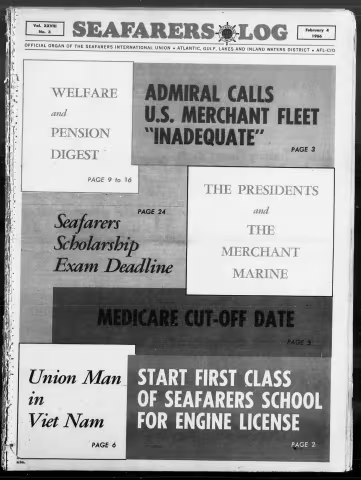
SEAFARERSUOG February 4
1966
OFFICIAL ORGAN OF THE SEAFARERS INTERNATIONAL UNION . ATLANTIC, GULF, LAKES
t/f
WELFARE
and
PENSION
UA MERCHANT FLEET
"INADEQUATE"
"4: 4
11
ll
i B
f
i"
•Ml
•f!;
ill
i ̂ '1 r
k I; '1
"i •
r ^3
J
Page Two SEAFARERS LOG February 4, 1966
4
First class to get underway in the new license training program being offered as a result of the recipro
cal agreement between the SlU and the Marine Engineers Beneficial Association District 2, is shown in
session above. Seafarers with the necessary qualifications are urged to take advantage of this upgrad
ing program by filing an application for enrollment now.
License Training Classes Begin
For SlU Engine Department Men
The unprecedented training program operated under a reciprocal agreement between the SIU and
M. E. B. A., District 2, enabling engine department Seafarers to obtain engineers license got into
full swing on February 1, with 36 applicants beginning their first classes. The rest of the more than
50 Seafarers who registered and
qualified as of last week will
begin study as they arrive in
New York. Qualified applicants
can begin getting instruction at
any time.
The training program, which is
already receiving praise from par
ticipating Seafarers, represents the
first of its type to be established
in the maritime industry. It will
not only aid in meeting critical
manpower shortages in key ratings
throughout the U. S. Merchant
Marine, but will enable SIU men
in the engine department to receive
instructions that will enable them
to sit for an engineers license.
Now that classes are underway,
qualified applicants may begin re
ceiving instructions at any time,
and the period of instruction will
range from 30 to 90 days, depend
ing on the individual member's
ability and knowledge and the in
structor's satisfaction of his readi
ness to take the exam.
To qualify for admission to the
program an applicant must be at
least nineteen years of age and
have 18 months of watch standing
time and three years in the engine
department. Seafarers who are ac
cepted will be provided with meals,
hotel lodging and subsistence pay
ments of $110 per week while in
training and will be able to ship
out immediately upon obtaining
their license.
As a result of the agreement
with the Marine Engineers Bene
ficial Association, District 2, Sea
farers will receive full credit and
complete protection of all pension
benefits built up under the Sea
farers Pension Plan. In addition,
SIU pensions will be supplemented
by the MEBA, District 2 Pension
Plan in approximately an equal
amount while Seafarers are sailing
as engineers.
Also, Seafarers who ship out
aboard MEBA, District 2 con
tracted ships, upon obtaining their
licenses, shall not be required to
pay the MEBA $1000 initiation
fee, and they will not be required
to drop their SIU membership if
they do not wish to do so.
Joseph Merkel is the first Seafarer to take advantage of the new
reciprocal agreement between the SIU and MEBA District 2 and ship
in an engineer rating. Under the agreement, SIU men who possess
engineer's licenses in any rating are eligible for immediate shipping
on their licenses wth full protection of their pension, welfare and all
other benefits and security. Merkel, 55, makes his home in Philadel
phia and sailed with the SIU as fwt and chief pumpman.
All SIU men who now possess
engineer's licenses in any rating
and who are not sailing on their
licenses now because they wish to
protect their SIU pension and wel
fare benefits, are eligible for im
mediate shipping on these licenses
with full protection of pension and
welfare benefits, as well as protec
tion of all other security provided
in this program.
Over a period of time, the SIU
along with all licensed officers'
unions had discussed the possibili
ties of establishing a joint training
program. The SIU's desire to ac
complish this program has been
intensified by the war in Viet Nam
and the resulting shortage of ma
rine engineers. However, the re
cent agreement betweert the SIU
and the MEBA, District 2 repre
sents the first time that this type
of training program has become a
reality. The SIU expressed the
hope that the program could be
extended to other licensed officers
groups in the near future.
In addition, the SIU and the
MEBA will shortly enter discus
sions aimed toward extending the
program to Great Lakes shipping.
It is hoped that a program of this
type for the Great Lakes region
can soon be culminated.
Feb. 4, 1966 Vol. XXVIII, No. 3
Official Publication of the SIUNA
Atlantic, Gulf, Lakes & Inland Waters
District, AFL-CIO
Executive Board
PAUL HALL, President
CAL TANNER
Exec. Vice-Pres.
AL KERR
Sec.-Treas.
ROBERT MATTHEWS
Vice-President
EARL SHEPARD
Vice-President
LINDSEY WILLIAMS
Vice-President
AL TANNER
Vice-President
HERBERT BRAND
Director of Organizing and
Publications
Managing Editor
MIKE POLLACK
Assistant Editor
NATHAN SKYER
Art Editor
BERNARD SEAMAN
Staff Writers
MELVIN PURVIS
WILLIAM DAY
Piblished biweekly at tbe headqaarten of the
Seafarers International Union, Atlantle, Golf,
Lakes and Inland Waters District, AFL-CIO, 675
Foarih Avenne, Brooklyn, N.Y. 11232. Tel.
HVaelntb 9-6600. Second clau oostaqe paid at
Washington, D. C.
Report of
International President
by Paul Hall
Perhaps the hue and cry which has been raised by our union and
other segments of the maritime industry over the lack of a sufficient
merchant marine to serve this country's needs has been regarded by
some as not being justified.
Opponents of our position that a strong merchant fleet is vitally
essential to the walfare and defense capabilities of this nation have
usually echoed the cry that the present fleet was adequate to meet any
defense emergency that might arise and that no upgrading program was
necessary.
However in recent months, there has been a stirring of concern over
the plight of this country's merchant fleet. It is unfortunate that it
took a conflict which is costing lives of U.S. fighting men many thou
sand of miles away in Viet Nam to provoke this interest.
This concern is evidenced by the increasing public statements by
Congressmen and Senators who are taking note of the shocking in
adequacy of our merchant fleet in light of the present world situation.
Viet Nam Conflict Stirs Concern
There can be no doubt that it was the escalation of the Viet Nam
conflict which stirred many of this nation's representatives to the reali
zation that the U.S. merchant fleet was in fact totally inadequate to
meet America's defense and commercial needs.
Recently, concern over this situation was voiced by the U.S. Chief
of Naval Operations—Admiral David B. McDonald—who cautioned
naval officers not to convey the impression that our merchant marine
is adequate for defense purposes.
He flatly stated that in an emergency, foreign and allied ships may
not always be available to the United States when they are needed.
This view, coming from a man who is especially qualified and in a
position to know the importance of the role of the merchant marine in
the area of defense is significant.
Hits at "Effective Control" Theory
It strikes at the heart of the argument advanced by the proponents of
the so-called "effective control" theory. It would appear that his view
would certainly carry more weight than the self-serving Committee For
the Flags of Necessity—the runaway operators.
The United States cannot have a merchant marine capable of meet
ing its needs in a defense situation unless she has a fleet that is strong
in terms of peacetime requirements. It is because of short-sightedness
on the part of those who are responsible for the policies governing our
shipping industry, that our merchant marine has been allowed to shrink
and deteriate.
The point really is that we cannot look upon the maritime industry
as a vital part of our nation's commerce and defen.se unless we look at
it in its totality. A fleet that is inadequate to haul our nation's com
merce will always be inadequate to meet our defense requirements.
Any position to the contrary is completely unrealistic and dangerous
to our national security, as history proves every time.
Provisiotig of iJie new training program being offered as a
of the reciprocal agreement between the SIU and the Marine Engi"
neers Meneficiai Association District 2 include the following:
m In order to qualify an applicant must be 19 years of age or
over and have three years watch standing time,
m The first class will start on February 1, Seafarer applicants
can enter on that day ar.d any day thereafter.
• Seafarers participating in the course of lijstruction will lie J
provided with meals, hotel lodgings and subsistehde payments ofS-
$110 per week while in training and will be aWe to ship as erigiy^^^
neer immediately upon obtaining a license.
• The period of instruction will range from, 30 to 90 days and
will be determined by the member's individual ability and knowl
edge and .nd the instructors satisfaction of hts readiness to lake the
exam.
• Under the reciprocal agreement with MEBA District 2, pen
sion benefits built up by Seafarers under the Seafarers Pension
Plan will. be fully accredited and protected and SIU pensions
will be supplemented by the MEBA Pension Plan in approxi
mately an equal amount.
• All welfare benefits will be covered and protected.
• Seafarers who qualify for their engineers licenses and sail
aboard MEBA contracted ships, shall not be required to pay the ,
MEBA $1,000 initiation fee. It shall be wai^^ed in its entirety.
• Seafarers will not be required to drop their SIU membership
if tltey do not wish to do so.
• All SIU men who now possess engineer's licenses in any
rating and who are not sailing on their licenses because they wish
to protect their SIU Pension and Welfare CretUts are eligible for
benefits and security provided in this program. Ail such Seafarers
should contact SIU headquarters or the nearest SIU port,
Full details and applications for the Engineers Training **-
ora«v can be obtained at ao^ .
7 -.-rn*-c.
r. ' - .s , ' • •
r T|
*
February 4, 1966 SEAFARERS LOG Pa«e Three
V
Calls U.S. Fleet Inadequate for Nation's Needs
Navy Voices Doubts On Adequacy Of U.S. Merchant Fleet
7
I >
It-/
I,-
u
If
fr
I'" -
w
i' 1^1.
a
WASHINGTON—Admiral David B. McDonald,
Chief of Naval Operations of the U. S. Navy, has indi
cated that the U. S. Navy does not consider the present
American merchant marine adequate to fill the nation's
needs and has therefore called for the development and
construction of a fleet of high-performance commercial
cargo ships for the American merchant fleet.
The statement, which was cleared for release, also cast
grave doubts by the Navy on our dependence on the
theory of eflfective control.
"In an emergency, foreign and allied ships may not be
made available to the United States, at a time when they
are needed most," the statement warns.
The statement by the naval operations chief begins by
noting that various naval officers "serving on or consulted
by joint committees or panels have occasionally conveyed
the impression that the present United States merchant
marine is 'adequate' to meet military requirements for
certain wartime situations."
"The term 'adequacy' has many facets," the statement
continues. "A fleet of World War II ships, or aircraft,
may have adequate lift capacity but may be so deficient
in othe'- ways—speed, vulnerability, reaction time—as to
make them of mariginal utility in certain types of wartime
employment.
"For example, what may be adequate for a very limited
Protests Rise Against
Further Proposed Cuts
In U.S. Maritime Budget
WASHINGTON—Protests against drastic cuts in ship con
struction and ship subsidy funds in the proposed Federal budget
for fiscal 1967 are being loudly voiced by American maritime
and shipbuilding unions, legis- "f-
situation, where plenty of time is available and there is
no in-transit opposition, may not be at all adequate in a
large-scale war with major naval opposition,
"The United States now has about 900 privately
owned, active ships engaged in oceanborne commerce.
Of the 600 engaged in foreign trade, about 60 tankers
have speeds above 15 knots, and about 116 dry cargo
ships in operation or building have speeds over 20 knots.
The remainder are slower ships. Slow ships are vulner
able and become nriore vulnerable with each passing year.
In an emergency, foreign and allied ships may not be
made available to the United States, at a time when they
are needed most.
"The Secretary of the Navy has recently recommended
that the Secretary of Defense lend his 'support, encour
agement and cooperation to the present and future efforts
of other Government agencies toward the development
and construction of a fleet of high performance commer
cial cargo ships.'
"It is desired that the foregoing Navy position receive
wide dissemination, and that senior naval officers make
use of every opportunity to encourage the modernization
of the United States merchant marine, which is vital to
the military security of the United States."
The statement was cleared for open publication by
Secretary of Defense Robert S. McNamara, who in the
past has been a strong advocate of the workability of
effective control and has continually downgraded the im
portance of a strong American-flag merchant fleet manned
by American seamen. The SlU and other maritime un
ions have for a long time been pointing out tbat tbe
United States cannot depend in an emergency on foreign-
flag ships manned by foreign seamen for its shipping.
It has also been pointed out that most of these vessels
covered by the effective control thesis are bulk dry and
tanker tonnage—not the "high performance commercial
cargo ships" which the Navy statement recommends as
nece.ssary for our national security.
Since the beginning of the step-up of U. S. participa
tion in the Vietnam situation, our growing dependence
on foreign-flag shipping to move vital cargoes has been
demonstrated on many occasions when important cargoes
have been delayed by the refusal of foreign seamen
aboard foreign-flag sbips to sail (hem to the war zone.
The Navy statement is also directly contrary to the
recommendations of the Interagency Ta.sk Force Report
which played down the importance to the United States
of a strong merchant marine and upheld the workability
of the effective control concept. The Interagency report
was rejected by the President's Maritime Advisory Com
mittee and has been vigorously opposed by the SIU and
other U. S. maritime unions.
Russian Shipping Moving Ahead
OfU. S. Fleet, Cong. Rogers Warns
WASHINGTON—The United States is rapidly falling behind Russia on the seas—particularly in
the merchant marine and fisheries segments of the economy—and barely holding its own in ocean
ography, according to studies made by U. S. legislators touring the Soviet Union.
"The United States must give
lators in both Houses of Con
gress and industry officials.
The new proposed Maritime
Administration budget for fiscal
1967 earmarks only $85 million
for ship construction subsidies,
enough for the bulding of only 13
new vessels. In addition, a cut of
$5 million has been made in the
amount slated for operating sub
sidies for fiscal 1967. This is a
cut in the already inadequate
maritirne budget allocations for
1966.
The SIU in protesting the budg
ets maritime cutbacks, stated that
the budget "again fails to meet the
needs of the American merchant
marine." Calling the proposed
shipping budget "a prime exam
ple of false economy in light of
today's defense needs," the SIU
added that the cuts "will harm
both the merchant marine and the
nation's vital shipbuilding indus
try."
Strong protests also came from
the Chairman of the House Mer
chant Marine and Fisheries Com
mittee, Edward A. Garmatz (D-
Md.), who made known his dis
appointment at the cuts. He de
clared that the fund request for
building only 13 vessels "raises
more questions than it answers as
to whether the United States is
ever going to face up to the press
ing needs of the American mer
chant marine, whether maritime
planners are going to end the
"drift and decline" of our mer
chant fleet, and whether the low
level of funds for fiscal 1967
means that an attempt is being
made to set the stage fm- formally
launching a "shipbuilding abroad"
schemerrr-as. proposed in the Inter-
agency Task Force Report —
which the President's Maritime
Advisory Council unanimously re
jected. Chairman of the Senate
Commerce Committee, Warren G.
Magnuson (D-Wash.), termed the
budget recommendation "defi
cient," and indicated tbat his com
mittee may schedule some sessions
for discussion of maritime affairs.
John J. Grogan, president of the
Industrial Union of Marine and
Shipbuilding Workers character
ized the proposed ship budget as
one that "would only produce fur
ther depression in the shipbuild
ing industry."
The fiscal 1967 maritime budget
request represents the fourth con
secutive cut in the MA's budget,
both in actual dollars and in per
centage of the total Federal budg
et, and was made at a time when
the U. S. merchant fleet is labor
ing to meet the increased demands
being made upon it by tbe Viet
nam emergency.
Ship Construction Chopped
Thus, while the total Federal
budget has grown by 29 percent
since 1961, the money set aside
to bolster the maritime industry
during the same period dropped
by 34 percent. The ship construc
tion subsidy has been chopped
from a high of $129 million in
1961, to a low of $85 million in
1967—while the operating sub
sidy was slashed from its 1963-64
high of $225 million to a low of
$ 185 million. The total MA budg
et for the fiscal year 1967 totaled
$289,395,000.
«The table at right compares the
dwindling MARAD budget with
total Federal spending since 1961.
urgent priority to the develop
ment of the use of the seas if
it is not to be bypassed in every
way, in fisheries, in merchant ves
sels, and oceanography, by the
Communists who are expanding in
all three directions," warned Rep
resentative Paul G. Rogers (D-
Fla.), a member of the House
Merchant Marine and Fisheries
Committee, who recently returned
from a tour of the Soviet Union
and Poland.
He pointed out that the Russians
are progressing "full speed ahead"
in these fields while the United
States is slipping backwards.
Red Fleets Grow
While the U. S. merchant ma
rine is sick and deteriorating rap
idly, Rogers noted that "The Rus
sians fully recognize the impor
tance of the seas and are increa.s-
ing their fishing and merchant
fleets by leaps and bounds in order
to take advantage of what the
oceans have to offer."
"Somehow," he said, "we must
make the right people in the
United States realize the immedi
ate economic benefit that could
come to our country from the de
velopment of the seas. The seas
not only hold the key to the trade
between nations, but tbey contain
vast resources of minerals, they
contain vast deposits of food.
Three-quarters of this earth is wa
ter and we cannot afford to let the
U.S. to Reactivate
25 More Vessels
WASHINGTON—An ad
ditional 25 cargo vessels will
be reactivated from the layup
fleet to haul military supplies
to South Viet Nam.
The ships will be with
drawn over the next four
months and will bring to 101
the number of vessels that
have been reactivated for mil
itary purposes since last sum
mer.
Maritime Administrator
Nicholas Johnson ordered the
ships in response to a request
from the Navy's Military Sea
Transportation Service.
The vessels will be assigned
to private American-flag op
erators under general Mari
time Administration agree
ments.
Communists take control of it"
It has been pointed out that in
the past twelve years, the United
States merchant fleet has shrunk
from 1,258 to 954, while the So
viet merchant fleet has expanded
from 487 to 1.261. In active ton
nage the U. S. has slipped to sixth
position in the world.
Rogers points out also that 90
percent of the American merchant
fleet is 20 years or older, while 90
per cent of the Soviet fleet is less
than 10 years old.
Red Catch Grows
In fisheries, he notes, the Rus
sian catch climbs upwards while
the American catch steadily de
clines. In 1964 for example, the
Russians caught almost 4.5 million
tons of fish. Their 1965 catch is
estimated at over 5.5 million tons,
and their 1966 catch will probably
be well over 6 million tons.
On the other hand, the U. S. in
1963 caught just over 2.7 million
tons and slipped to just over 2.6
million tons in 1964. Although
no figures are yet available for
1965, there was almost certainly
a further decline in the size of the
catch.
Marad Budget Requests
Compared with Total Budget
Fiscal Years 1961-1967
Maritime Administration Budget
Fiscal years
ended June 30
1961
1962
1963
1964
1965
1966
1967
Total Marad
Operating Construction Federal as percent
subsidy subsidy other Total Budget of Federal
(in millions of dollars) (billions of dollars)
$150.0 $129.0 $19.4 $298.4 $79.8 .37%
207.0 98.0 2.1 307.1 80.9 .38%
225.0 64.2 11.0 300.2 92.5 .32%
225.0 112.5 19.1 356.6 98.8 .36%
190.0 124.9 32.1 347.0 97.7 .36%
190.0 124.9 25.1 340.0 99.7 .34%
185.0 85.0 19.4 289.4 112.8 .26%
/
•v|
•i
I .
h.
T
Page Four SEAFARERS LOG
February 4, 1966
J
SlUNA-Affiliated MSTU
Installs New Officers
SAN FRANCISCa
tary Sea Transport
—The SIUNA-affiliated Mili-
Union, which was recently
granted its full autonomy as an affiliate of the Sea
farers International Union of North America, has
formally installed its new officers at ceremonies held
here on December 29th.
The new status of the MSTU became effective on
January 1, 1966, which was the target date estab
lished at the SIUNA Convention last June for estab
lishing MSTU autonomy, after an election of officers
in secret balloting by rank and file members at sea
and ashore.
Shortly after the convention, machinery was set
in motion to implement the procedures adopted by
convention delegates. Accordingly, an MSTU rank
and file committee was elected to draft a permanent
constitution, which was completed by late summer.
Balloting was conducted on the proposed constitu
tion in a secret referendum conducted from Septem
ber 1 to September 30. The constitution was adopted
by a 9 to 1 vote, and the first MSTU election under
terms of its own constitution got underway on No
vember 8 and concluded on December 8.
The election of officers was the final step of the
procedures called for at the SIUNA convention.
Elected secretary-treasurer was Joseph Leal and
elected business agents were Darroll Dan Aiiker,
Raleigh Minix and George Grier.
Joseph Leal (right), newly-elected Secretary-Treas
urer of the SlUNA-afRliated Military Sea Transport
Union, is congratulated by SIUNA Vice-President
Frank Drozak at ceremonies marking formal installa
tion of officers of the new organization. Drozak was
acting administrator of the MSTU until the mem
bership elected their own officers in secret referen
dum vote and autonomy was granted by the Inter
national. The MSTU was chartered by the SIUNA
on August 1, 1,962.
Formal installation ceremonies of newly-elected MSTU officers took place at Marine Cooks and Stewards'
headquarters building in San Francisco. Pictured above are (l-r) MSTU Business Agent George Grier, SlU
Representative Buck Mercer, MSTU Secretary-Treasurer Joseph Leal, MCS Secretary Ed Turner, SIUNA
Vice-President Frank Drozak and MSTU Business Agents Raleigh Minix and Darroll Van Auker.
The Atlantic Coast
by Earl (Bull) Shepard, Vice-President, Atiantic Coast Area]
With the coming fight in Congress for the repeal of Section 14(b)
of the Taft-Hartley Law, SIU halls up and down the Atlantic coast
are rolling up their sleeves to assist in the campaign that will not
only aid the American labor movement, but all working men. All
ports on the East Coast as well as all over the U. S. are cooperating
with state and central labor bodies ^
in the push to repeal the so-called
"right-to-work" laws which are a
bar to the union shop.
New York
Due to the increased activity in
sending supplies and munitions to
Viet Nam, shipping is moving
well in the Port of New York,
and prospects for the immediate
future seems to be unusually good.
Boston
Shipping has picked up a bit
from the comparative slowness
during the past two weeks and is
expected to improve considerably
in the next period.
After 20 years in the SIU,
Wiper Arthur Aheam has con
cluded that Calmar ships are fast,
good to work abroad and just
plain comfortable vessels. Broth
er Ahearn just
paid off the Mary-
mar and is now
waiting for ai.-
other one just like
her. Maurice Mc-
Catty, who has
sailed in the ste
wards department
for the past 25
years, has spent
a year on the Arabian-Japanese
shuttle and declares now he'd just
a soon wait around for a coast
hugger. On the beach also is
Chief Cook Joseph Garello, who
just paid off the Anton Bmun,
and he's eagarly awaiting the
next chief cook's slot that hits
the board.
Philadelphia
Shipping out of Philadelphia
has been holding its own for the
last two weeks and is expected
to remain fairly consistent during
the next period.
Marcelino Santiago, a 20-year
SIU man. has registered in Phila
delphia, and he says he'll take the
first bosun's job that hits the
board. Guy Diviaio and John
Flanaghan are both hanging
around the hall in Philadelphia
waiting for the first pumpman's
slot that comes up.
Baltimore
Shipping has been on the slow
bell for the past two weeks, and
the forecast seems to indicate that
things will remain the same, at
least for the next few weeks.
During this period we paid off
four ships, signed on three and
had six in transit.
After piling off the Steel Advo
cate recently. Bosun Irwin Moen
is looking for a Far East run,
since he's the kind of Seafarer
who prefers long trips. Philip
Cariino, who last
shipped out as
steward on the
Fahisie, is look
ing for a run to
Viet Nam. Deck
department mem
ber Russell Henry
last sailed on the
Gateway CHy and
says that he pre
fers coastwise or intercoastal trips.
Norfolk
Shipping has been on the slow
bell lately, but the outlook is
excellent since two coal ships are
due in. It looks like they might
clean the hall out. Otherwise, the
recent ten inches of snow has
held up things just a little.
Raymond Waterfield is now on
the beach and notes that, in his
many years on the North Atlantic,
his last crossing on the Maidra
(Continued on paRe 23)
Seventeen New Retirees Added To SIU Pension Roster
Seventeen new names were added to the growing list of Seafarers who will be receiving monthly checks of $150 for the rest of their lives. The new pensioners
are: Wililam E. Mauldin, 64, Edgar Kurz, 65, Edmund Marsh, 68, Herbert S. Wilson, 66, John W. Pryor, 65, Anton! Wojcickl, 66, Neil S. Stewart, 73, John Zuzlch,
66, Frank E. Derocher, 66, Jacob Hellesto, 66, Pan! Jakubcsak, 41, Walter H. McDonald, 66, Isuaro Cardeal, 67, Philip N. O'Connor, 65, Antonio Palmes, 57, O.
R. Priest, 64 and Alvin G. ̂
Hunley, 65.
Mauldin joined the union in
the port of New Orleans and
sailed with the SIU as a messman.
He joined the union in 1955 and
is a native of New Orleans where
he will spend his retirement years.
Mauldin last sailed on the Del
Campo (Delta).
Kurz joined the union in his
native city of New York. He
sailed with the SIU in the steward
department and will make his re
tirement home New York. He saw
a great deal of service with the
Montpelier Tanker lines and did
•his last tour of duty aboard the
Mauldin Kurz Marsh Wilson Pryor Wojcicki Stewart
Montpelier Victory.
Edmund H. Marsh has been a
member of the SIU for the past
25 years and has seen a great
deal of duty in that time. He
joined the union in the port of
New Orleans and is a native of
North Carolina. He last sailed on
the Venore (Venore Transporta
tion). Marsh is a resident of Balti
more and will be making his re
tirement home there.
A native of South Carolina,
Wilson has been a member of the
SIU since he joined in Mobile. He
last sailed aboard the Brigham
Victory which is owned by the
Bloomfield Steamship Co. With
his wife Ori, Wilson will make
Mobile his retirement home.
Pryor has sailed with the SIU
in the deck department and joined
the union in his native city of Salis
bury, Maryland. He worked a
number of years for the interstate
Transport Company and last saw
duty on the Interstate No. 1. He
(Continued on puRe 5)
Zuzich Derocher HeUesto Jakubcsak McDonald Cardeal O'Connor Palmes
O
Priest
February 4, 1966 SEAFARERS LOG Page Five
Question: What do you think
of Sea Superstitions, and have
you heard any good ones lately?
Amrlin Wilt—They arc a lot of
fun to listen to but I really can't
say that I believe
them. The ones I
think you really
hear the most on
ship are those
concerning Davie
Jones' locker.
Someone is al
ways telling you
^ to stow some
thing in the locker when they
know the locker is only a super
stition.
<1>
John J. Naughton: I don't be
lieve in them. I read one in the
Log not too long
ago but I really
can't believe it.
The story was
about a dolphin
that led a ship
through a diflRcult
passage. I don't
think that a fish
can lead a ship,
but I do know that these fish
are very smart and maybe it did
happen.
John Mayo: I don't know if
they are true but when I was over
in Scotland there
was a monster
that had everyone
talking. Some of
the guys that I
was stationed with
claimed they even
saw the thing. I
never really saw
any proof of the
alleged monster so I cannot say
if it really does exist. Probably
most of the superstitions have
some basis but are probably re
lated to some .scientific fact.
Joe N. Brown: I can't really be
lieve them. I heard a lot of stories
about hurricanes
before I went to
sea, about how
they could turn
a boat around in
air and all that.
My first trip out
I ran into three
hurricanes and I
saw where some
of the stories might have a little
basis to them. Most of the stories,
however, were things that sea
farers probably thought were hap
pening to them when they were
in the middle of the hurricane.
Klaus Ahmels: I don't believe
them. I have always heard the one
about hanging the
albatross around
a seafarer's neck
to bring him bad
luck. It probably
makes a pretty
good story but I
really can't be
lieve it. I think
that most of the
stories are pure fiction but are
pretty good to listen to.
Alejandro Marinez: I have
heard a number of rumors that
could be classified
as superstitions.
You always hear
those that are
concerned with
sea snakes and
sea monsters but
most of those are
only the imagina
tion of seamen.
Sometimes I have seen some fish
that could really ca.use someone
to think that he had seen a sea
monster. Usually people talk
about the superstitions when they
are caught in a storm and are
really scared.
17 Join SlU Pension List
(Continued from page 4)
will live in retirement in Salisbury.
Antioni Wojcicki came to this
country from his native Poland
and joined the SIU in Tampa,
Fla. He was a member of the
deck dept. and last sailed on the
M. V. Petrochem of the Vol
Chem Convey Co. He will make
his retirement home in Miami.
Stewart first joined the SIU in
the port of Detroit. He was born
in Scotland. He sailed with the
Gt. Lakes Tug & Dredge district.
He last shipped on the tug Penn
sylvania. He will live with his wife,
Ruth, in Toledo, Ohio during his
retirement.
John Zuzich joined the SIU in
the port of New York and last
sailed as deckman on tug No. 30
for the New York Central R. R.
He is a native of New Jersey and
will make his retirement home
in West New York with his wife
Ellen.
Derocher is a native of Mas
sachusetts who will make his re
tirement home in Huntington L. 1.
He joined the SIU in the port of
New York and last sailed aboard
the railway tug Simpson.
Jacob Hellesto joined the SIU
and sailed in the deck dept. He
joined the SIU in the pdrt of New
York and is a native of Norway.
His last assignment was on the
New York Central Tug No. 29.
He will retire to his home in New
Jersey.
Jakubcsak has been a member
of the SIU for over 20 years and
sailed in the steward dept. He is
a native New Yorker who joined
the SIU in his native city. He last
sailed on the S/T Texas which is
operated by Seatrain line. He lives
with his wife in Flushing, N. Y.
Walter H. McDonald, a native
of South Carolina, has sailed in
the engine dept. for the past 23
years with the SIU.
Cardeal is a native of Brazil
who has been a member of the
SIU since 1943. He joined the
union in Norfolk and is a mem
ber of the deck dept. His last
ship was the Penn Vanguard of
the Penn Shipping Co. He will
live in retirement with his wife
Angelina.
Philip N. O'Connor has been
.a member of the SIU almost
since its inception and joined the
union in New Orleans. He sailed
as a member of the steward dept.
His last ship was the Del Sud with
the Mississippi Steamship Co.
Palmes sailed with the SIU as
a member of the engine depart
ment. He joined the SIU in the
port of Baltimore. He is a native
of Spain.
Prist sailed with the union in
the engine department and is a
native of Hartford, Michigan.
Hunley, who joined the SIU
in the port of Norfolk, sailed as
AB. He is a native of Virginia.
DISPATCHERS REPORT Atlantic, Gulf & Inland Waters District
January 15 to January 28,
DECK DEPARTMENT
1966
TOTAL REGISTERED TOTAL SHIPPED NOW ON THE BEACH
AH Groups AH Groups All Groups
Port Class A Class B (Mass A Class B Cla.ss C Class A Class B
Boston 3 3 4 1 2 11 3
New York 52 38 55 24 9 205 66
Philadelphia 13 8 8 7 0 44 11
Baltimore 19 15 29 7 0 95 48
Norfolk 2 8 10 6 0 18 17
Jacksonville 4 5 1 1 0 16 11
Tampa 5 3 10 3 7 12 6
Mobile 15 6 25 4 0 71 25
New Orleans 40 24 23 7 0 165 119
Houston 45 22 22 9 1 156 78
Wilmington 11 5 5 7 5 16 1
San Francisco 34 12 42 25 15 40 14
Seattle 12 12 28 14 11 28 6
Totals 255 161 262 115 50 877 405
ENGINE DEPARTMENT
TOTAL REGISTERED TOTAL SHIPPED NOW ON THE BEACH
AH Groups AH Groups AH Groups
Port Class A Class B Class A Class B Class C Class A Class B
Boston 1 0 3 0 1 5 1
New York 52 23 40 12 14 150 63
Philadelphia 10 2 7 5 2 41 19
Baltimore 4 11 23 14 1 51 43
Norfolk 2 3 6 0 0 23 22
Jacksonville 4 5 1 6 1 8 11
Tampa 1 1 4 3 10 3 4
Mobile 14 3 23 6 1 33 16
New Orleans 33 20 20 18 2 134 101
Houston 36 35 22 15 5 88 106
Wilmington 8 4 4-4 4 14 2
San Francisco .... 24 7 31 10 26 34 4
Seattle 12 10 12 15 14 23 5
Totals 201 124 196 108 81 607 397
STEWARD DEPARTMENT
TOTAL REGISTERED TOTAL SHIPPED NOW ON THE BEACH
AH Groups AH Groups AH Groups
Port Class A Class B Class A Class B Class C Class A Class B
Boston 3 0 10 0 7 1
New York 54 13 26 9 2 155 28
Philadelphia 1 2 4 3 0 25 10
Baltimore 18 4 22 10 0 64 23
Norfolk 5 2 4 4 0 15 15
Jacksonville 2 2 1 2 2 3 6
Tampa 6 5 9 16 13 2
Mobile 18 4 ' 24 3 0 46 21
New Orleans 29 17 21 6 2 144 110
Houston 25 22 14 18 7 40 13
Wilmington 9 1 6 10 11 1
San Francisco 17 8 14 8 34 27 4
Seattle 12 4 12 13 8 18 8
Totals .199 84 158 78 61 568 242
AFL-CIO Urges Over 6 5 ers
Enroll for Medicare—Now!
WASHINGTON—AFL-CIO President George Meany has urged the entire labor movement to
do everything in its power to make sure that all union members 65 or over and their families en
roll for medical benefits under social security before the end of March.
Unlike hospitalization cover
age, he pointed out, the Medi
care coverage of doctors' bills
and other medical costs is not
automatic. Each individual must
sign up for it and pay a premium
of $3 monthly which is matched
by the government.
Those who fail to sign up by
March 31, Meany noted, cannot
join until October 1967 and then
will have to pay more than the
current $3 monthly charge.
"No other insurance policy
could provide the comprehensive
coverage this policy offers except
at a vastly greater cost," he de
clared. "Yet there is a serious
danger than many older Ameri
cans will let the opportunity slip
past, simply for lack of proper
information."
The Social Security Adminis
tration has mailed out 14.8 million
cards to social security beneficia
ries alone—not counting those re
ceiving railroad retirement or fed
eral pension benefits—reminding
them of the medical care benefits
and urging them to enroll. To
date more than 10 million have
replied, of whom more than 8.5
million elected to take the medical
care coverage.
"Ten percent—one in 10—have
failed to do so," Meany noted
with concern. "This is serious
in itself, But even more serious
is the problem of the other mil
lions, including many who are not
otherwise covered by social secu
rity but who are eligible for Medi
care benefits.
"It would be a tragedy if the
Medicare program, for which the
AFL-CIO fought so long and so
hard, should fall short of its ob
jectives because its intended bene
ficiaries are unaware of the facts.
"At the very least we should
make sure that our own members
—not only the retirees and those
who are 65 or older, but also tbose
who have elderly persons in the
family—realize the value of this
insurance program and the need
to meet the Mar. 31 deadline."
Meany made two additional
points:
• Everybody 65 or older
should enroll, even if he is still
working and plans to continue
working.
• The undecided should enroll
now even if they are not sure they
can afford the $3. This, he pointed
out, will protect their rights while
they make up their minds; and
if they decide they don't have $3
a month to spend for medical
expenses, they can withdraw by
July 1, 1966, without having paid
anything.
"I strongly urge every interna
tional union and every state and
local central body," Meany said
in a final plea, "to spread the
word through every available
means. I can think of no greater
community service the labor
movement could perform during
these next IVi months than help
ing to bring about maximum par
ticipation in this program."
SIGN LETTERS
For obvious reasons the U
cannot print any letters or
corhrnunications ^nt by Seafare
jinless the author signs his nami
chcumstahces justify, the U
ill withhold a signature on
t 1 '
H
i •
t.
'i' .
ml
m
i
y.'j
i-
'^1
1 J - ̂ - 1 ^
'^i ^4 it VIET NAM
4
<H1- ILA 'S GLBASON BRINGS
LONGSHORE KNOW-HOW
TO PORT OF SAIGON
7i ' »'V t t •"
Government representatives, I LA President Gleason and
other ILA experts in the port of Saigon discuss problem of
cargo unloading which has caused heavy ship jam in harbor.
Lack of equipment and modern work methods have ham
pered Vietnamese longshoremen as demands on Port of
Saigon for military and civilian supplies have multiplied.
I ;
x'
•.''"Li.', •'' •'".
). •„
Gleason describes activities in various ports in Viet Nam to
George P. Delaney, Special Asst. to Secretary of State and
Coordinator of International Labor Affairs (photo left), and
to Herb Brand of Seafarers International Union (photo right).
T I Ihe initiative and know-how of Amer-
i ican trade unionists is helping to break
the critical cargo bottle-neck that has
been hampering the military effort and de
laying badly-needed civilian supplies in the
Viet Nam port of Saigon.
International Longshoremen's Association
President Thomas (Teddy) Gleason, who
brought his cargo-handling know-how to
Viet Nam at the request of that government
and the U. S. State Department, is scheduled
to make his third trip to Saigon within the
next few weeks to check on the progress of
his recommendations for cutting down the
tremendous delays in vessel unloadings.
Last week, at a press conference he held
jointly with George P. Delaney, Special As
sistant to the Secretary of State and Co
ordinator of International Labor Affairs.
Brother Gleason reported on his two special
missions to Viet Nam. He stressed the need
for immediate implementation of his recom
mendations for breaking up the congestion
which has been plagueing Saigon.
Delaney, a former International Repre
sentative of the AFL-CIO, said that "the
Agency for International Development is in
agreement with Gleason's recommendations
and is prepared to implement them with
whatever it takes."
When the U. S. stepped up military opera
tions last fall, facilities in the port of Saigon,
already inadequate to handle the incoming
supplies, became almost hopelessly snarled.
The ships' unloading problem, as Seafarers
on the Viet Nam run know so well, was
critical. Vessels hauling military material
and supplies for Saigon's swollen civilian
population, were forced to wait as much as
50 days in the stream before they could be
assigned to unloading berths.
It was at this point that the government
called in Gleason to help unravel things,
and the ILA president made his first trip to
Saigon in October as a special consultant to
the United States Overseas Mission. Glea
son spent two weeks surveying the loading
and unloading of ships, the equipment used,
hiring methods and work practices and fa
cilities and conditions for the workers.
On the basis of his observations. Brother
Gleason made a wide range of specific rec
ommendations for the introduction of new
equipment and facilities, centralization of re
sponsibility for stevedoring and improved
working conditions.
To compensate for the shortage of ships'
berths in the port, Gleason recommended
the building immediately of a minimum of
20 fiat-top wooden lighters onto which car
goes could be unloaded on pallets from ships
in the stream. The flat top lighters could
also be used, Gleason said, to ease the short
age of storage space by leaving them loaded
and anchoring them upstream until the ma
terials are needed.
Among other improvements. Brother
Gleason called for the construction of 10,000
wooden pallets right away, the acquisition
of 300 flat bed trucks and the use of steel or
wooden canal boats.
In his report Gleason recommended that
the U. S. government should request Sea-
train Lines and Sea-Land Setjvice to make
available seven vessels which would be able
to carry specialized plywood containers.
Upon discharge of the containers, Gleason
said, they could be used in the port of Saigon
either as storage space or broken down for
use in badly needed construction. He pointed
out that the container ships could be turned
around in 16 hours, using the ships gear to
unload.
Concerned as he was with the mechanical
means for improving the port jam up, the
ILA President was not unmindful of the
human element. He felt that improvement
in the hiring procedures and working condi
tions of the longshiremcn would step up
their efficienty. Primarily, the problem in
Gleason's view is "not the result of any
shortcomings in the Vietnamese people but
rather from the inadequacy of the port
facilities which now must handle not only the
increased flow of military material but food
and other civilian supplies for a population
which, in Saigon alone, has risen from orte
to three millions in the past two years.
The ILA President said that adoption of
his recommendations for hiring halls where
dock workers could be assigned efficiently
through a seniority system would increase
productivity by at least 25%.
As a trade unionist. Brother Gleason was
especially concerned with instituting ade
quate pay scales, a Welfare Plan and other
benefits which he recommended to Viet
namese Union officials.
When he returned to Viet Nam in Decem
ber, Brother Gleason brought with him four
ILA members, specialists in their particular
fields, to implement his recommendations.
The four, John Byrnes and Thomas
O'Rourke of New York, who are supervising
stevedores, and hiring hall specialists Alfred
Collillo of Duluth, and Natale Archomona
of Brooklyn, will be in Viet Nam for as long
as necessary. The ILA is underwriting costs
of the entire operation.
While he expressed disappointment that
his recommendations in October had not
been implemented. Brother Gleason was con
fident that conditions could be improved in
a hurry and that the 220.000 tons of cargo
presently handled in Saigon could he in
creased to 600,000 tons when his program is
underway.
In agreeing with Gleason's recommenda
tions, Delaney said that the equipment called
for was on its way" from various Asian ports.
Just prior to his departure for Saigon in
December. Brother Gleason, who is a mem
ber of the executive board of the AFL-CIO
•Maritime Trades Department, was presented
with a distinguished service plaque at the
MTD convention in San Francisco. The
plaque, which was presented by MTD Presi
dent Paul Hall, cited Gleason and the ILA
for its contribution to the U. S. defense
effort in Viet Nam.
Delaney acknowledged the contribution of
the ILA and its president, by saying that the
U. S. agencies had called in all kinds of
specialists but that "Teddy Gleason brought
with him practical know-how" and that he
was well received. He said that in attacking
the problem as he did, Gleason was carry
ing out the spirit of the AFL-CIO position,
adopted at the December 1965, convention,
in support of the U, S. activities in Viet Nam.
4. hJ.
»3-
February 4, 1966 SEAFARERS LOG Page Seven
Liberal Congressmen Face
Tough '66 Election Fight
Example: A switch of two votes in the House of Representatives in
1965, would have butchered the public works bill. A key proposal to
increase public works funds barely passed, 196-194.
Example: A switch of four votes in the House would have kayoed
the President's proposal for rent subsidies for the poor. It nudged by,
208-202.
Example: A switch of 12 votes in one instance and 10 in a second
—would have doomed 14(b) repeal in the House. In the first case, a
move to kill the repealer was defeated, 223-200. Following that, the
vote on repeal itself passed, 221-203.
Example: A switch of only 17 votes would have torpedoed the new
Housing and Urban Development Department, proposed to coordinate
federal aid to cities. It got by the House, 217-184.
More than anything else, these examples and others like them spot
light the crucial nature of the 1966 congressional elections. They
show how thin the line is between the present liberal-controlled Con
gress and a potential conservative-controlled Congress.
They show how important labor's role in politics will be this year,
for the new programs workers and their families want and need are
riding on the results of the voting next November,
The main event will be the battle for control of the House, and the
major battlefields will be those normally-conservative districts that
switched to liberal in 1964 on the strength of the Johnson landslide.
There are 51 first-term liberals in the House. As the above examples
show, these newcomers provide the winning margin on a significant
number of key votes. Any heavy cut in their numbers next November
would douse hopes for new Great Society legislation in the next few
years.
Addition of only a small number of conservatives would insta)! a
new set of uppers for the presently defanged Dixiecrat-GOP coalition
and bring back the bite that for decades chewed up efforts to enact
needed new programs.
In the Senate, continued Democratic control is assured, though
here too a loss of liberal seats could endanger passage of liberal legis
lation (see story on page 2). The present balance is 68-32 for the
Democrats. Of the 35 Senate seats up for grabs this year, 21 are held
by Democrats and 14 by Republicans.
The factors that make 1966 labor's toughest political test ever are
these:
• The tradition of off-year losses that hit the party in control of
the White House. The average loss in the House over the past 60
years has been 37 seats, in the Senate five seats.
• The large number of new liberals coming from districts with
histories of conservative representation.
• The absence of a strong head-of-ticket like President Johnson,
whose huge vote rubbed off on liberal candidates in 1964,
• The growing savvy of right wing and conservative political action
groups. It is not just the Birchers and other extremist organizations.
Respectable conservative outfits like the NAM's Business-Industry
Political Action Committee (BIPAC) and the AMA's American Medi
cal Political Action Committee (AMPAC) have picked up know-how
in recent campaigns, and will be more effective this year.
• The usual drop-off in voting that takes place in non-presidential
years, a drop-off averaging more than 15 percent. It cuts most deeply
into the vote of working people.
Thomas P. Powers, formerly a
State, County and Municipal em
ployes business agent in Washing
ton, has been named director of
recruitment for VISTA volun
teers. Powers has been a VISTA
staff member since last April,
developing training programs-. In
his new post, he will direct a
drive to recruit between 2,000 and
3,000 persons to work among the
poor and underpriviledged in ur
ban slums, Appalachia, migrant
farm labor communities and on
Indian reservation.
<|>
Strike activity last year was at
about the same level as in 1964,
according to the Labor Dept's
Bureau of Labor statistics. Prelimi
nary estimates list about 3,860
stoppages involving 1.4 million
workers whp.,,,lpst 23.1 million
man hours'bf work, compared to
3,665 strikes in 1964 involving
1.6 million workers who were idle
for 22.9 million man days. Lost
time accounted for 18 one-hun
dredth of 1 per cent of total esti
mated working time, the same as
1964, the report disclosed.
The Painters Union won a re
sounding victory in a representa
tion election among the 550 em
ployes of Merry Brothers, manu
facturers of brick products in
Augusta, Ga., as an outgrowth
of cooperation with the AFL-CIO
Department of Civil Rights and
the National Association for the
Advancement of Colored People.
Jerome H. Brooks, 48 has been
named durector of the National
Labor Relation Boards Detroit,
Mich., region succeeding Thomas
Roumell, new Michigaii State
Labor Dept. director. Brooks has
been Detroit regional attorney ̂ d
served for 21 months as actmg
regional director. Bernard Gott
fried. assistant regional attorney,
will take Brooks' former post.
"Old Enemies"
The federal govement has embarked on a pro
gram to fight poverty, and it has been joined in
this objective by various state and local govern
ments.
We of the organized labor movement applaud
and endorse all efforts to eradicate poverty. But
poverty is no stranger to the American labor
movement. Organized labor and poverty are old
enemies. The need to war on poverty was one
of the reasons that inspired the founding of the
union movement. And the battle has been carried
on continuously since the movement's inception.
Yes, poverty, along with its camp-followers of
disease, ignorance, prejudice and slums, have al
ways been the enemies — and the targets — of
labor.
Until the rise of labor unions in this country,
poverty was truly rampant. Unorganized, weak
and fearful, men, women and children labored for
long hours for wages barely able to sustain them.
Disease was no stranger, brought about by poor
food, crowded living conditions and the debili
tating exhaustion of long hours in the factories
or fields.
It was the organized labor movement which
fought for and won the passage of legislation
outlawing child labor. The public school system,
which assured the children of workers an educa
tion was a direct result of action by the labor
movement. American unions were responsible for
raising the wage standard and lowering the hours
worked during a day. Social security legislation,
which relieved older Americans of the threat of
abject poverty in their retirement years was just
another of the many programs fought for and won
by the organized labor movement to relieve pov
erty and assure every American worker the ben
efits of our society.
Every advanceqwhich the labor movement has
made or helped to make—whether it was the
winning of additional dollars in workers' wages,
pension plans, overtime pay and the whole range
of other economic benefits or the passage of hous
ing, education and medicare legislation—^has been
a defeat for poverty.
But organized labor, which fights poverty every
day in so many ways, is committed to the fight
until that enemy is eliminated.
Slipping Behind
Once again, the United States has been warned
that it is rapidly slipping behind the Soviet Union
on the seas—in merchant shipping, fisheries and
basic sea research. This latest warning comes
from a member of the House Merchant Marine
and Fisheries Committee, Representative Paul G.
Rogers (D-Fla.), who returned recently from a
tour of the Soviet Union and her satellites.
His warning was stem. He pointed out bluntly
that the Russians are progressing "full speed
ahead" in these fields while we are slipping back
wards at an increasing rate.
The U. S. must wake up to the danger involved
in giving up her position as a world maritime
power by default — the course which we are
presently pursuing.
Besides being the key to trade between nations,
the seas contain vast resources of minerals and
food. As Rogers points out, we cannot let the
Communists take control of it.
Welfare, Pension Digest
In the center fold of this issue of the SEA
FARERS LOG readers will find a supplement
containing all the pertinent information on the
Seafarers Welfare and Pension Plans, plus a full
schedule of surgical benefits. All of the benefits
for which Seafarers and their families are eligible
are clearly described.
SIU men and their families are urged to remove
this supplement and to put it where it can be
found when they wish to refer to it.
' i|
i. I
n
1
N
-'rvr-'^ ;S. •., -•
^ ' ».•
•>'''. . .
' ' :'T'i':.-rv^..';-;C--' • ••"•••'
'•4'!5;S&£{V >r
-> •> ^ f .-*•;•
< .is- .
A v* '
i®iiiSl>.
l8ir *rj>..
« ' A . ' ,<''
X'
- -
. ^ 5', ^ :
" iV
'AH
A mf. -i- I
wa
;4'-'rr<-•&,•>-. • ft; '••;
-•'•'mi
V, >. •
•ri- ':v ,A'.>-..- - •:••'• -vA-iA-Vv;-fc^••. ' ••-••^•V'Si^
'•*• •,,. ••'SiA-' .''''.
sar.' . •'* ^ Hia
A.-"
/' A' .
, , f'i-- »• s, t >' -»• •
'AA'f ''-\A T-^ ' •
i/l
ATA-AAA^A/ ,.i
I"* HE MERCHANT MARINE has always been a
vital part of the commerce and security of our
nation.
"What the merchant marine means to the United
States has been best expressed by our Presidents. Be
cause of their special knowledge and insight into the
affairs of the nation has enabled them to see more
clearly the necessity of a vibrant and strong private
shipping fleet.
Almost without exception, the Chief Executives
have urged the creation and maintenance of a mer
chant marine that would serve the commercial and
defense needs of the nation.
Here on these pages are a few of the presidential
views on the merchant marine which have charac
terized the thinking of the men whose responsibility
it has been to keep America strong.
Despite the technological changes and innova
tions in the means of transportation, the carriage of
goods in water-borne vessels is still the major method
of transporting our foreign commerce. And for
America's best interests;—as expressed by virtually
all of its Presidents — the cargoes must be carried
under the American flag.
.. f. ;/ i; .
A Wo;:;:--
AAAA vAv
,.sW;
" o '"ryi/OoAA: 'o;:'- A'AtA. ; •
'' A'AA: •.; Ao'oAr''Ao/
• o'- AIAA^A A .fAA,;
. ^ A- „ W ^ ^
'* ' - A '
-' • - , vV •' A?'4" W W .
^o-; oA?^fe-AAW::AA:
; • vo• "
'/iW' • '' '
>4/"
I®!*-
fw;;;
' ..-rA
• •: .OAAAi?.:!''
'i'V , J ^ ^ S
A- :•, '..'A.'
: - A A AfeA*:- S 'i
;
I
i
ASJA igSAlAc ^ '.A
-1:5:;^^!;;;
f*"' *^'''' '
r 7^ i-' ^
"V
SURGICAL SCHEDULE
AND
DIGEST OF ALL WELFARE BENEFITS
THE SEAFARERS
WELFARE PLAN
f
•i:|
1'i
ft
15
THE SEAFARERS
PENSION PLAN
K')
t •
'iJ ,'•; ''V7:'7757:''..^..^'-vi;. -., Iv i '''L
Page Ten SEAFARERS LOG February 4, 1966
Seafarers Welfare Plan Surgical Schedule
MAXIMUM PAYMBir
si
Two or mora •urgicaf precadvrat paiformad through the
gbdomhul IncMon wNI b« «omMtr«d as oiw eptration.
AlMMat. <" liiBaiJiiaiaaaHi liKUan ami drafaiaoa
Adranaiactomy, partial or total (ramoval of part or all
of adranal gla^)
Appandactomy (ramoval of appandix}
Appandkaal abtcaw—incision and drahtaga of.
•ila ducts, plastic rapair or raconstruction. •••••••••••••••••••sssa
•owal, rasaction of
Oiolacystactomy (ramoval of gall Uaddar).
Oiolacyttactomy and axploration of common duct (ra*
moval of gall bladdar)
Cbolacystoduodanostomy (joining of gall bladdar to
intastina)
Cholccystoantarostemy (joining of gall bladder to itt*
tastina)
Cholacystotomy (cutting into gall bladder, including re*
movai of gall stones)
.Oioladocboplasty (operation on tba bHa duct)
Cholcdochostamy (operation on tba biia du^.
Choladodiotomy (operation on bila ducts)
OwlalMiotomy (uiiUng into gall bladder, mduAng ra>
moval of gall stones) —
Colectomy (partial ramoval of colon large intestine)....
Colon, rasaction of partial removal of colon—large
intastina)
Colostomy (formation of artificial amn)..
Colostomy, revision
Colostomy, dosura of
Common bila duct, opening of with axploration, drain-
•ga or removal of calculus with or without removal
of gall bladder
Common bile duct, opening of, secondary, in absence
of gall bladder
Common bila duci, resection or reconstruction of.
Diverticulum, Meckel's or intestinal (removal of pocket
in the intestine)
Duodenal ulcar, parfdration, closure of.
Enterectomy, with or without arustomosis (cutting
away of intestines, with or without rejoining)
Enterorrhaphy (suture of intestirte)
Enterotomy, including removal of foreign body (cutting
into intestine)
Gall bladdar, removal of (cholecystectomy)*..
Gall bladder, operation other than removal
Gastrectomy, partial or total (removal of stomach)..
Gastric or ducdenal ulcer, perforation, closure of.
Gastroduodenostomy (joining of stomach to intestine)....
Gastroenterostomy (joining of stomach to intestine)
Gastrojejunostomy, with or without vagotomy (joining
of stomach to intestine)
Gastroscopy—diagnostic (examination of stomach by
gastroscope)
operative (operation thru gastroscope)
Gastrostomy or gastfotomy (forming opening In
stomach)
Gastrostomy, closure of
Castrofomy with exploration or foreign body removal
(cutting into stomach)
Hepatectomy, partial (resection of part of liver)
Hepatorrhaphy (suture of liver)
Hepatotomy (incision of liver for drainage of abscess or
cyst, one or two stages)
Herniotomy — heriorrhaphy — hernioplasty (repair of
hernia—rupture)
single—inguinal, femoral, umbilical, ventral or incb
aional
bilateral—inguinal, or femoral
Hiatal or diaphragmatic
$150.00
300.00
150.00
150.00
225.00
3oaoo
225.00
225.00
225.00
225.00
225.00
225.00
225.00
225.00
225.00
300.00
300100
187.50
150.00
150.00
225.00
225.00
225.00
200.00
150.00
300.00
150.00
150.00
225.00
225.00
300.00
150.00
225.00
225.00
225.00
60.00
75.00
150.00
150.00
150.00
300.00
150.00
150.00
•••••••••••••••••••a
>••••••••••••«•««4*t>«S
Intestinal obstruction—operation for, not requiring re
section
Intestine^reductien of volvulus or intussusception by
cutting (repair of folding or twisting of intestines)..,.
Intestine, large, resection of
Intestine, small, resection of
Laparotomy—exploratory (cutting into abdomen)..,..
Liver, aspiration (tapping) or punch biopsy
Liver, biopsy by laporotomy
Liver, marsupialization of cyst or abKcss of
Livw, suture of wound or injury (hepatorrhaphy)
Pancreas, drainage of, or marsupialization of cyst
Pancreas, excision of, partial or total except marsupiali
zation of cyst
Pancreas, radical excision of Ampulla of Vater, with
resection of duodenum and portion of pancreas,
gastrojejunostomy and anastamosis of biliary tract to
alimentary tract, one or more stages
Pancreaticogastrostomy (joining pancreas to stomach)..,,
Pancreaticoenterostomy (joining pancreas to intestine)..,.
Pancreatotomy (cutting into the pancreas)
Pancreolithotomy (removal of stone from pancreas)
Paracentesis, abdominal cavity (tapping)
Peritoneoscopy—diagnostic (examination of lining of the
abdomen by peritoneoscope)
Operative biopsy)
Pneumoperitoneum—induction of (injection of gas into
abdominal cavity)
Each refill—(not aiore than 17} „ each
150,00
187.50
300.00
150,00
150.00
300.00
300.00
150.00
22.50
150.00
225.00
150,00
150.00
300,00
300,00
225.00 >
225,00
150.00
225.00
22.50
60.00
75,00
37.50
15.00
Pyloric stenosis, operation for (repair of constrktLon of
lower opening of -stomach) 150.00
Ramstedt's operation for pyloric stenosis (repair of con
striction of lower opening of stomach) 150.00
'Rectum, resection of •••••essaassssstaaaassteo 300,00
Splenectomy (removal of spleen) 225,00
Splenorrhaf^y (suture of Sf^n) 150,00
Stomach, resection 300.00
Umbilectomy (removal of navaQ 150,00
Vagotomy (cutting of vagus nerve In -stomach). •(•aaaaaa* 150.00
ABSCBSES
Incision and drainage-
requiring hospital residence 37.50
not requiring hospital residence 15,00
Peritonsillar abscaes, incision of—
requiring hospital residence 37.50
not requiring hospital residence 22.50
Supralevator (above levator muscle of anus), incision
and drainage S2J0
AMPUTATIONS
Coccyx (removal of bone at lower end of spine) 75.00
Ear—unilateral 75,00
bilateral 150.00
Kngers, each (one or more phalanges) 25.00
CKtst, open operation 7$.00
Foot (thru metatarsal bones or above)-unilateraI 150IX)
bilateral
forearm-unilateral
bilateral
Hand, entire (thru metacarpal bones or above}—
unilateral
bilateral
Leg-unilateral
bilateral
Nose
Thigh—unilateral
bilateral ,.
Thumbs, each (one or more phalanges).
Toes, each (one or more phalanges)
Upper arm—unilateral
bilateral
ARTERIES AND VEINS (Vascuhr Suiiary)
Aneurysm (dilatation of blood vessel) arterial or arterio
venous, operation for
(excision of or wiring)
Extremities
Intra-abdominal
Intracranial
Intrathoracic
Angiogram, cutting operation for exposure of vessel
where necessary for
Aorta, excision of coarctation of
Artery, anastamosis (joining or forming a connection
between arteries)
in extremities Mch
intra-abdominal
intracranial ..
intrathoracic
ISODO
3004X)
150J0O
300J0O
187.50
30DJOO
75M
200.00
900M
25.00
25,00
150.00
300.00
75.00
150.00
300.00
300.00
37.50
300.00
75.00
150.00
300.00
300.00
37.50
75.00
300.00
15.00
112.50
75,00
Artery, excision of temporal
Artery, excision or ligation of major artery of extremity
Artery, excision of coarctation (contraction) of aorta
Artery, ligation (tying) of result of accidental wound
each •
Carotid artery, ligation (tying) of
Catheterization of heart (independent procedure)
Embolectomy—arteriotomy or venotomy with explora
tion or removal of embolus or thrombus (clot)
In abdomen 1M,00
in chest 300.00
in extremities 75.00
in neck 150.00
in skull (intracranial) . 300.00
Fenwral vein, ligation (tying) of, for other than varicose
veiits—unilateral 3730
bilateral
Hemangioma (blood vessel tumor) simple, not requiring
hospital residence
requiring hospital residence
Hemangioma (blood vessel tumor) cavernous
Saphenous vein, ligation (tying) of, for other than
varicose veins—unilateral
bilateral
Temporal artery, excision of
Varicose veins—injection treatment, complete procedure
(one or both legs)
cutting operation, complete procedure—one leg
both legs
Vein, ligation (tying) of, result of accidental wound,
each
Venogram, cutting operation for exposure of vessel
where necessary for
Venous Anastamosis (forming connection between veins)
porto-^aval anastamosis
superior mesenteric caval anastamosis
Spleno-renal anastamosis
BIOPSY
Removal of fluid or tissue by cutting or aspiration for examina
tion. Not payable when done immediately preceding or at part
of operation listed in informative schedule..
Bone, excision of portion for biopsy 60,00
Bone marrow, aspiration of, including sternal puncture 2230
Breast 2230
Bronchoscopy 75.00
7530
1530
37.50
75.00
37.50
75.00
3730
60,00
75.00
120.00
15.00
3730
300.00
300.00
300.00
^•••••••tsaataassseaaati
Chest, needle 2230
5230
75.00
75.00
Cystoscopy...
Esophagotcopy
Gastroscopy ....
Gland, or glands superficial 20.00
Kidney, by needle 2230
Laryngoscopy
liver, by needle or punch
Lung, aspiration of, by needle
KSSSISSfSSS•••<«*«•••(
37.50
22.50
2230
Lung, cutting open operation of chest 75.00*
Muscle 3730
Needle (paracentesis) 22.50
Peritoneoscopy 75.00
Pr uctoscopy ........................................................................ 37.ou
Sigmoidoscopy 3730
Skin 15.00
Spleen, by needle 2230
Sternum, by needle 2230
BLOOD TRANSnmON (OR PLASMA)
Each 3730
BREAST
Breast, abscess, incision and drainage of
requiring hospital residence 3730
not requiring hospital residence 15.00
Biopsy 2230
Plarfic operation, complete separate procedure-
unilateral 7300
bilateral 150.00
Radical amputation 225.00
Retnoval of benign tumor or cyst-
requiring hospital residence
unilateral 7530
bilateral ...., 15300
not requiring hospital residence 1530
Simple amputation—unilateral 15030
2230
52.50
112.S0
3730
bilateral 30030
BURSAS
Bursae, aspiration, injection, irrigation, or needling
(or any combination) each
excision of (bursectomy) prepatellar and olecranon
shoulder. Hip
incision and draniage (bursotomy)
requiring hospital residence
not requiring hospital residence 15,00
CHEST
Arytenoidopexy (fixation of arytenoid cartilages) 225.00
Bronchoscopy (examination of windpipe by bronchoscope)—
diagnostic 50,00
operative 75,00
Commissurotomy (operation on valves of heert) 300,00
Costo-sternoplasty (repair of funnel chest) 18730
'Decortication of lung (removal of membrane lining the
lung) 225,00
Diaphragm, transthoracic approach to 300.00
Epiglottidectomy (removal of epiglottis)
Esophageal dfverticulum, one or more stages—
transthoracic approach
other approach
Esophagoduodenostomy (joining of esophagus to
duodenum)
Esophagogastrectomy, combined, thoracoabdominal (re
moval of part or all of stomach and esophagus)
Esophagogastrostomy (joining of esophgaus to stomach)
Esophagojejunostomy (joining of esophagus to jejunum)
Esophagoplasty (plastic repair or reconstruction of
esophagus)
Esophagoscopy (examination of gullet by esophago-
scope) diagnostic
operative
Esophagus, transthoracic approach to
Funnel chest, plastic repair of
Heart Operations—See section on HEART OR CARDIAC
Hemilaryngectomy (removal of half of larynx)
Hernia, diaphragmatic or hiatal, repair of
Laryngectomy (removal of larynx)
Laryngofissure (cutting into larynx) with removal of
futnor
Laryngoplasty (plastic repair of larynx)
Laryngoscopy (examination of larynx by laryngoscope)
diagnostic
operative ,.,,,.
Lobectomy, total or subtotal, wedge or segmental re
section, (removal of all or part of lobe of lung)
Long, removal of all or part of
AAediastinal cyst or tumor, excision of.,
Mediastinal wound or injury, suture of..
Mediastinotopsy
Oleothorax, intrapleural, injection of oil-
(not more than 17) subsequent
rnranic nerve, crushing or resection
Pleurectomy or decortication (removal of "iiSraiii
lining the lung)
Pneumonectomy (removal of entire lung)!!!"!!!!"!"!"""
Pneumonocentesis, puncture of lung for Mpiriition
. wop»y
Pneumothorax, induction of artificial-
Initial ;
(not more than 17) subsequent
Pneumonotomy, exploratory (cutting into lung)""."!""!"
Pneumonotomy, with open drainage of pulmonaiv
abscess or cyst (cutting into lung) '
11230
30300
oocna
30030
30030
30030
300.00
300.00
60.00
75.00
30030
18730
22530
300.00
300.00
150.00
225.00
2230
3730
300.00
300.00
225.00
225.00
225.00
3730
15,00
37.50
225;00
300.00
2230
3730
15.00
150,00
150,00
February 4, 1966 SEAFARERS LOG Page EJeven
Stomach, tranithoracfc approach to 300.00
Sympathactomy, wUh tranithoracic approa^ 30o!oo
Thoracantaiia (lurglcal punctura of tha chast cavity)
•Thoracoicopy (examination of chait by thoracoicopa)
opwHiva ysM
diagnostic 60.00
Thoracotomy (cutting into cheat cavity, including drain
age) exploratory including control of hemorrhage 15P.00
Thoracotomy, inter-rib (cutting into cheat cavity without
cutting rib) 75.OO
Thoracotomy, with rib reaection 150.00
Thoracotomy, with removal of intrapleural foreign body 150.00
Thoracotomy, with pneumoiyaia 150.00
Thorocopiaaty, complete (removal of riba and coiiapaa
of cheat) 3OO flO
Tracheoesophageal fiatuia, cioaure of 150.00
Tracheopiaat (plastic operation on trachea) 225.00
Tracheorrhaphy (suturing of trachea) 52.50
Tracheostomy for tracheal fistula 37.50
Tracheatomy (cutting Into windpipe) 75.00
Valvulectomy (operation on valves of heart) 30(7.00
CYSTS
Cutting operation for removal of
Baker's cyst, (back of Knee) 75.00
Branchial cyst (removal of deep cyst of the neck) 75.00
Breast—requiring hospital raaidenca 75.00
not requiring hospital residence 15.00
Dermoid cyst (superficial) 52.50
Pilonidal cyst or sinus (at base of spine) 75.00
Thyroglossal cyst, duct or sinus (removal of deep cyst
of the neck) 150.00
Cysts, all others, unless otherwise set put in schedule
requiring hospital residence 37.50
not requiring hospital residence 15.00
NOTE: If multiple cysts are removed through more than one
Incision, pay for each Incision up to maximum limit of $300
for all.
DISLOCATION
Closed reduction of, including application of cast
Ankle joint 75.00
Bones of hand 25.00
Bones of foot 25.00
Coccyx '. 7.50
Collar Bone (sternoclavicular dt aieromloclavicular) 22.50
Elbow 52.50
Hip (femur) 52.50
Knee joint (Patella excepted) 52.50
Lower jaw (temporomandibular) 22.50
Patella 22.50
Shoulder (humerus) 45.00
Wrist 22.50
Vertebra (except coccyx) nunipulation under general
anesthesia with hospitalization and immobilization 52.50
NOTE: For dislocation requiring open operation, the maximum
payment will be twice the amount shown above; except:
Wrist joint (arthrotomy) 75.00
Hand 37.50
Foot 37.50
EAR, NOSE OR THROAT
EAR
Abscess, external auditory canal. Incision and
drainage 22.50
Abscess, external ear. Incision and drainage 22.50
Amputation—unilateral 75.00
bilateral 150.00
Excision of polyp or polyps of auditory canal—
not requiring hospital residence 22.50
requiring hospital residence 37.50
Electrocauterization—unilateral 22.50
bilateral 45.00
Exostosis (bony outgrowth) excision from external
auditory canal - 75.00
Fenestration, one or both sides (window operation for
daafnata) .... 300,00
labyrinthectomy (cutting away of inner ear) 300.00
Labyrinthotomy (cutting into inner ear) 225.00
Malignant lesion, resection from external auditory
canal 75.00
Mastoidectomy, one or both sides—simple 150.00
radical 225.00
Myringotomy (cutting into ear drum) 22.50
Ossiculectomy (cutting out of bones of inner eer) 75.00
Otoplasty (plastic operation for protruding ears)
each ear 75.00
Plicotomy (cutting of posterior fold of ear drum) 22.50
Stapes, mobilization of—unilaleral 150.00
bilateral 300.00
Tympanotomy (cutting into ear drum) 22.50
NOSE
Abscess, nasal, incision and drainage—
not requiring hospital residence 22.50
requiring hospital residence 37.50
Antrum (nasal sinus) puncture of 22.50
Electrocauterization—unilateral 22.50
bilateral 45.00
Epistaxis (nose bleed) electro-cauterization only 22.50
Nasal polyps, removal of—not requiring hospital
residence—unilateral 22.50
bilateral 45.00
fOQulrino hospital ••,t<«a(*s«»**«*i««a 37.50
bilateral 75.00
Amputation for malignant tumor 150.00
Amputation, other than for malignancy-.' 75.00
Rhinophyma, excision of skin of nose for, including
plastic repair 150.00
Rhinoplasty (plastic operation on nose) 75.00
Sinus operation by cutting, any approach (puncture of
antrum excepted) frontal, ethmoid, sphenoid and
maxillary, each—unilateral 75.00
bilateral ........................................M 150.00
Submucous resection of nasal septum 75.00
Jwrblnactomy, excision, electrocoagulation or alac-
trodesslcatlon (ramoval of smalPbones of tha nose)
unilateral e*is****<*ea**ss*saiii«*s«ss«i«sst<*sta*sts»tiaas**»«ss«s*»ifl**»**«a 22.50
bilateral 45.00
THROAT
Adenoldectomy, tonsilledomy, or .both 50.00
Arytenoldopexy (fixation of arytenoid cartileges) 225.00
Branchial cyst, excision (removal of deep cyst of the
neck) - 75.00
Electrocauterization—unilateral 22.50
bilateral 45.00
Epiglottidectomy (removal of epiglottis) 112.50
Esophageal diverticulum, excision of, one or more
stages—transthoracic approach 300.00
other approach 225.00
Esophagoduodenostomy (joining of esophagus to
duodenum) 300.00
Esophagogastrectomy, combined, thoracoabdominal
(removal of part or all of stomach and esophagus) 300.00
Esophagogastrostomy (joining of esophagus to
stomach) 300.00
Esophagorjejunostomy (joining of esophagus to
jejunum) 300.00
Esophagoplasty (plastic repair or raconstruction of
esophagus) 300.00
Esophagoscopy (examination of gullet by esophago-
seope)—diagnostic 60.00
operative 75.00
Esophagus, transthoracic approach to 300.00
Frenum linguae, clipping of 15.00
Glossectomy, complete or total (removal of tongue) 300.00
Hemilaryngectomy (removal of half of larynx) 225.00
Laryngectomy (removal of larynx) 300.00
Laryngofissure (cutting Into larynx) with removal of
tumor 150.00
laryngoplasty (plastic repair of larynx) 225.00
Laryngoscopy (examination of larynx by laryngo
scope)—diagnostic 22.50
for biopsy 37.50
operative 75.00
Larynx, cauterization, without use of laryngoscope.... 22.50
Larynx, cauterization, done through laryngoscope 37.50
Peritonsillar abscess, incision of (operation for abscess
of throat) —(quinsy) requiring hospital residence.... 37.50
not requiring hoipital residence 22.50
Thyroglossal cyst, duct or sinus, excision of 150.00
Tongue, total excision of (for malignancy) 300.(X)
Tongue, partial excision of (for malignancy)... 150.(K)
Tonsillar tags, excision, electrocoagulation or electro-
dessication—unilateral 22-50
bilateral 45.00
Tonsillectomy, adenoldectomy, or both 50.00
Torus palatines, excision of 75.00
Tracheotomy, (cutting into windpipe) 112.50
Tumor, benign, vocal cord, excision of 75.00
Tumor, malignant, of vocal cord, excision of 150.00
Tumor, malignant, vocal cord, excision of with
laryngectomy 3(X>.00
ENDOSCOPIC PROCEDURES
Bronchoscopy (examination of windpipe by broncho
scope)—diagnostic 60.00
(operation on windpipe by bronchoscope)—operative 75.(X)
Culdoscopy (examination of uterus by culdoscope)—
diagnostic 37.50
(operation on uterus by culdoscope)—operative 52.50
Cystoscopy (examination of bladder or ureter by cysto-
scope) diagnostic 37.50
With ureteral 'catheterization 37.50
Operative—operation not otherwise classified—(opera
tion on bladder or ureter by cystoscope) 52.50
Esophagoscopy (examination of gullet by esophago-
scope) diagnostic 60.00
(operation on gullet by esophagoscope) operative 75.00
Gastroscopy (examination of stomach by gastroscope)
diagnostic 60.00
(biopsy of stomach by gastroscope) operative 75.00
Laryngoscopy (examination of larynx by laryngoscope)
diagnostic 22.50
(operation on larynx by laryngoscope) operative 75.00
for biopsy 37.50
Otoscopy, for removal of foreign body, except wax
from ear 15.00
Peritoneoscopy (examination of lining of the abdomen
by peritoneoscope) diagnostic 60.00
(operation on lining of the abdomen by peritoneo
scope) operative 75.00
Prostatectomy, transurethral (remove" of prostate thru
cystoscope) 150JOO
Proctoscopy (examination of rectum by proctoscope)
Diagnostic 15.00
(operation on rectum by proctoscope) operative 37.50
Rhinoscopy, for removal of foreign body of nose 15.00
Sigmoidoscopy (examination of lower colon by sig
moidoscope) diagnostic 15.00
(operation on lower colon by sigmoidoscope)
operative 37.50
Thoracoscopy (examination of chest by thoracoscope)
diagnostic ! 60.00
(operation on chest by thoracoscope) operative 75.00
EXCISION (ARTHRECTOMY) OR FIXATION (ARTHRODESIS)
BY CUniNG
NOTE: Excision of a joint is the removal of the articulating end
of one or more of the bones forming the joint.
Fixation of a joint is the permanent immobilization of the
part by some type of fusion operation.
In event of bilateral or multilateral excision or fixations pay
for each up to the limit of $300.(X) for all.
Ankle Joint 187.50
Coccyx (removal of bone at lower end of spine) 75.00
Elbow jofnt 187.50
Hip joint 225.00
Knee joint 187.50
Patelle (knee ap) 150.00
SemHunar cartilage (cartilage of fcnee joint) 150.00
Sesamoid (superfluous bones uiuelly jn tendons) ex
cision of, each 37.50
Shoulder joint 187.50
Spine, including sacro-iliac (except coccyx) 2254X>
Temporo-mandibular (hinge of jaw bone) meniscus 150.00
Wrist joint 187.50
Removal of diseased portion of bone. Including cureS-
tage (alveolar processes excepted) 75.00
pay exostosis under this heading, including bunions
(hallux-valgus) or corns when bone is removed.
EYE
Abscess, intra-orbital, drainage of 37.50
Abscess, lacrimal gland, incision of 30.00
Blepharectomy, excision of benign lesion of eyelid 30.00
Blepharectomy, excision of malignant lesion of eyelid.... 75.00
Blepharoplasty, plastic restortaion of eyelid, skin only.... 30.00
Blepharoplasty, plastic restoration of eyelid, deep
structures 150.00
Blepharorrhaphy (suturing of accidental wound of
eyelid) 52.50
Canaliculi (small canals leading from lacrimal sac) plastic
operation on 75JOO
Canthotomy, division of canthus, with suture 30.00
Capsulectomy (removal of the lens capsule) 225.00
Capsuletomy (cutting into lens capsule) 150.00
Cataract, removal of 225.00
needling—complete procedure 112.50
Chalazion (cutting out or scraping of retention tumor
or glands in the eyelid) 30.00
Conjunctiva, cutting operation for biopsy 30.00
Conjunctiva, free graft of 75.00
Conjunctiva, suturing of injury 30.(X)
Confunctivokeratoplasty for perforating wounds of
eyeball 150.OO
Cornea, paracentesis (tapping) of 30.00
Cornea, suturing of accidental wounds 112.50
Corneal, tattooing 30.00
Corneal transplant (transplant of front surface of eyeball) 200.00
Corneal ulcer, electrocauterization or curettage (scraping) 30.00
Corelysis (freeing of adhesions between lens and cornea) 150.00
Cyclodiathernoy: diathermy of ciliary body 75.00
Cyclodialysis (detaching ciliary body from sclera) 150.00
Cyst, conjunctival, excision of 30.00
Dacryoadenectomy (cutting away of tear gland) 75.00
Dacryocystectomy (cutting away of tear gland) 75.00
Dacrycystorhinostomy (forming communication between
tear gland and nose) 112.50
Dacryocystostomy (cutting Into tear sac) 30.00
Dacryocystotomy (cutting into tear sac) 30.00
Discission; Needling of lens, complete procedure 112.50
Ectropion, operation for (repair of eyelid folded out).... 105.00
Entropion, operation for (repair of eyelid folded in) 105.00
Epilation (removal of lashes by electrolysis only)— each
•yelid 30.00
Epithelioma, excision of conjunctival 112.50
Eyeball, removal of, enucleation or evisceration 112.50
Eyeball socket, revision of, subsequent to original
enucleation and not during enucleation 112.50
Eyelid, ptsosis (drooping) of, operation for—each eyelid 75.00
Foreign body, removal of, from cornea, sclera, or con
junctiva, (by surgical incision or magnet) 7.50
Foreign body, removal of intra-ocular (from interior
of oy*) 150.00
Glaucoma, operative procedures (except paracentesis
or tapping) 150.00
Glaucoma or inflammatory exudate, paracentesis (tap
ping) for 30.00
Glaucoma, air injection or irrigation f6r 75.00
Hordeolum (stye) operation for 15.00
Iridectomy (removal of iris) 150.00
Iridotomy (incision into Iris) 150.00
Iridencleisis: stretching of iris (independent procedure).. 150.00
Iridodialysis (separation of iris from its attachments) 75.00
Iris, excision of lesion of 150.00
Iris, repair of prolapsed (dropped) with suture of
perforated sclera 150.00
Iris, transfixion of; iris bombe (repair of bulging iris).... 150.00
Keratectomy, complete or partial (removal of cornea),... 150.00
Keratoplasty, corneal transplant (plastic operation on
cornea) 150.00
Keratotomy (cutting of cornea) 30.00
Lacrimal duct, dilatation of (enlarging of tear duct) 50.00
Lens, extraction of, intracapsular or extracapsular 225.00
Muscle, ocular, any cuttirtg operation on, each 150.00
Nevus, excision of eyelid 30.00
Orbit, reconstruction of, subsequent to original enuclea
tion and not during enucleation (plastic repair of
eye-socket) 112.50
Orbitotomy with exploration (cutting into orbit) 112.50
Pannus, excision of 30.00
Peritectomy (removal of ring of conjunctiva) 30.00
Peritomy (removal of strip of conjunctiva around corneq) 30.00
Pterygium, excision of (treatment of thickened mem
brane over eye) 35.00
Ptsosis operation, complete—each eyelid (correction of
drooping eyelid) 75.00
Retina, operation for detachment, including diathermy.. 300.00
Sclerectomy (removal of part of sclera) for glaucoma
(lagrange, Elliott) (cutting of surface of eyeball) 150.00
Strabismus (cross eye) cutting operation for (complete
procedure) each eye — 150.00
Stye, incision of 15.00
Symblepharon (adhesion of eyelid to eyebalQ release by
simple Incision - 30.00
Tarsectomy (removal of tarsus of eyelid) 75.00
Tarsorrhaphy (stitching of tatsus of eyelid) 52.50
Tear duct (lacrimal duct) dilatation ••••••••aaaeeasee 30.00
Tumor, excision uf intra-orbital, simple ..•••••••••••••laaaeeaqeeaee 7S.00
Tumor, excision of intra-orbital, malignant. >••••••••••••••qaeeee 150.00
Wown^ accidental, of conjunctiva, suturing of 30.00
ii/
v-tf
Page Twelve SEAFARERS LOG February 4, 1966
SEAFARERS WELFARE PLAN
si
•I
HOSPITAL ROOM
AND BOARD
HOSPITAL
EXTRAS
BLOOD
TRANSFUSIONS
DOCTOR CALLS
AT HOSPITAL
SURGICAL
WHO IS COVERED
Wives and unmarried chil
dren under 19 years of
age and any other person
claimed by the Seafarer as
a dependent on his Federal
Income Tax for the year
prior to date of claim.
Seafarers who are eligible
to benefits under the Plan
and who require hospitali
zation must use USPHS fa
cilities if they are eligible to
use such facilities by reason
of their maritime employ
ment. A Seafarer who is eli
gible under the plan and
who is confined in a private
hospital is entitled to re
ceive Hospital and Surgical
Benefits in accordance with
the Dependent Benefits Pro
gram if he entered the pri
vate hospital because he
was not eligible to treat
ment at a USPHS facility, or
he required emergency hos
pitalization. In case of emer
gency confinements, the
Seafarer must notify the
nearest USPHS facility with
in 48 hours from the begin
ning of his confinement. If
USPHS, after being duly no
tified of his confinement
denies liability or is not re
sponsible for the charges,
then benefits under the Plan
will be paid.
BENEFITS
Full cost of semi-
private room and
board. Allowance
of $17 daily if in
private room.
Actual charges up
to $200 for first 31
days; thereafter, up
to another $200.
(Maximum $400).
Maximum of six
transfusions at
$37.50 each.t
$4 per visit for a
maximum of 31
days.
Up to $300 maxi
mum as specified in
surgical schedule.
TERMS OF BENEFITS
Payments continue for as
long as hospitalized.
ELIGIBILiTY
Covers cost of anesthesias,
laboratory and x-rays while
confined in hospital. Also
covers emergency room
treatment.
This is in addition to hospi
tal extras benefit; depend
ent must be confined in hos
pital.
In non-surgical cases, bene
fit paid during period de
pendent is hospitalized.
In surgical cases, benefit
paid up to date of surgery.
Payable for surgery in hos
pital or in doctor's office.
*Basic seatime requirement.
Claim must be filed with
Welfare Plan notjater than
180 days after surgery or
discharge from hospital.
File enrollment card, marri
age license and children's
birth certificates with names
of both parents.
For other dependents, file
support form showing that
the person was claimed as a
dependent by the Seafarer
on his Federal income Tax
return for the year prior to
date of claim.
MATERNITY
All Seafarers.
$200.00.
(The SlU also gives
a $25 U.S. Savings
Bond in the baby's
name.)
Payment for each birth; ad
ditional payments "for mul
tiple births.
*Basic seatime requirement.
File claim within one year of
birth. File marriage license,
birth certificate with names
of both parents.
Child must be born in
United States, Puerto Rico,
Virgin Islands or Canada.
MEDICAL
EXAMINATIONS
OPTICAL
BENEFIT
All Seafarers, wives
and unmarried chil-
dren under 19;
adopted children
and stepchildren;
dependent parents
of Seafarers. Sea
farers on special
disability list. Sea
farers on pension
and their depend
ents.
Free medical exam
inations, diagnostic
and laboratory ser
vices.
Services available in Union
ports where medical centers
are maintained.
Free eye examina
tions and eyeglasses
every two years;
safety glasses for
dependentchildren.
Facilities available in most
Union ports. Up to $25 in
benefits for families living
at a distance from Union
ports and using closer facil
ities.
*Basic seatime requirement
ONLY.
tBIood is also available free of charge through the Union blood bank. Contact port offices for details.
February 4, 1966
SEAFARERS LOG Page Thirteen
WHO IS COVERED BENEFITS
« «
TERMS OF BENEFITS ELIGIBILITY
SCHOLARSHIPS
All Seafarers under 35 and
children of Seafarers; chil
dren of deceased eligible
Seafarers.
$6,000 over a four-
year period.
Covers any course at any
accredited college; can be
extended for graduate study
if 4 years not used up.
3 years'discharges and basic
seatime requirement for Sea
farer or father of child; tran-
scriptfrom last school; upper
third of graduating class;
college entrance exam; let
ters of reference.
DEATH m Any beneficiary named by
Seafarer.
$4,000. Covers death anywhere.
*Basic seatime requirement.
Beneficiary card must be on
file.
SEAFARERS mma *Basic seatime requirement.
IN HOSPITALS All Seafarers in hospitals. In-hospital benefits are $8 a day for first 39
weeks; thereafter, $3 a day for as long as hos
pitalized.
Sickness and accident benefits are $56 a week
for 39 weeks for any combination of in-patient
For hospital or out-patient
benefits, file claim within 60
days of discharge from hos
pital.
For out-patient benefits, file
USPHS medical abstract.
SICKNESS AND
ACCIDENTS B Seafarers ill or injured on
or off the job, if they are not
receiving maintenance and
cure, or wages from em
ployer.
and out-patient treatment for any one period of
disability within a 12-months period, dating
from the beginning of illness or injury. If hos
pitalization is required for more than 39 weeks,
in-hospital benefits of $3 a day will continue
for as long as hospitalized.
Seafarers who have not
been hospitalized must be
out-patients for 7 days be
fore they can receive bene
fits, which are retroactive to
the fifth day.
SPECIAL
DISABILITY
BENEFIT i All totally and permanently
disabled Seafarers regard
less of age.
$150 monthly for entire period of disability.
Unlimited medical and hospital benefits for Sea
farers on special disability list. Dependents eli
gible for schedule of dependents' benefits un
der Seafarers Welfare Plan.
i
*Basic seatime requirement.
Employment record show
ing 12 years of employment
(at least 4,380 days) with
companies signatory to the
Plan; medical abstract stat
ing "not fit for duty perma
nently."
SPECIAL
EQUIPMENT m All Seafarers. Special aids neces
sary for recovery
not provided by
hospital.
Benefit provided upon ap
proval by trustees after sur
vey of need.
*Basic seatime requirement
ONLY.
SEAFARERS PENSION PLAN
WHO IS COVERED BENEFITS TERMS OF BENEFITS ELIGIBILITY
NORMAL
PENSION a Seafarers who reach the age
of 65. $150 monthly until death.
Pensioned Seafarers also receive unlimited med
ical and hospital benefits. Pensioners' depend
ents are eligible for schedule of dependents'
benefits under Seafarers Welfare Plan.
At least 65 years of age;
*basic seatime requirement;
15 years of employment
(5,475 days) with companies
signatory to the Plan.
DISABILITY
PENSION 1 All totally and permanently
disabled Seafarers regard
less of age.
In event of pensioner's death, a beneficiary who
is a pensioner's wife, child, stepchild, mother,
father, grandparent, brother, sister, grandchild,
stepbrother, stepsister, stepmother is eligible
for a $4,000 Death Benefit. All other benefici
aries are eligible for a $1,000 Death Benefit.
* Basic seatime requirement.
Employment record show
ing 12 years of employment
(at least 4,380 days) with
companies signatory to the
Plan; medical abstract stat
ing "not fit for duty perma
nently."
1
i it
ill
3 M
*BASIC SEATIME REQUIREMENT: The basic eligibility for every benefit is one day's seatime in the last six months and 90 days in the last calendar year.
..
W-1
Page Fourteen SEAFARERS LOG Febmair 4, 1966
I
If ii.:
•i'
ir
lii
I
k •
I
•H
. I-
SURGICAL SCHEDULE
'Xanthoma, axcftion of—requirine hospital residence 37,30
not requiring hospital residenoe 30.00
FRACTURES
Simple fractures, closed reduction or
treatment, unless otherwise specified.
The amounts shown below are for simple fractures. For a
compound fracture, the maximum payment will be one and one
half times the emount shown below for the corresponding
simple fracture.
For a fracture requiring an open operation, the maximum
payment will be twice the amount shown below for the cor
responding simple fracture. (Bone grafting, bone splicing and
skeletaltraction pins are considered open operations.)
Removal of bone plates or pins except removal of trac
tion pins or other traction appliances (as this is al
ways a separate and distinct procedure) 37.50
SKULL
Non-operative 75.00
Operative, with cutting into cranial cavity (drill taps
excepted) 300,00
FACIAL BONES
Hyoid (at base of tongue) closed 37.50
AAalar (cheekbone) closed 37.50
AAandible (lower |aw) alveolar process
excepted closed 75.00
with or without inter-dental wiring 75.00
Maxilla (upper jaw) alveolar process
excepted closed 75.00
with or without inter-dental wiring 75.00
Nasal closed 25.00
Zygoma (cheek bone) closed 37.50
SPINE AND TRUNK
Clavicle (collar bone) closed 75.00
Coccyx (lower end of spine) 15.00
Rib or ribs—three or more 37.50
less than three 25.00
Saaum, alone or with pelvic bones closed 112.50
Scapula (shoulder blade) closed 75.00
Sternum (breast bone) closed 22.50
Vertebra, one or more (bones of spinal column) closed 112.50
Body or Lamia 80.00
Artiaular, lateral or spinous processes only 20.00
PELVIS—one or more of following bones including ace
tabulum (ilium, ischium, pubis, or sacrum) closed 112.50
UPPER EXTREMIir
Carpal bone, one or more (each hand) closed 25.(X)
Colles (wrist) closed 75.00
Humerus (upper arm) closed 75.00
Metacarpal bone, one or more (each hand) closed 25.00
Phalanx, each finger closed 25.00
Radius, or radius and ulna (forearm) closed 75.00
Ulna or ulna and radius (forearm) closed 75.00
Elbow closed 75.00
LOWER EXTREMITY
Astragalus (foot) closed . 75.00
Femur (thigh) closed 112.50
Fibula or fibula and tibia (leg) closed 75.00
Metatarsal bone, one or more (foot) closed 25.00
Os calsis (foot) closed 75.00
Patella (Kneecap) closed 75.00
Phalanx, each toe closed 25.00
Potts, (ankle) closed 75.00
Tarsal bone, one or more (foot) closed 25.00
Tibia or tibia and fibula (leg) closed 75.00
GENITO URINARY TRACT
Abscess, periurethral, drainage of 37.50
Bartholin gland, incision of
not requiring hospital residence 15.00
requiring hospital residence 50.00
excision of, one or more 50.00
Biopsy, through cystoscope 52.50
Bladder, diverticulum (pouch) exdsion of 150.00
Bladder, punch operation on neck of 150.00
Bladder, tumor or stones, removal of
By open cutting operation 150.00
By endoscopic means 52.50
Bulbourethral gland, excision of (removal of gland in
urethra) 52.50
Cauterization of cervix, when done separately and not
in conjunction with other procedures 37.50
Cervicectomy (amputation of cervix) 75.00
Cervix (neck of uterus) amputation 75.00
Cervix, biopsy of (independent procedure) 15.00
Cervix, conization (roaming) of 37.50
Cervix, insertion of radioactive substance, or treatment
by X-Ray with or without biopsy (for malignancy) 75.00
Circumcision (removal of foreskin of penis) 22.50
Oitorls, amputation of all or part 22.50
Colpectomy (excision of vagina) 150.00
Colpocleisis (complete obliteration of vagina) 150.00
Colpoperineoplasty: (repair of vagina and perineum;
pelvic floor repair, independent procedure) 187.50
Colpopexy (plastic repair of vagina) 112.50
Colpoplasty, repair of cystocele (hernia of bladder) or.
rectocele (hernia of rectum), independent procedures 112.50
Colpoplasty, repair of cystocele (hernia of bladder)
a^ rectocele (hernia of rectum) 150.00
Colpotomy (Incision Into vagina) with exploration or
drainage 37.50
Crtptorchidectomy (undescended testicle) single 75.00
bilateral 112.50
Culdoaoopy (examin>ition of uterus by culdoscopc)
dIagnoeHc 37.50
(operation on uterus by culdoscope) operative 52.50
Cyst, ovarian, drainag- or excision of 150.00
Cyst, vaginal, exclsiort of 37.50
Cystectomy (removal of urinary bladder) with transplan-
lation of ureter-partial 225.00
complete 300.(X)
Cystocele, repair of (hernia of bladder) 112.50
Cystocele Oternia of bladder) and rectocele (hernia of'
rectum) or other multiple gynecological repair pro
cedures without abdominal approach (except peri
neorrhaphy or perineoplasty) - 150.00
with or without rectocele with perineorrhaphy or
perineoplasty 187.50
Cystorrhaphy (suture of bladder wound. Injury or
rupture) 150.00
Cystoscopy, diagnostic, Including retrograde pyelogra
phy or flushing of kidney pelvis 37.50
Cystoscopy, operative, unless otherwise specified in
schedule 52.50
Cystolithotomy (cutting Into bladder, including removal
of stone) 150.00
Cystostomy (cutting Into bladder) 150.00
Cystotomy (cutting into bladder) 150.00
bilatation and curettage, non-puerperal (not associated
with pregnancy) 37.50
Enterocele, repair of
vaginal approach, without cystocele or rectocele 112.50
abdominal approach 150,00
vaginal approach, with cystocele or rectocele 150.(X)
vaginal approach, with or without cystocele or recto
cele with perineoplasty or perinorrhaphy 187.50
Epididymectomy (removal of epididymis appendage of
testicle)—single 7SJ00
bilateral 11Z50
Epididymis (appendage of testicle) abscess, drainage of 37.50
Epidldyntovasostomy (connecting of epididymis to vas
deferens, unilateral or bilateral) 112.50
Episioperlneorrhaphy (suture of recent Injury of vulva
and perineum) 37.50
Episiorrhaphy (suture of recent injury to vulva) 22.50
Fallopian tube transection (dividing) of 150.00
Fallopian tube, ligation (tying off) of 150.00
Fistula, closure of vaginal 75.00
Fistula, vesicovaginal (bladder-vaginal) or vesicouterine
(bladder-uterus) closure of 225.00
Hydrocele (collection of fluid in outer sac of testicle)
excision of—single 75.00
bilateral 112.50
Hydrocele (collection of fluid in outer sac of testicle)
tapping of (paracentesis) 22.50
Hymenectomy (cutting away of hymen).. 15.00
Hymenotomy (incision of hymen) 15.00
Hysterectomy (removal of uterus) total or sub-total
irrespective of approach 225.00
Hysteropexy (fixation of uterus) 150.00
Hysterotomy (cutting into uterus) 150.00
Hysterorrhaphy (suture of ruptured uterus) 150.00
Hysterosalpingostomy (connecting of fallopian tubes to
f'erus) 150.00
Kidney abscess, drainage of, independent procedure.... 150.00
Kidney, fixation of 225.00
Kidney, removal of or cutting into 300.00
Manchester or Pothergills Operation (fixation of uterus-
hysteropexy) 150.00
Meatetomy (cutting of external opening of urinary
P"*age) 15.00
Myomectomy (removal of fibroid or muscular tumor of
uterus) independent procedure 150.00
Nephrectomy or heminephrectomy (removal of all or
part of kidney) with or without ureterectomy. 300.00
Nephrolithotomy with removal of calculus (removal of
kidney stone) 300.00
Nephropexy (fixation or suspension of kidney) 225.00
Nephrorrhaphy (suture of kidney wound or injury) 225.00
Nephrostomy (cutting into kidney) 300.00
Nephrotomy (cutting into kidney) with exploration 300.00
Oophorectomy (removal of ovary) or salpingo-oophor-
ectomy (removal of ovary and fallopian tubes) 150.00
Oophoropexy (fixation or suspension of ovary) 150.00
Oophorplasty (plastic repair of ovary) 150.00
Orchidectomy (excision of testicle)—single 75.00
^ . bilateral 112.50
Orchidectomy (excision of testicle) for malignant tumor 150.00
Orchidopexy (fixation of undescended testicle)—single 75.00
bilateral 112.50
Ovarian cysts or abscesses, drainage or excision of 150.00
Pan-Hysterectomy (complete removal of uterus) 225.00
Penis, amputation of, partial 73.00
Penis, amputation of, complete 150.00
Penis, amputation of, complete,. Including' regional
lymph nodes 225,00
Penis, excision or fulguration of warts each 15.00
Penis, epispadias complete procedure (repair of defect
of urethra) i,2.50
Penis, hypospadias complete procedure (repair of defect
of urethra) 112.50
Perineoplasty (plastic repair of perineum) 75.00 '
Perineoplasty (plastic repair of perineum) including
repair' of laceration of rectum 150.00
Perineorrhaphy (suturing of perineum) independent
procedure 75 QQ
Perineorrhaphy (suturing of perineum) with other gyne
cological repair procedures 187.50
Perirenal (adjacent to kidney) abuess, drainage of,
independent procedure T50.OO
Polypectomy (removal of polyps) one or more 37.50
Pregnancy, ectopic (outside of uterus) operation for 150.00
Prepuce (foreskin) dorsal or lateral "slit" of 15.00
Prostate, removal of, by open operation (complete
procedure) 225.00
Prostate, removal of, by endoscopic, meens (transure
thral resection 150.00
Prostatolithitomy (removal of prostatic calculus (stones) 112.50
Prostatotomy (external drainage of prostatic ebKess).... 75.00
Pyelolithotomy (cutting into kidney) with rentovel of
calculus (stones) 300.00
Pyeloplasty (plastic repair of kidney) with or with^
operation en ureter
Pyelostomy (cutting Into kidney) with drainage 300.00
Pyelolomy (cutting into kidney) with exploration 300.00
Rectocele (hernia of rectum into vagina) repair of. 112.50
Rectocele (hernia of rectum) e'nd cystocele (hernia of
bladder) or other multiple gynecological repair pro
cedures without abdominal approach (except peri
neorrhaphy or perineoplasty) 150.00
with or without cystocele with perineorrhaphy of
perineoplasty 187.50
Renal capsulectomy (decapsulation of kidney)
unilateral 150.00
bilateral 225.00
Renal (kidney) vessels, division or transection of aberrant 225.00
Salpingectomy (removal of fallopian tubes) or salpingo-
oophorectomy (removal of tubes and ovary) 150.00
Salpingo-oophorectomy (removal of oviduct end ovary,
one or both sides) 150.00
Salpingoplasty (plastic repair of fallopian tubes) 150.00
Scrotum (pouch containing testes) abscess, incision end
drainage of requiring hospital residence 37.50
not requiring hospital residence 15.00
Scrotum (pouch containing testes) resection of 37.50
Skene's gland, incision of—requiring hospital, residence 37.50
not requiring hospital residence 15.00
Skene's gland, excision or fulguration of 37.50
Sympathectomy, pre-sacral 150.00
Testis, reduction of torsion (twisting of cord) of 75.00
Trachelsctomy (excision of cervix) independent prd-
cedure 75.00
Tracheloplasty (plastic repair of uterine cervix) 75.00
Ureter (tube from kidney to bladder) opening of, stric
tures of (endoscopic procedures) 52.50
Ureter (tube from kidney to bladder) transplantation to
skin (ureterostomy)—unilateral 150.00
bilateral 300.00
Ureter (tube from kidney to bladder) tumors or stones,
rentoval of—by open cutting operation 150.00
by endoscopic nseens 52.50
Ureterectomy (excision of ureter) complete or partial.... 150.00
Ureterocystostomy (anastomosis of ureter to bladder)
unilateral 150.00
bilateral 300.00
Ureteroenterostomy (anastomosis of ureter to bowel)
unilateral 150.00
bilateral 300.00
Ureterolithotomy (removal of stone from ureter) with
removal of calculus, open operation 150.00
Ureteroplasty, plastic operation on ureter (stricture)
without plastic operation on renal pelvis 150.00
with plastic operation on renal pelvis 300.00
Ureterotomy (cutting into ureter) vvith exploration or
drainage 150.00
Ureterostomy (transplantation of ureter to skin)—
unilateral _ 150.00
bilateral 300.00
Ureteropyelostomy (anastomosis of ureter and renal
P«lvis) 300.00
Urethra, excision of carcinoma of 150.00
Urethra, proiapse of mucosa, female, repair of 75.00
Urethra, stricture of, open operation 75.(X)
Urethra, stricture of, intra-urethral cutting operation
ti.rough endoscope 52.50
Urethral caruncle, excision of or electro-cauterization.... 37.50
Urethral sphincter, female, plasfic operation 112.50
Urethrocele, repair of (female) independent procedure.. 112.50
Urethroplasty, plastic operation on urethra, including
hypospadias or epispadius, complete procedure 112.50
Urethrorrhapy (suture of urethral wound or injury) 75.00
Urethrostomy (cutting into urethra) independent pro
cedure 7500
Urethrotomy (cutting into urethra) open operation,
independent procedure 75.00
Urethrovaginal fistula (abnormal opening between
urethra and vagina) closure of 150.00
Uterus, cutting operation on this organ and its append
ages with abdominal approach (unless otherwise
specified in schedule) 150.00
Vagina, reconstruction of congenital deformity 112.50
Vaginal septum, excision of 37^50
Varicocele, excision of (removal of varicose swelling
of spermatic cord)—unilateral 75.00
bilateral | 112.50
Vasectomy (removal of vas deferens)—unilateral 30.00
bilateral 45.00
Vasotomy (cutting of vas deferens) or ligation (one or
both sides-independent procedure)-unilateral 22.50
bilateral 37.50
Ventrofixation (fixation of uterus—hysteropexy) 150.00
Ventrosuspension (suspension of uterus) 150.00
Vesiculectomy (removal of seminal vesicl^)-unilaterai!!!! 15c!oO
„ , ^ , , , , . . bilateral 225.00
Vulvectomy (removal of vulva)-partial 75,00
, , , complete 112."50
radical, including regional lymph nodes 187.50
GLANDS
LYMPH GLANDS
Excision of lymph node for diagnosis or biopsy 20.00
Lymphadenectomy, radical, upper neck or axilla-
unilateral 150.00
bilateral 107 xn
111 ... 1 * ••••saaa 10/i9%|
Lymphadenectomy, radical, cervical or groin—
187.50
225.00
Simple excision of complete lymph node for tubercu
losis, etc yeno
AAammary Glands-See Breast
SALIVARY GLANDS
Parotid abscess, drainage of. 37.50
Parotid fliand, remove rf |,2.50
Faro Id ^mor, remove rf, bwign, 1,2.50
Parotid tumor, removal of, mixed or malignant 150.00
Ranula (retention cyst of mouth) excbion of , 52.50
Febnury 4, 1966 SEAFARERS LOG Page Fifteen
I
idhMry fktwli (ibnonMr opening or trod) doturo of 75.00
SiololMioloiny (rtmovol of salivary ulculus) 07.50
Submaxillary gland, axcltkm of 75.00
THYROID AND OTHER ENDOCRINE GIANDS
GOITRE
Hamithyroldadomy (removal of part of tbyrold) 150.00
Idhmectomy (removal of isthmus of thyrohO 150.00
ligation (t^dng off) of thyroid arteries not foilovred
by thyroidectomy--
one or more at one operation 75.00
two or more atago operation 112.50
Removal of adenoma or benign tumor of thyroid
(no payment for X-ray treatment of thyroid) 150.00
Thyroid, remnant, excision of 150.00
Thyroid, removal of, complete or subtotal (complete
procedure) indiiding ligation of thyroid arteries,
to be treated as one operation 225.00
Adrenalectomy, partial or total (removal of part or
all of adrerul gland) 300.00
Carotid body tumor, excision.of. 150.00
Hypophysectomy (removal of hypophysis) 300.00
Parathyroidectomy (removal of para thyr^) 225.00
Plnealectomy (removal of pineal body) 300.00
Thymectomy (removal of thymus glan^ 225.00
HEART OR CARDIAC
Angiogram, cutting operation for exposure of vessel ... 37.50
Aorta, coardation of, correction of 300.00
Arteriogram, cutting operation for exposure of vessel.. 37.50
Cardlorrhapy (suture of heart wound or iniury) 300.00
Cardlotomy (cutting Into heart) with exploration or
. removal of foreign body. 300.00
Catheterization of heart (independent complete pro-
"dur®) 75.00
Commissurotomy (operation on valve of heart) 300.00
Congenital dcfe^, correction of, such as patent dudus
arterlosis, coarctation of aorta, pulmonary stenosis.... 300.00
Patent ductus arterlosis, correction of 300.00
Perlcardiectomy (operation on pericardium of heart) 300.00
Pericardiocentesis (puncture of pericardial space for
•«plr-rion) 22.50
Pericardiotomy (cutting info pericardium of heart) wHh
exploration, drainage or removal of foreign body. 300.00
Pulmonary stenosis, corredion of. 300.00
Valvuiectomy (operation on valve of heart) 300.00
Vahrubtomy (incision of valve of heart) '300.00
Qub foot (with appdcation of cast) (.••••saaasetM*****'*
subs
Inltfor
quant
19M
15.00
150.00
22JQ
Herniotomy—hemiorrhapy—hemioplasty
single—inguinal, femoral, umbilical, ventral or incision 150.00
bilateral—inguinal, or femoral 187.50
hiatal or diaphragmatic 300.00
Injection method, entire course of treatment
•ingle 75.00
more than one hernia 112.50
INCISION AND DRAINAGE
Incision and Drainage, Debridement or Removal of
foreign bodies requiring hospital resideiKe 37.50
not requiring hospital residence ....t 15.00
NOTE:
1. Where debridement and suturing both subscribed
to, pay both fees.
2. Removal of bone plates or pins except removal of
traction pins or other traction appliances (as this
is always a separate and distinct procedure) 37.50
JOINTS
Arthredomy—pay arthrodesis fee.
Arthrodesis (fusing of joint, operative ankylosis with or
without tendon transplant)
Ankle or ankle and foot 187.50
Elbow 187.50
Finger, one or more joints 112.50
Foot or ankle and fo^ 18750
Hip 225.00
Knee 18750
Shoulder 18750
Spine, including sacroiliac, except coccyx 225.00
Wrist 187.50
Anthroplasty (reconstrudion, fundional restoration of
joint with or without bone or fascial graft)
Ankle, or foot and ankle 225.00
Elbow 225.00
Finger, including metacarpal-phalangeal joint each 11250
Footj or ankle and foot 225.00
Hip 262.50
Knee (except semi-lunar cartilage) 225.00
Shoulder 225.00
Spine (including intervertebral disc operations) 225.00
Tempero-mandibular 187.50
Toes, including metatarso-phalangeal joint; each 112.50
Wrist 225.00
Arthrotomy (incision into joint—independent procedure
—with exploration and drainage or removal of loose or
foreign body)
Ankle 112.50
Elbow 112.50
Finger each 37.50
Foot (including bunionectomy) 75.00
Hand .............................................................................. 75.00
Hip 11250
Knee (except semMunar cartilage) 112.50
Semi-lunar cartilage excision 150.00
Shoulder 112.50
Tempero-mandibular 112.50
Toes .each 3750
lAfrist .............................................................................. 112.50
Manipulation of joint under general anesthesia disloca
tions excluded, including application of cast or tradbn
Ankle 3750
Elbow 37.50
Hip 37»50
Knee 37.50
Shoulder edSKtaaaaitpaaaaaataataaaassasstaaaaiatx-otaaaa ssse 3750
Wrist 3750
Spine (with hospitalization and immobilizatioiO. (••••eseoa 52.5Q
maximum either foot
Paracentesis
Capsuloplasty—Pay arthroplasty fee
Capsulo^y—Pay arthrotomy fee
UOAMBCTS AND T0IDONS
Achilles tertdon, lengthening or shortening 75M
Bakers cyst, excision of. 7550
Ganglion (cyst of tendon sheath) excision of. 3750
Ligaments and tendons, cutting or transplant—single 75.00
multiple.. 11250
Suture of avulsed (torn away) tendon to skeletal attach
ment—single - 75.00
Synovitis, stenosing (release of contracted tendon sheath) 7550
Tendon, suturing of—single 5250
multiple 75.00
Tenotomy (cutting of tendon)—single 75.00
multiple 11250
Trigger finger, or stenosing synovitis (release of con
tracted tendon sheath) 75.00
NOTE: Club foot open operations are payable under "Cutting
into Joint"—$3750 plus cutting operation on tendon—$75
(each foot)
MUSCIES AND FASCIA
Biopsy 3750
Diaphragm rupture, suture of (transthoracic approach) .... 300.00
(abdominal approach) 18750
Dupuytren's Contracture (hand) each hand 75.00
Fasciotomy (cutting of fascia)..... 75.00
7550
AKhfeot 7550
11250
Myorrhaphy (suture of muscle) of quadriceps or biceps
Scaienotomy (cutting of scalenus muscle in neck wHh or
wMiout resection of cervical rib)—unilateral
bilateral
Sternocleidemastoid muscle, cutting of
75.00
11250
150.00
11250
Torticdiis (wry neck)—operation for 11250
Wiy neck (torticollis)—operation for..„ 11250
NOVCS
Brachial plexus, exploration of (independent procedure) 22550
Ganglion injections when done for other than surgical
anesthesia (limit of 3) each 3750
Ghsssopharyngeel nerve, resection of. 300.00
Infraorbital or supraorbital nerve, evulsion (separating) 3750
Nerve, crushing of eny 3750
Nerve, suturing of accidental severance of. each 3750
Nerve injections when dotw for other than surgical
anesthesia, (limit of 3 injections), except no payment
will be made when disne for dental procedures,
sprained ankles or pruritus ani each 3750
Netrrolysis (freeing of nerve, or transposition of) 11250
Occipital nerve, evulsion (separating) of 60.00
Phrenic nerve, transection (dividing in two) of 3750
Retrogasserian neuretomy (cutting of nerve) for trige
minal neuralgia (tic douloureux) 300.00
Spinal nerve roots, transection (dividing in two) of 300.00
Sympathectomies (cutting of sympathetic nerve) of
cervical areas—unilateral 150.00
bilateral 255.00
Sympathectomies (cutting of sympathetic nerve) of
dorsal, lumbar, sacral areas—unilateral 225.00
bilateral 300.00
Trigeminal nerve, transection (dividing in two) of 300.00
Vagotomy (cutting of vagus nerve in stomach) 150.00
Vestibular nerve, transection (dividing in two) of. 300.00
OBSTETRICAL PROCEDURES
Delivery of child or children 100.00
Caesarean section, including delivery 150.00
Abdominal operation for extra-uterine or ectopic
pregnancy 15050
Miscarriage 3750
N01E: This fee payable where there is a surgically induced or
spontaneous miscarriage or abortion.
If there is a spontaneous abortion or miscarriage, surgical
manipulation may be presumed.
Wiwn there is a premature birth whether alive or not, pay
delivery fee.
PARACENTESIS
Tapping (of abdomen, chest, bladder other than cathe
terization ear drum, hydrocele, joint, or bone) 22.50
Eye (anterior chamber for Inflammatory exudate or
glaucoma)
Spine
Simple spinal puncture.
Myelography, spinal puncture for (exclusive of
X-rays)
30.00
2250
45.00
45.00
Pnaumoen^fdMlegraphy, spinal puncture for
(exclusive of X-rays)
Ventricle
Ventriculography, including drill tap or taps
(exclusive of X-rays) 75.00
PILONIDAL CYST OR SINUS
Excision (removal) of 75.00
PLASTIC OPERATIONS
Where the operation is described as being dona in
multiple stages only one fee will be allowed for the
cmnplete procedure.
Anaplasty (plastic operation for Imperforate anus or
stricture) 150.00
Cleft Paiate-PalatoplastyHpIastic operation for cleft palate)
one stage operation 150.00
two stage operation 18750
with harelip operation 262.50
Ear—Otoplasty (plastic repair—for protruding ears)
each ear 75.00
Otoplasty (plastic reconstruction of ear with graft
of skin or cartilage) each ear 150.00
Eoisoadias (plastic operation on urethra) complete
p^dure. 112.50
Eyelid-Operation for ectropion (repair of eyelid folded
out) 105.00
Operation for entropion (repair of eyelid folded in) 105.00
Ptsdsis (correction of drooping eyelid) operation
complete, each eyelid 75.00
•••••••••#«•••••••«••••«••••e
I.
3750
75.00
150.00
225.00
300.00
22550
fatty thsue, fwnaval of
Feet, webblnB of (syndactyttsm)-
with skin graftlftg
Grafts (complete procedure)
Arterial (see ARTERIES A VEINS)
Bone (obtaining bono graft material from anothar
part of body)
Skin—not more than 2 square Inches..
2 to 25 aquaro liKhos..
25 to 50 aquaro Inches..
50 to 100 square faichos..
Over 100 square Iqchos...
Tube graft
NOTE: Where scar tiuue, ulcerations, tumors etc are
removed and skin grafting necessary after these pro
cedures, two fees are payable.
Hands, w^bing of (syndactylism) ahch hano 75.00
with skin grafting 11250
Harelip-uniiateral 11250
bUateral 15050
combined with palatoplasty 26250
Hypospadias (plastic operation on urethra) complete
prondure 11250
Nose—Rhhwpiasty—all raconstruction operations 75.00
Otoplasty (plastic repair—for protruding eard each oar 7550
Otoplasty (plastic reconstruction of ear wM graft of
skin or cartilage) each ear 15050
Palatoplasty—(plastic operation for cleft palate)
one stage operation 150.00
tvro stage operation...................................................... 187.50
with harelip operation T6250
Rhinoplasty (plastic operation on note) complete pr»
cedure 75.00
Scar tissue, excision of 5250
Skin, correction of contracture, witheut grafting 52.50
Skin Planing—by wire brush or sandpapering 150.00
Skin, removal of excess — 7550
Syn^ctyKsm (webbing of hand or foot) .each 75.00
with skin grafting 11250
Z-plesty 5250
NOTE: For undercutting, no fee payable
KCTUM
NOTE: Where any of below procedures are accomplished by
electT»«oagulation or electro-dassication fee is payable.
Abscess, incision and drainage of bchio-rectal, perianal,
submucous—requiring hospital residence 3750
not requiring hospital residence 15.00
Incision and drainage of supraclevator area 5250
Anoplasty (plastic operation) for imperforate anus or
stricture 150.00
Cryptectomy (removal of pockets in rectum) single or
multiple 2250
Fissure, cutting operation for correction of 3750
Fistula in ano, cutting operation for—single 75.00
multiple 11250
Hamorrhoidactomy (ramovai of hamorrheids or piles)
External 3750
Internal or internal and external 75.00
Injection treatment (complete procedure)
Hemorrhoids, thrombosed, incision of
o?
3750
2250
2250
300.00
150.00
112.50
11250
112.50
Papillae, hypertrophied (enlarged) excision
Proctectomy (resection of rectum)
Proctopexy (Nation of rectum) abdominal, for prolapse
Proctoplasty (plastic repair of rectum) for prolapse
Proctorrhaphy (suture of rectum) closure of rpctourethral
fbtula
closure of rectovesical fistula
Proctoscopy (examination of rectum by proctoscope)
diagnostic 15.00
(operation on rectum by proctoscope)
operative 3750
Proctotomy (cutting into rectum) 75.00
Prolapie of rectum, cutting operation for 11250
Pruritus ani, undercutting "for or neurotomy (treatment
of itching skin of anus) 75.00
Sigmoidoscopy (examination of lower colon by sig
moidoscope) diagnostic 15.00
(operation on lower colon by sigmoido
scope) operative 3750
Sphincteroplasty, anal (plastic operation for fecal
incontinence) 150.00
Sphincterotomy, division of anal sphincter 75.00
Tabs, external hemorrhoidal, excision of (single or
multiple) . 2250
SKUU
Cutting into cranial cavity (drill taps excepted) 300.00
Drill taps—single 3750
multiple 75.00
Ventriculography, including drill tap or taps (exclusive
of X-ray) 75.00
SPINE OR SPINAL CORD
Coccyx (bone at lower end of spina) removal of all or
part 75.00
Cordotomy (cutting into spinal cord) or any other oper-
Intervertebral discs, operation with removal of. 225.00
with fusion 300.0C
ation on the spinal cord 300.00
Myelography, spinal puncture for (exclusive of X-rays) 45.00
Pneumoencephelography, spinal puncture for (exclusive
of X-rays) 45.00
Sacroiliac or other spinal fusions 225:00
Spinal cord tumor, operation for 300.00
Spinal puncture (simple) each 22.50
(up to a maximum of $100)
Vertebra (bone of spinal column) or Vertebrae (coccyx
excepted), operation with removal of portion of 225.00
SUTURING, ACCIDENTAL WOUNDS
Fees set out below for skin sutures or clips, and muscle
sutures, are doubled when laceration of face below
hairline, forward of ears and above chin is sutured.
Skin structures, per suture or clip—first 7.50
each additional 2.00
Pajto Sixicrn E AFARER S E O E IVhruarv t, 1966
SURGICAL SCHEDULE
e !
Mu»c!e ifructures, per lufore—flrit 7.50
each additional 3.00
Nerves, end to end (each) 37.50
SYMPATHECTOMIES
Cervical (cutting away of sympathetic nerves of the
neck)-unilateral 150.00
bilateral 225.00
Cervicothoraclc (cutting away of sympathetic nerves of
neck and chest)—unilateral 225.00
bilateral 300.00
Lumbar (cutting away of base of spine)—unilateral a 225.00
bilateral 300.00
Presacral neurectomy (cutting away of nerve network
in front of the sacrum) 150.00
Splanchnicoctomy (cutting away of visceral nerves) 300.00
Thoracic (Dorsal) (cutting away of sympathetic nerves of
chest)-unilateral 225.00
bilateral 300.00
Vagotomy (cutting of vagus nerve in stomach) 150.00
TEETH-DENTAL SURGERY
/klveolectomy or Alveoplasty (surgical removal or plastic
repair of alveolar process)
requiring hospital residence 37.50
not requiring hospital residence 15.00
If the surgeon removes two or more adjoining teeth and
subscribes to an alveolectomy or alveoplasty, we will
allow fees as set out below:
1. If Alveolectomies are done on both the mandible
(lower jaw bone) and maxilla (upper jaw bone)
irrespective of whether done at the same time or
not, allow two fees.
2. If alveolectomies involving multiple extractions
from different locations in the same jaw (man
dible or maxilla) at the same sitting, allow one fee.
3. Alveolectomies done at different sitting qualify
for additional fee or fees.
4. If impaction removed at same sitting as alveolec-
tomy (involving two or more additional teeth}
allow two fees.
5, Alveolectom ) an Independent procedure, not co«
incident to tooth extraction—faa payable for each
{aw (mandible or maxilla),
Aplcoectomy—root amputation (odontotomy) each 37.50
CIngivectomy (cutting away of gum)
requiring hospital residence 37.50
not requiring hospital residence 15.00
NOTE:
1. In hospital—pay two fees If both jaws Involved,
2. Not requiring hospital residence—pay fee for cut«
ting procedure performed at each sitting.
Impacted tooth, removal of irrespective of hospital
residence 37.50
Each additional impaction at same sitting 22.50
Odontotomy-root amputation—apccoectomy each 37.50
Odontectomy—removal of unerupted tooth
requiring hospital residence 37.50
not requiring hospital residence 15.00
Retained or residual root, an independent procedure,
not coincident to alveolectomy or alveoplasty or
attempted extraction of tooth and when gum is cut
requiring hospital residence each 37.50
not requiring hospital residence each 15.00
Unerupted tooth (odontectomy) removal of—•
requiring hospital residence 37.50
not requiring hospital residence 15.00
TOENAILS-INGROWN
Toenails, Ingrown—cutting operation into tissue-
requiring hospital residence—unilateral 37.50
bilateral 75.00
not requiring hospital residence—unilateral 15.00
bilateral 30.00
TUMORS
Tumors
Benign or superficial tumors and cysts or absceisei—
requiring hospital residence 37.50
not requiring hospital residence 15.00
Exception: Cervical Polyps (see Genito-Urinary Tract)
NOTE;
1. Fee payable when doctor excises. Incises or employs
electro-desiccation or electro-coagulation.
2. Fee payable when doctor certifies to removal by X-ray,
radium, freezing or injection directly into tumor.
3. Fee not payable when removed by acid, ointments Of
caustics/
4.
5.
75.00
If multiple tumors are removed by more than one Ind*
sion pay for each Incision up to maximum limit of ISOflb
Exception:
a. Cervical, rectal polyps—pay single fee.
b. Nasal polyps—see Ear, Nose or Throat.
See Breast.
Malignant tumors of face, lip or skin .•...••....(•••(ttiaisisfsssasao
NOTE: Regardless of means employed—this meant by
X-ray, radium, electro-desiccation or electro-coagule*
tion.
Consider the treatment of tumor of body orifices at
falling in this category, e.g. mouth (including
pharyns, tongue, nasal cavity, anterior urethra, va<
gina and cervix when X-ray, radium, electro-detlc«
cation or electro-coagulation are employed. (Do not
include body of uterus).
Malignant tumors other than of face. Up or skin of
exceptions listed above.
Fee will depend on location of tumor and type of
surgery done. Refer to section of schedule In*
volved. Minimum fee $200. Only cutting opera*
tions will qualify for fee.
VARICOSE VEINS
fniectidn treatment, complete, procedure (one or both
legs)
Cutting operation, complete procedure:
One leg
Both legs
Saphenous or Femoral—vein ligation—unilateral
bilateral
Note on ligations:
Where done separately and not with operation or
injection for varicose veins. If diagnosis is varicose
veins pay for Varicose Veins.
60.00
75.00
120.00
37.50
75.00
Except for operations expressly excepted In the Sched
ule, the Trustees shall, subject to the terms and condi*
lions of the Regulations, determine a payment for any
cutting operation not listed in the Schedule consistent
with the payment for any listed operation of compar
able difTiculty and complexity, but in no event shall
such payment exceed the applicable Maximum Surgical
Benefit.
i •
SEAFARERS
WELFARE PLAN
SEAFARERS
PENSION PLAN
If you have any questions or any
problem concerning welfare or pension
benefits, contact the nearest SlU hall
(listed below) or the Seafarers Welfare
Plan, 275 20th Street, Brooklyn, N. Y.
BALTIMORE 1216 E. Baltimore St.
EAstern 7-4900
BOSTON 276 State St.
Richmond 2-0140
DETROIT 10225 W. Jefferson Ave.
VInewood 3-4741
HOUSTON 5804 Canal St.
WAlnut 8-3207
JACKSONVILLE 2608 Pearl St., S.E.
ELgin 3-0987
MOBILE 1 South Lawrence St.
HEmlock 2-1754
NEW ORLEANS 630 Jackson Ave.
Tel. 529-7546
NEW YORK 675 4th Ave., Bklyn.
HYacinth 9-6600
NORFOLK 416 Colley Ave.
Tel. 625-6505
PHILADELPHIA 2604 S. 4th St.
DEwey 6-3818
SAN FRANCISCO 350 Fremont St.
DOuglas 2-4401
SANTURCE, PR,..1313 Fernandez Juncos
Stop 20 Tel. 723-0003
SEATTLE 2505 1st Ave.
MAin 3-4334
TAMPA 312 Harrison St,
Tel. 24-3471
WILMINGTON, Calif.. .505 N. Marine Ave.
TErminal 4-2528
Ji'
- )'
- h
f't
. h
- r-'
[I f
-
V
. M
-
M "A''
riv -"./v '^v V'-'-•••- -• •^
'v^' ^ £
7 - " "i" it>.t ^ J- -7^ „
: • ";• ;i' '^: •- v-v^ -
":;:v •£_ •, . -.•^, " •'
• i,.
-j-; •• The
erchent Maxine
^ «ss^3«-?
•-7.&•"-••• .-.j.'r^' ' \ • .:7 *••
- > ^'V
GEORGE WASHINGTON
f t;
\
i
THOMAS JEFFERSON
JAMES MADISON
"I recommend it to your serious reflections how far and in
what mode it may be expedient to guard against embarrass
ments from these contingencies by such encouragements to
our own navigation as will render our commerce and agri
culture less dependent upon foreign bottoms, which may fail
us in the very moments most interesting to both these great
objects."
. . . Geoijee Washington
"The marketing of our productions will be at the mercy of
any nation which has possessed itself exclusively of the means
of carrying them; and our policy may be influenced by those
who command our commerce.
". . . As a resource for defense . . . our navigation (ship
ping) will admit neither neglect nor forbearance . . . This can
only be done by possessing a respectable body of citizen
seamen, and of artisans and establishments in readiness for
shipbuilding."
... Thomas Jefferson
"The more the subject has been examined the greater the
necessity there appears . . . for America to have vessels
employed in commerce ... it will be proper that she have
enough for all the purposes intended ... I do not think the
duty we are about to lay in favor of American vessels ... a
burden upon the community . . . but if it were, it might be a
burden of that kind which will ultimately save us from one
that is greater."
. . . James Madison
"The United States must . . . posses its full share of the
commerce of these oceans no matter what the cost. Delay
will only increase this cost and enhance the difficulty of attain
ing the result . . . Building ships and navigating them utilizes
vast capital at home; it employs thousands ... it creates a
home market for products ... it diminishes the balance of
trade against us . . . and gives us supremacy upon the seas
of inestimable value in case of foreign wars."
. . . Ulyraes S; Grant
"Next in advantage to having the thing to sell is to have the
convenience to carry it to the buyer. We must have more
ships. They must be under the American flag, built and
manned and owned by Americans. These will not only be
profitable in a commercial sense; they will be messengers of
peace and amity wherever they go."
. . . William McKinley
"... From every standpoint it is unwise for the United States
to continue to rely upon the ships of competing nations for the
distribution of our gcx>ds ... The-American Merchant Marine
should be restored to the oceans."
... Theodore Roosevdt
"Another instrumentality indispensable to the unhampered
and natural development of American commerce is a Mer
chant Marine . . ."
.. . WUUam H. Taft
"It is necessary for many weighty reasons of national effi
ciency and deevlopment that we should have a great Merchant
Marine . . . Moreover, we can develop no true or effective
American policy without ships of our own—not ships of war,
but ships of peace, carrying goods and carrying much more;
creating friendships and rendering indispensable service . . ."
... Woodrow Wilson
"First, and of prime importance, adequate means for national
defense; second, adequate service to American commerce . . .
We must have a Merchant Marine which meets these require
ments, and we shall have to pay the cost of its s«wice."
... Calvin Coolidge
"I present to the Congress the question of whether or not the
United States should have an adequate Merchant Marine.
'To me there are three reasons for answering this question
in the affirmative. The first is that in time of peace, subsidies
granted by other nations, shipping combines, and other restric
tive or rebating methods may well be used to the detriment
of American shippers ...
"Second, in the event of a major war in which the United
States is not involved, our commerce, in the absence of an
adequate American Merchant Marine, might find itself seri
ously crippled because of its inability to secure bottoms for
neutral peaceful foreign trade.
"Third, in the event of a war in which the United States
itself might be' engaged, American-flag ships are obviously
needed not only for naval auxiliaries, but also for the mainte
nance of reasonable and necessary commercial intercourse
with other nations. We should remember lessons learned in
the last war."
. . . Franklin D. Roosevelt
"As an aftermath of the war, the United States faces critical
problems in connection with construction, modernization, and
maintenance of an adequate fleet of passenger and freight
vessels. This is a matter that concerns not only our com
merce and trade, but our national security as wdl . . ."
... Harry S. Traman
"America's industrial prosperity and military security both
demand that we maintain a privately operated Merchant
Marine adequate in size and of modem design to insure that
our lines of supply for either peace or war will be safe.
. .. Dwight D. Eisenhower
'> > V
- ^ J.
_• -V'"' W-
DWIGHT EISENHOWER
HARRY TRUMAN
FRANKLIN D. ROOSEVELT
ULYSSES S. GRANT WILUAM.McKINLEY THEODORE ROOSEVELT ELT "• TAFT ^ ... CALVIN COOLIDGR
I
• •••i - ..i'k-';'-, ,'r-, ..i.:.
Page Eighteen SEAFARERS LOG February 4, 1966
AFbCIO Launches Boycott Drive
Against Kingsport Press Books
WASHINGTON—The AFL-CIO has laonched a nationwide boycott campaign against books pro
duced at the Kingsport Press, as part of an all-out effort to win a three-year-old strike by five unions
at the Tennessee plant.
Acting in accordance with ^ ~
a resolution unanimously a-
dopted at the San Francisco
convention, AFL-CIO President
George Meany wrote to the officers
of national and international
unions, and to state and local
central bodies, calling for a sweep
ing drive to halt the purchase of
Kingsport - produced hooks hy
public school systems. Textbooks,
encyclopedias and related educa
tional volumes comprise the hulk
of the struck firm's output.
Meany described the Kingsport
struggle as a "new challenge" that
will "require the full effort of
every segment of the labor move
ment."
"The issues and principles in
volved in this matter are so im
portant that we simply must not
fail," he said.
Meany's first letter was followed
promptly by a "program of action"
for implementing the boycott. It
stresses the point that tax dollars
—so many of which are contri
buted by union members—should
not be spent on books produced
by strikebreakers. The editorial
content of the books is not in
volved, since Kingsport's function
is purely mechanical. A key aspect
of the boycott is an effort to in
duce publishers of otherwise ad
mirable works to have them pro-
The Pacific Coast
by Frank Drozak, West Coast Representative
Richmond, Calif., in the San Francisco area, has become one of
a handful of California cities to pass an ordinance against the hiring
of strike breakers.
The ordinance was passed unanimously by the eight council mem
bers present at the final reading of the ordinance before the city
council. Other cities in California ^
which have already passed such
ordinances include Martinez, Fres
no, San Francisco and San Jose.
Shipping continues to be very
good in San Francisco. Payoffs
during the last shipping period in
cluded the Delaware, Express Vir
ginia, and the Wiid Ranger.
Signing on were the Ocean
Dinny, Sleei Designer, Pecos, Be-
loit Victory, Delaware and the
Santa Emilia.
In transit were the Losmar, Ge
neva, Summit, San Juan, Steel
Recorder and the Eagle Voyager.
Ships due in during the next
shipping period include the Pan
Oceanic Faith, Elizabethport, Ex
press Buffalo, Express Baltimore,
La Salle, Kyska and Bowling
Green.
On the beach here we have M.
Cross who is taking it easy for a
spell and P. L.
Hass who pulled
in the other day
and said that he
plans to ship out
from San Fran
cisco for a while
in order to enjoy
the warmer cli
mate here.
Cross Vincent Oren-
cio, steward department oldtimer.
Is coming along nicely after a
major operation. Also in the hos
pital is SIU oldtimer G. Marbury.
WILMINGTON
During the past two week pe
riod shipping has remained active
in this area. We had the Andrew
Jackson payoff and five ships in
transit. The outlook for the com
ing period is also excellent.
Jimmy Lewis just flew into
town and has registered for ship
ping. His last vessels was the
Ocean Ulla, but he had to be re
patriated due to illness. However
he is fit-for-duty now and ready
to grab the first O.S. job.
George Quinonnes, just got
back into town after a trip on the
Alcoa Trader. He plans to stay
around for awhile with the family
and then take an intercoastal oil
er's job when one comes up.
SEATTLE
Shipping has been excellent in
Seattle and it looks like it will
remain the same for some time.
Payoffs in Seattle included the
Transbay, Transbatteras, Summit
and the Seattle. Signing on was
the Vantage Progress.
In transit were the Penmar,
Losmar, and Anchorage.
On the beach now waiting for a
bosun's slot is Carl Ainswortb.
Carl has been an
SIU member for
the past 18 years
and thinks that
the new vacation
plan set up is the
greatest in the in
dustry.
Bill Slusser,
who was last on
the Anchorage,
signed off to spend some time with
his family.
T. V. Raines recently took an
oiler's job on the India run. His
previous vessel was the Calmar
which he signed off during the
holiday season in order to spend
some time ashore.
FbmGH PAYOFF?
LEAVE CLEAN SHIP
Seafarers are reminded that
when they leave a ship after
; articles expire in a foreign port,
the obligation to leave a clean |
ship for the next crew is the ;
same as in any Stateside port. '
; Attention to details oT house- i
{^ keeping and efforts to leave ;
i quarters, messrooms and other^i
I working spaces clean will be ,
I appreciated by the new crew '
I when it comes aboard. ^
Raines
duced elsewhere until the strike
is settled.
The Union Label & Service
Trades Dept. is playing a major
role in the campaign and addi
tional materials are available on
request.
Familiar Pattern
Except for the product involved,
the Kingsport strike has followed
a pattern familiar in textiles and
other southern industries. The
1,200 workers—members of the
Typographical, Stereotypers &
Electrotypers, Machinists, Book
binders and Printing Pressmen's
unions — walked out in March
1963 after months of desperate
attempts to negotiate a reasonable
settlement.
The workers were not trying to
get wages and job benefits equal
to those provided in other major
printing firms. They were just
trying not to fall farther behind,
as they had in 1962 when their
top wage hike was 5 cents an
hour, or half the pattern for the
book industry.
The company's offer, and only
in the highest brackets—if any
can be so described—was again
5 cents in 1963, on a "take it or
leave it" basis. Nothing at all was
offered on other issues, such as
arbitration of grievances. At
Kingsport, the final grievance
step has always been a manage
ment decision.
The workers had to choose be
tween a strike and continued servi
tude. They struck.
The company combed the area
for miles around to recruit strike
breakers. Because Kingsport is in
a low-wage area of chronic under
employment, recruits were found.
Though they were unskilled, they
could keep production limping
along.
Kingsport Press now maintains
that these strikebreakers are "per
manent" employes, who will not
be let go even if the strike is
settled. Thus a settlement. Kings-
port style, would offer jobs to
only a handful of strikers.
Since the strike started a num
ber of publishers have sent much
or all of their work elsewhere.
More must do so; but this, as
Meany stressed, depends upon the
earnest efforts of union members
everywhere—especially parents.
Following is a list of publishing
firms patronizing Kingsport Press:
W. A. BENJAMIN, INC.; CHAS. A.
BENNETT CO., INC.; CHANDLER PUB
LISHING COMPANY; FOLLETT PUB
LISHING COMPANY; GROSSETT &
DUNLAP, INC.; HARPER & ROW, PUB
LISHERS; HOLDEN-DAY, INC.; HOLT,
RINEHART & WINSTON, INC.;
RICHARD D. IRWIN, INC.; ALFRED A.
KNOPF, INC.; J. B. LIPPINCOTT CO.;
MC GRAW-HILL BOOK CO.; CHARLES
E. MERRILL BOOKS, INC.; RANDOM
HOUSE, INC.; CHARLES SCRIBNER'S
SONS; THE L. W. SINGER COMPANY,
INC.; SOUTHWESTERN PUBLISHING
CO.; UNIVERSITY PUBLISHERS, INC.;
WADSWORTH PUBLISHERS, INC.;
FIELD ENTERPRISES EDUCATIONAL
CORP.; GROLIER, INC.
The Great Lakes
by
A! Tanner, Vice-President and Fred Farnen, Secretary-Treasurer,Great Lakes
• u
H
L
In our last column we men
tioned that the weather has been
mild with no ice to speak of
however, since then we have had
sub zero temperatures and all of
the lower lakes are now just about
frozen over. The Peter Relss is
still on the winter run between
Toledo and Detroit and she is ex
pected to lay-up next week pro
viding the two United States Coast
Guard ice breakers can keep the
channel open for a few more days.
Several of our members just
returned from Viet Nam includ
ing Terry Sher
man, Art Anslow
and Don McKin-
ney. They intend
to stay in Detroit
long enough to
take care of per
sonal problems
and head "right
back to the west
McKlnney coast.
A lot of the boys have been
picking up their bonus and vaca
tion checks at the Detroit hall and
a few local pubs are again doing
a lively business. Jim Peters just
returned from a Florida vacation
and is looking forward to return
just as soon as he picks up his
bonus check.
CHICAGO
Relative to shipping and regis
trations things are of course very
slow at the moment with only two
jobs being shipped in this period,
one to the MY Tanker Detroit
and the other to the MY Highway
16.
Regarding the new engineers
licensing school that the SIU and
MEBA District No. 2 have re
cently brought about, this port
has received numerous calls from
Great Lakes District members
seeking information as to how
they could go about enrolling. In
formation was passed on to these
members.
Since the beginning of January
we have been busy in Chicago
making preparations to reno
vate the new Chicago branch
building. Plans have to be drawn
and submitted, equipment has to
be fitted into space allotted and
this agent is getting a first class
look at a real complicated busi
ness. In any event, in a week or
so we can figure that work on the
renovations will begin and that
soon after fit out we will move in,
BUFFALO
Winter has finally taken a good
grip on the Buffalo area with a
record breaking snow fall of I7V4
inches. The shifting of vessels has
not picked up too much as yet
and this is partly due to the bad
weather, however, we have put
some of our people to work on
some shifting gangs.
Several local waterfront repre
sentatives including the Long
shoremen and the Grain Millers
met with Senator Jacob Javits on
his recent visit to Buffalo regard
ing the movement of Grain thru
this port and it is hoped that this
will bring more work here for our
waterfront workers.
Many of our members have
gone through the clinic and all
have been alerted to bring new
people in for the Training Pro
gram and the processing of their
papers in preparation for the com
ing season.
We have several of our winter
friends with us daily who spend
most of their time in the recrea
tion hall playing cards or shooting
pool.
Congressman Sees Need
For Wide Sea Research
WASHINGTON—Simple economics and human needs may
prompt the United States to turn its energies from ever-more
ambitious and vastly costly explorations of space to ocean re
search, the National Space Club f-
was told here recently.
At a discussion of the rela
tionships between space explora
tion and oceanographic research.
Representative Joseph E. Karth
(D-Minn.) of the House Commit
tee on Science and Astronautics
said "As we move to considering
more ambitious space programs—
such as manned expeditions to
Mars or the moons of Jupiter and
Saturn—you will know what hap-,
pens to the price tags. By com
parison Apollo may look cheap.
Apollo is the space project
aimed at landing an American on
the moon by 1970 at an estimated
cost of about $20 billion.
"Frankly," he continued, "I
don't foresee general acceptance
of the enormous outlays for such
programs until we have solved the
continually worsening home planet
problems^!! hunger and poverty.
This leads me to believe that in
years to come there will be much
greater emphasis on fields such
as oceanography which have the
potential for helping to solve
them."
Antarctic Rich
For example, the Antarctic
waters are reportedly so rich in
protein that the area is potentially
a better source of food than any
other area of equal size on the
earth. Although more than 70 per
cent of the earth's surface is
covered by oceans rich in food
stuffs, not more than one per cent
of the world's food supplies are
presently derived from the oceans.
Other needs of man which
are increasingly in short supply
on land and may be furnished by
the oceans in the future are fresh
water; power, available through
harnessing the tides; climate con
trol and minerals.
Before ocean research can reach
its full potential, Karth said, re
search will have to be much
better organized on a govern
mental level than is presently the
case.
I
•'\f
. • I
r •'f -it .i.'---
SEAFARERS LOG Page Nineteen
Seattle SlU Provides Holiday Feast For Seafarers And Families
Seafarers Raymond Prouix and Adrian (Frenchy) Fecteau ([-r) relax after holiday dinner
• provided t>y Seattle SlU at the El Matador restaurant in Seattle during the holidays.
;v SlU members and their families not orily enjoyed a fine dinner, but also had an excel-
- lent opportunity to get together and talk over old times.
Seafarer AL Pfiisterer and retired SlU member Warren Reck (l-r) relax over a couple
of cool ones before the holiday dinner arrived. SlU pensioners as well as active mem
bers were in attendance at the El Matador where the Seattle SlU held its annual
Christmas New Years dinner.
-I
vl
H'.
I
fc''
%
Seafarer Toler's *Skippy'
Aids Community Projects
Richard Toler, the son of Seafarer and Mrs. Richard Toler of
Vineland, New Jersey, is credited with being one of the most dedi
cated fund drive workers and certainly the youngest in the town's
history. He is a veteran of more ^'
than five year's energetic effort
in the cause of raising funds in
his community.
Richard launched his career at
the tender age of seven, when his
sister, Frances, took him "Tiny
Tim Carolling" during that Christ
mas season. His most recent en
deavor was the sale of 80 boxes
of UNICEF (United Nation's
Children's Fund) greeting cards
and notebook paper.
Richard's father is a long-time
member of the SIU, who is cur
rently shipping out of Seattle,
Washington, and only gets home
about three times a year. Richard
is one of the men of the family
and thus has much of the responsi
bility while his father is away.
" 'Skippy' does his bit around the
house," his Mother says, describ
ing him as "a pretty good boy."
Richard's Mother also thinks
that he has the makings of a good
American citizen and that his ef
forts deserve appreciation. She
notes that Richard does most of
his selling on foot. "He used
ingenuity of promoted sales by
mixing ten of the boxes into as
sortments to meet individual cus
tomer demand," she said.
His Mother is also concerned
lest Skippy become too much im
pressed with his own importance.
She says that the other children
in the family help with the fund
drives, too, but not with the same
intensity shown by Richard.
Richard, after volunteering his
help to a drive leader, will go
through any kind of weather, even
rain and snow to fulfill his assign
ment. Mrs. Toler believes that her
sons must do a little sacrificing
themselves and she feels it is wrong
to drive them around in the car.
A general opinion of adults
concerning "Skippy" is that he
has a pleasing personality which
everyone hopes he will not substi
tute for effort throughout his life.
That he is a good salesman is
undeniable.
LOG-A-RHYTHM:
Maine
By Henri Percikow
Amidst the jagged mountains
Katahdin stands, eyeing the sky,
Bearded with pine and oak.
Guardians of the islands.
The lilt of mountain stream,
The bird's chant.
The lumberjack's song
Swell, their pastorale
Of lake and cove.
Churning Atlantic breakers
Crash their sea milk
Onto hungry crags.
Fishing villages
Cling to coastlines
Where women wake
For men to reach
The green encrusted wharves.
Thomas Driscoll
Your father died on January 22
and you are requested to contact
your sister as soon as possible.
^
Charles H. Canales
Call or contact your brother
Junior at 945-3896 or 5022 N.
Villere, New Orleans, Louisiana.
<I>
Irving H. Bickford
Please contact your mother as
soon as possible, at 1163 Sierra
Ave., San Jose, California 95126.
Karl A. Stevrait, born Septem
ber 9, 1965, to the Edward L.
Stewarts, New Orleans, La.
<1>
Elaine Werns, born November
24, 1965, to the Harold G. Werns,
Oconomowoc, Wise.
Robert Bowman, born Septem
ber 15, 1965, to the Robert Bow-
mans, Orange, Texas.
^
Wayne S. Swearingen, born No
vember 13, 1965, to the Barney S.
Swearingens, Jacksonville, Fla.
Richard Rasmus, born July 15.
1965, to the Roman R. Rasmus,
Mantua, New Jersey.
^
Stephen Tannish, III, born Oc
tober 22, 1965, to the Stephen
Tannishs, Jr., Ashtabula, Ohio.
^
Hope Ann Callahan, born De
cember 15, 1965, to the Charles
Callahans, Collingdale, Pa.
Lisa Linette Ballard, born No
vember 7, 1965, to the James R.
Ballards, Flat Rock, N. C.
4/
Keith and Kenneth Bazil, born
October 30, 1965, to the Leo
Bazils, New Orleans, La.
Tammy Phillips, born Septem
ber 15, 1965, to the Theodore S.
Phillips, Bay City, Mich.
^
Ronda Lyn Dobson, born De
cember 16, 1965, to the Ronald
Dobsons, Frankfort, Mich.
<1>
Cheryl Lynn Nottage, born No
vember 11, 1965, to the David
Nottages, Toledo, Ohio.
Charles Robertson, born Octo
ber 22, 1965, to the James Rob
ertsons, Prichard, Ala.
Joseph Edward Piazza, born
November 7, 1965, to the Joseph
Piazzas, Groves, Texas.
William Mitchell
Please contact your attorney,
Abraham Weisberg, as soon as
possible concerning a settlement
in your accident case.
Charles Corden
Please contact your wife at 588
Avenue "C", Bayonne, New Jer
sey as soonas possible.
Fred Michael Primeau, Jr.
You are requested to contact
James J. Shown at 355 M&M
Building, Houston, Texas as soon
as you can.
Francis ReiDy
Get in touch with Cleo Gray
at Tel. 255-3575 Dayton Beach,
Fla. for an important message.
4/
Bruce Teeter
Agent would not handle your
baggage in Freeport. The mate is
holding it for you aboard the
S/S Kent.
George S. Jebb
Please contact your attorney,
Abraham Weisberg, at 38 Park
Row, New York, N; Y.
James Abrams & Lyie Clevinger
Fred Shaia asks that you con
tact the steward on the Steel
Vendor at your earliest possible
convenience.
Bobby Gene McMichael
Please contact your mother and
father at 441 Newman St., Hat-
tiesburg, Mississippi.
-''"11
't\
Page Twenty SEAFARERS LOG February 4, 1966
1-'
YOUR DOLLAR'S WORTH
Seafarer's Guide to Better Buying
By Sidney Margolius
Watch Your Step in Credit Buying
You ought to know about the credit laws in your own area. They
could entrap you into serious hardship when you buy on time. Not
only community organizations but some of the courts are beginning
to question the fairness of these laws.
Each state sets its own credit laws. Dr. Persia Campbell, noted
consumer economist, recently pointed out that most of these laws were
written before credit was as widely used and easily available as now.
A landmark case for consumers occurred recently in the District
of Columbia. Court of Appeals Justice Shelly Wright ruled that an
unfair installment contract could not be enforced. More usually courts
have held that once you have signed a contract, you are presumed
to know its terms and must fulfill it.
In this case, a woman with seven children getting welfare payments
of $218 a month had signed a contract to buy a stereo phonograph
for $514. Judge Wright, however, questioned whether she actually
had the education or a "reasonable opportunity" to understand the
terms, which may have been "hidden in a maze of fine print and
minimized by deceptive sales practices."
The judge in this case recognized the inequality of bargaining power
and legal capability between the ordinary consumer and a large install
ment company.
Three changes in the credit laws of most states would help protect
your family from some of the worst onslaughts of the more unscruplous
credit sellers and finance companies.
Seek Law to Correct Hasty Decisions
A cooling-off period has been sought in several states and Canadian
provinces. Such a law would give you a chance to reconsider an
installment contract you or a member of your family may have signed
hastily or without full understanding, especially with door-to-door
salesmen. The Reverend Robert McEwen, a member of the Mas
sachusetts State Consumer Council, tells about a woman who signed
a contract one night. She become worried, and called up the next
morning to cancel it. The salesman said, "Lady, you're stuck."
The Massachusetts Council has proposed a three-day cooling-off
period. The final legislation does provide one day, which is some
help, Father McEwen says.
Both in Michigan and the Province of Alberta, legislation has been
proposed to provide cooling-off periods of several days. But similar
bills lost out in Colorado and California.
In Colorado, Representative Kopel reports, some business firms
fought the cooling-off proposal, including Colliers, one of the leading
door-to-door encyclopedia sellers.
Father McEwen advises that even if your state does not provide
such a cooling-off period, you should ask any salesman or dealer
for such a cancellation period before you sign a contract.
Regardless of what kind of laws on credit or installnient buying that
exist in your State, Seafarers and members of their families are urged
to exercise extreme caution before signing any contract—no matter
how lengthy or involved. If you do not understand It, don't sign it!
And do not accept any assurances or promises from persuasive
salesmen.
MTD Award for Paget Sound Council
On behalf of the Puget Sound Maritime Port Council, council Presi
dent Ed Coester (left), receives plaque for meritorious service in the
cause of labor awarded by the AFL-CIO Maritime Trades Depart
ment. Making the presentation in Seattle is SlUNA vice-president
and head of the Alaska Fishermen's Union George Johansen (right),
who is secretary-treasurer to the port council a'nd was the council
delegate to the MTD's San Francisco Convention in December.
To prevent Another Yarmouth Castle Disaster
CG Seeks to Eliminate Loopholes
In Safety Rules for Older Ships
WASHINGTON—The Coast Guard has announced it is actively working to revise international
agreements to force ships such as the Yarmouth Castle to modernize or stop carrying passengers.
Commandant Admiral Edwin J. Roland told a House Government Operations subcommittee he
is seeking elimination of a ~
clause in the International Con
vention on Safety of Life at Sea
which permits governments to ex
cuse older vessels under their reg
istry from full compliance with
safety construction requirements
Experimental
Unmanned Unit
Charts Weather
An unmanned weather station
has been operating successfully in
the Gulf of Mexico for nine
months, radioing to shore informa
tion on weather, wave heights and
the movement of the Gulf Stream.
The disk shaped buoy is an ex
perimental station, the forerunner
of others to come, which will give
merchant ships information on
conditions at sea never before
available.
The primary purpose of Buoy
Bravo was to determine if it could
withstand the battering of a hurri
cane at sea and still continue
functioning. This part of the ex
periment was a success because
the device was in the direct path
of hurricane Betsy, which it sur
vived intact and still operating.
Other buoys will follow, with
newly-developed radio equipment
capable of transmitting at least 100
different water and air readings
every six hours. Buoy Bravo, the
first, is 40 feet in diameter with a
32 foot steel mast topped by a
radio antenna.
Eventually, an ocean-wide string
of improved buoys will obtain in
formation from depths as low as
20,000 feet and send it to shore on
request from as far as 2,500 miles.
A second test buoy is already be
ing prepared with advanced radio
equipment for a test in Southern
California waters.
Converted C-4
PORTLAND, Ore.—Two
Yorkmars passed each otber
here recently. One was SIU-
contracted C a 1 rn a r Steam
ship's newlyHJonverted C-4
type bound for Portland's
Terminal 2 to discharge car
go. The other Yorkmar was
the Liberty which was headed
for an up-river scrapyard af
ter years of service with Cal-
^mar,'
The new Yorkmar is a for
mer troopship recently re
ceived from the government
In trade for the older vessel
and converted. After loading
lumber in Coos Bay, Ore.,
she sailed for Atlantic Coa.st
ports. The old Yorkmar will
sail no more.
adopted in recent years.
Roland pointed out that when
the Yarmouth Castle burned and
sank at sea last November with a
loss of 90 lives, "she held a cur
rent certificate of examination is
sued by the Coast Guard which
recognized that she was in com
pliance with the safety certificate
issued by the Panamanian Govern
ment."
But, he continued, "as a pre-
1948 vessel she had not been
required by the Panamanian Gov
ernment to fully comply with the
1948 standards for new vessels,
nor, for that matter, would it have
been practicable to bring the ves
sel to the 1948 standards short
of a nearly complete rebuilding."
Earlier, the Coast Guard was
urged from the floor of the Senate
to publish a list of foreign-flag
passenger ships which it feels are
unfit for service although techni
cally in compliance with interna
tional agreements.
Publication of such a list might
serve as a warning that would
cause "American passengers to re
consider before booking passage
on these ships and thereby exert
financial pressure on steamship
lines that refuse to upgrade the
safety standards on their ships,"
said Senator Thomas J. Mclntyre
(D-N. H.).
The chief of merchant marine
of the Coast Guard has cited at
least four foreign-flag vessels sail
ing regularly out of American
ports as being "dangerous by to
day's standards." These are the
Bahama Star, Florida, Yarmouth
and Anna C, all registered in
Panama, Liberia or Italy.
Sea Treafies
Mclntyre also urged the State
Department to take steps toward
renegotiating the International
Convention for Safety of Life at
Sea, the treaty which governs
safety standards on foreign-flag
passenger ships. His requests, and
similar ones in the House by
Representative Garmatz (D-Md.),
House Merchant Marine Com
mittee chairman, were spurred by
the recent Yarmouth Castle dis
aster.
The loss of the Yarmouth Cas
tle "has taught us a lesson and
has warned us there is much that
we have not done that we should
have done," Mclntyre said.
The Gulf Coast
by Lindsey Williams, Vice-President, Gulf Area
The increased demand for meat,
greater buying power now enjoyed
that feed grain exports through the
a constant and impressive rate.
Clarence Palmby of Washington,
the United States Feed Grains
Council, noted that his organiza
tion ships about two-thirds of its
overseas-bound grain through
New Orleans. Feed grains are
now the largest agricultural ex
port in the country.
New Orleans
J. R. (Bobby) Jobnson is on the
beach and eagerly awaiting an
electrician's j o b
on a ship to Viet
Nam. Brother
Johnson's last
ship was the
Whitehall, where
he sailed for 18
months, until he
had to get off due
to sickness in the
family. "She was
a good ship with a good crew,"
Johnson said. "I made two round
the world trips on her."
Benjamin (Tiny) Jarrett, who
got off the Del Monte in October
due to a death in the family, is
now waiting in Group No. 1,
Deck Department, for a job going
just any place.
Houston
J. J. McAndrew, who sails in
the deck department, is raring to
catch a ship to Yokohama after
being on the beach for just a short
while. David Kock of the engine
department, paid off the super
tanker Atlas recently after an ex
tended trip to Guam, the Persian
poultry and eggs, because of the
by Japan and Europe, will mean
Port of New Orleans will grow at
D. C., executive vice president of
Johnson
Gulf and Japan, and he's now
ready for a ship going anywhere.
W. C. Sellerkt, who has served in
the deck department on SlU ships
since 1946 just paid off as bosun
on the Margaret. He describes his
last trip as "a rough one" because
of the typical North Atlantic
weather.
Mobile
Shipping has been on the slow
bell for the past.few weeks, but is
expected to pick up in the near
future.
Burris Maxwell, is currently on
the beach after spending quite
some time shut
tling back and
forth in the Per
sian Gulf. Regis
tered as Group 1
in the deck de
partment, Brother
Maxwell makes
his home in Mo
bile. Tommy Jen
kins, a member of
the stewards department and a
"Gulf Coast regular,'; is just off the
Maiden Creek after a real rough
run to Europe and looking for an
other slot going anywhere. Ray
mond F. Gorju of the engine de
partment is off the Penn Challen
ger after a seven month's trip.
He's now on the beach with his
book on the Wall ready for a job
going anywhere.
Maxwell
t .»
O
1 '
' ' .*
IS
I.
•f i
t
. u
.•C
r.
I:
•f
i-^
i
H 'f
i
A
A
February 4, 1966 SEAFARERS LOG Page Twenty-one
Blood Donor for 14th Time
i
•>
V. ' ••
Alvin C. Carpenter, a member of the SlU for 23 years, looks at
the 14th pint of blood he has given in the last five years at the
SlU clinic in New York. Holding the pint is Mary Larsen, RN at
the clinic. The clinic takes in about 60 pints of blood each month
and has them in reserve for Seafarers and their families.
Enjoys LOG
Features
To the Editor:
Many of the people in my
family are Seafarers, and we read
the LOG avidly. Personally, I
have enjoyed the poems you
choose to publish. Also, my
Uncle, Carlos H. Spina, for
whom my little brother was
named, died on November 16,
1963, and his obituary was car
ried in the LOG. Sometimes,
when I am sailing, the only con
tact one has for many weeks and
months with our humanity comes
through messages contained in
the LOG.
For these and many other
things, I send you and your staff
my repeated thanks.
One for many,
Modesto C. Caneles, Jr.
SlU Welfare Helpful
During Wife's Illness
To the Editor:
At this time, I would like to
thank the SIU and their Welfare
Plan for their fine cooperation
during my wife's hospitalization.
It is a wonderful feeling at these
times to have security and a
peace of mind when trouble
strikes. I am proud to know that
I am a part of this fine organ
ization.
Fraternally,
James T. Corlis
Remarks on Hall's
Speech in Japan
To the Editor:
I recently read the complete
text of SIU President Hall's
speech before the Japanese Con
federation of Labor and would
like to praise him for his stand
on a unified labor movement all
over the world. It has long been
my own thought that the labor
movement should put more and
more emphasis on an interna
tional standard for working men.
I particularly like the statement:
"The working people of every
country must have a just and ad
equate share of the wealth they
produce." That, in my opinion.
1 1
1 ^ ^
1 1
A/I letters to the Editor for
publication in the SEAFARERS
LOG must he signed by the
writer. Names will be withheld
upon request.
should be the ultimate goal for
all of us involved.
There is a twofold advantage
in establishing a unified labor
movement on a worldwide basis:
the first advantage, of course, is
the fact that each and every
working man deserves a decent
salary, and decent working con
ditions, and welfare benefits for
himself and his family. The sec
ond is that if the Japanese sea
men, for example, receive a wage
comparable to that received by
unionized U. S. sailors, there
could be no price cutting by the
runaway-flag and foreign-flag
vessels that are now taking
money from the pockets of the
U. S. merchant marine.
In other words, if there was
no cheap labor to be obtained,
the greedy runaway-flag oper
ators would have to stay where
they are. I don't think any
amount of legislation could pre
vent their greed; but a firm
world-wide labor movement
could make their turning to other
flags simply futile.
Then, too, as Hall remarked,
"If . a world of peace and free
dom is to be built, these attempts
of communist imperialism must
be beaten back." We must al
ways bear in mind that a strong
and satisfied labor movement
spells a strong nation, and all
non-communist countries, wheth
er directly involved in the strug
gle or not, have a stake in the
success or failure of democracy.
We in the labor movement are
especially dependent on the out
come of this struggle. Though I
venture to say it will be a long
time before all free countries
have the organized labor neces
sary to bargain for every man's
rights, 1 still consider the points
made by Hall another step to
ward this goal.
Fraternally yours,
David Kollar
Watch Out for Con Men
In Manila^ Seafarer Warns
The follotcing atory i« written by William Calefato, a Seafarer who ships out of Seattle. The story is one that
could have happened to any Seafarer and is a constant reminder that Seafarers must always stay
alert when visiting foreign lands. It concerns the adventures of two of the authoFs shipmates.
When Joe and Ernie arrived by taxi at one of the fashionable shopping streets of Manila they
automatically and unconsciously acted like any other visitor to a strange city. They looked for
places to visit and for things to buy. What worried Joe about their little shopping spree was the
attention that Ernie was draw- ^
ing. He wore his valuable watch
and was dressed too well for a
night on the town.
Trouble started for Ernie when
he returned a greeting from a
dignified native. After the greet
ing came the friendly questions,
such as how did he like Manila,
what had he visited and was there
something else he would like to
see. A conversation started and
Joe was convinced that there was
more to the meeting than just
plain talking.
"Ernie, Pal—I told you to leave
that three hundred dollar watch
on the ship. That guy may seem
OK to you but people just don't
talk that much about where you'd
like to go for the evening. If you
ask me, he's up to no good."
Ernie looked at the man without
turning his head. After thinking
it over for a minute his comment
was that it was the waterfront
where one should be careful and
not the street of business.
Sure of Himself
Ernie was so sure of himself
that he walked back to his new
acquaintance to renew the con
versation. The man talked glibly
in a persuasive way like a used
car or insurance salesman and yet
his manner seemed indifferent.
This was a tactic of intonating
speech used by confidence men.
"This hotel that I want to show
to you—it is only for Americans.
If you don't like it you do not
need to stay. Ah—these places in
Manila—many are clip joints,
others too expensive. My place
has many, many Americans who
come there. There is a bar, music,
fine food and nice hostesses."
The taxi stopped at an old
wooden building that was long
ago restored to become a hotel.
Inside were the features that the
man promised. The music was
from a dilapidated juke box, the
bar was a high unpainted wooden
table and the hostesses were tall
and husky.
Ernie was invited to inspect the
rooms to choose one for the night.
Joe waited in the lobby with some
of the hotel employees. When
Ernie did not return after half
an hour he asked to be taken
to see him. The hotel manage
ment objected saying that the
guests should not be disturbed for
the night. . Joe knew that they
were lying and went to look for
Ernie. To get himself and Ernie
out of the predicament before it
got worse required some planning.
'Let's Get Away'
Joe waited for Ernie to come
out of the hotel after he had called
him. In a few moments Ernie
stomped out of the hotel cursing
everybody including the taxi driver
who followed behind. "Come on;
Let's get away from here. This is
a phony joint," he was saying
trying to contain his fury.
As the taxi left the area of the
hotel Joe looked back and saw
a young American soldier being
ushered inside. He was going to
learn the hard way.
When they left the taxi Ernie
told Joe:
"I'll let you in on something
if you promise not to tell the guys
on the ship. I was going to sleep
there—I thought you left—and
I put my clothes on the foot of
my bed. First I didn't believe it.
My pants were getting up and
crawling on the floor. When I
got up in bed I heard somebody
cough and my pants quit walking.
I put them back on the bed and
waited to see what they would do
next. I'll be damned if those pants
didn't start to walk again. This
time I let out a yell that could be
heard from here to heaven. This
time I heard the cough but it
was accompanied by someone run
ning out the room. Well, I put
on my pants and got out of that
place. You know I just can't
figure out how those pants were
able to walk out."
Joe pretended to be surprised
and told Ernie he was lucky to
still have his watch. Then he told
Ernie about the mischievous ele
ments that abound in Manila and
play tricks on gullible strangers.
Some of the little hotels are
operated by a kind of pickpocket
artists. Their method is to reach
into a room through panels in the
walls and pick up the guest's cloth
ing and replace them after rifling
the pockets. The coughing that
Ernie heard was a signal by some
one who was watching him and
would cough anytime Ernie would
make a move of suspicion. Every-
time Ernie saw the paints move
the cough was a signal to the
thief to delay the operation. Joe
recalled to Ernie about the Fagin
in one of Charles Dickens' stories
in which kids were tutored to pick
pockets and bring the loot to
Fagin. This may have been done
in Manila too, these days, but in
a more elaborate way.
Maiden Creek Galley Gang
Chief Cook John Forbes, and third cook Tommy Jenkins relax tor
a moment in the galley of the Maiden Creek during its stop in
New York last week. Forbes was praised by the entire crew for
the fine food he prepared for the Maiden Creek during its long
North Atlantic crossing.
Frank Emil Tosti, 48: While
sailing in the engine department
on a Persian Gulf
run. Brother Tosti
was stricken by a
heart attack on
August 29, 1965.
He was taken to a
hospital in Am
man, Jordan,
where he died a
month and a half
later. Sailing as an oiler on SIU
ships since 1956, Tosti joined the
Union in Mobile, Alabama. He
was born in Bloomington, Indiana,
and listed his survivor as a son,
Michael Joseph Tosti.
Charles Milton Silcox, 64: After
an extended period of heart ail
ments and a long
hospitalization in
the Lake Charles
Memorial Hospi
tal in Louisiana,
Brother Silcox
died in Houston,
Texas. Serving
mainly on Cities
Service Company
ships, he was a member of the
deck department. Silcox was a
native of Stark, Florida.
Brother Silcox is survived by his
wife, Billie Smith Silcox, and a
brother, Ray D. Silcox.
4
7
,A :
Page Twenty-two SEAFARERS LOG FebruaiT' 4, 1966
Saigon Revisited
The following was submitted by Seafarer James Patrick Conley,
who returned to Saigon after an absence of many years. His ob
servations reflect a sensitive comparison between the Saigon re-
i| '^Med by Seafarers in days past and the wartorn country that
II exists now. Brother Conley also notes that even though Viet Nam
^ '* presently in a stage of violent conflict and change, with two
11 violently opposed ideologies fighting for the upper hand, certain
II universals still remain, proving that even the worst of wars cannot
ill alter a country's basic characteristics. !§
i i
II Returning to Saigon after a long absence is like coming into an ||
H accident ward and finding a woman there that one loved 12 years ||
g ago. The shock of seeing her cheeks and forehead seamed with ||
II scars and broken blood vessels, and her body misshapen with band-
11 ages, is almost unbearable when compared with the memory of
: her former grace and loveliness. Even along the narrow Saigon • •
River, once filled with sampans skittering gently between palmr
^ fringed shores, the groaning of winches, the roar of tortured en- H
i| gines, the tumult of a thousand men and women shouting all at i
^ once, create a new level of pandemonium. An aqueous, sublunar ||
P expanse of mucous green and yellow, marked with occasional ||
g shell-holes, surrounds the familiar red tile roofs which lie under a ||
^ greasy pall of smoke rising from the cooking fires, even though ||
11 the old buildings are familiar, as we slowly sail into the harbor.
II Embedded under a stream of massive trucks, impertinent motor p
i| scooters, dilapidated cars and rickety tricycle taxis spewing carbon ^
p monoxide into the air, the filth, the sour sweet smell of decay and, |l
above all, the indefinable miasma of war, are so thick that it re- ||
i| quires an effort of the will to remember that this was once the |!
. most beautiful and tranquil city of the Orient.
Mortar Fire In The Morning
Of course, it is still possible to have dinner on an open roof four p
|i stories high at the pseudo-Spanish restaurant called, for some |i
P obscure reason, the "Paprika"; or have a can of cool French beer p
at the "Greeks." It is customary to sit and listen for the distant |
p thud of the artillery that heralds the end of the evening, and it is
^ not unusual to awake at four in the morning to the angry barking
|5 of the mortars just outside the city limits; but the image of a be-
P leaguered city, rent with tears, fear and fright, is simply not true.
The American troops and civilians stroll unarmed and uncon- j
cemed through the crowds of miniature Vietnamese picking their i
way among the indiscriminately scattered garbage and maniacal
traffic of 700,000 civilian vehicles and an estimated 10,000 to
20.000 military vehicles.
City of Contrasts
But today two totally different societies exist side by side in §
Saigon: some Americans live in spaciously-built French villas, P
J others in requisitioned hotels two to three to a room. Some Viet- %
p namese live in even more grand villas set near spacious parks 1:
g or in neat little houses behind walls from which the yellow paint ^
p is now peeling. But in the dusty backalleys which lie just off the P
p main streets that connect Saigon with its sister Chinese commercial p
P city of Cholon, tens of thousands of men, women, children and p
P infants existing among rotting offal. All municipal services are §
P strained—water, electricity, fire protection and garbage disposal— P
I all these essential processes which give a city life are only available P
in no more than half the measure it requires. Children attend |
i schools in five shifts of two hours each, and exhausted teachers
wonder how to pack a few more eager pupils into the crammed
classrooms.
Such is the mark that these changes lay upon the city; but there
I still is life, movement and laughter in the troubled streets of
Saigon; and the ease and spaciousness that were the singular style
I of this city 12 years, even four years ago, have been engulfed,
perhaps forever. Such is the sacrifice that war demands, yet the
Vietnamese who provide the cities' background for all this turmoil
are voluntarily there.
Those of us who loved the city in her tranquil days can only
I hope that something of her ease and spaciousness will someday be
restored. Yet it is only too obvious that Saigon can never be what
she was once; but if the sacrifice means that someday Vietnamese
can again live more comfortable lives in security, it will in some
measure be justified.
I
I
I
I
I
I
I
I
I
I
I
I
I
I
I
I
I
I
Editor,
SEAFARERS LOG,
675 Fourth Ave.,
Brooklyn, N. Y. 11232
I would like to receive the SEAFARERS LOG—please put my
name on your mailing list. (Print Information) ^
NAME
STREET ADDRESS
CITY STATE ZIP
TO AVOID DUPLICATION: If yoo are an old subscriber and have a change
of address, please give your former address below:
ADDRESS
CITY .... STATE ZIP.
T
I
I
I
I
I
I
I
I
I
I
I
I
I
I
I
I
I
Still coming in are those reports from the various SlU-contracted ships that enjoyed a big holi
day meal while away from home. Most of these reports give the steward department a great deal of
credit for really giving Seafarers throughout the world a real treat for Thanksigiving and Christmas
dinners. Aboard the Columbia ^
(United States Steel Corpora
tion), Ships Delegate W. Bright-
well noted that the crew voted a
special thanks to the steward de
partment for both decorating of
the messhall and
the fine vittles pre
pared for Seafar
ers on Christmas
and New Years.
Brightwell also re
ports that many
^ members of the
crew pitched in
for the holiday
Brightwell meals and helped
prepare the ship for the festive
occasion. The ship also voted for
a show of appreciation for the
fine job being done by Brightwell
as the ship's delegate. Otherwise
things seem to be rolling along
smoothly on the Columbia with no
beefs thus far, according to Meet
ing Chairman George Fargo.
<|>
Another case of the Steward
Dept. doing a real great job was
reported from the
Steel Traveler
by Jacob Levin,
Ship's Delegate.
The steward dept.
was given special
thanks for the
spread they pro
vided on Thanks
giving, Christmas
and New Year's
Day. Brother George Woods gives
thanks to everyone for being so
kind and sending flowers for his
departed wife.
A new T.V. speaker will be
hooked up on the Anchorage, ac
cording to Ship's
Delegate E. Hea-
cox. The new
speaker will mean
that the old T.V.
can again be put
into operation and
the crew can en
joy some good
times watching
shows. It is also
Aboard the Del Mar, Peter Blalack (left) takes the ship dele
gate's briefcase, along with the responsibilities of the office,
from outgoing Ship's Delegate Peter Gonzales. The photo was
taken at sea shortly after the election in which Brother Blalack
took office.
Levin
Heacox
reported that all retroactive pay
will be paid on this trip and that
the foc'sles are being painted out.
A vote of thanks was extended to
the Chief for his cooperation in
helping the crew on repairs done
on the ship. A low balance was
reported in the ship's funds and
it was requested that the fund be
built up at pay-off.
Robert Callahan, ship's dele
gate aboard the Del Norte, re
ports that the
Christmas and
New Year holi
day trip had been
a real good voy
age and a vote of
thanks should go
out to all con
cerned. Movie di
rector Bill Kaiser
reports that the
$579.00 is in the movie fund and
that the ship will have 21 movies
for next voyage and the projector
Claussen
Ship's delegate Eugene W. Nich
olson, from the Calmar ship Port-
mar, writes that
everything is run
ning quite well on
the ship and that
there are no sig
nificant beefs. The
Steward Dept.
was given a spe
cial vote of thanks
for a job well
done, especially
holidays. Meeting
Chairman C. Heywood, reports
that paint has been ordered to do
some inside painting.
Nicholson
during the
Discussion Aboard the Steel Maker
will belong to the crew. During
the trip, one minute of silence was
held in memory of departed broth
ers. Douglas E. "Smiley" Claus
sen went on record to give a big
thanks to everyone concerned'
with the Christmas and New Years
meals.
4^
f-
SIU headquarters rep Bill Hall (on left) discusses problems affecting Merchant Marine at the payoff
of the vessel. On Hall's right is Helmsman Anthony Sakllis, who handled the wheel of the Steel Maker
during the heroic rescue of four Spanish seamen from a storm-tossed North Atlantic fast week.
February 4, 1966 SEAFARERS LOG Page Twenty-three
I >
I \\ •
[I
t
UfJESlLlB
LA^B
1
•I
DO NOT BUY
I-
; i
i !•
Seafarers and their families are
. urged to support a consumer boy
cott by trade unionists against
various companies whose products
are produced under non-union
conditions, or which are "unfair
to labor." (This listing carries the
name of the AFL-CIO unions in
volved, and will be amended from
time to time.)
"Lee" brand tires
(United Rubber, Cork, Linoleum
& Plastic Workers)
v|>
Eastern Air Lines
(Flight Engineers)
H. 1. Siege!
"HIS" brand men's ciotbes
(Amalgamated Clothing Workers)
Sears, Roebuck Company
Retail stores & products
(Retail Clerks)
<I>
Stitzel-Weiier Distilleries
i'Old Fitzgerald," "Old Elk"
"Cabin Still," W. U Weller
Bourbon whiskeys
(Distillery Workers)
— —
J. R. Simplot Potato Co.
Frozen potato products
(Grain Millers)
Kingsport Press
"World Book," "Childcraft"
(Printing Pressmen)
(Typographers, Bookbinders)
(Machinists, Stereotypers)
<1>
Jamestown Sterling Corp.
Southern Furniture Mfg. Co.
Furniture and Bedding
(United Furniture Workers)
<I>
Empire State Bedding Co.
"Sealy Mattresses"
(Textile Workers)
<1>
Pepsi Cola Company
(Soft Drink Workers, Local 812)
^
White Furniture Co.
United Furniture Workers of
America)
SIU-AGLIWD Meetings
New York . . Feb. 7—2:30
Philadelphia Feb. 8—2:30
Baltimore . . . Feb. 9—2:30
Detroit .,..Feb. 11—2:30
Houston . . . Feb. 14—2:30
New Orleans Feb. 15—2:30
Mobile Feb. 16—2:30
Wilmington . . . Feb. 21—2
San Francisco .Feb. 23—2
Seattle Feb. 25—2
p.m.
p.m.
p.m.
p.m.
p.m.
p.m.
p.m.
p.m.
p.m.
p.m.
Great Lakes SIU Meetings
Detroit Feb. 7—2 p.m.
Alpeim Feb. 7—7 p.m.
Buffalo Feb. 7—7 p.m.
Chicago Feb. 7—7 p.m.
Cleveland Feb. 7—7 p.m.
Duluth Feb. 7—7 p.m.
Frankfurt Feb. 7—7 p.m.
Great Lakes Tug and
Dredge Region
Detroit ..
Milwaukee
Chicago
Buffalo ..
tSault Ste.
Marie .
Duluth ..
Cleveland
Toledo . .
Feb. 14—7:30 p.m.
Feb. 14—7:30 p.m.
Feb. 15—7:30 p.m.
Feb. 16—7:30 p.m.
Feb. 17—7:30 p.m.
Feb. 18—7:30 p.m.
Feb. 18—7:30 p.m.
Feb. 18—7:30 p.m.
SIU Inland Boatmen's Union
Philadelphia . . . Feb. 8—5 p.m.
Baltimore (licensed and
unlicensed) . . Feb. 9—5 p.m.
Houston Feb. 14—5 p.m.
Norfolk Feb. 10—5 p.m.
New Orleans . . Feb. 15—5 p.m.
Mobile Feb. 16—5 p.m.
Railway Marine Region
Jersey City
Feb. 14—10 a.m. & 8 p.m.
Philadelphia
Feb. 15—10 a.m. & 8 p.m.
Baltimore
Feb. 16—10 a.m. & 8 p.m.
•"Norfolk
Feb. 17—10 a.m. & 8 p.m.
United Industrial Workers
New York .. . .Feb. 7—7 p.m.
Baltimore ... .Feb. 9—1 p.m.
Philadelphia .. Feb. 8—7 p.m.
^Houston .... Feb. 14—7 p.m.
Mobile Feb. 16—7 p.m.
New Orleans .Feb. 15—7 p.m.
* Meetinir held at Labor Temple, New
port News.
t Meeting: held at Labor Temple, Sanit
Ste. Marie, Mich,
t Meetinir held at Galveston wharves.
SIU Atlantic, Gulf, Lakes
& Inland Waters
Inland Boatmen's Union
United Industrial Workers
PRESIDENT
Paul Hall
EXECUTIVE VICE PRESIDENT
Cal Tanner
VICE PRESIDENTS
Earl Shepard LIndtey Williams
Al Tanner Robert Matthews
SECRETARY-TREASURER
Al Kerr
HEADQUARTERS 675 4th Ave., Bklyn.
HY 9-6600
ALPENA, Mich 127 River St.
EL 4-3616
BALTIMORE, MD 1216 E. Baltimore St.
EA 7-4900
BOSTON, Mass 177 State St.
Rl 2-0140
BUFFALO, N-Y 735 Washington St.
TL 3-9259
CHICAGO, III 93B3 Ewing Ave.
SA 1-0733
CLEVELAND, Ohio 1420 W. 25th St.
MA 1-5450
DETROIT, Mich. .. 10225 W. Jefferson Ave.
VI 3-4741
DULUTH, Minn 312 W. 2nd St.
RA 2-4110
FRANKFORT, Mich P.O. Box 287
415 Main St.
EL 7-2441
HOUSTON, Tex 5804 Canal St.
WA 8-3207
JACKSONVILLE, Fla 2608 Pearl St.
EL 3-0987
JERSEY CITY, N.J 99 Montgomery St.
HE 3-0104
MOBILE, Ala I South Lawrence St.
HE 2-1754
NEW ORLEANS, La 630 Jackson Ave.
Tel. 529-7546
NORFOLK, Va 115 3rd St.
Tel. 622-1892
PHILADELPHIA, Pa 2604 S. 4th St.
DE 6-3818
PORT ARTHUR, Tex 1348 Seventh St.
SAN FRANCISCO, Calif. 350 Freemont St.
DO 2-4401
SANTURCE, P.R. ...1313 Fernandez Juncos
Stop 20
Tel. 723-8594
SEAmE, Wash 2505 First Avenue
MA 3-4334
ST. LOUIS, Mo 805 Del Mar
CE-l-1434
TAMPA, Fla 312 Harrison St.
Tel. 229-2788
WILMINGTON, Calif. ...505 N. Marine Ave.
TE 4-2523
HlfOW YOUR mOHTS
FINANCIAL REPORTS. The constitution of the SIU Atlantic, Gulf, Lakes and
Inland Waters District makes specific provision for safegruarding; the membership's
money and Union finances. The constitution requires a detailed CPA audit every
three months by a rank and file auditing committee elected by the membership. All
Union records are available at SIU headquarters in Brooklyn.
TRUST FUNDS. All trust funds of the SIU Atlantic, Gulf, Lakes and Inland
Waters District are administered in accordance with the provisions of various trust
fund agreements. All these agreements specify that the trustees in charge of these funds
shall equally consist of union and management representatives and their alternates.
All expenditures and disbursements of trust fun^ are made only upon approval
by a majority of the trustees. All trust fund financial records are available at the
headquarters of the various trust funds.
SHIPPING RIGHTS. Your shipping rights and seniority are protected exclusively
by the contracts between the Union and the shipowners. Get to know your shipping
rights. Copies of these contracts are posted and available in all Union halls. If you
feel there has been any violation of your shipping or seniority rights as contained in
the contracts between the Union and the shijjowners, notify the Seafarers Appeals
Board by certified mail, return receipt requested. The proper address for this is:
Earl Shepard, Chairman, Seafarers Appeals Board
17 Battery Place, Suite 1930, New York 4, N. Y.
Full copies of contracts as referred to are available to you at all times, either by
writing directly to the Union or to the Seafarers Appeals Board.
CONTRACTS. Copies of all SIU contracts are available in all SIU halls. These
contracts specify the wages and conditions under which you work and live aboard
ship. Know your contract rights, as well as your obligations, such as filing for OT
on the proper sheets and in the proper manner. If, at any time, any SIU patrolman
or other Union official, in your opinion, fails to protect your contract rights prop
erly, contact the nearest SIU port agent.
EDITORIAL POLICY—SEAFARERS LOG. The LOG has traditionally refrained
from publishing any article serving the political purposes of any individual in the
Union, officer or member. It has also refrained from publishing articles deemed
harmful to the Union or its collective membership. This established policy has been
reaffirmed by membership action at the September, 1960, meetings in all constitu
tional ports. The responsibility for LOG policy is vested in an editorial board which
consists of the Executive Board of the Union. The Ebtecutive Board may delegate,
from among its ranks, one individual to carry out this responsibility.
PAYMENT OP MONIES. No monies are to be paid to anyone in any official
capacity in the SIU unless an official Union receipt is grfven for same. Under no
circumstances should any member pay any money for any reason unless he is given
such receipt. In the event anyone attempts to require any such payment be made
without supplying a receipt, or if a member is required to make a payment and is
given an official receipt, but feels that he should not have been required to make
such payment, this should immediately be reported to headquarters.
CONSTITUTIONAL RIGHTS AND OBLIGATIONS. The SIU publishes every six
months in the SEAFARERS LOG a verbatim copy of its constitution. In addition,
copies are available in all Union halls. All members should obtain copies of this
constitution so as to familiarize themselves with its contents. Any time you feel any
member or officer is attempting to deprive you of any constitutional right or obli
gation by any methods such as dealing with charges, trials, etc., as well as all other
details, then the member so affected should immediately notify headquarters.
RETIRED SEAFARERS. Old-time SIU members drawing disability-pension bene
fits have always been encouraged to continue their union activities, including attend
ance at membership meetings. And like all other SIU members at these Union meet
ings, they are encouraged to take an active role in all rank-and-file functions, in
cluding service on rank-and-file committees. Because these oldtimers cannot take
shipboard employment, tlie membership has reaffirmed the long-standing Union pol
icy of allowing them to retain their good standing through the waiving of their dues.
EQUAL RIGHTS. All Seafarers are guaranteed equal rights in employment and
as members of the SIU. These rights are clearly set forth in the SIU constitution
and in the contracts which the Union has negotiated with the employers. Conse
quently, no Seafarer may be discriminated against because of race, creed, color,
national or geographic origin. If any member feels that he is denied the equal rights
to which he is entitled, he should notify headquarters.
SEAFARERS POLITICAL ACTIVITY DONATIONS. One of the basic rights of
Seafarers is the right to pursue legislative and political objectives which will serve
the best interests of themselves, their families and their Union. To achieve these
objectives, the Seafarers Political Activity Donation was established. Donations to
SPAD are entirely voluntary and constitute the funds through which legislative and
political activities are conducted for the benefit of the membership and the Union.
If at any time a Seafarer feels that any of the above rights have been violated,
or that he has been denied his constitutional right of access to Union records or in
formation, he should immediately notify SIU President Paul Hall at headquarters by
certified mail, return receipt requested.
Atlantic Coast Column
(Continued from page 4)
Creek was the roughest he'd ever
seen. He and Robert Gregoiy, Jr.,
were both laid off when the vessel
went into dry dock for repairs
due to the damage received dur
ing the crossing. Jerry Wood, who
has shipped out of the stewards
department for the past 16 years,
had to get off the National De
fender because of sickness in the
family. He says that he hated to
leave the ship,
Puerto Rico
Shipping has been only fair
indicates that things may pick up
since the holidays, but the outlook
slightly in the next few weeks.
Reports indicate that there are
plenty of old-timers on the beach,
including Luis Rivera, Dioscoro
de la Cruz, Victor Antiles and
Julio Diaz Delgado.
On the local labor scene, the
Commonwealth Labor Depart
ment and stateside employers are
again negotiating wages and work
ing conditions for Puerto Rican
agricultural laborers who are em
ployed in the states for several
months a year.
i '5
L •
•J',. ,
' »
I
BELGIUM VICTORY (Isthmian), Jan
uary I—(jhairraan, Vernon Porter ; Sec
retary, R. L. Huddleston. Ship's dele
gate reported that there was no bus
service at Subic Bay, therefore restric
tion to ship beef to be taken up with
Union.
PENN VANGUARD (Penn), Decem
ber 5—Chairman, Bi G. Griffin; Secre
tary, Jack McCranie. Brother Jimmie
McRae was elected to serve as ship's
delegate. Discussion held on room keys
and launch service. Everything is O.K.
except that for the last two trips no
repairs have been made. New washing
machine needed badly.
POTOMAC (Empire Transport), No
date—Chairman, none; Secretary, Rob
ert C. Thomas. Ship's delegate reported
that everything js running smoothly. No
beefs reported by department delegates.
Vote of thanks to the steward depart
ment.
YELLOWSTONE (Oriental Export
ers). December 18—Chairman, John
Kuehla; Secretary, Ed Miller. One man
missed ship in Portland. No beefs re
ported by department delegates. Crew
members requested to wear long pants
in messhall.
WHITEHALL (Whitehall Navigation),
December 12—Chairman, George E.
Haair; Secretary, C. J. McCarthy. Ships
delegate reported everything running
smoothly. No beefs reported by depart
ment delegates.
WESTERN PLANET (Western Agen
cies), December 27—Chairman, Ernest
W. Pierce; Secretary, Alexander D.
Brodie. Ship's delegate reported that
movie camera will be repaired. Some
disputed OT in deck and engine depart
ments. Vote of thanks to the steward
department for job well done.
SOUTHWESTERN VICTORY (Delta
Lines), December 5—Chairman, John
Patino: Secretary, Ralph Masters. No
beefs reported by department delegates.
Crew was requested not to take food in
the foc'sles.
THE CABINS (Texas City Refining),
January 2—Chairman, T. T. McCorvey;
Secretary, J. Prestwood. Brother F. Fish
er was elected to serve as ship's delegate.
Motion made to have patrolman check in
adequate slop chqst. No beefs reported by
department delegates. Vote of thanks ex
tended to the steward and his department
for a job well done. Vote of thanks to
the deck department for helping to keep
messhall clean.
DETROIT (Sea-Land), Jan. I—Chair
man, J. L. Ramos.; Secretary, R. Igles-
ias. Steward extended a vote of thanks
to all delegates and entire crew for
their cooperation. Crew extended a vote
of thanks to the Captain and officers,
and the steward department. No beefs
reported. Collection taken and given to
the Seamen's Institute.
DEL MAR (Delta), Jan. 9—Chairman,
Peter Blalack; Secretary, Joseph Cat.
Brother Peter Blalaek was elected to
serve as ship's delegate. Discussion on
ship's library. Everything is running
smoothly.
HENRY (American Bulk), Dec. 19—
Chairman, L. Hargesheimer; Secretary,
C. Dickey. Crew was requested not to
place clothes in the steering gear room
for drying purposes. The rearranging of
crews quarters to be brought to the at-
oi JSiM
SHIP
tention of the captain. Motion made that
no member sign-on until all ship's stores
are on board, checked and properly
placecL Crew was requested to remove
their clothes from the clothes line as
soon as they are dry so others may use
same. Brother Charles W. Thompson
was elected to serve as new ship's dele
gate. Vote of thanks to the steward de
partment.
ROBIN HOOD (Moore McCormack),
Oct. 31—Chairman, Charles Bedell; Sec
retary, Robert Brain. $18 in ship's fund.
No beefs reported by department dele
gates. Will have electrician go ashore
to buy timer for the washing machine
with the money from the ship's fund.
Order more fans for ship. Vote of thanks
to the steward department for job well
done.
RICE VICTORY (Isthmian), Dec. 19—
Chairman, Stanley Yodris; Secretary,
Michael Lasko. No beefs reported by de
partment delegates. One man missed ship
and will rejoin in Saigon. Vote of thanks
for a job well done by the steward de
partment. Crew was requested to bring
back coffee cups after using the crews
pantry and place same in sink. Sug
gested not to overload the washing ma
chine as there are no spare parts avail
able.
CALMAR (Calmar), Jan. 2—Chairman,
H. Carmichael; Secretary, J. H. Shearer,
Ship's delegate reported vote of thanks
to crew for being friendly and coopera
tive during the voyage. No beefs re
ported by department delegates. Sugges
tion made that a hot plate be put in
messhall to keep foods hot, it will be a
lot easier for the messman. Suggestion
made that the fresh water tanks be
cleaned.
DEL ALBA (Delta Line), Dec. 18—
Chairman, Joe Collins; Secretary, Z. Y.
Ching. Brother J. B. Mauldin was elected
to serve as new ship's delegate.
RAMBAM (Maimonides Transporta^
tion), Dec. 12—Chairman, None; Secre
tary, M. N. Blschenko. New repair list
was made up of most repairs not com
pleted. No beefs reported by department
delegates.
SEATRAIN LOUISIANA (Seatrain
Lines), Dec. 26—Chairman, William
Biskas; . Secretary, Frank Naklicki.
Brother Roy Pappan was elected to serve
as new ship's delegate. No beefs re
ported by department delegates. Repair
lists must be turned in by all depart
ment heads.
JOHN P. REISS (Reiss), Dec. 5—
Chairman, James W. LeFiore; Secretary,
Ronald R. Mitchell. $6.48 in ship's fund.
No beefs reported by department dele
gates.
MAIDEN VICTORY (Alcoa), Nov. 6—
Chairman, F. M. Jones ; Secretary, S. T.
Arales. No water in showers. Discussion
on water problem. Vote of thanks to
patrolman Dick Avery for his help in
the Port of Norfolk.
COLUMBIA (United States Steel),
Jan. 8—Chairman, George Farago; Sec
retary, Melano S. Sospina. Ship's dele
gate reported that everything is running
smoothly. No beefs >from department
delegates. Ship will be in drydock for
repairs about 10 days. Ship's delegate
requested that the repair lists be made
up as soon as possible. Vote of thanks
to the steward department for job well
done on Christmas and New Year din
ners.
f 11
f t
f
Vol. XXVIII
No. 3
OFFICIAL ORGAN SEAFARERS
THE — £lI!!iff^RERs INTER';;;;;;;^
UNION . ATLANTIC QULF,
LOG
DISTRICT • AFL-C
sv. ••
tj
mffM
'&:
•".tl-'-A" '
'&:
•".tl-'-A" '
V •
.V.-*•••; . ,g
'V'¥ij;: Ir'- -
lilif
t'-: .,.r4 >1
•yx'Xr--- y::h'yX:H'SyM:v:':yM;':ysmmW:^
pii.iii„.
.L5SV:
I ^
If' • '';':'r^ r';
.' »• -. )-c ^
:;1V^" ••
-'." ; A:'',r,'.-;_^'..
;i.F
lih^
f >1
f/,
W-ym
Viiky^M
"/""/' y\ •^- • ', ;.''• • •••->• •".••• ' ',
fe" ''.,y
I
mMxm
llpliii
fcli^S
fxamination Board test nrA? . ®
the CEEB^tet1an*b"'°"'rf^°'^ ''''''"®
tng the College EntraMrp
Board at Box 592 p2
Pe.!ng,oft"i%t™^'r °'' Sotn.
the CEEB test can
headquarters or tL ®^tained at SlU
office SIU port
for the five^IJinu^al^^^"' j"dging
place in late Cv
Byagro„po,,eaL;~F2oa»
test results. "'°''''' ^'"' CEEB
SeJare^TihoSfe ""b
used to attend a which may be
or university in the
s'ons, for the study in anv fi M
to qualified Seafarers who S
mum of three years ® ®
contracted vessels
whose fathers meet thl
quirement. At least nn re-
-"Od for a Utrer"""
operSed^'on?„°tSl^.!'"
past twelve years and fii
I'oen given S th^
m 1953. Of these J. began
children of SIU ml^K ̂ ''® t^e
have received 23 of ^ha ^"v
arships. college schol-
<!S^£X$
h«a"" •
is^''feSi
i-Jfeyir , r \ Ks" ' •SVVi-'.'-'
•«b
t
P
li.
SEAFARERSUOG February 4
1966
OFFICIAL ORGAN OF THE SEAFARERS INTERNATIONAL UNION . ATLANTIC, GULF, LAKES
t/f
WELFARE
and
PENSION
UA MERCHANT FLEET
"INADEQUATE"
"4: 4
11
ll
i B
f
i"
•Ml
•f!;
ill
i ̂ '1 r
k I; '1
"i •
r ^3
J
Page Two SEAFARERS LOG February 4, 1966
4
First class to get underway in the new license training program being offered as a result of the recipro
cal agreement between the SlU and the Marine Engineers Beneficial Association District 2, is shown in
session above. Seafarers with the necessary qualifications are urged to take advantage of this upgrad
ing program by filing an application for enrollment now.
License Training Classes Begin
For SlU Engine Department Men
The unprecedented training program operated under a reciprocal agreement between the SIU and
M. E. B. A., District 2, enabling engine department Seafarers to obtain engineers license got into
full swing on February 1, with 36 applicants beginning their first classes. The rest of the more than
50 Seafarers who registered and
qualified as of last week will
begin study as they arrive in
New York. Qualified applicants
can begin getting instruction at
any time.
The training program, which is
already receiving praise from par
ticipating Seafarers, represents the
first of its type to be established
in the maritime industry. It will
not only aid in meeting critical
manpower shortages in key ratings
throughout the U. S. Merchant
Marine, but will enable SIU men
in the engine department to receive
instructions that will enable them
to sit for an engineers license.
Now that classes are underway,
qualified applicants may begin re
ceiving instructions at any time,
and the period of instruction will
range from 30 to 90 days, depend
ing on the individual member's
ability and knowledge and the in
structor's satisfaction of his readi
ness to take the exam.
To qualify for admission to the
program an applicant must be at
least nineteen years of age and
have 18 months of watch standing
time and three years in the engine
department. Seafarers who are ac
cepted will be provided with meals,
hotel lodging and subsistence pay
ments of $110 per week while in
training and will be able to ship
out immediately upon obtaining
their license.
As a result of the agreement
with the Marine Engineers Bene
ficial Association, District 2, Sea
farers will receive full credit and
complete protection of all pension
benefits built up under the Sea
farers Pension Plan. In addition,
SIU pensions will be supplemented
by the MEBA, District 2 Pension
Plan in approximately an equal
amount while Seafarers are sailing
as engineers.
Also, Seafarers who ship out
aboard MEBA, District 2 con
tracted ships, upon obtaining their
licenses, shall not be required to
pay the MEBA $1000 initiation
fee, and they will not be required
to drop their SIU membership if
they do not wish to do so.
Joseph Merkel is the first Seafarer to take advantage of the new
reciprocal agreement between the SIU and MEBA District 2 and ship
in an engineer rating. Under the agreement, SIU men who possess
engineer's licenses in any rating are eligible for immediate shipping
on their licenses wth full protection of their pension, welfare and all
other benefits and security. Merkel, 55, makes his home in Philadel
phia and sailed with the SIU as fwt and chief pumpman.
All SIU men who now possess
engineer's licenses in any rating
and who are not sailing on their
licenses now because they wish to
protect their SIU pension and wel
fare benefits, are eligible for im
mediate shipping on these licenses
with full protection of pension and
welfare benefits, as well as protec
tion of all other security provided
in this program.
Over a period of time, the SIU
along with all licensed officers'
unions had discussed the possibili
ties of establishing a joint training
program. The SIU's desire to ac
complish this program has been
intensified by the war in Viet Nam
and the resulting shortage of ma
rine engineers. However, the re
cent agreement betweert the SIU
and the MEBA, District 2 repre
sents the first time that this type
of training program has become a
reality. The SIU expressed the
hope that the program could be
extended to other licensed officers
groups in the near future.
In addition, the SIU and the
MEBA will shortly enter discus
sions aimed toward extending the
program to Great Lakes shipping.
It is hoped that a program of this
type for the Great Lakes region
can soon be culminated.
Feb. 4, 1966 Vol. XXVIII, No. 3
Official Publication of the SIUNA
Atlantic, Gulf, Lakes & Inland Waters
District, AFL-CIO
Executive Board
PAUL HALL, President
CAL TANNER
Exec. Vice-Pres.
AL KERR
Sec.-Treas.
ROBERT MATTHEWS
Vice-President
EARL SHEPARD
Vice-President
LINDSEY WILLIAMS
Vice-President
AL TANNER
Vice-President
HERBERT BRAND
Director of Organizing and
Publications
Managing Editor
MIKE POLLACK
Assistant Editor
NATHAN SKYER
Art Editor
BERNARD SEAMAN
Staff Writers
MELVIN PURVIS
WILLIAM DAY
Piblished biweekly at tbe headqaarten of the
Seafarers International Union, Atlantle, Golf,
Lakes and Inland Waters District, AFL-CIO, 675
Foarih Avenne, Brooklyn, N.Y. 11232. Tel.
HVaelntb 9-6600. Second clau oostaqe paid at
Washington, D. C.
Report of
International President
by Paul Hall
Perhaps the hue and cry which has been raised by our union and
other segments of the maritime industry over the lack of a sufficient
merchant marine to serve this country's needs has been regarded by
some as not being justified.
Opponents of our position that a strong merchant fleet is vitally
essential to the walfare and defense capabilities of this nation have
usually echoed the cry that the present fleet was adequate to meet any
defense emergency that might arise and that no upgrading program was
necessary.
However in recent months, there has been a stirring of concern over
the plight of this country's merchant fleet. It is unfortunate that it
took a conflict which is costing lives of U.S. fighting men many thou
sand of miles away in Viet Nam to provoke this interest.
This concern is evidenced by the increasing public statements by
Congressmen and Senators who are taking note of the shocking in
adequacy of our merchant fleet in light of the present world situation.
Viet Nam Conflict Stirs Concern
There can be no doubt that it was the escalation of the Viet Nam
conflict which stirred many of this nation's representatives to the reali
zation that the U.S. merchant fleet was in fact totally inadequate to
meet America's defense and commercial needs.
Recently, concern over this situation was voiced by the U.S. Chief
of Naval Operations—Admiral David B. McDonald—who cautioned
naval officers not to convey the impression that our merchant marine
is adequate for defense purposes.
He flatly stated that in an emergency, foreign and allied ships may
not always be available to the United States when they are needed.
This view, coming from a man who is especially qualified and in a
position to know the importance of the role of the merchant marine in
the area of defense is significant.
Hits at "Effective Control" Theory
It strikes at the heart of the argument advanced by the proponents of
the so-called "effective control" theory. It would appear that his view
would certainly carry more weight than the self-serving Committee For
the Flags of Necessity—the runaway operators.
The United States cannot have a merchant marine capable of meet
ing its needs in a defense situation unless she has a fleet that is strong
in terms of peacetime requirements. It is because of short-sightedness
on the part of those who are responsible for the policies governing our
shipping industry, that our merchant marine has been allowed to shrink
and deteriate.
The point really is that we cannot look upon the maritime industry
as a vital part of our nation's commerce and defen.se unless we look at
it in its totality. A fleet that is inadequate to haul our nation's com
merce will always be inadequate to meet our defense requirements.
Any position to the contrary is completely unrealistic and dangerous
to our national security, as history proves every time.
Provisiotig of iJie new training program being offered as a
of the reciprocal agreement between the SIU and the Marine Engi"
neers Meneficiai Association District 2 include the following:
m In order to qualify an applicant must be 19 years of age or
over and have three years watch standing time,
m The first class will start on February 1, Seafarer applicants
can enter on that day ar.d any day thereafter.
• Seafarers participating in the course of lijstruction will lie J
provided with meals, hotel lodgings and subsistehde payments ofS-
$110 per week while in training and will be aWe to ship as erigiy^^^
neer immediately upon obtaining a license.
• The period of instruction will range from, 30 to 90 days and
will be determined by the member's individual ability and knowl
edge and .nd the instructors satisfaction of hts readiness to lake the
exam.
• Under the reciprocal agreement with MEBA District 2, pen
sion benefits built up by Seafarers under the Seafarers Pension
Plan will. be fully accredited and protected and SIU pensions
will be supplemented by the MEBA Pension Plan in approxi
mately an equal amount.
• All welfare benefits will be covered and protected.
• Seafarers who qualify for their engineers licenses and sail
aboard MEBA contracted ships, shall not be required to pay the ,
MEBA $1,000 initiation fee. It shall be wai^^ed in its entirety.
• Seafarers will not be required to drop their SIU membership
if tltey do not wish to do so.
• All SIU men who now possess engineer's licenses in any
rating and who are not sailing on their licenses because they wish
to protect their SIU Pension and Welfare CretUts are eligible for
benefits and security provided in this program. Ail such Seafarers
should contact SIU headquarters or the nearest SIU port,
Full details and applications for the Engineers Training **-
ora«v can be obtained at ao^ .
7 -.-rn*-c.
r. ' - .s , ' • •
r T|
*
February 4, 1966 SEAFARERS LOG Pa«e Three
V
Calls U.S. Fleet Inadequate for Nation's Needs
Navy Voices Doubts On Adequacy Of U.S. Merchant Fleet
7
I >
It-/
I,-
u
If
fr
I'" -
w
i' 1^1.
a
WASHINGTON—Admiral David B. McDonald,
Chief of Naval Operations of the U. S. Navy, has indi
cated that the U. S. Navy does not consider the present
American merchant marine adequate to fill the nation's
needs and has therefore called for the development and
construction of a fleet of high-performance commercial
cargo ships for the American merchant fleet.
The statement, which was cleared for release, also cast
grave doubts by the Navy on our dependence on the
theory of eflfective control.
"In an emergency, foreign and allied ships may not be
made available to the United States, at a time when they
are needed most," the statement warns.
The statement by the naval operations chief begins by
noting that various naval officers "serving on or consulted
by joint committees or panels have occasionally conveyed
the impression that the present United States merchant
marine is 'adequate' to meet military requirements for
certain wartime situations."
"The term 'adequacy' has many facets," the statement
continues. "A fleet of World War II ships, or aircraft,
may have adequate lift capacity but may be so deficient
in othe'- ways—speed, vulnerability, reaction time—as to
make them of mariginal utility in certain types of wartime
employment.
"For example, what may be adequate for a very limited
Protests Rise Against
Further Proposed Cuts
In U.S. Maritime Budget
WASHINGTON—Protests against drastic cuts in ship con
struction and ship subsidy funds in the proposed Federal budget
for fiscal 1967 are being loudly voiced by American maritime
and shipbuilding unions, legis- "f-
situation, where plenty of time is available and there is
no in-transit opposition, may not be at all adequate in a
large-scale war with major naval opposition,
"The United States now has about 900 privately
owned, active ships engaged in oceanborne commerce.
Of the 600 engaged in foreign trade, about 60 tankers
have speeds above 15 knots, and about 116 dry cargo
ships in operation or building have speeds over 20 knots.
The remainder are slower ships. Slow ships are vulner
able and become nriore vulnerable with each passing year.
In an emergency, foreign and allied ships may not be
made available to the United States, at a time when they
are needed most.
"The Secretary of the Navy has recently recommended
that the Secretary of Defense lend his 'support, encour
agement and cooperation to the present and future efforts
of other Government agencies toward the development
and construction of a fleet of high performance commer
cial cargo ships.'
"It is desired that the foregoing Navy position receive
wide dissemination, and that senior naval officers make
use of every opportunity to encourage the modernization
of the United States merchant marine, which is vital to
the military security of the United States."
The statement was cleared for open publication by
Secretary of Defense Robert S. McNamara, who in the
past has been a strong advocate of the workability of
effective control and has continually downgraded the im
portance of a strong American-flag merchant fleet manned
by American seamen. The SlU and other maritime un
ions have for a long time been pointing out tbat tbe
United States cannot depend in an emergency on foreign-
flag ships manned by foreign seamen for its shipping.
It has also been pointed out that most of these vessels
covered by the effective control thesis are bulk dry and
tanker tonnage—not the "high performance commercial
cargo ships" which the Navy statement recommends as
nece.ssary for our national security.
Since the beginning of the step-up of U. S. participa
tion in the Vietnam situation, our growing dependence
on foreign-flag shipping to move vital cargoes has been
demonstrated on many occasions when important cargoes
have been delayed by the refusal of foreign seamen
aboard foreign-flag sbips to sail (hem to the war zone.
The Navy statement is also directly contrary to the
recommendations of the Interagency Ta.sk Force Report
which played down the importance to the United States
of a strong merchant marine and upheld the workability
of the effective control concept. The Interagency report
was rejected by the President's Maritime Advisory Com
mittee and has been vigorously opposed by the SIU and
other U. S. maritime unions.
Russian Shipping Moving Ahead
OfU. S. Fleet, Cong. Rogers Warns
WASHINGTON—The United States is rapidly falling behind Russia on the seas—particularly in
the merchant marine and fisheries segments of the economy—and barely holding its own in ocean
ography, according to studies made by U. S. legislators touring the Soviet Union.
"The United States must give
lators in both Houses of Con
gress and industry officials.
The new proposed Maritime
Administration budget for fiscal
1967 earmarks only $85 million
for ship construction subsidies,
enough for the bulding of only 13
new vessels. In addition, a cut of
$5 million has been made in the
amount slated for operating sub
sidies for fiscal 1967. This is a
cut in the already inadequate
maritirne budget allocations for
1966.
The SIU in protesting the budg
ets maritime cutbacks, stated that
the budget "again fails to meet the
needs of the American merchant
marine." Calling the proposed
shipping budget "a prime exam
ple of false economy in light of
today's defense needs," the SIU
added that the cuts "will harm
both the merchant marine and the
nation's vital shipbuilding indus
try."
Strong protests also came from
the Chairman of the House Mer
chant Marine and Fisheries Com
mittee, Edward A. Garmatz (D-
Md.), who made known his dis
appointment at the cuts. He de
clared that the fund request for
building only 13 vessels "raises
more questions than it answers as
to whether the United States is
ever going to face up to the press
ing needs of the American mer
chant marine, whether maritime
planners are going to end the
"drift and decline" of our mer
chant fleet, and whether the low
level of funds for fiscal 1967
means that an attempt is being
made to set the stage fm- formally
launching a "shipbuilding abroad"
schemerrr-as. proposed in the Inter-
agency Task Force Report —
which the President's Maritime
Advisory Council unanimously re
jected. Chairman of the Senate
Commerce Committee, Warren G.
Magnuson (D-Wash.), termed the
budget recommendation "defi
cient," and indicated tbat his com
mittee may schedule some sessions
for discussion of maritime affairs.
John J. Grogan, president of the
Industrial Union of Marine and
Shipbuilding Workers character
ized the proposed ship budget as
one that "would only produce fur
ther depression in the shipbuild
ing industry."
The fiscal 1967 maritime budget
request represents the fourth con
secutive cut in the MA's budget,
both in actual dollars and in per
centage of the total Federal budg
et, and was made at a time when
the U. S. merchant fleet is labor
ing to meet the increased demands
being made upon it by tbe Viet
nam emergency.
Ship Construction Chopped
Thus, while the total Federal
budget has grown by 29 percent
since 1961, the money set aside
to bolster the maritime industry
during the same period dropped
by 34 percent. The ship construc
tion subsidy has been chopped
from a high of $129 million in
1961, to a low of $85 million in
1967—while the operating sub
sidy was slashed from its 1963-64
high of $225 million to a low of
$ 185 million. The total MA budg
et for the fiscal year 1967 totaled
$289,395,000.
«The table at right compares the
dwindling MARAD budget with
total Federal spending since 1961.
urgent priority to the develop
ment of the use of the seas if
it is not to be bypassed in every
way, in fisheries, in merchant ves
sels, and oceanography, by the
Communists who are expanding in
all three directions," warned Rep
resentative Paul G. Rogers (D-
Fla.), a member of the House
Merchant Marine and Fisheries
Committee, who recently returned
from a tour of the Soviet Union
and Poland.
He pointed out that the Russians
are progressing "full speed ahead"
in these fields while the United
States is slipping backwards.
Red Fleets Grow
While the U. S. merchant ma
rine is sick and deteriorating rap
idly, Rogers noted that "The Rus
sians fully recognize the impor
tance of the seas and are increa.s-
ing their fishing and merchant
fleets by leaps and bounds in order
to take advantage of what the
oceans have to offer."
"Somehow," he said, "we must
make the right people in the
United States realize the immedi
ate economic benefit that could
come to our country from the de
velopment of the seas. The seas
not only hold the key to the trade
between nations, but tbey contain
vast resources of minerals, they
contain vast deposits of food.
Three-quarters of this earth is wa
ter and we cannot afford to let the
U.S. to Reactivate
25 More Vessels
WASHINGTON—An ad
ditional 25 cargo vessels will
be reactivated from the layup
fleet to haul military supplies
to South Viet Nam.
The ships will be with
drawn over the next four
months and will bring to 101
the number of vessels that
have been reactivated for mil
itary purposes since last sum
mer.
Maritime Administrator
Nicholas Johnson ordered the
ships in response to a request
from the Navy's Military Sea
Transportation Service.
The vessels will be assigned
to private American-flag op
erators under general Mari
time Administration agree
ments.
Communists take control of it"
It has been pointed out that in
the past twelve years, the United
States merchant fleet has shrunk
from 1,258 to 954, while the So
viet merchant fleet has expanded
from 487 to 1.261. In active ton
nage the U. S. has slipped to sixth
position in the world.
Rogers points out also that 90
percent of the American merchant
fleet is 20 years or older, while 90
per cent of the Soviet fleet is less
than 10 years old.
Red Catch Grows
In fisheries, he notes, the Rus
sian catch climbs upwards while
the American catch steadily de
clines. In 1964 for example, the
Russians caught almost 4.5 million
tons of fish. Their 1965 catch is
estimated at over 5.5 million tons,
and their 1966 catch will probably
be well over 6 million tons.
On the other hand, the U. S. in
1963 caught just over 2.7 million
tons and slipped to just over 2.6
million tons in 1964. Although
no figures are yet available for
1965, there was almost certainly
a further decline in the size of the
catch.
Marad Budget Requests
Compared with Total Budget
Fiscal Years 1961-1967
Maritime Administration Budget
Fiscal years
ended June 30
1961
1962
1963
1964
1965
1966
1967
Total Marad
Operating Construction Federal as percent
subsidy subsidy other Total Budget of Federal
(in millions of dollars) (billions of dollars)
$150.0 $129.0 $19.4 $298.4 $79.8 .37%
207.0 98.0 2.1 307.1 80.9 .38%
225.0 64.2 11.0 300.2 92.5 .32%
225.0 112.5 19.1 356.6 98.8 .36%
190.0 124.9 32.1 347.0 97.7 .36%
190.0 124.9 25.1 340.0 99.7 .34%
185.0 85.0 19.4 289.4 112.8 .26%
/
•v|
•i
I .
h.
T
Page Four SEAFARERS LOG
February 4, 1966
J
SlUNA-Affiliated MSTU
Installs New Officers
SAN FRANCISCa
tary Sea Transport
—The SIUNA-affiliated Mili-
Union, which was recently
granted its full autonomy as an affiliate of the Sea
farers International Union of North America, has
formally installed its new officers at ceremonies held
here on December 29th.
The new status of the MSTU became effective on
January 1, 1966, which was the target date estab
lished at the SIUNA Convention last June for estab
lishing MSTU autonomy, after an election of officers
in secret balloting by rank and file members at sea
and ashore.
Shortly after the convention, machinery was set
in motion to implement the procedures adopted by
convention delegates. Accordingly, an MSTU rank
and file committee was elected to draft a permanent
constitution, which was completed by late summer.
Balloting was conducted on the proposed constitu
tion in a secret referendum conducted from Septem
ber 1 to September 30. The constitution was adopted
by a 9 to 1 vote, and the first MSTU election under
terms of its own constitution got underway on No
vember 8 and concluded on December 8.
The election of officers was the final step of the
procedures called for at the SIUNA convention.
Elected secretary-treasurer was Joseph Leal and
elected business agents were Darroll Dan Aiiker,
Raleigh Minix and George Grier.
Joseph Leal (right), newly-elected Secretary-Treas
urer of the SlUNA-afRliated Military Sea Transport
Union, is congratulated by SIUNA Vice-President
Frank Drozak at ceremonies marking formal installa
tion of officers of the new organization. Drozak was
acting administrator of the MSTU until the mem
bership elected their own officers in secret referen
dum vote and autonomy was granted by the Inter
national. The MSTU was chartered by the SIUNA
on August 1, 1,962.
Formal installation ceremonies of newly-elected MSTU officers took place at Marine Cooks and Stewards'
headquarters building in San Francisco. Pictured above are (l-r) MSTU Business Agent George Grier, SlU
Representative Buck Mercer, MSTU Secretary-Treasurer Joseph Leal, MCS Secretary Ed Turner, SIUNA
Vice-President Frank Drozak and MSTU Business Agents Raleigh Minix and Darroll Van Auker.
The Atlantic Coast
by Earl (Bull) Shepard, Vice-President, Atiantic Coast Area]
With the coming fight in Congress for the repeal of Section 14(b)
of the Taft-Hartley Law, SIU halls up and down the Atlantic coast
are rolling up their sleeves to assist in the campaign that will not
only aid the American labor movement, but all working men. All
ports on the East Coast as well as all over the U. S. are cooperating
with state and central labor bodies ^
in the push to repeal the so-called
"right-to-work" laws which are a
bar to the union shop.
New York
Due to the increased activity in
sending supplies and munitions to
Viet Nam, shipping is moving
well in the Port of New York,
and prospects for the immediate
future seems to be unusually good.
Boston
Shipping has picked up a bit
from the comparative slowness
during the past two weeks and is
expected to improve considerably
in the next period.
After 20 years in the SIU,
Wiper Arthur Aheam has con
cluded that Calmar ships are fast,
good to work abroad and just
plain comfortable vessels. Broth
er Ahearn just
paid off the Mary-
mar and is now
waiting for ai.-
other one just like
her. Maurice Mc-
Catty, who has
sailed in the ste
wards department
for the past 25
years, has spent
a year on the Arabian-Japanese
shuttle and declares now he'd just
a soon wait around for a coast
hugger. On the beach also is
Chief Cook Joseph Garello, who
just paid off the Anton Bmun,
and he's eagarly awaiting the
next chief cook's slot that hits
the board.
Philadelphia
Shipping out of Philadelphia
has been holding its own for the
last two weeks and is expected
to remain fairly consistent during
the next period.
Marcelino Santiago, a 20-year
SIU man. has registered in Phila
delphia, and he says he'll take the
first bosun's job that hits the
board. Guy Diviaio and John
Flanaghan are both hanging
around the hall in Philadelphia
waiting for the first pumpman's
slot that comes up.
Baltimore
Shipping has been on the slow
bell for the past two weeks, and
the forecast seems to indicate that
things will remain the same, at
least for the next few weeks.
During this period we paid off
four ships, signed on three and
had six in transit.
After piling off the Steel Advo
cate recently. Bosun Irwin Moen
is looking for a Far East run,
since he's the kind of Seafarer
who prefers long trips. Philip
Cariino, who last
shipped out as
steward on the
Fahisie, is look
ing for a run to
Viet Nam. Deck
department mem
ber Russell Henry
last sailed on the
Gateway CHy and
says that he pre
fers coastwise or intercoastal trips.
Norfolk
Shipping has been on the slow
bell lately, but the outlook is
excellent since two coal ships are
due in. It looks like they might
clean the hall out. Otherwise, the
recent ten inches of snow has
held up things just a little.
Raymond Waterfield is now on
the beach and notes that, in his
many years on the North Atlantic,
his last crossing on the Maidra
(Continued on paRe 23)
Seventeen New Retirees Added To SIU Pension Roster
Seventeen new names were added to the growing list of Seafarers who will be receiving monthly checks of $150 for the rest of their lives. The new pensioners
are: Wililam E. Mauldin, 64, Edgar Kurz, 65, Edmund Marsh, 68, Herbert S. Wilson, 66, John W. Pryor, 65, Anton! Wojcickl, 66, Neil S. Stewart, 73, John Zuzlch,
66, Frank E. Derocher, 66, Jacob Hellesto, 66, Pan! Jakubcsak, 41, Walter H. McDonald, 66, Isuaro Cardeal, 67, Philip N. O'Connor, 65, Antonio Palmes, 57, O.
R. Priest, 64 and Alvin G. ̂
Hunley, 65.
Mauldin joined the union in
the port of New Orleans and
sailed with the SIU as a messman.
He joined the union in 1955 and
is a native of New Orleans where
he will spend his retirement years.
Mauldin last sailed on the Del
Campo (Delta).
Kurz joined the union in his
native city of New York. He
sailed with the SIU in the steward
department and will make his re
tirement home New York. He saw
a great deal of service with the
Montpelier Tanker lines and did
•his last tour of duty aboard the
Mauldin Kurz Marsh Wilson Pryor Wojcicki Stewart
Montpelier Victory.
Edmund H. Marsh has been a
member of the SIU for the past
25 years and has seen a great
deal of duty in that time. He
joined the union in the port of
New Orleans and is a native of
North Carolina. He last sailed on
the Venore (Venore Transporta
tion). Marsh is a resident of Balti
more and will be making his re
tirement home there.
A native of South Carolina,
Wilson has been a member of the
SIU since he joined in Mobile. He
last sailed aboard the Brigham
Victory which is owned by the
Bloomfield Steamship Co. With
his wife Ori, Wilson will make
Mobile his retirement home.
Pryor has sailed with the SIU
in the deck department and joined
the union in his native city of Salis
bury, Maryland. He worked a
number of years for the interstate
Transport Company and last saw
duty on the Interstate No. 1. He
(Continued on puRe 5)
Zuzich Derocher HeUesto Jakubcsak McDonald Cardeal O'Connor Palmes
O
Priest
February 4, 1966 SEAFARERS LOG Page Five
Question: What do you think
of Sea Superstitions, and have
you heard any good ones lately?
Amrlin Wilt—They arc a lot of
fun to listen to but I really can't
say that I believe
them. The ones I
think you really
hear the most on
ship are those
concerning Davie
Jones' locker.
Someone is al
ways telling you
^ to stow some
thing in the locker when they
know the locker is only a super
stition.
<1>
John J. Naughton: I don't be
lieve in them. I read one in the
Log not too long
ago but I really
can't believe it.
The story was
about a dolphin
that led a ship
through a diflRcult
passage. I don't
think that a fish
can lead a ship,
but I do know that these fish
are very smart and maybe it did
happen.
John Mayo: I don't know if
they are true but when I was over
in Scotland there
was a monster
that had everyone
talking. Some of
the guys that I
was stationed with
claimed they even
saw the thing. I
never really saw
any proof of the
alleged monster so I cannot say
if it really does exist. Probably
most of the superstitions have
some basis but are probably re
lated to some .scientific fact.
Joe N. Brown: I can't really be
lieve them. I heard a lot of stories
about hurricanes
before I went to
sea, about how
they could turn
a boat around in
air and all that.
My first trip out
I ran into three
hurricanes and I
saw where some
of the stories might have a little
basis to them. Most of the stories,
however, were things that sea
farers probably thought were hap
pening to them when they were
in the middle of the hurricane.
Klaus Ahmels: I don't believe
them. I have always heard the one
about hanging the
albatross around
a seafarer's neck
to bring him bad
luck. It probably
makes a pretty
good story but I
really can't be
lieve it. I think
that most of the
stories are pure fiction but are
pretty good to listen to.
Alejandro Marinez: I have
heard a number of rumors that
could be classified
as superstitions.
You always hear
those that are
concerned with
sea snakes and
sea monsters but
most of those are
only the imagina
tion of seamen.
Sometimes I have seen some fish
that could really ca.use someone
to think that he had seen a sea
monster. Usually people talk
about the superstitions when they
are caught in a storm and are
really scared.
17 Join SlU Pension List
(Continued from page 4)
will live in retirement in Salisbury.
Antioni Wojcicki came to this
country from his native Poland
and joined the SIU in Tampa,
Fla. He was a member of the
deck dept. and last sailed on the
M. V. Petrochem of the Vol
Chem Convey Co. He will make
his retirement home in Miami.
Stewart first joined the SIU in
the port of Detroit. He was born
in Scotland. He sailed with the
Gt. Lakes Tug & Dredge district.
He last shipped on the tug Penn
sylvania. He will live with his wife,
Ruth, in Toledo, Ohio during his
retirement.
John Zuzich joined the SIU in
the port of New York and last
sailed as deckman on tug No. 30
for the New York Central R. R.
He is a native of New Jersey and
will make his retirement home
in West New York with his wife
Ellen.
Derocher is a native of Mas
sachusetts who will make his re
tirement home in Huntington L. 1.
He joined the SIU in the port of
New York and last sailed aboard
the railway tug Simpson.
Jacob Hellesto joined the SIU
and sailed in the deck dept. He
joined the SIU in the pdrt of New
York and is a native of Norway.
His last assignment was on the
New York Central Tug No. 29.
He will retire to his home in New
Jersey.
Jakubcsak has been a member
of the SIU for over 20 years and
sailed in the steward dept. He is
a native New Yorker who joined
the SIU in his native city. He last
sailed on the S/T Texas which is
operated by Seatrain line. He lives
with his wife in Flushing, N. Y.
Walter H. McDonald, a native
of South Carolina, has sailed in
the engine dept. for the past 23
years with the SIU.
Cardeal is a native of Brazil
who has been a member of the
SIU since 1943. He joined the
union in Norfolk and is a mem
ber of the deck dept. His last
ship was the Penn Vanguard of
the Penn Shipping Co. He will
live in retirement with his wife
Angelina.
Philip N. O'Connor has been
.a member of the SIU almost
since its inception and joined the
union in New Orleans. He sailed
as a member of the steward dept.
His last ship was the Del Sud with
the Mississippi Steamship Co.
Palmes sailed with the SIU as
a member of the engine depart
ment. He joined the SIU in the
port of Baltimore. He is a native
of Spain.
Prist sailed with the union in
the engine department and is a
native of Hartford, Michigan.
Hunley, who joined the SIU
in the port of Norfolk, sailed as
AB. He is a native of Virginia.
DISPATCHERS REPORT Atlantic, Gulf & Inland Waters District
January 15 to January 28,
DECK DEPARTMENT
1966
TOTAL REGISTERED TOTAL SHIPPED NOW ON THE BEACH
AH Groups AH Groups All Groups
Port Class A Class B (Mass A Class B Cla.ss C Class A Class B
Boston 3 3 4 1 2 11 3
New York 52 38 55 24 9 205 66
Philadelphia 13 8 8 7 0 44 11
Baltimore 19 15 29 7 0 95 48
Norfolk 2 8 10 6 0 18 17
Jacksonville 4 5 1 1 0 16 11
Tampa 5 3 10 3 7 12 6
Mobile 15 6 25 4 0 71 25
New Orleans 40 24 23 7 0 165 119
Houston 45 22 22 9 1 156 78
Wilmington 11 5 5 7 5 16 1
San Francisco 34 12 42 25 15 40 14
Seattle 12 12 28 14 11 28 6
Totals 255 161 262 115 50 877 405
ENGINE DEPARTMENT
TOTAL REGISTERED TOTAL SHIPPED NOW ON THE BEACH
AH Groups AH Groups AH Groups
Port Class A Class B Class A Class B Class C Class A Class B
Boston 1 0 3 0 1 5 1
New York 52 23 40 12 14 150 63
Philadelphia 10 2 7 5 2 41 19
Baltimore 4 11 23 14 1 51 43
Norfolk 2 3 6 0 0 23 22
Jacksonville 4 5 1 6 1 8 11
Tampa 1 1 4 3 10 3 4
Mobile 14 3 23 6 1 33 16
New Orleans 33 20 20 18 2 134 101
Houston 36 35 22 15 5 88 106
Wilmington 8 4 4-4 4 14 2
San Francisco .... 24 7 31 10 26 34 4
Seattle 12 10 12 15 14 23 5
Totals 201 124 196 108 81 607 397
STEWARD DEPARTMENT
TOTAL REGISTERED TOTAL SHIPPED NOW ON THE BEACH
AH Groups AH Groups AH Groups
Port Class A Class B Class A Class B Class C Class A Class B
Boston 3 0 10 0 7 1
New York 54 13 26 9 2 155 28
Philadelphia 1 2 4 3 0 25 10
Baltimore 18 4 22 10 0 64 23
Norfolk 5 2 4 4 0 15 15
Jacksonville 2 2 1 2 2 3 6
Tampa 6 5 9 16 13 2
Mobile 18 4 ' 24 3 0 46 21
New Orleans 29 17 21 6 2 144 110
Houston 25 22 14 18 7 40 13
Wilmington 9 1 6 10 11 1
San Francisco 17 8 14 8 34 27 4
Seattle 12 4 12 13 8 18 8
Totals .199 84 158 78 61 568 242
AFL-CIO Urges Over 6 5 ers
Enroll for Medicare—Now!
WASHINGTON—AFL-CIO President George Meany has urged the entire labor movement to
do everything in its power to make sure that all union members 65 or over and their families en
roll for medical benefits under social security before the end of March.
Unlike hospitalization cover
age, he pointed out, the Medi
care coverage of doctors' bills
and other medical costs is not
automatic. Each individual must
sign up for it and pay a premium
of $3 monthly which is matched
by the government.
Those who fail to sign up by
March 31, Meany noted, cannot
join until October 1967 and then
will have to pay more than the
current $3 monthly charge.
"No other insurance policy
could provide the comprehensive
coverage this policy offers except
at a vastly greater cost," he de
clared. "Yet there is a serious
danger than many older Ameri
cans will let the opportunity slip
past, simply for lack of proper
information."
The Social Security Adminis
tration has mailed out 14.8 million
cards to social security beneficia
ries alone—not counting those re
ceiving railroad retirement or fed
eral pension benefits—reminding
them of the medical care benefits
and urging them to enroll. To
date more than 10 million have
replied, of whom more than 8.5
million elected to take the medical
care coverage.
"Ten percent—one in 10—have
failed to do so," Meany noted
with concern. "This is serious
in itself, But even more serious
is the problem of the other mil
lions, including many who are not
otherwise covered by social secu
rity but who are eligible for Medi
care benefits.
"It would be a tragedy if the
Medicare program, for which the
AFL-CIO fought so long and so
hard, should fall short of its ob
jectives because its intended bene
ficiaries are unaware of the facts.
"At the very least we should
make sure that our own members
—not only the retirees and those
who are 65 or older, but also tbose
who have elderly persons in the
family—realize the value of this
insurance program and the need
to meet the Mar. 31 deadline."
Meany made two additional
points:
• Everybody 65 or older
should enroll, even if he is still
working and plans to continue
working.
• The undecided should enroll
now even if they are not sure they
can afford the $3. This, he pointed
out, will protect their rights while
they make up their minds; and
if they decide they don't have $3
a month to spend for medical
expenses, they can withdraw by
July 1, 1966, without having paid
anything.
"I strongly urge every interna
tional union and every state and
local central body," Meany said
in a final plea, "to spread the
word through every available
means. I can think of no greater
community service the labor
movement could perform during
these next IVi months than help
ing to bring about maximum par
ticipation in this program."
SIGN LETTERS
For obvious reasons the U
cannot print any letters or
corhrnunications ^nt by Seafare
jinless the author signs his nami
chcumstahces justify, the U
ill withhold a signature on
t 1 '
H
i •
t.
'i' .
ml
m
i
y.'j
i-
'^1
1 J - ̂ - 1 ^
'^i ^4 it VIET NAM
4
<H1- ILA 'S GLBASON BRINGS
LONGSHORE KNOW-HOW
TO PORT OF SAIGON
7i ' »'V t t •"
Government representatives, I LA President Gleason and
other ILA experts in the port of Saigon discuss problem of
cargo unloading which has caused heavy ship jam in harbor.
Lack of equipment and modern work methods have ham
pered Vietnamese longshoremen as demands on Port of
Saigon for military and civilian supplies have multiplied.
I ;
x'
•.''"Li.', •'' •'".
). •„
Gleason describes activities in various ports in Viet Nam to
George P. Delaney, Special Asst. to Secretary of State and
Coordinator of International Labor Affairs (photo left), and
to Herb Brand of Seafarers International Union (photo right).
T I Ihe initiative and know-how of Amer-
i ican trade unionists is helping to break
the critical cargo bottle-neck that has
been hampering the military effort and de
laying badly-needed civilian supplies in the
Viet Nam port of Saigon.
International Longshoremen's Association
President Thomas (Teddy) Gleason, who
brought his cargo-handling know-how to
Viet Nam at the request of that government
and the U. S. State Department, is scheduled
to make his third trip to Saigon within the
next few weeks to check on the progress of
his recommendations for cutting down the
tremendous delays in vessel unloadings.
Last week, at a press conference he held
jointly with George P. Delaney, Special As
sistant to the Secretary of State and Co
ordinator of International Labor Affairs.
Brother Gleason reported on his two special
missions to Viet Nam. He stressed the need
for immediate implementation of his recom
mendations for breaking up the congestion
which has been plagueing Saigon.
Delaney, a former International Repre
sentative of the AFL-CIO, said that "the
Agency for International Development is in
agreement with Gleason's recommendations
and is prepared to implement them with
whatever it takes."
When the U. S. stepped up military opera
tions last fall, facilities in the port of Saigon,
already inadequate to handle the incoming
supplies, became almost hopelessly snarled.
The ships' unloading problem, as Seafarers
on the Viet Nam run know so well, was
critical. Vessels hauling military material
and supplies for Saigon's swollen civilian
population, were forced to wait as much as
50 days in the stream before they could be
assigned to unloading berths.
It was at this point that the government
called in Gleason to help unravel things,
and the ILA president made his first trip to
Saigon in October as a special consultant to
the United States Overseas Mission. Glea
son spent two weeks surveying the loading
and unloading of ships, the equipment used,
hiring methods and work practices and fa
cilities and conditions for the workers.
On the basis of his observations. Brother
Gleason made a wide range of specific rec
ommendations for the introduction of new
equipment and facilities, centralization of re
sponsibility for stevedoring and improved
working conditions.
To compensate for the shortage of ships'
berths in the port, Gleason recommended
the building immediately of a minimum of
20 fiat-top wooden lighters onto which car
goes could be unloaded on pallets from ships
in the stream. The flat top lighters could
also be used, Gleason said, to ease the short
age of storage space by leaving them loaded
and anchoring them upstream until the ma
terials are needed.
Among other improvements. Brother
Gleason called for the construction of 10,000
wooden pallets right away, the acquisition
of 300 flat bed trucks and the use of steel or
wooden canal boats.
In his report Gleason recommended that
the U. S. government should request Sea-
train Lines and Sea-Land Setjvice to make
available seven vessels which would be able
to carry specialized plywood containers.
Upon discharge of the containers, Gleason
said, they could be used in the port of Saigon
either as storage space or broken down for
use in badly needed construction. He pointed
out that the container ships could be turned
around in 16 hours, using the ships gear to
unload.
Concerned as he was with the mechanical
means for improving the port jam up, the
ILA President was not unmindful of the
human element. He felt that improvement
in the hiring procedures and working condi
tions of the longshiremcn would step up
their efficienty. Primarily, the problem in
Gleason's view is "not the result of any
shortcomings in the Vietnamese people but
rather from the inadequacy of the port
facilities which now must handle not only the
increased flow of military material but food
and other civilian supplies for a population
which, in Saigon alone, has risen from orte
to three millions in the past two years.
The ILA President said that adoption of
his recommendations for hiring halls where
dock workers could be assigned efficiently
through a seniority system would increase
productivity by at least 25%.
As a trade unionist. Brother Gleason was
especially concerned with instituting ade
quate pay scales, a Welfare Plan and other
benefits which he recommended to Viet
namese Union officials.
When he returned to Viet Nam in Decem
ber, Brother Gleason brought with him four
ILA members, specialists in their particular
fields, to implement his recommendations.
The four, John Byrnes and Thomas
O'Rourke of New York, who are supervising
stevedores, and hiring hall specialists Alfred
Collillo of Duluth, and Natale Archomona
of Brooklyn, will be in Viet Nam for as long
as necessary. The ILA is underwriting costs
of the entire operation.
While he expressed disappointment that
his recommendations in October had not
been implemented. Brother Gleason was con
fident that conditions could be improved in
a hurry and that the 220.000 tons of cargo
presently handled in Saigon could he in
creased to 600,000 tons when his program is
underway.
In agreeing with Gleason's recommenda
tions, Delaney said that the equipment called
for was on its way" from various Asian ports.
Just prior to his departure for Saigon in
December. Brother Gleason, who is a mem
ber of the executive board of the AFL-CIO
•Maritime Trades Department, was presented
with a distinguished service plaque at the
MTD convention in San Francisco. The
plaque, which was presented by MTD Presi
dent Paul Hall, cited Gleason and the ILA
for its contribution to the U. S. defense
effort in Viet Nam.
Delaney acknowledged the contribution of
the ILA and its president, by saying that the
U. S. agencies had called in all kinds of
specialists but that "Teddy Gleason brought
with him practical know-how" and that he
was well received. He said that in attacking
the problem as he did, Gleason was carry
ing out the spirit of the AFL-CIO position,
adopted at the December 1965, convention,
in support of the U, S. activities in Viet Nam.
4. hJ.
»3-
February 4, 1966 SEAFARERS LOG Page Seven
Liberal Congressmen Face
Tough '66 Election Fight
Example: A switch of two votes in the House of Representatives in
1965, would have butchered the public works bill. A key proposal to
increase public works funds barely passed, 196-194.
Example: A switch of four votes in the House would have kayoed
the President's proposal for rent subsidies for the poor. It nudged by,
208-202.
Example: A switch of 12 votes in one instance and 10 in a second
—would have doomed 14(b) repeal in the House. In the first case, a
move to kill the repealer was defeated, 223-200. Following that, the
vote on repeal itself passed, 221-203.
Example: A switch of only 17 votes would have torpedoed the new
Housing and Urban Development Department, proposed to coordinate
federal aid to cities. It got by the House, 217-184.
More than anything else, these examples and others like them spot
light the crucial nature of the 1966 congressional elections. They
show how thin the line is between the present liberal-controlled Con
gress and a potential conservative-controlled Congress.
They show how important labor's role in politics will be this year,
for the new programs workers and their families want and need are
riding on the results of the voting next November,
The main event will be the battle for control of the House, and the
major battlefields will be those normally-conservative districts that
switched to liberal in 1964 on the strength of the Johnson landslide.
There are 51 first-term liberals in the House. As the above examples
show, these newcomers provide the winning margin on a significant
number of key votes. Any heavy cut in their numbers next November
would douse hopes for new Great Society legislation in the next few
years.
Addition of only a small number of conservatives would insta)! a
new set of uppers for the presently defanged Dixiecrat-GOP coalition
and bring back the bite that for decades chewed up efforts to enact
needed new programs.
In the Senate, continued Democratic control is assured, though
here too a loss of liberal seats could endanger passage of liberal legis
lation (see story on page 2). The present balance is 68-32 for the
Democrats. Of the 35 Senate seats up for grabs this year, 21 are held
by Democrats and 14 by Republicans.
The factors that make 1966 labor's toughest political test ever are
these:
• The tradition of off-year losses that hit the party in control of
the White House. The average loss in the House over the past 60
years has been 37 seats, in the Senate five seats.
• The large number of new liberals coming from districts with
histories of conservative representation.
• The absence of a strong head-of-ticket like President Johnson,
whose huge vote rubbed off on liberal candidates in 1964,
• The growing savvy of right wing and conservative political action
groups. It is not just the Birchers and other extremist organizations.
Respectable conservative outfits like the NAM's Business-Industry
Political Action Committee (BIPAC) and the AMA's American Medi
cal Political Action Committee (AMPAC) have picked up know-how
in recent campaigns, and will be more effective this year.
• The usual drop-off in voting that takes place in non-presidential
years, a drop-off averaging more than 15 percent. It cuts most deeply
into the vote of working people.
Thomas P. Powers, formerly a
State, County and Municipal em
ployes business agent in Washing
ton, has been named director of
recruitment for VISTA volun
teers. Powers has been a VISTA
staff member since last April,
developing training programs-. In
his new post, he will direct a
drive to recruit between 2,000 and
3,000 persons to work among the
poor and underpriviledged in ur
ban slums, Appalachia, migrant
farm labor communities and on
Indian reservation.
<|>
Strike activity last year was at
about the same level as in 1964,
according to the Labor Dept's
Bureau of Labor statistics. Prelimi
nary estimates list about 3,860
stoppages involving 1.4 million
workers whp.,,,lpst 23.1 million
man hours'bf work, compared to
3,665 strikes in 1964 involving
1.6 million workers who were idle
for 22.9 million man days. Lost
time accounted for 18 one-hun
dredth of 1 per cent of total esti
mated working time, the same as
1964, the report disclosed.
The Painters Union won a re
sounding victory in a representa
tion election among the 550 em
ployes of Merry Brothers, manu
facturers of brick products in
Augusta, Ga., as an outgrowth
of cooperation with the AFL-CIO
Department of Civil Rights and
the National Association for the
Advancement of Colored People.
Jerome H. Brooks, 48 has been
named durector of the National
Labor Relation Boards Detroit,
Mich., region succeeding Thomas
Roumell, new Michigaii State
Labor Dept. director. Brooks has
been Detroit regional attorney ̂ d
served for 21 months as actmg
regional director. Bernard Gott
fried. assistant regional attorney,
will take Brooks' former post.
"Old Enemies"
The federal govement has embarked on a pro
gram to fight poverty, and it has been joined in
this objective by various state and local govern
ments.
We of the organized labor movement applaud
and endorse all efforts to eradicate poverty. But
poverty is no stranger to the American labor
movement. Organized labor and poverty are old
enemies. The need to war on poverty was one
of the reasons that inspired the founding of the
union movement. And the battle has been carried
on continuously since the movement's inception.
Yes, poverty, along with its camp-followers of
disease, ignorance, prejudice and slums, have al
ways been the enemies — and the targets — of
labor.
Until the rise of labor unions in this country,
poverty was truly rampant. Unorganized, weak
and fearful, men, women and children labored for
long hours for wages barely able to sustain them.
Disease was no stranger, brought about by poor
food, crowded living conditions and the debili
tating exhaustion of long hours in the factories
or fields.
It was the organized labor movement which
fought for and won the passage of legislation
outlawing child labor. The public school system,
which assured the children of workers an educa
tion was a direct result of action by the labor
movement. American unions were responsible for
raising the wage standard and lowering the hours
worked during a day. Social security legislation,
which relieved older Americans of the threat of
abject poverty in their retirement years was just
another of the many programs fought for and won
by the organized labor movement to relieve pov
erty and assure every American worker the ben
efits of our society.
Every advanceqwhich the labor movement has
made or helped to make—whether it was the
winning of additional dollars in workers' wages,
pension plans, overtime pay and the whole range
of other economic benefits or the passage of hous
ing, education and medicare legislation—^has been
a defeat for poverty.
But organized labor, which fights poverty every
day in so many ways, is committed to the fight
until that enemy is eliminated.
Slipping Behind
Once again, the United States has been warned
that it is rapidly slipping behind the Soviet Union
on the seas—in merchant shipping, fisheries and
basic sea research. This latest warning comes
from a member of the House Merchant Marine
and Fisheries Committee, Representative Paul G.
Rogers (D-Fla.), who returned recently from a
tour of the Soviet Union and her satellites.
His warning was stem. He pointed out bluntly
that the Russians are progressing "full speed
ahead" in these fields while we are slipping back
wards at an increasing rate.
The U. S. must wake up to the danger involved
in giving up her position as a world maritime
power by default — the course which we are
presently pursuing.
Besides being the key to trade between nations,
the seas contain vast resources of minerals and
food. As Rogers points out, we cannot let the
Communists take control of it.
Welfare, Pension Digest
In the center fold of this issue of the SEA
FARERS LOG readers will find a supplement
containing all the pertinent information on the
Seafarers Welfare and Pension Plans, plus a full
schedule of surgical benefits. All of the benefits
for which Seafarers and their families are eligible
are clearly described.
SIU men and their families are urged to remove
this supplement and to put it where it can be
found when they wish to refer to it.
' i|
i. I
n
1
N
-'rvr-'^ ;S. •., -•
^ ' ».•
•>'''. . .
' ' :'T'i':.-rv^..';-;C--' • ••"•••'
'•4'!5;S&£{V >r
-> •> ^ f .-*•;•
< .is- .
A v* '
i®iiiSl>.
l8ir *rj>..
« ' A . ' ,<''
X'
- -
. ^ 5', ^ :
" iV
'AH
A mf. -i- I
wa
;4'-'rr<-•&,•>-. • ft; '••;
-•'•'mi
V, >. •
•ri- ':v ,A'.>-..- - •:••'• -vA-iA-Vv;-fc^••. ' ••-••^•V'Si^
'•*• •,,. ••'SiA-' .''''.
sar.' . •'* ^ Hia
A.-"
/' A' .
, , f'i-- »• s, t >' -»• •
'AA'f ''-\A T-^ ' •
i/l
ATA-AAA^A/ ,.i
I"* HE MERCHANT MARINE has always been a
vital part of the commerce and security of our
nation.
"What the merchant marine means to the United
States has been best expressed by our Presidents. Be
cause of their special knowledge and insight into the
affairs of the nation has enabled them to see more
clearly the necessity of a vibrant and strong private
shipping fleet.
Almost without exception, the Chief Executives
have urged the creation and maintenance of a mer
chant marine that would serve the commercial and
defense needs of the nation.
Here on these pages are a few of the presidential
views on the merchant marine which have charac
terized the thinking of the men whose responsibility
it has been to keep America strong.
Despite the technological changes and innova
tions in the means of transportation, the carriage of
goods in water-borne vessels is still the major method
of transporting our foreign commerce. And for
America's best interests;—as expressed by virtually
all of its Presidents — the cargoes must be carried
under the American flag.
.. f. ;/ i; .
A Wo;:;:--
AAAA vAv
,.sW;
" o '"ryi/OoAA: 'o;:'- A'AtA. ; •
'' A'AA: •.; Ao'oAr''Ao/
• o'- AIAA^A A .fAA,;
. ^ A- „ W ^ ^
'* ' - A '
-' • - , vV •' A?'4" W W .
^o-; oA?^fe-AAW::AA:
; • vo• "
'/iW' • '' '
>4/"
I®!*-
fw;;;
' ..-rA
• •: .OAAAi?.:!''
'i'V , J ^ ^ S
A- :•, '..'A.'
: - A A AfeA*:- S 'i
;
I
i
ASJA igSAlAc ^ '.A
-1:5:;^^!;;;
f*"' *^'''' '
r 7^ i-' ^
"V
SURGICAL SCHEDULE
AND
DIGEST OF ALL WELFARE BENEFITS
THE SEAFARERS
WELFARE PLAN
f
•i:|
1'i
ft
15
THE SEAFARERS
PENSION PLAN
K')
t •
'iJ ,'•; ''V7:'7757:''..^..^'-vi;. -., Iv i '''L
Page Ten SEAFARERS LOG February 4, 1966
Seafarers Welfare Plan Surgical Schedule
MAXIMUM PAYMBir
si
Two or mora •urgicaf precadvrat paiformad through the
gbdomhul IncMon wNI b« «omMtr«d as oiw eptration.
AlMMat. <" liiBaiJiiaiaaaHi liKUan ami drafaiaoa
Adranaiactomy, partial or total (ramoval of part or all
of adranal gla^)
Appandactomy (ramoval of appandix}
Appandkaal abtcaw—incision and drahtaga of.
•ila ducts, plastic rapair or raconstruction. •••••••••••••••••••sssa
•owal, rasaction of
Oiolacystactomy (ramoval of gall Uaddar).
Oiolacyttactomy and axploration of common duct (ra*
moval of gall bladdar)
Cbolacystoduodanostomy (joining of gall bladdar to
intastina)
Cholccystoantarostemy (joining of gall bladder to itt*
tastina)
Cholacystotomy (cutting into gall bladder, including re*
movai of gall stones)
.Oioladocboplasty (operation on tba bHa duct)
Cholcdochostamy (operation on tba biia du^.
Choladodiotomy (operation on bila ducts)
OwlalMiotomy (uiiUng into gall bladder, mduAng ra>
moval of gall stones) —
Colectomy (partial ramoval of colon large intestine)....
Colon, rasaction of partial removal of colon—large
intastina)
Colostomy (formation of artificial amn)..
Colostomy, revision
Colostomy, dosura of
Common bila duct, opening of with axploration, drain-
•ga or removal of calculus with or without removal
of gall bladder
Common bile duct, opening of, secondary, in absence
of gall bladder
Common bila duci, resection or reconstruction of.
Diverticulum, Meckel's or intestinal (removal of pocket
in the intestine)
Duodenal ulcar, parfdration, closure of.
Enterectomy, with or without arustomosis (cutting
away of intestines, with or without rejoining)
Enterorrhaphy (suture of intestirte)
Enterotomy, including removal of foreign body (cutting
into intestine)
Gall bladdar, removal of (cholecystectomy)*..
Gall bladder, operation other than removal
Gastrectomy, partial or total (removal of stomach)..
Gastric or ducdenal ulcer, perforation, closure of.
Gastroduodenostomy (joining of stomach to intestine)....
Gastroenterostomy (joining of stomach to intestine)
Gastrojejunostomy, with or without vagotomy (joining
of stomach to intestine)
Gastroscopy—diagnostic (examination of stomach by
gastroscope)
operative (operation thru gastroscope)
Gastrostomy or gastfotomy (forming opening In
stomach)
Gastrostomy, closure of
Castrofomy with exploration or foreign body removal
(cutting into stomach)
Hepatectomy, partial (resection of part of liver)
Hepatorrhaphy (suture of liver)
Hepatotomy (incision of liver for drainage of abscess or
cyst, one or two stages)
Herniotomy — heriorrhaphy — hernioplasty (repair of
hernia—rupture)
single—inguinal, femoral, umbilical, ventral or incb
aional
bilateral—inguinal, or femoral
Hiatal or diaphragmatic
$150.00
300.00
150.00
150.00
225.00
3oaoo
225.00
225.00
225.00
225.00
225.00
225.00
225.00
225.00
225.00
300.00
300100
187.50
150.00
150.00
225.00
225.00
225.00
200.00
150.00
300.00
150.00
150.00
225.00
225.00
300.00
150.00
225.00
225.00
225.00
60.00
75.00
150.00
150.00
150.00
300.00
150.00
150.00
•••••••••••••••••••a
>••••••••••••«•««4*t>«S
Intestinal obstruction—operation for, not requiring re
section
Intestine^reductien of volvulus or intussusception by
cutting (repair of folding or twisting of intestines)..,.
Intestine, large, resection of
Intestine, small, resection of
Laparotomy—exploratory (cutting into abdomen)..,..
Liver, aspiration (tapping) or punch biopsy
Liver, biopsy by laporotomy
Liver, marsupialization of cyst or abKcss of
Livw, suture of wound or injury (hepatorrhaphy)
Pancreas, drainage of, or marsupialization of cyst
Pancreas, excision of, partial or total except marsupiali
zation of cyst
Pancreas, radical excision of Ampulla of Vater, with
resection of duodenum and portion of pancreas,
gastrojejunostomy and anastamosis of biliary tract to
alimentary tract, one or more stages
Pancreaticogastrostomy (joining pancreas to stomach)..,,
Pancreaticoenterostomy (joining pancreas to intestine)..,.
Pancreatotomy (cutting into the pancreas)
Pancreolithotomy (removal of stone from pancreas)
Paracentesis, abdominal cavity (tapping)
Peritoneoscopy—diagnostic (examination of lining of the
abdomen by peritoneoscope)
Operative biopsy)
Pneumoperitoneum—induction of (injection of gas into
abdominal cavity)
Each refill—(not aiore than 17} „ each
150,00
187.50
300.00
150,00
150.00
300.00
300.00
150.00
22.50
150.00
225.00
150,00
150.00
300,00
300,00
225.00 >
225,00
150.00
225.00
22.50
60.00
75,00
37.50
15.00
Pyloric stenosis, operation for (repair of constrktLon of
lower opening of -stomach) 150.00
Ramstedt's operation for pyloric stenosis (repair of con
striction of lower opening of stomach) 150.00
'Rectum, resection of •••••essaassssstaaaassteo 300,00
Splenectomy (removal of spleen) 225,00
Splenorrhaf^y (suture of Sf^n) 150,00
Stomach, resection 300.00
Umbilectomy (removal of navaQ 150,00
Vagotomy (cutting of vagus nerve In -stomach). •(•aaaaaa* 150.00
ABSCBSES
Incision and drainage-
requiring hospital residence 37.50
not requiring hospital residence 15,00
Peritonsillar abscaes, incision of—
requiring hospital residence 37.50
not requiring hospital residence 22.50
Supralevator (above levator muscle of anus), incision
and drainage S2J0
AMPUTATIONS
Coccyx (removal of bone at lower end of spine) 75.00
Ear—unilateral 75,00
bilateral 150.00
Kngers, each (one or more phalanges) 25.00
CKtst, open operation 7$.00
Foot (thru metatarsal bones or above)-unilateraI 150IX)
bilateral
forearm-unilateral
bilateral
Hand, entire (thru metacarpal bones or above}—
unilateral
bilateral
Leg-unilateral
bilateral
Nose
Thigh—unilateral
bilateral ,.
Thumbs, each (one or more phalanges).
Toes, each (one or more phalanges)
Upper arm—unilateral
bilateral
ARTERIES AND VEINS (Vascuhr Suiiary)
Aneurysm (dilatation of blood vessel) arterial or arterio
venous, operation for
(excision of or wiring)
Extremities
Intra-abdominal
Intracranial
Intrathoracic
Angiogram, cutting operation for exposure of vessel
where necessary for
Aorta, excision of coarctation of
Artery, anastamosis (joining or forming a connection
between arteries)
in extremities Mch
intra-abdominal
intracranial ..
intrathoracic
ISODO
3004X)
150J0O
300J0O
187.50
30DJOO
75M
200.00
900M
25.00
25,00
150.00
300.00
75.00
150.00
300.00
300.00
37.50
300.00
75.00
150.00
300.00
300.00
37.50
75.00
300.00
15.00
112.50
75,00
Artery, excision of temporal
Artery, excision or ligation of major artery of extremity
Artery, excision of coarctation (contraction) of aorta
Artery, ligation (tying) of result of accidental wound
each •
Carotid artery, ligation (tying) of
Catheterization of heart (independent procedure)
Embolectomy—arteriotomy or venotomy with explora
tion or removal of embolus or thrombus (clot)
In abdomen 1M,00
in chest 300.00
in extremities 75.00
in neck 150.00
in skull (intracranial) . 300.00
Fenwral vein, ligation (tying) of, for other than varicose
veiits—unilateral 3730
bilateral
Hemangioma (blood vessel tumor) simple, not requiring
hospital residence
requiring hospital residence
Hemangioma (blood vessel tumor) cavernous
Saphenous vein, ligation (tying) of, for other than
varicose veins—unilateral
bilateral
Temporal artery, excision of
Varicose veins—injection treatment, complete procedure
(one or both legs)
cutting operation, complete procedure—one leg
both legs
Vein, ligation (tying) of, result of accidental wound,
each
Venogram, cutting operation for exposure of vessel
where necessary for
Venous Anastamosis (forming connection between veins)
porto-^aval anastamosis
superior mesenteric caval anastamosis
Spleno-renal anastamosis
BIOPSY
Removal of fluid or tissue by cutting or aspiration for examina
tion. Not payable when done immediately preceding or at part
of operation listed in informative schedule..
Bone, excision of portion for biopsy 60,00
Bone marrow, aspiration of, including sternal puncture 2230
Breast 2230
Bronchoscopy 75.00
7530
1530
37.50
75.00
37.50
75.00
3730
60,00
75.00
120.00
15.00
3730
300.00
300.00
300.00
^•••••••tsaataassseaaati
Chest, needle 2230
5230
75.00
75.00
Cystoscopy...
Esophagotcopy
Gastroscopy ....
Gland, or glands superficial 20.00
Kidney, by needle 2230
Laryngoscopy
liver, by needle or punch
Lung, aspiration of, by needle
KSSSISSfSSS•••<«*«•••(
37.50
22.50
2230
Lung, cutting open operation of chest 75.00*
Muscle 3730
Needle (paracentesis) 22.50
Peritoneoscopy 75.00
Pr uctoscopy ........................................................................ 37.ou
Sigmoidoscopy 3730
Skin 15.00
Spleen, by needle 2230
Sternum, by needle 2230
BLOOD TRANSnmON (OR PLASMA)
Each 3730
BREAST
Breast, abscess, incision and drainage of
requiring hospital residence 3730
not requiring hospital residence 15.00
Biopsy 2230
Plarfic operation, complete separate procedure-
unilateral 7300
bilateral 150.00
Radical amputation 225.00
Retnoval of benign tumor or cyst-
requiring hospital residence
unilateral 7530
bilateral ...., 15300
not requiring hospital residence 1530
Simple amputation—unilateral 15030
2230
52.50
112.S0
3730
bilateral 30030
BURSAS
Bursae, aspiration, injection, irrigation, or needling
(or any combination) each
excision of (bursectomy) prepatellar and olecranon
shoulder. Hip
incision and draniage (bursotomy)
requiring hospital residence
not requiring hospital residence 15,00
CHEST
Arytenoidopexy (fixation of arytenoid cartilages) 225.00
Bronchoscopy (examination of windpipe by bronchoscope)—
diagnostic 50,00
operative 75,00
Commissurotomy (operation on valves of heert) 300,00
Costo-sternoplasty (repair of funnel chest) 18730
'Decortication of lung (removal of membrane lining the
lung) 225,00
Diaphragm, transthoracic approach to 300.00
Epiglottidectomy (removal of epiglottis)
Esophageal dfverticulum, one or more stages—
transthoracic approach
other approach
Esophagoduodenostomy (joining of esophagus to
duodenum)
Esophagogastrectomy, combined, thoracoabdominal (re
moval of part or all of stomach and esophagus)
Esophagogastrostomy (joining of esophgaus to stomach)
Esophagojejunostomy (joining of esophagus to jejunum)
Esophagoplasty (plastic repair or reconstruction of
esophagus)
Esophagoscopy (examination of gullet by esophago-
scope) diagnostic
operative
Esophagus, transthoracic approach to
Funnel chest, plastic repair of
Heart Operations—See section on HEART OR CARDIAC
Hemilaryngectomy (removal of half of larynx)
Hernia, diaphragmatic or hiatal, repair of
Laryngectomy (removal of larynx)
Laryngofissure (cutting into larynx) with removal of
futnor
Laryngoplasty (plastic repair of larynx)
Laryngoscopy (examination of larynx by laryngoscope)
diagnostic
operative ,.,,,.
Lobectomy, total or subtotal, wedge or segmental re
section, (removal of all or part of lobe of lung)
Long, removal of all or part of
AAediastinal cyst or tumor, excision of.,
Mediastinal wound or injury, suture of..
Mediastinotopsy
Oleothorax, intrapleural, injection of oil-
(not more than 17) subsequent
rnranic nerve, crushing or resection
Pleurectomy or decortication (removal of "iiSraiii
lining the lung)
Pneumonectomy (removal of entire lung)!!!"!!!!"!"!"""
Pneumonocentesis, puncture of lung for Mpiriition
. wop»y
Pneumothorax, induction of artificial-
Initial ;
(not more than 17) subsequent
Pneumonotomy, exploratory (cutting into lung)""."!""!"
Pneumonotomy, with open drainage of pulmonaiv
abscess or cyst (cutting into lung) '
11230
30300
oocna
30030
30030
30030
300.00
300.00
60.00
75.00
30030
18730
22530
300.00
300.00
150.00
225.00
2230
3730
300.00
300.00
225.00
225.00
225.00
3730
15,00
37.50
225;00
300.00
2230
3730
15.00
150,00
150,00
February 4, 1966 SEAFARERS LOG Page EJeven
Stomach, tranithoracfc approach to 300.00
Sympathactomy, wUh tranithoracic approa^ 30o!oo
Thoracantaiia (lurglcal punctura of tha chast cavity)
•Thoracoicopy (examination of chait by thoracoicopa)
opwHiva ysM
diagnostic 60.00
Thoracotomy (cutting into cheat cavity, including drain
age) exploratory including control of hemorrhage 15P.00
Thoracotomy, inter-rib (cutting into cheat cavity without
cutting rib) 75.OO
Thoracotomy, with rib reaection 150.00
Thoracotomy, with removal of intrapleural foreign body 150.00
Thoracotomy, with pneumoiyaia 150.00
Thorocopiaaty, complete (removal of riba and coiiapaa
of cheat) 3OO flO
Tracheoesophageal fiatuia, cioaure of 150.00
Tracheopiaat (plastic operation on trachea) 225.00
Tracheorrhaphy (suturing of trachea) 52.50
Tracheostomy for tracheal fistula 37.50
Tracheatomy (cutting Into windpipe) 75.00
Valvulectomy (operation on valves of heart) 30(7.00
CYSTS
Cutting operation for removal of
Baker's cyst, (back of Knee) 75.00
Branchial cyst (removal of deep cyst of the neck) 75.00
Breast—requiring hospital raaidenca 75.00
not requiring hospital residence 15.00
Dermoid cyst (superficial) 52.50
Pilonidal cyst or sinus (at base of spine) 75.00
Thyroglossal cyst, duct or sinus (removal of deep cyst
of the neck) 150.00
Cysts, all others, unless otherwise set put in schedule
requiring hospital residence 37.50
not requiring hospital residence 15.00
NOTE: If multiple cysts are removed through more than one
Incision, pay for each Incision up to maximum limit of $300
for all.
DISLOCATION
Closed reduction of, including application of cast
Ankle joint 75.00
Bones of hand 25.00
Bones of foot 25.00
Coccyx '. 7.50
Collar Bone (sternoclavicular dt aieromloclavicular) 22.50
Elbow 52.50
Hip (femur) 52.50
Knee joint (Patella excepted) 52.50
Lower jaw (temporomandibular) 22.50
Patella 22.50
Shoulder (humerus) 45.00
Wrist 22.50
Vertebra (except coccyx) nunipulation under general
anesthesia with hospitalization and immobilization 52.50
NOTE: For dislocation requiring open operation, the maximum
payment will be twice the amount shown above; except:
Wrist joint (arthrotomy) 75.00
Hand 37.50
Foot 37.50
EAR, NOSE OR THROAT
EAR
Abscess, external auditory canal. Incision and
drainage 22.50
Abscess, external ear. Incision and drainage 22.50
Amputation—unilateral 75.00
bilateral 150.00
Excision of polyp or polyps of auditory canal—
not requiring hospital residence 22.50
requiring hospital residence 37.50
Electrocauterization—unilateral 22.50
bilateral 45.00
Exostosis (bony outgrowth) excision from external
auditory canal - 75.00
Fenestration, one or both sides (window operation for
daafnata) .... 300,00
labyrinthectomy (cutting away of inner ear) 300.00
Labyrinthotomy (cutting into inner ear) 225.00
Malignant lesion, resection from external auditory
canal 75.00
Mastoidectomy, one or both sides—simple 150.00
radical 225.00
Myringotomy (cutting into ear drum) 22.50
Ossiculectomy (cutting out of bones of inner eer) 75.00
Otoplasty (plastic operation for protruding ears)
each ear 75.00
Plicotomy (cutting of posterior fold of ear drum) 22.50
Stapes, mobilization of—unilaleral 150.00
bilateral 300.00
Tympanotomy (cutting into ear drum) 22.50
NOSE
Abscess, nasal, incision and drainage—
not requiring hospital residence 22.50
requiring hospital residence 37.50
Antrum (nasal sinus) puncture of 22.50
Electrocauterization—unilateral 22.50
bilateral 45.00
Epistaxis (nose bleed) electro-cauterization only 22.50
Nasal polyps, removal of—not requiring hospital
residence—unilateral 22.50
bilateral 45.00
fOQulrino hospital ••,t<«a(*s«»**«*i««a 37.50
bilateral 75.00
Amputation for malignant tumor 150.00
Amputation, other than for malignancy-.' 75.00
Rhinophyma, excision of skin of nose for, including
plastic repair 150.00
Rhinoplasty (plastic operation on nose) 75.00
Sinus operation by cutting, any approach (puncture of
antrum excepted) frontal, ethmoid, sphenoid and
maxillary, each—unilateral 75.00
bilateral ........................................M 150.00
Submucous resection of nasal septum 75.00
Jwrblnactomy, excision, electrocoagulation or alac-
trodesslcatlon (ramoval of smalPbones of tha nose)
unilateral e*is****<*ea**ss*saiii«*s«ss«i«sst<*sta*sts»tiaas**»«ss«s*»ifl**»**«a 22.50
bilateral 45.00
THROAT
Adenoldectomy, tonsilledomy, or .both 50.00
Arytenoldopexy (fixation of arytenoid cartileges) 225.00
Branchial cyst, excision (removal of deep cyst of the
neck) - 75.00
Electrocauterization—unilateral 22.50
bilateral 45.00
Epiglottidectomy (removal of epiglottis) 112.50
Esophageal diverticulum, excision of, one or more
stages—transthoracic approach 300.00
other approach 225.00
Esophagoduodenostomy (joining of esophagus to
duodenum) 300.00
Esophagogastrectomy, combined, thoracoabdominal
(removal of part or all of stomach and esophagus) 300.00
Esophagogastrostomy (joining of esophagus to
stomach) 300.00
Esophagorjejunostomy (joining of esophagus to
jejunum) 300.00
Esophagoplasty (plastic repair or raconstruction of
esophagus) 300.00
Esophagoscopy (examination of gullet by esophago-
seope)—diagnostic 60.00
operative 75.00
Esophagus, transthoracic approach to 300.00
Frenum linguae, clipping of 15.00
Glossectomy, complete or total (removal of tongue) 300.00
Hemilaryngectomy (removal of half of larynx) 225.00
Laryngectomy (removal of larynx) 300.00
Laryngofissure (cutting Into larynx) with removal of
tumor 150.00
laryngoplasty (plastic repair of larynx) 225.00
Laryngoscopy (examination of larynx by laryngo
scope)—diagnostic 22.50
for biopsy 37.50
operative 75.00
Larynx, cauterization, without use of laryngoscope.... 22.50
Larynx, cauterization, done through laryngoscope 37.50
Peritonsillar abscess, incision of (operation for abscess
of throat) —(quinsy) requiring hospital residence.... 37.50
not requiring hoipital residence 22.50
Thyroglossal cyst, duct or sinus, excision of 150.00
Tongue, total excision of (for malignancy) 300.(X)
Tongue, partial excision of (for malignancy)... 150.(K)
Tonsillar tags, excision, electrocoagulation or electro-
dessication—unilateral 22-50
bilateral 45.00
Tonsillectomy, adenoldectomy, or both 50.00
Torus palatines, excision of 75.00
Tracheotomy, (cutting into windpipe) 112.50
Tumor, benign, vocal cord, excision of 75.00
Tumor, malignant, of vocal cord, excision of 150.00
Tumor, malignant, vocal cord, excision of with
laryngectomy 3(X>.00
ENDOSCOPIC PROCEDURES
Bronchoscopy (examination of windpipe by broncho
scope)—diagnostic 60.00
(operation on windpipe by bronchoscope)—operative 75.(X)
Culdoscopy (examination of uterus by culdoscope)—
diagnostic 37.50
(operation on uterus by culdoscope)—operative 52.50
Cystoscopy (examination of bladder or ureter by cysto-
scope) diagnostic 37.50
With ureteral 'catheterization 37.50
Operative—operation not otherwise classified—(opera
tion on bladder or ureter by cystoscope) 52.50
Esophagoscopy (examination of gullet by esophago-
scope) diagnostic 60.00
(operation on gullet by esophagoscope) operative 75.00
Gastroscopy (examination of stomach by gastroscope)
diagnostic 60.00
(biopsy of stomach by gastroscope) operative 75.00
Laryngoscopy (examination of larynx by laryngoscope)
diagnostic 22.50
(operation on larynx by laryngoscope) operative 75.00
for biopsy 37.50
Otoscopy, for removal of foreign body, except wax
from ear 15.00
Peritoneoscopy (examination of lining of the abdomen
by peritoneoscope) diagnostic 60.00
(operation on lining of the abdomen by peritoneo
scope) operative 75.00
Prostatectomy, transurethral (remove" of prostate thru
cystoscope) 150JOO
Proctoscopy (examination of rectum by proctoscope)
Diagnostic 15.00
(operation on rectum by proctoscope) operative 37.50
Rhinoscopy, for removal of foreign body of nose 15.00
Sigmoidoscopy (examination of lower colon by sig
moidoscope) diagnostic 15.00
(operation on lower colon by sigmoidoscope)
operative 37.50
Thoracoscopy (examination of chest by thoracoscope)
diagnostic ! 60.00
(operation on chest by thoracoscope) operative 75.00
EXCISION (ARTHRECTOMY) OR FIXATION (ARTHRODESIS)
BY CUniNG
NOTE: Excision of a joint is the removal of the articulating end
of one or more of the bones forming the joint.
Fixation of a joint is the permanent immobilization of the
part by some type of fusion operation.
In event of bilateral or multilateral excision or fixations pay
for each up to the limit of $300.(X) for all.
Ankle Joint 187.50
Coccyx (removal of bone at lower end of spine) 75.00
Elbow jofnt 187.50
Hip joint 225.00
Knee joint 187.50
Patelle (knee ap) 150.00
SemHunar cartilage (cartilage of fcnee joint) 150.00
Sesamoid (superfluous bones uiuelly jn tendons) ex
cision of, each 37.50
Shoulder joint 187.50
Spine, including sacro-iliac (except coccyx) 2254X>
Temporo-mandibular (hinge of jaw bone) meniscus 150.00
Wrist joint 187.50
Removal of diseased portion of bone. Including cureS-
tage (alveolar processes excepted) 75.00
pay exostosis under this heading, including bunions
(hallux-valgus) or corns when bone is removed.
EYE
Abscess, intra-orbital, drainage of 37.50
Abscess, lacrimal gland, incision of 30.00
Blepharectomy, excision of benign lesion of eyelid 30.00
Blepharectomy, excision of malignant lesion of eyelid.... 75.00
Blepharoplasty, plastic restortaion of eyelid, skin only.... 30.00
Blepharoplasty, plastic restoration of eyelid, deep
structures 150.00
Blepharorrhaphy (suturing of accidental wound of
eyelid) 52.50
Canaliculi (small canals leading from lacrimal sac) plastic
operation on 75JOO
Canthotomy, division of canthus, with suture 30.00
Capsulectomy (removal of the lens capsule) 225.00
Capsuletomy (cutting into lens capsule) 150.00
Cataract, removal of 225.00
needling—complete procedure 112.50
Chalazion (cutting out or scraping of retention tumor
or glands in the eyelid) 30.00
Conjunctiva, cutting operation for biopsy 30.00
Conjunctiva, free graft of 75.00
Conjunctiva, suturing of injury 30.(X)
Confunctivokeratoplasty for perforating wounds of
eyeball 150.OO
Cornea, paracentesis (tapping) of 30.00
Cornea, suturing of accidental wounds 112.50
Corneal, tattooing 30.00
Corneal transplant (transplant of front surface of eyeball) 200.00
Corneal ulcer, electrocauterization or curettage (scraping) 30.00
Corelysis (freeing of adhesions between lens and cornea) 150.00
Cyclodiathernoy: diathermy of ciliary body 75.00
Cyclodialysis (detaching ciliary body from sclera) 150.00
Cyst, conjunctival, excision of 30.00
Dacryoadenectomy (cutting away of tear gland) 75.00
Dacryocystectomy (cutting away of tear gland) 75.00
Dacrycystorhinostomy (forming communication between
tear gland and nose) 112.50
Dacryocystostomy (cutting Into tear sac) 30.00
Dacryocystotomy (cutting into tear sac) 30.00
Discission; Needling of lens, complete procedure 112.50
Ectropion, operation for (repair of eyelid folded out).... 105.00
Entropion, operation for (repair of eyelid folded in) 105.00
Epilation (removal of lashes by electrolysis only)— each
•yelid 30.00
Epithelioma, excision of conjunctival 112.50
Eyeball, removal of, enucleation or evisceration 112.50
Eyeball socket, revision of, subsequent to original
enucleation and not during enucleation 112.50
Eyelid, ptsosis (drooping) of, operation for—each eyelid 75.00
Foreign body, removal of, from cornea, sclera, or con
junctiva, (by surgical incision or magnet) 7.50
Foreign body, removal of intra-ocular (from interior
of oy*) 150.00
Glaucoma, operative procedures (except paracentesis
or tapping) 150.00
Glaucoma or inflammatory exudate, paracentesis (tap
ping) for 30.00
Glaucoma, air injection or irrigation f6r 75.00
Hordeolum (stye) operation for 15.00
Iridectomy (removal of iris) 150.00
Iridotomy (incision into Iris) 150.00
Iridencleisis: stretching of iris (independent procedure).. 150.00
Iridodialysis (separation of iris from its attachments) 75.00
Iris, excision of lesion of 150.00
Iris, repair of prolapsed (dropped) with suture of
perforated sclera 150.00
Iris, transfixion of; iris bombe (repair of bulging iris).... 150.00
Keratectomy, complete or partial (removal of cornea),... 150.00
Keratoplasty, corneal transplant (plastic operation on
cornea) 150.00
Keratotomy (cutting of cornea) 30.00
Lacrimal duct, dilatation of (enlarging of tear duct) 50.00
Lens, extraction of, intracapsular or extracapsular 225.00
Muscle, ocular, any cuttirtg operation on, each 150.00
Nevus, excision of eyelid 30.00
Orbit, reconstruction of, subsequent to original enuclea
tion and not during enucleation (plastic repair of
eye-socket) 112.50
Orbitotomy with exploration (cutting into orbit) 112.50
Pannus, excision of 30.00
Peritectomy (removal of ring of conjunctiva) 30.00
Peritomy (removal of strip of conjunctiva around corneq) 30.00
Pterygium, excision of (treatment of thickened mem
brane over eye) 35.00
Ptsosis operation, complete—each eyelid (correction of
drooping eyelid) 75.00
Retina, operation for detachment, including diathermy.. 300.00
Sclerectomy (removal of part of sclera) for glaucoma
(lagrange, Elliott) (cutting of surface of eyeball) 150.00
Strabismus (cross eye) cutting operation for (complete
procedure) each eye — 150.00
Stye, incision of 15.00
Symblepharon (adhesion of eyelid to eyebalQ release by
simple Incision - 30.00
Tarsectomy (removal of tarsus of eyelid) 75.00
Tarsorrhaphy (stitching of tatsus of eyelid) 52.50
Tear duct (lacrimal duct) dilatation ••••••••aaaeeasee 30.00
Tumor, excision uf intra-orbital, simple ..•••••••••••••laaaeeaqeeaee 7S.00
Tumor, excision of intra-orbital, malignant. >••••••••••••••qaeeee 150.00
Wown^ accidental, of conjunctiva, suturing of 30.00
ii/
v-tf
Page Twelve SEAFARERS LOG February 4, 1966
SEAFARERS WELFARE PLAN
si
•I
HOSPITAL ROOM
AND BOARD
HOSPITAL
EXTRAS
BLOOD
TRANSFUSIONS
DOCTOR CALLS
AT HOSPITAL
SURGICAL
WHO IS COVERED
Wives and unmarried chil
dren under 19 years of
age and any other person
claimed by the Seafarer as
a dependent on his Federal
Income Tax for the year
prior to date of claim.
Seafarers who are eligible
to benefits under the Plan
and who require hospitali
zation must use USPHS fa
cilities if they are eligible to
use such facilities by reason
of their maritime employ
ment. A Seafarer who is eli
gible under the plan and
who is confined in a private
hospital is entitled to re
ceive Hospital and Surgical
Benefits in accordance with
the Dependent Benefits Pro
gram if he entered the pri
vate hospital because he
was not eligible to treat
ment at a USPHS facility, or
he required emergency hos
pitalization. In case of emer
gency confinements, the
Seafarer must notify the
nearest USPHS facility with
in 48 hours from the begin
ning of his confinement. If
USPHS, after being duly no
tified of his confinement
denies liability or is not re
sponsible for the charges,
then benefits under the Plan
will be paid.
BENEFITS
Full cost of semi-
private room and
board. Allowance
of $17 daily if in
private room.
Actual charges up
to $200 for first 31
days; thereafter, up
to another $200.
(Maximum $400).
Maximum of six
transfusions at
$37.50 each.t
$4 per visit for a
maximum of 31
days.
Up to $300 maxi
mum as specified in
surgical schedule.
TERMS OF BENEFITS
Payments continue for as
long as hospitalized.
ELIGIBILiTY
Covers cost of anesthesias,
laboratory and x-rays while
confined in hospital. Also
covers emergency room
treatment.
This is in addition to hospi
tal extras benefit; depend
ent must be confined in hos
pital.
In non-surgical cases, bene
fit paid during period de
pendent is hospitalized.
In surgical cases, benefit
paid up to date of surgery.
Payable for surgery in hos
pital or in doctor's office.
*Basic seatime requirement.
Claim must be filed with
Welfare Plan notjater than
180 days after surgery or
discharge from hospital.
File enrollment card, marri
age license and children's
birth certificates with names
of both parents.
For other dependents, file
support form showing that
the person was claimed as a
dependent by the Seafarer
on his Federal income Tax
return for the year prior to
date of claim.
MATERNITY
All Seafarers.
$200.00.
(The SlU also gives
a $25 U.S. Savings
Bond in the baby's
name.)
Payment for each birth; ad
ditional payments "for mul
tiple births.
*Basic seatime requirement.
File claim within one year of
birth. File marriage license,
birth certificate with names
of both parents.
Child must be born in
United States, Puerto Rico,
Virgin Islands or Canada.
MEDICAL
EXAMINATIONS
OPTICAL
BENEFIT
All Seafarers, wives
and unmarried chil-
dren under 19;
adopted children
and stepchildren;
dependent parents
of Seafarers. Sea
farers on special
disability list. Sea
farers on pension
and their depend
ents.
Free medical exam
inations, diagnostic
and laboratory ser
vices.
Services available in Union
ports where medical centers
are maintained.
Free eye examina
tions and eyeglasses
every two years;
safety glasses for
dependentchildren.
Facilities available in most
Union ports. Up to $25 in
benefits for families living
at a distance from Union
ports and using closer facil
ities.
*Basic seatime requirement
ONLY.
tBIood is also available free of charge through the Union blood bank. Contact port offices for details.
February 4, 1966
SEAFARERS LOG Page Thirteen
WHO IS COVERED BENEFITS
« «
TERMS OF BENEFITS ELIGIBILITY
SCHOLARSHIPS
All Seafarers under 35 and
children of Seafarers; chil
dren of deceased eligible
Seafarers.
$6,000 over a four-
year period.
Covers any course at any
accredited college; can be
extended for graduate study
if 4 years not used up.
3 years'discharges and basic
seatime requirement for Sea
farer or father of child; tran-
scriptfrom last school; upper
third of graduating class;
college entrance exam; let
ters of reference.
DEATH m Any beneficiary named by
Seafarer.
$4,000. Covers death anywhere.
*Basic seatime requirement.
Beneficiary card must be on
file.
SEAFARERS mma *Basic seatime requirement.
IN HOSPITALS All Seafarers in hospitals. In-hospital benefits are $8 a day for first 39
weeks; thereafter, $3 a day for as long as hos
pitalized.
Sickness and accident benefits are $56 a week
for 39 weeks for any combination of in-patient
For hospital or out-patient
benefits, file claim within 60
days of discharge from hos
pital.
For out-patient benefits, file
USPHS medical abstract.
SICKNESS AND
ACCIDENTS B Seafarers ill or injured on
or off the job, if they are not
receiving maintenance and
cure, or wages from em
ployer.
and out-patient treatment for any one period of
disability within a 12-months period, dating
from the beginning of illness or injury. If hos
pitalization is required for more than 39 weeks,
in-hospital benefits of $3 a day will continue
for as long as hospitalized.
Seafarers who have not
been hospitalized must be
out-patients for 7 days be
fore they can receive bene
fits, which are retroactive to
the fifth day.
SPECIAL
DISABILITY
BENEFIT i All totally and permanently
disabled Seafarers regard
less of age.
$150 monthly for entire period of disability.
Unlimited medical and hospital benefits for Sea
farers on special disability list. Dependents eli
gible for schedule of dependents' benefits un
der Seafarers Welfare Plan.
i
*Basic seatime requirement.
Employment record show
ing 12 years of employment
(at least 4,380 days) with
companies signatory to the
Plan; medical abstract stat
ing "not fit for duty perma
nently."
SPECIAL
EQUIPMENT m All Seafarers. Special aids neces
sary for recovery
not provided by
hospital.
Benefit provided upon ap
proval by trustees after sur
vey of need.
*Basic seatime requirement
ONLY.
SEAFARERS PENSION PLAN
WHO IS COVERED BENEFITS TERMS OF BENEFITS ELIGIBILITY
NORMAL
PENSION a Seafarers who reach the age
of 65. $150 monthly until death.
Pensioned Seafarers also receive unlimited med
ical and hospital benefits. Pensioners' depend
ents are eligible for schedule of dependents'
benefits under Seafarers Welfare Plan.
At least 65 years of age;
*basic seatime requirement;
15 years of employment
(5,475 days) with companies
signatory to the Plan.
DISABILITY
PENSION 1 All totally and permanently
disabled Seafarers regard
less of age.
In event of pensioner's death, a beneficiary who
is a pensioner's wife, child, stepchild, mother,
father, grandparent, brother, sister, grandchild,
stepbrother, stepsister, stepmother is eligible
for a $4,000 Death Benefit. All other benefici
aries are eligible for a $1,000 Death Benefit.
* Basic seatime requirement.
Employment record show
ing 12 years of employment
(at least 4,380 days) with
companies signatory to the
Plan; medical abstract stat
ing "not fit for duty perma
nently."
1
i it
ill
3 M
*BASIC SEATIME REQUIREMENT: The basic eligibility for every benefit is one day's seatime in the last six months and 90 days in the last calendar year.
..
W-1
Page Fourteen SEAFARERS LOG Febmair 4, 1966
I
If ii.:
•i'
ir
lii
I
k •
I
•H
. I-
SURGICAL SCHEDULE
'Xanthoma, axcftion of—requirine hospital residence 37,30
not requiring hospital residenoe 30.00
FRACTURES
Simple fractures, closed reduction or
treatment, unless otherwise specified.
The amounts shown below are for simple fractures. For a
compound fracture, the maximum payment will be one and one
half times the emount shown below for the corresponding
simple fracture.
For a fracture requiring an open operation, the maximum
payment will be twice the amount shown below for the cor
responding simple fracture. (Bone grafting, bone splicing and
skeletaltraction pins are considered open operations.)
Removal of bone plates or pins except removal of trac
tion pins or other traction appliances (as this is al
ways a separate and distinct procedure) 37.50
SKULL
Non-operative 75.00
Operative, with cutting into cranial cavity (drill taps
excepted) 300,00
FACIAL BONES
Hyoid (at base of tongue) closed 37.50
AAalar (cheekbone) closed 37.50
AAandible (lower |aw) alveolar process
excepted closed 75.00
with or without inter-dental wiring 75.00
Maxilla (upper jaw) alveolar process
excepted closed 75.00
with or without inter-dental wiring 75.00
Nasal closed 25.00
Zygoma (cheek bone) closed 37.50
SPINE AND TRUNK
Clavicle (collar bone) closed 75.00
Coccyx (lower end of spine) 15.00
Rib or ribs—three or more 37.50
less than three 25.00
Saaum, alone or with pelvic bones closed 112.50
Scapula (shoulder blade) closed 75.00
Sternum (breast bone) closed 22.50
Vertebra, one or more (bones of spinal column) closed 112.50
Body or Lamia 80.00
Artiaular, lateral or spinous processes only 20.00
PELVIS—one or more of following bones including ace
tabulum (ilium, ischium, pubis, or sacrum) closed 112.50
UPPER EXTREMIir
Carpal bone, one or more (each hand) closed 25.(X)
Colles (wrist) closed 75.00
Humerus (upper arm) closed 75.00
Metacarpal bone, one or more (each hand) closed 25.00
Phalanx, each finger closed 25.00
Radius, or radius and ulna (forearm) closed 75.00
Ulna or ulna and radius (forearm) closed 75.00
Elbow closed 75.00
LOWER EXTREMITY
Astragalus (foot) closed . 75.00
Femur (thigh) closed 112.50
Fibula or fibula and tibia (leg) closed 75.00
Metatarsal bone, one or more (foot) closed 25.00
Os calsis (foot) closed 75.00
Patella (Kneecap) closed 75.00
Phalanx, each toe closed 25.00
Potts, (ankle) closed 75.00
Tarsal bone, one or more (foot) closed 25.00
Tibia or tibia and fibula (leg) closed 75.00
GENITO URINARY TRACT
Abscess, periurethral, drainage of 37.50
Bartholin gland, incision of
not requiring hospital residence 15.00
requiring hospital residence 50.00
excision of, one or more 50.00
Biopsy, through cystoscope 52.50
Bladder, diverticulum (pouch) exdsion of 150.00
Bladder, punch operation on neck of 150.00
Bladder, tumor or stones, removal of
By open cutting operation 150.00
By endoscopic means 52.50
Bulbourethral gland, excision of (removal of gland in
urethra) 52.50
Cauterization of cervix, when done separately and not
in conjunction with other procedures 37.50
Cervicectomy (amputation of cervix) 75.00
Cervix (neck of uterus) amputation 75.00
Cervix, biopsy of (independent procedure) 15.00
Cervix, conization (roaming) of 37.50
Cervix, insertion of radioactive substance, or treatment
by X-Ray with or without biopsy (for malignancy) 75.00
Circumcision (removal of foreskin of penis) 22.50
Oitorls, amputation of all or part 22.50
Colpectomy (excision of vagina) 150.00
Colpocleisis (complete obliteration of vagina) 150.00
Colpoperineoplasty: (repair of vagina and perineum;
pelvic floor repair, independent procedure) 187.50
Colpopexy (plastic repair of vagina) 112.50
Colpoplasty, repair of cystocele (hernia of bladder) or.
rectocele (hernia of rectum), independent procedures 112.50
Colpoplasty, repair of cystocele (hernia of bladder)
a^ rectocele (hernia of rectum) 150.00
Colpotomy (Incision Into vagina) with exploration or
drainage 37.50
Crtptorchidectomy (undescended testicle) single 75.00
bilateral 112.50
Culdoaoopy (examin>ition of uterus by culdoscopc)
dIagnoeHc 37.50
(operation on uterus by culdoscope) operative 52.50
Cyst, ovarian, drainag- or excision of 150.00
Cyst, vaginal, exclsiort of 37.50
Cystectomy (removal of urinary bladder) with transplan-
lation of ureter-partial 225.00
complete 300.(X)
Cystocele, repair of (hernia of bladder) 112.50
Cystocele Oternia of bladder) and rectocele (hernia of'
rectum) or other multiple gynecological repair pro
cedures without abdominal approach (except peri
neorrhaphy or perineoplasty) - 150.00
with or without rectocele with perineorrhaphy or
perineoplasty 187.50
Cystorrhaphy (suture of bladder wound. Injury or
rupture) 150.00
Cystoscopy, diagnostic, Including retrograde pyelogra
phy or flushing of kidney pelvis 37.50
Cystoscopy, operative, unless otherwise specified in
schedule 52.50
Cystolithotomy (cutting Into bladder, including removal
of stone) 150.00
Cystostomy (cutting Into bladder) 150.00
Cystotomy (cutting into bladder) 150.00
bilatation and curettage, non-puerperal (not associated
with pregnancy) 37.50
Enterocele, repair of
vaginal approach, without cystocele or rectocele 112.50
abdominal approach 150,00
vaginal approach, with cystocele or rectocele 150.(X)
vaginal approach, with or without cystocele or recto
cele with perineoplasty or perinorrhaphy 187.50
Epididymectomy (removal of epididymis appendage of
testicle)—single 7SJ00
bilateral 11Z50
Epididymis (appendage of testicle) abscess, drainage of 37.50
Epidldyntovasostomy (connecting of epididymis to vas
deferens, unilateral or bilateral) 112.50
Episioperlneorrhaphy (suture of recent Injury of vulva
and perineum) 37.50
Episiorrhaphy (suture of recent injury to vulva) 22.50
Fallopian tube transection (dividing) of 150.00
Fallopian tube, ligation (tying off) of 150.00
Fistula, closure of vaginal 75.00
Fistula, vesicovaginal (bladder-vaginal) or vesicouterine
(bladder-uterus) closure of 225.00
Hydrocele (collection of fluid in outer sac of testicle)
excision of—single 75.00
bilateral 112.50
Hydrocele (collection of fluid in outer sac of testicle)
tapping of (paracentesis) 22.50
Hymenectomy (cutting away of hymen).. 15.00
Hymenotomy (incision of hymen) 15.00
Hysterectomy (removal of uterus) total or sub-total
irrespective of approach 225.00
Hysteropexy (fixation of uterus) 150.00
Hysterotomy (cutting into uterus) 150.00
Hysterorrhaphy (suture of ruptured uterus) 150.00
Hysterosalpingostomy (connecting of fallopian tubes to
f'erus) 150.00
Kidney abscess, drainage of, independent procedure.... 150.00
Kidney, fixation of 225.00
Kidney, removal of or cutting into 300.00
Manchester or Pothergills Operation (fixation of uterus-
hysteropexy) 150.00
Meatetomy (cutting of external opening of urinary
P"*age) 15.00
Myomectomy (removal of fibroid or muscular tumor of
uterus) independent procedure 150.00
Nephrectomy or heminephrectomy (removal of all or
part of kidney) with or without ureterectomy. 300.00
Nephrolithotomy with removal of calculus (removal of
kidney stone) 300.00
Nephropexy (fixation or suspension of kidney) 225.00
Nephrorrhaphy (suture of kidney wound or injury) 225.00
Nephrostomy (cutting into kidney) 300.00
Nephrotomy (cutting into kidney) with exploration 300.00
Oophorectomy (removal of ovary) or salpingo-oophor-
ectomy (removal of ovary and fallopian tubes) 150.00
Oophoropexy (fixation or suspension of ovary) 150.00
Oophorplasty (plastic repair of ovary) 150.00
Orchidectomy (excision of testicle)—single 75.00
^ . bilateral 112.50
Orchidectomy (excision of testicle) for malignant tumor 150.00
Orchidopexy (fixation of undescended testicle)—single 75.00
bilateral 112.50
Ovarian cysts or abscesses, drainage or excision of 150.00
Pan-Hysterectomy (complete removal of uterus) 225.00
Penis, amputation of, partial 73.00
Penis, amputation of, complete 150.00
Penis, amputation of, complete,. Including' regional
lymph nodes 225,00
Penis, excision or fulguration of warts each 15.00
Penis, epispadias complete procedure (repair of defect
of urethra) i,2.50
Penis, hypospadias complete procedure (repair of defect
of urethra) 112.50
Perineoplasty (plastic repair of perineum) 75.00 '
Perineoplasty (plastic repair of perineum) including
repair' of laceration of rectum 150.00
Perineorrhaphy (suturing of perineum) independent
procedure 75 QQ
Perineorrhaphy (suturing of perineum) with other gyne
cological repair procedures 187.50
Perirenal (adjacent to kidney) abuess, drainage of,
independent procedure T50.OO
Polypectomy (removal of polyps) one or more 37.50
Pregnancy, ectopic (outside of uterus) operation for 150.00
Prepuce (foreskin) dorsal or lateral "slit" of 15.00
Prostate, removal of, by open operation (complete
procedure) 225.00
Prostate, removal of, by endoscopic, meens (transure
thral resection 150.00
Prostatolithitomy (removal of prostatic calculus (stones) 112.50
Prostatotomy (external drainage of prostatic ebKess).... 75.00
Pyelolithotomy (cutting into kidney) with rentovel of
calculus (stones) 300.00
Pyeloplasty (plastic repair of kidney) with or with^
operation en ureter
Pyelostomy (cutting Into kidney) with drainage 300.00
Pyelolomy (cutting into kidney) with exploration 300.00
Rectocele (hernia of rectum into vagina) repair of. 112.50
Rectocele (hernia of rectum) e'nd cystocele (hernia of
bladder) or other multiple gynecological repair pro
cedures without abdominal approach (except peri
neorrhaphy or perineoplasty) 150.00
with or without cystocele with perineorrhaphy of
perineoplasty 187.50
Renal capsulectomy (decapsulation of kidney)
unilateral 150.00
bilateral 225.00
Renal (kidney) vessels, division or transection of aberrant 225.00
Salpingectomy (removal of fallopian tubes) or salpingo-
oophorectomy (removal of tubes and ovary) 150.00
Salpingo-oophorectomy (removal of oviduct end ovary,
one or both sides) 150.00
Salpingoplasty (plastic repair of fallopian tubes) 150.00
Scrotum (pouch containing testes) abscess, incision end
drainage of requiring hospital residence 37.50
not requiring hospital residence 15.00
Scrotum (pouch containing testes) resection of 37.50
Skene's gland, incision of—requiring hospital, residence 37.50
not requiring hospital residence 15.00
Skene's gland, excision or fulguration of 37.50
Sympathectomy, pre-sacral 150.00
Testis, reduction of torsion (twisting of cord) of 75.00
Trachelsctomy (excision of cervix) independent prd-
cedure 75.00
Tracheloplasty (plastic repair of uterine cervix) 75.00
Ureter (tube from kidney to bladder) opening of, stric
tures of (endoscopic procedures) 52.50
Ureter (tube from kidney to bladder) transplantation to
skin (ureterostomy)—unilateral 150.00
bilateral 300.00
Ureter (tube from kidney to bladder) tumors or stones,
rentoval of—by open cutting operation 150.00
by endoscopic nseens 52.50
Ureterectomy (excision of ureter) complete or partial.... 150.00
Ureterocystostomy (anastomosis of ureter to bladder)
unilateral 150.00
bilateral 300.00
Ureteroenterostomy (anastomosis of ureter to bowel)
unilateral 150.00
bilateral 300.00
Ureterolithotomy (removal of stone from ureter) with
removal of calculus, open operation 150.00
Ureteroplasty, plastic operation on ureter (stricture)
without plastic operation on renal pelvis 150.00
with plastic operation on renal pelvis 300.00
Ureterotomy (cutting into ureter) vvith exploration or
drainage 150.00
Ureterostomy (transplantation of ureter to skin)—
unilateral _ 150.00
bilateral 300.00
Ureteropyelostomy (anastomosis of ureter and renal
P«lvis) 300.00
Urethra, excision of carcinoma of 150.00
Urethra, proiapse of mucosa, female, repair of 75.00
Urethra, stricture of, open operation 75.(X)
Urethra, stricture of, intra-urethral cutting operation
ti.rough endoscope 52.50
Urethral caruncle, excision of or electro-cauterization.... 37.50
Urethral sphincter, female, plasfic operation 112.50
Urethrocele, repair of (female) independent procedure.. 112.50
Urethroplasty, plastic operation on urethra, including
hypospadias or epispadius, complete procedure 112.50
Urethrorrhapy (suture of urethral wound or injury) 75.00
Urethrostomy (cutting into urethra) independent pro
cedure 7500
Urethrotomy (cutting into urethra) open operation,
independent procedure 75.00
Urethrovaginal fistula (abnormal opening between
urethra and vagina) closure of 150.00
Uterus, cutting operation on this organ and its append
ages with abdominal approach (unless otherwise
specified in schedule) 150.00
Vagina, reconstruction of congenital deformity 112.50
Vaginal septum, excision of 37^50
Varicocele, excision of (removal of varicose swelling
of spermatic cord)—unilateral 75.00
bilateral | 112.50
Vasectomy (removal of vas deferens)—unilateral 30.00
bilateral 45.00
Vasotomy (cutting of vas deferens) or ligation (one or
both sides-independent procedure)-unilateral 22.50
bilateral 37.50
Ventrofixation (fixation of uterus—hysteropexy) 150.00
Ventrosuspension (suspension of uterus) 150.00
Vesiculectomy (removal of seminal vesicl^)-unilaterai!!!! 15c!oO
„ , ^ , , , , . . bilateral 225.00
Vulvectomy (removal of vulva)-partial 75,00
, , , complete 112."50
radical, including regional lymph nodes 187.50
GLANDS
LYMPH GLANDS
Excision of lymph node for diagnosis or biopsy 20.00
Lymphadenectomy, radical, upper neck or axilla-
unilateral 150.00
bilateral 107 xn
111 ... 1 * ••••saaa 10/i9%|
Lymphadenectomy, radical, cervical or groin—
187.50
225.00
Simple excision of complete lymph node for tubercu
losis, etc yeno
AAammary Glands-See Breast
SALIVARY GLANDS
Parotid abscess, drainage of. 37.50
Parotid fliand, remove rf |,2.50
Faro Id ^mor, remove rf, bwign, 1,2.50
Parotid tumor, removal of, mixed or malignant 150.00
Ranula (retention cyst of mouth) excbion of , 52.50
Febnury 4, 1966 SEAFARERS LOG Page Fifteen
I
idhMry fktwli (ibnonMr opening or trod) doturo of 75.00
SiololMioloiny (rtmovol of salivary ulculus) 07.50
Submaxillary gland, axcltkm of 75.00
THYROID AND OTHER ENDOCRINE GIANDS
GOITRE
Hamithyroldadomy (removal of part of tbyrold) 150.00
Idhmectomy (removal of isthmus of thyrohO 150.00
ligation (t^dng off) of thyroid arteries not foilovred
by thyroidectomy--
one or more at one operation 75.00
two or more atago operation 112.50
Removal of adenoma or benign tumor of thyroid
(no payment for X-ray treatment of thyroid) 150.00
Thyroid, remnant, excision of 150.00
Thyroid, removal of, complete or subtotal (complete
procedure) indiiding ligation of thyroid arteries,
to be treated as one operation 225.00
Adrenalectomy, partial or total (removal of part or
all of adrerul gland) 300.00
Carotid body tumor, excision.of. 150.00
Hypophysectomy (removal of hypophysis) 300.00
Parathyroidectomy (removal of para thyr^) 225.00
Plnealectomy (removal of pineal body) 300.00
Thymectomy (removal of thymus glan^ 225.00
HEART OR CARDIAC
Angiogram, cutting operation for exposure of vessel ... 37.50
Aorta, coardation of, correction of 300.00
Arteriogram, cutting operation for exposure of vessel.. 37.50
Cardlorrhapy (suture of heart wound or iniury) 300.00
Cardlotomy (cutting Into heart) with exploration or
. removal of foreign body. 300.00
Catheterization of heart (independent complete pro-
"dur®) 75.00
Commissurotomy (operation on valve of heart) 300.00
Congenital dcfe^, correction of, such as patent dudus
arterlosis, coarctation of aorta, pulmonary stenosis.... 300.00
Patent ductus arterlosis, correction of 300.00
Perlcardiectomy (operation on pericardium of heart) 300.00
Pericardiocentesis (puncture of pericardial space for
•«plr-rion) 22.50
Pericardiotomy (cutting info pericardium of heart) wHh
exploration, drainage or removal of foreign body. 300.00
Pulmonary stenosis, corredion of. 300.00
Valvuiectomy (operation on valve of heart) 300.00
Vahrubtomy (incision of valve of heart) '300.00
Qub foot (with appdcation of cast) (.••••saaasetM*****'*
subs
Inltfor
quant
19M
15.00
150.00
22JQ
Herniotomy—hemiorrhapy—hemioplasty
single—inguinal, femoral, umbilical, ventral or incision 150.00
bilateral—inguinal, or femoral 187.50
hiatal or diaphragmatic 300.00
Injection method, entire course of treatment
•ingle 75.00
more than one hernia 112.50
INCISION AND DRAINAGE
Incision and Drainage, Debridement or Removal of
foreign bodies requiring hospital resideiKe 37.50
not requiring hospital residence ....t 15.00
NOTE:
1. Where debridement and suturing both subscribed
to, pay both fees.
2. Removal of bone plates or pins except removal of
traction pins or other traction appliances (as this
is always a separate and distinct procedure) 37.50
JOINTS
Arthredomy—pay arthrodesis fee.
Arthrodesis (fusing of joint, operative ankylosis with or
without tendon transplant)
Ankle or ankle and foot 187.50
Elbow 187.50
Finger, one or more joints 112.50
Foot or ankle and fo^ 18750
Hip 225.00
Knee 18750
Shoulder 18750
Spine, including sacroiliac, except coccyx 225.00
Wrist 187.50
Anthroplasty (reconstrudion, fundional restoration of
joint with or without bone or fascial graft)
Ankle, or foot and ankle 225.00
Elbow 225.00
Finger, including metacarpal-phalangeal joint each 11250
Footj or ankle and foot 225.00
Hip 262.50
Knee (except semi-lunar cartilage) 225.00
Shoulder 225.00
Spine (including intervertebral disc operations) 225.00
Tempero-mandibular 187.50
Toes, including metatarso-phalangeal joint; each 112.50
Wrist 225.00
Arthrotomy (incision into joint—independent procedure
—with exploration and drainage or removal of loose or
foreign body)
Ankle 112.50
Elbow 112.50
Finger each 37.50
Foot (including bunionectomy) 75.00
Hand .............................................................................. 75.00
Hip 11250
Knee (except semMunar cartilage) 112.50
Semi-lunar cartilage excision 150.00
Shoulder 112.50
Tempero-mandibular 112.50
Toes .each 3750
lAfrist .............................................................................. 112.50
Manipulation of joint under general anesthesia disloca
tions excluded, including application of cast or tradbn
Ankle 3750
Elbow 37.50
Hip 37»50
Knee 37.50
Shoulder edSKtaaaaitpaaaaaataataaaassasstaaaaiatx-otaaaa ssse 3750
Wrist 3750
Spine (with hospitalization and immobilizatioiO. (••••eseoa 52.5Q
maximum either foot
Paracentesis
Capsuloplasty—Pay arthroplasty fee
Capsulo^y—Pay arthrotomy fee
UOAMBCTS AND T0IDONS
Achilles tertdon, lengthening or shortening 75M
Bakers cyst, excision of. 7550
Ganglion (cyst of tendon sheath) excision of. 3750
Ligaments and tendons, cutting or transplant—single 75.00
multiple.. 11250
Suture of avulsed (torn away) tendon to skeletal attach
ment—single - 75.00
Synovitis, stenosing (release of contracted tendon sheath) 7550
Tendon, suturing of—single 5250
multiple 75.00
Tenotomy (cutting of tendon)—single 75.00
multiple 11250
Trigger finger, or stenosing synovitis (release of con
tracted tendon sheath) 75.00
NOTE: Club foot open operations are payable under "Cutting
into Joint"—$3750 plus cutting operation on tendon—$75
(each foot)
MUSCIES AND FASCIA
Biopsy 3750
Diaphragm rupture, suture of (transthoracic approach) .... 300.00
(abdominal approach) 18750
Dupuytren's Contracture (hand) each hand 75.00
Fasciotomy (cutting of fascia)..... 75.00
7550
AKhfeot 7550
11250
Myorrhaphy (suture of muscle) of quadriceps or biceps
Scaienotomy (cutting of scalenus muscle in neck wHh or
wMiout resection of cervical rib)—unilateral
bilateral
Sternocleidemastoid muscle, cutting of
75.00
11250
150.00
11250
Torticdiis (wry neck)—operation for 11250
Wiy neck (torticollis)—operation for..„ 11250
NOVCS
Brachial plexus, exploration of (independent procedure) 22550
Ganglion injections when done for other than surgical
anesthesia (limit of 3) each 3750
Ghsssopharyngeel nerve, resection of. 300.00
Infraorbital or supraorbital nerve, evulsion (separating) 3750
Nerve, crushing of eny 3750
Nerve, suturing of accidental severance of. each 3750
Nerve injections when dotw for other than surgical
anesthesia, (limit of 3 injections), except no payment
will be made when disne for dental procedures,
sprained ankles or pruritus ani each 3750
Netrrolysis (freeing of nerve, or transposition of) 11250
Occipital nerve, evulsion (separating) of 60.00
Phrenic nerve, transection (dividing in two) of 3750
Retrogasserian neuretomy (cutting of nerve) for trige
minal neuralgia (tic douloureux) 300.00
Spinal nerve roots, transection (dividing in two) of 300.00
Sympathectomies (cutting of sympathetic nerve) of
cervical areas—unilateral 150.00
bilateral 255.00
Sympathectomies (cutting of sympathetic nerve) of
dorsal, lumbar, sacral areas—unilateral 225.00
bilateral 300.00
Trigeminal nerve, transection (dividing in two) of 300.00
Vagotomy (cutting of vagus nerve in stomach) 150.00
Vestibular nerve, transection (dividing in two) of. 300.00
OBSTETRICAL PROCEDURES
Delivery of child or children 100.00
Caesarean section, including delivery 150.00
Abdominal operation for extra-uterine or ectopic
pregnancy 15050
Miscarriage 3750
N01E: This fee payable where there is a surgically induced or
spontaneous miscarriage or abortion.
If there is a spontaneous abortion or miscarriage, surgical
manipulation may be presumed.
Wiwn there is a premature birth whether alive or not, pay
delivery fee.
PARACENTESIS
Tapping (of abdomen, chest, bladder other than cathe
terization ear drum, hydrocele, joint, or bone) 22.50
Eye (anterior chamber for Inflammatory exudate or
glaucoma)
Spine
Simple spinal puncture.
Myelography, spinal puncture for (exclusive of
X-rays)
30.00
2250
45.00
45.00
Pnaumoen^fdMlegraphy, spinal puncture for
(exclusive of X-rays)
Ventricle
Ventriculography, including drill tap or taps
(exclusive of X-rays) 75.00
PILONIDAL CYST OR SINUS
Excision (removal) of 75.00
PLASTIC OPERATIONS
Where the operation is described as being dona in
multiple stages only one fee will be allowed for the
cmnplete procedure.
Anaplasty (plastic operation for Imperforate anus or
stricture) 150.00
Cleft Paiate-PalatoplastyHpIastic operation for cleft palate)
one stage operation 150.00
two stage operation 18750
with harelip operation 262.50
Ear—Otoplasty (plastic repair—for protruding ears)
each ear 75.00
Otoplasty (plastic reconstruction of ear with graft
of skin or cartilage) each ear 150.00
Eoisoadias (plastic operation on urethra) complete
p^dure. 112.50
Eyelid-Operation for ectropion (repair of eyelid folded
out) 105.00
Operation for entropion (repair of eyelid folded in) 105.00
Ptsdsis (correction of drooping eyelid) operation
complete, each eyelid 75.00
•••••••••#«•••••••«••••«••••e
I.
3750
75.00
150.00
225.00
300.00
22550
fatty thsue, fwnaval of
Feet, webblnB of (syndactyttsm)-
with skin graftlftg
Grafts (complete procedure)
Arterial (see ARTERIES A VEINS)
Bone (obtaining bono graft material from anothar
part of body)
Skin—not more than 2 square Inches..
2 to 25 aquaro liKhos..
25 to 50 aquaro Inches..
50 to 100 square faichos..
Over 100 square Iqchos...
Tube graft
NOTE: Where scar tiuue, ulcerations, tumors etc are
removed and skin grafting necessary after these pro
cedures, two fees are payable.
Hands, w^bing of (syndactylism) ahch hano 75.00
with skin grafting 11250
Harelip-uniiateral 11250
bUateral 15050
combined with palatoplasty 26250
Hypospadias (plastic operation on urethra) complete
prondure 11250
Nose—Rhhwpiasty—all raconstruction operations 75.00
Otoplasty (plastic repair—for protruding eard each oar 7550
Otoplasty (plastic reconstruction of ear wM graft of
skin or cartilage) each ear 15050
Palatoplasty—(plastic operation for cleft palate)
one stage operation 150.00
tvro stage operation...................................................... 187.50
with harelip operation T6250
Rhinoplasty (plastic operation on note) complete pr»
cedure 75.00
Scar tissue, excision of 5250
Skin, correction of contracture, witheut grafting 52.50
Skin Planing—by wire brush or sandpapering 150.00
Skin, removal of excess — 7550
Syn^ctyKsm (webbing of hand or foot) .each 75.00
with skin grafting 11250
Z-plesty 5250
NOTE: For undercutting, no fee payable
KCTUM
NOTE: Where any of below procedures are accomplished by
electT»«oagulation or electro-dassication fee is payable.
Abscess, incision and drainage of bchio-rectal, perianal,
submucous—requiring hospital residence 3750
not requiring hospital residence 15.00
Incision and drainage of supraclevator area 5250
Anoplasty (plastic operation) for imperforate anus or
stricture 150.00
Cryptectomy (removal of pockets in rectum) single or
multiple 2250
Fissure, cutting operation for correction of 3750
Fistula in ano, cutting operation for—single 75.00
multiple 11250
Hamorrhoidactomy (ramovai of hamorrheids or piles)
External 3750
Internal or internal and external 75.00
Injection treatment (complete procedure)
Hemorrhoids, thrombosed, incision of
o?
3750
2250
2250
300.00
150.00
112.50
11250
112.50
Papillae, hypertrophied (enlarged) excision
Proctectomy (resection of rectum)
Proctopexy (Nation of rectum) abdominal, for prolapse
Proctoplasty (plastic repair of rectum) for prolapse
Proctorrhaphy (suture of rectum) closure of rpctourethral
fbtula
closure of rectovesical fistula
Proctoscopy (examination of rectum by proctoscope)
diagnostic 15.00
(operation on rectum by proctoscope)
operative 3750
Proctotomy (cutting into rectum) 75.00
Prolapie of rectum, cutting operation for 11250
Pruritus ani, undercutting "for or neurotomy (treatment
of itching skin of anus) 75.00
Sigmoidoscopy (examination of lower colon by sig
moidoscope) diagnostic 15.00
(operation on lower colon by sigmoido
scope) operative 3750
Sphincteroplasty, anal (plastic operation for fecal
incontinence) 150.00
Sphincterotomy, division of anal sphincter 75.00
Tabs, external hemorrhoidal, excision of (single or
multiple) . 2250
SKUU
Cutting into cranial cavity (drill taps excepted) 300.00
Drill taps—single 3750
multiple 75.00
Ventriculography, including drill tap or taps (exclusive
of X-ray) 75.00
SPINE OR SPINAL CORD
Coccyx (bone at lower end of spina) removal of all or
part 75.00
Cordotomy (cutting into spinal cord) or any other oper-
Intervertebral discs, operation with removal of. 225.00
with fusion 300.0C
ation on the spinal cord 300.00
Myelography, spinal puncture for (exclusive of X-rays) 45.00
Pneumoencephelography, spinal puncture for (exclusive
of X-rays) 45.00
Sacroiliac or other spinal fusions 225:00
Spinal cord tumor, operation for 300.00
Spinal puncture (simple) each 22.50
(up to a maximum of $100)
Vertebra (bone of spinal column) or Vertebrae (coccyx
excepted), operation with removal of portion of 225.00
SUTURING, ACCIDENTAL WOUNDS
Fees set out below for skin sutures or clips, and muscle
sutures, are doubled when laceration of face below
hairline, forward of ears and above chin is sutured.
Skin structures, per suture or clip—first 7.50
each additional 2.00
Pajto Sixicrn E AFARER S E O E IVhruarv t, 1966
SURGICAL SCHEDULE
e !
Mu»c!e ifructures, per lufore—flrit 7.50
each additional 3.00
Nerves, end to end (each) 37.50
SYMPATHECTOMIES
Cervical (cutting away of sympathetic nerves of the
neck)-unilateral 150.00
bilateral 225.00
Cervicothoraclc (cutting away of sympathetic nerves of
neck and chest)—unilateral 225.00
bilateral 300.00
Lumbar (cutting away of base of spine)—unilateral a 225.00
bilateral 300.00
Presacral neurectomy (cutting away of nerve network
in front of the sacrum) 150.00
Splanchnicoctomy (cutting away of visceral nerves) 300.00
Thoracic (Dorsal) (cutting away of sympathetic nerves of
chest)-unilateral 225.00
bilateral 300.00
Vagotomy (cutting of vagus nerve in stomach) 150.00
TEETH-DENTAL SURGERY
/klveolectomy or Alveoplasty (surgical removal or plastic
repair of alveolar process)
requiring hospital residence 37.50
not requiring hospital residence 15.00
If the surgeon removes two or more adjoining teeth and
subscribes to an alveolectomy or alveoplasty, we will
allow fees as set out below:
1. If Alveolectomies are done on both the mandible
(lower jaw bone) and maxilla (upper jaw bone)
irrespective of whether done at the same time or
not, allow two fees.
2. If alveolectomies involving multiple extractions
from different locations in the same jaw (man
dible or maxilla) at the same sitting, allow one fee.
3. Alveolectomies done at different sitting qualify
for additional fee or fees.
4. If impaction removed at same sitting as alveolec-
tomy (involving two or more additional teeth}
allow two fees.
5, Alveolectom ) an Independent procedure, not co«
incident to tooth extraction—faa payable for each
{aw (mandible or maxilla),
Aplcoectomy—root amputation (odontotomy) each 37.50
CIngivectomy (cutting away of gum)
requiring hospital residence 37.50
not requiring hospital residence 15.00
NOTE:
1. In hospital—pay two fees If both jaws Involved,
2. Not requiring hospital residence—pay fee for cut«
ting procedure performed at each sitting.
Impacted tooth, removal of irrespective of hospital
residence 37.50
Each additional impaction at same sitting 22.50
Odontotomy-root amputation—apccoectomy each 37.50
Odontectomy—removal of unerupted tooth
requiring hospital residence 37.50
not requiring hospital residence 15.00
Retained or residual root, an independent procedure,
not coincident to alveolectomy or alveoplasty or
attempted extraction of tooth and when gum is cut
requiring hospital residence each 37.50
not requiring hospital residence each 15.00
Unerupted tooth (odontectomy) removal of—•
requiring hospital residence 37.50
not requiring hospital residence 15.00
TOENAILS-INGROWN
Toenails, Ingrown—cutting operation into tissue-
requiring hospital residence—unilateral 37.50
bilateral 75.00
not requiring hospital residence—unilateral 15.00
bilateral 30.00
TUMORS
Tumors
Benign or superficial tumors and cysts or absceisei—
requiring hospital residence 37.50
not requiring hospital residence 15.00
Exception: Cervical Polyps (see Genito-Urinary Tract)
NOTE;
1. Fee payable when doctor excises. Incises or employs
electro-desiccation or electro-coagulation.
2. Fee payable when doctor certifies to removal by X-ray,
radium, freezing or injection directly into tumor.
3. Fee not payable when removed by acid, ointments Of
caustics/
4.
5.
75.00
If multiple tumors are removed by more than one Ind*
sion pay for each Incision up to maximum limit of ISOflb
Exception:
a. Cervical, rectal polyps—pay single fee.
b. Nasal polyps—see Ear, Nose or Throat.
See Breast.
Malignant tumors of face, lip or skin .•...••....(•••(ttiaisisfsssasao
NOTE: Regardless of means employed—this meant by
X-ray, radium, electro-desiccation or electro-coagule*
tion.
Consider the treatment of tumor of body orifices at
falling in this category, e.g. mouth (including
pharyns, tongue, nasal cavity, anterior urethra, va<
gina and cervix when X-ray, radium, electro-detlc«
cation or electro-coagulation are employed. (Do not
include body of uterus).
Malignant tumors other than of face. Up or skin of
exceptions listed above.
Fee will depend on location of tumor and type of
surgery done. Refer to section of schedule In*
volved. Minimum fee $200. Only cutting opera*
tions will qualify for fee.
VARICOSE VEINS
fniectidn treatment, complete, procedure (one or both
legs)
Cutting operation, complete procedure:
One leg
Both legs
Saphenous or Femoral—vein ligation—unilateral
bilateral
Note on ligations:
Where done separately and not with operation or
injection for varicose veins. If diagnosis is varicose
veins pay for Varicose Veins.
60.00
75.00
120.00
37.50
75.00
Except for operations expressly excepted In the Sched
ule, the Trustees shall, subject to the terms and condi*
lions of the Regulations, determine a payment for any
cutting operation not listed in the Schedule consistent
with the payment for any listed operation of compar
able difTiculty and complexity, but in no event shall
such payment exceed the applicable Maximum Surgical
Benefit.
i •
SEAFARERS
WELFARE PLAN
SEAFARERS
PENSION PLAN
If you have any questions or any
problem concerning welfare or pension
benefits, contact the nearest SlU hall
(listed below) or the Seafarers Welfare
Plan, 275 20th Street, Brooklyn, N. Y.
BALTIMORE 1216 E. Baltimore St.
EAstern 7-4900
BOSTON 276 State St.
Richmond 2-0140
DETROIT 10225 W. Jefferson Ave.
VInewood 3-4741
HOUSTON 5804 Canal St.
WAlnut 8-3207
JACKSONVILLE 2608 Pearl St., S.E.
ELgin 3-0987
MOBILE 1 South Lawrence St.
HEmlock 2-1754
NEW ORLEANS 630 Jackson Ave.
Tel. 529-7546
NEW YORK 675 4th Ave., Bklyn.
HYacinth 9-6600
NORFOLK 416 Colley Ave.
Tel. 625-6505
PHILADELPHIA 2604 S. 4th St.
DEwey 6-3818
SAN FRANCISCO 350 Fremont St.
DOuglas 2-4401
SANTURCE, PR,..1313 Fernandez Juncos
Stop 20 Tel. 723-0003
SEATTLE 2505 1st Ave.
MAin 3-4334
TAMPA 312 Harrison St,
Tel. 24-3471
WILMINGTON, Calif.. .505 N. Marine Ave.
TErminal 4-2528
Ji'
- )'
- h
f't
. h
- r-'
[I f
-
V
. M
-
M "A''
riv -"./v '^v V'-'-•••- -• •^
'v^' ^ £
7 - " "i" it>.t ^ J- -7^ „
: • ";• ;i' '^: •- v-v^ -
":;:v •£_ •, . -.•^, " •'
• i,.
-j-; •• The
erchent Maxine
^ «ss^3«-?
•-7.&•"-••• .-.j.'r^' ' \ • .:7 *••
- > ^'V
GEORGE WASHINGTON
f t;
\
i
THOMAS JEFFERSON
JAMES MADISON
"I recommend it to your serious reflections how far and in
what mode it may be expedient to guard against embarrass
ments from these contingencies by such encouragements to
our own navigation as will render our commerce and agri
culture less dependent upon foreign bottoms, which may fail
us in the very moments most interesting to both these great
objects."
. . . Geoijee Washington
"The marketing of our productions will be at the mercy of
any nation which has possessed itself exclusively of the means
of carrying them; and our policy may be influenced by those
who command our commerce.
". . . As a resource for defense . . . our navigation (ship
ping) will admit neither neglect nor forbearance . . . This can
only be done by possessing a respectable body of citizen
seamen, and of artisans and establishments in readiness for
shipbuilding."
... Thomas Jefferson
"The more the subject has been examined the greater the
necessity there appears . . . for America to have vessels
employed in commerce ... it will be proper that she have
enough for all the purposes intended ... I do not think the
duty we are about to lay in favor of American vessels ... a
burden upon the community . . . but if it were, it might be a
burden of that kind which will ultimately save us from one
that is greater."
. . . James Madison
"The United States must . . . posses its full share of the
commerce of these oceans no matter what the cost. Delay
will only increase this cost and enhance the difficulty of attain
ing the result . . . Building ships and navigating them utilizes
vast capital at home; it employs thousands ... it creates a
home market for products ... it diminishes the balance of
trade against us . . . and gives us supremacy upon the seas
of inestimable value in case of foreign wars."
. . . Ulyraes S; Grant
"Next in advantage to having the thing to sell is to have the
convenience to carry it to the buyer. We must have more
ships. They must be under the American flag, built and
manned and owned by Americans. These will not only be
profitable in a commercial sense; they will be messengers of
peace and amity wherever they go."
. . . William McKinley
"... From every standpoint it is unwise for the United States
to continue to rely upon the ships of competing nations for the
distribution of our gcx>ds ... The-American Merchant Marine
should be restored to the oceans."
... Theodore Roosevdt
"Another instrumentality indispensable to the unhampered
and natural development of American commerce is a Mer
chant Marine . . ."
.. . WUUam H. Taft
"It is necessary for many weighty reasons of national effi
ciency and deevlopment that we should have a great Merchant
Marine . . . Moreover, we can develop no true or effective
American policy without ships of our own—not ships of war,
but ships of peace, carrying goods and carrying much more;
creating friendships and rendering indispensable service . . ."
... Woodrow Wilson
"First, and of prime importance, adequate means for national
defense; second, adequate service to American commerce . . .
We must have a Merchant Marine which meets these require
ments, and we shall have to pay the cost of its s«wice."
... Calvin Coolidge
"I present to the Congress the question of whether or not the
United States should have an adequate Merchant Marine.
'To me there are three reasons for answering this question
in the affirmative. The first is that in time of peace, subsidies
granted by other nations, shipping combines, and other restric
tive or rebating methods may well be used to the detriment
of American shippers ...
"Second, in the event of a major war in which the United
States is not involved, our commerce, in the absence of an
adequate American Merchant Marine, might find itself seri
ously crippled because of its inability to secure bottoms for
neutral peaceful foreign trade.
"Third, in the event of a war in which the United States
itself might be' engaged, American-flag ships are obviously
needed not only for naval auxiliaries, but also for the mainte
nance of reasonable and necessary commercial intercourse
with other nations. We should remember lessons learned in
the last war."
. . . Franklin D. Roosevelt
"As an aftermath of the war, the United States faces critical
problems in connection with construction, modernization, and
maintenance of an adequate fleet of passenger and freight
vessels. This is a matter that concerns not only our com
merce and trade, but our national security as wdl . . ."
... Harry S. Traman
"America's industrial prosperity and military security both
demand that we maintain a privately operated Merchant
Marine adequate in size and of modem design to insure that
our lines of supply for either peace or war will be safe.
. .. Dwight D. Eisenhower
'> > V
- ^ J.
_• -V'"' W-
DWIGHT EISENHOWER
HARRY TRUMAN
FRANKLIN D. ROOSEVELT
ULYSSES S. GRANT WILUAM.McKINLEY THEODORE ROOSEVELT ELT "• TAFT ^ ... CALVIN COOLIDGR
I
• •••i - ..i'k-';'-, ,'r-, ..i.:.
Page Eighteen SEAFARERS LOG February 4, 1966
AFbCIO Launches Boycott Drive
Against Kingsport Press Books
WASHINGTON—The AFL-CIO has laonched a nationwide boycott campaign against books pro
duced at the Kingsport Press, as part of an all-out effort to win a three-year-old strike by five unions
at the Tennessee plant.
Acting in accordance with ^ ~
a resolution unanimously a-
dopted at the San Francisco
convention, AFL-CIO President
George Meany wrote to the officers
of national and international
unions, and to state and local
central bodies, calling for a sweep
ing drive to halt the purchase of
Kingsport - produced hooks hy
public school systems. Textbooks,
encyclopedias and related educa
tional volumes comprise the hulk
of the struck firm's output.
Meany described the Kingsport
struggle as a "new challenge" that
will "require the full effort of
every segment of the labor move
ment."
"The issues and principles in
volved in this matter are so im
portant that we simply must not
fail," he said.
Meany's first letter was followed
promptly by a "program of action"
for implementing the boycott. It
stresses the point that tax dollars
—so many of which are contri
buted by union members—should
not be spent on books produced
by strikebreakers. The editorial
content of the books is not in
volved, since Kingsport's function
is purely mechanical. A key aspect
of the boycott is an effort to in
duce publishers of otherwise ad
mirable works to have them pro-
The Pacific Coast
by Frank Drozak, West Coast Representative
Richmond, Calif., in the San Francisco area, has become one of
a handful of California cities to pass an ordinance against the hiring
of strike breakers.
The ordinance was passed unanimously by the eight council mem
bers present at the final reading of the ordinance before the city
council. Other cities in California ^
which have already passed such
ordinances include Martinez, Fres
no, San Francisco and San Jose.
Shipping continues to be very
good in San Francisco. Payoffs
during the last shipping period in
cluded the Delaware, Express Vir
ginia, and the Wiid Ranger.
Signing on were the Ocean
Dinny, Sleei Designer, Pecos, Be-
loit Victory, Delaware and the
Santa Emilia.
In transit were the Losmar, Ge
neva, Summit, San Juan, Steel
Recorder and the Eagle Voyager.
Ships due in during the next
shipping period include the Pan
Oceanic Faith, Elizabethport, Ex
press Buffalo, Express Baltimore,
La Salle, Kyska and Bowling
Green.
On the beach here we have M.
Cross who is taking it easy for a
spell and P. L.
Hass who pulled
in the other day
and said that he
plans to ship out
from San Fran
cisco for a while
in order to enjoy
the warmer cli
mate here.
Cross Vincent Oren-
cio, steward department oldtimer.
Is coming along nicely after a
major operation. Also in the hos
pital is SIU oldtimer G. Marbury.
WILMINGTON
During the past two week pe
riod shipping has remained active
in this area. We had the Andrew
Jackson payoff and five ships in
transit. The outlook for the com
ing period is also excellent.
Jimmy Lewis just flew into
town and has registered for ship
ping. His last vessels was the
Ocean Ulla, but he had to be re
patriated due to illness. However
he is fit-for-duty now and ready
to grab the first O.S. job.
George Quinonnes, just got
back into town after a trip on the
Alcoa Trader. He plans to stay
around for awhile with the family
and then take an intercoastal oil
er's job when one comes up.
SEATTLE
Shipping has been excellent in
Seattle and it looks like it will
remain the same for some time.
Payoffs in Seattle included the
Transbay, Transbatteras, Summit
and the Seattle. Signing on was
the Vantage Progress.
In transit were the Penmar,
Losmar, and Anchorage.
On the beach now waiting for a
bosun's slot is Carl Ainswortb.
Carl has been an
SIU member for
the past 18 years
and thinks that
the new vacation
plan set up is the
greatest in the in
dustry.
Bill Slusser,
who was last on
the Anchorage,
signed off to spend some time with
his family.
T. V. Raines recently took an
oiler's job on the India run. His
previous vessel was the Calmar
which he signed off during the
holiday season in order to spend
some time ashore.
FbmGH PAYOFF?
LEAVE CLEAN SHIP
Seafarers are reminded that
when they leave a ship after
; articles expire in a foreign port,
the obligation to leave a clean |
ship for the next crew is the ;
same as in any Stateside port. '
; Attention to details oT house- i
{^ keeping and efforts to leave ;
i quarters, messrooms and other^i
I working spaces clean will be ,
I appreciated by the new crew '
I when it comes aboard. ^
Raines
duced elsewhere until the strike
is settled.
The Union Label & Service
Trades Dept. is playing a major
role in the campaign and addi
tional materials are available on
request.
Familiar Pattern
Except for the product involved,
the Kingsport strike has followed
a pattern familiar in textiles and
other southern industries. The
1,200 workers—members of the
Typographical, Stereotypers &
Electrotypers, Machinists, Book
binders and Printing Pressmen's
unions — walked out in March
1963 after months of desperate
attempts to negotiate a reasonable
settlement.
The workers were not trying to
get wages and job benefits equal
to those provided in other major
printing firms. They were just
trying not to fall farther behind,
as they had in 1962 when their
top wage hike was 5 cents an
hour, or half the pattern for the
book industry.
The company's offer, and only
in the highest brackets—if any
can be so described—was again
5 cents in 1963, on a "take it or
leave it" basis. Nothing at all was
offered on other issues, such as
arbitration of grievances. At
Kingsport, the final grievance
step has always been a manage
ment decision.
The workers had to choose be
tween a strike and continued servi
tude. They struck.
The company combed the area
for miles around to recruit strike
breakers. Because Kingsport is in
a low-wage area of chronic under
employment, recruits were found.
Though they were unskilled, they
could keep production limping
along.
Kingsport Press now maintains
that these strikebreakers are "per
manent" employes, who will not
be let go even if the strike is
settled. Thus a settlement. Kings-
port style, would offer jobs to
only a handful of strikers.
Since the strike started a num
ber of publishers have sent much
or all of their work elsewhere.
More must do so; but this, as
Meany stressed, depends upon the
earnest efforts of union members
everywhere—especially parents.
Following is a list of publishing
firms patronizing Kingsport Press:
W. A. BENJAMIN, INC.; CHAS. A.
BENNETT CO., INC.; CHANDLER PUB
LISHING COMPANY; FOLLETT PUB
LISHING COMPANY; GROSSETT &
DUNLAP, INC.; HARPER & ROW, PUB
LISHERS; HOLDEN-DAY, INC.; HOLT,
RINEHART & WINSTON, INC.;
RICHARD D. IRWIN, INC.; ALFRED A.
KNOPF, INC.; J. B. LIPPINCOTT CO.;
MC GRAW-HILL BOOK CO.; CHARLES
E. MERRILL BOOKS, INC.; RANDOM
HOUSE, INC.; CHARLES SCRIBNER'S
SONS; THE L. W. SINGER COMPANY,
INC.; SOUTHWESTERN PUBLISHING
CO.; UNIVERSITY PUBLISHERS, INC.;
WADSWORTH PUBLISHERS, INC.;
FIELD ENTERPRISES EDUCATIONAL
CORP.; GROLIER, INC.
The Great Lakes
by
A! Tanner, Vice-President and Fred Farnen, Secretary-Treasurer,Great Lakes
• u
H
L
In our last column we men
tioned that the weather has been
mild with no ice to speak of
however, since then we have had
sub zero temperatures and all of
the lower lakes are now just about
frozen over. The Peter Relss is
still on the winter run between
Toledo and Detroit and she is ex
pected to lay-up next week pro
viding the two United States Coast
Guard ice breakers can keep the
channel open for a few more days.
Several of our members just
returned from Viet Nam includ
ing Terry Sher
man, Art Anslow
and Don McKin-
ney. They intend
to stay in Detroit
long enough to
take care of per
sonal problems
and head "right
back to the west
McKlnney coast.
A lot of the boys have been
picking up their bonus and vaca
tion checks at the Detroit hall and
a few local pubs are again doing
a lively business. Jim Peters just
returned from a Florida vacation
and is looking forward to return
just as soon as he picks up his
bonus check.
CHICAGO
Relative to shipping and regis
trations things are of course very
slow at the moment with only two
jobs being shipped in this period,
one to the MY Tanker Detroit
and the other to the MY Highway
16.
Regarding the new engineers
licensing school that the SIU and
MEBA District No. 2 have re
cently brought about, this port
has received numerous calls from
Great Lakes District members
seeking information as to how
they could go about enrolling. In
formation was passed on to these
members.
Since the beginning of January
we have been busy in Chicago
making preparations to reno
vate the new Chicago branch
building. Plans have to be drawn
and submitted, equipment has to
be fitted into space allotted and
this agent is getting a first class
look at a real complicated busi
ness. In any event, in a week or
so we can figure that work on the
renovations will begin and that
soon after fit out we will move in,
BUFFALO
Winter has finally taken a good
grip on the Buffalo area with a
record breaking snow fall of I7V4
inches. The shifting of vessels has
not picked up too much as yet
and this is partly due to the bad
weather, however, we have put
some of our people to work on
some shifting gangs.
Several local waterfront repre
sentatives including the Long
shoremen and the Grain Millers
met with Senator Jacob Javits on
his recent visit to Buffalo regard
ing the movement of Grain thru
this port and it is hoped that this
will bring more work here for our
waterfront workers.
Many of our members have
gone through the clinic and all
have been alerted to bring new
people in for the Training Pro
gram and the processing of their
papers in preparation for the com
ing season.
We have several of our winter
friends with us daily who spend
most of their time in the recrea
tion hall playing cards or shooting
pool.
Congressman Sees Need
For Wide Sea Research
WASHINGTON—Simple economics and human needs may
prompt the United States to turn its energies from ever-more
ambitious and vastly costly explorations of space to ocean re
search, the National Space Club f-
was told here recently.
At a discussion of the rela
tionships between space explora
tion and oceanographic research.
Representative Joseph E. Karth
(D-Minn.) of the House Commit
tee on Science and Astronautics
said "As we move to considering
more ambitious space programs—
such as manned expeditions to
Mars or the moons of Jupiter and
Saturn—you will know what hap-,
pens to the price tags. By com
parison Apollo may look cheap.
Apollo is the space project
aimed at landing an American on
the moon by 1970 at an estimated
cost of about $20 billion.
"Frankly," he continued, "I
don't foresee general acceptance
of the enormous outlays for such
programs until we have solved the
continually worsening home planet
problems^!! hunger and poverty.
This leads me to believe that in
years to come there will be much
greater emphasis on fields such
as oceanography which have the
potential for helping to solve
them."
Antarctic Rich
For example, the Antarctic
waters are reportedly so rich in
protein that the area is potentially
a better source of food than any
other area of equal size on the
earth. Although more than 70 per
cent of the earth's surface is
covered by oceans rich in food
stuffs, not more than one per cent
of the world's food supplies are
presently derived from the oceans.
Other needs of man which
are increasingly in short supply
on land and may be furnished by
the oceans in the future are fresh
water; power, available through
harnessing the tides; climate con
trol and minerals.
Before ocean research can reach
its full potential, Karth said, re
search will have to be much
better organized on a govern
mental level than is presently the
case.
I
•'\f
. • I
r •'f -it .i.'---
SEAFARERS LOG Page Nineteen
Seattle SlU Provides Holiday Feast For Seafarers And Families
Seafarers Raymond Prouix and Adrian (Frenchy) Fecteau ([-r) relax after holiday dinner
• provided t>y Seattle SlU at the El Matador restaurant in Seattle during the holidays.
;v SlU members and their families not orily enjoyed a fine dinner, but also had an excel-
- lent opportunity to get together and talk over old times.
Seafarer AL Pfiisterer and retired SlU member Warren Reck (l-r) relax over a couple
of cool ones before the holiday dinner arrived. SlU pensioners as well as active mem
bers were in attendance at the El Matador where the Seattle SlU held its annual
Christmas New Years dinner.
-I
vl
H'.
I
fc''
%
Seafarer Toler's *Skippy'
Aids Community Projects
Richard Toler, the son of Seafarer and Mrs. Richard Toler of
Vineland, New Jersey, is credited with being one of the most dedi
cated fund drive workers and certainly the youngest in the town's
history. He is a veteran of more ^'
than five year's energetic effort
in the cause of raising funds in
his community.
Richard launched his career at
the tender age of seven, when his
sister, Frances, took him "Tiny
Tim Carolling" during that Christ
mas season. His most recent en
deavor was the sale of 80 boxes
of UNICEF (United Nation's
Children's Fund) greeting cards
and notebook paper.
Richard's father is a long-time
member of the SIU, who is cur
rently shipping out of Seattle,
Washington, and only gets home
about three times a year. Richard
is one of the men of the family
and thus has much of the responsi
bility while his father is away.
" 'Skippy' does his bit around the
house," his Mother says, describ
ing him as "a pretty good boy."
Richard's Mother also thinks
that he has the makings of a good
American citizen and that his ef
forts deserve appreciation. She
notes that Richard does most of
his selling on foot. "He used
ingenuity of promoted sales by
mixing ten of the boxes into as
sortments to meet individual cus
tomer demand," she said.
His Mother is also concerned
lest Skippy become too much im
pressed with his own importance.
She says that the other children
in the family help with the fund
drives, too, but not with the same
intensity shown by Richard.
Richard, after volunteering his
help to a drive leader, will go
through any kind of weather, even
rain and snow to fulfill his assign
ment. Mrs. Toler believes that her
sons must do a little sacrificing
themselves and she feels it is wrong
to drive them around in the car.
A general opinion of adults
concerning "Skippy" is that he
has a pleasing personality which
everyone hopes he will not substi
tute for effort throughout his life.
That he is a good salesman is
undeniable.
LOG-A-RHYTHM:
Maine
By Henri Percikow
Amidst the jagged mountains
Katahdin stands, eyeing the sky,
Bearded with pine and oak.
Guardians of the islands.
The lilt of mountain stream,
The bird's chant.
The lumberjack's song
Swell, their pastorale
Of lake and cove.
Churning Atlantic breakers
Crash their sea milk
Onto hungry crags.
Fishing villages
Cling to coastlines
Where women wake
For men to reach
The green encrusted wharves.
Thomas Driscoll
Your father died on January 22
and you are requested to contact
your sister as soon as possible.
^
Charles H. Canales
Call or contact your brother
Junior at 945-3896 or 5022 N.
Villere, New Orleans, Louisiana.
<I>
Irving H. Bickford
Please contact your mother as
soon as possible, at 1163 Sierra
Ave., San Jose, California 95126.
Karl A. Stevrait, born Septem
ber 9, 1965, to the Edward L.
Stewarts, New Orleans, La.
<1>
Elaine Werns, born November
24, 1965, to the Harold G. Werns,
Oconomowoc, Wise.
Robert Bowman, born Septem
ber 15, 1965, to the Robert Bow-
mans, Orange, Texas.
^
Wayne S. Swearingen, born No
vember 13, 1965, to the Barney S.
Swearingens, Jacksonville, Fla.
Richard Rasmus, born July 15.
1965, to the Roman R. Rasmus,
Mantua, New Jersey.
^
Stephen Tannish, III, born Oc
tober 22, 1965, to the Stephen
Tannishs, Jr., Ashtabula, Ohio.
^
Hope Ann Callahan, born De
cember 15, 1965, to the Charles
Callahans, Collingdale, Pa.
Lisa Linette Ballard, born No
vember 7, 1965, to the James R.
Ballards, Flat Rock, N. C.
4/
Keith and Kenneth Bazil, born
October 30, 1965, to the Leo
Bazils, New Orleans, La.
Tammy Phillips, born Septem
ber 15, 1965, to the Theodore S.
Phillips, Bay City, Mich.
^
Ronda Lyn Dobson, born De
cember 16, 1965, to the Ronald
Dobsons, Frankfort, Mich.
<1>
Cheryl Lynn Nottage, born No
vember 11, 1965, to the David
Nottages, Toledo, Ohio.
Charles Robertson, born Octo
ber 22, 1965, to the James Rob
ertsons, Prichard, Ala.
Joseph Edward Piazza, born
November 7, 1965, to the Joseph
Piazzas, Groves, Texas.
William Mitchell
Please contact your attorney,
Abraham Weisberg, as soon as
possible concerning a settlement
in your accident case.
Charles Corden
Please contact your wife at 588
Avenue "C", Bayonne, New Jer
sey as soonas possible.
Fred Michael Primeau, Jr.
You are requested to contact
James J. Shown at 355 M&M
Building, Houston, Texas as soon
as you can.
Francis ReiDy
Get in touch with Cleo Gray
at Tel. 255-3575 Dayton Beach,
Fla. for an important message.
4/
Bruce Teeter
Agent would not handle your
baggage in Freeport. The mate is
holding it for you aboard the
S/S Kent.
George S. Jebb
Please contact your attorney,
Abraham Weisberg, at 38 Park
Row, New York, N; Y.
James Abrams & Lyie Clevinger
Fred Shaia asks that you con
tact the steward on the Steel
Vendor at your earliest possible
convenience.
Bobby Gene McMichael
Please contact your mother and
father at 441 Newman St., Hat-
tiesburg, Mississippi.
-''"11
't\
Page Twenty SEAFARERS LOG February 4, 1966
1-'
YOUR DOLLAR'S WORTH
Seafarer's Guide to Better Buying
By Sidney Margolius
Watch Your Step in Credit Buying
You ought to know about the credit laws in your own area. They
could entrap you into serious hardship when you buy on time. Not
only community organizations but some of the courts are beginning
to question the fairness of these laws.
Each state sets its own credit laws. Dr. Persia Campbell, noted
consumer economist, recently pointed out that most of these laws were
written before credit was as widely used and easily available as now.
A landmark case for consumers occurred recently in the District
of Columbia. Court of Appeals Justice Shelly Wright ruled that an
unfair installment contract could not be enforced. More usually courts
have held that once you have signed a contract, you are presumed
to know its terms and must fulfill it.
In this case, a woman with seven children getting welfare payments
of $218 a month had signed a contract to buy a stereo phonograph
for $514. Judge Wright, however, questioned whether she actually
had the education or a "reasonable opportunity" to understand the
terms, which may have been "hidden in a maze of fine print and
minimized by deceptive sales practices."
The judge in this case recognized the inequality of bargaining power
and legal capability between the ordinary consumer and a large install
ment company.
Three changes in the credit laws of most states would help protect
your family from some of the worst onslaughts of the more unscruplous
credit sellers and finance companies.
Seek Law to Correct Hasty Decisions
A cooling-off period has been sought in several states and Canadian
provinces. Such a law would give you a chance to reconsider an
installment contract you or a member of your family may have signed
hastily or without full understanding, especially with door-to-door
salesmen. The Reverend Robert McEwen, a member of the Mas
sachusetts State Consumer Council, tells about a woman who signed
a contract one night. She become worried, and called up the next
morning to cancel it. The salesman said, "Lady, you're stuck."
The Massachusetts Council has proposed a three-day cooling-off
period. The final legislation does provide one day, which is some
help, Father McEwen says.
Both in Michigan and the Province of Alberta, legislation has been
proposed to provide cooling-off periods of several days. But similar
bills lost out in Colorado and California.
In Colorado, Representative Kopel reports, some business firms
fought the cooling-off proposal, including Colliers, one of the leading
door-to-door encyclopedia sellers.
Father McEwen advises that even if your state does not provide
such a cooling-off period, you should ask any salesman or dealer
for such a cancellation period before you sign a contract.
Regardless of what kind of laws on credit or installnient buying that
exist in your State, Seafarers and members of their families are urged
to exercise extreme caution before signing any contract—no matter
how lengthy or involved. If you do not understand It, don't sign it!
And do not accept any assurances or promises from persuasive
salesmen.
MTD Award for Paget Sound Council
On behalf of the Puget Sound Maritime Port Council, council Presi
dent Ed Coester (left), receives plaque for meritorious service in the
cause of labor awarded by the AFL-CIO Maritime Trades Depart
ment. Making the presentation in Seattle is SlUNA vice-president
and head of the Alaska Fishermen's Union George Johansen (right),
who is secretary-treasurer to the port council a'nd was the council
delegate to the MTD's San Francisco Convention in December.
To prevent Another Yarmouth Castle Disaster
CG Seeks to Eliminate Loopholes
In Safety Rules for Older Ships
WASHINGTON—The Coast Guard has announced it is actively working to revise international
agreements to force ships such as the Yarmouth Castle to modernize or stop carrying passengers.
Commandant Admiral Edwin J. Roland told a House Government Operations subcommittee he
is seeking elimination of a ~
clause in the International Con
vention on Safety of Life at Sea
which permits governments to ex
cuse older vessels under their reg
istry from full compliance with
safety construction requirements
Experimental
Unmanned Unit
Charts Weather
An unmanned weather station
has been operating successfully in
the Gulf of Mexico for nine
months, radioing to shore informa
tion on weather, wave heights and
the movement of the Gulf Stream.
The disk shaped buoy is an ex
perimental station, the forerunner
of others to come, which will give
merchant ships information on
conditions at sea never before
available.
The primary purpose of Buoy
Bravo was to determine if it could
withstand the battering of a hurri
cane at sea and still continue
functioning. This part of the ex
periment was a success because
the device was in the direct path
of hurricane Betsy, which it sur
vived intact and still operating.
Other buoys will follow, with
newly-developed radio equipment
capable of transmitting at least 100
different water and air readings
every six hours. Buoy Bravo, the
first, is 40 feet in diameter with a
32 foot steel mast topped by a
radio antenna.
Eventually, an ocean-wide string
of improved buoys will obtain in
formation from depths as low as
20,000 feet and send it to shore on
request from as far as 2,500 miles.
A second test buoy is already be
ing prepared with advanced radio
equipment for a test in Southern
California waters.
Converted C-4
PORTLAND, Ore.—Two
Yorkmars passed each otber
here recently. One was SIU-
contracted C a 1 rn a r Steam
ship's newlyHJonverted C-4
type bound for Portland's
Terminal 2 to discharge car
go. The other Yorkmar was
the Liberty which was headed
for an up-river scrapyard af
ter years of service with Cal-
^mar,'
The new Yorkmar is a for
mer troopship recently re
ceived from the government
In trade for the older vessel
and converted. After loading
lumber in Coos Bay, Ore.,
she sailed for Atlantic Coa.st
ports. The old Yorkmar will
sail no more.
adopted in recent years.
Roland pointed out that when
the Yarmouth Castle burned and
sank at sea last November with a
loss of 90 lives, "she held a cur
rent certificate of examination is
sued by the Coast Guard which
recognized that she was in com
pliance with the safety certificate
issued by the Panamanian Govern
ment."
But, he continued, "as a pre-
1948 vessel she had not been
required by the Panamanian Gov
ernment to fully comply with the
1948 standards for new vessels,
nor, for that matter, would it have
been practicable to bring the ves
sel to the 1948 standards short
of a nearly complete rebuilding."
Earlier, the Coast Guard was
urged from the floor of the Senate
to publish a list of foreign-flag
passenger ships which it feels are
unfit for service although techni
cally in compliance with interna
tional agreements.
Publication of such a list might
serve as a warning that would
cause "American passengers to re
consider before booking passage
on these ships and thereby exert
financial pressure on steamship
lines that refuse to upgrade the
safety standards on their ships,"
said Senator Thomas J. Mclntyre
(D-N. H.).
The chief of merchant marine
of the Coast Guard has cited at
least four foreign-flag vessels sail
ing regularly out of American
ports as being "dangerous by to
day's standards." These are the
Bahama Star, Florida, Yarmouth
and Anna C, all registered in
Panama, Liberia or Italy.
Sea Treafies
Mclntyre also urged the State
Department to take steps toward
renegotiating the International
Convention for Safety of Life at
Sea, the treaty which governs
safety standards on foreign-flag
passenger ships. His requests, and
similar ones in the House by
Representative Garmatz (D-Md.),
House Merchant Marine Com
mittee chairman, were spurred by
the recent Yarmouth Castle dis
aster.
The loss of the Yarmouth Cas
tle "has taught us a lesson and
has warned us there is much that
we have not done that we should
have done," Mclntyre said.
The Gulf Coast
by Lindsey Williams, Vice-President, Gulf Area
The increased demand for meat,
greater buying power now enjoyed
that feed grain exports through the
a constant and impressive rate.
Clarence Palmby of Washington,
the United States Feed Grains
Council, noted that his organiza
tion ships about two-thirds of its
overseas-bound grain through
New Orleans. Feed grains are
now the largest agricultural ex
port in the country.
New Orleans
J. R. (Bobby) Jobnson is on the
beach and eagerly awaiting an
electrician's j o b
on a ship to Viet
Nam. Brother
Johnson's last
ship was the
Whitehall, where
he sailed for 18
months, until he
had to get off due
to sickness in the
family. "She was
a good ship with a good crew,"
Johnson said. "I made two round
the world trips on her."
Benjamin (Tiny) Jarrett, who
got off the Del Monte in October
due to a death in the family, is
now waiting in Group No. 1,
Deck Department, for a job going
just any place.
Houston
J. J. McAndrew, who sails in
the deck department, is raring to
catch a ship to Yokohama after
being on the beach for just a short
while. David Kock of the engine
department, paid off the super
tanker Atlas recently after an ex
tended trip to Guam, the Persian
poultry and eggs, because of the
by Japan and Europe, will mean
Port of New Orleans will grow at
D. C., executive vice president of
Johnson
Gulf and Japan, and he's now
ready for a ship going anywhere.
W. C. Sellerkt, who has served in
the deck department on SlU ships
since 1946 just paid off as bosun
on the Margaret. He describes his
last trip as "a rough one" because
of the typical North Atlantic
weather.
Mobile
Shipping has been on the slow
bell for the past.few weeks, but is
expected to pick up in the near
future.
Burris Maxwell, is currently on
the beach after spending quite
some time shut
tling back and
forth in the Per
sian Gulf. Regis
tered as Group 1
in the deck de
partment, Brother
Maxwell makes
his home in Mo
bile. Tommy Jen
kins, a member of
the stewards department and a
"Gulf Coast regular,'; is just off the
Maiden Creek after a real rough
run to Europe and looking for an
other slot going anywhere. Ray
mond F. Gorju of the engine de
partment is off the Penn Challen
ger after a seven month's trip.
He's now on the beach with his
book on the Wall ready for a job
going anywhere.
Maxwell
t .»
O
1 '
' ' .*
IS
I.
•f i
t
. u
.•C
r.
I:
•f
i-^
i
H 'f
i
A
A
February 4, 1966 SEAFARERS LOG Page Twenty-one
Blood Donor for 14th Time
i
•>
V. ' ••
Alvin C. Carpenter, a member of the SlU for 23 years, looks at
the 14th pint of blood he has given in the last five years at the
SlU clinic in New York. Holding the pint is Mary Larsen, RN at
the clinic. The clinic takes in about 60 pints of blood each month
and has them in reserve for Seafarers and their families.
Enjoys LOG
Features
To the Editor:
Many of the people in my
family are Seafarers, and we read
the LOG avidly. Personally, I
have enjoyed the poems you
choose to publish. Also, my
Uncle, Carlos H. Spina, for
whom my little brother was
named, died on November 16,
1963, and his obituary was car
ried in the LOG. Sometimes,
when I am sailing, the only con
tact one has for many weeks and
months with our humanity comes
through messages contained in
the LOG.
For these and many other
things, I send you and your staff
my repeated thanks.
One for many,
Modesto C. Caneles, Jr.
SlU Welfare Helpful
During Wife's Illness
To the Editor:
At this time, I would like to
thank the SIU and their Welfare
Plan for their fine cooperation
during my wife's hospitalization.
It is a wonderful feeling at these
times to have security and a
peace of mind when trouble
strikes. I am proud to know that
I am a part of this fine organ
ization.
Fraternally,
James T. Corlis
Remarks on Hall's
Speech in Japan
To the Editor:
I recently read the complete
text of SIU President Hall's
speech before the Japanese Con
federation of Labor and would
like to praise him for his stand
on a unified labor movement all
over the world. It has long been
my own thought that the labor
movement should put more and
more emphasis on an interna
tional standard for working men.
I particularly like the statement:
"The working people of every
country must have a just and ad
equate share of the wealth they
produce." That, in my opinion.
1 1
1 ^ ^
1 1
A/I letters to the Editor for
publication in the SEAFARERS
LOG must he signed by the
writer. Names will be withheld
upon request.
should be the ultimate goal for
all of us involved.
There is a twofold advantage
in establishing a unified labor
movement on a worldwide basis:
the first advantage, of course, is
the fact that each and every
working man deserves a decent
salary, and decent working con
ditions, and welfare benefits for
himself and his family. The sec
ond is that if the Japanese sea
men, for example, receive a wage
comparable to that received by
unionized U. S. sailors, there
could be no price cutting by the
runaway-flag and foreign-flag
vessels that are now taking
money from the pockets of the
U. S. merchant marine.
In other words, if there was
no cheap labor to be obtained,
the greedy runaway-flag oper
ators would have to stay where
they are. I don't think any
amount of legislation could pre
vent their greed; but a firm
world-wide labor movement
could make their turning to other
flags simply futile.
Then, too, as Hall remarked,
"If . a world of peace and free
dom is to be built, these attempts
of communist imperialism must
be beaten back." We must al
ways bear in mind that a strong
and satisfied labor movement
spells a strong nation, and all
non-communist countries, wheth
er directly involved in the strug
gle or not, have a stake in the
success or failure of democracy.
We in the labor movement are
especially dependent on the out
come of this struggle. Though I
venture to say it will be a long
time before all free countries
have the organized labor neces
sary to bargain for every man's
rights, 1 still consider the points
made by Hall another step to
ward this goal.
Fraternally yours,
David Kollar
Watch Out for Con Men
In Manila^ Seafarer Warns
The follotcing atory i« written by William Calefato, a Seafarer who ships out of Seattle. The story is one that
could have happened to any Seafarer and is a constant reminder that Seafarers must always stay
alert when visiting foreign lands. It concerns the adventures of two of the authoFs shipmates.
When Joe and Ernie arrived by taxi at one of the fashionable shopping streets of Manila they
automatically and unconsciously acted like any other visitor to a strange city. They looked for
places to visit and for things to buy. What worried Joe about their little shopping spree was the
attention that Ernie was draw- ^
ing. He wore his valuable watch
and was dressed too well for a
night on the town.
Trouble started for Ernie when
he returned a greeting from a
dignified native. After the greet
ing came the friendly questions,
such as how did he like Manila,
what had he visited and was there
something else he would like to
see. A conversation started and
Joe was convinced that there was
more to the meeting than just
plain talking.
"Ernie, Pal—I told you to leave
that three hundred dollar watch
on the ship. That guy may seem
OK to you but people just don't
talk that much about where you'd
like to go for the evening. If you
ask me, he's up to no good."
Ernie looked at the man without
turning his head. After thinking
it over for a minute his comment
was that it was the waterfront
where one should be careful and
not the street of business.
Sure of Himself
Ernie was so sure of himself
that he walked back to his new
acquaintance to renew the con
versation. The man talked glibly
in a persuasive way like a used
car or insurance salesman and yet
his manner seemed indifferent.
This was a tactic of intonating
speech used by confidence men.
"This hotel that I want to show
to you—it is only for Americans.
If you don't like it you do not
need to stay. Ah—these places in
Manila—many are clip joints,
others too expensive. My place
has many, many Americans who
come there. There is a bar, music,
fine food and nice hostesses."
The taxi stopped at an old
wooden building that was long
ago restored to become a hotel.
Inside were the features that the
man promised. The music was
from a dilapidated juke box, the
bar was a high unpainted wooden
table and the hostesses were tall
and husky.
Ernie was invited to inspect the
rooms to choose one for the night.
Joe waited in the lobby with some
of the hotel employees. When
Ernie did not return after half
an hour he asked to be taken
to see him. The hotel manage
ment objected saying that the
guests should not be disturbed for
the night. . Joe knew that they
were lying and went to look for
Ernie. To get himself and Ernie
out of the predicament before it
got worse required some planning.
'Let's Get Away'
Joe waited for Ernie to come
out of the hotel after he had called
him. In a few moments Ernie
stomped out of the hotel cursing
everybody including the taxi driver
who followed behind. "Come on;
Let's get away from here. This is
a phony joint," he was saying
trying to contain his fury.
As the taxi left the area of the
hotel Joe looked back and saw
a young American soldier being
ushered inside. He was going to
learn the hard way.
When they left the taxi Ernie
told Joe:
"I'll let you in on something
if you promise not to tell the guys
on the ship. I was going to sleep
there—I thought you left—and
I put my clothes on the foot of
my bed. First I didn't believe it.
My pants were getting up and
crawling on the floor. When I
got up in bed I heard somebody
cough and my pants quit walking.
I put them back on the bed and
waited to see what they would do
next. I'll be damned if those pants
didn't start to walk again. This
time I let out a yell that could be
heard from here to heaven. This
time I heard the cough but it
was accompanied by someone run
ning out the room. Well, I put
on my pants and got out of that
place. You know I just can't
figure out how those pants were
able to walk out."
Joe pretended to be surprised
and told Ernie he was lucky to
still have his watch. Then he told
Ernie about the mischievous ele
ments that abound in Manila and
play tricks on gullible strangers.
Some of the little hotels are
operated by a kind of pickpocket
artists. Their method is to reach
into a room through panels in the
walls and pick up the guest's cloth
ing and replace them after rifling
the pockets. The coughing that
Ernie heard was a signal by some
one who was watching him and
would cough anytime Ernie would
make a move of suspicion. Every-
time Ernie saw the paints move
the cough was a signal to the
thief to delay the operation. Joe
recalled to Ernie about the Fagin
in one of Charles Dickens' stories
in which kids were tutored to pick
pockets and bring the loot to
Fagin. This may have been done
in Manila too, these days, but in
a more elaborate way.
Maiden Creek Galley Gang
Chief Cook John Forbes, and third cook Tommy Jenkins relax tor
a moment in the galley of the Maiden Creek during its stop in
New York last week. Forbes was praised by the entire crew for
the fine food he prepared for the Maiden Creek during its long
North Atlantic crossing.
Frank Emil Tosti, 48: While
sailing in the engine department
on a Persian Gulf
run. Brother Tosti
was stricken by a
heart attack on
August 29, 1965.
He was taken to a
hospital in Am
man, Jordan,
where he died a
month and a half
later. Sailing as an oiler on SIU
ships since 1956, Tosti joined the
Union in Mobile, Alabama. He
was born in Bloomington, Indiana,
and listed his survivor as a son,
Michael Joseph Tosti.
Charles Milton Silcox, 64: After
an extended period of heart ail
ments and a long
hospitalization in
the Lake Charles
Memorial Hospi
tal in Louisiana,
Brother Silcox
died in Houston,
Texas. Serving
mainly on Cities
Service Company
ships, he was a member of the
deck department. Silcox was a
native of Stark, Florida.
Brother Silcox is survived by his
wife, Billie Smith Silcox, and a
brother, Ray D. Silcox.
4
7
,A :
Page Twenty-two SEAFARERS LOG FebruaiT' 4, 1966
Saigon Revisited
The following was submitted by Seafarer James Patrick Conley,
who returned to Saigon after an absence of many years. His ob
servations reflect a sensitive comparison between the Saigon re-
i| '^Med by Seafarers in days past and the wartorn country that
II exists now. Brother Conley also notes that even though Viet Nam
^ '* presently in a stage of violent conflict and change, with two
11 violently opposed ideologies fighting for the upper hand, certain
II universals still remain, proving that even the worst of wars cannot
ill alter a country's basic characteristics. !§
i i
II Returning to Saigon after a long absence is like coming into an ||
H accident ward and finding a woman there that one loved 12 years ||
g ago. The shock of seeing her cheeks and forehead seamed with ||
II scars and broken blood vessels, and her body misshapen with band-
11 ages, is almost unbearable when compared with the memory of
: her former grace and loveliness. Even along the narrow Saigon • •
River, once filled with sampans skittering gently between palmr
^ fringed shores, the groaning of winches, the roar of tortured en- H
i| gines, the tumult of a thousand men and women shouting all at i
^ once, create a new level of pandemonium. An aqueous, sublunar ||
P expanse of mucous green and yellow, marked with occasional ||
g shell-holes, surrounds the familiar red tile roofs which lie under a ||
^ greasy pall of smoke rising from the cooking fires, even though ||
11 the old buildings are familiar, as we slowly sail into the harbor.
II Embedded under a stream of massive trucks, impertinent motor p
i| scooters, dilapidated cars and rickety tricycle taxis spewing carbon ^
p monoxide into the air, the filth, the sour sweet smell of decay and, |l
above all, the indefinable miasma of war, are so thick that it re- ||
i| quires an effort of the will to remember that this was once the |!
. most beautiful and tranquil city of the Orient.
Mortar Fire In The Morning
Of course, it is still possible to have dinner on an open roof four p
|i stories high at the pseudo-Spanish restaurant called, for some |i
P obscure reason, the "Paprika"; or have a can of cool French beer p
at the "Greeks." It is customary to sit and listen for the distant |
p thud of the artillery that heralds the end of the evening, and it is
^ not unusual to awake at four in the morning to the angry barking
|5 of the mortars just outside the city limits; but the image of a be-
P leaguered city, rent with tears, fear and fright, is simply not true.
The American troops and civilians stroll unarmed and uncon- j
cemed through the crowds of miniature Vietnamese picking their i
way among the indiscriminately scattered garbage and maniacal
traffic of 700,000 civilian vehicles and an estimated 10,000 to
20.000 military vehicles.
City of Contrasts
But today two totally different societies exist side by side in §
Saigon: some Americans live in spaciously-built French villas, P
J others in requisitioned hotels two to three to a room. Some Viet- %
p namese live in even more grand villas set near spacious parks 1:
g or in neat little houses behind walls from which the yellow paint ^
p is now peeling. But in the dusty backalleys which lie just off the P
p main streets that connect Saigon with its sister Chinese commercial p
P city of Cholon, tens of thousands of men, women, children and p
P infants existing among rotting offal. All municipal services are §
P strained—water, electricity, fire protection and garbage disposal— P
I all these essential processes which give a city life are only available P
in no more than half the measure it requires. Children attend |
i schools in five shifts of two hours each, and exhausted teachers
wonder how to pack a few more eager pupils into the crammed
classrooms.
Such is the mark that these changes lay upon the city; but there
I still is life, movement and laughter in the troubled streets of
Saigon; and the ease and spaciousness that were the singular style
I of this city 12 years, even four years ago, have been engulfed,
perhaps forever. Such is the sacrifice that war demands, yet the
Vietnamese who provide the cities' background for all this turmoil
are voluntarily there.
Those of us who loved the city in her tranquil days can only
I hope that something of her ease and spaciousness will someday be
restored. Yet it is only too obvious that Saigon can never be what
she was once; but if the sacrifice means that someday Vietnamese
can again live more comfortable lives in security, it will in some
measure be justified.
I
I
I
I
I
I
I
I
I
I
I
I
I
I
I
I
I
I
Editor,
SEAFARERS LOG,
675 Fourth Ave.,
Brooklyn, N. Y. 11232
I would like to receive the SEAFARERS LOG—please put my
name on your mailing list. (Print Information) ^
NAME
STREET ADDRESS
CITY STATE ZIP
TO AVOID DUPLICATION: If yoo are an old subscriber and have a change
of address, please give your former address below:
ADDRESS
CITY .... STATE ZIP.
T
I
I
I
I
I
I
I
I
I
I
I
I
I
I
I
I
I
Still coming in are those reports from the various SlU-contracted ships that enjoyed a big holi
day meal while away from home. Most of these reports give the steward department a great deal of
credit for really giving Seafarers throughout the world a real treat for Thanksigiving and Christmas
dinners. Aboard the Columbia ^
(United States Steel Corpora
tion), Ships Delegate W. Bright-
well noted that the crew voted a
special thanks to the steward de
partment for both decorating of
the messhall and
the fine vittles pre
pared for Seafar
ers on Christmas
and New Years.
Brightwell also re
ports that many
^ members of the
crew pitched in
for the holiday
Brightwell meals and helped
prepare the ship for the festive
occasion. The ship also voted for
a show of appreciation for the
fine job being done by Brightwell
as the ship's delegate. Otherwise
things seem to be rolling along
smoothly on the Columbia with no
beefs thus far, according to Meet
ing Chairman George Fargo.
<|>
Another case of the Steward
Dept. doing a real great job was
reported from the
Steel Traveler
by Jacob Levin,
Ship's Delegate.
The steward dept.
was given special
thanks for the
spread they pro
vided on Thanks
giving, Christmas
and New Year's
Day. Brother George Woods gives
thanks to everyone for being so
kind and sending flowers for his
departed wife.
A new T.V. speaker will be
hooked up on the Anchorage, ac
cording to Ship's
Delegate E. Hea-
cox. The new
speaker will mean
that the old T.V.
can again be put
into operation and
the crew can en
joy some good
times watching
shows. It is also
Aboard the Del Mar, Peter Blalack (left) takes the ship dele
gate's briefcase, along with the responsibilities of the office,
from outgoing Ship's Delegate Peter Gonzales. The photo was
taken at sea shortly after the election in which Brother Blalack
took office.
Levin
Heacox
reported that all retroactive pay
will be paid on this trip and that
the foc'sles are being painted out.
A vote of thanks was extended to
the Chief for his cooperation in
helping the crew on repairs done
on the ship. A low balance was
reported in the ship's funds and
it was requested that the fund be
built up at pay-off.
Robert Callahan, ship's dele
gate aboard the Del Norte, re
ports that the
Christmas and
New Year holi
day trip had been
a real good voy
age and a vote of
thanks should go
out to all con
cerned. Movie di
rector Bill Kaiser
reports that the
$579.00 is in the movie fund and
that the ship will have 21 movies
for next voyage and the projector
Claussen
Ship's delegate Eugene W. Nich
olson, from the Calmar ship Port-
mar, writes that
everything is run
ning quite well on
the ship and that
there are no sig
nificant beefs. The
Steward Dept.
was given a spe
cial vote of thanks
for a job well
done, especially
holidays. Meeting
Chairman C. Heywood, reports
that paint has been ordered to do
some inside painting.
Nicholson
during the
Discussion Aboard the Steel Maker
will belong to the crew. During
the trip, one minute of silence was
held in memory of departed broth
ers. Douglas E. "Smiley" Claus
sen went on record to give a big
thanks to everyone concerned'
with the Christmas and New Years
meals.
4^
f-
SIU headquarters rep Bill Hall (on left) discusses problems affecting Merchant Marine at the payoff
of the vessel. On Hall's right is Helmsman Anthony Sakllis, who handled the wheel of the Steel Maker
during the heroic rescue of four Spanish seamen from a storm-tossed North Atlantic fast week.
February 4, 1966 SEAFARERS LOG Page Twenty-three
I >
I \\ •
[I
t
UfJESlLlB
LA^B
1
•I
DO NOT BUY
I-
; i
i !•
Seafarers and their families are
. urged to support a consumer boy
cott by trade unionists against
various companies whose products
are produced under non-union
conditions, or which are "unfair
to labor." (This listing carries the
name of the AFL-CIO unions in
volved, and will be amended from
time to time.)
"Lee" brand tires
(United Rubber, Cork, Linoleum
& Plastic Workers)
v|>
Eastern Air Lines
(Flight Engineers)
H. 1. Siege!
"HIS" brand men's ciotbes
(Amalgamated Clothing Workers)
Sears, Roebuck Company
Retail stores & products
(Retail Clerks)
<I>
Stitzel-Weiier Distilleries
i'Old Fitzgerald," "Old Elk"
"Cabin Still," W. U Weller
Bourbon whiskeys
(Distillery Workers)
— —
J. R. Simplot Potato Co.
Frozen potato products
(Grain Millers)
Kingsport Press
"World Book," "Childcraft"
(Printing Pressmen)
(Typographers, Bookbinders)
(Machinists, Stereotypers)
<1>
Jamestown Sterling Corp.
Southern Furniture Mfg. Co.
Furniture and Bedding
(United Furniture Workers)
<I>
Empire State Bedding Co.
"Sealy Mattresses"
(Textile Workers)
<1>
Pepsi Cola Company
(Soft Drink Workers, Local 812)
^
White Furniture Co.
United Furniture Workers of
America)
SIU-AGLIWD Meetings
New York . . Feb. 7—2:30
Philadelphia Feb. 8—2:30
Baltimore . . . Feb. 9—2:30
Detroit .,..Feb. 11—2:30
Houston . . . Feb. 14—2:30
New Orleans Feb. 15—2:30
Mobile Feb. 16—2:30
Wilmington . . . Feb. 21—2
San Francisco .Feb. 23—2
Seattle Feb. 25—2
p.m.
p.m.
p.m.
p.m.
p.m.
p.m.
p.m.
p.m.
p.m.
p.m.
Great Lakes SIU Meetings
Detroit Feb. 7—2 p.m.
Alpeim Feb. 7—7 p.m.
Buffalo Feb. 7—7 p.m.
Chicago Feb. 7—7 p.m.
Cleveland Feb. 7—7 p.m.
Duluth Feb. 7—7 p.m.
Frankfurt Feb. 7—7 p.m.
Great Lakes Tug and
Dredge Region
Detroit ..
Milwaukee
Chicago
Buffalo ..
tSault Ste.
Marie .
Duluth ..
Cleveland
Toledo . .
Feb. 14—7:30 p.m.
Feb. 14—7:30 p.m.
Feb. 15—7:30 p.m.
Feb. 16—7:30 p.m.
Feb. 17—7:30 p.m.
Feb. 18—7:30 p.m.
Feb. 18—7:30 p.m.
Feb. 18—7:30 p.m.
SIU Inland Boatmen's Union
Philadelphia . . . Feb. 8—5 p.m.
Baltimore (licensed and
unlicensed) . . Feb. 9—5 p.m.
Houston Feb. 14—5 p.m.
Norfolk Feb. 10—5 p.m.
New Orleans . . Feb. 15—5 p.m.
Mobile Feb. 16—5 p.m.
Railway Marine Region
Jersey City
Feb. 14—10 a.m. & 8 p.m.
Philadelphia
Feb. 15—10 a.m. & 8 p.m.
Baltimore
Feb. 16—10 a.m. & 8 p.m.
•"Norfolk
Feb. 17—10 a.m. & 8 p.m.
United Industrial Workers
New York .. . .Feb. 7—7 p.m.
Baltimore ... .Feb. 9—1 p.m.
Philadelphia .. Feb. 8—7 p.m.
^Houston .... Feb. 14—7 p.m.
Mobile Feb. 16—7 p.m.
New Orleans .Feb. 15—7 p.m.
* Meetinir held at Labor Temple, New
port News.
t Meeting: held at Labor Temple, Sanit
Ste. Marie, Mich,
t Meetinir held at Galveston wharves.
SIU Atlantic, Gulf, Lakes
& Inland Waters
Inland Boatmen's Union
United Industrial Workers
PRESIDENT
Paul Hall
EXECUTIVE VICE PRESIDENT
Cal Tanner
VICE PRESIDENTS
Earl Shepard LIndtey Williams
Al Tanner Robert Matthews
SECRETARY-TREASURER
Al Kerr
HEADQUARTERS 675 4th Ave., Bklyn.
HY 9-6600
ALPENA, Mich 127 River St.
EL 4-3616
BALTIMORE, MD 1216 E. Baltimore St.
EA 7-4900
BOSTON, Mass 177 State St.
Rl 2-0140
BUFFALO, N-Y 735 Washington St.
TL 3-9259
CHICAGO, III 93B3 Ewing Ave.
SA 1-0733
CLEVELAND, Ohio 1420 W. 25th St.
MA 1-5450
DETROIT, Mich. .. 10225 W. Jefferson Ave.
VI 3-4741
DULUTH, Minn 312 W. 2nd St.
RA 2-4110
FRANKFORT, Mich P.O. Box 287
415 Main St.
EL 7-2441
HOUSTON, Tex 5804 Canal St.
WA 8-3207
JACKSONVILLE, Fla 2608 Pearl St.
EL 3-0987
JERSEY CITY, N.J 99 Montgomery St.
HE 3-0104
MOBILE, Ala I South Lawrence St.
HE 2-1754
NEW ORLEANS, La 630 Jackson Ave.
Tel. 529-7546
NORFOLK, Va 115 3rd St.
Tel. 622-1892
PHILADELPHIA, Pa 2604 S. 4th St.
DE 6-3818
PORT ARTHUR, Tex 1348 Seventh St.
SAN FRANCISCO, Calif. 350 Freemont St.
DO 2-4401
SANTURCE, P.R. ...1313 Fernandez Juncos
Stop 20
Tel. 723-8594
SEAmE, Wash 2505 First Avenue
MA 3-4334
ST. LOUIS, Mo 805 Del Mar
CE-l-1434
TAMPA, Fla 312 Harrison St.
Tel. 229-2788
WILMINGTON, Calif. ...505 N. Marine Ave.
TE 4-2523
HlfOW YOUR mOHTS
FINANCIAL REPORTS. The constitution of the SIU Atlantic, Gulf, Lakes and
Inland Waters District makes specific provision for safegruarding; the membership's
money and Union finances. The constitution requires a detailed CPA audit every
three months by a rank and file auditing committee elected by the membership. All
Union records are available at SIU headquarters in Brooklyn.
TRUST FUNDS. All trust funds of the SIU Atlantic, Gulf, Lakes and Inland
Waters District are administered in accordance with the provisions of various trust
fund agreements. All these agreements specify that the trustees in charge of these funds
shall equally consist of union and management representatives and their alternates.
All expenditures and disbursements of trust fun^ are made only upon approval
by a majority of the trustees. All trust fund financial records are available at the
headquarters of the various trust funds.
SHIPPING RIGHTS. Your shipping rights and seniority are protected exclusively
by the contracts between the Union and the shipowners. Get to know your shipping
rights. Copies of these contracts are posted and available in all Union halls. If you
feel there has been any violation of your shipping or seniority rights as contained in
the contracts between the Union and the shijjowners, notify the Seafarers Appeals
Board by certified mail, return receipt requested. The proper address for this is:
Earl Shepard, Chairman, Seafarers Appeals Board
17 Battery Place, Suite 1930, New York 4, N. Y.
Full copies of contracts as referred to are available to you at all times, either by
writing directly to the Union or to the Seafarers Appeals Board.
CONTRACTS. Copies of all SIU contracts are available in all SIU halls. These
contracts specify the wages and conditions under which you work and live aboard
ship. Know your contract rights, as well as your obligations, such as filing for OT
on the proper sheets and in the proper manner. If, at any time, any SIU patrolman
or other Union official, in your opinion, fails to protect your contract rights prop
erly, contact the nearest SIU port agent.
EDITORIAL POLICY—SEAFARERS LOG. The LOG has traditionally refrained
from publishing any article serving the political purposes of any individual in the
Union, officer or member. It has also refrained from publishing articles deemed
harmful to the Union or its collective membership. This established policy has been
reaffirmed by membership action at the September, 1960, meetings in all constitu
tional ports. The responsibility for LOG policy is vested in an editorial board which
consists of the Executive Board of the Union. The Ebtecutive Board may delegate,
from among its ranks, one individual to carry out this responsibility.
PAYMENT OP MONIES. No monies are to be paid to anyone in any official
capacity in the SIU unless an official Union receipt is grfven for same. Under no
circumstances should any member pay any money for any reason unless he is given
such receipt. In the event anyone attempts to require any such payment be made
without supplying a receipt, or if a member is required to make a payment and is
given an official receipt, but feels that he should not have been required to make
such payment, this should immediately be reported to headquarters.
CONSTITUTIONAL RIGHTS AND OBLIGATIONS. The SIU publishes every six
months in the SEAFARERS LOG a verbatim copy of its constitution. In addition,
copies are available in all Union halls. All members should obtain copies of this
constitution so as to familiarize themselves with its contents. Any time you feel any
member or officer is attempting to deprive you of any constitutional right or obli
gation by any methods such as dealing with charges, trials, etc., as well as all other
details, then the member so affected should immediately notify headquarters.
RETIRED SEAFARERS. Old-time SIU members drawing disability-pension bene
fits have always been encouraged to continue their union activities, including attend
ance at membership meetings. And like all other SIU members at these Union meet
ings, they are encouraged to take an active role in all rank-and-file functions, in
cluding service on rank-and-file committees. Because these oldtimers cannot take
shipboard employment, tlie membership has reaffirmed the long-standing Union pol
icy of allowing them to retain their good standing through the waiving of their dues.
EQUAL RIGHTS. All Seafarers are guaranteed equal rights in employment and
as members of the SIU. These rights are clearly set forth in the SIU constitution
and in the contracts which the Union has negotiated with the employers. Conse
quently, no Seafarer may be discriminated against because of race, creed, color,
national or geographic origin. If any member feels that he is denied the equal rights
to which he is entitled, he should notify headquarters.
SEAFARERS POLITICAL ACTIVITY DONATIONS. One of the basic rights of
Seafarers is the right to pursue legislative and political objectives which will serve
the best interests of themselves, their families and their Union. To achieve these
objectives, the Seafarers Political Activity Donation was established. Donations to
SPAD are entirely voluntary and constitute the funds through which legislative and
political activities are conducted for the benefit of the membership and the Union.
If at any time a Seafarer feels that any of the above rights have been violated,
or that he has been denied his constitutional right of access to Union records or in
formation, he should immediately notify SIU President Paul Hall at headquarters by
certified mail, return receipt requested.
Atlantic Coast Column
(Continued from page 4)
Creek was the roughest he'd ever
seen. He and Robert Gregoiy, Jr.,
were both laid off when the vessel
went into dry dock for repairs
due to the damage received dur
ing the crossing. Jerry Wood, who
has shipped out of the stewards
department for the past 16 years,
had to get off the National De
fender because of sickness in the
family. He says that he hated to
leave the ship,
Puerto Rico
Shipping has been only fair
indicates that things may pick up
since the holidays, but the outlook
slightly in the next few weeks.
Reports indicate that there are
plenty of old-timers on the beach,
including Luis Rivera, Dioscoro
de la Cruz, Victor Antiles and
Julio Diaz Delgado.
On the local labor scene, the
Commonwealth Labor Depart
ment and stateside employers are
again negotiating wages and work
ing conditions for Puerto Rican
agricultural laborers who are em
ployed in the states for several
months a year.
i '5
L •
•J',. ,
' »
I
BELGIUM VICTORY (Isthmian), Jan
uary I—(jhairraan, Vernon Porter ; Sec
retary, R. L. Huddleston. Ship's dele
gate reported that there was no bus
service at Subic Bay, therefore restric
tion to ship beef to be taken up with
Union.
PENN VANGUARD (Penn), Decem
ber 5—Chairman, Bi G. Griffin; Secre
tary, Jack McCranie. Brother Jimmie
McRae was elected to serve as ship's
delegate. Discussion held on room keys
and launch service. Everything is O.K.
except that for the last two trips no
repairs have been made. New washing
machine needed badly.
POTOMAC (Empire Transport), No
date—Chairman, none; Secretary, Rob
ert C. Thomas. Ship's delegate reported
that everything js running smoothly. No
beefs reported by department delegates.
Vote of thanks to the steward depart
ment.
YELLOWSTONE (Oriental Export
ers). December 18—Chairman, John
Kuehla; Secretary, Ed Miller. One man
missed ship in Portland. No beefs re
ported by department delegates. Crew
members requested to wear long pants
in messhall.
WHITEHALL (Whitehall Navigation),
December 12—Chairman, George E.
Haair; Secretary, C. J. McCarthy. Ships
delegate reported everything running
smoothly. No beefs reported by depart
ment delegates.
WESTERN PLANET (Western Agen
cies), December 27—Chairman, Ernest
W. Pierce; Secretary, Alexander D.
Brodie. Ship's delegate reported that
movie camera will be repaired. Some
disputed OT in deck and engine depart
ments. Vote of thanks to the steward
department for job well done.
SOUTHWESTERN VICTORY (Delta
Lines), December 5—Chairman, John
Patino: Secretary, Ralph Masters. No
beefs reported by department delegates.
Crew was requested not to take food in
the foc'sles.
THE CABINS (Texas City Refining),
January 2—Chairman, T. T. McCorvey;
Secretary, J. Prestwood. Brother F. Fish
er was elected to serve as ship's delegate.
Motion made to have patrolman check in
adequate slop chqst. No beefs reported by
department delegates. Vote of thanks ex
tended to the steward and his department
for a job well done. Vote of thanks to
the deck department for helping to keep
messhall clean.
DETROIT (Sea-Land), Jan. I—Chair
man, J. L. Ramos.; Secretary, R. Igles-
ias. Steward extended a vote of thanks
to all delegates and entire crew for
their cooperation. Crew extended a vote
of thanks to the Captain and officers,
and the steward department. No beefs
reported. Collection taken and given to
the Seamen's Institute.
DEL MAR (Delta), Jan. 9—Chairman,
Peter Blalack; Secretary, Joseph Cat.
Brother Peter Blalaek was elected to
serve as ship's delegate. Discussion on
ship's library. Everything is running
smoothly.
HENRY (American Bulk), Dec. 19—
Chairman, L. Hargesheimer; Secretary,
C. Dickey. Crew was requested not to
place clothes in the steering gear room
for drying purposes. The rearranging of
crews quarters to be brought to the at-
oi JSiM
SHIP
tention of the captain. Motion made that
no member sign-on until all ship's stores
are on board, checked and properly
placecL Crew was requested to remove
their clothes from the clothes line as
soon as they are dry so others may use
same. Brother Charles W. Thompson
was elected to serve as new ship's dele
gate. Vote of thanks to the steward de
partment.
ROBIN HOOD (Moore McCormack),
Oct. 31—Chairman, Charles Bedell; Sec
retary, Robert Brain. $18 in ship's fund.
No beefs reported by department dele
gates. Will have electrician go ashore
to buy timer for the washing machine
with the money from the ship's fund.
Order more fans for ship. Vote of thanks
to the steward department for job well
done.
RICE VICTORY (Isthmian), Dec. 19—
Chairman, Stanley Yodris; Secretary,
Michael Lasko. No beefs reported by de
partment delegates. One man missed ship
and will rejoin in Saigon. Vote of thanks
for a job well done by the steward de
partment. Crew was requested to bring
back coffee cups after using the crews
pantry and place same in sink. Sug
gested not to overload the washing ma
chine as there are no spare parts avail
able.
CALMAR (Calmar), Jan. 2—Chairman,
H. Carmichael; Secretary, J. H. Shearer,
Ship's delegate reported vote of thanks
to crew for being friendly and coopera
tive during the voyage. No beefs re
ported by department delegates. Sugges
tion made that a hot plate be put in
messhall to keep foods hot, it will be a
lot easier for the messman. Suggestion
made that the fresh water tanks be
cleaned.
DEL ALBA (Delta Line), Dec. 18—
Chairman, Joe Collins; Secretary, Z. Y.
Ching. Brother J. B. Mauldin was elected
to serve as new ship's delegate.
RAMBAM (Maimonides Transporta^
tion), Dec. 12—Chairman, None; Secre
tary, M. N. Blschenko. New repair list
was made up of most repairs not com
pleted. No beefs reported by department
delegates.
SEATRAIN LOUISIANA (Seatrain
Lines), Dec. 26—Chairman, William
Biskas; . Secretary, Frank Naklicki.
Brother Roy Pappan was elected to serve
as new ship's delegate. No beefs re
ported by department delegates. Repair
lists must be turned in by all depart
ment heads.
JOHN P. REISS (Reiss), Dec. 5—
Chairman, James W. LeFiore; Secretary,
Ronald R. Mitchell. $6.48 in ship's fund.
No beefs reported by department dele
gates.
MAIDEN VICTORY (Alcoa), Nov. 6—
Chairman, F. M. Jones ; Secretary, S. T.
Arales. No water in showers. Discussion
on water problem. Vote of thanks to
patrolman Dick Avery for his help in
the Port of Norfolk.
COLUMBIA (United States Steel),
Jan. 8—Chairman, George Farago; Sec
retary, Melano S. Sospina. Ship's dele
gate reported that everything is running
smoothly. No beefs >from department
delegates. Ship will be in drydock for
repairs about 10 days. Ship's delegate
requested that the repair lists be made
up as soon as possible. Vote of thanks
to the steward department for job well
done on Christmas and New Year din
ners.
f 11
f t
f
Vol. XXVIII
No. 3
OFFICIAL ORGAN SEAFARERS
THE — £lI!!iff^RERs INTER';;;;;;;^
UNION . ATLANTIC QULF,
LOG
DISTRICT • AFL-C
sv. ••
tj
mffM
'&:
•".tl-'-A" '
'&:
•".tl-'-A" '
V •
.V.-*•••; . ,g
'V'¥ij;: Ir'- -
lilif
t'-: .,.r4 >1
•yx'Xr--- y::h'yX:H'SyM:v:':yM;':ysmmW:^
pii.iii„.
.L5SV:
I ^
If' • '';':'r^ r';
.' »• -. )-c ^
:;1V^" ••
-'." ; A:'',r,'.-;_^'..
;i.F
lih^
f >1
f/,
W-ym
Viiky^M
"/""/' y\ •^- • ', ;.''• • •••->• •".••• ' ',
fe" ''.,y
I
mMxm
llpliii
fcli^S
fxamination Board test nrA? . ®
the CEEB^tet1an*b"'°"'rf^°'^ ''''''"®
tng the College EntraMrp
Board at Box 592 p2
Pe.!ng,oft"i%t™^'r °'' Sotn.
the CEEB test can
headquarters or tL ®^tained at SlU
office SIU port
for the five^IJinu^al^^^"' j"dging
place in late Cv
Byagro„po,,eaL;~F2oa»
test results. "'°''''' ^'"' CEEB
SeJare^TihoSfe ""b
used to attend a which may be
or university in the
s'ons, for the study in anv fi M
to qualified Seafarers who S
mum of three years ® ®
contracted vessels
whose fathers meet thl
quirement. At least nn re-
-"Od for a Utrer"""
operSed^'on?„°tSl^.!'"
past twelve years and fii
I'oen given S th^
m 1953. Of these J. began
children of SIU ml^K ̂ ''® t^e
have received 23 of ^ha ^"v
arships. college schol-
<!S^£X$
h«a"" •
is^''feSi
i-Jfeyir , r \ Ks" ' •SVVi-'.'-'