Media
Issue Date
1966-03-18
Volume
28
Issue Number
6
Plaintext
SEAFARERSMOC
OFFICIAL ORGAN OF THE SEAFARERS INTERNATIONAL UNION • ATLANTIC, GULF, LAKES AND INLAND WATERS DISTRICT • AFL-CIO
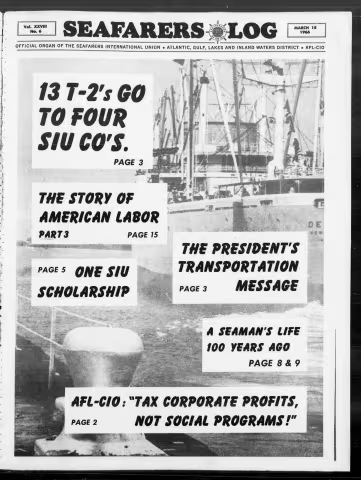
13 T-2's 60
TO foun
p- SIU ws.
me STOHY OF
AMFRtCAN LABOR
PARTS PAGE IS
** ' ' ' r ' ' ' "" ^ kMMMapm
kifai
!«S
S'l
feffii
PAGES onesm
SCHOLARSHIP
-i /••••' fe'.S5S
A-yT-:X,'v:--
'-i-
me PResioeHT's
TRAHSPORTATIOH
PAGE 3 MessAoe
p
-.H.Vr
ISi
' ' >^'1'',
A S€AMAM'S UFC
too YEARS A60
PAGE S&9
AFL-CIO: "m CORPORATE PROFITS,
PAGE 2 MOT SOCIAL PROGRAMS!"
. - -
Page Two SEAFARERS LOG March 18, 1966
t 1
; i
' si
J
Opposes Cutbacks in Great Society
AFL-CIO Urges Corporate Tax Hike
To Meet Increased Defense Needs
BAL HARBOUR, Fla.—The AFL- CIO called for an increase in corporate taxes to meet any fu
ture rise in military expenditures for Viet Nam rather than a cutback or freezing of Great Society
programs.
The federation's Executive
Council said ending the 7 per
cent tax credit and/or an ex
cess profits tax or a hike in the
corporate tax rate would be sound
economic policy as well as eco
nomic justice.
"The cost of the Viet Nam war
should not be absorbed by cut
ting back or freezing current lev
els of federal expenditures or
stunting the promised growth of
essential programs," the council
declared in a statement on the na
tional economy. It stressed that
"the poor should not be com
pelled to bear the major burden
of the conflict. . . ."
In a companion statement on
wage guidelines, the council as
sailed the policies of the Council
of Economic Advisers, terming
them efforts to "shortchange
workers." The guidepost policy
and the 3.2 percent figure for
wage increases, the council said,
impose "the burden of the price
level on wage and salary earners,
who do not set prices, while there
is no effective guideline for prices
and no guidelines at all for profits
and dividends."
The CEA, it added "has clearly
violated any standard of equity."
The council's economic policy
statements and resolutions on in
ternational affairs highlighted the
final sessions of the mid-winter
meeting here at the Americana
Hotel. Earlier the council mapped
a stepped-up drive in 1966 to in
crease the number of liberals in
the House and Senate as the
AFL-CIO's major objective, and
spelled out positions on repeal of
Section 14(b) of the Taft-Hartley
the Communist threat to peace
Act, minimum wage legislation
and civil rights.
International Affairs
On international affairs, the
council:
• Called for prompt and fav
orable action on the President's
foreign aid request for $3.4 bil
lion and praised hi."; "new empha
sis" on health, education and food
production and planning the pro
gram over a five-year period.
• Urged hearings by the Sen
ate Foreign Relations Committee
on the operations of the recent
Tri-Continental Conference
among Communist elements in
Havana so that constructive meas
ures can be drawn "for defeating
and freedom in the Western
Hemisphere."
ALBANY, N. Y.—Some 4,000 New York longshoremen, Sea
farers and other maritime and allied craft workers, staged a rally
at the state capitol here March 15 calling for legislation to "democ
ratize" the Bi-State Waterfront^
Compact, the law that governs
the hiring and conditions of
dock workers.
The rally was held under the
auspices of the International
Longshoremen's Association New
York District Council and the
Maritime Port Council of Greater
New York Harbor, with which
the ILA and other AFL-CIO un
ions are affiliated.
SIU President Paul Hall ad
dressed the rally and urged the
defeat of Governor Rockefeller
for his support of bills that in
crease the Waterfront Commis
sion's control over hiring prac
tices. A similar stand was taken
by ILA President Teddy Gleason.
The rally was also addressed
by Ray Corbett, president of the
New York State Federation of
Labor, and a number of state
legislators from both Democratic
and Republican parties.
A week earlier, at its second an
nual legislative council, the Port
Council, headed by ILA Vice-
President Anthony Scotto, adopted
its 1966 state legislative program.
The Council, which represents
more than 400,000 maritime and
allied craft workers belonging to
147 local unions in New York and
New Jersey, will press for passage
of a range of bills affecting work
ers of affiliated unions and work
ers generally, and will oppose bills
it holds are harmful to worker's
welfare and to the community.
Among the bills which will re
ceive priority in the Council's
campaign for this year are those
that would:
• Set a $2.00-hourly minimum
wage throughout the state;
• Amend the Waterfront
Commission Act;
• Abolish lie detector tests in
industry;
• Improve welfare benefits of
fire fighters.
fort Hoskm Arrives m hdia with fmrgmKy Wheat
BOMBAY—^The SlU-maimed Cities Service tanker Fort Hoskins steamed into Bombay recent
ly, carrying as its cargo the fibrst shipload of the 1.5 million ton emergency American wheat supply
to be shipped tmder P.L, 480.
At doclaide ceremonies, Fi
nance Minister S. K. Wankhede
thanked die United States and
the crew of the Fort Hoskins on
behalf of the people of India for
the timely aid in accelerating food
shipments to meet the shcHrtage
now prevalent in the country.
The minister noted that India
•was experiencing the worst-
drought of the :l^t 50 years, with
• six states in the country suffering ;
f*om famine, "It is in this back
ground," he saidi "at a time when
we are, in trouble, that the peoplo
of the United States have come
forward to help us."
The SlU-contracted tanker ar
rived with 23,368 tons of wheat.
She was the first of a fleet sched
uled to arrive here vyith food
grains until the end of March,
The U.S. Consul-General, Mil
ton C. Rewinkel, said in the dock-
side ceremony that the consign
ment brought by the Fort Hoskins
reiM-esented the harvest of 33,000
acr« 6f American wheatland.
This and the other shipments of
lU.iS. food grains that would fol-
plpw, "is tangible evidence of
f jAnferica's enduring friendship for
pockside ceremohy in Bdinbay m arrival of SjU-contraetr?^^^; ̂
Hoskins With firsf of emergenfcy wheat supplies,
India and concern for the welfare
of the common man of this demo^'
cratic nation."
The presentation was witnessed
by a large audience, including fop
officials of the Union Ministry of
Transport, the Bombay Port Trust
shipping company officials, crev
members and dockside workers.
Rewinkel said that the presen
shipment of v>rheat would sufil
cient for the needs of the popula
tipn of Bombay fot three weeks a
: the,., current quota. ?
17
Report of
Internationa^l President
by Paul Hall
The U. S. unemployment rate last month dropped to 3.7 percent,
the lowest figure since November 1963. It was also the first time in
nine years that the jobless rate dropped below 4 percent.
This continuing decline in the jobless rate is encouraging, but should
not lead to a false complacency. There are still over 3 million Ameri
can workers who cannot find jobs. In addition, the 3.7 percent figure
is an average. Within certain groups of our society the rate of jobless
ness is much higher. The unemployment rate for non-white workers,
for instance, remains at 7 percent, with one out of every 14 Negro
workers unable to find a job. Among teenagers the jobless rate stands
at 10.9 percent. In addition, the unemployment rate in many eco
nomically depressed areas of the U. S. remains much higher than the
national average would indicate.
The overall decline in U. S. joblessness stems in part from the na
tion's continuing economic growth. The vigor of this economic ex
pansion—which has been going on for the past five years—can be
noted from the fact that the jobless rate dropped in February, which
is a month in which unemployment traditionally increases.
Not all of the continuing drop in the jobless rate can be attributed
to the nation's economic growth however. Much of the improvement
has come about through social welfare programs initiated by the Ad
ministration through its priority welfare programs—such as manpower
retraining, aid to education, anti-poverty programs, and others. These
are programs designed to revitalize entire depressed areas of our econ
omy, break the cycle of poverty and ignorance in which too many
Americans have been caught, and return these millions of Americans
to productive, rewarding roles in our society.
This is only one reason why it is imperative that no cutbacks are
made in these Great Society programs. They have helped thousands
of Americans acquire the skills and knowledge to find gainful and
productive employment. In addition these programs serve as a spur
to the economy by creating increased needs for goods and services
which leads to further economic expansion and fuller employment.
Instead of talking about cutbacks in Great Society programs, plans
should he undertaken to expand them to encompass even more eco
nomically depressed citizens. There is a moral, social and economic
obligation to help these Americans reach a fuller utilization of their
potential—for their own betterment and for the betterment of the
entire nation.
* Of *
There are many magazines and other publications which come into
millions of American homes under the guise of carrying factual, un
biased reporting of events of national interest. Many of these publica
tions do their best to maintain high standards of accuracy and, when
an error in reporting is pointed out, are quick to acknowledge it and
print a correction. Some publications however do not maintain these
high ethical standards, either in factual reporting or in correcting an
obvious mistake or blatant misrepresentation.
One of the worst offenders of this type with regards to the American
labor movement is the Reader's Digest, which has a long history of
printing outright falsehoods and half truths in its regular attacks on
the American trade-union movement and on Federal programs aimed
at improving the condition of the underprivileged. In the latest ex
ample of such anti-labor bias, the Digest compounded an "error" first
printed in the pro-business magazine U. S. News & World Report.
The original article in U. S. News indicated that under the 1965
basic steel contract, a steelworker would average $10,000 a year. The
Steelworkers' union pointed out the error to U. S. News and sought a
correction, making it clear that even when the wage provisions of the
new contract became fully elective in 1968, workers in basic steel
would average less than $7,000—based on 2,000 hours of work year
ly—and that not all steelworkers are able to work as much as 2,000
hours yearly. In spite of authoritative documentation of the true facts
supplied by the Steelworkers, U. S. News refused to print a correction
or allow the Steelworkers a rebuttal.
When the Reader's Digest decided to reprint the U. S. News article,
a Digest researcher contacted the USWA Research Department to verify
the facts. The USWA pointed out the errors in the original article,
provided the true statistics and documented them. In spite of this the
Digest reprint gave the original incorrect $10,000 figure and, as always,
refused to print a correction or rebuttal and refused even to discuss
the matter further. The Digest had spoken and the truth be damned.-
7
Sea Unions Draft Manning Poficy
WASHINGTON—AFL-CIO President George Meany met with
the heads of six of the Federation's affiliated maritime unions to dis
cuss policy in regard to manning scales on automated merchant
ships. The meeting was held at ^
the AFL-CIO building March 9.
After a day-long meeting Presi
dent Meany appointed a drafting
committee, which began working
the next day, to put labor's views
into language. He said that as
soon as the draft of the union's
proposal was completed he would
call another meeting of the six
unidh officers.
Attending the meeting with
President Meany were Paul Hall,
president of the Seafarers Inter
national Union of North America,
Joseph Curran, president of the
National Maritime Union, Jesse
Calhoon, president of the Marine
Engineers Beneficial Association,
Joseph Curran, president of the
National Maritime Union, Lloyd
Sheldon, president of the Masters,
Mates and Pilots Association, Jo
seph Glynn, secretary-treasurer of
the Radio Officers Union, and Wil
liam Steinberg, president of the
American, Radio Association.
March 18, 1966 SEAFARERS LOG Page Three
fwnier been
l&ted to four SlU-coiiifacted ste^imldp corapanies'
tie U. S. Maritime Administi^tion, ^C'Vessels wi0 bd 1
:<^erted into dry cargo and container :dd^> tonnagei^
d; be nsed in domestic and fbtei^ ;servjce,
' The companies and the number of vessels allocated
3-e^h wtK Waterman Steamship Corporation, thi-ee;
Hudson Waterways Corporation, seven; Seatand Serv
ice, Inc., two; and Transwestern Associates, one.
The sWi)s are bemg^made stedmsbip
epmpanies under the terrhs of public Law 89-254 which
was passed last October authoriziiif the Cf^ to
"trade out" tankers for conversion into dry cargo ships
or fpr operation on the Great Lakes. , ; .
The measure represented an extension until 1970 of
^^n earlier vessel exchange desigr^d td;;
aid; unsubsidiijed ship line.? to Improve and upgrade
ibetf fleet. Under the provisions of the law, the Govern-.
ment trades ddl^esdels superior to,M^ #M ^
; d?d®d ^n cr turned in for credit i?^
Waterman Steamship Cotnpariy, the only one of the
••^companies presently rm in fdieipi ttadd Im ad
vised the Federal ship agencf that it plans to use its
three ships to replace smaller/
The larger T-2 rankers have a liquidk bulk. cargo
. capacity of 16,350 tons and a speed of 16.2 knots,
while a C-2 type can carry only 9,200 tons of cargo at
a speed of 15.5 knots.
Sea-I/ahd told the a that it planhed to convert ;
Its two vessels into containersbips; tp be used in the ;
• company's Alaska service. The conversion will cost an.
estimated $4 million to 55 miUion per Ship, and thd'';
vessels will be capable ttansporting 325 containers of
35-foot length, '"/-f"
The other two companies, HudsbprWaterways and
Transwestern,' which are affiliated, declared that they
intend to convert their Vessels into container shif
an estimated cost of $1.7 million per vessel. After i
work is completed/ the ships are to be cbartere#
Seatrains Lines, another afflliato, for use in that
V domestic services cm the coastwise and Puerto 1^
runs.
Although the law made 25 tankers.^13 with lO.^
horsepovvef diesefelectric power plants and 12
7,500 hor^owtd machinety-^--uyaii^^ to private
afops, no bids for the lower-powered ships were recCiyi
The Maritime Administration said that the allocatii
the tankers was based on maximurn utilization-
upgrading. The type of conversion, the future
routes of the vessels and ffie extent to yVhich the domi^l
tic fleet would be benefitted were tdso factors govi
the allocation.
All 13 ships which the cctfnpanies will take ov«r i
presently laid up in Gqveramept Reserye
AFL-CIO Council Backs
LBJ's Viet Nam Policy
BAL HARBOUR, Fla.—The AFL-CIO Executive Council "un-
Johnson's policy of combatting
Viet Nam while continuing "an
reservedly" endorsed President
Communist aggression in South
active search for peace and
freedom through negotiations."
The council in a statement
on the Viet Nam situation said it
"completely rejects all insinua
tions and assertions" that the U.S.
has been or is now opposed to
free elections in Viet Nam.
The Communists in Viet Nam,
the council stressed, opposed free
elections in 1954 "as they do
now," proposing instead "all sorts
of prefabricated committees and
so-called united front groups."
The council asserted that the
objective is to defeat aggression in
South Viet Nam "and to prepare
the ground for the holding of free
elections which will enable the
South Vietnamese people to estab
lish a government of their own
free choice."
It "heartily" welcomed the deci
sion by President Johnson to carry
out an extensive program of social
and economic reform in South
Viet Nam and strongly urged that
the "advice, assistance and partici
pation" of the Vietnamese Con
federation of Labor (CVT) "he
secured in carrying out" the pro
gram outlined at the recent Hon
olulu conference of the American
and South Vietnamese govern
ments.
The council noted that every
thing that has happened in the
Viet Nam crisis since the AFL-
CIO convention in December
1965 confirms the correctness of
the federation's position. The
statement cited the U-S. efforts to
secure an honorable settlement
and the rejection by the Commu
nist governments of President
Johnson's efforts.
AFL-CIO President George
Meany, at a press conference,
noted that elections in Viet Nam
could not be free if there were
pre-conditions set up by outside
forces. In reply to a question as
to "escalation" of the war in Viet
Nam, he said, "When you're in a
fight, ^ou fight as hard as neces
sary." He noted that if bombing
the supply lines of Viet Cong is
escalation, it is something we must
do in terms of protecting the lives
of American troops and making
easier their job of defeating ag
gression.
£^ves 5 Ciihan licapees
SAN JUAN, P. R.—The SlU-contracted New Yorker was re
sponsible for saving the lives of five Cuban refugees who had
drifted helplessly at sea when their disabled escape boat broke
down shortly after they had fled
the island under cover of night.
The rescue took place about
10 miles off Key Santo Do
mingo, near Cuba; and refer
ring to the New Yorker and its
crew, a spokesman for the Cuban
group said, "That ship was our
salvation. We could not have
lasted for another two hours."
The young man's name, as
well as those of his four com
panions, are being withheld be
cause the five said they feared
reprisals against their families
due to their escape.
"Also," the spokesman said,
"we were seasick, tired and hun
gry. The New Yorker crew has
been very kind to us, please let
that be known."
The young man explained that
he hid for three days in the sugar
fields of Oriente Province in Cuba
before hoarding the escape boat.
He said that the farmers working
in the area brought him food and
water during the time he was in
hiding.
Dissatisfied With Castro
All of the refugees were unani
mous in their dissatisfaction with
the Castro regime. Another of the
group, who said he was a con
struction worker in Cuba, claimed
that his 300 pesos a month sal
ary was "not even enough to pay
for food."
A desperate father, attempting
to free his son from service in
Castro's army, engineered the es
cape and finally persuaded the
three others to join them.
Would Lump MAKAD, 10 Other Units in One Department
President Seeks New Cabinet Post
To Consoiidate Transport Agencies
WASHINGTON—President Johnson has asked the Congress to establish a Department of
Transportation which would consolidate the functions of 11 Federal units, including the Mari
time Administration.
The request for the new cab-
inet-level department was con
tained in the President's trans
portation message released on
March 2. The message said noth
ing that would indicate a new
maritime policy. The emphasis
in the special message was focused
on traffic safety, including a call
for a $725-million, six-year high
way safety program with the
establishment of Federal safety
standards for new cars and trucks.
In calling upon the Congress to
"coordinate the executive func
tions of our transportation agen
cies" in a single instrument, the
President recommended creation
of a department that would he
fifth largest in the cabinet with
nearly 100,000 employees and an
nual expenditures of about $6
billion.
Essentially, the functions that
would be consolidated under the
President's recommendations were
those of transportation, promo
tion, investment and safety. The
functions of rate setting and eco
nomic regulation now performed
by the Interstate Commerce Com
mission and the Civil Aeronautics
Board would remain where they
are.
Includes Public Roads
In addition to the Maritime Ad
ministration, the proposed Trans
portation Department would in
clude in their entirety the Federal
Aviation Agency, the Coast Guard,
the Bureau of Public Roads, and
the Office of the Undersecretary
for Transportation.
Although the subsidy functions
of the Maritime Administration
would be transferred to the new
department, those of the Civil
Aeronautics Board would not.
At a press briefing on the trans
portation message, special presi
dential assistant Joseph Califano,
replied to a question concerning
the possibility of a new maritime
policy, that the President has he-
ILA's Gleason Honored In New Orleans
Teddy Gleason, president of the International Longshoremen's Asso
ciation (center), is presented with key to City of New Orleans and
certificate of honorary membership by SlU Vice-President Lindsey
Williams (left), acting in behalf of Mayor Victor Schiro. ILA Vice-
President Clarence Henry looks on. Presentation took place at New
Orleans SlU hall. Gleason was in the Crescent City to confer on
boycott of ships trading with North Viet ham.
fore him the reports of his Mari
time Advisory Committee and the
Interagency Maritime Task Force.
Noting that these two reports dif
fered widely and that they had
been submitted only early this
year, Califano said the President
has not yet had time to devote to
the problem he feels it deserves.
He said that it has taken two years
to develop the Department of
Transportation program.
The chairman of the House
Merchant Marine Committee,
Congressman Edward Garmatz,
said that "references to the Mer
chant Marine and its problem in
the transportation message were
disappointingly meager."
The Committee Chairman said
that it is his intention "to give the
entire subject the most careful and
constructive attention."
The AFL-CIO Maritime Trades
Department noted that the Presi
dent's transportation message con
tained "no shred of a new na
tional maritime policy." The Sea
farers International Union has the
message and its program under
study.
Ntorch IS, 19M Vi»i. XXVUL 1^ .
- Oadal i>t Uis SIONA
Xtlantli!, Gulf,' & Inland Waters
- Distriet, AFL-CIO
Bxettuiht Board
PAUI, HAUL. Praiidcst
CAI. TANNED E'AJU- SHSfAJu)
Srr,e. Vieo-Pret, Vite-Preaident
At. KERB X,]]«OSEY W}U.!AM«
I Sitc.-'TTraM. Viee-Praaaimt
Direttor of OrtfanMnff and
PaHicaiiona
NATHAN SKYEk Staff Writ^ra
MEtviN PURVIS
• WlK-MAM OAY
E&VVIN F. FRANCIS
td WuMkly at, KtQ Made Idsind Awaw
atm Dhtritt. Art-CW. 675 FM»1*
teaaUia. «.*. 11232. Tel. -- - •
$«te«d tli» n^aie
'OSIKASTER'S ATTEXTiaSr F«f«
Page Four SEAFARERS LOG March 18, 1966
\
6 More Seafarer OUtimers Added
To SlU Roster of Union Pensioners
The Atlantic Coast
Oxinio Dedicatoria Grahne Gladden Simpson Murphy
Six more SIU members have been added to the growing list of retired members who receive a pen
sion check of $150 every month.
The members who have been added to the retirement rolls are: Calixto Oxinio, Julian Dedica
toria, Gunnar Grahne, Paul ^
Gladden, Sr., John Simpson and
William Murphy, Jr.
Oxinio joined the SIU in the
port of Philadelphia and sailed
as a chief cook in the steward
department. He is a native of the
The Gulf Coast
by Lindsey Williams, Vice-President, Gull Area
Tulane University's 17th annual Institute on Foreign Transporta
tion and Port Operations will be held March 21-25 on the Tulane
campus featuring discussions of all phases of foreign and domestic
shipping by land, sea and air. The principal highlight of the five-day
conference will be a special program on "The American Merchant
Marine" to be held March 25, at
the University Center, site of the
1966 institute.
Speakers will be Nicholas John
son, maritime administrator of
the U. S. Department of Com
merce; Mrs. Helen Delich Bent-
ley, maritime editor of the Balti
more Sun; Paul Hall, president
of the Seafarers International Un
ion of North America and presi
dent of the AFL-CIO Maritime
Trades Department; and Captain
John W. Clark, president of Delta
Steamship Lines.
The Texas AFL-CIO held its
COPE convention in conjunction
with the Arkansas, Louisiana,
Mississippi and Texas area COPE
Conference in Houston March 3-
5. There were 685 delegates from
Texas, in addition to several hun-
dvwd from Arkansas, Louisiana
and Mississippi.
SIU Port Agents Paul Drozak
of Houston and Buck Stephens of
New Orleans were among the
SIU delegates in attendance.
One of the highlights of the
Conference was a question and
answer period aimed at Senator
Ralph Yarborough of Texas and
Representative Henry B. Gon
zalez of Texas. Yarborough and
Gonzalez pledged their support to
labor's fight for an increase in
minimum wages and its coverage
and the repeal of 14(b) of the
Taft-Hartley Act.
HOUSTON
R. L. Couper, who is just off
the Bethflor where he served in
the deck department, is back
around the hall. He says he's
found a home there and drops
by to chat with his buddies every
time he gets into port. R. Allen
has been on the beach since he
got off the Globe Explorer and
is enjoying being with his family.
Brother Allen, a member of the
deck department says he will soon
be ready for a long trip on any
Hudson Waterways ship. J. P.
Lamb of the stewards department,
who is now on the beach, is an
other one of those excellent cooks
receiving a vote of thanks from
his fellow Seafarers aboard the
Chilore.
Tank
NEW ORLEANS
After being on the Del Mar for
six months, Pete Valentine got off
to work on his camp on Lake
Pontchartrain, repairing damages
done by Hurricane Betsy so it
would be in shape for the sum
mer. Brother Valentine served in
the deck department aboard the
Del Mar and reports that she was
a good ship. Also on the beach
after two trips on the same ship
is Boatswain Jack Procell. Jack
says he will stay on the beach
awhile and help Pete work on his
camp. Just off the Del Norte
where he served
as FWT, William
Tank is on the
beach waiting for
another Delta
Line ship and
would prefer the
Del Oro or one
of the newer
freighters. Wil
liam Evitt, who
got off the Madaket due to ill
ness, is now ready for the first
electrician's slot to hit the board.
He prefers a run to Viet Nam.
MOBILE
Shipping has been fairly good
around the Mobile area with one
ship laid up and the Roswell Vic
tory due to crew up in a couple
of weeks.
James V. McClantoc, who is
currently regis
tered in group
one of the deck
department, has
been shipping
out for the past
two years as bo
sun and is now
on the beach. He
had to get off
when the ship
was sold. Sago C. Hanks, a mem
ber of the engine department, is
just off the Brigham Victory on
a trip to Saigon and Manila. He
and his wife make their home in
Pensacola, Florida. Alonzo W.
Morris is now registered in group
one of the steward department
after getting off the Alcoa Mar
keteer on a voyage to East Asia.
Philippines and currently makes
his home in Philadelphia. He last
saw service on the Independent
Towing Co. tug, Jupiter.
Julian Dedicatoria is also a na
tive of the Philippines and makes
his home in Philadelphia where
he lives with his wife. Dedica
toria sailed in the steward de
partment. His last vessel was the
SlU-contracted ship Commander.
Gunnar Grahne is a native of
Finland and joined the SIU in
New York. He now makes his
home in Brooklyn with his wife
and last saw service on the Sea-
train Georgia where he sailed as
bosun.
Tampa is now the home of
Paul Gladden, Sr. who last saw
service on the SIU ship Our Lady
of Peace. He is a native of Ten
nessee who first joined the Union
in Mobile. Gladden was with the
deck department during his stay
with the SIU.
John Simpson joined the SIU
in Norfolk, Va. and sailed with
the Union in the deck department.
He is a native Virginian who is
currently living in Elkton, Mary
land. His last ship was the Del
Norte.
William Murphy first came
into the SIU in New York. He
is currently living in Philadelphia
with his wife, Josefa. V/hile with
the SIU, Murphy sailed in the
steward department. His last ship
was the Venore.
4
Bergeria
by Earl (Bull) Shepard, Vice-President, Atlantic Coast Area
It's gratifying to know Seafarers are solidly behind the AFL-CIO
Maritime Trades Department in their decision to support a boycott
against ships of nations permitting trade with North Viet Nam. Plans
for the boycott were announced earlier, by the SIU, ILA and the NMU.
Shipping has been active in the port of New York over the past few
weeks. Willie Wung was around
the New York Hall recently look
ing for an Isthmian ship. I also
saw Manuel Rial up in the ship
ping hall and he says that he's
ready to ship out right away.
Also ready to go are Bosun
Joe Wagner and H. Schultz who
sails or oiler.
Norfolk
Stephen Arales had to get off
the Maiden Victory because of a
death in the family. He'll be
shipping out as soon as the nec
essary arrangements are made.
Also off the Victory is Robert
Wroton. He's on the beach hunt
ing up a buyer for his trailer.
Old timer Wroton will be looking
for another fireman's job.
Sylvester Walsh whose last ves
sel was the Duval is getting a little
rest. Sylvester says that after be
ing on a ship for a while a man
needs a little rest. If the Duval
sticks in port a few days, he says,
he may get back on because this
"is a very good liberty ship."
Boston
Things have really picked up
in Boston and look pretty good
for the next pe
riod. The Maiden
Victory was re
cently in port and
signed or and paid
off.
John Chermeso,
a 23 year SIU
veteran says he
was real sorry to
see his last ship, the Seamar, lay
up because it was a "Floating
Hotel."
Six months in the Far East
have convinced Francis Donovan
it's time to spend some time, with
his family and that's what the
25 year SIU veteran is doing sir.'..e
he got off the Robin Trent.
An oldtimer who's just out of
Chermeso
dry dock and ready to go is Wil
liam Wildridge. Bill's last ship
was the Steel Navigator and he's
now ready to grab the first job to
hit the board.
Philadelphia
James D. Bergeria is fit for
duty and ready to go after being
in drydock for a
while. Jim last
sailed on the Mer-
rimac.
When John
"Champ" Matow-
ski is on the beach
he really knows
where to go. The
Champ has just
returned from getting some sun
in Florida and now he's ready
to ship out again.
James Winters is another old-
timer ready to ship out again.
Brother Winters has 18 years in
the Union and his last ship was
the Venore.
Wilh'am Milliso is another Sea
farer off the Venore. He sails as
Bosun but was laid up for a while.
Now Bill's fit for duty and is
spending a lot of time around the
hall looking for a good ship and
a long trip.
PUERTO RICO
There may be an increase in
ship trade between Boston and
Puerto Rico in the next few years
if talks between the Puerto Rican
Trade Authority, the Mass. Port
Authority, the World Trade Cen
ter and the officials of Sea Land
work out. They have been meet
ing in San Juan in the last week.
San Juan bus drivers got the
raise they deserve at the last mo
ment to avoid a strike. The new
agreement gives the men a lO^f
an hour raise at once, and an
other 8#f over the next two years.
HARIWJUR, reasserted its support of the right of state anc
pocaJ government employes to organize unions and engage in collective bargaining and stressed the
Jdeveloping need for effective mediation and fact-finding procedures.
I The Executive Council re- ^
jaflfirmed its long-held belief that
|"the realistic vehicle for state
|and local government labor-man-
|agement relations is "collective
|bargarnirig.'' it warned that re
pressive legislation prevents lea-
lonable negotiation and blocks
the bargaining process.
Noting the growth of orgaiuza-
tion among .state and local gov
ernment Workers, the cohhcil said
that the growth also of legisla
tion recognizing the right of
workers to organize and bargain
"underlines the need for impar
tial mediation facilities, contract
enforcement and methods of
avoiding work stoppages,"
AFL-CIO President George
told a press conference
that the problems of. governracnt
to "tranquil relations" for public
employes is through realistic and
effective mediation and fact-find
ing, , . . •'
He said it would be a "bad
idea" for Congress to legislate in
terms of labor relations on the
state and local government level,
that it would be "reaching far
down" for the federal government
to become involved at that level.
He called for outright repeal of
New York State's Condon-Wadlin
Act, which imposes severe penal
ties on public workers who en
gage in strikes.
Grilthe ^general proposition of
; the right of public employes to
strike, Meany said it would be
"wise" to limit this right in terms
of firemen and law-enforcement
officials, ppintih^^c^f :that the con-
. stitution of the Fire Fighters pro-
Meany noted that the execu
tive order setting up union rec
ognition and other procedures in
the federal government was an
important step in the "right direc
tion" and urged cities and states
tp follow the same general ap
proach.
The council statement
that "there is substantial evidence
that such methods as unilatera
appeals procedures and compul
sory aroitration do not solve legi
timate grievances of the affectec
Workers and add to the frustra
tipns of both management anc
labor,"
In addition to effective media
tion and fact-finding, the counci
Mfiged • the use of impartial panels
with authority to make recom
mendations for a settlement in
handling dtsputes^lnvolyt
</<>,« • ' i,> * ., ,'
'
( \
t
i
. r
. I
- f
• i
i
March 18, 1966 SEAFARERS LOG Page Five
Seafarer Howell congratulates son, Lem-
bhard-, at college graduation in 1958
(photo left). Flanked by mother and
father, Lem poses with family after get
ting degree at Lafayette (photo right).
SlU
SCHOLARSHIP
i
: 'Ciii-'i
Seafarer Howell retired on SlU pen
sion In 1965 but visits Union often.
Outstanding in high school, Howell
won $6,000 SlU Scholarship in 1955.
. Howell was commissioned an' en
sign in USNR after his graduation.
Since 1953, when the first of the five annual 4-
year, $6,000 SIU Scholarships were awarded,
63 such awards have been granted. Forty of the
scholarships have gone to the children of SIU mem
bers, 23 have been awarded to Seafarers. SIU
Scholarship winners who have graduated thus far
have entered virtually every field, including medi
cine, law, teaching, nursing, engineering and gov
ernment.
Lembhard Howell, the son of SIU member Cleve
land Alexander Howell, was one of the scholarship
winners in 1955. Today, a little more than 10 years
later, he is an Assistant Attorney General in the
State of Washington, a post to which he was re
cently appointed. And last month he was elected
president of the Washington State Young Democrats.
Seafarer Howell, who retired on an SIU pension
in October 1965, points with justifiable pride to his
son's continuing achievements since his days in New
York's Charles Evans Hughes High School. Young
Howell, who was born in 1935 in Jamaica, British
West Indies, was president of the high school's Gen
eral Organization. He served on the staff of the stu
dent newspaper and was a contributor to the Mathe
matics and the Science Department publications. At
graduation in 1954 he won the Dooley Gold Medal,
the school's highest award, given for character and
scholastic achievement. He also received the Horton
Memorial Award for excellence in science, and three
other citations.
Young Howell used his SIU Scholarship to at
tend Lafayette College in Easton, Pa., where he con
sistently made the Dean's Honor List. He completed
the four-year course in three years, graduating cum
laude (with honors) with a Bachelor of Arts degree
in history.
On graduation from college, Lem Howell was
commissioned as an Ensign in the U. S. Naval Re
serve in which rank he served as operations officer
and navigator aboard the USS General Randall, a
TAP-115, which operated out of the Brooklyn Army
Base between New York and Bremerhaven, Ger
many. Later he was assigned to the Commandant's
Staff of the First Naval District, with headquarters
in Boston.
While on the Commandant's staff, Howell busied
himself at night by attending first the Suffolk Law
School, then the Boston College Law School.
When he had completed his active duty, Lem
Howell again ttlrned to the pursuit of his studies
full time. He returned to New York where he at
tended the New York University School of Law un
der the SIU Scholarship Program. He obtained his
law degree, then was admitted to the bar in July
1964.
The scholarly son of Seafarer Howell was ready
to step out and apply himself. Under a Ford Foun
dation grant from the National Center for Educa
tion in Politics he went to the State of Washington
where ultimately his career in government and poli
tics was to be launched. He served on the staff of
the then Governor of the State of Washington, Al
bert Rosellini, law clerked for pro-tem judges of the
State Supreme Court, and worked in the State High
way Department. Then Howell's appointment as an
assistant to the State's Attorney General and his
election as head of the Young Democrats.
Lem Howell makes his home in Olympia, the
state capital, with his wife Marjorie and their two
daughters, Helen, 4, and Elizabeth, 8 months. He
keeps in close touch with his dad and mother, Wil-
helmine, who lives in New York. His brother,
Grover, is a detective in the New York City police
department.
In one of his frequent visits to the Union hall in
Brooklyn the other day. Seafarer Howell spoke
pridefully of Lem's accomplishments, "He knows
the importance of unions, too," he said. "And I
taught him about the SIU."
Brother Howell is very proud of his son. The
SIU is, too.
JJI^INNERS of the SIU Scholarships who will
rr begin college in September 1966, will be an
nounced in May. Selections are made by the SIU
Scholarship College Advisory 'Committee on the ba
sis of the applicants' high school records and Col
lege Entrance Examination Board test results.
The College Advisory Committee is composed of
Edna M. New by. Assistant Dean, Douglas College
for Women of Rutgers University; Elwood C. Kast-
ner. Dean of Registration, New York University;
E. D. Wilkinson, Research Associate, Howard Uni
versity; Bernard Ireland, College Entrance Exami
nation Board; Charles E. O'Connell, Director of Ad
missions, University of Chicago, and Richard Keefe,
Director of Admissions, St. Louis University.
SIU Scholarships are open to qualified Seafarers
who have a minimum of three years of seatime on
SIU-contracted ships, and to children of Seafarers
whose fathers meet the same seatime requirement.
A t least one award is reserved for a Seafarer.
Scholarship winners may attend the college of
their choice for study in any field.
Page Six SEAFARERS LOG March 18, 1966
Lifeboat Class No. 146 Graduates
Question: How much gear do
you take with you when you go
out to sea?
Earl Williams: I usually take
about four pairs of dress slacks
and four dress
shirts. For work
clothes, I prefer
a good pair of
work shoes and
the whites I wear
in the steward de
partment. Since
the Seafarers Log
library provides
me with plenty of books the only
reading material I take are some
magazines.
—
Ben Suderland: I take two bags.
In the small one I carry my work
clothes, which
consist of three
work pants, four
T-shirts and a
couple of sweat
shirts. In the
other bag I usu
ally carry a flash
light, one suit, top
coat, five dress
shirts and about three pairs of
dress pants. I don't take anything
else because most of it is usually
a burden.
Steve Wolfrowski: I only tajfe
one pair of work clothes and one
pair of dress
clothes. When I
am on the coast
runs I always
take a radio. I
don't have to take
any reading with
me because we
have a Seafarers
Log library on
each ship. Sometimes I take a ra
dio which I find to be one of the
best ways to pass the time of day.
Robert Roedel: I always take
about one change of work clothes.
If I am going to
the Near Eastior
some place like
that I usually
don't take much
in the way of
dress clothes. On
my European
trips, however, I
always carry
about two suits because I really
like shore leave in those countries.
—
p. G. Wingfield: I take every
thing I own. For winter gear I
have a parka,
three changes of
work clothes and
two pairs of work
shoes. For sum
mer gear I have
shorts, T-shirts
and a light rain
coat. In the dress
department I pre
fer two sport coats, three slacks
and a real good topcoat. I always
take a radio with me.
IPISPATCHEBS REPORT
February 26 to Morch II, 1966
DECK DEPARTMENT
LIFEBOAT CLASS
GBAJDUATdA/G
PBS. e.
Assembled for graduation picture after successfully completing life
boat training course at the Harry Lundeberg School of Seamanship
is SlU Lifeboat Class No. 146. Included in the latest group of lifeboat
ticketholders are (bottom row, l-r): James Elliot, Sy Satelli, Earl Chick,
Mike Dunn and (kneeling) Ron Dernbach. Back row (l-r): Winston
Baker, Richard Gallant, Warren Schoenhals and instructor Ami
Bjornsson.
TOTAL REGISTERED TOTAL SHIPPED NOW ON THE BEACH
All Groups All Groups All Groups
Port Class A Class B Class A Class B Class C Class A Class B
Boston 11 2 5 3 2 14 1
New York 55 25 54 26 13 185 54
Philadelphia 10 6 9 13 1 35 11
Baltimore 31 13 24 18 2 89 49
Norfolk 17 12 11 11 6 25 18
Jacksonville ...... 5 4 8 4 0 13 12
Tampa 7 3 3 3 3 11 8
Mobile 18 12 16 6 0 73 28
New Orleans 32 17 31 11 1 133 85
Houston ...; 32 25 36 41 16 132 60
Wilmington 23 6 9 5 11 36 0
San Francisco 41 14 28 19 22 66 20
Seattle 13 13 16 7 5 32 21
Totals 295 152 250 167 82 844 367
ENGINE DEPARTMENT
TOTAL REGISTERED TOTAL SHIPPED NOW ON THE BEACH
All Groups All Groups All Groups
Port Class A Class B Class A Class B Class C Class A Class B
Boston ...'. 5 3 4 3 0 9 2
New York 57 19 29 24 19 139 54
Philadelphia 6 7 7 7 3 23 17
Baltimore 25 11 15 11 2 56 32
Norfolk 10 9 3 5 3 18 17
Jacksonville 5 5 5 4 3 9 11
Tampa 4 1 2 2 2 7 3
Mobile 8 17 16 11 0 37 23
New Orleans 21 25 23 17 5 95 85
Houston 22 26 32 40 8 90 79
Wilmington 16 3 10 6 12 10 0
San Francisco 26 17 26 13 24 53 17
Seattle 13 13 10 11 16 21 8
Tot*"'"! 218 156 182 154 97 567 348
STEWARD DEPARTMENT
TOTAL REGISTERED TOTAL SHIPPED NOW ON THE BEACH
All Groups All Groups All Groups
Port Class A Class B Class A Class B Class C Class A Class B
Boston 0 3 6 3 0 2 2
New York 28 9 37 9 5 125 21
Philadelphia 4 3 5 7 3 25 4
Baltimore 17 18 11 13 6 42 30
Norfolk 11 9 6 6 0 14 14
Jacksonville 4 6 1 3 0 6 10
Tampa 1 0 3 0 1 8 5
Mobile 16 11 13 7 0 54 22
New Orleans 44 26 34 16 0 133 104
Houston 29 10 21 16 19 81 31
Wilmington ...... 5 3 2 4 4 13 0
San Francisco .... 21 6 27 7 43 47 8
Seattle 14 8 8 6 6 21 10
Totalis 194 112 174 97 87 571 261
U.S.-Flag Share Of Foreign Trade Drops
As Military Duties Strain Merchant Fleet
While the U.S.-flag fleet has been serving the nation by carrying supplies and men to Vietnam,
foreign operators have been capturing even more of our scanty share of commercial cargoes. As a
result, the proportion of our foreign trade carried on American bottoms dropped to a new low, 7.9
percent, in the first nine months ^
of 1965.
The immediate reason for the
loss of cargoes to foreign-flag op
erators is that increased military
tonnage has forced American op
erators to turn down commercial
freight. However behind this sit
uation .is the Government's long
standing failure to provide a mod
ern merchant fleet large enough
to meet both military and com-
r '
rart,
CASH BINEFITS AAIO. Jan. 1-Jon. 30, IMO
Number of Amounf
' I
11
rS;
SIGN LETTERS
For obvious reasons the LOG
cannot print any letters or other
conimunications sent by Seafarers
unless the author signs his name.
If circumstances justify, the LOG
will withhold a signature on re
quest.
jDeortl' s
iDuwbiiity Benefits »
iMbternlty • :Betlr9ftt^^
^Dependent Benefits
ijO^tlceii Benefits ,
^Out-Potient Benefits
^Summary (Welfare)
^«cotion;;;BeRij^t8:
CI
34^934.94
122,400.00
6,347.38
* ! r^ir \ " 337
28
7' :
f9>888.65
675.92
42,052.00 ^726 ^
13,697 $323,699.20
1,418 493,669.19
Ai. WELFARE, VACATION
ITS PAID THIS PHIIOD 15,115
•s
$8l7,368i39:
mercial demands. As usual, the
maritime industry is bearing the
brunt of Uncle Sam's pinchpenny
attitude.
Hardest hit by the loss of reg
ular customers to foreign oper
ators are the West Coast cargo
liners. Transpacific liner cargoes
have recently averaged nearly
two-thirds military goods, more
than double the amount a year
ago. Faced with the prospect of
angry foreign customers, ship
pers who usually send their car
goes on these lines have been
forced to rely on foreign bottoms.
Although American lines are sail
ing with full holds, they face the
day when the Vietnam crisis lets
up and they are unable to lure
back their former customers.
"There is no question the com
mercial position of the (cargo)
liners is deteriorating, and the
foreign operators are reaping the
harvest," according to Eugene W.
Lukes of SlU-Contracted Isthmian
Lines. "A customer lost this way
is a tough customer to regain."
Cargoes To Foreign Bottoms
And the shippers agree—they
will probably continue to give the
business lost by American oper
ators to foreign-flag ships. Ac
cording to P. R. Amsden of Loretz
& Co., a West Coast general
cargo forwarder for several major
U.S. manufacturers: "Inevitably,
some of our business will remain
with foreign carriers. We certain
ly can't hold the Americaq_ lines'
responsible for increased military
shipping. However, we do have
an obligation to the foreign car
rier who looks after us in time
of need. After all, we may need
him again."
Other shippers tell the same
story—once the business goes to
the foreign operator, it is likely
to stay with him.
Unquestionably, the first obli
gation of the U.S. maritime in
dustry is to meet the needs of the
nation in time of crisis. The SIU,
along with other maritime unions, •
has long protested that our mer
chant fleet is inadequate and
needs greater Government sup
port. Despite this conspicuous
need, made even clearer by the
loss- of cargoes to foreign oper
ators because there is not sufficient
bottoms to take care of both our
Vietnam and commercial obliga
tions, the Congress has been asked
to appropriate less money to
build fewer ships than last year.
There is still no sign of a sound,
long-range Government policy to
foster our merchant marine.
March 18, 1966 SEAFARERS LOG Pmge Seven
IT'*
/fc.
».
V*
»
ft
. 'tr
.«
•i.
V
m
[e- ' "
y
"Aw—Take It Out of Your Piggy Bank!"
yOf Liberal Coiigressmeii
The more the record of the first session of the 89th Congress is re
viewed, the more obvious one fact becomes; Election of 51 new lib
erals to the House of Representatives in 1964 was what broke the log
jam that had choked constructive congressional action for years.
One other fact is obvious: Re-election of these 51 new liberals
and other progressive candidates is labor's number one political goal
for 1966.
The new liberals on one issue after another have made good on their
campaign promises to back progressive legislation. As the following
listing shows it was their support that made the difference in passage
of the flow of good laws Congress produced last year:
• A move to hatchet the medicare bill was rejected by the House
236-191 on April 8, 1965. A switch of only 23 votes would have sent
the bill back to committee and ruined it. Fifty of the new liberal con
gressmen voted to save medicare.
• The 14(B) repeal bill passed the House 221-203 on July 28, 1965.
A switch of only 10 votes would have meant defeat of this legislation.
Forty-eight of the new congressmen voted for repeal.
• A motion to recommit the poverty bill was rejected by the
House 227-178 on July 22, 1965. A switch of 25 votes would have
buried the bill in committee. Forty-seven new congressmen voted to
rescue it.
• The Appalachia bill passed the House 257-165 on March 3, 1965.
A switch of 47 votes would have meant defeat of this legislation. Forty-
nine new congressmen voted for it.
• A motion to recommit the voting rights bill was rejected by the
House 248-171 on July 9, 1965. A switch of 39 votes would have sent
this bill back to committee. All 51 new Congressmen voted to save the
voting rights bill.
• An amendment to increase the Public Works authorization passed
the House 196-194 on August 12, 1965. A switch of only 2 votes would
have killed the increase. Thirty-two new congressmen voted for the bill.
• A motion to recommit the housing bill was rejected by the House
208-202 on June 30, 1965. A switch of only 4 votes would have sent
the bill back to committe. Forty-three new congressmen voted against
crippling the bill.
• A motion to recommit the conference report on the higher edu
cation bill was rejected by the House 226-152 on October 20, 1965. A
switch of 38 votes would have sent the bill back to conference. Forty-
seven new congressmen voted against this effort to weaken the bill.
A $1 million fire which tem
porarily disrupted operations at
the Norwood Mills, Inc., fabric
plant in Janesville, Wisconsin dur
ing an organizing campaign did
not burn out the employes' will
to form a union. They voted for
the Clothing Workers 124-97 in
a National Labor Relations Board
election. Company workers ap
proached the ACWA last fall for
help in organizing. The union was
preparing to petition for an elec
tion when a fire shut down the
plant temporarily in December.
Operations were resumed in that
plant and an older one. So were
organizing activities. The election
was held among employes in both
plants and contract proposals are
being prepared to cover both. The
successful campaign was con
ducted with the aid of organizers
from the ACWA and AFL-CIG
regional staffs.
— —
Workers at the Adams Packing
Association, Inc., one of Florida's
largest shippers of fresh fruit and
canned juices, voted for the Steel-
workers after a rapid organizing
campaign. The vote count by the
National Labor Relations Board
was 388-264. The Adams firm has
plants where workers pack fresh
fruit, citrus canned goods, concen
trate and juices, and a pulp mill
for cattle feed. It agreed to a con
sent election among its 776 eligi
ble workers.
The National Labor Relations
Board ruled that the Cumberland
Shoe Corp. was guilty of unfair
practices and violation of a court
order to bargain on wages and
working conditions when it re
opened a closed plant without
notifying the Boot & Shoe Work
ers. The firm owned plants at
Chapel Hill and Franklin, Tenn.,
and in 1964 decided to close the
Chapel Hill plant on the ground
that it was losing money. It had
previously been found guilty of
unfair practices by the NLRB and
the judgment was affirmed by the
6th U.S. Circuit Court of Appeals.
The plant was fully closed by
April 1. About October 5 the
company reopened a boot-making
department at Chapel Hill and be
gan recalling the work force. It
resumed full-scale operations
about January 15, 1965.
— —
William C. Hushing, who re
tired in 1956 as co-director of the
AFL-CIO Department of Legisla
tion, died at his home in Litch
field, Illionis, after a heart attack.
He was 82. A member of the
Pattern Makers since 1910, he
sparked the first union organiza
tion in the Canal Zone, helping to
establish the Central Labor Un
ion and the Metal Trades Council
in 1914. For many years he rep
resented the interests of Canal
Zone unions in Washington, and
later joined the staff of the former
AFL as an organizer. In 1932 he
was appointed to the AFL Legis
lative Committee, and in 1938 be
came its chairman. He became co-
director of the AFL-CIO Depart
ment of Legislation upon the mer
ger in 1955.
The AFL-CIO has stated its strong oppo
sition to any cutbacks or freezing of Great
Society programs in the face of rising mili
tary expenditures for Viet Nam. At its recent
meeting the Executive Council called instead
for an increase in corporate taxes to meet
any future expansion of military needs.
The reasons for this stand are clear. The
Great Society progran s already in operation
and planned for the future involve many
long-overdue and much-needed social proj
ects. Cutting back or eliminating such pro
grams as the war on poverty, aid to educa
tion and urban renewal would undennine
or destroy many advances made in these
areas in recent years and waste much money
which has already been spent to forward
these programs.
In addition, cutting back or freezing ex
penditures in these areas to meet the costs
of the Viet Nam conflict would be placing
the major burden of paying for increased
military expenditures on the lowest income
groups in our society—those who can afford
it the least.
By meeting these expenditures through
higher corporate taxes however, and ending
the 7 percent tax credit for business invest
ment in new machinery or imposing an ex
cess profits tax, the increased expenditures
would be met by those who can best afford
to do so.
Big business profits are soaring, with many
giant corporations showing record or near-
record profits during 1965. Moreover, our
economy is strong and expanding steadily.
The gross national product is bigger than
ever and increasing each year. Under these
circumstances it is only right that the busi
ness segment of our society, which has prof
ited the most our nation's strength and free
dom, should shoulder its fair share of the
burden of maintaining and protecting that
freedom.
Taking a larger portion of the nation's
defense costs out of big business profits in
stead of cutting back social improvement
programs would actually strengthen the na
tional economy, on whose health continued
business profits are based. Money spent on
social programs is not stagnant money—as
profits often are. It is plowed right back into
the economy and continues to keep the
wheels of business and industry moving.
Raising the standard of living of millions of
Americans through these social improvement
programs creates an increased demand for
goods and services, which is the condition
in which business thrives. Money spent on
social improvement programs is an invest
ment from which the entire nation benefits.
Paying for expanding military defense
costs by raising corporate taxes would serve
another important purpose. As the AFL-
CIO Executive Council noted, such a corpo
rate tax rise would serve to dampen down
the negative pressures on our economy aris
ing out of skyrocketing profits. Unnatu
rally high profits do not make for a strong
economy. They do not lead to increased
consumer buying power or to increased con
sumer demand for goods and do not make
for increased employment. In the end, sky
rocketing profits, such as we have had for
the last few years, are self defeating. In con
trast, money spent on social improvement
projects, such as the Great Society program,
not only improves the lot of the millions of
Americans who have been largely bypassed
by the vast expansion of the U. S. economy
in recent years, but will at the same time
sustain and increase that expansion.
m
P««e Eight
^asr, one of thJ , . ^ before The
twie. But he is not aU
0'\ champions of SiZ iJ^'^ ̂ "«
author of one of >cc seamen, or as tZ
published in^Zr "" "'""fc"' se7.
Moih"^'" Fne^'^- l-cok.
the common sailor Sr^t ' ^^itten to
Th T''^ technical7
The first edition came off fi! craft
t^t a feur years afier Xt T'
ast had become a best w// Before The
he attention for the ffrvr #• focused pub-
the man at sea. ^ ^ time on the hard lot of
afo to alerted the ill~naid n coaster and mariners
fPt^fact th7t oS'wJ^fiJf"'' "f Oamfs
oosigned to help seamZu a the books
•snored by sUpTZZ Ib'^ PcneZ^
courts and, becTusTZ tj and tZ
•cnce by seamen ,he^;f^'"ce of their esis
"TPie Seaman's Friend" s. 'T'^e Seaman's Friend" ic
X ttas age of steam and ^y^ypener in
the vast amoimt nf t ~ ^''^otnation as to
1>"«i Of an aSTirJnWf
A seaman worth K- of sail.
cats pa« and'Sh ""P^r
F^SdS: P «aman „,
«10
»'« Myone wl,r^"L^™> ^'o $8. A "bTf
d^'"''«-«"S «
o'y man idetttifirn ui oo paneis ans
Dams tSrra.:S'^^«|0 ̂ 1,0^ camng in
whS'h"^ ^«^entified himself a^ AB^ and When he signed on. as AB, OS or boy
"^e man," savs n...„
^hiisrepS^^^ better than
™ of inferior and dkai J^®ates." Everv
upon the man nS>^® IJe
watches and 4n st<^ T' ^w
would seem tr^ h^ o®
day on watch was o^v 12 houts j
toe Dana wrote, "but fa faS° '•«
merchant vessels, all hand? ?r ?f "®arly all
at work throughout the aft^ on deck and
P'clock unta sundo^."^® from one
« a great deal to be done ^ there
fore making port or aft» mnnediately be-
tardus.
ingcarT^f'or leadfag'^",^.'
crew. He was not seekina welfare of the ^
tes^ therefore, when he P^Pn'arity con- '
danons fa "Xfa reeo^uJ!.
of which maf d^'moT"^"" "''
acter of a crew tL S? e "Pon the char-
toast himself ti select aWe bLrild" "*
able men. to explain ?o and respect-
fen^h of the voyage thev and the
?°thmg they will want and
^ required of them, an^^ho wi« '
have proper and sufficient f they ^
Pro^ions for their coSrt """^^tions and ,
mt t " "''""Od on '"toastle and
• S
somethiS™ to
"tons for his me^ as^ of the
nterested fa secuZglZ ®"ally be mC
ton the^o^er would ^d comfort
wilderness. ' '® was a voice crying ia the
I^PPy and careft^.""® too amarin^
Tn "Two Yearn Bgafr,..
*'•' v^arerree. mazing!
I iow ti cSJJ Dana tefl.
sriC'^tai'Si's:
d then stovring
March 18, 1966
SEAFARERS LOG Page Nine
ICT Hmi*. ; •/ i,:; ̂ :^•' >
i [
«, /! -
a
r
*
w
4
* 'f!
* t-
P ••*:
I
as.
This old drawing shows seamen in process of "signing
contracts" or articles in the U. S. Shipping Commis
sioner's ofRce. Office was created in 1872 to pro-
them into the hold, wedging them in so tight that
the caulking almost came out from between the
vessel's planks.
The men sang constantly at this hot, dusty,
muscle-pulling work.
"A song," wrote Dana, "is as necessary to sail
ors as a drum and fife to soldiers. Many a time,
when a thing goes heavy, with one fellow yo-
hoing a lively tune like 'Heave, to the girls!' or
'Nancy, Ho!' has put life and strength into every
arm."
Dana admired the ability of the sailorman to
laugh and sing under the hard conditions of his
labor-filled life.
In "Two Years Before The Mast" and "The
Seaman's Friend", he became an ardent cham-
piQ|iL pf ai5,tetter way of life fpr the man who went
; to sea, an effort which has all but been forgotten
in the chronicle of American labor.
The last chapter of "Two Years Before The
Mast" is devoted to Dana's ideas on how the
lot of sailors could be improved. These ideas
may seem quaint now in the light of 20th cen
tury social progress, but remember that Dana
was writing more than 100 years ago, long be
fore the beginnings of effective organized labor in
this or any other country.
Remember, too, that Dana was a Boston pa
trician, hardly the sort one would expect to find
championing the cause of common seamen.
Dana pointed out that there were ample laws
on the books to protect the sailor from inhuman
treatment and exploitation, but that courts and
juries largely ignored them.
On long voyages, he said, "there are many
cases of outrageous cruelty on record,
enough to make one heart-sick, and almost
disgusted with the sight of man; and many, many
more which have never come to light, and never
will be known till the sea give up its dead."
For the first time, a book on the sea had tOm
away all the romance and adventure to reveal the
stark drudgery, danger and cruelty of a sailor's
life.
"Two Years Before The Mast" was a revela
tion to those who had always considered the sail
or a simple minded fellow who spent his spare
time doing hornpipes aboard ship and getting
drui^ on shore.
Dana ended his book with these words:
"I will take the liberty on parting with my
reader, who has gone down with us to the ocean,
and 'laid his hand upon its mane', to commend to
his kind wishes and to the benefit of his efforts,
that class of men with whom, for a time, my lot
was cast. I wish rather to do this, since I feel
that whatever attention this book may gtiin, and
whatever favor it may find, I shall owe almost
entirely to that interest in the sea and those who
follow it, which is so easily excited in us all." y
vide some Federal protection against abuses suffered
by seamen. Commissioners were placed in every
port but did nothing about shipboard conditions.
From Dana's 'Seaman's Manual'
SEAFARING persons before the mast are
divided into three classes—able seamen, or
dinary seamen, and boys or green hands.
And it may be remarked here that all green hands
in the merchant service are termed boys, and
rated as such, whatever may be their age or size.
In the ordinary day's work, the boys are taught
to draw and knot yarns, make spunyard, foxes,
sennit, etc., and are employed in passing a ball
or otherwise assisting the able seamen in their jobs.
Slushing masts, sweeping and clearing up decks,
holding the log-reel, coiling up rigging, and loos
ing and furling the light sails, are duties that are
invariably put upon the boys or green hands. They
stand their watches like the rest, are called with all
hands, go aloft to reef and furl, and work when
ever and wherever the men do, the only difference
being in the kind of work upon which they are
put.
THE CREWS are not rated by the officers
after they get to sea, but, both in the merchant
service and in the navy, each man rates him
self when he ships. The shipping articles, in the
merchant service, are prepared for so many of
each class, and a man puts his name down and
contracts for the wages and duty of a seaman,
ordinary seaman, or boy, at Ms pleasure. Not-
withstandSg this license, there are very few in
stances of its being abused; for every man knows
that if he is found incompetent to perform the
duty he contracts for, his wages cannot only be
reduced to the grade for wMch he is fitted, but
that something additional will be deducted for the
deception practiced upon all concerned, and for
the loss of service and the numerous difficulties
incurred, in case the fraud is not discovered until
the vessel has got to sea.
But still, more than this, the rest of the crew
consider it a fraud upon themselves; as they are
thus deprived of a man of the class the vessel
required, which makes her short-handed for the
voyage, and increases the duty put upon them
selves. If , for instance, the articles provide for six
able seamen, the men expect as many; and if one
of the six turns out not to be a seaman, and is
put on inferior work, the duties which would
commonly be done by six seamen will fall upon
the five. The difficulty is felt still more in the
watches, as,, in the case I have supposed, there
would be in one watch only two able seamen
instead of three; and if the delinquent was not a
capable hebnsman, the increased duty at the wheel
alone would be of itself, a serious evil.
Dana wrote that "when a thing goes heavy" aboard
ship, music and song often "put life and strength
into every arm." Here crew weighs anchor to tune.
Despite danger, drudgery and cruelty of the sea
man's life, the sea always attracted men and boys
looking for adventure. In 1840, an AB got about
$12 a month, an OS about $10, and a "boy" $8.
i-^ 1 • •-
-
'
i/:"
Brutal flogging of seamen was often resorted to by
ship captains to keep crew members in line. Dana
effectively exposed cruelties suffered by seafarers.
•' r-;. • ••
"gr-.,:
*5-"..-:,
4',
m
Page Ten SEAFARERS LOG March 18, 1966
J ^^oFTarmou^Kl^lasiWflfeYnve^gaflon
f.£ Board Of Inquiry Suggests
WAsiaiNGTON -The burning and sinking of the cruise ship Yarmouth Castle, a disaster which
resulted in the loss of 90 lives, has spurred the U. S. Coast Guard Board of Inquiry to make a series
of recommendations regarding stepped-up safety measures for runaway-flag vessels.
One of the recommendations,
which is presently being imple
mented, urges that the United
States move to have the 1960
Safety of Life at Sea Convention
upgraded to cease exempting older
and runaway-flag ships from hav
ing to comply with the latest
safety standards.
The Coast Guard Board of In
quiry decided that the Yarmouth
Castle fire originated in Room 610
on the main deck in what was
originally a toilet but was virtually
empty at the time save for "a
number of combustible" items
such as mattresses, discarded bulk
head paneling and broken chairs.
The Board attributed the source
of ignition to one or a combina
tion of either a malfunctioning
lighting circuit, sparks entering
the room through natural ventila
tion ducts during the blowing of
boiler tubes or unintentional or
careless acts of persons entering
the room.
The fire was not discovered
promptly, the board declared, say
ing that the "proximate cause of
the debacle was failure of early
detection of the fire in a ship with
combustible materials in her struc
ture."
"The master and the ship's offi
cers," they added, "who were
searching for the fire and ulti
mately arrived at the scene failed
to take positive and firm action to
organize the crew to isolate and
combat the fire or to awaken and
evacuate passengers in the area."
The Board also charged the
ship's master. Captain Byron
Voutsinas with "negligence, aban
donment of command responsi
bility and an overall failure to
approach and cope" with the
disaster.
The Yarmouth Castle was the
former American-flag ship Evan
geline, launched in Philadelphia
in 1927. She was manned by the
SIU for many years while operat
ing under the house flag of the
Eastern Steamship Corp., before
transferring to foreign-flag regis
try.
The AFL-CIO 1965 Conven
tion, held shortly after the Yar
mouth Castle sinking, passed a
resolution calling for continued
efforts to alert Congress and the
public to the need for protecting
the passengers and crews from
hazardous conditions such as ex
isted on the Yarmouth Castle. The
resolution called on Congress to
enact pending legislation to re
serve cruise operations out of U.S.
ports to American-flag vessels, un
less unavailable, and to regulate
any participation of foreign-flag
vessels in these trades by requiring
The Great Lakes
by
A! Tanner, Vice-President and Fred Farnen, Secretary-Treasurer,Great Lakes
The St. Lawrence Seaway will open not later than April 15, and the
Welland Canal and the Sault Ste. Marie Canals are scheduled to get
into swing on April 4, if the weather permits. U. S. Seaway officials
i have been predicting that another cargo record will be established this
season, with the total of bulk and general cargo rising to something
like 47 million tons.
With expectations of Great Lakes shipping running at a new high,
jobs are expected to be plentiful for the entire season. Cargo record
predictions spell out increased work opportunities for members of the
SIU Great Lakes District; and with the increased emphasis on shipping
ore and other commodities by water, it looks like a good year for jobs
and shipping. Great Lakes District members are urged to be on hand
when the jobs start hitting the board in the Great Lakes region.
The SlU-Inland Boatmen's Union contracted Dunbar & Sullivan
Dredging Company has bought the dredging and marine construction
end of Merritt, Chapman and Scott. Although the purchase was a
cash transaction, the price wqs not disclosed.
The Maritime Administration, under the new modified "ship trade-in
program," has recently allocated 13 mission-type T-2 tankers to four
non-subsidized coast operators. The new law allows the non-subsidized
operators to swap in their old vessels for government ships presently
in the U. S. reserve fleet. However, coastal operators are required to
convert these tankers to any other type of carriage than liquid petro
leum. Great Lakes operators can obtain the same type vessel for any
use they choose; but so far, none haVe come forward to do so.
Cleveland
Registration has begun in this port on March 1; and from the
Indications of men showing up to register, both book and non-book,
it looks like we will be in fairly good shape to crew the seven ships
presently laid up in the port.
After a stretch of good weather, we were hit by a new cold wave,
with snow enough for everybody.
The LCA Ice Committee is already beginning to meet and check
out the weather conditions on the lakes. This means only one thing—
that the various companies are anxious to get an early start, because
of the increased demand for ore and other commodities.
them to comply with U.S. safety
standards.
A separate resolution urged
legislation to extend the jurisdic
tion of the NLRB to cover the
crews of runaway-flag vessels in
American commerce.
The charges will be forwarded
to the Government of Panama,
under whose registry the Yar
mouth Castle sailed. No Ameri
can agency has jurisdiction for
punishing the ship's crew for negli
gence, since the disaster occurred
on the high seas.
Medical Radio
Network Aids
Ailing Seamen
ROME — Ship-bound seamen
on all parts of the globe received
the benefit of 8,550 medical
messages relating to treatment
ranging from aching stomachs to
acute cases of appendicitis, ac
cording to the annual report of
the International Radio Medical
Center.
The CIRM, short for Centro
Internazionale Radio Medico,
makes its headquarters in Rome
and has been aiding ill seamen
for the past 31 years by its unique
methods.
Suppose a seaman is taken ill
when his vessel is on the high seas,
and there is no physician aboard
the ship. With the cooperation of
the nearest country participating
in the program, the vessel radios
in the patient's symptoms in de
tail, and this information in turn
is transmitted to the CIRM head
quarters in Rome. There doctors
confer and radio their instructions
back to the country where the
message originated and in turn
this medical advice is relayed back
to the vessel.
And the aids to seamen have
not been confined to directions
sent by radio. The service has
carried on risky rescue operations
in the open sea for the removal,
by aircraft or helicopter, of sick
or injured seamen aboard ships
at sea.
Dr. Guido Guida, the Sicilian
physician who was responsible for
the founding of the CIRM, re
ported that during 1965 his or
ganization collaborated with the
United States Coast Guard and
English and Spanish rescue serv
ices in saving the lives of ill mer
chant seamen. "The mercy mis
sions," he noted, "extended to
treating 1,047 sea-stranded pa
tients and making 86 air-sea res
cues of sailors and inhabitants of
small Mediterranean islands."
Another important part of last
year's accomplishments that Dr.
Guida noted was the research by
the CIRM studies sections. The
study section issued a paper on
the psycho-pathology of seamen,
based on extensive research by the
ships' doctors of many seagoing
nations.
The Pacific Goast
by Frank Drozak, West Coast Representative
The newly formed San Diego Maritime trades Department Port
Council received its charter, adopted its constitution and elected officers
at ceremonies held on Thursday, March 3, 1966. Seventeen locals
have already affiliated with the new San Diego Port Council.
Guests at the ceremonies in which the charter was issued to the Port
Council included Tom Randall, ^
coordinator for the California
Maritime Trades Department;
Robert Sherrill, port official of the
SlUNA affiliated Marine Fireman
and Watertenders, Steve Edney,
president of the SIUNA-affiliated
West Coast Cannery Workers Un
ion-Terminal Island and R. R.
Richardson of the San Diego La
bor Council.
San Francisco
Shipping continues to be very
good in all departments in this
area. We had the Rachael V.
Steel Flyer, Brigham Victory and
the Steel Vendor in for pay offs
this past period.
Ships signing on were the Steel
Flyer, Iberville, and the Robin
Trent. In transit we have the
Whitehall, Steel Traveler, Hast-
Anna and the
Ponce. Ships due
in for the next
period are the
Alice Brown, San
Juan, Carroll Vic
tory, Portmar,
Maquez, Del Al
ba, Fairport and
the Pecos.
E. Tatro just pulled in from
the Gulf because he heard ship
ping was active. We shipped
him immediately on the Steel
Vendor heading for Viet Nam
and the Far East.
Wilmington
Shipping activity continues to
boom in this area and we are
short all ratings. We would be
Jiappy to see more members from
Tatro
the Gulf and East Coasts out here.
During the last period we have
the Mayflower pay off and sign
on. We also had the Overseas
Joyce signed on and the Anniston
victory pay off. There were nine
ships in transit during this period.
Ed Lane, one of our local
pensioners, was around the hall
recently. He is finding it difficult
to lay around on the beach when
there is so much shipping activity
going on.
Woody Johnson is presently on
the beach here and looking out
a Bosun's job, preferably on an
intercoastal run. He may break
down is view of all the shipping
activity and settle for a Far East.
Seattle
Shipping continues to boom in
the Pacific Northwest, and any
member has his choice of job and
run.
Pay offs this last period in
cluded the Hastings, Hudson,
Overseas Rose, Oceanic Wave
and the Express Baltimore.
On the beach
we have Charles
Ries, Jr. who last
shipped on the
Seattle as a wiper.
Charlie had to get
off due to injury,
and is now fit for
duty and ready to
go. He is waiting
wipers job on the
Charlie has been in
the union for nine years and likes
the gains won in the time-off
clause.
Ries
for another
Alaska run.
msTBSissa-
Shfi In Viet Buiyuii
WASHINGTON—The president of SlU-contracted Delta Ship
Lines, Captain J. W. Clark, warned Congress recently that the
U.S. merchant fleet is unable to handle both the demands of the
war in Viet Nam and ordinary
commercial trading and is los
ing $10,000 a month in com
mercial cargoes as a result.
Testifying before the House
Merchant Marine Committee in
the capacity of chairman of the
Committee of American Steam
ship Lines (CASL), Captain
Clark blamed the lack of ships
on the government's failure to
provide the money for the 25-
ship-a-year construction program
instituted in 1956 and on the ob
solete and undependable vessels
in the national reserve fleets.
"While our sealift capacity
might be adequate for the current
emergency in Viet Nam," he
pointed out, "our sealift capacity
will certainly be inadequate if the
conflict expands—unless we com
pletely abandon our commercial
trade routes."
Referring to the government's
failure to implement its construc
tion program, Captain Clark
noted that for the past ten years,
the government has supplied
money for only 16 or 17 ships
a year, and the fiscal 1967 bud
get request is for only 13 ships.
As a result, he declared, the
ship replacement program is 98
vessels behind schedule.
Commenting further on the sad
state of the U.S. Merchant Ma
rine, Captain Clark said that the
government-owned. World War
Il-built mothball fleet is in poor
condition. "The reserve fleet ships
that were but a few years old at
the outbreak of Korean hostili
ties are approaching the end of
their useful lives," he pointed out.
"The frequent breakdowns at
sea following reactivation clearly
indicate that these over-age ves
sels cannot be considered reli
able."
Captain Clark also warned the
House Committee on the grow
ing threat of Russian domination
of the oceans. He stated that
only a strong and effective mer
chant marine will enable us to
avoid being "completely at the
mercy of Communist-dominated
shipping."
-.3
March 18, 1966 SEAFARERS LOG Page Eleven
It takes all hands pulling together to make a ship safe and that seems to be the situation aboard
the SlU-contracted Del Mar (Delta Lines) which has won safety awards now for three years run
ning. Outgoing ship's delegate, Charles S. Bialack, was given a vote of thanks by the crew.
Brother Bialack —-———
has resigned to
give some other
member a chance
to serve. He was
happy to say "No
beefs from any
department and
$ 10 7 in the
movie fund."
The head waiter,
Ramon R. Roque has been do
ing a great job. The new dele
gate from the engine depart
ment is Joseph V. Whalen, Jr.
Roque
Bailey
O. C. Bailey, Jr. reports that
its really been a long trip for
the crew of the
John C, (Atlan
tic Carriers.) The
crew signed on
last August. Rot
terdam was their
last port and a
good one but
JelFery Helsler
says the men are
anxiously wait
ing for the payoff back home in
the good old U.S.A. when the
ship puts in at the port of New
York.
The chowhounds on the An
drew Jackson have gotten the
good word from
Chief Cook Law
rence Albert Mit
chell who must
be doing some-
thing right.
"Don't take it if
you can't eat that
much," says the
Chief Cook.
"Their eyes are
higger than their stomachs." The
food is so good that the men are
ordering everything on the menu
and then can't eat that much
much food. Brother Mitchell has
gained more problems to deal
with than the mess. Cesar A. Pena
reports Mitchell has been re
elected as the ship's delegate.
MltcheU
E. Bates has purchased ten new
chairs for deck use but the
Brothers aboard
the Norina (Wall
Street Traders)
have hardly had
time to sit down
in them before
they found them-
selves putting
into Burnside,
La. in order to
proceed to Hous
ton, Texas for an early payoff.
Brother J. G. Edwards writes
that the SIU patrolman will take
care of the details of the cur
tailed trip at the payoff.
Bates
Alfred Hirsch has been elected
ship's delegate for the long trip
in store for the
Steel Seafarer
(Isthmian). This
is the kind of
trip most Seafar
ers like. The crew
is looking ahead
to visits to the In
dian ports of
Massawa, Ethio
pia, Bombay,
and Calcutta, before returning to
New York for payoff, reports
W. M. Hand. Brother Hirsch has
an experienced crew of Seafar
ers backing him up.
Hand
Where did all the money come
from? That's the question of Sea-
farers on the
Seatrain Louisi
ana when they
discovered that
their ship's fund
totaled $171.38.
Doing laundry is
more pleasant
since the wash
room has been
painted. It really
picks up the ship. P. J. Cleary
says everyone has been helping
to keep it clean. It has been a
good voyage and everything is
going O.K. with no beefs. Frank
Naklicki reports the ship is head
ing for its payoff at Edgewater,
New Jersey.
Cleary
Roy Fuster, Jr. says that the
crew of the Tamara Guilden
(Transport Com
mercial) wished
the $175 in their
movie fund had
already been in
vested before put
ting in at the
port of Gibral
tar where there
was no shore
leave. "It's been
a long trip and most of the men
will be glad to get back to the
U.S.A. and the payoff, but, there
hasn't been any big beefs," said
ship's delegate Edward J. Rogg.
Rogg
Seafarers aboard the Del Valle
(Delta) are another SIU crew that
has been getting
their eats the
way they like
'em. Ray Casa
nova says there
was a vote of
thanks to the
steward's depart
ment for a job
well done.
"Christmas din
ner was great; everyone had a
feast." Things are going smooth
enough in all departments so that
when meeting chairman Ramon
Ferrera said, "Now's the time to
blow your tops," no one had a
beef!
Casanova
PERSONALS
Clifford W. Emanuel
Please contact your wife at 149
Goldsmith Avenue, Newark, New
Jersey.
— 4/
J. T. Hagan
Please contact Mrs. J. T. Ha
gan at 21 Kitchell Ave., Wharton,
New Jersey.
Income Tax Checks
Income tax refund checks are
being held at the SUP Building,
450 Harrison St., San Francisco
5, California for the following
Seafarers: Andre W. Deringer,
Potenciano Paculba and Hans J.
L. Pederson.
Richard A. Quinn
Please contact your mother at
188 Columbus Ave., Buffalo,
N. Y. as soon as you can.
Emilio Pardo
Please contact the National
Catholic Welfare Conference at
201 Park Avenue South, New
York, N. Y.
— 4/ —
James H. Achord
Please contact Mrs. Henry
Achord, Route 1, Box 221 in
Varnado, Louisiana.
Seafarer D. Lamb would like
to get in contact with some of his
old seafaring buddies like Oliver
Myers, Clifford Brown, Bob Bot-
tomley and Danny Fitzpatrick.
His address is 20 South Ave.,
Leigh Lanes, England.
Evit Ardoln and Pablo Pacheco
Checks are being held for you
in the Baltimore SIU office.
^1>
John Naeole
Please contact John C. Brazil, At
torney, at 80 Wall Street, New
York City, immediately. Impor
tant that he hears from you.
Aged Citizens Need
Social Security Hike
To the Editor:
I have personally seen many
many elderly couples who are
living off social security benefits
and have hardly enough money
to pay for rent and groceries,
and so I'm glad to see that the
AFL-CIO has taken a firm stand
for the extension of these bene
fits. It's not at all hard to see
why our older citizens, no longer
able to go out and make a liv
ing, need increased benefits to
keep up with the increased cost
of living. The money that comes
in monthly from the social secu
rity program may be constant,
but the money it costs simply to
survive is rising every day.
Not that I would criticize the
system of social security itself.
It's probably one of the best
programs to come out of FDR's
New Deal. But just because
we have made progress in the
past is a poor reason to stop
now when we are on the.fringes
of a program that would guaran
tee each American citizen free
dom from want. Now that we
are so close to such a program,
there is all the more reason to
step up our progress in this di
rection. It goes without saying
that the amount of money it
took to live on 20 years ago
just won't do now—if a family
is to preserve its dignity.
My hat goes off to the efforts
of the SIU and the AFL-CIO in
their fight for improved social
security benefits.
Pedro Rames
Thanks Jacksonville
SIU For Blood Gift
To the Editor:
I want to thank William Mor
ris and Jack at the Jacksonville
SIU hall for donating blood to
my mother, Mrs. Estelle Mathis.
She went under surgery in the
St. Luke's hospital and is now
doing fine. She will be 84 years
old in June. I thank the Lord
to be a part of such a wonderful
Union.
Sincerely,
Clyde J. Laseter
Log Reader
Enjoys Feature
Dear Sir:
I have just finished and very
much enjoyed part I of your
new feature, "The story of
American Labor." It was in
formative, well-written, and in
teresting. I feel the feature has
contributed a great deal in un
derstanding the true nature of
the labor movement.
With this kind of writing you
have done a great service to
both your paper and to the en
tire labor movement. Again, my
sincere thanks for a really great
article and I will certainly be
looking forward to future in
stallments in future issues.
J. K. Hillstrom
The BdlteB
- Vr, - T,,- r III
Welfare Plan Gives
Peace of Mind
To the Editor:
I would like to take this op
portunity to congratulate the
Union on their fine welfare pro
gram. I read in the last issue of
the LOG where the Union has
spent $65.2 million in welfare
and vacation plans. It gives me
a great deal of pride to be part
of a union that has such a pro
gram.
I myself have benefitted from
the welfare program when I was
laid up in the hospital last year.
If it were not for the welfare
benefits that I received I am sure
that I would not have had the
peace of mind that is necessary
to regain my health. I also re
ceived some blood during this
trying period which I also un
derstand was part of the wel
fare program.
On the last trip before I got
sick there was a fellow who had
just reached 65 and was mak
ing his last haul before he would
be eligible for his SIU pension.
After talking over the various
plans with him and my other
fellow shipmates I have de
cided that the SIU has one of
the finest union pension plans.
After reading about the vari
ous SIU welfare plans and see
ing them in action it makes me
proud to be a member of the
SIU and to know that our union
is doing so much for its mem
bers.
J(An T. Ford
Zettemaii Killed
in Plane Crash i
Near Seatde
SEATTLE—Seafarer Stan Zet-
tertnan was killed when the 1929
Travelair plane he was piloting
crashed near Ellensburg recently.
Three ranchers near Tanum
Ridge, 15 miles southwest of El
lensburg, said they saw the fabric-
covered plane go iato a spin and
crash into the ridge. A helicoptca-
pilot, Vernon Mitchell, located
The wreckage and took Zetter-
man's body to Ellensburg.
Officials at the Kittitas County
jAiipoit said Zettennan had
Istopped there to inquire about
sweathar conditions over the
icadc Mouhiains; They said he
was told that flying was not good
lalthpugh there was no rain or
Jsnow falling at the time, and he
had taken off at abopt 2:30 p.m.
j The late Seafarer was ffflrtying
iithe craft from Clarkstod to fesa-
^uah where it was ustd by the
iSeattle Sky oigan*
lizatiom The plane yras owned by
linn Emedck of Seattle.
r-
'ill
Page Twelve SEAFARERS LOG March 18, 1966
Seafarer Makes India His
'Home Away From Home'
"Pete's one of the best cooks in the Union," said a friend, as
Brooklyn Hall. Then a few other Seafarers ambled over, shook
old times.
Chief Steward Pete Gon- ^
zales, a native of Tampa, Flor
ida, who has shipped out with
the SIU since 1940, was back
around the Hall enjoying his va
cation — much deserved leisure
time, since he just got back after
a long trip on the Steel Director.
And it was an enjoyable period of
his life. Brother Gonzales de
clared.
He was in and out of India so
often that he finally gave up and
rented an apartment in Calcutta to
use when the Steel Director
stopped for a while in that port.
"I've heard so many people call
India an unpleasant place to visit,"
he said, "but I couldn't disagree
more. It's hard for me to recall a
place that I have enjoyed more.
When a man is in a foreign port
fairly regularly, and moves around
meeting the people, he gets to feel
at home there. Well, that's exactly
how I feel about the country. I
find it a beautiful place and look
forward to shipping back there in
the next month or so."
Interesting City
Brother Gonzales' apartment
was on Park Street in Calcutta
and, though he admits that he has
certain "interests" in the city aside
from sightseeing, he didn't elabo
rate further on the point. But he
did remark on the friendliness of
the people.
"Granted," he said, "there's a
lot of poverty in the country, their
living standards are far below
that of the United States, but it
doesn't detract from the quality
of the people. They are warm and
humble and have treated me very
well. Many times I have walked
down the streets there, at four and
five in the morning, with enough
money in my pocket to make me
worth robbing, and I never had
the slightest bit of trouble. Maybe
those who run into trouble there
have just been going to the wrong
places. But I really just don't
know. Maybe, it's simply a mat
ter of luck, although mine has
he greeted his old friend in the
hands and sat down to talk over
Chief Cook Pete Gonzales not
only feels pride in his expertly
prepared food but also in the
gold watch he is now holding in
his hand over the watch display
at the Sea Chest. The gold
watch he is holding was a gift
from his brother, a physician.
been holding up pretty well in
every port I've hit."
On Gonzales' last run, he hit
such ports as Beruit, Alexandria,
Jibouti, Alicante and various
places in Pakistan, and enjoyed
them all—still making his head-
auarters at the Kami Mansion in
Calcutta. "It's a devil of a nice
city," he repeated, "everything an
American could want is right
there, if he knows where to look
for it. A favorite place of mine
is the Issaic Bar, which is very
well known among travelers. They
have a good band playing in an
American atmosphere; it's all air-
conditioned and they serve excel
lent meals."
Gift from Brother
Brother Gonzales has on his
arm a watch that, in itself, tells a
story: it was a gift from one of
bis two brothers, both of them
doctors and living in Key West,
Florida. In his pocket is a bill of
sale for the watch, just in case he
has trouble with the customs. "I
do hereby sell," the document
read, "one 18-carat gold Rolex
watch to my brother, Pete, for
the sum of one dollar."
Gonzales takes great pride in
Which Piece To Move Is The Problem
Seafarers Ray Dirkson and Willie Smith concentrate on a game of
chess in the Brooklyn SIU Hall, while Eddie Arnold looks on. All three
Seafarers are members of the engine department and seem to
enjoy a little quiet relaxation around the Hall from time to time.
this timepiece, considering it a
testimony to the opportunities
that life offers in this country.
"I remember how in the old
days," he recalled, "my brothers
used to walk four miles to school;
they literally didn't have the dime
for carfare. Then one of them
came up to New York to visit, and
I got him a job in a factory. That
was before the days of unions, and
he received the grand sum of $12
a week and came home with his
hands bleeding; but that $12 a
week gave him the money for the
books which he almost ate up as
soon as he got them. And now
he's a doctor. As for me, well, I
guess I just always loved the sea."
Brother Gonzales cooks at sea,
and he cooks for his own enjoy
ment when he's on the beach. He
started out as chef and sauce cook
at the New York Athletic Club,
then moved on to cooking on SIU
shins.
"I especially remember," an
other one of his friends said, "that
Snanish dish vou used to fix. What
was it called?"
"Arroz paella," Gonzales said.
"In it were pimentoes, garlic,
shrimp, clams, mussels, onions,
preen pepners. chicken, oregano,
all cooked with rice and good
Spanish olive oil."
"One of the best dishes I've
ever tasted," the friend said. "How
exactly did you cook it?"
"Well." Brother Gonzales said,
"there's many ways to prepare
arroz paella. Everybody's got his
own ideas, and mine I guess I'll
just keep as a secret."
JOHN B. WATERMAN (Watei-man)S
February 6-^GhairmBn, J. Misakian ; Secsi
Vetary, W. E, Morse, Ship's delegate refj
jjorted that every thinjr is runningl
STioothly. No beefs renorted. Motion, mad^
that deck engineer be moved njidshipsf
iVote of thanks to Brother E. Mi.SBkin|
ship's delegate, for a job well doncg
He was re-elected. , , . -I
ALCOA COMMANDER (Alcoa), Feb
ruary 15—Chairman, Lee R.. EcVhoff|
Secretary; 'Burcl J. Loftin, Jr. Sbip'ifi
Idelegate reported that there were no
beefs; All onestions were settled an«
taken care of during the vpyaee. Every*
thing is running smoothly. FatrolmaA
to be contacted regarding a larger wateg?
gooler. Vote of thanks to the baker, Hiji
Harris, for a Job well done.—also, t^
'the messmen for their services. J
I; PLORIDIAN (South Atlantic), Febru|
ary 27—Chainnan, Charles Henning: Sec*'
retary, Francisco Alvarez. No beefs re§
ported by department delegates. BrotheiS
.Francisco Alvarez was elected to served
as shipaRidelegate,'
DIGEST
of SIU
MEETINGS
' feOBIN L6CKSLEY (Moorc-McCi
*:^ack), February 6—-Chairman, , Eiigeni
Flowers: Secretary. Luther Oadson
Few hours disputed OT in engine depart-
'liient. Brother Frank Myatt was clectet^
:to serve as ship's delegate. Motion madaj
;that when thearew of any vessel work:|
largo, they should be paid the same,
frate of pay that the longshoremen
ecive In.; the .'home ;port.:.6f Vsai4:-vessel.|
^'' EXPRESS VIHGINt^:; (Marina'^daWi
pfers), ";No-.date*-G-hairman.;'Lee J; Har*
#ey; Secretary,:: .'^Gregory,-VF;. Gannon.
;|ir'other Roy 'CorPi>.;:..P'e» ,'elected; to, -serve
mVsilp''^ '",delegate.'--No .beefa; .reported-* by
teparimen't. detegatea,. Crew .'ISgrles'ted to
tnatives out of quarters. .
E8 VlCTORFTvictory Carriers),
ary 28—Chairman. Stephen Ful-
ij -f'.-Sceteti^.-. 'i PaulFrapeoi-.^SPThe'fcale?'
or 'n deck and engine depafbT
irtmwt Real -Rga SIV efew on
.
Come And Get If!
SIU
ARRIVALS
SM,
Alicia Anne Marks, bom No
vember 9, 1965, to the Albert F.
Marks, Toledo, Ohio.
Austin Manuel Cajlao, bom
November 15, 1965, to the Philip
Cajiaos, New Orleans, La.
^
Hugh Lee Prewitt, born No
vember 3, 1965, to the Hugh L.
Prewitts, Port Neches, Texas.
<|>
Lisa Lorraine Cooley, bom
February 1, 1966, to the Alvin
Cooleys, Leakesville, Mississippi.
i
Raymond Wilson, bom No
vember 7, 1965, to the Raymond
C. Wilsons, Seymour, Mo.
^
Stephanie Lee Williams, born
November 10, 1965, to the Wal
ter H. Williams, Gretna, La.
John Formich, born October
24, 1965, to the Fred Formichs,
Millville, N. J.
<|>
Cynthia Ann Lopez, bom No
vember 14, 1965, to the Roberto
Lopezs, Metairie, La.
Shona Smith, born November
5, 1965, to the Robroy Smiths,
Philadelphia, Pa.
^
Michelle Conley, born Decem
ber 14, 1965, to the Gerald Con-
leys, Atco, N. J.
Laurie Anne Lonergan, bom
December 27, 1965, to the Mi
chael P. Lonergans, Metaire, La.
\3> —
Michael and Martin Paylor,
born December 10, 1965, to the
Frank Paylors, Houston, Texas.
— 4/ —
Hobart Kirkwood, born August
1, 1965, to the Hobart Kirkwoods,
Jacksonville, Fla.
John Potter, Jr., born Septem
ber 23, 1965, to the John N. Pot
ters, Belhaven, N. C.
— —
Phyllis Mcintosh, born Septem
ber 11,1965, to the Earl N. Mc-
Intoshes, Lorain, Ohio.
i
Gia Carol Smith, born Decem
ber 22, 1965, to the Jimmy M.
Smiths, Pasadena, Texas.
^
Randal! Keith Bostic, born No
vember 11, 1965, to the Jesse R.
Bostics, Jacksboro, Tenn;
Cynthia Marie Kistler, bom
February 7, 1966, to the Charles
A. Kistlers, Kirbyville, Tex.
John Friedrich Reed, born Jan
uary 13, 1966, to the Guy O.
Reeds, Frankford, Mich.
<I>
Cintha Ann Brown, bom Au-
gu.st 27, 1965, to the Charles C.
Browns, Texas City, Texas.
Seafarers S. T. Deloach and Henry Connell (from left to right) serve
up lunch on the Robin Goodtellow tor shipmates waiting to sign
foreign articles. On the day's menu was country style steak, along
with a wide variety of vegetables plus all the other fixings of an
SIU meal.
- 1
• f'
John Aaron Stoudenmire, bom
December 3, 1965, to the Dallgs
Stoudenmires, Wilmington, North
Carolina.
Rebecca Dee "Vincent, born De- '
cember 30, 1965, to the Joseph
Vincents, Vinton, La.
Mary Elizabeth Thurhy, bom
February 11, 1966, to the Harry
Thursby, Paducah, Ky. — <i> —
Pamela Diann Evans, born No
vember 22, 1965, to the F. W.
Evans, Freeport, Fla.
Joseph Scott, born Decmber 19,
1965, to the Robert Lee Scotts,
Mobile, Ala.
— 4/ —
Leslie McFarland, born Janu
ary 13, 1966, to the Leslie D. Mc- -
Fariands, Petoskey, Mich.
^
Jack Albert Buchanan, bom .
February 2, 1966, to the J. L.
Bucliaiians. Sandusky, Ohio.
<1>
Freddy Woods, boi.i December
7, 1965, to the George Woods, -
Galveston, Texas.
—^ F —
Gregory Joseph Fugleman, born .
November 14, 1965, to the J.
Fnglemans, Detroit, Mich.
Cantrille Smith, born Decem
ber 31, 1965, to the Clarence "
Smiths, Sr., New Orleans, La.
^
Alvin Reece, Jr., born October -
4, 1965, to the Alvin S. Recces,
New Orleans, La.
i
- i
-:(i
4/
Sidney Anderson, bom January
22, 1966, to the Sidney Ander
sons, New Orleans, La.
T
if
Dewey Gillikin, Uorn October -
20, 1965, to the Dewey Gillikins,
Brooklyn, New York, . v
7l
J
If
March 18, 1966 SEAFARERS LOG Page Thirteen
-
S.'
. 1
. i
:
i
%
Those So-Called 'Good Old Days'
Not So Good, Seafarer Declares
"I can remember back in the good old days when you were lucky to get a ship and when you
did get one you could expect to receive a whopping sum of $30 for a voyage." These were the
comments made by Brother Abe Parkman, a seaman for over 45 years and member of the SIU
since 1947, as he reminisced ^
over his life as a Seafarer.
Parkman
< -
Parkman first went to sea in
1922 in the deck department and,
except for a 10 year period, has
been shipping out ever since.
"My first trip to Rouen, France,
was really a wonderful experi
ence and I can still remember
going up the river
and seeing the
French country
side for the first
time. It was such
a beautiful sight
that I can remem
ber it as if it was
yesterday. Park-
man commented.
"I can remem
ber the depression too," Brother
Parkman went on to comment.
"In those socalled "good old days"
before the seaman had a union
you had to go to the company
hiring office and try your luck.
You were lucky to get a ship and
when you did get one you worked
for wages that were less than
what some of these poor fellows
get on runaway-flag vessels today.
When someone says that the good
old days were better, I can only
laugh at him."
"During the depression the
communists were very much in
evidence on the waterfront, as
they were trying to infiltrate some
of the unions that were trying to
organize the maritime industry.
In the late 1930's, Brother Park-
man stopped going to sea and got
a job with the Remington Arms
Company in his home town of
New Haven, Conn. When the
war came he was drafted. How
ever his Army service did not last
long for word came down that
all draftees over 36 were to be
let out of the service. After his
short stay in the Army, Parkman
went back to work in the arms
factory in New Haven. In 1947
he ioined the SIU and has been
at sea ever since.
"In 1947 I reconsidered going
back to sea and looked for a un
ion that would give you a straight
LOG-A-RHYTHM:
a The Changing
World''
By Linda Mustakas
In the vastness of this
changing world
Of which each man is part
The threat of war is in the air
And fear is in the heart.
What conquest now does
man desire?
The lives of fellow men—
To make captive of each child—
That no man should befriend?
How blind has power
made the eyes
Which now behold no peace
The fate of man may
soon demand
That life on earth shall cease.
deal. I joined the SIU and have
never regretted it."
When he started shipping out
GENEVA (U.S. STKET.). January;'
so—Chairman, Richard Heffley; Secre-|
lary, Clyde t,. Van iSpps. Vessel will pay|
oft and aign on In Baltimore. One man;
missed ship in Philadelphia. Some di3-|
puted OT in engine department. Discus-;
sion shout getting timers on washing)
machine.
SEATBAIN LOUISIANA (Seatrain),;
January 23—Chairman. Boy Pappas;;
S<;cretary. Frank Naklicki. $88.80 inj
Soda and $64,02 in ship's fund. A fewi
hours disputed OT In steward depart-l
ment. Several lockers should be checked.
STEEL ADVOCATE (Isthmian), Feb-I
ruary 7—Chairman, Richard Charroin;|
Secretary, Jack Caftey. Brother John W.<
Keisoe was elected to serve as ship's dele-,
gate. $10.00 in ship's fund. No beefs and^
no disputed OT reported by department;
delegates. Ship should be fumigated for)
roaches. Vote of thanks to the steward;
department.
RIO GRANDE (Oriental Exporters).
January .18—Chairman, A. H. Reasko !
Secretary, G. lothrop. Brother Reasko
was elected to serve as ship's delegate. 1
! No beefs reported by department dc!c-[
i gates. Everything is running smoothly. |
I $32.00 in ship's fund. Vote of thanks toj
; the stctvard department for a job well;
i done.
ALCOA RANGER (Alcoa). February
i 3-rChairman, Henry W. Milker; Secre
tary, Thomas Sanchez, $120.00 in ship's ^
fund. Some disputed OT in engine de
partment. Brother Henry W. Miller wae
elected to serve as new ship's delegate.
TRANSORLEANS (Hudson Water
ways). January 16—Chairman, David P.
M. Sykes; Secretary, Boyd H. Amsherry.
Brother Alijert Ringnette was elected to
serve as new ship's delegate,.No beefs
reported by department, delegates. Grew
. {Cliairmah, Wallace P. Anderson; ,
|t»ryi John W. Parker. No beefs reported!
yby department delegates. Motion madis•
ithat (the Union look into the matter od
linsuflielent mattresaeB on board. TTuvse?
aboard are not inner-spring. Vote of
thanks to the steward department.
TRANSHARTFORD (Htidson Wat
ways), January 30—Chairman,
Mason; Secretary, T. Morris. No beef]
reported by department delegates,
requteted to keep ship cimn. Sn
amount of disputed OT,
iVOUNG AMERICA (Waterman)!
anuary 2»—Chairman. K. Ryan; Seer%
ary, A. Bobby. Disputed OT in engin#
,, epartment. Motion made that alli
fjwatches in port, between 6 P.M. and.
A.M. shall be paid at OT rate.. Vote of;
• thanks extended to the steward del
iSment. ,
BRIUHAM VICTORY (Bldomfleld):
January 31—Chairman, Ted ChiHhski|
Secretary, Paul Parsons. Motion made t^
report to headquarters that on the Jis!
rionth trip ship received no LOGS, ho;
orta or communications from the UnS
ion. Vote of thanks extended to:' thft
pteward department. • 'S
%EL RIO (Delta), February 6—Chalrl
nan, Albert MiteheH; Secretary, Alberf
UitefaeH. No beefs Reported by departfS
ncnt delegates; Everytl)ing is runnlntg
;nsoothIy. . .
^(CANTIGNY (Cities •Service: Tankers)!
'•'ebruary 26—Chairman, Wm, Morrisi
Ir. ; Secretary, A, Hebert, Disputed OT iif
fc department. Ship should be fumil
for roaches. Suggestion made tha|
;he ship's delegate see about getting
, ys painted or at least sougeed|
pecially side of black gang,
•SEATRAIN LOUISIANA (SeatrBinil
February 20—Chairman, P. J. Clearyf
cretary. Frank Naklicki. Everything
igoing along well except for some
bitted OT, in ship's fund.
I'HtKBL SEAFARER (Isthmian), Janu.|
|hy 2---0h«iman, Alfred Hirsch; Secre
>ry, W. M, Hand. IJiost -of the repair
Jv«ne taken; care bf; Tlie other will E
ioiiapJeted In ehipyard, Brother Alfred
[Urscn '.was elehl^ to serve as ship's
f-ittHN -e- -^AithinHev^arrieiralte Ja^
[feClnt'irman, (-sBailey .1 Secretary,
illMr-'Ih' .hfep's' fund
, • in-: enki
again he was taking deepsea runs
but now prefers the coasters be
cause he can spend more time at
his home in New Haven. He said;
"You really can't be.at the SIU.
This union has one of the best
reputations in the entire labor
movement in this country."
Parkman plans to keep sailing
with the SIU until he will be eli
gible for the SIU pension. He be
lieves that the pension and other
welfare benefits are the greatest
things the union has and is look
ing forward to a long and happy
retirement.
Recalls Union Organizing Drive
Baker Martin Sondergeld shows his wife, Leta, a precision model of
an SlU-contracted Isthmian ship, which was organized by the SIU
after one of the toughest organizing drives in the history of the
union. Brother Sondergeld dropped by the Hall while enjoying his
SIU vacation benefits.
FINAL DEPARTURES
Charles B. Bennett, 66: Brother
Bennett died of leukemia on Feb
ruary 2 in Jack
sonville, Florida.
He had shipped
as a cook and
messman since
1937. He joined
the Union in 1942
and received a
disability pension
because of arteri
osclerosis, and heart disease since
December, 1961. He is survived
by his wife, Cassie, and their
daughter, Charlene B. Quina. He
was buried in Waycross, Ga., at
the Evergreen Cemetery.
^
Johnnie Monroe Jordan, 56:
Brother Jordan joined the Union
in Mobile in
1944. He shipped
with the engine
department. He
died of lung can
cer in Mobile on
January 3. Sur
viving are his
wife, Annie, and
their four chil
dren, Alice Elaine, Eddie Earl,
Wayman Monroe and Annie Be-
nita. Mrs. Jordan lives in Pri-
chard, Alabama. Brother Jordan
was buried in Mobile's Wolf Ridge
Cemetery.
Daniel Waite Hill, 58: A cere
bral edema claimed the life of
Brother Hill while
at his home port
of Baltimore, Md.
He joined the Un
ion in Baltimore
and shipped wtih
the steward de
partment. He is
survived by his
sister, Mrs. Wini
fred Hill Lovejoy, and her son,
who live in Hollywood, Florida.
He was cremated at the Loudon
Park Crematory, Baltimore, Md.
^l>
John G. Brady, 54: A heart at
tack in the port of Alicante, Spain,
last November
took the life of
the Mississippi
born Chief Elec
trician. Brother
Brady is survived
by his wife, Do
rothy, and their
three children,
' " John G. Brady,
III, Dorothy Julia and Mrs. Mikiel
Brady Shaffer. Brady joined the
Union in Mobile in 1944 and
made his home in Northport,
Miss. His body was buried at sea
on December 4, 1965, following
services held aboard ship.
Teddy Brumlield, 23: On No
vember 27, 1965, Brother Brum-
field died in Pon-
tiac, Michigan.
He was buried in
the Brumfield Ce
metery in Harts,
West Virginia. He
is survived by his
mother, Mrs. Mae
Brumfield, and his
father, Tom
Brumfield, who live in Harts.
Brother Brumfield shipped first
with the deck department, then
later as a wiper in the engine de
partment. He joined the Union
in Detroit in 1963.
•if
Alfred LeQuesne, 62: Brother
LeQuesne passed away in the
USPHS, in De
troit, Michigan,
on January 11
from a heart at
tack. The veteran
of two wars was
buried in the
Lakeview Ceme
tery, Cleveland,
Ohio. He is sur
vived by his mother, Mrs. Agnes
Smith of Cleveland, and his wife,
Thelma. Brother LeQuesne joined
the Union in 1960 in Cleveland.
He was a Wheelsman.
Seafarers Relax Over Card Game in Brooklyn Hail
Seafarers B. Gairna, M, Makatangy, C. V. Rayes and W. Tube enjoy a hand or two of cards at the
Union Hall in Brooklyn. Standing over the game is Brother Joo Standin. While waiting for ships, SIU
Brothers find the Brooklyn hall a good place to gather and renew old friendships.
V .
Page Fourteen SEAFARERS LOG March 18, 1966
FINANCIAL REPORTS. The conetitution of the SIU Atlantic, Gulf, Lakes and
Inland Waters District makes specific provision for safetrnarding; the membership's
money and Union finances. The constitution requires a detailed CPA audit every
three months by a rank and file auditing committee elected by tbe membership. All
Union records are available at SIU headquarters in Brooklyn.
TRUST FUNDS. All trust funds of the SIU AOantic, Gulf, Lakes and Inland
Waters District are adnM'nistered in accordance with the provisions of various trust
fund agreements. All these agreements specify that the trustees in charge of these funds
shall equally consist of union and management representatives and their alternates.
All expenditures and disbursements of trust funds are made only upon approval
by a majority of the trustees. All trust fund financial records are available at the
headquarters of the various trust funds.
SHIPPING RIGHTS. Your shipping rights and seniority are protected exclusively
by the contracts between the Union and the shipowners. Get to know your shipping
rights. Copies of these contracts are posted and available in all Union balls. If you
feel there has been any violation of your shipping or seniority rights as contained in
the contracts between the Union and the shipowners, notify the Seafarers Appeals
Board by certified mail, return receipt requested. The proper address for this is:
Earl Shepard, Chairman, Seafarers Appeals Board
17 Battery Place, Suite 1930, New York 4, N. Y.
Full copies of contracts as referred to are available to you at all times, either by
writing directly to the Union or to the Seafarers Appeals Board.
CONTRACTS. Copies of all SIU contracts are available in all SIU halls. These
contracts specify the wages and conditions under which you work and live aboard
ship. Know your contract rights, as well as your obligations, such as filing for OT
on the proper sheets and in the proper manner. If, at any time, any SIU patrolman
or other Union official, in your opinion, fails to protect your contract rights prop
erly, contact the nearest SIU port agent.
EDITORIAL POLICY—SEAFARERS LOG. The LOG has traditionally refrained
from publishing any article serving the political purposes of any individual in the
Union, officer or member. It has also refrained from publishing articles deemed
harmful to the Union or its collective membership. This established policy has been
reaffirmed by membership action at the September, 1960, meetings in all constitu
tional ports. The responsibility for LOG policy is vested in an editorial board which
consists of the Executive Board of the Union. The Executive Board may delegate,
from among its ranks, one individual to carry out this responsibility.
PAYMENT OF MONIES. No monies are to be paid to anyone in any official
capacity in the SIU unless an official Union receipt is given for same. Under no
circumstances should any member pay any money for any reason unless he is given
such receipt. In the event anyone attempts to require any such payment be made
without supplying a receipt, or if a member is required to make a payment and is
given an official receipt, but feels that he should not have been required to make
such payment, this should immediately be reported to headquarters.
CONSTITUTIONAL RIGHTS AND OBLIGATIONS. The SIU publishes every six
months in tbe SBAFAREIRS LOG a verbatim copy of its constitution. In addition,
copies are available in all Union halls. All members should obtain copies of this
constitution so as to familiarize themselves with its contents. Any time you feel any
member or officer is attempting to deprive you of any constitutional right or obli
gation by any methods such as dealing with charges, trials, etc., as well as all other
details, then the member so affected should immediately notify headquarters.
RETIRED SEAFARERS. Old-time SIU members drawing disability-pension bene
fits have always been encouraged to continue their union activities, including attend
ance at membership meetings. And like all other SIU members at these Union meet
ings, they are encouraged to take an active role in all rank-and-file functions, in
cluding service on rank-and-file committees. Because these oldtimers cannot take
shipboard employment, the membership has reaffirmed the long-standing Union pol
icy of allowing them to retain their good standing through the waiving of their dues.
EQUAL RIGHTS, All Seafarers are guaranteed equal rights in employment and
as members of the SIU. These rights are clearly set forth in the SIU constitution
and in the contracts which the Union has negotiated with the employers. Conse
quently, no Seafarer may be discriminated against because of race, creed, color,
national or geographic origin. If any member feels that he is denied the equal rights
to which he is entitled, he should notify headquarters.
SEAFARERS POLITICAL ACTIVITY DONATIONS. One of the basic rights of
Seafarers is the right to pursue legislative and political objectives which will serve
the best interests of themselves, their families and their Union. To achieve these
objectives, tbe Seafarers Political Activity Donation was established. Donations to
SPAD are entirely voluntary and constitute the funds through which legislative and
political activities are conducted for the benefit of the membership and tbe Union.
If at any time a Seafarer feels that any of the above rights have been violated,
or that he has been denied his constitutional right of access to Union records or in
formation, he should immediately notify SIU President Paul Hail at headquarters by
certified mail, return receipt requested.
I PECOS (Oriental Exporters')* Pehruaiy
it—Chairman, R. L. O'Briep; Seei^tariy,
E. C. Candill. Motion made to have ship
fumigated upon arrival in -States; No
hefifs reported by departiaent driegates.
Vote of thanks to the ship's delegate for
a ijdb well done; Also a vote rf! thanTts
io^.thei.Steward;". •
SASTINGS' (Waterman), February IS
-Chabman, Roy Evans} Secretary, ;• J.
fVelis. H^t beef to be taken ,ap with
patrolman. .Some disputed OT in engine
department. Vote of thanks to the stew
ard, deptartmcnt. Good crew and delciatrii.
"—otb trip. • •
; VALLE (Delia), '.F^uary: Alhi;
Jhafrman, Ramon.: Ferircra; / Secretary,
.Bos' Casanova, No beefs reporteill
erytbing: Is running smoothly. Vote: of
thanks to the steward department-fear a.
;fcb welt -done. Christmas . dinner -was.
pbbve. average, and everyone had a fedst. •
<}>
M :SEA.Ti£AiN:NEW JElSSEY' (Scatrain)
February :19—CKa?rman> Carios Diaa:"
Secretary, Charles Cantw^; Disputed
OT in each department. • Headquarters
^ntaoted regarding in; engine rooni.
STEEL SCIENTIST (Isthmian), Feb
; ruary 13—Chairman, A. Maldonado; Sec-
= retary, F. Omega- 36.91 in ship's fund
No disputed ,0T reported by department
delegates. Motion made that the Coin.
pany provide iee-cnbo machine. Motion
pertaining to Article n. Section 13; Gen
eral Rules, sflibmitted to Robert Matthews,
PENN GABKIEB. .(Penn), .NO date-
Chairman, Bi; : Secretary. ; " T.
Scfattltz. No; bedfs reported by depart
ment delegates^-Brother R M. Ellis was
ririited - Wl serve, , as;-*^
.••;:--»Et.;VALLE.'rDe)ta).,.February .13r-|
Chairman!, R; ;-Feriera; Secretary,' ;Rayl
Casanova, Everything is running smooth-"
ly with no'beefs- Little diaputed OF in!
engine department. Vote of thanks to- thej
steward department for a job well done.
.Christmak..Dinner was above average.
DIGEST
of SIU
MEETINGS
•; MABGiSBEPBHOWN"" (BloomOrid),
-"Crv;; "Tro^Iair. in >.
{vtn4, Ko baefft reported by departnit»nt
was elects to aorye sblp^a ddejr&tee
-—. ̂ ^
FAIRISLE (Panoceanle), January 21
Chairman,'. -.V;.' -'DougTas';;; ..Sectary-
None; Crew wdnld, like Uhion to check
on mail service to Vietnam, Also would
like cJarificatloh on TirbeiOF V "Qausfc
Disputed reported'; tn;;i;eaeb;vdep8i:t>'''
ment.
.•.•STEEtK-FABRICAFOR (Isthmian),
February 6—(Chairman., 'W. M. Wallace;
Secrelaryl P. B. Pandjaitiiri. Ghief elec
trician failed to-join. ship in New York.
Brother W. J. Miles was elected to serve
las ship's delegate. Dispute® OF on cdaSt-
!wiae,.;;tr)p;:atjlI;..pendteg.(iSome;,4i»P!atea;;.
OT on foreign voyage in deck and en-
: TAMABA GtriLDBN (TranspCrt Com
mercial),; January 4—Chairman, H. Con
nolly; Secretary. Roy Foster, Jr. Some
(.disputed, DF: in'' deck ..dcamrihient.;
- NORlNA;! (Wall; Street Tradefs')-,;janu-
ary ^Z—^CKaitntBh, E. Bates; SeCr^ry,
J. G. Edwards. $1.76 in ship's fund.
; Crew ssked; te; ;cd»t''teute to^! b^ up
fund again. Some disputed OT in engfaie
' department; Motion made that the Agent
be aboard ship at payoff, whether, it be
Siimslde, Louisiana or Houston, Texas.
Vote of thanks e.xtended to the steward
department, for a;. job well done.. Stew
ard reciprOteited iby thanking all depart
ments; for (thete understanding and co-
(.;• opcration'.dnring'. tl»e .long, hot' weekSvat
sen. No commonications and, no LOGS
received duriitg the entire voyage. '•.
(.8g!':BLATTE".TBUlk).'' Januaty 22-;-
Chairman, O. P. Oakley; Secretary; Wnfc
E. Scott. Ship should be fumigated com
pletely for rats. Overhead room vents, and
blOWer8 ;tp' hp!'FUt in working eopditi^^^
Fresh •water tanks should be cleaned
; due to rusty water, ;• Sample. of water
,.;k«pt;--'td. !(lte;!ahOwn to patrolman. Some
disputed OX in each department.
FORT HOSKINS (Cities Service), Jan
uary 134-4Cl»ainnan, Arthur Boturo; Sec
retary, None. Brother M. J. GalHer was
elected to serve as new ship's delegate.
Did not riecetee'communications or (LOGS
In foreign- ports. ' •
•;;;-DEL!';M0^E; (Delta), February 22-
Chairman. Frank • Sullivan; ''Secretaf,v,: i
Alberto Gi Skpeneda. Ship's delwnbe Te^J
ported that the ship is running Smoothly '
,, with no,;b«efs<--.$2.i)0. in shipts- .fu.nd. .M<y '
; tion .inadc 'that any work done in ship's
' cargo holes .sliould be paid at regular
iongshoremen's rate of pay-instead; of
the 62 cent# an- hour. Vote of thanks to •,
the steward'.denartraent, ship's delegate.
I
I
I
I
I
I
I
I
I
I
I
I
I
I
I
I
I
I
m
Editor,
SEAFARERS LOG,
675 Fourth Ave.,
Brooklyn, N. Y. 11232
I would like to receive the SEAFARERS LOG—please put my '
name on your mailing list. (Prinf Information) j
I
I
I
1
I
I
I
I
NAME
STREET ADDRESS
CITY STATE ZIP I
TO AVOID DUPLICATION: If you are an old subscriber and have a change |
of address, please give your former address below: I
I
I ADDRESS
CITY .... STATE ZIP..... I
Schedule of
Membership Meetings
SIU-AGLIWD Meetings
New York,
N. Y. ... Apr. 4—2:30 p.m.
Philadelphia Apr. 5—2:30 p.m.
Baltimore .. Apr. 6—2:30 p.m.
Detroit . . Apr. 8—2:30 p.m.
Houston ...Apr. 11—2:30p.m.
New Orieans Apr. 12—2:30 p.m.
Mobile .... Apr. 13—2:30 p.m.
Wilmington Mar. 21—2 p.m.
San Francisco
Mar. 23—2
Seattle .... Mar. 25—2
p.m.
p.m.
Great Lakes SIU Meetings
Detroit ..
Alpena ..
Buffalo ..
Chicago .
Cleveland
Dninth . .
Frankfurt
. Mar. 21—7 p.m.
.Mar. 21—7p.m.
.Mar. 21—^7p.m.
. Mar. 21—7 p.m.
.Mar. 21—7 p.m.
.Mar. 21—^7p.m.
.Mar. 21—7 p.m.
tHonston Apr. 11—^7 p.m.
Mobile April 13—7 p.m.
.New Orleans .Apr. 12—1 p.m.
* Meeting held at Labor Temple, New
port News.
t Meeting held at Labor Temple, Sault
Ste. Marie, Mich.
$ Meeting held at Galveston wharves.
UNION
Great Lakes Tug and
Dredge Region
Detroit .. . .Apr. 11—7:30 p.m.
Milwaukee .Apr. 11—7:30p.m.
Chicago .. . Apr. 12—7:30 p.m.
Buffalo ... .Apr. 13—7:30 p.m.
tSanIt Ste. Marie
Apr. 14—7:30 p.m.
Dninth . .. .Mar. 18—7:30 p.m.
Cleveland .Mar. 18—7:30p.m.
Toledo . .. .Mar. 18—^7:30 p.m.
SIU Inland Boatmen's Union
Philadelphia .. Apr. 5—5 p.m.
Houston Apr. 11—5 p.m.
Baltimore (licensed and
unlicensed) .Apr. 6—5p.m.
Norfolk Apr. 7—5 p.m.
New Orleans .. Apr. 12—5 p.m.
Mobile Apr. 13—5 p.m.
Railway Marine Region
Jersey City
Apr. 11—10 a.m. & 8 p.m.
Philadelphia
Apr. 12—10 a.m. & 8 p.m.
Baltimore
Apr. 13—10 a.m. & 8 p.m.
•Norfolk
Apr. 14—10 a.m. & 8 p.m.
United Industrial Workers
New York .... Apr. 4—1 p.m.
Baltimore Apr. 6—7 p.m.
Philadelphia .,, Apr. 5—1 p.m.
SIM ̂
& Inland V/atefs -
Inland Boahnen's Union .
UnitoicT Iridusfrial Workers
PRESIDENT' , :!
P«u1 HaU -
EXECUTIVE VICE PRESIDEN)
.. Cal Tanner
VICE PRESIDENTS ,
Earl Shafiaid Undsay
W Tanner Kqberf Mafthem
SEC«Er4(RX''"fF*SiJRER
• jW-'Kar-f * ..
•iEAOGUARTERS,.. .',475' 4+h Ave., BUyr
HY f-m
MPENA, Mich 127 R'ver S(
EL 4.361
3ALTIM0RE. MD 1216 E. Balbmora SI
EA 7-490
i.d^TON, Man (77 State Si
- Rt2ai4
lOEFAtO, N.Y.-735 VYashinqton Si
• TL 3-«5
3HICAS0, III. ..V 9383 Ewlnq Ave
SA. 1-073
It-EVELANDi Ohio .)420 W. 2Sih Si
MA I .'545
)ETROIT, Mich. .. 10225 W. Jeffcwn Ave
VI 3-474
lUlUTH, Minn 3»2 W. Ind.St
... , RA,2ft'l
FRANKFORT. Mich. P.O. So*'Iff
'• V."-
IQUSTON, Tax. . ..,- ... SSd4 Cenal'iSt
WA 8.32ff
ACKSON'YILLE. F|« 2608r .Peart, St
, EL 3-0981
EftSET CITY. N.J. ... 99 Montgome^^S^
liOBILE, Ala. I So-uth lawrcnce' St
HE 2-175-
lEVy QFLEANS, U. • 636 Jecktbn Ave
Tel. 529.7S4(
DE 6-38
ARTHUR. Tc* - .. !34B Seventh St
Wi\. " Tel. 723-8524
-Walk.'.,:2S»5 Firri Avenue
. fM 3 433i
Me '...BOS Del Ma,
Calif. .-.SOS N. Marine A
,, '
UNFAIR
TO LABOR
Seafarers and their families are
urged to support a consumer boy
cott by trade unionists against
various companies whose products
are produced under non-union
conditions, or which are "unfair
to labor." (This listing carries the
name of the AFL-CIO unions in
volved, and will he amended from
time to time.)
"Lee" brand tires
(United Rubber, Cork, Linoleum
& Plastic Workers)
^
H. 1. Siege!
"HIS" brand men's clothes
(Amalgamated Clothing Workers)
Sears, Roebuck Company
Retail stores & products
(Retail Clerks)
SHtzel-Weller DistiUeries
"Old Fitzgerald," "Old Elk"
"Cabin Still," W. L. WeBer
Bourbon whiskeys
(Distillery Workers)
J. R. Simplot Potato Co.
Frozen potato products
(Grain Millers)
Kingsport Press
"World Book," "Childcraft"
(Printing Pressmen)
(Typographers, Bookbinders)
(Machinists, Stereotypers)
Jamestown Sterling Corp.
Southern Furniture Mfg. Co.
Furniture and Bedding
(United Furniture Workers)
Empire State Bedding Co.
"Sealy Mattresses"
(Textile Workers)
<I>
White Furniture Co.
(United Furniture Workers of
America)
Genesco Shoe Mfg. Co.
Woric Shoes . . .
Sentry, Cedar Chest,
Statler
Men's Shoes . . .
Jarman, Johnson &
Murphy, Crestwortb,
W. L. Douglas, Flagg
Brothers, Kingston,
Davidson.
Boot and Shoe Workers' Union)
Tyson's Poultry, Inc.
Rock Cornish Tyson's Pride
Manor House-Safeway
Wishbone-Kroger
Cornish Game-Armour
and A & P's Super-
Right Cornish Game Hen
Food Handlers Local 425 of the
Amalgamated Meat Cutters &
Butcher Workmen of N, America)
'
•a
March 18, 1966 SEAFARERS LOG Pace Fifteen
i •
t V
rhe unbridled anti-union violence of the
1870's as exemplified in the bloody sup
pression of the "lA)ng Strike" in the coal
fields and the "Great Strike" on the nation's
railroads, the "Molly Maguire" huzngings and
the "Baltimore Massacre" of railroad workers,
set the tone of the labor-management struggle
\ in the United States for years to come. Power
ful corporations grew increasingly callous in
destroying workers' organizations, making in
creasing use of state and federal governments
and troops, state and federal courts and the
local and national press to suppress the legiti
mate aims of labor. Much strife still lay ahead,
such as the "Haymarket Square Massacre" of
workers in Chicago, the bloody "Homestead
Strike" against the Carnegie Steel Corporation
in Pennsylvmia, and the famous "Pullman
Strike" against the Pullman railroad car com
pany.
Labor progress during this period was slow
—but steady. American labor organizations
faced increasingly bitter and powerful opposi
tion. At the same time they stfll had many
untraveled pathways to explore in the search
for the dignity of labor. At times these paths
led to a dead end, at other times labor took
what proved to be wrong turnings. Gradually
however, labor organizations grew and labor
action became more and more effective. The
years ahead were to see the rise of the Knights
1 of Labor, the American Federation of Labor
and the Congress of Industrial Organizations
—•which were destined to combine into the
present-day AFL-CIO.
THE STORY OF
AMERICAN LABOR
W hile the giant corporations—often aided
by the government, the courts and the
press — were suppressing American
workers in the coalfields, the railroad indus
try and elsewhere, a' new labor organization,
first formed secretly in 1869 by PhUadelpUa
tailors, was gaining strength and growing'^
membership—the l^ights of Labor.
The' Knights incorporated a new idea into
American trade unionism. It was not organ
ized on a craft basis. Membership was open
to every worker, skilled or unskilled, male or
female, white or negro. The motto of the
Knights of Labor was "An injury to one is
the concern of all", meaning every worker had
an obligation to support every other worker
in redressing his grievances. Unfortunately
however, the Knights of Labor did not stick
to this ideal of militant trade unionism—turn
ing instead to vague panaceas of social re
form to improve the worker's lot. However
under the banner of "An injury to one is the
concern of all!", and singing the militant song
of the Knights—
"Storm the fort, ye knights of labor.
Battle for your cause:
Equal rights for every neighbor
Down with tyrant laws!"
American workers flocked to the Knights of
Labor in unprecedented numbers. By 1885
the Knights could boast several hundred thou
sand members. The high point of the Knights
of Labor's influence came in that same year.
In 1884 another cycle of economic depres
sion hit the United States—although not
as serious or as long-lasting as previous de
pressions had been. American industrialists
however, as usual seized the opportunity to
slash wages to the bone. Strikes broke out
spontaneously among rank-and-file members to
which the Knights had to give unwilling sup
port. Surprisingly (for the times), many of
these strikes ended victoriously for the work
ers, including a walkout against the Wabash
Railroad which threatened Jay Gould's Union
' Pacific Railroad. These victories were to
prove temporary however, serving only to
harden the resolve of American industrialists
to destroy labor by any means necessary. Just
^ Qng .year after this high point the Knights of
L^bor was to be destroyed—another victim
of the infamous "Haymarket Square Massacre."
Aroused by soaring business profits in
which they did not share despite long and ex
hausting shifts in the nation's factories, more
and more American workers had begun call
ing for the "eight-hour day." Hopes for lead
ership in achieving the eight-hour day led
more than 600,000 workers to join the Kniglits
of Labor. The first test of the new campaign
came in 1886 in Chicago when over 60,0CK)
workers walked ofl! the job on May 1 to dem
onstrate for their cause. The city's big business
men acted predictably—the Knights of Labor
did not.
When the walkout began, Chicago's meat
packer industrialists immediately called on the
friendly police force to crack down hard on
the dght-hour-day demonstrators. The police
complied with swinging nightsticks—turning
. peaceful parades into free-for-all riots. Out-
* side the McCormick Harvester Works plant a
workers' rally was in progress. Suddenly the
plant's gates flew open and out charged armed
scabs, Pinkerton finks and other assorted thugs
who attacked the assembled workers. Chicago
police who were on hand fired into the work
ers, killing six and wounding 20, The next
night several thousand workers assembled at
Haymarket Square to protest this anti-labor
violence. They were to be addressed by sev
eral noted anarchist speakers. It was raining
and the crowd was down to about 500 list
eners when suddenly there was an explosion.
Someone had set off a bomb at the back of
the Square. The police immediately opened
fire on the assembled workers. Some armed
workers returned the fire. Eleven were killed
and about 200 wounded in Haymarket Square
that night.
Chicago's big industrialists wanted the hides
of the pro-labor anarchists and the
police complied by arresting eight anar
chist leaders—^several who were on the speak
ers' stand when the bomb was thrown. There
was no proof that they were involved with the
bombing, but the jury was packed against them
and local newspapers screamed daily for a
guilty verdict. Five were sentenced to die on
the gallows and three received life sentences.
Big business followed up immediately with a
violent anti-labor campaign which cost labor
most of the gains it had already won. The
Knights of Labor, which had remained pas
sive during these and subsequent attacks on
its own members, was repudiated by Ameri
can workers. Its place was taken by a new or
ganization—the American Federation of Labor
—organized in 1886 and led by Samuel
Gompers.
The AFL was a return to craft unionism,
limiting membership to skilled workers organ
ized in craft unions. But within these limits,
it rejected panaceas and future Utopias and
vowed instead to fight for immediate gains "by
negotiation if possible, by direct action tf
necessary." "We are fighting," announced one
of Gomper's aides, "only for immediate ob
jects—objects that can be realized in a few
years." A fair day's wage for a fair day's
work was the goal. "We don't want pie in the
sky!" explained an AFL union leader.
Gompers quickly got the AFL on a soimd
financid footing to assure survival through a
long strike or economic depression. AFL offi
cials were full-time professionals—experts at
organizing a plant, a strike or a boycott, ne
gotiating a contract or settling disputes. The
AFL preferred to win demands through nego
tiation but did not shun strikes—always keep
ing in mind that the strike was labor's ulti
mate weapon. '
t\
^ I
..r-
'm
rf?l
A
>r
SEAFARERSiXOG MARCH 18
1966
OFFICIAL ORGAN OF THE SEAFARERS INTERNATIONAL UNION « ATLANTIC, GULF, LAKES AND INLAND WATERS DISTRICT > AFL-CIO
mm.
Hot And Heavy ShelUng
Hits Shipping To H»"®*
I 4hA AFlrCIO Maritime
in its acrnunt _of _the «na^ the Associ
MOMS, AU.
nUBS RE0I5TR
Newspaper Support
of Maritime Unions
.Boycott
i-
"aniese Comniuiiisi u Viet / is aimerf ""'"'"'g L'.S. ports mmm
f^l^ade luii^j^. "®" ivcrii"
v,:'i ""S
United States. ^ ""•'^nce froa,!,';
Maritime Boycott May Be Pr"!^
« r-- >
'does not want to
ries by blacklist-
I at tho if OUT » .oains*' *'l,.;pbon«
:^r>iCHESTES, N.a
UNION liADBl
This newspaper is not in the habit
*\Th^fth"eSrwnsidered ing their ships."
^Maritime unions meeting in Other «it^f Je
of the
BIIUNGS, MONT.
mmmtQ oiaan
no nool^'®- * ?woat "•;
; that me one ucm
I Maritime unions
[night be a good i
; International
ssociation has
)f all foreign shii
' of allied natic
North Viet N
boycott wo
ports to si
J^taiiir France, Nor
Greece and other nati
tinue to deliver hundrS
cargo •
naruoi.
^^yfooting
L'eihn.- ...;., '.titroe decadoe ..
Good Move by Moriti
he threatened hnvrn+i I>IT •>.« . .
other western trade with Hanoi is not
a complete remedy. Communist ship
ping will continue to deliver the eee.1-
The threatened boycott bv the
AHrCIO Maritime IVades Depart-
Ne!ihfr®!"Sf trading with
North Viet Nam should be a welcome
move by the administration since it
brings the issue to a head without
S«f »»"
Union
"ATeciiy inv
Washington.
Last month 10 of the 14 free world
^ps arriving at North Viet Nam were.
British. In February of^a.^^^^v
of the 18 .A» ,
r Head , \.
Unrest-uwe^
¥m-\
.„T(iicb
^.ve
at evcT^^^. monefliNiSJgetj
poweti^y
Vio»/
day-,'
rfandttn^®y vrntert a n ad-. in » "v, „
,tt;";Viwrf ; ie»»»
made out'oflh "°
"f lions are sheri . ®
Plie.s to the Comm ^
of "Wever, ouje m cuv^ - .,%. c •»... A •r»-»
^"fo this breach hnv ^ Charles «•
3gain. This time howe ">4
the battle alone -1 ev ®eeii| the um°
"f the American 080^®"' ^°'' hoycott.«
Tbe executive bZ f '"''"'y ''A
Paj tment of the AFLSIQ pan.
«Jbon workers in M 1 % '
nobce that it is " ife umons T
^•Ps of foreign „3®«f '° 'nvoke a boyj
T^s notice was served ne ^orth
This is What thHe^ Job-
ISHBCmU, INO.
J raws
WW^ filLE the United States is fighting
PT in support of South Viet Nam's
freedom, vessels of some of the
democracies have continued to supply
Hanoi.
Plans for the boycott of ships trading
with North Viet Nam which was an
nounced by three AFL-CIO unions—the
International Longshoremen's Associa
tion, the Seafarers International Union
of North America, and the National Mari
time Union—and support for which was
voted by the AFL-CIO Maritime Trades
.Department, has stirred considerable fa-
I vorabie comment across the nation.
f A sampling of the editorial support of
the boycott appears on this page.
-A that e
to our ,1 eBorls
jties
ORAND RAHDS. MR
cott
trade
icb r-em-Tl^® deno,.-.
/Of
^ove 9c *L ^
'«• V.
V""®-
^tVieSea
•W BIOFORO, NASI
nANfSAR&TOlEgl
MlMHmYi RA. - ••
EJIterlNiR . . e
/o J'® 'n"° *»•'
'°']dslide
•INM . . e
Emptying The Harbor
.1.. AVI. aiflUated unions, served notice ti .o'tsirrsa.'-us^ S?=-.C.trri
wk a forthright standi against tecognlUon of toreign naUons trsding with North Viet
ie USSB, toreseelng the tragic result tl^ Mrved on Fresideot J<
^mr M in. telegrwnrigned by Thomas W.G1
president of the international Um|
men's Association: Joseph Curran, pn
-of ih. National Maritime Unloo; ant
ii(jentMthe Seafarers Inl—
b. -"'oka-, "bist/os ,'ooa ^Os
^ men's Assodatloi
'er/t/m. National
a
'^;A ...ret/ve
rs^
' *!*' ii""' '*ef A^? to .^Uto/Ai '«< ^"<1 fn, I
" ha'tpccJo'^oaiyoon > ,/°' U
'P' toll * 'dO'luSl '"I VJ ufm
p, tbey ̂ tit I.
k^f
iP
for 7n. Crjaa ^ ^ AattA ^ ». •:
^ '''•Kfe of^ *ba
Shipping To North Viet Nam
Free world shipping to North Viet Nam Is denounco
49 R^. Charlss E. Chamberlain of Mieblgaii as an "In- tata ̂ tad '
liable situation" from a United States stan^poInL .. ^ P*tob(w ">
His remarks to this effect were occasioned by an ISihmiate^
ketlon of the AFL-CIO Maritime Trades DqMrbnent.
He said the "actloa Taken .'. . by the Hnltimc
r>-—-A—"t of the AFLdO in propofinc n.bey- RHfi^s^
Rtoaitlnns jeMeh nermH any of Hi ieriiiirir a.. Wl
• m sr,
OFFICIAL ORGAN OF THE SEAFARERS INTERNATIONAL UNION • ATLANTIC, GULF, LAKES AND INLAND WATERS DISTRICT • AFL-CIO
13 T-2's 60
TO foun
p- SIU ws.
me STOHY OF
AMFRtCAN LABOR
PARTS PAGE IS
** ' ' ' r ' ' ' "" ^ kMMMapm
kifai
!«S
S'l
feffii
PAGES onesm
SCHOLARSHIP
-i /••••' fe'.S5S
A-yT-:X,'v:--
'-i-
me PResioeHT's
TRAHSPORTATIOH
PAGE 3 MessAoe
p
-.H.Vr
ISi
' ' >^'1'',
A S€AMAM'S UFC
too YEARS A60
PAGE S&9
AFL-CIO: "m CORPORATE PROFITS,
PAGE 2 MOT SOCIAL PROGRAMS!"
. - -
Page Two SEAFARERS LOG March 18, 1966
t 1
; i
' si
J
Opposes Cutbacks in Great Society
AFL-CIO Urges Corporate Tax Hike
To Meet Increased Defense Needs
BAL HARBOUR, Fla.—The AFL- CIO called for an increase in corporate taxes to meet any fu
ture rise in military expenditures for Viet Nam rather than a cutback or freezing of Great Society
programs.
The federation's Executive
Council said ending the 7 per
cent tax credit and/or an ex
cess profits tax or a hike in the
corporate tax rate would be sound
economic policy as well as eco
nomic justice.
"The cost of the Viet Nam war
should not be absorbed by cut
ting back or freezing current lev
els of federal expenditures or
stunting the promised growth of
essential programs," the council
declared in a statement on the na
tional economy. It stressed that
"the poor should not be com
pelled to bear the major burden
of the conflict. . . ."
In a companion statement on
wage guidelines, the council as
sailed the policies of the Council
of Economic Advisers, terming
them efforts to "shortchange
workers." The guidepost policy
and the 3.2 percent figure for
wage increases, the council said,
impose "the burden of the price
level on wage and salary earners,
who do not set prices, while there
is no effective guideline for prices
and no guidelines at all for profits
and dividends."
The CEA, it added "has clearly
violated any standard of equity."
The council's economic policy
statements and resolutions on in
ternational affairs highlighted the
final sessions of the mid-winter
meeting here at the Americana
Hotel. Earlier the council mapped
a stepped-up drive in 1966 to in
crease the number of liberals in
the House and Senate as the
AFL-CIO's major objective, and
spelled out positions on repeal of
Section 14(b) of the Taft-Hartley
the Communist threat to peace
Act, minimum wage legislation
and civil rights.
International Affairs
On international affairs, the
council:
• Called for prompt and fav
orable action on the President's
foreign aid request for $3.4 bil
lion and praised hi."; "new empha
sis" on health, education and food
production and planning the pro
gram over a five-year period.
• Urged hearings by the Sen
ate Foreign Relations Committee
on the operations of the recent
Tri-Continental Conference
among Communist elements in
Havana so that constructive meas
ures can be drawn "for defeating
and freedom in the Western
Hemisphere."
ALBANY, N. Y.—Some 4,000 New York longshoremen, Sea
farers and other maritime and allied craft workers, staged a rally
at the state capitol here March 15 calling for legislation to "democ
ratize" the Bi-State Waterfront^
Compact, the law that governs
the hiring and conditions of
dock workers.
The rally was held under the
auspices of the International
Longshoremen's Association New
York District Council and the
Maritime Port Council of Greater
New York Harbor, with which
the ILA and other AFL-CIO un
ions are affiliated.
SIU President Paul Hall ad
dressed the rally and urged the
defeat of Governor Rockefeller
for his support of bills that in
crease the Waterfront Commis
sion's control over hiring prac
tices. A similar stand was taken
by ILA President Teddy Gleason.
The rally was also addressed
by Ray Corbett, president of the
New York State Federation of
Labor, and a number of state
legislators from both Democratic
and Republican parties.
A week earlier, at its second an
nual legislative council, the Port
Council, headed by ILA Vice-
President Anthony Scotto, adopted
its 1966 state legislative program.
The Council, which represents
more than 400,000 maritime and
allied craft workers belonging to
147 local unions in New York and
New Jersey, will press for passage
of a range of bills affecting work
ers of affiliated unions and work
ers generally, and will oppose bills
it holds are harmful to worker's
welfare and to the community.
Among the bills which will re
ceive priority in the Council's
campaign for this year are those
that would:
• Set a $2.00-hourly minimum
wage throughout the state;
• Amend the Waterfront
Commission Act;
• Abolish lie detector tests in
industry;
• Improve welfare benefits of
fire fighters.
fort Hoskm Arrives m hdia with fmrgmKy Wheat
BOMBAY—^The SlU-maimed Cities Service tanker Fort Hoskins steamed into Bombay recent
ly, carrying as its cargo the fibrst shipload of the 1.5 million ton emergency American wheat supply
to be shipped tmder P.L, 480.
At doclaide ceremonies, Fi
nance Minister S. K. Wankhede
thanked die United States and
the crew of the Fort Hoskins on
behalf of the people of India for
the timely aid in accelerating food
shipments to meet the shcHrtage
now prevalent in the country.
The minister noted that India
•was experiencing the worst-
drought of the :l^t 50 years, with
• six states in the country suffering ;
f*om famine, "It is in this back
ground," he saidi "at a time when
we are, in trouble, that the peoplo
of the United States have come
forward to help us."
The SlU-contracted tanker ar
rived with 23,368 tons of wheat.
She was the first of a fleet sched
uled to arrive here vyith food
grains until the end of March,
The U.S. Consul-General, Mil
ton C. Rewinkel, said in the dock-
side ceremony that the consign
ment brought by the Fort Hoskins
reiM-esented the harvest of 33,000
acr« 6f American wheatland.
This and the other shipments of
lU.iS. food grains that would fol-
plpw, "is tangible evidence of
f jAnferica's enduring friendship for
pockside ceremohy in Bdinbay m arrival of SjU-contraetr?^^^; ̂
Hoskins With firsf of emergenfcy wheat supplies,
India and concern for the welfare
of the common man of this demo^'
cratic nation."
The presentation was witnessed
by a large audience, including fop
officials of the Union Ministry of
Transport, the Bombay Port Trust
shipping company officials, crev
members and dockside workers.
Rewinkel said that the presen
shipment of v>rheat would sufil
cient for the needs of the popula
tipn of Bombay fot three weeks a
: the,., current quota. ?
17
Report of
Internationa^l President
by Paul Hall
The U. S. unemployment rate last month dropped to 3.7 percent,
the lowest figure since November 1963. It was also the first time in
nine years that the jobless rate dropped below 4 percent.
This continuing decline in the jobless rate is encouraging, but should
not lead to a false complacency. There are still over 3 million Ameri
can workers who cannot find jobs. In addition, the 3.7 percent figure
is an average. Within certain groups of our society the rate of jobless
ness is much higher. The unemployment rate for non-white workers,
for instance, remains at 7 percent, with one out of every 14 Negro
workers unable to find a job. Among teenagers the jobless rate stands
at 10.9 percent. In addition, the unemployment rate in many eco
nomically depressed areas of the U. S. remains much higher than the
national average would indicate.
The overall decline in U. S. joblessness stems in part from the na
tion's continuing economic growth. The vigor of this economic ex
pansion—which has been going on for the past five years—can be
noted from the fact that the jobless rate dropped in February, which
is a month in which unemployment traditionally increases.
Not all of the continuing drop in the jobless rate can be attributed
to the nation's economic growth however. Much of the improvement
has come about through social welfare programs initiated by the Ad
ministration through its priority welfare programs—such as manpower
retraining, aid to education, anti-poverty programs, and others. These
are programs designed to revitalize entire depressed areas of our econ
omy, break the cycle of poverty and ignorance in which too many
Americans have been caught, and return these millions of Americans
to productive, rewarding roles in our society.
This is only one reason why it is imperative that no cutbacks are
made in these Great Society programs. They have helped thousands
of Americans acquire the skills and knowledge to find gainful and
productive employment. In addition these programs serve as a spur
to the economy by creating increased needs for goods and services
which leads to further economic expansion and fuller employment.
Instead of talking about cutbacks in Great Society programs, plans
should he undertaken to expand them to encompass even more eco
nomically depressed citizens. There is a moral, social and economic
obligation to help these Americans reach a fuller utilization of their
potential—for their own betterment and for the betterment of the
entire nation.
* Of *
There are many magazines and other publications which come into
millions of American homes under the guise of carrying factual, un
biased reporting of events of national interest. Many of these publica
tions do their best to maintain high standards of accuracy and, when
an error in reporting is pointed out, are quick to acknowledge it and
print a correction. Some publications however do not maintain these
high ethical standards, either in factual reporting or in correcting an
obvious mistake or blatant misrepresentation.
One of the worst offenders of this type with regards to the American
labor movement is the Reader's Digest, which has a long history of
printing outright falsehoods and half truths in its regular attacks on
the American trade-union movement and on Federal programs aimed
at improving the condition of the underprivileged. In the latest ex
ample of such anti-labor bias, the Digest compounded an "error" first
printed in the pro-business magazine U. S. News & World Report.
The original article in U. S. News indicated that under the 1965
basic steel contract, a steelworker would average $10,000 a year. The
Steelworkers' union pointed out the error to U. S. News and sought a
correction, making it clear that even when the wage provisions of the
new contract became fully elective in 1968, workers in basic steel
would average less than $7,000—based on 2,000 hours of work year
ly—and that not all steelworkers are able to work as much as 2,000
hours yearly. In spite of authoritative documentation of the true facts
supplied by the Steelworkers, U. S. News refused to print a correction
or allow the Steelworkers a rebuttal.
When the Reader's Digest decided to reprint the U. S. News article,
a Digest researcher contacted the USWA Research Department to verify
the facts. The USWA pointed out the errors in the original article,
provided the true statistics and documented them. In spite of this the
Digest reprint gave the original incorrect $10,000 figure and, as always,
refused to print a correction or rebuttal and refused even to discuss
the matter further. The Digest had spoken and the truth be damned.-
7
Sea Unions Draft Manning Poficy
WASHINGTON—AFL-CIO President George Meany met with
the heads of six of the Federation's affiliated maritime unions to dis
cuss policy in regard to manning scales on automated merchant
ships. The meeting was held at ^
the AFL-CIO building March 9.
After a day-long meeting Presi
dent Meany appointed a drafting
committee, which began working
the next day, to put labor's views
into language. He said that as
soon as the draft of the union's
proposal was completed he would
call another meeting of the six
unidh officers.
Attending the meeting with
President Meany were Paul Hall,
president of the Seafarers Inter
national Union of North America,
Joseph Curran, president of the
National Maritime Union, Jesse
Calhoon, president of the Marine
Engineers Beneficial Association,
Joseph Curran, president of the
National Maritime Union, Lloyd
Sheldon, president of the Masters,
Mates and Pilots Association, Jo
seph Glynn, secretary-treasurer of
the Radio Officers Union, and Wil
liam Steinberg, president of the
American, Radio Association.
March 18, 1966 SEAFARERS LOG Page Three
fwnier been
l&ted to four SlU-coiiifacted ste^imldp corapanies'
tie U. S. Maritime Administi^tion, ^C'Vessels wi0 bd 1
:<^erted into dry cargo and container :dd^> tonnagei^
d; be nsed in domestic and fbtei^ ;servjce,
' The companies and the number of vessels allocated
3-e^h wtK Waterman Steamship Corporation, thi-ee;
Hudson Waterways Corporation, seven; Seatand Serv
ice, Inc., two; and Transwestern Associates, one.
The sWi)s are bemg^made stedmsbip
epmpanies under the terrhs of public Law 89-254 which
was passed last October authoriziiif the Cf^ to
"trade out" tankers for conversion into dry cargo ships
or fpr operation on the Great Lakes. , ; .
The measure represented an extension until 1970 of
^^n earlier vessel exchange desigr^d td;;
aid; unsubsidiijed ship line.? to Improve and upgrade
ibetf fleet. Under the provisions of the law, the Govern-.
ment trades ddl^esdels superior to,M^ #M ^
; d?d®d ^n cr turned in for credit i?^
Waterman Steamship Cotnpariy, the only one of the
••^companies presently rm in fdieipi ttadd Im ad
vised the Federal ship agencf that it plans to use its
three ships to replace smaller/
The larger T-2 rankers have a liquidk bulk. cargo
. capacity of 16,350 tons and a speed of 16.2 knots,
while a C-2 type can carry only 9,200 tons of cargo at
a speed of 15.5 knots.
Sea-I/ahd told the a that it planhed to convert ;
Its two vessels into containersbips; tp be used in the ;
• company's Alaska service. The conversion will cost an.
estimated $4 million to 55 miUion per Ship, and thd'';
vessels will be capable ttansporting 325 containers of
35-foot length, '"/-f"
The other two companies, HudsbprWaterways and
Transwestern,' which are affiliated, declared that they
intend to convert their Vessels into container shif
an estimated cost of $1.7 million per vessel. After i
work is completed/ the ships are to be cbartere#
Seatrains Lines, another afflliato, for use in that
V domestic services cm the coastwise and Puerto 1^
runs.
Although the law made 25 tankers.^13 with lO.^
horsepovvef diesefelectric power plants and 12
7,500 hor^owtd machinety-^--uyaii^^ to private
afops, no bids for the lower-powered ships were recCiyi
The Maritime Administration said that the allocatii
the tankers was based on maximurn utilization-
upgrading. The type of conversion, the future
routes of the vessels and ffie extent to yVhich the domi^l
tic fleet would be benefitted were tdso factors govi
the allocation.
All 13 ships which the cctfnpanies will take ov«r i
presently laid up in Gqveramept Reserye
AFL-CIO Council Backs
LBJ's Viet Nam Policy
BAL HARBOUR, Fla.—The AFL-CIO Executive Council "un-
Johnson's policy of combatting
Viet Nam while continuing "an
reservedly" endorsed President
Communist aggression in South
active search for peace and
freedom through negotiations."
The council in a statement
on the Viet Nam situation said it
"completely rejects all insinua
tions and assertions" that the U.S.
has been or is now opposed to
free elections in Viet Nam.
The Communists in Viet Nam,
the council stressed, opposed free
elections in 1954 "as they do
now," proposing instead "all sorts
of prefabricated committees and
so-called united front groups."
The council asserted that the
objective is to defeat aggression in
South Viet Nam "and to prepare
the ground for the holding of free
elections which will enable the
South Vietnamese people to estab
lish a government of their own
free choice."
It "heartily" welcomed the deci
sion by President Johnson to carry
out an extensive program of social
and economic reform in South
Viet Nam and strongly urged that
the "advice, assistance and partici
pation" of the Vietnamese Con
federation of Labor (CVT) "he
secured in carrying out" the pro
gram outlined at the recent Hon
olulu conference of the American
and South Vietnamese govern
ments.
The council noted that every
thing that has happened in the
Viet Nam crisis since the AFL-
CIO convention in December
1965 confirms the correctness of
the federation's position. The
statement cited the U-S. efforts to
secure an honorable settlement
and the rejection by the Commu
nist governments of President
Johnson's efforts.
AFL-CIO President George
Meany, at a press conference,
noted that elections in Viet Nam
could not be free if there were
pre-conditions set up by outside
forces. In reply to a question as
to "escalation" of the war in Viet
Nam, he said, "When you're in a
fight, ^ou fight as hard as neces
sary." He noted that if bombing
the supply lines of Viet Cong is
escalation, it is something we must
do in terms of protecting the lives
of American troops and making
easier their job of defeating ag
gression.
£^ves 5 Ciihan licapees
SAN JUAN, P. R.—The SlU-contracted New Yorker was re
sponsible for saving the lives of five Cuban refugees who had
drifted helplessly at sea when their disabled escape boat broke
down shortly after they had fled
the island under cover of night.
The rescue took place about
10 miles off Key Santo Do
mingo, near Cuba; and refer
ring to the New Yorker and its
crew, a spokesman for the Cuban
group said, "That ship was our
salvation. We could not have
lasted for another two hours."
The young man's name, as
well as those of his four com
panions, are being withheld be
cause the five said they feared
reprisals against their families
due to their escape.
"Also," the spokesman said,
"we were seasick, tired and hun
gry. The New Yorker crew has
been very kind to us, please let
that be known."
The young man explained that
he hid for three days in the sugar
fields of Oriente Province in Cuba
before hoarding the escape boat.
He said that the farmers working
in the area brought him food and
water during the time he was in
hiding.
Dissatisfied With Castro
All of the refugees were unani
mous in their dissatisfaction with
the Castro regime. Another of the
group, who said he was a con
struction worker in Cuba, claimed
that his 300 pesos a month sal
ary was "not even enough to pay
for food."
A desperate father, attempting
to free his son from service in
Castro's army, engineered the es
cape and finally persuaded the
three others to join them.
Would Lump MAKAD, 10 Other Units in One Department
President Seeks New Cabinet Post
To Consoiidate Transport Agencies
WASHINGTON—President Johnson has asked the Congress to establish a Department of
Transportation which would consolidate the functions of 11 Federal units, including the Mari
time Administration.
The request for the new cab-
inet-level department was con
tained in the President's trans
portation message released on
March 2. The message said noth
ing that would indicate a new
maritime policy. The emphasis
in the special message was focused
on traffic safety, including a call
for a $725-million, six-year high
way safety program with the
establishment of Federal safety
standards for new cars and trucks.
In calling upon the Congress to
"coordinate the executive func
tions of our transportation agen
cies" in a single instrument, the
President recommended creation
of a department that would he
fifth largest in the cabinet with
nearly 100,000 employees and an
nual expenditures of about $6
billion.
Essentially, the functions that
would be consolidated under the
President's recommendations were
those of transportation, promo
tion, investment and safety. The
functions of rate setting and eco
nomic regulation now performed
by the Interstate Commerce Com
mission and the Civil Aeronautics
Board would remain where they
are.
Includes Public Roads
In addition to the Maritime Ad
ministration, the proposed Trans
portation Department would in
clude in their entirety the Federal
Aviation Agency, the Coast Guard,
the Bureau of Public Roads, and
the Office of the Undersecretary
for Transportation.
Although the subsidy functions
of the Maritime Administration
would be transferred to the new
department, those of the Civil
Aeronautics Board would not.
At a press briefing on the trans
portation message, special presi
dential assistant Joseph Califano,
replied to a question concerning
the possibility of a new maritime
policy, that the President has he-
ILA's Gleason Honored In New Orleans
Teddy Gleason, president of the International Longshoremen's Asso
ciation (center), is presented with key to City of New Orleans and
certificate of honorary membership by SlU Vice-President Lindsey
Williams (left), acting in behalf of Mayor Victor Schiro. ILA Vice-
President Clarence Henry looks on. Presentation took place at New
Orleans SlU hall. Gleason was in the Crescent City to confer on
boycott of ships trading with North Viet ham.
fore him the reports of his Mari
time Advisory Committee and the
Interagency Maritime Task Force.
Noting that these two reports dif
fered widely and that they had
been submitted only early this
year, Califano said the President
has not yet had time to devote to
the problem he feels it deserves.
He said that it has taken two years
to develop the Department of
Transportation program.
The chairman of the House
Merchant Marine Committee,
Congressman Edward Garmatz,
said that "references to the Mer
chant Marine and its problem in
the transportation message were
disappointingly meager."
The Committee Chairman said
that it is his intention "to give the
entire subject the most careful and
constructive attention."
The AFL-CIO Maritime Trades
Department noted that the Presi
dent's transportation message con
tained "no shred of a new na
tional maritime policy." The Sea
farers International Union has the
message and its program under
study.
Ntorch IS, 19M Vi»i. XXVUL 1^ .
- Oadal i>t Uis SIONA
Xtlantli!, Gulf,' & Inland Waters
- Distriet, AFL-CIO
Bxettuiht Board
PAUI, HAUL. Praiidcst
CAI. TANNED E'AJU- SHSfAJu)
Srr,e. Vieo-Pret, Vite-Preaident
At. KERB X,]]«OSEY W}U.!AM«
I Sitc.-'TTraM. Viee-Praaaimt
Direttor of OrtfanMnff and
PaHicaiiona
NATHAN SKYEk Staff Writ^ra
MEtviN PURVIS
• WlK-MAM OAY
E&VVIN F. FRANCIS
td WuMkly at, KtQ Made Idsind Awaw
atm Dhtritt. Art-CW. 675 FM»1*
teaaUia. «.*. 11232. Tel. -- - •
$«te«d tli» n^aie
'OSIKASTER'S ATTEXTiaSr F«f«
Page Four SEAFARERS LOG March 18, 1966
\
6 More Seafarer OUtimers Added
To SlU Roster of Union Pensioners
The Atlantic Coast
Oxinio Dedicatoria Grahne Gladden Simpson Murphy
Six more SIU members have been added to the growing list of retired members who receive a pen
sion check of $150 every month.
The members who have been added to the retirement rolls are: Calixto Oxinio, Julian Dedica
toria, Gunnar Grahne, Paul ^
Gladden, Sr., John Simpson and
William Murphy, Jr.
Oxinio joined the SIU in the
port of Philadelphia and sailed
as a chief cook in the steward
department. He is a native of the
The Gulf Coast
by Lindsey Williams, Vice-President, Gull Area
Tulane University's 17th annual Institute on Foreign Transporta
tion and Port Operations will be held March 21-25 on the Tulane
campus featuring discussions of all phases of foreign and domestic
shipping by land, sea and air. The principal highlight of the five-day
conference will be a special program on "The American Merchant
Marine" to be held March 25, at
the University Center, site of the
1966 institute.
Speakers will be Nicholas John
son, maritime administrator of
the U. S. Department of Com
merce; Mrs. Helen Delich Bent-
ley, maritime editor of the Balti
more Sun; Paul Hall, president
of the Seafarers International Un
ion of North America and presi
dent of the AFL-CIO Maritime
Trades Department; and Captain
John W. Clark, president of Delta
Steamship Lines.
The Texas AFL-CIO held its
COPE convention in conjunction
with the Arkansas, Louisiana,
Mississippi and Texas area COPE
Conference in Houston March 3-
5. There were 685 delegates from
Texas, in addition to several hun-
dvwd from Arkansas, Louisiana
and Mississippi.
SIU Port Agents Paul Drozak
of Houston and Buck Stephens of
New Orleans were among the
SIU delegates in attendance.
One of the highlights of the
Conference was a question and
answer period aimed at Senator
Ralph Yarborough of Texas and
Representative Henry B. Gon
zalez of Texas. Yarborough and
Gonzalez pledged their support to
labor's fight for an increase in
minimum wages and its coverage
and the repeal of 14(b) of the
Taft-Hartley Act.
HOUSTON
R. L. Couper, who is just off
the Bethflor where he served in
the deck department, is back
around the hall. He says he's
found a home there and drops
by to chat with his buddies every
time he gets into port. R. Allen
has been on the beach since he
got off the Globe Explorer and
is enjoying being with his family.
Brother Allen, a member of the
deck department says he will soon
be ready for a long trip on any
Hudson Waterways ship. J. P.
Lamb of the stewards department,
who is now on the beach, is an
other one of those excellent cooks
receiving a vote of thanks from
his fellow Seafarers aboard the
Chilore.
Tank
NEW ORLEANS
After being on the Del Mar for
six months, Pete Valentine got off
to work on his camp on Lake
Pontchartrain, repairing damages
done by Hurricane Betsy so it
would be in shape for the sum
mer. Brother Valentine served in
the deck department aboard the
Del Mar and reports that she was
a good ship. Also on the beach
after two trips on the same ship
is Boatswain Jack Procell. Jack
says he will stay on the beach
awhile and help Pete work on his
camp. Just off the Del Norte
where he served
as FWT, William
Tank is on the
beach waiting for
another Delta
Line ship and
would prefer the
Del Oro or one
of the newer
freighters. Wil
liam Evitt, who
got off the Madaket due to ill
ness, is now ready for the first
electrician's slot to hit the board.
He prefers a run to Viet Nam.
MOBILE
Shipping has been fairly good
around the Mobile area with one
ship laid up and the Roswell Vic
tory due to crew up in a couple
of weeks.
James V. McClantoc, who is
currently regis
tered in group
one of the deck
department, has
been shipping
out for the past
two years as bo
sun and is now
on the beach. He
had to get off
when the ship
was sold. Sago C. Hanks, a mem
ber of the engine department, is
just off the Brigham Victory on
a trip to Saigon and Manila. He
and his wife make their home in
Pensacola, Florida. Alonzo W.
Morris is now registered in group
one of the steward department
after getting off the Alcoa Mar
keteer on a voyage to East Asia.
Philippines and currently makes
his home in Philadelphia. He last
saw service on the Independent
Towing Co. tug, Jupiter.
Julian Dedicatoria is also a na
tive of the Philippines and makes
his home in Philadelphia where
he lives with his wife. Dedica
toria sailed in the steward de
partment. His last vessel was the
SlU-contracted ship Commander.
Gunnar Grahne is a native of
Finland and joined the SIU in
New York. He now makes his
home in Brooklyn with his wife
and last saw service on the Sea-
train Georgia where he sailed as
bosun.
Tampa is now the home of
Paul Gladden, Sr. who last saw
service on the SIU ship Our Lady
of Peace. He is a native of Ten
nessee who first joined the Union
in Mobile. Gladden was with the
deck department during his stay
with the SIU.
John Simpson joined the SIU
in Norfolk, Va. and sailed with
the Union in the deck department.
He is a native Virginian who is
currently living in Elkton, Mary
land. His last ship was the Del
Norte.
William Murphy first came
into the SIU in New York. He
is currently living in Philadelphia
with his wife, Josefa. V/hile with
the SIU, Murphy sailed in the
steward department. His last ship
was the Venore.
4
Bergeria
by Earl (Bull) Shepard, Vice-President, Atlantic Coast Area
It's gratifying to know Seafarers are solidly behind the AFL-CIO
Maritime Trades Department in their decision to support a boycott
against ships of nations permitting trade with North Viet Nam. Plans
for the boycott were announced earlier, by the SIU, ILA and the NMU.
Shipping has been active in the port of New York over the past few
weeks. Willie Wung was around
the New York Hall recently look
ing for an Isthmian ship. I also
saw Manuel Rial up in the ship
ping hall and he says that he's
ready to ship out right away.
Also ready to go are Bosun
Joe Wagner and H. Schultz who
sails or oiler.
Norfolk
Stephen Arales had to get off
the Maiden Victory because of a
death in the family. He'll be
shipping out as soon as the nec
essary arrangements are made.
Also off the Victory is Robert
Wroton. He's on the beach hunt
ing up a buyer for his trailer.
Old timer Wroton will be looking
for another fireman's job.
Sylvester Walsh whose last ves
sel was the Duval is getting a little
rest. Sylvester says that after be
ing on a ship for a while a man
needs a little rest. If the Duval
sticks in port a few days, he says,
he may get back on because this
"is a very good liberty ship."
Boston
Things have really picked up
in Boston and look pretty good
for the next pe
riod. The Maiden
Victory was re
cently in port and
signed or and paid
off.
John Chermeso,
a 23 year SIU
veteran says he
was real sorry to
see his last ship, the Seamar, lay
up because it was a "Floating
Hotel."
Six months in the Far East
have convinced Francis Donovan
it's time to spend some time, with
his family and that's what the
25 year SIU veteran is doing sir.'..e
he got off the Robin Trent.
An oldtimer who's just out of
Chermeso
dry dock and ready to go is Wil
liam Wildridge. Bill's last ship
was the Steel Navigator and he's
now ready to grab the first job to
hit the board.
Philadelphia
James D. Bergeria is fit for
duty and ready to go after being
in drydock for a
while. Jim last
sailed on the Mer-
rimac.
When John
"Champ" Matow-
ski is on the beach
he really knows
where to go. The
Champ has just
returned from getting some sun
in Florida and now he's ready
to ship out again.
James Winters is another old-
timer ready to ship out again.
Brother Winters has 18 years in
the Union and his last ship was
the Venore.
Wilh'am Milliso is another Sea
farer off the Venore. He sails as
Bosun but was laid up for a while.
Now Bill's fit for duty and is
spending a lot of time around the
hall looking for a good ship and
a long trip.
PUERTO RICO
There may be an increase in
ship trade between Boston and
Puerto Rico in the next few years
if talks between the Puerto Rican
Trade Authority, the Mass. Port
Authority, the World Trade Cen
ter and the officials of Sea Land
work out. They have been meet
ing in San Juan in the last week.
San Juan bus drivers got the
raise they deserve at the last mo
ment to avoid a strike. The new
agreement gives the men a lO^f
an hour raise at once, and an
other 8#f over the next two years.
HARIWJUR, reasserted its support of the right of state anc
pocaJ government employes to organize unions and engage in collective bargaining and stressed the
Jdeveloping need for effective mediation and fact-finding procedures.
I The Executive Council re- ^
jaflfirmed its long-held belief that
|"the realistic vehicle for state
|and local government labor-man-
|agement relations is "collective
|bargarnirig.'' it warned that re
pressive legislation prevents lea-
lonable negotiation and blocks
the bargaining process.
Noting the growth of orgaiuza-
tion among .state and local gov
ernment Workers, the cohhcil said
that the growth also of legisla
tion recognizing the right of
workers to organize and bargain
"underlines the need for impar
tial mediation facilities, contract
enforcement and methods of
avoiding work stoppages,"
AFL-CIO President George
told a press conference
that the problems of. governracnt
to "tranquil relations" for public
employes is through realistic and
effective mediation and fact-find
ing, , . . •'
He said it would be a "bad
idea" for Congress to legislate in
terms of labor relations on the
state and local government level,
that it would be "reaching far
down" for the federal government
to become involved at that level.
He called for outright repeal of
New York State's Condon-Wadlin
Act, which imposes severe penal
ties on public workers who en
gage in strikes.
Grilthe ^general proposition of
; the right of public employes to
strike, Meany said it would be
"wise" to limit this right in terms
of firemen and law-enforcement
officials, ppintih^^c^f :that the con-
. stitution of the Fire Fighters pro-
Meany noted that the execu
tive order setting up union rec
ognition and other procedures in
the federal government was an
important step in the "right direc
tion" and urged cities and states
tp follow the same general ap
proach.
The council statement
that "there is substantial evidence
that such methods as unilatera
appeals procedures and compul
sory aroitration do not solve legi
timate grievances of the affectec
Workers and add to the frustra
tipns of both management anc
labor,"
In addition to effective media
tion and fact-finding, the counci
Mfiged • the use of impartial panels
with authority to make recom
mendations for a settlement in
handling dtsputes^lnvolyt
</<>,« • ' i,> * ., ,'
'
( \
t
i
. r
. I
- f
• i
i
March 18, 1966 SEAFARERS LOG Page Five
Seafarer Howell congratulates son, Lem-
bhard-, at college graduation in 1958
(photo left). Flanked by mother and
father, Lem poses with family after get
ting degree at Lafayette (photo right).
SlU
SCHOLARSHIP
i
: 'Ciii-'i
Seafarer Howell retired on SlU pen
sion In 1965 but visits Union often.
Outstanding in high school, Howell
won $6,000 SlU Scholarship in 1955.
. Howell was commissioned an' en
sign in USNR after his graduation.
Since 1953, when the first of the five annual 4-
year, $6,000 SIU Scholarships were awarded,
63 such awards have been granted. Forty of the
scholarships have gone to the children of SIU mem
bers, 23 have been awarded to Seafarers. SIU
Scholarship winners who have graduated thus far
have entered virtually every field, including medi
cine, law, teaching, nursing, engineering and gov
ernment.
Lembhard Howell, the son of SIU member Cleve
land Alexander Howell, was one of the scholarship
winners in 1955. Today, a little more than 10 years
later, he is an Assistant Attorney General in the
State of Washington, a post to which he was re
cently appointed. And last month he was elected
president of the Washington State Young Democrats.
Seafarer Howell, who retired on an SIU pension
in October 1965, points with justifiable pride to his
son's continuing achievements since his days in New
York's Charles Evans Hughes High School. Young
Howell, who was born in 1935 in Jamaica, British
West Indies, was president of the high school's Gen
eral Organization. He served on the staff of the stu
dent newspaper and was a contributor to the Mathe
matics and the Science Department publications. At
graduation in 1954 he won the Dooley Gold Medal,
the school's highest award, given for character and
scholastic achievement. He also received the Horton
Memorial Award for excellence in science, and three
other citations.
Young Howell used his SIU Scholarship to at
tend Lafayette College in Easton, Pa., where he con
sistently made the Dean's Honor List. He completed
the four-year course in three years, graduating cum
laude (with honors) with a Bachelor of Arts degree
in history.
On graduation from college, Lem Howell was
commissioned as an Ensign in the U. S. Naval Re
serve in which rank he served as operations officer
and navigator aboard the USS General Randall, a
TAP-115, which operated out of the Brooklyn Army
Base between New York and Bremerhaven, Ger
many. Later he was assigned to the Commandant's
Staff of the First Naval District, with headquarters
in Boston.
While on the Commandant's staff, Howell busied
himself at night by attending first the Suffolk Law
School, then the Boston College Law School.
When he had completed his active duty, Lem
Howell again ttlrned to the pursuit of his studies
full time. He returned to New York where he at
tended the New York University School of Law un
der the SIU Scholarship Program. He obtained his
law degree, then was admitted to the bar in July
1964.
The scholarly son of Seafarer Howell was ready
to step out and apply himself. Under a Ford Foun
dation grant from the National Center for Educa
tion in Politics he went to the State of Washington
where ultimately his career in government and poli
tics was to be launched. He served on the staff of
the then Governor of the State of Washington, Al
bert Rosellini, law clerked for pro-tem judges of the
State Supreme Court, and worked in the State High
way Department. Then Howell's appointment as an
assistant to the State's Attorney General and his
election as head of the Young Democrats.
Lem Howell makes his home in Olympia, the
state capital, with his wife Marjorie and their two
daughters, Helen, 4, and Elizabeth, 8 months. He
keeps in close touch with his dad and mother, Wil-
helmine, who lives in New York. His brother,
Grover, is a detective in the New York City police
department.
In one of his frequent visits to the Union hall in
Brooklyn the other day. Seafarer Howell spoke
pridefully of Lem's accomplishments, "He knows
the importance of unions, too," he said. "And I
taught him about the SIU."
Brother Howell is very proud of his son. The
SIU is, too.
JJI^INNERS of the SIU Scholarships who will
rr begin college in September 1966, will be an
nounced in May. Selections are made by the SIU
Scholarship College Advisory 'Committee on the ba
sis of the applicants' high school records and Col
lege Entrance Examination Board test results.
The College Advisory Committee is composed of
Edna M. New by. Assistant Dean, Douglas College
for Women of Rutgers University; Elwood C. Kast-
ner. Dean of Registration, New York University;
E. D. Wilkinson, Research Associate, Howard Uni
versity; Bernard Ireland, College Entrance Exami
nation Board; Charles E. O'Connell, Director of Ad
missions, University of Chicago, and Richard Keefe,
Director of Admissions, St. Louis University.
SIU Scholarships are open to qualified Seafarers
who have a minimum of three years of seatime on
SIU-contracted ships, and to children of Seafarers
whose fathers meet the same seatime requirement.
A t least one award is reserved for a Seafarer.
Scholarship winners may attend the college of
their choice for study in any field.
Page Six SEAFARERS LOG March 18, 1966
Lifeboat Class No. 146 Graduates
Question: How much gear do
you take with you when you go
out to sea?
Earl Williams: I usually take
about four pairs of dress slacks
and four dress
shirts. For work
clothes, I prefer
a good pair of
work shoes and
the whites I wear
in the steward de
partment. Since
the Seafarers Log
library provides
me with plenty of books the only
reading material I take are some
magazines.
—
Ben Suderland: I take two bags.
In the small one I carry my work
clothes, which
consist of three
work pants, four
T-shirts and a
couple of sweat
shirts. In the
other bag I usu
ally carry a flash
light, one suit, top
coat, five dress
shirts and about three pairs of
dress pants. I don't take anything
else because most of it is usually
a burden.
Steve Wolfrowski: I only tajfe
one pair of work clothes and one
pair of dress
clothes. When I
am on the coast
runs I always
take a radio. I
don't have to take
any reading with
me because we
have a Seafarers
Log library on
each ship. Sometimes I take a ra
dio which I find to be one of the
best ways to pass the time of day.
Robert Roedel: I always take
about one change of work clothes.
If I am going to
the Near Eastior
some place like
that I usually
don't take much
in the way of
dress clothes. On
my European
trips, however, I
always carry
about two suits because I really
like shore leave in those countries.
—
p. G. Wingfield: I take every
thing I own. For winter gear I
have a parka,
three changes of
work clothes and
two pairs of work
shoes. For sum
mer gear I have
shorts, T-shirts
and a light rain
coat. In the dress
department I pre
fer two sport coats, three slacks
and a real good topcoat. I always
take a radio with me.
IPISPATCHEBS REPORT
February 26 to Morch II, 1966
DECK DEPARTMENT
LIFEBOAT CLASS
GBAJDUATdA/G
PBS. e.
Assembled for graduation picture after successfully completing life
boat training course at the Harry Lundeberg School of Seamanship
is SlU Lifeboat Class No. 146. Included in the latest group of lifeboat
ticketholders are (bottom row, l-r): James Elliot, Sy Satelli, Earl Chick,
Mike Dunn and (kneeling) Ron Dernbach. Back row (l-r): Winston
Baker, Richard Gallant, Warren Schoenhals and instructor Ami
Bjornsson.
TOTAL REGISTERED TOTAL SHIPPED NOW ON THE BEACH
All Groups All Groups All Groups
Port Class A Class B Class A Class B Class C Class A Class B
Boston 11 2 5 3 2 14 1
New York 55 25 54 26 13 185 54
Philadelphia 10 6 9 13 1 35 11
Baltimore 31 13 24 18 2 89 49
Norfolk 17 12 11 11 6 25 18
Jacksonville ...... 5 4 8 4 0 13 12
Tampa 7 3 3 3 3 11 8
Mobile 18 12 16 6 0 73 28
New Orleans 32 17 31 11 1 133 85
Houston ...; 32 25 36 41 16 132 60
Wilmington 23 6 9 5 11 36 0
San Francisco 41 14 28 19 22 66 20
Seattle 13 13 16 7 5 32 21
Totals 295 152 250 167 82 844 367
ENGINE DEPARTMENT
TOTAL REGISTERED TOTAL SHIPPED NOW ON THE BEACH
All Groups All Groups All Groups
Port Class A Class B Class A Class B Class C Class A Class B
Boston ...'. 5 3 4 3 0 9 2
New York 57 19 29 24 19 139 54
Philadelphia 6 7 7 7 3 23 17
Baltimore 25 11 15 11 2 56 32
Norfolk 10 9 3 5 3 18 17
Jacksonville 5 5 5 4 3 9 11
Tampa 4 1 2 2 2 7 3
Mobile 8 17 16 11 0 37 23
New Orleans 21 25 23 17 5 95 85
Houston 22 26 32 40 8 90 79
Wilmington 16 3 10 6 12 10 0
San Francisco 26 17 26 13 24 53 17
Seattle 13 13 10 11 16 21 8
Tot*"'"! 218 156 182 154 97 567 348
STEWARD DEPARTMENT
TOTAL REGISTERED TOTAL SHIPPED NOW ON THE BEACH
All Groups All Groups All Groups
Port Class A Class B Class A Class B Class C Class A Class B
Boston 0 3 6 3 0 2 2
New York 28 9 37 9 5 125 21
Philadelphia 4 3 5 7 3 25 4
Baltimore 17 18 11 13 6 42 30
Norfolk 11 9 6 6 0 14 14
Jacksonville 4 6 1 3 0 6 10
Tampa 1 0 3 0 1 8 5
Mobile 16 11 13 7 0 54 22
New Orleans 44 26 34 16 0 133 104
Houston 29 10 21 16 19 81 31
Wilmington ...... 5 3 2 4 4 13 0
San Francisco .... 21 6 27 7 43 47 8
Seattle 14 8 8 6 6 21 10
Totalis 194 112 174 97 87 571 261
U.S.-Flag Share Of Foreign Trade Drops
As Military Duties Strain Merchant Fleet
While the U.S.-flag fleet has been serving the nation by carrying supplies and men to Vietnam,
foreign operators have been capturing even more of our scanty share of commercial cargoes. As a
result, the proportion of our foreign trade carried on American bottoms dropped to a new low, 7.9
percent, in the first nine months ^
of 1965.
The immediate reason for the
loss of cargoes to foreign-flag op
erators is that increased military
tonnage has forced American op
erators to turn down commercial
freight. However behind this sit
uation .is the Government's long
standing failure to provide a mod
ern merchant fleet large enough
to meet both military and com-
r '
rart,
CASH BINEFITS AAIO. Jan. 1-Jon. 30, IMO
Number of Amounf
' I
11
rS;
SIGN LETTERS
For obvious reasons the LOG
cannot print any letters or other
conimunications sent by Seafarers
unless the author signs his name.
If circumstances justify, the LOG
will withhold a signature on re
quest.
jDeortl' s
iDuwbiiity Benefits »
iMbternlty • :Betlr9ftt^^
^Dependent Benefits
ijO^tlceii Benefits ,
^Out-Potient Benefits
^Summary (Welfare)
^«cotion;;;BeRij^t8:
CI
34^934.94
122,400.00
6,347.38
* ! r^ir \ " 337
28
7' :
f9>888.65
675.92
42,052.00 ^726 ^
13,697 $323,699.20
1,418 493,669.19
Ai. WELFARE, VACATION
ITS PAID THIS PHIIOD 15,115
•s
$8l7,368i39:
mercial demands. As usual, the
maritime industry is bearing the
brunt of Uncle Sam's pinchpenny
attitude.
Hardest hit by the loss of reg
ular customers to foreign oper
ators are the West Coast cargo
liners. Transpacific liner cargoes
have recently averaged nearly
two-thirds military goods, more
than double the amount a year
ago. Faced with the prospect of
angry foreign customers, ship
pers who usually send their car
goes on these lines have been
forced to rely on foreign bottoms.
Although American lines are sail
ing with full holds, they face the
day when the Vietnam crisis lets
up and they are unable to lure
back their former customers.
"There is no question the com
mercial position of the (cargo)
liners is deteriorating, and the
foreign operators are reaping the
harvest," according to Eugene W.
Lukes of SlU-Contracted Isthmian
Lines. "A customer lost this way
is a tough customer to regain."
Cargoes To Foreign Bottoms
And the shippers agree—they
will probably continue to give the
business lost by American oper
ators to foreign-flag ships. Ac
cording to P. R. Amsden of Loretz
& Co., a West Coast general
cargo forwarder for several major
U.S. manufacturers: "Inevitably,
some of our business will remain
with foreign carriers. We certain
ly can't hold the Americaq_ lines'
responsible for increased military
shipping. However, we do have
an obligation to the foreign car
rier who looks after us in time
of need. After all, we may need
him again."
Other shippers tell the same
story—once the business goes to
the foreign operator, it is likely
to stay with him.
Unquestionably, the first obli
gation of the U.S. maritime in
dustry is to meet the needs of the
nation in time of crisis. The SIU,
along with other maritime unions, •
has long protested that our mer
chant fleet is inadequate and
needs greater Government sup
port. Despite this conspicuous
need, made even clearer by the
loss- of cargoes to foreign oper
ators because there is not sufficient
bottoms to take care of both our
Vietnam and commercial obliga
tions, the Congress has been asked
to appropriate less money to
build fewer ships than last year.
There is still no sign of a sound,
long-range Government policy to
foster our merchant marine.
March 18, 1966 SEAFARERS LOG Pmge Seven
IT'*
/fc.
».
V*
»
ft
. 'tr
.«
•i.
V
m
[e- ' "
y
"Aw—Take It Out of Your Piggy Bank!"
yOf Liberal Coiigressmeii
The more the record of the first session of the 89th Congress is re
viewed, the more obvious one fact becomes; Election of 51 new lib
erals to the House of Representatives in 1964 was what broke the log
jam that had choked constructive congressional action for years.
One other fact is obvious: Re-election of these 51 new liberals
and other progressive candidates is labor's number one political goal
for 1966.
The new liberals on one issue after another have made good on their
campaign promises to back progressive legislation. As the following
listing shows it was their support that made the difference in passage
of the flow of good laws Congress produced last year:
• A move to hatchet the medicare bill was rejected by the House
236-191 on April 8, 1965. A switch of only 23 votes would have sent
the bill back to committee and ruined it. Fifty of the new liberal con
gressmen voted to save medicare.
• The 14(B) repeal bill passed the House 221-203 on July 28, 1965.
A switch of only 10 votes would have meant defeat of this legislation.
Forty-eight of the new congressmen voted for repeal.
• A motion to recommit the poverty bill was rejected by the
House 227-178 on July 22, 1965. A switch of 25 votes would have
buried the bill in committee. Forty-seven new congressmen voted to
rescue it.
• The Appalachia bill passed the House 257-165 on March 3, 1965.
A switch of 47 votes would have meant defeat of this legislation. Forty-
nine new congressmen voted for it.
• A motion to recommit the voting rights bill was rejected by the
House 248-171 on July 9, 1965. A switch of 39 votes would have sent
this bill back to committee. All 51 new Congressmen voted to save the
voting rights bill.
• An amendment to increase the Public Works authorization passed
the House 196-194 on August 12, 1965. A switch of only 2 votes would
have killed the increase. Thirty-two new congressmen voted for the bill.
• A motion to recommit the housing bill was rejected by the House
208-202 on June 30, 1965. A switch of only 4 votes would have sent
the bill back to committe. Forty-three new congressmen voted against
crippling the bill.
• A motion to recommit the conference report on the higher edu
cation bill was rejected by the House 226-152 on October 20, 1965. A
switch of 38 votes would have sent the bill back to conference. Forty-
seven new congressmen voted against this effort to weaken the bill.
A $1 million fire which tem
porarily disrupted operations at
the Norwood Mills, Inc., fabric
plant in Janesville, Wisconsin dur
ing an organizing campaign did
not burn out the employes' will
to form a union. They voted for
the Clothing Workers 124-97 in
a National Labor Relations Board
election. Company workers ap
proached the ACWA last fall for
help in organizing. The union was
preparing to petition for an elec
tion when a fire shut down the
plant temporarily in December.
Operations were resumed in that
plant and an older one. So were
organizing activities. The election
was held among employes in both
plants and contract proposals are
being prepared to cover both. The
successful campaign was con
ducted with the aid of organizers
from the ACWA and AFL-CIG
regional staffs.
— —
Workers at the Adams Packing
Association, Inc., one of Florida's
largest shippers of fresh fruit and
canned juices, voted for the Steel-
workers after a rapid organizing
campaign. The vote count by the
National Labor Relations Board
was 388-264. The Adams firm has
plants where workers pack fresh
fruit, citrus canned goods, concen
trate and juices, and a pulp mill
for cattle feed. It agreed to a con
sent election among its 776 eligi
ble workers.
The National Labor Relations
Board ruled that the Cumberland
Shoe Corp. was guilty of unfair
practices and violation of a court
order to bargain on wages and
working conditions when it re
opened a closed plant without
notifying the Boot & Shoe Work
ers. The firm owned plants at
Chapel Hill and Franklin, Tenn.,
and in 1964 decided to close the
Chapel Hill plant on the ground
that it was losing money. It had
previously been found guilty of
unfair practices by the NLRB and
the judgment was affirmed by the
6th U.S. Circuit Court of Appeals.
The plant was fully closed by
April 1. About October 5 the
company reopened a boot-making
department at Chapel Hill and be
gan recalling the work force. It
resumed full-scale operations
about January 15, 1965.
— —
William C. Hushing, who re
tired in 1956 as co-director of the
AFL-CIO Department of Legisla
tion, died at his home in Litch
field, Illionis, after a heart attack.
He was 82. A member of the
Pattern Makers since 1910, he
sparked the first union organiza
tion in the Canal Zone, helping to
establish the Central Labor Un
ion and the Metal Trades Council
in 1914. For many years he rep
resented the interests of Canal
Zone unions in Washington, and
later joined the staff of the former
AFL as an organizer. In 1932 he
was appointed to the AFL Legis
lative Committee, and in 1938 be
came its chairman. He became co-
director of the AFL-CIO Depart
ment of Legislation upon the mer
ger in 1955.
The AFL-CIO has stated its strong oppo
sition to any cutbacks or freezing of Great
Society programs in the face of rising mili
tary expenditures for Viet Nam. At its recent
meeting the Executive Council called instead
for an increase in corporate taxes to meet
any future expansion of military needs.
The reasons for this stand are clear. The
Great Society progran s already in operation
and planned for the future involve many
long-overdue and much-needed social proj
ects. Cutting back or eliminating such pro
grams as the war on poverty, aid to educa
tion and urban renewal would undennine
or destroy many advances made in these
areas in recent years and waste much money
which has already been spent to forward
these programs.
In addition, cutting back or freezing ex
penditures in these areas to meet the costs
of the Viet Nam conflict would be placing
the major burden of paying for increased
military expenditures on the lowest income
groups in our society—those who can afford
it the least.
By meeting these expenditures through
higher corporate taxes however, and ending
the 7 percent tax credit for business invest
ment in new machinery or imposing an ex
cess profits tax, the increased expenditures
would be met by those who can best afford
to do so.
Big business profits are soaring, with many
giant corporations showing record or near-
record profits during 1965. Moreover, our
economy is strong and expanding steadily.
The gross national product is bigger than
ever and increasing each year. Under these
circumstances it is only right that the busi
ness segment of our society, which has prof
ited the most our nation's strength and free
dom, should shoulder its fair share of the
burden of maintaining and protecting that
freedom.
Taking a larger portion of the nation's
defense costs out of big business profits in
stead of cutting back social improvement
programs would actually strengthen the na
tional economy, on whose health continued
business profits are based. Money spent on
social programs is not stagnant money—as
profits often are. It is plowed right back into
the economy and continues to keep the
wheels of business and industry moving.
Raising the standard of living of millions of
Americans through these social improvement
programs creates an increased demand for
goods and services, which is the condition
in which business thrives. Money spent on
social improvement programs is an invest
ment from which the entire nation benefits.
Paying for expanding military defense
costs by raising corporate taxes would serve
another important purpose. As the AFL-
CIO Executive Council noted, such a corpo
rate tax rise would serve to dampen down
the negative pressures on our economy aris
ing out of skyrocketing profits. Unnatu
rally high profits do not make for a strong
economy. They do not lead to increased
consumer buying power or to increased con
sumer demand for goods and do not make
for increased employment. In the end, sky
rocketing profits, such as we have had for
the last few years, are self defeating. In con
trast, money spent on social improvement
projects, such as the Great Society program,
not only improves the lot of the millions of
Americans who have been largely bypassed
by the vast expansion of the U. S. economy
in recent years, but will at the same time
sustain and increase that expansion.
m
P««e Eight
^asr, one of thJ , . ^ before The
twie. But he is not aU
0'\ champions of SiZ iJ^'^ ̂ "«
author of one of >cc seamen, or as tZ
published in^Zr "" "'""fc"' se7.
Moih"^'" Fne^'^- l-cok.
the common sailor Sr^t ' ^^itten to
Th T''^ technical7
The first edition came off fi! craft
t^t a feur years afier Xt T'
ast had become a best w// Before The
he attention for the ffrvr #• focused pub-
the man at sea. ^ ^ time on the hard lot of
afo to alerted the ill~naid n coaster and mariners
fPt^fact th7t oS'wJ^fiJf"'' "f Oamfs
oosigned to help seamZu a the books
•snored by sUpTZZ Ib'^ PcneZ^
courts and, becTusTZ tj and tZ
•cnce by seamen ,he^;f^'"ce of their esis
"TPie Seaman's Friend" s. 'T'^e Seaman's Friend" ic
X ttas age of steam and ^y^ypener in
the vast amoimt nf t ~ ^''^otnation as to
1>"«i Of an aSTirJnWf
A seaman worth K- of sail.
cats pa« and'Sh ""P^r
F^SdS: P «aman „,
«10
»'« Myone wl,r^"L^™> ^'o $8. A "bTf
d^'"''«-«"S «
o'y man idetttifirn ui oo paneis ans
Dams tSrra.:S'^^«|0 ̂ 1,0^ camng in
whS'h"^ ^«^entified himself a^ AB^ and When he signed on. as AB, OS or boy
"^e man," savs n...„
^hiisrepS^^^ better than
™ of inferior and dkai J^®ates." Everv
upon the man nS>^® IJe
watches and 4n st<^ T' ^w
would seem tr^ h^ o®
day on watch was o^v 12 houts j
toe Dana wrote, "but fa faS° '•«
merchant vessels, all hand? ?r ?f "®arly all
at work throughout the aft^ on deck and
P'clock unta sundo^."^® from one
« a great deal to be done ^ there
fore making port or aft» mnnediately be-
tardus.
ingcarT^f'or leadfag'^",^.'
crew. He was not seekina welfare of the ^
tes^ therefore, when he P^Pn'arity con- '
danons fa "Xfa reeo^uJ!.
of which maf d^'moT"^"" "''
acter of a crew tL S? e "Pon the char-
toast himself ti select aWe bLrild" "*
able men. to explain ?o and respect-
fen^h of the voyage thev and the
?°thmg they will want and
^ required of them, an^^ho wi« '
have proper and sufficient f they ^
Pro^ions for their coSrt """^^tions and ,
mt t " "''""Od on '"toastle and
• S
somethiS™ to
"tons for his me^ as^ of the
nterested fa secuZglZ ®"ally be mC
ton the^o^er would ^d comfort
wilderness. ' '® was a voice crying ia the
I^PPy and careft^.""® too amarin^
Tn "Two Yearn Bgafr,..
*'•' v^arerree. mazing!
I iow ti cSJJ Dana tefl.
sriC'^tai'Si's:
d then stovring
March 18, 1966
SEAFARERS LOG Page Nine
ICT Hmi*. ; •/ i,:; ̂ :^•' >
i [
«, /! -
a
r
*
w
4
* 'f!
* t-
P ••*:
I
as.
This old drawing shows seamen in process of "signing
contracts" or articles in the U. S. Shipping Commis
sioner's ofRce. Office was created in 1872 to pro-
them into the hold, wedging them in so tight that
the caulking almost came out from between the
vessel's planks.
The men sang constantly at this hot, dusty,
muscle-pulling work.
"A song," wrote Dana, "is as necessary to sail
ors as a drum and fife to soldiers. Many a time,
when a thing goes heavy, with one fellow yo-
hoing a lively tune like 'Heave, to the girls!' or
'Nancy, Ho!' has put life and strength into every
arm."
Dana admired the ability of the sailorman to
laugh and sing under the hard conditions of his
labor-filled life.
In "Two Years Before The Mast" and "The
Seaman's Friend", he became an ardent cham-
piQ|iL pf ai5,tetter way of life fpr the man who went
; to sea, an effort which has all but been forgotten
in the chronicle of American labor.
The last chapter of "Two Years Before The
Mast" is devoted to Dana's ideas on how the
lot of sailors could be improved. These ideas
may seem quaint now in the light of 20th cen
tury social progress, but remember that Dana
was writing more than 100 years ago, long be
fore the beginnings of effective organized labor in
this or any other country.
Remember, too, that Dana was a Boston pa
trician, hardly the sort one would expect to find
championing the cause of common seamen.
Dana pointed out that there were ample laws
on the books to protect the sailor from inhuman
treatment and exploitation, but that courts and
juries largely ignored them.
On long voyages, he said, "there are many
cases of outrageous cruelty on record,
enough to make one heart-sick, and almost
disgusted with the sight of man; and many, many
more which have never come to light, and never
will be known till the sea give up its dead."
For the first time, a book on the sea had tOm
away all the romance and adventure to reveal the
stark drudgery, danger and cruelty of a sailor's
life.
"Two Years Before The Mast" was a revela
tion to those who had always considered the sail
or a simple minded fellow who spent his spare
time doing hornpipes aboard ship and getting
drui^ on shore.
Dana ended his book with these words:
"I will take the liberty on parting with my
reader, who has gone down with us to the ocean,
and 'laid his hand upon its mane', to commend to
his kind wishes and to the benefit of his efforts,
that class of men with whom, for a time, my lot
was cast. I wish rather to do this, since I feel
that whatever attention this book may gtiin, and
whatever favor it may find, I shall owe almost
entirely to that interest in the sea and those who
follow it, which is so easily excited in us all." y
vide some Federal protection against abuses suffered
by seamen. Commissioners were placed in every
port but did nothing about shipboard conditions.
From Dana's 'Seaman's Manual'
SEAFARING persons before the mast are
divided into three classes—able seamen, or
dinary seamen, and boys or green hands.
And it may be remarked here that all green hands
in the merchant service are termed boys, and
rated as such, whatever may be their age or size.
In the ordinary day's work, the boys are taught
to draw and knot yarns, make spunyard, foxes,
sennit, etc., and are employed in passing a ball
or otherwise assisting the able seamen in their jobs.
Slushing masts, sweeping and clearing up decks,
holding the log-reel, coiling up rigging, and loos
ing and furling the light sails, are duties that are
invariably put upon the boys or green hands. They
stand their watches like the rest, are called with all
hands, go aloft to reef and furl, and work when
ever and wherever the men do, the only difference
being in the kind of work upon which they are
put.
THE CREWS are not rated by the officers
after they get to sea, but, both in the merchant
service and in the navy, each man rates him
self when he ships. The shipping articles, in the
merchant service, are prepared for so many of
each class, and a man puts his name down and
contracts for the wages and duty of a seaman,
ordinary seaman, or boy, at Ms pleasure. Not-
withstandSg this license, there are very few in
stances of its being abused; for every man knows
that if he is found incompetent to perform the
duty he contracts for, his wages cannot only be
reduced to the grade for wMch he is fitted, but
that something additional will be deducted for the
deception practiced upon all concerned, and for
the loss of service and the numerous difficulties
incurred, in case the fraud is not discovered until
the vessel has got to sea.
But still, more than this, the rest of the crew
consider it a fraud upon themselves; as they are
thus deprived of a man of the class the vessel
required, which makes her short-handed for the
voyage, and increases the duty put upon them
selves. If , for instance, the articles provide for six
able seamen, the men expect as many; and if one
of the six turns out not to be a seaman, and is
put on inferior work, the duties which would
commonly be done by six seamen will fall upon
the five. The difficulty is felt still more in the
watches, as,, in the case I have supposed, there
would be in one watch only two able seamen
instead of three; and if the delinquent was not a
capable hebnsman, the increased duty at the wheel
alone would be of itself, a serious evil.
Dana wrote that "when a thing goes heavy" aboard
ship, music and song often "put life and strength
into every arm." Here crew weighs anchor to tune.
Despite danger, drudgery and cruelty of the sea
man's life, the sea always attracted men and boys
looking for adventure. In 1840, an AB got about
$12 a month, an OS about $10, and a "boy" $8.
i-^ 1 • •-
-
'
i/:"
Brutal flogging of seamen was often resorted to by
ship captains to keep crew members in line. Dana
effectively exposed cruelties suffered by seafarers.
•' r-;. • ••
"gr-.,:
*5-"..-:,
4',
m
Page Ten SEAFARERS LOG March 18, 1966
J ^^oFTarmou^Kl^lasiWflfeYnve^gaflon
f.£ Board Of Inquiry Suggests
WAsiaiNGTON -The burning and sinking of the cruise ship Yarmouth Castle, a disaster which
resulted in the loss of 90 lives, has spurred the U. S. Coast Guard Board of Inquiry to make a series
of recommendations regarding stepped-up safety measures for runaway-flag vessels.
One of the recommendations,
which is presently being imple
mented, urges that the United
States move to have the 1960
Safety of Life at Sea Convention
upgraded to cease exempting older
and runaway-flag ships from hav
ing to comply with the latest
safety standards.
The Coast Guard Board of In
quiry decided that the Yarmouth
Castle fire originated in Room 610
on the main deck in what was
originally a toilet but was virtually
empty at the time save for "a
number of combustible" items
such as mattresses, discarded bulk
head paneling and broken chairs.
The Board attributed the source
of ignition to one or a combina
tion of either a malfunctioning
lighting circuit, sparks entering
the room through natural ventila
tion ducts during the blowing of
boiler tubes or unintentional or
careless acts of persons entering
the room.
The fire was not discovered
promptly, the board declared, say
ing that the "proximate cause of
the debacle was failure of early
detection of the fire in a ship with
combustible materials in her struc
ture."
"The master and the ship's offi
cers," they added, "who were
searching for the fire and ulti
mately arrived at the scene failed
to take positive and firm action to
organize the crew to isolate and
combat the fire or to awaken and
evacuate passengers in the area."
The Board also charged the
ship's master. Captain Byron
Voutsinas with "negligence, aban
donment of command responsi
bility and an overall failure to
approach and cope" with the
disaster.
The Yarmouth Castle was the
former American-flag ship Evan
geline, launched in Philadelphia
in 1927. She was manned by the
SIU for many years while operat
ing under the house flag of the
Eastern Steamship Corp., before
transferring to foreign-flag regis
try.
The AFL-CIO 1965 Conven
tion, held shortly after the Yar
mouth Castle sinking, passed a
resolution calling for continued
efforts to alert Congress and the
public to the need for protecting
the passengers and crews from
hazardous conditions such as ex
isted on the Yarmouth Castle. The
resolution called on Congress to
enact pending legislation to re
serve cruise operations out of U.S.
ports to American-flag vessels, un
less unavailable, and to regulate
any participation of foreign-flag
vessels in these trades by requiring
The Great Lakes
by
A! Tanner, Vice-President and Fred Farnen, Secretary-Treasurer,Great Lakes
The St. Lawrence Seaway will open not later than April 15, and the
Welland Canal and the Sault Ste. Marie Canals are scheduled to get
into swing on April 4, if the weather permits. U. S. Seaway officials
i have been predicting that another cargo record will be established this
season, with the total of bulk and general cargo rising to something
like 47 million tons.
With expectations of Great Lakes shipping running at a new high,
jobs are expected to be plentiful for the entire season. Cargo record
predictions spell out increased work opportunities for members of the
SIU Great Lakes District; and with the increased emphasis on shipping
ore and other commodities by water, it looks like a good year for jobs
and shipping. Great Lakes District members are urged to be on hand
when the jobs start hitting the board in the Great Lakes region.
The SlU-Inland Boatmen's Union contracted Dunbar & Sullivan
Dredging Company has bought the dredging and marine construction
end of Merritt, Chapman and Scott. Although the purchase was a
cash transaction, the price wqs not disclosed.
The Maritime Administration, under the new modified "ship trade-in
program," has recently allocated 13 mission-type T-2 tankers to four
non-subsidized coast operators. The new law allows the non-subsidized
operators to swap in their old vessels for government ships presently
in the U. S. reserve fleet. However, coastal operators are required to
convert these tankers to any other type of carriage than liquid petro
leum. Great Lakes operators can obtain the same type vessel for any
use they choose; but so far, none haVe come forward to do so.
Cleveland
Registration has begun in this port on March 1; and from the
Indications of men showing up to register, both book and non-book,
it looks like we will be in fairly good shape to crew the seven ships
presently laid up in the port.
After a stretch of good weather, we were hit by a new cold wave,
with snow enough for everybody.
The LCA Ice Committee is already beginning to meet and check
out the weather conditions on the lakes. This means only one thing—
that the various companies are anxious to get an early start, because
of the increased demand for ore and other commodities.
them to comply with U.S. safety
standards.
A separate resolution urged
legislation to extend the jurisdic
tion of the NLRB to cover the
crews of runaway-flag vessels in
American commerce.
The charges will be forwarded
to the Government of Panama,
under whose registry the Yar
mouth Castle sailed. No Ameri
can agency has jurisdiction for
punishing the ship's crew for negli
gence, since the disaster occurred
on the high seas.
Medical Radio
Network Aids
Ailing Seamen
ROME — Ship-bound seamen
on all parts of the globe received
the benefit of 8,550 medical
messages relating to treatment
ranging from aching stomachs to
acute cases of appendicitis, ac
cording to the annual report of
the International Radio Medical
Center.
The CIRM, short for Centro
Internazionale Radio Medico,
makes its headquarters in Rome
and has been aiding ill seamen
for the past 31 years by its unique
methods.
Suppose a seaman is taken ill
when his vessel is on the high seas,
and there is no physician aboard
the ship. With the cooperation of
the nearest country participating
in the program, the vessel radios
in the patient's symptoms in de
tail, and this information in turn
is transmitted to the CIRM head
quarters in Rome. There doctors
confer and radio their instructions
back to the country where the
message originated and in turn
this medical advice is relayed back
to the vessel.
And the aids to seamen have
not been confined to directions
sent by radio. The service has
carried on risky rescue operations
in the open sea for the removal,
by aircraft or helicopter, of sick
or injured seamen aboard ships
at sea.
Dr. Guido Guida, the Sicilian
physician who was responsible for
the founding of the CIRM, re
ported that during 1965 his or
ganization collaborated with the
United States Coast Guard and
English and Spanish rescue serv
ices in saving the lives of ill mer
chant seamen. "The mercy mis
sions," he noted, "extended to
treating 1,047 sea-stranded pa
tients and making 86 air-sea res
cues of sailors and inhabitants of
small Mediterranean islands."
Another important part of last
year's accomplishments that Dr.
Guida noted was the research by
the CIRM studies sections. The
study section issued a paper on
the psycho-pathology of seamen,
based on extensive research by the
ships' doctors of many seagoing
nations.
The Pacific Goast
by Frank Drozak, West Coast Representative
The newly formed San Diego Maritime trades Department Port
Council received its charter, adopted its constitution and elected officers
at ceremonies held on Thursday, March 3, 1966. Seventeen locals
have already affiliated with the new San Diego Port Council.
Guests at the ceremonies in which the charter was issued to the Port
Council included Tom Randall, ^
coordinator for the California
Maritime Trades Department;
Robert Sherrill, port official of the
SlUNA affiliated Marine Fireman
and Watertenders, Steve Edney,
president of the SIUNA-affiliated
West Coast Cannery Workers Un
ion-Terminal Island and R. R.
Richardson of the San Diego La
bor Council.
San Francisco
Shipping continues to be very
good in all departments in this
area. We had the Rachael V.
Steel Flyer, Brigham Victory and
the Steel Vendor in for pay offs
this past period.
Ships signing on were the Steel
Flyer, Iberville, and the Robin
Trent. In transit we have the
Whitehall, Steel Traveler, Hast-
Anna and the
Ponce. Ships due
in for the next
period are the
Alice Brown, San
Juan, Carroll Vic
tory, Portmar,
Maquez, Del Al
ba, Fairport and
the Pecos.
E. Tatro just pulled in from
the Gulf because he heard ship
ping was active. We shipped
him immediately on the Steel
Vendor heading for Viet Nam
and the Far East.
Wilmington
Shipping activity continues to
boom in this area and we are
short all ratings. We would be
Jiappy to see more members from
Tatro
the Gulf and East Coasts out here.
During the last period we have
the Mayflower pay off and sign
on. We also had the Overseas
Joyce signed on and the Anniston
victory pay off. There were nine
ships in transit during this period.
Ed Lane, one of our local
pensioners, was around the hall
recently. He is finding it difficult
to lay around on the beach when
there is so much shipping activity
going on.
Woody Johnson is presently on
the beach here and looking out
a Bosun's job, preferably on an
intercoastal run. He may break
down is view of all the shipping
activity and settle for a Far East.
Seattle
Shipping continues to boom in
the Pacific Northwest, and any
member has his choice of job and
run.
Pay offs this last period in
cluded the Hastings, Hudson,
Overseas Rose, Oceanic Wave
and the Express Baltimore.
On the beach
we have Charles
Ries, Jr. who last
shipped on the
Seattle as a wiper.
Charlie had to get
off due to injury,
and is now fit for
duty and ready to
go. He is waiting
wipers job on the
Charlie has been in
the union for nine years and likes
the gains won in the time-off
clause.
Ries
for another
Alaska run.
msTBSissa-
Shfi In Viet Buiyuii
WASHINGTON—The president of SlU-contracted Delta Ship
Lines, Captain J. W. Clark, warned Congress recently that the
U.S. merchant fleet is unable to handle both the demands of the
war in Viet Nam and ordinary
commercial trading and is los
ing $10,000 a month in com
mercial cargoes as a result.
Testifying before the House
Merchant Marine Committee in
the capacity of chairman of the
Committee of American Steam
ship Lines (CASL), Captain
Clark blamed the lack of ships
on the government's failure to
provide the money for the 25-
ship-a-year construction program
instituted in 1956 and on the ob
solete and undependable vessels
in the national reserve fleets.
"While our sealift capacity
might be adequate for the current
emergency in Viet Nam," he
pointed out, "our sealift capacity
will certainly be inadequate if the
conflict expands—unless we com
pletely abandon our commercial
trade routes."
Referring to the government's
failure to implement its construc
tion program, Captain Clark
noted that for the past ten years,
the government has supplied
money for only 16 or 17 ships
a year, and the fiscal 1967 bud
get request is for only 13 ships.
As a result, he declared, the
ship replacement program is 98
vessels behind schedule.
Commenting further on the sad
state of the U.S. Merchant Ma
rine, Captain Clark said that the
government-owned. World War
Il-built mothball fleet is in poor
condition. "The reserve fleet ships
that were but a few years old at
the outbreak of Korean hostili
ties are approaching the end of
their useful lives," he pointed out.
"The frequent breakdowns at
sea following reactivation clearly
indicate that these over-age ves
sels cannot be considered reli
able."
Captain Clark also warned the
House Committee on the grow
ing threat of Russian domination
of the oceans. He stated that
only a strong and effective mer
chant marine will enable us to
avoid being "completely at the
mercy of Communist-dominated
shipping."
-.3
March 18, 1966 SEAFARERS LOG Page Eleven
It takes all hands pulling together to make a ship safe and that seems to be the situation aboard
the SlU-contracted Del Mar (Delta Lines) which has won safety awards now for three years run
ning. Outgoing ship's delegate, Charles S. Bialack, was given a vote of thanks by the crew.
Brother Bialack —-———
has resigned to
give some other
member a chance
to serve. He was
happy to say "No
beefs from any
department and
$ 10 7 in the
movie fund."
The head waiter,
Ramon R. Roque has been do
ing a great job. The new dele
gate from the engine depart
ment is Joseph V. Whalen, Jr.
Roque
Bailey
O. C. Bailey, Jr. reports that
its really been a long trip for
the crew of the
John C, (Atlan
tic Carriers.) The
crew signed on
last August. Rot
terdam was their
last port and a
good one but
JelFery Helsler
says the men are
anxiously wait
ing for the payoff back home in
the good old U.S.A. when the
ship puts in at the port of New
York.
The chowhounds on the An
drew Jackson have gotten the
good word from
Chief Cook Law
rence Albert Mit
chell who must
be doing some-
thing right.
"Don't take it if
you can't eat that
much," says the
Chief Cook.
"Their eyes are
higger than their stomachs." The
food is so good that the men are
ordering everything on the menu
and then can't eat that much
much food. Brother Mitchell has
gained more problems to deal
with than the mess. Cesar A. Pena
reports Mitchell has been re
elected as the ship's delegate.
MltcheU
E. Bates has purchased ten new
chairs for deck use but the
Brothers aboard
the Norina (Wall
Street Traders)
have hardly had
time to sit down
in them before
they found them-
selves putting
into Burnside,
La. in order to
proceed to Hous
ton, Texas for an early payoff.
Brother J. G. Edwards writes
that the SIU patrolman will take
care of the details of the cur
tailed trip at the payoff.
Bates
Alfred Hirsch has been elected
ship's delegate for the long trip
in store for the
Steel Seafarer
(Isthmian). This
is the kind of
trip most Seafar
ers like. The crew
is looking ahead
to visits to the In
dian ports of
Massawa, Ethio
pia, Bombay,
and Calcutta, before returning to
New York for payoff, reports
W. M. Hand. Brother Hirsch has
an experienced crew of Seafar
ers backing him up.
Hand
Where did all the money come
from? That's the question of Sea-
farers on the
Seatrain Louisi
ana when they
discovered that
their ship's fund
totaled $171.38.
Doing laundry is
more pleasant
since the wash
room has been
painted. It really
picks up the ship. P. J. Cleary
says everyone has been helping
to keep it clean. It has been a
good voyage and everything is
going O.K. with no beefs. Frank
Naklicki reports the ship is head
ing for its payoff at Edgewater,
New Jersey.
Cleary
Roy Fuster, Jr. says that the
crew of the Tamara Guilden
(Transport Com
mercial) wished
the $175 in their
movie fund had
already been in
vested before put
ting in at the
port of Gibral
tar where there
was no shore
leave. "It's been
a long trip and most of the men
will be glad to get back to the
U.S.A. and the payoff, but, there
hasn't been any big beefs," said
ship's delegate Edward J. Rogg.
Rogg
Seafarers aboard the Del Valle
(Delta) are another SIU crew that
has been getting
their eats the
way they like
'em. Ray Casa
nova says there
was a vote of
thanks to the
steward's depart
ment for a job
well done.
"Christmas din
ner was great; everyone had a
feast." Things are going smooth
enough in all departments so that
when meeting chairman Ramon
Ferrera said, "Now's the time to
blow your tops," no one had a
beef!
Casanova
PERSONALS
Clifford W. Emanuel
Please contact your wife at 149
Goldsmith Avenue, Newark, New
Jersey.
— 4/
J. T. Hagan
Please contact Mrs. J. T. Ha
gan at 21 Kitchell Ave., Wharton,
New Jersey.
Income Tax Checks
Income tax refund checks are
being held at the SUP Building,
450 Harrison St., San Francisco
5, California for the following
Seafarers: Andre W. Deringer,
Potenciano Paculba and Hans J.
L. Pederson.
Richard A. Quinn
Please contact your mother at
188 Columbus Ave., Buffalo,
N. Y. as soon as you can.
Emilio Pardo
Please contact the National
Catholic Welfare Conference at
201 Park Avenue South, New
York, N. Y.
— 4/ —
James H. Achord
Please contact Mrs. Henry
Achord, Route 1, Box 221 in
Varnado, Louisiana.
Seafarer D. Lamb would like
to get in contact with some of his
old seafaring buddies like Oliver
Myers, Clifford Brown, Bob Bot-
tomley and Danny Fitzpatrick.
His address is 20 South Ave.,
Leigh Lanes, England.
Evit Ardoln and Pablo Pacheco
Checks are being held for you
in the Baltimore SIU office.
^1>
John Naeole
Please contact John C. Brazil, At
torney, at 80 Wall Street, New
York City, immediately. Impor
tant that he hears from you.
Aged Citizens Need
Social Security Hike
To the Editor:
I have personally seen many
many elderly couples who are
living off social security benefits
and have hardly enough money
to pay for rent and groceries,
and so I'm glad to see that the
AFL-CIO has taken a firm stand
for the extension of these bene
fits. It's not at all hard to see
why our older citizens, no longer
able to go out and make a liv
ing, need increased benefits to
keep up with the increased cost
of living. The money that comes
in monthly from the social secu
rity program may be constant,
but the money it costs simply to
survive is rising every day.
Not that I would criticize the
system of social security itself.
It's probably one of the best
programs to come out of FDR's
New Deal. But just because
we have made progress in the
past is a poor reason to stop
now when we are on the.fringes
of a program that would guaran
tee each American citizen free
dom from want. Now that we
are so close to such a program,
there is all the more reason to
step up our progress in this di
rection. It goes without saying
that the amount of money it
took to live on 20 years ago
just won't do now—if a family
is to preserve its dignity.
My hat goes off to the efforts
of the SIU and the AFL-CIO in
their fight for improved social
security benefits.
Pedro Rames
Thanks Jacksonville
SIU For Blood Gift
To the Editor:
I want to thank William Mor
ris and Jack at the Jacksonville
SIU hall for donating blood to
my mother, Mrs. Estelle Mathis.
She went under surgery in the
St. Luke's hospital and is now
doing fine. She will be 84 years
old in June. I thank the Lord
to be a part of such a wonderful
Union.
Sincerely,
Clyde J. Laseter
Log Reader
Enjoys Feature
Dear Sir:
I have just finished and very
much enjoyed part I of your
new feature, "The story of
American Labor." It was in
formative, well-written, and in
teresting. I feel the feature has
contributed a great deal in un
derstanding the true nature of
the labor movement.
With this kind of writing you
have done a great service to
both your paper and to the en
tire labor movement. Again, my
sincere thanks for a really great
article and I will certainly be
looking forward to future in
stallments in future issues.
J. K. Hillstrom
The BdlteB
- Vr, - T,,- r III
Welfare Plan Gives
Peace of Mind
To the Editor:
I would like to take this op
portunity to congratulate the
Union on their fine welfare pro
gram. I read in the last issue of
the LOG where the Union has
spent $65.2 million in welfare
and vacation plans. It gives me
a great deal of pride to be part
of a union that has such a pro
gram.
I myself have benefitted from
the welfare program when I was
laid up in the hospital last year.
If it were not for the welfare
benefits that I received I am sure
that I would not have had the
peace of mind that is necessary
to regain my health. I also re
ceived some blood during this
trying period which I also un
derstand was part of the wel
fare program.
On the last trip before I got
sick there was a fellow who had
just reached 65 and was mak
ing his last haul before he would
be eligible for his SIU pension.
After talking over the various
plans with him and my other
fellow shipmates I have de
cided that the SIU has one of
the finest union pension plans.
After reading about the vari
ous SIU welfare plans and see
ing them in action it makes me
proud to be a member of the
SIU and to know that our union
is doing so much for its mem
bers.
J(An T. Ford
Zettemaii Killed
in Plane Crash i
Near Seatde
SEATTLE—Seafarer Stan Zet-
tertnan was killed when the 1929
Travelair plane he was piloting
crashed near Ellensburg recently.
Three ranchers near Tanum
Ridge, 15 miles southwest of El
lensburg, said they saw the fabric-
covered plane go iato a spin and
crash into the ridge. A helicoptca-
pilot, Vernon Mitchell, located
The wreckage and took Zetter-
man's body to Ellensburg.
Officials at the Kittitas County
jAiipoit said Zettennan had
Istopped there to inquire about
sweathar conditions over the
icadc Mouhiains; They said he
was told that flying was not good
lalthpugh there was no rain or
Jsnow falling at the time, and he
had taken off at abopt 2:30 p.m.
j The late Seafarer was ffflrtying
iithe craft from Clarkstod to fesa-
^uah where it was ustd by the
iSeattle Sky oigan*
lizatiom The plane yras owned by
linn Emedck of Seattle.
r-
'ill
Page Twelve SEAFARERS LOG March 18, 1966
Seafarer Makes India His
'Home Away From Home'
"Pete's one of the best cooks in the Union," said a friend, as
Brooklyn Hall. Then a few other Seafarers ambled over, shook
old times.
Chief Steward Pete Gon- ^
zales, a native of Tampa, Flor
ida, who has shipped out with
the SIU since 1940, was back
around the Hall enjoying his va
cation — much deserved leisure
time, since he just got back after
a long trip on the Steel Director.
And it was an enjoyable period of
his life. Brother Gonzales de
clared.
He was in and out of India so
often that he finally gave up and
rented an apartment in Calcutta to
use when the Steel Director
stopped for a while in that port.
"I've heard so many people call
India an unpleasant place to visit,"
he said, "but I couldn't disagree
more. It's hard for me to recall a
place that I have enjoyed more.
When a man is in a foreign port
fairly regularly, and moves around
meeting the people, he gets to feel
at home there. Well, that's exactly
how I feel about the country. I
find it a beautiful place and look
forward to shipping back there in
the next month or so."
Interesting City
Brother Gonzales' apartment
was on Park Street in Calcutta
and, though he admits that he has
certain "interests" in the city aside
from sightseeing, he didn't elabo
rate further on the point. But he
did remark on the friendliness of
the people.
"Granted," he said, "there's a
lot of poverty in the country, their
living standards are far below
that of the United States, but it
doesn't detract from the quality
of the people. They are warm and
humble and have treated me very
well. Many times I have walked
down the streets there, at four and
five in the morning, with enough
money in my pocket to make me
worth robbing, and I never had
the slightest bit of trouble. Maybe
those who run into trouble there
have just been going to the wrong
places. But I really just don't
know. Maybe, it's simply a mat
ter of luck, although mine has
he greeted his old friend in the
hands and sat down to talk over
Chief Cook Pete Gonzales not
only feels pride in his expertly
prepared food but also in the
gold watch he is now holding in
his hand over the watch display
at the Sea Chest. The gold
watch he is holding was a gift
from his brother, a physician.
been holding up pretty well in
every port I've hit."
On Gonzales' last run, he hit
such ports as Beruit, Alexandria,
Jibouti, Alicante and various
places in Pakistan, and enjoyed
them all—still making his head-
auarters at the Kami Mansion in
Calcutta. "It's a devil of a nice
city," he repeated, "everything an
American could want is right
there, if he knows where to look
for it. A favorite place of mine
is the Issaic Bar, which is very
well known among travelers. They
have a good band playing in an
American atmosphere; it's all air-
conditioned and they serve excel
lent meals."
Gift from Brother
Brother Gonzales has on his
arm a watch that, in itself, tells a
story: it was a gift from one of
bis two brothers, both of them
doctors and living in Key West,
Florida. In his pocket is a bill of
sale for the watch, just in case he
has trouble with the customs. "I
do hereby sell," the document
read, "one 18-carat gold Rolex
watch to my brother, Pete, for
the sum of one dollar."
Gonzales takes great pride in
Which Piece To Move Is The Problem
Seafarers Ray Dirkson and Willie Smith concentrate on a game of
chess in the Brooklyn SIU Hall, while Eddie Arnold looks on. All three
Seafarers are members of the engine department and seem to
enjoy a little quiet relaxation around the Hall from time to time.
this timepiece, considering it a
testimony to the opportunities
that life offers in this country.
"I remember how in the old
days," he recalled, "my brothers
used to walk four miles to school;
they literally didn't have the dime
for carfare. Then one of them
came up to New York to visit, and
I got him a job in a factory. That
was before the days of unions, and
he received the grand sum of $12
a week and came home with his
hands bleeding; but that $12 a
week gave him the money for the
books which he almost ate up as
soon as he got them. And now
he's a doctor. As for me, well, I
guess I just always loved the sea."
Brother Gonzales cooks at sea,
and he cooks for his own enjoy
ment when he's on the beach. He
started out as chef and sauce cook
at the New York Athletic Club,
then moved on to cooking on SIU
shins.
"I especially remember," an
other one of his friends said, "that
Snanish dish vou used to fix. What
was it called?"
"Arroz paella," Gonzales said.
"In it were pimentoes, garlic,
shrimp, clams, mussels, onions,
preen pepners. chicken, oregano,
all cooked with rice and good
Spanish olive oil."
"One of the best dishes I've
ever tasted," the friend said. "How
exactly did you cook it?"
"Well." Brother Gonzales said,
"there's many ways to prepare
arroz paella. Everybody's got his
own ideas, and mine I guess I'll
just keep as a secret."
JOHN B. WATERMAN (Watei-man)S
February 6-^GhairmBn, J. Misakian ; Secsi
Vetary, W. E, Morse, Ship's delegate refj
jjorted that every thinjr is runningl
STioothly. No beefs renorted. Motion, mad^
that deck engineer be moved njidshipsf
iVote of thanks to Brother E. Mi.SBkin|
ship's delegate, for a job well doncg
He was re-elected. , , . -I
ALCOA COMMANDER (Alcoa), Feb
ruary 15—Chairman, Lee R.. EcVhoff|
Secretary; 'Burcl J. Loftin, Jr. Sbip'ifi
Idelegate reported that there were no
beefs; All onestions were settled an«
taken care of during the vpyaee. Every*
thing is running smoothly. FatrolmaA
to be contacted regarding a larger wateg?
gooler. Vote of thanks to the baker, Hiji
Harris, for a Job well done.—also, t^
'the messmen for their services. J
I; PLORIDIAN (South Atlantic), Febru|
ary 27—Chainnan, Charles Henning: Sec*'
retary, Francisco Alvarez. No beefs re§
ported by department delegates. BrotheiS
.Francisco Alvarez was elected to served
as shipaRidelegate,'
DIGEST
of SIU
MEETINGS
' feOBIN L6CKSLEY (Moorc-McCi
*:^ack), February 6—-Chairman, , Eiigeni
Flowers: Secretary. Luther Oadson
Few hours disputed OT in engine depart-
'liient. Brother Frank Myatt was clectet^
:to serve as ship's delegate. Motion madaj
;that when thearew of any vessel work:|
largo, they should be paid the same,
frate of pay that the longshoremen
ecive In.; the .'home ;port.:.6f Vsai4:-vessel.|
^'' EXPRESS VIHGINt^:; (Marina'^daWi
pfers), ";No-.date*-G-hairman.;'Lee J; Har*
#ey; Secretary,:: .'^Gregory,-VF;. Gannon.
;|ir'other Roy 'CorPi>.;:..P'e» ,'elected; to, -serve
mVsilp''^ '",delegate.'--No .beefa; .reported-* by
teparimen't. detegatea,. Crew .'ISgrles'ted to
tnatives out of quarters. .
E8 VlCTORFTvictory Carriers),
ary 28—Chairman. Stephen Ful-
ij -f'.-Sceteti^.-. 'i PaulFrapeoi-.^SPThe'fcale?'
or 'n deck and engine depafbT
irtmwt Real -Rga SIV efew on
.
Come And Get If!
SIU
ARRIVALS
SM,
Alicia Anne Marks, bom No
vember 9, 1965, to the Albert F.
Marks, Toledo, Ohio.
Austin Manuel Cajlao, bom
November 15, 1965, to the Philip
Cajiaos, New Orleans, La.
^
Hugh Lee Prewitt, born No
vember 3, 1965, to the Hugh L.
Prewitts, Port Neches, Texas.
<|>
Lisa Lorraine Cooley, bom
February 1, 1966, to the Alvin
Cooleys, Leakesville, Mississippi.
i
Raymond Wilson, bom No
vember 7, 1965, to the Raymond
C. Wilsons, Seymour, Mo.
^
Stephanie Lee Williams, born
November 10, 1965, to the Wal
ter H. Williams, Gretna, La.
John Formich, born October
24, 1965, to the Fred Formichs,
Millville, N. J.
<|>
Cynthia Ann Lopez, bom No
vember 14, 1965, to the Roberto
Lopezs, Metairie, La.
Shona Smith, born November
5, 1965, to the Robroy Smiths,
Philadelphia, Pa.
^
Michelle Conley, born Decem
ber 14, 1965, to the Gerald Con-
leys, Atco, N. J.
Laurie Anne Lonergan, bom
December 27, 1965, to the Mi
chael P. Lonergans, Metaire, La.
\3> —
Michael and Martin Paylor,
born December 10, 1965, to the
Frank Paylors, Houston, Texas.
— 4/ —
Hobart Kirkwood, born August
1, 1965, to the Hobart Kirkwoods,
Jacksonville, Fla.
John Potter, Jr., born Septem
ber 23, 1965, to the John N. Pot
ters, Belhaven, N. C.
— —
Phyllis Mcintosh, born Septem
ber 11,1965, to the Earl N. Mc-
Intoshes, Lorain, Ohio.
i
Gia Carol Smith, born Decem
ber 22, 1965, to the Jimmy M.
Smiths, Pasadena, Texas.
^
Randal! Keith Bostic, born No
vember 11, 1965, to the Jesse R.
Bostics, Jacksboro, Tenn;
Cynthia Marie Kistler, bom
February 7, 1966, to the Charles
A. Kistlers, Kirbyville, Tex.
John Friedrich Reed, born Jan
uary 13, 1966, to the Guy O.
Reeds, Frankford, Mich.
<I>
Cintha Ann Brown, bom Au-
gu.st 27, 1965, to the Charles C.
Browns, Texas City, Texas.
Seafarers S. T. Deloach and Henry Connell (from left to right) serve
up lunch on the Robin Goodtellow tor shipmates waiting to sign
foreign articles. On the day's menu was country style steak, along
with a wide variety of vegetables plus all the other fixings of an
SIU meal.
- 1
• f'
John Aaron Stoudenmire, bom
December 3, 1965, to the Dallgs
Stoudenmires, Wilmington, North
Carolina.
Rebecca Dee "Vincent, born De- '
cember 30, 1965, to the Joseph
Vincents, Vinton, La.
Mary Elizabeth Thurhy, bom
February 11, 1966, to the Harry
Thursby, Paducah, Ky. — <i> —
Pamela Diann Evans, born No
vember 22, 1965, to the F. W.
Evans, Freeport, Fla.
Joseph Scott, born Decmber 19,
1965, to the Robert Lee Scotts,
Mobile, Ala.
— 4/ —
Leslie McFarland, born Janu
ary 13, 1966, to the Leslie D. Mc- -
Fariands, Petoskey, Mich.
^
Jack Albert Buchanan, bom .
February 2, 1966, to the J. L.
Bucliaiians. Sandusky, Ohio.
<1>
Freddy Woods, boi.i December
7, 1965, to the George Woods, -
Galveston, Texas.
—^ F —
Gregory Joseph Fugleman, born .
November 14, 1965, to the J.
Fnglemans, Detroit, Mich.
Cantrille Smith, born Decem
ber 31, 1965, to the Clarence "
Smiths, Sr., New Orleans, La.
^
Alvin Reece, Jr., born October -
4, 1965, to the Alvin S. Recces,
New Orleans, La.
i
- i
-:(i
4/
Sidney Anderson, bom January
22, 1966, to the Sidney Ander
sons, New Orleans, La.
T
if
Dewey Gillikin, Uorn October -
20, 1965, to the Dewey Gillikins,
Brooklyn, New York, . v
7l
J
If
March 18, 1966 SEAFARERS LOG Page Thirteen
-
S.'
. 1
. i
:
i
%
Those So-Called 'Good Old Days'
Not So Good, Seafarer Declares
"I can remember back in the good old days when you were lucky to get a ship and when you
did get one you could expect to receive a whopping sum of $30 for a voyage." These were the
comments made by Brother Abe Parkman, a seaman for over 45 years and member of the SIU
since 1947, as he reminisced ^
over his life as a Seafarer.
Parkman
< -
Parkman first went to sea in
1922 in the deck department and,
except for a 10 year period, has
been shipping out ever since.
"My first trip to Rouen, France,
was really a wonderful experi
ence and I can still remember
going up the river
and seeing the
French country
side for the first
time. It was such
a beautiful sight
that I can remem
ber it as if it was
yesterday. Park-
man commented.
"I can remem
ber the depression too," Brother
Parkman went on to comment.
"In those socalled "good old days"
before the seaman had a union
you had to go to the company
hiring office and try your luck.
You were lucky to get a ship and
when you did get one you worked
for wages that were less than
what some of these poor fellows
get on runaway-flag vessels today.
When someone says that the good
old days were better, I can only
laugh at him."
"During the depression the
communists were very much in
evidence on the waterfront, as
they were trying to infiltrate some
of the unions that were trying to
organize the maritime industry.
In the late 1930's, Brother Park-
man stopped going to sea and got
a job with the Remington Arms
Company in his home town of
New Haven, Conn. When the
war came he was drafted. How
ever his Army service did not last
long for word came down that
all draftees over 36 were to be
let out of the service. After his
short stay in the Army, Parkman
went back to work in the arms
factory in New Haven. In 1947
he ioined the SIU and has been
at sea ever since.
"In 1947 I reconsidered going
back to sea and looked for a un
ion that would give you a straight
LOG-A-RHYTHM:
a The Changing
World''
By Linda Mustakas
In the vastness of this
changing world
Of which each man is part
The threat of war is in the air
And fear is in the heart.
What conquest now does
man desire?
The lives of fellow men—
To make captive of each child—
That no man should befriend?
How blind has power
made the eyes
Which now behold no peace
The fate of man may
soon demand
That life on earth shall cease.
deal. I joined the SIU and have
never regretted it."
When he started shipping out
GENEVA (U.S. STKET.). January;'
so—Chairman, Richard Heffley; Secre-|
lary, Clyde t,. Van iSpps. Vessel will pay|
oft and aign on In Baltimore. One man;
missed ship in Philadelphia. Some di3-|
puted OT in engine department. Discus-;
sion shout getting timers on washing)
machine.
SEATBAIN LOUISIANA (Seatrain),;
January 23—Chairman. Boy Pappas;;
S<;cretary. Frank Naklicki. $88.80 inj
Soda and $64,02 in ship's fund. A fewi
hours disputed OT In steward depart-l
ment. Several lockers should be checked.
STEEL ADVOCATE (Isthmian), Feb-I
ruary 7—Chairman, Richard Charroin;|
Secretary, Jack Caftey. Brother John W.<
Keisoe was elected to serve as ship's dele-,
gate. $10.00 in ship's fund. No beefs and^
no disputed OT reported by department;
delegates. Ship should be fumigated for)
roaches. Vote of thanks to the steward;
department.
RIO GRANDE (Oriental Exporters).
January .18—Chairman, A. H. Reasko !
Secretary, G. lothrop. Brother Reasko
was elected to serve as ship's delegate. 1
! No beefs reported by department dc!c-[
i gates. Everything is running smoothly. |
I $32.00 in ship's fund. Vote of thanks toj
; the stctvard department for a job well;
i done.
ALCOA RANGER (Alcoa). February
i 3-rChairman, Henry W. Milker; Secre
tary, Thomas Sanchez, $120.00 in ship's ^
fund. Some disputed OT in engine de
partment. Brother Henry W. Miller wae
elected to serve as new ship's delegate.
TRANSORLEANS (Hudson Water
ways). January 16—Chairman, David P.
M. Sykes; Secretary, Boyd H. Amsherry.
Brother Alijert Ringnette was elected to
serve as new ship's delegate,.No beefs
reported by department, delegates. Grew
. {Cliairmah, Wallace P. Anderson; ,
|t»ryi John W. Parker. No beefs reported!
yby department delegates. Motion madis•
ithat (the Union look into the matter od
linsuflielent mattresaeB on board. TTuvse?
aboard are not inner-spring. Vote of
thanks to the steward department.
TRANSHARTFORD (Htidson Wat
ways), January 30—Chairman,
Mason; Secretary, T. Morris. No beef]
reported by department delegates,
requteted to keep ship cimn. Sn
amount of disputed OT,
iVOUNG AMERICA (Waterman)!
anuary 2»—Chairman. K. Ryan; Seer%
ary, A. Bobby. Disputed OT in engin#
,, epartment. Motion made that alli
fjwatches in port, between 6 P.M. and.
A.M. shall be paid at OT rate.. Vote of;
• thanks extended to the steward del
iSment. ,
BRIUHAM VICTORY (Bldomfleld):
January 31—Chairman, Ted ChiHhski|
Secretary, Paul Parsons. Motion made t^
report to headquarters that on the Jis!
rionth trip ship received no LOGS, ho;
orta or communications from the UnS
ion. Vote of thanks extended to:' thft
pteward department. • 'S
%EL RIO (Delta), February 6—Chalrl
nan, Albert MiteheH; Secretary, Alberf
UitefaeH. No beefs Reported by departfS
ncnt delegates; Everytl)ing is runnlntg
;nsoothIy. . .
^(CANTIGNY (Cities •Service: Tankers)!
'•'ebruary 26—Chairman, Wm, Morrisi
Ir. ; Secretary, A, Hebert, Disputed OT iif
fc department. Ship should be fumil
for roaches. Suggestion made tha|
;he ship's delegate see about getting
, ys painted or at least sougeed|
pecially side of black gang,
•SEATRAIN LOUISIANA (SeatrBinil
February 20—Chairman, P. J. Clearyf
cretary. Frank Naklicki. Everything
igoing along well except for some
bitted OT, in ship's fund.
I'HtKBL SEAFARER (Isthmian), Janu.|
|hy 2---0h«iman, Alfred Hirsch; Secre
>ry, W. M, Hand. IJiost -of the repair
Jv«ne taken; care bf; Tlie other will E
ioiiapJeted In ehipyard, Brother Alfred
[Urscn '.was elehl^ to serve as ship's
f-ittHN -e- -^AithinHev^arrieiralte Ja^
[feClnt'irman, (-sBailey .1 Secretary,
illMr-'Ih' .hfep's' fund
, • in-: enki
again he was taking deepsea runs
but now prefers the coasters be
cause he can spend more time at
his home in New Haven. He said;
"You really can't be.at the SIU.
This union has one of the best
reputations in the entire labor
movement in this country."
Parkman plans to keep sailing
with the SIU until he will be eli
gible for the SIU pension. He be
lieves that the pension and other
welfare benefits are the greatest
things the union has and is look
ing forward to a long and happy
retirement.
Recalls Union Organizing Drive
Baker Martin Sondergeld shows his wife, Leta, a precision model of
an SlU-contracted Isthmian ship, which was organized by the SIU
after one of the toughest organizing drives in the history of the
union. Brother Sondergeld dropped by the Hall while enjoying his
SIU vacation benefits.
FINAL DEPARTURES
Charles B. Bennett, 66: Brother
Bennett died of leukemia on Feb
ruary 2 in Jack
sonville, Florida.
He had shipped
as a cook and
messman since
1937. He joined
the Union in 1942
and received a
disability pension
because of arteri
osclerosis, and heart disease since
December, 1961. He is survived
by his wife, Cassie, and their
daughter, Charlene B. Quina. He
was buried in Waycross, Ga., at
the Evergreen Cemetery.
^
Johnnie Monroe Jordan, 56:
Brother Jordan joined the Union
in Mobile in
1944. He shipped
with the engine
department. He
died of lung can
cer in Mobile on
January 3. Sur
viving are his
wife, Annie, and
their four chil
dren, Alice Elaine, Eddie Earl,
Wayman Monroe and Annie Be-
nita. Mrs. Jordan lives in Pri-
chard, Alabama. Brother Jordan
was buried in Mobile's Wolf Ridge
Cemetery.
Daniel Waite Hill, 58: A cere
bral edema claimed the life of
Brother Hill while
at his home port
of Baltimore, Md.
He joined the Un
ion in Baltimore
and shipped wtih
the steward de
partment. He is
survived by his
sister, Mrs. Wini
fred Hill Lovejoy, and her son,
who live in Hollywood, Florida.
He was cremated at the Loudon
Park Crematory, Baltimore, Md.
^l>
John G. Brady, 54: A heart at
tack in the port of Alicante, Spain,
last November
took the life of
the Mississippi
born Chief Elec
trician. Brother
Brady is survived
by his wife, Do
rothy, and their
three children,
' " John G. Brady,
III, Dorothy Julia and Mrs. Mikiel
Brady Shaffer. Brady joined the
Union in Mobile in 1944 and
made his home in Northport,
Miss. His body was buried at sea
on December 4, 1965, following
services held aboard ship.
Teddy Brumlield, 23: On No
vember 27, 1965, Brother Brum-
field died in Pon-
tiac, Michigan.
He was buried in
the Brumfield Ce
metery in Harts,
West Virginia. He
is survived by his
mother, Mrs. Mae
Brumfield, and his
father, Tom
Brumfield, who live in Harts.
Brother Brumfield shipped first
with the deck department, then
later as a wiper in the engine de
partment. He joined the Union
in Detroit in 1963.
•if
Alfred LeQuesne, 62: Brother
LeQuesne passed away in the
USPHS, in De
troit, Michigan,
on January 11
from a heart at
tack. The veteran
of two wars was
buried in the
Lakeview Ceme
tery, Cleveland,
Ohio. He is sur
vived by his mother, Mrs. Agnes
Smith of Cleveland, and his wife,
Thelma. Brother LeQuesne joined
the Union in 1960 in Cleveland.
He was a Wheelsman.
Seafarers Relax Over Card Game in Brooklyn Hail
Seafarers B. Gairna, M, Makatangy, C. V. Rayes and W. Tube enjoy a hand or two of cards at the
Union Hall in Brooklyn. Standing over the game is Brother Joo Standin. While waiting for ships, SIU
Brothers find the Brooklyn hall a good place to gather and renew old friendships.
V .
Page Fourteen SEAFARERS LOG March 18, 1966
FINANCIAL REPORTS. The conetitution of the SIU Atlantic, Gulf, Lakes and
Inland Waters District makes specific provision for safetrnarding; the membership's
money and Union finances. The constitution requires a detailed CPA audit every
three months by a rank and file auditing committee elected by tbe membership. All
Union records are available at SIU headquarters in Brooklyn.
TRUST FUNDS. All trust funds of the SIU AOantic, Gulf, Lakes and Inland
Waters District are adnM'nistered in accordance with the provisions of various trust
fund agreements. All these agreements specify that the trustees in charge of these funds
shall equally consist of union and management representatives and their alternates.
All expenditures and disbursements of trust funds are made only upon approval
by a majority of the trustees. All trust fund financial records are available at the
headquarters of the various trust funds.
SHIPPING RIGHTS. Your shipping rights and seniority are protected exclusively
by the contracts between the Union and the shipowners. Get to know your shipping
rights. Copies of these contracts are posted and available in all Union balls. If you
feel there has been any violation of your shipping or seniority rights as contained in
the contracts between the Union and the shipowners, notify the Seafarers Appeals
Board by certified mail, return receipt requested. The proper address for this is:
Earl Shepard, Chairman, Seafarers Appeals Board
17 Battery Place, Suite 1930, New York 4, N. Y.
Full copies of contracts as referred to are available to you at all times, either by
writing directly to the Union or to the Seafarers Appeals Board.
CONTRACTS. Copies of all SIU contracts are available in all SIU halls. These
contracts specify the wages and conditions under which you work and live aboard
ship. Know your contract rights, as well as your obligations, such as filing for OT
on the proper sheets and in the proper manner. If, at any time, any SIU patrolman
or other Union official, in your opinion, fails to protect your contract rights prop
erly, contact the nearest SIU port agent.
EDITORIAL POLICY—SEAFARERS LOG. The LOG has traditionally refrained
from publishing any article serving the political purposes of any individual in the
Union, officer or member. It has also refrained from publishing articles deemed
harmful to the Union or its collective membership. This established policy has been
reaffirmed by membership action at the September, 1960, meetings in all constitu
tional ports. The responsibility for LOG policy is vested in an editorial board which
consists of the Executive Board of the Union. The Executive Board may delegate,
from among its ranks, one individual to carry out this responsibility.
PAYMENT OF MONIES. No monies are to be paid to anyone in any official
capacity in the SIU unless an official Union receipt is given for same. Under no
circumstances should any member pay any money for any reason unless he is given
such receipt. In the event anyone attempts to require any such payment be made
without supplying a receipt, or if a member is required to make a payment and is
given an official receipt, but feels that he should not have been required to make
such payment, this should immediately be reported to headquarters.
CONSTITUTIONAL RIGHTS AND OBLIGATIONS. The SIU publishes every six
months in tbe SBAFAREIRS LOG a verbatim copy of its constitution. In addition,
copies are available in all Union halls. All members should obtain copies of this
constitution so as to familiarize themselves with its contents. Any time you feel any
member or officer is attempting to deprive you of any constitutional right or obli
gation by any methods such as dealing with charges, trials, etc., as well as all other
details, then the member so affected should immediately notify headquarters.
RETIRED SEAFARERS. Old-time SIU members drawing disability-pension bene
fits have always been encouraged to continue their union activities, including attend
ance at membership meetings. And like all other SIU members at these Union meet
ings, they are encouraged to take an active role in all rank-and-file functions, in
cluding service on rank-and-file committees. Because these oldtimers cannot take
shipboard employment, the membership has reaffirmed the long-standing Union pol
icy of allowing them to retain their good standing through the waiving of their dues.
EQUAL RIGHTS, All Seafarers are guaranteed equal rights in employment and
as members of the SIU. These rights are clearly set forth in the SIU constitution
and in the contracts which the Union has negotiated with the employers. Conse
quently, no Seafarer may be discriminated against because of race, creed, color,
national or geographic origin. If any member feels that he is denied the equal rights
to which he is entitled, he should notify headquarters.
SEAFARERS POLITICAL ACTIVITY DONATIONS. One of the basic rights of
Seafarers is the right to pursue legislative and political objectives which will serve
the best interests of themselves, their families and their Union. To achieve these
objectives, tbe Seafarers Political Activity Donation was established. Donations to
SPAD are entirely voluntary and constitute the funds through which legislative and
political activities are conducted for the benefit of the membership and tbe Union.
If at any time a Seafarer feels that any of the above rights have been violated,
or that he has been denied his constitutional right of access to Union records or in
formation, he should immediately notify SIU President Paul Hail at headquarters by
certified mail, return receipt requested.
I PECOS (Oriental Exporters')* Pehruaiy
it—Chairman, R. L. O'Briep; Seei^tariy,
E. C. Candill. Motion made to have ship
fumigated upon arrival in -States; No
hefifs reported by departiaent driegates.
Vote of thanks to the ship's delegate for
a ijdb well done; Also a vote rf! thanTts
io^.thei.Steward;". •
SASTINGS' (Waterman), February IS
-Chabman, Roy Evans} Secretary, ;• J.
fVelis. H^t beef to be taken ,ap with
patrolman. .Some disputed OT in engine
department. Vote of thanks to the stew
ard, deptartmcnt. Good crew and delciatrii.
"—otb trip. • •
; VALLE (Delia), '.F^uary: Alhi;
Jhafrman, Ramon.: Ferircra; / Secretary,
.Bos' Casanova, No beefs reporteill
erytbing: Is running smoothly. Vote: of
thanks to the steward department-fear a.
;fcb welt -done. Christmas . dinner -was.
pbbve. average, and everyone had a fedst. •
<}>
M :SEA.Ti£AiN:NEW JElSSEY' (Scatrain)
February :19—CKa?rman> Carios Diaa:"
Secretary, Charles Cantw^; Disputed
OT in each department. • Headquarters
^ntaoted regarding in; engine rooni.
STEEL SCIENTIST (Isthmian), Feb
; ruary 13—Chairman, A. Maldonado; Sec-
= retary, F. Omega- 36.91 in ship's fund
No disputed ,0T reported by department
delegates. Motion made that the Coin.
pany provide iee-cnbo machine. Motion
pertaining to Article n. Section 13; Gen
eral Rules, sflibmitted to Robert Matthews,
PENN GABKIEB. .(Penn), .NO date-
Chairman, Bi; : Secretary. ; " T.
Scfattltz. No; bedfs reported by depart
ment delegates^-Brother R M. Ellis was
ririited - Wl serve, , as;-*^
.••;:--»Et.;VALLE.'rDe)ta).,.February .13r-|
Chairman!, R; ;-Feriera; Secretary,' ;Rayl
Casanova, Everything is running smooth-"
ly with no'beefs- Little diaputed OF in!
engine department. Vote of thanks to- thej
steward department for a job well done.
.Christmak..Dinner was above average.
DIGEST
of SIU
MEETINGS
•; MABGiSBEPBHOWN"" (BloomOrid),
-"Crv;; "Tro^Iair. in >.
{vtn4, Ko baefft reported by departnit»nt
was elects to aorye sblp^a ddejr&tee
-—. ̂ ^
FAIRISLE (Panoceanle), January 21
Chairman,'. -.V;.' -'DougTas';;; ..Sectary-
None; Crew wdnld, like Uhion to check
on mail service to Vietnam, Also would
like cJarificatloh on TirbeiOF V "Qausfc
Disputed reported'; tn;;i;eaeb;vdep8i:t>'''
ment.
.•.•STEEtK-FABRICAFOR (Isthmian),
February 6—(Chairman., 'W. M. Wallace;
Secrelaryl P. B. Pandjaitiiri. Ghief elec
trician failed to-join. ship in New York.
Brother W. J. Miles was elected to serve
las ship's delegate. Dispute® OF on cdaSt-
!wiae,.;;tr)p;:atjlI;..pendteg.(iSome;,4i»P!atea;;.
OT on foreign voyage in deck and en-
: TAMABA GtriLDBN (TranspCrt Com
mercial),; January 4—Chairman, H. Con
nolly; Secretary. Roy Foster, Jr. Some
(.disputed, DF: in'' deck ..dcamrihient.;
- NORlNA;! (Wall; Street Tradefs')-,;janu-
ary ^Z—^CKaitntBh, E. Bates; SeCr^ry,
J. G. Edwards. $1.76 in ship's fund.
; Crew ssked; te; ;cd»t''teute to^! b^ up
fund again. Some disputed OT in engfaie
' department; Motion made that the Agent
be aboard ship at payoff, whether, it be
Siimslde, Louisiana or Houston, Texas.
Vote of thanks e.xtended to the steward
department, for a;. job well done.. Stew
ard reciprOteited iby thanking all depart
ments; for (thete understanding and co-
(.;• opcration'.dnring'. tl»e .long, hot' weekSvat
sen. No commonications and, no LOGS
received duriitg the entire voyage. '•.
(.8g!':BLATTE".TBUlk).'' Januaty 22-;-
Chairman, O. P. Oakley; Secretary; Wnfc
E. Scott. Ship should be fumigated com
pletely for rats. Overhead room vents, and
blOWer8 ;tp' hp!'FUt in working eopditi^^^
Fresh •water tanks should be cleaned
; due to rusty water, ;• Sample. of water
,.;k«pt;--'td. !(lte;!ahOwn to patrolman. Some
disputed OX in each department.
FORT HOSKINS (Cities Service), Jan
uary 134-4Cl»ainnan, Arthur Boturo; Sec
retary, None. Brother M. J. GalHer was
elected to serve as new ship's delegate.
Did not riecetee'communications or (LOGS
In foreign- ports. ' •
•;;;-DEL!';M0^E; (Delta), February 22-
Chairman. Frank • Sullivan; ''Secretaf,v,: i
Alberto Gi Skpeneda. Ship's delwnbe Te^J
ported that the ship is running Smoothly '
,, with no,;b«efs<--.$2.i)0. in shipts- .fu.nd. .M<y '
; tion .inadc 'that any work done in ship's
' cargo holes .sliould be paid at regular
iongshoremen's rate of pay-instead; of
the 62 cent# an- hour. Vote of thanks to •,
the steward'.denartraent, ship's delegate.
I
I
I
I
I
I
I
I
I
I
I
I
I
I
I
I
I
I
m
Editor,
SEAFARERS LOG,
675 Fourth Ave.,
Brooklyn, N. Y. 11232
I would like to receive the SEAFARERS LOG—please put my '
name on your mailing list. (Prinf Information) j
I
I
I
1
I
I
I
I
NAME
STREET ADDRESS
CITY STATE ZIP I
TO AVOID DUPLICATION: If you are an old subscriber and have a change |
of address, please give your former address below: I
I
I ADDRESS
CITY .... STATE ZIP..... I
Schedule of
Membership Meetings
SIU-AGLIWD Meetings
New York,
N. Y. ... Apr. 4—2:30 p.m.
Philadelphia Apr. 5—2:30 p.m.
Baltimore .. Apr. 6—2:30 p.m.
Detroit . . Apr. 8—2:30 p.m.
Houston ...Apr. 11—2:30p.m.
New Orieans Apr. 12—2:30 p.m.
Mobile .... Apr. 13—2:30 p.m.
Wilmington Mar. 21—2 p.m.
San Francisco
Mar. 23—2
Seattle .... Mar. 25—2
p.m.
p.m.
Great Lakes SIU Meetings
Detroit ..
Alpena ..
Buffalo ..
Chicago .
Cleveland
Dninth . .
Frankfurt
. Mar. 21—7 p.m.
.Mar. 21—7p.m.
.Mar. 21—^7p.m.
. Mar. 21—7 p.m.
.Mar. 21—7 p.m.
.Mar. 21—^7p.m.
.Mar. 21—7 p.m.
tHonston Apr. 11—^7 p.m.
Mobile April 13—7 p.m.
.New Orleans .Apr. 12—1 p.m.
* Meeting held at Labor Temple, New
port News.
t Meeting held at Labor Temple, Sault
Ste. Marie, Mich.
$ Meeting held at Galveston wharves.
UNION
Great Lakes Tug and
Dredge Region
Detroit .. . .Apr. 11—7:30 p.m.
Milwaukee .Apr. 11—7:30p.m.
Chicago .. . Apr. 12—7:30 p.m.
Buffalo ... .Apr. 13—7:30 p.m.
tSanIt Ste. Marie
Apr. 14—7:30 p.m.
Dninth . .. .Mar. 18—7:30 p.m.
Cleveland .Mar. 18—7:30p.m.
Toledo . .. .Mar. 18—^7:30 p.m.
SIU Inland Boatmen's Union
Philadelphia .. Apr. 5—5 p.m.
Houston Apr. 11—5 p.m.
Baltimore (licensed and
unlicensed) .Apr. 6—5p.m.
Norfolk Apr. 7—5 p.m.
New Orleans .. Apr. 12—5 p.m.
Mobile Apr. 13—5 p.m.
Railway Marine Region
Jersey City
Apr. 11—10 a.m. & 8 p.m.
Philadelphia
Apr. 12—10 a.m. & 8 p.m.
Baltimore
Apr. 13—10 a.m. & 8 p.m.
•Norfolk
Apr. 14—10 a.m. & 8 p.m.
United Industrial Workers
New York .... Apr. 4—1 p.m.
Baltimore Apr. 6—7 p.m.
Philadelphia .,, Apr. 5—1 p.m.
SIM ̂
& Inland V/atefs -
Inland Boahnen's Union .
UnitoicT Iridusfrial Workers
PRESIDENT' , :!
P«u1 HaU -
EXECUTIVE VICE PRESIDEN)
.. Cal Tanner
VICE PRESIDENTS ,
Earl Shafiaid Undsay
W Tanner Kqberf Mafthem
SEC«Er4(RX''"fF*SiJRER
• jW-'Kar-f * ..
•iEAOGUARTERS,.. .',475' 4+h Ave., BUyr
HY f-m
MPENA, Mich 127 R'ver S(
EL 4.361
3ALTIM0RE. MD 1216 E. Balbmora SI
EA 7-490
i.d^TON, Man (77 State Si
- Rt2ai4
lOEFAtO, N.Y.-735 VYashinqton Si
• TL 3-«5
3HICAS0, III. ..V 9383 Ewlnq Ave
SA. 1-073
It-EVELANDi Ohio .)420 W. 2Sih Si
MA I .'545
)ETROIT, Mich. .. 10225 W. Jeffcwn Ave
VI 3-474
lUlUTH, Minn 3»2 W. Ind.St
... , RA,2ft'l
FRANKFORT. Mich. P.O. So*'Iff
'• V."-
IQUSTON, Tax. . ..,- ... SSd4 Cenal'iSt
WA 8.32ff
ACKSON'YILLE. F|« 2608r .Peart, St
, EL 3-0981
EftSET CITY. N.J. ... 99 Montgome^^S^
liOBILE, Ala. I So-uth lawrcnce' St
HE 2-175-
lEVy QFLEANS, U. • 636 Jecktbn Ave
Tel. 529.7S4(
DE 6-38
ARTHUR. Tc* - .. !34B Seventh St
Wi\. " Tel. 723-8524
-Walk.'.,:2S»5 Firri Avenue
. fM 3 433i
Me '...BOS Del Ma,
Calif. .-.SOS N. Marine A
,, '
UNFAIR
TO LABOR
Seafarers and their families are
urged to support a consumer boy
cott by trade unionists against
various companies whose products
are produced under non-union
conditions, or which are "unfair
to labor." (This listing carries the
name of the AFL-CIO unions in
volved, and will he amended from
time to time.)
"Lee" brand tires
(United Rubber, Cork, Linoleum
& Plastic Workers)
^
H. 1. Siege!
"HIS" brand men's clothes
(Amalgamated Clothing Workers)
Sears, Roebuck Company
Retail stores & products
(Retail Clerks)
SHtzel-Weller DistiUeries
"Old Fitzgerald," "Old Elk"
"Cabin Still," W. L. WeBer
Bourbon whiskeys
(Distillery Workers)
J. R. Simplot Potato Co.
Frozen potato products
(Grain Millers)
Kingsport Press
"World Book," "Childcraft"
(Printing Pressmen)
(Typographers, Bookbinders)
(Machinists, Stereotypers)
Jamestown Sterling Corp.
Southern Furniture Mfg. Co.
Furniture and Bedding
(United Furniture Workers)
Empire State Bedding Co.
"Sealy Mattresses"
(Textile Workers)
<I>
White Furniture Co.
(United Furniture Workers of
America)
Genesco Shoe Mfg. Co.
Woric Shoes . . .
Sentry, Cedar Chest,
Statler
Men's Shoes . . .
Jarman, Johnson &
Murphy, Crestwortb,
W. L. Douglas, Flagg
Brothers, Kingston,
Davidson.
Boot and Shoe Workers' Union)
Tyson's Poultry, Inc.
Rock Cornish Tyson's Pride
Manor House-Safeway
Wishbone-Kroger
Cornish Game-Armour
and A & P's Super-
Right Cornish Game Hen
Food Handlers Local 425 of the
Amalgamated Meat Cutters &
Butcher Workmen of N, America)
'
•a
March 18, 1966 SEAFARERS LOG Pace Fifteen
i •
t V
rhe unbridled anti-union violence of the
1870's as exemplified in the bloody sup
pression of the "lA)ng Strike" in the coal
fields and the "Great Strike" on the nation's
railroads, the "Molly Maguire" huzngings and
the "Baltimore Massacre" of railroad workers,
set the tone of the labor-management struggle
\ in the United States for years to come. Power
ful corporations grew increasingly callous in
destroying workers' organizations, making in
creasing use of state and federal governments
and troops, state and federal courts and the
local and national press to suppress the legiti
mate aims of labor. Much strife still lay ahead,
such as the "Haymarket Square Massacre" of
workers in Chicago, the bloody "Homestead
Strike" against the Carnegie Steel Corporation
in Pennsylvmia, and the famous "Pullman
Strike" against the Pullman railroad car com
pany.
Labor progress during this period was slow
—but steady. American labor organizations
faced increasingly bitter and powerful opposi
tion. At the same time they stfll had many
untraveled pathways to explore in the search
for the dignity of labor. At times these paths
led to a dead end, at other times labor took
what proved to be wrong turnings. Gradually
however, labor organizations grew and labor
action became more and more effective. The
years ahead were to see the rise of the Knights
1 of Labor, the American Federation of Labor
and the Congress of Industrial Organizations
—•which were destined to combine into the
present-day AFL-CIO.
THE STORY OF
AMERICAN LABOR
W hile the giant corporations—often aided
by the government, the courts and the
press — were suppressing American
workers in the coalfields, the railroad indus
try and elsewhere, a' new labor organization,
first formed secretly in 1869 by PhUadelpUa
tailors, was gaining strength and growing'^
membership—the l^ights of Labor.
The' Knights incorporated a new idea into
American trade unionism. It was not organ
ized on a craft basis. Membership was open
to every worker, skilled or unskilled, male or
female, white or negro. The motto of the
Knights of Labor was "An injury to one is
the concern of all", meaning every worker had
an obligation to support every other worker
in redressing his grievances. Unfortunately
however, the Knights of Labor did not stick
to this ideal of militant trade unionism—turn
ing instead to vague panaceas of social re
form to improve the worker's lot. However
under the banner of "An injury to one is the
concern of all!", and singing the militant song
of the Knights—
"Storm the fort, ye knights of labor.
Battle for your cause:
Equal rights for every neighbor
Down with tyrant laws!"
American workers flocked to the Knights of
Labor in unprecedented numbers. By 1885
the Knights could boast several hundred thou
sand members. The high point of the Knights
of Labor's influence came in that same year.
In 1884 another cycle of economic depres
sion hit the United States—although not
as serious or as long-lasting as previous de
pressions had been. American industrialists
however, as usual seized the opportunity to
slash wages to the bone. Strikes broke out
spontaneously among rank-and-file members to
which the Knights had to give unwilling sup
port. Surprisingly (for the times), many of
these strikes ended victoriously for the work
ers, including a walkout against the Wabash
Railroad which threatened Jay Gould's Union
' Pacific Railroad. These victories were to
prove temporary however, serving only to
harden the resolve of American industrialists
to destroy labor by any means necessary. Just
^ Qng .year after this high point the Knights of
L^bor was to be destroyed—another victim
of the infamous "Haymarket Square Massacre."
Aroused by soaring business profits in
which they did not share despite long and ex
hausting shifts in the nation's factories, more
and more American workers had begun call
ing for the "eight-hour day." Hopes for lead
ership in achieving the eight-hour day led
more than 600,000 workers to join the Kniglits
of Labor. The first test of the new campaign
came in 1886 in Chicago when over 60,0CK)
workers walked ofl! the job on May 1 to dem
onstrate for their cause. The city's big business
men acted predictably—the Knights of Labor
did not.
When the walkout began, Chicago's meat
packer industrialists immediately called on the
friendly police force to crack down hard on
the dght-hour-day demonstrators. The police
complied with swinging nightsticks—turning
. peaceful parades into free-for-all riots. Out-
* side the McCormick Harvester Works plant a
workers' rally was in progress. Suddenly the
plant's gates flew open and out charged armed
scabs, Pinkerton finks and other assorted thugs
who attacked the assembled workers. Chicago
police who were on hand fired into the work
ers, killing six and wounding 20, The next
night several thousand workers assembled at
Haymarket Square to protest this anti-labor
violence. They were to be addressed by sev
eral noted anarchist speakers. It was raining
and the crowd was down to about 500 list
eners when suddenly there was an explosion.
Someone had set off a bomb at the back of
the Square. The police immediately opened
fire on the assembled workers. Some armed
workers returned the fire. Eleven were killed
and about 200 wounded in Haymarket Square
that night.
Chicago's big industrialists wanted the hides
of the pro-labor anarchists and the
police complied by arresting eight anar
chist leaders—^several who were on the speak
ers' stand when the bomb was thrown. There
was no proof that they were involved with the
bombing, but the jury was packed against them
and local newspapers screamed daily for a
guilty verdict. Five were sentenced to die on
the gallows and three received life sentences.
Big business followed up immediately with a
violent anti-labor campaign which cost labor
most of the gains it had already won. The
Knights of Labor, which had remained pas
sive during these and subsequent attacks on
its own members, was repudiated by Ameri
can workers. Its place was taken by a new or
ganization—the American Federation of Labor
—organized in 1886 and led by Samuel
Gompers.
The AFL was a return to craft unionism,
limiting membership to skilled workers organ
ized in craft unions. But within these limits,
it rejected panaceas and future Utopias and
vowed instead to fight for immediate gains "by
negotiation if possible, by direct action tf
necessary." "We are fighting," announced one
of Gomper's aides, "only for immediate ob
jects—objects that can be realized in a few
years." A fair day's wage for a fair day's
work was the goal. "We don't want pie in the
sky!" explained an AFL union leader.
Gompers quickly got the AFL on a soimd
financid footing to assure survival through a
long strike or economic depression. AFL offi
cials were full-time professionals—experts at
organizing a plant, a strike or a boycott, ne
gotiating a contract or settling disputes. The
AFL preferred to win demands through nego
tiation but did not shun strikes—always keep
ing in mind that the strike was labor's ulti
mate weapon. '
t\
^ I
..r-
'm
rf?l
A
>r
SEAFARERSiXOG MARCH 18
1966
OFFICIAL ORGAN OF THE SEAFARERS INTERNATIONAL UNION « ATLANTIC, GULF, LAKES AND INLAND WATERS DISTRICT > AFL-CIO
mm.
Hot And Heavy ShelUng
Hits Shipping To H»"®*
I 4hA AFlrCIO Maritime
in its acrnunt _of _the «na^ the Associ
MOMS, AU.
nUBS RE0I5TR
Newspaper Support
of Maritime Unions
.Boycott
i-
"aniese Comniuiiisi u Viet / is aimerf ""'"'"'g L'.S. ports mmm
f^l^ade luii^j^. "®" ivcrii"
v,:'i ""S
United States. ^ ""•'^nce froa,!,';
Maritime Boycott May Be Pr"!^
« r-- >
'does not want to
ries by blacklist-
I at tho if OUT » .oains*' *'l,.;pbon«
:^r>iCHESTES, N.a
UNION liADBl
This newspaper is not in the habit
*\Th^fth"eSrwnsidered ing their ships."
^Maritime unions meeting in Other «it^f Je
of the
BIIUNGS, MONT.
mmmtQ oiaan
no nool^'®- * ?woat "•;
; that me one ucm
I Maritime unions
[night be a good i
; International
ssociation has
)f all foreign shii
' of allied natic
North Viet N
boycott wo
ports to si
J^taiiir France, Nor
Greece and other nati
tinue to deliver hundrS
cargo •
naruoi.
^^yfooting
L'eihn.- ...;., '.titroe decadoe ..
Good Move by Moriti
he threatened hnvrn+i I>IT •>.« . .
other western trade with Hanoi is not
a complete remedy. Communist ship
ping will continue to deliver the eee.1-
The threatened boycott bv the
AHrCIO Maritime IVades Depart-
Ne!ihfr®!"Sf trading with
North Viet Nam should be a welcome
move by the administration since it
brings the issue to a head without
S«f »»"
Union
"ATeciiy inv
Washington.
Last month 10 of the 14 free world
^ps arriving at North Viet Nam were.
British. In February of^a.^^^^v
of the 18 .A» ,
r Head , \.
Unrest-uwe^
¥m-\
.„T(iicb
^.ve
at evcT^^^. monefliNiSJgetj
poweti^y
Vio»/
day-,'
rfandttn^®y vrntert a n ad-. in » "v, „
,tt;";Viwrf ; ie»»»
made out'oflh "°
"f lions are sheri . ®
Plie.s to the Comm ^
of "Wever, ouje m cuv^ - .,%. c •»... A •r»-»
^"fo this breach hnv ^ Charles «•
3gain. This time howe ">4
the battle alone -1 ev ®eeii| the um°
"f the American 080^®"' ^°'' hoycott.«
Tbe executive bZ f '"''"'y ''A
Paj tment of the AFLSIQ pan.
«Jbon workers in M 1 % '
nobce that it is " ife umons T
^•Ps of foreign „3®«f '° 'nvoke a boyj
T^s notice was served ne ^orth
This is What thHe^ Job-
ISHBCmU, INO.
J raws
WW^ filLE the United States is fighting
PT in support of South Viet Nam's
freedom, vessels of some of the
democracies have continued to supply
Hanoi.
Plans for the boycott of ships trading
with North Viet Nam which was an
nounced by three AFL-CIO unions—the
International Longshoremen's Associa
tion, the Seafarers International Union
of North America, and the National Mari
time Union—and support for which was
voted by the AFL-CIO Maritime Trades
.Department, has stirred considerable fa-
I vorabie comment across the nation.
f A sampling of the editorial support of
the boycott appears on this page.
-A that e
to our ,1 eBorls
jties
ORAND RAHDS. MR
cott
trade
icb r-em-Tl^® deno,.-.
/Of
^ove 9c *L ^
'«• V.
V""®-
^tVieSea
•W BIOFORO, NASI
nANfSAR&TOlEgl
MlMHmYi RA. - ••
EJIterlNiR . . e
/o J'® 'n"° *»•'
'°']dslide
•INM . . e
Emptying The Harbor
.1.. AVI. aiflUated unions, served notice ti .o'tsirrsa.'-us^ S?=-.C.trri
wk a forthright standi against tecognlUon of toreign naUons trsding with North Viet
ie USSB, toreseelng the tragic result tl^ Mrved on Fresideot J<
^mr M in. telegrwnrigned by Thomas W.G1
president of the international Um|
men's Association: Joseph Curran, pn
-of ih. National Maritime Unloo; ant
ii(jentMthe Seafarers Inl—
b. -"'oka-, "bist/os ,'ooa ^Os
^ men's Assodatloi
'er/t/m. National
a
'^;A ...ret/ve
rs^
' *!*' ii""' '*ef A^? to .^Uto/Ai '«< ^"<1 fn, I
" ha'tpccJo'^oaiyoon > ,/°' U
'P' toll * 'dO'luSl '"I VJ ufm
p, tbey ̂ tit I.
k^f
iP
for 7n. Crjaa ^ ^ AattA ^ ». •:
^ '''•Kfe of^ *ba
Shipping To North Viet Nam
Free world shipping to North Viet Nam Is denounco
49 R^. Charlss E. Chamberlain of Mieblgaii as an "In- tata ̂ tad '
liable situation" from a United States stan^poInL .. ^ P*tob(w ">
His remarks to this effect were occasioned by an ISihmiate^
ketlon of the AFL-CIO Maritime Trades DqMrbnent.
He said the "actloa Taken .'. . by the Hnltimc
r>-—-A—"t of the AFLdO in propofinc n.bey- RHfi^s^
Rtoaitlnns jeMeh nermH any of Hi ieriiiirir a.. Wl
• m sr,