Media
Issue Date
1966-04-01
Volume
28
Issue Number
7
Plaintext
" -f, ^ ^ i '
i. ' 'f. '•*«>•.- /r-.i,''-.-. }~', • - . > ;-.j'.'.i / , • - n- -•••'• ./^-.i - • " ' •' .''^ y' '' • • ."T^i I . .^ • •' •.»,
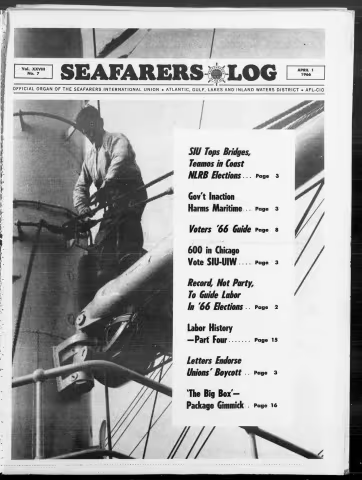
SEAFARERS^OG
OFFICIAL ORGAN OF THE SEAFARERS INTERNATIONAL UNION • ATLANTIC, GULF, LAKES AND INLAND WATERS DISTRICT . AFL-CIO
SlU Tops Bridges,
Teams in Coast
NLRB BetBons... Page 3
Cov't Inaction
Harms Maritime • • Page 3
Voters '66 Gaide Page 8
600 in Chicago
Vote SiU-UIW Page 3
Rerord, Not Party,
To Guide Labor
in '66 BecBons •. Page 2
Labor History
—Part Four.. Page 15
Letters Cadeise
Uaiens' 8e/coff.. Page 3
The Big Box'—
Package Gimmick - Page 16
n, -.'v ••• ^ •
Page Two SEAFARERS LOG April 1, 1966
fii
i'
Candidates' Records, Not Party,
To Guide Labor in Coming Eiections
WASHINGTON—In determining whether or not it will support candidates for political office in
this year's elections, the American labor movement will back both Democrats and Republicans purely
on the basis of their support for organized labor's programs and principles. The party label will not
mean automatic labor backing.
This traditional non-partisan
political position was enunici-
ated very clearly by AFL-CIO
President George Meany in
major address here last week to
4,000 delegates to the building
trades national legislative confer
ence.
If a two-thirds vote is needed
to pass a labor bill in the Sen
ate, where a Dirksen filibuster
blocked 14(b) repeal, "we have
to go out and get the two-thirds
vote," Meany said. "We are go
ing to concentrate on more and
better political action. We are not
going to spend a lot of time cry
ing over spilt milk."
He called for strengthening
of COPE—the AFL-CIO's Com
mittee on Political Education—
so that "we can defend our
selves against those who would
use the legislative process to ham
per or destroy the trade union
movement."
This year for the first time.
COPE, in issuing voting record
information, will carry checklist of
the candidates records on legisla
tion of concern to maritime labor.
While most liberals in Con
gress are Democrats, the party
label is also worn by some who
are "100 percent against every
thing we stand for," Meany said.
And the Democratic Party as a
whole has shown it "can't de
liver." He added, "I don't buy
the idea . . . that labor needs the
Democratic Party. I am sure it
is the other way around."
There are some progressive Re
publicans in the House and Sen
ate, Meany noted, but the party
line is still set by "financial in
terests" and the filibuster against
14(b) repeal was led by the GOP
leader. Senator Everett McKinley
Dirksen, "the new darling of the
conservatives."
"This means," he emphasized,,
"that we work with COPE, that
we don't work with any political
party, whether it is Republican,
Democratic or anything else."
He warned the delegates that
employer organizations are spear-
i
heading "a vicious propaganda
campaign" against the trade
union movement.
"The public is being told, from
editorial pages, from slanted
news, from articles in our slick
paper magazines, that American
labor is too powerful, that it has
too much political power, that it
is a bad influence on the economy
of the country as a whole. They
hold over the heads of the Ameri
can people the threat of inflation
and they tie that to what they
call the unrestricted power of
unions to exact exorbitant wage
demands."
To some "jitterbug" econo
mists, Meany said, "there are hut
two kinds of money in this coun
try."
In their view, the money that
goes into "astronomical profits"
of corporations and "fabulous
salaries" of executives is not^ in
flationary; "it is only the money
that the fellow in overalls gets
in his pay envelope that is in
flationary."
The "inflation" scare, Meany
noted, is even used as an argu
ment against a substantial in
crease in the minimum wage be
cause the lowest paid workers
would receive increases ahove the
"guidelines."
With indignation, he told the
delegates:
"We have tens of thousands of
people in this country who are
fully employed ... but also on
relief. Put that little fact in your
pipe and smoke it. Fully em
ployed—tens of thousands of
them—and still on relief in order
to feed their families."
SlU West Coast Ship Wins
CG Award For Aid At Sea
SAN FRANCISCO—^The SIU Pacific District-manned Lurline
(Matson Navigation), has been awarded a Certificate of Apprecia
tion by the Coast Guard for the many "search and rescue" and
assistance services the Lurline —"TT:— V-—
and transferred him to Los Ange
les for further treatment. and its crew have rendered re
cently "in support of maritime
safety."
A letter from the Coast Guard
Western Area Commander out
lines six separate occasions during
the 13-month period between Sep
tember 1964 and October 1965
on which the Lurline went to the
assistance of rhen and ships at sea
in answer to distress calls:
• On September 3, 1964 the
Lurline rendezvoused with the tug
Resolute to provide medical aid
to a crewman suffering from acute
appendicitis, evacuated the ailing
seaman and provided temporary
treatment.
• One day later, on September
4, 1964 the Lurline rendezvoused
with the CG Cutter Wachusett to
remove a seriously ill crewman
• On November 17, 1964 the
Matson ship provided medical aid
at sea to a crewman of the yacht
Criterion and transferred him to
Honolulu for treatment.
• On September 1, 1965 the
Lurline met the vessel Baron
Minto at sea in response to advice
given by radio from the USPHS
Hospital in San Francisco that the
patient should be seen by a doctor
as soon as possible.
• Later in September 1965 the
Lurline sped to the assistance of
the vessel Eurytan, which had suf
fered a boiler explosion.
• On October 14, 1965 the
SlU-manned vessel diverted to
take part in an air-sea search for
a U.S. Air Force pilot who had
ejected from his disabled fighter
aircraft.
V
Report of
International President
by Paul Hall
The use of paid spies and informers to help break unions and to
thwart union organizing attempts has been a traditional tactic of big-
business and industry.
As recently as three years ago, paid spies, informers and company
finks were used against the SIU by the Upper Lakes Shipping Company
during the Upper Lakes disputes in Canada.
When these tactics are used by industry against labor, the incidents
are almost never reported in the nation's press. Recently however, the
press has begun to take notice of such devices because business has be
gun to use 4he same tactics against critics of big-business and industry
policy who are outside the organized labor movement. The best known
and most publicized case in point is the treatment received recently by
Ralph Nader, author of the book Unsafe At Any Speed, which attacks
the ethics and practices of the automobile industry.
Nader's authoritative and well-documented book accuses the Ameri
can auto industry of knowingly producing unsafe vehicles which result
in the deaths of thousands of Americans yearly in a display of callous
disregard for the safety of its customers. Examples have been cited in
which industry went to great lengths to cover up lawsuits resulting from
accidents involving the unsafe vehicles it produces and of repeated at
tempts to discredit those who sued, complained or threatened to kick up
a ruckus.
The response of the auto industry to the furore created by the book
and its accusations was not to try to make improvements in the auto
mobiles it produces or to save lives by improving dangerous features of
the cars. Instead the nation's largest auto producer, General Motors, em
barked on an ambitious campaign to discredit Nader. While refusing to
even consider any of Nader's accusations, GM hired private detectives
to probe into Nader's personal life in an attempt to discover some sort
of incriminating evidence which could be used to discredit him personal
ly and effectively shut him up.
Company-hired private detectives questioned his personal friends and
business acquaintances about the most intimate aspects of his profes
sional and private life—including his sex life. Nader even testified that
suddenly, on several occasions, he was approached by strange women
who tried to entice him up to their apartments under a variety of pre
texts. It was inferred that this was merely another attempt by the in
dustry to find a way to discredit him personally.
The infringements of Nader's personal rights by GM finally became
so flagrant that GM was called before a Senate subcommittee to ex
plain its actions. GM's President, James M. Roche, promised the com
mittee members "Such errors will not take place again." It is not quite
clear however whether he meant that GM would not repeat the error of
infringing an American citizen's rights or would not again make the
error of getting caught at it.
The nation was shocked by the tactics the auto industry employed
against one of its critics, and perhaps the incident has already done some
good by finally bringing this facet of American business ethics before
the American people in the nation's press. The incident did not surprise
anyone in the American labor movement however, because big business
has been using the same devices against labor since the very beginning
of the labor movement in this country. Employees,-especially union
members and organizers have been spied upon, slandered and villified
in the business-oriented press all through the labor movement's history.
Labor's complaints about these tactics of intimidation employed by
business and industry have traditionally fallen on deaf ears. We can
only hope that perhaps at last the public and the government have been
shaken sufficiently to do something about these abuses.
Dubittsky Retires as ILCWU Head
David Dubinsky announced his resignation as president of the
International Ladies' Garment Workers' Union, the post to which
he was first elected in 1932. His retirement from the 447,000-
member garment union will be
come effective Apr. 12, 1966,
marking a record of labor lead
ership that spans youthful exile in
Czarist Russia.
While Dubinsky is resigning
from his ILGWU office, he will
continue his activities in the labor
movement including the AFL-
CIO, of which he is a vice presi
dent. He said he will also stand
ready to assist the ILGWU in
every possible way and to take
limited assignments from its new
president.
The retirement announcement
came in the form of a letter from
the 74-year old labor leader to
the ILGWU General Executive
Board at its regular semi-annual
meeting in New York early this
month. The Board elected Secre
tary-Treasurer Louis Stulberg, an
ILGWU member for 50 years to
succeed Dubinsky.
Dubinsky was born in Brest-
Litovsk, Poland, on Feb. 22, 1892.
At 15 he became a master baker
«>-
and was elected assistant secretary
of the bakers' union. At 16 he was
arrested for union activity, im
prisoned, sent off to Siberia, man
aged to escape and make his way
back to Russian Poland and to set
off for the United States where he
landed in New York City on Jan.
2, 1911.
During the first five months in
his new homeland he worked as
dishwasher, knee-pants operator,
buttonhole maker. Then in June,
1911 he joined Cutters' Local 10,
ILGWU. By 1918 he was a mem
ber of the governing board of
the Local,^union. He had begun
his rise up the leadership ladder,
becoming in turn, president of the
local in 1920, vice president of
the ILGWU in 1922, secretary-
treasurer of the ILGWU in 1929,
president of the ILGWU in 1932,
vice president of the American
Federation of Labor in 1934 and
a founder of the AFL-CIO in
1955.
1
S •
1 '
i -
SEAFARERS LOG Page Three
In Coast NLRB
The Seafarers International Union of North America has scored
overwhelming victories over Harry Bridges longshore union in Na
tional Labor Relations Board representation elections among West
fishermen and Alaska longshore "
workers. On another front, the
SIUNA decisively defeated a
combined raiding attempt by the
Bridges union and the Teamsters
in five Alaska ports.
Here are the details of the SIU
election victories announced this
week:
The SIUNA - affiliated San
Diego Fish and Cannery Workers
Union and the Seine and Line
Fishermen's Union shut out Harry
Bridges International Longshore
men and Warehousemen's Union
in each of 11 elections conducted
by the NLRB among crews of
West Coast fishing boats. More
than 100 fishermen are involved.
In individual Board elections,
fishermen on the following boats
voted overwhelmingly for the SIU
fishermen's unions over the ILWU:
American Enterprise, Mondego,
Shamrock, Queen Mary, San Joa
quin, MV Cape Beverly, MV
Cabrillo, MV Coimbra, Redonda,
Seafarer, and Commander.
The SIU Pacific District United
Industrial Workers Union retained
its representation rights after long
shoremen in the Alaskan ports of
Petersburg, Valdez, Haines, Hom
er and Kodiak voted for the SIU
union over the Bridges setup by
a decisive margin.
The Teamster attempt to raid
the SIU in Anchorage, Alaska,
was crushed when the SlU-affili-
ated longshoremen in that city
voted 100 per cent to remain in
the SIU.
600 Chkago Hot Shonie Wwkm
Vote for W as Barguung Ageat
CHICAGO—The SIUNA-affil-
iated Transportation Services and
Allied Workers-United Industrial
Workers Local 300 won a 3-2 Na
tional Labor Relations Board elec
tion victory here on March 18 at
the Marriott Hot Shoppes Inc.
Contract talks will begin pend
ing certification of the election by
the NLRB.
Contract negotiations will be
based on employee suggestions
made at union meetings, which
were then circulated to all Mar
riott Workers prior to the March
18 vote.
Prior to the election. Local 300
had filed unfair labor charges
against the management of Hot
Shoppes and in late February the
Union was prepared to strike the
company for bargaining recogni
tion. However, the strike was
called off when the company
agreed to an election.
Local 300 President, Gregory
Grana called the election win "a
sound testimonial that working
men and women who need union
protection will find the courage to
reject the lies, promises and
threats of the bosses when given
an opportunity to exercise their
rights in a labor board election."
Grana said that the Union had
prepared contract demands for
substantial wage increases and
other benefits for Marriott work
ers.
SIUNA vice-president Dominic
Abata pointed out that in recent
years several other unions had at
tempted to organize Marriott Hot
Shoppes but were unsuccessful.
Abata said that fears of reprisal
by management had affected pre
vious union organizing attempts.
Marriott workers prepare pre
cooked meals for several hundred
daily airline flights leaving O'Hare
International airport here and
maintain flight kitchens, motels
and other operations in at least
13 cities across the country.
Exchanging Views oh Pi^eihs
j^fficials of the All-Japan Seamen's Union renew discussions of prob
lems affecting seafaring trade unionists with SIU President Paul Hal
iluring visit to Union hall in New York. Left to right, Tsuneftori M
j/'ice Director of the Japanese Seamen's Union's Research 0epa^i
Nabasama, Vice President of the Japanese union: Kanj
Shilciba', Vice Director of Educationi and Hall,' who had met with the
flapanese unionists during his recent aftendAnrift at Dome! convention
La^ry Management, Public Panelists Agree
Government Agencies Fall To Protect
American-Flag Merchant Marine
NEW ORLEANS—Government agencies were charged with being derelict in their responsibility
for maintaining a strong American merchant marine by speakers representing maritime labor, man
agement and the public press at Tulane University's Institute on Foreign Transportation and Port
Operations here last week.
The charges were levelled by
Paul Hall, President of the Sea
farers International Union; Cap
tain John W. Clark, President of
Delta Steamship Lines and chair
man of the Committee of Amer
ican Steamship Lines, and Mrs.
Helen Delich Bentley, Maritime
Editor of the Baltimore Sun. The
three speakers were the panel
members at the Institute's discus
sion on problems of the Ameri
can merchant marine. The ses
sion wound up a week-long sem
inar devoted to all aspects of
transportation.
Mrs. Bentley, widely respected
maritime editor and reporter,
scored the government's failure to
take progressive steps to aid the
United States merchant marine.
Mrs. Bentley recommended a
national maritime industry con
ference to cope with the prob
lems of American shipping. "As
a member of the public," she
called on management and labor
in the shipping industry to be
broad enough in their thinking"
to try to achieve something sim
ilar." The Baltimore Sun mari
time editor also said that ship
ping management had been selfish
in dealing with the problems af
fecting all within the industry, and
that labor was "fractionalized."
SIU President Hall said that
the "Viet Nam war, terrible as
it is," has underscored the anti
quated condition of the Ameri
can merchant marine.
The SIU president scored the
Interagency Task Force Report for
calling for the "decimation of the
U. S. merchant fleet." By com
parison he said that the report of
President Johnson's Maritime Ad
visory Committee had adequately
set forth the needs of the industry.
Touching on the Department
of Transportation, which Presi
dent Johnson has asked Congress
to create as a new cabinet depart
ment embracing the Maritime
Administration and 11 other fed
eral units concerned with trans
portation, Hall said the proposal
does not bode well for mari
time. He said that history has
demonstrated that the shipping
industry has suffered and been
discriminated against when it has
been lumped with other agencies.
He said the industry's prob
lems could be dealt with more
effectively by making the Mari
time Administration an inde
pendent agency responsible to
the President. Otherwise, as has
always been the case. Hall said,
the industry's interests will be
subordinated to the interests of
the other agencies involved.
Hall cited the support that the
American labor movement is giv
ing to the effort to achieve a
stronger, more adequate merchant
marine. As an example, he
pointed out that the AFL-CIO
Committee on Political Educa
tion will rate candidates for leg
islative office on the basis of their
records on maritime legislation
and policies.
Captain Clark called for an ac
celeration of United States mer
chant ship construction and an
expansion of maritime services.
He said that our government
should recognize the role of
American flag-shipping in han
dling 98 per cent of the logis
tical support for the Viet Nam
conflict.
The Delta Line official pointed
to the stepped-up activity of the
Russians in the area of shipbuild
ing to attain dominance in world
shipping and trade, and noted
that their ship construction pro
gram exceeds that of the United
States.
Ray R. Murdock, executive di
rector of the Andrew Furuseth
Foundation for Maritime Re
search, served as moderator of
the panel on the Merchant Ma
rine.
The Tulane Institute's panel on
the American merchant marine
was attended by representatives
of the shipping industry, labor
and government agencies, in ad
dition to the Institute's students.
At the conclusion of the In
stitute's five-day program, cer
tificates of completion were
awarded to participants by Dr.
Clinton Phillips, associate dean of
Tulane University's School of
Business Administration.
Messages to SIU Express Support
Of North Viet Nam Ship Boycott
Messages of approval for the boycott of ships trading with North Viet Nam, plans for which were
announced recently by three AFL-CIO maritime unions and endorsed by the AFL-CIO Maritime
Trades Department, have been pouring into SIU headquarters from individuals throughout the coim-
try.
Letters and telegrams express
ing support for the stand taken
by the Seafarers International Un
ion, the International Longshore
men's Union and the National
Maritime Union outnumber those
expressing opposition by a 10 to
one ratio.
Boycott plans were announced
by SIU President Paul Hall, ILA
President Teddy Gleason and
NMU President Joseph Curran in
a joint telegram to President John
son last month criticizing the Ad
ministration's "pussyfooting" in
curbing trade with North Viet
Nam by ships of "supposedly
friendly countries."
Shortly after, AFL-CIO Presi
dent George Meany told a news
conference that the boycott idea
"makes a lot of sense" and ex
pressed himself as in complete
sympathy with the unions' ap
proach and "in general agreement
with their attitude."
The supporting messages ap
proved the unions' intention to
stage protect demonstrations in
U. S. ports against vessels of na
tions permitting trade with the
enemy which "puts blood money
«>-
in the pockets of shipowners and
other profiteers in so-called allied
nations."
Excerpts from spme of the mes
sages of comment, addressed to
Slli President Hall, follow:
From a man in Philadelphia:
"... my thanks and commendation
on the resolution to boycott. . . ."
A woman in New York wrote:
". . . enthusiastic support for the
maritime unions' move to boycott
ships trading with the enemy. . . ."
A Philadelphia housewife: . .
in these times of mankind's
apathy, something like your boy
cott action comes along to renew
my faith. . . ."
A Wilmington, Del., woman:
"... I am writing to tell you how
much we admire you for your
position. ... It is appalling that
ships of our allies are carrying
supplies to those whom our boys
and their South Viet Namese allies
are fighting. . . ."
From a couple in El Cajon,
Calif.: "This is to praise you for
your stand against shipowners who
trade with the North Vietnamese.
We hope that many of our private
citizens would write to encourage
your action in view of the tremen
dous pressure you are bound to
encounter ... to make you back
down. . . ."
A Washington, D. C., man
wrote: "... I think you have
shown leadership in the fight jfor
democracy ... offer you my hearty
support and wish you success in
this stand for democracy."
A Pueblo, Colo., mother said:
". . . This average American en
dorses your stand wholeheartedly.
... It is tragic that there are those
who refuse to stand behind Ameri
cans making such terrific sacrifices
for our principles."
From a retired member of the
Brotherhood of Railway Clerks in
Florida: "... I feel you will have
the undying gratitude of millions
of Americans . . . You couldn't be
more right. . . ."
From a U. S. citizen living in
France: ". . . You have my re
spect. . . ."
A Minister in Illinois wrote:
". . . we are given an example of
sacrifice for higher purpose, sacri
fice so that others may live sooner
in peace and with opportunity for
fruitful living. . . .' enemy which "puts blood money citizens would wnte to encourage fruitful living. . . .
.S' .T S J. ,5' , ; 4 i* * i J ,i _ # ,< S ? I 1 t i ^ ^ ^ ^ ^ ^ ^ ^ ^ ^ V > S V > > J J 4
1
' 1'
Page Four SEAFARERS LOG April 1, 1966
Three-Year Court Action Settled
AMA Admits Libeling Union Official,
Apologizes, Withdraws Phony Record
PITTSBURGH—After three years of litigation, the American Medical Association has finally ad
mitted that a phonograph record circulated by its political action committee, AMP AC, was spurious
and libeled Paul Normile, district director of the Pittsburgh Steelworkers' Union of the AFL-CIO.
It is believed to be the na
tion's first case of libel by phono
graph record.
The AMA has apologized, re
tracted its statements made in a
booklet accompanying the record
and paid Normile $25,000 in an
out-of-court settlement of a dam
age suit filed by Normile and the
Steelworkers.
Also, all copies of the phony
record that could he recovered
have been destroyed, the AMA re
ported.
The disc purported to he a se
cret recording of a Steelworkers'
stewards meeting in Pittsburgh. A
tough-talking union leader is sup
posedly telling the stewards how
to extort political action dollars
from workers as they enter and
leave plant gates.
An accompanying booklet iden
tified the speaker as Normile.
The kit, widely distributed dur
ing 1963 at the height of the
AMA's unsuccessful campaign
against the Medicare plan, was
allegedly designed to stir local
AMA political committees to ac
tion in raising money for election
campaign funds from doctors.
^\^en the case came to court,
Normile denied that the voice was
his or that such a meeting had
been held. He produced speech ex
perts to back him up.
The AMA fell back on the de
fense that it had purchased the
recording in good faith, truly be
lieving that they had a bona fide
tape of a Steelworkers meeting.
Walter Hughes, an official of the
Pennsylvania Medical Poltical Ac
tion Committee (PAMPAC) went
on record that he bought the tape
for $20 from "a tall, secretive
stranger" in "an ill-lit street" on "a
dark night," who when asked his
name, said: "Just call me Cousin."
Hughes passed the tape on to
Dr. William R. Hunt of McKees-
port. Pa., an active leader in the
drive to prevent Congress from
passing the Medicare legislation.
Hunt sent the tape to AMPAC
headquarters in Chicago, where
5,200 discs were cut. About half
of them were in circulation when
Normile sued and the AMA subse
quently stopped sending out any
more of the records.
"The AMA sincerely regrets the
error," the physician's lobby said
in a recent retraction.
japm Shipowners Eye Runaways
To Beat Taxes, Union Standards
TOKYO—Like many of their American counte^arts, Japanese
shipowners are seriously considering operating their vessels under
runaway "flags of convenience
in order to avoid paying their
fair share of their nation's taxes,
take advantage of substandard
wages and working conditions of
runaway-flag crewmen and avoid
maintaining the high safety stand
ards required by Japanese sea
men's unions.
The three major nations offer
ing "flags of convenience," Pan
ama, Liberia and Honduras, levy
a ship registration tax but no cor
poration or fixed assets tax. This
easy tax setup has already led
many American shipowners to
register their ships under run
away flags to avoid paying U.S.
taxes, in addition to the added ad-
The Gulf Coast
by Lindsey Williams, Vice-President, Gulf Area
The spirit of St. Patrick's day ruled supreme in the city of New
Orleans, when the city's Irish settlement broke into its annual wear-
ing-of-the-green festivities. Beginning with Mass in St. Alphonsus
Catholic Church, the occasion developed into a 51-unit parade to the
SIU Hall for a gala dinner.
The dinner could not have
been better served in Dublin it
self. Green olives, chilled sham
rock fruit cup and Patrick's
tossed green salad headed the
menu in the SIU Hall. Other
courses served included corned
beef and boiled cabbage, greens,
Irish potatoes, pistolettes (poppy
seed buns, dyed throughout), and
emerald ice cream.
Houston
Shipping has remained steady
in the port of Houston over the
past two weeks,
and no significant
change is expect
ed in the imme
diate future.
C. N. Hotch of
the deck depart
ment spent a few
weeks working on
oil rigs, but is
now ready to sail
on any Indian or coastwise trip.
Tom Ballard who sails in the en
gine department is on the beach
after paying off the Volusia. He'll
be ready to ship out again in a
few weeks. Steward Francis Bur-
ley says that he's looking for a
chief cook's slot on any long
Hurley
trip, although he might consider
a coastwise run.
Mobile
Shipping has been fair in the
port of Mobile, with two ships
now laid up. They are the Long-
beach and the Roswell Victory,
both of which will recrew within
the next few weeks.
Fred C. Cooper, whose last ves
sel was the Carroll Victory on a
run to Saigon, Japan and the Phil
ippines, is now on the beach
spending a little time with his
wife and daughter in Mobile.
New Orleans
James Wood, Jr., who sails in
the engine department, was just
paid off the Ames
Victory and is
now looking for
a run to North
Europe. Back
from his vaca
tion, Reuben
Belletty is look
ing for a Group
1 slot in the
steward's depart
ment on a Delta Line ship. Johnny
Long is looking for a Puerto Rico
trip.
Belletty
vantages of being able to pay sub
standard wages to unorganized
foreign crewmen and skimp on
ship safety standards.
Japanese shipowners are re
portedly considering the transfer
of ownership of Japanese ships
to Liberian, Panamanian or Hon-
duran companies and then char
tering them back. The Japanese
Transportation Ministry however
has recently indicated it would
discourage the chartering of for
eign-flag tonnage to facilitate a
continuing vessel replacement
program.
In addition, Japanese maritime
labor has an agreement with man
agement providing that only Jap
anese nationals will be employed
on Japanese-flag vessels. Run
away-flag operations would re
duce job opportunities for Jap
anese seamen as they have for
American seamen.
SIU Opens New
Clinic Facility In
Sault Ste. Marie
SAULT STE. MARIE—
The latest addition to the
growing system of SIU clinics
began servicing SIU members
and their families in the Great
Lakes area on March 1 at the
Sault Polyclinic here.
The facility will provide
free diagnostic service to the
many SIU Great Lakes Dis
trict members, SIU Great
Lakes Tug & Dredge and SIU
Inland Boatmen's Union
members in the area as well
as to their dependents.
SIU clinic facilities are al
ready available to Seafarers
and their families in the Great
Lakes ports of Buffalo, To
ledo and Duluth.
The system of SIU clinics
was begun in 1957 with the
opening of the first facility in
New York. Other Union
clinics are located in Boston,
Philadelphia, Baltimore, Nor
folk, Jacksonville, Tampa,
San Juan, Mobile, New Or
leans, Houston, San Fran
cisco and Seattle.
The Atlantic Coast
by Earl (Bull) Shepard, Vice-President, Atlantic Coast Area]
Baltimore will again be the host for the Union-Industries Show
from April 29th to May 4th. The SlUNA will be exhibiting samples
of the many products manufactured by SIUNA affiliates at the AFL-
CIO sponsored exhibit which will exhibit the craftsmanship of many
workers belonging to AFL-CIO unions.
Al Brown has been around the "^the Detroit are also bucking for
Smith
N. Y. hall as he recently got off
the Steel Scientist where he ship
ped as baker. Al has just re
registered and is now ready to
ship out* again. Old timer E. R.
Hauser had to leave the Cuba
Victory because of illness. He's
hoping to be released from his
doctor's care soon so that he can
ship out again. Just back from
a trip to Viet
Nam and ready
to go again is
Chief Steward
Oscar B. Smith.
Irwin Music has
just been paid off
the Yaka and he
says he's going to
stay on the beach
awhile and see the
sights of New York City.
Norfolk
Shipping has been good in the
port of Norfolk, and the outlook
for the future is the same.
Norman Wroton, Jr., who last
served as oiler on the Steel Scien
tist has already paid off the vessel
in order to come home and tend
to personal business. He said he
had a good voyage and called the
ship "a mighty fine one." Herman
White, who has been sailing with
the SIU for the past ten years,
just got back from a short run
to Rotterdam and is looking for
a good slot in the steward's de
partment. After serving as chief
cook on the Eagle Traveler, Lu-
cien Drew says that it was one of
the best he's ever worked on and
hopes to find another just like it.
Boston
Things slacked off a bit the last
week but shipping is expected to
pick up. Long range expectations
have been in the news in regard
to proposed trade with Puerto
Rico. The activities of the Mas
sachusetts Port Authority, the New
England World Trade Center and
Sea-Land were reported last issue
in this column under Puerto Rican
shipping. Since then the Port Au
thority has estimated that Boston's
trade with the island will equal
more than a billion dollars during
the next 10 years. Boston is ex
pected to increase its general cargo
business at least 25 per cent a
year.
John Fancutt, a 20-year man
with the Union was on the Sea-
mar. John was sorry to see the
Seamar laid up and is waiting
to grab a coast hugger.
Puerto Rico
With the island's economy
growing at an outstanding rate of
ten per cent a year and trade pick
ing up between Puerto Rico and
the continental United States, it
looks like shipping will continue
to improve. Last year alone, Puer
to Rico imported over $1.25 bil
lion from the United States, most
of which was shipped by water.
Manuel Salcedo just piled off
the San Francisco after a seven
months run, and he is expected to
come up with FWT-Oiler endorse
ment very soon. Luis Roman and
John Murray, who are presently
holding down wiper positions on
their FWT-Oiler endorsement.
Philadelphia
Henry Karpowicz has been
spending some time around the
Union hall here. Hank says he
is waiting for a job on the Colum
bia or the Geneva.
Winford Powell says he wants
a ship heading for the West Coast.
Oldtimer Powell's last job was on
the Spitfire.
After two months on the beach
Victoria Domingo is one old timer
who's ready and raring to go on
a long trip. Brother Domingo sails
in the black gang.
Baltimore
During the past period shipping
has been fair, and the prospects
for the coming period look very
good. Laid up in the port of
Baltimore are the Losmar, Alamar
and the Bangor, with the Losmar
expected to crew up some time
this week.
In the past two weeks, we paid
off three ships, signed on two
and had seven in transit.
Jake Levin, who sails in the
deck department and whose last
ship was the Steel Traveler, is now
on the beach and ready to ship
out on any long trip. After paying
off the Steel Ex
ecutive some time
back, Nicholas P.
Tsaousakis is
ready to sign on
for a Hawaiian
run. Brother Tsa
ousakis has been
a member of the
Union for 22
years.
Looking for a coastwise run so
he can spend more time with his
family, Charles Shaw is now on
the beach and ready to go. Melvin
R. Knickman, who has been sail
ing with the SIU for the past
16 years, is also on the beach look
ing around for a coastwise run.
Tsaousakis
|lpril L 1W4 Vol. XXVIih No. 7
Official Publication of the SIUNA
Atlantic, Gulf, l,>kes &. Inland Waters
District, AFL-CIO
Sxeeutive Board ;
PAVL lBAtLtProMent ,
• Cat, TANNER EARL SHEEARD <
-- FasecsA'fce-Ffee,Ficc-Presidenf':
At: IANBSEX WJEUAMI'
KbisfeBT MATiHEw»-; ', ; Air TANNER
y^ee-Preaideni Piee-Preaident
"V-
y • pireetor of Orotp&tg and; .
Publication
Mdnagiiiff Editor;
#yyMikB,PoLi,ACK, ,
I Auiatdnt Bditor
NATHAN SKyga
Art Editor
BEfCNARO SEAMAN
Staff Writers
y MELVIN PURVIS
WiLUAM DAV
• EBWIN P. FRANCIS
at Shsa* iiiMa AMRM
MS,, W«klaa<«n. jJi C. SMJOX# t)t« SwtsMlt
iRtarMtisasi uaito, Atiaatia, ssin um sm.
y;U2JSL y •TU,.y HVselntl!
aitts; (Mrfl at Wwhiai'-
tM, 0. C.
WSTilAlTSIWi ATtEltiiMU «art»
iHtM«atl«iial ''rURian.
'618^^4X3-'EwtiryiMNwasyyeiiU)*.^^^
i
:
'J -
•K.
JK.
April 1, 1966 SEAFARERS LOG Pace Fi«e
On the calm morning of the payoff
the Sapphire Etta lays safe in the
Port of New York after a rough 16
day trip on the fog-covered ocean.
After the payoff the men had a dinner of roast beef and trimmings. Some old timers
got together to spin a few yarns about their travels as Seafarers. Sitting in the mess
hall for the after-dinner story-swapping are old timers, R. Garofalo, AB, and Bosun
Tom Polino (center), Henry Put, AB (foreground); (left) Joe McGill, (right) A. Amendolia.
Seafarer John T, Cherry, Jr., knocks
off the job long enough to go up
and get his money and sign back on
for the next trip to Bremerhaven.
Chief Cook Beanigno Bautista slices
up roast beef iri^'preparation for
a good dinner for his fellow crew
members to start off the next trip.
Seafarer Stamatios Aristis gets his
papers in order as he prepares to
collect his pay for the voyage.
At right. Union patrolman looks on.
Seafarers Anthony Amendolia and Joseph McGill of Brooklyn, N. Y., are photographed
on deck of the Sapphire Etta. Brother McGill, who is holding a line, has seen all kinds
of weather at sea, said, "This past trip was a short one but I've never seen the North
Atlantic so rough." Brother Amendiola concurred. He hadn't seen a rougher one either.
v "''. . 1 • • -4 » ( . • I . i I . : * « .
4 1 I . j'i J
Pa«e Six SEAFARERS LOG April 1, 1966
If you had an opportunity to vacation in one of the many places
you ^ve visited during your seafaring career, wluch one would you
choose and why?
George Gihbons: Of all the ^
ports I've visited during my sea
faring career, I
would pick Japan
for a vacation.
I like the way
the people live
and enjoy the
exotic atmos-
phere. Then,
too, I enjoy
sightseeing very
much, and there
is a lot to see in that country. On
my vacation, I would hire a
guide, so he could take me
around and show me the shrines
and historical places.
<I>
William R. Lacy; The best
place I can think of to relax for
a vacation is the
port of Hong
Kong. There are
many things to
see which are en
tirely different
from those in the
United States.
And it is an ex
citing city with
many good
places to shop. During my vaca
tion in Hong Kong, if I ever had
the leisure, I would take plenty
of time for shopping. It is prob
ably the best place in the world
to buy clothing and materials.
Paul R. Wolf: Without hesitat
ing, I would choose Yokahama,
Japan. Although
the city is very
much like the
United States,
and getting more
and more like
that by the day,
it still has that
oriental charm.
On my vacation,
I would go
around and visit the temples and
the other sights of the city. The
Japanese are great believers in
natural beauty, and for that rea
son, there is much worth seeing.
Raul Iglesias: I would go to
Spain, if I had my choice of the
places I've been
while shipping
out with the
SIU. To begin
with, they speak
my language; and
secondly, I would
like to explore
the Motherland.
Of course, I
would go to a
bullfight, something that I have
never seen before except on TV.
Then, I would go around the
country looking at the cathedrals.
Nicholas Bechlivanis: I would
go to Greece on my vacation. I
am from the
Aegean Islands
myself, and know
the people to be
kind and friend
ly. Also, the
weather is nice,
and there are
many ways to
relax in that
country such as
fishing, swimming and drinking
good wine. When a person goes
fishing, there are redsnapper and
all sorts of fish to catch, all un
der blue skies and fresh air.
Joseph Stodolski: Although I
have visited many countries dur-
ing my career
as a Seafarer,
and liked nearly
all of them, I
guess I would se
lect Puerto Rico
for a relaxed va
cation. I enjoy
the weather
down there, and
such entertain
ment as horse races, nice beaches,
the national lottery and ball
games all appeal to me. I wouldn't
stay in any classy hotel either.
Just living like the rest of the
country's citizens would be fine
for my vacation.
Lifeboat Class No, 147 Sets Sail
SIU Lifeboat Class No. 147 poses for graduation picture after
successfully completing lifeboat training course at the Harry Lunde-
berg School pf Seamanship. Newest group of lifeboat ticket holders
are, (front row, l-r): Robert F. Lewis and Rudolph Pace. Second row,
l-r: Robert Bruno, John Cancel, Earl Williams and Philip Larkin.
Back row, l-r, includes: Bernard Cassada, Maury Lipitz, Gary Mc-
Donou^jh and instructor Ami Bjornsspn.
- J I I II
DISPATCHERS PgPQPT * Mona
March 12 to March 25/ 1966
DECK DEPARTMENT
TOTAL REGISTERED
Port Class A Class B
Boston 3 1
New York 49 19
Philadelphia 8 8
Baltimore 24 12
Norfolk 6 6
Jacksonville 5 7
Tampa 4 1
Mobile 24 3
New Orleans 39 15
Houston 52 28
Wilmington 20 8
San Francisco .... 34 18
Seattle 12 8
Totals 280 134
TOTAL SHIPPED
All Groups
Class A Class B Class C
0
28
6
20
12
7
0
13
27
35
17
37
25
0
12
5
9
2
6
3
8
12
39
8
15
11
0
18
4
2
2
1
0
0
6
10
7
20
9
227 130 79
ENGINE DEPARTMENT
TOTAL REGISTERED
All Groups
Port Class A Class B
Boston 3 2
New York 38 18
Philadelphia
Baltimore
10
14
6
14
Norfolk 7 2
Jacksonville 4 6
Tampa
Mobile
1
20
1
10
New Orleans
Houston
34
33
20
29
Wilmington 12 6
San Francisco
Seattle
27
16
10
9
Totals 219 1.33
TOTAL SHIPPED
All Groups
Class A Class B Class C
1 0 0
38 15 20
8 5 1
17 7 4
6 5 1
5 6 8
1 0 2
9 12 2
27 17 5
30 25 12
12 8 12
44 15 22
15 22 13
213 137 102
NOW ON THE BEACH
All Groups
Class A Class B
16 2
170 56
33 13
86 46
21 19
11 12
14 10
73 17
133 68
145 59
28 0
69 26
25 12
824 340
NOW ON THE BEACH
All Groups
Class A Class B
11 4
146 52
19 13
56 42
15 14
8 11
6 4
40 19
91 61
84 79
8 0
53 17
21 2
558 318
STEWARD DEPARTMENT
TOTAL REGISTERED TOTAL SHIPPED NOW ON THE BEACH
All Groups All Groups All Groups
Port Class A Class B Class A Class B Class C Class A Class B
Boston 2 0 0 0 0 4 2
New York 39 11 21 8 8 136 19
Philadelphia 6 5 8 6 1 14 5
Baltimore 11 9 8 6 1 67 28
Norfolk 2 5 3 5 1 13 11
Jacksonville 1 3 2 4 5 4 6
Tampa 1 0 2 0 0 7 4
Mobile 20 7 9 10 1 58 20
New Orleans 32 23 14 11 8 133 91
Houston 28 15 18 16 10 91 30
Wilmington 14 5 8 4 6 17 0
San Francisco 23 3 21 4 28 43 9
Seattle 8 10 15 10 10 17 11
Totals 187 96 129 84 79 604 236
^iews Red Fleet Growth With Alarm
National Magazine Notes Soviet Bid
For Sea Sapremacy In Near Fa tare
Russia is rapidly expanding her merchant fleet in a plan to acquire control of the seas in the
not-so-distant future, according to Noel Mostert in a recent article in The Reporter magazine.
Already, Russia has enlarged her fleet to the point where she expects to carry seventy-five per
cent of her own trade this year, ^
the article says. In comparison,
the share of American trade
carried by U.S.-flag vessels, less
than 8 percent, looks meagre in
deed.
Behind the Soviet's impressive
capacity for self service on the
seas is a massive shipbuilding pro
gram sparked by desire for eco
nomic power, Mostert reports. In
the past ten years, Russia has not
only surpassed the United States
in the size of her fleet, but has
gained a much younger, more
modem and more versatile fleet
as well. Moreover, while Russia
continues to build and buy ships
as rapidly as possible, the U.S.
continues to cut back on ship
building budgets.
"The Russian merchant fleet's
total of seven million tons means
that it now exceeds in size the
American active fleet. By 1971,
with a projected ten million tons
to its credit, its superiority over
the United States fleet would he
two to one," Mostert writes. "The
seeming abdication of American
resolve and initiative in this field
leaves the Soviet fleet without
challenge; nobody else has the re
sources, not to speak of the de
termination, to match such an ef-
1 t I > l I. w 1.
fort."
According to Mostert, Russia
is using every conceivable means
to accomplish further enlarge
ment of her fleet. With her own
shipyards going at full capacity,
she has placed large orders in
other nations, both Communist
and free, and is buying a large
number of used ships of all types,
often at prices above the going
rate.
The reason for this tremen
dous effort for fleet expansion is
not hard to guess; Russia realizes
that control of the seas means
control of trade and economic
power. Says Mostert, "Moscow's
self-interest and prestige require
at the moment an independence
from others for the carriage of its
growing external trade, plus in
trusion of the Red Flag upon the
consciousness of all trading na-
tions, especially the newly emerg
ing ones."
By 1970, "the combined
strength of the bloc will be cap
able of undermining the western
hold upon any particular trade
simply by undercutting to any
price level it wishes," Mostert
adds. "As one shipping man ex
plained here, The possibilities for
economic blackmail are incalcul
able and do not bear thinking
about.' Unless someone does start
thinking, the situation may be ir
retrievable by the time they fi
nally get around to it."
Tlie SIU has been thinking and
talking about the threat of the
Russian fleet for some time, but
apparently the people in Washing
ton who should he concerned have
been both deaf to our words and
blind to the situation. We will
continue to urge them to uncover
their eyes before it is too late.
SEAPAf?efiSl
YOUB STOKIBS, PHOTOS
ANP LETTE/iS ARB-
6SHV>-J0t LOS • •6;CS'/%K/Ar7V/4Vir-fiMCOAX>9s/,A/.r.112^
April 1,
17^
SEAFARERS LOG Page Seven
m.
I Liberal
I Alf-Out Election Support
Increasingly, danger signals flash that there's blood on the political
inoon. Only a massive effort by union members and their families
in this year's campaign can wipe it off.
The^ signs come from all directions. Republican leaders are licking
their lips in anticipation of major congressional gains. Recently, their
confidence spilled over from House contests to the Senate races. In a
report to GOP leaders, Victor Johnston of the Republican Senatorial
Campaign Committee claimed a possible pick-up of five Senate seats.
He listed these states:
• Oregon—where Maurine Neuberger has announced she won't
run again. Seeking the Democratic nomination is Representative Bob
Duncan who has a solid liberal voting record. Governor Mark Hatfield,
a moderate, is a shoo-in for the GOP nomination.
• Illinois—where liberal leader Paul Douglas will be challenged
by Charles Percy, unsuccessful GOP candidate for governor in 1964.
Dogulas won in 1960 with 55.5 percent of the vote, a near-marginal
result. Percy is viewed as a rugged challenger.
• Tennessee—where Ross Bass, one of the few southerners to
stick with lobor on 14(b) repeal, faces stiff opposition in a primary and,
if he gets by that, in the general election, too. Bass won by just 52.1
percent of the votes in 1964 in an election to fill the remainder of
Estes Kefauver's term.
• Montana—where Lee Metcalf, a winner with only 50.7 percent
of the vote six years ago, will be the target of the considerable conserva
tive and right wing forces in the state.
• New Hampshire—where Thomas Mclntyre became the state's
first Democratic senator since the Stone Age with 52.3 percent of the
vote in 1962 when a bitter fight split the state GOP following the
death of Senator Styles Bridges.
The report to GOP leaders predicted the Republicans could make
Senate gains without losing any seats they hold now.
So far, most predictions have been based on speculation. But polls
are beginning to show the guessing game is not all puff.
The most recent published political poll, conducted by Louis Harris,
reported, "The wide lead the Democrats have been holding for the
1966 elections for the House of Representatives has begun to dwindle
substantially. The Republicans, at this point, stand a chance of picking
up major congressional gains next November."
The poll showed the Democratic lead among voters plummeted
three percent since January to a present 54-46 bulge. Harris sees
60 to 70 of the present Democratic House membership "in the danger
area already." Included among these would be the 51 new liberals
elected in 1964.
Harris charts the ebb and flow of public support for the parties in
congressional voting over the past 16 years this way:
DEM.
March 1966 (Poll) 54 %
January, 1966 (Poll) 57
1964
1962
1958
1954
1950
57.5
52 .
56
52.5
50
REP.
46 %
43
42.5
48
44
47.5
50
Harris traces the slump in Democratic support to unease over the
war in Vietnam and to the GOP campaign to build a bogey over
inflation.
Polls and speculation do not an election make. The March poll and
the March guess can be made to look off-base in November. But they
can be made to look off-base only with all-out effort between now and
November to keep incumbent liberals in office and elect new ones.
A "package" of 13.5 cents an
hour was indicated as the 1966
contract pattern for 18,000
wool and worsted industry em
ployes in 75 mills, when the Tex
tile Workers Union of America
and the pacesetting Wyandotte
Worsted Co. settled on a new
three-year agreement. The agree
ment calls for a general wage in
crease of 10 cents an hour with
a new minimum of $1.74 an hour
and a guaranteed minimum of
over $2 an hour for Weavers in
a piecework job classification, fig
ured on a daily basis, and other
gains.
•if
A cigar workers council, which
coordinated bargaining^efforts for
five unions, has won contract im
provements for more than 2,000
American Tobacco Co. workers
in scattered northern and south-
em plants. Contract advances,
called by the unions the best in
several years, included wage hikes
•>f 7 to 11 cents this year, 4 cents
next year, with inequity adjust
ments up to 20 cents an hour;
improved Blue Cross-Blue Shield
hospitalization coverage, with full
premium payments by manage
ment in the second contract year;
two days' funeral leave and
strengthened job protection.
4,
The Machinists, charging five
airlines with stalling for five
months on negotiations, have no
tified the National Mediation
Board that efforts to settle the
dispute have failed. Union nego
tiators asked the NMB for a
"proffer of arbitration." If either
side in the dispute refuses arbi
tration, further action may be
taken after a 30-day waiting pe
riod required by the Railway La
bor Act. The lAM represents
34,000 mechanics and other
ground personnel employed by
Eastern, National, Northwest,
Trans World and United air
lines. Members previously voted
overwhelmingly to strike.
7 Spy!"
Spying has become a way of life within
American industry. There was a time when
industry confined its spying to its employees
and to labor unions engaged in organizing
drives. Today however, the nation's biggest
corporations spy not only on their employees
and on unions, but on each other, on the pub
lic, and on the U.S. Government itself. Many
corporations even spy on themselves, tapping
phones and planting "bugs" in the offices of
their own executives to be continually assured
of their "loyalty."
In addition to the traditional methods of
hiring private detectives or paid informers to
obtain useful information, industry is now
making increased use of technological ad
vances and is employing a vast variety of
delicate and sensitive electronic equipment
to extend their spying into the most personal
area of men's lives. Nowhere is one safe
from these illegal, electronic eavesdroppers—
in the office, at home in bed, in a private car
or even far out in the country. Industrial es
pionage has in fact become so vast that a
large industrial counter-espionage structure
has grown up to seek out and spy on the
industrial spies.
This snooping has become so widespread
and so intense that it endangers the most
basic principles of American freedom. The
basic rights of individual privacy are being
infringed daily. More and more, industrial
spying has been extending over into private
sectors of life outside of industry itself. Pri
vate citizens expressing criticism of industry
practices and ethics have been intimidated
by industry-inspired investigations of their
private and professional lives and have aired
increasing complaints of such out-and-out
illegal practices as phone tapping and the
planting of hidden microphones in their
homes and offices.
The situation has grown so bad that on
some occasions, after failing to discover any
incriminating material against a critic, in
dustry has sought to entice him into a com
promising situation which could then be
held over his head to silence him. Such was
the case recently during a campaign by the
world's largest corporation. General Motors,
to silence a critic of the auto industry.
These are the tactics of a police state and
have no place in the democratic tradition of
our nation and no place in our future if we
are to remain a nation of free men. These are
tactics which hold within them the seeds of
the midnight knock on the door and the
silent nagging fear within all men that their
most secret inner thoughts can be used
against them. They are abuses which are
doubly dangerous because they are used not
only to discredit honest, constructive criti
cism but also create an environment of fear
and distrust in which there can be no effec
tive criticism. And without the ability to
criticize and change methods and conditions,
there can be no freedom.
Before the situation gets too far out of
hand, action must be taken to stop these il
legal, unethical, police-state tactics which
threaten to erode our individual freedom.
The American public must be aroused and
apprised of the growing threat. Legislation
must be passed and enforced to ban forever
these totalitarian tactics from the United
States. If American industry has come to be
lieve itself above the moral, ethical and legal
laws of the land it must be corrected firmly.
^11
•i
i i
• J»
I 'Y
ftr:
Page Eig^t SEAFARERS LOG April 1, 1966 April 1, 1966
't Y' ^'^4
IHS: ? ;--;^i I
ti!>454
K|. •
fc«S;4.- : .
•>! --s
w 4
m
^4#
II
• v>'" S;f SV-J'- ',; it
l--*^ .^' "- ""4 %•:».
•>1-.
rjl his is an election year.
Congressional elections will be held during 1966 in every state of the Union.
In addition there will be balloting for both houses of state legislatures and many
states will elect Governors.
Although off-year elections do not draw the fanfare and hoopla of national
elections, they are every bit as important because the congressmen sent to Wash
ington during the off-year can change the balance between liberal, pro-labor legis
lators and conseiwative anti-labor Senators and Representatives. The same holds
true for state legislatures and governorships.
The importance to American workers of preserving the liberal, pro-labor majority
in Congress in the 1966 elections becomes clear from an examination of the
record achieved by these congressmen during the first session of the 89th Congress.
The election of 51 new liberals in the 1964 elections broke the log-jam that had
blocked necessary progressive legislation for years. They swung the balance of
votes which made possible the passage of Medicare, anti-poverty legislation, the
Appalachia bill, the voting rights bill, public works legislation, the housing bill
and the higher education bill. '
Conservative, anti-labor and right-wing extremist forces in the United States
have declared all-out war against liberal Senators and Representatives during
the up-coming elections. Multi-million dollar war chests are being raised to
carry on a program of pressure and propaganda to bring about their defeat and
to replace them with conservative, anti-labor congressmen vowed to thwart passage
of progressive legislation.
Re-election of the 51 new liberals and the election of additional progressive
legislators is labor's number one political goal for 1966. Achieving this end will
require the support of every pro-labor vote which can be mustered. Seafarers,
and all other trade unionists are urged to register and vote in the 1966 elections.
In addition they should do their best to inform their families and friends of the
importance of continuing a strong, pro-labor, liberal majority in Congress and
urge friends and relatives to register and exercise their right to vote this year.
riThe table on the right contains complete available information on the election
J_ races, registration deadline dates and election dates for the various states. These
dates should be noted and each voter should familiarize himself with the
candidates for each vital elective office and that candidate's stand on issues vital
to labor and the nation.
Seafarers especially, who may be at sea or at a port city away from home and
unable to visit their local polling places to cast their ballots on election day, should
make certain they obtain their absentee bailots.
Applications for state absentee baUots may be made by writing to the County
Clerk, County Auditor, County Election Board or County Recorder in the county
and state in which the Seafarer has his voting residence—or to the Secretary of
die State in which he maintains his voting residence. Post card applications mav
he obtained frmn SIU Halls.
£ my-.m
S i -V i-' i''4 •
I ' '
I -..aJ
eSEafcfi-.jL se'sci
SEAFARERS LOG Page Nine I'
•V ^
. .V. V..C .
DEADLINE FOR REGISTRATION
PRIIURY
April 22
GENERAL EUCUON
Oct. 28
No registration in state
July a
July 6
April 14
Aug. 24
June 10
July 23
April 2
July 26
Sep. 1
July 30
May 16
April 4
Aug. 27
July 12
Wyandotte, Johnson, Shawnee,
Sedgewick Cos.
July 22
elsewhere
Mar. 26
July 13
Sep. 26
Oct. 19
Sep. 15
Oct. 19
Oct. 15
Oct. 15
Oct. a
Sep. 19
Oct. 11
Nov. 5
Oct. 10
Oct. 10
Oct. 29
Oct. la
Wyandotte, Johnson, Shawnee,
Sedgewick Cos.
Oct. 28
elsewhere
Sep. 10
Oct. 8
Varies by towns and. cities
Aug. 9
Aug. 19
July 5
Aug. 23
May 7*
Jackson & Clay Cos.—July 6;
St. Louis City & Co.—July 9
Other Cities over 10,000—July 5
July 7
Cities 7,000 to 40,000-April 30
Douglas & Lancaster Cos.—April 29
July 23
Towns over 4,500—Sep. 7
Cities—^ep. 3
April 28
April 4
Sep. 20
Oct. 7
Oct. 10
Oct. 18
July 8
Jackson & Clay Cos.—Oct. 12
St. Louis City & Co.-Oct. 15
Other Cities over 10,000—Oct. 10
Sep. 29
Cities 7,000to40,000-0ct.29
Douglas & Lancaster Cos.—Oct. 28
Oct. 1
Towns over 4,500—Nov. 2
Cities—Oct. 29
Sep. 29
Oct. 10
Dates set at 1966 State Legislature
May 14 Oct. 29
Registration not required
Mar. 23
April 22
April 23
Mar. 28
July 15
May 14
May 18
July 5
Sep. 28
Oct. 28
Oct. 8
Sep. 19
Sep. 9
Oct. 8
PRIMARY
DATE
May 3
Aug. 9
Sep. 13
July 26
June 7
Sep. 13
8th Wednesday
after close of
Conventions
Aug. 20
May 3
Sep. 14
Oct. 1
Aug. 2
June 14
May 3
Sep. 6
Aug. 2
May 24
Aug. 13
June 20
Sep. 13
Sep. 20
Aug. 2
Sep. 13
June 7
Aug. 2
Aug. 16
May 10
Sep. 6
Sep. 13
June 7
May 3
June 21
May 28
Sep. 6
May 3
May 3
May 24
May 17
Sep. 13
June 14
Oct. 19
Oct. 8
Poll tax receipt necessary
No registration**
Aug. 27
Sep. 10
^44- '•r':
June 11*
Aug. 20
April 9
Milwaukee—Aug. 24
Others—Aug. 31
July 29
Nov. 2
Nov. 5
Oct. 8
Oct. 8
Oct 8
Mllwaukee-Oct. 19
Others-Oct 26
Oct 22
June 7
Aug. 4
May 7
Sep. 13
Sep. 13
July 12
Sep. 20
May 10
Sep. 13
Aug. 16
m, nay dMtimifte th«« t^ unewstimNnl.
RUNOFF •
PRIMARY A
DATE '
May 31
Aug. 9
May 24
Sep. 28
Sep. 17
June 28
June 25
May 24
June 28
June 4
Aug. 16
•1
Page Te^/ SEAFARERS LOG April 1, 1966
1
i-f
I" I
i-i;:
"•'V ^ •
" U--! ,
fi
.. Jj
i f
•'h'
;'ii
I?.'
IT
AFL'CIO Organizing Director Sees
Challenge in Changing Work Force
WASHINGTON—"Vast changes" in American society and the makeup of the workforce pose
"new challenges" to the labor movement in the opinion of William L. Kircher, recently named
director of organization for the AFL-CIO.
Kircher uses no rose-colored
glasses in his analysis of labor's
organizing problems, appearing
in the March issue of the Ameri
can Federationist.
He acknowledges the obstacles
to union growth, including a con
traction of the blue collar work
force and an expansion of em
ployment in fields where unions
have been weak. But he is con
vinced that these obstacles can
be overcome, that the labor move
ment can and will continue to
grow.
The claim that workers no long
er need or want unions, he de
clares, is "pure hogwash." Em
ployers obviously" don't think so,
he points out, because they're
spending vast sums to keep unions
out.
New Look
Kircher states in the article that
his fellow trade unionists should
take a new look at the men and
The Great Lakes
by
Al Tanner, Vice-President and Fred Farnen, Secretary-Treasurer,Great Lakes
All of the SIU-Gt. Lakes District-contracted companies are now
fitting out their vessels with the exception of the passenger ships. Most
of the crews have been notified as of this date, and the 1966 sailing
season will commence two weeks earlier than last year. The ice situa
tion is much better than it was a year ago and Lake Michigan and Lake
Huron have no ice whatsoever, f
Buffalo is the only Port with ice
problems. The ice boom has been
removed and this will start some
flow of ice down the rivers. There
is a great deal of ice at the east-
em end of Lake Erie, surrounding
Buffalo, and a good deal of this
ice is windrowed. If the usually
prevalent west and southwest
winds come in the next few weeks,
there could be a considerable ice
problem in Buffalo compared with
the rest of the lakes.
On March 21st, 1966, we will
be in Washington to attend the
U. S. Coast Guard Public Hear
ings and we will make a full re
port to the membership as to the
outcome of these hearings.
Three representatives from All-
Japan Seaman's Union arrived in
Detroit, and they are studying all
phases of the maritime industry
and its operations in the United
States. TTiese men will visit the
SIU Halls in Detroit, Toledo, and
Chicago.
Shipping in Detroit is very good
with many rated jobs going off the
open board. Jerry
Powell, who sailed
with Wyandotte
for the last fifteen
years, shipped
aboard the John J.
Boland as Wheels
man. Jerry says
he is going to take
it easy now that
he doesn't have to
work the tunnel any more. Joe
Rollins just got back frofn Viet
Nam and is ready to ship on the
Lakes again.
Once again we urge every mem
ber who has the necessary seatime
to upgrade himself in both the
Deck and Engine Departments.
Information on the upgrading
program can be obtained at all
SIU Gt. Lakes District halls.
Rollins
women they are trying to organ
ize, pointing out that they are
mostly young, the "baby boom"
of postwar years who have reached
working age. He also pointed out
that, since they have no memory
of the depression era or the great
labor struggles and triumphs of
the late thirties and early forties,
some of them are inclined to be
disinterested.
The answer, Kircher is con
vinced, is not to try to give a short
course in labor history to the
workers you're trying to organize.
"Hardly anyone joined unions in
the late thirties and early forties
just because the Knights of Labor
had a difficult time," he points
out.
As far as today's young worker
is concerned, "before he accepts
unionism, he is going to have to
recognize it as a helpful method
of getting at the things bothering
him today."
Changed Economic Cmidltions
One of the facts unions today
must face, Kircher notes, is the
changed economic conditions of
the typical worker.
"Many, if not most, paychecks
are committed before they are
received. The worker who is meet
ing house payments, television
payments, car payments, education
bills, etc., is in hock so far in
advance that he is apprehensive
about anything that might lock
his personal economic boat. The
forces who are not interested in
seeing unions grow do a fairly
good job of equating unionism
with boat-rocking."
Linked to this, Kircher notes,
is the propaganda effort of em
ployers to portray unionism as an
institution, rather than as a move
ment of people.
"The greatest thrust of the man
agement resistance campaign," he
writes, "is the effort to psychologi
cally separate the worker from the
union, to make him think of the
union as a third-party entity.
The Pacific Coast
by Frank Drozak, West Coast Representative
The San Francisco Area COPE held a fufid raising dinner at the
Fairmont Hotel on March 16. The dinner was attended by delegates,
friends and guests of the San Francisco labor council.
Guest speaker of the successful dinner was Senator Frank Moss of
Utah who spoke on the social and economic changes necessary to
stabilize the government of Viet ^
Nam. He also outlined the prob
lems of the poor and underprivi
leged in the United States and the
support needed to reduce unem
ployment and pass extended mini
mum wage legislation.
San Francisco
Shipping continues to be very
good in San Francisco and on the
west coast. We can still use men
in all ratings.
During this period in San Fran
cisco we have paid off the Carrol
Victory, Pecos, Our Lady of
Peace, Fairport, Wild Ranger and
the Hercules Victory. Signing on
for the period were the Ocean
Evelyn, Pecos, Alice Brown and
Brigham Victory. In transit we
had the Portmar, Del Alba, May
flower, Elizabethport and Summit.
In the next two
weeks we expect
the Express Buf
falo, Transerie,
Northwestern,
Transpacific, Cita
del Victory and
Overseas Joyce to
be in port.
On the beach
we had F. Boyne
who pulled in, stayed on the
beach for one week and decided
to go intercoastal.
R. Hamden came in a month
ago from the Far East to undergo
medical treatment for a week or
so. He hopes to be ready to ship
out on the Ocean Ulla as Second
Pumpman.
Seattle
Shipping continues to be excel
lent in Seattle for all ratings and
from all indications it will remain
that way for quite awhile.
Most of the ships coming from
Viet Nam have one problem in
common and that is the mail situa
tion. At the last MTD meeting
here, a motion was introduced to
contact representative Pelly of the
Boyne
Mfason
First District of Washington and
Senators Jackson and Magnuson
to see if they can help alleviate
this situation.
Old timers on
the beach includ
ed Wally Mascwi
whose last ship
was the Summit.
Wally says he
likes the Alaskan
run on the Sea-
land ships be
cause it puts him
home every ten
days. He is now waiting for an
other Sealand run to Alaska as
AB.
John Indorf, who was last on
the Ocean Evelyn as a baker, is
now waiting for the first baker's
job to hit the boards.
Wilmington
During the last period shipping
activity has continued to boom
and the outlook for the continued
good shipping is excellent. As
soon as A and B men in all de
partments register they are ship
ping immediately.
During this last period we had
three payoffs and two signons and
a total of ten ships in transit.
Among some of the old timers
on the beach is AB Mike O'Han-
nesin who is taking a short vaca
tion before shipping again. John
Dolan just came into town and is
planning to take a rest before
shipping out again.
of a Forgotten Man
This observation on the life of merchant
seamen was written and submitted to the
SEAFARERS WG by Rodney F. a
teacher of history in the John Dickinson
High School, Wiimirigton, pelaware. Mr.
AUen, an avid reader of Pie IX>G, thought
the item—which he ran across while doing
research—would he of interest to other
LOG reefers.
oped into a deep respect and appreciation for
their arduous life.
Many lives had been lost during the voyage,
and the sailors siiffered fro# ihaiadies which w#e
unknown to the readers of Warfiner's book. The
popular image of the seal#tog man did not elicit
the resp^t M#ich ho ^e puiblic in
general overlooked his dilemmas and relegated
the sailor to a low social station, while failing
to see his importance in the nation's growing
Upon his return in 1835 from a cruise around affluence. Thus, as Warriner wrote with his poetic
the globe on a naval mission, Francis Warriner ^ prompted to extoll the Importance
recorded his impressions of the voyage for arm- seaman and sailor:
chair travellers in the United States. Writing ' Seamen are an unfortunate and neglected class
This vo'
travel accounts was a popular vocation in the
new republic, and such volumes found a wide
audience.
age was one of the first circumnavi-
s by an American naval vessel, and thus,
merited the unusually large reception which it
received from the reading public.
id served as schoolmaster on the
United States Frigate Potomac from the time of
its sailing from New York harbor in the Winter
of 1831 to its return in 1835. Originally, he had
concern for the hardships suf-
thc Navy.
merchant seamen and
sidered and treated as outcasts from reputable
society. The wisest politicians have said, and have
said probably with truth, that both England and
America owe the continuance of their national
existence to, their seamen. Without them, com
merce could not survive, communication of every
kind and on aimost every subject, between
tant natiotts, would be cut off, and the most i
valuable information that we receive concerning
different parts of the globe and the richest luxu
ries that we enjoy would he entirely lost. Nations
so much benefftted should therefore he moused
Ail Early 19th Century View
the Aihericaii Man
have seen seamen from the age of twenty to
twenty-five, look as old as men of thirty-five to
forty, who follow different occupations. Pestilence
and disease are sweeping off multitudes, and they
die in a foreign land, neglected and unhonored.
Added to this, the tempest is continually sound- > - •
ing their funeral requiertt. Many are yearly in- "
gulfed amid the surges of the ocean, with no eye
to witness their struggles, the waves done their
windingsheet, and their death prayer given to the
winds.
O think on the mariner toss'd on the billow.
Afar from the home of his childhood and
youth; «
No mother to watch o'er his sleep-broken
men oi> tl
No father to counsel, no sister to «
a nation idoUzing its pioneers, politicians,
and Indian fighters, it seems .,jtrange that the
deeds of the merchant seamed and the sailor
have been glossed oyer or forgotten. Warriner
saw our failure in 1835, long Ttelore Jack Lon
don's Sea Wolf brought the public's attention to
the sailor's plight in the late nineteenth century.
Today, the historian discusses the role of . trade
commerce in American history, but
he delineate the importance of the
-TWKSTiit^SsrT-'r.
April 1, 1966 SEAFARERS LOG Page Eleven
SlU Vessel Outflanks Viet Cong
To Escape Saigon River Ambash
(Editor't note: The follotcing article i* an eye-witness report made by Seafarer Alexander J. Leiter of an
experience he had in Viet Nam waters recently. Brother Leiter recounts his tale in a well-written ac
count of an incident that points out the dangers and difficulties SIV members are encountering in
that war-torn section of the world. Brother Leiter sailed aboard the Steel Architect as an AB.)
The last day and the last few hours spent in Viet Nam nearly had the Steel Architect and pos
sibly some of the crew as victims of Viet Cong guns. Our adventure started when we left Saigon on
March 3. after a stay of 33 days.
As we headed down the river ^
Clam Chowder Coming Up
Letter
in the calm of a beautiful Viet
afternoon our radio started to
humm "alert, alert, a vessel is
under attack at Point de I'East,
all ships in the Saigon area hold
their position."
At the first mention of the at
tack our Captain, J. Kauserud,
called below for
the two Searfar-
ers on watch to
report to the
bridge. At that
time we were 12
miles south of
Saigon (2 miles
below Nha Be)
on the Saigon
River.
The Captain was standing on
the starboard wing of the bridge
deck. Pointing ahead to a col
umn of black smoke, he said, "a
tanker has just been hit by the
Viet Cong." He calmly gave or-,
ders to instruct all crew members
to keep off the decks, away from
port holes, and out of open door
ways; he added, that, if the V.C.
were covering our position on the
river, he didn't want any crew
members' lives in danger.
Captain Kauserud slackened
the vessel's speed and was at
tempting to determine the extent
of the V.C. attack when a U.S.
Army L-5 observation plane
came out of the sky. From a
height level with the main deck,
the pilot made several passes
across our bow, indicating for us
to stop. The pilot flew the L-5
with great skill, in his obvious
determination and concern for
the safety of our vessel, and to
prevent our progress any further
down river that would have put
the Steel Architect into the line
of fire. Those of us who wit
nessed the way in which this pilot
maneuvered his aircraft felt proud
of his skill and dedication to
duty.
Regardless of the fact that we
had been hearing bombs and
shellings almost every day and
night for over a month, we were
now aware of the tremendous
earth-shaking bombardment, ac
companied by the dull staccato of
machine-gun fire put down by our
Choppers' and dive bombers. Our
planes were over the Viet Cong
area (3 miles ahead of us) in a
matter of minutes. Those little
helicopters were right in there fly
ing back and forth at low alti-
VCATTACk£D
V£SS£L
tude strafing the jungle.
During all of this. Captain
Kauserud removed the responsi
bility of piloting from the Viet
namese River-Pilot and turned the
vessel around against a strong
flooding tide in the very narrow
limits of the river, (like making
a U-turn with a tractor-trailer in
an alley.)
Full Ahead! Full Astern! Full
Ahead! and away this old C-3
took off, shivering and shaking
like you know what, back to Nha
Be anchorage where we dropped
the hook in safety.
The Captain heard that some
of the crew felt a certain amount
of anxiety and concern while mak
ing the turn in the river. He com
mented that there were times in
his career when he would have
appreciated that much room to
maneuver in. Nevertheless, for
a while, we felt like a sitting-duck
in a shooting gallery and every
one knows what a duck sitting
around in a shooting gallery feels
like.
We proceeded down river after
the Military Sea Transport Serv
ice in Saigon reported that the
river was clear. The brush at
Point de I'East was on fire from
our bombs. We could see the Viet
namese troops, who had just
landed from assault craft, sweep
ing the area and firing their
weapons into the dense mangrove
swamps that have been aptly
named by the Vietnamese as
"Rung Sat" (killer juhgle.)
As we went down the river in
relative safety we learned that the
ship under attack was the Pa-
loma. When the ship came under
the VC guns the crew abandoned
the vessel and four of them were
wounded. Vietnamese Navy mine
sweepers and assault craft came
to their rescue under machine-
gun fire that ripped out from the
undergrowth along the river's
bank.
The Paloma was the second
attack on shipping going to Sai
gon within four days. On Feb
ruary 27, the Panamanian freight
er Lorinda carrying general cargo
was raked for an hour by VC
fire with armor-piercing 57-mm
shells and machine gun fire. Six
men were wounded in that en
counter.
Although, at the time, the sit
uation on the Saigon River was
ticklish and some of us were
wondering which way to run
when the shooting started, now
15 days later, the incident is al
most forgotten. However, it is at
times like this when a merchant
seaman becomes aware of the
role he plays in supporting our
country during times of national
crisis.
Viet Run Delays
Seafarer's Xmas
Although most Seafarers would
rather be home on Christmas and
be with their families, it's not al
ways possible. Ships must sail
even during periods when most
people are enjoying holidays, es
pecially now that the supply runs
must be made to Viet Nam.
But Christmas can be cele
brated on days other than the 25th
of December, and that's how Sea
farer Henry Thomas Harris
worked things out.
Brother Harris arranged with
his family to hold his Christmas
presents until he got back in the
United States and then they could
all open their presents together
and have a real Christmas.
The 23-year-old Seafarer got
off his ship in San Francisco last
week and arrived in Mobile after
a long cross country journey.
"We are so happy he could get
home," Mrs. Harris said. I've
never been more happier, espe
cially with things the way they
are in Viet Nam."
Stirring a tasty portion of clam chowder on the Steel King is Cook-
Baker. Robert Lipscomb. Also on the menu for the lucky Seafarers
on the Steel King was plenty of roast beef, tuna fish salad and dessert.
I am an old timer with thil
union, book number 08. I
to sea a long time before we had
a union and I really know wha|
the union has done for the sea?^
faring man. It is a privilege td
be a member of such a wonder-f
ful union. I am grateful for thd
retirement plan, my pension
checks are always on time, and
I think that the other benefits of
the union enable a Seafarer t^
live free from financial worry. ;
Once again, many thanks.
Fraternally yours,
M^heas J. (Dotclie)
Chief Sievrdrd Cited
By Fellow Shipmate
Dear Editor:
When any man does a good job
and has satisfied his shipmates
that he has done the very best he
could do then he rates a well done
in his department.
When a shipmate does his duties
well plus contributing a generous
portion of his own free time to
the aid and comfort of his fellow
members, he rates the highest
praise that is possible to offer.
We, the crew of the Express
Baltimore have such a man. Chief
Steward Eugene Ray.
Brother Ray, jye give you ^
profound thanfe for a tough job
very well done. i t
FrartemaBy youisr ^
John OTKrwite
Ship's Delegate
Letter also agned by 20 other
shipmates d Brother Ray.
4f —
Brother Grrtteful
For Union Benefits
To The Editor:
Just a few words to try and ex
press my heartfelt thanks and ap
preciation to the Seafarers Union
of North America which has
helped me many times. I have
been on disability for the last
three years and have been under
the care of a doctor for that time.
I had two heart attacks in the last
year and spent a great deal of
time in the hospital and if it were
not for the union I don't know,
how I would have received tfiis
aid.
Because of the SIU I don't
have to worry about doctor or
4 hospital bills plus the union made
iit possible for me to get a tiew
hearing aid. I just can't say
thanks enough for all the won-
; derful things the union has done
|for me. Trouble and sickness
; makes no appointments when they
I hit us and many times they are
^ with us when we least expect
LETTE;
To Tlie Editor
iOG Feature Heealle
Struggles of Seamen^
To Hie EdifoR |
I would like to thank theg
LOG for presenting the finn
story about the seaman's life onC;
hundred years ago. I think i^
points out more than anything-
else the long and hard struggle-
that we as Seafarers have had
over the many years. |
I think that Richard Dana waf
a good reporter of the condi-4
tions that seamen had to gd-
through in the old days. Hii
book, "Two Years Before thd
Mast," gives a vivid picture of
sailing conditions before the rise
of the unions. Being a seamaif
in those days was almost like
selling yourself into slavery. I
I think that if it were not fof
the strong union movement ii|
this country, and especially the
SIU, the American seaman^
would be no better off than his
seaman brothers who are forced
to endure inferior conditions od
foreign flag vessels. |
Again, thank yon for the find
article and keep stories like thil
coming in the LOG. |
Fratemaiiy Yoars,|
Robeit3Wiiis:::;r:J
WA/AT
DIDA/f
6AY?
BOUNDED
LlKH<$a?D
MOMihlSm
WE MUST SB
> •• Page Twelve
\>
11
it',.
'fi: "i
'i'
I
r:1
ril
i
i
3^<:
m
SEAFARERS LOG April 1, 1966
Biology (Marine, That k) Fascinates
SlU Crewmen on Antarctic Expedition
Strange and unusual fish specimens, penguins, three girls aboard ship and days that were almost
as black as night were the highlights of the voyage that Seafarer Richard Hepburn recalls with the
most affection.
Hepburn, who sails in the ^
deck department, was then in
Hepburn
the "land of the midnight sun,
where there is nearly no differ
ence between day and night.
Brother Hepburn recounted his
experience while in the New York
hall recently to pick up his vaca
tion check and register. His last
ship was the Oceanic Wave. ,
Hepburn's "land of the mid
night sun stint" occurred during
a voyage he made aboard the SIU-
MSTU manned El Tannin.
On the SIU-MSTU contracted
El Tannin, he was
working in the
Antarctic ocean
on a scientific ex
pedition with a
group of scien
tists and marine
biologists.
"Although the
rigors of the 30
below zero
weather often tired a man out,"
he explained, "especially when he
was working in the deck depart
ment, sleep would eventually get
to you. It would get to you so
badly that you no longer wanted
to sleep any longer. Two months
in the Antarctic circle is, after all,
a long time."
Brother Hepburn said that he
and some of the other SIU crew
men often passed away those
long, dark hours by talking with
the scientists. The Seafarers
would examine the fossils brought
up from the bottom, the fish speci
mens and the underwater pictures
taken in the depths of the ocean.
"And by and large," Hepburn
said, "we found the scientists to
be just plain nice people, who
would take time put from their
work to explain the significance
of their discoveries.
"I remember one particularly,"
he recalled, "an elderly lady,
whom we all respected. If any
of us went to her with a ques
tion concerning the oceano-
graphic findings, she'd stop what
she was doing then to talk with
us—even if it took thirty min
utes or an hour."
Interesting People
And the other two females
aboard ship also proved to be in
teresting personalities to Brother
Hepburn. One, he said, was mar
ried to an ornithologist, a profes
sional student of birds. She had
four children (not aboard the ship,
though), and her husband was
away in the American southeast.
Editor,
studying some form of animal
life.
What impressed Hepburn most
of all was the fact that these sci
entific minds proved on all occa
sions to be friendly human be
ings, far from the typical idea
people have of intellectuals and
professors.
"When we hit our port in
Chile or Aukland, New Zealand,'
said Hepburn, "those Phd's would
hit the nightspots right along with
us. Of course, every Seafarer
went out of his way to get a date
with that third female, who was
not only single but goodlooking
and very attractive. I'm sorry to
say, though, that none of us had
any luck at all."
And speaking of New Zealand,
Hepburn remarks that he likes the
place so much that he wouldn't
mind settling down there at all.
He finds the country to be very
much like America and popu
lated by friendly people.
Then, too, there was another
consideration:
Brother Hepburn is an ad
mirer of pretty women and surf-
boarding and claims that New
Zealand ranks with the best in
those two categories. "Beautiful
breakers on beautiful beaches
with beautiful women," he said,
"and there are real decent places
to stay at reasonable prices. I
spent three or four months down
there last year and wouldn't
really care if I got stuck down
there for life. People treat you
real nice."
Further commenting on the in
teresting trip in the Antarctic, he
recalled the time that a group of
scientists embarked in a dingy in
the icy water to shoot a bull seal
for their collection.
"They didn't get him," he said,
"and I found it kind of funny.
The tremendous seal kept care
fully out of range in the rolling
sea, and the men weren't very
good shots in the bargain."
But all was not so funny on the
voyage. Like most all trips on a
ship, there was a touch of mis
fortune. Even though the crew
was required to wear steel-tipped
safety boots, a member of the
deck department had a jackstaff
run through the toe of his boot.
Although he stayed out for
four more weeks in the sick bay,
when they got back to Chile, it
turned out that several of his toes
couldn't be saved and had to be
amputated.
In their spare time, when they
weren't bombarding the scientists
with their curiosity, the Seafarers
would gather around to discuss
the books they'd read and their
favorite authors.
The ship returned with fossils
and fish and even penguins pre
served in formaldehyde, all des
tined for the zoological museum
in Auckland, New Zealand.
Vincent Captiano
Please contact Salvatore Cas-
taldo at 31 West 54, Street, Bay-
onne. New Jersey.
i
Dale Parks
Your wife should like to get in
contact with you. She is now liv
ing at 2021 Amelia Street, Bay-
town, Texas.
Thomas L. Walker, Jr.
Please contact Mrs. lone M.
Andrews at 504 Athania Parkway,
Metairie, Louisiana.
Jack Melton
Please contact Mrs. Pete Moeno
Sr., at 3924-Broadway, Galveston,
Texas.
I 675 F^rth AwW
• Brooklyn, N. Y. 1 , ^ ;
1 would like to receive the SEAFARERS tOG—please put my j
name on your mailing list. (Mnf Information) .
STREET ADDRESS
CITY r«
TO AVOID DUPtlCATtON: If yoo are an old subscriber and have a change
ef address, please give your former address below;
CTATP v'Oi/s I
'DRESS ..
Y STATE ZIP
Dick Shoemaker
Your friends, Eddie Burke and
Louie King, would like you to con
tact them care of the M.V. Coastal
Nomad, Alaska SS Co., Pier 42-
Seattle, Washington.
Salvatore Dimaggio
We are holding your telephone
bill at SIU headquarters in New
York.
<1>
John F. Kent
Please contact your mother at
1 North Ave., Norwalk, Connec
ticut as soon as you can.
Antonio Zelaya
Please contact the Travelers
Aid Society of New York at 204
East 39th St., New York, N. Y.
Barry J. Connelly
Contact the Boston Legal Aid
Society at 14 Somerset St., Bos
ton, Massachusetts as soon as you
can.
<1>
Richard A. Qninn
Please contact your Mother at
188 Columbus Avenue, Buffalo,
New York.
<1>
William Vander Vlist
Contact your mother as soon as
you can. Her address is 33 Caro
line Place N. E., Grand Rapids 3,
Michigan.
Time Out For A Smoke
Enjoying a little leisure and a smoke before signing foreign articles
on the Robin Goodfellow are (I to r) Seafarers Serapio Cruz and L.
Brown. The picture was taken when Goodfellow was in New York pre
paring for a recent trip. Both Cruz and Brown said they were looking
forward to the trip and were quite anxious to get to sea again.
SIU
ARRIVALS , ' • W
Joseph M. Endres, born De
cember 9, 1965, to the Michael
M. Endres, Baltimore, Md.
Loretta Harris, born November
26, 1965, to the Joe Harris, Nor
folk, Va.
— —
Albert Gregory Hendricks,
born August 24, 1965, to the Al
bert Hendricks, Mobile, Ala.
^
Tammy Fourroux, born Jan
uary 31, 1966, to the Harry O.
Fourrouxs, New Orleans, La.
Harold Hubert Hess, born Jan
uary 18, 1966, to the Harold Hess,
Tacoma, Wash.
<1>
Mary Ann Salvadore, born Oc
tober 27, 1965, to the James Sal-
vadores, Brooklyn, N.Y.
Wanda Lissette Ortiz, born Jan
uary 11, 1966, to the Oliver Or-
tizs, Mayaguez, P.R.
Marie Elena Gonzales, born
February 7, 1966, to the Gilbert
R. Gonzales, Galveston, Texas.
Rachel Renee Vidrine, born
January 19, 1966, to the John E.
Vindrine, Opelousas, La.
Allen Smith, born November
17, 1965, to the Donald Smiths,
Waynesville, N.C.
Kimberly Balog, born Novem
ber 20, 1965, to the Robert Ba-
logs, Holden, Utah.
Luis Ernesto Perez, born Feb
ruary 2, 1966, to the Luis Perezs,
Postello De Juana Diaz, P.R.
Angel Cordero, born October
4, 1965, to the Felix Corderos,
Philadelphia, Pa.
Michael Joseph Sarver, born
December 9, 1965, to the Henry
M. Sarvers, New Orleans, La.
Wendy Samicola, born Janu
ary 7, 1966, to the Joseph Sar-
nicolas, Brooklyn, N.Y.
Shasta Seal, born December 31,
1965, to the Jimmy B. Seals,
Amite, La.
James Patterson, born January
19, 1966, to the J. J. Pattersons,
Brook Park, Ohio.
Randall Nyherg, born July 1,
1965, to the James Nybergs, Su
perior, Wis.
Money Due
Headquarters is holding checks for the following Seafarers:
• Hercules Victory, dispiited overtime—Edward Jensen, Rob
ert Smith.
• Natalie—one day's wages—^James N. Boone, Spiros D.
Cassimis, Jose Ortiguerra, Frank G. Valerie.
• Penn Carrier—disputed overtime—Earl Beamer, Walter
Smith.
• Transwestem—disputed overtime—Calvin Smith, Fred Nich
ols, Ramon Bracamonte, Daniel McLaren, Glenn CaUoun, Clyde
Greeson.
• Valiant Hope—transportation—Thomas E. Hanson, Don
ald Kershaw.
• Niagara—disputed overtime—Richard Heckman, Francis M.
Greenwell.
• Niagara—lodging—William Knapp, Warren Weiss.
• Seatrain New York—disputed lodging allowance—^James
Gleason, Fred Paterson, Earl Resmondo.
• Kent—lodging—Clyde D. Berry, Joseph L. Chapeau, Cyril
Gauthier, Aldo T. Hassein and Raymond T. Holland.
• Sea Pioneer—lodging—Joseph Preshong, Verdon Na^h, Ed
ward Killigrew, Walter Kristiasen, George McKenna, Earl Chick,
Ernest Newhall, Gene Berger, Constantino Ruggiero, Leamardo
Ruggero, John D. Pennell, Aubrey Lewis.
April 1, 1966
SEAFARERS LOG Page Thirteen
It looks like overtime is in store for the deck department of the
Del Mundo (Delta Line). The galley needs to be painted and all
hands are busy getting the vessel in shape. Engine delegate A. L.
Edwards reports that there are ^ _ ^ .—7-7
Callard, joined in with a request
to keep the ship running SIU
no beefs and that anyone who
wants overtime can have plenty
of work. The steward's depart
ment has a new delegate in W.
K. Sufherlin who reports that
there are no beefs
in his department.
When ship's dele
gate Benjamin C.
Bengert resigned
to let another
Seafarer get a
crack at the job,
Dominick Di
Di Maio
mously elected.
The new ship's treasurer Mic
hael Toth found he had been left
$27.39 by retiring treasurer Joe
Powers. All-and-all it's a busy
ship.
<1>
Engine delegate Roberto Gon
zales, on the Venore (Venore
Trans) writes
that the crew
showed true sea
faring brother
hood and respect
when the deck
engineer's
father passed
away. The
brothers sent
flowers at once
with their message of sympathy
as soon as they heard the bad
news. Steward's delegate, Robert
H. Tyndall, reports that the mess
is going to be kept open at sea
and locked in port from now on.
Talking about the ship in gen
eral, ship's delegate, Robert A.
Clarke says, "no beefs."
"Every member should try and
carry his part of the load . . .
that way every
one can have a
good trip with no
beefing at the
payoff," said
Frank Myatt
newly elected
ship's delegate on
the Robin Lock-
sley (Moore Mc-
Cormack). Myatt
reported that everything was ship
shape and thanked the brothers
who have knocked off using the
washing machine between 10 pm
and 6 am. Deck delegate, George
Tyndall
Gadson
McDougall
style. One thing that the men are
happy about is that they are re
ceiving their mail during the long
haul from Cape Town, Durban,
to Lourenco Maques and then
back to Cape Town, South Af
rica, before returning to the port
of New York, reports Luther
Gadson.
<I>
Joseph A. McDougall on the
Western Comet (Western Tank
ers) headed for
Okinawa, reports
that when the
ship's delegate re-
signed, deck
delegate, Harrj'
K. Kaufman,
was elected
unanimously.
Mess hall chairs
are going to be
repaired and the members have
been asked to make sure the wash
ing machine switch is turned off
after they are finished with their
laundry. One of the things the
Brothers are hoping will be set
tled is their request that port
time will apply at both ends; or,
any port the ship puts in to. This
is because the containerships (un
like tankers) have only limited
time in port.
Another SIU ship that has been
getting more overtime in the en
gine room is the
Express Virginia
(Marine Carriers)
headed for Sai
gon reports en-
g i n e delegate,
Robert L. Mays.
Roy Corns was
elected by accla
mation reports
meeting secretary
Gregory F. Gannon. George Van
Ettea, chief steward, was elected
ship's treasurer. Seafarers aboard
the vessel are looking forward to
viewing their recently acquired
TV. There are no beefs so far on
this active ship. The bosun re
quested that all of the crew prac
tice safety first by staying out of
the way while topping gear on
deck. The crew was also re
quested to keep the deck clear of
all coffee cups and gear.
Mays
T.V. Aids in Breaking Language Barrier
Steel King pantryman Robert Mateo finds T.V. a welcome break
after a long day in the galley. Mateo looks forward to coming to
New York because of the fine T.V. reception there and finds watching
T.V. in foreign countries to be very useful in improving the use of a
foreign language. He enjoys watching programs with foreign subtitles.
Brother Batks Bangtails World Over
But He's Still Tearing Up Tickets
"The British have built race tracks the world over but by-all-means the best tracks in the world are
here in the United States," says Seafarer Anthony Notturno. He was talking about his horse wager
ing days in general and his last voyage to India on the Steel Fabricator in particular.
"Betting is a little different in ^
India. There the bettor trys to
hit a treble. This is when he
Notturao
picks the winners of three races,
rather than the winners of two or
four races like the daily double or
twin doubles here in the U. S.,'
said Notturno.
The 42-year-old Philadelphian,
who has been sail
ing with the SIU
since 1949, went
on to say that he
hit a treble his
last trip. "I have
all the luck. I hit
on what was prob
ably the lowest
paying treble ever
seen in Indian
Racing At the official rate of
exchange I got between five and
ten dollars for picking tbree win
ners. It was hardly worth going
to the bookie to pick up the
money" Most betting in India
is done with bookies despite the
fact that they now have mutual
windows like American tracks.
Oil to Mecca
Immediately after the Steel Fab
ricator's payoff Brother Notturno,
as a good horseplayer should, took
all his money and went directly to
the Mecca of the New York Horse
set, Roosevelt and Adqueduct, and
as the result is now looking for an
other ship. "I didn't make out so
good. Part of it is the type of
horse they run in the snow and
ice. I feel that the best borses are
kept under wraps for the spring. I
couldn't handicap those dogs
right." But with a horseplayer's
eternal optimism he went on to
say, "when the weather breaks the
better horse will be out. So will
I."
Brother Notturno describes
himself as "just a regular horse
player" but the many interesting
tales he can tell about foreign
tracks prove that this just isn't so.
The able-bodied seamen, who de
scribes his deck department job as
"just rieht for a fellow with my
interests," has visited tracks in Cal
cutta, and Bombay, India, Dur
ban, South Africa, Hong Kong
and over the United States.
Speaking of the differences that
he has noticed since his first trip
to an Indian track in 1953 he
said, "one thing I noticed at once
is that horses in India run clock
wise as against our's where they
run counterclockwise." In 1953
horses were started from behind
a strand of tape. But there are no
more standing starts and "they
now have starting gates just like
here."
Racing Fans the Same
Fans are the same all over the
world, says Notturno. "Depsite
their English background the In
dians get excited just like every
one else. All those Sir Thomas
Liptons go crazy when there's a
buck involved at one of their big
faces like the Indian Derby."
One of Notturno's problems is
trying to read the foreign tout
sheets to get the facts upon which
he makes his bets. The Indian bet
tor uses a little book rather than
the fact sheets of American Rac
ing. They're so hard to read that
Notturno claims that "you'd have
to be a genius to figure out how
to turn the pages."
Seafarer Notturno has good
things to say about South African
Racing. "It's a real nice place and
it use to be one of the favorite
runs of the Brothers at the Union
Hall. I haven't been there recently,
but I can tell you tbat they love
racing there. One of the reasons
is that they don't have it regularly
like we do. When there's a race
it's a big event and is held on a
Saturday, Sunday or a Fair day
and it's attended by huge enthusi
astic crowds that have lots of
fun."
"Enthusiasm in general is very
big for racing abroad. They all
have clubhouses and grand stands
now. ... I think it has all been
copied off of our tracks. Crowd
control is a big problem all over.
"Speaking about tbe riot at
Roosevelt Raceway a couple of
years ago, be said, "I wasn't on
tbe beach at the time but I've seen
some tense moments when angry
murmurs ran through a crowd
when the results went up on a
photo finish. It always looks like
your horse won when you've bet
$300 or 400 dollars on him."
"I don't like crowds, Notturno
said. That's why I stay away from
most of the big races like tbe
Triple Crown. During the week,
except for Monday and Friday, is
the best time to go. Yonkers Race
way bas been getting a big crowd
lately, perhaps because of the mild
weather here."
Fair Weather Tracks
Speaking of good weather, An
thony says he likes the West Coast
tracks the best. "I've been down
to Florida and the tracks there are
just what you'd expect—real good
looking and nice, but I like the
West Coast tracks—Hollywood
Park is very fine. What I like best
about Hollywood Park is that you
can lose your money without get
ting your shoes dirty." Another
thing about Florida is that "dogs
don't show me much. I've seen
greyhound racing a few times but
for me there's nothing like the
horses."
As a gambling man Anthony
has his ups-and-downs. His favor
ite story is about one of bis big
gest bets on the mile-and-one half
Belmont Stake's duel between Gal-
lent Lad and Bold Man which
took place in the mid-50s. He put
everything he could get his hands
on Bold Man. "Right after the
race I was looking for a ship," he
said.
Brother Anthony tells fellow
horseplayers that he likes the Lib
erty Bell in his native Philadelphia
and Jefferson Downs in New Or
leans. Talking about New Orleans
tracks he says, "I don't care for
the Fair Grounds. I think they
just keep it around for historical
reasons and to run on during the
Mardi Gras; but Jefferson Downs,
for nisht flats, is O.K. You really
find a better quality crowd there.
Maybe it's my favorite place be
cause I've done fairly well there.
Some days you might win $700
or $800 dollars but you're lucky
to break even at the end of the
meet."
FINAL DEPARTURES
John O. Morrison, 62: Brother
Morrison had 32 years of sea
time when he re
tired in 1961. He
joined the Union
in 1938 in Jack
sonville, Florida.
He died of dia
betes at the Hills
borough County
Hospital. He sail
ed in the engine
room as an oiler. He is survived by
his wife Annie Mae of Tampa, and
by his brother, W. R. Morrison, of
Miami. Brother Morrison was
buried in Tampa's Myrtle Hill
Memorial Park.
Charles M. Silcox, 50: Brother
Silcox died in Houston, Texas in
January of this
year. He became
ill wbile on the
Globe Explorer
and was hospital
ized at the port of
Hafia, Israel, in
December. He
joined the Union
in 1945 in Jack
sonville, Florida.
He is survived by his wife, Billie,
and his brother, Ray D. Silcox,
)Oth of Starke, Florida. Brother
Silcox sailed in the deck depart
ment.
George H. Seeberger, 67:
Brother Seeberger died in Phila-
phia where he
was retired
since 1965. He
joined the Union
in 1941 in Mo
bile, Alabama.
He was born in
P h i 1 a d e 1 -
phia where he is
survived by his
wife Grace. The
veteran of World War I sailed
with the steward department as
chief steward. He had over 30
years at sea. Brother Seeberger
died of heart failure in Decem
ber, 1965. He was buried in the
Holy Sepulcher Crematory.
vl>
Alfred Leroy Jerauld, 54:
Brother Jerauld died of tubercu
losis in Boston in
January. He
joined the Union
in New York in
1952. He ship
ped with the en
gine department
as a fireman-
water tender. He
is survived by
Mrs. Flora Jerauld,
in Boston, Mass.,
Jerauld's place of birth.
1
his mother,
who lives
Page Fonrteen SEAFARERS LOG April 1, 1966
:•)
tr
UNBAIB
TO LABOR
DO NOT BUY
Seafarers and their families are
urged to support a consumer boy
cott by trade unionists against
various companies whose products
are produced under non-union
conditions, or which are "unfair
to labor." (This listing carries the
name of the AFL-CIO unions in
volved, and will be amended from
time to time.)
'Tee" brand tires
(United Rubber, Cork, Linoleum
& Plastic Workers)
<t>
H. 1. Siege!
"HIS" brand men's clothes
(Amalgamated Clothing Workers)
^
Sears, Roebuck Company
Retail stores & products
(Retail Clerks)
— ̂ 3> —
Stitzel-Weller Distilleries
"Old Fitzgerald," "Old Elk"
"Cabin Still," W. L. Weller
Bourbon whiskeys
(Distillery Workers)
J. R. Simplot Potato Co.
Frozen potato products
(Grain Millers)
Kingsport Press
"World Book," "Cbildcraft"
(Printing Pressmen)
(Typographers, Bookbinders)
(Machinists, Stereotypers)
Jamestown Steriing Corp.
Southern Furniture Mfg. Co.
Furniture and Bedding
(United Furniture Workers)
Empire State Bedding Co.
"Sealy Mattresses"
(Textile Workers)
White Furniture Co.
(United Furniture Workers of
America)
^3>
Genesco Shoe Mfg. Co.
Work Shoes . . .
Sentry, Cedar Chest,
Statler
Men's Shoes . . .
Jarman, Johnson &
Murphy, Crestwmth,
W. L. Douglas, Flagg
Brothers, Kingston,
Davidson.
(Boot and Shoe Workers' Union)
<t>
Tyson's Poultry, Inc.
Rock Cornish Tyson's Pride
Manor House-Safeway
Wiriihone-Kroger
Comlsh Game-Armour
and A & P's Super-
Right Comlsh Game Hen
(Food Handlers Local 425 of the
Amalgamated Meat Cutters &
Butcher Workmen of N. America)
FINANCIAL REPORTS. The constitution of the SIU Atlsntic, Gulf, Lakes and
Inland Waters District makes specific provision for safeguardlnK the membership's
money and Union finances. The constitution requires a detailed CPA audit every
three months by a rank and file auditing committee elected by the membership. All
Union records are available at SIU headquarters In Brooklyn.
TRUST FUNDS. AH trust funds of the SIU Atlantic, Gulf. Lakes and Inland
Waters District are administered in accordance with the provisions of various trust
fund agreements. AH these agreements specify that the trustees In charge of these funds
shall equally consist of union and management representatives and their alternates.
AH expenditures and disbursements of trust funds are made only upon approval
by a majority of the trustees. AH trust fund financial records are available at the
headquarters of the various trust funds.
SHIPPING RIGHTS. Your shipping rights and seniority are protected exclusively
by the contracts between the Union and the shipowners. Get to know your shipping
rights. Copies of these contracts are posted and available In all Union halls. If you
feel there has been any violation of your shipping or seniority rights as contained In
the contracts between the Union and the shipowners, notify the Seafarers Appeals
Board by certified mail, return receipt request^. The proper address for this is:
Earl Shepard. Chairman, Seafarers Appeals Board
17 Battery Place, Suite 1930, New York 4, N. Y.
Full copies of contracts as referred to are available to you at all times, either by
writing directly to the Union or to the Seafarers Appeals Board.
CONTRACTS. Copies of all SIU contracts are available in all SIU halls. These
contracts specify the wages and conditions under which you work and live aboard
ship. Know your contract rights, as well as your obligations, such as filing for OT
on the proper sheets and In the proper manner. If. at any time, any SIU patrolman
or other Union official, in your opinion, fails to protect your contract rights prop
erly, contact the nearest SIU port agent.
EDITORIAL POLICY—SEAFARERS LOG. The LOG has traditionally refrained
from publishing any article serving the political purposes of any individual In the
Union, officer or member. It has also refrained from publishing articles deemed
harmful to the Union or Its collective membership. This established policy has been
reaffirmed by membership action at the September, 1960, meetings in all constitu
tional ports. The responsibility for LOG policy is vested in an editorial board which
consists of the Executive Board of the Union. The Bbcecutlve Board may delegate,
from among its ranks, one Individual to carry out this responsibility.
PAYMENT OF MONIES. No monies are to be paid to anyone In any official
capacity In the SIU unless an official Union receipt Is given for same. Under no
clrcumeUncm should any member pay any money for any reason unless he Is given
such receipt. In the event anyone attempts to require any such payment be made
without supplying a receipt, or If a member Is required to make a payment and Is
given an official receipt, but feels that he should not have been required to make
such payment, this should Immediately be rejKjrted to headquarters.
CONSTITUTIONAL RIGHTS AND OBLIGATIONS. The SIU publishes every six
months In the SEAFARERS LOG a verbatim copy of Its constitution. In addition,
copies are available In all Union halls. AH members should obtain copies of this
constitution so as to fs:mlllarlze themselves with Its contenU. Any time you feel any
member or officer Is attempting to deprive you of any constitutional right or obli
gation by any methods such as dealing with charges, trials, etc., as well as all other
deUlls, then the member so affected should Immediately notify headquarters.
RETIRED SEAFARERS. Old-time SIU members drawing disability-pension bene
fits have always been encouraged to continue their union activities. Including attend
ance at membership meetings. And like all other SIU members at these Union meet
ings, they are encouraged to take an active role In all rank-and-file functions. In
cluding service on rank-and-file committees. Because these oldtlmera cannot take
shipboard employment, the membership has reaffirmed the long-standing Union pol
icy of allowing them to retain their good sUnding through the waiving of their dues.
EQUAL RIGHTS. All Seafarers are guaranteed equal rights In employment and
as members of the SIU. These rights are clearly set forth in the SlU constitution
and In the contracts which the Union has negotiated with the employers. Conse
quently, no Seafarer may be discriminated against because of race, creed, color,
national or geographic origin. If any member feels that he Is denied the equal rights
to which be la entitled, he should notify headquarters.
SEAFARERS POLITICAL ACTIVITY DONATIONS. One of the basic righU of
Seafarers is the right to pursue legislative and political objectives which will serve
the best interests of themselves, their families and their Union. To achieve these
objectives, the Seafarers Political Activity Donation was established. Donations to
SPAD are entirely voluntary and constitute the funds through which legislative and
political activities are conducted for the benefit of the membership and the Union.
If at any time a Seafarer feels that any of the above rights have been violated,
or that he has been denied his eonstitntlonal right of access to Union records or in
formation, he should immediately notify SIU President Paul Hall at headquarters by
certified maU, return receipt requested.
Schedule of
Membership Meetings
SlU-AGLIWD Meetings
New York,
N. Y Apr.
Philadelphia Apr.
Baltimore .. Apr.
Detroit .. Apr.
Houston ... Apr.
New Orleans Apr.
Mobile .... Apr.
Wilmingttm Apr.
San Francisco
Apr.
Seattle .... Apr.
4—2:30 p.m.
5—2:30 p.m.
6—2:30 p.m.
8—^2:30 p.m.
11—2:30 p.m.
12—2:30 p.m.
13—2:30 p.m.
18 2 p.m.
20—2
22—2
p.m.
p.m.
Great Lakes SIU Meetings
Detroit Apr. 4—2 p.m.
Alpena Apr. 4—7 p.m.
Buffalo Apr. 4—^7 p.m.
Chicago Apr. 4—7 p.m.
Cleveland Apr. 4—^7 p.m.
Duluth Apr. 4—7 p.m^
Frankfurt Apr. 4—7 p.m.
Great Lakes Tug and
Dredge Region
Detrmt . . . .Apr.
Milwaukee .Apr.
Chicago .. .Apr.
Buffalo .... Apr.
tSault Ste. Marie
Apr.
Duluth .... Apr.
Oeveland .. Apr.
Toledo . . . .Apr.
11—^7:30 p.m.
11—^7:30 p.m.
12—7:30 p.m.
13—^7:30 p.m.
14—7:30 p.m.
15—7:30 p.m.
15—^7:30 p.m.
15—^7:30 p.m.
SIU Inland Boatmen's Union
Philadelphia .. Apr. 5—5 p.m.
Houston Apr. 11—5 p.m.
Baltimore (licensed and
unlicensed) . Apr. 6—5 p.m.
Norfolk Apr. 7—5 p.m.
New Orleans .. Apr. 12—5 p.m.
Mobile Apr. 13—5 p.m.
R^way Marine Region
Jersey City
Apr. 11—10 a.m. & 8 p.m.
Philadelphia
Apr. 12—10 a.m. & 8 p.m.
Baltimore
Apr. 13—10 a.m. & 8 p.m.
•Norfolk
Apr. 14—10 a.m. & 8 p.m.
United Industrial Workers
New Yoric Apr. 4—^7p.m.
Baltimore Apr. 6—^7p.m.
Philadelphia ... Apr. 5—7 p.m.
^Houston Apr. 11—7 p.m.
Mobile April 13—^7 p.m.
New Orleans .Apr. 12—7 p.m.
* Meeting held st Labor Temple, New
port News.
t Meeting held at Labor Temple. SsnIt
Ste. Marie. Mich,
t Meeting held at Galveston wharves.
DIRECTORYof
UNION HALLS
SIU Atlantic, Gulf, Lakes
& Inland Waters
Inland Boatmen's Union
United Industrial Workers
PRESIDENT
Paul Hall
EXECUTIVE VICE PRESIDENT
Gal Tanner
VICE PRESIDENTS
Earl Shepard Lindsay Williams
Al Tanner Robert Matthews
SECRETARY-TREASURER
Al Kerr
HEADQUARTERS 675 4th Ave., Bklyn.
HY 9 6600
ALPENA. Mich i27 River St.
EL 4-3616
BALTIMORE, MD 1216 E. Baltimore St.
EA 7-4900
BOSTON. Mass 177 State St.
Rl 2-0140
BUFFALO. N.Y 735 Washington St.
TL 3-9259
CHICAGO, III 93B3 Ewing Ave.
SA 1-0733
CLEVELAND, Ohio 1420 W. 25th St.
MA 1-5450
DETROIT, Mich. .. 10225 W. Jefferson Ave.
VI 3-4741
DULUTH. Minn 312 W. 2nd St.
RA 2-4110
FRANKFORT, Mich P.O. Box 2B7
415 Main St.
EL 7-2441
HOUSTON. Tex 5B04 Canal St.
WA B-3207
JACKSONVILLE, Fla 2608 Pearl St.
EL 3-0987
JERSEY CITY. N.J 99 Montgomery St.
HE 3-0104
MOBILE, Ala I South Lawrence St.
HE 2-1754
NEW ORLEANS. La 630 Jackson Ave.
Tel. 529-7546
NORFOLK, Va 115 3rd St.
Tel. 622-IB92
PHILADELPHIA. Pa 2604 S. 4th S»
OE 6-38IB
PORT ARTHUR, Tex 1348 Seventh St.
SAN FRANCISCO, Calif. 350 Freemont St.
DO 2-4401
SANTURCE, P.R. ...1313 Fernandez Juncos
Stop 20
Tel. 723-8594
SEATTLE, Wash 2505 First Avenue
MA 3-4334
ST. LOUIS, Mo 805 Del Mar
CE-l-1434
TAMPA, Fla 312 Harrison St.
Tel. 229-2788
WILMINGTON, Calif. ...505 N. Marine Ave.
TE 4-2523
ALCOA COMMANDER (Alcoa), Feb
ruary 15—Chairman, Lee R.. EckhotT;
Secretary, Burel J. Loftln, Jr. Ship's
delegate reported that there were no
beefs. AH questions were settled and
taken care of during the voyage. Every
thing Is running smoothly. Patrolman
to be contacted regarding a larger water
cooler, yote of thanks to the baker, H.
Harris, for a job well done,—also to
the messmen for their services.
FLORIDIAN (South Atlantic). Febru
ary 27—Chairman, Charles Kenning ; Sec
retary. Francisco Alvarez. No beefs re
ported by department delegates. Brother
Francisco Alvarez was elected to serve
as ship's delegate.
ALCOA MARINER (Alcoa), February
15—Chairman, Clarence A. Hancock;
Secretary, Edmund Key. Disputed OT to
be taken up with patrolman. $40.00 in
ship's fund.
AMES VICTORY (Victory Carriers),
February 25—Chairman, Stephen Ful-
ford; Secretary, Paul Franco. Some dis
puted OT In deck and engine depart
ments. Ship should be fumigated for
roaches. Vote of thaiiks to the steward
department. Real fine SIU crew on
board.
ROBIN LOCKSLEY (Moore-McCor-
mack), February 6—Chairman, Eugene
B. Flowers; Secretary, Luther Gadson.
Few hours disputed OT In engine depart
ment. Brother Frank Hyatt was elected
to serve as ship's delegate. Motion made
that when the crew of any vessel works
cargo, they should be paid the same
rate of pay that the longshoremen re
ceive in the home port of said vessel.
DEL MAR (Delta), March 6—Chair
man, P. Blalack; Secretary. J. R. John
son. Vote of thanks was extended to
ship's delegate who is resigning. Brother
Jf. V. Whaien, Jr. was elected to serve
as new ship's delegate. No beefs were
reported by department delegates. $106.94
In Movie Fund.
DEL MUNDO (Delta). February 21—
Chairman. E. P. Leonard; Secretary,
Michael Toth. Brother Benjamin C. Ben-
gert resigned as ship's delegate and
Brother Domlnlck DaMalo was elected to
serve as new ship's delegate. $27.39 in
ship's fund. Everything is running
smoothly. No complaints.
OVERSEAS JOYCE (Maritime Over
seas). March 2—Chairman. Cecil Wig
gins ; Secretary, James T. Mann. $44.00
in ship's fund. One man hoepitallzied In
Canal Zone. No action taken on crew's
request for installation of pop-up toilet
seats, as per order of Public Health.
Vote of thanks to the steward depart
ment.
DELAWARE (Atlas), February 13—
Chairman. Wm. F. Chapman; Secretary,
J. R. Egan. No beefs and no disputed
OT reported. Crew requested to clean
washing machine after using. Also to
keep screens in portholes and screen
doors closed in port.
STEEL FABRICATOR (Isthmian),
March 6—Chairman, Joe Kramer: Sec
retary, W. J. Miles. Disputed OT from
coastwise trip was sent to headquarters.
Two men were hospitalized In Bombay.
Crew donated $116.00 to be split between
thm. A letter of appreciation was re
ceived from both crewmembers. Motion
made that the negotiating committee re
quest for a minimum of two hours for
deck department when called to work
overtime.
ALCOA RUNNER (Alcoa), March 5—
Chairman, C. E. Turner; Secretary, B.
Ortiz. Ship's delegate reported that ev
erything is running smoothly. Crew re
quested to cooperate In keeping crew's
pantry clean at night. Vote of thanks
to the steward department for a job
well done.
BELGIUM VICTORY (Isthmian),
March 6—Chairman, Vernon Porter;
Secretary, R. L. Huddleston. Ship's dele
gate Informed crew that no action was
taken by Company regarding mail de
liveries. Ship has not received any com
munications for the Union for the en
tire voyage.
COE VICTORY (Victory Carriers),
"f-rch 6—Cb'irmsn, J. J. Gorman; Sec
retary, J. Shorten. No hcefs and no
disputed OT reported. No ship's fund.
Donations from crewmemhcrs appreciated. '
MINOT VICTORY (A. L Burbank),
March 6—Chairman, J. Browne; Secre
tary, A. Alfonso. Beef In deck depart
ment to be taken up with boarding pa
trolman. Delayed sailing disputed in
engine department. Vote of thanks to
the steward department for a job well
done. The chief steward extended a
vote of thanks to the deck and engine
department for their cooperation In solv
ing all minor and major problems in
repairs.
CALHAR (Calmar), hlarch 13—Chair
man, Albert Hoggie; Secretary, C. E.
Gibbs. Ship's delegate reported some dis
puted OT in deck department, also a few
beefs which will be taken up with patrol
man at payoff. Motion made that if men
do not get their day off, as per agree
ment, they be compensated 8 hours OT,
this to be paid by the company.
ANNISTON VICTORY (Waterman).
March 6—Chairman, John Dunn ; Secre
tary, Charles J. Mitchell. Some disputed
OT In engine and steward departments.
Discussion regarding the fresh water
tanks which should be inspected by the
Health Department. Vote of thanks to
the department delegates and to the
steward department.
LOS ANGELES (Sea-Land). March 11
—chairman. J. Bowman ; Secretary, H.
Bjerring. Captain Is going to restock
slop chest on West Coast. Will attempt
to fill personal requests for Items. $8.00
In ship's fund,—$6.00 spent on new TB
cable. No beefs reported by department
delegates. Matter of rusty wash water to
he taken up with patrolman.
DIGHST
of SIU
SHIP
HURRICANE (Waterman). March 13
—Chairman, Ekidie Hernandez; Secretary,
James Moore. Some disputed OT in the
deck department to be taken up with
boarding partrolman. Vote of thanks
to the steward department for a job
well done.
OCEANIC SPRAY (Trans-World Ma
rine). February 25—Chairman. Frank
Natale; Secretary, H. (Tiny) Kennedy.
Ship's delegate advised all watchstanders
about upgrading school. He also re
minded all C-card men not to spend all
their money as they have not bwn ahle
to pay their dues. $15.00 in ship's fund.
No beefs reported by department dele
gates.
MISSOURI (Meadowbrook Transport).
February 27—Chairman, A. R. Volkerts;
Secretary. W. J. Moore. Brother Richard
Toler was elected to serve as ship's dele
gate.
OCEAN DINNY (Maritime Overseas),
March 13—Chairman, Thomas Self; Sec
retary. Peter Goodzuk. Ship's delegate
reported that everything is running okay.
Vote of thanks extended to the steward
department.
DEL NORTE (Delta), March 6—Chair
man, Robert Callahan; Secretary, Bill
Kaiser. Meeting held with the chief
steward and chief cook to see If the
preparation of certain foods could be
improved. Crew would like larger variety
of night lunch, and food to be kept hot.
Patrolman will be contacted regarding
shortage of cigarettes. Few hours dls-
putrf OT in engine department. $131.44
in ship s fund, and $483.60 in movie fund.
STEEL SCIEN'TIST (Isthmian Lines),
DMember 4—Chairman, Angelo Maldon-
ado; Secretary, F. S. Omega. $6.91 In
ship s fund. No beefs reported by d^
partment delegates. Brother I. W. Grig-
gins, Jr. was elected to serve as new
ship 8 delegate.
iff
Lpril 1» 1966 SEAFARERS LOG Page Fifteen
UlTNIS mm
THE STORY OF
AMERICAN LABOR The AR. was formed In 1886 and led by Ctgar-
makers Samuel Sompers (center), Adolph StrMr
and Carpenter P. J. Mt^lre.
i
l.'-M: C>-' •
> ,<•
"v\.;
'i: :
'••sftjss-sv;.'
I' 'I'h ' '
r <th' I
-r.
/
n Spite of its militancy and powerful qj^l
ganization, the AFL was destined to be •
plagued for many years by its failure ipJ
recognize the importance of organizing thd\
ever-increasing numbers of unskilled workers I
in the nation's factories. The close of the
nineteenth century saw big business grow even •
bigger, with huge corporations merging every
where into monopolistic trusts of staggering
size, pulling in staggering profits and crushing
competition ruthlessly. Federal legislation, such
as the Sherman Anti-Trust Act, hardly dis
turbed the status quo. Increased meclmmza- i
tion constantly added to the proportion of un
skilled workers-^ who remained unorganized-—
a situation which contributed to the union's
defeat in the famous "Homestead Strike"
against Carnegie Steel at Homestead, Pa.
Conditions for American seamen in the mid-
and late 19th century, for the most part,
were even worse than the lot of the most
ill-treated shoreside worker. Under the com
plete control of the ship's captain, they could
be flogged, imprisoned or starved for the small
est offenses or no offenses at all. For simply
quitting his job, a seaman faced charges of
desertion. Organizing with other seamen to
better his condition could bring charges of
mutiny. In addition, the seaman was continu
ally at the mercy of the "crimps"—^brokers
who virtually controlled the employment of
seamen—and who took most of a seaman's
meagre pay in return for "services." The sailor
was caught between bondage at sea and the
vicious crimping system ashore.
The early seamen's organizations met with
little success. Those representing seamen in
the Great Lakes, grain arid ore transport
transport trades, were faced with violent op
position from the powerful steel and other
trusts controlling these industries. Several of
these early Lakes unions, such as the Marine
Engineers and the Marine Firemen, Oilers and
Water Tenders, survived the anti-union agita
tion of the corporations. Many others however
fell victim to the powerful forces employed
against them. The Sailors Union of the Pacificj
organized in 1891 by Andrew Furuseth, was
the first successful major seamen's union and
was the forerunner of a national union of
seamen.
In July of 1892 the Amalgamated Associa| |
tion of Iron, Steel and tin Workers, an AFL ̂
union with 25,000 skilled membersj sought to ^
negotiate a new contract. Even before the old
contract expired however, the company built j
a high wooden and barbed-wire fence around ,
the Homestead plant, complete with gun slits j
and sentry boxes. An across-the-board wa^
cut was then announced. When the union j
protested the wage cuts the plant was closed^ f
the workers locked out. Three hundred armed
Pinkerton Finks" were hired by the companyy|
to be imported from Pennsylvania and landedi|
from barges on a nearby river, like an inVa^i
s|on force. They were intercepted by armed
Bj^bfkefs; however; and a pitched battle raged |
%>r 13 hours on the riverside. Seven workers \
and three Pinkerton scabs were killed and the i
; barges were prevented from landing. ?
The company then turned for help to the «
friendly state government, which ordered 8,000 |
National Guard troops to take over the whole J
town. The armed troops then escorted over |
2,000 scabs into the struck plant. Thus the j
strike dragged on into a bleak and cold No-
Vember. Faced with starvation, unskilled 1
workers who had supported the striking union f
men went back to work. The union was
wrecked. Skilled wages were permanently cut
40 percent, unskilled wages even more.
The more the corporate trusts grew in wealth
and power, the more indifferent they became to
the condition of American workers. Mean
while, American labor struggled to weld its
many separate elements more firmly to resist
this growing corporate power. To do this, la
bor began its first real attempts to organize-
workers on an industrywide basis instead of on
a strictly craft basis. In this way a strike or
strike-threat would be made not by just one
craft or level of workers within an industry,
but would be made instead by all the various
craftsmen within the industry at once. The
employer could perhaps replace one level of
craftsmen with scabs, but could never recruit
enough strikebreakers to replace all his work
ers on all levels.
nhe first serious attempt at this kind of
organization was made by the American
Railway Union under Eugene V. Debs in
1894 and resulted in the famous "Pullman
Strike" in that same year which, although it
eventually failed to achieve its aims, demon
strated the power inherent in this kind of in
dustrywide organization by succeeding in tying
up nearly every railroM in the country.
The vast railroad monopolies of the time
were noted for their callous disregard for the
welfare of their workers. Among the worst of
this bad lot was the Pullman Palace Car Com
pany of Pullman, Illinois, near Chicago. Pull
man, Illinois was a town named after the com
pany's founder. Employees had to live in
company-owned homes, attend a company-
owned church, buy in company-owned stores,
get their gas and water from company-owned
supplies. Rent, food, clothing, services and
other costs were deducted by the company
directly from workers' paychecks—and the
prices were whatever the company decided to
charge. Net weekly salaries of only a few
cents were not uncommon for Pullman em
ployees, although the company consistently
earned fabulous profits.
The ARU was still in its infancy and not yet
ready for a fight when the company slashed
wages by 25 to 40 percent with no reductions:
in company-set living costs. The company
head. George Pullman, refused even to rec-
. ognize a grievance committee of workers. The
ARU had no choice but to take action, struck
iSiiii
. . :
T
•t li
the Pullman plant and issued orders to all
member railroad workers across the country-
not to handle any Pullman cars. The railroad
companies, banded together in the General |
Managers' Association, reacted with wholesale |
firings of ARU members. The union then had ~
no recourse but. to call a general strike against
all the nation's railroads. Scarcely a single
railroad car moved in the entire United States.'
. The sheer brute force which the railroad|
monopolies brought to bear on the ARU tO:
break the strike was a sign nftt only of thei
power they commanded in the nation through^
their vast wealth, but also of the unexpected ,
strength of a union organized on an industry-i
.\vide basis, even though it was less than
year old. ^
All the railroads in America pooled their
huge influence to break the strike. Thousands
of scabs were hired to replace striking work
ers. The U.S. Attorney General, Richard
iOlney, was called upon for help by the rail
road magnates and complied by swe^ng in
over 3,500 "special deputies" armed with
clubs and guns to "protect U.S. Mall cars."
But it was the railroads who paid their sal
aries of over $400,000. These armed thugs
and goons, recruited from Chicago's dingiest . * }
dens, spent most of their time attacking
striking workers. Still the ARU held firm! *
The furious railroad magnates then went
straight to the president of the United States
for help in breaking the strike. President
Grover Cleveland complied by rushing in four
companies of the 15th U.S. Infantry. Strik-, •
ing" workers were enraged by the appearance
of American soldiers and fighting erupted
Stones hurled by workers were answered by
rifle bullets and flashing bayonets. Thirty rail
road workers were killed in this conflict and ;
many more wounded. But still the ARU held i
firm!
Whien all else failed, the railroad operators "
called on the courts for help in break- ;
ing the strike. A Federal Court injunc- 5
5 tion was issued against the ARU, Debs, other
strike leaders and "all others" involved in the
strike, forbidding all strike activity, including
peaceful picketing by "all and sundred persons
whomsoever. . . " It was the "blanket" in
junction to end all blanket injunctions. Debs
; and hundreds of other strikers and strike
; leaders were arrested and jailed for violating
the injunction. Without leadership the strike
crumbled and the ARU was destroyed; still in
its infancy.
Big Business adopted the blanket injunction
as its chief anti-union weapon for years to
come—^it had proved that effective. But Amer
ican labor had also discovered a potent weapon
% through the Pullman strike-—the industrywide
organization of workers. The nineteenth cen-
llltury closed with labor suffering a serious de--
'5 J feat but learning an invaluable lesson which it
would use to great effect during the twentieth
century.
V
iii.
Vol. XXVIil
No. 7 SEAFARERSlkLOG
OFFICIAL ORGAN OF THE SEAFARERS INTERNATIONAL UNION • ATLANTIC, GULF, LAKES AND INLAND WATERS DISTRICT • AFL-CIO
."v
.mmm^ ;4- Ac- : ^ •
^ ny Seafarer or his wife, mother or other family memiKjr, who h^s done any
X jt shopping 5a fee local soperm^^ tiK last lew years can testil^ that coh-
tmiy to what feaiMacturehs w^ believe, the crowded aisles pflM
high with mercAandfee d^ hiH sdwLys^^^b^ even true values on the^
purchases made. The consimer m ^ert or he will be victimized.
The average^ ^ore tpd^ of merchandise of various wdj^ts,
packed indlscriniliiately M gau^ly-piis^^^ fe at digersst jmces.
fe nmny cases fee si^ of thepackagevh^ actnai quantity of
merchandise inside it -Xi'. -v.,-
'tfiSil
c?::;-5Si
if any, of tlw price reduction. The actual wei^t trf mei^andisK^ Is ofe printed
in nearly mmroscOpsc tjpc,- and eatimly mcsain^^ uesigaatiGuS'sach aS" "iCgular,Tj?|^
-. "large-size," "jumbo-size," "super," or "super-dooper-size" are used to djivert atten-
•• 1
^ i
i
f.
m. ft-
IS
. J
-• ;
A iinmt bfteh %cpm& ounces ©l any ^
other quart, and similarly with "big-gallons" and "giant-pints." Goods are crften
packed loosely in large packages to make them appear as better buys—such as some
3-inch candy bara which come in a 6-mch wrapper. .
the whole system boils down to a fraud which is being per{^trated against fee- •
American public; !^ workmS' wa^ is bNeing
eroded constantly by this fraud in the marketplace.
To eliminate iheise
.... ,.... . .._.feerSIU
.the ATi-=-'C»0- dsmasMiTorv.s ''truth-in-psckagmg^^biB^beragy'spcnsivred "Sc«atof'-..-v',
:PhilipHart(D-Mich-); -
r.. ' to bring int
^ make it imore po
to^t his money^^ iaw s^id be enfefcy ̂ fee FOw ahd pniil
Administmtion for food, drug and cosmetic products and by the Federal Trade -^1
•••-I •: ,•••• -t,'. : v _ .•-r, .••» • -'V ••• - • > ; r- •.•.;*-•-••••• »-i "^-v)
....... ^ 4
^ ards for reasonable weights or quantities in which packaged goods can be sold, pre- "
4 vent deceptive package sizes and shapes, establSsh de^ite meanings for various
advertising slogans (such as "king-size," etc.), require pictures to be true to whati' |
•; , '
enough type and in a convenient enough place on the package to be readily not^ l
by t|m shopper
$ might be expected, the consumer products industry has demonstrated total.
pppi^itjbh to any *?tpmh-im^^ tej^^atKm^ Infetsbry
'•^id
i;-.-
facturers, and other similaf groups, have resorted* to strqi^ scare tactics in o{)fosing
such legislation, A "trufe-in-|iackagin^' law, sa^s the industry, would result in a 1
drop in sales, falHng wages and rising unemployment. S
^ addition industry representatives continually view with alarm givuig fee fed-i
eral agencies and the federal government "dangerous new powers." In reality the
I.--
The fact is that "truth-in-packaging"
idustry itself through its increaising use of deceptive packaging and labeling.
AH SIU membemi can help to end the abuses
^ .-'3
i. ' 'f. '•*«>•.- /r-.i,''-.-. }~', • - . > ;-.j'.'.i / , • - n- -•••'• ./^-.i - • " ' •' .''^ y' '' • • ."T^i I . .^ • •' •.»,
SEAFARERS^OG
OFFICIAL ORGAN OF THE SEAFARERS INTERNATIONAL UNION • ATLANTIC, GULF, LAKES AND INLAND WATERS DISTRICT . AFL-CIO
SlU Tops Bridges,
Teams in Coast
NLRB BetBons... Page 3
Cov't Inaction
Harms Maritime • • Page 3
Voters '66 Gaide Page 8
600 in Chicago
Vote SiU-UIW Page 3
Rerord, Not Party,
To Guide Labor
in '66 BecBons •. Page 2
Labor History
—Part Four.. Page 15
Letters Cadeise
Uaiens' 8e/coff.. Page 3
The Big Box'—
Package Gimmick - Page 16
n, -.'v ••• ^ •
Page Two SEAFARERS LOG April 1, 1966
fii
i'
Candidates' Records, Not Party,
To Guide Labor in Coming Eiections
WASHINGTON—In determining whether or not it will support candidates for political office in
this year's elections, the American labor movement will back both Democrats and Republicans purely
on the basis of their support for organized labor's programs and principles. The party label will not
mean automatic labor backing.
This traditional non-partisan
political position was enunici-
ated very clearly by AFL-CIO
President George Meany in
major address here last week to
4,000 delegates to the building
trades national legislative confer
ence.
If a two-thirds vote is needed
to pass a labor bill in the Sen
ate, where a Dirksen filibuster
blocked 14(b) repeal, "we have
to go out and get the two-thirds
vote," Meany said. "We are go
ing to concentrate on more and
better political action. We are not
going to spend a lot of time cry
ing over spilt milk."
He called for strengthening
of COPE—the AFL-CIO's Com
mittee on Political Education—
so that "we can defend our
selves against those who would
use the legislative process to ham
per or destroy the trade union
movement."
This year for the first time.
COPE, in issuing voting record
information, will carry checklist of
the candidates records on legisla
tion of concern to maritime labor.
While most liberals in Con
gress are Democrats, the party
label is also worn by some who
are "100 percent against every
thing we stand for," Meany said.
And the Democratic Party as a
whole has shown it "can't de
liver." He added, "I don't buy
the idea . . . that labor needs the
Democratic Party. I am sure it
is the other way around."
There are some progressive Re
publicans in the House and Sen
ate, Meany noted, but the party
line is still set by "financial in
terests" and the filibuster against
14(b) repeal was led by the GOP
leader. Senator Everett McKinley
Dirksen, "the new darling of the
conservatives."
"This means," he emphasized,,
"that we work with COPE, that
we don't work with any political
party, whether it is Republican,
Democratic or anything else."
He warned the delegates that
employer organizations are spear-
i
heading "a vicious propaganda
campaign" against the trade
union movement.
"The public is being told, from
editorial pages, from slanted
news, from articles in our slick
paper magazines, that American
labor is too powerful, that it has
too much political power, that it
is a bad influence on the economy
of the country as a whole. They
hold over the heads of the Ameri
can people the threat of inflation
and they tie that to what they
call the unrestricted power of
unions to exact exorbitant wage
demands."
To some "jitterbug" econo
mists, Meany said, "there are hut
two kinds of money in this coun
try."
In their view, the money that
goes into "astronomical profits"
of corporations and "fabulous
salaries" of executives is not^ in
flationary; "it is only the money
that the fellow in overalls gets
in his pay envelope that is in
flationary."
The "inflation" scare, Meany
noted, is even used as an argu
ment against a substantial in
crease in the minimum wage be
cause the lowest paid workers
would receive increases ahove the
"guidelines."
With indignation, he told the
delegates:
"We have tens of thousands of
people in this country who are
fully employed ... but also on
relief. Put that little fact in your
pipe and smoke it. Fully em
ployed—tens of thousands of
them—and still on relief in order
to feed their families."
SlU West Coast Ship Wins
CG Award For Aid At Sea
SAN FRANCISCO—^The SIU Pacific District-manned Lurline
(Matson Navigation), has been awarded a Certificate of Apprecia
tion by the Coast Guard for the many "search and rescue" and
assistance services the Lurline —"TT:— V-—
and transferred him to Los Ange
les for further treatment. and its crew have rendered re
cently "in support of maritime
safety."
A letter from the Coast Guard
Western Area Commander out
lines six separate occasions during
the 13-month period between Sep
tember 1964 and October 1965
on which the Lurline went to the
assistance of rhen and ships at sea
in answer to distress calls:
• On September 3, 1964 the
Lurline rendezvoused with the tug
Resolute to provide medical aid
to a crewman suffering from acute
appendicitis, evacuated the ailing
seaman and provided temporary
treatment.
• One day later, on September
4, 1964 the Lurline rendezvoused
with the CG Cutter Wachusett to
remove a seriously ill crewman
• On November 17, 1964 the
Matson ship provided medical aid
at sea to a crewman of the yacht
Criterion and transferred him to
Honolulu for treatment.
• On September 1, 1965 the
Lurline met the vessel Baron
Minto at sea in response to advice
given by radio from the USPHS
Hospital in San Francisco that the
patient should be seen by a doctor
as soon as possible.
• Later in September 1965 the
Lurline sped to the assistance of
the vessel Eurytan, which had suf
fered a boiler explosion.
• On October 14, 1965 the
SlU-manned vessel diverted to
take part in an air-sea search for
a U.S. Air Force pilot who had
ejected from his disabled fighter
aircraft.
V
Report of
International President
by Paul Hall
The use of paid spies and informers to help break unions and to
thwart union organizing attempts has been a traditional tactic of big-
business and industry.
As recently as three years ago, paid spies, informers and company
finks were used against the SIU by the Upper Lakes Shipping Company
during the Upper Lakes disputes in Canada.
When these tactics are used by industry against labor, the incidents
are almost never reported in the nation's press. Recently however, the
press has begun to take notice of such devices because business has be
gun to use 4he same tactics against critics of big-business and industry
policy who are outside the organized labor movement. The best known
and most publicized case in point is the treatment received recently by
Ralph Nader, author of the book Unsafe At Any Speed, which attacks
the ethics and practices of the automobile industry.
Nader's authoritative and well-documented book accuses the Ameri
can auto industry of knowingly producing unsafe vehicles which result
in the deaths of thousands of Americans yearly in a display of callous
disregard for the safety of its customers. Examples have been cited in
which industry went to great lengths to cover up lawsuits resulting from
accidents involving the unsafe vehicles it produces and of repeated at
tempts to discredit those who sued, complained or threatened to kick up
a ruckus.
The response of the auto industry to the furore created by the book
and its accusations was not to try to make improvements in the auto
mobiles it produces or to save lives by improving dangerous features of
the cars. Instead the nation's largest auto producer, General Motors, em
barked on an ambitious campaign to discredit Nader. While refusing to
even consider any of Nader's accusations, GM hired private detectives
to probe into Nader's personal life in an attempt to discover some sort
of incriminating evidence which could be used to discredit him personal
ly and effectively shut him up.
Company-hired private detectives questioned his personal friends and
business acquaintances about the most intimate aspects of his profes
sional and private life—including his sex life. Nader even testified that
suddenly, on several occasions, he was approached by strange women
who tried to entice him up to their apartments under a variety of pre
texts. It was inferred that this was merely another attempt by the in
dustry to find a way to discredit him personally.
The infringements of Nader's personal rights by GM finally became
so flagrant that GM was called before a Senate subcommittee to ex
plain its actions. GM's President, James M. Roche, promised the com
mittee members "Such errors will not take place again." It is not quite
clear however whether he meant that GM would not repeat the error of
infringing an American citizen's rights or would not again make the
error of getting caught at it.
The nation was shocked by the tactics the auto industry employed
against one of its critics, and perhaps the incident has already done some
good by finally bringing this facet of American business ethics before
the American people in the nation's press. The incident did not surprise
anyone in the American labor movement however, because big business
has been using the same devices against labor since the very beginning
of the labor movement in this country. Employees,-especially union
members and organizers have been spied upon, slandered and villified
in the business-oriented press all through the labor movement's history.
Labor's complaints about these tactics of intimidation employed by
business and industry have traditionally fallen on deaf ears. We can
only hope that perhaps at last the public and the government have been
shaken sufficiently to do something about these abuses.
Dubittsky Retires as ILCWU Head
David Dubinsky announced his resignation as president of the
International Ladies' Garment Workers' Union, the post to which
he was first elected in 1932. His retirement from the 447,000-
member garment union will be
come effective Apr. 12, 1966,
marking a record of labor lead
ership that spans youthful exile in
Czarist Russia.
While Dubinsky is resigning
from his ILGWU office, he will
continue his activities in the labor
movement including the AFL-
CIO, of which he is a vice presi
dent. He said he will also stand
ready to assist the ILGWU in
every possible way and to take
limited assignments from its new
president.
The retirement announcement
came in the form of a letter from
the 74-year old labor leader to
the ILGWU General Executive
Board at its regular semi-annual
meeting in New York early this
month. The Board elected Secre
tary-Treasurer Louis Stulberg, an
ILGWU member for 50 years to
succeed Dubinsky.
Dubinsky was born in Brest-
Litovsk, Poland, on Feb. 22, 1892.
At 15 he became a master baker
«>-
and was elected assistant secretary
of the bakers' union. At 16 he was
arrested for union activity, im
prisoned, sent off to Siberia, man
aged to escape and make his way
back to Russian Poland and to set
off for the United States where he
landed in New York City on Jan.
2, 1911.
During the first five months in
his new homeland he worked as
dishwasher, knee-pants operator,
buttonhole maker. Then in June,
1911 he joined Cutters' Local 10,
ILGWU. By 1918 he was a mem
ber of the governing board of
the Local,^union. He had begun
his rise up the leadership ladder,
becoming in turn, president of the
local in 1920, vice president of
the ILGWU in 1922, secretary-
treasurer of the ILGWU in 1929,
president of the ILGWU in 1932,
vice president of the American
Federation of Labor in 1934 and
a founder of the AFL-CIO in
1955.
1
S •
1 '
i -
SEAFARERS LOG Page Three
In Coast NLRB
The Seafarers International Union of North America has scored
overwhelming victories over Harry Bridges longshore union in Na
tional Labor Relations Board representation elections among West
fishermen and Alaska longshore "
workers. On another front, the
SIUNA decisively defeated a
combined raiding attempt by the
Bridges union and the Teamsters
in five Alaska ports.
Here are the details of the SIU
election victories announced this
week:
The SIUNA - affiliated San
Diego Fish and Cannery Workers
Union and the Seine and Line
Fishermen's Union shut out Harry
Bridges International Longshore
men and Warehousemen's Union
in each of 11 elections conducted
by the NLRB among crews of
West Coast fishing boats. More
than 100 fishermen are involved.
In individual Board elections,
fishermen on the following boats
voted overwhelmingly for the SIU
fishermen's unions over the ILWU:
American Enterprise, Mondego,
Shamrock, Queen Mary, San Joa
quin, MV Cape Beverly, MV
Cabrillo, MV Coimbra, Redonda,
Seafarer, and Commander.
The SIU Pacific District United
Industrial Workers Union retained
its representation rights after long
shoremen in the Alaskan ports of
Petersburg, Valdez, Haines, Hom
er and Kodiak voted for the SIU
union over the Bridges setup by
a decisive margin.
The Teamster attempt to raid
the SIU in Anchorage, Alaska,
was crushed when the SlU-affili-
ated longshoremen in that city
voted 100 per cent to remain in
the SIU.
600 Chkago Hot Shonie Wwkm
Vote for W as Barguung Ageat
CHICAGO—The SIUNA-affil-
iated Transportation Services and
Allied Workers-United Industrial
Workers Local 300 won a 3-2 Na
tional Labor Relations Board elec
tion victory here on March 18 at
the Marriott Hot Shoppes Inc.
Contract talks will begin pend
ing certification of the election by
the NLRB.
Contract negotiations will be
based on employee suggestions
made at union meetings, which
were then circulated to all Mar
riott Workers prior to the March
18 vote.
Prior to the election. Local 300
had filed unfair labor charges
against the management of Hot
Shoppes and in late February the
Union was prepared to strike the
company for bargaining recogni
tion. However, the strike was
called off when the company
agreed to an election.
Local 300 President, Gregory
Grana called the election win "a
sound testimonial that working
men and women who need union
protection will find the courage to
reject the lies, promises and
threats of the bosses when given
an opportunity to exercise their
rights in a labor board election."
Grana said that the Union had
prepared contract demands for
substantial wage increases and
other benefits for Marriott work
ers.
SIUNA vice-president Dominic
Abata pointed out that in recent
years several other unions had at
tempted to organize Marriott Hot
Shoppes but were unsuccessful.
Abata said that fears of reprisal
by management had affected pre
vious union organizing attempts.
Marriott workers prepare pre
cooked meals for several hundred
daily airline flights leaving O'Hare
International airport here and
maintain flight kitchens, motels
and other operations in at least
13 cities across the country.
Exchanging Views oh Pi^eihs
j^fficials of the All-Japan Seamen's Union renew discussions of prob
lems affecting seafaring trade unionists with SIU President Paul Hal
iluring visit to Union hall in New York. Left to right, Tsuneftori M
j/'ice Director of the Japanese Seamen's Union's Research 0epa^i
Nabasama, Vice President of the Japanese union: Kanj
Shilciba', Vice Director of Educationi and Hall,' who had met with the
flapanese unionists during his recent aftendAnrift at Dome! convention
La^ry Management, Public Panelists Agree
Government Agencies Fall To Protect
American-Flag Merchant Marine
NEW ORLEANS—Government agencies were charged with being derelict in their responsibility
for maintaining a strong American merchant marine by speakers representing maritime labor, man
agement and the public press at Tulane University's Institute on Foreign Transportation and Port
Operations here last week.
The charges were levelled by
Paul Hall, President of the Sea
farers International Union; Cap
tain John W. Clark, President of
Delta Steamship Lines and chair
man of the Committee of Amer
ican Steamship Lines, and Mrs.
Helen Delich Bentley, Maritime
Editor of the Baltimore Sun. The
three speakers were the panel
members at the Institute's discus
sion on problems of the Ameri
can merchant marine. The ses
sion wound up a week-long sem
inar devoted to all aspects of
transportation.
Mrs. Bentley, widely respected
maritime editor and reporter,
scored the government's failure to
take progressive steps to aid the
United States merchant marine.
Mrs. Bentley recommended a
national maritime industry con
ference to cope with the prob
lems of American shipping. "As
a member of the public," she
called on management and labor
in the shipping industry to be
broad enough in their thinking"
to try to achieve something sim
ilar." The Baltimore Sun mari
time editor also said that ship
ping management had been selfish
in dealing with the problems af
fecting all within the industry, and
that labor was "fractionalized."
SIU President Hall said that
the "Viet Nam war, terrible as
it is," has underscored the anti
quated condition of the Ameri
can merchant marine.
The SIU president scored the
Interagency Task Force Report for
calling for the "decimation of the
U. S. merchant fleet." By com
parison he said that the report of
President Johnson's Maritime Ad
visory Committee had adequately
set forth the needs of the industry.
Touching on the Department
of Transportation, which Presi
dent Johnson has asked Congress
to create as a new cabinet depart
ment embracing the Maritime
Administration and 11 other fed
eral units concerned with trans
portation, Hall said the proposal
does not bode well for mari
time. He said that history has
demonstrated that the shipping
industry has suffered and been
discriminated against when it has
been lumped with other agencies.
He said the industry's prob
lems could be dealt with more
effectively by making the Mari
time Administration an inde
pendent agency responsible to
the President. Otherwise, as has
always been the case. Hall said,
the industry's interests will be
subordinated to the interests of
the other agencies involved.
Hall cited the support that the
American labor movement is giv
ing to the effort to achieve a
stronger, more adequate merchant
marine. As an example, he
pointed out that the AFL-CIO
Committee on Political Educa
tion will rate candidates for leg
islative office on the basis of their
records on maritime legislation
and policies.
Captain Clark called for an ac
celeration of United States mer
chant ship construction and an
expansion of maritime services.
He said that our government
should recognize the role of
American flag-shipping in han
dling 98 per cent of the logis
tical support for the Viet Nam
conflict.
The Delta Line official pointed
to the stepped-up activity of the
Russians in the area of shipbuild
ing to attain dominance in world
shipping and trade, and noted
that their ship construction pro
gram exceeds that of the United
States.
Ray R. Murdock, executive di
rector of the Andrew Furuseth
Foundation for Maritime Re
search, served as moderator of
the panel on the Merchant Ma
rine.
The Tulane Institute's panel on
the American merchant marine
was attended by representatives
of the shipping industry, labor
and government agencies, in ad
dition to the Institute's students.
At the conclusion of the In
stitute's five-day program, cer
tificates of completion were
awarded to participants by Dr.
Clinton Phillips, associate dean of
Tulane University's School of
Business Administration.
Messages to SIU Express Support
Of North Viet Nam Ship Boycott
Messages of approval for the boycott of ships trading with North Viet Nam, plans for which were
announced recently by three AFL-CIO maritime unions and endorsed by the AFL-CIO Maritime
Trades Department, have been pouring into SIU headquarters from individuals throughout the coim-
try.
Letters and telegrams express
ing support for the stand taken
by the Seafarers International Un
ion, the International Longshore
men's Union and the National
Maritime Union outnumber those
expressing opposition by a 10 to
one ratio.
Boycott plans were announced
by SIU President Paul Hall, ILA
President Teddy Gleason and
NMU President Joseph Curran in
a joint telegram to President John
son last month criticizing the Ad
ministration's "pussyfooting" in
curbing trade with North Viet
Nam by ships of "supposedly
friendly countries."
Shortly after, AFL-CIO Presi
dent George Meany told a news
conference that the boycott idea
"makes a lot of sense" and ex
pressed himself as in complete
sympathy with the unions' ap
proach and "in general agreement
with their attitude."
The supporting messages ap
proved the unions' intention to
stage protect demonstrations in
U. S. ports against vessels of na
tions permitting trade with the
enemy which "puts blood money
«>-
in the pockets of shipowners and
other profiteers in so-called allied
nations."
Excerpts from spme of the mes
sages of comment, addressed to
Slli President Hall, follow:
From a man in Philadelphia:
"... my thanks and commendation
on the resolution to boycott. . . ."
A woman in New York wrote:
". . . enthusiastic support for the
maritime unions' move to boycott
ships trading with the enemy. . . ."
A Philadelphia housewife: . .
in these times of mankind's
apathy, something like your boy
cott action comes along to renew
my faith. . . ."
A Wilmington, Del., woman:
"... I am writing to tell you how
much we admire you for your
position. ... It is appalling that
ships of our allies are carrying
supplies to those whom our boys
and their South Viet Namese allies
are fighting. . . ."
From a couple in El Cajon,
Calif.: "This is to praise you for
your stand against shipowners who
trade with the North Vietnamese.
We hope that many of our private
citizens would write to encourage
your action in view of the tremen
dous pressure you are bound to
encounter ... to make you back
down. . . ."
A Washington, D. C., man
wrote: "... I think you have
shown leadership in the fight jfor
democracy ... offer you my hearty
support and wish you success in
this stand for democracy."
A Pueblo, Colo., mother said:
". . . This average American en
dorses your stand wholeheartedly.
... It is tragic that there are those
who refuse to stand behind Ameri
cans making such terrific sacrifices
for our principles."
From a retired member of the
Brotherhood of Railway Clerks in
Florida: "... I feel you will have
the undying gratitude of millions
of Americans . . . You couldn't be
more right. . . ."
From a U. S. citizen living in
France: ". . . You have my re
spect. . . ."
A Minister in Illinois wrote:
". . . we are given an example of
sacrifice for higher purpose, sacri
fice so that others may live sooner
in peace and with opportunity for
fruitful living. . . .' enemy which "puts blood money citizens would wnte to encourage fruitful living. . . .
.S' .T S J. ,5' , ; 4 i* * i J ,i _ # ,< S ? I 1 t i ^ ^ ^ ^ ^ ^ ^ ^ ^ ^ V > S V > > J J 4
1
' 1'
Page Four SEAFARERS LOG April 1, 1966
Three-Year Court Action Settled
AMA Admits Libeling Union Official,
Apologizes, Withdraws Phony Record
PITTSBURGH—After three years of litigation, the American Medical Association has finally ad
mitted that a phonograph record circulated by its political action committee, AMP AC, was spurious
and libeled Paul Normile, district director of the Pittsburgh Steelworkers' Union of the AFL-CIO.
It is believed to be the na
tion's first case of libel by phono
graph record.
The AMA has apologized, re
tracted its statements made in a
booklet accompanying the record
and paid Normile $25,000 in an
out-of-court settlement of a dam
age suit filed by Normile and the
Steelworkers.
Also, all copies of the phony
record that could he recovered
have been destroyed, the AMA re
ported.
The disc purported to he a se
cret recording of a Steelworkers'
stewards meeting in Pittsburgh. A
tough-talking union leader is sup
posedly telling the stewards how
to extort political action dollars
from workers as they enter and
leave plant gates.
An accompanying booklet iden
tified the speaker as Normile.
The kit, widely distributed dur
ing 1963 at the height of the
AMA's unsuccessful campaign
against the Medicare plan, was
allegedly designed to stir local
AMA political committees to ac
tion in raising money for election
campaign funds from doctors.
^\^en the case came to court,
Normile denied that the voice was
his or that such a meeting had
been held. He produced speech ex
perts to back him up.
The AMA fell back on the de
fense that it had purchased the
recording in good faith, truly be
lieving that they had a bona fide
tape of a Steelworkers meeting.
Walter Hughes, an official of the
Pennsylvania Medical Poltical Ac
tion Committee (PAMPAC) went
on record that he bought the tape
for $20 from "a tall, secretive
stranger" in "an ill-lit street" on "a
dark night," who when asked his
name, said: "Just call me Cousin."
Hughes passed the tape on to
Dr. William R. Hunt of McKees-
port. Pa., an active leader in the
drive to prevent Congress from
passing the Medicare legislation.
Hunt sent the tape to AMPAC
headquarters in Chicago, where
5,200 discs were cut. About half
of them were in circulation when
Normile sued and the AMA subse
quently stopped sending out any
more of the records.
"The AMA sincerely regrets the
error," the physician's lobby said
in a recent retraction.
japm Shipowners Eye Runaways
To Beat Taxes, Union Standards
TOKYO—Like many of their American counte^arts, Japanese
shipowners are seriously considering operating their vessels under
runaway "flags of convenience
in order to avoid paying their
fair share of their nation's taxes,
take advantage of substandard
wages and working conditions of
runaway-flag crewmen and avoid
maintaining the high safety stand
ards required by Japanese sea
men's unions.
The three major nations offer
ing "flags of convenience," Pan
ama, Liberia and Honduras, levy
a ship registration tax but no cor
poration or fixed assets tax. This
easy tax setup has already led
many American shipowners to
register their ships under run
away flags to avoid paying U.S.
taxes, in addition to the added ad-
The Gulf Coast
by Lindsey Williams, Vice-President, Gulf Area
The spirit of St. Patrick's day ruled supreme in the city of New
Orleans, when the city's Irish settlement broke into its annual wear-
ing-of-the-green festivities. Beginning with Mass in St. Alphonsus
Catholic Church, the occasion developed into a 51-unit parade to the
SIU Hall for a gala dinner.
The dinner could not have
been better served in Dublin it
self. Green olives, chilled sham
rock fruit cup and Patrick's
tossed green salad headed the
menu in the SIU Hall. Other
courses served included corned
beef and boiled cabbage, greens,
Irish potatoes, pistolettes (poppy
seed buns, dyed throughout), and
emerald ice cream.
Houston
Shipping has remained steady
in the port of Houston over the
past two weeks,
and no significant
change is expect
ed in the imme
diate future.
C. N. Hotch of
the deck depart
ment spent a few
weeks working on
oil rigs, but is
now ready to sail
on any Indian or coastwise trip.
Tom Ballard who sails in the en
gine department is on the beach
after paying off the Volusia. He'll
be ready to ship out again in a
few weeks. Steward Francis Bur-
ley says that he's looking for a
chief cook's slot on any long
Hurley
trip, although he might consider
a coastwise run.
Mobile
Shipping has been fair in the
port of Mobile, with two ships
now laid up. They are the Long-
beach and the Roswell Victory,
both of which will recrew within
the next few weeks.
Fred C. Cooper, whose last ves
sel was the Carroll Victory on a
run to Saigon, Japan and the Phil
ippines, is now on the beach
spending a little time with his
wife and daughter in Mobile.
New Orleans
James Wood, Jr., who sails in
the engine department, was just
paid off the Ames
Victory and is
now looking for
a run to North
Europe. Back
from his vaca
tion, Reuben
Belletty is look
ing for a Group
1 slot in the
steward's depart
ment on a Delta Line ship. Johnny
Long is looking for a Puerto Rico
trip.
Belletty
vantages of being able to pay sub
standard wages to unorganized
foreign crewmen and skimp on
ship safety standards.
Japanese shipowners are re
portedly considering the transfer
of ownership of Japanese ships
to Liberian, Panamanian or Hon-
duran companies and then char
tering them back. The Japanese
Transportation Ministry however
has recently indicated it would
discourage the chartering of for
eign-flag tonnage to facilitate a
continuing vessel replacement
program.
In addition, Japanese maritime
labor has an agreement with man
agement providing that only Jap
anese nationals will be employed
on Japanese-flag vessels. Run
away-flag operations would re
duce job opportunities for Jap
anese seamen as they have for
American seamen.
SIU Opens New
Clinic Facility In
Sault Ste. Marie
SAULT STE. MARIE—
The latest addition to the
growing system of SIU clinics
began servicing SIU members
and their families in the Great
Lakes area on March 1 at the
Sault Polyclinic here.
The facility will provide
free diagnostic service to the
many SIU Great Lakes Dis
trict members, SIU Great
Lakes Tug & Dredge and SIU
Inland Boatmen's Union
members in the area as well
as to their dependents.
SIU clinic facilities are al
ready available to Seafarers
and their families in the Great
Lakes ports of Buffalo, To
ledo and Duluth.
The system of SIU clinics
was begun in 1957 with the
opening of the first facility in
New York. Other Union
clinics are located in Boston,
Philadelphia, Baltimore, Nor
folk, Jacksonville, Tampa,
San Juan, Mobile, New Or
leans, Houston, San Fran
cisco and Seattle.
The Atlantic Coast
by Earl (Bull) Shepard, Vice-President, Atlantic Coast Area]
Baltimore will again be the host for the Union-Industries Show
from April 29th to May 4th. The SlUNA will be exhibiting samples
of the many products manufactured by SIUNA affiliates at the AFL-
CIO sponsored exhibit which will exhibit the craftsmanship of many
workers belonging to AFL-CIO unions.
Al Brown has been around the "^the Detroit are also bucking for
Smith
N. Y. hall as he recently got off
the Steel Scientist where he ship
ped as baker. Al has just re
registered and is now ready to
ship out* again. Old timer E. R.
Hauser had to leave the Cuba
Victory because of illness. He's
hoping to be released from his
doctor's care soon so that he can
ship out again. Just back from
a trip to Viet
Nam and ready
to go again is
Chief Steward
Oscar B. Smith.
Irwin Music has
just been paid off
the Yaka and he
says he's going to
stay on the beach
awhile and see the
sights of New York City.
Norfolk
Shipping has been good in the
port of Norfolk, and the outlook
for the future is the same.
Norman Wroton, Jr., who last
served as oiler on the Steel Scien
tist has already paid off the vessel
in order to come home and tend
to personal business. He said he
had a good voyage and called the
ship "a mighty fine one." Herman
White, who has been sailing with
the SIU for the past ten years,
just got back from a short run
to Rotterdam and is looking for
a good slot in the steward's de
partment. After serving as chief
cook on the Eagle Traveler, Lu-
cien Drew says that it was one of
the best he's ever worked on and
hopes to find another just like it.
Boston
Things slacked off a bit the last
week but shipping is expected to
pick up. Long range expectations
have been in the news in regard
to proposed trade with Puerto
Rico. The activities of the Mas
sachusetts Port Authority, the New
England World Trade Center and
Sea-Land were reported last issue
in this column under Puerto Rican
shipping. Since then the Port Au
thority has estimated that Boston's
trade with the island will equal
more than a billion dollars during
the next 10 years. Boston is ex
pected to increase its general cargo
business at least 25 per cent a
year.
John Fancutt, a 20-year man
with the Union was on the Sea-
mar. John was sorry to see the
Seamar laid up and is waiting
to grab a coast hugger.
Puerto Rico
With the island's economy
growing at an outstanding rate of
ten per cent a year and trade pick
ing up between Puerto Rico and
the continental United States, it
looks like shipping will continue
to improve. Last year alone, Puer
to Rico imported over $1.25 bil
lion from the United States, most
of which was shipped by water.
Manuel Salcedo just piled off
the San Francisco after a seven
months run, and he is expected to
come up with FWT-Oiler endorse
ment very soon. Luis Roman and
John Murray, who are presently
holding down wiper positions on
their FWT-Oiler endorsement.
Philadelphia
Henry Karpowicz has been
spending some time around the
Union hall here. Hank says he
is waiting for a job on the Colum
bia or the Geneva.
Winford Powell says he wants
a ship heading for the West Coast.
Oldtimer Powell's last job was on
the Spitfire.
After two months on the beach
Victoria Domingo is one old timer
who's ready and raring to go on
a long trip. Brother Domingo sails
in the black gang.
Baltimore
During the past period shipping
has been fair, and the prospects
for the coming period look very
good. Laid up in the port of
Baltimore are the Losmar, Alamar
and the Bangor, with the Losmar
expected to crew up some time
this week.
In the past two weeks, we paid
off three ships, signed on two
and had seven in transit.
Jake Levin, who sails in the
deck department and whose last
ship was the Steel Traveler, is now
on the beach and ready to ship
out on any long trip. After paying
off the Steel Ex
ecutive some time
back, Nicholas P.
Tsaousakis is
ready to sign on
for a Hawaiian
run. Brother Tsa
ousakis has been
a member of the
Union for 22
years.
Looking for a coastwise run so
he can spend more time with his
family, Charles Shaw is now on
the beach and ready to go. Melvin
R. Knickman, who has been sail
ing with the SIU for the past
16 years, is also on the beach look
ing around for a coastwise run.
Tsaousakis
|lpril L 1W4 Vol. XXVIih No. 7
Official Publication of the SIUNA
Atlantic, Gulf, l,>kes &. Inland Waters
District, AFL-CIO
Sxeeutive Board ;
PAVL lBAtLtProMent ,
• Cat, TANNER EARL SHEEARD <
-- FasecsA'fce-Ffee,Ficc-Presidenf':
At: IANBSEX WJEUAMI'
KbisfeBT MATiHEw»-; ', ; Air TANNER
y^ee-Preaideni Piee-Preaident
"V-
y • pireetor of Orotp&tg and; .
Publication
Mdnagiiiff Editor;
#yyMikB,PoLi,ACK, ,
I Auiatdnt Bditor
NATHAN SKyga
Art Editor
BEfCNARO SEAMAN
Staff Writers
y MELVIN PURVIS
WiLUAM DAV
• EBWIN P. FRANCIS
at Shsa* iiiMa AMRM
MS,, W«klaa<«n. jJi C. SMJOX# t)t« SwtsMlt
iRtarMtisasi uaito, Atiaatia, ssin um sm.
y;U2JSL y •TU,.y HVselntl!
aitts; (Mrfl at Wwhiai'-
tM, 0. C.
WSTilAlTSIWi ATtEltiiMU «art»
iHtM«atl«iial ''rURian.
'618^^4X3-'EwtiryiMNwasyyeiiU)*.^^^
i
:
'J -
•K.
JK.
April 1, 1966 SEAFARERS LOG Pace Fi«e
On the calm morning of the payoff
the Sapphire Etta lays safe in the
Port of New York after a rough 16
day trip on the fog-covered ocean.
After the payoff the men had a dinner of roast beef and trimmings. Some old timers
got together to spin a few yarns about their travels as Seafarers. Sitting in the mess
hall for the after-dinner story-swapping are old timers, R. Garofalo, AB, and Bosun
Tom Polino (center), Henry Put, AB (foreground); (left) Joe McGill, (right) A. Amendolia.
Seafarer John T, Cherry, Jr., knocks
off the job long enough to go up
and get his money and sign back on
for the next trip to Bremerhaven.
Chief Cook Beanigno Bautista slices
up roast beef iri^'preparation for
a good dinner for his fellow crew
members to start off the next trip.
Seafarer Stamatios Aristis gets his
papers in order as he prepares to
collect his pay for the voyage.
At right. Union patrolman looks on.
Seafarers Anthony Amendolia and Joseph McGill of Brooklyn, N. Y., are photographed
on deck of the Sapphire Etta. Brother McGill, who is holding a line, has seen all kinds
of weather at sea, said, "This past trip was a short one but I've never seen the North
Atlantic so rough." Brother Amendiola concurred. He hadn't seen a rougher one either.
v "''. . 1 • • -4 » ( . • I . i I . : * « .
4 1 I . j'i J
Pa«e Six SEAFARERS LOG April 1, 1966
If you had an opportunity to vacation in one of the many places
you ^ve visited during your seafaring career, wluch one would you
choose and why?
George Gihbons: Of all the ^
ports I've visited during my sea
faring career, I
would pick Japan
for a vacation.
I like the way
the people live
and enjoy the
exotic atmos-
phere. Then,
too, I enjoy
sightseeing very
much, and there
is a lot to see in that country. On
my vacation, I would hire a
guide, so he could take me
around and show me the shrines
and historical places.
<I>
William R. Lacy; The best
place I can think of to relax for
a vacation is the
port of Hong
Kong. There are
many things to
see which are en
tirely different
from those in the
United States.
And it is an ex
citing city with
many good
places to shop. During my vaca
tion in Hong Kong, if I ever had
the leisure, I would take plenty
of time for shopping. It is prob
ably the best place in the world
to buy clothing and materials.
Paul R. Wolf: Without hesitat
ing, I would choose Yokahama,
Japan. Although
the city is very
much like the
United States,
and getting more
and more like
that by the day,
it still has that
oriental charm.
On my vacation,
I would go
around and visit the temples and
the other sights of the city. The
Japanese are great believers in
natural beauty, and for that rea
son, there is much worth seeing.
Raul Iglesias: I would go to
Spain, if I had my choice of the
places I've been
while shipping
out with the
SIU. To begin
with, they speak
my language; and
secondly, I would
like to explore
the Motherland.
Of course, I
would go to a
bullfight, something that I have
never seen before except on TV.
Then, I would go around the
country looking at the cathedrals.
Nicholas Bechlivanis: I would
go to Greece on my vacation. I
am from the
Aegean Islands
myself, and know
the people to be
kind and friend
ly. Also, the
weather is nice,
and there are
many ways to
relax in that
country such as
fishing, swimming and drinking
good wine. When a person goes
fishing, there are redsnapper and
all sorts of fish to catch, all un
der blue skies and fresh air.
Joseph Stodolski: Although I
have visited many countries dur-
ing my career
as a Seafarer,
and liked nearly
all of them, I
guess I would se
lect Puerto Rico
for a relaxed va
cation. I enjoy
the weather
down there, and
such entertain
ment as horse races, nice beaches,
the national lottery and ball
games all appeal to me. I wouldn't
stay in any classy hotel either.
Just living like the rest of the
country's citizens would be fine
for my vacation.
Lifeboat Class No, 147 Sets Sail
SIU Lifeboat Class No. 147 poses for graduation picture after
successfully completing lifeboat training course at the Harry Lunde-
berg School pf Seamanship. Newest group of lifeboat ticket holders
are, (front row, l-r): Robert F. Lewis and Rudolph Pace. Second row,
l-r: Robert Bruno, John Cancel, Earl Williams and Philip Larkin.
Back row, l-r, includes: Bernard Cassada, Maury Lipitz, Gary Mc-
Donou^jh and instructor Ami Bjornsspn.
- J I I II
DISPATCHERS PgPQPT * Mona
March 12 to March 25/ 1966
DECK DEPARTMENT
TOTAL REGISTERED
Port Class A Class B
Boston 3 1
New York 49 19
Philadelphia 8 8
Baltimore 24 12
Norfolk 6 6
Jacksonville 5 7
Tampa 4 1
Mobile 24 3
New Orleans 39 15
Houston 52 28
Wilmington 20 8
San Francisco .... 34 18
Seattle 12 8
Totals 280 134
TOTAL SHIPPED
All Groups
Class A Class B Class C
0
28
6
20
12
7
0
13
27
35
17
37
25
0
12
5
9
2
6
3
8
12
39
8
15
11
0
18
4
2
2
1
0
0
6
10
7
20
9
227 130 79
ENGINE DEPARTMENT
TOTAL REGISTERED
All Groups
Port Class A Class B
Boston 3 2
New York 38 18
Philadelphia
Baltimore
10
14
6
14
Norfolk 7 2
Jacksonville 4 6
Tampa
Mobile
1
20
1
10
New Orleans
Houston
34
33
20
29
Wilmington 12 6
San Francisco
Seattle
27
16
10
9
Totals 219 1.33
TOTAL SHIPPED
All Groups
Class A Class B Class C
1 0 0
38 15 20
8 5 1
17 7 4
6 5 1
5 6 8
1 0 2
9 12 2
27 17 5
30 25 12
12 8 12
44 15 22
15 22 13
213 137 102
NOW ON THE BEACH
All Groups
Class A Class B
16 2
170 56
33 13
86 46
21 19
11 12
14 10
73 17
133 68
145 59
28 0
69 26
25 12
824 340
NOW ON THE BEACH
All Groups
Class A Class B
11 4
146 52
19 13
56 42
15 14
8 11
6 4
40 19
91 61
84 79
8 0
53 17
21 2
558 318
STEWARD DEPARTMENT
TOTAL REGISTERED TOTAL SHIPPED NOW ON THE BEACH
All Groups All Groups All Groups
Port Class A Class B Class A Class B Class C Class A Class B
Boston 2 0 0 0 0 4 2
New York 39 11 21 8 8 136 19
Philadelphia 6 5 8 6 1 14 5
Baltimore 11 9 8 6 1 67 28
Norfolk 2 5 3 5 1 13 11
Jacksonville 1 3 2 4 5 4 6
Tampa 1 0 2 0 0 7 4
Mobile 20 7 9 10 1 58 20
New Orleans 32 23 14 11 8 133 91
Houston 28 15 18 16 10 91 30
Wilmington 14 5 8 4 6 17 0
San Francisco 23 3 21 4 28 43 9
Seattle 8 10 15 10 10 17 11
Totals 187 96 129 84 79 604 236
^iews Red Fleet Growth With Alarm
National Magazine Notes Soviet Bid
For Sea Sapremacy In Near Fa tare
Russia is rapidly expanding her merchant fleet in a plan to acquire control of the seas in the
not-so-distant future, according to Noel Mostert in a recent article in The Reporter magazine.
Already, Russia has enlarged her fleet to the point where she expects to carry seventy-five per
cent of her own trade this year, ^
the article says. In comparison,
the share of American trade
carried by U.S.-flag vessels, less
than 8 percent, looks meagre in
deed.
Behind the Soviet's impressive
capacity for self service on the
seas is a massive shipbuilding pro
gram sparked by desire for eco
nomic power, Mostert reports. In
the past ten years, Russia has not
only surpassed the United States
in the size of her fleet, but has
gained a much younger, more
modem and more versatile fleet
as well. Moreover, while Russia
continues to build and buy ships
as rapidly as possible, the U.S.
continues to cut back on ship
building budgets.
"The Russian merchant fleet's
total of seven million tons means
that it now exceeds in size the
American active fleet. By 1971,
with a projected ten million tons
to its credit, its superiority over
the United States fleet would he
two to one," Mostert writes. "The
seeming abdication of American
resolve and initiative in this field
leaves the Soviet fleet without
challenge; nobody else has the re
sources, not to speak of the de
termination, to match such an ef-
1 t I > l I. w 1.
fort."
According to Mostert, Russia
is using every conceivable means
to accomplish further enlarge
ment of her fleet. With her own
shipyards going at full capacity,
she has placed large orders in
other nations, both Communist
and free, and is buying a large
number of used ships of all types,
often at prices above the going
rate.
The reason for this tremen
dous effort for fleet expansion is
not hard to guess; Russia realizes
that control of the seas means
control of trade and economic
power. Says Mostert, "Moscow's
self-interest and prestige require
at the moment an independence
from others for the carriage of its
growing external trade, plus in
trusion of the Red Flag upon the
consciousness of all trading na-
tions, especially the newly emerg
ing ones."
By 1970, "the combined
strength of the bloc will be cap
able of undermining the western
hold upon any particular trade
simply by undercutting to any
price level it wishes," Mostert
adds. "As one shipping man ex
plained here, The possibilities for
economic blackmail are incalcul
able and do not bear thinking
about.' Unless someone does start
thinking, the situation may be ir
retrievable by the time they fi
nally get around to it."
Tlie SIU has been thinking and
talking about the threat of the
Russian fleet for some time, but
apparently the people in Washing
ton who should he concerned have
been both deaf to our words and
blind to the situation. We will
continue to urge them to uncover
their eyes before it is too late.
SEAPAf?efiSl
YOUB STOKIBS, PHOTOS
ANP LETTE/iS ARB-
6SHV>-J0t LOS • •6;CS'/%K/Ar7V/4Vir-fiMCOAX>9s/,A/.r.112^
April 1,
17^
SEAFARERS LOG Page Seven
m.
I Liberal
I Alf-Out Election Support
Increasingly, danger signals flash that there's blood on the political
inoon. Only a massive effort by union members and their families
in this year's campaign can wipe it off.
The^ signs come from all directions. Republican leaders are licking
their lips in anticipation of major congressional gains. Recently, their
confidence spilled over from House contests to the Senate races. In a
report to GOP leaders, Victor Johnston of the Republican Senatorial
Campaign Committee claimed a possible pick-up of five Senate seats.
He listed these states:
• Oregon—where Maurine Neuberger has announced she won't
run again. Seeking the Democratic nomination is Representative Bob
Duncan who has a solid liberal voting record. Governor Mark Hatfield,
a moderate, is a shoo-in for the GOP nomination.
• Illinois—where liberal leader Paul Douglas will be challenged
by Charles Percy, unsuccessful GOP candidate for governor in 1964.
Dogulas won in 1960 with 55.5 percent of the vote, a near-marginal
result. Percy is viewed as a rugged challenger.
• Tennessee—where Ross Bass, one of the few southerners to
stick with lobor on 14(b) repeal, faces stiff opposition in a primary and,
if he gets by that, in the general election, too. Bass won by just 52.1
percent of the votes in 1964 in an election to fill the remainder of
Estes Kefauver's term.
• Montana—where Lee Metcalf, a winner with only 50.7 percent
of the vote six years ago, will be the target of the considerable conserva
tive and right wing forces in the state.
• New Hampshire—where Thomas Mclntyre became the state's
first Democratic senator since the Stone Age with 52.3 percent of the
vote in 1962 when a bitter fight split the state GOP following the
death of Senator Styles Bridges.
The report to GOP leaders predicted the Republicans could make
Senate gains without losing any seats they hold now.
So far, most predictions have been based on speculation. But polls
are beginning to show the guessing game is not all puff.
The most recent published political poll, conducted by Louis Harris,
reported, "The wide lead the Democrats have been holding for the
1966 elections for the House of Representatives has begun to dwindle
substantially. The Republicans, at this point, stand a chance of picking
up major congressional gains next November."
The poll showed the Democratic lead among voters plummeted
three percent since January to a present 54-46 bulge. Harris sees
60 to 70 of the present Democratic House membership "in the danger
area already." Included among these would be the 51 new liberals
elected in 1964.
Harris charts the ebb and flow of public support for the parties in
congressional voting over the past 16 years this way:
DEM.
March 1966 (Poll) 54 %
January, 1966 (Poll) 57
1964
1962
1958
1954
1950
57.5
52 .
56
52.5
50
REP.
46 %
43
42.5
48
44
47.5
50
Harris traces the slump in Democratic support to unease over the
war in Vietnam and to the GOP campaign to build a bogey over
inflation.
Polls and speculation do not an election make. The March poll and
the March guess can be made to look off-base in November. But they
can be made to look off-base only with all-out effort between now and
November to keep incumbent liberals in office and elect new ones.
A "package" of 13.5 cents an
hour was indicated as the 1966
contract pattern for 18,000
wool and worsted industry em
ployes in 75 mills, when the Tex
tile Workers Union of America
and the pacesetting Wyandotte
Worsted Co. settled on a new
three-year agreement. The agree
ment calls for a general wage in
crease of 10 cents an hour with
a new minimum of $1.74 an hour
and a guaranteed minimum of
over $2 an hour for Weavers in
a piecework job classification, fig
ured on a daily basis, and other
gains.
•if
A cigar workers council, which
coordinated bargaining^efforts for
five unions, has won contract im
provements for more than 2,000
American Tobacco Co. workers
in scattered northern and south-
em plants. Contract advances,
called by the unions the best in
several years, included wage hikes
•>f 7 to 11 cents this year, 4 cents
next year, with inequity adjust
ments up to 20 cents an hour;
improved Blue Cross-Blue Shield
hospitalization coverage, with full
premium payments by manage
ment in the second contract year;
two days' funeral leave and
strengthened job protection.
4,
The Machinists, charging five
airlines with stalling for five
months on negotiations, have no
tified the National Mediation
Board that efforts to settle the
dispute have failed. Union nego
tiators asked the NMB for a
"proffer of arbitration." If either
side in the dispute refuses arbi
tration, further action may be
taken after a 30-day waiting pe
riod required by the Railway La
bor Act. The lAM represents
34,000 mechanics and other
ground personnel employed by
Eastern, National, Northwest,
Trans World and United air
lines. Members previously voted
overwhelmingly to strike.
7 Spy!"
Spying has become a way of life within
American industry. There was a time when
industry confined its spying to its employees
and to labor unions engaged in organizing
drives. Today however, the nation's biggest
corporations spy not only on their employees
and on unions, but on each other, on the pub
lic, and on the U.S. Government itself. Many
corporations even spy on themselves, tapping
phones and planting "bugs" in the offices of
their own executives to be continually assured
of their "loyalty."
In addition to the traditional methods of
hiring private detectives or paid informers to
obtain useful information, industry is now
making increased use of technological ad
vances and is employing a vast variety of
delicate and sensitive electronic equipment
to extend their spying into the most personal
area of men's lives. Nowhere is one safe
from these illegal, electronic eavesdroppers—
in the office, at home in bed, in a private car
or even far out in the country. Industrial es
pionage has in fact become so vast that a
large industrial counter-espionage structure
has grown up to seek out and spy on the
industrial spies.
This snooping has become so widespread
and so intense that it endangers the most
basic principles of American freedom. The
basic rights of individual privacy are being
infringed daily. More and more, industrial
spying has been extending over into private
sectors of life outside of industry itself. Pri
vate citizens expressing criticism of industry
practices and ethics have been intimidated
by industry-inspired investigations of their
private and professional lives and have aired
increasing complaints of such out-and-out
illegal practices as phone tapping and the
planting of hidden microphones in their
homes and offices.
The situation has grown so bad that on
some occasions, after failing to discover any
incriminating material against a critic, in
dustry has sought to entice him into a com
promising situation which could then be
held over his head to silence him. Such was
the case recently during a campaign by the
world's largest corporation. General Motors,
to silence a critic of the auto industry.
These are the tactics of a police state and
have no place in the democratic tradition of
our nation and no place in our future if we
are to remain a nation of free men. These are
tactics which hold within them the seeds of
the midnight knock on the door and the
silent nagging fear within all men that their
most secret inner thoughts can be used
against them. They are abuses which are
doubly dangerous because they are used not
only to discredit honest, constructive criti
cism but also create an environment of fear
and distrust in which there can be no effec
tive criticism. And without the ability to
criticize and change methods and conditions,
there can be no freedom.
Before the situation gets too far out of
hand, action must be taken to stop these il
legal, unethical, police-state tactics which
threaten to erode our individual freedom.
The American public must be aroused and
apprised of the growing threat. Legislation
must be passed and enforced to ban forever
these totalitarian tactics from the United
States. If American industry has come to be
lieve itself above the moral, ethical and legal
laws of the land it must be corrected firmly.
^11
•i
i i
• J»
I 'Y
ftr:
Page Eig^t SEAFARERS LOG April 1, 1966 April 1, 1966
't Y' ^'^4
IHS: ? ;--;^i I
ti!>454
K|. •
fc«S;4.- : .
•>! --s
w 4
m
^4#
II
• v>'" S;f SV-J'- ',; it
l--*^ .^' "- ""4 %•:».
•>1-.
rjl his is an election year.
Congressional elections will be held during 1966 in every state of the Union.
In addition there will be balloting for both houses of state legislatures and many
states will elect Governors.
Although off-year elections do not draw the fanfare and hoopla of national
elections, they are every bit as important because the congressmen sent to Wash
ington during the off-year can change the balance between liberal, pro-labor legis
lators and conseiwative anti-labor Senators and Representatives. The same holds
true for state legislatures and governorships.
The importance to American workers of preserving the liberal, pro-labor majority
in Congress in the 1966 elections becomes clear from an examination of the
record achieved by these congressmen during the first session of the 89th Congress.
The election of 51 new liberals in the 1964 elections broke the log-jam that had
blocked necessary progressive legislation for years. They swung the balance of
votes which made possible the passage of Medicare, anti-poverty legislation, the
Appalachia bill, the voting rights bill, public works legislation, the housing bill
and the higher education bill. '
Conservative, anti-labor and right-wing extremist forces in the United States
have declared all-out war against liberal Senators and Representatives during
the up-coming elections. Multi-million dollar war chests are being raised to
carry on a program of pressure and propaganda to bring about their defeat and
to replace them with conservative, anti-labor congressmen vowed to thwart passage
of progressive legislation.
Re-election of the 51 new liberals and the election of additional progressive
legislators is labor's number one political goal for 1966. Achieving this end will
require the support of every pro-labor vote which can be mustered. Seafarers,
and all other trade unionists are urged to register and vote in the 1966 elections.
In addition they should do their best to inform their families and friends of the
importance of continuing a strong, pro-labor, liberal majority in Congress and
urge friends and relatives to register and exercise their right to vote this year.
riThe table on the right contains complete available information on the election
J_ races, registration deadline dates and election dates for the various states. These
dates should be noted and each voter should familiarize himself with the
candidates for each vital elective office and that candidate's stand on issues vital
to labor and the nation.
Seafarers especially, who may be at sea or at a port city away from home and
unable to visit their local polling places to cast their ballots on election day, should
make certain they obtain their absentee bailots.
Applications for state absentee baUots may be made by writing to the County
Clerk, County Auditor, County Election Board or County Recorder in the county
and state in which the Seafarer has his voting residence—or to the Secretary of
die State in which he maintains his voting residence. Post card applications mav
he obtained frmn SIU Halls.
£ my-.m
S i -V i-' i''4 •
I ' '
I -..aJ
eSEafcfi-.jL se'sci
SEAFARERS LOG Page Nine I'
•V ^
. .V. V..C .
DEADLINE FOR REGISTRATION
PRIIURY
April 22
GENERAL EUCUON
Oct. 28
No registration in state
July a
July 6
April 14
Aug. 24
June 10
July 23
April 2
July 26
Sep. 1
July 30
May 16
April 4
Aug. 27
July 12
Wyandotte, Johnson, Shawnee,
Sedgewick Cos.
July 22
elsewhere
Mar. 26
July 13
Sep. 26
Oct. 19
Sep. 15
Oct. 19
Oct. 15
Oct. 15
Oct. a
Sep. 19
Oct. 11
Nov. 5
Oct. 10
Oct. 10
Oct. 29
Oct. la
Wyandotte, Johnson, Shawnee,
Sedgewick Cos.
Oct. 28
elsewhere
Sep. 10
Oct. 8
Varies by towns and. cities
Aug. 9
Aug. 19
July 5
Aug. 23
May 7*
Jackson & Clay Cos.—July 6;
St. Louis City & Co.—July 9
Other Cities over 10,000—July 5
July 7
Cities 7,000 to 40,000-April 30
Douglas & Lancaster Cos.—April 29
July 23
Towns over 4,500—Sep. 7
Cities—^ep. 3
April 28
April 4
Sep. 20
Oct. 7
Oct. 10
Oct. 18
July 8
Jackson & Clay Cos.—Oct. 12
St. Louis City & Co.-Oct. 15
Other Cities over 10,000—Oct. 10
Sep. 29
Cities 7,000to40,000-0ct.29
Douglas & Lancaster Cos.—Oct. 28
Oct. 1
Towns over 4,500—Nov. 2
Cities—Oct. 29
Sep. 29
Oct. 10
Dates set at 1966 State Legislature
May 14 Oct. 29
Registration not required
Mar. 23
April 22
April 23
Mar. 28
July 15
May 14
May 18
July 5
Sep. 28
Oct. 28
Oct. 8
Sep. 19
Sep. 9
Oct. 8
PRIMARY
DATE
May 3
Aug. 9
Sep. 13
July 26
June 7
Sep. 13
8th Wednesday
after close of
Conventions
Aug. 20
May 3
Sep. 14
Oct. 1
Aug. 2
June 14
May 3
Sep. 6
Aug. 2
May 24
Aug. 13
June 20
Sep. 13
Sep. 20
Aug. 2
Sep. 13
June 7
Aug. 2
Aug. 16
May 10
Sep. 6
Sep. 13
June 7
May 3
June 21
May 28
Sep. 6
May 3
May 3
May 24
May 17
Sep. 13
June 14
Oct. 19
Oct. 8
Poll tax receipt necessary
No registration**
Aug. 27
Sep. 10
^44- '•r':
June 11*
Aug. 20
April 9
Milwaukee—Aug. 24
Others—Aug. 31
July 29
Nov. 2
Nov. 5
Oct. 8
Oct. 8
Oct 8
Mllwaukee-Oct. 19
Others-Oct 26
Oct 22
June 7
Aug. 4
May 7
Sep. 13
Sep. 13
July 12
Sep. 20
May 10
Sep. 13
Aug. 16
m, nay dMtimifte th«« t^ unewstimNnl.
RUNOFF •
PRIMARY A
DATE '
May 31
Aug. 9
May 24
Sep. 28
Sep. 17
June 28
June 25
May 24
June 28
June 4
Aug. 16
•1
Page Te^/ SEAFARERS LOG April 1, 1966
1
i-f
I" I
i-i;:
"•'V ^ •
" U--! ,
fi
.. Jj
i f
•'h'
;'ii
I?.'
IT
AFL'CIO Organizing Director Sees
Challenge in Changing Work Force
WASHINGTON—"Vast changes" in American society and the makeup of the workforce pose
"new challenges" to the labor movement in the opinion of William L. Kircher, recently named
director of organization for the AFL-CIO.
Kircher uses no rose-colored
glasses in his analysis of labor's
organizing problems, appearing
in the March issue of the Ameri
can Federationist.
He acknowledges the obstacles
to union growth, including a con
traction of the blue collar work
force and an expansion of em
ployment in fields where unions
have been weak. But he is con
vinced that these obstacles can
be overcome, that the labor move
ment can and will continue to
grow.
The claim that workers no long
er need or want unions, he de
clares, is "pure hogwash." Em
ployers obviously" don't think so,
he points out, because they're
spending vast sums to keep unions
out.
New Look
Kircher states in the article that
his fellow trade unionists should
take a new look at the men and
The Great Lakes
by
Al Tanner, Vice-President and Fred Farnen, Secretary-Treasurer,Great Lakes
All of the SIU-Gt. Lakes District-contracted companies are now
fitting out their vessels with the exception of the passenger ships. Most
of the crews have been notified as of this date, and the 1966 sailing
season will commence two weeks earlier than last year. The ice situa
tion is much better than it was a year ago and Lake Michigan and Lake
Huron have no ice whatsoever, f
Buffalo is the only Port with ice
problems. The ice boom has been
removed and this will start some
flow of ice down the rivers. There
is a great deal of ice at the east-
em end of Lake Erie, surrounding
Buffalo, and a good deal of this
ice is windrowed. If the usually
prevalent west and southwest
winds come in the next few weeks,
there could be a considerable ice
problem in Buffalo compared with
the rest of the lakes.
On March 21st, 1966, we will
be in Washington to attend the
U. S. Coast Guard Public Hear
ings and we will make a full re
port to the membership as to the
outcome of these hearings.
Three representatives from All-
Japan Seaman's Union arrived in
Detroit, and they are studying all
phases of the maritime industry
and its operations in the United
States. TTiese men will visit the
SIU Halls in Detroit, Toledo, and
Chicago.
Shipping in Detroit is very good
with many rated jobs going off the
open board. Jerry
Powell, who sailed
with Wyandotte
for the last fifteen
years, shipped
aboard the John J.
Boland as Wheels
man. Jerry says
he is going to take
it easy now that
he doesn't have to
work the tunnel any more. Joe
Rollins just got back frofn Viet
Nam and is ready to ship on the
Lakes again.
Once again we urge every mem
ber who has the necessary seatime
to upgrade himself in both the
Deck and Engine Departments.
Information on the upgrading
program can be obtained at all
SIU Gt. Lakes District halls.
Rollins
women they are trying to organ
ize, pointing out that they are
mostly young, the "baby boom"
of postwar years who have reached
working age. He also pointed out
that, since they have no memory
of the depression era or the great
labor struggles and triumphs of
the late thirties and early forties,
some of them are inclined to be
disinterested.
The answer, Kircher is con
vinced, is not to try to give a short
course in labor history to the
workers you're trying to organize.
"Hardly anyone joined unions in
the late thirties and early forties
just because the Knights of Labor
had a difficult time," he points
out.
As far as today's young worker
is concerned, "before he accepts
unionism, he is going to have to
recognize it as a helpful method
of getting at the things bothering
him today."
Changed Economic Cmidltions
One of the facts unions today
must face, Kircher notes, is the
changed economic conditions of
the typical worker.
"Many, if not most, paychecks
are committed before they are
received. The worker who is meet
ing house payments, television
payments, car payments, education
bills, etc., is in hock so far in
advance that he is apprehensive
about anything that might lock
his personal economic boat. The
forces who are not interested in
seeing unions grow do a fairly
good job of equating unionism
with boat-rocking."
Linked to this, Kircher notes,
is the propaganda effort of em
ployers to portray unionism as an
institution, rather than as a move
ment of people.
"The greatest thrust of the man
agement resistance campaign," he
writes, "is the effort to psychologi
cally separate the worker from the
union, to make him think of the
union as a third-party entity.
The Pacific Coast
by Frank Drozak, West Coast Representative
The San Francisco Area COPE held a fufid raising dinner at the
Fairmont Hotel on March 16. The dinner was attended by delegates,
friends and guests of the San Francisco labor council.
Guest speaker of the successful dinner was Senator Frank Moss of
Utah who spoke on the social and economic changes necessary to
stabilize the government of Viet ^
Nam. He also outlined the prob
lems of the poor and underprivi
leged in the United States and the
support needed to reduce unem
ployment and pass extended mini
mum wage legislation.
San Francisco
Shipping continues to be very
good in San Francisco and on the
west coast. We can still use men
in all ratings.
During this period in San Fran
cisco we have paid off the Carrol
Victory, Pecos, Our Lady of
Peace, Fairport, Wild Ranger and
the Hercules Victory. Signing on
for the period were the Ocean
Evelyn, Pecos, Alice Brown and
Brigham Victory. In transit we
had the Portmar, Del Alba, May
flower, Elizabethport and Summit.
In the next two
weeks we expect
the Express Buf
falo, Transerie,
Northwestern,
Transpacific, Cita
del Victory and
Overseas Joyce to
be in port.
On the beach
we had F. Boyne
who pulled in, stayed on the
beach for one week and decided
to go intercoastal.
R. Hamden came in a month
ago from the Far East to undergo
medical treatment for a week or
so. He hopes to be ready to ship
out on the Ocean Ulla as Second
Pumpman.
Seattle
Shipping continues to be excel
lent in Seattle for all ratings and
from all indications it will remain
that way for quite awhile.
Most of the ships coming from
Viet Nam have one problem in
common and that is the mail situa
tion. At the last MTD meeting
here, a motion was introduced to
contact representative Pelly of the
Boyne
Mfason
First District of Washington and
Senators Jackson and Magnuson
to see if they can help alleviate
this situation.
Old timers on
the beach includ
ed Wally Mascwi
whose last ship
was the Summit.
Wally says he
likes the Alaskan
run on the Sea-
land ships be
cause it puts him
home every ten
days. He is now waiting for an
other Sealand run to Alaska as
AB.
John Indorf, who was last on
the Ocean Evelyn as a baker, is
now waiting for the first baker's
job to hit the boards.
Wilmington
During the last period shipping
activity has continued to boom
and the outlook for the continued
good shipping is excellent. As
soon as A and B men in all de
partments register they are ship
ping immediately.
During this last period we had
three payoffs and two signons and
a total of ten ships in transit.
Among some of the old timers
on the beach is AB Mike O'Han-
nesin who is taking a short vaca
tion before shipping again. John
Dolan just came into town and is
planning to take a rest before
shipping out again.
of a Forgotten Man
This observation on the life of merchant
seamen was written and submitted to the
SEAFARERS WG by Rodney F. a
teacher of history in the John Dickinson
High School, Wiimirigton, pelaware. Mr.
AUen, an avid reader of Pie IX>G, thought
the item—which he ran across while doing
research—would he of interest to other
LOG reefers.
oped into a deep respect and appreciation for
their arduous life.
Many lives had been lost during the voyage,
and the sailors siiffered fro# ihaiadies which w#e
unknown to the readers of Warfiner's book. The
popular image of the seal#tog man did not elicit
the resp^t M#ich ho ^e puiblic in
general overlooked his dilemmas and relegated
the sailor to a low social station, while failing
to see his importance in the nation's growing
Upon his return in 1835 from a cruise around affluence. Thus, as Warriner wrote with his poetic
the globe on a naval mission, Francis Warriner ^ prompted to extoll the Importance
recorded his impressions of the voyage for arm- seaman and sailor:
chair travellers in the United States. Writing ' Seamen are an unfortunate and neglected class
This vo'
travel accounts was a popular vocation in the
new republic, and such volumes found a wide
audience.
age was one of the first circumnavi-
s by an American naval vessel, and thus,
merited the unusually large reception which it
received from the reading public.
id served as schoolmaster on the
United States Frigate Potomac from the time of
its sailing from New York harbor in the Winter
of 1831 to its return in 1835. Originally, he had
concern for the hardships suf-
thc Navy.
merchant seamen and
sidered and treated as outcasts from reputable
society. The wisest politicians have said, and have
said probably with truth, that both England and
America owe the continuance of their national
existence to, their seamen. Without them, com
merce could not survive, communication of every
kind and on aimost every subject, between
tant natiotts, would be cut off, and the most i
valuable information that we receive concerning
different parts of the globe and the richest luxu
ries that we enjoy would he entirely lost. Nations
so much benefftted should therefore he moused
Ail Early 19th Century View
the Aihericaii Man
have seen seamen from the age of twenty to
twenty-five, look as old as men of thirty-five to
forty, who follow different occupations. Pestilence
and disease are sweeping off multitudes, and they
die in a foreign land, neglected and unhonored.
Added to this, the tempest is continually sound- > - •
ing their funeral requiertt. Many are yearly in- "
gulfed amid the surges of the ocean, with no eye
to witness their struggles, the waves done their
windingsheet, and their death prayer given to the
winds.
O think on the mariner toss'd on the billow.
Afar from the home of his childhood and
youth; «
No mother to watch o'er his sleep-broken
men oi> tl
No father to counsel, no sister to «
a nation idoUzing its pioneers, politicians,
and Indian fighters, it seems .,jtrange that the
deeds of the merchant seamed and the sailor
have been glossed oyer or forgotten. Warriner
saw our failure in 1835, long Ttelore Jack Lon
don's Sea Wolf brought the public's attention to
the sailor's plight in the late nineteenth century.
Today, the historian discusses the role of . trade
commerce in American history, but
he delineate the importance of the
-TWKSTiit^SsrT-'r.
April 1, 1966 SEAFARERS LOG Page Eleven
SlU Vessel Outflanks Viet Cong
To Escape Saigon River Ambash
(Editor't note: The follotcing article i* an eye-witness report made by Seafarer Alexander J. Leiter of an
experience he had in Viet Nam waters recently. Brother Leiter recounts his tale in a well-written ac
count of an incident that points out the dangers and difficulties SIV members are encountering in
that war-torn section of the world. Brother Leiter sailed aboard the Steel Architect as an AB.)
The last day and the last few hours spent in Viet Nam nearly had the Steel Architect and pos
sibly some of the crew as victims of Viet Cong guns. Our adventure started when we left Saigon on
March 3. after a stay of 33 days.
As we headed down the river ^
Clam Chowder Coming Up
Letter
in the calm of a beautiful Viet
afternoon our radio started to
humm "alert, alert, a vessel is
under attack at Point de I'East,
all ships in the Saigon area hold
their position."
At the first mention of the at
tack our Captain, J. Kauserud,
called below for
the two Searfar-
ers on watch to
report to the
bridge. At that
time we were 12
miles south of
Saigon (2 miles
below Nha Be)
on the Saigon
River.
The Captain was standing on
the starboard wing of the bridge
deck. Pointing ahead to a col
umn of black smoke, he said, "a
tanker has just been hit by the
Viet Cong." He calmly gave or-,
ders to instruct all crew members
to keep off the decks, away from
port holes, and out of open door
ways; he added, that, if the V.C.
were covering our position on the
river, he didn't want any crew
members' lives in danger.
Captain Kauserud slackened
the vessel's speed and was at
tempting to determine the extent
of the V.C. attack when a U.S.
Army L-5 observation plane
came out of the sky. From a
height level with the main deck,
the pilot made several passes
across our bow, indicating for us
to stop. The pilot flew the L-5
with great skill, in his obvious
determination and concern for
the safety of our vessel, and to
prevent our progress any further
down river that would have put
the Steel Architect into the line
of fire. Those of us who wit
nessed the way in which this pilot
maneuvered his aircraft felt proud
of his skill and dedication to
duty.
Regardless of the fact that we
had been hearing bombs and
shellings almost every day and
night for over a month, we were
now aware of the tremendous
earth-shaking bombardment, ac
companied by the dull staccato of
machine-gun fire put down by our
Choppers' and dive bombers. Our
planes were over the Viet Cong
area (3 miles ahead of us) in a
matter of minutes. Those little
helicopters were right in there fly
ing back and forth at low alti-
VCATTACk£D
V£SS£L
tude strafing the jungle.
During all of this. Captain
Kauserud removed the responsi
bility of piloting from the Viet
namese River-Pilot and turned the
vessel around against a strong
flooding tide in the very narrow
limits of the river, (like making
a U-turn with a tractor-trailer in
an alley.)
Full Ahead! Full Astern! Full
Ahead! and away this old C-3
took off, shivering and shaking
like you know what, back to Nha
Be anchorage where we dropped
the hook in safety.
The Captain heard that some
of the crew felt a certain amount
of anxiety and concern while mak
ing the turn in the river. He com
mented that there were times in
his career when he would have
appreciated that much room to
maneuver in. Nevertheless, for
a while, we felt like a sitting-duck
in a shooting gallery and every
one knows what a duck sitting
around in a shooting gallery feels
like.
We proceeded down river after
the Military Sea Transport Serv
ice in Saigon reported that the
river was clear. The brush at
Point de I'East was on fire from
our bombs. We could see the Viet
namese troops, who had just
landed from assault craft, sweep
ing the area and firing their
weapons into the dense mangrove
swamps that have been aptly
named by the Vietnamese as
"Rung Sat" (killer juhgle.)
As we went down the river in
relative safety we learned that the
ship under attack was the Pa-
loma. When the ship came under
the VC guns the crew abandoned
the vessel and four of them were
wounded. Vietnamese Navy mine
sweepers and assault craft came
to their rescue under machine-
gun fire that ripped out from the
undergrowth along the river's
bank.
The Paloma was the second
attack on shipping going to Sai
gon within four days. On Feb
ruary 27, the Panamanian freight
er Lorinda carrying general cargo
was raked for an hour by VC
fire with armor-piercing 57-mm
shells and machine gun fire. Six
men were wounded in that en
counter.
Although, at the time, the sit
uation on the Saigon River was
ticklish and some of us were
wondering which way to run
when the shooting started, now
15 days later, the incident is al
most forgotten. However, it is at
times like this when a merchant
seaman becomes aware of the
role he plays in supporting our
country during times of national
crisis.
Viet Run Delays
Seafarer's Xmas
Although most Seafarers would
rather be home on Christmas and
be with their families, it's not al
ways possible. Ships must sail
even during periods when most
people are enjoying holidays, es
pecially now that the supply runs
must be made to Viet Nam.
But Christmas can be cele
brated on days other than the 25th
of December, and that's how Sea
farer Henry Thomas Harris
worked things out.
Brother Harris arranged with
his family to hold his Christmas
presents until he got back in the
United States and then they could
all open their presents together
and have a real Christmas.
The 23-year-old Seafarer got
off his ship in San Francisco last
week and arrived in Mobile after
a long cross country journey.
"We are so happy he could get
home," Mrs. Harris said. I've
never been more happier, espe
cially with things the way they
are in Viet Nam."
Stirring a tasty portion of clam chowder on the Steel King is Cook-
Baker. Robert Lipscomb. Also on the menu for the lucky Seafarers
on the Steel King was plenty of roast beef, tuna fish salad and dessert.
I am an old timer with thil
union, book number 08. I
to sea a long time before we had
a union and I really know wha|
the union has done for the sea?^
faring man. It is a privilege td
be a member of such a wonder-f
ful union. I am grateful for thd
retirement plan, my pension
checks are always on time, and
I think that the other benefits of
the union enable a Seafarer t^
live free from financial worry. ;
Once again, many thanks.
Fraternally yours,
M^heas J. (Dotclie)
Chief Sievrdrd Cited
By Fellow Shipmate
Dear Editor:
When any man does a good job
and has satisfied his shipmates
that he has done the very best he
could do then he rates a well done
in his department.
When a shipmate does his duties
well plus contributing a generous
portion of his own free time to
the aid and comfort of his fellow
members, he rates the highest
praise that is possible to offer.
We, the crew of the Express
Baltimore have such a man. Chief
Steward Eugene Ray.
Brother Ray, jye give you ^
profound thanfe for a tough job
very well done. i t
FrartemaBy youisr ^
John OTKrwite
Ship's Delegate
Letter also agned by 20 other
shipmates d Brother Ray.
4f —
Brother Grrtteful
For Union Benefits
To The Editor:
Just a few words to try and ex
press my heartfelt thanks and ap
preciation to the Seafarers Union
of North America which has
helped me many times. I have
been on disability for the last
three years and have been under
the care of a doctor for that time.
I had two heart attacks in the last
year and spent a great deal of
time in the hospital and if it were
not for the union I don't know,
how I would have received tfiis
aid.
Because of the SIU I don't
have to worry about doctor or
4 hospital bills plus the union made
iit possible for me to get a tiew
hearing aid. I just can't say
thanks enough for all the won-
; derful things the union has done
|for me. Trouble and sickness
; makes no appointments when they
I hit us and many times they are
^ with us when we least expect
LETTE;
To Tlie Editor
iOG Feature Heealle
Struggles of Seamen^
To Hie EdifoR |
I would like to thank theg
LOG for presenting the finn
story about the seaman's life onC;
hundred years ago. I think i^
points out more than anything-
else the long and hard struggle-
that we as Seafarers have had
over the many years. |
I think that Richard Dana waf
a good reporter of the condi-4
tions that seamen had to gd-
through in the old days. Hii
book, "Two Years Before thd
Mast," gives a vivid picture of
sailing conditions before the rise
of the unions. Being a seamaif
in those days was almost like
selling yourself into slavery. I
I think that if it were not fof
the strong union movement ii|
this country, and especially the
SIU, the American seaman^
would be no better off than his
seaman brothers who are forced
to endure inferior conditions od
foreign flag vessels. |
Again, thank yon for the find
article and keep stories like thil
coming in the LOG. |
Fratemaiiy Yoars,|
Robeit3Wiiis:::;r:J
WA/AT
DIDA/f
6AY?
BOUNDED
LlKH<$a?D
MOMihlSm
WE MUST SB
> •• Page Twelve
\>
11
it',.
'fi: "i
'i'
I
r:1
ril
i
i
3^<:
m
SEAFARERS LOG April 1, 1966
Biology (Marine, That k) Fascinates
SlU Crewmen on Antarctic Expedition
Strange and unusual fish specimens, penguins, three girls aboard ship and days that were almost
as black as night were the highlights of the voyage that Seafarer Richard Hepburn recalls with the
most affection.
Hepburn, who sails in the ^
deck department, was then in
Hepburn
the "land of the midnight sun,
where there is nearly no differ
ence between day and night.
Brother Hepburn recounted his
experience while in the New York
hall recently to pick up his vaca
tion check and register. His last
ship was the Oceanic Wave. ,
Hepburn's "land of the mid
night sun stint" occurred during
a voyage he made aboard the SIU-
MSTU manned El Tannin.
On the SIU-MSTU contracted
El Tannin, he was
working in the
Antarctic ocean
on a scientific ex
pedition with a
group of scien
tists and marine
biologists.
"Although the
rigors of the 30
below zero
weather often tired a man out,"
he explained, "especially when he
was working in the deck depart
ment, sleep would eventually get
to you. It would get to you so
badly that you no longer wanted
to sleep any longer. Two months
in the Antarctic circle is, after all,
a long time."
Brother Hepburn said that he
and some of the other SIU crew
men often passed away those
long, dark hours by talking with
the scientists. The Seafarers
would examine the fossils brought
up from the bottom, the fish speci
mens and the underwater pictures
taken in the depths of the ocean.
"And by and large," Hepburn
said, "we found the scientists to
be just plain nice people, who
would take time put from their
work to explain the significance
of their discoveries.
"I remember one particularly,"
he recalled, "an elderly lady,
whom we all respected. If any
of us went to her with a ques
tion concerning the oceano-
graphic findings, she'd stop what
she was doing then to talk with
us—even if it took thirty min
utes or an hour."
Interesting People
And the other two females
aboard ship also proved to be in
teresting personalities to Brother
Hepburn. One, he said, was mar
ried to an ornithologist, a profes
sional student of birds. She had
four children (not aboard the ship,
though), and her husband was
away in the American southeast.
Editor,
studying some form of animal
life.
What impressed Hepburn most
of all was the fact that these sci
entific minds proved on all occa
sions to be friendly human be
ings, far from the typical idea
people have of intellectuals and
professors.
"When we hit our port in
Chile or Aukland, New Zealand,'
said Hepburn, "those Phd's would
hit the nightspots right along with
us. Of course, every Seafarer
went out of his way to get a date
with that third female, who was
not only single but goodlooking
and very attractive. I'm sorry to
say, though, that none of us had
any luck at all."
And speaking of New Zealand,
Hepburn remarks that he likes the
place so much that he wouldn't
mind settling down there at all.
He finds the country to be very
much like America and popu
lated by friendly people.
Then, too, there was another
consideration:
Brother Hepburn is an ad
mirer of pretty women and surf-
boarding and claims that New
Zealand ranks with the best in
those two categories. "Beautiful
breakers on beautiful beaches
with beautiful women," he said,
"and there are real decent places
to stay at reasonable prices. I
spent three or four months down
there last year and wouldn't
really care if I got stuck down
there for life. People treat you
real nice."
Further commenting on the in
teresting trip in the Antarctic, he
recalled the time that a group of
scientists embarked in a dingy in
the icy water to shoot a bull seal
for their collection.
"They didn't get him," he said,
"and I found it kind of funny.
The tremendous seal kept care
fully out of range in the rolling
sea, and the men weren't very
good shots in the bargain."
But all was not so funny on the
voyage. Like most all trips on a
ship, there was a touch of mis
fortune. Even though the crew
was required to wear steel-tipped
safety boots, a member of the
deck department had a jackstaff
run through the toe of his boot.
Although he stayed out for
four more weeks in the sick bay,
when they got back to Chile, it
turned out that several of his toes
couldn't be saved and had to be
amputated.
In their spare time, when they
weren't bombarding the scientists
with their curiosity, the Seafarers
would gather around to discuss
the books they'd read and their
favorite authors.
The ship returned with fossils
and fish and even penguins pre
served in formaldehyde, all des
tined for the zoological museum
in Auckland, New Zealand.
Vincent Captiano
Please contact Salvatore Cas-
taldo at 31 West 54, Street, Bay-
onne. New Jersey.
i
Dale Parks
Your wife should like to get in
contact with you. She is now liv
ing at 2021 Amelia Street, Bay-
town, Texas.
Thomas L. Walker, Jr.
Please contact Mrs. lone M.
Andrews at 504 Athania Parkway,
Metairie, Louisiana.
Jack Melton
Please contact Mrs. Pete Moeno
Sr., at 3924-Broadway, Galveston,
Texas.
I 675 F^rth AwW
• Brooklyn, N. Y. 1 , ^ ;
1 would like to receive the SEAFARERS tOG—please put my j
name on your mailing list. (Mnf Information) .
STREET ADDRESS
CITY r«
TO AVOID DUPtlCATtON: If yoo are an old subscriber and have a change
ef address, please give your former address below;
CTATP v'Oi/s I
'DRESS ..
Y STATE ZIP
Dick Shoemaker
Your friends, Eddie Burke and
Louie King, would like you to con
tact them care of the M.V. Coastal
Nomad, Alaska SS Co., Pier 42-
Seattle, Washington.
Salvatore Dimaggio
We are holding your telephone
bill at SIU headquarters in New
York.
<1>
John F. Kent
Please contact your mother at
1 North Ave., Norwalk, Connec
ticut as soon as you can.
Antonio Zelaya
Please contact the Travelers
Aid Society of New York at 204
East 39th St., New York, N. Y.
Barry J. Connelly
Contact the Boston Legal Aid
Society at 14 Somerset St., Bos
ton, Massachusetts as soon as you
can.
<1>
Richard A. Qninn
Please contact your Mother at
188 Columbus Avenue, Buffalo,
New York.
<1>
William Vander Vlist
Contact your mother as soon as
you can. Her address is 33 Caro
line Place N. E., Grand Rapids 3,
Michigan.
Time Out For A Smoke
Enjoying a little leisure and a smoke before signing foreign articles
on the Robin Goodfellow are (I to r) Seafarers Serapio Cruz and L.
Brown. The picture was taken when Goodfellow was in New York pre
paring for a recent trip. Both Cruz and Brown said they were looking
forward to the trip and were quite anxious to get to sea again.
SIU
ARRIVALS , ' • W
Joseph M. Endres, born De
cember 9, 1965, to the Michael
M. Endres, Baltimore, Md.
Loretta Harris, born November
26, 1965, to the Joe Harris, Nor
folk, Va.
— —
Albert Gregory Hendricks,
born August 24, 1965, to the Al
bert Hendricks, Mobile, Ala.
^
Tammy Fourroux, born Jan
uary 31, 1966, to the Harry O.
Fourrouxs, New Orleans, La.
Harold Hubert Hess, born Jan
uary 18, 1966, to the Harold Hess,
Tacoma, Wash.
<1>
Mary Ann Salvadore, born Oc
tober 27, 1965, to the James Sal-
vadores, Brooklyn, N.Y.
Wanda Lissette Ortiz, born Jan
uary 11, 1966, to the Oliver Or-
tizs, Mayaguez, P.R.
Marie Elena Gonzales, born
February 7, 1966, to the Gilbert
R. Gonzales, Galveston, Texas.
Rachel Renee Vidrine, born
January 19, 1966, to the John E.
Vindrine, Opelousas, La.
Allen Smith, born November
17, 1965, to the Donald Smiths,
Waynesville, N.C.
Kimberly Balog, born Novem
ber 20, 1965, to the Robert Ba-
logs, Holden, Utah.
Luis Ernesto Perez, born Feb
ruary 2, 1966, to the Luis Perezs,
Postello De Juana Diaz, P.R.
Angel Cordero, born October
4, 1965, to the Felix Corderos,
Philadelphia, Pa.
Michael Joseph Sarver, born
December 9, 1965, to the Henry
M. Sarvers, New Orleans, La.
Wendy Samicola, born Janu
ary 7, 1966, to the Joseph Sar-
nicolas, Brooklyn, N.Y.
Shasta Seal, born December 31,
1965, to the Jimmy B. Seals,
Amite, La.
James Patterson, born January
19, 1966, to the J. J. Pattersons,
Brook Park, Ohio.
Randall Nyherg, born July 1,
1965, to the James Nybergs, Su
perior, Wis.
Money Due
Headquarters is holding checks for the following Seafarers:
• Hercules Victory, dispiited overtime—Edward Jensen, Rob
ert Smith.
• Natalie—one day's wages—^James N. Boone, Spiros D.
Cassimis, Jose Ortiguerra, Frank G. Valerie.
• Penn Carrier—disputed overtime—Earl Beamer, Walter
Smith.
• Transwestem—disputed overtime—Calvin Smith, Fred Nich
ols, Ramon Bracamonte, Daniel McLaren, Glenn CaUoun, Clyde
Greeson.
• Valiant Hope—transportation—Thomas E. Hanson, Don
ald Kershaw.
• Niagara—disputed overtime—Richard Heckman, Francis M.
Greenwell.
• Niagara—lodging—William Knapp, Warren Weiss.
• Seatrain New York—disputed lodging allowance—^James
Gleason, Fred Paterson, Earl Resmondo.
• Kent—lodging—Clyde D. Berry, Joseph L. Chapeau, Cyril
Gauthier, Aldo T. Hassein and Raymond T. Holland.
• Sea Pioneer—lodging—Joseph Preshong, Verdon Na^h, Ed
ward Killigrew, Walter Kristiasen, George McKenna, Earl Chick,
Ernest Newhall, Gene Berger, Constantino Ruggiero, Leamardo
Ruggero, John D. Pennell, Aubrey Lewis.
April 1, 1966
SEAFARERS LOG Page Thirteen
It looks like overtime is in store for the deck department of the
Del Mundo (Delta Line). The galley needs to be painted and all
hands are busy getting the vessel in shape. Engine delegate A. L.
Edwards reports that there are ^ _ ^ .—7-7
Callard, joined in with a request
to keep the ship running SIU
no beefs and that anyone who
wants overtime can have plenty
of work. The steward's depart
ment has a new delegate in W.
K. Sufherlin who reports that
there are no beefs
in his department.
When ship's dele
gate Benjamin C.
Bengert resigned
to let another
Seafarer get a
crack at the job,
Dominick Di
Di Maio
mously elected.
The new ship's treasurer Mic
hael Toth found he had been left
$27.39 by retiring treasurer Joe
Powers. All-and-all it's a busy
ship.
<1>
Engine delegate Roberto Gon
zales, on the Venore (Venore
Trans) writes
that the crew
showed true sea
faring brother
hood and respect
when the deck
engineer's
father passed
away. The
brothers sent
flowers at once
with their message of sympathy
as soon as they heard the bad
news. Steward's delegate, Robert
H. Tyndall, reports that the mess
is going to be kept open at sea
and locked in port from now on.
Talking about the ship in gen
eral, ship's delegate, Robert A.
Clarke says, "no beefs."
"Every member should try and
carry his part of the load . . .
that way every
one can have a
good trip with no
beefing at the
payoff," said
Frank Myatt
newly elected
ship's delegate on
the Robin Lock-
sley (Moore Mc-
Cormack). Myatt
reported that everything was ship
shape and thanked the brothers
who have knocked off using the
washing machine between 10 pm
and 6 am. Deck delegate, George
Tyndall
Gadson
McDougall
style. One thing that the men are
happy about is that they are re
ceiving their mail during the long
haul from Cape Town, Durban,
to Lourenco Maques and then
back to Cape Town, South Af
rica, before returning to the port
of New York, reports Luther
Gadson.
<I>
Joseph A. McDougall on the
Western Comet (Western Tank
ers) headed for
Okinawa, reports
that when the
ship's delegate re-
signed, deck
delegate, Harrj'
K. Kaufman,
was elected
unanimously.
Mess hall chairs
are going to be
repaired and the members have
been asked to make sure the wash
ing machine switch is turned off
after they are finished with their
laundry. One of the things the
Brothers are hoping will be set
tled is their request that port
time will apply at both ends; or,
any port the ship puts in to. This
is because the containerships (un
like tankers) have only limited
time in port.
Another SIU ship that has been
getting more overtime in the en
gine room is the
Express Virginia
(Marine Carriers)
headed for Sai
gon reports en-
g i n e delegate,
Robert L. Mays.
Roy Corns was
elected by accla
mation reports
meeting secretary
Gregory F. Gannon. George Van
Ettea, chief steward, was elected
ship's treasurer. Seafarers aboard
the vessel are looking forward to
viewing their recently acquired
TV. There are no beefs so far on
this active ship. The bosun re
quested that all of the crew prac
tice safety first by staying out of
the way while topping gear on
deck. The crew was also re
quested to keep the deck clear of
all coffee cups and gear.
Mays
T.V. Aids in Breaking Language Barrier
Steel King pantryman Robert Mateo finds T.V. a welcome break
after a long day in the galley. Mateo looks forward to coming to
New York because of the fine T.V. reception there and finds watching
T.V. in foreign countries to be very useful in improving the use of a
foreign language. He enjoys watching programs with foreign subtitles.
Brother Batks Bangtails World Over
But He's Still Tearing Up Tickets
"The British have built race tracks the world over but by-all-means the best tracks in the world are
here in the United States," says Seafarer Anthony Notturno. He was talking about his horse wager
ing days in general and his last voyage to India on the Steel Fabricator in particular.
"Betting is a little different in ^
India. There the bettor trys to
hit a treble. This is when he
Notturao
picks the winners of three races,
rather than the winners of two or
four races like the daily double or
twin doubles here in the U. S.,'
said Notturno.
The 42-year-old Philadelphian,
who has been sail
ing with the SIU
since 1949, went
on to say that he
hit a treble his
last trip. "I have
all the luck. I hit
on what was prob
ably the lowest
paying treble ever
seen in Indian
Racing At the official rate of
exchange I got between five and
ten dollars for picking tbree win
ners. It was hardly worth going
to the bookie to pick up the
money" Most betting in India
is done with bookies despite the
fact that they now have mutual
windows like American tracks.
Oil to Mecca
Immediately after the Steel Fab
ricator's payoff Brother Notturno,
as a good horseplayer should, took
all his money and went directly to
the Mecca of the New York Horse
set, Roosevelt and Adqueduct, and
as the result is now looking for an
other ship. "I didn't make out so
good. Part of it is the type of
horse they run in the snow and
ice. I feel that the best borses are
kept under wraps for the spring. I
couldn't handicap those dogs
right." But with a horseplayer's
eternal optimism he went on to
say, "when the weather breaks the
better horse will be out. So will
I."
Brother Notturno describes
himself as "just a regular horse
player" but the many interesting
tales he can tell about foreign
tracks prove that this just isn't so.
The able-bodied seamen, who de
scribes his deck department job as
"just rieht for a fellow with my
interests," has visited tracks in Cal
cutta, and Bombay, India, Dur
ban, South Africa, Hong Kong
and over the United States.
Speaking of the differences that
he has noticed since his first trip
to an Indian track in 1953 he
said, "one thing I noticed at once
is that horses in India run clock
wise as against our's where they
run counterclockwise." In 1953
horses were started from behind
a strand of tape. But there are no
more standing starts and "they
now have starting gates just like
here."
Racing Fans the Same
Fans are the same all over the
world, says Notturno. "Depsite
their English background the In
dians get excited just like every
one else. All those Sir Thomas
Liptons go crazy when there's a
buck involved at one of their big
faces like the Indian Derby."
One of Notturno's problems is
trying to read the foreign tout
sheets to get the facts upon which
he makes his bets. The Indian bet
tor uses a little book rather than
the fact sheets of American Rac
ing. They're so hard to read that
Notturno claims that "you'd have
to be a genius to figure out how
to turn the pages."
Seafarer Notturno has good
things to say about South African
Racing. "It's a real nice place and
it use to be one of the favorite
runs of the Brothers at the Union
Hall. I haven't been there recently,
but I can tell you tbat they love
racing there. One of the reasons
is that they don't have it regularly
like we do. When there's a race
it's a big event and is held on a
Saturday, Sunday or a Fair day
and it's attended by huge enthusi
astic crowds that have lots of
fun."
"Enthusiasm in general is very
big for racing abroad. They all
have clubhouses and grand stands
now. ... I think it has all been
copied off of our tracks. Crowd
control is a big problem all over.
"Speaking about tbe riot at
Roosevelt Raceway a couple of
years ago, be said, "I wasn't on
tbe beach at the time but I've seen
some tense moments when angry
murmurs ran through a crowd
when the results went up on a
photo finish. It always looks like
your horse won when you've bet
$300 or 400 dollars on him."
"I don't like crowds, Notturno
said. That's why I stay away from
most of the big races like tbe
Triple Crown. During the week,
except for Monday and Friday, is
the best time to go. Yonkers Race
way bas been getting a big crowd
lately, perhaps because of the mild
weather here."
Fair Weather Tracks
Speaking of good weather, An
thony says he likes the West Coast
tracks the best. "I've been down
to Florida and the tracks there are
just what you'd expect—real good
looking and nice, but I like the
West Coast tracks—Hollywood
Park is very fine. What I like best
about Hollywood Park is that you
can lose your money without get
ting your shoes dirty." Another
thing about Florida is that "dogs
don't show me much. I've seen
greyhound racing a few times but
for me there's nothing like the
horses."
As a gambling man Anthony
has his ups-and-downs. His favor
ite story is about one of bis big
gest bets on the mile-and-one half
Belmont Stake's duel between Gal-
lent Lad and Bold Man which
took place in the mid-50s. He put
everything he could get his hands
on Bold Man. "Right after the
race I was looking for a ship," he
said.
Brother Anthony tells fellow
horseplayers that he likes the Lib
erty Bell in his native Philadelphia
and Jefferson Downs in New Or
leans. Talking about New Orleans
tracks he says, "I don't care for
the Fair Grounds. I think they
just keep it around for historical
reasons and to run on during the
Mardi Gras; but Jefferson Downs,
for nisht flats, is O.K. You really
find a better quality crowd there.
Maybe it's my favorite place be
cause I've done fairly well there.
Some days you might win $700
or $800 dollars but you're lucky
to break even at the end of the
meet."
FINAL DEPARTURES
John O. Morrison, 62: Brother
Morrison had 32 years of sea
time when he re
tired in 1961. He
joined the Union
in 1938 in Jack
sonville, Florida.
He died of dia
betes at the Hills
borough County
Hospital. He sail
ed in the engine
room as an oiler. He is survived by
his wife Annie Mae of Tampa, and
by his brother, W. R. Morrison, of
Miami. Brother Morrison was
buried in Tampa's Myrtle Hill
Memorial Park.
Charles M. Silcox, 50: Brother
Silcox died in Houston, Texas in
January of this
year. He became
ill wbile on the
Globe Explorer
and was hospital
ized at the port of
Hafia, Israel, in
December. He
joined the Union
in 1945 in Jack
sonville, Florida.
He is survived by his wife, Billie,
and his brother, Ray D. Silcox,
)Oth of Starke, Florida. Brother
Silcox sailed in the deck depart
ment.
George H. Seeberger, 67:
Brother Seeberger died in Phila-
phia where he
was retired
since 1965. He
joined the Union
in 1941 in Mo
bile, Alabama.
He was born in
P h i 1 a d e 1 -
phia where he is
survived by his
wife Grace. The
veteran of World War I sailed
with the steward department as
chief steward. He had over 30
years at sea. Brother Seeberger
died of heart failure in Decem
ber, 1965. He was buried in the
Holy Sepulcher Crematory.
vl>
Alfred Leroy Jerauld, 54:
Brother Jerauld died of tubercu
losis in Boston in
January. He
joined the Union
in New York in
1952. He ship
ped with the en
gine department
as a fireman-
water tender. He
is survived by
Mrs. Flora Jerauld,
in Boston, Mass.,
Jerauld's place of birth.
1
his mother,
who lives
Page Fonrteen SEAFARERS LOG April 1, 1966
:•)
tr
UNBAIB
TO LABOR
DO NOT BUY
Seafarers and their families are
urged to support a consumer boy
cott by trade unionists against
various companies whose products
are produced under non-union
conditions, or which are "unfair
to labor." (This listing carries the
name of the AFL-CIO unions in
volved, and will be amended from
time to time.)
'Tee" brand tires
(United Rubber, Cork, Linoleum
& Plastic Workers)
<t>
H. 1. Siege!
"HIS" brand men's clothes
(Amalgamated Clothing Workers)
^
Sears, Roebuck Company
Retail stores & products
(Retail Clerks)
— ̂ 3> —
Stitzel-Weller Distilleries
"Old Fitzgerald," "Old Elk"
"Cabin Still," W. L. Weller
Bourbon whiskeys
(Distillery Workers)
J. R. Simplot Potato Co.
Frozen potato products
(Grain Millers)
Kingsport Press
"World Book," "Cbildcraft"
(Printing Pressmen)
(Typographers, Bookbinders)
(Machinists, Stereotypers)
Jamestown Steriing Corp.
Southern Furniture Mfg. Co.
Furniture and Bedding
(United Furniture Workers)
Empire State Bedding Co.
"Sealy Mattresses"
(Textile Workers)
White Furniture Co.
(United Furniture Workers of
America)
^3>
Genesco Shoe Mfg. Co.
Work Shoes . . .
Sentry, Cedar Chest,
Statler
Men's Shoes . . .
Jarman, Johnson &
Murphy, Crestwmth,
W. L. Douglas, Flagg
Brothers, Kingston,
Davidson.
(Boot and Shoe Workers' Union)
<t>
Tyson's Poultry, Inc.
Rock Cornish Tyson's Pride
Manor House-Safeway
Wiriihone-Kroger
Comlsh Game-Armour
and A & P's Super-
Right Comlsh Game Hen
(Food Handlers Local 425 of the
Amalgamated Meat Cutters &
Butcher Workmen of N. America)
FINANCIAL REPORTS. The constitution of the SIU Atlsntic, Gulf, Lakes and
Inland Waters District makes specific provision for safeguardlnK the membership's
money and Union finances. The constitution requires a detailed CPA audit every
three months by a rank and file auditing committee elected by the membership. All
Union records are available at SIU headquarters In Brooklyn.
TRUST FUNDS. AH trust funds of the SIU Atlantic, Gulf. Lakes and Inland
Waters District are administered in accordance with the provisions of various trust
fund agreements. AH these agreements specify that the trustees In charge of these funds
shall equally consist of union and management representatives and their alternates.
AH expenditures and disbursements of trust funds are made only upon approval
by a majority of the trustees. AH trust fund financial records are available at the
headquarters of the various trust funds.
SHIPPING RIGHTS. Your shipping rights and seniority are protected exclusively
by the contracts between the Union and the shipowners. Get to know your shipping
rights. Copies of these contracts are posted and available In all Union halls. If you
feel there has been any violation of your shipping or seniority rights as contained In
the contracts between the Union and the shipowners, notify the Seafarers Appeals
Board by certified mail, return receipt request^. The proper address for this is:
Earl Shepard. Chairman, Seafarers Appeals Board
17 Battery Place, Suite 1930, New York 4, N. Y.
Full copies of contracts as referred to are available to you at all times, either by
writing directly to the Union or to the Seafarers Appeals Board.
CONTRACTS. Copies of all SIU contracts are available in all SIU halls. These
contracts specify the wages and conditions under which you work and live aboard
ship. Know your contract rights, as well as your obligations, such as filing for OT
on the proper sheets and In the proper manner. If. at any time, any SIU patrolman
or other Union official, in your opinion, fails to protect your contract rights prop
erly, contact the nearest SIU port agent.
EDITORIAL POLICY—SEAFARERS LOG. The LOG has traditionally refrained
from publishing any article serving the political purposes of any individual In the
Union, officer or member. It has also refrained from publishing articles deemed
harmful to the Union or Its collective membership. This established policy has been
reaffirmed by membership action at the September, 1960, meetings in all constitu
tional ports. The responsibility for LOG policy is vested in an editorial board which
consists of the Executive Board of the Union. The Bbcecutlve Board may delegate,
from among its ranks, one Individual to carry out this responsibility.
PAYMENT OF MONIES. No monies are to be paid to anyone In any official
capacity In the SIU unless an official Union receipt Is given for same. Under no
clrcumeUncm should any member pay any money for any reason unless he Is given
such receipt. In the event anyone attempts to require any such payment be made
without supplying a receipt, or If a member Is required to make a payment and Is
given an official receipt, but feels that he should not have been required to make
such payment, this should Immediately be rejKjrted to headquarters.
CONSTITUTIONAL RIGHTS AND OBLIGATIONS. The SIU publishes every six
months In the SEAFARERS LOG a verbatim copy of Its constitution. In addition,
copies are available In all Union halls. AH members should obtain copies of this
constitution so as to fs:mlllarlze themselves with Its contenU. Any time you feel any
member or officer Is attempting to deprive you of any constitutional right or obli
gation by any methods such as dealing with charges, trials, etc., as well as all other
deUlls, then the member so affected should Immediately notify headquarters.
RETIRED SEAFARERS. Old-time SIU members drawing disability-pension bene
fits have always been encouraged to continue their union activities. Including attend
ance at membership meetings. And like all other SIU members at these Union meet
ings, they are encouraged to take an active role In all rank-and-file functions. In
cluding service on rank-and-file committees. Because these oldtlmera cannot take
shipboard employment, the membership has reaffirmed the long-standing Union pol
icy of allowing them to retain their good sUnding through the waiving of their dues.
EQUAL RIGHTS. All Seafarers are guaranteed equal rights In employment and
as members of the SIU. These rights are clearly set forth in the SlU constitution
and In the contracts which the Union has negotiated with the employers. Conse
quently, no Seafarer may be discriminated against because of race, creed, color,
national or geographic origin. If any member feels that he Is denied the equal rights
to which be la entitled, he should notify headquarters.
SEAFARERS POLITICAL ACTIVITY DONATIONS. One of the basic righU of
Seafarers is the right to pursue legislative and political objectives which will serve
the best interests of themselves, their families and their Union. To achieve these
objectives, the Seafarers Political Activity Donation was established. Donations to
SPAD are entirely voluntary and constitute the funds through which legislative and
political activities are conducted for the benefit of the membership and the Union.
If at any time a Seafarer feels that any of the above rights have been violated,
or that he has been denied his eonstitntlonal right of access to Union records or in
formation, he should immediately notify SIU President Paul Hall at headquarters by
certified maU, return receipt requested.
Schedule of
Membership Meetings
SlU-AGLIWD Meetings
New York,
N. Y Apr.
Philadelphia Apr.
Baltimore .. Apr.
Detroit .. Apr.
Houston ... Apr.
New Orleans Apr.
Mobile .... Apr.
Wilmingttm Apr.
San Francisco
Apr.
Seattle .... Apr.
4—2:30 p.m.
5—2:30 p.m.
6—2:30 p.m.
8—^2:30 p.m.
11—2:30 p.m.
12—2:30 p.m.
13—2:30 p.m.
18 2 p.m.
20—2
22—2
p.m.
p.m.
Great Lakes SIU Meetings
Detroit Apr. 4—2 p.m.
Alpena Apr. 4—7 p.m.
Buffalo Apr. 4—^7 p.m.
Chicago Apr. 4—7 p.m.
Cleveland Apr. 4—^7 p.m.
Duluth Apr. 4—7 p.m^
Frankfurt Apr. 4—7 p.m.
Great Lakes Tug and
Dredge Region
Detrmt . . . .Apr.
Milwaukee .Apr.
Chicago .. .Apr.
Buffalo .... Apr.
tSault Ste. Marie
Apr.
Duluth .... Apr.
Oeveland .. Apr.
Toledo . . . .Apr.
11—^7:30 p.m.
11—^7:30 p.m.
12—7:30 p.m.
13—^7:30 p.m.
14—7:30 p.m.
15—7:30 p.m.
15—^7:30 p.m.
15—^7:30 p.m.
SIU Inland Boatmen's Union
Philadelphia .. Apr. 5—5 p.m.
Houston Apr. 11—5 p.m.
Baltimore (licensed and
unlicensed) . Apr. 6—5 p.m.
Norfolk Apr. 7—5 p.m.
New Orleans .. Apr. 12—5 p.m.
Mobile Apr. 13—5 p.m.
R^way Marine Region
Jersey City
Apr. 11—10 a.m. & 8 p.m.
Philadelphia
Apr. 12—10 a.m. & 8 p.m.
Baltimore
Apr. 13—10 a.m. & 8 p.m.
•Norfolk
Apr. 14—10 a.m. & 8 p.m.
United Industrial Workers
New Yoric Apr. 4—^7p.m.
Baltimore Apr. 6—^7p.m.
Philadelphia ... Apr. 5—7 p.m.
^Houston Apr. 11—7 p.m.
Mobile April 13—^7 p.m.
New Orleans .Apr. 12—7 p.m.
* Meeting held st Labor Temple, New
port News.
t Meeting held at Labor Temple. SsnIt
Ste. Marie. Mich,
t Meeting held at Galveston wharves.
DIRECTORYof
UNION HALLS
SIU Atlantic, Gulf, Lakes
& Inland Waters
Inland Boatmen's Union
United Industrial Workers
PRESIDENT
Paul Hall
EXECUTIVE VICE PRESIDENT
Gal Tanner
VICE PRESIDENTS
Earl Shepard Lindsay Williams
Al Tanner Robert Matthews
SECRETARY-TREASURER
Al Kerr
HEADQUARTERS 675 4th Ave., Bklyn.
HY 9 6600
ALPENA. Mich i27 River St.
EL 4-3616
BALTIMORE, MD 1216 E. Baltimore St.
EA 7-4900
BOSTON. Mass 177 State St.
Rl 2-0140
BUFFALO. N.Y 735 Washington St.
TL 3-9259
CHICAGO, III 93B3 Ewing Ave.
SA 1-0733
CLEVELAND, Ohio 1420 W. 25th St.
MA 1-5450
DETROIT, Mich. .. 10225 W. Jefferson Ave.
VI 3-4741
DULUTH. Minn 312 W. 2nd St.
RA 2-4110
FRANKFORT, Mich P.O. Box 2B7
415 Main St.
EL 7-2441
HOUSTON. Tex 5B04 Canal St.
WA B-3207
JACKSONVILLE, Fla 2608 Pearl St.
EL 3-0987
JERSEY CITY. N.J 99 Montgomery St.
HE 3-0104
MOBILE, Ala I South Lawrence St.
HE 2-1754
NEW ORLEANS. La 630 Jackson Ave.
Tel. 529-7546
NORFOLK, Va 115 3rd St.
Tel. 622-IB92
PHILADELPHIA. Pa 2604 S. 4th S»
OE 6-38IB
PORT ARTHUR, Tex 1348 Seventh St.
SAN FRANCISCO, Calif. 350 Freemont St.
DO 2-4401
SANTURCE, P.R. ...1313 Fernandez Juncos
Stop 20
Tel. 723-8594
SEATTLE, Wash 2505 First Avenue
MA 3-4334
ST. LOUIS, Mo 805 Del Mar
CE-l-1434
TAMPA, Fla 312 Harrison St.
Tel. 229-2788
WILMINGTON, Calif. ...505 N. Marine Ave.
TE 4-2523
ALCOA COMMANDER (Alcoa), Feb
ruary 15—Chairman, Lee R.. EckhotT;
Secretary, Burel J. Loftln, Jr. Ship's
delegate reported that there were no
beefs. AH questions were settled and
taken care of during the voyage. Every
thing Is running smoothly. Patrolman
to be contacted regarding a larger water
cooler, yote of thanks to the baker, H.
Harris, for a job well done,—also to
the messmen for their services.
FLORIDIAN (South Atlantic). Febru
ary 27—Chairman, Charles Kenning ; Sec
retary. Francisco Alvarez. No beefs re
ported by department delegates. Brother
Francisco Alvarez was elected to serve
as ship's delegate.
ALCOA MARINER (Alcoa), February
15—Chairman, Clarence A. Hancock;
Secretary, Edmund Key. Disputed OT to
be taken up with patrolman. $40.00 in
ship's fund.
AMES VICTORY (Victory Carriers),
February 25—Chairman, Stephen Ful-
ford; Secretary, Paul Franco. Some dis
puted OT In deck and engine depart
ments. Ship should be fumigated for
roaches. Vote of thaiiks to the steward
department. Real fine SIU crew on
board.
ROBIN LOCKSLEY (Moore-McCor-
mack), February 6—Chairman, Eugene
B. Flowers; Secretary, Luther Gadson.
Few hours disputed OT In engine depart
ment. Brother Frank Hyatt was elected
to serve as ship's delegate. Motion made
that when the crew of any vessel works
cargo, they should be paid the same
rate of pay that the longshoremen re
ceive in the home port of said vessel.
DEL MAR (Delta), March 6—Chair
man, P. Blalack; Secretary. J. R. John
son. Vote of thanks was extended to
ship's delegate who is resigning. Brother
Jf. V. Whaien, Jr. was elected to serve
as new ship's delegate. No beefs were
reported by department delegates. $106.94
In Movie Fund.
DEL MUNDO (Delta). February 21—
Chairman. E. P. Leonard; Secretary,
Michael Toth. Brother Benjamin C. Ben-
gert resigned as ship's delegate and
Brother Domlnlck DaMalo was elected to
serve as new ship's delegate. $27.39 in
ship's fund. Everything is running
smoothly. No complaints.
OVERSEAS JOYCE (Maritime Over
seas). March 2—Chairman. Cecil Wig
gins ; Secretary, James T. Mann. $44.00
in ship's fund. One man hoepitallzied In
Canal Zone. No action taken on crew's
request for installation of pop-up toilet
seats, as per order of Public Health.
Vote of thanks to the steward depart
ment.
DELAWARE (Atlas), February 13—
Chairman. Wm. F. Chapman; Secretary,
J. R. Egan. No beefs and no disputed
OT reported. Crew requested to clean
washing machine after using. Also to
keep screens in portholes and screen
doors closed in port.
STEEL FABRICATOR (Isthmian),
March 6—Chairman, Joe Kramer: Sec
retary, W. J. Miles. Disputed OT from
coastwise trip was sent to headquarters.
Two men were hospitalized In Bombay.
Crew donated $116.00 to be split between
thm. A letter of appreciation was re
ceived from both crewmembers. Motion
made that the negotiating committee re
quest for a minimum of two hours for
deck department when called to work
overtime.
ALCOA RUNNER (Alcoa), March 5—
Chairman, C. E. Turner; Secretary, B.
Ortiz. Ship's delegate reported that ev
erything is running smoothly. Crew re
quested to cooperate In keeping crew's
pantry clean at night. Vote of thanks
to the steward department for a job
well done.
BELGIUM VICTORY (Isthmian),
March 6—Chairman, Vernon Porter;
Secretary, R. L. Huddleston. Ship's dele
gate Informed crew that no action was
taken by Company regarding mail de
liveries. Ship has not received any com
munications for the Union for the en
tire voyage.
COE VICTORY (Victory Carriers),
"f-rch 6—Cb'irmsn, J. J. Gorman; Sec
retary, J. Shorten. No hcefs and no
disputed OT reported. No ship's fund.
Donations from crewmemhcrs appreciated. '
MINOT VICTORY (A. L Burbank),
March 6—Chairman, J. Browne; Secre
tary, A. Alfonso. Beef In deck depart
ment to be taken up with boarding pa
trolman. Delayed sailing disputed in
engine department. Vote of thanks to
the steward department for a job well
done. The chief steward extended a
vote of thanks to the deck and engine
department for their cooperation In solv
ing all minor and major problems in
repairs.
CALHAR (Calmar), hlarch 13—Chair
man, Albert Hoggie; Secretary, C. E.
Gibbs. Ship's delegate reported some dis
puted OT in deck department, also a few
beefs which will be taken up with patrol
man at payoff. Motion made that if men
do not get their day off, as per agree
ment, they be compensated 8 hours OT,
this to be paid by the company.
ANNISTON VICTORY (Waterman).
March 6—Chairman, John Dunn ; Secre
tary, Charles J. Mitchell. Some disputed
OT In engine and steward departments.
Discussion regarding the fresh water
tanks which should be inspected by the
Health Department. Vote of thanks to
the department delegates and to the
steward department.
LOS ANGELES (Sea-Land). March 11
—chairman. J. Bowman ; Secretary, H.
Bjerring. Captain Is going to restock
slop chest on West Coast. Will attempt
to fill personal requests for Items. $8.00
In ship's fund,—$6.00 spent on new TB
cable. No beefs reported by department
delegates. Matter of rusty wash water to
he taken up with patrolman.
DIGHST
of SIU
SHIP
HURRICANE (Waterman). March 13
—Chairman, Ekidie Hernandez; Secretary,
James Moore. Some disputed OT in the
deck department to be taken up with
boarding partrolman. Vote of thanks
to the steward department for a job
well done.
OCEANIC SPRAY (Trans-World Ma
rine). February 25—Chairman. Frank
Natale; Secretary, H. (Tiny) Kennedy.
Ship's delegate advised all watchstanders
about upgrading school. He also re
minded all C-card men not to spend all
their money as they have not bwn ahle
to pay their dues. $15.00 in ship's fund.
No beefs reported by department dele
gates.
MISSOURI (Meadowbrook Transport).
February 27—Chairman, A. R. Volkerts;
Secretary. W. J. Moore. Brother Richard
Toler was elected to serve as ship's dele
gate.
OCEAN DINNY (Maritime Overseas),
March 13—Chairman, Thomas Self; Sec
retary. Peter Goodzuk. Ship's delegate
reported that everything is running okay.
Vote of thanks extended to the steward
department.
DEL NORTE (Delta), March 6—Chair
man, Robert Callahan; Secretary, Bill
Kaiser. Meeting held with the chief
steward and chief cook to see If the
preparation of certain foods could be
improved. Crew would like larger variety
of night lunch, and food to be kept hot.
Patrolman will be contacted regarding
shortage of cigarettes. Few hours dls-
putrf OT in engine department. $131.44
in ship s fund, and $483.60 in movie fund.
STEEL SCIEN'TIST (Isthmian Lines),
DMember 4—Chairman, Angelo Maldon-
ado; Secretary, F. S. Omega. $6.91 In
ship s fund. No beefs reported by d^
partment delegates. Brother I. W. Grig-
gins, Jr. was elected to serve as new
ship 8 delegate.
iff
Lpril 1» 1966 SEAFARERS LOG Page Fifteen
UlTNIS mm
THE STORY OF
AMERICAN LABOR The AR. was formed In 1886 and led by Ctgar-
makers Samuel Sompers (center), Adolph StrMr
and Carpenter P. J. Mt^lre.
i
l.'-M: C>-' •
> ,<•
"v\.;
'i: :
'••sftjss-sv;.'
I' 'I'h ' '
r <th' I
-r.
/
n Spite of its militancy and powerful qj^l
ganization, the AFL was destined to be •
plagued for many years by its failure ipJ
recognize the importance of organizing thd\
ever-increasing numbers of unskilled workers I
in the nation's factories. The close of the
nineteenth century saw big business grow even •
bigger, with huge corporations merging every
where into monopolistic trusts of staggering
size, pulling in staggering profits and crushing
competition ruthlessly. Federal legislation, such
as the Sherman Anti-Trust Act, hardly dis
turbed the status quo. Increased meclmmza- i
tion constantly added to the proportion of un
skilled workers-^ who remained unorganized-—
a situation which contributed to the union's
defeat in the famous "Homestead Strike"
against Carnegie Steel at Homestead, Pa.
Conditions for American seamen in the mid-
and late 19th century, for the most part,
were even worse than the lot of the most
ill-treated shoreside worker. Under the com
plete control of the ship's captain, they could
be flogged, imprisoned or starved for the small
est offenses or no offenses at all. For simply
quitting his job, a seaman faced charges of
desertion. Organizing with other seamen to
better his condition could bring charges of
mutiny. In addition, the seaman was continu
ally at the mercy of the "crimps"—^brokers
who virtually controlled the employment of
seamen—and who took most of a seaman's
meagre pay in return for "services." The sailor
was caught between bondage at sea and the
vicious crimping system ashore.
The early seamen's organizations met with
little success. Those representing seamen in
the Great Lakes, grain arid ore transport
transport trades, were faced with violent op
position from the powerful steel and other
trusts controlling these industries. Several of
these early Lakes unions, such as the Marine
Engineers and the Marine Firemen, Oilers and
Water Tenders, survived the anti-union agita
tion of the corporations. Many others however
fell victim to the powerful forces employed
against them. The Sailors Union of the Pacificj
organized in 1891 by Andrew Furuseth, was
the first successful major seamen's union and
was the forerunner of a national union of
seamen.
In July of 1892 the Amalgamated Associa| |
tion of Iron, Steel and tin Workers, an AFL ̂
union with 25,000 skilled membersj sought to ^
negotiate a new contract. Even before the old
contract expired however, the company built j
a high wooden and barbed-wire fence around ,
the Homestead plant, complete with gun slits j
and sentry boxes. An across-the-board wa^
cut was then announced. When the union j
protested the wage cuts the plant was closed^ f
the workers locked out. Three hundred armed
Pinkerton Finks" were hired by the companyy|
to be imported from Pennsylvania and landedi|
from barges on a nearby river, like an inVa^i
s|on force. They were intercepted by armed
Bj^bfkefs; however; and a pitched battle raged |
%>r 13 hours on the riverside. Seven workers \
and three Pinkerton scabs were killed and the i
; barges were prevented from landing. ?
The company then turned for help to the «
friendly state government, which ordered 8,000 |
National Guard troops to take over the whole J
town. The armed troops then escorted over |
2,000 scabs into the struck plant. Thus the j
strike dragged on into a bleak and cold No-
Vember. Faced with starvation, unskilled 1
workers who had supported the striking union f
men went back to work. The union was
wrecked. Skilled wages were permanently cut
40 percent, unskilled wages even more.
The more the corporate trusts grew in wealth
and power, the more indifferent they became to
the condition of American workers. Mean
while, American labor struggled to weld its
many separate elements more firmly to resist
this growing corporate power. To do this, la
bor began its first real attempts to organize-
workers on an industrywide basis instead of on
a strictly craft basis. In this way a strike or
strike-threat would be made not by just one
craft or level of workers within an industry,
but would be made instead by all the various
craftsmen within the industry at once. The
employer could perhaps replace one level of
craftsmen with scabs, but could never recruit
enough strikebreakers to replace all his work
ers on all levels.
nhe first serious attempt at this kind of
organization was made by the American
Railway Union under Eugene V. Debs in
1894 and resulted in the famous "Pullman
Strike" in that same year which, although it
eventually failed to achieve its aims, demon
strated the power inherent in this kind of in
dustrywide organization by succeeding in tying
up nearly every railroM in the country.
The vast railroad monopolies of the time
were noted for their callous disregard for the
welfare of their workers. Among the worst of
this bad lot was the Pullman Palace Car Com
pany of Pullman, Illinois, near Chicago. Pull
man, Illinois was a town named after the com
pany's founder. Employees had to live in
company-owned homes, attend a company-
owned church, buy in company-owned stores,
get their gas and water from company-owned
supplies. Rent, food, clothing, services and
other costs were deducted by the company
directly from workers' paychecks—and the
prices were whatever the company decided to
charge. Net weekly salaries of only a few
cents were not uncommon for Pullman em
ployees, although the company consistently
earned fabulous profits.
The ARU was still in its infancy and not yet
ready for a fight when the company slashed
wages by 25 to 40 percent with no reductions:
in company-set living costs. The company
head. George Pullman, refused even to rec-
. ognize a grievance committee of workers. The
ARU had no choice but to take action, struck
iSiiii
. . :
T
•t li
the Pullman plant and issued orders to all
member railroad workers across the country-
not to handle any Pullman cars. The railroad
companies, banded together in the General |
Managers' Association, reacted with wholesale |
firings of ARU members. The union then had ~
no recourse but. to call a general strike against
all the nation's railroads. Scarcely a single
railroad car moved in the entire United States.'
. The sheer brute force which the railroad|
monopolies brought to bear on the ARU tO:
break the strike was a sign nftt only of thei
power they commanded in the nation through^
their vast wealth, but also of the unexpected ,
strength of a union organized on an industry-i
.\vide basis, even though it was less than
year old. ^
All the railroads in America pooled their
huge influence to break the strike. Thousands
of scabs were hired to replace striking work
ers. The U.S. Attorney General, Richard
iOlney, was called upon for help by the rail
road magnates and complied by swe^ng in
over 3,500 "special deputies" armed with
clubs and guns to "protect U.S. Mall cars."
But it was the railroads who paid their sal
aries of over $400,000. These armed thugs
and goons, recruited from Chicago's dingiest . * }
dens, spent most of their time attacking
striking workers. Still the ARU held firm! *
The furious railroad magnates then went
straight to the president of the United States
for help in breaking the strike. President
Grover Cleveland complied by rushing in four
companies of the 15th U.S. Infantry. Strik-, •
ing" workers were enraged by the appearance
of American soldiers and fighting erupted
Stones hurled by workers were answered by
rifle bullets and flashing bayonets. Thirty rail
road workers were killed in this conflict and ;
many more wounded. But still the ARU held i
firm!
Whien all else failed, the railroad operators "
called on the courts for help in break- ;
ing the strike. A Federal Court injunc- 5
5 tion was issued against the ARU, Debs, other
strike leaders and "all others" involved in the
strike, forbidding all strike activity, including
peaceful picketing by "all and sundred persons
whomsoever. . . " It was the "blanket" in
junction to end all blanket injunctions. Debs
; and hundreds of other strikers and strike
; leaders were arrested and jailed for violating
the injunction. Without leadership the strike
crumbled and the ARU was destroyed; still in
its infancy.
Big Business adopted the blanket injunction
as its chief anti-union weapon for years to
come—^it had proved that effective. But Amer
ican labor had also discovered a potent weapon
% through the Pullman strike-—the industrywide
organization of workers. The nineteenth cen-
llltury closed with labor suffering a serious de--
'5 J feat but learning an invaluable lesson which it
would use to great effect during the twentieth
century.
V
iii.
Vol. XXVIil
No. 7 SEAFARERSlkLOG
OFFICIAL ORGAN OF THE SEAFARERS INTERNATIONAL UNION • ATLANTIC, GULF, LAKES AND INLAND WATERS DISTRICT • AFL-CIO
."v
.mmm^ ;4- Ac- : ^ •
^ ny Seafarer or his wife, mother or other family memiKjr, who h^s done any
X jt shopping 5a fee local soperm^^ tiK last lew years can testil^ that coh-
tmiy to what feaiMacturehs w^ believe, the crowded aisles pflM
high with mercAandfee d^ hiH sdwLys^^^b^ even true values on the^
purchases made. The consimer m ^ert or he will be victimized.
The average^ ^ore tpd^ of merchandise of various wdj^ts,
packed indlscriniliiately M gau^ly-piis^^^ fe at digersst jmces.
fe nmny cases fee si^ of thepackagevh^ actnai quantity of
merchandise inside it -Xi'. -v.,-
'tfiSil
c?::;-5Si
if any, of tlw price reduction. The actual wei^t trf mei^andisK^ Is ofe printed
in nearly mmroscOpsc tjpc,- and eatimly mcsain^^ uesigaatiGuS'sach aS" "iCgular,Tj?|^
-. "large-size," "jumbo-size," "super," or "super-dooper-size" are used to djivert atten-
•• 1
^ i
i
f.
m. ft-
IS
. J
-• ;
A iinmt bfteh %cpm& ounces ©l any ^
other quart, and similarly with "big-gallons" and "giant-pints." Goods are crften
packed loosely in large packages to make them appear as better buys—such as some
3-inch candy bara which come in a 6-mch wrapper. .
the whole system boils down to a fraud which is being per{^trated against fee- •
American public; !^ workmS' wa^ is bNeing
eroded constantly by this fraud in the marketplace.
To eliminate iheise
.... ,.... . .._.feerSIU
.the ATi-=-'C»0- dsmasMiTorv.s ''truth-in-psckagmg^^biB^beragy'spcnsivred "Sc«atof'-..-v',
:PhilipHart(D-Mich-); -
r.. ' to bring int
^ make it imore po
to^t his money^^ iaw s^id be enfefcy ̂ fee FOw ahd pniil
Administmtion for food, drug and cosmetic products and by the Federal Trade -^1
•••-I •: ,•••• -t,'. : v _ .•-r, .••» • -'V ••• - • > ; r- •.•.;*-•-••••• »-i "^-v)
....... ^ 4
^ ards for reasonable weights or quantities in which packaged goods can be sold, pre- "
4 vent deceptive package sizes and shapes, establSsh de^ite meanings for various
advertising slogans (such as "king-size," etc.), require pictures to be true to whati' |
•; , '
enough type and in a convenient enough place on the package to be readily not^ l
by t|m shopper
$ might be expected, the consumer products industry has demonstrated total.
pppi^itjbh to any *?tpmh-im^^ tej^^atKm^ Infetsbry
'•^id
i;-.-
facturers, and other similaf groups, have resorted* to strqi^ scare tactics in o{)fosing
such legislation, A "trufe-in-|iackagin^' law, sa^s the industry, would result in a 1
drop in sales, falHng wages and rising unemployment. S
^ addition industry representatives continually view with alarm givuig fee fed-i
eral agencies and the federal government "dangerous new powers." In reality the
I.--
The fact is that "truth-in-packaging"
idustry itself through its increaising use of deceptive packaging and labeling.
AH SIU membemi can help to end the abuses
^ .-'3