Media
Issue Date
1967-12-08
Volume
29
Issue Number
25
Plaintext
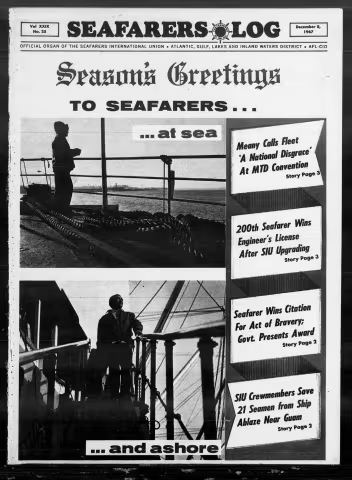
Vol XXiX
No. 25 SEAFARERSM.OG
OFFICIAL ORGAN OF THE SEAFARERS INTERNATIONAL UNION . ATLANTIC, GULF, LAKES AND INLAND WATERS DISTRICT • AFL-CIO
dmtinna
n-
li ' -
V-
bs! -
VNJ
I * *
;: ' . 1
-
Mew &» "«" ,
•A
*'«®
2O0tli Setfunr VHK
bgkuer s liai^_
AHerSttlh>Pi^
Story Page ^
, -, .":.-.-v; % r-jR- V ••
r
;:25,-;®jawss^
H0H.a'
/l
iff'aa:;
fc,fa»r m dutioK
fort Pnsa>^ ,
Story
SlU Crewn^"^^
21 ̂ effw®®
Ablaze Near Caam
Story Pege "2
Sj- V,' .•:••••'i '•••: ;':''. V •;• • iTir-fffT." ' a'
Page Two SEAFARERS LOG December 8, 1967 |j
Seafarer Turk Wins Govt Award
For Bravery by Merthant Seaman
^ ill
Seafarer Alfred D. Tuck and family are shown with officials of government, union and company after cere
mony in Washington honoring Seafarer's heroism in Vietnam harbor. From left: Robert McElroy, chief
clerk of House Merchant Marine Committee; Acting MARAD Administrator James Gulick; Fred Tuck;
Mrs. Lausita Tuck; Tuck and daughter; SlUNA Vice President Robert Matthews and Ed Terres of Isthmian.
Seafarer Alfred D. Tuck has been awarded a U.S. Coast Guard citation and the Merchant Marine
Meritorious Service Medal, for heroically preventing the destruction of several merchant ships and a
major South Vietnamese harbor, as well as saving the lives of several hundred seamen.
The Meritorious Service
Medal is one of the highest
awards the Government can be
stow upon a merchant seaman.
At the award ceremonies, held
November 22 at Maritime Ad
ministration Headquarters in
Washington, D.C., Acting Mari
time Administrator James Gulick
praised Brother Tuck's selfless
action, by quoting the Citation:
"During the early evening of
February 24, 1967, the Margarett
Brown was docked in Qui Nhon
harbor, Vietnam, alongside the SS
Hoosier State. Suddenly there was
a flareback and explosion at the
Margarett Brown's starboard
boiler furnace. Mr. Tuck, off
watch, ran to the engine room
door, but gaseous fumes, steam,
and smoke prevented him from
entering. With no apparent re
gard for his own safety, he im
mediately descended the shaft
alley escape trunk ladder, entered
the smoke-fllled engine room to
assist in securing the fuel serv
ice pump, and volunteered to go
above the starboard boiler to close
the bulkhead steam valves pre
venting the possibility of further
explosion and serious fire. The
engineer on duty was injured, and
although he was quickly pulled
out from beneath the debris, suc
cumbed to his injuries.
"Mr. Tuck, in entering the en
gine room at a time when it was
not known that a fire or further
explosions might occur, and ini
tiating immediate action to pre
clude further casualties, displayed
outstanding courage and devotion
to duty in keeping with the high
est traditions of the United States
Merchant Marine."
Tuck told the LOG that sev
eral other seamen who rushed to
the engine room to help were
equally deserving of the awards.
Docked by an explosive-laden
Hearings On Ship Disaster Continue
Al Bernstein (left), SlU Director of Welfare Services and Social
Security, discusses the Pan Oceanic Faith sinking with the Coast
Guard inquiry panel chairman. Rear Admiral Chester R. Bender.
Hearings on the sinking continued last week in San Francisco. Bern
stein reported that Bender "was impressed by the coolness of the
men and the seamanlike way they went about their activities pre
paratory to abandoning ship," and "by the fact that there was an
excellent relationship not only between the officers themselves but
between the crew as well." (Photograph by C. H. Meyer PHC; U.S.
Coast Guard Official Photo, 12th C, G. District, San Francisco, Calif.)
pier in Qui Nhon Harbor, the
Margarett Brown was surrounded
by five other vessels, including the
SlU-contracted Makato Victory.
The Hoosier State was carrying
supplies of plastic explosives and
napalm and a power-supply ship,
docked 200 yards away, had a full
load of oil.
An Army official, said Tuck,
had estimated that a second ex
plosion aboard the Margarett
Brown would have set off a chain
reaction, blowing up 'the pier and
all the ships in the area and kill
ing 400 working in the near vicin
ity.
On Behalf of Crew
Tuck accepted the awards on
behalf of the "many other men
who were involved." He specifi
cally praised chief engineer Am
brose White, the members of the
ship's emergency crew. Seafarers
Virgil Lambert, John Scully, Pete
Prevas, and Dick Whittely, and
the chief and first Engineers of the
Hoosier State, Roy Boyett and E.
Neelson, who scrambled onto the
Margarett Brown from the Hoo
sier State which was moored
alongside. In a letter to Paul
Hall, president of the SIU, Tuck
said, "As for myself, I will accept
(the award) on behalf of the men
on the Margarett Brown, who re
sponded to the General Alarm
and who no doubt gave of their
own selves not knowing from one
moment to the next, that that mo
ment may have been their last."
The nomination for the Mer
chant Marine Meritorius Service
Medal was made in May by Rep
resentative Edward Garmatz, (D-
Md.) who chairs the House Mer
chant Marine and Fisheries Com
mittee and Senator Daniel Brew
ster (D-Md.), who is a member
of the Senate Merchant Marine
and Fisheries subcommittee. In
his recommendation, Brewster
said that "There is no question in
my mind but that he ^uck) de
serves this medal. In a society
which is increasingly devoted to
self-service, this mariner unsel
fishly took his life in his own
hands to prevent further explo
sions which might have killed his
shipmates."
Report of
International President
by Paul Hall
Although potentially significant steps toward the revitalization of
the United States merchant marine have been taken with the presenta
tion in Congress of bills outlining a national maritime policy, such a
policy is still in the future and far from realization.
Plans, no matter how ambitious, are of little value unless they are
implemented. And plans on a national scale cannot ultimately be
carried out until opposition to them at the highest level of government—
either direct or indirect—is overcome or at least neutralized.
While taking note of the solid and continuing accomplishments of
other countries in the area of shipping activity, we in maritime labor
can take little comfort from the fact that a workable plan for such
accomplishments in our own country is still not out of the discussion
stage in which it has languished for many endless months.
Meanwhile, we must watch the speedy progress in shipping capa
bilities of other countries whose government leaders recognize the
value of a strong and competitive merchant marine.
Among the free nations of the world, Japan has made tremendous
advances in her merchant marine. She has already left this' country
behind in tanker capacity and is rising rapidly in other vessel categories
as well.
Of still greater importance is the fact that Japan was able to carry
more than one-third of all its own exports and almost half of its vast
imports in Japanese-flag bottoms during 1965, and is expected to in
crease its self-contained carriage to 55 percent of imports and 63 per
cent of exports within the next four years.
This while only a little over seven percent of America's combined
total of experts and imports moves in U.S.-flag ships today.
Maritime growth behind the Iron Curtain is as dangerous to the
United States and the freedom of the seas as it is impressive in statistics.
As the most powerful nation in the Communist world, the Soviet Union
has fully acknowledged the economic and political advantages of a
strong merchant marine and more than doubled the size of its fleet
in only five years.
According to a recent report by the U.S. Maritime Association,
further Russian maritime growth is expected at a rate of a million tons
a year until 1970—and we can be sure it won't stop there. Reports out
of East Germany indicate that Moscow is so intent on gaining suprem
acy on the seas that it is willing to risk the disfavor of its satellites.
The bulk of shipbuilding facilities in East Germany and much of that in
Bulgaria, Poland and others, is committed to the upgrading of the
Soviet merchant fleet—despite protests from these countries that they
are losing money in the process.
In the face of these facts and with the sad state of our own fleet
clearly apparent, the United States cannot afford any more vacillation
on enacting a maritime program which will once again put *his
country in a competitive position on the high seas.
S/U Creiv Rescues 21 Seamen
From Ship Ablaze Near Guam
Seafarers aboard the Coeur D'Alene Victory (Victory Carriers)
helped rescue 21 crewmembers aboard the frei^ter San Jose, when
that vessel caught fire off the coast of Guam on November 11 and
had to be abandoned by the O"
crew.
Frank Bose, electrician on the
Coeur D'Alene Victory, reported
that his ship was 90 miles west of
Guam and ten miles from the
scene of the fire when they re-*
ceived a distress signal. "We got
the signal at 1930 hours", Bose
said. "When we
arrived at the
scene, we saw
that the San Jose
was on fire amid
ships.
Shortly after
the fire broke out,
the San Jose had
lost her power,
including the
emergency power, said Bose.
"This made things difficult, since
signalling had to be done with
flashlights," he reported.
The SIU vessel spotted two
lifeboats at approximately 2140
hours. Rescue afforts were not
only hampered by heavy seas,
hut "typhoon Gilda was due to
hit the Southern tip of Guam the
next morning", Bose said.
No Injuries Reported
Also on the scene was the Navy
destroyer, Hissem. As the Navy
ship approached one lifeboat hold-
Bose
ing 32 crewmembers, the Coeur
D'Alerfe closed in on the other.
The rescue operation was com
pleted without injury and in a
comparatively short period of
time, said Bob Davis, AB and the
ship's delegate. "Bosun Joe Cash
did an excellent job trying to hold
onto the lifeboat, but lost it due
to the heavy seas", Davis reported.
The Coeur D'Alene had to alter
it's course after picking up the
San Jose seamen in order to
avoid the typhoon, whose winds
had reached 150 knots. The ves
sel had to head north, until they
could reverse course and head
south for Guam, Davis reported
to the LOG.
"We put the San Jose seamen
ashore at Guam, then proceeded
to Vietnam," Davis said, "and the
Navy Destroyer put the other
crewmembers ashore at Subic
Bay."
The skipper of the San Jose sent
a radiogram to the Coeur D'Alene
Victory praising the efforts of her
officers and crew. Another radio
gram was received from the com
mander of MSTS commending the
rescue effort. In addition, the men
of the Coeur D'Alene donated
$205 to their counterparts aboard
the San Jose.
- 1
I
December 8, 1967 SEAFARERS LOG Page Three
200th Seafarer Licensed
After Engineer's Upgrading
The 200-mark was reached by the engineer's training program,
jointly sponsored by the SIU and District 2 of the Marine Engineers
Beneficial Association, with the graduation on November 21 of
Seafarer Clarence Riggins, Jr.
Having successfully com
pleted the intensive course of
study prescribed by the School
for Marine Engineering operated
by the two unions, and passing the
U.S. Coast Guard examination for
Third Assistant Engineer, Riggins
was presented with his new third's
ticket by Commander William D.
Derr, USCG, at Coast Guard
headquarters in New York.
r iMf ̂
Kastenhuber Riggins
Seven additional Seafarers
passed their exams and received
new engineer licenses before the
200-mark was reached. They are
James Reaume, Paul Brinson,
Richard Carter, Lucien Butts,
Alfred Kastenhuber. Isabel Her-
Reaume Graham
nandez and Eschol Graham.
Riggins, who will celebrate his
52nd birthday later this month,
joined the SIU at Norfolk in 1964
and sailed as FOWT before earn
ing his engineer's license.
Before joining the Union, he
had spent 20 years in the U.S.
Navy and retired as a chief radio
man after 16 years in that rating.
In addition to his other accom
plishments, Seafarer Riggins is
also the holder of a first class
telegrapher and telephone opera
tor's license from the Federal
Communications Commission.
Riggins said that he may return to
New York soon to continue his
studies and stand for a standard
marine radio operator's license.
Butts Hernandez
Ronald Spencer, director of the
engineer's training program, de
scribed Riggins as ''an excellent
student with an average in the
Brinson Carter
90s" and called him a fine exam
ple of the high caliber of licensed
(Continued on page 11)
SIU Action Prompts Review
Of Cargo Preference Rates
WASHINGTON—A tripartite committee of maritime, labor,
management, and Maritime Administration representatives have
begun a review of the ceiling rates for U.S.-flag vessels carrying
foreign aid cargoes.
The committee was set up at
a meeting called by Maritime
Administrator James Gulick at
which ship operators, unions and
Administration staff members di.s-
cussed establishment of machinery
to review the ceiling rate structure
revisions made by the federal
agencies several weeks ago.
These developments followed
talks by SIU President Paul Hall,
Commerce Secretary Alexander
B. Trowbridge, Under Secretary
Howard Samuels, Maitland Pen
nington, Chief of the Agency's
Cargo Promotion, and Gulick.
Hall requested those attending
the meeting to help correct in
equities to U.S. shipping resulting
from the Maritime Administra
tion's rate revisions.
Under the recently amended
rate change so-called smaller ves
sels up to 15,600 tons were given
a 10 percent increase in the ceil
ing rate allowed in the transport
of U.S. foreign aid shipping.
Intermediate ships—over .15,-
600 tons—were given a ceiling of
25 percent under the newly estab
lished guideline rate for the small
er vessels. The rate in this class
previously has been 20 percent
less.
• Rates Inadequate
In his discussions with the
Commerce Department, Hall em
phasized that the new rates were
inadequate and steps should be
taken immediately to put them at
compensatory levels. He advised
that all interested parties, both
shipping management and labor
representatives, be given an oppor
tunity to meet with MARAD rep
resentatives to review the existing
rate structure with the view to es
tablishing fair and reasonable rates
that would be adequately com
pensatory.
As a result, a call for such a
meeting was made by the Mari
time Administrator for November
28 in Washington.
Some 75 shipping company rep
resentatives along with representa
tives of various maritime unions
participated in the initial discus
sions at which the tripartite com
mittee was set up. The union
representatives on the committee
are Hall and Hoyt Haddock of
the National Maritime Union.
AFl-CIO President Addresses Opening Session
Fleet Detiine 14 National Disgrace,'
Meany Charges at MTD Convention
'TIME ADMlNISTPflTinMi
MARtTl^lF TBAKS nFWlRflMifNT
f6 -rvviAL cn- • TIMTIOIV
Several hundred delegates to biennial convention of AFL-CIO Maritime Trades Department listen to Sen
ator Warren G. Magnuson (D.-Wash.), who said "Great Society" requires "adequate maritime strength."
BAL HARBOUR, Florida—AFL-CIO President George Meany has sharply assailed
the government's "stupid policy" in starving the nation's merchant marine, except in time
of emergency. Speaking at the opening session of the AFL-CIO Maritime Trades Depart
ment's Biennial Convention,
Meany said the present con
dition of the maritime indus
try is a national disgrace—and
"it can't be justified under any
circumstances."
The labor federation head
told several hundred delegates at
the MTD convention that, "We
need an American merchant ma
rine, we need American ships
built in American shipyards, man
ned under the American flag by
American seamen."
"If this calls for the expenditure
of large sums of public money, so
be it. Public money could not be
spent for a better cause. I think
in the final analysis it would cost
as much to do this job right as it
costs us to finance crash programs
every few years," Meany added.
Heads List of Speakers
Meany headed a long list of la
bor, congressional, government
and industry officials who ad
dressed the delegates from 38 na
tional and international unions
and 32 maritime port councils in
the United States, Puerto Rico and
Canada.
Senator Warren G. Magnuson
(D.-Washington), the chairman of
the Senate Commerce Committee,
also addressed the convention and
said it was obvious that the "Great
Society stops at the water's edge."
He explained that 34 months ago
the Administration promised a
new maritime program, but that
the White House "has never sub
mitted such a plan." The United
States "cannot have a Great So
ciety if we do not enjoy adequate
maritime strength."
Senator E. L. Bartlett (D.-Alas-
ka), chairman of the Senate Mer
chant Marine Subcommittee, told
delegates that the maritime pro
gram submitted last month by
Senate and House leaders was "a
good program—a program behind
which all segments of the mari
time industry could and should
unite." The Senator expressed the
hope that nothing would be al
lowed "to shatter the industry's
unity" on the maritime program.
Representative Emanuel Celler
(D.-N.Y.), Dean of the House
and Chairman of the House
Judiciary Committee, addressed
the convention and asked, "Why
do we seem unable to support a
viable merchant fleet in peace
time when we can so readily ap
preciate the crucial role that the
merchant fleet plays, and must in
evitably play, in time of war?"
Governor Roberto Sanchez
Vilella of the Commonwealth of
Puerto Rico stressed his island's
dependence on shipping and
pointed out that "99% of our
trade moves out of U.S. ports."
As the LOG went to press, dele
gates to the MTD Convention
were preparing to deal with a
number of vital issues affecting
the future of the maritime indus
try and the welfare of the mem
berships of the various affiliated
organizations. A full story on the
convention will appear in the next
issue of the LOG.
AFL-CIO Pres. George Meany (second from right) and Gov. Roberto
Sanchez Vilella of Puerto Rico (right), speakers at convention, are
shown with MTD Pres. Paul Hall and Sec.-Treas. Peter M. McGavin.
Vice President Hubert Humphrey talks with Representative John Dent
(D.-Pa.) and AFL-CIO Vice President James A. Sutfridge (center) at
MTD's convention reception. MTD delegates convened in Bal Harbour.
Page Four SEAFARERS LOG
December 8, 1967
Vice President Humphrey to Address
Seventh Biennial AFL-CIO Convention
WASfflNGTON—Vice President Hubert H. Humphrey and several Cabinet members have ac
cepted invitations to address the AFL-CIO's seventh biennial convention opening December 7 at the
Americana Hotel in Bal Harbour, Fla., Federation President George Meany has announced.
The date of the Vice Presi- ^
dent's address has not yet been
determined, Meany said.
Meany also announced that the
AFL-CIO Executive Council will
hold a one-day meeting December
6, preceding the convention.
The convention will recess over
the weekend of December 9-10
for meetings of convention com
mittees.'
The AFL-CIO General Board,
made up of 29 Executive Council
members and a chief executive
officer of each affiliated national
and international union and trade
and industrial department, will
meet December 9.
Major speakers on the opening
day of the convention include
Secretary of Labor W. Willard
Wirtz, Secretary of Health, Educa
tion & Welfare John W. Gardner,
Secretary of Transportation Alan
S. Boyd and American Legion
Commander William E. Gal-
braith.
Rusk to Speak
Among speakers scheduled for
the second day are Secretary of
State Dean Rusk; Attorney Gen
eral Ramsey Clark; Betty Fumess,
the President's assistant for con
sumer affairs; Director R. Sargent
Shriver of the Office of Economic
Opportunity; Chairman Harold
Russell of the President's Com
mittee on Employment of the
SlU Fishermen's Unions Rap
U. S.-Soviet Fisheries Pact
Representative James A. Burke (D-Mass.) reads one of 4,000 letters
delivered to his Washington office by SlU Atlantic Fisherman's Un
ion President James Ackert (right) and SlUNA representative Joseph
Algina. Letters, like current campaign of SlUNA's Fish and Cannery
Conference, urge new legislation to bolster U.S. fishing industry.
BOSTON—Officials of the SIUNA-affiliated Atlantic Fisher
men's Union and New Bedford Fishermen's Union have sharply
criticized the fisheries agreement recently announced in Moscow
under which the Soviets would t
be allowed to fish to within
six miles of the Long Island and
New Jersey coastlines, while lim
iting their catch of industrial fish
—red hake, silver hake, scup and
fluke—in the agreed area south of
Cape Cod off the Middle Atlantic
coast. The Soviets won't fish in
that area from January 1 through
April 1 next year.
Captain James Ackert, presi
dent of the Atlantic Fishermen's
Union, said the American nego
tiating team headed by Donald L.
McKernan, special assistant for
fisheries and wildlife to Secretary
of State Dean Rusk, "came back
from Moscow with a big bag of
nothing." •
"The Russians," asserted Ack
ert, "won all the concessions such
as broaching our 12-mile limit.
As for their agreement to limit
their catch in an almost extinct
fishery, a fishery they clobbered
into the bottom, they'll only add
this Mid-Atlantic fleet to the fleet
already fishing Georges Bank. The
pressures on Georges is going to
be harder than ever now."
Ackert further charged that the
Russians swapped an almost ex
tinct fishery in the Mid-Atlantic
for all kinds of concessions "we
never should have granted."
Equally vocal on the matter was
Austin Skinner, secretary-treasurer
of the New Bedford Fishermen's
Union.
"As usual, the Russians wound
up with all the marbles," he said.
Boycott Meetings
Skinner noted that the heads of
the SIUNA fishermen's unions
had boycotted the Moscow ses
sions.
"We didn't want to be associ
ated with this even by attendance,"
said Skinner, adding, "We could
see how this was going to turn out
and our worst fears have been re
alized. This is just another sellout
by the State Department."
Both Ackert and Skinner an
nounced plans to seek government
support to extend the U.S. terri
torial waters to the end of the
Continental shelf to protect the
coastal fisheries from Russian fish
ermen.
They were particularly dis
turbed that the agreement did not
cover Georges Bank where, they
say, the Russians have been "giv
ing the U.S. fishermen the busi
ness."
Handicapped, and Administrator
William Gaud of the Agency
for International Development.
Speakers set for December 12
include Director Willam Simkin of
the U. S. Mediation & Concilia
tion Service, NAACP Executive
Director Roy Wilkins and Prime
Minister Hugh Shearer of Ja
maica.
The two fraternal delegates
from the British Trades Union
Congress, who will address ses
sions on dates to be annornced,
are General Secretary Lord
Cooper of the National Union of
General & Municipal Workers
and Assistant General Secretary
H. R. Nicholas of the Transport
& General Workers Union.
Vice President William Lady-
man of the International Brother
hood of Electrical Workers, who
also will speak on a date to be
set, is the fraternal delegate from
the Canadian Labor Congress.
Other guests of the AFL-CIO
scheduled to address the delegates
are Secretary-General Aharon
Becker of Histadrut, Secretary-
General Arturo Jauregui of the
Inter-American Regional Organ
ization of Workers (ORIT), Sec
retary-General Harm Buiter of
the International Confederation of
Free Trade Unions, and Secretary-
General Andre Bergeron of the
French Force Ouvriere.
Seven More Seafarer Veterans
Atided to SlU Pension Roster
Ward Seymour Kaelep Babb
The names of seven Seafarers have been added to the list of those
men enjoying retirement security with the aid of SIU pensions.
The latest additions to the SIU's pension roster include: Otho Babb,
Leo Entringer, Norman Gillett, Luciano Ghezzo sailed as bo-
Luciano Ghezzo, Hubert Sey- sun. He joined the SIU in the port
mour, John Ward and Oskar of Philadelphia. A native of Italy,
Kaelep. Ghezzo makes his home in Brook-
Otho Babb sailed as steward 'y"'
and joined the Union in New
York. He was born in Suffolk,
N.Y., and lives in Brooklyn with
his wife, Delia. Babb last sailed
on the Transglobe.
Leo Entringer joined the Union
in the port of Detroit and sailed
as fireman. Born in Wisconsin,
he is a resident of Green Bay.
Entringer was
last employed by
the Reiss Steam
ship Company.
Norman Gillett
joined the SIU in
New York and
sailed in the deck
department. He is
a native of Jersey
City, N.J., and
makes his home in North Bergen,
N.J., with his wife, Elizabeth. Gil
lett was employed by the New
York Central Railroad.
Entringer
Ghezzo GOlett
Hubert Seymour was born in
Mississippi. He lives in Mobile
and was a member of the steward
department since joining the SIU
in that port.
John Ward joined the SIU in
New Orleans in 1940. Born in
Alabama, Ward's last ship was the
Del Norte. He sailed all ratings
in the engine department.
A member of the deck depart
ment, Oskar Kaelep shipped as
bosun. He is a native of Estonia
and now lives in Miami.
Building Trades Pledge All-Out Aid
For Program to Rebuild U.S. Cities
BALL HARBOUR, Fla.—^America's 3.5 million building tradesmen will give their "full coop
eration, know-how, resources and manpovyer" to the task that offers the greatest opportunity of
their careers—the job of rebuilding American cities under new federal housing programs. Presi
dent C. J. Haggerty of the AFL- ̂ ^
CIO Building & Construction
Trades Department pledged
here.
"This will be a vast program un
precedented in the history of the
world," Haggerty told delegates at
the opening session of the depart
ment's 54th convention. "This is
not a job for amateurs. The re
building of America will require
the best talent the B&CTD and its
18 unions can mobilize," he de
clared.
Haggerty noted that employ
ment of disadvantaged persons and
training of youth from each af
fected area are "both major con
siderations" in the demonstration
cities program. He advised local
unions to "consider accepting into
membership" area residents who
are qualified as journeymen crafts
men, and who want to work in that
capacity. He urged, too, that lo
cals "institute learner or trainee
programs for those area youths
who show an interest and an apti
tude."
Urban Crisis
As practical men, Haggerty
said, building tradesmen have
long warned that the innumer
able and complex problems fac
ing our cities would, if unat
tended, explode into an urban
crisis. This now has happened."
To help solve the urban crisis,
"we enthusiastically supported the
legislation" which helped create
the new federal Department of
Housing &. Urban Development,
Haggerty recalled. Noting that
HUD Secretary Robert C. Weaver
would be a convention speaker,
Haggerty promised the fiill co
operation of the building trades
in the "vast program of rebuilding
our cities."
A few days earlier, he noted,
Weaver announced that plans for
(ebuilding will begin soon in 63
demonstration cities under the
model cities and housing acts. Of
this Haggerty said:
"I suggest our local unions and
councils make every effort to be
represented on all planning com
mittees for all phases of the pro
gram in their area.
The entire field of urban renew
al and rehabilitation "will for years
continue to grow . . . and the time
is right now for us to get into
every phase of the work as it ex
pands." The program, Haggerty
declared, "means not only a better
way of life for millions of Ameri
cans" but also continued employ
ment for present and future union
members.
On the subject of situs picket
ing, Haggerty said the failure of
Congress to permit on-site picket
ing by a building trade against an
unfair contractor "represents one
of the sorriest demonstrations" of
the failure of Congress to permit
a vote on a pending bill. "I can
assure you," he told the delegates,
"that this department has not and
will not abandon the fight."
Recognize Commitment
On the subject of the war in
Southeast Asia Haggerty said that
building trades delegates, as prac
tical men, "clearly recognize our
commitment in Viet Nam. They
realize we are dedicated to the
principle that the destructive
forces of communism shall not be
permitted to crush helpless people
in any part of the free world."
President Johnson sent a mes
sage to the conveniton saying that
building tradesmen can "take great
pride in a long and honorable his
tory of service to this country"
and concluding "I know the na
tion can count on your sustained
help in ensuring that the high
goals we share for America are
fully realized."
Talks by AFL-CIO President
George Meany, SIU President
Paul Hall and Weaver are sched
uled during the convention pro
ceedings.
December 8, 1967 SEAFARERS LOG Page Five
Hie Atlantic Coast
by Earl (Bull) Shepard, Vice-President, Atlantic Coast Areaj
It is not suqjrising that Administration figures released recently
show that this country's balance of payments deficit is up for the
third quarter of this year and shows every indication of going
as high as $2.5 billion dollars by the time the complete totals
are in.
Once again, experimental gov- f
ernment economies aimed at low
ering the deficit appear not to
have achieved their goal.
Increased American-flag shipping
could go a long way toward bal
ancing this trade deficiency but
there is still no inclination on the
part of the White House to give
this sound method a try. A closer
look by Administration officials at
what a revitalized merchant ma
rine could do in this area is called
for now more than ever before.
Boston
Angelos Antoniou had to leave
the Cities Service Miami due to
the serious illness of his wife. We
are happy to report she is im-
A. Sawyer J. Sawyer
proved and he will be looking for
an AB's job soon. We wish her a
complete recovery.
Antone Pacuinos told us he was
disappointed the Seatrain Mary-
land laid-up. He had a good OS
job.
Elmer "Blackie" Grose was BR
on the Maryland and said he must
be bad luck because his last two
ships laid-up. Elmer will take the
first job to hit the board.
, Baltimore
Fred Laplant just arrived from
Thailand and Vietnam aboard the
Carroll Victory. A 29-year SIU
veteran, Fred believes in a nice
rest between trips.
Lewis Francis, AB, has been on
the beach awhile and is ready for
a long trip. He's a 23-year vet
eran.
Ci/Am 'Blacklist'
Adds 5 Ships
WASHINGTON —Five addi
tional foreign-flag merchant ves
sels have been added to the Mari
time Administration's list of ships
ineligible to carry U.S. govern
ment-financed cargoes because
they have called at (2uban ports.
Barred in the latest MARAD
report, issued last month, are;
the British-flag East Sea (9,679
gross tons); the Protoklitos, Cy
prus (6,154 tons); the Isomeri,
Finland (3,576 tons); the Aragon,
Somaliland (7,201 tons) and the
Lebanese vessel, Atticos (7,257
tons).
Since it was begun on January
1, 1963 a total of 216 ships of
all flags—with an aggregate gross
tonnage of 1,558,872—^have been
placed on the Maritime Admin
istration's Chiban "blacklist." With
the exception of Communist Po
land, only free world shipping is
covered , by the reports.
Philadelphia
Edmund Abually is registered
and ready to go. His last job was
as bosun aboard the Glohe Car-
rier.
Philip Huss has been on the
beach for awhile and is now set
to go again. He sails in the black
gang.
Ready to go is John Shannon of
the deck department. His last job
was aboard the Ames Victory.
Puerto Rico
Work has resumed at Sea-Land
terminal here after maintenance
workers walked off the job to pro
test the companies laying off 21
workers.
Tom Rainey decided to take
some time off in San Juan after a
long stay as cook and steward
aboard the Borincano. As the Ra
phael Semmes passed through on
the way to the coast and Vietnam,
we had a chance to say hello to
George Burke, "Boots" Peura,
Emil Wagner, Joe Hilton, and Joe
Atchison.
Norfolk
Julian Sawyer last shipped as
AB on the Transsuperior. After
attending to some business, he will
ship out shortly after the first of
the year.
Alfred Sawyer, bosun on the
same ship, will spend the holidays
with his family and sail shortly
afterwards.
Brazil Government Offers New Plan
For Carriage of Nation's Exports
WASHINGTON—Apparently ending an international dispute between the United States, Brazil,
and 17 shipping companies, the Brazilian Maritime (Commission has proposed a new Inter-American
Freight Conference which will give Brazilian and American shippers an increased share of carriage
of Brazilian export cargoes to
the United States. Prior to pres
entation of the new Conference
plan, now under study by the U.S.
Federal Maritime Commission, a
Brazilian Government decree allo
cating sharply reduced cargo
quotas to American shippers had
brought threats of stiff reprisal
from the Senate floor and the
FMC, and had aroused the op
position of many European ship
pers whose Brazilian export trade
was also limited.
The president of the provi
sional committee of the proposed
Conference, Amaro Soares de
Andrade, explained the main ob
jectives of the new plan: To
establish 65 percent as the mini
mum initial quota for Brazilian
export cargoes carried by the Bra
zilian national line, Lloyd Brasili-
ero, and American lines (presently
consisting of the SlU-contracted
Delta Lines and another com
pany; this figure is to rise to 80
percent over the next 10 years;
and to establish 35 percent as the
maximum participation of Euro
pean (or "third-flag") carriers at
the present, and to reduce this
figure to 20 percent within the
next decade.
Such a system, at the outset,
will provide American shippers
with approximately 45 percent of
the 65 percent allocation, since
the Brazilian merchant fleet is cur
rently capable of handling only
about 20 percent of Brazil's ex
ports. South American carriers
dealing with exports from Brazil,
who now consist of Uruguayan
and Argentinian companies only,
will initially receive their share of
cargoes from the percentage al
lotted to Brazil.
Stormy Developments
In the stormy history of the
Brazilian export cargo quota sys
tem, three different plans, includ
ing the present one, have been
set forth since June 1967. At
that time, Admiral Celso Soares
Guimares, the Brazilian maritime
administrator, initiated an Inter-
American Freight Conference,
under which 80 percent of cargoes
carried from Brazil to the U.S.
would travel on ships showing
the flag of those countries.
Though a few Latin American
and two British lines were per
mitted to join the program, third-
flag shippers (who had been carry
ing over 33 percent of such car
goes) were generally ignored in
the agreement, and were assigned
a 20 percent limit by the Brazilian
Government.
When the European companies
objected, Brazil issued a decree
which stipulated that European
lines—and other lines—refusing
to accept the new quotas would
be banned from carrying any
Brazilian export cargoes. The
Europeans refused to comply, and
were barred from carrying any
northbound Brazilian cargoes, as
of August 10.
As a result, the third-flag car-
Metal Trades Hold Convention;
Organizing Cited as Malar Goal
BAL HARBOUR, Fla.—Delegates to the 53 rd convention of the AFL-CIO Metal Trades
Department voted new four-year terms for their 11 top officers and set new objectives for the
department's 22 affiliated unions in the fields of organization, bargaining and legislation.
President B. A. Gritta set the
tone of the convention by re
porting that unions afiiliated
with the department made sizable
gains in the last two years, notably
in the federal wage board or "blue
collar" field, but warned that the
biggest job of organizing lies
ahead.
Metal Trades unions have won
exclusive recognition agreements
from 38 major federal installa
tions—up 14 since the 1965 con
vention. But there are 400,000
still unorganized blue collar work
ers in the federal service, Gritta
said.
He reported that the Metal
Trades Etept. and its unions "es
tablished a fine record" of collec
tive bargaining achievements, in
grievance handling and in con
ducting leadership training pro
grams for more than 2,000 stew
ards—a record achieved with the
aid of the AFL-CIO unions and
the federation's Departments of
Organization and Education.
The convention adopted a pro
gram calling for stepped-up orga
nizing efforts not only in the fed
eral service but also in private
industry. It emphasized that the
program is capable of achieve
ment only with the assignment of
money and manpower to the job.
since the department itself has no
independent organizing staff.
Labor Secretap^ W. Willard
Wirtz, in a major speech, an
nounced that a presidential com
mittee which heard testimony re
cently on proposed changes in
Executive Order 10988, govern
ing organization and bargaining
rights of federal employees is now
"summing up" in preparation for
submitting its recommendations to
the President.
Commenting on a convention
resolution charging that the De
partment of Labor has proposed
"restrictive" regulations on the
years-old system of apprenticeship
training sponsored by labor and
management, Wirtz said "I read
your resolution" and "I agree it
is wrong that your committee on
apprenticeship was not consulted"
before the regulations were pub
lished.
"I believe in the apprenticeship
system," the secretary declared.
"It's a solid achievement." Assur
ing the delegates that "we're going
to protect the standards, the tradi
tion and proven principles of
trade unionism and of apprentice
ship systems," Wirtz announced
that he will meet with presidents
of major unions January 6 to dis
cuss union objections to the pro
posed changes.
AFL-CIO Secretary - Treasurer
William J. Schnitzler reported
that the federation has added
more than 1.5 million new dues-
paying members to its roster in
the last three years—an increase
of almost 11 percent.
Chairman John W. Macy of the
U.S. Civil Service Commission
announced that "it is only a mat
ter of days until the basic policies
for a new coordinated federal
wage system" covering 700,000
government blue collar employees
will be made public.
President-Emeritus Lawrence
Raftery of the Painters swore in
department officers for the new
term. Besides Gritta, they are
Secretary - Treasurer Clayton W.
Bilderback and Vice Presidents
Gordon M. Freeman, Internation
al Brotherhood of Electrical Work
ers; Gunnar Hallstrom, Pattern
Makers; William A. Lazzerini,
Molders; John H. Lyons, Iron
Workers; Russell K. Berg, Boiler
Makers; Hunter P. Wharton, Op
erating engineers; P. L. Siemiller,
Machinists; William E. Freden-
berger. Firemen & Oilers; S. Frank
Raftery, Painters, all presidents of
their unions.
riers filed strong protests with the
U.S. Federal Maritime Commis
sion which was still studying the
program. In addition, they insti
tuted a $72.9-million damage suit
in Federal court against the Amer
ican and Brazilian lines, contend
ing that the agreement violated
U.S. anti-trust laws.
The U.S. Justice and Trans
portation Departments also op
posed the (Conference on the
grounds that it might be detri
mental to America's commerce.
At this point, seeing that the
legal hassle might obstruct ap
proval by the FMC for years,
Brazil reversed its position and
reached an accord with Scandi
navia but did not consult the
American lines, and then infuri
ated the American carriers and
the FMC by imposing the same
"take-it-or-leave-it" restrictions on
the U.S. companies.
The move brought Delta Steam
ship Line president Captain John
Clark to complain to the FMC
that the new Conference could
shut United States operators out
of Brazilian trade altogether.
Senator Russell B. Long (D-
La.), declared that serious coun-
termeasures would be in order
unless the Brazilian stand was
changed. Such countermeasures
would include restrictions on im
ports of Brazilian coffee, a ban on
Brazilian ships carrying U.S.-fi-
nanced cargoes, and a review of
the entire program of foreign aid
to that country.
In addition, the Federal Mari
time Commission considered in
voking Section 19 of the 1916
Shipping Act, which would have
required the Commission to take
measures against ships of any na
tion that discriminated against
American flag vessels.
Employment of such measures
would have cost Brazil hundreds
of millions of dollars.
SEAFARERS^#LOG
Dec. 8, 1967 • Vol. XXiX, No. 24
Official Publication of the
Seafarers International Union
of North America,
Atlantic, Gulf, Lakes
and Inland Waters District.
AFL-CIO
Executive Board
PAUL HALL, President
CAL TANNER
Exec. Vice-Pret.
AL KERR
See.-Treae.
EARL SHEPARD
Vice-President
LINDSEY WILLIAMS
Vice-President
ROBERT MATTHEWS
Vice-President
Editor
MIKE POLLACK
Staff Writers
PETER WEISS
HARRY WITTSCHEN
FRANK MARGIOTTA
STEVE STEINBERG
Staff Photographer
ANTHONY ANSALDI
rikllihtd kistikly at 810 Rksds lilaiid AISBIS
N.E., Waihlnttsn, D. C. 20018 ky tks Ssatar-
sn latsmatlonal Union, Atlantic, Gall, Lalss
u« iBlaBd Watcn Dlitrict, AFL-CIO, 675
Fonrtk Aycnat, irsoklyn, N.T. 11232. Tel.
HVailntk 9-6600. Siosni clau awtsfc »aM
at Waihlniton, D. C.
nSTMASTEII'S ATTENTION: Fans 3579
carOi iksaM kc Mat la Scafararc latiraatlaaal
Ualan. Atlantic, Galf, Lakes aa< lalanO Watcn
District, AFL-CIO, 675 Fairtk A«cnH, Break-
lyn, N.T. 11232.
Page Six SEAFARERS LOG December 8, 1967
Brazil Maritime Workers Visit SlU
Discussion of worldwide maritime industry problems was the topic of
discussion at SlU Brooklyn Headquarters recently when members
representing Brazil Maritime Workers Trade Unions met with SlU
International Representative Charles Taibi. The unionists represented
a cross-section of seafaring unions from shipbuilders' to stewards.
Five Children Perish in Fire
in Condemned Migrant Shack
PILESGROVE TOWNSfflP, N. J.—Five small children burned
to death in a squalid, condemned migrant-worker's shack here
last week while their mother was picking leeks in a field for her
employer-landlord. ^
ilie tragic example of callous
exploitation of migratory labor
ers by employers occurred only
weeks after the entire farm work
ers' camp in which the shack was
located was condemned by state
authorities.
Following an investigation by
the New Jersey Department of
Labor and Industry, Jill Brothers
—one of the largest growers in
Salem County—^had been issued
an ultimatum to construct new
buildings at the camp by April 1,
1968, or face a $2,000 fine.
Fined $100
Also, the Jills had been fined
$100 on September 20 for viola
tions in some of the run-down
wooden structures which included
over-crowding plus failure to pro
vide vented heating and adequate
fire resistant materials.
When he arrived at the scene
of the fire, migrant labor bureau
chief Charles Yersak said an in
spector's report on the camp, filed
October' 19, did not include the
fire violations and they were as
sumed to have been corrected.
"This never should have hap
pened," Yersak declared as he
climbed through the charred ruins.
"We never would have permitted
this,"
The five children of 32-year-old
Mrs. Annie Marie Taylor ranged
in age from seven months to seven
years old. Their bodies were found
close to a still-burning coal stove
in the bedroom. An overturned
electric heating unit was on the
floor nearby.
Fire Unexplained
Two migrant workers rushed
to the shack when the fire broke
out at 11 a.m., but were forced
back by heavy smoke and flames.
By the time the firemen arrived,
the front half of the building
where the victims were was com
pletely destroyed. Officials were
unable to explain how the fire
started.
Aides of New Jersey Governor
Richard . J. Hughes circulated
quickly through the Assembly and
Senate chambers in Trenton "as
soon as news of the deaths reached
the capital.
"If this doesn't do it, nothing
ever will," one of them said as
they launched a renewed admin
istration effort for legislation to
clean up the state's squalid mi
grant labor camps.
When Mrs. Taylor's husband,
Isaac, 37, returned to the camp
from nearby Philadelphia in the
evening, he could just stand in
front of the bumed-out building
and shake his head silently.
The couple have two other chil
dren who were in school at the
time of the fire.
^Inland Watorf DtfliHlii
From Nov. 16 to Nov. 29, 1967
DECK DEPARTMENT
TOTAL REGISTERED TOTAL SHIPPED REGISTERED on BEACH
All Groups All Groups All Groups
Port Class A Class B Class A Class B Class C Class A Class B
Boston 3 0 7 0 1 11 3
New York 72 24 43 28 15 203 113
Philadelphia 6 1 2 2 1 27 8
Baltimore 34 15 20 9 11 120 63
Norfolk 17 9 7 4 15 38 23
Jacksonville 7 10 7 5 4 11 7
Tampa 19 8 4 4 0 19 8
Mobile 27 22 22 17 3 76 35
New Orleans .... 35 88 33 16 18 156 84
Houston 78 63 73 67 4 122 58
Wilmington 20 14 9 12 17 24 0
San Francisco ... 29 47 43 40 32 61 22
Seattle 14 15 4 3 8 53 11
Totals 361 316 274 207 129 921 435
ENGINE DEPARTMENT
TOTAL REGISTERED
All
TOTAL SHIPPED
All Groups
REGISTERED on BEACH
All Groups
Port Class A Class B Class A Class B Class C Class A Class B
Boston 1 0 0 1 1 6 2
New York 50 47 37 28 13 115 92
Philadelphia 3 1 0 4 2 12 5
Baltimore 24 18 15 13 10 56 81
Norfolk 7 9 2 2 9 21 26
Jacksonville ..... 7 11 4 10 5 7 6
Tampa 6 10 1 4 0 4 10
Mobile 17 23 ' 15 18 4 43 29
New Orleans 39 40 31 37 21 87 73
Houston 66 66 56 51 5 85 73
Wilmington 12 7 9 5 7 16 1
San Francisco ... 35 29 36 30 33 67 24
Seattle 17 10 8 9 8 31 15
Totals 284 271 214 212 118 550 437
STEWARD DEPARTMENT
TOTAL REGISTERED TOTAL SHIPPED REGISTERED on BEACH
All Groups All Groups All Groups
Port Class A Class B Class A Class B Class C Class A CUssB
Boston 1 0 1 0 2 6 1
New York 41 12 21 15 12 165 35
Philadelphia ..... 5 6 4 1 6 15 6
Baltimore 17 10 13 7 9 95 48
Norfolk 4 9 4 3 14 20 19
Jacksonville 5 4 4 4 7 7 5
Tampa 13 2 4 3 1 9 2
Mobile 28 9 18 13 5 73 23
New Orleans .... 42 25 33 25 21 128 87
Houston 67 34 49 19 3 85 60
Wilmington 9 5 6 4 3 13 0
San Francisco .. 38 36 31 25 17 35 21
Seattle 12 7 4 4 4 31 7
Totals 282 159 192 123 104 682 314
YOUR DOLLAR'S WORTH
Seafarer's Guide to Better Buying
Oatmeal, that last stronghold of low-cost
cereals and standby of large families, now
has gone the way of the dry cereals. The
supermarket shelves have become loaded
with fancied-up presweetened versions con
taining bits of apple, raisins, maple flavor,
and other ingredients. Too, you now can
buy "quick" oatmeal, "instant" oatmeal and
what can be described only as "instant in
stant."
The new pre-flavored, super-convenience
hot cereals show the fallacy of "conven
ience." You actually can make more money
stirring oatmeal than you can by going out
to work. For example, ordinary Maypo oat
cereal takes one minute to cook four serv
ings. The "Instant" Maypo takes a. half-
minute. For four servings of the "Instant"
you pay 3.6 cents more.
In case you think pennies don't count,
note that the extra price for the half minute
you save adds up to $4.30 an hour compared
to the typical industrial pay of $2.80 an
hour.
The addition of a few inexpensive ingre
dients and flavoring can quadruple the cost
of your cereal—^raising the price from as
little as 1.2 cents an ounce to as much as 4.8.
Some of the extra ingredients are even de
ceptive. The new Oatmeal with Apples and
Cinnamon, or Raisins and Spice, actually
contains more added sugar than apples,
raisins or spice. lUs is shown in the list
of ingredients (which the Quaker company
puts on the bottom of the package). The
added "Apples" consist of the tiniest chips
of dehydrated apples you ever saw.
The real fallacy, from your point of view,
is that you are paying at the rate of 77 cents
a pound for the added sugar.
You also better look at the weights and
prices of all the new cereals before you grab
them off the shelf. Of three packages which
seem to be the same size, one may provide
8 ounces, another 10, a third 12, at prices
ranging from 33 to 43 cents, and costs per
serving from 3.3 to 5.4 cents. This is what
they call the new math.
Comparing prices and servings at least
is a little easier now. Most of the cereals
now show the net weights on the front face
of the package and in larger type than be
fore.
Nutritionally, plain oatmeal does provide
a little more protein than the other cooked
cereals like farina, and almost twice as
much as corn flakes,*and three times as much
per ounce as pre-sweetened dry cereals.
These, without the added milk, get close to
the point of worthlessness in protein value.
Otherwise, as convenience food, the pri
vate brands of some dry cereals now are
less expensive than the "instant" types of
cook cereals. For example, the "wheat
shreds" sold by the consumer cooperative
stores, come to approximately 1.5 cents an
ounce, and appear to be the best value of
all dry cereals, and better value than most
of the new cooked types. Sudh "Shredded
wheat cereal has almost as much protein
as oatmeal and about one-third more than
cornflakes.
,
ii
December 8, 1967 SEAFARERS LOG Page Seven
Use of Convicts for Harvest
Enjoined by Calif. Court
SAN FRANCISCO—Superior Court Judge Robert J. Drewes issued
a preliminary injunction barring the assignment of convict labor by the
state to harvest the crops of private growers.
The judge's action was hailed by State AFL-CIO Executive Secretary-
Treasurer Thomas L. Pitts as a victory for both the state central labor
body, which had brought suit for the injunction, and for California's
"grossly underpaid farm workers."
The suit charged Republican Governor Ronald Reagan with violating
the state constitution when he authorized the use of some 300 state
prison convicts to harvest figs and grapes in Merced and San Bernardino
Counties.
Judge Drewes agreed with the AFL-CIO's contention that Reagan's
authorization of the use of convicts to harvest private crops did not
follow the rules of the work furlough program.
"It does not resemble a rehabilitation program in any important
respect," the judge said.
Noting that the work furlough program is one that allows an inmate
to work individually and "to enjoy his freedom during regular hours of
work," Judge Drewes pointed out that the state's farm program for
convicts "requires that the prisoner work as a member of a gang or
crew . . . under guard and isolated" from other employees.
Moreover, the judge said: "The legislature has provided that pris
oners may be required to perform labor on public works and ways and
in the suppression of forest fires. They may also be required to work
on parks and grounds under the control of park commissioners. These
activities concern the public interest. Here the state owned neither the
crops harvested nor the land upon which the work in question was
performed, nor did it pay the workers. The interests of the growers
are private, not public, and the work performed, therefore, was not
done within the meaning of" the state constitution.
Commenting on the decision, Pitts said that in view of the express
language of the constitution and the "blatant irregularities" in the
Reagan administration's assignment of convict labor, "I don't see how
the judge could have reached any other decision."
He added that, "hopefully ... the court's decision may help awaken
California's taxpayers to the realization that any time the state or
federal government abets industry or agriculture in obtaining a cheap
labor force—whether they are convicts, welfare recipients or aliens—
the effect is to deny jobs at decent wages to thousands of other workers,
with the upshot that many of those so disemployed wind up on the
welfare rolls.
Although the ruling will have no immediate effect since the grape
harvest is already concluded, Pitts said that a permanent injunction
will be sought to prevent the use of state prison labor in all fields.
Latest techniques in organizing
and bargaining, labor and political
education and civil rights were
among key subjects covered at the
Advanced Southern Labor School
in Biloxi, Miss. The week-long
school is held each year in a dif
ferent city in the South. Attending
this year's classes were more than
40 full-time union representatives
and officials of 12 international
unions as well as state AFL-CIO
organizations.
vl>
Rubber Workers Local 683 in
Pecos, Texas, won contract im
provements totaling 43.8 cents in
a three-year agreement with Auto
motive Proving Grounds, Inc.
Union President Y. L. Dominguez
said gains include a 33-percent
increase in hospitalization benefits,
and two additional paid holidays.
Wage hikes of 20, 10 and 10 cents
in successive yearly boosts were
agreed to for truck drivers, tire
technicians and mechanics. Car
drivers and others will get annual
increases of 10 cents each year,
the union said.
Editor-Manager Richard H.
Marriott of the Sacramento Valley
Union Labor Bulletin, an AFL-
CIO weekly newspaper, is likely to
become Sacramento's next mayor.
Ii> the recent election, he topped
all candidates for the nine-member
city council in winning a fifth
term. Traditionally, the council
selects its top vote getter as mayor.
It will cbrose on January 2.
Members of the Broadcast Em
ployees returned to their jobs with
the American Broadcasting Co.
after ratifying a new four-year
contract ending a strike that began
September 22. The ratification
vote, on a settlement reached with
aid of federal mediators, was 906
to 260.
<|>
M. S. Novik of New York,
radio and television consultant to
the AFL-CIO, was honored here
by the National Association of
Educational Broadcasters for his
contributions to the field of non
commercial radio. Announcing
the presentation of a special pla
que to Novik during the NAEB
convention. Director Jerrold
Sandler of National Educational
Radio particularly hailed Novik's
efforts in helping secure passage
of the Public Broadcasting Act of
1967.
<1>
More than 400 members of the
Machinists began their seventh
month on the picket line in a strike
for better wages against the Marx
Toy Co. in Erie, Pa. When the
strike started June 1, most work
ers averaged $1.7^ an hour on an
incentive plan and the highest
hourly-rated worker received
$2.32. The company's last offer,
13 weeks after the strike began,
was a three-year contract with in
creases of 5, 6 aiid 6 cents an
hour for incentive workers, 8, 6
and 6 cents for hourly-rated em
ployees.
A Migrant Workers Christmas
Whether on a federal or a state level, it
seems more often than not to require an isolated
human tragedy before the wheels of govern
ment get moving to correct outrageous situa
tions that are otherwise either overlooked be
cause of political pressures, or dealt with in
such lenient fashion as to let greedy employers
off with no more than an unfelt token fine or
slap on the wrist.
A shocking case in point is the unnecessary
fire which last week snuffed out the lives of five
children from one family in a previously-con
demned migrant farm workers' camp in New
Jersey. The youngsters were trapped by flames
that engulfed the four-room, ramshackle wood
en shack they shared with their pajents and two
other children. Their mother was picking
vegetables in a nearby field at the time.
Only two months before, the Jill Brothers—
one of the largest growers using seasonal mi
grant workers in the area—had been fined a
piddling $100 for flagrant fire violations which
endangered the lives of all in the run-down
camp, and told to correct them at once. The
Jills were also ordered to rebuild the camp by
April of next year under threat of $2,000 in
fines by the state's Department of Agriculture.
Under a system where farm workers are the
only group of employees in America not
covered by the National Labor Relations
Act and largely excluded from wage and social
security laws, they are easy victims for the big
farm owners who consider them expendable.
With no union representation to protect them
through collective bargaining, the migrant farm
workers and their families are defenseless
against exploitation. As long as they face no
penalty for their actions beyond minimal fines
which they can easily absorb, the growers can
continue unscrupulous exploitation of these
seasonal migrant employees virtually un
checked.
Only after the five children of Annie and
Isaac Taylor paid with their lives did it come to
the attention of New Jersey authorities that the
fire violations found at the Jills camp had not
been corrected as ordered. Because they were
not listed on a subsequent inspection report, they
were assumed to have been corrected—until
tragedy struck.
A new investigation was immediately ordered
by the Governor and laws to clean up squalid
migrant labor camps were again indignantly
called for by concerned state legislators and
citizens alike. Perhaps if sustained effort is
continued after the initial anger and shock over
these wasted lives fade, New Jersey may suc
ceed in curbing the callous negligence of the
growers, but until migrant workers are granted
equal status with the rest of the labor force by
the federal government, their nationwide dis-
pair will persist.
"This never should have happened; we never
would have permitted this," said the head of
the New Jersey migrant labor bureau as he
examined the ruins of the Taylors' shack.
No, it should not have happened. If farm
workers had the basic legal right to organize
and bargain collectively with their employers
it needn't have happened. With active union
protection they would no longer have to live
in firetraps without recourse, or struggle along
on little more than a third of what the average
factory worker earns, or have to scratch out
their very existence without jobless benefits dur
ing the frequent periods of unemployment
which accompany seasonal work.
The AFL-CIO and the labor -movement in
general has long sought recognition for these
citizens and will continue to do so until the
goal is realized.
However, the sad fact remains that while
those of us who are fortunate enough to enjoy
our full rights as Americans prepare for the
festive Christmas season ahead, there will be
no happiness in what remains of the Taylor
family and very little for others like them for
whom similar tragedy looms in every tomorrow.
It will remain there until the plight of the
migrant farm workers is realized by all of
their fellow citizens—both in and out of
government—and eliminated.
Fage Eight SEAFARERS LOG December 8, 1967
U.S. Runaway Shipowrters Use Same Tacfics
U. S. Runaway Companies Jump Border
To Exploit Low Wage Scale in Mexico
' U.S. runaway ship owners who bolt the U.S. flag in search of cut-rate runaway ship havens such as
Liberia and Panama, have their counterparts in U.S. companies who jump the Mexican border to ex
ploit low wages for greater profits. AFTL-CIO Research Director Nathaniel Goldfinger recently re
ported that the "mushrooming
problem of border-jumping run
away industries is a cause of
"increasing concern" to the U.S.
labor movement.
The AFL-CIO, he noted, has
called on federal agencies to re
fuse assistance and advice to run
away operations that result in the
loss of jobs by U. S. workers.
Growing Practice
Goldfinger's statement called
attention to recent reports that
U. S. firms are setting up opera
tions across the border in ever-
expanding numbers.
In April 1967, the Labor De
partment listed 33 U. S. firms
operating in Mexico. A recent
New York Times article said more
than 70 are now there. The AFL-
CIO Department of Research
suggested that the figure may ex
ceed 100.
Most runaways go into Mexico
under the Mexican government's
National Frontier program, set up
in 1961 but activated only two
years ago, which gives them tariff-
free privileges on imports (ma
chinery, raw materials and semi
finished goods) provided they
export their finished product.
The product is then shipped
back into the U. S. under a tariff
code that requires the producer
to pay duty only on what is
termed "value added," meaning
the low-cost Mexican labor.
The AFL-CIO Executive Coun
cil, urging Congress to amend the
code to eliminate this advantage.
Senate Passes Stroi^ Meat Bill
82-2; Measure Goes to House BY
only dissenters were Democrats
Richard B. Russell and Herman
Talmadge of Georgia.
The Administration-backed bill
was then returned to the House
which voted to name conferees to
meet with their counterparts in the
Senate to iron out differences be
tween measures passed by the two
houses.
Despite House insistence on the
joint talks, Representative W. R.
Poage (D-Tex.), chairman of the
House Agriculture Committee,
London Bridge's
New Home
be US May
is
WASHINGTON—A strong meat inspection bill which would
at last assure consumers that all the meat they buy measures up to
federally-set quality standards was passed last week in the Senate
by a roll-call vote of 82-2. The ^
predicted passage in the revised
form. Even opponents of the Sen
ate version believed that nearly all
of its provisions would prevail in
conference.
Although the Senate bill will
take up to two years to become
fully effective, it goes well beyond
the previously-passed House meas
ure which provided a 50-50 cost
sharing basis whereby states and
the federal government would fi
nance the "voluntary" upgrading
of state inspection of meat sold
wholly within state borders. Only
meat sold interstate now is in
spected by the federal government.
While retaining the cost-sharing
feature, the Senate bill makes it
mandatory for states to provide
intrastate meat inspection equal to
federal standards within two years
or face a federal takeover. Also,
if any state fails to respond to
warnings from the U.S. Agricul
ture Department, the Agriculture
Secretary could take action against
an intrastate plant known to pro
duce dirty meat in unsanitary con
ditions, confiscate the unwhole
some product, and seek an injunc
tion to close the plant as a menace
to public health.
Continual Review
Governors would have the op
tion of waiving the time limit and
letting the Department of Agricul
ture move in immediately.
Authority would also be extend
ed to the Agriculture Secretary to
continuously review state systems
before and after they meet federal
standards—including access to all
plants to examine records and col
lect samples for analysis—and in
voke federal jurisdiction where
standards are not maintained.
An amendment covering im
ported meat was added to the bill
which would require annual re
ports by the Agriculture Depart
ment on compliance with U.S.
federal standards by foreign meat
producers exporting meat to this
country.
London Bridge
down next year
tons of granite
the bridge may
LONDON
expected to fall
and the 10,000
which compose
wind up in the United States.
The span over the river Thames
is to be abolished next year to
make way for a wider bridge and
the Corporation of London has
offered the granite facing for sale.
Of the 100 offers he has re
ceived so far, the 24 offers Lon
don City, Engineer Harold King
feels are serious have come from
the United States and Canada.
California, North Carolina, and
Arizona all have definite projects
in mind for using the bridge across
an estuary or something similar,
the engineer said.
Originally built for King Wil
liam Fourth in 1831, London
Bridge cost 426,000 pounds sterl
ing $1.19-million). No definite
selling price has yet been an
nounced, but Cyril Lewis, chair
man of the Bridge Committee,
said, "It is estimated that to buy
an equivalent amount of stone
could easily come to about $2.1
million.'*
warned that it is helping to des
troy jobs of U. S. workers with
no clear long-run benefits to Mex
ico's economy.
The program is tailor-made for
a company to install only a part
of its manufacturing process in
Mexico—one that calls for hand
work, unskilled or semi-skilled
labor. Electronics, apparel, wood
and furniture companies have
been quick to take advantage.
Huge Investment
Vision Letter, a publication
widely circulated throughout Latin
America, has noted that U. S.
food processors also are crossing
the border. It lists Heinz, Camp
bell's, Del Monte and Green Giant
as "some major brand names
with interests in Mexico."
The newsletter reported that
U. S. plants in Mexico so far
"represent an investment of about
$8 million," with the figure stead
ily climbing. It cited as an ex
ample Transitron Electronic Corp.,
of Wakefield, Mass., which it said
is about to open a new $1.5 mil
lion plant in Nuevo Laredo.
Among other U. S. firms known
to have set up plants in Mexico
are Litton Industries Inc., Fair-
child Camera & Instrument Corp.,
Raytheon Co., Hughes Aircraft
Co., Kayser-Roth Corp., Sarkes
Tarzian Inc. and A. C. Nielsen
Co., the TV-rating and marketing
services company.
Receives First Lakes Vacation Check
I
John Weglian (left) receives the first SlU Great Lakes District
vacation check which was issued by patrolman Donald Cubic. Presen
tation was made in Detroit hall. Weglian sails as a chief steward.
The Pacific Coast
by Frank Drozak, West Coast Representative
The Reagan Administration's "protect the rich, skim the poor"
program has been dealt a defeat by the State Supreme Court.
The court ruled by a 5-2 vote that the Administration's cutbacks
of $219 million in Medi-Cal were illegal.
This upheld the decision by Sacramento Judge Irving H. Perluss
prohibiting substantial reductions ^
in Medi-Cal services that had
been ordered by State Health and
Welfare Administrator Spencer
Williams. Governor Reagan ex
pressed his "disappointment" over
the ruling.
The court held that the Health
and Welfare Administration cut
back the level of services to Medi-
Cal's 1.9 million recipients with
out first considering the medical
ly indigent. The cuts ordered by
the Reagan Administration on
September 1 included a limitation
Sonar Detector Zeros in
On 2,000 Year-Old Vessel
PHILADELPHIA—The wreckage of a Roman wine-carrying
ship that sunk mysteriously more than 2000 years ago has been
found in 300 feet of water off the west coast of Turkey by an
archaeological expedition using ^
sonar devices.
The discovery of the ship
sounds something like the solving
of a good mystery. The first clue
that there was a sunken wreck
came in 1963 with the finding of
a statue of a Negro boy that prob
ably dates back to Hellenistic
times. When Dr. George F. Bass,
a scuba diving archaeologist, heard
what Turkish sponge draggers had
come up with, he reasoned there
was a sunken boat in the area, as
no one would throw a valuable
statue into the sea.
Dr. Bass, who is assistant cura
tor of the Mediterranean section
of The University Museum of the
University of Pennsylvania, set
out to find it. The. spot where the
statue had been located is 15 miles
north of Yassi Ada (Flat Island),
which is between the Turkish
mainland city of Bodrum and the
Greek island of Kos.
Dr. Bass used a side-scanning
sonar device which was lowered to
the sea floor where the bronze
statue had been found and pulled
along the sandy bottom by means
of a cable attached to a trawler.
The electronic instrument emits
sound waves, at frequencies of
5,000 to 20,000 cycles per second.
traveling at the rate of 1,600 yards
per second.
As soon as the instrument re
corded five distinct bumps along
the bottom of the sea, the archae-
logist used the University's two-
man submarine. The 16-foot
midget sub is named Asherah,
after the Phoenician sea goddess.
The craft can go down to a depth
of 600 feet and the expedition had
no trouble finding the sunken ship.
Tiles that Dr. Bass thought were
part of the roof of the ships' galley
were clearly visible.
Lying near the ship was a large
water jar and other pieces of pot
tery. The ship itself is hidden un
der thick layers of sand, but its
outline is unmistakable.
Salvage attempts were deferred
until 1969 because of the com
plexity of the task. The expedi
tion, composed of about 45 per
sons who are mostly graduate stu
dents at the University of Penn
sylvania, has used sonar to explore
another area of the Aegan near
Mamaris, off the southern coast of^
Turkey. Sponge draggers there*
turned up the bronze bust of a
woman, possibly the goddess
Demeter. Sonar indicated 15
bumps, but further exploration has
been deferred to some future date.
Ditiry
of hospital stays to eight days.
Also included in the Medi-Cal
cuts were: psychiatric care, dental
care, except to control pain or
treat infection, hearing examina
tions, all non-lifesaving surgery
and drugs, speech and physical
therapy, chiropractic care, eye
refractions and eye glasses, wheel
chairs, artificial limbs and other
prosthetic devices.
Wilmington
Shipping has been excellent for
the past two weeks. We have eight
ships in transit
and paid-off one
vessel.
Sam Drury
hopes to be FFD
^oon. His last job
was aboard the
Columbia V i c -
lory. Sam sails as
chief electrician.
Fred Lynum is
presently registered and looking
for a cook's job. He shouldn't have
too long a wait.
The SIU sponsored a Thanks
giving dinner at the Persian Room.
Many members and their families
attended.
San Francisco
Shipping remains good here
and we paid-off and signed-on
the San Juan, Delaware, Norberto
Capay, Seatrain Ohio, Oceanic
Tide, Steel Designer, Young
America, and the Eagle Voyager.
The Beaver Victory and the
Southwestern Victory are crew-
ing up.
Seattle
Shipping tapered off a little dur
ing the last period, but we think
it will get better during the next
few weeks.
W. McBride was bosun on the
Seatrain Texas before piling off
to take vacation. A 20-year SIU
man, he sailed seven months on
the Seatrain Texas.
Juan Mojica hated to leave the
Venore after a good trip as stew
ard, but he had some personal
business to attend to. Juan said
he hopes his next ship is just as
good.
i.J
;ki
:i
I .
L ^ -r f- ^ 1 ^ vii
I'iK'Mv ^ ^
Seafarer John Shearoni Jr. was accompanied a
Norfolk hall by (l-r) his mpther, Mrs. Shearon
Sr., Mrs. Gardnu; and his sister, Pat Shearon
Arriving at the SlU hall in New Orleans, vet
eran Seafarer J. Molina and wife enjoyed an
excellent meal with other SlU couples and guests.
' c J->-|
•.V I •'
SlU f his year continued its an<- }i
iHMfl tretiiiddn ̂ Thanks- I
: $idher :Setddtersr their
''•:Mii0ih^ SlU In
feiihfe d^erdtidne
^ enjoyed hy ciil
holiday tee^ whieh^w
Enjoying dinner at Norfolk hall are Miss Narcis Brother William Howell eats with family in Nor
folk. From left are: Bonnie, Mrs. Howell, Ann,
Howel, Kimberly, Bill Jr., and Miss Beverly Delk.
-U\
Miss Stella Lopez receives pineapple from A. Surez
at New York hall. Fruit was just a small part of the
traditional feast served to SlU members and guests.
Seafarer and Mrs. Lloyd J. Wetzel wait to sign guest
list at New Orleans hall with sons (l-r) Wayne, Leon
and Jules and daughter and son-in-law, J. Wayley.
The Anderson family enjoyed holiday meal in Norfolk.
From left are Tony, Dorothy, Mike, A.O., and Eugene.
Anna and Glenda sat by Joseph Elkins and wife, Hilda.
Seafarer G. W. Flint and wife (at left) relax with
friends at SlU hall in New Orleans after finishing
a fine turkey dinner complete with all the trimmings.
Happy faces of Seafarer Jerry Ange and family show
how they enjoyed day at Norfolk hall. From left are
his mother, Agnes; Michele and Evelyn, and Mrs. Ange.
Seafarer Lawrence P. Hogan finishes coffee with his
wife, Ada, after Thanksgiving dinner at SlU hall in
Brooklyn. Some of many children present are in rear.
Page Ten SEAFARERS LOG December 8, 1967 •I
Receives Death Benefit Cheek
Mrs. Rachel Scales, mother of late Brother Irving Bickford, receives
$4,OCX) SlU death benefit check at her San Jose, Calif., home from
San Francisco Union Representative Walter Reidy. Irving, 40, was
bos'n on Overseas Evelyn prior to his death at USPHS hospital.
The Gulf Coast
by Lindsay Williams, Vice-President, Gutf Area
Two Cuban refugees stowed away on the Del Sud recently,
and were discovered only after the ship had left Rio de Janeiro,
on its way to the United States. Upon reaching New Orleans,
the Cubans were taken into custody by immigration of5cials
who finally determined that the refugees woidd be allowed
to stay in the U.S. Before that
decision was reached, however,
one of the Cubans, a 25-year old
seaman, cut his arm in an escape
attempt.
New Orleans
Seafarer Ray MHler, a native of
New Orleans, is comfortable on
the beach for the time being.
Miller usually sails as third cook,
but on his last outing aboard the
Yellowstone, he sailed as saloon
messman and bedroom steward.
Davis
Oiler Irving Futterman recently
spent a couple of months on the
Carroll Victory. He classed the
Carroll Victory as a good ship and
one he hated to leave. Brother
Futterman is now looking for a
short trip to the West Coast, pref
erably to San Francisco.
When Brother George C. Davis
goes, he likes to ship out for a
good long haul. His favorite runs
are to India and the Far East. His
last venture was as chief cook on
the Rambam, which voyaged to
Bombay on a wheat run. Davis
has made his home in New Or-
^leans since 1949.
Mobile
Bosun Luther V. Myrex is cur
rently enjoying a stay at his home
in Mobile with his wife and fam
ily, which includes a new baby.
Brother Myrex recently sailed as
bosun on the Waller Rice.
Having last sailed as deck
maintenance for about a year on
the Ema Ellzabetb, Seafarer John
R. Rambo has been shipping out
of the Gulf area since around
1947, mostly as bosun or deck
maintenance. His home is in Mo
bile.
Joe Hcam, who has been sail
ing out of Mobile for about 20
years in various engine ratings,
last was on the Penn lYansporter
as FWT on a trip to India.
Brother Gem-ge W. Murrill is
presently registered in the engine
department and ships from Mo
bile. George has been shipping
with the SIU since its inception.
He prefers short runs and recent
ly sailed as oiler on the Claiborne.
After a seven-month stay on
the Fairport as baker. Brother
Clwis A. Mailoris is relaxing at
home in Mobile. He has been
shipping from the Gulf area for
many years and will be ready to
go again right after the first of
the year.
The beach is small here and
shipping is good. The Sagamore
Hills was laid up for a short time.
Houston
Brother John Rowell is pres
ently laid up in the USPHS hos
pital in Galveston. Here's hoping
the comes out soon and gets back
to shipping.
John Moore, who sails as AB,
has been looking around for a job
on a tanker.
Seafarer Joe Matejek, who's
now chief engineer on the tug
Laura Hayden, recently received
his license and was around the
hall to see his friends. He says he
feels better now with his chief
engineer's license in his pocket
and adds that everyone should
take advantage of upgrading now.
Senate Votes 15% Social Security Hike
By Overwhelming Margin of 78-6
WASHINGTON—The Senate voted 78-6 approval of a bill raising social security payments by at
least 15 percent for the nearly 23 million persons receiving old age survivors' benefits.
Those receiving the lowest benefits would get considerably bigger percentage increases under the
Senate measure. The minimum ^
would rise from $44 to $70 for
a single worker—a 59 percent
jump—and from $66 to $105 for
an elderly couple.
The Senate also dropped most
of the punitive public welfare re
strictions which had been voted by
the House and adopted an amend
ment which could lead to lower
prices for prescription drugs.
In a key 58-22 vote, the Senate
beat down a Republican motion to
substitute the less generous, more
restrictive House-passed bill for
the labor and Administration-
backed bill.
AFL-CIO President George
Meany termed the Senate-passed
bill "substantially better—in every
important category—than the bill
passed earlier by the House."
It has "a better benefit structure,
sounder financing, more humani
tarian welfare provisions, some
what better medicare provisions
and considerably improved med
icaid."
The AFL-CIO is "particularly
pleased that the Senate has re
stored President Johnson's recom
mendations for increased social
security benefits," Meany said.
Urge Prompt Action
"We urge the conference com
mittee to move speedily to an
agreement that will give America's
social security beneficiaries the
protection they need and the en
tire American social welfare struc
ture the strong base that our na
tion should have.
"While the AFL-CIO applauds
the Senate action," Meany stress
ed, "we must insist that it is only
a down payment on the kind of
social security protection America
should'have. We will not cease
fighting for improvement until we
have reached 'that goal."
The House bill provided a 12.5
percent general increase and only
a token improvement in minimum
benefits. It also set a ceiling on
the federal program of aid to de
pendent children and required
mothers of small children to take
jobs or job training or lose all
welfare payments.
A House-Senate conference
committee will have the assign
ment of reconciling the major dif-
erences between the two bills and
)oth the House and the Senate
will have to approve the final ver
sion before it becomes law.
The Senate bill would pay for
the social security improvements
jy raising the wage base on which
SIU WELFARE, VACATION PLANS
September 1 - September 30, 1967
Number of Amount
Benefits Paid
Hospital Benefits 4,812 $ 57,339,37
Death Benefits 27 63,074.07
Disability Benefits 1,068 190,063.00
Maternity Benefits 27 5,400.00
Dependents Benefits
(Average $202.39) 453 91,629.25
Optical Benefits 158 2,402.87
Out-Patient Benefits 4,B19 38,368.00
Vacation Benefits 11,364 448,276.50
Total Welfare, Vacation 1,716 719,807.30
Benefits Paid This Period .... 13,080 $ 1,168,083.86
employers and workers pay social
security taxes. It would mean
higher payments from higher-paid
workers, but it would also mean
that on retirement their social se
curity benefits would be consider
ably higher than under present
law.
Starting in 1968, the Senate bill
would tax up to $8,000 of a work
er's wage, as compared with
$6,600 under present law and
$7,600 in the House bill. While
the House proposes to keep the
wage base at $7,600, the Senate
provides a two-step increase to
$10,800 by 1972.
The Senate voted to allow per
sons over 65 to earn up to $2,400
a year without loss of social secu
rity benefits. This compares with
$1,500 under present law and
$1,680, effective in 1969, in the
House bill. It also voted to let
men have the privilege now lim
ited to women of retiring at age
60 with a reduced benefit.
It eased the welfare restrictions
by exempting from the compul
sory work provisions mothers of
pre-school children and specifying
that mothers of children in school
could only be required to take
training or jobs during school
hours.
The Senate also voted to re
quire all 50 states and the District
of Columbia to provide welfare as
sistance for dependent children,
even when there is an unemployed
father in the home. Twenty-three
states and Washington, D. C.,
now prohibit aid to children when
there is a "man in the house" and
this rule has been blamed for en
couraging desertions of families
so that children can obtain wel
fare.
The fiercest Senate battle came
over an amendment by Senator
Russell B. Long (D-La.) to en
courage prescription of drugs by
less costly generic rather than
brand names under the medicaid
program.
Medicaid is the joint federal-
state program which provides a
hroad range of medical services
for low-income persons of all ages.
Long's amendment, bitterly
fought by lobbyists for the drug
industry, would instruct the gov
ernment to test and grade all drugs
and determine whether a lower-
priced drug is as safe and effec
tive as a higher-priced brand-name
product.
If it is, government payments
for drugs prescribed under the
medicaid program would be lim
ited to the price of the generic
product. The list of drugs would
be issued in 1970.
Struggle Ahead
The proposal carried, 43-37, but
faces a battle in the House-Senate
conference.
Although the social security bill
covers a number of welfare and
medical assistance programs, only
direct social security benefits are
financed from the trust fund in
which social security payroll taxes
are deposited. The welfare pro
grams are financed by general ap
propriations from the treasury.
In a rare departure from its
budget-cutting mood of recent
months, the House voted down,
203-141, a motion to cut the au
thorization for the Peace Corps
from $116 million to last year's
ceiling of $105 million. The bill
was then sent to the White House.
The economy bloc was in full
control, however, when the House
disregarded President Johnson's
warning that it was making a "se
rious mistake" and voted to trim
foreign aid spending to $2.2
billion—the lowest figure in 20
years.
Romney Makes Himself Clear
Qn Position Against Unions
In almost identical language, Michigan's Governor George
Romney and U. S. Chamber of Commerce President Allan Shivers
charged that the American labor movement has become too
jowcrful
"the monopoly power of unions."
Romney, in the portion of his
speech reported by the Denver
Post, did not say what he wants
done to curb the "power" of un
ions. But Shivers was explicit.
The national Chamber of Com-
Romney, a leading contender
:or the Republican presidential
nomination, spoke at the Univer
sity of Denver Law School.
Shivers, a former governor of
Texas, spoke to an oil producers'
convention in Houston.
The Denver Post said Romney,
former head of American Motors,
charged that U.S. labor unions
have become so powerful they
may wreck the economy.
"In our desire to help the work
ing man overcome his difficul
ties," Romney said, "we have
done what we often do. We've
gone overboard."
As a result, Romney con
tended, unions are acquiring "mo
nopolies" over labor and "this
threatens our whole economy."
Shivers likewise spoke of the
"old concept of labor as an under
dog" which led to laws protecting
the rights of workers to organize
and bargain collectively." Now,
he said, there is need to curb
merce, he said, "has devised a
labor reform package which
would rid us of a 30-year accumu
lation of abuses."
He said the "key" element of
the chamber's program "is to re
form the National Labor Rela
tions Board by turning over its
judicial authority to the courts."
Shivers said that with labor
"power" thus curbed, there would
be "rules worked out to immunize
the public welfare against labor
trouble without any help from
government." The end result, he
said, would be "a completely
united economic family" in which
labor would have learned the ad
vantages "of being a better all-
round partner in the business en
terprise."
£
I ''
I
•i - - - -• -- •
-l' .
December 8, 1967 SEAFARERS LOG Page Eleven
The Great Lahes
by Fred Farnen, Secretary-Treasurer,6reat Lakes
Another season is about to close here in Detroit and many ships
are already laid-up. The weather was mild here, until the recent
sub-zero temperatures that hit the upper lakes. This is a sure sign
the lay-up season is here.
During the last few weeks, we've had plenty of slots open for
deckhands. There is no shortage ^
of AB's or FOW's, except on
Reiss vessels, which are registered
in Ohio. In that state, seamen are
not allowed unemployment bene
fits during the winter.
Cleveland
The first ship to lay-up in this
area is expected to be the Joe
Morrow. We believe some six or
eight ships will winter here.
About 600 men have been
cleared to ship from this port.
This has been a banner year for
shipping and the figure could have
been higher if we were able to fill
all the jobs that were called. Re
placement calls are still coming in,
hut most men are heading for the
coast or finding jobs in town for
the winter.
Duluth
Larry Curnow received his
AB's endorsement with the help of
the Duluth upgrading school and
is now temporary wheelsman on
the George Steinbrenner.
No Inland Waters
User Tax Slated,
Senator Declares
CHICAGO —The Senate Fi
nance Committee has no plans to
consider any proposal for user
fees or taxes on the nation's inland
waterways. Senator Fred R. Harris
(D-Okla.), reported to a recent
meeting of the National Water
ways Conference.
The Senator, a member of the
finance committee, said that he
"trusts the committee will develop
no such plans." Addressing the
250 persons attending the meeting
he declared that "navigable water
ways are a major contributor to
regional economic development in
the United States because they
extend the advantages of ocean
ports some 9,000 miles through
interior America."
The legislator pointed out that
navigable waterways had created
highly attractive industrial sites
where such waterways converge
with vital rail and highway routes.
In the 25-year period ending in
1965, private industry invested
about $1.3 billion in 190 water
front plants and terminals. In 1965
alone, nearly $500 million in
added value was generated by the
waterfront manufacturing plants,
which employed more than 30,000
persons," Harris said.
The projected increase in popu
lation and estimates of future
transportation needs indicate that
the freighting requirements of the
nation will double "within the life
time of most people alive today,"
the Senator remarked.
"It is reasonable to suggest,"
Harris continued, "that the appro
priate question is not, 'Can this
nation afford to develop water
ways?' but rather, 'Can this nation
afford not to develop water
ways?' "
Clayton Ward, wheelsman, is in
St. Mary's Hospital, Superior,
Wisconsin. We wish him a fast
recovery.
Charles Burt and Martin
Trieschmann, who sail in the en
gine department, are back from
the west coast.
Paul Tietjen and Philip Minch
are the last of the Kinsman fleet
taking on a load of grain for
lay-up.
Buffalo
There is still a lot of grain to
be brought into this port. How
ever, all eight ships in the Kins
man Marine Transit fleet are in
for lay-up.
All have storage grain with the
exception of the Paul Tietjen and
George Steinbrenner. These ships
unloaded and laid-up for repairs
to be made over the winter, dip
ping is slowing down and the
filing for vacation pay is booming.
Chicago
Although we are only three
weeks away from having vessels
in this area laid-up, jobs are still
coming in at a steady pace.
Some men are heading for the
coast, like Perry Spilde, a steady
shipper on salt during the winter.
No definite date has been set yet
for lay-up. The companies will
probably try to run cargo until the
last minute, as usual.
Extensive work is being consid
ered for the Calumet River from
95th St. to the Calumet Harbor.
A new food storage and shipping
plant is being erected at the site
and it is hoped the project can
be completed by mid-1968. Some
three square miles of shallow lake
around the warehouse area will
have to be dredged, for barge
operations.
Our IBU members should have
all the work they can handle this
winter.
Presidential Task Force Cites Crisis
Govt. Panel Urges Sweeping Reform
In Quality of U.S. Medical Care
WASHINGTON—The declining quality of American health care has resulted in recommendations
by the National Advisory Commission on National Health for sweeping reforms in health care, med
ical schools, hospitals, health insurers, and in the licensing of physicians.
The 15-man commission,
which included eight doctors,
was appointed by the President
to study the needs of the na-'
tion's health services, and has been
conducting its comprehensive sur
vey since May of 1966. Its mem
bers also include AFL-CIO Vice-
President Joseph A. Beirne—rep
resenting labor—plus three busi
nessmen and three educators.
Although high costs, laxity, and
a shortage of hospital beds and
manpower are big problems, the
commission emphasized that fun
damental changes in the basic
system by which medical care is
dispensed should be the primary
goal to insure equal availability
of adequate care to all segments
of the population.
Among suggested changes were
added federal funds as an incen
tive to hospitals, medical schools,
health research, medical students
and special programs for the
"disadvantaged."
Also proposed, to insure con
tinued competence of physicians,
was a periodic re-licensing of
doctors and routine review of
their performance by panels of
their peers within the community.
Added to this would be a strict
requirement by government pro
grams that doctors curb bill-pad
ding, unnecessary services and
poor quality care.
Greater emphasis by health in
surance plans on outpatient care
was recommended as a good way
to relieve the strain on existing
hospital facilities.
Financial Burden
Outstanding symptoms of the
health care "crisis," the group
found, were long waits to see a
doctor, rushed and impersonal at
tention, obsolete hospitals in met
ropolitan areas, and such "sharp
ly-rising" costs that they "already
prohibit care for some and create
major financial burdens for many
more."
Revisions in medicare and
medicare payments procedures by
the government were advised to
encourage more efficient opera
nt Home with the LOG
Retired Seafarer Lawrence P. Hogan relaxes with copy of the LOG at
Brooklyn home where he lives with his wife Ada. Brother Hogan, 70,
sailed in deck department and made his last trip on a Long Lines cable
ship from Germany to Baltimore. The veteran Seafarer recalls World
War M trips on dangerous Murmansk run as most memorable in career.
tion of hospitals and other health
care institutions, and more severe
penalties for those who waste fed
eral funds called for.
The report scored the "uneven
distribution of care," shown in
U.S. health figures on the rural
and urban poor and migrant
workers, as similar to that which
might be found in the statistics
"of a developing country."
Top priority must be given to
improving medical care for the
poor and the needy, it said. Pro
grams in this area, both govern
ment and private should be
"markedly expanded with recog
nition of the problems of this
segment of the population."
In dealing with the "crisis in
American health care," the com
mission found that even vast in
creases in money and manpower
would be of little use unless the
system itself was changed.
"Because the present system
channels manpower into ineffi
cient and inappropriate activities,
added numbers by themselves can
not be expected to bring much
improvement," the report declared.
Little Personal Care
In presenting the report to the
White House, commission direc
tor Dr. Peter S. Bing stated that
this country faces a paradox in
which a medical care crisis per
sists even though the number of
doctors and hospital beds is in
creasing faster than the popula
tion. He pointed out that the
greater demand, the increasing
complexity of medical and hos
pital practice, and the growing
tendency toward medical speciali
zation, produce shortages in per
sonal care.
The report added that in this
pinch between demand and avail
able supply, costs will rise sharply
if changes in practice are not
made. It estimated that under
the current system health expendi
tures for the nation will rise by
more than 140 percent in the
decade ending in 1975 and hos
pital costs will rise by 250 per
cent. During the same period,
however, the cost of living is only
expected to go up 20 percent.
Irwin Miller, chairman of the
commission and board chairman
of the Cummins Engine Company
of Columbus, Ind., noted that
while the nation has had tough
medical problems to solve until
the present decade, "from here
on out we probably have catas
trophes to prevent."
In accepting the report, Presi
dent Johnson said it would be
required reading for his Cabinet
members and that he would ask
all government departments con
cerned with health care to evalu
ate the recommendations and
report hack to him with full com
ments.
SlU engineers Upgrnding Progrum
Prepares 200th Licensed Senfnrer
(Continued from page 3)
engineers the school is turning
out in ever increasing numbers.
Riggins was born in Monongah,
West Virginia, but he and his wife,
Jean, now have a home in Virginia
Beach, Virginia.
Spencer forecast a bright future
and continued growth for the en
gineer's program which was inau
gurated early in 1966. The school's
quarters in Brooklyn have just un
dergone renovation and new
equipment is on order to accom
modate expanding classes.
In addition to the 200 men who
have gained their original engi
neer's licenses from the ranks of
SIU Seafarers, 176 MEBA Dis
trict 2 Engineers have also up
graded themselves to higher engi
neer's ratings with the aid of the
program.
Seven other Seafarers who
passed their Coast Guard exams
before the total of 200 was
reached have also received their
engineer licenses as a result of the
training offered by the school.
James Reaume is a new third
assistant engineer. Born in Can
ada, the 45-year-old Seafarer now
lives in Monroe, Mich. Formerly
a FOWT, he joined the Union in
1963 in the port of New York.
Paul Brinson is 49 years old and
joined the SIU in 1939 in Tampa.
A new third assistant, he sailed as
FOWT. Brinson was bom in
Cairo, Ga., and now makes his
home in the state of Florida.
Richard Carter received a third
assistant's license after sailing as
FOWT. A native of Alabama, he
lives in Tampa, Fla. Carter joined
the SIU in Tampa in 1956. He is
39 years old.
Lucien Butts is a new third as
sistant. Butts was born in New
York City, where he still resides.
A former fireman and oiler, he is
51 years old and joined the Union
in 1964 in New York.
Alfred Kastenhuber received a
second assistant's license. He is
33 years old and joined the Union
in New York City in 1964. A
native of Austria, he resides in
Orlando, Fla. He formerly sailed
as a pumpman and FOWT.
Isabel Hernandez, is 37 years
old, is a former FOWT who joined
the SIU in Houston in 1961. Born
in Donna, Texas, he now lives in
Brownsville, Tex. Hernandez re
ceived a third assistant's license.
Eschol Graham is a third assis
tant engineer. He was born in
Georgia and lives in Jacksonville,
Fla., where he joined the SIU in
1962. Graham is 38 years old and
sailed as FOWT.
SIU engine department men in
terested in the program should ap
ply immediately, or obtain addi
tional information at any SIU hall,
or directly at SIU headquarters,
675 Fourth Avenue, Brooklyn,
New York 11232. The telephone
number is HYacinth 9-6600.
11
r i
Page Twelve. SEAFARERS LOG December 8, 1967
Seafarer to Ride Waves Fuii'Time
After 40-Years of Riding the Nags
Seafarer Mac McQuarrie who has spent most of his life either riding the waves or riding the nags,
has decided to call it quits on his harness racing career and devote full-time to the sea.
McQuarrie had been a fine harness racer and trainer for some 40 years, prior to his retirement.
Most of his racing has been in "
the Midwest, particularly his
native Michigan. "I was always
hanging around the fairgrounds
in Standish, Mich., my home
town. I became interested in
horses as a little kid, got a groom's
job in 1928, then moved up to
driver and later, a trainer," Mc
Quarrie said.
Mac, as he's known to friends,
was the leading driver at Jackson
Raceway from 1953 to 1956 and
in 1960 and he led drivers at
Northville Downs in 1962. He has
handled horses at every Northville
Downs meeting since the track
pioneered night harness racing
with parlmutuel betting in 1944.
He was honored at Northville
when the eighth race was named
in his honor.
His retirement was hastened by
a broken hip, sustained in a racing
accident last summer.
However, the 54-year-old AB
will continue the sailing career
that began with service in the
Pacific area during World War
II.
Because the horses pass the
grandstand more often and the
driver "has to be clever to keep
the horse on his gait," Mac be
lieves harness racing might be
more enjoyable than flat racing.
One main difference between a
trotter and pacer, Mac pointed
out, is the diagonal gait of the
trotter, compared to the pacer's
parallel gait.
Won Stakes Races
Mac has had no small measure
of success in his facing career. He
has won the Illinois State Fair
Stakes race ten times, plus eight
victories in the Hanover-Hempt,
HALAULA yiCTORY (Isthmian). No-
vember 5—Chairman, P. Livingston j Sec
retary, Harold D. Strauss. No beefs and
no disputed OT reported by department
delegates. Fine chow and good service.
OAKLAND (Sea-Land), October 22—
Chairman, A. Panagopoulos; Secretary,
BJddie Bonefont. Brother F. Aponte was
elected to serve as ship's delegate. Mo
tion was made to find out why these ships
don't pay the same scale wages as do the
mariner tyiie ships. Motion made to con
tact Union and see if they can put
through an amendment to the shipping
rulCT so that hook members can have
preference regarding watches when
shipped out together with B and C Men.
ALCOA COMMANDER (Alcoa), No
vember 22—Chairman, Q. P. Bailey ; Secre
tary, John Waith. Brother Ijewis P. Led-
ingham was elected to serve as ship's
delegate. Vote of thanks was extended
to the steward department for a job well
done. Few hours disputed OT in deck and
engine departments. Motion was made to
write a letter to Headquarters regarding
the contract agreement.
STEEL NAVIGATOR asthmian). No-
vember 12—Chairman, H. M. Gloesop;
Secretary, Fred Morris. 128.00 in ship's
fund. No beefs were reported by depa^
ment delegates. Crew in good spirits.
Since starting as groom in 1928,
Mac McQuarrie, in racing outfit,
estimates he's had 10,000 races.
four wins in the Hanover-Filly,
six victories in the American Na
tional, and four each in the
Bloomsburg Fair and Batavia
Downs Stakes.
His record, as listed by the
Harness Racing Institute, shows
64 stakes wins. Since 1946, he
has won 695 races and picked up
over half-million dollars in prize
money. His fastest race, he racalls
was 2:02 at Northville Downs,
aboard Billy Ellamore. Mac also
remembers Millie Flip Flop, the
first winner he had. The time was
2:16, at Harrison, Mich.
"I've raced against many lead
ing drivers," Mac recalls, "men
like Stanley Dancer, Del Insko,
Bill Houghton, and Bill Miller.
I have never really kept track of
my record, but I think I've had
about 10,000 races since I started."
He believes his biggest victory
came not in the U.S., but behind
the Iron Curtain in Budapest,
Hungary. "I won a two-year old
trot there in 1948. The purse, in
American money, was about $30,-
000. The name of the horse was
Indian Boy," he recalled.
Not all his experiences behind
the Iron Curtain were pleasant,
however. Officials of the Hun
garian Trotting Association ap
proached McQuarrie about the
shipping of 16 American horses
to Hungary and he agreed to take
charge of the shipment and spend
six months there training horses.
Hungary, however would not
permit its money to leave the
country, so a Hungarian racing
man in New York, Max Vas, paid
$45,000 of his own money for
the horses in the U. S. and was
to be reimbursed back in Buda
pest. Vas wound up $45,000
poorer.
Because of his fondness for the
Hungarian people, Mac discovered
that the Huhgarian authorities had
an eye on him. One day, on the
way to the track he saw the bodies
of six people hanging from a tree,
including one person he recog
nized. Mac then made - up his
mind to leave Hungary and return
to the United States.
Tommy John Sanchez, born
September 12, 1967, to Seafarer
Heraclio and Mrs. Sanchez, De
troit, Michigan.
Pedro Gonzales, bom March
12, 1967, to Seafarer Gilbert R.
and Mrs. Gonzales, San Antonio,
Texas.
Irene Harriette Dongen, born
to Seafarer Isidore and Mrs. Don
gen, Brooklyn, N. Y.
Leticia Camarena, born July
23, 1967, to Seafarer Camilo and
Mrs. Camarena, Houston, Texas.
Annette Velazquez, born March
14, 1967, to Seafarer Eusebio and
Mrs. Velazquez, New Orleans,
Louisiana.
——
Karl Sven Vinson, born June
24, 1967, to Seafarer Glen E. and
Mrs. Vinson, Prichard, Alabama.
Michael McTavlch, bora Sep
tember 20, 1967, to Seafarer Rob
ert John and Mrs. McTavich,
Sugar Notch, Peimsylvania.
Steven Robert Brockett, bora
October 14, 1967, to Seafarer
Clarence R. and Mrs. Brockett,
Hanover, Maryland.
Anita Marie McKay, born Oc
tober 21, 1967, to Seafarer Mur-
dick and Mrs. McKay, Alpena,
Michigan. ,
Joseph Myers, born October 1,
1967, to Seafarer Daniel W. and
Mrs. Myers, Toledo, Ohio.
Tony Curtis Cormier, .born Oc
tober 16, 1967, to Seafarer Joseph
and Mrs. Cormier, Opelousas,
Loui^ana.
<1/
Renee Lynn Peavoy, born Oc
tober 5, 1967, to Seafarer Lloyd
and Mrs. Peavoy, New Orleans,
Louisiana.
Nancy Ann Ciaglo, bora De
cember 27, 1966, to Seafarer
Marion S. and Mrs. Ciaglo, New
ark, California.
Poem Describes
Seamen's Destiny
To The Editon
I want to thank you for the
opportunity to read the Seafar
ers Log. Reading recently about
the tragic fate of the Panoceanic
Faith as well as the dangers of
the Vietnam run, I would like
to share with your other read
ers, retired and active seamen
and their families, too, some
thing which helps to read be
tween the lines of the LOG
stories on the tragedy.
There is a Carl Shurz Park
in New York City. Carl Shurz
was a Civil War General and a
Congressman from the Mid
west. He lived a long life, from
1829 to 1906. And in one of
the national shrines here in
Philadelphia, half a block from
Constitution Hall, there is a
place called the Second Bank
of the United States. Carl
Shurz's words were, many years
ago, thought worth carving
there in stone. They express
the importance of having 9deals.
"You may tell me that my
views are visionary, that the
destiny of this country is less
exalted, that the American peo
ple are less great than I think
they are or ought to be. In an
swer: ideals are like stars, you
will not succeed in touching
them with your hands, but like
the Seafaring man on the desert
of water, you choose them as
your guide and following them,
you reach your destiny."
In tribute to the men of the
Panoceanic Faith and others
like them, who are men of faith
on all the oceans of the world,
let us pray that they may "reach
their destiny" under God.
Rev. Lewis Delmage, S. J.
St. Joseph's CoUege
Philadelphia
Urges Cash Draws
In Foreign Ports
To The Editor:
As we all know, the issuing
of traveller's checks as draws
has been in the SIU Agreement
for a number of years. This is
designed to protect the seaman
both from unstable currencies
in some foreign countries and
from the black market.
In many countries, there is a
limit on the use of American
draws in port. We think it is
time for a change since the
seaman today is getting the
short end of the stick.
In Europe, there is little
traffic in black market currency,
and' you can usually receive
your dollar's worth. However,
in the Far East the situation is
different.
In Japan, you can't chqnge
any money unless you take it to
a bank. If the bank is closed,
yon might get someone to
change your'dollars, but he will
not take traveller's checks.
In Korea, there is a black
market. In the Philippines,
Formosa, Thailand and Hong
Kong, people want green dol
lars and will not take checks,
so the only place you can cash
your check is a bank. Now, as
yoy know, very few seamen can
get time off to go to a bank
whenever they want. And what
if the ship is in port only dur
ing the week-end, when the
banks are closed?
This is exactly what happened
to us on this trip. First, we
stopped in the Philippines. The
Captain gave us a draw in trav
eller's checks. It was night and
the banks were closed, so we
had to cash the checks, at a
loss, in a bar.
We left for Thailand and
went to town to cash our checks,
but nobody would take them.
We were told we could cash
them at a bank, but the nearest
one was 110 miles away. In
addition, the cab drivers wanted
$5 and $10 for driving us
around while we were trying to
find ways of cashing our checks.
We then went to the Army
base, but were told we were
not Army personnel, and they
couldn't help us.
We understand it is good for
the steamship companies to use
traveller's checks, because this
doesn't tie up much cash aboard
ship. Checks are charged to
the company as they are used,
at one percent. The steamship
company is running a few ships
and has lots of cash in the bank
drawing five percent interest,
instead of staying aboard ship.
Who do you think is coming
out better with the checks, the
seamen who have trouble cash
ing them, or the company with
it's money in the bank?
All of this has been discussed,
and this trip brought it to a "
head. We, the crewmembers of
the Santa Emilia, would appre
ciate it if the Union's negotiat
ing committee would take up
this problem. We hope that they
will see fit to change the pres
ent contract, so that all draws
are issued in American money,
at least where the currency does
not conflict with a foreign na
tion's currency policy.
Francis Napoli
^
Crew Donates Gift
To Children's Fund
To The Editor:
We have received a donation
from the crew members of the
Penn Vanguard in memory of
the SIU crewmen who lost their
lives in the sinking of the Pan-
oceanic Faith.
We at Sunland Training Cen
ter in Miami feel these men and
men like them are the reason
America is the greatest of all
nations. Sunland has a canteen
fund that is used for boys and
girls who have no spending
money. The donation has been
deposited in this fund and will
bring weeks of joy to some of
our precious children.
Because of the nature of this
gift and the display of broth
erly love shown by the men
who sent it, we look upon this
donation as one of the finest
we have ever had the privilege
or receiving. On behalf of our'
children please accept my sin
cere and most humble thanks.
Arnold Cortazzo,
Education Director
Superintendent
Sunland Training Center
las
December 8, 1967 SEAFARERS LOG Page Thirteen
FINAL DEPARTURES
Joseph Gilliard, 59: Brother
Gilliard died October 25, at St.
Luke's Hospital,
New York City.
At the time of his
death he was on
an SIU pension.
Brother Gilliard
joined the union
in New York and
lived in that city.
A native of South
Carolina, he sailed as a cook and
baker. His last ship was the Rob
in Sherwood. Surviving is his
wife, Corine, of New York. The
burial was in Woodlawn Ceme
tery, Bronx, N. Y.
John Melas, 26: An automobile
accident claimed the life of Broth
er Melas, Sept.
26, in Knoxville,
Tenn. He recently
joined the SIU
and had sailed as
wiper. A native of
New York City,
he joined the un
ion in that port.
His last ship was
the Mayaguez. He and his wife,
Patricia, were residents of Knox
ville. The body was cremated in
Maryville, Tenn.
<I>
Joseph Thibodeaux, 42: Broth
er Thibodeaux died on October
12, at St. Eliza
beth's Hospital,
Beaumont, Texas.
He was born in
Louisiana" and
lived in Jennings,
La. An AB, Thi
bodeaux joined
the SIU in Hous
ton. He served
with the Coast Guard from 1942
to 1946. His last ship was the
Del Valle. Surviving is a sister,
Mrs. Emily Hanks, of Jennings.
The burial was in Istre Cemetery,
Jennings.
Joseph Falrman, 50: Heart
failure claimed the life of Brother
Fairman on No
vember 15, in
Philadelphia. He
sailed as an oiler
and was employed
by the Curtis Bay
Towing Com
pany. A native of
Philadelphia,
Brother Fairman
was a resident of that city. Dur-
World War II, he served in the
Army. He joined the IBU in
Philadelphia. Surviving is his
wife, Beatrice. The burial was in
Holy Cross Cemetery.
4^
Howard Gates, 42: Brother
Cates died on November 3, while
sailing aboard
the Transhart-
ford. The ship
was in Bombay
at the time of
death. Brother
Cates was born
in Texas and
resided in Mar-
rero. La. He join
ed the SIU in the port of New
Orleans. He sailed as a pumpman
and machinist. Brother Cates had
previously sailed on the Del Sud.
Surviving is his widow, June
Cates, of Marrero.
Kenneth McAvoy, 47: Brother
McAvoy died of a cerebral injury
on Oct. 15 in the
Seattle USPHS
hospital. He sail
ed in the engine
department and
joined the Union
in San Francisco.
McAvoy was
born in New
York City and
made his home in New Orleans.
His last vessel was the Wild
Ranger. He served for three years
in the Navy. The burial was in
Holyrood Cemetery, Seattle Wash
ington.
Burial at Sea Aboard the Transpacific
W. H. (Red) Sininioiis, meeting clialrnian aboard the Del Ore
pie of the boys from the Montcello Victory came over for a visit
in Trinidad. Among the crewmen who paid a call to their fellow
Dewey Bell of the deck depart
ment. Simmons said that both
crews enjoyed the visit since, "it
gets lonesome on some of those
long hauls and you never get a
chance to visit with your ship
mates from an
other ship." The
crew has been
"enjoying another
1 good run to West
Africa." They
had some rough
weather, but
things are getting
better, said Sim
mons. Loyola K.
Evans of the engine department
is the new ship's delegate.
(Delta), sends word that "a cou-
' recently while both ships were
Seafarers were Jack Mullis and
Simmons
Music lovers on the Steel Navi
gator (Isthmian) have each do
nated $1.00 for
radio speakers in
order to have
music in the mess
hall, meeting
chairman H. M.
GIossop informed
the LOG. Accord
ing to Fred Mor
ris, meeting sec
retary, there are
no beefs and the crew is in good
spirits. The ship's treasury totals
$23, treasurer Roque Magaraeg
reported. After stops in Karachi,
Bombay and Calcutta, the ship
will pay off in New Orleans
shortly after the New Year.
Morris
Eddie Bonefont, meeting secre
tary, writes from the Oakland
(Sea-Land) that
F. Aponte has
been elected to
serve as ship's
delegate and F.
Diaz will be the
new movie direc
tor. A. Panagop-
oulos, meeting
„ , chairman, report-
Panagoponlos
discussed how they can best utilize
the new movie camera the com
pany put aboard for the enter
tainment of the crew. No beefs
reported as the ship heads for an
Oakland payoff.
<1>
Harold Strauss, meeting secre
tary of the Halaula Victory (Isth
mian), reports
that book shelves
have been in
stalled in the rec
reation room and
a library will be
installed as soon
as possible. W.
Retenbacher, AB,
was hospitalized.
P. Livingston,
meeting chairman, informed the
LOG. The crew wishes him a
speedy recovery. Tom Fleming,
ship's delegate, reported fine chow,
good service, and no beefs or dis
puted overtime.
Strauss
PERSONALS
Concorcio Padios
Please contact Kenneth L.
White, 1212 Broadway, Oakland,
Calif., tel. 451-6732 collect, in
regard to a very important per
sonal matter.
The ashes of Seafarer John Flanagan were committed to the deep in
a traditional burial at sea on Aug. 11, aboard the Transpacific. Sea
farers and officers paid final respects as the body was lowered into
the sea. Captain A. Bellhouse read a final prayer for Brother John.
Friends of Juan Rueda
He is a patient at USPHS Hos
pital in Staten Island, N. Y., and
would appreciate a visit by some
of his friends.
Frank Raviell
Your daughter, Sharon, would
like you to contact her in Balti
more as soon as possible in regard
to a very important matter.
Vernon Atkins
Jeri Hahn, 51 South Milton St.,
St. Paul, Minn., 55105, would
like you to contact her as soon
as possible.
<|>
Income Tax Refunds
Income tax checks are being
held for the following SIU mem
bers by Jack Lynch, Room 201,
SUP Building, 450 Harrison St.,
San Francisco, Calif., 94105:
Margarito Boija, Winfred S. Dan
iel, Andre W. Deriger.
——
Henry D. McRorie
Please contact your mother at
1201 Woodland Ave., Monroe,
North Carolina.
<I>
William and Donald Guernsey
Please contact your brother,
James, in Bloomfield, Ontario,
Canada, or telephone 613-393-
2985, as soon as you can.
— 4,—
David J. Taylor
Your mother, Mrs. Corinne
Taylor, would like you to contact
her at P. O. Box 455, 1104 Beech
St., West Lake, La. 70669.
Francis A. Warren
Please contact your mother im
mediately regarding an extremely
important matter.
Radzvila
Lasso
Harry Peek
Please contact Mrs. Laurence
Wessels, 2225 Gentilly Blvd.,
New Orleans, La. 70122, or phone
944-6532, in regard to an impor
tant matter.
Seafarers on the Globe Ex
plorer (Maritime Overseas) have
started an arrival
pool, so they
would have
enough money for
a movie projector,
meeting secretary
Frank Radzvila
reported. Clar
ence Jacks, meet
ing chairman, re
ported that the
ship's delegate, Frank Schutz has
received a vote of thanks for his
fine work. Schutz in turn, compli
mented the steward department
for the fine Thanksgiving meal
they prepared. Department dele
gates report no problems and the
payoff, scheduled for the Gulf
area, should be a good one.
The steward department aboard
the Floridian (United Maritime)
"is doing a terrific
job," according to
word from Bob
Lasso, meeting
chairman. Chief
steward Carlos
Luna is most co
operative, Lasso
reported and in
addition to regu
lar meals, "it is
not unusual to see Mexican Ta-
mali's, Italian baked sweet sau
sage, arroz con polio (chicken and
rice, Spanish style), Chinese chow
mein and Polish stuffed cabbage."
In addition, crewmember Clyde
Woods "is considered one of the
finest bakers in the Gulf Coast
area and the crew of the Floridian
extends a vote of thanks to the
entire stewards department for a
job well done," Lasso reported.
^
"Being away from home on
Thanksgiving day on the Del Sol
isn't too bad when
you have a chief
steward like Ed
die Stough, a
chief cook like
W. Randall and a
baker like Leon
Franklin," ship's
delegate Robert
Callahan reports
from the Del Sol
are proud of the
menu they turned out, Callahan
said. "A lot of hard work went
into this menu. The crew thanks
the chief steward and entire stew
ard department." The menu in
cluded roast prime ribs and ham
in addition to turkey, Callahan
reported.
Callahan
(Delta). We
Editor, •
SEAFARERS LOG, , S
675 Fourth Ave., •
Brooklyn, N. Y. 11232. •
I would like to receive the SEAFARERS LOG—please put my •
name on your mailing list. (Frint information) •
• NAWE .... •
S STREET ADDRESS ^
• CITY STATE...r... ZIP...../ •
• TO AVOID DUFUCATION; If you ara an old wAaeribar and h^ • dwnga •
• of addraas, fdaaaa giro your formar atMraw balow! ^ •
8 AUUIfIS i.... . I
• QTY '• • • ••••..!.!.jy*.*'*9
TbiiiiiitfiiiiHiiiMiMaRMRBBBBamaMiRBMBBMNMHfmi!
Page Fourteen SEAFARERS LOG December 8, 1967
rt IS
i
Hibathi Stove Turns Out the Chow
When Churlie Noble Blows Stusk
When Typhoon Emma tore the galley stove stack off, the Seafarers aboard the American Pride
visualized a voyage from Japan to Formosa without the benefit of hot meals. Fortunately, the inge
nuity and enterprise of the crew saved the day.
A day out of Yokosuka, Ja- ^
. -VT'5»VD:'
pan, the ship met the full force
of the typhoon, sending the stove
stack, better know as the Charlie
Noble, crashing to the deck. Un
able to use the stove and faced
with a shipful of hungry Sea
farers, the cooks cornered the
first assistant engineer. Explain
ing the situation, they asked him
to build two small hibachi-like
Lopez
devices. A hibachi is a small
stove used throughout the Far
East. For six days, the steward
department turned out near-
normal menus with the hibachis
until repairs could be completed
in Kee-Lung.
Nobody on the American Pride
would have blamed steward Rob
ert Bosco and chief cook Leonides
Lopez if they gave in to the ele
ments and served cold plates. The
heavy seas made cooking and serv
ing difficult, to say the least. With
the stove's stack—or Charlie No
ble—immobilized, the crew was
prepared to face the worst. Night
cook and baker Estal Potts and
Rafael De Arce, made every effort
to light the damaged stove, but
the result was a galley full of thick
black smoke and much coughing
and eyewiping.
Determined Effort
But the cooks were determined
to perform their duty and turn out
not only good food, but hot. After
a consultation with the steward
and galley staff, the first assistant
engineer began cutting and weld
ing at 9 a.m. Bosun; Frank Smith
chipped in by chopping wood.
Their efforts were rewarded with
a hot meal, served on schedule, at
11:30 that same morning.
With a routine established, no
body gave bosun Smith, chopping
and splitting dunnage every morn
ing, a second glance. Richard
Laprise, crew messman and Shelly
Atkins, pantryman, carried pails
of the split wood to the galley.
Some men enjoyed the smell of
fresh wood, even claiming it lent
a special flavor to the food.
BuUd New CharUe Noble
Finally, the American Pride
reached Kee-Lung and a contract
was made for repairs. The culi
nary ordeal was not over, since
Oriental-style cooking continued
two more days while the new
Charlie Noble was being built.
The galley stove went back into
operation when the ship left Kee-
Lung.
By this time, the men had be
come accustomed to the Oriental-
style of cooking, so the return to
normal was almost regretted.
There was a certain fascination
with the burning wood and stacks
of kindling. The hibachis are no
longer needed and the decks have
been cleaned, but the mgike-shift
cooking devices are still sitting on
deck, just aft of the galley. The
men just can't throw them over
board.
Robin Hood Seafarers Aid Gl
By Mustering Out Dog 'Joe*
Seafarers aboard the Robin Hood helped re-unite a GI and his
dog when the ship returned to Bayonne, N. J., from a run to Viet
nam. The dog, an 11-month-old mongrel, was ten days old when
Army Specialist Frank Coronato
of Staten Island bought him
from a Vietnamese boy.
The vessel was loading at the
Saigon docks in September when
Coronato and the dog arrived.
James O'Keefe, who sailed as chief
electrician on the Robin Hood,
said that Cap
tain George
Douglas offered
to take the dog
aboard since the
GI, who was re
turning to the
states by plane,
lacked the $160
for air freight to
take the dog with
him. "The Captain thought he
would do the man a favor,"
O'Keefe explained.
Joe, a brown and tan mongrel,
was immediately adopted by the
ship's 44-man crew. "He was a
friendly dog, quiet and never
barked," O'Keefe said. The only
exception was when he saw a few
dogs running around on the dock
before the ship left. The Captain
would kid O'Keefe by telling Joe
to "go bite the chief electrician.
Travieso
but Joe wouldn't do it," O'Keefe
related.
Lives a Dog's Life
Joe "adjusted to sea life" quick
ly, Carlos Travieso "Of the Steward
department told the LOG. Joe
spent most of his time on the
bridge and in the saloon. The
crew built him a doghouse, but he
didn't spend any time there, pre
ferring to sleep in the Captain's
room.
"He really had the run of the
ship," Travieso said. "He was a
good dog and got along with ev
erybody. He would even watch
the men going through fire boat
drills."
Since Joe had the necessary'
shot, getting him aboard the Rob
in Hood was no problem, but the
crew feared that getting him off
might be a tussle. Since he was
so well treated, the men wondered
if he would even remember his
old master, Coronato. Joe, how
ever, was happy to be re-united
with his old friend and is now the
second dog in the household.
After all the SIU chow Joe
consumed, perhaps it was no sur
prise he refused his first dogfood.
Sfl/ Lifeboat Class No, 190 Weighs Anchor
These men passed Coast Guard examinations and now hold lifeboat
tickets. They attended the SlU's lifeboat school at Mill Basin,
Brooklyn. In the front row, L-R, are: Gregorio Roman, Alberto
Matos, David Ball, Harold Finne. In the second row: Instructor
Paul McGaharn, Antonio Sgagliardich, William Dickey, Walter
Gronek. The SlU's 190th lifeboat class graduated on Nov. 14th.
•I:;,/;;
ON THE
PUERTO RICO RUN
The Seatrain New York arrived recently
at Edgewater, New Jersey, with a cargo of
containers after a trip to Puerto Rico, The
vessel is a regular on that run. According
to the Seafarers aboard it was smooth sail-
ing all the way.
The Seatrain New York lies alongside dock, waiting to be unloaded.
Issac V. Brown (right) of the deck department, enjoyed
a visit from his buddy, Anibal Albe, who .sails in
steward department of Seatrain San Juan, docked
alongside the New York. Both men reported good trips.
•'M
,?v''
/ '
Dimas Mendoza, AB, is heaving up on slack gangway.
He was on gangway watch during the payoff. Brother
Mendoza, who joined the union during World War II,
is a native of Puerto Rico and resides in the Bronx, N. Y.
Justo Vejasquez of engine depart- Ralph Snider sailed as oiler on
ment finds time for a last cup this trip. A native of West Vir-
of coffee before collecting his
pay. He is 26-year union vet.
ginia. Snider is recent addition
to the SIU, joining in New York.
mm
December 8, 1967 SEAFARERS LOG Page Fifteen
Schedule df
Membership Meetings
SIU-AGLIWD Meetings
New Orleans .Jan. 16—2:30 p.m.
Mobile Jan. 17—^2:30 p.m.
Wilmington . .Jan. 22—2:00 p.m.
San Francisco. Jan. 24—2:00 p.m.
Seattie Jan. 26—2:00 p.m.
New York .. .Jan. 8—2:30 p.m.
Phiiadeiphia .Jan. 9—^2:30 p.m.
Baltimore Jan. 10—2:30 p.m.
Detroit Jan. 12—2:30 p.m.
Houston . .. .Jan. 15—2:30 pan.
Great Lakes SIU Meetings
Detroit . .
Alpena ..
Buffalo
Chicago .
Cleveland
Duluth ..
Frankfort
.Jan.
.Jan.
.Jan.
.Jan.
.Jan.
.Jan.
.Jan.
2—2:00 p.m.
2—7:00 p.m.
2—7:00 p.m.
2—^7:00 p.m.
2—^7:00 p.m.
2—^7:00 p.m.
2—7:00 p.m.
Great Lakes Tug and
Dredge Region
Chicago Jan. 16—7:30 p.m.
tSauit Ste. Marie
Jan. 18—^7:30 p.m.
Buffalo Jan. 17—^7:30 p^m.
Duluth Jan. 19—^7:30 p.m.
Cleveland .. .Jan. 19—^7:30 p.m.
Toledo Jan. 19—^7:30 p.m.
Detrmt Jan. 15—^7:30 p.m.
Milwaukee .. .Jan. 15—7:30 p.m.
SIU Inland Boatmen's Union
New Orleans .Jan. 16—5:00 p.m.
Mobile Jan. 17—5:00 p.m.
Philadelphia . .Jan. 9—5:00 p.m.
Baltimore (licensed and
unlicensed) Jan. 10—5:00 p.m.
Norfolk Jan. 11—5:00 p.m.
Houston Jan. 15—5:00 p.m.
Railway Marine Region
Philadelphia
Jan. 16—10 a.m. & 8 p.m.
Baltimore
Jan. 17—10 a.m. & 8 p.m.
*Norfolk
Jan. 18—10 a.m. & 8 p.m.
Jersey City
Jan. 15—10 a.m. & 8 p.m.
United Industrial Woriiers
New Orleans .Jan. 16—^7:00 p.m.
Mobile Jan. 17—^7:00 p.m.
New Yoric .. .Jan. 8—^7:00 p.m.
Philadelphia . .Jan. 9—^7:00 p.m.
Baltimore ... .Jan. 10—7:00 p.m.
^Houston ... .Jan. 15—7:00 p.m.
DIRECTORYof
UNION HALLS
SIU Afiantic, Gulf, Lakes
& Inland Waters
Inland Boatmen's Union
United Industrial Workers
PRESIDENT
Paul Hall
EXECUTIVE VICE PRESIDENT
Cal Tannar
VICE PRESIDENTS
Earl Shtpard Lindsay Williams
Robart Matthaws
SECRETARY-TREASURER
Al Karr
HEADQUARTERS «75 4fh Ava., Bktyn.
HY 9-UOO
ALPENA, Mich 127 Rivar St.
EL 4-3ilt
BALTIMORE, Md I2I( E. Baltimora St.
EA 7-4900
BOSTON, Mas 177 Stata St.
Rt 2-0140
BUFFALO, N.Y 735 Washington St.
SIU TL 3-9259
IBU TL 3-9259
CHICAGO, III 9383 Ewing Ava.
SIU SA 1-0733
IBU ES 5-9570
CLEVELAND, Ohio 1420 W. 25th St.
MA 1-5450
DETROIT, Mich 10225 W. Jaffarson Ava.
VI 3-4741
DULUTH, Minn 312 W. 2nd St.
RA 2-4110
FRANKFORT, Mich P.O. Box 287
415 Main St.
EL 7-2441
HOUSTON, Tax 5804 Canal St.
WA 8-3207
JACKSONVILLE, FU 2808 Paarl St.
EL 3-0987
JERSEY CITY, N.J 99 Montgomary St.
HE 3-0104
M08ILE, Ala I South Lawranca St.
HE 2-1754
NEW ORLEANS, La 830 Jackson Ava.
Tal. 529-7548
NORFOLK, Va 115 3rd St.
Tal. 822-1892
PHILADELPHIA, Pa 2804 S. 4th St.
DE 8-3818
PORT ARTHUR, Tax 1348 Savanth St.
SAN FRANCISCO, Calif., 350 Fraamont St.
DO 2-4401
SANTURCE, P.R 1313 Farnandai Juncos
Stop 20
Tal. 724-2848
SEATTLE, Wash 2505 First Avanua
MA 3-4334
ST. LOUIS, Mo 805 Dal Mar
CE 1-1434
TAMPA, Fla 312 Harrison St.
Tal. 229-2788
WILMINGTON, Calif. .. 505 N. Marina Ava.
834-2528
YOKOHAMA, Japan..Isaya BIdg., Room 801
1-2 Kaigan-Dori-Nakaku
204971 Ext. 281
ELIZABETH PORT (Sea-Land), No
vember 7 — Chairman. J. L. Sinlard;
Secretary, J. L. Pagan. No beefs were
reported by department delegates. Mo
tion was made to bring the pension plan
up to 20 years sea time, at any age.
STEEL AGE (States MaHne), October
22—Chairman, J. W. Canarad: Secretary,
P. T. Motus. $6.65 in ship's fund. Ship's
delegates reported that everything is run
ning smoothly.
TRANSORLEANS (Hudson Water
ways). November 12—Chairman. L. Jack
son ; Secretary, Milton Phelps. Ship's dele
gate extended a vote of thanks to all de
partments. Ship to be fumigated upon
arrival in port.
AMERICAN PRIDE (American Sea-
lanes,) November 18—Chairman, Frank
D. Smith: Secretary, David E. Francis.
$8.22 in ship's fund. Vote of thanks to
the steward department for a job well
done.
SPITFIRE (General Cargo), August SO
•—Chairman, C. McGalagin; Secretary,
H. K. Smith. No beefs were reported by
department delegates. Everything is run
ning smoothly. Brother J. T. Wolfe was
elected to serye as ship's delegate.
DIGEST
of SIU
MEETING!^
OCEANIC WAVE (Oceanic Pioneer),
September 9—Chairman, Louis E3. Meyers;
Secretary. Emery Gibbs. Vote of thanks
was extended to the entire steward de
partment for the fine food served during
the voyage. Motion was made that all
members in good standing, belonging to
the SIU, should have been granted across
the board wage increases. The rank and
file feels that wages are based on the coat
of living and therefore all members are
entitled to the cost of living increase,
regardless of rating. Crew has been very
patient about the adverse conditions on
this vessel since leaving Seattle. Promises
have been made to correct outstanding re
pairs, but nothing has been done. Beef
about money draws to be taken up with
patrolman at port of payoff.
SS TRANSCHAMPLAIN (Hudson
Waterways). November 12 — Chairman,
Charles O'Neil; Secretary, Charles O'Neil.
No beefs reported by department dele
gates. Ship is in need of many repairs.
COLUMBIA VICTORY (Columbia),
November 1()—Chairman, A. Michelet;
Secretary, J. Kackur. No beefs reported.
Elverything is running smoothly. Brother
Norman Mendelson was elected to serve
as ship's delegate.
NATIONAL DEFENDER (National
Transport), October 6—Chairman, J.
McKreth; Secretary, J. A. Hollen. Brother
Jimmy Hollen was elected to serve as
ship's delegate. Everything is running
smoothly with no disputed OT. Vote of
thanks was extended to the steward de
partment for a job well done.
SEATRAIN SAVANNAH (Seatrain),
November 18—Chairman, Daniel Robin
son ; Secretary, Andres Aguire. Brother
James M. Masters resigned as ship's dele
gate and Brother George Quinones was
elected to serve in his place.
CITIES SERVICE NORFOLK (Cities
Service), November 17—Chairman, None;
Secretary, R. D. Reed. Brother Francis
Guillory was elected to serve as ship's
delegate. Ship short one pumpman and
one messman. Motion made to have the
dispatcher put book numbers on shipping
cards of all new men.
STEEL VENDOR (Isthmian), Novem
ber 22 Chairman, Fred Shaia; Secretary.
Elliott Gorum. $40.00 in ship's fund.
Beef in deck department to be taken up
with boarding patrolman. Motion made
that green money be put out for all draws
instead of travelers checks.
SEAFARER (Marine Carriers), No
vember 11—Chairman, W. Pederson ; Sec
retary, Ed LaRoda. Vote of thanks to
the steward department for the good food
and service. A few small beefs were
taken care of.
COEUR D'ALENE VICTORY (Victory
Carriers), November 13—Chairman, James
EL Gross ; Secretary, Frank E. Rose. Some
disputed OT in engine department to be
taken up with boarding patrolman. Crew
received a radiogram from the Master of
the SS San Jose thanking them for the
rescue of its twenty crewmembers. The
sum of $205.00 was donated to the crew of
the San Jose.
AMERICAN PRIDE f American Sea-
lanes), October 15—Chairman. Frank J.
Smith: Secretary. David B. Francis. $8.22
in ship's fund. No beefs were reported by
department delegates. Vote of thanks to
the steward department for a job well
done.
MINOT VICTORY (A. L. Burbank),
November- 25—Chairman, John Elddins ;
Secretary, Arthur R. Rudnicki. Brother
Ted Weems was elected to serve as new
ship's delegate. Vote of thanks was ex
tended to Brother Ellmer P. Shaw, resign
ing ship's delegate, for a job well done.
No beefs were reported by department
delegates.
PECOS (Oriental Ebcporters), Novem
ber 25—Chairman. Louis W. Cartright;
Secretary, C. E. Turner. $29.90 in ship's
fund. Ship's delegate reported that the
captain and department heads were
pleased with the crew for their good
conduct. No betds were reported. Mo
tion was made to have the maintenance
and cure raised from the present $8.00
per day to $15.00 per day in accordance
with the increase in cost of living.
MAIDEN CREEK (Gulf Puerto Rico),
November 26—Chairman, W. J. Barnes;
Secretary, C. J. Nail. Motion was made
to have a shore gang for all ships when
in port so that all men can receive their
one day a month off without having to
double for other crewmembers. Those
men could be hired or called for from
Union hall. Motion made that port time
should be paid to all unlicensed person
nel in all ports after 5 p.m. and before
8 a.m., the same as the mates and en
gineers receive aboard SIU ships. Mo
tion made for $3UU.UU a month pension
for those with 20 years in the Union and
with 12 years sea time, regardless of age.
FLORIDIAN (South Atlantic Carib.),
November 30—Chairman, Bob Lasso; Sec
retary, A. Aronica. Vote of thanks was
extended to the entire steward depart
ment for the exceptionally good food and
service. Suggestion was made to raise the
entry rating's wages to meet the high
cost of living. Ship's delegate will con
tact agent in San Juan in regards to
lodging beef when ship was in Jackson
ville.
DEL MUNDO (Delta). November 5—
Chairman, Joe Catalanotto; secretary,
Ramon Irizarry. Brother Gasper was
elected to serve as ship's delegate. Letter
was written to headquarters regarding
retirement. $60.00 in ship's fund. No
beefs were reported by department dele
gates.
FINANCIAL REPORTS. The constitution of the SIU Atlantic, Gulf, Lakes and
Inland Waters District makes specific provision for safeguarding the membership's
money and Union finances. The constitution requires a detailed CPA audit every
three months by a rank and file auditing committee elected by the membership. All
Union records are available at SIU headquarters in Brooklyn.
TRUST FUNDS. All trust funds of the SIU Atlantic, Gulf, Lakes and Inland
Waters District are administered in accordance with the provisions of various trust
fund agreements. All these agreements specify that the trustees in charge of these funds
shall equally consist of union and management representatives and their alternates.
All expenditures and disbursements of trust funds are made only upon approval
by a majority of the trustees. All trust fund financial records are available at the
headquarters of the various trust funds.
SHIPPING RIGHTS. Your shipping rights and seniority are protected exclusively
by the contracts between the Union and the shipowners. Get to know your shipping
rights. Copies of these contracts are posted and available in all Union halls. If you
feel there has been any violation of your shipping or seniority rights as contained in
the contracts between the Union and the shipowners, notify the Seafarers Appeals
Board by certified mail, return receipt request^. The proper address for this is:
Ekirl Shepard, Chairman, Seafarers Appeals Board
17 Battery Place, Suite 1980, New York 4, N. Y.
Full copies of contracts as referred to are available to you at all times, either by
writing directly to the Union or to the Seafarers Appeals Board.
CONTRACTS. Copies of all SIU contracts are available in all SIU halls. These
contracts specify the wages and conditions under which you work and live aboard
ship. Know your contract riithts, as well as your obligations, such as filing for OT
on tJie proper sheets and in the proper manner. If, at any time, any SIU patrolman
or other Union official, in your opinion, fails to protect your contract rights prop
erly, contact the nearest SIU port agent.
EDITORIAL POLICY—SEAFARERS LOG. The LOG has traditionally refrained
from publishing any article serving the political .purposes of any individual in the
Union, officer or member. It has also refrained from publishing articles deemed
harmful to the Union or its collective membership. This established policy has been
reaffirmed by membership action at the September, 1960, meetings in all constitu
tional ports. The responsibility for LOO policy is vested in an editorial board which
consists of the Executive Board of the Union. The Elxecutive Board may delegate,
from among its ranks, one individual to carry out this responsibiiity.
PAYMENT OF MONIES. No monies are to be paid to anyone in any official
capacity in the SIU unless an official Union receipt is given for same. Under no
circumstances should any member pay any money for any reason unless he is given
such receipt. In the event anyone attempts to require any such payment be made
without supplying a receipt, or if a member is required to make a payment and is
given an official receipt, but feels that he should not have been required to make
such payment, this should immediately be reported to headquarters.
CONSTITUTIONAL RIGHTS AND OBLIGATIONS. The SIU publishes every six
months in the SEAFAREIRS LOG a verbatim copy of its constitution. In addition,
copies are available in all Union halls. All members should obtain copies of this
constitution so as to familiarize themselves with its contents. Any time you feel any
member or officer is attempting to deprive you of any constitutional right or cd)li-
gation by any methods such as dealing with charges, trials, etc., as well as all other
details, then the member so affected should immediately notify headquarters.
RETIRED SEAFARERS. Old-time SIU members drawing disability-pension bene
fits have always been encouraged to continue their union activities, including attend
ance at membership meetings. And like all other SIU members at these Union meet
ings, they are encouraged to take an active role in all rank-and-file functions, in
cluding service on rank-and-file committees. Because these oldtimers cannot take
shipboard employment, the membership has reaffirmed the long-standing Union pol
icy of allowing them to retain their good standing through the waiving of their dues.
EQUAL RIGHTS. All Seafarers are guaranteed equal rights in employment and
as members of the SIU. These rights are clearly set forth in the SIU constitution
and in the contracts which the Union has negotiated with the employers. Conse
quently, no Seafarer may be discriminated against because of race, creed, color,
national or geographic origin. If any member feels that he is denied the equal rights
to which he is entitled, he should notify headquarters.
SEAFARERS POLITICAL ACTIVITY DONATIONS. One of the basic rights of
Seafarers is the right to pursue legislative and political objectives which will serve
the best interests of thenuelves, their families and their Union. To achieve these
objectives, the Seafarers Political Activity Donation was established. Donations to
SPAD are entirely voluntary and constitute the funds through which legislative and
political activities are conducted for the benefit of the membership and the Union.
If at any time a Seafarer feds that any of the above rights have been violated,
or that he has been denied his eonstitational right of access to Union records or in
formation, he should immediately notify SIU President PanI Hall at headqnartcrs by
eortUed mail, return receipt requested.
UNFAIR
TO LABOR
DO NOT BUY
Seafarers and their families are
urged to support a consumer boy
cott by trade unionists against
various companies whose products
are produced under non-union
conditions, or which are "unfair
to labor." (This listing carries the
name of the AFL-CIO unions in
volved, and will be amended from
time to time.)
Stitzel-Weller Distmcries
"Old Fitzgerald," "Old Elk"
"Cabin Still," W. L. Writer
Bouibon whiskeys
(Distillery Workers)
Kingsport Press
"World Book," "Chlldcraft"
(Printing Pressmen)
(Typographers, Bookbinders)
(Machinists, Stereotypers)
Jamestown Sterling Corp.
(United Furniture Workers)
White Furniture Co.
(United Furniture Workers of
America)
Genesco Shoe Mfg. Co.
Work Shoes . . .
Sentry, Cedar Chest,
Statler
Men's Shoes . . .
Jarman, Johnson &
Murphy, Crestworth,
(Boot and Shoe Workers' Union)
Baltimore Luggage Co.
Lady Baltimore, Amelia Earhart
Stariite luggage
Starflite luggage
(International Leather Goods,
Plastics and Novelty Workers
Union)
"HIS" brand men's clothes
Kaynee Boyswear, Judy Bond
blouses, Hanes Knitwear, Randa
Ties, Boss Gloves, Richman
Brothers and Sewell Suits,
Wing Shirts
(Amalgamated Clothing Workers
of America)
R. J. Reynolds Tobacco Co.
Camels, Winston, Tempo,
Brandon, Cavalier and Salem
cigarettes
(Tobacco Workers International
Union)
Peavy Paper Mill Products
(United Papermakers and
Paperworkers Union)
Comet Rice Mills Co. prodncts
(International Union of United
Brewery, Flour, Cereal, Soft
Drinks and Distillery Workers)
^
Magic Chef Pan Pacific Division
(Stove, Furnace and Allied
Appliance Workers
International Union)
Vol XXIX
No. 25 SEAFARERSmOG
OFFICIAL ORGAN OF THE SEAFARERS INTERNATIONAL UNION • ATLANTIC, GULF, LAKES AND INLAND WATERS DISTRICT • AFL-CIO
'5
ij*.'
ONCE again we are entering into the traditional
holiday season. American families everywhere
are already preparing for the festivities during which
they will gather with their loved ones for Christmas
and New Year celebrations.
The spirit of Christmas for Seafarers holds a spe
cial significance not felt by most other laljor union
ists to whom long periods of separation from their
families are not a prerequisite of their profession. Not
all SIU members will be able to be home for the holi
days. True to the tradition of the American merchant
marine, many of them will be manning this country's
vessels in all parts of the world or maintaining the
vital sea lift to our fighting men in Vietnam. This
will always be the case for some Seafarers, but the
spirit of the season and the exchange of brightly-
wrapped presents will help shorten the miles of sepa
ration somewhat—as it always has.
But there is more to the holiday season than re
newed family affection and giving. There is also
buying. Between now and Christmas millions of un
ion members will be spending millions of their hard-
earned dollars for goods and services. In spending
these dollars care must be exercised to insure that
they support only union-made products.
As pointed out by Joseph Lewis, secretary-treasurer
of the AFL-CIO Union Label and Service Trades
Department, "these millions will earmark job secu
rity for fellow trade unionists over the entire country,
not just over the holidays, but throughout the year."
"Since the early days of the trade union move
ment," Lewis notes, "the Union label, shop card, store
card and service button have been assurances of qual
ity. They represent bStter products and services as
well as insurance that workers producing union prod
ucts and offering union services are benefiting from
the fruits of their labor.
" 'Good will to all men' is reiterated a thousand
times over with every union purchase by consumers
from all walks of life. The blessings and benefits ob
tained by organizatioh and unionization have been
sprinkled upon all men—not a selected few—as the
result of organized labor's philosophy of true broth
erhood."
Caution in buying, though important at all times,
is doubly necessary as we get swept up in the enthu
siasm of Christmas shopping. The billions of dollars
spent by manufacturers on enticing advertising and
fancy packaging all too often serve to camouflage
shoddy goods of little or no worth which are poorly
made under non-union conditions.
Distasteful as the hard facts are, many companies
make full use of the Christmas season in an annual
campaign to push tons of junk merchandise off on
an unsuspecting public, ohen the gay package in
which a product is sold is worth more than the item
it contains. What makes matters worse is the fact
that the large amounts spent to promote inferior
items, and make them attractive to the eye, inflate
already exhorbitant prices to an even higher level.
The best rule for the consumer to follow in Christ
mas shopping is to examine all goods for the union
label while also exercising careful thought as to
whether a gift selected will be of real use to the per
son for whom it is intended. Much hard earned
money is thrown away each year on novelties or
gimmicks which are set aside and forgotten almost
as quickly as they are received.
Equal caution must also be used in regard to chari
table contributions while the traditional generosity of
the holiday season gains momentum as Christmas ap
proaches. American workers are, by nature, eager to
share their good fortune with those who are in need.
There are dozens of legitimate charities which care
fully account for all donations received and are
worthy of our fullest support. However, there are
just as many shady operators seeking at every turn
to reap a dishonest buck from the generosity of well-
meaning citizens. To assure that your donations actu
ally get to deserving causes instead of into the pocket
of some fast talk artist, make sure a charity is what
it claims to be before you give.
Another area in which consumers are frequently
bilked is the one in which short term loans are of
fered to offset the expense of Christmas shopping. As
often as not you will find that the interest rates on
such loans are unreasonably high and sometimes
might amount to almost as much as the loan itself.
It is much better to shop within your means than to
be bogged down with burdensome obligations after
all the festivities are over.
Above all, don't forget that union label and boy
cott anti-union manufacturers. The AFL-CIO re
minds all unionists that "a union purchase is power
without words—silent-ntight!"
No. 25 SEAFARERSM.OG
OFFICIAL ORGAN OF THE SEAFARERS INTERNATIONAL UNION . ATLANTIC, GULF, LAKES AND INLAND WATERS DISTRICT • AFL-CIO
dmtinna
n-
li ' -
V-
bs! -
VNJ
I * *
;: ' . 1
-
Mew &» "«" ,
•A
*'«®
2O0tli Setfunr VHK
bgkuer s liai^_
AHerSttlh>Pi^
Story Page ^
, -, .":.-.-v; % r-jR- V ••
r
;:25,-;®jawss^
H0H.a'
/l
iff'aa:;
fc,fa»r m dutioK
fort Pnsa>^ ,
Story
SlU Crewn^"^^
21 ̂ effw®®
Ablaze Near Caam
Story Pege "2
Sj- V,' .•:••••'i '•••: ;':''. V •;• • iTir-fffT." ' a'
Page Two SEAFARERS LOG December 8, 1967 |j
Seafarer Turk Wins Govt Award
For Bravery by Merthant Seaman
^ ill
Seafarer Alfred D. Tuck and family are shown with officials of government, union and company after cere
mony in Washington honoring Seafarer's heroism in Vietnam harbor. From left: Robert McElroy, chief
clerk of House Merchant Marine Committee; Acting MARAD Administrator James Gulick; Fred Tuck;
Mrs. Lausita Tuck; Tuck and daughter; SlUNA Vice President Robert Matthews and Ed Terres of Isthmian.
Seafarer Alfred D. Tuck has been awarded a U.S. Coast Guard citation and the Merchant Marine
Meritorious Service Medal, for heroically preventing the destruction of several merchant ships and a
major South Vietnamese harbor, as well as saving the lives of several hundred seamen.
The Meritorious Service
Medal is one of the highest
awards the Government can be
stow upon a merchant seaman.
At the award ceremonies, held
November 22 at Maritime Ad
ministration Headquarters in
Washington, D.C., Acting Mari
time Administrator James Gulick
praised Brother Tuck's selfless
action, by quoting the Citation:
"During the early evening of
February 24, 1967, the Margarett
Brown was docked in Qui Nhon
harbor, Vietnam, alongside the SS
Hoosier State. Suddenly there was
a flareback and explosion at the
Margarett Brown's starboard
boiler furnace. Mr. Tuck, off
watch, ran to the engine room
door, but gaseous fumes, steam,
and smoke prevented him from
entering. With no apparent re
gard for his own safety, he im
mediately descended the shaft
alley escape trunk ladder, entered
the smoke-fllled engine room to
assist in securing the fuel serv
ice pump, and volunteered to go
above the starboard boiler to close
the bulkhead steam valves pre
venting the possibility of further
explosion and serious fire. The
engineer on duty was injured, and
although he was quickly pulled
out from beneath the debris, suc
cumbed to his injuries.
"Mr. Tuck, in entering the en
gine room at a time when it was
not known that a fire or further
explosions might occur, and ini
tiating immediate action to pre
clude further casualties, displayed
outstanding courage and devotion
to duty in keeping with the high
est traditions of the United States
Merchant Marine."
Tuck told the LOG that sev
eral other seamen who rushed to
the engine room to help were
equally deserving of the awards.
Docked by an explosive-laden
Hearings On Ship Disaster Continue
Al Bernstein (left), SlU Director of Welfare Services and Social
Security, discusses the Pan Oceanic Faith sinking with the Coast
Guard inquiry panel chairman. Rear Admiral Chester R. Bender.
Hearings on the sinking continued last week in San Francisco. Bern
stein reported that Bender "was impressed by the coolness of the
men and the seamanlike way they went about their activities pre
paratory to abandoning ship," and "by the fact that there was an
excellent relationship not only between the officers themselves but
between the crew as well." (Photograph by C. H. Meyer PHC; U.S.
Coast Guard Official Photo, 12th C, G. District, San Francisco, Calif.)
pier in Qui Nhon Harbor, the
Margarett Brown was surrounded
by five other vessels, including the
SlU-contracted Makato Victory.
The Hoosier State was carrying
supplies of plastic explosives and
napalm and a power-supply ship,
docked 200 yards away, had a full
load of oil.
An Army official, said Tuck,
had estimated that a second ex
plosion aboard the Margarett
Brown would have set off a chain
reaction, blowing up 'the pier and
all the ships in the area and kill
ing 400 working in the near vicin
ity.
On Behalf of Crew
Tuck accepted the awards on
behalf of the "many other men
who were involved." He specifi
cally praised chief engineer Am
brose White, the members of the
ship's emergency crew. Seafarers
Virgil Lambert, John Scully, Pete
Prevas, and Dick Whittely, and
the chief and first Engineers of the
Hoosier State, Roy Boyett and E.
Neelson, who scrambled onto the
Margarett Brown from the Hoo
sier State which was moored
alongside. In a letter to Paul
Hall, president of the SIU, Tuck
said, "As for myself, I will accept
(the award) on behalf of the men
on the Margarett Brown, who re
sponded to the General Alarm
and who no doubt gave of their
own selves not knowing from one
moment to the next, that that mo
ment may have been their last."
The nomination for the Mer
chant Marine Meritorius Service
Medal was made in May by Rep
resentative Edward Garmatz, (D-
Md.) who chairs the House Mer
chant Marine and Fisheries Com
mittee and Senator Daniel Brew
ster (D-Md.), who is a member
of the Senate Merchant Marine
and Fisheries subcommittee. In
his recommendation, Brewster
said that "There is no question in
my mind but that he ^uck) de
serves this medal. In a society
which is increasingly devoted to
self-service, this mariner unsel
fishly took his life in his own
hands to prevent further explo
sions which might have killed his
shipmates."
Report of
International President
by Paul Hall
Although potentially significant steps toward the revitalization of
the United States merchant marine have been taken with the presenta
tion in Congress of bills outlining a national maritime policy, such a
policy is still in the future and far from realization.
Plans, no matter how ambitious, are of little value unless they are
implemented. And plans on a national scale cannot ultimately be
carried out until opposition to them at the highest level of government—
either direct or indirect—is overcome or at least neutralized.
While taking note of the solid and continuing accomplishments of
other countries in the area of shipping activity, we in maritime labor
can take little comfort from the fact that a workable plan for such
accomplishments in our own country is still not out of the discussion
stage in which it has languished for many endless months.
Meanwhile, we must watch the speedy progress in shipping capa
bilities of other countries whose government leaders recognize the
value of a strong and competitive merchant marine.
Among the free nations of the world, Japan has made tremendous
advances in her merchant marine. She has already left this' country
behind in tanker capacity and is rising rapidly in other vessel categories
as well.
Of still greater importance is the fact that Japan was able to carry
more than one-third of all its own exports and almost half of its vast
imports in Japanese-flag bottoms during 1965, and is expected to in
crease its self-contained carriage to 55 percent of imports and 63 per
cent of exports within the next four years.
This while only a little over seven percent of America's combined
total of experts and imports moves in U.S.-flag ships today.
Maritime growth behind the Iron Curtain is as dangerous to the
United States and the freedom of the seas as it is impressive in statistics.
As the most powerful nation in the Communist world, the Soviet Union
has fully acknowledged the economic and political advantages of a
strong merchant marine and more than doubled the size of its fleet
in only five years.
According to a recent report by the U.S. Maritime Association,
further Russian maritime growth is expected at a rate of a million tons
a year until 1970—and we can be sure it won't stop there. Reports out
of East Germany indicate that Moscow is so intent on gaining suprem
acy on the seas that it is willing to risk the disfavor of its satellites.
The bulk of shipbuilding facilities in East Germany and much of that in
Bulgaria, Poland and others, is committed to the upgrading of the
Soviet merchant fleet—despite protests from these countries that they
are losing money in the process.
In the face of these facts and with the sad state of our own fleet
clearly apparent, the United States cannot afford any more vacillation
on enacting a maritime program which will once again put *his
country in a competitive position on the high seas.
S/U Creiv Rescues 21 Seamen
From Ship Ablaze Near Guam
Seafarers aboard the Coeur D'Alene Victory (Victory Carriers)
helped rescue 21 crewmembers aboard the frei^ter San Jose, when
that vessel caught fire off the coast of Guam on November 11 and
had to be abandoned by the O"
crew.
Frank Bose, electrician on the
Coeur D'Alene Victory, reported
that his ship was 90 miles west of
Guam and ten miles from the
scene of the fire when they re-*
ceived a distress signal. "We got
the signal at 1930 hours", Bose
said. "When we
arrived at the
scene, we saw
that the San Jose
was on fire amid
ships.
Shortly after
the fire broke out,
the San Jose had
lost her power,
including the
emergency power, said Bose.
"This made things difficult, since
signalling had to be done with
flashlights," he reported.
The SIU vessel spotted two
lifeboats at approximately 2140
hours. Rescue afforts were not
only hampered by heavy seas,
hut "typhoon Gilda was due to
hit the Southern tip of Guam the
next morning", Bose said.
No Injuries Reported
Also on the scene was the Navy
destroyer, Hissem. As the Navy
ship approached one lifeboat hold-
Bose
ing 32 crewmembers, the Coeur
D'Alerfe closed in on the other.
The rescue operation was com
pleted without injury and in a
comparatively short period of
time, said Bob Davis, AB and the
ship's delegate. "Bosun Joe Cash
did an excellent job trying to hold
onto the lifeboat, but lost it due
to the heavy seas", Davis reported.
The Coeur D'Alene had to alter
it's course after picking up the
San Jose seamen in order to
avoid the typhoon, whose winds
had reached 150 knots. The ves
sel had to head north, until they
could reverse course and head
south for Guam, Davis reported
to the LOG.
"We put the San Jose seamen
ashore at Guam, then proceeded
to Vietnam," Davis said, "and the
Navy Destroyer put the other
crewmembers ashore at Subic
Bay."
The skipper of the San Jose sent
a radiogram to the Coeur D'Alene
Victory praising the efforts of her
officers and crew. Another radio
gram was received from the com
mander of MSTS commending the
rescue effort. In addition, the men
of the Coeur D'Alene donated
$205 to their counterparts aboard
the San Jose.
- 1
I
December 8, 1967 SEAFARERS LOG Page Three
200th Seafarer Licensed
After Engineer's Upgrading
The 200-mark was reached by the engineer's training program,
jointly sponsored by the SIU and District 2 of the Marine Engineers
Beneficial Association, with the graduation on November 21 of
Seafarer Clarence Riggins, Jr.
Having successfully com
pleted the intensive course of
study prescribed by the School
for Marine Engineering operated
by the two unions, and passing the
U.S. Coast Guard examination for
Third Assistant Engineer, Riggins
was presented with his new third's
ticket by Commander William D.
Derr, USCG, at Coast Guard
headquarters in New York.
r iMf ̂
Kastenhuber Riggins
Seven additional Seafarers
passed their exams and received
new engineer licenses before the
200-mark was reached. They are
James Reaume, Paul Brinson,
Richard Carter, Lucien Butts,
Alfred Kastenhuber. Isabel Her-
Reaume Graham
nandez and Eschol Graham.
Riggins, who will celebrate his
52nd birthday later this month,
joined the SIU at Norfolk in 1964
and sailed as FOWT before earn
ing his engineer's license.
Before joining the Union, he
had spent 20 years in the U.S.
Navy and retired as a chief radio
man after 16 years in that rating.
In addition to his other accom
plishments, Seafarer Riggins is
also the holder of a first class
telegrapher and telephone opera
tor's license from the Federal
Communications Commission.
Riggins said that he may return to
New York soon to continue his
studies and stand for a standard
marine radio operator's license.
Butts Hernandez
Ronald Spencer, director of the
engineer's training program, de
scribed Riggins as ''an excellent
student with an average in the
Brinson Carter
90s" and called him a fine exam
ple of the high caliber of licensed
(Continued on page 11)
SIU Action Prompts Review
Of Cargo Preference Rates
WASHINGTON—A tripartite committee of maritime, labor,
management, and Maritime Administration representatives have
begun a review of the ceiling rates for U.S.-flag vessels carrying
foreign aid cargoes.
The committee was set up at
a meeting called by Maritime
Administrator James Gulick at
which ship operators, unions and
Administration staff members di.s-
cussed establishment of machinery
to review the ceiling rate structure
revisions made by the federal
agencies several weeks ago.
These developments followed
talks by SIU President Paul Hall,
Commerce Secretary Alexander
B. Trowbridge, Under Secretary
Howard Samuels, Maitland Pen
nington, Chief of the Agency's
Cargo Promotion, and Gulick.
Hall requested those attending
the meeting to help correct in
equities to U.S. shipping resulting
from the Maritime Administra
tion's rate revisions.
Under the recently amended
rate change so-called smaller ves
sels up to 15,600 tons were given
a 10 percent increase in the ceil
ing rate allowed in the transport
of U.S. foreign aid shipping.
Intermediate ships—over .15,-
600 tons—were given a ceiling of
25 percent under the newly estab
lished guideline rate for the small
er vessels. The rate in this class
previously has been 20 percent
less.
• Rates Inadequate
In his discussions with the
Commerce Department, Hall em
phasized that the new rates were
inadequate and steps should be
taken immediately to put them at
compensatory levels. He advised
that all interested parties, both
shipping management and labor
representatives, be given an oppor
tunity to meet with MARAD rep
resentatives to review the existing
rate structure with the view to es
tablishing fair and reasonable rates
that would be adequately com
pensatory.
As a result, a call for such a
meeting was made by the Mari
time Administrator for November
28 in Washington.
Some 75 shipping company rep
resentatives along with representa
tives of various maritime unions
participated in the initial discus
sions at which the tripartite com
mittee was set up. The union
representatives on the committee
are Hall and Hoyt Haddock of
the National Maritime Union.
AFl-CIO President Addresses Opening Session
Fleet Detiine 14 National Disgrace,'
Meany Charges at MTD Convention
'TIME ADMlNISTPflTinMi
MARtTl^lF TBAKS nFWlRflMifNT
f6 -rvviAL cn- • TIMTIOIV
Several hundred delegates to biennial convention of AFL-CIO Maritime Trades Department listen to Sen
ator Warren G. Magnuson (D.-Wash.), who said "Great Society" requires "adequate maritime strength."
BAL HARBOUR, Florida—AFL-CIO President George Meany has sharply assailed
the government's "stupid policy" in starving the nation's merchant marine, except in time
of emergency. Speaking at the opening session of the AFL-CIO Maritime Trades Depart
ment's Biennial Convention,
Meany said the present con
dition of the maritime indus
try is a national disgrace—and
"it can't be justified under any
circumstances."
The labor federation head
told several hundred delegates at
the MTD convention that, "We
need an American merchant ma
rine, we need American ships
built in American shipyards, man
ned under the American flag by
American seamen."
"If this calls for the expenditure
of large sums of public money, so
be it. Public money could not be
spent for a better cause. I think
in the final analysis it would cost
as much to do this job right as it
costs us to finance crash programs
every few years," Meany added.
Heads List of Speakers
Meany headed a long list of la
bor, congressional, government
and industry officials who ad
dressed the delegates from 38 na
tional and international unions
and 32 maritime port councils in
the United States, Puerto Rico and
Canada.
Senator Warren G. Magnuson
(D.-Washington), the chairman of
the Senate Commerce Committee,
also addressed the convention and
said it was obvious that the "Great
Society stops at the water's edge."
He explained that 34 months ago
the Administration promised a
new maritime program, but that
the White House "has never sub
mitted such a plan." The United
States "cannot have a Great So
ciety if we do not enjoy adequate
maritime strength."
Senator E. L. Bartlett (D.-Alas-
ka), chairman of the Senate Mer
chant Marine Subcommittee, told
delegates that the maritime pro
gram submitted last month by
Senate and House leaders was "a
good program—a program behind
which all segments of the mari
time industry could and should
unite." The Senator expressed the
hope that nothing would be al
lowed "to shatter the industry's
unity" on the maritime program.
Representative Emanuel Celler
(D.-N.Y.), Dean of the House
and Chairman of the House
Judiciary Committee, addressed
the convention and asked, "Why
do we seem unable to support a
viable merchant fleet in peace
time when we can so readily ap
preciate the crucial role that the
merchant fleet plays, and must in
evitably play, in time of war?"
Governor Roberto Sanchez
Vilella of the Commonwealth of
Puerto Rico stressed his island's
dependence on shipping and
pointed out that "99% of our
trade moves out of U.S. ports."
As the LOG went to press, dele
gates to the MTD Convention
were preparing to deal with a
number of vital issues affecting
the future of the maritime indus
try and the welfare of the mem
berships of the various affiliated
organizations. A full story on the
convention will appear in the next
issue of the LOG.
AFL-CIO Pres. George Meany (second from right) and Gov. Roberto
Sanchez Vilella of Puerto Rico (right), speakers at convention, are
shown with MTD Pres. Paul Hall and Sec.-Treas. Peter M. McGavin.
Vice President Hubert Humphrey talks with Representative John Dent
(D.-Pa.) and AFL-CIO Vice President James A. Sutfridge (center) at
MTD's convention reception. MTD delegates convened in Bal Harbour.
Page Four SEAFARERS LOG
December 8, 1967
Vice President Humphrey to Address
Seventh Biennial AFL-CIO Convention
WASfflNGTON—Vice President Hubert H. Humphrey and several Cabinet members have ac
cepted invitations to address the AFL-CIO's seventh biennial convention opening December 7 at the
Americana Hotel in Bal Harbour, Fla., Federation President George Meany has announced.
The date of the Vice Presi- ^
dent's address has not yet been
determined, Meany said.
Meany also announced that the
AFL-CIO Executive Council will
hold a one-day meeting December
6, preceding the convention.
The convention will recess over
the weekend of December 9-10
for meetings of convention com
mittees.'
The AFL-CIO General Board,
made up of 29 Executive Council
members and a chief executive
officer of each affiliated national
and international union and trade
and industrial department, will
meet December 9.
Major speakers on the opening
day of the convention include
Secretary of Labor W. Willard
Wirtz, Secretary of Health, Educa
tion & Welfare John W. Gardner,
Secretary of Transportation Alan
S. Boyd and American Legion
Commander William E. Gal-
braith.
Rusk to Speak
Among speakers scheduled for
the second day are Secretary of
State Dean Rusk; Attorney Gen
eral Ramsey Clark; Betty Fumess,
the President's assistant for con
sumer affairs; Director R. Sargent
Shriver of the Office of Economic
Opportunity; Chairman Harold
Russell of the President's Com
mittee on Employment of the
SlU Fishermen's Unions Rap
U. S.-Soviet Fisheries Pact
Representative James A. Burke (D-Mass.) reads one of 4,000 letters
delivered to his Washington office by SlU Atlantic Fisherman's Un
ion President James Ackert (right) and SlUNA representative Joseph
Algina. Letters, like current campaign of SlUNA's Fish and Cannery
Conference, urge new legislation to bolster U.S. fishing industry.
BOSTON—Officials of the SIUNA-affiliated Atlantic Fisher
men's Union and New Bedford Fishermen's Union have sharply
criticized the fisheries agreement recently announced in Moscow
under which the Soviets would t
be allowed to fish to within
six miles of the Long Island and
New Jersey coastlines, while lim
iting their catch of industrial fish
—red hake, silver hake, scup and
fluke—in the agreed area south of
Cape Cod off the Middle Atlantic
coast. The Soviets won't fish in
that area from January 1 through
April 1 next year.
Captain James Ackert, presi
dent of the Atlantic Fishermen's
Union, said the American nego
tiating team headed by Donald L.
McKernan, special assistant for
fisheries and wildlife to Secretary
of State Dean Rusk, "came back
from Moscow with a big bag of
nothing." •
"The Russians," asserted Ack
ert, "won all the concessions such
as broaching our 12-mile limit.
As for their agreement to limit
their catch in an almost extinct
fishery, a fishery they clobbered
into the bottom, they'll only add
this Mid-Atlantic fleet to the fleet
already fishing Georges Bank. The
pressures on Georges is going to
be harder than ever now."
Ackert further charged that the
Russians swapped an almost ex
tinct fishery in the Mid-Atlantic
for all kinds of concessions "we
never should have granted."
Equally vocal on the matter was
Austin Skinner, secretary-treasurer
of the New Bedford Fishermen's
Union.
"As usual, the Russians wound
up with all the marbles," he said.
Boycott Meetings
Skinner noted that the heads of
the SIUNA fishermen's unions
had boycotted the Moscow ses
sions.
"We didn't want to be associ
ated with this even by attendance,"
said Skinner, adding, "We could
see how this was going to turn out
and our worst fears have been re
alized. This is just another sellout
by the State Department."
Both Ackert and Skinner an
nounced plans to seek government
support to extend the U.S. terri
torial waters to the end of the
Continental shelf to protect the
coastal fisheries from Russian fish
ermen.
They were particularly dis
turbed that the agreement did not
cover Georges Bank where, they
say, the Russians have been "giv
ing the U.S. fishermen the busi
ness."
Handicapped, and Administrator
William Gaud of the Agency
for International Development.
Speakers set for December 12
include Director Willam Simkin of
the U. S. Mediation & Concilia
tion Service, NAACP Executive
Director Roy Wilkins and Prime
Minister Hugh Shearer of Ja
maica.
The two fraternal delegates
from the British Trades Union
Congress, who will address ses
sions on dates to be annornced,
are General Secretary Lord
Cooper of the National Union of
General & Municipal Workers
and Assistant General Secretary
H. R. Nicholas of the Transport
& General Workers Union.
Vice President William Lady-
man of the International Brother
hood of Electrical Workers, who
also will speak on a date to be
set, is the fraternal delegate from
the Canadian Labor Congress.
Other guests of the AFL-CIO
scheduled to address the delegates
are Secretary-General Aharon
Becker of Histadrut, Secretary-
General Arturo Jauregui of the
Inter-American Regional Organ
ization of Workers (ORIT), Sec
retary-General Harm Buiter of
the International Confederation of
Free Trade Unions, and Secretary-
General Andre Bergeron of the
French Force Ouvriere.
Seven More Seafarer Veterans
Atided to SlU Pension Roster
Ward Seymour Kaelep Babb
The names of seven Seafarers have been added to the list of those
men enjoying retirement security with the aid of SIU pensions.
The latest additions to the SIU's pension roster include: Otho Babb,
Leo Entringer, Norman Gillett, Luciano Ghezzo sailed as bo-
Luciano Ghezzo, Hubert Sey- sun. He joined the SIU in the port
mour, John Ward and Oskar of Philadelphia. A native of Italy,
Kaelep. Ghezzo makes his home in Brook-
Otho Babb sailed as steward 'y"'
and joined the Union in New
York. He was born in Suffolk,
N.Y., and lives in Brooklyn with
his wife, Delia. Babb last sailed
on the Transglobe.
Leo Entringer joined the Union
in the port of Detroit and sailed
as fireman. Born in Wisconsin,
he is a resident of Green Bay.
Entringer was
last employed by
the Reiss Steam
ship Company.
Norman Gillett
joined the SIU in
New York and
sailed in the deck
department. He is
a native of Jersey
City, N.J., and
makes his home in North Bergen,
N.J., with his wife, Elizabeth. Gil
lett was employed by the New
York Central Railroad.
Entringer
Ghezzo GOlett
Hubert Seymour was born in
Mississippi. He lives in Mobile
and was a member of the steward
department since joining the SIU
in that port.
John Ward joined the SIU in
New Orleans in 1940. Born in
Alabama, Ward's last ship was the
Del Norte. He sailed all ratings
in the engine department.
A member of the deck depart
ment, Oskar Kaelep shipped as
bosun. He is a native of Estonia
and now lives in Miami.
Building Trades Pledge All-Out Aid
For Program to Rebuild U.S. Cities
BALL HARBOUR, Fla.—^America's 3.5 million building tradesmen will give their "full coop
eration, know-how, resources and manpovyer" to the task that offers the greatest opportunity of
their careers—the job of rebuilding American cities under new federal housing programs. Presi
dent C. J. Haggerty of the AFL- ̂ ^
CIO Building & Construction
Trades Department pledged
here.
"This will be a vast program un
precedented in the history of the
world," Haggerty told delegates at
the opening session of the depart
ment's 54th convention. "This is
not a job for amateurs. The re
building of America will require
the best talent the B&CTD and its
18 unions can mobilize," he de
clared.
Haggerty noted that employ
ment of disadvantaged persons and
training of youth from each af
fected area are "both major con
siderations" in the demonstration
cities program. He advised local
unions to "consider accepting into
membership" area residents who
are qualified as journeymen crafts
men, and who want to work in that
capacity. He urged, too, that lo
cals "institute learner or trainee
programs for those area youths
who show an interest and an apti
tude."
Urban Crisis
As practical men, Haggerty
said, building tradesmen have
long warned that the innumer
able and complex problems fac
ing our cities would, if unat
tended, explode into an urban
crisis. This now has happened."
To help solve the urban crisis,
"we enthusiastically supported the
legislation" which helped create
the new federal Department of
Housing &. Urban Development,
Haggerty recalled. Noting that
HUD Secretary Robert C. Weaver
would be a convention speaker,
Haggerty promised the fiill co
operation of the building trades
in the "vast program of rebuilding
our cities."
A few days earlier, he noted,
Weaver announced that plans for
(ebuilding will begin soon in 63
demonstration cities under the
model cities and housing acts. Of
this Haggerty said:
"I suggest our local unions and
councils make every effort to be
represented on all planning com
mittees for all phases of the pro
gram in their area.
The entire field of urban renew
al and rehabilitation "will for years
continue to grow . . . and the time
is right now for us to get into
every phase of the work as it ex
pands." The program, Haggerty
declared, "means not only a better
way of life for millions of Ameri
cans" but also continued employ
ment for present and future union
members.
On the subject of situs picket
ing, Haggerty said the failure of
Congress to permit on-site picket
ing by a building trade against an
unfair contractor "represents one
of the sorriest demonstrations" of
the failure of Congress to permit
a vote on a pending bill. "I can
assure you," he told the delegates,
"that this department has not and
will not abandon the fight."
Recognize Commitment
On the subject of the war in
Southeast Asia Haggerty said that
building trades delegates, as prac
tical men, "clearly recognize our
commitment in Viet Nam. They
realize we are dedicated to the
principle that the destructive
forces of communism shall not be
permitted to crush helpless people
in any part of the free world."
President Johnson sent a mes
sage to the conveniton saying that
building tradesmen can "take great
pride in a long and honorable his
tory of service to this country"
and concluding "I know the na
tion can count on your sustained
help in ensuring that the high
goals we share for America are
fully realized."
Talks by AFL-CIO President
George Meany, SIU President
Paul Hall and Weaver are sched
uled during the convention pro
ceedings.
December 8, 1967 SEAFARERS LOG Page Five
Hie Atlantic Coast
by Earl (Bull) Shepard, Vice-President, Atlantic Coast Areaj
It is not suqjrising that Administration figures released recently
show that this country's balance of payments deficit is up for the
third quarter of this year and shows every indication of going
as high as $2.5 billion dollars by the time the complete totals
are in.
Once again, experimental gov- f
ernment economies aimed at low
ering the deficit appear not to
have achieved their goal.
Increased American-flag shipping
could go a long way toward bal
ancing this trade deficiency but
there is still no inclination on the
part of the White House to give
this sound method a try. A closer
look by Administration officials at
what a revitalized merchant ma
rine could do in this area is called
for now more than ever before.
Boston
Angelos Antoniou had to leave
the Cities Service Miami due to
the serious illness of his wife. We
are happy to report she is im-
A. Sawyer J. Sawyer
proved and he will be looking for
an AB's job soon. We wish her a
complete recovery.
Antone Pacuinos told us he was
disappointed the Seatrain Mary-
land laid-up. He had a good OS
job.
Elmer "Blackie" Grose was BR
on the Maryland and said he must
be bad luck because his last two
ships laid-up. Elmer will take the
first job to hit the board.
, Baltimore
Fred Laplant just arrived from
Thailand and Vietnam aboard the
Carroll Victory. A 29-year SIU
veteran, Fred believes in a nice
rest between trips.
Lewis Francis, AB, has been on
the beach awhile and is ready for
a long trip. He's a 23-year vet
eran.
Ci/Am 'Blacklist'
Adds 5 Ships
WASHINGTON —Five addi
tional foreign-flag merchant ves
sels have been added to the Mari
time Administration's list of ships
ineligible to carry U.S. govern
ment-financed cargoes because
they have called at (2uban ports.
Barred in the latest MARAD
report, issued last month, are;
the British-flag East Sea (9,679
gross tons); the Protoklitos, Cy
prus (6,154 tons); the Isomeri,
Finland (3,576 tons); the Aragon,
Somaliland (7,201 tons) and the
Lebanese vessel, Atticos (7,257
tons).
Since it was begun on January
1, 1963 a total of 216 ships of
all flags—with an aggregate gross
tonnage of 1,558,872—^have been
placed on the Maritime Admin
istration's Chiban "blacklist." With
the exception of Communist Po
land, only free world shipping is
covered , by the reports.
Philadelphia
Edmund Abually is registered
and ready to go. His last job was
as bosun aboard the Glohe Car-
rier.
Philip Huss has been on the
beach for awhile and is now set
to go again. He sails in the black
gang.
Ready to go is John Shannon of
the deck department. His last job
was aboard the Ames Victory.
Puerto Rico
Work has resumed at Sea-Land
terminal here after maintenance
workers walked off the job to pro
test the companies laying off 21
workers.
Tom Rainey decided to take
some time off in San Juan after a
long stay as cook and steward
aboard the Borincano. As the Ra
phael Semmes passed through on
the way to the coast and Vietnam,
we had a chance to say hello to
George Burke, "Boots" Peura,
Emil Wagner, Joe Hilton, and Joe
Atchison.
Norfolk
Julian Sawyer last shipped as
AB on the Transsuperior. After
attending to some business, he will
ship out shortly after the first of
the year.
Alfred Sawyer, bosun on the
same ship, will spend the holidays
with his family and sail shortly
afterwards.
Brazil Government Offers New Plan
For Carriage of Nation's Exports
WASHINGTON—Apparently ending an international dispute between the United States, Brazil,
and 17 shipping companies, the Brazilian Maritime (Commission has proposed a new Inter-American
Freight Conference which will give Brazilian and American shippers an increased share of carriage
of Brazilian export cargoes to
the United States. Prior to pres
entation of the new Conference
plan, now under study by the U.S.
Federal Maritime Commission, a
Brazilian Government decree allo
cating sharply reduced cargo
quotas to American shippers had
brought threats of stiff reprisal
from the Senate floor and the
FMC, and had aroused the op
position of many European ship
pers whose Brazilian export trade
was also limited.
The president of the provi
sional committee of the proposed
Conference, Amaro Soares de
Andrade, explained the main ob
jectives of the new plan: To
establish 65 percent as the mini
mum initial quota for Brazilian
export cargoes carried by the Bra
zilian national line, Lloyd Brasili-
ero, and American lines (presently
consisting of the SlU-contracted
Delta Lines and another com
pany; this figure is to rise to 80
percent over the next 10 years;
and to establish 35 percent as the
maximum participation of Euro
pean (or "third-flag") carriers at
the present, and to reduce this
figure to 20 percent within the
next decade.
Such a system, at the outset,
will provide American shippers
with approximately 45 percent of
the 65 percent allocation, since
the Brazilian merchant fleet is cur
rently capable of handling only
about 20 percent of Brazil's ex
ports. South American carriers
dealing with exports from Brazil,
who now consist of Uruguayan
and Argentinian companies only,
will initially receive their share of
cargoes from the percentage al
lotted to Brazil.
Stormy Developments
In the stormy history of the
Brazilian export cargo quota sys
tem, three different plans, includ
ing the present one, have been
set forth since June 1967. At
that time, Admiral Celso Soares
Guimares, the Brazilian maritime
administrator, initiated an Inter-
American Freight Conference,
under which 80 percent of cargoes
carried from Brazil to the U.S.
would travel on ships showing
the flag of those countries.
Though a few Latin American
and two British lines were per
mitted to join the program, third-
flag shippers (who had been carry
ing over 33 percent of such car
goes) were generally ignored in
the agreement, and were assigned
a 20 percent limit by the Brazilian
Government.
When the European companies
objected, Brazil issued a decree
which stipulated that European
lines—and other lines—refusing
to accept the new quotas would
be banned from carrying any
Brazilian export cargoes. The
Europeans refused to comply, and
were barred from carrying any
northbound Brazilian cargoes, as
of August 10.
As a result, the third-flag car-
Metal Trades Hold Convention;
Organizing Cited as Malar Goal
BAL HARBOUR, Fla.—Delegates to the 53 rd convention of the AFL-CIO Metal Trades
Department voted new four-year terms for their 11 top officers and set new objectives for the
department's 22 affiliated unions in the fields of organization, bargaining and legislation.
President B. A. Gritta set the
tone of the convention by re
porting that unions afiiliated
with the department made sizable
gains in the last two years, notably
in the federal wage board or "blue
collar" field, but warned that the
biggest job of organizing lies
ahead.
Metal Trades unions have won
exclusive recognition agreements
from 38 major federal installa
tions—up 14 since the 1965 con
vention. But there are 400,000
still unorganized blue collar work
ers in the federal service, Gritta
said.
He reported that the Metal
Trades Etept. and its unions "es
tablished a fine record" of collec
tive bargaining achievements, in
grievance handling and in con
ducting leadership training pro
grams for more than 2,000 stew
ards—a record achieved with the
aid of the AFL-CIO unions and
the federation's Departments of
Organization and Education.
The convention adopted a pro
gram calling for stepped-up orga
nizing efforts not only in the fed
eral service but also in private
industry. It emphasized that the
program is capable of achieve
ment only with the assignment of
money and manpower to the job.
since the department itself has no
independent organizing staff.
Labor Secretap^ W. Willard
Wirtz, in a major speech, an
nounced that a presidential com
mittee which heard testimony re
cently on proposed changes in
Executive Order 10988, govern
ing organization and bargaining
rights of federal employees is now
"summing up" in preparation for
submitting its recommendations to
the President.
Commenting on a convention
resolution charging that the De
partment of Labor has proposed
"restrictive" regulations on the
years-old system of apprenticeship
training sponsored by labor and
management, Wirtz said "I read
your resolution" and "I agree it
is wrong that your committee on
apprenticeship was not consulted"
before the regulations were pub
lished.
"I believe in the apprenticeship
system," the secretary declared.
"It's a solid achievement." Assur
ing the delegates that "we're going
to protect the standards, the tradi
tion and proven principles of
trade unionism and of apprentice
ship systems," Wirtz announced
that he will meet with presidents
of major unions January 6 to dis
cuss union objections to the pro
posed changes.
AFL-CIO Secretary - Treasurer
William J. Schnitzler reported
that the federation has added
more than 1.5 million new dues-
paying members to its roster in
the last three years—an increase
of almost 11 percent.
Chairman John W. Macy of the
U.S. Civil Service Commission
announced that "it is only a mat
ter of days until the basic policies
for a new coordinated federal
wage system" covering 700,000
government blue collar employees
will be made public.
President-Emeritus Lawrence
Raftery of the Painters swore in
department officers for the new
term. Besides Gritta, they are
Secretary - Treasurer Clayton W.
Bilderback and Vice Presidents
Gordon M. Freeman, Internation
al Brotherhood of Electrical Work
ers; Gunnar Hallstrom, Pattern
Makers; William A. Lazzerini,
Molders; John H. Lyons, Iron
Workers; Russell K. Berg, Boiler
Makers; Hunter P. Wharton, Op
erating engineers; P. L. Siemiller,
Machinists; William E. Freden-
berger. Firemen & Oilers; S. Frank
Raftery, Painters, all presidents of
their unions.
riers filed strong protests with the
U.S. Federal Maritime Commis
sion which was still studying the
program. In addition, they insti
tuted a $72.9-million damage suit
in Federal court against the Amer
ican and Brazilian lines, contend
ing that the agreement violated
U.S. anti-trust laws.
The U.S. Justice and Trans
portation Departments also op
posed the (Conference on the
grounds that it might be detri
mental to America's commerce.
At this point, seeing that the
legal hassle might obstruct ap
proval by the FMC for years,
Brazil reversed its position and
reached an accord with Scandi
navia but did not consult the
American lines, and then infuri
ated the American carriers and
the FMC by imposing the same
"take-it-or-leave-it" restrictions on
the U.S. companies.
The move brought Delta Steam
ship Line president Captain John
Clark to complain to the FMC
that the new Conference could
shut United States operators out
of Brazilian trade altogether.
Senator Russell B. Long (D-
La.), declared that serious coun-
termeasures would be in order
unless the Brazilian stand was
changed. Such countermeasures
would include restrictions on im
ports of Brazilian coffee, a ban on
Brazilian ships carrying U.S.-fi-
nanced cargoes, and a review of
the entire program of foreign aid
to that country.
In addition, the Federal Mari
time Commission considered in
voking Section 19 of the 1916
Shipping Act, which would have
required the Commission to take
measures against ships of any na
tion that discriminated against
American flag vessels.
Employment of such measures
would have cost Brazil hundreds
of millions of dollars.
SEAFARERS^#LOG
Dec. 8, 1967 • Vol. XXiX, No. 24
Official Publication of the
Seafarers International Union
of North America,
Atlantic, Gulf, Lakes
and Inland Waters District.
AFL-CIO
Executive Board
PAUL HALL, President
CAL TANNER
Exec. Vice-Pret.
AL KERR
See.-Treae.
EARL SHEPARD
Vice-President
LINDSEY WILLIAMS
Vice-President
ROBERT MATTHEWS
Vice-President
Editor
MIKE POLLACK
Staff Writers
PETER WEISS
HARRY WITTSCHEN
FRANK MARGIOTTA
STEVE STEINBERG
Staff Photographer
ANTHONY ANSALDI
rikllihtd kistikly at 810 Rksds lilaiid AISBIS
N.E., Waihlnttsn, D. C. 20018 ky tks Ssatar-
sn latsmatlonal Union, Atlantic, Gall, Lalss
u« iBlaBd Watcn Dlitrict, AFL-CIO, 675
Fonrtk Aycnat, irsoklyn, N.T. 11232. Tel.
HVailntk 9-6600. Siosni clau awtsfc »aM
at Waihlniton, D. C.
nSTMASTEII'S ATTENTION: Fans 3579
carOi iksaM kc Mat la Scafararc latiraatlaaal
Ualan. Atlantic, Galf, Lakes aa< lalanO Watcn
District, AFL-CIO, 675 Fairtk A«cnH, Break-
lyn, N.T. 11232.
Page Six SEAFARERS LOG December 8, 1967
Brazil Maritime Workers Visit SlU
Discussion of worldwide maritime industry problems was the topic of
discussion at SlU Brooklyn Headquarters recently when members
representing Brazil Maritime Workers Trade Unions met with SlU
International Representative Charles Taibi. The unionists represented
a cross-section of seafaring unions from shipbuilders' to stewards.
Five Children Perish in Fire
in Condemned Migrant Shack
PILESGROVE TOWNSfflP, N. J.—Five small children burned
to death in a squalid, condemned migrant-worker's shack here
last week while their mother was picking leeks in a field for her
employer-landlord. ^
ilie tragic example of callous
exploitation of migratory labor
ers by employers occurred only
weeks after the entire farm work
ers' camp in which the shack was
located was condemned by state
authorities.
Following an investigation by
the New Jersey Department of
Labor and Industry, Jill Brothers
—one of the largest growers in
Salem County—^had been issued
an ultimatum to construct new
buildings at the camp by April 1,
1968, or face a $2,000 fine.
Fined $100
Also, the Jills had been fined
$100 on September 20 for viola
tions in some of the run-down
wooden structures which included
over-crowding plus failure to pro
vide vented heating and adequate
fire resistant materials.
When he arrived at the scene
of the fire, migrant labor bureau
chief Charles Yersak said an in
spector's report on the camp, filed
October' 19, did not include the
fire violations and they were as
sumed to have been corrected.
"This never should have hap
pened," Yersak declared as he
climbed through the charred ruins.
"We never would have permitted
this,"
The five children of 32-year-old
Mrs. Annie Marie Taylor ranged
in age from seven months to seven
years old. Their bodies were found
close to a still-burning coal stove
in the bedroom. An overturned
electric heating unit was on the
floor nearby.
Fire Unexplained
Two migrant workers rushed
to the shack when the fire broke
out at 11 a.m., but were forced
back by heavy smoke and flames.
By the time the firemen arrived,
the front half of the building
where the victims were was com
pletely destroyed. Officials were
unable to explain how the fire
started.
Aides of New Jersey Governor
Richard . J. Hughes circulated
quickly through the Assembly and
Senate chambers in Trenton "as
soon as news of the deaths reached
the capital.
"If this doesn't do it, nothing
ever will," one of them said as
they launched a renewed admin
istration effort for legislation to
clean up the state's squalid mi
grant labor camps.
When Mrs. Taylor's husband,
Isaac, 37, returned to the camp
from nearby Philadelphia in the
evening, he could just stand in
front of the bumed-out building
and shake his head silently.
The couple have two other chil
dren who were in school at the
time of the fire.
^Inland Watorf DtfliHlii
From Nov. 16 to Nov. 29, 1967
DECK DEPARTMENT
TOTAL REGISTERED TOTAL SHIPPED REGISTERED on BEACH
All Groups All Groups All Groups
Port Class A Class B Class A Class B Class C Class A Class B
Boston 3 0 7 0 1 11 3
New York 72 24 43 28 15 203 113
Philadelphia 6 1 2 2 1 27 8
Baltimore 34 15 20 9 11 120 63
Norfolk 17 9 7 4 15 38 23
Jacksonville 7 10 7 5 4 11 7
Tampa 19 8 4 4 0 19 8
Mobile 27 22 22 17 3 76 35
New Orleans .... 35 88 33 16 18 156 84
Houston 78 63 73 67 4 122 58
Wilmington 20 14 9 12 17 24 0
San Francisco ... 29 47 43 40 32 61 22
Seattle 14 15 4 3 8 53 11
Totals 361 316 274 207 129 921 435
ENGINE DEPARTMENT
TOTAL REGISTERED
All
TOTAL SHIPPED
All Groups
REGISTERED on BEACH
All Groups
Port Class A Class B Class A Class B Class C Class A Class B
Boston 1 0 0 1 1 6 2
New York 50 47 37 28 13 115 92
Philadelphia 3 1 0 4 2 12 5
Baltimore 24 18 15 13 10 56 81
Norfolk 7 9 2 2 9 21 26
Jacksonville ..... 7 11 4 10 5 7 6
Tampa 6 10 1 4 0 4 10
Mobile 17 23 ' 15 18 4 43 29
New Orleans 39 40 31 37 21 87 73
Houston 66 66 56 51 5 85 73
Wilmington 12 7 9 5 7 16 1
San Francisco ... 35 29 36 30 33 67 24
Seattle 17 10 8 9 8 31 15
Totals 284 271 214 212 118 550 437
STEWARD DEPARTMENT
TOTAL REGISTERED TOTAL SHIPPED REGISTERED on BEACH
All Groups All Groups All Groups
Port Class A Class B Class A Class B Class C Class A CUssB
Boston 1 0 1 0 2 6 1
New York 41 12 21 15 12 165 35
Philadelphia ..... 5 6 4 1 6 15 6
Baltimore 17 10 13 7 9 95 48
Norfolk 4 9 4 3 14 20 19
Jacksonville 5 4 4 4 7 7 5
Tampa 13 2 4 3 1 9 2
Mobile 28 9 18 13 5 73 23
New Orleans .... 42 25 33 25 21 128 87
Houston 67 34 49 19 3 85 60
Wilmington 9 5 6 4 3 13 0
San Francisco .. 38 36 31 25 17 35 21
Seattle 12 7 4 4 4 31 7
Totals 282 159 192 123 104 682 314
YOUR DOLLAR'S WORTH
Seafarer's Guide to Better Buying
Oatmeal, that last stronghold of low-cost
cereals and standby of large families, now
has gone the way of the dry cereals. The
supermarket shelves have become loaded
with fancied-up presweetened versions con
taining bits of apple, raisins, maple flavor,
and other ingredients. Too, you now can
buy "quick" oatmeal, "instant" oatmeal and
what can be described only as "instant in
stant."
The new pre-flavored, super-convenience
hot cereals show the fallacy of "conven
ience." You actually can make more money
stirring oatmeal than you can by going out
to work. For example, ordinary Maypo oat
cereal takes one minute to cook four serv
ings. The "Instant" Maypo takes a. half-
minute. For four servings of the "Instant"
you pay 3.6 cents more.
In case you think pennies don't count,
note that the extra price for the half minute
you save adds up to $4.30 an hour compared
to the typical industrial pay of $2.80 an
hour.
The addition of a few inexpensive ingre
dients and flavoring can quadruple the cost
of your cereal—^raising the price from as
little as 1.2 cents an ounce to as much as 4.8.
Some of the extra ingredients are even de
ceptive. The new Oatmeal with Apples and
Cinnamon, or Raisins and Spice, actually
contains more added sugar than apples,
raisins or spice. lUs is shown in the list
of ingredients (which the Quaker company
puts on the bottom of the package). The
added "Apples" consist of the tiniest chips
of dehydrated apples you ever saw.
The real fallacy, from your point of view,
is that you are paying at the rate of 77 cents
a pound for the added sugar.
You also better look at the weights and
prices of all the new cereals before you grab
them off the shelf. Of three packages which
seem to be the same size, one may provide
8 ounces, another 10, a third 12, at prices
ranging from 33 to 43 cents, and costs per
serving from 3.3 to 5.4 cents. This is what
they call the new math.
Comparing prices and servings at least
is a little easier now. Most of the cereals
now show the net weights on the front face
of the package and in larger type than be
fore.
Nutritionally, plain oatmeal does provide
a little more protein than the other cooked
cereals like farina, and almost twice as
much as corn flakes,*and three times as much
per ounce as pre-sweetened dry cereals.
These, without the added milk, get close to
the point of worthlessness in protein value.
Otherwise, as convenience food, the pri
vate brands of some dry cereals now are
less expensive than the "instant" types of
cook cereals. For example, the "wheat
shreds" sold by the consumer cooperative
stores, come to approximately 1.5 cents an
ounce, and appear to be the best value of
all dry cereals, and better value than most
of the new cooked types. Sudh "Shredded
wheat cereal has almost as much protein
as oatmeal and about one-third more than
cornflakes.
,
ii
December 8, 1967 SEAFARERS LOG Page Seven
Use of Convicts for Harvest
Enjoined by Calif. Court
SAN FRANCISCO—Superior Court Judge Robert J. Drewes issued
a preliminary injunction barring the assignment of convict labor by the
state to harvest the crops of private growers.
The judge's action was hailed by State AFL-CIO Executive Secretary-
Treasurer Thomas L. Pitts as a victory for both the state central labor
body, which had brought suit for the injunction, and for California's
"grossly underpaid farm workers."
The suit charged Republican Governor Ronald Reagan with violating
the state constitution when he authorized the use of some 300 state
prison convicts to harvest figs and grapes in Merced and San Bernardino
Counties.
Judge Drewes agreed with the AFL-CIO's contention that Reagan's
authorization of the use of convicts to harvest private crops did not
follow the rules of the work furlough program.
"It does not resemble a rehabilitation program in any important
respect," the judge said.
Noting that the work furlough program is one that allows an inmate
to work individually and "to enjoy his freedom during regular hours of
work," Judge Drewes pointed out that the state's farm program for
convicts "requires that the prisoner work as a member of a gang or
crew . . . under guard and isolated" from other employees.
Moreover, the judge said: "The legislature has provided that pris
oners may be required to perform labor on public works and ways and
in the suppression of forest fires. They may also be required to work
on parks and grounds under the control of park commissioners. These
activities concern the public interest. Here the state owned neither the
crops harvested nor the land upon which the work in question was
performed, nor did it pay the workers. The interests of the growers
are private, not public, and the work performed, therefore, was not
done within the meaning of" the state constitution.
Commenting on the decision, Pitts said that in view of the express
language of the constitution and the "blatant irregularities" in the
Reagan administration's assignment of convict labor, "I don't see how
the judge could have reached any other decision."
He added that, "hopefully ... the court's decision may help awaken
California's taxpayers to the realization that any time the state or
federal government abets industry or agriculture in obtaining a cheap
labor force—whether they are convicts, welfare recipients or aliens—
the effect is to deny jobs at decent wages to thousands of other workers,
with the upshot that many of those so disemployed wind up on the
welfare rolls.
Although the ruling will have no immediate effect since the grape
harvest is already concluded, Pitts said that a permanent injunction
will be sought to prevent the use of state prison labor in all fields.
Latest techniques in organizing
and bargaining, labor and political
education and civil rights were
among key subjects covered at the
Advanced Southern Labor School
in Biloxi, Miss. The week-long
school is held each year in a dif
ferent city in the South. Attending
this year's classes were more than
40 full-time union representatives
and officials of 12 international
unions as well as state AFL-CIO
organizations.
vl>
Rubber Workers Local 683 in
Pecos, Texas, won contract im
provements totaling 43.8 cents in
a three-year agreement with Auto
motive Proving Grounds, Inc.
Union President Y. L. Dominguez
said gains include a 33-percent
increase in hospitalization benefits,
and two additional paid holidays.
Wage hikes of 20, 10 and 10 cents
in successive yearly boosts were
agreed to for truck drivers, tire
technicians and mechanics. Car
drivers and others will get annual
increases of 10 cents each year,
the union said.
Editor-Manager Richard H.
Marriott of the Sacramento Valley
Union Labor Bulletin, an AFL-
CIO weekly newspaper, is likely to
become Sacramento's next mayor.
Ii> the recent election, he topped
all candidates for the nine-member
city council in winning a fifth
term. Traditionally, the council
selects its top vote getter as mayor.
It will cbrose on January 2.
Members of the Broadcast Em
ployees returned to their jobs with
the American Broadcasting Co.
after ratifying a new four-year
contract ending a strike that began
September 22. The ratification
vote, on a settlement reached with
aid of federal mediators, was 906
to 260.
<|>
M. S. Novik of New York,
radio and television consultant to
the AFL-CIO, was honored here
by the National Association of
Educational Broadcasters for his
contributions to the field of non
commercial radio. Announcing
the presentation of a special pla
que to Novik during the NAEB
convention. Director Jerrold
Sandler of National Educational
Radio particularly hailed Novik's
efforts in helping secure passage
of the Public Broadcasting Act of
1967.
<1>
More than 400 members of the
Machinists began their seventh
month on the picket line in a strike
for better wages against the Marx
Toy Co. in Erie, Pa. When the
strike started June 1, most work
ers averaged $1.7^ an hour on an
incentive plan and the highest
hourly-rated worker received
$2.32. The company's last offer,
13 weeks after the strike began,
was a three-year contract with in
creases of 5, 6 aiid 6 cents an
hour for incentive workers, 8, 6
and 6 cents for hourly-rated em
ployees.
A Migrant Workers Christmas
Whether on a federal or a state level, it
seems more often than not to require an isolated
human tragedy before the wheels of govern
ment get moving to correct outrageous situa
tions that are otherwise either overlooked be
cause of political pressures, or dealt with in
such lenient fashion as to let greedy employers
off with no more than an unfelt token fine or
slap on the wrist.
A shocking case in point is the unnecessary
fire which last week snuffed out the lives of five
children from one family in a previously-con
demned migrant farm workers' camp in New
Jersey. The youngsters were trapped by flames
that engulfed the four-room, ramshackle wood
en shack they shared with their pajents and two
other children. Their mother was picking
vegetables in a nearby field at the time.
Only two months before, the Jill Brothers—
one of the largest growers using seasonal mi
grant workers in the area—had been fined a
piddling $100 for flagrant fire violations which
endangered the lives of all in the run-down
camp, and told to correct them at once. The
Jills were also ordered to rebuild the camp by
April of next year under threat of $2,000 in
fines by the state's Department of Agriculture.
Under a system where farm workers are the
only group of employees in America not
covered by the National Labor Relations
Act and largely excluded from wage and social
security laws, they are easy victims for the big
farm owners who consider them expendable.
With no union representation to protect them
through collective bargaining, the migrant farm
workers and their families are defenseless
against exploitation. As long as they face no
penalty for their actions beyond minimal fines
which they can easily absorb, the growers can
continue unscrupulous exploitation of these
seasonal migrant employees virtually un
checked.
Only after the five children of Annie and
Isaac Taylor paid with their lives did it come to
the attention of New Jersey authorities that the
fire violations found at the Jills camp had not
been corrected as ordered. Because they were
not listed on a subsequent inspection report, they
were assumed to have been corrected—until
tragedy struck.
A new investigation was immediately ordered
by the Governor and laws to clean up squalid
migrant labor camps were again indignantly
called for by concerned state legislators and
citizens alike. Perhaps if sustained effort is
continued after the initial anger and shock over
these wasted lives fade, New Jersey may suc
ceed in curbing the callous negligence of the
growers, but until migrant workers are granted
equal status with the rest of the labor force by
the federal government, their nationwide dis-
pair will persist.
"This never should have happened; we never
would have permitted this," said the head of
the New Jersey migrant labor bureau as he
examined the ruins of the Taylors' shack.
No, it should not have happened. If farm
workers had the basic legal right to organize
and bargain collectively with their employers
it needn't have happened. With active union
protection they would no longer have to live
in firetraps without recourse, or struggle along
on little more than a third of what the average
factory worker earns, or have to scratch out
their very existence without jobless benefits dur
ing the frequent periods of unemployment
which accompany seasonal work.
The AFL-CIO and the labor -movement in
general has long sought recognition for these
citizens and will continue to do so until the
goal is realized.
However, the sad fact remains that while
those of us who are fortunate enough to enjoy
our full rights as Americans prepare for the
festive Christmas season ahead, there will be
no happiness in what remains of the Taylor
family and very little for others like them for
whom similar tragedy looms in every tomorrow.
It will remain there until the plight of the
migrant farm workers is realized by all of
their fellow citizens—both in and out of
government—and eliminated.
Fage Eight SEAFARERS LOG December 8, 1967
U.S. Runaway Shipowrters Use Same Tacfics
U. S. Runaway Companies Jump Border
To Exploit Low Wage Scale in Mexico
' U.S. runaway ship owners who bolt the U.S. flag in search of cut-rate runaway ship havens such as
Liberia and Panama, have their counterparts in U.S. companies who jump the Mexican border to ex
ploit low wages for greater profits. AFTL-CIO Research Director Nathaniel Goldfinger recently re
ported that the "mushrooming
problem of border-jumping run
away industries is a cause of
"increasing concern" to the U.S.
labor movement.
The AFL-CIO, he noted, has
called on federal agencies to re
fuse assistance and advice to run
away operations that result in the
loss of jobs by U. S. workers.
Growing Practice
Goldfinger's statement called
attention to recent reports that
U. S. firms are setting up opera
tions across the border in ever-
expanding numbers.
In April 1967, the Labor De
partment listed 33 U. S. firms
operating in Mexico. A recent
New York Times article said more
than 70 are now there. The AFL-
CIO Department of Research
suggested that the figure may ex
ceed 100.
Most runaways go into Mexico
under the Mexican government's
National Frontier program, set up
in 1961 but activated only two
years ago, which gives them tariff-
free privileges on imports (ma
chinery, raw materials and semi
finished goods) provided they
export their finished product.
The product is then shipped
back into the U. S. under a tariff
code that requires the producer
to pay duty only on what is
termed "value added," meaning
the low-cost Mexican labor.
The AFL-CIO Executive Coun
cil, urging Congress to amend the
code to eliminate this advantage.
Senate Passes Stroi^ Meat Bill
82-2; Measure Goes to House BY
only dissenters were Democrats
Richard B. Russell and Herman
Talmadge of Georgia.
The Administration-backed bill
was then returned to the House
which voted to name conferees to
meet with their counterparts in the
Senate to iron out differences be
tween measures passed by the two
houses.
Despite House insistence on the
joint talks, Representative W. R.
Poage (D-Tex.), chairman of the
House Agriculture Committee,
London Bridge's
New Home
be US May
is
WASHINGTON—A strong meat inspection bill which would
at last assure consumers that all the meat they buy measures up to
federally-set quality standards was passed last week in the Senate
by a roll-call vote of 82-2. The ^
predicted passage in the revised
form. Even opponents of the Sen
ate version believed that nearly all
of its provisions would prevail in
conference.
Although the Senate bill will
take up to two years to become
fully effective, it goes well beyond
the previously-passed House meas
ure which provided a 50-50 cost
sharing basis whereby states and
the federal government would fi
nance the "voluntary" upgrading
of state inspection of meat sold
wholly within state borders. Only
meat sold interstate now is in
spected by the federal government.
While retaining the cost-sharing
feature, the Senate bill makes it
mandatory for states to provide
intrastate meat inspection equal to
federal standards within two years
or face a federal takeover. Also,
if any state fails to respond to
warnings from the U.S. Agricul
ture Department, the Agriculture
Secretary could take action against
an intrastate plant known to pro
duce dirty meat in unsanitary con
ditions, confiscate the unwhole
some product, and seek an injunc
tion to close the plant as a menace
to public health.
Continual Review
Governors would have the op
tion of waiving the time limit and
letting the Department of Agricul
ture move in immediately.
Authority would also be extend
ed to the Agriculture Secretary to
continuously review state systems
before and after they meet federal
standards—including access to all
plants to examine records and col
lect samples for analysis—and in
voke federal jurisdiction where
standards are not maintained.
An amendment covering im
ported meat was added to the bill
which would require annual re
ports by the Agriculture Depart
ment on compliance with U.S.
federal standards by foreign meat
producers exporting meat to this
country.
London Bridge
down next year
tons of granite
the bridge may
LONDON
expected to fall
and the 10,000
which compose
wind up in the United States.
The span over the river Thames
is to be abolished next year to
make way for a wider bridge and
the Corporation of London has
offered the granite facing for sale.
Of the 100 offers he has re
ceived so far, the 24 offers Lon
don City, Engineer Harold King
feels are serious have come from
the United States and Canada.
California, North Carolina, and
Arizona all have definite projects
in mind for using the bridge across
an estuary or something similar,
the engineer said.
Originally built for King Wil
liam Fourth in 1831, London
Bridge cost 426,000 pounds sterl
ing $1.19-million). No definite
selling price has yet been an
nounced, but Cyril Lewis, chair
man of the Bridge Committee,
said, "It is estimated that to buy
an equivalent amount of stone
could easily come to about $2.1
million.'*
warned that it is helping to des
troy jobs of U. S. workers with
no clear long-run benefits to Mex
ico's economy.
The program is tailor-made for
a company to install only a part
of its manufacturing process in
Mexico—one that calls for hand
work, unskilled or semi-skilled
labor. Electronics, apparel, wood
and furniture companies have
been quick to take advantage.
Huge Investment
Vision Letter, a publication
widely circulated throughout Latin
America, has noted that U. S.
food processors also are crossing
the border. It lists Heinz, Camp
bell's, Del Monte and Green Giant
as "some major brand names
with interests in Mexico."
The newsletter reported that
U. S. plants in Mexico so far
"represent an investment of about
$8 million," with the figure stead
ily climbing. It cited as an ex
ample Transitron Electronic Corp.,
of Wakefield, Mass., which it said
is about to open a new $1.5 mil
lion plant in Nuevo Laredo.
Among other U. S. firms known
to have set up plants in Mexico
are Litton Industries Inc., Fair-
child Camera & Instrument Corp.,
Raytheon Co., Hughes Aircraft
Co., Kayser-Roth Corp., Sarkes
Tarzian Inc. and A. C. Nielsen
Co., the TV-rating and marketing
services company.
Receives First Lakes Vacation Check
I
John Weglian (left) receives the first SlU Great Lakes District
vacation check which was issued by patrolman Donald Cubic. Presen
tation was made in Detroit hall. Weglian sails as a chief steward.
The Pacific Coast
by Frank Drozak, West Coast Representative
The Reagan Administration's "protect the rich, skim the poor"
program has been dealt a defeat by the State Supreme Court.
The court ruled by a 5-2 vote that the Administration's cutbacks
of $219 million in Medi-Cal were illegal.
This upheld the decision by Sacramento Judge Irving H. Perluss
prohibiting substantial reductions ^
in Medi-Cal services that had
been ordered by State Health and
Welfare Administrator Spencer
Williams. Governor Reagan ex
pressed his "disappointment" over
the ruling.
The court held that the Health
and Welfare Administration cut
back the level of services to Medi-
Cal's 1.9 million recipients with
out first considering the medical
ly indigent. The cuts ordered by
the Reagan Administration on
September 1 included a limitation
Sonar Detector Zeros in
On 2,000 Year-Old Vessel
PHILADELPHIA—The wreckage of a Roman wine-carrying
ship that sunk mysteriously more than 2000 years ago has been
found in 300 feet of water off the west coast of Turkey by an
archaeological expedition using ^
sonar devices.
The discovery of the ship
sounds something like the solving
of a good mystery. The first clue
that there was a sunken wreck
came in 1963 with the finding of
a statue of a Negro boy that prob
ably dates back to Hellenistic
times. When Dr. George F. Bass,
a scuba diving archaeologist, heard
what Turkish sponge draggers had
come up with, he reasoned there
was a sunken boat in the area, as
no one would throw a valuable
statue into the sea.
Dr. Bass, who is assistant cura
tor of the Mediterranean section
of The University Museum of the
University of Pennsylvania, set
out to find it. The. spot where the
statue had been located is 15 miles
north of Yassi Ada (Flat Island),
which is between the Turkish
mainland city of Bodrum and the
Greek island of Kos.
Dr. Bass used a side-scanning
sonar device which was lowered to
the sea floor where the bronze
statue had been found and pulled
along the sandy bottom by means
of a cable attached to a trawler.
The electronic instrument emits
sound waves, at frequencies of
5,000 to 20,000 cycles per second.
traveling at the rate of 1,600 yards
per second.
As soon as the instrument re
corded five distinct bumps along
the bottom of the sea, the archae-
logist used the University's two-
man submarine. The 16-foot
midget sub is named Asherah,
after the Phoenician sea goddess.
The craft can go down to a depth
of 600 feet and the expedition had
no trouble finding the sunken ship.
Tiles that Dr. Bass thought were
part of the roof of the ships' galley
were clearly visible.
Lying near the ship was a large
water jar and other pieces of pot
tery. The ship itself is hidden un
der thick layers of sand, but its
outline is unmistakable.
Salvage attempts were deferred
until 1969 because of the com
plexity of the task. The expedi
tion, composed of about 45 per
sons who are mostly graduate stu
dents at the University of Penn
sylvania, has used sonar to explore
another area of the Aegan near
Mamaris, off the southern coast of^
Turkey. Sponge draggers there*
turned up the bronze bust of a
woman, possibly the goddess
Demeter. Sonar indicated 15
bumps, but further exploration has
been deferred to some future date.
Ditiry
of hospital stays to eight days.
Also included in the Medi-Cal
cuts were: psychiatric care, dental
care, except to control pain or
treat infection, hearing examina
tions, all non-lifesaving surgery
and drugs, speech and physical
therapy, chiropractic care, eye
refractions and eye glasses, wheel
chairs, artificial limbs and other
prosthetic devices.
Wilmington
Shipping has been excellent for
the past two weeks. We have eight
ships in transit
and paid-off one
vessel.
Sam Drury
hopes to be FFD
^oon. His last job
was aboard the
Columbia V i c -
lory. Sam sails as
chief electrician.
Fred Lynum is
presently registered and looking
for a cook's job. He shouldn't have
too long a wait.
The SIU sponsored a Thanks
giving dinner at the Persian Room.
Many members and their families
attended.
San Francisco
Shipping remains good here
and we paid-off and signed-on
the San Juan, Delaware, Norberto
Capay, Seatrain Ohio, Oceanic
Tide, Steel Designer, Young
America, and the Eagle Voyager.
The Beaver Victory and the
Southwestern Victory are crew-
ing up.
Seattle
Shipping tapered off a little dur
ing the last period, but we think
it will get better during the next
few weeks.
W. McBride was bosun on the
Seatrain Texas before piling off
to take vacation. A 20-year SIU
man, he sailed seven months on
the Seatrain Texas.
Juan Mojica hated to leave the
Venore after a good trip as stew
ard, but he had some personal
business to attend to. Juan said
he hopes his next ship is just as
good.
i.J
;ki
:i
I .
L ^ -r f- ^ 1 ^ vii
I'iK'Mv ^ ^
Seafarer John Shearoni Jr. was accompanied a
Norfolk hall by (l-r) his mpther, Mrs. Shearon
Sr., Mrs. Gardnu; and his sister, Pat Shearon
Arriving at the SlU hall in New Orleans, vet
eran Seafarer J. Molina and wife enjoyed an
excellent meal with other SlU couples and guests.
' c J->-|
•.V I •'
SlU f his year continued its an<- }i
iHMfl tretiiiddn ̂ Thanks- I
: $idher :Setddtersr their
''•:Mii0ih^ SlU In
feiihfe d^erdtidne
^ enjoyed hy ciil
holiday tee^ whieh^w
Enjoying dinner at Norfolk hall are Miss Narcis Brother William Howell eats with family in Nor
folk. From left are: Bonnie, Mrs. Howell, Ann,
Howel, Kimberly, Bill Jr., and Miss Beverly Delk.
-U\
Miss Stella Lopez receives pineapple from A. Surez
at New York hall. Fruit was just a small part of the
traditional feast served to SlU members and guests.
Seafarer and Mrs. Lloyd J. Wetzel wait to sign guest
list at New Orleans hall with sons (l-r) Wayne, Leon
and Jules and daughter and son-in-law, J. Wayley.
The Anderson family enjoyed holiday meal in Norfolk.
From left are Tony, Dorothy, Mike, A.O., and Eugene.
Anna and Glenda sat by Joseph Elkins and wife, Hilda.
Seafarer G. W. Flint and wife (at left) relax with
friends at SlU hall in New Orleans after finishing
a fine turkey dinner complete with all the trimmings.
Happy faces of Seafarer Jerry Ange and family show
how they enjoyed day at Norfolk hall. From left are
his mother, Agnes; Michele and Evelyn, and Mrs. Ange.
Seafarer Lawrence P. Hogan finishes coffee with his
wife, Ada, after Thanksgiving dinner at SlU hall in
Brooklyn. Some of many children present are in rear.
Page Ten SEAFARERS LOG December 8, 1967 •I
Receives Death Benefit Cheek
Mrs. Rachel Scales, mother of late Brother Irving Bickford, receives
$4,OCX) SlU death benefit check at her San Jose, Calif., home from
San Francisco Union Representative Walter Reidy. Irving, 40, was
bos'n on Overseas Evelyn prior to his death at USPHS hospital.
The Gulf Coast
by Lindsay Williams, Vice-President, Gutf Area
Two Cuban refugees stowed away on the Del Sud recently,
and were discovered only after the ship had left Rio de Janeiro,
on its way to the United States. Upon reaching New Orleans,
the Cubans were taken into custody by immigration of5cials
who finally determined that the refugees woidd be allowed
to stay in the U.S. Before that
decision was reached, however,
one of the Cubans, a 25-year old
seaman, cut his arm in an escape
attempt.
New Orleans
Seafarer Ray MHler, a native of
New Orleans, is comfortable on
the beach for the time being.
Miller usually sails as third cook,
but on his last outing aboard the
Yellowstone, he sailed as saloon
messman and bedroom steward.
Davis
Oiler Irving Futterman recently
spent a couple of months on the
Carroll Victory. He classed the
Carroll Victory as a good ship and
one he hated to leave. Brother
Futterman is now looking for a
short trip to the West Coast, pref
erably to San Francisco.
When Brother George C. Davis
goes, he likes to ship out for a
good long haul. His favorite runs
are to India and the Far East. His
last venture was as chief cook on
the Rambam, which voyaged to
Bombay on a wheat run. Davis
has made his home in New Or-
^leans since 1949.
Mobile
Bosun Luther V. Myrex is cur
rently enjoying a stay at his home
in Mobile with his wife and fam
ily, which includes a new baby.
Brother Myrex recently sailed as
bosun on the Waller Rice.
Having last sailed as deck
maintenance for about a year on
the Ema Ellzabetb, Seafarer John
R. Rambo has been shipping out
of the Gulf area since around
1947, mostly as bosun or deck
maintenance. His home is in Mo
bile.
Joe Hcam, who has been sail
ing out of Mobile for about 20
years in various engine ratings,
last was on the Penn lYansporter
as FWT on a trip to India.
Brother Gem-ge W. Murrill is
presently registered in the engine
department and ships from Mo
bile. George has been shipping
with the SIU since its inception.
He prefers short runs and recent
ly sailed as oiler on the Claiborne.
After a seven-month stay on
the Fairport as baker. Brother
Clwis A. Mailoris is relaxing at
home in Mobile. He has been
shipping from the Gulf area for
many years and will be ready to
go again right after the first of
the year.
The beach is small here and
shipping is good. The Sagamore
Hills was laid up for a short time.
Houston
Brother John Rowell is pres
ently laid up in the USPHS hos
pital in Galveston. Here's hoping
the comes out soon and gets back
to shipping.
John Moore, who sails as AB,
has been looking around for a job
on a tanker.
Seafarer Joe Matejek, who's
now chief engineer on the tug
Laura Hayden, recently received
his license and was around the
hall to see his friends. He says he
feels better now with his chief
engineer's license in his pocket
and adds that everyone should
take advantage of upgrading now.
Senate Votes 15% Social Security Hike
By Overwhelming Margin of 78-6
WASHINGTON—The Senate voted 78-6 approval of a bill raising social security payments by at
least 15 percent for the nearly 23 million persons receiving old age survivors' benefits.
Those receiving the lowest benefits would get considerably bigger percentage increases under the
Senate measure. The minimum ^
would rise from $44 to $70 for
a single worker—a 59 percent
jump—and from $66 to $105 for
an elderly couple.
The Senate also dropped most
of the punitive public welfare re
strictions which had been voted by
the House and adopted an amend
ment which could lead to lower
prices for prescription drugs.
In a key 58-22 vote, the Senate
beat down a Republican motion to
substitute the less generous, more
restrictive House-passed bill for
the labor and Administration-
backed bill.
AFL-CIO President George
Meany termed the Senate-passed
bill "substantially better—in every
important category—than the bill
passed earlier by the House."
It has "a better benefit structure,
sounder financing, more humani
tarian welfare provisions, some
what better medicare provisions
and considerably improved med
icaid."
The AFL-CIO is "particularly
pleased that the Senate has re
stored President Johnson's recom
mendations for increased social
security benefits," Meany said.
Urge Prompt Action
"We urge the conference com
mittee to move speedily to an
agreement that will give America's
social security beneficiaries the
protection they need and the en
tire American social welfare struc
ture the strong base that our na
tion should have.
"While the AFL-CIO applauds
the Senate action," Meany stress
ed, "we must insist that it is only
a down payment on the kind of
social security protection America
should'have. We will not cease
fighting for improvement until we
have reached 'that goal."
The House bill provided a 12.5
percent general increase and only
a token improvement in minimum
benefits. It also set a ceiling on
the federal program of aid to de
pendent children and required
mothers of small children to take
jobs or job training or lose all
welfare payments.
A House-Senate conference
committee will have the assign
ment of reconciling the major dif-
erences between the two bills and
)oth the House and the Senate
will have to approve the final ver
sion before it becomes law.
The Senate bill would pay for
the social security improvements
jy raising the wage base on which
SIU WELFARE, VACATION PLANS
September 1 - September 30, 1967
Number of Amount
Benefits Paid
Hospital Benefits 4,812 $ 57,339,37
Death Benefits 27 63,074.07
Disability Benefits 1,068 190,063.00
Maternity Benefits 27 5,400.00
Dependents Benefits
(Average $202.39) 453 91,629.25
Optical Benefits 158 2,402.87
Out-Patient Benefits 4,B19 38,368.00
Vacation Benefits 11,364 448,276.50
Total Welfare, Vacation 1,716 719,807.30
Benefits Paid This Period .... 13,080 $ 1,168,083.86
employers and workers pay social
security taxes. It would mean
higher payments from higher-paid
workers, but it would also mean
that on retirement their social se
curity benefits would be consider
ably higher than under present
law.
Starting in 1968, the Senate bill
would tax up to $8,000 of a work
er's wage, as compared with
$6,600 under present law and
$7,600 in the House bill. While
the House proposes to keep the
wage base at $7,600, the Senate
provides a two-step increase to
$10,800 by 1972.
The Senate voted to allow per
sons over 65 to earn up to $2,400
a year without loss of social secu
rity benefits. This compares with
$1,500 under present law and
$1,680, effective in 1969, in the
House bill. It also voted to let
men have the privilege now lim
ited to women of retiring at age
60 with a reduced benefit.
It eased the welfare restrictions
by exempting from the compul
sory work provisions mothers of
pre-school children and specifying
that mothers of children in school
could only be required to take
training or jobs during school
hours.
The Senate also voted to re
quire all 50 states and the District
of Columbia to provide welfare as
sistance for dependent children,
even when there is an unemployed
father in the home. Twenty-three
states and Washington, D. C.,
now prohibit aid to children when
there is a "man in the house" and
this rule has been blamed for en
couraging desertions of families
so that children can obtain wel
fare.
The fiercest Senate battle came
over an amendment by Senator
Russell B. Long (D-La.) to en
courage prescription of drugs by
less costly generic rather than
brand names under the medicaid
program.
Medicaid is the joint federal-
state program which provides a
hroad range of medical services
for low-income persons of all ages.
Long's amendment, bitterly
fought by lobbyists for the drug
industry, would instruct the gov
ernment to test and grade all drugs
and determine whether a lower-
priced drug is as safe and effec
tive as a higher-priced brand-name
product.
If it is, government payments
for drugs prescribed under the
medicaid program would be lim
ited to the price of the generic
product. The list of drugs would
be issued in 1970.
Struggle Ahead
The proposal carried, 43-37, but
faces a battle in the House-Senate
conference.
Although the social security bill
covers a number of welfare and
medical assistance programs, only
direct social security benefits are
financed from the trust fund in
which social security payroll taxes
are deposited. The welfare pro
grams are financed by general ap
propriations from the treasury.
In a rare departure from its
budget-cutting mood of recent
months, the House voted down,
203-141, a motion to cut the au
thorization for the Peace Corps
from $116 million to last year's
ceiling of $105 million. The bill
was then sent to the White House.
The economy bloc was in full
control, however, when the House
disregarded President Johnson's
warning that it was making a "se
rious mistake" and voted to trim
foreign aid spending to $2.2
billion—the lowest figure in 20
years.
Romney Makes Himself Clear
Qn Position Against Unions
In almost identical language, Michigan's Governor George
Romney and U. S. Chamber of Commerce President Allan Shivers
charged that the American labor movement has become too
jowcrful
"the monopoly power of unions."
Romney, in the portion of his
speech reported by the Denver
Post, did not say what he wants
done to curb the "power" of un
ions. But Shivers was explicit.
The national Chamber of Com-
Romney, a leading contender
:or the Republican presidential
nomination, spoke at the Univer
sity of Denver Law School.
Shivers, a former governor of
Texas, spoke to an oil producers'
convention in Houston.
The Denver Post said Romney,
former head of American Motors,
charged that U.S. labor unions
have become so powerful they
may wreck the economy.
"In our desire to help the work
ing man overcome his difficul
ties," Romney said, "we have
done what we often do. We've
gone overboard."
As a result, Romney con
tended, unions are acquiring "mo
nopolies" over labor and "this
threatens our whole economy."
Shivers likewise spoke of the
"old concept of labor as an under
dog" which led to laws protecting
the rights of workers to organize
and bargain collectively." Now,
he said, there is need to curb
merce, he said, "has devised a
labor reform package which
would rid us of a 30-year accumu
lation of abuses."
He said the "key" element of
the chamber's program "is to re
form the National Labor Rela
tions Board by turning over its
judicial authority to the courts."
Shivers said that with labor
"power" thus curbed, there would
be "rules worked out to immunize
the public welfare against labor
trouble without any help from
government." The end result, he
said, would be "a completely
united economic family" in which
labor would have learned the ad
vantages "of being a better all-
round partner in the business en
terprise."
£
I ''
I
•i - - - -• -- •
-l' .
December 8, 1967 SEAFARERS LOG Page Eleven
The Great Lahes
by Fred Farnen, Secretary-Treasurer,6reat Lakes
Another season is about to close here in Detroit and many ships
are already laid-up. The weather was mild here, until the recent
sub-zero temperatures that hit the upper lakes. This is a sure sign
the lay-up season is here.
During the last few weeks, we've had plenty of slots open for
deckhands. There is no shortage ^
of AB's or FOW's, except on
Reiss vessels, which are registered
in Ohio. In that state, seamen are
not allowed unemployment bene
fits during the winter.
Cleveland
The first ship to lay-up in this
area is expected to be the Joe
Morrow. We believe some six or
eight ships will winter here.
About 600 men have been
cleared to ship from this port.
This has been a banner year for
shipping and the figure could have
been higher if we were able to fill
all the jobs that were called. Re
placement calls are still coming in,
hut most men are heading for the
coast or finding jobs in town for
the winter.
Duluth
Larry Curnow received his
AB's endorsement with the help of
the Duluth upgrading school and
is now temporary wheelsman on
the George Steinbrenner.
No Inland Waters
User Tax Slated,
Senator Declares
CHICAGO —The Senate Fi
nance Committee has no plans to
consider any proposal for user
fees or taxes on the nation's inland
waterways. Senator Fred R. Harris
(D-Okla.), reported to a recent
meeting of the National Water
ways Conference.
The Senator, a member of the
finance committee, said that he
"trusts the committee will develop
no such plans." Addressing the
250 persons attending the meeting
he declared that "navigable water
ways are a major contributor to
regional economic development in
the United States because they
extend the advantages of ocean
ports some 9,000 miles through
interior America."
The legislator pointed out that
navigable waterways had created
highly attractive industrial sites
where such waterways converge
with vital rail and highway routes.
In the 25-year period ending in
1965, private industry invested
about $1.3 billion in 190 water
front plants and terminals. In 1965
alone, nearly $500 million in
added value was generated by the
waterfront manufacturing plants,
which employed more than 30,000
persons," Harris said.
The projected increase in popu
lation and estimates of future
transportation needs indicate that
the freighting requirements of the
nation will double "within the life
time of most people alive today,"
the Senator remarked.
"It is reasonable to suggest,"
Harris continued, "that the appro
priate question is not, 'Can this
nation afford to develop water
ways?' but rather, 'Can this nation
afford not to develop water
ways?' "
Clayton Ward, wheelsman, is in
St. Mary's Hospital, Superior,
Wisconsin. We wish him a fast
recovery.
Charles Burt and Martin
Trieschmann, who sail in the en
gine department, are back from
the west coast.
Paul Tietjen and Philip Minch
are the last of the Kinsman fleet
taking on a load of grain for
lay-up.
Buffalo
There is still a lot of grain to
be brought into this port. How
ever, all eight ships in the Kins
man Marine Transit fleet are in
for lay-up.
All have storage grain with the
exception of the Paul Tietjen and
George Steinbrenner. These ships
unloaded and laid-up for repairs
to be made over the winter, dip
ping is slowing down and the
filing for vacation pay is booming.
Chicago
Although we are only three
weeks away from having vessels
in this area laid-up, jobs are still
coming in at a steady pace.
Some men are heading for the
coast, like Perry Spilde, a steady
shipper on salt during the winter.
No definite date has been set yet
for lay-up. The companies will
probably try to run cargo until the
last minute, as usual.
Extensive work is being consid
ered for the Calumet River from
95th St. to the Calumet Harbor.
A new food storage and shipping
plant is being erected at the site
and it is hoped the project can
be completed by mid-1968. Some
three square miles of shallow lake
around the warehouse area will
have to be dredged, for barge
operations.
Our IBU members should have
all the work they can handle this
winter.
Presidential Task Force Cites Crisis
Govt. Panel Urges Sweeping Reform
In Quality of U.S. Medical Care
WASHINGTON—The declining quality of American health care has resulted in recommendations
by the National Advisory Commission on National Health for sweeping reforms in health care, med
ical schools, hospitals, health insurers, and in the licensing of physicians.
The 15-man commission,
which included eight doctors,
was appointed by the President
to study the needs of the na-'
tion's health services, and has been
conducting its comprehensive sur
vey since May of 1966. Its mem
bers also include AFL-CIO Vice-
President Joseph A. Beirne—rep
resenting labor—plus three busi
nessmen and three educators.
Although high costs, laxity, and
a shortage of hospital beds and
manpower are big problems, the
commission emphasized that fun
damental changes in the basic
system by which medical care is
dispensed should be the primary
goal to insure equal availability
of adequate care to all segments
of the population.
Among suggested changes were
added federal funds as an incen
tive to hospitals, medical schools,
health research, medical students
and special programs for the
"disadvantaged."
Also proposed, to insure con
tinued competence of physicians,
was a periodic re-licensing of
doctors and routine review of
their performance by panels of
their peers within the community.
Added to this would be a strict
requirement by government pro
grams that doctors curb bill-pad
ding, unnecessary services and
poor quality care.
Greater emphasis by health in
surance plans on outpatient care
was recommended as a good way
to relieve the strain on existing
hospital facilities.
Financial Burden
Outstanding symptoms of the
health care "crisis," the group
found, were long waits to see a
doctor, rushed and impersonal at
tention, obsolete hospitals in met
ropolitan areas, and such "sharp
ly-rising" costs that they "already
prohibit care for some and create
major financial burdens for many
more."
Revisions in medicare and
medicare payments procedures by
the government were advised to
encourage more efficient opera
nt Home with the LOG
Retired Seafarer Lawrence P. Hogan relaxes with copy of the LOG at
Brooklyn home where he lives with his wife Ada. Brother Hogan, 70,
sailed in deck department and made his last trip on a Long Lines cable
ship from Germany to Baltimore. The veteran Seafarer recalls World
War M trips on dangerous Murmansk run as most memorable in career.
tion of hospitals and other health
care institutions, and more severe
penalties for those who waste fed
eral funds called for.
The report scored the "uneven
distribution of care," shown in
U.S. health figures on the rural
and urban poor and migrant
workers, as similar to that which
might be found in the statistics
"of a developing country."
Top priority must be given to
improving medical care for the
poor and the needy, it said. Pro
grams in this area, both govern
ment and private should be
"markedly expanded with recog
nition of the problems of this
segment of the population."
In dealing with the "crisis in
American health care," the com
mission found that even vast in
creases in money and manpower
would be of little use unless the
system itself was changed.
"Because the present system
channels manpower into ineffi
cient and inappropriate activities,
added numbers by themselves can
not be expected to bring much
improvement," the report declared.
Little Personal Care
In presenting the report to the
White House, commission direc
tor Dr. Peter S. Bing stated that
this country faces a paradox in
which a medical care crisis per
sists even though the number of
doctors and hospital beds is in
creasing faster than the popula
tion. He pointed out that the
greater demand, the increasing
complexity of medical and hos
pital practice, and the growing
tendency toward medical speciali
zation, produce shortages in per
sonal care.
The report added that in this
pinch between demand and avail
able supply, costs will rise sharply
if changes in practice are not
made. It estimated that under
the current system health expendi
tures for the nation will rise by
more than 140 percent in the
decade ending in 1975 and hos
pital costs will rise by 250 per
cent. During the same period,
however, the cost of living is only
expected to go up 20 percent.
Irwin Miller, chairman of the
commission and board chairman
of the Cummins Engine Company
of Columbus, Ind., noted that
while the nation has had tough
medical problems to solve until
the present decade, "from here
on out we probably have catas
trophes to prevent."
In accepting the report, Presi
dent Johnson said it would be
required reading for his Cabinet
members and that he would ask
all government departments con
cerned with health care to evalu
ate the recommendations and
report hack to him with full com
ments.
SlU engineers Upgrnding Progrum
Prepares 200th Licensed Senfnrer
(Continued from page 3)
engineers the school is turning
out in ever increasing numbers.
Riggins was born in Monongah,
West Virginia, but he and his wife,
Jean, now have a home in Virginia
Beach, Virginia.
Spencer forecast a bright future
and continued growth for the en
gineer's program which was inau
gurated early in 1966. The school's
quarters in Brooklyn have just un
dergone renovation and new
equipment is on order to accom
modate expanding classes.
In addition to the 200 men who
have gained their original engi
neer's licenses from the ranks of
SIU Seafarers, 176 MEBA Dis
trict 2 Engineers have also up
graded themselves to higher engi
neer's ratings with the aid of the
program.
Seven other Seafarers who
passed their Coast Guard exams
before the total of 200 was
reached have also received their
engineer licenses as a result of the
training offered by the school.
James Reaume is a new third
assistant engineer. Born in Can
ada, the 45-year-old Seafarer now
lives in Monroe, Mich. Formerly
a FOWT, he joined the Union in
1963 in the port of New York.
Paul Brinson is 49 years old and
joined the SIU in 1939 in Tampa.
A new third assistant, he sailed as
FOWT. Brinson was bom in
Cairo, Ga., and now makes his
home in the state of Florida.
Richard Carter received a third
assistant's license after sailing as
FOWT. A native of Alabama, he
lives in Tampa, Fla. Carter joined
the SIU in Tampa in 1956. He is
39 years old.
Lucien Butts is a new third as
sistant. Butts was born in New
York City, where he still resides.
A former fireman and oiler, he is
51 years old and joined the Union
in 1964 in New York.
Alfred Kastenhuber received a
second assistant's license. He is
33 years old and joined the Union
in New York City in 1964. A
native of Austria, he resides in
Orlando, Fla. He formerly sailed
as a pumpman and FOWT.
Isabel Hernandez, is 37 years
old, is a former FOWT who joined
the SIU in Houston in 1961. Born
in Donna, Texas, he now lives in
Brownsville, Tex. Hernandez re
ceived a third assistant's license.
Eschol Graham is a third assis
tant engineer. He was born in
Georgia and lives in Jacksonville,
Fla., where he joined the SIU in
1962. Graham is 38 years old and
sailed as FOWT.
SIU engine department men in
terested in the program should ap
ply immediately, or obtain addi
tional information at any SIU hall,
or directly at SIU headquarters,
675 Fourth Avenue, Brooklyn,
New York 11232. The telephone
number is HYacinth 9-6600.
11
r i
Page Twelve. SEAFARERS LOG December 8, 1967
Seafarer to Ride Waves Fuii'Time
After 40-Years of Riding the Nags
Seafarer Mac McQuarrie who has spent most of his life either riding the waves or riding the nags,
has decided to call it quits on his harness racing career and devote full-time to the sea.
McQuarrie had been a fine harness racer and trainer for some 40 years, prior to his retirement.
Most of his racing has been in "
the Midwest, particularly his
native Michigan. "I was always
hanging around the fairgrounds
in Standish, Mich., my home
town. I became interested in
horses as a little kid, got a groom's
job in 1928, then moved up to
driver and later, a trainer," Mc
Quarrie said.
Mac, as he's known to friends,
was the leading driver at Jackson
Raceway from 1953 to 1956 and
in 1960 and he led drivers at
Northville Downs in 1962. He has
handled horses at every Northville
Downs meeting since the track
pioneered night harness racing
with parlmutuel betting in 1944.
He was honored at Northville
when the eighth race was named
in his honor.
His retirement was hastened by
a broken hip, sustained in a racing
accident last summer.
However, the 54-year-old AB
will continue the sailing career
that began with service in the
Pacific area during World War
II.
Because the horses pass the
grandstand more often and the
driver "has to be clever to keep
the horse on his gait," Mac be
lieves harness racing might be
more enjoyable than flat racing.
One main difference between a
trotter and pacer, Mac pointed
out, is the diagonal gait of the
trotter, compared to the pacer's
parallel gait.
Won Stakes Races
Mac has had no small measure
of success in his facing career. He
has won the Illinois State Fair
Stakes race ten times, plus eight
victories in the Hanover-Hempt,
HALAULA yiCTORY (Isthmian). No-
vember 5—Chairman, P. Livingston j Sec
retary, Harold D. Strauss. No beefs and
no disputed OT reported by department
delegates. Fine chow and good service.
OAKLAND (Sea-Land), October 22—
Chairman, A. Panagopoulos; Secretary,
BJddie Bonefont. Brother F. Aponte was
elected to serve as ship's delegate. Mo
tion was made to find out why these ships
don't pay the same scale wages as do the
mariner tyiie ships. Motion made to con
tact Union and see if they can put
through an amendment to the shipping
rulCT so that hook members can have
preference regarding watches when
shipped out together with B and C Men.
ALCOA COMMANDER (Alcoa), No
vember 22—Chairman, Q. P. Bailey ; Secre
tary, John Waith. Brother Ijewis P. Led-
ingham was elected to serve as ship's
delegate. Vote of thanks was extended
to the steward department for a job well
done. Few hours disputed OT in deck and
engine departments. Motion was made to
write a letter to Headquarters regarding
the contract agreement.
STEEL NAVIGATOR asthmian). No-
vember 12—Chairman, H. M. Gloesop;
Secretary, Fred Morris. 128.00 in ship's
fund. No beefs were reported by depa^
ment delegates. Crew in good spirits.
Since starting as groom in 1928,
Mac McQuarrie, in racing outfit,
estimates he's had 10,000 races.
four wins in the Hanover-Filly,
six victories in the American Na
tional, and four each in the
Bloomsburg Fair and Batavia
Downs Stakes.
His record, as listed by the
Harness Racing Institute, shows
64 stakes wins. Since 1946, he
has won 695 races and picked up
over half-million dollars in prize
money. His fastest race, he racalls
was 2:02 at Northville Downs,
aboard Billy Ellamore. Mac also
remembers Millie Flip Flop, the
first winner he had. The time was
2:16, at Harrison, Mich.
"I've raced against many lead
ing drivers," Mac recalls, "men
like Stanley Dancer, Del Insko,
Bill Houghton, and Bill Miller.
I have never really kept track of
my record, but I think I've had
about 10,000 races since I started."
He believes his biggest victory
came not in the U.S., but behind
the Iron Curtain in Budapest,
Hungary. "I won a two-year old
trot there in 1948. The purse, in
American money, was about $30,-
000. The name of the horse was
Indian Boy," he recalled.
Not all his experiences behind
the Iron Curtain were pleasant,
however. Officials of the Hun
garian Trotting Association ap
proached McQuarrie about the
shipping of 16 American horses
to Hungary and he agreed to take
charge of the shipment and spend
six months there training horses.
Hungary, however would not
permit its money to leave the
country, so a Hungarian racing
man in New York, Max Vas, paid
$45,000 of his own money for
the horses in the U. S. and was
to be reimbursed back in Buda
pest. Vas wound up $45,000
poorer.
Because of his fondness for the
Hungarian people, Mac discovered
that the Huhgarian authorities had
an eye on him. One day, on the
way to the track he saw the bodies
of six people hanging from a tree,
including one person he recog
nized. Mac then made - up his
mind to leave Hungary and return
to the United States.
Tommy John Sanchez, born
September 12, 1967, to Seafarer
Heraclio and Mrs. Sanchez, De
troit, Michigan.
Pedro Gonzales, bom March
12, 1967, to Seafarer Gilbert R.
and Mrs. Gonzales, San Antonio,
Texas.
Irene Harriette Dongen, born
to Seafarer Isidore and Mrs. Don
gen, Brooklyn, N. Y.
Leticia Camarena, born July
23, 1967, to Seafarer Camilo and
Mrs. Camarena, Houston, Texas.
Annette Velazquez, born March
14, 1967, to Seafarer Eusebio and
Mrs. Velazquez, New Orleans,
Louisiana.
——
Karl Sven Vinson, born June
24, 1967, to Seafarer Glen E. and
Mrs. Vinson, Prichard, Alabama.
Michael McTavlch, bora Sep
tember 20, 1967, to Seafarer Rob
ert John and Mrs. McTavich,
Sugar Notch, Peimsylvania.
Steven Robert Brockett, bora
October 14, 1967, to Seafarer
Clarence R. and Mrs. Brockett,
Hanover, Maryland.
Anita Marie McKay, born Oc
tober 21, 1967, to Seafarer Mur-
dick and Mrs. McKay, Alpena,
Michigan. ,
Joseph Myers, born October 1,
1967, to Seafarer Daniel W. and
Mrs. Myers, Toledo, Ohio.
Tony Curtis Cormier, .born Oc
tober 16, 1967, to Seafarer Joseph
and Mrs. Cormier, Opelousas,
Loui^ana.
<1/
Renee Lynn Peavoy, born Oc
tober 5, 1967, to Seafarer Lloyd
and Mrs. Peavoy, New Orleans,
Louisiana.
Nancy Ann Ciaglo, bora De
cember 27, 1966, to Seafarer
Marion S. and Mrs. Ciaglo, New
ark, California.
Poem Describes
Seamen's Destiny
To The Editon
I want to thank you for the
opportunity to read the Seafar
ers Log. Reading recently about
the tragic fate of the Panoceanic
Faith as well as the dangers of
the Vietnam run, I would like
to share with your other read
ers, retired and active seamen
and their families, too, some
thing which helps to read be
tween the lines of the LOG
stories on the tragedy.
There is a Carl Shurz Park
in New York City. Carl Shurz
was a Civil War General and a
Congressman from the Mid
west. He lived a long life, from
1829 to 1906. And in one of
the national shrines here in
Philadelphia, half a block from
Constitution Hall, there is a
place called the Second Bank
of the United States. Carl
Shurz's words were, many years
ago, thought worth carving
there in stone. They express
the importance of having 9deals.
"You may tell me that my
views are visionary, that the
destiny of this country is less
exalted, that the American peo
ple are less great than I think
they are or ought to be. In an
swer: ideals are like stars, you
will not succeed in touching
them with your hands, but like
the Seafaring man on the desert
of water, you choose them as
your guide and following them,
you reach your destiny."
In tribute to the men of the
Panoceanic Faith and others
like them, who are men of faith
on all the oceans of the world,
let us pray that they may "reach
their destiny" under God.
Rev. Lewis Delmage, S. J.
St. Joseph's CoUege
Philadelphia
Urges Cash Draws
In Foreign Ports
To The Editor:
As we all know, the issuing
of traveller's checks as draws
has been in the SIU Agreement
for a number of years. This is
designed to protect the seaman
both from unstable currencies
in some foreign countries and
from the black market.
In many countries, there is a
limit on the use of American
draws in port. We think it is
time for a change since the
seaman today is getting the
short end of the stick.
In Europe, there is little
traffic in black market currency,
and' you can usually receive
your dollar's worth. However,
in the Far East the situation is
different.
In Japan, you can't chqnge
any money unless you take it to
a bank. If the bank is closed,
yon might get someone to
change your'dollars, but he will
not take traveller's checks.
In Korea, there is a black
market. In the Philippines,
Formosa, Thailand and Hong
Kong, people want green dol
lars and will not take checks,
so the only place you can cash
your check is a bank. Now, as
yoy know, very few seamen can
get time off to go to a bank
whenever they want. And what
if the ship is in port only dur
ing the week-end, when the
banks are closed?
This is exactly what happened
to us on this trip. First, we
stopped in the Philippines. The
Captain gave us a draw in trav
eller's checks. It was night and
the banks were closed, so we
had to cash the checks, at a
loss, in a bar.
We left for Thailand and
went to town to cash our checks,
but nobody would take them.
We were told we could cash
them at a bank, but the nearest
one was 110 miles away. In
addition, the cab drivers wanted
$5 and $10 for driving us
around while we were trying to
find ways of cashing our checks.
We then went to the Army
base, but were told we were
not Army personnel, and they
couldn't help us.
We understand it is good for
the steamship companies to use
traveller's checks, because this
doesn't tie up much cash aboard
ship. Checks are charged to
the company as they are used,
at one percent. The steamship
company is running a few ships
and has lots of cash in the bank
drawing five percent interest,
instead of staying aboard ship.
Who do you think is coming
out better with the checks, the
seamen who have trouble cash
ing them, or the company with
it's money in the bank?
All of this has been discussed,
and this trip brought it to a "
head. We, the crewmembers of
the Santa Emilia, would appre
ciate it if the Union's negotiat
ing committee would take up
this problem. We hope that they
will see fit to change the pres
ent contract, so that all draws
are issued in American money,
at least where the currency does
not conflict with a foreign na
tion's currency policy.
Francis Napoli
^
Crew Donates Gift
To Children's Fund
To The Editor:
We have received a donation
from the crew members of the
Penn Vanguard in memory of
the SIU crewmen who lost their
lives in the sinking of the Pan-
oceanic Faith.
We at Sunland Training Cen
ter in Miami feel these men and
men like them are the reason
America is the greatest of all
nations. Sunland has a canteen
fund that is used for boys and
girls who have no spending
money. The donation has been
deposited in this fund and will
bring weeks of joy to some of
our precious children.
Because of the nature of this
gift and the display of broth
erly love shown by the men
who sent it, we look upon this
donation as one of the finest
we have ever had the privilege
or receiving. On behalf of our'
children please accept my sin
cere and most humble thanks.
Arnold Cortazzo,
Education Director
Superintendent
Sunland Training Center
las
December 8, 1967 SEAFARERS LOG Page Thirteen
FINAL DEPARTURES
Joseph Gilliard, 59: Brother
Gilliard died October 25, at St.
Luke's Hospital,
New York City.
At the time of his
death he was on
an SIU pension.
Brother Gilliard
joined the union
in New York and
lived in that city.
A native of South
Carolina, he sailed as a cook and
baker. His last ship was the Rob
in Sherwood. Surviving is his
wife, Corine, of New York. The
burial was in Woodlawn Ceme
tery, Bronx, N. Y.
John Melas, 26: An automobile
accident claimed the life of Broth
er Melas, Sept.
26, in Knoxville,
Tenn. He recently
joined the SIU
and had sailed as
wiper. A native of
New York City,
he joined the un
ion in that port.
His last ship was
the Mayaguez. He and his wife,
Patricia, were residents of Knox
ville. The body was cremated in
Maryville, Tenn.
<I>
Joseph Thibodeaux, 42: Broth
er Thibodeaux died on October
12, at St. Eliza
beth's Hospital,
Beaumont, Texas.
He was born in
Louisiana" and
lived in Jennings,
La. An AB, Thi
bodeaux joined
the SIU in Hous
ton. He served
with the Coast Guard from 1942
to 1946. His last ship was the
Del Valle. Surviving is a sister,
Mrs. Emily Hanks, of Jennings.
The burial was in Istre Cemetery,
Jennings.
Joseph Falrman, 50: Heart
failure claimed the life of Brother
Fairman on No
vember 15, in
Philadelphia. He
sailed as an oiler
and was employed
by the Curtis Bay
Towing Com
pany. A native of
Philadelphia,
Brother Fairman
was a resident of that city. Dur-
World War II, he served in the
Army. He joined the IBU in
Philadelphia. Surviving is his
wife, Beatrice. The burial was in
Holy Cross Cemetery.
4^
Howard Gates, 42: Brother
Cates died on November 3, while
sailing aboard
the Transhart-
ford. The ship
was in Bombay
at the time of
death. Brother
Cates was born
in Texas and
resided in Mar-
rero. La. He join
ed the SIU in the port of New
Orleans. He sailed as a pumpman
and machinist. Brother Cates had
previously sailed on the Del Sud.
Surviving is his widow, June
Cates, of Marrero.
Kenneth McAvoy, 47: Brother
McAvoy died of a cerebral injury
on Oct. 15 in the
Seattle USPHS
hospital. He sail
ed in the engine
department and
joined the Union
in San Francisco.
McAvoy was
born in New
York City and
made his home in New Orleans.
His last vessel was the Wild
Ranger. He served for three years
in the Navy. The burial was in
Holyrood Cemetery, Seattle Wash
ington.
Burial at Sea Aboard the Transpacific
W. H. (Red) Sininioiis, meeting clialrnian aboard the Del Ore
pie of the boys from the Montcello Victory came over for a visit
in Trinidad. Among the crewmen who paid a call to their fellow
Dewey Bell of the deck depart
ment. Simmons said that both
crews enjoyed the visit since, "it
gets lonesome on some of those
long hauls and you never get a
chance to visit with your ship
mates from an
other ship." The
crew has been
"enjoying another
1 good run to West
Africa." They
had some rough
weather, but
things are getting
better, said Sim
mons. Loyola K.
Evans of the engine department
is the new ship's delegate.
(Delta), sends word that "a cou-
' recently while both ships were
Seafarers were Jack Mullis and
Simmons
Music lovers on the Steel Navi
gator (Isthmian) have each do
nated $1.00 for
radio speakers in
order to have
music in the mess
hall, meeting
chairman H. M.
GIossop informed
the LOG. Accord
ing to Fred Mor
ris, meeting sec
retary, there are
no beefs and the crew is in good
spirits. The ship's treasury totals
$23, treasurer Roque Magaraeg
reported. After stops in Karachi,
Bombay and Calcutta, the ship
will pay off in New Orleans
shortly after the New Year.
Morris
Eddie Bonefont, meeting secre
tary, writes from the Oakland
(Sea-Land) that
F. Aponte has
been elected to
serve as ship's
delegate and F.
Diaz will be the
new movie direc
tor. A. Panagop-
oulos, meeting
„ , chairman, report-
Panagoponlos
discussed how they can best utilize
the new movie camera the com
pany put aboard for the enter
tainment of the crew. No beefs
reported as the ship heads for an
Oakland payoff.
<1>
Harold Strauss, meeting secre
tary of the Halaula Victory (Isth
mian), reports
that book shelves
have been in
stalled in the rec
reation room and
a library will be
installed as soon
as possible. W.
Retenbacher, AB,
was hospitalized.
P. Livingston,
meeting chairman, informed the
LOG. The crew wishes him a
speedy recovery. Tom Fleming,
ship's delegate, reported fine chow,
good service, and no beefs or dis
puted overtime.
Strauss
PERSONALS
Concorcio Padios
Please contact Kenneth L.
White, 1212 Broadway, Oakland,
Calif., tel. 451-6732 collect, in
regard to a very important per
sonal matter.
The ashes of Seafarer John Flanagan were committed to the deep in
a traditional burial at sea on Aug. 11, aboard the Transpacific. Sea
farers and officers paid final respects as the body was lowered into
the sea. Captain A. Bellhouse read a final prayer for Brother John.
Friends of Juan Rueda
He is a patient at USPHS Hos
pital in Staten Island, N. Y., and
would appreciate a visit by some
of his friends.
Frank Raviell
Your daughter, Sharon, would
like you to contact her in Balti
more as soon as possible in regard
to a very important matter.
Vernon Atkins
Jeri Hahn, 51 South Milton St.,
St. Paul, Minn., 55105, would
like you to contact her as soon
as possible.
<|>
Income Tax Refunds
Income tax checks are being
held for the following SIU mem
bers by Jack Lynch, Room 201,
SUP Building, 450 Harrison St.,
San Francisco, Calif., 94105:
Margarito Boija, Winfred S. Dan
iel, Andre W. Deriger.
——
Henry D. McRorie
Please contact your mother at
1201 Woodland Ave., Monroe,
North Carolina.
<I>
William and Donald Guernsey
Please contact your brother,
James, in Bloomfield, Ontario,
Canada, or telephone 613-393-
2985, as soon as you can.
— 4,—
David J. Taylor
Your mother, Mrs. Corinne
Taylor, would like you to contact
her at P. O. Box 455, 1104 Beech
St., West Lake, La. 70669.
Francis A. Warren
Please contact your mother im
mediately regarding an extremely
important matter.
Radzvila
Lasso
Harry Peek
Please contact Mrs. Laurence
Wessels, 2225 Gentilly Blvd.,
New Orleans, La. 70122, or phone
944-6532, in regard to an impor
tant matter.
Seafarers on the Globe Ex
plorer (Maritime Overseas) have
started an arrival
pool, so they
would have
enough money for
a movie projector,
meeting secretary
Frank Radzvila
reported. Clar
ence Jacks, meet
ing chairman, re
ported that the
ship's delegate, Frank Schutz has
received a vote of thanks for his
fine work. Schutz in turn, compli
mented the steward department
for the fine Thanksgiving meal
they prepared. Department dele
gates report no problems and the
payoff, scheduled for the Gulf
area, should be a good one.
The steward department aboard
the Floridian (United Maritime)
"is doing a terrific
job," according to
word from Bob
Lasso, meeting
chairman. Chief
steward Carlos
Luna is most co
operative, Lasso
reported and in
addition to regu
lar meals, "it is
not unusual to see Mexican Ta-
mali's, Italian baked sweet sau
sage, arroz con polio (chicken and
rice, Spanish style), Chinese chow
mein and Polish stuffed cabbage."
In addition, crewmember Clyde
Woods "is considered one of the
finest bakers in the Gulf Coast
area and the crew of the Floridian
extends a vote of thanks to the
entire stewards department for a
job well done," Lasso reported.
^
"Being away from home on
Thanksgiving day on the Del Sol
isn't too bad when
you have a chief
steward like Ed
die Stough, a
chief cook like
W. Randall and a
baker like Leon
Franklin," ship's
delegate Robert
Callahan reports
from the Del Sol
are proud of the
menu they turned out, Callahan
said. "A lot of hard work went
into this menu. The crew thanks
the chief steward and entire stew
ard department." The menu in
cluded roast prime ribs and ham
in addition to turkey, Callahan
reported.
Callahan
(Delta). We
Editor, •
SEAFARERS LOG, , S
675 Fourth Ave., •
Brooklyn, N. Y. 11232. •
I would like to receive the SEAFARERS LOG—please put my •
name on your mailing list. (Frint information) •
• NAWE .... •
S STREET ADDRESS ^
• CITY STATE...r... ZIP...../ •
• TO AVOID DUFUCATION; If you ara an old wAaeribar and h^ • dwnga •
• of addraas, fdaaaa giro your formar atMraw balow! ^ •
8 AUUIfIS i.... . I
• QTY '• • • ••••..!.!.jy*.*'*9
TbiiiiiitfiiiiHiiiMiMaRMRBBBBamaMiRBMBBMNMHfmi!
Page Fourteen SEAFARERS LOG December 8, 1967
rt IS
i
Hibathi Stove Turns Out the Chow
When Churlie Noble Blows Stusk
When Typhoon Emma tore the galley stove stack off, the Seafarers aboard the American Pride
visualized a voyage from Japan to Formosa without the benefit of hot meals. Fortunately, the inge
nuity and enterprise of the crew saved the day.
A day out of Yokosuka, Ja- ^
. -VT'5»VD:'
pan, the ship met the full force
of the typhoon, sending the stove
stack, better know as the Charlie
Noble, crashing to the deck. Un
able to use the stove and faced
with a shipful of hungry Sea
farers, the cooks cornered the
first assistant engineer. Explain
ing the situation, they asked him
to build two small hibachi-like
Lopez
devices. A hibachi is a small
stove used throughout the Far
East. For six days, the steward
department turned out near-
normal menus with the hibachis
until repairs could be completed
in Kee-Lung.
Nobody on the American Pride
would have blamed steward Rob
ert Bosco and chief cook Leonides
Lopez if they gave in to the ele
ments and served cold plates. The
heavy seas made cooking and serv
ing difficult, to say the least. With
the stove's stack—or Charlie No
ble—immobilized, the crew was
prepared to face the worst. Night
cook and baker Estal Potts and
Rafael De Arce, made every effort
to light the damaged stove, but
the result was a galley full of thick
black smoke and much coughing
and eyewiping.
Determined Effort
But the cooks were determined
to perform their duty and turn out
not only good food, but hot. After
a consultation with the steward
and galley staff, the first assistant
engineer began cutting and weld
ing at 9 a.m. Bosun; Frank Smith
chipped in by chopping wood.
Their efforts were rewarded with
a hot meal, served on schedule, at
11:30 that same morning.
With a routine established, no
body gave bosun Smith, chopping
and splitting dunnage every morn
ing, a second glance. Richard
Laprise, crew messman and Shelly
Atkins, pantryman, carried pails
of the split wood to the galley.
Some men enjoyed the smell of
fresh wood, even claiming it lent
a special flavor to the food.
BuUd New CharUe Noble
Finally, the American Pride
reached Kee-Lung and a contract
was made for repairs. The culi
nary ordeal was not over, since
Oriental-style cooking continued
two more days while the new
Charlie Noble was being built.
The galley stove went back into
operation when the ship left Kee-
Lung.
By this time, the men had be
come accustomed to the Oriental-
style of cooking, so the return to
normal was almost regretted.
There was a certain fascination
with the burning wood and stacks
of kindling. The hibachis are no
longer needed and the decks have
been cleaned, but the mgike-shift
cooking devices are still sitting on
deck, just aft of the galley. The
men just can't throw them over
board.
Robin Hood Seafarers Aid Gl
By Mustering Out Dog 'Joe*
Seafarers aboard the Robin Hood helped re-unite a GI and his
dog when the ship returned to Bayonne, N. J., from a run to Viet
nam. The dog, an 11-month-old mongrel, was ten days old when
Army Specialist Frank Coronato
of Staten Island bought him
from a Vietnamese boy.
The vessel was loading at the
Saigon docks in September when
Coronato and the dog arrived.
James O'Keefe, who sailed as chief
electrician on the Robin Hood,
said that Cap
tain George
Douglas offered
to take the dog
aboard since the
GI, who was re
turning to the
states by plane,
lacked the $160
for air freight to
take the dog with
him. "The Captain thought he
would do the man a favor,"
O'Keefe explained.
Joe, a brown and tan mongrel,
was immediately adopted by the
ship's 44-man crew. "He was a
friendly dog, quiet and never
barked," O'Keefe said. The only
exception was when he saw a few
dogs running around on the dock
before the ship left. The Captain
would kid O'Keefe by telling Joe
to "go bite the chief electrician.
Travieso
but Joe wouldn't do it," O'Keefe
related.
Lives a Dog's Life
Joe "adjusted to sea life" quick
ly, Carlos Travieso "Of the Steward
department told the LOG. Joe
spent most of his time on the
bridge and in the saloon. The
crew built him a doghouse, but he
didn't spend any time there, pre
ferring to sleep in the Captain's
room.
"He really had the run of the
ship," Travieso said. "He was a
good dog and got along with ev
erybody. He would even watch
the men going through fire boat
drills."
Since Joe had the necessary'
shot, getting him aboard the Rob
in Hood was no problem, but the
crew feared that getting him off
might be a tussle. Since he was
so well treated, the men wondered
if he would even remember his
old master, Coronato. Joe, how
ever, was happy to be re-united
with his old friend and is now the
second dog in the household.
After all the SIU chow Joe
consumed, perhaps it was no sur
prise he refused his first dogfood.
Sfl/ Lifeboat Class No, 190 Weighs Anchor
These men passed Coast Guard examinations and now hold lifeboat
tickets. They attended the SlU's lifeboat school at Mill Basin,
Brooklyn. In the front row, L-R, are: Gregorio Roman, Alberto
Matos, David Ball, Harold Finne. In the second row: Instructor
Paul McGaharn, Antonio Sgagliardich, William Dickey, Walter
Gronek. The SlU's 190th lifeboat class graduated on Nov. 14th.
•I:;,/;;
ON THE
PUERTO RICO RUN
The Seatrain New York arrived recently
at Edgewater, New Jersey, with a cargo of
containers after a trip to Puerto Rico, The
vessel is a regular on that run. According
to the Seafarers aboard it was smooth sail-
ing all the way.
The Seatrain New York lies alongside dock, waiting to be unloaded.
Issac V. Brown (right) of the deck department, enjoyed
a visit from his buddy, Anibal Albe, who .sails in
steward department of Seatrain San Juan, docked
alongside the New York. Both men reported good trips.
•'M
,?v''
/ '
Dimas Mendoza, AB, is heaving up on slack gangway.
He was on gangway watch during the payoff. Brother
Mendoza, who joined the union during World War II,
is a native of Puerto Rico and resides in the Bronx, N. Y.
Justo Vejasquez of engine depart- Ralph Snider sailed as oiler on
ment finds time for a last cup this trip. A native of West Vir-
of coffee before collecting his
pay. He is 26-year union vet.
ginia. Snider is recent addition
to the SIU, joining in New York.
mm
December 8, 1967 SEAFARERS LOG Page Fifteen
Schedule df
Membership Meetings
SIU-AGLIWD Meetings
New Orleans .Jan. 16—2:30 p.m.
Mobile Jan. 17—^2:30 p.m.
Wilmington . .Jan. 22—2:00 p.m.
San Francisco. Jan. 24—2:00 p.m.
Seattie Jan. 26—2:00 p.m.
New York .. .Jan. 8—2:30 p.m.
Phiiadeiphia .Jan. 9—^2:30 p.m.
Baltimore Jan. 10—2:30 p.m.
Detroit Jan. 12—2:30 p.m.
Houston . .. .Jan. 15—2:30 pan.
Great Lakes SIU Meetings
Detroit . .
Alpena ..
Buffalo
Chicago .
Cleveland
Duluth ..
Frankfort
.Jan.
.Jan.
.Jan.
.Jan.
.Jan.
.Jan.
.Jan.
2—2:00 p.m.
2—7:00 p.m.
2—7:00 p.m.
2—^7:00 p.m.
2—^7:00 p.m.
2—^7:00 p.m.
2—7:00 p.m.
Great Lakes Tug and
Dredge Region
Chicago Jan. 16—7:30 p.m.
tSauit Ste. Marie
Jan. 18—^7:30 p.m.
Buffalo Jan. 17—^7:30 p^m.
Duluth Jan. 19—^7:30 p.m.
Cleveland .. .Jan. 19—^7:30 p.m.
Toledo Jan. 19—^7:30 p.m.
Detrmt Jan. 15—^7:30 p.m.
Milwaukee .. .Jan. 15—7:30 p.m.
SIU Inland Boatmen's Union
New Orleans .Jan. 16—5:00 p.m.
Mobile Jan. 17—5:00 p.m.
Philadelphia . .Jan. 9—5:00 p.m.
Baltimore (licensed and
unlicensed) Jan. 10—5:00 p.m.
Norfolk Jan. 11—5:00 p.m.
Houston Jan. 15—5:00 p.m.
Railway Marine Region
Philadelphia
Jan. 16—10 a.m. & 8 p.m.
Baltimore
Jan. 17—10 a.m. & 8 p.m.
*Norfolk
Jan. 18—10 a.m. & 8 p.m.
Jersey City
Jan. 15—10 a.m. & 8 p.m.
United Industrial Woriiers
New Orleans .Jan. 16—^7:00 p.m.
Mobile Jan. 17—^7:00 p.m.
New Yoric .. .Jan. 8—^7:00 p.m.
Philadelphia . .Jan. 9—^7:00 p.m.
Baltimore ... .Jan. 10—7:00 p.m.
^Houston ... .Jan. 15—7:00 p.m.
DIRECTORYof
UNION HALLS
SIU Afiantic, Gulf, Lakes
& Inland Waters
Inland Boatmen's Union
United Industrial Workers
PRESIDENT
Paul Hall
EXECUTIVE VICE PRESIDENT
Cal Tannar
VICE PRESIDENTS
Earl Shtpard Lindsay Williams
Robart Matthaws
SECRETARY-TREASURER
Al Karr
HEADQUARTERS «75 4fh Ava., Bktyn.
HY 9-UOO
ALPENA, Mich 127 Rivar St.
EL 4-3ilt
BALTIMORE, Md I2I( E. Baltimora St.
EA 7-4900
BOSTON, Mas 177 Stata St.
Rt 2-0140
BUFFALO, N.Y 735 Washington St.
SIU TL 3-9259
IBU TL 3-9259
CHICAGO, III 9383 Ewing Ava.
SIU SA 1-0733
IBU ES 5-9570
CLEVELAND, Ohio 1420 W. 25th St.
MA 1-5450
DETROIT, Mich 10225 W. Jaffarson Ava.
VI 3-4741
DULUTH, Minn 312 W. 2nd St.
RA 2-4110
FRANKFORT, Mich P.O. Box 287
415 Main St.
EL 7-2441
HOUSTON, Tax 5804 Canal St.
WA 8-3207
JACKSONVILLE, FU 2808 Paarl St.
EL 3-0987
JERSEY CITY, N.J 99 Montgomary St.
HE 3-0104
M08ILE, Ala I South Lawranca St.
HE 2-1754
NEW ORLEANS, La 830 Jackson Ava.
Tal. 529-7548
NORFOLK, Va 115 3rd St.
Tal. 822-1892
PHILADELPHIA, Pa 2804 S. 4th St.
DE 8-3818
PORT ARTHUR, Tax 1348 Savanth St.
SAN FRANCISCO, Calif., 350 Fraamont St.
DO 2-4401
SANTURCE, P.R 1313 Farnandai Juncos
Stop 20
Tal. 724-2848
SEATTLE, Wash 2505 First Avanua
MA 3-4334
ST. LOUIS, Mo 805 Dal Mar
CE 1-1434
TAMPA, Fla 312 Harrison St.
Tal. 229-2788
WILMINGTON, Calif. .. 505 N. Marina Ava.
834-2528
YOKOHAMA, Japan..Isaya BIdg., Room 801
1-2 Kaigan-Dori-Nakaku
204971 Ext. 281
ELIZABETH PORT (Sea-Land), No
vember 7 — Chairman. J. L. Sinlard;
Secretary, J. L. Pagan. No beefs were
reported by department delegates. Mo
tion was made to bring the pension plan
up to 20 years sea time, at any age.
STEEL AGE (States MaHne), October
22—Chairman, J. W. Canarad: Secretary,
P. T. Motus. $6.65 in ship's fund. Ship's
delegates reported that everything is run
ning smoothly.
TRANSORLEANS (Hudson Water
ways). November 12—Chairman. L. Jack
son ; Secretary, Milton Phelps. Ship's dele
gate extended a vote of thanks to all de
partments. Ship to be fumigated upon
arrival in port.
AMERICAN PRIDE (American Sea-
lanes,) November 18—Chairman, Frank
D. Smith: Secretary, David E. Francis.
$8.22 in ship's fund. Vote of thanks to
the steward department for a job well
done.
SPITFIRE (General Cargo), August SO
•—Chairman, C. McGalagin; Secretary,
H. K. Smith. No beefs were reported by
department delegates. Everything is run
ning smoothly. Brother J. T. Wolfe was
elected to serye as ship's delegate.
DIGEST
of SIU
MEETING!^
OCEANIC WAVE (Oceanic Pioneer),
September 9—Chairman, Louis E3. Meyers;
Secretary. Emery Gibbs. Vote of thanks
was extended to the entire steward de
partment for the fine food served during
the voyage. Motion was made that all
members in good standing, belonging to
the SIU, should have been granted across
the board wage increases. The rank and
file feels that wages are based on the coat
of living and therefore all members are
entitled to the cost of living increase,
regardless of rating. Crew has been very
patient about the adverse conditions on
this vessel since leaving Seattle. Promises
have been made to correct outstanding re
pairs, but nothing has been done. Beef
about money draws to be taken up with
patrolman at port of payoff.
SS TRANSCHAMPLAIN (Hudson
Waterways). November 12 — Chairman,
Charles O'Neil; Secretary, Charles O'Neil.
No beefs reported by department dele
gates. Ship is in need of many repairs.
COLUMBIA VICTORY (Columbia),
November 1()—Chairman, A. Michelet;
Secretary, J. Kackur. No beefs reported.
Elverything is running smoothly. Brother
Norman Mendelson was elected to serve
as ship's delegate.
NATIONAL DEFENDER (National
Transport), October 6—Chairman, J.
McKreth; Secretary, J. A. Hollen. Brother
Jimmy Hollen was elected to serve as
ship's delegate. Everything is running
smoothly with no disputed OT. Vote of
thanks was extended to the steward de
partment for a job well done.
SEATRAIN SAVANNAH (Seatrain),
November 18—Chairman, Daniel Robin
son ; Secretary, Andres Aguire. Brother
James M. Masters resigned as ship's dele
gate and Brother George Quinones was
elected to serve in his place.
CITIES SERVICE NORFOLK (Cities
Service), November 17—Chairman, None;
Secretary, R. D. Reed. Brother Francis
Guillory was elected to serve as ship's
delegate. Ship short one pumpman and
one messman. Motion made to have the
dispatcher put book numbers on shipping
cards of all new men.
STEEL VENDOR (Isthmian), Novem
ber 22 Chairman, Fred Shaia; Secretary.
Elliott Gorum. $40.00 in ship's fund.
Beef in deck department to be taken up
with boarding patrolman. Motion made
that green money be put out for all draws
instead of travelers checks.
SEAFARER (Marine Carriers), No
vember 11—Chairman, W. Pederson ; Sec
retary, Ed LaRoda. Vote of thanks to
the steward department for the good food
and service. A few small beefs were
taken care of.
COEUR D'ALENE VICTORY (Victory
Carriers), November 13—Chairman, James
EL Gross ; Secretary, Frank E. Rose. Some
disputed OT in engine department to be
taken up with boarding patrolman. Crew
received a radiogram from the Master of
the SS San Jose thanking them for the
rescue of its twenty crewmembers. The
sum of $205.00 was donated to the crew of
the San Jose.
AMERICAN PRIDE f American Sea-
lanes), October 15—Chairman. Frank J.
Smith: Secretary. David B. Francis. $8.22
in ship's fund. No beefs were reported by
department delegates. Vote of thanks to
the steward department for a job well
done.
MINOT VICTORY (A. L. Burbank),
November- 25—Chairman, John Elddins ;
Secretary, Arthur R. Rudnicki. Brother
Ted Weems was elected to serve as new
ship's delegate. Vote of thanks was ex
tended to Brother Ellmer P. Shaw, resign
ing ship's delegate, for a job well done.
No beefs were reported by department
delegates.
PECOS (Oriental Ebcporters), Novem
ber 25—Chairman. Louis W. Cartright;
Secretary, C. E. Turner. $29.90 in ship's
fund. Ship's delegate reported that the
captain and department heads were
pleased with the crew for their good
conduct. No betds were reported. Mo
tion was made to have the maintenance
and cure raised from the present $8.00
per day to $15.00 per day in accordance
with the increase in cost of living.
MAIDEN CREEK (Gulf Puerto Rico),
November 26—Chairman, W. J. Barnes;
Secretary, C. J. Nail. Motion was made
to have a shore gang for all ships when
in port so that all men can receive their
one day a month off without having to
double for other crewmembers. Those
men could be hired or called for from
Union hall. Motion made that port time
should be paid to all unlicensed person
nel in all ports after 5 p.m. and before
8 a.m., the same as the mates and en
gineers receive aboard SIU ships. Mo
tion made for $3UU.UU a month pension
for those with 20 years in the Union and
with 12 years sea time, regardless of age.
FLORIDIAN (South Atlantic Carib.),
November 30—Chairman, Bob Lasso; Sec
retary, A. Aronica. Vote of thanks was
extended to the entire steward depart
ment for the exceptionally good food and
service. Suggestion was made to raise the
entry rating's wages to meet the high
cost of living. Ship's delegate will con
tact agent in San Juan in regards to
lodging beef when ship was in Jackson
ville.
DEL MUNDO (Delta). November 5—
Chairman, Joe Catalanotto; secretary,
Ramon Irizarry. Brother Gasper was
elected to serve as ship's delegate. Letter
was written to headquarters regarding
retirement. $60.00 in ship's fund. No
beefs were reported by department dele
gates.
FINANCIAL REPORTS. The constitution of the SIU Atlantic, Gulf, Lakes and
Inland Waters District makes specific provision for safeguarding the membership's
money and Union finances. The constitution requires a detailed CPA audit every
three months by a rank and file auditing committee elected by the membership. All
Union records are available at SIU headquarters in Brooklyn.
TRUST FUNDS. All trust funds of the SIU Atlantic, Gulf, Lakes and Inland
Waters District are administered in accordance with the provisions of various trust
fund agreements. All these agreements specify that the trustees in charge of these funds
shall equally consist of union and management representatives and their alternates.
All expenditures and disbursements of trust funds are made only upon approval
by a majority of the trustees. All trust fund financial records are available at the
headquarters of the various trust funds.
SHIPPING RIGHTS. Your shipping rights and seniority are protected exclusively
by the contracts between the Union and the shipowners. Get to know your shipping
rights. Copies of these contracts are posted and available in all Union halls. If you
feel there has been any violation of your shipping or seniority rights as contained in
the contracts between the Union and the shipowners, notify the Seafarers Appeals
Board by certified mail, return receipt request^. The proper address for this is:
Ekirl Shepard, Chairman, Seafarers Appeals Board
17 Battery Place, Suite 1980, New York 4, N. Y.
Full copies of contracts as referred to are available to you at all times, either by
writing directly to the Union or to the Seafarers Appeals Board.
CONTRACTS. Copies of all SIU contracts are available in all SIU halls. These
contracts specify the wages and conditions under which you work and live aboard
ship. Know your contract riithts, as well as your obligations, such as filing for OT
on tJie proper sheets and in the proper manner. If, at any time, any SIU patrolman
or other Union official, in your opinion, fails to protect your contract rights prop
erly, contact the nearest SIU port agent.
EDITORIAL POLICY—SEAFARERS LOG. The LOG has traditionally refrained
from publishing any article serving the political .purposes of any individual in the
Union, officer or member. It has also refrained from publishing articles deemed
harmful to the Union or its collective membership. This established policy has been
reaffirmed by membership action at the September, 1960, meetings in all constitu
tional ports. The responsibility for LOO policy is vested in an editorial board which
consists of the Executive Board of the Union. The Elxecutive Board may delegate,
from among its ranks, one individual to carry out this responsibiiity.
PAYMENT OF MONIES. No monies are to be paid to anyone in any official
capacity in the SIU unless an official Union receipt is given for same. Under no
circumstances should any member pay any money for any reason unless he is given
such receipt. In the event anyone attempts to require any such payment be made
without supplying a receipt, or if a member is required to make a payment and is
given an official receipt, but feels that he should not have been required to make
such payment, this should immediately be reported to headquarters.
CONSTITUTIONAL RIGHTS AND OBLIGATIONS. The SIU publishes every six
months in the SEAFAREIRS LOG a verbatim copy of its constitution. In addition,
copies are available in all Union halls. All members should obtain copies of this
constitution so as to familiarize themselves with its contents. Any time you feel any
member or officer is attempting to deprive you of any constitutional right or cd)li-
gation by any methods such as dealing with charges, trials, etc., as well as all other
details, then the member so affected should immediately notify headquarters.
RETIRED SEAFARERS. Old-time SIU members drawing disability-pension bene
fits have always been encouraged to continue their union activities, including attend
ance at membership meetings. And like all other SIU members at these Union meet
ings, they are encouraged to take an active role in all rank-and-file functions, in
cluding service on rank-and-file committees. Because these oldtimers cannot take
shipboard employment, the membership has reaffirmed the long-standing Union pol
icy of allowing them to retain their good standing through the waiving of their dues.
EQUAL RIGHTS. All Seafarers are guaranteed equal rights in employment and
as members of the SIU. These rights are clearly set forth in the SIU constitution
and in the contracts which the Union has negotiated with the employers. Conse
quently, no Seafarer may be discriminated against because of race, creed, color,
national or geographic origin. If any member feels that he is denied the equal rights
to which he is entitled, he should notify headquarters.
SEAFARERS POLITICAL ACTIVITY DONATIONS. One of the basic rights of
Seafarers is the right to pursue legislative and political objectives which will serve
the best interests of thenuelves, their families and their Union. To achieve these
objectives, the Seafarers Political Activity Donation was established. Donations to
SPAD are entirely voluntary and constitute the funds through which legislative and
political activities are conducted for the benefit of the membership and the Union.
If at any time a Seafarer feds that any of the above rights have been violated,
or that he has been denied his eonstitational right of access to Union records or in
formation, he should immediately notify SIU President PanI Hall at headqnartcrs by
eortUed mail, return receipt requested.
UNFAIR
TO LABOR
DO NOT BUY
Seafarers and their families are
urged to support a consumer boy
cott by trade unionists against
various companies whose products
are produced under non-union
conditions, or which are "unfair
to labor." (This listing carries the
name of the AFL-CIO unions in
volved, and will be amended from
time to time.)
Stitzel-Weller Distmcries
"Old Fitzgerald," "Old Elk"
"Cabin Still," W. L. Writer
Bouibon whiskeys
(Distillery Workers)
Kingsport Press
"World Book," "Chlldcraft"
(Printing Pressmen)
(Typographers, Bookbinders)
(Machinists, Stereotypers)
Jamestown Sterling Corp.
(United Furniture Workers)
White Furniture Co.
(United Furniture Workers of
America)
Genesco Shoe Mfg. Co.
Work Shoes . . .
Sentry, Cedar Chest,
Statler
Men's Shoes . . .
Jarman, Johnson &
Murphy, Crestworth,
(Boot and Shoe Workers' Union)
Baltimore Luggage Co.
Lady Baltimore, Amelia Earhart
Stariite luggage
Starflite luggage
(International Leather Goods,
Plastics and Novelty Workers
Union)
"HIS" brand men's clothes
Kaynee Boyswear, Judy Bond
blouses, Hanes Knitwear, Randa
Ties, Boss Gloves, Richman
Brothers and Sewell Suits,
Wing Shirts
(Amalgamated Clothing Workers
of America)
R. J. Reynolds Tobacco Co.
Camels, Winston, Tempo,
Brandon, Cavalier and Salem
cigarettes
(Tobacco Workers International
Union)
Peavy Paper Mill Products
(United Papermakers and
Paperworkers Union)
Comet Rice Mills Co. prodncts
(International Union of United
Brewery, Flour, Cereal, Soft
Drinks and Distillery Workers)
^
Magic Chef Pan Pacific Division
(Stove, Furnace and Allied
Appliance Workers
International Union)
Vol XXIX
No. 25 SEAFARERSmOG
OFFICIAL ORGAN OF THE SEAFARERS INTERNATIONAL UNION • ATLANTIC, GULF, LAKES AND INLAND WATERS DISTRICT • AFL-CIO
'5
ij*.'
ONCE again we are entering into the traditional
holiday season. American families everywhere
are already preparing for the festivities during which
they will gather with their loved ones for Christmas
and New Year celebrations.
The spirit of Christmas for Seafarers holds a spe
cial significance not felt by most other laljor union
ists to whom long periods of separation from their
families are not a prerequisite of their profession. Not
all SIU members will be able to be home for the holi
days. True to the tradition of the American merchant
marine, many of them will be manning this country's
vessels in all parts of the world or maintaining the
vital sea lift to our fighting men in Vietnam. This
will always be the case for some Seafarers, but the
spirit of the season and the exchange of brightly-
wrapped presents will help shorten the miles of sepa
ration somewhat—as it always has.
But there is more to the holiday season than re
newed family affection and giving. There is also
buying. Between now and Christmas millions of un
ion members will be spending millions of their hard-
earned dollars for goods and services. In spending
these dollars care must be exercised to insure that
they support only union-made products.
As pointed out by Joseph Lewis, secretary-treasurer
of the AFL-CIO Union Label and Service Trades
Department, "these millions will earmark job secu
rity for fellow trade unionists over the entire country,
not just over the holidays, but throughout the year."
"Since the early days of the trade union move
ment," Lewis notes, "the Union label, shop card, store
card and service button have been assurances of qual
ity. They represent bStter products and services as
well as insurance that workers producing union prod
ucts and offering union services are benefiting from
the fruits of their labor.
" 'Good will to all men' is reiterated a thousand
times over with every union purchase by consumers
from all walks of life. The blessings and benefits ob
tained by organizatioh and unionization have been
sprinkled upon all men—not a selected few—as the
result of organized labor's philosophy of true broth
erhood."
Caution in buying, though important at all times,
is doubly necessary as we get swept up in the enthu
siasm of Christmas shopping. The billions of dollars
spent by manufacturers on enticing advertising and
fancy packaging all too often serve to camouflage
shoddy goods of little or no worth which are poorly
made under non-union conditions.
Distasteful as the hard facts are, many companies
make full use of the Christmas season in an annual
campaign to push tons of junk merchandise off on
an unsuspecting public, ohen the gay package in
which a product is sold is worth more than the item
it contains. What makes matters worse is the fact
that the large amounts spent to promote inferior
items, and make them attractive to the eye, inflate
already exhorbitant prices to an even higher level.
The best rule for the consumer to follow in Christ
mas shopping is to examine all goods for the union
label while also exercising careful thought as to
whether a gift selected will be of real use to the per
son for whom it is intended. Much hard earned
money is thrown away each year on novelties or
gimmicks which are set aside and forgotten almost
as quickly as they are received.
Equal caution must also be used in regard to chari
table contributions while the traditional generosity of
the holiday season gains momentum as Christmas ap
proaches. American workers are, by nature, eager to
share their good fortune with those who are in need.
There are dozens of legitimate charities which care
fully account for all donations received and are
worthy of our fullest support. However, there are
just as many shady operators seeking at every turn
to reap a dishonest buck from the generosity of well-
meaning citizens. To assure that your donations actu
ally get to deserving causes instead of into the pocket
of some fast talk artist, make sure a charity is what
it claims to be before you give.
Another area in which consumers are frequently
bilked is the one in which short term loans are of
fered to offset the expense of Christmas shopping. As
often as not you will find that the interest rates on
such loans are unreasonably high and sometimes
might amount to almost as much as the loan itself.
It is much better to shop within your means than to
be bogged down with burdensome obligations after
all the festivities are over.
Above all, don't forget that union label and boy
cott anti-union manufacturers. The AFL-CIO re
minds all unionists that "a union purchase is power
without words—silent-ntight!"