Media
Issue Date
1979-12-01
Volume
41
Issue Number
12
Plaintext
A Special Wish for All the Best This Holiday Season
I
a
Official Publication of the Seafarers International Union • Atlantic, Gulf, Lakes and Inland Waters District • AFL-CIO DECEMBER 1979
A Tribute to
George Meany
Pages 11-13
4 Percent COLA
Increase tor
Deep Sea
Membership
Pages 15-16
HLS Upgrading
Schedule for
1980
Pages 20-21
HLS Opens New
Education
Center in
Memory of
Paul Drozak
Pages 6-7
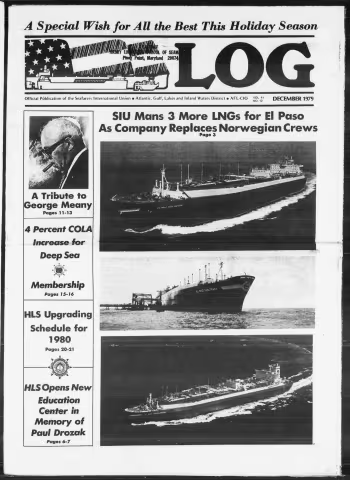
SIU Mans 3 More LNGs for El Paso
As Company Replaces Norwegian Crews
Page 3
i .r'Ar._ • i",', • .
" •' .v''""- ' ^ - v.• 4-;^:;^:-:" A'. '•
-7 ;V I
wV '
SfU Supports Carter on Handling of Iran Crisis
With a sense of outrage and
frustration, the American people
continue to wait out the forced
detention of their countrymen by
the Iranian "students" and the
man who spurs them on, the
Ayatollah Khomeini.
As the Log goes to press, the
holding of the American hostages
at the American Embassy in
Teheran had entered its sixth
week. They are pawns in a
primitive game that totally ig
nores the modern-day precepts of
international law. And no one is
particularly optimistic that they
will be home for Christmas,
either.
The question on eve^rybody's
mind is: what can we do about it?
Are we doing enough to affect the
release of the hostages while, at
the Same time guaranteeing their
safety?
The SIU joins with other labor
organizations across the country
—and with the vast majorit3)f>df
the American people—in sup
porting President Carter's han
dling of the Iranian situation. As
much as we would like to have
seen the hostages released long
ago, like everyone else, we realize
things just don't happen that
way. We agree that restraint is the
order of the day.
This is not to say that steps
aren't being taken to affect the
release of the hostages—on the
contrary. So far. President Car
ter has attempted to resolve the
crisis through recognized world
diplomatic and judicial channels,
while at the same time putting
very real pressure on Iran
through other means. In the
process. Carter has won the
respect and support of the world
community.
The SIU supports the eco
nomic sanctions already being
brought to bear against Iran, and
those the President proposes for
the future. And we join him in
voicing our strong displeasure
with some of our "allies" who
continue to do business, as usual,
with Iran.
At home, longshoremen and
others are doing what they can to
impede the flow of goods to Iran.
We support them 100 percent in
their efforts.
We are convinced the use of
physical force is the wrong tactic
under the present circumstances,
and that our purposes can best be
achieved by more subtle means.
Certainly, the use of physical
force to affect the release of the
hostages would have to be a tactic
of last resort since, in all proba
bility, it would doom at least
some of the hostages we seek to
free.
The screw is tightening on
Khomeini. Their assets have been
frozen, their diplomats have been
booted out of the U.S., and world
opinion is solidly against their
illegal actions. There are definite
signs that their determination- to
hold the hostages is weakening.
We are convinced our govern
ment is handling the situation in.a
clear-headed and effective man
ner, and that we will ultimately
win the freedom of all the
hostages.
jf any good could be said to
have come from the Iranian
.i -HAV
crisis, it is the manner in which it
has drawn the American people
together.
D
J1
P5.
0X0. Paul Hall
A Union of Believers
THE holidays have traditionally been a tough time for sea
men. It's not much fun spending this time of year in the
middle of the ocean or in some port thousands of miles away
from home and family.
No matter what anyone says, you never get used to
separation. It's one of the drawbacks of this business.
But brothers, no matter where you are this holiday season—
whether it be on a ship or a tug or if you are lucky enough to be
home—SIU members have something to celebrate.
I say this because as we enter the new decade of the '80s, we
as an organization and as a class of workers have a solid,
secure future to look forward to.
The same thing could not have been said when this decade
began ten years ago. At that time, shipping was tough and
getting tougher all the time. Our domestic shipbuilding base
was at one of its all time lows.
There were a lot of people in maritime back then who really
believed there was no future for the American merchant
marine. And you know something, for those people, there
really was no future. Because in this business, when you stop
believing—when you stop fighting the good fight—and when
you start savoring the 'good old days' instead of planning for
the future, it's time to close up shop.
I am extremely proud to say that the SIU is an organization
of believers, an organization of fighters.
When times were tough, we never hid our faces hoping our
problems would all go away.
Instead, we took the offensive. We launched new programs.
And we did our damndest to create something good and turn
things around.
We were faced with an extremely tough situation in 1970.
But in the ten years that have passed since then, we have truly
turned things around.
We started out the decade by devoting a total effort in
Washington. Less than 11 months later, the Merchant Marine
Act of 1970 was signed into law.
The 1970 Act gave the industry hope. But it did more than
that. It provided our industry with the tools to make a fresh
start.
At the same time,, we put our training and upgrading
programs in Piney Point into high gear. This enabled us to
keep on top of the technological cfi^ges that were and
continue to sweep our industry. As importantly,' our
educational programs gave us the inside track on nailing down
contracts with new companies with dynamic new ideas—like
the LNGs.
In addition, we made two extremely important organiza
tional moves involving mergers.
In 1976, we in the SIU-AGLIWD and the former Inland
Boatmen's Union completed a merger. Just about two years
later, we and the former Marine Codks and Stewards Union
merged. Both mergers have been extremely successful and
beneficial for everyone ddncerned.
But our Union is an organization of individuals—people
with needs and goals. And as the decade of the '70s progressed,
it is important to-^ememher that we as seamen made
tremendous improvertients in our standard of living.
Through hard work and careful planning, we have made
monumental gains in our wages and vacation benefits as well
as in our Welfare and Pension Plans.
It's not enough to simply have employment. The jobs we fill
must also provide all the things necessary to make our lives
secure. I sincerely believe we have achieved this level of
security in our Union.
So as we close out what in many ways has been a trying
decade in our history, we can all feel a great deal of
satisfaction. Because the gains we have made and the truly
important things we have accomplished were achieved
through a collective effort.
Our Union was built on the qualities of brotherhood, unity
and cooperation. We have progressed through hard work and
determination. We will survive by continuing to do the things
that have made us what we are today—the best damn seamen's
union in the world.
Change of address cards on Form 3579 should be sent to Seafarers International Union. Atlantic. Gulf. Lakes and Inland Waters District
11232. Published monthly. Second Class postage paid at Brooklyn. N.Y. Vol. 41, No. 12, December 1979. (ISSN #0160-2047) Mrcuiu, b/b hourth Ave., brooKiyn, IN.T.
2 / LOG / December 1979
SlU Crews 3 More LNG's for El Paso
ON Nov. 28, Seafarers
crewed the El Paso
LNG carrier Sonatrach in
Savannah, Ga. Even though
she's the 11th LNG carrier to
sail under the SIU banner,
her crewing was a first for
the Union and for U.S.
maritime.
Until recently, the LNG
carrier Sonatrach was op
erated by a Norwegian crew.
Two other El Paso LNG
vessels, the Consolidated
and the Paul Kayser were
also crewed by Norwegian
seamen. SIU crews are
scheduled to fly out to
Dunkirk, France, where the
Consolidated Sind Paul Kay
ser are undergoing repairs,
to fill the unlicensed jobs on
those two ships early next
year.
By opting for a top-to-
bottom crew of American
seamen (MEBA-District 1
will fill the licensed jobs on
the three vessels) El Paso has
shot holes in the myth that
Western European seamen
are more capable than their
American counterparts.
That myth goes that Nor
wegian mariners are the best
INDEX
Legislative News
SIU Supports Carter
on Iran Page 2
SIU in Wasfiington . . Pages 9-10
3 More LNGs Page 3
Union News
Memorial to
Paul Drozak , Pages 6-7
President's Report ... ....Page 2
Headquarters Notes . ... Page 5
Letters to Editor .... ...Page 18
Brottiertiood in Action ..Page 37
At Sea-Astiore Page 17
SPAD Ctieckoff Back Page
State of LNG Industry ....Page 5
Great Lakes Picture . ...Page 24
Inland Lines Page 25
General News
Stiip's Digest
Dispatctier's Reports;
Great Lakes ...Page 32
Inland Waters ...Page 26
Deep Sea ...Page 22
Training-Upgrading
"A" Seniority Upgrading Page 38
Upgrading Sctiedule Pages 20-21
Membership News
Page 32 New Pensioners Page 32
Final Departures .... Page 36
Deep Sea COLA .... Pages 15-16
Special Features
Tribute to
George Meany — Pages 11-13
Company Replaces Norwegian Crews With SIU
Members on Sonatrach,Consoiidated,Paul Kayser
Some of the SIU crew and the ship's committee pose in the galley of the LNG carrier El Paso Sonatrach shortly after she was
crewed last month. They are, l-r; Harry Huston, chief steward/secretary-reporter; Ed Kilford, chief cook; Tom Spangler,
quartermaster; Ballard Browning, bosun/ship's chairman; Sam Beattie, electrician/educational director; Nick Marrone, Piney
Point PorfAgent; Albert Campbell, cook & baker/Steward delegate; John Wells, AB; Robert Mahone, AB/deck delegate.
Because an SIU member in the world. But El Paso
wanted the world's best to
man their LNG ships and
they chose the crews of the
SIU.
El Paso had a sound basis
for the decision to go with
SIU crews over Norwegian
crews. They've employed
both; they know the differ
ence.
, The company began their
"Algeria I" LNG transporta
tion project in 1978 with
three Norwegian and three
American-crewed vessels.
All six ships were 948 feet in
length and had a beam of
135 feet. And they all made
essentially the same run
between a liquiflcation facil
ity in Arzew, Algeria and
the U.S. East Coast.
The difference was that
the three Norwegian-crewed
vessels spent a lot of time in
the shipyard, undergoing
repairs. The delays were
frequent and costly. But the
three ships crewed by Amer
ican seamen ran sure and
steady; they were on sched
ule and accident free.
El Paso felt the Norwe
gian crews just couldn't
handle the super technologi
cal LNG vessels safely and
ably.
The vessels were designed
and built with a maximum
number of safety features
such as double hulls and
collision avoidance systems.
But, in the words of the
company, "the safety of (a
ship's) operation ultimately
depends on the crew."
Operation of the three
SlU-manned El Paso LNG
vessels, the El Paso South
ern, Arzew and Howard
Boyd, has been top-notch.
an
doesn't ship on an LNG
carrier unless he's gone
through the Union's own
LNG training program at
HLS.
Seafarers have done their
Continued on Page 23
The El Paso Sonatrach, built in 1976, is the first of three El Paso LNG carriers to
turn-over from Norwegian to SIU crews. She'll be making a regular run between
Algeria and the U.S. East Coast.
More photos of El Paso Sonatrach page 13
carriers have a maximum number of safety features. Mere, a^
from the bridge of the Sonatrach shows the two tanks, (right) which contain the
liquid nitrogen used in void spaces on the vessel to prevent combustion.
Life Is Just Beginning for Pensioner Tony Gentile
AT 58, life is just beginning for
L Howard "Tony" Gentile.
Within the next year or so, he
plans to run in a marathon, go to
school, paint some pictures, play
the ponies at his favorite Balti
more tracks and do as much
traveling as possible with his
wife, Anita.
Tony is going to be able to do
all these things and more because
he recently earned something he
"never dreamed of when he
started working tugs in Baltimore
harbor in 1942.
What Tony earned is an SIU
Early Normal Pension, one of the
most important benefits avail
able under the Seafarers Pension
Plan.
An eligible member can retire
under the Early Normal Pension
Program at the age of 55 with 20
years (7,300 days) employment
time.
Tony is one of the first few SIU
Boatmen to achieve the Early
Normal Pension. The SIU suc
ceeded in establishing this benefit
for East Coast Boatmen in the
last contract negotiations with
our East Coast towing and
shipdocking companies. The
Union is now in the process of
trying to establish this important
benefit for the entire inland
membership.
Deep sea members have been
covered under the Early Normal
Pension program since 1971.
To Tony Gentile, his Early
Normal Pension is a godsend.
"I've been docking ships pretty
much all my life," says Tony,
/
I
SIU Boatman Howard "Tony" Gentile, left, accepts his first Early Normal Pension
check from SIU Baltimore Agent George Costango. Brother Gentile has been
working in the port of Baltimore since 1942, and has been a captain and docking
master in the port since 1952.
Cove Leader Committee
On Nov. 23, the Ship's Committee of the ST Cove Leader (Cove Shipping)
gathered for a payoff at the foot of Steinway St., Astoria, Oueens, N.Y. They were
(I. to r.) Chief Steward/Baker Terry J. Smith, secretary-reporter; Asst. Cook Alfred
W. Williams, steward delegate; Chief Pumpman Ted Jones, educational director
and Bosun Bob Williams, ship's chairman.
"and I want to enjoy life and do
the things I want to do before it's
too late."
Tony worked for Baker-
Whitely towing from 1945 to
1977 and for Curtis Bay until he
retired this month. He has been
working as a tug captain and
docking master since 1952. His
father, Anthony, was also a
docking master in Baltimore.
He'll be the first to tell you that
working tugs is a good job, but a
job "that dominates your life
especially in the port of Balti
more."
Tony says, "it is really a shame
when someone works all his life
and is not able to enjoy retire
ment. The SIU has given me the
chance to enjoy mine and I'm
going to take advantage of it."
In addition to his pension,
Tony says he feels very secure in
regard to medical coverage. He
points out that the Seafarers
Welfare Plan continues to cover
pensioners and their dependents
just as if they were still working.
He says, "you can't buy insurance
like that."
The port of Baltimore will miss
a man of Tony Gentile's experi
ence and abilities. And no doubt,
Tony will miss his friends on the
boats and the electricity of
working in one of the busiest
ports in the nation.
But Tony Gentile is not the
kind of person to look back. He's
looking forward to an active,
happy, secure retirement—with
no strings attached.
We wish him well.
Sea-Land Christens 2nd of 12 Diesel Containerships
Sea-Land has announced the
christening of a new diesel-
powered, D-9 class container-
ship, the Sea-Land Defender.
The new vessel is under construc
tion at the Mitsui Engineering
and Shipbuilding Co. in Ta-
mano, Japan.
The christening of the Sea-
Land Defender is the second of
12 such ceremonies that will take
place in various Japanese and
Korean shipyards by the middle
of next year. The first D-9 in the
series, iht Sea-Land Patriot, was
launched at the Mitsubishi Ship
yard in Kobe, Japan last July.
The D-9's measure 745 feet in
length, and can haul as many as
839 35- and 40-foot containers.
Their service speed is rated at 22
knots. Perhaps their most note
worthy characteristic, however,
is the fact that they are diesel-
powered.
Sea-Land Industries Chief
Executive Officer Charles I.
Hiltzheimer, at christening cere
monies last month, said the new
D-9's "will provide an improved
service capability for Asia and
United States shippers that will
be unmatched in the Pacific
trade."
The construction of the Sea-
Land D-9's is just one example of
the major transition to diesel
power, brought on by continually
rising oil prices, that is now
sweeping the maritime industry
worldwide.
'Fuel economy will necessarily «i
remain a high priority for ocean
carriers in future years," said
Hiltzheimer.
All of the new Sea-Land D-9's
will be in operation by the latter
h^lf of 1980—meaning hundreds
of additional jobs, and added job
security, for Seafarers.
Don't Get Trapped in the Electronics Jungle
EVERY SIU ship has electronic gear that QMED's
need to know how to handle -
Now you can learn howl
Take the new 'Electronics for QMED's' course at
HLS.
In this 6-week course you'll get the skills you need
to work on:
• electronic systems in the Engine Room
• winch controls
• anchor windlass controls
• cargo control boards Sign Up Now!
Course Starts February 18.
Contact the Harry Lundeberg School or use the application in this issue of the Log.
4 / LOG / December 1979
State of LNG Industry is
Healthy, Growing, Safe
LONG before any LNG ships
/were under U.S. flag, the
SIU began preparing for their
arrival. The Union set up a course
at the Lundeberg School to train
Seafarers to crew these high
technology carriers.
The Union's foresight has paid
off. Today SIU members man
over a quarter of the 40 LNG
vessels running on a regular basis
worldwide.
Seafarers have crewed ten
LNG ships since their launching.
And recently, three LNG carriers
owned by El Paso Company, and
formerly crewed by Norwegians,
came under the SIU banner. (See
story on page 3).
There are many little publi
cized facts about liquid natural
gas. Some of this information
was made available at a recent
international LNG conference
held in Houston, Tex.
For instance, the development
of the first large-scale LNG
export project occurred in 1964.
Since then, 6 TCP (trillion cubic
feet) of LNG has been moved in
international trade.
Significant for Seafarers is that
since 1964 over 4,000 cargoes of
LNG have been shipped interna
tionally without a single serious
incident recorded.
Of the 6 TCP that has been
exported, the percentage from
the producing countries breaks
down as follows:
Algeria 62%
Brunei 30%
Libya 18%
Alaska 10%
Indonesia 8%
Abu Dhabi 2%
It's interesting to note that of
this 6 TCP the U.S. imported
only .4 TCP, or seven percent.
Japan imported 3 TCP, or 50
percent, and Europe imported
2.6 TCP, or 43 percent.
Looking to the future, the
remaining proven world reserves
of natural gas are estimated at
2,250 TCP. This is equal to 450
billion barrels of oil. It also
represents one-and-a-half times
the tar and sand oil reserves and
three times the shale oil reserves.
The remaining reserves break
down as follows:
OPEC Countries
(Algeria/Iran) 39%
Eastern Europe/Asia 38%
U.S. A. 8%
Western Europe 6%
Others 9%
The U.S. is the biggest user of
marketed natural gas. America
uses 39 percent of the world
market gas right now, or 20 TCP.
This gas, unliquified, travels
through pipelines. But, as shown
above, the U.S. has only eight
percent of world proven reserves.
This is one reason why the U. S.
must look ahead and prepare to
import natural gas in liquified
form. Right now most LNG
import projects have been greatly
delayed or totally destroyed by
U.S. government agencies or
unstable international circum
stances.
The SIU believes that America
must strive to become more
energy independent. But, realis
tically, we should face the fact
that the U.S. will have to rely on
foreign energy imports for years
to come. In that case, the U.S.
should diversify its imports and
not rely totally on crude oil. LNG
is one of the best alternatives.
Cove SpiriPs Crewmen
Headq uar
by SIU Execiilive Vice President
Frank Drozak
T
On Dec. 5, after offloading crude at the Bayonne (N.J.) Industries Dock are
crewmen of the ST Cove Spirit (Cove Tankers) waiting to see the Big Apple. They
are (I. to r.) Chief Pumpman Robert Kirton, educational director; AB Jose Gomez,
CS A. Mat. AB Pete Wilisch, deck delegate and AB Daniel von Derhaff.
^HE month of November saw Seafarers going aboard yet
another liquified natural gas (LNG) ship—our 11th since
1976.
But that particular event came about with a new and highly
significant twist to it. The ship in question—the Sonatrach—
though American-owned, is under foreign registry and, until
recently, has been crewed by Norwegian seamen.
This may sound like a strange turn of events, but I see it as a
positive and important development that bodes well—and speaks
well—for the American merchant marine, and especially for the
SIU.
If I had to tell you, in a word, how it all came about, I could do it
without too much trouble: training.
That's the truth of the matter, brothers. In the final analysis,
training is what did it, along with the reputation that comes from
being the best trained seamen in the world. This development with
the Sonatrach is significant because, among other things, it tells the
whole world what we've been saying for years: American seamen
are the best, because they're the best trained.
El Paso Marine operates three American-flag LNG carriers—all
manned by members of the SIU. They also operate three LNG ships
that fly a foreign flag. The Sonatrach is one of them. This split-
registry situation has, at least, given El Paso a solid framework for
comparison—foreign flag versus American.
And believe me, brothers. El Paso has been doing some
comparing lately. The proof is in the pudding. They've decided that
their foreign-flag operation doesn't measure up; that their foreign-
manned LNG ships are not being maintained and operated on a par
with the three manned by SIU crews.
After concluding that all three of their foreign-flag gas ships—
the Sonatrach, the Consolidated, and the Paul Kayser 'were
accumulating too much "down time," El Paso made the decision to
re-crew these ships, giving the nod to the group with the proven
better record: the American seamen of the SIU.
El Paso is convinced the cause of its foreign-flag problems lies in
the lack of proper training among the Norwegian crews. This
situation tends to dampen the myth that European seamen are as
good as their American counterparts.
I would have to agree with El Paso's conclusion that the fault lies
in the training. Lack of proper training, something that shows up as
a cause of major maritime accidents each year, is a common
affliction among the "cutrate" foreign crews of the world.
The SIU has led the U.S. maritime industry for years with its
training facilities and programs. And we saw, years ago, that
LNG was an up-and-coming thing that would require its own
specialized training courses. When LNG carriers came along, we
were ready. Our seamen were ready to go on the first LNG ships—
to operate them safely and efficiently
Being trained, being qualified—being ready—has put Seafarers
on top of the LNG transportation surge.
Most importantly, there are more LNG ships coming. Besides
these three newly acquired El Paso ships I mentioned, (bringing the
total number of SlU-crewed LNG to 13), Seafarers will also go
aboard the new LNG Libra (Energy Transportation). El Paso also
plans to launch three more U.S.-flag LNG ships in the coming year,
which will make a total of 17 LNG ships crewed by Seafarers by
year's end.
El Paso Marine's decision to go all the way with the SIU is an
affirmation of something we've always believed in, and invested in
heavily: the principle that good training, especially given the
technology of today, is essential.
As long as the individual members of the SIU continue to take
advantage of the Union's training facilities and programs, it looks
good for the future, brothers; real good.
December 1979 / LOG / 5
»*» n «
(Left). The inscription on the front of the Paul
Drozak Building. (Below). Students receive in
dividual help from the reading teachers in the
Learning Center.
111 n 11 Uij''— J
DED CAT£D N^HONOR OF A
lN&Trsmi>N'D'.Vfl±Oi^^^
WranM fOTSIEKIl D _ LMOL
!"ovsmrQr'EDLr(:/¥ioN iOOT
New Vocational
Education Building Opens
(Above). The lobby of
the Drozak Building
provides a pleasant
place for students to
chat between classes.
(Right). Conference
style tables provide
ample room for chart-
work in the towboat
operator classroom.
(Below). The First
Aid/CPR class is for
trainees and upgra-
ders. Closed circuit
televisions are install
ed in each classroom.
The Paul Drozak Bullcling
houses the Deck Department of
fices and classrooms, the In
dustrial Relations classrooms, the
First Aid/CPR classroom, the
Counseling Services Office, the
Learning Center and the Public
Relations Office.
The Deck Department instruc
tors have office areas where they
can meet with students in between
classes or plan lessons. All of the
classrooms reflect their specific
use and are furnished to meet the
students' needs. The pilot and
towboat operator classrooms have
tables so that students can easily
plot courses on large charts. Cloud
charts and aids to navigation are
on display around the rooms for
easy reference. Publications con
taining Coast Guard regulations
for motor vessels are also available
to the students. In the pilot class, a
geochrome is used for determining
time zones and for teaching
celestial navigation. From this
lighted board of the world,
students can figure the times for
sunrise and sunset.
The Able Seaman and Quarter
master classes are also specially
equipped to meet the needs of SID
members. Boom ship models, knot
boards, wire splicing boards and
aids to navigation are on display.
All of the classrooms have
closed circuit television and
receive programs from the Audio
Visual area on the Zimmerman.
All of the students in the basic
vocational program and several in
upgrading courses take the First
Aid/CPR course.The classroom is
located in the Drozak Building. The
course is 20 hours in length and is
incorporated into the students'
regular curriculum.
The Industrial Relations Depart
ment also has a classroom area in
the newest vocational building.
Trainees and upgraders attend
class sessions to learn about their
union benefits, contract and
responsibilities.
An annex to the Reading Lab,
the Learning Center, is available to
students who need help with their
reading skills.
Counseling services are
available to all students and staff
at HLS. Counselors Rick Reisman
and Doug Elliott are in their offices
daily. A large meeting room is
available for group sessions.
The Public Relations office is
also located in the Paul Drozak
Building. The staff prepares the
Skipjack, publications for the
school, and materials for the
departments at HLS.
The Paul Drozak Building
houses a variety of activities, all of
which are essential to the training
of Boatmen and Seafarers. These
activities reflect the efforts of Paul
and of the Harry Lundeberg School
to help all SIU members.
Terry Bader tells HLS trainees about their union respon-
sibiiities in the industriai Reiations oiassroom.
6 / LOG / December 1979
A Tribute to a Life
of Helping Others
The Harry Lgndeberg School
recently expanded Its facilities and
opened a second vocational educa
tion building. The facility is named
after Paul Drozak, the late Vice-
President of the SlU. It is dedicated
to Paul in honor of his efforts to
help the Boatmen of this nation.
The necessity for a new
building at MLS developed, in large
part, from the growth of upgrading
courses for the Boatmen Paul so
ably represented. Most of the area
in the building houses Deck De
partment offices and classrooms.
Paul was born in Coy,
Alabama in 1927 and his family
resides in Magnolia, Texas. Paul
had been involved with the SlU
since 1945. From 1945 to 1951,
Paul worked aboard ships as an
SlU member. At this time, Paul
went to Seattle as an organizer for
the SlU. Even though he shipped a
few more times, Paul had found
the work he loved—working to bet
ter the lives of his fellow SlU
brothers.
In 1954, Paul served two years
in the U. S. Army and then returned
to work as an SlU patrolman in the
port of New York. In 1961, he
became the agent in the port of
Houston. He held this position for
11 years.
In 1972, Paul was elected SlU
Vice President in charge of the
Lakes and Inland Waters. He held
this post until his death. Paul held
many posts and responsibilities in
addition to Vice President of the
SlU. He was Gulf Coast Area Direc
tor of the SlU-affiliated United In
dustrial Workers Union, he served
as Port Commissioner in Houston,
The memory of the late Paul Drozak, Vice President of Lakes
and iniand Waters, has been honored at the Harry Lundeberg
School by the dedication of a new buiiding.
the second largest port in the na
tion. Paul was Executive Vice
President of the Harris County
Central Labor Council and
Secretary-Treasurer of the West
Gulf Port Council of the AFL-CIO
Maritime Trades Department. He
was also the Vice President of the
AFL-CIO Texas State Labor Federa
tion.
Paul Drozak was a most
capable leader of the SlU and a
friend of every SlU member. He
nurtured the old SlU-affiliated IBU
from its birth in 1961 to a position
years later when it became the
largest trade union representing
American Boatmen.
He was also a firm believer in
the goals and values of the Harry
Lundeberg School and was in
strumental in securing advice and
input from industry as the school's
programs developed.
The inscription on the front of
the Paul Drozak Building sum
marizes the feelings of staff and
students at HLS about Paul:
"Dedicated in honor of a man who
devoted his life to the welfare and
progress of boatmen and their in
dustry and whose efforts in foster
ing cooperation between manage
ment and labor contributed, greatly
to the growth of education at HLS."
The Paul Drozak Building Is the newest
vocational education area at HLS. -rC; •
if.
(Above). Each Deck Department Instructor has
his own area In the Drozak Building for
meeting with students and co-workers.
(Right). Student Council members visit the
Public Relations office to discuss Items for
the weekly newspaper, the Lundeberg Log.
(Far Right). Doug Elliott talks with a student In
the Counseling Services office.
December 1979 / LOG / 7
> < » ^ ^ ^ 5-. V B
National Defense Deftionds Beefed Up Merchant Fleet
The ability of the U.S. mer
chant marine to serve as a
logistical defense backup in times
of national emergency has been
called into question by several
prominent witnesses appearing
before the Senate Subcommittee
on Merchant Marine and Tour
ism.
Herb Brand, president of the
Transportation Institute, a non
profit organization devoted to
maritime research and education,
expressed grave reservation
about the state of military pre
paredness of the American Mer
chant Marine, as did Samuel B.
Nemirow, Assistant Secretary of
Commerce for Maritime Affairs,
and retired Rear .Admiral George
Miller.
According to Mr. Brand, part
of the problem can be traced to
the refusal of the Navy to consult
with representatives of the mari
time industry on matters of
policy. "Until there are regular,
substantive policy discussions,"
Marad Looking
of A//-Purpose
While the rest of us are gearing
ourselves for a new decade, the
maritime industry is already prepar
ing for the upcoming century.
A report released by the Maritime
Administration carefully projected
the development of a standardized
general cargo ship to help meet the
needs of the U.S. merchant marine
through the year 2000. It did so by
forecasting general cargo move
ments and service requirements on
selected worldwide trade routes
served by seven American flag
operators.
The seven American flag opera
tors included the following: Parrel
Lines, American Export Lines,
Lykes Bros. Steamship Co., Matson
Navigation Co., Moore McCor-
mack Lines, Puerto Rico Maritime
Shipping Authority, and United
States Lines.
he asserted, "you will continue to
see the disarray that presently
prevails in the area of logistical
support."
Mr. Brand expressed his views
during a hearing held to deter
mine the strengths and weak
nesses of three bills (S. 1460, S.
1462, S. 1463) pending before the
Subcommittee on Merchant
Marine and Tourism.
Tlie Transportation Institute
believes that all three bills would
help alleviate the logistical back
up problems besetting our na
tional defense system.
None of the bills specifically
addresses itself to the problems of
military preparedness. But each
one does attempt to create a
climate in this country more
favorable to the building and
operating of new ships.
The inability of the private
sector to replace aging U.S. flag
vessels with newer ones has been
an important factor behind the
at Development
Cargo Vessels
According to the study it is
"technically feasible to develop a
standard liner design" adaptable
enough to suit the needs of numer
ous operators. Such a development
could make the American shipbuild
ing industry more competitive by
lowering ship costs, providing for
more rapid ship delivery, plus
enhancing vessel safety and per
formance.
More importantly, it would lead
to the availability of vessels "well-
suited" to national defense pur
poses.
The Marad study is just one small
example of the rapid technological
advances which are changing the
whole structure of the maritime
industry. It is up to us seamen to
keep up with those changes the best
way we can.
Golden ilAonarch Committee
deterioration of the American
merchant marine.
S. 1462 would authorize car
riers to enter into bilateral
shipping agreements, and in the
process increase the amount of
cargo carried on U.S. flag vessels.
S. 1463 would broaden and
strengthen the authority of the
Federal Maritime Commission
to administer and enforce the
1916 Shipping Act. It would also
enable ocean carriers to conduct
their operations in a more effi
cient manner.
S. 1460 would provide more
flexibility in the contract system
and facilitate the implementation
of agreements in international
line shipping by clarifying the
anti-trust immunity of such
agreements.
US. Jobless Rate Dips to 5.8%
WASHINGTON, D. C.—The
country's unemployment rate dip
ped to 5.8 percent in November from
October's 6 percent as employment
rose slightly and despite layoffs in
the auto and steel industries, the
U.S. Labor Department reported.
The employment rise was among
service and construction industries
workers, blacks, teenagers and adult
females. Total employment rose by
353,000 workers to 97.6 million
persons working, according to the
Labor Department's Bureau of
Labor Statistics (BLS).
The number of persons losingjobs
last month was 143,000 for a total of
6-million jobless nationwide.
Although, BLS Commissioner
Dr. Janet L. Norwood declared "We
are not in a recession," she added
that the labor market data indicated
that the economy had slowed but
not yet entered the recession that
many economists predicted.
The unemployment rate for adult
women fell to 5.5 percent from 5.8
percent in October. For black
workers, it dropped to 10.8 percent
from 11.7 percent. Teenagers had
their rate decline to 15.9 percent
from 16.6 percent. Black teenager
workers had their rate go down to
33.1 percent from 35.7 percent!
Adult males jobless rate held steady
at 4.3 percent and the rate for all
whites was unchanged at 5.2 per
cent.
Overall, the unemployment rate
has hovered in the range of 5.5
percent to 6 percent since August
1978. But the rate of growth in
employment has slowed substantial
ly since last winter.
Recertified Bosun Theodores Gailas (left) ship's chairman of the ST Golden Mon
arch (Westchester Marine) leads the Ship's Committee on Nov. 19 of (I. to r.) AB
Rich Shellenbach, deck delegate; Chief Steward Edward Dale, secretary-re
porter; QMED Charles A. Martinez, engine delegate and Steward Delegate Angel
M. Velez. The tanker paid off in the port of New York.
If you know how to keep things cold, you'll always be need
ed aboard ships that carry refrigerated containers. So take
the Maintenance of Shipboard Refrigerated Systems
course at HLS. It starts February 18.
When you finish you get a certificate of completion from
HLS •• your ticket into the booming job market aboard U.
S.-flag ships for seafarers with reefer maintenance skills.
To enroll, fill out the application in this issue of the Log or
contact HLS.
8 / LOG / December 1979
Seafarers Intcrnacioiial Union of Nortli America. AFL-CIC) December 1979 Legislative. Administrative and Regulatory Happenings
On the Agenda in
Congress...
Congress is expected to stay in session
right up to Christmas week, with adjourn
ment not expected until Dec. 23. A number
of issues of national and international
importance are keeping both the House and
Senate in late sessions. Meanwhile, several
legislative items of concern to the maritime
industry are still in the legislative hopper
awaiting action by Congress.
Here is an up-date on what's happening to
various maritime bills, which are in
committee:
•OMNIBUS MARITIME BILL
On November 26, in testimony before the
Subcommittee on Merchant Marine of the
House Merchant Marine and Fisheries
Committee, W. J. Amoss Jr., chairman of
the National Maritime Council, recom
mended various legislative alternatives to
Title III of the Omnibus Maritime bill.
The Council's testimony dealt in detail
with the issues of cost parity, operating
flexibility and market initiatives for U.S.-
flag operators.
According to Mr. Amoss, the cost parity
concept "is the only viable way to sustain
healthy vessel operating and shipbuilding
industries at a level capable of meeting the
needs of national defense and economic
security."
The NMC also proposed greater flexibil
ity in fleet operations by allowing the
operators, rather than the government, to
make judgments as to the level of sailings on
given routes as well as the types of vessels
best suited to these routes.
On the issue of market initiatives, the
Council's testimony included proposals for
bilateral agreements, government impelled
cargoes and tax incentives to foster the
bjjilding of stronger, more versatile liner and
bulk U.S.-flag fleets.
•SHIPPING ACT AMENDMENTS
On November 21, the Merchant Marine
and Tourism Subcommittee of the Senate
Committee on Commerce, Science and
Transportation held a hearing on S. 1460, S.
1462 and S. 1463. This is the legislation
sponsored by Senator Daniel Inouye (D-H I)
to amend the Shipping Act of 1916.
Herbert Brand, president of the Trans
portation Institute, noted thatthedebilitated
state of the merchant marine and the lack of
coordination between military and civilian
sectors was illustrated by the devastating
reports of last year's "N ifty Nugget" military
exercise.
Brand endorsed the three bills and
emphasized that their passage "would begin
to create a climate in which the private
sector would begin to build new ships, and to
have those ships ready for a national
emergency and as a peacetime deterrant."
According to Mr. Brand,
(1) S. 1460 would facilitate the implemen
tation of agreements in international
liner shipping;
(2) S. 1462 would authorize carriers to
enter into bilateral shipping agree
ments; and
(3) S. 1463 would broaden and strengthen
the authority of the Federal Maritime
Commission to administer and en
force the 1916 Shipping Act and
would enable ocean carriers to con
duct their operations in a more
efficient manner.
•DRY BULK SHIPPING
On November 28, the Merchant Marine
Subcommittee of the House Merchant
Marine and Fisheries Committee held a
hearing on various proposals designed to
develop the U.S.-flag bulk fleet.
Congresswoman Lindy Boggs (D-LA),
sponsor of H.R. 5113, the Maritime Bulk
Trade Act of 1979, said the bill would
"encourage the carriage of U.S. bulk
commodities in ships registered under the
United States flag and flags of United States
trading partners."
Congresswoman Boggs explained,
"Through the negotiation of cargo sharing
agreements with U.S. bulk trading partners,
at least 40 percent of the bilateral bulk trade
would be reserved for the vessels of each
nation."
Congressman Paul Trible (R-VA), spon
sor of H.R. 5145, the companion measure to
the Boggs bill, said that his bill would
"eliminate the either/or dilemma facing
vessel operators forced to choose between
unsubsidized construction and operation of
a vessel for domestic trade, or the sub
sidized construction and operation in
foreign commerce."
Samuel B. Nemirow, head of the Mari
time Administration, testified in support of
H.R. 4945, noting that the Administration's
proposal would make the Merchant Marine
Act of 1936 more responsive to the
requirements of bulk operators. Mr.
Nemirow addressed H.R. 5113, stating that
"it has been United States policy to refrain
from cargo sharing agreements as a general
matter, but would be prepared...to protect
where necessary the competitive rights of
U.S. carriers."
Meanwhile, hearings are continuing on a
number of bills of interest to the maritime
industry:
•WATER PROJECT AUTHORIZATION
—MARKUP
The Water Resources Subcommittee of
the Senate Environment and Public Works
Committee will continue to markup S. 703,
water policy and project proposals authori
zation. Senator Mike Gravel (D-AK) will
chair the markup.
•WAR RISK INSURANCE
The Merchant Marine Subcommittee of
the Senate Commerce, Science and Trans
portation Committee will hold a hearing this
month on S. 1452, legislation to extend on a
permanent basis, the war risk insurance
program of Title XII of the 1936 Merchant
Marine Act. Senator Daniel Inouye (D-
' HI) will chair the hearing.
•U.S. DEFENSE SEALIFT
CAPABILITY
The Merchant Marine and Fisheries
Committee will hold hearings this month on
the national defense implications of the
Omnibus Maritime bill and issues associated
with the "Nifty Nugget" military exercise.
Congressman John Murphy (D-NY) will
chair the hearings.
Stewards Come To Washington To See Political Action
Twelve SiU Stewards came to Washington last
month for a first-hand look at their union's political
and legislation programs—and they were impressed
by what they saw. During their day-long visit, the
Stewards—who are attending a recertification
program at the SIU Harry Lundeberg School in Piney
Point. MD—visited the Transportation Institute and
the AFL-CIO Maritime Trades Department.
At both places, the Seafarers heard from staff
members about the many legislative fights that the
SIU is presently involved in. Among the Senior
representatives they met were T.I. President Herb
Brand ana MTD Executive Secretary Jean Ingrao.
The SIU Stewards also had an opportunity to meet
and talk with two members of Congress: Rep. Glenn
Anderson (D-CA) and Rep. Mike Lowry (D-WA).
During the afternoon, they visited the Capitol
where these photos were taken. Pictured in the photo
at left are Charlie Shirah, Michael Haukland, Don
Collins, Henry Jones, Sherman Jarman, and
Theodore Goodman. With them is Harry Lundeberg
School Instructor Mike Mannion,
In the photo at right are Stewards Stig Ehrlund,
Bobbie W. Stearns Jr., Howard F. Clark, Hernell E.
Edwards. Marvin E. Garrison, ahd'F^pk S. Paylor.
December 1979 / LOG / 9
(£1)0 91U in Industfy
News
HLS PresidentPresents Views to Congress on Maritime Education,
A proposed bill which would expand
maritime education and training programs to
state academies throughout the nation was
variously applauded and attacked in two
days of hearings before a select subcom
mittee of the House Merchant Marine and
Fisheries Committee. The subcommittee is
headed by Rep. Les AuCoin (D-Oregon).
The proposed bill—the Maritime Educa
tion and Training Act of 1979—is a
complete remake of laws affecting maritime
training and education, and brings together
various laws which have been enacted over
the years into one single act.
The proposal was enthusiastically en
dorsed by the U.S. Maritime Administra
tion and the Coast Guard. However, several
industry spokesmen, as well as representa
tives from the U.S. Maritime Academy at
Kings Pojnt voiced reservations about the
bill.
The main objections centered on a lack of
Training Programs
coordination among existing training
programs, and the fear the proliferation of
training facilities would only exacerbate the
problem.
One area of special concern to the
Congressional committee was the high cost
of education for maritime officers at the
federal academy, and the "relatively low rate
of retention" of seagoing officers from the
academy.
Hazel Brown, president of the Harry
Lundeberg School at Piney Point was a
witness during the Congressional hearings.
She stressed that "maritime education
institutions must be a part of the industry" if
their training programs are to be relevant.
Graduates of maritime schools should be
prepared for "real Jobs with adequate skills
to handle their assignments." She said:
"Active advisory committees are essential.
Court Lifts Restrictions on Rebuilding Lock #26
The United States District Court in
Washington has given the green light for
reconstruction of Lock and Dam #26 at
Alton, 111. Rebuilding of this crucial
waterways project had been delayed by
several suits filed by environmentalists and
railroad interests.
As a result of the court decision, the U.S.
Corps of Engineers has already begun bank
stabilization work at the site in preparation
for building a totally new lock and dam
facility.
It is now expected that a contract will be
awarded early in 1980 for construction of the
lock and dam. Construction will take several
years.
TT Brooklyn Gets OK
for Alaska Oil Trade
The U.S. Maritime Administration this
month approved an application to permit
the TT Brooklyn to make at least two
voyages in the Alaska oil trade. The
applications were filed by American
Petrofina Inc.
The 225,280 deadweight ton tanker is
expected to make two consecutive trips from
Valdez to the U.S. Gulf by way of Cape
Horn. In its application to the Maritime
Administration, Petrofina said an excessive
inventory problem at its Port Arthur, Texas
terminal made it necessary to ship about 1.4
million barrels of crude oil from its storage
facilities at Valdez before the end of 1979.
The SlU-contracted Brooklyn was built in
1973 by Seatrain Shipyard in Brooklyn,
N.Y. as the first in a series of 225,000 dwt
tankers. The vessels were all built with
construction differential subsidies.
SPAD is (he Sill's political fund and our political arm in
Washinfton, !>.('. The SUI asks (or and accepts roluntars
contributions only. The I'nion uses the money donated to
SPAD to support the election campaigns of legislators who
have shown a pro-maritime or pro-labor record.
SPAD enables the Sill to work effectively on the vital
maritime issues in the Congress. These are issues that have
a direct impact on the jobs and job security of all SIC mem
bers. deep-sea, inland, and l.akes.
The Sill urges its members to continue their fine record
of support for SPAD. \ memher can contribute to the
SPAD fund as he or she sees fit. or make no contribution at
all without fear of reprisal.
A copy of the SPAD report is filed with the Federal Elec
tion Commission. It is available for purchase from the FEC
in Washington, D.C.
• • •
tr sr*
SIU Seniority Upgraders
View Union's
Political Activities
Six more Seafarers in the SlU's "A" Seniority
Upgrading Program visited Washington last month to
meet and tal(< with their union's legislative and
political action representatives. The six—who were
undergoing an intensive upgrading schedule at the
Harry Lundeberg School at the time ot their visit-
had an opportunity to meet and talk with otticials ot
the AFL-CIO IVIaritime Trades Department and the
Transportation Institute.
While they were in Washington, the Seafarers also
visited Congress where they met with Congressional
staff aides. They also toured the Capitol where they
had their picture snapped.
Seen here on the steps ot the Senate side ot the
Capitol are Upgraders Charles Gallagher, Stanley
Sporna, Joseph Gomez, Wenscslaw Calderon, John
Rizzo and Charles Clausen. With them are Betty
Rocker. SIU Legislative Representative: Darrell
Sanders. SIU Representative and Joe Wall. Harry
Lundeberg School Director ot Industrial Relations.
These committees should consist of mari
time educators, as well as union, manage
ment and government representatives."
Ms. Brown said that the advisor
committees should not only regularl
examine curricula to determine its rele
vancy, but should also "help to establish
goals and objectives so that the manpower
needs of the maritime industry are met."
1 ly
Hazel Brown, President of the Harry Lunde
berg School in Piney Point, MD, testified at a
hearing of the Select House Subcommittee on
Maritime Education and Training earlier this
month, and urged that all maritime schools and
academies upgrade their educational pro
grams and teaching techniques to meet the
demanding changes in the maritime industry.
US Merchant Fleet
Hits 23 Million Tons
The privately owned ocean-going fleet of
the U.S. Merchant Marine climbed to a new
record tonnage last month, according to a
report from the U.S. Maritime Administra
tion. The U.S. fleet has set or equalled new
tonnage records in 16 of the past 17 months,
according to MARAD.
On Nov. 30, the deep-draft fleet totaled
737 merchant vessels of all types with a
eombined tonnage of 22.9 million dead
weight tons.
Compared to one year ago, the number of
ships in the U.S. merchant fleet dropped by
nine vessels, but its overall capacity
increased by 1.4 million tons. The large gain
in capacity reflects the larger sizes of the new
fleet additions during the past 12 months,
and the comparatively smaller sizes of the
older ships scrapped or sold foreign during
that period.
According to the MARAD report, the
active U.S. merchant fleet stood at 686
vessels on Nov. 30, with an overall tonnage
of 21.6 minion deadweight tons.
Under Construction
As of Nov. 30, 51 merchant ships totaling
nearly 2.5 million deadweight tons were
under construction or on order in privately-
owned U.S. shipyards.
The ships under construction or on order
consisted of ten tankers, eight liquefied
natural gas (LNG) carriers, 12 intermodal
vessels, 11 dry-bulk ships, three eargo break-
bulk ships, and seven special-type vessels.
10 / LOG / December 1979
IN 1973, AFL-CIO President
George Meany was the guest
of honor at an awards dinner
hosted by the Congressional
Medal of Honor Society. They
presented him with their annual
"Patriots Award."
In his acceptance speech,
Meany's sentiments were clear.
"... labor organizations," he said,
"are the indispensable instrument
for free workers to improve their
standard of living."
"Democracy," he continued,
"is not the icing on our cake. It is
our bread-and-butter. And a man
can work up some pretty strong
feelings over his bread and
butter."
George Meany's passionate
commitment to freedom has been
the driving pulse of his life and of
the American labor movement he
led for so many years.
Meany fought against the
abridgement of freedom in every
form. He battled racketeering
and corruption in labor's house,
and facism, nazism, communism
in the world beyond.
He fought for the right of every
man and woman to work at any
job regardless of their race,
religion or sex; the right of every
worker to pm a decent living
wage and the right of every
American to join a union.
High School Dropout
George Meany's roots in the
labor movement go deep. Born in
the Bronx, in 1895, his father
Michael was a union plumber
and president of Local 2 of the
United Association of Journey
men & Apprentices of the Plumb
ing & Pipefitting Industry of the
U.S. and Canada.
George Meany dropped out of
high school to help support his
family and at the age of 22 he'd
completed the five years of
training necessary to become a
journeyman plumber, earning
$7.50 per week. On Sundays he
earned extra cash as a catcher for
a semi-pro ball team.
Due largely to his father's good
name, George Meany started his
climb in the "organ-eye-zation."
At the age of 25, Meany was
elected business representative
for his plumber's local. And that
was the last time he worked as a
plumber.
That same year, 1919, Meany
married Eugenia McMahon who
was a New York City garment
worker and a member of the
ILGWU. The Meany's had three
daughters, 14 grandchildren and
a marriage that lasted almost 60
years.
Meany rose quickly through
the ranks of organized labor. In
1923 he was elected secretary of
the Building & Construction
Trades Council. During that year
he traveled to the capital of N.Y.
in Albany. "The idea of just going
to Albany was a big deal," he
reminisced. "The world was a
little place for me in those days;
the West was Hoboken."
By 1934, when he was elected
president of the N.Y. State
Federation of Labor the world
(or at least Albany) was a little
more familiar.
As the Federation's chief
lobbyist, Meany earned a repu
tation as labor's most pble
advocate. In 1935 alone, 62 pieces
of labor-backed legislation were
passed and became law, thanks
largely to Meany.
1935 was a red-letter year for
labor. Mine Workers President
John L. Lewis, along with some
other union presidents, expressed
their feelings that the American
Federation of Labor should shift
focus and reorganize along in
dustrial rather than craft lines.
Eight industrial unions formed
the Committee on Industrial
Organizations within the AF of
L. In 1938, the 3.7 million AF of
L members who had joined the
Committee were expelled from
the AF of L and the Congress of
Industrial Organizations was
born. The two powerful federa
tions warred for the next 17
years.
But a lot of world history—and
labor history—took place in the
interim. In 1940, Meany became
Secretary-Treasurer of the AF of
L. Among his responsibilities was
to sit as the AF of L's representa
tive on the War Labor Board.
Meany's now-familiar reputa
tion as strong willed, sharp-
tongued and sarcastic seems to
have solidified during those
Continued on Page 12
/
December 1979 / LOG / 11
• - > .. .;- "<, ^:C.;, S?v . >- _ ---
eorge Meany was a frequent speaker at SlU conventions over the years. At left
IS SlU President Paul Hall. This photo was taken at the SlU's 1971 convention.
This photo, nearly 30 years old, shows George Meany, left, then secretary-
treasurer of the AF of L with William Green, Meany's predecessor as AF of L
president and Senator Robert LaFollette, right.
Continued from Page 11
years. At least, there are plenty of
stories about Meany and the War
Labor Board.
During one War Board meet
ing, Meany reportedly had an
argument with Robert Black, a
management member of the
Board. "Bob," Meany said, cigar
clenched between his teeth, "you
are talking through your hat."
"Even if I am talking through
my hat," Black replied, "I think I
have a right to talk."
"All right," Meany shot back,
"continue to talk through your
hat."
Unions Need Freedom
The 1940s was a time of
national and international turm
oil. But out of that turmoil,
Meany's course crystalized. He
had come to realize that the fight
for labor and the fight for
freedom were one and the same.
Looking at Hitler's Germany
and Mussolini's Italy, Meany
said: "The first thing a dictator
does is destroy the unions. He
can't have his dictatorship if
labor is free. And the first thing a
union needs is freedom; other
wise it can't do its work as a
union."
Nazism and fascism weren't
the only threats to world free
dom. Meany fought equally hard
against communism. In 1945 he
spoke out against the newly-
formed World Federation of
Trade Unions, protesting Soviet
domination within the interna
tional labor organization.
Meany proved to the unions of
the free world, including the CIO,
that the FTU was communist-
run. And in 1949, he was a
Meany was well-versed in
Gompers' philosophy. He'd read
every one of the thousands of
speeches Gompers, founder of
the AF of L ever made. And in
1952, when William Green died,
Meany became AF of L, presi
dent himself.
One of the hallmarks of the AF
of L under Meany (and later of
the AFL-CIO) was, as Meany
once said, "that the AF of L had
Meany
founder of the International its own foreign policy.
Confederation of Free Trade
Unions.
Knowing that freedom de
pended on the ability of educated
individuals to exercise it, Meany
was one of the prime movers
behind the creation in 1947 of
Labor's League for Political
Education.
Meany "put real life and
sinew," said his protege and
successor as Federation Presi
dent Lane Kirkland, "into Sam
uel Gompers formula for partici
pation in politics: to reward our
friends and elect them, and to
punish our enemies and defeat
them."
That policy, Meany freely
admitted, "may or may not agree
with the policy of the U.S.
government."
The AF of L for example,
strongly opposed aid to Franco's
Spain and was far more severe
towards France's policies in
North Africa than the U.S.
government was.
Meany conducted "foreign
policy" the same way he ran
everything else: bluntly and
without mincing words.
One story has it that during the
height of French repression in
North Africa, Meany attended a
dinner at the French embassy.
They served up a beautiful meal,
poured vintage wines and at
tempted to convince Meany that
France's colonial policy was
sound.
After the meal, the diplomats
asked Meany if he had any
questions. "Only one," he ans
wered. "When are you going to
stop kicking the Algerians
around?"
When Meany became AF of L
President one of the first things
he did was reactivate a 9-man
committee made up of AF of L
and CIO representatives to talk
about bringing the two organiza
tions back under one roof.
Merger talks were long and
difficult. During one round,
Meany bluntly spelled out the
two options facing the merger
committee "We can go after unity
the long way or the short way," he
said.
"The short way is to merge into
one trade union center which will
protect the integrity of all affil
iates.' The long way," Meany
went on, "is to solve all of our
problems before merging. Which
will it be?"
It was the short way. In 1955,
AF of L President George Meany
and CIO President Walter
Reuther sealed the tough nego-
George Meany helped raise millions of dollars for the
Jerry Lewis Muscular Distrophy Telethons. In this
photo Lewis presents Meany with an award for his
efforts.
Meany is a great supporter of all humanitarian efforts
and causes including the March of Dimes. Photo was
taken in 1966.
Here's a classic photo of a younger George Meany
taken-by the famous portrait photographer Fabian
Bachrach.
12 / LOG / December 1979
. *
Meany was a confidant and
incumbent, Jimmy Carter.
critic of many a U.S. President including tfie Former President Jotinson gives George fvleany ttie rundown on some piece of
labor-backed legislation in this 1960's photo.
tiations with a handshake and the
AFL-CIO was bom. Meany was
elected the Federation's first
president by unanimous accla
mation.
But merger wasn't an end in
itself. It was an important tool
through which Meany, and the
rest of organized labor, could
more strongly pursue the goal of
bettering the lives of American
workers.
In his keynote address at the
first Constitutional Convention
of the AFL-CIO held in New
York on Dec. 5, 1955, Meany
vowed to make the AFL-CIO a
powerful voice for American
, workers.
"This is not going to be any
milktoast movement," he said.
Labor will make "our full contri
bution to the welfare of our
neighbors, to the communities in
which we live and to the nation as
a whole."
During the 1960s the AFL-
CIO played an active role in
working for key pieces of social
legislation.
Social Reforms
The first hourly minimum
wage law went into effect in 1961,
Social Security benefits were
extended, Medicare adopted and
aid to cities, public education and
jobs were pushed through with
the backing of the Federation.
In 1964, the long-awaited Civil
Rights Act became law. Meany
had worked tirelessly for it,
believing that "the fight against
discrimination goes to the very
heart of the trade union philos-
struggle to translate the rights
confirmed by Congress into
living reality."
Throughout the '70's the Fed
eration's political impact broad
ened. Through the Committee on
Political Education, (COPE), the
AFL-ClO's political arm which
coordinates labor's manpower on
local levels, the Federation's
ability to reward political friends
and punish enemies grew. And
the Federation continued speak
ing out against repression
abroad.
Meany
ophy. You can't have a good
trade union movement," Meany
said, "unless you create the
environment of freedom."
But Meany knew that passage
of the Civil Rights Act did not
mean the job was done. A
statement issued by the AFL-
CIO said the Act's passage
"marked the beginning of a new
One of George Meany's most important achievements for the labor movement is
. the merger of the AF of L and the CIO in 1955. After the merger was endorsed by
the 1955 Convention, George Meany, left, and the late Walter Reuther join hands
and raise the gavel for the first time as the AFL-CIO's top officers.
But as far afield from Meany's
Washington, D.C. office as the
Federation's voice and influence
reached there was never any
question about who ran the
show.
Three years ago. Lane Kirk-
land and three Federation de
partment heads had reportedly
worked long and hard forging the
AFL-CIO's position on a Con
gressional bill. When the work
was done, Kirkland and the
others went to Meany for his
okay. Meany decided to reverse
the position they had arrived at.
"Well fellows," Kirkland said
to the department heads, "now
we're unanimous."
Leaves Healthy Movement
After more than half a century
dedicated to the trade union
movement and the pursuit of
freedom, George Meany has
called it a day.
At the 13th Biennial Conven
tion of the AFL-CIO held last
month in Washington, Meany
assured the delegates that the
labor movement would continue
to move ahead without his hand
on the wheel. "This federation is
the house of labor," Meany said.
"It is well-built—ready to stand
and to shelter workers long
beyond the lifetime of everyone
in this hall."
Though no one doubted the
wisdom of his words, everyone
found it hard to say goodbye.
Speaker after speaker praised
Meany's many accomplishments
and his lifelong dedication to
human rights. Time after time
delegates rose in cheering ova
tions.
George Meany changed the
lives of millions upon millions of
working people. He helped to
build a labor movement "whose
only objective," said Sol Chaikin
of the ILG WU, "is to bespeak the
best aspiratipns of working men
and women; whose only aspira
tions are to maintain a polfticai
democracy where we can worship
as we please, speak as we please,
without censorship or prior
restraint; where we can change
our form of government from
time to time without force or
violence, where we can hope not
only for ourselves but for our
children and grandchildren as
well that better life, that freer life
to which all human beings
aspire."
The stunning record of George
Meany's life speaks for itself.
"Words," Lane Kirkland said,
"cannot match in eloquence the
record of George Meany's
achievements and contributions
to the enhancement of human
values.
"The life work of this one
valiant man," Kirkland con
tinued, "would do honor to a
dozen men, if divided among
their histories. He is living proof
of how much difference one
person, armed with his qualities,
can really make in the course of
human events."
When George Meany left the
dais for the last time as AFL-CIO
president the delegates stood and
cheered for a long time. It was
hard to say goodbye.
December 1979 / LOG / 13
Carter to MuN Northern Tier Pipeline for 60 Days
WASHINGTON, D.C.—Presi
dent Carter late last month an
nounced that he is delaying his
decision on construction of the
Northern Tier Pipeline route.
The President told Congress that
he is postponing for 60 days his
choice of a pipeline route to bring
Alaska crude oil to inland states.
The SIU, the Maritime Trades
Departmen^^d - the AFX-CIO
strongly support the Northern Tier
route. This pipeline, which would
begin at Port Angeles, Wash., would
stretch across the states of Washing
ton, Idaho, Montana, and North
Dakota to end at Clearwater,
Minn. It would cover 1, 557 miles
and would have a design capacity of
up to 993,000 barrels per day.
The line would connect with
existing lines along the way to serve
refineries in the Rocky Mountain
and mid-central states.
American-flag ships would carry
the oil down from Alaska to Port
Angeles.
Former Secretary of Energy
James Schlesinger had recom
mended approval of the line. Also,
the Secretary of the Interior Cecil D.
Andrus has given his support to the
project. However, he qualified that
support. In a letter to the President,
he advised Carter to "revoke ap
proval" of the line within a year if
enough private financial support
isn't forthcoming by then.
In that case, Andrus said, appro
val should be shifted to the Cana
dian Trans-Mountain Oil Pipeline.
In its support of the Northern Tier
Pipeline route, the MTD pointed
out that this line would be located
wholly within the U.S. This, the
MTD noted, would provide Amer
ica with complete control over the
oil going through it. This line would
also give maximum employment
opportunities to American workers,
the Department said.
During the building of this
pipeline, an average of 4,260 con
struction personnel will be em
ployed over an eight to twelve
month period. Approximately $130-
million will be paid out in construcr
tion wages, the MTD stated.
The manufacture of the material
and equipment for the system will
generate additional employment
opportunities.
For the manufacture of the pipe
and the steel for the tanks, it's
estimated that about 4,250 jobs will
be created for one year.
During the actual operation of the
pipeline, approximately 130 person
nel will be employed with annual
wages in excess of $2 million.
Seatrain Head; Friend of Maritime Joseph Kahn Dies
Seatrain. Line^ a^d Shipbuilding
Corp. chairman of the board Joseph
"Joe'' Kahn, 63, died after a brief
illness at University Hospital, New
York City on Dec. 3.
Kahn—a leading advocate of a
strongi and competitive U.S. mer
chant marine -with his longtime
partner Seatrain president Howard
M. Pack, was a pioneer in introduc
ing new ideas into the break bulk
cargo shipping and supertanker
shipbuilding industries.
In 1930, he left his native Russia at
16 to join the family fur firm, Kahn
Brothers & Pinto here. Twenty years
later, with Pack, he went into
shipping founding Transeastern
Associates with a single World War
II Liberty ship. By 1960, they had a
fleet of 36 ocean bulk cargo carriers!
Five years later they bought the
SlU-manned six containership
Seatrain Lines, a struggling coast
wise run carrying cargo and railroad
cars.
In 1976, innovative Seatrain
reactivated the old Brooklyn (N.Y.)
Navy Yard building three 225,000
dwt supertankers and employing
2,000 SlU-affiliated UIW shipbuild
ers until the Yard had to shut down
in 1978.
"No matter what the problem,"
said UIW East Coast Area Director
Ralph Quinnonez, "Kahn sat down
and listened. And we were always
able lo work it out. Even at the end,"
he added, "when the Yard was
closing."
Kahn pioneered the construction
of the 115,000 dwt supertanker
icebreaker TT Manhattan for the
U.S., "landbridge" shipping opera
tions in 1972 and use of the high
speed, gas turbine containership.
Seatrain also developed new logistic
support "unitization" techniques
Joseph Kahn
during the Vietnam War and op
erated tankers for the MSC.
As chairman of the board of
trustees of the Transportation
Institute; president of the American
Maritime Assn. and a member of the
Board of M&nagers of the American
Bureau of Shipping, "Joe" Kahn
was a sharp critic of the U.S.
Government's neglect of maritime.
"1 honestly believe," he said last
year.. ."that the U.S. is too big, too
strong, too powerful not to have her
own capability both in the construc
tion and manning of ships."
"The public believes and perhaps
the Navy mistakenly believes, that
it has the world fleets to call on in
case of emergency. I personally
don't believe it, because I don't
know, in the event of an emergency
where the loyalty of an American-
owned Greek or French ship or so
on is going to be..."
Kahn in 1941 volunteered as a
World War II U.S. Army private
being mustered out in 1946 as a first
lieutenant.
Surviving are his widow, Susan of
New York City; two brothers,
Leonard also of New York City and
Samuel of Lawrence, L.L, N.Y. and
a sister, Tanya of Roslyn, L.L, N.Y.
Bragg! Bill Would Overhaul ^Seamen's Documentation' Laws
Rep. Mario Biaggi (D-N.Y.) has
introduced legislation which would
totally revamp the process of
"seamen's documentation," which at
one time was the only thing seamen
had for protection from abuses by
the shipowner.
Essentially, Biaggi's bill would
abolish ail the U.S. statutes govern
ing the form of the shipping agree
ment. Some of these statutes are
over 100 years old. These statutes
outline the formula for sign-ons,
sign-offs, working conditions,
length of voyage, etc.
Biaggi introduced the bill, he said,
because the present laws are out-of-
date in light of the collective
bargaining gains made by the
maritime unions in providing for the
protection of their members.
If Biaggi's bill is passed into law;
the job of issuing regulations and
setting forth the form of the shipping
agreement would fall to the Coast
Guard.
Biaggi's bill would also perma
nently do away with the shipping
commissioner. The Coast Guard has
already halted the use of shipping
commissioners because Congress
struck appropriations from the
Coast Guard's budget this year for
this expenditure.
The SIU believes that some of the
statutes are archaic and need
revising. But at the present time, we
are studying Biaggi's legislation very
thoroughly to make sure that the
bill, if passed, will not hurt the
individual seaman in any way.
The Log will keep the member
ship informed on the latest concern
ing this important bill in upcoming
issues.
Coast Guard Abolishes Shipping Commissioners
The United States Coast Guard,
in response to legislation passed by
Congress earlier this year, has
officially abolished the position of
Shipping Commissioner. According
to a rule announced in the Federal
Register, all duties performed by
persons holding that title will be
transferred to individual ship
masters.
The action taken by the Coast
Guard was made inevitable after
Congress passed the Transportation
Appropriations Act for Fiscal Year
1980. The act prohibited the Coast
Guard, or any federal agency, from
using public funds to pay wages or
administrative costs for duties nor
mally performed by the Shipping
Commissioner.
The position of the Shipping
Commissioner was established in
the late nineteenth century to pro
tect seamen from a host of abusive
shipping practices, the most glaring
being the tendency of certain
shipmasters to involuntarily detain
onboard ship the. seamen who
worked for them. Under the terms of
the Shipping Commissioner Act of
1872, shipping commissioners were
required to check all vessels destined
for foreign ports and were deemed
responsible for the protection of
seamen's rights.
The change in the relationship be
tween the shipmaster and crew, as
well as the growth of strong and
effective maritime unions, rendered
the position of Shipping Commis
sioner obsolete. It had become
nothing more than an unnecessary
federal expense.
Crescent Expands to Mobile
Crescent Towing and Salvaging
Company, an SIU contracted busi
ness based in New Orleans, has
announced plans to expand its
operations by establishing an Ala
bama Division which would even
tually provide complete harbor
towing service for the Port of
Mobile.
Crescent will commence its Mo
bile operations by assigning two of
its newest tugs there. Officials at the
company express confidence that
the two tugs, the 2,400 h.p. Marion
Smith and the 1,800 h.p. Elizabeth
Smith, will be followed by many
more.
Crescent presently operates New
Orleans' largest tugboat fleet—20
tugs which range in power and size
from 1,500 h.p. to 4,000 h.p. and
from 300 to 400 tons displacement.
14 / LOG / December 1979
'I
Deep Sea Members Get 4%
Cost-of-Living Hike
The SlU is pleased to announce that under the terms of our
Standard Frelghtship and Standard Tanker Agreements, SlU
members will be receiving a 4% cost-of-living increase in all
wage related areas. In other words, the 4% cost-of-living
increase is applied to base wages, overtime, the premium rate
and the penalty rate.
SPECIAL NOTE: The 4% cost-of-living incroose olso applies to
the Deep Sea Vacation benefit.
The new wage rates become effective Dec. 16, 1979.
STANDARD TANKER AGREEMENT
WAGES, PREMIUM & OVERTIME RATES
AS OF DECEMBER 16, 1979
DECK DEPARTMENT
Boatswain (on vessels constructed since 1970)
Boatswain (25,500 DWT or over)
Boatswain (under 25,500 DWT)
A.B. Deck Maintenance
Able Seaman
O.S. Deck Maintenance
Ordinary Seaman
ENGINE DEPARTMENT
Q.M.E.D
Chief Pumpman
Second Pumpman/Engine Mtce.
Ship's Welder Mtce
Engine Utility
Oiler Mtce. Utility
Oiler
Fireman/Watertender
General Utility/Deck Engine
Wiper
STEWARD DEPARTMENT
Chief Steward (on vessels constructed since 1970)
Steward/Cook
Steward/Baker
Chief Steward (25,000 DWT or over)
Chief SteW'-id (under 25,500 DWT)
Chief Cook
Ccok and Baker
Tiiird Cook
Assistant Cook
Messman ;
Utilityman
PENALTY RATES
Off Watch, Monday through Friday
Group 1 $7.90
Group 11 6.34
Group 111 5.64
FREIGHTSHIP/PASSENGER AGREEMENT
WAGES, PREMIUM AND OVERTIME RATES
AS OF DECEMBER 16, 1979
Overtime Rate
Base Wages Premium Rate Excess of 8 Hrs.
DECK DEPARTIV^ENT Monthly Rate Sat., Sun. & Holidays Mon.-Fri.
Boatswain (SL7s, SLlS's Lash, Mariner & Passenger) ... $1,438.38 $12.38 $7.09
Boatswain 1,272.19 11.08 7.09
Carpenter 1,170.47 10.20 7.09
Carpenter Maintenance 1,170.47 10.20 7.09
A.B. Maintenance 1,081.65 9.42 5.43
Quartermaster 1,020.19 8.90 5.43
Able Seaman 968.57 8.46 5.43
Fire Patrolman 968.57 8.46 5.43
O.S. Maintenance 809.37 6.61 4.31
Ordinary Seaman 757.10 6.61 4.31
continued on following page
Overtime Rate
Base Wages Premium Rate Excess of 8 Hrs.
Monthly Rate Sat., Sun, & Holidays Mon.-Fri.
$1,496.63 $12.99 $7.09
1,356.67 12.49 7.09
1,305.80 11.39 7.09
1,113.52 9.71 5.43
979.95 8.56 5.43
899.76 7.87 4.31
777.07 6.80 4.31
1,496.63 12.99 7.09
1,369.09 11.92 7.09
1,369.09 11.92 7.09
1,212.04 10.44 7.09
1,102.34 9.80 7.09
1,129.40 9.81 5.43
979.95 8.56 5.43
979.95 8.56 5.43
899.76 7.87 4.31
899.76 7.87 4.31
1,496.63 12.99 7.09
1,496.63 12.99 7.09
1,493.63 12.99 7.09
1,362.08 11.87 7.09
1,311.22 11.42 7.09
1,176.98 10.26 7.09
1,149.22 9.71 7.09
1,019.36 8.37 5.43
1,019.36 8.37 5.43
751.19 6.59 4.31
751.19 6.59 4.31
December 1979 / LOG / 15
continued from previous page
FREIGHTSHIP/PASSENGER AGREEMENT
WAGES, PREMIUM AND OVERTIME RATES
AS OF DECEMBER 16, 1979
ENGINE DEPARTMENT
Chief Electrician (SL7's, SLiS's, Lash, Mariner &
Passenger)
Chief Electrician (Delta)
Chief Electrician
Crane Mtce./Electrician
Electrician Reefer Mtce
Second Electrician
Engine Utility Reefer Mtce
Refrigeration Engineer (when one is carried)
Refrigeration Engineer (when three are carried)
Chief
First Assistant
Second Assistant
Q.M.E.D
Plumber Machinist
Unlicensed Junior Engineer (Day)
Unlicensed Junior Engineer (Watch)
Deck Engineer
Engine Utility/FOWT (Delta)
Engine Utility
Evaporator/ Mtce
Oiler
Oiler (Diesel)
Watertender
Fireman/Watertender
Fireman
Wiper
Ship's Welder Mtce
Oiler/Maintenance Utility
General Utility/Deck Engine
STEWARD DEPARTMENT
Chief Steward (SL7s, SL18's, Lash & Mariner) ..,
Steward Cook
Steward/Baker
Chief Steward
Chief Cook
Cook & Baker
Second Cook
Third Cook
Assistant Cook
Messman
Utilityman
Passenger Vessels
Chief Steward
Chef
Chief Cook
Head Waiter/Wine Steward
Chief Baker
2nd Steward/Head Waiter
3rd Steward/Storekeeper
Chief Pantryman
Butcher
2nd Cook
2nd Cook/Larder
Cook and Baker
Asst. Head Waiter
2nd Baker
3rd Night Cook
Bartender
Bartender/Club Steward
Messman Utility
Utilityman
Galley Utility
Pantryman
Passenger Waiter
Officer Bedroom Steward
Passenger Bedroom Steward
Night Steward
Stewardess
Deck Steward
Deck/Smoking Room Steward
Janitor/Utilityman
Day Porter/Utilityman
Chief Utility
Crew Messman
Crew Pantryman
Crew Bedroom Steward
Beautician-Barber
PENALTY RATES
Off Watch, Monday through Friday
Group 1 $7.90 Group 11 6.34
Base Wages
Monthly Rate
Premium Rate
Sat., Sun. & Holidays
Overtime Rate
Excess of 8 Hrs.
Mon.-Fri.
1,538.87 13.50 7.09
1,536.29 12.99 7.09
1,496.63 12.99 7.09
1,496.63 12.99 7.09
1,496.63 12.99 7.09
1,399.07 12.19 7.09
1,399.07 12.19 7.09
1,399.07 12.19 7.09
1,435.06 11.18 7.09
1,275.22 10.67 7.09
1,189.60 10.35 7.09
1,438.38 12.38 7.09
1,282.86 11.18 7.09
1,224.08 10.67 7.09
1,102.18 9.62 7.09
1,187.04 10.35 7.09
1,198.34 10.35 7.09
1,118.01 9.76 7.09
1,025.45 8.96 7.09
968.57 8.46 5.43
1,042.31 9.10 5.43
968.57 8.46 5.43
968.57 8.46 5.43
968.57 8.46 5.43
899.71 7.87 4.31
1,201.56 10.35 7.09
1,118.01 9.10 5.43
899.71 7.87 4.31
$1,438.38 $12.38 $7.09
1,438.38 12.38 7.09
1,438.38 12.38 7.09
1,272.19 11.08 7.09
1,130.76 9.87 7.09
1,102.17 9.62 7.09
968.57 8.37 5.43
955.49 8.37 5.43
955.49 8.37 5.43
751.20 6.59 4.31
751.20 6.59 4.31
1,678.76 14.54 7.09
1,272.19 11.08 7.09
1,130.76 9.87 7.09
1,130.76 9.87 7.09
1,130.76 9.87 7.09
1,129.56 9.78 7.09
1,128.55 9.78 5.43
1,127.34 9.76 5.43
1,121.33 9.70 5.43
1,112.79 9.63 5.43
1,112.79 9.63 5.43
1,102.17 9.62 7.09
1,102.17 9.62 7.09
1,099.77 9.52 5.43
1,094.77 9.48 5.43
955.49 8.37 5.43
955.49 8.37 5.43
751.20 6.59 4.31
751.20 6.59 4.31
751.20 6.59 4.31
751.20 6.59 4.31
751.20 6.59 4.31
751.20 6.59 4.31
751.20 6.59 4.31
751.20 6.59 4.31
751.20 6.59 4.31
751.20 6.59 4.31
751.20 6.59 4.31
751.20 6.59 4.31
751.20 6.59 4.31
751.20 6.59 4.31
751.20 6.59 4.31
751.20 6.59 •4.31
751.20 6.59 4.31
1,072.93 None None
Group 111 5.64
16 / LOG / December 1979
At Sea 'if Ashore
SS Alex Stephens
From Dec. 26 to Jan. 31 from the port of Tampa, the SSAlex Stephens
(Waterman) will carry a cargo of 10,000 metric tons of bulk phosphate to
the port of Chittagong, Pakistan.
Mafson Navigation Co.
STU steward department members aboard the SS Maunalei, SS
Californian. SS Lurline, SS Maunawili and the SS Hawaiian Citizen (all
Matson Line) had sweet-smellin' fragrant, voyages early this month.
Their ships carried a record number of 234,000 Pacific Northwest
Douglas fir and spruce Christmas trees in 275 refrigerated containers to
Honolulu, Hawaii from the port of Seattle. The largest shipment on a
single vessel was 91 containers.
SS Columbia
From Jan. 10-20 from a Gulf port, the SS Columbia (Ogden Marine)
will haul a cargo of 22, 500 metric tons of bulk wheat to the ports of Port
Said or Alexandria, Egypt.
77 Brooklyn
Asst. Sec. of Commerce for Maritime Affairs Samuel B. Nemirow has
given the green light to the 225,000 dwt supertanker TT Brooklyn
(General Electric) to make two consecutive voyages to load on oil at
Valdez, Alaska first on Dec. 25. The tanker will then sail around Cape
Horn, South America to offload her 1.4 million barrels at the Gulf.
Waterman Steamship Corp.
MAR AD has also okayed Waterman's bid to buy 140 LASH
reconditioned lighters worth $7,679,523. The five-year-old lighters
measure 61'A feet by 31 feet by 13 feet and weigh 360 tons each.
Bombay-Calcutta, India
U.S. Hag ships will carry 50 percent of the $179-million cargo of three
Boeing 747 Jumbo jets plus spare parts sold to Air India. A MAR AD
waiver allows India vessels to carry the other half of the cargo.
Montreal, Quebec
SIU Canadian Seafarers will man two Norwegian 14,000 dwt petro
chemical tankers with 24-member crews, bought by the Hall Corp., here
around July 1980.
The first tanker will be delivered in Rotterdam, the Netherlands. She
will be rechristened theSTCoastal Transport 'm an eastern Canadian port.
In season, they will sail on the Great Lakes and on the St. Lawrence
Seaway. In winter, they will sail around the world to Europe and South
America.
Hsinkang Harbor, China
SIU steward department personnel sailing on the 22,208 dwt SS
President Wilson (American President Lines) recently were on the first
breakbulk ship to dock in Mainland China in 30 years. They also brought
to the port of Seattle the first fully containerized cargo (93 boxes) shipped
from Red China directly to the U. S. A. APL started the China run in 1965.
The boxes held flannel shirts, textiles, baskets, craftwork and drums of
honey. Offloaded in China were 10,000 bales of cotton.
Washington, D.C.
Six SIU companies' 86 ships have been "adopted" by U.S. elementary
school classrooms in the Propeller Club of the U.S. 40-year-old Adopt-a-
Ship Plan.
APL and Delta Line had 23 ships each adopted. Maritime Overseas 16,
American Steamship 14, Waterman six and Sea-Land four.
Schoolkids write the vessels' masters over the year after they've asked
their teachers questions about the ship, crew, cargoes and ports of call.
Captains and officers supply data on ships, trade routes, climate,
weather, geography, history and origins and use of cargoes carried to and
fro.
Captains visit the classes and the kids visit the ships.
San Juan, P.R.
Puerto Rico Marine has bought 400 new refrigerated trailers worth
$8.5 million. It also rented 700 trailers for its R/O R/O ships on the East
Coast-Florida runs. And has ordered 50 lift-on reefers for its New
Orleans to San Juan run.
Bangkok, Thailand
Now Sea-Land is the only U.S. dry and refrigerated container carrier
on regularly scheduled weekly runs from the West Coast to Bangkok via
Hong Kong.
Portsmouth, Va.
In the "final planning stage" is a mammoth offshore from here floating
oil tanker superport and pipeline (linked to a future refinery on shore)
capable of supplying all East Coast refineries.
The $1 billion project, 50 to75 miles east of the Virginia Capes could
handle a third of the nation's crude imports—2-million tons daily. And
would be the biggest in the country and first on the East Coast able to
dock 150,000-ton tankers. Oil imports are now at 6.4 miUion barrels a
day.
On Dec. 10, the Secretary of the Army okayed construction of a $600
million 175,000 barrels daily refinery here.
State planners are considering a new agency to issue tax-exempt
revenue bonds to fund the plan.
M/y Indiana Harbor
The new 1,000-foot MjV Indiana Harbor (American Steamship)
broke the Great Lakes cargo tonnage record last month carrying 70,171
net tons of iron ore pellets in two consecutive runs from Two Harbors,
Minn, to Indiana Harbor, Ind. The old record was 68,912 tons.
Personals
Sam Baugh
"Six Pack" Sam Baugh—Need Infor
mation for Chapter 2. Call Jake T.
Karaczynski at home.
Bruce Williamson
Please contact your father, it is
important. Call collect—Tel. Day —
(716) 722-2020 — Night - (716) 589-
4868. You can write to P.O. Box 2797,
Rochester, New York 14626.
Anthony Denddo
Please contact Walter H. Stovall,
4635 Oakley Avenue, Cleveland, Ohio
44102.
Charles R. Murphy
Please contact your mother, 3864
Taliluna Avenue, Knoxville, Tenn.
37919.
Don't Forget...
... That new LNG ships are under
construction now and that you can he
aboard one soon—IF you've got the
skills and know-how.
DON'T FORGET the LNG
begins at HLS on February 4.
DON'T FORGET to enroll...
course
To enroll contact HLS or fill out the application
in this issue of the Log
17
t^LETTEBS
TO THE EDITOB
A Faithful Log Reader
I have been reading the Log since 1950 and always found it to be
good reading and very interesting expecially following everything
the membership did to make the SIU what it is today, the best in the
world bar none.
As I am in my senior years, most of the SI U members who I knew
and passed the Log on to me after my husband died are no longer
around. So I would like to thank the Union for putting me on the
mailing list for the Log.
My husband is a departed seaman. Most of our friends were also
seamen. I hdve followed the stories of the sea and will never get tired
of them and the good work the members and officials have done
down through the years to make the SIU the great Union it is today.
Sincerely,
Florence Ryan
West New York, N.J.
Red Cross Appreciated Helping Hand
It is with great pleasure that I write this note of thanks to such a
fine Union, the SIU,for all the help and assistance given during the
two floods that hit the Texas Gulf area in July and September.
A special thanks to those who put together the crews to do the
much needed survey of the damaged area. I had the pleasure of
working with four fine SIU membt -^s during the survey in the Alvin
area oh Sept. 22.'lrhey worked hard, long hours to get the survey
completed so the flood victims could receive assistance.
Again, thanks to the SIU for a job well done.
Sincerely and Fraternally,
Dwight E. Patrick
National Field Office
American National Red Cross
SIU Member Romancing
Thru Law School
I've started my second year at Northwestern School of Law here
in Portland. The first year was a bitch! So much work was assigned
that some people in my class literally had nervous breakdowns.
College studies seem like a vacation in retrospect. I think law
schools have an unwritten policy of assigning more work than can
be completed. But I haven't figured out why.
Spent most of this summer aboard the SS Del Oro, running
down the West Coast to South America and back. What a romance
run! Unfortunately there was no overtime to earn back all the
money spent romancing.
I wish I could say it felt good to be back in school. But sitting
down and reading all the time doesn't feel as good as manual labor.
There is actually more work the second and third years than in the
first. But its not as bad because the psychological impact is over.
My studies include Constitutional Law, an advanced course in
Criminal Law, Evidence, and Ethics (a required course since
Watergate). My most interesting course is Admiralty (maritime)
Law. Admiralty is the oldest branch of law in our legal system.
Some of the court decisions cite as far back as the Phoenicians and
to the Middle Ages for precedent.
I've finally figured out why injured sailors always have lawyers
hovering around them. Seamen have so much protection in law
that we are almost wards of the court! In addition, two days a week
I teach a course called Street Law in one of Portland's rougher hi^
schools, for credit, not pay.
Many of my classmates are forced to hold down jobs part-time to
make ends meet. I feel sorry for them. Their studies suffer and they
always look tired. Thanks to the SIU $10,000 Scholarship, which is
enough to almost completely cover the exorbitant cost of tuition, I
am able to use my summer savings to eat on. So far I have been able
to avoid the time-pinch that a job would represent. I may yet have
to jump on one of Sea-Land's Alaiska ships of the line over
Christmas vacation, but I'll face that prospect when it comes.
Given the high cost of college tuition these days, especially in
private schools, I for one would not have been able to go to law
school without the benefit of the Union scholarship. Yet, when I
applied for the $10,000 scholarship for 1978, only five other sailors
had sent in applications! In 1975 (1976?) not a single sailor applied
for the scholarship! The scholarship benefit is there, the terms are
liberal, and it doesn't cost a dime to apply. I urge every SIU sailor
that can spare time off from making a living to apply for the
scholarships offered by our union.
To all my shipmates I extend a greeting. And to all my union
brothers, whether past or future shipmates, I say thank you. The
welfare benefits paid by the companies based day-for-day and job-
for-job on your work have made this scholarship possible.
Fraternally,
John Merriman M-2273
Portland, Ore.
First Class Service
May I take this opportunity to express my sincere appreciation
for the manner in which the Seafarers Welfare Plan handled the
hospital and medical expenses of my wife's recent operation.
The Welfare Plan's prompt attention to this matter indeed saved
me much worry and anxiety. i
We of the SIU membership can be justly proud of our Union and
the people who help tnake it function so smoothly.
Fraternally,
George Rosholt, R-1130
Holly Hill, Fla.
Came Thru in the Clutch
I wish to express my thanks and appreciation for a fine union like
the Seafarers International Union.
Last Nov. 15 thru Dec. 15, 1978, I was confined to Gulf Coast
Community Hospital due to a freak accident that occurred when I
had my own car run over my left arm.
My hospital bill was $8,000 and the Seafarers Welfare Plan paid
the entire bill as well as 80 percent of my doctor bills. Without such
wonderful coverage, I don't know what we would have done.
My husband, Harvey Hood (Bk. H-406) and I would like to
express our thanks and appreciation once again for everything the
Union has done for us.
Sincerely,
Elizabeth Hood
Waveland, Miss.
Pensioner Offers Holiday Wishes
I wish to send my best wishes for a Happy Holiday Season to our
president, Paul Hall, and all the officials of the SIU, and of course,
to all my fellow brother Seafarers on land or sea and in foreign
ports around the world.
My thoughts are all the time with them. Hoping that all my
brothers enjoy themselves this Holiday Season, here's for a
prosperous and happy 1980 as well.
Fraternally,
Paul Capo, Retired
Metaire, La.
18 / LOG / December 1979
Name of the Game for the '80s Is—Energy
THERE is no one who is not
affected by the energy crisis.
Whether it's for heating and
cooling our homes, cooking our
food, driving our cars, or taking
public transportation, energy
plays an integral part in our daily
lives.
But for the Seafarer, the energy
crunch has an even greater
impact. Like everyone else, the
Seafarer counts on different
forms of energy to help him get
through each day. But unlike
many people, the Seafarer is also
involved in the vital business of
transporting energy.
A large part of the SIU-
contracted fleet consists of tank
ers involved in the carriage of
domestic and foreign oil. The
Union also has under contract 13
ships that are carrying liquid
natural gas (LNG).
The results, then, of U.S.
energy policy, affect the Seafarer
both at home and at work.
That's why the SIU has been
pushing for a strong, sound
energy policy that will make
America more independent.
For years the Union has fought
to get a greater percentage of
imported oil on U.S.-flag ships.
Right now, American-flag vessels
carry less than five percent of
U.S. oil imports.
It's true that America must
strive to cut down on her oil
imports. But, realistically, we
must face the fact that for years to
come, America will be importing
oil. Therefore, if we have to rely
on the instability of foreign
imports, we at least do not have
to compound the shaky situation
by putting that oil on foreign-flag
ships.
There are a number of other
measures that the U.S. govern-
ment and the American people
can start to implement right now
to make us energy strong. At
their recent conventions, the
AFL-CIO and the Maritime
Trades Department outlined
some of these measures. The SIU
supports these measures.
First of all; Americans must
learn to conserve energy and use
it rationally. The MTD suggested
LOG
December, 1979 Official Publication of tfie Seoforers International Union of
North Americo, Atlontic, Gulf, Lakes and Inland Woters District,
AFL-CIO
Executive Board
Paul Hall
President
Vol. 41, No. 12
Frank Drozak
Executive Vice President
Joe DiGiorgio
Secretary- Treasurer
James Gannon
Editor
Edra Ziesk
, Assistant Editor
Marietta Homayonpour
West Coast Associate Editor Assistant Editor
Cal Tanner
Vice President
389
Ray Bourdiu.s
Assistant Editor
Don Rotan
Mike Gillen
Assistant Editor
Max Siegel Hail
Assistant Editor
Frank Cianciotti
Writer! Photographer
Marie Kosciusko
Adniinistrative Assistant
Dennis Lundy
Photography
George Vana
Production! Art Director
Published monthly by Seafarers International Union, Atlantic, Gulf. Lakes and Inland Waters
District, AFL-CIO, 675 Fourth Ave., Brooklyn, N.Y. 11232. Tel. 499-6600. Second class postage
paid at Brooklyn, N.Y. HSSN #0160-2047)
such moves as gasoline rationing;
controls on heating, lighting, and
cooling; initiation of utility rates
which promote savings, and the
establishment of stricter fuel
efficiency standards.
Secondly, the U.S. must devel
op alternate energy sources to oil.
The MTD suggests that the
government "make a strong
commitment to advancing solar,
gasohol and geothermal technol
ogy." The Department also
stated that greater use must be
made of available energy sources,
such as, coal, nuclear power, and
LNG.
Though much of the LNG
would be imported, it would at
least give us another alternative
to the large imports of crude oil.
Thirdly, in order to best utilize
our domestic sources of energy,
we must fully use and update the
means of transporting that en
ergy. As the MTD stated, "Both
pipelines and ships play a vital
role in the distribution of petro
leum to all regions of the country
and both the national oil pipeline
network and domestic tanker
fleet must be strengthened."
Also, other sources of domes
tic energy, such as coal, can be
efficiently and inexpensively
transported by ship and boat.
Besides the measures outlined
above, both the MTD and AFL-
CIO supported President Car
ter's plans for an Energy Mobi
lization Board, an Energy Secu
rity Fund, and a windfall profits
tax on oil companies. They also
support the creation of a gov
ernment agency to determine (1)
how much oil should be im
ported, (2) its price, and (3) its
equitable allocation to all regions
of the country.
Most of these measures would
have been unheard of ten years
ago. Unfortunately, perhaps, we
came to rely heavily on—what
was then—cheap sources of
foreign energy. Today the energy
crisis presents a large challenge to
all of us. How we meet it as
Americans and as Seafarers will
help determine the shape of our
lives and our jobs for years to
come.
979 / LOG / 19
1980 Upgrading Course Schedule, Harry Lundeberg School of Seamanship,
Course Name
QMED
FOWT
Marine Electrical Maintenance
Marine Electronics
Refrigeration Systems maintenance
& Operations
Pumproom Maintenance & Operation
Diesel Engineer (Regular)
Diesel Engineer (License)
Welding
Conveyor
Engine Room Automation
Towboat Operator
Starting Dates
January 7
February 4
March 31
April 28
May 26
June 23
July 21
August 18
September 15
November 10
January 3
May 22
September 25
January 17
March 13
April 10
May 8
July 3
July 31
September 25
October 23
November 20
January 7
May 12
August 18
February 18
June 23
September 29
February 18
June 23
September 29
March 31
August 4
November 10
January 7
March 31
May 12
July 7
September 15
October 27
March 3
July 7
October 27
Piney Point, Md.
Here Is the tentative schedule of upgrad
ing courses to be held at the Lundeberg
School in 1980. As you can see, the School
is offering a wide range of programs for all
ratings, both for deep sea and inland
members.
SlU members are reminded that this
schedule is tentative. In other words,
courses may be changed or cancelled de
pending on response from the member
ship. So think about upgrading this year.
And get your applications in early to
assure yourself a seat in the class of your
choice.
Course Name
Bosun Recertification Program
A Seniority Upgrading Program
Course Name
Towboat Operator Scholarship Program
Celestial Navigation
1st Class Pilot
Quartermaster
Able Seaman
Steward Recertification Program
Starting Dates
January 7
April 7
July 7
September 29
March 17
August 4
October 6
March 3
.May 26
October 13
January 3
January 31
March 27
April 24
May 22
June 19
July 17
August 14
September 11
November 6
January 7
March 10
May 12
July 14
September 8
October 13
\<S'
starting Dates
February 11
April 7
August 11
January 7
February 4
March 10
April 7
May 5
June 9
July 7
August 11
September 8
October 6
November 10
December 8
January 3
January 17
January 31
February 14
February 28
March 13
March 27
April 10
April 24
May 8
May 22
June 5
June 19
July 3
July 17
July 31
August 14
August 28
September 11
September 25
October 9
October 23
November 6
November 20
December 4
December 18
These courses
will be
scheduled as
needed to
accomodate
applicants.
'IK-
December 1979 / LOG / 21
Dispatchers Report lor Deep Sea
NOV. 1-29,1979 •TOTAL REGISTERED TOTAL SHIPPED ••REGISTERED ON BEACH NOV. 1-29,1979
All Groups All Groups All Groups
Class A Class B Class C Class A Class B Class C Class A Class B Class C
Port DECK DEPARTMENT
Boston 6 3 2 7 8 3 8 4 1
New York 30 16 105 76 17 170 40 13
Philadelphia 9 8 0 5 14 1 17 8 1
Baltimore 31 5 0 23 7 4 37 10 1
Norfolk 7 7 10 14 8 6 18 8 10
Tampa 9 6 4 12 7 4 10 4 5
Mobile 22 6 0 21 8 1 25 5 0
New Orleans 97 18 12 60 41 10 139 23 11
Jacksonville 41 10 5 29 9 2 62 17 6
San Francisco 46 7 5 36 18 3 87 9 6
Wilmington 21 8 7 9 10 9 61 12 15
Seattle 36 11 13 43 31 33 61 12 15
Puerto Rico 21 0 2 18 7 4 22 0 0
Houston 74 17 11 90 26 10 117 28 12
Piney Point 6 1 0 6 16 0 0 0 0
Yokohama 2 1 0 0 2 0 2 0 0
Totals 556 138 87 478 288 107 811 182 96
Port ENGINE DEPARTMENT
Boston 2 3 0 2 3 0 3 3 0
New York 98 44 7 85 52 4 157 71 13
Philadelphia 13 5 1 11 7 1 13 4 2
Baltimore. 10 1 18 6 1 28 14 1
Norfolk 7 2 2 9 6 0 18 2 3
Tampa 12 4 2 1 3 2 16 4 1
Mobile 16 10 0 18 8 0 23 12 0
New Orleans 66 22 0 47 33 1 105 34 5
Jacksonville , , 23 10 5 17 8 1 37 17 9
San Francisco 28 14 2 20 9 1 52 17 5
Wilmington 17 5 3 7 6 5 16 9 3
Seattle . ,, 26 11 5 28 9 2 31 8 9
Puerto Rico 3 5 0 12 16 4 6 0 2
Houston 35 19 4 49 27 5 65 21 8
Piney Point 4 3 0 4 12 0 0 0 0
Yokohama 0 0 0 0 0 0 0 1 0
Totals 367 167 32 328 205 27 570 217 61
Port STEWARD DEPARTMENT
Boston 1 0 0 2 5 0 1 0 0
New York 55 19 5 56 72 0 65 23 10
Philadelphia 1 3 0 5 9 4 5 1 0
Baltimore 8 2 0 8 6 2 10 6 0
Norfolk 7 3 1 8 10 4 11 4 4
Tampa 5 0 0 5 2 1 7 0 0
Mobile 3 0 14 6 2 27 3 0
New Orleans 38 6 3 36 25 5 54 5 3
Jacksonville 17 3 0 23 16 0 21 5 0
San Francisco 19 5 2 25 11 4 34 6 4
Wilmington 11 0 8 3 2 19 15 3 9
Seattle 14 4 10 15 6 3 22 3 12
1 Puerto Rico 5 6 1 12 11 3 8 3
12
1
Houston 34 4 3 39 32 2 50 6 3
Piney Point 0 3 0 0 41 0 0 0 0
Yokohama 0 0 0 0 0 0 1 1 0
Totals 235 61 33 251 254 55 331 69 46
Port , ENTRY DEPARTMENT
Boston 3 7 0 3 11 4
New York 32 149 73 36 211 173
Philadelphia 0 17 4 7 31 11
Baltimore. 7 22 9 20 41 22
Norfolk 4 24 16 7 29 29
Tampa 9 5 4 17 6
Mobile 3 8 2 10 11 3
New Orleans 30 65 16 39 62 33
Jacksonville 8 39 9 11 55 27
San Francisco 22 30 6 25 32 22
Wilmington 2 13 45 5 33 110
Seattle 23 21 11 39 58
Puerto Rico 9 23 7 8 21 13
Houston 20 45 26 21 81 70
Piney Point 0 62 0 0 0 0
Yokohama 0 0 0 0 0 0
Totals 151 536 239 0 0 0 207 674 581
Totals All Departments 1,309 902 391 1,057^ 747 189 1,919 1,142 784
•"Total Registered" means the number of men who actually registered for shipping at the port last month.
••"Registered on the Beach" means the total number of men registered at the port at the end of last month.
1
SIU Atlantic, Gulf, Lakes
& Inland Waters
United Industrial Workers
of North America
PRESIDENT
Paul Hall
SECRETARY-TREASURER
Joe DiGiorgio
EXECUTIVE VICE PRESIDENT
Frank Drozak
VICE PRESIDENT
Cal Tanner
HEADQUARTFRS
675 4 Ave., Bklyn. 11232
(212) HY 9-6600
ALGONAC, Mich.
520 St. Clair River Dr. 48001
(313) 794-9375
ALPENA, Mich 800 N. 2 Ave. 49707
^ (517) EL 4-3616
BALTIMORE, Md.
1216 E. Baltimore St. 21202
(301) EA 7-4900
BOSTON, Mass 215 Essex St. 02111
(617) 482-4716
BUFFALO, N.Y 290 Franklin St. 14202
(716) TL 3-9259
CHICAGO, ILL. .9383 S. Ewing Ave. 60617
(312) SA 1-0733
CLEVELAND, Ohio
1290 Old River Rd. 44113
(216) MA 1-5450
DULUTH, Minn. •. • _ 705 Medical Arts
Building 55802
(218) RA 2-4110
FRANKFORT, Mich. P.O. Box D
415 Main St. 49635
(616) 352-4441
HOUS l ON, Tex 1221 Pierce St. 77002
(713) 659-5152
JACKSONVILLE, Fla.
3315 Liberty St. 32206
(904) 353-0987
JERSEY CITY, N.J.
99 Montgomery St. 07302
(201) HE 5-9424
MOBILE, Ala IS. Lawrence St. 36602
(205) HE 2-1754
NEW ORLEANS, La.
630 Jackson Ave. 70130
(504) 529-7546
NORFOLK, Va 115 3 St. 23510
(804) 622-1892
PADUCAH, Ky 225 S. 7 St. 42001
(502) 443-2493
PHILADELPHIA, Pa. . .2604 S. 4 St. 19148
(215) DE 6-3818
PINEY POINT, Md.
St. Mary's County 20674
(301) 994-0010
PORT ARTHUR, Tex. . . .534 9 Ave. 77640
(713) 983-1679
SAN FRANCISCO, Calif
1311 Mission St. 94103
(415) 626-6793
SANTURCE, P. R. . 1313 Fernandez, Juncos,
Stop 20 00909
(809) 725-6960
SEATTLE, Wash 2505 1 Ave. 98121
(206) MA 3-4334
ST. LOUIS, Mo. . .4581 Gravols Ave. 63116
(314) 752-6500
TAMPA, Fla. 2610 W. Kennedy Blvd. 33609
(813) 870-1601
TOLEDO, Ohio 935 Summit St. 43604
(419) 248-3691
WILMINGTON, Calif.
408 Avalon Blvd. 90744
(213) 549-4000
YOKOHAMA, Japan .
Yokohama Port P.O.
P.O. Box 429
5-6 Nihon Ohdori
Naka-Ku 231-91
201-7935
West Coast Stewards Halls
(808) 537-5714
Shipping in the month of iNovemher was good to excellent in all A&G deep sea ports, as it has been for the last
several years. Over 2,000 jobs were shipped last month to SlU-contracted deep sea vessels. Of these, only 1,057, or
slightly more than half, were taken by '^A" seniority members. The rest were filled by "B*" and **€** seniority people.
Shipping is expected to remain good to excellent for the foreseeable future.
(503) 227-7993
VMI.MINGTON, Ca. .. 408 Avalon Blvd. 90744
' (213) 549-4000
SAN FRANCISCO, Ca. 350 Fremont Si. 94105
::(415) 543-5855 iJ.I
22 / LOG / December 1979
AB George Breuer is a member of the
first SlU crew to tpoard the El Paso
Sonatrach in Savannah, Ga., last
month.
Like her five El Paso sister ships, the Sonatrach measures 948 feet long, has a
beam of 135 feet, a draft of 36 feet and weighs in at 58,800 gross tons when fully
loaded.
Jim Dernbach,sailingQMED,is an LNG
veteran, like most of the Seafarers
crewing the Sonatrach.
SlU Crews Prove Best: 3 More LNGs the Reward
El Paso's Move Proves Top Notch Quality of Seafarers on High Technology Ships of
Today and Tomorrow
Continued from Page 3
homework. They've taken
the LNG courses at Piney
Point. And they've come out
the most highly trained,
capable crewmen in the
world.
The payoff is obvious.
With the crewing of the
Sonatrach, the Consoli
dated and the Paul Kayser,
SIU members will be aboard
six out of six El Paso LNG
ships. Seafarers will also
man three more LNG car
riers currently under con
struction for the company.
And we're crewing all eight
vessels in Energy Transport
Co.'s LNG fleet.
By 1981, SIU members
will be crewing 17 ships, the
largest LNG fleet in the
world.
But that's just the begin
ning. LNG is still a largely
untapped energy alternative
for the U.S. In the years
ahead, LNG will be playing
an increasingly important
role in filling the nation's
fuel needs. And the SIU will
continue playing a key role
in LNG transportation.
Cook & Baker Albert Campbell Is ready
for 'em in the galley of the El Paso
Sonatrach.
Ready for his first trip on an LNG vessel
is Jim Fletcher, shipping ordinary on
the El Paso Sonatrach.
The Sonatrach's complicated engine
room control board is a familiar sight to
wiper Nick Farinaccio. Brother Far-
inaccio has also sailed on the El Paso
Southern and the LNG Aquarius.
LNG veterans all are (l-r) Harry Huston, chief steward: R. Wood, quartermaster,
and Dominick Orsini, Qf\/IFD. Nick Marrone, Piney Point port agent, looks on.
Like all SIU members who ship on LNG
vessels, AB Dave Drinan came through
the LNG course at HLS. Drinan,
relaxing in the Sonatrach crew's
lounge, got first-hand LNG experience
by shipping on the LNG carrier Aries.
December 1979 / LOG / 23
The
Lakes
Picture
Aigoiiae
Winter is well on her way in all Great Lakes ports with Erie, Pa., and
Buffalo, N.Y. reporting record, 30-inch-plus, snowfalls by the first week
in Dec. With the frost comes the end of the shipping season on the Great
Lakes and the 73-year-old J.B. Ford (Huron Cement) was tlie first SIU-
contracted laker to lay up. The cement carrier arrived at her winter berth
in Sturgeon Bay, Wise., on Dec. 1. Following on the 7.5. Forr/5 heels will
be the entire Erie Sand Steamship Co. fleet. About three-quarters of the
SI U-contracted American Steamship Co. fleet is also scheduled for lay-
up by mid-month. Eight of the company's ore carriers are tentatively set
for winter runs, hauling coal from Duluth to power plants on the lower
Lakes.
The SlU-contracted fleet of Kinsman Line grain carriers are all on their
final runs of the 1979 season. They will all lay up by mid-December, when
the winter weather on Lake Superior will force these old-timers to call it a
day. The Kinsman fleet usually lays-up by Thanksgiving but they're
running later this year to help move a backlog of grain out of the port of
Duluth.
Negotiations for improved fringe benefits and a vacation plan on
behalf of SIU members who crew Bob Lo Co's two passenger ferries have
been wrapped up.
The SlU-contracted John J. American Steamship) went into a
shipyard at Ashtabula, Ohio for repair work on her port bow. The Boland
hit the breakwater at Ashtabula in Oct., when she was bound for Green
Bay, Wise, with a load of coal. There were no injuries reported but the
bulk carrier was too badly damaged to continue the run and her cargo had
to be off-loaded. When repairs were completed the Boland vQ-\osided and
resumed her run.
Frankfort
Long-awaited renovation and repair work on the carferry Arthur K.
Atkinson has finally gotten underway. The car ferry, operated by
Michigan Interstate Railway Co., shou'cl be ship-shape in another 16
weeks. Right now, her eiigine is bein^ removed. It will be sent to a
shipyard in Pennsylvania for rebuilding. After the engine is re-installed,
the AKA will be sent to the shipyard for further repair work.
The City of Milwaukee is now in the shipyard for her annual
inspection. She's expected to be back in service by mid-month. When the
City of Milwaukee is running again the carferry Viking will go into the
shipyard for repairs on her bow-thruster.
The newly redecorated Frankfort Union hall is meeting with
enthusiastic approval from SIU members. Great Lakes Seafarers say the
Frankfort hall is now a lot more comfortable and homey.
Fhifago
Chicago port officials finally reached agreement with two companies
which will jointly operate the new Iroquois Landing Lakefront Terminus,
a container-handling facility. The terminal is partially completed.
Construction of a new warehouse facility is expected by June, 1980.
Resolutions
The Maritime Trades Dept. of the AFL-CIO is made up of 42 national
and international unions with a combined membership of close to eight
million workers. Led by SIU President Paul Hall, the MTD works
towards improving the picture for the U.S. maritime industry by pushing
for key pieces of Congressional legislation. At the MTD's convention,
held in Washington, D.C., Nov. 12 and 13, delegates passed a series of
resolutions which chart the MTD's course for the future. Among the
many maritime and labor-related resolutions were three which impact
directly on Great Lakes seamen. Following is a brief summary of those
three resolutions:
• The MTD called for construction of bigger icebreakers so that the
navigation season on the Great Lakes and the St. Lawrence Seaway could
be extended.
• The Department urged the Coast Guard to beef up shipboard safety
on Great Lakes vessels by rescinding their 1969, 1971 and 1973 load-line
amendments for bulkers and requiring watertight bulkheads on all new
vessels.
• The MTD opposed any additional toll increases on the St. Lawrence
Seaway.
Duiuth-Superior
The U.S. Corps of Engineers will be taking a new look at a harbor-
deepening project for the upper harbor in Duluth-Superior. The project
was originally planned two years ago but the Corps shelved it when state
and local agencies in M innesota and Wisconsin began battling over where
the dredged material would be dumped. That issue has now been resolved
and the project is expected to get underway shortly.
Winter Navigation
There will be no official winter navigation on the Great Lakes this year.
Congress never acted on re-funding the experimental winter navigation
program on the Lakes and the St. Lawrence Seaway and the project died
by default. Observers say it's too costly and risky to undertake winter
shipping without federal money and protection.
Some Great Lakes vessel operators had planned to run their ships late
in any case but they've found they have to contend with problems other
than the weather this year.
There's less of a demand for ore shipments from Lakes vessel operators'
regular customers than in years past. Ore users have stockpiled against
the winter and don't need much more ore. In addition, automobile
production in the area is way off, down by as much as 25 percent,
according to some estimates. Several auto manufacturing plants have
closed and more shut downs could follow. That means Lakes ore carriers
can't get the cargoes necessary to justify late winter runs.
GRm LAKBS SeRfARBRS!
Advance Your Career Now
Learn to be a CmMAN or CONVCyORMAN
Sign up today for the
Conveyor Deportment Course
at HLS. This special course is just for Great Lakes
Seafarers. It covers.- Welding
^ Belt Repair
^ Load Procedures
^ Electrical Troubleshooting
^ Conveyor Drives
^ Health and Environmental
Protection Equipment
Contact the Harry Lundeberg
School or use the
application in
the Log.
Conveyor Depart
ment jobs are
available NOW.
You can look
forward to a
good career
and great
job security.
The Conveyor Department Course is
your opportunity to get ahead. It starts
February 11, and it's four weeks long.
24 / LOG / December 1979
Great Lakes
V
New Orleans
The sternwheelers Delta Queen and the Mississippi Queen
are going into winter layup for repairs and facelifting here in this port.
The Delta Queen will be laid up on Jan. 25 for eight weeks and the
Mississippi Queen will be laid up on Feb. 1 for four weeks.
The Mississippi Queen's calliope's big sound was featured recently in an
article headlined "Big Noise on the Mississippi" in Ford Times Magazine.
Calliopes were first used on the Hudson River and came to the Upper
Mississippi on the stemwheeler Excelsior.
A $4-million dredging contract has been let to the Great Lakes Dredge
arid Dock Co. here by the Army Corps of Erigineers to dredge the
Cuyahoga arid Old Rivers in Cleveland Harbor. Restoration of channel
depths began in the Cuyahoga River and will continue through the fall.
The job will be completed in the spring.
In August 1980, the abuilding split hull dredge, the Dodge Island
(Great Lakes Dredge and Dock) will be delivered from the Southern
Shipbuilding Corp., Slidell, La. The dredge will be 281 feet by 52 feet by
21 feet.
A 180 foot by 40 foot supply boat, the San Mateo, is being built for
GATX.
Next spring work on the new span, the Arrowhead Bridge, will be
started to link the ports of Duluth, Minn, and Superior, Wise.
This port's Great Lakes Dredge and Dock Co. got a $2-million contract
from the U.S. Corps of Engineers for maintenance dredging of the 15-
foot, 125-foot wide Freshwater Bayou in Vermilion Parish, La.
The 20-mile dredging will be from the bayou lock to the Gulf
Intracoastal Waterway near the Vermilion River.
Philadelphia
Port Agent John Fay spent the middle part of this month in London,
England attending meetings of the International Maritime Consultative
Organization (IMCO).
Canal Barge is having built new Towboat Hull No. 138, 140 feet by 34
feet and II feet with delivery expected in April 1980.
lOT Mariner's fleet will have the coastwise 135 foot by 38 foot tug
Freedom delivered shortly and the tug, Hull No. 346, delivered next year
from the Main Iron Works, Houma, La.
Houston St. Louis
G & H Towing crewed its new tug Deniaon Dec. 8 and she is now doing
shipdocking operations in this port and in the port of Galveston.
Moran Towing of Texas is having two 'tankbarges built in the
Todd Shipyards here. The first, a 130,000 barrel 400 foot by 78 feet by 32
feet (Hull 626) will be delivered in April 1980. The second, of like
dimensions and carrying capacity (Hull 627) will be delivered in
September 1980.
Contract negotiations at Ozark Marine and Orgulf are expected to
begin soon.
*
Renovation of the Union Hall here will be finished in the next few
weeks, according to Port Agent Don Anderson.
Port Sutton, Tampa
The tug Vigilant (Dixie Carriers), according to cook Duncan "Pat"
V. Patterson, had a great Thanksgiving dinner on their run. Beside Tom
Turkey, they devoured stuffing, sweet and mashed potatoes, beans,
blackeyed peas, cranberry sauce, mincemeat and pumpkin pies, Waldorf
salad, cranapple juice, cider and "just about everything else."
The cook says "one of our able-bodied deckhands" traveled up to "the
cold country" British Columbia, Canada to visit his dad for Christmas.
Another went with his girlfriend to Montana to hunt and fish. Another
brought back several antelope and deer from Colorado.
Early last month, the new 5,600hp towboat National Energy
Marine) was launched at the Dravo Shipyard, Neville Is., Pa. She's 142
feet by 42 feet and she'll be manned by a crew of 11 for diesel sailing on the
Lower Mississippi after trials and outfitting.
Also last month. National Marine got the new towboat National
Know-How from the Albert Ortis Boat Builders, Krotz Springs, La. She
measures 65 by 26 feet and has l,200hp diesels.
National Marine also has on order 22 tank barges from Nashville
Bridge Co., Hillman Barge & Construction Co. and Jeffboat. Four will be
191 Vi feet by 54 feet and the rest 195 by 35 feet.
For the company, a new 3,200-ton capacity drydock, its fifth and
biggest, was towed up the Mississippi by the towboat National Gateway
to its vessel and engine repair facility at Hartford, 111. The drydock is 200
by 70 feet with 58 feet between the wingwalls. Delta Shipyard, Houma,
La. built it.
Carter Sends Xmas Greetings
To America's Merchant Seamen
TO THE MEN AND WOMEN OF THE
UNITED STATES MERCHANT MARINE
AS the Christmas spirit of fellowship and goodwill embraces
our land, it is fitting that we who are at home remember those
American seafarers who will be at sea during this festive holiday.
Seafaring demands long separations from loved ones and
friends—separations which are especially painful during Yuletide
celebrations. Yet, the continuous flow of our Nation's waterborne
commerce must be maintained at all times. Your dedicated service,
which contributes so much to our economic vitality, is appreciated
by all Americans.
Rosalynn and I extend to each of you and your families our
warmest greetings and best wishes for good health and happiness in
the New Year.
President Jimmy Carter
Monthly
Membership
Meetings
Deep Sea
Lakes, Inland Waters Port ' Date Lakes, Inland Waters I'lW
New York Jan. 7 2:30p.m 7:00 p.m.
Philadeiphia Jan. 8 2:30p.m 7:00p.m.
Baltimore Jan. 9 2:30p.m 7:00p.m.
Norfolk Jan. 10 9:30a.m 7:00 p.m.
Jacksonville Jan. 10 2:00p.m
Algonac Jan. II 2:30p.m
Houston Jan. 14 2:30p.m 7:(X)p.m.
NewOrleans Jan. 15 2:30p.m 7:00p.m.
Mobile Jan. 16 2:30p.m
San Francisco Jan. 17 2:30p.m
Wilmington Jan. 21 2:30p.m
Seattle Jan. 18 2:30p.m
Piney Point Jan. 12 10:30a.m
SanJuan Jan. 10 2:30p.m ,
Columbus Jan. 19 1:00p.m.
Chicago Jan. 15
Port Arthur Jan. 15 2:30p.m
Buffalo Jan. 16
St. Louis Jan. 18 2:30p.m
Cleveland Jan. 17
December 1979 / LOG / 25
Legal Aid
In the event that any SIU members
have leyal problems in the various
ports, a list of attorneys whom they can
consult is beitift published. The mem
ber need not choose the recommended
attorneys and this list is intended only
for informational purposes:
NEW YORK, N.Y.
Schulman & Abarbanel
350 Fifth Avenue
New York, N.Y. 10001
Tele. #(212) 279-9200
BALTIMORE, MD.
Kaplan, Heyman, Greenberg,
Engelman & Belgrad
Sun Life Building
Charles & Redwood Streets
Baltimore, Maryland 21201
Tele. #(301) 539-6967
HOUSTON, TEX.
Archer & Peterson
Americana Building
811 Dallas Street
Houston, Texas 77002
Tele. #(713) 659-4455
TAMPA, FLA.
Hamilton & Douglas, P.A.
2620 W. Kennedy Blvd.
Tampa, Florida 33609
Tele. #(813) 879-9482
SAN FRANCISCO, CALIF.
John Paul Jennings, Henning
and Wash
100 Bush Street, Suite 1403
San Francisco, California 94104
Tele. #(415) 981-4400
Philip Weltin, Esq.
Weltin & Van Dam
No. 1 Ecker Bld^
San Francisco, Calif. 94105
Tele.#(415) 777-4500
ST. LOUIS, MO.
Gruenberg & Sounders
721 Olive Street
St. Louis, Missouri 63101
Tele. #(314) 231-7440
NEW ORLEANS, LA.
Barker, Boudreaux, Lamy,
Gardner & Foley
1400 Richards Building
837 Gravier Street
New Orleans, Louisiana 70112
Tele. #(504) 586-9395
LOS ANGELES, CALIF.
Fogel, Julber, Reinhardt &
Rothschild
5900 Wilshire Boulevard
Los Angeles, California 90036
Tele. #(213) 937-6250
MOBILE, ALA.
Simon & Wood
1010 Van Antwerp Building
Mobile, Alabama 36602
Tele. #(205) 433-4904
DETROIT, MICH.
Victor G. Hanson
19268 Grand River Avenue
Detroit, Michigan 48822
Tele. #(313) 532-1220
BOSTON, MASS.
Joseph M. Orlando
95 Commercial Wharf
Boston, Massachusetts 02110
Tele. #(617) 523-1000
SEATTLE, WASH.
Vance, Davies, Roberts,
Reid & Anderson
100 West Harrison Plaza
Seattle, Washington 98119
Tele. #(206) 285-3610
CHICAGO, ILL.
Katz & Friedman
7 South Dearborn Street
Chicago, Illinois 60603
Tele. #(312) 263-6330
Tug Ocean Service Visits Big Apple
Here's the crew of the Tug Ocean Service (lOT) recently on a work visit to the port of New York at Pt.Tremley, Linden, N.J. They
are (I. to r.) Mate Charley Pugh, OS Bob fvlazzella, AB Robert Burns, Cook Ralph Wilson, Capt. Jeff Eldredge and AB Darcy
Etheridge.
Dispatchers Report for Inland Waters
NOV. 1-29,1979 •TOTAL REGISTERED TOTAL SHIPPED ••REGISTERED ON 8EACH NOV. 1-29,1979
All Groups All Groups All Groups
Class A Class 8 Class C Class A Class 8 Class C aassA Class 8 Class C
Port DECK DEPARTMENT
Boston 0 0 0 0 0 0 0 0 0
New York 0 0 0 0 0 0 0 0 0
Philadelphia 0 0 0 0 0 0 0 0 0
Baltimore 7 7 2 0 0 0 10 17 3
Norfolk 0 0 0 0 0 0 0 0 0
Tampa 1 2 1 0 1 1 3 4 4
Mobile 8 1 1 12 0 1 7 1 0
New Orleans 10 7 12 0 0 1 12 8 17
Jacksonville 0 0 0 0 0 0 2 2 1
San Francisco 0 0 0 0 0 0 0 0 0
Wilmington 0 3 9 0 0 0 6 8 16
Seattle 0 0 0 0 0 0 0 0 0
Puerto Rico 0 0 0 0 0 ^0 0 0 2
Houston 1 3 2 0 1 1 5 13 11
Port Arthur 11 4 18 12 4 10 10 4 24
Algonac 0 0 0 0 0 0 0 0 0
St. Louis 7 0 25 2 0 1 21 13 38
Piney Point 0 23 0 0 23 0 0 1 0
Paducah 22 7 38 1 6 0 25 27 167
Totals 67 57 108 27 35 15 101 98 283
Port ENGINE DEPARTMENT
Boston 0 0 0 0 0 0 0 0 0
New York 0 0 0 0 0 0 0 0 1
Philadelphia 0 0 0 0 0 0 0 0 0
Baltimore 0 0 0 0 0 0 0 0 0
Norfolk 0 0 0 0 0 0 0 0 0
Tampa 1 0 0 0 0 0 1 0 0
Mobile 0 0 0 3 0 0 0 0 0
New Orleans 1 0 0 0 0 0 1 0 1
Jacksonville 0 0 0 0 0 . 0 0 0 0
San Francisco 0 0 0 0 0 0 0 0 0
Wilmington 0 0 0 0 0 / 0 0 0 2
Seattle 0 0 0 0 0 0 0 0 0
Puerto Rico 0 0 0 0 0 0 0 1 0
Houston 2 0 0 0 1 0 4 0 1
Port Arthur 0 0 0 0 0 0 0 0 0
Algonac 0 0 0 0 0 0 0 0 0
St. Louis 0 0 0 0 0 0 0 0 0
Piney Point 0 1 0 0 1 0 0 0 0
Paducah 0 0 1 0 0 0 0 0 1
Totals 4 1 1 3 2 0 6 1 6
Port STEWARD DEPARTMENT
Boston 0 0 0 0 0 0 0 0 0
New York 0 0 0 0 0 0 0 0 0
Philadelphia 0 0 0 0 0 ' 0 0 0 0
Baltimore 0 0 0 0 0 0 0 0 0
Norfolk 0 0 0 0 0 0 0 0 0
Tampa 0 0 1 0 0 0 1 0 1
Mobile 0 0 0 0 0 0 0 0 0
New Orleans 0 1 0 0 0 0 1 0 2
Jacksonville 0 0 0 0 0 0 0 0 1
San Francisco 0 0 0 0 0 0 0 0 0
Wilmington 1 0 1 0 0 0 1 0 1
Seattle 0 0 0 0 0 0 0 0 0
Puerto Rico 0 0 0 0 0 0 0 0 0
Houston 0 0 0 0 0 0 0 0 0
Port Arthur 0 0 0 0 0 1 0 0 0
Algonac 0 0 0 0 0 0 0 0 0
St. Louis 1 0 0 4 0 0 2 3 1
Piney Point 0 1 0 0 1 0 0 0 0
Paducah 1 0 7 0 0 0 2 2 16
Totals 3 2 9 4 1 1 7 5 22
Totals All Departments 74 60 118 34 38 16 114 104 311
•"Total Registered" means the number of men who actually registered for shipping at the port last month.
••"Registered on the Beach" means the total number of men registered at the port at the end of last month.
26 / LOG / December 1979
EVERYTHING is pretty
much back to normal on the
[SlU-contracted paddlewheel
[steamboat Delta Queen. But
those who worked the boat last
summer will always remember
one week in August that was far
from normal.
It was the week President
Carter came on board, along with
his wife Rosalynn, his daughter
Amy, plus dozens of aides. Secret
Service men, and 50 members of
the press.
The LOG caught up with the
Delta Queen in Louisville, Ky.
last month. We caught the first
heaving line when she came in,
and cast off the last hauser when
she departed southbound down
the Ohio River. In between, we
talked with one member of the
crew who was on board "the week
the President came to call."
Purser Greg Abbott, 21, of
Falmouth, Mass. has worked on
English Channel car ferries, on
the New York "Dayliner," and on
the Block Island Ferry. But he
readily admits they can't com
pare to his experience on the
Delta Queen last summer. As a
purser, he had to work doubly
hard during that week in August.
"It was crazy," confided Ab
bott. "For one thing, we had to
make arrangements for 50 new
press people each day." Finding
room for everybody—the
IVs Quiet Now, But What an
^purser's job—was just one of
many new challenges put on the
entire crew by the President's
Purser Gregg Abbott was on the Delta
Queen the week the President was
aboard.
August for Delta Queen
The 53-year-old Delta Queen, as she looked coming into Louisville last month.
visit. Abbott, explainingjust how
tight the room situation was that
week, said that "we even had
three Coast Guard commanders
sleeping on cots in the gift shop."
The President's daughter.
Amy, being no more—or less—
mischievous than most other
youngsters, also contributed to
altering the "normal" atmo
sphere on the Delta Queen: "She
liked to hang around the purser's
office," said Abbott with a grin.
"We have a bell in there that she
rang all the time." Well, what can
you do when it's the President's
daughter!
"And she ran that poor Secret
Service guy ragged," chuckled
Abbott. "She hid from him once
in the ladies room, and another
time in the life preserver box on
the bow. All in all, she was just
having some fun, like little girls
will—it was fun for all of us."
The atmosphere changed in
other ways too. Explained Ab
bott: "In the lounges you'd hear
nothing but the patter of type
writers going. That lasted all
week long, until the press cleared
out."
With the President on board
the Delta Queen, there was
another drastic change from the
norm. The crowds assembled
along the shore were bigger
than any the crewmembers had
seen before. And they were
gathered at all hours of the day
and night at towns all the way
from St. Paul to St. Louis.
Abbott noted, however, a
difference between the crowds
assembled in the big cities and the
small towns. "The only place you
saw any political signs were in the
bigger cities... and you saw both
pro and con. In the little towns it
was different; you didn't see any
signs. The people, no matter how
they might've felt politically,
were just glad to see the President
for the novelty of it."
Greg Abbott, a devoted fan of
the vintage paddlewheeler (he's
even been to the town in Scotland
where the engines were built),
was quick to point out, however,
that the President wasn't the only
one the crowds turned out to see.
"The people love this old
boat," he said, "and I think it was
important that the President rode
on the Delta Queen. The boat has
a real following too."
Delta Queen deckhand Jim Lewis throws the first heaving line (it was caught by
the Log photographer).
Deckhand Karl Preston hauls a Delta Queen hawser to the pin.
December 1979 / LOG / 27
HOWARD BOYD (El Paso Marine),
October 28—Chairman, Recertified
Bosun D. La France; Secretary R.
Boyd; Educational Director O. Ses
sions; Deck Delegate D. Bradley;
Engine Delegate Emmet Neathery;
Steward Delegate Vincent Chervez. No
disputed OT. Chairman noted that all
crewmembers must be properly relieved
of duty before leaving the ship. The
master thanks the crew for doing a good
job and making this a good voyage.
The crew would like to thank Head
quarters for the fast replies we have been
receiving on problems on the LNG
ships. It is a great help. A vote of thanks
to the steward department for a job well
• done.
SEATTLE (Sea-Land Services),
October 18—Chairman P. M. Clarke;
Secretary R. Clarke; Educational
Director J. Owens; Deck Delegate T.
Faulkner; Engine Delegate S. Orr;
Steward Delegate L. Rinaldi. No
disputed OT. Chairman reported that
this has been a good trip. A vote of
thanks to the steward department for a
job well done. Observed one minute of
silence in memory of our departed
brothers. Next port Elizabeth, N.J.
LNG TAURUS (Energy Transport),
October 21—Chairman, Rt?certified
Bosun T. Brooks; Secretaiy F. Cos-
tango; Educational Director G. Bern-
ous; Deck Delegate Clarence Burgo;
Engine Delegate Mark Freeman; Stew
ard Delegate Pat Geary. No disputed
OT. Secretary reported that Frank
Boyne, Yokohama Port Agent, was
pleased with the crew and enjoyed the
meeting with all members when he
visited the vessel in Nagoya last trip.
Softball team is going to practice before
next scheduled game with the Bontang
All Stars. The recreational tournaments
are progressing well. A vote of thanks to
the steward department for a job
well done. Next port Bontang, Indo
nesia.
NEWARK (Sea-Land Service), Oc
tober 7—Chairman, Recertifled Bosun
C. E. Owens; Secretary C. M. Modellas;
Educational Director R. G. Nickalas-
key; Engine Delegate Arthur G. Ander
sen; Steward Delegate James A. Wiight.
No disputed OT. Chairman urgec' all
members to act now in participating in
the upgrading course that is held in
Piney Point in order to have their job
security. Discussed the advantage for
those members who upgrade themselves
and the disadvantages for those who do
not. Also reminded the crew to always
read the Log so they will know all the
changes and news that is going on in our
Union. Discussed the importance of
donating to SPAD. Advised members
to report immediately all hazardous
conditions while working aboard the
ship. Observed one minute of silence in
memory of our departed brothers. Next
port Seattle, Wash.
SEA-LAND MARKET (Sea-Land
Service), October 21—Chairman, Re
certified Bosun William R. Kleimola;
Secretary T. R. Goodman; Educational
Director T. Wiatrowski; Deck Delegate
Bernard Saberon; Engine Delegate E.
Liwag; Steward Delegate Thomas
Maley. No disputed OT. Chairman
complimented Saloon Mess, Diana
Morges and noted that she was a nice
addition to the Sea-Land Market crew
and the SlU. Also discussed the
importance of donating to SPAD. The
steward thanked his department for
their fine cooperation.
DELTA SUD (Delta Steamship),
October 9—Chairman, Recertified
Bosun Ramon Ferrera; Secretary E.
Vieira; Educational Director J. C.
Dial; Engine Delegate E, Welch. No
disputed OT. Chairman noted that
there were Logs brought on board by
the patrolman while in New Orleans.
Requested members to bring them back
to the lounge after reading so that
others can get a chance to look at them.
Up until now everything has been going
well with no real beefs or accidents.
Let's hope it continues throughout the
trip. Suggested that those members who
plan on going to upgrading school
should get their applications in as soon
as possible. A vote of thanks to the
steward department.
MARYLAND (Interocean Mgt.),
October 7—Chairman, Recertified
Bosun B. Mijgnano; Secretary R. F.
Frazier; Educational Director G.
Dickens; Engine Delegate B. L. Harris;
Deck Delegate Larry Thompson. $28.84
in ship's fund. No disputed OT.
Chairman discussed the importance of
donating to SPAD. Secretary suggested
that all who are eligible should register
for upgrading at Piney Point for better
jobs and security. Engine Delegate B. L.
Harris asked if it would not be possible
for all departments, especially the
engine and steward departments, to
know how to operate the monitors and
other firefighting equipment on board.
Observed one minute of silence in
memory of our departed brothers. Next
port in Panama.
SEA-LAND GALLOWAY (Sea-
Land Service), October 14—Chairman,
Recertified Bosun C. Engelund; Secre
tary J. Keno; Educational Director B.
Harris; Deck Delegate C. Nealis;
Steward Delegate Richard Williams.
Some disputed OT in deck and engine
departments. Chairman reported that at
the last safety meeting the Captain
mentioned that you must wear your
shoes at all times. No one is to wear
clogs or sneakers and anyone caught
without their shoes on except in their
own room will be logged. A vote of
thanks to the steward department for a
job well done. Observed one minute of
silence in memory of our departed
brothers.
TAMARA GUILDEN (Transport
Commercial), October 28—Chairman
William Eckles; Secretary N. Hatgi-
misios; Educational Director Frank
Rizzo; Deck Delegate James McLin-
den; Engine Delegate Victoria D'lndia;
Steward Delegate Patrick Devine. No
disputed OT. Chairman advised that all
men who qualified should go to Piney
Point to upgrade themselves. There was
a minute of silence in memory of John
Hoggie who passed away at home and
for Edward Wagner. Both men will be
missed in the SlU. Discussed the
importance of donating to SPAD. A
vote of thanks to the steward depart
ment for a job well done.
SEA-LAND RESOURCE (Sea-
Land Service), October 7—Chairman,
Recertified Bosun Peter Drewes; Secre
tary J. Gibbons; Educational Director
William Thomas; Engine Delegate John
Duda; Steward Delegate Joseph Rob
erts; Deck Delegate Peter Lypen.
Chairman discussed the importance of
donating to SPAD. Also requested that
more members should attend the safety
meeting as they are most important.
Thanked the crew for their cooperation
in running a good ship. A vote of thanks
to the steward department for a job well
done. Next port New York.
OVERSEAS NATALIE (Maritime
Overseas), October 21—Chairman,
Recertified Bosun F. H. Johnson;
Secretary C. A. Guerra; Educational
Director Talmadge L. Moss; Deck
Delegate Lawrence Duette; Engine
Delegate Elkin Kent; Steward Delegate
Prince Baker. $232 in ship's fund. No
disputed OT. Educational Director
urged all those who qualify to go to
Piney Point to upgrade themselves. A
vote of thanks to the steward depart
ment for a job well done. Observed one
minute of silence in memory of our
departed brothers and sisters. Next stop
in Panama. .
PANAMA (Sea-Land Service), Oc
tober 7—Chairman, Recertified Bosun
M. Kerngood; Secretary N. Evans;
Deck Delegate David J. Kiernan;
Engine Delegate E. Cuenca; Steward
Delegate M. F. Bluitt. No disputed OT.
Chairman held a safety meeting and the
crew was told not to dog down the
watertight doors leading to the main
deck as this is a fire hazard. It was noted
that the problem with the air condition
ing would be taken care of in Rotter
dam. Requested all men getting off the
ship to clean their room for new men
coming on. A vote of thanks to the
steward department for a job well done.
Next port Naples, Italy.
OVERSEAS VIVIAN (Maritime
Overseas), October 21—Chairman J. L.
Bass; Secretary H. W. Roberts; Educa
tional Director C. Coelio; Deck Dele
gate J. Westphal; Engine Delegate
Dean Dobbins; Steward Delegate
Walter Cutter. No disputed OT. Educa
tional Director reported that Piney
Point is still the best thing for anyone
who wants to better themselves. You
can upgrade yourselves and become
better educated about the new systems
of today. Everyone who qualifies should
take advantage of this opportunity. A
note of thanks to the steward depart
ment for a job well done.
POINT MARGO (Point Shippirtg),
October 7—Chairman, Recertified
Bosun H. Rains; Secretary B. Fletcher;
Educational Director C. Allen; Steward
Delegate E. J. Mathews. $11.50 in ship's
fund. No disputed OT. Chairman urged
all entry rating such as wiper, messman,
O.S. to go to Piney Point after six
months to upgrade to A.B., FOWT and
Cooks. More seamen are needed
aboard these ships with key rating. Also
discussed the importance of safety and
to try to practice harmony and coopera
tion with our fellow shipmates.
Official ship's minutes were also
received from the following vessels
SANTA MARIANA
COUNCIL GROVE
WESTWARD VENTURE
MONTICELLO VICTORY
OVERSEAS ANCHORAGE
PISCES
THOMPSON PASS
MERRIMAC
COVE RANGER
GREAT LAND
SEA-LAND COMMERCE
DELTA PANAMA
ULTRAMAR
DELTA MAR
OVERSEAS HARRIETTE
DEL RIO
SAN PEDRO
OVERSEAS ARCTIC
DELTA NORTE
THOMAS LYNCH
JOHN B. WATERMAN
JOHN TYLER
MARYLAND
OVERSEAS ALEUTIAN
POTOMAC
COVE NAVIGATOR
ZAPATA COURIER
OGDEN CHALLENGER
OVERSEAS ALASKA
GOLDEN MONARCH
JEFF DAVIS
MAYAGUEZ
BRADFORD ISLAND
SEA-LAND VENTURE
OGDEN CHARGER
DELTA NORTE
SEA-LAND MC LEAN
OVERSEAS VALDEZ
BROOKLYN
DELTA CARIBE
COVE LEADER
ARIES
DELTA MEXICO
TAMPA
AGUADILLA
SANTA MERCEDES
SEA-LAND CONSUMER
SAM HOUSTON
GOLDEN ENDEAVOR
TRANSCOLORADO
PORTLAND
SEA-LAND EXCHANGE
BANNER
OVERSEAS WASHINGTON
OGDEN CHAMPION
SEA-LAND TRADE
OVERSEAS JOYCE
PHILADELPHIA
MANHATTAN
HOUSTON
DELTA BRAZIL
OGDEN LEADER
DELTA COLUMBIA
BAYAMON
DELTA BOLIVIA
SEA-LAND ECONOMY
SEA-LAND FINANCE
CAGUAS
OGDEN TRAVELER
28 / LOG / December 1979
^-4
Michael Rosenthal
steers the towboat
Susan Collins in
the waterways
around HLS. All
of the students
handle the work-
boats for practical
training.
Rene Mayer plots
a course during his
classroom sessions
of the scholarship
program.
More Qualified Boatmen
Compiete Scholarship
The Transportation Institute Towboat Operator Scholarship Program is con
tinuing to be a success for SlU Boatmen.
In December, fourteen more Boatmen completed the 12-week course and
will be testing for their Towboat Operator Licenses soon. To date, over 120 peo
ple have participated in this program.
The Boatmen who have taken the scholarship program have been en
thusiastic. They receive the instruction they need to take the licensing exam
and the practical know-how to back up that license.
The Transportation Institute Towboat Operator Scholarship program is on
ly offered at the Harry Lundeberg School. There is no other program iike it to be
found. While enrolled in the program, students get their room, board, books,
and tuition free. All of the students in the scholarship program also get a weekly
stipend of 125 dollars.
The course Is divided into classroom instruction and on-the-job training. The
classsroom work prepares the students for the licensing examination. They
learn aids to navigation, chart plotting, and navigation problems.
The time the students spend in on-the-job training is Coast Guard approved
as wheelhouse time. In these sessions, the students actually handle the
towboat Susan Collins and the tugboat CL-2 in the waterways around the Piney
Point area. They make up tows with the school's barges and In the process help
HLS trainees learn basic skills. Thus, they gain practice in managing a crew
while at the wheel of the HLS vessels.
The Transportation Institute, the SlU, and the Harry Lundeberg School ex
tend congratulations to the following Boatmen who completed the 12-week
Towboat Operator Scholarship Program: Arthur Butterworth, Joe Bausch,
Charles Marett, Larry Levinson, Carl Moor, Craig Doty, Rene Mayer, Norman
Finger, Glenn Zientak, Curtis Hintze, Michael Rosenthal, Henry Fromal, Thomas
Casey, and Mark Naumann.
Program
Under the direction of Captain irvin Gros,
Mark Naumann approaches the HLS dock
with one of the school's workboats during
on-the-job training.
Classroom instruction gives the students
the theoretical knowledge they need. Here,
Chuck Dwyer helps Carl Moor with aids to
navigation.
It's your Industry And it needs you
Move to the top. Apply now for a Transporta
tion Institute Towboat Operator Scholarship.
It's the best deal in the country for Boatmen
who want to get ahead:
special curriculum offered only
at the Harry Lundeberg School
-k room, board, and books free
• tuition free
k weekly stipend of $125
time spent in on-the-job
training is Coast Guard
approved as the equivalent of
wheelhouse time
day-for-day work time credit for
HLS entry graduates
See your SIU Representative to apply
December 1979 / LOG / 29
m m
4
SIU Bosun George Birch gets the heavy lift ready to unload giant piping into the On board the Delta Mexico (Delta Line) in Soyo, Angola, Seafarers in the deck
waiting supply boat. department prepare jumbo boom for heavy lift operation.
Off Delta Mexico Ifs Seafarin' and Longshore Work
ON the ocean, the Seafarers
of the SS Delta Mexico
(Delta Line) are expected to be
good at their jobs. And they are.
But they've also proven their
worth in a long and tough job
while the ship was docked.
Chief Steward Paul L. Hunt
wrote to the Log about a recent
voyage to .Soyo, Angola to
deliver drilling machinery and
pipe for an oil company. "The
thing that made this an unusual
voyage," wrote Hunt, "is that the
crew had to do all of the long
shore work under the most
difficult conditions."
Hunt described how the Delta
Mexico anchored offshore in the
mouth of the Congo River. The
current, he said, runs at seven
knots and the ship was rolling
with the swells.
A work boat was secured to the
side of the ship. Local workers
hooked up in the holds while the
deck department handled the
topside unloading.
This work was carried on
around the clock for five days. As
Hunt said, it "left some pretty
tired men."
He noted that this was the first
time any of the ABs had ever
unloaded heavy equipment and
other types of cargo.
"But under the able direction
of our bosun George Birch,"
Hunt wrote, "it did not take the
men long to get the hang of it.
They operated like veteran long
shoremen before they finished
the first shift."
He noted that some of the
young ABs had just completed
the able seaman course at the
Lundeberg School.
Hunt also praised the work
done by the Seafarers in his
steward department. Besides
feeding the regular meals to the
crew, they had to prepare three
meals a day for the oil company,
personnel as well as night meals
for the crew and the oil workers.
All around, it was a job well
done. And as Brother Hunt put
it, "This is positive proof that the
SIU still turns out the best
seamen in the world."
Some of the members of the steward department stop working tor a minute to
have their photo taken. From left are: Floyd Peavy, chief cook; Hubert O'Brien
The piping, which was approximately 85 feet long. Is loaded onto the supply boat. baker, and Ambroslo Fachlnl, third cook.
A MESSAGE FROM YOUR UNION
/ CM
mvoic /ri
~\ NARCOTia
ARE FOR
LOWERS
a
IF CAU6Hr
you I.OSE
yOUHMPEFS
FOP upe/
o
THINK
ABOUT/T/
30 / LOG / December 1979
A Seafaring Santa
BYJOESCUTERI
Twas The Night Before Christmas
On The Converted T-2
The Crew Was All Sleeping
There Was Nothing To Do
* *
Our Stockings Were Hung
Round The Boiler With Care
Not For No Special Reason
Cept They Dry Better There
* *
I Was Lying Half Dozing
All Snug In My Rack
The Porthole Was Open
A Breeze On My Back
When All Of A Sudden
Much To My Surprise
I Heard Sleigh Bells Ringing
Somewhere In The Skys
« *
I'm Cracking, I Thought
Or Dreaming, Or Both
But As I Lay Thinking
A Hearty Voice Spoke,
• •
"On Bonnie, On Rubbie
On Suzy, On Jean
On Roxie, On Trixie
On Sweet Genevieve
* *
On Cindy, On Lois
On Gertrude, On Mae
That Don't Sound Like No Reindeer
I Thought With Dismay
* *
I Jumped To The Porthole
Not Believing My Eyes
A 40 Foot Sailboat
Was Filling The Sky
* *
It Was Decked Real Fancy
With Pine Trees And Bright ^ight
And 11 Cute Ladies
Dressed In Red And In White
W *
And Out On The Bow
Just As Fat As Could Be
Stood St. Nick And An Elf
They Were Checking Our Lee
* *
And Once They Decided
With The Wink Of An Eye
They Dropped To The Ocean
Right Out Of The Sky
* *
I Ran Up The Stairwell
And Right Out On Deck
They Were Having Some Trouble
Making Fast To Our Wreck
* *
So I Dropped Them A Laddder
And I Lowered A Line
And Pulled Up 4 Seabags
And 9 Cases Of Wine
St. Nick Was A Strange One
Not Like Pictures I'd Seen
With Tattoos And An Earring
Now What Could This Mean
I'm The Seafaring Santa!
He Said With A Grin
Then Tossed Me A Gallon
- Of Beefeaters Gin
He Yelled "Call All Hands"
We've Got Partying To Do
I've Still Got One Ship
Off The Coast Of Peru
• -k
So I Ran Down Below
Calling All Who Could Hear,
Someone Threw A Boot,
Caught Me Right On The Ear
* *
Well When I Came Too
The Ship Was A Wreck,
With Quart Jugs,And Seamen
Sprawled Ail Over The Deck
* * *
And Up In The Heavens
Just A Speck To My Eye
The SailboatWas Sailing
Off Into The Sky •* *
Christmas Morning Was Quiet
. Aboard Our Lost Ship
the Crew Wasn't Talking
They Were All Very Sick
* *
And No One But Me
Could Remember That Night
Except That They Partyed
And Had A Big Fight
* *
There Might Have Been Girls
But Their Memory Was Hazy
And They Finally Decided
I Was Most Likely Crazy...
* *
And Now I Will Leave You
My Story Is Through
But Before I Get Going
Let Me Say This To You
4r *
If You're Out On The Ocean
On That Night Of The Year
And Your Being Forgotten
Is Your One Biggest Fear
* *
Just Remember Who's Coming
And You Will See I Was Right
Now Merry Christmas My Brother
And To All A Good Night.
December 1979 / LOG / 31
•n
•'5^.
John Joseph Ciesielski, 63, joined
the Union in the port of Baltimore in
1956 sailing as an engineer and
-deckhand for the Charles H. Harper
Associates from 1968 to 1977.
Brother Ciesielski was a former
member of Engineer Local 25. He
was born in Baltimore and is a
resident of Talcott, W. Va.
Frank Hansen, 63, joined the
Union in the port of Philadelphia in
1961 sailing as a captain and pilotfor
McAllister Brothers in 1955 and for
the P.P. Martin Co. from 1956 to
1979. Brother Hansen was a former
member of the Masters, Mates and
Pilots Union and the NMU. He was
born in Philadelphia and is a resident
of Manahawkin, N.J.
Charlie Freeman Haywood, Sr.,
63, joined the Union in the port of
Norfolk in 1961 sailing as an engineer
for the McAllister Brothers from
1952 to 1979. Brother Haywood was
a former member of the United Mine
Workers Union from 1953 to 1961.
He was born in North Carolina and is
a resident of Virginia Beach, Va.
Laurie G. "Red" Lewis, 64, joined
the Union in the port of Norfolk
sailing as an engineer for the Carteret
Towing Co. from 1956 to 1979.
Brother Lewis is a veteran of the U.S.
Coast Guard in World War II. He
was born in North Carolina and is a
resident of Newport, N.C.
Jeffrey J. Dekerlegand, 62, joined
the Union in the port of New Orleans
in 1977 sailing as a deckhand for
Radcliff Materials from 1969 to
1979. Brother Dekerlegand was born
in Arnaudville, La. and is a resident
there.
Anthony Howard Gentile, 58,
joined the Union in the port of
Baltimore in 1957 sailing as a captain
for Baker and Whiteley Co. from
1945 to 1977 and as a mate for the
Curtis Bay Towing Co. from 1977 to
1979. Brother Gentile is a former
member of the ILA. He attended the
1978 SIU Atlantic Coast Educational
Conference at the HLS in Piney
Point, Md. Born in Baltimore, he is a
resident there.
Toivo Elmer Hoffren, 65, joined
the Union in the port of Buffalo, N.Y.
in 1959 sailing as a fireman-water-
tender. Brother Hoffren was born in
Wisconsin and is a resident of Maple,
Wise.
William Joseph Benish, 65, joined
the SIU in 1948 in the port of New
York sailing as a chief steward and
bartender. Brother Benish was born
in Spokane, Wash, and is a resident
of Seattle.
Irving Beecher Brown, 65, joined
the SIU in the port of San Francisco
in 1953 sailing as a fireman-water-
tender, AB and quartermaster.
Brother Brown is also a cable splicer.
He is a Piney Point upgrader and
attended the 1970 HLS Educational
Conference. Seafarer Brown is a
veteran of the U.S. Army during the
Korean War. Born in Paia Maui,
Hawaii, he is a resident of Seattle.
Clifton Earl Phillips, 52, joined the
Union in the port of Norfolk in 1959
sailing as a barge captain for the
Chesapeake & Ohio Railroad from
1947 to 1979. Brother Phillips was a
former member of the Masters,
Mates and Pilots Union. He is a
veteran of the U.S. Navy in World
War 11. Boatman Phillips was born in
Newport News, Va. and is a resident
there.
Anthony John Raymond, 56,
joined the Union in the port of
Baltimore in 1951 sailing as a
deckhand for the Baker-Whiteley
Towing Co. from 1954 to 1979.
Brother Raymond was a former
member of the NMU. He was born in
Baltimore and is a resident there.
Henry Rosco Rice, 63, joined the
Union in the port of Philadelphia in
1957 sailing as an AB, mate, 200-mile
tugboat operator and 1st Class Pilot
for the C. G. Willis Towing Co. from
1956 to 1961 and for lOT from 1961
to 1979. Brother Rice sailed 42 years.
He was a former member of the ISU.
Boatman Rice was born in Lowland,
N.C. and is a resident there.
Hugh Avery Williamson, 63,
joined the Union in the port of
Norfolk in 1961 sailing as an AB for
the M. Lee Hudgins Oil Co. from
1961 to 1972 and for the Curtis Bay
Towing Co. from 1972 to 1979.
Brother Williamson was born in
Hobucken, N.C. and is a resident of
Portsmouth, Va.
Wilson Earl Dirlam, 66, joined the
Union in the port of Detroit in 1960
sailing as a fireman-watertender.
Brother Dirlam sailed 33 years. He
was born in Newark, N.J. and is a
resident of Jacksonville, Tex.
Peter Sibayan Mencias, 67, joined
the SIU in the port of San Francisco
in 1968 sailing as a chief cook.
Brother Mencias is a veteran of the
U.S. Military Sealift Transport
Service during World War II. He was
born in Pangasina, P.I. and is a
naturalized U.S. citizen. Seafarer
Mencias is a resident of San
Francisco.
Alex R. Vasquez, 55, joined the
SIU in the port of Houston in 1955
sailing as a 3rd cook. Brother
Vasquez sailed 32 years. He is a
veteran of the U.S. Army in World
War H. A Texas native, he is a
resident of Houston.
Jose Juan Antonio "Joe" Vigo, 65,
joined the SIU in the port of Tampa
in 1954 sailing as an OS and steward
utility. Brother Vigo was born in
Tampa and is a resident of Gretna,
La. >
Rene Hidalgo, 66, joined the SIU
in the port of New Orleans in 1962
sailing as a chief cook. Brother
Hidalgo sailed 25 years. He was bom
in Youngsville, La. and is a resident
of Oberlin, La.
Thomas Albert Jackson, 64, joined
the SIU in 1939 in the port of
Baltimore sailing as a chief steward.
Brother Jackson was born in Green
ville, S.C. and is a resident of
Baltimore.
Carlos Maunel Luna, 62, joined
the SIU in 1947 in the port of
Baltimore sailing as a chief cook.
Brother Luna sailed 39 years. He was
born in Puerto Rico and is a resident
of Kenner, La.
Ange-Michel Theodore Panago-
poulos, 48, joined the SIU in the port
of New York in 1960 sailing as a chief
steward. Brother Panagopoulos
at one time "sailed under seven flags
in 26 years." He sailed 29 years.
Seafarer Panagopoulos attended the
Cooks and Stewards School, The
Netherlands and the Ecole des
Cuisinier and Hotelier, Lausanne,
Switzerland. He also graduated from
the Union's Chief Steward Recertifi-
cation Program in 1963. In 1972, he
attended a Piney Point Educational
Conference and in 1971 he attended
HLS Workshop No. 2. A native of
Alexandria, Egypt, he is a natura
lized U.S. citizen and a resident of
East Marion, L.I., N.Y.
Dispitdm Renrl for Greit lakes
NOV. 1-29,1979 *TOTAL REGISTERED TOTAL SHIPPED **REGISTERED ON BEACH
All Groups All Groups All Groups
Class A Class B Class C Class A Class B Class C Class A Class B Class C
DECK DEPARTMENT
Algonac (Hdqs.) 34 9 3 49 80 2 22 12 7
ENGINE DEPARTMENT
Algonac (Hdqs.) 10 14 0 23 37 0 24 20 12
STEWARD DEPARTMENT
Algonac (Hdqs.) 1 5 3 12 29 0 10 2 4
ENTRY DEPARTMENT
Algonac (Hdqs.) 16 90 9 0 0 0 18 69 46
Totals All Departmente 61 US 15 84 146 2 74 103 69
•"Total Registered" means the number of men who actually registered for shipping at the port last month,
••"Registered on the Beach" means the total number of men registered at the port at the end of last mor^, *
32 / LOG / December 1979
'V
He's No James Bond, But This AB is Still A Hero
What seaman hasn't dreamed
of , being a hero? To do brave
deeds without getting your hair
messed up, to save a beautiful
woman from the clutches of the
villain, to fly faster than a
speeding bullet. It all seems so
much larger than life.
James Bond to the contrary,
heroic deeds are often the result
of ordinary, every-day behavior.
Sometimes doing one's job prop
erly can accomplish more than a
thousand grand gestures.
Just ask Anthony Aronica,
able seaman. On Christmas Day
of 1978 he found himself standing
watch on the SIU manned Ponce,
somewhere at sea off the Ba
hamas. Christmas: not exactly a
day that one relishes working.
Some people would just as soon
skip watch and quietly toast
Santa Claus and his merry band
of elves.
Aronica, however, is what
most oldtimers would call "good
people." He understands the
value of doing one's job. So on
that lonely Christmas Day he
forced himself to stand watch.
And while on duty he spotted
what appeared to be seaweed and
floating timber a half mile from
the ship.
Closer inspection of the area
revealed that the floating timber
was all that remained of a shrimp
trawler which had been over
turned. The crew was adrift
nearby in a small aluminum
skiff which was filled with water
and devoid of provisions. It is
unlikely that the three men in the
skiff could have lasted another
day.
the incident. Recently, however,
Aronica was given an award by
the Admiral of the Ocean Seas
Committee. The award fs given to
those people whose heroism and
outstanding seamanship exem
plify the best the maritime
industry has to offer.
James Bond he's not. A hero,
he is.
Monies Due
AB Tony Aronica (center) now on the dredge Sugar Island shows his Admiral of
the Ocean Sea Award (AGIOS) Mariner's Plaque for "outstanding seamanship in
rescue operations at sea." Tony was lookout on the SS Ponce (PRM) on
Christmas Day 1978 when he spotted marooned fishermen in a skiff from a
sunken fishing boat off the coast of Florida.
A rescue operation was
launched and it was successful.
The entire crew was involved,
from the deckhands who
launched the lifeboat which
picked the men up, to the steward
department who fed the survivors
once they came onboard.
But as Frank Drozak, Execu
tive Vice-President of the SIU,
noted in a letter of commenda
tion, the "initial cause of the
rescue" had been Aronica's keen
eye. Had the A.B. not done his
job properly, the three men
would never have been rescued.
Nearly a year has elapsed since
The following Seafarers have
money due them from Sea Land for
subsistence. The checks can be
picked up at the Union hall in
Brooklyn. Ask for John Dwyer at
the counter.
D. SANTANA—SS# 068-48-7992
R. STOKES—SS# 227-20-4523
W. RAMIREZ—SS# 581-56-9799
A. ORITZ—SS# 095-18-6193
R. SUY—SS# 120-54-1098
P. T. HANSEN—SS# 116-48-5715
R. KAPLAN—SS# 131-38-4181
A. DRAGAZIS—SS# 099-44-3145
J. S. OCOT—SS# 153-62-2137
H. DAHBALI—SS# 126-46-2467
R. BRIGHT—SS# 225-36-1606
R. BRiADFORD—
SS# 212-40-7640
J. P. LASKY—SS# 094-20-3296
R. LYNCH—SS# 122-48-2213
L. PETRIK—SS# 556-84-4227
H. ALEIDAROOS
SS# 119-40-7818
KNOW YOUR RIGHTS KNOW YOUR RIGHTS KNOW YOUR RIGHTS
FINANCIAL REPORTS. The constitution of the SIU
AtVahtic, Gulf, Lakes and Inland Waters District makes
specific provision for safeguarding the membership's
money and Union finances. The constitution requires a
detailed audit by Certified Public Accountants every three
months, which are to be submitted to the menlbership by
tlie Secretary-Treasurer. A quarterly finance committee
of rank and file members, elected by the membership,
makes examination each quarter of the finances of the
Union and reports fully their findings and recommenda
tions. Members of this committee may make dissenting
idir reports, specific recommendations and separate findings.
TRUST FUNDS. All trust funds of the SIU Atlantic,
Gulf, Lakes and Inland Waters District are administered
in accordance with the provisions of various trust fund
agreements. All these agreements specify that the trustees
in charge of these funds shall equally consist of Union
and management representatives and their alternates. All
expenditures and disbursements of trust funds are made
only upon approval by a majority of the trustees. All trust
fund financial records are available at the headquarters of
the various trust funds.
CONSTITUnONAL RIGHTS AND OBLIGA
TIONS. Copies of the SIU constitution are available in
all Union halls. All members should obtain copies of this
constitution so as to familiarize themselves with its con
tents. Any time you feel any member or officer is attempt
ing to deprive you of any constitutional right or obligation
by any methods such as dealing with charges, trials, etc.,
as well as all other details, then the member so affected
should immediately notify headquarters.
iiiiiHiinuiniiiiiiiHiiiiiiiiiiiiiiiiiiiiiuiiiiiiuiiiiiiiiiiiiHiiiiiiiiiuiiiiiiiiiiiiii^
SHIPPING RIGHTS. Your shipping rights and senior
ity are protected exclusively 'uy the contracts between the
Union and the employers. Get to know your shipping
rights. Copies of these contracts are posted and available
in all Union halls. If you feel there has been any violation
of your shipping or seniority rights as contained in the
contracts between the Union and the employers, notify
the Seafarers Appeals Board by certified mail, return re
ceipt requested. The proper address for this is:
patrolman or other Union official, in your opinion, fails
to protect your contract rights properly, contact the
nearest SIU port agent.
Frank Drozak, Chairman, Seafarers Appeals Board
275 - 20th Street, Brooklyn, N.Y. 11215
EDITORIAL POLICY —THE LOG. The Log has
traditionally refrained from publishing any article serving
the political purposes of any individual in the Union,
oflicer or member, it has also refrained from publishing
articles deemed harmful to the Union or its collective
membership. This established policy has been reaffirmed
by membership action at the September, I960, meetings
in all constitutional ports. The responsibility for Log
policy is vested in an editorial board which consists of
the Executive Board of the Union. The Executive Board
may delegate, from among its ranks, one individual to
carry out this responsibility.
Full copies of contracts as referred to are available to
you at all times, either by writing directly to the Union
or to the Seafarers Appeals Board.
CONTRACTS. Copies of all SIU contracts are avail
able in all SIU halls. These contracts specify the wages
and conditions under which you work and live aboard
your ship or boat. Know your contract rights, as well as
your obligations, such as filing for OT on the proper
sheets and in the proper manner. If, at any time, any SIU
PAYMENT OF MONIES. No monies are to be paid
to anyone in any oflicial capacity in the SIU unless an
official Union receipt is given for same. Under no circum
stances should any member pay any money for any reason
unless he is given such receipt. In the event anyone
attempts to require any such payment be made without
supplying a receipt, or if a member is required to make a
payment and is given an official receipt, but feels that he
should not have been required to make such payment, this
should immediately be reported to Union headquarters.
EQUAL RIGHTS. All members are guaranteed equal
rights in employment and as members of the SIU. These
rights arc clearly set forth in the SIU constitution and in
the contracts which the Union has negotiated with the
employers. Consequently, no member may be discrimi
nated against because of race, creed, color, sex and na
tional or geographic origin. If any member feels that he is
denied the equal rights to which he is entitled, he should
notify Union headquarters.
SEAFARERS POLITICAL ACTIVITY DONATION
—SPAD. SPAD is a separate segregated fund. Its pro
ceeds are used to further its objects and purposes includ
ing, but not limited to, furthering the political, social and
economic interests of maritime workers, the preservation
and furthering of the American Merchant Marine with
improved employment opportunities for seamen and
boatmen and the advancement of trade union concepts.
In connection with such objects, SPAD supports and
contributes to political candidates for elective office. All
contributions are voluntary. No contribution may be
solicited or received because of force, job discrimination,
financial reprisal, or threat of such conduct, or as a con
dition of membership in the Union or of employment. If
a contribution is made by reason of the above improper
conduct, notify the Seaf arers Union or SPAD by certified
mail within 30 days of the contribution for investigation
and appropriate action and refund, if involuntary. Sup
port SPAD to protect and further your economic, poli
tical and social interests, and American trade union
concepts.
If at any time a ^er feels that any of the above
rights have been violated, or that he has been denied his
constitutional right of access to Union records or infor
mation, he should immediately notify SIU President Paul
Hall at headquarters by certified mail, return receipt
requested. The address is 675 - 4th Avenue, Brooklyn,
N.Y. 11232.
December 1979 / LOG / 33 •
' J V,:'/' 5
Pr^v/
The tug Howard H sits dockside In Long Beach awaiting a shipdocking call.
SlU Wilmington Port Agent Luigi lovino (seated right) discusses events aboard the
San Joaquin with the tug's Captain David Farris (left) and Engineer Tim Horger.
Shipdocking, Bunkering,
The Los Angeles Harbor area, land of opportunity for SIU
long a mainstay for deep-sea SIU Boatmen as well. The major
members, has recently become a reason for this is the activities of
SlU-contracted Crowley Mari
time in this sunny Southern Cali
fornia port.
Crowley also has a booming
A couple of happy barge hands are tankerman Marshall Oatman (left) and lead
tankerman Jim Wilson....
....and here is where they work, Crowley Towing's Barge #203. The barge is
loaded with 13,000 plus gallons of bunkers which will be used to fuel some thirsty
L.A. bound ship.
This is Crowley's tug Catano which formerly saw
service in San Juan Harbor.
34 / LOG / December 1979
On board the Howard H w\lh SIU Port Agent Luigi lovino (left) are crewmembers (I. to r.) P.D. Bridgeforth cook-
Bill Privette, A.B.; Henry P. Dobbs, engineer and Kenny Hunt, captain.
An uncommon sight to most SiU tugboatmen is a vessel such as the San Joaquin, which is not a tug at all but a
pushboat. These vessels are everyday fare for SIU members who ply their trade on the inland waterways and
western rivers.
Joyd LaBeach, utilityman on the San Joaquin, has
3een with Crowley ever since graduating from the
tLSS in October of 1978. Here he's seen brushing up
)n politics.
Lig/ifering in Sunny LA.
I towing business between Flor
ida's eastern coast and Puerto
Rico. The company, has one of
the fastest growing inland fleets
I under the SIU banner.
Overall, Crowley's activities
have opened up 200 jobs for SIU
Boatmen in the company's tug
and barge fleet in Los Angeles.
Crowley's boats do shindocking
work, as well as bunkering ships
and lightering tankers offshore.
r
f^ate Nick Domangue (left) and Captain Beau Kelly guide the Sea Wolf as she
leaves port.
In the galley of the tug Catano are (I. to r.) Cook Chester Sodowski, Captain Joe
Tucker and Engineer Carl Voremkamp.
11 ' V •
n I u
; s I ] ..
Piney Point grads Dan Schultz (left) and Ronnie Elmas, both tankermen, set the wheels in motion on Barge ff 76.
Capt. Beau Kelly checks his clearance as the Sea
Wolf gets ready to move away from Barge #76.
December 1979 / LOG / 35
Pensioner Carl
os Casanova Mor
ales, 74, suc
cumbed in the
Hospital Ravia,
San Juan, P. R. on
Aug. 1. Brother
Morales joined
the SlU in 1939 in
the port of New York sailing as a bosun.
He sailed 55 years. Seafarer Morales
walked the picketlines in the 1961
Greater N. Y. Harbor strike and the 1962
Robin Line beef. A native of Humacao.
P.R., he was a resident of the Bronx,
N.Y. and Bayamon, P.R. Surviving are
a daughter, Mrs. Miriam Velarde of
Walkersville, Md. and a stepdaughter,
Mrs. Marta Bonefont of Bayamon,
Pensioner Har
ris Edwards Phil
lips, Sr., 63, died
of heart disease in
the University of
Southern Ala
bama Medical
Center, Mobile on
Oct, 17. Brother
Phillips joined the SlU in 1939 in the
port of Mobile sailing in the deck
department. He was born in Greens
boro, Ala. and was a resident of
Satsuma, Ala. Interment was in Mobile
Memorial Gardens Cemetery. Surviv
ing are his widow, Sarah; a son, Harris
Jr. and a daughter. Donna Jean.
Pensioner
Thomas Snow, 61,
died in Chula Vis
ta, Calif. On Sept.
13. Brother Snow
joined the SlU in
1947 in the port of
Boston sailing as
an AB and deck
delegate. He sailed 32 years. Seafarer
Snow was a veteran of the U.S. Marine
Corps in World War 11. Born in Boston,
he was a resident of Chula Vista and
Neponset, Mass. Cremation took place
in the La Vista Crematory, National
City, Calif, Surviving are his mother,
Kalherine of Neponset; a sister, Eleanor
of Dorchester, Mass, and a stepbrother,
John F, Ryan of Chula Vista.
Pensioner
James Mayo Tay
lor, 68, died of
cancer in the
Beaufort County
(N.C.) Hospital
on July 3. Brother
Taylor joined the
Union in the port
of Norfolk in 1960 sailing as a deckhand
for Southern Materials Co. from 1952
to 1956 and for GATCO from 1958 to
1971, He was a member of UMA from
1956 to 1960. Brother Taylor was born
in Bath, B.C. and was a resident there.
Burial was in Pamlico Memorial
Gardens Cemetery, Washington, D.C.
Surviving are his widow, Retha; two
sons, Carl and James; a daughter,
Dianna and three grandchildren.
Manuel Taitano
Taguacta, 50, suc
cumbed to bron
chopneumonia in
the San Francisco
USPHS Hospital
on Nov. 7, 1978.
Brother Taguacta
joined the SlU in
the port of Yokohama, Japan in 1969
sailing as a fireman-watertender. He
sailed 12 years. Seafarer Taguacta also
worked on the Sea-Land Shoregang in
Oakland, Calif. He was a veteran of the
U.S. Navy during the Korean War. A
native of Agana, Guam, he was a
resident there. Cremation took place in
the Rahia Crematory, Novato, Calif.
Surviving are three daughters. Sun Lee,
Jane Lee and June L.ee; his parents, Mr,
and Mrs, Jesus Taguacta of Guam and
two brothers, Jose of Agana and
Vincente of San Diego, Calif,
Edward Alfred
Wagner, 52, died
of natural causes
at sea aboard the
SS Tamara Guild-
en (Transport
Commercial) on
July 12 enroute to
the port of Phila
delphia. Brother Wagner joined the SIU
in that port in 1955 sailing as a bosun.
He was a graduate of the Union's
Maritime Advancement Program in
1965. Seafarer Wagner was a PFC
veteran of the U.S. Army during World
War H. A native of Philadelphia, he was
a resident there. Burial was at sea.
Surviving are his mother, Margaret; a
brother, William and a sister, Mrs.
Margaret Lattanzio, all of Phildelphia.
Emil C. Sivrldis,
43, died of heart-
lung failure in the
San Francisco VA
Medical Center on
Sept. 10. Brother
Sivridis joined the
Union in the port
of San Francisco
in 1968 sailing as a waiter for the Delta
Steamship Co. He graduated from the
Marine Cooks & Stewards Union
Training School, Pacific District, San
Francisco in 1968. Sivridis was born in
Varna, Bulgaria, was a naturalized U.S.
citizen and a resident of San Francisco.
Burial was in the Olivet Memorial Park
Cemetery, Colma, Calif. Surviving are a
stepson, Terrance K, West of Ft.
Clayton, Panama Canal Zone; a sister,
Mrs. Zafi Marinova and a niece, Violita
Marinova, both of Varna,
Leo Watts, 59, died on Apr. 10.
Brother Watts joined the SIU in the port
of New Orleans in 1951, sailing on the
Delta Line in 1965. He was a resident of
Livingston, La. Surviving are his
widow. Bertha; a daughter, Susan and
his parents, Mr. and Mrs. Fred M. and
Gertrude Watts of Livingston.
John Tulp Sr., 79, passed away on
July 12. Brother Tulp worked as a miller
for Galveston (Tex.) Wharves from
1950 to 1962. He was born in Chicago,
111. and was a resident of Texas City,
Tex. Surviving are a son, Michael and a
daughter, Mrs. Hazel Thomas, both of
Texas City.
Pensioner Wil
liam Vasillios
Kouzounas, 73,
passed away from
lung failure in Bid-
deford. Me. on
Aug. 21. Brother
' Kouzounas joined
the SIU in the port
of New York in 1962 sailing as a chief
steward. He sailed since 1952 and during
the Vietnam War. Seafarer Kouzounas
was born in Greece, was a naturalized
U.S. citizen and was a resident of Saco,
Me. Burial was in St. Demetrios
Cemetery, Saco. Surviving are his
widow, Venetia and a daughter, Venus.
Pensioner John
P. Stewart, 83,
succumbed to a
stroke in the Ken-
more Mercy Hos
pital, Tonawanda,
N.Y. on Aug. 19.
Brother Stewart
joined the Union
in 1939 in the port of Buffalo, N.Y. sail
ing as a wheelsman for the Erie Sand
and Navigation Steamship Co. in 1959.
He sailed 37 years. Born in Scotland,
he was a resident of Kenmore, N.Y.
Interment was in the Mt. Olivet
Cemetery, Tonawanda. Surviving is a
daughter, Mary Ann.
Pensioner Hohert Brooks, 73, died of
a liver ailment in San Francisco on June
24. Brother Brooks joined the Union in
1946 in the port of San Francisco sailing
as a steward utility for the Pacific Far
East Line. He was born in Kentucky and
was a resident of San Francisco. Burial
was in the Woodlawn Memorial Park
Cemetery, Colma, Calif. Surviving are
two sisters, Mrs. Mary Bell of Dayton,
Ohio and Mrs. Wridder (Rita) Lewis of
Cincinnati, Ohio.
Pensioner Charles Chinn Jeong, 64,
died of heart failure in the San
Francisco USPHS Hospital on Sept. 27.
Brother Jeong joined the Union in 1935
in the port of San Francisco sailing as a
storeroom porter for the Matson Line.
He was born in Montana and was a
resident of Berkeley, Calif. Cremation
took place in the Mt. View Crematory,
Oakland, Calif, and his ashes were
scattered on the sea. Surviving are his
widow, Jane and a sister, Mrs. May Lee
of San Francisco.
Pensioner Joseph Kreis Meyers, 67,
succumbed to cancer in the Central
Gardens Convalescent Hospital, San
Francisco on June 30. Brother Meyers
joined the Union in 1934 in the port of
San Francisco sailing as a steward for
the American President Line in 1937.
He was a resident of San Francisco.
Cremation took place in the Reilly
Mortuary, San Francisco and burial
was in the Olivet Memorial Park
Cemetery, Colma, Calif.
Pensioner Michael Karl Burhart, 67,
died on Oct. 2. Brother Burhart joined
tlie Union in the port of New York in
1960 sailing as a deckhand for the
Baltimore & Ohio Railroad from 1929
to 1974. He was a union member since
1941. Boatman Burhart was a veteran of
the U.S. Army in World War 11. Born in
Adams, Mass., he was a resident of
Staten Island, N. Y. Surviving are his
widow, Gertrude and two sons, Michael
Jr. of Staten Island and John.
Pensioner Daw-,
son Calvin Lyj
nam, 65, died of a
hemorrhage in
Doctors Hospital,
Mobile on Oct. I0.|
Brother Lynan^
[ joined the SIU inj
1947 in the port o^
New York sailing as a chief cook. H^
sailed 40 years and attended the HLS in
Piney Point, Md. Seafarer Lynam was a'
veteran of the U.S. Coast Guard in
World War 11. Born in Monroe County,
Ala., he was a resident of Frisco City.
Ala. Interment was in the Union
Cemetery, Frisco City. Surviving is a
sister, Mrs. Maureen L. Baggett of
Monroeville, Ala.
Pensioner
Charles Everett
Richley, 73, died
in the Paul Oliver
Memorial Hospi
tal, Frankfurt,
Mich, on Aug. 7.
Brother Richley
joined the Union
in the port of Frankfort in 1960 sailing
as an oiler. He sailed 44 years. Laker
Richley was a veteran of the U.S. Army
in World War 11. A native of Arcadia,
Mich., he was a resident of Lynn Haven,
Fla. and Elberta, Mich. Interment was
in the Gilmore Township Cemetery,
Benzie County, Mich. Surviving are his
widow, Delia of Pensacola, Fla. and a
brother, Frank of Elberta.
Pensioner Robert Bruce "Bob" Hunt,
67, died of heart-lung failure in the
Woodruff Community Hospital, Lake-
wood, Calif, on May 25. Brother Hunt
joined the SIU in 1947 in the port of
Galveston sailing as a chief steward. He
sailed 39 years. Seafarer Hunt received a
Union Personal Safety Award in I960
for sailing aboard an accident-free ship,
the SS Young America. Born in
Oklahoma, he was a resident of Long
Beach, Calif. Burial was in Forest Lawn
Memorial Park Cemetery, Cypress,
Calif. Surviving are two sisters, Mrs.
Lillian Mae Henry of Muskogee, Okla.
and Mrs. Alta Newman of Cypress.
Pensioner Michael Roche,69, suc
cumbed to cancer on Aug. 1. Brother
Roche joined the Union in the port of
New York in 1963 sailing as a mate on
the Tug Utica (Erie-Lackawanna Rail
road) from 1928 to 1975. He was a
former member of the Teamsters Union,
Local 518. Boatman Roche was born in
Ireland and was a naturalized U.S.
citizen. He was a resident of Union City,
N.J. Surviving are his widow, Anna; a
son, John and two daughters, Mary and
Anna.
William Harold Faison, 54, died at
the Sacred Heart Hospital, Pensacola,
Fla. on Apr. 20. Brother Faison Joined
the Union in the port of Mobile in 1972
sailing as an engineer for Radcliff
Materials from 1971 to 1979. In 1971, he
sailed on the company's Mj V Gobbler.
Boatman Faison was born in Andalusia,
Ala. and was a resident of Saraland,
Ala. Interment was in Mobile.
Surviving are two sons, Thomas of
University, Miss, and Richard of
Mobile; his parents, Mr. and Mrs.
Chester and Lula Faison of Mobile and
a sister, Mildred of Pensacoloa.
36 / LOG / December 1979
Help
A
Friend
Deal
With
Alcoholism
Alcoholics don't have friends. Because a friend
wouldn't let another man blindly travel a course that has
to lead to the destruction of his health, his job and his
family. And that's where an alcoholic is headed.
Helping a fellow Seafarer who has a drinking problem
is just as easy-^and just as important—as steering a blind
man across a street. All you have to do is take that
Seafarer by the arm and guide him to the Union's
Alcoholic Rehabilitation Center in Valley Lee, Md.
Once he's there, an alcoholic SIU member will receive
the care and counseling he needs. And he'll get the
support of brother SIU members who are fighting the
same tough battle he is back to a healthy, productive
alcohol-free life.
The road back to sobriety is a long one for an alcoholic.
But because of ARC, an alcoholic SIU member doesn't
have to travel the distance alone. And by guiding a
brother Seafarer in the direction of the Rehab Center,
you'll be showing him that the first step back to recovery
is only an arm's length away.
Alcoholic Rehabilitation Center
I am interested in attending a six-week program at the Alcoholic
Rehabilitation Center. I understand that all my medical and counseling
records will be kept .strictly confidential, and that they will not be kept
anywhere except at The Center.
Name Book No.
Address
(Street or RFD) (City) (State) (Zip)
Mail to:
Telephone No. . . . ,
THE CENTER
Star Route Box 153-A
Valley Lee, Md. 20692
or call, 24 hours-a-day, (301) 994-00JO
December 1979 / LOG / 37
Stanley Sporna
Seafarer
Stanley Sporna,
25, graduated
from the HLS
Entry Trainee
Program in
1976. Brother
Sporna upgrad
ed to FOWT
there in 1978. He
has the CPR, firefighting and life
boat tickets. He lives in Mobile and
ships out of the port of New
Orleans.
Jose A. Gomez
Seafarer Jose
A. Gomez, 46,
sails as an AB
which he got in
the port of New
York. He has
the firefighting,
lifebqat (1974)
and C^fPR tick
ets. Brother
Gomez was born in Puerto Rico,
lives in Brooklyn, N.Y. and ships out
of the port of New York.
Wenscslaw Calderon
Seafarer
Wenscslaw
Calderon, 26, is
a graduate of the
Piney Point 3rd
Cook Program.
He upgraded to
FOWT there last
year. Brother
Calderon has the
firefighting, lifeboat and CPR en
dorsements. Born in New York City,
he ships out of the port of New York.
Charles Clausen
Seafarer
Charles Claus
en, 33, started
sailing with the
SIU in 1974. He
now sails on
LNG tankers.
Brother Clausen
earned his
QMED, LNG
and welding endorsements at the
Harry Lundeberg School, Piney
Point, Md. He also has his cardio
pulmonary resuscitation (CPR)
training and his lifeboat and
firefighting tickets. Born in Rock-
ville Center, L.I., N.Y., he lives in
Suffolk, Va. and ships out of theport
of New York.
Charles J. Gallagher
Seafarer
Charles J. Gal
lagher, 52, began
sailing with the
SIU in March
1967 as an elec
trician from the
port of New
lYork. Brother
I Gallagher served
in the U.S. Navy from 1945 to 1965.
He upgraded to FOWT and reefer
engineer in the port of New York.
And got his LNG and Marine Elec
trical Maintenance training at the
HLS. He has his firefighting, life
boat, first aid and CPR training. He
lives in Dumont, N.J. and ships out
of the port of New York.
Bill Livanos Didn't Fiddle,
With His $10,000 Grant
John T. Rizzo
Seafarer John
Rizzo, 22, grad
uated from the
HLS in January
1978. He up-
graded to
FOWT there in
April 1 978.
Brother Rizzo
I has the lifeboat,
firefighting and CPR endor<!cments.
A native of Bay Ridge, Brooklyn,
N. Y., he lives in and ships out of the
port of New York.
Like lots of people, Vassilios
"Biir Livanos, son of Seafarer
John V. Livanos, has always
liked "fiddling around with
machinery."
"Since high school, I've always
liked taking things apart," Bill
says. "I liked tinkering around
with record players and I was
always fixing cars."
Bill Livanos is still fiddling
around with machinery. Only
today, he's a well-paid mechan
ical engineer.
A winner of the SIU's four-
year, $10,000 college scholarship
in 1973, Livanos attended Stev
ens Institute of Technology in
Hoboken, NJ.
If it hadn't been for the Union's
scholarship, Bill says his life
might now be very different. "The
scholarship came at a very good
time for me. It kind of helped me
make the decision to go to school
out-of-state," said Livanos,
who's from Brooklyn, New York.
In addition, because of the
$10,000 college grant, Bill was
able to pick one of the country's
top schools in his field.
Bill graduated from Stevens in
1977 and began a well-engineered
climb up the career ladder.
His first job was as a plant
engineer for Dupont Corp., in
Newark, N.J. "Basically," Liv
anos explains, "the job dealt with
troubleshooting—checking out
the design and insulation of
equipment used in manufactur
ing."
A year and a half later. Bill
took a plant engineer's job at
Union Carbide. And job number
three began just a few months ago
when Bill became a divisional
engineer with Matheson Gas
Products.
"I'm still doing basically the
same work," he said, "but I'm
Bill Livanos
doing it on a company-wide
instead of a plant-wide basis."
In his free time Livanos plays
tennis and racquet ball and he's
an amateur photographer as well.
"My photo interests are rather
broad," he says. "I do a lot of
scenery as well as portraits and
other things." Livanos also does
his own developing and printing
in the darkroom he shares with a
fellow shutterbug.
Along with everything else, Bill
is going to graduate school now,
studying for a Masters degree in
mechanical engineering at
Stevens.
Bill's father. Seafarer Johfi
Livanos, joined the SIU in the;
port of New York in 1947,
shipping in the deck department
Brother Livanos was born i^
Greece and he's been a seamati
since 1930.
Seafarer Livanos was "very
pleased" when Bill won the
Union's scholarship, according
to his son. And Brother Livanos
is surely proud of his son today;
Bill took advantage of the oppor
tunities that the SIU scholarship
program offers. And he parlayed
that opportunity into a top-notch
career.
Notice to Members On Shippii^ Proceihire
^'heii throwing in for work dur
ing a job call at any SIU Hiring
Hall, nienibers must produce the
following:
• ineinbersbip certificate
• registration card
• clinic card
• seaman^s papers
• valid, up-to-date passport
In addition, when assigning a
job tbe dispatcher will comply
with tbe following Section 5, Sub
section 7 of tbe SIU Shipping
Rules:
"Within each class of seniority
rating in every Department, prior
ity for entry rating jobs shall be
given to all seamen who possess
Lifeboatman endorsement by the
United States Coast Guard. The
Seafarers Appeals Board may
waive the preceding sentence
when, in the sole judgment of the
Board, undue hardship will result
or extenuating circumstances war
rant such waiver."
Also, all entry rated members
must show their last six months
discharges.
Further, the Seafarers Appeals
Board has ruled that "C classifica
tion seamen may only register and
sail as entry ratings in only one
department."
(tot ̂ tautt
Come to HLS.
Upgrade to AB.
Course starts January 31
To enroll contact HLS or fill out the
application in this issue of the Log.
38 / LOG / December 1979
Why Not Apply for an HLS Upgrading Course Now
HARRY LUNDEBERG SCHOOL UPGRADING APPLICATION
(Piease Print)
Name. Date of Birth,
(Last)
Address
(First) (Middle) Mo./Day/Year
(Street)
(City)
Deepsea Member •
'' Book Number
(State) (Zip Code)
Inland Waters Member •
Telephone.
(Area Code)
Lakes Member •
Seniority.
Date Book
Was Issued. Port Issued
Port Presently
Registered ln_
Social Security #.
Endorsement(s) or
License Now Held
Piney Point Graduate: • Yes No • (if yes. fill in below)
Entry Program: From. to
(dates attended)
Upgrading Program: From to.
(dates attended)
Endorsement(s) or
License Received .
Do you hold a letter of completion for Lifeboat: • Yes No Q Firefighting: • Yes No •
Dates Available for Training
1 /nill MII.C;iC701.C7U III UIO rUIIK^WIII^ V^UUI9C7\a/_
DECK ENGINE * STEWARD -
l_J Tankerman • FWT • Oiler Q Assistant Cook
• AB 12 Months • QMED - Any Rating n Cook & Baker
1_J AB Unlimited • Others • Chief Cook
n A3 Tugs & Tows • Marine Electrical Maintenance • Steward
n AB Great Lakes • Pumproom Maintenance and • Towboat Inland Cook
i I Quartermaster • Operation
• Towboat Operator • Automation ALL DEPARTMENTS
Western Rivers • Maintenance of Shipboard
• Towboat Operator Inland Refrigeration Systems U LNG
• Towboat Operator Not • Diesel Engines n LNG Safety
More than 200 Miles • Assistant Engineer (Uninspected • Welding
• Towboat Operator (Over Motor Vessel) Q Lifeboatman
200 Miles) • Chief Engineer (Uninspected • Fire Fighting
• Master • Mate Motor Vessel)
U. Pilot ...
RECORD OF EMPLOYMENT TIME —(Show only amount needed to upgrade in rating noted above or attach letter of service,
whichever is applicable.)
VESSEL RATING HELD DATE SHIPPED DATE OF DISCHARGE
SIGNATURE DATE
RETURN COMPLETED APPLICATION TO:
LUNDEBERG UPGRADING CENTER.
PINEY POINT. MD. 20674
December 1979 / LOG / 39
Ilii<5 C!^ LOG
OffjcijI Publicition of Ihe Sejfarers Intcrrutional Union • Atlantic. Gulf, Lakes and Inland Waters District • AFL-CIO DECEMBER 1979
NEW YEAR 9
RESOLUTION
WE NEED A SPACE IN WASHINGTON
300 A DAY IS ALL IT TAKES
Sign the SPAD check-off today.
'Ill I II lull I I
I
a
Official Publication of the Seafarers International Union • Atlantic, Gulf, Lakes and Inland Waters District • AFL-CIO DECEMBER 1979
A Tribute to
George Meany
Pages 11-13
4 Percent COLA
Increase tor
Deep Sea
Membership
Pages 15-16
HLS Upgrading
Schedule for
1980
Pages 20-21
HLS Opens New
Education
Center in
Memory of
Paul Drozak
Pages 6-7
SIU Mans 3 More LNGs for El Paso
As Company Replaces Norwegian Crews
Page 3
i .r'Ar._ • i",', • .
" •' .v''""- ' ^ - v.• 4-;^:;^:-:" A'. '•
-7 ;V I
wV '
SfU Supports Carter on Handling of Iran Crisis
With a sense of outrage and
frustration, the American people
continue to wait out the forced
detention of their countrymen by
the Iranian "students" and the
man who spurs them on, the
Ayatollah Khomeini.
As the Log goes to press, the
holding of the American hostages
at the American Embassy in
Teheran had entered its sixth
week. They are pawns in a
primitive game that totally ig
nores the modern-day precepts of
international law. And no one is
particularly optimistic that they
will be home for Christmas,
either.
The question on eve^rybody's
mind is: what can we do about it?
Are we doing enough to affect the
release of the hostages while, at
the Same time guaranteeing their
safety?
The SIU joins with other labor
organizations across the country
—and with the vast majorit3)f>df
the American people—in sup
porting President Carter's han
dling of the Iranian situation. As
much as we would like to have
seen the hostages released long
ago, like everyone else, we realize
things just don't happen that
way. We agree that restraint is the
order of the day.
This is not to say that steps
aren't being taken to affect the
release of the hostages—on the
contrary. So far. President Car
ter has attempted to resolve the
crisis through recognized world
diplomatic and judicial channels,
while at the same time putting
very real pressure on Iran
through other means. In the
process. Carter has won the
respect and support of the world
community.
The SIU supports the eco
nomic sanctions already being
brought to bear against Iran, and
those the President proposes for
the future. And we join him in
voicing our strong displeasure
with some of our "allies" who
continue to do business, as usual,
with Iran.
At home, longshoremen and
others are doing what they can to
impede the flow of goods to Iran.
We support them 100 percent in
their efforts.
We are convinced the use of
physical force is the wrong tactic
under the present circumstances,
and that our purposes can best be
achieved by more subtle means.
Certainly, the use of physical
force to affect the release of the
hostages would have to be a tactic
of last resort since, in all proba
bility, it would doom at least
some of the hostages we seek to
free.
The screw is tightening on
Khomeini. Their assets have been
frozen, their diplomats have been
booted out of the U.S., and world
opinion is solidly against their
illegal actions. There are definite
signs that their determination- to
hold the hostages is weakening.
We are convinced our govern
ment is handling the situation in.a
clear-headed and effective man
ner, and that we will ultimately
win the freedom of all the
hostages.
jf any good could be said to
have come from the Iranian
.i -HAV
crisis, it is the manner in which it
has drawn the American people
together.
D
J1
P5.
0X0. Paul Hall
A Union of Believers
THE holidays have traditionally been a tough time for sea
men. It's not much fun spending this time of year in the
middle of the ocean or in some port thousands of miles away
from home and family.
No matter what anyone says, you never get used to
separation. It's one of the drawbacks of this business.
But brothers, no matter where you are this holiday season—
whether it be on a ship or a tug or if you are lucky enough to be
home—SIU members have something to celebrate.
I say this because as we enter the new decade of the '80s, we
as an organization and as a class of workers have a solid,
secure future to look forward to.
The same thing could not have been said when this decade
began ten years ago. At that time, shipping was tough and
getting tougher all the time. Our domestic shipbuilding base
was at one of its all time lows.
There were a lot of people in maritime back then who really
believed there was no future for the American merchant
marine. And you know something, for those people, there
really was no future. Because in this business, when you stop
believing—when you stop fighting the good fight—and when
you start savoring the 'good old days' instead of planning for
the future, it's time to close up shop.
I am extremely proud to say that the SIU is an organization
of believers, an organization of fighters.
When times were tough, we never hid our faces hoping our
problems would all go away.
Instead, we took the offensive. We launched new programs.
And we did our damndest to create something good and turn
things around.
We were faced with an extremely tough situation in 1970.
But in the ten years that have passed since then, we have truly
turned things around.
We started out the decade by devoting a total effort in
Washington. Less than 11 months later, the Merchant Marine
Act of 1970 was signed into law.
The 1970 Act gave the industry hope. But it did more than
that. It provided our industry with the tools to make a fresh
start.
At the same time,, we put our training and upgrading
programs in Piney Point into high gear. This enabled us to
keep on top of the technological cfi^ges that were and
continue to sweep our industry. As importantly,' our
educational programs gave us the inside track on nailing down
contracts with new companies with dynamic new ideas—like
the LNGs.
In addition, we made two extremely important organiza
tional moves involving mergers.
In 1976, we in the SIU-AGLIWD and the former Inland
Boatmen's Union completed a merger. Just about two years
later, we and the former Marine Codks and Stewards Union
merged. Both mergers have been extremely successful and
beneficial for everyone ddncerned.
But our Union is an organization of individuals—people
with needs and goals. And as the decade of the '70s progressed,
it is important to-^ememher that we as seamen made
tremendous improvertients in our standard of living.
Through hard work and careful planning, we have made
monumental gains in our wages and vacation benefits as well
as in our Welfare and Pension Plans.
It's not enough to simply have employment. The jobs we fill
must also provide all the things necessary to make our lives
secure. I sincerely believe we have achieved this level of
security in our Union.
So as we close out what in many ways has been a trying
decade in our history, we can all feel a great deal of
satisfaction. Because the gains we have made and the truly
important things we have accomplished were achieved
through a collective effort.
Our Union was built on the qualities of brotherhood, unity
and cooperation. We have progressed through hard work and
determination. We will survive by continuing to do the things
that have made us what we are today—the best damn seamen's
union in the world.
Change of address cards on Form 3579 should be sent to Seafarers International Union. Atlantic. Gulf. Lakes and Inland Waters District
11232. Published monthly. Second Class postage paid at Brooklyn. N.Y. Vol. 41, No. 12, December 1979. (ISSN #0160-2047) Mrcuiu, b/b hourth Ave., brooKiyn, IN.T.
2 / LOG / December 1979
SlU Crews 3 More LNG's for El Paso
ON Nov. 28, Seafarers
crewed the El Paso
LNG carrier Sonatrach in
Savannah, Ga. Even though
she's the 11th LNG carrier to
sail under the SIU banner,
her crewing was a first for
the Union and for U.S.
maritime.
Until recently, the LNG
carrier Sonatrach was op
erated by a Norwegian crew.
Two other El Paso LNG
vessels, the Consolidated
and the Paul Kayser were
also crewed by Norwegian
seamen. SIU crews are
scheduled to fly out to
Dunkirk, France, where the
Consolidated Sind Paul Kay
ser are undergoing repairs,
to fill the unlicensed jobs on
those two ships early next
year.
By opting for a top-to-
bottom crew of American
seamen (MEBA-District 1
will fill the licensed jobs on
the three vessels) El Paso has
shot holes in the myth that
Western European seamen
are more capable than their
American counterparts.
That myth goes that Nor
wegian mariners are the best
INDEX
Legislative News
SIU Supports Carter
on Iran Page 2
SIU in Wasfiington . . Pages 9-10
3 More LNGs Page 3
Union News
Memorial to
Paul Drozak , Pages 6-7
President's Report ... ....Page 2
Headquarters Notes . ... Page 5
Letters to Editor .... ...Page 18
Brottiertiood in Action ..Page 37
At Sea-Astiore Page 17
SPAD Ctieckoff Back Page
State of LNG Industry ....Page 5
Great Lakes Picture . ...Page 24
Inland Lines Page 25
General News
Stiip's Digest
Dispatctier's Reports;
Great Lakes ...Page 32
Inland Waters ...Page 26
Deep Sea ...Page 22
Training-Upgrading
"A" Seniority Upgrading Page 38
Upgrading Sctiedule Pages 20-21
Membership News
Page 32 New Pensioners Page 32
Final Departures .... Page 36
Deep Sea COLA .... Pages 15-16
Special Features
Tribute to
George Meany — Pages 11-13
Company Replaces Norwegian Crews With SIU
Members on Sonatrach,Consoiidated,Paul Kayser
Some of the SIU crew and the ship's committee pose in the galley of the LNG carrier El Paso Sonatrach shortly after she was
crewed last month. They are, l-r; Harry Huston, chief steward/secretary-reporter; Ed Kilford, chief cook; Tom Spangler,
quartermaster; Ballard Browning, bosun/ship's chairman; Sam Beattie, electrician/educational director; Nick Marrone, Piney
Point PorfAgent; Albert Campbell, cook & baker/Steward delegate; John Wells, AB; Robert Mahone, AB/deck delegate.
Because an SIU member in the world. But El Paso
wanted the world's best to
man their LNG ships and
they chose the crews of the
SIU.
El Paso had a sound basis
for the decision to go with
SIU crews over Norwegian
crews. They've employed
both; they know the differ
ence.
, The company began their
"Algeria I" LNG transporta
tion project in 1978 with
three Norwegian and three
American-crewed vessels.
All six ships were 948 feet in
length and had a beam of
135 feet. And they all made
essentially the same run
between a liquiflcation facil
ity in Arzew, Algeria and
the U.S. East Coast.
The difference was that
the three Norwegian-crewed
vessels spent a lot of time in
the shipyard, undergoing
repairs. The delays were
frequent and costly. But the
three ships crewed by Amer
ican seamen ran sure and
steady; they were on sched
ule and accident free.
El Paso felt the Norwe
gian crews just couldn't
handle the super technologi
cal LNG vessels safely and
ably.
The vessels were designed
and built with a maximum
number of safety features
such as double hulls and
collision avoidance systems.
But, in the words of the
company, "the safety of (a
ship's) operation ultimately
depends on the crew."
Operation of the three
SlU-manned El Paso LNG
vessels, the El Paso South
ern, Arzew and Howard
Boyd, has been top-notch.
an
doesn't ship on an LNG
carrier unless he's gone
through the Union's own
LNG training program at
HLS.
Seafarers have done their
Continued on Page 23
The El Paso Sonatrach, built in 1976, is the first of three El Paso LNG carriers to
turn-over from Norwegian to SIU crews. She'll be making a regular run between
Algeria and the U.S. East Coast.
More photos of El Paso Sonatrach page 13
carriers have a maximum number of safety features. Mere, a^
from the bridge of the Sonatrach shows the two tanks, (right) which contain the
liquid nitrogen used in void spaces on the vessel to prevent combustion.
Life Is Just Beginning for Pensioner Tony Gentile
AT 58, life is just beginning for
L Howard "Tony" Gentile.
Within the next year or so, he
plans to run in a marathon, go to
school, paint some pictures, play
the ponies at his favorite Balti
more tracks and do as much
traveling as possible with his
wife, Anita.
Tony is going to be able to do
all these things and more because
he recently earned something he
"never dreamed of when he
started working tugs in Baltimore
harbor in 1942.
What Tony earned is an SIU
Early Normal Pension, one of the
most important benefits avail
able under the Seafarers Pension
Plan.
An eligible member can retire
under the Early Normal Pension
Program at the age of 55 with 20
years (7,300 days) employment
time.
Tony is one of the first few SIU
Boatmen to achieve the Early
Normal Pension. The SIU suc
ceeded in establishing this benefit
for East Coast Boatmen in the
last contract negotiations with
our East Coast towing and
shipdocking companies. The
Union is now in the process of
trying to establish this important
benefit for the entire inland
membership.
Deep sea members have been
covered under the Early Normal
Pension program since 1971.
To Tony Gentile, his Early
Normal Pension is a godsend.
"I've been docking ships pretty
much all my life," says Tony,
/
I
SIU Boatman Howard "Tony" Gentile, left, accepts his first Early Normal Pension
check from SIU Baltimore Agent George Costango. Brother Gentile has been
working in the port of Baltimore since 1942, and has been a captain and docking
master in the port since 1952.
Cove Leader Committee
On Nov. 23, the Ship's Committee of the ST Cove Leader (Cove Shipping)
gathered for a payoff at the foot of Steinway St., Astoria, Oueens, N.Y. They were
(I. to r.) Chief Steward/Baker Terry J. Smith, secretary-reporter; Asst. Cook Alfred
W. Williams, steward delegate; Chief Pumpman Ted Jones, educational director
and Bosun Bob Williams, ship's chairman.
"and I want to enjoy life and do
the things I want to do before it's
too late."
Tony worked for Baker-
Whitely towing from 1945 to
1977 and for Curtis Bay until he
retired this month. He has been
working as a tug captain and
docking master since 1952. His
father, Anthony, was also a
docking master in Baltimore.
He'll be the first to tell you that
working tugs is a good job, but a
job "that dominates your life
especially in the port of Balti
more."
Tony says, "it is really a shame
when someone works all his life
and is not able to enjoy retire
ment. The SIU has given me the
chance to enjoy mine and I'm
going to take advantage of it."
In addition to his pension,
Tony says he feels very secure in
regard to medical coverage. He
points out that the Seafarers
Welfare Plan continues to cover
pensioners and their dependents
just as if they were still working.
He says, "you can't buy insurance
like that."
The port of Baltimore will miss
a man of Tony Gentile's experi
ence and abilities. And no doubt,
Tony will miss his friends on the
boats and the electricity of
working in one of the busiest
ports in the nation.
But Tony Gentile is not the
kind of person to look back. He's
looking forward to an active,
happy, secure retirement—with
no strings attached.
We wish him well.
Sea-Land Christens 2nd of 12 Diesel Containerships
Sea-Land has announced the
christening of a new diesel-
powered, D-9 class container-
ship, the Sea-Land Defender.
The new vessel is under construc
tion at the Mitsui Engineering
and Shipbuilding Co. in Ta-
mano, Japan.
The christening of the Sea-
Land Defender is the second of
12 such ceremonies that will take
place in various Japanese and
Korean shipyards by the middle
of next year. The first D-9 in the
series, iht Sea-Land Patriot, was
launched at the Mitsubishi Ship
yard in Kobe, Japan last July.
The D-9's measure 745 feet in
length, and can haul as many as
839 35- and 40-foot containers.
Their service speed is rated at 22
knots. Perhaps their most note
worthy characteristic, however,
is the fact that they are diesel-
powered.
Sea-Land Industries Chief
Executive Officer Charles I.
Hiltzheimer, at christening cere
monies last month, said the new
D-9's "will provide an improved
service capability for Asia and
United States shippers that will
be unmatched in the Pacific
trade."
The construction of the Sea-
Land D-9's is just one example of
the major transition to diesel
power, brought on by continually
rising oil prices, that is now
sweeping the maritime industry
worldwide.
'Fuel economy will necessarily «i
remain a high priority for ocean
carriers in future years," said
Hiltzheimer.
All of the new Sea-Land D-9's
will be in operation by the latter
h^lf of 1980—meaning hundreds
of additional jobs, and added job
security, for Seafarers.
Don't Get Trapped in the Electronics Jungle
EVERY SIU ship has electronic gear that QMED's
need to know how to handle -
Now you can learn howl
Take the new 'Electronics for QMED's' course at
HLS.
In this 6-week course you'll get the skills you need
to work on:
• electronic systems in the Engine Room
• winch controls
• anchor windlass controls
• cargo control boards Sign Up Now!
Course Starts February 18.
Contact the Harry Lundeberg School or use the application in this issue of the Log.
4 / LOG / December 1979
State of LNG Industry is
Healthy, Growing, Safe
LONG before any LNG ships
/were under U.S. flag, the
SIU began preparing for their
arrival. The Union set up a course
at the Lundeberg School to train
Seafarers to crew these high
technology carriers.
The Union's foresight has paid
off. Today SIU members man
over a quarter of the 40 LNG
vessels running on a regular basis
worldwide.
Seafarers have crewed ten
LNG ships since their launching.
And recently, three LNG carriers
owned by El Paso Company, and
formerly crewed by Norwegians,
came under the SIU banner. (See
story on page 3).
There are many little publi
cized facts about liquid natural
gas. Some of this information
was made available at a recent
international LNG conference
held in Houston, Tex.
For instance, the development
of the first large-scale LNG
export project occurred in 1964.
Since then, 6 TCP (trillion cubic
feet) of LNG has been moved in
international trade.
Significant for Seafarers is that
since 1964 over 4,000 cargoes of
LNG have been shipped interna
tionally without a single serious
incident recorded.
Of the 6 TCP that has been
exported, the percentage from
the producing countries breaks
down as follows:
Algeria 62%
Brunei 30%
Libya 18%
Alaska 10%
Indonesia 8%
Abu Dhabi 2%
It's interesting to note that of
this 6 TCP the U.S. imported
only .4 TCP, or seven percent.
Japan imported 3 TCP, or 50
percent, and Europe imported
2.6 TCP, or 43 percent.
Looking to the future, the
remaining proven world reserves
of natural gas are estimated at
2,250 TCP. This is equal to 450
billion barrels of oil. It also
represents one-and-a-half times
the tar and sand oil reserves and
three times the shale oil reserves.
The remaining reserves break
down as follows:
OPEC Countries
(Algeria/Iran) 39%
Eastern Europe/Asia 38%
U.S. A. 8%
Western Europe 6%
Others 9%
The U.S. is the biggest user of
marketed natural gas. America
uses 39 percent of the world
market gas right now, or 20 TCP.
This gas, unliquified, travels
through pipelines. But, as shown
above, the U.S. has only eight
percent of world proven reserves.
This is one reason why the U. S.
must look ahead and prepare to
import natural gas in liquified
form. Right now most LNG
import projects have been greatly
delayed or totally destroyed by
U.S. government agencies or
unstable international circum
stances.
The SIU believes that America
must strive to become more
energy independent. But, realis
tically, we should face the fact
that the U.S. will have to rely on
foreign energy imports for years
to come. In that case, the U.S.
should diversify its imports and
not rely totally on crude oil. LNG
is one of the best alternatives.
Cove SpiriPs Crewmen
Headq uar
by SIU Execiilive Vice President
Frank Drozak
T
On Dec. 5, after offloading crude at the Bayonne (N.J.) Industries Dock are
crewmen of the ST Cove Spirit (Cove Tankers) waiting to see the Big Apple. They
are (I. to r.) Chief Pumpman Robert Kirton, educational director; AB Jose Gomez,
CS A. Mat. AB Pete Wilisch, deck delegate and AB Daniel von Derhaff.
^HE month of November saw Seafarers going aboard yet
another liquified natural gas (LNG) ship—our 11th since
1976.
But that particular event came about with a new and highly
significant twist to it. The ship in question—the Sonatrach—
though American-owned, is under foreign registry and, until
recently, has been crewed by Norwegian seamen.
This may sound like a strange turn of events, but I see it as a
positive and important development that bodes well—and speaks
well—for the American merchant marine, and especially for the
SIU.
If I had to tell you, in a word, how it all came about, I could do it
without too much trouble: training.
That's the truth of the matter, brothers. In the final analysis,
training is what did it, along with the reputation that comes from
being the best trained seamen in the world. This development with
the Sonatrach is significant because, among other things, it tells the
whole world what we've been saying for years: American seamen
are the best, because they're the best trained.
El Paso Marine operates three American-flag LNG carriers—all
manned by members of the SIU. They also operate three LNG ships
that fly a foreign flag. The Sonatrach is one of them. This split-
registry situation has, at least, given El Paso a solid framework for
comparison—foreign flag versus American.
And believe me, brothers. El Paso has been doing some
comparing lately. The proof is in the pudding. They've decided that
their foreign-flag operation doesn't measure up; that their foreign-
manned LNG ships are not being maintained and operated on a par
with the three manned by SIU crews.
After concluding that all three of their foreign-flag gas ships—
the Sonatrach, the Consolidated, and the Paul Kayser 'were
accumulating too much "down time," El Paso made the decision to
re-crew these ships, giving the nod to the group with the proven
better record: the American seamen of the SIU.
El Paso is convinced the cause of its foreign-flag problems lies in
the lack of proper training among the Norwegian crews. This
situation tends to dampen the myth that European seamen are as
good as their American counterparts.
I would have to agree with El Paso's conclusion that the fault lies
in the training. Lack of proper training, something that shows up as
a cause of major maritime accidents each year, is a common
affliction among the "cutrate" foreign crews of the world.
The SIU has led the U.S. maritime industry for years with its
training facilities and programs. And we saw, years ago, that
LNG was an up-and-coming thing that would require its own
specialized training courses. When LNG carriers came along, we
were ready. Our seamen were ready to go on the first LNG ships—
to operate them safely and efficiently
Being trained, being qualified—being ready—has put Seafarers
on top of the LNG transportation surge.
Most importantly, there are more LNG ships coming. Besides
these three newly acquired El Paso ships I mentioned, (bringing the
total number of SlU-crewed LNG to 13), Seafarers will also go
aboard the new LNG Libra (Energy Transportation). El Paso also
plans to launch three more U.S.-flag LNG ships in the coming year,
which will make a total of 17 LNG ships crewed by Seafarers by
year's end.
El Paso Marine's decision to go all the way with the SIU is an
affirmation of something we've always believed in, and invested in
heavily: the principle that good training, especially given the
technology of today, is essential.
As long as the individual members of the SIU continue to take
advantage of the Union's training facilities and programs, it looks
good for the future, brothers; real good.
December 1979 / LOG / 5
»*» n «
(Left). The inscription on the front of the Paul
Drozak Building. (Below). Students receive in
dividual help from the reading teachers in the
Learning Center.
111 n 11 Uij''— J
DED CAT£D N^HONOR OF A
lN&Trsmi>N'D'.Vfl±Oi^^^
WranM fOTSIEKIl D _ LMOL
!"ovsmrQr'EDLr(:/¥ioN iOOT
New Vocational
Education Building Opens
(Above). The lobby of
the Drozak Building
provides a pleasant
place for students to
chat between classes.
(Right). Conference
style tables provide
ample room for chart-
work in the towboat
operator classroom.
(Below). The First
Aid/CPR class is for
trainees and upgra-
ders. Closed circuit
televisions are install
ed in each classroom.
The Paul Drozak Bullcling
houses the Deck Department of
fices and classrooms, the In
dustrial Relations classrooms, the
First Aid/CPR classroom, the
Counseling Services Office, the
Learning Center and the Public
Relations Office.
The Deck Department instruc
tors have office areas where they
can meet with students in between
classes or plan lessons. All of the
classrooms reflect their specific
use and are furnished to meet the
students' needs. The pilot and
towboat operator classrooms have
tables so that students can easily
plot courses on large charts. Cloud
charts and aids to navigation are
on display around the rooms for
easy reference. Publications con
taining Coast Guard regulations
for motor vessels are also available
to the students. In the pilot class, a
geochrome is used for determining
time zones and for teaching
celestial navigation. From this
lighted board of the world,
students can figure the times for
sunrise and sunset.
The Able Seaman and Quarter
master classes are also specially
equipped to meet the needs of SID
members. Boom ship models, knot
boards, wire splicing boards and
aids to navigation are on display.
All of the classrooms have
closed circuit television and
receive programs from the Audio
Visual area on the Zimmerman.
All of the students in the basic
vocational program and several in
upgrading courses take the First
Aid/CPR course.The classroom is
located in the Drozak Building. The
course is 20 hours in length and is
incorporated into the students'
regular curriculum.
The Industrial Relations Depart
ment also has a classroom area in
the newest vocational building.
Trainees and upgraders attend
class sessions to learn about their
union benefits, contract and
responsibilities.
An annex to the Reading Lab,
the Learning Center, is available to
students who need help with their
reading skills.
Counseling services are
available to all students and staff
at HLS. Counselors Rick Reisman
and Doug Elliott are in their offices
daily. A large meeting room is
available for group sessions.
The Public Relations office is
also located in the Paul Drozak
Building. The staff prepares the
Skipjack, publications for the
school, and materials for the
departments at HLS.
The Paul Drozak Building
houses a variety of activities, all of
which are essential to the training
of Boatmen and Seafarers. These
activities reflect the efforts of Paul
and of the Harry Lundeberg School
to help all SIU members.
Terry Bader tells HLS trainees about their union respon-
sibiiities in the industriai Reiations oiassroom.
6 / LOG / December 1979
A Tribute to a Life
of Helping Others
The Harry Lgndeberg School
recently expanded Its facilities and
opened a second vocational educa
tion building. The facility is named
after Paul Drozak, the late Vice-
President of the SlU. It is dedicated
to Paul in honor of his efforts to
help the Boatmen of this nation.
The necessity for a new
building at MLS developed, in large
part, from the growth of upgrading
courses for the Boatmen Paul so
ably represented. Most of the area
in the building houses Deck De
partment offices and classrooms.
Paul was born in Coy,
Alabama in 1927 and his family
resides in Magnolia, Texas. Paul
had been involved with the SlU
since 1945. From 1945 to 1951,
Paul worked aboard ships as an
SlU member. At this time, Paul
went to Seattle as an organizer for
the SlU. Even though he shipped a
few more times, Paul had found
the work he loved—working to bet
ter the lives of his fellow SlU
brothers.
In 1954, Paul served two years
in the U. S. Army and then returned
to work as an SlU patrolman in the
port of New York. In 1961, he
became the agent in the port of
Houston. He held this position for
11 years.
In 1972, Paul was elected SlU
Vice President in charge of the
Lakes and Inland Waters. He held
this post until his death. Paul held
many posts and responsibilities in
addition to Vice President of the
SlU. He was Gulf Coast Area Direc
tor of the SlU-affiliated United In
dustrial Workers Union, he served
as Port Commissioner in Houston,
The memory of the late Paul Drozak, Vice President of Lakes
and iniand Waters, has been honored at the Harry Lundeberg
School by the dedication of a new buiiding.
the second largest port in the na
tion. Paul was Executive Vice
President of the Harris County
Central Labor Council and
Secretary-Treasurer of the West
Gulf Port Council of the AFL-CIO
Maritime Trades Department. He
was also the Vice President of the
AFL-CIO Texas State Labor Federa
tion.
Paul Drozak was a most
capable leader of the SlU and a
friend of every SlU member. He
nurtured the old SlU-affiliated IBU
from its birth in 1961 to a position
years later when it became the
largest trade union representing
American Boatmen.
He was also a firm believer in
the goals and values of the Harry
Lundeberg School and was in
strumental in securing advice and
input from industry as the school's
programs developed.
The inscription on the front of
the Paul Drozak Building sum
marizes the feelings of staff and
students at HLS about Paul:
"Dedicated in honor of a man who
devoted his life to the welfare and
progress of boatmen and their in
dustry and whose efforts in foster
ing cooperation between manage
ment and labor contributed, greatly
to the growth of education at HLS."
The Paul Drozak Building Is the newest
vocational education area at HLS. -rC; •
if.
(Above). Each Deck Department Instructor has
his own area In the Drozak Building for
meeting with students and co-workers.
(Right). Student Council members visit the
Public Relations office to discuss Items for
the weekly newspaper, the Lundeberg Log.
(Far Right). Doug Elliott talks with a student In
the Counseling Services office.
December 1979 / LOG / 7
> < » ^ ^ ^ 5-. V B
National Defense Deftionds Beefed Up Merchant Fleet
The ability of the U.S. mer
chant marine to serve as a
logistical defense backup in times
of national emergency has been
called into question by several
prominent witnesses appearing
before the Senate Subcommittee
on Merchant Marine and Tour
ism.
Herb Brand, president of the
Transportation Institute, a non
profit organization devoted to
maritime research and education,
expressed grave reservation
about the state of military pre
paredness of the American Mer
chant Marine, as did Samuel B.
Nemirow, Assistant Secretary of
Commerce for Maritime Affairs,
and retired Rear .Admiral George
Miller.
According to Mr. Brand, part
of the problem can be traced to
the refusal of the Navy to consult
with representatives of the mari
time industry on matters of
policy. "Until there are regular,
substantive policy discussions,"
Marad Looking
of A//-Purpose
While the rest of us are gearing
ourselves for a new decade, the
maritime industry is already prepar
ing for the upcoming century.
A report released by the Maritime
Administration carefully projected
the development of a standardized
general cargo ship to help meet the
needs of the U.S. merchant marine
through the year 2000. It did so by
forecasting general cargo move
ments and service requirements on
selected worldwide trade routes
served by seven American flag
operators.
The seven American flag opera
tors included the following: Parrel
Lines, American Export Lines,
Lykes Bros. Steamship Co., Matson
Navigation Co., Moore McCor-
mack Lines, Puerto Rico Maritime
Shipping Authority, and United
States Lines.
he asserted, "you will continue to
see the disarray that presently
prevails in the area of logistical
support."
Mr. Brand expressed his views
during a hearing held to deter
mine the strengths and weak
nesses of three bills (S. 1460, S.
1462, S. 1463) pending before the
Subcommittee on Merchant
Marine and Tourism.
Tlie Transportation Institute
believes that all three bills would
help alleviate the logistical back
up problems besetting our na
tional defense system.
None of the bills specifically
addresses itself to the problems of
military preparedness. But each
one does attempt to create a
climate in this country more
favorable to the building and
operating of new ships.
The inability of the private
sector to replace aging U.S. flag
vessels with newer ones has been
an important factor behind the
at Development
Cargo Vessels
According to the study it is
"technically feasible to develop a
standard liner design" adaptable
enough to suit the needs of numer
ous operators. Such a development
could make the American shipbuild
ing industry more competitive by
lowering ship costs, providing for
more rapid ship delivery, plus
enhancing vessel safety and per
formance.
More importantly, it would lead
to the availability of vessels "well-
suited" to national defense pur
poses.
The Marad study is just one small
example of the rapid technological
advances which are changing the
whole structure of the maritime
industry. It is up to us seamen to
keep up with those changes the best
way we can.
Golden ilAonarch Committee
deterioration of the American
merchant marine.
S. 1462 would authorize car
riers to enter into bilateral
shipping agreements, and in the
process increase the amount of
cargo carried on U.S. flag vessels.
S. 1463 would broaden and
strengthen the authority of the
Federal Maritime Commission
to administer and enforce the
1916 Shipping Act. It would also
enable ocean carriers to conduct
their operations in a more effi
cient manner.
S. 1460 would provide more
flexibility in the contract system
and facilitate the implementation
of agreements in international
line shipping by clarifying the
anti-trust immunity of such
agreements.
US. Jobless Rate Dips to 5.8%
WASHINGTON, D. C.—The
country's unemployment rate dip
ped to 5.8 percent in November from
October's 6 percent as employment
rose slightly and despite layoffs in
the auto and steel industries, the
U.S. Labor Department reported.
The employment rise was among
service and construction industries
workers, blacks, teenagers and adult
females. Total employment rose by
353,000 workers to 97.6 million
persons working, according to the
Labor Department's Bureau of
Labor Statistics (BLS).
The number of persons losingjobs
last month was 143,000 for a total of
6-million jobless nationwide.
Although, BLS Commissioner
Dr. Janet L. Norwood declared "We
are not in a recession," she added
that the labor market data indicated
that the economy had slowed but
not yet entered the recession that
many economists predicted.
The unemployment rate for adult
women fell to 5.5 percent from 5.8
percent in October. For black
workers, it dropped to 10.8 percent
from 11.7 percent. Teenagers had
their rate decline to 15.9 percent
from 16.6 percent. Black teenager
workers had their rate go down to
33.1 percent from 35.7 percent!
Adult males jobless rate held steady
at 4.3 percent and the rate for all
whites was unchanged at 5.2 per
cent.
Overall, the unemployment rate
has hovered in the range of 5.5
percent to 6 percent since August
1978. But the rate of growth in
employment has slowed substantial
ly since last winter.
Recertified Bosun Theodores Gailas (left) ship's chairman of the ST Golden Mon
arch (Westchester Marine) leads the Ship's Committee on Nov. 19 of (I. to r.) AB
Rich Shellenbach, deck delegate; Chief Steward Edward Dale, secretary-re
porter; QMED Charles A. Martinez, engine delegate and Steward Delegate Angel
M. Velez. The tanker paid off in the port of New York.
If you know how to keep things cold, you'll always be need
ed aboard ships that carry refrigerated containers. So take
the Maintenance of Shipboard Refrigerated Systems
course at HLS. It starts February 18.
When you finish you get a certificate of completion from
HLS •• your ticket into the booming job market aboard U.
S.-flag ships for seafarers with reefer maintenance skills.
To enroll, fill out the application in this issue of the Log or
contact HLS.
8 / LOG / December 1979
Seafarers Intcrnacioiial Union of Nortli America. AFL-CIC) December 1979 Legislative. Administrative and Regulatory Happenings
On the Agenda in
Congress...
Congress is expected to stay in session
right up to Christmas week, with adjourn
ment not expected until Dec. 23. A number
of issues of national and international
importance are keeping both the House and
Senate in late sessions. Meanwhile, several
legislative items of concern to the maritime
industry are still in the legislative hopper
awaiting action by Congress.
Here is an up-date on what's happening to
various maritime bills, which are in
committee:
•OMNIBUS MARITIME BILL
On November 26, in testimony before the
Subcommittee on Merchant Marine of the
House Merchant Marine and Fisheries
Committee, W. J. Amoss Jr., chairman of
the National Maritime Council, recom
mended various legislative alternatives to
Title III of the Omnibus Maritime bill.
The Council's testimony dealt in detail
with the issues of cost parity, operating
flexibility and market initiatives for U.S.-
flag operators.
According to Mr. Amoss, the cost parity
concept "is the only viable way to sustain
healthy vessel operating and shipbuilding
industries at a level capable of meeting the
needs of national defense and economic
security."
The NMC also proposed greater flexibil
ity in fleet operations by allowing the
operators, rather than the government, to
make judgments as to the level of sailings on
given routes as well as the types of vessels
best suited to these routes.
On the issue of market initiatives, the
Council's testimony included proposals for
bilateral agreements, government impelled
cargoes and tax incentives to foster the
bjjilding of stronger, more versatile liner and
bulk U.S.-flag fleets.
•SHIPPING ACT AMENDMENTS
On November 21, the Merchant Marine
and Tourism Subcommittee of the Senate
Committee on Commerce, Science and
Transportation held a hearing on S. 1460, S.
1462 and S. 1463. This is the legislation
sponsored by Senator Daniel Inouye (D-H I)
to amend the Shipping Act of 1916.
Herbert Brand, president of the Trans
portation Institute, noted thatthedebilitated
state of the merchant marine and the lack of
coordination between military and civilian
sectors was illustrated by the devastating
reports of last year's "N ifty Nugget" military
exercise.
Brand endorsed the three bills and
emphasized that their passage "would begin
to create a climate in which the private
sector would begin to build new ships, and to
have those ships ready for a national
emergency and as a peacetime deterrant."
According to Mr. Brand,
(1) S. 1460 would facilitate the implemen
tation of agreements in international
liner shipping;
(2) S. 1462 would authorize carriers to
enter into bilateral shipping agree
ments; and
(3) S. 1463 would broaden and strengthen
the authority of the Federal Maritime
Commission to administer and en
force the 1916 Shipping Act and
would enable ocean carriers to con
duct their operations in a more
efficient manner.
•DRY BULK SHIPPING
On November 28, the Merchant Marine
Subcommittee of the House Merchant
Marine and Fisheries Committee held a
hearing on various proposals designed to
develop the U.S.-flag bulk fleet.
Congresswoman Lindy Boggs (D-LA),
sponsor of H.R. 5113, the Maritime Bulk
Trade Act of 1979, said the bill would
"encourage the carriage of U.S. bulk
commodities in ships registered under the
United States flag and flags of United States
trading partners."
Congresswoman Boggs explained,
"Through the negotiation of cargo sharing
agreements with U.S. bulk trading partners,
at least 40 percent of the bilateral bulk trade
would be reserved for the vessels of each
nation."
Congressman Paul Trible (R-VA), spon
sor of H.R. 5145, the companion measure to
the Boggs bill, said that his bill would
"eliminate the either/or dilemma facing
vessel operators forced to choose between
unsubsidized construction and operation of
a vessel for domestic trade, or the sub
sidized construction and operation in
foreign commerce."
Samuel B. Nemirow, head of the Mari
time Administration, testified in support of
H.R. 4945, noting that the Administration's
proposal would make the Merchant Marine
Act of 1936 more responsive to the
requirements of bulk operators. Mr.
Nemirow addressed H.R. 5113, stating that
"it has been United States policy to refrain
from cargo sharing agreements as a general
matter, but would be prepared...to protect
where necessary the competitive rights of
U.S. carriers."
Meanwhile, hearings are continuing on a
number of bills of interest to the maritime
industry:
•WATER PROJECT AUTHORIZATION
—MARKUP
The Water Resources Subcommittee of
the Senate Environment and Public Works
Committee will continue to markup S. 703,
water policy and project proposals authori
zation. Senator Mike Gravel (D-AK) will
chair the markup.
•WAR RISK INSURANCE
The Merchant Marine Subcommittee of
the Senate Commerce, Science and Trans
portation Committee will hold a hearing this
month on S. 1452, legislation to extend on a
permanent basis, the war risk insurance
program of Title XII of the 1936 Merchant
Marine Act. Senator Daniel Inouye (D-
' HI) will chair the hearing.
•U.S. DEFENSE SEALIFT
CAPABILITY
The Merchant Marine and Fisheries
Committee will hold hearings this month on
the national defense implications of the
Omnibus Maritime bill and issues associated
with the "Nifty Nugget" military exercise.
Congressman John Murphy (D-NY) will
chair the hearings.
Stewards Come To Washington To See Political Action
Twelve SiU Stewards came to Washington last
month for a first-hand look at their union's political
and legislation programs—and they were impressed
by what they saw. During their day-long visit, the
Stewards—who are attending a recertification
program at the SIU Harry Lundeberg School in Piney
Point. MD—visited the Transportation Institute and
the AFL-CIO Maritime Trades Department.
At both places, the Seafarers heard from staff
members about the many legislative fights that the
SIU is presently involved in. Among the Senior
representatives they met were T.I. President Herb
Brand ana MTD Executive Secretary Jean Ingrao.
The SIU Stewards also had an opportunity to meet
and talk with two members of Congress: Rep. Glenn
Anderson (D-CA) and Rep. Mike Lowry (D-WA).
During the afternoon, they visited the Capitol
where these photos were taken. Pictured in the photo
at left are Charlie Shirah, Michael Haukland, Don
Collins, Henry Jones, Sherman Jarman, and
Theodore Goodman. With them is Harry Lundeberg
School Instructor Mike Mannion,
In the photo at right are Stewards Stig Ehrlund,
Bobbie W. Stearns Jr., Howard F. Clark, Hernell E.
Edwards. Marvin E. Garrison, ahd'F^pk S. Paylor.
December 1979 / LOG / 9
(£1)0 91U in Industfy
News
HLS PresidentPresents Views to Congress on Maritime Education,
A proposed bill which would expand
maritime education and training programs to
state academies throughout the nation was
variously applauded and attacked in two
days of hearings before a select subcom
mittee of the House Merchant Marine and
Fisheries Committee. The subcommittee is
headed by Rep. Les AuCoin (D-Oregon).
The proposed bill—the Maritime Educa
tion and Training Act of 1979—is a
complete remake of laws affecting maritime
training and education, and brings together
various laws which have been enacted over
the years into one single act.
The proposal was enthusiastically en
dorsed by the U.S. Maritime Administra
tion and the Coast Guard. However, several
industry spokesmen, as well as representa
tives from the U.S. Maritime Academy at
Kings Pojnt voiced reservations about the
bill.
The main objections centered on a lack of
Training Programs
coordination among existing training
programs, and the fear the proliferation of
training facilities would only exacerbate the
problem.
One area of special concern to the
Congressional committee was the high cost
of education for maritime officers at the
federal academy, and the "relatively low rate
of retention" of seagoing officers from the
academy.
Hazel Brown, president of the Harry
Lundeberg School at Piney Point was a
witness during the Congressional hearings.
She stressed that "maritime education
institutions must be a part of the industry" if
their training programs are to be relevant.
Graduates of maritime schools should be
prepared for "real Jobs with adequate skills
to handle their assignments." She said:
"Active advisory committees are essential.
Court Lifts Restrictions on Rebuilding Lock #26
The United States District Court in
Washington has given the green light for
reconstruction of Lock and Dam #26 at
Alton, 111. Rebuilding of this crucial
waterways project had been delayed by
several suits filed by environmentalists and
railroad interests.
As a result of the court decision, the U.S.
Corps of Engineers has already begun bank
stabilization work at the site in preparation
for building a totally new lock and dam
facility.
It is now expected that a contract will be
awarded early in 1980 for construction of the
lock and dam. Construction will take several
years.
TT Brooklyn Gets OK
for Alaska Oil Trade
The U.S. Maritime Administration this
month approved an application to permit
the TT Brooklyn to make at least two
voyages in the Alaska oil trade. The
applications were filed by American
Petrofina Inc.
The 225,280 deadweight ton tanker is
expected to make two consecutive trips from
Valdez to the U.S. Gulf by way of Cape
Horn. In its application to the Maritime
Administration, Petrofina said an excessive
inventory problem at its Port Arthur, Texas
terminal made it necessary to ship about 1.4
million barrels of crude oil from its storage
facilities at Valdez before the end of 1979.
The SlU-contracted Brooklyn was built in
1973 by Seatrain Shipyard in Brooklyn,
N.Y. as the first in a series of 225,000 dwt
tankers. The vessels were all built with
construction differential subsidies.
SPAD is (he Sill's political fund and our political arm in
Washinfton, !>.('. The SUI asks (or and accepts roluntars
contributions only. The I'nion uses the money donated to
SPAD to support the election campaigns of legislators who
have shown a pro-maritime or pro-labor record.
SPAD enables the Sill to work effectively on the vital
maritime issues in the Congress. These are issues that have
a direct impact on the jobs and job security of all SIC mem
bers. deep-sea, inland, and l.akes.
The Sill urges its members to continue their fine record
of support for SPAD. \ memher can contribute to the
SPAD fund as he or she sees fit. or make no contribution at
all without fear of reprisal.
A copy of the SPAD report is filed with the Federal Elec
tion Commission. It is available for purchase from the FEC
in Washington, D.C.
• • •
tr sr*
SIU Seniority Upgraders
View Union's
Political Activities
Six more Seafarers in the SlU's "A" Seniority
Upgrading Program visited Washington last month to
meet and tal(< with their union's legislative and
political action representatives. The six—who were
undergoing an intensive upgrading schedule at the
Harry Lundeberg School at the time ot their visit-
had an opportunity to meet and talk with otticials ot
the AFL-CIO IVIaritime Trades Department and the
Transportation Institute.
While they were in Washington, the Seafarers also
visited Congress where they met with Congressional
staff aides. They also toured the Capitol where they
had their picture snapped.
Seen here on the steps ot the Senate side ot the
Capitol are Upgraders Charles Gallagher, Stanley
Sporna, Joseph Gomez, Wenscslaw Calderon, John
Rizzo and Charles Clausen. With them are Betty
Rocker. SIU Legislative Representative: Darrell
Sanders. SIU Representative and Joe Wall. Harry
Lundeberg School Director ot Industrial Relations.
These committees should consist of mari
time educators, as well as union, manage
ment and government representatives."
Ms. Brown said that the advisor
committees should not only regularl
examine curricula to determine its rele
vancy, but should also "help to establish
goals and objectives so that the manpower
needs of the maritime industry are met."
1 ly
Hazel Brown, President of the Harry Lunde
berg School in Piney Point, MD, testified at a
hearing of the Select House Subcommittee on
Maritime Education and Training earlier this
month, and urged that all maritime schools and
academies upgrade their educational pro
grams and teaching techniques to meet the
demanding changes in the maritime industry.
US Merchant Fleet
Hits 23 Million Tons
The privately owned ocean-going fleet of
the U.S. Merchant Marine climbed to a new
record tonnage last month, according to a
report from the U.S. Maritime Administra
tion. The U.S. fleet has set or equalled new
tonnage records in 16 of the past 17 months,
according to MARAD.
On Nov. 30, the deep-draft fleet totaled
737 merchant vessels of all types with a
eombined tonnage of 22.9 million dead
weight tons.
Compared to one year ago, the number of
ships in the U.S. merchant fleet dropped by
nine vessels, but its overall capacity
increased by 1.4 million tons. The large gain
in capacity reflects the larger sizes of the new
fleet additions during the past 12 months,
and the comparatively smaller sizes of the
older ships scrapped or sold foreign during
that period.
According to the MARAD report, the
active U.S. merchant fleet stood at 686
vessels on Nov. 30, with an overall tonnage
of 21.6 minion deadweight tons.
Under Construction
As of Nov. 30, 51 merchant ships totaling
nearly 2.5 million deadweight tons were
under construction or on order in privately-
owned U.S. shipyards.
The ships under construction or on order
consisted of ten tankers, eight liquefied
natural gas (LNG) carriers, 12 intermodal
vessels, 11 dry-bulk ships, three eargo break-
bulk ships, and seven special-type vessels.
10 / LOG / December 1979
IN 1973, AFL-CIO President
George Meany was the guest
of honor at an awards dinner
hosted by the Congressional
Medal of Honor Society. They
presented him with their annual
"Patriots Award."
In his acceptance speech,
Meany's sentiments were clear.
"... labor organizations," he said,
"are the indispensable instrument
for free workers to improve their
standard of living."
"Democracy," he continued,
"is not the icing on our cake. It is
our bread-and-butter. And a man
can work up some pretty strong
feelings over his bread and
butter."
George Meany's passionate
commitment to freedom has been
the driving pulse of his life and of
the American labor movement he
led for so many years.
Meany fought against the
abridgement of freedom in every
form. He battled racketeering
and corruption in labor's house,
and facism, nazism, communism
in the world beyond.
He fought for the right of every
man and woman to work at any
job regardless of their race,
religion or sex; the right of every
worker to pm a decent living
wage and the right of every
American to join a union.
High School Dropout
George Meany's roots in the
labor movement go deep. Born in
the Bronx, in 1895, his father
Michael was a union plumber
and president of Local 2 of the
United Association of Journey
men & Apprentices of the Plumb
ing & Pipefitting Industry of the
U.S. and Canada.
George Meany dropped out of
high school to help support his
family and at the age of 22 he'd
completed the five years of
training necessary to become a
journeyman plumber, earning
$7.50 per week. On Sundays he
earned extra cash as a catcher for
a semi-pro ball team.
Due largely to his father's good
name, George Meany started his
climb in the "organ-eye-zation."
At the age of 25, Meany was
elected business representative
for his plumber's local. And that
was the last time he worked as a
plumber.
That same year, 1919, Meany
married Eugenia McMahon who
was a New York City garment
worker and a member of the
ILGWU. The Meany's had three
daughters, 14 grandchildren and
a marriage that lasted almost 60
years.
Meany rose quickly through
the ranks of organized labor. In
1923 he was elected secretary of
the Building & Construction
Trades Council. During that year
he traveled to the capital of N.Y.
in Albany. "The idea of just going
to Albany was a big deal," he
reminisced. "The world was a
little place for me in those days;
the West was Hoboken."
By 1934, when he was elected
president of the N.Y. State
Federation of Labor the world
(or at least Albany) was a little
more familiar.
As the Federation's chief
lobbyist, Meany earned a repu
tation as labor's most pble
advocate. In 1935 alone, 62 pieces
of labor-backed legislation were
passed and became law, thanks
largely to Meany.
1935 was a red-letter year for
labor. Mine Workers President
John L. Lewis, along with some
other union presidents, expressed
their feelings that the American
Federation of Labor should shift
focus and reorganize along in
dustrial rather than craft lines.
Eight industrial unions formed
the Committee on Industrial
Organizations within the AF of
L. In 1938, the 3.7 million AF of
L members who had joined the
Committee were expelled from
the AF of L and the Congress of
Industrial Organizations was
born. The two powerful federa
tions warred for the next 17
years.
But a lot of world history—and
labor history—took place in the
interim. In 1940, Meany became
Secretary-Treasurer of the AF of
L. Among his responsibilities was
to sit as the AF of L's representa
tive on the War Labor Board.
Meany's now-familiar reputa
tion as strong willed, sharp-
tongued and sarcastic seems to
have solidified during those
Continued on Page 12
/
December 1979 / LOG / 11
• - > .. .;- "<, ^:C.;, S?v . >- _ ---
eorge Meany was a frequent speaker at SlU conventions over the years. At left
IS SlU President Paul Hall. This photo was taken at the SlU's 1971 convention.
This photo, nearly 30 years old, shows George Meany, left, then secretary-
treasurer of the AF of L with William Green, Meany's predecessor as AF of L
president and Senator Robert LaFollette, right.
Continued from Page 11
years. At least, there are plenty of
stories about Meany and the War
Labor Board.
During one War Board meet
ing, Meany reportedly had an
argument with Robert Black, a
management member of the
Board. "Bob," Meany said, cigar
clenched between his teeth, "you
are talking through your hat."
"Even if I am talking through
my hat," Black replied, "I think I
have a right to talk."
"All right," Meany shot back,
"continue to talk through your
hat."
Unions Need Freedom
The 1940s was a time of
national and international turm
oil. But out of that turmoil,
Meany's course crystalized. He
had come to realize that the fight
for labor and the fight for
freedom were one and the same.
Looking at Hitler's Germany
and Mussolini's Italy, Meany
said: "The first thing a dictator
does is destroy the unions. He
can't have his dictatorship if
labor is free. And the first thing a
union needs is freedom; other
wise it can't do its work as a
union."
Nazism and fascism weren't
the only threats to world free
dom. Meany fought equally hard
against communism. In 1945 he
spoke out against the newly-
formed World Federation of
Trade Unions, protesting Soviet
domination within the interna
tional labor organization.
Meany proved to the unions of
the free world, including the CIO,
that the FTU was communist-
run. And in 1949, he was a
Meany was well-versed in
Gompers' philosophy. He'd read
every one of the thousands of
speeches Gompers, founder of
the AF of L ever made. And in
1952, when William Green died,
Meany became AF of L, presi
dent himself.
One of the hallmarks of the AF
of L under Meany (and later of
the AFL-CIO) was, as Meany
once said, "that the AF of L had
Meany
founder of the International its own foreign policy.
Confederation of Free Trade
Unions.
Knowing that freedom de
pended on the ability of educated
individuals to exercise it, Meany
was one of the prime movers
behind the creation in 1947 of
Labor's League for Political
Education.
Meany "put real life and
sinew," said his protege and
successor as Federation Presi
dent Lane Kirkland, "into Sam
uel Gompers formula for partici
pation in politics: to reward our
friends and elect them, and to
punish our enemies and defeat
them."
That policy, Meany freely
admitted, "may or may not agree
with the policy of the U.S.
government."
The AF of L for example,
strongly opposed aid to Franco's
Spain and was far more severe
towards France's policies in
North Africa than the U.S.
government was.
Meany conducted "foreign
policy" the same way he ran
everything else: bluntly and
without mincing words.
One story has it that during the
height of French repression in
North Africa, Meany attended a
dinner at the French embassy.
They served up a beautiful meal,
poured vintage wines and at
tempted to convince Meany that
France's colonial policy was
sound.
After the meal, the diplomats
asked Meany if he had any
questions. "Only one," he ans
wered. "When are you going to
stop kicking the Algerians
around?"
When Meany became AF of L
President one of the first things
he did was reactivate a 9-man
committee made up of AF of L
and CIO representatives to talk
about bringing the two organiza
tions back under one roof.
Merger talks were long and
difficult. During one round,
Meany bluntly spelled out the
two options facing the merger
committee "We can go after unity
the long way or the short way," he
said.
"The short way is to merge into
one trade union center which will
protect the integrity of all affil
iates.' The long way," Meany
went on, "is to solve all of our
problems before merging. Which
will it be?"
It was the short way. In 1955,
AF of L President George Meany
and CIO President Walter
Reuther sealed the tough nego-
George Meany helped raise millions of dollars for the
Jerry Lewis Muscular Distrophy Telethons. In this
photo Lewis presents Meany with an award for his
efforts.
Meany is a great supporter of all humanitarian efforts
and causes including the March of Dimes. Photo was
taken in 1966.
Here's a classic photo of a younger George Meany
taken-by the famous portrait photographer Fabian
Bachrach.
12 / LOG / December 1979
. *
Meany was a confidant and
incumbent, Jimmy Carter.
critic of many a U.S. President including tfie Former President Jotinson gives George fvleany ttie rundown on some piece of
labor-backed legislation in this 1960's photo.
tiations with a handshake and the
AFL-CIO was bom. Meany was
elected the Federation's first
president by unanimous accla
mation.
But merger wasn't an end in
itself. It was an important tool
through which Meany, and the
rest of organized labor, could
more strongly pursue the goal of
bettering the lives of American
workers.
In his keynote address at the
first Constitutional Convention
of the AFL-CIO held in New
York on Dec. 5, 1955, Meany
vowed to make the AFL-CIO a
powerful voice for American
, workers.
"This is not going to be any
milktoast movement," he said.
Labor will make "our full contri
bution to the welfare of our
neighbors, to the communities in
which we live and to the nation as
a whole."
During the 1960s the AFL-
CIO played an active role in
working for key pieces of social
legislation.
Social Reforms
The first hourly minimum
wage law went into effect in 1961,
Social Security benefits were
extended, Medicare adopted and
aid to cities, public education and
jobs were pushed through with
the backing of the Federation.
In 1964, the long-awaited Civil
Rights Act became law. Meany
had worked tirelessly for it,
believing that "the fight against
discrimination goes to the very
heart of the trade union philos-
struggle to translate the rights
confirmed by Congress into
living reality."
Throughout the '70's the Fed
eration's political impact broad
ened. Through the Committee on
Political Education, (COPE), the
AFL-ClO's political arm which
coordinates labor's manpower on
local levels, the Federation's
ability to reward political friends
and punish enemies grew. And
the Federation continued speak
ing out against repression
abroad.
Meany
ophy. You can't have a good
trade union movement," Meany
said, "unless you create the
environment of freedom."
But Meany knew that passage
of the Civil Rights Act did not
mean the job was done. A
statement issued by the AFL-
CIO said the Act's passage
"marked the beginning of a new
One of George Meany's most important achievements for the labor movement is
. the merger of the AF of L and the CIO in 1955. After the merger was endorsed by
the 1955 Convention, George Meany, left, and the late Walter Reuther join hands
and raise the gavel for the first time as the AFL-CIO's top officers.
But as far afield from Meany's
Washington, D.C. office as the
Federation's voice and influence
reached there was never any
question about who ran the
show.
Three years ago. Lane Kirk-
land and three Federation de
partment heads had reportedly
worked long and hard forging the
AFL-CIO's position on a Con
gressional bill. When the work
was done, Kirkland and the
others went to Meany for his
okay. Meany decided to reverse
the position they had arrived at.
"Well fellows," Kirkland said
to the department heads, "now
we're unanimous."
Leaves Healthy Movement
After more than half a century
dedicated to the trade union
movement and the pursuit of
freedom, George Meany has
called it a day.
At the 13th Biennial Conven
tion of the AFL-CIO held last
month in Washington, Meany
assured the delegates that the
labor movement would continue
to move ahead without his hand
on the wheel. "This federation is
the house of labor," Meany said.
"It is well-built—ready to stand
and to shelter workers long
beyond the lifetime of everyone
in this hall."
Though no one doubted the
wisdom of his words, everyone
found it hard to say goodbye.
Speaker after speaker praised
Meany's many accomplishments
and his lifelong dedication to
human rights. Time after time
delegates rose in cheering ova
tions.
George Meany changed the
lives of millions upon millions of
working people. He helped to
build a labor movement "whose
only objective," said Sol Chaikin
of the ILG WU, "is to bespeak the
best aspiratipns of working men
and women; whose only aspira
tions are to maintain a polfticai
democracy where we can worship
as we please, speak as we please,
without censorship or prior
restraint; where we can change
our form of government from
time to time without force or
violence, where we can hope not
only for ourselves but for our
children and grandchildren as
well that better life, that freer life
to which all human beings
aspire."
The stunning record of George
Meany's life speaks for itself.
"Words," Lane Kirkland said,
"cannot match in eloquence the
record of George Meany's
achievements and contributions
to the enhancement of human
values.
"The life work of this one
valiant man," Kirkland con
tinued, "would do honor to a
dozen men, if divided among
their histories. He is living proof
of how much difference one
person, armed with his qualities,
can really make in the course of
human events."
When George Meany left the
dais for the last time as AFL-CIO
president the delegates stood and
cheered for a long time. It was
hard to say goodbye.
December 1979 / LOG / 13
Carter to MuN Northern Tier Pipeline for 60 Days
WASHINGTON, D.C.—Presi
dent Carter late last month an
nounced that he is delaying his
decision on construction of the
Northern Tier Pipeline route.
The President told Congress that
he is postponing for 60 days his
choice of a pipeline route to bring
Alaska crude oil to inland states.
The SIU, the Maritime Trades
Departmen^^d - the AFX-CIO
strongly support the Northern Tier
route. This pipeline, which would
begin at Port Angeles, Wash., would
stretch across the states of Washing
ton, Idaho, Montana, and North
Dakota to end at Clearwater,
Minn. It would cover 1, 557 miles
and would have a design capacity of
up to 993,000 barrels per day.
The line would connect with
existing lines along the way to serve
refineries in the Rocky Mountain
and mid-central states.
American-flag ships would carry
the oil down from Alaska to Port
Angeles.
Former Secretary of Energy
James Schlesinger had recom
mended approval of the line. Also,
the Secretary of the Interior Cecil D.
Andrus has given his support to the
project. However, he qualified that
support. In a letter to the President,
he advised Carter to "revoke ap
proval" of the line within a year if
enough private financial support
isn't forthcoming by then.
In that case, Andrus said, appro
val should be shifted to the Cana
dian Trans-Mountain Oil Pipeline.
In its support of the Northern Tier
Pipeline route, the MTD pointed
out that this line would be located
wholly within the U.S. This, the
MTD noted, would provide Amer
ica with complete control over the
oil going through it. This line would
also give maximum employment
opportunities to American workers,
the Department said.
During the building of this
pipeline, an average of 4,260 con
struction personnel will be em
ployed over an eight to twelve
month period. Approximately $130-
million will be paid out in construcr
tion wages, the MTD stated.
The manufacture of the material
and equipment for the system will
generate additional employment
opportunities.
For the manufacture of the pipe
and the steel for the tanks, it's
estimated that about 4,250 jobs will
be created for one year.
During the actual operation of the
pipeline, approximately 130 person
nel will be employed with annual
wages in excess of $2 million.
Seatrain Head; Friend of Maritime Joseph Kahn Dies
Seatrain. Line^ a^d Shipbuilding
Corp. chairman of the board Joseph
"Joe'' Kahn, 63, died after a brief
illness at University Hospital, New
York City on Dec. 3.
Kahn—a leading advocate of a
strongi and competitive U.S. mer
chant marine -with his longtime
partner Seatrain president Howard
M. Pack, was a pioneer in introduc
ing new ideas into the break bulk
cargo shipping and supertanker
shipbuilding industries.
In 1930, he left his native Russia at
16 to join the family fur firm, Kahn
Brothers & Pinto here. Twenty years
later, with Pack, he went into
shipping founding Transeastern
Associates with a single World War
II Liberty ship. By 1960, they had a
fleet of 36 ocean bulk cargo carriers!
Five years later they bought the
SlU-manned six containership
Seatrain Lines, a struggling coast
wise run carrying cargo and railroad
cars.
In 1976, innovative Seatrain
reactivated the old Brooklyn (N.Y.)
Navy Yard building three 225,000
dwt supertankers and employing
2,000 SlU-affiliated UIW shipbuild
ers until the Yard had to shut down
in 1978.
"No matter what the problem,"
said UIW East Coast Area Director
Ralph Quinnonez, "Kahn sat down
and listened. And we were always
able lo work it out. Even at the end,"
he added, "when the Yard was
closing."
Kahn pioneered the construction
of the 115,000 dwt supertanker
icebreaker TT Manhattan for the
U.S., "landbridge" shipping opera
tions in 1972 and use of the high
speed, gas turbine containership.
Seatrain also developed new logistic
support "unitization" techniques
Joseph Kahn
during the Vietnam War and op
erated tankers for the MSC.
As chairman of the board of
trustees of the Transportation
Institute; president of the American
Maritime Assn. and a member of the
Board of M&nagers of the American
Bureau of Shipping, "Joe" Kahn
was a sharp critic of the U.S.
Government's neglect of maritime.
"1 honestly believe," he said last
year.. ."that the U.S. is too big, too
strong, too powerful not to have her
own capability both in the construc
tion and manning of ships."
"The public believes and perhaps
the Navy mistakenly believes, that
it has the world fleets to call on in
case of emergency. I personally
don't believe it, because I don't
know, in the event of an emergency
where the loyalty of an American-
owned Greek or French ship or so
on is going to be..."
Kahn in 1941 volunteered as a
World War II U.S. Army private
being mustered out in 1946 as a first
lieutenant.
Surviving are his widow, Susan of
New York City; two brothers,
Leonard also of New York City and
Samuel of Lawrence, L.L, N.Y. and
a sister, Tanya of Roslyn, L.L, N.Y.
Bragg! Bill Would Overhaul ^Seamen's Documentation' Laws
Rep. Mario Biaggi (D-N.Y.) has
introduced legislation which would
totally revamp the process of
"seamen's documentation," which at
one time was the only thing seamen
had for protection from abuses by
the shipowner.
Essentially, Biaggi's bill would
abolish ail the U.S. statutes govern
ing the form of the shipping agree
ment. Some of these statutes are
over 100 years old. These statutes
outline the formula for sign-ons,
sign-offs, working conditions,
length of voyage, etc.
Biaggi introduced the bill, he said,
because the present laws are out-of-
date in light of the collective
bargaining gains made by the
maritime unions in providing for the
protection of their members.
If Biaggi's bill is passed into law;
the job of issuing regulations and
setting forth the form of the shipping
agreement would fall to the Coast
Guard.
Biaggi's bill would also perma
nently do away with the shipping
commissioner. The Coast Guard has
already halted the use of shipping
commissioners because Congress
struck appropriations from the
Coast Guard's budget this year for
this expenditure.
The SIU believes that some of the
statutes are archaic and need
revising. But at the present time, we
are studying Biaggi's legislation very
thoroughly to make sure that the
bill, if passed, will not hurt the
individual seaman in any way.
The Log will keep the member
ship informed on the latest concern
ing this important bill in upcoming
issues.
Coast Guard Abolishes Shipping Commissioners
The United States Coast Guard,
in response to legislation passed by
Congress earlier this year, has
officially abolished the position of
Shipping Commissioner. According
to a rule announced in the Federal
Register, all duties performed by
persons holding that title will be
transferred to individual ship
masters.
The action taken by the Coast
Guard was made inevitable after
Congress passed the Transportation
Appropriations Act for Fiscal Year
1980. The act prohibited the Coast
Guard, or any federal agency, from
using public funds to pay wages or
administrative costs for duties nor
mally performed by the Shipping
Commissioner.
The position of the Shipping
Commissioner was established in
the late nineteenth century to pro
tect seamen from a host of abusive
shipping practices, the most glaring
being the tendency of certain
shipmasters to involuntarily detain
onboard ship the. seamen who
worked for them. Under the terms of
the Shipping Commissioner Act of
1872, shipping commissioners were
required to check all vessels destined
for foreign ports and were deemed
responsible for the protection of
seamen's rights.
The change in the relationship be
tween the shipmaster and crew, as
well as the growth of strong and
effective maritime unions, rendered
the position of Shipping Commis
sioner obsolete. It had become
nothing more than an unnecessary
federal expense.
Crescent Expands to Mobile
Crescent Towing and Salvaging
Company, an SIU contracted busi
ness based in New Orleans, has
announced plans to expand its
operations by establishing an Ala
bama Division which would even
tually provide complete harbor
towing service for the Port of
Mobile.
Crescent will commence its Mo
bile operations by assigning two of
its newest tugs there. Officials at the
company express confidence that
the two tugs, the 2,400 h.p. Marion
Smith and the 1,800 h.p. Elizabeth
Smith, will be followed by many
more.
Crescent presently operates New
Orleans' largest tugboat fleet—20
tugs which range in power and size
from 1,500 h.p. to 4,000 h.p. and
from 300 to 400 tons displacement.
14 / LOG / December 1979
'I
Deep Sea Members Get 4%
Cost-of-Living Hike
The SlU is pleased to announce that under the terms of our
Standard Frelghtship and Standard Tanker Agreements, SlU
members will be receiving a 4% cost-of-living increase in all
wage related areas. In other words, the 4% cost-of-living
increase is applied to base wages, overtime, the premium rate
and the penalty rate.
SPECIAL NOTE: The 4% cost-of-living incroose olso applies to
the Deep Sea Vacation benefit.
The new wage rates become effective Dec. 16, 1979.
STANDARD TANKER AGREEMENT
WAGES, PREMIUM & OVERTIME RATES
AS OF DECEMBER 16, 1979
DECK DEPARTMENT
Boatswain (on vessels constructed since 1970)
Boatswain (25,500 DWT or over)
Boatswain (under 25,500 DWT)
A.B. Deck Maintenance
Able Seaman
O.S. Deck Maintenance
Ordinary Seaman
ENGINE DEPARTMENT
Q.M.E.D
Chief Pumpman
Second Pumpman/Engine Mtce.
Ship's Welder Mtce
Engine Utility
Oiler Mtce. Utility
Oiler
Fireman/Watertender
General Utility/Deck Engine
Wiper
STEWARD DEPARTMENT
Chief Steward (on vessels constructed since 1970)
Steward/Cook
Steward/Baker
Chief Steward (25,000 DWT or over)
Chief SteW'-id (under 25,500 DWT)
Chief Cook
Ccok and Baker
Tiiird Cook
Assistant Cook
Messman ;
Utilityman
PENALTY RATES
Off Watch, Monday through Friday
Group 1 $7.90
Group 11 6.34
Group 111 5.64
FREIGHTSHIP/PASSENGER AGREEMENT
WAGES, PREMIUM AND OVERTIME RATES
AS OF DECEMBER 16, 1979
Overtime Rate
Base Wages Premium Rate Excess of 8 Hrs.
DECK DEPARTIV^ENT Monthly Rate Sat., Sun. & Holidays Mon.-Fri.
Boatswain (SL7s, SLlS's Lash, Mariner & Passenger) ... $1,438.38 $12.38 $7.09
Boatswain 1,272.19 11.08 7.09
Carpenter 1,170.47 10.20 7.09
Carpenter Maintenance 1,170.47 10.20 7.09
A.B. Maintenance 1,081.65 9.42 5.43
Quartermaster 1,020.19 8.90 5.43
Able Seaman 968.57 8.46 5.43
Fire Patrolman 968.57 8.46 5.43
O.S. Maintenance 809.37 6.61 4.31
Ordinary Seaman 757.10 6.61 4.31
continued on following page
Overtime Rate
Base Wages Premium Rate Excess of 8 Hrs.
Monthly Rate Sat., Sun, & Holidays Mon.-Fri.
$1,496.63 $12.99 $7.09
1,356.67 12.49 7.09
1,305.80 11.39 7.09
1,113.52 9.71 5.43
979.95 8.56 5.43
899.76 7.87 4.31
777.07 6.80 4.31
1,496.63 12.99 7.09
1,369.09 11.92 7.09
1,369.09 11.92 7.09
1,212.04 10.44 7.09
1,102.34 9.80 7.09
1,129.40 9.81 5.43
979.95 8.56 5.43
979.95 8.56 5.43
899.76 7.87 4.31
899.76 7.87 4.31
1,496.63 12.99 7.09
1,496.63 12.99 7.09
1,493.63 12.99 7.09
1,362.08 11.87 7.09
1,311.22 11.42 7.09
1,176.98 10.26 7.09
1,149.22 9.71 7.09
1,019.36 8.37 5.43
1,019.36 8.37 5.43
751.19 6.59 4.31
751.19 6.59 4.31
December 1979 / LOG / 15
continued from previous page
FREIGHTSHIP/PASSENGER AGREEMENT
WAGES, PREMIUM AND OVERTIME RATES
AS OF DECEMBER 16, 1979
ENGINE DEPARTMENT
Chief Electrician (SL7's, SLiS's, Lash, Mariner &
Passenger)
Chief Electrician (Delta)
Chief Electrician
Crane Mtce./Electrician
Electrician Reefer Mtce
Second Electrician
Engine Utility Reefer Mtce
Refrigeration Engineer (when one is carried)
Refrigeration Engineer (when three are carried)
Chief
First Assistant
Second Assistant
Q.M.E.D
Plumber Machinist
Unlicensed Junior Engineer (Day)
Unlicensed Junior Engineer (Watch)
Deck Engineer
Engine Utility/FOWT (Delta)
Engine Utility
Evaporator/ Mtce
Oiler
Oiler (Diesel)
Watertender
Fireman/Watertender
Fireman
Wiper
Ship's Welder Mtce
Oiler/Maintenance Utility
General Utility/Deck Engine
STEWARD DEPARTMENT
Chief Steward (SL7s, SL18's, Lash & Mariner) ..,
Steward Cook
Steward/Baker
Chief Steward
Chief Cook
Cook & Baker
Second Cook
Third Cook
Assistant Cook
Messman
Utilityman
Passenger Vessels
Chief Steward
Chef
Chief Cook
Head Waiter/Wine Steward
Chief Baker
2nd Steward/Head Waiter
3rd Steward/Storekeeper
Chief Pantryman
Butcher
2nd Cook
2nd Cook/Larder
Cook and Baker
Asst. Head Waiter
2nd Baker
3rd Night Cook
Bartender
Bartender/Club Steward
Messman Utility
Utilityman
Galley Utility
Pantryman
Passenger Waiter
Officer Bedroom Steward
Passenger Bedroom Steward
Night Steward
Stewardess
Deck Steward
Deck/Smoking Room Steward
Janitor/Utilityman
Day Porter/Utilityman
Chief Utility
Crew Messman
Crew Pantryman
Crew Bedroom Steward
Beautician-Barber
PENALTY RATES
Off Watch, Monday through Friday
Group 1 $7.90 Group 11 6.34
Base Wages
Monthly Rate
Premium Rate
Sat., Sun. & Holidays
Overtime Rate
Excess of 8 Hrs.
Mon.-Fri.
1,538.87 13.50 7.09
1,536.29 12.99 7.09
1,496.63 12.99 7.09
1,496.63 12.99 7.09
1,496.63 12.99 7.09
1,399.07 12.19 7.09
1,399.07 12.19 7.09
1,399.07 12.19 7.09
1,435.06 11.18 7.09
1,275.22 10.67 7.09
1,189.60 10.35 7.09
1,438.38 12.38 7.09
1,282.86 11.18 7.09
1,224.08 10.67 7.09
1,102.18 9.62 7.09
1,187.04 10.35 7.09
1,198.34 10.35 7.09
1,118.01 9.76 7.09
1,025.45 8.96 7.09
968.57 8.46 5.43
1,042.31 9.10 5.43
968.57 8.46 5.43
968.57 8.46 5.43
968.57 8.46 5.43
899.71 7.87 4.31
1,201.56 10.35 7.09
1,118.01 9.10 5.43
899.71 7.87 4.31
$1,438.38 $12.38 $7.09
1,438.38 12.38 7.09
1,438.38 12.38 7.09
1,272.19 11.08 7.09
1,130.76 9.87 7.09
1,102.17 9.62 7.09
968.57 8.37 5.43
955.49 8.37 5.43
955.49 8.37 5.43
751.20 6.59 4.31
751.20 6.59 4.31
1,678.76 14.54 7.09
1,272.19 11.08 7.09
1,130.76 9.87 7.09
1,130.76 9.87 7.09
1,130.76 9.87 7.09
1,129.56 9.78 7.09
1,128.55 9.78 5.43
1,127.34 9.76 5.43
1,121.33 9.70 5.43
1,112.79 9.63 5.43
1,112.79 9.63 5.43
1,102.17 9.62 7.09
1,102.17 9.62 7.09
1,099.77 9.52 5.43
1,094.77 9.48 5.43
955.49 8.37 5.43
955.49 8.37 5.43
751.20 6.59 4.31
751.20 6.59 4.31
751.20 6.59 4.31
751.20 6.59 4.31
751.20 6.59 4.31
751.20 6.59 4.31
751.20 6.59 4.31
751.20 6.59 4.31
751.20 6.59 4.31
751.20 6.59 4.31
751.20 6.59 4.31
751.20 6.59 4.31
751.20 6.59 4.31
751.20 6.59 4.31
751.20 6.59 4.31
751.20 6.59 •4.31
751.20 6.59 4.31
1,072.93 None None
Group 111 5.64
16 / LOG / December 1979
At Sea 'if Ashore
SS Alex Stephens
From Dec. 26 to Jan. 31 from the port of Tampa, the SSAlex Stephens
(Waterman) will carry a cargo of 10,000 metric tons of bulk phosphate to
the port of Chittagong, Pakistan.
Mafson Navigation Co.
STU steward department members aboard the SS Maunalei, SS
Californian. SS Lurline, SS Maunawili and the SS Hawaiian Citizen (all
Matson Line) had sweet-smellin' fragrant, voyages early this month.
Their ships carried a record number of 234,000 Pacific Northwest
Douglas fir and spruce Christmas trees in 275 refrigerated containers to
Honolulu, Hawaii from the port of Seattle. The largest shipment on a
single vessel was 91 containers.
SS Columbia
From Jan. 10-20 from a Gulf port, the SS Columbia (Ogden Marine)
will haul a cargo of 22, 500 metric tons of bulk wheat to the ports of Port
Said or Alexandria, Egypt.
77 Brooklyn
Asst. Sec. of Commerce for Maritime Affairs Samuel B. Nemirow has
given the green light to the 225,000 dwt supertanker TT Brooklyn
(General Electric) to make two consecutive voyages to load on oil at
Valdez, Alaska first on Dec. 25. The tanker will then sail around Cape
Horn, South America to offload her 1.4 million barrels at the Gulf.
Waterman Steamship Corp.
MAR AD has also okayed Waterman's bid to buy 140 LASH
reconditioned lighters worth $7,679,523. The five-year-old lighters
measure 61'A feet by 31 feet by 13 feet and weigh 360 tons each.
Bombay-Calcutta, India
U.S. Hag ships will carry 50 percent of the $179-million cargo of three
Boeing 747 Jumbo jets plus spare parts sold to Air India. A MAR AD
waiver allows India vessels to carry the other half of the cargo.
Montreal, Quebec
SIU Canadian Seafarers will man two Norwegian 14,000 dwt petro
chemical tankers with 24-member crews, bought by the Hall Corp., here
around July 1980.
The first tanker will be delivered in Rotterdam, the Netherlands. She
will be rechristened theSTCoastal Transport 'm an eastern Canadian port.
In season, they will sail on the Great Lakes and on the St. Lawrence
Seaway. In winter, they will sail around the world to Europe and South
America.
Hsinkang Harbor, China
SIU steward department personnel sailing on the 22,208 dwt SS
President Wilson (American President Lines) recently were on the first
breakbulk ship to dock in Mainland China in 30 years. They also brought
to the port of Seattle the first fully containerized cargo (93 boxes) shipped
from Red China directly to the U. S. A. APL started the China run in 1965.
The boxes held flannel shirts, textiles, baskets, craftwork and drums of
honey. Offloaded in China were 10,000 bales of cotton.
Washington, D.C.
Six SIU companies' 86 ships have been "adopted" by U.S. elementary
school classrooms in the Propeller Club of the U.S. 40-year-old Adopt-a-
Ship Plan.
APL and Delta Line had 23 ships each adopted. Maritime Overseas 16,
American Steamship 14, Waterman six and Sea-Land four.
Schoolkids write the vessels' masters over the year after they've asked
their teachers questions about the ship, crew, cargoes and ports of call.
Captains and officers supply data on ships, trade routes, climate,
weather, geography, history and origins and use of cargoes carried to and
fro.
Captains visit the classes and the kids visit the ships.
San Juan, P.R.
Puerto Rico Marine has bought 400 new refrigerated trailers worth
$8.5 million. It also rented 700 trailers for its R/O R/O ships on the East
Coast-Florida runs. And has ordered 50 lift-on reefers for its New
Orleans to San Juan run.
Bangkok, Thailand
Now Sea-Land is the only U.S. dry and refrigerated container carrier
on regularly scheduled weekly runs from the West Coast to Bangkok via
Hong Kong.
Portsmouth, Va.
In the "final planning stage" is a mammoth offshore from here floating
oil tanker superport and pipeline (linked to a future refinery on shore)
capable of supplying all East Coast refineries.
The $1 billion project, 50 to75 miles east of the Virginia Capes could
handle a third of the nation's crude imports—2-million tons daily. And
would be the biggest in the country and first on the East Coast able to
dock 150,000-ton tankers. Oil imports are now at 6.4 miUion barrels a
day.
On Dec. 10, the Secretary of the Army okayed construction of a $600
million 175,000 barrels daily refinery here.
State planners are considering a new agency to issue tax-exempt
revenue bonds to fund the plan.
M/y Indiana Harbor
The new 1,000-foot MjV Indiana Harbor (American Steamship)
broke the Great Lakes cargo tonnage record last month carrying 70,171
net tons of iron ore pellets in two consecutive runs from Two Harbors,
Minn, to Indiana Harbor, Ind. The old record was 68,912 tons.
Personals
Sam Baugh
"Six Pack" Sam Baugh—Need Infor
mation for Chapter 2. Call Jake T.
Karaczynski at home.
Bruce Williamson
Please contact your father, it is
important. Call collect—Tel. Day —
(716) 722-2020 — Night - (716) 589-
4868. You can write to P.O. Box 2797,
Rochester, New York 14626.
Anthony Denddo
Please contact Walter H. Stovall,
4635 Oakley Avenue, Cleveland, Ohio
44102.
Charles R. Murphy
Please contact your mother, 3864
Taliluna Avenue, Knoxville, Tenn.
37919.
Don't Forget...
... That new LNG ships are under
construction now and that you can he
aboard one soon—IF you've got the
skills and know-how.
DON'T FORGET the LNG
begins at HLS on February 4.
DON'T FORGET to enroll...
course
To enroll contact HLS or fill out the application
in this issue of the Log
17
t^LETTEBS
TO THE EDITOB
A Faithful Log Reader
I have been reading the Log since 1950 and always found it to be
good reading and very interesting expecially following everything
the membership did to make the SIU what it is today, the best in the
world bar none.
As I am in my senior years, most of the SI U members who I knew
and passed the Log on to me after my husband died are no longer
around. So I would like to thank the Union for putting me on the
mailing list for the Log.
My husband is a departed seaman. Most of our friends were also
seamen. I hdve followed the stories of the sea and will never get tired
of them and the good work the members and officials have done
down through the years to make the SIU the great Union it is today.
Sincerely,
Florence Ryan
West New York, N.J.
Red Cross Appreciated Helping Hand
It is with great pleasure that I write this note of thanks to such a
fine Union, the SIU,for all the help and assistance given during the
two floods that hit the Texas Gulf area in July and September.
A special thanks to those who put together the crews to do the
much needed survey of the damaged area. I had the pleasure of
working with four fine SIU membt -^s during the survey in the Alvin
area oh Sept. 22.'lrhey worked hard, long hours to get the survey
completed so the flood victims could receive assistance.
Again, thanks to the SIU for a job well done.
Sincerely and Fraternally,
Dwight E. Patrick
National Field Office
American National Red Cross
SIU Member Romancing
Thru Law School
I've started my second year at Northwestern School of Law here
in Portland. The first year was a bitch! So much work was assigned
that some people in my class literally had nervous breakdowns.
College studies seem like a vacation in retrospect. I think law
schools have an unwritten policy of assigning more work than can
be completed. But I haven't figured out why.
Spent most of this summer aboard the SS Del Oro, running
down the West Coast to South America and back. What a romance
run! Unfortunately there was no overtime to earn back all the
money spent romancing.
I wish I could say it felt good to be back in school. But sitting
down and reading all the time doesn't feel as good as manual labor.
There is actually more work the second and third years than in the
first. But its not as bad because the psychological impact is over.
My studies include Constitutional Law, an advanced course in
Criminal Law, Evidence, and Ethics (a required course since
Watergate). My most interesting course is Admiralty (maritime)
Law. Admiralty is the oldest branch of law in our legal system.
Some of the court decisions cite as far back as the Phoenicians and
to the Middle Ages for precedent.
I've finally figured out why injured sailors always have lawyers
hovering around them. Seamen have so much protection in law
that we are almost wards of the court! In addition, two days a week
I teach a course called Street Law in one of Portland's rougher hi^
schools, for credit, not pay.
Many of my classmates are forced to hold down jobs part-time to
make ends meet. I feel sorry for them. Their studies suffer and they
always look tired. Thanks to the SIU $10,000 Scholarship, which is
enough to almost completely cover the exorbitant cost of tuition, I
am able to use my summer savings to eat on. So far I have been able
to avoid the time-pinch that a job would represent. I may yet have
to jump on one of Sea-Land's Alaiska ships of the line over
Christmas vacation, but I'll face that prospect when it comes.
Given the high cost of college tuition these days, especially in
private schools, I for one would not have been able to go to law
school without the benefit of the Union scholarship. Yet, when I
applied for the $10,000 scholarship for 1978, only five other sailors
had sent in applications! In 1975 (1976?) not a single sailor applied
for the scholarship! The scholarship benefit is there, the terms are
liberal, and it doesn't cost a dime to apply. I urge every SIU sailor
that can spare time off from making a living to apply for the
scholarships offered by our union.
To all my shipmates I extend a greeting. And to all my union
brothers, whether past or future shipmates, I say thank you. The
welfare benefits paid by the companies based day-for-day and job-
for-job on your work have made this scholarship possible.
Fraternally,
John Merriman M-2273
Portland, Ore.
First Class Service
May I take this opportunity to express my sincere appreciation
for the manner in which the Seafarers Welfare Plan handled the
hospital and medical expenses of my wife's recent operation.
The Welfare Plan's prompt attention to this matter indeed saved
me much worry and anxiety. i
We of the SIU membership can be justly proud of our Union and
the people who help tnake it function so smoothly.
Fraternally,
George Rosholt, R-1130
Holly Hill, Fla.
Came Thru in the Clutch
I wish to express my thanks and appreciation for a fine union like
the Seafarers International Union.
Last Nov. 15 thru Dec. 15, 1978, I was confined to Gulf Coast
Community Hospital due to a freak accident that occurred when I
had my own car run over my left arm.
My hospital bill was $8,000 and the Seafarers Welfare Plan paid
the entire bill as well as 80 percent of my doctor bills. Without such
wonderful coverage, I don't know what we would have done.
My husband, Harvey Hood (Bk. H-406) and I would like to
express our thanks and appreciation once again for everything the
Union has done for us.
Sincerely,
Elizabeth Hood
Waveland, Miss.
Pensioner Offers Holiday Wishes
I wish to send my best wishes for a Happy Holiday Season to our
president, Paul Hall, and all the officials of the SIU, and of course,
to all my fellow brother Seafarers on land or sea and in foreign
ports around the world.
My thoughts are all the time with them. Hoping that all my
brothers enjoy themselves this Holiday Season, here's for a
prosperous and happy 1980 as well.
Fraternally,
Paul Capo, Retired
Metaire, La.
18 / LOG / December 1979
Name of the Game for the '80s Is—Energy
THERE is no one who is not
affected by the energy crisis.
Whether it's for heating and
cooling our homes, cooking our
food, driving our cars, or taking
public transportation, energy
plays an integral part in our daily
lives.
But for the Seafarer, the energy
crunch has an even greater
impact. Like everyone else, the
Seafarer counts on different
forms of energy to help him get
through each day. But unlike
many people, the Seafarer is also
involved in the vital business of
transporting energy.
A large part of the SIU-
contracted fleet consists of tank
ers involved in the carriage of
domestic and foreign oil. The
Union also has under contract 13
ships that are carrying liquid
natural gas (LNG).
The results, then, of U.S.
energy policy, affect the Seafarer
both at home and at work.
That's why the SIU has been
pushing for a strong, sound
energy policy that will make
America more independent.
For years the Union has fought
to get a greater percentage of
imported oil on U.S.-flag ships.
Right now, American-flag vessels
carry less than five percent of
U.S. oil imports.
It's true that America must
strive to cut down on her oil
imports. But, realistically, we
must face the fact that for years to
come, America will be importing
oil. Therefore, if we have to rely
on the instability of foreign
imports, we at least do not have
to compound the shaky situation
by putting that oil on foreign-flag
ships.
There are a number of other
measures that the U.S. govern-
ment and the American people
can start to implement right now
to make us energy strong. At
their recent conventions, the
AFL-CIO and the Maritime
Trades Department outlined
some of these measures. The SIU
supports these measures.
First of all; Americans must
learn to conserve energy and use
it rationally. The MTD suggested
LOG
December, 1979 Official Publication of tfie Seoforers International Union of
North Americo, Atlontic, Gulf, Lakes and Inland Woters District,
AFL-CIO
Executive Board
Paul Hall
President
Vol. 41, No. 12
Frank Drozak
Executive Vice President
Joe DiGiorgio
Secretary- Treasurer
James Gannon
Editor
Edra Ziesk
, Assistant Editor
Marietta Homayonpour
West Coast Associate Editor Assistant Editor
Cal Tanner
Vice President
389
Ray Bourdiu.s
Assistant Editor
Don Rotan
Mike Gillen
Assistant Editor
Max Siegel Hail
Assistant Editor
Frank Cianciotti
Writer! Photographer
Marie Kosciusko
Adniinistrative Assistant
Dennis Lundy
Photography
George Vana
Production! Art Director
Published monthly by Seafarers International Union, Atlantic, Gulf. Lakes and Inland Waters
District, AFL-CIO, 675 Fourth Ave., Brooklyn, N.Y. 11232. Tel. 499-6600. Second class postage
paid at Brooklyn, N.Y. HSSN #0160-2047)
such moves as gasoline rationing;
controls on heating, lighting, and
cooling; initiation of utility rates
which promote savings, and the
establishment of stricter fuel
efficiency standards.
Secondly, the U.S. must devel
op alternate energy sources to oil.
The MTD suggests that the
government "make a strong
commitment to advancing solar,
gasohol and geothermal technol
ogy." The Department also
stated that greater use must be
made of available energy sources,
such as, coal, nuclear power, and
LNG.
Though much of the LNG
would be imported, it would at
least give us another alternative
to the large imports of crude oil.
Thirdly, in order to best utilize
our domestic sources of energy,
we must fully use and update the
means of transporting that en
ergy. As the MTD stated, "Both
pipelines and ships play a vital
role in the distribution of petro
leum to all regions of the country
and both the national oil pipeline
network and domestic tanker
fleet must be strengthened."
Also, other sources of domes
tic energy, such as coal, can be
efficiently and inexpensively
transported by ship and boat.
Besides the measures outlined
above, both the MTD and AFL-
CIO supported President Car
ter's plans for an Energy Mobi
lization Board, an Energy Secu
rity Fund, and a windfall profits
tax on oil companies. They also
support the creation of a gov
ernment agency to determine (1)
how much oil should be im
ported, (2) its price, and (3) its
equitable allocation to all regions
of the country.
Most of these measures would
have been unheard of ten years
ago. Unfortunately, perhaps, we
came to rely heavily on—what
was then—cheap sources of
foreign energy. Today the energy
crisis presents a large challenge to
all of us. How we meet it as
Americans and as Seafarers will
help determine the shape of our
lives and our jobs for years to
come.
979 / LOG / 19
1980 Upgrading Course Schedule, Harry Lundeberg School of Seamanship,
Course Name
QMED
FOWT
Marine Electrical Maintenance
Marine Electronics
Refrigeration Systems maintenance
& Operations
Pumproom Maintenance & Operation
Diesel Engineer (Regular)
Diesel Engineer (License)
Welding
Conveyor
Engine Room Automation
Towboat Operator
Starting Dates
January 7
February 4
March 31
April 28
May 26
June 23
July 21
August 18
September 15
November 10
January 3
May 22
September 25
January 17
March 13
April 10
May 8
July 3
July 31
September 25
October 23
November 20
January 7
May 12
August 18
February 18
June 23
September 29
February 18
June 23
September 29
March 31
August 4
November 10
January 7
March 31
May 12
July 7
September 15
October 27
March 3
July 7
October 27
Piney Point, Md.
Here Is the tentative schedule of upgrad
ing courses to be held at the Lundeberg
School in 1980. As you can see, the School
is offering a wide range of programs for all
ratings, both for deep sea and inland
members.
SlU members are reminded that this
schedule is tentative. In other words,
courses may be changed or cancelled de
pending on response from the member
ship. So think about upgrading this year.
And get your applications in early to
assure yourself a seat in the class of your
choice.
Course Name
Bosun Recertification Program
A Seniority Upgrading Program
Course Name
Towboat Operator Scholarship Program
Celestial Navigation
1st Class Pilot
Quartermaster
Able Seaman
Steward Recertification Program
Starting Dates
January 7
April 7
July 7
September 29
March 17
August 4
October 6
March 3
.May 26
October 13
January 3
January 31
March 27
April 24
May 22
June 19
July 17
August 14
September 11
November 6
January 7
March 10
May 12
July 14
September 8
October 13
\<S'
starting Dates
February 11
April 7
August 11
January 7
February 4
March 10
April 7
May 5
June 9
July 7
August 11
September 8
October 6
November 10
December 8
January 3
January 17
January 31
February 14
February 28
March 13
March 27
April 10
April 24
May 8
May 22
June 5
June 19
July 3
July 17
July 31
August 14
August 28
September 11
September 25
October 9
October 23
November 6
November 20
December 4
December 18
These courses
will be
scheduled as
needed to
accomodate
applicants.
'IK-
December 1979 / LOG / 21
Dispatchers Report lor Deep Sea
NOV. 1-29,1979 •TOTAL REGISTERED TOTAL SHIPPED ••REGISTERED ON BEACH NOV. 1-29,1979
All Groups All Groups All Groups
Class A Class B Class C Class A Class B Class C Class A Class B Class C
Port DECK DEPARTMENT
Boston 6 3 2 7 8 3 8 4 1
New York 30 16 105 76 17 170 40 13
Philadelphia 9 8 0 5 14 1 17 8 1
Baltimore 31 5 0 23 7 4 37 10 1
Norfolk 7 7 10 14 8 6 18 8 10
Tampa 9 6 4 12 7 4 10 4 5
Mobile 22 6 0 21 8 1 25 5 0
New Orleans 97 18 12 60 41 10 139 23 11
Jacksonville 41 10 5 29 9 2 62 17 6
San Francisco 46 7 5 36 18 3 87 9 6
Wilmington 21 8 7 9 10 9 61 12 15
Seattle 36 11 13 43 31 33 61 12 15
Puerto Rico 21 0 2 18 7 4 22 0 0
Houston 74 17 11 90 26 10 117 28 12
Piney Point 6 1 0 6 16 0 0 0 0
Yokohama 2 1 0 0 2 0 2 0 0
Totals 556 138 87 478 288 107 811 182 96
Port ENGINE DEPARTMENT
Boston 2 3 0 2 3 0 3 3 0
New York 98 44 7 85 52 4 157 71 13
Philadelphia 13 5 1 11 7 1 13 4 2
Baltimore. 10 1 18 6 1 28 14 1
Norfolk 7 2 2 9 6 0 18 2 3
Tampa 12 4 2 1 3 2 16 4 1
Mobile 16 10 0 18 8 0 23 12 0
New Orleans 66 22 0 47 33 1 105 34 5
Jacksonville , , 23 10 5 17 8 1 37 17 9
San Francisco 28 14 2 20 9 1 52 17 5
Wilmington 17 5 3 7 6 5 16 9 3
Seattle . ,, 26 11 5 28 9 2 31 8 9
Puerto Rico 3 5 0 12 16 4 6 0 2
Houston 35 19 4 49 27 5 65 21 8
Piney Point 4 3 0 4 12 0 0 0 0
Yokohama 0 0 0 0 0 0 0 1 0
Totals 367 167 32 328 205 27 570 217 61
Port STEWARD DEPARTMENT
Boston 1 0 0 2 5 0 1 0 0
New York 55 19 5 56 72 0 65 23 10
Philadelphia 1 3 0 5 9 4 5 1 0
Baltimore 8 2 0 8 6 2 10 6 0
Norfolk 7 3 1 8 10 4 11 4 4
Tampa 5 0 0 5 2 1 7 0 0
Mobile 3 0 14 6 2 27 3 0
New Orleans 38 6 3 36 25 5 54 5 3
Jacksonville 17 3 0 23 16 0 21 5 0
San Francisco 19 5 2 25 11 4 34 6 4
Wilmington 11 0 8 3 2 19 15 3 9
Seattle 14 4 10 15 6 3 22 3 12
1 Puerto Rico 5 6 1 12 11 3 8 3
12
1
Houston 34 4 3 39 32 2 50 6 3
Piney Point 0 3 0 0 41 0 0 0 0
Yokohama 0 0 0 0 0 0 1 1 0
Totals 235 61 33 251 254 55 331 69 46
Port , ENTRY DEPARTMENT
Boston 3 7 0 3 11 4
New York 32 149 73 36 211 173
Philadelphia 0 17 4 7 31 11
Baltimore. 7 22 9 20 41 22
Norfolk 4 24 16 7 29 29
Tampa 9 5 4 17 6
Mobile 3 8 2 10 11 3
New Orleans 30 65 16 39 62 33
Jacksonville 8 39 9 11 55 27
San Francisco 22 30 6 25 32 22
Wilmington 2 13 45 5 33 110
Seattle 23 21 11 39 58
Puerto Rico 9 23 7 8 21 13
Houston 20 45 26 21 81 70
Piney Point 0 62 0 0 0 0
Yokohama 0 0 0 0 0 0
Totals 151 536 239 0 0 0 207 674 581
Totals All Departments 1,309 902 391 1,057^ 747 189 1,919 1,142 784
•"Total Registered" means the number of men who actually registered for shipping at the port last month.
••"Registered on the Beach" means the total number of men registered at the port at the end of last month.
1
SIU Atlantic, Gulf, Lakes
& Inland Waters
United Industrial Workers
of North America
PRESIDENT
Paul Hall
SECRETARY-TREASURER
Joe DiGiorgio
EXECUTIVE VICE PRESIDENT
Frank Drozak
VICE PRESIDENT
Cal Tanner
HEADQUARTFRS
675 4 Ave., Bklyn. 11232
(212) HY 9-6600
ALGONAC, Mich.
520 St. Clair River Dr. 48001
(313) 794-9375
ALPENA, Mich 800 N. 2 Ave. 49707
^ (517) EL 4-3616
BALTIMORE, Md.
1216 E. Baltimore St. 21202
(301) EA 7-4900
BOSTON, Mass 215 Essex St. 02111
(617) 482-4716
BUFFALO, N.Y 290 Franklin St. 14202
(716) TL 3-9259
CHICAGO, ILL. .9383 S. Ewing Ave. 60617
(312) SA 1-0733
CLEVELAND, Ohio
1290 Old River Rd. 44113
(216) MA 1-5450
DULUTH, Minn. •. • _ 705 Medical Arts
Building 55802
(218) RA 2-4110
FRANKFORT, Mich. P.O. Box D
415 Main St. 49635
(616) 352-4441
HOUS l ON, Tex 1221 Pierce St. 77002
(713) 659-5152
JACKSONVILLE, Fla.
3315 Liberty St. 32206
(904) 353-0987
JERSEY CITY, N.J.
99 Montgomery St. 07302
(201) HE 5-9424
MOBILE, Ala IS. Lawrence St. 36602
(205) HE 2-1754
NEW ORLEANS, La.
630 Jackson Ave. 70130
(504) 529-7546
NORFOLK, Va 115 3 St. 23510
(804) 622-1892
PADUCAH, Ky 225 S. 7 St. 42001
(502) 443-2493
PHILADELPHIA, Pa. . .2604 S. 4 St. 19148
(215) DE 6-3818
PINEY POINT, Md.
St. Mary's County 20674
(301) 994-0010
PORT ARTHUR, Tex. . . .534 9 Ave. 77640
(713) 983-1679
SAN FRANCISCO, Calif
1311 Mission St. 94103
(415) 626-6793
SANTURCE, P. R. . 1313 Fernandez, Juncos,
Stop 20 00909
(809) 725-6960
SEATTLE, Wash 2505 1 Ave. 98121
(206) MA 3-4334
ST. LOUIS, Mo. . .4581 Gravols Ave. 63116
(314) 752-6500
TAMPA, Fla. 2610 W. Kennedy Blvd. 33609
(813) 870-1601
TOLEDO, Ohio 935 Summit St. 43604
(419) 248-3691
WILMINGTON, Calif.
408 Avalon Blvd. 90744
(213) 549-4000
YOKOHAMA, Japan .
Yokohama Port P.O.
P.O. Box 429
5-6 Nihon Ohdori
Naka-Ku 231-91
201-7935
West Coast Stewards Halls
(808) 537-5714
Shipping in the month of iNovemher was good to excellent in all A&G deep sea ports, as it has been for the last
several years. Over 2,000 jobs were shipped last month to SlU-contracted deep sea vessels. Of these, only 1,057, or
slightly more than half, were taken by '^A" seniority members. The rest were filled by "B*" and **€** seniority people.
Shipping is expected to remain good to excellent for the foreseeable future.
(503) 227-7993
VMI.MINGTON, Ca. .. 408 Avalon Blvd. 90744
' (213) 549-4000
SAN FRANCISCO, Ca. 350 Fremont Si. 94105
::(415) 543-5855 iJ.I
22 / LOG / December 1979
AB George Breuer is a member of the
first SlU crew to tpoard the El Paso
Sonatrach in Savannah, Ga., last
month.
Like her five El Paso sister ships, the Sonatrach measures 948 feet long, has a
beam of 135 feet, a draft of 36 feet and weighs in at 58,800 gross tons when fully
loaded.
Jim Dernbach,sailingQMED,is an LNG
veteran, like most of the Seafarers
crewing the Sonatrach.
SlU Crews Prove Best: 3 More LNGs the Reward
El Paso's Move Proves Top Notch Quality of Seafarers on High Technology Ships of
Today and Tomorrow
Continued from Page 3
homework. They've taken
the LNG courses at Piney
Point. And they've come out
the most highly trained,
capable crewmen in the
world.
The payoff is obvious.
With the crewing of the
Sonatrach, the Consoli
dated and the Paul Kayser,
SIU members will be aboard
six out of six El Paso LNG
ships. Seafarers will also
man three more LNG car
riers currently under con
struction for the company.
And we're crewing all eight
vessels in Energy Transport
Co.'s LNG fleet.
By 1981, SIU members
will be crewing 17 ships, the
largest LNG fleet in the
world.
But that's just the begin
ning. LNG is still a largely
untapped energy alternative
for the U.S. In the years
ahead, LNG will be playing
an increasingly important
role in filling the nation's
fuel needs. And the SIU will
continue playing a key role
in LNG transportation.
Cook & Baker Albert Campbell Is ready
for 'em in the galley of the El Paso
Sonatrach.
Ready for his first trip on an LNG vessel
is Jim Fletcher, shipping ordinary on
the El Paso Sonatrach.
The Sonatrach's complicated engine
room control board is a familiar sight to
wiper Nick Farinaccio. Brother Far-
inaccio has also sailed on the El Paso
Southern and the LNG Aquarius.
LNG veterans all are (l-r) Harry Huston, chief steward: R. Wood, quartermaster,
and Dominick Orsini, Qf\/IFD. Nick Marrone, Piney Point port agent, looks on.
Like all SIU members who ship on LNG
vessels, AB Dave Drinan came through
the LNG course at HLS. Drinan,
relaxing in the Sonatrach crew's
lounge, got first-hand LNG experience
by shipping on the LNG carrier Aries.
December 1979 / LOG / 23
The
Lakes
Picture
Aigoiiae
Winter is well on her way in all Great Lakes ports with Erie, Pa., and
Buffalo, N.Y. reporting record, 30-inch-plus, snowfalls by the first week
in Dec. With the frost comes the end of the shipping season on the Great
Lakes and the 73-year-old J.B. Ford (Huron Cement) was tlie first SIU-
contracted laker to lay up. The cement carrier arrived at her winter berth
in Sturgeon Bay, Wise., on Dec. 1. Following on the 7.5. Forr/5 heels will
be the entire Erie Sand Steamship Co. fleet. About three-quarters of the
SI U-contracted American Steamship Co. fleet is also scheduled for lay-
up by mid-month. Eight of the company's ore carriers are tentatively set
for winter runs, hauling coal from Duluth to power plants on the lower
Lakes.
The SlU-contracted fleet of Kinsman Line grain carriers are all on their
final runs of the 1979 season. They will all lay up by mid-December, when
the winter weather on Lake Superior will force these old-timers to call it a
day. The Kinsman fleet usually lays-up by Thanksgiving but they're
running later this year to help move a backlog of grain out of the port of
Duluth.
Negotiations for improved fringe benefits and a vacation plan on
behalf of SIU members who crew Bob Lo Co's two passenger ferries have
been wrapped up.
The SlU-contracted John J. American Steamship) went into a
shipyard at Ashtabula, Ohio for repair work on her port bow. The Boland
hit the breakwater at Ashtabula in Oct., when she was bound for Green
Bay, Wise, with a load of coal. There were no injuries reported but the
bulk carrier was too badly damaged to continue the run and her cargo had
to be off-loaded. When repairs were completed the Boland vQ-\osided and
resumed her run.
Frankfort
Long-awaited renovation and repair work on the carferry Arthur K.
Atkinson has finally gotten underway. The car ferry, operated by
Michigan Interstate Railway Co., shou'cl be ship-shape in another 16
weeks. Right now, her eiigine is bein^ removed. It will be sent to a
shipyard in Pennsylvania for rebuilding. After the engine is re-installed,
the AKA will be sent to the shipyard for further repair work.
The City of Milwaukee is now in the shipyard for her annual
inspection. She's expected to be back in service by mid-month. When the
City of Milwaukee is running again the carferry Viking will go into the
shipyard for repairs on her bow-thruster.
The newly redecorated Frankfort Union hall is meeting with
enthusiastic approval from SIU members. Great Lakes Seafarers say the
Frankfort hall is now a lot more comfortable and homey.
Fhifago
Chicago port officials finally reached agreement with two companies
which will jointly operate the new Iroquois Landing Lakefront Terminus,
a container-handling facility. The terminal is partially completed.
Construction of a new warehouse facility is expected by June, 1980.
Resolutions
The Maritime Trades Dept. of the AFL-CIO is made up of 42 national
and international unions with a combined membership of close to eight
million workers. Led by SIU President Paul Hall, the MTD works
towards improving the picture for the U.S. maritime industry by pushing
for key pieces of Congressional legislation. At the MTD's convention,
held in Washington, D.C., Nov. 12 and 13, delegates passed a series of
resolutions which chart the MTD's course for the future. Among the
many maritime and labor-related resolutions were three which impact
directly on Great Lakes seamen. Following is a brief summary of those
three resolutions:
• The MTD called for construction of bigger icebreakers so that the
navigation season on the Great Lakes and the St. Lawrence Seaway could
be extended.
• The Department urged the Coast Guard to beef up shipboard safety
on Great Lakes vessels by rescinding their 1969, 1971 and 1973 load-line
amendments for bulkers and requiring watertight bulkheads on all new
vessels.
• The MTD opposed any additional toll increases on the St. Lawrence
Seaway.
Duiuth-Superior
The U.S. Corps of Engineers will be taking a new look at a harbor-
deepening project for the upper harbor in Duluth-Superior. The project
was originally planned two years ago but the Corps shelved it when state
and local agencies in M innesota and Wisconsin began battling over where
the dredged material would be dumped. That issue has now been resolved
and the project is expected to get underway shortly.
Winter Navigation
There will be no official winter navigation on the Great Lakes this year.
Congress never acted on re-funding the experimental winter navigation
program on the Lakes and the St. Lawrence Seaway and the project died
by default. Observers say it's too costly and risky to undertake winter
shipping without federal money and protection.
Some Great Lakes vessel operators had planned to run their ships late
in any case but they've found they have to contend with problems other
than the weather this year.
There's less of a demand for ore shipments from Lakes vessel operators'
regular customers than in years past. Ore users have stockpiled against
the winter and don't need much more ore. In addition, automobile
production in the area is way off, down by as much as 25 percent,
according to some estimates. Several auto manufacturing plants have
closed and more shut downs could follow. That means Lakes ore carriers
can't get the cargoes necessary to justify late winter runs.
GRm LAKBS SeRfARBRS!
Advance Your Career Now
Learn to be a CmMAN or CONVCyORMAN
Sign up today for the
Conveyor Deportment Course
at HLS. This special course is just for Great Lakes
Seafarers. It covers.- Welding
^ Belt Repair
^ Load Procedures
^ Electrical Troubleshooting
^ Conveyor Drives
^ Health and Environmental
Protection Equipment
Contact the Harry Lundeberg
School or use the
application in
the Log.
Conveyor Depart
ment jobs are
available NOW.
You can look
forward to a
good career
and great
job security.
The Conveyor Department Course is
your opportunity to get ahead. It starts
February 11, and it's four weeks long.
24 / LOG / December 1979
Great Lakes
V
New Orleans
The sternwheelers Delta Queen and the Mississippi Queen
are going into winter layup for repairs and facelifting here in this port.
The Delta Queen will be laid up on Jan. 25 for eight weeks and the
Mississippi Queen will be laid up on Feb. 1 for four weeks.
The Mississippi Queen's calliope's big sound was featured recently in an
article headlined "Big Noise on the Mississippi" in Ford Times Magazine.
Calliopes were first used on the Hudson River and came to the Upper
Mississippi on the stemwheeler Excelsior.
A $4-million dredging contract has been let to the Great Lakes Dredge
arid Dock Co. here by the Army Corps of Erigineers to dredge the
Cuyahoga arid Old Rivers in Cleveland Harbor. Restoration of channel
depths began in the Cuyahoga River and will continue through the fall.
The job will be completed in the spring.
In August 1980, the abuilding split hull dredge, the Dodge Island
(Great Lakes Dredge and Dock) will be delivered from the Southern
Shipbuilding Corp., Slidell, La. The dredge will be 281 feet by 52 feet by
21 feet.
A 180 foot by 40 foot supply boat, the San Mateo, is being built for
GATX.
Next spring work on the new span, the Arrowhead Bridge, will be
started to link the ports of Duluth, Minn, and Superior, Wise.
This port's Great Lakes Dredge and Dock Co. got a $2-million contract
from the U.S. Corps of Engineers for maintenance dredging of the 15-
foot, 125-foot wide Freshwater Bayou in Vermilion Parish, La.
The 20-mile dredging will be from the bayou lock to the Gulf
Intracoastal Waterway near the Vermilion River.
Philadelphia
Port Agent John Fay spent the middle part of this month in London,
England attending meetings of the International Maritime Consultative
Organization (IMCO).
Canal Barge is having built new Towboat Hull No. 138, 140 feet by 34
feet and II feet with delivery expected in April 1980.
lOT Mariner's fleet will have the coastwise 135 foot by 38 foot tug
Freedom delivered shortly and the tug, Hull No. 346, delivered next year
from the Main Iron Works, Houma, La.
Houston St. Louis
G & H Towing crewed its new tug Deniaon Dec. 8 and she is now doing
shipdocking operations in this port and in the port of Galveston.
Moran Towing of Texas is having two 'tankbarges built in the
Todd Shipyards here. The first, a 130,000 barrel 400 foot by 78 feet by 32
feet (Hull 626) will be delivered in April 1980. The second, of like
dimensions and carrying capacity (Hull 627) will be delivered in
September 1980.
Contract negotiations at Ozark Marine and Orgulf are expected to
begin soon.
*
Renovation of the Union Hall here will be finished in the next few
weeks, according to Port Agent Don Anderson.
Port Sutton, Tampa
The tug Vigilant (Dixie Carriers), according to cook Duncan "Pat"
V. Patterson, had a great Thanksgiving dinner on their run. Beside Tom
Turkey, they devoured stuffing, sweet and mashed potatoes, beans,
blackeyed peas, cranberry sauce, mincemeat and pumpkin pies, Waldorf
salad, cranapple juice, cider and "just about everything else."
The cook says "one of our able-bodied deckhands" traveled up to "the
cold country" British Columbia, Canada to visit his dad for Christmas.
Another went with his girlfriend to Montana to hunt and fish. Another
brought back several antelope and deer from Colorado.
Early last month, the new 5,600hp towboat National Energy
Marine) was launched at the Dravo Shipyard, Neville Is., Pa. She's 142
feet by 42 feet and she'll be manned by a crew of 11 for diesel sailing on the
Lower Mississippi after trials and outfitting.
Also last month. National Marine got the new towboat National
Know-How from the Albert Ortis Boat Builders, Krotz Springs, La. She
measures 65 by 26 feet and has l,200hp diesels.
National Marine also has on order 22 tank barges from Nashville
Bridge Co., Hillman Barge & Construction Co. and Jeffboat. Four will be
191 Vi feet by 54 feet and the rest 195 by 35 feet.
For the company, a new 3,200-ton capacity drydock, its fifth and
biggest, was towed up the Mississippi by the towboat National Gateway
to its vessel and engine repair facility at Hartford, 111. The drydock is 200
by 70 feet with 58 feet between the wingwalls. Delta Shipyard, Houma,
La. built it.
Carter Sends Xmas Greetings
To America's Merchant Seamen
TO THE MEN AND WOMEN OF THE
UNITED STATES MERCHANT MARINE
AS the Christmas spirit of fellowship and goodwill embraces
our land, it is fitting that we who are at home remember those
American seafarers who will be at sea during this festive holiday.
Seafaring demands long separations from loved ones and
friends—separations which are especially painful during Yuletide
celebrations. Yet, the continuous flow of our Nation's waterborne
commerce must be maintained at all times. Your dedicated service,
which contributes so much to our economic vitality, is appreciated
by all Americans.
Rosalynn and I extend to each of you and your families our
warmest greetings and best wishes for good health and happiness in
the New Year.
President Jimmy Carter
Monthly
Membership
Meetings
Deep Sea
Lakes, Inland Waters Port ' Date Lakes, Inland Waters I'lW
New York Jan. 7 2:30p.m 7:00 p.m.
Philadeiphia Jan. 8 2:30p.m 7:00p.m.
Baltimore Jan. 9 2:30p.m 7:00p.m.
Norfolk Jan. 10 9:30a.m 7:00 p.m.
Jacksonville Jan. 10 2:00p.m
Algonac Jan. II 2:30p.m
Houston Jan. 14 2:30p.m 7:(X)p.m.
NewOrleans Jan. 15 2:30p.m 7:00p.m.
Mobile Jan. 16 2:30p.m
San Francisco Jan. 17 2:30p.m
Wilmington Jan. 21 2:30p.m
Seattle Jan. 18 2:30p.m
Piney Point Jan. 12 10:30a.m
SanJuan Jan. 10 2:30p.m ,
Columbus Jan. 19 1:00p.m.
Chicago Jan. 15
Port Arthur Jan. 15 2:30p.m
Buffalo Jan. 16
St. Louis Jan. 18 2:30p.m
Cleveland Jan. 17
December 1979 / LOG / 25
Legal Aid
In the event that any SIU members
have leyal problems in the various
ports, a list of attorneys whom they can
consult is beitift published. The mem
ber need not choose the recommended
attorneys and this list is intended only
for informational purposes:
NEW YORK, N.Y.
Schulman & Abarbanel
350 Fifth Avenue
New York, N.Y. 10001
Tele. #(212) 279-9200
BALTIMORE, MD.
Kaplan, Heyman, Greenberg,
Engelman & Belgrad
Sun Life Building
Charles & Redwood Streets
Baltimore, Maryland 21201
Tele. #(301) 539-6967
HOUSTON, TEX.
Archer & Peterson
Americana Building
811 Dallas Street
Houston, Texas 77002
Tele. #(713) 659-4455
TAMPA, FLA.
Hamilton & Douglas, P.A.
2620 W. Kennedy Blvd.
Tampa, Florida 33609
Tele. #(813) 879-9482
SAN FRANCISCO, CALIF.
John Paul Jennings, Henning
and Wash
100 Bush Street, Suite 1403
San Francisco, California 94104
Tele. #(415) 981-4400
Philip Weltin, Esq.
Weltin & Van Dam
No. 1 Ecker Bld^
San Francisco, Calif. 94105
Tele.#(415) 777-4500
ST. LOUIS, MO.
Gruenberg & Sounders
721 Olive Street
St. Louis, Missouri 63101
Tele. #(314) 231-7440
NEW ORLEANS, LA.
Barker, Boudreaux, Lamy,
Gardner & Foley
1400 Richards Building
837 Gravier Street
New Orleans, Louisiana 70112
Tele. #(504) 586-9395
LOS ANGELES, CALIF.
Fogel, Julber, Reinhardt &
Rothschild
5900 Wilshire Boulevard
Los Angeles, California 90036
Tele. #(213) 937-6250
MOBILE, ALA.
Simon & Wood
1010 Van Antwerp Building
Mobile, Alabama 36602
Tele. #(205) 433-4904
DETROIT, MICH.
Victor G. Hanson
19268 Grand River Avenue
Detroit, Michigan 48822
Tele. #(313) 532-1220
BOSTON, MASS.
Joseph M. Orlando
95 Commercial Wharf
Boston, Massachusetts 02110
Tele. #(617) 523-1000
SEATTLE, WASH.
Vance, Davies, Roberts,
Reid & Anderson
100 West Harrison Plaza
Seattle, Washington 98119
Tele. #(206) 285-3610
CHICAGO, ILL.
Katz & Friedman
7 South Dearborn Street
Chicago, Illinois 60603
Tele. #(312) 263-6330
Tug Ocean Service Visits Big Apple
Here's the crew of the Tug Ocean Service (lOT) recently on a work visit to the port of New York at Pt.Tremley, Linden, N.J. They
are (I. to r.) Mate Charley Pugh, OS Bob fvlazzella, AB Robert Burns, Cook Ralph Wilson, Capt. Jeff Eldredge and AB Darcy
Etheridge.
Dispatchers Report for Inland Waters
NOV. 1-29,1979 •TOTAL REGISTERED TOTAL SHIPPED ••REGISTERED ON 8EACH NOV. 1-29,1979
All Groups All Groups All Groups
Class A Class 8 Class C Class A Class 8 Class C aassA Class 8 Class C
Port DECK DEPARTMENT
Boston 0 0 0 0 0 0 0 0 0
New York 0 0 0 0 0 0 0 0 0
Philadelphia 0 0 0 0 0 0 0 0 0
Baltimore 7 7 2 0 0 0 10 17 3
Norfolk 0 0 0 0 0 0 0 0 0
Tampa 1 2 1 0 1 1 3 4 4
Mobile 8 1 1 12 0 1 7 1 0
New Orleans 10 7 12 0 0 1 12 8 17
Jacksonville 0 0 0 0 0 0 2 2 1
San Francisco 0 0 0 0 0 0 0 0 0
Wilmington 0 3 9 0 0 0 6 8 16
Seattle 0 0 0 0 0 0 0 0 0
Puerto Rico 0 0 0 0 0 ^0 0 0 2
Houston 1 3 2 0 1 1 5 13 11
Port Arthur 11 4 18 12 4 10 10 4 24
Algonac 0 0 0 0 0 0 0 0 0
St. Louis 7 0 25 2 0 1 21 13 38
Piney Point 0 23 0 0 23 0 0 1 0
Paducah 22 7 38 1 6 0 25 27 167
Totals 67 57 108 27 35 15 101 98 283
Port ENGINE DEPARTMENT
Boston 0 0 0 0 0 0 0 0 0
New York 0 0 0 0 0 0 0 0 1
Philadelphia 0 0 0 0 0 0 0 0 0
Baltimore 0 0 0 0 0 0 0 0 0
Norfolk 0 0 0 0 0 0 0 0 0
Tampa 1 0 0 0 0 0 1 0 0
Mobile 0 0 0 3 0 0 0 0 0
New Orleans 1 0 0 0 0 0 1 0 1
Jacksonville 0 0 0 0 0 . 0 0 0 0
San Francisco 0 0 0 0 0 0 0 0 0
Wilmington 0 0 0 0 0 / 0 0 0 2
Seattle 0 0 0 0 0 0 0 0 0
Puerto Rico 0 0 0 0 0 0 0 1 0
Houston 2 0 0 0 1 0 4 0 1
Port Arthur 0 0 0 0 0 0 0 0 0
Algonac 0 0 0 0 0 0 0 0 0
St. Louis 0 0 0 0 0 0 0 0 0
Piney Point 0 1 0 0 1 0 0 0 0
Paducah 0 0 1 0 0 0 0 0 1
Totals 4 1 1 3 2 0 6 1 6
Port STEWARD DEPARTMENT
Boston 0 0 0 0 0 0 0 0 0
New York 0 0 0 0 0 0 0 0 0
Philadelphia 0 0 0 0 0 ' 0 0 0 0
Baltimore 0 0 0 0 0 0 0 0 0
Norfolk 0 0 0 0 0 0 0 0 0
Tampa 0 0 1 0 0 0 1 0 1
Mobile 0 0 0 0 0 0 0 0 0
New Orleans 0 1 0 0 0 0 1 0 2
Jacksonville 0 0 0 0 0 0 0 0 1
San Francisco 0 0 0 0 0 0 0 0 0
Wilmington 1 0 1 0 0 0 1 0 1
Seattle 0 0 0 0 0 0 0 0 0
Puerto Rico 0 0 0 0 0 0 0 0 0
Houston 0 0 0 0 0 0 0 0 0
Port Arthur 0 0 0 0 0 1 0 0 0
Algonac 0 0 0 0 0 0 0 0 0
St. Louis 1 0 0 4 0 0 2 3 1
Piney Point 0 1 0 0 1 0 0 0 0
Paducah 1 0 7 0 0 0 2 2 16
Totals 3 2 9 4 1 1 7 5 22
Totals All Departments 74 60 118 34 38 16 114 104 311
•"Total Registered" means the number of men who actually registered for shipping at the port last month.
••"Registered on the Beach" means the total number of men registered at the port at the end of last month.
26 / LOG / December 1979
EVERYTHING is pretty
much back to normal on the
[SlU-contracted paddlewheel
[steamboat Delta Queen. But
those who worked the boat last
summer will always remember
one week in August that was far
from normal.
It was the week President
Carter came on board, along with
his wife Rosalynn, his daughter
Amy, plus dozens of aides. Secret
Service men, and 50 members of
the press.
The LOG caught up with the
Delta Queen in Louisville, Ky.
last month. We caught the first
heaving line when she came in,
and cast off the last hauser when
she departed southbound down
the Ohio River. In between, we
talked with one member of the
crew who was on board "the week
the President came to call."
Purser Greg Abbott, 21, of
Falmouth, Mass. has worked on
English Channel car ferries, on
the New York "Dayliner," and on
the Block Island Ferry. But he
readily admits they can't com
pare to his experience on the
Delta Queen last summer. As a
purser, he had to work doubly
hard during that week in August.
"It was crazy," confided Ab
bott. "For one thing, we had to
make arrangements for 50 new
press people each day." Finding
room for everybody—the
IVs Quiet Now, But What an
^purser's job—was just one of
many new challenges put on the
entire crew by the President's
Purser Gregg Abbott was on the Delta
Queen the week the President was
aboard.
August for Delta Queen
The 53-year-old Delta Queen, as she looked coming into Louisville last month.
visit. Abbott, explainingjust how
tight the room situation was that
week, said that "we even had
three Coast Guard commanders
sleeping on cots in the gift shop."
The President's daughter.
Amy, being no more—or less—
mischievous than most other
youngsters, also contributed to
altering the "normal" atmo
sphere on the Delta Queen: "She
liked to hang around the purser's
office," said Abbott with a grin.
"We have a bell in there that she
rang all the time." Well, what can
you do when it's the President's
daughter!
"And she ran that poor Secret
Service guy ragged," chuckled
Abbott. "She hid from him once
in the ladies room, and another
time in the life preserver box on
the bow. All in all, she was just
having some fun, like little girls
will—it was fun for all of us."
The atmosphere changed in
other ways too. Explained Ab
bott: "In the lounges you'd hear
nothing but the patter of type
writers going. That lasted all
week long, until the press cleared
out."
With the President on board
the Delta Queen, there was
another drastic change from the
norm. The crowds assembled
along the shore were bigger
than any the crewmembers had
seen before. And they were
gathered at all hours of the day
and night at towns all the way
from St. Paul to St. Louis.
Abbott noted, however, a
difference between the crowds
assembled in the big cities and the
small towns. "The only place you
saw any political signs were in the
bigger cities... and you saw both
pro and con. In the little towns it
was different; you didn't see any
signs. The people, no matter how
they might've felt politically,
were just glad to see the President
for the novelty of it."
Greg Abbott, a devoted fan of
the vintage paddlewheeler (he's
even been to the town in Scotland
where the engines were built),
was quick to point out, however,
that the President wasn't the only
one the crowds turned out to see.
"The people love this old
boat," he said, "and I think it was
important that the President rode
on the Delta Queen. The boat has
a real following too."
Delta Queen deckhand Jim Lewis throws the first heaving line (it was caught by
the Log photographer).
Deckhand Karl Preston hauls a Delta Queen hawser to the pin.
December 1979 / LOG / 27
HOWARD BOYD (El Paso Marine),
October 28—Chairman, Recertified
Bosun D. La France; Secretary R.
Boyd; Educational Director O. Ses
sions; Deck Delegate D. Bradley;
Engine Delegate Emmet Neathery;
Steward Delegate Vincent Chervez. No
disputed OT. Chairman noted that all
crewmembers must be properly relieved
of duty before leaving the ship. The
master thanks the crew for doing a good
job and making this a good voyage.
The crew would like to thank Head
quarters for the fast replies we have been
receiving on problems on the LNG
ships. It is a great help. A vote of thanks
to the steward department for a job well
• done.
SEATTLE (Sea-Land Services),
October 18—Chairman P. M. Clarke;
Secretary R. Clarke; Educational
Director J. Owens; Deck Delegate T.
Faulkner; Engine Delegate S. Orr;
Steward Delegate L. Rinaldi. No
disputed OT. Chairman reported that
this has been a good trip. A vote of
thanks to the steward department for a
job well done. Observed one minute of
silence in memory of our departed
brothers. Next port Elizabeth, N.J.
LNG TAURUS (Energy Transport),
October 21—Chairman, Rt?certified
Bosun T. Brooks; Secretaiy F. Cos-
tango; Educational Director G. Bern-
ous; Deck Delegate Clarence Burgo;
Engine Delegate Mark Freeman; Stew
ard Delegate Pat Geary. No disputed
OT. Secretary reported that Frank
Boyne, Yokohama Port Agent, was
pleased with the crew and enjoyed the
meeting with all members when he
visited the vessel in Nagoya last trip.
Softball team is going to practice before
next scheduled game with the Bontang
All Stars. The recreational tournaments
are progressing well. A vote of thanks to
the steward department for a job
well done. Next port Bontang, Indo
nesia.
NEWARK (Sea-Land Service), Oc
tober 7—Chairman, Recertifled Bosun
C. E. Owens; Secretary C. M. Modellas;
Educational Director R. G. Nickalas-
key; Engine Delegate Arthur G. Ander
sen; Steward Delegate James A. Wiight.
No disputed OT. Chairman urgec' all
members to act now in participating in
the upgrading course that is held in
Piney Point in order to have their job
security. Discussed the advantage for
those members who upgrade themselves
and the disadvantages for those who do
not. Also reminded the crew to always
read the Log so they will know all the
changes and news that is going on in our
Union. Discussed the importance of
donating to SPAD. Advised members
to report immediately all hazardous
conditions while working aboard the
ship. Observed one minute of silence in
memory of our departed brothers. Next
port Seattle, Wash.
SEA-LAND MARKET (Sea-Land
Service), October 21—Chairman, Re
certified Bosun William R. Kleimola;
Secretary T. R. Goodman; Educational
Director T. Wiatrowski; Deck Delegate
Bernard Saberon; Engine Delegate E.
Liwag; Steward Delegate Thomas
Maley. No disputed OT. Chairman
complimented Saloon Mess, Diana
Morges and noted that she was a nice
addition to the Sea-Land Market crew
and the SlU. Also discussed the
importance of donating to SPAD. The
steward thanked his department for
their fine cooperation.
DELTA SUD (Delta Steamship),
October 9—Chairman, Recertified
Bosun Ramon Ferrera; Secretary E.
Vieira; Educational Director J. C.
Dial; Engine Delegate E, Welch. No
disputed OT. Chairman noted that
there were Logs brought on board by
the patrolman while in New Orleans.
Requested members to bring them back
to the lounge after reading so that
others can get a chance to look at them.
Up until now everything has been going
well with no real beefs or accidents.
Let's hope it continues throughout the
trip. Suggested that those members who
plan on going to upgrading school
should get their applications in as soon
as possible. A vote of thanks to the
steward department.
MARYLAND (Interocean Mgt.),
October 7—Chairman, Recertified
Bosun B. Mijgnano; Secretary R. F.
Frazier; Educational Director G.
Dickens; Engine Delegate B. L. Harris;
Deck Delegate Larry Thompson. $28.84
in ship's fund. No disputed OT.
Chairman discussed the importance of
donating to SPAD. Secretary suggested
that all who are eligible should register
for upgrading at Piney Point for better
jobs and security. Engine Delegate B. L.
Harris asked if it would not be possible
for all departments, especially the
engine and steward departments, to
know how to operate the monitors and
other firefighting equipment on board.
Observed one minute of silence in
memory of our departed brothers. Next
port in Panama.
SEA-LAND GALLOWAY (Sea-
Land Service), October 14—Chairman,
Recertified Bosun C. Engelund; Secre
tary J. Keno; Educational Director B.
Harris; Deck Delegate C. Nealis;
Steward Delegate Richard Williams.
Some disputed OT in deck and engine
departments. Chairman reported that at
the last safety meeting the Captain
mentioned that you must wear your
shoes at all times. No one is to wear
clogs or sneakers and anyone caught
without their shoes on except in their
own room will be logged. A vote of
thanks to the steward department for a
job well done. Observed one minute of
silence in memory of our departed
brothers.
TAMARA GUILDEN (Transport
Commercial), October 28—Chairman
William Eckles; Secretary N. Hatgi-
misios; Educational Director Frank
Rizzo; Deck Delegate James McLin-
den; Engine Delegate Victoria D'lndia;
Steward Delegate Patrick Devine. No
disputed OT. Chairman advised that all
men who qualified should go to Piney
Point to upgrade themselves. There was
a minute of silence in memory of John
Hoggie who passed away at home and
for Edward Wagner. Both men will be
missed in the SlU. Discussed the
importance of donating to SPAD. A
vote of thanks to the steward depart
ment for a job well done.
SEA-LAND RESOURCE (Sea-
Land Service), October 7—Chairman,
Recertified Bosun Peter Drewes; Secre
tary J. Gibbons; Educational Director
William Thomas; Engine Delegate John
Duda; Steward Delegate Joseph Rob
erts; Deck Delegate Peter Lypen.
Chairman discussed the importance of
donating to SPAD. Also requested that
more members should attend the safety
meeting as they are most important.
Thanked the crew for their cooperation
in running a good ship. A vote of thanks
to the steward department for a job well
done. Next port New York.
OVERSEAS NATALIE (Maritime
Overseas), October 21—Chairman,
Recertified Bosun F. H. Johnson;
Secretary C. A. Guerra; Educational
Director Talmadge L. Moss; Deck
Delegate Lawrence Duette; Engine
Delegate Elkin Kent; Steward Delegate
Prince Baker. $232 in ship's fund. No
disputed OT. Educational Director
urged all those who qualify to go to
Piney Point to upgrade themselves. A
vote of thanks to the steward depart
ment for a job well done. Observed one
minute of silence in memory of our
departed brothers and sisters. Next stop
in Panama. .
PANAMA (Sea-Land Service), Oc
tober 7—Chairman, Recertified Bosun
M. Kerngood; Secretary N. Evans;
Deck Delegate David J. Kiernan;
Engine Delegate E. Cuenca; Steward
Delegate M. F. Bluitt. No disputed OT.
Chairman held a safety meeting and the
crew was told not to dog down the
watertight doors leading to the main
deck as this is a fire hazard. It was noted
that the problem with the air condition
ing would be taken care of in Rotter
dam. Requested all men getting off the
ship to clean their room for new men
coming on. A vote of thanks to the
steward department for a job well done.
Next port Naples, Italy.
OVERSEAS VIVIAN (Maritime
Overseas), October 21—Chairman J. L.
Bass; Secretary H. W. Roberts; Educa
tional Director C. Coelio; Deck Dele
gate J. Westphal; Engine Delegate
Dean Dobbins; Steward Delegate
Walter Cutter. No disputed OT. Educa
tional Director reported that Piney
Point is still the best thing for anyone
who wants to better themselves. You
can upgrade yourselves and become
better educated about the new systems
of today. Everyone who qualifies should
take advantage of this opportunity. A
note of thanks to the steward depart
ment for a job well done.
POINT MARGO (Point Shippirtg),
October 7—Chairman, Recertified
Bosun H. Rains; Secretary B. Fletcher;
Educational Director C. Allen; Steward
Delegate E. J. Mathews. $11.50 in ship's
fund. No disputed OT. Chairman urged
all entry rating such as wiper, messman,
O.S. to go to Piney Point after six
months to upgrade to A.B., FOWT and
Cooks. More seamen are needed
aboard these ships with key rating. Also
discussed the importance of safety and
to try to practice harmony and coopera
tion with our fellow shipmates.
Official ship's minutes were also
received from the following vessels
SANTA MARIANA
COUNCIL GROVE
WESTWARD VENTURE
MONTICELLO VICTORY
OVERSEAS ANCHORAGE
PISCES
THOMPSON PASS
MERRIMAC
COVE RANGER
GREAT LAND
SEA-LAND COMMERCE
DELTA PANAMA
ULTRAMAR
DELTA MAR
OVERSEAS HARRIETTE
DEL RIO
SAN PEDRO
OVERSEAS ARCTIC
DELTA NORTE
THOMAS LYNCH
JOHN B. WATERMAN
JOHN TYLER
MARYLAND
OVERSEAS ALEUTIAN
POTOMAC
COVE NAVIGATOR
ZAPATA COURIER
OGDEN CHALLENGER
OVERSEAS ALASKA
GOLDEN MONARCH
JEFF DAVIS
MAYAGUEZ
BRADFORD ISLAND
SEA-LAND VENTURE
OGDEN CHARGER
DELTA NORTE
SEA-LAND MC LEAN
OVERSEAS VALDEZ
BROOKLYN
DELTA CARIBE
COVE LEADER
ARIES
DELTA MEXICO
TAMPA
AGUADILLA
SANTA MERCEDES
SEA-LAND CONSUMER
SAM HOUSTON
GOLDEN ENDEAVOR
TRANSCOLORADO
PORTLAND
SEA-LAND EXCHANGE
BANNER
OVERSEAS WASHINGTON
OGDEN CHAMPION
SEA-LAND TRADE
OVERSEAS JOYCE
PHILADELPHIA
MANHATTAN
HOUSTON
DELTA BRAZIL
OGDEN LEADER
DELTA COLUMBIA
BAYAMON
DELTA BOLIVIA
SEA-LAND ECONOMY
SEA-LAND FINANCE
CAGUAS
OGDEN TRAVELER
28 / LOG / December 1979
^-4
Michael Rosenthal
steers the towboat
Susan Collins in
the waterways
around HLS. All
of the students
handle the work-
boats for practical
training.
Rene Mayer plots
a course during his
classroom sessions
of the scholarship
program.
More Qualified Boatmen
Compiete Scholarship
The Transportation Institute Towboat Operator Scholarship Program is con
tinuing to be a success for SlU Boatmen.
In December, fourteen more Boatmen completed the 12-week course and
will be testing for their Towboat Operator Licenses soon. To date, over 120 peo
ple have participated in this program.
The Boatmen who have taken the scholarship program have been en
thusiastic. They receive the instruction they need to take the licensing exam
and the practical know-how to back up that license.
The Transportation Institute Towboat Operator Scholarship program is on
ly offered at the Harry Lundeberg School. There is no other program iike it to be
found. While enrolled in the program, students get their room, board, books,
and tuition free. All of the students in the scholarship program also get a weekly
stipend of 125 dollars.
The course Is divided into classroom instruction and on-the-job training. The
classsroom work prepares the students for the licensing examination. They
learn aids to navigation, chart plotting, and navigation problems.
The time the students spend in on-the-job training is Coast Guard approved
as wheelhouse time. In these sessions, the students actually handle the
towboat Susan Collins and the tugboat CL-2 in the waterways around the Piney
Point area. They make up tows with the school's barges and In the process help
HLS trainees learn basic skills. Thus, they gain practice in managing a crew
while at the wheel of the HLS vessels.
The Transportation Institute, the SlU, and the Harry Lundeberg School ex
tend congratulations to the following Boatmen who completed the 12-week
Towboat Operator Scholarship Program: Arthur Butterworth, Joe Bausch,
Charles Marett, Larry Levinson, Carl Moor, Craig Doty, Rene Mayer, Norman
Finger, Glenn Zientak, Curtis Hintze, Michael Rosenthal, Henry Fromal, Thomas
Casey, and Mark Naumann.
Program
Under the direction of Captain irvin Gros,
Mark Naumann approaches the HLS dock
with one of the school's workboats during
on-the-job training.
Classroom instruction gives the students
the theoretical knowledge they need. Here,
Chuck Dwyer helps Carl Moor with aids to
navigation.
It's your Industry And it needs you
Move to the top. Apply now for a Transporta
tion Institute Towboat Operator Scholarship.
It's the best deal in the country for Boatmen
who want to get ahead:
special curriculum offered only
at the Harry Lundeberg School
-k room, board, and books free
• tuition free
k weekly stipend of $125
time spent in on-the-job
training is Coast Guard
approved as the equivalent of
wheelhouse time
day-for-day work time credit for
HLS entry graduates
See your SIU Representative to apply
December 1979 / LOG / 29
m m
4
SIU Bosun George Birch gets the heavy lift ready to unload giant piping into the On board the Delta Mexico (Delta Line) in Soyo, Angola, Seafarers in the deck
waiting supply boat. department prepare jumbo boom for heavy lift operation.
Off Delta Mexico Ifs Seafarin' and Longshore Work
ON the ocean, the Seafarers
of the SS Delta Mexico
(Delta Line) are expected to be
good at their jobs. And they are.
But they've also proven their
worth in a long and tough job
while the ship was docked.
Chief Steward Paul L. Hunt
wrote to the Log about a recent
voyage to .Soyo, Angola to
deliver drilling machinery and
pipe for an oil company. "The
thing that made this an unusual
voyage," wrote Hunt, "is that the
crew had to do all of the long
shore work under the most
difficult conditions."
Hunt described how the Delta
Mexico anchored offshore in the
mouth of the Congo River. The
current, he said, runs at seven
knots and the ship was rolling
with the swells.
A work boat was secured to the
side of the ship. Local workers
hooked up in the holds while the
deck department handled the
topside unloading.
This work was carried on
around the clock for five days. As
Hunt said, it "left some pretty
tired men."
He noted that this was the first
time any of the ABs had ever
unloaded heavy equipment and
other types of cargo.
"But under the able direction
of our bosun George Birch,"
Hunt wrote, "it did not take the
men long to get the hang of it.
They operated like veteran long
shoremen before they finished
the first shift."
He noted that some of the
young ABs had just completed
the able seaman course at the
Lundeberg School.
Hunt also praised the work
done by the Seafarers in his
steward department. Besides
feeding the regular meals to the
crew, they had to prepare three
meals a day for the oil company,
personnel as well as night meals
for the crew and the oil workers.
All around, it was a job well
done. And as Brother Hunt put
it, "This is positive proof that the
SIU still turns out the best
seamen in the world."
Some of the members of the steward department stop working tor a minute to
have their photo taken. From left are: Floyd Peavy, chief cook; Hubert O'Brien
The piping, which was approximately 85 feet long. Is loaded onto the supply boat. baker, and Ambroslo Fachlnl, third cook.
A MESSAGE FROM YOUR UNION
/ CM
mvoic /ri
~\ NARCOTia
ARE FOR
LOWERS
a
IF CAU6Hr
you I.OSE
yOUHMPEFS
FOP upe/
o
THINK
ABOUT/T/
30 / LOG / December 1979
A Seafaring Santa
BYJOESCUTERI
Twas The Night Before Christmas
On The Converted T-2
The Crew Was All Sleeping
There Was Nothing To Do
* *
Our Stockings Were Hung
Round The Boiler With Care
Not For No Special Reason
Cept They Dry Better There
* *
I Was Lying Half Dozing
All Snug In My Rack
The Porthole Was Open
A Breeze On My Back
When All Of A Sudden
Much To My Surprise
I Heard Sleigh Bells Ringing
Somewhere In The Skys
« *
I'm Cracking, I Thought
Or Dreaming, Or Both
But As I Lay Thinking
A Hearty Voice Spoke,
• •
"On Bonnie, On Rubbie
On Suzy, On Jean
On Roxie, On Trixie
On Sweet Genevieve
* *
On Cindy, On Lois
On Gertrude, On Mae
That Don't Sound Like No Reindeer
I Thought With Dismay
* *
I Jumped To The Porthole
Not Believing My Eyes
A 40 Foot Sailboat
Was Filling The Sky
* *
It Was Decked Real Fancy
With Pine Trees And Bright ^ight
And 11 Cute Ladies
Dressed In Red And In White
W *
And Out On The Bow
Just As Fat As Could Be
Stood St. Nick And An Elf
They Were Checking Our Lee
* *
And Once They Decided
With The Wink Of An Eye
They Dropped To The Ocean
Right Out Of The Sky
* *
I Ran Up The Stairwell
And Right Out On Deck
They Were Having Some Trouble
Making Fast To Our Wreck
* *
So I Dropped Them A Laddder
And I Lowered A Line
And Pulled Up 4 Seabags
And 9 Cases Of Wine
St. Nick Was A Strange One
Not Like Pictures I'd Seen
With Tattoos And An Earring
Now What Could This Mean
I'm The Seafaring Santa!
He Said With A Grin
Then Tossed Me A Gallon
- Of Beefeaters Gin
He Yelled "Call All Hands"
We've Got Partying To Do
I've Still Got One Ship
Off The Coast Of Peru
• -k
So I Ran Down Below
Calling All Who Could Hear,
Someone Threw A Boot,
Caught Me Right On The Ear
* *
Well When I Came Too
The Ship Was A Wreck,
With Quart Jugs,And Seamen
Sprawled Ail Over The Deck
* * *
And Up In The Heavens
Just A Speck To My Eye
The SailboatWas Sailing
Off Into The Sky •* *
Christmas Morning Was Quiet
. Aboard Our Lost Ship
the Crew Wasn't Talking
They Were All Very Sick
* *
And No One But Me
Could Remember That Night
Except That They Partyed
And Had A Big Fight
* *
There Might Have Been Girls
But Their Memory Was Hazy
And They Finally Decided
I Was Most Likely Crazy...
* *
And Now I Will Leave You
My Story Is Through
But Before I Get Going
Let Me Say This To You
4r *
If You're Out On The Ocean
On That Night Of The Year
And Your Being Forgotten
Is Your One Biggest Fear
* *
Just Remember Who's Coming
And You Will See I Was Right
Now Merry Christmas My Brother
And To All A Good Night.
December 1979 / LOG / 31
•n
•'5^.
John Joseph Ciesielski, 63, joined
the Union in the port of Baltimore in
1956 sailing as an engineer and
-deckhand for the Charles H. Harper
Associates from 1968 to 1977.
Brother Ciesielski was a former
member of Engineer Local 25. He
was born in Baltimore and is a
resident of Talcott, W. Va.
Frank Hansen, 63, joined the
Union in the port of Philadelphia in
1961 sailing as a captain and pilotfor
McAllister Brothers in 1955 and for
the P.P. Martin Co. from 1956 to
1979. Brother Hansen was a former
member of the Masters, Mates and
Pilots Union and the NMU. He was
born in Philadelphia and is a resident
of Manahawkin, N.J.
Charlie Freeman Haywood, Sr.,
63, joined the Union in the port of
Norfolk in 1961 sailing as an engineer
for the McAllister Brothers from
1952 to 1979. Brother Haywood was
a former member of the United Mine
Workers Union from 1953 to 1961.
He was born in North Carolina and is
a resident of Virginia Beach, Va.
Laurie G. "Red" Lewis, 64, joined
the Union in the port of Norfolk
sailing as an engineer for the Carteret
Towing Co. from 1956 to 1979.
Brother Lewis is a veteran of the U.S.
Coast Guard in World War II. He
was born in North Carolina and is a
resident of Newport, N.C.
Jeffrey J. Dekerlegand, 62, joined
the Union in the port of New Orleans
in 1977 sailing as a deckhand for
Radcliff Materials from 1969 to
1979. Brother Dekerlegand was born
in Arnaudville, La. and is a resident
there.
Anthony Howard Gentile, 58,
joined the Union in the port of
Baltimore in 1957 sailing as a captain
for Baker and Whiteley Co. from
1945 to 1977 and as a mate for the
Curtis Bay Towing Co. from 1977 to
1979. Brother Gentile is a former
member of the ILA. He attended the
1978 SIU Atlantic Coast Educational
Conference at the HLS in Piney
Point, Md. Born in Baltimore, he is a
resident there.
Toivo Elmer Hoffren, 65, joined
the Union in the port of Buffalo, N.Y.
in 1959 sailing as a fireman-water-
tender. Brother Hoffren was born in
Wisconsin and is a resident of Maple,
Wise.
William Joseph Benish, 65, joined
the SIU in 1948 in the port of New
York sailing as a chief steward and
bartender. Brother Benish was born
in Spokane, Wash, and is a resident
of Seattle.
Irving Beecher Brown, 65, joined
the SIU in the port of San Francisco
in 1953 sailing as a fireman-water-
tender, AB and quartermaster.
Brother Brown is also a cable splicer.
He is a Piney Point upgrader and
attended the 1970 HLS Educational
Conference. Seafarer Brown is a
veteran of the U.S. Army during the
Korean War. Born in Paia Maui,
Hawaii, he is a resident of Seattle.
Clifton Earl Phillips, 52, joined the
Union in the port of Norfolk in 1959
sailing as a barge captain for the
Chesapeake & Ohio Railroad from
1947 to 1979. Brother Phillips was a
former member of the Masters,
Mates and Pilots Union. He is a
veteran of the U.S. Navy in World
War 11. Boatman Phillips was born in
Newport News, Va. and is a resident
there.
Anthony John Raymond, 56,
joined the Union in the port of
Baltimore in 1951 sailing as a
deckhand for the Baker-Whiteley
Towing Co. from 1954 to 1979.
Brother Raymond was a former
member of the NMU. He was born in
Baltimore and is a resident there.
Henry Rosco Rice, 63, joined the
Union in the port of Philadelphia in
1957 sailing as an AB, mate, 200-mile
tugboat operator and 1st Class Pilot
for the C. G. Willis Towing Co. from
1956 to 1961 and for lOT from 1961
to 1979. Brother Rice sailed 42 years.
He was a former member of the ISU.
Boatman Rice was born in Lowland,
N.C. and is a resident there.
Hugh Avery Williamson, 63,
joined the Union in the port of
Norfolk in 1961 sailing as an AB for
the M. Lee Hudgins Oil Co. from
1961 to 1972 and for the Curtis Bay
Towing Co. from 1972 to 1979.
Brother Williamson was born in
Hobucken, N.C. and is a resident of
Portsmouth, Va.
Wilson Earl Dirlam, 66, joined the
Union in the port of Detroit in 1960
sailing as a fireman-watertender.
Brother Dirlam sailed 33 years. He
was born in Newark, N.J. and is a
resident of Jacksonville, Tex.
Peter Sibayan Mencias, 67, joined
the SIU in the port of San Francisco
in 1968 sailing as a chief cook.
Brother Mencias is a veteran of the
U.S. Military Sealift Transport
Service during World War II. He was
born in Pangasina, P.I. and is a
naturalized U.S. citizen. Seafarer
Mencias is a resident of San
Francisco.
Alex R. Vasquez, 55, joined the
SIU in the port of Houston in 1955
sailing as a 3rd cook. Brother
Vasquez sailed 32 years. He is a
veteran of the U.S. Army in World
War H. A Texas native, he is a
resident of Houston.
Jose Juan Antonio "Joe" Vigo, 65,
joined the SIU in the port of Tampa
in 1954 sailing as an OS and steward
utility. Brother Vigo was born in
Tampa and is a resident of Gretna,
La. >
Rene Hidalgo, 66, joined the SIU
in the port of New Orleans in 1962
sailing as a chief cook. Brother
Hidalgo sailed 25 years. He was bom
in Youngsville, La. and is a resident
of Oberlin, La.
Thomas Albert Jackson, 64, joined
the SIU in 1939 in the port of
Baltimore sailing as a chief steward.
Brother Jackson was born in Green
ville, S.C. and is a resident of
Baltimore.
Carlos Maunel Luna, 62, joined
the SIU in 1947 in the port of
Baltimore sailing as a chief cook.
Brother Luna sailed 39 years. He was
born in Puerto Rico and is a resident
of Kenner, La.
Ange-Michel Theodore Panago-
poulos, 48, joined the SIU in the port
of New York in 1960 sailing as a chief
steward. Brother Panagopoulos
at one time "sailed under seven flags
in 26 years." He sailed 29 years.
Seafarer Panagopoulos attended the
Cooks and Stewards School, The
Netherlands and the Ecole des
Cuisinier and Hotelier, Lausanne,
Switzerland. He also graduated from
the Union's Chief Steward Recertifi-
cation Program in 1963. In 1972, he
attended a Piney Point Educational
Conference and in 1971 he attended
HLS Workshop No. 2. A native of
Alexandria, Egypt, he is a natura
lized U.S. citizen and a resident of
East Marion, L.I., N.Y.
Dispitdm Renrl for Greit lakes
NOV. 1-29,1979 *TOTAL REGISTERED TOTAL SHIPPED **REGISTERED ON BEACH
All Groups All Groups All Groups
Class A Class B Class C Class A Class B Class C Class A Class B Class C
DECK DEPARTMENT
Algonac (Hdqs.) 34 9 3 49 80 2 22 12 7
ENGINE DEPARTMENT
Algonac (Hdqs.) 10 14 0 23 37 0 24 20 12
STEWARD DEPARTMENT
Algonac (Hdqs.) 1 5 3 12 29 0 10 2 4
ENTRY DEPARTMENT
Algonac (Hdqs.) 16 90 9 0 0 0 18 69 46
Totals All Departmente 61 US 15 84 146 2 74 103 69
•"Total Registered" means the number of men who actually registered for shipping at the port last month,
••"Registered on the Beach" means the total number of men registered at the port at the end of last mor^, *
32 / LOG / December 1979
'V
He's No James Bond, But This AB is Still A Hero
What seaman hasn't dreamed
of , being a hero? To do brave
deeds without getting your hair
messed up, to save a beautiful
woman from the clutches of the
villain, to fly faster than a
speeding bullet. It all seems so
much larger than life.
James Bond to the contrary,
heroic deeds are often the result
of ordinary, every-day behavior.
Sometimes doing one's job prop
erly can accomplish more than a
thousand grand gestures.
Just ask Anthony Aronica,
able seaman. On Christmas Day
of 1978 he found himself standing
watch on the SIU manned Ponce,
somewhere at sea off the Ba
hamas. Christmas: not exactly a
day that one relishes working.
Some people would just as soon
skip watch and quietly toast
Santa Claus and his merry band
of elves.
Aronica, however, is what
most oldtimers would call "good
people." He understands the
value of doing one's job. So on
that lonely Christmas Day he
forced himself to stand watch.
And while on duty he spotted
what appeared to be seaweed and
floating timber a half mile from
the ship.
Closer inspection of the area
revealed that the floating timber
was all that remained of a shrimp
trawler which had been over
turned. The crew was adrift
nearby in a small aluminum
skiff which was filled with water
and devoid of provisions. It is
unlikely that the three men in the
skiff could have lasted another
day.
the incident. Recently, however,
Aronica was given an award by
the Admiral of the Ocean Seas
Committee. The award fs given to
those people whose heroism and
outstanding seamanship exem
plify the best the maritime
industry has to offer.
James Bond he's not. A hero,
he is.
Monies Due
AB Tony Aronica (center) now on the dredge Sugar Island shows his Admiral of
the Ocean Sea Award (AGIOS) Mariner's Plaque for "outstanding seamanship in
rescue operations at sea." Tony was lookout on the SS Ponce (PRM) on
Christmas Day 1978 when he spotted marooned fishermen in a skiff from a
sunken fishing boat off the coast of Florida.
A rescue operation was
launched and it was successful.
The entire crew was involved,
from the deckhands who
launched the lifeboat which
picked the men up, to the steward
department who fed the survivors
once they came onboard.
But as Frank Drozak, Execu
tive Vice-President of the SIU,
noted in a letter of commenda
tion, the "initial cause of the
rescue" had been Aronica's keen
eye. Had the A.B. not done his
job properly, the three men
would never have been rescued.
Nearly a year has elapsed since
The following Seafarers have
money due them from Sea Land for
subsistence. The checks can be
picked up at the Union hall in
Brooklyn. Ask for John Dwyer at
the counter.
D. SANTANA—SS# 068-48-7992
R. STOKES—SS# 227-20-4523
W. RAMIREZ—SS# 581-56-9799
A. ORITZ—SS# 095-18-6193
R. SUY—SS# 120-54-1098
P. T. HANSEN—SS# 116-48-5715
R. KAPLAN—SS# 131-38-4181
A. DRAGAZIS—SS# 099-44-3145
J. S. OCOT—SS# 153-62-2137
H. DAHBALI—SS# 126-46-2467
R. BRIGHT—SS# 225-36-1606
R. BRiADFORD—
SS# 212-40-7640
J. P. LASKY—SS# 094-20-3296
R. LYNCH—SS# 122-48-2213
L. PETRIK—SS# 556-84-4227
H. ALEIDAROOS
SS# 119-40-7818
KNOW YOUR RIGHTS KNOW YOUR RIGHTS KNOW YOUR RIGHTS
FINANCIAL REPORTS. The constitution of the SIU
AtVahtic, Gulf, Lakes and Inland Waters District makes
specific provision for safeguarding the membership's
money and Union finances. The constitution requires a
detailed audit by Certified Public Accountants every three
months, which are to be submitted to the menlbership by
tlie Secretary-Treasurer. A quarterly finance committee
of rank and file members, elected by the membership,
makes examination each quarter of the finances of the
Union and reports fully their findings and recommenda
tions. Members of this committee may make dissenting
idir reports, specific recommendations and separate findings.
TRUST FUNDS. All trust funds of the SIU Atlantic,
Gulf, Lakes and Inland Waters District are administered
in accordance with the provisions of various trust fund
agreements. All these agreements specify that the trustees
in charge of these funds shall equally consist of Union
and management representatives and their alternates. All
expenditures and disbursements of trust funds are made
only upon approval by a majority of the trustees. All trust
fund financial records are available at the headquarters of
the various trust funds.
CONSTITUnONAL RIGHTS AND OBLIGA
TIONS. Copies of the SIU constitution are available in
all Union halls. All members should obtain copies of this
constitution so as to familiarize themselves with its con
tents. Any time you feel any member or officer is attempt
ing to deprive you of any constitutional right or obligation
by any methods such as dealing with charges, trials, etc.,
as well as all other details, then the member so affected
should immediately notify headquarters.
iiiiiHiinuiniiiiiiiHiiiiiiiiiiiiiiiiiiiiiuiiiiiiuiiiiiiiiiiiiHiiiiiiiiiuiiiiiiiiiiiiii^
SHIPPING RIGHTS. Your shipping rights and senior
ity are protected exclusively 'uy the contracts between the
Union and the employers. Get to know your shipping
rights. Copies of these contracts are posted and available
in all Union halls. If you feel there has been any violation
of your shipping or seniority rights as contained in the
contracts between the Union and the employers, notify
the Seafarers Appeals Board by certified mail, return re
ceipt requested. The proper address for this is:
patrolman or other Union official, in your opinion, fails
to protect your contract rights properly, contact the
nearest SIU port agent.
Frank Drozak, Chairman, Seafarers Appeals Board
275 - 20th Street, Brooklyn, N.Y. 11215
EDITORIAL POLICY —THE LOG. The Log has
traditionally refrained from publishing any article serving
the political purposes of any individual in the Union,
oflicer or member, it has also refrained from publishing
articles deemed harmful to the Union or its collective
membership. This established policy has been reaffirmed
by membership action at the September, I960, meetings
in all constitutional ports. The responsibility for Log
policy is vested in an editorial board which consists of
the Executive Board of the Union. The Executive Board
may delegate, from among its ranks, one individual to
carry out this responsibility.
Full copies of contracts as referred to are available to
you at all times, either by writing directly to the Union
or to the Seafarers Appeals Board.
CONTRACTS. Copies of all SIU contracts are avail
able in all SIU halls. These contracts specify the wages
and conditions under which you work and live aboard
your ship or boat. Know your contract rights, as well as
your obligations, such as filing for OT on the proper
sheets and in the proper manner. If, at any time, any SIU
PAYMENT OF MONIES. No monies are to be paid
to anyone in any oflicial capacity in the SIU unless an
official Union receipt is given for same. Under no circum
stances should any member pay any money for any reason
unless he is given such receipt. In the event anyone
attempts to require any such payment be made without
supplying a receipt, or if a member is required to make a
payment and is given an official receipt, but feels that he
should not have been required to make such payment, this
should immediately be reported to Union headquarters.
EQUAL RIGHTS. All members are guaranteed equal
rights in employment and as members of the SIU. These
rights arc clearly set forth in the SIU constitution and in
the contracts which the Union has negotiated with the
employers. Consequently, no member may be discrimi
nated against because of race, creed, color, sex and na
tional or geographic origin. If any member feels that he is
denied the equal rights to which he is entitled, he should
notify Union headquarters.
SEAFARERS POLITICAL ACTIVITY DONATION
—SPAD. SPAD is a separate segregated fund. Its pro
ceeds are used to further its objects and purposes includ
ing, but not limited to, furthering the political, social and
economic interests of maritime workers, the preservation
and furthering of the American Merchant Marine with
improved employment opportunities for seamen and
boatmen and the advancement of trade union concepts.
In connection with such objects, SPAD supports and
contributes to political candidates for elective office. All
contributions are voluntary. No contribution may be
solicited or received because of force, job discrimination,
financial reprisal, or threat of such conduct, or as a con
dition of membership in the Union or of employment. If
a contribution is made by reason of the above improper
conduct, notify the Seaf arers Union or SPAD by certified
mail within 30 days of the contribution for investigation
and appropriate action and refund, if involuntary. Sup
port SPAD to protect and further your economic, poli
tical and social interests, and American trade union
concepts.
If at any time a ^er feels that any of the above
rights have been violated, or that he has been denied his
constitutional right of access to Union records or infor
mation, he should immediately notify SIU President Paul
Hall at headquarters by certified mail, return receipt
requested. The address is 675 - 4th Avenue, Brooklyn,
N.Y. 11232.
December 1979 / LOG / 33 •
' J V,:'/' 5
Pr^v/
The tug Howard H sits dockside In Long Beach awaiting a shipdocking call.
SlU Wilmington Port Agent Luigi lovino (seated right) discusses events aboard the
San Joaquin with the tug's Captain David Farris (left) and Engineer Tim Horger.
Shipdocking, Bunkering,
The Los Angeles Harbor area, land of opportunity for SIU
long a mainstay for deep-sea SIU Boatmen as well. The major
members, has recently become a reason for this is the activities of
SlU-contracted Crowley Mari
time in this sunny Southern Cali
fornia port.
Crowley also has a booming
A couple of happy barge hands are tankerman Marshall Oatman (left) and lead
tankerman Jim Wilson....
....and here is where they work, Crowley Towing's Barge #203. The barge is
loaded with 13,000 plus gallons of bunkers which will be used to fuel some thirsty
L.A. bound ship.
This is Crowley's tug Catano which formerly saw
service in San Juan Harbor.
34 / LOG / December 1979
On board the Howard H w\lh SIU Port Agent Luigi lovino (left) are crewmembers (I. to r.) P.D. Bridgeforth cook-
Bill Privette, A.B.; Henry P. Dobbs, engineer and Kenny Hunt, captain.
An uncommon sight to most SiU tugboatmen is a vessel such as the San Joaquin, which is not a tug at all but a
pushboat. These vessels are everyday fare for SIU members who ply their trade on the inland waterways and
western rivers.
Joyd LaBeach, utilityman on the San Joaquin, has
3een with Crowley ever since graduating from the
tLSS in October of 1978. Here he's seen brushing up
)n politics.
Lig/ifering in Sunny LA.
I towing business between Flor
ida's eastern coast and Puerto
Rico. The company, has one of
the fastest growing inland fleets
I under the SIU banner.
Overall, Crowley's activities
have opened up 200 jobs for SIU
Boatmen in the company's tug
and barge fleet in Los Angeles.
Crowley's boats do shindocking
work, as well as bunkering ships
and lightering tankers offshore.
r
f^ate Nick Domangue (left) and Captain Beau Kelly guide the Sea Wolf as she
leaves port.
In the galley of the tug Catano are (I. to r.) Cook Chester Sodowski, Captain Joe
Tucker and Engineer Carl Voremkamp.
11 ' V •
n I u
; s I ] ..
Piney Point grads Dan Schultz (left) and Ronnie Elmas, both tankermen, set the wheels in motion on Barge ff 76.
Capt. Beau Kelly checks his clearance as the Sea
Wolf gets ready to move away from Barge #76.
December 1979 / LOG / 35
Pensioner Carl
os Casanova Mor
ales, 74, suc
cumbed in the
Hospital Ravia,
San Juan, P. R. on
Aug. 1. Brother
Morales joined
the SlU in 1939 in
the port of New York sailing as a bosun.
He sailed 55 years. Seafarer Morales
walked the picketlines in the 1961
Greater N. Y. Harbor strike and the 1962
Robin Line beef. A native of Humacao.
P.R., he was a resident of the Bronx,
N.Y. and Bayamon, P.R. Surviving are
a daughter, Mrs. Miriam Velarde of
Walkersville, Md. and a stepdaughter,
Mrs. Marta Bonefont of Bayamon,
Pensioner Har
ris Edwards Phil
lips, Sr., 63, died
of heart disease in
the University of
Southern Ala
bama Medical
Center, Mobile on
Oct, 17. Brother
Phillips joined the SlU in 1939 in the
port of Mobile sailing in the deck
department. He was born in Greens
boro, Ala. and was a resident of
Satsuma, Ala. Interment was in Mobile
Memorial Gardens Cemetery. Surviv
ing are his widow, Sarah; a son, Harris
Jr. and a daughter. Donna Jean.
Pensioner
Thomas Snow, 61,
died in Chula Vis
ta, Calif. On Sept.
13. Brother Snow
joined the SlU in
1947 in the port of
Boston sailing as
an AB and deck
delegate. He sailed 32 years. Seafarer
Snow was a veteran of the U.S. Marine
Corps in World War 11. Born in Boston,
he was a resident of Chula Vista and
Neponset, Mass. Cremation took place
in the La Vista Crematory, National
City, Calif, Surviving are his mother,
Kalherine of Neponset; a sister, Eleanor
of Dorchester, Mass, and a stepbrother,
John F, Ryan of Chula Vista.
Pensioner
James Mayo Tay
lor, 68, died of
cancer in the
Beaufort County
(N.C.) Hospital
on July 3. Brother
Taylor joined the
Union in the port
of Norfolk in 1960 sailing as a deckhand
for Southern Materials Co. from 1952
to 1956 and for GATCO from 1958 to
1971, He was a member of UMA from
1956 to 1960. Brother Taylor was born
in Bath, B.C. and was a resident there.
Burial was in Pamlico Memorial
Gardens Cemetery, Washington, D.C.
Surviving are his widow, Retha; two
sons, Carl and James; a daughter,
Dianna and three grandchildren.
Manuel Taitano
Taguacta, 50, suc
cumbed to bron
chopneumonia in
the San Francisco
USPHS Hospital
on Nov. 7, 1978.
Brother Taguacta
joined the SlU in
the port of Yokohama, Japan in 1969
sailing as a fireman-watertender. He
sailed 12 years. Seafarer Taguacta also
worked on the Sea-Land Shoregang in
Oakland, Calif. He was a veteran of the
U.S. Navy during the Korean War. A
native of Agana, Guam, he was a
resident there. Cremation took place in
the Rahia Crematory, Novato, Calif.
Surviving are three daughters. Sun Lee,
Jane Lee and June L.ee; his parents, Mr,
and Mrs, Jesus Taguacta of Guam and
two brothers, Jose of Agana and
Vincente of San Diego, Calif,
Edward Alfred
Wagner, 52, died
of natural causes
at sea aboard the
SS Tamara Guild-
en (Transport
Commercial) on
July 12 enroute to
the port of Phila
delphia. Brother Wagner joined the SIU
in that port in 1955 sailing as a bosun.
He was a graduate of the Union's
Maritime Advancement Program in
1965. Seafarer Wagner was a PFC
veteran of the U.S. Army during World
War H. A native of Philadelphia, he was
a resident there. Burial was at sea.
Surviving are his mother, Margaret; a
brother, William and a sister, Mrs.
Margaret Lattanzio, all of Phildelphia.
Emil C. Sivrldis,
43, died of heart-
lung failure in the
San Francisco VA
Medical Center on
Sept. 10. Brother
Sivridis joined the
Union in the port
of San Francisco
in 1968 sailing as a waiter for the Delta
Steamship Co. He graduated from the
Marine Cooks & Stewards Union
Training School, Pacific District, San
Francisco in 1968. Sivridis was born in
Varna, Bulgaria, was a naturalized U.S.
citizen and a resident of San Francisco.
Burial was in the Olivet Memorial Park
Cemetery, Colma, Calif. Surviving are a
stepson, Terrance K, West of Ft.
Clayton, Panama Canal Zone; a sister,
Mrs. Zafi Marinova and a niece, Violita
Marinova, both of Varna,
Leo Watts, 59, died on Apr. 10.
Brother Watts joined the SIU in the port
of New Orleans in 1951, sailing on the
Delta Line in 1965. He was a resident of
Livingston, La. Surviving are his
widow. Bertha; a daughter, Susan and
his parents, Mr. and Mrs. Fred M. and
Gertrude Watts of Livingston.
John Tulp Sr., 79, passed away on
July 12. Brother Tulp worked as a miller
for Galveston (Tex.) Wharves from
1950 to 1962. He was born in Chicago,
111. and was a resident of Texas City,
Tex. Surviving are a son, Michael and a
daughter, Mrs. Hazel Thomas, both of
Texas City.
Pensioner Wil
liam Vasillios
Kouzounas, 73,
passed away from
lung failure in Bid-
deford. Me. on
Aug. 21. Brother
' Kouzounas joined
the SIU in the port
of New York in 1962 sailing as a chief
steward. He sailed since 1952 and during
the Vietnam War. Seafarer Kouzounas
was born in Greece, was a naturalized
U.S. citizen and was a resident of Saco,
Me. Burial was in St. Demetrios
Cemetery, Saco. Surviving are his
widow, Venetia and a daughter, Venus.
Pensioner John
P. Stewart, 83,
succumbed to a
stroke in the Ken-
more Mercy Hos
pital, Tonawanda,
N.Y. on Aug. 19.
Brother Stewart
joined the Union
in 1939 in the port of Buffalo, N.Y. sail
ing as a wheelsman for the Erie Sand
and Navigation Steamship Co. in 1959.
He sailed 37 years. Born in Scotland,
he was a resident of Kenmore, N.Y.
Interment was in the Mt. Olivet
Cemetery, Tonawanda. Surviving is a
daughter, Mary Ann.
Pensioner Hohert Brooks, 73, died of
a liver ailment in San Francisco on June
24. Brother Brooks joined the Union in
1946 in the port of San Francisco sailing
as a steward utility for the Pacific Far
East Line. He was born in Kentucky and
was a resident of San Francisco. Burial
was in the Woodlawn Memorial Park
Cemetery, Colma, Calif. Surviving are
two sisters, Mrs. Mary Bell of Dayton,
Ohio and Mrs. Wridder (Rita) Lewis of
Cincinnati, Ohio.
Pensioner Charles Chinn Jeong, 64,
died of heart failure in the San
Francisco USPHS Hospital on Sept. 27.
Brother Jeong joined the Union in 1935
in the port of San Francisco sailing as a
storeroom porter for the Matson Line.
He was born in Montana and was a
resident of Berkeley, Calif. Cremation
took place in the Mt. View Crematory,
Oakland, Calif, and his ashes were
scattered on the sea. Surviving are his
widow, Jane and a sister, Mrs. May Lee
of San Francisco.
Pensioner Joseph Kreis Meyers, 67,
succumbed to cancer in the Central
Gardens Convalescent Hospital, San
Francisco on June 30. Brother Meyers
joined the Union in 1934 in the port of
San Francisco sailing as a steward for
the American President Line in 1937.
He was a resident of San Francisco.
Cremation took place in the Reilly
Mortuary, San Francisco and burial
was in the Olivet Memorial Park
Cemetery, Colma, Calif.
Pensioner Michael Karl Burhart, 67,
died on Oct. 2. Brother Burhart joined
tlie Union in the port of New York in
1960 sailing as a deckhand for the
Baltimore & Ohio Railroad from 1929
to 1974. He was a union member since
1941. Boatman Burhart was a veteran of
the U.S. Army in World War 11. Born in
Adams, Mass., he was a resident of
Staten Island, N. Y. Surviving are his
widow, Gertrude and two sons, Michael
Jr. of Staten Island and John.
Pensioner Daw-,
son Calvin Lyj
nam, 65, died of a
hemorrhage in
Doctors Hospital,
Mobile on Oct. I0.|
Brother Lynan^
[ joined the SIU inj
1947 in the port o^
New York sailing as a chief cook. H^
sailed 40 years and attended the HLS in
Piney Point, Md. Seafarer Lynam was a'
veteran of the U.S. Coast Guard in
World War 11. Born in Monroe County,
Ala., he was a resident of Frisco City.
Ala. Interment was in the Union
Cemetery, Frisco City. Surviving is a
sister, Mrs. Maureen L. Baggett of
Monroeville, Ala.
Pensioner
Charles Everett
Richley, 73, died
in the Paul Oliver
Memorial Hospi
tal, Frankfurt,
Mich, on Aug. 7.
Brother Richley
joined the Union
in the port of Frankfort in 1960 sailing
as an oiler. He sailed 44 years. Laker
Richley was a veteran of the U.S. Army
in World War 11. A native of Arcadia,
Mich., he was a resident of Lynn Haven,
Fla. and Elberta, Mich. Interment was
in the Gilmore Township Cemetery,
Benzie County, Mich. Surviving are his
widow, Delia of Pensacola, Fla. and a
brother, Frank of Elberta.
Pensioner Robert Bruce "Bob" Hunt,
67, died of heart-lung failure in the
Woodruff Community Hospital, Lake-
wood, Calif, on May 25. Brother Hunt
joined the SIU in 1947 in the port of
Galveston sailing as a chief steward. He
sailed 39 years. Seafarer Hunt received a
Union Personal Safety Award in I960
for sailing aboard an accident-free ship,
the SS Young America. Born in
Oklahoma, he was a resident of Long
Beach, Calif. Burial was in Forest Lawn
Memorial Park Cemetery, Cypress,
Calif. Surviving are two sisters, Mrs.
Lillian Mae Henry of Muskogee, Okla.
and Mrs. Alta Newman of Cypress.
Pensioner Michael Roche,69, suc
cumbed to cancer on Aug. 1. Brother
Roche joined the Union in the port of
New York in 1963 sailing as a mate on
the Tug Utica (Erie-Lackawanna Rail
road) from 1928 to 1975. He was a
former member of the Teamsters Union,
Local 518. Boatman Roche was born in
Ireland and was a naturalized U.S.
citizen. He was a resident of Union City,
N.J. Surviving are his widow, Anna; a
son, John and two daughters, Mary and
Anna.
William Harold Faison, 54, died at
the Sacred Heart Hospital, Pensacola,
Fla. on Apr. 20. Brother Faison Joined
the Union in the port of Mobile in 1972
sailing as an engineer for Radcliff
Materials from 1971 to 1979. In 1971, he
sailed on the company's Mj V Gobbler.
Boatman Faison was born in Andalusia,
Ala. and was a resident of Saraland,
Ala. Interment was in Mobile.
Surviving are two sons, Thomas of
University, Miss, and Richard of
Mobile; his parents, Mr. and Mrs.
Chester and Lula Faison of Mobile and
a sister, Mildred of Pensacoloa.
36 / LOG / December 1979
Help
A
Friend
Deal
With
Alcoholism
Alcoholics don't have friends. Because a friend
wouldn't let another man blindly travel a course that has
to lead to the destruction of his health, his job and his
family. And that's where an alcoholic is headed.
Helping a fellow Seafarer who has a drinking problem
is just as easy-^and just as important—as steering a blind
man across a street. All you have to do is take that
Seafarer by the arm and guide him to the Union's
Alcoholic Rehabilitation Center in Valley Lee, Md.
Once he's there, an alcoholic SIU member will receive
the care and counseling he needs. And he'll get the
support of brother SIU members who are fighting the
same tough battle he is back to a healthy, productive
alcohol-free life.
The road back to sobriety is a long one for an alcoholic.
But because of ARC, an alcoholic SIU member doesn't
have to travel the distance alone. And by guiding a
brother Seafarer in the direction of the Rehab Center,
you'll be showing him that the first step back to recovery
is only an arm's length away.
Alcoholic Rehabilitation Center
I am interested in attending a six-week program at the Alcoholic
Rehabilitation Center. I understand that all my medical and counseling
records will be kept .strictly confidential, and that they will not be kept
anywhere except at The Center.
Name Book No.
Address
(Street or RFD) (City) (State) (Zip)
Mail to:
Telephone No. . . . ,
THE CENTER
Star Route Box 153-A
Valley Lee, Md. 20692
or call, 24 hours-a-day, (301) 994-00JO
December 1979 / LOG / 37
Stanley Sporna
Seafarer
Stanley Sporna,
25, graduated
from the HLS
Entry Trainee
Program in
1976. Brother
Sporna upgrad
ed to FOWT
there in 1978. He
has the CPR, firefighting and life
boat tickets. He lives in Mobile and
ships out of the port of New
Orleans.
Jose A. Gomez
Seafarer Jose
A. Gomez, 46,
sails as an AB
which he got in
the port of New
York. He has
the firefighting,
lifebqat (1974)
and C^fPR tick
ets. Brother
Gomez was born in Puerto Rico,
lives in Brooklyn, N.Y. and ships out
of the port of New York.
Wenscslaw Calderon
Seafarer
Wenscslaw
Calderon, 26, is
a graduate of the
Piney Point 3rd
Cook Program.
He upgraded to
FOWT there last
year. Brother
Calderon has the
firefighting, lifeboat and CPR en
dorsements. Born in New York City,
he ships out of the port of New York.
Charles Clausen
Seafarer
Charles Claus
en, 33, started
sailing with the
SIU in 1974. He
now sails on
LNG tankers.
Brother Clausen
earned his
QMED, LNG
and welding endorsements at the
Harry Lundeberg School, Piney
Point, Md. He also has his cardio
pulmonary resuscitation (CPR)
training and his lifeboat and
firefighting tickets. Born in Rock-
ville Center, L.I., N.Y., he lives in
Suffolk, Va. and ships out of theport
of New York.
Charles J. Gallagher
Seafarer
Charles J. Gal
lagher, 52, began
sailing with the
SIU in March
1967 as an elec
trician from the
port of New
lYork. Brother
I Gallagher served
in the U.S. Navy from 1945 to 1965.
He upgraded to FOWT and reefer
engineer in the port of New York.
And got his LNG and Marine Elec
trical Maintenance training at the
HLS. He has his firefighting, life
boat, first aid and CPR training. He
lives in Dumont, N.J. and ships out
of the port of New York.
Bill Livanos Didn't Fiddle,
With His $10,000 Grant
John T. Rizzo
Seafarer John
Rizzo, 22, grad
uated from the
HLS in January
1978. He up-
graded to
FOWT there in
April 1 978.
Brother Rizzo
I has the lifeboat,
firefighting and CPR endor<!cments.
A native of Bay Ridge, Brooklyn,
N. Y., he lives in and ships out of the
port of New York.
Like lots of people, Vassilios
"Biir Livanos, son of Seafarer
John V. Livanos, has always
liked "fiddling around with
machinery."
"Since high school, I've always
liked taking things apart," Bill
says. "I liked tinkering around
with record players and I was
always fixing cars."
Bill Livanos is still fiddling
around with machinery. Only
today, he's a well-paid mechan
ical engineer.
A winner of the SIU's four-
year, $10,000 college scholarship
in 1973, Livanos attended Stev
ens Institute of Technology in
Hoboken, NJ.
If it hadn't been for the Union's
scholarship, Bill says his life
might now be very different. "The
scholarship came at a very good
time for me. It kind of helped me
make the decision to go to school
out-of-state," said Livanos,
who's from Brooklyn, New York.
In addition, because of the
$10,000 college grant, Bill was
able to pick one of the country's
top schools in his field.
Bill graduated from Stevens in
1977 and began a well-engineered
climb up the career ladder.
His first job was as a plant
engineer for Dupont Corp., in
Newark, N.J. "Basically," Liv
anos explains, "the job dealt with
troubleshooting—checking out
the design and insulation of
equipment used in manufactur
ing."
A year and a half later. Bill
took a plant engineer's job at
Union Carbide. And job number
three began just a few months ago
when Bill became a divisional
engineer with Matheson Gas
Products.
"I'm still doing basically the
same work," he said, "but I'm
Bill Livanos
doing it on a company-wide
instead of a plant-wide basis."
In his free time Livanos plays
tennis and racquet ball and he's
an amateur photographer as well.
"My photo interests are rather
broad," he says. "I do a lot of
scenery as well as portraits and
other things." Livanos also does
his own developing and printing
in the darkroom he shares with a
fellow shutterbug.
Along with everything else, Bill
is going to graduate school now,
studying for a Masters degree in
mechanical engineering at
Stevens.
Bill's father. Seafarer Johfi
Livanos, joined the SIU in the;
port of New York in 1947,
shipping in the deck department
Brother Livanos was born i^
Greece and he's been a seamati
since 1930.
Seafarer Livanos was "very
pleased" when Bill won the
Union's scholarship, according
to his son. And Brother Livanos
is surely proud of his son today;
Bill took advantage of the oppor
tunities that the SIU scholarship
program offers. And he parlayed
that opportunity into a top-notch
career.
Notice to Members On Shippii^ Proceihire
^'heii throwing in for work dur
ing a job call at any SIU Hiring
Hall, nienibers must produce the
following:
• ineinbersbip certificate
• registration card
• clinic card
• seaman^s papers
• valid, up-to-date passport
In addition, when assigning a
job tbe dispatcher will comply
with tbe following Section 5, Sub
section 7 of tbe SIU Shipping
Rules:
"Within each class of seniority
rating in every Department, prior
ity for entry rating jobs shall be
given to all seamen who possess
Lifeboatman endorsement by the
United States Coast Guard. The
Seafarers Appeals Board may
waive the preceding sentence
when, in the sole judgment of the
Board, undue hardship will result
or extenuating circumstances war
rant such waiver."
Also, all entry rated members
must show their last six months
discharges.
Further, the Seafarers Appeals
Board has ruled that "C classifica
tion seamen may only register and
sail as entry ratings in only one
department."
(tot ̂ tautt
Come to HLS.
Upgrade to AB.
Course starts January 31
To enroll contact HLS or fill out the
application in this issue of the Log.
38 / LOG / December 1979
Why Not Apply for an HLS Upgrading Course Now
HARRY LUNDEBERG SCHOOL UPGRADING APPLICATION
(Piease Print)
Name. Date of Birth,
(Last)
Address
(First) (Middle) Mo./Day/Year
(Street)
(City)
Deepsea Member •
'' Book Number
(State) (Zip Code)
Inland Waters Member •
Telephone.
(Area Code)
Lakes Member •
Seniority.
Date Book
Was Issued. Port Issued
Port Presently
Registered ln_
Social Security #.
Endorsement(s) or
License Now Held
Piney Point Graduate: • Yes No • (if yes. fill in below)
Entry Program: From. to
(dates attended)
Upgrading Program: From to.
(dates attended)
Endorsement(s) or
License Received .
Do you hold a letter of completion for Lifeboat: • Yes No Q Firefighting: • Yes No •
Dates Available for Training
1 /nill MII.C;iC701.C7U III UIO rUIIK^WIII^ V^UUI9C7\a/_
DECK ENGINE * STEWARD -
l_J Tankerman • FWT • Oiler Q Assistant Cook
• AB 12 Months • QMED - Any Rating n Cook & Baker
1_J AB Unlimited • Others • Chief Cook
n A3 Tugs & Tows • Marine Electrical Maintenance • Steward
n AB Great Lakes • Pumproom Maintenance and • Towboat Inland Cook
i I Quartermaster • Operation
• Towboat Operator • Automation ALL DEPARTMENTS
Western Rivers • Maintenance of Shipboard
• Towboat Operator Inland Refrigeration Systems U LNG
• Towboat Operator Not • Diesel Engines n LNG Safety
More than 200 Miles • Assistant Engineer (Uninspected • Welding
• Towboat Operator (Over Motor Vessel) Q Lifeboatman
200 Miles) • Chief Engineer (Uninspected • Fire Fighting
• Master • Mate Motor Vessel)
U. Pilot ...
RECORD OF EMPLOYMENT TIME —(Show only amount needed to upgrade in rating noted above or attach letter of service,
whichever is applicable.)
VESSEL RATING HELD DATE SHIPPED DATE OF DISCHARGE
SIGNATURE DATE
RETURN COMPLETED APPLICATION TO:
LUNDEBERG UPGRADING CENTER.
PINEY POINT. MD. 20674
December 1979 / LOG / 39
Ilii<5 C!^ LOG
OffjcijI Publicition of Ihe Sejfarers Intcrrutional Union • Atlantic. Gulf, Lakes and Inland Waters District • AFL-CIO DECEMBER 1979
NEW YEAR 9
RESOLUTION
WE NEED A SPACE IN WASHINGTON
300 A DAY IS ALL IT TAKES
Sign the SPAD check-off today.
'Ill I II lull I I