Media
Issue Date
1981-04-01
Volume
43
Issue Number
4
Plaintext
5,i;.
•'-• !-•
Official Publication of the Seafarers International Union • Atlantic, Gulf, Lakes and Inland Waters District • AFL-CIO APRIL 1981 VOL.43
NO. 4
V
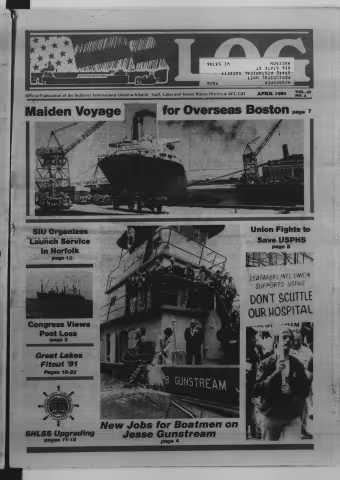
Maiden Vdyage for Overseas Boston
f'' •"
•t .
•••, •,
n"',
In Norfolk
liago 10 y
. ,v, i '
tr
Congress Views
Poet Loss
pages
Great Lake^
Fitout'81
Pages 18-23
Union Fights to
SaveUSPHS
page 5
suPPOi<rs U5PPS
New Jobs for Boatmen on
SHLSS Upgrading Jesse Gunstream
pages 1f-15 page 4
' .1
•&•
M.
f X* ' »
f •
i- ,
Frank Droxak
•r."
- ' r ' •
•T&
• J. t
t"- "' i
i RESPITE a very uncertain time for the maritime industry, we
in the SIU are moving aggressively ahead and preparing for
whatever turns the industry will take in the future.
Much of the uncertainty in the industry can, be attributed to
mixed signals coming from the new Administration.
_ During his election campaign and then after he took office
President Reagan stated numerous times his belief in the need for a
strong American maritime industry.
However, at the same time, the proposed Reagan budget calls fpr,
severe cuts m crucial maritime programs, in particular, the
construction differential subsidy program—a program key to
survival of new shipbuilding in America.
Frorn where we stand, you simply can't have it both ways. To
maintain a viable U.S. flag merchant marine—at the very least at
present levels—you simply cannot cut out or cut down government
funding programs for the industry.
As It is, much of the industry operates on a marginal basis
l)etween profit and loss. A reduction in government support at this
time—which is already much too low compared to the support our . .. "lu iiic suupori our
foreign competitors receive from their governments—could be
disastrous for the American maritime industry.
Apparently, the government budget cutters don't know or don't
care that the American flag merchant marine carries less than five
percent of the nation's overall foreign commerce. This figure is a
national disgrace. And when you look at this in regard to national
defense, it s downright frightening, especiaUy when you consider
that every major world power—with the exception of the United
States—carries anywhere from 30 to 50 percent of their
international trade.
Obviously, the answer to the U.S. maritime industry's probl
is not to cut its sea-legs out from under it;
Just the opposite. The government should be looking at wa
make all segments of the maritime industry more competitive
the foreigners, including state-owned, controlled fleets as weh'
seriously embarking on a program aimed at establishing the U ?
flag merchant fleet as a true military auxiliary to the Navy
Of course, we in the SIU have no- intention of sitting around
waiting for these things to be handed to us on'a silver platter W
are working with industry and labor to develop a program t^
revitalize our industry. . °
We're first of all, fighting to keep government support programs
at least at their present levels, as well as to protect pro-maritim
laws already on the books, like the Jones Act. ^
We're working on a legislative program to secure a guaranteed
share of exported American coal for American flag ships
The Union is also very involved in trying to develop, through new
tax structures, a more competitive climate to foster growth of an
American flag passenger liner industry.
In another area of extreme importance, we are pushing for new
regulations to force the Coast Guard to be more responsive to the
safety needs of those who make their livings at sea. In this regard
we are fighting for the right to have input into all Coast Guard
decisions involving manning levels, safety regulations, equipment
and construction and design features.
All of these issues, and many more, will be points of discussion at
our Crews Conference in Piney Point April 20-26. Input and
support from a strong cross-section of the membership for our
programs is crucial to their success.
The Conference will also serve to provide us with concise
decisions concerning upcoming negotiations for our new deep-sea
contract. I'm confident that we will come out of this Conference
with achievable contract goals that will reflect both the needs and
desires of the membership and the realities of our industry
As it has always been for us, there are no easy answers, no easy
solutions to our problems. The most important thing, though, is
that we realize this, and we are doing the things that have to be done
to guarantee that the future of Our Union and'our jobs is strong
and secure. ^
George MeCarlney Ntrnied West Coast Vke PreMeut
The SIU iSr the first timp in itc VPflr nn ^111'or»-ii . -The SIU J^r the first time in its
history has a vice president in charge
of the West Coast. He's longtime
Union official George McCartney.
Brother McCartney, who was
elected last year as SIU head
quarters representative, was desig
nated as West Coast vice president
by SIU President Frank Drozak.
His appointment was approved by
the SIU Executive Board in Feb
ruary.
The establishment of the office of
vice president in charge of the West
Coast came about after the member
ship approved Proposition #2 last
t i' o
George McCartney
year on the SIU's Official Ballot for
Election of 198 M 984 Officers and
Constitutional Amendments.
There are four other vice presi
dents on the Executive Board. They
are in charge of: Contracts and
Contract Enforcement; the Atlantic
Coast; the Gulf Coast, and the Lakes
and Inland Waters District.
In recent years the SIU has
become more and more involved in
activities on the West Coast. This is
largely due to the merger of the SIU
and the Marine Cooks and Stewards
Union in 1978.
Therefore it was felt that to best
service members on the West Coast
it was necessary to establish the
office of West Coast vice president.
Brother McCartney, who was
born in 1931 in New York City,
worked as a longshoreman- before
going to sea.
He helped to organize Cities
Service and served as department
delegate aboard most of the ships on
which he sailed.
McCartney shipped in all three
departments but most often in the
engine department. His last sea-
going job was as an oiler aboard the
SS Frames in 1960. He came ashore
that year to work as patrolman in
New York.
In the years to follow. Brother
McCartney served the Union in
many capacities: patrolman-dis
patcher in Philadelphia; port agent
in Wilmington, Calif.; and port
agent in New York and Seattle
before being elected last year as
Headquarters representative.
Active in community affairs,
McCartney is a member of the
Propeller Club, the Navy League,
the Apostleship of the Sea, and the
Irish, Italian, Israeli Society. He has
also worked extensively with the
National Maritime Council on both
the East and West Coasts to pro
mote trade and cargo for U.S.-flag
ships.
Brother McCartney lives in the
San Francisco Area with his wife,
Helga, and their two daughters,
Annie and Heidi.
Toledo Port Council Hosts Dinner
MTD President annual dmner recently, and SIU and
Great Lakes Exec. V.P o° featured speaker. Mel Peltry, right.
lllaf Pubfish^mSly.°^ond S Gulf, Lakes and Inla d W
rooKiyn. N.Y. Vol. 43, No. 4, Apnl 1981. (ISSN #0160 2047)'"^ AFL^CIO, 675 Fourth Ave., Brooklyn, N.Y
Great Lakes Exec V P nf Men A "I®'"' featured speaker. Mel Peltry, right,
emceed the affair. Jack MCD president of the Toledo Council,
the dinner. The Toledo 2 Exec. V.P., left, was also oh hand for
industry and political artionL '® active in all phases of the maritime
political action in the port of Toledo and vicinity.
2 7 LOG / Apfi 1981
Congress Investigates Loss of SS Poef
THE surviving relatives of the
34 seamen lost at sea when
the SS Poet disappeared without
trace last October gathered
solemnly in Washington, D.C on
April 9, 1981 tb attend Congres
sional hearings on the ship's loss.
The families, all wearing blue
ribbons in memory of their lost
loved ones, listened intently,
during the day-long hearings
before the full House Merchant
Marine and Fisheries Commit
tee, chaired by Walter Jones (D-
N.C.).
Every seat and every square
inch of standing area in the
hearing room was filled as
Chairman Jones banged the
gavel opening the proceedings at
9:00 a.m.
' Jones expressed his deep Sym
pathy to the family members in
attendance as he recalled the
tragic fate of the Poet.
The vessel left Philadelphia on
October 24, 1981 in the early
morning. Six hours later, one of'
the deck officers called his wife
through the marine operator. .
The vessel was never heard from
again, and no trace was ever
found of her.
A total of 34 men lost their
lives; 24 of them SIIJ members.
Jones said that the purpose of
the hearings was "not for blood
letting," but "to determine what
happened to the SS Poet one
morning last October when it
began its final journey."
Before the first witness was
SIU Presl^nt Frank Drozak. right, testifies before House hearings on the Poet »
iviativM of the iost Poet crew iisten intentiy in background. Nationai iMEBA President
Jesse Caihoon, left, also testified.
called, Jones' chief staff assistant
told the packed hearing how the
Poet's owner's failed to notify the
Coast Guard for ten days that the
ship had been incommunicado.
He then stated that it took the
Coast Guard another five days of
delays before beginning the
search.
The Coast Guard's actions
during the Poet's incident be
came the focal point of the
hearings. It became painfully
apparent during the hearings that
the Coast Guard's methods of
tracking vessels and following up
on suspected problems is totally
inadequate for safety of life at
sea.
Drozak Testifies
SIU President Frank Drozak,
testified at the hearing. He called
for a complete Congressional
investigation of the Ceast Guard
and its activities for the purpose
of developing new regulations to
protect those who make their
living at sea.(.A text of President
Drozak's testimony is reprinted
on this page.)
Drozak also attacked the
CoastGuard's lax attitude toward
inspections, and he affirmed that
the vast majority of Coast Guard
inspectors are not qualified for
their jobs.
President Drozak also main
tained that the Coast Guard's
practice of determining manning
scales only in relation to naviga
tion of the vessel at sea, with no
regard to onboard maintenance,
is a hazard to shipboard safety.
Drozak affirmed that maritime
labor must be allowed to have
Dmxak Attacks Coast Guard at Poet Hearings
Following Is the lestlmony submitted by SIU Presldeht
Frank Drozak before the full House MerchaiU Marine
and Fisheries Committee, InresOgatlng the disappear
ance of the SS Poet with the loss of 34 Ikes.
THE Seafarers Interna
tional Union is the certified
collective bargaining representa
tive of the unlicensed seafarers
who man many of the merchant
vessels sailing under the U.S.
flag. Under labor law, the SIU
has the obligation not only to .
bargain for safe working condi
tions aboard the vessel but^so to
see that they exist. The SIU is
also a joint operator of the
Seafarers Harry Lundeberg
School of Seamanship, which
trains unlicensed seafarers. These
personnel should be trained in
safe working procedures.
We^believe that changes need
to be made by the various parties
and agencies responsible for ship
safety, including better inspec--
tion and certification procedures
and improved search and rescue
operations.
First, Coast Guard inspectors
are not properly trained. The
average Coast Guard inspector
does not grasp the fundamental
differences between operating a
U.S. Coast Guard vessel and a
U.S. merchant vessel.
Those passing on the sea
worthiness of a merchant vessel
should be experienced and
trained in areas of naval architec
ture, shipfitting, machinery,
welding, pipe fitting, construc
tion and design, and most im
portantly, sailing and operating a
merchant vessel. Coast Guard
inspectors usually do not have
expertise in these areas.
Inspections are made bPth by
the Coast Guard and the Ameri
can Bureau of Shipping, which is
responsible for seeing that mer
chant vessels are properly classi- inspector was not present each
fied. Yet both inspections are time a hatch was loaded and
usually superficial. If equipment closed, yet he certified that the
works, it passes. If equipment grain was properly loaded,
were dismantled and stripped. The Bureau claims it does not
particularly in the engine room, have sufficient manpower to
breakdowns following inspection watch the entire loading opera-
might be avoided. tion. In addition, various inspec-
Rust and corrosion could be tors supervised the POET's
observed if certain sheathing loading at different times, mak-
were removed. Gauging should ing uniform inspection jmpos-
be performed more frequently, sible. We know that the POET
Inspectors from both services left port with the bow more than
generally fail to carry with them a two feet lower than the stem, a
complete record of outstanding condition which should have
violations, thus they are unable been corrected, as the National
to check whether these violations Cargo Bureau agreed. Still, the
have been corrected. bureau certified the ship as
In addition, both services grant properly loaded,
to shipping companies waivers or Housekeeping practices
extensions on certain repairs, yet aboard the SS POET were poor,
they rarely follow up to see that Repairs were made only when an
repairs are completed. inspection . was about to be
THE National Cargo Bureau conducted, but not routinely
] is responsible for seeing that
cargo is properly loaded and
stowed aboard a vessel. In the
case of the SS POET, the cargo
throughout the year. Just before
a Coast Guard' inspection in
March 1980, the ship was put into
Coniinued on Page 29
April 198- / LOG / 3
input in Coast Guard decisions
concerning manning, equipment,
safety regulations and construc
tion and design features.
Jesse Caihoon, president of
MEBA District 1, which repre
sented the engineers on the Poet,
also testified to the Coast Guard's
"ineptitude."
Caihoon, referring to the
" Coast Guard's five-day delay
before searching for the vessel,
stated bluntly^ "men and equip
ment were in place—but deci
sions were not made with dis
patch."
Rear AdmiralsT Henry H. Bell,
USCG chief of merchant marine
safety, and John D. Costello,
USCG chief of marine opera
tions, testified during the morn
ing session. They defended their
actions during the Poet tragedy.
The two Admirals did not see
fit to attend the afternoon session
of the hearings, which brought
the ire of Rep. Thomas Foglietla
(D-Pa.), who angrily called for
the record to reflect the absence
of Coast Guard spokesmen..
The owner, who was
subpoenaed to appear, escaped
criticism by being conveniently
out of the country. The ship's
owner failed to report the vessel
missing for ten days.
The findings of the hearings
were inconclusive. However, for
the families of the lost Poet crew,
the hearings showed that the loss
of their loved ones hopefully will
not be in vain. >
•fVil
^ '-"u.
f'
iTi--
ifih
I ,
i" ' i'n
I t
'. i "t J,
/0
lai
r!i
it I
:
f-
/
IH.
r:i-
• ¥
'V'k
•• f/'
* i
•m-i
' /r-
•I
: I
J
V-.
..mi% mi
'M".
ii
" f-'.
•" 7 i
.? ,' -
f. .M
'*: - .'
••S'-
•f .V -
*i" «" ' •
.1''' • '
I .
•¥
First Bosun Recert Class of '81 Graduates
The first class of the Bosun
Recertiflcatlon Program for 1981
graduated at the April membership
meeting In Headquarters after parti
cipating in the two month program.
A total of 12 Seafarers took part in
this Bosun class.
The Bosun Recertiflcatlon Pro
gram has been one of the most
successful educational efforts the
SlU has ever conducted. The pro
gram, which has been In effect for
eight years, has resulted In Improved
leadership on SlU ships with fewer
beefs, smoother payoffs and better
relations among all departments on
the vessels.
The 12 Seafarers who participated
In this class proved throughout the
program that they are ready and able
to carry out the duties and responsi
bilities as bosun In the best tradi
tions of the SlU. We wish them luck.
The 12 who took part In this class
are: Kenneth Marston, Robert
Dillon, Anthony Maben, ChristorsD.
Fiorous, Howard Knox, Johri
Wilson, William Cooper, John
Crews, John Kane, Frank J. Smith,
Manuel Sllva and Vincent Vanza-
neila.
Howard Knox John WUaon Manuel Slhra Anthony Maben Frank J. Smith Vincent Vanzanella
Robert U. Dillon John Crewe Christore D. Fiorous
mm.
William Cooper John Kane Kenneth Marston
750 Honor John Fay at Philly Affair
At a dinner attended by 750
people, SIU official John Fay was
honored last month in Philadelphia
by the Maritime Port Council of the
Delaware Valley and Vicinity.
John Fay, who was recently
elected as SIU Headquarters repre
sentative, came to New York last
year to serve as assistant secretajy-
treasurer. Since 1964, Brother Fay
had been the Union's port Agent in
Philadelphia. For 16 years he was also
secretary-treasurer of the Maritime
Port Coundl of the Delaware Valley
and Vicinity.
The Council honored him at the
dinner for his outstanding labor
work in the Philadelphia area.
Besides the model of a ship's
wheel presented to him by the
Council, Fay received a plaque from
the United Food and Commercial
Workers; a hand carved tugboat
from SIU Boatmen, and a plaque
from the Philadelphia AFL-CIO on
which he had been an Executive
Board member.
The wheel was presented by SIU
President Frank Drozak who is also
president of the eight million
member AFL-CIO Maritime Trades
Department, the parent organiza
tion of the Maritime Port councils
throughout the country.
. Brother Fay, who was bom in
Boston and joined the Union there,
also serves the SIUNA as a rep to
the International Transport Federa
tion and the International Maritime
Consultative Organization. Further,
Fay is Atlantic Coast area director
of the United Industrial Workers, an
affiliate of the SIU.
Christen New Higman Boat
rt '
U ..
;| # f » %•
At a banquet in his honor hefd in Philadelphia. SIU Headquarterers
Representative John Fay (right) receives a model of ship's wheel from SIU
Mid Maritime Trades Department President Frank Drozak. At left is William
Durfcin, president of the Maritime Port Council of Delaware Valley and
Vicinity.
SlU-contracted Higman Tow
ing christened their beauti
ful new 850 hp towboat, the Jesse
B. Gunstream. Jr. on April 4,
1981, in Orange, Texas.
The new boat means new Jobs
for SIU Boatmen in this area.
And for the SIU, it means
another brand new modern
addition to our expanding Gulf
Coast and Western Rivers fleet of
tugs and towboats.
Cracking the traditional bottle
of champagne on the new boat's
starboard rail was Mrs. Jane
Gunstream, as a crowd of well-
wishers cheered her on.
Attending the ceremony for
the SIU were SIU Vice President
Joe Sacco, and SIU Port Arthur
agent Don Anderson. Also, the
new crew of the Jesse Gunstream
were on hand for the festivities.
The boat was built at
Crumpler's Shipyard in Bridge
City, Texas. She measures 65 ft.
by 24 ft., and is powered by a
tough, hard working Caterpillar
diesel.
The new boat will operate on
the Intercoastal Canal, pushing a
couple of brand new oil barges
from Brownsville, Texas to sites
on the Mississippi.
The Gunstream christening is
another indication of the SlUs
expanding jurisdiction in the
Gulf, especially in Texas.
4 / LOG / April 1981
4^, •J
a
he
a(
UJ
qi
m
fe(
201
SlU Rallies to Save USPHS From Ax .-a i
A cross-section of labor and
community groups has
joined the SIU in a multi-
pronged protest against the
Reagan Administration's plan to
scrap the USPHS health care
system as part of its national
austerity plan.
Through a series of demonstra
tions, testimony presented before
Congressional field hearings and
a blitz of letters sent to key
members of the House, Senate
and the Administration, the
Union has presented a strong
case for the continuation of
USPHS.
The SIU's message, echoed in
hearing rooms and on picketlines
across the country, is that
USPHS has been providing top-
quality, priority medical care to
merchant seamen and other
federal beneficiaries for almost
200 years.
Congress create the USPHS
system in 1798 to provide the
nation's merchant seamen with
the special medical care they
needed to perform the commer
cial and military auxiliary role of
the merchant marine. That need
is as great today as it was 200
years ago.
House Hearings
That was the thrust of the
testimony delivered by SIU reps
at Congressional field hearings
held by the House Merchant
marine Subcomittee in four cities
over the past two months. Testi
fying for the SIU at these hear
ings were SIU representative
Jack Caffey (who testified in
Staten Island, N.Y.), George
Costango <in Baltimore), Pat
Pillsworth (in St. Louis) and
Mark Trepp (in Cleveland.)
In letters addressed to Health
& Human Services Secretary
Richard Schweiker and to the
chairman and members of several
House and Senate committees.
SIU President Frank Drozak
issued a reminder that the Ad
ministration's plan to dismantle
USPHS "is in direct opposition
to the historically expressed
intent of Congress to maintain an
available, accessible, and effec
tive health care delivery for U.S.
merchant seamen."
USPHS "plays an important
role," Drozak continued, "in the
provision of health care to not
only American seamen but also
the U.S. Coast Guard, Dept. of
Defense beneficiaries. Federal
employees and to many of this
nation's medically indigent—at
costs far below sector costs."
A similar concern was voiced
in a March 23 editorial in the
Baltimore Sun. "If President
Reagan succeeds in closing down
Public Health Service hospitals
and... clinics... it will not Only be
the sailors who will feel the
impact. In Baltimore," the edi
torial continued, "the U.S. Public
Health Service... has enlarged its
scope far beyond its original
purpose and now serves a broad
segment of the Baltimore com
munity."
Residents of the Baltimore
community in which the USPHS
hospital is located joined scores
of sign-bearing Seafarers there
this month in a demonstration
protesting the planned closing of
the hospitals. A similar demon
stration, organized by the SIU,
was held at the USPHS hospital
in Staten Island, N. Y., the largest
of the eight remaining PHS
hospitals.
But this is just the beginning!
The SIU's concerted efforts to
keep the eight USPHS hospitals
and 27 clinics open will continue
until the Administration aban
dons its attempts to deprive the
nation's merchant seamen of the
"available, accessible and effec
tive" health care USPHS has
been providing for 200 years.
Hundreds of people participated In the demonstration held at the Staten Island
USPHS hospital to deliver a single message—"Don't scuttle our hospltall"
Rep. Mario Blaggi (D-N.Y.) chaired field
hearings on USPHS which were held In
Staten Island last month.
SIU Baltimore Agent George Costango
told a Congressional field hearing In
Baltimore that USPHS hospitals and
clinics provide top-quality medical care
to seamen, other federal beneficiaries
and community residents.
Seafarers and community residents staged a demonstration In front of the USPHS
Hospital In Baltimore to keep the hospital open.
Presenting the Union's position on the Importance of the USPHS health care
network to U.S. seamen at Congressional Held hearings In Staten Island, N.Y. are
N.Y. Port Agent Jack Caffey (right) and SIU legislative representative Frank
Pecquex.
April 198" LOG 5
• ':I •:
I'• r/ si
... i
to Receive This Honor Posthumously
81 AOTOS AwanI to Paul Hail
- '"T HE United Seamen's Service
M. will dedicate their presti
gious 1981 AOTOS award to the
memory of the late Paul Hallj
president of the SIU until his
untimely death last year. He is the
first to receive this award
posthumously.
The AOTOS award is the
maritime industry's highest ac
colade. It will be accepted by
Hall's widow Rose, and by Frank
Drozak, the man who succeeded
Hall as SIU President.
The selection was announced
by Lane Kirkland, president of
the AFL-CIO. Kirkland, a form
er member of the merchant
marine, will serve as Chairman of
the AOTOS dinner, which will be
held in New York on September
25.
Hall is the 12th person to
receive this award. Past winners
include Joseph Lykes, chairman
of the Lykes Brothers Steamship
Corporation, who was instru
mental in reopening the Ameri
can flag steamship trade with
China; and Senator Daniel
Inouye (D-Hawaii), sponsor of
the Ocean Shipping Act of 1981.
Hall has been dubbed the
"Father of the Modern Merchant
Marine" for the contributions he
made to the development of the
maritime industry.
Along with.a small cadre of
followers, including Bull Shep
herd, Lindsey Williams and Rose
Siegel, he masterminded one
organizing victory after another.
He turned the SIU from a small,
bedraggled group of discon
tented sailors, into a potent force
in national politics.
In the 1950's he fought corrup
tion on the New York docks.
Despite tremendous opposition,
he integrated the maritime in
dustry.
During the 1960's he helped
fashion an effective political
presence in Washington. He
turned the Maritime Trades
Department from a paper tiger
into an organization representing
some 8.5 million workers.
He has been credited with
securing passage of the Merchant
Marine Act of 1970, one of the
landmark pieces of maritime
legislation.
Through tireless dedication
and backbreaking work he nur
tured the opening and develop
ment of the Harry Lundeberg
School of Seamanship, which has
since become the finest maritime
training school in the country.
Thousands of SIU members have
been able to upgrade their skills.
thereby making the SIU more
competitive in securing new jobs.
The Harry Lundeberg School
of Seamanship reflected Paul
Hall's deep humanitarianism.
Thousands of young people from
deprived backgrounds have
found employment and a chance
for a better life because of
programs devised and imple
mented by Paul JHall at the
HLSS.
Paul Hall's whole career was
aimed at imbuing seamen with a
sense of their own worth. When
he joined the merchant marine,
seamen became part of his blood
line. Even after he became one of
the most powerful and respected
labor leaders in the country,
when he met with Presidents and
routinely conversed with cabinet
members, every old-timer was his
brother and every trainee his son.
Despite his many honors and
accomplishments, Paul Hall was
basically a shy man. He disliked
large affairs. His favorite form of
entertainment was to go out to
dinner with his wife Rose. He
preferred quiet conversation to
loud parties; elegant dining to
conspicuous possessions; history
books on the Civil War to
anything else.
Any person who met him could
expect.a cordial reception. More
often than not, he was able to
bring out something special in the
people that he met, and this
perhaps is the measure of his
greatness. He reacted to every
person as if that person had
something valuable to offer him.
It is the rare man who can do
that, the exceptional human
being who is able to grasp that no.-
one man or woman understands
it all, that even the humblest
creature can teach you the most
profound lesson.
The United Seaman's Service,
which is responsible for handing
out the AOTOS award, has made
a fine choice, one which does
honor to it and the maritime
industry.
I/.S. Must Save Construction Subsidies
I N a vigorous attack on the Ad
ministration's proposal to ax
funding for crucial maritime pro
grams, SIU President Frank
Drozak called on the House Mer
chant Marine *& Fisheries Com
mittee to "firmly reassert this na
tion's commitment to revitalize
/ / the U.S. merchant fleet."
Drozak's written statement
was submitted to the Committee
on March 25, during delibera
tions on H.R. 2526, the bill to
authorize funding for maritime
programs for fiscal year 1982. In
it, the SIU President came dowif
especially hard on the Adminis
tration's proposal to eliminate
$107 million in new funding for
the important construction dif
ferential subsidy (CDS) pro
gram.
CDS, Drozak said, "is the only
U.S. program which provides for
the construction of U.S.-flag
ships in U.S. shipyards to carry
U.S. trade. To eliminate the CDS
program at this time," Drozak
warned, "will signal to the
maritime countries of the world
that the United States is no
longer committed to preserving
its own merchant fleet."
6 / LOG / April! 981
Eliminating "the only U.S.
program to promote commercial
ship construction," Drozak
added, "will undermine our pol
icy of revitalizing our defense
capability and readiness."
Drozak assured the House
Committee, chaired by Rep.
Walter Jones (D-N.C.) that "the
SIU supports President Reagan
in his attempt to bolster our na
tion's economy."
The Union also supports Presi
dent Reagan's "efforts to
strengthen our nation's defense
structure," Drozak said. But
strengthening our defense capa
bility, he added, "must include
the merchant marine."
Towards this end, SIU Presi
dent Drozak outlined a series of
actions to the Committee which
"would benefit the U.S. flag fleet
without using federal dollars."
The proposed actions, which
parallel the goals of the five-point
maritime program Drozak
drafted recently, includes:
• transferring certain water
transportation functions now
performed by the U.S. Navy to
the merchant marine. This ar
rangement, Drozak testified.
would serve a dual purpose.
"Navy personnel would be free to
man combat vessels and the mer
chant marine would be well prac
ticed in serving as a true military
auxiliary;"
• bilateral agreements with
our trading partners which would
"strengthen the merchant marine
yet cost the taxpayer nothing;"
• revitalization of the U.S.-
flag dry-bulk fleet which must in
clude adequate consideration of
the U.S. flag fleet "in all pro
grams now being developed to
promote the export of American
coal to foreign purchasers;"
• reduction of government
regulation. "Unnecessary regula
tion must be stripped away so
that American shipbuilders and
operators can compete effec
tively with those of other nations,
where similar regulations do not
exist."
Reagan Names Labor Liaison
Robert F. Bonitati, former direc
tor of public affairs for the Airline
Pilots Union, has been named
special assistant to President Rea
gan for Public Liaison for Labor.
SIU President Frank Drozak
praised the appointment, saying that
he is looking forward to working
with Mr. Bonitati on issues of im
portance to labor, in particular
maritime labor.
Bonitati was assistant to the
Director of the Office of Manage
ment and Budget in 1973-74, and
Associate Director of the Cost of
Living Council in 1973-74. He
served as Campaign Director for
Senator Howard Baker (R-Tenn.) in
1966 arid 1972 and as Executive
Assistant to Senator Baker in
1966-67.
Robert Bonitati
, -'i^"
v--"-v)yn: •• • .• -J- J^->- .'V -• • "
AB Arthur Harrington caught In a pensive pose
aboard the Overseas Boston at the end of
January. QMED Jim Flynn thumbs through the pages of
(what else?) the Xog. Standing In the Overseas Boston's gleaming
new galley is Chief Cook Ed Singleton.
1^'; •:
You'd never know it to look at her. but Maritime Overseas' big, beairtiful Overseas
Boston is a lady with a shady past.
When she was bought by the SlU-contracted company in late 1979, the tanker
then named the Sea Tiger, bore no resemblance to the ship she is today.
She was nothing but a hulk," said a Maritime Overseas spokesman about the Sea
Tiger.
Extensive repairs, made at a Quincy, Mass., shipyard over a period of 14 months
changed all that. Early in 1981, the vessel was re-christened the Overseas Boston'
and crewed by Seafarers. / /
The Overseas Boston will be operating in the Alaskan oil trade, making the same
run as the company's Overseas Juneau, between Valdez and a PIP Terminal in
Puerto Armuelle, Panama.
In fact, as this issue of the Log went to press, the Overseas Boston had just arrived
in Valdez and was en-route on her first run to Panama.
Shes 855 feet long, with a beam of 133 feet and she weighs in at 121 000 dwt.
steward/baker aboard the Overseas And, as she begins her new life, the SlU-crewed Overseas Boston is a proud addition
to the U.S.-flag merchant fleet.
m''-
s—•
TO.:;
AB A. Perry (left) and OS Manuel Camara relax aboard the Overseas
Boston before the ship started on her first run to Valdez. AB John Aversa (left) and Bosun Pablo Barrlll.
April 1981 / LOG / 7 . ^
•y.i ^ . . -J-"
-- ,,p
-..i-...--,-; . 4^:-
• • •
if
V
'M:
' i •• ' '¥,•
.yAli
'yy •$
• • ''y
y
,• vTk,
f;'
• ' '.K
. •: Y.
•• '^:rn
I '
•f y'
•A-.:
f-Arll
.iAll
•'•y-y.:A«
• ; I.:-]:' i
- •• f
, • -'"y'.' 'i
V iAfS •••
f V
-J
.A
y-• •
i.y- A
U i
y*" I
.^1
ml
i
t-
Ij
•si
• - 'f
t
...i . 'i
- -j'.,
H "
'ei4-
V:*:,
SIC/ Supports UNCT/KD Bilateral Code
The SIU believes that a
worldwide code for liner
conferences developed by the
United Nations should be ap
proved by this country.
For some time now, the Union
has supported adoption of the
codfe whose title is the United Na
tions Conference on Trade and
Development's Code of Conduct
for Liner Conferences, better
known as the UNCTAD Code. •
The AFL-CIO Maritime
Trades Department, of which the
SIUNA is a member, pas.sed a
resolution in February encourag
ing the Reagan Administration
to support the Code.
Early this month SIU Presi
dent Frank Drozak submitted
testimony to the House Subcom
mittee on Merchant Marine,
which is hblding hearings on the
UNCTAD Code.
In his testimony, Drozak
reported that the SIU believes
"that the UNCTAD Code is the
best rnethod now available to
promote and stabilize the partici
pation of U.S. shipping lines in
America's foreign commerce."
Basically, the UNCTAD Code
stipulates that up to 40 percent of
cargo should be handled by each
trader with the remaining 20
percent going to cross-traders.
A final text of the Code was
adopted in 1974; 72 votes for
adoption were cast by the devel
oping countries, the Soviet bloc,
China, France, Germany, Bel
gium and Australia. Opposing
the Code at the time were the
U.S., the United Kingdom,
Switzerland, and the four Scan
dinavian countries.
For the Code to take effect, a
minimum of 24 nations repre
senting at least 25 percent of the
world's liner cargoes must ratify
it. At present, 48 countries repre
senting 18.7 percent of the
world's liner trade-have done so.
If is anticipated that the Code
will become operative later this
year. The European Economic
Community conceded to allow its
members to ^oin with reserva
tions. Japan has also indicated it
will ratify the Code wjthip the
near future. The United States
has not indicated that it will take
any action.
The SIU believes that this
"non-position" could be dis
astrous for U.S. liner operations.
As Drozak noted "the inevitabil
ity of the Code's operation be
tween the United States' major
trading partners threatens t© sub
stantially reduce" this country's
share of worldwide liner trade.
Right now, although U.S.-flag
vessels carry a mere five percent
of the country's total foreign
commerce, American-flag ships
fare somewhat better in the liner
trades.
Even in this area though, there
has been a downward trend. In
1950, the U.S. provided 46.3 per
cent of the liner service for Amer
ican foreign trade. By 1978, this
had been reduced to 28.6 percent.
The core of U.S. opposition to
the Code lies in America's free
trade policy. The State Depart
ment believes that the Code es
tablishes an anti-competitive
situation through its endorse
ment of the closed conference
system. The U.3- operates an
open conference system which
permits liners to enter and leave
at will.
President Drozak reported
that "we can anticipate that ship
ping which is diverted from other
conferences under UNCTAD
will enter the trades of the United
States, further depressing the
market for U.S. vessels."
^^The SIU feels that the current
U.S. approach to the Code is
totally inadequate. Although
there are certain legal and pro
cedural conflicts in the accept
ance of the Code, the Union be
lieves the alternatives present
many more problems. In the test
imony he submitted, Drozak
pointed out that "to take no ac
tion is to ensure a diminished role
for the United States in the liner
trade."
siuiM', meet th«®^ Monclass^?'^,naPsW-
V-
mation yvutoma"
Augu®'
\ut
AFL-CIO Opposed to Youth Subminimum Wage
WASHINGTON, D.C.—AFL-
CIO President Lane Kirkland has
called on Congress to reject a pro
posed subminimum youth wage.
Kirkland and other union wit
nesses during two days of Senate
hearings sharply challenged the
claims of sponsors of assorted
"youth opportunity" bills that
lowering the wage floor is the answer
to teenage unemployment.
Teenage unemployment is too
high, but so is unemployment
generally, Kirkland reminded mem
bers of the Senate Labor subcom
mittee. Adults made up 6 million of
the 7.8 million persons seeking jobs
last month, he noted. And of the 5
million persons, mostly women and
minorities, who work for the mini
mum wage, 70 percent are adults.
DOES CONGRESS really want
to encourage employers to substi
tute teenagers for adults in the low-
skill jobs at the bottom of the wage
ladder, Kirkland asked.
He reminded the Senate panel
that more than half a million young
people are already being paid less
than the $3.35 an hour minimum
wage under student and learner
8 / LOG / April 1981
,*
' W/'
i •
M ' -
^ • 'I'l
' I'i W
More Jobs are rteeded to put teenagers to work, "not a 'super low waqe' oool
of exploitable young workers," AFL-CIO President L^^ne Kirkland Ud
in opposing a youth subminimum wage. Kirkland (center)
testified before a Senate Labor and Human Resources subcommittee He
was accompanied by the Federation's legislative director Rav Hpn/cnn
(left), and Director of Research Rudy Oswald (right) ^
exemptions allowed by the Labor
Dept. Further, employers who hire
disadvantaged youths are currently
entitled to generous tax credits, up
to $1.50 an hour for each such
employee.
If lowering wages created addi
tional jobs, Kirkland said in reply to
a question, there should have been
no unemployment in the depths of
the Great Depression, when there
was no minimum wage law and
employers cut pay.
Youth unemployment.should be
countered by targeted programs
coordinating training with place
ment in jobs "that have a future," he
said. That's what the AFL-CIO has
been trying to do through its Human
Resources Development Institute
and various budget-threatened out
reach programs, Kirkland added.
And labor's proposals for reindusr
trialization would enlarge private
sector job opportunities for workers
of all ages, he pointed out.
KIRKLAND URGED Congress
to index the minimum wage so it
remains a meaningful floor and so
that full-time workers will not have
to rely on public assistance to
subsidize inadequate pay.
Labor views the employer cam
paign for a subminimum wage as
part of an attack on the entire
concept of a minimum wage law,
Kirkland testified.
It is "in the interests of society," he
told a questioner, that the minimum
wage be set above the level of
exploitation and that its "real value"
be maintained against inflation.
--r --iwy y.*» 1li.|-|i ».i.., i ••. irt ''iriii |-'i
•', ••• •• • •' ' •' • . ' '"••-•• '. , ;; •-r2''
I
I
I
I
I
I •
I
I
I
I
I
I
I
I
I
I
I
I
I
I •
I
I
I
I
I
I
I
I
I
I
I
I
i
I
I
I
I
I
I •
I
I
I
I
I
I
I
I
I
J
I
I
I
I
I
I • • •
I
I
I
I •
I
I
I
I
I
I
I
I •
I
,4^:'
A
. i'
Sr.it.rri i'v rnu'i n.it !• iii.il niiiii lit Noitli AnKi''.i,i. Al-l.f. It' April 1981 ,1 Ailinini-ti.iiui,' '.nKl' . .rv H.rjyviuiis^s
Washington Report ̂
Spring has arrived in the nation's capital,'
and nobody seems to have noticed.
Congressmen hotly debate the minute
details of the 1982 Budget, while events in
Poland and El Salvador slide to their
unknown conclusions. For a second,
everyone's attention was captured by an
unsuccessful-attempt on Ronald Reagan's
life, which at first seemed like a cruel and
bizarre replay of events that occurred so long
ago in 1963. But thankfully, the nation did
not have to relive another Presidential
assassination, and the Congressmen and El
Salvador guerillas were free to go back to
their respective wars, undisturbed.
Issues, people and even industries have a
way of getting lost in times like these. The
union is in Washington to make sure that
whatever happens, American seamen will
not go unrepresented.
Port Improvement
Rep. Walter Jones(D-N;C.), chairman of
the Merchant Marine and Fisheries Com
mittee, urged Congress to recognize the
importance of modernizing U.S. ports. He
stressed that inadequate port facilities have
hindered the development of a strong coal
exporting industry.
According to Jones, "ships have been
waiting off our coasts for up to 40 days at a
cost of perhaps $ 10,000 a day because our
port facilities can not handle the hew volume
of coal."
W'^.ile many energy starved countries
desire our coal, they are unwilling to put up
with conditions at American ports.
In a similar move, Barbara Mikulski (D-
Md.) introduced H.R. 2412, the Customs
Revenue Sharing Act ofl981. If enacted, the
bill would require that 1% of all customs
revenues tyould be used to renovate, expand
arid construct customs facilities at the ports
where monies are collected.
U.S. Shiplmilding
Aids Economy
According to a study that was prepared by
H. C. Chung,- professor of economics at the
'University of Bridgeport, every $1 spent in
American shipyards generates $4.70 worth
of business in other industries throughout
the economy.
The study, which was commissioned by
the Maritime Administration, updates an
earlier one conducted by the government.
Both studies point out the effectiveness of
the Construction Differential Subsidy
(CDS) program. According to Professor
Chung, the CDS program has helped to ease-
high unemployment rates in economically
deprived areas.
Funding for the Construction Differential
Subsidy program was severely reduced in
the first draft of President Reagan's 1982
Budget. Industry figures oppose such" a
drastic cut, and hope to persuade the House
of Representatives to have the money
reinstated.
NMC Endorses Ocean
Ship^ngAct
Support continues to build for S. 125, the
Ocean Shipping Act of 1981, which seeks to
reform the sometimes irrational and always
confusing network of Federal maritime
regulations.
The National Maritime Council, a
coalition of shipping companies and
maritime labor organizations whose pur
pose it is to promote the American merchant
marine, recently endorsed S. 125. The SIU, a
member of the Council, has already done so.
S. 125 is substantially similar to a bill that
was introduced in the last session pf
Congress. Daniel Inoiiye, the hard-working-
and well-respected Senator from Hawaii,
introduced both measures.
SPAD is the SIU*s political fund and our political arm in
Washington, D.C. The SIU ashs for and accepts voluntai^
contributions only. The Union uses the money donated to
SPAD to support the election campaigns of legislators who
have shown a pro-maritime or .pro-labor records
SPAD enables the SIU to work effectively on thie vital
maritime issues in the Congress. These are-issues that have
a direct impact on the jobs and Job security of all SIU mem
bers, deep-sea, inland, and Lakes.
* The SIU urges its members to continue their fine record
of support for SPAD. A member can contribute to the
SPAD fund as he or she sees fit, or make no contribution at
all without fear of reprisal.
A copy of the SPAD report is filed with the Federal Elec
tion Commission. It is available for purchase from the EEC
in Washh^on, D.C.
Herb Brand Urges
Action on M.M.
Speaking at a major conference devoted
to solving the problems of this country's
merchant, marine. Herb Brand, chairman of
the board of the Transportation Institute,
urged the United States to move quickly to
save what little remains of the maritime
industry.
According to Brand, the United States
government, should seriously consider
taking the following steps:
• opening negotiations for bilateral trade
agreements between the United States and
its trading partners .
• reserving an equitable share of Ameri-
. can foreign trade for U.S. flag operators
• transferring certain siipport and auxili
ary functions from the Navy and the
Military Sealift Command "directly" to the-
private sector
• implementing all existing cargo prefer
ence laws '
Mr. Brand's speech was delivered at the
Center for the Study of the American
Experience; Annenberg School of Com
munications, University of Southern Cali--
fqrnia.
US-China Trade
Five American flag companies have filed a
petition with the Federal Maritime Com-
mj^ssion which, if approved, would give them
the right to establish, a rate agreement
covering the trade between the United States
and the -People's Republic of China.
The five American flag companies
petitioning the Federal Maritime Commis
sion are American President Lines, Lykes
Brothers Steamship Company, Sealand,
Unitetf States Lines and Waterman Steam
ship Corporation. . .
The rate agreement would be the first of
its kind for the United States, It woqld
establish separate "flag groups", which
would allow American flag companies to
address trade problems and ratemaking
activities on a* national flag basis'.
The attorney representing the -five
companies, Robert Peavy, emphasized that
the agreement would complement the.
bilateral maritime agreement signed'by US
and Chinese officials last September 17.
Under the term's of the U.S.-China •
bilateraJ trade agreement, national flag
vessels t)f the two countries will each carry
one-third of the total trade; with the other
open to third-flag vessels. •
'The proposed new rate agreement is
designed to encourage cooperation among
vessel' operating carriers and other entities
involved in the US-China trade. It will have
the same scope as a conference.
v
T.r Ji. ̂ 'v ^
ApnJ 198' / LOG / 9
. i
I
• I-"•%
ul
• t '•
il
•4i-
I
P f
J
f
V 11
S'.
I
fi
.1
Lookmg over the day's work schedule are Lynnhaven One captains Alien Ross, left,
and Tom Hardy.
Here are Captains David Owens and Butch Parkenson of the Lynnhaven Margaret
Slu Organizes new norroiH Launch seruice
THE SlU recently organized
Lynnhaven Services, a
launch service operating in the
Norfolk, Virginia area. The
company is the first of its kind
contracted to the SlU and repre
sents a milestone for trade-
unionism in the "right-to-work"
state of Virginia.
Lynnhaven began modestly in
September 1980 with only one
boat and four employees. Since
that time they have expanded to
seven launch boats, one tug and
one 17,000 barrel water barge
and SlU crews of over 40 em
ployees, including 21 captains.
By the summer of 1981 the
company expects to have
between 80 and 100 employees
manning n/ne launches and
three tugs, as well as an
additional water barge and two
bunker barges. This is certainly
something for SlU members in
Norfolk to look forward to.
What Lynnhaven actually does
is provide service to the many
coal carrying ships which are
anchored in the bay outside of
Norfolk. Ata givbn moment there
can be as many as 180 ships
awaiting a berth at the port's coal
loadingjacilities.
Due to the increased-world
demand for coal and the
shortage of properV loading
docks, vessels may wait as jong
as 90 days to get a berth. This is
where Lynnhaven comes on the
scene.
The launches take crewmem-
bers who wish to go ashore at
either Cape Charles or Norfolk to
and from their destinations.
They also provide laundry
service and bring stores from the
mainland to the waiting vessels.
In addition, the tug and water
barge carry fresh water to vessels
which cannot supply their own,
obviously a very important
service considering the amount
of time some of these ships are
away from port.
Port Captain Bob Linkous
pointed out that Lynnhaven can
service the coal carriers swiftly
and more efficiently than anyone
else in the area. Two of the boats,
the Thunderstar and the Marga-
" A I - . ' ^ :
x; • .. -7.
49 of carrying 60 gross tons on deck and
ret are capable of loading up to
25 gross tons of cargo on their
decks while carrying 49 passeng
ers each, as Captain Linkous
says, "quite a payload." The two
vessels can also maintain a
speed of 24 knots. Not bad.
Lynnhaven's fleet also boasts
three vessels of 45 feet in length
which are capable of 20 knots
and the 28 foOt Lynnhaven II
which motors at 25 knots. All this
spe0d comes in handy when
you're servicing as many as 55
ships per day in a bay area as
large .as Norfolk's.
Speed, service and a fine crew
supplied by the SlU should keep
Lynnhaven Services on a steady
course for many years to come.
jf-
g|.
The Lynnhaven One is one of the boats operated by the SlU's newlv oraani»H
launch sereica In Nortolk harbor. Along wifh Port CaWn Bob LiSa feH arc
2-ewmembers, from the left Darwin Faulkner, engineer: Hob Claud ickh'an^
10 / LOG / Appu:98l ,
D?v?"ScraDW'"/"®' the crew meets with SlU Norfolk patrolman
wave ocrapiron Jones, second from rfnht cii i < IOH ara-
Dava "Qoraeeiee..." • owano, ti.c uiew meeis wnn siu norroiK pairuiman
AlfoLoSir oin"®®' .®®^o"drfght. SlU crewmembers. from the left are:
engineer Georoi. Ta ®"9'"®®[; W®"®" Merritt, relief captain; Randy Rayford, chief
Sr.? captain ^®""®''' deckhand/tankerman; 'Scraplron, ' and Clarence Mosley.
tjV'w TT Tcrari#-- # '^trr, r T-TS
' , "•> 'y p---
>
y*
y
/ y
/ y
HARRY LGNDEBERG SCHOOL
OF SEAMANSHIP
Piney Point Maryland
^Wsssssste i
s
'H?.!?®^'!?®®*®'' Course Provides Wide Range of
Wheelhouse Skills
EAFARING skills are be
coming more technical as
shipboard automation and navi
gating techniques advance.
Training and upgrading are be
coming more necessary to insure
the job security of the unlicensed
Seafarers who sail the high tech
nology ships of the U.S. mer
chant marine.
To keep pace with advances in
Job skill requirements, the, SIU
provides job training at the Sea
farers Harry Lundeberg School
of Seamanship in Piney Point;
Md.
One such course is the four-
week Quartermaster program.
Candidates for this course must
hold a valid Coast Guard en
dorsement as Able Seaman—Un
limited, Any Waters.
During the course of instruc
tion, students learn the practical
use of the magnetic and gyrp
compasses; rules of the road;
basic chart work; firefightingand
emergency procedures; interna
tional codes and signals; aids to
navigation—including instruc
tion in radar, loran, fathometers
and RDF.
Students will -also become
familiar with bridge publications
and instruments, and will attain a
working knowledge of weather.
tides and currents. Also included
in the course will be a review of
deck seamanship. Two more
courses are scheduled this year:
one beginning June 19, and an
other beginning Sept. 11.
V.
Seafarer George Halland, left, tackles a problem on the radar scope
simulator under the guidance of SHLSS instructor Abe Easter.
: •••
Seafarers Edward Gontha, left, and Benjamin Bess, center, learn the
techniques of course plotting under the expert tutelage of SHLSS deck
instructor Abe Easter.
Graduates of the March 1981 Quartermaster class posed for their gradua
tion photo with their instructor. Kneeling from left are George Halland
Benjamm Bess, Mahood Said and Lenny Pellettier. Standing from left are
Mohamed Remli, Edward Gontha,vZaine Basir, Ronald Wolf, and SHLSS ;
Deck Instructor Abe Easter.
Seafarer Williams Achieves GEO Dipioma
CD . .1 , . ^ SEAFARER David Williams
achieved one of his major
goals last month when he com
pleted studies at the Seafarers
Harry Lundeberg School of Sea
manship, and passed the Mary
land State High School Equiva
lency examination. Williams,
•who dropped out in the 12th
grade four years ago, is now a
high school graduate.
Brother Williams sails as
Assistant Cook and ships out of
the Port of New York. Why did
he come to the Lundeberg School
to get his high school diploma?
He said:
"1 felt that a diploma was very
important to me in getting ahead
in my chosen career, and as a Sea
farer, I felt at home at the Sea
farers School." *'
^ This wasn't Williams first visit
to the school. On earlier attend
ances at SHLSS, Seafarer Wil-
liarns earned endorsements in
Lifeboat, Firefighting, Tanker-
man, Third Cook and Assistant
. Cook.
The main thing about SHLSS
that keeps him coming back is
that the teachers "are helpful and
encourage us to learn." It was dif
ferent from his experiences in the
public schools of Washington,
D.C.~where he grew up.
"In the public schools classes
were large and we were just
pushed from grade to grade with
out really learning. I just lost in
terest," Williams said. "But here
at the Lundeberg School the
classes are smaller and we got a
lot of individual help. And the
teachers really care."
Williams said he hopes other
Seafarers will take advantage of is show up and give it our best
the opportunities offered at shot," he said. "The teachers and
SHLSS. "There's a lot here at staff will give us all the help we
the school, and all we have to do need."
' , V",;. I ;,•
Seafarer Williams concentrates on electronic study materials in the SHLSS
multi-media area as he prepares for the GED examination.
Apnl 1981 LOG' 11
tjifliiiOliLU
f
- -I
' H
f
• r
• A ̂
i'
,1
•• -i
• . .SEUTr.*—.
I
il
J
" "-••1 •••,'
.4' ••/'• •-
••. . '-i
•t •,.. • ..
Putting the icing on the cake are these three upgrading Cook and Bakers as
they display one of their tastier projects.From left they are Tonie Booker,
John Davis and Thomas Waiters.
Seafarer Norris Mixon pays close attention as SHLSS Staff Baker Bill
Seidenstricker demonstrates the techniques of slicing newly-baked bread
Brother Mixon ships out of the Port of Mobile.
SHLSS Cook and Baker Program:
SHIPBOARD cooking and
' baking requires special
skills that can only be-learned
through the experience of
"hands-on" training under the
guidance of qualified instructors.
The Cook and Baker program
at the Seafarers Harry Lunde-
berg School of Seamanship pro
vides this training. The six-week
course is held in the bake shop
and main galley of the school.
Students get experience in all
kinds of baking, including breads
and rolls, breakfast pastries, pies,
cakes and other desserts.
To be eligible for the Cook and
Baker course. Seafarers must
have nine months time in the
Steward Department, and have
at least four months seatime as
Third Cook/Assistant Cook.
Seafarers who are interested in
the program should write to: Ad
missions Office, SHLSS, Piney
Point, Md. 20674. .
Thomas Waiter^ from the Port of Mobile, prepares a tasty dessert as part of
the on-the-job Cook and Baker training at SHLSS. Yummy!
qwf Baker student Tome Booker, right, prepares bacon slabs in the
riluoiL?/ o ""der the approving eyes of the Staff Cook John
Cleveland. Seafarer Booker ships out of the Port of Seattle.
v •
• .r
Aiming For the Stars:
Celestial Navigation Plots Career Advancement
' I ' HE skill to plot a course by
A celestial navigation is re
quired for all offshore licenses,
and the Seafarers Harry Lunde-
berg School of Seamanship
schedules a five-week course to
provide practical knowledge in
all aspects of celestial navigation
that are needed for licensing.
Included in the course are de
termining latitude by Polaris; de
termining compass error by azi
muth and amplitude; latitude by
meridian altitude,of the sun; posi
tion by sun line; adjustment of
the sextant, and underway practi
cal experience in all aspects of
celestial navigation.
The course is open to all SIU
members who are eligible for a li
cense as Towboat Operator—
Oceans; Master/Mate of Unin--
spected Vessels; or Master/ Mate
of Freight and Towing Vessels.
Seafarers Legett Jones, from the Port of Jacksonville, Rick Borden and Jack LaRoque take a sun sight aboard the
SHLSS tug C.L.2
Seafarer Charles Boles goes to the tables as he works out a plotting
problem. Boles, who hails from Algonac, Mich., has sailed on both Great
Lakes and deep sea, and is now preparing to sit for a Third Mate .license.
Seafarer Jake Karaczynski, who ships out of the Port of New York, adjusts
his sextant as he prepares to take a noon sun sight.
Seafarers Jack t^Roque, from New Orleans, and Rick Borden, from the Port With the help of SHLSS Deck Instructor Paul Allman, right. Seafarer .Jake
of Baltimore, compare notes after taking sun sights. , . Karaczynski works out a line of position on a navigation chart. —
April 1981 / LOG / 13
*
•s
i
.'t
•mmf
• ^ -iJ.
. t
. ; :1
. I
• 'i.
fesfc'.'Sf'a -V •• ' • . -'•; .. •••^; •'.?•••- •• (i--"' ' --i-v^'"'-
•isisf i-'il"-!,! . ••" • • ' • "^
• • V
; • SEAFARERS HARRY LUNDEBERG
SCHOOL OF SEAMANSHIP
^WC UPGRADING COURSE SCHEDULE
1981
Course Check-in-Date Completion Date
Chief Stewaifd, Chief Cook,
2nd Cook & Baker, 3rd Cook April 20
June 1
July 13
August 24
Octobers
May 29
July 10
August 21
October 2
November 13
•.••'to-''
' 'I—
s.fe ,
r'T':.,
QMED
FOWT
November 16 December 24
May 10 July 30
September 27 December 17
May 24
Marine Eiectricai Maintenance July 6
October 26
June 18
August 27
December 17
Marine Electronics May 25 July 2
September 14 October 22
I
I ' vr
•I
Refrigeration Systems
Maintehahro and Operations June 22
October 12
Diesel (Regular)
Diesel Scholarship
Pumproom Maintenance and
Operations
Automation
Basic Welding
Third Assistant Engineer
Towtx>at Operator
March 30
June 22
October 12
June 22
October 12
June 8
October 26
August 3
May 25
August 17
April 13
Augusts
May 11
July 30
November 19
April 23
July 16
November 5
August 13
December 3
July 16
Decembers
August 27
June 18
September 10
June 19
October 9
July 2
Towt)oat Operator Scholarship June 22 August 6
September 14 October 30
Celestial Navagation
First Class Pilot
May 25
August 10
November 1
October 5
June 25
September 11
December 4
November 20
Course
Quartermaster
Third Mate
Able Seaman^
Check-in-Date Completion Date
.; :"lf
Bosun Recertification
Steward Recertification
"A" Seniority
•'4-
'•Mr
.-A"
,r - ' ' H;.'
Lifeboatman/Tankerman
June 19
September 11
July 6
April 26
May 24
August 16
October 11
November 22
April 13
August 10
May 11
July 13
September 7
October 12
April 6
May 11
June 8
July 6
August 10
September 7
Octobers
November 9
December 7
May 10
June 7
Julys
August 16
September 13
October 11
Nc?yember8
July 16
October 8
September 11
May 21
June 18
September 10
November 5
December 17
June 8
October 5
July_6
September 7
November 2
December 7
May 4
June8
July 6
August 3
September 7
Octobers
November 2
December 7
January 4
May 21
June 18
July 16
August 27
September 25
October 23
November 20
Cove Sailor Committee
On Mar. 19. part of the Ship's Committee of the ST Cove Sailor (Cove Shipping)
had a total of 107 years with the SlU—from 22 to 31 years each. They were
(seated I. to r.) Bosun Jerry L. Bass, ship's chairman and Chief Steward Stanley
A. t-reeman. secretary-reporter. Standing (I. to r.) are AB John W. Kelsoe, deck
delegate and Chief Cook William E. Grimes, steward delegate.
14 ' LOG / April 1981
• •
' ' -I^ii'-r' ' -
. •
(Area Code)
Lakes Member •
Enclorsement(s) or
License Received
Do you hold a letter of completion for Lifeboat: • Yes No Q Firefighting: Q Yes No • CPR O Yes No
Dates Available for Training.
• FWT • Oiler
O QMED - Any Rating
• Others.
Q Marine Electrical Maintenance
Q Pumproom Maintenance and
Q Operation
Q Automation
• Maintenanceof Shipboard
Refrigeration Systems
Q Diesel Engines
O Assistant Engineer (Uninspected
Motor Vessel)
Q Chief Engineer (Uninspected
Motor Vessel)
D Third Asst. Engineer (Motor Inspected)
STEWARD
O Assistant Cook
Q Cook & Baker
• Chief Cook
• Steward
• Towboat Inland Cook
ALL DEPARTMENTS
• LNG
• LNG Safety
• Welding
Q Lifeboatman
Q Fire Fighting
No transportation will t}e paid unless you present original
receipts upon arriving at the School.
RECORD OF EMPLOYMENT TIME —(Show only amount needed to upgrade in rating noted above or attach letter of service,
whichever is applicable.)
VESSEL RATING HELD DATE SHIPPED DATE OF DISCHARGE
SIGNATURE
Please Print
DATE
RETURN COMPLETED APPLICATION TO: ^
Seafarers Lundeberg Upgrading Center
PINEY POINT. MD. 20674
ry
i
April 1981 LOG 15
nteir 7-y jasajM
•i.V.'-l.'^Yf 1-
tfc-
.,i--
K
l'-^;
li-
Mourns Jofian Yarmola
Johnny Yarmola, who passed away last month, was not only a
good loyal union brother but he was our dear friend and we loved
him. He was there when times were bad and when we needed him.
His impact on the seaman's labor scene is immeasurable. He will
be missed and his absence will be felt by us all.
Fraternally and with Great Respect,
Roman Gralewicz, .
President
SIU of Canada
Rep. Burton 11^31 Fight for USPHS
I wish to thank the SIU for its recent letter expressing concern
with President Reagan's proposal to close all of the United States
Public Health Service Hospitals in the country, and in particular
the hospital in San Francisco.:
As you know in the past, and on occasion of threats to close the
facility on Lake Street, I have made the case and have fought vig
orously to keep open this vital resource. I know all too well the
importance of our hospital both to the maritime trades and the
San Francisco Bay Area community.
Please be assured that I will use all my legislative and political
abilities to convince the Administration and my colleagues that this
would be an unwise move and would prove contradictory and
counterproductive to the move afoot by President Reagan to
strengthen our military presence at sea.
While I am comfortable with the argument that can be made to
preserve this essential system of health care, it is equally important
that our people to be affected have made known their concerns to
those who believe such an action to be with little or no consequence.
Sincerely,
PHILLIP BURTON
Member of Congress
6th District, San Francisco, Calif.
Saved His Own Life with CPR
I am writing to the Log to give my thanks for the training I
received at the Lundeberg School in First Aid and Cardio
Pulmonary Resuscitation. It sure saved my life, and I extend my
appreciation to the instructors at Piney Point for giving me this
instruction.
My training allowed me to detect a heart attack I had on Oct. 8,
1980.
The training also allowed me to know what was happening to me,
and what I should do to save my own life.
I have nothing but high praise for the training I got. My thanks to
everyone at Piney Point.
Thank God 1 am at home now and on the road to recovery.
If anyone out there has not received this training, I strongly
suggest you get it.
Also, if any of my friends read this and cares to write me, I would
be grateful and will answer all letters.
Fraternally,
Ferlton Mears
P.O. Box 281
Brodnax, Va. 23920
16 / I OG / Apr'l 1981
Pensioner, b% Got 6ED and Glad
Thank you very much for the flattering articles and photographs
taken of me that appeared in the November-December issues of our
Log.
The ringing of the bells announcing the beginning of the New
Year have now faded and yet my mind still wanders back to the
most cherished event in my 1980 life—my seven week stay at Piney
Point, where I got my high school diploma.
Piney Point —the living monument to the memory of its creator,
the unforgettable Paul Hall.
Piney Point—located in the serene countryside of Maryland, a
place of beauty that impresses the visitor from the very beginning
with dignified pines, swans and ducks upon the waters, buildings
esthically appealing. It is a place not only of the Lundeberg School
of Seamanship where young people are trained as skilled sailors,
but it is the center from which the young, "raw" often uneducated
are transformed into productive and professional members of
society.
And how is this done? Following the teaching of Paul Hall and
the direction of his praiseworthy successor, Frank Drozak, a young
and dedicated man who has already proven in a short time that he
not only intends to carry on the teachings of Mr. Hall, but improve
and expand upon them by adding more educational programs and
facilities, the school has the philosophy and administrative direc
tion to fulfill its goals.
The execution of the educational programs, the management of
the Center itself, is aided ably by the indestructable Vice-President,
my dear friend, Frank Mongelli who with his unlimited youthful
energy, watchful and experienced eyes, keeps all of the programs
running smoothly and efficiently. Then there is the base com
mander, ex-marine. Ken Conklin, whom you may expect to see at
any time on the campus, smiling, friendly, but stern, making sure
that everything is in order. Generally speaking; from the very
beginning, I did not experience a single unpleasantry from any of
the staff, the personnel, administrative assistants and cafeteria help
(and what food they served I).
And now about the G. E. D. In about two months, the young men
receive upon successful completion of the exam the equivalency of
a high school diploma. This gives these individuals the chance to
not only continue the intelligent seaman's live, but also to proceed
in further study. The academic department left me with a deep
impression as to its ability and sympathy. I remember well, the five
charming, well educated young ladies that helped me; Mrs. Tracy
Auman, Mary Coyle, Lois Knowles, Cindy Meredith, Sandy
Schroeder (alphabetically). Those faculty nfiembers, under the
direction of Mrs. Jackie Knoetgen, are undertaking enormous
work. They tutor and devote time to each individual student and
they deserve special gratitude.
I have a last message to the young brothers: Our SIU does this all
without expecting anything from you. Just enjoy what you were
given, do not waste your achievements, and be loyal. That's all, and
good luck.
Fraternally,
Eugeniusz Sieradzki
Miami, Fla.
Thanks to SS Marilyn Crew
1 wish to express our heartfelt thanks to the crew of the
SS Marilyn. While on the ship, my husband received word of his
mothers death in Ireland. We both sincerely appreciate the ges
ture the crew made by sending flowers to the funeral. Our sincerest
gratitude to each and everyone of them.
Sincerely,
Thomas and Frances Kenny
Tampa, Fla.
•SHV' -^5/if,''
."•Vsi:,
V
•' 'ir
Jones Act-Most Important
mup iPkCA . I" • * THE IDEA that the United
States merchant marine is a
critical component of the nation's
commerce and security isn't new.
In 1817, Congress enacted a U.S.
cabotage law which said that goods
were subject to forfeiture if carried
from one U.S. port to another by a
vessel "subject to a foreign power."
Fifty years later that law hadtd be
revised to eliminate a loophole
which allowed companies to trans
ship U.S. cargo through a foreign
- port on a. foreign ship.
That's how it's been ever since.
Congress passed a law to protect the
U.S. merchant fleet. Companies
looking out for their own narrow
interests fiwfi a loophole in the law
and the whole process starts all over
again.
As the American merchant marine
was called on to back-up the Armed
Forces during time of war and
national emergency, the need for a
U.S.-bwned, U.S.-manned, U.S.-
flag merchant fleet became clearer.
After World War I W.J.Benson,
then chairman of the U.S. Shipping
Board said that unless the U.S. fleet
is "wholly and unequivocally owned
by loyal U.S. citizens, it cannot be
rated a dependable unit in time of
national emergency."
In fact, when World War I began,
less than 10 percent of U.S. trade
was carried in U.S.-flag ships. That
precarious state of affairs was one
reason the Merchant Marine Act of
1920, otherwise known as the Jones
Act, was passed.
The Jones Act is a clear, compre
hensive piece of legislation. Its
preamble states that the Act's
intention is to maintain a merchant
marine "sufficient to carry the
privately by citizens of the United
States."
. To gain that end the Jones Act
greater portion of its commerce and states that all vessels engaged in the
serve as a naval or military auxiliary U.S. domestic trades, including the
in time of war or national emergency U.S. territories of Guam and Puerto
. . . to be owned and operated Rico, must be American-owned,
April.1981 OHlfiol PublicoHon of the Seoforers Internotionol Union of
North Americo. Allontk, Golf. Lukes ond Intend Woters District
AFKfO
Vol. 43. No. 4
Executive Board
Frank Drozak
Pwsidenl
Joe DiGlorgio
Sccreiary- Treasurer
Angus "Red" Campbell
\ 'k e PresUleni
Ed Turner
Exccutiw I'iee PresUleni
Mike Sacco
I 'ice PresUleni,
Leon Hall
I 'ice PresUleni
Joe Sacco
f ice PresUleni
George McCartney
I ice PresUleni
3SV
Ray Bourdius
Assisidni Hcliior
James Gannon
EiTnor
Edra Ziesk
Assisiani Etlilor
Marietta Homayonpour
Assisiani Eiliiiir
Don K Ota n
H 'esi Coast Associate Editor
Max Siege) Hall
Assistant Editor
Frank Cianeiotti
Director of Phoioaraifltyl Writer
I>ennis Lundy
Photoyraphy
Marie Kosciusko
Administrutive Assistant
Ge<)rge J. Vana
Prodiicfionl Art Director
Published monthly by Seafarers International Union, Atlantic, Gulf. Lakes and Inland Watpr<;
District. AFL-CIO. 675 Fourth Ave.. Brooklyn. N.V. 11232. Tel. 499-6600. Second Class postaEe
paid at Brooklyn. N.Y (ISSN W160-2047) Postage
American-manned, American-built
and American-registered.
For 30 years the Jones Act was the
unalterable law of the land. In 1950,
Congress rescinded the prohibition
against waiving the Jones Acit for
any reason. That rescission was
intended as an emergency, war-time
measure, meant to last only as long
as the Korean War lasted. But the
Jones Act has yet to be returned to
it's pre-1950 status, leaving a large,
loophole in a previously sturdy law.
Many a U.S. company has sought
a waiver of the Jones Act. Not in the
interests of national security. But in
the narrow interest of making a few
extra bucks by skirting the Jones
Act's "build American, man Ameri
can" provisions.
Since the 97th Congress convened
in January there has been talk of
three special interest applications
for Jones Act waivers. One would
allow foreign-flag passenger vessels
to travel between Puerto Rico and
the U.S.-mainland. Another would
similarly, allow foreign-flag liner
service between the U.S. and Guam.
And the third would exempt a Pacific
Northwest timber company from
the Jones Act.
No other U.S. transportation
industry is as crucial to this nation's
economic and military well being as
is the merchant marine. Yet no other
transportation industry is subsi
dized or defended from foreign
competition as little as is the
merchant marine.
The Jones Act is a good, solid law.
It was intended, in the words of its
sponsor Sen. Wesley Jones, to
ensure "an American merchant
marine built in American shipyards^
by American labor, manned by
"American seamen, flying the Ameri
can flag and carrying...American
products to every port in the world."
We believe in those words. We
also believe that the only way to give
thenj life is to enforce the Jones Act
the same way the other laws of this
nation are enforced: by making sure
it applies to all of the people, all of
the time.
• • r. f
• i
I
April 1981 / LOG 17
i 4'f ; 1 p . • ; cf
* 4
Deckhand Joel' MacLeod starts up the Adam E's
gangway with paint and roller in hand. That can mean
only one thing... it's time for the Great Lake's fleet to fit
out for the 81 season
Mike Geisinger, watchman on the Adam E. Cornelius
scoots across the deck with stores for the forward end
Mike looks like he's psyched for the new season.
Wiper All Yahya cleans up the engine room on the M/Y Buffalo.
LAkEs FirouT 181
The Seafarers of the Gre^
Lakes have begun their an
nual 'rites of spring.' Hopefu
that the business of shippim
will run smoothly, they are a<
always, looking forward to 1
long and prosperous season
Indeed, signs point to tin
positive...last years season
was the longest on record]
with many ships sailing well
into the New Year...and thi«
year's winter was short anc
kind. By late March, not j
trace of ice could be seen oJ
the St. Clair River from thei
windows of the SIU hall in|
JVlgonac, Mich. This means J
headstart for any 'early birds!
This year the Lakes will s.eel
many familiar and venerablel
ships like the S.T. Cropol
(Huron Cement) and the Kins-I
man Independent (Kinsman!
Marine), two of the last coall
burners left in the fleet, as!
well as the newest of thej
new, American Steamship's!
M/V American Mariner a 73o|
foot self-unloader which was|
ready to roll out of Sturgeon!
Bay, Wisconsin hungry for its!
first bellyful of taconite ore. I
As the saying goes, a pic
ture is worth a thousand
words; so here's a few vol-|
umes.
• ' '"H
Speaking'o?Eriesomewhat eerie at her Toledo dock,
of her summer. that s where the/nr/openc/enfwill spend most
18 / LOG / April 1981
J
"" ^ I
J
. Bob Labounty, a QMED on the Nico-
W vetches his shipmates during life-' Pringle Transit's Pau, Thayer carries coal from Toledo to points all over the
Great Lakes. Wiper Mohsan El Mathil tidies things
in the Nicolet's engine room.
LAIUESFITOUT W
ri • !!
• 'J
i; •' J
I
I
I
The smokestack of the Kinsman S.T. Crapo watchman Jim Anderson is in a thoughtful
• • uu. • x .x /'>«'e^"c'e'»fg''stens in the noonday mood as he sips some coffee in the vessel's messhalL The
Independent is one of the cement boat was, as usual the first member of the Lake's
expansion joint from the 8uf/a/o s engine room. few coal burners still afloat. fleet to fit out this year '
£
H
if
•A
n
•II
1.1
• #1.
h--
k-
Kirk Diener (1.) second cook and Ed Ringsred, porter, are all smiles in thp Checking things out at the control panel of the W/y William R. Roesch are
M/V Buffalo's galley. Conveyorman Don Binkowski (I.) and QMED Brian Krus.
1
. . ' -----
April 1981 / LOG / 19
I
,, , .
' =-=- A''.
:•' J--:" .••
• 1
. U' „ • =
/
' :-'r
J
The Nicole.
new pilot hij
season ne
7
I • 1 T.
-
:' I
Watchman Nate Hauring dips the roller as he
prepares to give the Acfam E. Cornelius a fresh
coat of paint.
-1' •
J- ^
Fireman Joseph P. McKay (left) and wiper Ken
Kirl^el, Is a wiper on the M/VPau, THayer. ST.
Conveyom
be in, ships
deck spaceJ
^1|.
ii"' M l
j ••If.
3, if' i
1 ̂ •
rr ??!^^:B?r^»:'~iawai.shls.urn vwhPPimoh lA/Zor L- T.r''" oianiey Dones LuowicKi awaits his turn
c ® lifeboat drill on the NiColet.
the Adam E with her running lights. Stanley is a QMED
UT
1-
•'-4
]
• • (•
' «5,' '^1
" •'^'^:,vi-•-^- > "
:V ;•
Chief Cook Duane Hingston beats an old rug
on the Kinsman Independent.
-. •• . »>•..
• : :
The Kinsman Indapendanl sits dockside at her Toledo, OhTo' t
Ohio berth.
iA/hkaoiorr,.n rsil BoHore hi the Cleaning up the deck of the Williarn R Roesch are (I. to r.) • Want to know whafs for dinner.. .just take a gander at the
lead^thTmen of the NicoH in a sorfnn searnen Ron Bujnorsky and Mark Russo and Bos n blackboard oj the Nicolet. One thing's for sure... if Chief
spring lifeboat drill.* David Morgan. Cook Harold Dean is serving it up, it nnust be Something good.
frM'TrV'r
„• • •"
.^iT • r-- •
-..4 .
' •• T-' ' ••'' " '• I.
.'I.
'jL ih' •••.. •* -
'-y- •
•' '-'ii ••!
•.->i
• 1 * '•&.
- • • il'
I
t
-1-• ' r
-1
i' .
r
• J
SoT'^f?
• .
'"£ J.}'"
vtr
Ordinaries Greg Freeman (I.) and Andy Goulet set out to
,a?
Porter George Sylvester creates a blur washing
dishes on the S.T. Crapo.
QM^D Egil "Tex" Sorensen (I.) and 2nd Ass't.
Engineer Mike Kowalski maneuver a faulty
expansion joint from the Buffalo's engine room
. At the forward end of the Kinsman Independent
porter Jerry Kruse breaks out the clean bed
coverings.
LAICES firouT '81
22 / LOG / April 1981
--
4^4
::m • •
Porter Roger Flaherty polishes the silverware on
the American Republic.
^"r" "®" American Steamshipi
OetrM Ed^m "ovaoe), tvwj-year-old Charles E. Wilson and the venerable
Twas a rainy day in Toledo but nevertheless the William R. Roescti was just dbout set for the coal run.
- • • V S' • •
• ii' j
^ {ir
. . .fi
Kassi M. Abdullah is an oiler on the Detroit Edison.
•t
-
Aboard the American Mariner, are (I. to r.): QMED Rob Lange, O.S.'s Greg
Freeman and Andy Goulef'and deckhand Joe Hance.
. , ^ goes over some fine
points with crewmembers of the M/V Paul Thayer. Seated are wheelsman
Allen Beck (I.) and Bos'n Roger Lorenz; standing are wheelsman Robert Allen
(I.) and deckhand Jan Rhyne.
v'v
I' t
')•
'x'\
•I.
1'
iV
ii'l
4
•i'
Yho «,• A crewmemiser puts the finishinq touches on the
I neNicolet's AB/watchman Mark Fraley (left) and fellow crewmembers Mike La Forcre, watchman and • Charles E.'s nameplate as the vessel oreoares for
•-0U T. Marsh, deckhand bring the lifeboat back to its stanchion. her first run of the season.
April 1981 / LOG / 23
: ri'
f
!
•1^': j ̂ T-mS'^^^r-:
•^v
•
I;
,[.
i "'
'^' . • <
SEA-LAND EXCHANGE (Sea-
Land Service), February I—Chairman,
Recertified Bosun V. Poulsen; Secretary
Robert W. Ferrandiz; Educational
Director Rudy Tjong; Engine Delegate
James Davis. $130 in movie fund. No
disputed OT. Chairman reported that
we will be in Oakland about 24 hours.
Layoff this trip in Kobe after discharg
ing cargo. Will fly crew home. A vote of
thanks was given by Joe Mayerchack
and the crew applauded their approval
of the steward's department perfor
mance of their duties this trip. Next
port Seattle.
DEL RIO (Delta Steamship), Febru
ary I—Chairman, Recertified Bosun
Lee J. Harvey; Secretary B. Guarino;
Educational Director Donald Peterson.
$564 in ship's fund. Some disputed OT
in engine department. Chairman ad
vised all members to take advantage of
the upgrading courses at Piney Point
; and to read the Log to keep up with the
activities of the Llnion. Discussed the,
importance of donating to SPAD. A
vote of thanks to the steward depart
ment for a job well done. Observed one
minute of silence in memory of our
departed brothers.
1^'
•ilv
• »• •
ZAPATA PATRIOT (Zapata tank-
ship), February 13—Chairman, Recer-
: tified Bosun V. Grima; Secretary W.
Wroten; Deck Delegate Bernard Mi-
ciak; Engine Delegate Allison Herbert;
Steward Delegate A. H. Azez. Some
disputed OT in deck department.
^ Chairman reported that the previous
launch schedule was being reinstated to
— facilitate men getting off watch going
ashore. One crewmember is being
assigned to pick up mail as was done
previously, the Log was received and
distributed for all to read. The new wage
rates were received and posted on the
bulletin board. Observed one minute of
silence in memory~^of our departed
brothers.
PORTLAND (Sea-Land Service),
- February 8—Chairman S. Alpedo;
Secretary L. Lightfoot; Educational
Director R. South; Deck Delegate L.
Forgeron; Engine Delegate R. Graif;
Steward Delegate P. Julio. Nd disputed
OT. Chairman discussed the importance
of participating in the programs and
courses offered at the Harry Lundeberg
School of Seamanship. Also how SPAD
donations strengthen our Union. Secre
tary gave a vote of thanks to all
departments for keeping the laundry
and recreation room orderly. The
following communication was received
and read to all members, "Vessel
Accidents Reduced Despite Work
Increase." Although Sea-Land crew-
members worked 1.2 million man hours
more in 1980 than in 1979, the number
of accidents was reduced by more than
20 percent. Next port Seattle.
VIRGO (Apex Marine), February 19
—Chairman Carlos Spina; Secretary E.
Kelly; Educational Director Jim Bab-
son; Deck Delegate E. S. Bodden;
Engine Delegate O. Zamhrman; Stew
ard Delegate L. Knapp. No disputed
OT. Chairman advised all crewmembers
. who qualify to go to Piney Point to
upgrade themselves as this will increase
your opportunity for better jobs and
more pay. The f.og enables all of us to
know what is going on in the Union and
should be passed around forall to read.
. A vote of thanks to the steward
department for a job well done.
Observed one minute of silence in
memory of our departed brothers.
WILLI AMSBURGH (Andep Steam
ship), February 8—Chairman H. S.
Lindsey; Secretary Ernie Hoitt; Educa
tional Director H. L, Wyatt. No
disputed OT. $70 in ship's fund.
Chairman extended congratiilations
from all to Frank Drozak on being
elected President and hope that he will
have a veiy;good administration. Secre
tary spoke on the importance of
submitting ideas to the Union on the
new contract, A vote of thanks to the
steward department for a job well done
and for the best food we have seen in a
long time. Report to Log: "The ship has
changed companies from Bay Tankers
Inc. to Andep Steamship Co. We
sincerely hope that this will be a change
for the better and we will have better
mail service from the new company."
Next port Texas. '
SEA-LAND VENTURE (Sea-Und
Service), February 3—Chairman J.
McLean; Secretary D. Sacher; Educa
tional Director A. Rhymes; Deck
Delegate J. Crane; Engine Delegate J.
Singletary; Steward Delegate P. Stub-
blefield. No disputed OT. Chairman
noted that the ship will pay off in
Elizabeth, N.J. on February 13, 1981.
Report to Log: "On January 21, 1981
the Sea-land Venture picked up three
Cuban fishermen from a small boat
adrift for four days and brought them to
Jacksonville, Florida. The Sea-Land
Venture was enroute from New Orleans
to Jacksonville at the time."
SEA-LAND SEATTLE (Sea-Land
Service), February 21—Chairman
Phillip Clarke; Secretary Eddie Her
nandez; Educational Director Don
Pase; Deck Delegate Josepii ^bbole;
Engine Delegate Ramon Collazo;
Steward Delegate Allen Vanburen. No
disputed OT. Chairman keeps telling
the young and older members the
importance in getting their upgrading
fbr the benefit of the Union and
themselves. A strong Union is depen
dent upon all of us to cooperate
financially and physically. The success
of our Union achievements should not
be left to the Unioii officials alone,
everyone can help. A resolution was
made by our crewmembers for this New
Year that God will help bur new
President Frank Drozak to be able to
steer our Union in the Same course as
our last President Paul Hall, may he
rest in peace. Also discussed was the
news you hear over the radio about how
tough it is to keep a strong union in
other countries. We are veiy fortunate
that we are blessed with the kind of
leadership we have in this Union and in
this free country of ours. The crew of
this vessel extends a hearty vote 6f
thanks to all union officials. Next port
Baltimore.
LNG, GEMINI (Energy Transport),
February 1—Chairman, Recertified
Bosun R. Schwarz; Secretary G. De
Baere; Educational Director J. D.
Pennick; Deck Delegate M. Horan;
Steward Delegate D. Pappas. No
disputed OT. $60 in ship's fund.
Chairman asked all members to read the
Log so you will know what is going on in
the Union and when you have finished
reading it please pass it around so others
can enjoy it. Discussed the rising cost of
social security which started the first of
the year. Secretary will speak to the
Captain about getting a set of encyclo
pedias for the crew library. Everyone
wished Chief Cook David Pappas the
best as he leaves this trip for his
vacation. He will be missed by all. A
vote of thanks to the steward depart
ment for the good time had by all at the
pool party.
OVERSEAS NEW YORK (Mari
time Overseas). February 19—Chair
man, Recertified Bosun J. Sap Filippo;
Secretary G. 1 rosclair; Educational
Director J. Smith. Chairman reported
that the crew is doing a good job and
thanked them'for their cooperation. A
letter was written to headqua rters about
transportation and tank butterworth as
the crew requested a clarification on
both. No disputed OT. A vote of thanks
to the steward department for a job well
done. Observed one minute of .silence in
memory of our departed brothers. Next
port Bridgeport.
SEA-LAND INNOVATOR (Sea-
Land Service), February 16—Chair
man, Recertified Bosun Thomas L. Self;
Secretary Jesse B. Natividad; Educa
tional Director Richard Hannon;
Engine Delegate Wayne Coleman. $30
in ship's fund. No disputed OT.
Chairman reported that the father of
our radio operator who was working as
Chief Engineer aboard the Delta Sud,
Delta Steamship, and the Third Assis
tant Engineer aboard the Delta Sud^texe
killed by a falling container. A volun
tary contribution for a wreath from the
crew will be sent. Secretary advised each
member to fill out the questionnaire
mailed to them at home or the copy
reprinted in the Log and send them out
before March 15th. Your response will
aid the crew conference committee in
making recommendations and improve
ments in our pension, welfare and
vacation plans, education and training,
shipping rules and the SlU constitution
A vote of thanks to the steward
department for a job well done.
Observed one minute of silence in
memory of our departed brothers.
SEA-LAND ECONOMY (Sea-Land
Service), February 22—Chairman,
Recertified Bosiin Joe Justus; Secretary
Roque R. Macaraeg; Educational
Director William R. Thomas. Some
disputed OT in engine department. $105
in movie fund. Chairman suggested that
the questionnaires you received be filled
out before the crew conference in April.
Everyone should read the Log so you
will know what is going on in the Union.
If you qualify pick up an application for
upgrading at Piney Point. Observed one
minute of silence in memory of our
departed brothers.
24 / LOG / April 1981
. .y-..
SEA-LAND PIONEER (Sea-Und
Service), February 1—Chairman, Re
certified Bosun Jose L. Gomez; Secre
tary O. Paschal; Educational Director J.
Christenseri; Deck Delegate James
Thompson. $13 in ship's fund. No
disputed OT. Chairman advised all
crewmembers that it is their responsi
bility to conduct themselves with a
certain amount of decorum when ashore
in foreign countries. Our behavior
should always be of a standard that does
not adversely effect us as representatives
ot the United States and as members of
the SlU. All members requested an
improvement in mail delivery service
from Rotterdam and out ports on the
Persian Gull—Middle East Run. Next
port Palermo.
SEA-LAND ENDURANCE (Sea-
Land Service), February 1—Chairman,
Recertified Bosun John Curlew; Secre
tary E. C. Caudill; Educational Director f
Robert Tyler; Deck Delegate Chuck
Allen. $300 in movie fund. No disputed
OT. All communications received were
read, and posted. All members were
asked to contribute suggestions to be
considered at the crew conference in
April. Questionnaires will be sent to all
members and there is also one in the
latest Log. A vote of thanks to the
steward department for a job well done'..
Observed one minute of silence in
memory of our departed brothers. Next
port Kobe, Japan.
Official ship's minutes were also re-
ceived from the following vessels: ^
Del Vknto
Ogden Mern'mac
Ogden Champion
Cove Engineer
Sea-Land Resource
Newark
Sea-Land Leader
Baltimore
Sea-Land Market
Overseas Alice
Caguas
Overseas Chicago
Puerto Rico
Aguadilla
Overseas Ohio
Cove Communicator
Overseas Harriette
Philadelphia
Connecticut
Golden Dolphin
Sea-Land Independence
Pacific
Overseas Natalie
Over^as Aleutian
Sea-Land Galloway
Sea-Land Pacer
Golden Monarch
Overseas Anchorage
Arecibo
Charleston
Ogden Leader
Overseas Alice
Aquarius
Ogden Yukon
Santa Maria
Zapata Courier
Cove Trader
Coastal Kansas
Santa Magdalena^
Oceanic Independence
Sea-Land Pi;oducer
Intrepid
Sea-Land Market
Delta Mar
Achilles
Sea-I,and Explorer
Cove Navigator
- " .J
• M P .-
.
fe:"'
-
W-
V •• .iaWP"
I- •
. - \
JL-;'
«m
O'J
' • • 4 .
,'1' • • .
r • ^ -.'f
' • i -
r , - f •.
V . '
. ^ t ••• • •
i , •• - • , •
SEA-LAND EXCHANGE (Sea-
Land Service), February I—Chairman,
Recertified Bosun V. Poulsen; Secretary
Robert W. Ferrandiz: Educational
Director Rudy Tjong; Engine Delegate
James Davis. $130 in movie fund. No
disputed OT. Chairman reported that
we will be in Oakland about 24 hours.
Layoff this trip in Kobe after discharg
ing cargo. Will fly crew home. A vote of
thanks was given by Joe Mayerchack
and the crew applauded their approval
of the steward's department perfor
mance of their duties this trip. Next
port Seattle.
DEL RIO (Delta Steamship), Febru
ary I—Chairman, Recertified Bosun
Lee J. Harvey; Secretary B. Guarino;
Educational Director Donald Peterson.
$564 in ship's fund. Some disputed OT
in engine department. Chairman ad
vised al] members to take advantage of
the upgrading courses at Piney Point
; and to read the Loff to keep up with the
activities of the Llnion. Discussed the
importance of donating to SPAD. A
vote of thanks to the steward depart
ment for a job well done. Ob.served one
minute of silence in memory of our
departed brothers.
ZAPATA PATRIOT (Zapata Tank-
ship), February 13—Chairman, Recer
tified Bosun V. Grima; Secretary W.
Wroten; Deck Delegate Bernard Mi-
ciak; Engine Delegate Allison Herbert;
Steward Delegate A, H. Azez. Some
disputed OT in deck department.
Chairman reported that the previous
launch schedule was being reinstated to
facilitate men getting off watch going
ashore. One crewmember is being
assigned to pick up mail as was done
previously. The Log was received and
distributed for all to read. The new wage
rates were received and posted on the
bulletin board. Observed one minute of
silence in memory~^of our departed
brothers. %- •
i:
•iv
PORTLAND (Sea-Land Service),
- February 8—Chairman S. Alpedo;
Secretary L. Lightfoot; Educational
Director R. South; Deck Delegate L.
Forgeron; Engine Delegate R. Graif;
Steward Delegate P. Julio. No disputed
OT. Chairman discussed the importance
of participating in the programs and
courses offered at the Harry Lundeberg
School of Seamanship. Also how SPAD
donations strengthen our Union. Secre
tary gave a vote of thanks to all
departments for keeping the laundry
and recreation room orderly. The
following communication was received
and read to all members, "Vessel
Accidents Reduced Despite Work
Increase." Although Sea-Land crew-
members worked 1.2 million man hours
more in 1980 than in 1979, the number
of accidents was reduced by more than
20 percent. Next port Seattle.
VIRGO (Apex Marine), February 19
—Chairman Carlos Spina; Secretary E.
Kdly; Educational Director Jim Bab-
son; Deck Delegate E. S. Bodden;
Engine Delegate O. Zamhrman; Stew
ard Delegate L. Knapp. No disputed
OT. Chairman advised all crewmembers
who qualify to go to Piney Point to
Upgrade themselves as this will increase
your opportunity for better jobs and
more pay. The Log enables all of us to
know what is going on in the Union and
should be passed around for all to read.
A vote of thanks to the steward
department for a job well done.
Observed one minute of silence in
memory of our departed brothers.
24 ^ LOG / April 1981
WILLIAMSBURGH (Andep Steam
ship), February 8—Chairman H. S.
Lindsey; Secretary Ernie Hoitt; Educa
tional Director H. L, Wyatt. No
disputed OT. $70 in ship's fund.
Chairman extended congratulations
from all to Frank Drozak on being
elected President and hope that he will
have a yeiy ^good administration. Secre
tary spoke on the importance of
submitting ideas to the Union on the
new contract, A vote of thanks to the
steward department for a job well done
and for the best food we have seen in a
long time. Report to Log: "The ship has
changed companies from Bay Tankers
Inc. to Andep Steamship Co. We
sincerely hope that this will be a change
for the better and we will have better
mail service from the new company."
Next port Texas; '
SEA-LAND VENTURE (Sea-Und
Service), February 3—Chairman J.
Mc^an; Secretary D. Sacher; Educa
tional Director A. Rhymes; Deck
Delegate J. Crane; Engine Delegate J.
Singletary; Steward Delegate P. Stub-
blefield. No disputed OT. Chairman
noted that the ship will pay off in
Elizabeth, N.J. on February 13, 1981.
Report to Log: "On January 21, 1981
the Sea-/anc/ Venture picked up three
Cuban fishermen from a small boat
adrift for four days and brought them to
Jacksonville, Florida. The Sea-Land
Venture was enroute from New Orleans
to Jacksonville at the time."
SEA-LAND SEATTLE (Sea-Land
Service), February 21—Chairman
Phillip Clarke; Secretary Eddie Her
nandez; Educational Director Don
Pase; Deck Delegate Joseph ^bbole;
Engine Delegate Ramon Collazo;
Steward Delegate Allen Vanburen. No
disputed OT. Chairman keeps telling
the young and older members the
importance in getting their upgrading
it)r the benefit of the Union and
themselves. A strong Union is depen
dent upon all of us to cooperate
financially and physically. The success
of our Union achievements should not
be left to the Union officials alone,
everyone can help. A resolution was
made by our crewmembers for this New
Year that God will help our new
President Frank Drozak to be able to
Steer our Union in the Sdme course as
our last President Paul Hall, may he
rest in peace. Also discussed was the
news you hear over the radio about how
tough it is to keep a strong union iri
other countries. We are veiy fortunate
that we are blessed with the kind of
leadership we have in this Union and in
this free country of ours. The crew of
this vessel extends a hearty vote of
thanks to all union officials. Next port .
Baltimore.
LNG, GEMINI (Energy Transport),
February 1—Chairman, Recertified
Bosun R. Schwarz; Secretary G. De
Baere; Educational Director J. D.
Pennick; Deck Delegate M. Horan;
Steward Delegate D. Pappas. No
disputed OT. $60 in ship's fund.
Chairman asked all members to read the
Log so you Will know what is going on in
the Union and when you have finished
reading it please pass it around so others
can enjoy it. Discussed the rising cost of
social security which started the first of
the year. Secretary will speak to the
Captain about getting a set of encyclo
pedias for the crew library. Everyone
wished Chief Cook David Pappas the
best as he leaves this trip for his
vacation. He will be missed by all. A
vote of thanks to the steward depart
ment for the good time had by all at the
pool party.
OVERSEAS NEW YORK (Mari
time Overseas). February 19—Chair
man, Recertified Bosun J. Sap Filippo;
Secretary G. 1 rosclair; Educational
Director J. Smith. Chairman reported
that the crew is doing a good job and
thanked them'for their cooperation. A
letter was written to headquarters about
transportation and tank butterworth as
the crew requested a clarification on
both. No disputed OT. A vote of thanks
to the steward department for a job well
done. Observed one minute of .silence in
memory of our departed brothers. Next
port Bridgeport.
SEA-LAND INNOVATOR (Sea-
Land Service), February 16—Chair
man, Recertified Bosun Thomas L. Self;
Secretary Jesse B. Natividad; Educa
tional Director Richard Hannon;
Engine Delegate Wayne Coleman. $30
in ship's fund. No disputed OT.
Chairman reported that the father of
our radio operator who was working as
Chief Engineer aboard the Delta Sud,
Delta Steamship, and the Third Assis
tant Engineer aboard the Delta Sudvtere
killed by a falling container. A volun
tary contribution for a wreath from the
crew will be sent. Secretary advised each
member to fill out the questionnaire
mailed to them at home or the copy
reprinted in the Log and send them out
before March 15th. Your response will
aid the crew conference committee in
making recommendations and improve
ments in our pension, welfare and
vacation plans, education and training,
shipping rules and the SIU constitution.
A vote of thanks to the steward
department for a job well done.
Observed one minute of silence in
memory of our departed brothers.
SEA-LAND ECONOMY (Sea-Land
Service), February 22—Chairman,
Recertified Bosiin Joe Justus; Secretary
Roque R. Macaraeg; Educational
Director William R. Thomas. Some
disputed OT in engine department. $105
in movie fund. Chairman suggested that
the questionnaires you received be filled
out before the crew conference in April.
Everyone should read the Log so you
will know what is going on in the Union.
If you qualify pick up an application for
upgrading at Piney Point. Observed one
minute of silence in memory of our
departed brothers. *
-j,:-
W
SEA-LAND PIONEER (Sea-Und
Service), February I—Chairman, Re
certified Bosun Jose L. Gomez; Secre
tary O. Paschal; Educational Director J.
Christenseri; Deck Delegate James
Thompson. $13 in ship's fund. No
disputed OT. Chairman advised all
crewmembers that it is their responsi
bility to conduct themselves with a
certain amount of decorum when ashore
in foreign countries. Our behavior
should always be of a standard thatdoes
not adversely effect us as representatives
ol the United States and as members of
the SIU. All members requested an
improvement in mail delivery service
from Rotterdam and out ports on the
Persian Gulf—Middle East Run. Next
port Palermo.
SEA-LAND ENDURANCE (Sea-
Land Service), February I—Chairman,
Recertified Bosun John Curlew; Secre
tary E. C. Caudill; Educational Director
Robert Tyler; Deck Delegate Chuck
Allen. $300 in movie fund. No disputed
OT. All communications received were
read, and posted. All members were
asked to contribute suggestions to be
considered at the crew conference in
April. Questionnaires will be sent to all
members and there is also one in the
latest Log. A vote of thanks to the
steward department for a job well done.
Observed one minute of silence in
memory of our deparied brothers. Next
port Kobe, Japan.
Official ship's minutes were also re
ceived from the following vessels:
Del Viento
Ogden Merrimac
Ogden Champion
Cove Engineer
Sea-Land Resource
Newark
Sea-Land Leader
Baltimore
Sea-Land Market
Overseas Alice
Caguas
Overseas Chicago
Puerto Rico
Aguadilta
Overseas Ohio
Cove Communicator
Overseas Harriette
Philadelphia
Connecticut
Golden Dolphin
Sea-Land Independence
Pacific
Overseas Natalie
Overwas Aleutian
Sea-Land Galloway
Sea-Land Pacer
Golden Monarch
Overseas Anchorage
Arecibo
Charleston
Ogden Leader
Overseas Alice
Aquarius
Ogden Yukon
Santa Maria
Zapata Courier
Cove Trader
Coastal Kansas
Santa Magdalena^
Oceanic Independence
Sea-Land Producer
Intrepid
Sea-Land Market
Delta Mar
Achillesv
Sea-I^ind Explorer
Cove Navigator
•imm
t'^4-
•--- t
" •••CLr I
i.r •
-if, '
I— • •
'-rr
History of SIU Part VI
SIU in WW II
by John Bunker
MEMBERS of the Seafarers
Int'l. Union were on the
front lines of battle in World War 11.
They carried guns, planes, gas and
"ammo" to a dozen beachheads and
to supply ports and island bases all
over the world from the Aleutians to
Algiers.
Even before the United States had
[ ^ officially entered the war against
Germany, Italy and Japan, SIU
sailors knew what it was to be
torpedoed and put adrift in open
boats hundreds of miles from the
nearest land.
On May 21 of 1941, long before
Pearl Harbor, a submarine stopped
the unarmed 5".5". Robin Moor of
the Robin Line on route from New
York to South Africa. Capt. Wil
liam Myers was given 20 minutes to
abandon ship, after which the U-
boat's gunners put 33 shells into the
freighter, and sank her. After the sub
disappeared the 45 survivors struck
out for land in four boats. Fortu
nately, all four were picked up but
not until the fourth boat had
traversed 700 miles of open ocean.
When the first survivors were
landed and news of the sinking
stirred the nation. President Roose
velt sent a special message to
Congress in which he said that
American ships would not be
intimidated. "We are not yielding,"
he said, "and we do not propose to
yield." •
When German U-boats brought
the war to the very coasts of the
United States early in 1942, SIU
seamen were among the first to feel
the brunt of it.
The SlU-manned Sea train Texas
was northbound off Hatteras on
January 19, 1942, when it was
torpedoed by a German submarine,
with the ship going down so fast that
there was no time to launch the
boats. Only three men survived; 39
were lost.
Less than a week after this, the
SlU-manned S.S. Venore, an ore
carrier, was torpedoed off Cape
Hatteras with the loss of 18 men.
Following quickly in the wake of
this sinking were a long list of SIU
ships, all of them unarmed and
unescorted.
There were the Robin Hood, the
Alcoa Guide. Pipestone County,
the Major Wheeler, the Mary, and
tuany more as U-boats enjoyed a
field day along the Atlantic Coast, in ,
the Gulf of Mexico and in the
Caribbean.
Two boats from the Pipestone
County were adrift for 16 days
before being picked up. The Major
^heeler completely disappeared.
John Bunker is director of the
Seafarers Historical Research De
portment.
'Heroes in Dungarees'
An amunition ship
The Robert E. Lee. a passenger ship,
was sunk almost inside the Missis
sippi Delta.
Despite this havoc, no SIU ship
was held up for lack of a crew. Many
crews steamed out to meet almost
certain death. The Alcoa Pilgrim.
loaded deep with 9,500 tons of
bauxite.for Mobile, caught a "tin
fish" and went down in 90 seconds
with heavy loss of life.
SIU men made the hazardous run
to Russia, including the famous
convoys of July and September,
1942, which were hit by subs and
bombers and lost many ships in those
cold, Arctic waters.
SIU crews made all the hazardous
war runs—all the bloody beach-
explodes after being torpedoed on the
heads. Unsung "heroes," in a way,
were the crews who spent months on
tedious trips to supply bases behind
-the tides of battle.
There wasn't a beachhead from
Anzio to the Philippines; from
Normandy to Okinawa, where SIU
crews were not in the forefront of
war. They took part in the longest
battle of the war, too—the four year
long Battle of the Atlantic—the fight
to keep England supplied with food,
gas, guns and other war supplies.
They had to run the U-boat
gauntlet to get the goods through
and many ships went down trying to
do it.
Thousands of SIU seamen took
part in the greatest assault and
These rescued merchant seamen would live to serve again.
Murmansk Run.
resuppiy in the history of war—the
invasion of the French coast in June
of 1944.
They had an important role in
landing the 2,500,000 troops, the 17
million tons of ammunition and
supplies and the. half million truck's
and tanks that were put ashore there
in the first 109 days after D-Day.
There were myriad tales of hero
ism as SIU ships steamed their em
battled way across sub-infested seas.
Take the case of the 5'.5'. Angelina
of the Bull Line.
This SIU freighter was westbound
in October of 1942 across the North
Atlantic when it became separated
from the rest of its convoy in a
, violent storm in which waves were
30 feet high and more. Just before
midnight on the-l7th, a torpedo
exploded in the engine room, killing
the black gang and flooding the
engine spaces.
Only one boat could be launched
and, being overloaded with crew
men and Navy armed guard gun
ners, it was soon capsized in tremen
dous seas. Some managed to hold on
to the grab rails on the bottom of the
boat but one by one they were swept
away bjy the numbing cold and the
battering waves, until only a few
remained.
These would have died, too, were
it not for the heroic efforts of the
ship's carpenter, Guatave Aim. It
was Aim who urged the weary,
desperate men to "hang on...hang
on." When one of them would drop
away from exhaustion, he would
bring him back and help to hold him
on until he revived. When someone
said, "I've had enough" and wanted
to die. Aim would slap him on the
face and yell, "Keep on... keep on."
When a destroyer finally found
them many hours later, it was Aim
who grabbed the lines thrown from
the warship's deck and made them
fast around his exhausted com
panions so they could be hoisted on
board. Aim was the last to be saved.
Like many other SIU then in
WoMd War II. carpenter Gustave
Aim was i ;ic of the merchant
marine's true "heroes in dungarees."
April 1981 / LOG / 25
A"
•' A- -•
• -"JS-
4:"
..'f- ,
if:
L
c W
El (•"•'G-r-. I -6
•••-
Mt'
i''' -
'fc
• t
m
':•'' "f
• t
-M
^'1
#1
'f
• f
,'. i:' - • •{
l>
Dispatchers Report for Deep
FEB. 1-28,1981 •TOTAL REGISTERED TOTAL SHIPPED ••REGISTERED ON BEACH
AIIGroups All Groups AIIGroups
ClassA Class B ClassC ClassA ClassB ClassC ClassA ClassB ClassC
Port
J
• DECKDEPARTMENT
Boston ......: 4 8 3 4 8 1 4 4 4
New York 83 41 8 70 26 0 170 70 17
Philadelphia 8 4 0 12 2 0 9 11 2
Baltimore 15 2 2 6 1 0 41 13 5
Norfolk 17 8 2 22 7 0 34 18 5
Tampa 15 2 0 8 7 1 17 9 2
Mobile 16 5 0 10 4 0 29 9 1
New Orleans 55 17 5 50 13 0 128 43 17
Jacksonville 22 14 1 28 19 1 59 18 4
San Francisco ;. • 35 22 3 45 26 1 82 29 13
Wilmington 10 7 16 11 1 47 21 20
Seattle '. 24 11 4 57 19 0 55 21 10
Puerto Rico 10 3 1 24 6 0 20 6 0
Houston 63 21 8 60 36 2 128 30 18
Piney Point 1 0 0 1 1 0 0 , 0 0
Yokohama 1 0 0 2 0 0 1 1 0
Totals 390 168 44 415 186 7 824 303 118
Port
168 44
ENGINE DEPARTMENT
824 118
Boston 2 5 1 3 4 1 1 4 0
New York ..7 72 29 4 60 22 0 131 71 8
Philadelphia 7 2 0 2 7 0 14 2 0
Baltimore 10 8 0 8 1 0 27 18 0
Norfolk 16 4 1 13 5 0 20 14 2
Tampa 5 4 3 4 5 0 6 7 5
Mobile 12 2 0 3 5 0 36 6 0
New Orleans 36 17 1 31 9 0 113 34 3
Jacksonville 20 3 0 18 5 0 34 7 2
San Francisco 38 12 4 33 11 2 68 29 6
Wilmington 13 9 2 9 3 0 27 20 14
Seattle 16 10 2 14 9 1 45 18 7
Puerto Rico 1 7 0 1 9 0 0 13 4 1
Houston ; 39 11 2 36 15 0 92 24 9
Piney Point 1 0 0 1 5 0 0 0 0
Yokohama ; 0 0 1 3 0 1 0 2 0
Totals 294 116 22 247 106 5 627 260 57
Port STEWARD DEPARTMENT
Boston :... 1 1 0 2 2 0 1 1 0
New York 33 19 7 29 33 0 62 41 9
Philadelphia — 2 1 0 0 4 0 3 3 1
Baltimore 5 3 1 6 0 0 21 8 2
Norfolk 13 3 2 8 9 1 19 10 4
Tampa 7 2 0 5 3 0 10 4 0
Mobile ....;.. 10 0 1 6 2 0 17 0 1
New Orleans 10 3 1 23 7 0 58 • 6 3
Jacksonville 14 3 2 18 11 0 20 5 2
San Francisco 22 24 11 43 37 13 34 42 27
Wilmington 2 1 5 7 10 0 16 9 16
Seattle 6 4 2 23 15 2 20 4 8
Puerto Rico 5 2 0 5 3 0 14 3 0
Houston 23 3 0 28 17 0 53 13 2
Piney Point .1 0 1 0 0 19 0 0 0 0
Yokohama 0 0 0 0 1 0 0 0 1
Totals 153 70 32 203 173 16 348 149 76
Port ENTRY DEPARTMENT
Boston 1 7 3 2 9 11
New York 23 113 41 34 242 120
Philadelphia .: 2 14 0 6 27 2
Baltimore 8 14 4 20 69 17
Norfolk .:.... 6 18 4 - 10 56 18
Tampa 0 12 0 0 17 3
Mobile 2 10 1 8 28 5
New Orleans 20 35 5 50 108 30
Jacksonville 5 24 4 9 40 15
San Francisco 19 57 63 30 110 164
Wilmington 2 25 42 6 47 105
Seattle . 8 21 10 13 55 28
Puerto Rico 6 15 1 20 43 8
Houston 16 41 5 32 76 28
Piney Point :.... 0 24 0 0 2 0
Yokohama 0 1 0 0 3 0
Totals 118 431 183 240 932 554
Totals All Departmeitts 955 785 281 865 465 28 2.039 1,644 805
•"Total Registered" means the number of men who actually registered for shipping at the port last month.
••"Registered on the Beach" means the total number of men registered at the port at the end of last month.
Shipping in the month of February was good in most A&Cdeepseaports. A total of 1358 jobs were shipped in February to
SiU-contracted deep sea vessels. That\a slight decrease of Jobs shipped over the previous month. Of these 1358 Jobs only 865
or slightly more than 60 percent, were taken by "A" seniority members. The rest were filled by "B" and "C" seniority people.
Shipping is expected to remain good.
Directory of Ports
Frank Drozak, president
Ed Turner, exec, vice president
Joe DIGIorgio, secretary-treasurer
Leon Hall, vice president
Angus "Red" Campbell, vice president
Mike Sacco, vice president
Joe Sacco, vice president
George McCartney, vice president
HEADQUARTERS
675 4 Ave., Bklyn. 11232
(212) NY 9-6600
ALGONAC, Mich.
520 St. Clair River Dr. 48001
(313) 794-9375
ALPENA, Mich. .. .800 N. 2 Ave. 49707
(517) EL 4-3616
BALTIMORE, Md.
1216 E. Baltimore St. 21202
(301) EA 7-4900
BOSTON, Mass. . .215 Essex St. 02111
(617) 482-4716
CHICAGO, ILL.
9402 S. Ewing Ave. 60617
(312) SA 1-0733
CLEVELAND, Ohio
1290Old River Rd. 44113
(216) MA 1-5450
COLUMBUS, Ohio
4937 West Broad St. 43228
(614) 870-6161
DULUTH, Minn.
705 Medical Arts Building 55802
(218) RA 2-4110
FRANKFORT, Mich P.O. Box D
415 Main St. 49635
(616) 352-4441
GLOUCESTER, Mass.
63 Rogers St. 01903
(617) 283-1167
HONOLULU, Hawaii
707 Alaska St. 96813
(808) 537-5714
HOUSTON, Tex. 1221 Pierce St. 77002
(713) 659-5152
JACKSONVILLE, Fla.
3315 Liberty St. 32206
(904) 353-0987
JERSEY CITY, N.J.
99 Montgomery St. 07302
(201) HE 5-9424
MOBILE, Ala. . 1 S. Lawrence St. 36602
(205) HE 2-1754
NEW ORLEANS, La.
630 Jackson Ave. 70130
(504) 529-7546
NORFOLK, Va 115 3 St. 23510
(804) 622-1892
PADUCAH, Ky. .... 225 S. 7 St. 42001
(502) 443-2493
PHILADELPHIA, Pa. 2604 S. 4 St. 19148
(215) DE 6-3818
PINEY POINT, Md.
St. Mary's County 20674
(301) 994-0010
PORT ARTHUR, Tex. 534 9 Ave. 77640
(713) 983-1679
SAN FRANCISCO, Calif.
350 Fremont St. 94105
(415) 543-5855
SANTURCE, P.R.
1313 Fernandez, Juncos,
Stop 20 00909
(809) 725-6960
SEATTLE, Wash.... 2505 1 Ave. 98121
(206) MA 3-4334
ST. LOUIS, Mo. 4581 Gravois Ave. 63116
(314) 752-6500
TAMPA, Fla.
2610 W. Kennedy Blvd. 33609
(813) 870-1601
TOLEDO, Ohio . 635 Summit St. 43604
(419) 248-3691
WILMINGTON, Calif.
408 Avalon Blvd. 90744
(213) 549-4000
YOKOHAMA, Japan P.O. Box 429
Yokohama Port P.O. 5-6 Nihon Ohdon
Naka-Ku 231-91
201-7935
"''ir-' .
26 / LOG / April 1981
T.-'
• •• •• -£r- ...
HK
< . ;. =
- r,.-
hi
•4-
X: 1
• -l.
i
iy
j •
.'-T
[ A
i u.
! i
1 I
•' f
V--i
1:, .4
• T.
' ^.-;
: „;• i •
.yii
Dispatchers Reperi £er Deep Sea
FEB. 1-28,1981 •TOTAL REGISTERED TOTAL SHIPPED ••REGISTERED ON BEACH FEB. 1-28,1981
All Groups All Groups Ail Groups
ClassA Class B ClassC ClassA ClassB aas sC ClassA ClassB ClassC
Port • DECK DEPARTMENT
Boston ..; — 4 8 3 4 8 1 4 4 4
New York 83 41 8 70 26 0 170 70 17
Philadelphia 8 4 0 12 2 0 9 11 2
Baltimore 15 2 2 6 1 0 41 13 5
Norfolk 17 a 2 22 7 0 34 18 5
Tdmpa 15 2 0 8 7 1 17 9 2
Mobile 16 5 0 10 4 0 29 9 1
New Orleans 55 17 5 50 13 0 128 43 17
Jacksonville 22 14 1 28 19 1 59 18 4
San Francisco • 35 22 3 45 26 1 82 29 13
Wilmington , 21 10 . 7 16 11 1 47 21 20
Seattle 24 11 4 57 19 0 55 21 10
Puerto Rico 10 3 1 24 6 0 20 6 0
Houston 63 21 8 60 36 2 128 30 18
Piney Point 1 0 0 1 1 0 0 , 0 0
Yokohama 1 0 0 2 0 0 1 1 0
Totals 390 168 44 415 186 7 824 303 118
Port ENGINE DEPARTMENT
Boston ..: 2 5 1 3 4 1 1 4 0
New York . 72 29 4 60 22 0 131 71 8
Philadelphia 7 2 0 2 7 0 14 2 0
Baltimore 10 8 0 8 1 0 27 18 0
Norfolk 16 4 1 13 5 0 20 14 2
Tampa 5 4 3 4 5 0 6 7 5
Mobile 12 2 0 3 5 0 36 6 0
New Orleans . 36 17 1 31 9 0 113 34 3
Jacksonville 20 3 0 18 5 0 34 7 2
San Francisco 38 12 4 33 11 2 68 29 6
Wilmington 13 9 2 9 3 0 27 20 14
Seattle 16 10 2 14 9 1 45 18 7
Puerto Rico 7 0 1 9 0 0 13 4 1
Houston i 39 11 2 36 15 0 92 24 9
Piney Point 1 0 0 1 5 0 0 0 0
Yokohama ; 0 0 1 3 0 1 0 2 0
Totals 294 116 22 247 106 5 627 260 57
Port STEWARD DEPARTMENT
Boston 1.. 1 1 0 2 2 0 1 1 0
New York 33 19 7 29 33 0 62 41 9
Philadelphia 2 1 0 0 4 0 3 3 1
Baltimore ...: 5 3 1 6 0 0 21 8 2
Norfolk 13 3 2 8 9 1 19 10 4
Tampa ..................................i 7 2 0 5 3 0 10 4 0
Mobile •.... . 10 0 1 6 2 0 17 0 1
New Orleans 10 3 1 23 7 0 58 • 6 3
Jacksonville 14 3 2 18 11 0 20 5 2
San Francisco 22 24 11 43 37 13 34 42 27
Wilmington 2 1 5 7 10 0 16 9 16
Seattle 6 4 2 23 15 2 20 4 8
Puerto Rico 5 2 0 5 3 0 14 3 0
Houston 23 3 0 28 17 0 53 13 2
Piney Point 0 1 0 0 19 0 0 0 0
Yokohama 0 0 0 0 1 0 0 0 1
Totals 153 70 32 203 173 16 348 149 76
Port ENTRY DEPARTMENT
Boston 1 7 3 2 9 11
New York 23 113 41 34 242 120
Philadelphia 2 14 0 6 27 2
Baltimore 8 14 4 20 69 17
Norfolk 6 18 4 10 56 18
Tampa 0 12 0 0 17 3
Mobile 2 10 1 8 28 5
New Orleans 20 35 5 50 108 30
Jacksonville 5 24 4 9 40 15
San Francisco 19 57 63 30 110 164
Wilmington 2 25 42 6 47 105
Seattle 8 21 10 13 55 28
Puerto Rico 6 15 1 20 43 8
Houston 16 41 5 32 76 28
Piney Point 0 24 0 0 2 0
Yokohama .' 0 1 0 0 3 0
Totals 118 431 183 240 932
V/
554
Totals All Departmerits 955 785 281 865 465 28 2,039 1,644 805
•"Total Registered" means the number of men who actually registered for shipping at the port last month.
••"Registered on the Beach" means the total number of men registered at the port at the end of last month.
Shipping in the month of February was good in most A&G deepsea ports. A total ofl 358 jobs were shipped in February to
SlU-contracted deep sea vessels. That's a slight decrease of Jobs shipped over the previous month. Of these 1358 jobs only 865
or slightly more than 60 percent, were taken by "A" seniority members. The rest were filled by "B" and "C seniority people.
Shipping is expected to remain good.
Directory of Ports
Frank Drozak, president
Ed Turner, exec, vice president
Joe DiGiorgio, secretary-treasurer
Leon Hail, vice president
Angus "Red" Campbell, vice president
Mike Sacco, vice president
Joe Sacco, vice president
George McCartney, vice president
HEADQUARTERS
675 4 Ave., Bklyn. 11232
(212) HY 9-6600
ALGONAC, Mich.
520 St. Clair River Dr. 48001
(313) 794-9375
ALPENA, Mich. .. .800 N. 2 Ave. 49707
(517) EL 4-3616
BALTIMORE, Md.
1216 E. Baltimore St. 21202
(301) EA 7-4900
BOSTON, Mass. . .215 Essex St. 02111
(617) 482-4716
CHICAGO, ILL.
9402 S. Ewing Ave. 60617
(312) SA 1-0733
CLEVELAND, Ohio
1290Old River Rd. 44113
(216) MA 1-5450
COLUMBUS, Ohio
4937 West Broad St. 43228
(614) 870-6161
DULUTH, Minn.
705 Medical Arts Building 55802
(218) RA 2-4110
FRANKFORT, Mich P.O. Box D
415 Main St. 49635
(616) 352-4441
GLOUCESTER, Mass.
63 Rogers St. 01903
(617) 283-1167
HONOLULU, Hawiaii
707 Alaska St. 96813
(808) 537-5714
HOUSTON, Tex. 1221 Pierce St. 77002
(713) 659-5152
JACKSONVILLE, Fla.
3315 Liberty St. 32206
(904) 353-0987
JERSEY CITY, N.J.
99 Montgomery St. 07302
(201) HE 5-9424
MOBILE, Ala. . 1 S. Lawrence St. 36602
(205) HE 2-1754
NEW ORLEANS, La.
630 Jackson Ave. 70130
(504) 529-7546
NORFOLK, Va..
PADUCAH, Ky. .
.. . 115 3 St. 23510
(804) 622-1892
225 S. 7 St. 42001
(502) 443-2493
PHILADELPHIA, Pa. 2604 S. 4 St. 19148
(215) DE 6-3818
PINEY POINT, Md.
St. Mary's County 20674
(301) 994-0010
PORT ARTHUR, Tex. 534 9 Ave. 77640
(713) 983-1679
SAN FRANCISCO, Calif.
350 Fremont St. 94105
(415) 543-5855
SANTURCE, P.R.
1313 Fernandez, Juncos,
Stop 20 00909
(809) 725-6960
SEATTLE, Wash.... 2505 1 Ave. 98121
(206) MA 3-4334
ST. LOUIS, Mo. 4581 Gravois Ave. 63116
(314) 752-6500
TAMPA, Fla.
2610 W. Kennedy Blvd. 33609
(813) 870-1601
TOLEDO, Ohio . 635 Summit St. 43604
(419) 248-3691
WILMINGTON, Calif.
408 Avalon Blvd. 90744
(213) 549-4000
YOKOHAMA. Japan P.O. Box 429
Vokotiama Port P.O. 5-6 Nihon Ohdori
Naka-Ku 231-91
201-7935
26 / LOG / April 1981
i • • -J
If.
rir.
J: i —--
El Paso LNGs Laid Up indefinitely in R.i.
SIU crews last month
brought three, very costly, high
technology ships into Newport,
R.I. where the vessels were laid
up indefinitely.
The ships are El Paso Com
pany's multi-million dollar LNG
carriers. El Paso Southern,
El Paso Arzew and El Paso
Howard Boyd.
Continuing in layup are three
other SlU-contracted El Paso
LNG carriers that have been in
Europe for repairs.
The ships have been laid up be
cause of a breakdown in negotia
tions between the U.S. and Al
geria over the pricing of the latter
country's natural gas.
Shipments of natural gas from
Algeria stopped last April. Talks
to resolve the price issue had been
going on for nearly a year
between Algeria and the U.S. De
partment of Energy (DOE). But
in February the negotiations
broke down and were indefinitely
The El Paso LNGs, laid up indefinitely In Newport, R.I.
suspended.
Now, however, firms that have
purchased gas from El Paso in
the past are exploring the feasi
bility of resuming negotiations
with Algeria and of possibly buy
ing the company's LNG carriers.
Algeria wants the price of its
natural gas to be comparable
with the world price of crude oil.
That price would bring the cost of
Algerian natural gas to $6 a thou
sand cubic feet. TIMS price is
nearly 25 percent higher than
costs set in current U.S. agree
ments covering Canadian and
Mexican natural gas.
El Paso began importing Al
gerian natural gas to the U.S. in
1978. In late 1979, the company
renegotiated its contract with
that North African country. The
agreement called for a price of
$1.94 per thousand cubic feet of
LNG.
The price was approved by the
DOE which, under law, must rule
on the price of any imported gas.
But in the spring of last year
the Algerian government decided
to press for a higher price than
what had been negotiated.
During the past year of negoti
ations, it looked, at various
times, like a settlement was immi
nent and that gas would start
flowing again to El Paso's costly
regasification plants in Cove
Point, Md. and Elba Island, Ga.
That was why for much of that
time, the company kept crews
aboard three of its ships.
The 900-foot long high tech
nology LNG tankers are the most
expensive commercial ships ever
built. To have them laid up now is
a terrible waste.
SIU Patrolman Carl Path discusses business with Lilly
Houston, messman on the Ef Paso Southern on the
ship's last trip for some time.
SIU Patrolman Carl Path, lefL holds meeting on El Peso Southern to give crew up to minute info on the Algerian
situation. A similar meeting was held on the two other ships as well.
Reagan Wants Review of UN Ocean Mining Treaty
The Law of the Sea Conference
foundered recently when the
Reagan Administration recalled
the American delegation for a
review of the whole process.
The Conference has been
meeting regularly for seven years
to reach an agreement on many
things, but in particular on ways
to regulate the mining of minerals
found on the ocean bottom. 149
countries have participated in the
Conference, including the United
States, which has been repre
sented by delegates appointed
hy Presidents Nixon, Ford,
Carter and now Reagan.
I he recent decision has been
met with mixed feelings. Former
delegation head Elliot Rich
ardson calls it an "unfor
tunate move" that would seriously
retard the momentum that had
seemed to be building towards
ratification of some kind of
ocean mining treaty. Others,
like House Merchant Marine
Committeemember John Breaux
(D-La.) have lauded the
Administration's action.
At the present time, American
mining of the Seabed is governed
by interim legislation approved
,by Congress which calls in part
for mandatory use of American
flag ore carriers and mining
vessels.
Critics of the treaty feel that a
review is in the best interests of
the United States. Their
opposition centers around tears
that American access to vitally
needed minerals found on the
ocean bottom would be blocked
by the creation of a UN-type
authority dominated by the
Soviet Union and third World
countries.
Other points of conflict include
provisions that would distribute
taxes on royalties to poorer Third
World countries, and plans to
mancatorily transfer highly
advanced technology used by
private companies to the Seabed
Authority.
Richardson feels that the
United States has struck the best
bargain on ocean mining it could
under the circumstances, and
that interruption of the
Conference would doom any
hope for conclusion of a treaty.
He stresses that the minerals
found on the bottom of the ocean
do not belong to any one country,
and should be regulated by some
type of international treaty.
He also feels that adoption of
the treaty would encourage
mining companies to invest in the
development of the seabed,
because they could follow a
specific set of rules and
regulations. Richardson seems to
feel that failure to ratify would
encourage international
incidents which would inhibit
development of the Seabed.
Opponents disagree. They feel
that the United States should not
rush into any treaty that would
prove harmful in the long-run.
They want more time to
delil^rate.
April 1981 / LOG / 27
r
/Sv
' C'::
,T;
V "'
I''
- I:
.1J
' 'IT'. .V ' •
•tf •.
iiJ:- Jih
.I'il
. - 'i - -N
„ !l
•r'll '..V
/ • •'••v.-x
7 ' • /
.
?
'H
' * w
of o
io£TseZrT, "-ar
XfSt"^aC:''^''>e^»'ere
^o/cf of p_ ^^^ness
-graduated ? ̂ ^n.aco, >VB
fc''"'-^o« ?;::f p'og.a™
ach:V'r«'-«<'aa« a
to sea c ^orid A
'"S-or how ^"'"' about se»f '
® aaafart-ff about
a;x-'^irs-
iia// ^^«dered •
ATiVoiir
>
t
> .
i? . • - ' •
."CS;?;"™™ „ *'®'"s
S£?|i ts^S'S^-s
JSSiS?ia?!Ss5S'
5S.iir«cs?»sst's"S;£
"««w *.
H'as preul'f^^ for th
5?S'sr "i'i'
TTje ^ Notice ^er
Si? S"C':ir—., •"•"Srr'• •«• S"'"'
cS!, /'"« ̂ way fi '^"''
After T *" ">« first s "'^
P^ab-yman ber
aonta,ueS„ ̂ ''^^nJa Se^f "
But tbe P °a a Far K ^
^"d she","'''ook'-ih' P^^ar
'Pab at t?"^-^ "aCa'T-
"err
^Trh:£y^:'::;T-dh
«•" Shel "PP oat r P^'Paa-o-rtr-p-t^'-^o
savs ch .
Weii ao / ^oves th
r°P' 'be Old J
CIS"" S?-,:-'S
£r'^-S"cr»5,? er"""" a etr:r ̂^'t' J;r^-^^PPfoourae
Mfen, to 3
r'Po" a C arp^P"
''"'^tng her sta. PP' 'be
and JVeir Vorlt n 'P ^'"^y
|e's bach to herho'^^'PP"
rancisco, sher., "PPPort o
,P"' again Sh ! 'oadyto
l^ob at aeo ^Pa restiess t,
KOdc
Monaco "
•is--c;"'--
rc* •'''.: n""
a-a^ t7'^Pa. eootF-'-PP''
'^Pea r'>«««„ dtffPP-
®'"'P yhere bact r^'P®
^^P^ain th <^oesn't h!
job ""f«-and-h
again. "lyi PPopie over anj" P'^
•"bo don't u P" "'t'b mv fri
aeafaring '"'ything "^"'
^^Plainth- to cnrf 4SCs:;'»».irs'
6 P'^ograrti
P'-aJr"
'935 ch broth
Xr-p' A;
'^KWte, a, sister
„ P'ease co„f'"dst
"•s- P". Wo
soo"r ^erSfl®"""
WGwrs
*JV0IV
, P'esse cor*" P^"»a
>orn,„. W.ney
£#»!
/>
I
P™'«sa w sh/pptoj riea,
t your shjpnin >'0" /"ee/ fh Poseed anrf ^^'PPing
"aos.t.BrootJj^saiio.ra
°'>omree,. .... _ .. •"•'«»
Patro/map
['""'OBT^I. POUCV-. ..._ • """ "•'
JJ* WCf/f; • ~:t€
r„ of:r™«d.
i'°"s' or oeoi ''""so of' ^ ""ember S""ea Wtl,
aenieUtaf aesPbic origin ij color ^
•"'P'' "»'•"" bel J*'° »'"i4°PaeT'^"ee5- -''°P '
Wol'°" "^""' "aa.s Pro,S;;.<«m„. fni,
pp"cv-,.„ • """"«
p^';r ""S^r pbc tog a
.V menibersh; '''J ^^'ib/ibhcd nn,-^^ Or Z^^^'^'bing
iMSSaat #2#f®
"^^t/guarjers.
.-.sris-Si-tsr
® / at a/iy ^ P^opQj-
'^^/^pr/7;98; " S/^
• ^ 7
»ai^-'"Pe^t^nfeei
ae'»F4l,nr ̂ '"'""s. . be ,e entiiin^'
'" epSS'be sCe:r"""'bm b'"',
^""'P'bufes, ^'^chZt'^'of travel
con{ri5yj. 'o Po/if/ca/jj °'yects, SpAr, cor
r^'cifed or / ^o'lintar ^ ^or cIec-r"^P°^^'
""uncial ren?''^'^ becau7' con,rih?I^®
^"'on of t'P'sa/, Or »»>,. ^ force • L ma
^ ^onWbudon cofldo^f'^oVn/na:
Conduct not V hv ^'on -or of ^ ̂ s a (
MP'fiim 3?'?^^afare,??r" ffie
•"id appron • ^ys of /hr. thiiop or ^ "Pproi
Por, mte J b^^'nbotSn^^O by
an// PPotecf o ^ refund if • '"^ostieat;
eon -b ^oeie, iP.Ser-t'bee ̂ 0
k '"•"ytlB,. bmeric.be"momfc, p„,"
ImT"- Sin's"* "" *'"
^'bre..,n,^_r^
• '-.il'-
w •ftj? -^-.. r" .'•>:
T " - ̂ I •'" "^- ,r' \ •
.€»
Jmi. —.
' ^ •'-1 V
• :J^ :• •
.i-':r.:- '^y:- • •,
•;.f. -••'• - ^
•• ,•- .^, V f'"-' ^
:-fi • •-^.t'^f.
„ ••,!!! • ".!•
.1 '••-« S?
.''i' I
$
"if' •
•p-- ••
Sick of 9 to 5, Pam Monaco Went to Sea
IF there's any one thing that
sets a Seaferer apart from
people in other professions it's a
feeling of restlessness. Talk to a
merchant seaman for any length
of time and you usually hear that
no matter how anxious they were
to get home after a long spell
aboard ship, after a while they're
restless to be back at sea.
That restlessness first took
hold of Pam Monaco, AB, who
graduated from the SIU's "A"
Seniority Upgrading program
this month, about four years ago.
She'd been sitting behind a desk,
eight hours a day, five days a
week, since graduating from high
school. But she wanted to see
something of the world. And
going to sea seemed to be a good
way to do it.
Back in 1977 Pam, now 23,
didn't know much about seafar
ing—or how to go about starting
a seafaring career. Her first idea
was to work on a passenger ship
but, at the time, the only U.S.-
flag cruise vessels were the West
Coast Prudential (now Delta)
ships and jobs were scarce.
When she wandered into the
SIU hall in San Francisco, she
was given an application for the
entry trainee program at Piney
Point. The waiting list for the
HLS was pretty long, too. But in
September, 1978, Pam got her
acceptance notice.
The four-month program went
quickly for Pam. "Everything
was so new to me," she said,
"including being away from the
West Coast for the first time."
After completing the trainee
program, she made her first trip
as pantryman aboard a Sea-Land
containership on a Far-East run.
But the steward department
wasn't her niche—"I've never
been much of a cook," she says—
and she started taking a close
look at the deck and engine
departments.
When she switched to the deck
department "I was very nervous.
But I had to find out if I could dp
iL" She's been working on deck
ever since.
She says she loves the sea as
well as travelling, visiting new
places, even for only a day at a
time. "A lot of the oldtimers talk
about the old days, when they'd
be in port for a week or two," she
said, noting that the new ships'
usually spend no more than 12
hours in port. But to today's
generation of Seafarers the fast
turnaround is a matter of course
Pam said she enjoyed it and
learned a lot about the Union x
during her stay in Piney Point
and New York. But as soon as she
gets back to her home port of San
Francisco, she'll be ready to ship
out again. She's restless to be
back at sea.
Pamela Monaco
and any time in a new, unfamiliar
place is welcome.
Pam, who's spent all her
seatime so far on Sea-Land
containerships, is looking for
ward to shipping on different
types of vessels under SIU
contract. She's also looking
forward to being back aboard
ship where she doesn't have to
explain the nuts-and-bolts of
her job to people over and over
again. "When I'm with my friends
who don't know anything about
seafaring, I have to constantly
explain things to them," she said.
Looking back on the "A"
Seniority^ Upgrading program.
Pcraonals
Joseph Robert Dorsz
Please contact, your brother Clarence
at 1935 Chene Avenue, Apt. 1603,
Detroit, Ml. 48207.
Larry S. Castillo
Please contact, your sister, Modesta
C. Vicente, at 1269 W. 26tb Street, San
Bernardino, Calif. 92405.
Patrick Joseph Hawley
Please contact, Mel Howley, 5259
Rundleview Rd., Calgary Alta, Canada,
T1V-1J6.
Clyde Krist
Please contact, Minnie, Houston,
Texas. Tel. (713) 472-0580.
Danny Romeo Dizon
Please contact, Sally McCants, as
soon as possible. Tel. (415)431-7006—
(415)692-5600 X4631.
Tom Cook
Please contact Nancy Smith,
important. (212) 663-3638—789 West
End Ave., New York, N.V. 10025.
''-x.
•': 4 •
ff myimi
KNOW YOUR RIGHTS
FINANCIAL REPORTS. The constitution of the SIU
Atlantic, Gulf, Lakes and Inland Waters District makes
specific provision for safeguarding the membership's
money and Union finances. The constitution requires a
detailed audit by Certified Public Accountants every three
months, which are to be submitted to the membership by
the Secretary-Treasurer. A quarterly finance committee
of rank and file members, elected by the membership,
makes examinafion each quarter of the finances of the
Union and reports fully their findings and recommenda
tions. Members of this committee may make dissenting
reports, specific recommendations and separate findings.
TRiJST FUNDS. All trust funds of the SIU Atlantic,
Gulf, Lakes and Inland Waters. District^are administered
in accordance with the provisions of various trust fund
agreements. All these agreements specify that the trustees
in charge of these funds shall equally consist of Union
and management representatives and their alternates. All
expenditures and disbursements of trust funds are made
only^upon approval by a majority of the trustees. All trust
fund financial records are available at the headquarters of
the various trust funds.
SHIPPING RIGHTS. Your shipping rights and senior
ity are protected exclusively by the contracts between the
Union and the employers. Get to know your shipping
rights. Copies of these contracts are posted and available
in all Union halls. If you feel there has been any violatiort
of your shipping or .seniority rights as contained in the
contracts between the Union and the employees, notify
the Seafarers Appeals Board by certified mail, return re
ceipt requested. The proper address for this is:
Angus "Red" Campbell
Chairman, Seafarers Appeals Board
275 - 20lh Street, Brooklyn, N.V. 11215
Full copies of contracts as referred to are available to
you at all times, either by writing directly to the Union
or to the Seafarers Appeals Board.
CONTRACTS. Copies of all SIU contracts are avail
able in all SIU halls. These contracts specify the wages
and conditions under which you work and live aboard
your ship or boat. Know your contract rights, as well as
your obligations, such as filing for OT on the proper
sl^iv^ts and in the proper manner. If, at any time, any SIU
28 lOG / April 1981
KNOW YOUR RIGHTS
llllllillltllllllll
patrolman or other Union official, in your opinion, fails
to protect your contract rights properly, contact the
nearest SIU port agent. v
EDITORIAL POLICY —THE LOG. The Log has
traditionally refrained from publishing any article serving
the political purposes of any individual in the Union,
officer or member. It has also refrained from publishing
articles deemed harmful to the Union or its collective
membership. This established policy has been reaffirmed
by membership action at the September, 1960, meetings
in all constitutional ports. The re.sponsibility for Log
policy is vested in an editorial board which consists of
the Executive Board of the Union. The Executive Board
may delegate, from among its ranks, one individual to
carry out this responsibility.
PAYMENT OF MONIES. No monies are to be paid
to anyone in any official capacity in the SIU unless an
official Union receipt is given for same. Under no circum
stances should any member pay any money for any reason
unless he is given such receipt. In the event anyone
attempts to require any such payment be made without
supplying a receipt, or if a member is required to make a
payment and is given an official receipt, but feels that he
should not have been required to make such payment, this
should immediately be reported to Union headquarters.
KNOW YOUR RIGHTS
CONSTITUTIONAL RIGHTS AND OBLIGA
TIONS. Copies of the SIU constitution are available in
all Union halls. All members should obtain copies of this
constitution so as to familiarize themselves with its con
tents. Any time you feel any member or officer is attempt-
• ing to deprive you of any constitutional right or obligation
by any methods such as dealing with charges, trials, etc.,
as well as all other details, then the member so affected
should immediately notify headquarters.
EQUAL RIGHTS. All members are guaranteed equal
rightis in employment and as members of the SIU. Thesfe
rights are clearly set forth in the SIU constitution and in
the contracts which the Union has negotiated with the
employers. Consequently, no member may be discrinii-
nated-against because of race, creed, color, sex and na
tional or geographic origin. If any member feels that he is
denied the equal rights to which he is entitled, he should
notify Union headquarters. -
SEAFARERS POLITICAL'ACTIVITY DONATION
—SPAD. SPAD is a separate segregated fund. Its pro
ceeds are used to further its objects and purposes includ
ing, but not limited to, furthering the political, social and
economic interests of maritime workers, the preservation
and furthering of the American Merchant Marine with
improved employment opportunities for seamen and
boatmen and the advancement of trade union concepts.
In connection with such objects, SPAD supports and
•contributes to political Candidates for elective office. All
contributions are voluntary. No contribution may be
solicited or received because of force, job discrimination,
linancial reprisal, or threat of such conduct, or as a con
dition of membership in the Union or of employment. If
a contribution is made by reason of the above improper
conduct, notifythe Seafarers Union or SPAD by certified
mail within 30 days of the contribution for ihvestigatidn
and appropriate action and refund, if involuntary. Sup
port SPAD to protect and.further your economic, poli
tical and social interests, and American trade union
concepts.
If at any time a member feeb that any of the above rights
have been violated, or that he has been denied his
constitutional right of access to Union records or infor- .
mation, he should immediately notil^ SIU President Frank
Drozak at Headquarters by certified mail, return receipt.
The addrew b 675 - 4tfa Avenue, Brooklyn, N.Y.
" L*" . I.I T.,
•A
/ . •
: • . i
5JJ'l- 4-
DroEak Attacks Coast Guard at Poet Hearings
^ Cnntirtupd frnm Pnop ^ hiit tViio \o -.u. -.i Continued from Page 3
drydock in Texas for necessary
repairs. This same situation
occurred again at Philadelphia
just before the POET left on its
fatal voyage.
The radio officer of the POET
reported tha:t both the existing
radio equipment and the replace
ment set on board were unsatis
factory. It is not clear whether the
ship sailed after repairs were
made or whether a hew set was
installed. No inspection was
made of the equipment to be sure^
it met federal requirements.
THE search for the POET
revealed weaknesses both in
the shipping company's pro
cedures and in the Coast Guard's
normal search routine. The
POET departed Philadelphia on
October 24, 1980. The last
message received from the ship
was at approximately 8 o'clock
that morning.
For ten days the shipping
company heard nothing from the
POET yet failed to notify the
Coast Guard. The company's
operating manual required its
ships to report their position
every 48 hours, but the owners of
the POET neglected to enforce
this requirement.
A captain who served on a
previous voyage of the POET said
he was not aware of the require
ment and only reported his
position twice a week. Because
the company allowed its ships to
violate the reporting require
ment, it was unconcerned about
not hearing from the POET, even
though there were storms and
heavy winds and seas on the
POET'S route. The POET was
also supposed to report its
position every 48 hours to the
AMVER system. This was done
faithfully during the six months
prior to the POET's disap
pearance.
The POET was due to pass the
Gibraltar Straits area about
November 3 and dock in Port
Said, Egypt, on November 9.
When it was not sighted at
Gibraltar, the company notified
. the Coast Guard, which in turn
sent messages to all vessels in
quiring whether they had seen the
missing ship. Five days later it
sent out planes to search. Why it
waited five days to commence the
search has not been adequately
explained. The search started'15
days after the last message was
received from the POET.
THE Coast Guard claims that
it is not unusual for a vessel
to go unreported for several days.
but this is usually the case with
small vessels. The POET was a
large ship of over 500 feet. The
Coast Guard also stated that to
make a track for the search
required five days, yet AMVER
knew the projected route and
could have provided this infor
mation within an hour or two.
The Coast Guard said that the
area it had to search was vast, yet
that area wa,s made even larger
because of the delay in starting
the search. During two of those
days, seas were reported up to 40
feet and Vvinds were as much as 40
knots on the POET's scheduled
route, further enlarging the
potential search area.
Only five days after it began,
the Coast Guard wanted to end
the search. At the insistence of
the SIU and others, the search
was extended until November 17,
an additional four days.
Several problems were re
vealed by this situation.
First, although vessels report
to AMVER every 48 hours, the
government does not require its
agencies to notify the Coast
Guard when a vessel fails to
report. Rather, the Coast Guard
relies on the company for notifi
cation.
Second, the Coast Guard does
not consider a vessel to be
overdue until it fails to reach the
port as scheduled. Even though
the POET did not pass the
Gibraltar Straits as planned on
November 3, the Coast Guard
did not officially consider the
POET overdue until it failed to
reach Egypt on November 9.
Third, the Coast Guard has
indicated that it did not have
sufficient equipment to conduct
•this search and had to call upon
the U.S. Navy and the Canadian
government for assistance.
Finally, the POET carried two
emergency radio transmitters
that were supposed to be acti
vated automatically-upon hitting
water. However, this type of
equipment only transmits verti
cal signals so that airplanes can
receive them. Other vessels were
unlikely to have heard the equip
ment. Nothing was heard from
the POET.
ON the basis of this evidence,
we believe the following
steps should be considered to
avert a similar tragedy in the
future:
1)C6ast Guard inspectors
need better training, per
haps augmented by experi
ence aboard iperchant
vessels.
2) Records of outstanding
violations should be in the
hands of every Coast
Guard and American Bu
reau of Shipping inspector,
and those records should
be reviewed to determine
whether the violations have
been corrected.
3) Inspections should include
disniantling of, selected
items of equipment and
structural parts for in-
depth examination.
4)Shipping companies
should regularly maintain
and repair their vessels, not
waiting for inspection time
to perform housekeeping
tasks.
5) The National (I^rgo Bu
reau needs additional per
sonnel so that a single
inspector can supervise
every step of cargo loading
and stowing. No ship
. should be allowed, out of
port in a condition made
dangerous by improper
cargo stowing, even if the
condition could be cor
rected once the ship leaves
port.
. 6) The Federal Communica
tions Commission should
be notified whenever major
repairs or replacements are
made to radio equipment
so that an inspection can
guarantee that the equip
ment meets the commis
sion's standards,
7) The Coast Guard's defini
tion of an "overdue" vessel
must be changed, so that
searches for missing ships
can begin before scheduled
arrival at the destination
port.
8) AMVER should be re
quired to notify the Coast
Guard when a vessel fails to
report. The Coast Guard
should not have to rely
solely on the shipping com
pany for notification.
9) Adequate and proper
equipment must be pro
vided to the Coast Guard
for search and rescue op
erations.
10) Emergency radio transmit
ters should be designed to
send out signals in all direc
tions so that ships as well as
planes will hear them.
TWO final points concern
how casualties are investi
gated. The Coast Guard has
adopted a rule which does not
permit unions to participate in
Marine Boards of Inquiry. EVen
though we have successfully
challenged this rule in coiirt, the
rule remains on the books. Our
participation in the case of the
POET's inquiry added substan
tially to the facts. This rule
should be thrown out.
The Coast Guard should also
divorce itself from conducting
investigations of major marine
casualties. Because it is the
principal agency charged with
searching for and rescuing ships
and mariners, to have it investi
gate casualties is asking it to be
both judge and jury. In the worst
cases, it even passes judgment on
the actions of its own personnel
in accidents involving Coast
Guard vessels.
By law, the National Transpor
tation Safety Board investigates
major casualties in the transpor
tation field. It should also con
duct investigations of maritime
accidents, and the Coast Guard
should be called upon only to
testify, not to assess blame or
conduct investigations of other
participants.
Our comments and observa
tions are derived from our
experiences with maritime cas
ualties. We are testifying with the
view that our comments will be
productive to this Committee in
changing existing practices so
that future maritime catastro-
phies might be prevented.
ThU is the last photo ever taken of the Poef just a few weeks before her tragic last
voyage, (photo by Charles Cheevers of Alpoca, Fla).
V April 1981 / LOG /.29
• • •• AV' •'
' .y'sii
Kp •••
' ^ii,i •
•' i-
V V -•
• •4,4;
,1
.M
7 • . • • '
4 '.4
] =- -
^4^ k' 4
. i'"-
i
• i
''i -
" j ••
- • -U'
-i " . •
•
1
. • -"l i|
•i
lilt I'.'.: • I. jj ' ' •..ji', u,--1, I
:rX
•
J
•'f ''::
I >I«v
(.
•s,
--'X
L
'tV" •; • ^
^:V •;
John Francis Kozar, 55, joined the
SIU in 1944 in the port of New York
sailing as an oiler. Brother Kozar also
sailed for Cities Service and as a 3rd
assistant engineer with MEBA D^-
trict 2. He was bom in Bethlehem,
Pa. and is a resident of Taylor, Pa.
Walter Francis Kruszewski, 63,
joined the SIU in 1944 in the port of
Boston sailing as an AB. Brother
Kruszewski hit the bricks in the 1961
Greater N.Y. Harbor beef. He was
born in Brooklyn, N.Y, and is a
resident of Uncasville, Conn. ^
Arthur Oscar Roy, 56, joined the
SIU in 1945 in the port of New York
sailing as a bosun. BrotherRoy also
sailed during the Vietnam ^ar^He is.
a veteran of the U.S. Navy in World
War 11. Seafarer Roy was born in
New Hampshire and is a resident o
Nashua. N.H.
0^
;V; -
•r
f •
'K
1,
f
\0
Pedro Saquilayan, 63,
SIU in the port of New York in 1953
sailing as a chief cook and steward
delegate. Brother Saquilayan sailed
35 vears. He is a veteran of the U.^.
Army Air Forces in World War II.
Seafarer Saquilayan is also a radio
mechanic. Born in the Philippine
Islands, he is a resident of Staten
Island, N.Y.C.
Luis Ramon Serrano, 65, joined
the SIU in the port of New York in
1955, sailing as a FOWT^ Brother •
Serrano sailed 33 years. He walked
the picketline in the 1965 District
Council 37 strike. Seafarer Serrano is
also an auto mechanic. A native of
San Sebastian, P.R., he is a resident
of Catano, P.R-
Lorenzo Vittorio Stirpe, 59, joined
the SIU in the port of Mobile in 1960
sailing as a FOWT. Brother Stirpe
sailed 39 years and also sailed during
the Vietnam War. He attended the
1970 Piney Point Crew Conference
No. 7. Seafarer Stirpe is a veteran^l
the U.S. Navy in World War II. He
was born in Rochester, N.Y. and is a
resident-of Mobile.
John Arthur Waith, 64, joined the
SIU in 1941 in the port of Newjork
sailing as a 2nd cook. Brother Waith
was born in New York City and is a
resident of Trinidad, W.I.
s
•1
1
• •
Orien Wheeler, 56, joined the SIU
in 1945 in the port of New Means
sailing as an FOWT. Brother Wheel
er was born in Mississippi and is a
resident of Shreveport, La.
t
John Stephen Blank lll, 70, joined
the Union in the port of Philadelphia
in 1961 sailing as a captain for lUi
from 1970 tq 1981, the Coyle Line >n
1954 and on the Great Lakes for
Merritt, Chapman & Scott. Brother
Blank received the AOTOS award m
1976 for a rescue while in command
of the Tug Cherokee (Manner
Towing) of the crew of .
He was a former member of the ISU,
MM&P, and ILA. Boatman Blank
attended the 1978 Piney Pent
Atlantic Coast Educational Confer
ence. He is a veteran of the U .S. Navy
in World War 11. Born in Winchester.
Mass., he is a resident of Bellevue,
Wash.
Archibald Bell Jr., 52, jomed the
SIU in the port of Baltimore m 1955
sailing as a chief pumpman and
QMED. Brother Bell is ^ vete^
the U.S. Marine Corps m World War
II He was born in Des Moines, la.
and is a resident of Carson City, Nev.
Victorio Emanuel D'lndia, 63,
joined the SIU in 1941 in the port of
Boston sailing as an FOWT. Brother
D'lndia was born in Boston and is a
resident of Philadelphia.
Luther Gadson, 56, joined the SIU
in 1947 in the port of Baltimore
sailing as a chief steward. Brother
Gadson attended the 1970 Pmey
Point Crews Conference. He is^ a
. tVip lis Navy in World veteran of the u.». .
War II A native of Rounds, S.L., ne
is a resident oif Baltimore.
• Frank Vernon Fromm, 52, jomed
the SIU in 1939 in the port of Mobile
lamng as a bosun^BroJher Fromm
was born in Hoboken, NJ- and is a
resident of Lindenhurst, L.I., N.Y.
Jessie Ray Lee Cushion, 65, Jomed
the Union in Port A^hur, Tex^ m
1961 sailing as %P'
captain for Sabine from 1953 to 1961,
D.M. Picton in 1961 for Mora
Towing of Texas from 1962 to 198 L
Brother Cushion °Vu
U S.' Coast Guard m World War 11.
He was born in Walden County, Fla..
and is a resident of Buna, Tex.
George Burton Milburn, 57 joined
, the Union in the port of
1967 sailing as a captain for
Steuart Oil Transportation Co. from
1956 to 1981. Brother Milburn was
bominDryden,Md.andisaresident
of Tall Timbers, Md.
William Louis Ostendorf, 58,
joined the Union in the PO"
Baltimore in 1956 sailing as a capmm
on the Tug Sandy Point from 1938 to
1981. Brother Ostendorf is a veteran
of the U.S. Navy in World War II. He
was born in Baltimore and is a
resident of Baltimore.
Herbert Wilson Taylor, 64, joined
the Union in the port of Norfolk in
1963 workingfortheUlWandCurtis
Bay Towing Co. from 1937 to 198L
Brother Taylor was born in
and is a resident of Chesapeake, Va.
Eual Granger, 65, joined the SIU
in the port of Shares, ^. m
1955 sailing as a recertified bosum
Brother Granger graduated
Recertified Bosuns Program in 976.
He sailed with G&H Towing m •
Seafarer Granger is a veteran of th
UtS. Army. Born in Louisiana, he IS a
resident of-Sulphur, La.
Wilbur Dean Purdy, 57, joined the
SIU in 1943 in the port of Galveston
sailing as a chief steward Brother
Purdy was born in Louisville and is a
resident of New Orleans.
Nick Mutin, 65, joined the SIU m
1944 in the port of Boston sailing as a
chief steward. Brother Mutin was
born in Ohio and is a resident of
Houston.
William M. Drew, 50, JO»ned the
SIU in the port of New York m 1955
Liling as a QMED. Brother Drew is
a veteran of the U.S. Navy. He was
born in Bangor, Me. and is a resident
of Meriden, Conn.
Joseph Martello, 65,
SIU in 1939 in the port of New
Orleans sailing as a chief el^ctnciam
. Brother Martello worked on the New
Orleans Shoregang m 1979. He w^
born in Italy and is a resident of
, Harahan, La.
Dalton Harry Morgan, 65, joined
the SIU in 1944 in the port of New
Orleans sailing as a deck engmeer^
Brother Morgan sailed 44 years. He
is a veteran of the U.S. Army
World War II. Seafarer Morgan was
born in Louisville and is a resident ot
Denham Springs, La.
FEB. 1-28,1981
DimtciBn Mrt tv
GrciilBB
•TOTAL REGISTERED
C.«.c Ct-A CWB
TOTAtSHllWD
AllCm... ci-.A CI.-B C1.-C
Algonac (Hdqs.).
Algonac (Hdqs.).
Algonac (Hdqs.).
30
21
Algondc (Hdqs.) ...•••••
Q0
Totals AH Departmente ,,„,^..oiiuroai,;tprpd for shiDDingatthe port last month.
0
DECK DEPARTMENT
19 15 0 52 15 3
2
ENGINE DEPARTMENT
13 10 0 35 li 6
1
STEWARD DEPARTMENT
7 3 a 11 9 1
e
ENTRY DEPARTMENT
0 • 0 ® 59 72 20
11 39 28 0 157 107 30
. ,W-
I
30 LOG / April 1981
!
I •'
' \ X X'X-' '"'r .-f,. .y-"_
n-v
lie. . • s.-*',' J?.'"' TM"
••. 'i I
' 1 _ " .1
•i"^- • if -V -
'¥ ,.• '! •- / "r •-• -;. . \f .'
^ .''I
•L'yaAl-- •• ^
^ • f :• .1^'i 'I f' •..--..^l
^iiflp
•/:4l'{.
/tor tMl .k •' I-
t////.'/'^i:
• •^:} •
::i
" • •• ' •• ':/.•
iii
'V " " V
^7 •• ^.
J
. }•-
•c
s •
J ^ >; .^ -
::i ^
1 ^.
/:M""Of--' •<:
• r/ ••
I'fli/ •/
.-. .-,'• V •• ;--:V
30'' LOG
• •• • • •. / ;i .•.- ,'-•" ' • • •
John Francis Kozar, 55, joined the
SIU in 1944 in the port of New York
sailing as an oiler. Brother Kozar also
sailed for Cities Service and as a 3rd
assistant engineer with MEBA Dis
trict 2. He was bom in Bethlehem,
Pa. and is a resident of Jaylor, Pa.
Walter Francis Kruszewski, 63,
joined the SIU in 1944 in the port of
Boston sailing as an AB. Brother
Kruszewski hit the bricks in the 1961
Greater N.Y. Harbor beef. He was
born in Brooklyn, N.Y. and is a
resident of Uncasville, Conn.
V
Arthur Oscar Roy, 56, joined the
SIU in 1945 in the port of New York
sailing as a bosun. Brother Roy also
sailed during the Vietnam War. He is
a veteran of the U.S. Navy in World
War II. Seafarer Roy was born in
New Hampshire and is a resident of
Nashua, N.H.
Pedro Saquilayan, 63, joined the
SIU in the port of New York in 1953
sailing as a chief cook and steward
delegate. Brother Saquilayan sailed
35 years. He is a veteran of the U.S.
Army Air Forces in World War II. '
Seafarer Saquilayan is also a radio
mechanic. Born in the Philippine
Islands, he is a resident of Staten
I Island, N.Y.C.
Luis Ramon Serrano, 65, joined
the SIU in the port of New York in
1955, sailing as a FOWT. Brother
Serrano sailed 33 years. He walked
the picketline in the 1965 District
Council 37 strike. Seafarer Serrano is
also an auto mechanic. A native of
San Sebastian, P.R., he is a resident
of Catano, P.R.
Lorenzo Viftorio Stirpe, 59, joined
the SI U in the port of Mobile in 1960
sailing as a FOWT. Brother Stirpe
sailed 39 years and also sailed during
the Vietnam War. He attended the
1970 Piney Point Crew Conference
No. 7. Seafarer Stirpe is a veteran of
the U.S. Navy in World War II. He
was born in Rochester, N.Y. and is a
resident of Mobile.
John Arthur Waith, 64, joined the
SIU in 1941 in the port of New York
sailing as a 2nd cook. Brother Waith
was born in New York City and is a
resident of Trinidad, W.I.
Orien Wheeler, 56, joined the SIU
in 1945 in the port of New Orleans
sailing as an FOWT. Brother Wheel
er was born in Mississippi and is a
resident of Shreveport, La.
John Stephen Blank III, 70, joined
the Union in the port of Philadelphia
in 1961 sailing as a captain for lOT
from 1970 tq 1981, the Coyle Line in
1954 and on the Great Lakes for
Merritt, Chapman & Scott. Brother
Blank received the AOTOS award in
1976 for a rescue while in command
of the Tug Cherokee (Mariner
Towing) of the crew of Tug Eileen.
He was a former member of the ISU,"
MM&P, and I LA. Boatman Blank
attended the 1978 Piney Point
Atlantic Coast Educational Confer
ence. He is a veteran of the U.S. Navy
in World War 11. Born in Winchester.
Mass., he is a resident of Bellevue,
Wash.
y .
/April 1981
Archibald Bell Jr., 52, joined the
SIU in the port of Baltimore in 1955
sailing as a chief pumpman and
QMED. Brother Bell is a veteran of
the U.S. Marine Corps in World War
II. He was born in Des Moines, la.
and is a resident of Carson City, Nev.
Victorio Emanuel D'IndIa, 63,
joined the SIU in 1941 in the port of
Boston sailing as an FOWT. Brother
D'India was bora in Boston and is a
resident of Philadelphia.
Luther Gadson, 56, joined the SIU
in 1947 in the port of Baltimore
sailing as a chief steward. Brother
Gadson attended the 1970 Piney
Point Crews Conference. He is a
veteran of the U.S. Navy in World
War II. A native of Rounds, S.C., he
is a resident of Baltimore.
• Frank Vernon Fromm, 52, joined
the SIU in 1939 in the port of Mobile
sailing as a bosun. Brother Fromm
was born in Hoboken, N.J. and is a
resident of Lindenhurst, L.I., N.Y.
Eual Granger, 65, joined the SIU
in the port of Lake Chares, La. in
1955 sailing as a recertified bosun.
Brother Granger graduated from the
Recertified Bosuns Program in 1976.
He sailed with G&H Towing in 1977.
Seafarer Granger is a veteran of the
U.S. Army. Born in Louisiana, heisa
resident oFSulphur, La.
Nick Mutin, 65, joined the SIU in
1944 in the port of Boston sailing as a
chief steward. Brother Mutin was
bora in Ohio and is a resident of *
Houston. , • • • •
I Joseph Martello, 65, joined the
w SIU in 1939 in the port of New
Orleans sailing as a chief electrician.
. Brother Martello worked on the New
Orleans Shoregang in 1979. He was
born in Italy and is a resident of
• Harahan, La. \
Jessie Ray Lee Cushion, 65, joined
the Union in Port Arthur, Tex. in
1961 sailing as a mate, pilot and
captain for Sabine from 1953 to 1961,
D.M. Picton in 1961 and for Moran
Towing of Texas from 1962 to 1981.
Brother Cushion is a veteran of the
U.S. Coast Guard in World War II.
He was born in Walden County, Fla..
and is a resident of Buna, Tex.
George Burton Milhurn, 57, joined
the Union in the port of Norfolk in
1967 sailing as a captain for the
Steuart Oil Transportation Co. from
1956 to 1981. Brother Milburn was
bora in Dryden, Md. and is a resident
^ of Tall Timbers, Md.
William Louis Ostendorf, 58,
joined the Union in the port of
Baltimore in 1956 sailing as a captain
on the Tug Sandy Point from 1938 to
1981. Brother Ostendorf is a veteran
of the U.S. Navy in World War II. He
was born in Baltimore and is a
resident of Baltimore.
Herbert Wilson Taylor, 64, joined
the Union in the port of Norfolk in
1963 working for the UIW and Curtis
Bay Towing Co. from 1937 to 1981.
Brother Taylor was born in Norfolk
and is a resident of Chesapeake, Va.
. Wilbur Dean Purdy, 57, joined the
SIU in 1943 in the port of Galveston
sailing as a chief steward. Brother
Purdy was born in Louisville and is a
resident of New Orleans.
William M. Drew, 50, joined the
I SIU in the port of New York in 1955
sailing as a QMED. Brother Drew is
a veteran of the U.S. Navy. He was
born in Bangor, Me. and is a resident
of Meriden, Conn.
Dalton Harry Morgan, 65, joined
the SIU in 1944 in the port of New
Orleans sailing as a deck engineer.
Brother Morgan sailed 44 years. He
is a veteran of the U.S. Army in
World War II. Seafarer Morgan was
born in Louisville and is a resident of
Denham Springs, La.
FEB. 1-28,1981
Uaalclm Reni iv
GmiUB
*T0TAL REGISTERED
All Groups
Class A Class B Class C
Aigonac (Hdqs.) 30
Algonac (Hdqs.) 2I
Aigonac (Hdqs.)„. .-..vV. ..7^. 4
Algona: (Hdqs.)
Totals All Departments
31 / 45
TOTAL SHIPPED
All Groups
Class A Class B Class C
DECK DEPARTMENT
19 15 0
ENGINE DEPARTMENT
13 10 0
STEWARD DEPARTMENT
7 3 0
ENTRY DEPARTMENT
0.0 0
'•REGISTERED ON BEACH
All Groups
aassA Class B Class C
65
52 15 3
35 li 6
11 9 1
59 72 20
157 107 30
! Beach" means the total number of ing atthe port last month.
r men registered at the portat the end of last month
W'"
^7
[ _ V • .I"-.. , •CSTBI
.">7 V.l'
A''~'
'Shanghaied
Chapter 1
by Saki Jack Dolan
Actually, I have never been
shanghaied literally but, between
[ly friends Joe Di Giorgio and Ed
iMooney, I have come about as close
|to being "shanghaied" as one can
[here in this country legally.
In the winter of 1962, November
Ito be exact, I was at the Union Hall
lin Brooklyn to pick up my vacation
I check when I see my old pal Ed
iMooney working the counter. He
I spots me at the same time and
meanders over and says: "Saki Jack,
meet me in Joe DiOiorgio's office in
[ five minutes, it's very important."
I should have said no, and got the
hell out of there. But then I never
I was known for the smarts or liad
enough sense to get in out of the
rain, so I go up to Joe's office.
Joe greets me with: "Saki, you ole
son of a gun—Mooney and I were
just talking about you." Well, in
about ten minutes between Ed and
Joe, old Saki Jack is on the way
home to get his gear with a plane
ticket to Toledo, Ohio.
It seems there was a converted
T-2 tanker up on the Lakes loaded
with Marshall Plan junk heading for
the Persian Gulf. The Chief Steward
had just quit, and I was elected to
make the trip. The agent in Toledo
met me at the airport and took me to
the ship. It was the first time I ever
saw a T-2 tanter converted into a
cargo ship. It looked to me like an
old Liberty Ship with a bellyache.
The name of the scow was the SS
Bridgehampton. It had just been
taken over by Kulukundis, who was
at the time very short of funds. It was
tough to get anyone to take Kulu
kundis ships in those days as you
were not guaranteed anything, no
allotments, pay, draws, nothing.
When I got aboard, I found out
from the Steward, a fellow named
Walsh out of Baltimore, that most of
the crew were riding it to Halifax
and quitting. The inland locks were
about ready to close for the Winter
season, and we had to get out by
Christmas, or spend The Winter
iced-in on the Great Lakes.
After taking on stores, we weighed
anchor and made for Montreal. We
were the last ship through the locks,
and as we went through each lock,
they closed them behind us for the
Winter.
The last lock is just in Montreal
city limits, and it was snowing as
we eased through about the middle
of December.
We tied up late in the afternoon
and everyone took off for shore. It
was really snowing hard. On the'
dock was a load of Jeeps and trucks
we were to load next day. Well, this
did not happen. The snow turned
into a real lolapaloosa. By daylight
the snow was three feet deep and
still coming down. You know damn
well the longshoremen would not
work. Hell, they won't even work in
the rain let alone a snow-storm. So
we just laid there waiting for the
storm to slow down. It finally did
after about six days. Then the
longshoremen came aboard one
day and go out on strike! They
refused to return until Kulukundis
put their wages in the local bank in
escrow. This took several days of
negotiating before they finally
started loading.
1 didn't mind that at all, as 1 had
been in Montreal and knew it was a
great port to be in, if you had dough,
and 1 had a pocket full. One of the
officials from New York flew up and
talked the crew into taking the ship
as far as Halifax. Myself and several
members that were not married at
the time volunteered to stay with the
ship till the end of voyage. There
were only about eight of us, all out
of Baltimore except me. The Bosun-
Dayman was Tom Pons; Hogan-
OS, a Wiper called 'Squirrel', the
Chief Cook (Mother Ringo), and
three others. The Captain was John
Horan out of New York and a real
fine man. The Chief Engineer was
named Singleterry—out of New
York (more about him later).
After much yaking on the phone
by the SIU Patrolman with
Kulukundis in New York, the
company finally sent enough money
to get us cleared out of Montreal for
Halifax just before Xmas. We made
for Halifax (my favorite port in the
world at the time). Well, ^lieve me,
the word was all over the world by
now that Kulukundis Company was
going broke. So when we anchored,
the Captain called in for a water-taxi
to go ashore and find out what the
hell the score was. The water-taxis
stayed about ten feet off the gang
way, and would not come an inch
closer until you showed. CASH
MONEY (even the Captain could
not get credit).
The next day all the crew quit
except a few of us and the Officers
(who agreed to stay for the trip). SI U
Headquarters told us they could not
get anyone to take the ship, so we
went ashore to see the Canadian SIU
Agent, and American Consul about
signing on Canadian seamen. It all
got straightened but, and we had
almost a full Canuck crew. And
believe me they were damn good
friendly seamen, well liked by all
hands.
We elected our Dayman Tom
Pons as Ship's Delegate, and there
never was any better. There were
always plenty of beefs. Tom would
dress up like he was going to Church
and would borrow my briefcase,
and you would swear he was a
Philadelphia lawyer going to try a
murder trial. He really was good. He
conned the Mate for more days off
to go ashore on Union business than
any delegate on any ship 1 was ever
on. Believe me, I've seen the best.
Tom had personality, charm, and a
"Sacki" Jack Dolan
line of Blarney that would make a
Leprechaun happy.
We finally got enough money to
pay the tugs to take us to a dock and
we were only a block from the
Halifax Railway Station. The Cap
tain called a meeting and read a wire
from Kulukundis stating we would
not be sailing for about a month,
and they had no money to send us.
This was great news, what with all
hands broke but for a few of us, and
two days before Xmas!
An Isthmian scow came in port
and they sent the Ship's Delegate to
our ship. They had heard all about
our trouble and invited all hands up
to the Peppermint Lounge for a
party New Year's Eve. Well, natur
ally with all hands being broke, this
was just fine with us. But we
cele'brated Xmas on our own ship.
You cannot believe how wonder
ful the people of Halifax treated us
when they fouiid out about our
dilema. Luckily we had taken on
stores in Montreal, and I had
ordered everything (and Mother
Ringo was an excellent cook). My
gang got together and we decorated
the Salon and Crew Mess just like on
the Delta Passenger Ships out of
New Orleans. 1 had a few hundred
bucks with me (but told no one). So,
I went ashore ai)d bought all kinds
of balloons and decorations for the
ship.(l put in plenty of OT, and
collected it all later on).
We had a grand time. I and Hogan
the OS got bombed, and Hogan hit
me in the mouth wilh a metal
pitcher. 1 had to go get about ten
stitches in my lip. It really was a
grand Xmas and all hands were
really happy as you can be away
from your loved ones on Xmas Day.
1 came back from the hospital and
Hogan shook hands and off we went
to town to get bombed again
together. All in all it was a fine
Xmas.
I had money in the bank in
Brooklyn, and went to the Bank of
Canada and sent for $500. 1 came
back to the ship and was up in my
foc'sl when the gangway-watch
came for me at about 4:30. He says:
"Saki-Jack, there's a Police launch
along-side looking for you." 1
wondered what the hell the Police
wanted with me in Canada as 1
couldn't remember getting in
trouble uptown the night before.
Well, it seems the bank was ready
to close and called the Harbor Police
and told them to hurry and get me to
the bank as my money was there.
They took me aboard and rushed me
to the bank which was right on the
waterfront (this is what you call'
Canadian Hospitality).
There was a Chinese restaurant
across from the RR station that had
two work-shifts with about ten girls
on each shift. All hands loved this
and everyone had a girlfriend within
a day or two. And you really must
see to believe how wonderful these
Canadian girls treated us (all hands
were broke), we went and met our
girl after her shift at the restaurant
and went to a pub, and usually to a
'speak' (there are plenty in Canada)
and drank till we had to go aboard to
work. The girls never said no about
anything. This port was paradise for
a.free and easy seaman. Halifax and
about any port in Canada was
always great in my book, as 1 had
been in most of them on ships many
times. All the crew were happy
about Halifax and some even
returned to marry Canadian girls
and bring them home.
New Year's Eve all hands werit up
to the Peppermint Lounge with their
gals in tow. The crew off the
Isthmian ship in port had made a
deal with the owner that we could
have anything we wanted and they
would pay for it. We all had a grand
time~*and all hands got bombed.
Naturally we ended up in a real great
donnybrookiand we really wrecked
the joint, The Fuzz,came and half
the crew from both ships ended up in
the clink. Next day we had to get the
American Consul to get everyone
out. The owner came to the ship with
his lawyer, and gave the Captain a
nice bijl to be paid before we could
sail. The old man paid it and asked:
"Did all hands have a good time?"
Just a few days later the Captain
got word we would get the money to
sail to Port Said immediately.
We sailed with the tide next
morning, and after just one and a
half days at sea the ship caught fire,
and ihe crew could not put it out.
In Chapter 2, I'll tell all about a
real raging fire at sea, and how cfter
three days we, with the help of
several Canadian Corvettes man
aged to put it out, and get back to
Halifax.
, Appi 1981 / LOG 31
JSWiiy III I H /•• ifr i.
•-ft,'V-
•• 7"
:iV'
- • •• •:?t'
I- 1
'.v.
'IS.
V'l
-'A
V. • '« ,
:
:l' • Jl--
7 ,v" • ' 7,
• • /J
•7)1 •
" iL'
VT 'it.-,: •
'••\.v"
i:#':
li>-
"%
•h
"srv
, 'l
a
THIS INDUSTRY IS GOING PLACES
DON'T MISS THE BOAT
The Transportation Institute Towboat
Operator Scholarship Program is being of-,
fered again at the Seafarers Harry
Lundeberg School of Seamanship on June
22 through August 6. It's the best deal in
the country for Boatmen who want to
get ahead:
DON'T DELAY
See your SlU Representative for more details.
Towboat Operator Regular Course is scheduled for May 11 through July 2.
Dispatchers Report for Inland Waters
FEB. 1-28,1981 *TOTAL REGISTERED TOTAL SHIPPED ''REGISTERED ON BEACH
All Groups All Groups All Groups
^ Class A Class B ClassC Class A Class B Class C Class A Class B Class C
Port DECK DEPARTMENT
Boston .;. ........... 0 0 . 0 .. . 0 0 0 0 0 0
NewYork •.... 0 0 0 0 0 0 0 0 0
Philadelphia ..... 0 0 0 0- 0 0 0 0 0
Baltimore 3 3 0 0 0 0 ' ' 6 7 2
Norfolk ...I;.. 0 0 0 0 0 0 0 0 0
Tampa ^ 1 2 3 0 1 2 9 3 - 6
Mobile 0 0 0 0 0 0 0 1 0
NewOrleans. —. - 2 4 5 1 2 1 4 3 11
Jacksonville . — .1 6 .2 0 3 0 2 4 3
San Francisco .... 0 0.0 .0 0 0 0 0 0
Wilmington 2 5 0 3 1 0 4-- 14 4
Seattle 0 0 1 0 " 0 0 0 , 0 0
Puerto Rico 0 0 1 0 0.0 0 0 3
Houston..... ; 3 4 7 3 ' 2 0 12 6 10
PortArthur 18 3 6 15 0 3 42 8 14
Algonac 0 0 0 0 0 0 O O 0
St. Louis...: 4 5 6 6 2- "1 6 5 14
Piney Point 3 0 0 2 1 0 1 0 -0
Paducah - 40 32 212 92 57
Totals 41 32 62 - 32 13 9 95 53 124
Port ENGINE DEPARTMENT
Boston 0' 0 0 0 0 0 0 0 0
NewYork. •. 0 , 0 0 0 0- 0 0 0 0
Philadelphia..., 0 0. 0 0 0 0 0 0-0
Baltimore 1 0 0 0 0 0 1 0 1
Norfolk • ...; C o 0 ' 0 0 0 0 0 0
Tampa • 1 0 2 - 0 0 1 1 0 1
Mobile • 0 0 0 . 0 0 0- 0 0 0
NewOrleans —•. 0 0' 1 0 0 0 1 0 1
Jacksonville 10.1 0 0 .'0-- ' 2 1. 2
San Francisco.. 1 0 0 0 0 0 0 0 0 0
Wilmington "....... 0 0. 1 0 0 0 0 0 2
Seattle 0 0. 0 0.0 0 0 O-O
Puerto Rico ' 0 0 0 • . 0 0 - . 0 0 0 0
Houston 1 0 1 1 0 0 0 01
PortArthur., ..- • -1 0 1 0 0. 0 '2 0 1
Algonac . .O- O 0 . 0 0 0 0 0 0
St. Louis,....; .1 • • 0 0 1 0 0 0 0 0
PineyPoirit 0 0:0 0 0 0 0 0 0
Paducah., • 0, 0 0 ' 0 - 0 0 1 14
Totals 6 0 .7 2 0 1 8 2 13
Port STEWARD DEPARTMENT
Boston .0 0 0 o' 0 0 0 0 • Q
NewYork ...: 0 0. 0 . 0 0 0. 0 0 0
Philadelphia... .r .' O 0 0 - 0 O O- 0 0 0
Baltimore .- .1 0 0 0 0 . - 0 1 ' 0 0
Norfolk- 0 0 0 0. 0 0 0-0 0
Tampa .- ; 4- 0 0 2 0 0 3 0 l"
Mobile * 0' 0 0 0 0 0 0-0 0
NewOrleans 1 0 1 0 0 1 '31 0
Jacksonville -. .«... 0 1 •• 0 • . 0 1 0 ' 0 0 '-0
San Francisco... . 0 0 0 ,0 0 0 - 0 0 0
Wilmington 0 0 1. 0 0 0 0 0 -3'
Seattle 0 0- -0 " .0 0 0 • * 0 0* 0
Puerto.Rico ;...... 0 0 0 0 0 0 0 0 0
Houston : 0 0 0 0 . 0 0 0 0 " 1
PortArthur., 0 0 2- '2 0 O" -1 0 2
Algonac V 0 0 0 • 0 0 0 0 0 0
St.Louis ....; 0 0 0 - 0 0,0 1 0 0
Piney Point 1 1 -0 1 • 0 0 • 0 0 O
Paducah i -9 2 0 0 0 1 0 8
Totals 8 1 6 -5 1 1 10 1 . 15
Totals All Departments.... 55 33 75 39 14 11 113 "56 152
•'TTotal Registered" means the number of men who actualiyregistered for shipping at the port last month.-
"^'RegisteredontheBeach"meansthetotalnumberofmenregisteredattheportattheendof lastmonth. .
Legal'Aid
hi the event that any SlU nwinhers
have lesjal problems- in the various
ports, a list of attorneys whom they ean
eonsult is heittti pithlished. The mem
ber need not choo.se the recommended
attorneys and this list is intended only
for iniorntational purposes:
NKW VOKK. N.V.
Schulman & ,-\barbanei
.^50 Filth Avenue »
New York. N.V. 1000!
I ele. -(212) .."^79-9200
BAI.TI.MORK, .MD.
Kaplan. Heyinan. (ireenberg.
F.ngelman & Beigrad
Sun i.ile Building
• Charles & Redwood Streets
Baltimore. Maryland 21201
- Tele. «(.101) 5.19-6967
HOI STON, TEX.
Archer & Peterson
Americana Building
'81! Dallas Street
Houston. Texas 77002
* . Tele. #(71.1) 659-4455
TAiViPA, FLA.
Kamijton & Douglas. P.A.
2620 W. Kennedy Blvd.
Tampa. Florida 3.1609
Tele. #(81.1) 879-9482
SAN FRANCISCO, CALIF.
John Paul Jennings, Henning,
Walsh & Ritchie
100 Bush Street, Suite 440
San frahcisco. California 94104
Tele. #(415) 981-4400
• Philip Weltin. Esq.
Weltin & Van Dam
No. 1 Ecker Bid.
San Francisco. Calif: 94105
• Tele.#(415) 777-4500
ST. LOLUS, IViO.
Gruenberg & Sounders
721 Olive Street
St. Louis. Missouri 63101
Tele. #(.114) 231-7440
NEW ORLEANS, LA.
Barker. Boudreaux. Lamy.
Gardner & Foley
1400 Richards Building
837 Gravier Street
New Orleans. Louisiana 70112
Tele. #(504) 586-9395
LOS ANGELES, CALIF.
Fogel. .lulber. Reinhardt &
Rothschild
5900 Wilshire Boulevard
Los Angeles. California 900.16
Tele. #(213) 937-6250
MOBILE, ALA.
Simon &. Wood
1010 Van Antwerp Building
Mobile. Alabama 36602
. . T ele. #(205) 43.1-4904
•
DETROIT, MK H.
Victor (i. Hanson
19268 Cirand River A.\enuc
Detroit. Michigan 48822
' Tele. #(313) 532-1220* ' .
GLOlTESTER; MASS.
. Orlando & White
T wo Main Street
Ciloucester. .Massachusetts 019.10
Tele. #(6L7) 283-8 loO '
"SEATTLE, WASH.
Vaqce. Da\ic.s. Roberts.
Reid & .Anderson
TOO West Harrison Pla/a • . ,r
Seattle. Washington 98119
T ele. #(206V 28.5-.1610
( UK AGO. ILL. ,
Kat/ & Eriedman
7 South Dearborn Street -
Chicagt). Illinois 60603
T ele. ii(.112) 26.1-63.10
-J-.
\ <
32 / LOG / April 1981 ••
. -...i T C p .<* A
.a--
-i-.
\ >
^••^;ta.-.-^^V.-- -.v.if^''^l| miirn I'l '
THIS INDUSTRY IS GOING PLACES
DON'T MISS THE BOAT
The Transportation Institute Towboat
Operator Scholarship Program is being of-,
fered again at the Seafarers Harry
Lundeberg School of Seamanship on June
22 through August 6. It's the best deal in
the country for Boatmen who want to
get ahead:
DON'T DELAY
See your SlU Representative for more details.
Towboat Operator Regular Course is scheduled for May 11 through July 2.
•S :^;
• .4
•f. '•
' i'T' V
:J:-
li-r-
4f •
JX .T«. • »** . V I/
•Mf: :
. . 'M,:
Dispatchers Report for Inland Waters
FEB. 1-28,1981 •TOTAL REGISTERED
All Groups
Class A Class B Class C
TOTAL SHIPPED
All Groups
Class A Class B Class C
••REGISTERED ON BEACH
All Groups
Class A Class B Class C
DECK DEPARTMENT
Boston .•
New York
Philadelphia
Baltimore
Norfolk
Tampa .: .
Mobile :...
New Orleans
Jacksonville
San Francisco
Wilmington
Seattle
Puerto Rico
Houston
Port Arthur
Algonac
St. Louis ...;
Piney Point
Paducah
Totals
Port
Boston
New York .
Philadelphia
Baltimore
Norfolk •
Tampa
Mobile
New Orleans
Jacksonville
San Francisco
Wilmington
Seattle
Puerto Rico
Houston :
Port Arthur.........
Algonac '.
St. Louis
Piney Point
Paducah..
Totals
Port
Boston
New York
Philadelphia ..
Baltimore.....
Norfolk.... 1...
Tampa
Mobile
New Orleans ..
Jacksonville ..
San Francisco.
Wilmington ...
Seattle
Puerto.Rico :..
Houston
Port Arthur....
Algonac '.
St. Louis
Piney Point ...
Paducah
Totals
0
0
0
3
0
1.
0
2
.1
0
2
0
0
3
18
0-
4
3
4
41
0
0
0
1
(T
1
0
0
1
0
0
0
• 0
1
•1
0 •
.1
0
0.
6
•0
0
0
1
0
4 •
0 •
1
0
0
0
0
0
0
0
0
0
1
1 .
8
0
0
0
3
0
2
0
4
6
0
5
0
0
4
3
0
5
0
0
32
0
•§
0'
0
0
0
0'
0
0
§;
0
0
0
0
0
0
0
0
a
0.
0
0
0
0
0
0
1
0
0
0-
0
0
0
0
0
1
0
1
0
0
0
0
0
3
0
5
.2
0
0
1
•I
7
6
0
6
0
32
62
0
0
0
0
0
2
0
1
1
0
1
0
0
1
1
0
0
0
0
7
0
0
0
0
0
0
0
1
0 •.
0
.1
0
• 0
2 •
0
0 -
0
2
6
0
0
0
0
0
0
0
1
0
0
3
0
0
3
15
0
6
2
2
32
0
0
0
0
0
1
0
2
3
0
1
0
0
> 2
0
0
2
1
1
13
0
0
0
0
0
2
0
1
0
0
0
0
0
0
3
0
1
0
2
9
0
0
0
6
0
9
0
4
2
0
4
0
0
12
42
0
6
1
9
95
ENGINE DEPARTMENT
0 0 0 0
0 0 • 0 0
0 0 0 0
0 0 0 1
0 0 0 0
0 0 1 1
0 0 0- 0
0 0 0 1
0 0 • 0 - • 2
0 0 0 0
0 0 0 0
0 . 0 0 0
0 0 0 » . 0
0
0
1 0 0 . 0
0 0 . 0 2
0 0 0 0
1 0 0 0
0 0 0 0
0 0 0 1
2 0 1 8
. 0
0
0
7
0
3
1
3
4
0
14
0
0
6
8
0
5
0
2
53
0
0
0.
0
0
0
0
0
1
0
0
0
0
0
0
0
0
0
1
2
0
0
0
2
0
- 6
0
11
3
0
4
0
3
10
14
0
14
0
57
124
0
.0
0
1
0
1
0
1
2
0
2
0
0
1
1
0
0
0
4
13
STEWARD DEPARTMENT
0
0
0 .
0
0.
2
0
0
0
.0
0
0
0
0
2
0-
0
1
0
5
0
0
0
0
0
0
0
0
1
0
0
0
0
0
0
0
0
0
0
1
0
0
0
- 0
0
0
• 0
1
0
0
0
0
0
0
0
0
0
0
0
1
Totals All Departments.... 55 33 75 39 14 n
'•'Total Registered" means the number of men who actually-registered for shipping at the port last month •
••"Registered on the Beach" means the total number of men registered at the port at the end of last month.
0 0 • Q
0 0 0
0 0 0
1 • 0 0
0 • 0 0;
3 0 1
0 • 0 0
• 3 1 . 0
0 . 0 .0
. 0 0 0.
0 0 • 3
• 0 0 • 0
0 0 0
0 0 1
•1 0 2
0 0 0
1 0 • 0
0 : 0 0
1 0 8
10 1 . 15
113 : 56 152
32 / LOG / April 1981
X
Legal Aid
In the event that any SlU nicmher.s
have lcf;al problems in the various
ports, a list oi attorneys whom they ean
consult is .heiii!^ puhlisheif. The mem
ber need not choo.se the recommended
attorneys and this list is intended only
for inionnational purposes:
NKW VOKK, N.V.
Schulman & .Abarbanel
.150 Filth .Avenue • •
New York. N.V. 10001
Tele. 212) ..''79-9200
BALTIMORE, .MD.
Kaplan. Heyman. (ireenberg.
Engelman & Beigrad
.Sun Life Building
• Charles & Redwood Streets
Baltimore. Maryland 21201
~ Tele. #(.101) 5.19-6967
HOI SIGN, TEX.
Archer & Peterson
Americana Building
'8! I Dallas .Street
Houston. Te.xa.s 77002
• . Tele. #(71.1) 659-4455
TAMPA, FLA.
Kamijton & Douglas. P.A.
2620 W. Kennedy Blvd.
Tampa. Florida 3.1609
Tele. #(81.1) 879-9482
^SAN FRANCISCO, CALIF.
John Paul Jennings, Henning,
Walsh & Ritchie
100 Bush Street, Suite 440
San Frahcisco. California 94I04|
Tele. #(415) 981-4400
Philip Weltin. Esq.
Weltin & Van Dam
No. 1 Ecker Bid.
.San Francisco. Calif. 94105
• Tele.#(415) 777-4.500
ST. LOUIS, Mo.
Gruenberg & Sounders
721 Olive Street
St. Louis. Missouri 63101
Tele. #(314) 231-7440
NEW ORLEANS, LA.
Barker. Boudreau.x. Lamy.
Gardner & Foley
1400 Richards Building
837 Gravier Street
New Orleans. Louisiana 70112
Tele. #(504) 586-9395
LOS ANGELES, CALIF.
Fogel. .lulber. Reinhardt &
Rothschild
5900 Wilshire Boulevard
l.os Angeles. California 90036
Tele. #(213) 937-6250
MOBILE, ALA.
Simon & Wood
1010 Van .Antwerp Building
Mobile. .Alabama 36602
. . l ele. #(205) 43.1-4904
•
DETROIT, MIC H.
Victor (i. Hanson
19268 (irand Ri\er A,\cnuc
Detroit. Michigan 48822
. ' lele. #(313) 532-1220' '
GLOl C E.STER.- .MA.S.S.
, Orlando White
Two Main Street
Gloucester. Massachusetts 019.1()|
lele. ff(6L7) 28.1-81U0 •
SEATTLE, WASH.
Vaf]ce. Da\ies. Roberts.
Rcid & .Anderson
100 West Harrison Pla/a •
Seattle. Washington 98119
l ele. #f206V 28-5-3610
( HK AGO. ILL.
Kat/ & Friedman
7 South Dearborn Street -
Chicago. Illinois 60603
. lele. Ji(312) 26.1-63.10
iS'Ci-r
Yoke's on Frank Perdue, AFL'CIO Calls National Boycott ; 1
I. i e
Chicken may be an economical
buy in these times of soaring food
costs but the AFL-CIO says Per
due poultry products, are too
costly at any price.
During their recent mid-winter
meeting in Bal Harbour, Fla., the
AFL-CIO Executive Council
urged union members to boycott
the famous fowl until Perdue
"ceases its unfair and illegal anti
union behavior." The Executive,
Council's action was an official
sanction of the boycott against
Perdue launched by the United
Food & Commercial Workers
Union last September.
In their boycott statement the
Executive Council grilled Perdue
for a policy of "ruthless anti
union tactics" which have inter-
ferred with "every effort of its
6,000 employees to exercise their
rights to union representation."
The Council further scored
barnyard bigwig Perdue for run
ning "a campaign to destroy
trade unionism in the American
poultry industry."
Perdue's union-busting tactics
included purchasing several union-
contracted processing plants,
closing them for "modernization"
and re-opening the factories non
union. In addition, the chicken
company fired 57 union sup
porters during av UFCW organiz
ing drive at a processing plant in
Accomac, Va., last year.
Those discharges fired the un
fair labor practice strike at the
Accomac plant which is now in its
seventh month. And when those
57 workers were "permanently
replaced" by.the company unf^r
labor practice charges were filed
with the National Labor Rela
tions Board. Hearings on the
charges will begin next month.
A national campaign to alert
consumers about the AFL-CIO
boycott against Perdue is in the
planning stages. Meanwhile, the
.federation has pledged its active
support for the UFCW boycott
until Perdue stops feathering his
nest at the expense of union
"workers.
Monthly Membership Meetings
Deep Sea
Port Date Lakes, inland Waters UiW
New York ... ..i. May 4 2;.1()p.m :. — 7:00 p.m.
Philadelphia .... May 5 .... i 2;.10p.m. 7:00 p.m.
Baltimore • ' • • • • May 6 2:.10p.m. .., 7:00p.m.
Norfolk May 7 ...,, 9;30a.m 7:00 p.m.
Jacksonville ti.. • • • • May 7 2:00 p.m.
Algonac . w . . May 8 ..... 2:.10p.m. ... ; ~
Houston .... .... May II ..... 2:.10p.m. ....". 7:00 p.m.
New Orleans .. .. • • . . May 12 2:30 p.m 7:00 p.m.
Mobile May 1.1 2:.10p.fn.
San Francisco .., • • • . May 14 ...... 2:.10p.m ,
Wilmington .... Mav 18 ...... .. 2:.10p.m. .
Seattle . • • • May 22 .- 2:30p.m.
Piney Point ..... .... May 9 ...... I0:.10a.m. ..........
San Juan ....... May 7 2:.10p.m . .
Columbus . . May 16 ,.. 1:00 p.m.
Chicago May 12
Port Arthur May 12 ...... .X^2:.10p.m
St. I.ouis ....... • • • • May 15 ...... 2:.104i.m. ...; -•
Cleveland • • • . May 14 ......
2:.104i.m. ...;
• •
Honolulu .. .. May 14 ...... 2:.10p.m. • •
1? : ? V'ft
^ 'Lf = '"v
SupSrchlcken kicked off a boycott of Perdue poultry jn front of a suburban
Maryland grocery store. The United Food and Commercial Workers has
charged Perdue with unfair labor practices In closing plants and
Intimidating workers to fight unionization. From left to right are; Mike Fusco,
UFCW Local 400 business agent (Superchlcken); Dave Laws, secretary-
treasurer, Local 400; Local 400 President Tom McNutt and Tom Bradley,
president of Maryland-D.C. AFL-CIO.
Norberto Pineda
Please contact, your wife, as soon as
possible, urgent!
Leroy Drew
Please contact, your daughter,
Wanda E. Hall, 15300 Waterloo #28,
Houston, Texas 77053. Tel. (713) 434-
2921. Anyone who would have any
information please call collect.
Steven J. Argay
Please contact, your friend, Chris D.
Johnson at Box 791, Southold, N.Y.
11971.
All Seafarers
Capi. Julius Moore asks that he he
contacted by any Seafarer who knows
the whereabouts of the 1977 Green
Camaro auto with Virginia License
plates that was owned by the late
Douglas P. Moore. Capt. Moore can he
telephoned collect at (703) 635-2772.
Ray Fuller
Please contact, Mrs. P. O'Donnell,
c/o Meehan, 2 Sehago Road, Carmel,
N.V. 10512.
Engineer Scholarship Program
Get in on the Diesel Engineer Scholarship Program,
Apply for the course soon. Take and pass the pre-test at
your local Union Hall and you can be scheduled for the course
beginning June 22.
SHLSS offers four Diesel Scholarship and Diesel Regular
courses a year. The last class is scheduled for October.
Sign Up Today!
For more information contact SHLSS or your SIC! Representative.
f •
-- iV' -
April 1981 / LOG / 33
y- . f I, .i- * ' . f „ r-, . .
— I'iii^miiwiiSil^iiii'iiiiI i" r'^ •
• C r'd 'i f ' •' tr •'
msr •-
I'Asf.
-•
"T •*
,'1
•', 'iiTrA'i/. "A . y
•'^^-- --y s '
;S.: J «lll WorWnfl-
C Coast Guard ts s again. Hawaiian
.^1-^ ILS. Goasi _._r,n(iings " ^ ^nmpauy. r.uard
on It
.The U.S. Coast 0®.;,ttodm ft^jCpanV-H^J^tSrd for
formulating ns toP ^^ ,„ss of the notify the ^ „ ,n
s'^"»r -""
•Ti'~i -; '.S..»» vi -»• s"
including 2'* ® 1980 wdh a ''^'^'^''.^bsoiutelV tto eln^
Pt'JSro tons of corn for thorough,^ ..,«ckage
m
bXre starting a ^«^%ugh very
' -iBssirBr-Ss
\ve pubiisEed^^^Xrers. Since then,
' " the He had beett a
|||P|P| -
•W
.(IS
X)own
'w «K b«n^ because «e """'"'bUndly travel a
"J!^re you te goittg- ^ ^here he's gotne „„,her man ^
-
fftHABtt/r^
-til'
^.v
\
\
ngth -"T ronter
" Z IV at the AinoboVtc
1 p a six-w®®^ and counseling
i Kehablllta^;C^-U c.-.®-''-*'"''
1 records yi« he It P^ Center.
\ anywhere except Booh No. .
\
\
^ ]Slame • • •
\
\
\
•i-H
:'• V
••11 '
1
\
1
Address • • '^^treet or llFEO
" • (City)
Telephone
Mail to:
w
\
1-
THE ^53.AC
Star Ron*® 20692
Vattey E®®' , jfe j) 994-00 J 0
orcall,24hours-a'd^^^^^^^^^.
ga / LOG / APti"®®'
iir-
4-™=iasaasissssmfe «5.s=sssier,gj:_.-sii — M
-1,
Coast Guard Still Worldng
On Poet Investigation Report
Said, Egypt. She was never heard
from again.
: -J
r'r'ri
•t"
-The U.S. Coast Guard is still
formulating its report on its findings
on the investigation of the loss of the
SS Poet. The report will be pub
lished this summer.
The Poet, with a crew of 34
including 24 SIU members, left
Philadelphia Oct. 24, 1980 with a
load of 13,000 tons of corn for Port
-C
Carrl Goff was AB on the Poet
The company. Hawaiian Eugenia,
did not notify the Coast Guard for
10 days that they had not been in
contact with, the ship. The Coast
Guard then delayed for five days
before starting a search.
The belated search, though very
thorough, found absolutely no clues
of the Poet'.s fate. No wreckage of
any kind was spotted.
In the December issue of the Log,
we published the photos of all but
two of the lost Seafarers. Since then,
the wife of one of these members,
Carl Goff, has sent her husband's
photo for publication.
Brother Goff was sailing as AB on
the Poet when she left Philadelphia
on the tragic voyagei He had been a
member of the SIU since 1973, and
was a resident of Warren, R.I. He is
survived by his wife, Hilda, and
three daughters, Cynthia, Barbara
ancT Paula.
DEEP SEA
Oiler Larry Mays fights off steam in the engine room of the tanker Overseas
Valdez as he starts up cargo pumps. The ship was in the port of New York recently
lightering at Stapleton Anchorage off Staten Island. N.Y. Larry's got plenty of
seatime under his belt having been a member of the SIU since 1952 and in the
Navy for seven years before that. A native of Hamilton. Ala.. Larry now makes his
home in Houston. Tex.
'•' 'i' • •• L ••
m
•ti -
Help Your Brother Down the Road to Sobriety
gjeeing a blind nwn walk down a street makes the rest of US thankful
L.'
if ^
; f-f
for our sight. Perfect strangers, as well as friends, don't hesitate to offer a guiding
arm to the blind because we all think it must be a terrible thing to be unable to see
where you're going.
An alcoholic can't see where he's going either, only alcoholics
don't have friends. Because a friend wouldn't let another man blindly travel a
course that has to lead fo the destruction of his health, his job and his family.
And that's where an alcoholic is headed.
Helping a fellow Seafarer who has a drinking problem is just
as easy—and just as important—as steering a blind maR across a street. All
you have to do is take that Seafarer by the arm and guide him to the Union's
Alcoholic Rehabilitation Center in Valley Lee, Md.
Once he's there, an alcoholic SIU member will receive the care and counseling
he needs. And heU get the support of brother SIU members who are fighting
the same tough battle he is back to a healthy, productive alcohol-free life.
The road back to sobriety is a long one for an alcoholic. But because of
ARC, an alcoholic SIU member doesn't have to travel the distance alone.
And by guiding a brother Seafarer in the direction of the Rehab Center,
you II be showing him that the first step back to recovery is only an
arm's length away.
W ••
Li/
Alcoholic Rehqbilitation Center
I am interested in attending a six-week program at the Alcoholic
Rehabilitation Center. I understand that all my medical and counseling
records will be kept strictly confidenHal, and that they will not be kept
anywhere except at The Center.
I
j Name ..
I
I
I Address
I
I
Book No.
(Street or RFD) (City)
.* • • '.p'P
(State),"
I
f'J.
Telephone No. ...,
Mail to: THE CENTER
Star Route Box 153-A
Valley Lee, Md. 20692
or call, 24 hours-a-day, (^l) 904-00JO
^^(Zip) 1
I
I
Seafarer Eric
A. Wallace, 24,
is a 1977 HLSS
grad. Brother
Wallace upgrad
ed to FOWT in
the port of New.
Yorkinl978. He
also carries the
deck engineer
endorsement. And he holds the
CPR, lifeboat and firefighting
tickets. Wallace resides and ships
out of the port of Mobile.
Hugh O'Boyle
Seafarer Hugh
O'Boyle, (S.D.I.)
22, graduated
from the HLS in
1979. Brother
O'Boyle got his
oiler ticket in the
port of New
York. He holds
the CPR, fire
fighting and lifeboat documents.
O'Boyle lives in the Sunset District
of the port of San Francisco and
shall ship out of that port.
Michael Houlihan
Seafarer
Michael Houli
han, 25, is a 1977
graduate of the
HLSS. He now
sails as an AB.
Brother Houli
han upgraded to
AB in 1979. He
earned his fire-
fighting, lifeboat and CPR endorse
ments. Houlihan ships out of the
port of Philadelphia.
Robert Leake
Seafarer Rob
ert Leake, 26,
graduated from
the HLS in 1978.
He upgraded to
AB in 1980.
Brother Leake
sailed on the
LNG Capricorn
(Energy Trans
port) as an OS. And he has the LNG
all ratings, CPR, first aid, lifeboat
and firefighting endorsements.
Leake lives in Hazlet, N.J. and ships
out of the port of New York.
Eric A. Wallace
Alexander Calimer
Seafarer Al
exander Cali
mer, 20, was
graduated 1^ the
HLS in 1978. He
upgraded to
FOWT the same
year in the port
of New York.
- - Brother Calimer
was born in Baltimore and lives and
ships out of the port of Seattle.
Robert Pagan Jr.
Seafarer Rob
ert Pagan Jr., is
a 1977 graduate
of Piney Point.
Brother Pagan
upgraded to AB
last year. He has
the CPR, life
boat and fire
fighting tickets.
Pagan lives one block from the SIU
Headquarters in Brooklyn, N.Y.
and ships out of the port of New
York.
Paul Russell
Seafarer Paul
Russell, 25, join
ed the SIU in
1977 sailing in
the inland field.
Brother Russell
got his deep-sea
training at the
Point in 1978,
I and upgraded to
FOWT the same year. The next year
he upgraded to welder and QMED.
He holds the LNG, lifeboat, fire
fighting, CPR and diesel technician
endorsements. And he lives in
Chesapeake, Va. and ships out of all
ports.
Timothy L. Smith
Seafarer Tim
othy L. Smith,
26, graduated
from Piney
Point in 1978.
Brother Smith
upgraded to AB
in 1979. He has
the CPR, fire
fighting and life
boat tickets. Smith was born in
Portland, Ore. And he ships out of
the port of Seattle.
Pamela Monaco
Seafarer Pam
ela Monaco, 23,
graduated from
the Harry Lun-
deberg School of
Seamanship
(HLSS) Entry
Trainee Pro
gram, Piney
Point, Md. in
1978. Sister Monaco upgraded to
ABin 1980. She earned the firefight
ing, lifeboat and cardio-pulmonary
resuscitation (CPR) endorsements.
Born in San Francisco, Monaco
ships out of that port city.
Mark Williams
Seafarer Mark
Williams, 23, is
a 1975 graduate
of the HLSS
Trainee Pro
gram. He up
graded to fire-
man-watertend-
er (FOWT) in
1978. Brother
Williams holds the CPR, lifeboat
and firefighting tickets. Williams
ships out of the port of Baltimore.
Bob Senaz
Seafarer Bob
Senaz, 23, grad
uated from Pi
ney Point in
1979, Brother
Senaz upgraded
to 3rd cook there
in 1980. He has
the firefighting,
lifeboat and
CPR endorsehients. Senaz lives in
Queens, New York and ships out of
the port of New York.
•L
Ogden ChaEBengef Committee
Recertified Bosun Richard "Blacky" Thoe (seated) ship's chairman of.the ST
Odgen Challenger (Ogden Marine) gives us the wink at a payoff recently,at the
Exxon Dock, Bayway, N.J. With him are part of the Ship's Committee and a
crewmember of (1. to r.) Chief Steward Tony De Boissiere^ secretary-reporter;
Ramon Ilia of the deck department and Chief Cook William Karpiak, steward
delegate.
Responsibility. Respect.
And more money, too.
THEY'RE THE THINGS YOU EARN
WHEN YOU'RE THE CHIEF PUMPMAN.
You're an SIU Seafarer-
the most professional maritime
worker in the world.
Make it pay.
Sign up for the Pumproom
Maintenance and Operations
Course at SHLSS.
-J, 4
-U.I
Course Starts June. 8
April 1981 LOG 35
Sii—a,
, • 4
X'
/ •
I
L..
71 0^^-
rl-
s«r^
' !- I
•J;i
I f
,1 j
I'l
I t
P i-
i
i
i •»
/.
Pensioner Ash-
er Lee Godfrey,
82, succumbed to
heart failure in the
Lawndale Hospi-
^ tal, Philadelphia
on Jan. 14. Broth
er Godfrey joined
the Union in the
port of Philadelphia in 1960 sailing as a
FOWT for the Red Star Line from 1931
to 1940 and for Curtis Bay Towing.
Boatman Godfrey was born in Frank-
ford, Del. and was a resident of
Philadelphia. Interment was in Carey
Cemetery, Frankford. Surviving are his
widow, Blanche and a daughter, Mrs.
Harriet Freer, also of Philadelphia.
Johnny Robert
Hagen, 28, died in
Tampa on Dec. 2,
1980. Brother Ha
gen joined the SI U
in the port of New
Orleans in 1968
sailing as an AB
and cook. He was
a 1968 Piney Point graduate. Seafarer
Hagen was born in Tampa and was a
resident there. Cremation took place in
the Tri-County Crematory, Tampa. His
ashes were scattered at sea. Surviving
are his parents, Mr. and Mrs. Francis
and Jackie Hagen of Tampa and a
brother, William, also of Tampa.
Joseph Haton
Hanks Sr., 53,
died from an ab
scess in St. Mary's
Hospital, Port
Arthur on Jan. 19.
Brother Hanks
joined the Union
in Port Arthur in
1962 sailing as a deckhand, tankerman
and assistant engineer for Sabine
Towing from 1955 to 1980. Boatman
Hanks was born in Crowley, La. and
was a resident of Orange, Tex. Inter
ment was in Hillcrest Cemetery, Orange
County, Tex. Surviving are his widow,
Ruth; five sons, Joseph Jr., Arthur,
Keith, Robert and Richard and three
daughters, Linda, Dianne and Jessica.
Karl Howard Peters, 25, died of
injuries in the Bayside Hospital,
Virginia Beach, Va. on June 15. Brother
Peters joined the SIU in 1979. He was
born in Texas and was a resident of
Virginia Beach. Burial was in Druid
Ridge Cemetery, Pikesville, Md. Sur
viving are his parents, Mr. and Mrs.
William J. and Barbara Peters of
Virginia Beach.
Capt. Joseph Marino, 50, died of
heart failure in the Northeast Medical
Center, Boston on July 20. Brother
Marino joined the former Atlantic
Fishermen's Union in the port of
Gloucester, Mass. in 1964. He was born
in Boston and was a resident of
Gloucester. Burial was in Calvary
Cemetery, Gloucester. Surviving are his
widow, Serafina; a son, Joseph Jr., a
daughter, Michelle and his parents, Mr.
and Mrs. Tony and Jennie Marino.
Sanunie Aulds,
58, died of heart
failure at home in
Dayton, Tex. on
Jan. 1. Brother
Aulds joined the
Union in the port
of Houston in
1975 sailing as a
cook for lOT. He was a veteran of the
U.S. Navy in World War II. Boatman
Aulds was born in Wilson, Okla. Burial
was in Palms Park Cemetery, Dayton.
Surviving are his widow, Lillie; two
sons, Sammie Jr. and Reuben of Harris
Creek, Tex. and two daughters, Vinla
Regina and Laverne Steele.
Pensioner
George Leon Ben
der, 77, passed
away from a heart
attack in the Over-
look Hospital,
Summit, N.J. on
Nov. 6, 1980.
Brother Bender
joined the Union in the port of New
York in 1963 sailing as a deckhand for
the Erie-Lackawanna Railroad, Hobo-
ken, N.J. from 1922 to 1969. He was
bom in Reading, Pa. and was a resident
of New Providence, N.J. Surviving are
his widow Gertrude and a son, George.
Pensioner Beir-
ly Ashby Bodden,
81, passed away
from arterioscler
osis, in St. Joseph
Hospital, Tampa;
on Nov. 19, 1980.
Brothef Bodden
joined the Union
in the port of Tampa in 1956 sailing as
an AB for 19 years. He was bom in
Grand Cayman Is., B.W.I, and was a
resident of Tampa. Burial was in Sunset
Memorial Cemetery, Hillsboro County,
Fla. Surviving are his widow, Edna; a
son, four daughters, 18 grandchildren
and 16 great-grandchildren.
Pensioner Wil
liam George Cart
er, 85 succumbed
to a heart attack
in West Jersey
Hospital, Cam
den, N.J. on Aug.
23, 1980. Brother
Carter joined the
Union in the port of Philadelphia in
1961 sailing as a cook for Taylor and
Anderson Towing. He was a veteran of
the U.S. Marine Corps in World War 1.
Boatman Carter was born in Virginia
and was a resident of Haddon Heights,
N.J. Interment was in Lakeview Ceme
tery, Cinniminnison, N.J. Surviving are
his widow. Hazel and two daughters,
June and Kathryn.
Pensioner Man-
ley Joseph Costa,
80, passed away
from cancer in the
Norfolk USPHS
Hospital on Jan.
4. Brother Costa
joined the Union
in the port of Nor
folk in 1961 sailing as a deckhand for
McAllister Brothers. He was born in
Spain and was a naturalized U.S.
citizen. Burial was in Forest Lawn
Cemetery, Norfolk. Surviving are his
widow, Mary; a daughter, Mrs. Mary L.
Childress and a grandson. Joe Casais
Jr., both of Norfolk.
Pensioner Ag-
nar Martin An-
dersen, 86, passed
away from a heart
attack in the Lund
(Sweden) Hospi
tal on Oct. 14,
1980. Brother An
dersen joined the
SIU in 1941 in the port of New York
sailing as an AB. He sailed 37 years.
Seafarer Andersen was bom in Finns-
nes, Norway, was a naturalized U.S.
citizen and was a resident of Malmo,
Sweden. Burial was in St. Pauli Ceme
tery, Malmo. Surviving are his widow,
Fernande and a brother, Gerald of
Heggen Finnsnes, Norway.
Pensioner Ru
dolph "CllfTord"
Evans, 69, died of
a heart attack at
home in the.
Bronx, N.Y. on
Aug. 31, 1980.
Brother Evans
joined the SIU in
the port of New York in 1955 sailing as a
3rd cook. He sailed for 24 years.
Seafarer Evans was' born in New
Providence, the Bahamas and was a
naturalized U.S. citizen. Interment was
in Mt. Hope Cemetery, Hastings-on-
the-Hudson, N.Y. Surviving are his
widow, Margaret and a son, Alonzo of
Nassau, the Bahamas.
Pensioner
Thomas Rex
Golden, 72, died
of heart failure in
St. Mary's Hospi
tal, Port Arthur
on Nov. 9, 1980.
Brother Golden
I joined the Union
in Port Arthur in 1955 sailing as a cook
for Sabine Towing from 1942 to 1945
and from 1955 to 1972. He was born in
Hillsboro, Tex. and was a resident of
Groves, Tex. Burial was in Oakknoll
Cemetery, Belleville, Tex. Surviving is
his widow, Margaret.
Pensioner Al-
phonso Campbell,
78, passed away
from natural
causes in St. Vin
cent's Medical
Center, Rich
mond, S.I., N.Y.
on Dec. 3, 1980.
Brother Campbell joined the former
MC & S in 1945 in the port of New
York. He was born in Atlanta, Ga. and
was a resident of Staten Is., N.Y. Burial
was in Douglass Cemetery, Staten Is.
Surviving is his widow, Willie Mae.
Timmy Ray
Ramsey, 20, was
dead on arrival at
the Memphis
(Tenn.) Hospital
from multiple in
juries sustained in
a car crash on
Nov. 5, 1980.
Brother Ramsey joined the Union in the
port of Paducah, Ky. in 1978 sailing as a
deckhand and mate for Orgulf Trans
portation from 1978 to 1980. He was
born in Union City, Tenn. and was a
resident of Memphis. Burial was in
Forest Hill Cemetery, Memphis. Sur
viving are his widow, Sharon and his
parents, Mr. and Mrs. Charles and
Betty R. Ramsey of Memphis.
Pensioner Peter
Pedersen, 90,
passed away from
heart failure in the
Chateau Conval
escent Center,
Bryn Mawr, Pa.
on Dec. 19, 1980.
Brother Pedersen
joined the Union in the port of
Philadelphia in 1961 sailing as a
deckhand for Sheridan Transportation
and Taylor and Anderson. He sailed 28
years. Boatman Pedersen was bom in
Norway and was a naturalized U.S.
citizen. He was a resident of Darby, Pa.
Interment was in Glenwood Cemetery,
Proomall, Pa.
Pensioner Jim
Harper Morgan,
69, succumbed to
cancer in the Wil
son (N.C.) Memo
rial Hospital on
Jan. 4. Brother
Morgan joined the
Union in the port
of Norfolk in 1961 sailing as a mate for
McAllister Brothers from 1951 to 1974.
He was a former member of the U M WA
in 1953. Boatman Morgan was bom in
Greene County, N.C. and was a resident
of Norfolk. Burial was in Evergreen •
Memorial Gardens Cemetery, Wilson.
Surviving are two sisters, Mrs. Bessie
M. Wood of Lucama, N.C. and Mrs.
Mattie De Busk of Norfolk.
Pensioner Emil
Gottfried Pear
son, 88, passed
away on Oct. 31,
1980. Brother.
Pearson joined the
Union in the port
of New Orleans in
1957 sailing as a
chief engineer for Coyle Lines. He sailed
for 20 years. Boatman Pearson was born
in Sankt Olaf, Sweden. Interment was in
Sweden. Surviving is a cousin, Erik Lin-
holm of Kristianstad, Sweden.
Pensioner
Theodore Joseph
Fortin, 82, passed
away from heart
failure in the New
Orleans USPHS
Hospital on Dec.
3, 1980. Brother
Fortin joined the
SI U in 1944 in the port of Boston sailing
as a chief steward. He was a veteran of
the U.S. Navy in World War I. Seafarer #
Fortin was born in Massachusetts and
was a resident of Harahan, La. Burial
was in the Garden of Memories Ceme
tery, Metairie, La. Surviving is his
widow, Christine.
Pensioner Con
rad Weeks, 93,
passed away
from natural
causes in North
Central Hospital,
Bronx, N.Y. on
Dec. 27, 1980.
Brother Weeks
joined the MC & S in 1943 on the West
Coast sailing as a chief cook. He sailed
40 years. Weeks was born in Barbados,
B.W.I, and was a resident of the Bronx,
N.Y. Interment was in Woodlawn
Cemetery, the Bronx. Surviving are a
sister, Geraldineof New York City and a
niece, Beatrice Lewis of the Bronx.
36 / LOG / April 1981
mm BS*m«MeiEga M'.
- .-.r
V • •
/
•-,-~.i--=»r' l^-rpasrtsSSSi! iB®
U;c': H" •
"1 '< •'•04' i;0-\.'^-
--V
• Hf *' s- - • '. "'T "'
I'
J •.-- • I ;
•,,,;.. i- •
i ••;;^ "•••/,.
. • • ; 'I
i.
•"• 4-"- ; • ,'J-•••",•••
- r?gr i"' •
;J m. ' •
nm I #rii
' k :y
-.1
-• f r' "
W:M
J- !
' W'' -' -•'' - / • •
If
/
Johnny Robert
Hagen, 28, died in
Tampa on Dec. 2,
1980. Brother Ha
gen joined the SI U
in the port of New
Orleans in 1968
sailing as an AB
and coqic. He was
a 1968 Piney Point graduate. Seafarer
Hagen was born in Tampa and was a
resident there. Cremation took place in
the Tri-County Crematory, Tampa. His
ashes were scattered at sea. Surviving
are his parents, Mr. and Mrs. Francis
and Jackie Hagen of Tampa and a
brother, William, also of Tampa.
Joseph Haton
Hanks Sr., S3,
died from an ab
scess in St. Mary's
Hospital, Port
Arthur on Jan. 19.
Brother Hanks
joined the Union
in Port Arthur in
1962 sailing as a deckhand, tankerman
and assistant engineer for Sabine
Towing from 1955 to 1980. Boatman
Hanks was born in Crowley, La. and
was a resident of Orange, Tex. Inter
ment was in Hillcrest Cemetery, Orange
County, Tex. Surviving are his widow,
Ruth; five sons, Joseph Jr., Arthur,
Keith, Robert and Richard and three
daughters, Linda, Dianne and Jessica.
Karl Howard Peters, 25, died of '
injuries in the Bayside Hospital,
Virginia Beach, Va. on June 15. Brother
Peters joined the SIU in 1979. He was
born in Texas and was a resident of
Virginia Beach. Burial was in Druid
Ridge Cemetery, Pikesville, Md. Sur
viving are his parents, Mr. and Mrs.
William J. and Barbara Peters of
Virginia Beach.
Capt. Joseph Marino, 50, died of
heart failure in the Northeast Medical
Center, Boston on July 20. Brother
Marino joined the former Atlantic
Fishermen's Union in the port of
Gloucester, Mass. in 1964. He was born
in Boston and was a resident of
Gloucester. Burial was in Calvary
Cemetery, Gloucester. Surviving are his
widow, Serafina; a son, Joseph Jr., a
daughter, Michelle and his parents, Mr.
and Mrs. Tony and Jennie Marino.
36 / LOG / April 1981
Pensioner Ash-
er Lee Godfrey,
82, succumbed to
heart failure in the
Lawndale Hospi-
tal, Philadelphia
on Jan. 14. Broth
er Godfrey joined
the Union in the
port of Philadelphia in 1960 sailing as a
FOWTfor the Red Star Line from 1931
to 1940 and for Curtis Bay Towing.
Boatman Godfrey was bom in Frank-
ford, Del. and was a resident of
Philadelphia. Interment was in Carey
Cemetery, Frankford. Surviving are his
widow, Blanche and a daughter, Mrs.
Harriet Freer, also of Philadelphia.
Sammie Aulds,
58, died of heart
failure at home in
Dayton, Tex. on
Jan. 1. Brother
Aulds joined the
Union in the port
of Houston in
1975 sailing as a
cook for lOT. He was a veteran of the
U.S. Navy in World War II. Boatman
Aulds was born in Wilson, Okla. Burial
was in Palms Park Cemetery, Dayton.
Surviving are his widow, Lillie; two
sons, Sammie Jr. and Reuben of Harris
Creek, Tex. and two daughters, Vinla
Regina and Laverne Steele.
Pensioner
George Leon Ben
der, 77, passed
away from a heart
attack in the Over-
look Hospital,
Summit, N.J. on
Nov. 6, 1980.
Brother Bender
joined the Union in the port of New
York in 1963 sailing as a deckhand for
the Erie-Lackawanna Railroad, Hobo-
ken, N.J. from 1922 to 1969. He was
bom in Reading, Pa. and was a resident
of New Providence, N.J. Surviving are
his widow Gertrude and a son, George.
Pensioner Beir-
ly Ashhy Bodden,
81, passed away
from arterioscler
osis in St. Joseph
Hospital, Tampa;
on Nov. 19, 1980.
I Brother Bodden
' joined the Union
in the port of Tampa in 1956 sailing as
an AB for 19 years. He was bom in
Grand Cayman Is., B.W.I, and was a
resident of Tampa. Burial was in Sunset
Memorial Cemetery, Hillsboro County,
Fla. Surviving are his widow, Edna; a
son, four daughters, 18 grandchildren
and 16 great-grandchildren.
Pensioner Wil
liam George Cart
er, 85 succumbed
to a heart attack
in West Jersey
Hospital, Cam
den, N.J. on Aug.
23, 1980. Brother
Carter joined the
Union in the port of Philadelphia in
1961 sailing as a cook for Tj^'lor and
Anderson Towing. He was a veteran of
the U.S. Marine Corps in World War I.
Boatman Carter was bom in Virginia
and was a resident of Haddon Heights,
N.J. Interment was in Lakeview Ceme
tery, Cinniminnison, N.J. Surviving are
his widow. Hazel and two daughters,
June and Kathryn.
Pensioner Man-
ley Joseph Costa,
80, passed away
from cancer in the
Norfolk USPHS
Hospital on Jan.
4. Brother Costa
joined the Union
in the port of Nor
folk in 1961 sailing as a deckhand for
McAllister Brothers. He was bom in
Spain and was a naturalized U.S.
citizen. Burial was in Forest Lawn
Cemetery, Norfolk. Surviving are his
widow, Mary; a daughter, Mrs. Mary L.
Childress and a grandson, Joe Casais
Jr., both of Norfolk.
Pensioner Ag-
nar Martin An
dersen, 86, passed
away from a heart
attack in the Lund
(Sweden) Hospi
tal on Oct. 14,
1980. Brother An
dersen joined the
SIU in 1941 in the port of New York
sailing as an AB. He sailed 37 years.
Seafarer Andersen was bom in Finns-
nes, Norway, was a naturalized U.S.
citizen and was a resident of Malmo,
Sweden. Burial was in St. Pauli Ceme
tery, Malmo. Surviving are his widow,
Fernande and a brother, Gerald of
Heggen Finnsnes, Norway.
Pensioner Ru
dolph "Cilfrord"
Evans, 69, died of
a heart attack at
home in the.
Bronx, N.Y. on
Aug. 31, 1980.
Brother Evans
joined the SIU in
the port of New York in 1955 sailing as a
3rd cook. He sailed for 24 years.
Seafarer Evans was' born in New
Providence, the Bahamas and was a
naturalized U.S. citizen. Interment was
in Mt. Hope Cemietery, Hastings-on-
the-Hudson, N.Y. Surviving are his
widow, Margaret and a son, Alonzo of
Nassau, the Bahamas.
Pensioner
Thomas Rex
Golden, 72, died
of heart failure in
St. Mary's Hospi
tal, Port Arthur
on Nov. 9, 1980.
Brother Golden
I joined the Union
in Port Arthur in 1955 sailing as a cook
for Sabine Towing from 1942 to 1945
and from 1955 to 1972 He was born in
Hillsboro, Tex. and was a resident of
Groves, Tex. Burial was in Oakknoll
Cemetery, Belleville, Tex. Surviving is
his widow, Margaret.
Pensioner AI-
phonso Campbell,
78, passed away
from natural
causes in St. Vin
cent's Medical
Center, Rich
mond, S.I., N.Y.
on Dec. 3, 1980.
Brother Campbell joined the former
MC & S in 1945 in the port of New
York. He was born in Atlanta, Ga. and
was a resident of Staten Is., N.Y. Burial
was in Douglass Cemetery, Staten Is.
Surviving is his widow, Willie Mae.
Timmy Ray
Ramsey, 20, was
dead on arrival at
the Memphis
(Tenn.) Hospital
from multiple in
juries sustained in
a car crash on
Nov. 5, 1980.
Brother Ramsey joined the Union in the
port of Paducah, Ky. in 1978 sailing as a
deckhand and mate for Orgulf Trans
portation from 1978 to 1980. He was
born in Union City, Tenn. and was a
resident of Memphis. Burial was in
Forest Hill Cemetery, Memphis. Sur
viving are his widow, Sharon and his
parents, Mr. and Mrs. Charles and
Betty R. Ramsey of Memphis.
Pensioner Peter
Pedersen, 90,
passed away from
heart failure in the
Chateau Conval
escent Center,
Bryn Mawr, Pa.
on Dec. 19, 1980.
Brother Pedersen
joined the Union in the port of
Philadelphia in 1961 sailing as a
deckhand for Sheridan Transportation
and Taylor and Anderson. He sailed 28
years. Boatman Pedersen was bom in
Norway and was a naturalized U.S.
citizen. He was a resident of Darby, Pa.
Interment was in Glenwood Cemetery,
Proomall, Pa._
Pensioner Jim
Harper Morgan,
69, succumbed to
cancer in the Wil
son (N.C.) Memo
rial Hospital on
Jan. 4. Brother
Morgan joined the
Union in the port
of Norfolk in 1961 sailing as a mate for
McAllister Brothers from 1951 to 1974.
He was a former member of the U M W A
in 1953. Boatman Morgan was bora in
Greene County, N.C. and was a resident
of Norfolk. Burial was in Evergreen
Memorial Gardens Cemetery, Wilson.
Surviving are two sisters, Mrs. Bessie
M. Wood of Lucama, N.C. and Mrs.
Mattie De Busk of Norfolk.
Pensioner Emil
Gottfried Pear
son, 88, passed
away on Oct. 31,
1980. Brother.
Pearson joined the
Union in the port
of New Orleans in
1957 sailing as a
chief engineer for Coyle Lines. He sailed
for 20 years. Boatman Pearson was born
in Sankt Olaf, Sweden. Interment was in
Sweden. Surviving is a cousin, Erik Lin-
holm of Kristianstad, Sweden.
Pensioner
Theodore Joseph
Fortin, 82 passed
away from heart
failure in the New
Orleans USPHS
Hospital on Dec.
3, 1980. Brother
Fortin joined the
SIU in 1944 in the port of Boston sailing
as a chief steward. He was a veteran of
the U.S. Navy in World War I. Seafarer
Fortin was bora in Massachusetts and
was a resident of Harahan, La. Burial
was in the Garden of Memories Ceme
tery, Metairie, La. Surviving is his
widow, Christine.
Pensioner Con
rad Weeks, 93,
passed away
from natural
causes in North
Central Hospital,
Bronx, N.Y. on
Dec. 27, 1980.
Brother Weeks
joined the MC & S in 1943 on the West
Coast sailing as a chief cook. He sailed
40 years. Weeks was born in Barbados,
B.W.I, and was a resident of the Bronx,
N.Y. Interment was in Woodlawn
Cemetery, the Bronx. Surviving are a
sister, Geraldine of New York City and a
niece, Beatrice Lewis of the Bronx.
.. 0
Russell Paul
Schaefer Sr., 55,
died of burns in
the University of
Southern Ala
bama Medical
Center, Mobile on
, J^n. 5. Brother
Schaefer joined
the Union in the port of Mobile in 1958
sailing as an AB for GATCO in 1973,
Mobile Towing from 1957 to 1981 and
Crescent Towing in 1979. He was a
veteran of the U.S. Navy in World War
11. Boatman Schaefer was born in
Pierpoint, Ohio and was a resident of
Theodore, Ala. Interment was in
Serenity Cemetery, Theodore. Surviv
ing are four sons, Russell Jr. of Canton,
Ohio, Joseph, Lawrence and William
and two daughters, Wendy of Albu
querque, N.M. and Noel.
Pensioner Rob
ert - Clarence
Smith, 57, died of
a heart attack in
the Jo Ellen Smith
Hospital, New
Orleans on Nov.
13, 1980. Brother
Smith joined the
Union in the port of New Orleans in
1955 sailing as an oiler and engineer for
Crescent Towing and lOT from 1954 to
1972. He was a former member of
MEBA. Boatman Smith was a veteran
of the U.S. Navy in World War 11. Born
in Chunky, Miss., he was a resident of
New Orleans. Burial was in Fellowship
Baptist Church Cemetery,* Meridian,
Miss. Surviving are his widow, Audrey;
a son, Wesley and two daughters,
Darlene and Janice.
Tony Miguel
Valdez,42,died in
Louisville (Ky.)
University Hospi
tal of multiple in
juries after being
struck by a car on
Dec. 9, 1980.
Brother Valdez
joined the Union in the port of Paducah
in 1977 sailing as a lead deckhand for
Southern Ohio Towing. He was a
veteran of the U.S. Navy during the
Vietnam War. Boatman Valdez was
born in Eagle Pass, Tex. and was a
resident of Louisville. Cremation took
place in Pooks Crematory, Marshall
County, Ky. Surviving is his widow,
Juanita.
Pensioner
Francis Detroyet
Finch, 71, suc
cumbed to cancer
in the Mobile In
firmary on Aug.
13, 1980. Brother
Finch joined the
SIU in 1946 in the
port of Mobile sailing as a bosun. He
was born in Mississippi and was a
resident of 8 Mile, Ala. Interment was in
Forest Lawn Cemetery, Sarald, Ala.
Surviving are his widow, Roselle and his
mother, Blanche of Mobile.
Ckpt. Nicholas J. Novello, 62, died of
heart failure in Gloucester, Mass. on
Aug. 25. Brother Novello joined the
former Atlantic Fishermen's Union in
the port of Gloucester in 1964. He was a
resident of Gloucester. Interment was in
Calvary Cemetery, Gloucester. Surviv
ing is his widow, Rosalie.
Pensioner
Charles Edward
Mendoein Llp-
pold, 61, died of a
heart attack in the
San Francisco
USPHS Hospital
on Dec. 22, 1980.
Brother Lippold
joined the MC & S in the port of San
Francisco sailing as a chief cook for the
Matson Line. He first sailed on the West
Coast in 1942. Lippold was a Portland,
Ore. fireman from 1944 to 1955. Bora in
Iowa, he was a resident of Port Arena,
Calif. Cremation took place in the
Olivet Crematory, Colma, Calif. His
ashes were scattered at sea. Surviving is
a son, Roland of Redmond,. Ore.
Pensioner
Stephen Vldder-
tosky, 79, passed
away from pneu
monia in the Good
Samaritan Hospi
tal, West Islip,
L.I., N.Y. on Aug.
17, 1980. Brother
Viddertosky joined the Union in the
port of New York in I960 sailing as a
deckhand for the New York, New
Haven and Hartford Railroad from
1922 to 1965. He was a former member
of the MM & P from 1934 to 1960.
Boatman Viddertosky was born in New
York City and was a resident of the
Bronx, N.Y. Interment was in St.
Raymond's Cemetery, Bronx. Surviv
ing is a son, Thomas of the Bronx.
Pensioner Ela-
dlo Juan Grajales,
66, was dead oh
arrival of heart
disease at the West
Jefferson Hospi
tal, Marrero, La.
on Nov. 6, 1980.
Brother Grajales
joined the SIU in 1944 in the port of
Boston sailing as a chief steward and
ship's delegate. Seafarer Grajales hit the
bricks in the 1961 Greater N.Y. Harbor
beef and the 1962 Robin Line strike. He
was born in Ponce, P.R. and was a
resident of Gretna, La. Interment was in
St. Patrick's No. I Cemetery, New
Orleans. Surviving are his widow,
Amela; a son, Joseph of New York City
and a daughter, Mrs. America Gach-
arna of Metairie, La.
Pensioner Otha
Bryars, 60, died of
heart disease in the
Bay Minette(Ala.)
Infirmary on Oct.
31, 1980. Brother
Bryars joined the
SIU in 1942 in the
port of Mobile
sailing as a FOWT. He was born in
Perdido, Ala. and was a residenfthere.
Interment was in the Guys Chapel
Methodist Cemetery, Rabun, Ala.
Surviving are his widow, Myrtice and
six sons, Charles, Wayne, Kenneth of
Montgomery, Ala., Michael, Franklin
and Chester.
Pensioner Sam Larsen, 78, passed
away from kidney failure in the Calumet
(Mich.) Public Hospital on July 18.
Brother Larsen joined the Union in the
port of Frankfort, Mich, in 1966. He
was born in Norway and was a resident
of Calumet. Burial was in Lakeview
Cemetery, Calumet. Surviving are his
widow, Laura and a son, Arthur, of
Tacoma, Wash.
Hilton Sey
mour MIdgett, 62,
died of cancer in
the Norfolk
USPHS Hospital
on Dec. 22, 1980.
Brother Midgett
joined the Union
in the port of Nor
folk in 1966 sailing as a deckhand and
launchman for the Virginia Pilots Assn.
from 1961 to 1974. Boatman Midgett
was a veteran of the U.S. Coast Guard.
He was born in North Carolina and was
a resident of Norfolk. Burial was in the
Miller Family Cemetery, Buxton,
N.C. Surviving are his mother, Emma, a
son, Dewayne and a brother, Jafris.
Pensioner
Emery John Ah-
shlre, 66, died of a
hemorrhage in St.
Mary's Hospital,
Port Arthur, Tex.
on Dec. 9, 1980.
Brother Abshire
joined the Union
in Port Arthur in 1963 sailing as a
captain on the Tug Hercules (Sabine
Towing). He sailed for Sabine from
1941 to 1977. In 1938, he was*an AB for
Harms Marine Service. Boatman Ab
shire was a former member of the N M U.
A native of Gaydon, La., he was a
resident of Port Arthur. Burial was in
Greenlawn Cemetery, Port Arthur.
Surviving is his widow, Sylvia.
Pensioner Joe
Benjamin Brown,
71, passed away
from natural
causes in the
Jewish Hospital
and Medical Cen
ter, Brooklyn, N. Y
on Dec. 31, 1980.
Brother Brown joined the SIU in-I946in
the port of New York sailing as a chief
cook. He sailed 38 years. And walked
the picketline in the 1961 N.Y. Harbor
strike. Born in Birmingham, Ala., he
was a resident of Brooklyn. Interment
was in Rosehill Cemetery, Linden, N.J.
Surviving are his widow, Lillian; a son,
John and five daughters, Joanne,
Cheryl, Sheila, Mary and Drucilla.
Pensioner Nathaniel Valentine Sha
ron, 67, succumbed to cancer in the
Baton Rouge (La.) General Hospital on
July 18. Brother Sharon joined the
Union in the port of Houston in 1960
sailing as a shore tankerman for
National Marine Service from 1948 to
1976. He was born in Plaquemine, La.
and was a resident of Baton Rouge.
Boatman Sharon was a veteran of the
U.S. Army in World War II. Burial was
in Resthaven Cemetery, Baton Rouge.
Surviving are his widow, Edna and two
daughters, Marylan and Cheryl.
Pensioner Patrick Joseph Durkln,74,
succumbed to pneumonia in the New
Orleans USPHS Hospital on Oct. 21.
Brother Durkin joined the SIU in the
port of New York in 1951 sailing in the
steward department. He hit the bricks in
the 1961 Greater N.Y. Harbor beef.
Seafarer Durkin was born in Carra-
castle, Ireland and was a resident of New
Orleans. Durkin was a naturalized U.S.
citizen. Interment was in the Gate of
Heaven Cemetery, Mt. Pleasant, N.Y.
Surviving is a sister, Mrs. Kathleen
Flatley of the Bronx, N.Y.
Albert Andrew
Bluitt, 28, died in
Buffalo, N.Y. on
July 27, 1980.
Brother Bluitt
joined the Union
in the port of
Algonac, Mich, in
1979. He sailed as
a deckhand. Laker Bluitt began sailing
in 1970 for Sea-Land and sailed on the
Lakes since 1974. He sailed on the Ml V
Nicoiet (Gartland Steamship) SS Con
sumers Powers and SS Detroit Edison
(American Steamship) and on the barge
Buckeye (Lake Transport). Bluitt was
born in New York City and was a
resident of Centerport and Montauk,
L.L, N.Y. Cremation took place in the
Buffalo Crematory. Among those
surviving are his parents. Mr. and Mrs.
Thomas P. and Agnes Bluitt of Brook
lyn, N.Y.; a brother, Kenneth of
Montauk, L.L, N.Y.; his uncle, SIU
Algonac Port Agent Jack Bluitt and his
cousin, Tom Bluitt.
Pensioner, George
J. O'Rourke, 81,
passed away from
injuries in Orange
(N.J.) Memorial
Hospital after
being hit by a
car on Feb. 9.
Brother O'Rourke
joined the SIU in 1943 in the port of
New York sailing as a bosun. He sailed
for 31 years. Seafarer O'Rourke was
born in Ireland and was a resident of
West Orange, N.J. Burial was in Gate of
Heaven Cemetery, East Hanover, N.J.
Surviving is his son, George of West
Orange.
Pensioner Jerry
Felix Pontlir, 71,
died of heart fail
ure on Feb. 4.
Brother Pontiff
joined the SIU in
1944 in the port of
New Orleans sail
ing as a chief stew
ard. He was born in Thibodeaux, La.
and was a resident of Marrero, La.
Interment was in Westlawp Park
Cemetery, Gretna, La. Surviving are his
widow, Effie and a sister, Mrs. Adolph
Shapiro oFNew Orleans.
George Alta-
mlrano Saddy, 59,
succumbed to
heart failure in the
Chalmette (La.)
General Hospital
on Dec. 12, 1980.
Brother Saddy
joined the SIU in
the port of New Orleans in 1968 sailing
as an AB for Delta Line. Seafarer Saddy
was born in Nicaragua, Central Ameri
ca and was a resident of St. Bernard, La.
He was a naturalized U.S. citizen. Burial
was in Lakelawn Cemetery, New Or
leans. Surviving are his widow, Rosa,
two sons George Jr. and Humbertoand
a sister, Layla of Bluefield, Nicaragua.
April 1981 / LOG / 37
I! n T •
t I
' i
0 V'
"•f .jiidHsSiVUfeJBiat;
|1—"r.
11=
I
iV'i >•'
AB Rick Wright operating a crane on the The bulk carrier Transcolorado (Hudson Waterways) dockside atthe Military Ocean
deck of the Transco/orado. Terminal in Bayonne, N.J.
OMU Alan Black takes five aboard the
Transcolorado.
/
The SS Transcolorado
(Hudson Waterways) p^'id an
infrequent visit to the New
York area iast month.
Miiita^ry Ocean Terminai in
Bayonne, NewJersey(MOTBY)
was the freighter's caiiing
point.
The Transcolorado is char
tered to the Miiitary Seaiift
Command (MSG). Her heayy-
iift deck booms make her weii
suited for carrying miiitary
type cargo to ports aii over the
worid.' The vessei was just
returning from the Far East via
the U.S. West Coast and the
Panama Canai. Her next trip is
expected to bring her to ports-
of-caii in Europe and the
Mediterranean.
• v...... ,•
-iS \ - -
\ "'VVV ->• 'V
\.
SlU member Jurgen Gehre shipped Chief Electrician oh the
Transcolorado.
Wiper Jamea Murray (front) and Electrician John Persfey want
to make sure that the Transcolorsido's apples and oranges
aren't lemons.
Loading stores tietore the Transcolorado started on her Far
East run is Messman Tony Montalban.
The Transcolorado loading military
equipment at the Military Ocean Termi
nal in Bayonne. The vessel operates
under charter to the Military Seaiift
Command.
There was plenty to do aboard the Transcolorado t>efore the
ship bid farewell to Bayonne—just ask Pantryman Adolphe
Lamonthe!
38 / LOG / April 1981
'v.-r"
'W-
•^5. 'k •, ^ h-
""• "- >i ^
I? y
Vm> l^ JI , .;
• It-
;!i' •' •
T'
I; via "f '/. •
•1
. ' ^1
i.i - ,
. 1- v'/'- "
1
7 I
. -i;
• ''= V--V' .:,
'-:• : "Vc.y
V: •
: b • • ,. •
AB Rick Wright operating a crane on the The bulk carrier Transcolorado (Hudson Waterways) dockside atthe Military Ocean OMU Alan Black takes five aboard the
deck of the Transco/orado. Terminal in Bayonne, N.J. ' Transcolorado.
Traiiscolorado Heads to Med with MSG Cargo
The SS Transcolorado
(Hudson Waterways) paid an
infrequent visit to the New
York area iast month. The
Miiita^ry Ocean Terminai in
Bayonne, NewJersey(MOTBY)
was the freighter's caiiing
point.
The Transcolorado is char
tered to the Miiitary Seaiift
Command (MSG). Her heayy-
iift deck booms make her weii
suited for carrying miiitary
type cargo to ports aii over the
worid.- The vessei was just
returning from the Far East via
the U.S. West Coast and the
Panama Canai. Her next trip is
dxpected to bring hertoports-
of-caii in Europe and the
Mediterranean. SIU member Jurgen Gehre shipped Chief Electrician on the
Transcolorado.
Wiper Jamea Murray (front) and Electrician John Parsley want
to make sure that the Transcoiorado's apples and oranges
aren't lemons.
The Transcolorado loading military
equipment at the Miiitary Ocean Termi
nal in Bayonne. The vessel operates There irasp/e/ify fo cfo aboard the Transco/orado before the
Load/ng stores Defore the Transco/orado started on her Far under charter to the Military Seaiift ship bid farewell to Bayonne—just ask Pantryman Adolphe
East run is Messman Tony Montalban. Command, Umonthe! "
38 / LOG / April 1981 ^ _
/ ..
_i'7- 7".
i- -
\Z.
./
. ^
I
/•
/
The
Lakes
Picture
Algonac
The long-awaitrd demise of the C&O railroad carferries has taken yet
another twist. The railroad has already abandoned the Milwaukee run
and they're expected to abandon the Manitowc run by June 20. That will
leave the C«feO carferries with dne run, out of Kewaunee, Wise., which
will be abandoned sometime in 1983.
The abandonment of carferry services by the C&O could mean more
jobs for Seafarers. The SlU-contracted Ann Arbor carferries, which run
out of Frankfort, are expected to pick up the cargo slack when the C&O
carferries stop running. The SlU-crewed carferries, will not, however,
continue the passenger end of the C&O's business.
That's where the new twist comes in. A lot of small businesses in Lud-
dington, Mich., depend on the trade of Jjiqse passengers. Since definite
plans for the abandonment of the C&O carferries were announced, the
Luddington business community has been pressuring the state of
Michigan to move the SI U carferries to Luddington which they claim is a
bigger, better port.
The Union's position is that it is more economical for the state to leave
the carferries at the port of Frankfort and that a move will cause many
problems.
The state has already lost a lot of money maintaining the C&O
carferries. In fact they've been spending $25,000 a month to keep one of
the ferries idle.
Financially-pressed Michigan couldn't affort the cost of keeping the
C&O afloat and they can't affort or Justify the cost of unnecessarily mov
ing the SIU carferries from Frankfort to Luddington.
• • *
It's fit-out time on the Great Lakes and it looks like another tight
season for Lakes shipping. AH, the SI U-contracted vessels which ran last
year are expected to operate this year as well but Algonac Port Agent
Jack Bluitt is "anticipating a tight season, at least until July." Bluitt
expects "75 percent of SIU seniority men will return to work,"adding that
"most Great Lakes companies, especially the steel companies, cut back on
the number of vessels they'll be running." The reason is the continued
slowdown in the auto and steel industries.
• » •
Almost all SIU Great Lakes contracts expire on June 15 of this year.
The Union has sent letters of notification to all applicable Great Lakes
shipowners concerning the start of contract negotiations.
Dulnth
The fit out of SI U-contracted ships is progressing here. The Merle M.
McCurdy (Kinsman) was completely fit out as of April 3. On that same
date the afterends of the Frank R, Dentori and the C.L. Austin (Jooih
Kinsman) fit out. Two American Steamship Co. thousand footers, the
Belle River and the Indiana Harbor also fit out here early in April.
Chicago
The port of Chicago now has a field representative who'll be helping
SIU members and their families with a wide range of problems and will
also be maintaining contact with state and local elected representatives.
He's Joe Fedora and we welcome him aboard.
St. Lawrence Seaway
The 1981 navigation season officially began with the opening of the
St. Lawrence Seaway on March 25. This was the second earliest opening
in the Seaway's 22 year history, coming one day later than 1980's opening
date. •
Seaway authorities said the waterway opened earlier than originally
predicted because mild weather has caused rapid melting of ice. A second
reason was said to be that maintenance work at two U.S. locks near
Massena, N,Y. was completed earlier than expected. Shipping on the
Seaway will be restricted to daylight hours until all navigational aids are
in place, probably in about a week.
Vilnter Navigation
The controversy oh a year-rOund shipping season for the Great Lakes
—which has involved everybody from Congress and N.Y. Governor
Carey to ex-Yippie leader Abbie Hoffman—among others, appears to
have died a quiet death.
The Army Corps of Engineers sent a report to Congress "without
recommendation" meaning the Corps refused to endorse a year-round
shipping season.
There's general agreement that, in the words of an editorial which ran
in the March 25 edition of the Detroit Free Press "what rear-round
shipping will do is benefit a single steel company unduly, at great cost to
the taxpayers."
No winter shipping on the Lakes "will m6an a lot of business for the
railroads," says SIU Port Agent Jack Bluitt. "A lot of coal, grain, ore,
etc., that move on Lakes'ships will be diverted to the railroads during the
Lakes off-season." However, Bluitt adds, all traditional ship cargo'Vill
return to the ships when the Lakes re-open.
Shipping Programs
Parallel programs, aimed at improving the fortunes of Great Lakes
shipping, have been introduced in Congress by Rep. James Oberstar
(D-Minn.) and at a meeting of the Great Lakes Task Force.
Rep. Oberstar's bill, a compilation of several different bills introduced
but not enacted during the last session of Congress would, in part:
• eliminate the interest owed to the government on the St. Lawrence
Seaway debt so only the original investment need be repaid;
• require tariffs of those routing cargo through Canada to equalize the
competitive edge Canadian shippers have over their U.S. counterparts;
• set up an interagency task force to conduct a two-year environmental
study of the affects of winter shipping on the Lakes.
The Great Lakes Task Force's program includes, among other points:
• requiring 10 percent of all government-impelled cargoes to move
through Great Lakes ports;
• government support of a program to move U.S. export coal through
Great Lakes ports because such a program "is in the best interests of the
country;"
• accelerated processing of port and channel dredging projects;
• a per diem subsidy system for U.S. bulk carriers which would apply
to U.S. operators when engaged in U.S.-Canadian cross-Lakes trade but
not when hauling strictly domestic cargo.
A MESSAGE FROM YOUR UNION
DONT
GET
TANGLED
UP
WITH
DRUG5
IF
CAUGHT,
you LO^E
YOUR
PAPER$
FOR
LIFE/
April 1981 / LOG / 39
• , iTi
• i
!!
11 • n'rn h -1^Vlumtrf^iriW
--.""-v. r
- '-i*. / ^
•'• , ';•, .v.,, •'
'-.V'.' i
1:; , <•,
i' •'i
;)-ii
•,v • .
.?,!v
•'I
11:.; Keep mill '!l Nl lH^i I'iihlii 'l> ! LOG
'f 'ii- --£. • •V*.
• i'l € H\ US Anchored
"i- i -
i ri^'-
:•.-'If •
.. 1 Jv',
i ^
'S.'.v •
. !•'•
'•• 'f
'1
ri'"
rv-;
'i i
I,,/ fl-
U
;••» ,'i--
: '•••?[? •;- "• .
•'M.M :x-
?if.^ ,
. •'«. i .'• •'
/
a;':'
. I,''
>s W.\:'
"'ISIJ" - •}
i r> V'.
':!
. ly ^
l-il'^r::.. -:<•
miK
/ r.-. ,
-11^ •i
'• i
.v|j.C
/ : i •;s>-
lr\ : V ro.ti t?ji'-^4 Lv---". b • I -il
fl
HH
i f
•^v:" \
:<',• t
•'.••I -••
„1- i
rX -: ,
^--'!. i' .
I
!.•*
/i--'"
y :
i
•'-• !-•
Official Publication of the Seafarers International Union • Atlantic, Gulf, Lakes and Inland Waters District • AFL-CIO APRIL 1981 VOL.43
NO. 4
V
Maiden Vdyage for Overseas Boston
f'' •"
•t .
•••, •,
n"',
In Norfolk
liago 10 y
. ,v, i '
tr
Congress Views
Poet Loss
pages
Great Lake^
Fitout'81
Pages 18-23
Union Fights to
SaveUSPHS
page 5
suPPOi<rs U5PPS
New Jobs for Boatmen on
SHLSS Upgrading Jesse Gunstream
pages 1f-15 page 4
' .1
•&•
M.
f X* ' »
f •
i- ,
Frank Droxak
•r."
- ' r ' •
•T&
• J. t
t"- "' i
i RESPITE a very uncertain time for the maritime industry, we
in the SIU are moving aggressively ahead and preparing for
whatever turns the industry will take in the future.
Much of the uncertainty in the industry can, be attributed to
mixed signals coming from the new Administration.
_ During his election campaign and then after he took office
President Reagan stated numerous times his belief in the need for a
strong American maritime industry.
However, at the same time, the proposed Reagan budget calls fpr,
severe cuts m crucial maritime programs, in particular, the
construction differential subsidy program—a program key to
survival of new shipbuilding in America.
Frorn where we stand, you simply can't have it both ways. To
maintain a viable U.S. flag merchant marine—at the very least at
present levels—you simply cannot cut out or cut down government
funding programs for the industry.
As It is, much of the industry operates on a marginal basis
l)etween profit and loss. A reduction in government support at this
time—which is already much too low compared to the support our . .. "lu iiic suupori our
foreign competitors receive from their governments—could be
disastrous for the American maritime industry.
Apparently, the government budget cutters don't know or don't
care that the American flag merchant marine carries less than five
percent of the nation's overall foreign commerce. This figure is a
national disgrace. And when you look at this in regard to national
defense, it s downright frightening, especiaUy when you consider
that every major world power—with the exception of the United
States—carries anywhere from 30 to 50 percent of their
international trade.
Obviously, the answer to the U.S. maritime industry's probl
is not to cut its sea-legs out from under it;
Just the opposite. The government should be looking at wa
make all segments of the maritime industry more competitive
the foreigners, including state-owned, controlled fleets as weh'
seriously embarking on a program aimed at establishing the U ?
flag merchant fleet as a true military auxiliary to the Navy
Of course, we in the SIU have no- intention of sitting around
waiting for these things to be handed to us on'a silver platter W
are working with industry and labor to develop a program t^
revitalize our industry. . °
We're first of all, fighting to keep government support programs
at least at their present levels, as well as to protect pro-maritim
laws already on the books, like the Jones Act. ^
We're working on a legislative program to secure a guaranteed
share of exported American coal for American flag ships
The Union is also very involved in trying to develop, through new
tax structures, a more competitive climate to foster growth of an
American flag passenger liner industry.
In another area of extreme importance, we are pushing for new
regulations to force the Coast Guard to be more responsive to the
safety needs of those who make their livings at sea. In this regard
we are fighting for the right to have input into all Coast Guard
decisions involving manning levels, safety regulations, equipment
and construction and design features.
All of these issues, and many more, will be points of discussion at
our Crews Conference in Piney Point April 20-26. Input and
support from a strong cross-section of the membership for our
programs is crucial to their success.
The Conference will also serve to provide us with concise
decisions concerning upcoming negotiations for our new deep-sea
contract. I'm confident that we will come out of this Conference
with achievable contract goals that will reflect both the needs and
desires of the membership and the realities of our industry
As it has always been for us, there are no easy answers, no easy
solutions to our problems. The most important thing, though, is
that we realize this, and we are doing the things that have to be done
to guarantee that the future of Our Union and'our jobs is strong
and secure. ^
George MeCarlney Ntrnied West Coast Vke PreMeut
The SIU iSr the first timp in itc VPflr nn ^111'or»-ii . -The SIU J^r the first time in its
history has a vice president in charge
of the West Coast. He's longtime
Union official George McCartney.
Brother McCartney, who was
elected last year as SIU head
quarters representative, was desig
nated as West Coast vice president
by SIU President Frank Drozak.
His appointment was approved by
the SIU Executive Board in Feb
ruary.
The establishment of the office of
vice president in charge of the West
Coast came about after the member
ship approved Proposition #2 last
t i' o
George McCartney
year on the SIU's Official Ballot for
Election of 198 M 984 Officers and
Constitutional Amendments.
There are four other vice presi
dents on the Executive Board. They
are in charge of: Contracts and
Contract Enforcement; the Atlantic
Coast; the Gulf Coast, and the Lakes
and Inland Waters District.
In recent years the SIU has
become more and more involved in
activities on the West Coast. This is
largely due to the merger of the SIU
and the Marine Cooks and Stewards
Union in 1978.
Therefore it was felt that to best
service members on the West Coast
it was necessary to establish the
office of West Coast vice president.
Brother McCartney, who was
born in 1931 in New York City,
worked as a longshoreman- before
going to sea.
He helped to organize Cities
Service and served as department
delegate aboard most of the ships on
which he sailed.
McCartney shipped in all three
departments but most often in the
engine department. His last sea-
going job was as an oiler aboard the
SS Frames in 1960. He came ashore
that year to work as patrolman in
New York.
In the years to follow. Brother
McCartney served the Union in
many capacities: patrolman-dis
patcher in Philadelphia; port agent
in Wilmington, Calif.; and port
agent in New York and Seattle
before being elected last year as
Headquarters representative.
Active in community affairs,
McCartney is a member of the
Propeller Club, the Navy League,
the Apostleship of the Sea, and the
Irish, Italian, Israeli Society. He has
also worked extensively with the
National Maritime Council on both
the East and West Coasts to pro
mote trade and cargo for U.S.-flag
ships.
Brother McCartney lives in the
San Francisco Area with his wife,
Helga, and their two daughters,
Annie and Heidi.
Toledo Port Council Hosts Dinner
MTD President annual dmner recently, and SIU and
Great Lakes Exec. V.P o° featured speaker. Mel Peltry, right.
lllaf Pubfish^mSly.°^ond S Gulf, Lakes and Inla d W
rooKiyn. N.Y. Vol. 43, No. 4, Apnl 1981. (ISSN #0160 2047)'"^ AFL^CIO, 675 Fourth Ave., Brooklyn, N.Y
Great Lakes Exec V P nf Men A "I®'"' featured speaker. Mel Peltry, right,
emceed the affair. Jack MCD president of the Toledo Council,
the dinner. The Toledo 2 Exec. V.P., left, was also oh hand for
industry and political artionL '® active in all phases of the maritime
political action in the port of Toledo and vicinity.
2 7 LOG / Apfi 1981
Congress Investigates Loss of SS Poef
THE surviving relatives of the
34 seamen lost at sea when
the SS Poet disappeared without
trace last October gathered
solemnly in Washington, D.C on
April 9, 1981 tb attend Congres
sional hearings on the ship's loss.
The families, all wearing blue
ribbons in memory of their lost
loved ones, listened intently,
during the day-long hearings
before the full House Merchant
Marine and Fisheries Commit
tee, chaired by Walter Jones (D-
N.C.).
Every seat and every square
inch of standing area in the
hearing room was filled as
Chairman Jones banged the
gavel opening the proceedings at
9:00 a.m.
' Jones expressed his deep Sym
pathy to the family members in
attendance as he recalled the
tragic fate of the Poet.
The vessel left Philadelphia on
October 24, 1981 in the early
morning. Six hours later, one of'
the deck officers called his wife
through the marine operator. .
The vessel was never heard from
again, and no trace was ever
found of her.
A total of 34 men lost their
lives; 24 of them SIIJ members.
Jones said that the purpose of
the hearings was "not for blood
letting," but "to determine what
happened to the SS Poet one
morning last October when it
began its final journey."
Before the first witness was
SIU Presl^nt Frank Drozak. right, testifies before House hearings on the Poet »
iviativM of the iost Poet crew iisten intentiy in background. Nationai iMEBA President
Jesse Caihoon, left, also testified.
called, Jones' chief staff assistant
told the packed hearing how the
Poet's owner's failed to notify the
Coast Guard for ten days that the
ship had been incommunicado.
He then stated that it took the
Coast Guard another five days of
delays before beginning the
search.
The Coast Guard's actions
during the Poet's incident be
came the focal point of the
hearings. It became painfully
apparent during the hearings that
the Coast Guard's methods of
tracking vessels and following up
on suspected problems is totally
inadequate for safety of life at
sea.
Drozak Testifies
SIU President Frank Drozak,
testified at the hearing. He called
for a complete Congressional
investigation of the Ceast Guard
and its activities for the purpose
of developing new regulations to
protect those who make their
living at sea.(.A text of President
Drozak's testimony is reprinted
on this page.)
Drozak also attacked the
CoastGuard's lax attitude toward
inspections, and he affirmed that
the vast majority of Coast Guard
inspectors are not qualified for
their jobs.
President Drozak also main
tained that the Coast Guard's
practice of determining manning
scales only in relation to naviga
tion of the vessel at sea, with no
regard to onboard maintenance,
is a hazard to shipboard safety.
Drozak affirmed that maritime
labor must be allowed to have
Dmxak Attacks Coast Guard at Poet Hearings
Following Is the lestlmony submitted by SIU Presldeht
Frank Drozak before the full House MerchaiU Marine
and Fisheries Committee, InresOgatlng the disappear
ance of the SS Poet with the loss of 34 Ikes.
THE Seafarers Interna
tional Union is the certified
collective bargaining representa
tive of the unlicensed seafarers
who man many of the merchant
vessels sailing under the U.S.
flag. Under labor law, the SIU
has the obligation not only to .
bargain for safe working condi
tions aboard the vessel but^so to
see that they exist. The SIU is
also a joint operator of the
Seafarers Harry Lundeberg
School of Seamanship, which
trains unlicensed seafarers. These
personnel should be trained in
safe working procedures.
We^believe that changes need
to be made by the various parties
and agencies responsible for ship
safety, including better inspec--
tion and certification procedures
and improved search and rescue
operations.
First, Coast Guard inspectors
are not properly trained. The
average Coast Guard inspector
does not grasp the fundamental
differences between operating a
U.S. Coast Guard vessel and a
U.S. merchant vessel.
Those passing on the sea
worthiness of a merchant vessel
should be experienced and
trained in areas of naval architec
ture, shipfitting, machinery,
welding, pipe fitting, construc
tion and design, and most im
portantly, sailing and operating a
merchant vessel. Coast Guard
inspectors usually do not have
expertise in these areas.
Inspections are made bPth by
the Coast Guard and the Ameri
can Bureau of Shipping, which is
responsible for seeing that mer
chant vessels are properly classi- inspector was not present each
fied. Yet both inspections are time a hatch was loaded and
usually superficial. If equipment closed, yet he certified that the
works, it passes. If equipment grain was properly loaded,
were dismantled and stripped. The Bureau claims it does not
particularly in the engine room, have sufficient manpower to
breakdowns following inspection watch the entire loading opera-
might be avoided. tion. In addition, various inspec-
Rust and corrosion could be tors supervised the POET's
observed if certain sheathing loading at different times, mak-
were removed. Gauging should ing uniform inspection jmpos-
be performed more frequently, sible. We know that the POET
Inspectors from both services left port with the bow more than
generally fail to carry with them a two feet lower than the stem, a
complete record of outstanding condition which should have
violations, thus they are unable been corrected, as the National
to check whether these violations Cargo Bureau agreed. Still, the
have been corrected. bureau certified the ship as
In addition, both services grant properly loaded,
to shipping companies waivers or Housekeeping practices
extensions on certain repairs, yet aboard the SS POET were poor,
they rarely follow up to see that Repairs were made only when an
repairs are completed. inspection . was about to be
THE National Cargo Bureau conducted, but not routinely
] is responsible for seeing that
cargo is properly loaded and
stowed aboard a vessel. In the
case of the SS POET, the cargo
throughout the year. Just before
a Coast Guard' inspection in
March 1980, the ship was put into
Coniinued on Page 29
April 198- / LOG / 3
input in Coast Guard decisions
concerning manning, equipment,
safety regulations and construc
tion and design features.
Jesse Caihoon, president of
MEBA District 1, which repre
sented the engineers on the Poet,
also testified to the Coast Guard's
"ineptitude."
Caihoon, referring to the
" Coast Guard's five-day delay
before searching for the vessel,
stated bluntly^ "men and equip
ment were in place—but deci
sions were not made with dis
patch."
Rear AdmiralsT Henry H. Bell,
USCG chief of merchant marine
safety, and John D. Costello,
USCG chief of marine opera
tions, testified during the morn
ing session. They defended their
actions during the Poet tragedy.
The two Admirals did not see
fit to attend the afternoon session
of the hearings, which brought
the ire of Rep. Thomas Foglietla
(D-Pa.), who angrily called for
the record to reflect the absence
of Coast Guard spokesmen..
The owner, who was
subpoenaed to appear, escaped
criticism by being conveniently
out of the country. The ship's
owner failed to report the vessel
missing for ten days.
The findings of the hearings
were inconclusive. However, for
the families of the lost Poet crew,
the hearings showed that the loss
of their loved ones hopefully will
not be in vain. >
•fVil
^ '-"u.
f'
iTi--
ifih
I ,
i" ' i'n
I t
'. i "t J,
/0
lai
r!i
it I
:
f-
/
IH.
r:i-
• ¥
'V'k
•• f/'
* i
•m-i
' /r-
•I
: I
J
V-.
..mi% mi
'M".
ii
" f-'.
•" 7 i
.? ,' -
f. .M
'*: - .'
••S'-
•f .V -
*i" «" ' •
.1''' • '
I .
•¥
First Bosun Recert Class of '81 Graduates
The first class of the Bosun
Recertiflcatlon Program for 1981
graduated at the April membership
meeting In Headquarters after parti
cipating in the two month program.
A total of 12 Seafarers took part in
this Bosun class.
The Bosun Recertiflcatlon Pro
gram has been one of the most
successful educational efforts the
SlU has ever conducted. The pro
gram, which has been In effect for
eight years, has resulted In Improved
leadership on SlU ships with fewer
beefs, smoother payoffs and better
relations among all departments on
the vessels.
The 12 Seafarers who participated
In this class proved throughout the
program that they are ready and able
to carry out the duties and responsi
bilities as bosun In the best tradi
tions of the SlU. We wish them luck.
The 12 who took part In this class
are: Kenneth Marston, Robert
Dillon, Anthony Maben, ChristorsD.
Fiorous, Howard Knox, Johri
Wilson, William Cooper, John
Crews, John Kane, Frank J. Smith,
Manuel Sllva and Vincent Vanza-
neila.
Howard Knox John WUaon Manuel Slhra Anthony Maben Frank J. Smith Vincent Vanzanella
Robert U. Dillon John Crewe Christore D. Fiorous
mm.
William Cooper John Kane Kenneth Marston
750 Honor John Fay at Philly Affair
At a dinner attended by 750
people, SIU official John Fay was
honored last month in Philadelphia
by the Maritime Port Council of the
Delaware Valley and Vicinity.
John Fay, who was recently
elected as SIU Headquarters repre
sentative, came to New York last
year to serve as assistant secretajy-
treasurer. Since 1964, Brother Fay
had been the Union's port Agent in
Philadelphia. For 16 years he was also
secretary-treasurer of the Maritime
Port Coundl of the Delaware Valley
and Vicinity.
The Council honored him at the
dinner for his outstanding labor
work in the Philadelphia area.
Besides the model of a ship's
wheel presented to him by the
Council, Fay received a plaque from
the United Food and Commercial
Workers; a hand carved tugboat
from SIU Boatmen, and a plaque
from the Philadelphia AFL-CIO on
which he had been an Executive
Board member.
The wheel was presented by SIU
President Frank Drozak who is also
president of the eight million
member AFL-CIO Maritime Trades
Department, the parent organiza
tion of the Maritime Port councils
throughout the country.
. Brother Fay, who was bom in
Boston and joined the Union there,
also serves the SIUNA as a rep to
the International Transport Federa
tion and the International Maritime
Consultative Organization. Further,
Fay is Atlantic Coast area director
of the United Industrial Workers, an
affiliate of the SIU.
Christen New Higman Boat
rt '
U ..
;| # f » %•
At a banquet in his honor hefd in Philadelphia. SIU Headquarterers
Representative John Fay (right) receives a model of ship's wheel from SIU
Mid Maritime Trades Department President Frank Drozak. At left is William
Durfcin, president of the Maritime Port Council of Delaware Valley and
Vicinity.
SlU-contracted Higman Tow
ing christened their beauti
ful new 850 hp towboat, the Jesse
B. Gunstream. Jr. on April 4,
1981, in Orange, Texas.
The new boat means new Jobs
for SIU Boatmen in this area.
And for the SIU, it means
another brand new modern
addition to our expanding Gulf
Coast and Western Rivers fleet of
tugs and towboats.
Cracking the traditional bottle
of champagne on the new boat's
starboard rail was Mrs. Jane
Gunstream, as a crowd of well-
wishers cheered her on.
Attending the ceremony for
the SIU were SIU Vice President
Joe Sacco, and SIU Port Arthur
agent Don Anderson. Also, the
new crew of the Jesse Gunstream
were on hand for the festivities.
The boat was built at
Crumpler's Shipyard in Bridge
City, Texas. She measures 65 ft.
by 24 ft., and is powered by a
tough, hard working Caterpillar
diesel.
The new boat will operate on
the Intercoastal Canal, pushing a
couple of brand new oil barges
from Brownsville, Texas to sites
on the Mississippi.
The Gunstream christening is
another indication of the SlUs
expanding jurisdiction in the
Gulf, especially in Texas.
4 / LOG / April 1981
4^, •J
a
he
a(
UJ
qi
m
fe(
201
SlU Rallies to Save USPHS From Ax .-a i
A cross-section of labor and
community groups has
joined the SIU in a multi-
pronged protest against the
Reagan Administration's plan to
scrap the USPHS health care
system as part of its national
austerity plan.
Through a series of demonstra
tions, testimony presented before
Congressional field hearings and
a blitz of letters sent to key
members of the House, Senate
and the Administration, the
Union has presented a strong
case for the continuation of
USPHS.
The SIU's message, echoed in
hearing rooms and on picketlines
across the country, is that
USPHS has been providing top-
quality, priority medical care to
merchant seamen and other
federal beneficiaries for almost
200 years.
Congress create the USPHS
system in 1798 to provide the
nation's merchant seamen with
the special medical care they
needed to perform the commer
cial and military auxiliary role of
the merchant marine. That need
is as great today as it was 200
years ago.
House Hearings
That was the thrust of the
testimony delivered by SIU reps
at Congressional field hearings
held by the House Merchant
marine Subcomittee in four cities
over the past two months. Testi
fying for the SIU at these hear
ings were SIU representative
Jack Caffey (who testified in
Staten Island, N.Y.), George
Costango <in Baltimore), Pat
Pillsworth (in St. Louis) and
Mark Trepp (in Cleveland.)
In letters addressed to Health
& Human Services Secretary
Richard Schweiker and to the
chairman and members of several
House and Senate committees.
SIU President Frank Drozak
issued a reminder that the Ad
ministration's plan to dismantle
USPHS "is in direct opposition
to the historically expressed
intent of Congress to maintain an
available, accessible, and effec
tive health care delivery for U.S.
merchant seamen."
USPHS "plays an important
role," Drozak continued, "in the
provision of health care to not
only American seamen but also
the U.S. Coast Guard, Dept. of
Defense beneficiaries. Federal
employees and to many of this
nation's medically indigent—at
costs far below sector costs."
A similar concern was voiced
in a March 23 editorial in the
Baltimore Sun. "If President
Reagan succeeds in closing down
Public Health Service hospitals
and... clinics... it will not Only be
the sailors who will feel the
impact. In Baltimore," the edi
torial continued, "the U.S. Public
Health Service... has enlarged its
scope far beyond its original
purpose and now serves a broad
segment of the Baltimore com
munity."
Residents of the Baltimore
community in which the USPHS
hospital is located joined scores
of sign-bearing Seafarers there
this month in a demonstration
protesting the planned closing of
the hospitals. A similar demon
stration, organized by the SIU,
was held at the USPHS hospital
in Staten Island, N. Y., the largest
of the eight remaining PHS
hospitals.
But this is just the beginning!
The SIU's concerted efforts to
keep the eight USPHS hospitals
and 27 clinics open will continue
until the Administration aban
dons its attempts to deprive the
nation's merchant seamen of the
"available, accessible and effec
tive" health care USPHS has
been providing for 200 years.
Hundreds of people participated In the demonstration held at the Staten Island
USPHS hospital to deliver a single message—"Don't scuttle our hospltall"
Rep. Mario Blaggi (D-N.Y.) chaired field
hearings on USPHS which were held In
Staten Island last month.
SIU Baltimore Agent George Costango
told a Congressional field hearing In
Baltimore that USPHS hospitals and
clinics provide top-quality medical care
to seamen, other federal beneficiaries
and community residents.
Seafarers and community residents staged a demonstration In front of the USPHS
Hospital In Baltimore to keep the hospital open.
Presenting the Union's position on the Importance of the USPHS health care
network to U.S. seamen at Congressional Held hearings In Staten Island, N.Y. are
N.Y. Port Agent Jack Caffey (right) and SIU legislative representative Frank
Pecquex.
April 198" LOG 5
• ':I •:
I'• r/ si
... i
to Receive This Honor Posthumously
81 AOTOS AwanI to Paul Hail
- '"T HE United Seamen's Service
M. will dedicate their presti
gious 1981 AOTOS award to the
memory of the late Paul Hallj
president of the SIU until his
untimely death last year. He is the
first to receive this award
posthumously.
The AOTOS award is the
maritime industry's highest ac
colade. It will be accepted by
Hall's widow Rose, and by Frank
Drozak, the man who succeeded
Hall as SIU President.
The selection was announced
by Lane Kirkland, president of
the AFL-CIO. Kirkland, a form
er member of the merchant
marine, will serve as Chairman of
the AOTOS dinner, which will be
held in New York on September
25.
Hall is the 12th person to
receive this award. Past winners
include Joseph Lykes, chairman
of the Lykes Brothers Steamship
Corporation, who was instru
mental in reopening the Ameri
can flag steamship trade with
China; and Senator Daniel
Inouye (D-Hawaii), sponsor of
the Ocean Shipping Act of 1981.
Hall has been dubbed the
"Father of the Modern Merchant
Marine" for the contributions he
made to the development of the
maritime industry.
Along with.a small cadre of
followers, including Bull Shep
herd, Lindsey Williams and Rose
Siegel, he masterminded one
organizing victory after another.
He turned the SIU from a small,
bedraggled group of discon
tented sailors, into a potent force
in national politics.
In the 1950's he fought corrup
tion on the New York docks.
Despite tremendous opposition,
he integrated the maritime in
dustry.
During the 1960's he helped
fashion an effective political
presence in Washington. He
turned the Maritime Trades
Department from a paper tiger
into an organization representing
some 8.5 million workers.
He has been credited with
securing passage of the Merchant
Marine Act of 1970, one of the
landmark pieces of maritime
legislation.
Through tireless dedication
and backbreaking work he nur
tured the opening and develop
ment of the Harry Lundeberg
School of Seamanship, which has
since become the finest maritime
training school in the country.
Thousands of SIU members have
been able to upgrade their skills.
thereby making the SIU more
competitive in securing new jobs.
The Harry Lundeberg School
of Seamanship reflected Paul
Hall's deep humanitarianism.
Thousands of young people from
deprived backgrounds have
found employment and a chance
for a better life because of
programs devised and imple
mented by Paul JHall at the
HLSS.
Paul Hall's whole career was
aimed at imbuing seamen with a
sense of their own worth. When
he joined the merchant marine,
seamen became part of his blood
line. Even after he became one of
the most powerful and respected
labor leaders in the country,
when he met with Presidents and
routinely conversed with cabinet
members, every old-timer was his
brother and every trainee his son.
Despite his many honors and
accomplishments, Paul Hall was
basically a shy man. He disliked
large affairs. His favorite form of
entertainment was to go out to
dinner with his wife Rose. He
preferred quiet conversation to
loud parties; elegant dining to
conspicuous possessions; history
books on the Civil War to
anything else.
Any person who met him could
expect.a cordial reception. More
often than not, he was able to
bring out something special in the
people that he met, and this
perhaps is the measure of his
greatness. He reacted to every
person as if that person had
something valuable to offer him.
It is the rare man who can do
that, the exceptional human
being who is able to grasp that no.-
one man or woman understands
it all, that even the humblest
creature can teach you the most
profound lesson.
The United Seaman's Service,
which is responsible for handing
out the AOTOS award, has made
a fine choice, one which does
honor to it and the maritime
industry.
I/.S. Must Save Construction Subsidies
I N a vigorous attack on the Ad
ministration's proposal to ax
funding for crucial maritime pro
grams, SIU President Frank
Drozak called on the House Mer
chant Marine *& Fisheries Com
mittee to "firmly reassert this na
tion's commitment to revitalize
/ / the U.S. merchant fleet."
Drozak's written statement
was submitted to the Committee
on March 25, during delibera
tions on H.R. 2526, the bill to
authorize funding for maritime
programs for fiscal year 1982. In
it, the SIU President came dowif
especially hard on the Adminis
tration's proposal to eliminate
$107 million in new funding for
the important construction dif
ferential subsidy (CDS) pro
gram.
CDS, Drozak said, "is the only
U.S. program which provides for
the construction of U.S.-flag
ships in U.S. shipyards to carry
U.S. trade. To eliminate the CDS
program at this time," Drozak
warned, "will signal to the
maritime countries of the world
that the United States is no
longer committed to preserving
its own merchant fleet."
6 / LOG / April! 981
Eliminating "the only U.S.
program to promote commercial
ship construction," Drozak
added, "will undermine our pol
icy of revitalizing our defense
capability and readiness."
Drozak assured the House
Committee, chaired by Rep.
Walter Jones (D-N.C.) that "the
SIU supports President Reagan
in his attempt to bolster our na
tion's economy."
The Union also supports Presi
dent Reagan's "efforts to
strengthen our nation's defense
structure," Drozak said. But
strengthening our defense capa
bility, he added, "must include
the merchant marine."
Towards this end, SIU Presi
dent Drozak outlined a series of
actions to the Committee which
"would benefit the U.S. flag fleet
without using federal dollars."
The proposed actions, which
parallel the goals of the five-point
maritime program Drozak
drafted recently, includes:
• transferring certain water
transportation functions now
performed by the U.S. Navy to
the merchant marine. This ar
rangement, Drozak testified.
would serve a dual purpose.
"Navy personnel would be free to
man combat vessels and the mer
chant marine would be well prac
ticed in serving as a true military
auxiliary;"
• bilateral agreements with
our trading partners which would
"strengthen the merchant marine
yet cost the taxpayer nothing;"
• revitalization of the U.S.-
flag dry-bulk fleet which must in
clude adequate consideration of
the U.S. flag fleet "in all pro
grams now being developed to
promote the export of American
coal to foreign purchasers;"
• reduction of government
regulation. "Unnecessary regula
tion must be stripped away so
that American shipbuilders and
operators can compete effec
tively with those of other nations,
where similar regulations do not
exist."
Reagan Names Labor Liaison
Robert F. Bonitati, former direc
tor of public affairs for the Airline
Pilots Union, has been named
special assistant to President Rea
gan for Public Liaison for Labor.
SIU President Frank Drozak
praised the appointment, saying that
he is looking forward to working
with Mr. Bonitati on issues of im
portance to labor, in particular
maritime labor.
Bonitati was assistant to the
Director of the Office of Manage
ment and Budget in 1973-74, and
Associate Director of the Cost of
Living Council in 1973-74. He
served as Campaign Director for
Senator Howard Baker (R-Tenn.) in
1966 arid 1972 and as Executive
Assistant to Senator Baker in
1966-67.
Robert Bonitati
, -'i^"
v--"-v)yn: •• • .• -J- J^->- .'V -• • "
AB Arthur Harrington caught In a pensive pose
aboard the Overseas Boston at the end of
January. QMED Jim Flynn thumbs through the pages of
(what else?) the Xog. Standing In the Overseas Boston's gleaming
new galley is Chief Cook Ed Singleton.
1^'; •:
You'd never know it to look at her. but Maritime Overseas' big, beairtiful Overseas
Boston is a lady with a shady past.
When she was bought by the SlU-contracted company in late 1979, the tanker
then named the Sea Tiger, bore no resemblance to the ship she is today.
She was nothing but a hulk," said a Maritime Overseas spokesman about the Sea
Tiger.
Extensive repairs, made at a Quincy, Mass., shipyard over a period of 14 months
changed all that. Early in 1981, the vessel was re-christened the Overseas Boston'
and crewed by Seafarers. / /
The Overseas Boston will be operating in the Alaskan oil trade, making the same
run as the company's Overseas Juneau, between Valdez and a PIP Terminal in
Puerto Armuelle, Panama.
In fact, as this issue of the Log went to press, the Overseas Boston had just arrived
in Valdez and was en-route on her first run to Panama.
Shes 855 feet long, with a beam of 133 feet and she weighs in at 121 000 dwt.
steward/baker aboard the Overseas And, as she begins her new life, the SlU-crewed Overseas Boston is a proud addition
to the U.S.-flag merchant fleet.
m''-
s—•
TO.:;
AB A. Perry (left) and OS Manuel Camara relax aboard the Overseas
Boston before the ship started on her first run to Valdez. AB John Aversa (left) and Bosun Pablo Barrlll.
April 1981 / LOG / 7 . ^
•y.i ^ . . -J-"
-- ,,p
-..i-...--,-; . 4^:-
• • •
if
V
'M:
' i •• ' '¥,•
.yAli
'yy •$
• • ''y
y
,• vTk,
f;'
• ' '.K
. •: Y.
•• '^:rn
I '
•f y'
•A-.:
f-Arll
.iAll
•'•y-y.:A«
• ; I.:-]:' i
- •• f
, • -'"y'.' 'i
V iAfS •••
f V
-J
.A
y-• •
i.y- A
U i
y*" I
.^1
ml
i
t-
Ij
•si
• - 'f
t
...i . 'i
- -j'.,
H "
'ei4-
V:*:,
SIC/ Supports UNCT/KD Bilateral Code
The SIU believes that a
worldwide code for liner
conferences developed by the
United Nations should be ap
proved by this country.
For some time now, the Union
has supported adoption of the
codfe whose title is the United Na
tions Conference on Trade and
Development's Code of Conduct
for Liner Conferences, better
known as the UNCTAD Code. •
The AFL-CIO Maritime
Trades Department, of which the
SIUNA is a member, pas.sed a
resolution in February encourag
ing the Reagan Administration
to support the Code.
Early this month SIU Presi
dent Frank Drozak submitted
testimony to the House Subcom
mittee on Merchant Marine,
which is hblding hearings on the
UNCTAD Code.
In his testimony, Drozak
reported that the SIU believes
"that the UNCTAD Code is the
best rnethod now available to
promote and stabilize the partici
pation of U.S. shipping lines in
America's foreign commerce."
Basically, the UNCTAD Code
stipulates that up to 40 percent of
cargo should be handled by each
trader with the remaining 20
percent going to cross-traders.
A final text of the Code was
adopted in 1974; 72 votes for
adoption were cast by the devel
oping countries, the Soviet bloc,
China, France, Germany, Bel
gium and Australia. Opposing
the Code at the time were the
U.S., the United Kingdom,
Switzerland, and the four Scan
dinavian countries.
For the Code to take effect, a
minimum of 24 nations repre
senting at least 25 percent of the
world's liner cargoes must ratify
it. At present, 48 countries repre
senting 18.7 percent of the
world's liner trade-have done so.
If is anticipated that the Code
will become operative later this
year. The European Economic
Community conceded to allow its
members to ^oin with reserva
tions. Japan has also indicated it
will ratify the Code wjthip the
near future. The United States
has not indicated that it will take
any action.
The SIU believes that this
"non-position" could be dis
astrous for U.S. liner operations.
As Drozak noted "the inevitabil
ity of the Code's operation be
tween the United States' major
trading partners threatens t© sub
stantially reduce" this country's
share of worldwide liner trade.
Right now, although U.S.-flag
vessels carry a mere five percent
of the country's total foreign
commerce, American-flag ships
fare somewhat better in the liner
trades.
Even in this area though, there
has been a downward trend. In
1950, the U.S. provided 46.3 per
cent of the liner service for Amer
ican foreign trade. By 1978, this
had been reduced to 28.6 percent.
The core of U.S. opposition to
the Code lies in America's free
trade policy. The State Depart
ment believes that the Code es
tablishes an anti-competitive
situation through its endorse
ment of the closed conference
system. The U.3- operates an
open conference system which
permits liners to enter and leave
at will.
President Drozak reported
that "we can anticipate that ship
ping which is diverted from other
conferences under UNCTAD
will enter the trades of the United
States, further depressing the
market for U.S. vessels."
^^The SIU feels that the current
U.S. approach to the Code is
totally inadequate. Although
there are certain legal and pro
cedural conflicts in the accept
ance of the Code, the Union be
lieves the alternatives present
many more problems. In the test
imony he submitted, Drozak
pointed out that "to take no ac
tion is to ensure a diminished role
for the United States in the liner
trade."
siuiM', meet th«®^ Monclass^?'^,naPsW-
V-
mation yvutoma"
Augu®'
\ut
AFL-CIO Opposed to Youth Subminimum Wage
WASHINGTON, D.C.—AFL-
CIO President Lane Kirkland has
called on Congress to reject a pro
posed subminimum youth wage.
Kirkland and other union wit
nesses during two days of Senate
hearings sharply challenged the
claims of sponsors of assorted
"youth opportunity" bills that
lowering the wage floor is the answer
to teenage unemployment.
Teenage unemployment is too
high, but so is unemployment
generally, Kirkland reminded mem
bers of the Senate Labor subcom
mittee. Adults made up 6 million of
the 7.8 million persons seeking jobs
last month, he noted. And of the 5
million persons, mostly women and
minorities, who work for the mini
mum wage, 70 percent are adults.
DOES CONGRESS really want
to encourage employers to substi
tute teenagers for adults in the low-
skill jobs at the bottom of the wage
ladder, Kirkland asked.
He reminded the Senate panel
that more than half a million young
people are already being paid less
than the $3.35 an hour minimum
wage under student and learner
8 / LOG / April 1981
,*
' W/'
i •
M ' -
^ • 'I'l
' I'i W
More Jobs are rteeded to put teenagers to work, "not a 'super low waqe' oool
of exploitable young workers," AFL-CIO President L^^ne Kirkland Ud
in opposing a youth subminimum wage. Kirkland (center)
testified before a Senate Labor and Human Resources subcommittee He
was accompanied by the Federation's legislative director Rav Hpn/cnn
(left), and Director of Research Rudy Oswald (right) ^
exemptions allowed by the Labor
Dept. Further, employers who hire
disadvantaged youths are currently
entitled to generous tax credits, up
to $1.50 an hour for each such
employee.
If lowering wages created addi
tional jobs, Kirkland said in reply to
a question, there should have been
no unemployment in the depths of
the Great Depression, when there
was no minimum wage law and
employers cut pay.
Youth unemployment.should be
countered by targeted programs
coordinating training with place
ment in jobs "that have a future," he
said. That's what the AFL-CIO has
been trying to do through its Human
Resources Development Institute
and various budget-threatened out
reach programs, Kirkland added.
And labor's proposals for reindusr
trialization would enlarge private
sector job opportunities for workers
of all ages, he pointed out.
KIRKLAND URGED Congress
to index the minimum wage so it
remains a meaningful floor and so
that full-time workers will not have
to rely on public assistance to
subsidize inadequate pay.
Labor views the employer cam
paign for a subminimum wage as
part of an attack on the entire
concept of a minimum wage law,
Kirkland testified.
It is "in the interests of society," he
told a questioner, that the minimum
wage be set above the level of
exploitation and that its "real value"
be maintained against inflation.
--r --iwy y.*» 1li.|-|i ».i.., i ••. irt ''iriii |-'i
•', ••• •• • •' ' •' • . ' '"••-•• '. , ;; •-r2''
I
I
I
I
I
I •
I
I
I
I
I
I
I
I
I
I
I
I
I
I •
I
I
I
I
I
I
I
I
I
I
I
I
i
I
I
I
I
I
I •
I
I
I
I
I
I
I
I
I
J
I
I
I
I
I
I • • •
I
I
I
I •
I
I
I
I
I
I
I
I •
I
,4^:'
A
. i'
Sr.it.rri i'v rnu'i n.it !• iii.il niiiii lit Noitli AnKi''.i,i. Al-l.f. It' April 1981 ,1 Ailinini-ti.iiui,' '.nKl' . .rv H.rjyviuiis^s
Washington Report ̂
Spring has arrived in the nation's capital,'
and nobody seems to have noticed.
Congressmen hotly debate the minute
details of the 1982 Budget, while events in
Poland and El Salvador slide to their
unknown conclusions. For a second,
everyone's attention was captured by an
unsuccessful-attempt on Ronald Reagan's
life, which at first seemed like a cruel and
bizarre replay of events that occurred so long
ago in 1963. But thankfully, the nation did
not have to relive another Presidential
assassination, and the Congressmen and El
Salvador guerillas were free to go back to
their respective wars, undisturbed.
Issues, people and even industries have a
way of getting lost in times like these. The
union is in Washington to make sure that
whatever happens, American seamen will
not go unrepresented.
Port Improvement
Rep. Walter Jones(D-N;C.), chairman of
the Merchant Marine and Fisheries Com
mittee, urged Congress to recognize the
importance of modernizing U.S. ports. He
stressed that inadequate port facilities have
hindered the development of a strong coal
exporting industry.
According to Jones, "ships have been
waiting off our coasts for up to 40 days at a
cost of perhaps $ 10,000 a day because our
port facilities can not handle the hew volume
of coal."
W'^.ile many energy starved countries
desire our coal, they are unwilling to put up
with conditions at American ports.
In a similar move, Barbara Mikulski (D-
Md.) introduced H.R. 2412, the Customs
Revenue Sharing Act ofl981. If enacted, the
bill would require that 1% of all customs
revenues tyould be used to renovate, expand
arid construct customs facilities at the ports
where monies are collected.
U.S. Shiplmilding
Aids Economy
According to a study that was prepared by
H. C. Chung,- professor of economics at the
'University of Bridgeport, every $1 spent in
American shipyards generates $4.70 worth
of business in other industries throughout
the economy.
The study, which was commissioned by
the Maritime Administration, updates an
earlier one conducted by the government.
Both studies point out the effectiveness of
the Construction Differential Subsidy
(CDS) program. According to Professor
Chung, the CDS program has helped to ease-
high unemployment rates in economically
deprived areas.
Funding for the Construction Differential
Subsidy program was severely reduced in
the first draft of President Reagan's 1982
Budget. Industry figures oppose such" a
drastic cut, and hope to persuade the House
of Representatives to have the money
reinstated.
NMC Endorses Ocean
Ship^ngAct
Support continues to build for S. 125, the
Ocean Shipping Act of 1981, which seeks to
reform the sometimes irrational and always
confusing network of Federal maritime
regulations.
The National Maritime Council, a
coalition of shipping companies and
maritime labor organizations whose pur
pose it is to promote the American merchant
marine, recently endorsed S. 125. The SIU, a
member of the Council, has already done so.
S. 125 is substantially similar to a bill that
was introduced in the last session pf
Congress. Daniel Inoiiye, the hard-working-
and well-respected Senator from Hawaii,
introduced both measures.
SPAD is the SIU*s political fund and our political arm in
Washington, D.C. The SIU ashs for and accepts voluntai^
contributions only. The Union uses the money donated to
SPAD to support the election campaigns of legislators who
have shown a pro-maritime or .pro-labor records
SPAD enables the SIU to work effectively on thie vital
maritime issues in the Congress. These are-issues that have
a direct impact on the jobs and Job security of all SIU mem
bers, deep-sea, inland, and Lakes.
* The SIU urges its members to continue their fine record
of support for SPAD. A member can contribute to the
SPAD fund as he or she sees fit, or make no contribution at
all without fear of reprisal.
A copy of the SPAD report is filed with the Federal Elec
tion Commission. It is available for purchase from the EEC
in Washh^on, D.C.
Herb Brand Urges
Action on M.M.
Speaking at a major conference devoted
to solving the problems of this country's
merchant, marine. Herb Brand, chairman of
the board of the Transportation Institute,
urged the United States to move quickly to
save what little remains of the maritime
industry.
According to Brand, the United States
government, should seriously consider
taking the following steps:
• opening negotiations for bilateral trade
agreements between the United States and
its trading partners .
• reserving an equitable share of Ameri-
. can foreign trade for U.S. flag operators
• transferring certain siipport and auxili
ary functions from the Navy and the
Military Sealift Command "directly" to the-
private sector
• implementing all existing cargo prefer
ence laws '
Mr. Brand's speech was delivered at the
Center for the Study of the American
Experience; Annenberg School of Com
munications, University of Southern Cali--
fqrnia.
US-China Trade
Five American flag companies have filed a
petition with the Federal Maritime Com-
mj^ssion which, if approved, would give them
the right to establish, a rate agreement
covering the trade between the United States
and the -People's Republic of China.
The five American flag companies
petitioning the Federal Maritime Commis
sion are American President Lines, Lykes
Brothers Steamship Company, Sealand,
Unitetf States Lines and Waterman Steam
ship Corporation. . .
The rate agreement would be the first of
its kind for the United States, It woqld
establish separate "flag groups", which
would allow American flag companies to
address trade problems and ratemaking
activities on a* national flag basis'.
The attorney representing the -five
companies, Robert Peavy, emphasized that
the agreement would complement the.
bilateral maritime agreement signed'by US
and Chinese officials last September 17.
Under the term's of the U.S.-China •
bilateraJ trade agreement, national flag
vessels t)f the two countries will each carry
one-third of the total trade; with the other
open to third-flag vessels. •
'The proposed new rate agreement is
designed to encourage cooperation among
vessel' operating carriers and other entities
involved in the US-China trade. It will have
the same scope as a conference.
v
T.r Ji. ̂ 'v ^
ApnJ 198' / LOG / 9
. i
I
• I-"•%
ul
• t '•
il
•4i-
I
P f
J
f
V 11
S'.
I
fi
.1
Lookmg over the day's work schedule are Lynnhaven One captains Alien Ross, left,
and Tom Hardy.
Here are Captains David Owens and Butch Parkenson of the Lynnhaven Margaret
Slu Organizes new norroiH Launch seruice
THE SlU recently organized
Lynnhaven Services, a
launch service operating in the
Norfolk, Virginia area. The
company is the first of its kind
contracted to the SlU and repre
sents a milestone for trade-
unionism in the "right-to-work"
state of Virginia.
Lynnhaven began modestly in
September 1980 with only one
boat and four employees. Since
that time they have expanded to
seven launch boats, one tug and
one 17,000 barrel water barge
and SlU crews of over 40 em
ployees, including 21 captains.
By the summer of 1981 the
company expects to have
between 80 and 100 employees
manning n/ne launches and
three tugs, as well as an
additional water barge and two
bunker barges. This is certainly
something for SlU members in
Norfolk to look forward to.
What Lynnhaven actually does
is provide service to the many
coal carrying ships which are
anchored in the bay outside of
Norfolk. Ata givbn moment there
can be as many as 180 ships
awaiting a berth at the port's coal
loadingjacilities.
Due to the increased-world
demand for coal and the
shortage of properV loading
docks, vessels may wait as jong
as 90 days to get a berth. This is
where Lynnhaven comes on the
scene.
The launches take crewmem-
bers who wish to go ashore at
either Cape Charles or Norfolk to
and from their destinations.
They also provide laundry
service and bring stores from the
mainland to the waiting vessels.
In addition, the tug and water
barge carry fresh water to vessels
which cannot supply their own,
obviously a very important
service considering the amount
of time some of these ships are
away from port.
Port Captain Bob Linkous
pointed out that Lynnhaven can
service the coal carriers swiftly
and more efficiently than anyone
else in the area. Two of the boats,
the Thunderstar and the Marga-
" A I - . ' ^ :
x; • .. -7.
49 of carrying 60 gross tons on deck and
ret are capable of loading up to
25 gross tons of cargo on their
decks while carrying 49 passeng
ers each, as Captain Linkous
says, "quite a payload." The two
vessels can also maintain a
speed of 24 knots. Not bad.
Lynnhaven's fleet also boasts
three vessels of 45 feet in length
which are capable of 20 knots
and the 28 foOt Lynnhaven II
which motors at 25 knots. All this
spe0d comes in handy when
you're servicing as many as 55
ships per day in a bay area as
large .as Norfolk's.
Speed, service and a fine crew
supplied by the SlU should keep
Lynnhaven Services on a steady
course for many years to come.
jf-
g|.
The Lynnhaven One is one of the boats operated by the SlU's newlv oraani»H
launch sereica In Nortolk harbor. Along wifh Port CaWn Bob LiSa feH arc
2-ewmembers, from the left Darwin Faulkner, engineer: Hob Claud ickh'an^
10 / LOG / Appu:98l ,
D?v?"ScraDW'"/"®' the crew meets with SlU Norfolk patrolman
wave ocrapiron Jones, second from rfnht cii i < IOH ara-
Dava "Qoraeeiee..." • owano, ti.c uiew meeis wnn siu norroiK pairuiman
AlfoLoSir oin"®®' .®®^o"drfght. SlU crewmembers. from the left are:
engineer Georoi. Ta ®"9'"®®[; W®"®" Merritt, relief captain; Randy Rayford, chief
Sr.? captain ^®""®''' deckhand/tankerman; 'Scraplron, ' and Clarence Mosley.
tjV'w TT Tcrari#-- # '^trr, r T-TS
' , "•> 'y p---
>
y*
y
/ y
/ y
HARRY LGNDEBERG SCHOOL
OF SEAMANSHIP
Piney Point Maryland
^Wsssssste i
s
'H?.!?®^'!?®®*®'' Course Provides Wide Range of
Wheelhouse Skills
EAFARING skills are be
coming more technical as
shipboard automation and navi
gating techniques advance.
Training and upgrading are be
coming more necessary to insure
the job security of the unlicensed
Seafarers who sail the high tech
nology ships of the U.S. mer
chant marine.
To keep pace with advances in
Job skill requirements, the, SIU
provides job training at the Sea
farers Harry Lundeberg School
of Seamanship in Piney Point;
Md.
One such course is the four-
week Quartermaster program.
Candidates for this course must
hold a valid Coast Guard en
dorsement as Able Seaman—Un
limited, Any Waters.
During the course of instruc
tion, students learn the practical
use of the magnetic and gyrp
compasses; rules of the road;
basic chart work; firefightingand
emergency procedures; interna
tional codes and signals; aids to
navigation—including instruc
tion in radar, loran, fathometers
and RDF.
Students will -also become
familiar with bridge publications
and instruments, and will attain a
working knowledge of weather.
tides and currents. Also included
in the course will be a review of
deck seamanship. Two more
courses are scheduled this year:
one beginning June 19, and an
other beginning Sept. 11.
V.
Seafarer George Halland, left, tackles a problem on the radar scope
simulator under the guidance of SHLSS instructor Abe Easter.
: •••
Seafarers Edward Gontha, left, and Benjamin Bess, center, learn the
techniques of course plotting under the expert tutelage of SHLSS deck
instructor Abe Easter.
Graduates of the March 1981 Quartermaster class posed for their gradua
tion photo with their instructor. Kneeling from left are George Halland
Benjamm Bess, Mahood Said and Lenny Pellettier. Standing from left are
Mohamed Remli, Edward Gontha,vZaine Basir, Ronald Wolf, and SHLSS ;
Deck Instructor Abe Easter.
Seafarer Williams Achieves GEO Dipioma
CD . .1 , . ^ SEAFARER David Williams
achieved one of his major
goals last month when he com
pleted studies at the Seafarers
Harry Lundeberg School of Sea
manship, and passed the Mary
land State High School Equiva
lency examination. Williams,
•who dropped out in the 12th
grade four years ago, is now a
high school graduate.
Brother Williams sails as
Assistant Cook and ships out of
the Port of New York. Why did
he come to the Lundeberg School
to get his high school diploma?
He said:
"1 felt that a diploma was very
important to me in getting ahead
in my chosen career, and as a Sea
farer, I felt at home at the Sea
farers School." *'
^ This wasn't Williams first visit
to the school. On earlier attend
ances at SHLSS, Seafarer Wil-
liarns earned endorsements in
Lifeboat, Firefighting, Tanker-
man, Third Cook and Assistant
. Cook.
The main thing about SHLSS
that keeps him coming back is
that the teachers "are helpful and
encourage us to learn." It was dif
ferent from his experiences in the
public schools of Washington,
D.C.~where he grew up.
"In the public schools classes
were large and we were just
pushed from grade to grade with
out really learning. I just lost in
terest," Williams said. "But here
at the Lundeberg School the
classes are smaller and we got a
lot of individual help. And the
teachers really care."
Williams said he hopes other
Seafarers will take advantage of is show up and give it our best
the opportunities offered at shot," he said. "The teachers and
SHLSS. "There's a lot here at staff will give us all the help we
the school, and all we have to do need."
' , V",;. I ;,•
Seafarer Williams concentrates on electronic study materials in the SHLSS
multi-media area as he prepares for the GED examination.
Apnl 1981 LOG' 11
tjifliiiOliLU
f
- -I
' H
f
• r
• A ̂
i'
,1
•• -i
• . .SEUTr.*—.
I
il
J
" "-••1 •••,'
.4' ••/'• •-
••. . '-i
•t •,.. • ..
Putting the icing on the cake are these three upgrading Cook and Bakers as
they display one of their tastier projects.From left they are Tonie Booker,
John Davis and Thomas Waiters.
Seafarer Norris Mixon pays close attention as SHLSS Staff Baker Bill
Seidenstricker demonstrates the techniques of slicing newly-baked bread
Brother Mixon ships out of the Port of Mobile.
SHLSS Cook and Baker Program:
SHIPBOARD cooking and
' baking requires special
skills that can only be-learned
through the experience of
"hands-on" training under the
guidance of qualified instructors.
The Cook and Baker program
at the Seafarers Harry Lunde-
berg School of Seamanship pro
vides this training. The six-week
course is held in the bake shop
and main galley of the school.
Students get experience in all
kinds of baking, including breads
and rolls, breakfast pastries, pies,
cakes and other desserts.
To be eligible for the Cook and
Baker course. Seafarers must
have nine months time in the
Steward Department, and have
at least four months seatime as
Third Cook/Assistant Cook.
Seafarers who are interested in
the program should write to: Ad
missions Office, SHLSS, Piney
Point, Md. 20674. .
Thomas Waiter^ from the Port of Mobile, prepares a tasty dessert as part of
the on-the-job Cook and Baker training at SHLSS. Yummy!
qwf Baker student Tome Booker, right, prepares bacon slabs in the
riluoiL?/ o ""der the approving eyes of the Staff Cook John
Cleveland. Seafarer Booker ships out of the Port of Seattle.
v •
• .r
Aiming For the Stars:
Celestial Navigation Plots Career Advancement
' I ' HE skill to plot a course by
A celestial navigation is re
quired for all offshore licenses,
and the Seafarers Harry Lunde-
berg School of Seamanship
schedules a five-week course to
provide practical knowledge in
all aspects of celestial navigation
that are needed for licensing.
Included in the course are de
termining latitude by Polaris; de
termining compass error by azi
muth and amplitude; latitude by
meridian altitude,of the sun; posi
tion by sun line; adjustment of
the sextant, and underway practi
cal experience in all aspects of
celestial navigation.
The course is open to all SIU
members who are eligible for a li
cense as Towboat Operator—
Oceans; Master/Mate of Unin--
spected Vessels; or Master/ Mate
of Freight and Towing Vessels.
Seafarers Legett Jones, from the Port of Jacksonville, Rick Borden and Jack LaRoque take a sun sight aboard the
SHLSS tug C.L.2
Seafarer Charles Boles goes to the tables as he works out a plotting
problem. Boles, who hails from Algonac, Mich., has sailed on both Great
Lakes and deep sea, and is now preparing to sit for a Third Mate .license.
Seafarer Jake Karaczynski, who ships out of the Port of New York, adjusts
his sextant as he prepares to take a noon sun sight.
Seafarers Jack t^Roque, from New Orleans, and Rick Borden, from the Port With the help of SHLSS Deck Instructor Paul Allman, right. Seafarer .Jake
of Baltimore, compare notes after taking sun sights. , . Karaczynski works out a line of position on a navigation chart. —
April 1981 / LOG / 13
*
•s
i
.'t
•mmf
• ^ -iJ.
. t
. ; :1
. I
• 'i.
fesfc'.'Sf'a -V •• ' • . -'•; .. •••^; •'.?•••- •• (i--"' ' --i-v^'"'-
•isisf i-'il"-!,! . ••" • • ' • "^
• • V
; • SEAFARERS HARRY LUNDEBERG
SCHOOL OF SEAMANSHIP
^WC UPGRADING COURSE SCHEDULE
1981
Course Check-in-Date Completion Date
Chief Stewaifd, Chief Cook,
2nd Cook & Baker, 3rd Cook April 20
June 1
July 13
August 24
Octobers
May 29
July 10
August 21
October 2
November 13
•.••'to-''
' 'I—
s.fe ,
r'T':.,
QMED
FOWT
November 16 December 24
May 10 July 30
September 27 December 17
May 24
Marine Eiectricai Maintenance July 6
October 26
June 18
August 27
December 17
Marine Electronics May 25 July 2
September 14 October 22
I
I ' vr
•I
Refrigeration Systems
Maintehahro and Operations June 22
October 12
Diesel (Regular)
Diesel Scholarship
Pumproom Maintenance and
Operations
Automation
Basic Welding
Third Assistant Engineer
Towtx>at Operator
March 30
June 22
October 12
June 22
October 12
June 8
October 26
August 3
May 25
August 17
April 13
Augusts
May 11
July 30
November 19
April 23
July 16
November 5
August 13
December 3
July 16
Decembers
August 27
June 18
September 10
June 19
October 9
July 2
Towt)oat Operator Scholarship June 22 August 6
September 14 October 30
Celestial Navagation
First Class Pilot
May 25
August 10
November 1
October 5
June 25
September 11
December 4
November 20
Course
Quartermaster
Third Mate
Able Seaman^
Check-in-Date Completion Date
.; :"lf
Bosun Recertification
Steward Recertification
"A" Seniority
•'4-
'•Mr
.-A"
,r - ' ' H;.'
Lifeboatman/Tankerman
June 19
September 11
July 6
April 26
May 24
August 16
October 11
November 22
April 13
August 10
May 11
July 13
September 7
October 12
April 6
May 11
June 8
July 6
August 10
September 7
Octobers
November 9
December 7
May 10
June 7
Julys
August 16
September 13
October 11
Nc?yember8
July 16
October 8
September 11
May 21
June 18
September 10
November 5
December 17
June 8
October 5
July_6
September 7
November 2
December 7
May 4
June8
July 6
August 3
September 7
Octobers
November 2
December 7
January 4
May 21
June 18
July 16
August 27
September 25
October 23
November 20
Cove Sailor Committee
On Mar. 19. part of the Ship's Committee of the ST Cove Sailor (Cove Shipping)
had a total of 107 years with the SlU—from 22 to 31 years each. They were
(seated I. to r.) Bosun Jerry L. Bass, ship's chairman and Chief Steward Stanley
A. t-reeman. secretary-reporter. Standing (I. to r.) are AB John W. Kelsoe, deck
delegate and Chief Cook William E. Grimes, steward delegate.
14 ' LOG / April 1981
• •
' ' -I^ii'-r' ' -
. •
(Area Code)
Lakes Member •
Enclorsement(s) or
License Received
Do you hold a letter of completion for Lifeboat: • Yes No Q Firefighting: Q Yes No • CPR O Yes No
Dates Available for Training.
• FWT • Oiler
O QMED - Any Rating
• Others.
Q Marine Electrical Maintenance
Q Pumproom Maintenance and
Q Operation
Q Automation
• Maintenanceof Shipboard
Refrigeration Systems
Q Diesel Engines
O Assistant Engineer (Uninspected
Motor Vessel)
Q Chief Engineer (Uninspected
Motor Vessel)
D Third Asst. Engineer (Motor Inspected)
STEWARD
O Assistant Cook
Q Cook & Baker
• Chief Cook
• Steward
• Towboat Inland Cook
ALL DEPARTMENTS
• LNG
• LNG Safety
• Welding
Q Lifeboatman
Q Fire Fighting
No transportation will t}e paid unless you present original
receipts upon arriving at the School.
RECORD OF EMPLOYMENT TIME —(Show only amount needed to upgrade in rating noted above or attach letter of service,
whichever is applicable.)
VESSEL RATING HELD DATE SHIPPED DATE OF DISCHARGE
SIGNATURE
Please Print
DATE
RETURN COMPLETED APPLICATION TO: ^
Seafarers Lundeberg Upgrading Center
PINEY POINT. MD. 20674
ry
i
April 1981 LOG 15
nteir 7-y jasajM
•i.V.'-l.'^Yf 1-
tfc-
.,i--
K
l'-^;
li-
Mourns Jofian Yarmola
Johnny Yarmola, who passed away last month, was not only a
good loyal union brother but he was our dear friend and we loved
him. He was there when times were bad and when we needed him.
His impact on the seaman's labor scene is immeasurable. He will
be missed and his absence will be felt by us all.
Fraternally and with Great Respect,
Roman Gralewicz, .
President
SIU of Canada
Rep. Burton 11^31 Fight for USPHS
I wish to thank the SIU for its recent letter expressing concern
with President Reagan's proposal to close all of the United States
Public Health Service Hospitals in the country, and in particular
the hospital in San Francisco.:
As you know in the past, and on occasion of threats to close the
facility on Lake Street, I have made the case and have fought vig
orously to keep open this vital resource. I know all too well the
importance of our hospital both to the maritime trades and the
San Francisco Bay Area community.
Please be assured that I will use all my legislative and political
abilities to convince the Administration and my colleagues that this
would be an unwise move and would prove contradictory and
counterproductive to the move afoot by President Reagan to
strengthen our military presence at sea.
While I am comfortable with the argument that can be made to
preserve this essential system of health care, it is equally important
that our people to be affected have made known their concerns to
those who believe such an action to be with little or no consequence.
Sincerely,
PHILLIP BURTON
Member of Congress
6th District, San Francisco, Calif.
Saved His Own Life with CPR
I am writing to the Log to give my thanks for the training I
received at the Lundeberg School in First Aid and Cardio
Pulmonary Resuscitation. It sure saved my life, and I extend my
appreciation to the instructors at Piney Point for giving me this
instruction.
My training allowed me to detect a heart attack I had on Oct. 8,
1980.
The training also allowed me to know what was happening to me,
and what I should do to save my own life.
I have nothing but high praise for the training I got. My thanks to
everyone at Piney Point.
Thank God 1 am at home now and on the road to recovery.
If anyone out there has not received this training, I strongly
suggest you get it.
Also, if any of my friends read this and cares to write me, I would
be grateful and will answer all letters.
Fraternally,
Ferlton Mears
P.O. Box 281
Brodnax, Va. 23920
16 / I OG / Apr'l 1981
Pensioner, b% Got 6ED and Glad
Thank you very much for the flattering articles and photographs
taken of me that appeared in the November-December issues of our
Log.
The ringing of the bells announcing the beginning of the New
Year have now faded and yet my mind still wanders back to the
most cherished event in my 1980 life—my seven week stay at Piney
Point, where I got my high school diploma.
Piney Point —the living monument to the memory of its creator,
the unforgettable Paul Hall.
Piney Point—located in the serene countryside of Maryland, a
place of beauty that impresses the visitor from the very beginning
with dignified pines, swans and ducks upon the waters, buildings
esthically appealing. It is a place not only of the Lundeberg School
of Seamanship where young people are trained as skilled sailors,
but it is the center from which the young, "raw" often uneducated
are transformed into productive and professional members of
society.
And how is this done? Following the teaching of Paul Hall and
the direction of his praiseworthy successor, Frank Drozak, a young
and dedicated man who has already proven in a short time that he
not only intends to carry on the teachings of Mr. Hall, but improve
and expand upon them by adding more educational programs and
facilities, the school has the philosophy and administrative direc
tion to fulfill its goals.
The execution of the educational programs, the management of
the Center itself, is aided ably by the indestructable Vice-President,
my dear friend, Frank Mongelli who with his unlimited youthful
energy, watchful and experienced eyes, keeps all of the programs
running smoothly and efficiently. Then there is the base com
mander, ex-marine. Ken Conklin, whom you may expect to see at
any time on the campus, smiling, friendly, but stern, making sure
that everything is in order. Generally speaking; from the very
beginning, I did not experience a single unpleasantry from any of
the staff, the personnel, administrative assistants and cafeteria help
(and what food they served I).
And now about the G. E. D. In about two months, the young men
receive upon successful completion of the exam the equivalency of
a high school diploma. This gives these individuals the chance to
not only continue the intelligent seaman's live, but also to proceed
in further study. The academic department left me with a deep
impression as to its ability and sympathy. I remember well, the five
charming, well educated young ladies that helped me; Mrs. Tracy
Auman, Mary Coyle, Lois Knowles, Cindy Meredith, Sandy
Schroeder (alphabetically). Those faculty nfiembers, under the
direction of Mrs. Jackie Knoetgen, are undertaking enormous
work. They tutor and devote time to each individual student and
they deserve special gratitude.
I have a last message to the young brothers: Our SIU does this all
without expecting anything from you. Just enjoy what you were
given, do not waste your achievements, and be loyal. That's all, and
good luck.
Fraternally,
Eugeniusz Sieradzki
Miami, Fla.
Thanks to SS Marilyn Crew
1 wish to express our heartfelt thanks to the crew of the
SS Marilyn. While on the ship, my husband received word of his
mothers death in Ireland. We both sincerely appreciate the ges
ture the crew made by sending flowers to the funeral. Our sincerest
gratitude to each and everyone of them.
Sincerely,
Thomas and Frances Kenny
Tampa, Fla.
•SHV' -^5/if,''
."•Vsi:,
V
•' 'ir
Jones Act-Most Important
mup iPkCA . I" • * THE IDEA that the United
States merchant marine is a
critical component of the nation's
commerce and security isn't new.
In 1817, Congress enacted a U.S.
cabotage law which said that goods
were subject to forfeiture if carried
from one U.S. port to another by a
vessel "subject to a foreign power."
Fifty years later that law hadtd be
revised to eliminate a loophole
which allowed companies to trans
ship U.S. cargo through a foreign
- port on a. foreign ship.
That's how it's been ever since.
Congress passed a law to protect the
U.S. merchant fleet. Companies
looking out for their own narrow
interests fiwfi a loophole in the law
and the whole process starts all over
again.
As the American merchant marine
was called on to back-up the Armed
Forces during time of war and
national emergency, the need for a
U.S.-bwned, U.S.-manned, U.S.-
flag merchant fleet became clearer.
After World War I W.J.Benson,
then chairman of the U.S. Shipping
Board said that unless the U.S. fleet
is "wholly and unequivocally owned
by loyal U.S. citizens, it cannot be
rated a dependable unit in time of
national emergency."
In fact, when World War I began,
less than 10 percent of U.S. trade
was carried in U.S.-flag ships. That
precarious state of affairs was one
reason the Merchant Marine Act of
1920, otherwise known as the Jones
Act, was passed.
The Jones Act is a clear, compre
hensive piece of legislation. Its
preamble states that the Act's
intention is to maintain a merchant
marine "sufficient to carry the
privately by citizens of the United
States."
. To gain that end the Jones Act
greater portion of its commerce and states that all vessels engaged in the
serve as a naval or military auxiliary U.S. domestic trades, including the
in time of war or national emergency U.S. territories of Guam and Puerto
. . . to be owned and operated Rico, must be American-owned,
April.1981 OHlfiol PublicoHon of the Seoforers Internotionol Union of
North Americo. Allontk, Golf. Lukes ond Intend Woters District
AFKfO
Vol. 43. No. 4
Executive Board
Frank Drozak
Pwsidenl
Joe DiGlorgio
Sccreiary- Treasurer
Angus "Red" Campbell
\ 'k e PresUleni
Ed Turner
Exccutiw I'iee PresUleni
Mike Sacco
I 'ice PresUleni,
Leon Hall
I 'ice PresUleni
Joe Sacco
f ice PresUleni
George McCartney
I ice PresUleni
3SV
Ray Bourdius
Assisidni Hcliior
James Gannon
EiTnor
Edra Ziesk
Assisiani Etlilor
Marietta Homayonpour
Assisiani Eiliiiir
Don K Ota n
H 'esi Coast Associate Editor
Max Siege) Hall
Assistant Editor
Frank Cianeiotti
Director of Phoioaraifltyl Writer
I>ennis Lundy
Photoyraphy
Marie Kosciusko
Administrutive Assistant
Ge<)rge J. Vana
Prodiicfionl Art Director
Published monthly by Seafarers International Union, Atlantic, Gulf. Lakes and Inland Watpr<;
District. AFL-CIO. 675 Fourth Ave.. Brooklyn. N.V. 11232. Tel. 499-6600. Second Class postaEe
paid at Brooklyn. N.Y (ISSN W160-2047) Postage
American-manned, American-built
and American-registered.
For 30 years the Jones Act was the
unalterable law of the land. In 1950,
Congress rescinded the prohibition
against waiving the Jones Acit for
any reason. That rescission was
intended as an emergency, war-time
measure, meant to last only as long
as the Korean War lasted. But the
Jones Act has yet to be returned to
it's pre-1950 status, leaving a large,
loophole in a previously sturdy law.
Many a U.S. company has sought
a waiver of the Jones Act. Not in the
interests of national security. But in
the narrow interest of making a few
extra bucks by skirting the Jones
Act's "build American, man Ameri
can" provisions.
Since the 97th Congress convened
in January there has been talk of
three special interest applications
for Jones Act waivers. One would
allow foreign-flag passenger vessels
to travel between Puerto Rico and
the U.S.-mainland. Another would
similarly, allow foreign-flag liner
service between the U.S. and Guam.
And the third would exempt a Pacific
Northwest timber company from
the Jones Act.
No other U.S. transportation
industry is as crucial to this nation's
economic and military well being as
is the merchant marine. Yet no other
transportation industry is subsi
dized or defended from foreign
competition as little as is the
merchant marine.
The Jones Act is a good, solid law.
It was intended, in the words of its
sponsor Sen. Wesley Jones, to
ensure "an American merchant
marine built in American shipyards^
by American labor, manned by
"American seamen, flying the Ameri
can flag and carrying...American
products to every port in the world."
We believe in those words. We
also believe that the only way to give
thenj life is to enforce the Jones Act
the same way the other laws of this
nation are enforced: by making sure
it applies to all of the people, all of
the time.
• • r. f
• i
I
April 1981 / LOG 17
i 4'f ; 1 p . • ; cf
* 4
Deckhand Joel' MacLeod starts up the Adam E's
gangway with paint and roller in hand. That can mean
only one thing... it's time for the Great Lake's fleet to fit
out for the 81 season
Mike Geisinger, watchman on the Adam E. Cornelius
scoots across the deck with stores for the forward end
Mike looks like he's psyched for the new season.
Wiper All Yahya cleans up the engine room on the M/Y Buffalo.
LAkEs FirouT 181
The Seafarers of the Gre^
Lakes have begun their an
nual 'rites of spring.' Hopefu
that the business of shippim
will run smoothly, they are a<
always, looking forward to 1
long and prosperous season
Indeed, signs point to tin
positive...last years season
was the longest on record]
with many ships sailing well
into the New Year...and thi«
year's winter was short anc
kind. By late March, not j
trace of ice could be seen oJ
the St. Clair River from thei
windows of the SIU hall in|
JVlgonac, Mich. This means J
headstart for any 'early birds!
This year the Lakes will s.eel
many familiar and venerablel
ships like the S.T. Cropol
(Huron Cement) and the Kins-I
man Independent (Kinsman!
Marine), two of the last coall
burners left in the fleet, as!
well as the newest of thej
new, American Steamship's!
M/V American Mariner a 73o|
foot self-unloader which was|
ready to roll out of Sturgeon!
Bay, Wisconsin hungry for its!
first bellyful of taconite ore. I
As the saying goes, a pic
ture is worth a thousand
words; so here's a few vol-|
umes.
• ' '"H
Speaking'o?Eriesomewhat eerie at her Toledo dock,
of her summer. that s where the/nr/openc/enfwill spend most
18 / LOG / April 1981
J
"" ^ I
J
. Bob Labounty, a QMED on the Nico-
W vetches his shipmates during life-' Pringle Transit's Pau, Thayer carries coal from Toledo to points all over the
Great Lakes. Wiper Mohsan El Mathil tidies things
in the Nicolet's engine room.
LAIUESFITOUT W
ri • !!
• 'J
i; •' J
I
I
I
The smokestack of the Kinsman S.T. Crapo watchman Jim Anderson is in a thoughtful
• • uu. • x .x /'>«'e^"c'e'»fg''stens in the noonday mood as he sips some coffee in the vessel's messhalL The
Independent is one of the cement boat was, as usual the first member of the Lake's
expansion joint from the 8uf/a/o s engine room. few coal burners still afloat. fleet to fit out this year '
£
H
if
•A
n
•II
1.1
• #1.
h--
k-
Kirk Diener (1.) second cook and Ed Ringsred, porter, are all smiles in thp Checking things out at the control panel of the W/y William R. Roesch are
M/V Buffalo's galley. Conveyorman Don Binkowski (I.) and QMED Brian Krus.
1
. . ' -----
April 1981 / LOG / 19
I
,, , .
' =-=- A''.
:•' J--:" .••
• 1
. U' „ • =
/
' :-'r
J
The Nicole.
new pilot hij
season ne
7
I • 1 T.
-
:' I
Watchman Nate Hauring dips the roller as he
prepares to give the Acfam E. Cornelius a fresh
coat of paint.
-1' •
J- ^
Fireman Joseph P. McKay (left) and wiper Ken
Kirl^el, Is a wiper on the M/VPau, THayer. ST.
Conveyom
be in, ships
deck spaceJ
^1|.
ii"' M l
j ••If.
3, if' i
1 ̂ •
rr ??!^^:B?r^»:'~iawai.shls.urn vwhPPimoh lA/Zor L- T.r''" oianiey Dones LuowicKi awaits his turn
c ® lifeboat drill on the NiColet.
the Adam E with her running lights. Stanley is a QMED
UT
1-
•'-4
]
• • (•
' «5,' '^1
" •'^'^:,vi-•-^- > "
:V ;•
Chief Cook Duane Hingston beats an old rug
on the Kinsman Independent.
-. •• . »>•..
• : :
The Kinsman Indapendanl sits dockside at her Toledo, OhTo' t
Ohio berth.
iA/hkaoiorr,.n rsil BoHore hi the Cleaning up the deck of the Williarn R Roesch are (I. to r.) • Want to know whafs for dinner.. .just take a gander at the
lead^thTmen of the NicoH in a sorfnn searnen Ron Bujnorsky and Mark Russo and Bos n blackboard oj the Nicolet. One thing's for sure... if Chief
spring lifeboat drill.* David Morgan. Cook Harold Dean is serving it up, it nnust be Something good.
frM'TrV'r
„• • •"
.^iT • r-- •
-..4 .
' •• T-' ' ••'' " '• I.
.'I.
'jL ih' •••.. •* -
'-y- •
•' '-'ii ••!
•.->i
• 1 * '•&.
- • • il'
I
t
-1-• ' r
-1
i' .
r
• J
SoT'^f?
• .
'"£ J.}'"
vtr
Ordinaries Greg Freeman (I.) and Andy Goulet set out to
,a?
Porter George Sylvester creates a blur washing
dishes on the S.T. Crapo.
QM^D Egil "Tex" Sorensen (I.) and 2nd Ass't.
Engineer Mike Kowalski maneuver a faulty
expansion joint from the Buffalo's engine room
. At the forward end of the Kinsman Independent
porter Jerry Kruse breaks out the clean bed
coverings.
LAICES firouT '81
22 / LOG / April 1981
--
4^4
::m • •
Porter Roger Flaherty polishes the silverware on
the American Republic.
^"r" "®" American Steamshipi
OetrM Ed^m "ovaoe), tvwj-year-old Charles E. Wilson and the venerable
Twas a rainy day in Toledo but nevertheless the William R. Roescti was just dbout set for the coal run.
- • • V S' • •
• ii' j
^ {ir
. . .fi
Kassi M. Abdullah is an oiler on the Detroit Edison.
•t
-
Aboard the American Mariner, are (I. to r.): QMED Rob Lange, O.S.'s Greg
Freeman and Andy Goulef'and deckhand Joe Hance.
. , ^ goes over some fine
points with crewmembers of the M/V Paul Thayer. Seated are wheelsman
Allen Beck (I.) and Bos'n Roger Lorenz; standing are wheelsman Robert Allen
(I.) and deckhand Jan Rhyne.
v'v
I' t
')•
'x'\
•I.
1'
iV
ii'l
4
•i'
Yho «,• A crewmemiser puts the finishinq touches on the
I neNicolet's AB/watchman Mark Fraley (left) and fellow crewmembers Mike La Forcre, watchman and • Charles E.'s nameplate as the vessel oreoares for
•-0U T. Marsh, deckhand bring the lifeboat back to its stanchion. her first run of the season.
April 1981 / LOG / 23
: ri'
f
!
•1^': j ̂ T-mS'^^^r-:
•^v
•
I;
,[.
i "'
'^' . • <
SEA-LAND EXCHANGE (Sea-
Land Service), February I—Chairman,
Recertified Bosun V. Poulsen; Secretary
Robert W. Ferrandiz; Educational
Director Rudy Tjong; Engine Delegate
James Davis. $130 in movie fund. No
disputed OT. Chairman reported that
we will be in Oakland about 24 hours.
Layoff this trip in Kobe after discharg
ing cargo. Will fly crew home. A vote of
thanks was given by Joe Mayerchack
and the crew applauded their approval
of the steward's department perfor
mance of their duties this trip. Next
port Seattle.
DEL RIO (Delta Steamship), Febru
ary I—Chairman, Recertified Bosun
Lee J. Harvey; Secretary B. Guarino;
Educational Director Donald Peterson.
$564 in ship's fund. Some disputed OT
in engine department. Chairman ad
vised all members to take advantage of
the upgrading courses at Piney Point
; and to read the Log to keep up with the
activities of the Llnion. Discussed the,
importance of donating to SPAD. A
vote of thanks to the steward depart
ment for a job well done. Observed one
minute of silence in memory of our
departed brothers.
1^'
•ilv
• »• •
ZAPATA PATRIOT (Zapata tank-
ship), February 13—Chairman, Recer-
: tified Bosun V. Grima; Secretary W.
Wroten; Deck Delegate Bernard Mi-
ciak; Engine Delegate Allison Herbert;
Steward Delegate A. H. Azez. Some
disputed OT in deck department.
^ Chairman reported that the previous
launch schedule was being reinstated to
— facilitate men getting off watch going
ashore. One crewmember is being
assigned to pick up mail as was done
previously, the Log was received and
distributed for all to read. The new wage
rates were received and posted on the
bulletin board. Observed one minute of
silence in memory~^of our departed
brothers.
PORTLAND (Sea-Land Service),
- February 8—Chairman S. Alpedo;
Secretary L. Lightfoot; Educational
Director R. South; Deck Delegate L.
Forgeron; Engine Delegate R. Graif;
Steward Delegate P. Julio. Nd disputed
OT. Chairman discussed the importance
of participating in the programs and
courses offered at the Harry Lundeberg
School of Seamanship. Also how SPAD
donations strengthen our Union. Secre
tary gave a vote of thanks to all
departments for keeping the laundry
and recreation room orderly. The
following communication was received
and read to all members, "Vessel
Accidents Reduced Despite Work
Increase." Although Sea-Land crew-
members worked 1.2 million man hours
more in 1980 than in 1979, the number
of accidents was reduced by more than
20 percent. Next port Seattle.
VIRGO (Apex Marine), February 19
—Chairman Carlos Spina; Secretary E.
Kelly; Educational Director Jim Bab-
son; Deck Delegate E. S. Bodden;
Engine Delegate O. Zamhrman; Stew
ard Delegate L. Knapp. No disputed
OT. Chairman advised all crewmembers
. who qualify to go to Piney Point to
upgrade themselves as this will increase
your opportunity for better jobs and
more pay. The f.og enables all of us to
know what is going on in the Union and
should be passed around forall to read.
. A vote of thanks to the steward
department for a job well done.
Observed one minute of silence in
memory of our departed brothers.
WILLI AMSBURGH (Andep Steam
ship), February 8—Chairman H. S.
Lindsey; Secretary Ernie Hoitt; Educa
tional Director H. L, Wyatt. No
disputed OT. $70 in ship's fund.
Chairman extended congratiilations
from all to Frank Drozak on being
elected President and hope that he will
have a veiy;good administration. Secre
tary spoke on the importance of
submitting ideas to the Union on the
new contract, A vote of thanks to the
steward department for a job well done
and for the best food we have seen in a
long time. Report to Log: "The ship has
changed companies from Bay Tankers
Inc. to Andep Steamship Co. We
sincerely hope that this will be a change
for the better and we will have better
mail service from the new company."
Next port Texas. '
SEA-LAND VENTURE (Sea-Und
Service), February 3—Chairman J.
McLean; Secretary D. Sacher; Educa
tional Director A. Rhymes; Deck
Delegate J. Crane; Engine Delegate J.
Singletary; Steward Delegate P. Stub-
blefield. No disputed OT. Chairman
noted that the ship will pay off in
Elizabeth, N.J. on February 13, 1981.
Report to Log: "On January 21, 1981
the Sea-land Venture picked up three
Cuban fishermen from a small boat
adrift for four days and brought them to
Jacksonville, Florida. The Sea-Land
Venture was enroute from New Orleans
to Jacksonville at the time."
SEA-LAND SEATTLE (Sea-Land
Service), February 21—Chairman
Phillip Clarke; Secretary Eddie Her
nandez; Educational Director Don
Pase; Deck Delegate Josepii ^bbole;
Engine Delegate Ramon Collazo;
Steward Delegate Allen Vanburen. No
disputed OT. Chairman keeps telling
the young and older members the
importance in getting their upgrading
fbr the benefit of the Union and
themselves. A strong Union is depen
dent upon all of us to cooperate
financially and physically. The success
of our Union achievements should not
be left to the Unioii officials alone,
everyone can help. A resolution was
made by our crewmembers for this New
Year that God will help bur new
President Frank Drozak to be able to
steer our Union in the Same course as
our last President Paul Hall, may he
rest in peace. Also discussed was the
news you hear over the radio about how
tough it is to keep a strong union in
other countries. We are veiy fortunate
that we are blessed with the kind of
leadership we have in this Union and in
this free country of ours. The crew of
this vessel extends a hearty vote 6f
thanks to all union officials. Next port
Baltimore.
LNG, GEMINI (Energy Transport),
February 1—Chairman, Recertified
Bosun R. Schwarz; Secretary G. De
Baere; Educational Director J. D.
Pennick; Deck Delegate M. Horan;
Steward Delegate D. Pappas. No
disputed OT. $60 in ship's fund.
Chairman asked all members to read the
Log so you will know what is going on in
the Union and when you have finished
reading it please pass it around so others
can enjoy it. Discussed the rising cost of
social security which started the first of
the year. Secretary will speak to the
Captain about getting a set of encyclo
pedias for the crew library. Everyone
wished Chief Cook David Pappas the
best as he leaves this trip for his
vacation. He will be missed by all. A
vote of thanks to the steward depart
ment for the good time had by all at the
pool party.
OVERSEAS NEW YORK (Mari
time Overseas). February 19—Chair
man, Recertified Bosun J. Sap Filippo;
Secretary G. 1 rosclair; Educational
Director J. Smith. Chairman reported
that the crew is doing a good job and
thanked them'for their cooperation. A
letter was written to headqua rters about
transportation and tank butterworth as
the crew requested a clarification on
both. No disputed OT. A vote of thanks
to the steward department for a job well
done. Observed one minute of .silence in
memory of our departed brothers. Next
port Bridgeport.
SEA-LAND INNOVATOR (Sea-
Land Service), February 16—Chair
man, Recertified Bosun Thomas L. Self;
Secretary Jesse B. Natividad; Educa
tional Director Richard Hannon;
Engine Delegate Wayne Coleman. $30
in ship's fund. No disputed OT.
Chairman reported that the father of
our radio operator who was working as
Chief Engineer aboard the Delta Sud,
Delta Steamship, and the Third Assis
tant Engineer aboard the Delta Sud^texe
killed by a falling container. A volun
tary contribution for a wreath from the
crew will be sent. Secretary advised each
member to fill out the questionnaire
mailed to them at home or the copy
reprinted in the Log and send them out
before March 15th. Your response will
aid the crew conference committee in
making recommendations and improve
ments in our pension, welfare and
vacation plans, education and training,
shipping rules and the SlU constitution
A vote of thanks to the steward
department for a job well done.
Observed one minute of silence in
memory of our departed brothers.
SEA-LAND ECONOMY (Sea-Land
Service), February 22—Chairman,
Recertified Bosiin Joe Justus; Secretary
Roque R. Macaraeg; Educational
Director William R. Thomas. Some
disputed OT in engine department. $105
in movie fund. Chairman suggested that
the questionnaires you received be filled
out before the crew conference in April.
Everyone should read the Log so you
will know what is going on in the Union.
If you qualify pick up an application for
upgrading at Piney Point. Observed one
minute of silence in memory of our
departed brothers.
24 / LOG / April 1981
. .y-..
SEA-LAND PIONEER (Sea-Und
Service), February 1—Chairman, Re
certified Bosun Jose L. Gomez; Secre
tary O. Paschal; Educational Director J.
Christenseri; Deck Delegate James
Thompson. $13 in ship's fund. No
disputed OT. Chairman advised all
crewmembers that it is their responsi
bility to conduct themselves with a
certain amount of decorum when ashore
in foreign countries. Our behavior
should always be of a standard that does
not adversely effect us as representatives
ot the United States and as members of
the SlU. All members requested an
improvement in mail delivery service
from Rotterdam and out ports on the
Persian Gull—Middle East Run. Next
port Palermo.
SEA-LAND ENDURANCE (Sea-
Land Service), February 1—Chairman,
Recertified Bosun John Curlew; Secre
tary E. C. Caudill; Educational Director f
Robert Tyler; Deck Delegate Chuck
Allen. $300 in movie fund. No disputed
OT. All communications received were
read, and posted. All members were
asked to contribute suggestions to be
considered at the crew conference in
April. Questionnaires will be sent to all
members and there is also one in the
latest Log. A vote of thanks to the
steward department for a job well done'..
Observed one minute of silence in
memory of our departed brothers. Next
port Kobe, Japan.
Official ship's minutes were also re-
ceived from the following vessels: ^
Del Vknto
Ogden Mern'mac
Ogden Champion
Cove Engineer
Sea-Land Resource
Newark
Sea-Land Leader
Baltimore
Sea-Land Market
Overseas Alice
Caguas
Overseas Chicago
Puerto Rico
Aguadilla
Overseas Ohio
Cove Communicator
Overseas Harriette
Philadelphia
Connecticut
Golden Dolphin
Sea-Land Independence
Pacific
Overseas Natalie
Over^as Aleutian
Sea-Land Galloway
Sea-Land Pacer
Golden Monarch
Overseas Anchorage
Arecibo
Charleston
Ogden Leader
Overseas Alice
Aquarius
Ogden Yukon
Santa Maria
Zapata Courier
Cove Trader
Coastal Kansas
Santa Magdalena^
Oceanic Independence
Sea-Land Pi;oducer
Intrepid
Sea-Land Market
Delta Mar
Achilles
Sea-I,and Explorer
Cove Navigator
- " .J
• M P .-
.
fe:"'
-
W-
V •• .iaWP"
I- •
. - \
JL-;'
«m
O'J
' • • 4 .
,'1' • • .
r • ^ -.'f
' • i -
r , - f •.
V . '
. ^ t ••• • •
i , •• - • , •
SEA-LAND EXCHANGE (Sea-
Land Service), February I—Chairman,
Recertified Bosun V. Poulsen; Secretary
Robert W. Ferrandiz: Educational
Director Rudy Tjong; Engine Delegate
James Davis. $130 in movie fund. No
disputed OT. Chairman reported that
we will be in Oakland about 24 hours.
Layoff this trip in Kobe after discharg
ing cargo. Will fly crew home. A vote of
thanks was given by Joe Mayerchack
and the crew applauded their approval
of the steward's department perfor
mance of their duties this trip. Next
port Seattle.
DEL RIO (Delta Steamship), Febru
ary I—Chairman, Recertified Bosun
Lee J. Harvey; Secretary B. Guarino;
Educational Director Donald Peterson.
$564 in ship's fund. Some disputed OT
in engine department. Chairman ad
vised al] members to take advantage of
the upgrading courses at Piney Point
; and to read the Loff to keep up with the
activities of the Llnion. Discussed the
importance of donating to SPAD. A
vote of thanks to the steward depart
ment for a job well done. Ob.served one
minute of silence in memory of our
departed brothers.
ZAPATA PATRIOT (Zapata Tank-
ship), February 13—Chairman, Recer
tified Bosun V. Grima; Secretary W.
Wroten; Deck Delegate Bernard Mi-
ciak; Engine Delegate Allison Herbert;
Steward Delegate A, H. Azez. Some
disputed OT in deck department.
Chairman reported that the previous
launch schedule was being reinstated to
facilitate men getting off watch going
ashore. One crewmember is being
assigned to pick up mail as was done
previously. The Log was received and
distributed for all to read. The new wage
rates were received and posted on the
bulletin board. Observed one minute of
silence in memory~^of our departed
brothers. %- •
i:
•iv
PORTLAND (Sea-Land Service),
- February 8—Chairman S. Alpedo;
Secretary L. Lightfoot; Educational
Director R. South; Deck Delegate L.
Forgeron; Engine Delegate R. Graif;
Steward Delegate P. Julio. No disputed
OT. Chairman discussed the importance
of participating in the programs and
courses offered at the Harry Lundeberg
School of Seamanship. Also how SPAD
donations strengthen our Union. Secre
tary gave a vote of thanks to all
departments for keeping the laundry
and recreation room orderly. The
following communication was received
and read to all members, "Vessel
Accidents Reduced Despite Work
Increase." Although Sea-Land crew-
members worked 1.2 million man hours
more in 1980 than in 1979, the number
of accidents was reduced by more than
20 percent. Next port Seattle.
VIRGO (Apex Marine), February 19
—Chairman Carlos Spina; Secretary E.
Kdly; Educational Director Jim Bab-
son; Deck Delegate E. S. Bodden;
Engine Delegate O. Zamhrman; Stew
ard Delegate L. Knapp. No disputed
OT. Chairman advised all crewmembers
who qualify to go to Piney Point to
Upgrade themselves as this will increase
your opportunity for better jobs and
more pay. The Log enables all of us to
know what is going on in the Union and
should be passed around for all to read.
A vote of thanks to the steward
department for a job well done.
Observed one minute of silence in
memory of our departed brothers.
24 ^ LOG / April 1981
WILLIAMSBURGH (Andep Steam
ship), February 8—Chairman H. S.
Lindsey; Secretary Ernie Hoitt; Educa
tional Director H. L, Wyatt. No
disputed OT. $70 in ship's fund.
Chairman extended congratulations
from all to Frank Drozak on being
elected President and hope that he will
have a yeiy ^good administration. Secre
tary spoke on the importance of
submitting ideas to the Union on the
new contract, A vote of thanks to the
steward department for a job well done
and for the best food we have seen in a
long time. Report to Log: "The ship has
changed companies from Bay Tankers
Inc. to Andep Steamship Co. We
sincerely hope that this will be a change
for the better and we will have better
mail service from the new company."
Next port Texas; '
SEA-LAND VENTURE (Sea-Und
Service), February 3—Chairman J.
Mc^an; Secretary D. Sacher; Educa
tional Director A. Rhymes; Deck
Delegate J. Crane; Engine Delegate J.
Singletary; Steward Delegate P. Stub-
blefield. No disputed OT. Chairman
noted that the ship will pay off in
Elizabeth, N.J. on February 13, 1981.
Report to Log: "On January 21, 1981
the Sea-/anc/ Venture picked up three
Cuban fishermen from a small boat
adrift for four days and brought them to
Jacksonville, Florida. The Sea-Land
Venture was enroute from New Orleans
to Jacksonville at the time."
SEA-LAND SEATTLE (Sea-Land
Service), February 21—Chairman
Phillip Clarke; Secretary Eddie Her
nandez; Educational Director Don
Pase; Deck Delegate Joseph ^bbole;
Engine Delegate Ramon Collazo;
Steward Delegate Allen Vanburen. No
disputed OT. Chairman keeps telling
the young and older members the
importance in getting their upgrading
it)r the benefit of the Union and
themselves. A strong Union is depen
dent upon all of us to cooperate
financially and physically. The success
of our Union achievements should not
be left to the Union officials alone,
everyone can help. A resolution was
made by our crewmembers for this New
Year that God will help our new
President Frank Drozak to be able to
Steer our Union in the Sdme course as
our last President Paul Hall, may he
rest in peace. Also discussed was the
news you hear over the radio about how
tough it is to keep a strong union iri
other countries. We are veiy fortunate
that we are blessed with the kind of
leadership we have in this Union and in
this free country of ours. The crew of
this vessel extends a hearty vote of
thanks to all union officials. Next port .
Baltimore.
LNG, GEMINI (Energy Transport),
February 1—Chairman, Recertified
Bosun R. Schwarz; Secretary G. De
Baere; Educational Director J. D.
Pennick; Deck Delegate M. Horan;
Steward Delegate D. Pappas. No
disputed OT. $60 in ship's fund.
Chairman asked all members to read the
Log so you Will know what is going on in
the Union and when you have finished
reading it please pass it around so others
can enjoy it. Discussed the rising cost of
social security which started the first of
the year. Secretary will speak to the
Captain about getting a set of encyclo
pedias for the crew library. Everyone
wished Chief Cook David Pappas the
best as he leaves this trip for his
vacation. He will be missed by all. A
vote of thanks to the steward depart
ment for the good time had by all at the
pool party.
OVERSEAS NEW YORK (Mari
time Overseas). February 19—Chair
man, Recertified Bosun J. Sap Filippo;
Secretary G. 1 rosclair; Educational
Director J. Smith. Chairman reported
that the crew is doing a good job and
thanked them'for their cooperation. A
letter was written to headquarters about
transportation and tank butterworth as
the crew requested a clarification on
both. No disputed OT. A vote of thanks
to the steward department for a job well
done. Observed one minute of .silence in
memory of our departed brothers. Next
port Bridgeport.
SEA-LAND INNOVATOR (Sea-
Land Service), February 16—Chair
man, Recertified Bosun Thomas L. Self;
Secretary Jesse B. Natividad; Educa
tional Director Richard Hannon;
Engine Delegate Wayne Coleman. $30
in ship's fund. No disputed OT.
Chairman reported that the father of
our radio operator who was working as
Chief Engineer aboard the Delta Sud,
Delta Steamship, and the Third Assis
tant Engineer aboard the Delta Sudvtere
killed by a falling container. A volun
tary contribution for a wreath from the
crew will be sent. Secretary advised each
member to fill out the questionnaire
mailed to them at home or the copy
reprinted in the Log and send them out
before March 15th. Your response will
aid the crew conference committee in
making recommendations and improve
ments in our pension, welfare and
vacation plans, education and training,
shipping rules and the SIU constitution.
A vote of thanks to the steward
department for a job well done.
Observed one minute of silence in
memory of our departed brothers.
SEA-LAND ECONOMY (Sea-Land
Service), February 22—Chairman,
Recertified Bosiin Joe Justus; Secretary
Roque R. Macaraeg; Educational
Director William R. Thomas. Some
disputed OT in engine department. $105
in movie fund. Chairman suggested that
the questionnaires you received be filled
out before the crew conference in April.
Everyone should read the Log so you
will know what is going on in the Union.
If you qualify pick up an application for
upgrading at Piney Point. Observed one
minute of silence in memory of our
departed brothers. *
-j,:-
W
SEA-LAND PIONEER (Sea-Und
Service), February I—Chairman, Re
certified Bosun Jose L. Gomez; Secre
tary O. Paschal; Educational Director J.
Christenseri; Deck Delegate James
Thompson. $13 in ship's fund. No
disputed OT. Chairman advised all
crewmembers that it is their responsi
bility to conduct themselves with a
certain amount of decorum when ashore
in foreign countries. Our behavior
should always be of a standard thatdoes
not adversely effect us as representatives
ol the United States and as members of
the SIU. All members requested an
improvement in mail delivery service
from Rotterdam and out ports on the
Persian Gulf—Middle East Run. Next
port Palermo.
SEA-LAND ENDURANCE (Sea-
Land Service), February I—Chairman,
Recertified Bosun John Curlew; Secre
tary E. C. Caudill; Educational Director
Robert Tyler; Deck Delegate Chuck
Allen. $300 in movie fund. No disputed
OT. All communications received were
read, and posted. All members were
asked to contribute suggestions to be
considered at the crew conference in
April. Questionnaires will be sent to all
members and there is also one in the
latest Log. A vote of thanks to the
steward department for a job well done.
Observed one minute of silence in
memory of our deparied brothers. Next
port Kobe, Japan.
Official ship's minutes were also re
ceived from the following vessels:
Del Viento
Ogden Merrimac
Ogden Champion
Cove Engineer
Sea-Land Resource
Newark
Sea-Land Leader
Baltimore
Sea-Land Market
Overseas Alice
Caguas
Overseas Chicago
Puerto Rico
Aguadilta
Overseas Ohio
Cove Communicator
Overseas Harriette
Philadelphia
Connecticut
Golden Dolphin
Sea-Land Independence
Pacific
Overseas Natalie
Overwas Aleutian
Sea-Land Galloway
Sea-Land Pacer
Golden Monarch
Overseas Anchorage
Arecibo
Charleston
Ogden Leader
Overseas Alice
Aquarius
Ogden Yukon
Santa Maria
Zapata Courier
Cove Trader
Coastal Kansas
Santa Magdalena^
Oceanic Independence
Sea-Land Producer
Intrepid
Sea-Land Market
Delta Mar
Achillesv
Sea-I^ind Explorer
Cove Navigator
•imm
t'^4-
•--- t
" •••CLr I
i.r •
-if, '
I— • •
'-rr
History of SIU Part VI
SIU in WW II
by John Bunker
MEMBERS of the Seafarers
Int'l. Union were on the
front lines of battle in World War 11.
They carried guns, planes, gas and
"ammo" to a dozen beachheads and
to supply ports and island bases all
over the world from the Aleutians to
Algiers.
Even before the United States had
[ ^ officially entered the war against
Germany, Italy and Japan, SIU
sailors knew what it was to be
torpedoed and put adrift in open
boats hundreds of miles from the
nearest land.
On May 21 of 1941, long before
Pearl Harbor, a submarine stopped
the unarmed 5".5". Robin Moor of
the Robin Line on route from New
York to South Africa. Capt. Wil
liam Myers was given 20 minutes to
abandon ship, after which the U-
boat's gunners put 33 shells into the
freighter, and sank her. After the sub
disappeared the 45 survivors struck
out for land in four boats. Fortu
nately, all four were picked up but
not until the fourth boat had
traversed 700 miles of open ocean.
When the first survivors were
landed and news of the sinking
stirred the nation. President Roose
velt sent a special message to
Congress in which he said that
American ships would not be
intimidated. "We are not yielding,"
he said, "and we do not propose to
yield." •
When German U-boats brought
the war to the very coasts of the
United States early in 1942, SIU
seamen were among the first to feel
the brunt of it.
The SlU-manned Sea train Texas
was northbound off Hatteras on
January 19, 1942, when it was
torpedoed by a German submarine,
with the ship going down so fast that
there was no time to launch the
boats. Only three men survived; 39
were lost.
Less than a week after this, the
SlU-manned S.S. Venore, an ore
carrier, was torpedoed off Cape
Hatteras with the loss of 18 men.
Following quickly in the wake of
this sinking were a long list of SIU
ships, all of them unarmed and
unescorted.
There were the Robin Hood, the
Alcoa Guide. Pipestone County,
the Major Wheeler, the Mary, and
tuany more as U-boats enjoyed a
field day along the Atlantic Coast, in ,
the Gulf of Mexico and in the
Caribbean.
Two boats from the Pipestone
County were adrift for 16 days
before being picked up. The Major
^heeler completely disappeared.
John Bunker is director of the
Seafarers Historical Research De
portment.
'Heroes in Dungarees'
An amunition ship
The Robert E. Lee. a passenger ship,
was sunk almost inside the Missis
sippi Delta.
Despite this havoc, no SIU ship
was held up for lack of a crew. Many
crews steamed out to meet almost
certain death. The Alcoa Pilgrim.
loaded deep with 9,500 tons of
bauxite.for Mobile, caught a "tin
fish" and went down in 90 seconds
with heavy loss of life.
SIU men made the hazardous run
to Russia, including the famous
convoys of July and September,
1942, which were hit by subs and
bombers and lost many ships in those
cold, Arctic waters.
SIU crews made all the hazardous
war runs—all the bloody beach-
explodes after being torpedoed on the
heads. Unsung "heroes," in a way,
were the crews who spent months on
tedious trips to supply bases behind
-the tides of battle.
There wasn't a beachhead from
Anzio to the Philippines; from
Normandy to Okinawa, where SIU
crews were not in the forefront of
war. They took part in the longest
battle of the war, too—the four year
long Battle of the Atlantic—the fight
to keep England supplied with food,
gas, guns and other war supplies.
They had to run the U-boat
gauntlet to get the goods through
and many ships went down trying to
do it.
Thousands of SIU seamen took
part in the greatest assault and
These rescued merchant seamen would live to serve again.
Murmansk Run.
resuppiy in the history of war—the
invasion of the French coast in June
of 1944.
They had an important role in
landing the 2,500,000 troops, the 17
million tons of ammunition and
supplies and the. half million truck's
and tanks that were put ashore there
in the first 109 days after D-Day.
There were myriad tales of hero
ism as SIU ships steamed their em
battled way across sub-infested seas.
Take the case of the 5'.5'. Angelina
of the Bull Line.
This SIU freighter was westbound
in October of 1942 across the North
Atlantic when it became separated
from the rest of its convoy in a
, violent storm in which waves were
30 feet high and more. Just before
midnight on the-l7th, a torpedo
exploded in the engine room, killing
the black gang and flooding the
engine spaces.
Only one boat could be launched
and, being overloaded with crew
men and Navy armed guard gun
ners, it was soon capsized in tremen
dous seas. Some managed to hold on
to the grab rails on the bottom of the
boat but one by one they were swept
away bjy the numbing cold and the
battering waves, until only a few
remained.
These would have died, too, were
it not for the heroic efforts of the
ship's carpenter, Guatave Aim. It
was Aim who urged the weary,
desperate men to "hang on...hang
on." When one of them would drop
away from exhaustion, he would
bring him back and help to hold him
on until he revived. When someone
said, "I've had enough" and wanted
to die. Aim would slap him on the
face and yell, "Keep on... keep on."
When a destroyer finally found
them many hours later, it was Aim
who grabbed the lines thrown from
the warship's deck and made them
fast around his exhausted com
panions so they could be hoisted on
board. Aim was the last to be saved.
Like many other SIU then in
WoMd War II. carpenter Gustave
Aim was i ;ic of the merchant
marine's true "heroes in dungarees."
April 1981 / LOG / 25
A"
•' A- -•
• -"JS-
4:"
..'f- ,
if:
L
c W
El (•"•'G-r-. I -6
•••-
Mt'
i''' -
'fc
• t
m
':•'' "f
• t
-M
^'1
#1
'f
• f
,'. i:' - • •{
l>
Dispatchers Report for Deep
FEB. 1-28,1981 •TOTAL REGISTERED TOTAL SHIPPED ••REGISTERED ON BEACH
AIIGroups All Groups AIIGroups
ClassA Class B ClassC ClassA ClassB ClassC ClassA ClassB ClassC
Port
J
• DECKDEPARTMENT
Boston ......: 4 8 3 4 8 1 4 4 4
New York 83 41 8 70 26 0 170 70 17
Philadelphia 8 4 0 12 2 0 9 11 2
Baltimore 15 2 2 6 1 0 41 13 5
Norfolk 17 8 2 22 7 0 34 18 5
Tampa 15 2 0 8 7 1 17 9 2
Mobile 16 5 0 10 4 0 29 9 1
New Orleans 55 17 5 50 13 0 128 43 17
Jacksonville 22 14 1 28 19 1 59 18 4
San Francisco ;. • 35 22 3 45 26 1 82 29 13
Wilmington 10 7 16 11 1 47 21 20
Seattle '. 24 11 4 57 19 0 55 21 10
Puerto Rico 10 3 1 24 6 0 20 6 0
Houston 63 21 8 60 36 2 128 30 18
Piney Point 1 0 0 1 1 0 0 , 0 0
Yokohama 1 0 0 2 0 0 1 1 0
Totals 390 168 44 415 186 7 824 303 118
Port
168 44
ENGINE DEPARTMENT
824 118
Boston 2 5 1 3 4 1 1 4 0
New York ..7 72 29 4 60 22 0 131 71 8
Philadelphia 7 2 0 2 7 0 14 2 0
Baltimore 10 8 0 8 1 0 27 18 0
Norfolk 16 4 1 13 5 0 20 14 2
Tampa 5 4 3 4 5 0 6 7 5
Mobile 12 2 0 3 5 0 36 6 0
New Orleans 36 17 1 31 9 0 113 34 3
Jacksonville 20 3 0 18 5 0 34 7 2
San Francisco 38 12 4 33 11 2 68 29 6
Wilmington 13 9 2 9 3 0 27 20 14
Seattle 16 10 2 14 9 1 45 18 7
Puerto Rico 1 7 0 1 9 0 0 13 4 1
Houston ; 39 11 2 36 15 0 92 24 9
Piney Point 1 0 0 1 5 0 0 0 0
Yokohama ; 0 0 1 3 0 1 0 2 0
Totals 294 116 22 247 106 5 627 260 57
Port STEWARD DEPARTMENT
Boston :... 1 1 0 2 2 0 1 1 0
New York 33 19 7 29 33 0 62 41 9
Philadelphia — 2 1 0 0 4 0 3 3 1
Baltimore 5 3 1 6 0 0 21 8 2
Norfolk 13 3 2 8 9 1 19 10 4
Tampa 7 2 0 5 3 0 10 4 0
Mobile ....;.. 10 0 1 6 2 0 17 0 1
New Orleans 10 3 1 23 7 0 58 • 6 3
Jacksonville 14 3 2 18 11 0 20 5 2
San Francisco 22 24 11 43 37 13 34 42 27
Wilmington 2 1 5 7 10 0 16 9 16
Seattle 6 4 2 23 15 2 20 4 8
Puerto Rico 5 2 0 5 3 0 14 3 0
Houston 23 3 0 28 17 0 53 13 2
Piney Point .1 0 1 0 0 19 0 0 0 0
Yokohama 0 0 0 0 1 0 0 0 1
Totals 153 70 32 203 173 16 348 149 76
Port ENTRY DEPARTMENT
Boston 1 7 3 2 9 11
New York 23 113 41 34 242 120
Philadelphia .: 2 14 0 6 27 2
Baltimore 8 14 4 20 69 17
Norfolk .:.... 6 18 4 - 10 56 18
Tampa 0 12 0 0 17 3
Mobile 2 10 1 8 28 5
New Orleans 20 35 5 50 108 30
Jacksonville 5 24 4 9 40 15
San Francisco 19 57 63 30 110 164
Wilmington 2 25 42 6 47 105
Seattle . 8 21 10 13 55 28
Puerto Rico 6 15 1 20 43 8
Houston 16 41 5 32 76 28
Piney Point :.... 0 24 0 0 2 0
Yokohama 0 1 0 0 3 0
Totals 118 431 183 240 932 554
Totals All Departmeitts 955 785 281 865 465 28 2.039 1,644 805
•"Total Registered" means the number of men who actually registered for shipping at the port last month.
••"Registered on the Beach" means the total number of men registered at the port at the end of last month.
Shipping in the month of February was good in most A&Cdeepseaports. A total of 1358 jobs were shipped in February to
SiU-contracted deep sea vessels. That\a slight decrease of Jobs shipped over the previous month. Of these 1358 Jobs only 865
or slightly more than 60 percent, were taken by "A" seniority members. The rest were filled by "B" and "C" seniority people.
Shipping is expected to remain good.
Directory of Ports
Frank Drozak, president
Ed Turner, exec, vice president
Joe DIGIorgio, secretary-treasurer
Leon Hall, vice president
Angus "Red" Campbell, vice president
Mike Sacco, vice president
Joe Sacco, vice president
George McCartney, vice president
HEADQUARTERS
675 4 Ave., Bklyn. 11232
(212) NY 9-6600
ALGONAC, Mich.
520 St. Clair River Dr. 48001
(313) 794-9375
ALPENA, Mich. .. .800 N. 2 Ave. 49707
(517) EL 4-3616
BALTIMORE, Md.
1216 E. Baltimore St. 21202
(301) EA 7-4900
BOSTON, Mass. . .215 Essex St. 02111
(617) 482-4716
CHICAGO, ILL.
9402 S. Ewing Ave. 60617
(312) SA 1-0733
CLEVELAND, Ohio
1290Old River Rd. 44113
(216) MA 1-5450
COLUMBUS, Ohio
4937 West Broad St. 43228
(614) 870-6161
DULUTH, Minn.
705 Medical Arts Building 55802
(218) RA 2-4110
FRANKFORT, Mich P.O. Box D
415 Main St. 49635
(616) 352-4441
GLOUCESTER, Mass.
63 Rogers St. 01903
(617) 283-1167
HONOLULU, Hawaii
707 Alaska St. 96813
(808) 537-5714
HOUSTON, Tex. 1221 Pierce St. 77002
(713) 659-5152
JACKSONVILLE, Fla.
3315 Liberty St. 32206
(904) 353-0987
JERSEY CITY, N.J.
99 Montgomery St. 07302
(201) HE 5-9424
MOBILE, Ala. . 1 S. Lawrence St. 36602
(205) HE 2-1754
NEW ORLEANS, La.
630 Jackson Ave. 70130
(504) 529-7546
NORFOLK, Va 115 3 St. 23510
(804) 622-1892
PADUCAH, Ky. .... 225 S. 7 St. 42001
(502) 443-2493
PHILADELPHIA, Pa. 2604 S. 4 St. 19148
(215) DE 6-3818
PINEY POINT, Md.
St. Mary's County 20674
(301) 994-0010
PORT ARTHUR, Tex. 534 9 Ave. 77640
(713) 983-1679
SAN FRANCISCO, Calif.
350 Fremont St. 94105
(415) 543-5855
SANTURCE, P.R.
1313 Fernandez, Juncos,
Stop 20 00909
(809) 725-6960
SEATTLE, Wash.... 2505 1 Ave. 98121
(206) MA 3-4334
ST. LOUIS, Mo. 4581 Gravois Ave. 63116
(314) 752-6500
TAMPA, Fla.
2610 W. Kennedy Blvd. 33609
(813) 870-1601
TOLEDO, Ohio . 635 Summit St. 43604
(419) 248-3691
WILMINGTON, Calif.
408 Avalon Blvd. 90744
(213) 549-4000
YOKOHAMA, Japan P.O. Box 429
Yokohama Port P.O. 5-6 Nihon Ohdon
Naka-Ku 231-91
201-7935
"''ir-' .
26 / LOG / April 1981
T.-'
• •• •• -£r- ...
HK
< . ;. =
- r,.-
hi
•4-
X: 1
• -l.
i
iy
j •
.'-T
[ A
i u.
! i
1 I
•' f
V--i
1:, .4
• T.
' ^.-;
: „;• i •
.yii
Dispatchers Reperi £er Deep Sea
FEB. 1-28,1981 •TOTAL REGISTERED TOTAL SHIPPED ••REGISTERED ON BEACH FEB. 1-28,1981
All Groups All Groups Ail Groups
ClassA Class B ClassC ClassA ClassB aas sC ClassA ClassB ClassC
Port • DECK DEPARTMENT
Boston ..; — 4 8 3 4 8 1 4 4 4
New York 83 41 8 70 26 0 170 70 17
Philadelphia 8 4 0 12 2 0 9 11 2
Baltimore 15 2 2 6 1 0 41 13 5
Norfolk 17 a 2 22 7 0 34 18 5
Tdmpa 15 2 0 8 7 1 17 9 2
Mobile 16 5 0 10 4 0 29 9 1
New Orleans 55 17 5 50 13 0 128 43 17
Jacksonville 22 14 1 28 19 1 59 18 4
San Francisco • 35 22 3 45 26 1 82 29 13
Wilmington , 21 10 . 7 16 11 1 47 21 20
Seattle 24 11 4 57 19 0 55 21 10
Puerto Rico 10 3 1 24 6 0 20 6 0
Houston 63 21 8 60 36 2 128 30 18
Piney Point 1 0 0 1 1 0 0 , 0 0
Yokohama 1 0 0 2 0 0 1 1 0
Totals 390 168 44 415 186 7 824 303 118
Port ENGINE DEPARTMENT
Boston ..: 2 5 1 3 4 1 1 4 0
New York . 72 29 4 60 22 0 131 71 8
Philadelphia 7 2 0 2 7 0 14 2 0
Baltimore 10 8 0 8 1 0 27 18 0
Norfolk 16 4 1 13 5 0 20 14 2
Tampa 5 4 3 4 5 0 6 7 5
Mobile 12 2 0 3 5 0 36 6 0
New Orleans . 36 17 1 31 9 0 113 34 3
Jacksonville 20 3 0 18 5 0 34 7 2
San Francisco 38 12 4 33 11 2 68 29 6
Wilmington 13 9 2 9 3 0 27 20 14
Seattle 16 10 2 14 9 1 45 18 7
Puerto Rico 7 0 1 9 0 0 13 4 1
Houston i 39 11 2 36 15 0 92 24 9
Piney Point 1 0 0 1 5 0 0 0 0
Yokohama ; 0 0 1 3 0 1 0 2 0
Totals 294 116 22 247 106 5 627 260 57
Port STEWARD DEPARTMENT
Boston 1.. 1 1 0 2 2 0 1 1 0
New York 33 19 7 29 33 0 62 41 9
Philadelphia 2 1 0 0 4 0 3 3 1
Baltimore ...: 5 3 1 6 0 0 21 8 2
Norfolk 13 3 2 8 9 1 19 10 4
Tampa ..................................i 7 2 0 5 3 0 10 4 0
Mobile •.... . 10 0 1 6 2 0 17 0 1
New Orleans 10 3 1 23 7 0 58 • 6 3
Jacksonville 14 3 2 18 11 0 20 5 2
San Francisco 22 24 11 43 37 13 34 42 27
Wilmington 2 1 5 7 10 0 16 9 16
Seattle 6 4 2 23 15 2 20 4 8
Puerto Rico 5 2 0 5 3 0 14 3 0
Houston 23 3 0 28 17 0 53 13 2
Piney Point 0 1 0 0 19 0 0 0 0
Yokohama 0 0 0 0 1 0 0 0 1
Totals 153 70 32 203 173 16 348 149 76
Port ENTRY DEPARTMENT
Boston 1 7 3 2 9 11
New York 23 113 41 34 242 120
Philadelphia 2 14 0 6 27 2
Baltimore 8 14 4 20 69 17
Norfolk 6 18 4 10 56 18
Tampa 0 12 0 0 17 3
Mobile 2 10 1 8 28 5
New Orleans 20 35 5 50 108 30
Jacksonville 5 24 4 9 40 15
San Francisco 19 57 63 30 110 164
Wilmington 2 25 42 6 47 105
Seattle 8 21 10 13 55 28
Puerto Rico 6 15 1 20 43 8
Houston 16 41 5 32 76 28
Piney Point 0 24 0 0 2 0
Yokohama .' 0 1 0 0 3 0
Totals 118 431 183 240 932
V/
554
Totals All Departmerits 955 785 281 865 465 28 2,039 1,644 805
•"Total Registered" means the number of men who actually registered for shipping at the port last month.
••"Registered on the Beach" means the total number of men registered at the port at the end of last month.
Shipping in the month of February was good in most A&G deepsea ports. A total ofl 358 jobs were shipped in February to
SlU-contracted deep sea vessels. That's a slight decrease of Jobs shipped over the previous month. Of these 1358 jobs only 865
or slightly more than 60 percent, were taken by "A" seniority members. The rest were filled by "B" and "C seniority people.
Shipping is expected to remain good.
Directory of Ports
Frank Drozak, president
Ed Turner, exec, vice president
Joe DiGiorgio, secretary-treasurer
Leon Hail, vice president
Angus "Red" Campbell, vice president
Mike Sacco, vice president
Joe Sacco, vice president
George McCartney, vice president
HEADQUARTERS
675 4 Ave., Bklyn. 11232
(212) HY 9-6600
ALGONAC, Mich.
520 St. Clair River Dr. 48001
(313) 794-9375
ALPENA, Mich. .. .800 N. 2 Ave. 49707
(517) EL 4-3616
BALTIMORE, Md.
1216 E. Baltimore St. 21202
(301) EA 7-4900
BOSTON, Mass. . .215 Essex St. 02111
(617) 482-4716
CHICAGO, ILL.
9402 S. Ewing Ave. 60617
(312) SA 1-0733
CLEVELAND, Ohio
1290Old River Rd. 44113
(216) MA 1-5450
COLUMBUS, Ohio
4937 West Broad St. 43228
(614) 870-6161
DULUTH, Minn.
705 Medical Arts Building 55802
(218) RA 2-4110
FRANKFORT, Mich P.O. Box D
415 Main St. 49635
(616) 352-4441
GLOUCESTER, Mass.
63 Rogers St. 01903
(617) 283-1167
HONOLULU, Hawiaii
707 Alaska St. 96813
(808) 537-5714
HOUSTON, Tex. 1221 Pierce St. 77002
(713) 659-5152
JACKSONVILLE, Fla.
3315 Liberty St. 32206
(904) 353-0987
JERSEY CITY, N.J.
99 Montgomery St. 07302
(201) HE 5-9424
MOBILE, Ala. . 1 S. Lawrence St. 36602
(205) HE 2-1754
NEW ORLEANS, La.
630 Jackson Ave. 70130
(504) 529-7546
NORFOLK, Va..
PADUCAH, Ky. .
.. . 115 3 St. 23510
(804) 622-1892
225 S. 7 St. 42001
(502) 443-2493
PHILADELPHIA, Pa. 2604 S. 4 St. 19148
(215) DE 6-3818
PINEY POINT, Md.
St. Mary's County 20674
(301) 994-0010
PORT ARTHUR, Tex. 534 9 Ave. 77640
(713) 983-1679
SAN FRANCISCO, Calif.
350 Fremont St. 94105
(415) 543-5855
SANTURCE, P.R.
1313 Fernandez, Juncos,
Stop 20 00909
(809) 725-6960
SEATTLE, Wash.... 2505 1 Ave. 98121
(206) MA 3-4334
ST. LOUIS, Mo. 4581 Gravois Ave. 63116
(314) 752-6500
TAMPA, Fla.
2610 W. Kennedy Blvd. 33609
(813) 870-1601
TOLEDO, Ohio . 635 Summit St. 43604
(419) 248-3691
WILMINGTON, Calif.
408 Avalon Blvd. 90744
(213) 549-4000
YOKOHAMA. Japan P.O. Box 429
Vokotiama Port P.O. 5-6 Nihon Ohdori
Naka-Ku 231-91
201-7935
26 / LOG / April 1981
i • • -J
If.
rir.
J: i —--
El Paso LNGs Laid Up indefinitely in R.i.
SIU crews last month
brought three, very costly, high
technology ships into Newport,
R.I. where the vessels were laid
up indefinitely.
The ships are El Paso Com
pany's multi-million dollar LNG
carriers. El Paso Southern,
El Paso Arzew and El Paso
Howard Boyd.
Continuing in layup are three
other SlU-contracted El Paso
LNG carriers that have been in
Europe for repairs.
The ships have been laid up be
cause of a breakdown in negotia
tions between the U.S. and Al
geria over the pricing of the latter
country's natural gas.
Shipments of natural gas from
Algeria stopped last April. Talks
to resolve the price issue had been
going on for nearly a year
between Algeria and the U.S. De
partment of Energy (DOE). But
in February the negotiations
broke down and were indefinitely
The El Paso LNGs, laid up indefinitely In Newport, R.I.
suspended.
Now, however, firms that have
purchased gas from El Paso in
the past are exploring the feasi
bility of resuming negotiations
with Algeria and of possibly buy
ing the company's LNG carriers.
Algeria wants the price of its
natural gas to be comparable
with the world price of crude oil.
That price would bring the cost of
Algerian natural gas to $6 a thou
sand cubic feet. TIMS price is
nearly 25 percent higher than
costs set in current U.S. agree
ments covering Canadian and
Mexican natural gas.
El Paso began importing Al
gerian natural gas to the U.S. in
1978. In late 1979, the company
renegotiated its contract with
that North African country. The
agreement called for a price of
$1.94 per thousand cubic feet of
LNG.
The price was approved by the
DOE which, under law, must rule
on the price of any imported gas.
But in the spring of last year
the Algerian government decided
to press for a higher price than
what had been negotiated.
During the past year of negoti
ations, it looked, at various
times, like a settlement was immi
nent and that gas would start
flowing again to El Paso's costly
regasification plants in Cove
Point, Md. and Elba Island, Ga.
That was why for much of that
time, the company kept crews
aboard three of its ships.
The 900-foot long high tech
nology LNG tankers are the most
expensive commercial ships ever
built. To have them laid up now is
a terrible waste.
SIU Patrolman Carl Path discusses business with Lilly
Houston, messman on the Ef Paso Southern on the
ship's last trip for some time.
SIU Patrolman Carl Path, lefL holds meeting on El Peso Southern to give crew up to minute info on the Algerian
situation. A similar meeting was held on the two other ships as well.
Reagan Wants Review of UN Ocean Mining Treaty
The Law of the Sea Conference
foundered recently when the
Reagan Administration recalled
the American delegation for a
review of the whole process.
The Conference has been
meeting regularly for seven years
to reach an agreement on many
things, but in particular on ways
to regulate the mining of minerals
found on the ocean bottom. 149
countries have participated in the
Conference, including the United
States, which has been repre
sented by delegates appointed
hy Presidents Nixon, Ford,
Carter and now Reagan.
I he recent decision has been
met with mixed feelings. Former
delegation head Elliot Rich
ardson calls it an "unfor
tunate move" that would seriously
retard the momentum that had
seemed to be building towards
ratification of some kind of
ocean mining treaty. Others,
like House Merchant Marine
Committeemember John Breaux
(D-La.) have lauded the
Administration's action.
At the present time, American
mining of the Seabed is governed
by interim legislation approved
,by Congress which calls in part
for mandatory use of American
flag ore carriers and mining
vessels.
Critics of the treaty feel that a
review is in the best interests of
the United States. Their
opposition centers around tears
that American access to vitally
needed minerals found on the
ocean bottom would be blocked
by the creation of a UN-type
authority dominated by the
Soviet Union and third World
countries.
Other points of conflict include
provisions that would distribute
taxes on royalties to poorer Third
World countries, and plans to
mancatorily transfer highly
advanced technology used by
private companies to the Seabed
Authority.
Richardson feels that the
United States has struck the best
bargain on ocean mining it could
under the circumstances, and
that interruption of the
Conference would doom any
hope for conclusion of a treaty.
He stresses that the minerals
found on the bottom of the ocean
do not belong to any one country,
and should be regulated by some
type of international treaty.
He also feels that adoption of
the treaty would encourage
mining companies to invest in the
development of the seabed,
because they could follow a
specific set of rules and
regulations. Richardson seems to
feel that failure to ratify would
encourage international
incidents which would inhibit
development of the Seabed.
Opponents disagree. They feel
that the United States should not
rush into any treaty that would
prove harmful in the long-run.
They want more time to
delil^rate.
April 1981 / LOG / 27
r
/Sv
' C'::
,T;
V "'
I''
- I:
.1J
' 'IT'. .V ' •
•tf •.
iiJ:- Jih
.I'il
. - 'i - -N
„ !l
•r'll '..V
/ • •'••v.-x
7 ' • /
.
?
'H
' * w
of o
io£TseZrT, "-ar
XfSt"^aC:''^''>e^»'ere
^o/cf of p_ ^^^ness
-graduated ? ̂ ^n.aco, >VB
fc''"'-^o« ?;::f p'og.a™
ach:V'r«'-«<'aa« a
to sea c ^orid A
'"S-or how ^"'"' about se»f '
® aaafart-ff about
a;x-'^irs-
iia// ^^«dered •
ATiVoiir
>
t
> .
i? . • - ' •
."CS;?;"™™ „ *'®'"s
S£?|i ts^S'S^-s
JSSiS?ia?!Ss5S'
5S.iir«cs?»sst's"S;£
"««w *.
H'as preul'f^^ for th
5?S'sr "i'i'
TTje ^ Notice ^er
Si? S"C':ir—., •"•"Srr'• •«• S"'"'
cS!, /'"« ̂ way fi '^"''
After T *" ">« first s "'^
P^ab-yman ber
aonta,ueS„ ̂ ''^^nJa Se^f "
But tbe P °a a Far K ^
^"d she","'''ook'-ih' P^^ar
'Pab at t?"^-^ "aCa'T-
"err
^Trh:£y^:'::;T-dh
«•" Shel "PP oat r P^'Paa-o-rtr-p-t^'-^o
savs ch .
Weii ao / ^oves th
r°P' 'be Old J
CIS"" S?-,:-'S
£r'^-S"cr»5,? er"""" a etr:r ̂^'t' J;r^-^^PPfoourae
Mfen, to 3
r'Po" a C arp^P"
''"'^tng her sta. PP' 'be
and JVeir Vorlt n 'P ^'"^y
|e's bach to herho'^^'PP"
rancisco, sher., "PPPort o
,P"' again Sh ! 'oadyto
l^ob at aeo ^Pa restiess t,
KOdc
Monaco "
•is--c;"'--
rc* •'''.: n""
a-a^ t7'^Pa. eootF-'-PP''
'^Pea r'>«««„ dtffPP-
®'"'P yhere bact r^'P®
^^P^ain th <^oesn't h!
job ""f«-and-h
again. "lyi PPopie over anj" P'^
•"bo don't u P" "'t'b mv fri
aeafaring '"'ything "^"'
^^Plainth- to cnrf 4SCs:;'»».irs'
6 P'^ograrti
P'-aJr"
'935 ch broth
Xr-p' A;
'^KWte, a, sister
„ P'ease co„f'"dst
"•s- P". Wo
soo"r ^erSfl®"""
WGwrs
*JV0IV
, P'esse cor*" P^"»a
>orn,„. W.ney
£#»!
/>
I
P™'«sa w sh/pptoj riea,
t your shjpnin >'0" /"ee/ fh Poseed anrf ^^'PPing
"aos.t.BrootJj^saiio.ra
°'>omree,. .... _ .. •"•'«»
Patro/map
['""'OBT^I. POUCV-. ..._ • """ "•'
JJ* WCf/f; • ~:t€
r„ of:r™«d.
i'°"s' or oeoi ''""so of' ^ ""ember S""ea Wtl,
aenieUtaf aesPbic origin ij color ^
•"'P'' "»'•"" bel J*'° »'"i4°PaeT'^"ee5- -''°P '
Wol'°" "^""' "aa.s Pro,S;;.<«m„. fni,
pp"cv-,.„ • """"«
p^';r ""S^r pbc tog a
.V menibersh; '''J ^^'ib/ibhcd nn,-^^ Or Z^^^'^'bing
iMSSaat #2#f®
"^^t/guarjers.
.-.sris-Si-tsr
® / at a/iy ^ P^opQj-
'^^/^pr/7;98; " S/^
• ^ 7
»ai^-'"Pe^t^nfeei
ae'»F4l,nr ̂ '"'""s. . be ,e entiiin^'
'" epSS'be sCe:r"""'bm b'"',
^""'P'bufes, ^'^chZt'^'of travel
con{ri5yj. 'o Po/if/ca/jj °'yects, SpAr, cor
r^'cifed or / ^o'lintar ^ ^or cIec-r"^P°^^'
""uncial ren?''^'^ becau7' con,rih?I^®
^"'on of t'P'sa/, Or »»>,. ^ force • L ma
^ ^onWbudon cofldo^f'^oVn/na:
Conduct not V hv ^'on -or of ^ ̂ s a (
MP'fiim 3?'?^^afare,??r" ffie
•"id appron • ^ys of /hr. thiiop or ^ "Pproi
Por, mte J b^^'nbotSn^^O by
an// PPotecf o ^ refund if • '"^ostieat;
eon -b ^oeie, iP.Ser-t'bee ̂ 0
k '"•"ytlB,. bmeric.be"momfc, p„,"
ImT"- Sin's"* "" *'"
^'bre..,n,^_r^
• '-.il'-
w •ftj? -^-.. r" .'•>:
T " - ̂ I •'" "^- ,r' \ •
.€»
Jmi. —.
' ^ •'-1 V
• :J^ :• •
.i-':r.:- '^y:- • •,
•;.f. -••'• - ^
•• ,•- .^, V f'"-' ^
:-fi • •-^.t'^f.
„ ••,!!! • ".!•
.1 '••-« S?
.''i' I
$
"if' •
•p-- ••
Sick of 9 to 5, Pam Monaco Went to Sea
IF there's any one thing that
sets a Seaferer apart from
people in other professions it's a
feeling of restlessness. Talk to a
merchant seaman for any length
of time and you usually hear that
no matter how anxious they were
to get home after a long spell
aboard ship, after a while they're
restless to be back at sea.
That restlessness first took
hold of Pam Monaco, AB, who
graduated from the SIU's "A"
Seniority Upgrading program
this month, about four years ago.
She'd been sitting behind a desk,
eight hours a day, five days a
week, since graduating from high
school. But she wanted to see
something of the world. And
going to sea seemed to be a good
way to do it.
Back in 1977 Pam, now 23,
didn't know much about seafar
ing—or how to go about starting
a seafaring career. Her first idea
was to work on a passenger ship
but, at the time, the only U.S.-
flag cruise vessels were the West
Coast Prudential (now Delta)
ships and jobs were scarce.
When she wandered into the
SIU hall in San Francisco, she
was given an application for the
entry trainee program at Piney
Point. The waiting list for the
HLS was pretty long, too. But in
September, 1978, Pam got her
acceptance notice.
The four-month program went
quickly for Pam. "Everything
was so new to me," she said,
"including being away from the
West Coast for the first time."
After completing the trainee
program, she made her first trip
as pantryman aboard a Sea-Land
containership on a Far-East run.
But the steward department
wasn't her niche—"I've never
been much of a cook," she says—
and she started taking a close
look at the deck and engine
departments.
When she switched to the deck
department "I was very nervous.
But I had to find out if I could dp
iL" She's been working on deck
ever since.
She says she loves the sea as
well as travelling, visiting new
places, even for only a day at a
time. "A lot of the oldtimers talk
about the old days, when they'd
be in port for a week or two," she
said, noting that the new ships'
usually spend no more than 12
hours in port. But to today's
generation of Seafarers the fast
turnaround is a matter of course
Pam said she enjoyed it and
learned a lot about the Union x
during her stay in Piney Point
and New York. But as soon as she
gets back to her home port of San
Francisco, she'll be ready to ship
out again. She's restless to be
back at sea.
Pamela Monaco
and any time in a new, unfamiliar
place is welcome.
Pam, who's spent all her
seatime so far on Sea-Land
containerships, is looking for
ward to shipping on different
types of vessels under SIU
contract. She's also looking
forward to being back aboard
ship where she doesn't have to
explain the nuts-and-bolts of
her job to people over and over
again. "When I'm with my friends
who don't know anything about
seafaring, I have to constantly
explain things to them," she said.
Looking back on the "A"
Seniority^ Upgrading program.
Pcraonals
Joseph Robert Dorsz
Please contact, your brother Clarence
at 1935 Chene Avenue, Apt. 1603,
Detroit, Ml. 48207.
Larry S. Castillo
Please contact, your sister, Modesta
C. Vicente, at 1269 W. 26tb Street, San
Bernardino, Calif. 92405.
Patrick Joseph Hawley
Please contact, Mel Howley, 5259
Rundleview Rd., Calgary Alta, Canada,
T1V-1J6.
Clyde Krist
Please contact, Minnie, Houston,
Texas. Tel. (713) 472-0580.
Danny Romeo Dizon
Please contact, Sally McCants, as
soon as possible. Tel. (415)431-7006—
(415)692-5600 X4631.
Tom Cook
Please contact Nancy Smith,
important. (212) 663-3638—789 West
End Ave., New York, N.V. 10025.
''-x.
•': 4 •
ff myimi
KNOW YOUR RIGHTS
FINANCIAL REPORTS. The constitution of the SIU
Atlantic, Gulf, Lakes and Inland Waters District makes
specific provision for safeguarding the membership's
money and Union finances. The constitution requires a
detailed audit by Certified Public Accountants every three
months, which are to be submitted to the membership by
the Secretary-Treasurer. A quarterly finance committee
of rank and file members, elected by the membership,
makes examinafion each quarter of the finances of the
Union and reports fully their findings and recommenda
tions. Members of this committee may make dissenting
reports, specific recommendations and separate findings.
TRiJST FUNDS. All trust funds of the SIU Atlantic,
Gulf, Lakes and Inland Waters. District^are administered
in accordance with the provisions of various trust fund
agreements. All these agreements specify that the trustees
in charge of these funds shall equally consist of Union
and management representatives and their alternates. All
expenditures and disbursements of trust funds are made
only^upon approval by a majority of the trustees. All trust
fund financial records are available at the headquarters of
the various trust funds.
SHIPPING RIGHTS. Your shipping rights and senior
ity are protected exclusively by the contracts between the
Union and the employers. Get to know your shipping
rights. Copies of these contracts are posted and available
in all Union halls. If you feel there has been any violatiort
of your shipping or .seniority rights as contained in the
contracts between the Union and the employees, notify
the Seafarers Appeals Board by certified mail, return re
ceipt requested. The proper address for this is:
Angus "Red" Campbell
Chairman, Seafarers Appeals Board
275 - 20lh Street, Brooklyn, N.V. 11215
Full copies of contracts as referred to are available to
you at all times, either by writing directly to the Union
or to the Seafarers Appeals Board.
CONTRACTS. Copies of all SIU contracts are avail
able in all SIU halls. These contracts specify the wages
and conditions under which you work and live aboard
your ship or boat. Know your contract rights, as well as
your obligations, such as filing for OT on the proper
sl^iv^ts and in the proper manner. If, at any time, any SIU
28 lOG / April 1981
KNOW YOUR RIGHTS
llllllillltllllllll
patrolman or other Union official, in your opinion, fails
to protect your contract rights properly, contact the
nearest SIU port agent. v
EDITORIAL POLICY —THE LOG. The Log has
traditionally refrained from publishing any article serving
the political purposes of any individual in the Union,
officer or member. It has also refrained from publishing
articles deemed harmful to the Union or its collective
membership. This established policy has been reaffirmed
by membership action at the September, 1960, meetings
in all constitutional ports. The re.sponsibility for Log
policy is vested in an editorial board which consists of
the Executive Board of the Union. The Executive Board
may delegate, from among its ranks, one individual to
carry out this responsibility.
PAYMENT OF MONIES. No monies are to be paid
to anyone in any official capacity in the SIU unless an
official Union receipt is given for same. Under no circum
stances should any member pay any money for any reason
unless he is given such receipt. In the event anyone
attempts to require any such payment be made without
supplying a receipt, or if a member is required to make a
payment and is given an official receipt, but feels that he
should not have been required to make such payment, this
should immediately be reported to Union headquarters.
KNOW YOUR RIGHTS
CONSTITUTIONAL RIGHTS AND OBLIGA
TIONS. Copies of the SIU constitution are available in
all Union halls. All members should obtain copies of this
constitution so as to familiarize themselves with its con
tents. Any time you feel any member or officer is attempt-
• ing to deprive you of any constitutional right or obligation
by any methods such as dealing with charges, trials, etc.,
as well as all other details, then the member so affected
should immediately notify headquarters.
EQUAL RIGHTS. All members are guaranteed equal
rightis in employment and as members of the SIU. Thesfe
rights are clearly set forth in the SIU constitution and in
the contracts which the Union has negotiated with the
employers. Consequently, no member may be discrinii-
nated-against because of race, creed, color, sex and na
tional or geographic origin. If any member feels that he is
denied the equal rights to which he is entitled, he should
notify Union headquarters. -
SEAFARERS POLITICAL'ACTIVITY DONATION
—SPAD. SPAD is a separate segregated fund. Its pro
ceeds are used to further its objects and purposes includ
ing, but not limited to, furthering the political, social and
economic interests of maritime workers, the preservation
and furthering of the American Merchant Marine with
improved employment opportunities for seamen and
boatmen and the advancement of trade union concepts.
In connection with such objects, SPAD supports and
•contributes to political Candidates for elective office. All
contributions are voluntary. No contribution may be
solicited or received because of force, job discrimination,
linancial reprisal, or threat of such conduct, or as a con
dition of membership in the Union or of employment. If
a contribution is made by reason of the above improper
conduct, notifythe Seafarers Union or SPAD by certified
mail within 30 days of the contribution for ihvestigatidn
and appropriate action and refund, if involuntary. Sup
port SPAD to protect and.further your economic, poli
tical and social interests, and American trade union
concepts.
If at any time a member feeb that any of the above rights
have been violated, or that he has been denied his
constitutional right of access to Union records or infor- .
mation, he should immediately notil^ SIU President Frank
Drozak at Headquarters by certified mail, return receipt.
The addrew b 675 - 4tfa Avenue, Brooklyn, N.Y.
" L*" . I.I T.,
•A
/ . •
: • . i
5JJ'l- 4-
DroEak Attacks Coast Guard at Poet Hearings
^ Cnntirtupd frnm Pnop ^ hiit tViio \o -.u. -.i Continued from Page 3
drydock in Texas for necessary
repairs. This same situation
occurred again at Philadelphia
just before the POET left on its
fatal voyage.
The radio officer of the POET
reported tha:t both the existing
radio equipment and the replace
ment set on board were unsatis
factory. It is not clear whether the
ship sailed after repairs were
made or whether a hew set was
installed. No inspection was
made of the equipment to be sure^
it met federal requirements.
THE search for the POET
revealed weaknesses both in
the shipping company's pro
cedures and in the Coast Guard's
normal search routine. The
POET departed Philadelphia on
October 24, 1980. The last
message received from the ship
was at approximately 8 o'clock
that morning.
For ten days the shipping
company heard nothing from the
POET yet failed to notify the
Coast Guard. The company's
operating manual required its
ships to report their position
every 48 hours, but the owners of
the POET neglected to enforce
this requirement.
A captain who served on a
previous voyage of the POET said
he was not aware of the require
ment and only reported his
position twice a week. Because
the company allowed its ships to
violate the reporting require
ment, it was unconcerned about
not hearing from the POET, even
though there were storms and
heavy winds and seas on the
POET'S route. The POET was
also supposed to report its
position every 48 hours to the
AMVER system. This was done
faithfully during the six months
prior to the POET's disap
pearance.
The POET was due to pass the
Gibraltar Straits area about
November 3 and dock in Port
Said, Egypt, on November 9.
When it was not sighted at
Gibraltar, the company notified
. the Coast Guard, which in turn
sent messages to all vessels in
quiring whether they had seen the
missing ship. Five days later it
sent out planes to search. Why it
waited five days to commence the
search has not been adequately
explained. The search started'15
days after the last message was
received from the POET.
THE Coast Guard claims that
it is not unusual for a vessel
to go unreported for several days.
but this is usually the case with
small vessels. The POET was a
large ship of over 500 feet. The
Coast Guard also stated that to
make a track for the search
required five days, yet AMVER
knew the projected route and
could have provided this infor
mation within an hour or two.
The Coast Guard said that the
area it had to search was vast, yet
that area wa,s made even larger
because of the delay in starting
the search. During two of those
days, seas were reported up to 40
feet and Vvinds were as much as 40
knots on the POET's scheduled
route, further enlarging the
potential search area.
Only five days after it began,
the Coast Guard wanted to end
the search. At the insistence of
the SIU and others, the search
was extended until November 17,
an additional four days.
Several problems were re
vealed by this situation.
First, although vessels report
to AMVER every 48 hours, the
government does not require its
agencies to notify the Coast
Guard when a vessel fails to
report. Rather, the Coast Guard
relies on the company for notifi
cation.
Second, the Coast Guard does
not consider a vessel to be
overdue until it fails to reach the
port as scheduled. Even though
the POET did not pass the
Gibraltar Straits as planned on
November 3, the Coast Guard
did not officially consider the
POET overdue until it failed to
reach Egypt on November 9.
Third, the Coast Guard has
indicated that it did not have
sufficient equipment to conduct
•this search and had to call upon
the U.S. Navy and the Canadian
government for assistance.
Finally, the POET carried two
emergency radio transmitters
that were supposed to be acti
vated automatically-upon hitting
water. However, this type of
equipment only transmits verti
cal signals so that airplanes can
receive them. Other vessels were
unlikely to have heard the equip
ment. Nothing was heard from
the POET.
ON the basis of this evidence,
we believe the following
steps should be considered to
avert a similar tragedy in the
future:
1)C6ast Guard inspectors
need better training, per
haps augmented by experi
ence aboard iperchant
vessels.
2) Records of outstanding
violations should be in the
hands of every Coast
Guard and American Bu
reau of Shipping inspector,
and those records should
be reviewed to determine
whether the violations have
been corrected.
3) Inspections should include
disniantling of, selected
items of equipment and
structural parts for in-
depth examination.
4)Shipping companies
should regularly maintain
and repair their vessels, not
waiting for inspection time
to perform housekeeping
tasks.
5) The National (I^rgo Bu
reau needs additional per
sonnel so that a single
inspector can supervise
every step of cargo loading
and stowing. No ship
. should be allowed, out of
port in a condition made
dangerous by improper
cargo stowing, even if the
condition could be cor
rected once the ship leaves
port.
. 6) The Federal Communica
tions Commission should
be notified whenever major
repairs or replacements are
made to radio equipment
so that an inspection can
guarantee that the equip
ment meets the commis
sion's standards,
7) The Coast Guard's defini
tion of an "overdue" vessel
must be changed, so that
searches for missing ships
can begin before scheduled
arrival at the destination
port.
8) AMVER should be re
quired to notify the Coast
Guard when a vessel fails to
report. The Coast Guard
should not have to rely
solely on the shipping com
pany for notification.
9) Adequate and proper
equipment must be pro
vided to the Coast Guard
for search and rescue op
erations.
10) Emergency radio transmit
ters should be designed to
send out signals in all direc
tions so that ships as well as
planes will hear them.
TWO final points concern
how casualties are investi
gated. The Coast Guard has
adopted a rule which does not
permit unions to participate in
Marine Boards of Inquiry. EVen
though we have successfully
challenged this rule in coiirt, the
rule remains on the books. Our
participation in the case of the
POET's inquiry added substan
tially to the facts. This rule
should be thrown out.
The Coast Guard should also
divorce itself from conducting
investigations of major marine
casualties. Because it is the
principal agency charged with
searching for and rescuing ships
and mariners, to have it investi
gate casualties is asking it to be
both judge and jury. In the worst
cases, it even passes judgment on
the actions of its own personnel
in accidents involving Coast
Guard vessels.
By law, the National Transpor
tation Safety Board investigates
major casualties in the transpor
tation field. It should also con
duct investigations of maritime
accidents, and the Coast Guard
should be called upon only to
testify, not to assess blame or
conduct investigations of other
participants.
Our comments and observa
tions are derived from our
experiences with maritime cas
ualties. We are testifying with the
view that our comments will be
productive to this Committee in
changing existing practices so
that future maritime catastro-
phies might be prevented.
ThU is the last photo ever taken of the Poef just a few weeks before her tragic last
voyage, (photo by Charles Cheevers of Alpoca, Fla).
V April 1981 / LOG /.29
• • •• AV' •'
' .y'sii
Kp •••
' ^ii,i •
•' i-
V V -•
• •4,4;
,1
.M
7 • . • • '
4 '.4
] =- -
^4^ k' 4
. i'"-
i
• i
''i -
" j ••
- • -U'
-i " . •
•
1
. • -"l i|
•i
lilt I'.'.: • I. jj ' ' •..ji', u,--1, I
:rX
•
J
•'f ''::
I >I«v
(.
•s,
--'X
L
'tV" •; • ^
^:V •;
John Francis Kozar, 55, joined the
SIU in 1944 in the port of New York
sailing as an oiler. Brother Kozar also
sailed for Cities Service and as a 3rd
assistant engineer with MEBA D^-
trict 2. He was bom in Bethlehem,
Pa. and is a resident of Taylor, Pa.
Walter Francis Kruszewski, 63,
joined the SIU in 1944 in the port of
Boston sailing as an AB. Brother
Kruszewski hit the bricks in the 1961
Greater N.Y. Harbor beef. He was
born in Brooklyn, N.Y, and is a
resident of Uncasville, Conn. ^
Arthur Oscar Roy, 56, joined the
SIU in 1945 in the port of New York
sailing as a bosun. BrotherRoy also
sailed during the Vietnam ^ar^He is.
a veteran of the U.S. Navy in World
War 11. Seafarer Roy was born in
New Hampshire and is a resident o
Nashua. N.H.
0^
;V; -
•r
f •
'K
1,
f
\0
Pedro Saquilayan, 63,
SIU in the port of New York in 1953
sailing as a chief cook and steward
delegate. Brother Saquilayan sailed
35 vears. He is a veteran of the U.^.
Army Air Forces in World War II.
Seafarer Saquilayan is also a radio
mechanic. Born in the Philippine
Islands, he is a resident of Staten
Island, N.Y.C.
Luis Ramon Serrano, 65, joined
the SIU in the port of New York in
1955, sailing as a FOWT^ Brother •
Serrano sailed 33 years. He walked
the picketline in the 1965 District
Council 37 strike. Seafarer Serrano is
also an auto mechanic. A native of
San Sebastian, P.R., he is a resident
of Catano, P.R-
Lorenzo Vittorio Stirpe, 59, joined
the SIU in the port of Mobile in 1960
sailing as a FOWT. Brother Stirpe
sailed 39 years and also sailed during
the Vietnam War. He attended the
1970 Piney Point Crew Conference
No. 7. Seafarer Stirpe is a veteran^l
the U.S. Navy in World War II. He
was born in Rochester, N.Y. and is a
resident-of Mobile.
John Arthur Waith, 64, joined the
SIU in 1941 in the port of Newjork
sailing as a 2nd cook. Brother Waith
was born in New York City and is a
resident of Trinidad, W.I.
s
•1
1
• •
Orien Wheeler, 56, joined the SIU
in 1945 in the port of New Means
sailing as an FOWT. Brother Wheel
er was born in Mississippi and is a
resident of Shreveport, La.
t
John Stephen Blank lll, 70, joined
the Union in the port of Philadelphia
in 1961 sailing as a captain for lUi
from 1970 tq 1981, the Coyle Line >n
1954 and on the Great Lakes for
Merritt, Chapman & Scott. Brother
Blank received the AOTOS award m
1976 for a rescue while in command
of the Tug Cherokee (Manner
Towing) of the crew of .
He was a former member of the ISU,
MM&P, and ILA. Boatman Blank
attended the 1978 Piney Pent
Atlantic Coast Educational Confer
ence. He is a veteran of the U .S. Navy
in World War 11. Born in Winchester.
Mass., he is a resident of Bellevue,
Wash.
Archibald Bell Jr., 52, jomed the
SIU in the port of Baltimore m 1955
sailing as a chief pumpman and
QMED. Brother Bell is ^ vete^
the U.S. Marine Corps m World War
II He was born in Des Moines, la.
and is a resident of Carson City, Nev.
Victorio Emanuel D'lndia, 63,
joined the SIU in 1941 in the port of
Boston sailing as an FOWT. Brother
D'lndia was born in Boston and is a
resident of Philadelphia.
Luther Gadson, 56, joined the SIU
in 1947 in the port of Baltimore
sailing as a chief steward. Brother
Gadson attended the 1970 Pmey
Point Crews Conference. He is^ a
. tVip lis Navy in World veteran of the u.». .
War II A native of Rounds, S.L., ne
is a resident oif Baltimore.
• Frank Vernon Fromm, 52, jomed
the SIU in 1939 in the port of Mobile
lamng as a bosun^BroJher Fromm
was born in Hoboken, NJ- and is a
resident of Lindenhurst, L.I., N.Y.
Jessie Ray Lee Cushion, 65, Jomed
the Union in Port A^hur, Tex^ m
1961 sailing as %P'
captain for Sabine from 1953 to 1961,
D.M. Picton in 1961 for Mora
Towing of Texas from 1962 to 198 L
Brother Cushion °Vu
U S.' Coast Guard m World War 11.
He was born in Walden County, Fla..
and is a resident of Buna, Tex.
George Burton Milburn, 57 joined
, the Union in the port of
1967 sailing as a captain for
Steuart Oil Transportation Co. from
1956 to 1981. Brother Milburn was
bominDryden,Md.andisaresident
of Tall Timbers, Md.
William Louis Ostendorf, 58,
joined the Union in the PO"
Baltimore in 1956 sailing as a capmm
on the Tug Sandy Point from 1938 to
1981. Brother Ostendorf is a veteran
of the U.S. Navy in World War II. He
was born in Baltimore and is a
resident of Baltimore.
Herbert Wilson Taylor, 64, joined
the Union in the port of Norfolk in
1963 workingfortheUlWandCurtis
Bay Towing Co. from 1937 to 198L
Brother Taylor was born in
and is a resident of Chesapeake, Va.
Eual Granger, 65, joined the SIU
in the port of Shares, ^. m
1955 sailing as a recertified bosum
Brother Granger graduated
Recertified Bosuns Program in 976.
He sailed with G&H Towing m •
Seafarer Granger is a veteran of th
UtS. Army. Born in Louisiana, he IS a
resident of-Sulphur, La.
Wilbur Dean Purdy, 57, joined the
SIU in 1943 in the port of Galveston
sailing as a chief steward Brother
Purdy was born in Louisville and is a
resident of New Orleans.
Nick Mutin, 65, joined the SIU m
1944 in the port of Boston sailing as a
chief steward. Brother Mutin was
born in Ohio and is a resident of
Houston.
William M. Drew, 50, JO»ned the
SIU in the port of New York m 1955
Liling as a QMED. Brother Drew is
a veteran of the U.S. Navy. He was
born in Bangor, Me. and is a resident
of Meriden, Conn.
Joseph Martello, 65,
SIU in 1939 in the port of New
Orleans sailing as a chief el^ctnciam
. Brother Martello worked on the New
Orleans Shoregang m 1979. He w^
born in Italy and is a resident of
, Harahan, La.
Dalton Harry Morgan, 65, joined
the SIU in 1944 in the port of New
Orleans sailing as a deck engmeer^
Brother Morgan sailed 44 years. He
is a veteran of the U.S. Army
World War II. Seafarer Morgan was
born in Louisville and is a resident ot
Denham Springs, La.
FEB. 1-28,1981
DimtciBn Mrt tv
GrciilBB
•TOTAL REGISTERED
C.«.c Ct-A CWB
TOTAtSHllWD
AllCm... ci-.A CI.-B C1.-C
Algonac (Hdqs.).
Algonac (Hdqs.).
Algonac (Hdqs.).
30
21
Algondc (Hdqs.) ...•••••
Q0
Totals AH Departmente ,,„,^..oiiuroai,;tprpd for shiDDingatthe port last month.
0
DECK DEPARTMENT
19 15 0 52 15 3
2
ENGINE DEPARTMENT
13 10 0 35 li 6
1
STEWARD DEPARTMENT
7 3 a 11 9 1
e
ENTRY DEPARTMENT
0 • 0 ® 59 72 20
11 39 28 0 157 107 30
. ,W-
I
30 LOG / April 1981
!
I •'
' \ X X'X-' '"'r .-f,. .y-"_
n-v
lie. . • s.-*',' J?.'"' TM"
••. 'i I
' 1 _ " .1
•i"^- • if -V -
'¥ ,.• '! •- / "r •-• -;. . \f .'
^ .''I
•L'yaAl-- •• ^
^ • f :• .1^'i 'I f' •..--..^l
^iiflp
•/:4l'{.
/tor tMl .k •' I-
t////.'/'^i:
• •^:} •
::i
" • •• ' •• ':/.•
iii
'V " " V
^7 •• ^.
J
. }•-
•c
s •
J ^ >; .^ -
::i ^
1 ^.
/:M""Of--' •<:
• r/ ••
I'fli/ •/
.-. .-,'• V •• ;--:V
30'' LOG
• •• • • •. / ;i .•.- ,'-•" ' • • •
John Francis Kozar, 55, joined the
SIU in 1944 in the port of New York
sailing as an oiler. Brother Kozar also
sailed for Cities Service and as a 3rd
assistant engineer with MEBA Dis
trict 2. He was bom in Bethlehem,
Pa. and is a resident of Jaylor, Pa.
Walter Francis Kruszewski, 63,
joined the SIU in 1944 in the port of
Boston sailing as an AB. Brother
Kruszewski hit the bricks in the 1961
Greater N.Y. Harbor beef. He was
born in Brooklyn, N.Y. and is a
resident of Uncasville, Conn.
V
Arthur Oscar Roy, 56, joined the
SIU in 1945 in the port of New York
sailing as a bosun. Brother Roy also
sailed during the Vietnam War. He is
a veteran of the U.S. Navy in World
War II. Seafarer Roy was born in
New Hampshire and is a resident of
Nashua, N.H.
Pedro Saquilayan, 63, joined the
SIU in the port of New York in 1953
sailing as a chief cook and steward
delegate. Brother Saquilayan sailed
35 years. He is a veteran of the U.S.
Army Air Forces in World War II. '
Seafarer Saquilayan is also a radio
mechanic. Born in the Philippine
Islands, he is a resident of Staten
I Island, N.Y.C.
Luis Ramon Serrano, 65, joined
the SIU in the port of New York in
1955, sailing as a FOWT. Brother
Serrano sailed 33 years. He walked
the picketline in the 1965 District
Council 37 strike. Seafarer Serrano is
also an auto mechanic. A native of
San Sebastian, P.R., he is a resident
of Catano, P.R.
Lorenzo Viftorio Stirpe, 59, joined
the SI U in the port of Mobile in 1960
sailing as a FOWT. Brother Stirpe
sailed 39 years and also sailed during
the Vietnam War. He attended the
1970 Piney Point Crew Conference
No. 7. Seafarer Stirpe is a veteran of
the U.S. Navy in World War II. He
was born in Rochester, N.Y. and is a
resident of Mobile.
John Arthur Waith, 64, joined the
SIU in 1941 in the port of New York
sailing as a 2nd cook. Brother Waith
was born in New York City and is a
resident of Trinidad, W.I.
Orien Wheeler, 56, joined the SIU
in 1945 in the port of New Orleans
sailing as an FOWT. Brother Wheel
er was born in Mississippi and is a
resident of Shreveport, La.
John Stephen Blank III, 70, joined
the Union in the port of Philadelphia
in 1961 sailing as a captain for lOT
from 1970 tq 1981, the Coyle Line in
1954 and on the Great Lakes for
Merritt, Chapman & Scott. Brother
Blank received the AOTOS award in
1976 for a rescue while in command
of the Tug Cherokee (Mariner
Towing) of the crew of Tug Eileen.
He was a former member of the ISU,"
MM&P, and I LA. Boatman Blank
attended the 1978 Piney Point
Atlantic Coast Educational Confer
ence. He is a veteran of the U.S. Navy
in World War 11. Born in Winchester.
Mass., he is a resident of Bellevue,
Wash.
y .
/April 1981
Archibald Bell Jr., 52, joined the
SIU in the port of Baltimore in 1955
sailing as a chief pumpman and
QMED. Brother Bell is a veteran of
the U.S. Marine Corps in World War
II. He was born in Des Moines, la.
and is a resident of Carson City, Nev.
Victorio Emanuel D'IndIa, 63,
joined the SIU in 1941 in the port of
Boston sailing as an FOWT. Brother
D'India was bora in Boston and is a
resident of Philadelphia.
Luther Gadson, 56, joined the SIU
in 1947 in the port of Baltimore
sailing as a chief steward. Brother
Gadson attended the 1970 Piney
Point Crews Conference. He is a
veteran of the U.S. Navy in World
War II. A native of Rounds, S.C., he
is a resident of Baltimore.
• Frank Vernon Fromm, 52, joined
the SIU in 1939 in the port of Mobile
sailing as a bosun. Brother Fromm
was born in Hoboken, N.J. and is a
resident of Lindenhurst, L.I., N.Y.
Eual Granger, 65, joined the SIU
in the port of Lake Chares, La. in
1955 sailing as a recertified bosun.
Brother Granger graduated from the
Recertified Bosuns Program in 1976.
He sailed with G&H Towing in 1977.
Seafarer Granger is a veteran of the
U.S. Army. Born in Louisiana, heisa
resident oFSulphur, La.
Nick Mutin, 65, joined the SIU in
1944 in the port of Boston sailing as a
chief steward. Brother Mutin was
bora in Ohio and is a resident of *
Houston. , • • • •
I Joseph Martello, 65, joined the
w SIU in 1939 in the port of New
Orleans sailing as a chief electrician.
. Brother Martello worked on the New
Orleans Shoregang in 1979. He was
born in Italy and is a resident of
• Harahan, La. \
Jessie Ray Lee Cushion, 65, joined
the Union in Port Arthur, Tex. in
1961 sailing as a mate, pilot and
captain for Sabine from 1953 to 1961,
D.M. Picton in 1961 and for Moran
Towing of Texas from 1962 to 1981.
Brother Cushion is a veteran of the
U.S. Coast Guard in World War II.
He was born in Walden County, Fla..
and is a resident of Buna, Tex.
George Burton Milhurn, 57, joined
the Union in the port of Norfolk in
1967 sailing as a captain for the
Steuart Oil Transportation Co. from
1956 to 1981. Brother Milburn was
bora in Dryden, Md. and is a resident
^ of Tall Timbers, Md.
William Louis Ostendorf, 58,
joined the Union in the port of
Baltimore in 1956 sailing as a captain
on the Tug Sandy Point from 1938 to
1981. Brother Ostendorf is a veteran
of the U.S. Navy in World War II. He
was born in Baltimore and is a
resident of Baltimore.
Herbert Wilson Taylor, 64, joined
the Union in the port of Norfolk in
1963 working for the UIW and Curtis
Bay Towing Co. from 1937 to 1981.
Brother Taylor was born in Norfolk
and is a resident of Chesapeake, Va.
. Wilbur Dean Purdy, 57, joined the
SIU in 1943 in the port of Galveston
sailing as a chief steward. Brother
Purdy was born in Louisville and is a
resident of New Orleans.
William M. Drew, 50, joined the
I SIU in the port of New York in 1955
sailing as a QMED. Brother Drew is
a veteran of the U.S. Navy. He was
born in Bangor, Me. and is a resident
of Meriden, Conn.
Dalton Harry Morgan, 65, joined
the SIU in 1944 in the port of New
Orleans sailing as a deck engineer.
Brother Morgan sailed 44 years. He
is a veteran of the U.S. Army in
World War II. Seafarer Morgan was
born in Louisville and is a resident of
Denham Springs, La.
FEB. 1-28,1981
Uaalclm Reni iv
GmiUB
*T0TAL REGISTERED
All Groups
Class A Class B Class C
Aigonac (Hdqs.) 30
Algonac (Hdqs.) 2I
Aigonac (Hdqs.)„. .-..vV. ..7^. 4
Algona: (Hdqs.)
Totals All Departments
31 / 45
TOTAL SHIPPED
All Groups
Class A Class B Class C
DECK DEPARTMENT
19 15 0
ENGINE DEPARTMENT
13 10 0
STEWARD DEPARTMENT
7 3 0
ENTRY DEPARTMENT
0.0 0
'•REGISTERED ON BEACH
All Groups
aassA Class B Class C
65
52 15 3
35 li 6
11 9 1
59 72 20
157 107 30
! Beach" means the total number of ing atthe port last month.
r men registered at the portat the end of last month
W'"
^7
[ _ V • .I"-.. , •CSTBI
.">7 V.l'
A''~'
'Shanghaied
Chapter 1
by Saki Jack Dolan
Actually, I have never been
shanghaied literally but, between
[ly friends Joe Di Giorgio and Ed
iMooney, I have come about as close
|to being "shanghaied" as one can
[here in this country legally.
In the winter of 1962, November
Ito be exact, I was at the Union Hall
lin Brooklyn to pick up my vacation
I check when I see my old pal Ed
iMooney working the counter. He
I spots me at the same time and
meanders over and says: "Saki Jack,
meet me in Joe DiOiorgio's office in
[ five minutes, it's very important."
I should have said no, and got the
hell out of there. But then I never
I was known for the smarts or liad
enough sense to get in out of the
rain, so I go up to Joe's office.
Joe greets me with: "Saki, you ole
son of a gun—Mooney and I were
just talking about you." Well, in
about ten minutes between Ed and
Joe, old Saki Jack is on the way
home to get his gear with a plane
ticket to Toledo, Ohio.
It seems there was a converted
T-2 tanker up on the Lakes loaded
with Marshall Plan junk heading for
the Persian Gulf. The Chief Steward
had just quit, and I was elected to
make the trip. The agent in Toledo
met me at the airport and took me to
the ship. It was the first time I ever
saw a T-2 tanter converted into a
cargo ship. It looked to me like an
old Liberty Ship with a bellyache.
The name of the scow was the SS
Bridgehampton. It had just been
taken over by Kulukundis, who was
at the time very short of funds. It was
tough to get anyone to take Kulu
kundis ships in those days as you
were not guaranteed anything, no
allotments, pay, draws, nothing.
When I got aboard, I found out
from the Steward, a fellow named
Walsh out of Baltimore, that most of
the crew were riding it to Halifax
and quitting. The inland locks were
about ready to close for the Winter
season, and we had to get out by
Christmas, or spend The Winter
iced-in on the Great Lakes.
After taking on stores, we weighed
anchor and made for Montreal. We
were the last ship through the locks,
and as we went through each lock,
they closed them behind us for the
Winter.
The last lock is just in Montreal
city limits, and it was snowing as
we eased through about the middle
of December.
We tied up late in the afternoon
and everyone took off for shore. It
was really snowing hard. On the'
dock was a load of Jeeps and trucks
we were to load next day. Well, this
did not happen. The snow turned
into a real lolapaloosa. By daylight
the snow was three feet deep and
still coming down. You know damn
well the longshoremen would not
work. Hell, they won't even work in
the rain let alone a snow-storm. So
we just laid there waiting for the
storm to slow down. It finally did
after about six days. Then the
longshoremen came aboard one
day and go out on strike! They
refused to return until Kulukundis
put their wages in the local bank in
escrow. This took several days of
negotiating before they finally
started loading.
1 didn't mind that at all, as 1 had
been in Montreal and knew it was a
great port to be in, if you had dough,
and 1 had a pocket full. One of the
officials from New York flew up and
talked the crew into taking the ship
as far as Halifax. Myself and several
members that were not married at
the time volunteered to stay with the
ship till the end of voyage. There
were only about eight of us, all out
of Baltimore except me. The Bosun-
Dayman was Tom Pons; Hogan-
OS, a Wiper called 'Squirrel', the
Chief Cook (Mother Ringo), and
three others. The Captain was John
Horan out of New York and a real
fine man. The Chief Engineer was
named Singleterry—out of New
York (more about him later).
After much yaking on the phone
by the SIU Patrolman with
Kulukundis in New York, the
company finally sent enough money
to get us cleared out of Montreal for
Halifax just before Xmas. We made
for Halifax (my favorite port in the
world at the time). Well, ^lieve me,
the word was all over the world by
now that Kulukundis Company was
going broke. So when we anchored,
the Captain called in for a water-taxi
to go ashore and find out what the
hell the score was. The water-taxis
stayed about ten feet off the gang
way, and would not come an inch
closer until you showed. CASH
MONEY (even the Captain could
not get credit).
The next day all the crew quit
except a few of us and the Officers
(who agreed to stay for the trip). SI U
Headquarters told us they could not
get anyone to take the ship, so we
went ashore to see the Canadian SIU
Agent, and American Consul about
signing on Canadian seamen. It all
got straightened but, and we had
almost a full Canuck crew. And
believe me they were damn good
friendly seamen, well liked by all
hands.
We elected our Dayman Tom
Pons as Ship's Delegate, and there
never was any better. There were
always plenty of beefs. Tom would
dress up like he was going to Church
and would borrow my briefcase,
and you would swear he was a
Philadelphia lawyer going to try a
murder trial. He really was good. He
conned the Mate for more days off
to go ashore on Union business than
any delegate on any ship 1 was ever
on. Believe me, I've seen the best.
Tom had personality, charm, and a
"Sacki" Jack Dolan
line of Blarney that would make a
Leprechaun happy.
We finally got enough money to
pay the tugs to take us to a dock and
we were only a block from the
Halifax Railway Station. The Cap
tain called a meeting and read a wire
from Kulukundis stating we would
not be sailing for about a month,
and they had no money to send us.
This was great news, what with all
hands broke but for a few of us, and
two days before Xmas!
An Isthmian scow came in port
and they sent the Ship's Delegate to
our ship. They had heard all about
our trouble and invited all hands up
to the Peppermint Lounge for a
party New Year's Eve. Well, natur
ally with all hands being broke, this
was just fine with us. But we
cele'brated Xmas on our own ship.
You cannot believe how wonder
ful the people of Halifax treated us
when they fouiid out about our
dilema. Luckily we had taken on
stores in Montreal, and I had
ordered everything (and Mother
Ringo was an excellent cook). My
gang got together and we decorated
the Salon and Crew Mess just like on
the Delta Passenger Ships out of
New Orleans. 1 had a few hundred
bucks with me (but told no one). So,
I went ashore ai)d bought all kinds
of balloons and decorations for the
ship.(l put in plenty of OT, and
collected it all later on).
We had a grand time. I and Hogan
the OS got bombed, and Hogan hit
me in the mouth wilh a metal
pitcher. 1 had to go get about ten
stitches in my lip. It really was a
grand Xmas and all hands were
really happy as you can be away
from your loved ones on Xmas Day.
1 came back from the hospital and
Hogan shook hands and off we went
to town to get bombed again
together. All in all it was a fine
Xmas.
I had money in the bank in
Brooklyn, and went to the Bank of
Canada and sent for $500. 1 came
back to the ship and was up in my
foc'sl when the gangway-watch
came for me at about 4:30. He says:
"Saki-Jack, there's a Police launch
along-side looking for you." 1
wondered what the hell the Police
wanted with me in Canada as 1
couldn't remember getting in
trouble uptown the night before.
Well, it seems the bank was ready
to close and called the Harbor Police
and told them to hurry and get me to
the bank as my money was there.
They took me aboard and rushed me
to the bank which was right on the
waterfront (this is what you call'
Canadian Hospitality).
There was a Chinese restaurant
across from the RR station that had
two work-shifts with about ten girls
on each shift. All hands loved this
and everyone had a girlfriend within
a day or two. And you really must
see to believe how wonderful these
Canadian girls treated us (all hands
were broke), we went and met our
girl after her shift at the restaurant
and went to a pub, and usually to a
'speak' (there are plenty in Canada)
and drank till we had to go aboard to
work. The girls never said no about
anything. This port was paradise for
a.free and easy seaman. Halifax and
about any port in Canada was
always great in my book, as 1 had
been in most of them on ships many
times. All the crew were happy
about Halifax and some even
returned to marry Canadian girls
and bring them home.
New Year's Eve all hands werit up
to the Peppermint Lounge with their
gals in tow. The crew off the
Isthmian ship in port had made a
deal with the owner that we could
have anything we wanted and they
would pay for it. We all had a grand
time~*and all hands got bombed.
Naturally we ended up in a real great
donnybrookiand we really wrecked
the joint, The Fuzz,came and half
the crew from both ships ended up in
the clink. Next day we had to get the
American Consul to get everyone
out. The owner came to the ship with
his lawyer, and gave the Captain a
nice bijl to be paid before we could
sail. The old man paid it and asked:
"Did all hands have a good time?"
Just a few days later the Captain
got word we would get the money to
sail to Port Said immediately.
We sailed with the tide next
morning, and after just one and a
half days at sea the ship caught fire,
and ihe crew could not put it out.
In Chapter 2, I'll tell all about a
real raging fire at sea, and how cfter
three days we, with the help of
several Canadian Corvettes man
aged to put it out, and get back to
Halifax.
, Appi 1981 / LOG 31
JSWiiy III I H /•• ifr i.
•-ft,'V-
•• 7"
:iV'
- • •• •:?t'
I- 1
'.v.
'IS.
V'l
-'A
V. • '« ,
:
:l' • Jl--
7 ,v" • ' 7,
• • /J
•7)1 •
" iL'
VT 'it.-,: •
'••\.v"
i:#':
li>-
"%
•h
"srv
, 'l
a
THIS INDUSTRY IS GOING PLACES
DON'T MISS THE BOAT
The Transportation Institute Towboat
Operator Scholarship Program is being of-,
fered again at the Seafarers Harry
Lundeberg School of Seamanship on June
22 through August 6. It's the best deal in
the country for Boatmen who want to
get ahead:
DON'T DELAY
See your SlU Representative for more details.
Towboat Operator Regular Course is scheduled for May 11 through July 2.
Dispatchers Report for Inland Waters
FEB. 1-28,1981 *TOTAL REGISTERED TOTAL SHIPPED ''REGISTERED ON BEACH
All Groups All Groups All Groups
^ Class A Class B ClassC Class A Class B Class C Class A Class B Class C
Port DECK DEPARTMENT
Boston .;. ........... 0 0 . 0 .. . 0 0 0 0 0 0
NewYork •.... 0 0 0 0 0 0 0 0 0
Philadelphia ..... 0 0 0 0- 0 0 0 0 0
Baltimore 3 3 0 0 0 0 ' ' 6 7 2
Norfolk ...I;.. 0 0 0 0 0 0 0 0 0
Tampa ^ 1 2 3 0 1 2 9 3 - 6
Mobile 0 0 0 0 0 0 0 1 0
NewOrleans. —. - 2 4 5 1 2 1 4 3 11
Jacksonville . — .1 6 .2 0 3 0 2 4 3
San Francisco .... 0 0.0 .0 0 0 0 0 0
Wilmington 2 5 0 3 1 0 4-- 14 4
Seattle 0 0 1 0 " 0 0 0 , 0 0
Puerto Rico 0 0 1 0 0.0 0 0 3
Houston..... ; 3 4 7 3 ' 2 0 12 6 10
PortArthur 18 3 6 15 0 3 42 8 14
Algonac 0 0 0 0 0 0 O O 0
St. Louis...: 4 5 6 6 2- "1 6 5 14
Piney Point 3 0 0 2 1 0 1 0 -0
Paducah - 40 32 212 92 57
Totals 41 32 62 - 32 13 9 95 53 124
Port ENGINE DEPARTMENT
Boston 0' 0 0 0 0 0 0 0 0
NewYork. •. 0 , 0 0 0 0- 0 0 0 0
Philadelphia..., 0 0. 0 0 0 0 0 0-0
Baltimore 1 0 0 0 0 0 1 0 1
Norfolk • ...; C o 0 ' 0 0 0 0 0 0
Tampa • 1 0 2 - 0 0 1 1 0 1
Mobile • 0 0 0 . 0 0 0- 0 0 0
NewOrleans —•. 0 0' 1 0 0 0 1 0 1
Jacksonville 10.1 0 0 .'0-- ' 2 1. 2
San Francisco.. 1 0 0 0 0 0 0 0 0 0
Wilmington "....... 0 0. 1 0 0 0 0 0 2
Seattle 0 0. 0 0.0 0 0 O-O
Puerto Rico ' 0 0 0 • . 0 0 - . 0 0 0 0
Houston 1 0 1 1 0 0 0 01
PortArthur., ..- • -1 0 1 0 0. 0 '2 0 1
Algonac . .O- O 0 . 0 0 0 0 0 0
St. Louis,....; .1 • • 0 0 1 0 0 0 0 0
PineyPoirit 0 0:0 0 0 0 0 0 0
Paducah., • 0, 0 0 ' 0 - 0 0 1 14
Totals 6 0 .7 2 0 1 8 2 13
Port STEWARD DEPARTMENT
Boston .0 0 0 o' 0 0 0 0 • Q
NewYork ...: 0 0. 0 . 0 0 0. 0 0 0
Philadelphia... .r .' O 0 0 - 0 O O- 0 0 0
Baltimore .- .1 0 0 0 0 . - 0 1 ' 0 0
Norfolk- 0 0 0 0. 0 0 0-0 0
Tampa .- ; 4- 0 0 2 0 0 3 0 l"
Mobile * 0' 0 0 0 0 0 0-0 0
NewOrleans 1 0 1 0 0 1 '31 0
Jacksonville -. .«... 0 1 •• 0 • . 0 1 0 ' 0 0 '-0
San Francisco... . 0 0 0 ,0 0 0 - 0 0 0
Wilmington 0 0 1. 0 0 0 0 0 -3'
Seattle 0 0- -0 " .0 0 0 • * 0 0* 0
Puerto.Rico ;...... 0 0 0 0 0 0 0 0 0
Houston : 0 0 0 0 . 0 0 0 0 " 1
PortArthur., 0 0 2- '2 0 O" -1 0 2
Algonac V 0 0 0 • 0 0 0 0 0 0
St.Louis ....; 0 0 0 - 0 0,0 1 0 0
Piney Point 1 1 -0 1 • 0 0 • 0 0 O
Paducah i -9 2 0 0 0 1 0 8
Totals 8 1 6 -5 1 1 10 1 . 15
Totals All Departments.... 55 33 75 39 14 11 113 "56 152
•'TTotal Registered" means the number of men who actualiyregistered for shipping at the port last month.-
"^'RegisteredontheBeach"meansthetotalnumberofmenregisteredattheportattheendof lastmonth. .
Legal'Aid
hi the event that any SlU nwinhers
have lesjal problems- in the various
ports, a list of attorneys whom they ean
eonsult is heittti pithlished. The mem
ber need not choo.se the recommended
attorneys and this list is intended only
for iniorntational purposes:
NKW VOKK. N.V.
Schulman & ,-\barbanei
.^50 Filth Avenue »
New York. N.V. 1000!
I ele. -(212) .."^79-9200
BAI.TI.MORK, .MD.
Kaplan. Heyinan. (ireenberg.
F.ngelman & Beigrad
Sun i.ile Building
• Charles & Redwood Streets
Baltimore. Maryland 21201
- Tele. «(.101) 5.19-6967
HOI STON, TEX.
Archer & Peterson
Americana Building
'81! Dallas Street
Houston. Texas 77002
* . Tele. #(71.1) 659-4455
TAiViPA, FLA.
Kamijton & Douglas. P.A.
2620 W. Kennedy Blvd.
Tampa. Florida 3.1609
Tele. #(81.1) 879-9482
SAN FRANCISCO, CALIF.
John Paul Jennings, Henning,
Walsh & Ritchie
100 Bush Street, Suite 440
San frahcisco. California 94104
Tele. #(415) 981-4400
• Philip Weltin. Esq.
Weltin & Van Dam
No. 1 Ecker Bid.
San Francisco. Calif: 94105
• Tele.#(415) 777-4500
ST. LOLUS, IViO.
Gruenberg & Sounders
721 Olive Street
St. Louis. Missouri 63101
Tele. #(.114) 231-7440
NEW ORLEANS, LA.
Barker. Boudreaux. Lamy.
Gardner & Foley
1400 Richards Building
837 Gravier Street
New Orleans. Louisiana 70112
Tele. #(504) 586-9395
LOS ANGELES, CALIF.
Fogel. .lulber. Reinhardt &
Rothschild
5900 Wilshire Boulevard
Los Angeles. California 900.16
Tele. #(213) 937-6250
MOBILE, ALA.
Simon &. Wood
1010 Van Antwerp Building
Mobile. Alabama 36602
. . T ele. #(205) 43.1-4904
•
DETROIT, MK H.
Victor (i. Hanson
19268 Cirand River A.\enuc
Detroit. Michigan 48822
' Tele. #(313) 532-1220* ' .
GLOlTESTER; MASS.
. Orlando & White
T wo Main Street
Ciloucester. .Massachusetts 019.10
Tele. #(6L7) 283-8 loO '
"SEATTLE, WASH.
Vaqce. Da\ic.s. Roberts.
Reid & .Anderson
TOO West Harrison Pla/a • . ,r
Seattle. Washington 98119
T ele. #(206V 28.5-.1610
( UK AGO. ILL. ,
Kat/ & Eriedman
7 South Dearborn Street -
Chicagt). Illinois 60603
T ele. ii(.112) 26.1-63.10
-J-.
\ <
32 / LOG / April 1981 ••
. -...i T C p .<* A
.a--
-i-.
\ >
^••^;ta.-.-^^V.-- -.v.if^''^l| miirn I'l '
THIS INDUSTRY IS GOING PLACES
DON'T MISS THE BOAT
The Transportation Institute Towboat
Operator Scholarship Program is being of-,
fered again at the Seafarers Harry
Lundeberg School of Seamanship on June
22 through August 6. It's the best deal in
the country for Boatmen who want to
get ahead:
DON'T DELAY
See your SlU Representative for more details.
Towboat Operator Regular Course is scheduled for May 11 through July 2.
•S :^;
• .4
•f. '•
' i'T' V
:J:-
li-r-
4f •
JX .T«. • »** . V I/
•Mf: :
. . 'M,:
Dispatchers Report for Inland Waters
FEB. 1-28,1981 •TOTAL REGISTERED
All Groups
Class A Class B Class C
TOTAL SHIPPED
All Groups
Class A Class B Class C
••REGISTERED ON BEACH
All Groups
Class A Class B Class C
DECK DEPARTMENT
Boston .•
New York
Philadelphia
Baltimore
Norfolk
Tampa .: .
Mobile :...
New Orleans
Jacksonville
San Francisco
Wilmington
Seattle
Puerto Rico
Houston
Port Arthur
Algonac
St. Louis ...;
Piney Point
Paducah
Totals
Port
Boston
New York .
Philadelphia
Baltimore
Norfolk •
Tampa
Mobile
New Orleans
Jacksonville
San Francisco
Wilmington
Seattle
Puerto Rico
Houston :
Port Arthur.........
Algonac '.
St. Louis
Piney Point
Paducah..
Totals
Port
Boston
New York
Philadelphia ..
Baltimore.....
Norfolk.... 1...
Tampa
Mobile
New Orleans ..
Jacksonville ..
San Francisco.
Wilmington ...
Seattle
Puerto.Rico :..
Houston
Port Arthur....
Algonac '.
St. Louis
Piney Point ...
Paducah
Totals
0
0
0
3
0
1.
0
2
.1
0
2
0
0
3
18
0-
4
3
4
41
0
0
0
1
(T
1
0
0
1
0
0
0
• 0
1
•1
0 •
.1
0
0.
6
•0
0
0
1
0
4 •
0 •
1
0
0
0
0
0
0
0
0
0
1
1 .
8
0
0
0
3
0
2
0
4
6
0
5
0
0
4
3
0
5
0
0
32
0
•§
0'
0
0
0
0'
0
0
§;
0
0
0
0
0
0
0
0
a
0.
0
0
0
0
0
0
1
0
0
0-
0
0
0
0
0
1
0
1
0
0
0
0
0
3
0
5
.2
0
0
1
•I
7
6
0
6
0
32
62
0
0
0
0
0
2
0
1
1
0
1
0
0
1
1
0
0
0
0
7
0
0
0
0
0
0
0
1
0 •.
0
.1
0
• 0
2 •
0
0 -
0
2
6
0
0
0
0
0
0
0
1
0
0
3
0
0
3
15
0
6
2
2
32
0
0
0
0
0
1
0
2
3
0
1
0
0
> 2
0
0
2
1
1
13
0
0
0
0
0
2
0
1
0
0
0
0
0
0
3
0
1
0
2
9
0
0
0
6
0
9
0
4
2
0
4
0
0
12
42
0
6
1
9
95
ENGINE DEPARTMENT
0 0 0 0
0 0 • 0 0
0 0 0 0
0 0 0 1
0 0 0 0
0 0 1 1
0 0 0- 0
0 0 0 1
0 0 • 0 - • 2
0 0 0 0
0 0 0 0
0 . 0 0 0
0 0 0 » . 0
0
0
1 0 0 . 0
0 0 . 0 2
0 0 0 0
1 0 0 0
0 0 0 0
0 0 0 1
2 0 1 8
. 0
0
0
7
0
3
1
3
4
0
14
0
0
6
8
0
5
0
2
53
0
0
0.
0
0
0
0
0
1
0
0
0
0
0
0
0
0
0
1
2
0
0
0
2
0
- 6
0
11
3
0
4
0
3
10
14
0
14
0
57
124
0
.0
0
1
0
1
0
1
2
0
2
0
0
1
1
0
0
0
4
13
STEWARD DEPARTMENT
0
0
0 .
0
0.
2
0
0
0
.0
0
0
0
0
2
0-
0
1
0
5
0
0
0
0
0
0
0
0
1
0
0
0
0
0
0
0
0
0
0
1
0
0
0
- 0
0
0
• 0
1
0
0
0
0
0
0
0
0
0
0
0
1
Totals All Departments.... 55 33 75 39 14 n
'•'Total Registered" means the number of men who actually-registered for shipping at the port last month •
••"Registered on the Beach" means the total number of men registered at the port at the end of last month.
0 0 • Q
0 0 0
0 0 0
1 • 0 0
0 • 0 0;
3 0 1
0 • 0 0
• 3 1 . 0
0 . 0 .0
. 0 0 0.
0 0 • 3
• 0 0 • 0
0 0 0
0 0 1
•1 0 2
0 0 0
1 0 • 0
0 : 0 0
1 0 8
10 1 . 15
113 : 56 152
32 / LOG / April 1981
X
Legal Aid
In the event that any SlU nicmher.s
have lcf;al problems in the various
ports, a list oi attorneys whom they ean
consult is .heiii!^ puhlisheif. The mem
ber need not choo.se the recommended
attorneys and this list is intended only
for inionnational purposes:
NKW VOKK, N.V.
Schulman & .Abarbanel
.150 Filth .Avenue • •
New York. N.V. 10001
Tele. 212) ..''79-9200
BALTIMORE, .MD.
Kaplan. Heyman. (ireenberg.
Engelman & Beigrad
.Sun Life Building
• Charles & Redwood Streets
Baltimore. Maryland 21201
~ Tele. #(.101) 5.19-6967
HOI SIGN, TEX.
Archer & Peterson
Americana Building
'8! I Dallas .Street
Houston. Te.xa.s 77002
• . Tele. #(71.1) 659-4455
TAMPA, FLA.
Kamijton & Douglas. P.A.
2620 W. Kennedy Blvd.
Tampa. Florida 3.1609
Tele. #(81.1) 879-9482
^SAN FRANCISCO, CALIF.
John Paul Jennings, Henning,
Walsh & Ritchie
100 Bush Street, Suite 440
San Frahcisco. California 94I04|
Tele. #(415) 981-4400
Philip Weltin. Esq.
Weltin & Van Dam
No. 1 Ecker Bid.
.San Francisco. Calif. 94105
• Tele.#(415) 777-4.500
ST. LOUIS, Mo.
Gruenberg & Sounders
721 Olive Street
St. Louis. Missouri 63101
Tele. #(314) 231-7440
NEW ORLEANS, LA.
Barker. Boudreau.x. Lamy.
Gardner & Foley
1400 Richards Building
837 Gravier Street
New Orleans. Louisiana 70112
Tele. #(504) 586-9395
LOS ANGELES, CALIF.
Fogel. .lulber. Reinhardt &
Rothschild
5900 Wilshire Boulevard
l.os Angeles. California 90036
Tele. #(213) 937-6250
MOBILE, ALA.
Simon & Wood
1010 Van .Antwerp Building
Mobile. .Alabama 36602
. . l ele. #(205) 43.1-4904
•
DETROIT, MIC H.
Victor (i. Hanson
19268 (irand Ri\er A,\cnuc
Detroit. Michigan 48822
. ' lele. #(313) 532-1220' '
GLOl C E.STER.- .MA.S.S.
, Orlando White
Two Main Street
Gloucester. Massachusetts 019.1()|
lele. ff(6L7) 28.1-81U0 •
SEATTLE, WASH.
Vaf]ce. Da\ies. Roberts.
Rcid & .Anderson
100 West Harrison Pla/a •
Seattle. Washington 98119
l ele. #f206V 28-5-3610
( HK AGO. ILL.
Kat/ & Friedman
7 South Dearborn Street -
Chicago. Illinois 60603
. lele. Ji(312) 26.1-63.10
iS'Ci-r
Yoke's on Frank Perdue, AFL'CIO Calls National Boycott ; 1
I. i e
Chicken may be an economical
buy in these times of soaring food
costs but the AFL-CIO says Per
due poultry products, are too
costly at any price.
During their recent mid-winter
meeting in Bal Harbour, Fla., the
AFL-CIO Executive Council
urged union members to boycott
the famous fowl until Perdue
"ceases its unfair and illegal anti
union behavior." The Executive,
Council's action was an official
sanction of the boycott against
Perdue launched by the United
Food & Commercial Workers
Union last September.
In their boycott statement the
Executive Council grilled Perdue
for a policy of "ruthless anti
union tactics" which have inter-
ferred with "every effort of its
6,000 employees to exercise their
rights to union representation."
The Council further scored
barnyard bigwig Perdue for run
ning "a campaign to destroy
trade unionism in the American
poultry industry."
Perdue's union-busting tactics
included purchasing several union-
contracted processing plants,
closing them for "modernization"
and re-opening the factories non
union. In addition, the chicken
company fired 57 union sup
porters during av UFCW organiz
ing drive at a processing plant in
Accomac, Va., last year.
Those discharges fired the un
fair labor practice strike at the
Accomac plant which is now in its
seventh month. And when those
57 workers were "permanently
replaced" by.the company unf^r
labor practice charges were filed
with the National Labor Rela
tions Board. Hearings on the
charges will begin next month.
A national campaign to alert
consumers about the AFL-CIO
boycott against Perdue is in the
planning stages. Meanwhile, the
.federation has pledged its active
support for the UFCW boycott
until Perdue stops feathering his
nest at the expense of union
"workers.
Monthly Membership Meetings
Deep Sea
Port Date Lakes, inland Waters UiW
New York ... ..i. May 4 2;.1()p.m :. — 7:00 p.m.
Philadelphia .... May 5 .... i 2;.10p.m. 7:00 p.m.
Baltimore • ' • • • • May 6 2:.10p.m. .., 7:00p.m.
Norfolk May 7 ...,, 9;30a.m 7:00 p.m.
Jacksonville ti.. • • • • May 7 2:00 p.m.
Algonac . w . . May 8 ..... 2:.10p.m. ... ; ~
Houston .... .... May II ..... 2:.10p.m. ....". 7:00 p.m.
New Orleans .. .. • • . . May 12 2:30 p.m 7:00 p.m.
Mobile May 1.1 2:.10p.fn.
San Francisco .., • • • . May 14 ...... 2:.10p.m ,
Wilmington .... Mav 18 ...... .. 2:.10p.m. .
Seattle . • • • May 22 .- 2:30p.m.
Piney Point ..... .... May 9 ...... I0:.10a.m. ..........
San Juan ....... May 7 2:.10p.m . .
Columbus . . May 16 ,.. 1:00 p.m.
Chicago May 12
Port Arthur May 12 ...... .X^2:.10p.m
St. I.ouis ....... • • • • May 15 ...... 2:.104i.m. ...; -•
Cleveland • • • . May 14 ......
2:.104i.m. ...;
• •
Honolulu .. .. May 14 ...... 2:.10p.m. • •
1? : ? V'ft
^ 'Lf = '"v
SupSrchlcken kicked off a boycott of Perdue poultry jn front of a suburban
Maryland grocery store. The United Food and Commercial Workers has
charged Perdue with unfair labor practices In closing plants and
Intimidating workers to fight unionization. From left to right are; Mike Fusco,
UFCW Local 400 business agent (Superchlcken); Dave Laws, secretary-
treasurer, Local 400; Local 400 President Tom McNutt and Tom Bradley,
president of Maryland-D.C. AFL-CIO.
Norberto Pineda
Please contact, your wife, as soon as
possible, urgent!
Leroy Drew
Please contact, your daughter,
Wanda E. Hall, 15300 Waterloo #28,
Houston, Texas 77053. Tel. (713) 434-
2921. Anyone who would have any
information please call collect.
Steven J. Argay
Please contact, your friend, Chris D.
Johnson at Box 791, Southold, N.Y.
11971.
All Seafarers
Capi. Julius Moore asks that he he
contacted by any Seafarer who knows
the whereabouts of the 1977 Green
Camaro auto with Virginia License
plates that was owned by the late
Douglas P. Moore. Capt. Moore can he
telephoned collect at (703) 635-2772.
Ray Fuller
Please contact, Mrs. P. O'Donnell,
c/o Meehan, 2 Sehago Road, Carmel,
N.V. 10512.
Engineer Scholarship Program
Get in on the Diesel Engineer Scholarship Program,
Apply for the course soon. Take and pass the pre-test at
your local Union Hall and you can be scheduled for the course
beginning June 22.
SHLSS offers four Diesel Scholarship and Diesel Regular
courses a year. The last class is scheduled for October.
Sign Up Today!
For more information contact SHLSS or your SIC! Representative.
f •
-- iV' -
April 1981 / LOG / 33
y- . f I, .i- * ' . f „ r-, . .
— I'iii^miiwiiSil^iiii'iiiiI i" r'^ •
• C r'd 'i f ' •' tr •'
msr •-
I'Asf.
-•
"T •*
,'1
•', 'iiTrA'i/. "A . y
•'^^-- --y s '
;S.: J «lll WorWnfl-
C Coast Guard ts s again. Hawaiian
.^1-^ ILS. Goasi _._r,n(iings " ^ ^nmpauy. r.uard
on It
.The U.S. Coast 0®.;,ttodm ft^jCpanV-H^J^tSrd for
formulating ns toP ^^ ,„ss of the notify the ^ „ ,n
s'^"»r -""
•Ti'~i -; '.S..»» vi -»• s"
including 2'* ® 1980 wdh a ''^'^'^''.^bsoiutelV tto eln^
Pt'JSro tons of corn for thorough,^ ..,«ckage
m
bXre starting a ^«^%ugh very
' -iBssirBr-Ss
\ve pubiisEed^^^Xrers. Since then,
' " the He had beett a
|||P|P| -
•W
.(IS
X)own
'w «K b«n^ because «e """'"'bUndly travel a
"J!^re you te goittg- ^ ^here he's gotne „„,her man ^
-
fftHABtt/r^
-til'
^.v
\
\
ngth -"T ronter
" Z IV at the AinoboVtc
1 p a six-w®®^ and counseling
i Kehablllta^;C^-U c.-.®-''-*'"''
1 records yi« he It P^ Center.
\ anywhere except Booh No. .
\
\
^ ]Slame • • •
\
\
\
•i-H
:'• V
••11 '
1
\
1
Address • • '^^treet or llFEO
" • (City)
Telephone
Mail to:
w
\
1-
THE ^53.AC
Star Ron*® 20692
Vattey E®®' , jfe j) 994-00 J 0
orcall,24hours-a'd^^^^^^^^^.
ga / LOG / APti"®®'
iir-
4-™=iasaasissssmfe «5.s=sssier,gj:_.-sii — M
-1,
Coast Guard Still Worldng
On Poet Investigation Report
Said, Egypt. She was never heard
from again.
: -J
r'r'ri
•t"
-The U.S. Coast Guard is still
formulating its report on its findings
on the investigation of the loss of the
SS Poet. The report will be pub
lished this summer.
The Poet, with a crew of 34
including 24 SIU members, left
Philadelphia Oct. 24, 1980 with a
load of 13,000 tons of corn for Port
-C
Carrl Goff was AB on the Poet
The company. Hawaiian Eugenia,
did not notify the Coast Guard for
10 days that they had not been in
contact with, the ship. The Coast
Guard then delayed for five days
before starting a search.
The belated search, though very
thorough, found absolutely no clues
of the Poet'.s fate. No wreckage of
any kind was spotted.
In the December issue of the Log,
we published the photos of all but
two of the lost Seafarers. Since then,
the wife of one of these members,
Carl Goff, has sent her husband's
photo for publication.
Brother Goff was sailing as AB on
the Poet when she left Philadelphia
on the tragic voyagei He had been a
member of the SIU since 1973, and
was a resident of Warren, R.I. He is
survived by his wife, Hilda, and
three daughters, Cynthia, Barbara
ancT Paula.
DEEP SEA
Oiler Larry Mays fights off steam in the engine room of the tanker Overseas
Valdez as he starts up cargo pumps. The ship was in the port of New York recently
lightering at Stapleton Anchorage off Staten Island. N.Y. Larry's got plenty of
seatime under his belt having been a member of the SIU since 1952 and in the
Navy for seven years before that. A native of Hamilton. Ala.. Larry now makes his
home in Houston. Tex.
'•' 'i' • •• L ••
m
•ti -
Help Your Brother Down the Road to Sobriety
gjeeing a blind nwn walk down a street makes the rest of US thankful
L.'
if ^
; f-f
for our sight. Perfect strangers, as well as friends, don't hesitate to offer a guiding
arm to the blind because we all think it must be a terrible thing to be unable to see
where you're going.
An alcoholic can't see where he's going either, only alcoholics
don't have friends. Because a friend wouldn't let another man blindly travel a
course that has to lead fo the destruction of his health, his job and his family.
And that's where an alcoholic is headed.
Helping a fellow Seafarer who has a drinking problem is just
as easy—and just as important—as steering a blind maR across a street. All
you have to do is take that Seafarer by the arm and guide him to the Union's
Alcoholic Rehabilitation Center in Valley Lee, Md.
Once he's there, an alcoholic SIU member will receive the care and counseling
he needs. And heU get the support of brother SIU members who are fighting
the same tough battle he is back to a healthy, productive alcohol-free life.
The road back to sobriety is a long one for an alcoholic. But because of
ARC, an alcoholic SIU member doesn't have to travel the distance alone.
And by guiding a brother Seafarer in the direction of the Rehab Center,
you II be showing him that the first step back to recovery is only an
arm's length away.
W ••
Li/
Alcoholic Rehqbilitation Center
I am interested in attending a six-week program at the Alcoholic
Rehabilitation Center. I understand that all my medical and counseling
records will be kept strictly confidenHal, and that they will not be kept
anywhere except at The Center.
I
j Name ..
I
I
I Address
I
I
Book No.
(Street or RFD) (City)
.* • • '.p'P
(State),"
I
f'J.
Telephone No. ...,
Mail to: THE CENTER
Star Route Box 153-A
Valley Lee, Md. 20692
or call, 24 hours-a-day, (^l) 904-00JO
^^(Zip) 1
I
I
Seafarer Eric
A. Wallace, 24,
is a 1977 HLSS
grad. Brother
Wallace upgrad
ed to FOWT in
the port of New.
Yorkinl978. He
also carries the
deck engineer
endorsement. And he holds the
CPR, lifeboat and firefighting
tickets. Wallace resides and ships
out of the port of Mobile.
Hugh O'Boyle
Seafarer Hugh
O'Boyle, (S.D.I.)
22, graduated
from the HLS in
1979. Brother
O'Boyle got his
oiler ticket in the
port of New
York. He holds
the CPR, fire
fighting and lifeboat documents.
O'Boyle lives in the Sunset District
of the port of San Francisco and
shall ship out of that port.
Michael Houlihan
Seafarer
Michael Houli
han, 25, is a 1977
graduate of the
HLSS. He now
sails as an AB.
Brother Houli
han upgraded to
AB in 1979. He
earned his fire-
fighting, lifeboat and CPR endorse
ments. Houlihan ships out of the
port of Philadelphia.
Robert Leake
Seafarer Rob
ert Leake, 26,
graduated from
the HLS in 1978.
He upgraded to
AB in 1980.
Brother Leake
sailed on the
LNG Capricorn
(Energy Trans
port) as an OS. And he has the LNG
all ratings, CPR, first aid, lifeboat
and firefighting endorsements.
Leake lives in Hazlet, N.J. and ships
out of the port of New York.
Eric A. Wallace
Alexander Calimer
Seafarer Al
exander Cali
mer, 20, was
graduated 1^ the
HLS in 1978. He
upgraded to
FOWT the same
year in the port
of New York.
- - Brother Calimer
was born in Baltimore and lives and
ships out of the port of Seattle.
Robert Pagan Jr.
Seafarer Rob
ert Pagan Jr., is
a 1977 graduate
of Piney Point.
Brother Pagan
upgraded to AB
last year. He has
the CPR, life
boat and fire
fighting tickets.
Pagan lives one block from the SIU
Headquarters in Brooklyn, N.Y.
and ships out of the port of New
York.
Paul Russell
Seafarer Paul
Russell, 25, join
ed the SIU in
1977 sailing in
the inland field.
Brother Russell
got his deep-sea
training at the
Point in 1978,
I and upgraded to
FOWT the same year. The next year
he upgraded to welder and QMED.
He holds the LNG, lifeboat, fire
fighting, CPR and diesel technician
endorsements. And he lives in
Chesapeake, Va. and ships out of all
ports.
Timothy L. Smith
Seafarer Tim
othy L. Smith,
26, graduated
from Piney
Point in 1978.
Brother Smith
upgraded to AB
in 1979. He has
the CPR, fire
fighting and life
boat tickets. Smith was born in
Portland, Ore. And he ships out of
the port of Seattle.
Pamela Monaco
Seafarer Pam
ela Monaco, 23,
graduated from
the Harry Lun-
deberg School of
Seamanship
(HLSS) Entry
Trainee Pro
gram, Piney
Point, Md. in
1978. Sister Monaco upgraded to
ABin 1980. She earned the firefight
ing, lifeboat and cardio-pulmonary
resuscitation (CPR) endorsements.
Born in San Francisco, Monaco
ships out of that port city.
Mark Williams
Seafarer Mark
Williams, 23, is
a 1975 graduate
of the HLSS
Trainee Pro
gram. He up
graded to fire-
man-watertend-
er (FOWT) in
1978. Brother
Williams holds the CPR, lifeboat
and firefighting tickets. Williams
ships out of the port of Baltimore.
Bob Senaz
Seafarer Bob
Senaz, 23, grad
uated from Pi
ney Point in
1979, Brother
Senaz upgraded
to 3rd cook there
in 1980. He has
the firefighting,
lifeboat and
CPR endorsehients. Senaz lives in
Queens, New York and ships out of
the port of New York.
•L
Ogden ChaEBengef Committee
Recertified Bosun Richard "Blacky" Thoe (seated) ship's chairman of.the ST
Odgen Challenger (Ogden Marine) gives us the wink at a payoff recently,at the
Exxon Dock, Bayway, N.J. With him are part of the Ship's Committee and a
crewmember of (1. to r.) Chief Steward Tony De Boissiere^ secretary-reporter;
Ramon Ilia of the deck department and Chief Cook William Karpiak, steward
delegate.
Responsibility. Respect.
And more money, too.
THEY'RE THE THINGS YOU EARN
WHEN YOU'RE THE CHIEF PUMPMAN.
You're an SIU Seafarer-
the most professional maritime
worker in the world.
Make it pay.
Sign up for the Pumproom
Maintenance and Operations
Course at SHLSS.
-J, 4
-U.I
Course Starts June. 8
April 1981 LOG 35
Sii—a,
, • 4
X'
/ •
I
L..
71 0^^-
rl-
s«r^
' !- I
•J;i
I f
,1 j
I'l
I t
P i-
i
i
i •»
/.
Pensioner Ash-
er Lee Godfrey,
82, succumbed to
heart failure in the
Lawndale Hospi-
^ tal, Philadelphia
on Jan. 14. Broth
er Godfrey joined
the Union in the
port of Philadelphia in 1960 sailing as a
FOWT for the Red Star Line from 1931
to 1940 and for Curtis Bay Towing.
Boatman Godfrey was born in Frank-
ford, Del. and was a resident of
Philadelphia. Interment was in Carey
Cemetery, Frankford. Surviving are his
widow, Blanche and a daughter, Mrs.
Harriet Freer, also of Philadelphia.
Johnny Robert
Hagen, 28, died in
Tampa on Dec. 2,
1980. Brother Ha
gen joined the SI U
in the port of New
Orleans in 1968
sailing as an AB
and cook. He was
a 1968 Piney Point graduate. Seafarer
Hagen was born in Tampa and was a
resident there. Cremation took place in
the Tri-County Crematory, Tampa. His
ashes were scattered at sea. Surviving
are his parents, Mr. and Mrs. Francis
and Jackie Hagen of Tampa and a
brother, William, also of Tampa.
Joseph Haton
Hanks Sr., 53,
died from an ab
scess in St. Mary's
Hospital, Port
Arthur on Jan. 19.
Brother Hanks
joined the Union
in Port Arthur in
1962 sailing as a deckhand, tankerman
and assistant engineer for Sabine
Towing from 1955 to 1980. Boatman
Hanks was born in Crowley, La. and
was a resident of Orange, Tex. Inter
ment was in Hillcrest Cemetery, Orange
County, Tex. Surviving are his widow,
Ruth; five sons, Joseph Jr., Arthur,
Keith, Robert and Richard and three
daughters, Linda, Dianne and Jessica.
Karl Howard Peters, 25, died of
injuries in the Bayside Hospital,
Virginia Beach, Va. on June 15. Brother
Peters joined the SIU in 1979. He was
born in Texas and was a resident of
Virginia Beach. Burial was in Druid
Ridge Cemetery, Pikesville, Md. Sur
viving are his parents, Mr. and Mrs.
William J. and Barbara Peters of
Virginia Beach.
Capt. Joseph Marino, 50, died of
heart failure in the Northeast Medical
Center, Boston on July 20. Brother
Marino joined the former Atlantic
Fishermen's Union in the port of
Gloucester, Mass. in 1964. He was born
in Boston and was a resident of
Gloucester. Burial was in Calvary
Cemetery, Gloucester. Surviving are his
widow, Serafina; a son, Joseph Jr., a
daughter, Michelle and his parents, Mr.
and Mrs. Tony and Jennie Marino.
Sanunie Aulds,
58, died of heart
failure at home in
Dayton, Tex. on
Jan. 1. Brother
Aulds joined the
Union in the port
of Houston in
1975 sailing as a
cook for lOT. He was a veteran of the
U.S. Navy in World War II. Boatman
Aulds was born in Wilson, Okla. Burial
was in Palms Park Cemetery, Dayton.
Surviving are his widow, Lillie; two
sons, Sammie Jr. and Reuben of Harris
Creek, Tex. and two daughters, Vinla
Regina and Laverne Steele.
Pensioner
George Leon Ben
der, 77, passed
away from a heart
attack in the Over-
look Hospital,
Summit, N.J. on
Nov. 6, 1980.
Brother Bender
joined the Union in the port of New
York in 1963 sailing as a deckhand for
the Erie-Lackawanna Railroad, Hobo-
ken, N.J. from 1922 to 1969. He was
bom in Reading, Pa. and was a resident
of New Providence, N.J. Surviving are
his widow Gertrude and a son, George.
Pensioner Beir-
ly Ashby Bodden,
81, passed away
from arterioscler
osis, in St. Joseph
Hospital, Tampa;
on Nov. 19, 1980.
Brothef Bodden
joined the Union
in the port of Tampa in 1956 sailing as
an AB for 19 years. He was bom in
Grand Cayman Is., B.W.I, and was a
resident of Tampa. Burial was in Sunset
Memorial Cemetery, Hillsboro County,
Fla. Surviving are his widow, Edna; a
son, four daughters, 18 grandchildren
and 16 great-grandchildren.
Pensioner Wil
liam George Cart
er, 85 succumbed
to a heart attack
in West Jersey
Hospital, Cam
den, N.J. on Aug.
23, 1980. Brother
Carter joined the
Union in the port of Philadelphia in
1961 sailing as a cook for Taylor and
Anderson Towing. He was a veteran of
the U.S. Marine Corps in World War 1.
Boatman Carter was born in Virginia
and was a resident of Haddon Heights,
N.J. Interment was in Lakeview Ceme
tery, Cinniminnison, N.J. Surviving are
his widow. Hazel and two daughters,
June and Kathryn.
Pensioner Man-
ley Joseph Costa,
80, passed away
from cancer in the
Norfolk USPHS
Hospital on Jan.
4. Brother Costa
joined the Union
in the port of Nor
folk in 1961 sailing as a deckhand for
McAllister Brothers. He was born in
Spain and was a naturalized U.S.
citizen. Burial was in Forest Lawn
Cemetery, Norfolk. Surviving are his
widow, Mary; a daughter, Mrs. Mary L.
Childress and a grandson. Joe Casais
Jr., both of Norfolk.
Pensioner Ag-
nar Martin An-
dersen, 86, passed
away from a heart
attack in the Lund
(Sweden) Hospi
tal on Oct. 14,
1980. Brother An
dersen joined the
SIU in 1941 in the port of New York
sailing as an AB. He sailed 37 years.
Seafarer Andersen was bom in Finns-
nes, Norway, was a naturalized U.S.
citizen and was a resident of Malmo,
Sweden. Burial was in St. Pauli Ceme
tery, Malmo. Surviving are his widow,
Fernande and a brother, Gerald of
Heggen Finnsnes, Norway.
Pensioner Ru
dolph "CllfTord"
Evans, 69, died of
a heart attack at
home in the.
Bronx, N.Y. on
Aug. 31, 1980.
Brother Evans
joined the SIU in
the port of New York in 1955 sailing as a
3rd cook. He sailed for 24 years.
Seafarer Evans was' born in New
Providence, the Bahamas and was a
naturalized U.S. citizen. Interment was
in Mt. Hope Cemetery, Hastings-on-
the-Hudson, N.Y. Surviving are his
widow, Margaret and a son, Alonzo of
Nassau, the Bahamas.
Pensioner
Thomas Rex
Golden, 72, died
of heart failure in
St. Mary's Hospi
tal, Port Arthur
on Nov. 9, 1980.
Brother Golden
I joined the Union
in Port Arthur in 1955 sailing as a cook
for Sabine Towing from 1942 to 1945
and from 1955 to 1972. He was born in
Hillsboro, Tex. and was a resident of
Groves, Tex. Burial was in Oakknoll
Cemetery, Belleville, Tex. Surviving is
his widow, Margaret.
Pensioner Al-
phonso Campbell,
78, passed away
from natural
causes in St. Vin
cent's Medical
Center, Rich
mond, S.I., N.Y.
on Dec. 3, 1980.
Brother Campbell joined the former
MC & S in 1945 in the port of New
York. He was born in Atlanta, Ga. and
was a resident of Staten Is., N.Y. Burial
was in Douglass Cemetery, Staten Is.
Surviving is his widow, Willie Mae.
Timmy Ray
Ramsey, 20, was
dead on arrival at
the Memphis
(Tenn.) Hospital
from multiple in
juries sustained in
a car crash on
Nov. 5, 1980.
Brother Ramsey joined the Union in the
port of Paducah, Ky. in 1978 sailing as a
deckhand and mate for Orgulf Trans
portation from 1978 to 1980. He was
born in Union City, Tenn. and was a
resident of Memphis. Burial was in
Forest Hill Cemetery, Memphis. Sur
viving are his widow, Sharon and his
parents, Mr. and Mrs. Charles and
Betty R. Ramsey of Memphis.
Pensioner Peter
Pedersen, 90,
passed away from
heart failure in the
Chateau Conval
escent Center,
Bryn Mawr, Pa.
on Dec. 19, 1980.
Brother Pedersen
joined the Union in the port of
Philadelphia in 1961 sailing as a
deckhand for Sheridan Transportation
and Taylor and Anderson. He sailed 28
years. Boatman Pedersen was bom in
Norway and was a naturalized U.S.
citizen. He was a resident of Darby, Pa.
Interment was in Glenwood Cemetery,
Proomall, Pa.
Pensioner Jim
Harper Morgan,
69, succumbed to
cancer in the Wil
son (N.C.) Memo
rial Hospital on
Jan. 4. Brother
Morgan joined the
Union in the port
of Norfolk in 1961 sailing as a mate for
McAllister Brothers from 1951 to 1974.
He was a former member of the U M WA
in 1953. Boatman Morgan was bom in
Greene County, N.C. and was a resident
of Norfolk. Burial was in Evergreen •
Memorial Gardens Cemetery, Wilson.
Surviving are two sisters, Mrs. Bessie
M. Wood of Lucama, N.C. and Mrs.
Mattie De Busk of Norfolk.
Pensioner Emil
Gottfried Pear
son, 88, passed
away on Oct. 31,
1980. Brother.
Pearson joined the
Union in the port
of New Orleans in
1957 sailing as a
chief engineer for Coyle Lines. He sailed
for 20 years. Boatman Pearson was born
in Sankt Olaf, Sweden. Interment was in
Sweden. Surviving is a cousin, Erik Lin-
holm of Kristianstad, Sweden.
Pensioner
Theodore Joseph
Fortin, 82, passed
away from heart
failure in the New
Orleans USPHS
Hospital on Dec.
3, 1980. Brother
Fortin joined the
SI U in 1944 in the port of Boston sailing
as a chief steward. He was a veteran of
the U.S. Navy in World War I. Seafarer #
Fortin was born in Massachusetts and
was a resident of Harahan, La. Burial
was in the Garden of Memories Ceme
tery, Metairie, La. Surviving is his
widow, Christine.
Pensioner Con
rad Weeks, 93,
passed away
from natural
causes in North
Central Hospital,
Bronx, N.Y. on
Dec. 27, 1980.
Brother Weeks
joined the MC & S in 1943 on the West
Coast sailing as a chief cook. He sailed
40 years. Weeks was born in Barbados,
B.W.I, and was a resident of the Bronx,
N.Y. Interment was in Woodlawn
Cemetery, the Bronx. Surviving are a
sister, Geraldineof New York City and a
niece, Beatrice Lewis of the Bronx.
36 / LOG / April 1981
mm BS*m«MeiEga M'.
- .-.r
V • •
/
•-,-~.i--=»r' l^-rpasrtsSSSi! iB®
U;c': H" •
"1 '< •'•04' i;0-\.'^-
--V
• Hf *' s- - • '. "'T "'
I'
J •.-- • I ;
•,,,;.. i- •
i ••;;^ "•••/,.
. • • ; 'I
i.
•"• 4-"- ; • ,'J-•••",•••
- r?gr i"' •
;J m. ' •
nm I #rii
' k :y
-.1
-• f r' "
W:M
J- !
' W'' -' -•'' - / • •
If
/
Johnny Robert
Hagen, 28, died in
Tampa on Dec. 2,
1980. Brother Ha
gen joined the SI U
in the port of New
Orleans in 1968
sailing as an AB
and coqic. He was
a 1968 Piney Point graduate. Seafarer
Hagen was born in Tampa and was a
resident there. Cremation took place in
the Tri-County Crematory, Tampa. His
ashes were scattered at sea. Surviving
are his parents, Mr. and Mrs. Francis
and Jackie Hagen of Tampa and a
brother, William, also of Tampa.
Joseph Haton
Hanks Sr., S3,
died from an ab
scess in St. Mary's
Hospital, Port
Arthur on Jan. 19.
Brother Hanks
joined the Union
in Port Arthur in
1962 sailing as a deckhand, tankerman
and assistant engineer for Sabine
Towing from 1955 to 1980. Boatman
Hanks was born in Crowley, La. and
was a resident of Orange, Tex. Inter
ment was in Hillcrest Cemetery, Orange
County, Tex. Surviving are his widow,
Ruth; five sons, Joseph Jr., Arthur,
Keith, Robert and Richard and three
daughters, Linda, Dianne and Jessica.
Karl Howard Peters, 25, died of '
injuries in the Bayside Hospital,
Virginia Beach, Va. on June 15. Brother
Peters joined the SIU in 1979. He was
born in Texas and was a resident of
Virginia Beach. Burial was in Druid
Ridge Cemetery, Pikesville, Md. Sur
viving are his parents, Mr. and Mrs.
William J. and Barbara Peters of
Virginia Beach.
Capt. Joseph Marino, 50, died of
heart failure in the Northeast Medical
Center, Boston on July 20. Brother
Marino joined the former Atlantic
Fishermen's Union in the port of
Gloucester, Mass. in 1964. He was born
in Boston and was a resident of
Gloucester. Burial was in Calvary
Cemetery, Gloucester. Surviving are his
widow, Serafina; a son, Joseph Jr., a
daughter, Michelle and his parents, Mr.
and Mrs. Tony and Jennie Marino.
36 / LOG / April 1981
Pensioner Ash-
er Lee Godfrey,
82, succumbed to
heart failure in the
Lawndale Hospi-
tal, Philadelphia
on Jan. 14. Broth
er Godfrey joined
the Union in the
port of Philadelphia in 1960 sailing as a
FOWTfor the Red Star Line from 1931
to 1940 and for Curtis Bay Towing.
Boatman Godfrey was bom in Frank-
ford, Del. and was a resident of
Philadelphia. Interment was in Carey
Cemetery, Frankford. Surviving are his
widow, Blanche and a daughter, Mrs.
Harriet Freer, also of Philadelphia.
Sammie Aulds,
58, died of heart
failure at home in
Dayton, Tex. on
Jan. 1. Brother
Aulds joined the
Union in the port
of Houston in
1975 sailing as a
cook for lOT. He was a veteran of the
U.S. Navy in World War II. Boatman
Aulds was born in Wilson, Okla. Burial
was in Palms Park Cemetery, Dayton.
Surviving are his widow, Lillie; two
sons, Sammie Jr. and Reuben of Harris
Creek, Tex. and two daughters, Vinla
Regina and Laverne Steele.
Pensioner
George Leon Ben
der, 77, passed
away from a heart
attack in the Over-
look Hospital,
Summit, N.J. on
Nov. 6, 1980.
Brother Bender
joined the Union in the port of New
York in 1963 sailing as a deckhand for
the Erie-Lackawanna Railroad, Hobo-
ken, N.J. from 1922 to 1969. He was
bom in Reading, Pa. and was a resident
of New Providence, N.J. Surviving are
his widow Gertrude and a son, George.
Pensioner Beir-
ly Ashhy Bodden,
81, passed away
from arterioscler
osis in St. Joseph
Hospital, Tampa;
on Nov. 19, 1980.
I Brother Bodden
' joined the Union
in the port of Tampa in 1956 sailing as
an AB for 19 years. He was bom in
Grand Cayman Is., B.W.I, and was a
resident of Tampa. Burial was in Sunset
Memorial Cemetery, Hillsboro County,
Fla. Surviving are his widow, Edna; a
son, four daughters, 18 grandchildren
and 16 great-grandchildren.
Pensioner Wil
liam George Cart
er, 85 succumbed
to a heart attack
in West Jersey
Hospital, Cam
den, N.J. on Aug.
23, 1980. Brother
Carter joined the
Union in the port of Philadelphia in
1961 sailing as a cook for Tj^'lor and
Anderson Towing. He was a veteran of
the U.S. Marine Corps in World War I.
Boatman Carter was bom in Virginia
and was a resident of Haddon Heights,
N.J. Interment was in Lakeview Ceme
tery, Cinniminnison, N.J. Surviving are
his widow. Hazel and two daughters,
June and Kathryn.
Pensioner Man-
ley Joseph Costa,
80, passed away
from cancer in the
Norfolk USPHS
Hospital on Jan.
4. Brother Costa
joined the Union
in the port of Nor
folk in 1961 sailing as a deckhand for
McAllister Brothers. He was bom in
Spain and was a naturalized U.S.
citizen. Burial was in Forest Lawn
Cemetery, Norfolk. Surviving are his
widow, Mary; a daughter, Mrs. Mary L.
Childress and a grandson, Joe Casais
Jr., both of Norfolk.
Pensioner Ag-
nar Martin An
dersen, 86, passed
away from a heart
attack in the Lund
(Sweden) Hospi
tal on Oct. 14,
1980. Brother An
dersen joined the
SIU in 1941 in the port of New York
sailing as an AB. He sailed 37 years.
Seafarer Andersen was bom in Finns-
nes, Norway, was a naturalized U.S.
citizen and was a resident of Malmo,
Sweden. Burial was in St. Pauli Ceme
tery, Malmo. Surviving are his widow,
Fernande and a brother, Gerald of
Heggen Finnsnes, Norway.
Pensioner Ru
dolph "Cilfrord"
Evans, 69, died of
a heart attack at
home in the.
Bronx, N.Y. on
Aug. 31, 1980.
Brother Evans
joined the SIU in
the port of New York in 1955 sailing as a
3rd cook. He sailed for 24 years.
Seafarer Evans was' born in New
Providence, the Bahamas and was a
naturalized U.S. citizen. Interment was
in Mt. Hope Cemietery, Hastings-on-
the-Hudson, N.Y. Surviving are his
widow, Margaret and a son, Alonzo of
Nassau, the Bahamas.
Pensioner
Thomas Rex
Golden, 72, died
of heart failure in
St. Mary's Hospi
tal, Port Arthur
on Nov. 9, 1980.
Brother Golden
I joined the Union
in Port Arthur in 1955 sailing as a cook
for Sabine Towing from 1942 to 1945
and from 1955 to 1972 He was born in
Hillsboro, Tex. and was a resident of
Groves, Tex. Burial was in Oakknoll
Cemetery, Belleville, Tex. Surviving is
his widow, Margaret.
Pensioner AI-
phonso Campbell,
78, passed away
from natural
causes in St. Vin
cent's Medical
Center, Rich
mond, S.I., N.Y.
on Dec. 3, 1980.
Brother Campbell joined the former
MC & S in 1945 in the port of New
York. He was born in Atlanta, Ga. and
was a resident of Staten Is., N.Y. Burial
was in Douglass Cemetery, Staten Is.
Surviving is his widow, Willie Mae.
Timmy Ray
Ramsey, 20, was
dead on arrival at
the Memphis
(Tenn.) Hospital
from multiple in
juries sustained in
a car crash on
Nov. 5, 1980.
Brother Ramsey joined the Union in the
port of Paducah, Ky. in 1978 sailing as a
deckhand and mate for Orgulf Trans
portation from 1978 to 1980. He was
born in Union City, Tenn. and was a
resident of Memphis. Burial was in
Forest Hill Cemetery, Memphis. Sur
viving are his widow, Sharon and his
parents, Mr. and Mrs. Charles and
Betty R. Ramsey of Memphis.
Pensioner Peter
Pedersen, 90,
passed away from
heart failure in the
Chateau Conval
escent Center,
Bryn Mawr, Pa.
on Dec. 19, 1980.
Brother Pedersen
joined the Union in the port of
Philadelphia in 1961 sailing as a
deckhand for Sheridan Transportation
and Taylor and Anderson. He sailed 28
years. Boatman Pedersen was bom in
Norway and was a naturalized U.S.
citizen. He was a resident of Darby, Pa.
Interment was in Glenwood Cemetery,
Proomall, Pa._
Pensioner Jim
Harper Morgan,
69, succumbed to
cancer in the Wil
son (N.C.) Memo
rial Hospital on
Jan. 4. Brother
Morgan joined the
Union in the port
of Norfolk in 1961 sailing as a mate for
McAllister Brothers from 1951 to 1974.
He was a former member of the U M W A
in 1953. Boatman Morgan was bora in
Greene County, N.C. and was a resident
of Norfolk. Burial was in Evergreen
Memorial Gardens Cemetery, Wilson.
Surviving are two sisters, Mrs. Bessie
M. Wood of Lucama, N.C. and Mrs.
Mattie De Busk of Norfolk.
Pensioner Emil
Gottfried Pear
son, 88, passed
away on Oct. 31,
1980. Brother.
Pearson joined the
Union in the port
of New Orleans in
1957 sailing as a
chief engineer for Coyle Lines. He sailed
for 20 years. Boatman Pearson was born
in Sankt Olaf, Sweden. Interment was in
Sweden. Surviving is a cousin, Erik Lin-
holm of Kristianstad, Sweden.
Pensioner
Theodore Joseph
Fortin, 82 passed
away from heart
failure in the New
Orleans USPHS
Hospital on Dec.
3, 1980. Brother
Fortin joined the
SIU in 1944 in the port of Boston sailing
as a chief steward. He was a veteran of
the U.S. Navy in World War I. Seafarer
Fortin was bora in Massachusetts and
was a resident of Harahan, La. Burial
was in the Garden of Memories Ceme
tery, Metairie, La. Surviving is his
widow, Christine.
Pensioner Con
rad Weeks, 93,
passed away
from natural
causes in North
Central Hospital,
Bronx, N.Y. on
Dec. 27, 1980.
Brother Weeks
joined the MC & S in 1943 on the West
Coast sailing as a chief cook. He sailed
40 years. Weeks was born in Barbados,
B.W.I, and was a resident of the Bronx,
N.Y. Interment was in Woodlawn
Cemetery, the Bronx. Surviving are a
sister, Geraldine of New York City and a
niece, Beatrice Lewis of the Bronx.
.. 0
Russell Paul
Schaefer Sr., 55,
died of burns in
the University of
Southern Ala
bama Medical
Center, Mobile on
, J^n. 5. Brother
Schaefer joined
the Union in the port of Mobile in 1958
sailing as an AB for GATCO in 1973,
Mobile Towing from 1957 to 1981 and
Crescent Towing in 1979. He was a
veteran of the U.S. Navy in World War
11. Boatman Schaefer was born in
Pierpoint, Ohio and was a resident of
Theodore, Ala. Interment was in
Serenity Cemetery, Theodore. Surviv
ing are four sons, Russell Jr. of Canton,
Ohio, Joseph, Lawrence and William
and two daughters, Wendy of Albu
querque, N.M. and Noel.
Pensioner Rob
ert - Clarence
Smith, 57, died of
a heart attack in
the Jo Ellen Smith
Hospital, New
Orleans on Nov.
13, 1980. Brother
Smith joined the
Union in the port of New Orleans in
1955 sailing as an oiler and engineer for
Crescent Towing and lOT from 1954 to
1972. He was a former member of
MEBA. Boatman Smith was a veteran
of the U.S. Navy in World War 11. Born
in Chunky, Miss., he was a resident of
New Orleans. Burial was in Fellowship
Baptist Church Cemetery,* Meridian,
Miss. Surviving are his widow, Audrey;
a son, Wesley and two daughters,
Darlene and Janice.
Tony Miguel
Valdez,42,died in
Louisville (Ky.)
University Hospi
tal of multiple in
juries after being
struck by a car on
Dec. 9, 1980.
Brother Valdez
joined the Union in the port of Paducah
in 1977 sailing as a lead deckhand for
Southern Ohio Towing. He was a
veteran of the U.S. Navy during the
Vietnam War. Boatman Valdez was
born in Eagle Pass, Tex. and was a
resident of Louisville. Cremation took
place in Pooks Crematory, Marshall
County, Ky. Surviving is his widow,
Juanita.
Pensioner
Francis Detroyet
Finch, 71, suc
cumbed to cancer
in the Mobile In
firmary on Aug.
13, 1980. Brother
Finch joined the
SIU in 1946 in the
port of Mobile sailing as a bosun. He
was born in Mississippi and was a
resident of 8 Mile, Ala. Interment was in
Forest Lawn Cemetery, Sarald, Ala.
Surviving are his widow, Roselle and his
mother, Blanche of Mobile.
Ckpt. Nicholas J. Novello, 62, died of
heart failure in Gloucester, Mass. on
Aug. 25. Brother Novello joined the
former Atlantic Fishermen's Union in
the port of Gloucester in 1964. He was a
resident of Gloucester. Interment was in
Calvary Cemetery, Gloucester. Surviv
ing is his widow, Rosalie.
Pensioner
Charles Edward
Mendoein Llp-
pold, 61, died of a
heart attack in the
San Francisco
USPHS Hospital
on Dec. 22, 1980.
Brother Lippold
joined the MC & S in the port of San
Francisco sailing as a chief cook for the
Matson Line. He first sailed on the West
Coast in 1942. Lippold was a Portland,
Ore. fireman from 1944 to 1955. Bora in
Iowa, he was a resident of Port Arena,
Calif. Cremation took place in the
Olivet Crematory, Colma, Calif. His
ashes were scattered at sea. Surviving is
a son, Roland of Redmond,. Ore.
Pensioner
Stephen Vldder-
tosky, 79, passed
away from pneu
monia in the Good
Samaritan Hospi
tal, West Islip,
L.I., N.Y. on Aug.
17, 1980. Brother
Viddertosky joined the Union in the
port of New York in I960 sailing as a
deckhand for the New York, New
Haven and Hartford Railroad from
1922 to 1965. He was a former member
of the MM & P from 1934 to 1960.
Boatman Viddertosky was born in New
York City and was a resident of the
Bronx, N.Y. Interment was in St.
Raymond's Cemetery, Bronx. Surviv
ing is a son, Thomas of the Bronx.
Pensioner Ela-
dlo Juan Grajales,
66, was dead oh
arrival of heart
disease at the West
Jefferson Hospi
tal, Marrero, La.
on Nov. 6, 1980.
Brother Grajales
joined the SIU in 1944 in the port of
Boston sailing as a chief steward and
ship's delegate. Seafarer Grajales hit the
bricks in the 1961 Greater N.Y. Harbor
beef and the 1962 Robin Line strike. He
was born in Ponce, P.R. and was a
resident of Gretna, La. Interment was in
St. Patrick's No. I Cemetery, New
Orleans. Surviving are his widow,
Amela; a son, Joseph of New York City
and a daughter, Mrs. America Gach-
arna of Metairie, La.
Pensioner Otha
Bryars, 60, died of
heart disease in the
Bay Minette(Ala.)
Infirmary on Oct.
31, 1980. Brother
Bryars joined the
SIU in 1942 in the
port of Mobile
sailing as a FOWT. He was born in
Perdido, Ala. and was a residenfthere.
Interment was in the Guys Chapel
Methodist Cemetery, Rabun, Ala.
Surviving are his widow, Myrtice and
six sons, Charles, Wayne, Kenneth of
Montgomery, Ala., Michael, Franklin
and Chester.
Pensioner Sam Larsen, 78, passed
away from kidney failure in the Calumet
(Mich.) Public Hospital on July 18.
Brother Larsen joined the Union in the
port of Frankfort, Mich, in 1966. He
was born in Norway and was a resident
of Calumet. Burial was in Lakeview
Cemetery, Calumet. Surviving are his
widow, Laura and a son, Arthur, of
Tacoma, Wash.
Hilton Sey
mour MIdgett, 62,
died of cancer in
the Norfolk
USPHS Hospital
on Dec. 22, 1980.
Brother Midgett
joined the Union
in the port of Nor
folk in 1966 sailing as a deckhand and
launchman for the Virginia Pilots Assn.
from 1961 to 1974. Boatman Midgett
was a veteran of the U.S. Coast Guard.
He was born in North Carolina and was
a resident of Norfolk. Burial was in the
Miller Family Cemetery, Buxton,
N.C. Surviving are his mother, Emma, a
son, Dewayne and a brother, Jafris.
Pensioner
Emery John Ah-
shlre, 66, died of a
hemorrhage in St.
Mary's Hospital,
Port Arthur, Tex.
on Dec. 9, 1980.
Brother Abshire
joined the Union
in Port Arthur in 1963 sailing as a
captain on the Tug Hercules (Sabine
Towing). He sailed for Sabine from
1941 to 1977. In 1938, he was*an AB for
Harms Marine Service. Boatman Ab
shire was a former member of the N M U.
A native of Gaydon, La., he was a
resident of Port Arthur. Burial was in
Greenlawn Cemetery, Port Arthur.
Surviving is his widow, Sylvia.
Pensioner Joe
Benjamin Brown,
71, passed away
from natural
causes in the
Jewish Hospital
and Medical Cen
ter, Brooklyn, N. Y
on Dec. 31, 1980.
Brother Brown joined the SIU in-I946in
the port of New York sailing as a chief
cook. He sailed 38 years. And walked
the picketline in the 1961 N.Y. Harbor
strike. Born in Birmingham, Ala., he
was a resident of Brooklyn. Interment
was in Rosehill Cemetery, Linden, N.J.
Surviving are his widow, Lillian; a son,
John and five daughters, Joanne,
Cheryl, Sheila, Mary and Drucilla.
Pensioner Nathaniel Valentine Sha
ron, 67, succumbed to cancer in the
Baton Rouge (La.) General Hospital on
July 18. Brother Sharon joined the
Union in the port of Houston in 1960
sailing as a shore tankerman for
National Marine Service from 1948 to
1976. He was born in Plaquemine, La.
and was a resident of Baton Rouge.
Boatman Sharon was a veteran of the
U.S. Army in World War II. Burial was
in Resthaven Cemetery, Baton Rouge.
Surviving are his widow, Edna and two
daughters, Marylan and Cheryl.
Pensioner Patrick Joseph Durkln,74,
succumbed to pneumonia in the New
Orleans USPHS Hospital on Oct. 21.
Brother Durkin joined the SIU in the
port of New York in 1951 sailing in the
steward department. He hit the bricks in
the 1961 Greater N.Y. Harbor beef.
Seafarer Durkin was born in Carra-
castle, Ireland and was a resident of New
Orleans. Durkin was a naturalized U.S.
citizen. Interment was in the Gate of
Heaven Cemetery, Mt. Pleasant, N.Y.
Surviving is a sister, Mrs. Kathleen
Flatley of the Bronx, N.Y.
Albert Andrew
Bluitt, 28, died in
Buffalo, N.Y. on
July 27, 1980.
Brother Bluitt
joined the Union
in the port of
Algonac, Mich, in
1979. He sailed as
a deckhand. Laker Bluitt began sailing
in 1970 for Sea-Land and sailed on the
Lakes since 1974. He sailed on the Ml V
Nicoiet (Gartland Steamship) SS Con
sumers Powers and SS Detroit Edison
(American Steamship) and on the barge
Buckeye (Lake Transport). Bluitt was
born in New York City and was a
resident of Centerport and Montauk,
L.L, N.Y. Cremation took place in the
Buffalo Crematory. Among those
surviving are his parents. Mr. and Mrs.
Thomas P. and Agnes Bluitt of Brook
lyn, N.Y.; a brother, Kenneth of
Montauk, L.L, N.Y.; his uncle, SIU
Algonac Port Agent Jack Bluitt and his
cousin, Tom Bluitt.
Pensioner, George
J. O'Rourke, 81,
passed away from
injuries in Orange
(N.J.) Memorial
Hospital after
being hit by a
car on Feb. 9.
Brother O'Rourke
joined the SIU in 1943 in the port of
New York sailing as a bosun. He sailed
for 31 years. Seafarer O'Rourke was
born in Ireland and was a resident of
West Orange, N.J. Burial was in Gate of
Heaven Cemetery, East Hanover, N.J.
Surviving is his son, George of West
Orange.
Pensioner Jerry
Felix Pontlir, 71,
died of heart fail
ure on Feb. 4.
Brother Pontiff
joined the SIU in
1944 in the port of
New Orleans sail
ing as a chief stew
ard. He was born in Thibodeaux, La.
and was a resident of Marrero, La.
Interment was in Westlawp Park
Cemetery, Gretna, La. Surviving are his
widow, Effie and a sister, Mrs. Adolph
Shapiro oFNew Orleans.
George Alta-
mlrano Saddy, 59,
succumbed to
heart failure in the
Chalmette (La.)
General Hospital
on Dec. 12, 1980.
Brother Saddy
joined the SIU in
the port of New Orleans in 1968 sailing
as an AB for Delta Line. Seafarer Saddy
was born in Nicaragua, Central Ameri
ca and was a resident of St. Bernard, La.
He was a naturalized U.S. citizen. Burial
was in Lakelawn Cemetery, New Or
leans. Surviving are his widow, Rosa,
two sons George Jr. and Humbertoand
a sister, Layla of Bluefield, Nicaragua.
April 1981 / LOG / 37
I! n T •
t I
' i
0 V'
"•f .jiidHsSiVUfeJBiat;
|1—"r.
11=
I
iV'i >•'
AB Rick Wright operating a crane on the The bulk carrier Transcolorado (Hudson Waterways) dockside atthe Military Ocean
deck of the Transco/orado. Terminal in Bayonne, N.J.
OMU Alan Black takes five aboard the
Transcolorado.
/
The SS Transcolorado
(Hudson Waterways) p^'id an
infrequent visit to the New
York area iast month.
Miiita^ry Ocean Terminai in
Bayonne, NewJersey(MOTBY)
was the freighter's caiiing
point.
The Transcolorado is char
tered to the Miiitary Seaiift
Command (MSG). Her heayy-
iift deck booms make her weii
suited for carrying miiitary
type cargo to ports aii over the
worid.' The vessei was just
returning from the Far East via
the U.S. West Coast and the
Panama Canai. Her next trip is
expected to bring her to ports-
of-caii in Europe and the
Mediterranean.
• v...... ,•
-iS \ - -
\ "'VVV ->• 'V
\.
SlU member Jurgen Gehre shipped Chief Electrician oh the
Transcolorado.
Wiper Jamea Murray (front) and Electrician John Persfey want
to make sure that the Transcolorsido's apples and oranges
aren't lemons.
Loading stores tietore the Transcolorado started on her Far
East run is Messman Tony Montalban.
The Transcolorado loading military
equipment at the Military Ocean Termi
nal in Bayonne. The vessel operates
under charter to the Military Seaiift
Command.
There was plenty to do aboard the Transcolorado t>efore the
ship bid farewell to Bayonne—just ask Pantryman Adolphe
Lamonthe!
38 / LOG / April 1981
'v.-r"
'W-
•^5. 'k •, ^ h-
""• "- >i ^
I? y
Vm> l^ JI , .;
• It-
;!i' •' •
T'
I; via "f '/. •
•1
. ' ^1
i.i - ,
. 1- v'/'- "
1
7 I
. -i;
• ''= V--V' .:,
'-:• : "Vc.y
V: •
: b • • ,. •
AB Rick Wright operating a crane on the The bulk carrier Transcolorado (Hudson Waterways) dockside atthe Military Ocean OMU Alan Black takes five aboard the
deck of the Transco/orado. Terminal in Bayonne, N.J. ' Transcolorado.
Traiiscolorado Heads to Med with MSG Cargo
The SS Transcolorado
(Hudson Waterways) paid an
infrequent visit to the New
York area iast month. The
Miiita^ry Ocean Terminai in
Bayonne, NewJersey(MOTBY)
was the freighter's caiiing
point.
The Transcolorado is char
tered to the Miiitary Seaiift
Command (MSG). Her heayy-
iift deck booms make her weii
suited for carrying miiitary
type cargo to ports aii over the
worid.- The vessei was just
returning from the Far East via
the U.S. West Coast and the
Panama Canai. Her next trip is
dxpected to bring hertoports-
of-caii in Europe and the
Mediterranean. SIU member Jurgen Gehre shipped Chief Electrician on the
Transcolorado.
Wiper Jamea Murray (front) and Electrician John Parsley want
to make sure that the Transcoiorado's apples and oranges
aren't lemons.
The Transcolorado loading military
equipment at the Miiitary Ocean Termi
nal in Bayonne. The vessel operates There irasp/e/ify fo cfo aboard the Transco/orado before the
Load/ng stores Defore the Transco/orado started on her Far under charter to the Military Seaiift ship bid farewell to Bayonne—just ask Pantryman Adolphe
East run is Messman Tony Montalban. Command, Umonthe! "
38 / LOG / April 1981 ^ _
/ ..
_i'7- 7".
i- -
\Z.
./
. ^
I
/•
/
The
Lakes
Picture
Algonac
The long-awaitrd demise of the C&O railroad carferries has taken yet
another twist. The railroad has already abandoned the Milwaukee run
and they're expected to abandon the Manitowc run by June 20. That will
leave the C«feO carferries with dne run, out of Kewaunee, Wise., which
will be abandoned sometime in 1983.
The abandonment of carferry services by the C&O could mean more
jobs for Seafarers. The SlU-contracted Ann Arbor carferries, which run
out of Frankfort, are expected to pick up the cargo slack when the C&O
carferries stop running. The SlU-crewed carferries, will not, however,
continue the passenger end of the C&O's business.
That's where the new twist comes in. A lot of small businesses in Lud-
dington, Mich., depend on the trade of Jjiqse passengers. Since definite
plans for the abandonment of the C&O carferries were announced, the
Luddington business community has been pressuring the state of
Michigan to move the SI U carferries to Luddington which they claim is a
bigger, better port.
The Union's position is that it is more economical for the state to leave
the carferries at the port of Frankfort and that a move will cause many
problems.
The state has already lost a lot of money maintaining the C&O
carferries. In fact they've been spending $25,000 a month to keep one of
the ferries idle.
Financially-pressed Michigan couldn't affort the cost of keeping the
C&O afloat and they can't affort or Justify the cost of unnecessarily mov
ing the SIU carferries from Frankfort to Luddington.
• • *
It's fit-out time on the Great Lakes and it looks like another tight
season for Lakes shipping. AH, the SI U-contracted vessels which ran last
year are expected to operate this year as well but Algonac Port Agent
Jack Bluitt is "anticipating a tight season, at least until July." Bluitt
expects "75 percent of SIU seniority men will return to work,"adding that
"most Great Lakes companies, especially the steel companies, cut back on
the number of vessels they'll be running." The reason is the continued
slowdown in the auto and steel industries.
• » •
Almost all SIU Great Lakes contracts expire on June 15 of this year.
The Union has sent letters of notification to all applicable Great Lakes
shipowners concerning the start of contract negotiations.
Dulnth
The fit out of SI U-contracted ships is progressing here. The Merle M.
McCurdy (Kinsman) was completely fit out as of April 3. On that same
date the afterends of the Frank R, Dentori and the C.L. Austin (Jooih
Kinsman) fit out. Two American Steamship Co. thousand footers, the
Belle River and the Indiana Harbor also fit out here early in April.
Chicago
The port of Chicago now has a field representative who'll be helping
SIU members and their families with a wide range of problems and will
also be maintaining contact with state and local elected representatives.
He's Joe Fedora and we welcome him aboard.
St. Lawrence Seaway
The 1981 navigation season officially began with the opening of the
St. Lawrence Seaway on March 25. This was the second earliest opening
in the Seaway's 22 year history, coming one day later than 1980's opening
date. •
Seaway authorities said the waterway opened earlier than originally
predicted because mild weather has caused rapid melting of ice. A second
reason was said to be that maintenance work at two U.S. locks near
Massena, N,Y. was completed earlier than expected. Shipping on the
Seaway will be restricted to daylight hours until all navigational aids are
in place, probably in about a week.
Vilnter Navigation
The controversy oh a year-rOund shipping season for the Great Lakes
—which has involved everybody from Congress and N.Y. Governor
Carey to ex-Yippie leader Abbie Hoffman—among others, appears to
have died a quiet death.
The Army Corps of Engineers sent a report to Congress "without
recommendation" meaning the Corps refused to endorse a year-round
shipping season.
There's general agreement that, in the words of an editorial which ran
in the March 25 edition of the Detroit Free Press "what rear-round
shipping will do is benefit a single steel company unduly, at great cost to
the taxpayers."
No winter shipping on the Lakes "will m6an a lot of business for the
railroads," says SIU Port Agent Jack Bluitt. "A lot of coal, grain, ore,
etc., that move on Lakes'ships will be diverted to the railroads during the
Lakes off-season." However, Bluitt adds, all traditional ship cargo'Vill
return to the ships when the Lakes re-open.
Shipping Programs
Parallel programs, aimed at improving the fortunes of Great Lakes
shipping, have been introduced in Congress by Rep. James Oberstar
(D-Minn.) and at a meeting of the Great Lakes Task Force.
Rep. Oberstar's bill, a compilation of several different bills introduced
but not enacted during the last session of Congress would, in part:
• eliminate the interest owed to the government on the St. Lawrence
Seaway debt so only the original investment need be repaid;
• require tariffs of those routing cargo through Canada to equalize the
competitive edge Canadian shippers have over their U.S. counterparts;
• set up an interagency task force to conduct a two-year environmental
study of the affects of winter shipping on the Lakes.
The Great Lakes Task Force's program includes, among other points:
• requiring 10 percent of all government-impelled cargoes to move
through Great Lakes ports;
• government support of a program to move U.S. export coal through
Great Lakes ports because such a program "is in the best interests of the
country;"
• accelerated processing of port and channel dredging projects;
• a per diem subsidy system for U.S. bulk carriers which would apply
to U.S. operators when engaged in U.S.-Canadian cross-Lakes trade but
not when hauling strictly domestic cargo.
A MESSAGE FROM YOUR UNION
DONT
GET
TANGLED
UP
WITH
DRUG5
IF
CAUGHT,
you LO^E
YOUR
PAPER$
FOR
LIFE/
April 1981 / LOG / 39
• , iTi
• i
!!
11 • n'rn h -1^Vlumtrf^iriW
--.""-v. r
- '-i*. / ^
•'• , ';•, .v.,, •'
'-.V'.' i
1:; , <•,
i' •'i
;)-ii
•,v • .
.?,!v
•'I
11:.; Keep mill '!l Nl lH^i I'iihlii 'l> ! LOG
'f 'ii- --£. • •V*.
• i'l € H\ US Anchored
"i- i -
i ri^'-
:•.-'If •
.. 1 Jv',
i ^
'S.'.v •
. !•'•
'•• 'f
'1
ri'"
rv-;
'i i
I,,/ fl-
U
;••» ,'i--
: '•••?[? •;- "• .
•'M.M :x-
?if.^ ,
. •'«. i .'• •'
/
a;':'
. I,''
>s W.\:'
"'ISIJ" - •}
i r> V'.
':!
. ly ^
l-il'^r::.. -:<•
miK
/ r.-. ,
-11^ •i
'• i
.v|j.C
/ : i •;s>-
lr\ : V ro.ti t?ji'-^4 Lv---". b • I -il
fl
HH
i f
•^v:" \
:<',• t
•'.••I -••
„1- i
rX -: ,
^--'!. i' .
I
!.•*
/i--'"
y :
i