Media
Issue Date
1943-09-07
Volume
5
Issue Number
15
Plaintext
OFFICIAL ORGAN OP THE ATLANTIC AND GULF DISTRICT,
SEAFARERS' INTERNATIONAL UNION OF NORTH AMERICA
NEW YORK, N. Y., tKiDAY JULY 9, 1943 No. ly
N.M.U. Stooges Sabotage
Officer Candidates'
Beefs On Prices
In the Pilot of May 14, a deceptive write-up was given
to the May 7 demonstration of the officer candidates against
the high prices in the school canteen at Fort Trumbull in
New London, Conn. Now confidentially, the Pilot boys
were on the negotiation committee to settle the beef. After
one month, all the hot air emin-
ating from that rag about promis
ing "action" has disappeared. * The
Superintendent of the school has
ignored all protests about his prof
iteering at the expense of the sea
men, and (wirfi the aid of the
strike - breaking Stalinists) has
smothered all protests.
Since the 'Pilot failed to inform
the NMU members as to just what
their boys were dding on that
grievance committee, here is how
the story runs.
The boycott against the school
canteen was spontaneous and parti
cipated in by bonified seamen. The
demonstrators went on record,
without a disseirtitig vote, to bby=
cott the canteen until the prices
came down. They then elected a
large committee to straighten out
their beef. As sooii as the terrible
word "strike" got around, the
Stalinist-NMU top - fraction went
into action and saw to it that their
stooges were elected on the com
mittee. In order to be able to , show
the administration what bootlickers
..they arc, they had to first elim
inate apy, opposition which might
be formed on such a large rank and
file corhmittee. They did this by
successfully maneuvering the. for
mation of a small super-committee
in which they were the key negoti
ators. -
The negotiation was a typical
Joe Curran sell out. Thfcse servile
renegades did not have the guts
to call a general mass meeting to
hear the bOycotters-' opinions, but
instead went around informally
saying nothing could be done about
prices. These prices had been ar
bitrarily established by the Super-
tendene of the school,' who alleg
edly has rftoney invested in the
canteen.
After this type of negotiation
had proceeded for some time, sev
eral people became inqusitive as to
the names of the boys on the su
per-committee. The Daily Worker
stiffs were so aware of their das
tardly betrayal that they, evaded
the question by talking about the
establi.shment of a permanent
house council so-that these .ugly
demdnstrations could be avoided in
the future.
{Continued on Page 4)
Crews' Health And Safety
Threatened By Treatment
Of German War Prisoners
Dutch Gains Won
Through I.T.F.
Improvements in waiting pay
and living cost allowances have
been granted to the officers and
seamen of the Netherland merch
ant marine who through no fault
of their own are unable to work
aboard ship and for whom no other
suitable work can be provided, the
American office of the Internation
al Transport Workers' Federation
reports.
The new order just isued by the
Netherland Ministry of Social Af
fairs and retroactive to January 1,
1943, applies to Dutch seafarers
ashore who have been registered in
the manning reserve for a contin-
ous period of at least three months.
All officers and ratings in that
category are entitled to free board
and lodging or, in lieu,.^thereof, to
weekly payments of £2.15.0 for
captains and officers and £2.0.0 for
ratings. Married officers receive an
additional £1.5.0 and men 17,4 .sh.
per -week, with 5 more sh. per week
for the first child and 2.6 sh. for
each child thereafter.
{Continued on Page 4)
Last week members of the crew of an SIU ship which
had been used in North Africa to transport Axis prisoners,
arrived in headquarters office and told an appalling story
of conditions aboard their ship.
To begin with, the prisoners were treated with the
utmost callousness by the' author
ities and were loaded into the cargo
holds—400 to a hold! Having
stowed the prisoners away like so
much bauxite, the hatches were
then battened down. The prison
ers were left in the black, air
less holds without any provisions
for sanitation.
Such a situation endangers the
health and life of the civilian
crews who carry these prisoners.
Even defeated soldiers are apt to
riot under such conditions, and yet
very few armed guards were placed
over the prisoners. Had these Ger
mans known the inadequacy of
the guarding force, the lives of the
merchant crew wouldn't have been
worth a plug nickle.
With . no sanitary facilities for
these men, the resultant mess and
danger to health is easy to imagine.
If this condition i.s not soon cor
rected, American seamen as well as
Axis prisoners will needlessly sac
rifice their lives.
Some very practical suggestions
were made by the crew members of
this ship, and we pass them along,
for the consideration of the oper
ators and the WSA. Whether or
not these particular suggestions are
adopted, the SIU demands that
some reform be effected—and soon.
Here are the crew's proposals:
1. Put no more men in a hold;
than can be adequately bunked and,
fed.
2< Havi each group of prisoners
select their own sanitary squads
who will be responsible for the
cleanliness of the holds.
3. Have running water fore and;
aft and have the prisoners wash,
down the deck twice a day.
' 4. After the prisoners have been,
unloaded, batten down the hatches
and open the steam smothering
lines to fumigate the holds.
We are of tlie opinion that these
suggestions are pretty good. May
be the master minds in Washing
ton will think of better ones. But
one thing is certain, the health of
the American merchant seamen de
mands prompt action by ^he auth
orities.
SEE END OF
LIBERTY TUBS
These SIU brothers held the spot light in. Jam-packed Constitution Hall in Washington, D. 0., on May 21 when AFL workers from
'.all over the country met for a victory rally. .Survivors of torpedoings, these brothers were presented to the audience and told briefly of
their record at sea.
Reading left to right:, Matthew Dushane, 8IU Washington representative; Unidentified brother; L. H. Cheatham; Walter Mass; Joe
Flanagan, Baltimore Agent; Captain John Mattson, MMP; William Gr^ePi President of American Federation of Labor; Harry Lunde-
berg, SIU President; Charks Reid; W. Green, and Lou WheatoiU-
Tlie men who sail the ships will
certainly welcome the news that
the swival chair artists in the Mar
itime Commission have finally got
ten around to replacing Liberty
ship construction with a new, fast
er vessel which will be known as
the "Victory Ship." This doesn't
mean that the merchant seamen
won't have to continue to endan
ger their lives on the Liberty rust
buckets already constructed, but
at least no more of these clay pi-
gions will be coming off the ways.
The Victory ships will be equip
ped with a turbin-gear power plant
qjf 6,000 horsepower and will ,ba
capable of making 17 knots. The
length of the ships will be 445 feet,
will have a 62 foot beam and three
decks. The ship will be an overall!
welded job, but will have rivetejl
plates in certain parts of the inter
nal structure. The new ships will
carry roughly 1,000 tons more car-
go than the Liberty. The new ships,
will also be more heavily armed.
Contracts for the construction
of 411 of these ship have already
been let, with mass production get
ting under way this fall and deliv
eries expected by the spring of next
year.
'm
1 " • ,
..Kfciiilr'r.,' J-"-J.hi-.'/'i
http://www.pdfcompressor.org/buy.html
\i
<1
1 •
Ji. a.
1
U
h w-Zi'. \^ m
m m
I->
It r-
i^F
Page T^o THE SEAFARERS' LOG Friday, July 9, 194S
SEAFARERS LOG
Published by the
SEAFARERS' INTERNATIONAL UNION
OF NORTH AMERICA
Atlantic and Gulf IMstrict
Affiliated with the American Federation of Labor
HARRY LUNDERERG ------ President
lia Market Street, San Francisco, Calif.
JOHN HAWK - - - Secy-Treas.
P. O. Box 25, Station P., Hew York City
MATTHEW DUSHANE - - - Washington Rep.
424 5th Street, N. W., Washington, O. C
Directory of Branches
RRANCH ADDRESS PHONE
NEW YORK £ vtii-Dispatchar'a Offiea.......
Asent.
BOSTON 330 Atlantic Ave.
BALTIMORE 14 North Gay St.
PHILADELPHIA.......... North 6th St.
NORFOLK 25 Commercial Pl...^....
NEW ORLEANS 309 Chartrea SL
SAVANNAH JtlB East Bay St.
TAMPA 423 Ea«t Piatt St
MOBILE 55 So. CoDceptlon St.....
PUERTO RICO..........45 Ponce de Leos......,
GALVESTON 219 20th Street
FT. LAUDERDALE 2021 S. Federal Highway.
, .BOwUing Green 8-34.30
. BOwling Green 9-3437
.Liberty 4057
Calvert 4539
Lombard 7651
.Norfolk 4-1083
Canal 3S36
Saveuuiah 3-1728
Tampa MM-1SS3
Dial 2-1392
.Pnerta de Tien*
.Galveeton 2-8043
.Ft. Lauderdale 1601
PUBLICATION OFFICE:
ROOM 213, 2 STONE STREET
New York Gty BOwUng Green 9-8346
BOCHULSKY, STANISLAW. FOW
BROWN, EARL L - - Cook
BROWING, ROBERT F. .. Wiper
CHANDLER, CURTIS - Messmati
FOUNTAIN, W. 0., Jr. - OS
FUNK, LEONARD .. . Oiler
HARRIS, HARRY Cook
HEUBNER, CARL Oiler
HUEBNER, HERMAN ..... Messman
HUTCHINSON, HERMAN Messman
KARDOS, CHARLES AB
MUEHLE,ERICO „ Hosun
MURPHY, JOSEPH „ Fireman
REA,JOHN A Oiler
REED, CLYDE, Jr ...... Wiper
SALZMAN, CART. F. - Steward
SANCHEZ TITAN AB
SOBERBERG, EDGAR ... AB
SPIVEY, CLAYTON Oiler
STEPHENS, CHARLES - Messman
ITIOMAS. JOHN ! - Wiper
THOMAS, THOMAS J Chief Cook
TOBIASSEN, TOBIAS . AB
TURNER, LEMUEL Cook
VON DOLTEREN, ANTHONY J Utility
WALDMAN, JOHN „ Bosun
WELSH, THOMAS W. - Oiler
WHITE, CHARLES T. ^ Messman
WHITE, THOR O.S.
WOLTJEN, AI FRED . . - FOW
t.V
. . . .
fRePORT OI\
^ASHItVGTOIV
Hn Wsmohiam
Selective Service:
I attended a conference at Se
lective Service headquarters re
garding the question of deferment
for Union officials in the maritime
industry. All the maritinrt unions
were represented with the excep
tion of the MMP. The eonference
endtfd upf with General Hershey
suggesting that the union send in
the names of their duly elected of
ficials, how many ports the unions
maintain hiring halls in and the
officials in each port. How many
the union feels are absolutely nec
essary to carry on the work,
whether they- can be replaced and
how long it will take to replace
them.
Also, the Agents should outline
the work they are doing in man
ning the ships, and the necesshy
of having experienced officials who
have been duly elected and whose
dutjr-Jt is to see that the ships are
sailing on schedule and that they
do not miss the convoys.
I advise the Agents to send
their names, the patrolmen's names,
and their draft status. Even if an
officials name is above the draft
age his name should be sent into
the respective headquarters of the
unions so that the Secretary-Treas
urer can compile them and send
them to Selective Service.
Maritime War
Emergency Board:
The Board held its regular meet
ing last Wednesday and the follow
ing was On the agenda: 1. 'What do
you consider an attack? 2. De
termination of an attack. 3. How
do you define the limits of a port
(a) off shore (h) on shore. 4.
How do you define the limits of
the anchorage?
My statement regarding an at
tack is that it should not be limit
ed to enemy attack, as there may
be cases where vessels may be with
in range of allied man of war when
they are firing the crews might be
injured. We feel that if they are
within any area wherein there is
an attack regardless of who is do
ing the attacking, the crews should
he entitled to honiis. There may
he cases where planes may drop
their loads on allied vessels and we
:llso feel that in cdses of this sort,
crews should be entitled to bonuses
and not have the board contend
that the bombs dropped were from
allied planes, and therefore was not
an enemy attack.
In a brief submitted to" the
Board last year, to be exact it was
Aug. 5, 1942, we urged that the
Board give consideration and ex
tend the benefits for injuries and
defined these injuries as resulting
from—
"The discharge of any miasle
(including liquids and gae) the
use 0f any weapon/ explosive or
other noxious thiarg, the doing
of any injurious act, either by
the enemy or in combatting the
enemy or in repelling an imag
ined attack by the enemy, in
juries caused by the impact of
any enemy aircraft, or any air
craft of the UnitAd States cir .
Allied powers or any part of or
anything dropped from iny
such airordft."
The Board, in thcif .second sea
men's war risk insurance, witli the
exception of the lowering of the
benefits for loss of an eye and
foot, in the Pobltc Lalv No. 17,
has attempted to cover seamen
for injuries under the terms Jbi
the quotation above. It seems to
me that in the Board's determinf-
tion to find out what the union
considers an attack, the above
quotation should be considered as
definition of an attack.
On the question of determina
tion of any attack, w'e could not
answer this question before we
wete supplied by the Navy infor
mation as to whether the master
was permitted to make entries into
the log hook when there is an at
tack.
The Navy submitted a memor-
andjum to the Board that the mas
ter is not permicted to make any
entry in the log bod? when there
is an atfack on his vessel, or in
any area where the vessel may be
attacked.
On the question of defining a
port, I contend that the limits of
the port should be at No. 1 sea
houy, or if a pilot is taken on board
outside the sea bouy, then when
the pilot comes aboard, And in
addition to this limit, it should be
extended further out to sea for a
distance of at least ten miles so
that the vessel has more maneuv
erability in the event of an at
tack.
At the present time the Board
has ruled that the Thames Estuary
is not to be considered payable for
a bonus if vessels in the Thames
River are entitled to bonus. The
inshore limits of a port should be,
in my opinion, five miles in shore
from the docks.
We have had cases where Lon
don was being attacked but how^
far back into the city of I.ondon
this attack occurred was never de
termined, as it was considered an
area. We all knbw that London
extends over ten mites back from"
the docks. All cities are not M
large as London, hence, when aiiy
city with an area of less than a'
mile from the docks is attacked,
crews would not be entitled to any
bonus if thc' attack was outside df
the city area. It seems to me thalJ
a limit must be set up if we are
to eliminate confusion when the
crews pay off.
We have had some cases whcrd
crews have claimed that there was
an attack in the areas that they
were in and the Board ruled that
the bombs fell outside of the city
limits and the crews were not ent-^
titled to any bonus. ' '
On defining the limits of an an
chorage, my contention was that
any time a ship is at anchor, re
gardless of where it is anchored,
the crew should be entitled to R
bonus if there is an attack within
the vicinity of thc vessel.
Ed Coester, Agent of the SUFj
in Seattle, sent me a telegram re
questing that action be takeri
whereby the port area bonus out
side of Cape SpeUcer 136 degrees
West Longitude be restored tq
where it was prior to March 1,
1943. This telegram was read to
the Board and is part of the record.
No answer was given by the Bo3r4
on what action they are contem
plating on this request.
In suming up my testimony, 1
stated that the Union has urged
the Board in advisory meeting ^
restore all the port and area bOii-<
(Continued on Page'})
« a
T'i
a m
m
§a
I want to be a worker when f grow up, Mr. Rickenbacker
aaya none of them work.
-V
http://www.pdfcompressor.org/buy.html
Friday Jtily 9, 1943 THfi SEAFAREIt^^ tOG Page Hiree
FT. LAUDERDALE
The members of this Uitfon who
sail as riieSsmert ^ill be very happy
to know that their wages are now
$177.00 per month. Yes, that is
the truth, it was in the newspaper.
And the free press of this great
country demand truth and decen
cy, or so they say.
- Mr. Henry Mcterhore, y'ho be
lieves that the merchant seamen
owe their lives, to the Navy Gun
Crews on merchant ships, states
that these gun crews are winning
.the battle of the Atlantic in spite
of the fact that they are requiret
. to work ten hours a day, and while
in battle or under attack they of
_ten stand by tlieir guns twenty-
four hours straight. For this, Mr,
McLemore says, they receive $J0
per month as compared with $177
per month and 100% bonus paic
to the messmen of the merchant
crews. Mr. McLemore's generosity
goes even farther. He gives the
messmen Saturday afternoons, Sun
days and Holidays off, and they
are never required to work more
.than eight hours in one day. O:
course Mr. McLemore doesn't men
tion that in addition to their eight
thour day the messmen, as well as
tl« rest of the crew, are requiret
-to pass ammunition and participate
in gun drills. While under attack
everybody works and nobody sleeps
J. K. SHAUGHNESSY,
Agent
GALVESTON
Shipping and business is dead as
' far as We are concerned, and to top
that off the RMO office in Hons
ton has given the Shipping Com
missioner orders not to issue any
more seaman's papers, unless the
man appears with a letter signet
by them. Well, in the May 20th
' issue of the Wash. Merry-Go
Round by Drew Pearson he .statet
that the WSA was staying up
nights, conspiring and figuring
how in the hell they could drive
the Maritime Unions from the seas,
To begin with it is uneonstitu-
•tional to refuse a citizen of the
U. S. Seaman's papers. Every one
is entitled to sail the seven seas to
make an honest living. Not just
^ those that the RMO can keep the
finger on. It is time to see who,
' and where these WSA and RMO
stooges and fellow travelers have
-the right to deprive a man from
going to sea just because he can
not pass their requirements. , While
I was in Washington this was going
to be attended to. But they have
clamped dotyn harder on us. Every
day on the radio here you can hear,
"You bet I am going back to sea.
All qualified men wire the WSA in
Washington, collect, your rating
, and the date you can .ship. Now is
your time to serve your country in
the Merchant Marine."
Well, right here I have enough
men to man two ships and they are
qualified m^n. But to go through
the RMO office they all say no.
Next week I will give you some
inside dope oti the U.S.S. that is
taking place here in Galveston. Al
though the SIU, Master Mates &
Pilots and the MEBA, ACA and
the CTU arc against opening, and
running a money wasting, job trust
and an easy life for the charity
fakers, the NMU is the only out-^
fit, along with the shipowners, who
are backing it. In as much as it is
evident that the seamen are sup
posed to be generous, it might be
a good ideal for the people located
in Washington. It would be a good
idea for the' seamen to take tip a
donation and buy a music box for
the War Shipping Administration
woAT-s tfoma
Affoimd the Ports
to install on this Merry-Go-Round
so life there won't be so dull. I
hope that the general public will
take note of these facts and re
member when they are being led to
believe that the seamen of this na
tion, along with other production
and transportation workers, are not
wholeheartedly cooperating for a
successful prosecution of this war
for freedom.
Greater love of country hath no
man than this—that he gave his
life to its fullest measure in the
service of his country, atul to the
vessel in which he served. We
monrn our dead, honor and stil
fight for our living mehdiers.
E. R. WALLACE, Agent
NEW ORLEANS
Things are still on the beam
around here. Members walk up to
the dispatcher's window and start
talking about monies dtte them
from the Joe Blow that never sail
Twenty Ways Not To Cross
The Atlantic
r
by Harry McRoberts, Richard Thayer and
John O'Malley
Listen sailors, and you shall hear
A tale that Is long and sad and drear.
An aeoount of a voyage that broke ntieo's hearta,
A tale of woo from the northern parts.
^he men who designed this type of ship
Figured to cut the percentage of slip.
But they never figured the screw would keep dry
As It missed the sea and spun In the sky.
fe
We left New York on a bleak winter's day
And headed north where the submarine* play.
The wolf-packs struck and the wind did how!'
And the seas were high and nasty and foul.
They rolled across the boat deok and down the stack,
The port door was lifted right off with a orack.
The bulwarks split as she pitched and tossed
And the life boats loosened and then were lost.
Fer sixteen days She foiled and she pitched
While the crew lay below and swore and bitched.
'TIM the Irish Sea relief did give
And we thought once more that wo should live.
We took over Lime Street, Invaded Its pubs,
And after hours we sought out the diubs.
We took all their women and took all the drink*
And fihally left with their curse and a jinx.
They warned us the weather was going to be bad
And sent us to sea—we were driving them mad.
They gave us no balladt and took all our oil,
And sent us to act as a submarine foil.
We headed up north and gave her full steam
'Till we broke her back where Northern Light* gleam.
The bow-it did pitch while tho stern stayed «til(,
For she was hinged like a door on a windy hill.
We put the sea on her quarter to ease her shell.
And headed her for Iceland, straight Into Hell.
Run up a lee shore; wind one hundred and ten.
For God's sake, somebody please holler when,
Both anchors down, full steam ahead.
Eighteen fathoms was read by the lead.
That the anchor would hold we all did pray
For the Navy's a million miles away.
But we rode her out and we took her In,
And they patched her sides that were so fhln.
They said, "At torpedo junction you have a date,
So put out to sea or you'll be late."
We joined a convoy which was very slow,
And creeping westward we did go.
From here on out 'twas all clear sailing,
Except for this tune that we're now wailing.
Winches broken, steam line fails,
iceber;^, Ice fields, growlers and gales.
Convoy eoliisions, depth charges and fog,
For downright misery we sure were hogs.
Fuel oil is low and the grub about out.
The crew from their quarters are beginning to shout.
Some have the scurvy, and some have the Itch.
We doabt If we'll live to fill out this hitch.
When off from our bow "The Lady" doe* stand— ,
The one with the light held high in her hand.
At ue she^ may look a* we're In Ward bound,
But she'll never guess our feeling profound.
ed, etc., etc. When you stop them
and ask what ship, where did you
pay off, why didn't you take it up
there, then you receive—the full
blast of the old bla bla. "I pay my
dues, I demand my rig'hts, I am
and have been a member since away
back when." (This organization
by my figures gathered in conver
sation with this type member is at
least four hundred and fifty years
old). In other words, if you take a
beef from one port to another for
God's sake bring something besides
a whiskey breath to back your ar-
gtiment.
Lately we have been having a
little trouble here with the super-
dupcr militants that raise hell on
pay off day with three or four
drinks under their belts. The same
guys kiss all trip at sea and in ports
they stick the other guys to stand
their watches. These gents should
remember that this demand won't
last for seamen longer then the
war. When the war is over, then
my boySf a lot of records will be
looked over and a lot of trouble
raisers will be left out.
There is a hell of a lot of dif
ference between the man who
brings in his beefs and turns them
in to his patrolAan or Agent for
action, and the donkey that just
beefs.
Remember in the port of New
Orleans the drunks either settle
their own beefs or get off and stay
off while the patrolmen does settle
tlxm.
Did you evgr hear of the ship
that was so busy that she couldn't
come back home? (Shorty Hughes,
Ray Murdo, etc., take note, she is
here looking for a crew.)
ARMY, Agent
HONOR ROLL j v-i
S.3. Daniel Kuaer $33.S(!
S.8. Benj. Botrrn . . 33.00
S.S. Schoharie 28.50
S.S. City of Savannah 16.00
S.S. James Dunn 15.001
S,8. Joseph Hewes 15.00^
Henrv Harzold lAJOQi
Steward Dept.
S.S. Francis Marion 12J)0
B. Barton 12.00
T. C. Heard 8.0O
Edaar Teaaue 800
S.S. pubore 750
S.S. Lamar , 74)0
S.S. Gateway City i 7.00
C. Matthews 6.00
A. Smith f &00
T. Paul 6.00
J. P. Brennan . 5.00
F. Parks 4.00
S. S. Wheelock .. 3.00
J. Stickney ' 3.00
F. DeHanev 3.00
A. S. Nelson 1.00
$^2.00
GEORGE R. LANG "
Your union book Is in headquaM
tors office.
* * * I
A. BYRON COFFIN, Jr.
Your papers have been found an#
turned Into headquarters office.
* » *
J. McKEON I
Please contact your much worried
wife. She promises to fix up all
difficulties if you will return.
« * *
A, MILFORD '
Important that you drop Into th#
headquarters office next time yoU
are in New York City.
Washington Report
{Continued from Page 2)
uses that were in effect prior to
March 1, 1943, and to the origin
al port and area bonuses of $125
for every entry a vessel makes in
the port or area. It is my opinion
that the Board cannot administer
any attack bonus with any sense
of fairness, as it is too cumbersome
a job for the Board to get all the
available information as to when
there was an attack. Particularly
in view of the fact that the master
of the vessel is prohibited from
making entries in the log book
when there has been an attack. Past
experience with the Board has
shown us that the word of the
master or members of the crew is
insufficient evidence to satisfy the
Board that there has been an at
tack. Hence the Board must rely
on other information to satisfy a
claim for bonus. This information
from other government sources is
not always available to the Board,
and the unions are not supplied
this information by other govern
ment agencies. In most cases the
agencies which supply this infor
mation are the Army and Navy
departments.
The present system of adminis
trating the attack bonus does not
seem to be satisfactory. Nine out
of ten cases are submitted to the
Joard by the Unjpn are disquali
fied by the Board and no bonus is
>ayable. In the majority of thesei
cases the Board has ruled that ftom
the information that they have
there was no attack and no bonus
is payable.
I fail to understand why shipS
crews would put in a claim for a
bonus if there had been no attack.
The officers are in a position to
substantiate their claims. But the
officers' and crews' words are nol
considered as being trustworthy,
at least according to the majority
of the decisions handed down
the Board.
It therefore becomes apparent t^
me that the attack bonus cannot
be properly administered by the
Board and the only logical bonus
that the Board can determine with
any fairness, is the system that the
Union and the operators had
agreed upon prior to the War. And
that is, every time a vessel enters
any port or area the crew would be
entitled to a bonus for the addi
tional hazard encountered in en
tering these ports or areas.
PETER JACKSON
EDWARD BIRCH
J SCORTINO ^
J. B. PILGRIM
O. BOUCHIE
GEORGE H. ALDRIDGE
BOYCE IBARTON
P801Z
v c
•f
..Xie.
'• •' •' ) • -' '-iiliJj
http://www.pdfcompressor.org/buy.html
Page Four THE 5EAFARERS* LOG Friday, July 9, 1943
;I
i
|y,J t
|t ̂ I
i
if'
A' -v. .
• fi-
i
.1 L
l||v^;
Pff:
ite
c
|Sr
:||g#k
ftv-
Dept Of Commerce Clarifies
Wage Computation For Seamen
The U. S. Department of Com
merce has issued to all Shipping
Commissioners a clarification as
to the procedure for computing
•seamen's wages. Printed below is
the directive. It should be studied
by all brothers so that they can't
be shoved around on the question
of pay.
* ». »
To United States Ship-
p i n g: Commissioners,
Collectors and Deputy
Collectors Acting as
Shipping Commission
ers, and Others Con
cerned :
The following rules will be ob
served by United States shipping
commissioners and collectors and
deputy collectors of customs act
ing as shipping commissioners in
computing amounts due American
seamen as wages—
1. -The date written in the col-
umrr of the shipping articles head
ed "Time at which to be on board"
is taken as the time when a sea-
mah's' wages should commence,
provided he was on board or duly
presented himself to go on board
at that time.
If he went on board" before that
date with the consent and subject
to the orders of the master, he is
deemed to have commenced work
aixd to be entitled to wages from
the date of going on board.
If he failed through his own
fault to join the ship at the time
specified in the articles, his wages
accrue only from the time at whic'
he went on board and reported for
duty.
Disputes in fegard to the time
when the wages began to accrue
rarely involved more than 1 or
days, and they are usually adjuster
by the ship's log, although if there
is doubt arising from the absence
of proper entry in the log or sus
picious interlining, or other cause
the seamen's statement may be ac
cepted.
2. The column in the shipping
articles headed "Place and date of
signing tliis agreement" contains
the date of the agreement. It does
not indicate the time when wages
are to begin.
3. The agreement is considered
as referring to calendar months,
defined as the time from any day
of a month, to the corresponding
day (if any, and if not, to the last
day) of the next month.
For example;
January 29 to February 28 is
1 month
January 31 to February 28 is
1 month.
February 28 to March 27 is
1 month.
March 28 to .April 27 is 1
month.
4. In computing the amount
due for a fraction of a month, 30
days is counted as a month without
regard to its length. For example,
I diys in any month are one-sixth
of a month.
3. Any fraction of a day is
Out of the Foesl
by
S"
• kljr-r
Wi
The Navy states that the enemy subs have been beaten, but the
SIU lost more ships for tlie months of May and June than we did for
any previous mofith except in June '42. It raised our casualty list to
743 brothers lost through enemy action. We don't know who is being
fooled by. our Government withholding information concerning the
loss of merchant ships and their personnel. The enemy questions the
crew of each torpedoed ship and knows the names of the ships. We
ihippose this question will not be answered until after the war is over.
The Bull Line is living up to its bad reputation as to handling
survivors of their torpedoed ships. Recently,, one of their ships was
torpedoed and the crew reached Ascension Island after ten. days. They
were given one day's rest and then were told that they would have to
break a certain quantity of rocks and carry cinders and if they didn't
,do their quota of work, they would be forced to work longer. If they
.^ill refused, the Captain told them that his man stationed on the
Island would be glad to shoot them on the slightest occasion. That is
th$ way merchant seamen are treated when they get torpedoed.
The WSA and the USS inform the public of what good they are
doing for the unfortunate seamen. When survivors arrive at a foreign
port the WSA representative has them shoved into a hold of any ship
that is in port. He does not concern himself with whether these men
get anything to eat . . . they just have to shift for themselves. Then
when they arrive at the first American Port the FBI and Naval Intel
ligence hound them every minute and won't let the boys contact their
Union and they don^t care if the boys have any money or a place to
sleep in.
The USS bmgs about the six million dollar furiu they
have on hand, but little is done for the boys who jre torpedoed, except
those guys who hang around the Furuseth Club and were torpedoed in
3 bath-tub. Everyone is making money on the seaman and he's the goat.
counted as a whole day. For ex
ample, from the afternoon of March
1 to March 4, both inclusive, is
reckoned as 4 days; 3nd from
March 1 to the forenoon of March
4, both inclusive, is reckoned as 4
days.
But if a seaman be entitled to
wages from the afternoon of one
day to the forenoon of another
day, the two fractions of a day are
considered as 1 day only. For ex
ample, the time from the after
noon of March 1 to the forenoon
of March 4, both inclusive, is
days.
6. In computing the amount of
wages due, the number of calendar
months (commencing on the day
on which wages began to accrue)
is to be determined first; to this is
to be added the fractional part of
month determined by counting
each and every day beyond the final
day of the last full month.
For example:
January 29 to March 3 (in
clusive) equals 1 month' 3
days.
January 31 to March 3 (in
clusive) equals 1 month 3
days.
June IS to October iJ (in
clusive equals 5 months 29
days.
June 1S to November 13 (in
clusive) equals S months.
June IS to November 14, (in
clusive) equals S months.
Approved:
SECRETARY OF COMMERCE
Radio Commentators^
Ancestry Is Traced
Hy /. K. Shaugknessy
Did you ever try to figure out "where the shakes wenti
when Saint Patrick drove them out of Ireland? Well, I
have, and for years I was in the dark on this reptilian ques
tion. At long last the dawn has come.
When the slimy creatures were routed from the ooze
DUTCH GAINS
MADE BY I.T.F.
{Continued fr&m Pa^e 1)
In addition to living cost allow
ances, Dutch seafarers incapacit
ated for ship duty received month-
y wages ranging from £3 for boys
and £4 for ordinary seamen to
£S for an A.B. and £S.10.0 for
ligher ratings. These payments
may be reduced by 40% or less in
all cases where other suitable em-
jloyment has been procured. Men
placed in hospitals, sanatorian or
nursing homes are not entitled to
living cost allowances. Funeral ex
penses are borne by the -Netherland
authorities which may also contri
bute to the funeral expenses of a
member of the seaman's family.
EDITOR'S MAIL BAG
Editor:
Would you kindly ins«-t in the
Log a word of thanks from the
crew of the S.S, John Henry to
the chief steward C. G. Bailey.
Our ship was on an eleven
month voyage and Brother Bailey
gave the crew the greatest cooper
ation and should be commended
for it.
(signed)
Joe (Windy) Walsh
S. A. Stansbury
Joe Lightfoot
B. F. Gordy
Albert Jackson
Herbert Clark
Charles Riddle
John H. Williams, Jr.
Francis N. Kelley
Dale Housner
. "Edwin J.. Baer
Alva Mogensen
Lester F. Hath
grabbed
these United States, and took job:
as newspaper columnists and radio
news commentators.
A newspaper columnist or news
caster will not become a success
nor will he last long if, 1- He tells
the truth, the whole truth anc
nothing but the truth. 2. If he be-
icves the country belongs to the
jeople and as such should be run
yy the people.
On the first subject we can take
hr an example the steamroller
that went through the U. S. Senate
and the House of Representatives
ast week. It was commonly
cnown as the "Anti Strike Bill.
This bill does not have the support
of the people, nor. was it passed
•or the benefit of the people. Yet
or weeks, prior to the passage of
the bill, the press and radio pub-
ished statements that the people
were clamoring for the enactment
of such n bill.
Tliis was a half truth, the people,
a small percentage of the people,
were demanding the passage of the
bill, but the vast majority of the
people were never in favor of such
legislation. The proponants of the
bill, violated the first principle of
the bill in the manner by which
they steamrollered it over the
President's veto. The Act requires
a cooling off period before a vote
to strike can be put into effect. Ycr
they themselves would not allow a
cooling off period, but demanded
that a vote be taken immediately
to overide the veto of the Presi
dent. Without an opportunity to
think over the effect of their ac
tion, the members of Congress
were forced into voting on a ques
tion that vitally effects the every
day lives of the people. Yet the
loud - mouthed capitalist stooges
that are supporting the bill de
manded that the representatives of
the people vote without consulting
the people they are representing.
The people do not want this bill
and never will want it.
N,M.U, SABOTAGES
OFFICERS' BEEF
ON PRICES
{Continued from Page 1)
Warning to the seamen: Be on the
alert; these self-styled "friends of
the workers" are .flooding the
schools and are sailing as officers.
Their servile attitude - toward the
(shipowners') WSA makes them
dangerous to the existence of all
militant seamen and their unions.
Once more, be on the alert!.
—Third Mate
this "Anti Strike Bill," if a news
paper columnist or Radio News
Commentator were to tell the
truth about it, he would last about
as long as a soldier's pay-day in a \
juke joint.
MONEY DUE
STEPHEN MORGAJN, KNUT
CATO, E. M. ALLAIN: You have
two months, nine days difference irt-.
Fireman and Watertender pay, and
one month, nine days bonus coming
from the Waterman Line.
» » » i ,
Deck Department which made /
last voyage on S.S. George Gale
has overtime coming from Missies*,
ippi Line.
«• » * '
Entire Qeck Department of S.S.
Josiah Parker has overtime duei
Collect Mississippi Steamship Com<!< '
pany. Now Orleans.
I
« « «
Steward Dept. S.S. Fitzburgh Lee
have money due from Smith ft
Johnson, 80 Broad St.
**, * I
Deck ft Engine Dept. S.S. Samuel ~
Griffin having personel effect*
claim see Robin Line claim agent,
39 Cortland St., N. V. C.
Steward Dept. S.S. Broholt Liv<
ingston have overtime coming. CoN.
lect Bull Line.
;« « «
J. McLEON: Four hours duC
from Mississippi Shipping Com<«
pany.
r. FiAYMpiyD; $42.50 cbming^.
from the S.S. Tarleton Brown. .
Oilers on last trip of S.S. Dbi
Norte have overtime coming. Col
lect from Mississippi Line, 17 Baf-
tery Place, New York City.
* • * , .
Firemen on S.S. Richard Alvey
have overtime coming. Collect Bull
Line, New York City. » •
Crew S.S. Francis Marion havf
attack bonus due. Collect Roblfi ;
Line, New York City.
Firemen and Ordinaries on S.8*
Livingstone have overtime due. Sea
Goffin, New York Branch.
« « a
Crew S.S. John Stevens and .S.iS.
Pan Gulf have attack bonus com*
ng. Collect Waterman Line, '19
Rector St., New York City,
ATLANTIC AND GULF SHIPPING FOR
COMPLETE MONTH OF JUNE
JJECk ENGINE STEWARD TOTAL
SHIPPED .. 987 654 602 2,243
REGISTERED _ __ 536 ' 609- 295 1,440
ON HAMa 316 281. 274j $71
http://www.pdfcompressor.org/buy.html
SEAFARERS' INTERNATIONAL UNION OF NORTH AMERICA
NEW YORK, N. Y., tKiDAY JULY 9, 1943 No. ly
N.M.U. Stooges Sabotage
Officer Candidates'
Beefs On Prices
In the Pilot of May 14, a deceptive write-up was given
to the May 7 demonstration of the officer candidates against
the high prices in the school canteen at Fort Trumbull in
New London, Conn. Now confidentially, the Pilot boys
were on the negotiation committee to settle the beef. After
one month, all the hot air emin-
ating from that rag about promis
ing "action" has disappeared. * The
Superintendent of the school has
ignored all protests about his prof
iteering at the expense of the sea
men, and (wirfi the aid of the
strike - breaking Stalinists) has
smothered all protests.
Since the 'Pilot failed to inform
the NMU members as to just what
their boys were dding on that
grievance committee, here is how
the story runs.
The boycott against the school
canteen was spontaneous and parti
cipated in by bonified seamen. The
demonstrators went on record,
without a disseirtitig vote, to bby=
cott the canteen until the prices
came down. They then elected a
large committee to straighten out
their beef. As sooii as the terrible
word "strike" got around, the
Stalinist-NMU top - fraction went
into action and saw to it that their
stooges were elected on the com
mittee. In order to be able to , show
the administration what bootlickers
..they arc, they had to first elim
inate apy, opposition which might
be formed on such a large rank and
file corhmittee. They did this by
successfully maneuvering the. for
mation of a small super-committee
in which they were the key negoti
ators. -
The negotiation was a typical
Joe Curran sell out. Thfcse servile
renegades did not have the guts
to call a general mass meeting to
hear the bOycotters-' opinions, but
instead went around informally
saying nothing could be done about
prices. These prices had been ar
bitrarily established by the Super-
tendene of the school,' who alleg
edly has rftoney invested in the
canteen.
After this type of negotiation
had proceeded for some time, sev
eral people became inqusitive as to
the names of the boys on the su
per-committee. The Daily Worker
stiffs were so aware of their das
tardly betrayal that they, evaded
the question by talking about the
establi.shment of a permanent
house council so-that these .ugly
demdnstrations could be avoided in
the future.
{Continued on Page 4)
Crews' Health And Safety
Threatened By Treatment
Of German War Prisoners
Dutch Gains Won
Through I.T.F.
Improvements in waiting pay
and living cost allowances have
been granted to the officers and
seamen of the Netherland merch
ant marine who through no fault
of their own are unable to work
aboard ship and for whom no other
suitable work can be provided, the
American office of the Internation
al Transport Workers' Federation
reports.
The new order just isued by the
Netherland Ministry of Social Af
fairs and retroactive to January 1,
1943, applies to Dutch seafarers
ashore who have been registered in
the manning reserve for a contin-
ous period of at least three months.
All officers and ratings in that
category are entitled to free board
and lodging or, in lieu,.^thereof, to
weekly payments of £2.15.0 for
captains and officers and £2.0.0 for
ratings. Married officers receive an
additional £1.5.0 and men 17,4 .sh.
per -week, with 5 more sh. per week
for the first child and 2.6 sh. for
each child thereafter.
{Continued on Page 4)
Last week members of the crew of an SIU ship which
had been used in North Africa to transport Axis prisoners,
arrived in headquarters office and told an appalling story
of conditions aboard their ship.
To begin with, the prisoners were treated with the
utmost callousness by the' author
ities and were loaded into the cargo
holds—400 to a hold! Having
stowed the prisoners away like so
much bauxite, the hatches were
then battened down. The prison
ers were left in the black, air
less holds without any provisions
for sanitation.
Such a situation endangers the
health and life of the civilian
crews who carry these prisoners.
Even defeated soldiers are apt to
riot under such conditions, and yet
very few armed guards were placed
over the prisoners. Had these Ger
mans known the inadequacy of
the guarding force, the lives of the
merchant crew wouldn't have been
worth a plug nickle.
With . no sanitary facilities for
these men, the resultant mess and
danger to health is easy to imagine.
If this condition i.s not soon cor
rected, American seamen as well as
Axis prisoners will needlessly sac
rifice their lives.
Some very practical suggestions
were made by the crew members of
this ship, and we pass them along,
for the consideration of the oper
ators and the WSA. Whether or
not these particular suggestions are
adopted, the SIU demands that
some reform be effected—and soon.
Here are the crew's proposals:
1. Put no more men in a hold;
than can be adequately bunked and,
fed.
2< Havi each group of prisoners
select their own sanitary squads
who will be responsible for the
cleanliness of the holds.
3. Have running water fore and;
aft and have the prisoners wash,
down the deck twice a day.
' 4. After the prisoners have been,
unloaded, batten down the hatches
and open the steam smothering
lines to fumigate the holds.
We are of tlie opinion that these
suggestions are pretty good. May
be the master minds in Washing
ton will think of better ones. But
one thing is certain, the health of
the American merchant seamen de
mands prompt action by ^he auth
orities.
SEE END OF
LIBERTY TUBS
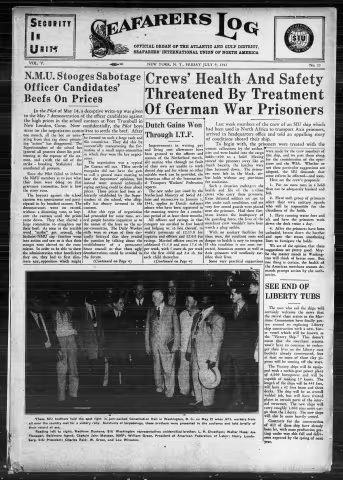
These SIU brothers held the spot light in. Jam-packed Constitution Hall in Washington, D. 0., on May 21 when AFL workers from
'.all over the country met for a victory rally. .Survivors of torpedoings, these brothers were presented to the audience and told briefly of
their record at sea.
Reading left to right:, Matthew Dushane, 8IU Washington representative; Unidentified brother; L. H. Cheatham; Walter Mass; Joe
Flanagan, Baltimore Agent; Captain John Mattson, MMP; William Gr^ePi President of American Federation of Labor; Harry Lunde-
berg, SIU President; Charks Reid; W. Green, and Lou WheatoiU-
Tlie men who sail the ships will
certainly welcome the news that
the swival chair artists in the Mar
itime Commission have finally got
ten around to replacing Liberty
ship construction with a new, fast
er vessel which will be known as
the "Victory Ship." This doesn't
mean that the merchant seamen
won't have to continue to endan
ger their lives on the Liberty rust
buckets already constructed, but
at least no more of these clay pi-
gions will be coming off the ways.
The Victory ships will be equip
ped with a turbin-gear power plant
qjf 6,000 horsepower and will ,ba
capable of making 17 knots. The
length of the ships will be 445 feet,
will have a 62 foot beam and three
decks. The ship will be an overall!
welded job, but will have rivetejl
plates in certain parts of the inter
nal structure. The new ships will
carry roughly 1,000 tons more car-
go than the Liberty. The new ships,
will also be more heavily armed.
Contracts for the construction
of 411 of these ship have already
been let, with mass production get
ting under way this fall and deliv
eries expected by the spring of next
year.
'm
1 " • ,
..Kfciiilr'r.,' J-"-J.hi-.'/'i
http://www.pdfcompressor.org/buy.html
\i
<1
1 •
Ji. a.
1
U
h w-Zi'. \^ m
m m
I->
It r-
i^F
Page T^o THE SEAFARERS' LOG Friday, July 9, 194S
SEAFARERS LOG
Published by the
SEAFARERS' INTERNATIONAL UNION
OF NORTH AMERICA
Atlantic and Gulf IMstrict
Affiliated with the American Federation of Labor
HARRY LUNDERERG ------ President
lia Market Street, San Francisco, Calif.
JOHN HAWK - - - Secy-Treas.
P. O. Box 25, Station P., Hew York City
MATTHEW DUSHANE - - - Washington Rep.
424 5th Street, N. W., Washington, O. C
Directory of Branches
RRANCH ADDRESS PHONE
NEW YORK £ vtii-Dispatchar'a Offiea.......
Asent.
BOSTON 330 Atlantic Ave.
BALTIMORE 14 North Gay St.
PHILADELPHIA.......... North 6th St.
NORFOLK 25 Commercial Pl...^....
NEW ORLEANS 309 Chartrea SL
SAVANNAH JtlB East Bay St.
TAMPA 423 Ea«t Piatt St
MOBILE 55 So. CoDceptlon St.....
PUERTO RICO..........45 Ponce de Leos......,
GALVESTON 219 20th Street
FT. LAUDERDALE 2021 S. Federal Highway.
, .BOwUing Green 8-34.30
. BOwling Green 9-3437
.Liberty 4057
Calvert 4539
Lombard 7651
.Norfolk 4-1083
Canal 3S36
Saveuuiah 3-1728
Tampa MM-1SS3
Dial 2-1392
.Pnerta de Tien*
.Galveeton 2-8043
.Ft. Lauderdale 1601
PUBLICATION OFFICE:
ROOM 213, 2 STONE STREET
New York Gty BOwUng Green 9-8346
BOCHULSKY, STANISLAW. FOW
BROWN, EARL L - - Cook
BROWING, ROBERT F. .. Wiper
CHANDLER, CURTIS - Messmati
FOUNTAIN, W. 0., Jr. - OS
FUNK, LEONARD .. . Oiler
HARRIS, HARRY Cook
HEUBNER, CARL Oiler
HUEBNER, HERMAN ..... Messman
HUTCHINSON, HERMAN Messman
KARDOS, CHARLES AB
MUEHLE,ERICO „ Hosun
MURPHY, JOSEPH „ Fireman
REA,JOHN A Oiler
REED, CLYDE, Jr ...... Wiper
SALZMAN, CART. F. - Steward
SANCHEZ TITAN AB
SOBERBERG, EDGAR ... AB
SPIVEY, CLAYTON Oiler
STEPHENS, CHARLES - Messman
ITIOMAS. JOHN ! - Wiper
THOMAS, THOMAS J Chief Cook
TOBIASSEN, TOBIAS . AB
TURNER, LEMUEL Cook
VON DOLTEREN, ANTHONY J Utility
WALDMAN, JOHN „ Bosun
WELSH, THOMAS W. - Oiler
WHITE, CHARLES T. ^ Messman
WHITE, THOR O.S.
WOLTJEN, AI FRED . . - FOW
t.V
. . . .
fRePORT OI\
^ASHItVGTOIV
Hn Wsmohiam
Selective Service:
I attended a conference at Se
lective Service headquarters re
garding the question of deferment
for Union officials in the maritime
industry. All the maritinrt unions
were represented with the excep
tion of the MMP. The eonference
endtfd upf with General Hershey
suggesting that the union send in
the names of their duly elected of
ficials, how many ports the unions
maintain hiring halls in and the
officials in each port. How many
the union feels are absolutely nec
essary to carry on the work,
whether they- can be replaced and
how long it will take to replace
them.
Also, the Agents should outline
the work they are doing in man
ning the ships, and the necesshy
of having experienced officials who
have been duly elected and whose
dutjr-Jt is to see that the ships are
sailing on schedule and that they
do not miss the convoys.
I advise the Agents to send
their names, the patrolmen's names,
and their draft status. Even if an
officials name is above the draft
age his name should be sent into
the respective headquarters of the
unions so that the Secretary-Treas
urer can compile them and send
them to Selective Service.
Maritime War
Emergency Board:
The Board held its regular meet
ing last Wednesday and the follow
ing was On the agenda: 1. 'What do
you consider an attack? 2. De
termination of an attack. 3. How
do you define the limits of a port
(a) off shore (h) on shore. 4.
How do you define the limits of
the anchorage?
My statement regarding an at
tack is that it should not be limit
ed to enemy attack, as there may
be cases where vessels may be with
in range of allied man of war when
they are firing the crews might be
injured. We feel that if they are
within any area wherein there is
an attack regardless of who is do
ing the attacking, the crews should
he entitled to honiis. There may
he cases where planes may drop
their loads on allied vessels and we
:llso feel that in cdses of this sort,
crews should be entitled to bonuses
and not have the board contend
that the bombs dropped were from
allied planes, and therefore was not
an enemy attack.
In a brief submitted to" the
Board last year, to be exact it was
Aug. 5, 1942, we urged that the
Board give consideration and ex
tend the benefits for injuries and
defined these injuries as resulting
from—
"The discharge of any miasle
(including liquids and gae) the
use 0f any weapon/ explosive or
other noxious thiarg, the doing
of any injurious act, either by
the enemy or in combatting the
enemy or in repelling an imag
ined attack by the enemy, in
juries caused by the impact of
any enemy aircraft, or any air
craft of the UnitAd States cir .
Allied powers or any part of or
anything dropped from iny
such airordft."
The Board, in thcif .second sea
men's war risk insurance, witli the
exception of the lowering of the
benefits for loss of an eye and
foot, in the Pobltc Lalv No. 17,
has attempted to cover seamen
for injuries under the terms Jbi
the quotation above. It seems to
me that in the Board's determinf-
tion to find out what the union
considers an attack, the above
quotation should be considered as
definition of an attack.
On the question of determina
tion of any attack, w'e could not
answer this question before we
wete supplied by the Navy infor
mation as to whether the master
was permitted to make entries into
the log hook when there is an at
tack.
The Navy submitted a memor-
andjum to the Board that the mas
ter is not permicted to make any
entry in the log bod? when there
is an atfack on his vessel, or in
any area where the vessel may be
attacked.
On the question of defining a
port, I contend that the limits of
the port should be at No. 1 sea
houy, or if a pilot is taken on board
outside the sea bouy, then when
the pilot comes aboard, And in
addition to this limit, it should be
extended further out to sea for a
distance of at least ten miles so
that the vessel has more maneuv
erability in the event of an at
tack.
At the present time the Board
has ruled that the Thames Estuary
is not to be considered payable for
a bonus if vessels in the Thames
River are entitled to bonus. The
inshore limits of a port should be,
in my opinion, five miles in shore
from the docks.
We have had cases where Lon
don was being attacked but how^
far back into the city of I.ondon
this attack occurred was never de
termined, as it was considered an
area. We all knbw that London
extends over ten mites back from"
the docks. All cities are not M
large as London, hence, when aiiy
city with an area of less than a'
mile from the docks is attacked,
crews would not be entitled to any
bonus if thc' attack was outside df
the city area. It seems to me thalJ
a limit must be set up if we are
to eliminate confusion when the
crews pay off.
We have had some cases whcrd
crews have claimed that there was
an attack in the areas that they
were in and the Board ruled that
the bombs fell outside of the city
limits and the crews were not ent-^
titled to any bonus. ' '
On defining the limits of an an
chorage, my contention was that
any time a ship is at anchor, re
gardless of where it is anchored,
the crew should be entitled to R
bonus if there is an attack within
the vicinity of thc vessel.
Ed Coester, Agent of the SUFj
in Seattle, sent me a telegram re
questing that action be takeri
whereby the port area bonus out
side of Cape SpeUcer 136 degrees
West Longitude be restored tq
where it was prior to March 1,
1943. This telegram was read to
the Board and is part of the record.
No answer was given by the Bo3r4
on what action they are contem
plating on this request.
In suming up my testimony, 1
stated that the Union has urged
the Board in advisory meeting ^
restore all the port and area bOii-<
(Continued on Page'})
« a
T'i
a m
m
§a
I want to be a worker when f grow up, Mr. Rickenbacker
aaya none of them work.
-V
http://www.pdfcompressor.org/buy.html
Friday Jtily 9, 1943 THfi SEAFAREIt^^ tOG Page Hiree
FT. LAUDERDALE
The members of this Uitfon who
sail as riieSsmert ^ill be very happy
to know that their wages are now
$177.00 per month. Yes, that is
the truth, it was in the newspaper.
And the free press of this great
country demand truth and decen
cy, or so they say.
- Mr. Henry Mcterhore, y'ho be
lieves that the merchant seamen
owe their lives, to the Navy Gun
Crews on merchant ships, states
that these gun crews are winning
.the battle of the Atlantic in spite
of the fact that they are requiret
. to work ten hours a day, and while
in battle or under attack they of
_ten stand by tlieir guns twenty-
four hours straight. For this, Mr,
McLemore says, they receive $J0
per month as compared with $177
per month and 100% bonus paic
to the messmen of the merchant
crews. Mr. McLemore's generosity
goes even farther. He gives the
messmen Saturday afternoons, Sun
days and Holidays off, and they
are never required to work more
.than eight hours in one day. O:
course Mr. McLemore doesn't men
tion that in addition to their eight
thour day the messmen, as well as
tl« rest of the crew, are requiret
-to pass ammunition and participate
in gun drills. While under attack
everybody works and nobody sleeps
J. K. SHAUGHNESSY,
Agent
GALVESTON
Shipping and business is dead as
' far as We are concerned, and to top
that off the RMO office in Hons
ton has given the Shipping Com
missioner orders not to issue any
more seaman's papers, unless the
man appears with a letter signet
by them. Well, in the May 20th
' issue of the Wash. Merry-Go
Round by Drew Pearson he .statet
that the WSA was staying up
nights, conspiring and figuring
how in the hell they could drive
the Maritime Unions from the seas,
To begin with it is uneonstitu-
•tional to refuse a citizen of the
U. S. Seaman's papers. Every one
is entitled to sail the seven seas to
make an honest living. Not just
^ those that the RMO can keep the
finger on. It is time to see who,
' and where these WSA and RMO
stooges and fellow travelers have
-the right to deprive a man from
going to sea just because he can
not pass their requirements. , While
I was in Washington this was going
to be attended to. But they have
clamped dotyn harder on us. Every
day on the radio here you can hear,
"You bet I am going back to sea.
All qualified men wire the WSA in
Washington, collect, your rating
, and the date you can .ship. Now is
your time to serve your country in
the Merchant Marine."
Well, right here I have enough
men to man two ships and they are
qualified m^n. But to go through
the RMO office they all say no.
Next week I will give you some
inside dope oti the U.S.S. that is
taking place here in Galveston. Al
though the SIU, Master Mates &
Pilots and the MEBA, ACA and
the CTU arc against opening, and
running a money wasting, job trust
and an easy life for the charity
fakers, the NMU is the only out-^
fit, along with the shipowners, who
are backing it. In as much as it is
evident that the seamen are sup
posed to be generous, it might be
a good ideal for the people located
in Washington. It would be a good
idea for the' seamen to take tip a
donation and buy a music box for
the War Shipping Administration
woAT-s tfoma
Affoimd the Ports
to install on this Merry-Go-Round
so life there won't be so dull. I
hope that the general public will
take note of these facts and re
member when they are being led to
believe that the seamen of this na
tion, along with other production
and transportation workers, are not
wholeheartedly cooperating for a
successful prosecution of this war
for freedom.
Greater love of country hath no
man than this—that he gave his
life to its fullest measure in the
service of his country, atul to the
vessel in which he served. We
monrn our dead, honor and stil
fight for our living mehdiers.
E. R. WALLACE, Agent
NEW ORLEANS
Things are still on the beam
around here. Members walk up to
the dispatcher's window and start
talking about monies dtte them
from the Joe Blow that never sail
Twenty Ways Not To Cross
The Atlantic
r
by Harry McRoberts, Richard Thayer and
John O'Malley
Listen sailors, and you shall hear
A tale that Is long and sad and drear.
An aeoount of a voyage that broke ntieo's hearta,
A tale of woo from the northern parts.
^he men who designed this type of ship
Figured to cut the percentage of slip.
But they never figured the screw would keep dry
As It missed the sea and spun In the sky.
fe
We left New York on a bleak winter's day
And headed north where the submarine* play.
The wolf-packs struck and the wind did how!'
And the seas were high and nasty and foul.
They rolled across the boat deok and down the stack,
The port door was lifted right off with a orack.
The bulwarks split as she pitched and tossed
And the life boats loosened and then were lost.
Fer sixteen days She foiled and she pitched
While the crew lay below and swore and bitched.
'TIM the Irish Sea relief did give
And we thought once more that wo should live.
We took over Lime Street, Invaded Its pubs,
And after hours we sought out the diubs.
We took all their women and took all the drink*
And fihally left with their curse and a jinx.
They warned us the weather was going to be bad
And sent us to sea—we were driving them mad.
They gave us no balladt and took all our oil,
And sent us to act as a submarine foil.
We headed up north and gave her full steam
'Till we broke her back where Northern Light* gleam.
The bow-it did pitch while tho stern stayed «til(,
For she was hinged like a door on a windy hill.
We put the sea on her quarter to ease her shell.
And headed her for Iceland, straight Into Hell.
Run up a lee shore; wind one hundred and ten.
For God's sake, somebody please holler when,
Both anchors down, full steam ahead.
Eighteen fathoms was read by the lead.
That the anchor would hold we all did pray
For the Navy's a million miles away.
But we rode her out and we took her In,
And they patched her sides that were so fhln.
They said, "At torpedo junction you have a date,
So put out to sea or you'll be late."
We joined a convoy which was very slow,
And creeping westward we did go.
From here on out 'twas all clear sailing,
Except for this tune that we're now wailing.
Winches broken, steam line fails,
iceber;^, Ice fields, growlers and gales.
Convoy eoliisions, depth charges and fog,
For downright misery we sure were hogs.
Fuel oil is low and the grub about out.
The crew from their quarters are beginning to shout.
Some have the scurvy, and some have the Itch.
We doabt If we'll live to fill out this hitch.
When off from our bow "The Lady" doe* stand— ,
The one with the light held high in her hand.
At ue she^ may look a* we're In Ward bound,
But she'll never guess our feeling profound.
ed, etc., etc. When you stop them
and ask what ship, where did you
pay off, why didn't you take it up
there, then you receive—the full
blast of the old bla bla. "I pay my
dues, I demand my rig'hts, I am
and have been a member since away
back when." (This organization
by my figures gathered in conver
sation with this type member is at
least four hundred and fifty years
old). In other words, if you take a
beef from one port to another for
God's sake bring something besides
a whiskey breath to back your ar-
gtiment.
Lately we have been having a
little trouble here with the super-
dupcr militants that raise hell on
pay off day with three or four
drinks under their belts. The same
guys kiss all trip at sea and in ports
they stick the other guys to stand
their watches. These gents should
remember that this demand won't
last for seamen longer then the
war. When the war is over, then
my boySf a lot of records will be
looked over and a lot of trouble
raisers will be left out.
There is a hell of a lot of dif
ference between the man who
brings in his beefs and turns them
in to his patrolAan or Agent for
action, and the donkey that just
beefs.
Remember in the port of New
Orleans the drunks either settle
their own beefs or get off and stay
off while the patrolmen does settle
tlxm.
Did you evgr hear of the ship
that was so busy that she couldn't
come back home? (Shorty Hughes,
Ray Murdo, etc., take note, she is
here looking for a crew.)
ARMY, Agent
HONOR ROLL j v-i
S.3. Daniel Kuaer $33.S(!
S.8. Benj. Botrrn . . 33.00
S.S. Schoharie 28.50
S.S. City of Savannah 16.00
S.S. James Dunn 15.001
S,8. Joseph Hewes 15.00^
Henrv Harzold lAJOQi
Steward Dept.
S.S. Francis Marion 12J)0
B. Barton 12.00
T. C. Heard 8.0O
Edaar Teaaue 800
S.S. pubore 750
S.S. Lamar , 74)0
S.S. Gateway City i 7.00
C. Matthews 6.00
A. Smith f &00
T. Paul 6.00
J. P. Brennan . 5.00
F. Parks 4.00
S. S. Wheelock .. 3.00
J. Stickney ' 3.00
F. DeHanev 3.00
A. S. Nelson 1.00
$^2.00
GEORGE R. LANG "
Your union book Is in headquaM
tors office.
* * * I
A. BYRON COFFIN, Jr.
Your papers have been found an#
turned Into headquarters office.
* » *
J. McKEON I
Please contact your much worried
wife. She promises to fix up all
difficulties if you will return.
« * *
A, MILFORD '
Important that you drop Into th#
headquarters office next time yoU
are in New York City.
Washington Report
{Continued from Page 2)
uses that were in effect prior to
March 1, 1943, and to the origin
al port and area bonuses of $125
for every entry a vessel makes in
the port or area. It is my opinion
that the Board cannot administer
any attack bonus with any sense
of fairness, as it is too cumbersome
a job for the Board to get all the
available information as to when
there was an attack. Particularly
in view of the fact that the master
of the vessel is prohibited from
making entries in the log book
when there has been an attack. Past
experience with the Board has
shown us that the word of the
master or members of the crew is
insufficient evidence to satisfy the
Board that there has been an at
tack. Hence the Board must rely
on other information to satisfy a
claim for bonus. This information
from other government sources is
not always available to the Board,
and the unions are not supplied
this information by other govern
ment agencies. In most cases the
agencies which supply this infor
mation are the Army and Navy
departments.
The present system of adminis
trating the attack bonus does not
seem to be satisfactory. Nine out
of ten cases are submitted to the
Joard by the Unjpn are disquali
fied by the Board and no bonus is
>ayable. In the majority of thesei
cases the Board has ruled that ftom
the information that they have
there was no attack and no bonus
is payable.
I fail to understand why shipS
crews would put in a claim for a
bonus if there had been no attack.
The officers are in a position to
substantiate their claims. But the
officers' and crews' words are nol
considered as being trustworthy,
at least according to the majority
of the decisions handed down
the Board.
It therefore becomes apparent t^
me that the attack bonus cannot
be properly administered by the
Board and the only logical bonus
that the Board can determine with
any fairness, is the system that the
Union and the operators had
agreed upon prior to the War. And
that is, every time a vessel enters
any port or area the crew would be
entitled to a bonus for the addi
tional hazard encountered in en
tering these ports or areas.
PETER JACKSON
EDWARD BIRCH
J SCORTINO ^
J. B. PILGRIM
O. BOUCHIE
GEORGE H. ALDRIDGE
BOYCE IBARTON
P801Z
v c
•f
..Xie.
'• •' •' ) • -' '-iiliJj
http://www.pdfcompressor.org/buy.html
Page Four THE 5EAFARERS* LOG Friday, July 9, 1943
;I
i
|y,J t
|t ̂ I
i
if'
A' -v. .
• fi-
i
.1 L
l||v^;
Pff:
ite
c
|Sr
:||g#k
ftv-
Dept Of Commerce Clarifies
Wage Computation For Seamen
The U. S. Department of Com
merce has issued to all Shipping
Commissioners a clarification as
to the procedure for computing
•seamen's wages. Printed below is
the directive. It should be studied
by all brothers so that they can't
be shoved around on the question
of pay.
* ». »
To United States Ship-
p i n g: Commissioners,
Collectors and Deputy
Collectors Acting as
Shipping Commission
ers, and Others Con
cerned :
The following rules will be ob
served by United States shipping
commissioners and collectors and
deputy collectors of customs act
ing as shipping commissioners in
computing amounts due American
seamen as wages—
1. -The date written in the col-
umrr of the shipping articles head
ed "Time at which to be on board"
is taken as the time when a sea-
mah's' wages should commence,
provided he was on board or duly
presented himself to go on board
at that time.
If he went on board" before that
date with the consent and subject
to the orders of the master, he is
deemed to have commenced work
aixd to be entitled to wages from
the date of going on board.
If he failed through his own
fault to join the ship at the time
specified in the articles, his wages
accrue only from the time at whic'
he went on board and reported for
duty.
Disputes in fegard to the time
when the wages began to accrue
rarely involved more than 1 or
days, and they are usually adjuster
by the ship's log, although if there
is doubt arising from the absence
of proper entry in the log or sus
picious interlining, or other cause
the seamen's statement may be ac
cepted.
2. The column in the shipping
articles headed "Place and date of
signing tliis agreement" contains
the date of the agreement. It does
not indicate the time when wages
are to begin.
3. The agreement is considered
as referring to calendar months,
defined as the time from any day
of a month, to the corresponding
day (if any, and if not, to the last
day) of the next month.
For example;
January 29 to February 28 is
1 month
January 31 to February 28 is
1 month.
February 28 to March 27 is
1 month.
March 28 to .April 27 is 1
month.
4. In computing the amount
due for a fraction of a month, 30
days is counted as a month without
regard to its length. For example,
I diys in any month are one-sixth
of a month.
3. Any fraction of a day is
Out of the Foesl
by
S"
• kljr-r
Wi
The Navy states that the enemy subs have been beaten, but the
SIU lost more ships for tlie months of May and June than we did for
any previous mofith except in June '42. It raised our casualty list to
743 brothers lost through enemy action. We don't know who is being
fooled by. our Government withholding information concerning the
loss of merchant ships and their personnel. The enemy questions the
crew of each torpedoed ship and knows the names of the ships. We
ihippose this question will not be answered until after the war is over.
The Bull Line is living up to its bad reputation as to handling
survivors of their torpedoed ships. Recently,, one of their ships was
torpedoed and the crew reached Ascension Island after ten. days. They
were given one day's rest and then were told that they would have to
break a certain quantity of rocks and carry cinders and if they didn't
,do their quota of work, they would be forced to work longer. If they
.^ill refused, the Captain told them that his man stationed on the
Island would be glad to shoot them on the slightest occasion. That is
th$ way merchant seamen are treated when they get torpedoed.
The WSA and the USS inform the public of what good they are
doing for the unfortunate seamen. When survivors arrive at a foreign
port the WSA representative has them shoved into a hold of any ship
that is in port. He does not concern himself with whether these men
get anything to eat . . . they just have to shift for themselves. Then
when they arrive at the first American Port the FBI and Naval Intel
ligence hound them every minute and won't let the boys contact their
Union and they don^t care if the boys have any money or a place to
sleep in.
The USS bmgs about the six million dollar furiu they
have on hand, but little is done for the boys who jre torpedoed, except
those guys who hang around the Furuseth Club and were torpedoed in
3 bath-tub. Everyone is making money on the seaman and he's the goat.
counted as a whole day. For ex
ample, from the afternoon of March
1 to March 4, both inclusive, is
reckoned as 4 days; 3nd from
March 1 to the forenoon of March
4, both inclusive, is reckoned as 4
days.
But if a seaman be entitled to
wages from the afternoon of one
day to the forenoon of another
day, the two fractions of a day are
considered as 1 day only. For ex
ample, the time from the after
noon of March 1 to the forenoon
of March 4, both inclusive, is
days.
6. In computing the amount of
wages due, the number of calendar
months (commencing on the day
on which wages began to accrue)
is to be determined first; to this is
to be added the fractional part of
month determined by counting
each and every day beyond the final
day of the last full month.
For example:
January 29 to March 3 (in
clusive) equals 1 month' 3
days.
January 31 to March 3 (in
clusive) equals 1 month 3
days.
June IS to October iJ (in
clusive equals 5 months 29
days.
June 1S to November 13 (in
clusive) equals S months.
June IS to November 14, (in
clusive) equals S months.
Approved:
SECRETARY OF COMMERCE
Radio Commentators^
Ancestry Is Traced
Hy /. K. Shaugknessy
Did you ever try to figure out "where the shakes wenti
when Saint Patrick drove them out of Ireland? Well, I
have, and for years I was in the dark on this reptilian ques
tion. At long last the dawn has come.
When the slimy creatures were routed from the ooze
DUTCH GAINS
MADE BY I.T.F.
{Continued fr&m Pa^e 1)
In addition to living cost allow
ances, Dutch seafarers incapacit
ated for ship duty received month-
y wages ranging from £3 for boys
and £4 for ordinary seamen to
£S for an A.B. and £S.10.0 for
ligher ratings. These payments
may be reduced by 40% or less in
all cases where other suitable em-
jloyment has been procured. Men
placed in hospitals, sanatorian or
nursing homes are not entitled to
living cost allowances. Funeral ex
penses are borne by the -Netherland
authorities which may also contri
bute to the funeral expenses of a
member of the seaman's family.
EDITOR'S MAIL BAG
Editor:
Would you kindly ins«-t in the
Log a word of thanks from the
crew of the S.S, John Henry to
the chief steward C. G. Bailey.
Our ship was on an eleven
month voyage and Brother Bailey
gave the crew the greatest cooper
ation and should be commended
for it.
(signed)
Joe (Windy) Walsh
S. A. Stansbury
Joe Lightfoot
B. F. Gordy
Albert Jackson
Herbert Clark
Charles Riddle
John H. Williams, Jr.
Francis N. Kelley
Dale Housner
. "Edwin J.. Baer
Alva Mogensen
Lester F. Hath
grabbed
these United States, and took job:
as newspaper columnists and radio
news commentators.
A newspaper columnist or news
caster will not become a success
nor will he last long if, 1- He tells
the truth, the whole truth anc
nothing but the truth. 2. If he be-
icves the country belongs to the
jeople and as such should be run
yy the people.
On the first subject we can take
hr an example the steamroller
that went through the U. S. Senate
and the House of Representatives
ast week. It was commonly
cnown as the "Anti Strike Bill.
This bill does not have the support
of the people, nor. was it passed
•or the benefit of the people. Yet
or weeks, prior to the passage of
the bill, the press and radio pub-
ished statements that the people
were clamoring for the enactment
of such n bill.
Tliis was a half truth, the people,
a small percentage of the people,
were demanding the passage of the
bill, but the vast majority of the
people were never in favor of such
legislation. The proponants of the
bill, violated the first principle of
the bill in the manner by which
they steamrollered it over the
President's veto. The Act requires
a cooling off period before a vote
to strike can be put into effect. Ycr
they themselves would not allow a
cooling off period, but demanded
that a vote be taken immediately
to overide the veto of the Presi
dent. Without an opportunity to
think over the effect of their ac
tion, the members of Congress
were forced into voting on a ques
tion that vitally effects the every
day lives of the people. Yet the
loud - mouthed capitalist stooges
that are supporting the bill de
manded that the representatives of
the people vote without consulting
the people they are representing.
The people do not want this bill
and never will want it.
N,M.U, SABOTAGES
OFFICERS' BEEF
ON PRICES
{Continued from Page 1)
Warning to the seamen: Be on the
alert; these self-styled "friends of
the workers" are .flooding the
schools and are sailing as officers.
Their servile attitude - toward the
(shipowners') WSA makes them
dangerous to the existence of all
militant seamen and their unions.
Once more, be on the alert!.
—Third Mate
this "Anti Strike Bill," if a news
paper columnist or Radio News
Commentator were to tell the
truth about it, he would last about
as long as a soldier's pay-day in a \
juke joint.
MONEY DUE
STEPHEN MORGAJN, KNUT
CATO, E. M. ALLAIN: You have
two months, nine days difference irt-.
Fireman and Watertender pay, and
one month, nine days bonus coming
from the Waterman Line.
» » » i ,
Deck Department which made /
last voyage on S.S. George Gale
has overtime coming from Missies*,
ippi Line.
«• » * '
Entire Qeck Department of S.S.
Josiah Parker has overtime duei
Collect Mississippi Steamship Com<!< '
pany. Now Orleans.
I
« « «
Steward Dept. S.S. Fitzburgh Lee
have money due from Smith ft
Johnson, 80 Broad St.
**, * I
Deck ft Engine Dept. S.S. Samuel ~
Griffin having personel effect*
claim see Robin Line claim agent,
39 Cortland St., N. V. C.
Steward Dept. S.S. Broholt Liv<
ingston have overtime coming. CoN.
lect Bull Line.
;« « «
J. McLEON: Four hours duC
from Mississippi Shipping Com<«
pany.
r. FiAYMpiyD; $42.50 cbming^.
from the S.S. Tarleton Brown. .
Oilers on last trip of S.S. Dbi
Norte have overtime coming. Col
lect from Mississippi Line, 17 Baf-
tery Place, New York City.
* • * , .
Firemen on S.S. Richard Alvey
have overtime coming. Collect Bull
Line, New York City. » •
Crew S.S. Francis Marion havf
attack bonus due. Collect Roblfi ;
Line, New York City.
Firemen and Ordinaries on S.8*
Livingstone have overtime due. Sea
Goffin, New York Branch.
« « a
Crew S.S. John Stevens and .S.iS.
Pan Gulf have attack bonus com*
ng. Collect Waterman Line, '19
Rector St., New York City,
ATLANTIC AND GULF SHIPPING FOR
COMPLETE MONTH OF JUNE
JJECk ENGINE STEWARD TOTAL
SHIPPED .. 987 654 602 2,243
REGISTERED _ __ 536 ' 609- 295 1,440
ON HAMa 316 281. 274j $71
http://www.pdfcompressor.org/buy.html