Media
Issue Date
1943-09-17
Volume
5
Issue Number
25
Plaintext
RAKERS JOQ
OFFICIAL ORGAN OF THE ATLANTIC AND GULF DISTRICT,
SEAFARERS' INTERNATIONAL UNION OF NORTH AMERICA
VOL. V. UT NEW YORK. N. Y., FRIDAY. SEPTEMBER 17. 1943 No. 25
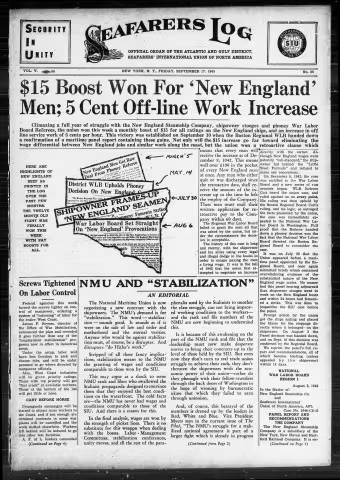
$15 Boost Won For 'New England'
Men; 5 Cent Off-line Work Increase
Climaxing a full year of struggle with the New England Steamship Company, shipowner stooges and phoney War Labor
Board Referees, the union won this week a monthly boost of $15 for all ratings on the New England ships, and an increase in off
line service work of 5 cents per hour. This victory was established on September 10 when the Boston Regional WLB handed down
a confirmation of a maritime panel report containing these gains. Not only will the $15 increase go far toward eliminating the
Wage differential between New England jobs and similar work along the coast, but the union won a retroactive clause which
*means that every man will*;
receive the increase as of De^
cember 9, 1042. This
HERE ARE
HIGHLIGHTS OF
NEW ENGLAND
BEEF AS
PRINTED IN
THE LOG
OVER THE
• PAST FEW
MONTHS.
THE TWELVE
MONTp OLD
FIGHT WAS
FINALLY
WON THIS
WEEK
WITH. PAY
BOOSTS FOR
1 ALL.
District WLB Upholds Phoney
Decision On New Eni
The Bojton Regional War Ub.
c.nerated hy th-
the I
k-vWCYSO
SE-J
'141
Strike
1..W
Labor Board Set Straight
I On *New, England' Provocations
: the txxi reported In detail the plot of the New England line to foment a
J ciws and thui ieopardize our case before the Regional War Labor
t from aH indicatioiif the shipowner completely failed to real-
: part of t)tc Union the men back to woHi
^ud prcvcDtad any catlendad tl*-
up of the ships. The oreaa
taiir faUertDed aa to the sUtai
of their beef befe^ tho WtM
ahdaatotheahlpovni
9 cmttng a etrl
•. the W atory of tha
t waa fpcead bp
1 aiembeia «t
r Boiud.
a Darttk
" UWar
means
well over $100 in the pocket
of every New England man
at once. Any man who either
quit or was discharged since
the retroactive date, shall re
ceive the amount of the in
crease up to the time he left
the employ of the Company.
These men mus£ mail their
written application for re
troactive pay to the Com
pany within 60 days.
The Regional War Labor Board
failed to grant the men all that
was asked by the union, but un
der the circumstances the decis
ion is acceptable.
The history of this case is long
and stormy, with the shipowner,
and his allies using every legal
and illegal dodge in the books in
order to escape paying the men
a living wage. It was in the fall
of 1942 that the union first at
tempted to negotiate an increase
Screws Tightened
On Labor Control
Federal agencies this week
turned the screws tighter on con
trol of manpower, ordering a
System of "rationing" of labor for
the entire West Coast.
James F. Brynes, director of
the Office of War Mobilization,
announced the plan and revealed
it goes further than any of the
"employment stabilization" pro
grams now in effect in industrial
areas.
Under the setup, labor will
have less freedom to pick and
choose jobs, and will be under
pressure to go where directed by
manpower officials.
Also, West Coast industries
will be given priority ratings.
Those with top priority will get
"first crack" at available workers.
Those'at the bottom of the list
will get little or none.
CART BEFORE H6RSE
Propaganda campaigns will be
started to attract more workers to
the Coast, and if not enough are
obtained contracts to some war
plants will be cancelled and the
work shifted elsewhere. Workers
left behind will be induced to go
into other war factories.
• A. F. of L. leaders contended
. - {Continued on Page 4)
NMU AND "STABILIZATION 99
AN EDITORIAL
The National Maritime Union is now
negotiating a new contract with the
shipowners. The NMU's /demand is for
"stabilization." This word — stabiliza
tion— sounds good. It sounds as if it
. were on the side of law and order and
motherhood and the eternal verities.
Anyone who would be against stabiliza
tion must, of course, be a disrupter. And
disrupters "do Hitler's work."
Stripped of all these fancy implica
tions, stabilization means to the NMU
the granting of wages and conditions
comparable to those won by the SIU.
This may come as a shock to some
NMU rank and filers who swallowed the
Stalinist propaganda designed to convince
them that they enjoyed the best condi
tions on the waterfront. The cold facts
are—the NMU has never had wages and
conditions comparable to those of the
SIU. And there is a reason for this.
In the final analysis, wages are won by
the strength of picket lines. There is no
substitute for this weappn when dealing
with the bosses. Labor - Management
Committees, stabilization conferences,
unity moves, and all the rest of the para-
phenalia used by the Stalinists to smother
the class struggle, can not bring improv
ed working conditions to the workers—
and the rank and file members of the
NMU are now beginning to understand
this.
It is because of this awakening on the
part of the NMU rank and file that the
(.leadership must now make desperate
moves to bring their contracts up to the
level of those held by the SIU. But even
now they don't turn to real trade union
struggle to achieve their ends, they don't
threaten the shipowners with the eco
nomic power of their union—rather do
they phenagle with their fellow-travelers
through the back doors of Washington in
the hope of winning by bureaucratic
ukase that which they failed to earn
through unionism.
And, of course, this betrayal of the
members is dressed up by the leaders in
Red, White and Blue. Vice President
Myers says in the current issue of The
Piloty "The NMU's struggle for a stab
ilized national agreement is part of a
larger fight which is already in progress
{Continued from Page 2)
directly with the owner. Al
though New England wages were
patently "sub-standard," the ship
owner hid behind the "Little
Steel Formula" and refused to
make any concessions.
On December 9, 1942, the case
was certified to the War Labor
Board and A new series of run
arounds began. WLB Referee
Coit heard the union case, and
ruled against us on every point.
His ruling was then upheld by
the Boston Regional Board. Goit's
ruling, and his logic, so outraged
the facts presented by the union,
the case was immediately ap
pealed to the National War La
bor Board in Washington. Full
proof that the Referee handed
down a phoney decision was the
fact that the National War Labor
Board directed the Boston Re
gional Board to reconsider the
case.
It was on July 23 that the
Union appeared before a mari
time panel appointed by the Re
gional Board, and once again
submitted briefs which contained
overwhelming evidence of the "
substandard nature of the New
England wage scales. No sooner
had this panel hearing adjourned
than shipowner stooges went to
work on the New England boats
and within 24 hours had foment
ed a strike. This was done to
jeopardize the SIU case before
the panel.
Prompt action by the union
got the ships sailing and placed
the blame for the stoppage di
rectly where it belonged—on the
shipowner. On August 2 the
Panel decision was handed down,
and on Sept. 10 this decision was
confirmed by the Regional Board.
We reprint the panel's full re
port and recommendations, all of
which become binding (unless
appealed by the shipowner)
within 14 days.
NATIONAL
WAR LABOR BOARD
REGION I
August 2, 1943
In the Matter of:
New England Steamship Co.
and
Seafarers International'
Union of North America, AFL
Case No. 3946-CS-D
PANEL REPORT AND
RECOMMENDATIONS
THE COMPANY
The New England Steamship
Company is a subsidiary of the
New York, New Haven and Hart
ford Railroad Company. It is en-
{Continued on Page 3)
-.
http://www.pdfcompressor.org/buy.html
' Page Two
SEAFARERS LOG
Published by the
SEAFARERS' INTERNATIONAL UNION;
OF NORTH AMERICA
Atlantic and Gulf District
Affiliated with the American Federation of Labor
HARRY LUNDEBERG ------ President
110 Market Street, San Francisco, Calif.
JOHN HAWK ------- Secy-Treas.
P. O. Box 25, Station P., New York City
MATTHEW DUSHANE - - - Washington Rep,
424 5 th Street, N. W., Washington, D. C.
• • y
Directory of Branches
Friday, Sepletnber 17, 1943 ]
•.i ^ i..'ia
BRANCH ADDRESS PHONE
NEW YORK (4) 2 Stone St BOwling Green 9-3437
BOSTON (10) 330 Atlantic Ave Liberty 4057
BALTIMORE (2) 14 North Cay St Calvert 4539
PHILADELPHIA 6 North 6th St Lombard 7651
NORFOLK 25 Commercial PI Norfolk 4-1083
NEW ORLEANS (16) ..309 Chartrcs St .Canal 3336
SAVANNAH 218 East Bay St Savannah 3-1728
TAMPA 423 East Piatt St Tampa MM-1323
MOBILE 55 So. Conception St Dial 2-1392
PUERTO RICO 45 Ponce de Leon ;Puerto de Tierra
GALVESTON 219 20th Street Galveston 2-8043
FT. LAUDERDALE 2021 S. Federal Highway. .. Ft. Lauderdale 1601
PUBLICATION OFFICE;
ROOM 213, 2 STONE STREET
New York Gty BOwling Green 9-8346
• (Continued from Page 1)
in our country. Certain employer inter
ests and craft officials in various indus-""
tries are now moving to scuttle the war
effort and the labor movement at the
same time."
Myers' tortured logic attempts to show
an Hentity between the war effort and
his demand for SIU wages and condi
tions. One who is against the latter must
be against the former—simple as that.
Our prediction is that the NMU lead
ers are not going to get their stabilization
agreement. In spite of their manifold
services to the shipowners, they are noig
going to be able to cash in — the cop
never has respect for his stool and kicl^
him in the teeth every time he whines
for more dough.
'Nor will the NMU win wages and
conditions comparable to those of the
SIU in the years to come. Unions don't
win concessions from the bosses by fol
lowing the NMU's phoney trade union
line. It is by struggle on the waterfront
that the shipowners are forced to shell
out—and it is the SIU that has in the
past, and will in the future, conduct
such struggles.
CAPITAL'S WAGE HAS
ESCAPED FREEZING
Labor Wins Victory In
War On Anti-Union Laws
Organized labor won a major
round this week in its battle to
knock out state anti-labor laws as
an unconstitutional infringement
on the rights of workers.
Its first taste of victory came in
Colorado, where Judge Charles C.
Sackman of Denver held invalid
the most vicious sections of Col
orado's labor-shackling law, mis
called a "labor peace act."
Colorado's law is the worst
among nearly a dozen passed by
state legislatures during the past
year—aU of which are being
challenged in the courts.
SECTIONS TOSSED OUT
Judge Sackman threw out the
sections which call for compul
sory incorporating of unions and
regulate in detail the legitimate
activities of unions.
These sections restrict the
amount of dues and initiation
fees unions may charge; compel
them to open their financial rec
ords to inspection; prohibit con
tributions for political purposes,
require unions to elect officers
annually; permit the state Indus
trial Commission to send agents
into union meetings for a check
on proceedings, and allow mem
bers who do not like anything a
union does to apply either to the
commission or the courts to over
ride the majority decision of the
union.
The law would have made it
possible to put out of business
unions that failed to abide by the
myriad of restrictions.
BAD PROVISIONS UPHELD
However, Judge Sackman up
held several other bad provisions
of the bill, including restrictions
on picketing and a list of "unfair
labor practices" by employes
which, when committed, would
subject the workers and their
unions to fine? and civil damage
suits. Curbs on closed shop agree
ments and a ban on "secondary
boycotts" were also sustained.
Because these repressive fea
tures are in the bill, the Ameri
can Federation of Labor and its
affiliated unions in Colorado will
appeal the decision to the state
Supreme Court, Joseph A. Pad-
way, A. F. of L. general counsel,
declared.
Evidence that wage "freezing"
does not apply to the wages of
capital can be found on the finan
cial page of any newspaper.
On a single day this week the
record of disbursements of 1942
earnings showed these increases
in payments to stockholders:
National Dairy Products, 25
per cent; Beatrice Creamery, 40
per cent;,Ward Baking Company,
20 per cent; B. F. Goodrich, 100
per cent; Humble Oil and Refin
ing, 40 per cent; American Agri
cultural Chemical, 60 per cent;
Twentieth-Century Fox,, 100 per
cent; McKesson & Robbins, 30
per cent; National Enameling, 50
per cent.
Doubtless directors of these
companies were surprised at their
moderation, since profits, after
payment of taxes, were more
than double those of the previous
year.
Editor's MaO Bag
TANKER ALARM BELL
^VSTEM ORDERED
MONEY DUE
Extra meals money coming to
following crew members of S. S.
Woodrldge Ferris; J. Davis, J
Dedicatoria, Fred Williams, Harry
Harris, John Brown, and William
Davis.
Overtime is coming to follow
ing crew members of 3. S.
Charles Ayeock: Paul Huffer, Leo
Manaugh, J, M. Hughley and A,
Langly,
KEEP CLEAR WITH YOUR DRAFT BOARD
By observing the following simple instructions you will
continue to receive deferment from military service. Fail
to observe these rule.s and you may wind up in the army.
WHEN SIGNING ON: Give the clerk or skipper all the
information necessary to fill out RMO Card No. 47 (Green
Card).
WHEN SIGNING OFF: See that Card No. 48-A is prop-
perly fidled out by skipper or clerk. •
Ship out before your allotted time ashore has expired.
If you have not yet flUed out the Green Card, contact your
draft board and let them know that you are sailing.-
All tankers and all tank barges
of more than 100 gross tons in
which crews are divided between
more than one watch for pur
poses of„ steering must hence
forth be equipped with alarm
bells, the Coast Giiard rule<j
yesterday in an order published
in the Federal Rogister. The or-
'der is divided into three sections,
affecting new tank ships upon
which construction is started no
earlier than today,, existing tank
ers, whether afloat or under con
struction yesterday, and tank
barges of more than 100 gross
tons.
The Coast Guard has ruled that
all tankers of more than 100
gross tdns, the construction of
which is begun on and after Sep
tember 15, 1943, shall have all
sleeping accommodations and
machinery spaces equipped with
a sufficient number of alarm^
bells so located as to warn all
occupants.
CAN'T GET GAS
Editor and Brother:
There seems to be a work or
fight law in Mobile,, originated by
the Governor himself. Now the
draft board says 30 days on the
beach but the CPA says "go to
hell."
In my case I asked for enough
gas to come to report to the hall
twice a week. I live 24 miles out
and need the gas to look for
work. I was rejected flat. So, I
had to get in the best way I
could—^by bus.
I go to the CPA with tears in
my eyes, I haven't slept, I can't
get a room, I don't have any gas,
and I can't get a ship unless I
report to the hall. But I get no
where.
In the meantime a man comes
into the CPA and asks' for gas to
take friends on a fishing trip. He
gets 100 gallons. A bus driver
comes in and needs 4 tires, he
gets them.
The seaman is just out of luck
because * he doesn't swing any
crooked votes in this neighbor
hood.
Who's twar is thiB—Democracy
or Politicans?
Fraternally,
J. M. TORCHICK, No. 13 G
WISE GUY
There's one in almost every
crew. Have you noticed brother?
This brain-buster is too smart t(J
be a plain sailor, and too dumb
for anything else, so like all fail
ures and misfits he makes a lot
of noise.
He beefs about our hard-work
ing officials, seeing only treach
ery and double dealing in theii;
activities. He snorts about the
way the bosun handles the job.
He criticizes the delegate; but
never goes delegate himself; it's
too much responsibility and woi'k
for the good of the Union, not his
good! I
His latest battle station is taken
up against the Maritilne Com
mission trainee, against whom ha
sends his windy blasts as gov
ernment-trained potential finks.
As a matter of fact these kids are
coming into the industry with
basic training paid for by each'
and every taxpayer. (Look at
your deductions. Wise Guy!) In
stead of giving them a bad time,
wouldn't it be wiser to welcome
them and educate them as sea
men to top off their "training?"
Wouldn't it be wiser, Wise Guy,
to make them potential steady
union men, rather than probable
scabs?
After aU, they do come out of
the taxpayers' school with more
knowledge of seamansMp thsm'
the draft or tourist type of sea
man.
i
R.EJI.B» Bk. 5881.
Pama Takes Union Post
Edward C. Brown
Joe Kirk
H. Hamson
Chester Smith
C. Qlde
D. H. Mathews
Marvin West
Eugene Kilasinski
F. Clark
D. Sannit
Johaimes Pama, formerly of
the Liverpool (England) office of
the Dutch Central Transport
Workers, has assumed the post of
assistant district secretary here,
according to an announcement
made yesterday by P. J. Vanden-
berge, head of the union's Ameri
can branch. Mr. Pama arrived in
this country last week.
Mr. 'Vandenberge said Mr.
Pama's transfer was one of sev
eral moves made by his group, an
affiliate of the International
Transport Workers Federation, in
the interest of general efficiency
and in line with the steadily ex
panding part being played by
Dutch shipping in t^e war effort.
He also disclosed that G. E.
Esveldt, veteran head of the
Dutch union's main office in
London, is en route to Curacao,
wljcre he wll take charge of
that office's reorganization. He is
being replaced in the London
branch by G. J. "Vandenwoesty-
nen.
FLANNEL MOUTH
The guy with a voice like 1'
thunder clap and an appetite Hke
Moby Dick the whale. He's usual
ly first in the messroom, and
pounds the table and yells at the
messman if his grub isn't served
pronto.
Stretching his flannel mouth'
like an old undershirt, he bolts
his. vituals and yells again for
seconds before the man across
the table has gotten his soup.
Isn't it about time to put a shot
across this double-bottom's bul
bous bow and blink the following
message:
"See Preamble in Union Book,
Paragraph Six—the right to be
treated in a decent and respect
ful manner by those in com
mand."
The messman, as a working-
man and seaman, is entitled to
the same rights as the men he
serves. Let's give him a break
and put a stopper on the brothers 11
who yell at him as if he were a
flea-bitten dog.
Book A 5881, SIU.
http://www.pdfcompressor.org/buy.html
KiAv- 17, Itis tkia ifeHtiilt&lii ^<>G
I-'
Pa^ Thrf
For 'New England'
(Continued from Page 1)
gaged in passenger and freight
transportation, operating a year
round service from New Bedford
and Woods Hole to the island of
Martha's Vineyard and Nantuck
et. -The Company employs ap
proximately 75 employees on the
two boats used by it.
THE UNION
The Seafarers International
Union of North America is affili
ated with the American Federa
tion of Labor. It entered into its
first agreement with the Com
pany on July 18, 1939. The sec
ond agreement was entered into
on July 30, 1940, following an
arbitration hearing. The last
agreement became effective Octo
ber 1, 1941.
BACKGROUND
On August 31, 1942, the Union
gave notice to the Company that
it desired to reopen those sec
tions of their agreement of Octo
ber 1, 1941 which related to wage
rates and overtime. During the
negotiations which followed, the
parties were unable to agree up
on the disposition of the issues
raised. The ease was, thereupon,
certified to the National War La
bor Board, on December 9, 1942.
A^ Referee of the Board held
hearings -on the case on Decem
ber 30, 1942, and issued his Re
port and Recommendations on
February 9, 1943. He recommend
ed denial of the demands of the
Union. The Regional War Labor
Board for the'First Region ap
proved the Referee's recommen
dations on April 26, 1943. The
Union appealed the case to the
National War Labor Board in
Washington. On June 9, 1943, the
National War Labor Board re
ferred the case back to the Board
in Region I for reconsideration in
the light of the May 12 directive
of the Economic Stabilization-Di
rector.
The Panel was appointed to
review the case, hold hearings
and make recommendations to
the Board. The Panel held a
hearing on July 24, 1943 in Nfew
Bedfor(i, Massachusetts and af
forded fee parties full opportun
ity to be heard.
THE ISSUES
A. Summary of the Union
Demands
1. That the monthly scale of
wages for each classification
be raised by $40-00.
2. That an increase in the hourly
rate of pay for all classifica
tions be given for work done
while boats, are not in Line
Service. The present scale is
85e, 60c and 65c per hour. The
Union desires that the rate be
set at a uniform level of $1.00
per hour.
3. That an increase in the hourly
overtime rate for aU classifi
cations be raised by ten cents
per hour.
4. That eight hours should con
stitute a day's work for the
Deck Department throughout
the year. Elimination from
the Agreement of the provis
ion that for other than the
time that the summer sched
ule is in effect the Second
Mates, Boatswains and Deck
hands may be placed on a
schedule of eight hours with
in a period of ten hours. The
Union desires that overtime
be paid these employees for
any time worked after eight
" consecutive hours. It also de-
sires that Quartermasters
work eight hours per day bas
ed on the three watch system.
B. The Issues
1. Increase in Monthly Base
Rates
(a) Union Position
The Union, at the hearing held
by the Panel, argued in favor of
a $40.00 increase in the monthly
base rates of all classifications on
the following grounds^
(1) While the general increases
granted to the employees
during the summer and fall
of 1941 amounted to an av
erage of approximately 23%,
these increases should be dis-
• regarded in the .computation
of allowable maladjustment
increase because the in
creases of 194% should have
been granted in the previous
year and because the cost of
living has risen by more
than 15% since the time of
the last increase.
(2) The- wage rates paid by the
Company are considerably
lower than rates paid for
similiar work on the Great
Lakes and in the New York
area on passenger freight
boats, tow boats and dredges;
the differential between these
rates has increased during
the past few years.
(3) Work performed on two boats
and dredges is similiar to
work, in the same classifica
tions, performed on the Com-
p a n y' s "passenger - freight
boats. Comparison with two
boats rates and dredging
boat rates is, therefore, justi
fied.
(4) Rates paid by the U. S. Army
Engineers to civilian em-
Around The Ports
GALVESTON
Shipping and business is good
around this neck of the woods
I have shipped everything that
looks like a seaman. Have a new
ship out in a few days.
Well, the sweater boys are out
in front of the Houston Press
Newspaper plant in Houston,
has no effect at aU on the news
paper, but it does give the pants
pressors and the button hole
sailors a little exercise out in the
hot sun.
I had two ships to sign on, but
they would not go for anything
but Rider 64. I had a talk the
other day with a captain who
just came over from New Or
leans; he stated that he had gone
to the USS Hotel in that city to
get a room, and to see just what
it was like. The clerk at the
desk pulled out a form, waifiting
to know how long he had been
going to sea, where he was bom
and why, his license number;
wife's name and address, and al
kinds of crap. The captain in
formed them that he wanted
room nnd not charity, and what
was the idea of wanting to know
all of this dope. Result, the gent
walked out and went to another
hotel. It can be understood why
they want all of this dope. One
copy of it is sent to the RMO and
they, have the finger right on you.
As I stated a few weeks ago in
the LOG, Duschare, the NMU
agept was in line for the secre
tary's job of the USS when it
opens here. Has turned out to be
a true fact. There were two la
dies from the merchant marine
auxiliary paid me a visit in the
hall last week, and they wanted
me to let every one know of the
good work that they are doing
for the boys who are in the hos
pital, and they also want it to be
known that they ^e not connect
ed with the NMU, USS or any
other organization. They are out
to help in any. Way they can, the
seamen in the hospital, and they
were doing that before the US3
was ever heard of.
What will Stalin do when Ger
many is defeated? Your guess is
as good as minfi^, but I think that
he will trade hard. Our war with
Japan will be a long one without
the aid of .Russia. Japan now has
the resources and labor of about
400,000,000 people. Joe knows all
of this. Also he remembers how
Russia lost Finland, Lithunia
Latvia, Estonia, and part of Po
land. He knows who took them
and why they did. He also re
members how Newton Baker,
with Pres. Wilson's consent anc
without the consent of Congress
as provided for in our Constitu
tion, made war on Russia in 1919
He may also remember that we
would not recognize his govern
ment until the administration of
Pres. Roostevelt. He may remem
ber a bitter statement made by
Churchill when Joe was fighting
Hero Mannerheim a few years
ago. The Finns were destroying
a division of Russians every day,
and then surrendered.
The Finns came from the
Volga, were conquered by the
Swedes in the 13th and 14th cen
turies, absorbed by Russia in
1806 and had the Russian langu
age imposed in 1811. In 1919
Finland was taken from Russia
by the Whites-German soldiers
under Hero Mannerheim.
Japan is a menace to Russia
that Stalin would like to end, bun
he will get what he wants in the
West before he will give us the
aid we need against Japan. Joe
remembers how he aided the Re
publicans in Spain while Eng
land, Franca and our State De-
pairtment helped Franco and our
oil companies sold Franco gaso-
ine.
Who would Stalin hurt if he
regained those countries? Some
andlords and other exploiters.
England's army in Iran could
have aided Russia in the Cauca
sus and some bases on the Black
Sea East of Turkey could be used
to destroy the oil fields of Ru
mania. Why doesn't Stalin ask
that kind of aid along with the
Komrades in the NMU who are
shouting for a second front?
Could it be that Curran is being
pushed aside by his fellow trav
elers in the NMU and,^has gone
to Russia to see about starting a
purge, and getting all of the dope
of how it is ^one by Mustache
Joe. Your guess is as good as
mine. But Curran or Stalin will
never see the day that they can
purge the SIU or the SUP.
£. R. WALLACE. Agent
ployees working on dredging
boats in the inland water
ways of New England are
substantially higher than
rates paid for similar work
performed by employees of
the Company.
(5) The wage rates paid by the
Company are so low that
they constitute a substandard
level of wages.
(b) Company Position
At the hearing before the
Panel the Company stated
that its position was the same
as it had taken before^, the
Referee of the Board in De
cember, T942; that it agreed
with the Referee's Report
and Recommendations; and
that in its opinion the May 12
directive of the Economic
Stabilization Director in no
way effected the conclusions
reached by the Referee.
The Company pointed out that
the employees had been given in
creases in excess of 15% since
January, 1941 and that no in
crease was therefore allowable
under the maladjustment policy
of the Board. It further present
ed the argument that no similar
passenger freight operates at
present either in New England or
elsewhere in the country, and
that, therefore, no comparison
can be made with wage levels of
other boats. It argued that no
comparison can properly be made
with other companies operating
in other areas. The Company also
claimed that comparison with the
dredges operated by the U.S.
Army Engineers would not con
stitute a fair comparison.
The Company acknowledged
that the work of firemen and oil
ers on passenger freight boats is
similar to that of firemen and
oilers on other island waterway
boats; that the work of deck
hands is not comparable in all
respects; and that the work of
other classifications cannot be
compared at all with that of
other types of boats.
(c) Discussion
The following is the monthly
wage rate now paid by the Com
pany:
PURSERS DEPARTMENT
Pursers $170.00
Ticket Collector and
Baggagemasters 115.00
DECK DEPARTMENT
Second Mates 128.00
Boatswains 102.50
Quartermasters 97.50
Watchmen 90.00
Ablebodied Seamen 92.00
Ordinary Seamen
(Utility Men) 82.50
ENGINE DEPARTMENT '
Oilers $102.50
Firemen 97.50
Wipers 77.50
STEWARDS DEPARTMENT
'irst Cooks $122.50
Second Cooks 97.00
irirst Lunchmen 97.00
Second Lunchmen 87.00
Head Porters 75.00
Porters 70.00
Stewardess 70.00
Messmen 74.00
Employees are given two days
off each month and receive an
extra day's pay for work on Sun
day. The employees receive, on
the average, two meals a day on
}oard the boats and sleeping
quarters are available for the
men. Practically aU the employ
ees, however, maintain families
ashore and get home as frequ
ently their work schedule will
permit, The Stewardess Depart
ment employees work nine hours
within a spread of twelve while
other employees are on a conse
cutive eight hour day. In the
Deck Department, however. Sec
ond Mates, Boatswains and Deck
hands work eight hours within a
spread of ten except during the
summer months.
General wage increases grant
ed by the Company in 1941 clear
ly exceed 15%. Within the
Board's maladjustment policy the
consideration of the rise in cost
of living, therefore, cannot be
made a factor in the examination
of the Union's demand for a wage
increase.
The Union has argued in be
half of a comparison or rates paid
by the Company with rates paid
in the Great Lakes and New
York areas. The panel is of the
opinion that a direction compari
son of rates in such widely sep
arated areas is not justified under
the Board's policy but that if pos
sible the procedure laid down
under the directive of The Eco
nomic Stabilization Director for
determination of whether wage
adjustments are justified, should
be followed.
There are no directly compar
able passenger-freight boats op
erated in the inland water ways
of New England. The work per
formed* by some classifications of
workers employed by the Com
pany is, however, admittedly
comparable to work performed
by similar classifications on othef
inland waterway boats. The
Panel has, therefore, examined
rates paid to these classifications
by companies operating boats in
the inland waterways of New
England. It has found that the
wage rates paid by the Company
in these classifications is consid
erably lower than the lowest
rates paid by other companies
examined. Since most of the
other companies operate out of
Boston, the Panel considered the
difference in labor market wage
level between Boston and New
Bedford. Upon giving considera
tion to both the industry differ
ential in the classifications com
pared and the area differential in
wage levels, the Panel concludes
that these classifications should
be granted a $15.00 per month
wage increase.
These are established differen
tials among the various classifi
cations of employees working for
the Company. In order to main
tain the logic of the internal
wage structure of the Company
the Panel is of the opinion that
$15.00 per month increase be
granted to each of the classifica
tions-of employees employed by
the Company.
The Panel is also of the opin
ion that these wage adjustments
be made retroactive to the date
of the certification of the issue to
the National War Labor Board
and that the retroactive pay be
distributed in accordance with
the Board's general policy on this
question.
2. Increase for Off-Line Service
Work
Bi Union Position
Each of the two boats now
operated by the Company is
taken off its regular run for
(Continued on Page 4)
i'-fti,'. y- r "•J."
yk'. • r:
http://www.pdfcompressor.org/buy.html
II,
Page Four THE SEAFARERS LOG Friday. September 17, 1943
fe'
I
W-
m
j'
s •
•>g;
\§l
$15 Boost Won For^New England'
{Continued on Page 3)
approximately six weeks each
year to permit maintenance
and overhauling work to be
done on the boat. Employees
in the Engine, Deck and Stew
ards Departments are general
ly employed on an hourly
basis to perform some of this
work. The Company also em
ploys a separate group of
maintenance workers. Fol
lowing are the homdy rates
paid to the regular crew for
such work:
Stewards Department ....$ .55
Deck Department 6(i
Engine Department 65
The Union's position is these
rates should be made uniform
and that $1.00 per hour should
be paid to all employees. The
Union argued that the Referee
had mistakenly compared this
work with common labor
work performed in the New
Bedford area. According to
the Union the work performed
is mainly painting and that
the rates paid by the Com
pany are, therefore, too low.
Company Position
The Company argued that
the work performed is not of
a skilled nature and should
properly be paid rates com
parable to unskilled labor. It
pointed out that when these
employees did painting work
it was rough painting and
could not be compared to that
of a skilled painter. The
Company does have" in its
employ painters whose job it
is to do the more skilled
painting and to mix paints.
The work done, according to
the Company, is comparable
at most to that of a painter's
helper, and the present rates
are, in the opinion of the Com
pany, adequate compensation
for this work.
Discussion
Since it appeeirs that work
performed by. the employees
on the boats while the boats
are off line service is made up
of a number of miscellaneous
tasks which vary with the De
partment to which they are
attached, it appears inadequ
ate to describe their work as
rough painting. They do some
overhauling and general clear
ing up in their respective de
partments. The work is not
altogether that of painter's
helpers nor is it entirely com
parable to common labor.
Some familiarity with the
work is a necessary requisite.
The Panel is of the opinion
that the rates paid for this
work should more properly be
compared with the general
wage" structure of the com
pany than with jobs which at
best are only partly compar
able in the area. The Panel
therefore recommends that an
increase of five cents per hour
be granted for this work. This
is approximately equivalent
to the $15.00 per month in
crease recommended for the
year round base rales.
There appears to be no cog
ent reason for the elimination
of the differentials among the
rates now paid to the various
departipents. The differentials
reflect the past evaluation by
in the tasks performed in the
various departments. They
should be maintained.
3. Rate of Overtime Pay
The present arrangement on
overtime provides that any em
ployee regardless of classification
shall receive eighty cents per
hoxu- overtime pay. The union
raised no objection to the pay
ment of the same overtime rate
to all employees, but argued that
the rate should be raised to nine
ty cents per hour. The Company
opposed the position of the Union
and argued that the present rate
is a^air one.
The Panel can sec no justifica
tion for changing the rate of
overtime pay. The present rate
of eighty cents represents com
pensation of more than time and
one-half for most employees even
under the wage scale recom
mended by the Panel.
4. Scheduling of the Eight
Hours of Work
The Union argued in favor of
extending the practice of paying
overtime for all time worked af
ter - eight consecutive hours to
the Second Mates, Boatswains
and Deckhands. It also argued
in behalf of an eight hour day for
Quartermasters based on a three
watch system. What the Union
desires to eliminate is the prac
tice of working eight hours with
in ten during nine months of the
year. It present the eight conse
cutive hour schedule applies to
these employees only during the
summer months.
The Company argued that the
summer sailing schedule makes
possible the eight consecutiye
hour work schedule for these
classifications. At other times in
the year the sailing schedule is
such that unless the eight within
ten hour work schedule obtained,
the Company would regularly be
required to pay for considerable
overtime. The two hours off is
not given at one time, but is
broken up during the day. The
Union complained that the men
may be called back to work at
any time during their time off
and that they, therefore, frequ
ently get their two hours off in
twenty minute stretches. The
Company acknowledged that men
sometimes get their two hours
off in several smaller periods, but
claimed that whenever possible
the time off is scheduled when
the boats dock at New Bedford
and, since there is stop Over at
New Bedford of from one to two
and three quarters hours, the
men get most of their time off in
one period.
RECOMMENDATIONS
It is hereby recommended that
1. Effective as of the payroll pe
riod immdeialely following
December 9, 1942, the date of
certification of the issues to
the National War Labor
Board, the monthly base rate
for all classifications of work
be increased by $15.00.
2. Effective as of the payroll pe
riod immediately following
December 9, 1943, the hourly
rates of pay to employees
working on off-Line Service
work be increased by five
cents (5c).
The Union's request for in
crease in overtime rate of pay
is- hereby denied.
4. The Union's request for a
change to a consecutive eight
hour scheduie ali year round
for the Second Mates, Boat
swains and Deckhands and an
eight hour pay day three
watch system for Quartermas
ters is hereby denied. The
Company is urged, however,
to met this scheduie whenever
it is practicabie and to give
these employees their two
hours off while the boats are
docked at New Bedford..
Respectfully submitted,
DANIEL L. HOROWITZ
Representing the Public
THOMAS BOWE,
Representing the Employees
BRADFORD KENYON,
Representing the Employers
Here is the Directive Order of
the Regional Board which ap
proved the foregoing recommen
dations.
DIRECTIVE ORDER
The Regional War Labor Board
for the First Region, acting as the
djily authorized agent of the Na
tional War Labor Board, and pur
suant to the powers vested in said
Board by Executive Orders No.
9017 of January 12, 1942, and No.
9250 of October 3, 1942, the Act
of Congress of October. 2, 1942,
Out of the Focsl
by
/
We have visited the A^idrew Furuseth Club on 37th Street and
the American Theatre Wing on 43rd Street, and have been invited
to parties at the Cosmopolitan Club and the Women's Republican
Club, but our last visit was jhe JANET ROPER CLUB on 3 East 67th
Street, the best Seamen's Club in town. The property was formerly
the home of Thomas Fortune Ryan. Now the seamen are having
the pleasure of using this palatial spot for their own recreation. The
club is open every day except Sunday from 2 to 11 P.M. It would
be worth your while to visit the place.
AAA
Hubert Wyckoff's restriction on seamen bringing in souvenirs
from the war zones is evidence that he never was a boy. What harm
could be done by seamen bringing in iron crosses and helmets?
They want to show it to their friends and after tlie war will be
able to tell off these guys who will accuse them of not having dona
anything during the war, by showing them these souvenirs. .
AAA
Ted Crocker is now in the Army. When he last paid us a visit
we informed him that his di'aft board was looking for him. He
failed to heeS our warning. He is no^^ doing harbor patrol duty.
It is reported that Don'Ronan and six other A.B.'s are on the beach
in the Persian Gulf. Carroll Quinnt's bag was shipped here from
Pennsylvania, and he may secure it in Room 213. We noticed that
Max Longfellow was back in New York again.
WLB Gives 15,000
Longshoremen
Pay Raise
A pay rise _ of 5c an hour for
approximately 15,000 longshore
men in fifteen Gulf and South
Atlantic Coast ports from Char-
eston, S. C., to BrownsvUle, Tex.,
lias been approved by the Na
tional War Labor Board.
The International Longshore
men's Association, AFL, repre
sents the men covered by the
WLB order. Thirteen maritime
associations and individual ship
ping companies joined with the
union in separate applications to
the board for approval of the
general increase and of various
ocal adjustments. s
The board aproved the increase
to compensate the Gulf and
South Atlantic longshoremen un
der the "Little Steel" formula
and to re-establish a differential
between rates in North and
South Atlantic ports which has
existed since 1936. In November,
and the War Labor Disputes Act 1942^ the board approved a 5c in-
The Panel, believes that wher
ever possible work should be
scheduled on a consecutive time
schedule. It does not feel justi
fied in eliminating the eight
within ten hour work rule, how
ever, since this practice would
appear to be a practical necessity
for the efficient and. economical
operation of the boats during the
time that the winter schedule is
in .effect. The Panel, therefore,
recommends that the Union's re>,
quest be denied, but that whem
ever possible the Company should
attempt to arrange for a consecu
tive work schedule for the classi
fications involved and also at
tempt to arrange for time off
while the boats are in dock at
the parties of the differences New Bedford.
of June 25, 1943, hereby directs
that: • ^ '
The recommendations of the
Panel dated August 2, 1943 are
approved and made the Directive
Order of the Board.
The procedure to be foUowed
in making the retroactive- pay
ment of those employees who
have either quit or ben discharg
ed shall be in accordance with
the annexed copy of the Board's
Resolution,-of April 2, 1943.
Unless a Petition for Reviews
is filed with the National War
Labor Board withm 14 days of
the date of issue shown above,
this Order will become final and
binding as the Order of the Na
tional War Labor Board.
SAUL WALLEN, Chairman
CLARENCE G. McDAVITT
WALtE McGUINN
C. LAWRENCE MUENCH
FRANK M. HEAVEY
m
JEREMIAH A. LINEHAN
EFECTIVE DATE:
September 24, 1943.
crease for ILA longshoremen in
North Atlantic ports.
The basic rate for longshore
men in South Atlantic ports is
75c an hour with rates for cer
tain cargoes and warehousing
ranging from 48c to 65c an hour.
Basic wage rates in Gulf ports
range from 75c to $1.10 an hour.
These rates compare with a
North Atlantic basic rate of $1.25
an hour.
The new rates in Gulf and
South Atlantic ports are effective
January 1, 1943..
The board also approved a
general increase of 5c an hour for
clerks and checkers in Mobile,
Ala., and elimination of wage
rate differentials between dock
and ship labor at Port Ever
glades, Fla.
Screws Tightened
On Labor Control
{Continued from Page 1)
that prime requisites to solution
of the manpower problem are
wages at decent levels, adequate
housing, payment of transporta
tion costs to workers moving to
new jobs, and other safeguards.
Labor members of the War
Manpower Commission's labor-
management . policy committee
tried to put over such a program
some time ago.
LABOR SAFEGUARDS URGED
They demanded, too, that if
workers are to be prodded to
shift to new jobs they should, be
protected against being sent tQ
plants paying lower wages, ot
which have miserable working
conditions, or which are in viola
tion of orders from the War La
bor Board or National Labor Re
lations Board.
Industry members of the com
mittee voted against the proposal,
however, and as things stand now
there are no national standards
to protect workers being trans
ferred, union chiefs said.
These safeguards must be put
into effect, they argued, before
workers will submit to any plan
for wholesale trahsfers drafted in
Washington.
WILLIAM ASKSON
Your book and papers are be
ing held for you by the Philadel
phia Shipping Commissioner.
Keep In Touch With
Your Local Draft Board,
ATLANTIC AND GULF SHIPPING FOR
WEEK OF AUG. 30th TO SEPT. 4th.
DECK ENGINE STEWARD TOTAL
\
SHIPPED 328 297 280 895
REGISTERED 246 211 150 807
http://www.pdfcompressor.org/buy.html
OFFICIAL ORGAN OF THE ATLANTIC AND GULF DISTRICT,
SEAFARERS' INTERNATIONAL UNION OF NORTH AMERICA
VOL. V. UT NEW YORK. N. Y., FRIDAY. SEPTEMBER 17. 1943 No. 25
$15 Boost Won For 'New England'
Men; 5 Cent Off-line Work Increase
Climaxing a full year of struggle with the New England Steamship Company, shipowner stooges and phoney War Labor
Board Referees, the union won this week a monthly boost of $15 for all ratings on the New England ships, and an increase in off
line service work of 5 cents per hour. This victory was established on September 10 when the Boston Regional WLB handed down
a confirmation of a maritime panel report containing these gains. Not only will the $15 increase go far toward eliminating the
Wage differential between New England jobs and similar work along the coast, but the union won a retroactive clause which
*means that every man will*;
receive the increase as of De^
cember 9, 1042. This
HERE ARE
HIGHLIGHTS OF
NEW ENGLAND
BEEF AS
PRINTED IN
THE LOG
OVER THE
• PAST FEW
MONTHS.
THE TWELVE
MONTp OLD
FIGHT WAS
FINALLY
WON THIS
WEEK
WITH. PAY
BOOSTS FOR
1 ALL.
District WLB Upholds Phoney
Decision On New Eni
The Bojton Regional War Ub.
c.nerated hy th-
the I
k-vWCYSO
SE-J
'141
Strike
1..W
Labor Board Set Straight
I On *New, England' Provocations
: the txxi reported In detail the plot of the New England line to foment a
J ciws and thui ieopardize our case before the Regional War Labor
t from aH indicatioiif the shipowner completely failed to real-
: part of t)tc Union the men back to woHi
^ud prcvcDtad any catlendad tl*-
up of the ships. The oreaa
taiir faUertDed aa to the sUtai
of their beef befe^ tho WtM
ahdaatotheahlpovni
9 cmttng a etrl
•. the W atory of tha
t waa fpcead bp
1 aiembeia «t
r Boiud.
a Darttk
" UWar
means
well over $100 in the pocket
of every New England man
at once. Any man who either
quit or was discharged since
the retroactive date, shall re
ceive the amount of the in
crease up to the time he left
the employ of the Company.
These men mus£ mail their
written application for re
troactive pay to the Com
pany within 60 days.
The Regional War Labor Board
failed to grant the men all that
was asked by the union, but un
der the circumstances the decis
ion is acceptable.
The history of this case is long
and stormy, with the shipowner,
and his allies using every legal
and illegal dodge in the books in
order to escape paying the men
a living wage. It was in the fall
of 1942 that the union first at
tempted to negotiate an increase
Screws Tightened
On Labor Control
Federal agencies this week
turned the screws tighter on con
trol of manpower, ordering a
System of "rationing" of labor for
the entire West Coast.
James F. Brynes, director of
the Office of War Mobilization,
announced the plan and revealed
it goes further than any of the
"employment stabilization" pro
grams now in effect in industrial
areas.
Under the setup, labor will
have less freedom to pick and
choose jobs, and will be under
pressure to go where directed by
manpower officials.
Also, West Coast industries
will be given priority ratings.
Those with top priority will get
"first crack" at available workers.
Those'at the bottom of the list
will get little or none.
CART BEFORE H6RSE
Propaganda campaigns will be
started to attract more workers to
the Coast, and if not enough are
obtained contracts to some war
plants will be cancelled and the
work shifted elsewhere. Workers
left behind will be induced to go
into other war factories.
• A. F. of L. leaders contended
. - {Continued on Page 4)
NMU AND "STABILIZATION 99
AN EDITORIAL
The National Maritime Union is now
negotiating a new contract with the
shipowners. The NMU's /demand is for
"stabilization." This word — stabiliza
tion— sounds good. It sounds as if it
. were on the side of law and order and
motherhood and the eternal verities.
Anyone who would be against stabiliza
tion must, of course, be a disrupter. And
disrupters "do Hitler's work."
Stripped of all these fancy implica
tions, stabilization means to the NMU
the granting of wages and conditions
comparable to those won by the SIU.
This may come as a shock to some
NMU rank and filers who swallowed the
Stalinist propaganda designed to convince
them that they enjoyed the best condi
tions on the waterfront. The cold facts
are—the NMU has never had wages and
conditions comparable to those of the
SIU. And there is a reason for this.
In the final analysis, wages are won by
the strength of picket lines. There is no
substitute for this weappn when dealing
with the bosses. Labor - Management
Committees, stabilization conferences,
unity moves, and all the rest of the para-
phenalia used by the Stalinists to smother
the class struggle, can not bring improv
ed working conditions to the workers—
and the rank and file members of the
NMU are now beginning to understand
this.
It is because of this awakening on the
part of the NMU rank and file that the
(.leadership must now make desperate
moves to bring their contracts up to the
level of those held by the SIU. But even
now they don't turn to real trade union
struggle to achieve their ends, they don't
threaten the shipowners with the eco
nomic power of their union—rather do
they phenagle with their fellow-travelers
through the back doors of Washington in
the hope of winning by bureaucratic
ukase that which they failed to earn
through unionism.
And, of course, this betrayal of the
members is dressed up by the leaders in
Red, White and Blue. Vice President
Myers says in the current issue of The
Piloty "The NMU's struggle for a stab
ilized national agreement is part of a
larger fight which is already in progress
{Continued from Page 2)
directly with the owner. Al
though New England wages were
patently "sub-standard," the ship
owner hid behind the "Little
Steel Formula" and refused to
make any concessions.
On December 9, 1942, the case
was certified to the War Labor
Board and A new series of run
arounds began. WLB Referee
Coit heard the union case, and
ruled against us on every point.
His ruling was then upheld by
the Boston Regional Board. Goit's
ruling, and his logic, so outraged
the facts presented by the union,
the case was immediately ap
pealed to the National War La
bor Board in Washington. Full
proof that the Referee handed
down a phoney decision was the
fact that the National War Labor
Board directed the Boston Re
gional Board to reconsider the
case.
It was on July 23 that the
Union appeared before a mari
time panel appointed by the Re
gional Board, and once again
submitted briefs which contained
overwhelming evidence of the "
substandard nature of the New
England wage scales. No sooner
had this panel hearing adjourned
than shipowner stooges went to
work on the New England boats
and within 24 hours had foment
ed a strike. This was done to
jeopardize the SIU case before
the panel.
Prompt action by the union
got the ships sailing and placed
the blame for the stoppage di
rectly where it belonged—on the
shipowner. On August 2 the
Panel decision was handed down,
and on Sept. 10 this decision was
confirmed by the Regional Board.
We reprint the panel's full re
port and recommendations, all of
which become binding (unless
appealed by the shipowner)
within 14 days.
NATIONAL
WAR LABOR BOARD
REGION I
August 2, 1943
In the Matter of:
New England Steamship Co.
and
Seafarers International'
Union of North America, AFL
Case No. 3946-CS-D
PANEL REPORT AND
RECOMMENDATIONS
THE COMPANY
The New England Steamship
Company is a subsidiary of the
New York, New Haven and Hart
ford Railroad Company. It is en-
{Continued on Page 3)
-.
http://www.pdfcompressor.org/buy.html
' Page Two
SEAFARERS LOG
Published by the
SEAFARERS' INTERNATIONAL UNION;
OF NORTH AMERICA
Atlantic and Gulf District
Affiliated with the American Federation of Labor
HARRY LUNDEBERG ------ President
110 Market Street, San Francisco, Calif.
JOHN HAWK ------- Secy-Treas.
P. O. Box 25, Station P., New York City
MATTHEW DUSHANE - - - Washington Rep,
424 5 th Street, N. W., Washington, D. C.
• • y
Directory of Branches
Friday, Sepletnber 17, 1943 ]
•.i ^ i..'ia
BRANCH ADDRESS PHONE
NEW YORK (4) 2 Stone St BOwling Green 9-3437
BOSTON (10) 330 Atlantic Ave Liberty 4057
BALTIMORE (2) 14 North Cay St Calvert 4539
PHILADELPHIA 6 North 6th St Lombard 7651
NORFOLK 25 Commercial PI Norfolk 4-1083
NEW ORLEANS (16) ..309 Chartrcs St .Canal 3336
SAVANNAH 218 East Bay St Savannah 3-1728
TAMPA 423 East Piatt St Tampa MM-1323
MOBILE 55 So. Conception St Dial 2-1392
PUERTO RICO 45 Ponce de Leon ;Puerto de Tierra
GALVESTON 219 20th Street Galveston 2-8043
FT. LAUDERDALE 2021 S. Federal Highway. .. Ft. Lauderdale 1601
PUBLICATION OFFICE;
ROOM 213, 2 STONE STREET
New York Gty BOwling Green 9-8346
• (Continued from Page 1)
in our country. Certain employer inter
ests and craft officials in various indus-""
tries are now moving to scuttle the war
effort and the labor movement at the
same time."
Myers' tortured logic attempts to show
an Hentity between the war effort and
his demand for SIU wages and condi
tions. One who is against the latter must
be against the former—simple as that.
Our prediction is that the NMU lead
ers are not going to get their stabilization
agreement. In spite of their manifold
services to the shipowners, they are noig
going to be able to cash in — the cop
never has respect for his stool and kicl^
him in the teeth every time he whines
for more dough.
'Nor will the NMU win wages and
conditions comparable to those of the
SIU in the years to come. Unions don't
win concessions from the bosses by fol
lowing the NMU's phoney trade union
line. It is by struggle on the waterfront
that the shipowners are forced to shell
out—and it is the SIU that has in the
past, and will in the future, conduct
such struggles.
CAPITAL'S WAGE HAS
ESCAPED FREEZING
Labor Wins Victory In
War On Anti-Union Laws
Organized labor won a major
round this week in its battle to
knock out state anti-labor laws as
an unconstitutional infringement
on the rights of workers.
Its first taste of victory came in
Colorado, where Judge Charles C.
Sackman of Denver held invalid
the most vicious sections of Col
orado's labor-shackling law, mis
called a "labor peace act."
Colorado's law is the worst
among nearly a dozen passed by
state legislatures during the past
year—aU of which are being
challenged in the courts.
SECTIONS TOSSED OUT
Judge Sackman threw out the
sections which call for compul
sory incorporating of unions and
regulate in detail the legitimate
activities of unions.
These sections restrict the
amount of dues and initiation
fees unions may charge; compel
them to open their financial rec
ords to inspection; prohibit con
tributions for political purposes,
require unions to elect officers
annually; permit the state Indus
trial Commission to send agents
into union meetings for a check
on proceedings, and allow mem
bers who do not like anything a
union does to apply either to the
commission or the courts to over
ride the majority decision of the
union.
The law would have made it
possible to put out of business
unions that failed to abide by the
myriad of restrictions.
BAD PROVISIONS UPHELD
However, Judge Sackman up
held several other bad provisions
of the bill, including restrictions
on picketing and a list of "unfair
labor practices" by employes
which, when committed, would
subject the workers and their
unions to fine? and civil damage
suits. Curbs on closed shop agree
ments and a ban on "secondary
boycotts" were also sustained.
Because these repressive fea
tures are in the bill, the Ameri
can Federation of Labor and its
affiliated unions in Colorado will
appeal the decision to the state
Supreme Court, Joseph A. Pad-
way, A. F. of L. general counsel,
declared.
Evidence that wage "freezing"
does not apply to the wages of
capital can be found on the finan
cial page of any newspaper.
On a single day this week the
record of disbursements of 1942
earnings showed these increases
in payments to stockholders:
National Dairy Products, 25
per cent; Beatrice Creamery, 40
per cent;,Ward Baking Company,
20 per cent; B. F. Goodrich, 100
per cent; Humble Oil and Refin
ing, 40 per cent; American Agri
cultural Chemical, 60 per cent;
Twentieth-Century Fox,, 100 per
cent; McKesson & Robbins, 30
per cent; National Enameling, 50
per cent.
Doubtless directors of these
companies were surprised at their
moderation, since profits, after
payment of taxes, were more
than double those of the previous
year.
Editor's MaO Bag
TANKER ALARM BELL
^VSTEM ORDERED
MONEY DUE
Extra meals money coming to
following crew members of S. S.
Woodrldge Ferris; J. Davis, J
Dedicatoria, Fred Williams, Harry
Harris, John Brown, and William
Davis.
Overtime is coming to follow
ing crew members of 3. S.
Charles Ayeock: Paul Huffer, Leo
Manaugh, J, M. Hughley and A,
Langly,
KEEP CLEAR WITH YOUR DRAFT BOARD
By observing the following simple instructions you will
continue to receive deferment from military service. Fail
to observe these rule.s and you may wind up in the army.
WHEN SIGNING ON: Give the clerk or skipper all the
information necessary to fill out RMO Card No. 47 (Green
Card).
WHEN SIGNING OFF: See that Card No. 48-A is prop-
perly fidled out by skipper or clerk. •
Ship out before your allotted time ashore has expired.
If you have not yet flUed out the Green Card, contact your
draft board and let them know that you are sailing.-
All tankers and all tank barges
of more than 100 gross tons in
which crews are divided between
more than one watch for pur
poses of„ steering must hence
forth be equipped with alarm
bells, the Coast Giiard rule<j
yesterday in an order published
in the Federal Rogister. The or-
'der is divided into three sections,
affecting new tank ships upon
which construction is started no
earlier than today,, existing tank
ers, whether afloat or under con
struction yesterday, and tank
barges of more than 100 gross
tons.
The Coast Guard has ruled that
all tankers of more than 100
gross tdns, the construction of
which is begun on and after Sep
tember 15, 1943, shall have all
sleeping accommodations and
machinery spaces equipped with
a sufficient number of alarm^
bells so located as to warn all
occupants.
CAN'T GET GAS
Editor and Brother:
There seems to be a work or
fight law in Mobile,, originated by
the Governor himself. Now the
draft board says 30 days on the
beach but the CPA says "go to
hell."
In my case I asked for enough
gas to come to report to the hall
twice a week. I live 24 miles out
and need the gas to look for
work. I was rejected flat. So, I
had to get in the best way I
could—^by bus.
I go to the CPA with tears in
my eyes, I haven't slept, I can't
get a room, I don't have any gas,
and I can't get a ship unless I
report to the hall. But I get no
where.
In the meantime a man comes
into the CPA and asks' for gas to
take friends on a fishing trip. He
gets 100 gallons. A bus driver
comes in and needs 4 tires, he
gets them.
The seaman is just out of luck
because * he doesn't swing any
crooked votes in this neighbor
hood.
Who's twar is thiB—Democracy
or Politicans?
Fraternally,
J. M. TORCHICK, No. 13 G
WISE GUY
There's one in almost every
crew. Have you noticed brother?
This brain-buster is too smart t(J
be a plain sailor, and too dumb
for anything else, so like all fail
ures and misfits he makes a lot
of noise.
He beefs about our hard-work
ing officials, seeing only treach
ery and double dealing in theii;
activities. He snorts about the
way the bosun handles the job.
He criticizes the delegate; but
never goes delegate himself; it's
too much responsibility and woi'k
for the good of the Union, not his
good! I
His latest battle station is taken
up against the Maritilne Com
mission trainee, against whom ha
sends his windy blasts as gov
ernment-trained potential finks.
As a matter of fact these kids are
coming into the industry with
basic training paid for by each'
and every taxpayer. (Look at
your deductions. Wise Guy!) In
stead of giving them a bad time,
wouldn't it be wiser to welcome
them and educate them as sea
men to top off their "training?"
Wouldn't it be wiser, Wise Guy,
to make them potential steady
union men, rather than probable
scabs?
After aU, they do come out of
the taxpayers' school with more
knowledge of seamansMp thsm'
the draft or tourist type of sea
man.
i
R.EJI.B» Bk. 5881.
Pama Takes Union Post
Edward C. Brown
Joe Kirk
H. Hamson
Chester Smith
C. Qlde
D. H. Mathews
Marvin West
Eugene Kilasinski
F. Clark
D. Sannit
Johaimes Pama, formerly of
the Liverpool (England) office of
the Dutch Central Transport
Workers, has assumed the post of
assistant district secretary here,
according to an announcement
made yesterday by P. J. Vanden-
berge, head of the union's Ameri
can branch. Mr. Pama arrived in
this country last week.
Mr. 'Vandenberge said Mr.
Pama's transfer was one of sev
eral moves made by his group, an
affiliate of the International
Transport Workers Federation, in
the interest of general efficiency
and in line with the steadily ex
panding part being played by
Dutch shipping in t^e war effort.
He also disclosed that G. E.
Esveldt, veteran head of the
Dutch union's main office in
London, is en route to Curacao,
wljcre he wll take charge of
that office's reorganization. He is
being replaced in the London
branch by G. J. "Vandenwoesty-
nen.
FLANNEL MOUTH
The guy with a voice like 1'
thunder clap and an appetite Hke
Moby Dick the whale. He's usual
ly first in the messroom, and
pounds the table and yells at the
messman if his grub isn't served
pronto.
Stretching his flannel mouth'
like an old undershirt, he bolts
his. vituals and yells again for
seconds before the man across
the table has gotten his soup.
Isn't it about time to put a shot
across this double-bottom's bul
bous bow and blink the following
message:
"See Preamble in Union Book,
Paragraph Six—the right to be
treated in a decent and respect
ful manner by those in com
mand."
The messman, as a working-
man and seaman, is entitled to
the same rights as the men he
serves. Let's give him a break
and put a stopper on the brothers 11
who yell at him as if he were a
flea-bitten dog.
Book A 5881, SIU.
http://www.pdfcompressor.org/buy.html
KiAv- 17, Itis tkia ifeHtiilt&lii ^<>G
I-'
Pa^ Thrf
For 'New England'
(Continued from Page 1)
gaged in passenger and freight
transportation, operating a year
round service from New Bedford
and Woods Hole to the island of
Martha's Vineyard and Nantuck
et. -The Company employs ap
proximately 75 employees on the
two boats used by it.
THE UNION
The Seafarers International
Union of North America is affili
ated with the American Federa
tion of Labor. It entered into its
first agreement with the Com
pany on July 18, 1939. The sec
ond agreement was entered into
on July 30, 1940, following an
arbitration hearing. The last
agreement became effective Octo
ber 1, 1941.
BACKGROUND
On August 31, 1942, the Union
gave notice to the Company that
it desired to reopen those sec
tions of their agreement of Octo
ber 1, 1941 which related to wage
rates and overtime. During the
negotiations which followed, the
parties were unable to agree up
on the disposition of the issues
raised. The ease was, thereupon,
certified to the National War La
bor Board, on December 9, 1942.
A^ Referee of the Board held
hearings -on the case on Decem
ber 30, 1942, and issued his Re
port and Recommendations on
February 9, 1943. He recommend
ed denial of the demands of the
Union. The Regional War Labor
Board for the'First Region ap
proved the Referee's recommen
dations on April 26, 1943. The
Union appealed the case to the
National War Labor Board in
Washington. On June 9, 1943, the
National War Labor Board re
ferred the case back to the Board
in Region I for reconsideration in
the light of the May 12 directive
of the Economic Stabilization-Di
rector.
The Panel was appointed to
review the case, hold hearings
and make recommendations to
the Board. The Panel held a
hearing on July 24, 1943 in Nfew
Bedfor(i, Massachusetts and af
forded fee parties full opportun
ity to be heard.
THE ISSUES
A. Summary of the Union
Demands
1. That the monthly scale of
wages for each classification
be raised by $40-00.
2. That an increase in the hourly
rate of pay for all classifica
tions be given for work done
while boats, are not in Line
Service. The present scale is
85e, 60c and 65c per hour. The
Union desires that the rate be
set at a uniform level of $1.00
per hour.
3. That an increase in the hourly
overtime rate for aU classifi
cations be raised by ten cents
per hour.
4. That eight hours should con
stitute a day's work for the
Deck Department throughout
the year. Elimination from
the Agreement of the provis
ion that for other than the
time that the summer sched
ule is in effect the Second
Mates, Boatswains and Deck
hands may be placed on a
schedule of eight hours with
in a period of ten hours. The
Union desires that overtime
be paid these employees for
any time worked after eight
" consecutive hours. It also de-
sires that Quartermasters
work eight hours per day bas
ed on the three watch system.
B. The Issues
1. Increase in Monthly Base
Rates
(a) Union Position
The Union, at the hearing held
by the Panel, argued in favor of
a $40.00 increase in the monthly
base rates of all classifications on
the following grounds^
(1) While the general increases
granted to the employees
during the summer and fall
of 1941 amounted to an av
erage of approximately 23%,
these increases should be dis-
• regarded in the .computation
of allowable maladjustment
increase because the in
creases of 194% should have
been granted in the previous
year and because the cost of
living has risen by more
than 15% since the time of
the last increase.
(2) The- wage rates paid by the
Company are considerably
lower than rates paid for
similiar work on the Great
Lakes and in the New York
area on passenger freight
boats, tow boats and dredges;
the differential between these
rates has increased during
the past few years.
(3) Work performed on two boats
and dredges is similiar to
work, in the same classifica
tions, performed on the Com-
p a n y' s "passenger - freight
boats. Comparison with two
boats rates and dredging
boat rates is, therefore, justi
fied.
(4) Rates paid by the U. S. Army
Engineers to civilian em-
Around The Ports
GALVESTON
Shipping and business is good
around this neck of the woods
I have shipped everything that
looks like a seaman. Have a new
ship out in a few days.
Well, the sweater boys are out
in front of the Houston Press
Newspaper plant in Houston,
has no effect at aU on the news
paper, but it does give the pants
pressors and the button hole
sailors a little exercise out in the
hot sun.
I had two ships to sign on, but
they would not go for anything
but Rider 64. I had a talk the
other day with a captain who
just came over from New Or
leans; he stated that he had gone
to the USS Hotel in that city to
get a room, and to see just what
it was like. The clerk at the
desk pulled out a form, waifiting
to know how long he had been
going to sea, where he was bom
and why, his license number;
wife's name and address, and al
kinds of crap. The captain in
formed them that he wanted
room nnd not charity, and what
was the idea of wanting to know
all of this dope. Result, the gent
walked out and went to another
hotel. It can be understood why
they want all of this dope. One
copy of it is sent to the RMO and
they, have the finger right on you.
As I stated a few weeks ago in
the LOG, Duschare, the NMU
agept was in line for the secre
tary's job of the USS when it
opens here. Has turned out to be
a true fact. There were two la
dies from the merchant marine
auxiliary paid me a visit in the
hall last week, and they wanted
me to let every one know of the
good work that they are doing
for the boys who are in the hos
pital, and they also want it to be
known that they ^e not connect
ed with the NMU, USS or any
other organization. They are out
to help in any. Way they can, the
seamen in the hospital, and they
were doing that before the US3
was ever heard of.
What will Stalin do when Ger
many is defeated? Your guess is
as good as minfi^, but I think that
he will trade hard. Our war with
Japan will be a long one without
the aid of .Russia. Japan now has
the resources and labor of about
400,000,000 people. Joe knows all
of this. Also he remembers how
Russia lost Finland, Lithunia
Latvia, Estonia, and part of Po
land. He knows who took them
and why they did. He also re
members how Newton Baker,
with Pres. Wilson's consent anc
without the consent of Congress
as provided for in our Constitu
tion, made war on Russia in 1919
He may also remember that we
would not recognize his govern
ment until the administration of
Pres. Roostevelt. He may remem
ber a bitter statement made by
Churchill when Joe was fighting
Hero Mannerheim a few years
ago. The Finns were destroying
a division of Russians every day,
and then surrendered.
The Finns came from the
Volga, were conquered by the
Swedes in the 13th and 14th cen
turies, absorbed by Russia in
1806 and had the Russian langu
age imposed in 1811. In 1919
Finland was taken from Russia
by the Whites-German soldiers
under Hero Mannerheim.
Japan is a menace to Russia
that Stalin would like to end, bun
he will get what he wants in the
West before he will give us the
aid we need against Japan. Joe
remembers how he aided the Re
publicans in Spain while Eng
land, Franca and our State De-
pairtment helped Franco and our
oil companies sold Franco gaso-
ine.
Who would Stalin hurt if he
regained those countries? Some
andlords and other exploiters.
England's army in Iran could
have aided Russia in the Cauca
sus and some bases on the Black
Sea East of Turkey could be used
to destroy the oil fields of Ru
mania. Why doesn't Stalin ask
that kind of aid along with the
Komrades in the NMU who are
shouting for a second front?
Could it be that Curran is being
pushed aside by his fellow trav
elers in the NMU and,^has gone
to Russia to see about starting a
purge, and getting all of the dope
of how it is ^one by Mustache
Joe. Your guess is as good as
mine. But Curran or Stalin will
never see the day that they can
purge the SIU or the SUP.
£. R. WALLACE. Agent
ployees working on dredging
boats in the inland water
ways of New England are
substantially higher than
rates paid for similar work
performed by employees of
the Company.
(5) The wage rates paid by the
Company are so low that
they constitute a substandard
level of wages.
(b) Company Position
At the hearing before the
Panel the Company stated
that its position was the same
as it had taken before^, the
Referee of the Board in De
cember, T942; that it agreed
with the Referee's Report
and Recommendations; and
that in its opinion the May 12
directive of the Economic
Stabilization Director in no
way effected the conclusions
reached by the Referee.
The Company pointed out that
the employees had been given in
creases in excess of 15% since
January, 1941 and that no in
crease was therefore allowable
under the maladjustment policy
of the Board. It further present
ed the argument that no similar
passenger freight operates at
present either in New England or
elsewhere in the country, and
that, therefore, no comparison
can be made with wage levels of
other boats. It argued that no
comparison can properly be made
with other companies operating
in other areas. The Company also
claimed that comparison with the
dredges operated by the U.S.
Army Engineers would not con
stitute a fair comparison.
The Company acknowledged
that the work of firemen and oil
ers on passenger freight boats is
similar to that of firemen and
oilers on other island waterway
boats; that the work of deck
hands is not comparable in all
respects; and that the work of
other classifications cannot be
compared at all with that of
other types of boats.
(c) Discussion
The following is the monthly
wage rate now paid by the Com
pany:
PURSERS DEPARTMENT
Pursers $170.00
Ticket Collector and
Baggagemasters 115.00
DECK DEPARTMENT
Second Mates 128.00
Boatswains 102.50
Quartermasters 97.50
Watchmen 90.00
Ablebodied Seamen 92.00
Ordinary Seamen
(Utility Men) 82.50
ENGINE DEPARTMENT '
Oilers $102.50
Firemen 97.50
Wipers 77.50
STEWARDS DEPARTMENT
'irst Cooks $122.50
Second Cooks 97.00
irirst Lunchmen 97.00
Second Lunchmen 87.00
Head Porters 75.00
Porters 70.00
Stewardess 70.00
Messmen 74.00
Employees are given two days
off each month and receive an
extra day's pay for work on Sun
day. The employees receive, on
the average, two meals a day on
}oard the boats and sleeping
quarters are available for the
men. Practically aU the employ
ees, however, maintain families
ashore and get home as frequ
ently their work schedule will
permit, The Stewardess Depart
ment employees work nine hours
within a spread of twelve while
other employees are on a conse
cutive eight hour day. In the
Deck Department, however. Sec
ond Mates, Boatswains and Deck
hands work eight hours within a
spread of ten except during the
summer months.
General wage increases grant
ed by the Company in 1941 clear
ly exceed 15%. Within the
Board's maladjustment policy the
consideration of the rise in cost
of living, therefore, cannot be
made a factor in the examination
of the Union's demand for a wage
increase.
The Union has argued in be
half of a comparison or rates paid
by the Company with rates paid
in the Great Lakes and New
York areas. The panel is of the
opinion that a direction compari
son of rates in such widely sep
arated areas is not justified under
the Board's policy but that if pos
sible the procedure laid down
under the directive of The Eco
nomic Stabilization Director for
determination of whether wage
adjustments are justified, should
be followed.
There are no directly compar
able passenger-freight boats op
erated in the inland water ways
of New England. The work per
formed* by some classifications of
workers employed by the Com
pany is, however, admittedly
comparable to work performed
by similar classifications on othef
inland waterway boats. The
Panel has, therefore, examined
rates paid to these classifications
by companies operating boats in
the inland waterways of New
England. It has found that the
wage rates paid by the Company
in these classifications is consid
erably lower than the lowest
rates paid by other companies
examined. Since most of the
other companies operate out of
Boston, the Panel considered the
difference in labor market wage
level between Boston and New
Bedford. Upon giving considera
tion to both the industry differ
ential in the classifications com
pared and the area differential in
wage levels, the Panel concludes
that these classifications should
be granted a $15.00 per month
wage increase.
These are established differen
tials among the various classifi
cations of employees working for
the Company. In order to main
tain the logic of the internal
wage structure of the Company
the Panel is of the opinion that
$15.00 per month increase be
granted to each of the classifica
tions-of employees employed by
the Company.
The Panel is also of the opin
ion that these wage adjustments
be made retroactive to the date
of the certification of the issue to
the National War Labor Board
and that the retroactive pay be
distributed in accordance with
the Board's general policy on this
question.
2. Increase for Off-Line Service
Work
Bi Union Position
Each of the two boats now
operated by the Company is
taken off its regular run for
(Continued on Page 4)
i'-fti,'. y- r "•J."
yk'. • r:
http://www.pdfcompressor.org/buy.html
II,
Page Four THE SEAFARERS LOG Friday. September 17, 1943
fe'
I
W-
m
j'
s •
•>g;
\§l
$15 Boost Won For^New England'
{Continued on Page 3)
approximately six weeks each
year to permit maintenance
and overhauling work to be
done on the boat. Employees
in the Engine, Deck and Stew
ards Departments are general
ly employed on an hourly
basis to perform some of this
work. The Company also em
ploys a separate group of
maintenance workers. Fol
lowing are the homdy rates
paid to the regular crew for
such work:
Stewards Department ....$ .55
Deck Department 6(i
Engine Department 65
The Union's position is these
rates should be made uniform
and that $1.00 per hour should
be paid to all employees. The
Union argued that the Referee
had mistakenly compared this
work with common labor
work performed in the New
Bedford area. According to
the Union the work performed
is mainly painting and that
the rates paid by the Com
pany are, therefore, too low.
Company Position
The Company argued that
the work performed is not of
a skilled nature and should
properly be paid rates com
parable to unskilled labor. It
pointed out that when these
employees did painting work
it was rough painting and
could not be compared to that
of a skilled painter. The
Company does have" in its
employ painters whose job it
is to do the more skilled
painting and to mix paints.
The work done, according to
the Company, is comparable
at most to that of a painter's
helper, and the present rates
are, in the opinion of the Com
pany, adequate compensation
for this work.
Discussion
Since it appeeirs that work
performed by. the employees
on the boats while the boats
are off line service is made up
of a number of miscellaneous
tasks which vary with the De
partment to which they are
attached, it appears inadequ
ate to describe their work as
rough painting. They do some
overhauling and general clear
ing up in their respective de
partments. The work is not
altogether that of painter's
helpers nor is it entirely com
parable to common labor.
Some familiarity with the
work is a necessary requisite.
The Panel is of the opinion
that the rates paid for this
work should more properly be
compared with the general
wage" structure of the com
pany than with jobs which at
best are only partly compar
able in the area. The Panel
therefore recommends that an
increase of five cents per hour
be granted for this work. This
is approximately equivalent
to the $15.00 per month in
crease recommended for the
year round base rales.
There appears to be no cog
ent reason for the elimination
of the differentials among the
rates now paid to the various
departipents. The differentials
reflect the past evaluation by
in the tasks performed in the
various departments. They
should be maintained.
3. Rate of Overtime Pay
The present arrangement on
overtime provides that any em
ployee regardless of classification
shall receive eighty cents per
hoxu- overtime pay. The union
raised no objection to the pay
ment of the same overtime rate
to all employees, but argued that
the rate should be raised to nine
ty cents per hour. The Company
opposed the position of the Union
and argued that the present rate
is a^air one.
The Panel can sec no justifica
tion for changing the rate of
overtime pay. The present rate
of eighty cents represents com
pensation of more than time and
one-half for most employees even
under the wage scale recom
mended by the Panel.
4. Scheduling of the Eight
Hours of Work
The Union argued in favor of
extending the practice of paying
overtime for all time worked af
ter - eight consecutive hours to
the Second Mates, Boatswains
and Deckhands. It also argued
in behalf of an eight hour day for
Quartermasters based on a three
watch system. What the Union
desires to eliminate is the prac
tice of working eight hours with
in ten during nine months of the
year. It present the eight conse
cutive hour schedule applies to
these employees only during the
summer months.
The Company argued that the
summer sailing schedule makes
possible the eight consecutiye
hour work schedule for these
classifications. At other times in
the year the sailing schedule is
such that unless the eight within
ten hour work schedule obtained,
the Company would regularly be
required to pay for considerable
overtime. The two hours off is
not given at one time, but is
broken up during the day. The
Union complained that the men
may be called back to work at
any time during their time off
and that they, therefore, frequ
ently get their two hours off in
twenty minute stretches. The
Company acknowledged that men
sometimes get their two hours
off in several smaller periods, but
claimed that whenever possible
the time off is scheduled when
the boats dock at New Bedford
and, since there is stop Over at
New Bedford of from one to two
and three quarters hours, the
men get most of their time off in
one period.
RECOMMENDATIONS
It is hereby recommended that
1. Effective as of the payroll pe
riod immdeialely following
December 9, 1942, the date of
certification of the issues to
the National War Labor
Board, the monthly base rate
for all classifications of work
be increased by $15.00.
2. Effective as of the payroll pe
riod immediately following
December 9, 1943, the hourly
rates of pay to employees
working on off-Line Service
work be increased by five
cents (5c).
The Union's request for in
crease in overtime rate of pay
is- hereby denied.
4. The Union's request for a
change to a consecutive eight
hour scheduie ali year round
for the Second Mates, Boat
swains and Deckhands and an
eight hour pay day three
watch system for Quartermas
ters is hereby denied. The
Company is urged, however,
to met this scheduie whenever
it is practicabie and to give
these employees their two
hours off while the boats are
docked at New Bedford..
Respectfully submitted,
DANIEL L. HOROWITZ
Representing the Public
THOMAS BOWE,
Representing the Employees
BRADFORD KENYON,
Representing the Employers
Here is the Directive Order of
the Regional Board which ap
proved the foregoing recommen
dations.
DIRECTIVE ORDER
The Regional War Labor Board
for the First Region, acting as the
djily authorized agent of the Na
tional War Labor Board, and pur
suant to the powers vested in said
Board by Executive Orders No.
9017 of January 12, 1942, and No.
9250 of October 3, 1942, the Act
of Congress of October. 2, 1942,
Out of the Focsl
by
/
We have visited the A^idrew Furuseth Club on 37th Street and
the American Theatre Wing on 43rd Street, and have been invited
to parties at the Cosmopolitan Club and the Women's Republican
Club, but our last visit was jhe JANET ROPER CLUB on 3 East 67th
Street, the best Seamen's Club in town. The property was formerly
the home of Thomas Fortune Ryan. Now the seamen are having
the pleasure of using this palatial spot for their own recreation. The
club is open every day except Sunday from 2 to 11 P.M. It would
be worth your while to visit the place.
AAA
Hubert Wyckoff's restriction on seamen bringing in souvenirs
from the war zones is evidence that he never was a boy. What harm
could be done by seamen bringing in iron crosses and helmets?
They want to show it to their friends and after tlie war will be
able to tell off these guys who will accuse them of not having dona
anything during the war, by showing them these souvenirs. .
AAA
Ted Crocker is now in the Army. When he last paid us a visit
we informed him that his di'aft board was looking for him. He
failed to heeS our warning. He is no^^ doing harbor patrol duty.
It is reported that Don'Ronan and six other A.B.'s are on the beach
in the Persian Gulf. Carroll Quinnt's bag was shipped here from
Pennsylvania, and he may secure it in Room 213. We noticed that
Max Longfellow was back in New York again.
WLB Gives 15,000
Longshoremen
Pay Raise
A pay rise _ of 5c an hour for
approximately 15,000 longshore
men in fifteen Gulf and South
Atlantic Coast ports from Char-
eston, S. C., to BrownsvUle, Tex.,
lias been approved by the Na
tional War Labor Board.
The International Longshore
men's Association, AFL, repre
sents the men covered by the
WLB order. Thirteen maritime
associations and individual ship
ping companies joined with the
union in separate applications to
the board for approval of the
general increase and of various
ocal adjustments. s
The board aproved the increase
to compensate the Gulf and
South Atlantic longshoremen un
der the "Little Steel" formula
and to re-establish a differential
between rates in North and
South Atlantic ports which has
existed since 1936. In November,
and the War Labor Disputes Act 1942^ the board approved a 5c in-
The Panel, believes that wher
ever possible work should be
scheduled on a consecutive time
schedule. It does not feel justi
fied in eliminating the eight
within ten hour work rule, how
ever, since this practice would
appear to be a practical necessity
for the efficient and. economical
operation of the boats during the
time that the winter schedule is
in .effect. The Panel, therefore,
recommends that the Union's re>,
quest be denied, but that whem
ever possible the Company should
attempt to arrange for a consecu
tive work schedule for the classi
fications involved and also at
tempt to arrange for time off
while the boats are in dock at
the parties of the differences New Bedford.
of June 25, 1943, hereby directs
that: • ^ '
The recommendations of the
Panel dated August 2, 1943 are
approved and made the Directive
Order of the Board.
The procedure to be foUowed
in making the retroactive- pay
ment of those employees who
have either quit or ben discharg
ed shall be in accordance with
the annexed copy of the Board's
Resolution,-of April 2, 1943.
Unless a Petition for Reviews
is filed with the National War
Labor Board withm 14 days of
the date of issue shown above,
this Order will become final and
binding as the Order of the Na
tional War Labor Board.
SAUL WALLEN, Chairman
CLARENCE G. McDAVITT
WALtE McGUINN
C. LAWRENCE MUENCH
FRANK M. HEAVEY
m
JEREMIAH A. LINEHAN
EFECTIVE DATE:
September 24, 1943.
crease for ILA longshoremen in
North Atlantic ports.
The basic rate for longshore
men in South Atlantic ports is
75c an hour with rates for cer
tain cargoes and warehousing
ranging from 48c to 65c an hour.
Basic wage rates in Gulf ports
range from 75c to $1.10 an hour.
These rates compare with a
North Atlantic basic rate of $1.25
an hour.
The new rates in Gulf and
South Atlantic ports are effective
January 1, 1943..
The board also approved a
general increase of 5c an hour for
clerks and checkers in Mobile,
Ala., and elimination of wage
rate differentials between dock
and ship labor at Port Ever
glades, Fla.
Screws Tightened
On Labor Control
{Continued from Page 1)
that prime requisites to solution
of the manpower problem are
wages at decent levels, adequate
housing, payment of transporta
tion costs to workers moving to
new jobs, and other safeguards.
Labor members of the War
Manpower Commission's labor-
management . policy committee
tried to put over such a program
some time ago.
LABOR SAFEGUARDS URGED
They demanded, too, that if
workers are to be prodded to
shift to new jobs they should, be
protected against being sent tQ
plants paying lower wages, ot
which have miserable working
conditions, or which are in viola
tion of orders from the War La
bor Board or National Labor Re
lations Board.
Industry members of the com
mittee voted against the proposal,
however, and as things stand now
there are no national standards
to protect workers being trans
ferred, union chiefs said.
These safeguards must be put
into effect, they argued, before
workers will submit to any plan
for wholesale trahsfers drafted in
Washington.
WILLIAM ASKSON
Your book and papers are be
ing held for you by the Philadel
phia Shipping Commissioner.
Keep In Touch With
Your Local Draft Board,
ATLANTIC AND GULF SHIPPING FOR
WEEK OF AUG. 30th TO SEPT. 4th.
DECK ENGINE STEWARD TOTAL
\
SHIPPED 328 297 280 895
REGISTERED 246 211 150 807
http://www.pdfcompressor.org/buy.html