Media
Issue Date
1989-10-01
Volume
51
Issue Number
10
Plaintext
' "' -• -•v Vv:-.- V./-. ••• ••• . • •• ,. ..
V-'V- ••-' 'v' - ' -'% . -I]' - -' - ••.--• - • t • -• MumiiiiNa imERs Dismicr • AFL-CIO
SEAmREMBS
Volume 51 f Number 10
House Nips Bid
To Dump Cargo
Preference Law
Maritime Role in Polish
Aid Program Defended
WASHINGTON, DC—The House of Repre
sentatives turned down an attempt by farm
interests to knock out cargo preference laws
governing the carriage of food cargoes to Po
land.
After a dramatic debate on the afternoon of
October 19, congressmen torpedoed, first by a
roll call vote of 228 to 170 and then by voice
Excerpts From Debate
vote, amendments designed to weaken or elim
inate the law that requires 75 percent of gov
ernment generated food aid to be «hipl^ on
American-flag vessels.
The first amendment, introduced by Repre
sentative Fred Grandy (R-IA), call^ for a
complete waiver of cargo preference laws in the
shipping of food aid to Poland. Congresswoman
Nancy Kaptur (D-OH) submitted a "compro
mise" amendment that would have allowed 50
percent of the food aid to be carried on foreign-
flag vessels.
(As the Seafarers LOG was going to press the
Senate began deliberations on an aid package for
Pcdand and Hnngary. Similar amendments are
expected during the Senate debate on the bill.)
Grandy said his purpose in eliminating cargo
preference requirements was to maximize the
$125 million ^located for American food as
sistance by lowering the cost of shipping through
the use of foreign-flag vessels.
When asked by Congressman Norman F.
Lent (R-NY) if American farmers would be
willing to allow food aid dollars to buy foreign,
and perhaps che£q)er, commodities, Grandy
quicldy responded, . . the answer to that
question is not yes."
The proponents of the amendment to waive
cargo preference "unfortunately want to have
one set of rules for agricultural interests and
another set of rules for all the rest," said
Congressman John R. Miller (R-WA).
One farm state congressman, David R. Nagle
(D-IA), confronted his colleagues from agricul
tural areas. He asked, ". . . tell me how fanners
are going to benefit if the day comes that this
nation is forced to go to war but first has to go
knocking on the doors of foreign countries to
find one willing to loan us the ships required to
transport our supplies and troops and guns to
the fields of battle abroad?"
Continued ots pe^e 3
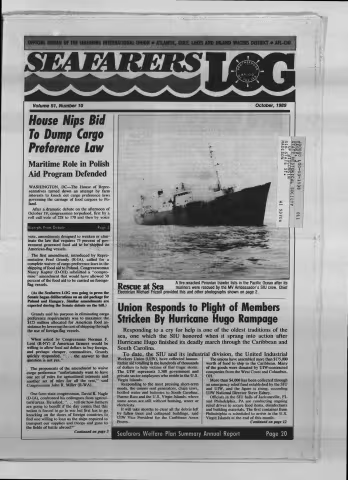
-Q . o A fire-wracked Peruvian trawler lists In the Pacific Ocean after its
JKdKllC flt dCfl mariners were rescued by the MV Ambassador's SlU crew. Chief
Electrician Michael Frizzell provided this and other photographs shown on page 2.
Union Responds to Plight of Members
Stricken By Hurricane Hugo Rampage
Responding to a cry for help is one of the oldest traditions of the
sea, one which the SIU honored wheii it sprang into action after
Hurricane Hugo finished its deadly march through the Caribbean and
South Carolina.
To date, the SIU and its industrial division, the United Industrial
Workers Union (UIW), have collected human
itarian aid totalling in the hundreds of thousands
of dollars to help victims of that tragic storm.
The UIW represents 3,500 government and
private sector employees who reside in the U.S.
Virgin Islands.
Responding to the most pressing short-term
needs, the unions sent generators, chain saws,
bottled water and batteries to South Carolina,
' Puerto Rico and the U.S. Virgin Islands, where
some areas are stiU without housing, water or
electricity.
It will take months to clear all the debris left
by fallen trees and collapsed buildings, said
UIW Vice President for the Caribbean Amos
Peters.
The unions have assembled more than $175,000
worth of food to ship to the Caribbean. Many
of the goods were donated by UlW-contracted
companies from the West Coast and Columbus,
OH.
More than $4,000 has been collected through
an emergency relief fund established by the SIU
and UIW, and the figure is rising, according
UIW National Director Steve Edney.
Officials in the SIU halls of Jacksonville, FL
and Philadelphia, PA are conducting ongoing
relief drives to secure food items, disinfectants
and building materials. The first container from
Philadelphia is scheduled to arrive in the U.S.
Virgin Islands at the end of this month.
Continued on page 12
Seafarers Welfare Plan Summary Annual Report Page 20
ifisM^nanmziJiXgSSSgfr
ijter^id^ftfrrrrss^rTSrc??
BES8«^-m
•• i".
i
•vJ';
•'•^J -
• € .•
vi:
li'i
?i.- .>-;r
/.. - -- •
mfARmm
President's Report
Thanks to the deep concern and convictions of a majority of the
U.S. House of Representatives that the U.S.-flag merchant marine is
vital to the nation's security, another attempt by farm interests to
weaken America's shipping capability has been soundly defeated.
The farm bloc's attack came in the form of two amendments
during action on the $837 million aid program for Poland and Hun
gary that was acted on October 19. One was introduced by Con-
gresswoman Marcy Kaptur of Ohio, who
called for reducing from 75 percent to 50
percent cargo preference requirements for
food aid to Poland. The other amendment
sought to drop the required use of Ameri
can ships entirely in the carriage of the
food aid given to Poland. Not funny, but
certainly a strange coincidence, the latter
amendment was introduced and defended by Rep. Fred Grandy of
Iowa, whom some will remember as the ship's purser in the tele
vision series, "Love Boat," a runaway foreign-flag vessel if we ever
saw one.
Both amendments were beaten by heavy margins. But not until
there had been considerable debate during some three and a half
hours, details of which will be covered elsewhere in the Seafarers
LOG. A similar fight is expected in the Senate.
If there is a lesson to be learned from this latest legislative battle
to protect U.S.-flag shipping and with it the jobs of Seafarers, it is
that we—our union—must continue to be vigilant and strong enough
to act responsibly and effectively in situations like this that affect
the membership's security.
While the Union is always prepared to deal with an attack on
cargo preference, the tactics of the farm bloc in using the Polish aid
program as a means of bypassing the required use of U.S. ships in
government aid cargoes was a bit of a surprise. Only a couple of
years ago a compromise had been worked out by maritime and
agriculture interests on the issues of taxpayer-supported grain subsi
dies and cargo preference that was accepted as mutually satisfac
tory.
Because farming and shipping are two industries vital to the na
tional interest and security, we thought each should support the
other. American shipping certainly acknowledges the role of agricul
ture in our national scheme of things. That farm interests are not
prepared to reciprocate and support thS^^Kdw "Of the American flag
on ships delivering the taxpayer-sponsored aid cargoes to beneficiary
nations is disturbingly evident from the shot they fired the other day
on the law on cargo preference. Nevertheless, it is hoped that this
attitude will not prevent a cooperative working relationship of the
maritime and agriculture interests in the future.
A striking and encouraging aspect of the latest legislative experi
ence is the quality of the debate and performance of the members of
Confess who led the successful fight against the amendments. A
reading of the arguments published in the Congressional Record
reveals that the con^essmen insisting on upholding the cargo prefer
ence laws know the issues well and recognize the vital role of
shipping, as well as farming, in the national interest. And they were
able to refiite the misinformation and distortions of facts about
relative costs and the tax dollars involved in maritime subsidies.
Contributing to the successfiil fight in the House of Representa
tives were the union's legislative affairs and research staffs, working
in cooperation with the Transportation Institute, the shipowners and
other elements of the maritime industry. Our people provided impor
tant background information and facts on cargo preference, relative
shipping costs and the taxpayer's role in farm subsidy.
The debate that took place on October 19 should be required
reading for all Seafarers and their families. It provides a powerfiil
insight to the struggles that we must continually wage if we are to
defeat the efforts to scuttle the American merchant marine. I am
therefore making arrangements to have it reproduced and made
available to all. The Seafarers LOG will announce when the publica
tion is ready for distribution.
And here we must be reminded that our ability to maintain the
fight to preserve American ships and American seafaring jobs de
pends on the resources we have to offer. That is why it is in a
Seafarer's personal interest for him to support the union's political
and legislative activities by contributing to SPAD.
1990 Lundeberg School Courses Announced
Seafarers who wish to take
advantage of upgrading
opportunities at the Harry
Lundeberg School of
Seamanship can refer to the 1990
course schedule announced this
month.
By upgrading, SIU inembers
have an opportunity to enhance
their job-related skills and
increase their pay.
Seafarers are urged to take
advantage of the upgrading
courses at the Lundeberg
School. The 1990 course
schedule appears on page 22.
- -11 The MV Ambassador responded to an
JiU Crew SflVGS 18 early morning distress call from the Pe
ruvian trawler Dorine I. When the Crowley/CCT freighter arrived, the
SIU crew could see fire and smoke spewing from all parts of the vessel
as pictured above. The foreign-flag crew of 18 was in a lifeboat. Below,
the Ambassador's crew rigged a tow-line for the lifeboat to take the
stranded seamen to a waiting Peruvian ship. No lives were lost in the
fire or rescue, which took place in late summer 20 miles off the coast
of Peru. Official cause of the fire was a short circuit in the galley.
Chief Electrician Michael Frizzell, who took these photographs, said
the heat from the flames was so intense it could be felt on the deck of
the Ambassador.
Index to LOG Features
Page^£^
P'lotoce ••••••• •'* *•••*••«•'• .14
IKqiatclier Report/Deep Sea. .14
INspatcher Report/Inland.................................21
i iHsiiatclier RqMrt/Great Lakes........................... .21
Final D^partiures 17"18'
KknoM^ IToiur IRlgiits.. .v. v.... -v]*........ ,.19'
L^gal ^Hd Birectory..15
iff''''"•'1® Ifi® Editor .........'..10
X ; Lundeberg School Applk»tifHi^....^.>........wv..i.. *.. ....23 g
& I Lundebeig Schoid Course Schednle ...^ ̂... 22, 23
Lundteberg Sdnxd Gnkhiates..................... w....... .16
hdeeting Nodce............................. ........«,. .... ..14
Penskmers .15
• • .<
Volume 51, Number JO October, 1989
The LOG (ISSN 0160-2047) is published monthly by the Seafarers International
Union; Atlantic, Gulf, Lakes and Inland Waters District; AFL-CIO; 5201
Auth Way; Camp Springs, Maryland 20746. Telephone (301) 899-0675.
Second-class postage paid at MSG Prince Georges, Maryland 20790-9998 and
at additional mailing offices. POSTMASTER: Send address changes to the
LOG, 5201 Auth Way; Camp Springs, Maryl^d 20746.
President, Michael Sacco; Secretary-Treasurer, Joe DiGiorgio; Executive
Vice President, Joe Sacco; Vice President Collective Bargaining, Angus
"Red" CampbeU; Vice President Atlantic Coast, Jack Caffey; Vice President
G^Coast, Thomas Glldeweil; Vice President West Coast, George McCartney;
Vice President Lakes and Inland Waters, John Fay; Vice President Government
Services, Roy "Buck" Mercer.
Communications Department Director, Jessica Smith', Associate Editors,
Daniel,Duncan, Max Hall and Deborah Greene.
••• '
6aOBeR,1989
;.-V '•
House Debate
On Cargo Preference
(What follows are excerpts from the comments of House
members who supported the upholding of existing cargo
preference laws.)
Robert G. Torricelli (D-NJ):
"Whot we want is an American ship with an American flag unloading an
American product with on American label, heoded toward a shelf to be read
with an American flag on the container, so that it would be clear to all the
Polish people that when they needed the United States, we were there."
David R. Nagle (D-IA):
"I remind my farm state colleagues: our numbers ore small. We don't hove
the votes—by ourselves—to pass a decent and just farm bill. We're going
to bove to hove help and support from others. And one of those 'others'
who stood with us when we needed help was the U.S. maritime industry. I
hope they stand with us again. Yet, some form state members want to look
them in the eye today and say: 'We are not going to help you this year,
but by the way, we're sure looking forward to having your help again next
year.' If that is our message today, I know what they are going to tell us
next year when we ask for their help. I do not think we con grow corn in
hell, but that is where they are going to tell us to plont it."
Howard L. Berrnan (D-CA):
"... if the goal of this amendment is to maximize the assistance to Poland
to get OS much for the $125 million as possible, then why ore we doing it
through United States commodities? Why ore we not going out on the world
market and buying as much us we con, which will be a great deal more?"
Jolm R. Miller (R-WA):
"United Stotes wheat costs between $161 and $166 per metric ton and
European wheat costs about $158 per metric ton. So if the proponents of
these amendments want to be fair, we should buy European wheat to help
Poland. Similarly, United States butter costs $2,656 per metric ton, compared
to $1,850 per metric ton for European butter... Under o truly open and
comp^ve morket, we could get more wheat and butter for Poland because
European products ore cheaper and they do not need to l» shipped as for."
Eliot L. Engei (D-NY):
"A good deal of misinformation has surrounded the costs ossodated with
shipping this country's food aid on United States vessels. The source of much
of this misinformation was a Boston Globe story of September 29, which
cited on $85-per-ton rate. This figure has presented a highly misleading
picture, and has been specifically refuted by the U.S. Deputy Maritime
Administrator Robert S. Silbermon ..."
Waiter B. Jones (D-NC):
'Hire shipping cost differentials suggested by the proponents of the U.S.-flog
waiver are grossly overstated. The $84.95 per ton United States-flog rate
was for 0 single, small, spot-charter shipment for which the Polish rate offer
was $60 per ton, not $15-20 per ton as claimed by the proponents of the
waiver. The Maritime Administration states that the United States-flog rate
for 0 normal shipment would be less than $34 per ton, with the Polish rate
being in the high $20-per-ton range. The $70-per-ton differential suggested
simply has no basis in fact."
Helen Delich Bentiey (R-MD):
"The actual difference is about $6 of tonnage between the high Polish rates
and the American rates of $34 a ton. That is much less than any 30 percent
differential."
Herbert H. Bateman (R-VA):
"Does Poland have a merchant marine? You bet it does. Is that merchant
marine subsidized? You bet it is. It is very heavily subsidized."
W.J. (BUiy) Taozin (D-LA):
"I, for one, believe thot Americon aid should arrive in American ships, flying
the American flag and crewed by tbe American people."
Ronald Keith Machtley (R-Rl):
'in my book. United Stotes support for economic restructuring in Poland
and Hungary need not be subsidized at the cost of our own domestic
interests."
Gerry E. Studds (D-MA):
"American workers, American industries, Polish workers and Polish industries
should equally reap the benefits of the generosity of the American people."
Continued on page 4
Hme Voles fe Keep Polish Aid on US Ships
Continued from page 1
Supporters of a strong merchant fleet
spoke of the inequity of Grandy's amend
ment. Lent asked, ". . . there are two
industries here that government seeks to
favor. . . Why are we taking it all out of
the maritime side of the equation?"
Cheaper Commodities Available
Congressman Robert G. Torricelli (D-
NJ) proposed, "... if we want to get the
most value for our money, let us go to the
world community and be prepared to buy
Argentinean wheat and Canadian agricul
tural products and use them for American
aid.
"If the concept of American foreign aid
is to get the most for the dollar, whether
it is shipping or the food we give I do not
see why there should be different rules for
maritime than for agriculture."
Torricelli concluded, "the gentleman"
who proposes the cargo preference waiver
"should know that he is opening that door
and there are those of us who are prepared
to walk through it, if those are the rules
of the game."
Miller said, "I read that United States
butter costs $2,656 per metric ton com
pared to $1,850 per metric ton for Euro
pean butter. If we are trying to maximize
in this one particular case, whether it
comes to butter or any other commodity,
why do we not go on the world market in
the case of butter and buy European but
ter?"
Other proponents of cargo preference
noted that wheat in the United States costs
between $161 and $166 per metric ton and
European wheat costs about $158 for the
same amount.
What Would Solidarity Want?
Cargo preference opponent Represen
tative James A.S. Leach (R-IA) suggested
the law requiring 75 percent carriage of
government food aid on American bottoms
pits "an established American union
movement against an aspiring union move
ment in another country. This is Solidarity
versus the American union movement."
But Leach's argument backfired. Pro
ponents of cargo preference quickly pointed
out the consistent role of American labor
in aiding Poland's free labor movement
that has been at the forefront of that
communist nation's emerging democracy
and economic reforms.
Congressman Howard L. Berman (D-
CA) said, "At the heart of the movement
to support Solidarity year after year was
the institution of organized labor in this
country. When others were looking away
and had other priorities, no other institu
tion gave that kind of assistance to Soli
darity."
Torricelli asked House members if they
thought Lech Walesa and Solidarity wanted
the cargo preference amendment.
"Does anybody who has heard Lech
Walesa think that he is a part of wanting
to jeopardize American labor rights? The
fact is no, he does not," said Torricelli.
Farm Interests Use Phony Numbers
Supporters of the cargo preference waiver
painted a picture of exorbitant U.S. ship
ping rates compared to bargain basement
prices of foreign carriers. Congressman
Eliot L. Engel (D-NY) confronted the
numbers thrown around by the farm in
terests: "A good deal of misinformation
has surrounded the costs associated with
shipping this country's food aid on United
States vessels.
"The source of much of this misinfor
mation was a Boston Globe story of Sep
tember 29, which cited an $85-per-ton rate.
This figure has presented a highly mis
leading picture and has specifically been
refuted by the U.S. Deputy Maritime Ad
ministrator Robet S. Silberman."
The chairman of the House Merchant
Marine and Fisheries Committee, Walter
B. Jones (D-NC) added, "The shipping
rate differentials suggested by the propo
nents of the U.S.-flag waiver are grossly
overstated. The $84.95 per ton United
States-flag rate was for a single, small,
spot-charter shipment for which the Polish
rate offer was $60 per ton, not $15-20 per
ton as claimed by the proponents of the
waiver.
"The Maritime Administration states
that the United States-flag rate for normal
shipment would be less than $34 per ton,
with the Polish rate being in the high $20-
per-ton," Jones said.
Cargo preference foes implied the Amer
ican merchant marine was "heavily sub
sidized" and "relying on the crumbs from
the agricultural table." Congresswoman
Helen Delich Bentiey (R-MD) set the re
cord straight: Only four of the 26 U.S.-
flag bulk carriers receive government sub
sidy. The tot£il national subsidy to mari
time is under $300 million compared to
$13 billion received by agricultural inter
ests.
The Maryland congresswoman said the
amendments to waive cargo preference
requirements on the Polish aid cargo was
"a continuation of the agriculture inter
ests' tunnel vision of wanting to protect
their own self-interests while demonstrat
ing a willingness to allow a vital component
of our national defense capabilities to be
frirther eroded, all the while they stuff
their pockets with taxpayers' dollars, wave
the flag and expound the virtues of their
alleged humanitarian efforts to increase
food supplies to Poland and Hungary."
More Shipping Needed, Not Less
Representative Jack Fields suggested
that rather than reducing support for the
nation's merchant marine. Congress should
look for ways to enhance the U.S.-flag
fleet. Fields asked House members to
examine the status of U.S. shipping:
• The American merchant marine is
down from being the largest fleet in the
world to a nation with fewer than 375
active ships.
• The Soviet Union, with a national
fleet of 2,500 merchant ships, carries more
of our nation's cargo overseas than we
do. In fact, Soviet ships carry nearly 50
percent of all mail postmarked in the
United States, while our domestic carriers
transport a mere 2 percent.
• The United States has gone from 110
privately operated shipyards in 1982 to 69
in 1988.
• In 1970 there were 18 major U.S.
shipping companies, now there are four.
• The number of seafaring jobs has
dropped from 99,000 at the end of WWII
to fewer than 13,000 today.
Fields said the administration, recogniz
ing the importance of our sealift require
ments, opposes waivers of cargo prefer
ence laws and is committed to strict
adherence of existing maritime legislation.
Proponents of cargo preference said the
nation gains from shipping on American-
flag vessels. After all, said Congressman
Lawrence J. (Larry) Smith (D-FL), "The
foreign Liberians, the Japanese, the Ko
reans, the Swedish, the Panamanians, all
of these people pay no taxes in this coun
try."
'• ' 'V. •.
•v"
i-. ..«*r,.->«a*a»».' »e*i|ifcM9frUN! 'iT'
k':"^ a
m'l.
nil' •• r
i'ki ••:( •
•••• 1
!k • f 'ii... ;'.l:
'•I •
• .•:. '
j' ' •'t- '
•K'
.vi;; •• •' •
•ik.
•'i.t-,.''
;iir'-
pM-
S.;l'
,' ,T'
£:rm
:':1
• i;. ? •- -.-•
;
fey
pr.i.r
i;i-; •' - >'••
•i", ',"• '••
-i-.
•I-:-:
i^K&m
't^niassfr
4 •V. SEAfMiltS LOG
Upbeat Convention Marks
UIW's 40th Anniversary
feyS;--
UIW delegates broke into small working committees. The Civil Rights
Committee, pictured above, included the following UIW members: (from
left to right) Frank Gill, Boh Love, Joe Perez, Amos Peters, Maurice
Stanley and Juliana Bowley.
The SIU's industrial division,
the United Industrial Workers
Union (UIW), marked its 40th an
niversary in a special way: dele
gates from all around the country
met in a spirit of enthusiasm for
the organization's eighth quadren
nial convention.
The convention, which was held
at the Seafarers Harry Lundeberg
School of Seamanship in Piney
Point, MD September 14-15,1989,
reflected the UIW's continued
strength and diversity.
The UIW has ^own forty-fold
since it received its charter from
the American Federation of Labor
in 1949, and its membership, once
confined to marine-allied fields, is
now a microcosm of the American
workforce. The union represents
20,000 workers employed in a wide-
spectrum of industries: tuna can-.
ning, service sector, wire and rope,
transportation and government.
Delegates took action on a num
ber of different fronts, from de
vising new organizing strategies
for future growth to enacting res
olutions which staked out posi
tions on issues of importance to
the union—^fair trade, civil rights.
apartheid and grassroots political
action.
Highlighted at the convention
were conditions in the U.S. Virgin
Islands, where. the UIW repre
sents 3,500 government and pri
vate-sector workers. The UIW's
Virgin Island delegates to the con
vention reported on the islands'
inadequate medical facilities. Many
of the U.S. delegates recounted
personeil experiences with the sub
standard health care on the island.
President Sacco pledged the SIU's
full support in investigating the
situation. Sacco appointed a high
level union committee that will be
responsible for researching and
recommending solutions.
Much of the convention was
devoted to discussing how the UIW
could best adapt to the far-reach
ing changes which have swept the
labor movement and the American
economy.
Robert McGlotten, legislative
director of the AFL-CIO and a
convention speaker said, "There
is nothing in your daily life
. . . from the food you eat to the
house you buy , . . that some pol
itician doesn't vote on on a day-
to-day basis."
Jack Otero, President of the
Labor Council for Latin American
Advancement, said that labor's
future could only be secured by
apealing to new groups of work
ers. He called on delegates to
intensify efforts to organize work
ers who are not currently repre
sented by unions.
( I
UlWINbrkeRMate Better Product^
loiiithelfnh./7l
Products made by members of the SIU*s Industrial division, ttie UIW, on
diq^y at the organization's eighth quadrennial convention.
House Debate on Carao Preference
Continued from page 3
Thomas M. Foglietta (D-PA):
"Over the lost year, a great deal hos been said in this chamber about the American flag—how
it cannot be desecrated, how it must he honored. Today, we must further honor the American
flag by requiring that it fly over the ships that carry our bounty to the people of Eastern
Europe."
Lawrence J. (Larry) Smith (D-FL):
"Why should American crews on ships most likely built in America, flying the flag of Americo,
of companies that still choose to do business and stay here in our country be punished? It will -.companies .
he punishment, because the bottom line is that when those ships, if we agree with the Grandy
amendment, come steaming into the harbor in Gdansk, they will be flying a Liberian flag. What
a spectacle ... America helping a Liberian flog."
Austin J. Murphy (D-PA):
"Those some corporations that run those fleets of American vessels pay their corporate income
tox to the United States of America ... Every crewmemher on those ships pay their tox dollars
to the United States and contribute to the Social Security trust fund."
Gregory H. Laughlln (D-TX):
"I believe that if the opponents of cargo preference win this round, they will succ^ in
undermining this basic support for our fleet and its maritime work force ... and will signal
future retreats from this important law in its application to food donations to other nations and
will inevitably lead to a moss export of U.S. maritime jobs and the further decline of the U.S.-
flog fleet."
Jack Fields (R-TX):
"... during the post 40 years, our merchant fleet, once the largest in the world, has declined
from more than 1,300 ships to fewer than 375 active vessels... I am, frankly, amazed that
we are even having this debate. At a time when the U.S. maritime industry is fighting for its
very survival, this body should be considering measures to increase, not de^se, the amount
of cargo carried on U.S.-flag vessels."
James H. (Jimmy) QuiUeu (R-TN):
"Since World War II we have let our merchant marine go down the drain... In cose of another
conflict whet would we do for security? What would we do for defense?... Bock during World
War II, the merchant marine fleet helped win the war... With the help of the merchant marine
fleet during the war, supplying the goods and the equipment and the ammunition and whatever
was necessary, we built up a great aggregation, which was essential to winning the war."
Normaii F. Lent (R-NY):
"In my opinion, the Congress of the United States should be supporting both the American
farmer and the American merchant seaman. The American farmer is the most productive farmer
in the world and the American merchant seaman is the most effident seamen in the world—
our Nation needs both."
Corinne C. (Lindy) Boggs (D-LA):
"... the American labor movement was really the mainstay of the Solidarity labor movement,
and helped them all along in their effort for freedom. I am certain that the leaders of the
Solidarity movement would be pleased to know that we recognize efforts of the American labor
movement, particularly the Seamens' Union, the SlU, in being helpful to the whole, beautiful
defense effort that has been going on in Poland."
Pnadenlial Support is Key
To Maritime Polityr Says Sacco
The government needs to pay
more attention to the problems
surrounding the U.S.-flag mer
chant fleet before it is too late.
This was the central theme in a
number of speeches presented last
month at the National Defense
Transportation Association
(NDTA) forum in Seattle, WA.
SIU President Michael Sacco
called for presidential intervention
to help the merchant fleet.
Sacco said the Bush administra
tion must "provide direction and
leadership" desperately needed in
order to meet our nation's sealift
requirement.
"History has shown that only
when the administration gives its
full support to the industry do
positive results occur."
Sacco noted the United States
has frozen, cut and, in some cases,
eliminated monetary programs for
its merchant fleet, while other
countries (Norway, Japan, Spain,
West Germany, Korea and others)
continue to increase funding for
their fleets.
Don Becker, publisher of the
Journal of Commerce, asked why
the military does not assume re
sponsibility for the nation's mer
chant fleet when supplying troops
overseas is an important element
of U.S. defense capability.
In his remarks, Timothy Rhein,
president and CEO of American
President Lines, struck the same
chord. He threatened that unless
U.S.-flag companies receive as-
si'stance from the federal govern
ment by the year 2000, Old Glory
may be replaced with foreign flags.
I; •
ffe;:
OaOBCR,l989
SlU Urges Louisiana Gov't
To Continue Sheil Dredging
The future of approximately 500
maritime jobs awaits a decision by
the state of Louisiana on whether
shell dredging can continue in Lake
Pontchartrain.
The Seafarers International
Union is taking a leading role in
the fight to retain the work, almost
half of which belong to SIU mem
bers.
The state is reviewing its posi
tion on shell dredging because of
pressure from environmental or
ganizations to clean the lake. The
SIU, through New Orleans Port
Agent Jim Martin, has argued that
shell dredging, which affects only
eight percent of the lake's area,
releases no contaminants or pol
lutants.
"The water quality of Lake
Pontchartrain is related directly to
problems of urban development
and urban pollution—drainage
created by storm water, dis
charges of sewerage that is treated
to less than acceptable levels, dis
charges and spills from marine
related facilities and marine ves
sels," Martin said this month at
hearings conducted by the Loui
siana Department of Environmen
tal Quality (DEQ) and the Cause
way Commission.
Dredging Key to Economy
If the state should stop shell
dredging, an annual payroll to
Louisiana residents of $8.7 million
would be lost, Martin told the state
government officials. This could
have a devastating affect on the
already distressed state economy,
which has been hit hard by the
depressed oil industry.
Martin was joined at the Octo
ber 23 DEQ hearing held in the
state's capital city by Lawrence
Evans of the Transportation In
stitute, an organization that rep
resents 140 U.S.-flag-operators.
While emphasizing the fact that
maritime industries, as well as the
SIU, want the lake to be pollution-
free and will work to that end,
Evans also pointed out the variety
't,
of outside businesses that could
be hurt by an end to shell dredging,
road construction and mainte
nance, public utilities, oil field
construction, oyster reef mainte
nance and harvesting, and tour
ism.
Both Evans and Martin dem
onstrated the need for shells for
road construction, especially in
southern Louisiana. The shells are
used to float the highways because
normal roadbed construction can
not be used in the swampy areas.
Also, the shells help to filter pol
luted run-off water and are nec-
Urban pollution
not shell
dredging creates
lake contamination.
essary for the construction of lev
ies.
Evans noted public utilities use
the shells to help filter smokestack
emissions. Alternatives would be
costlier and the increased cost
would be passed to consumers.
Shell also is needed in oil field
construction. Evans pointed out
that "as long as shell dredging is
permissible, a recovery in the oil
sector will accelerate demand for
shell used in oil field construction,
expand job opportunities in the
shell dredging' industry and in
crease the revenues generated for
the state."
The SIU has been supported in
the quest to save shell dredging
by the Louisiana AFL-CIO and
other maritime unions. Two bus
loads of employees from Dravo,
an SlU-contracted company, at
tended the October 23 hearing.
The state plans to continue
hearings until early November. An
announcement concerning the fu
ture of shell dredging in Louisiana
is not expected until early 1990.
Lebafk is New MarAd Chief
After remaining unfilled for
nearly a year, the Maritime
Administration has a new chief
officer.
Warren Leback, a former dep
uty of the department during the
Reagan administration, was con
firmed by the Senate and assumed
his new duties immediately.
Leback is a 1944 graduate of the
U.S. Merchant Marine Academy
at Kings Point. His extensive ex
perience in the private sector in
cludes the following positions;
senior vice president for vessel
operations for Puerto Rico Marine
Management; director of the El
Paso Marine Company in Hous
ton; and vice president of marine
operations for Sea-Land Services
in Port Elizabeth, NJ.
Historically, the maritime ad
ministrator has played an impor
tant role in formulating and ad
ministering the government's
maritime policy. But the post has
been empty ever since John
Gaughan's departure earlier this
year, to the consternation of many
in the maritime industry. Gaughan
left the Maritime Administration
for a high-ranking position in the
Department of Transportation.
Leback's first few weeks in of
fice have been busy. The admin
istration released its long-awaited
policy statement on sealift, and
the House defeated amendments
to an aid package to Poland that
would have relaxed American-flag
cargo preference standards.
During his confirmation hear
ings, Leback said that he opposed
any changes in current cargo pref
erence laws. He stressed his strong
support of the Jones Act, and
pledged to work towards the re-
vitalization of the American-flag
merchant marine.
SIU members on the G&H tug Eva attempted to rescue three men iu a
drifting motorboat. Pictured above are (left to right) AB Rodney Nix,
Engineer Robert Hyams, AB Lee McGovern and Master Ted Schendel
as they receive a commendation from U.S. Coast Guard Captain T.C.
Greene (middle).
SIU Men at G&H Commended
By USCG for Rescue Attempt
In the late afternoon last No
vember 25, a small motorboat
drifted directly into the path of a
large ocean-going tug and barge.
Crewmembers on G&H Towing
Company's tug Eva, at great risk
to themselves and without hesi
tation, steered the Eva under the
bow of the barge into the path of
the oncoming tow and passed a
line to the motorboat.
The actions of the SIU members
on the tug Eva in attempting to
rescue the three men in the mo-
Eva^s crew moved
their Vessel directly
into the path of the
oncoming tow ...
torboat were commended by T.C.
Greene, captain and officer in
charge—marine inspection for the
United States Coast Guard in a
ceremony in Houston last month.
Eva Master Theodore Schen-
del,Engineer Robert Hyams and
AB's Lee McGovem and Rodney
Nix were commended by Captain
Greene for "outstanding perform
ance." He said their "valiant ef
forts" in the "life-threatening sit
uation deserve great credit and are
in keeping with the highest of
maritime traditions."
The motorboat, on its way home
from a fishing trip, had stalled,
leaving the occupants stranded in
the middle of the channel not far
from Texas City. The men were
trying to restart the engine when
the barge, pushed by the ocean
going tug, turned into the channel.
The pilot on the tug requested the
Eva, which was on its way to meet
the ocean-going vessel, investi
gate the drifting motorboat.
Master Schendel managed to
steer the Eva under the bow of
the barge and Hyams, McGovem
<md Nix were able to pas& ,a line
to the motorboat. But the three
occupants were unable to secure
the line and did not hold on. Jerry
Vickers,. a spokesman for G&H
Towing, said it appeared the men
in the motorboat panicked be
cause instead of clinging to the
Eva's line, they jumped into the
water.
Two of the men drowned, one
was saved by a passing shrimp
boat.
Calling the event "tragic,"
Vickers said Eva's crew did man
age to pull the motorboat to the
point where the craft floated down
the side of the barge. Conse
quently, the motorboat received
only minor damages to the wind
shield and steering wheel.
G&H tug crewmembers are rep
resented by the SIU. The com
pany operates harbor docking tugs
in the Galveston and Houston area.
SIU HALL ESCAPES QUAKE DAIMAGE
The SIU union hall on Fremont
Street suffered temporary loss of
electricity and telephone service
but otherwise escaped unharmed
after a devastating earthquake hit
San Francisco on October 17. Af
ter three days without utilities, the
hall is back to normal, report San
Francisco-based SIU Vice Presi
dents Buck Mercer and George
McCartney.
The earthquake, which meas
ured 7.1 on the Richter Scale,
mptured the San Andreas Fault
for 20 miles. University of Cali
fornia Seismology Laboratory ex
perts placed the epicenter near
Lake Ellsman, a reservoir be
tween San Jose and Santa Cmz.
Areas hardest hit by the earth
quake were the San Francisco
Marina District, the Oakland Bay
Bridge which lost a 50 foot section
of the upper deck and Interstate
880, also called the Nimitz Free
way.
About one-and-a-half miles of
top deck of 1-880 buckled and
collapsed on the lower section,
crushing vehicles and trapping oc
cupants.
Rescue workers are continuing
the process of digging out mbble
and checking damaged structures.
. S.
, I
• • •• f"; -i.:
'My.
Ssik--
f.'.lf
' • i"' • '" '•
m-y ••••,•. :••••
Ife- r
,if. 't
ifef
M- :t
'h
iMM
V
Mi;:
P''
pfE
yyyy '• :
i-f
ift .''I-
•'•M -
Bill Exlends Vetemns' Etigibility
Date For Menhant Seamen
Federal legislation to extend
World War II veteran status to
merchant mariners who served
from August 15,1945 to December
31, 1946 will face its next hurdle
in late October. The bill has the
strong support of the Seafarers
International Union.
The House Merchant Marine
and Fisheries Committee will
schedule a vote for the latter part
of this month on the bill sponsored
by Houston Congressman Jack
Fields (R-TX).
Six House members have co-
sponsored the legislation, giving
it bipartisan support. They include
Helen Bentley (R-MD), William
Hughes (D-NJ), Bill Richardson
(D-NM), Owen Pickett (D-VA),
Herbert Bateman (R-VA) and Greg
Laughlin (D-TX).
Harry Burroughs, minority
counsel for the committee, said
Fields' bill is expected to pass in
the House committee. The Hous
ton congressman had addressed
the committee's Merchant Marine
Subcommittee urging it to study,
then adopt the legislation.
Although Congress granted vet
eran status to World War II mer
chant seamen, the legislation es
tablishes an August 15,1945 cutoff
date. That was the day the Japa
nese surrendered. However, it was
on December 31, 1946 that Presi
dent Harry Truman announced the
end of hostilities and that is the
date recognized for all other World
War II veterans.
While testifying. Fields said at
least 11 U.S. merchant ships were
damaged by mines between Au
gust 15, 1945 and December 31,
1946. He noted merchant seamen
lost their lives in some of the
explosions.
Congressman Fields explained
that shipping actually increased
immediately after the war as med
icine, food and other supplies were
caried to battle-ravaged Europe
and Asia.
Some of the individuals affected
by the legislation include those
seafarers who signed up prior to
August 15 but had not yet gone to
sea, merchant seamen in military
training on August 15, and those
who enlisted in the U.S. Maritime
Service after August 15, 1945, but
who sailed before December 31,
1946.
Should the legislation clear the
Merchant Marine and Fisheries
Committee, it would then go be
fore the House Veterans Affairs
Committee. The bill may face a
tougher time there. Burroughs said
the U.S. Air Force (the branch of
the armed services that reviews
veteran status matters), the De
partment of Defense and some
veterans organizations are ex
pected to oppose the extension.
Liberty Ship Veterans Note
'Grim' U.S. Shipping Scene
SlU Executive Vice President Jo
seph Sacco receives a certificate
from Captain George W. Jahn, a
former skipper on the O'Brien.
While reflecting on the turbulent
years of shipping during World
War II, approximately 300 mer
chant marine veterans, gathered
in San Francisco for a Liberty
Ship reunion, heard the sobering
statistics associated with today's
American-flag fleet.
"Since World War II, the com
mercial fleet has been in continu
ous decline," Joseph Sacco, SIU
executive vice president, told the
group aboard the SS Jeremiah
O'Brien last month.
Sacco urged presidential lead
ership to help unify Congress, la
bor and management in order to
improve the outlook for the mar
itime industry. With the exception
of Richard Nixon, he said that no
chief executive since Franklin
Roosevelt has shown any interest
in revitalizing the fleet.
"To survive in the future, the
merchant marine must be utilized
to a far greater degree for both
military and commercial pur
poses," SaCco said. "There must
be ships in peace time, because in
wartime it will be too late."
Congresswoman Helen Delich
Bentley (R-MD) announced that
none of the 595 manufacturers
used to supply materials for the
building of Liberty Ships is in
operation today. She said the mar
itime situation is "grim and getting
worse every day."
Bentley told the veterans the
President's Commission on Mer
chant Marine and Defense re
ported the seagoing workforce had
dropped 60 percent since 1970 and
American bottoms carry a mere
four percent of the nation's com
merce.
Sacco and Bentley spoke on
board the O'Brien, the last unal
tered operational Liberty Ship. The
O'Brien is docked at Fort Mason
in San Francisco Bay.
The reunion featured men and
women who built and sailed the
2,000 Liberty Ships used during
World War 11. The mass-produced
vessels served as the backbone of
the American merchant marine ef
fort during the war.
The O'Brien went into service
in June 1943. She saw action in
both the Atlantic and the Pacific.
After the war, the O'Brien became
part of the reserve fleet before
being selected in 1979 as a living
memorial and museum.
SCAOROS lOG
I.JILiin I U - ii-'lil HI'
* — -
Congress is considering a bill
which, if adopted, would extend
WWII veteran status to
merchant seamen who served
from August 15, 1945 to
December 31, 1946. Currently,
only civilian mariners who saw
active duty in WWII between
December 7, 1941 and August
15, 1945 are eligible for
veterans' benefits and
recognition of service from the
Maritime Administration and the
United States Coast Guard.
Question: What do you think of
the legislation that would extend
the cutoff date for veteran status
for WWII merchant mariners to
December 31, 1946?
(Asked of SIU members at the
union hall in Norfolk, VA.)
Fred Hicks,
Chief Steward—
House Bill HR
44 will, if en
acted, correct an
injustice done to
several thousand
of our fellow
members who sailed after Au
gust 15, 1945 and through De
cember 31, 1946. It has taken
two lawsuits and 44 years of
long, hard fighting to get our
World War II merchant mariners
recognized as veterans. Due to
enemy actions, many of these
men died after only a few days
at sea while in the service of
their country. Any benefits that
will be afforded to WWII ma
rines will be minimal as most of
the WWII benefits have long
since been exhausted. Neverthe
less, at least their families will
have something to cherish and
they will be eligible for a flag to
drape over their coffins and a
sm^l burial benefit.
William "Red" Price, QMED-I
was in the Navy during WWII.
Merchant mariners took the
same risk I did and probably
much more. As I see it, they
sailed many months into WWII
without any protection before
the ships were armed and the
armed guard was put aboard.
Later the convoys were made up
with destroyer escort but that
did not come about until several
Alfonso Holland, Chief Steward—
Although I was not sailing during
WWII, I feel these men should
be recognized. I am an Army
Vet from the Vietnam era and
even for that war we got honora
ble discharges and veteran sta
tus. I am sure these men helped
bring about total defeat of the
enemy and they sailed during the
period when our Allies desper
ately needed our goods in order
to help them recover from that
war. Not only that, but several
merchant ships hit mines during
that period and many sank. For
all practical purposes, WWII did
not end until December 31, 1946.
WWII wUl not be over for mer
chant seamen until they have
been recognized.
thousand merchant seamen lost
their lives to U-boats. My fellow
brothers should be recognized
and included and not left out.
After all, those who served in
the Armed Forces and civilians
working for the government at
that time got discharges even for
one day service right on up to
December 31, 1946.
Norwood
Bryant, Bosun—
There is no
question that
these men also
should be recog
nized. I want to
see our union go
all out for these men and do
everything possible to get this
bill passed.
Vincent Khui,
Bosun—^I feel
these men
should be af
forded the dis
charge as the
others. They
were serving
their country the same as the
other men. I feel it is time to
correct the situation at the earli
est possible moment. Most of
these men are deceased and this
discharge will at least recognize
these men for service to their
country. Their families can be
proud of them that they served
their country so well.
Andrew "Andy" Anderson, Bo
sun—I feel good about these
men possibly getting a well-de
served discharge as they truly
deserve it the same as all the
rest of the WWII merchant mari
ners. Nothing in the history of
my sailing career, and I go back
to 1938, has ever been more dis
graceful to our wartime seamen
than the establishment of the
August 15, 1945 cutoff date. Any
seaman who was sailing in 1945
knows the armed guard was still
on the ships as late as December
1945 as well as all of the military
control that was held over sea
men long into 1946 and later.
Mine bonus was paid as late as
1947. They certainly were not
giving us that money for nothing;
there was still the possibility that
we could get sunk.
Fred Hicks Helps LOG
Fred Hicks, who served as the
Seafarers LOG's volunteer cor
respondent for the Inquiring Sea
farer column in this edition, began
his SIU career in 1945 at the port
of New York. He started sailing
in 1943 with the Army Transport
Service. Brother Hicks worked on
freighter, tanker and passenger
ships.
Not only did he sail during World
War II, he also saw action during
the Korean and Vietnamese con
flicts. Pensioner Hicks is married
with five children and one grand
daughter. He lives in Norfolk, VA.
v;;;; , ,, .. ;• ••
-I-—-
mW.":--.: • 7 "r,'
OaOBCR,1989
'" , •••^Vi^vV,,.'^ •.••'.•I ' •"••
~ iv.'/' vv', r ' ;' - '' .
.V' •.••-
"._ •., .1', • ',
-A.
• : • t
/ . 'J
•'• • V'S^}v? '•• •
r.. • • ">
.,11. .--•I •
' I'L. •
^m-
Passumsk
Galley Runs a
Good Feeder
With a crew of more than 100
onboard, the galley of the USNS
Passumsic is always hopping, re
ports Ship's Chairman Geralt T.
Ebert. SIU official and Seafarers
LOG correspondent Edd Morris
met with Ebert last month in Subic
Bay, Philippines, where the USNS
Passumsic was docked.
New Committee Elected
Unlicensed crewmembers, who
belong to the SIU's Government
Services Division, elected a new
ship's committee, Ebert told Mor
ris. New officers include Chair
man Ebert, Engine Delegate John
R. Pumpman, Steward Delegate
Danny J. Harvey and Supply Del
egate Felino Pahate.
Ebert said the food operations
on the USNS Passumsic run
smoothly and the galley prepares
many Filipino-style dishes, taking
advantage of the resources avail
able in the tropical Subic Bay area.
Ebert also reported the USNS
Passumsic has a good crew in all
departments. "We're like a family
here," he said.
USNS Passumsic crewmembers eagerly dig into another fantastic meal
provided by the vessel's steward department.
GOVT SERVICES
MEMBERS TO BE
DRUG TESTED
AFTER DEC. 1
MSCPAC has set December 1,
1989 as the target date for imple
mentation of its Drug Free Work
place Program. All MSCPAC ves
sels operating in the Pacific with
civilian mariners will be subject
to drug testing.
SIU Government Services Di
vision Vice President Buck Mer
cer said the union is forwarding
to all ships' chairmen a copy of
MSC's Civilian Mariner Personnel
Instruction (CMPI) 792 that out
lines the agency's drug testing pro
gram.
Mercer said the union is meeting
with MSCPAC officials to discuss
rehabilitation procedures for those
who test positive.
MSCPAC has named Gus Es-
pino as the agency's drug program
coordinator. Espino is scheduled
to visit each MSCPAC ship for
the purpose of conducting training
sessions for supervisory ship
board personnel who will be re
sponsible for the administration of
the drug testing program.
Mercer called on all Govern-
Continued on page 8
f. •I--',:, 'f ' • • •,«. w
Pictured above in the USNS Passumsic crew lounge are: (left to right)
Junior Engineer Curtis Thomas, Chief Electrician Godofredo V. Mino,
Steward Utility Edward B. Asercion, Assistant Cook Jose C. Josue,
Steward Utility Danilo DelRosario, Steward Utility Carlos W.
DeCastro Jr. and Wiper Roger Houston.
USNS Passumsic crewmembers during a well-deserved coffee break:
(top photo, left to right) Yeoman Storekeepers James Smith and
Nester Everisto, Second Electrician Michael Shipp, (bottom photo, left
to right) AB Steve Phifer, AB Rick Blair, Cargo Bosun A1 MarshaU,
AB Robert L. Grier and OS Don Rosensteel.
Wiper David Velasco (left) and Machinist J.D. Hanxhurst taking care
of paperwork in the crew lounge.
'' • ' -•i'' -1
~ 'iiiS
A:
m-A A;;.K _ • ^ 7 _ •_
'•I--*
M
• . V ••
yf A-l..
,,/vT i^rSC-"' •
%4,i>;j.>;..'(P''^, ;'r'
s ';)'.;^V.','-" -r
. ;; V.^^-fT'i-''"^>-:,>j';\
"• .L.1L. -i'.' '.-•' !•.. r-'. 1
/ y-;,.
• ,.s?;pi;r •>-•
s:sg;j SOFAHI^LOG
. v ' , ..
,- • .iU' Cy^. . -•'
Notice for Members
Of SIU Gov't Services Division
"VSlfciir' ../Tc'-.''.3« rw7 ''5TJ. S:„
K»'4?r„',(i|^fSig.;
ojf'-'-r.' •;•'':«•'!'•
;.p;rr •:. )N;:-
Vice President Buck Mercer announced receipt of a Military Sea-
lift Command Civilian Marine Personnel Instruction (CMPI) outlin
ing changes that effect supply personnel on MSCPAC vessels.
Mercer said the policy revisions were received by the SIU Gov
ernment Services Division on October 20 and are effective immedi
ately.
The reason stated by MSC for the revisions was "to clarify cargo
handling provisions for Supply Department personnel."
Any member of the SIU's Government Services Division with
questions on the changes should feel free to contact the union hall,
said Mercer. The Government Services Division office is located at
350 Fremont Street; San Francisco, California 94105 and the phone
number is 415/861-3400.
What follows are portions of the text of CMPI 610:
12-1 SUPPLY PERSONNEL HOURS OF WORK
b.
H.-C • a/;.
mv :f y:i>.
-IJ ,•
Nonofficers
(1) In Port. 0800 to 1700.
(2) At Sea. 0900 to 1700.
On days of foreign port arrival and departure, all personnel shall
work eight hours between 0800 and 2000.
d. On days of CONUS port arrival and departure, all personnel shall
work eight hours between 0800 and 1800.
c.
12-2 OVERTIME—ALL PERSONNEL
a.
"Mi - .
fi^
#:
Overtime shall be paid for:
(1) Work performed in excess of eight hours per day.
(2) Work performed between 1700 and 0800 in port and at sea,
Monday through Friday.
(3) Work performed on Saturdays, Sundays and holidays in port.
(5) Work performed on Saturdays, Sundays and holidays at sea
(Nonofficers).
M •H-h •
12-4 OTHER PREMIUM PAY PROVISIONS
a.
!iS
Cargo handling. On NFAF ships, the applicable cargo handling
rate is payable when personnel are required to handle cargo from
pier to the deck of the ship and from the ships deck to the pier.
(2) Nonofficers. Nonofficers shall be compensated at the appro
priate Deck Department cargo handling rate when required to
handle cargo.
b. The cargo handling rate is not payable for mission related work
consisting of the subsequent movement of cargo from the deck of
the ship to the holds, in port; movement of cargo within holds, at
port or at sea; or the movement of cargo from holds to staging
areas during UNREP, VERTREP and INREP operations.
Senator Meets With SIU Officials
V- :
• t, ;
.•i
Ppi;'
U.S. Senator Carl Levin (D-MI) is flanked by Victor Hanson Qeft), an
attorney who works with the SIU port of Aigonac, and Byron KeUey,
SIU assistant vice president.
Congressman Visits Sea-Land Ship
•C-.
Phtrtdman James Koesy (left) and hosun Freddie Goethe (center) talk
with Congressman Bill Nelson (D-FL) during his visit to the Sea-Land
Commitment. The congressman was touring Jacksonville's Blount Island
port facility last month to learn more about the maritime industry.
Taking a moment for a photograph are USNS Catawba crewmemhers
(left to right) AB Thomas Douglas (standing), Bosun/Mate Capers
Hamilton Jr., Steward Baker Floyd Brewton, AB Kenneth R. White
and AB Orville A. Gillium Sr. Seated in the foreground is AB James
Cross.
Catawba Weathers Weather
Ship's Chairman Orville A. Gil
lium Sr. says the USNS Catawba
gets more than its share of bad
weather. As an oceanographic
vessel, often in search of unusual
weather conditions, it frequently
heads directly for the place where
no other vessel >vould go.
Gillium, who met with SIU of
ficial Edd Morris last month while
the vessel was docked for a short
time in Subic Bay, said the crew-
members are used to the unusual.
"We get quite a bit of seatime and
very little rest and relaxation
around here," he told Morris. "But
because of our monitoring of
weather and our chartering oper
ations, we sail to some interesting
and out-of-the-way places," he
added.
While Gillium acts as the ship's
chairman. Capers Hamilton Jr.
serves as the deck delegate.
The USNS Catawba's unli
censed crew is made up of mem
bers of the SIU's Government
Services Division. The division
was once called the Military
Sealift . Transportation Union
(MSTU).
Morris reports one member, AB
Thomas Douglas, has achieved a
personal victory. Famous for his
moustache "drops," Douglas was
advised a few months ago that he
was required to shave because of
a new rule. Management said
beards interfered with protective
firefighting masks. At issue: Were
Douglas's drops a beard? To
Douglas the answer was a big
"NO!" And to date, the drops are
still there.
Catawba crewmemhers Gefl to right) AB James Cross, AB Orville A.
GUIium Sr. and Steward Utility Enrique U. Evangelista are pictured
above.
MSCPACs Civilian
Mariners Will be Tested
Continued from page 7
ment Services Division members
to carefully review section 5-2 of
CMPI 792 that establishes proce
dures for an employee found using
illegal drugs. Under the provisions
of this section, any shipboard em
ployee testing positive will be re
lieved of shipboard duties and re
patriated to home port for referral
to the Civilian Employee Assist
ance Program.
Section 5-2 also allows for "other
appropriate action," that could
mean disciplinary action ranging
from a simple written reprimand
to removal. Mercer explained.
Mercer warned civUian mar
iners that some over-the-counter
medicines purchased in foreign
countries could induce a positive
drug test result.
•fiJ'
.<-v: •m^i.-^-^c.- ;:?''• -^. ':£• • ;^
.Vv'••
' .V ' •"•'
^'v-V 'J
•/•','•,B,., vV, r-,
vAA.,-
•••- •',' ,v»- •'
rv ;• ',^
OCrOBER, 1989
First Oil Spill Class Graduates
A group of nine became the first
upgraders to complete the Oil Spill
Prevention and Emergency Con
tainment and Clean-up course at
the Harry Lundeberg School of
Seamanship last month.
Designed to teach SIU crew-
members to prevent oil spills and
to react immediately durinig a fuel
leakage, the course is the first of
its kind for merchant mariners.
The union developed the program
after March's Exxon Valdez dis
aster in Alaska and June's smaller
spills in Delaware, Rhode Island
and Texas created by foreign-flag
carriers.
The one-week session gave the
upgraders both classroom and
hands-on experience in prevent
ing, corralling and cleaning an oil
spill.
The focus of the training is the
prevention of spills and their
prompt and immediate contain
ment before they get out of con
trol. The first four days are de
voted to classroom work.
Instructor Jim Shaffer intro
duces the students to the types of
oils and how they will react when
mixed with water. He informs the
upgraders about the various pol
lution prevention regulations
around the world. Next, Shaffer
explains the various means of pre
venting a spill—piping systems,
tanks, hoses, etc.—before the class
begins responding to simulated oil
spills.
After the book-learning, the stu
dents individually prepare detailed
written proposals on how to han
dle oil spills. They must include
all needed personnel and equip
ment, final disposition of the con
tained oil, communications and
logistics.
The final classroom situation has
Continued on page 20
Upgraders Joseph Reyes (left) and Bernie Laurence tie up their s^ff to the
dock after stretching a containment hoom during a simulated oil-spill
exercise at Piney Point.
Trainees from the Harry Lundeherg School of Seamanship prepare con
tainment booms for use by the facility's first Oil Spill Prevention, Emergency
Conteinment and Clean-up class during a demonstration on St. George's
Creek.
WO Percent Pass Pate for License Class
All seven of
the Lundeberg
School's limited
license class par
ticipants passed
their U.S. Coast
Guard exams af
ter completing the
union's intensive
nine-week course
that ended last
month.
The group grad
uated after com
pleting a course of
studies concen
trating on wheel
house skills. The
union members,
who all work for
SlU-contracted
inland compa
nies, combined
exercises involv
ing plotting, nav
igational simula
tion, basic boat handling and rules of the road
with classroom reading and discussions.
The seven participants geared their studies
towards obtaining Coast Guard licenses in the
following areas: 1600 Mate—Near Coastal; 500
Ton Mate and Master—Near Coastal; Unin
spected Towing Vessels—Inland and Near
Coastal and 200 Ton Mate and Master—Near
Coastal.
Limited license course instructor Casey Tay-
In the hack row are (left to right) Esler Bovie Jr., Jeff
Davis, Robert Murray Jr., Roger Foote, Dan Young and
Ron Nelson. Leslie Maxwell and David Swire (left and
middle) join instructor Casey Taylor (right) in the front
row.
lor said each
member who
graduated from
the course
"should be con
gratulated oh then-
hard work, dili
gence and the re
alization of their
professional goals."
Les Maxwell,
who sails for
Sabine Towing,
passed the exam
for a 1600 GT NC
Mate and 500 GT
Master license.
David Swire and
Jeff Davis, who
work for Steuart
Petroleum, ob
tained 1600 GT
Mate licenses —
Uninspected tow
ing vessel—in
land licenses were
secured by Robert Murray and Ron Nelson,
both of Moran Towing, Roger Foote from Steuart
Petroleum and Daniel Young, who ships on
Upper Lakes Towing Company vessels.
Instructor Taylor said the limited license class
will be offered twice in 1990. The first is sched
uled from June 11 through August 10 and the
second will run from September 17 through
November 16.
Radar training resulting in a Coast Guard
endorsement will follow each class.
siAim APPRom
fOR smuiuaoR
The U.S. Coast Guard has approved 60 days
of seatime for graduates of the Seafarers Harry
Lundeberg School of Seamanship ship handling
course.
Instructor Jim Brown announced the cpoast
Guard's decision after receiving verbal approval
in late September. The confirmation came after
USCG officials had inspected the curriculum
and facilities.
Upon successful completion of the two-week
course, students will receive a certificate of
accomplishment which will be recognized by
the Coast Guard for 60 days of seatime, in either
the deep sea/great lakes or inland divisions.
However, the 60-day approval is good only for
the Coast Guard and its upgrading regulations.
It does not apply to Seafarers Welfare Plan and
the time needed to maintain benefits.
According to Brown, the Coast Guard will
recognize the 60-day bridge simulator training
only once no matter where and how many times
the course is taken.
Brown noted the certificates are retroactive,
so those who graduated in ship handling classes
held earlier this year will be able to receive the
60-day recognition.
With four classroom bridges in operation.
Brown and his staff are able to recreate through
computers more than 40 ship handling exercises,
including docking, draw bridge maneuvering
and bunkering.
Ship handling courses are scheduled after
each able seaman program. The class is limited
tb four to six students.
yy -y -•
. • • 1,' -•
Jiir: mm
saaRSRS 106
- i. "
-•J Letters to the Editor
>;- • 'f. •
- i
m
•' r :
.'•'" t
: j V.' /,f-, ,:; ,r ,•'•
If ,3:
liii::
'l-f V -^' •• ' '. ' , ••
'ii' '':•
4' • • ".:. •>,. ,. • ;•%••• i.-.- \%'--v-.,-^ -'• ;
c'- ,'''r--
|>|fpr;|j:;
"''•" 'Jp t'"J
fcjseivu
Compliments Lundebeig Staff,
UigM Members to Upgrade
To the Editor:
I wish to compliinent the staff
and entire personnel at Piney Point.
I completed the course in oil spill
prevention and clean up during
the week of September 11 to 15.
My personal thanks to Jim Shaf
fer. I found him very able and well
qualified to teach this course. He
was available and most helpful in
any problem I addressed to him.
Many thanks to his friendly and
experienced aides.
As usual the food was excellent
and the hotel staff under the di
rection of Eddie G. very pleasant
and efficient.
1 have been sailing since 1945
and still have the desire to learn
new skills and improve my chances
of employment.
To the rest of our membership:
there is a need for able seamen,
QMED's, pumpmen, electricians,
etc., and there are many openings
at our upgrading classes. All it
takes is your desire to improve
yourself and the time to fill out
the application ...
Louis Flade
Philadelphia, Pennsylvania
Thanks for Son's Scholarship
To the Editor:
On behalf of my family, I would
like to express:thanks. I am very
pleased and appreciate that the
. . . scholarship committee has se
lected my son Glenn as the recip
ient of that scholarship.
I am very proud as a union
member that the SIU has taken
an interest in my son's academic
goals and has helped to meet his
financial needs with this generous
scholarship.
Right now it is being used to
further his education at SUNY at
Buffalo ...
Edward J. Gontha
Brooklyn, New York
Editor's Note: The above letter
was originally received by SIU
President Michael Sacco who for
warded it to the LOG.
Wants Pulmonary Disease
Recognlzefl as War-Relateil
To the Editor:
In January 1988 the Department
of Defense stated that merchant
seamen who sailed during World
War II, which was from 1941 to
1945, are military veterans.
The merchant seamen who are
still alive know that the ships built
in the shipyards during the war
years used asbestos ... (a sub
stance) outlawed by the occupa
tional hazard. . .organization. . .
The American Cancer Society (has
also) stated in a brochure that
asbestos dust is related to colon
cancer (and) in July of this year,
the head of the Environmental
Protection Agency said that as
bestos dust causes cancer. It may
take forty years or so to be pro
nounced or evident.
I am at present trying to get
service related disability benefits
because of asbestos dust. I also
had colon cancer surgery at Seton
Medical Center in Austin from
April 26th to May 5th.
The problem is if any seafarers
developed any medical conditions
from asbestos from 1941 through
1945 when they went to Public
Health Service hospitals and clin
ics with the medical condition re
corded on medical abstracts. All
that data—medical records PHS—
is now in Louisiana since the Pub
lic Health Service hospitals and
clinics are closed.
Bill McLemore, the veterans
service officer in Travis County/
Austin, asked me to try and find
out from merchant seamen I may
have sailed with (if they have ex
perienced similar situations) . . .
. . .1 am trying to get service
related disability. When I go to
the VA hospital in Temple, TX, I
have to find out if (my) current
medical conditions are related to
asbestos (exposure) during World
War II firom the doctors. This will
be on October 11th.
. . .Any Seafarer who has the
same problem I do, I wish they
would contact me . . .
It took a good while but finally
one doctor . . . noted that I had
chronic pulmonary obstructive
disease.
Anyway, steady as she goes,
Seymour Helnfling
Austin, Texas
Editor's Note: Brother Heinfting
can be reached at 1711 Rutland
Drive, Apartment 1103; Austin,
Texas 78758; 5121837-8882.
Perez Thanb Union's Welfare
Plan Department
To the Editor:
A few lines to let you know that
I have received all my claims up
to date ...
I am taking this opportunity to
thank you for all your help when
I was really in need of one.
Thank you ...
Victor M. Perez
Parque Punta Sallna, Puerto Rico
Editor's Note: Brother Perez's let
ter was originally directed to Tom
Cranford, the Seafarers Welfare
Plan claims administrator.
Ihanb for Help on GaUe Ship
To the Editor:
I wish to thank everyone who
responded to the question I asked.
It was about the W.L. Gable ship,
which was named for my father.
I wish to also thank Captain
E.C. March. He even solved a
question about the Cassmir. My
father went down with that ship
first.
Thank you.
George R. Gahle
Glen Bumie, Maryland
API Piesident Haidina's Mason ding's
by SI And Paeo Praised by SUP
To the Editor:
I am dropping you a few lines
to let you know that we of the
SUP (Sailors Union of the Pacific)
deck department on the President
Harding (American President
Lines, Ltd.) are very pleased with
Chief Cook Sylvester Mason, who
is a fine cook and also with Stan
Paea, utility BR, who is a very
hard worker.
Both meh are a credit to their
union and have our, utmost re
spect.
Sir, with the limited manning
scale they do an outstanding job.
John B. Mancllla, Deck Delegate
MV President Harding
Editor's Note: SIU Vice President
George McCartney received the
above letter and forwarded it to
the LOG for publication.
Wife Appreciates LOG
To the Editor:
My husband is a chief engineer
for Crowley and I don't get to see
TElt IT TO
THE Oi©@
him much. However, when I read
the monthly issues of the LCJG, I
feel closer to him, and I under
stand how important it is to be an
SIU member. Thanks!
Sheila Lynn Brugge
Gadsden, Alabama . i 'A:0
Claims Paiil in Timely Manner
To the Editor:
I want to express my sincere
appreciation to the administration
and staff of the SIU for the manner
in which my recent medical ex
penses were handled.
My condition and operation were
serious ones of considerable ex
pense and prolonged treatment. It
was a great relief to me to not only
have all of these expenses paid by
the SIU Welfare Plan, but also to
have them paid in a timely fashion.
I thank Mike and Joey and the
claims staff for making life a little
easier for this SIU pensioner. . .
George Annis
Kenner, Louisiana
Shipboard Sketches by Ben Gnham
'V _
AH At
You know that '100 percent, last-a-iifetime, hand-loomed
oriental rug' you brought home this trip?"
11
The cartoon above appeared In the June 1961 edition of the Seafarers
LOG. Brother Graham, who sailed In the deck department with the
SlU, cmitrlbuted many cartoons to the LOG.
• • .A iX.':
liBlllirjlii
SiKte: •
feis"
lA,.s\,
' '>fO
•• '-.i.-- •|'L-''.,<i'i'! r(''i!i;'_- , • , u II,
'::^;r3;Jrt5-»:'i,:.';:'
'^,'f
''im? ,;,
/.jv''' --'.'•y'pA.'ji'.'•:' •
'ril, <''M;'V^7^.^^;'>^^;rv;:rl;;ii/
ip'i'r !P;2r,^7';'' ''/".''V'•"•'i'
W-.y;:
•;;7v
,^74s;7r'__/:^ '
' '•! sV'
.V/ ' ••; '
1 .A '•!':. '.•
yS/dv-r v;<v:
USNS Prevail Crew Cited
For Tme Job/ loam Effort^
:• •- •.',/t-'-^ i' -r'..-'.
"A fine job!" "Well done!"
"Good team effort!" These were
just some of the compliments paid
to the crew and technicians of the
USNS Prevail (T-AGOS-8) as she
completed her eleventh mission.
And a team effort it was! SIU
and MEB A members worked side
by side with the GE technicians
to make this mission one of the
best and most successful ever.
As we had just received a new
grey paint job during our last in
port period, the deck department
had its hands full cleaning up and
redoing the deck surfaces. With
all the work that had to be done.
Bosun Tom Votsis and his deck
gang still managed to keep the
ship's sanitation to its usual high
standard as well as getting a great
deal of traini^. During the latter
part of the mission, the OS's were
assigned wheelhouise and lookout
duties and the AB's got a chance
Editor's Note: The following report
and accompanying photos were
forwarded to the Seafarers LOG
by USNS Prevail Ship's Chairman
Tom Votsis. J.D. Criner, the med
ical department representative on
the USNS Prevail, served as the
ship's LOG correspondent and
prepared this article.
to get down On deck to pick up a
little training from the bosun on
upgrading. Everyone shared the
load and everyone gained from the
experience.
Our SIU brother in the engine
utility slot, Lee Laurent, was for
tunate to have three very sharp
MEBA engineers to work for. With
no serious engineering problems
to worry about, Lee had a chance
Tv' 'c
The T-AGOS
program's success
*is in no small part
due to the effort of
the seamen . . .'
to pick up a lot of good training
during the mission.
With everything going so well,
you might expect that at least the
food would be off, but not so. We
had the best of the best. With the
help of Chief Cook Johnson and
Utilityman Packnett, Chief Stew
ard Barnes laid out some excep
tional meals.
The TTAGOS progrs^ has met
with nothing but praise. Every
mission has been more successful
QMED Carl Crigger (left) and En
gine Utility Lee Laurent (right)
pictured below the SIU's bulletin
board on the USNS PrevaO.
and this is in no small part due to
the effort of the seamen who crew
these vessels. The missions are
long and at times arduous due to
severe sea conditions, but the crews
always seemed to be willing to
"take another mission."
And for those who have been
willing to endure the long sepa
rations from family and friends
and were willing to work the long
hours, the rewards will soon be
forthcoming. With the new con
tract being worked up at this time,
a pay increase and benefits pack
age is expected. No one earned
this more than the Brothers who
sail the T-AGOS program.
Delta Queen BeoMnes
Ifistoric Landmark
S'V
The SlU-crewed Delth Queen
has been declared a National His
toric Landmark by the U.S. Cte-
partment of the Interior.
The Delta Queen, built in 1926,
is the nation's only authentic, fiilly
restored paddle y/heel steamboat
that still carries passengers over-
m'ght. She plies l^e waters of the
Mississippi, Ohio, Tennessee and
Cumberland rivers throui^iout the
year.
In citing the vessel at ceremo
nies held in New Orleans, a state
ment from the office of the Sec
retary of the Interior said the Delm
Olueen "serves as a reiniiider when
steamboats carried the people and
supplies that opened the West^'
iShCyhaidrb^
/I'-
. •••'VA-'-h. 91
iip7;'7|;7§
..-•vV., I-..
USNS Prevail crewmembers say "from croissants
to Creole shrimp, these guys do it all." Above are
(from left to right) Chief Cook BiU Johnson, Chief The USNS PrevaU's deck gang is pictured from left to right:
Steward Richard Barnes and Utilityman Lionel AB Paul Layton, OS David Van Dusen, OS Raphael Torres,
Packnett. Bosun Tom Votsis, AB Darryl Brice and AB Orson Lincoln.
li^ister of Historic Traces since
1970.
17 The steamboat was designed to
cmry passengers and cargo be-
ibween Shn Piai^ Sacra
mento. After falling upon hard
times, the Navy took her over
during World War U.
f After the war, the Greene Line
Steamers purchased the Delta
Queen and towed her through the
Panama Canal to New Orleans.
Under her own power, she steamed
to Pittsburgh for reconditioning.
In June 1948, the Delta Queen
made her maiden voyage on the
Ohio River between Cincinnati and
Cairo, IL.
In order to obtain Landmark
status, the Delta Queen had to
;prove she was of natidnal signifi-
|cance and illustrated or inter-
l^ted the heritage Qf the United
iStates. She is one of 69 vessels to
^61d siicfa an hondr.
•a*
'/M
Japanese Scholars Call on SIU
ITottlaOCipniB riiri- /mgcui- a/avi?
from UMunbers of the tug Lottie Swann for contract negotiations with
the Philaddphia company. From the left are patrolman Jim Malone,
tenhM-man George Tanner, Heindel, tankerman Gary Sharp and tank-
erman Joe Owens. The new contract went into effect in September. •'vfe
Two professors from Tokyo universities travelled across the United States
last month to observe maritime employment practices. Their itinerary
included a stop in Camp Springs, MD. Discussing maritime policy are
(left to right) Dr. Masao Oda, professor of Tokyo University of Mer-
chantile Marine; Shumpei Kato, prof^sor of law at the Science University
of Tokyo; Norio Mitsuya, first secretary at the Embassy of Japan;
Howard Schulman, chief counsel for the Maritime Trades Department;
and Joe DiGiwgio, SIU secretary-treasurer.
/•(v
.•A-iu':
• •' . v.- •'•7 !•'. • IV-'-
^ V, r tt^' M:'^
,.....-., =-„.„-^..,
:' " •:- • ••-. •••; - ™: 'V '"-
h2>.' V' ''t-..•••y yy .rjfiy ••' .• •"
, ,„ tea. tea'.:'r;e .
' L ^V>— I . ' '
,r? f:'!
J' ' ".(t'r V-' '.. - • :'- te,'jj'•,?..•?«.
•',; '.J-- ^ -v'l i •
v ., rri
....... -.
.:V "v" 'J-.'' . • \ •'•' "• .'.'
: s,v •_
, '"" -" .5' ''V •v--y?''
'tete' [ : (i..... ••'• -•_
•.', ' • -1 ...•te,;.'
•y:0y;-;-•'
.: ...
SOFARCRS LOG
SlU Sends Relief
To Disaster Victims
Continued from page 1
SIU officials in those ports have made radio
announcements and published newspaper ads
seeking donations. Many local churches, other
trade unions and relief organizations, such as
the Red Cross, have pitched in.
A 40-foot moving van was filled with furniture,
cabinets and bedding from the Seafarers Harry
Lundeberg School of Seamanship. The goods
were donated to relief efforts in Charleston, SC.
One of the union's contracted companies,
Crowley/TMT, has donated trailers that have
been used to store and ship relief materials.
Ninety percent of the housing on St. Croix
has been completely destroyed, and the econ
omy isn't expected to recover for quite some
time. Many UIW members have been left home
less.
The UIW hall in St. Thomas sustained minor
damage and power failures. Electricity, water
and phone services were down for a few days
immediately following the hurricane, but UIW
Caribbean Vice President Amos Peters reports
the hall is now fully operational.
The UIW's St. Croix hall, on the other hand, was demolished and
the union has established a temporary office in a different building.
Peters estimates it will be many months before St. Croix UIW members
will have the basics—electricity, water and phone. It could be years
before the island's buildings are completely restored or rebuilt, he said.
SIU members in San Juan, PR found the union's hall in good shape.
SIU Port Agent Angel Hernandez reported the trees behind the hall
were downed by the hurricane's winds, but the building came through
unscathed.
OaOBER, 1989 13
Seafarers and Hurricane Hugo
An AP photo of the St. Croix waterfront the day after Hurricane Hugo struck the U.S. Virgin Islands.
These Seafarers helped load the donated TMT trailer With food and
other material: (front row, from left to right) AB Jim Brady, OMU John
Cranan, QMED Frank Jaworski; (second row, from left to right) Chief
Cook Andrew Austin, OS Joe Motion.
Union Hall's Neighbors Join Effort
QMED Mike Coyle donated his free
time to help load the trailer car
rying aid to the Virgin Islands.
QMED Tommy Martinez (left) and
OS Joe Motitrn helped out on the
relief effort.
In addition to Crowley/TMT, which donated trailers so that
relief materials could be sent to South Carolina and the Caribbean,
the following SIU/ UIW companies have responded to the union's
Caribbean emergency relief efforts:
Pan Pacific—^98 cases of tuna
La Victoria—100 cases of beans
United Food Processors—^200 cases of mackerel
Juanita Foods—100 cases of meatbaU soup
MTD/ Budweiser—6,000 cans of fresh water in beer
cans
Kroger Foods—several trailer loads of food
Not only have Philadelphia SIU members, their families and SIU-
contracted companies given food, money and supplies to the victims of
Hurricane Hugo, but neighbors have gotten into the act. After hearing
public service ads on the radio, (left to right) Mrs. E. Rice, Mrs. Ester
Williams, Mrs. Bryan and Mrs. L. Ford brought several packages of
rlftHiing and food to help residents of the Virgin Islands recover from
the storm. The four ladies live in the neighborhood where the SIU hall
is located.
Jeri-Dee Falk, the coordina
tor for the union's Philadelphia
efforts, reported receiving re
lief aid from the following com
panies:
Amerimar Realty Corporation
Trailer Marine Transport
Thomas Jefferson Hospital
Great Bear Spring Water
Company
Airwick Supplies
Worthington Foods
WIP Sports Radio
KYW News and Radio Stations
WDAS FM & AM
She said that hundreds of
people had responded to the
union's public service, an
nouncements aired on local ra
dio and TV.
SIU Philadelphia Port Agent
Dave Heindel said the com
munity's response to the union's
relief efforts was "magnifi
cent."
Food Worth $175JN)0
Donated by Ohio UIW
Grocery Stores
Two major grocery store chains
in Ohio donated food and supplies
worth approximately $175,000 to
the U.S. Virgin Island victims of
Hurricane Hugo.
The initiative for the donations
came from UIW members who
work for Kroger and Big Bear in
the Buckeye State.
Many of the UIW members had
returned with fond memories of the
29 delegates from the Virgin Is
lands who attended the UIW Con
vention held in Piney Point last
September. They felt they had to
do something to help their union
brothers and sisters and new friends.
The groceries and materials filled
a trailer. Included in the donated
goods were cereal, soup and rice.
Capfs Getchell
Describe Night
While deep sea vessels were
able to change course to avoid the
wrath of Hurricane Hugo, two
SlU-crewed Crowley tugs with
barges had to ride out the storm
in San Juan harbor.
The Monitor and the Mariner
were in San Juan as the storm
whipped through the U.S. Virgin
Islands. Preliminary forecasts
called for the storm to skim across
southern Puerto Rico Saturday,
September 16 before it was to head
for the Gulf of Mexico.
Part of the danger of hurricanes
is their unpredictability. Hours be
fore the Monitor was scheduled
to leave (2400 on the 16th), Hugo
changed course and headed for
San Juan and the Bahamas.
After reviewing the forecasts
and discussing their options with
Crowley TMT officials, masters
'. . . lines were
doubled, tripled,
in some cases,
quadrupled...'
Michael Getchell of the Monitor
and Harold Sevland the Mariner
decided to stay in San Juan. They
moved their tugs and baiges deeper
into the harbor and waited for
Hugo to hit.
"We went into the harbor for
safety," Sevland said, "and were
told to be prepared for the fiill
force of the storm."
As both barges were loaded with
cai;go and trailers, special consid
erations were made to batten down
the 73()-foot crafts. The tugs and
baiges moved from the Crowley/
TMT docks to a more secure lo
cation to get away from damaging
winds and high waves. The Crow
ley vessels, with assistance of sev
eral harbor tugs, moved the barges
San Juan and Fortaleza into place.
Every line between the tugs and
barges was doubled, tripled and,
in some instances, quadrupled to
keep the barges from breaking
loose. AH tugs—including harbor
vessels—^were ready to push the
barges to keep them in place dur
ing the hurricane.
As the SIU crews were posi
tioning and securing their vessels,
yiachts and small boats were scur
rying down the channel for safe
harborage. Clouds were followed
by Hugo's first rains on Sunday
afternoon, the 17th. Tropical storm
force winds began hitting after
dark.
Saw Vessds Sink
Getchell reported seeing small
vessels sinking and washing ashore
during the night. Both masters
reported a rough night holding the
barges still.
"We did everything we could
to keep the barges in place,"
Getchell said. "We had as many
lines as possible to hold them."
and Sevland
Hugo Struck
Hugo's fury hit between 0930
and 1030 on Monday, the 18th.
Both men reported wind gusts as
high as 115 miles per hour although
the eye of the storm passed north
of San Juan. Getchell reported
only one radio station was broad
casting at that time.
"It was eerie," he said "It was
like ihe end of the world."
By noon, the crews were in
specting the crafts for damage and
found no trailers lost, no members
injured and no vessels destroyed.
The only reportable damage was
the loss of a whip antenna on the
Monitor.
Both captains commended their
crews for a job well done. Most
of the members stayed awake
around the clock during the storm
to be available in case an emer
gency required them.
The harbor tugs that assisted in
securing the baiges were the
Apache with Steve Sears and crew,
the F1 Moro with Eddie Chavalier
and crew, and the Dorado with
Milton Gomez and crew.
Besides Getchell, those serving
on the Monitor were Roger Roth
schild, Ron Chavers, Nick Con
way, John Lazslo, Samuel Rosa-
rio, Mike Stephens and Guillermo
Cruz.
Sevland was aided on the Mar
iner by Ray Alcorn, Brett Vickery,
Jose Barco, Steve Gough, Aurillio
Llorente, Bayard Britton and Larry
Hayes.,
The tugs stayed in port until
Tuesday, the 19th. The Monitor
and San Juan left for Jacksonville,
while the Mariner and Fortaleza
headed for Guantanamo Bay,
Cuba.
Crew Generosity
Praised by PRMMi
The crew of the SS Nuevo San
Juan raised quite a bit of money
during a tarpaulin muster as part
of the overall effort by Puerto Rico .
Marine Man^ement, Inc.,
(PRMMI) to assist victims of Hur
ricane Hugo.
C!aptain J. Adams reported that
the SIU members were to be com
mended for their "generous re
sponse." He specifically men
tioned electrician Charles J.
Gallagher, AB Ronald Mena and
OMU John J. Starr Jr., for their
"exceptional generosity."
The money collected was given
to the relief organization "Dale la
Mano Puerto Rico" (Give a Hand
to Puerto Rico).
As of middle October, Puerto
Rico Marine had carried 38 trailers
leaded with relief supplies to Puerto
Rico free of charge. Stateside em
ployees have collected 119 cartons
of clothing and canned goods for
the effort. Staff and vendors have
donated ^proximately $13,000 for
hurricane relief.
nriv yOACC South
KEI/ Atlantic MTD
for role in collecting hurricane
relief materials. Red Cross official
Bill Dion presents certificate to
George RipoU, who serves as
President of the Jacksonville-based
port council and as assistant vice
president of the SIU.
D/iy Kiemher
Confronts
Hugo Tragedy
Henry Springer was luckier than
most. The roof was damaged, but
at least he had a home.
Springer was one of 29 Virgin
Islanders who served as delegates
to the UIW's eighth quadrennial
convention held in September. The
convention had barely adjourned
when Hurricane Hugo slammed
into the islands with winds ranging
up to 140 miles an hour.
Springer's wife and children
survived the storm in fine style,
but weeks later they were still a
little shaky. "They had never seen
'. . . roads are
blocked there is no
refrigeration...'
anything like it," said Springer.
Conditions on St. Thomas were
not so bad as on St. Croix, but
parts of the island remained with
out electricity.
"Getting through the day is much
tougher now, especially the small
chores. Roads remained blocked,
and even though there's food on
St. Thomas, you still have to be
carefiil.
"If you buy fresh food, you
have to make sure that you eat it
that day," said Springer, "be
cause there's no way to keep it
refrigerated."
Springer who works for the De
partment of Economic Develop
ment, says people show up every
day lool^g for relief aid, "But
everybody is still in a state of
shock. Some people lost every
thing, their houses, all their worldly
possessions, and they just can't
cope."
Many UIW members, reported
Springer, go to the union hall for
assistance and information.
UXWdmrn^^ Me
nil
To Seamen and Deep Sea Vessels
When Hurricane Hugo ap
proached Puerto Rico and the
U.S. Virgin Islands with its
deadly, 140-mile-per-hour winds,
the safest place to be was on
board a deep-sea vessel.
Today's sophisticated weather-
forcasting methods have nearly
eradicated the threat that hurri
canes once posed to merchant
seamen. Deep-sea vessels now
have ample warning to prepare
for these tropical storms.
The Sea-Land Challenger was
on its way to Puerto Rico from
Jacksonville when it learned of
Hugo's impending visit. The
captain just slowed down and
kept his distance until the storm
passed.
Deep sea vessels
now have ample
warning of storms.
Other than a 72 hour delay, the
Challenger suffered no adverse
consequences from Hurricane
Hugo. But like all other American-
flag vessels, it plays an important
role in gathering information about
weather conditions.
U.S. Flag Fleet Gathers Data
Since 1951, all American-flag
vessels have cooperated with the
National Weather Service in a vol
untary program to gather data on
conditions at sea. While this was
the first centralized program of its
kind, American-flag vessels had
been collecting and relaying this
kind of information since the turn
of the century.
Before the advent df regular
commercial airflights in the late
1930's, land-based scientists and
weather forcasters plotting the
course of a hurricane had no other
information at their disposal than
the data provided by commercial
and militaiy vessels in the imme
diate vicinity of a storm.
Airplanes still are used to gather
information about the eye of a
hurricane, but since the late 1960's,
satellites have enabled weather
forecasters to pinpoint a storm's
path with far greater accuracy.
But satellites (and the planes
which preceded them) .are only
useful for gathering information
about cloud formations and gen
eral hurricane patterns. The data
that American-flag ships collect on
surface conditions is still critical,
says Marty Baron of the National
Weather Service.
Commercial and military ves
sels within a 500-700 mile radius
of a storm play a pivotal role in
gathering information that enables
the Hurricane Center to make pre
dictions about the following:
• visibility
• barometric pressure
• atmospheric conditions
• general weather conditions
• past weather conditions
• surface water temperatures
• wave formation
• sea and swell information
So even though a vessel like the
Sea-Land Challenger may be far
away from any harm, it can still
transmit important data.
Sixty-five percent of the Amer
ican-flag vessels relay their data
the old-fashioned way, says Baron,
through morse code. But increas
ingly, American-flag vessels are
being outfitted with technologi
cally advanced communications
equipment and morse code usage
is being phased out.
The fact that today's merchant
seamen are relatively immune from
the wrath of hurricanes like Hugo
is a result of developments in two
inter-related areas: weather fore
casting and communications.
Seamen Always Weathermen
Seamen were the world's first
weathermen. Their observations
about conditions at sea created an
invaluable bank of information,
especially since the information
was required to be contained in
the ship's log.
Faiiy ocean exploratdn gave rise
to the system of latitudes and
longitudes which are used to plot
a hurricane's path.
Knowledge about the earth's
climate has long been a part of the
West's scientific heritage, but
weather forcasting as we know it
today only became possible with
the advent of wireless transmitters
in the 1840's. But since most North
American hurricanes originate at
sea in the Caribbean (indeed, the
English word for hurricane comes
from Arawaks, the indigenous In
dian population of the U.S. Virgin
Islands), weather forecasting was
at best an imprecise science.
It wasn't until the development
of shipboard radio technology in
the early part of the 20th century
that weathermen and land-based
scientists could have access to
badly-needed information in a ti
mely manner. This led to more
accurate predictions about hurri
canes and other storms, which in
turn was rapidly relayed back to
the ships by the Coast Guard and
other organizations.
WHERE TO SEND
DONATIONS
Individuals or organizations de
siring to make a contribution to
the union's hurricane relief fund
can make out a check to "SIU/
UIW Caribbean Emergency
Relief Fund." Mail the check
% Seafarers LOG ; 5201 Auth
Way; Camp Springs, MD 20746.
All donations will be acknowl
edged.
I,,.' . , ••
• . iiii
. ' ' .••I' --
• - '1
• V
.. •jv'"
'i-l
i • , . • "
I'-r-'.''' , .-n. •
. 'te:..-.l •/.
vK*:%:,--«
••IT:-' i' -ifc -- - ••
•,'#iiSl'
'm.'
, ' . f , •: •••• •'; r^'i'-v,*:.,.,,:;.;
vs:;fiiii:;l
'.>• ;• vK-;,!'.,'• • I
S ' . r" - '•!
}•
• ;:-;^y. >, Ji:?' j
''•J'-
^'"f;^'i'^,:.!rf'-l -.„
.:" r'f""• ! :,t:: wmmMG • vJiF^^^'uiv'.''
SEPTEMBER 1-30, 1989
•TOTAL REGISTERED
Ail Groups
Class A Class B Class C
TOTAL SHIPPED
All Groups
Class A Class B Class C
••REGISTERED ON BEACH
Trip All Groups
Reliefs Class A Class B Class C
Port
New York
Philadelphia
jBaltimore
Norfolk
Mobile
New Orleans
jf^ksbiiVilliE
San Franciscd
jWilmington.
Seattle
Puerto Rico
Honolulu
l^sti^
|St. Loui^
j|iil6y::I?<Mi||
totals
Port
35 7 ,. • 22r>'
3 2
' J 7 ' ' A
15 " :V4-:;-: 5
13 •'•mm": 6
25 6 m 38
DECK DEPARTMENT
mxm'6-y
5
6
3
2
4
8
211 72 65 59
ENGINE DEPARTMENT
1 Norfblk V 2 7 3
Mobile 11 4 1
New Orleans 22 7 1
lacksonVl
Francis
sattle
Puerto Rico
Honolulu
Houston T
it; Louis -
PineyPpJif
Totals
Port
»^;^Yprkl
Baltimore
Norfblk
Mobile
New Orleans
Jacksonville
San Francisco
iWihnin^on
Seattle
Puerto Rico
Honolulu
-• Houston'
St. Louis
Piney Point!
Totals
Port
J^F-- 0 0 . .J
2 3 0
•^j'V ^^
32
,.
157 58
0 u ,i
2 3 0
127 54 31
... "0 ,
... .,^r • -ai'W ,
4 ;ffi.Siae«ew5®SE
60 25
STEWARD DEPARTMEm'
ENTRY Dra>ARTMENT
Norfolk
Mobile
New Orleans
mm^ TWr^ ̂ mr • m^-Mi mm^s 19 •';: TO"
i. 0 1 -'f'-Q 0 0 0 r:mF •v: 3
m:'m , 0 Wim: "mm- 0 6 m$m: ;.£-;/:o;
. ,5 . 3 3 3 5 3 0 4 5 6
3 8 1 2 5 2 0 3 6 3
11 9 18 21 8 13 0 12 10 21
,.• ."5S' --i l4TT 6 w. • wimm- ~m~jf TT™
18 13 ''^.••tv-m' 0 37 m-- : 16
- 5 ^mm'm'" • --I-;-'--: w-/.^o^:';v 10
Seattle
Puerto Rico
Honolulu
Louis
Point
Totals
17
7
3
"T
0
1
95
8
3
50
-w
1
1
141
1
0
172
0
235"
11
2
2
"T
0
1
8 0
2 0
39 204
75
659 339 361 526 280 370 189 1,034 430 331
•"Total Registered" means the number of men who actually registered for shipping at the port last month.
••"Registered on the Beach" means the total number of men registered at the port at the end of last month.
Shipping in the month of September was up from the month of August. A total of 1,365 jobs were shipped
on SlU-contracted deep sea vessels. Of the 1,365 jobs shipped, 526 jobs or about 39 percent were taken by
"A'* seniority members. The rest were filled by "B" and "C" seniority people. A total of 189 trip relief jobs
were shipped. Since the trip rdief program began on April 1, 1982, a total of 10,797 jobs have been shipped.
,ir •
;..75 •
fe/
HouHify .
MemberMp
Meetiii^ Peep
Stie^ lekeSf Mead
We^
•M
§m
!•'- ;
ils
. V
Piiiey Point
Monday, November 61
New York
Tuesday, November 7
Phlliideip^
iv ; November 8
Baltimore
Thursday, November 9
Norfolk
Thursday, November 9
"niursdaly, November 9
Algonae •,'
Friday, November 10
Homton
Tuesday, November 14
NewOHd^^
Tuesday, November 14
Wednesday, November 15
San Francisco
Thui^ay, Novendjer 16
Wilmimiton
Monday, Nbvember 20
•.., Seatde
Friday, November 24 ;
San Juan
Thursday, November 9
St. Louis
Friday , November 17
Honolulu
Friday, November 17
Duluth
Wednesday, November 15
Jersey City
Wednesday, November 22
' ̂ Tuesday, November 21
Mm
- ,.S .
if.- 'j<
; '•H';
1 (1 I
torn mm.
'• V. '
I
'ri; I
••• Av>sn?'^I
; - j
:ili
\ mmpswofm
PUN NOTICE
COBRA: Cotttiauatiott
If you or your dependents lose your
eligibility for health care coyerage
under the Rules and Regulations of
the Seafarers Welfare Plan, you and
your dependents may be eligible to
purchase, at a premium. Welfare
coverage directly from the Plan. If
you find that you have lost your
eligibility for Plan coverage, you must: !
notify the Plan office immediately to ^ '
find out whether or not you or your -
dependents may elect to continue ; #
yoUr benefits under this program. ;
: If you want more information m
^nceming this program you can caSll 1
the lUembership services office. ;!
l-8eOCLAIMS-4 (i<«00-25^74) ̂ \
or write ,
:i-^'-;'-;^'XOBRA'Program
Seaferers Welfare Plan
5201 Auth Way
IJ;:; ;Camp Spti^^
N^E: A detailed article explaining
this program appeared in the April
1989 issue of the LOG. s
Personals
Anyone who sailed with Jerry
Cudahy during 1944 or 1945 in
the South Pacific is asked to
contact his brother, Cy Cudahy,
collect at (214) 238-5806.
" f-'FFi =.££^5:'-
jjiiaMMi
r- - ;" i: •> '"4: V
'.";/:g^:i;y'. ..-'yig v^, ii« '!¥C»S=JSJ'K^^
OOOSflt 7999 .. • v' "'-J: •-"••"5'd-'-^;>S->''";A'
- >j^-;:?:'Vv' ;•••
Thirteen SlU Men Retire
The Seafarers Pension Plan
(SPP) announced this month
the retirement of nine deep
sea and four inland SIU
members. Brother Herman
Ulrich, at 71 years of age, is
the oldest of the group to be
gin receiving a monthly pen
sion check.
Brother Charles Gallagher,
at 58, is not only the young
est to retire, but he also finds
himself in a unique category
— a seaman who has sailed
in every department, deck,
engine and steward.
SPP Administrator Leo
Bonser, in announcing the
retirement of the 13 mem
bers , extended his congratu
lations. Bonser also noted
the contribution the retirees
had made to building the SIU
and the benefit plans.
Deep Sea
VERNON DOUGLAS
Vernon Douglas, 65, joined
the SIU in his native
Baltimore during May of
1955. Brother E>ouglas
started his steward career
sailing on Waterman
Steamship vessels. He
graduated from the Food
Services Plan in 1963 at the
port of New York. He
completed the recertified
steward program at Piney
Point in 1985. Before
retiring, Douglas rode the
Overseas Vivian on several
voyages. Pensioner Douglas
served in the Army from
1942 to 1945; He still lives in
Baltimore, MD.
FRED H. DUCHMANN JR.
Fred H. Duchmann Jr., 65,
received his SIU permit
during August of 1952 in his
native New Orleans. The
steward department veteran
began his career with the
Mississippi Steamship
Company. Brother
Duchmann makes his home
in Meraux, LA.
JOHN FEDESOVICH
John Fedesovich, 62, became
a member of the SIU in
March of 1946 at the port of
Norfolk. The New
Hampshire native worked in
the engine department.
Pensioner Fedesovich
upgraded in 1975 and 1978 at
the Lundeberg School. He
lives in Slidell, LA.
CHARLES J. GALLAGHER
Charles J. Gallagher, 58,
holds the distinction of
having his book stamped for
deck, engine and steward
department during his career.
He started with the SIU in
1959 when he graduated from
the Andrew Furuseth
Training School in New
York. Upon leaving the ,
school, he worked on Alcoa
vessels. The Massachusetts
native now calls Port
Neches, TX home.
JAMES E. HIGGINS
James E. Higgins, 65,
received his permit at the
port of Baltimore in 1956. He
sailed in the steward
department. The Flint, MI
native served in both the
Royal Canadian Air Force
from 1940 to 1942 and the
U.S. Army from 1945 to 1950
before going to sea. Brother
Higgins upgraded in 1978 and
became a recertified steward
in 1979 at the Lundeberg
School. He lives in Piney,
Point, MD.
BOLAND A. HOFFMAN
Boland A. Hoffman, 62,
Joined the SIU in December
of 1945 at the port of
Galveston. The South
Carolina native started as a
member of the galley gang,
but ended his tenure in the
deck department. Recently,
Brother Hoffman sailed from
the port of Jacksonville,
where he has made his
home.
DEWEY B. JORDAN
Dewey B.
Jordan, 62,
acquired
his first
SIU
permit in
June of
1946 at the
port of Norfolk. The North
Carolina native worked in
the deck department.
Pensioner Jordan makes his
hdme in Wilmer, AL.
JESSE THRASHER
Jesse Trasher, 65, joined the
SIU in June of 1971 at the
port of San Francisco. He
worked in the steward
department after serving in
the Navy from 1942 to 1962.
The Springfield, OH native
upgraded in 1978 and 1980
and became a recertified
steward in 1981. Pensioner
Thrasher lives in Seattle,
WA.
HERMAN ULRICH
Herman
Ulrich, 71,
received
his SIU
permit in
March of
1965 at the
port of
New York. Bom in Terre
Haute, IN, he sailed in the
engine department. Brother
Ulrich served in the Navy
from 1936 to 1946. He caUs
Bakersfield, CA home.
Inland
JASPER A. AUCOIN
Jasper A.
Aucoin,
65, joined
the SIU in
May of
1977 at the
port of
New
Orleans. He worked as a
yard foreman for Ratcliffe
Materials. He served in both
the Army and the Air Force
from 1942 to 1949. Pensioner
Aucoin lives in his native
Bourg, LA.
LEGAL AID
The following list of attorneys is provided for the convenience of Seafarers who may
have need for legal assistance.
"J :'r':
- - '
.sfiUlfilS
Alabama
John FaHcenberry W
300 N. 21st St.
Birmingham, AL 35i^3
(205)322-1100
Simon, Wood & Crane
1010 Van Antwerp Bldg.
Mobile, AL 36602 » «
(205)433-4904
California
ytesOstrov
Fogel, Feldman, Qstn^
Ringler & Klevens
5900 Wilshire Blvd. i
Suite 2600
LoS Angeles, CA 90036
(213) 834-2546 ; S
John Paul Jennings fifj
Herining, Walsh & King
lOOBushSt.
Suite 440
San Francisco, CA
94104
(415) 981-4400
Florida
Frank Hamilton III
Louisiana
Louis Robein
Gardner, Robein &.
Urann
2540 Severn Ave.
Suite 400
Metairie, LA 70002
(504)885-9994 j
Kristi R)st ijf:
Canal Place On# ! ?
Suite 2300
New Orleans, LA 70130
(504) 524-6207
(504) 524-6208
New York
Howard Schulman
485 Madison Ave.
New York, NY 10022 ?
(212) 421-0017
K^irschneri Walters &
l^hnsylvan^
Marylaiid
Ch^es Heymaii
Kaplan, Heyman,
Greenberg, Engelman
& Belgrad
Sun Life Bldg.
Willig
1608 Walnut St.
10th floor ,
Philadelphia,]!^ 1911@
(215) 893-9000
Margaret Browning
Spear, Wilderman,
Sigmond, Borish &
Endy
260 S. Broad St.
Suite 1500
Philadelphia, PA 19102
-''iJ
'is Charles & Redwood Stsv
1(215)^2-0101
Baltimore, MD 21201
(301)539-6967
Hamilton & Associates, ,
PA.
2620 W. Kennedy Blvd.
Tampa, FL 33609 ,
(813) 879-9842
Illinois
Katz, Friedman, Schur
& Eagle
7 S. Dearborn St.
Chicago, IL 60603
(312) 263-6330
Thomas Lakin
Lakin & Heradon, P.C.
251 Old St. Louis Ave.:.( ik.-
Wood River, IL 62095-
0027
(618) 254-1127
(800) 851-5523
toll-free
Massachusetts
Orlando & Associates
1 Western Ave.
Gloucester, MA 01930
(508) 283-8100
. ...'.
Marvin Peterson ,/ -
1200 Travis
Suite 2020 «
Houston, TX 77002 - •
(713) 659-4422
Michigan
Victor G. Hanson, P.C.
19268 Grand River Ave.
Detroit, MI 48223
(313) 532-1220
Christopher Legghio
Miller, Cohen, Martins
& Ice
1400 N. Park Plaza
17117 W. Nine MUe Rd.
Southfleld, MI 48075
(313) 559-2110
1-800-554-8119
Virginia
Arthur Rutter
Rutter & Montagna
415 St. Paul's Blvd.
Suite 720
Norfolk, VA 23510
(804) 622-5000
Washington
Rob Williamson - s-'S .
Davies, Roberts & Reid
101 Elliott Ave. West
Suite 550
W:
0r.
Seattle, WA 98119 t"
(206) 285-3610
LEWIS M. BELL
Lewis M.
Bell, 62,
worked in
the deck
department
for
Ratcliffe
Materials.
Born in Butler County, PA,
Boatman Bell served in the
Navy from 1945 to 1946. He
lives in Franklin, LA.
LAWRENCE C. FRANCIS
Lawrence C. Francis, 61,
joined the SIU in August of
1963 at Port Arthur, TX.
Brother Francis served in the
engine department with
Sabine Towing. The Houston
native lives in Jasper, TX.
MONEY DUE
NOTICE
MAERSK VESSELS SEAFARERS
Crewmembers employed aboard the below named
vessels during calendar year 1988 may claim monies
due them based on the economic price adjustment
(EPA) provision in the contract. To qualify, submit
verification of employment in the form of copies of
U.S. Coast Guard discharges or pay vouchers to
CONTRACT DEPARTMENT, SIU; 5201 Auth Way;
Camp Springs, Maryland 20746.
MV 1st Lt. Alex Bonnyman
MV PVT Harry Fisher
MV CPL. Louis Hauge, Jr.
MV PFC WiUiam Baugh
MV PFC James Anderson
ALFRED THOMPSON
Alfred
Thompson,
65,acquired
his permit
at the port
of New
York in
August of
947. The Honduran native
worked in the deck
department. Brother
Thompson calls Flomation,
AL home.
OCEAN SHIPHOLDING NAVY TANKERS SEAFARERS
Crewmembers employed aboard the below named
tankers during the time periods specified may claim
monies due them based on the economic price adjust
ment (EPA) provision of the contract. To qualify,
submit verification of employment in the form of copies
of U.S. Coast Guard discharges or pay vouchers to
CONTRACT DEPARTMENT, SIU; 5201 Auth Way;
Camp Springs, Maryland 20746.
MV Paul Buck
MV Gus Darnell
MV Lawrence Giandla
MV Richard Matthiesen
MV Samuel Cobb
1987,1988 and up to March 31,1989
January 1, 1989 to March 31,1989
1988 and up to March 31,1989
1988 and up to March 31,1989
1987, 1988 and up to March 31,1989
,y , -v.
16
^:%y- • V
,.1 ^-,t ~'^.iV•»-•^/f^jr-aV.i.jMW-,-, ,i.-«> ,X^ir. -r- 'it-''. .'.-; -i-i'•.—iii), ;/•! • SOFARERSm
Lundeberg School Graduates
W'-M&
¥'WB:
IN"
it '•
I;--
'•:• X- .•;••£• '••?.l
•-••• :V'-. ; MAMIW ELECmONIC AfiUNTENANCE students are (back row,
left to right) James Bates, Mike Johnson, Mark D. Field, (front row,
left to right) Bill Payne, C!hris Devonish and Bill Liegnos. The group
graduated on September 1.
TBAIWRR UFEEOAT graduates from classes 444 and 445 are pic
tured above. Pictured left to right from class 444 are: Glen Wilson,
Ronny Miller, Kevin DeSue, Instructor Jim Moore and Wendell
Price Jr. Class 445 graduates are: (back row, left to right) Roger
Hester, Dawn Rogers, Bruno Vargas, Dave Bates, Brien Collins,
Keith Hall, Martin Ghaskin, Eric Morrison, Jerry Woods, Gary Van
Staden, Robert Blankford, Michael DiAngelo, (front row, left to
right) Thomas M. FLynn, Sebast Rodriguez, Sylvester Gause, Dono
van Carlton, Sidney Stratos II, Charles M. Spradlin and John B.
Hutchinson.
f' . 'J,-' ^
u. • • iv
^ . • *.
HYMIAULICS class participants graduated on September 15 after
completing assignments covering 0uids, actuators, control devices,
pumps, reservoirs, symbols and systems in marine equipment. Pic
tured above with instructor Bill Foley (second row, right) are: (back
row, left to right) Aldo Santiago, B. Hutching, A. Hansen, (front
row, left to right) V.L. Kirksey, Gebar Ogbe, Frankie Jaworski and
C.A. Suazo.
r^ F' • r •
"}
f-.' •••.•••v'.
t."-:
,U.:V-. . 'i.
fOWr course completion leads to an endorsement as FiremanAVa-
tertender/Oiler. Graduating from the September 15 class are (third
row) Tyrone McPherson, Te^ Clayton, Frank M. Wynn, Arthur
James, (second row, left to right) Tony Morrison, Clinton Morrison,
Willie Pugh, John Perez, Hector C. Rivera, Michael Claoke, (front
row, left to right) Derrick F. Yard, Marcos Laguer, William Romez,
Edward Hill Jr. (standing), Arthur Guy and Nick Reyes Jr.
LlfEBOAT upgraders graduating on September 1 are pictured
above: (standing, left to right) Instructor Ben Cusic, Timothy
Troupe, Elvis Paisley, Pablo Torres, Robert Forrest, Nathan Hol
lander, Louis Sorito, Lonale Andrews, Charles Repper, Nathaniel
Davis, Roosevelt Ballard, (kneeling, left to right) Doug Carson,
James T. Lombard, Wayne Champine, B. Medina, Ahmed Baabbad,
George Sasaki, Daniel Hooper and King Scott.
TANKERMAN course instruction covers all aspects of loading,
transfering and unloading liquid cargoes. Graduating on September 1
are: (third row, left to right) Captain Penny, Glen Wilson, Kevin
DeSue, Brett Lammers, Gregory Truvia, David Candill, David Till
man, David Fawkes, Debbie Stalf^ Scott Horn, (second row, left to
right) Gary Burs, Dennis McKendall, Joe Reyes, Wendell Price Jr.,
Kevin K. Sicher, (front row, left to right) Joe CuUison, Kim Janics,
Carlos Marcial, Vance Battle, Arthur Wentworth, Tbdd Wilson,
Steve Nelson and Ronny Miller.
W,:
t'-i'-ifr-;
•-''•.'Fi-::'- :Y''C
I
• r r'-
'•sTim.i ••
mOBlR, 1989 17
THOMAS A. BAKER
Thomas A. Baker, 68, passed
away September 11. He
served in the Navy from
1942 to 1947. Brother Baker
graduated from the Andrew
Furuseth Training School in
Norfolk, VA before joining
the SIU in 1965. The
Tennessee native sailed in
the steward department and
sailed on Waterman
Steamship vessels early in
his career. He began
receiving his pension in
August 1986. His wife,
Pearlie, survives him.
JOSEPH A. BUCHER
Joseph A. Bucher, 72, died
August 4. Bom in
Pennsylvania, the deck
department veteran received
his SIU book in October
1942 in the port of New
York. He was active in
picket duty in the port of
New York during 1%1.
Brother Bucher retired in
February 1983.
FILIPPO CARLINO
IFilippo
Carlino,
65, passed
I away July
15 at his
I home in
Baltimore,
MD. The
New York native joined the
SIU in May 1957 in the port
of Baltimore. He sailed in
the steward department until
he started drawing his
pension in May 1970.
Brother Carlino was buried
in Lake View Memorial Park
in Carroll County, MD. He is
survived by his wife,
Bemadine.
CHARLES CARLSON
Charles M.
Carlson,
68, died
July 6 at
the South
Baldwin
Hospital in
Summerdale,
AL. The Alabama native
served in the Army from
1942 to 1943 before joining
the SIU in the port of
Philadelphia in March 1945.
He attended a steward
department conference at
Piney Point. Brother Carlson
retired in December 1983. He
was buried July 8 at Pine
Crest Cemetery in Mobile,"
AL.
MORGAN L. CARROLL
Morgan L. Carroll, 65,
passed away August 18.
Bom in Alabama, Brother
Carroll sailed in the steward
department after obtaining
his union work permit in
October 1943. During the late
1960's and most of the 1970's,
he worked on the Sea-Land
shore gang in New York. He
attended a steward
recertification course at the
LundebeiB School in 1982.
Carroll retired from the SIU
in December 1986. His wife,
Charlie Mae, survives him.
CLYDE L. CLARK
Clyde L.
Clark, 67,
died July
23 at his
home in
Jacksonville,
FL. The
Mississippi
native served in the Marines
from 1942 to 1945. He
became a member of the SIU
in May 1950 in the port of
Wilmington. He sailed in the
deck department until he
retired in September 1975.
Brother Clark was buried at
Jacksonville's Evergreen
Cemetery.
JAMES F. CORDELL
James F. Cordell, 58, passed
away on September 3. He
served in the Army from
1950 to 1953. In August 1972
in the port of San Francisco,
the New York native joined
the Marine, Cooks and
Stewards. After MCS merged
with the SIU, he continued
his union membership in the
Seafarers Atlantic, Gulf,
Lakes and Inland Waters
District. Early in his career.
Brother Cordell sailed on
States Steamship Company
vessels in the steward
department. He was an
active member at the time of
his death.
JAMES P. COX
James P. Cox, 69, died
August 29. Bom in Florida,
Brother Cox served in the
Army from 1936 to 1945. He
joined the SIU in May 1952
in the port of New York and
sailed in the steward
department. He started to
receive his pension in
Febmary 1977.
SAMUEL J. DAVIS
I Samuel J.
Davis, 62,
passed
away July
30. He
was bom
in South
Carolina
and served in the Navy from
1943 to 1956. Brother Davis
received his SIU book
in October 1963 in the
port of New York. He was
active in the steward
department when he died.
He is survived by his wife,
Rebecca.
CHRISTOPHER DELAMER
Christopher Delamer, 63,
died September 6. The deck
department member was
bom in New York City. He
served in the Army Air
Force from 1944 to 1946.
After joining the SIU,
Brother Delamer sailed on
American Hawaii Cmise
ships. He was an active
member at the time of his
death. His wife, Sandra,
survives him.
WILBERT DESPANY
Wilbert Despany, 33, passed
away August 1. Bom in
Lafayette, LA, Brother
£>espany graduated in class
336 at the Lundeberg School
in 1981. He was sailing in the
steward department at the
time of his death. .
JUAN D, DIAZ
Juan D.
Diaz, 77,
died July
18 at his
home in
Clarkstown,
NY. The
engine
department veteran was born
in Ponce, PR. He graduated
from the Andrew Furuseth
Training School in the port
of New York before starting
his SIU career on Sea-Land
vessels. Brother Diaz retired
in July 1977. He was buried
at St. Anthony's Cemetery in
Nanuet, NY on July 21. His
wife, Eduarda, survives him.
RALPH J. EDWARDS
Ralph J. Edwards, 37, passed
away after an extended
illness on August 30. A
native of North Carolina,
Brother Edwards worked in
the steward department. He
sailed from his hometown
port of Jacksonville, FL and
was an active member at the
time of his death. His wife,
Cynthia, and two children
survive him.
WILLIAM F. EGAN
William F. Egan, 64, died on
Au^st 20. The Alabama
native joined the SIU in the
port of Mobile in April 1944.
He sailed in the engine
department before retiring in
July 1984.
GENNARO ESPOSITO
Gennaro Esposito, 61,
passed away Febmary 26.
The engine department
veteran was bom in Naples,
Italy. In 1969, he received a
commendation for his action
during an emergency on the
Buckeye Atlantic. Brother
Esposito received his full
book in June 1971 in the port
of New York. He upgraded
during 1975 and 1984 at the
Lundeberg School. His wife,
Rosa, survives him.
STEVEN A. FERGUS
Steven A. Fergus, 36, was
involved in a fatal car
accident August 3. Bom in
Gainesville, FL, Brother
Fergus graduated from the
Lundeberg School in
Febmary 1973. He had
upgraded in 1976, 1977 and
1978 at the school and
obtained his QMED rating.
He sailed primarily from the
port of Jacksonville.
EDDIE S. GAME
Eddie S.
Game, 72,
died June
8 at the
C.J. Harris
Community
Hospital in
Sylva,
NC. The steward department
member was bom in Johnson
County, NC. He joined the
SIU at the port of Baltimore
in December 1947. Brother
Game started receiving his
penision in May 1969. He was
buried June 12 at the Swain
Memorial Park in Bryson
City, NC.
JAMES GILLIAM
James Gilliam, 61, passed
away September 5. He
served in the Army from
1945 to 1946. The Cordova,
AL native acquired his SIU
permit from the port of New
York in September 1%3. His
early career in the steward
department included sailing
on Isthmian Lines vessels in
the mid-1960's. Brother
Gilliam completed steward
recertification at Piney Point
in 1982. He retired in
December 1985.
JACK A. GOMEZ
Jack A. Gomez, 61, died
September 16. He was born
in Slidell, LA. Brother
Gomez worked in the deck
department after joining the
SIU in September I960 in the
port of New Orleans. He
started receiving his pension
in October 1985.
RAYMOND KADUCK
Raymond
Kaduck,
67, passed
away July
31 at his
home in
Pittsburgh,
PA. The
Pennsylvania native served
in the engine department
after becoming an SIU
member in April 1955 in the
port of Miami. Brother
Kaduck retired in November
1978. His daughter, Maria,
was a 1979 recipient of the
union's scholarship program.
J.C. KEEL
J.C. Keel,
66, died
July 30 at
Greenlawn
Hospital in
Atmore,
AL. Bom
Alabama, Brother Keel
joined the union in May 1946
at the port of Mobile. His
early career in the deck
department included several
years sailing on Waterman
Steamship vessels. He
retired in February 1974.
Keel was buried August 1 at
Oak Hill Cemetery in
Atmore. His wife, Carolyn,
survives him. '.
PAUL D. KLICK
Paul D. Klick, 33, passed
away July 23. The Fort
Worth, TX, native was a
graduate of the Harry
Lundeberg School in May
1975. He had upgraded at
Piney Point in 1977 and 1980
to the rating of QMED.
Brother Klick was an active
member at the time of his
death.
DOMINGO LALLAVE
Domingo Lallave, 68, died
on July 23. Bom in
Mayaguez, PR, Brother
Lallave received his SIU
permit in August 1944 in the
port of New York. He
participated in several New
York area picket lines during
the 1960's. Lallave mainly
worked Sea-Land vessels
during the 1970's. He served
in all three departments
during his career, before
retiring as an engine member
in August 1980.
ARTHUR J. LENNON
Arthur J. Lennon, 59, passed
away September 17. He
served in the Air Force from
1947 to 1954. Brother
Lennon joined the SIU in his
native New York during May
1970. He upgraded at the
Lundeberg School in 1976.
He was an active member of
the engine department, when
he died.
JOHN LIKENES
John Likenes, 70, died July
9. A native of Norway,
Brother Likenes became a
member of the SIU in the
port of New York in
September 1942. He served
in the deck department. He
is survived by his wife,
Beatrice.
JAMES MCCOY
James McCoy, 74, passed
away on September 26. Born
in North Carolina, Brother
McCoy received his book in
the port of Norfolk in
Febmary 1940. He retired
from the steward department
in January 1975.,
FRANCIS MCGARRY
Francis
McGarry,
62, died
July 4.
After
serving m
the Navy
from 1943
the SIU in to 1944, he joinec
his native Philadelphia in
May 1946. The deck
department veteran walked
several picket lines in the
1960's. Brother McGarry
also acquired an inland book
in September 1972. He
attended a bosun
recertification course at
Piney Point in 1975.
McGarry retired iii April
1976.
ROBERT MODERNO
Robert Moderno, 83, passed
away July 26. He joined the
Marine Cooks and Stewards
(before it merged with the
SIU) in 1946. He began
receiving his pension in
February 1969.
ANDREW PICKUR
Andrew
Pickur, 63,
suffered a
fatal heart
attack on
August 14.
A native
of Iselin,
^A, he became an SIU
member in December 1943 in
the port of Boston. Brother
Pickur, a deck department
member, was involved in
picket duty in 1961 and 1962.
He retired in June 1981. He
was buried August 17 at
Calvary Cemetery in
Pittsburgh. His wife, Anna
Marie, survives him.
THOMAS G. PLUNKETT
Thomas G. Plunkett, 75,
passed away July 3. He
received his book in his
native New Orleans in
December 1938. Brother
Plunkett sailed in the steward
department. He began
receiving his pension in July
1968. He is survived by his
wife, Amelia Mary.
Continued on page 18
'4: fWK!
• 'I
n
Ig'-:
1^; •
ilil
K;:."
^''•
:• -.;•
.:'. • '. : / 'T-K-;
SEAFARm LOG
nnal Depaitiires
Continued from p^e 17
BIBIANO REBOLLEDO
Bibiano Rebolledo, 83, died
August 16. The Philippines
native served in the Army
from 1942 to 1945. He joined
the SIU in March 1948 in the
port of New York and
worked in the steward
department. Brother
Rebolledo started drawing
his pension in January 1971.
CARLOS ROCAFORT
Carlos
Rocafort,
82, passed
away July
24 in the
Veterans
Hospital in
Rio
'iedras, PR. Bom in the
Dominican Republic, the
steward department veteran
joined the SIU in May 1941
in the port of Baltimore.
Brother Rocafort was buried
July 26 in Hato Tejas, PR.
His wifgj Celedonia Caro,
survives him.
JOSEPH SAVOCA
Joseph Savoca, 89, died July
18. The New Orleans
resident started sailing at the
age of 17 on a Danish vessel.
In December 1918, he signed
on his first American-flag
ship. He already was a deck
department veteran when he
joined the SIU at the New
Orleans hall in April 1939.
Brother Savoca participated
in the "Coal Beef' of the
1950's against American Coal
Shipping of Norfolk. When
he retired in March 1972, he
had accumulated more than
50 years of sailing time. He
is survived by his wife,
Katie.
JACK W. SPENCER JR.
Jack W.
Spencer
Jr., 59,
passed
away July
29 in Puget
Sound,
WA. He
was employed as a cook on a
Crowley tugboat. He served
in the Army from 1947 to
1952. The Jefferson, TX
native started his career in
the Marine Cooks and
Stewards in Los Angeles in
June 1959. He sailed during
the late 1970's with
American President Lines.
He was buried July. 31 at
Riverside National Cemetery
in California. His wife,
Thelma, survives him.
ARTHUR STRINGER
Arthur Stringer, 72, died July
28. He was born in Alabama.
Brother Stringer joined the
Marine Cooks and Stewards
in the port of San Francisco
in December 1958. He retired
from the steward department
in January 1979.
JOHN SUTHERLAND
John Sutherland, 54, passed
away August 18. The deck
department member was
born in Milford, MA. He
joined the SIU in September
1960 in the port of New
York. Brother Sutherland
upgraded in 1985 at the
•fS&Al.
Lundeberg School. He was
an active member at the time
of his death. His wife,
Margaret, survives him.
JAMES E. VAN SANT
James E. Van Sant, 64, died
July 22. The Pennsylvania
native became a union
member in the port of New
York in May 1943. He sailed
in the deck department. He
is survived by his wife,
Elisa.
MICHAEL F. VIGO
Michael F.
Vigo, 73,
passed
away July
7 at St.
Joseph's
Hospital in
his native
Tampa, FL. After serving in
the Army from 1944 to 1946,
he joined the SIU in April
1949 in the port of New
York. He shipped primarily
from the port of Tampa in
the steward department.
Brother Vigo retired in
January 1980. He was
entombed at Centro Espanol
Memorial in Tampa. He is
survived by a daughter,
Arleen; a son, Michael Jr.;
two grandsons, Bryan and
Jeffrey; a great grandson,
Michael Bryan and a brother,
Jose.
RADAMES VARGAS
Radames Vargas, 47, died
August 22. Bom in Ponce,
PR, the deck department
veteran became an SIU
member in April 1969 in the
port of New York. He
worked on Sea-Land vessels
in the 1960's and early
1970's. Brother Vargas
upgraded at Piney Point in
1975. His wife, Fermina,
survives him.
Mani
WALTER ANUSZEWSKI
Walter
Anuszewski
82, passed
away July
13 at the
Harbor
Hospital
Center in
Jaltimore. The Maryland
native joined the SIU in the
port of Baltimore in
December 1956. He used the
name of Walter Anderson
while he sailed, but never
adopted the name formally.
Boatman Anuszewski
worked in the deck
department with the
Baltimore Towing and
Lighterage Company. He
retired in January 1968. He
was buried at the Garrison
Forest Cemetery in
Maryland.
CHARLES H. BROWN
Charles H. Brown, 63, died
July 1 at the Veterans
Administration Medical
Center in Gainesville, FL.
Born in Boston, he served in
the Navy from 1943 to 1947
and 1951 to 1968. Boatman
Brown joined the SIU in the
port of Philadelphia in
September 1972. Some of his
deck department jobs
included working with
Interstate Oil Transportation
and Mariner Towing. Brown
retired in June 1988. He is
survived by his wife, Ada.
LEONARD H. DITOMO
Leonard H. DiTomo, 69,
passed away on August 2.
He joined the union in his
native Philadelphia in April
1966. Boatman DiTomo
sailed in the deck
department. He retired in
December 1984 and is
survived by his wife, Pauline
Mary.
JAMES W. DONOHUE
James W. Donohue, 73, died
August 4. A native of
Philadelphia, Boatman
Donohue received his book
in January 1964 at his
hometown hall, He sailed in
the steward department. His
wife, Marian, survives him.
MICHAEL J. DUFFY
Michael J. Duffy, 27,
suffered a fatal heart attack
on August 11. The Brooklyn
native graduated from Harry
Lundeberg School class 338
in 1981. He worked in the
deck department and sailed
from the port of Jacksonville.
Surviving him are two
brothers, Owen and Stephen,
who are SIU members.
JOE T. EDER
Joe T. Eder, 81, passed away
on July 7. Boni in Texas,
Boatman Eder worked with
Gbff Towing in Houston. He
retired from the SIU in June
1973. His wife, Millie,
survives him.
BEN E. EDGE
Ben E. Edge^ 74, died June
6. The North Carolina native
served in the Army from
1940 to 1945. He sailed in the
engine department after
joining the SIU in the port of
Norfolk in October 1962.
Boatman Edge worked for
Cape Fear Towing. He
retired in April 1980. He is
survived by his wife,
Dorothy Lee.
EDWARD GETZ
Edward Getz, 65, passed
away June 29. After serving
in the Navy from 1941 to
1961, Boatman Getz joined
the SIU in February 1972.
He shipped in the engine
department for Gulf Atlantic
Towing and North American
Towing companies. Geitz
upgraded at Piney Point in
1984. He retired in March
1986. His wife, Ann Mary,
survives him.
JAMES LEARY
James
Leary, 81,
died July
24. Bom
in North
Carolina,
Boatman
Leary
acquired his SIU book in
June 1961 in the port of
Philadelphia. He was a deck
department member at
Interstate Oil Transport. He
began to receive his pension
in November 1968. He is
survived by his wife. Hazel.
WENDELL A. MILES
Wendell
A. Miles,
54,
drowned
July 21
when he
fell from a
ladder on ;
a barge in the Elizabeth
River, VA. Born in
Mathews, VA, he served in
the Army form 1957 to 1959.
Boatman Miles received his
SIU book in October 1961 ,
when the union organized
Southern Carriers
Corporation. He worked as a
tug captain for Allied Towing
and Steuart Transportation,
with whom he was employed
at the time of his death.
Miles upgraded at the
Lundeberg School in 1973.
His wife, Jeanne, survives
. him.
FRANK W. ROBINSON
Frank W.
Robinson,
63, died
July 29 at
his Tampa,
FL home.
The
Gloucester,
klA native originally joined
the Atlantic Fishermen's
Union, an SIU affiliate.
When the AFU merged with
the union's Atlantic, Gulf,
Lakes and Inland Waters
District, Brother Robinson
remained an active member.
He sailed in the deck
department for Interstate Oil
Transport apd M^ner
Towing. He began collecting
his pension in October 1977.
He is survived by his wife,
Maijorie.
WILLIAM V. WARD
WiUiamV.
Ward, 70,
passed
away
August 18
at Craven
Regional
Medical
ZJenter in New Bern, NC.
Bora in Manteo, NC,
Boatman Ward served in the
Air Force from 1938 to 1959.
He joined the SIU in
November 1971 in the port of
Baltimore. Ward sailed in the
deck department for Curtis
Bay Towing and Steuart
Transportation before retiring
in March 1981. He was '
buried in the New Bern
National Cemetery. His wife,
Annie Mae, survives him.
Gnat Lakes
MICHAEL A. GILMORE
Michael A. Gilmore, 30,
passed away September 12.
He was born in Alpena, MI.
Brother Gilmore became an
SIU book member in
February of this year at the
port of Algonac. He was
active in the engine
department at the time of his
death.
JAMES P. HOFFMAN
James P. Hoffman, 66, died
July 10. The Buffalo, NY,
, I
native served in the Army
from 1943 to 1945. He joined
the union in June 1973 in the
port of Duluth. Brother
Hoffman worked in the
engine department. He
upgraded at the Lundeberg
School in 1981.
JACOB IVEY
Jacob Ivey, 66, passed away
August 16. He served in the.
Marines from 1943 to 1946
before joining the SIU in the
port of Detroit in November
1967. The Tennessee native
sailed in the deck
department.
ROYF. LUMBERG
Roy F. Lumberg, 75, died on
September 24. Brother
Lumberg, who was born in
Wisconsin, served in the
Marines from 1944 to 1946.
He became an SlU member
in February 1960 in the port
of Duluth. He is survived by
his wife, Dorothea.
JESSE F. MACLEOD
Jesse F. MacLeod, 56,
passed away August 12. The
Nova Scotia native served in
the f>lavy from 1955 to 1957.
He worked in the deck
department after joining the
SIU in October 1960 in the
port of Detroit. His wife,
Anne, survives him.
Railnad tdarine
•J','?.
THOMAS G. BLAYLOCK
Thomas G.
Blaylock,
88, passed
away July
9. The
Virginia
native was
a tug
captain with the
Pennsylvania Railroad when
he joined the SIU in the port
of Norfolk in July 1960. He
retired in February 1966. His
wife, Ethel, survives.
HENRY G. BRAUNWALD
Henry G.
Braunwald,
89, died
August 16
at the B.S.
Pollak
Hospital in
his native
Jersey City, NJ. He served
in the Army from 1942 to
1944. Brother Braunwald
sailed as a mate with the
Pennsylvania Railroad when
he became an SIU member
in July 1960 in the port of
New York. He retired in
February 1965. He was
buried in the Bayview
Cemetery in Jersey City .
THOMAS LYMAN
Thomas Lyman, 87, passed
away August 19. Bora in
Jersey City, NJ, Brother
Lyman shipped as a
deckhand for the
Pennsylvania Railroad. He
joined the SIU in June 1960
in the port of New York.
• OV, V ••
mm
• - -if- yB'
-
-«i
. .^ ',
"•c
^ ''l'/
- C
'"j," '• • '. '•-^' ••-
OaOBiR, 1989
lie feHemn§ d^ admiles me jest e semf^ Wlke Mwqr am^eg
tepern ilm m i^^ frern m sl^s memii fhe werii, f
11^ jiiN!«i« m M
|£Ms iggeMag eUiiliM eir
UUmCM CORMOUm (Pacific Gulf
Marine), August 26 — Chairman
Vernon W. Huelett, Secretary Mar
vin St. George, Engine Delegate Mi
chael Nickerson. Chairman reported
washing machine fixed, but no mail
received. Educational director aii-
nounced continuing problem with
movies not being rewound after
usage. Treasurer said $75 in ship's
fund. Steward department thanked
for keeping ship clean and providing
excellent food. Suggestion made that
union provide more contractual in
formation to members before they
work for Pacific Gulf Marine.
CRROUMR (Puerto Rico Marine), Au
gust 20 — Chairman David New
man, Secretary Rafael Maldonado,
Educational Chairman Walter Ste
vens, Steward Delegate Jack Hart.
Chairman reminded members to sep
arate plastics from rest of trash and
to keep two waste baskets in each
room. Deck delegate reported some
disputed OT. Engine and steward
delegates reported no beefs. Ques
tion raised for boarding patrolman:
Does new penalty rate apply to
PRMMI ships? Crew thanked for
keeping pantry and messroom clean.
Steward department thanked for job
well done.
man. Chairman asked crew to study
contract to find out if paid vacation
is 14 or 15 days. Educational direc
tor discussed opportunities at the
Lundeberg school. A total of $15 in
ship's treasury. Crew asked com
pany to supply new refrigerator and
ice machine, coaxial cable and an
tenna wires for crew's rooms and
small electric typewriter for steward
department. Steward department
thanked for work. Crew happy to be
on voyage which is part of an en
hanced Soviet-U.S. relationship.
by all three departments. Crew
asked about getting washing ma
chine repaired and ins(alling new
ship antenna.
JUUUS HMUm (Ocean Shipholding),
August 27 — Chairman Ray Harlow,
Secretary R. Hicks, Educational Di
rector Patrick McNamara, Engine
Delegate Hugh Woods. No depart
ment delegates reported any beefs or
disputed OT. Ship received telex ad
vising crew Paul Hall's birthday was
paid holiday. Announcement made
stating no plastic bags should be
used in trash cans and crew should
use paper bags in rooms. Company
will look into getting new washer
and dryer as well as new ice ma
chine.
fJUiirCIS HURMiR (Ocean Shipholding),
August 28 — Chairman Richard Par-
rish. Secretary JoAnne B. Knight,
Deck Delegate Richard Wilson, En
gine Delegate George Demetropou-
los. Steward Delegate Hasan Rah-
IHGiR (Sealift Bulkers Inc.), August 5
— Chairman S. Jawdora, Secretary
J. P. Miller, Engine Delegate W. E.
Marino. Chairman reported every
thing going very smoothly with no
beefs. He noted 100 percent im
provement in meals. He reported
toilet bowl for steward's bathroom
had not arrived. Secretary recorded
vote of thanks to whole crew for
working with steward department to
keep vessel clean. Steward depart
ment thanked for fine meals and
service. Special vote, of thanks given
to GSU C. Mederios who will be
getting off in Hawaii.
JUUUS HMMMa (Ocean Shipholding),
August 13 — (Chairman Ray Harlow,
Secretary R. Hicks, Educational Di
rector Patrick McNamara, Engine
Delegate Hugh Woods. Chairman
asked master about providing stereo
for mess hall, renting new movies
and piping in VCR to crew's rooms.
No beefs or disputed OT reported
Um IfO (Energy Transportation
Corp.), August 20 — Chairman F.
Pehler, Secretary H. Jones Jr., Edu
cational Director Thomas Curtis,
Deck Delegate George Holland, En
gine Delegate David Terry Jr., Stew
ard Delegate Jill Prescott. Chairman
reported large crew change. He re
minded members about the Coast
Guard preemployment drug screen.
Educational Director spoke about
upgrading at Piney Point in order to
improve wages. Treasurer reported
$285 in ship's fund and $40 in SIU
communication fiind. No smoking
allowed during meal hours in mess
hall. Crew instructed to be attired
properly for meals. Vote of thanks
given to steward department and es
pecially chief cook Jill Prescott.
Next port: Nagoya, Japan.
man during payoff in Houston. No
other department reported beefs or
disputed OT. Crew passed motion
that pension fund be raised and bet
ter optical and dental insurance be
provided. Crewmembers would like
better quality movies sent to ship.
VCR needs cleaning. Crew reminded
to dispose of all plastics according
to new laws regulating garbage dis
posal on marine vessels. Crew noted
its displeasure that company uses la
bor from port of Rotterdam for deck
maintenance, painting and chipping
instead of offering OT to deck de
partment. Next ports: Charleston,
SC and Port Everglades, PL.
SiR-UHD ACHieWR (Sea-Land Service),
August 6 — Chairman Norberto
Prats, Secretary Louis Pion, Educa
tional Director A. Mercado. No
beefs or disputed OT reported. AB
on watch reminded not to leave
gangway to open hatch for long
shoremen. Gangway watch asked to
check people on and off and to
check baggage. Steward departmeint
given vote of thanks. 1
MIUUOYD HUDSON (Sea-Land Service),
August 27 — Chairman Ervin L.
Bronstein, Secretary Charles Miles,
Educational Director Mikal Over-
gaard. Deck Delegate Irvin Glass,
Engine Delegate Pedro Santiago.
Chairman reminded members of four
percent pay raise and to be aware of
the drug problem. He urged mem
bers to stick together to keep union
strong and to upgrade their skills at
Piney Point. Treasurer reported pur
chase of four new movies. Deck del
egate noted some disputed OT
which would be raised with patrol-
SIR-UND aUUlMOlR (Sea-Land Serv
ice), August 14 — Chairman Roy L.
Williams, Secretary George W. Gib
bons, Educational Director Paul M.
Westbrook. Chairman said vessel
due in shipyard very soon. He noted
many repairs needed, but ship look
ing better. Chairman and secretary
announced ship's silverware is miss
ing. Secretary said ship would pay
off August 16. No beefs or disputed
OT reported by any department.
Crew informed that all room door
locks have been changed and new
furniture will be brought on board
for recreation room. Crew thanked
for keeping ship clean. Next port:
EUzabeth, NJ.
SSR-UND CORUUmiNT (Sea-Land Serv
ice), August 20 — Chairman Leon
Jekot, Secretary Gerald Sinkes, Ed
ucational Director Eric Bain. Chair
man told crew ship would pay off on
August 21. Educational director re
minded members to upgrade at Pi
ney Point. No beefs or disputed OT
Continued on p^e 20
FINANCIAL REPORTS. The constitution
of the SIU Atlantic, Gulf, Lakes and Inland
Waters District makes specific provision for
safeguarding the membership's money and
Union finances. The constitution requires a
detailed audit by Certified Public Account
ants every year, which is to be submitted to
the membership by the Secretary-Treasurer.
A yearly finance committee of rank and file
members, elected by the membership, makes
examination each year of'the finances of
the Union and reports fully their findings
and recommendations. Members of this
committee may make dissenting reports,
specific recommendations and separate find
ings.
the Seafarers Appeals Board by certified
mail, return receipt requested. The proper
address for this is:
Angus "Red" Campbell
Chairman, Seafarers Appeals Board
5201 Auth Way
Camp Springs, Md. 20746
Full copies of contracts as referred to are
available to you at all times, either by writing
directly to the Union or to the Seafarers
Appeals Board.
TRUST FUNDS. All trust funds of the SIU
Atlantic, Gulf. Lakes and Inland Waters
District are administered in accordance with
the provisions of various trust fund agree
ments. All these agreements specify that the
trustees in charge of these funds shall equally
consist of Union and management represen
tatives and their alternates. All expenditures
and disbursements of trust funds are made
only upon approval by a majority of the
trustees. All trust fund financial records are
available at the headquarters of the various
trust funds.
SHIPPiNG RIGHTS. Your shipping rights
and seniority are protected exclusively by
the contracts between the Union and the
employers. Get to know your shipping rights.
Copies of these contracts are posted and
available in all Union halls. If you feel there
has been any violation of your shipping or
seniority rights as contained in the contracts
between the Union and the employers, notify
CONTRACTS. Copies of all SIU contracts
are available in all SIU halls. These contracts
specify the wages and conditions under which
you work and live aboard your ship or boat.
Know your contract rights, as well as your
obligations, such as filing for OT on the
proper sheets and in the proper manner. If,
at any time, any SIU patrolman or other
Union official, in your opinion, fails to protect
your contract rights properly, contact the
nearest SIU port agent.
PAYMENT OF MONIES. No monies are
to be paid to anyone in any official capacity
in the SIU unless an official Union receipt
is given for same. Under no circumstances
should any member pay any money for any
reason unless he is given such receipt. In
the event anyone attempts to require any
such payment be made without supplying a
receipt, or if a member is required to make
a payment and is given an official receipt,
but feels that he should not have been
required to make such payment, this should
immediately be reported to Union head
quarters.
EDITORIAL POLICY—THE LOG. The
LOG has traditionally refrained from
publishing any article serving the political
purposes of any individual in the Union,
officer or member. It has also refrained from
publishing articles deemed harmful to the
Union or its collective membership. This
established policy has been reaffirmed by
membership action at the September, I960,
meetings in all constitutional ports. The
responsibility for LOG policy is vested in
an editorial board which consists of the
Executive Board of the Union. The Executive
Board may delegate, from among its ranks,
rate individual to cai^ out this responsibility.
CONSTITUTIONAL RIGHTS AND OBLI
GATIONS. Copies of the SIU constitution
are available in all Union halls. All members
should obtain copies of this constitution so
as to familiarize themselves with its con
tents. Any time you feel any member or
officer is attempting to deprive you of any
constitutional right or obligation by any
methods such as dealing with charges, trials,
etc., as well as all other details, then the
member so affected should immediately no
tify headquarters. ,
EQUAL RIGHTS. All members are guar
anteed equal rights in employment and as
members of the SIU. These rights are clearly
set forth in the SIU constitution and in the
contracts which the Union has negotiated
with the employers. Cqnsequently, no mem
ber may be discriminated against because of
race, creed, color, sex and national or geo
graphic origin. If any member feels that he
is denied the equal rights to which he is
entitled, he should notify Union headquar
ters.
SEAFARERS POLITICAL ACTIVITY
DONATION—SPAD. SPAD is a separate
segregated fund. Its proceeds are used to
further its objects and purposes including,
but not limited to, furthering the political,
social and economic interests of maritime
workers, the preservation and furthering of
the American Merchant Marine with im
proved employment opportunities for sea
men and boatmen and the advancement of
trade union concepts. In connection with
such objects. SPAD supports and contrib
utes to political candidates for elective office.
All contributions are voluntary. No contri
bution may be solicited or received because
of force, job discrimination, financial re
prisal, or threat of such conduct, or as a
condition of membership in the Union or of
employment. If a contribution is made by
reason of the above improper conduct, notify
the Seafarers Union or SPAD by certified
mail within 30 days of the contribution for
investigation and appropriate action and re
fund, if involuntary. Support SPAD to pro
tect and further your economic, political and
social interests, and American trade union
concepts.
tf at any time a member feek that any of
the above rights have been violated, or that
he has been denied his constitutional right of
access to Union records or information, he
should immediately notify SIU President Mi
chael Sacco at Headquarters by certified mail,
return receipt requested. The address k 5201
Auth Way and Britannia Way, Prince Georges
County, Camp Springs, Md. 20746.
'l-'y.
.? 1.
'I
II
I
Vt
ii'iiiriiiitatiiii
? •
<- :•.• Yc*.i,-:.-i-.-.
;V.spg;|i!^pS5 sBffuimm
SUMMARY ANNUAL REPORT
SEAFARERS WELFARE PLAN
5201 Auth Way
Camp Springs, Maryland 20746
I-;--;
'10%
k'S
ir y
ky-:'
y:'-"
ty- y
h:-
(L'.J
I :
''•• 't.'yy
f)
•'i- f>"._'"^-
-••;'•• y'y.,' % ."': •
(301)899-0675
This is a summary of the annual report of the Seafarers Welfare
Fund BIN 13-5557534 for the year ended December 31, 1988. The
annual report has been filed with the Internal Revenue Service, as
required under the Employee Retirement Income Security Act of
1974 (ERISA).
The Trust has committed itself to pay claims incurred under the
terms of the plan.
BASIC FINANCIAL STATEMENT
The value of plan assets, after subtracting liabilities of the plan was
a deficit of $(26,619,251) as of December 31, 1988 compared to
$(21,215,323) as of January 1, 1988. During the plan year the plan
experienced a decrease in its net assets of $5,403,928. This decrease
included unrealized appreciation and depreciation in the value of
plan assets; that is, the difference between the value of the plan's
assets at the end of the year and the value of the assets at the
beginning of the year or the cost of assets acquired during the year.
During the plan year, the plan had total income of $27,619,704
including employer contributions of $27,281,912, miscellaneous in
come of $5,112, gains from the sale of assets of $121, and earnings
from investments of $332,559. Plan expenses were $33,023,632.
These expenses included $3,329,347 in administrative expenses,
$9,000 in interest expenses and $29,685,285 in benefits paid to partic
ipants and beneficiaries.
YOUR RIGHTS TO ADDITIONAL INFORMATION
You have the right to receive a copy of the full annual report, or any
part thereof, on request. The items listed below are included in that
report:
1. An Accountant's report
2. Assets held for investment.
To obtain a copy of the full annual report, or any part thereof, write
or call the office of Mr. Leo Bonser, who is the Plan Administrator,
5201 Auth Way, Camp Springs, MD 20746, (301)899-0675. The
charge to cover copying costs will be $1.60 for the full annual
report, or 10 per page for any part thereof.
You also HaVe the right to receive from the plan administrator, on ^
request and at no charge, a statement of the assets and liabilities of ?
the plan and accompanying notes, or a statement of income and ,
expenses for the plan and accompanying notes, or both. If you
request a copy of the full annual report from the plan administrator,
these two statements and accompanying notes will be included as
part of that report. The charge to cover copying costs given above
does not include a charge for the copying of these portions of the
report because these portions are furnished without charge. You also
have the legally protected right to examine the annual report at the
main office of the plan located at 5201 Auth Way, Camp Springs,
MD 20746 and at the U.S. Department of Labor in Washington,
D.C., or to obtain a copy from the U.S. Department of Labor upon
payment of copying costs. Requests to the Department should be
addressed to: Public Disclosure Room, N4677, Pension and Welfare
Benefit Programs, U.S. Department of Labor, 200 Constitution Ave
nue, N.W., Washington, D. C. 20216.
Oil Spill Class
latludes SImulatlott
Continued from page 9
the several upgraders work to
gether to handle to the last detail
a massive spill. The group must
explain each step specifically, in
cluding the phone numbers of the
agencies and oil disposal compa
nies contacted.
The final day is devoted to a
simulated spill itself.
For the first class, the Lunde-
berg School used St. George's
Creek as the demonstration site.
After Shaffer appraised the up
graders of the situation surround
ing the spill, the students worked
together using skiffs, booms, mops
and other materials to surround
and collect the "oil," which was
actually .a nOn-toxic, cotton-based,
biodegradable product which acts
like oil when it hits water.
Shaffer was very enthusiastic
about the course and his students.
ifljiiiniOT
Politics is Porkchops
Contribute to SPAD
NOTICE TO SiU GOVERNMENT
SERVICE DIVISION MEMBERS
The Seafarers LOG would like to
hear from SIU members In the
government services division. Please
send the LOG material: articles,
letters, drawings, photos, etc. Please
identify individuals in photos from
left to right with name and rating.
Mail all information directly to the
Seafarers LOG; 5201 Auth Way;
Camp Springs, Maryland 20746.
Continued from page 19
reported by departmental delegates.
Crew suggested increases for quali
fied pensioners and upgrading of op
tical and dental benefits. Next port:
Houston.
Sfil-lillVD O/SCOray (Sea-Land Serv
ice), August 25 — Chairman Harry.
Fisher, Secretary Jose R. Colls, Ed
ucational Director R. Miller, Deck
Delegate Raul Rivera, Engine Dele
gate R. Grace, Steward Delegate J.
R. Salazar. Chairman announced
vessel payoff upon arrival at Eliza
beth, NJ. He will ask patrolman
about getting new furniture and tele
vision set for recreation room. Sec
retary will talk with port steward
about quality of sPme of the beef on
board vessel. No beefs or disputed
OT reported. Steward visited crew-
member in New Orleans hospital
who was injured while working on
the lines. Next ports: Elizabeth, NJ
and San Juan, PR.
SK-MWDTWiFffffllSf (Sea-Land Serv
ice), August 13 — Chairman Robert
S. Wilson, Secretary Ray C. Agbu-
los. Educational Director M. Bang,
Deck Department Lloyd Lawrence,
Engine Delegate J. Collins, Steward
Delegate Jim Saxton. Chairman re
minded members to practice safety
on deck at all times. He also advised
crew to take advantage of courses
offered by the Lundeberg School.
Secretary reported ship had good
crew and good trip. No disputed OT
or beefs listed. Crewmembers stated
ship needs more movies. Next ports:
Long Beach, CA, and Oakland, CA.
SSA-IAHO EXPEDmOH (Sea-Land Serv
ice), August 7 — Chairman Marvin
Zimbro, Secretary C. Moseley, Edu
cational Director A. Quinn. Depart
mental delegates reported no beefs
or disputed OT. Crewmembers
questioned whether all officers
should have keys to crew lounge
and mess. Steward department
thanked for job well done. Next
port: Elizabeth, NJ.
SEA-IAIVD GAiMFSTDN Mr (Sea-Land
Service), August 20 — Chairman
Paul Butterworth, Secretary Terry
Smith, Educational Director G.
Payne, Deck Delegate Michael Has-
son. Engine Delegate Daniel John
son, Steward Delegate Francisco
Monsibais. Chairman announced
vessel payoff scheduled on August
28. Treasurer said $200 in movie
fund. No beefs or disputed OT re
ported by departmental delegates.
More milk requested because on
previous voyages milk supply de
pleted before end of trip. Crew
asked to keep recreation room clean
and to check with company officials
in order-to get rooms sougeed every
six months. Captain sent his appre
ciation to those on gangway watch
for way they have handled visitors
log. Next ports: Charleston, SC and
Port Everglades, FL.
Sfil-14N0 mW/UI (Sea-Land Service),
August 15 — Chairman J. San Fi-
lippo. Secretary S. Amper, Educa- .
tional Director D. Gordius. No dis
puted OT or beefs reported. Steward
department thanked for good prepa
ration of food throughout trip. Next
ports: Long Beach, CA, and Oak
land, CA.
Sa-IAND IMmmr (Sea-Land Serv
ice), August 6 — Chairman E. Wal
lace, Secretary P. Laboy. Chainnan
reminded members about cost of liv
ing raise. Secretary urged members
not to forget SPAD. Departmental
delegates reported no beefs or dis
puted OT. Crewmembers advised to
keep recreation and laundry rooms
clean. Steward department received
vote of thanks. Next ports: Boston,
MA and Elizabeth, NJ.
Sa-UHD KODiAK (Sea-Land Service),
August 26 — Chairman John Glenn,
Secretary Melvin Morgan, Educa
tional Director Sam Hacker, Engine
Delegate Carl Castanga, Steward
Delegate Ralph Alexander. Chair
man reported vessel would payoff in
Tacoma on next trip. Secretary
noted $100 spent on new movies. He
reported disputed OT concerning
sanitation. No beefs or disputed OT
listed by engine and steward dele
gates. Ship's television antenna
needs repair. Crew reminded not to
overfill garbage bags in order to
keep them from bursting.
SCA-IAND PACIFIC (Sea-Land Service),
August 20 — Chairman K. C.
MacGregor, Secretary O. Cody, Ec-
ucation^ii,Director S. Bigelow, Deck
Delegate Larry Lee, Engine Dele
gate Winston Gardner, Steward Del
egate Bob Racklin. Chairman an
nounced some disputed OT
concerning steward assistant's time
because dishwasher broken. Deck
department thanked for job well
done. Chairman noted several mov
ies purchased in Taiwan. Secretary
said detergent used in galley irritates
skin andi change in products should
take place when ship arrives at port.
Educational director reminded mem
bers ship has tapes on first aid,
water survival and other safety re
lated messages. Bosun and electri
cian will ask patrolman at payoff if
; they have a day off coming wfieq , ,
vessel is in Long Beach. All crew
members thanked for job well done.
Next ports: Long Beach, CA and
Oakland, CA.
SFA-IAHD VAlUF (Sea-Land Service),
August 13 — (Chairman George
Burke, Secretary J. Gonzalez. No
beefs or disputed OT listed. Steward
recommended all garbage be taken
to main deck fantail as worms have
been found on deck after several
days on coast. Steward department
thanked for job well done. Next
port: Elizabeth, NJ.
ULTRAMAR (American Transport), Au
gust 13 — Chairman G. Corelli, Sec
retary O. Johnson, Educational Di
rector D. Dobbs. Chairman
announced vessel would pay off on
August 18. Educational director
urged members to donate to SPAD.
Deck and steward delegates reported
disputed OT. Engine delegate said
no beefs or disputed OT in his de
partment. Next port: New York,
NY.
USHS DUTTON (Lavino Steamship Co.),
August 13 — Chairman J. Focardi,
Educational Director Paula Plais-
ance. Chairman noted ship is being
decommissioned on September 14.
Treasurer announced $433 in ship's
fund. Engine delegate noted day
workers should receive penalty pay
for working weekends while routine
sanitary work should be done week
days. No beefs or disputed OT re
ported by deck and steward depart
ments. Crew voted to have party in
Barbados.
While it is the policy of the Sea
farers LOG to print as many di
gests of ship's minutes as possible,
occasionally, due to space limita
tions, some will he omitted.
•• ;!• 3 •.Tci;?,,. '
yy'
H
. iiiij
'L-'' •_
mm m}^mm flSI"
OaOBeH, 1989
Dispatchers' Report for Great Lakes
CL—Company/Lakes
SEPT. 1-30, 1989
L—Lakes NP—Non Priority
•TOTAL REGISTERED TOTAL SHIPPED **REGISTERED ON BEACH
All Groups All Groups All Groups
Class CL Class L Class NP Class CL Class L Class NP Class CL Class L Class NP
Port DECK DEPARTMENT
ENGINE DEPARTMENT
'W-i
STEWARD DEPARTMENT
Port ENTRY DEPARTMENT
1 0 35
Totals All Departments 0 79 48 0 48 26 0 76 61
*"Total Registered" means the number of men who actually registered for shipping at the port last month.
••"Registered on the Beach" means the total number of men registered at the port at the end of last month.
Dlepetchere' Report for lidend Wetere
SEPTEMBER 1-30, 1989
•TOTAL REGISTERED
All Groups
Class A Class B Class C
TOTAL SHIPPED
All Groups
Class A Class B Class C
••REGISTERED ON BEACH
All Groups
Class A Class B Class C
Port
'T-
m
0::
DECK DEPARTMENT
- I
ill m
5^
0 1:
A
Norfolk
Mobile
New Orleans
8
0
1
m
0
0
0
fe t. •;. ^ A ' JTg jC •' - 1
70
0
0
0 0 ^
Seattle
Puerto Rico
Houston
0
0
0
0
0
1
54 67
ENGINE DEPARTMENT
0 i;'i: o-'i-'::: 1 0 d 0 0
ft --,'.4
Norfolk
MobUe
New Oiieans
Totals
Port
witm^
Idphm
Baltimore
Norfolk
Mobile
New Orleans
^faicksimi^
San Francisco
Wilmington
Seattle
Puerto Rico
Houston
STEWARD DEPARTMENT
0 ' 0 ' " t
0 0 . t
^ ^ ; U
p 2 ' '.r-. 0
^ « .-'A.''?«
11 1 1
0 0 0
0 0 0
Totals All Departments 89 28 23 54 5 49 191 91 87
•"Total Registered" means the number of men who actually registered for shipping at the port last month.
••"Registered on the Beach" means the total number of men registered at the port at the end Of last month.
•'"- A. '
Wih^ Inhum^mal
UofM DfrwfMx
Michaei Sacco, President
>. i:#?
Sacco, Executive Vice President
ioe DiGlorgio, Secretary-Treasurer
Angm "Red" Campiidl,
Vice President of Contrdct^ X' i
Jadk Calfi^, Vice President 1
Thomas GIMewell, Vice PrvsidertI
George McCartney, Vice President
lohnWay^ Vice President
: Rpy A Nfereer, JWw President A
i StewEdn^, Vice President
HEADQUARTERS
5201 Auth Way
S i Springs, MD 20746 AV
; (301)89^^
'X;?^A:::::;^ALGQNAC
V 520 St , Clair River Dn
Algonac, Mi 480QI
(313)794-4988
BALTIMORE
1216 B. Baltimdre St.
Baltimore, MD 21202
(301) 327-4900
DULUTH
at
705 Medical Arts Buildings t'''
• )2 .A
.,,
'Mis
Duluth, MN 55802
(218) 722-4110
HONOLULU
636 Cooke St.
Honolulu. HI 968131
(808) 523-5434 ,
HOUSTON
1221 Pierce St.
Houston, TX 77O02
(713) 659-5152
JACKSONVILLE
:• 3315 Liberty St.
Jacksonville, FL 32206
(904) 353-0987
JERSEY CITY
99 Montgomery St. 1
Jersey City, NJ 07302
(201) 435-9424
MOBILE
T
I't "
» '
:? =1 •
i'A t, 1640 Dauphin Island PkW3|^
Mobile, AL 36605
(205) 478-0916
, l^W
' 50 Union St.
4
v-v •' '•
£ > New Bedford, MA 02740
(508)997-5404
NEW; ORLEANS
630 Jackson Ave.
New Orleans! LA 70130
(504)529-7546
v : NEW YORK-
675 Fourth Ave!
Brooklyn, NY 11232
(718)499-6600
NORFOLK
• • 115 Third St. .
Norfolk, VA 23510 A
(804)622-1892
PHILADELPHIA
JfJ\A C A G>t
Philadelphia, PA 19148
(215)336-3818
, - PINEY POINT
St. Mary's Cotinty
Piney Point, MD 20674
(301) 994-0010
SAN FRANCISCO
350 Fremont St.
San Francisco, CA 94105
(415) 543-5855
Government Services Division
(415) 861-3400
SANTURCE
1057 Fernandez J uncos St.
Stop 16
Santurce, PR 00907
(809) 725-6960
SEATTLE
2505 First Ave.
Seattle, WA 98121
(206)441-1960
ST. LOUIS
4581 Gravois Ave.
St, Louis, MO 63116
(314)752-6500
WILMINGTON
510 N. Broad Ave.
Wilmington. CA 90744
(213) 549-4000
SEAFARERS
WELFARE PLAN
l-(800)-CLAIMS-4
l-(800)-252-4674
t Js-S'
•f
...
¥• 4
VM. t)
I;
^^ Nfi niiiui||||l»^
~ — J- ^ -T'» -=•;. •.'• •• suaiasios
1990 LUNDEBERG SCHOOL UPGRADING CLASS SCHEDULE
Pllil
An aerial view of the union's Lundeberg School training facilities.
Upgrading at the union's Harry
Lundeberg School of Seamanship
can mean increased pay and en
hanced job skills for a seafarer.
To afford SIU members an op
portunity to plan for 1990, the
Lundeberg School has prepared a
schedule of courses offered through
the upcoming year.
Any union member interested
in attending a 1990 course listed
in the following schedule may use
the form on page 23 to obtain
further information. Send the form
to the Lundeberg School; Piney
Point, Maryland 20674.
Every upgrader attending the
Lundeberg School courses will be
required to take a firefighting class.
Deck Upgnding Counes
fv,:'
Cbeck-ln Completion
Course Date Date
Able Seaman February 5 March 16
Aprii 2 May 11
May 28 July 6
July 23 August 31
. • ' fi;- • ' September 17 October 26
November 12 December 21
•, Lifeboatman . January 22 February 2
February 19 March 2
March 19 March 30 ^ .
AprU 16 April 27
May 14 May 25
June 11 June 22
July 9 July 20
August 6 August 17
September 3 September 14
October 1 October 12
V-'" October 29 November 9
November 26 December?
December 24 January 4
Simulator Sbipbandling January 22 February 2
March 5 March 16
April 16 April 27
June 4 June 15
' " August 6 August 17
• • ;• ? •' October 1 October 12
November 19 November 30
Radar Certification April 9 1 AprU 13
April 30 May 4
August 13 August 17
October 1 October 5
November 19 November 23
Limited Mate June 11 August 10
September 17 November 16
Third Mate January 29 May 11
Celestial Navigation May 7 ' June 8
Tankerman April 16 AprU 27
August 6 August 17
November 26 December 7
Upon completion the Sealift Operations course must be taken.
Slewerd Uuggudlag Ceunes
Cbeck-ln Completion
Course Date Date
Asstetant Cook, Cook and Baker
Chief Cook, Chief Steward
All open-ended (contact admissions
office for starting date)
All students in the Steward Program will have a two week Sealift Famil
iarization class at the end of their regular course.
RecertHkcdieu Pregnm --•-I"' ' ^
Cbeck-ln ComirietkHi
Course Date Date
Steward Recertification January 29 March 5
May 28 July 2
Bosun Recertification March 26 May 7
'
September 24 November 5
Ingine Upgnding Courses
wm.
Check-In Completion
Course Date Date
QMED—Any Rating February 19 May 11
June 11 August 31
September 17 December 7
Fu^man/Watertender and Oiler January 8 February 16
March 19 April 27
June 11 July 20
August 20 September 28
October 29 D^ember 7
Pumproom Maintenance & Operations March 5 April 13
August 20 September 28
Marine Electrical Maintenance January 8 March 2
May 14 July 5
Electro-Hydraulics March 19 April 27
Variable Speed D.C. Drives July 23 August 31
Marine Electronics Technician January 8 March 30
April 16 July 6
July 23 October 12
Diesel Engine Technology January 8 February 2
May 14 June 8
Refrigeration Maint. & Operations October 1 November 9
Advanced Refrigerated Containers November 12 December 7
Hydraufics January 8 February 2
Welding February 5 March 2
Automation November 12 December 7
All students in the Engine Department will have a two week Sealift
Familiarization class at the end of their regular course,
1990 AduD UucoHon Schedule
The Adult Education courses of Adult Basic Education (ABE), High
School Equivalency (GED) and English As A Second Language (ESL) are
six weeks in length.
Check-In Completion
Course Date Date
High School Equivalency (GED)
Adult Basic Education (ABE)
English as a Second Language (ESL)
January 8
March 5
April 30
July 30
October 29
January 8
March 5
April 30
July 30
Octoher 29
January 8
Fehruary 12
April 30
July 30
September 10
O^her 29
February 10
April 14
June 9
September 8
December 8
February 9
April 13
June 8
September 7
Dumber 7
February 9
March 23
June 8
September 7
October 19
December 7
The Developmental Studies Class (DVS) will be offered one week prior
to some of the upgrading classes. The course includes study skills, technical
reading, math skills and test taking skills.
Developmental Studies March 12 March 16
June 4 June 8
July 16 July 20
September 10 September 14
The ABE/EST Lifeboat Preparation Course is a three week class that
offers an introduction to Lifeboat. It is designed to help seafarers prepare
themselves for the regular Lifeboat course which is scheduled immediately
after this course. This class will benefit those seafarers who have difficulty
reading, seafarers whose first language is not English and seafarers who
have been out of school for a long time.
ABE/ESL Lifeboat Preparation Course January 8 January 19
January 29 February 16
April 23 May 11
June 18 July 6
August 13 August 31
October 8 October 16
Oil Spill Prevention &
Containment (1 week)
outcome
February 19 February 23
March 19 March 23
April 30 May 4
Mayl4 May 18
July 9 July 13
July 23 July 27
September 3 September 7
October 1 October 5
October 29 November 2
December 10 December 14
Upon completion the Sealift Operations course must be taken.
SWISS Cfibf» hognm Sdniuh fur 1990
FULL 8-week Sessions 28 through July 20
January 8 through March 2 August 6 through September 28
March 19 through May 11 October 15 through December 7
' t '»• - • • '
• -r'-v-. .V.
• ,r[
OaOBER, 1989 23
1989 UPGRADING
COURSE SCHEDULE
Programs Geared te Improve Job Skills and Premete the American
Maritime Industry
November-December
The foilowing is the current course schedule for November—December
1989 at the Seafarers Harry Lundeberg School of Seamanship.
The course schedule may change to reflect the membership's and
industry's needs.
PLEASE NOTE: All members are required to take firefighting when attending
SHLSS.
Deck Upgnding Courses
Course
Check-In
Date
Completion
Date
Abie Seaman
Radar Refresher/Renewal
Radar Certification
Lifeboat
October 30 December 8
Open-ended, 3 days
(Contact Admissions for starting date)
(follows Limited License course)
November 13 November 17
November 13 November 24
December 11 December 22
(This course is not offered as a separate
course, but may be taken while attend
ing any of the regularly scheduled
courses.)
October 23 November 3
December 4 December 15
Upon completion of course, the Sealift Operations & Maintenance course
must be taken.
LNG—Self-Study
Simulator Shiphandling
1989 MduD iducuHea Schedule
Course
Check-In
Date
Completion
Date
The Adult Education Courses for 1989 will be six weeks in length.
High School Equivalency (GED) October 30 December II
Adult Basic Education (ABAE) October 30 December 9
English as a Second Language (ESL) October 30 December 9
The Developmental Studies Class (DVS) will be offered one week prior
to some of the upgrading classes.
SEAFARERS HARRY LUNDEBERG
SCHOOL OF SEAMANSHIP
Upgrading Application
Name- Date of Birth-
(Last) (First) (Middle) Mo./Day/Year
Address-
(Slrcei)
(Zip Code)'
Telephone-
(Area Code) (City) (Stale)
Deep Sea Member • Lakes Member •
Inland Waters Member • Pacific •
If the following information is not filled out completely your applica
tion will not be processed.
Social Security #_ Book #-
Seniority.
Veteran of U.S. Armed Forces:
DepartmenL
U.S. Citizen:
Home Port
• Yes
• Yes
• No
• No
Endorsement(s) or
License(s) Now Held.
Are you a graduate of the SHLSS Trainee Program:
• Yes •No
(If yes, fill in below)
Trainee Program: Front- to
Last grade of school completed.
(dates attended)
Have you attended any SHLSS Upgrading Courses:
• Yes •No
(if yes, fill in below)
Course(s) Taken.
Oil Spill Course
Oil Spill Prevention December II December 15
engine Upgrading Courses
Course
Check-In
Date
Completion
Date
Fireman/Watertender and Oiler
Electro-Hydraulics
Diesel Engine Technology
October 30
November 6
November 20
December 8
December 15
December 15
All students in the Engine Department will have two weeks of Sealift
Familiarization at the end of their regular course.
Self Studf Course
SHLSS has self-study materials in many areas. Upon request, the Lundeberg
School will send materials to study during spare time.
Please send the materials checked below:
MATH
Fractions
Decimals
Percents
Algebra
Geometry
Trigonometry
(Plane)
(Spherical)
•
•
•
•
•
•
•
•
ENGLISH: Writing Skills
Grammar Books
Writing Business Letters •
SOCIAL STUDIES
Geography
U.S. History
Economics
•
•
•
STUDY SKILLS
Listening Skills
How To Improve Your Memory
How To Use Textbooks
Study Habits
Test Anxiety
Test Taking Tactics
Stress Management
Notetaking Know-How
COMMUNICATIONS SKILLS
•
•
•
•
•
•
•.
D
•
Name
Street
City- State Zip
Book No. Social Security No.
Department Sailing In
Cut out this coupon and mail to:
Adult Education Department
Seafarers Harry Lundeberg School of Seamanship
Piney Point, Maryland 20674
• • !'•'
Do you hold the U.S. Coast Guard Life Boatman Endorsement;
• Yes • No •
Firefighting: • Yes No^
Date Available for training
CPR: • Yes No •
Primary Language Spoken.
With this application COPIES of your discharges must be submitted
showing sufficient time to qualify yourself for the course(s) requested.
You must also submit a COPY .of the first page of your union book
indicating your department and seniority, as well as. a COPY of your
clinic card. The Admissions Office WILL NOT schedule until this is
received.
• '.i--' .
VESSEL
RATING
HELD
DATE
SHIPPED
DATE OF
DISCHARGE
SIGNATURE- DATE-
1 Am inlcrcstcd in (he Following
Course(s) Checked Below or
Indicated Here if Not Listed
DECK
• AB/Sealift
• 1st Class Pilot
• Third Mate
• Radar Observer Unlimited
• Master Inspected Towing
Vessel
• Towboat Operator Inland
• Celestial Navigation
• Simulator Course
• Refrigeration Systems
Maintenance & Operation
• Diesel Engine Technology
• Assistant Engineer/Chief
Engineer Motor Vessel
O Original .Ird Engineer Steam
or Motor
• Refrigerated Containers
Advanced Maintenance
• Electro-Hydraulic Systems
• Automation
• Hydraulics
• Marine Electronics
Technician
ADULT EDUCATION
DEPARTMI;NT
• Adult Basic liducation tABIO
• High School Equivalency
Program (GliD)
• Developmental Studies tDVS)
• l-nglish as a .Second
Language tliSl.)
• AHE/ESI. Lifeboat
Preparation
COLLI;GF; PROGRAM
STEWARD
ENGINE
• FOWT
• QMED—Any Rating
• Variable Speed DC Drive
Systems (Marine Electronics)
• Marine Electrical
Maintenance
• Pumproom Maintenance &
Operation
• Assistant Cook Utility
Q Cook and Baker
• Chief Cook
• Chief Steward
• Towboat Inland Cook
r~] Associates in Arts Degree
• Certificate Programs
No transportation will be paid
unless you present original
receipts and successfully
complete the course.
AI.L DEPARTMENTS
• Welding
• Lifeboatman (Must be taken
with another course)
RETURN C0MPLETI;D
APPLICATION TO;
-Seafarers Harry Lundeberg
Upgrading Center.
Piney Point. MD. 20674
IO/»9
mm
vi:-
&S?!:-.; • ••• '
hi-i j
M
a,.:
• 'y.i
'V ^F^r-V • -
rn •'••
^ -• t- F
r, ..•'
\;ia;
n
•!Z it:*"/:
fe/'vlv :v •-..•;'••••
ly'fa
•^.M
i V: :•-:•• ';
ia:.-
•ji'j • ".:••:••- ''
, f
||h,i;5|ha;h;:i
Wr-M-i.
ۥ
tl'
• • •
t:-ry-
t;- •
SXAEUtERS
SIU crewmembers aboard the
Spirit of Texas are proud of their
role carrymg the first food cargoes
to an emeiging democratic Poland.
Crewmembers were joined by of
ficials of the union, the company
and Congress in an October 7
ceremony hailing American as
sistance to the Polish people.
'It's good to be able to reach
across the ocean and join hands
with our Polish brothers in union
and in solidarity," said crewmem-
ber Mr. Jerry during the program
held in New Orleans where the
Falcon Shipping/Seahawk Man
agement vessel was waiting to be
loaded with 11,500 metric tons of
American-grown sorghum.
Chance of a Lifetime, Says Bosun
The ship is scheduled to arrive
in the Polish port cities of Gdansk
or Gdynia towards the end Octo
ber. Bosun Fred Sellman said the
crew was anxious to get under
way. "I think all of us are looking
forward to the trip. It is a lifetime
opportunity. This was the first ship
to go to China and it's now the
first ship to Poland," noted Sell-
man, who is known by Spirit of
Texas crewmembers to be the
"very best bosun in the world."
Congresswoman Liiidy Boggs
reminisced about her visit to Po
land in 1955 and lauded the spirit
Katherine Wei, chairman of Falcon Shipping, addresses the audience
gathered to celehrate the American aid being shipped to Poland. Seated
(front row, left to right) Captain Joseph Cecire of Seahawk Management;
Michael McKay, District 2 MEBA secretary-treasurer; Thomas Glide-
well, SIU vice president; Congresswoman Lindy Bo^ (D-LA) and
Congressman Boh Living^on (R-LA).
of the Polish people and "their
determination to be free."
"We hope this shipment will be
the first of many thousands which
will enable Eastern Europe to shake
off the mantle of communism,"
said Congressman Robert Liv
ingston.
Poland's Free Union Saluted
SIU Vice President Thomas
Glidewell saluted Solidamosc, the
independent trade union move-
Mrs. Henry Johansen and her son Alvin photographed the ceremony for
the Seafarers LOG. Pictured above (clockwise) are AB Dave Palumbo;
SIU Port Agent Jim Martin (right) and SUP Branch Agent Henry
Johansen; Bosun F>ed Sellman; and Steward/Baker Ray Mann Gelt) and
chi^ cook Raymond Jones.
ment that spearheaded the quest
for political democracy and eco
nomic reforms in Poland. Glide-
well said the American labor
movement had stood by Solidarity
since its birth in 1980 and through
the dark days after December 13,
1981 when Poland's communist
authorities imposed martial law
and jailed many of the union's
leaders.
"This year's events in Poland
have lifted our hopes and deep
ened our admiration for Solidarity.
In the spring, an agreement be
tween the union and the govern
ment brought about elections that
served as a referendum on com
munism and resulted in the for
mation of a multi-party legislature
and cabinet, the first in an East-
bloc nation," said Glidewell.
D2 MEBA Secretary-Treasurer
Michael McKay reported Spirit of
Texas crewmembers had gifts for
Solidarity workers from his union
and the SIU.
Falcon Shipping Chairman
Katherine Wei concluded the pro
gram by noting the important role
of American shipping companies
and American seamen in our for
eign aid programs. "We can be
proud the first food aid to Poland
under the program announced by
President Bush this summer will
arrive oh a ship flying the Amer
ican flag," she said.
Btteeh-yea^^ Tphetta
li^ school at tlte^ o'clock
cp Fob. 16,1989.2^ has not been
^n since.
CM that »une ifeyv a cpupJe
driving in Tonetha's peij^bc^t^
in Chaftanciogs^
force a leen^e into
Suspectmg^ the w th#
••lowed ,hiih.J"
Rom a
man driving vritib ofl^^ h^
holding jhwra the ihe
other. The conide ednldn't catch
Ujp to fibe car, but they wrote d
the imense niiinber and teported
it to the pqlice.
TMd sanie^^
StiudivaM
Tcuietta missang. The police bef
tieved that Tmietta
have been the ghl yriio was
duct^ Mit the o^^pte udio
a positive mdenfification.
Two days kader, the man whonf
the coii^ fbin^
dead in his car. The evidence at'
thedeath sil^ pointed to a snknde| ̂
said It .
Ch£dtanocga^ T^^ Defnirih
FFnient»F •
netM C^aiiide OF of any^d^
giri. And to make matters ,
worse, the man had bc^n a co-
worker of Chriisle's stepfather, y,
The Ciicumshmdal evidehc^
iduclted. However, NaticHiai C2eh-7
Iter for Missing and Exfdcate^^
liren lepiesentatiyes say, aj
iMdh^pd^ nin been cn^
Ike' Seafarers Iraernatioml Unum has been
mmdng with the Natiorud Center for Miss-
: ikg' and Exploited Cbaidren in an effort to
msseimnate iifformation about rtaumf^
^t0dren. ^ • .V'77y_ 77'V'
7>SSl££ii^iti23*hi;
QMED Roy Justice relaxes in the
crew lounge before the Spirit of
Texas leaves for Poland.
MhdigffMirhHanooff.TcnMMee
DMrafMk:08/28/73 flgi ITji IIB nil
Ses female
Hc^5ILIm. Hfc^eSiba
HdnBfacfc EyecBtDwn
Meatl^feag WamafiaK Child has only hair cat short on top and
sides, longer in back, and has large alaaoad-ahaped eyes.
t home from
school FOUL PLAY SUSPECTED.
ANYONE HAVING INFORMATION SHOULD CONTACT
OR
CM «fr«-e*e)
l-«I5-69t-9752
-Ft*,.
V-'V- ••-' 'v' - ' -'% . -I]' - -' - ••.--• - • t • -• MumiiiiNa imERs Dismicr • AFL-CIO
SEAmREMBS
Volume 51 f Number 10
House Nips Bid
To Dump Cargo
Preference Law
Maritime Role in Polish
Aid Program Defended
WASHINGTON, DC—The House of Repre
sentatives turned down an attempt by farm
interests to knock out cargo preference laws
governing the carriage of food cargoes to Po
land.
After a dramatic debate on the afternoon of
October 19, congressmen torpedoed, first by a
roll call vote of 228 to 170 and then by voice
Excerpts From Debate
vote, amendments designed to weaken or elim
inate the law that requires 75 percent of gov
ernment generated food aid to be «hipl^ on
American-flag vessels.
The first amendment, introduced by Repre
sentative Fred Grandy (R-IA), call^ for a
complete waiver of cargo preference laws in the
shipping of food aid to Poland. Congresswoman
Nancy Kaptur (D-OH) submitted a "compro
mise" amendment that would have allowed 50
percent of the food aid to be carried on foreign-
flag vessels.
(As the Seafarers LOG was going to press the
Senate began deliberations on an aid package for
Pcdand and Hnngary. Similar amendments are
expected during the Senate debate on the bill.)
Grandy said his purpose in eliminating cargo
preference requirements was to maximize the
$125 million ^located for American food as
sistance by lowering the cost of shipping through
the use of foreign-flag vessels.
When asked by Congressman Norman F.
Lent (R-NY) if American farmers would be
willing to allow food aid dollars to buy foreign,
and perhaps che£q)er, commodities, Grandy
quicldy responded, . . the answer to that
question is not yes."
The proponents of the amendment to waive
cargo preference "unfortunately want to have
one set of rules for agricultural interests and
another set of rules for all the rest," said
Congressman John R. Miller (R-WA).
One farm state congressman, David R. Nagle
(D-IA), confronted his colleagues from agricul
tural areas. He asked, ". . . tell me how fanners
are going to benefit if the day comes that this
nation is forced to go to war but first has to go
knocking on the doors of foreign countries to
find one willing to loan us the ships required to
transport our supplies and troops and guns to
the fields of battle abroad?"
Continued ots pe^e 3
-Q . o A fire-wracked Peruvian trawler lists In the Pacific Ocean after its
JKdKllC flt dCfl mariners were rescued by the MV Ambassador's SlU crew. Chief
Electrician Michael Frizzell provided this and other photographs shown on page 2.
Union Responds to Plight of Members
Stricken By Hurricane Hugo Rampage
Responding to a cry for help is one of the oldest traditions of the
sea, one which the SIU honored wheii it sprang into action after
Hurricane Hugo finished its deadly march through the Caribbean and
South Carolina.
To date, the SIU and its industrial division, the United Industrial
Workers Union (UIW), have collected human
itarian aid totalling in the hundreds of thousands
of dollars to help victims of that tragic storm.
The UIW represents 3,500 government and
private sector employees who reside in the U.S.
Virgin Islands.
Responding to the most pressing short-term
needs, the unions sent generators, chain saws,
bottled water and batteries to South Carolina,
' Puerto Rico and the U.S. Virgin Islands, where
some areas are stiU without housing, water or
electricity.
It will take months to clear all the debris left
by fallen trees and collapsed buildings, said
UIW Vice President for the Caribbean Amos
Peters.
The unions have assembled more than $175,000
worth of food to ship to the Caribbean. Many
of the goods were donated by UlW-contracted
companies from the West Coast and Columbus,
OH.
More than $4,000 has been collected through
an emergency relief fund established by the SIU
and UIW, and the figure is rising, according
UIW National Director Steve Edney.
Officials in the SIU halls of Jacksonville, FL
and Philadelphia, PA are conducting ongoing
relief drives to secure food items, disinfectants
and building materials. The first container from
Philadelphia is scheduled to arrive in the U.S.
Virgin Islands at the end of this month.
Continued on page 12
Seafarers Welfare Plan Summary Annual Report Page 20
ifisM^nanmziJiXgSSSgfr
ijter^id^ftfrrrrss^rTSrc??
BES8«^-m
•• i".
i
•vJ';
•'•^J -
• € .•
vi:
li'i
?i.- .>-;r
/.. - -- •
mfARmm
President's Report
Thanks to the deep concern and convictions of a majority of the
U.S. House of Representatives that the U.S.-flag merchant marine is
vital to the nation's security, another attempt by farm interests to
weaken America's shipping capability has been soundly defeated.
The farm bloc's attack came in the form of two amendments
during action on the $837 million aid program for Poland and Hun
gary that was acted on October 19. One was introduced by Con-
gresswoman Marcy Kaptur of Ohio, who
called for reducing from 75 percent to 50
percent cargo preference requirements for
food aid to Poland. The other amendment
sought to drop the required use of Ameri
can ships entirely in the carriage of the
food aid given to Poland. Not funny, but
certainly a strange coincidence, the latter
amendment was introduced and defended by Rep. Fred Grandy of
Iowa, whom some will remember as the ship's purser in the tele
vision series, "Love Boat," a runaway foreign-flag vessel if we ever
saw one.
Both amendments were beaten by heavy margins. But not until
there had been considerable debate during some three and a half
hours, details of which will be covered elsewhere in the Seafarers
LOG. A similar fight is expected in the Senate.
If there is a lesson to be learned from this latest legislative battle
to protect U.S.-flag shipping and with it the jobs of Seafarers, it is
that we—our union—must continue to be vigilant and strong enough
to act responsibly and effectively in situations like this that affect
the membership's security.
While the Union is always prepared to deal with an attack on
cargo preference, the tactics of the farm bloc in using the Polish aid
program as a means of bypassing the required use of U.S. ships in
government aid cargoes was a bit of a surprise. Only a couple of
years ago a compromise had been worked out by maritime and
agriculture interests on the issues of taxpayer-supported grain subsi
dies and cargo preference that was accepted as mutually satisfac
tory.
Because farming and shipping are two industries vital to the na
tional interest and security, we thought each should support the
other. American shipping certainly acknowledges the role of agricul
ture in our national scheme of things. That farm interests are not
prepared to reciprocate and support thS^^Kdw "Of the American flag
on ships delivering the taxpayer-sponsored aid cargoes to beneficiary
nations is disturbingly evident from the shot they fired the other day
on the law on cargo preference. Nevertheless, it is hoped that this
attitude will not prevent a cooperative working relationship of the
maritime and agriculture interests in the future.
A striking and encouraging aspect of the latest legislative experi
ence is the quality of the debate and performance of the members of
Confess who led the successful fight against the amendments. A
reading of the arguments published in the Congressional Record
reveals that the con^essmen insisting on upholding the cargo prefer
ence laws know the issues well and recognize the vital role of
shipping, as well as farming, in the national interest. And they were
able to refiite the misinformation and distortions of facts about
relative costs and the tax dollars involved in maritime subsidies.
Contributing to the successfiil fight in the House of Representa
tives were the union's legislative affairs and research staffs, working
in cooperation with the Transportation Institute, the shipowners and
other elements of the maritime industry. Our people provided impor
tant background information and facts on cargo preference, relative
shipping costs and the taxpayer's role in farm subsidy.
The debate that took place on October 19 should be required
reading for all Seafarers and their families. It provides a powerfiil
insight to the struggles that we must continually wage if we are to
defeat the efforts to scuttle the American merchant marine. I am
therefore making arrangements to have it reproduced and made
available to all. The Seafarers LOG will announce when the publica
tion is ready for distribution.
And here we must be reminded that our ability to maintain the
fight to preserve American ships and American seafaring jobs de
pends on the resources we have to offer. That is why it is in a
Seafarer's personal interest for him to support the union's political
and legislative activities by contributing to SPAD.
1990 Lundeberg School Courses Announced
Seafarers who wish to take
advantage of upgrading
opportunities at the Harry
Lundeberg School of
Seamanship can refer to the 1990
course schedule announced this
month.
By upgrading, SIU inembers
have an opportunity to enhance
their job-related skills and
increase their pay.
Seafarers are urged to take
advantage of the upgrading
courses at the Lundeberg
School. The 1990 course
schedule appears on page 22.
- -11 The MV Ambassador responded to an
JiU Crew SflVGS 18 early morning distress call from the Pe
ruvian trawler Dorine I. When the Crowley/CCT freighter arrived, the
SIU crew could see fire and smoke spewing from all parts of the vessel
as pictured above. The foreign-flag crew of 18 was in a lifeboat. Below,
the Ambassador's crew rigged a tow-line for the lifeboat to take the
stranded seamen to a waiting Peruvian ship. No lives were lost in the
fire or rescue, which took place in late summer 20 miles off the coast
of Peru. Official cause of the fire was a short circuit in the galley.
Chief Electrician Michael Frizzell, who took these photographs, said
the heat from the flames was so intense it could be felt on the deck of
the Ambassador.
Index to LOG Features
Page^£^
P'lotoce ••••••• •'* *•••*••«•'• .14
IKqiatclier Report/Deep Sea. .14
INspatcher Report/Inland.................................21
i iHsiiatclier RqMrt/Great Lakes........................... .21
Final D^partiures 17"18'
KknoM^ IToiur IRlgiits.. .v. v.... -v]*........ ,.19'
L^gal ^Hd Birectory..15
iff''''"•'1® Ifi® Editor .........'..10
X ; Lundeberg School Applk»tifHi^....^.>........wv..i.. *.. ....23 g
& I Lundebeig Schoid Course Schednle ...^ ̂... 22, 23
Lundteberg Sdnxd Gnkhiates..................... w....... .16
hdeeting Nodce............................. ........«,. .... ..14
Penskmers .15
• • .<
Volume 51, Number JO October, 1989
The LOG (ISSN 0160-2047) is published monthly by the Seafarers International
Union; Atlantic, Gulf, Lakes and Inland Waters District; AFL-CIO; 5201
Auth Way; Camp Springs, Maryland 20746. Telephone (301) 899-0675.
Second-class postage paid at MSG Prince Georges, Maryland 20790-9998 and
at additional mailing offices. POSTMASTER: Send address changes to the
LOG, 5201 Auth Way; Camp Springs, Maryl^d 20746.
President, Michael Sacco; Secretary-Treasurer, Joe DiGiorgio; Executive
Vice President, Joe Sacco; Vice President Collective Bargaining, Angus
"Red" CampbeU; Vice President Atlantic Coast, Jack Caffey; Vice President
G^Coast, Thomas Glldeweil; Vice President West Coast, George McCartney;
Vice President Lakes and Inland Waters, John Fay; Vice President Government
Services, Roy "Buck" Mercer.
Communications Department Director, Jessica Smith', Associate Editors,
Daniel,Duncan, Max Hall and Deborah Greene.
••• '
6aOBeR,1989
;.-V '•
House Debate
On Cargo Preference
(What follows are excerpts from the comments of House
members who supported the upholding of existing cargo
preference laws.)
Robert G. Torricelli (D-NJ):
"Whot we want is an American ship with an American flag unloading an
American product with on American label, heoded toward a shelf to be read
with an American flag on the container, so that it would be clear to all the
Polish people that when they needed the United States, we were there."
David R. Nagle (D-IA):
"I remind my farm state colleagues: our numbers ore small. We don't hove
the votes—by ourselves—to pass a decent and just farm bill. We're going
to bove to hove help and support from others. And one of those 'others'
who stood with us when we needed help was the U.S. maritime industry. I
hope they stand with us again. Yet, some form state members want to look
them in the eye today and say: 'We are not going to help you this year,
but by the way, we're sure looking forward to having your help again next
year.' If that is our message today, I know what they are going to tell us
next year when we ask for their help. I do not think we con grow corn in
hell, but that is where they are going to tell us to plont it."
Howard L. Berrnan (D-CA):
"... if the goal of this amendment is to maximize the assistance to Poland
to get OS much for the $125 million as possible, then why ore we doing it
through United States commodities? Why ore we not going out on the world
market and buying as much us we con, which will be a great deal more?"
Jolm R. Miller (R-WA):
"United Stotes wheat costs between $161 and $166 per metric ton and
European wheat costs about $158 per metric ton. So if the proponents of
these amendments want to be fair, we should buy European wheat to help
Poland. Similarly, United States butter costs $2,656 per metric ton, compared
to $1,850 per metric ton for European butter... Under o truly open and
comp^ve morket, we could get more wheat and butter for Poland because
European products ore cheaper and they do not need to l» shipped as for."
Eliot L. Engei (D-NY):
"A good deal of misinformation has surrounded the costs ossodated with
shipping this country's food aid on United States vessels. The source of much
of this misinformation was a Boston Globe story of September 29, which
cited on $85-per-ton rate. This figure has presented a highly misleading
picture, and has been specifically refuted by the U.S. Deputy Maritime
Administrator Robert S. Silbermon ..."
Waiter B. Jones (D-NC):
'Hire shipping cost differentials suggested by the proponents of the U.S.-flog
waiver are grossly overstated. The $84.95 per ton United States-flog rate
was for 0 single, small, spot-charter shipment for which the Polish rate offer
was $60 per ton, not $15-20 per ton as claimed by the proponents of the
waiver. The Maritime Administration states that the United States-flog rate
for 0 normal shipment would be less than $34 per ton, with the Polish rate
being in the high $20-per-ton range. The $70-per-ton differential suggested
simply has no basis in fact."
Helen Delich Bentiey (R-MD):
"The actual difference is about $6 of tonnage between the high Polish rates
and the American rates of $34 a ton. That is much less than any 30 percent
differential."
Herbert H. Bateman (R-VA):
"Does Poland have a merchant marine? You bet it does. Is that merchant
marine subsidized? You bet it is. It is very heavily subsidized."
W.J. (BUiy) Taozin (D-LA):
"I, for one, believe thot Americon aid should arrive in American ships, flying
the American flag and crewed by tbe American people."
Ronald Keith Machtley (R-Rl):
'in my book. United Stotes support for economic restructuring in Poland
and Hungary need not be subsidized at the cost of our own domestic
interests."
Gerry E. Studds (D-MA):
"American workers, American industries, Polish workers and Polish industries
should equally reap the benefits of the generosity of the American people."
Continued on page 4
Hme Voles fe Keep Polish Aid on US Ships
Continued from page 1
Supporters of a strong merchant fleet
spoke of the inequity of Grandy's amend
ment. Lent asked, ". . . there are two
industries here that government seeks to
favor. . . Why are we taking it all out of
the maritime side of the equation?"
Cheaper Commodities Available
Congressman Robert G. Torricelli (D-
NJ) proposed, "... if we want to get the
most value for our money, let us go to the
world community and be prepared to buy
Argentinean wheat and Canadian agricul
tural products and use them for American
aid.
"If the concept of American foreign aid
is to get the most for the dollar, whether
it is shipping or the food we give I do not
see why there should be different rules for
maritime than for agriculture."
Torricelli concluded, "the gentleman"
who proposes the cargo preference waiver
"should know that he is opening that door
and there are those of us who are prepared
to walk through it, if those are the rules
of the game."
Miller said, "I read that United States
butter costs $2,656 per metric ton com
pared to $1,850 per metric ton for Euro
pean butter. If we are trying to maximize
in this one particular case, whether it
comes to butter or any other commodity,
why do we not go on the world market in
the case of butter and buy European but
ter?"
Other proponents of cargo preference
noted that wheat in the United States costs
between $161 and $166 per metric ton and
European wheat costs about $158 for the
same amount.
What Would Solidarity Want?
Cargo preference opponent Represen
tative James A.S. Leach (R-IA) suggested
the law requiring 75 percent carriage of
government food aid on American bottoms
pits "an established American union
movement against an aspiring union move
ment in another country. This is Solidarity
versus the American union movement."
But Leach's argument backfired. Pro
ponents of cargo preference quickly pointed
out the consistent role of American labor
in aiding Poland's free labor movement
that has been at the forefront of that
communist nation's emerging democracy
and economic reforms.
Congressman Howard L. Berman (D-
CA) said, "At the heart of the movement
to support Solidarity year after year was
the institution of organized labor in this
country. When others were looking away
and had other priorities, no other institu
tion gave that kind of assistance to Soli
darity."
Torricelli asked House members if they
thought Lech Walesa and Solidarity wanted
the cargo preference amendment.
"Does anybody who has heard Lech
Walesa think that he is a part of wanting
to jeopardize American labor rights? The
fact is no, he does not," said Torricelli.
Farm Interests Use Phony Numbers
Supporters of the cargo preference waiver
painted a picture of exorbitant U.S. ship
ping rates compared to bargain basement
prices of foreign carriers. Congressman
Eliot L. Engel (D-NY) confronted the
numbers thrown around by the farm in
terests: "A good deal of misinformation
has surrounded the costs associated with
shipping this country's food aid on United
States vessels.
"The source of much of this misinfor
mation was a Boston Globe story of Sep
tember 29, which cited an $85-per-ton rate.
This figure has presented a highly mis
leading picture and has specifically been
refuted by the U.S. Deputy Maritime Ad
ministrator Robet S. Silberman."
The chairman of the House Merchant
Marine and Fisheries Committee, Walter
B. Jones (D-NC) added, "The shipping
rate differentials suggested by the propo
nents of the U.S.-flag waiver are grossly
overstated. The $84.95 per ton United
States-flag rate was for a single, small,
spot-charter shipment for which the Polish
rate offer was $60 per ton, not $15-20 per
ton as claimed by the proponents of the
waiver.
"The Maritime Administration states
that the United States-flag rate for normal
shipment would be less than $34 per ton,
with the Polish rate being in the high $20-
per-ton," Jones said.
Cargo preference foes implied the Amer
ican merchant marine was "heavily sub
sidized" and "relying on the crumbs from
the agricultural table." Congresswoman
Helen Delich Bentiey (R-MD) set the re
cord straight: Only four of the 26 U.S.-
flag bulk carriers receive government sub
sidy. The tot£il national subsidy to mari
time is under $300 million compared to
$13 billion received by agricultural inter
ests.
The Maryland congresswoman said the
amendments to waive cargo preference
requirements on the Polish aid cargo was
"a continuation of the agriculture inter
ests' tunnel vision of wanting to protect
their own self-interests while demonstrat
ing a willingness to allow a vital component
of our national defense capabilities to be
frirther eroded, all the while they stuff
their pockets with taxpayers' dollars, wave
the flag and expound the virtues of their
alleged humanitarian efforts to increase
food supplies to Poland and Hungary."
More Shipping Needed, Not Less
Representative Jack Fields suggested
that rather than reducing support for the
nation's merchant marine. Congress should
look for ways to enhance the U.S.-flag
fleet. Fields asked House members to
examine the status of U.S. shipping:
• The American merchant marine is
down from being the largest fleet in the
world to a nation with fewer than 375
active ships.
• The Soviet Union, with a national
fleet of 2,500 merchant ships, carries more
of our nation's cargo overseas than we
do. In fact, Soviet ships carry nearly 50
percent of all mail postmarked in the
United States, while our domestic carriers
transport a mere 2 percent.
• The United States has gone from 110
privately operated shipyards in 1982 to 69
in 1988.
• In 1970 there were 18 major U.S.
shipping companies, now there are four.
• The number of seafaring jobs has
dropped from 99,000 at the end of WWII
to fewer than 13,000 today.
Fields said the administration, recogniz
ing the importance of our sealift require
ments, opposes waivers of cargo prefer
ence laws and is committed to strict
adherence of existing maritime legislation.
Proponents of cargo preference said the
nation gains from shipping on American-
flag vessels. After all, said Congressman
Lawrence J. (Larry) Smith (D-FL), "The
foreign Liberians, the Japanese, the Ko
reans, the Swedish, the Panamanians, all
of these people pay no taxes in this coun
try."
'• ' 'V. •.
•v"
i-. ..«*r,.->«a*a»».' »e*i|ifcM9frUN! 'iT'
k':"^ a
m'l.
nil' •• r
i'ki ••:( •
•••• 1
!k • f 'ii... ;'.l:
'•I •
• .•:. '
j' ' •'t- '
•K'
.vi;; •• •' •
•ik.
•'i.t-,.''
;iir'-
pM-
S.;l'
,' ,T'
£:rm
:':1
• i;. ? •- -.-•
;
fey
pr.i.r
i;i-; •' - >'••
•i", ',"• '••
-i-.
•I-:-:
i^K&m
't^niassfr
4 •V. SEAfMiltS LOG
Upbeat Convention Marks
UIW's 40th Anniversary
feyS;--
UIW delegates broke into small working committees. The Civil Rights
Committee, pictured above, included the following UIW members: (from
left to right) Frank Gill, Boh Love, Joe Perez, Amos Peters, Maurice
Stanley and Juliana Bowley.
The SIU's industrial division,
the United Industrial Workers
Union (UIW), marked its 40th an
niversary in a special way: dele
gates from all around the country
met in a spirit of enthusiasm for
the organization's eighth quadren
nial convention.
The convention, which was held
at the Seafarers Harry Lundeberg
School of Seamanship in Piney
Point, MD September 14-15,1989,
reflected the UIW's continued
strength and diversity.
The UIW has ^own forty-fold
since it received its charter from
the American Federation of Labor
in 1949, and its membership, once
confined to marine-allied fields, is
now a microcosm of the American
workforce. The union represents
20,000 workers employed in a wide-
spectrum of industries: tuna can-.
ning, service sector, wire and rope,
transportation and government.
Delegates took action on a num
ber of different fronts, from de
vising new organizing strategies
for future growth to enacting res
olutions which staked out posi
tions on issues of importance to
the union—^fair trade, civil rights.
apartheid and grassroots political
action.
Highlighted at the convention
were conditions in the U.S. Virgin
Islands, where. the UIW repre
sents 3,500 government and pri
vate-sector workers. The UIW's
Virgin Island delegates to the con
vention reported on the islands'
inadequate medical facilities. Many
of the U.S. delegates recounted
personeil experiences with the sub
standard health care on the island.
President Sacco pledged the SIU's
full support in investigating the
situation. Sacco appointed a high
level union committee that will be
responsible for researching and
recommending solutions.
Much of the convention was
devoted to discussing how the UIW
could best adapt to the far-reach
ing changes which have swept the
labor movement and the American
economy.
Robert McGlotten, legislative
director of the AFL-CIO and a
convention speaker said, "There
is nothing in your daily life
. . . from the food you eat to the
house you buy , . . that some pol
itician doesn't vote on on a day-
to-day basis."
Jack Otero, President of the
Labor Council for Latin American
Advancement, said that labor's
future could only be secured by
apealing to new groups of work
ers. He called on delegates to
intensify efforts to organize work
ers who are not currently repre
sented by unions.
( I
UlWINbrkeRMate Better Product^
loiiithelfnh./7l
Products made by members of the SIU*s Industrial division, ttie UIW, on
diq^y at the organization's eighth quadrennial convention.
House Debate on Carao Preference
Continued from page 3
Thomas M. Foglietta (D-PA):
"Over the lost year, a great deal hos been said in this chamber about the American flag—how
it cannot be desecrated, how it must he honored. Today, we must further honor the American
flag by requiring that it fly over the ships that carry our bounty to the people of Eastern
Europe."
Lawrence J. (Larry) Smith (D-FL):
"Why should American crews on ships most likely built in America, flying the flag of Americo,
of companies that still choose to do business and stay here in our country be punished? It will -.companies .
he punishment, because the bottom line is that when those ships, if we agree with the Grandy
amendment, come steaming into the harbor in Gdansk, they will be flying a Liberian flag. What
a spectacle ... America helping a Liberian flog."
Austin J. Murphy (D-PA):
"Those some corporations that run those fleets of American vessels pay their corporate income
tox to the United States of America ... Every crewmemher on those ships pay their tox dollars
to the United States and contribute to the Social Security trust fund."
Gregory H. Laughlln (D-TX):
"I believe that if the opponents of cargo preference win this round, they will succ^ in
undermining this basic support for our fleet and its maritime work force ... and will signal
future retreats from this important law in its application to food donations to other nations and
will inevitably lead to a moss export of U.S. maritime jobs and the further decline of the U.S.-
flog fleet."
Jack Fields (R-TX):
"... during the post 40 years, our merchant fleet, once the largest in the world, has declined
from more than 1,300 ships to fewer than 375 active vessels... I am, frankly, amazed that
we are even having this debate. At a time when the U.S. maritime industry is fighting for its
very survival, this body should be considering measures to increase, not de^se, the amount
of cargo carried on U.S.-flag vessels."
James H. (Jimmy) QuiUeu (R-TN):
"Since World War II we have let our merchant marine go down the drain... In cose of another
conflict whet would we do for security? What would we do for defense?... Bock during World
War II, the merchant marine fleet helped win the war... With the help of the merchant marine
fleet during the war, supplying the goods and the equipment and the ammunition and whatever
was necessary, we built up a great aggregation, which was essential to winning the war."
Normaii F. Lent (R-NY):
"In my opinion, the Congress of the United States should be supporting both the American
farmer and the American merchant seaman. The American farmer is the most productive farmer
in the world and the American merchant seaman is the most effident seamen in the world—
our Nation needs both."
Corinne C. (Lindy) Boggs (D-LA):
"... the American labor movement was really the mainstay of the Solidarity labor movement,
and helped them all along in their effort for freedom. I am certain that the leaders of the
Solidarity movement would be pleased to know that we recognize efforts of the American labor
movement, particularly the Seamens' Union, the SlU, in being helpful to the whole, beautiful
defense effort that has been going on in Poland."
Pnadenlial Support is Key
To Maritime Polityr Says Sacco
The government needs to pay
more attention to the problems
surrounding the U.S.-flag mer
chant fleet before it is too late.
This was the central theme in a
number of speeches presented last
month at the National Defense
Transportation Association
(NDTA) forum in Seattle, WA.
SIU President Michael Sacco
called for presidential intervention
to help the merchant fleet.
Sacco said the Bush administra
tion must "provide direction and
leadership" desperately needed in
order to meet our nation's sealift
requirement.
"History has shown that only
when the administration gives its
full support to the industry do
positive results occur."
Sacco noted the United States
has frozen, cut and, in some cases,
eliminated monetary programs for
its merchant fleet, while other
countries (Norway, Japan, Spain,
West Germany, Korea and others)
continue to increase funding for
their fleets.
Don Becker, publisher of the
Journal of Commerce, asked why
the military does not assume re
sponsibility for the nation's mer
chant fleet when supplying troops
overseas is an important element
of U.S. defense capability.
In his remarks, Timothy Rhein,
president and CEO of American
President Lines, struck the same
chord. He threatened that unless
U.S.-flag companies receive as-
si'stance from the federal govern
ment by the year 2000, Old Glory
may be replaced with foreign flags.
I; •
ffe;:
OaOBCR,l989
SlU Urges Louisiana Gov't
To Continue Sheil Dredging
The future of approximately 500
maritime jobs awaits a decision by
the state of Louisiana on whether
shell dredging can continue in Lake
Pontchartrain.
The Seafarers International
Union is taking a leading role in
the fight to retain the work, almost
half of which belong to SIU mem
bers.
The state is reviewing its posi
tion on shell dredging because of
pressure from environmental or
ganizations to clean the lake. The
SIU, through New Orleans Port
Agent Jim Martin, has argued that
shell dredging, which affects only
eight percent of the lake's area,
releases no contaminants or pol
lutants.
"The water quality of Lake
Pontchartrain is related directly to
problems of urban development
and urban pollution—drainage
created by storm water, dis
charges of sewerage that is treated
to less than acceptable levels, dis
charges and spills from marine
related facilities and marine ves
sels," Martin said this month at
hearings conducted by the Loui
siana Department of Environmen
tal Quality (DEQ) and the Cause
way Commission.
Dredging Key to Economy
If the state should stop shell
dredging, an annual payroll to
Louisiana residents of $8.7 million
would be lost, Martin told the state
government officials. This could
have a devastating affect on the
already distressed state economy,
which has been hit hard by the
depressed oil industry.
Martin was joined at the Octo
ber 23 DEQ hearing held in the
state's capital city by Lawrence
Evans of the Transportation In
stitute, an organization that rep
resents 140 U.S.-flag-operators.
While emphasizing the fact that
maritime industries, as well as the
SIU, want the lake to be pollution-
free and will work to that end,
Evans also pointed out the variety
't,
of outside businesses that could
be hurt by an end to shell dredging,
road construction and mainte
nance, public utilities, oil field
construction, oyster reef mainte
nance and harvesting, and tour
ism.
Both Evans and Martin dem
onstrated the need for shells for
road construction, especially in
southern Louisiana. The shells are
used to float the highways because
normal roadbed construction can
not be used in the swampy areas.
Also, the shells help to filter pol
luted run-off water and are nec-
Urban pollution
not shell
dredging creates
lake contamination.
essary for the construction of lev
ies.
Evans noted public utilities use
the shells to help filter smokestack
emissions. Alternatives would be
costlier and the increased cost
would be passed to consumers.
Shell also is needed in oil field
construction. Evans pointed out
that "as long as shell dredging is
permissible, a recovery in the oil
sector will accelerate demand for
shell used in oil field construction,
expand job opportunities in the
shell dredging' industry and in
crease the revenues generated for
the state."
The SIU has been supported in
the quest to save shell dredging
by the Louisiana AFL-CIO and
other maritime unions. Two bus
loads of employees from Dravo,
an SlU-contracted company, at
tended the October 23 hearing.
The state plans to continue
hearings until early November. An
announcement concerning the fu
ture of shell dredging in Louisiana
is not expected until early 1990.
Lebafk is New MarAd Chief
After remaining unfilled for
nearly a year, the Maritime
Administration has a new chief
officer.
Warren Leback, a former dep
uty of the department during the
Reagan administration, was con
firmed by the Senate and assumed
his new duties immediately.
Leback is a 1944 graduate of the
U.S. Merchant Marine Academy
at Kings Point. His extensive ex
perience in the private sector in
cludes the following positions;
senior vice president for vessel
operations for Puerto Rico Marine
Management; director of the El
Paso Marine Company in Hous
ton; and vice president of marine
operations for Sea-Land Services
in Port Elizabeth, NJ.
Historically, the maritime ad
ministrator has played an impor
tant role in formulating and ad
ministering the government's
maritime policy. But the post has
been empty ever since John
Gaughan's departure earlier this
year, to the consternation of many
in the maritime industry. Gaughan
left the Maritime Administration
for a high-ranking position in the
Department of Transportation.
Leback's first few weeks in of
fice have been busy. The admin
istration released its long-awaited
policy statement on sealift, and
the House defeated amendments
to an aid package to Poland that
would have relaxed American-flag
cargo preference standards.
During his confirmation hear
ings, Leback said that he opposed
any changes in current cargo pref
erence laws. He stressed his strong
support of the Jones Act, and
pledged to work towards the re-
vitalization of the American-flag
merchant marine.
SIU members on the G&H tug Eva attempted to rescue three men iu a
drifting motorboat. Pictured above are (left to right) AB Rodney Nix,
Engineer Robert Hyams, AB Lee McGovern and Master Ted Schendel
as they receive a commendation from U.S. Coast Guard Captain T.C.
Greene (middle).
SIU Men at G&H Commended
By USCG for Rescue Attempt
In the late afternoon last No
vember 25, a small motorboat
drifted directly into the path of a
large ocean-going tug and barge.
Crewmembers on G&H Towing
Company's tug Eva, at great risk
to themselves and without hesi
tation, steered the Eva under the
bow of the barge into the path of
the oncoming tow and passed a
line to the motorboat.
The actions of the SIU members
on the tug Eva in attempting to
rescue the three men in the mo-
Eva^s crew moved
their Vessel directly
into the path of the
oncoming tow ...
torboat were commended by T.C.
Greene, captain and officer in
charge—marine inspection for the
United States Coast Guard in a
ceremony in Houston last month.
Eva Master Theodore Schen-
del,Engineer Robert Hyams and
AB's Lee McGovem and Rodney
Nix were commended by Captain
Greene for "outstanding perform
ance." He said their "valiant ef
forts" in the "life-threatening sit
uation deserve great credit and are
in keeping with the highest of
maritime traditions."
The motorboat, on its way home
from a fishing trip, had stalled,
leaving the occupants stranded in
the middle of the channel not far
from Texas City. The men were
trying to restart the engine when
the barge, pushed by the ocean
going tug, turned into the channel.
The pilot on the tug requested the
Eva, which was on its way to meet
the ocean-going vessel, investi
gate the drifting motorboat.
Master Schendel managed to
steer the Eva under the bow of
the barge and Hyams, McGovem
<md Nix were able to pas& ,a line
to the motorboat. But the three
occupants were unable to secure
the line and did not hold on. Jerry
Vickers,. a spokesman for G&H
Towing, said it appeared the men
in the motorboat panicked be
cause instead of clinging to the
Eva's line, they jumped into the
water.
Two of the men drowned, one
was saved by a passing shrimp
boat.
Calling the event "tragic,"
Vickers said Eva's crew did man
age to pull the motorboat to the
point where the craft floated down
the side of the barge. Conse
quently, the motorboat received
only minor damages to the wind
shield and steering wheel.
G&H tug crewmembers are rep
resented by the SIU. The com
pany operates harbor docking tugs
in the Galveston and Houston area.
SIU HALL ESCAPES QUAKE DAIMAGE
The SIU union hall on Fremont
Street suffered temporary loss of
electricity and telephone service
but otherwise escaped unharmed
after a devastating earthquake hit
San Francisco on October 17. Af
ter three days without utilities, the
hall is back to normal, report San
Francisco-based SIU Vice Presi
dents Buck Mercer and George
McCartney.
The earthquake, which meas
ured 7.1 on the Richter Scale,
mptured the San Andreas Fault
for 20 miles. University of Cali
fornia Seismology Laboratory ex
perts placed the epicenter near
Lake Ellsman, a reservoir be
tween San Jose and Santa Cmz.
Areas hardest hit by the earth
quake were the San Francisco
Marina District, the Oakland Bay
Bridge which lost a 50 foot section
of the upper deck and Interstate
880, also called the Nimitz Free
way.
About one-and-a-half miles of
top deck of 1-880 buckled and
collapsed on the lower section,
crushing vehicles and trapping oc
cupants.
Rescue workers are continuing
the process of digging out mbble
and checking damaged structures.
. S.
, I
• • •• f"; -i.:
'My.
Ssik--
f.'.lf
' • i"' • '" '•
m-y ••••,•. :••••
Ife- r
,if. 't
ifef
M- :t
'h
iMM
V
Mi;:
P''
pfE
yyyy '• :
i-f
ift .''I-
•'•M -
Bill Exlends Vetemns' Etigibility
Date For Menhant Seamen
Federal legislation to extend
World War II veteran status to
merchant mariners who served
from August 15,1945 to December
31, 1946 will face its next hurdle
in late October. The bill has the
strong support of the Seafarers
International Union.
The House Merchant Marine
and Fisheries Committee will
schedule a vote for the latter part
of this month on the bill sponsored
by Houston Congressman Jack
Fields (R-TX).
Six House members have co-
sponsored the legislation, giving
it bipartisan support. They include
Helen Bentley (R-MD), William
Hughes (D-NJ), Bill Richardson
(D-NM), Owen Pickett (D-VA),
Herbert Bateman (R-VA) and Greg
Laughlin (D-TX).
Harry Burroughs, minority
counsel for the committee, said
Fields' bill is expected to pass in
the House committee. The Hous
ton congressman had addressed
the committee's Merchant Marine
Subcommittee urging it to study,
then adopt the legislation.
Although Congress granted vet
eran status to World War II mer
chant seamen, the legislation es
tablishes an August 15,1945 cutoff
date. That was the day the Japa
nese surrendered. However, it was
on December 31, 1946 that Presi
dent Harry Truman announced the
end of hostilities and that is the
date recognized for all other World
War II veterans.
While testifying. Fields said at
least 11 U.S. merchant ships were
damaged by mines between Au
gust 15, 1945 and December 31,
1946. He noted merchant seamen
lost their lives in some of the
explosions.
Congressman Fields explained
that shipping actually increased
immediately after the war as med
icine, food and other supplies were
caried to battle-ravaged Europe
and Asia.
Some of the individuals affected
by the legislation include those
seafarers who signed up prior to
August 15 but had not yet gone to
sea, merchant seamen in military
training on August 15, and those
who enlisted in the U.S. Maritime
Service after August 15, 1945, but
who sailed before December 31,
1946.
Should the legislation clear the
Merchant Marine and Fisheries
Committee, it would then go be
fore the House Veterans Affairs
Committee. The bill may face a
tougher time there. Burroughs said
the U.S. Air Force (the branch of
the armed services that reviews
veteran status matters), the De
partment of Defense and some
veterans organizations are ex
pected to oppose the extension.
Liberty Ship Veterans Note
'Grim' U.S. Shipping Scene
SlU Executive Vice President Jo
seph Sacco receives a certificate
from Captain George W. Jahn, a
former skipper on the O'Brien.
While reflecting on the turbulent
years of shipping during World
War II, approximately 300 mer
chant marine veterans, gathered
in San Francisco for a Liberty
Ship reunion, heard the sobering
statistics associated with today's
American-flag fleet.
"Since World War II, the com
mercial fleet has been in continu
ous decline," Joseph Sacco, SIU
executive vice president, told the
group aboard the SS Jeremiah
O'Brien last month.
Sacco urged presidential lead
ership to help unify Congress, la
bor and management in order to
improve the outlook for the mar
itime industry. With the exception
of Richard Nixon, he said that no
chief executive since Franklin
Roosevelt has shown any interest
in revitalizing the fleet.
"To survive in the future, the
merchant marine must be utilized
to a far greater degree for both
military and commercial pur
poses," SaCco said. "There must
be ships in peace time, because in
wartime it will be too late."
Congresswoman Helen Delich
Bentley (R-MD) announced that
none of the 595 manufacturers
used to supply materials for the
building of Liberty Ships is in
operation today. She said the mar
itime situation is "grim and getting
worse every day."
Bentley told the veterans the
President's Commission on Mer
chant Marine and Defense re
ported the seagoing workforce had
dropped 60 percent since 1970 and
American bottoms carry a mere
four percent of the nation's com
merce.
Sacco and Bentley spoke on
board the O'Brien, the last unal
tered operational Liberty Ship. The
O'Brien is docked at Fort Mason
in San Francisco Bay.
The reunion featured men and
women who built and sailed the
2,000 Liberty Ships used during
World War 11. The mass-produced
vessels served as the backbone of
the American merchant marine ef
fort during the war.
The O'Brien went into service
in June 1943. She saw action in
both the Atlantic and the Pacific.
After the war, the O'Brien became
part of the reserve fleet before
being selected in 1979 as a living
memorial and museum.
SCAOROS lOG
I.JILiin I U - ii-'lil HI'
* — -
Congress is considering a bill
which, if adopted, would extend
WWII veteran status to
merchant seamen who served
from August 15, 1945 to
December 31, 1946. Currently,
only civilian mariners who saw
active duty in WWII between
December 7, 1941 and August
15, 1945 are eligible for
veterans' benefits and
recognition of service from the
Maritime Administration and the
United States Coast Guard.
Question: What do you think of
the legislation that would extend
the cutoff date for veteran status
for WWII merchant mariners to
December 31, 1946?
(Asked of SIU members at the
union hall in Norfolk, VA.)
Fred Hicks,
Chief Steward—
House Bill HR
44 will, if en
acted, correct an
injustice done to
several thousand
of our fellow
members who sailed after Au
gust 15, 1945 and through De
cember 31, 1946. It has taken
two lawsuits and 44 years of
long, hard fighting to get our
World War II merchant mariners
recognized as veterans. Due to
enemy actions, many of these
men died after only a few days
at sea while in the service of
their country. Any benefits that
will be afforded to WWII ma
rines will be minimal as most of
the WWII benefits have long
since been exhausted. Neverthe
less, at least their families will
have something to cherish and
they will be eligible for a flag to
drape over their coffins and a
sm^l burial benefit.
William "Red" Price, QMED-I
was in the Navy during WWII.
Merchant mariners took the
same risk I did and probably
much more. As I see it, they
sailed many months into WWII
without any protection before
the ships were armed and the
armed guard was put aboard.
Later the convoys were made up
with destroyer escort but that
did not come about until several
Alfonso Holland, Chief Steward—
Although I was not sailing during
WWII, I feel these men should
be recognized. I am an Army
Vet from the Vietnam era and
even for that war we got honora
ble discharges and veteran sta
tus. I am sure these men helped
bring about total defeat of the
enemy and they sailed during the
period when our Allies desper
ately needed our goods in order
to help them recover from that
war. Not only that, but several
merchant ships hit mines during
that period and many sank. For
all practical purposes, WWII did
not end until December 31, 1946.
WWII wUl not be over for mer
chant seamen until they have
been recognized.
thousand merchant seamen lost
their lives to U-boats. My fellow
brothers should be recognized
and included and not left out.
After all, those who served in
the Armed Forces and civilians
working for the government at
that time got discharges even for
one day service right on up to
December 31, 1946.
Norwood
Bryant, Bosun—
There is no
question that
these men also
should be recog
nized. I want to
see our union go
all out for these men and do
everything possible to get this
bill passed.
Vincent Khui,
Bosun—^I feel
these men
should be af
forded the dis
charge as the
others. They
were serving
their country the same as the
other men. I feel it is time to
correct the situation at the earli
est possible moment. Most of
these men are deceased and this
discharge will at least recognize
these men for service to their
country. Their families can be
proud of them that they served
their country so well.
Andrew "Andy" Anderson, Bo
sun—I feel good about these
men possibly getting a well-de
served discharge as they truly
deserve it the same as all the
rest of the WWII merchant mari
ners. Nothing in the history of
my sailing career, and I go back
to 1938, has ever been more dis
graceful to our wartime seamen
than the establishment of the
August 15, 1945 cutoff date. Any
seaman who was sailing in 1945
knows the armed guard was still
on the ships as late as December
1945 as well as all of the military
control that was held over sea
men long into 1946 and later.
Mine bonus was paid as late as
1947. They certainly were not
giving us that money for nothing;
there was still the possibility that
we could get sunk.
Fred Hicks Helps LOG
Fred Hicks, who served as the
Seafarers LOG's volunteer cor
respondent for the Inquiring Sea
farer column in this edition, began
his SIU career in 1945 at the port
of New York. He started sailing
in 1943 with the Army Transport
Service. Brother Hicks worked on
freighter, tanker and passenger
ships.
Not only did he sail during World
War II, he also saw action during
the Korean and Vietnamese con
flicts. Pensioner Hicks is married
with five children and one grand
daughter. He lives in Norfolk, VA.
v;;;; , ,, .. ;• ••
-I-—-
mW.":--.: • 7 "r,'
OaOBCR,1989
'" , •••^Vi^vV,,.'^ •.••'.•I ' •"••
~ iv.'/' vv', r ' ;' - '' .
.V' •.••-
"._ •., .1', • ',
-A.
• : • t
/ . 'J
•'• • V'S^}v? '•• •
r.. • • ">
.,11. .--•I •
' I'L. •
^m-
Passumsk
Galley Runs a
Good Feeder
With a crew of more than 100
onboard, the galley of the USNS
Passumsic is always hopping, re
ports Ship's Chairman Geralt T.
Ebert. SIU official and Seafarers
LOG correspondent Edd Morris
met with Ebert last month in Subic
Bay, Philippines, where the USNS
Passumsic was docked.
New Committee Elected
Unlicensed crewmembers, who
belong to the SIU's Government
Services Division, elected a new
ship's committee, Ebert told Mor
ris. New officers include Chair
man Ebert, Engine Delegate John
R. Pumpman, Steward Delegate
Danny J. Harvey and Supply Del
egate Felino Pahate.
Ebert said the food operations
on the USNS Passumsic run
smoothly and the galley prepares
many Filipino-style dishes, taking
advantage of the resources avail
able in the tropical Subic Bay area.
Ebert also reported the USNS
Passumsic has a good crew in all
departments. "We're like a family
here," he said.
USNS Passumsic crewmembers eagerly dig into another fantastic meal
provided by the vessel's steward department.
GOVT SERVICES
MEMBERS TO BE
DRUG TESTED
AFTER DEC. 1
MSCPAC has set December 1,
1989 as the target date for imple
mentation of its Drug Free Work
place Program. All MSCPAC ves
sels operating in the Pacific with
civilian mariners will be subject
to drug testing.
SIU Government Services Di
vision Vice President Buck Mer
cer said the union is forwarding
to all ships' chairmen a copy of
MSC's Civilian Mariner Personnel
Instruction (CMPI) 792 that out
lines the agency's drug testing pro
gram.
Mercer said the union is meeting
with MSCPAC officials to discuss
rehabilitation procedures for those
who test positive.
MSCPAC has named Gus Es-
pino as the agency's drug program
coordinator. Espino is scheduled
to visit each MSCPAC ship for
the purpose of conducting training
sessions for supervisory ship
board personnel who will be re
sponsible for the administration of
the drug testing program.
Mercer called on all Govern-
Continued on page 8
f. •I--',:, 'f ' • • •,«. w
Pictured above in the USNS Passumsic crew lounge are: (left to right)
Junior Engineer Curtis Thomas, Chief Electrician Godofredo V. Mino,
Steward Utility Edward B. Asercion, Assistant Cook Jose C. Josue,
Steward Utility Danilo DelRosario, Steward Utility Carlos W.
DeCastro Jr. and Wiper Roger Houston.
USNS Passumsic crewmembers during a well-deserved coffee break:
(top photo, left to right) Yeoman Storekeepers James Smith and
Nester Everisto, Second Electrician Michael Shipp, (bottom photo, left
to right) AB Steve Phifer, AB Rick Blair, Cargo Bosun A1 MarshaU,
AB Robert L. Grier and OS Don Rosensteel.
Wiper David Velasco (left) and Machinist J.D. Hanxhurst taking care
of paperwork in the crew lounge.
'' • ' -•i'' -1
~ 'iiiS
A:
m-A A;;.K _ • ^ 7 _ •_
'•I--*
M
• . V ••
yf A-l..
,,/vT i^rSC-"' •
%4,i>;j.>;..'(P''^, ;'r'
s ';)'.;^V.','-" -r
. ;; V.^^-fT'i-''"^>-:,>j';\
"• .L.1L. -i'.' '.-•' !•.. r-'. 1
/ y-;,.
• ,.s?;pi;r •>-•
s:sg;j SOFAHI^LOG
. v ' , ..
,- • .iU' Cy^. . -•'
Notice for Members
Of SIU Gov't Services Division
"VSlfciir' ../Tc'-.''.3« rw7 ''5TJ. S:„
K»'4?r„',(i|^fSig.;
ojf'-'-r.' •;•'':«•'!'•
;.p;rr •:. )N;:-
Vice President Buck Mercer announced receipt of a Military Sea-
lift Command Civilian Marine Personnel Instruction (CMPI) outlin
ing changes that effect supply personnel on MSCPAC vessels.
Mercer said the policy revisions were received by the SIU Gov
ernment Services Division on October 20 and are effective immedi
ately.
The reason stated by MSC for the revisions was "to clarify cargo
handling provisions for Supply Department personnel."
Any member of the SIU's Government Services Division with
questions on the changes should feel free to contact the union hall,
said Mercer. The Government Services Division office is located at
350 Fremont Street; San Francisco, California 94105 and the phone
number is 415/861-3400.
What follows are portions of the text of CMPI 610:
12-1 SUPPLY PERSONNEL HOURS OF WORK
b.
H.-C • a/;.
mv :f y:i>.
-IJ ,•
Nonofficers
(1) In Port. 0800 to 1700.
(2) At Sea. 0900 to 1700.
On days of foreign port arrival and departure, all personnel shall
work eight hours between 0800 and 2000.
d. On days of CONUS port arrival and departure, all personnel shall
work eight hours between 0800 and 1800.
c.
12-2 OVERTIME—ALL PERSONNEL
a.
"Mi - .
fi^
#:
Overtime shall be paid for:
(1) Work performed in excess of eight hours per day.
(2) Work performed between 1700 and 0800 in port and at sea,
Monday through Friday.
(3) Work performed on Saturdays, Sundays and holidays in port.
(5) Work performed on Saturdays, Sundays and holidays at sea
(Nonofficers).
M •H-h •
12-4 OTHER PREMIUM PAY PROVISIONS
a.
!iS
Cargo handling. On NFAF ships, the applicable cargo handling
rate is payable when personnel are required to handle cargo from
pier to the deck of the ship and from the ships deck to the pier.
(2) Nonofficers. Nonofficers shall be compensated at the appro
priate Deck Department cargo handling rate when required to
handle cargo.
b. The cargo handling rate is not payable for mission related work
consisting of the subsequent movement of cargo from the deck of
the ship to the holds, in port; movement of cargo within holds, at
port or at sea; or the movement of cargo from holds to staging
areas during UNREP, VERTREP and INREP operations.
Senator Meets With SIU Officials
V- :
• t, ;
.•i
Ppi;'
U.S. Senator Carl Levin (D-MI) is flanked by Victor Hanson Qeft), an
attorney who works with the SIU port of Aigonac, and Byron KeUey,
SIU assistant vice president.
Congressman Visits Sea-Land Ship
•C-.
Phtrtdman James Koesy (left) and hosun Freddie Goethe (center) talk
with Congressman Bill Nelson (D-FL) during his visit to the Sea-Land
Commitment. The congressman was touring Jacksonville's Blount Island
port facility last month to learn more about the maritime industry.
Taking a moment for a photograph are USNS Catawba crewmemhers
(left to right) AB Thomas Douglas (standing), Bosun/Mate Capers
Hamilton Jr., Steward Baker Floyd Brewton, AB Kenneth R. White
and AB Orville A. Gillium Sr. Seated in the foreground is AB James
Cross.
Catawba Weathers Weather
Ship's Chairman Orville A. Gil
lium Sr. says the USNS Catawba
gets more than its share of bad
weather. As an oceanographic
vessel, often in search of unusual
weather conditions, it frequently
heads directly for the place where
no other vessel >vould go.
Gillium, who met with SIU of
ficial Edd Morris last month while
the vessel was docked for a short
time in Subic Bay, said the crew-
members are used to the unusual.
"We get quite a bit of seatime and
very little rest and relaxation
around here," he told Morris. "But
because of our monitoring of
weather and our chartering oper
ations, we sail to some interesting
and out-of-the-way places," he
added.
While Gillium acts as the ship's
chairman. Capers Hamilton Jr.
serves as the deck delegate.
The USNS Catawba's unli
censed crew is made up of mem
bers of the SIU's Government
Services Division. The division
was once called the Military
Sealift . Transportation Union
(MSTU).
Morris reports one member, AB
Thomas Douglas, has achieved a
personal victory. Famous for his
moustache "drops," Douglas was
advised a few months ago that he
was required to shave because of
a new rule. Management said
beards interfered with protective
firefighting masks. At issue: Were
Douglas's drops a beard? To
Douglas the answer was a big
"NO!" And to date, the drops are
still there.
Catawba crewmemhers Gefl to right) AB James Cross, AB Orville A.
GUIium Sr. and Steward Utility Enrique U. Evangelista are pictured
above.
MSCPACs Civilian
Mariners Will be Tested
Continued from page 7
ment Services Division members
to carefully review section 5-2 of
CMPI 792 that establishes proce
dures for an employee found using
illegal drugs. Under the provisions
of this section, any shipboard em
ployee testing positive will be re
lieved of shipboard duties and re
patriated to home port for referral
to the Civilian Employee Assist
ance Program.
Section 5-2 also allows for "other
appropriate action," that could
mean disciplinary action ranging
from a simple written reprimand
to removal. Mercer explained.
Mercer warned civUian mar
iners that some over-the-counter
medicines purchased in foreign
countries could induce a positive
drug test result.
•fiJ'
.<-v: •m^i.-^-^c.- ;:?''• -^. ':£• • ;^
.Vv'••
' .V ' •"•'
^'v-V 'J
•/•','•,B,., vV, r-,
vAA.,-
•••- •',' ,v»- •'
rv ;• ',^
OCrOBER, 1989
First Oil Spill Class Graduates
A group of nine became the first
upgraders to complete the Oil Spill
Prevention and Emergency Con
tainment and Clean-up course at
the Harry Lundeberg School of
Seamanship last month.
Designed to teach SIU crew-
members to prevent oil spills and
to react immediately durinig a fuel
leakage, the course is the first of
its kind for merchant mariners.
The union developed the program
after March's Exxon Valdez dis
aster in Alaska and June's smaller
spills in Delaware, Rhode Island
and Texas created by foreign-flag
carriers.
The one-week session gave the
upgraders both classroom and
hands-on experience in prevent
ing, corralling and cleaning an oil
spill.
The focus of the training is the
prevention of spills and their
prompt and immediate contain
ment before they get out of con
trol. The first four days are de
voted to classroom work.
Instructor Jim Shaffer intro
duces the students to the types of
oils and how they will react when
mixed with water. He informs the
upgraders about the various pol
lution prevention regulations
around the world. Next, Shaffer
explains the various means of pre
venting a spill—piping systems,
tanks, hoses, etc.—before the class
begins responding to simulated oil
spills.
After the book-learning, the stu
dents individually prepare detailed
written proposals on how to han
dle oil spills. They must include
all needed personnel and equip
ment, final disposition of the con
tained oil, communications and
logistics.
The final classroom situation has
Continued on page 20
Upgraders Joseph Reyes (left) and Bernie Laurence tie up their s^ff to the
dock after stretching a containment hoom during a simulated oil-spill
exercise at Piney Point.
Trainees from the Harry Lundeherg School of Seamanship prepare con
tainment booms for use by the facility's first Oil Spill Prevention, Emergency
Conteinment and Clean-up class during a demonstration on St. George's
Creek.
WO Percent Pass Pate for License Class
All seven of
the Lundeberg
School's limited
license class par
ticipants passed
their U.S. Coast
Guard exams af
ter completing the
union's intensive
nine-week course
that ended last
month.
The group grad
uated after com
pleting a course of
studies concen
trating on wheel
house skills. The
union members,
who all work for
SlU-contracted
inland compa
nies, combined
exercises involv
ing plotting, nav
igational simula
tion, basic boat handling and rules of the road
with classroom reading and discussions.
The seven participants geared their studies
towards obtaining Coast Guard licenses in the
following areas: 1600 Mate—Near Coastal; 500
Ton Mate and Master—Near Coastal; Unin
spected Towing Vessels—Inland and Near
Coastal and 200 Ton Mate and Master—Near
Coastal.
Limited license course instructor Casey Tay-
In the hack row are (left to right) Esler Bovie Jr., Jeff
Davis, Robert Murray Jr., Roger Foote, Dan Young and
Ron Nelson. Leslie Maxwell and David Swire (left and
middle) join instructor Casey Taylor (right) in the front
row.
lor said each
member who
graduated from
the course
"should be con
gratulated oh then-
hard work, dili
gence and the re
alization of their
professional goals."
Les Maxwell,
who sails for
Sabine Towing,
passed the exam
for a 1600 GT NC
Mate and 500 GT
Master license.
David Swire and
Jeff Davis, who
work for Steuart
Petroleum, ob
tained 1600 GT
Mate licenses —
Uninspected tow
ing vessel—in
land licenses were
secured by Robert Murray and Ron Nelson,
both of Moran Towing, Roger Foote from Steuart
Petroleum and Daniel Young, who ships on
Upper Lakes Towing Company vessels.
Instructor Taylor said the limited license class
will be offered twice in 1990. The first is sched
uled from June 11 through August 10 and the
second will run from September 17 through
November 16.
Radar training resulting in a Coast Guard
endorsement will follow each class.
siAim APPRom
fOR smuiuaoR
The U.S. Coast Guard has approved 60 days
of seatime for graduates of the Seafarers Harry
Lundeberg School of Seamanship ship handling
course.
Instructor Jim Brown announced the cpoast
Guard's decision after receiving verbal approval
in late September. The confirmation came after
USCG officials had inspected the curriculum
and facilities.
Upon successful completion of the two-week
course, students will receive a certificate of
accomplishment which will be recognized by
the Coast Guard for 60 days of seatime, in either
the deep sea/great lakes or inland divisions.
However, the 60-day approval is good only for
the Coast Guard and its upgrading regulations.
It does not apply to Seafarers Welfare Plan and
the time needed to maintain benefits.
According to Brown, the Coast Guard will
recognize the 60-day bridge simulator training
only once no matter where and how many times
the course is taken.
Brown noted the certificates are retroactive,
so those who graduated in ship handling classes
held earlier this year will be able to receive the
60-day recognition.
With four classroom bridges in operation.
Brown and his staff are able to recreate through
computers more than 40 ship handling exercises,
including docking, draw bridge maneuvering
and bunkering.
Ship handling courses are scheduled after
each able seaman program. The class is limited
tb four to six students.
yy -y -•
. • • 1,' -•
Jiir: mm
saaRSRS 106
- i. "
-•J Letters to the Editor
>;- • 'f. •
- i
m
•' r :
.'•'" t
: j V.' /,f-, ,:; ,r ,•'•
If ,3:
liii::
'l-f V -^' •• ' '. ' , ••
'ii' '':•
4' • • ".:. •>,. ,. • ;•%••• i.-.- \%'--v-.,-^ -'• ;
c'- ,'''r--
|>|fpr;|j:;
"''•" 'Jp t'"J
fcjseivu
Compliments Lundebeig Staff,
UigM Members to Upgrade
To the Editor:
I wish to compliinent the staff
and entire personnel at Piney Point.
I completed the course in oil spill
prevention and clean up during
the week of September 11 to 15.
My personal thanks to Jim Shaf
fer. I found him very able and well
qualified to teach this course. He
was available and most helpful in
any problem I addressed to him.
Many thanks to his friendly and
experienced aides.
As usual the food was excellent
and the hotel staff under the di
rection of Eddie G. very pleasant
and efficient.
1 have been sailing since 1945
and still have the desire to learn
new skills and improve my chances
of employment.
To the rest of our membership:
there is a need for able seamen,
QMED's, pumpmen, electricians,
etc., and there are many openings
at our upgrading classes. All it
takes is your desire to improve
yourself and the time to fill out
the application ...
Louis Flade
Philadelphia, Pennsylvania
Thanks for Son's Scholarship
To the Editor:
On behalf of my family, I would
like to express:thanks. I am very
pleased and appreciate that the
. . . scholarship committee has se
lected my son Glenn as the recip
ient of that scholarship.
I am very proud as a union
member that the SIU has taken
an interest in my son's academic
goals and has helped to meet his
financial needs with this generous
scholarship.
Right now it is being used to
further his education at SUNY at
Buffalo ...
Edward J. Gontha
Brooklyn, New York
Editor's Note: The above letter
was originally received by SIU
President Michael Sacco who for
warded it to the LOG.
Wants Pulmonary Disease
Recognlzefl as War-Relateil
To the Editor:
In January 1988 the Department
of Defense stated that merchant
seamen who sailed during World
War II, which was from 1941 to
1945, are military veterans.
The merchant seamen who are
still alive know that the ships built
in the shipyards during the war
years used asbestos ... (a sub
stance) outlawed by the occupa
tional hazard. . .organization. . .
The American Cancer Society (has
also) stated in a brochure that
asbestos dust is related to colon
cancer (and) in July of this year,
the head of the Environmental
Protection Agency said that as
bestos dust causes cancer. It may
take forty years or so to be pro
nounced or evident.
I am at present trying to get
service related disability benefits
because of asbestos dust. I also
had colon cancer surgery at Seton
Medical Center in Austin from
April 26th to May 5th.
The problem is if any seafarers
developed any medical conditions
from asbestos from 1941 through
1945 when they went to Public
Health Service hospitals and clin
ics with the medical condition re
corded on medical abstracts. All
that data—medical records PHS—
is now in Louisiana since the Pub
lic Health Service hospitals and
clinics are closed.
Bill McLemore, the veterans
service officer in Travis County/
Austin, asked me to try and find
out from merchant seamen I may
have sailed with (if they have ex
perienced similar situations) . . .
. . .1 am trying to get service
related disability. When I go to
the VA hospital in Temple, TX, I
have to find out if (my) current
medical conditions are related to
asbestos (exposure) during World
War II firom the doctors. This will
be on October 11th.
. . .Any Seafarer who has the
same problem I do, I wish they
would contact me . . .
It took a good while but finally
one doctor . . . noted that I had
chronic pulmonary obstructive
disease.
Anyway, steady as she goes,
Seymour Helnfling
Austin, Texas
Editor's Note: Brother Heinfting
can be reached at 1711 Rutland
Drive, Apartment 1103; Austin,
Texas 78758; 5121837-8882.
Perez Thanb Union's Welfare
Plan Department
To the Editor:
A few lines to let you know that
I have received all my claims up
to date ...
I am taking this opportunity to
thank you for all your help when
I was really in need of one.
Thank you ...
Victor M. Perez
Parque Punta Sallna, Puerto Rico
Editor's Note: Brother Perez's let
ter was originally directed to Tom
Cranford, the Seafarers Welfare
Plan claims administrator.
Ihanb for Help on GaUe Ship
To the Editor:
I wish to thank everyone who
responded to the question I asked.
It was about the W.L. Gable ship,
which was named for my father.
I wish to also thank Captain
E.C. March. He even solved a
question about the Cassmir. My
father went down with that ship
first.
Thank you.
George R. Gahle
Glen Bumie, Maryland
API Piesident Haidina's Mason ding's
by SI And Paeo Praised by SUP
To the Editor:
I am dropping you a few lines
to let you know that we of the
SUP (Sailors Union of the Pacific)
deck department on the President
Harding (American President
Lines, Ltd.) are very pleased with
Chief Cook Sylvester Mason, who
is a fine cook and also with Stan
Paea, utility BR, who is a very
hard worker.
Both meh are a credit to their
union and have our, utmost re
spect.
Sir, with the limited manning
scale they do an outstanding job.
John B. Mancllla, Deck Delegate
MV President Harding
Editor's Note: SIU Vice President
George McCartney received the
above letter and forwarded it to
the LOG for publication.
Wife Appreciates LOG
To the Editor:
My husband is a chief engineer
for Crowley and I don't get to see
TElt IT TO
THE Oi©@
him much. However, when I read
the monthly issues of the LCJG, I
feel closer to him, and I under
stand how important it is to be an
SIU member. Thanks!
Sheila Lynn Brugge
Gadsden, Alabama . i 'A:0
Claims Paiil in Timely Manner
To the Editor:
I want to express my sincere
appreciation to the administration
and staff of the SIU for the manner
in which my recent medical ex
penses were handled.
My condition and operation were
serious ones of considerable ex
pense and prolonged treatment. It
was a great relief to me to not only
have all of these expenses paid by
the SIU Welfare Plan, but also to
have them paid in a timely fashion.
I thank Mike and Joey and the
claims staff for making life a little
easier for this SIU pensioner. . .
George Annis
Kenner, Louisiana
Shipboard Sketches by Ben Gnham
'V _
AH At
You know that '100 percent, last-a-iifetime, hand-loomed
oriental rug' you brought home this trip?"
11
The cartoon above appeared In the June 1961 edition of the Seafarers
LOG. Brother Graham, who sailed In the deck department with the
SlU, cmitrlbuted many cartoons to the LOG.
• • .A iX.':
liBlllirjlii
SiKte: •
feis"
lA,.s\,
' '>fO
•• '-.i.-- •|'L-''.,<i'i'! r(''i!i;'_- , • , u II,
'::^;r3;Jrt5-»:'i,:.';:'
'^,'f
''im? ,;,
/.jv''' --'.'•y'pA.'ji'.'•:' •
'ril, <''M;'V^7^.^^;'>^^;rv;:rl;;ii/
ip'i'r !P;2r,^7';'' ''/".''V'•"•'i'
W-.y;:
•;;7v
,^74s;7r'__/:^ '
' '•! sV'
.V/ ' ••; '
1 .A '•!':. '.•
yS/dv-r v;<v:
USNS Prevail Crew Cited
For Tme Job/ loam Effort^
:• •- •.',/t-'-^ i' -r'..-'.
"A fine job!" "Well done!"
"Good team effort!" These were
just some of the compliments paid
to the crew and technicians of the
USNS Prevail (T-AGOS-8) as she
completed her eleventh mission.
And a team effort it was! SIU
and MEB A members worked side
by side with the GE technicians
to make this mission one of the
best and most successful ever.
As we had just received a new
grey paint job during our last in
port period, the deck department
had its hands full cleaning up and
redoing the deck surfaces. With
all the work that had to be done.
Bosun Tom Votsis and his deck
gang still managed to keep the
ship's sanitation to its usual high
standard as well as getting a great
deal of traini^. During the latter
part of the mission, the OS's were
assigned wheelhouise and lookout
duties and the AB's got a chance
Editor's Note: The following report
and accompanying photos were
forwarded to the Seafarers LOG
by USNS Prevail Ship's Chairman
Tom Votsis. J.D. Criner, the med
ical department representative on
the USNS Prevail, served as the
ship's LOG correspondent and
prepared this article.
to get down On deck to pick up a
little training from the bosun on
upgrading. Everyone shared the
load and everyone gained from the
experience.
Our SIU brother in the engine
utility slot, Lee Laurent, was for
tunate to have three very sharp
MEBA engineers to work for. With
no serious engineering problems
to worry about, Lee had a chance
Tv' 'c
The T-AGOS
program's success
*is in no small part
due to the effort of
the seamen . . .'
to pick up a lot of good training
during the mission.
With everything going so well,
you might expect that at least the
food would be off, but not so. We
had the best of the best. With the
help of Chief Cook Johnson and
Utilityman Packnett, Chief Stew
ard Barnes laid out some excep
tional meals.
The TTAGOS progrs^ has met
with nothing but praise. Every
mission has been more successful
QMED Carl Crigger (left) and En
gine Utility Lee Laurent (right)
pictured below the SIU's bulletin
board on the USNS PrevaO.
and this is in no small part due to
the effort of the seamen who crew
these vessels. The missions are
long and at times arduous due to
severe sea conditions, but the crews
always seemed to be willing to
"take another mission."
And for those who have been
willing to endure the long sepa
rations from family and friends
and were willing to work the long
hours, the rewards will soon be
forthcoming. With the new con
tract being worked up at this time,
a pay increase and benefits pack
age is expected. No one earned
this more than the Brothers who
sail the T-AGOS program.
Delta Queen BeoMnes
Ifistoric Landmark
S'V
The SlU-crewed Delth Queen
has been declared a National His
toric Landmark by the U.S. Cte-
partment of the Interior.
The Delta Queen, built in 1926,
is the nation's only authentic, fiilly
restored paddle y/heel steamboat
that still carries passengers over-
m'ght. She plies l^e waters of the
Mississippi, Ohio, Tennessee and
Cumberland rivers throui^iout the
year.
In citing the vessel at ceremo
nies held in New Orleans, a state
ment from the office of the Sec
retary of the Interior said the Delm
Olueen "serves as a reiniiider when
steamboats carried the people and
supplies that opened the West^'
iShCyhaidrb^
/I'-
. •••'VA-'-h. 91
iip7;'7|;7§
..-•vV., I-..
USNS Prevail crewmembers say "from croissants
to Creole shrimp, these guys do it all." Above are
(from left to right) Chief Cook BiU Johnson, Chief The USNS PrevaU's deck gang is pictured from left to right:
Steward Richard Barnes and Utilityman Lionel AB Paul Layton, OS David Van Dusen, OS Raphael Torres,
Packnett. Bosun Tom Votsis, AB Darryl Brice and AB Orson Lincoln.
li^ister of Historic Traces since
1970.
17 The steamboat was designed to
cmry passengers and cargo be-
ibween Shn Piai^ Sacra
mento. After falling upon hard
times, the Navy took her over
during World War U.
f After the war, the Greene Line
Steamers purchased the Delta
Queen and towed her through the
Panama Canal to New Orleans.
Under her own power, she steamed
to Pittsburgh for reconditioning.
In June 1948, the Delta Queen
made her maiden voyage on the
Ohio River between Cincinnati and
Cairo, IL.
In order to obtain Landmark
status, the Delta Queen had to
;prove she was of natidnal signifi-
|cance and illustrated or inter-
l^ted the heritage Qf the United
iStates. She is one of 69 vessels to
^61d siicfa an hondr.
•a*
'/M
Japanese Scholars Call on SIU
ITottlaOCipniB riiri- /mgcui- a/avi?
from UMunbers of the tug Lottie Swann for contract negotiations with
the Philaddphia company. From the left are patrolman Jim Malone,
tenhM-man George Tanner, Heindel, tankerman Gary Sharp and tank-
erman Joe Owens. The new contract went into effect in September. •'vfe
Two professors from Tokyo universities travelled across the United States
last month to observe maritime employment practices. Their itinerary
included a stop in Camp Springs, MD. Discussing maritime policy are
(left to right) Dr. Masao Oda, professor of Tokyo University of Mer-
chantile Marine; Shumpei Kato, prof^sor of law at the Science University
of Tokyo; Norio Mitsuya, first secretary at the Embassy of Japan;
Howard Schulman, chief counsel for the Maritime Trades Department;
and Joe DiGiwgio, SIU secretary-treasurer.
/•(v
.•A-iu':
• •' . v.- •'•7 !•'. • IV-'-
^ V, r tt^' M:'^
,.....-., =-„.„-^..,
:' " •:- • ••-. •••; - ™: 'V '"-
h2>.' V' ''t-..•••y yy .rjfiy ••' .• •"
, ,„ tea. tea'.:'r;e .
' L ^V>— I . ' '
,r? f:'!
J' ' ".(t'r V-' '.. - • :'- te,'jj'•,?..•?«.
•',; '.J-- ^ -v'l i •
v ., rri
....... -.
.:V "v" 'J-.'' . • \ •'•' "• .'.'
: s,v •_
, '"" -" .5' ''V •v--y?''
'tete' [ : (i..... ••'• -•_
•.', ' • -1 ...•te,;.'
•y:0y;-;-•'
.: ...
SOFARCRS LOG
SlU Sends Relief
To Disaster Victims
Continued from page 1
SIU officials in those ports have made radio
announcements and published newspaper ads
seeking donations. Many local churches, other
trade unions and relief organizations, such as
the Red Cross, have pitched in.
A 40-foot moving van was filled with furniture,
cabinets and bedding from the Seafarers Harry
Lundeberg School of Seamanship. The goods
were donated to relief efforts in Charleston, SC.
One of the union's contracted companies,
Crowley/TMT, has donated trailers that have
been used to store and ship relief materials.
Ninety percent of the housing on St. Croix
has been completely destroyed, and the econ
omy isn't expected to recover for quite some
time. Many UIW members have been left home
less.
The UIW hall in St. Thomas sustained minor
damage and power failures. Electricity, water
and phone services were down for a few days
immediately following the hurricane, but UIW
Caribbean Vice President Amos Peters reports
the hall is now fully operational.
The UIW's St. Croix hall, on the other hand, was demolished and
the union has established a temporary office in a different building.
Peters estimates it will be many months before St. Croix UIW members
will have the basics—electricity, water and phone. It could be years
before the island's buildings are completely restored or rebuilt, he said.
SIU members in San Juan, PR found the union's hall in good shape.
SIU Port Agent Angel Hernandez reported the trees behind the hall
were downed by the hurricane's winds, but the building came through
unscathed.
OaOBER, 1989 13
Seafarers and Hurricane Hugo
An AP photo of the St. Croix waterfront the day after Hurricane Hugo struck the U.S. Virgin Islands.
These Seafarers helped load the donated TMT trailer With food and
other material: (front row, from left to right) AB Jim Brady, OMU John
Cranan, QMED Frank Jaworski; (second row, from left to right) Chief
Cook Andrew Austin, OS Joe Motion.
Union Hall's Neighbors Join Effort
QMED Mike Coyle donated his free
time to help load the trailer car
rying aid to the Virgin Islands.
QMED Tommy Martinez (left) and
OS Joe Motitrn helped out on the
relief effort.
In addition to Crowley/TMT, which donated trailers so that
relief materials could be sent to South Carolina and the Caribbean,
the following SIU/ UIW companies have responded to the union's
Caribbean emergency relief efforts:
Pan Pacific—^98 cases of tuna
La Victoria—100 cases of beans
United Food Processors—^200 cases of mackerel
Juanita Foods—100 cases of meatbaU soup
MTD/ Budweiser—6,000 cans of fresh water in beer
cans
Kroger Foods—several trailer loads of food
Not only have Philadelphia SIU members, their families and SIU-
contracted companies given food, money and supplies to the victims of
Hurricane Hugo, but neighbors have gotten into the act. After hearing
public service ads on the radio, (left to right) Mrs. E. Rice, Mrs. Ester
Williams, Mrs. Bryan and Mrs. L. Ford brought several packages of
rlftHiing and food to help residents of the Virgin Islands recover from
the storm. The four ladies live in the neighborhood where the SIU hall
is located.
Jeri-Dee Falk, the coordina
tor for the union's Philadelphia
efforts, reported receiving re
lief aid from the following com
panies:
Amerimar Realty Corporation
Trailer Marine Transport
Thomas Jefferson Hospital
Great Bear Spring Water
Company
Airwick Supplies
Worthington Foods
WIP Sports Radio
KYW News and Radio Stations
WDAS FM & AM
She said that hundreds of
people had responded to the
union's public service, an
nouncements aired on local ra
dio and TV.
SIU Philadelphia Port Agent
Dave Heindel said the com
munity's response to the union's
relief efforts was "magnifi
cent."
Food Worth $175JN)0
Donated by Ohio UIW
Grocery Stores
Two major grocery store chains
in Ohio donated food and supplies
worth approximately $175,000 to
the U.S. Virgin Island victims of
Hurricane Hugo.
The initiative for the donations
came from UIW members who
work for Kroger and Big Bear in
the Buckeye State.
Many of the UIW members had
returned with fond memories of the
29 delegates from the Virgin Is
lands who attended the UIW Con
vention held in Piney Point last
September. They felt they had to
do something to help their union
brothers and sisters and new friends.
The groceries and materials filled
a trailer. Included in the donated
goods were cereal, soup and rice.
Capfs Getchell
Describe Night
While deep sea vessels were
able to change course to avoid the
wrath of Hurricane Hugo, two
SlU-crewed Crowley tugs with
barges had to ride out the storm
in San Juan harbor.
The Monitor and the Mariner
were in San Juan as the storm
whipped through the U.S. Virgin
Islands. Preliminary forecasts
called for the storm to skim across
southern Puerto Rico Saturday,
September 16 before it was to head
for the Gulf of Mexico.
Part of the danger of hurricanes
is their unpredictability. Hours be
fore the Monitor was scheduled
to leave (2400 on the 16th), Hugo
changed course and headed for
San Juan and the Bahamas.
After reviewing the forecasts
and discussing their options with
Crowley TMT officials, masters
'. . . lines were
doubled, tripled,
in some cases,
quadrupled...'
Michael Getchell of the Monitor
and Harold Sevland the Mariner
decided to stay in San Juan. They
moved their tugs and baiges deeper
into the harbor and waited for
Hugo to hit.
"We went into the harbor for
safety," Sevland said, "and were
told to be prepared for the fiill
force of the storm."
As both barges were loaded with
cai;go and trailers, special consid
erations were made to batten down
the 73()-foot crafts. The tugs and
baiges moved from the Crowley/
TMT docks to a more secure lo
cation to get away from damaging
winds and high waves. The Crow
ley vessels, with assistance of sev
eral harbor tugs, moved the barges
San Juan and Fortaleza into place.
Every line between the tugs and
barges was doubled, tripled and,
in some instances, quadrupled to
keep the barges from breaking
loose. AH tugs—including harbor
vessels—^were ready to push the
barges to keep them in place dur
ing the hurricane.
As the SIU crews were posi
tioning and securing their vessels,
yiachts and small boats were scur
rying down the channel for safe
harborage. Clouds were followed
by Hugo's first rains on Sunday
afternoon, the 17th. Tropical storm
force winds began hitting after
dark.
Saw Vessds Sink
Getchell reported seeing small
vessels sinking and washing ashore
during the night. Both masters
reported a rough night holding the
barges still.
"We did everything we could
to keep the barges in place,"
Getchell said. "We had as many
lines as possible to hold them."
and Sevland
Hugo Struck
Hugo's fury hit between 0930
and 1030 on Monday, the 18th.
Both men reported wind gusts as
high as 115 miles per hour although
the eye of the storm passed north
of San Juan. Getchell reported
only one radio station was broad
casting at that time.
"It was eerie," he said "It was
like ihe end of the world."
By noon, the crews were in
specting the crafts for damage and
found no trailers lost, no members
injured and no vessels destroyed.
The only reportable damage was
the loss of a whip antenna on the
Monitor.
Both captains commended their
crews for a job well done. Most
of the members stayed awake
around the clock during the storm
to be available in case an emer
gency required them.
The harbor tugs that assisted in
securing the baiges were the
Apache with Steve Sears and crew,
the F1 Moro with Eddie Chavalier
and crew, and the Dorado with
Milton Gomez and crew.
Besides Getchell, those serving
on the Monitor were Roger Roth
schild, Ron Chavers, Nick Con
way, John Lazslo, Samuel Rosa-
rio, Mike Stephens and Guillermo
Cruz.
Sevland was aided on the Mar
iner by Ray Alcorn, Brett Vickery,
Jose Barco, Steve Gough, Aurillio
Llorente, Bayard Britton and Larry
Hayes.,
The tugs stayed in port until
Tuesday, the 19th. The Monitor
and San Juan left for Jacksonville,
while the Mariner and Fortaleza
headed for Guantanamo Bay,
Cuba.
Crew Generosity
Praised by PRMMi
The crew of the SS Nuevo San
Juan raised quite a bit of money
during a tarpaulin muster as part
of the overall effort by Puerto Rico .
Marine Man^ement, Inc.,
(PRMMI) to assist victims of Hur
ricane Hugo.
C!aptain J. Adams reported that
the SIU members were to be com
mended for their "generous re
sponse." He specifically men
tioned electrician Charles J.
Gallagher, AB Ronald Mena and
OMU John J. Starr Jr., for their
"exceptional generosity."
The money collected was given
to the relief organization "Dale la
Mano Puerto Rico" (Give a Hand
to Puerto Rico).
As of middle October, Puerto
Rico Marine had carried 38 trailers
leaded with relief supplies to Puerto
Rico free of charge. Stateside em
ployees have collected 119 cartons
of clothing and canned goods for
the effort. Staff and vendors have
donated ^proximately $13,000 for
hurricane relief.
nriv yOACC South
KEI/ Atlantic MTD
for role in collecting hurricane
relief materials. Red Cross official
Bill Dion presents certificate to
George RipoU, who serves as
President of the Jacksonville-based
port council and as assistant vice
president of the SIU.
D/iy Kiemher
Confronts
Hugo Tragedy
Henry Springer was luckier than
most. The roof was damaged, but
at least he had a home.
Springer was one of 29 Virgin
Islanders who served as delegates
to the UIW's eighth quadrennial
convention held in September. The
convention had barely adjourned
when Hurricane Hugo slammed
into the islands with winds ranging
up to 140 miles an hour.
Springer's wife and children
survived the storm in fine style,
but weeks later they were still a
little shaky. "They had never seen
'. . . roads are
blocked there is no
refrigeration...'
anything like it," said Springer.
Conditions on St. Thomas were
not so bad as on St. Croix, but
parts of the island remained with
out electricity.
"Getting through the day is much
tougher now, especially the small
chores. Roads remained blocked,
and even though there's food on
St. Thomas, you still have to be
carefiil.
"If you buy fresh food, you
have to make sure that you eat it
that day," said Springer, "be
cause there's no way to keep it
refrigerated."
Springer who works for the De
partment of Economic Develop
ment, says people show up every
day lool^g for relief aid, "But
everybody is still in a state of
shock. Some people lost every
thing, their houses, all their worldly
possessions, and they just can't
cope."
Many UIW members, reported
Springer, go to the union hall for
assistance and information.
UXWdmrn^^ Me
nil
To Seamen and Deep Sea Vessels
When Hurricane Hugo ap
proached Puerto Rico and the
U.S. Virgin Islands with its
deadly, 140-mile-per-hour winds,
the safest place to be was on
board a deep-sea vessel.
Today's sophisticated weather-
forcasting methods have nearly
eradicated the threat that hurri
canes once posed to merchant
seamen. Deep-sea vessels now
have ample warning to prepare
for these tropical storms.
The Sea-Land Challenger was
on its way to Puerto Rico from
Jacksonville when it learned of
Hugo's impending visit. The
captain just slowed down and
kept his distance until the storm
passed.
Deep sea vessels
now have ample
warning of storms.
Other than a 72 hour delay, the
Challenger suffered no adverse
consequences from Hurricane
Hugo. But like all other American-
flag vessels, it plays an important
role in gathering information about
weather conditions.
U.S. Flag Fleet Gathers Data
Since 1951, all American-flag
vessels have cooperated with the
National Weather Service in a vol
untary program to gather data on
conditions at sea. While this was
the first centralized program of its
kind, American-flag vessels had
been collecting and relaying this
kind of information since the turn
of the century.
Before the advent df regular
commercial airflights in the late
1930's, land-based scientists and
weather forcasters plotting the
course of a hurricane had no other
information at their disposal than
the data provided by commercial
and militaiy vessels in the imme
diate vicinity of a storm.
Airplanes still are used to gather
information about the eye of a
hurricane, but since the late 1960's,
satellites have enabled weather
forecasters to pinpoint a storm's
path with far greater accuracy.
But satellites (and the planes
which preceded them) .are only
useful for gathering information
about cloud formations and gen
eral hurricane patterns. The data
that American-flag ships collect on
surface conditions is still critical,
says Marty Baron of the National
Weather Service.
Commercial and military ves
sels within a 500-700 mile radius
of a storm play a pivotal role in
gathering information that enables
the Hurricane Center to make pre
dictions about the following:
• visibility
• barometric pressure
• atmospheric conditions
• general weather conditions
• past weather conditions
• surface water temperatures
• wave formation
• sea and swell information
So even though a vessel like the
Sea-Land Challenger may be far
away from any harm, it can still
transmit important data.
Sixty-five percent of the Amer
ican-flag vessels relay their data
the old-fashioned way, says Baron,
through morse code. But increas
ingly, American-flag vessels are
being outfitted with technologi
cally advanced communications
equipment and morse code usage
is being phased out.
The fact that today's merchant
seamen are relatively immune from
the wrath of hurricanes like Hugo
is a result of developments in two
inter-related areas: weather fore
casting and communications.
Seamen Always Weathermen
Seamen were the world's first
weathermen. Their observations
about conditions at sea created an
invaluable bank of information,
especially since the information
was required to be contained in
the ship's log.
Faiiy ocean exploratdn gave rise
to the system of latitudes and
longitudes which are used to plot
a hurricane's path.
Knowledge about the earth's
climate has long been a part of the
West's scientific heritage, but
weather forcasting as we know it
today only became possible with
the advent of wireless transmitters
in the 1840's. But since most North
American hurricanes originate at
sea in the Caribbean (indeed, the
English word for hurricane comes
from Arawaks, the indigenous In
dian population of the U.S. Virgin
Islands), weather forecasting was
at best an imprecise science.
It wasn't until the development
of shipboard radio technology in
the early part of the 20th century
that weathermen and land-based
scientists could have access to
badly-needed information in a ti
mely manner. This led to more
accurate predictions about hurri
canes and other storms, which in
turn was rapidly relayed back to
the ships by the Coast Guard and
other organizations.
WHERE TO SEND
DONATIONS
Individuals or organizations de
siring to make a contribution to
the union's hurricane relief fund
can make out a check to "SIU/
UIW Caribbean Emergency
Relief Fund." Mail the check
% Seafarers LOG ; 5201 Auth
Way; Camp Springs, MD 20746.
All donations will be acknowl
edged.
I,,.' . , ••
• . iiii
. ' ' .••I' --
• - '1
• V
.. •jv'"
'i-l
i • , . • "
I'-r-'.''' , .-n. •
. 'te:..-.l •/.
vK*:%:,--«
••IT:-' i' -ifc -- - ••
•,'#iiSl'
'm.'
, ' . f , •: •••• •'; r^'i'-v,*:.,.,,:;.;
vs:;fiiii:;l
'.>• ;• vK-;,!'.,'• • I
S ' . r" - '•!
}•
• ;:-;^y. >, Ji:?' j
''•J'-
^'"f;^'i'^,:.!rf'-l -.„
.:" r'f""• ! :,t:: wmmMG • vJiF^^^'uiv'.''
SEPTEMBER 1-30, 1989
•TOTAL REGISTERED
Ail Groups
Class A Class B Class C
TOTAL SHIPPED
All Groups
Class A Class B Class C
••REGISTERED ON BEACH
Trip All Groups
Reliefs Class A Class B Class C
Port
New York
Philadelphia
jBaltimore
Norfolk
Mobile
New Orleans
jf^ksbiiVilliE
San Franciscd
jWilmington.
Seattle
Puerto Rico
Honolulu
l^sti^
|St. Loui^
j|iil6y::I?<Mi||
totals
Port
35 7 ,. • 22r>'
3 2
' J 7 ' ' A
15 " :V4-:;-: 5
13 •'•mm": 6
25 6 m 38
DECK DEPARTMENT
mxm'6-y
5
6
3
2
4
8
211 72 65 59
ENGINE DEPARTMENT
1 Norfblk V 2 7 3
Mobile 11 4 1
New Orleans 22 7 1
lacksonVl
Francis
sattle
Puerto Rico
Honolulu
Houston T
it; Louis -
PineyPpJif
Totals
Port
»^;^Yprkl
Baltimore
Norfblk
Mobile
New Orleans
Jacksonville
San Francisco
iWihnin^on
Seattle
Puerto Rico
Honolulu
-• Houston'
St. Louis
Piney Point!
Totals
Port
J^F-- 0 0 . .J
2 3 0
•^j'V ^^
32
,.
157 58
0 u ,i
2 3 0
127 54 31
... "0 ,
... .,^r • -ai'W ,
4 ;ffi.Siae«ew5®SE
60 25
STEWARD DEPARTMEm'
ENTRY Dra>ARTMENT
Norfolk
Mobile
New Orleans
mm^ TWr^ ̂ mr • m^-Mi mm^s 19 •';: TO"
i. 0 1 -'f'-Q 0 0 0 r:mF •v: 3
m:'m , 0 Wim: "mm- 0 6 m$m: ;.£-;/:o;
. ,5 . 3 3 3 5 3 0 4 5 6
3 8 1 2 5 2 0 3 6 3
11 9 18 21 8 13 0 12 10 21
,.• ."5S' --i l4TT 6 w. • wimm- ~m~jf TT™
18 13 ''^.••tv-m' 0 37 m-- : 16
- 5 ^mm'm'" • --I-;-'--: w-/.^o^:';v 10
Seattle
Puerto Rico
Honolulu
Louis
Point
Totals
17
7
3
"T
0
1
95
8
3
50
-w
1
1
141
1
0
172
0
235"
11
2
2
"T
0
1
8 0
2 0
39 204
75
659 339 361 526 280 370 189 1,034 430 331
•"Total Registered" means the number of men who actually registered for shipping at the port last month.
••"Registered on the Beach" means the total number of men registered at the port at the end of last month.
Shipping in the month of September was up from the month of August. A total of 1,365 jobs were shipped
on SlU-contracted deep sea vessels. Of the 1,365 jobs shipped, 526 jobs or about 39 percent were taken by
"A'* seniority members. The rest were filled by "B" and "C" seniority people. A total of 189 trip relief jobs
were shipped. Since the trip rdief program began on April 1, 1982, a total of 10,797 jobs have been shipped.
,ir •
;..75 •
fe/
HouHify .
MemberMp
Meetiii^ Peep
Stie^ lekeSf Mead
We^
•M
§m
!•'- ;
ils
. V
Piiiey Point
Monday, November 61
New York
Tuesday, November 7
Phlliideip^
iv ; November 8
Baltimore
Thursday, November 9
Norfolk
Thursday, November 9
"niursdaly, November 9
Algonae •,'
Friday, November 10
Homton
Tuesday, November 14
NewOHd^^
Tuesday, November 14
Wednesday, November 15
San Francisco
Thui^ay, Novendjer 16
Wilmimiton
Monday, Nbvember 20
•.., Seatde
Friday, November 24 ;
San Juan
Thursday, November 9
St. Louis
Friday , November 17
Honolulu
Friday, November 17
Duluth
Wednesday, November 15
Jersey City
Wednesday, November 22
' ̂ Tuesday, November 21
Mm
- ,.S .
if.- 'j<
; '•H';
1 (1 I
torn mm.
'• V. '
I
'ri; I
••• Av>sn?'^I
; - j
:ili
\ mmpswofm
PUN NOTICE
COBRA: Cotttiauatiott
If you or your dependents lose your
eligibility for health care coyerage
under the Rules and Regulations of
the Seafarers Welfare Plan, you and
your dependents may be eligible to
purchase, at a premium. Welfare
coverage directly from the Plan. If
you find that you have lost your
eligibility for Plan coverage, you must: !
notify the Plan office immediately to ^ '
find out whether or not you or your -
dependents may elect to continue ; #
yoUr benefits under this program. ;
: If you want more information m
^nceming this program you can caSll 1
the lUembership services office. ;!
l-8eOCLAIMS-4 (i<«00-25^74) ̂ \
or write ,
:i-^'-;'-;^'XOBRA'Program
Seaferers Welfare Plan
5201 Auth Way
IJ;:; ;Camp Spti^^
N^E: A detailed article explaining
this program appeared in the April
1989 issue of the LOG. s
Personals
Anyone who sailed with Jerry
Cudahy during 1944 or 1945 in
the South Pacific is asked to
contact his brother, Cy Cudahy,
collect at (214) 238-5806.
" f-'FFi =.££^5:'-
jjiiaMMi
r- - ;" i: •> '"4: V
'.";/:g^:i;y'. ..-'yig v^, ii« '!¥C»S=JSJ'K^^
OOOSflt 7999 .. • v' "'-J: •-"••"5'd-'-^;>S->''";A'
- >j^-;:?:'Vv' ;•••
Thirteen SlU Men Retire
The Seafarers Pension Plan
(SPP) announced this month
the retirement of nine deep
sea and four inland SIU
members. Brother Herman
Ulrich, at 71 years of age, is
the oldest of the group to be
gin receiving a monthly pen
sion check.
Brother Charles Gallagher,
at 58, is not only the young
est to retire, but he also finds
himself in a unique category
— a seaman who has sailed
in every department, deck,
engine and steward.
SPP Administrator Leo
Bonser, in announcing the
retirement of the 13 mem
bers , extended his congratu
lations. Bonser also noted
the contribution the retirees
had made to building the SIU
and the benefit plans.
Deep Sea
VERNON DOUGLAS
Vernon Douglas, 65, joined
the SIU in his native
Baltimore during May of
1955. Brother E>ouglas
started his steward career
sailing on Waterman
Steamship vessels. He
graduated from the Food
Services Plan in 1963 at the
port of New York. He
completed the recertified
steward program at Piney
Point in 1985. Before
retiring, Douglas rode the
Overseas Vivian on several
voyages. Pensioner Douglas
served in the Army from
1942 to 1945; He still lives in
Baltimore, MD.
FRED H. DUCHMANN JR.
Fred H. Duchmann Jr., 65,
received his SIU permit
during August of 1952 in his
native New Orleans. The
steward department veteran
began his career with the
Mississippi Steamship
Company. Brother
Duchmann makes his home
in Meraux, LA.
JOHN FEDESOVICH
John Fedesovich, 62, became
a member of the SIU in
March of 1946 at the port of
Norfolk. The New
Hampshire native worked in
the engine department.
Pensioner Fedesovich
upgraded in 1975 and 1978 at
the Lundeberg School. He
lives in Slidell, LA.
CHARLES J. GALLAGHER
Charles J. Gallagher, 58,
holds the distinction of
having his book stamped for
deck, engine and steward
department during his career.
He started with the SIU in
1959 when he graduated from
the Andrew Furuseth
Training School in New
York. Upon leaving the ,
school, he worked on Alcoa
vessels. The Massachusetts
native now calls Port
Neches, TX home.
JAMES E. HIGGINS
James E. Higgins, 65,
received his permit at the
port of Baltimore in 1956. He
sailed in the steward
department. The Flint, MI
native served in both the
Royal Canadian Air Force
from 1940 to 1942 and the
U.S. Army from 1945 to 1950
before going to sea. Brother
Higgins upgraded in 1978 and
became a recertified steward
in 1979 at the Lundeberg
School. He lives in Piney,
Point, MD.
BOLAND A. HOFFMAN
Boland A. Hoffman, 62,
Joined the SIU in December
of 1945 at the port of
Galveston. The South
Carolina native started as a
member of the galley gang,
but ended his tenure in the
deck department. Recently,
Brother Hoffman sailed from
the port of Jacksonville,
where he has made his
home.
DEWEY B. JORDAN
Dewey B.
Jordan, 62,
acquired
his first
SIU
permit in
June of
1946 at the
port of Norfolk. The North
Carolina native worked in
the deck department.
Pensioner Jordan makes his
hdme in Wilmer, AL.
JESSE THRASHER
Jesse Trasher, 65, joined the
SIU in June of 1971 at the
port of San Francisco. He
worked in the steward
department after serving in
the Navy from 1942 to 1962.
The Springfield, OH native
upgraded in 1978 and 1980
and became a recertified
steward in 1981. Pensioner
Thrasher lives in Seattle,
WA.
HERMAN ULRICH
Herman
Ulrich, 71,
received
his SIU
permit in
March of
1965 at the
port of
New York. Bom in Terre
Haute, IN, he sailed in the
engine department. Brother
Ulrich served in the Navy
from 1936 to 1946. He caUs
Bakersfield, CA home.
Inland
JASPER A. AUCOIN
Jasper A.
Aucoin,
65, joined
the SIU in
May of
1977 at the
port of
New
Orleans. He worked as a
yard foreman for Ratcliffe
Materials. He served in both
the Army and the Air Force
from 1942 to 1949. Pensioner
Aucoin lives in his native
Bourg, LA.
LEGAL AID
The following list of attorneys is provided for the convenience of Seafarers who may
have need for legal assistance.
"J :'r':
- - '
.sfiUlfilS
Alabama
John FaHcenberry W
300 N. 21st St.
Birmingham, AL 35i^3
(205)322-1100
Simon, Wood & Crane
1010 Van Antwerp Bldg.
Mobile, AL 36602 » «
(205)433-4904
California
ytesOstrov
Fogel, Feldman, Qstn^
Ringler & Klevens
5900 Wilshire Blvd. i
Suite 2600
LoS Angeles, CA 90036
(213) 834-2546 ; S
John Paul Jennings fifj
Herining, Walsh & King
lOOBushSt.
Suite 440
San Francisco, CA
94104
(415) 981-4400
Florida
Frank Hamilton III
Louisiana
Louis Robein
Gardner, Robein &.
Urann
2540 Severn Ave.
Suite 400
Metairie, LA 70002
(504)885-9994 j
Kristi R)st ijf:
Canal Place On# ! ?
Suite 2300
New Orleans, LA 70130
(504) 524-6207
(504) 524-6208
New York
Howard Schulman
485 Madison Ave.
New York, NY 10022 ?
(212) 421-0017
K^irschneri Walters &
l^hnsylvan^
Marylaiid
Ch^es Heymaii
Kaplan, Heyman,
Greenberg, Engelman
& Belgrad
Sun Life Bldg.
Willig
1608 Walnut St.
10th floor ,
Philadelphia,]!^ 1911@
(215) 893-9000
Margaret Browning
Spear, Wilderman,
Sigmond, Borish &
Endy
260 S. Broad St.
Suite 1500
Philadelphia, PA 19102
-''iJ
'is Charles & Redwood Stsv
1(215)^2-0101
Baltimore, MD 21201
(301)539-6967
Hamilton & Associates, ,
PA.
2620 W. Kennedy Blvd.
Tampa, FL 33609 ,
(813) 879-9842
Illinois
Katz, Friedman, Schur
& Eagle
7 S. Dearborn St.
Chicago, IL 60603
(312) 263-6330
Thomas Lakin
Lakin & Heradon, P.C.
251 Old St. Louis Ave.:.( ik.-
Wood River, IL 62095-
0027
(618) 254-1127
(800) 851-5523
toll-free
Massachusetts
Orlando & Associates
1 Western Ave.
Gloucester, MA 01930
(508) 283-8100
. ...'.
Marvin Peterson ,/ -
1200 Travis
Suite 2020 «
Houston, TX 77002 - •
(713) 659-4422
Michigan
Victor G. Hanson, P.C.
19268 Grand River Ave.
Detroit, MI 48223
(313) 532-1220
Christopher Legghio
Miller, Cohen, Martins
& Ice
1400 N. Park Plaza
17117 W. Nine MUe Rd.
Southfleld, MI 48075
(313) 559-2110
1-800-554-8119
Virginia
Arthur Rutter
Rutter & Montagna
415 St. Paul's Blvd.
Suite 720
Norfolk, VA 23510
(804) 622-5000
Washington
Rob Williamson - s-'S .
Davies, Roberts & Reid
101 Elliott Ave. West
Suite 550
W:
0r.
Seattle, WA 98119 t"
(206) 285-3610
LEWIS M. BELL
Lewis M.
Bell, 62,
worked in
the deck
department
for
Ratcliffe
Materials.
Born in Butler County, PA,
Boatman Bell served in the
Navy from 1945 to 1946. He
lives in Franklin, LA.
LAWRENCE C. FRANCIS
Lawrence C. Francis, 61,
joined the SIU in August of
1963 at Port Arthur, TX.
Brother Francis served in the
engine department with
Sabine Towing. The Houston
native lives in Jasper, TX.
MONEY DUE
NOTICE
MAERSK VESSELS SEAFARERS
Crewmembers employed aboard the below named
vessels during calendar year 1988 may claim monies
due them based on the economic price adjustment
(EPA) provision in the contract. To qualify, submit
verification of employment in the form of copies of
U.S. Coast Guard discharges or pay vouchers to
CONTRACT DEPARTMENT, SIU; 5201 Auth Way;
Camp Springs, Maryland 20746.
MV 1st Lt. Alex Bonnyman
MV PVT Harry Fisher
MV CPL. Louis Hauge, Jr.
MV PFC WiUiam Baugh
MV PFC James Anderson
ALFRED THOMPSON
Alfred
Thompson,
65,acquired
his permit
at the port
of New
York in
August of
947. The Honduran native
worked in the deck
department. Brother
Thompson calls Flomation,
AL home.
OCEAN SHIPHOLDING NAVY TANKERS SEAFARERS
Crewmembers employed aboard the below named
tankers during the time periods specified may claim
monies due them based on the economic price adjust
ment (EPA) provision of the contract. To qualify,
submit verification of employment in the form of copies
of U.S. Coast Guard discharges or pay vouchers to
CONTRACT DEPARTMENT, SIU; 5201 Auth Way;
Camp Springs, Maryland 20746.
MV Paul Buck
MV Gus Darnell
MV Lawrence Giandla
MV Richard Matthiesen
MV Samuel Cobb
1987,1988 and up to March 31,1989
January 1, 1989 to March 31,1989
1988 and up to March 31,1989
1988 and up to March 31,1989
1987, 1988 and up to March 31,1989
,y , -v.
16
^:%y- • V
,.1 ^-,t ~'^.iV•»-•^/f^jr-aV.i.jMW-,-, ,i.-«> ,X^ir. -r- 'it-''. .'.-; -i-i'•.—iii), ;/•! • SOFARERSm
Lundeberg School Graduates
W'-M&
¥'WB:
IN"
it '•
I;--
'•:• X- .•;••£• '••?.l
•-••• :V'-. ; MAMIW ELECmONIC AfiUNTENANCE students are (back row,
left to right) James Bates, Mike Johnson, Mark D. Field, (front row,
left to right) Bill Payne, C!hris Devonish and Bill Liegnos. The group
graduated on September 1.
TBAIWRR UFEEOAT graduates from classes 444 and 445 are pic
tured above. Pictured left to right from class 444 are: Glen Wilson,
Ronny Miller, Kevin DeSue, Instructor Jim Moore and Wendell
Price Jr. Class 445 graduates are: (back row, left to right) Roger
Hester, Dawn Rogers, Bruno Vargas, Dave Bates, Brien Collins,
Keith Hall, Martin Ghaskin, Eric Morrison, Jerry Woods, Gary Van
Staden, Robert Blankford, Michael DiAngelo, (front row, left to
right) Thomas M. FLynn, Sebast Rodriguez, Sylvester Gause, Dono
van Carlton, Sidney Stratos II, Charles M. Spradlin and John B.
Hutchinson.
f' . 'J,-' ^
u. • • iv
^ . • *.
HYMIAULICS class participants graduated on September 15 after
completing assignments covering 0uids, actuators, control devices,
pumps, reservoirs, symbols and systems in marine equipment. Pic
tured above with instructor Bill Foley (second row, right) are: (back
row, left to right) Aldo Santiago, B. Hutching, A. Hansen, (front
row, left to right) V.L. Kirksey, Gebar Ogbe, Frankie Jaworski and
C.A. Suazo.
r^ F' • r •
"}
f-.' •••.•••v'.
t."-:
,U.:V-. . 'i.
fOWr course completion leads to an endorsement as FiremanAVa-
tertender/Oiler. Graduating from the September 15 class are (third
row) Tyrone McPherson, Te^ Clayton, Frank M. Wynn, Arthur
James, (second row, left to right) Tony Morrison, Clinton Morrison,
Willie Pugh, John Perez, Hector C. Rivera, Michael Claoke, (front
row, left to right) Derrick F. Yard, Marcos Laguer, William Romez,
Edward Hill Jr. (standing), Arthur Guy and Nick Reyes Jr.
LlfEBOAT upgraders graduating on September 1 are pictured
above: (standing, left to right) Instructor Ben Cusic, Timothy
Troupe, Elvis Paisley, Pablo Torres, Robert Forrest, Nathan Hol
lander, Louis Sorito, Lonale Andrews, Charles Repper, Nathaniel
Davis, Roosevelt Ballard, (kneeling, left to right) Doug Carson,
James T. Lombard, Wayne Champine, B. Medina, Ahmed Baabbad,
George Sasaki, Daniel Hooper and King Scott.
TANKERMAN course instruction covers all aspects of loading,
transfering and unloading liquid cargoes. Graduating on September 1
are: (third row, left to right) Captain Penny, Glen Wilson, Kevin
DeSue, Brett Lammers, Gregory Truvia, David Candill, David Till
man, David Fawkes, Debbie Stalf^ Scott Horn, (second row, left to
right) Gary Burs, Dennis McKendall, Joe Reyes, Wendell Price Jr.,
Kevin K. Sicher, (front row, left to right) Joe CuUison, Kim Janics,
Carlos Marcial, Vance Battle, Arthur Wentworth, Tbdd Wilson,
Steve Nelson and Ronny Miller.
W,:
t'-i'-ifr-;
•-''•.'Fi-::'- :Y''C
I
• r r'-
'•sTim.i ••
mOBlR, 1989 17
THOMAS A. BAKER
Thomas A. Baker, 68, passed
away September 11. He
served in the Navy from
1942 to 1947. Brother Baker
graduated from the Andrew
Furuseth Training School in
Norfolk, VA before joining
the SIU in 1965. The
Tennessee native sailed in
the steward department and
sailed on Waterman
Steamship vessels early in
his career. He began
receiving his pension in
August 1986. His wife,
Pearlie, survives him.
JOSEPH A. BUCHER
Joseph A. Bucher, 72, died
August 4. Bom in
Pennsylvania, the deck
department veteran received
his SIU book in October
1942 in the port of New
York. He was active in
picket duty in the port of
New York during 1%1.
Brother Bucher retired in
February 1983.
FILIPPO CARLINO
IFilippo
Carlino,
65, passed
I away July
15 at his
I home in
Baltimore,
MD. The
New York native joined the
SIU in May 1957 in the port
of Baltimore. He sailed in
the steward department until
he started drawing his
pension in May 1970.
Brother Carlino was buried
in Lake View Memorial Park
in Carroll County, MD. He is
survived by his wife,
Bemadine.
CHARLES CARLSON
Charles M.
Carlson,
68, died
July 6 at
the South
Baldwin
Hospital in
Summerdale,
AL. The Alabama native
served in the Army from
1942 to 1943 before joining
the SIU in the port of
Philadelphia in March 1945.
He attended a steward
department conference at
Piney Point. Brother Carlson
retired in December 1983. He
was buried July 8 at Pine
Crest Cemetery in Mobile,"
AL.
MORGAN L. CARROLL
Morgan L. Carroll, 65,
passed away August 18.
Bom in Alabama, Brother
Carroll sailed in the steward
department after obtaining
his union work permit in
October 1943. During the late
1960's and most of the 1970's,
he worked on the Sea-Land
shore gang in New York. He
attended a steward
recertification course at the
LundebeiB School in 1982.
Carroll retired from the SIU
in December 1986. His wife,
Charlie Mae, survives him.
CLYDE L. CLARK
Clyde L.
Clark, 67,
died July
23 at his
home in
Jacksonville,
FL. The
Mississippi
native served in the Marines
from 1942 to 1945. He
became a member of the SIU
in May 1950 in the port of
Wilmington. He sailed in the
deck department until he
retired in September 1975.
Brother Clark was buried at
Jacksonville's Evergreen
Cemetery.
JAMES F. CORDELL
James F. Cordell, 58, passed
away on September 3. He
served in the Army from
1950 to 1953. In August 1972
in the port of San Francisco,
the New York native joined
the Marine, Cooks and
Stewards. After MCS merged
with the SIU, he continued
his union membership in the
Seafarers Atlantic, Gulf,
Lakes and Inland Waters
District. Early in his career.
Brother Cordell sailed on
States Steamship Company
vessels in the steward
department. He was an
active member at the time of
his death.
JAMES P. COX
James P. Cox, 69, died
August 29. Bom in Florida,
Brother Cox served in the
Army from 1936 to 1945. He
joined the SIU in May 1952
in the port of New York and
sailed in the steward
department. He started to
receive his pension in
Febmary 1977.
SAMUEL J. DAVIS
I Samuel J.
Davis, 62,
passed
away July
30. He
was bom
in South
Carolina
and served in the Navy from
1943 to 1956. Brother Davis
received his SIU book
in October 1963 in the
port of New York. He was
active in the steward
department when he died.
He is survived by his wife,
Rebecca.
CHRISTOPHER DELAMER
Christopher Delamer, 63,
died September 6. The deck
department member was
bom in New York City. He
served in the Army Air
Force from 1944 to 1946.
After joining the SIU,
Brother Delamer sailed on
American Hawaii Cmise
ships. He was an active
member at the time of his
death. His wife, Sandra,
survives him.
WILBERT DESPANY
Wilbert Despany, 33, passed
away August 1. Bom in
Lafayette, LA, Brother
£>espany graduated in class
336 at the Lundeberg School
in 1981. He was sailing in the
steward department at the
time of his death. .
JUAN D, DIAZ
Juan D.
Diaz, 77,
died July
18 at his
home in
Clarkstown,
NY. The
engine
department veteran was born
in Ponce, PR. He graduated
from the Andrew Furuseth
Training School in the port
of New York before starting
his SIU career on Sea-Land
vessels. Brother Diaz retired
in July 1977. He was buried
at St. Anthony's Cemetery in
Nanuet, NY on July 21. His
wife, Eduarda, survives him.
RALPH J. EDWARDS
Ralph J. Edwards, 37, passed
away after an extended
illness on August 30. A
native of North Carolina,
Brother Edwards worked in
the steward department. He
sailed from his hometown
port of Jacksonville, FL and
was an active member at the
time of his death. His wife,
Cynthia, and two children
survive him.
WILLIAM F. EGAN
William F. Egan, 64, died on
Au^st 20. The Alabama
native joined the SIU in the
port of Mobile in April 1944.
He sailed in the engine
department before retiring in
July 1984.
GENNARO ESPOSITO
Gennaro Esposito, 61,
passed away Febmary 26.
The engine department
veteran was bom in Naples,
Italy. In 1969, he received a
commendation for his action
during an emergency on the
Buckeye Atlantic. Brother
Esposito received his full
book in June 1971 in the port
of New York. He upgraded
during 1975 and 1984 at the
Lundeberg School. His wife,
Rosa, survives him.
STEVEN A. FERGUS
Steven A. Fergus, 36, was
involved in a fatal car
accident August 3. Bom in
Gainesville, FL, Brother
Fergus graduated from the
Lundeberg School in
Febmary 1973. He had
upgraded in 1976, 1977 and
1978 at the school and
obtained his QMED rating.
He sailed primarily from the
port of Jacksonville.
EDDIE S. GAME
Eddie S.
Game, 72,
died June
8 at the
C.J. Harris
Community
Hospital in
Sylva,
NC. The steward department
member was bom in Johnson
County, NC. He joined the
SIU at the port of Baltimore
in December 1947. Brother
Game started receiving his
penision in May 1969. He was
buried June 12 at the Swain
Memorial Park in Bryson
City, NC.
JAMES GILLIAM
James Gilliam, 61, passed
away September 5. He
served in the Army from
1945 to 1946. The Cordova,
AL native acquired his SIU
permit from the port of New
York in September 1%3. His
early career in the steward
department included sailing
on Isthmian Lines vessels in
the mid-1960's. Brother
Gilliam completed steward
recertification at Piney Point
in 1982. He retired in
December 1985.
JACK A. GOMEZ
Jack A. Gomez, 61, died
September 16. He was born
in Slidell, LA. Brother
Gomez worked in the deck
department after joining the
SIU in September I960 in the
port of New Orleans. He
started receiving his pension
in October 1985.
RAYMOND KADUCK
Raymond
Kaduck,
67, passed
away July
31 at his
home in
Pittsburgh,
PA. The
Pennsylvania native served
in the engine department
after becoming an SIU
member in April 1955 in the
port of Miami. Brother
Kaduck retired in November
1978. His daughter, Maria,
was a 1979 recipient of the
union's scholarship program.
J.C. KEEL
J.C. Keel,
66, died
July 30 at
Greenlawn
Hospital in
Atmore,
AL. Bom
Alabama, Brother Keel
joined the union in May 1946
at the port of Mobile. His
early career in the deck
department included several
years sailing on Waterman
Steamship vessels. He
retired in February 1974.
Keel was buried August 1 at
Oak Hill Cemetery in
Atmore. His wife, Carolyn,
survives him. '.
PAUL D. KLICK
Paul D. Klick, 33, passed
away July 23. The Fort
Worth, TX, native was a
graduate of the Harry
Lundeberg School in May
1975. He had upgraded at
Piney Point in 1977 and 1980
to the rating of QMED.
Brother Klick was an active
member at the time of his
death.
DOMINGO LALLAVE
Domingo Lallave, 68, died
on July 23. Bom in
Mayaguez, PR, Brother
Lallave received his SIU
permit in August 1944 in the
port of New York. He
participated in several New
York area picket lines during
the 1960's. Lallave mainly
worked Sea-Land vessels
during the 1970's. He served
in all three departments
during his career, before
retiring as an engine member
in August 1980.
ARTHUR J. LENNON
Arthur J. Lennon, 59, passed
away September 17. He
served in the Air Force from
1947 to 1954. Brother
Lennon joined the SIU in his
native New York during May
1970. He upgraded at the
Lundeberg School in 1976.
He was an active member of
the engine department, when
he died.
JOHN LIKENES
John Likenes, 70, died July
9. A native of Norway,
Brother Likenes became a
member of the SIU in the
port of New York in
September 1942. He served
in the deck department. He
is survived by his wife,
Beatrice.
JAMES MCCOY
James McCoy, 74, passed
away on September 26. Born
in North Carolina, Brother
McCoy received his book in
the port of Norfolk in
Febmary 1940. He retired
from the steward department
in January 1975.,
FRANCIS MCGARRY
Francis
McGarry,
62, died
July 4.
After
serving m
the Navy
from 1943
the SIU in to 1944, he joinec
his native Philadelphia in
May 1946. The deck
department veteran walked
several picket lines in the
1960's. Brother McGarry
also acquired an inland book
in September 1972. He
attended a bosun
recertification course at
Piney Point in 1975.
McGarry retired iii April
1976.
ROBERT MODERNO
Robert Moderno, 83, passed
away July 26. He joined the
Marine Cooks and Stewards
(before it merged with the
SIU) in 1946. He began
receiving his pension in
February 1969.
ANDREW PICKUR
Andrew
Pickur, 63,
suffered a
fatal heart
attack on
August 14.
A native
of Iselin,
^A, he became an SIU
member in December 1943 in
the port of Boston. Brother
Pickur, a deck department
member, was involved in
picket duty in 1961 and 1962.
He retired in June 1981. He
was buried August 17 at
Calvary Cemetery in
Pittsburgh. His wife, Anna
Marie, survives him.
THOMAS G. PLUNKETT
Thomas G. Plunkett, 75,
passed away July 3. He
received his book in his
native New Orleans in
December 1938. Brother
Plunkett sailed in the steward
department. He began
receiving his pension in July
1968. He is survived by his
wife, Amelia Mary.
Continued on page 18
'4: fWK!
• 'I
n
Ig'-:
1^; •
ilil
K;:."
^''•
:• -.;•
.:'. • '. : / 'T-K-;
SEAFARm LOG
nnal Depaitiires
Continued from p^e 17
BIBIANO REBOLLEDO
Bibiano Rebolledo, 83, died
August 16. The Philippines
native served in the Army
from 1942 to 1945. He joined
the SIU in March 1948 in the
port of New York and
worked in the steward
department. Brother
Rebolledo started drawing
his pension in January 1971.
CARLOS ROCAFORT
Carlos
Rocafort,
82, passed
away July
24 in the
Veterans
Hospital in
Rio
'iedras, PR. Bom in the
Dominican Republic, the
steward department veteran
joined the SIU in May 1941
in the port of Baltimore.
Brother Rocafort was buried
July 26 in Hato Tejas, PR.
His wifgj Celedonia Caro,
survives him.
JOSEPH SAVOCA
Joseph Savoca, 89, died July
18. The New Orleans
resident started sailing at the
age of 17 on a Danish vessel.
In December 1918, he signed
on his first American-flag
ship. He already was a deck
department veteran when he
joined the SIU at the New
Orleans hall in April 1939.
Brother Savoca participated
in the "Coal Beef' of the
1950's against American Coal
Shipping of Norfolk. When
he retired in March 1972, he
had accumulated more than
50 years of sailing time. He
is survived by his wife,
Katie.
JACK W. SPENCER JR.
Jack W.
Spencer
Jr., 59,
passed
away July
29 in Puget
Sound,
WA. He
was employed as a cook on a
Crowley tugboat. He served
in the Army from 1947 to
1952. The Jefferson, TX
native started his career in
the Marine Cooks and
Stewards in Los Angeles in
June 1959. He sailed during
the late 1970's with
American President Lines.
He was buried July. 31 at
Riverside National Cemetery
in California. His wife,
Thelma, survives him.
ARTHUR STRINGER
Arthur Stringer, 72, died July
28. He was born in Alabama.
Brother Stringer joined the
Marine Cooks and Stewards
in the port of San Francisco
in December 1958. He retired
from the steward department
in January 1979.
JOHN SUTHERLAND
John Sutherland, 54, passed
away August 18. The deck
department member was
born in Milford, MA. He
joined the SIU in September
1960 in the port of New
York. Brother Sutherland
upgraded in 1985 at the
•fS&Al.
Lundeberg School. He was
an active member at the time
of his death. His wife,
Margaret, survives him.
JAMES E. VAN SANT
James E. Van Sant, 64, died
July 22. The Pennsylvania
native became a union
member in the port of New
York in May 1943. He sailed
in the deck department. He
is survived by his wife,
Elisa.
MICHAEL F. VIGO
Michael F.
Vigo, 73,
passed
away July
7 at St.
Joseph's
Hospital in
his native
Tampa, FL. After serving in
the Army from 1944 to 1946,
he joined the SIU in April
1949 in the port of New
York. He shipped primarily
from the port of Tampa in
the steward department.
Brother Vigo retired in
January 1980. He was
entombed at Centro Espanol
Memorial in Tampa. He is
survived by a daughter,
Arleen; a son, Michael Jr.;
two grandsons, Bryan and
Jeffrey; a great grandson,
Michael Bryan and a brother,
Jose.
RADAMES VARGAS
Radames Vargas, 47, died
August 22. Bom in Ponce,
PR, the deck department
veteran became an SIU
member in April 1969 in the
port of New York. He
worked on Sea-Land vessels
in the 1960's and early
1970's. Brother Vargas
upgraded at Piney Point in
1975. His wife, Fermina,
survives him.
Mani
WALTER ANUSZEWSKI
Walter
Anuszewski
82, passed
away July
13 at the
Harbor
Hospital
Center in
Jaltimore. The Maryland
native joined the SIU in the
port of Baltimore in
December 1956. He used the
name of Walter Anderson
while he sailed, but never
adopted the name formally.
Boatman Anuszewski
worked in the deck
department with the
Baltimore Towing and
Lighterage Company. He
retired in January 1968. He
was buried at the Garrison
Forest Cemetery in
Maryland.
CHARLES H. BROWN
Charles H. Brown, 63, died
July 1 at the Veterans
Administration Medical
Center in Gainesville, FL.
Born in Boston, he served in
the Navy from 1943 to 1947
and 1951 to 1968. Boatman
Brown joined the SIU in the
port of Philadelphia in
September 1972. Some of his
deck department jobs
included working with
Interstate Oil Transportation
and Mariner Towing. Brown
retired in June 1988. He is
survived by his wife, Ada.
LEONARD H. DITOMO
Leonard H. DiTomo, 69,
passed away on August 2.
He joined the union in his
native Philadelphia in April
1966. Boatman DiTomo
sailed in the deck
department. He retired in
December 1984 and is
survived by his wife, Pauline
Mary.
JAMES W. DONOHUE
James W. Donohue, 73, died
August 4. A native of
Philadelphia, Boatman
Donohue received his book
in January 1964 at his
hometown hall, He sailed in
the steward department. His
wife, Marian, survives him.
MICHAEL J. DUFFY
Michael J. Duffy, 27,
suffered a fatal heart attack
on August 11. The Brooklyn
native graduated from Harry
Lundeberg School class 338
in 1981. He worked in the
deck department and sailed
from the port of Jacksonville.
Surviving him are two
brothers, Owen and Stephen,
who are SIU members.
JOE T. EDER
Joe T. Eder, 81, passed away
on July 7. Boni in Texas,
Boatman Eder worked with
Gbff Towing in Houston. He
retired from the SIU in June
1973. His wife, Millie,
survives him.
BEN E. EDGE
Ben E. Edge^ 74, died June
6. The North Carolina native
served in the Army from
1940 to 1945. He sailed in the
engine department after
joining the SIU in the port of
Norfolk in October 1962.
Boatman Edge worked for
Cape Fear Towing. He
retired in April 1980. He is
survived by his wife,
Dorothy Lee.
EDWARD GETZ
Edward Getz, 65, passed
away June 29. After serving
in the Navy from 1941 to
1961, Boatman Getz joined
the SIU in February 1972.
He shipped in the engine
department for Gulf Atlantic
Towing and North American
Towing companies. Geitz
upgraded at Piney Point in
1984. He retired in March
1986. His wife, Ann Mary,
survives him.
JAMES LEARY
James
Leary, 81,
died July
24. Bom
in North
Carolina,
Boatman
Leary
acquired his SIU book in
June 1961 in the port of
Philadelphia. He was a deck
department member at
Interstate Oil Transport. He
began to receive his pension
in November 1968. He is
survived by his wife. Hazel.
WENDELL A. MILES
Wendell
A. Miles,
54,
drowned
July 21
when he
fell from a
ladder on ;
a barge in the Elizabeth
River, VA. Born in
Mathews, VA, he served in
the Army form 1957 to 1959.
Boatman Miles received his
SIU book in October 1961 ,
when the union organized
Southern Carriers
Corporation. He worked as a
tug captain for Allied Towing
and Steuart Transportation,
with whom he was employed
at the time of his death.
Miles upgraded at the
Lundeberg School in 1973.
His wife, Jeanne, survives
. him.
FRANK W. ROBINSON
Frank W.
Robinson,
63, died
July 29 at
his Tampa,
FL home.
The
Gloucester,
klA native originally joined
the Atlantic Fishermen's
Union, an SIU affiliate.
When the AFU merged with
the union's Atlantic, Gulf,
Lakes and Inland Waters
District, Brother Robinson
remained an active member.
He sailed in the deck
department for Interstate Oil
Transport apd M^ner
Towing. He began collecting
his pension in October 1977.
He is survived by his wife,
Maijorie.
WILLIAM V. WARD
WiUiamV.
Ward, 70,
passed
away
August 18
at Craven
Regional
Medical
ZJenter in New Bern, NC.
Bora in Manteo, NC,
Boatman Ward served in the
Air Force from 1938 to 1959.
He joined the SIU in
November 1971 in the port of
Baltimore. Ward sailed in the
deck department for Curtis
Bay Towing and Steuart
Transportation before retiring
in March 1981. He was '
buried in the New Bern
National Cemetery. His wife,
Annie Mae, survives him.
Gnat Lakes
MICHAEL A. GILMORE
Michael A. Gilmore, 30,
passed away September 12.
He was born in Alpena, MI.
Brother Gilmore became an
SIU book member in
February of this year at the
port of Algonac. He was
active in the engine
department at the time of his
death.
JAMES P. HOFFMAN
James P. Hoffman, 66, died
July 10. The Buffalo, NY,
, I
native served in the Army
from 1943 to 1945. He joined
the union in June 1973 in the
port of Duluth. Brother
Hoffman worked in the
engine department. He
upgraded at the Lundeberg
School in 1981.
JACOB IVEY
Jacob Ivey, 66, passed away
August 16. He served in the.
Marines from 1943 to 1946
before joining the SIU in the
port of Detroit in November
1967. The Tennessee native
sailed in the deck
department.
ROYF. LUMBERG
Roy F. Lumberg, 75, died on
September 24. Brother
Lumberg, who was born in
Wisconsin, served in the
Marines from 1944 to 1946.
He became an SlU member
in February 1960 in the port
of Duluth. He is survived by
his wife, Dorothea.
JESSE F. MACLEOD
Jesse F. MacLeod, 56,
passed away August 12. The
Nova Scotia native served in
the f>lavy from 1955 to 1957.
He worked in the deck
department after joining the
SIU in October 1960 in the
port of Detroit. His wife,
Anne, survives him.
Railnad tdarine
•J','?.
THOMAS G. BLAYLOCK
Thomas G.
Blaylock,
88, passed
away July
9. The
Virginia
native was
a tug
captain with the
Pennsylvania Railroad when
he joined the SIU in the port
of Norfolk in July 1960. He
retired in February 1966. His
wife, Ethel, survives.
HENRY G. BRAUNWALD
Henry G.
Braunwald,
89, died
August 16
at the B.S.
Pollak
Hospital in
his native
Jersey City, NJ. He served
in the Army from 1942 to
1944. Brother Braunwald
sailed as a mate with the
Pennsylvania Railroad when
he became an SIU member
in July 1960 in the port of
New York. He retired in
February 1965. He was
buried in the Bayview
Cemetery in Jersey City .
THOMAS LYMAN
Thomas Lyman, 87, passed
away August 19. Bora in
Jersey City, NJ, Brother
Lyman shipped as a
deckhand for the
Pennsylvania Railroad. He
joined the SIU in June 1960
in the port of New York.
• OV, V ••
mm
• - -if- yB'
-
-«i
. .^ ',
"•c
^ ''l'/
- C
'"j," '• • '. '•-^' ••-
OaOBiR, 1989
lie feHemn§ d^ admiles me jest e semf^ Wlke Mwqr am^eg
tepern ilm m i^^ frern m sl^s memii fhe werii, f
11^ jiiN!«i« m M
|£Ms iggeMag eUiiliM eir
UUmCM CORMOUm (Pacific Gulf
Marine), August 26 — Chairman
Vernon W. Huelett, Secretary Mar
vin St. George, Engine Delegate Mi
chael Nickerson. Chairman reported
washing machine fixed, but no mail
received. Educational director aii-
nounced continuing problem with
movies not being rewound after
usage. Treasurer said $75 in ship's
fund. Steward department thanked
for keeping ship clean and providing
excellent food. Suggestion made that
union provide more contractual in
formation to members before they
work for Pacific Gulf Marine.
CRROUMR (Puerto Rico Marine), Au
gust 20 — Chairman David New
man, Secretary Rafael Maldonado,
Educational Chairman Walter Ste
vens, Steward Delegate Jack Hart.
Chairman reminded members to sep
arate plastics from rest of trash and
to keep two waste baskets in each
room. Deck delegate reported some
disputed OT. Engine and steward
delegates reported no beefs. Ques
tion raised for boarding patrolman:
Does new penalty rate apply to
PRMMI ships? Crew thanked for
keeping pantry and messroom clean.
Steward department thanked for job
well done.
man. Chairman asked crew to study
contract to find out if paid vacation
is 14 or 15 days. Educational direc
tor discussed opportunities at the
Lundeberg school. A total of $15 in
ship's treasury. Crew asked com
pany to supply new refrigerator and
ice machine, coaxial cable and an
tenna wires for crew's rooms and
small electric typewriter for steward
department. Steward department
thanked for work. Crew happy to be
on voyage which is part of an en
hanced Soviet-U.S. relationship.
by all three departments. Crew
asked about getting washing ma
chine repaired and ins(alling new
ship antenna.
JUUUS HMUm (Ocean Shipholding),
August 27 — Chairman Ray Harlow,
Secretary R. Hicks, Educational Di
rector Patrick McNamara, Engine
Delegate Hugh Woods. No depart
ment delegates reported any beefs or
disputed OT. Ship received telex ad
vising crew Paul Hall's birthday was
paid holiday. Announcement made
stating no plastic bags should be
used in trash cans and crew should
use paper bags in rooms. Company
will look into getting new washer
and dryer as well as new ice ma
chine.
fJUiirCIS HURMiR (Ocean Shipholding),
August 28 — Chairman Richard Par-
rish. Secretary JoAnne B. Knight,
Deck Delegate Richard Wilson, En
gine Delegate George Demetropou-
los. Steward Delegate Hasan Rah-
IHGiR (Sealift Bulkers Inc.), August 5
— Chairman S. Jawdora, Secretary
J. P. Miller, Engine Delegate W. E.
Marino. Chairman reported every
thing going very smoothly with no
beefs. He noted 100 percent im
provement in meals. He reported
toilet bowl for steward's bathroom
had not arrived. Secretary recorded
vote of thanks to whole crew for
working with steward department to
keep vessel clean. Steward depart
ment thanked for fine meals and
service. Special vote, of thanks given
to GSU C. Mederios who will be
getting off in Hawaii.
JUUUS HMMMa (Ocean Shipholding),
August 13 — (Chairman Ray Harlow,
Secretary R. Hicks, Educational Di
rector Patrick McNamara, Engine
Delegate Hugh Woods. Chairman
asked master about providing stereo
for mess hall, renting new movies
and piping in VCR to crew's rooms.
No beefs or disputed OT reported
Um IfO (Energy Transportation
Corp.), August 20 — Chairman F.
Pehler, Secretary H. Jones Jr., Edu
cational Director Thomas Curtis,
Deck Delegate George Holland, En
gine Delegate David Terry Jr., Stew
ard Delegate Jill Prescott. Chairman
reported large crew change. He re
minded members about the Coast
Guard preemployment drug screen.
Educational Director spoke about
upgrading at Piney Point in order to
improve wages. Treasurer reported
$285 in ship's fund and $40 in SIU
communication fiind. No smoking
allowed during meal hours in mess
hall. Crew instructed to be attired
properly for meals. Vote of thanks
given to steward department and es
pecially chief cook Jill Prescott.
Next port: Nagoya, Japan.
man during payoff in Houston. No
other department reported beefs or
disputed OT. Crew passed motion
that pension fund be raised and bet
ter optical and dental insurance be
provided. Crewmembers would like
better quality movies sent to ship.
VCR needs cleaning. Crew reminded
to dispose of all plastics according
to new laws regulating garbage dis
posal on marine vessels. Crew noted
its displeasure that company uses la
bor from port of Rotterdam for deck
maintenance, painting and chipping
instead of offering OT to deck de
partment. Next ports: Charleston,
SC and Port Everglades, PL.
SiR-UHD ACHieWR (Sea-Land Service),
August 6 — Chairman Norberto
Prats, Secretary Louis Pion, Educa
tional Director A. Mercado. No
beefs or disputed OT reported. AB
on watch reminded not to leave
gangway to open hatch for long
shoremen. Gangway watch asked to
check people on and off and to
check baggage. Steward departmeint
given vote of thanks. 1
MIUUOYD HUDSON (Sea-Land Service),
August 27 — Chairman Ervin L.
Bronstein, Secretary Charles Miles,
Educational Director Mikal Over-
gaard. Deck Delegate Irvin Glass,
Engine Delegate Pedro Santiago.
Chairman reminded members of four
percent pay raise and to be aware of
the drug problem. He urged mem
bers to stick together to keep union
strong and to upgrade their skills at
Piney Point. Treasurer reported pur
chase of four new movies. Deck del
egate noted some disputed OT
which would be raised with patrol-
SIR-UND aUUlMOlR (Sea-Land Serv
ice), August 14 — Chairman Roy L.
Williams, Secretary George W. Gib
bons, Educational Director Paul M.
Westbrook. Chairman said vessel
due in shipyard very soon. He noted
many repairs needed, but ship look
ing better. Chairman and secretary
announced ship's silverware is miss
ing. Secretary said ship would pay
off August 16. No beefs or disputed
OT reported by any department.
Crew informed that all room door
locks have been changed and new
furniture will be brought on board
for recreation room. Crew thanked
for keeping ship clean. Next port:
EUzabeth, NJ.
SSR-UND CORUUmiNT (Sea-Land Serv
ice), August 20 — Chairman Leon
Jekot, Secretary Gerald Sinkes, Ed
ucational Director Eric Bain. Chair
man told crew ship would pay off on
August 21. Educational director re
minded members to upgrade at Pi
ney Point. No beefs or disputed OT
Continued on p^e 20
FINANCIAL REPORTS. The constitution
of the SIU Atlantic, Gulf, Lakes and Inland
Waters District makes specific provision for
safeguarding the membership's money and
Union finances. The constitution requires a
detailed audit by Certified Public Account
ants every year, which is to be submitted to
the membership by the Secretary-Treasurer.
A yearly finance committee of rank and file
members, elected by the membership, makes
examination each year of'the finances of
the Union and reports fully their findings
and recommendations. Members of this
committee may make dissenting reports,
specific recommendations and separate find
ings.
the Seafarers Appeals Board by certified
mail, return receipt requested. The proper
address for this is:
Angus "Red" Campbell
Chairman, Seafarers Appeals Board
5201 Auth Way
Camp Springs, Md. 20746
Full copies of contracts as referred to are
available to you at all times, either by writing
directly to the Union or to the Seafarers
Appeals Board.
TRUST FUNDS. All trust funds of the SIU
Atlantic, Gulf. Lakes and Inland Waters
District are administered in accordance with
the provisions of various trust fund agree
ments. All these agreements specify that the
trustees in charge of these funds shall equally
consist of Union and management represen
tatives and their alternates. All expenditures
and disbursements of trust funds are made
only upon approval by a majority of the
trustees. All trust fund financial records are
available at the headquarters of the various
trust funds.
SHIPPiNG RIGHTS. Your shipping rights
and seniority are protected exclusively by
the contracts between the Union and the
employers. Get to know your shipping rights.
Copies of these contracts are posted and
available in all Union halls. If you feel there
has been any violation of your shipping or
seniority rights as contained in the contracts
between the Union and the employers, notify
CONTRACTS. Copies of all SIU contracts
are available in all SIU halls. These contracts
specify the wages and conditions under which
you work and live aboard your ship or boat.
Know your contract rights, as well as your
obligations, such as filing for OT on the
proper sheets and in the proper manner. If,
at any time, any SIU patrolman or other
Union official, in your opinion, fails to protect
your contract rights properly, contact the
nearest SIU port agent.
PAYMENT OF MONIES. No monies are
to be paid to anyone in any official capacity
in the SIU unless an official Union receipt
is given for same. Under no circumstances
should any member pay any money for any
reason unless he is given such receipt. In
the event anyone attempts to require any
such payment be made without supplying a
receipt, or if a member is required to make
a payment and is given an official receipt,
but feels that he should not have been
required to make such payment, this should
immediately be reported to Union head
quarters.
EDITORIAL POLICY—THE LOG. The
LOG has traditionally refrained from
publishing any article serving the political
purposes of any individual in the Union,
officer or member. It has also refrained from
publishing articles deemed harmful to the
Union or its collective membership. This
established policy has been reaffirmed by
membership action at the September, I960,
meetings in all constitutional ports. The
responsibility for LOG policy is vested in
an editorial board which consists of the
Executive Board of the Union. The Executive
Board may delegate, from among its ranks,
rate individual to cai^ out this responsibility.
CONSTITUTIONAL RIGHTS AND OBLI
GATIONS. Copies of the SIU constitution
are available in all Union halls. All members
should obtain copies of this constitution so
as to familiarize themselves with its con
tents. Any time you feel any member or
officer is attempting to deprive you of any
constitutional right or obligation by any
methods such as dealing with charges, trials,
etc., as well as all other details, then the
member so affected should immediately no
tify headquarters. ,
EQUAL RIGHTS. All members are guar
anteed equal rights in employment and as
members of the SIU. These rights are clearly
set forth in the SIU constitution and in the
contracts which the Union has negotiated
with the employers. Cqnsequently, no mem
ber may be discriminated against because of
race, creed, color, sex and national or geo
graphic origin. If any member feels that he
is denied the equal rights to which he is
entitled, he should notify Union headquar
ters.
SEAFARERS POLITICAL ACTIVITY
DONATION—SPAD. SPAD is a separate
segregated fund. Its proceeds are used to
further its objects and purposes including,
but not limited to, furthering the political,
social and economic interests of maritime
workers, the preservation and furthering of
the American Merchant Marine with im
proved employment opportunities for sea
men and boatmen and the advancement of
trade union concepts. In connection with
such objects. SPAD supports and contrib
utes to political candidates for elective office.
All contributions are voluntary. No contri
bution may be solicited or received because
of force, job discrimination, financial re
prisal, or threat of such conduct, or as a
condition of membership in the Union or of
employment. If a contribution is made by
reason of the above improper conduct, notify
the Seafarers Union or SPAD by certified
mail within 30 days of the contribution for
investigation and appropriate action and re
fund, if involuntary. Support SPAD to pro
tect and further your economic, political and
social interests, and American trade union
concepts.
tf at any time a member feek that any of
the above rights have been violated, or that
he has been denied his constitutional right of
access to Union records or information, he
should immediately notify SIU President Mi
chael Sacco at Headquarters by certified mail,
return receipt requested. The address k 5201
Auth Way and Britannia Way, Prince Georges
County, Camp Springs, Md. 20746.
'l-'y.
.? 1.
'I
II
I
Vt
ii'iiiriiiitatiiii
? •
<- :•.• Yc*.i,-:.-i-.-.
;V.spg;|i!^pS5 sBffuimm
SUMMARY ANNUAL REPORT
SEAFARERS WELFARE PLAN
5201 Auth Way
Camp Springs, Maryland 20746
I-;--;
'10%
k'S
ir y
ky-:'
y:'-"
ty- y
h:-
(L'.J
I :
''•• 't.'yy
f)
•'i- f>"._'"^-
-••;'•• y'y.,' % ."': •
(301)899-0675
This is a summary of the annual report of the Seafarers Welfare
Fund BIN 13-5557534 for the year ended December 31, 1988. The
annual report has been filed with the Internal Revenue Service, as
required under the Employee Retirement Income Security Act of
1974 (ERISA).
The Trust has committed itself to pay claims incurred under the
terms of the plan.
BASIC FINANCIAL STATEMENT
The value of plan assets, after subtracting liabilities of the plan was
a deficit of $(26,619,251) as of December 31, 1988 compared to
$(21,215,323) as of January 1, 1988. During the plan year the plan
experienced a decrease in its net assets of $5,403,928. This decrease
included unrealized appreciation and depreciation in the value of
plan assets; that is, the difference between the value of the plan's
assets at the end of the year and the value of the assets at the
beginning of the year or the cost of assets acquired during the year.
During the plan year, the plan had total income of $27,619,704
including employer contributions of $27,281,912, miscellaneous in
come of $5,112, gains from the sale of assets of $121, and earnings
from investments of $332,559. Plan expenses were $33,023,632.
These expenses included $3,329,347 in administrative expenses,
$9,000 in interest expenses and $29,685,285 in benefits paid to partic
ipants and beneficiaries.
YOUR RIGHTS TO ADDITIONAL INFORMATION
You have the right to receive a copy of the full annual report, or any
part thereof, on request. The items listed below are included in that
report:
1. An Accountant's report
2. Assets held for investment.
To obtain a copy of the full annual report, or any part thereof, write
or call the office of Mr. Leo Bonser, who is the Plan Administrator,
5201 Auth Way, Camp Springs, MD 20746, (301)899-0675. The
charge to cover copying costs will be $1.60 for the full annual
report, or 10 per page for any part thereof.
You also HaVe the right to receive from the plan administrator, on ^
request and at no charge, a statement of the assets and liabilities of ?
the plan and accompanying notes, or a statement of income and ,
expenses for the plan and accompanying notes, or both. If you
request a copy of the full annual report from the plan administrator,
these two statements and accompanying notes will be included as
part of that report. The charge to cover copying costs given above
does not include a charge for the copying of these portions of the
report because these portions are furnished without charge. You also
have the legally protected right to examine the annual report at the
main office of the plan located at 5201 Auth Way, Camp Springs,
MD 20746 and at the U.S. Department of Labor in Washington,
D.C., or to obtain a copy from the U.S. Department of Labor upon
payment of copying costs. Requests to the Department should be
addressed to: Public Disclosure Room, N4677, Pension and Welfare
Benefit Programs, U.S. Department of Labor, 200 Constitution Ave
nue, N.W., Washington, D. C. 20216.
Oil Spill Class
latludes SImulatlott
Continued from page 9
the several upgraders work to
gether to handle to the last detail
a massive spill. The group must
explain each step specifically, in
cluding the phone numbers of the
agencies and oil disposal compa
nies contacted.
The final day is devoted to a
simulated spill itself.
For the first class, the Lunde-
berg School used St. George's
Creek as the demonstration site.
After Shaffer appraised the up
graders of the situation surround
ing the spill, the students worked
together using skiffs, booms, mops
and other materials to surround
and collect the "oil," which was
actually .a nOn-toxic, cotton-based,
biodegradable product which acts
like oil when it hits water.
Shaffer was very enthusiastic
about the course and his students.
ifljiiiniOT
Politics is Porkchops
Contribute to SPAD
NOTICE TO SiU GOVERNMENT
SERVICE DIVISION MEMBERS
The Seafarers LOG would like to
hear from SIU members In the
government services division. Please
send the LOG material: articles,
letters, drawings, photos, etc. Please
identify individuals in photos from
left to right with name and rating.
Mail all information directly to the
Seafarers LOG; 5201 Auth Way;
Camp Springs, Maryland 20746.
Continued from page 19
reported by departmental delegates.
Crew suggested increases for quali
fied pensioners and upgrading of op
tical and dental benefits. Next port:
Houston.
Sfil-lillVD O/SCOray (Sea-Land Serv
ice), August 25 — Chairman Harry.
Fisher, Secretary Jose R. Colls, Ed
ucational Director R. Miller, Deck
Delegate Raul Rivera, Engine Dele
gate R. Grace, Steward Delegate J.
R. Salazar. Chairman announced
vessel payoff upon arrival at Eliza
beth, NJ. He will ask patrolman
about getting new furniture and tele
vision set for recreation room. Sec
retary will talk with port steward
about quality of sPme of the beef on
board vessel. No beefs or disputed
OT reported. Steward visited crew-
member in New Orleans hospital
who was injured while working on
the lines. Next ports: Elizabeth, NJ
and San Juan, PR.
SK-MWDTWiFffffllSf (Sea-Land Serv
ice), August 13 — Chairman Robert
S. Wilson, Secretary Ray C. Agbu-
los. Educational Director M. Bang,
Deck Department Lloyd Lawrence,
Engine Delegate J. Collins, Steward
Delegate Jim Saxton. Chairman re
minded members to practice safety
on deck at all times. He also advised
crew to take advantage of courses
offered by the Lundeberg School.
Secretary reported ship had good
crew and good trip. No disputed OT
or beefs listed. Crewmembers stated
ship needs more movies. Next ports:
Long Beach, CA, and Oakland, CA.
SSA-IAHO EXPEDmOH (Sea-Land Serv
ice), August 7 — Chairman Marvin
Zimbro, Secretary C. Moseley, Edu
cational Director A. Quinn. Depart
mental delegates reported no beefs
or disputed OT. Crewmembers
questioned whether all officers
should have keys to crew lounge
and mess. Steward department
thanked for job well done. Next
port: Elizabeth, NJ.
SEA-IAIVD GAiMFSTDN Mr (Sea-Land
Service), August 20 — Chairman
Paul Butterworth, Secretary Terry
Smith, Educational Director G.
Payne, Deck Delegate Michael Has-
son. Engine Delegate Daniel John
son, Steward Delegate Francisco
Monsibais. Chairman announced
vessel payoff scheduled on August
28. Treasurer said $200 in movie
fund. No beefs or disputed OT re
ported by departmental delegates.
More milk requested because on
previous voyages milk supply de
pleted before end of trip. Crew
asked to keep recreation room clean
and to check with company officials
in order-to get rooms sougeed every
six months. Captain sent his appre
ciation to those on gangway watch
for way they have handled visitors
log. Next ports: Charleston, SC and
Port Everglades, FL.
Sfil-14N0 mW/UI (Sea-Land Service),
August 15 — Chairman J. San Fi-
lippo. Secretary S. Amper, Educa- .
tional Director D. Gordius. No dis
puted OT or beefs reported. Steward
department thanked for good prepa
ration of food throughout trip. Next
ports: Long Beach, CA, and Oak
land, CA.
Sa-IAND IMmmr (Sea-Land Serv
ice), August 6 — Chairman E. Wal
lace, Secretary P. Laboy. Chainnan
reminded members about cost of liv
ing raise. Secretary urged members
not to forget SPAD. Departmental
delegates reported no beefs or dis
puted OT. Crewmembers advised to
keep recreation and laundry rooms
clean. Steward department received
vote of thanks. Next ports: Boston,
MA and Elizabeth, NJ.
Sa-UHD KODiAK (Sea-Land Service),
August 26 — Chairman John Glenn,
Secretary Melvin Morgan, Educa
tional Director Sam Hacker, Engine
Delegate Carl Castanga, Steward
Delegate Ralph Alexander. Chair
man reported vessel would payoff in
Tacoma on next trip. Secretary
noted $100 spent on new movies. He
reported disputed OT concerning
sanitation. No beefs or disputed OT
listed by engine and steward dele
gates. Ship's television antenna
needs repair. Crew reminded not to
overfill garbage bags in order to
keep them from bursting.
SCA-IAND PACIFIC (Sea-Land Service),
August 20 — Chairman K. C.
MacGregor, Secretary O. Cody, Ec-
ucation^ii,Director S. Bigelow, Deck
Delegate Larry Lee, Engine Dele
gate Winston Gardner, Steward Del
egate Bob Racklin. Chairman an
nounced some disputed OT
concerning steward assistant's time
because dishwasher broken. Deck
department thanked for job well
done. Chairman noted several mov
ies purchased in Taiwan. Secretary
said detergent used in galley irritates
skin andi change in products should
take place when ship arrives at port.
Educational director reminded mem
bers ship has tapes on first aid,
water survival and other safety re
lated messages. Bosun and electri
cian will ask patrolman at payoff if
; they have a day off coming wfieq , ,
vessel is in Long Beach. All crew
members thanked for job well done.
Next ports: Long Beach, CA and
Oakland, CA.
SFA-IAHD VAlUF (Sea-Land Service),
August 13 — (Chairman George
Burke, Secretary J. Gonzalez. No
beefs or disputed OT listed. Steward
recommended all garbage be taken
to main deck fantail as worms have
been found on deck after several
days on coast. Steward department
thanked for job well done. Next
port: Elizabeth, NJ.
ULTRAMAR (American Transport), Au
gust 13 — Chairman G. Corelli, Sec
retary O. Johnson, Educational Di
rector D. Dobbs. Chairman
announced vessel would pay off on
August 18. Educational director
urged members to donate to SPAD.
Deck and steward delegates reported
disputed OT. Engine delegate said
no beefs or disputed OT in his de
partment. Next port: New York,
NY.
USHS DUTTON (Lavino Steamship Co.),
August 13 — Chairman J. Focardi,
Educational Director Paula Plais-
ance. Chairman noted ship is being
decommissioned on September 14.
Treasurer announced $433 in ship's
fund. Engine delegate noted day
workers should receive penalty pay
for working weekends while routine
sanitary work should be done week
days. No beefs or disputed OT re
ported by deck and steward depart
ments. Crew voted to have party in
Barbados.
While it is the policy of the Sea
farers LOG to print as many di
gests of ship's minutes as possible,
occasionally, due to space limita
tions, some will he omitted.
•• ;!• 3 •.Tci;?,,. '
yy'
H
. iiiij
'L-'' •_
mm m}^mm flSI"
OaOBeH, 1989
Dispatchers' Report for Great Lakes
CL—Company/Lakes
SEPT. 1-30, 1989
L—Lakes NP—Non Priority
•TOTAL REGISTERED TOTAL SHIPPED **REGISTERED ON BEACH
All Groups All Groups All Groups
Class CL Class L Class NP Class CL Class L Class NP Class CL Class L Class NP
Port DECK DEPARTMENT
ENGINE DEPARTMENT
'W-i
STEWARD DEPARTMENT
Port ENTRY DEPARTMENT
1 0 35
Totals All Departments 0 79 48 0 48 26 0 76 61
*"Total Registered" means the number of men who actually registered for shipping at the port last month.
••"Registered on the Beach" means the total number of men registered at the port at the end of last month.
Dlepetchere' Report for lidend Wetere
SEPTEMBER 1-30, 1989
•TOTAL REGISTERED
All Groups
Class A Class B Class C
TOTAL SHIPPED
All Groups
Class A Class B Class C
••REGISTERED ON BEACH
All Groups
Class A Class B Class C
Port
'T-
m
0::
DECK DEPARTMENT
- I
ill m
5^
0 1:
A
Norfolk
Mobile
New Orleans
8
0
1
m
0
0
0
fe t. •;. ^ A ' JTg jC •' - 1
70
0
0
0 0 ^
Seattle
Puerto Rico
Houston
0
0
0
0
0
1
54 67
ENGINE DEPARTMENT
0 i;'i: o-'i-'::: 1 0 d 0 0
ft --,'.4
Norfolk
MobUe
New Oiieans
Totals
Port
witm^
Idphm
Baltimore
Norfolk
Mobile
New Orleans
^faicksimi^
San Francisco
Wilmington
Seattle
Puerto Rico
Houston
STEWARD DEPARTMENT
0 ' 0 ' " t
0 0 . t
^ ^ ; U
p 2 ' '.r-. 0
^ « .-'A.''?«
11 1 1
0 0 0
0 0 0
Totals All Departments 89 28 23 54 5 49 191 91 87
•"Total Registered" means the number of men who actually registered for shipping at the port last month.
••"Registered on the Beach" means the total number of men registered at the port at the end Of last month.
•'"- A. '
Wih^ Inhum^mal
UofM DfrwfMx
Michaei Sacco, President
>. i:#?
Sacco, Executive Vice President
ioe DiGlorgio, Secretary-Treasurer
Angm "Red" Campiidl,
Vice President of Contrdct^ X' i
Jadk Calfi^, Vice President 1
Thomas GIMewell, Vice PrvsidertI
George McCartney, Vice President
lohnWay^ Vice President
: Rpy A Nfereer, JWw President A
i StewEdn^, Vice President
HEADQUARTERS
5201 Auth Way
S i Springs, MD 20746 AV
; (301)89^^
'X;?^A:::::;^ALGQNAC
V 520 St , Clair River Dn
Algonac, Mi 480QI
(313)794-4988
BALTIMORE
1216 B. Baltimdre St.
Baltimore, MD 21202
(301) 327-4900
DULUTH
at
705 Medical Arts Buildings t'''
• )2 .A
.,,
'Mis
Duluth, MN 55802
(218) 722-4110
HONOLULU
636 Cooke St.
Honolulu. HI 968131
(808) 523-5434 ,
HOUSTON
1221 Pierce St.
Houston, TX 77O02
(713) 659-5152
JACKSONVILLE
:• 3315 Liberty St.
Jacksonville, FL 32206
(904) 353-0987
JERSEY CITY
99 Montgomery St. 1
Jersey City, NJ 07302
(201) 435-9424
MOBILE
T
I't "
» '
:? =1 •
i'A t, 1640 Dauphin Island PkW3|^
Mobile, AL 36605
(205) 478-0916
, l^W
' 50 Union St.
4
v-v •' '•
£ > New Bedford, MA 02740
(508)997-5404
NEW; ORLEANS
630 Jackson Ave.
New Orleans! LA 70130
(504)529-7546
v : NEW YORK-
675 Fourth Ave!
Brooklyn, NY 11232
(718)499-6600
NORFOLK
• • 115 Third St. .
Norfolk, VA 23510 A
(804)622-1892
PHILADELPHIA
JfJ\A C A G>t
Philadelphia, PA 19148
(215)336-3818
, - PINEY POINT
St. Mary's Cotinty
Piney Point, MD 20674
(301) 994-0010
SAN FRANCISCO
350 Fremont St.
San Francisco, CA 94105
(415) 543-5855
Government Services Division
(415) 861-3400
SANTURCE
1057 Fernandez J uncos St.
Stop 16
Santurce, PR 00907
(809) 725-6960
SEATTLE
2505 First Ave.
Seattle, WA 98121
(206)441-1960
ST. LOUIS
4581 Gravois Ave.
St, Louis, MO 63116
(314)752-6500
WILMINGTON
510 N. Broad Ave.
Wilmington. CA 90744
(213) 549-4000
SEAFARERS
WELFARE PLAN
l-(800)-CLAIMS-4
l-(800)-252-4674
t Js-S'
•f
...
¥• 4
VM. t)
I;
^^ Nfi niiiui||||l»^
~ — J- ^ -T'» -=•;. •.'• •• suaiasios
1990 LUNDEBERG SCHOOL UPGRADING CLASS SCHEDULE
Pllil
An aerial view of the union's Lundeberg School training facilities.
Upgrading at the union's Harry
Lundeberg School of Seamanship
can mean increased pay and en
hanced job skills for a seafarer.
To afford SIU members an op
portunity to plan for 1990, the
Lundeberg School has prepared a
schedule of courses offered through
the upcoming year.
Any union member interested
in attending a 1990 course listed
in the following schedule may use
the form on page 23 to obtain
further information. Send the form
to the Lundeberg School; Piney
Point, Maryland 20674.
Every upgrader attending the
Lundeberg School courses will be
required to take a firefighting class.
Deck Upgnding Counes
fv,:'
Cbeck-ln Completion
Course Date Date
Able Seaman February 5 March 16
Aprii 2 May 11
May 28 July 6
July 23 August 31
. • ' fi;- • ' September 17 October 26
November 12 December 21
•, Lifeboatman . January 22 February 2
February 19 March 2
March 19 March 30 ^ .
AprU 16 April 27
May 14 May 25
June 11 June 22
July 9 July 20
August 6 August 17
September 3 September 14
October 1 October 12
V-'" October 29 November 9
November 26 December?
December 24 January 4
Simulator Sbipbandling January 22 February 2
March 5 March 16
April 16 April 27
June 4 June 15
' " August 6 August 17
• • ;• ? •' October 1 October 12
November 19 November 30
Radar Certification April 9 1 AprU 13
April 30 May 4
August 13 August 17
October 1 October 5
November 19 November 23
Limited Mate June 11 August 10
September 17 November 16
Third Mate January 29 May 11
Celestial Navigation May 7 ' June 8
Tankerman April 16 AprU 27
August 6 August 17
November 26 December 7
Upon completion the Sealift Operations course must be taken.
Slewerd Uuggudlag Ceunes
Cbeck-ln Completion
Course Date Date
Asstetant Cook, Cook and Baker
Chief Cook, Chief Steward
All open-ended (contact admissions
office for starting date)
All students in the Steward Program will have a two week Sealift Famil
iarization class at the end of their regular course.
RecertHkcdieu Pregnm --•-I"' ' ^
Cbeck-ln ComirietkHi
Course Date Date
Steward Recertification January 29 March 5
May 28 July 2
Bosun Recertification March 26 May 7
'
September 24 November 5
Ingine Upgnding Courses
wm.
Check-In Completion
Course Date Date
QMED—Any Rating February 19 May 11
June 11 August 31
September 17 December 7
Fu^man/Watertender and Oiler January 8 February 16
March 19 April 27
June 11 July 20
August 20 September 28
October 29 D^ember 7
Pumproom Maintenance & Operations March 5 April 13
August 20 September 28
Marine Electrical Maintenance January 8 March 2
May 14 July 5
Electro-Hydraulics March 19 April 27
Variable Speed D.C. Drives July 23 August 31
Marine Electronics Technician January 8 March 30
April 16 July 6
July 23 October 12
Diesel Engine Technology January 8 February 2
May 14 June 8
Refrigeration Maint. & Operations October 1 November 9
Advanced Refrigerated Containers November 12 December 7
Hydraufics January 8 February 2
Welding February 5 March 2
Automation November 12 December 7
All students in the Engine Department will have a two week Sealift
Familiarization class at the end of their regular course,
1990 AduD UucoHon Schedule
The Adult Education courses of Adult Basic Education (ABE), High
School Equivalency (GED) and English As A Second Language (ESL) are
six weeks in length.
Check-In Completion
Course Date Date
High School Equivalency (GED)
Adult Basic Education (ABE)
English as a Second Language (ESL)
January 8
March 5
April 30
July 30
October 29
January 8
March 5
April 30
July 30
Octoher 29
January 8
Fehruary 12
April 30
July 30
September 10
O^her 29
February 10
April 14
June 9
September 8
December 8
February 9
April 13
June 8
September 7
Dumber 7
February 9
March 23
June 8
September 7
October 19
December 7
The Developmental Studies Class (DVS) will be offered one week prior
to some of the upgrading classes. The course includes study skills, technical
reading, math skills and test taking skills.
Developmental Studies March 12 March 16
June 4 June 8
July 16 July 20
September 10 September 14
The ABE/EST Lifeboat Preparation Course is a three week class that
offers an introduction to Lifeboat. It is designed to help seafarers prepare
themselves for the regular Lifeboat course which is scheduled immediately
after this course. This class will benefit those seafarers who have difficulty
reading, seafarers whose first language is not English and seafarers who
have been out of school for a long time.
ABE/ESL Lifeboat Preparation Course January 8 January 19
January 29 February 16
April 23 May 11
June 18 July 6
August 13 August 31
October 8 October 16
Oil Spill Prevention &
Containment (1 week)
outcome
February 19 February 23
March 19 March 23
April 30 May 4
Mayl4 May 18
July 9 July 13
July 23 July 27
September 3 September 7
October 1 October 5
October 29 November 2
December 10 December 14
Upon completion the Sealift Operations course must be taken.
SWISS Cfibf» hognm Sdniuh fur 1990
FULL 8-week Sessions 28 through July 20
January 8 through March 2 August 6 through September 28
March 19 through May 11 October 15 through December 7
' t '»• - • • '
• -r'-v-. .V.
• ,r[
OaOBER, 1989 23
1989 UPGRADING
COURSE SCHEDULE
Programs Geared te Improve Job Skills and Premete the American
Maritime Industry
November-December
The foilowing is the current course schedule for November—December
1989 at the Seafarers Harry Lundeberg School of Seamanship.
The course schedule may change to reflect the membership's and
industry's needs.
PLEASE NOTE: All members are required to take firefighting when attending
SHLSS.
Deck Upgnding Courses
Course
Check-In
Date
Completion
Date
Abie Seaman
Radar Refresher/Renewal
Radar Certification
Lifeboat
October 30 December 8
Open-ended, 3 days
(Contact Admissions for starting date)
(follows Limited License course)
November 13 November 17
November 13 November 24
December 11 December 22
(This course is not offered as a separate
course, but may be taken while attend
ing any of the regularly scheduled
courses.)
October 23 November 3
December 4 December 15
Upon completion of course, the Sealift Operations & Maintenance course
must be taken.
LNG—Self-Study
Simulator Shiphandling
1989 MduD iducuHea Schedule
Course
Check-In
Date
Completion
Date
The Adult Education Courses for 1989 will be six weeks in length.
High School Equivalency (GED) October 30 December II
Adult Basic Education (ABAE) October 30 December 9
English as a Second Language (ESL) October 30 December 9
The Developmental Studies Class (DVS) will be offered one week prior
to some of the upgrading classes.
SEAFARERS HARRY LUNDEBERG
SCHOOL OF SEAMANSHIP
Upgrading Application
Name- Date of Birth-
(Last) (First) (Middle) Mo./Day/Year
Address-
(Slrcei)
(Zip Code)'
Telephone-
(Area Code) (City) (Stale)
Deep Sea Member • Lakes Member •
Inland Waters Member • Pacific •
If the following information is not filled out completely your applica
tion will not be processed.
Social Security #_ Book #-
Seniority.
Veteran of U.S. Armed Forces:
DepartmenL
U.S. Citizen:
Home Port
• Yes
• Yes
• No
• No
Endorsement(s) or
License(s) Now Held.
Are you a graduate of the SHLSS Trainee Program:
• Yes •No
(If yes, fill in below)
Trainee Program: Front- to
Last grade of school completed.
(dates attended)
Have you attended any SHLSS Upgrading Courses:
• Yes •No
(if yes, fill in below)
Course(s) Taken.
Oil Spill Course
Oil Spill Prevention December II December 15
engine Upgrading Courses
Course
Check-In
Date
Completion
Date
Fireman/Watertender and Oiler
Electro-Hydraulics
Diesel Engine Technology
October 30
November 6
November 20
December 8
December 15
December 15
All students in the Engine Department will have two weeks of Sealift
Familiarization at the end of their regular course.
Self Studf Course
SHLSS has self-study materials in many areas. Upon request, the Lundeberg
School will send materials to study during spare time.
Please send the materials checked below:
MATH
Fractions
Decimals
Percents
Algebra
Geometry
Trigonometry
(Plane)
(Spherical)
•
•
•
•
•
•
•
•
ENGLISH: Writing Skills
Grammar Books
Writing Business Letters •
SOCIAL STUDIES
Geography
U.S. History
Economics
•
•
•
STUDY SKILLS
Listening Skills
How To Improve Your Memory
How To Use Textbooks
Study Habits
Test Anxiety
Test Taking Tactics
Stress Management
Notetaking Know-How
COMMUNICATIONS SKILLS
•
•
•
•
•
•
•.
D
•
Name
Street
City- State Zip
Book No. Social Security No.
Department Sailing In
Cut out this coupon and mail to:
Adult Education Department
Seafarers Harry Lundeberg School of Seamanship
Piney Point, Maryland 20674
• • !'•'
Do you hold the U.S. Coast Guard Life Boatman Endorsement;
• Yes • No •
Firefighting: • Yes No^
Date Available for training
CPR: • Yes No •
Primary Language Spoken.
With this application COPIES of your discharges must be submitted
showing sufficient time to qualify yourself for the course(s) requested.
You must also submit a COPY .of the first page of your union book
indicating your department and seniority, as well as. a COPY of your
clinic card. The Admissions Office WILL NOT schedule until this is
received.
• '.i--' .
VESSEL
RATING
HELD
DATE
SHIPPED
DATE OF
DISCHARGE
SIGNATURE- DATE-
1 Am inlcrcstcd in (he Following
Course(s) Checked Below or
Indicated Here if Not Listed
DECK
• AB/Sealift
• 1st Class Pilot
• Third Mate
• Radar Observer Unlimited
• Master Inspected Towing
Vessel
• Towboat Operator Inland
• Celestial Navigation
• Simulator Course
• Refrigeration Systems
Maintenance & Operation
• Diesel Engine Technology
• Assistant Engineer/Chief
Engineer Motor Vessel
O Original .Ird Engineer Steam
or Motor
• Refrigerated Containers
Advanced Maintenance
• Electro-Hydraulic Systems
• Automation
• Hydraulics
• Marine Electronics
Technician
ADULT EDUCATION
DEPARTMI;NT
• Adult Basic liducation tABIO
• High School Equivalency
Program (GliD)
• Developmental Studies tDVS)
• l-nglish as a .Second
Language tliSl.)
• AHE/ESI. Lifeboat
Preparation
COLLI;GF; PROGRAM
STEWARD
ENGINE
• FOWT
• QMED—Any Rating
• Variable Speed DC Drive
Systems (Marine Electronics)
• Marine Electrical
Maintenance
• Pumproom Maintenance &
Operation
• Assistant Cook Utility
Q Cook and Baker
• Chief Cook
• Chief Steward
• Towboat Inland Cook
r~] Associates in Arts Degree
• Certificate Programs
No transportation will be paid
unless you present original
receipts and successfully
complete the course.
AI.L DEPARTMENTS
• Welding
• Lifeboatman (Must be taken
with another course)
RETURN C0MPLETI;D
APPLICATION TO;
-Seafarers Harry Lundeberg
Upgrading Center.
Piney Point. MD. 20674
IO/»9
mm
vi:-
&S?!:-.; • ••• '
hi-i j
M
a,.:
• 'y.i
'V ^F^r-V • -
rn •'••
^ -• t- F
r, ..•'
\;ia;
n
•!Z it:*"/:
fe/'vlv :v •-..•;'••••
ly'fa
•^.M
i V: :•-:•• ';
ia:.-
•ji'j • ".:••:••- ''
, f
||h,i;5|ha;h;:i
Wr-M-i.
ۥ
tl'
• • •
t:-ry-
t;- •
SXAEUtERS
SIU crewmembers aboard the
Spirit of Texas are proud of their
role carrymg the first food cargoes
to an emeiging democratic Poland.
Crewmembers were joined by of
ficials of the union, the company
and Congress in an October 7
ceremony hailing American as
sistance to the Polish people.
'It's good to be able to reach
across the ocean and join hands
with our Polish brothers in union
and in solidarity," said crewmem-
ber Mr. Jerry during the program
held in New Orleans where the
Falcon Shipping/Seahawk Man
agement vessel was waiting to be
loaded with 11,500 metric tons of
American-grown sorghum.
Chance of a Lifetime, Says Bosun
The ship is scheduled to arrive
in the Polish port cities of Gdansk
or Gdynia towards the end Octo
ber. Bosun Fred Sellman said the
crew was anxious to get under
way. "I think all of us are looking
forward to the trip. It is a lifetime
opportunity. This was the first ship
to go to China and it's now the
first ship to Poland," noted Sell-
man, who is known by Spirit of
Texas crewmembers to be the
"very best bosun in the world."
Congresswoman Liiidy Boggs
reminisced about her visit to Po
land in 1955 and lauded the spirit
Katherine Wei, chairman of Falcon Shipping, addresses the audience
gathered to celehrate the American aid being shipped to Poland. Seated
(front row, left to right) Captain Joseph Cecire of Seahawk Management;
Michael McKay, District 2 MEBA secretary-treasurer; Thomas Glide-
well, SIU vice president; Congresswoman Lindy Bo^ (D-LA) and
Congressman Boh Living^on (R-LA).
of the Polish people and "their
determination to be free."
"We hope this shipment will be
the first of many thousands which
will enable Eastern Europe to shake
off the mantle of communism,"
said Congressman Robert Liv
ingston.
Poland's Free Union Saluted
SIU Vice President Thomas
Glidewell saluted Solidamosc, the
independent trade union move-
Mrs. Henry Johansen and her son Alvin photographed the ceremony for
the Seafarers LOG. Pictured above (clockwise) are AB Dave Palumbo;
SIU Port Agent Jim Martin (right) and SUP Branch Agent Henry
Johansen; Bosun F>ed Sellman; and Steward/Baker Ray Mann Gelt) and
chi^ cook Raymond Jones.
ment that spearheaded the quest
for political democracy and eco
nomic reforms in Poland. Glide-
well said the American labor
movement had stood by Solidarity
since its birth in 1980 and through
the dark days after December 13,
1981 when Poland's communist
authorities imposed martial law
and jailed many of the union's
leaders.
"This year's events in Poland
have lifted our hopes and deep
ened our admiration for Solidarity.
In the spring, an agreement be
tween the union and the govern
ment brought about elections that
served as a referendum on com
munism and resulted in the for
mation of a multi-party legislature
and cabinet, the first in an East-
bloc nation," said Glidewell.
D2 MEBA Secretary-Treasurer
Michael McKay reported Spirit of
Texas crewmembers had gifts for
Solidarity workers from his union
and the SIU.
Falcon Shipping Chairman
Katherine Wei concluded the pro
gram by noting the important role
of American shipping companies
and American seamen in our for
eign aid programs. "We can be
proud the first food aid to Poland
under the program announced by
President Bush this summer will
arrive oh a ship flying the Amer
ican flag," she said.
Btteeh-yea^^ Tphetta
li^ school at tlte^ o'clock
cp Fob. 16,1989.2^ has not been
^n since.
CM that »une ifeyv a cpupJe
driving in Tonetha's peij^bc^t^
in Chaftanciogs^
force a leen^e into
Suspectmg^ the w th#
••lowed ,hiih.J"
Rom a
man driving vritib ofl^^ h^
holding jhwra the ihe
other. The conide ednldn't catch
Ujp to fibe car, but they wrote d
the imense niiinber and teported
it to the pqlice.
TMd sanie^^
StiudivaM
Tcuietta missang. The police bef
tieved that Tmietta
have been the ghl yriio was
duct^ Mit the o^^pte udio
a positive mdenfification.
Two days kader, the man whonf
the coii^ fbin^
dead in his car. The evidence at'
thedeath sil^ pointed to a snknde| ̂
said It .
Ch£dtanocga^ T^^ Defnirih
FFnient»F •
netM C^aiiide OF of any^d^
giri. And to make matters ,
worse, the man had bc^n a co-
worker of Chriisle's stepfather, y,
The Ciicumshmdal evidehc^
iduclted. However, NaticHiai C2eh-7
Iter for Missing and Exfdcate^^
liren lepiesentatiyes say, aj
iMdh^pd^ nin been cn^
Ike' Seafarers Iraernatioml Unum has been
mmdng with the Natiorud Center for Miss-
: ikg' and Exploited Cbaidren in an effort to
msseimnate iifformation about rtaumf^
^t0dren. ^ • .V'77y_ 77'V'
7>SSl££ii^iti23*hi;
QMED Roy Justice relaxes in the
crew lounge before the Spirit of
Texas leaves for Poland.
MhdigffMirhHanooff.TcnMMee
DMrafMk:08/28/73 flgi ITji IIB nil
Ses female
Hc^5ILIm. Hfc^eSiba
HdnBfacfc EyecBtDwn
Meatl^feag WamafiaK Child has only hair cat short on top and
sides, longer in back, and has large alaaoad-ahaped eyes.
t home from
school FOUL PLAY SUSPECTED.
ANYONE HAVING INFORMATION SHOULD CONTACT
OR
CM «fr«-e*e)
l-«I5-69t-9752
-Ft*,.