Media
Issue Date
1989-11-01
Volume
51
Issue Number
11
Plaintext
mm. mm
"'.1' j '• - Vn''--
iTIONAl UNION • ATUUnC, 6U1F, UKB AND INLAND WATfRS DISTRIG • AfL-aO ''/••' ' • ;•# : -;•- ~f:
SEAEiREMtS
•/ ' •
-'" r • •" i-
i-- •:.
r ,
.r • - ••'•. 'i--.- ••
Volume 51, Number 11 Nmrember, 1989
> i " ' J;-.'--" I
ISSIDE
SIU Crew Carries First
Food Cai^ to Poland
MTD fMaps 'Comprehensive' Maritime Policy
WASHINGTON, DC—Delegates
to the AFL-CIO's Maritime Trades
Department (MTD) biennial con
vention meeting November 9-10
issued a call for the cooperation
of Congress , the administration,
business and labor to map a ''com
prehensive" policy to revitalize
the shipping and shipbuilding in
dustry.
Representing 43 affiliated na
tional and international unions.
delegates also acted on a wide
range of issues of concern to the
maritime industry and the labor
movement generally.
SIU President Michael Sacco,
who serves as head of the MTD,
opened the convention with an
assessment of the challenges fac
ing the maritime industry. Sacco
said, "We recognize that a strong
American-flag fleet and shipbuild
ing sector will only come about
with leadership from the White
House, continued efforts from
Congress and cooperation from all
groups within the industry."
Addressing the convention were
guest speakers Senator John
Breaux (D-LA), TRANSCOM Di
rector of Plans and Resources Ma
jor General John Stanford, Con
gressman Richard Gephardt (D-
MO), Congresswoman Helen De-
Continued on page 6
00 oooc_
•H>.a
(>o>2:o
TI-JTCO
00 to m -< -)
c -Hx: < o •
Z>K^X
The SlU-crewetf Spirit of Tex(
delivered 11,500 metric tons
sorghumto Polandeariier this monl
pboax; Bosun Fred Seilman, in a shipl
ceremony, extended fraterrM
greetings on behalf of the SIU m
Solidarity, Poland's free trade unk<^
rnooo O
yi
O-l Q • •" • i,-
1 . '••'y
O , f •'
• HH >-H OJ • 1'
ZO 1
i*'
1— o
Ul 'A ,,0v'
Co 00
c •• r.iyA
o
»-( '''yyy m '''yyy
, .-H •< . . •• 7'
Pogeo
Senators Reject Attack
On Cargo Prderence
The farm lobby dropped ite anti-
cargo preference amendments from
the Polish aid bill when it failed to
garner enough votes for passage.
Pages
HF Secretary Rules
IMU Not a U.S. Union
Seamen's unions from around the
world were notified by an ITF
communication that the District 1
IMEBA/NMU connected international
Maritime Union is not, in the eyes
of the transportation union fecF
eration, an American union.
Pages
SIU Has Key Role in
^Housing Now' March
Many celebrities attended a
demonstration that called for
affordable housing and an end to
homelessness, including Dionne
Warwicfc who is pictured above with
SIU Port Agent Nick Celona.
Ptige 10
'M'm . •••
.•I', . •' ..
i ^
I
i!- . •> ••
M:'
•; ••'.y; ''-ff-yii
• ••k.
t--.
^•v
-'|v
.-VK-.
i'.': -ji • ;•
S>"
i-
.r ,
-t'v'
••J,,'- A
-"' •' y'
•• :-y
3':
Summary Plan Descriptions for 1988 Great Lakes Tug & Barge Pension Plan and
1988 Seafarers Vacation Plan Pages 21 and 22
n-
•-.i J ' - •..
V"»*: tS-'V* thy*" 'i"
I'r, 'I, >' ,'.y,
. . -. 1^-.
• •• 'A
y -^1. •-y M i:
•' , v ' .
VV:.v«Wvt'," f,.-..' • •••
:i:lWlwjfS>shyi-:;.;
iR3S'0,^;v v^ifeiw'! •
A V^ v> T c| •• ',' •
"S'-V;: -•' .'.J; .•-; iW'sS!'*>r
' .'• .v''-,'V ';•• ;.'>r
m
I
"'M •" :• ^
i.:.'
f:''.
'• •:•• • 'j^
- ypr- ^
, -, ;7«-r#»r- 1".-",; ;-Tv''- - v.-w|,,- S£4J5WWS £06 .,j
President's Report
Our good friends and fellow trade unionists of the 42 other trade
unions who share membership with the SIU in the AFL-CIO's
Maritime Trades Department continue to support the effort to
strengthen the U.S. merchant marine. At our recently-concluded
biennial convention in Washington, the convention delegates pointed
to the inadequacy of America's merchant fleet and resolved to seek
a cooperative effort by the Administration, the Congress, industry
and labor to revitalize both shipping and ship
building.
The MTD, whose member unions represent
workers in all segments of maritime operations
asea and ashore, as well as a cross-section of
America's organized workers, is the parent
body, so to speak, of the highly effective net
work of maritime councils which function on
issues of mutual concern and interest in the
various port cities up and down all coasts, on the Great Lakes and
rivers.
SIU members should understand the importance of the Maritime
Trades Department, which has so often thrown its vital support to
Seafarers' causes, just as it has in the causes of other affiliates
whenever they have called upon the department for assistance.
As a voluntary association of trade union organizations, the MTD
is a classic example of effective inter-union cooperation at all levels,
especially at the grass-roots level where it counts so much.
AFL-CIO Convention Highlight
At the AFL-CIO biennial convention, which followed that of the
MTD, the highlight was clearly the dramatic appearance of Lech
Walesa, the leader of the Polish democratic union movement and
inspiration for Poland's struggle for freedom from the yoke of com
munist party domination. Walesa, an electrician who began the
struggle at the Lenin Shipyard in Gdansk, is a worker who has
fought in the trenches and who the communists have failed to muz
zle despite repeated arrests and jailings.
His appearance at the AFL-CIO convention was in response to an
invitation extended to him some eight years ago but which Walesa
couldn't accept until now because he feared the communist govern
ment would not allow him to return should he have left Poland.
Under his leadership, the free trade union organizatiori known as
Solidarity, cracked the control of the communist dictatorship and
brought about the first open elections since Russian troops installed
the first Polish puppet leadership after World War 11.
What is especially signiflcant about this remarkable achievement is
that it is the direct result of trade union commitment to democracy.
Walesa and his associates in Solidarity alone are responsible for
giving Poles the taste of democracy and the hope for a better life.
And the material support and encouragement that he was able to
muster from beyond his own group almost exclusively came from
free labor unions, particularly from the AFL-CIO unions of the
United States.
Seafarers should bear in mind, as all Americans should, that in all
the mighty struggles against dictatorship and oppression, free trade
unions were and are in the forefront of the battle for freedom;
against the Nazism and the fascism of Hitler and Mussolini and the
communism of Eastern and Central Europe, and wherever else the
right to speak out is at stake.
No other part of society plays as critical a role in the preservation
of democracy as that of free trade unions. That's why those who
seek to curb individual freedom first go after the trade unions.
Our Etest Ambassadors
Among the many reasons for maintaining a strong and adequate
American-flag fleet of merchant ships manned by American seamen
Volume 51 Number 11 November, 1989
The LOG (ISSN 0160-2047) is published monthlyTiy the Seafarers International
Union; Atlantic, Gulf, Lakes and Inland Waters District; AFL-CIO; 5201
Auth Way; Camp Springs, Maryland 20746. Telephone (301) 899-0675.
Second-class postage paid at MSC Prince Georges, Maryland 20790-9998 and
at additional mailing offices. POSTMASTER: Send address changes to the
LOG, 5201 Auth Way; Camp Springs, Maryland 20746.
President, Michael Sacco; Secretary-Treasurer, Joe DiGiorgio; Executive
Vice President, Joe Sacco; Vice President Collective Bargaining, Angus
"Red" Campbell; Vice President Atlantic Coast, Jack Caffey; Vice President
Gulf Coast, Thomas Glldewell; Vice President West Coast, George McCartney;
Vice President Lakes and Inland Waters, John Fay; Vice President Government
Services, Roy "Buck" Mercer.
Communications Department Director, Jessica Smith-, Associate Editors,
Daniel Duncan, Max Hall and Deborah Greene,
is that it is in the nation's best interest to show our flag in the ports
of the world, particularly when our vessels carry aid cargoes and
other expressions of America's show of concern for the well-being
of others throughout the world. And, equally important, American
seamen can serve, as they so often have, as ambassadors of good
will.
Perhaps there can be no more striking example of the correctness
of this view that the recent voyage, or rather mission^ of the MY
Spirit of Texas, operated by Falcon Shipping/Seahawk Management,
which left New Orleans with the first cargo of grain for Poland under
the new U.S. assistance program in response to that nation's steps
toward democracy. This was a historic moment and Seafarers can be
proud of the role their union and their union brothers played in the
event. The SIU and the Transportation Institute had a representative
in Gdynia where arrangements had been made to celebrate the
arrival of the Spirit of Texas and the discharge of its precedent-
setting cargo.
Details of this great ceremony and the exchange of fraternal greet
ings between the SIU crew and the representatives of Solidarity, the
free Polish trade union, appear elsewhere in the LOG, but I must
express our pride in the MV Spirit of Texas crew who handled
themselves in a manner that is a credit to their union and to all
America. The report from the scene was that they were "outstand
ing." •
The irony in all of this is that some members of Congress who,
fortunately, were outvoted by the majority of their colleagues, had
attempted to have the Polish aid cargo shipped in foreign-flag bot
toms, manned by foreign crews who could care less about creating
good will for this nation. Had that been the case in the first shipment
of aid cargo to Poland, it would have been what could be referred
to, in the fancy language used by diplomats and politicians, as "a
missed opportunity."
Fortunately, the American flag flew over the vessel that tied up in
Gdynia with U.S. grain and she was ably manned by an SIU crew of
good will ambassadors.
Polish Solidarity Officials
Study SIU, Training Program
Four officials of the independent
trade union. Solidarity (Solidar-
nosc in Polish) looked to the SIU
and the Lundeberg School for ideas
that can be adapted in Poland.
The Polish trade unionists were
brought to the United States last
month as guests of the AFL-CIO,
the federation of national and in
ternational unions in the United
States.
In a meeting with SIU Execu
tive Vice President Joseph Sacco,
the four union activists discussed
how a trade union can protect its
members' job security. Of partic
ular interest to the Solidarity of
ficials was the concept of the hiring
hall. Upon hearing of the shipping
and manpower procedures used
by the communist regime in Po
land, Sacco likened it to the crimp
The Solidarity union members dock
a ship in the Lundeberg School
bridge simulator.
system found in the United States
earlier this century.
Edward R^dziewicz, chairman
of Solidarity's western Pomeran
ian region and a member of the
group's national executive com
mittee, said his union finds itself
in a position to change the system
instituted by the communists. "But
we must act quickly," Radziewicz
told Sacco and SIU representa-.
tives in the meeting, "because the.
Polish people are fed up with 40
years under communism and now
they want to see changes."
Before 1989, Solidarity had
functioned as an underground and
outlawed democratic labor union.
This year, the communist govern
ment collapsed after negotiations
with Solidarity that lead to elec
tions. Today, Solidarity members
hold positions in Parliament and
the Prime Minister job.
Other members of the Solidarity
team were: Bogdan Zurek, direc
tor of the inspection division for
environmental protection at Huta
Katawice and a vice director of
Solidarity's environment commit
tee., Edward Szwajkiewicz, an
electrician by trade and a member
of the presidium of the Solidarity
temporary regional committee
based in Gdansk and Tadeusz Pio-
trowki, secretary-general of the
national section of Solidarity's steel
workers union.
At the Lundeberg School the
Solidarity officials collected infor
mation on training and joint labor/
management programs.
11989
'iwggi
Union-crewed Spirit of Texas Arrives in Gdynia with First Food Cargo
SlU Moik Adsft lUott, SoBdaily, in SI^Aoad Cmmoay
GDYNIA, POLAND—Members of the SIU paid tribute to
Solidarity, Poland's free trade union, on the occasion of the
arrival in the port city of the first U.S.-government generated
food cargoes.
More than 11,500 metric
tons of sorghum were loaded
in New Orleans last month
and carried on the SlU-crewed
Spirit of Texas, a vessel in the
Falcon Shipping/Seahawk Man
agement fleet. The grain arrived
in Poland in early November.
Bosun Fred Sellman spoke on
behalf of the SIU during a ship
board ceremony on November 2
attended by Solidarity niembers,
the U.S. Ambassador to Poland
John Davies, Bishop Czewslaw
Domin — who serves as the chair
man of the charity committee of
the Polish Catholic Episcopate,
representatives of the U.S./Polish
Commission on Humanitarian As
sistance and the Polish and Amer
ican press.
In a talk described by those
present as "emotionally charged"
and "moving," Bosun Sellman
spoke of the respect American
workers had for their brothers and
sisters in Poland. Sellman, who
has been shipping for 31 years,
said SIU members and U.S. trade
unionists had watched and lis
tened in awe as Solidarity mem
bers brought the communist gov
ernment down. Solidarity was able
to "pull it off by hanging tough,
through diplomacy, tenacity and
commitment," said Sellman.
"When you stop to think about
what they did, a handful of people
in the shipyard, then they got an
entire country behind them, and
now it's affecting all of Eastern
Europe," marvelled Sellman.
Sellman presented Bogdan Lis,
the head of Solidarity's interna
tional affairs department and a
member of the group's national
executive commission, with a let
ter from the SIU's President Mi
chael Sacco to Solidarity's Presi
dent Lech Walesa hailing the role
of the independent union in Po
land's emerging democracy.
Lis thanked the people of the
United States and American unions
for their support of the democratic
changes taking place in Poland.
A mechanic by trade and a long
time opponent of his country's
communist system of government.
Lis was arrested by the regime in
1984 for his attempts to establish
a free labor movement. He was
released in late '84, only to be
arrested again by the Polish gov
ernment in 1985.
Lis was given amnesty in 1986
and went on to participate in the
round table negotiations early this
year between Solidarity and the
communist authorities. It was these
historic talks that led to the ar
rangement for elections and an
entry of the underground union.
Solidarity, into the government.
The SIU also donated four dic
taphones to Solidarity. In pre
senting the offlce equipment to
Lis, Sellman said the SIU hoped
the dictaphones would be of help
to Solidarity members, office
workers and officials.
The SJU's ship committee,
comprised of Sellman, Secretary
Raymond Jones, Education Direc
tor J. Badgett, Engine Delegate
Edward L. Haymie, Deck Dele
gate Teddy Daniels and Steward
Delegate Larry Aldridge, handed
out SIU pins, caps, scarves and
jackets to Solidarity members.
-m
"W
Bosun Fred Sellman presents Solidarity officials with SIU pins, caps,
jackets and scarves after a shipboard ceremony on the occasion of the
arrival of the first American food cargoes to Poland. Accepting the SIU
gifts are Solidarity officials Bogdan Lis (center), Andrzej Brzowski,
Bogdan Olszewski and P. Wodyk. Adrian Karatnicki of the AFL-CIO's
International Affairs Department (left) looks on.
The Solidarity officials partici
pating in the event thanked the
SIU for its support of their struggle
and presented the union with one
of the organization's bronze me
dallions.
The ceremony on the Spirit of
Texas was covered by Solidarity
and European press. The union
found it unusual that none of the
footage filmed by American tele
vision stations was available.
Solidarity ("Solidamosc" in
Polish) was bom in the shipyard
of Gdapsk, Pol^d in 1980. It op
erated as a legal and independent
trade union until the crackdown
of December 13, 1981 when the
country's communist authorities
imi:^sed martial law, confiscated
Solidarity's property, seized its
fiinds and jafled many of the or
ganization's lexers and activists.
During the time Solidarity op
erated underground, the American
labor movement, through the AFL-
CIO and its affiliates, sent the
union printing presses, com
puters, mimeograph machines,
printer's ink, video cameras and
radio broadcasting equipment.
Working underground, the
banned Polish union interrupted
government radio broadcasts to
deliver the message, "Solidarity
Lives." By 1985,400 underground
newspapers were being printed and
distributed in Poland. In 1988, Sol
idarity implemented successful
strikes.
On April 5,1989, the communist
government signed an agreement
with Solidarity to restracture the
government and hold elections.
Today, Solidarity members have
been elected to many parliamen
tary seats.
The food cargo on the Spirit of
Texas was the first sent under the
American government's Polish aid
program announced by President
Bush during his visit to Eastern
Europe last July.
Detroit News Interviews Sellman
When John Peterson, a reporter for the Detroit News, was writing a
story on American labor's early and constant support for Solidarity he
wanted to interview one of the thousands of U.S. trade unionists who
gave money, time and hope to the outlawed Polish union.
The AFL-CIO, knowing SIU members had just been in Poland delivering
food cargoes carried on the Spirit of Texas, suggested Peterson
caU the SIU.
In a ship to shore call, Peterson
interviewed SIU Ship Chairman
Bosun Fred Sellman for an article
that appeared in the Detroit News
on Sunday, November 12.
What follows are excerpts of
the interview with the 57-year-old
Bosun.
Peterson:. What kind of reception
did you receive when you docked
in Gdynia?
Sellman: They were evidently
looking forward to our being there.
Even the people up town when
they saw you on the street knew
that you were from the Spirit of
Texas just by the way we were
dressed and the way that we
looked. They went out of then-
way to be dice. Everybody treated
us like kings ... every place we
went.
Peterson: What kind of stories did
tomorrow because the govern
ment would come down on them
so tight, put them under house
arrest, first one thing and another,
.. and then tensions would ease a
little bit. . . based on the premise
that they had learned their lesson.
. . .But as soon as they let them
go back to work, they started the
the Polish workers tell?
SeDman: Well, they told some tales
about how really at times they had
no guarantee they'd be around
was my
point when I said that by tenacity
and commitment they had pulled
something off that they couldn't
have done by confrontation. I guess
they finally just wore the author
ities down. Now they're too pop
ular, you can't really do anything
to them, but neither can you shut
them up. They're not going to quit
and they hung in there and they
did it.
Peterson: During your 31 years as
a seafarer, have you had any ex
periences that equal this one in
terms of emotion?
Sellman: Nothing, nothing that
would equal this. It was like elec
tricity going through everything
over there. They know it's not
going to happen overnight and
they know it's going to be slow
and long in coming. . . . Still,
they're excited about it. Does that
makes sense to you? It comes
across to you, the people in the
restaurants, the people just sit
around in the shops. They're ex
cited. It's like hey, we just had
triplets, but you don't want to brag
about it. I think they're also afraid
to make too much out of it, be
cause they don't want to make
waves until it's been longer and
they're a little more secure with
their freedom. They're still think
ing well maybe if somebody
changes their mind, they'll come
in hore and clamp down on us
again.
Continued on page 13
• • • ••
. • i?-' • •• .
• .W'-. • • , .
It'; 1,^
-mi:
I- ••
'::y\ t
'i'k' . '
I't
- h , •' j
•••v., 4 < vi'
i' '•» •
:• •itty-V'/.HV
~-»-U..i--yr--:-- •
•If
' <£ Y.' ' •'
V4t Mfc#:;^ i<
VV-'.i':. ' .
BTIT-': .' -1
• •( •; ' • '• t' >
• • ••). -;•
•' •' V-?- •"
fe
I'
. 'iW..:' •
,.k 'Y •• ' y • \ -c. : . :,•••"
•ri-m-o
f.
-v.;"" ;-• "-.•
i. •: . -:, ••
"f ••; • r.'
'I •, i'- r"'
ft
yy-?'
:m.m
r.;. ":-v:.^v.o
m^-fm
SOFARERS LOG
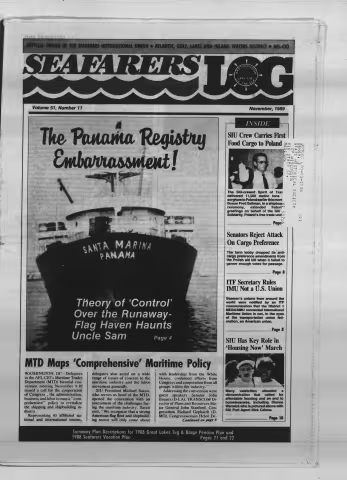
Panama Debacle Exposes
Of Iffettive U.5. ControP
With Panamanian dictator Manuel Noriega thumb
ing his nose at the United States, the ridiculousness
of the so-called U.S. effective control over American
owned foreign-flag ves
sels operating under the
Panamanian registry is a
cause of extreme embarrassment
for the United States.
Relations between Panama and
the United States could only get
worse if there was a shooting war.
Earlier this month. President Bush
announced ah
all-out effort to
support with
materials and fi
nances Norie
ga's opposition.
Meanwhile,
the United States government pol
icy labels ships that fly the Pana
manian flag owned by U.S. citi
zens as under the nation's
"effective control" ,for military
purposes.
For years, the American gov
ernment has sidestepped its re
sponsibility to maintain a strong
U.S.-flag merchant fleet by insist
ing that American-owned but for
eign-registered ships are available
LOG
Feature
U.S. policy labels
ships flying the
Panamanianflag
as ^effectively
controlled^ for
military purposes.
to the United States in times of
national emergency or war.
One of the principal havens for
these runawayrflag operators is
Panama, where the current mili
tary and political debacle, coupled
with longstanding efforts by the
U.S. government to topple Gen
eral Noriega's regime, explodes
that myth of "effective control."
On the one hand, the Depart
ment of Defense considers Pana
manian-flag vessels owned by U.S.
citizens to be part of the fleet that
would transport troops and cargo
in the event of a military mobili
zation. On the other, two U.S.
federal courts have indicted Pan
ama's ruler on drug trafficking
charges, and President Biish has
severed diplomatic relations with
the Noriega regime.
Noriega — responsible for the
brutal beatings of Panamanian op
position leaders and condemned
throughout the world for election
fraud — gleefully boasts of his
power as Panama's strong-man,
and insists he will continue to
dodge pressures from the United
States to bring him to justice on
the drug charges.
While raising the Panamanian
flag during a birthday celebration
shortly after American-courts an
nounced the drug-running indict
ments, Noriega said no Panama
nian ruler would let his country
become another star in the U.S.
flag.
"We will stay with this flag and
with this commander," concluded
the man who ultimately controls
Panamanian-flag ships.
Yet, in the event of a military
conflict, the U.S. government
maintains it could "requisition"
ships flying the Panamanian flag if
the vessels meet American own
ership requirements.
What makes the Department of
Defense believe that, in time of
an American crisis, Manuel No
riega would turn in his uniform as
a general in the Panamanian De
fense Force for a uniform as an
admiral in the U.S. Navy?
This fairy tale scenario is based
on agreements made by American
foreign-flag owners stating they
will make their ships available to
the U.S. government in the event
of a national emergency. As a
reward for this pledge, the runa
way operator is eligible to partic
ipate in a war risk insurance pro
gram offered by the Maritime
Administration.
triotism of convenience." They
may pledge their allegiance to the
American flag, but their first al
legiance is to the profits they amass
because they have reflagged their
vessels abroad.
The flag-of-convenience opera
tors have run away to overseas
registries precisely to evade U.S.
taxes, enjoy the ability of hiring
low-wage foreign nationals, avoid
Coast Guard safety regulations and
prevent exposure of their earnings
in foreign currencies.
SIU Denounces Sham
'^Patriotism of Convenience*
The long-standing so-called "ef
fective U.S. control" policy
(EUSC) has come under contin
uing attack from the SIU and other
maritime unions because of its
fraudulent nature. Arguing that
the EUSC notion is unrealistic and
a sham, the SIU has pointed out
that the national interests of a
foreign country will not always
coincide with American security
strategies.
Furthermore, the SIU has em
phasized that crews on foreign-
flag vessels have no allegiance to
the United States.
Proponents of a runaway flag
fleet — including the nation's oil
giants—^ claim that "effective U.S.
control" demonstrates their pa
triotic tendencies.
But this is little more than "pa
in the September issue of the
Seafarers LOG, SIU President
Michael Sacco blasted the govern
ment's policy of rigidly including
foreign-flag vessels in U.S. na
tional defense figures. Citing the
Panamanian crisis, Sacco noted
these inflated and fake numbers
could lull the United States into a
false sense of complacency.
Relying on any theory that No
riega would allow Panamanian-
flag vessels to take part in an
American military mobilization
makes the United States "look a
little silly," the union noted.
Although the U.S. government
persists in clinging to its hollow
theory of so-called "effective con
trol," Sacco questioned whether,
in time of national crisis, the United
States would be able to count on
an indicted drug trafficker shunned
by the international community to
come to its aid.
"What does it take to wake up
America?" asked Sacco.
American military policy main
tains a "forward strategy" of wag
ing any conflict on the enemy's
doorstep. That defense capability
requires adequate and reliable
U.S. Parent Company Foreign-Flag Merchant Ships
(Asof July 1, 1988)
Country No/Ships DWT F B&O T
Liberia 172 17,141,659 18 20 134
Panama 53 3,599,371 26 8 19
Bahamas 23 2,906,434 1 22
Honduras 3 21,335 3 ' k
F: Freighters; refrigerated and unrefrigerated break bulk vessels,
containerships, partial containerships, RO/RO barge carriers, cruise.
B&O: Bulk dry bulk or combination liquid/dry.
T: Tankers; crude petroleum, petroleum product, chemical tankers,
LNG and LPG tankers.
Source: Office of Trade Analysis and Insurance, Maritime Administration, U.S. Department
of Transportation.
There are 251 ships owned by Americans under the four registries
re(»)gnized as ^effectively controlled* by the United States.
sealift power. The delusion of "ef
fective control" creates a false
sense of security and puts the
United States at the mercy of
unreliable foes like Manuel No
riega.
America Held Hostage
The Commission on Merchant
Marine and Defense, established
by the government to determine
the ability of today's American
fleet to meet our security needs,
warned in its third report pub
lished in 1988 that the militarily
useful portion of the EUSC fleet
can be expected to decline from
the current total of 129 to only 53
ships by the year 2000.
Chaired by Admiral Jeremiah
Denton, a former Republican sen
ator from Alabama, the presti
gious commission pointed out that
the nation should not be deluded
into believing that all runaway
vessels are militarily useful.
What's more, the commission
made clear that America cannot
rely on the runaway-flag operators
for military sealift capability. In
words that cannot be misunder
stood, it declared that America
"cannot be held hostage to foreign
economic strangulation."
The report also addressed the
potential for political differences
that might arise between the United
States and the runaway-flag ha
vens, pointing out "the United
States cannot in policy or practice
depend on foreign assets, alone or
in part, for assistance in situations
where there are no commitments
from our allies."
Runaways Bring Cash to Panama
The finance minister of Panama
recently stated the income to his
nation from its flag registry was
close to $10 million in U.S. cur
rency per year.
The head of SECNAVES, the
authority that oversees Panama's
shipping registry, claimed the
country's treasury receives a di
rect annual income of $30 million
in U.S. currency. Another $50
million is received in the form of
fees paid to Panamanian agencies,
lawyers and representatives who
maintain offices for foreign-based
companies.
In other words, at a time when
the Bush administration has com
mitted itself to overthrowing the
Noriega regime, it continues to
encourage American shipowners
to fatten Panama's treasury by
operating their ships under that
nation's flag.
m
• • '-S
1
'•. I-. '
• i ." •"
-^', 'i • ;
•'^ v' ' •
NOVmBER, 1989
asnm
Pictured above is a Panamanian-flag vessel docked at a U.S. port. In
1988, the United States government counted 53 ships under Panamanian
registry that are owned hy American interests.
How EUSG Policy Got Its Start
During the war of 1812, a num
ber of American shipowners trans
ferred their vessels to Portuguese
registry to avoid capture by the
British Navy.
This strategic maneuver was a
matter of military convenience and
was employed only in wartime.
Although there were always
some American shipowners who
have resorted to foreign-flag re
gistry, the practice never amounted
to much until World War II.
The Merchant Marine Act of
1936 provided for military requi
sitioning of vessels "documented
under the laws of the United
States." This was part of a con
certed effort to help rebuild an
American maritime industry that
had been allowed to rust in layup
in the years following the First
World War,
When allied shipping faced heavy
damages inflicted by German U-
boats, and tM Neutrality Act of
1939 tied this country's hands when
it wanted to extend shipping as
sistance to th^allies, the American
government encouraged U.S.
shipowners to transfer their ves
sels to the friendly registries of
Panama and Honduras.
Flying the neutral flags of the
two Latin American countries,
these American-owned vessels
were thus able to carry supplies
to the allied forces with less risk
of being torpedoed.
Meanwhile, the Merchant Ma
rine Act's requisitioning language
was changed in 1939 so that in
stead of providing a maritime mo
bilization effort limited to vessels
"documented under the laws of
the United States," it extended
the mobilization reach to include
vessels "owned by citizens of the
United States."
As a result, when the United
States entered the war, the Amer
ican-owned vessels flagged in Pan
ama and Honduras automatically
came under control of the Amer
ican government.
registries made it attractive for the
oil monopolies, fruit companies,
other carriers and many fly-by-
night operators to actively seek
out foreign-flag accommodations.
The mass exodus from the
American flag was exacerbated by
a program called "trade-out-and-
build" enunciated by the Maritime
Administration. MarAd claimed the
transfer of war-built ships to the
Panamanian, Honduran and Li-
berian flags would promote ship
building at home.
Maritime unions attacked the
wholesale transfer to runaway re
gistries, pointing out that such
actions weakened the nation's se
curity interest. Leaving a gaping
hole in our defense capability, the
unions argued, was a gamble not
worth risking.
The oil companies and other
supporters of runaway flags pre
vailed on the Department of De-
Bargain Basement Registries
After World War II — with
hundreds of war-built ships avail
able to enter the shipping trades
— the tax-free status, cheaper la
bor and fewer regulations sdforded
by the Panamanian and Honduran
The rhad desire of
the runaway-flag
owners to save a
buck does not
square with U.S.
security interests.
fense to endorse their efforts. This
collusion resulted in the 1948 pro
mulgation of the theory of "effec
tive U.S. control." Maritime
unions and military officers were
assured by DOD and the State
Department that this mysterious
tie would inexorably bind the run
away-flag operators and their ves
sels to American interests.
The Maritime Administration,
in turn, made lucrative American
war-risk insurance avaUable to
vessels operating under the fraud
ulent "effective U.S. control"
theory. This valuable asset made
Panamanian and Honduran flags
and the Liberian registry, estab
lished in the late 1940s, an even
better deal for American shipown
ers.
Since 1948, maritime unions have
repeatedly pointed out that the
mad desire of the runaway-flag
operators to save a buck does not
square with America's national
security interests.
'Effective Contror Proves To Be
A Sham In Crisis Situations
Although American military
mobilization plans include Amer
ican-owned vessels flying the Pan
amanian, Honduran and Liberian
flags — and since the early 1980s,
the Bahamian flag — when ac
tually called to action, the notion
of "effective control" has crum
bled.
American maritime unions have
pointed out that the phony umbil
ical cord of "effective control" is
based on agreements — not trea
ties — with the governments of
Panama, Honduras, Liberia and
the Bahamas. Under international
law, the unions note, only the state
of registry has the right to requis
ition vessels flying that country's
flag.
As recently as April 1988, the
government's General Accounting
Office (GAG) issued a report stat
ing that EUSC ships "may not be
requisitionable simply on the basis
of ownership by foreign subsidi
aries of U.S. corporations..."
Many instances have brought
America face to face with the
fallacy of "effective control;"
• In 1960, the Soviet Union
dangled a few dollars under the
noses of the runaway owners for
lucrative oil transport charters. At
a time when the Soviets were
strengthening their position in
Cuba, in open disregard of U.S.
interests, American runaways car
ried millions of tons of petroleum
from the USSR to Castro's gov
ernment.
• During the war between Egypt
and Israel in 1973, the U.S. tried
to make good its pledge to aid
Israel. The United States was ready
to ship military and civilian sup
plies to its beleaguered ally. But
it found itself blocked from using
American-owned vessels flying the
Liberian flag. Why? Because the
Liberian government had hastily
passed an executive order prohib
iting the use of Liberian-flagged
vessels in U.S. efforts to support
Israel's cause.
• The Military Sealift Command
chartered some American-owned
foreign-flag vessels to transport
supplies during the Vietnam con
flict. The government agency re
ported that, in some cases, the
ships were prevented from sailing
by Crewmembers who opposed
American policies in Southeast
Asia.
World Ranking of Countries' Merchant Fleets
Based on Number of Vessels—1988
Rank Country Number DWT (000)
1. Panama 3,279 66,119
2. USSR 1,795 22,314
3. Liberia 1,550 96,406
4. Jap^n 1,437 51,253
5. ' Greece 1,270 45,910
6. China 1,211 17,992
7. Italy 516 11,354
8. Philippines 486 12,495
9. United States 456 20,727
10. Korea' 455 10,715
11. West Germany 448 4,874
12. Netherlands 437 4,217
13. Spain 418 7,871
14. Singapore 416 , F VFr-;'.:'. 11,717
15. United Kingdom 395 FF.,- - 11,759
16. Brazil 333 ••F'. F; 9,973
17. India 332 .. , V-:-- 9,985
18. Turkey 324. F. 4,967
19. Indonesia 319 1 . 2,181
20. Norway 279 '• 10,828
21. Denmark , 239 • 6,561
22. France . 227 7,942
23. Taiwan , • 194 6,791
24. Sweden • 181 2,114
26. Malaysia 167 2,266
26. Argentina ' 153 2,955
27. Senegal F •; 148 »»»«»«
28. • Egypt 135 1,330
29. Saudi Arabia 134 • 4,626
30. Honduras 119 550 F'F
31. Bulgaria 115 »*#**»
32. Mozambique 104 »»•*»»
33. Iran 101 • »»*»»•
34. Thailand 100 624
35. Finland ^ ^ ' 89 1,539
36. Canada 85 951
37. Australia 78 3,649
38. Belgium 76 3,465
39. Venezuela , i V 75 1,299
40. Mexico 72 1,854
41. Madagascar 71 »*»»**
42. Algeria 63 1,496
43. Kuwait 62 3,193
44. Portugal 58 1,668
•45. Ecuador 52 568
•45. Peru 52 889
46. Cameroon 49 •»•».»»
47. Morocco 44 / 474
•48. Bangladesh 41 /. 413
•48. Colombia 41 . • 579
•48. Iraq 41 \ 842
49. Israel 40 \ 631
•50. Chile 38 V 754
•50. Sri Lanka 38 1\. WIS
51. Pakistan 36 603
52. Dominican Republic 35
53. Nigeria 34 524
54. Zaire 31
•55. Libya 29
•55. Switzerland 29 508
'Denotes countries of equal rank.
The table was compiled by the Transportation Institute from data provided by the following. |
sources: Maritime Administration, Office of Technology Assessment, United States Trade
Representative, United Nations Conference on Trade and Development (UNCTADf,Prganlzation
for Economic Cooperation and Development (OECD) and Shipbuilders Council of America.
'•v , -.'J:-
T.f /
.\.V fV-' "S- y.
•• '4;
y'yy:
-%'r • " • • • •
'IF •
' 'i- • •.
, • •if-..y ••
\-Si",
V-, .
'fi-;.
•Hy
'Jf m
•f •
W'S-
•i'".
f^: > • <
Vi
tk.
• > J •• •
? ••••
1-
C'.
i-V..'
m"::w
te
|/'S
j-l-\;;;', - ;• •: '-
J- . -
• • i'
5? • ; '. • .;
sEAmmme
Biennial MTD Convention
Of National Shipping and
Dologatos Urge Passage
Shipbuilding Poliqr m
Continued from page I
lich Bentley (R-MD), AFL-CIO
Secretary Treasurer Thomas R.
Donahue and AFL-CIO Director
of Legislation Robert McGlotten.
Delegates attacked Eastern Air
Lines for the company's union
busting tactics that resulted in the
current nine-month long strike
being waged by MTD affiliates,
the International Association of
Machinists and the Air Line Pilots
Association, The two unions are
joined by the union representing
Eastern flight attendants, the
SIU President Michael Sacco opens
biennial MTD meeting.
Transportation Workers Union.
MTD unions pledged to stand with
their Eastern brothers and sisters
by joining picket lines, providing
material and monetary assistance.
The convention maritime policy
resolution passed with unanimous
support of the delegates. It called
for creation of a cabinet-level po
sition with oversight responsibility
for maritime affairs, endorsed a
national sealift policy, affirmed the
need to exclude maritime services
from world trade negotiations,
urged the U.S. government to take
steps to address the projected
manpower shortage in ship con
struction, repair and operation and
ptrentiZ
of a compre- P
hensive pro
gram to revi
talize the U.S.-
flag fleet.
MTD Ex
ecutive Sec
retary Treas
urer Jean In-
grao reported
that all affili- Ingrao
ates had backed the AFL-CIO's
boycotts and pledged continued
support of the United Mine Work
ers in their fight with the Pittston
Company, a conglomerate that
unilaterally cut off the health cov
erage of 1500 min^ worker reti
rees, widows and disabled minors.
The MTD delegates urged Con
gress to pass legislation that would
provide a mechanism to ensure
funding of benefits programs for
the striking mine workers.
Senator John Breaux (D-LA)
said Congress would not allow a
weakening of the nation's cargo
preference laws. Speaking of the
Senate's maritime agenda for next
year, Breaux said there was a great
deal of interest in "cash transfer,"
the term used to describe a policy
Breaux
Stanford
of having recipients of American
foreign aid buy goods manufac
tured or produced in the United
States and shipped on U.S.-flag
vessels.
Breaux noted that in his 17 years
in Congress he had never seen as
much willin^ess to
take positive ac
tion in support of
maritime. He con
gratulated the MTD
for its work de
fending shipping
and shipbuilding
workers and
pledged, 'Twill not
do anything with
out sitting down
with you and mak
ing sure you are
part of the program
to put maritime back in the fore
front."
Speaking on behalf of TRAN-
SCOM, the joint defense agency
that coordinates air, sea, rail and
highway transportation for the
military. Ma
jor General
John Stanford
said the na
tion's forward
defense strat
egy demands a
viable, healthy
U.S.-flag fleet.
"A forward
defense strat
egy means we
can defend this
country on any
beachhead in
the world," said Stanford. "We
need the capability to deploy rap
idly, to move troops and to sustain
them. . . 95 percent of what we
carry to war would be carried on
U.S.-flag carriers."
Stanford said TRANSCOM is
"absolutely concerned" that no
new commercial ships are being
built in the U.S. and that trained
seafarers are in decreasing supply.
In concluding, he told the dele
gates, "TRANSCOM is your ad
vocate. Use us as your advocate."
Congressman Richard Gephardt
(D-MO), who serves in the lead
ership of the House of Represen
tatives, spoke of the trade imbal
ance and national
deficit confronting
the United States.
He recalled a meet
ing with Japanese
businessmen who
told him the United
States should de
nominate dollars to
yen. "I am re
minded," he said,
"of the old adage—
creditors make de
mands, debtors ac
cept and follow de
mands. Debtors are weak."
Gephardt said it was time for
Congress and the administration
to institute fair trade, so an Amer
ican businessman had just as fair
a shake in Japan as a Japanese
businessman has in the United
States.
Gephardt
Delegates to the biennial MTD convention are pictured above in the
meeting's opening session.
Congresswoman
Helen Delich Ben
tley (R-MD) told
the delegates
bluntly, "If we
should have to de
fend freedom, we
cannot do it with
fast food hamburg
ers and french fries
out of the service
economy." It will
take a strong merchant marine,
she said. She charged that bu
reaucrats were giving America
away to foreigners, to the detri
ment of the United States. "We
need a revolution of spirit, a spirit
that savs America is number one
Bentley
in the world's merchant fleets and
the number one industrial nation. "
AFL-CIO Secretary Treasurer
Thomas R. Donahue called for a
national "maritime
policy that assures
a fair share of both
government and
commercial car
goes" are allocated
to U.S.-flag car
riers. Robert
McGlotten, the
AFL-CIO's legis
lative director said
"Politics is the
name of the game," and called on
delegates to get involved in fed-
Continued on page 25
Donahue
AFL-CIO Delegafes Honor Lech Walesa
WASHINGTON, DC—The 1989
Biennial convention of the AFL-
CIO was marked by the presence
of Lech Walesa, the shipyard elec
trician who heads Solidarity, Po
land's free trade union movement,
and the reaffiliation of the United
Mine Workers Union to the "house
of labor."
"A vast movement for democ
racy and freedom is developing in
my country," said Walesa. "It is
changing the political face of Po
land and of the world. And that
movement has been made possible
only through the peaceful struggle
of working people, of trade union
ists like you and I," Walesa told
the hundreds of delegates attend
ing the AFL-CIO's 18th Consti
tutional Convention during his
November 14 speech.
The reaffiliation of the United
Mine Workers signals a strength
ened solidarity among U.S. unions.
AFL-CIO President Lane Kirk-
land welcomed the Mine Workers
and five other unions that have
affiliated with the AFL-CIO in the
last ten years. "Today, we can
proudly say that this movement is
more united in solidarity and is
more broadly representative of the
whole family of labor than it has
been for at least half a century,"
Kirkland said.
In other convention action, del
egates mapped out organizing
strategies, legislative initiatives,
programs to increase membership
services and unanimously re
elected AFL-CIO President Kirk
land and Secretary-Treasurer
Thomas R. Donahue to another
two year term.
Solidarity leader Lech Walesa (middle) is pictured above with SIU
President Michael Sacco and his wife Sophie at the AFL-CIO convention.
Ikk kv
. >' .'
'" S'
NOWMBER, 1989
ADMINISTRATION UNVEILS
NATIONAL SEALIFT POLICY
The administration unveiled its
long-awaited policy statement on
sealift last month to generally un
favorable reviews. It's not what
the administration said, it's what
it failed to say.
"The administration's policy
looks good on paper, but in prac
tice, it is hollow because it offers
no new approaches," sa;id Con-
gressWoman Helen Bentley (R-
MD).
The policy statement, said James
Henry, president of the Transpor
tation Institute, an association of
140 U.S.-flag operators, is "a pale
reflection of previous drafts" that
"adds little more than platitudes
to the body of maritime statutes
already in effect.
"It is unfortunate that an initi
ative that is the culmination of
much concerted effort on the part
of the industry and defense plan
ners reflects so little of the input
ofeither."
In contrast to its predecessor,
the Bush administration said the
American-flag merchant marine
would be the first source of sealift,
and it de-emphasized the role Of
the reserve fleet. But these wel
come changes were all but ob
scured by the administration's
failure to back up its words with
any concrete commitments.
In issuing the statement, the
administration stressed that while
it supported a strong American-
flag merchant marine, it is opposed
to legislation introduced in Con
gress earlier this year incorporat
ing recommendations made by the
President's Commission on Mer
chant Marine and Defense.
Furthermore, the administra
tion's sealift policy paper re
mained deliberately vague on new
monies for the maritime industry.
Representative Bentley also
blasted the notion that foreign-flag
vessels would be available to the
United States in a time of war.
"The sealift policy is flawed be
cause it makes the unfortunate
assumption that U.S.-owned, but
foreign-flagged vessels, coupled
with allied shipping resources will
be readily available to the U.S. in
the event of a war or national
emergency.
"There is a continuing belief,
despite past actions to the con
trary, that our allied and foreign
mariners are willing to participate
in our problems," Bentley said.
After a short introduction reaf
firming the importance of sea
lift to the nation's defense strate
gies, the policy statement made
the following six points:
• The U.S.-flag merchant ma
rine, to the extent that is possible,
will be relied upon to provide
sealift in peace, crisis and war. In
peacetime, the Department of De
fense will operate the minimum
number of sealift ships, including
reserve ships, to meet the Joint
Chiefs of Staff s exercise require
ments which cannot be accom
modated by U.S.-flag vessels.
• The U.S. might be forced to
act unilaterally to protect its in
terests, and when it does, suffi
cient American sealift sources must
be available.
• In addition to the U.S.-flag
merchant marine, the U.S. wijl
continue to rely on the so-called
effective U.S. control vessels.
• The Department of Defense
will determine sealift require
ments and coordinate its efforts
with the Department of Transpor
tation.
• The Departments of State and
Transportation, the Special Trade
Representative and other appro
priate agencies shall ensure that
international agreements and fed
eral policies protect our national
security interests and do not put
the U.S. industry at a disadvan
tage.
• The development and imple
mentation of specific sealift and
supporting programs will be made
with full consideration of the costs
and benefits involved. New pro
grams to enhance our ability to
meet national security require
ments shall compete for resources
with other national security pro
grams.
Great Lakes Members Approve New Contract
SIU members sailing aboard tbe four vessels in tbe Inland Lakes
Management fleet approved a new four-and-a-balf year contract last
month. Pictured above with SIU Bosun Jim Sbupert (center) are tbe
union's Great Lakes Vice President Byron Kelley (right) and Algonac
Port Representative Andy Goulet. Behind them is tbe vessel E.M. Ford.
Ships like tbe Tropicana, pictured above, were cited by the National
Transportation Safety Board for widespread safety violations in a study
released last month. Tbe Tropicana was singled out for refusing to install
smoke detectors and was listed among several hazardous foreign-flag
cruise ships.
Study Blasts Safety Record
Of Foreign-Flag Cruise Ships
NTSB Urges Greater Government Control
The government's safety watch
dog agency, in a report to Con
gress released last month, charged
that many foreign-flag cruise ships
operating from U.S. ports and car
rying American passengers are
floating safety hazards that could
lead to a major sea disaster. The
National Transportation Safety
Board (NTSB) study recom
mended greater and more strin
gent regulation of the foreign-flag
passenger ship industry.
Among the safety threats cited
by the government agency found
on foreign-flag cruise ships, par
ticularly the day trip vessels dock
ing in Florida, were the inadequate
training of crewmembers, the in
ability of the crew to communicate
in a common language with each
other or the passengers, employ
ees that didn't know how to fight
fires and poor safety procedures.
NTSB investigators said many
cruise ships registered in Liberia,
Panama and the Bahamas were
particularly hazardous. Vessels
singled out in the report were the
Tropicana that sails from Port Ev
erglades, Viking Princess from the
port of Palm Beach, Discovery I
from Miami and the entire Sea-
Escape fleet.
'Life Rafts, That Won't Float'
Among the unsafe conditions
found by agency investigators were
rotted fire hoses, broken sprinkler
systems, life rafts that wouldn't
float and fire doors that wouldn't
close.
The agency criticized Carnival
Cruise Lines for refusing to co
operate with a government inves
tigation of an accident involving
the company's ship Celebration
and a Cuban freighter last Feb
ruary. The incident, which hap
pened in international waters, left
three Cuban seamen dead. The
NTSB recommended the Coast
Guard be extended authority to
investigate international water ac
cidents involving foreign-flag cruise
ships based in the U.S. and pa
tronized by Americans.
Noting that American lives are
The study found
crewmembers
unable to
communicate in a
common language.
at risk, the NTSB urged greater
governmental control over for
eign-flag cruise ships. Investiga
tors recalled instances where the
cruise ship companies had refused
to follow NTSB or Coast Guard
recommendations. The Tropi
cana's owners, for example, had
resisted placing smoke detectors
on the vessel, despite Coast Guard
complaints.
While American mariners are
subject to alcohol and drug tests,
foreign seamen working on for
eign-flag vessels sailing in Amer
ican waters and carrying U.S. cit
izens are not. The agency called
for legislation granting Coast Guard
authority to test employees aboard
foreign-flag vessels operating reg
ularly from U.S. ports.
Other recommendations in the
report were mandatory central
ized automatic fire controls, ven
tilation systems that shut down in
the event of a fire, fire doors
equipped with release mecha
nisms, automatic sprinklers and
regularly conducted emergency
drills.
The agency suggested that crew
language barriers be eliminated by
having at least 75 percent of the
crew able to communicate in Eng
lish. The NTSB also urged better
and ongoing crew training, fire
fighting classes, onboard manuals
available to all crewmembers on
their ship's operation and better
dissemination of shipboard emer
gency procedures.
The NTSB's report is now be
fore Congress. Consideration of
the findings will begin in next year's
legislative session.
'• : •> ... • ,
A'
; -- -Jk kv"
4
.f;
:• 'ti-
•' . - .K -
• ''K •
''ki'
A"-; k-
V'
• t '
• '?••••'
" f
, .•).
• -ri'
k
• • " ' ••• 'hv •
• '-v. • r.-. T" ,,
.••'-"li-'r/.a,'
Of ).;
I > '
l!K^
.• '•»' '-•''
V' ••yO:.' -0"-
hO.' o
00
1 .n .. '.•• •.
X-'
w • ' ••
I i\.- -^. • • •' r •
tf'. '
SaFARCRS m
;•»• .
r' •-'*• .
irii.
' i
0
I-:
-f:-.
iS' • ^' •
I:
Mr.
i:. (;• ,
i(: ; "
r ••
r-~
/7f General Serretary Upholds IH/IU Suspension
S'l'- ""r ' I
,i 1 •
't'f
t: T^. • • •
a- I •
i. •.'.
The head of the International
Transport Workers Federation
(ITF) has ruled that the Cayman
Islands-based International Mari
time Union (IMU), a group with
connections to District 1 MEBA/
NMU, can no longer claim to be
an American organization for pur
poses of the ITF's flag-of-conven-
ience (FOG) organizing campaign.
The decision was made public in
an October 16 communication from
Harold Lewis, the ITF's general
secretary, to representatives of
seamen's unions from around the
world.
American unions, under ITF
policy, have thd first shot at or
ganizing seamen working on for
eign-flag vessels that are owned
by U.S. citizens. The ITF, an
international federation of trans
portation unions, allows a bona
fide national seamen's group first
jurisdictional rights to flag-of-con-
venience vessels owned by indi
viduals of the same nationdity.
Once a ship is organized by the
national union, the contract is sub
mitted to the ITF's Fair Practices
Subcommittee to determine if it
meets ITF standards. Upon ap
proval of the collective bargaining
agreement, the ITF issues the sig
natory company a so-called Blue
Certificate that signals to the
world's maritime community the
vessel is operated with a union
contract.
Coast Guard Proposes New
Tankerman and Z-Card Rules
manship, reported his group is
prepared to change course mate
rial to accommodate the new reg
ulations. If the proposed tanker-
men rules go into effect, new
classes covering Coast Guard en
dorsements for dangerous liquids
and liquified gases will be added
to the curriculum, he said.
"After speaking with Christo
pher Heizer at Coast Guard head
quarters, it appears our currently
approved tankerman course will
suffice for our pumpmen and tank-
ermen engaged with dangerous
cargoes," Eglinton said. "How
ever, our LNG tdnker personnel
may need a different course."
If the new endorsements are
adopted, the Coast Guard said
Lundeberg School class certifi
cates will be accepted as a sub
stitute for their tests. Both Tellez
and Eglinton view this as a posi
tive step because Lundeberg
School courses can emphasize
hands-on training.
The U.S. Coast Guard is pro
posing changes in the issuance of
merchant mariner documents and
the status of pumpmen and tank-
ermen in an effort to prevent oil
spills like those that wrecked
America's coasts this spring.
The regulations were presented
to the public in the Federal Reg
ister last month and the Coast
Guard is soliciting commentary.
Spokesmen for the agency said
the government would like to see
the new regulations in place by
early next year. Currently, the
Coast Guard is holding hearings
around the country to encourage
suggestions on the possible
changes.
The agency has proposed the
issuing of new Coast Guard doc
uments every five years. In the
event such a proposal is enacted,
the Coast Guard proposes that
individuals already in possession
of a Z-card be allowed to keep
their documents for up to five
years after the law is adopted.
The changes regarding tankers
and barges would eliminate the
pumpman and tankerman en
dorsements as they now are writ
ten. In their place, the Coast Guard
is proposing endorsements in the
following categories: Tankerman-
PIC (person-in-charge) for tank
ers, Tankerman-PIC for barges,
Tankerman-Assistant and Tank-
erman-Engineer.
According to SIU Assistant Vice
President Augie Tellez, who has
been monitoring the Coast Guard's
proposals, the suggested changes
should not result in lower manning
scales. He said there is a possi
bility that personnel could be in
creased.
The proposals, as presented, re
quire tankers of more than 5000
gross tons to carry a minimum of
two tankerman-PIC's, three tank-
erman-assistants and two tanker-
man-engineers. On tankers of less
than 5000 gross tons, the proposals
call for at least two tankerman-
PIC's and two tankerman-engi-
neers unless only one engineer is
required.
Bill Eglinton, director of voca
tional education at the Seafarers
Harry Lundeberg School of Sea^
Questions about the IMU's le
gitimacy were raised by District 2
MEBA and the SIU at a May
meeting of the ITF's Fair Practices
Committee, a forum that brings
together the world's free seamen's
unions. The two U.S. unions asked
how a Cayman Islands-based group
could represent itself to foreign
seamen's unions and to owners of
foreign-flag vessels as being
"American."
At the May meeting, the ITF
suspended the issuance of Blue
Certificates to companies that had
signed collective bargaining agree
ments with the IMU until an in
vestigation had been completed to
determine the nationality of the
organization.
In his October 16 communica
tion, Lewis said prior to the March
1988 merger between District 1
MEBA and the National Maritime
Union, the IMU was considered
by both the ITF and the NMU to
be an affiliate of the NMU. In
September, Lewis was informed
by the president of District 1
MEBA/NMU that the "IMU did
not become an affiliate of MEBA
by virtue of the District No. 1 and
National Maritime Union merger,
nor has the IMU since attained
the status of an MEBA affiliate."
"In light of this information,"
said Lewis, "there are no longer
any grounds, by any test, for re
garding the IMU as effectively
American. ... My conclusion,
then, has to be that the IMU is no
longer qualified to negotiate or
conclude collective agreements for
U.S.-owned FOC ships within the
terms of ITF policy and practices
and has not been so since the
NMU's merger with MEBA Dis
trict 1."
Lewis also informed the ITF's
member unions that the "practical
consequences" of the decision
would be considered in further
' communications.
Senate Leader Backs Down
On Cargo Preference Fight
U.S.-flag shipping requirements on
food cargoes going to Poland.
Last month, the House of Rep
resentatives defeated a similar
proposal in October by a vote of
228-170 after a dramatic floor de
bate.
^Let me be candid
... I do not have
the votes. ̂
— Senator Dole
Speaking at a convention of the
Maritime Trades Department of
the AFL-CIO this month. Sen.
John Breaux (D-LA) questioned
the real motives of the amend
ment's backers. If they were really
concerned about cutting costs, he
said, then "why not just buy the
grain from Argentina or Brazil?
I'm sure Senator Dole wouldn't
support that."
Senators who proposed that food
cargoes to Poland be exempted
from the nation's cargo preference
laws threw in the towel on No
vember 14 and withdrew their
amendments.
"Let me be candid, I have de
cided not to offer these amend
ments because I do not have the
votes," said Senate Minority
Leader Robert Dole, a leading
proponent of farm interests that
have long sought to ship American
food aid on foreign-flag vessels.
As a result, both the House and
Senate versions of the Polish aid
bill are free of any changes in
existing cargo preference laws that
require 75 percent of American
food giveaways to be carried on
U.S.-flag ships.
For the past several months,
long-time cargo preference oppo
nents have tried to capitalize on
the emotional events in Eastern
Europe by seeking a waiver of
Mel Pelfrey
Mel Pelfrey
Of D2 MEBA
Dies at 59
Melvin H. Pelfrey, Great Lakes
vice president of the District 2
Marine Engineers Beneficial As
sociation-American Maritime Of
ficers, died of a heart attack while
on vacation in Colorado on Oc
tober 17.
Known to many as a champion
of U.S. Great Lakes mariners for
more than 30 years, Pelfrey, 59,
chaired the Great Lakes Task
Force, a government/labor/indus
try coalition that promoted legis
lative programs to promote mari
time growth in the eight-state
region.
He was also president of the
AFL-CIO Maritime Trades De
partment Toledo Port Council, vice
president of National MEBA,
trustee of the District 2 MEBA-
AMO Pension, Medical, Vacation
and Safety and Education Plans.
Pelfrey was the son of a steel-
worker. He left home shortly after
high school to work in the "Pitts
burgh Fleet" of the Great Lakes
iron ore carriers owned and op
erated by the former U.S. Steel
Corporation. He obtained his first
licensed position in 1954.
In 1956, the Ohio native helped
organize and lead a successful
three-week strike for union rec
ognition. The action resulted in a
three-year contract that included
many significant improvements:
overtime for work in excess of 40
hours a week—rather than the
industry standard of 56 hours be
fore overtime, paid holidays and
vacations and seniority in hiring.
By 1957, Pelfrey had been elected
vice president of what was to be
come District 2 MEBA. In 1978,
he was named to his first term as
Great Lakes executive vice pres
ident of the union.
Pelfrey and District 2 MEBA
President Raymond McKay estab
lished the world's first fully inte
grated bridge-engine room-radar/
ARPA ship simulator training pro
gram at the union's Toledo facility
in 1980.
The daily newspaper of Toledo,
OH, the Toledo Blade, eulogized
Pelfrey in an editorial. Pelfrey,
said the newspaper, raised Tole
do's status as a first class port and
stabilized labor relations in the
city "without sacrificing an iota
of commitment to trade unionism.
Toledo is known first and foremost
as a labor town, and no one carried
labor's flag more proudly, or with
greater integrity, than Melvin Pel
frey."
:,:W
NOW/HSfff, 1989 '7*^ •-T •s'^ ••••-- -•'- •••• -••• • • • - - - .- Vl'-W"^ •/
SIU Gov't Services DIvlsioh Lends
Hand in Earthquake Clean-up
SIU members who work for ^he
Military Sealift Command helped
to clean the MSCPAC headquar
ters last month after the Oakland
(CA) building was rocked by the
largest earthquake to hit the region
since 1906.
The five-story facility suffered
minor structural damage to some
walls, windows and steps. File
cabinets and picture frames crashed
to the floor during the 17 seconds
of rumbling. The building was
closed for 14 hours after the quake
to make sure there was no more
damage.
Most employees were given two
days of administrative leave as
water was not available for 40
hours after the disaster.
SIU members, who sail in un
licensed positions on MSCPAC
vessels, came to the command's
building in Oakland to lend a hand.
Some were there at the time of
the earthquake because they had
been awaiting their next ship as
signment.
Navy ships, helicopters and
Seabees provided emergency
services and assisted in the recov
ery efforts following the earth
quake. The USNS Mercy housed
a large number of Seabees who
worked to restore vital services to
Naval Supply Center Oakland and
other military installations. The
hospital ship also stood by with
emergency medical facilities that
included extensive blood bank
services.
MSCPAC unlicensed mariners, awaiting reassignment in Oakland last
month when the Northern California earthquake struck, help clean the
command headquarters. Unlicensed mariners working for MSCPAC are
members of the SIU.
SIU Member Is NATO Srhelar
A 14-year veteran of the SIU
has been awarded a North Atlantic
Treaty Organization (NATO) en
dowment to study the effects of
petroleum pollution on the oceans.
As part of his scholarship studies,
35-year old James Gravelek par
ticipated in the SlU's new oil spill
prevention and emergency con
tainment and clean up course at
the Lundeberg School of Seaman
ship.
Currently enrolled at Cleveland
State University in Ohio and
working towards a masters in ur
ban studies, Gravelek has nar
rowed the focus of his studies to
environmental risks posed by ma
rine transport of hazardous chem
icals.
To this end, he obtained the
NATO fellowship to inventory
maritime accidents involving li
quified gases, other bulk chemi
cals and chemicals transported in
package form in U.S. waters since
1983 and to list counter measures
such cargo transfer, recovery
at sea and chemical treatment used
in these events.
Deck-department member
Gravelek is excited about his stud
ies and the NATO scholarship.
"It is quite an honor," Gravelek
said. "It also is quite a challenge
and I look forward to it."
Since attending the Seafarers
Harry Lundeberg School of Sea
manship as a trainee, Gravelek
has continued to pursue a mari
time education. Gravelek applies
for any scholarship or grant avail
able in his field of studies. That is
how he came across the NATO
grant.
The Cleveland, OH native had
dropped out of junior college when
he enrolled in the Lundeberg
School's trainee Class 187 in 1975.
He had worked on several vessels,
including the Delta Queen, before
being accepted to study at Piney
Point.
"1 wanted to learn as much as
1 could, as quickly as I could,"
he recalled. Instructors' notes from
his days as a trainee included re
marks like "ambitious" and "hard
working." Upon graduation as a
trainee, Gravelek said, "If it were
not for the SIU, I would be alone
on the wet lonely streets."
Within two years, Gravelek up
graded with AB and FOWT en
dorsements and had obtained his
union "A" book. During this time
he continued to pursue a college
education. He used the training he
had received at Pjney Point, in
cluding celestial navigation in 1981,
and the school's correspondence
program, to obtain one of the first
Associate in Arts in nautical sci
ence degrees from Charles County
Community College in Maryland.
In 1982, Gravelek applied for
and won a two-year Seafarers
Scholarship. He used the funds to
get a Bachelor of Arts in urban
studies from Cleveland State Uni
versity in 1984.
All during this time he was sail
ing and upgrading: LNG in 1979,
Quartermaster in 1984, and Master
Mate - Freight Towing and Sealift
Maintenance and Operations in
1985. He also became a member
of District 2 MEBA.
In the fall of 1986, Gravelek
attended Plymouth Polytechnic, a
higher education institution in En
gland. Through the school's De
partment of Shipping and Trans
port courses, he learned more about
port management, towage, sal
vage and offshore operations.
Gravelek expects to graduate
from his current masters program
at Cleveland State by spring 1990.
He has applied to work On his
Ph.D. at the National University
of Singapore.
Gravelek believes he owes the
SIU for all the opportunities the
union has provided him. He hopes
to repay the union through the
research he has conducted and his
recommendations for maritime
disaster prevention.
USNS Diehl Qm Gives Tom of Ship
James Gravelek adds to his research on the effects of pollution to the
maritime environment in a recent Oil Spill Prevention and Emergency
Containment and Clean-up course at Piney Point.
Residents of the village of Whit-
tier, AK got a good view of their
first Military Sealift Command oiler
thanks to four members of the
SIU.
Bosun/Mate Arthur Luellen,
AB's John Fahey and Michael
Hayes and OS Kevin Stewart as
sisted in giving tours aboard the
USNS Walter S. Diehl to WhitT
tier's grade-school students, local
officials and most of the town's
300 residents.
The Diehl spent six days in
Whittier to take on fuel while par
ticipating in the exercise PACEX
89. The crew of the 180,000-barrel
ship showed their appreciation for
the village's hospitality by hosting
a chili cookout the final night the
vessel was in town.
Whittier is located at the west
ern end of Prince William Sound
between two glaciers. The only
access to the village is by sea
plane, ship or train through a nine-
mile tunnel. The port is ice-free
year round.
Much of the talk with the; cr^w
concerned the Exxon Valdez oil
spill. Although Whittier was not
directly affected by the March
disaster, the residents talked can
didly about the accident as the
community's primary industries are
fishing and tourism.
The only trouble that occurred
during the stay was when a black
bear wandered through Whittier
one evening blocking the path of
a crewmember trying to visit town.
The crewmember waited for the
bear to move before he continued
on his journey.
BALL
Chief Mate Bob Wiley (left) and SIU crewmembers gave tours to Whittier
area residents of the USNS Diehl while the ship was docked at the
western end of the Prince William Sound.
;7V-g-
&
-if*!
'i
1^7
m
'J '
''M-
•;" M-
S- /f; ••• •••
W-:M
tSj;
ife -'«!; • ••-
• i •-: . v.', < •:- •^•.; ,
• I-,.. . •:' '
MiSM
" ,
•i:i' 'B
:ii
•l-v
'fl-
Pr
W ' '
ft.-
• V
m§§im.
i%.. ;r;ft-ft.;:..
'r .'•••v:;
|;f "'T
:|,P,:;V
1i" :' •-
SaFMEKSm
More than 150,000 people attended the Housing Now demonstration in Washington, DC l^t month
(photo left). Above, pictured in front of the Capitol building are SIU members (front r^, left to right)
Richard McTernan, Kenneth Spruill Jr., Sidney Stratos II, Jeffrey Peterson, Thomas Cyrus, Anthony
Tine, Rodney Norris, Nicholas Marcantonio, (back row, left to right) Michael DiAngelo, W. Moody,
Wendell Price Jr., Mark Moran, Brien Collins, Marvyn Chester and Mark Drinkard.
While 150,000 people marched
in Washington, DC demanding an
end to homelessness and creation
of affordable housing, SIU mem
bers assisted rally organizers by
working with the many famous
actors and musicians that joined
the October 7 demonstration. When
asked how he felt to be part of the
event, SIU member Keith Hall
said, "I'm proud because it's for
a real good cause."
The rally, organized by a broad
coalition of more than 200 orga
nizations, including the AFL-CIO,
brought together individuals from
all walks of life.
Jack Joyce, president of the In
ternational Union of Bricklayers
and Allied Craftsmen, an AFL-
CIO affiliate, speaking to the crowd
of thousands, said decent housing
has become unaffordable "for
working people and the working
poor. America is in danger of not
being America anymore." Joyce
heads the AFL-CIO housing com
mittee and acted as the federation
of international and national union's
liaison to the Housing Now march.
Thousands of trade unionists,
wearing caps, jackets and carrying
banners with their union's insig
nia, participated in the demon
stration. SIU member Bob Morard
said, "It's pretty good being here.
I was at the rally last month for
the Eastern strikers. The SIU
turned out there too."
SIU members not only attended
the rally, but played a key role
serving as marshals. Dominic Ray,
an SIU member, said, "It's a real
opportunity to be here today. You
don't get many chances to help
people out, especially when they
really need it."
SIU member Michael Sardpnne
told the LOG he was glad to play
a role in the rally. "I'll be shipping
out in a couple days, my first ship.
This is just icing on the cake," he
said.
Top photo, Katy Sagal, who plays "Peggy Bundy" on the TV show
"Married with Children," autographs upgrader Brent Lainnier's SIU
hat. Directly above, Thomas Guffey is pictured with actress Heather
Locklear.
Lou Gossett Jr. (center) is flanked by SIU members Dave Coleman (left),
Jerry Woods, Charles SpradUn and Brien Collins.
Above, Stoney Jackson with Lundeberg School safety department rep-
resentative Joan Westmoreland. SIU members Sean McCh^ky (left) aitd
C. Perez are pictured in front of the rally's stage area.
:',?,;iva'
• :<."-L:A\- •
/,.' 'b--
,'W r^.s'' ^ .••
^V.-Aniv,
!S5W< r;;y> •'n,., -^-;
7989
•1 . »e* OA» „ »/
•».-r ; %n-',,>.is Jiy-rt'U A.4J- •.. . .- -•<;-•••• n
Twelve Bosuns Complete Intensive Recertification Course
Twelve SIU men obtained
recertified bosun status upon
graduating earlier this month
from an intensive six week
course at the union's Harry
Lundeberg School of Sea
manship.
Bosun John Noble de
scribed the course: "The
hands-on training has up
graded our skills in oil spill
prevention or containment,
first aid, CPR, fire fighting,
crane and fork truck opera
tions. Classroom work hais
increased our knowledge in
damage control, underway
replenishment and helo (hel
icopter) operations."
When asked what course
he found the most helpful.
Bosun Raul Iglesias an
swered, "I don't really know
which was the best because
all were very interesting. I
liked the classes so much, I
wanted more time for each
one, especially the crane op
erations," he said.
"Also, first aid, CPR and
fire fighting courses were very helpful because
at sea we never know when we will be in a
situation that will demand our skills and ad
vanced training," said Iglesias.
During the graduation ceremony, which took
place as part of the union's Piney Point mem
bership meeting, Peter Glennon tanked those
on the school's staff for all their help. Michael
Johnson said he had sailed for 23 years of sailing
with the SIU before coming to the Lundeberg
School, but he was ready to come back.
Timothy Koebel said he was impressed with
the efforts of the union on behalf of the mem
bership and he thanked the school's teachers
Graduating on November 6 from the union's bosun recertification class are: (third row, left
to right) Jessie Thomas, Calvin M. Miles Sr., Peter M. Glennon, Garry D. Walker, Robert
Studverud (second row, left to right) Michael Johnson, Tim Koebel, Anthony Zizzo, (front
row, left to right) Marc Galliano, John Rountree, John Noble and Raul R. Iglesias Sr.
for the enthusiastic manner in which they shared
their knowledge. "The staff should be thanked
for putting up with us," quipped John Rountree
who also mentioned the high quality of the
school's facilities.
Looking directly at the trainees attending the
membership meeting, graduating bosun Robert
Studverud said, "For all you trainees, this is
where it's at. If you want to be a captain . .
whatever you want to be, you can get there
through this union and this school."
John Noble also had a brief statement for the
trainees: "Seafaring is a rewarding profession.
So study, ship out and upgrade. Earn your
seniority with the SIU. Take
advantage of Piney Point fa
cilities. And learn to work as
a team — the SIU, seamen
and industry. American sea
men are the best. Welcome
aboard."
Jessie Thomas said he
would do his part to spread
the word about the union's
training schedule. "I'll tell
my fellow crewmembers to
get back here and do their
part to upgrade."
Garry Walker summarized
for all the bosuns. "This is
an opportunity for me to
thank everyone — those of
you at the school, the union
officials, the members . . ."
Tony Zizzo emphasized the
importance of getting to know
each other— members, staff,
officials — and working to
gether. "Maybe we'll get a
baseball team out of the
deal," he said. In response,
the audience clapped with
approval.
After the graduation cer-
the instructors gave their emony, some of
thoughts on the group of twelve. Oil spill pre
vention and emergency clean up instructor Jim
Shaffer said, "They were extremely._attentive
and seemed to take a great interest in the anti
pollution nature of the course." Harry Alongi,
one of the sealift course instructors added,
"They were extremely receptive and well de
serving of their recertification."
The union's bosun recertification program
began in 1972. To date the union's school has
graduated 718 bosuns from the program that is
designed to increase familiarity with shipboard
technology.
What the Bosuns Are Saying
Mark Galliano John Rountree
"I'm glad to have had the chance
to be in the bosun recertification
program. I've learned some thjngs
that w'll help me perform my job
better. I would encourage anyone
who has a chance to upgrade to
come to the school and do so. If
they want to learn, they can learn
here."
"When you think you know
everything, it's time to go back to
Piney Point. They'll prove you
don't."
Robert Studverud
Raul Iglesias
"The union has advanced tremen
dously since I joined in 1947. For
example, in those days, we relied
on self-study for upgrading. We
didn't have a school at that time.
Being my first time at Piney Point,
I was surprised to see how well
things are going here with all the
training and different courses we
have here."
"This school makes it possible to
go as far as you want in the mar
itime industry. I personally don't
know any other union that has this
much to offer its members. If you
have the desire and persistence
it's all right here for you to take."
Garry Walker
John Noble
"I would like to' thank the union
for this opportunity (to upgrade),
but most of all I want to thank the
old timers who took the time and
patience to teach me all I needed
to know to do the job."
"The bosun recertification pro
gram gives us the opportunity to
meet and compare information with
seamen of equal interest and to
work together as a team on new
maritime concepts that will be
beneficial to the industry, brother
seamen and the union."
Anthony L. Zizzo
"We are lucky to have a union
that thinks enough of its members
to build a place like this, for our
benefit. It's up to you (the mem
ber) to use it."
The bosuns' course schedule included classroom learning and hands-on
training. In the top photo, bosuns study communication skills with
instructor Sandy White (left). Below, the group prepares for an oil spill
simulatimi exercise.
_ ... •.•'-'i'-: '•
riL-QS#
' ' " «C>- ',
.J:;
:
•.r' .-r ' v"'
• '• - ^ '
, ••/A
• '-TJ.
'•A
V"--
mf'p'
:Sf?-
'•! . •
n~ i-i- iih
• -- J 'iv:'
' 'r.V i/'-.
|2 Vp'ltSSsf ^ :
:;:;iSSg|^gp;.g:si0
:^r..
SlAfUim £06
I
If.
•ft
:.')fC y\-.
: rv.':•• / :•
^ r: •>>,•-"
• >•?:
v'
|V &'•
It
a
^7.:V* • • •-
.4 t
•f J,; ",> '-r
•A
Inquiring Seafarer
Question: What was your, first
trip like?
(Asked of SIU members at the
union hall in Philadelphia.)
Jim Sanders,
Bosun—My first
ship was the
Overseas Joyce
in 1968. It was
going back and
forth in the
Mediterranean.
I'd been in the Navy before that
for 12 years so it wasn't any
thing new to me. It's just that
I'd wised up. There is more
money sailing on merchant ships
than there is in the Navy.
Charles Collins,
Wiper—I started
sailing in De
cember of 1960
out of Philadel
phia. Then there
was this school
program in New
York, that's what got me
started. My first ship was Cap
tain English's ship, a T-2 tanker.
I was on the ship from Staten
Island, NY to Galveston, TX to
a shipyard for repairs, which I
didn't understand at the time. I
came back to New York and the
school. Then within three days,
the union flew me out to a
tanker and I made the rounds,
almost around the world.
Joseph Mosa-
kowski, AB—I
think it was
1951, it could
have been 1952.
I can't remem
ber exactly but
it was in May
on a tanker. All I can remember
is getting sick and throwing up. I
said if the ship ever got back in I
was going to quit, but I didn't. I
went out on another trip and
wound up staying for 33 years.
The only thing that happened on
the first trip was that I never felt
like that in my life. Seasickness
is really bad. You feel like
you're dying. I can't remember
the name of the ship, but I'll re
member it when I get home.
Joseph Power,
Captain—^I came
into the union in
1957 and
worked as a
deckhand up
until 1972. Then
I got my mate's
license through the union's
school and later my captaim^ilot
license the same way. The first
year I worked mostly in the har
bor, but the second or third year
I took a trip down to James
River, Morehead City to bring
back a dead Liberty ship. We
had a hell of a storm with winds
80-85 miles an hour off of Cape
Hatteras. We lost the ship, then
we lost radio contact and radar
on one of our tugboats. We
drifted out there for about 12 to
13 hours. The captain decided to
go back to Morehead City to tell
the Coast Guard we had lost the
Liberty ship. Another tug went
later and brought the ship in.
Rowland (Snake)
WilUams, Shop
Steward—In
1944, when I
was 16,1 went
to the Maritime
School at
Sheep's Head
Bay. I spent three months there
and then in December of '44
they shipped me out of the mari
time school to the SIU hall
which was then at 51 Stanton
Street, I believe. I went down
there at 8:00 at night and they
gave me a firemen's job on the
Richard Bassett, a Liberty ship.
I went aboard at midnight and at
4:00 a.m. we sailed out of the
New York harbor to finish load
ing in Philadelphia. From there
we proceeded to Rotterdam and
they were still shooting the buzz
bombs over that area.
Billy McCorkie,
Trailer Inspec
tor—I came
around in 1975
and my first
ship was an old
T-2 converted
tanker, the
Rockford Island. It's probably in
the graveyard by now. I hope it
is. I was on a coastwise trip and
it was a great experience for me
because I always wanted to
travel. I started seeing places,
going through the Panama Canal,
which is a wonder of the world.
On my first trip the plant used to
break down in the middle of the
ocean. The ship had terrific engi
neers at the time and they would
always get it going.
George Tanner,
Deckhand—^My
first trip was
April of 1981 on
the Peggy S. for
Steuait Trans
portation. It was
a coastwise trip
and it was an experience. I en
joyed it. I liked working on the
water. It was something I had
never done before. I was a deck
hand. The first trip we ran into a
little rough weather. I did get
seasick. I liked the food on
board. It was good.
Bob Oppel,
QMED—What
really stands out
in my mind
from my first
trip is the Phil
ippine Islands.
We visited one
port in the Philippines and one in
Vietnam. Then we went back to
Panama and to Savannah, GA
where the ship was laid up. This
was in June of 1968 on a Water
man ship.
Genearo Angelo
DeCola, Lasher—
My first job was
in 1941 on a
Panamanian-flag
ship as a mess-
man. I made the
one trip, then I
got off. I was the only American
and I was the only one that
could speak English.
Sea Story by Peter Salvo,
SIU Retiree
Once I sailed on a voyage in the
early part of World War II that
would put any fiction sea story to
shame.
With a cargo of Russian planes
and tanks for Kirmshaw, Iran,
while at anchor in Norfolk,
VA and waiting to join a
convoy, our steering gear was
sabotaged and we dropped
our anchor to avoid ramming
an ammunition ship ...
To name some of our un
usual events: men disap
peared, drinkihg water was
shut off, food vanished. We
slept with one eye open.
Being the engine room del
egate prompted me to meet
with our ship's captain, as
these events were beyond
our comprehension. In turn,
he told me his life had been
threatened. I assured him 100
percent cooperation and we
had a super crew that would never
fail his command.
Our first day in Iran was very
disappointing. A foreign youth
working in our cargo hold, after
stealing a handful of food, was
removed from our ship crying. He
was executed under direction of a
Russian officer. At times I imag
ined hearing the youth crying.
We had a stop over near Sidon,
Lebanon. Sidon, at that time, was
out of bounds for Americans, but
four of us young brave ones de
cided we would have a day of fun
in Sidon.
While enjoying ourselves at a
carnival, we were apprehended by
the local police chief. We knew
that once in their jail or stockade,
our goose would be cooked.
Knowing Arabs cannot bear
pornography or partial nudity, I
whispered to my friend, who al
ways carried an American pin-up
girl in his pocket, "Show the chief
a picture of your sister!"
While the chief was spitting and
choking we escaped in a John Boat
Editor's Note: Brother Pete Salvo,
a retired SIU member living in
McKeesport, Pennsylvania wrote
this "sea story" for the Seafarers
LOG. Brother Salvo would like to
hear from his shipmates. His ad
dress and phone are: 800 Fawcett
Avenue; McKeesport, Pennsyl
vania 15132; (412) 672-4607.
to sea. After all night paddling and
bailing water with a tin can, at day
break we boarded a freighter. The
officer of the day said we were the
first hitchhikers ever seen in the
Suez Canal Zone.
Before separating, we came to
the conclusion Betty Grable saved
us . . .
(When). . . leaving for the States
our only food was C-rations and
black coffee.
After an Atlantic storm our ship
became disabled and our slow
speed was a threat to our convoy.
With a German wolf pack near us,
° we were left behind as bait to save
the convoy.
Our ship was breaking up from
Stem to stem and the captain said,
"We are going to capsize or break
in two." Thinking that our luck
had run out, I told my. shipmate
and friend who had shared my
fo'c'sle for the last six months,
"I'll see you in 'Davy Jones's
locker.'" He just smiled. His name
was Marty Breithoff and he was
the late Tampa, FL port agent and
one of our greatest seamen ever
to sail on an SIU ship.
By an act of God, we made it
to Philadelphia with no food, life
boats or rafts. Also, the davits
were missing.
Our ship was boarded by an
army of FBI agents trying to find
a logical explanation for the mys
terious events of this voyage. I
had never believed in ghosts until
I sailed aboard the Liberty Ship
SS Aedanus Burke.
Any brothers still with us who
are not real busy telling the grand-
kids about the ghost ship, I would
appreciate hearing from you.
HELP 5PAD
HELP YOU-
Contribute Today
'i' •'< -
• /•'.V
-M
KJfc
h'. ;/••:;
•<-•1 V'
NOVEMBER, 1989
:• •-'•n-V~':y:^ri^i''^:S>1'!---'y
13
Breaux Bill Would ixdude
Blaritlme ham Trade Talks
Legislation urging the exclusion
of maritime services from the
world's trade talks was introduced
last month by John Breaux, the
Democratic Senator from Louisi
ana. Twenty-four Senate cospon-
sors added their names to the bill.
Similar legislation in the House,
at last count had 130 cosponsors.
Despite the congressional ac
tions and the advise of the mari
time community, on October 24
the administration's trade repre
sentatives submitted a preliminary
negotiating paper that included
maritime services to the General
Agreement on Tariffs and Trade
(GATT) council.
A united maritime industry and
labor coalition, representing more
than 200 organizations, including
the SIU, continues to press the
administration to keep maritime
off the negotiating table. The mar
itime community has pointed out
that shipping issues are the same
as our national defense agenda and
therefore should not be included
as a bargaining item in trade talks.
GATT negotiations are sched
uled to begin next year. GATT is
aimultilateral treaty that regulates
many aspects of international trade.
It first came into existence in 1948,
and has been periodically updated
through negotiations among sig
natory nations. The present round
of talks, in which 94 nations par
ticipate, began in Uruguay in 1986.
SIU Official Helps Filipino's Organize
The newly organized Pilipino-Americans for Political Action (PAPA) of
Jersey City, NJ thank SIU official Edward Pnlver for his help in
organizing the 350-member group. Pulver has provided PAPA with office
space in the SIU Jersey City hall. The group will work closely with the
Hudson County Central Labor Council, of which Pulver is president.
.The officers of PAPA shown with Pulver (center) are (from left) Lorenzo
Quiambao, secretary; Virginia Quiambao, president; Fely T. deCastro,
treasurer; and Armand deCastro, vice president.
October LOG Caption Corrected
The October edition of the Seafarers LOG erroneously identified the
individual with SIU Executive Vice President Joseph Sacco on page 6.
Pictured above are Sacco (left) and Rear Admiral Tom Patterson. The
admiral, who serves as head of the SS Jeremiah O'Brien memorial and
museum, is presenting Sacco with a photograph of the Liberty ship
during a gathering of WWII merchant mariners last September.
The SIU shore gang at Elizabeth, NJ takes a break after loading salvaged
nautical equipment into a truck headed for the Harry Lundeberg School.
From the left are (front row) Bosun Tony Leo, Jose CabaUero, Cyril
Spence, Al Vadil, Ed Slinzak, (rear) Pat Levin, Don Wagner, Archie
Ware, Almodovar and Joe Vazquez.
to
When SIU bosun Tony Leo was
told to clear working space at the
Puerto Rico Marine docks in Port
Elizabeth, NJ, his first thought
was to call the Seafarers Harry
Lundeberg School of Seamanship
to see if anyone was interested,
LeOi who works with the
PRMMI shore gang, was not, au
thorized to hire anyone to haul the
items away. Several ships recently
jfiad been ̂ ^rapped ^d; the sal-y
v^ed equipment was taking up
the needed work areas. Also there
was additional expendable equip
ment stored in five containers.
School staffers Bill Foley and
Russ Levin drove a pickup truck
to the docks but did not expect
what was offered. They loaded
what they could into the truck and
returned with about $5000 worth
of electronic equipment and $10,000
worth of marine equipment.
Some of the "trash" included
brand new firefighting equipment,
a new eight-man fully equipped
life raft, tugboat bumpers, anten
nas, a brand new LORAN receiver
and ship-to-shore phones.
Leo provided an
invaluable
union.
\ k. :
Bill Eglinton, director of voca
tional education, said he ^eatly
appreciates Leo remembering the ,
school and the shore gang's help
in loading the gear. ^
"This was a tremendous find for.
the school," Eglinton said. "These
guys provided an invaluable serv
ice to the union."
Sellman: 'The Spirit Crew Was Terrific'
Continued from page 3
Peterson: Did the average man on
the street know that your union,
the Seafarers and the AFL-CIO
have been supporting them finan
cially all these years?
Sellman: Not necessarily the man
on the street, but the officials that
were at this media event. . . . The
old captain made me stay up there
30, 45 minutes, you know. All 1
wanted to do was get out. I'm a
sailor, not a public speaker. 1 told
the chief mate, 'Listen, 1 feel a lot
better with a chip 'n hammer and
a paintbrush.' They answered the
door three times while 1 was talk
ing because my knees were knock
ing so loud, they thought some
body wanted in.
Peterson: Overall, though, you had
a good time?
Sellman: 1 really enjoyed the trip.
The whole crew of 14 did. I'll give
you one instance. We had just
gotten in, and three of us were
uptown. We couldn't get a cab
and we were having trouble with
the phones and stuff, and so 1 said
'Hey, the ship is down that way.
let's just get a bus.' And we walked
over to a bus stop . . . and we
stood there about two minutes and
a car came whizzing by, stopped,
backed up and the guy rolls his
window down and starts talking
in Polish. We just stood there.
Another guy walked over to the
car, talked to the driver and said
the driver recognized us as the
Americans off of the Spirit of
Texas, and said if we wanted he'd
give us a ride back to the ship. So
we get in and he brought us to the
gate, then we'd try to give him
money, see. Oh no, nothing, noth
ing. He just kept saying 'Spirit of
Texas, Spirit of Texas.' That was
our first encounter with a local.
Our crew conducted themselves
admirably, they didn't have one
incident of any kind the whole
time we were there.
Peterson: That's terrific.
Sellman: Oh boy, you're telling
me . . . for a bunch of sailors? But
1 think it was because everyone
treated them so well from the
outset that the guys didn't want
to mess up.
•-I.:--:®
.f.
, - '-(i-
if. •
M
•et m
»:' •
; [Vj''
•'"i
' f
' '''y •
yjy
'trf:
#
i,?i! /•"" .-t
y'-'M:
.'''y-4'
••J
M ; v'-.-'^.X-.'^yi'. ~ ^.i^^!--4.^:;V»^-.--,,.-i*;^-^^^ J: ty
sc.i«!lijv'iif:;;i
..^ <J/-;v ^
•^•->v--.,:;::3;^-?.f:||P
SEAfARCK LOG
l;.
-it •;;.- "!•/ ••.• mm:c •! 'i'.' i ' •
]4 1
(! I ' :
.' •" • I'J' . '-'"v '•%' • • ••
T'-.ir: V • •
•>,?'.-• '.•• "•. • V
I. ..;'••!• ft '•"" ' '••» V-. • -v
|•.tfv':v/^>•
. ''-• .->. . . - .
'••H' .
•• [fr-V'V •
f-'ir
Maritime Unions Urge Application of US.
Labor Laws to Ships of Runaway Rogistrios
Citing the failure of runaway
registries to improve working con
ditions of seamen employed aboard
their vessels over the past three
decades, the SIU urged Congress
to adopt legislation designed to
extend American labor laws to
foreign-flag ships.
"Many runaway-flag ship own
ers have continued to reduce
standards, encouraged the use of
conscription-like practices, hid
den behind unscrupulous manning
agencies and allowed thousands
of seamen to work under condi
tions similar to those known at the
turn of the century," said the SIU
in comments submitted this month
to the House Subcommittee on
Labor-Management Relations, the
group currently considering the
legislation.
The bill, if passed by the House
and Senate and signed by the pres
ident, would apply federal labor
laws to American-owned foreign-
flag vessels engaged in cargo
transport, production and proc
essing ships that distribute goods
and services to the U.S. market
and cruise lines operating in and
out of domestic ports.
The SIU's testimony brought to
the attention of Congress boastful
statements made in 1972 by run
away-flag shipping advocate Er-
ling Naess. "... in return for
freedom from bureaucratic con
trols and oppressive taxation, the
Free Flags should lead the world
in the achievement of maximum
well-being for those whose lone
some occupation is to man the
ships ..." Naess said in his book
The Great PanLibHon Contro
versy.
Naess, seeking to avoid contin
ued warfare with American mari
time unions and their international
organization, the International
Transport Workers Federation
(ITF), also said, "The safest shield
against future storms is the main
tenance of standards of welfare,
wages and safety at least as high
as those of the traditional maritime
nations."
The SIU pointed out that run
away-flag ship operators have had
more than 25 years to bring up
standards since the 1%3 U.S. Su
preme Court decision barred
American unions from organizing
seafarers working aboard U.S.-
owned foreign-flag vessels.
"Runaway registries continue
to increase the profits of those
who seek to duck American taxes,
safety regulations and working
standards, and continue to give an
unfair operating advantage over
shipping companies that subscribe
to decent conditions," the SIU
said.
"Runaway registries have not
provided seamen with a standard
of living equal to those of tradi-
'Runaway registries
continue to
increase the profits
of those who duck
American taxes
and safety laws'
tional maritime countries, nor have
they advanced or improved the lot
of underprivileged workers. Ad
ditionally, all indications demon
strate the runaway flag fleet would
not be available to serve this coun
try's interests in time of national
emergency or war," concluded
the SIU.
The legislation, introduced in
Congress on September 18, 1989
by Representative William Clay
(D-MO) along with 30 cosponsors,
would reverse the 1%3 Supreme
Court decision.
The House Subcommittee on
Labor Management Relations held
Court Rules Vacation Benefits Con Be Garnished
The trustees of the Seafarers
Vacation Plan have advised SIU
members that vacation benefits
will be garnished if a legal notice
and request is received.
In the past, federal law prohib
ited the garnishment or attach
ment of benefits paid by the Sea
farers Vacation Plan. However, a
Supreme Court ruling has re
versed that policy.
Now, the Seafarers Vacation
Plan must honor any legally exe
cuted garnishment, attachment,
lien or other deduction mandated
by the courts.
Once the Vacation Plan is served
with the legal documents ordering
the garnishment, the participant
will be notified and the trust fund
will comply immediately and with
hold the amount owed from the
participant's next vacation benefit
check. The collected funds will be
forwarded to the individual or
agency filing the lien.
NY Union Hall Becomes A TV Star
The Vacation Plan will hold the
garnishment request for 15 months.
If the plan participant does not
become eligible for benefits during
that time, the attachment will be
returned to the agency or individ
ual that filed the lien.
Garnishment requests of the
United States Internal Revenue
Service will be kept on record until
the agency provides the Vacation
Plan with notification that the debt
has been retired. In the case of
IRS requested attachments, there
is no limit to the time period.
hearings on the bill October 25.
While the bill is backed by pro
ponents of a strong U.S.-flag mer
chant marine and seamen's rights
organizations, its opponents in
clude the U.S.-based cruise in
dustry; the Federation of Ameri
can Controlled Shipping — a group
that promotes runaway-flag regis
tries — and the Council of Euro
pean and Japanese National Ship
owners' Associations.
Lundeberg School
Cited OS Model
Training Facility
The Seafarers Harry Lundeberg
School of Seamanship was listed
as one of several outstanding fa
cilities where the union works with
its contracted companies to better
educate its membership.
Tony Sarmiento, assistant di
rector of the AFL-CIO Human
Resources Development Institute
(HRDI), was addressing the Co
lumbus (OH) Area Labor Man- ,
agement Committee in September
when he said the Lundebeig School
has been pioneering vocational
training techniques for more than
25 years.
"In fact, their program is so
comprehensive that any member
of the Seafarers Union can ob
tain" any education or training
desired to upgrade their skills,
Sarmiento said. "All this is pos
sible under the joint eflfort of the
Seafarers Union and their em
ployers."
been in the business of education
since the turn of the century. He
recalled that unions have provided
English classes to immigrants just
moving to America and conducted
apprenticeship programs estab
lished by the building and con
struction trades councils.
HRDI is the employment train
ing wing of the AFL-CIO. Its staff
is made up of union members from
across the country who provide
job training to laid off and dis
placed workers.
Overseas Alice Crow Members
Commended by U.S. Navy
If the scenes of a union hail in the recent television ads celebrating the
bicentennial of the BUI of Rights look familiar, it could be that the
fictitious Local 819 actuaUy is the Seafarers' facility in Brooklyn, NY.
The production crew took the better part of a day to produce the scenes
which are part of the freedom speech and assemUy commercials.
The commander of the U.S.
Navy 7th Fleet praised the crew
of the Overseas Alice for its part
during a recent refueling-at-sea
exercise. SIU Ship's Chairman
Steve Copeland reported the team
work of all hands contributed to
the mission's success.
"Congratulations on a job well
done," begins the October 22 telex
fiom Vice Admiral Henry H. Mauz
Jr. and received by Master Charles
Laine on behalf of Maritime Over
seas, the owners of the vessel.
The Navy commander paid trib
ute to the crew's ability to "adopt
to change at short notice" during
the 28-day operation, which took
place off the coast of Japan and
resulted in eight successful rer
fueling operations.
Pat Costigliano, labor relations
manager for Maritime Overseas,
said the crew worked many long
hours, some of them at night and
in bad weather. Despite the gruel
ing circumstances, the vessel's
captain reported no time lost, no
injuries and no gear broken.
Copeland said crewmembers did
a great job during difficult times
and SIU Ship Secretary C. Loper
Jr. thanked the crew, during a
shipboard union meeting, for
"making the job of the steward
department easier during the ex
ercises by being prompt for meals."
Crewmembers said the meals of
Chief Cook J.L. Lawrence were
exceUent despite the hectic sched
ule.
J"'- V--.''
NOVEMBCRg 1989
Letters to the Editor
'11^ Hn Mm" WkHmr MMfs
b Ttmk with Sk^miies
To the Editor:
... the LOG means so much
to me, to read the various articles
and obviously keeping up with
memories of my sailing career.
I have asked to be remembered
to all, as I had been a long remem
bered seafarer of the early 1940s.
Thank you, God bless you from
a 68 years young Van Whitney.
Van Whitney
St. Petersburg, Florida
Van Whitney (left), book number
W-11, is pictured above in a photo
taken in 1952 aboard the SS Sea-
train. Known as **Van the Man,"
Brother Whitney sailed in the en
gine department.
Whr SwM $w|6f hr WWU
To the Editor:
A recent Congressional Act that
gave $20,000 to Japanese-
Americans who were interned in
camps during World War II
prompted me to contact Congress
man Joseph Gaydos and Pennsyl
vania state senator Emil Mrkonic.
T inquired about legislation to
provide a federal and state bonus
for the 27,000 surviving merchant
marine vets of World War II. I
also suggested that the widows
and children that suffered poverty
and who were not protected by
the GI Bill be included.
I have given our lawmakers many
copies of government documents
as proof of the injustice done to
American seamen. The only proof
some critics have is from John
Wayne movies. Being a combat
merchant seaman all of WWII, I
found real life a lot different.
Peter Salvo
McKeesport, Pennsylvania
Editor's Note: Congressman Jo
seph Gaydos is a Democrat from
Pennsylvania. Emi! Mrkonic is a
member of the Pennsylvania state
legislature. Mrkonic's response to
Brother Salvo said: "...With the
approval of certain benefits from
the V.A. for honorably discharged
members of the merchant marine,
legislation to provide a state serv
ice bonus is being considered..."
SIpfMiy fli
To the Editor:
I read the (President's) report
in July's LOG. This type of infor
mation is seldom found in other
publications. It made me abso
lutely furious to find out that a
$400,(X)0 contract was awarded to
Germans. (U.S. Postal Service
contract awarded to Hapag-Lloyd
to carry mail between the United
States and the Soviet Union.)
I wrote a letter to the editor of
the local newspaper about it.
I think that especially in the
crisis situation, or during a difficult
period of time, every union mem
ber or union supporter should make
themselves heard. Write your con
gressman, write the editor of the
local newspaper. . . .Do some
thing, however small an individual
contribution might seem, because
the ocean consists of millions of
drops of water ...
Larisa Ellis
Fort Worth, Texas
Editor's Note: SIU President Mi
chael Sacco forwarded this letter
to the LOG.
IliyWiii btf Gmr
To the Editor:
We, the crewmembers on the
MV Ptesident Arthur, would like
to extend our very special thanks
and give a vote of confidence to
Chief Steward Nancy Heyden,
Chief Cook Simon Shargabian and
GSU Andy Magbaleta for the
professional and efficient manner
in which they perform their work
and keep this crew happy, fat and
sassy.
Their efforts in going out of their
way to prepare "culinary de
lights" do not go unnoticed and
are appreciated by all.
SUP Deck Department
Eddie Blackburn, Delegate
Editor's Note: The above letter to
the editor originally appeared in
the West Coast Sailors, the monthly
publication of the Sailors Union
of the Pacific.
Cm b^Eifigig finf SMp,
to fnirfirtirni Sdml
To the Editor:
. . . I am . . . working hard on
my first ship. I like it. I like meet
ing people and I love having new
friends and travelling all over the
world. I feel that the best thing I
ever did to myself is join the SIU.
I love the union. . .
I want to thank (the Harry Lun-
deberg School staff) for the way
that you treated me. . . In those
two months of training I realized
that you all are my second family.
I can feel it in my veins that I will
always be there for the union and
that the union will always be there
for me. The feeling I feel for the
union is very strong.
At the beginning, when I first
went to Piney Point, I wanted to
go home so bad. But thanks to
God and you all for your support,
I didn't step back and I kept going
for it. . .
SIU is the best. And I am very
proud in serving for the union. I
love the union, the people and I
am going to try my best in sticking
with the union. . .
Maribel Cruz
St. Croix, U.S. Virgin Islands
Editor's Note: The letter printed
above was originally received by
staff members of the Seafarers
Harry Lundeberg School of Sea
manship. It was forwarded to the
LOG for publication.
TMGOS
Mnr IKiif Safe
To the Editor:
My name is Mike Borders. I
have been riding TAGOS ships for
the last three years.
I am writing this letter in regards
to the new company and the pay
raise we have gotten.
There has been alot of arguing
over the past five years about the
pay scale that was in effect during
the time Sea Mobility had the
contract.
There have been a lot of dedi
cated men and women riding these
ships, doing a very good job and
hanging in there with the SIU and
Sea Mobility praying for a raise.
Well the time has come for a
great big thank you to all union
reps who helped to get us a raise
on TAGOS ships. We thought
you'd forgotten about us.
I, Mike Borders, on behalf of
all the crewmembers on TAGOS
ships say "Thank you" and maybe
things will be easier on TAGOS
ships now than they were in the
last five years!
Mike Borders
Norfolk, Virginia
Ptbs9 Stifs Ksk flto Jwtiipki§
To the Editor:
Fishing has been good outside
the Golden Gate Bridge. I caught
10 salmon from 10 pounds to 34
pounds and 90 rockhsh from the
Bodega Bay.
I wish to say hello to all my old
shipmates and I hope everyone
has a Merry Christmas and a Happy
New Year.
Reino J. Pelaso
Vallejo, California
Brother Pelaso, book number P-8,
dwwn above wito his fidung boanty.
To the Editm-:
To begin, I should say "Thank
you for having me on the mailing
list of the most valuable paper in
the U.S.A." which I am very
proud to read every month. It
makes me feel young again and
my mind and soul goes back to
those . . . years onboard SIU
ships— 1942 to 1952, Alcoa Ship
ping Company, the old Bull Line
Company, Robin Line, Seatrain
and others.
My first ship was the Alcoa
Sweed at San Juan, PR—4/27/42
to 5/27/42. She was sunk on 5/28/
42 off the coast of St. Thomas a
day after I was discharged because
of a stab in the chest by a drunken
sailor and I had to be taken to a
hospital. Thanks to that sailor, I'm
still alive to tell the story . . .
Thank God for that brawl, the ship
was loaded with scrap iron and
took no time to go down.
. . .1 got... my Honorable Dis
charge from the U.S. Coast Guard
and United States Merchant Ma
rine Certificate of Service plus a
one inch silver eagle with the im
print U.S. merchant marine . . .
(and) a pension of $39.00 per month
(from the government), just enough
for peanut butter and potato chips.
I'm very proud of everything but
the pension—it is a shame to say
that a WWII merchant marine vet
eran is getting a $39.00 per month
(pension) ...
I read in the July 1989 LOG
about brother Daniel Palmerone's
increasing pension and retroactive
and it is beautiful. I wish him good
health and plenty of time to enjoy
it all . . .
Thanks SIU and God bless you
all.
Mario Figueroa
Bronx, New York
Ukes 106's Nm hnml
To the Editor:
I enjoy each copy of this fine
paper. I like to find its stands
where organized labor is con
cerned. My husband was a mem
ber of NMU until his death.
Your new format is great, too.
And President Sacco is a fine
leader.
C.M. Alread
Kenbridge, Virginia
life fiveif MffMf Uhtaerl
CoASifipiis
To the Editor:
In reference to an article on
whales in the September 1989 is
sue of the LOG ... with due
respect for the knowledge of the
marine life experts contacted by
the LOG, I am especially dis
turbed by the statement by the
marine biologist who claims he'd
never heard of a whale being run
over in the middle of the ocean.
I'm certain that if seamen were
consulted there would be many
such incidents reported.
Cmitiniud om page 25
-rv" - "
wm sm
:."v -;
' f
' V if-'
' . .iv-'/jgv' '
K- ' •- • '•
I - • ,
•J ' '• V ' ̂ -1
fe-^:
a .i-- '• 16
•uli
SEAFAROtS LOG
ty
i;
I
:1f{.
i
.t
I
.i-r«'
• -I'"'' ••
. i''., •
A-t i: •
' WA
' ®'Y'".
•, If'
't'-
•M---(/:,•
iff-,
S; •
• 'i^f
Crewmembers sailing on the
Crowley CCT Ambassador report
there is plenty of work aboard the
roll on/roll off vessel.
Last month, SIU members on
board the diesel powered Ambas
sador took the photos seen on this
page during a brief stop in its home
port of Port Everglades, FL.
The vessel averages two round-
trip voyages a month to South
America from Florida. Among the
countries the Ambassador visits
routinely are Panama, Columbiu^
Ecuador and Peru.
AB Raymond Steele (left) and Chief Electrician Michael Frizzell discuss
articles from the Seafarers LOG while taking a break in the crew's
lounge.
L D/B^tdn pr^fK^
for lunch after tmmpleting ffidr asBignnmhts ii]^ arrival in
Everglades, FL.
on tAe vessel. Tuimer h^ be«n a regular on the
r j .%! - • .,. .w rf'iWktiiAfeiiiif
•••'y 'iy '
T'
OT'*" V
•
ilf MY:
la-Y'.. ^ • YY'
around ffie:-Aiiriil^B^s^(tt'r
before the vi»sei sets sail. The couple spent a few days in the Fdrt
Lauderdale area before the bosun had to report to his new assignment,
This was Mrs. Newnum's first visit on the Crowley vessel.
Chi^ Cook Jenr Gant (left) and Steward Baker Gilbert Murray serve
grrat meab to the Ambassador crew, according to the ship's minutes.
Union Members Missing Mail
Should Contact Headquarters
To ensure delivery of the Seafarers LOG each month and receipt of
W-2 forms. Seafarers Welfare Plan bulletins and other communications
from the SIU's headquarters, members should provide the national
office with an up-to-date home address.
The home address is considered by SIU headquarters to be a
member's permanent residence.
Other Changes—^Notily HQ
SIU members who have changed their names should also notify
headquarters. Individuals receiving duplicate copies of the LOG are
asked to advise the union of this matter. If addresses or names are
incorrectly noted on current mailings, contact headquarters.
All of the above communication with the union's national office can
be accomplished by filling out the form next to this article and mailing
it to 5201 Auth Way, Camp Springs, Maryland 20746, ATT: SIU
Adress Correction Department. SIU members can also fill out change
of address cards at any union hall.
HOME ADDRESS PLEASE PRINT Dale:.
I Tlili will be my pennanent addrem tor all official Union malllnga.
I TMa addrasa alMxild ramain In tlia Union nia uniaaa olfwiwlea cfiangad by ma paiionally.
I
I
I
I
I
Social Securily No.
Your Full Name
Phone No. ( >
Area Code
Siraei Apl. or Box # aiy Siale ZIP
Book Number
• Aclive SIU Member • SIU Pensioner
Other ^
-T
I
Please check one:
• tNs is a change ol address
• This Is a new request. I have never received the LOG at my home address
I • I am receiving more than one copy ol the LOG
I
] 11M
I
(Signed).
I
I
I
I
.J
m
?*-'•'' •
Ken Conklin, SIU vice president, greets Spanish
labor leader Fernando Velasco as he tours the
SIU manpower facility in Piney Point, MD.
From the left are Bill Eglinton, director of
vocational education; Conklin; Velasco; Octavio
AverhofT, translator; and Bart Rogers, manpower
director.
Trade Union Leader
From Spain Looks to
SlU's School for ideas
Spanish labor leader Fernando Velasco would
like to see unionists in his country create
training facilities much like the Seafarers Harry
Lundeberg School of Seamanship.
"Everything is certainly very impressive,"
Velasco said after his recent day-long visit to
the facility in Piney Point, MD. "It is exciting
to see the accomplishments of American labor
firsthand. Even though our lifestyles are cer
tainly very different, the basic needs of our
people are very similar."
Velasco, an official with the General Work
ers' Union (UGT) Federation for the province
of Guipuzcoa, Spain, was visiting the United
States as a guest of the Exchange Program of
the American Institute for Free Labor Devel
opment, AFL-CIO.
Velasco noted that 50 percent of Spain's
high unemployment rate is youth oriented. He
said that his country lacks the training nec
essary to develop skilled workers, so the jobs
have been going to immigrants.
"Our union has been very active in devel
oping job training programs," he said. "We
have had a difficult time of it though."
When labor asked the Spanish government
to help finance training facilities, the govern
ment placed so many restrictions on the use
of the funds that the union rejected the prop
osition, Velasco said.
Ray McKay, District 2 MEBA president, thanks the Baltimore Port Maritime CouncU for being
honored at the council's recent dinner. Watching McKay address the audience are (left to right)
SIU Executive Vice President Joseph Sacco, council R-esident Ron Dejuliis, council Secretary-
Treasurer Robert Pomeriane who organized the event and Rita Sdiiff who assisted, U.S. Representative
Helen Delich Bentiey (R-MD) and Maryland Governor Donald Schaefer. Congr^woman Bentley
received a special tribute for her work on behalf of a strong U.S. merchant marine. Gov. Schaefer
provided the evening's keynote address.
Dean Corgey, West Gulf Ports Council executive
secretary (left), and Robert Kight, council
president (right), present retired SIU member
Beau James with a miniature ship's wheel for
his work as the goodwill ambassador of the port
council.
U.S. Representative Jack Brooks (R-TX) is
pictured with West Gulf Ports Council President
Robert Kight and Texas AFL-CIO President
Joe Gunn during the council's dinner last month
in Houston. Gunn was the evening's honoree.
New Jersey state Senator
Christopher Jackman was
recognized by the Port Maritime
Council of Greater New York and
Vicinity at its recent dinner.
Pictured with Jackman (left) are
Rose Hall, the widow of former
SIU President Paul Hall, and Jack
Caffey, SIU vice president.
Jackman has worked closely with
labor and especially with the SIU
in his years as an official with the
Paperworkers Union and in the
legislature. Jackman has also
served as Speaker of the NJ
assembly.
Lundeberg School Sends Hurricane Rebef
ship has donated two vans loaded with materials for the South Carolina
victims of Hurricane Hugo. Among the many items given were chairs,
desks, bedding, clothes, boots, shoes and hand tools. During the relief
effort immediately after the storm, the school contacted the city's
relief offices to find out what was needed. Both trainees and staff
assisted with the loading. Among the trainees who helped were Jeff
Ball, James Demouy, Pete Hoisenson, Nick Marcantonio and Ken
Spruill. Sthff who got involved were Randy Loyet, Rocky Miles,
Marcella Franolich, Brent Robrecht and Bradley Swann.
. ^ .'!K ' 'I-.: • " I
\n •
' • )
"(I-
.1-
f
%• ''
- v.:
. 'T
•. 5" •
- V •
'• 'iS.
T •
^EAfARiKSWS
'W ::;•••••
^:{. .'-v • d:- ;?//••; •
S, - 'A i-\
gi-'M v.:;.,.,.,:
I" ;'f ••"•^
' i-Av;.-'
^•. iy-
r''f' k>:' dC- •
r •'y ^-V
I'i-"
•W: "Mi •
• KA
-r
I'.---'
'-(•
•y ••
^5 •
it''
S'-i' ".
On October 27 the Lundeberg School graduated a lifeboat class of upgraders. Course instructor Jake
Karaczynski (front row, left) is joined for a photo with graduates (third row, left to right) Robert Ira
Jackson, J. Watts, William Boiling, Tony Yore, George Spicer, (second row, left to right) Demck
Robertson, Eugenia White, Lloyd Ingram, Louis L. Marion III, Richard C. West, Jerry Sharp, (front
row, left to right) Ray Johnson, Janusz Sowul, Claudio Udan Jr., Byron Piedra, Luis Quinones, Ed
Taylor and Benjamin Tyrone Gadsden.
•lirW ^ -»-• vmmw >"
The SIU graduated seven third mates after they
completed a curriculum that includes terrestrial
navigation practices, deck seamanship, rules of
the road, ship stability, cargo handling, govern
mental policies, first aid, CPR and fire fighting.
Pictured above are course graduates (back row,
left to right) Ron Raykowski, M. Mose, John
Thomas Thompson, Thomas Driggers, (front
row, left to right) Rindy Beach, Thom Foran
and Johnnie L. Edwards. The course ended
October 13.
The prospective third engineers thanked course
instructor Eric Malzkuhn for his thoughtful-
ness and thoroughness. Above, Michael Mur
phy presents Malzkuhn with gift from the class.
Murphy, in presenting the gift, said Malzkuhn
had been an excellent teacher.
Graduating last month frOm lifeboat training are trainees: (back row, left to nght) Richard Davis, Fred
Kullman III, Mike Smith, Paul J. Morard, Gregory D. Aldridge, Class Bosun Jeffrey J. Ball, Curtis
B. Dunlap, Steven Talley, Thomas Moore, Anthony Tine, Nick Marcantonio, Rich McTeman,
Instructor Jim Moore, (front row, left to right) Charles Darley, Dewey Hadley, Mike Sardone, Ronald
Coley, Jonathan Jankleff, Russ Dasaro, John Young, Tommy Cyrus, Tim Fletcher, Michael Rosanp,
Vice Merenda, Lindybeth Wilken, Rodney Norris and Chris Klaber.
On October 13, six SIU men completed the Lundeberg School's
curriculum designed to prepare an individual for the Coast Guard's
third assistant engineer license. Pictured above are (back row, left to
right) Frank Novtny, Tyler R. Womack, Ray Doody, Instructor Eric
Malzkuhn, (front row, left to right) Paul Titus, Ken Browning and
Michael Murphy.
Graduating on October 6 from Instructor Jim Brown's (back row,
right) ship handling class are: (back row, left to right) Paul Gates,
James Petersen, Leslie Maxwell, (front row) George Allen, Computer
Operator Cheryl Burgess, David Swire and Douglas Craft.
On September 22, the SIU members pictured above completed the
Lundeberg School's Coast Guard-approved radar observer course:
(back row, left to right) Jeff Davis, James Petersen, Robert Murray,
Instructor Jim Brown, (front row, left to right) Dan Young, Ron
Nelson, Geoige Allen, Heley Mareno, Paul Gates and Leslie Maxwell.
The November 11 ship handling course graduates are pictured above.
In the back row, with Instructor Jim Brown are (left to right) Green
Hoskins, J.T. Thompson, Ron Huyett, Johnnie L. Edwards. Joining
computer operators Jessie Holmes (left) and Cheryl Burgess (right) in
the front row are (left to right) Thom Foran, James "Bubba" Walker ;
and Rindy Beach.
.. '• 'VT' • ^
V ArAAMfcA, A
A'
•vAf JM
:j*S
M' '< '-'M M ••'''' v;'". •'
•-WSSI'M-
mmn'
"•>•; .'••'7.- X
NOVEmU, 1989 - ^'V
19
Forty-Four SlU Retirees Announced This Month
The Seafarers Pension Plan
(SPP) announced this month
the retirement of 29 deep sea,
12 inland, one great lakes and
two railroad marine members.
Brother Erich Saar, who turned
71 this year, is the oldest to
begin receiving a monthly pen
sion.
Pensioner Saar also has the
distinction of being the only
member of the group to retire
who was bom outside United
States territory. His native land
is Estonia.
Deep Sea
ROBERTO BOSCO
Roberto
Bosco, 62,
acquired
hisSIU
work
permit in
July of
1947 in the
port of Baltimore. Brother
Bosco worked in the steward
department before retiring to
Carolina in his native Puerto
Rico.
WAYNE T. COLE
Wayne T. Cole, 62, joined
the union in November of
1962. The Wisconsin native
served in the Army from
1945 to 1946 and the Navy
from 1949 to 1953. Brother
Cole primarily sailed from
the West Coast in the engine
department. He took
upgrading courses in diesel
technology and welding at
the Lundeberg School during
the '80s. Pensioner Cole lives
in Portland, OR.
FRANK T. CONWAY
Frank T. Conway, 67, joined
the SIU in October of 1969
in his hometown of San
Francisco. Brother Conway
served in the Army Air
Force from 1942 to 1944. He
began sailing in the engine
department in 1964.
Pensioner Conway upgraded
to QMED at Piney Point in
1976. He makes his home in
Hattiesburg, MS.
ANTONIO CRUZ
Antonio
Cruz, 62,
received
his SIU
permit in
March of
1944 in the
port of
^ew York. The engine
department veteran was bom
in Puerto Rico. He walked
picket duty during the 1961
New York Harbor strike.
Brother Craz worked on the
Puerto Rico Marine
shoregang in New York
during the mid-1970s. He
calls New York City home.
JOSEPH EBBOLE
Joseph Ebbole, 65, became a
member of the SIU in
September of 1955 in the
port of New York. The
Chicago native served in the
Army from 1943 to 1946.
Brother Ebbole worked in
the engine department before
retiring to Las Vegas, NY.
STANLEY FREEMAN SR.
Stanley
Freeman
Sr., 61,
joined the
union in
November
of 1958 in
the port of
New Orleans. The Algiers,
LA native was cited for his
role in making the MV Del
Ore accident free from
January to August 1960.
Brother Freeman upgraded
to steward and recertified in
1981 at the Lundeberg
School. He lives in
Woodville, TX.
CHARLES J. GALLAGHER
Charles J. Gallagher, 58,
received his SIU book in
September of 1960 in the
port of New York. The
engine department veteran
began sailing in 1951. Born in
Massachusetts, Brother
Gallagher now calls Port
Neches, TX home.
DAVID C. GILMORE
David C.
Gilmore,
64,
became an
SIU
member in
May of
1944 in the
port of Norfolk. The deck
department veteran upgraded
to recertified bosun at the
union's Harry Lundeberg
School of Seamanship during
1976. Brother Gilmore still
lives in his native Dunn, NC.
BURT T, HANBACK
Burt T. Hanback, 60,
received his book during
October of 1956 in his native
New York. He served in the
Navy from 1947 to 1951.
Brother Hanback was
involved in the 1960
Suwanee-Steamship drive
and the 1962 Moore
McCormick-Robin Line
picket detail. He acquired
bosun recertification, LNG
and Sealift endorsements
from the Lundeberg School.
He calls Questa, NM home.
GEORGE HAYES
George
Hayes, 66,
joined the
union in
May of
1948 in the
port of
New
' fork. A veteran of the Navy
from 1941 to 1946, the Boise,
ID native worked in the deck
department. Brother Hayes
lives in Chinook, WA.
JUAN E. HERNANDEZ
Juan E. Hernandez, 65,
received his SIU permit in
February of 1959 in the port
of New York. He served in
the Army during 1945 before
he began sailing in 1949. The
engine department veteran
upgraded to FOWT at the
Lundeberg School during
1983. He has retired to
Carolina in his native Puerto
Rico.
ROSCOE B. HOb EYCUTT
Roscoe B.
Honeycutt,
62,joined
the SIU in
November
of 1956.
The
Concord,
•lie native served in the
Navy from 1944 to 1947.
Brother Honeycutt worked in
the engine department. He
calls Norfolk, VA home.
EDWARD J. KRCHA
Edward J.
Krcha, 65,
became an
SIU
member in
December
of 1951 in
the port of
ilson, TX, Mobile. Born in W
Brother Krcha served in the
Navy from 1942 to 1945. The
engine department veteran
also is a member of District 2
MEBA. He lives in
Rosenburg, TX.
ROBERT G. LAWSON
Robert G. Lawson, 50, was a
1963 graduate of the Andrew
Furuseth Training School in
Houston. The Garden Grove,
CA native served in the
Marines from 1955 to 1962.
Brother Lawson attended the
1970 crew conference and
the 1981 bosun recertification
program at Piney Point. He
has retired to Paducah, TX.
CANDIDO LIAL
Candido Lial, 65, joined the
union in August of 1959 in
the port of Wilmington.
Brother Lial was bom in
Rifle, CO and served in the
Navy from 1942 to 1945. He
helped the union win an
important 1975 National
Labor Relations Board
decision determining that a
crewmember cannot be
disciplined onboard a ship
by a company official
without a union
representative present.
Pensioner Lial worked irf the
engine department before
retiring in Houston.
HOWARD LOVELLETTE
Howard
Lovellette,
58,
.became a
book
member in
October of
1955 in the
port of New Orleans.
Brother Lovellette, who
served in the Air Force
during 1951, sailed in the
steward department. The
Texas native lives in
Houston.
ROLIN MANUEL
Rolin
Manuel,
66, joined
the union
in January
of 1958 in
the port of
Lake
Charles, LA. He worked in
the deck department. Brother
Manuel calls Oberlin, LA
home.
ERNEST C.
MONEYMAKER
Ernest C.
Money
maker, 65,
acquired
his SIU
book in
November
of 1970 in
the port of San Francisco.
The Byington, TN native
upgraded several times at the
Lundeberg School and
obtained his QMED
endorsement. He lives in
Bangkok, Thailand.
JAMES NIETO
James
Nieto, 65,
joined the
SIU in
April of
1970 in the
port of
Wilmington,
CA. The steward department
member was born in Gallup,
NM. He served in the Navy
from 1942 to 1962. Brother
Nieto calls Seattle, WA
home.
JOHN W. PENNS
John W. Penns, 65,
graduated from the Andrew
Furuseth Training School in
1958 in the port of New
York. He served in the Army
from 1942 to 1954. The New
York native began his SIU
career in the engine
department but switched to
the galley gang in 1983. He
lives in Brooklyn, NY.
ROSCOE C. RAINWATER
Roscoe C. Rainwater, 62,
gained his SIU book in June
of 1946 in the port of
Galveston, TX. Brother
Rainwater was born in
Alabama and served in the
Army from 1953 to 1955. The
steward department veteran
served picket duty in the
1961 New York Harbor
strike. He resides in
Anniston, AL.
BILLY RUSSELL
Billy Russell, 60, became an
SIU member in May of 1951.
The Tennessee native began
his mariner's career in 1947.
Brother Russell worked in
the steward department. He
calls Memphis, TN home.
ERICH SAAR
Erich Saar, 71, joined the
SIU in March of 1967 in the
port of New York. Born in
Estonia, Brother Saar started
sailing on foreign-flag vessels
in 1940. He worked in the
deck departme'ht. Pensioner
Saar lives in the Bronx, NY.
PERCIVAL L. SHAUGER
Percival L.
Shauger,
62,
acquired
his SIU
book in
January of
1947 in the
port of New York. The
Saginaw, MI native served in
the Army from 1950 to 1952.
He started sailing in the
steward department during
1945 and upgraded to
recertified steward during
1981. He resides in
Madisonville, TX.
JAMES H. SMITH
James H.
Smith, 61,
joined the
union in
October of
1957 in the
port of
New
York. The steward
department veteran was born
in Norfolk, VA. He served in
the Coast Guard from 1945
to 1947 and the Navy from
1950 to 1952. Brother Smith
lives in New York City.
SAM P. TELECH
Sam P.
Telech, 66,
became an
SIU
member in
November
of 1943 in
the port of
New York. The West
Virginia native worked in the
engine department. He
walked in the 1961 New
York Harbor picket detail.
Brother Telech also is a
member of District 2 MEBA.
He calls San Mateo, CA
home.
FRANK W. UNGER
Frank W.
Unger, 65,
joined the
SIU in
September
of 1956 in
the port of
New
Orleans. Born in
Philadelphia, Brother Unger
served in both the Army and
Navy between 1942 to 1954.
The deck department veteran
took part in the union's 1970
crew conference. He resides
in Carson City, NV.
GLENN M. WELLS
Glenn M. Wells, 66, acquired
his book in August of 1963.
The Dallas, TX native sailed
with the Navy from 1943 to
1946. He served in the deck
department. He lives in Sea
Level, NC.
LOYD ZIMMERMAN
Loyd
Zimmerman,
65,
became a
union
member in
May 1945
in the port
of New York. The steward
department veteran was bom
in Bedford, VA, where he
still lives.
Inland
EMMETT J. BERTRAND
Emmett J. Bertrand, 52,
joined the union in
November of 1961 in Port
Arthur, TX. Brother
Bertrand, born in Oberlin,
LA, worked as both a
deckhand and engineer in the
inland division. He attended
the inland Texas crew
conference at Piney Point in
1977. Brother Bertrand lives
in Orange, TX.
JAMES C. CAIN
James C.
Cain, 62,
gained his
SIU book
in
December
1966 in his
native
Philadelphia. He served in
the deck department as a
captain. He upgraded in the
radar renewal course at the
Lundeberg School in 1986.
He calls Glenolden, PA
home.
JOHN A. EVANS
John A. Evans, 61, became
an SIU member in June of
1957 in the port of Baltimore.
The Fleeton, VA native
served as a captain. He
attended the 1978 educational
conference. He resides in
Annapolis, MD.
Continued on page 22
1. n- :KJ
• U. i. 'i'J
. • • •' "'v , ' -
•j'y
- T •
'•K-'l
; . .
- } • •«
••'i. •
4 m
silKSi!:-
26 •-'•MWWZ SWARERS106
"I.'- : v"'-
•$mm Seafarers International
Union Directory
Michael Sacco, President
Joseph Sacco, Executive Vice President
Joe DiGiorgio, Secretary-Treasurer
Angus "Red" Campbell,
Vice President of Contracts
Jack Caffey, Vice President
Thomas Glidewell, Vice President
George McCartney, Vice President
John Fay, Vice President
Roy A Mercer, Vice President
Steve Edney, Vice President
HEADQUARTERS
5201 Auth Way
Camp Springs, MD 20746
(301)899-0675
ALGONAC
520 St. Clair River Dr.
Aigonac, MI 48001
(313) 794-4988
BALTIMORE
1216 E. Baltimore St.
Baltimore, MD 21202
(301) 327-4900
••J-
DULUTH
705 Medical Arts Building
Duluth, MN 55802
(218) 722-4110
,1:,-
HONOLULU
636 Cooke St.
Honolulu, HI 96813
(808) 523-5434
I-
HOUSTON
1221 Pierce St.
Houston, TX 77002
(713) 659-5152
- -T •
:v •
JACKSONVILLE
3315 Liberty St.
Jacksonville, FL 32206
(904) 353-0987
JERSEY CITY
99 Montgomery St.
Jersey City, NJ 07302
(201) 435-9424
MOBILE
1640 Dauphin Island Pkwy.
Mobile, AL 36605
(205) 478-0916
fcfif
NEW BEDFORD
50 Union St.
New Bedford, MA 02740
(508) 997-5404
NEW ORLEANS
630 Jackson Ave.
New Orleans, LA 70130
(504) 529-7546
if.
tj ••••' V
r - i'f
•1
NEW YORK
675 Fourth Ave.
Brooklyn, NY 11232
(718) 499-6600
NORFOLK
115 Third St.
Norfolk, VA 23510
(804) 622-1892
•C" % PHILADELPHIA
2604 S. 4 St.
Philadelphia, PA 19148
(215) 336-3818
i PINEY POINT
St. Mary's County
Plney Point, MD 20674
(301) 994-0010
' if*'
.u:
i
SAN FRANCISCO
350 Fremont St.
San Francisco, CA 94105
(415) 543-5855
Government Services Division
(415) 861-3400
SANTURCE
1057 Fernandez Juncos St.
Stop 16
Santurce, PR 00907
(809) 721-4033
SEATTLE
2505 First Ave.
Seattle, WA 98121
(206) 441-1960
•
..
ST. LOUIS
4581 Gravois Ave.
St. Louis, MO 63116
(314) 752-6500
WILMINGTON
510 N. Broad Ave.
Wilmington, CA 90744
(213) 549-4000
mi
f
: -
0:''
^hll r..
SEAFARERS
WELFARE PLAN
l-(800)-CLAIMS-4
l-(800)-252-4674
Dispatchers' Report for Deep Sea
OCTOBER 1-31, 1989
•TOTAL REGISTERED
All Groups
Class A Class B Class C
TOTAL SHIPPED
All Groups
Class A Class B Class C
Trip
Reliefs
••REGISTERED ON BEACH
All Groups
Class A Class B Class C
Port
New York
Philadelphia
Baltimore
Norfolk
Mobile
New Orleans
Jacksonville ;
San Franciscc^
Wilmington 5
Seattle
Puerto Rico
Honolulu
Houston
St. Louis
Piney Point
Totals
DECK DEPARTMENT
: <
r::3:
7
21
18
39
39
54
28
53
18
11
47
0
408
20
"\li-
4
7
7
8
10
5.
5
3
7
4
'2
3
95
1
6
8
8
6
6
2
0
3
9
0
•v'rt
61
Port
J New York
I Philadelphia
Ifialtimore.
Norfolk
Mobile
New Orleans
packsonville
ISan Francisco -
Wlmingtj^
Seattle
Puerto Rico
Honolulu
Houston
{St. Louis
iPiney Pbinf
Totals
4
3
4
.4:
•h
'M
2
3
5
ENGINE DEPARTMENT
IM7, 2 M "
^ 1 A ' t ^ A 2 3 0 1.4
4 , 2 . 1 0 . 12
^'!'35 10 •'2.'
3
14
19
5
4
3
2
1
I
'25'^-'^"*•"""4
6 5
0
1
2
4
11
31
Q - , T - 32-:
6 6 2 22
..l-,'...! i... ... ... • vi... • • • ........... ....... l
Port
|philadelphia !
{Baltimore ; .;
Norfolk
Mobile
New Orleans
Jacksonville,
San Francisco
Wilmington
Seattle
Puerto Rico
Honolulu
Houstd
St. Louis:!
Hihey
Totals
0. ' 0
11 3
86 49
Port ENTRY DEPARTMENT
Philadelphia
Bdtiaidie
Norfolk
Mobile
New Orleans ^ •.
fj^ksMOinville
|San Francisco
iWilmington
Seattle
Puerto Rico
Honolulu
Houston
St. Louis
Piney Point
Totals
Totals All Departments 702 366 341 543 283 234 168 1,053 448 441
Totals All Departments
*'Total Registered" means the number of men who actually registered for shipping at the port last month.
**"Registered on the Beach" means the total number of men registered at the port at the end of last month.
Shipping in the month of October was down from the month of September. A total of 1,223 jobs were shipped
on SlU-contracted deep sea vessels. Of the 1,223 Jobs shipped, 543 jobs or about 44 percent were taken by
"A" seniority members. The rest were filled by "B" and "C" seniority people. A total of 168 trip relief Jobs
were shipped. Since the trip relief program began on April 1, 1982, a total of 10,965 Jobs have been shipped.
• /'f • -'f;
{ Vi;:
- ''-i] •
• ''V'
M":
•f;
JK.
- v." -J-'. :
SaFARCRS LOG
New Phone Number for SIU P.R. Hall
The union's hall in Santurce,
Puerto Rico has a new phone num
ber as a result of Hurricane Hugo's
destruction of the island's com
munication system.
The new number, which is fully
operational at this time, is 809/
721-4033.
When the storm's 140-mile-an-
hour winds whipped through the
Caribbean, telephone poles and
lines were downed by the thou
sands.
Santurce SIU Port Agent Angel
Hernandez reports Puerto Rico's
telephone system will be com
pletely overhauled in the rebuild
ing process and part of the rein
statement of service involves new
phone numbers.
Hernandez said the union hall
suffered only minor damages. "The
Puerto Rico membership has been
very patient and helpful during this
crisis," he added.
GREAT LAKES TUG AND DREDGE,
PENSION PLAN
GREAT LAKES TUG AND DREDGE PENSION PLAN
5201 Auth Way
Camp Springs, Maryland 20746
(301)899-0675
SUMMARY ANNUAL REPORT
This is a summary of the annual report of the Great Lakes Tug and
Dredge Pension Fund BIN #13-1953878 for the year ended Decem
ber 31, 1988. The annual report has been filed with the Internal
Revenue Service, as required under the Employee Retirement In
come Security Act of 1974 (ERISA).
BASIC FINANCIAL STATEMENT
Benefits under the plan are provided by the Trust.
Plan expenses were $643,293. These expenses included $132,750 in
administrative expenses and $510,543 in benefits paid to participants
and beneficiaries. A total of 471 persons were participants in or
beneficiaries of the plan at the end of the plan year, although not all
of these persons had yet earned the right to receive benefits.
The value of plan assets, after subtracting liabilities of the plan, was
$12,751,011 as of December 31, 1988, compared to $11,747,661 as of
January 1, 1988.
During the plan year the plan experienced an increase in its net
assets of $1,003,350. This increase included unrealized appreciation
(depreciation) in the value of the plan assets; that is, the difference
between the value of plan assets at the end of the year and the price
the plan originally paid for those assets. The plan had total income
of $1,646,643 including employer contributions of $189,117, em
ployee contributions of $72,285, gains of $426,313 from the sale of
assets, and earnings from investments of $958,928.
MINIMUM FUNDING STANDARDS
An actuary's statement shows that enough money was contributed
to the plan to keep it funded in accordance with the minimum
funding standards of ERISA.
YOUR RIGHTS TO ADDITIONAL INFORMATION
You have the right to receive a copy of the full annual report, or any
part thereof, on request. The items listed below are included in that
report:
1. An Accountant's report
2. Assets held for investment
3. Transactions in excess of 5 percent of plan assets
4. Actuarial information regarding the funding of the Plan.
To obtain a copy of the full annual report, or any part thereof, write
or call the office of Mr. Leo Bonser, who is the plan administrator,
5201 Auth Way, Camp Springs, MD 20746 (301)899-0675.
The charge to cover copying costs will be $2.00 for the full annual
report, or $.10 per page for any part thereof.
You also have the right to receive from the plan administrator, on
request and at no charge, a statement of the assets and liabilities of
the plan and accompanying notes, or a statement of income and
expenses of the plan and accompanying notes, or both. If you
request a copy of the full annual report from the plan administrator,
these two statements and accompanying notes will be included as
part of that report. The charge to cover copying costs given above
does not include a charge for the copying of these portions of the
report because these portions are furnished without charge.
You also have the legally protected right to examine the annual
report at the main office of the plan, at 5201 Auth Way, Camp
Springs, MD 20746 and at the U.S. Department of Labor in Wash
ington D.C., or to obtain a copy from the U.S. Department of Labor
upon payment of copying costs. Requests to the Department should
be addressed to: Public Disclosure Room N4677, Pension and Wel
fare Benefit Programs, Department of Labor, 200 Constitution Aye-
nue, N.W., Washington, D.C. 20216.
21
Know Your Rights
FINANCIAL REPORTS. The constitution of
the SIU Atlantic, Gulf, Lakes and Inland
Waters District makes specific provision for
safeguarding the membership's money and
Union finances. The constitution requires a
detailed audit by Certified Public Account
ants every year, which is to be submitted to
the membership by the Secretary-Treasurer.
A yearly finance committee of rank and file
members, elected by the membership, makes
examination each year of the finances 6f
the Union and reports fully their findings
and recommendations. Members of this
committee may make dissenting reports,
specific recommendations and separate find
ings.
TRUST FUNDS. All trust funds of the SIU
Atlantic, Gulf. Lakes and Inland Waters
District are administered in accordance with
the provisions of various trust fund agree
ments. All these agreements specify that the
trustees in charge of these funds shall equally
consist of Union and management represen
tatives and their alternates. All expenditures
and disbursements of trust funds are made
only upon approval by a majority of the
trustees. All trust fund financial records are
available at the headquarters of the various
trust funds.
SHIPPING RIGHTS. Your shipping rights
and seniority are protected exclusively by
the contracts between the Union and the
employers. Get to know your shipping rights.
Copies of these contracts are posted and
available in all Union halls. If you feel there
has been any violation of your shipping or
seniority rights as contained in the contracts
between the Union and the employers, notify
the Seafarers Appeals Board by certified
mail, return receipt requested. The proper
address for this is:
Angus "Red" Campbell
Chairman, Seafarers Appeals Board
5201 Auth Way
Camp Springs, Md. 20746
Full copies of contracts as referred to are
available to you at all times, either by writing
directly to the Union or to the Seafarers
Appeals Board.
CONTRACTS. Copies of all SIU contracts
are available in all SIU halls. These contracts
specify the wages and conditions under which
you work and live aboard your ship or boat.
Know your contract rights, as well as your
obligations, such as filing for OT on the
proper sheets and in the proper manner. If,
at any time, any SIU patrolman or other
Union official, in your opinion, fails to pro
tect your contract rights properly, contact
the nearest SIU port agent.
EDITORIAL POLICY—THE LOG. The LOG
has traditionally refrained from publishing
any article serving the political purposes of
any individual in the Union, officer or mem
ber. It has also refrained from publishing
articles deemed harmful to the Union or its
collective membership. This established pol
icy has been reaffirmed by membership ac
tion at the September, 1960, meetings in all
constitutional ports. The responsibility for
LOG policy is vested in an editorial board
which consists of the Executive Board of
the Union. The Executive Board may del
egate, from among its tanks, one individual
to carry out this responsibility.
SIU Members: Know
Your Shipping Rules
The SIU has available for
members, upon request, copies
of the shipping rules that have
recently been updated to In
clude all SAB actions through
October 1,1989.
Any Ihdivldual desiring a copy
should write to the Seafarers
Appeals Board; 5201 Auth Way;
Camp Springs, Maryland 20746.
PAYMENT OF MONIES. No monies are to
be paid to anyone in any official capacity in
the SIU unless an official Union receipt is
given for same. Under no circumstances
should any member pay any money for any
reason unless he is given such receipt. In
the event anyone attempts to require any
such payment be made without supplying a
receipt, or if a member is required to make
a payment and is given an official receipt,
but feels that he should not have been
required to make such payment, this should
immediately be reported to Union head
quarters.
CONSTITUTIONAL RIGHTS AND OBLI
GATIONS. Copies of the SIU constitution
are available in all Union halls. All members
should obtain copies of this constitution so
as to familiarize themselves with its con
tents. Any time you feel any member or
officer is attempting to deprive you of any
constitutional right or obligation by any
methods such as dealing with charges, trials,
etc., as well as all other details, then the
member so affected should immediately no
tify headquarters.
EQUAL RIGHTS. All members are guar
anteed equal rights in employment and as
members of the SIU. These rights are clearly
set forth in the SIU constitution and in the
contracts which the Union has negotiated
with the employers. Consequently, no mem
ber may be discriminated against because of
race, creed, color, sex and national or geo
graphic origin. If any member feels that he
is denied the equal rights to which he is
entitled, he should notify Union headquar
ters.
SEAFARERS POLITICAL ACTIVITY DO
NATION—SPAD. SPAD is a separate seg
regated fund. Its proceeds are used to further
its objects and purposes including, but not
limited to, furthering the political, social and
economic interests of maritime workers, the
preservation and furthering of the American
Merchant Marine with improved employ
ment opportunities for seamen and boatmen
and the advancement of trade union con
cepts. In connection with such objects. SPAD
supports and contributes to political candi
dates for elective office. All contributions
are voluntary. No contribution may be so
licited or received because of force, job
discrimination, financial reprisal, or threat
of such conduct, or as a condition of mem
bership in the Union or of employment. If
a contribution is made by reason of the
above improper conduct, notify the Seafar
ers Union or SPAD by certified mail within
30 days of the contribution for investigation
and appropriate action and refund, if invol
untary. Support SPAD to protect and further
your economic, political and social interests,
and American trade union concepts.
If at any time a member feels that any of
the above rights have been violated, or that
he has been denied his constitutional right of
access to Union records or information, he
should immediately notify SIU President Mi
chael Sacco at Headquarters by certified mail,
return receipt requested. The address is 5201
Auth Way and Britannia Way, Prince Georges
County, Camp Springs, Md. 20746.
•f:s' •
-• i ^ y ' • •• ''' • ^—• , •; \.;,v•.; ,Hiv ^ ;
22 SUFARERS LOG
ii-
i r
v. .
11 •
ir
44 New SlU Pensioners
Continued from page 19
HILTON S. FOSTER
Hilton S.
Foster, 62,
joined the
union in
November
of 1960 in
the port of
Norfolk.
He served in the Army from
1945 to 1947. The
Ransomville, NC native
worked in the deck
department for GATCO.
Boatman Foster calls
Belhaven, NC home.
JAMIE LEE GAMBLE
Jamie Lee Gamble, 62,
became a union member in
March of 1977 in the port of
Houston. The Oneonta, AL
native served in the Navy
from 1944 to 1946 and 1949
to 1969. He retired as a
captain to his home in
Brandon, FL.
CHARLES T. KELLUM
Charles T. Kellum, 67,
acquired his iSIU book in
April of 1977 in the port of
Norfolk. Bom in Brocklawn,
NJ, Boatman Kellum served
in the Army and Navy during
World War II. The deck
department veteran lives in
Morehead City, NC.
WILFORD D. NIXON
Wilford D.
Nixon, 62,
became an
SIU
member in
July of
1979 in the
port of
Norfolk. He served in the
Navy from 1946 to 1948.
Boatman Nixon worked as a
chief engineer. He still lives
in his native Belhaven, NC.
ANTHONY E. NOCELLA
Anthony
E.
Nocella,
62,joined
the SIU in
June of
1972 in his
native
Philadelphia. He served in
the Army from 1945 to 1947.
He worked in the deck
department before retiring to
Philadelphia.
LEROY A. PLATT
Leroy A.
Piatt, 70,
received
his SIU
book in
September
of 1976 in
the port of
Baltimore. The
Baldwinsville, NY native
served in the Naval Reserves
from 1941 to 1944. He
worked as a captain in the
inland division. Boatman
Piatt calls Cold Brook, NY
home.
VIRGIL YORE
Virgil
Vore, 64,
became a
union
member in
March of
1968 in the
port of
Houston. The Indiana native
served in the Navy from
1943 to 1946. The deck
department veteran resides in
Cold Springs, TX.
HERBERT C. WILLIAMS
Herbert C.
Williams,
62,
acquired
his SIU
book in
Deceniber
of 1957 in
the port of Philadelphia.
Boatman Williams served in
the Army from 1950 to 1952.
He worked in the deck
department before he retired
to his native Swanquarter,
NC.
CARL R.WRIGHT
Carl R.
Wright,
62,joined
the SIU in
May of
1974 in the
port of
Houston.
The Galveston, TX native
served in the Army from
1950 to 1952. He worked in
the engine department.
Boatman Wright calls Santa
Fe, TX home.
Great Lakes
JOHN K. TAMAP
Mr ip
it ^
Taman,
65,joined
the SIU in
1948 in the
port of
Detroit.
Michigan native served in the
Army from 1943 to 1945. He
worked in the deck
department. Brother Taman
calls Rockwood, MI home.
Railroad Marine
RICHARD AVERY
Richard Avery, 63, became
an SIU member in July of
1959 in the port of Norfolk.
The Virginia native served in
the Navy from 1944 to 1946
and from 1950 to 1951. He
worked as a deckhand for
the Chesapeake and Ohio
Railroad. In 1%3, Brother
Avery served as an assistant
regional director for the
union. He resides in
Hampton, VA.
ANTHONY A. LEMBO
Anthony A. Lembo, 59,
joined the union in October
1983 in the port of New
York. Brother Lembo
worked with the New York
Cross Harbor Railroad. He
lives in Largo, FL.
NOTICE TO SIU
GOVERNMENT SERVICE
DIVISION MEMBERS
The Seafarers LOG would
like to hear from SlU
members in the government
services division. Please send
the LOG material: articles,
letters, drawings, photos,
etc. Please identify
individuals in photos from
left to right with name and
rating. Mail all information
directly to the Seafarers
LOG; 5201 Auth Way;
Camp Springs, Maryland
20746.
SEAFARERS VACATION FUND
5201 Auth Way, Camp Springs, MD, (301) 899-0675
SUMMARY ANNUAL REPORT
This is a summary of the annual report of the Seafarers Vacation
Fund EIN 13-5602047 for the year ended December 31, 1988. The
annual report has been filed with the Internal Revenue Service, as
required under the Employee Retirement Income Security Act of
1974 (ERISA).
.The Trust has committed itself to pay claims incurred under the
terms of the plan.
BASIC FINANCIAL STATEMENT
The value of plan assets, after subtracting liabilities of the plan was
a deficit of $(2,277,541) as of December 31, 1988 compared to a
deficit of $(2,901,671) as of January 1, 1988. During the plan year the
plan experienced an increase in its net assets of $624,130. During the
plan year, the plan had a total income of $31,862,977, including
employer contributions of $31,520,388 and earnings from invest
ments of $342,589. Plan expenses were $31,238, 847. These expenses
included $2,701,292 in administrative expenses, $26,216,548 in bene
fits paid to participants and beneficiaries, and $2,286,086 in other
expenses (payroll taxes on vacation benefits).
YOUR RIGHTS TO ADDITIONAL INFORMATION
You have the right to receive a copy of the full annual report, or any
part thereof, on request. The items listed below are included in that
report:
1. An Accountant's report
2. Assets held for investment.
To obtain a copy of the full annual report, or any part thereof, write
or call the office of Mr. Leo Bonser, who is the plan administrator,
5201 Auth Way, Camp Springs, MD 20746, (301)899-0675. The
charge to cover copying costs will be $1.40 for the full annual report
or $.10 per page for any part thereof.
You also have the right to receive from the plan administrator, on
request and at no charge, a statement of the assets and liabilities of
the plan and accompanying notes, or a statement of income and
expenses of the plan and accompanying notes, or both. If you
request a copy of the full annual report from the plan administrator,
these two statements and accompanying notes will be included as
part of that report. The charge to cover copying costs given above
does not include a charge for the copying of these portions of the
report because these portions are furnished without charge. You also
have the legally protected right to examine the annual report at the
main office of the plan, 5201 Auth Way, Gamp Springs, MD 20746,
and at the U.S. Department of Labor in Washington, D.C., or to
obtain a copy from the U.S. Department of Labor upon payment of
copying costs. Requests to the Department should be addressed to:
Public Disclosure Room, N4677, Pension and Welfare Benefit Pro
grams, Department of Labor, 200 Constitution Avenue, N.W.,
Washington, D.C. 20216.
LEGAL AID
The following list of attorneys is provided for the convenience of Seafarers •
^ho may have need for legal assistance.
% Alabama
John Falkenberry
300 N. 21st St.
Birmingham, AL 35203
(205) 322-1100
Simon, Wood & Grane
1010 Van Antwerp BIdg.
Mobile, AL 36602
(205) 433-4904
California
Les Ostrov
Fogel, Feldman, Ostrov,
Ringler & Klevens ,
5900 Wilshire Blvd.
Suite 2600
Los Angeles, CA 90036
(213) 834-2546
John Paul Jennings
Henning, Walsh & King
100 Bush St.
Suite 440
San Francisco, CA
94104
(415) 981-4400
Florida
Frank Hamilton III
Hamilton «& Associates,
PA.
2620 W. Kennedy Blvd.
Tampa, FL 33609
(813)879-9842
lUinois
Katz, Friedman, Schur
& Eagle
7 S. Dearborn St.
Chicago, IL 60603
(312) 263-6330
Thomas Lakin
Lakin & Herndon, P.C.
251 Old St. Louis Ave.
Wood River, IL 62095^
0027
(618)254-1127
(800) 851-5523
toll-free
Louisiana
Louis Robein
Gardner, Robein
Urann
2540 Severn Ave.
Suite 400
Metairie, LA70002
(504) 885-9994
Kristi Post
Canal Place One
Suite 2300
New Orleans, LA 70130
(504) 524-6207
(504) 524-6208
Maryland
Charles Heyman
Kaplan, Heyman,
. Greenberg, Engelman
& Belgrad
Sun Life Bldg.
Charles & Redwood Sts.
Baltimore, MD 21201
(301)539-6967
Massachusetts
Orlando & Associates
1 Western Ave.
Gloucester, MA 01930
(508) 283-8100
Michigan
Victor G. Hanson, P.C.
19268 Grand River Ave.
Detroit, MI 48223
(313) 532-1220
Christopher Legghio
Miller, Cohen, Martins
& Ice
1400 N. Park Plaza
17117 W. Nine Mile Rd.
Southfield, MI 48075
(313)559-2110
1-800-554-8119
New York
Howard Schulman
485 Madison Ave.
New York, NY 10022
(212) 421-0017
Pennsylvania
Kirschner, Walters &
Willig
1608 Walnut St.
10th floor
Philadelphia, PA 19103
(215) 893-9000
Margaret Browning
Spear, Wilderman,
Sigmond, Borish &
Endy
260 S. Broad St.
Suite 1500
Philadelphia, PA 19102
(215) 732-0101
Marvin Peterson i,
1200 Travis
Suite 2020 j j
Houston, TX 77002
(713) 659-4422 •
Virginia
Arthur Rutter
Rutter & Montagna
415 St. Path's Blvd.
Suite 720
Norfolk, VA 23510
(804) 622-5000 P
Washington >
Rob Williamson
Davies, Roberts & Reid
101 Elliott Ave. West
Suite 550 ^ v
Seattle, WA 98119 ,
(206) 285-3610 PI
i
•47
j' •' •••J•;>''''' r'' '^ ' •'- I ••' •" ''if*'"' "i ' "f ' '
• •iv '.I^, • -
mymBER^im .-.. V .• ' >"r4, •' li -.- X
Dispatchers' Report for Great Lakes
CL—Company/Lakes
OCT. 1-31, 1989
Intakes NP—Non Priority
•TOTAL REGISTERED TOTAL SHIPPED ••REGISTERED ON BEACH
Ail Groups Ail Groups All Groups
Class CL Class L Class NP Class CL Class L Class NP Class CL Class L Class NP
Port DECK DEPARTMENT
" 1 - 0 r g 'i| ' Q 24
ENGINE DEPARTMENT
12 5 II
STEWARD DEPARTMENT
ENTRY DEPARTMENT
' 0 19 22 OOP .., Q . 33 43 .|f
5 '
Totals All Departments 0 39 44 0 51 20 0 73 68
'Total Registered" means the number of men who actually registered for shipping at the port last month.
'Registered on the Beach" means the total number of men registered at the port at the end of last month.
Dispatchers' Report for Iniand Waters
OCTOBER 1-31, 1989
•TOTAL REGISTERED
All Groups
Class A Class B Class C
TOTAL SHIPPED
All Groups
Class A Class B Class C
••REGISTERED ON BEACH
All Groups
Class A Class B Class C
.Port DECK DEPARTMENT
ili^elpiii^
Itihiore X{
Norfolk
Mobile
New Orleans
Jacksonville
3^ Franciscc|
Wilmk^on X
Seattle
Puerto Rico
Houston
St.
Pihey Poiinft
Totals
Port
St. Louis
Piney Miit.12
Totals
New York
jPhUadelphia
Norfolk
Mobile
New Orleans
Jacksonville ^
San Francisco
Wilmiri^oii
Seattle
Puerto Rico
Houston
Algonac
Port
New York X
Philadelphia
JBaltinoiare • J
Norfolk
Mobile
New Orleans
Jacksonville
San Francisco
i:Wilinington
Seattle
Puerto Rico
Houston
Algonac
St. Louis
Piney Point
Totals
STEWARD DEPARTMENT
0 ,,"'11 i.
-js-••
7g||sl
0
0
0
2
0
0
0
0
b
0 0
.0 ••.XO
5 4
0
0
0
0
ft
7
ft
0
0
0
ft
0
0
0
0
0
0
0
1
0
0
ft
0
0
ft
X't
0
,::r
0
0
0
0
0
0
2
0
< aii u- •
i .5 t ^ ^ *
0
14
ft
: «;;C ft.
0
ft
1
m
mi
• -'M:
0
0
::A
ft
ft
20
0
0
ft
0
2
0
0
0
4
0
0
7
1
0
0
0
0
3
0
0
0
ft
ft
ft
4
71 8 29 178 72 73 Totals All Departments 96 28 36
*"Total Registered" means the number of men who actually registered for shipping at the port last month.
••"Registered on the Beach" means the total number of men registered at the port at the end of last month.
December
Membership
Meetings Deep
Sea, Lakes, lalaad
Waters
Piney Point
Monday, December 4
New York
Tuesday, December 5
Philadelphia
Wednesday, December 6
Baltimore
Thursday, December 7
Norfolk
Thursday, December 7
Jacksonville
Thursday, December 7
Algonac
Friday, December 8
Houston
Monday, December 11
New Orleans
Tuesday, December 12
Mobile
Wednesday, December 13
San Francisco
Thursday, December 14
Wilmington
Monday, December 18
Seattle
Friday, December 22
San Juan
Thursday, December 7
St. Louis
Friday» December 15
Honolulu
Friday, December 15
Duluth
Wednesday, December 13
Jersey City
Wednesday, December 20
New Bedford
Tuesday, December 19
Eadi port's meeting starts 0
10:30 OM.
Personals
Danny Knight
Please contact Dawn at the SIU
Baltimore Clinic, 301/327-4600.
Franchessca Rose
Please call Paula 713/447-0930.
Constantino Sabardo
Please contact your stepdaugh
ter Barbara Bledsoe; 600 Mill
wood Drive; Falston, MD 21047.
SEAFARERS WELFARE
PLAN NOTICE
COBRA: Continuation
Heaith Coverage
If you or your dependents lose your
eligibility for health care coverage under
the Rules and Regulations of the
Seafarers Welfare Plan, you and your
dependents may be eligible to purchase,
at a premium. Welfare coverage directly
from the Plan. If you find that you have
lost your eligibility for Plan coverage,
you must notify the Plan office
immediately to find out whether or not
you or your dependents may elect to
continue your benefits under this
program.
If you want more information
concerning this program you can call the
membership services office.
I-800-CLAIMS-4 (1-800-252-4674)
or write
COBRA Program
Seafarers Welfare Plan
5201 Auth Way
Camp Springs, Maryland 20746
NOTE: A detailed article explaining this
program appeared in the April 1989 issue
of the LOG.
;i,H. X:-
x-x •'
• ' :X t' |:--'X X'Xf'-^XvW
v.';'
•'-.•I •
, i'-
, .. .Xf. •
:• X.; - ^
. V " X • • ^ V-
I- 'A'. i''•
•'r
•t
• ^ .1'"' •""
wm
,'x
•TH. '
fv
r'
' t
.%
•J\
E
vr
• 5" •: '•
':'h •
' V'l •-
•'3\V
».V-. • •-.
r:#;
Nf
W)
/y
r '"It:-. ••
.M-
. M-
1: Vi-v
i-y"'-'
': 'vS-irSi
m-.
fi ':
O
SEAFARERS 106
The following ships minutes are just a sampling of the many meeting reports the
SlU receives each month from its ships around the world.
Ship's minutes are reviewed by the Union's Contract Department. Those issues
requiring attention or resolution are addressed by the Union upon recent of the
ship's minutes.
AFAERICAH EAGIE (Pacific Gulf Marine),
August 23 — Chairman Billy East
wood, Secretary Frank Costango,
Deck Delegate Wayne Proudlove,
Engine Delegate Dennis Claybom,
Steward Delegate Calvin Hazzard.
Chairman reported voyage smooth
with np beefs. He noted all equip
ment repairs in galley completed.
Secretary reported trip's highlights
were barbecue and soccer matches
at Goteborg (Sweden) Seaman's
Center. Crew played sailors from
two Soviet vessels, losing first game
3-1 but winning second 3-2. LOG
received while in Goteborg shipyard.
Steward department thanked for its
job, especi^ly cookouts. Steward
thanked for acquiring ice cream
freezer. Next ports: Bayonne, NJ
and Charleston, SC.
UBERfYSEA (Liberty Maritime Corp.),
August 27 — Chairman Cesar Gu
tierrez, Secretary J.B. Harris, Edu
cation^ Director Nat Leary, Deck
Delegate Bobby Riddick, Steward
Delegate Jerry Ward. Chairman re
ported captain very pleased with
tank cleaning on trip. He said crew
made good team. Educational direc
tor announced VCR would be re
paired in New Orleans. Treasurer
said $26 in ship's fund and $105 in
movie fund. No beefs or disputed
OT. Crew sent letter to contract de
partment asking why day worker
rather than AB watch stander must
relieve man on watch. Crew wanted
to check why some crewmembers
able to send special allotments and
others cannot. Crew gave vote of
thanks to steward department for
job well done.
PAUl BOCK (Ocean Shipholding), Au
gust 20 — Chairman Alejandro T.
Ruiz, Secretary E.L. Johnson.
Chairman reminded crew new wash
ing machine and dryer have been re
quested for a year. He urged all
members to donate to SPAD and
keep mess room clean. Educational
director encouraged members to
take advantage of Lundeberg
School. Treasurer reported $150 in
ship's fund. No beefs or disputed
OT. One moment of silence held in
memory of Paul Hall's birthday.
Crew requested fans be installed in
all rooms during hot weather as air
conditioners are not supplying
enough cool air. Steward department
given vote of thanks.
SEA-IAHD EXHORER (Sea-Land Serv
ice), August 27 — Chairman L.
Cope, Secretary W. Hawkins, Deck
Delegate K. Moore. Chairman an
nounced broken microwave ashore
for repairs. He reminded members
to double check pay differential at
payoffs after upgrading. He told
crewmembers all hands must be
present when drills take place in
port and urged members to donate
to movie fund during payoff. Treas
urer said will check with captain to
determine how much money is in
movie fund. No beefs or disputed
OT. Members asked to turn in forms
for tile repair, take care of movies
and keep lounge clean..
USK SmWART (Sea MobUity, Inc.),
August 15 — Chairman Albert Aus
tin Jr., Secretary D. Fronek, Deck
Delegate Ernest Caltenback, Engine
Delegate Daniel Healy, Steward ,
Delegate John Briggs. Chairman
thanked deck department for fine
job. He thanked chief cook for ex
cellent food preparation. Secretary
discussed drug test required by
Coast Guard. Educational director
urged all members to read LOG and
upgrade at Piney Point. Engine dele
gate reported chief engineer had
been giving assignments in crew's
lounge while members were on cof
fee and lunch breaks. Steward dele
gate reported objections to chief en
gineer ordering steward department
to clean grease trap on specific day
and time without regard to meal
preparation period. Members were
reminded to contribute to SPAD.
Next port: Norfolk, VA.
fMOfOltf ONMIOlNiVr (Pacific Gulf
Marine), September 3 — Chairman
Vernon Huelett, Secretary Marvin
St. George, Engine Delegate Mi
chael Nickerson. Treasurer reported
$85 in ship's fund. Crew asked that
dental plan be reviewed and more
information about job description,
wages and vacation rates be made
available to members. Crewmembers
thanked steward department for
good job.
COVE UBERJY (Cove Shipping), Sep
tember 7 — Chairman M. Galbraith,
Secretary M. Flores, Educational
Director A. Markowitz. Chairman
reported smooth sail and ship will
pay off upon arrival September 8. •
He urged members to continue con
tributing to SPAD. No reports of
disputed OT or beefs. Two members
lost prescription glasses while work
ing. Payoff patrolman will be asked
to help obtain new pairs. Crew
thanked steward department for its
work. Next ports: Houston and New
York.
FAiXON aiAlBPlON (Seahawk Manage
ment), September 24 — Chairman
John Chermesino, Secretary M.P.
Cox, Educational Director J.W.
Fonville, Engine Delegate Michael
Jackson. Chairman told crew layoff
slips available with 800 phone num
ber for those wanting to return to
vessel. Members asked to strip beds
and clean rooms for next members
to board. All members will receive
extra day of pay for travel. Treas
urer noted b^ance of $232.55 in
movie fiind. More movies would be
purchased in Mobile, AL. No beefs .
or disputed OT. Steward Cox
thanked members for cooperation
and consideration. Crew thanked
steward department for job well
done. Next port: Mobile, AL.
GUIKUU (Puerto Rico Marine), Sep
tember 11 — Chairman Paul Domes,
Secretary Paul Stubblefield, Educa
tional Director R. Tompkins, Deck
Delegate W. Taylor, Engine Dele
gate E. Kent, Steward Delegate Pe
ter Mazzitelli. Chairman reported
vessel would pay off upon arrival in
Elizabeth, NJ on September 13. No
beefs or disputed OT. Crew asked
contract department review lowering
time necessary to request relief from
120 to 60 days on 240-day shipping
card. Bosun, steward and electrician
returned after vacations and re
ported ship running fine. Next port:
Elizabeth, NJ.
IMGBl (Sealift Bulkers Inc.), Septem
ber 17 — Chairman S. Jawdora,
Secretary J. F. MiUer, Engine Dele
gate W. E. Marino. Chairman re
ported payoff scheduled for Septem
ber 22. He noted repair list includes
parts for ice machine. He asked
crew to not slam engine doors and
advised that new gasket may be
placed around doors during repairs.
Secretary urged those getting off
vessel to leave clean linens for next
man and to turn in keys. No reports
of disputed OT or beef^. Crew asked
that half the milk come onboard in
New Orleans and the other half in
Hawaii. Crewmembers suggested
washer and dryer be moved and new
microwave be brought onboard.
Seamen's club called to pick up
books. Four to eight watch re
minded to make coffee and provide
weather reports. Crew thanked
steward department.
Wf/mrSPW/r (Liberty Maritime),
September 3 — Chairman Glen
James, Secretary R. Kennedy, Deck
Delegate A. Machado, Engine Dele
gate C- Bocage, Steward Delegate J.
Miller. Crew requested microwave
oven be placed onboard for crew
members. Crew thanked steward de
partment for keeping a clean ship.
m OEKUMl (ETC), September 24 —
Chairman Pete Waters, Secretary
Edward Tinsley. Chairman reported
letter sent regarding medical help for
crewmembers and awaiting answer.
Treasurer said $345 in ship's fund.
IMG VIRGO (Energy Transportation
Corp.), September 3 — Chairman
Billie Darley, Secretary Norman
Duhe, Educational Director R. Per-
eira. Engine Delegate Ramon Ali,
Steward Delegate William Christ
mas. Ship going into yard either
September 26 or 27 and chairman
will speak to captain about flight ar
rangements for those leaving vessel.
Chairman asked crew to dress ap
propriately for meals and be respect
ful of other members when playing
radios. Secretary said $14.40 is in
ship's fund. He will inquire about
funds collect during previous trip.
He will find out if radio in crew
mess hall was charged to ship's
fund. No beefs or disputed OT re
ported by delegates. Chairman noted
pleasant voyage. Secretary reminded
crew to return dishes and glasses to
galley. Vote of thanks given to stew
ard department for job well done.
Entire crew thanked for its efforts.
Next ports: Osaka, Japan and KHI
Shipyard.
OKU COUIKUIA (OMI Corp.), Septem
ber 24 — Chairman Robert C. Mar-
rero. Secretary C.R. Moss, Engine
Delegate Lonnie Carter, Steward
Delegate R.W. Gilliam. Chairman
reported ship payoff scheduled for
September 27. Secretary said every
thing running smoothly. Bosun made
new salad bar. Educational director
urged members to upgrade. No
beefs or disputed OT. Union
thanked for new wage rates. Stew
ard department thanked for keeping
salad bar well stocked. Members re
minded to give to SPAD for job se
curity.
OMBKillS MMilElIF (Maritime Over
seas), September 10 — Chairman W.
Jefferson, Secretary V. Sanchez Jr.
Chairman reported payoff set for
September 14. Crewmembers leav
ing ship urged to clean rooms for
next men boarding. Chairman an
nounced exhaust fans in galley fixed
and other repairs would be handled
while ship was in yard. No beefs or
disputed OT reported by engine and
steward delegates. Steward depart
ment thanked for work. Next port:
New Orleans, LA.
OVERSEAS MEEV YORK (Maritime Over
seas), September 15 — Chairman M.
Zepeda, Secretary N. Evans, Edu
cational Director E. Self, Deck Del
egate J. Poleate, Engine Delegate C.
Edwards, Steward Delegate J. Ortiz.
Chairman announced payoff would
take place upon arrival in the Neth
erlands. Deck department thanked
for performing duties well. Educa
tional director said new movies
would be purchased and members
could make requests. Treasurer re
ported $50 in ship's fund. Deck del
egate reported disputed OT. No
beefs or disputed OT listed by en
gine and steward delegates. Mem
bers discussed increasing pension,
upgrading optical and dental plans
and creating swifter turnover for va
cation checks. Steward department
thanked for job well done. Next
port: The Netherlands.
PK VFILUAM BAUGH (Maersk Lines),
September 23 — (Chairman T. An
derson, Secretary D. Zuls, Educa
tional Director D. Nance. Chairman
said crewmembers must sign cus
toms form. He reported one movie
missing from library. Treasurer said
$100 in fund. No beefs or disputed
OT. Members asked if they get one
hour per week for cleaning living
quarters^ Crew asked for vacation,
medical and welfare information and
forms. Steward department given
vote of thanks. Next port: Diego
Garcia.
RICHARD G. MAmiaSEH (Ocean Car
riers), September 1 — Chairman
William Babbitt, Secretary D. B.
Smith, Educational Director D.
Leight, Deck Delegate Dana Nunez,
Engine Delegate Julian Lopez,
Steward Delegate P. Ordansa.
Chairman stressed importance of up
grading at Piney Point. Deck dele
gate reported promotion of DEU to
AB caused dispute on pay rate. En
gine and steward delegates reported
no beefs or disputed OT. Crewmem
bers reported problem with water al
ways being brown and suggested
tanks be recoated. Crew thanked
steward department for fine job.
ROBERT L Iff (Waterman Steamship),
September 24 — Chairman Mark T.
Trepp, Secretary P. L. Hunt, Edu
cational Director J. Burkett. Chair
man reported vessel had good trip.
Treasurer announced $250 in ship's
funds. No beefs or disputed OT
listed by departmental delegates.
Total of $400 collected from officers
and crew for Bernie Guarino me
morial fund. Secretary noted Guar
ino, who died suddenly, would be
missed by all crewmembers. Next
port: Norfolk, VA.
SCi-LUV04CHffyfff (Sea-Land Service),
September 4 — Chairman Norberto
Prats, Secretary Louis Pion, Educa
tional Director A. Mercado. Chair
man advised crew on drug test pro
cedures. No beefs or disputed OT
reported from departmental dele
gates. Vote of thanks given to stew
ard department.
SEi-liUVD CHAUEMGER (Sea-Land Serv
ice), September 11 — Chairman Roy
L. Williams, Secretary George W.
Gibbons, Educational Director
Charles A. Henley, Steward Dele
gate Virgilio Rivera. Chairman asked
crew to report anything that needs
to be fixed. Secretary reported trip
is going fine. He said repairmen are
aboard for voyage and he hopes
they will fix water line in crew's rec
reation room. Crewmembers would
like new furniture for recreation
room. Next port: Elizabeth, NJ.
Contmued on page 25
• t.
-''y
^ r.. ^ .
' [r
N0¥[MB£R,1989 ' ': • ̂ '
est m
Continued from page 24
Sa-WID umiopa (Sea-Land Serv
ice), September 20 — Chairman
R.W. Pinkham, Secretary P.P. Lo
pez, Educational Director M.D. Sa-
bin. Deck Delegate N. Napolitano,
Engine Delegate J.D. Howison,
Steward Delegate J.E. Dusich.
Chairman said ship would pay ofT
upon arrival at Tacoma, WA on
September 27. Treasurer reported
$20 in ship's fund. Steward delegate
reported some OT disputed. No
problems listed by deck and engine
delegates. Crew requested new
washing machine and television.
Next port: Tacoma, WA.
Sa-IAHD OPRCSS (Sea-Land Service),
September 29 — Chairman J.M.
Ard, Secretary G. Silvey, Educa
tional Director D. Compeau. Chair
man reported ship running fine.
Treasurer said no money in ship's
fund. No beefs or disputed OT.
Crew thanked for keeping ship
clean.
SSH-IAMD HRWUI (Sea-Land Service),
September 23 — Chairman Joseph
San Filippo, Secretary J. Bayani,
Educational Director J. Flynn. Sec
retary thanked crew for keeping
mess and lounge clean. No beefs or
disputed OT. Crew asked for return
of six-month rotary shipping. De
partments working to keep outside
and inside of ship clean. Steward
department thanked for terrific food.
Next port: Long Beach, CA.
Sa UWD UBiRMJOR (Sea-Land Serv
ice), September 10 — ChairmaaV.J.
Ardowski, Secretary C.M. Modellas,
Educational Director E.L. Ford,
Deck Delegate J.W. Fultz, Engine
Delegate Patrick Lynch, Steward
Delegate Tom Marshall. Chairman
reminded crew to read Seafarers
LOG, especially president's column,
for news on union and maritime in
dustry. He announced ship pay off
will be September 11 in Long
Beach, CA. Secretary said members
very cooperative in keeping crew
lounge clean. Departmental dele
gates reported smooth sailing, no
beefs or disputed OT. Next port:
Long Beach, CA.
S£R-IAND HUUma (Sea-Land Service),
September 3 — Chairman A. R.
McCree, Secretary W. E. Spratley,
Educational Director D. DiSamo,
Deck Delegate J. W. Allen, Engine
Delegate A. B. Austin, Steward Del
egate J. Weed. Chairman thanked
crew for good trip, saying it was
best he had sailed in a long time.
Secretary thanked crew for keeping
ship clean at all times. Educational
director urged those with a drug or
alcohol problem to get help. He said
he has been straight since seeking
treatment at Seafarers addictions re
habilitation facility at Valley Lee,
MD. Treasurer reported $20 in bar
becue fund. No beefs or disputed
OT reported by delegates. Next
ports: Tacoma, WA and Yokohama,
Japan.
Sa-tAMD NRVIGRIOR (Sea-Land Serv
ice), September 3 — Chairman Peter
Bean, Secretary J. Jones, Educa
tional Director A. Sankolewicz.
Chairman said telex sent to San
Francisco union hall regarding lack
of ice machine for last two trips.
Union reported one will be installed
when ship arrives in Oakland. Sec
retary asked for explanation of
GUDE duties. Educational director
reported chief engineer handling
reefers rather than chief electrician.
Treasurer reported $64.68 in movie
fund. No beefs or disputed OT.
Crew said captain allowed only one
draw for Guam and Kaohsiung,
which are five/six days apart. Crew
thanked steward department for job
well done. Next port: Long Beach,
CA.
Sa-IAHD ParORMUKt (Sea-Land
Service), September 11 — Chairman
Walter Petty, Secretary Floyd
Bishop, Deck Delegate Steve Fabrit-
sis. Engine Delegate M. Lambeth,
Steward Delegate Allan Bright.
Deck delegate reported some dis
puted OT. Engine and steward dele
gates reported no beefs or disputed
OT. Crew asked that shower water
pressure be fixed. Members asked
that AB on wing be moved inside
when stack gas is bad.
SEA-LUVD VAUli (Sea-Land Service),
September 10 — Chairman George
Burke, Secretary J. Gonzalez. Sec
retary reported everything running
smoothly on ship. No delegates
listed disputed OT or beefs. Crew
thanked steward department for job
well done. Next port: Elizabeth, NJ.
Everglades. He asked crewmembers
to list questions they have about the
new contract. No disputed OT or
beefs reported by departmental dele
gates. Chairman urged members not
to loiter in mess hall after eating be
cause space is limited. Next port:
Port Everglades, FL.
USMS Sfl4S Bim (Mar Ship Operators),
September 14 — Chairman Michael
Marquette, Secretary Sharon Ortiz,
Deck Delegate John Buckley, En
gine Delegate Gary Carter, Steward
Delegate Jackie Paglinawan. Chair
man asked for crew's help in be
coming reacquainted with ship. Sec
retary thanked crqw for assistance.
She noted a revised set of hours and
locations for linen exchange had
been posted. Educational director
urged members to read LOG and
upgrade at the Lundeberg School.
No disputed OT or beefs reported
by delegates. Crew requested an
swer on question regarding perma
nent positions: Must vacation be
The SIU ship's committee on the USNS Silas Bent is joined hy the entire crew
for a photo taken September in Yokohama, Japan. The ship's committee is made
up of Chairman Michael T. Marquette, Secretary Sharon L. Ortiz, Education
Director Jerry A. Rosemeyer, Deck Delegate John C. Buckley, Engine Delegate
Gary A. Carter and Steward Delegate Jackie J. Paglinawan.
llSMSCM»IVEWfr(Lavino
Steamship Company), Sep
tember 15 — Chairman J.
Ross, Secretary M. Mc-
Dermott, Educational Direc
tor A. Matos. Chairman dis
cussed current conditions of
ship and crew. He thanked
crew for job it has been
doing and reminded members
to go through departmental
delegates to address prob
lems. He urged members to
upgrade at the Luqdeberg
School. Secretary discussed
payroll vouchers. He re
minded crew to help keep
vessel clean. Crew noted
some problems with hot and
cold water system, galley and elec
tricity. Crewmembers happy to re
port vessel sailing after spending
summer in Jacksonville shipyard.
On their way to Join the USNS Silas Bent are
Jose Manuel Llitera (left) and Eric Emory. The
recent Lundeberg School graduates are pictured
in the Tokyo airport.
(ISMS aaiUHD (Sealift Bulkers, Inc.),
September 10 — Chairman F. A.
Khan, Secretary A. Pinn. Deck del
egate reported disputed OT with
chief mate defacing OT sheets.
Steward delegate noted disputed OT
involving GSU. Engine delegate did
not list any beefs or disputed OT.
USMS lYMa (Mar Ship Operators),
September 7 — Chairman Carmine
Bova, Secretary D. Velandra, Edu
cational Director Gary Wicket.
Chairman announced new washer
and dryer ordered. He noted ship
would pay off September 8 in Port
taken after four months on the ves
sel or will individual lose permanent
status?
USNS Wlim (Lavino Shipping Co.),
September 21 — Chairman Tom
Trehem, Secretary feurt Lucido, Ed
ucational Director Aaron Thompson.
Chairman reported morale low be
cause of workload doubling. He an
nounced garbage separation program
is working and urged members to be
careful when cleaning with industrial
strength ammonia. Educational di
rector urged members to upgrade at
Piney Point. Treasurer reported $950
in ship's fund. Crew approved party
to be held when vessel arrives in
Lisbon, Portugal. No beefs or dis
puted OT. Variety of salads is being
served by steward department. Next
port: Lisbon, Portugal.
MTD Convention
Sets Policy Ooals
Continued from page 6
eral, state and local races. Of the
6000 registered lobbyists in Wash
ington, DC, he said, only 150 are
from labor unions.
In adopting over 50 resolutions,
convention delegates called for an
evaluation of the programs needed
to maintain the St. Lawrence Sea
way system at its maximum level.
Delegates supported the construc
tion and full federal funding of a
new 1000 foot lock at Sault Ste.
Marie, Michigan, Coast Guard
funding of the icebreaker vessel
the Mackinaw and extension of
the current agreements that give
the domestic steel industry an op
portunity to modernize thereby
increase demand for bulk com
modity service from the Great
Lakes.
The delegates also enacted res
olutions urging an end to unfair
subsidies of foreign shipyards,
reauthorization of the Export
Administration Act to preserve
North Slope Alaskan oil for do
mestic consumption, continued
support of a strong cabotage pol
icy as embodied in the Jones Act,
expansion of Jones Act coverage
to include the full extent of the
U.S. exclusive economic zone,
abolishment of factors that allow
foreign-flag cruise ships to operate
in domestic U.S. waters and pas
sage of legislation designed to ex
pand the U.S.-flag passenger fleet.
iNiller on Whales
Continued from page 15
In my seagoing experience, I
was on two ships on which I was
directly involved in collisions with
whales under such circumstances.
One was a Calmar running south
along the coast of Mexico at 12
knots. I was on lookout on the
bow and watching a large whale
swimming directly in front of us
which we hit. I had to leap clear
of the large tail which flipped above
me.
Another similar collision oc
curred on the Isthmian ship Ken-
yon Victory in the Sea of Turtles
off Mexico. Running south at 18
knots I was also on the bow when
we hit a whale. The impact caused
our speed to drop five revolutions.
On one occasion a boarding pi
lot at Balboa informed us that a
whale was stuck on our bow which
accounted for the slow down in
our speed for almost two days.
On yet another occasion, we
were informed by the linemen in
Anchorage, AK while docking
there on a Sea-Land ship that there
was a whale stuck on our bow.
Fred T. MiUer
Castle Rock, Washington
Editor's Note: The LOG would like
to hear from seamen who have
also had first hand experience with
whale collisions. Brother Miller
raises a good point, seamen should
be consulted. The LCXJ would like
to document a number of cases
involving whales striking ships to
forward to the University of Cal
ifornia's marine biology depart
ment.
*45 7 J
7^ .
;r: ^
V 'V4, v. ;v,
7
easaagi
::-.l'., • •
Jf---
lia-
iva-,.
.if'i
.?i»*n • ••
••••',, fe. •
. ''fV''
r :^fe
26 SSAFAHeRS
FRANK BARON
Frank
Baron, 76,
passed
away
October
10. The
deck
department
veteran, known to his friends
as "Red," served in the
Navy fi-om 1930 to 1935. He
became an SIU member in
March of 1939 at the jwrt of
New York. Early in his
career, the English-bom
Biaron sailed from the port of
Baltimore. He participated in
the Murmansk mn during
World War II. At the time of
his retirement in January of
1973, Brother Baron sailed
from the port of San
Francisco. He is survived by
two brothers, William and
Norman.
PAUL T. BOUDREAUX
Paul T. Boudreaux, 68, died
October 13. The Louisiana
native received his SIU book
in August of 1942 at the port
of New Orleans. He sailed in
the deck department
primarily from the port of
New Orleans until he retired
in May of 1976. His wife,
Ruth, survives him.
BERNARD P. BURKE
Bernard P.
Burke, 72,
passed
away
October
16.
Brother
Burke was
bom in Indiana. He began
his SIU career in December
of 1948 at the port of San
Francisco. He sailed in the
steward department until his
retirement in May of 1976.
Gl^RGE DANIELS JR.
George
Daniels
Jr., 72,
died
September
7. Bora in
Pantego,
NC,
Brother Daniels served in the
Army from 1941 to 1945. He
later served in the Coast
Guard. The engine
department seafarer joined
the SIU in February of 1946
at the port of Norfolk. He
assisted the union in the 1962
Moore McCormick-Robin
Line beef. He is survived by
his wife, Lillian.
JACK B. DAVIS
Jack B. Davis, 71, passed
away August 15. He served
in the Army from 1941 to
1945. The Madisonville, TX
native graduated from the
Andrew Furuseth Training
School in New York in June
of 1964. Brother Davis
upgraded to QMED at the
Lundebeig School in 1974
before he retired in
December of 1982.
ARCHIE E. DELANEY
Archie E.
Delaney,
73, died
October
27. The
Alabama
native
served in
the United States Marine
Corps from 1936 to 1938. He
became a member of the
union in October of 1955 at
the port of New York. Early
in his engine department
career. Brother Delaney
sailed on Alcoa and
Waterman vessels. He
received his first pension
check in February of 1978.
RAMON FERRERA
Ramon Ferrera, 68, passed
away November 21, 1988.
Brother Ferrera sailed for 42
years before he retired in
1978 as a bosun. He shipped
from the ports of Mobile and
New Orleans. He saved the
life of a fellow shipmate in
the early I970's. Ferrera is
survived by his wife, Elsie,
and daughter, Irene
Elizabeth.
LOUIS A. GARDIER
Louis A. Gardier, 72, died
October 9. The steward
department pensioner was
bora in the Caribbean nation
of Trinidad & Tobago when
it was part of the British
West Indies. He joined the
SIU in March of 1947 at the
port of New York. Brother
Gardier retired in December
of 1982. His wife, Rosaline,
survives him.
WILLIAM M- IL^
William
M. Hand,
75, passed
away
September
26. The
McDavid,
FL native
served in the Army from
1940 to 1945. Brother Hand
received his SIU book in
October 1954 at the port of
New Orleans. His stepson,
Lee M. Castro, was a 1963
recipient of the union's
scholarship program. Brother
Hand worked in the steward
department before retiring in
December of 1978. He is
survived by his wife, Mary
Lee.
BO KARLSSON
Bo
Karlsson,
66, died
September
2. Bora in
Sweden,
Brother
Karlsson.
)ecame an SIU member in
July of 1951 afthe port of
Baltimore. He took part in
the 1961 New York Harbor
strike. Karlsson upgraded to
become a recertified bosun in
1975 at the Lundeberg
School. He started receiving
his pension in August of
1982.
BURRIS MAXWELL
Burris
Mjixwell,
77, passed
away June
16. The
deck
department
seafarer
was bora in New Jersey and
served in the Army from
1930 to 1933. He joined the
union in December of 1938 at
the port of Mobile. Brother
Maxwell retired in November
of 1974. His wife, Ethel,
survives him.
LUCIAN B. MOORE
Lucian B. Moore, 81, died
October 25. The Tennessee
native sailed in the steward
department. Brother Moore
was one of the union's first
members, signing on with the
SIU in November of 1938 at
the port of Mobile. Brother
Moore retired in September
of 1975.
MARTIN PYKE
Martin
Pyke, 71,
passed
away at
his Fort
Lauderdale,
FL home
on July 20.
The Philadelphia native
sailed several decades with
the SIU before retiring in
June of 1984. He is survived
by his wife, Kathryn, and
son, Marty.
WILFRED SCHOENBORN
Wilfred Schoenbora, 84, died
August 28. He was torn in
Dresden, Germany. Brother
Schoenbora became an SIU
member in May of 1946 at
the port of New York. He
sailed in the deck
department. He walked the
1961 New York Harbor
picket line. Pensioner
Schoenbora retired in June
of 1968.
EDWARD D. SYNAN
Edward D. Synan, 59,
passed away August 10. The
Fall River, MA native served
in the Navy from 1948 to
1953 and the Army from 1956
to 1958. He graduated from
the Andrew Furuseth
Training School at the port
of New York during 1960. In
December of 1974, Brother
Synan received a letter of
commendation from Delta
Lines for his work as a chief
electrician. He began
receiving his pension in April
of 1985.
Inland
STEVEN CRAWFORD
Steven Crawford, 52, died
September 13. Bora in Pearl
River, LA, Pensioner
Crawford served in the Army
before joining the SIU in
April of 1%2 at the port of
New Orleans. He worked in
the engine department on
Dixie Carriers vessels.
Crawford up^ded at the
Lundebeig School in June of
1973. He retired in February
of 1988. His wife, Merrian,
survives him.
LOUIS A. DEHON JR.
Louis A. Dehon Jr., 67,
passed away October 11. He
served in the Navy from
1941 to 1945. Boatman
Dehon became a union
member in January of 1971 in
his native New Orleans. He
worked on Crescent Towing
tugs. Dehon attended a 1977
union education conference
at the Lundeberg School in
Piney Point, MD. He began
receiving his pension in
November of 1986.
CECIL R. EVANS
Cecil R. Evans, 65, died
Au^st 7. The Freeport, FL
native worked in the deck
department for Radcliffe
Towing. He joined the SIU
in September of 1977 at the
port of Mobile. Boatman
Evans retired in May of
1988.
HORACE W. HODGES
Horace W. Hodges, 89,
passed away September 1.
Bora in Mathews, VA,
Boatman Hodges obtained
his SIU book in September
of 1961 at the port of
Norfolk. He sailed as captain
on Curtis Bay Towing
vessels. Brother Hodges
retired in September of 1974.
He is survived by his wife,
Liicy.
MILTON A. LIRETTE
Milton A. Lirette, 66, died
September 11. The deck
department boatman was
bora in Thibodaux, LA. He
joined the SIU in August of
1960 at the port of Houston.
Brother Lirette was sailed on
Dixie Carriers and National
Marine tugs. He began
drawing his pension in March
of 1988. His wife, Janie,
survives him.
EMILIO MARTINEZ
EmUio
Martinez,
63, passed
away June
2. Bora in
Vega Alta,
PR,
Boatman
Martinez bec^e an SIU
member in December of 1977
at the port of San Juan. He
worked in the deck
department for Crowley
Towing. He is survived by
his wife, Carmel Luisa.
WALTER J.
MICHAELKIEWCZ
Walter J. Michaelkiewcz, 64,
died in the month of August.
He served in the Air Force
from 1942 to 1963. Boatman *
Michaelkiewcz joined the
union in September of 1972
in his native Baltimore. He
worked on Harbor Towing
vessels during much of his
maritime career. Pensioner
Michaelkiewcz retired in
March of 1985.
KENNETH J. NELSON SR.
Kenneth J. Nelson Sr., 69,
passed away September 13.
The Humboldt, TN native
acquired his SIU book in
May of 1957 at the port of
Houston. He worked in the
engine department on G & H
Towing tugs. Boatman
Nelson retired in October of
1979. He is survived by his
wife, Maijorie.
JAMES R. SAYWARD
James R. Say ward, 65, died
August 25. The
Massachusetts native served
in the Marine Corps from
1942 to 1945. He joined the
SIU in September of 1968 at
the port of Chicago and
sailed in the deck
department. Boatman
Sayward began his
retirement in April of 1986.
His wife, Dorothy, survives
him.
ADAM S. SCHULTZ
Adam S. Schultz, 78, passed
away October 11. He was
bora in Maryland. Boatman
Schultz became an SIU
member in December of 1956
at the port of Baltimore. He
worked as a bargeman for
the Western Maryland
Railroad. Brother Schultz
retired in August of 1973. He
is survived by his wife,
Esther.
Great Lakes
WILLIAM J. HEARNS JR.
WilUam J.
Hearas
Jr., 53,
died
August 18.
He joined
the SIU in
July of
1961 in his native Cleveland.
Brother Hearas was an
active deckhand for Great
Lakes Towing at the time of
his death. His wife, Helen,
survives him.
Railroad Marine
MARTIN NICOLICH
Martin Nicolich, 78, passed
away June 19. TTie Austrian-
bora deckhand became a
member of the SIU in July of
1960 at the port of New
York. He worked on New
Haven Railroad vessels.
Brother Nicolich retired in
February of 1977. He is
survived by his wife,
Margaret.
DONALD E. RICHARDSON
Donald E.
Richardson,
78, died
June 6 at
Valley
Hospital in
Ridge wood,
NJ. The
deckhand for the Erie-
Lackawanna Railroad was
bora in Stonington, MA. He
became an SIU member in
November 1963 at the port of
New York. Brother
Richardson was buried at the
George Washington
Memorial Park at Paramus,
NJ. He is survived by his
wife, Helen.
JOHN J. RYAN
John J. Ryan, 67, passed
away August 7 at Mercy
Hospital in Rockville Centre,
NY. The Brooklyn native
joined the union in July 1960
at the port of New York. He
sailed in the deck department
for the Pennsylvania, and
later Penn Central, Railroad.
He was buried August 11 at
the Cemetery of the Holy
Rood, Westbury, NY. His
wife, Veronica, survives him.
r, - Vi'-v,.
''Hi...
~ '•» -
MOVmBER, 1989
-Si. :;:.r.'fUvi;;:
'• ' taC-I •••••'" .S- t: ..
• P
Ml AtimK 4i* eNnrf
fifnmiiiluJbimitm^
December 1989-February 1990 rif
schedule for December 1989—
, , - • F^ruary 1990 at the Seafarers Harry Lundeberg School of Seamanship.
The course schedule may change to reflect the membership's and
industry's neieds.
PLEASE NOTE: Att members are required to t^ fir^fi^^ng ivL^
the Lundeberg SckotU. •« i".'
''aia;4-^
Sv®!-:*
'i" .
Course
^I^Ehlpegaa
Chedc-In
Date
Completion
•Date-'-V
Able Seaman
Lifeboatman
Simulator Shiphandiing
Third Mate
February 5
January 22
February 19
December 4
January 22
January 29
March 16
February 2
March 2
December 15
Febniary 2
May 11
Upon completion of course, the Sealift Operations & Maintenance course
must be taken. : '''l"'
tfaanrfna Cbwses
Course
Checfc-in
Date
C6ni|rieiflon
Date
•IsS®
, ^Assistant Cocdt, Cook and B^dker All open-ended (contact admission^ v
Chief Cook, Chief Steward office for startii^ date) '
students in the Steward Program will have a two week Sealift Famil-
iarization class at the end of their regular course.
Name.
SOFJUtiRS mirnUMDlBiRG
SCHOOL OF SamUNSHIP
UpgnuBng ApplitaHoa
Date of Birth
QMED—Any Rating
Fireman/Watertender and Oiler
Marine Electrical Maintenance
Marine Electronics Technician
Diesel Engine Techncdogy
Hydraulics , :
Welding
yyj^l students in the Ehgirie O^ will have a two week
: •familiarization class at the end of their regidar course.
February 19
January 8
January 8
January 8
January 8
January 8
January 8
May II
February 16
March 2
March 30
February 2
February 2
March 2
\ • , WiS' -Ja." /
• v.
' •
Sdi^h
The Adult Education courses of Adult Basic Education (ABE), High ;
School Equivalency (GED) and English As A Secqnd Language (ESL) are s
six weeks in length. ;
Check-In Completion
Couree imte Date •.V
High School Equivalency (GED)
Adult Basic Education (ABE)
i i English as a Second Language (ESL)
January 8
January 8
January 8
February 12
Course January 8
January 29
February ID
February 9
February 9 |i:
March 23
January 19
.•
February 16
The Developmental Studies Claiss (DVS) will be offered one week prior
to some of the upgrading classes.
h^nms
Che(ck-In Completion 1
Course Date Date
Steward Recertification January 29 March 5
•iS:.
IKIS^Cmse
Oil Spill Prevention &
Containment (1 week) February 19 February 23
(Last) (Firsll (Middle) Mo./Day/Year
Address-
(Slreel)
Telephone.
(Area Code) (City) (Slate) (Zip Code)
Deep Sea Member • Lakes Member •
Inland Waters Member • Pacific •
If the following information is not filled out completely your applica
tion will not be processed.
Social Security #_
Seniority
Book #.
DepartmenL
Veteran of U.S. Armed Forces:
U.S. Citizen:
Home Port— • ^
• Yes
• Yes
• No
• No
Endorsement(s) or
Licegse(s) Now Held-
Are you a graduate of the SHLSS Trainee Program:
• Yes •No
(If yes, fill in below)
Trainee Program: From. to
Last grade of school completed.
(dales allended)
Have you attended any SHLSS Upgrading Courses:
• Yes •No/
(if yes, fill in below)
r,.-
Course(s) Taken.
Do you hold the U.S. Coast Guard Life Boatman Endorsement:
• Yes No •
Firefighting: • Yes No^ CPR: • Yes No •
Date Available for training ^^^;
Primary Language Spoken '
With this application COPIES of your discharges must be submitted
showing sufficient time to qualify yourself for the course(s) requested.
You must also submit a COPY of the first page of your union book
indicating your department and seniority, as well as, a COPY of your
clinic card. The Admissions Office WILL NOT schedule until this is
received.
VESSEL
RATING
HELD
DATE
SHIPPED
DATE OF
DISCHARGE
SIGNATURE. DATE.
I Am inlcrcslcd in Ihc Following
Coursc(s) Cheeked Below or
Indicated Here if Not l.isled
DECK
• AB/Sealifl
• I.si Class Pilot
• Third Male
• Radar Observer Unlimited
• Master Inspected Towing
Vessel
• Towboat Operator Inland
• Celestial Navigation
• Simulator Course
• Refrigeration Systems
Maintenance & Operation
• Diesel Engine Technology
• Assistant Engineer/Chief
Engineer Motor Vessel
• Original 3rd Engineer Steam
or Motor
• Refrigerated Containers
Advanced Maintenance
ADULT EDUCATION
DEPARTMENT
Electro-Hydraulic Systems
Automation
Hydraulics
• Marine Electronics
Technician
• Adult Basic Education (ABE)
Q High School Equivalency
Program (GED)
• Developmental Studies (DVS)
• English as a Second
Language (ESL)
• ABE/ESL Lifeboat
Preparation
COLLEGE PROGRAM
STEWARD
ENGINE
• FOWT
• QMED—Any Rating
• Variable Speed DC Drive
Systems (Marine Electronics)
• Marine Electrical
Maintenance
• Pumproom Maintenance &
Operation
• Assistant Cook Utility
• Cook and Baker
• Chief Cook
• Chief Steward
• Towboat Inland Cook
Q Associates in Arts Degree
• 'Certificate Programs
No transportation will be paid
unless you present original
receipts and successfully
complete the course.
ALL DEPARTMENTS
• Welding
• Lifeboatman (Must be taken
with another course)
RETURN COMPLETED
APPLICATION TO:
Seafarers Harry Lundeberg
Upgrading Center.
Piney Point. MD. 20674
10/89
•mmm.
' ' .I-'"' '
.'-I" • •
• ^ '•
.''ii
i;--(' '
ri • ;
If
.vf.'-
•SV V
;
f-
I'Ai' ...:
a. •
' ^ ' ' ' ' '
M.
i:.
J:
•: &:•? ••
-\--
.;U
fv
r|!-
ifi
v. - •'
4
Jte#'
irm-•'-/ •'.
SlU members had their turn to
experience "glasnost" when
American Eagle crewmembers
were challenged to a soccer match
by Soviet merchant seamen, re
ported Chief Steward Frank Cos-
tango in an interview with the
LOG earlier this month.
The American mariners won one
round and the Soviets the other in
soccer games held at the Swedish
Seamen's Center in Goteberg,
Sweden. The Eagle crew lost its
first match, 3-1, to the Belgrad's
seafarers but came back six days
later to defeat the Leningradskaga
Slava team, 3-2.
The Eagle was in port for re
pairs. The vessel was docked for
two weeks allowing the crew to
get acquainted with the area.
Bosun Billy Eastwood and Cos-
tango served as the Eagle team's
coaches.
Chief Steward Frank Costango
(right) prepares another helping of
ribs for the picnic following the
American Ease's victory. He is
helped by a representative of the
Swedish Seamen's Club.
SIU crewmembers treated the
defeated Soviets to an American-
style picnic after the second game.
Costango and Chief Cook Cal
vin Hazard fed approximately 80
sailors from India, Sweden, Bel
gium, Denmark as well as the
Soviet crew.
"They ate 60 pounds of ribs, 60
pounds of chicken, 30 pounds of
The American Eagle soccer squad (white jerseys) pose with,thdr Soviet
mariner counterparts: the Belgrad (top) and the Leningradskag Slava
(bottom).
hot dogs, tubs of cole slaw, mac
aroni salad, potato salad and beer
and soft drinks," Costango said.
"We worked from 1300 to 2200
cooking and serving with the help
of the seamen's club.
"Then the Soviets became our
guests at a local nightclub. They
had no money and had to get
permission to stay out with us until
0100."
Third Mate Sndahr Brown (Ml) relaxes with Able Seamen Thomas
Johnsoa IUMI Robert Ashcom after the American E:^'s victory over
the i-ii^i^ MliTlrneii Siava's soccer team.
Costango said the games be
tween American and Soviet play
ers were a first for the Swedish
Seamen's Center International
Seamen's Olympics. He reported
a great time was had by all.
• -ir. .
' 1 iff'.I^MVTWTDi^n fiR'fliiMWil'IMiWIB—W1
HAVE YOU SEEN THIS
CHILD?
pi-#
,51
American Eagle Crew and Soviet Seamen Meet
On Soccer Field
Cheryl Ann Ffders
C.A.
M:
Cheryl Ann Peters has been
^missing for five years. She left
I home one night aftier a fiaucnily ar-
%ument, and hasn't been s^^
Il iSaie was nearly 15 when aChe was
Jleported missing. But like many
I such cases, the police aUid the
National Center for Missing and
Exploited Children still continue
to publicize the facts surrounding
her disai^arance.
Case officer Lt. David Sackett
of the Rochester, MN Police De-
giaitmeiit continues to recdve tips
^ hier possible whereabouts.
: "We'll never put the case to
«, ̂ st until she's found," says Sack-
; ett. The officer notes thatmany
missing child or young adult cases
have been open for much longer
than five years. But, he said, one
^ ^onymqus tip or a decision by
the runaway child can resolve a
cUse quickly.
; Cheryl Ann is now a young
woman, and inay look quite dif
ferent from her picture. However,
she has certain identifying marks
that would not have changed: a
faint scar below her eye brow, a
planter's wart on the bottom of
her left foot, pierced ears which
had heal^ over and a scar on her
upper left arm.
ANYONE HAVING INFORMATION SHOULD OMAa
Nilioal CcUir far Misn^ wi EiiiMMCIUrci
9
^ vmi
As Chief Steward Frank Costango prepares another mder, AB's Robert
Ashcom (seated, left) and Wayne Proudlove (standing, left) and Boson
Billy Eastwood (in hat) talk with a representative of the Swedish Seamen^s
Club.
'-V
"'.1' j '• - Vn''--
iTIONAl UNION • ATUUnC, 6U1F, UKB AND INLAND WATfRS DISTRIG • AfL-aO ''/••' ' • ;•# : -;•- ~f:
SEAEiREMtS
•/ ' •
-'" r • •" i-
i-- •:.
r ,
.r • - ••'•. 'i--.- ••
Volume 51, Number 11 Nmrember, 1989
> i " ' J;-.'--" I
ISSIDE
SIU Crew Carries First
Food Cai^ to Poland
MTD fMaps 'Comprehensive' Maritime Policy
WASHINGTON, DC—Delegates
to the AFL-CIO's Maritime Trades
Department (MTD) biennial con
vention meeting November 9-10
issued a call for the cooperation
of Congress , the administration,
business and labor to map a ''com
prehensive" policy to revitalize
the shipping and shipbuilding in
dustry.
Representing 43 affiliated na
tional and international unions.
delegates also acted on a wide
range of issues of concern to the
maritime industry and the labor
movement generally.
SIU President Michael Sacco,
who serves as head of the MTD,
opened the convention with an
assessment of the challenges fac
ing the maritime industry. Sacco
said, "We recognize that a strong
American-flag fleet and shipbuild
ing sector will only come about
with leadership from the White
House, continued efforts from
Congress and cooperation from all
groups within the industry."
Addressing the convention were
guest speakers Senator John
Breaux (D-LA), TRANSCOM Di
rector of Plans and Resources Ma
jor General John Stanford, Con
gressman Richard Gephardt (D-
MO), Congresswoman Helen De-
Continued on page 6
00 oooc_
•H>.a
(>o>2:o
TI-JTCO
00 to m -< -)
c -Hx: < o •
Z>K^X
The SlU-crewetf Spirit of Tex(
delivered 11,500 metric tons
sorghumto Polandeariier this monl
pboax; Bosun Fred Seilman, in a shipl
ceremony, extended fraterrM
greetings on behalf of the SIU m
Solidarity, Poland's free trade unk<^
rnooo O
yi
O-l Q • •" • i,-
1 . '••'y
O , f •'
• HH >-H OJ • 1'
ZO 1
i*'
1— o
Ul 'A ,,0v'
Co 00
c •• r.iyA
o
»-( '''yyy m '''yyy
, .-H •< . . •• 7'
Pogeo
Senators Reject Attack
On Cargo Prderence
The farm lobby dropped ite anti-
cargo preference amendments from
the Polish aid bill when it failed to
garner enough votes for passage.
Pages
HF Secretary Rules
IMU Not a U.S. Union
Seamen's unions from around the
world were notified by an ITF
communication that the District 1
IMEBA/NMU connected international
Maritime Union is not, in the eyes
of the transportation union fecF
eration, an American union.
Pages
SIU Has Key Role in
^Housing Now' March
Many celebrities attended a
demonstration that called for
affordable housing and an end to
homelessness, including Dionne
Warwicfc who is pictured above with
SIU Port Agent Nick Celona.
Ptige 10
'M'm . •••
.•I', . •' ..
i ^
I
i!- . •> ••
M:'
•; ••'.y; ''-ff-yii
• ••k.
t--.
^•v
-'|v
.-VK-.
i'.': -ji • ;•
S>"
i-
.r ,
-t'v'
••J,,'- A
-"' •' y'
•• :-y
3':
Summary Plan Descriptions for 1988 Great Lakes Tug & Barge Pension Plan and
1988 Seafarers Vacation Plan Pages 21 and 22
n-
•-.i J ' - •..
V"»*: tS-'V* thy*" 'i"
I'r, 'I, >' ,'.y,
. . -. 1^-.
• •• 'A
y -^1. •-y M i:
•' , v ' .
VV:.v«Wvt'," f,.-..' • •••
:i:lWlwjfS>shyi-:;.;
iR3S'0,^;v v^ifeiw'! •
A V^ v> T c| •• ',' •
"S'-V;: -•' .'.J; .•-; iW'sS!'*>r
' .'• .v''-,'V ';•• ;.'>r
m
I
"'M •" :• ^
i.:.'
f:''.
'• •:•• • 'j^
- ypr- ^
, -, ;7«-r#»r- 1".-",; ;-Tv''- - v.-w|,,- S£4J5WWS £06 .,j
President's Report
Our good friends and fellow trade unionists of the 42 other trade
unions who share membership with the SIU in the AFL-CIO's
Maritime Trades Department continue to support the effort to
strengthen the U.S. merchant marine. At our recently-concluded
biennial convention in Washington, the convention delegates pointed
to the inadequacy of America's merchant fleet and resolved to seek
a cooperative effort by the Administration, the Congress, industry
and labor to revitalize both shipping and ship
building.
The MTD, whose member unions represent
workers in all segments of maritime operations
asea and ashore, as well as a cross-section of
America's organized workers, is the parent
body, so to speak, of the highly effective net
work of maritime councils which function on
issues of mutual concern and interest in the
various port cities up and down all coasts, on the Great Lakes and
rivers.
SIU members should understand the importance of the Maritime
Trades Department, which has so often thrown its vital support to
Seafarers' causes, just as it has in the causes of other affiliates
whenever they have called upon the department for assistance.
As a voluntary association of trade union organizations, the MTD
is a classic example of effective inter-union cooperation at all levels,
especially at the grass-roots level where it counts so much.
AFL-CIO Convention Highlight
At the AFL-CIO biennial convention, which followed that of the
MTD, the highlight was clearly the dramatic appearance of Lech
Walesa, the leader of the Polish democratic union movement and
inspiration for Poland's struggle for freedom from the yoke of com
munist party domination. Walesa, an electrician who began the
struggle at the Lenin Shipyard in Gdansk, is a worker who has
fought in the trenches and who the communists have failed to muz
zle despite repeated arrests and jailings.
His appearance at the AFL-CIO convention was in response to an
invitation extended to him some eight years ago but which Walesa
couldn't accept until now because he feared the communist govern
ment would not allow him to return should he have left Poland.
Under his leadership, the free trade union organizatiori known as
Solidarity, cracked the control of the communist dictatorship and
brought about the first open elections since Russian troops installed
the first Polish puppet leadership after World War 11.
What is especially signiflcant about this remarkable achievement is
that it is the direct result of trade union commitment to democracy.
Walesa and his associates in Solidarity alone are responsible for
giving Poles the taste of democracy and the hope for a better life.
And the material support and encouragement that he was able to
muster from beyond his own group almost exclusively came from
free labor unions, particularly from the AFL-CIO unions of the
United States.
Seafarers should bear in mind, as all Americans should, that in all
the mighty struggles against dictatorship and oppression, free trade
unions were and are in the forefront of the battle for freedom;
against the Nazism and the fascism of Hitler and Mussolini and the
communism of Eastern and Central Europe, and wherever else the
right to speak out is at stake.
No other part of society plays as critical a role in the preservation
of democracy as that of free trade unions. That's why those who
seek to curb individual freedom first go after the trade unions.
Our Etest Ambassadors
Among the many reasons for maintaining a strong and adequate
American-flag fleet of merchant ships manned by American seamen
Volume 51 Number 11 November, 1989
The LOG (ISSN 0160-2047) is published monthlyTiy the Seafarers International
Union; Atlantic, Gulf, Lakes and Inland Waters District; AFL-CIO; 5201
Auth Way; Camp Springs, Maryland 20746. Telephone (301) 899-0675.
Second-class postage paid at MSC Prince Georges, Maryland 20790-9998 and
at additional mailing offices. POSTMASTER: Send address changes to the
LOG, 5201 Auth Way; Camp Springs, Maryland 20746.
President, Michael Sacco; Secretary-Treasurer, Joe DiGiorgio; Executive
Vice President, Joe Sacco; Vice President Collective Bargaining, Angus
"Red" Campbell; Vice President Atlantic Coast, Jack Caffey; Vice President
Gulf Coast, Thomas Glldewell; Vice President West Coast, George McCartney;
Vice President Lakes and Inland Waters, John Fay; Vice President Government
Services, Roy "Buck" Mercer.
Communications Department Director, Jessica Smith-, Associate Editors,
Daniel Duncan, Max Hall and Deborah Greene,
is that it is in the nation's best interest to show our flag in the ports
of the world, particularly when our vessels carry aid cargoes and
other expressions of America's show of concern for the well-being
of others throughout the world. And, equally important, American
seamen can serve, as they so often have, as ambassadors of good
will.
Perhaps there can be no more striking example of the correctness
of this view that the recent voyage, or rather mission^ of the MY
Spirit of Texas, operated by Falcon Shipping/Seahawk Management,
which left New Orleans with the first cargo of grain for Poland under
the new U.S. assistance program in response to that nation's steps
toward democracy. This was a historic moment and Seafarers can be
proud of the role their union and their union brothers played in the
event. The SIU and the Transportation Institute had a representative
in Gdynia where arrangements had been made to celebrate the
arrival of the Spirit of Texas and the discharge of its precedent-
setting cargo.
Details of this great ceremony and the exchange of fraternal greet
ings between the SIU crew and the representatives of Solidarity, the
free Polish trade union, appear elsewhere in the LOG, but I must
express our pride in the MV Spirit of Texas crew who handled
themselves in a manner that is a credit to their union and to all
America. The report from the scene was that they were "outstand
ing." •
The irony in all of this is that some members of Congress who,
fortunately, were outvoted by the majority of their colleagues, had
attempted to have the Polish aid cargo shipped in foreign-flag bot
toms, manned by foreign crews who could care less about creating
good will for this nation. Had that been the case in the first shipment
of aid cargo to Poland, it would have been what could be referred
to, in the fancy language used by diplomats and politicians, as "a
missed opportunity."
Fortunately, the American flag flew over the vessel that tied up in
Gdynia with U.S. grain and she was ably manned by an SIU crew of
good will ambassadors.
Polish Solidarity Officials
Study SIU, Training Program
Four officials of the independent
trade union. Solidarity (Solidar-
nosc in Polish) looked to the SIU
and the Lundeberg School for ideas
that can be adapted in Poland.
The Polish trade unionists were
brought to the United States last
month as guests of the AFL-CIO,
the federation of national and in
ternational unions in the United
States.
In a meeting with SIU Execu
tive Vice President Joseph Sacco,
the four union activists discussed
how a trade union can protect its
members' job security. Of partic
ular interest to the Solidarity of
ficials was the concept of the hiring
hall. Upon hearing of the shipping
and manpower procedures used
by the communist regime in Po
land, Sacco likened it to the crimp
The Solidarity union members dock
a ship in the Lundeberg School
bridge simulator.
system found in the United States
earlier this century.
Edward R^dziewicz, chairman
of Solidarity's western Pomeran
ian region and a member of the
group's national executive com
mittee, said his union finds itself
in a position to change the system
instituted by the communists. "But
we must act quickly," Radziewicz
told Sacco and SIU representa-.
tives in the meeting, "because the.
Polish people are fed up with 40
years under communism and now
they want to see changes."
Before 1989, Solidarity had
functioned as an underground and
outlawed democratic labor union.
This year, the communist govern
ment collapsed after negotiations
with Solidarity that lead to elec
tions. Today, Solidarity members
hold positions in Parliament and
the Prime Minister job.
Other members of the Solidarity
team were: Bogdan Zurek, direc
tor of the inspection division for
environmental protection at Huta
Katawice and a vice director of
Solidarity's environment commit
tee., Edward Szwajkiewicz, an
electrician by trade and a member
of the presidium of the Solidarity
temporary regional committee
based in Gdansk and Tadeusz Pio-
trowki, secretary-general of the
national section of Solidarity's steel
workers union.
At the Lundeberg School the
Solidarity officials collected infor
mation on training and joint labor/
management programs.
11989
'iwggi
Union-crewed Spirit of Texas Arrives in Gdynia with First Food Cargo
SlU Moik Adsft lUott, SoBdaily, in SI^Aoad Cmmoay
GDYNIA, POLAND—Members of the SIU paid tribute to
Solidarity, Poland's free trade union, on the occasion of the
arrival in the port city of the first U.S.-government generated
food cargoes.
More than 11,500 metric
tons of sorghum were loaded
in New Orleans last month
and carried on the SlU-crewed
Spirit of Texas, a vessel in the
Falcon Shipping/Seahawk Man
agement fleet. The grain arrived
in Poland in early November.
Bosun Fred Sellman spoke on
behalf of the SIU during a ship
board ceremony on November 2
attended by Solidarity niembers,
the U.S. Ambassador to Poland
John Davies, Bishop Czewslaw
Domin — who serves as the chair
man of the charity committee of
the Polish Catholic Episcopate,
representatives of the U.S./Polish
Commission on Humanitarian As
sistance and the Polish and Amer
ican press.
In a talk described by those
present as "emotionally charged"
and "moving," Bosun Sellman
spoke of the respect American
workers had for their brothers and
sisters in Poland. Sellman, who
has been shipping for 31 years,
said SIU members and U.S. trade
unionists had watched and lis
tened in awe as Solidarity mem
bers brought the communist gov
ernment down. Solidarity was able
to "pull it off by hanging tough,
through diplomacy, tenacity and
commitment," said Sellman.
"When you stop to think about
what they did, a handful of people
in the shipyard, then they got an
entire country behind them, and
now it's affecting all of Eastern
Europe," marvelled Sellman.
Sellman presented Bogdan Lis,
the head of Solidarity's interna
tional affairs department and a
member of the group's national
executive commission, with a let
ter from the SIU's President Mi
chael Sacco to Solidarity's Presi
dent Lech Walesa hailing the role
of the independent union in Po
land's emerging democracy.
Lis thanked the people of the
United States and American unions
for their support of the democratic
changes taking place in Poland.
A mechanic by trade and a long
time opponent of his country's
communist system of government.
Lis was arrested by the regime in
1984 for his attempts to establish
a free labor movement. He was
released in late '84, only to be
arrested again by the Polish gov
ernment in 1985.
Lis was given amnesty in 1986
and went on to participate in the
round table negotiations early this
year between Solidarity and the
communist authorities. It was these
historic talks that led to the ar
rangement for elections and an
entry of the underground union.
Solidarity, into the government.
The SIU also donated four dic
taphones to Solidarity. In pre
senting the offlce equipment to
Lis, Sellman said the SIU hoped
the dictaphones would be of help
to Solidarity members, office
workers and officials.
The SJU's ship committee,
comprised of Sellman, Secretary
Raymond Jones, Education Direc
tor J. Badgett, Engine Delegate
Edward L. Haymie, Deck Dele
gate Teddy Daniels and Steward
Delegate Larry Aldridge, handed
out SIU pins, caps, scarves and
jackets to Solidarity members.
-m
"W
Bosun Fred Sellman presents Solidarity officials with SIU pins, caps,
jackets and scarves after a shipboard ceremony on the occasion of the
arrival of the first American food cargoes to Poland. Accepting the SIU
gifts are Solidarity officials Bogdan Lis (center), Andrzej Brzowski,
Bogdan Olszewski and P. Wodyk. Adrian Karatnicki of the AFL-CIO's
International Affairs Department (left) looks on.
The Solidarity officials partici
pating in the event thanked the
SIU for its support of their struggle
and presented the union with one
of the organization's bronze me
dallions.
The ceremony on the Spirit of
Texas was covered by Solidarity
and European press. The union
found it unusual that none of the
footage filmed by American tele
vision stations was available.
Solidarity ("Solidamosc" in
Polish) was bom in the shipyard
of Gdapsk, Pol^d in 1980. It op
erated as a legal and independent
trade union until the crackdown
of December 13, 1981 when the
country's communist authorities
imi:^sed martial law, confiscated
Solidarity's property, seized its
fiinds and jafled many of the or
ganization's lexers and activists.
During the time Solidarity op
erated underground, the American
labor movement, through the AFL-
CIO and its affiliates, sent the
union printing presses, com
puters, mimeograph machines,
printer's ink, video cameras and
radio broadcasting equipment.
Working underground, the
banned Polish union interrupted
government radio broadcasts to
deliver the message, "Solidarity
Lives." By 1985,400 underground
newspapers were being printed and
distributed in Poland. In 1988, Sol
idarity implemented successful
strikes.
On April 5,1989, the communist
government signed an agreement
with Solidarity to restracture the
government and hold elections.
Today, Solidarity members have
been elected to many parliamen
tary seats.
The food cargo on the Spirit of
Texas was the first sent under the
American government's Polish aid
program announced by President
Bush during his visit to Eastern
Europe last July.
Detroit News Interviews Sellman
When John Peterson, a reporter for the Detroit News, was writing a
story on American labor's early and constant support for Solidarity he
wanted to interview one of the thousands of U.S. trade unionists who
gave money, time and hope to the outlawed Polish union.
The AFL-CIO, knowing SIU members had just been in Poland delivering
food cargoes carried on the Spirit of Texas, suggested Peterson
caU the SIU.
In a ship to shore call, Peterson
interviewed SIU Ship Chairman
Bosun Fred Sellman for an article
that appeared in the Detroit News
on Sunday, November 12.
What follows are excerpts of
the interview with the 57-year-old
Bosun.
Peterson:. What kind of reception
did you receive when you docked
in Gdynia?
Sellman: They were evidently
looking forward to our being there.
Even the people up town when
they saw you on the street knew
that you were from the Spirit of
Texas just by the way we were
dressed and the way that we
looked. They went out of then-
way to be dice. Everybody treated
us like kings ... every place we
went.
Peterson: What kind of stories did
tomorrow because the govern
ment would come down on them
so tight, put them under house
arrest, first one thing and another,
.. and then tensions would ease a
little bit. . . based on the premise
that they had learned their lesson.
. . .But as soon as they let them
go back to work, they started the
the Polish workers tell?
SeDman: Well, they told some tales
about how really at times they had
no guarantee they'd be around
was my
point when I said that by tenacity
and commitment they had pulled
something off that they couldn't
have done by confrontation. I guess
they finally just wore the author
ities down. Now they're too pop
ular, you can't really do anything
to them, but neither can you shut
them up. They're not going to quit
and they hung in there and they
did it.
Peterson: During your 31 years as
a seafarer, have you had any ex
periences that equal this one in
terms of emotion?
Sellman: Nothing, nothing that
would equal this. It was like elec
tricity going through everything
over there. They know it's not
going to happen overnight and
they know it's going to be slow
and long in coming. . . . Still,
they're excited about it. Does that
makes sense to you? It comes
across to you, the people in the
restaurants, the people just sit
around in the shops. They're ex
cited. It's like hey, we just had
triplets, but you don't want to brag
about it. I think they're also afraid
to make too much out of it, be
cause they don't want to make
waves until it's been longer and
they're a little more secure with
their freedom. They're still think
ing well maybe if somebody
changes their mind, they'll come
in hore and clamp down on us
again.
Continued on page 13
• • • ••
. • i?-' • •• .
• .W'-. • • , .
It'; 1,^
-mi:
I- ••
'::y\ t
'i'k' . '
I't
- h , •' j
•••v., 4 < vi'
i' '•» •
:• •itty-V'/.HV
~-»-U..i--yr--:-- •
•If
' <£ Y.' ' •'
V4t Mfc#:;^ i<
VV-'.i':. ' .
BTIT-': .' -1
• •( •; ' • '• t' >
• • ••). -;•
•' •' V-?- •"
fe
I'
. 'iW..:' •
,.k 'Y •• ' y • \ -c. : . :,•••"
•ri-m-o
f.
-v.;"" ;-• "-.•
i. •: . -:, ••
"f ••; • r.'
'I •, i'- r"'
ft
yy-?'
:m.m
r.;. ":-v:.^v.o
m^-fm
SOFARERS LOG
Panama Debacle Exposes
Of Iffettive U.5. ControP
With Panamanian dictator Manuel Noriega thumb
ing his nose at the United States, the ridiculousness
of the so-called U.S. effective control over American
owned foreign-flag ves
sels operating under the
Panamanian registry is a
cause of extreme embarrassment
for the United States.
Relations between Panama and
the United States could only get
worse if there was a shooting war.
Earlier this month. President Bush
announced ah
all-out effort to
support with
materials and fi
nances Norie
ga's opposition.
Meanwhile,
the United States government pol
icy labels ships that fly the Pana
manian flag owned by U.S. citi
zens as under the nation's
"effective control" ,for military
purposes.
For years, the American gov
ernment has sidestepped its re
sponsibility to maintain a strong
U.S.-flag merchant fleet by insist
ing that American-owned but for
eign-registered ships are available
LOG
Feature
U.S. policy labels
ships flying the
Panamanianflag
as ^effectively
controlled^ for
military purposes.
to the United States in times of
national emergency or war.
One of the principal havens for
these runawayrflag operators is
Panama, where the current mili
tary and political debacle, coupled
with longstanding efforts by the
U.S. government to topple Gen
eral Noriega's regime, explodes
that myth of "effective control."
On the one hand, the Depart
ment of Defense considers Pana
manian-flag vessels owned by U.S.
citizens to be part of the fleet that
would transport troops and cargo
in the event of a military mobili
zation. On the other, two U.S.
federal courts have indicted Pan
ama's ruler on drug trafficking
charges, and President Biish has
severed diplomatic relations with
the Noriega regime.
Noriega — responsible for the
brutal beatings of Panamanian op
position leaders and condemned
throughout the world for election
fraud — gleefully boasts of his
power as Panama's strong-man,
and insists he will continue to
dodge pressures from the United
States to bring him to justice on
the drug charges.
While raising the Panamanian
flag during a birthday celebration
shortly after American-courts an
nounced the drug-running indict
ments, Noriega said no Panama
nian ruler would let his country
become another star in the U.S.
flag.
"We will stay with this flag and
with this commander," concluded
the man who ultimately controls
Panamanian-flag ships.
Yet, in the event of a military
conflict, the U.S. government
maintains it could "requisition"
ships flying the Panamanian flag if
the vessels meet American own
ership requirements.
What makes the Department of
Defense believe that, in time of
an American crisis, Manuel No
riega would turn in his uniform as
a general in the Panamanian De
fense Force for a uniform as an
admiral in the U.S. Navy?
This fairy tale scenario is based
on agreements made by American
foreign-flag owners stating they
will make their ships available to
the U.S. government in the event
of a national emergency. As a
reward for this pledge, the runa
way operator is eligible to partic
ipate in a war risk insurance pro
gram offered by the Maritime
Administration.
triotism of convenience." They
may pledge their allegiance to the
American flag, but their first al
legiance is to the profits they amass
because they have reflagged their
vessels abroad.
The flag-of-convenience opera
tors have run away to overseas
registries precisely to evade U.S.
taxes, enjoy the ability of hiring
low-wage foreign nationals, avoid
Coast Guard safety regulations and
prevent exposure of their earnings
in foreign currencies.
SIU Denounces Sham
'^Patriotism of Convenience*
The long-standing so-called "ef
fective U.S. control" policy
(EUSC) has come under contin
uing attack from the SIU and other
maritime unions because of its
fraudulent nature. Arguing that
the EUSC notion is unrealistic and
a sham, the SIU has pointed out
that the national interests of a
foreign country will not always
coincide with American security
strategies.
Furthermore, the SIU has em
phasized that crews on foreign-
flag vessels have no allegiance to
the United States.
Proponents of a runaway flag
fleet — including the nation's oil
giants—^ claim that "effective U.S.
control" demonstrates their pa
triotic tendencies.
But this is little more than "pa
in the September issue of the
Seafarers LOG, SIU President
Michael Sacco blasted the govern
ment's policy of rigidly including
foreign-flag vessels in U.S. na
tional defense figures. Citing the
Panamanian crisis, Sacco noted
these inflated and fake numbers
could lull the United States into a
false sense of complacency.
Relying on any theory that No
riega would allow Panamanian-
flag vessels to take part in an
American military mobilization
makes the United States "look a
little silly," the union noted.
Although the U.S. government
persists in clinging to its hollow
theory of so-called "effective con
trol," Sacco questioned whether,
in time of national crisis, the United
States would be able to count on
an indicted drug trafficker shunned
by the international community to
come to its aid.
"What does it take to wake up
America?" asked Sacco.
American military policy main
tains a "forward strategy" of wag
ing any conflict on the enemy's
doorstep. That defense capability
requires adequate and reliable
U.S. Parent Company Foreign-Flag Merchant Ships
(Asof July 1, 1988)
Country No/Ships DWT F B&O T
Liberia 172 17,141,659 18 20 134
Panama 53 3,599,371 26 8 19
Bahamas 23 2,906,434 1 22
Honduras 3 21,335 3 ' k
F: Freighters; refrigerated and unrefrigerated break bulk vessels,
containerships, partial containerships, RO/RO barge carriers, cruise.
B&O: Bulk dry bulk or combination liquid/dry.
T: Tankers; crude petroleum, petroleum product, chemical tankers,
LNG and LPG tankers.
Source: Office of Trade Analysis and Insurance, Maritime Administration, U.S. Department
of Transportation.
There are 251 ships owned by Americans under the four registries
re(»)gnized as ^effectively controlled* by the United States.
sealift power. The delusion of "ef
fective control" creates a false
sense of security and puts the
United States at the mercy of
unreliable foes like Manuel No
riega.
America Held Hostage
The Commission on Merchant
Marine and Defense, established
by the government to determine
the ability of today's American
fleet to meet our security needs,
warned in its third report pub
lished in 1988 that the militarily
useful portion of the EUSC fleet
can be expected to decline from
the current total of 129 to only 53
ships by the year 2000.
Chaired by Admiral Jeremiah
Denton, a former Republican sen
ator from Alabama, the presti
gious commission pointed out that
the nation should not be deluded
into believing that all runaway
vessels are militarily useful.
What's more, the commission
made clear that America cannot
rely on the runaway-flag operators
for military sealift capability. In
words that cannot be misunder
stood, it declared that America
"cannot be held hostage to foreign
economic strangulation."
The report also addressed the
potential for political differences
that might arise between the United
States and the runaway-flag ha
vens, pointing out "the United
States cannot in policy or practice
depend on foreign assets, alone or
in part, for assistance in situations
where there are no commitments
from our allies."
Runaways Bring Cash to Panama
The finance minister of Panama
recently stated the income to his
nation from its flag registry was
close to $10 million in U.S. cur
rency per year.
The head of SECNAVES, the
authority that oversees Panama's
shipping registry, claimed the
country's treasury receives a di
rect annual income of $30 million
in U.S. currency. Another $50
million is received in the form of
fees paid to Panamanian agencies,
lawyers and representatives who
maintain offices for foreign-based
companies.
In other words, at a time when
the Bush administration has com
mitted itself to overthrowing the
Noriega regime, it continues to
encourage American shipowners
to fatten Panama's treasury by
operating their ships under that
nation's flag.
m
• • '-S
1
'•. I-. '
• i ." •"
-^', 'i • ;
•'^ v' ' •
NOVmBER, 1989
asnm
Pictured above is a Panamanian-flag vessel docked at a U.S. port. In
1988, the United States government counted 53 ships under Panamanian
registry that are owned hy American interests.
How EUSG Policy Got Its Start
During the war of 1812, a num
ber of American shipowners trans
ferred their vessels to Portuguese
registry to avoid capture by the
British Navy.
This strategic maneuver was a
matter of military convenience and
was employed only in wartime.
Although there were always
some American shipowners who
have resorted to foreign-flag re
gistry, the practice never amounted
to much until World War II.
The Merchant Marine Act of
1936 provided for military requi
sitioning of vessels "documented
under the laws of the United
States." This was part of a con
certed effort to help rebuild an
American maritime industry that
had been allowed to rust in layup
in the years following the First
World War,
When allied shipping faced heavy
damages inflicted by German U-
boats, and tM Neutrality Act of
1939 tied this country's hands when
it wanted to extend shipping as
sistance to th^allies, the American
government encouraged U.S.
shipowners to transfer their ves
sels to the friendly registries of
Panama and Honduras.
Flying the neutral flags of the
two Latin American countries,
these American-owned vessels
were thus able to carry supplies
to the allied forces with less risk
of being torpedoed.
Meanwhile, the Merchant Ma
rine Act's requisitioning language
was changed in 1939 so that in
stead of providing a maritime mo
bilization effort limited to vessels
"documented under the laws of
the United States," it extended
the mobilization reach to include
vessels "owned by citizens of the
United States."
As a result, when the United
States entered the war, the Amer
ican-owned vessels flagged in Pan
ama and Honduras automatically
came under control of the Amer
ican government.
registries made it attractive for the
oil monopolies, fruit companies,
other carriers and many fly-by-
night operators to actively seek
out foreign-flag accommodations.
The mass exodus from the
American flag was exacerbated by
a program called "trade-out-and-
build" enunciated by the Maritime
Administration. MarAd claimed the
transfer of war-built ships to the
Panamanian, Honduran and Li-
berian flags would promote ship
building at home.
Maritime unions attacked the
wholesale transfer to runaway re
gistries, pointing out that such
actions weakened the nation's se
curity interest. Leaving a gaping
hole in our defense capability, the
unions argued, was a gamble not
worth risking.
The oil companies and other
supporters of runaway flags pre
vailed on the Department of De-
Bargain Basement Registries
After World War II — with
hundreds of war-built ships avail
able to enter the shipping trades
— the tax-free status, cheaper la
bor and fewer regulations sdforded
by the Panamanian and Honduran
The rhad desire of
the runaway-flag
owners to save a
buck does not
square with U.S.
security interests.
fense to endorse their efforts. This
collusion resulted in the 1948 pro
mulgation of the theory of "effec
tive U.S. control." Maritime
unions and military officers were
assured by DOD and the State
Department that this mysterious
tie would inexorably bind the run
away-flag operators and their ves
sels to American interests.
The Maritime Administration,
in turn, made lucrative American
war-risk insurance avaUable to
vessels operating under the fraud
ulent "effective U.S. control"
theory. This valuable asset made
Panamanian and Honduran flags
and the Liberian registry, estab
lished in the late 1940s, an even
better deal for American shipown
ers.
Since 1948, maritime unions have
repeatedly pointed out that the
mad desire of the runaway-flag
operators to save a buck does not
square with America's national
security interests.
'Effective Contror Proves To Be
A Sham In Crisis Situations
Although American military
mobilization plans include Amer
ican-owned vessels flying the Pan
amanian, Honduran and Liberian
flags — and since the early 1980s,
the Bahamian flag — when ac
tually called to action, the notion
of "effective control" has crum
bled.
American maritime unions have
pointed out that the phony umbil
ical cord of "effective control" is
based on agreements — not trea
ties — with the governments of
Panama, Honduras, Liberia and
the Bahamas. Under international
law, the unions note, only the state
of registry has the right to requis
ition vessels flying that country's
flag.
As recently as April 1988, the
government's General Accounting
Office (GAG) issued a report stat
ing that EUSC ships "may not be
requisitionable simply on the basis
of ownership by foreign subsidi
aries of U.S. corporations..."
Many instances have brought
America face to face with the
fallacy of "effective control;"
• In 1960, the Soviet Union
dangled a few dollars under the
noses of the runaway owners for
lucrative oil transport charters. At
a time when the Soviets were
strengthening their position in
Cuba, in open disregard of U.S.
interests, American runaways car
ried millions of tons of petroleum
from the USSR to Castro's gov
ernment.
• During the war between Egypt
and Israel in 1973, the U.S. tried
to make good its pledge to aid
Israel. The United States was ready
to ship military and civilian sup
plies to its beleaguered ally. But
it found itself blocked from using
American-owned vessels flying the
Liberian flag. Why? Because the
Liberian government had hastily
passed an executive order prohib
iting the use of Liberian-flagged
vessels in U.S. efforts to support
Israel's cause.
• The Military Sealift Command
chartered some American-owned
foreign-flag vessels to transport
supplies during the Vietnam con
flict. The government agency re
ported that, in some cases, the
ships were prevented from sailing
by Crewmembers who opposed
American policies in Southeast
Asia.
World Ranking of Countries' Merchant Fleets
Based on Number of Vessels—1988
Rank Country Number DWT (000)
1. Panama 3,279 66,119
2. USSR 1,795 22,314
3. Liberia 1,550 96,406
4. Jap^n 1,437 51,253
5. ' Greece 1,270 45,910
6. China 1,211 17,992
7. Italy 516 11,354
8. Philippines 486 12,495
9. United States 456 20,727
10. Korea' 455 10,715
11. West Germany 448 4,874
12. Netherlands 437 4,217
13. Spain 418 7,871
14. Singapore 416 , F VFr-;'.:'. 11,717
15. United Kingdom 395 FF.,- - 11,759
16. Brazil 333 ••F'. F; 9,973
17. India 332 .. , V-:-- 9,985
18. Turkey 324. F. 4,967
19. Indonesia 319 1 . 2,181
20. Norway 279 '• 10,828
21. Denmark , 239 • 6,561
22. France . 227 7,942
23. Taiwan , • 194 6,791
24. Sweden • 181 2,114
26. Malaysia 167 2,266
26. Argentina ' 153 2,955
27. Senegal F •; 148 »»»«»«
28. • Egypt 135 1,330
29. Saudi Arabia 134 • 4,626
30. Honduras 119 550 F'F
31. Bulgaria 115 »*#**»
32. Mozambique 104 »»•*»»
33. Iran 101 • »»*»»•
34. Thailand 100 624
35. Finland ^ ^ ' 89 1,539
36. Canada 85 951
37. Australia 78 3,649
38. Belgium 76 3,465
39. Venezuela , i V 75 1,299
40. Mexico 72 1,854
41. Madagascar 71 »*»»**
42. Algeria 63 1,496
43. Kuwait 62 3,193
44. Portugal 58 1,668
•45. Ecuador 52 568
•45. Peru 52 889
46. Cameroon 49 •»•».»»
47. Morocco 44 / 474
•48. Bangladesh 41 /. 413
•48. Colombia 41 . • 579
•48. Iraq 41 \ 842
49. Israel 40 \ 631
•50. Chile 38 V 754
•50. Sri Lanka 38 1\. WIS
51. Pakistan 36 603
52. Dominican Republic 35
53. Nigeria 34 524
54. Zaire 31
•55. Libya 29
•55. Switzerland 29 508
'Denotes countries of equal rank.
The table was compiled by the Transportation Institute from data provided by the following. |
sources: Maritime Administration, Office of Technology Assessment, United States Trade
Representative, United Nations Conference on Trade and Development (UNCTADf,Prganlzation
for Economic Cooperation and Development (OECD) and Shipbuilders Council of America.
'•v , -.'J:-
T.f /
.\.V fV-' "S- y.
•• '4;
y'yy:
-%'r • " • • • •
'IF •
' 'i- • •.
, • •if-..y ••
\-Si",
V-, .
'fi-;.
•Hy
'Jf m
•f •
W'S-
•i'".
f^: > • <
Vi
tk.
• > J •• •
? ••••
1-
C'.
i-V..'
m"::w
te
|/'S
j-l-\;;;', - ;• •: '-
J- . -
• • i'
5? • ; '. • .;
sEAmmme
Biennial MTD Convention
Of National Shipping and
Dologatos Urge Passage
Shipbuilding Poliqr m
Continued from page I
lich Bentley (R-MD), AFL-CIO
Secretary Treasurer Thomas R.
Donahue and AFL-CIO Director
of Legislation Robert McGlotten.
Delegates attacked Eastern Air
Lines for the company's union
busting tactics that resulted in the
current nine-month long strike
being waged by MTD affiliates,
the International Association of
Machinists and the Air Line Pilots
Association, The two unions are
joined by the union representing
Eastern flight attendants, the
SIU President Michael Sacco opens
biennial MTD meeting.
Transportation Workers Union.
MTD unions pledged to stand with
their Eastern brothers and sisters
by joining picket lines, providing
material and monetary assistance.
The convention maritime policy
resolution passed with unanimous
support of the delegates. It called
for creation of a cabinet-level po
sition with oversight responsibility
for maritime affairs, endorsed a
national sealift policy, affirmed the
need to exclude maritime services
from world trade negotiations,
urged the U.S. government to take
steps to address the projected
manpower shortage in ship con
struction, repair and operation and
ptrentiZ
of a compre- P
hensive pro
gram to revi
talize the U.S.-
flag fleet.
MTD Ex
ecutive Sec
retary Treas
urer Jean In-
grao reported
that all affili- Ingrao
ates had backed the AFL-CIO's
boycotts and pledged continued
support of the United Mine Work
ers in their fight with the Pittston
Company, a conglomerate that
unilaterally cut off the health cov
erage of 1500 min^ worker reti
rees, widows and disabled minors.
The MTD delegates urged Con
gress to pass legislation that would
provide a mechanism to ensure
funding of benefits programs for
the striking mine workers.
Senator John Breaux (D-LA)
said Congress would not allow a
weakening of the nation's cargo
preference laws. Speaking of the
Senate's maritime agenda for next
year, Breaux said there was a great
deal of interest in "cash transfer,"
the term used to describe a policy
Breaux
Stanford
of having recipients of American
foreign aid buy goods manufac
tured or produced in the United
States and shipped on U.S.-flag
vessels.
Breaux noted that in his 17 years
in Congress he had never seen as
much willin^ess to
take positive ac
tion in support of
maritime. He con
gratulated the MTD
for its work de
fending shipping
and shipbuilding
workers and
pledged, 'Twill not
do anything with
out sitting down
with you and mak
ing sure you are
part of the program
to put maritime back in the fore
front."
Speaking on behalf of TRAN-
SCOM, the joint defense agency
that coordinates air, sea, rail and
highway transportation for the
military. Ma
jor General
John Stanford
said the na
tion's forward
defense strat
egy demands a
viable, healthy
U.S.-flag fleet.
"A forward
defense strat
egy means we
can defend this
country on any
beachhead in
the world," said Stanford. "We
need the capability to deploy rap
idly, to move troops and to sustain
them. . . 95 percent of what we
carry to war would be carried on
U.S.-flag carriers."
Stanford said TRANSCOM is
"absolutely concerned" that no
new commercial ships are being
built in the U.S. and that trained
seafarers are in decreasing supply.
In concluding, he told the dele
gates, "TRANSCOM is your ad
vocate. Use us as your advocate."
Congressman Richard Gephardt
(D-MO), who serves in the lead
ership of the House of Represen
tatives, spoke of the trade imbal
ance and national
deficit confronting
the United States.
He recalled a meet
ing with Japanese
businessmen who
told him the United
States should de
nominate dollars to
yen. "I am re
minded," he said,
"of the old adage—
creditors make de
mands, debtors ac
cept and follow de
mands. Debtors are weak."
Gephardt said it was time for
Congress and the administration
to institute fair trade, so an Amer
ican businessman had just as fair
a shake in Japan as a Japanese
businessman has in the United
States.
Gephardt
Delegates to the biennial MTD convention are pictured above in the
meeting's opening session.
Congresswoman
Helen Delich Ben
tley (R-MD) told
the delegates
bluntly, "If we
should have to de
fend freedom, we
cannot do it with
fast food hamburg
ers and french fries
out of the service
economy." It will
take a strong merchant marine,
she said. She charged that bu
reaucrats were giving America
away to foreigners, to the detri
ment of the United States. "We
need a revolution of spirit, a spirit
that savs America is number one
Bentley
in the world's merchant fleets and
the number one industrial nation. "
AFL-CIO Secretary Treasurer
Thomas R. Donahue called for a
national "maritime
policy that assures
a fair share of both
government and
commercial car
goes" are allocated
to U.S.-flag car
riers. Robert
McGlotten, the
AFL-CIO's legis
lative director said
"Politics is the
name of the game," and called on
delegates to get involved in fed-
Continued on page 25
Donahue
AFL-CIO Delegafes Honor Lech Walesa
WASHINGTON, DC—The 1989
Biennial convention of the AFL-
CIO was marked by the presence
of Lech Walesa, the shipyard elec
trician who heads Solidarity, Po
land's free trade union movement,
and the reaffiliation of the United
Mine Workers Union to the "house
of labor."
"A vast movement for democ
racy and freedom is developing in
my country," said Walesa. "It is
changing the political face of Po
land and of the world. And that
movement has been made possible
only through the peaceful struggle
of working people, of trade union
ists like you and I," Walesa told
the hundreds of delegates attend
ing the AFL-CIO's 18th Consti
tutional Convention during his
November 14 speech.
The reaffiliation of the United
Mine Workers signals a strength
ened solidarity among U.S. unions.
AFL-CIO President Lane Kirk-
land welcomed the Mine Workers
and five other unions that have
affiliated with the AFL-CIO in the
last ten years. "Today, we can
proudly say that this movement is
more united in solidarity and is
more broadly representative of the
whole family of labor than it has
been for at least half a century,"
Kirkland said.
In other convention action, del
egates mapped out organizing
strategies, legislative initiatives,
programs to increase membership
services and unanimously re
elected AFL-CIO President Kirk
land and Secretary-Treasurer
Thomas R. Donahue to another
two year term.
Solidarity leader Lech Walesa (middle) is pictured above with SIU
President Michael Sacco and his wife Sophie at the AFL-CIO convention.
Ikk kv
. >' .'
'" S'
NOWMBER, 1989
ADMINISTRATION UNVEILS
NATIONAL SEALIFT POLICY
The administration unveiled its
long-awaited policy statement on
sealift last month to generally un
favorable reviews. It's not what
the administration said, it's what
it failed to say.
"The administration's policy
looks good on paper, but in prac
tice, it is hollow because it offers
no new approaches," sa;id Con-
gressWoman Helen Bentley (R-
MD).
The policy statement, said James
Henry, president of the Transpor
tation Institute, an association of
140 U.S.-flag operators, is "a pale
reflection of previous drafts" that
"adds little more than platitudes
to the body of maritime statutes
already in effect.
"It is unfortunate that an initi
ative that is the culmination of
much concerted effort on the part
of the industry and defense plan
ners reflects so little of the input
ofeither."
In contrast to its predecessor,
the Bush administration said the
American-flag merchant marine
would be the first source of sealift,
and it de-emphasized the role Of
the reserve fleet. But these wel
come changes were all but ob
scured by the administration's
failure to back up its words with
any concrete commitments.
In issuing the statement, the
administration stressed that while
it supported a strong American-
flag merchant marine, it is opposed
to legislation introduced in Con
gress earlier this year incorporat
ing recommendations made by the
President's Commission on Mer
chant Marine and Defense.
Furthermore, the administra
tion's sealift policy paper re
mained deliberately vague on new
monies for the maritime industry.
Representative Bentley also
blasted the notion that foreign-flag
vessels would be available to the
United States in a time of war.
"The sealift policy is flawed be
cause it makes the unfortunate
assumption that U.S.-owned, but
foreign-flagged vessels, coupled
with allied shipping resources will
be readily available to the U.S. in
the event of a war or national
emergency.
"There is a continuing belief,
despite past actions to the con
trary, that our allied and foreign
mariners are willing to participate
in our problems," Bentley said.
After a short introduction reaf
firming the importance of sea
lift to the nation's defense strate
gies, the policy statement made
the following six points:
• The U.S.-flag merchant ma
rine, to the extent that is possible,
will be relied upon to provide
sealift in peace, crisis and war. In
peacetime, the Department of De
fense will operate the minimum
number of sealift ships, including
reserve ships, to meet the Joint
Chiefs of Staff s exercise require
ments which cannot be accom
modated by U.S.-flag vessels.
• The U.S. might be forced to
act unilaterally to protect its in
terests, and when it does, suffi
cient American sealift sources must
be available.
• In addition to the U.S.-flag
merchant marine, the U.S. wijl
continue to rely on the so-called
effective U.S. control vessels.
• The Department of Defense
will determine sealift require
ments and coordinate its efforts
with the Department of Transpor
tation.
• The Departments of State and
Transportation, the Special Trade
Representative and other appro
priate agencies shall ensure that
international agreements and fed
eral policies protect our national
security interests and do not put
the U.S. industry at a disadvan
tage.
• The development and imple
mentation of specific sealift and
supporting programs will be made
with full consideration of the costs
and benefits involved. New pro
grams to enhance our ability to
meet national security require
ments shall compete for resources
with other national security pro
grams.
Great Lakes Members Approve New Contract
SIU members sailing aboard tbe four vessels in tbe Inland Lakes
Management fleet approved a new four-and-a-balf year contract last
month. Pictured above with SIU Bosun Jim Sbupert (center) are tbe
union's Great Lakes Vice President Byron Kelley (right) and Algonac
Port Representative Andy Goulet. Behind them is tbe vessel E.M. Ford.
Ships like tbe Tropicana, pictured above, were cited by the National
Transportation Safety Board for widespread safety violations in a study
released last month. Tbe Tropicana was singled out for refusing to install
smoke detectors and was listed among several hazardous foreign-flag
cruise ships.
Study Blasts Safety Record
Of Foreign-Flag Cruise Ships
NTSB Urges Greater Government Control
The government's safety watch
dog agency, in a report to Con
gress released last month, charged
that many foreign-flag cruise ships
operating from U.S. ports and car
rying American passengers are
floating safety hazards that could
lead to a major sea disaster. The
National Transportation Safety
Board (NTSB) study recom
mended greater and more strin
gent regulation of the foreign-flag
passenger ship industry.
Among the safety threats cited
by the government agency found
on foreign-flag cruise ships, par
ticularly the day trip vessels dock
ing in Florida, were the inadequate
training of crewmembers, the in
ability of the crew to communicate
in a common language with each
other or the passengers, employ
ees that didn't know how to fight
fires and poor safety procedures.
NTSB investigators said many
cruise ships registered in Liberia,
Panama and the Bahamas were
particularly hazardous. Vessels
singled out in the report were the
Tropicana that sails from Port Ev
erglades, Viking Princess from the
port of Palm Beach, Discovery I
from Miami and the entire Sea-
Escape fleet.
'Life Rafts, That Won't Float'
Among the unsafe conditions
found by agency investigators were
rotted fire hoses, broken sprinkler
systems, life rafts that wouldn't
float and fire doors that wouldn't
close.
The agency criticized Carnival
Cruise Lines for refusing to co
operate with a government inves
tigation of an accident involving
the company's ship Celebration
and a Cuban freighter last Feb
ruary. The incident, which hap
pened in international waters, left
three Cuban seamen dead. The
NTSB recommended the Coast
Guard be extended authority to
investigate international water ac
cidents involving foreign-flag cruise
ships based in the U.S. and pa
tronized by Americans.
Noting that American lives are
The study found
crewmembers
unable to
communicate in a
common language.
at risk, the NTSB urged greater
governmental control over for
eign-flag cruise ships. Investiga
tors recalled instances where the
cruise ship companies had refused
to follow NTSB or Coast Guard
recommendations. The Tropi
cana's owners, for example, had
resisted placing smoke detectors
on the vessel, despite Coast Guard
complaints.
While American mariners are
subject to alcohol and drug tests,
foreign seamen working on for
eign-flag vessels sailing in Amer
ican waters and carrying U.S. cit
izens are not. The agency called
for legislation granting Coast Guard
authority to test employees aboard
foreign-flag vessels operating reg
ularly from U.S. ports.
Other recommendations in the
report were mandatory central
ized automatic fire controls, ven
tilation systems that shut down in
the event of a fire, fire doors
equipped with release mecha
nisms, automatic sprinklers and
regularly conducted emergency
drills.
The agency suggested that crew
language barriers be eliminated by
having at least 75 percent of the
crew able to communicate in Eng
lish. The NTSB also urged better
and ongoing crew training, fire
fighting classes, onboard manuals
available to all crewmembers on
their ship's operation and better
dissemination of shipboard emer
gency procedures.
The NTSB's report is now be
fore Congress. Consideration of
the findings will begin in next year's
legislative session.
'• : •> ... • ,
A'
; -- -Jk kv"
4
.f;
:• 'ti-
•' . - .K -
• ''K •
''ki'
A"-; k-
V'
• t '
• '?••••'
" f
, .•).
• -ri'
k
• • " ' ••• 'hv •
• '-v. • r.-. T" ,,
.••'-"li-'r/.a,'
Of ).;
I > '
l!K^
.• '•»' '-•''
V' ••yO:.' -0"-
hO.' o
00
1 .n .. '.•• •.
X-'
w • ' ••
I i\.- -^. • • •' r •
tf'. '
SaFARCRS m
;•»• .
r' •-'*• .
irii.
' i
0
I-:
-f:-.
iS' • ^' •
I:
Mr.
i:. (;• ,
i(: ; "
r ••
r-~
/7f General Serretary Upholds IH/IU Suspension
S'l'- ""r ' I
,i 1 •
't'f
t: T^. • • •
a- I •
i. •.'.
The head of the International
Transport Workers Federation
(ITF) has ruled that the Cayman
Islands-based International Mari
time Union (IMU), a group with
connections to District 1 MEBA/
NMU, can no longer claim to be
an American organization for pur
poses of the ITF's flag-of-conven-
ience (FOG) organizing campaign.
The decision was made public in
an October 16 communication from
Harold Lewis, the ITF's general
secretary, to representatives of
seamen's unions from around the
world.
American unions, under ITF
policy, have thd first shot at or
ganizing seamen working on for
eign-flag vessels that are owned
by U.S. citizens. The ITF, an
international federation of trans
portation unions, allows a bona
fide national seamen's group first
jurisdictional rights to flag-of-con-
venience vessels owned by indi
viduals of the same nationdity.
Once a ship is organized by the
national union, the contract is sub
mitted to the ITF's Fair Practices
Subcommittee to determine if it
meets ITF standards. Upon ap
proval of the collective bargaining
agreement, the ITF issues the sig
natory company a so-called Blue
Certificate that signals to the
world's maritime community the
vessel is operated with a union
contract.
Coast Guard Proposes New
Tankerman and Z-Card Rules
manship, reported his group is
prepared to change course mate
rial to accommodate the new reg
ulations. If the proposed tanker-
men rules go into effect, new
classes covering Coast Guard en
dorsements for dangerous liquids
and liquified gases will be added
to the curriculum, he said.
"After speaking with Christo
pher Heizer at Coast Guard head
quarters, it appears our currently
approved tankerman course will
suffice for our pumpmen and tank-
ermen engaged with dangerous
cargoes," Eglinton said. "How
ever, our LNG tdnker personnel
may need a different course."
If the new endorsements are
adopted, the Coast Guard said
Lundeberg School class certifi
cates will be accepted as a sub
stitute for their tests. Both Tellez
and Eglinton view this as a posi
tive step because Lundeberg
School courses can emphasize
hands-on training.
The U.S. Coast Guard is pro
posing changes in the issuance of
merchant mariner documents and
the status of pumpmen and tank-
ermen in an effort to prevent oil
spills like those that wrecked
America's coasts this spring.
The regulations were presented
to the public in the Federal Reg
ister last month and the Coast
Guard is soliciting commentary.
Spokesmen for the agency said
the government would like to see
the new regulations in place by
early next year. Currently, the
Coast Guard is holding hearings
around the country to encourage
suggestions on the possible
changes.
The agency has proposed the
issuing of new Coast Guard doc
uments every five years. In the
event such a proposal is enacted,
the Coast Guard proposes that
individuals already in possession
of a Z-card be allowed to keep
their documents for up to five
years after the law is adopted.
The changes regarding tankers
and barges would eliminate the
pumpman and tankerman en
dorsements as they now are writ
ten. In their place, the Coast Guard
is proposing endorsements in the
following categories: Tankerman-
PIC (person-in-charge) for tank
ers, Tankerman-PIC for barges,
Tankerman-Assistant and Tank-
erman-Engineer.
According to SIU Assistant Vice
President Augie Tellez, who has
been monitoring the Coast Guard's
proposals, the suggested changes
should not result in lower manning
scales. He said there is a possi
bility that personnel could be in
creased.
The proposals, as presented, re
quire tankers of more than 5000
gross tons to carry a minimum of
two tankerman-PIC's, three tank-
erman-assistants and two tanker-
man-engineers. On tankers of less
than 5000 gross tons, the proposals
call for at least two tankerman-
PIC's and two tankerman-engi-
neers unless only one engineer is
required.
Bill Eglinton, director of voca
tional education at the Seafarers
Harry Lundeberg School of Sea^
Questions about the IMU's le
gitimacy were raised by District 2
MEBA and the SIU at a May
meeting of the ITF's Fair Practices
Committee, a forum that brings
together the world's free seamen's
unions. The two U.S. unions asked
how a Cayman Islands-based group
could represent itself to foreign
seamen's unions and to owners of
foreign-flag vessels as being
"American."
At the May meeting, the ITF
suspended the issuance of Blue
Certificates to companies that had
signed collective bargaining agree
ments with the IMU until an in
vestigation had been completed to
determine the nationality of the
organization.
In his October 16 communica
tion, Lewis said prior to the March
1988 merger between District 1
MEBA and the National Maritime
Union, the IMU was considered
by both the ITF and the NMU to
be an affiliate of the NMU. In
September, Lewis was informed
by the president of District 1
MEBA/NMU that the "IMU did
not become an affiliate of MEBA
by virtue of the District No. 1 and
National Maritime Union merger,
nor has the IMU since attained
the status of an MEBA affiliate."
"In light of this information,"
said Lewis, "there are no longer
any grounds, by any test, for re
garding the IMU as effectively
American. ... My conclusion,
then, has to be that the IMU is no
longer qualified to negotiate or
conclude collective agreements for
U.S.-owned FOC ships within the
terms of ITF policy and practices
and has not been so since the
NMU's merger with MEBA Dis
trict 1."
Lewis also informed the ITF's
member unions that the "practical
consequences" of the decision
would be considered in further
' communications.
Senate Leader Backs Down
On Cargo Preference Fight
U.S.-flag shipping requirements on
food cargoes going to Poland.
Last month, the House of Rep
resentatives defeated a similar
proposal in October by a vote of
228-170 after a dramatic floor de
bate.
^Let me be candid
... I do not have
the votes. ̂
— Senator Dole
Speaking at a convention of the
Maritime Trades Department of
the AFL-CIO this month. Sen.
John Breaux (D-LA) questioned
the real motives of the amend
ment's backers. If they were really
concerned about cutting costs, he
said, then "why not just buy the
grain from Argentina or Brazil?
I'm sure Senator Dole wouldn't
support that."
Senators who proposed that food
cargoes to Poland be exempted
from the nation's cargo preference
laws threw in the towel on No
vember 14 and withdrew their
amendments.
"Let me be candid, I have de
cided not to offer these amend
ments because I do not have the
votes," said Senate Minority
Leader Robert Dole, a leading
proponent of farm interests that
have long sought to ship American
food aid on foreign-flag vessels.
As a result, both the House and
Senate versions of the Polish aid
bill are free of any changes in
existing cargo preference laws that
require 75 percent of American
food giveaways to be carried on
U.S.-flag ships.
For the past several months,
long-time cargo preference oppo
nents have tried to capitalize on
the emotional events in Eastern
Europe by seeking a waiver of
Mel Pelfrey
Mel Pelfrey
Of D2 MEBA
Dies at 59
Melvin H. Pelfrey, Great Lakes
vice president of the District 2
Marine Engineers Beneficial As
sociation-American Maritime Of
ficers, died of a heart attack while
on vacation in Colorado on Oc
tober 17.
Known to many as a champion
of U.S. Great Lakes mariners for
more than 30 years, Pelfrey, 59,
chaired the Great Lakes Task
Force, a government/labor/indus
try coalition that promoted legis
lative programs to promote mari
time growth in the eight-state
region.
He was also president of the
AFL-CIO Maritime Trades De
partment Toledo Port Council, vice
president of National MEBA,
trustee of the District 2 MEBA-
AMO Pension, Medical, Vacation
and Safety and Education Plans.
Pelfrey was the son of a steel-
worker. He left home shortly after
high school to work in the "Pitts
burgh Fleet" of the Great Lakes
iron ore carriers owned and op
erated by the former U.S. Steel
Corporation. He obtained his first
licensed position in 1954.
In 1956, the Ohio native helped
organize and lead a successful
three-week strike for union rec
ognition. The action resulted in a
three-year contract that included
many significant improvements:
overtime for work in excess of 40
hours a week—rather than the
industry standard of 56 hours be
fore overtime, paid holidays and
vacations and seniority in hiring.
By 1957, Pelfrey had been elected
vice president of what was to be
come District 2 MEBA. In 1978,
he was named to his first term as
Great Lakes executive vice pres
ident of the union.
Pelfrey and District 2 MEBA
President Raymond McKay estab
lished the world's first fully inte
grated bridge-engine room-radar/
ARPA ship simulator training pro
gram at the union's Toledo facility
in 1980.
The daily newspaper of Toledo,
OH, the Toledo Blade, eulogized
Pelfrey in an editorial. Pelfrey,
said the newspaper, raised Tole
do's status as a first class port and
stabilized labor relations in the
city "without sacrificing an iota
of commitment to trade unionism.
Toledo is known first and foremost
as a labor town, and no one carried
labor's flag more proudly, or with
greater integrity, than Melvin Pel
frey."
:,:W
NOW/HSfff, 1989 '7*^ •-T •s'^ ••••-- -•'- •••• -••• • • • - - - .- Vl'-W"^ •/
SIU Gov't Services DIvlsioh Lends
Hand in Earthquake Clean-up
SIU members who work for ^he
Military Sealift Command helped
to clean the MSCPAC headquar
ters last month after the Oakland
(CA) building was rocked by the
largest earthquake to hit the region
since 1906.
The five-story facility suffered
minor structural damage to some
walls, windows and steps. File
cabinets and picture frames crashed
to the floor during the 17 seconds
of rumbling. The building was
closed for 14 hours after the quake
to make sure there was no more
damage.
Most employees were given two
days of administrative leave as
water was not available for 40
hours after the disaster.
SIU members, who sail in un
licensed positions on MSCPAC
vessels, came to the command's
building in Oakland to lend a hand.
Some were there at the time of
the earthquake because they had
been awaiting their next ship as
signment.
Navy ships, helicopters and
Seabees provided emergency
services and assisted in the recov
ery efforts following the earth
quake. The USNS Mercy housed
a large number of Seabees who
worked to restore vital services to
Naval Supply Center Oakland and
other military installations. The
hospital ship also stood by with
emergency medical facilities that
included extensive blood bank
services.
MSCPAC unlicensed mariners, awaiting reassignment in Oakland last
month when the Northern California earthquake struck, help clean the
command headquarters. Unlicensed mariners working for MSCPAC are
members of the SIU.
SIU Member Is NATO Srhelar
A 14-year veteran of the SIU
has been awarded a North Atlantic
Treaty Organization (NATO) en
dowment to study the effects of
petroleum pollution on the oceans.
As part of his scholarship studies,
35-year old James Gravelek par
ticipated in the SlU's new oil spill
prevention and emergency con
tainment and clean up course at
the Lundeberg School of Seaman
ship.
Currently enrolled at Cleveland
State University in Ohio and
working towards a masters in ur
ban studies, Gravelek has nar
rowed the focus of his studies to
environmental risks posed by ma
rine transport of hazardous chem
icals.
To this end, he obtained the
NATO fellowship to inventory
maritime accidents involving li
quified gases, other bulk chemi
cals and chemicals transported in
package form in U.S. waters since
1983 and to list counter measures
such cargo transfer, recovery
at sea and chemical treatment used
in these events.
Deck-department member
Gravelek is excited about his stud
ies and the NATO scholarship.
"It is quite an honor," Gravelek
said. "It also is quite a challenge
and I look forward to it."
Since attending the Seafarers
Harry Lundeberg School of Sea
manship as a trainee, Gravelek
has continued to pursue a mari
time education. Gravelek applies
for any scholarship or grant avail
able in his field of studies. That is
how he came across the NATO
grant.
The Cleveland, OH native had
dropped out of junior college when
he enrolled in the Lundeberg
School's trainee Class 187 in 1975.
He had worked on several vessels,
including the Delta Queen, before
being accepted to study at Piney
Point.
"1 wanted to learn as much as
1 could, as quickly as I could,"
he recalled. Instructors' notes from
his days as a trainee included re
marks like "ambitious" and "hard
working." Upon graduation as a
trainee, Gravelek said, "If it were
not for the SIU, I would be alone
on the wet lonely streets."
Within two years, Gravelek up
graded with AB and FOWT en
dorsements and had obtained his
union "A" book. During this time
he continued to pursue a college
education. He used the training he
had received at Pjney Point, in
cluding celestial navigation in 1981,
and the school's correspondence
program, to obtain one of the first
Associate in Arts in nautical sci
ence degrees from Charles County
Community College in Maryland.
In 1982, Gravelek applied for
and won a two-year Seafarers
Scholarship. He used the funds to
get a Bachelor of Arts in urban
studies from Cleveland State Uni
versity in 1984.
All during this time he was sail
ing and upgrading: LNG in 1979,
Quartermaster in 1984, and Master
Mate - Freight Towing and Sealift
Maintenance and Operations in
1985. He also became a member
of District 2 MEBA.
In the fall of 1986, Gravelek
attended Plymouth Polytechnic, a
higher education institution in En
gland. Through the school's De
partment of Shipping and Trans
port courses, he learned more about
port management, towage, sal
vage and offshore operations.
Gravelek expects to graduate
from his current masters program
at Cleveland State by spring 1990.
He has applied to work On his
Ph.D. at the National University
of Singapore.
Gravelek believes he owes the
SIU for all the opportunities the
union has provided him. He hopes
to repay the union through the
research he has conducted and his
recommendations for maritime
disaster prevention.
USNS Diehl Qm Gives Tom of Ship
James Gravelek adds to his research on the effects of pollution to the
maritime environment in a recent Oil Spill Prevention and Emergency
Containment and Clean-up course at Piney Point.
Residents of the village of Whit-
tier, AK got a good view of their
first Military Sealift Command oiler
thanks to four members of the
SIU.
Bosun/Mate Arthur Luellen,
AB's John Fahey and Michael
Hayes and OS Kevin Stewart as
sisted in giving tours aboard the
USNS Walter S. Diehl to WhitT
tier's grade-school students, local
officials and most of the town's
300 residents.
The Diehl spent six days in
Whittier to take on fuel while par
ticipating in the exercise PACEX
89. The crew of the 180,000-barrel
ship showed their appreciation for
the village's hospitality by hosting
a chili cookout the final night the
vessel was in town.
Whittier is located at the west
ern end of Prince William Sound
between two glaciers. The only
access to the village is by sea
plane, ship or train through a nine-
mile tunnel. The port is ice-free
year round.
Much of the talk with the; cr^w
concerned the Exxon Valdez oil
spill. Although Whittier was not
directly affected by the March
disaster, the residents talked can
didly about the accident as the
community's primary industries are
fishing and tourism.
The only trouble that occurred
during the stay was when a black
bear wandered through Whittier
one evening blocking the path of
a crewmember trying to visit town.
The crewmember waited for the
bear to move before he continued
on his journey.
BALL
Chief Mate Bob Wiley (left) and SIU crewmembers gave tours to Whittier
area residents of the USNS Diehl while the ship was docked at the
western end of the Prince William Sound.
;7V-g-
&
-if*!
'i
1^7
m
'J '
''M-
•;" M-
S- /f; ••• •••
W-:M
tSj;
ife -'«!; • ••-
• i •-: . v.', < •:- •^•.; ,
• I-,.. . •:' '
MiSM
" ,
•i:i' 'B
:ii
•l-v
'fl-
Pr
W ' '
ft.-
• V
m§§im.
i%.. ;r;ft-ft.;:..
'r .'•••v:;
|;f "'T
:|,P,:;V
1i" :' •-
SaFMEKSm
More than 150,000 people attended the Housing Now demonstration in Washington, DC l^t month
(photo left). Above, pictured in front of the Capitol building are SIU members (front r^, left to right)
Richard McTernan, Kenneth Spruill Jr., Sidney Stratos II, Jeffrey Peterson, Thomas Cyrus, Anthony
Tine, Rodney Norris, Nicholas Marcantonio, (back row, left to right) Michael DiAngelo, W. Moody,
Wendell Price Jr., Mark Moran, Brien Collins, Marvyn Chester and Mark Drinkard.
While 150,000 people marched
in Washington, DC demanding an
end to homelessness and creation
of affordable housing, SIU mem
bers assisted rally organizers by
working with the many famous
actors and musicians that joined
the October 7 demonstration. When
asked how he felt to be part of the
event, SIU member Keith Hall
said, "I'm proud because it's for
a real good cause."
The rally, organized by a broad
coalition of more than 200 orga
nizations, including the AFL-CIO,
brought together individuals from
all walks of life.
Jack Joyce, president of the In
ternational Union of Bricklayers
and Allied Craftsmen, an AFL-
CIO affiliate, speaking to the crowd
of thousands, said decent housing
has become unaffordable "for
working people and the working
poor. America is in danger of not
being America anymore." Joyce
heads the AFL-CIO housing com
mittee and acted as the federation
of international and national union's
liaison to the Housing Now march.
Thousands of trade unionists,
wearing caps, jackets and carrying
banners with their union's insig
nia, participated in the demon
stration. SIU member Bob Morard
said, "It's pretty good being here.
I was at the rally last month for
the Eastern strikers. The SIU
turned out there too."
SIU members not only attended
the rally, but played a key role
serving as marshals. Dominic Ray,
an SIU member, said, "It's a real
opportunity to be here today. You
don't get many chances to help
people out, especially when they
really need it."
SIU member Michael Sardpnne
told the LOG he was glad to play
a role in the rally. "I'll be shipping
out in a couple days, my first ship.
This is just icing on the cake," he
said.
Top photo, Katy Sagal, who plays "Peggy Bundy" on the TV show
"Married with Children," autographs upgrader Brent Lainnier's SIU
hat. Directly above, Thomas Guffey is pictured with actress Heather
Locklear.
Lou Gossett Jr. (center) is flanked by SIU members Dave Coleman (left),
Jerry Woods, Charles SpradUn and Brien Collins.
Above, Stoney Jackson with Lundeberg School safety department rep-
resentative Joan Westmoreland. SIU members Sean McCh^ky (left) aitd
C. Perez are pictured in front of the rally's stage area.
:',?,;iva'
• :<."-L:A\- •
/,.' 'b--
,'W r^.s'' ^ .••
^V.-Aniv,
!S5W< r;;y> •'n,., -^-;
7989
•1 . »e* OA» „ »/
•».-r ; %n-',,>.is Jiy-rt'U A.4J- •.. . .- -•<;-•••• n
Twelve Bosuns Complete Intensive Recertification Course
Twelve SIU men obtained
recertified bosun status upon
graduating earlier this month
from an intensive six week
course at the union's Harry
Lundeberg School of Sea
manship.
Bosun John Noble de
scribed the course: "The
hands-on training has up
graded our skills in oil spill
prevention or containment,
first aid, CPR, fire fighting,
crane and fork truck opera
tions. Classroom work hais
increased our knowledge in
damage control, underway
replenishment and helo (hel
icopter) operations."
When asked what course
he found the most helpful.
Bosun Raul Iglesias an
swered, "I don't really know
which was the best because
all were very interesting. I
liked the classes so much, I
wanted more time for each
one, especially the crane op
erations," he said.
"Also, first aid, CPR and
fire fighting courses were very helpful because
at sea we never know when we will be in a
situation that will demand our skills and ad
vanced training," said Iglesias.
During the graduation ceremony, which took
place as part of the union's Piney Point mem
bership meeting, Peter Glennon tanked those
on the school's staff for all their help. Michael
Johnson said he had sailed for 23 years of sailing
with the SIU before coming to the Lundeberg
School, but he was ready to come back.
Timothy Koebel said he was impressed with
the efforts of the union on behalf of the mem
bership and he thanked the school's teachers
Graduating on November 6 from the union's bosun recertification class are: (third row, left
to right) Jessie Thomas, Calvin M. Miles Sr., Peter M. Glennon, Garry D. Walker, Robert
Studverud (second row, left to right) Michael Johnson, Tim Koebel, Anthony Zizzo, (front
row, left to right) Marc Galliano, John Rountree, John Noble and Raul R. Iglesias Sr.
for the enthusiastic manner in which they shared
their knowledge. "The staff should be thanked
for putting up with us," quipped John Rountree
who also mentioned the high quality of the
school's facilities.
Looking directly at the trainees attending the
membership meeting, graduating bosun Robert
Studverud said, "For all you trainees, this is
where it's at. If you want to be a captain . .
whatever you want to be, you can get there
through this union and this school."
John Noble also had a brief statement for the
trainees: "Seafaring is a rewarding profession.
So study, ship out and upgrade. Earn your
seniority with the SIU. Take
advantage of Piney Point fa
cilities. And learn to work as
a team — the SIU, seamen
and industry. American sea
men are the best. Welcome
aboard."
Jessie Thomas said he
would do his part to spread
the word about the union's
training schedule. "I'll tell
my fellow crewmembers to
get back here and do their
part to upgrade."
Garry Walker summarized
for all the bosuns. "This is
an opportunity for me to
thank everyone — those of
you at the school, the union
officials, the members . . ."
Tony Zizzo emphasized the
importance of getting to know
each other— members, staff,
officials — and working to
gether. "Maybe we'll get a
baseball team out of the
deal," he said. In response,
the audience clapped with
approval.
After the graduation cer-
the instructors gave their emony, some of
thoughts on the group of twelve. Oil spill pre
vention and emergency clean up instructor Jim
Shaffer said, "They were extremely._attentive
and seemed to take a great interest in the anti
pollution nature of the course." Harry Alongi,
one of the sealift course instructors added,
"They were extremely receptive and well de
serving of their recertification."
The union's bosun recertification program
began in 1972. To date the union's school has
graduated 718 bosuns from the program that is
designed to increase familiarity with shipboard
technology.
What the Bosuns Are Saying
Mark Galliano John Rountree
"I'm glad to have had the chance
to be in the bosun recertification
program. I've learned some thjngs
that w'll help me perform my job
better. I would encourage anyone
who has a chance to upgrade to
come to the school and do so. If
they want to learn, they can learn
here."
"When you think you know
everything, it's time to go back to
Piney Point. They'll prove you
don't."
Robert Studverud
Raul Iglesias
"The union has advanced tremen
dously since I joined in 1947. For
example, in those days, we relied
on self-study for upgrading. We
didn't have a school at that time.
Being my first time at Piney Point,
I was surprised to see how well
things are going here with all the
training and different courses we
have here."
"This school makes it possible to
go as far as you want in the mar
itime industry. I personally don't
know any other union that has this
much to offer its members. If you
have the desire and persistence
it's all right here for you to take."
Garry Walker
John Noble
"I would like to' thank the union
for this opportunity (to upgrade),
but most of all I want to thank the
old timers who took the time and
patience to teach me all I needed
to know to do the job."
"The bosun recertification pro
gram gives us the opportunity to
meet and compare information with
seamen of equal interest and to
work together as a team on new
maritime concepts that will be
beneficial to the industry, brother
seamen and the union."
Anthony L. Zizzo
"We are lucky to have a union
that thinks enough of its members
to build a place like this, for our
benefit. It's up to you (the mem
ber) to use it."
The bosuns' course schedule included classroom learning and hands-on
training. In the top photo, bosuns study communication skills with
instructor Sandy White (left). Below, the group prepares for an oil spill
simulatimi exercise.
_ ... •.•'-'i'-: '•
riL-QS#
' ' " «C>- ',
.J:;
:
•.r' .-r ' v"'
• '• - ^ '
, ••/A
• '-TJ.
'•A
V"--
mf'p'
:Sf?-
'•! . •
n~ i-i- iih
• -- J 'iv:'
' 'r.V i/'-.
|2 Vp'ltSSsf ^ :
:;:;iSSg|^gp;.g:si0
:^r..
SlAfUim £06
I
If.
•ft
:.')fC y\-.
: rv.':•• / :•
^ r: •>>,•-"
• >•?:
v'
|V &'•
It
a
^7.:V* • • •-
.4 t
•f J,; ",> '-r
•A
Inquiring Seafarer
Question: What was your, first
trip like?
(Asked of SIU members at the
union hall in Philadelphia.)
Jim Sanders,
Bosun—My first
ship was the
Overseas Joyce
in 1968. It was
going back and
forth in the
Mediterranean.
I'd been in the Navy before that
for 12 years so it wasn't any
thing new to me. It's just that
I'd wised up. There is more
money sailing on merchant ships
than there is in the Navy.
Charles Collins,
Wiper—I started
sailing in De
cember of 1960
out of Philadel
phia. Then there
was this school
program in New
York, that's what got me
started. My first ship was Cap
tain English's ship, a T-2 tanker.
I was on the ship from Staten
Island, NY to Galveston, TX to
a shipyard for repairs, which I
didn't understand at the time. I
came back to New York and the
school. Then within three days,
the union flew me out to a
tanker and I made the rounds,
almost around the world.
Joseph Mosa-
kowski, AB—I
think it was
1951, it could
have been 1952.
I can't remem
ber exactly but
it was in May
on a tanker. All I can remember
is getting sick and throwing up. I
said if the ship ever got back in I
was going to quit, but I didn't. I
went out on another trip and
wound up staying for 33 years.
The only thing that happened on
the first trip was that I never felt
like that in my life. Seasickness
is really bad. You feel like
you're dying. I can't remember
the name of the ship, but I'll re
member it when I get home.
Joseph Power,
Captain—^I came
into the union in
1957 and
worked as a
deckhand up
until 1972. Then
I got my mate's
license through the union's
school and later my captaim^ilot
license the same way. The first
year I worked mostly in the har
bor, but the second or third year
I took a trip down to James
River, Morehead City to bring
back a dead Liberty ship. We
had a hell of a storm with winds
80-85 miles an hour off of Cape
Hatteras. We lost the ship, then
we lost radio contact and radar
on one of our tugboats. We
drifted out there for about 12 to
13 hours. The captain decided to
go back to Morehead City to tell
the Coast Guard we had lost the
Liberty ship. Another tug went
later and brought the ship in.
Rowland (Snake)
WilUams, Shop
Steward—In
1944, when I
was 16,1 went
to the Maritime
School at
Sheep's Head
Bay. I spent three months there
and then in December of '44
they shipped me out of the mari
time school to the SIU hall
which was then at 51 Stanton
Street, I believe. I went down
there at 8:00 at night and they
gave me a firemen's job on the
Richard Bassett, a Liberty ship.
I went aboard at midnight and at
4:00 a.m. we sailed out of the
New York harbor to finish load
ing in Philadelphia. From there
we proceeded to Rotterdam and
they were still shooting the buzz
bombs over that area.
Billy McCorkie,
Trailer Inspec
tor—I came
around in 1975
and my first
ship was an old
T-2 converted
tanker, the
Rockford Island. It's probably in
the graveyard by now. I hope it
is. I was on a coastwise trip and
it was a great experience for me
because I always wanted to
travel. I started seeing places,
going through the Panama Canal,
which is a wonder of the world.
On my first trip the plant used to
break down in the middle of the
ocean. The ship had terrific engi
neers at the time and they would
always get it going.
George Tanner,
Deckhand—^My
first trip was
April of 1981 on
the Peggy S. for
Steuait Trans
portation. It was
a coastwise trip
and it was an experience. I en
joyed it. I liked working on the
water. It was something I had
never done before. I was a deck
hand. The first trip we ran into a
little rough weather. I did get
seasick. I liked the food on
board. It was good.
Bob Oppel,
QMED—What
really stands out
in my mind
from my first
trip is the Phil
ippine Islands.
We visited one
port in the Philippines and one in
Vietnam. Then we went back to
Panama and to Savannah, GA
where the ship was laid up. This
was in June of 1968 on a Water
man ship.
Genearo Angelo
DeCola, Lasher—
My first job was
in 1941 on a
Panamanian-flag
ship as a mess-
man. I made the
one trip, then I
got off. I was the only American
and I was the only one that
could speak English.
Sea Story by Peter Salvo,
SIU Retiree
Once I sailed on a voyage in the
early part of World War II that
would put any fiction sea story to
shame.
With a cargo of Russian planes
and tanks for Kirmshaw, Iran,
while at anchor in Norfolk,
VA and waiting to join a
convoy, our steering gear was
sabotaged and we dropped
our anchor to avoid ramming
an ammunition ship ...
To name some of our un
usual events: men disap
peared, drinkihg water was
shut off, food vanished. We
slept with one eye open.
Being the engine room del
egate prompted me to meet
with our ship's captain, as
these events were beyond
our comprehension. In turn,
he told me his life had been
threatened. I assured him 100
percent cooperation and we
had a super crew that would never
fail his command.
Our first day in Iran was very
disappointing. A foreign youth
working in our cargo hold, after
stealing a handful of food, was
removed from our ship crying. He
was executed under direction of a
Russian officer. At times I imag
ined hearing the youth crying.
We had a stop over near Sidon,
Lebanon. Sidon, at that time, was
out of bounds for Americans, but
four of us young brave ones de
cided we would have a day of fun
in Sidon.
While enjoying ourselves at a
carnival, we were apprehended by
the local police chief. We knew
that once in their jail or stockade,
our goose would be cooked.
Knowing Arabs cannot bear
pornography or partial nudity, I
whispered to my friend, who al
ways carried an American pin-up
girl in his pocket, "Show the chief
a picture of your sister!"
While the chief was spitting and
choking we escaped in a John Boat
Editor's Note: Brother Pete Salvo,
a retired SIU member living in
McKeesport, Pennsylvania wrote
this "sea story" for the Seafarers
LOG. Brother Salvo would like to
hear from his shipmates. His ad
dress and phone are: 800 Fawcett
Avenue; McKeesport, Pennsyl
vania 15132; (412) 672-4607.
to sea. After all night paddling and
bailing water with a tin can, at day
break we boarded a freighter. The
officer of the day said we were the
first hitchhikers ever seen in the
Suez Canal Zone.
Before separating, we came to
the conclusion Betty Grable saved
us . . .
(When). . . leaving for the States
our only food was C-rations and
black coffee.
After an Atlantic storm our ship
became disabled and our slow
speed was a threat to our convoy.
With a German wolf pack near us,
° we were left behind as bait to save
the convoy.
Our ship was breaking up from
Stem to stem and the captain said,
"We are going to capsize or break
in two." Thinking that our luck
had run out, I told my. shipmate
and friend who had shared my
fo'c'sle for the last six months,
"I'll see you in 'Davy Jones's
locker.'" He just smiled. His name
was Marty Breithoff and he was
the late Tampa, FL port agent and
one of our greatest seamen ever
to sail on an SIU ship.
By an act of God, we made it
to Philadelphia with no food, life
boats or rafts. Also, the davits
were missing.
Our ship was boarded by an
army of FBI agents trying to find
a logical explanation for the mys
terious events of this voyage. I
had never believed in ghosts until
I sailed aboard the Liberty Ship
SS Aedanus Burke.
Any brothers still with us who
are not real busy telling the grand-
kids about the ghost ship, I would
appreciate hearing from you.
HELP 5PAD
HELP YOU-
Contribute Today
'i' •'< -
• /•'.V
-M
KJfc
h'. ;/••:;
•<-•1 V'
NOVEMBER, 1989
:• •-'•n-V~':y:^ri^i''^:S>1'!---'y
13
Breaux Bill Would ixdude
Blaritlme ham Trade Talks
Legislation urging the exclusion
of maritime services from the
world's trade talks was introduced
last month by John Breaux, the
Democratic Senator from Louisi
ana. Twenty-four Senate cospon-
sors added their names to the bill.
Similar legislation in the House,
at last count had 130 cosponsors.
Despite the congressional ac
tions and the advise of the mari
time community, on October 24
the administration's trade repre
sentatives submitted a preliminary
negotiating paper that included
maritime services to the General
Agreement on Tariffs and Trade
(GATT) council.
A united maritime industry and
labor coalition, representing more
than 200 organizations, including
the SIU, continues to press the
administration to keep maritime
off the negotiating table. The mar
itime community has pointed out
that shipping issues are the same
as our national defense agenda and
therefore should not be included
as a bargaining item in trade talks.
GATT negotiations are sched
uled to begin next year. GATT is
aimultilateral treaty that regulates
many aspects of international trade.
It first came into existence in 1948,
and has been periodically updated
through negotiations among sig
natory nations. The present round
of talks, in which 94 nations par
ticipate, began in Uruguay in 1986.
SIU Official Helps Filipino's Organize
The newly organized Pilipino-Americans for Political Action (PAPA) of
Jersey City, NJ thank SIU official Edward Pnlver for his help in
organizing the 350-member group. Pulver has provided PAPA with office
space in the SIU Jersey City hall. The group will work closely with the
Hudson County Central Labor Council, of which Pulver is president.
.The officers of PAPA shown with Pulver (center) are (from left) Lorenzo
Quiambao, secretary; Virginia Quiambao, president; Fely T. deCastro,
treasurer; and Armand deCastro, vice president.
October LOG Caption Corrected
The October edition of the Seafarers LOG erroneously identified the
individual with SIU Executive Vice President Joseph Sacco on page 6.
Pictured above are Sacco (left) and Rear Admiral Tom Patterson. The
admiral, who serves as head of the SS Jeremiah O'Brien memorial and
museum, is presenting Sacco with a photograph of the Liberty ship
during a gathering of WWII merchant mariners last September.
The SIU shore gang at Elizabeth, NJ takes a break after loading salvaged
nautical equipment into a truck headed for the Harry Lundeberg School.
From the left are (front row) Bosun Tony Leo, Jose CabaUero, Cyril
Spence, Al Vadil, Ed Slinzak, (rear) Pat Levin, Don Wagner, Archie
Ware, Almodovar and Joe Vazquez.
to
When SIU bosun Tony Leo was
told to clear working space at the
Puerto Rico Marine docks in Port
Elizabeth, NJ, his first thought
was to call the Seafarers Harry
Lundeberg School of Seamanship
to see if anyone was interested,
LeOi who works with the
PRMMI shore gang, was not, au
thorized to hire anyone to haul the
items away. Several ships recently
jfiad been ̂ ^rapped ^d; the sal-y
v^ed equipment was taking up
the needed work areas. Also there
was additional expendable equip
ment stored in five containers.
School staffers Bill Foley and
Russ Levin drove a pickup truck
to the docks but did not expect
what was offered. They loaded
what they could into the truck and
returned with about $5000 worth
of electronic equipment and $10,000
worth of marine equipment.
Some of the "trash" included
brand new firefighting equipment,
a new eight-man fully equipped
life raft, tugboat bumpers, anten
nas, a brand new LORAN receiver
and ship-to-shore phones.
Leo provided an
invaluable
union.
\ k. :
Bill Eglinton, director of voca
tional education, said he ^eatly
appreciates Leo remembering the ,
school and the shore gang's help
in loading the gear. ^
"This was a tremendous find for.
the school," Eglinton said. "These
guys provided an invaluable serv
ice to the union."
Sellman: 'The Spirit Crew Was Terrific'
Continued from page 3
Peterson: Did the average man on
the street know that your union,
the Seafarers and the AFL-CIO
have been supporting them finan
cially all these years?
Sellman: Not necessarily the man
on the street, but the officials that
were at this media event. . . . The
old captain made me stay up there
30, 45 minutes, you know. All 1
wanted to do was get out. I'm a
sailor, not a public speaker. 1 told
the chief mate, 'Listen, 1 feel a lot
better with a chip 'n hammer and
a paintbrush.' They answered the
door three times while 1 was talk
ing because my knees were knock
ing so loud, they thought some
body wanted in.
Peterson: Overall, though, you had
a good time?
Sellman: 1 really enjoyed the trip.
The whole crew of 14 did. I'll give
you one instance. We had just
gotten in, and three of us were
uptown. We couldn't get a cab
and we were having trouble with
the phones and stuff, and so 1 said
'Hey, the ship is down that way.
let's just get a bus.' And we walked
over to a bus stop . . . and we
stood there about two minutes and
a car came whizzing by, stopped,
backed up and the guy rolls his
window down and starts talking
in Polish. We just stood there.
Another guy walked over to the
car, talked to the driver and said
the driver recognized us as the
Americans off of the Spirit of
Texas, and said if we wanted he'd
give us a ride back to the ship. So
we get in and he brought us to the
gate, then we'd try to give him
money, see. Oh no, nothing, noth
ing. He just kept saying 'Spirit of
Texas, Spirit of Texas.' That was
our first encounter with a local.
Our crew conducted themselves
admirably, they didn't have one
incident of any kind the whole
time we were there.
Peterson: That's terrific.
Sellman: Oh boy, you're telling
me . . . for a bunch of sailors? But
1 think it was because everyone
treated them so well from the
outset that the guys didn't want
to mess up.
•-I.:--:®
.f.
, - '-(i-
if. •
M
•et m
»:' •
; [Vj''
•'"i
' f
' '''y •
yjy
'trf:
#
i,?i! /•"" .-t
y'-'M:
.'''y-4'
••J
M ; v'-.-'^.X-.'^yi'. ~ ^.i^^!--4.^:;V»^-.--,,.-i*;^-^^^ J: ty
sc.i«!lijv'iif:;;i
..^ <J/-;v ^
•^•->v--.,:;::3;^-?.f:||P
SEAfARCK LOG
l;.
-it •;;.- "!•/ ••.• mm:c •! 'i'.' i ' •
]4 1
(! I ' :
.' •" • I'J' . '-'"v '•%' • • ••
T'-.ir: V • •
•>,?'.-• '.•• "•. • V
I. ..;'••!• ft '•"" ' '••» V-. • -v
|•.tfv':v/^>•
. ''-• .->. . . - .
'••H' .
•• [fr-V'V •
f-'ir
Maritime Unions Urge Application of US.
Labor Laws to Ships of Runaway Rogistrios
Citing the failure of runaway
registries to improve working con
ditions of seamen employed aboard
their vessels over the past three
decades, the SIU urged Congress
to adopt legislation designed to
extend American labor laws to
foreign-flag ships.
"Many runaway-flag ship own
ers have continued to reduce
standards, encouraged the use of
conscription-like practices, hid
den behind unscrupulous manning
agencies and allowed thousands
of seamen to work under condi
tions similar to those known at the
turn of the century," said the SIU
in comments submitted this month
to the House Subcommittee on
Labor-Management Relations, the
group currently considering the
legislation.
The bill, if passed by the House
and Senate and signed by the pres
ident, would apply federal labor
laws to American-owned foreign-
flag vessels engaged in cargo
transport, production and proc
essing ships that distribute goods
and services to the U.S. market
and cruise lines operating in and
out of domestic ports.
The SIU's testimony brought to
the attention of Congress boastful
statements made in 1972 by run
away-flag shipping advocate Er-
ling Naess. "... in return for
freedom from bureaucratic con
trols and oppressive taxation, the
Free Flags should lead the world
in the achievement of maximum
well-being for those whose lone
some occupation is to man the
ships ..." Naess said in his book
The Great PanLibHon Contro
versy.
Naess, seeking to avoid contin
ued warfare with American mari
time unions and their international
organization, the International
Transport Workers Federation
(ITF), also said, "The safest shield
against future storms is the main
tenance of standards of welfare,
wages and safety at least as high
as those of the traditional maritime
nations."
The SIU pointed out that run
away-flag ship operators have had
more than 25 years to bring up
standards since the 1%3 U.S. Su
preme Court decision barred
American unions from organizing
seafarers working aboard U.S.-
owned foreign-flag vessels.
"Runaway registries continue
to increase the profits of those
who seek to duck American taxes,
safety regulations and working
standards, and continue to give an
unfair operating advantage over
shipping companies that subscribe
to decent conditions," the SIU
said.
"Runaway registries have not
provided seamen with a standard
of living equal to those of tradi-
'Runaway registries
continue to
increase the profits
of those who duck
American taxes
and safety laws'
tional maritime countries, nor have
they advanced or improved the lot
of underprivileged workers. Ad
ditionally, all indications demon
strate the runaway flag fleet would
not be available to serve this coun
try's interests in time of national
emergency or war," concluded
the SIU.
The legislation, introduced in
Congress on September 18, 1989
by Representative William Clay
(D-MO) along with 30 cosponsors,
would reverse the 1%3 Supreme
Court decision.
The House Subcommittee on
Labor Management Relations held
Court Rules Vacation Benefits Con Be Garnished
The trustees of the Seafarers
Vacation Plan have advised SIU
members that vacation benefits
will be garnished if a legal notice
and request is received.
In the past, federal law prohib
ited the garnishment or attach
ment of benefits paid by the Sea
farers Vacation Plan. However, a
Supreme Court ruling has re
versed that policy.
Now, the Seafarers Vacation
Plan must honor any legally exe
cuted garnishment, attachment,
lien or other deduction mandated
by the courts.
Once the Vacation Plan is served
with the legal documents ordering
the garnishment, the participant
will be notified and the trust fund
will comply immediately and with
hold the amount owed from the
participant's next vacation benefit
check. The collected funds will be
forwarded to the individual or
agency filing the lien.
NY Union Hall Becomes A TV Star
The Vacation Plan will hold the
garnishment request for 15 months.
If the plan participant does not
become eligible for benefits during
that time, the attachment will be
returned to the agency or individ
ual that filed the lien.
Garnishment requests of the
United States Internal Revenue
Service will be kept on record until
the agency provides the Vacation
Plan with notification that the debt
has been retired. In the case of
IRS requested attachments, there
is no limit to the time period.
hearings on the bill October 25.
While the bill is backed by pro
ponents of a strong U.S.-flag mer
chant marine and seamen's rights
organizations, its opponents in
clude the U.S.-based cruise in
dustry; the Federation of Ameri
can Controlled Shipping — a group
that promotes runaway-flag regis
tries — and the Council of Euro
pean and Japanese National Ship
owners' Associations.
Lundeberg School
Cited OS Model
Training Facility
The Seafarers Harry Lundeberg
School of Seamanship was listed
as one of several outstanding fa
cilities where the union works with
its contracted companies to better
educate its membership.
Tony Sarmiento, assistant di
rector of the AFL-CIO Human
Resources Development Institute
(HRDI), was addressing the Co
lumbus (OH) Area Labor Man- ,
agement Committee in September
when he said the Lundebeig School
has been pioneering vocational
training techniques for more than
25 years.
"In fact, their program is so
comprehensive that any member
of the Seafarers Union can ob
tain" any education or training
desired to upgrade their skills,
Sarmiento said. "All this is pos
sible under the joint eflfort of the
Seafarers Union and their em
ployers."
been in the business of education
since the turn of the century. He
recalled that unions have provided
English classes to immigrants just
moving to America and conducted
apprenticeship programs estab
lished by the building and con
struction trades councils.
HRDI is the employment train
ing wing of the AFL-CIO. Its staff
is made up of union members from
across the country who provide
job training to laid off and dis
placed workers.
Overseas Alice Crow Members
Commended by U.S. Navy
If the scenes of a union hail in the recent television ads celebrating the
bicentennial of the BUI of Rights look familiar, it could be that the
fictitious Local 819 actuaUy is the Seafarers' facility in Brooklyn, NY.
The production crew took the better part of a day to produce the scenes
which are part of the freedom speech and assemUy commercials.
The commander of the U.S.
Navy 7th Fleet praised the crew
of the Overseas Alice for its part
during a recent refueling-at-sea
exercise. SIU Ship's Chairman
Steve Copeland reported the team
work of all hands contributed to
the mission's success.
"Congratulations on a job well
done," begins the October 22 telex
fiom Vice Admiral Henry H. Mauz
Jr. and received by Master Charles
Laine on behalf of Maritime Over
seas, the owners of the vessel.
The Navy commander paid trib
ute to the crew's ability to "adopt
to change at short notice" during
the 28-day operation, which took
place off the coast of Japan and
resulted in eight successful rer
fueling operations.
Pat Costigliano, labor relations
manager for Maritime Overseas,
said the crew worked many long
hours, some of them at night and
in bad weather. Despite the gruel
ing circumstances, the vessel's
captain reported no time lost, no
injuries and no gear broken.
Copeland said crewmembers did
a great job during difficult times
and SIU Ship Secretary C. Loper
Jr. thanked the crew, during a
shipboard union meeting, for
"making the job of the steward
department easier during the ex
ercises by being prompt for meals."
Crewmembers said the meals of
Chief Cook J.L. Lawrence were
exceUent despite the hectic sched
ule.
J"'- V--.''
NOVEMBCRg 1989
Letters to the Editor
'11^ Hn Mm" WkHmr MMfs
b Ttmk with Sk^miies
To the Editor:
... the LOG means so much
to me, to read the various articles
and obviously keeping up with
memories of my sailing career.
I have asked to be remembered
to all, as I had been a long remem
bered seafarer of the early 1940s.
Thank you, God bless you from
a 68 years young Van Whitney.
Van Whitney
St. Petersburg, Florida
Van Whitney (left), book number
W-11, is pictured above in a photo
taken in 1952 aboard the SS Sea-
train. Known as **Van the Man,"
Brother Whitney sailed in the en
gine department.
Whr SwM $w|6f hr WWU
To the Editor:
A recent Congressional Act that
gave $20,000 to Japanese-
Americans who were interned in
camps during World War II
prompted me to contact Congress
man Joseph Gaydos and Pennsyl
vania state senator Emil Mrkonic.
T inquired about legislation to
provide a federal and state bonus
for the 27,000 surviving merchant
marine vets of World War II. I
also suggested that the widows
and children that suffered poverty
and who were not protected by
the GI Bill be included.
I have given our lawmakers many
copies of government documents
as proof of the injustice done to
American seamen. The only proof
some critics have is from John
Wayne movies. Being a combat
merchant seaman all of WWII, I
found real life a lot different.
Peter Salvo
McKeesport, Pennsylvania
Editor's Note: Congressman Jo
seph Gaydos is a Democrat from
Pennsylvania. Emi! Mrkonic is a
member of the Pennsylvania state
legislature. Mrkonic's response to
Brother Salvo said: "...With the
approval of certain benefits from
the V.A. for honorably discharged
members of the merchant marine,
legislation to provide a state serv
ice bonus is being considered..."
SIpfMiy fli
To the Editor:
I read the (President's) report
in July's LOG. This type of infor
mation is seldom found in other
publications. It made me abso
lutely furious to find out that a
$400,(X)0 contract was awarded to
Germans. (U.S. Postal Service
contract awarded to Hapag-Lloyd
to carry mail between the United
States and the Soviet Union.)
I wrote a letter to the editor of
the local newspaper about it.
I think that especially in the
crisis situation, or during a difficult
period of time, every union mem
ber or union supporter should make
themselves heard. Write your con
gressman, write the editor of the
local newspaper. . . .Do some
thing, however small an individual
contribution might seem, because
the ocean consists of millions of
drops of water ...
Larisa Ellis
Fort Worth, Texas
Editor's Note: SIU President Mi
chael Sacco forwarded this letter
to the LOG.
IliyWiii btf Gmr
To the Editor:
We, the crewmembers on the
MV Ptesident Arthur, would like
to extend our very special thanks
and give a vote of confidence to
Chief Steward Nancy Heyden,
Chief Cook Simon Shargabian and
GSU Andy Magbaleta for the
professional and efficient manner
in which they perform their work
and keep this crew happy, fat and
sassy.
Their efforts in going out of their
way to prepare "culinary de
lights" do not go unnoticed and
are appreciated by all.
SUP Deck Department
Eddie Blackburn, Delegate
Editor's Note: The above letter to
the editor originally appeared in
the West Coast Sailors, the monthly
publication of the Sailors Union
of the Pacific.
Cm b^Eifigig finf SMp,
to fnirfirtirni Sdml
To the Editor:
. . . I am . . . working hard on
my first ship. I like it. I like meet
ing people and I love having new
friends and travelling all over the
world. I feel that the best thing I
ever did to myself is join the SIU.
I love the union. . .
I want to thank (the Harry Lun-
deberg School staff) for the way
that you treated me. . . In those
two months of training I realized
that you all are my second family.
I can feel it in my veins that I will
always be there for the union and
that the union will always be there
for me. The feeling I feel for the
union is very strong.
At the beginning, when I first
went to Piney Point, I wanted to
go home so bad. But thanks to
God and you all for your support,
I didn't step back and I kept going
for it. . .
SIU is the best. And I am very
proud in serving for the union. I
love the union, the people and I
am going to try my best in sticking
with the union. . .
Maribel Cruz
St. Croix, U.S. Virgin Islands
Editor's Note: The letter printed
above was originally received by
staff members of the Seafarers
Harry Lundeberg School of Sea
manship. It was forwarded to the
LOG for publication.
TMGOS
Mnr IKiif Safe
To the Editor:
My name is Mike Borders. I
have been riding TAGOS ships for
the last three years.
I am writing this letter in regards
to the new company and the pay
raise we have gotten.
There has been alot of arguing
over the past five years about the
pay scale that was in effect during
the time Sea Mobility had the
contract.
There have been a lot of dedi
cated men and women riding these
ships, doing a very good job and
hanging in there with the SIU and
Sea Mobility praying for a raise.
Well the time has come for a
great big thank you to all union
reps who helped to get us a raise
on TAGOS ships. We thought
you'd forgotten about us.
I, Mike Borders, on behalf of
all the crewmembers on TAGOS
ships say "Thank you" and maybe
things will be easier on TAGOS
ships now than they were in the
last five years!
Mike Borders
Norfolk, Virginia
Ptbs9 Stifs Ksk flto Jwtiipki§
To the Editor:
Fishing has been good outside
the Golden Gate Bridge. I caught
10 salmon from 10 pounds to 34
pounds and 90 rockhsh from the
Bodega Bay.
I wish to say hello to all my old
shipmates and I hope everyone
has a Merry Christmas and a Happy
New Year.
Reino J. Pelaso
Vallejo, California
Brother Pelaso, book number P-8,
dwwn above wito his fidung boanty.
To the Editm-:
To begin, I should say "Thank
you for having me on the mailing
list of the most valuable paper in
the U.S.A." which I am very
proud to read every month. It
makes me feel young again and
my mind and soul goes back to
those . . . years onboard SIU
ships— 1942 to 1952, Alcoa Ship
ping Company, the old Bull Line
Company, Robin Line, Seatrain
and others.
My first ship was the Alcoa
Sweed at San Juan, PR—4/27/42
to 5/27/42. She was sunk on 5/28/
42 off the coast of St. Thomas a
day after I was discharged because
of a stab in the chest by a drunken
sailor and I had to be taken to a
hospital. Thanks to that sailor, I'm
still alive to tell the story . . .
Thank God for that brawl, the ship
was loaded with scrap iron and
took no time to go down.
. . .1 got... my Honorable Dis
charge from the U.S. Coast Guard
and United States Merchant Ma
rine Certificate of Service plus a
one inch silver eagle with the im
print U.S. merchant marine . . .
(and) a pension of $39.00 per month
(from the government), just enough
for peanut butter and potato chips.
I'm very proud of everything but
the pension—it is a shame to say
that a WWII merchant marine vet
eran is getting a $39.00 per month
(pension) ...
I read in the July 1989 LOG
about brother Daniel Palmerone's
increasing pension and retroactive
and it is beautiful. I wish him good
health and plenty of time to enjoy
it all . . .
Thanks SIU and God bless you
all.
Mario Figueroa
Bronx, New York
Ukes 106's Nm hnml
To the Editor:
I enjoy each copy of this fine
paper. I like to find its stands
where organized labor is con
cerned. My husband was a mem
ber of NMU until his death.
Your new format is great, too.
And President Sacco is a fine
leader.
C.M. Alread
Kenbridge, Virginia
life fiveif MffMf Uhtaerl
CoASifipiis
To the Editor:
In reference to an article on
whales in the September 1989 is
sue of the LOG ... with due
respect for the knowledge of the
marine life experts contacted by
the LOG, I am especially dis
turbed by the statement by the
marine biologist who claims he'd
never heard of a whale being run
over in the middle of the ocean.
I'm certain that if seamen were
consulted there would be many
such incidents reported.
Cmitiniud om page 25
-rv" - "
wm sm
:."v -;
' f
' V if-'
' . .iv-'/jgv' '
K- ' •- • '•
I - • ,
•J ' '• V ' ̂ -1
fe-^:
a .i-- '• 16
•uli
SEAFAROtS LOG
ty
i;
I
:1f{.
i
.t
I
.i-r«'
• -I'"'' ••
. i''., •
A-t i: •
' WA
' ®'Y'".
•, If'
't'-
•M---(/:,•
iff-,
S; •
• 'i^f
Crewmembers sailing on the
Crowley CCT Ambassador report
there is plenty of work aboard the
roll on/roll off vessel.
Last month, SIU members on
board the diesel powered Ambas
sador took the photos seen on this
page during a brief stop in its home
port of Port Everglades, FL.
The vessel averages two round-
trip voyages a month to South
America from Florida. Among the
countries the Ambassador visits
routinely are Panama, Columbiu^
Ecuador and Peru.
AB Raymond Steele (left) and Chief Electrician Michael Frizzell discuss
articles from the Seafarers LOG while taking a break in the crew's
lounge.
L D/B^tdn pr^fK^
for lunch after tmmpleting ffidr asBignnmhts ii]^ arrival in
Everglades, FL.
on tAe vessel. Tuimer h^ be«n a regular on the
r j .%! - • .,. .w rf'iWktiiAfeiiiif
•••'y 'iy '
T'
OT'*" V
•
ilf MY:
la-Y'.. ^ • YY'
around ffie:-Aiiriil^B^s^(tt'r
before the vi»sei sets sail. The couple spent a few days in the Fdrt
Lauderdale area before the bosun had to report to his new assignment,
This was Mrs. Newnum's first visit on the Crowley vessel.
Chi^ Cook Jenr Gant (left) and Steward Baker Gilbert Murray serve
grrat meab to the Ambassador crew, according to the ship's minutes.
Union Members Missing Mail
Should Contact Headquarters
To ensure delivery of the Seafarers LOG each month and receipt of
W-2 forms. Seafarers Welfare Plan bulletins and other communications
from the SIU's headquarters, members should provide the national
office with an up-to-date home address.
The home address is considered by SIU headquarters to be a
member's permanent residence.
Other Changes—^Notily HQ
SIU members who have changed their names should also notify
headquarters. Individuals receiving duplicate copies of the LOG are
asked to advise the union of this matter. If addresses or names are
incorrectly noted on current mailings, contact headquarters.
All of the above communication with the union's national office can
be accomplished by filling out the form next to this article and mailing
it to 5201 Auth Way, Camp Springs, Maryland 20746, ATT: SIU
Adress Correction Department. SIU members can also fill out change
of address cards at any union hall.
HOME ADDRESS PLEASE PRINT Dale:.
I Tlili will be my pennanent addrem tor all official Union malllnga.
I TMa addrasa alMxild ramain In tlia Union nia uniaaa olfwiwlea cfiangad by ma paiionally.
I
I
I
I
I
Social Securily No.
Your Full Name
Phone No. ( >
Area Code
Siraei Apl. or Box # aiy Siale ZIP
Book Number
• Aclive SIU Member • SIU Pensioner
Other ^
-T
I
Please check one:
• tNs is a change ol address
• This Is a new request. I have never received the LOG at my home address
I • I am receiving more than one copy ol the LOG
I
] 11M
I
(Signed).
I
I
I
I
.J
m
?*-'•'' •
Ken Conklin, SIU vice president, greets Spanish
labor leader Fernando Velasco as he tours the
SIU manpower facility in Piney Point, MD.
From the left are Bill Eglinton, director of
vocational education; Conklin; Velasco; Octavio
AverhofT, translator; and Bart Rogers, manpower
director.
Trade Union Leader
From Spain Looks to
SlU's School for ideas
Spanish labor leader Fernando Velasco would
like to see unionists in his country create
training facilities much like the Seafarers Harry
Lundeberg School of Seamanship.
"Everything is certainly very impressive,"
Velasco said after his recent day-long visit to
the facility in Piney Point, MD. "It is exciting
to see the accomplishments of American labor
firsthand. Even though our lifestyles are cer
tainly very different, the basic needs of our
people are very similar."
Velasco, an official with the General Work
ers' Union (UGT) Federation for the province
of Guipuzcoa, Spain, was visiting the United
States as a guest of the Exchange Program of
the American Institute for Free Labor Devel
opment, AFL-CIO.
Velasco noted that 50 percent of Spain's
high unemployment rate is youth oriented. He
said that his country lacks the training nec
essary to develop skilled workers, so the jobs
have been going to immigrants.
"Our union has been very active in devel
oping job training programs," he said. "We
have had a difficult time of it though."
When labor asked the Spanish government
to help finance training facilities, the govern
ment placed so many restrictions on the use
of the funds that the union rejected the prop
osition, Velasco said.
Ray McKay, District 2 MEBA president, thanks the Baltimore Port Maritime CouncU for being
honored at the council's recent dinner. Watching McKay address the audience are (left to right)
SIU Executive Vice President Joseph Sacco, council R-esident Ron Dejuliis, council Secretary-
Treasurer Robert Pomeriane who organized the event and Rita Sdiiff who assisted, U.S. Representative
Helen Delich Bentiey (R-MD) and Maryland Governor Donald Schaefer. Congr^woman Bentley
received a special tribute for her work on behalf of a strong U.S. merchant marine. Gov. Schaefer
provided the evening's keynote address.
Dean Corgey, West Gulf Ports Council executive
secretary (left), and Robert Kight, council
president (right), present retired SIU member
Beau James with a miniature ship's wheel for
his work as the goodwill ambassador of the port
council.
U.S. Representative Jack Brooks (R-TX) is
pictured with West Gulf Ports Council President
Robert Kight and Texas AFL-CIO President
Joe Gunn during the council's dinner last month
in Houston. Gunn was the evening's honoree.
New Jersey state Senator
Christopher Jackman was
recognized by the Port Maritime
Council of Greater New York and
Vicinity at its recent dinner.
Pictured with Jackman (left) are
Rose Hall, the widow of former
SIU President Paul Hall, and Jack
Caffey, SIU vice president.
Jackman has worked closely with
labor and especially with the SIU
in his years as an official with the
Paperworkers Union and in the
legislature. Jackman has also
served as Speaker of the NJ
assembly.
Lundeberg School Sends Hurricane Rebef
ship has donated two vans loaded with materials for the South Carolina
victims of Hurricane Hugo. Among the many items given were chairs,
desks, bedding, clothes, boots, shoes and hand tools. During the relief
effort immediately after the storm, the school contacted the city's
relief offices to find out what was needed. Both trainees and staff
assisted with the loading. Among the trainees who helped were Jeff
Ball, James Demouy, Pete Hoisenson, Nick Marcantonio and Ken
Spruill. Sthff who got involved were Randy Loyet, Rocky Miles,
Marcella Franolich, Brent Robrecht and Bradley Swann.
. ^ .'!K ' 'I-.: • " I
\n •
' • )
"(I-
.1-
f
%• ''
- v.:
. 'T
•. 5" •
- V •
'• 'iS.
T •
^EAfARiKSWS
'W ::;•••••
^:{. .'-v • d:- ;?//••; •
S, - 'A i-\
gi-'M v.:;.,.,.,:
I" ;'f ••"•^
' i-Av;.-'
^•. iy-
r''f' k>:' dC- •
r •'y ^-V
I'i-"
•W: "Mi •
• KA
-r
I'.---'
'-(•
•y ••
^5 •
it''
S'-i' ".
On October 27 the Lundeberg School graduated a lifeboat class of upgraders. Course instructor Jake
Karaczynski (front row, left) is joined for a photo with graduates (third row, left to right) Robert Ira
Jackson, J. Watts, William Boiling, Tony Yore, George Spicer, (second row, left to right) Demck
Robertson, Eugenia White, Lloyd Ingram, Louis L. Marion III, Richard C. West, Jerry Sharp, (front
row, left to right) Ray Johnson, Janusz Sowul, Claudio Udan Jr., Byron Piedra, Luis Quinones, Ed
Taylor and Benjamin Tyrone Gadsden.
•lirW ^ -»-• vmmw >"
The SIU graduated seven third mates after they
completed a curriculum that includes terrestrial
navigation practices, deck seamanship, rules of
the road, ship stability, cargo handling, govern
mental policies, first aid, CPR and fire fighting.
Pictured above are course graduates (back row,
left to right) Ron Raykowski, M. Mose, John
Thomas Thompson, Thomas Driggers, (front
row, left to right) Rindy Beach, Thom Foran
and Johnnie L. Edwards. The course ended
October 13.
The prospective third engineers thanked course
instructor Eric Malzkuhn for his thoughtful-
ness and thoroughness. Above, Michael Mur
phy presents Malzkuhn with gift from the class.
Murphy, in presenting the gift, said Malzkuhn
had been an excellent teacher.
Graduating last month frOm lifeboat training are trainees: (back row, left to nght) Richard Davis, Fred
Kullman III, Mike Smith, Paul J. Morard, Gregory D. Aldridge, Class Bosun Jeffrey J. Ball, Curtis
B. Dunlap, Steven Talley, Thomas Moore, Anthony Tine, Nick Marcantonio, Rich McTeman,
Instructor Jim Moore, (front row, left to right) Charles Darley, Dewey Hadley, Mike Sardone, Ronald
Coley, Jonathan Jankleff, Russ Dasaro, John Young, Tommy Cyrus, Tim Fletcher, Michael Rosanp,
Vice Merenda, Lindybeth Wilken, Rodney Norris and Chris Klaber.
On October 13, six SIU men completed the Lundeberg School's
curriculum designed to prepare an individual for the Coast Guard's
third assistant engineer license. Pictured above are (back row, left to
right) Frank Novtny, Tyler R. Womack, Ray Doody, Instructor Eric
Malzkuhn, (front row, left to right) Paul Titus, Ken Browning and
Michael Murphy.
Graduating on October 6 from Instructor Jim Brown's (back row,
right) ship handling class are: (back row, left to right) Paul Gates,
James Petersen, Leslie Maxwell, (front row) George Allen, Computer
Operator Cheryl Burgess, David Swire and Douglas Craft.
On September 22, the SIU members pictured above completed the
Lundeberg School's Coast Guard-approved radar observer course:
(back row, left to right) Jeff Davis, James Petersen, Robert Murray,
Instructor Jim Brown, (front row, left to right) Dan Young, Ron
Nelson, Geoige Allen, Heley Mareno, Paul Gates and Leslie Maxwell.
The November 11 ship handling course graduates are pictured above.
In the back row, with Instructor Jim Brown are (left to right) Green
Hoskins, J.T. Thompson, Ron Huyett, Johnnie L. Edwards. Joining
computer operators Jessie Holmes (left) and Cheryl Burgess (right) in
the front row are (left to right) Thom Foran, James "Bubba" Walker ;
and Rindy Beach.
.. '• 'VT' • ^
V ArAAMfcA, A
A'
•vAf JM
:j*S
M' '< '-'M M ••'''' v;'". •'
•-WSSI'M-
mmn'
"•>•; .'••'7.- X
NOVEmU, 1989 - ^'V
19
Forty-Four SlU Retirees Announced This Month
The Seafarers Pension Plan
(SPP) announced this month
the retirement of 29 deep sea,
12 inland, one great lakes and
two railroad marine members.
Brother Erich Saar, who turned
71 this year, is the oldest to
begin receiving a monthly pen
sion.
Pensioner Saar also has the
distinction of being the only
member of the group to retire
who was bom outside United
States territory. His native land
is Estonia.
Deep Sea
ROBERTO BOSCO
Roberto
Bosco, 62,
acquired
hisSIU
work
permit in
July of
1947 in the
port of Baltimore. Brother
Bosco worked in the steward
department before retiring to
Carolina in his native Puerto
Rico.
WAYNE T. COLE
Wayne T. Cole, 62, joined
the union in November of
1962. The Wisconsin native
served in the Army from
1945 to 1946 and the Navy
from 1949 to 1953. Brother
Cole primarily sailed from
the West Coast in the engine
department. He took
upgrading courses in diesel
technology and welding at
the Lundeberg School during
the '80s. Pensioner Cole lives
in Portland, OR.
FRANK T. CONWAY
Frank T. Conway, 67, joined
the SIU in October of 1969
in his hometown of San
Francisco. Brother Conway
served in the Army Air
Force from 1942 to 1944. He
began sailing in the engine
department in 1964.
Pensioner Conway upgraded
to QMED at Piney Point in
1976. He makes his home in
Hattiesburg, MS.
ANTONIO CRUZ
Antonio
Cruz, 62,
received
his SIU
permit in
March of
1944 in the
port of
^ew York. The engine
department veteran was bom
in Puerto Rico. He walked
picket duty during the 1961
New York Harbor strike.
Brother Craz worked on the
Puerto Rico Marine
shoregang in New York
during the mid-1970s. He
calls New York City home.
JOSEPH EBBOLE
Joseph Ebbole, 65, became a
member of the SIU in
September of 1955 in the
port of New York. The
Chicago native served in the
Army from 1943 to 1946.
Brother Ebbole worked in
the engine department before
retiring to Las Vegas, NY.
STANLEY FREEMAN SR.
Stanley
Freeman
Sr., 61,
joined the
union in
November
of 1958 in
the port of
New Orleans. The Algiers,
LA native was cited for his
role in making the MV Del
Ore accident free from
January to August 1960.
Brother Freeman upgraded
to steward and recertified in
1981 at the Lundeberg
School. He lives in
Woodville, TX.
CHARLES J. GALLAGHER
Charles J. Gallagher, 58,
received his SIU book in
September of 1960 in the
port of New York. The
engine department veteran
began sailing in 1951. Born in
Massachusetts, Brother
Gallagher now calls Port
Neches, TX home.
DAVID C. GILMORE
David C.
Gilmore,
64,
became an
SIU
member in
May of
1944 in the
port of Norfolk. The deck
department veteran upgraded
to recertified bosun at the
union's Harry Lundeberg
School of Seamanship during
1976. Brother Gilmore still
lives in his native Dunn, NC.
BURT T, HANBACK
Burt T. Hanback, 60,
received his book during
October of 1956 in his native
New York. He served in the
Navy from 1947 to 1951.
Brother Hanback was
involved in the 1960
Suwanee-Steamship drive
and the 1962 Moore
McCormick-Robin Line
picket detail. He acquired
bosun recertification, LNG
and Sealift endorsements
from the Lundeberg School.
He calls Questa, NM home.
GEORGE HAYES
George
Hayes, 66,
joined the
union in
May of
1948 in the
port of
New
' fork. A veteran of the Navy
from 1941 to 1946, the Boise,
ID native worked in the deck
department. Brother Hayes
lives in Chinook, WA.
JUAN E. HERNANDEZ
Juan E. Hernandez, 65,
received his SIU permit in
February of 1959 in the port
of New York. He served in
the Army during 1945 before
he began sailing in 1949. The
engine department veteran
upgraded to FOWT at the
Lundeberg School during
1983. He has retired to
Carolina in his native Puerto
Rico.
ROSCOE B. HOb EYCUTT
Roscoe B.
Honeycutt,
62,joined
the SIU in
November
of 1956.
The
Concord,
•lie native served in the
Navy from 1944 to 1947.
Brother Honeycutt worked in
the engine department. He
calls Norfolk, VA home.
EDWARD J. KRCHA
Edward J.
Krcha, 65,
became an
SIU
member in
December
of 1951 in
the port of
ilson, TX, Mobile. Born in W
Brother Krcha served in the
Navy from 1942 to 1945. The
engine department veteran
also is a member of District 2
MEBA. He lives in
Rosenburg, TX.
ROBERT G. LAWSON
Robert G. Lawson, 50, was a
1963 graduate of the Andrew
Furuseth Training School in
Houston. The Garden Grove,
CA native served in the
Marines from 1955 to 1962.
Brother Lawson attended the
1970 crew conference and
the 1981 bosun recertification
program at Piney Point. He
has retired to Paducah, TX.
CANDIDO LIAL
Candido Lial, 65, joined the
union in August of 1959 in
the port of Wilmington.
Brother Lial was bom in
Rifle, CO and served in the
Navy from 1942 to 1945. He
helped the union win an
important 1975 National
Labor Relations Board
decision determining that a
crewmember cannot be
disciplined onboard a ship
by a company official
without a union
representative present.
Pensioner Lial worked irf the
engine department before
retiring in Houston.
HOWARD LOVELLETTE
Howard
Lovellette,
58,
.became a
book
member in
October of
1955 in the
port of New Orleans.
Brother Lovellette, who
served in the Air Force
during 1951, sailed in the
steward department. The
Texas native lives in
Houston.
ROLIN MANUEL
Rolin
Manuel,
66, joined
the union
in January
of 1958 in
the port of
Lake
Charles, LA. He worked in
the deck department. Brother
Manuel calls Oberlin, LA
home.
ERNEST C.
MONEYMAKER
Ernest C.
Money
maker, 65,
acquired
his SIU
book in
November
of 1970 in
the port of San Francisco.
The Byington, TN native
upgraded several times at the
Lundeberg School and
obtained his QMED
endorsement. He lives in
Bangkok, Thailand.
JAMES NIETO
James
Nieto, 65,
joined the
SIU in
April of
1970 in the
port of
Wilmington,
CA. The steward department
member was born in Gallup,
NM. He served in the Navy
from 1942 to 1962. Brother
Nieto calls Seattle, WA
home.
JOHN W. PENNS
John W. Penns, 65,
graduated from the Andrew
Furuseth Training School in
1958 in the port of New
York. He served in the Army
from 1942 to 1954. The New
York native began his SIU
career in the engine
department but switched to
the galley gang in 1983. He
lives in Brooklyn, NY.
ROSCOE C. RAINWATER
Roscoe C. Rainwater, 62,
gained his SIU book in June
of 1946 in the port of
Galveston, TX. Brother
Rainwater was born in
Alabama and served in the
Army from 1953 to 1955. The
steward department veteran
served picket duty in the
1961 New York Harbor
strike. He resides in
Anniston, AL.
BILLY RUSSELL
Billy Russell, 60, became an
SIU member in May of 1951.
The Tennessee native began
his mariner's career in 1947.
Brother Russell worked in
the steward department. He
calls Memphis, TN home.
ERICH SAAR
Erich Saar, 71, joined the
SIU in March of 1967 in the
port of New York. Born in
Estonia, Brother Saar started
sailing on foreign-flag vessels
in 1940. He worked in the
deck departme'ht. Pensioner
Saar lives in the Bronx, NY.
PERCIVAL L. SHAUGER
Percival L.
Shauger,
62,
acquired
his SIU
book in
January of
1947 in the
port of New York. The
Saginaw, MI native served in
the Army from 1950 to 1952.
He started sailing in the
steward department during
1945 and upgraded to
recertified steward during
1981. He resides in
Madisonville, TX.
JAMES H. SMITH
James H.
Smith, 61,
joined the
union in
October of
1957 in the
port of
New
York. The steward
department veteran was born
in Norfolk, VA. He served in
the Coast Guard from 1945
to 1947 and the Navy from
1950 to 1952. Brother Smith
lives in New York City.
SAM P. TELECH
Sam P.
Telech, 66,
became an
SIU
member in
November
of 1943 in
the port of
New York. The West
Virginia native worked in the
engine department. He
walked in the 1961 New
York Harbor picket detail.
Brother Telech also is a
member of District 2 MEBA.
He calls San Mateo, CA
home.
FRANK W. UNGER
Frank W.
Unger, 65,
joined the
SIU in
September
of 1956 in
the port of
New
Orleans. Born in
Philadelphia, Brother Unger
served in both the Army and
Navy between 1942 to 1954.
The deck department veteran
took part in the union's 1970
crew conference. He resides
in Carson City, NV.
GLENN M. WELLS
Glenn M. Wells, 66, acquired
his book in August of 1963.
The Dallas, TX native sailed
with the Navy from 1943 to
1946. He served in the deck
department. He lives in Sea
Level, NC.
LOYD ZIMMERMAN
Loyd
Zimmerman,
65,
became a
union
member in
May 1945
in the port
of New York. The steward
department veteran was bom
in Bedford, VA, where he
still lives.
Inland
EMMETT J. BERTRAND
Emmett J. Bertrand, 52,
joined the union in
November of 1961 in Port
Arthur, TX. Brother
Bertrand, born in Oberlin,
LA, worked as both a
deckhand and engineer in the
inland division. He attended
the inland Texas crew
conference at Piney Point in
1977. Brother Bertrand lives
in Orange, TX.
JAMES C. CAIN
James C.
Cain, 62,
gained his
SIU book
in
December
1966 in his
native
Philadelphia. He served in
the deck department as a
captain. He upgraded in the
radar renewal course at the
Lundeberg School in 1986.
He calls Glenolden, PA
home.
JOHN A. EVANS
John A. Evans, 61, became
an SIU member in June of
1957 in the port of Baltimore.
The Fleeton, VA native
served as a captain. He
attended the 1978 educational
conference. He resides in
Annapolis, MD.
Continued on page 22
1. n- :KJ
• U. i. 'i'J
. • • •' "'v , ' -
•j'y
- T •
'•K-'l
; . .
- } • •«
••'i. •
4 m
silKSi!:-
26 •-'•MWWZ SWARERS106
"I.'- : v"'-
•$mm Seafarers International
Union Directory
Michael Sacco, President
Joseph Sacco, Executive Vice President
Joe DiGiorgio, Secretary-Treasurer
Angus "Red" Campbell,
Vice President of Contracts
Jack Caffey, Vice President
Thomas Glidewell, Vice President
George McCartney, Vice President
John Fay, Vice President
Roy A Mercer, Vice President
Steve Edney, Vice President
HEADQUARTERS
5201 Auth Way
Camp Springs, MD 20746
(301)899-0675
ALGONAC
520 St. Clair River Dr.
Aigonac, MI 48001
(313) 794-4988
BALTIMORE
1216 E. Baltimore St.
Baltimore, MD 21202
(301) 327-4900
••J-
DULUTH
705 Medical Arts Building
Duluth, MN 55802
(218) 722-4110
,1:,-
HONOLULU
636 Cooke St.
Honolulu, HI 96813
(808) 523-5434
I-
HOUSTON
1221 Pierce St.
Houston, TX 77002
(713) 659-5152
- -T •
:v •
JACKSONVILLE
3315 Liberty St.
Jacksonville, FL 32206
(904) 353-0987
JERSEY CITY
99 Montgomery St.
Jersey City, NJ 07302
(201) 435-9424
MOBILE
1640 Dauphin Island Pkwy.
Mobile, AL 36605
(205) 478-0916
fcfif
NEW BEDFORD
50 Union St.
New Bedford, MA 02740
(508) 997-5404
NEW ORLEANS
630 Jackson Ave.
New Orleans, LA 70130
(504) 529-7546
if.
tj ••••' V
r - i'f
•1
NEW YORK
675 Fourth Ave.
Brooklyn, NY 11232
(718) 499-6600
NORFOLK
115 Third St.
Norfolk, VA 23510
(804) 622-1892
•C" % PHILADELPHIA
2604 S. 4 St.
Philadelphia, PA 19148
(215) 336-3818
i PINEY POINT
St. Mary's County
Plney Point, MD 20674
(301) 994-0010
' if*'
.u:
i
SAN FRANCISCO
350 Fremont St.
San Francisco, CA 94105
(415) 543-5855
Government Services Division
(415) 861-3400
SANTURCE
1057 Fernandez Juncos St.
Stop 16
Santurce, PR 00907
(809) 721-4033
SEATTLE
2505 First Ave.
Seattle, WA 98121
(206) 441-1960
•
..
ST. LOUIS
4581 Gravois Ave.
St. Louis, MO 63116
(314) 752-6500
WILMINGTON
510 N. Broad Ave.
Wilmington, CA 90744
(213) 549-4000
mi
f
: -
0:''
^hll r..
SEAFARERS
WELFARE PLAN
l-(800)-CLAIMS-4
l-(800)-252-4674
Dispatchers' Report for Deep Sea
OCTOBER 1-31, 1989
•TOTAL REGISTERED
All Groups
Class A Class B Class C
TOTAL SHIPPED
All Groups
Class A Class B Class C
Trip
Reliefs
••REGISTERED ON BEACH
All Groups
Class A Class B Class C
Port
New York
Philadelphia
Baltimore
Norfolk
Mobile
New Orleans
Jacksonville ;
San Franciscc^
Wilmington 5
Seattle
Puerto Rico
Honolulu
Houston
St. Louis
Piney Point
Totals
DECK DEPARTMENT
: <
r::3:
7
21
18
39
39
54
28
53
18
11
47
0
408
20
"\li-
4
7
7
8
10
5.
5
3
7
4
'2
3
95
1
6
8
8
6
6
2
0
3
9
0
•v'rt
61
Port
J New York
I Philadelphia
Ifialtimore.
Norfolk
Mobile
New Orleans
packsonville
ISan Francisco -
Wlmingtj^
Seattle
Puerto Rico
Honolulu
Houston
{St. Louis
iPiney Pbinf
Totals
4
3
4
.4:
•h
'M
2
3
5
ENGINE DEPARTMENT
IM7, 2 M "
^ 1 A ' t ^ A 2 3 0 1.4
4 , 2 . 1 0 . 12
^'!'35 10 •'2.'
3
14
19
5
4
3
2
1
I
'25'^-'^"*•"""4
6 5
0
1
2
4
11
31
Q - , T - 32-:
6 6 2 22
..l-,'...! i... ... ... • vi... • • • ........... ....... l
Port
|philadelphia !
{Baltimore ; .;
Norfolk
Mobile
New Orleans
Jacksonville,
San Francisco
Wilmington
Seattle
Puerto Rico
Honolulu
Houstd
St. Louis:!
Hihey
Totals
0. ' 0
11 3
86 49
Port ENTRY DEPARTMENT
Philadelphia
Bdtiaidie
Norfolk
Mobile
New Orleans ^ •.
fj^ksMOinville
|San Francisco
iWilmington
Seattle
Puerto Rico
Honolulu
Houston
St. Louis
Piney Point
Totals
Totals All Departments 702 366 341 543 283 234 168 1,053 448 441
Totals All Departments
*'Total Registered" means the number of men who actually registered for shipping at the port last month.
**"Registered on the Beach" means the total number of men registered at the port at the end of last month.
Shipping in the month of October was down from the month of September. A total of 1,223 jobs were shipped
on SlU-contracted deep sea vessels. Of the 1,223 Jobs shipped, 543 jobs or about 44 percent were taken by
"A" seniority members. The rest were filled by "B" and "C" seniority people. A total of 168 trip relief Jobs
were shipped. Since the trip relief program began on April 1, 1982, a total of 10,965 Jobs have been shipped.
• /'f • -'f;
{ Vi;:
- ''-i] •
• ''V'
M":
•f;
JK.
- v." -J-'. :
SaFARCRS LOG
New Phone Number for SIU P.R. Hall
The union's hall in Santurce,
Puerto Rico has a new phone num
ber as a result of Hurricane Hugo's
destruction of the island's com
munication system.
The new number, which is fully
operational at this time, is 809/
721-4033.
When the storm's 140-mile-an-
hour winds whipped through the
Caribbean, telephone poles and
lines were downed by the thou
sands.
Santurce SIU Port Agent Angel
Hernandez reports Puerto Rico's
telephone system will be com
pletely overhauled in the rebuild
ing process and part of the rein
statement of service involves new
phone numbers.
Hernandez said the union hall
suffered only minor damages. "The
Puerto Rico membership has been
very patient and helpful during this
crisis," he added.
GREAT LAKES TUG AND DREDGE,
PENSION PLAN
GREAT LAKES TUG AND DREDGE PENSION PLAN
5201 Auth Way
Camp Springs, Maryland 20746
(301)899-0675
SUMMARY ANNUAL REPORT
This is a summary of the annual report of the Great Lakes Tug and
Dredge Pension Fund BIN #13-1953878 for the year ended Decem
ber 31, 1988. The annual report has been filed with the Internal
Revenue Service, as required under the Employee Retirement In
come Security Act of 1974 (ERISA).
BASIC FINANCIAL STATEMENT
Benefits under the plan are provided by the Trust.
Plan expenses were $643,293. These expenses included $132,750 in
administrative expenses and $510,543 in benefits paid to participants
and beneficiaries. A total of 471 persons were participants in or
beneficiaries of the plan at the end of the plan year, although not all
of these persons had yet earned the right to receive benefits.
The value of plan assets, after subtracting liabilities of the plan, was
$12,751,011 as of December 31, 1988, compared to $11,747,661 as of
January 1, 1988.
During the plan year the plan experienced an increase in its net
assets of $1,003,350. This increase included unrealized appreciation
(depreciation) in the value of the plan assets; that is, the difference
between the value of plan assets at the end of the year and the price
the plan originally paid for those assets. The plan had total income
of $1,646,643 including employer contributions of $189,117, em
ployee contributions of $72,285, gains of $426,313 from the sale of
assets, and earnings from investments of $958,928.
MINIMUM FUNDING STANDARDS
An actuary's statement shows that enough money was contributed
to the plan to keep it funded in accordance with the minimum
funding standards of ERISA.
YOUR RIGHTS TO ADDITIONAL INFORMATION
You have the right to receive a copy of the full annual report, or any
part thereof, on request. The items listed below are included in that
report:
1. An Accountant's report
2. Assets held for investment
3. Transactions in excess of 5 percent of plan assets
4. Actuarial information regarding the funding of the Plan.
To obtain a copy of the full annual report, or any part thereof, write
or call the office of Mr. Leo Bonser, who is the plan administrator,
5201 Auth Way, Camp Springs, MD 20746 (301)899-0675.
The charge to cover copying costs will be $2.00 for the full annual
report, or $.10 per page for any part thereof.
You also have the right to receive from the plan administrator, on
request and at no charge, a statement of the assets and liabilities of
the plan and accompanying notes, or a statement of income and
expenses of the plan and accompanying notes, or both. If you
request a copy of the full annual report from the plan administrator,
these two statements and accompanying notes will be included as
part of that report. The charge to cover copying costs given above
does not include a charge for the copying of these portions of the
report because these portions are furnished without charge.
You also have the legally protected right to examine the annual
report at the main office of the plan, at 5201 Auth Way, Camp
Springs, MD 20746 and at the U.S. Department of Labor in Wash
ington D.C., or to obtain a copy from the U.S. Department of Labor
upon payment of copying costs. Requests to the Department should
be addressed to: Public Disclosure Room N4677, Pension and Wel
fare Benefit Programs, Department of Labor, 200 Constitution Aye-
nue, N.W., Washington, D.C. 20216.
21
Know Your Rights
FINANCIAL REPORTS. The constitution of
the SIU Atlantic, Gulf, Lakes and Inland
Waters District makes specific provision for
safeguarding the membership's money and
Union finances. The constitution requires a
detailed audit by Certified Public Account
ants every year, which is to be submitted to
the membership by the Secretary-Treasurer.
A yearly finance committee of rank and file
members, elected by the membership, makes
examination each year of the finances 6f
the Union and reports fully their findings
and recommendations. Members of this
committee may make dissenting reports,
specific recommendations and separate find
ings.
TRUST FUNDS. All trust funds of the SIU
Atlantic, Gulf. Lakes and Inland Waters
District are administered in accordance with
the provisions of various trust fund agree
ments. All these agreements specify that the
trustees in charge of these funds shall equally
consist of Union and management represen
tatives and their alternates. All expenditures
and disbursements of trust funds are made
only upon approval by a majority of the
trustees. All trust fund financial records are
available at the headquarters of the various
trust funds.
SHIPPING RIGHTS. Your shipping rights
and seniority are protected exclusively by
the contracts between the Union and the
employers. Get to know your shipping rights.
Copies of these contracts are posted and
available in all Union halls. If you feel there
has been any violation of your shipping or
seniority rights as contained in the contracts
between the Union and the employers, notify
the Seafarers Appeals Board by certified
mail, return receipt requested. The proper
address for this is:
Angus "Red" Campbell
Chairman, Seafarers Appeals Board
5201 Auth Way
Camp Springs, Md. 20746
Full copies of contracts as referred to are
available to you at all times, either by writing
directly to the Union or to the Seafarers
Appeals Board.
CONTRACTS. Copies of all SIU contracts
are available in all SIU halls. These contracts
specify the wages and conditions under which
you work and live aboard your ship or boat.
Know your contract rights, as well as your
obligations, such as filing for OT on the
proper sheets and in the proper manner. If,
at any time, any SIU patrolman or other
Union official, in your opinion, fails to pro
tect your contract rights properly, contact
the nearest SIU port agent.
EDITORIAL POLICY—THE LOG. The LOG
has traditionally refrained from publishing
any article serving the political purposes of
any individual in the Union, officer or mem
ber. It has also refrained from publishing
articles deemed harmful to the Union or its
collective membership. This established pol
icy has been reaffirmed by membership ac
tion at the September, 1960, meetings in all
constitutional ports. The responsibility for
LOG policy is vested in an editorial board
which consists of the Executive Board of
the Union. The Executive Board may del
egate, from among its tanks, one individual
to carry out this responsibility.
SIU Members: Know
Your Shipping Rules
The SIU has available for
members, upon request, copies
of the shipping rules that have
recently been updated to In
clude all SAB actions through
October 1,1989.
Any Ihdivldual desiring a copy
should write to the Seafarers
Appeals Board; 5201 Auth Way;
Camp Springs, Maryland 20746.
PAYMENT OF MONIES. No monies are to
be paid to anyone in any official capacity in
the SIU unless an official Union receipt is
given for same. Under no circumstances
should any member pay any money for any
reason unless he is given such receipt. In
the event anyone attempts to require any
such payment be made without supplying a
receipt, or if a member is required to make
a payment and is given an official receipt,
but feels that he should not have been
required to make such payment, this should
immediately be reported to Union head
quarters.
CONSTITUTIONAL RIGHTS AND OBLI
GATIONS. Copies of the SIU constitution
are available in all Union halls. All members
should obtain copies of this constitution so
as to familiarize themselves with its con
tents. Any time you feel any member or
officer is attempting to deprive you of any
constitutional right or obligation by any
methods such as dealing with charges, trials,
etc., as well as all other details, then the
member so affected should immediately no
tify headquarters.
EQUAL RIGHTS. All members are guar
anteed equal rights in employment and as
members of the SIU. These rights are clearly
set forth in the SIU constitution and in the
contracts which the Union has negotiated
with the employers. Consequently, no mem
ber may be discriminated against because of
race, creed, color, sex and national or geo
graphic origin. If any member feels that he
is denied the equal rights to which he is
entitled, he should notify Union headquar
ters.
SEAFARERS POLITICAL ACTIVITY DO
NATION—SPAD. SPAD is a separate seg
regated fund. Its proceeds are used to further
its objects and purposes including, but not
limited to, furthering the political, social and
economic interests of maritime workers, the
preservation and furthering of the American
Merchant Marine with improved employ
ment opportunities for seamen and boatmen
and the advancement of trade union con
cepts. In connection with such objects. SPAD
supports and contributes to political candi
dates for elective office. All contributions
are voluntary. No contribution may be so
licited or received because of force, job
discrimination, financial reprisal, or threat
of such conduct, or as a condition of mem
bership in the Union or of employment. If
a contribution is made by reason of the
above improper conduct, notify the Seafar
ers Union or SPAD by certified mail within
30 days of the contribution for investigation
and appropriate action and refund, if invol
untary. Support SPAD to protect and further
your economic, political and social interests,
and American trade union concepts.
If at any time a member feels that any of
the above rights have been violated, or that
he has been denied his constitutional right of
access to Union records or information, he
should immediately notify SIU President Mi
chael Sacco at Headquarters by certified mail,
return receipt requested. The address is 5201
Auth Way and Britannia Way, Prince Georges
County, Camp Springs, Md. 20746.
•f:s' •
-• i ^ y ' • •• ''' • ^—• , •; \.;,v•.; ,Hiv ^ ;
22 SUFARERS LOG
ii-
i r
v. .
11 •
ir
44 New SlU Pensioners
Continued from page 19
HILTON S. FOSTER
Hilton S.
Foster, 62,
joined the
union in
November
of 1960 in
the port of
Norfolk.
He served in the Army from
1945 to 1947. The
Ransomville, NC native
worked in the deck
department for GATCO.
Boatman Foster calls
Belhaven, NC home.
JAMIE LEE GAMBLE
Jamie Lee Gamble, 62,
became a union member in
March of 1977 in the port of
Houston. The Oneonta, AL
native served in the Navy
from 1944 to 1946 and 1949
to 1969. He retired as a
captain to his home in
Brandon, FL.
CHARLES T. KELLUM
Charles T. Kellum, 67,
acquired his iSIU book in
April of 1977 in the port of
Norfolk. Bom in Brocklawn,
NJ, Boatman Kellum served
in the Army and Navy during
World War II. The deck
department veteran lives in
Morehead City, NC.
WILFORD D. NIXON
Wilford D.
Nixon, 62,
became an
SIU
member in
July of
1979 in the
port of
Norfolk. He served in the
Navy from 1946 to 1948.
Boatman Nixon worked as a
chief engineer. He still lives
in his native Belhaven, NC.
ANTHONY E. NOCELLA
Anthony
E.
Nocella,
62,joined
the SIU in
June of
1972 in his
native
Philadelphia. He served in
the Army from 1945 to 1947.
He worked in the deck
department before retiring to
Philadelphia.
LEROY A. PLATT
Leroy A.
Piatt, 70,
received
his SIU
book in
September
of 1976 in
the port of
Baltimore. The
Baldwinsville, NY native
served in the Naval Reserves
from 1941 to 1944. He
worked as a captain in the
inland division. Boatman
Piatt calls Cold Brook, NY
home.
VIRGIL YORE
Virgil
Vore, 64,
became a
union
member in
March of
1968 in the
port of
Houston. The Indiana native
served in the Navy from
1943 to 1946. The deck
department veteran resides in
Cold Springs, TX.
HERBERT C. WILLIAMS
Herbert C.
Williams,
62,
acquired
his SIU
book in
Deceniber
of 1957 in
the port of Philadelphia.
Boatman Williams served in
the Army from 1950 to 1952.
He worked in the deck
department before he retired
to his native Swanquarter,
NC.
CARL R.WRIGHT
Carl R.
Wright,
62,joined
the SIU in
May of
1974 in the
port of
Houston.
The Galveston, TX native
served in the Army from
1950 to 1952. He worked in
the engine department.
Boatman Wright calls Santa
Fe, TX home.
Great Lakes
JOHN K. TAMAP
Mr ip
it ^
Taman,
65,joined
the SIU in
1948 in the
port of
Detroit.
Michigan native served in the
Army from 1943 to 1945. He
worked in the deck
department. Brother Taman
calls Rockwood, MI home.
Railroad Marine
RICHARD AVERY
Richard Avery, 63, became
an SIU member in July of
1959 in the port of Norfolk.
The Virginia native served in
the Navy from 1944 to 1946
and from 1950 to 1951. He
worked as a deckhand for
the Chesapeake and Ohio
Railroad. In 1%3, Brother
Avery served as an assistant
regional director for the
union. He resides in
Hampton, VA.
ANTHONY A. LEMBO
Anthony A. Lembo, 59,
joined the union in October
1983 in the port of New
York. Brother Lembo
worked with the New York
Cross Harbor Railroad. He
lives in Largo, FL.
NOTICE TO SIU
GOVERNMENT SERVICE
DIVISION MEMBERS
The Seafarers LOG would
like to hear from SlU
members in the government
services division. Please send
the LOG material: articles,
letters, drawings, photos,
etc. Please identify
individuals in photos from
left to right with name and
rating. Mail all information
directly to the Seafarers
LOG; 5201 Auth Way;
Camp Springs, Maryland
20746.
SEAFARERS VACATION FUND
5201 Auth Way, Camp Springs, MD, (301) 899-0675
SUMMARY ANNUAL REPORT
This is a summary of the annual report of the Seafarers Vacation
Fund EIN 13-5602047 for the year ended December 31, 1988. The
annual report has been filed with the Internal Revenue Service, as
required under the Employee Retirement Income Security Act of
1974 (ERISA).
.The Trust has committed itself to pay claims incurred under the
terms of the plan.
BASIC FINANCIAL STATEMENT
The value of plan assets, after subtracting liabilities of the plan was
a deficit of $(2,277,541) as of December 31, 1988 compared to a
deficit of $(2,901,671) as of January 1, 1988. During the plan year the
plan experienced an increase in its net assets of $624,130. During the
plan year, the plan had a total income of $31,862,977, including
employer contributions of $31,520,388 and earnings from invest
ments of $342,589. Plan expenses were $31,238, 847. These expenses
included $2,701,292 in administrative expenses, $26,216,548 in bene
fits paid to participants and beneficiaries, and $2,286,086 in other
expenses (payroll taxes on vacation benefits).
YOUR RIGHTS TO ADDITIONAL INFORMATION
You have the right to receive a copy of the full annual report, or any
part thereof, on request. The items listed below are included in that
report:
1. An Accountant's report
2. Assets held for investment.
To obtain a copy of the full annual report, or any part thereof, write
or call the office of Mr. Leo Bonser, who is the plan administrator,
5201 Auth Way, Camp Springs, MD 20746, (301)899-0675. The
charge to cover copying costs will be $1.40 for the full annual report
or $.10 per page for any part thereof.
You also have the right to receive from the plan administrator, on
request and at no charge, a statement of the assets and liabilities of
the plan and accompanying notes, or a statement of income and
expenses of the plan and accompanying notes, or both. If you
request a copy of the full annual report from the plan administrator,
these two statements and accompanying notes will be included as
part of that report. The charge to cover copying costs given above
does not include a charge for the copying of these portions of the
report because these portions are furnished without charge. You also
have the legally protected right to examine the annual report at the
main office of the plan, 5201 Auth Way, Gamp Springs, MD 20746,
and at the U.S. Department of Labor in Washington, D.C., or to
obtain a copy from the U.S. Department of Labor upon payment of
copying costs. Requests to the Department should be addressed to:
Public Disclosure Room, N4677, Pension and Welfare Benefit Pro
grams, Department of Labor, 200 Constitution Avenue, N.W.,
Washington, D.C. 20216.
LEGAL AID
The following list of attorneys is provided for the convenience of Seafarers •
^ho may have need for legal assistance.
% Alabama
John Falkenberry
300 N. 21st St.
Birmingham, AL 35203
(205) 322-1100
Simon, Wood & Grane
1010 Van Antwerp BIdg.
Mobile, AL 36602
(205) 433-4904
California
Les Ostrov
Fogel, Feldman, Ostrov,
Ringler & Klevens ,
5900 Wilshire Blvd.
Suite 2600
Los Angeles, CA 90036
(213) 834-2546
John Paul Jennings
Henning, Walsh & King
100 Bush St.
Suite 440
San Francisco, CA
94104
(415) 981-4400
Florida
Frank Hamilton III
Hamilton «& Associates,
PA.
2620 W. Kennedy Blvd.
Tampa, FL 33609
(813)879-9842
lUinois
Katz, Friedman, Schur
& Eagle
7 S. Dearborn St.
Chicago, IL 60603
(312) 263-6330
Thomas Lakin
Lakin & Herndon, P.C.
251 Old St. Louis Ave.
Wood River, IL 62095^
0027
(618)254-1127
(800) 851-5523
toll-free
Louisiana
Louis Robein
Gardner, Robein
Urann
2540 Severn Ave.
Suite 400
Metairie, LA70002
(504) 885-9994
Kristi Post
Canal Place One
Suite 2300
New Orleans, LA 70130
(504) 524-6207
(504) 524-6208
Maryland
Charles Heyman
Kaplan, Heyman,
. Greenberg, Engelman
& Belgrad
Sun Life Bldg.
Charles & Redwood Sts.
Baltimore, MD 21201
(301)539-6967
Massachusetts
Orlando & Associates
1 Western Ave.
Gloucester, MA 01930
(508) 283-8100
Michigan
Victor G. Hanson, P.C.
19268 Grand River Ave.
Detroit, MI 48223
(313) 532-1220
Christopher Legghio
Miller, Cohen, Martins
& Ice
1400 N. Park Plaza
17117 W. Nine Mile Rd.
Southfield, MI 48075
(313)559-2110
1-800-554-8119
New York
Howard Schulman
485 Madison Ave.
New York, NY 10022
(212) 421-0017
Pennsylvania
Kirschner, Walters &
Willig
1608 Walnut St.
10th floor
Philadelphia, PA 19103
(215) 893-9000
Margaret Browning
Spear, Wilderman,
Sigmond, Borish &
Endy
260 S. Broad St.
Suite 1500
Philadelphia, PA 19102
(215) 732-0101
Marvin Peterson i,
1200 Travis
Suite 2020 j j
Houston, TX 77002
(713) 659-4422 •
Virginia
Arthur Rutter
Rutter & Montagna
415 St. Path's Blvd.
Suite 720
Norfolk, VA 23510
(804) 622-5000 P
Washington >
Rob Williamson
Davies, Roberts & Reid
101 Elliott Ave. West
Suite 550 ^ v
Seattle, WA 98119 ,
(206) 285-3610 PI
i
•47
j' •' •••J•;>''''' r'' '^ ' •'- I ••' •" ''if*'"' "i ' "f ' '
• •iv '.I^, • -
mymBER^im .-.. V .• ' >"r4, •' li -.- X
Dispatchers' Report for Great Lakes
CL—Company/Lakes
OCT. 1-31, 1989
Intakes NP—Non Priority
•TOTAL REGISTERED TOTAL SHIPPED ••REGISTERED ON BEACH
Ail Groups Ail Groups All Groups
Class CL Class L Class NP Class CL Class L Class NP Class CL Class L Class NP
Port DECK DEPARTMENT
" 1 - 0 r g 'i| ' Q 24
ENGINE DEPARTMENT
12 5 II
STEWARD DEPARTMENT
ENTRY DEPARTMENT
' 0 19 22 OOP .., Q . 33 43 .|f
5 '
Totals All Departments 0 39 44 0 51 20 0 73 68
'Total Registered" means the number of men who actually registered for shipping at the port last month.
'Registered on the Beach" means the total number of men registered at the port at the end of last month.
Dispatchers' Report for Iniand Waters
OCTOBER 1-31, 1989
•TOTAL REGISTERED
All Groups
Class A Class B Class C
TOTAL SHIPPED
All Groups
Class A Class B Class C
••REGISTERED ON BEACH
All Groups
Class A Class B Class C
.Port DECK DEPARTMENT
ili^elpiii^
Itihiore X{
Norfolk
Mobile
New Orleans
Jacksonville
3^ Franciscc|
Wilmk^on X
Seattle
Puerto Rico
Houston
St.
Pihey Poiinft
Totals
Port
St. Louis
Piney Miit.12
Totals
New York
jPhUadelphia
Norfolk
Mobile
New Orleans
Jacksonville ^
San Francisco
Wilmiri^oii
Seattle
Puerto Rico
Houston
Algonac
Port
New York X
Philadelphia
JBaltinoiare • J
Norfolk
Mobile
New Orleans
Jacksonville
San Francisco
i:Wilinington
Seattle
Puerto Rico
Houston
Algonac
St. Louis
Piney Point
Totals
STEWARD DEPARTMENT
0 ,,"'11 i.
-js-••
7g||sl
0
0
0
2
0
0
0
0
b
0 0
.0 ••.XO
5 4
0
0
0
0
ft
7
ft
0
0
0
ft
0
0
0
0
0
0
0
1
0
0
ft
0
0
ft
X't
0
,::r
0
0
0
0
0
0
2
0
< aii u- •
i .5 t ^ ^ *
0
14
ft
: «;;C ft.
0
ft
1
m
mi
• -'M:
0
0
::A
ft
ft
20
0
0
ft
0
2
0
0
0
4
0
0
7
1
0
0
0
0
3
0
0
0
ft
ft
ft
4
71 8 29 178 72 73 Totals All Departments 96 28 36
*"Total Registered" means the number of men who actually registered for shipping at the port last month.
••"Registered on the Beach" means the total number of men registered at the port at the end of last month.
December
Membership
Meetings Deep
Sea, Lakes, lalaad
Waters
Piney Point
Monday, December 4
New York
Tuesday, December 5
Philadelphia
Wednesday, December 6
Baltimore
Thursday, December 7
Norfolk
Thursday, December 7
Jacksonville
Thursday, December 7
Algonac
Friday, December 8
Houston
Monday, December 11
New Orleans
Tuesday, December 12
Mobile
Wednesday, December 13
San Francisco
Thursday, December 14
Wilmington
Monday, December 18
Seattle
Friday, December 22
San Juan
Thursday, December 7
St. Louis
Friday» December 15
Honolulu
Friday, December 15
Duluth
Wednesday, December 13
Jersey City
Wednesday, December 20
New Bedford
Tuesday, December 19
Eadi port's meeting starts 0
10:30 OM.
Personals
Danny Knight
Please contact Dawn at the SIU
Baltimore Clinic, 301/327-4600.
Franchessca Rose
Please call Paula 713/447-0930.
Constantino Sabardo
Please contact your stepdaugh
ter Barbara Bledsoe; 600 Mill
wood Drive; Falston, MD 21047.
SEAFARERS WELFARE
PLAN NOTICE
COBRA: Continuation
Heaith Coverage
If you or your dependents lose your
eligibility for health care coverage under
the Rules and Regulations of the
Seafarers Welfare Plan, you and your
dependents may be eligible to purchase,
at a premium. Welfare coverage directly
from the Plan. If you find that you have
lost your eligibility for Plan coverage,
you must notify the Plan office
immediately to find out whether or not
you or your dependents may elect to
continue your benefits under this
program.
If you want more information
concerning this program you can call the
membership services office.
I-800-CLAIMS-4 (1-800-252-4674)
or write
COBRA Program
Seafarers Welfare Plan
5201 Auth Way
Camp Springs, Maryland 20746
NOTE: A detailed article explaining this
program appeared in the April 1989 issue
of the LOG.
;i,H. X:-
x-x •'
• ' :X t' |:--'X X'Xf'-^XvW
v.';'
•'-.•I •
, i'-
, .. .Xf. •
:• X.; - ^
. V " X • • ^ V-
I- 'A'. i''•
•'r
•t
• ^ .1'"' •""
wm
,'x
•TH. '
fv
r'
' t
.%
•J\
E
vr
• 5" •: '•
':'h •
' V'l •-
•'3\V
».V-. • •-.
r:#;
Nf
W)
/y
r '"It:-. ••
.M-
. M-
1: Vi-v
i-y"'-'
': 'vS-irSi
m-.
fi ':
O
SEAFARERS 106
The following ships minutes are just a sampling of the many meeting reports the
SlU receives each month from its ships around the world.
Ship's minutes are reviewed by the Union's Contract Department. Those issues
requiring attention or resolution are addressed by the Union upon recent of the
ship's minutes.
AFAERICAH EAGIE (Pacific Gulf Marine),
August 23 — Chairman Billy East
wood, Secretary Frank Costango,
Deck Delegate Wayne Proudlove,
Engine Delegate Dennis Claybom,
Steward Delegate Calvin Hazzard.
Chairman reported voyage smooth
with np beefs. He noted all equip
ment repairs in galley completed.
Secretary reported trip's highlights
were barbecue and soccer matches
at Goteborg (Sweden) Seaman's
Center. Crew played sailors from
two Soviet vessels, losing first game
3-1 but winning second 3-2. LOG
received while in Goteborg shipyard.
Steward department thanked for its
job, especi^ly cookouts. Steward
thanked for acquiring ice cream
freezer. Next ports: Bayonne, NJ
and Charleston, SC.
UBERfYSEA (Liberty Maritime Corp.),
August 27 — Chairman Cesar Gu
tierrez, Secretary J.B. Harris, Edu
cation^ Director Nat Leary, Deck
Delegate Bobby Riddick, Steward
Delegate Jerry Ward. Chairman re
ported captain very pleased with
tank cleaning on trip. He said crew
made good team. Educational direc
tor announced VCR would be re
paired in New Orleans. Treasurer
said $26 in ship's fund and $105 in
movie fund. No beefs or disputed
OT. Crew sent letter to contract de
partment asking why day worker
rather than AB watch stander must
relieve man on watch. Crew wanted
to check why some crewmembers
able to send special allotments and
others cannot. Crew gave vote of
thanks to steward department for
job well done.
PAUl BOCK (Ocean Shipholding), Au
gust 20 — Chairman Alejandro T.
Ruiz, Secretary E.L. Johnson.
Chairman reminded crew new wash
ing machine and dryer have been re
quested for a year. He urged all
members to donate to SPAD and
keep mess room clean. Educational
director encouraged members to
take advantage of Lundeberg
School. Treasurer reported $150 in
ship's fund. No beefs or disputed
OT. One moment of silence held in
memory of Paul Hall's birthday.
Crew requested fans be installed in
all rooms during hot weather as air
conditioners are not supplying
enough cool air. Steward department
given vote of thanks.
SEA-IAHD EXHORER (Sea-Land Serv
ice), August 27 — Chairman L.
Cope, Secretary W. Hawkins, Deck
Delegate K. Moore. Chairman an
nounced broken microwave ashore
for repairs. He reminded members
to double check pay differential at
payoffs after upgrading. He told
crewmembers all hands must be
present when drills take place in
port and urged members to donate
to movie fund during payoff. Treas
urer said will check with captain to
determine how much money is in
movie fund. No beefs or disputed
OT. Members asked to turn in forms
for tile repair, take care of movies
and keep lounge clean..
USK SmWART (Sea MobUity, Inc.),
August 15 — Chairman Albert Aus
tin Jr., Secretary D. Fronek, Deck
Delegate Ernest Caltenback, Engine
Delegate Daniel Healy, Steward ,
Delegate John Briggs. Chairman
thanked deck department for fine
job. He thanked chief cook for ex
cellent food preparation. Secretary
discussed drug test required by
Coast Guard. Educational director
urged all members to read LOG and
upgrade at Piney Point. Engine dele
gate reported chief engineer had
been giving assignments in crew's
lounge while members were on cof
fee and lunch breaks. Steward dele
gate reported objections to chief en
gineer ordering steward department
to clean grease trap on specific day
and time without regard to meal
preparation period. Members were
reminded to contribute to SPAD.
Next port: Norfolk, VA.
fMOfOltf ONMIOlNiVr (Pacific Gulf
Marine), September 3 — Chairman
Vernon Huelett, Secretary Marvin
St. George, Engine Delegate Mi
chael Nickerson. Treasurer reported
$85 in ship's fund. Crew asked that
dental plan be reviewed and more
information about job description,
wages and vacation rates be made
available to members. Crewmembers
thanked steward department for
good job.
COVE UBERJY (Cove Shipping), Sep
tember 7 — Chairman M. Galbraith,
Secretary M. Flores, Educational
Director A. Markowitz. Chairman
reported smooth sail and ship will
pay off upon arrival September 8. •
He urged members to continue con
tributing to SPAD. No reports of
disputed OT or beefs. Two members
lost prescription glasses while work
ing. Payoff patrolman will be asked
to help obtain new pairs. Crew
thanked steward department for its
work. Next ports: Houston and New
York.
FAiXON aiAlBPlON (Seahawk Manage
ment), September 24 — Chairman
John Chermesino, Secretary M.P.
Cox, Educational Director J.W.
Fonville, Engine Delegate Michael
Jackson. Chairman told crew layoff
slips available with 800 phone num
ber for those wanting to return to
vessel. Members asked to strip beds
and clean rooms for next members
to board. All members will receive
extra day of pay for travel. Treas
urer noted b^ance of $232.55 in
movie fiind. More movies would be
purchased in Mobile, AL. No beefs .
or disputed OT. Steward Cox
thanked members for cooperation
and consideration. Crew thanked
steward department for job well
done. Next port: Mobile, AL.
GUIKUU (Puerto Rico Marine), Sep
tember 11 — Chairman Paul Domes,
Secretary Paul Stubblefield, Educa
tional Director R. Tompkins, Deck
Delegate W. Taylor, Engine Dele
gate E. Kent, Steward Delegate Pe
ter Mazzitelli. Chairman reported
vessel would pay off upon arrival in
Elizabeth, NJ on September 13. No
beefs or disputed OT. Crew asked
contract department review lowering
time necessary to request relief from
120 to 60 days on 240-day shipping
card. Bosun, steward and electrician
returned after vacations and re
ported ship running fine. Next port:
Elizabeth, NJ.
IMGBl (Sealift Bulkers Inc.), Septem
ber 17 — Chairman S. Jawdora,
Secretary J. F. MiUer, Engine Dele
gate W. E. Marino. Chairman re
ported payoff scheduled for Septem
ber 22. He noted repair list includes
parts for ice machine. He asked
crew to not slam engine doors and
advised that new gasket may be
placed around doors during repairs.
Secretary urged those getting off
vessel to leave clean linens for next
man and to turn in keys. No reports
of disputed OT or beef^. Crew asked
that half the milk come onboard in
New Orleans and the other half in
Hawaii. Crewmembers suggested
washer and dryer be moved and new
microwave be brought onboard.
Seamen's club called to pick up
books. Four to eight watch re
minded to make coffee and provide
weather reports. Crew thanked
steward department.
Wf/mrSPW/r (Liberty Maritime),
September 3 — Chairman Glen
James, Secretary R. Kennedy, Deck
Delegate A. Machado, Engine Dele
gate C- Bocage, Steward Delegate J.
Miller. Crew requested microwave
oven be placed onboard for crew
members. Crew thanked steward de
partment for keeping a clean ship.
m OEKUMl (ETC), September 24 —
Chairman Pete Waters, Secretary
Edward Tinsley. Chairman reported
letter sent regarding medical help for
crewmembers and awaiting answer.
Treasurer said $345 in ship's fund.
IMG VIRGO (Energy Transportation
Corp.), September 3 — Chairman
Billie Darley, Secretary Norman
Duhe, Educational Director R. Per-
eira. Engine Delegate Ramon Ali,
Steward Delegate William Christ
mas. Ship going into yard either
September 26 or 27 and chairman
will speak to captain about flight ar
rangements for those leaving vessel.
Chairman asked crew to dress ap
propriately for meals and be respect
ful of other members when playing
radios. Secretary said $14.40 is in
ship's fund. He will inquire about
funds collect during previous trip.
He will find out if radio in crew
mess hall was charged to ship's
fund. No beefs or disputed OT re
ported by delegates. Chairman noted
pleasant voyage. Secretary reminded
crew to return dishes and glasses to
galley. Vote of thanks given to stew
ard department for job well done.
Entire crew thanked for its efforts.
Next ports: Osaka, Japan and KHI
Shipyard.
OKU COUIKUIA (OMI Corp.), Septem
ber 24 — Chairman Robert C. Mar-
rero. Secretary C.R. Moss, Engine
Delegate Lonnie Carter, Steward
Delegate R.W. Gilliam. Chairman
reported ship payoff scheduled for
September 27. Secretary said every
thing running smoothly. Bosun made
new salad bar. Educational director
urged members to upgrade. No
beefs or disputed OT. Union
thanked for new wage rates. Stew
ard department thanked for keeping
salad bar well stocked. Members re
minded to give to SPAD for job se
curity.
OMBKillS MMilElIF (Maritime Over
seas), September 10 — Chairman W.
Jefferson, Secretary V. Sanchez Jr.
Chairman reported payoff set for
September 14. Crewmembers leav
ing ship urged to clean rooms for
next men boarding. Chairman an
nounced exhaust fans in galley fixed
and other repairs would be handled
while ship was in yard. No beefs or
disputed OT reported by engine and
steward delegates. Steward depart
ment thanked for work. Next port:
New Orleans, LA.
OVERSEAS MEEV YORK (Maritime Over
seas), September 15 — Chairman M.
Zepeda, Secretary N. Evans, Edu
cational Director E. Self, Deck Del
egate J. Poleate, Engine Delegate C.
Edwards, Steward Delegate J. Ortiz.
Chairman announced payoff would
take place upon arrival in the Neth
erlands. Deck department thanked
for performing duties well. Educa
tional director said new movies
would be purchased and members
could make requests. Treasurer re
ported $50 in ship's fund. Deck del
egate reported disputed OT. No
beefs or disputed OT listed by en
gine and steward delegates. Mem
bers discussed increasing pension,
upgrading optical and dental plans
and creating swifter turnover for va
cation checks. Steward department
thanked for job well done. Next
port: The Netherlands.
PK VFILUAM BAUGH (Maersk Lines),
September 23 — (Chairman T. An
derson, Secretary D. Zuls, Educa
tional Director D. Nance. Chairman
said crewmembers must sign cus
toms form. He reported one movie
missing from library. Treasurer said
$100 in fund. No beefs or disputed
OT. Members asked if they get one
hour per week for cleaning living
quarters^ Crew asked for vacation,
medical and welfare information and
forms. Steward department given
vote of thanks. Next port: Diego
Garcia.
RICHARD G. MAmiaSEH (Ocean Car
riers), September 1 — Chairman
William Babbitt, Secretary D. B.
Smith, Educational Director D.
Leight, Deck Delegate Dana Nunez,
Engine Delegate Julian Lopez,
Steward Delegate P. Ordansa.
Chairman stressed importance of up
grading at Piney Point. Deck dele
gate reported promotion of DEU to
AB caused dispute on pay rate. En
gine and steward delegates reported
no beefs or disputed OT. Crewmem
bers reported problem with water al
ways being brown and suggested
tanks be recoated. Crew thanked
steward department for fine job.
ROBERT L Iff (Waterman Steamship),
September 24 — Chairman Mark T.
Trepp, Secretary P. L. Hunt, Edu
cational Director J. Burkett. Chair
man reported vessel had good trip.
Treasurer announced $250 in ship's
funds. No beefs or disputed OT
listed by departmental delegates.
Total of $400 collected from officers
and crew for Bernie Guarino me
morial fund. Secretary noted Guar
ino, who died suddenly, would be
missed by all crewmembers. Next
port: Norfolk, VA.
SCi-LUV04CHffyfff (Sea-Land Service),
September 4 — Chairman Norberto
Prats, Secretary Louis Pion, Educa
tional Director A. Mercado. Chair
man advised crew on drug test pro
cedures. No beefs or disputed OT
reported from departmental dele
gates. Vote of thanks given to stew
ard department.
SEi-liUVD CHAUEMGER (Sea-Land Serv
ice), September 11 — Chairman Roy
L. Williams, Secretary George W.
Gibbons, Educational Director
Charles A. Henley, Steward Dele
gate Virgilio Rivera. Chairman asked
crew to report anything that needs
to be fixed. Secretary reported trip
is going fine. He said repairmen are
aboard for voyage and he hopes
they will fix water line in crew's rec
reation room. Crewmembers would
like new furniture for recreation
room. Next port: Elizabeth, NJ.
Contmued on page 25
• t.
-''y
^ r.. ^ .
' [r
N0¥[MB£R,1989 ' ': • ̂ '
est m
Continued from page 24
Sa-WID umiopa (Sea-Land Serv
ice), September 20 — Chairman
R.W. Pinkham, Secretary P.P. Lo
pez, Educational Director M.D. Sa-
bin. Deck Delegate N. Napolitano,
Engine Delegate J.D. Howison,
Steward Delegate J.E. Dusich.
Chairman said ship would pay ofT
upon arrival at Tacoma, WA on
September 27. Treasurer reported
$20 in ship's fund. Steward delegate
reported some OT disputed. No
problems listed by deck and engine
delegates. Crew requested new
washing machine and television.
Next port: Tacoma, WA.
Sa-IAHD OPRCSS (Sea-Land Service),
September 29 — Chairman J.M.
Ard, Secretary G. Silvey, Educa
tional Director D. Compeau. Chair
man reported ship running fine.
Treasurer said no money in ship's
fund. No beefs or disputed OT.
Crew thanked for keeping ship
clean.
SSH-IAMD HRWUI (Sea-Land Service),
September 23 — Chairman Joseph
San Filippo, Secretary J. Bayani,
Educational Director J. Flynn. Sec
retary thanked crew for keeping
mess and lounge clean. No beefs or
disputed OT. Crew asked for return
of six-month rotary shipping. De
partments working to keep outside
and inside of ship clean. Steward
department thanked for terrific food.
Next port: Long Beach, CA.
Sa UWD UBiRMJOR (Sea-Land Serv
ice), September 10 — ChairmaaV.J.
Ardowski, Secretary C.M. Modellas,
Educational Director E.L. Ford,
Deck Delegate J.W. Fultz, Engine
Delegate Patrick Lynch, Steward
Delegate Tom Marshall. Chairman
reminded crew to read Seafarers
LOG, especially president's column,
for news on union and maritime in
dustry. He announced ship pay off
will be September 11 in Long
Beach, CA. Secretary said members
very cooperative in keeping crew
lounge clean. Departmental dele
gates reported smooth sailing, no
beefs or disputed OT. Next port:
Long Beach, CA.
S£R-IAND HUUma (Sea-Land Service),
September 3 — Chairman A. R.
McCree, Secretary W. E. Spratley,
Educational Director D. DiSamo,
Deck Delegate J. W. Allen, Engine
Delegate A. B. Austin, Steward Del
egate J. Weed. Chairman thanked
crew for good trip, saying it was
best he had sailed in a long time.
Secretary thanked crew for keeping
ship clean at all times. Educational
director urged those with a drug or
alcohol problem to get help. He said
he has been straight since seeking
treatment at Seafarers addictions re
habilitation facility at Valley Lee,
MD. Treasurer reported $20 in bar
becue fund. No beefs or disputed
OT reported by delegates. Next
ports: Tacoma, WA and Yokohama,
Japan.
Sa-tAMD NRVIGRIOR (Sea-Land Serv
ice), September 3 — Chairman Peter
Bean, Secretary J. Jones, Educa
tional Director A. Sankolewicz.
Chairman said telex sent to San
Francisco union hall regarding lack
of ice machine for last two trips.
Union reported one will be installed
when ship arrives in Oakland. Sec
retary asked for explanation of
GUDE duties. Educational director
reported chief engineer handling
reefers rather than chief electrician.
Treasurer reported $64.68 in movie
fund. No beefs or disputed OT.
Crew said captain allowed only one
draw for Guam and Kaohsiung,
which are five/six days apart. Crew
thanked steward department for job
well done. Next port: Long Beach,
CA.
Sa-IAHD ParORMUKt (Sea-Land
Service), September 11 — Chairman
Walter Petty, Secretary Floyd
Bishop, Deck Delegate Steve Fabrit-
sis. Engine Delegate M. Lambeth,
Steward Delegate Allan Bright.
Deck delegate reported some dis
puted OT. Engine and steward dele
gates reported no beefs or disputed
OT. Crew asked that shower water
pressure be fixed. Members asked
that AB on wing be moved inside
when stack gas is bad.
SEA-LUVD VAUli (Sea-Land Service),
September 10 — Chairman George
Burke, Secretary J. Gonzalez. Sec
retary reported everything running
smoothly on ship. No delegates
listed disputed OT or beefs. Crew
thanked steward department for job
well done. Next port: Elizabeth, NJ.
Everglades. He asked crewmembers
to list questions they have about the
new contract. No disputed OT or
beefs reported by departmental dele
gates. Chairman urged members not
to loiter in mess hall after eating be
cause space is limited. Next port:
Port Everglades, FL.
USMS Sfl4S Bim (Mar Ship Operators),
September 14 — Chairman Michael
Marquette, Secretary Sharon Ortiz,
Deck Delegate John Buckley, En
gine Delegate Gary Carter, Steward
Delegate Jackie Paglinawan. Chair
man asked for crew's help in be
coming reacquainted with ship. Sec
retary thanked crqw for assistance.
She noted a revised set of hours and
locations for linen exchange had
been posted. Educational director
urged members to read LOG and
upgrade at the Lundeberg School.
No disputed OT or beefs reported
by delegates. Crew requested an
swer on question regarding perma
nent positions: Must vacation be
The SIU ship's committee on the USNS Silas Bent is joined hy the entire crew
for a photo taken September in Yokohama, Japan. The ship's committee is made
up of Chairman Michael T. Marquette, Secretary Sharon L. Ortiz, Education
Director Jerry A. Rosemeyer, Deck Delegate John C. Buckley, Engine Delegate
Gary A. Carter and Steward Delegate Jackie J. Paglinawan.
llSMSCM»IVEWfr(Lavino
Steamship Company), Sep
tember 15 — Chairman J.
Ross, Secretary M. Mc-
Dermott, Educational Direc
tor A. Matos. Chairman dis
cussed current conditions of
ship and crew. He thanked
crew for job it has been
doing and reminded members
to go through departmental
delegates to address prob
lems. He urged members to
upgrade at the Luqdeberg
School. Secretary discussed
payroll vouchers. He re
minded crew to help keep
vessel clean. Crew noted
some problems with hot and
cold water system, galley and elec
tricity. Crewmembers happy to re
port vessel sailing after spending
summer in Jacksonville shipyard.
On their way to Join the USNS Silas Bent are
Jose Manuel Llitera (left) and Eric Emory. The
recent Lundeberg School graduates are pictured
in the Tokyo airport.
(ISMS aaiUHD (Sealift Bulkers, Inc.),
September 10 — Chairman F. A.
Khan, Secretary A. Pinn. Deck del
egate reported disputed OT with
chief mate defacing OT sheets.
Steward delegate noted disputed OT
involving GSU. Engine delegate did
not list any beefs or disputed OT.
USMS lYMa (Mar Ship Operators),
September 7 — Chairman Carmine
Bova, Secretary D. Velandra, Edu
cational Director Gary Wicket.
Chairman announced new washer
and dryer ordered. He noted ship
would pay off September 8 in Port
taken after four months on the ves
sel or will individual lose permanent
status?
USNS Wlim (Lavino Shipping Co.),
September 21 — Chairman Tom
Trehem, Secretary feurt Lucido, Ed
ucational Director Aaron Thompson.
Chairman reported morale low be
cause of workload doubling. He an
nounced garbage separation program
is working and urged members to be
careful when cleaning with industrial
strength ammonia. Educational di
rector urged members to upgrade at
Piney Point. Treasurer reported $950
in ship's fund. Crew approved party
to be held when vessel arrives in
Lisbon, Portugal. No beefs or dis
puted OT. Variety of salads is being
served by steward department. Next
port: Lisbon, Portugal.
MTD Convention
Sets Policy Ooals
Continued from page 6
eral, state and local races. Of the
6000 registered lobbyists in Wash
ington, DC, he said, only 150 are
from labor unions.
In adopting over 50 resolutions,
convention delegates called for an
evaluation of the programs needed
to maintain the St. Lawrence Sea
way system at its maximum level.
Delegates supported the construc
tion and full federal funding of a
new 1000 foot lock at Sault Ste.
Marie, Michigan, Coast Guard
funding of the icebreaker vessel
the Mackinaw and extension of
the current agreements that give
the domestic steel industry an op
portunity to modernize thereby
increase demand for bulk com
modity service from the Great
Lakes.
The delegates also enacted res
olutions urging an end to unfair
subsidies of foreign shipyards,
reauthorization of the Export
Administration Act to preserve
North Slope Alaskan oil for do
mestic consumption, continued
support of a strong cabotage pol
icy as embodied in the Jones Act,
expansion of Jones Act coverage
to include the full extent of the
U.S. exclusive economic zone,
abolishment of factors that allow
foreign-flag cruise ships to operate
in domestic U.S. waters and pas
sage of legislation designed to ex
pand the U.S.-flag passenger fleet.
iNiller on Whales
Continued from page 15
In my seagoing experience, I
was on two ships on which I was
directly involved in collisions with
whales under such circumstances.
One was a Calmar running south
along the coast of Mexico at 12
knots. I was on lookout on the
bow and watching a large whale
swimming directly in front of us
which we hit. I had to leap clear
of the large tail which flipped above
me.
Another similar collision oc
curred on the Isthmian ship Ken-
yon Victory in the Sea of Turtles
off Mexico. Running south at 18
knots I was also on the bow when
we hit a whale. The impact caused
our speed to drop five revolutions.
On one occasion a boarding pi
lot at Balboa informed us that a
whale was stuck on our bow which
accounted for the slow down in
our speed for almost two days.
On yet another occasion, we
were informed by the linemen in
Anchorage, AK while docking
there on a Sea-Land ship that there
was a whale stuck on our bow.
Fred T. MiUer
Castle Rock, Washington
Editor's Note: The LOG would like
to hear from seamen who have
also had first hand experience with
whale collisions. Brother Miller
raises a good point, seamen should
be consulted. The LCXJ would like
to document a number of cases
involving whales striking ships to
forward to the University of Cal
ifornia's marine biology depart
ment.
*45 7 J
7^ .
;r: ^
V 'V4, v. ;v,
7
easaagi
::-.l'., • •
Jf---
lia-
iva-,.
.if'i
.?i»*n • ••
••••',, fe. •
. ''fV''
r :^fe
26 SSAFAHeRS
FRANK BARON
Frank
Baron, 76,
passed
away
October
10. The
deck
department
veteran, known to his friends
as "Red," served in the
Navy fi-om 1930 to 1935. He
became an SIU member in
March of 1939 at the jwrt of
New York. Early in his
career, the English-bom
Biaron sailed from the port of
Baltimore. He participated in
the Murmansk mn during
World War II. At the time of
his retirement in January of
1973, Brother Baron sailed
from the port of San
Francisco. He is survived by
two brothers, William and
Norman.
PAUL T. BOUDREAUX
Paul T. Boudreaux, 68, died
October 13. The Louisiana
native received his SIU book
in August of 1942 at the port
of New Orleans. He sailed in
the deck department
primarily from the port of
New Orleans until he retired
in May of 1976. His wife,
Ruth, survives him.
BERNARD P. BURKE
Bernard P.
Burke, 72,
passed
away
October
16.
Brother
Burke was
bom in Indiana. He began
his SIU career in December
of 1948 at the port of San
Francisco. He sailed in the
steward department until his
retirement in May of 1976.
Gl^RGE DANIELS JR.
George
Daniels
Jr., 72,
died
September
7. Bora in
Pantego,
NC,
Brother Daniels served in the
Army from 1941 to 1945. He
later served in the Coast
Guard. The engine
department seafarer joined
the SIU in February of 1946
at the port of Norfolk. He
assisted the union in the 1962
Moore McCormick-Robin
Line beef. He is survived by
his wife, Lillian.
JACK B. DAVIS
Jack B. Davis, 71, passed
away August 15. He served
in the Army from 1941 to
1945. The Madisonville, TX
native graduated from the
Andrew Furuseth Training
School in New York in June
of 1964. Brother Davis
upgraded to QMED at the
Lundebeig School in 1974
before he retired in
December of 1982.
ARCHIE E. DELANEY
Archie E.
Delaney,
73, died
October
27. The
Alabama
native
served in
the United States Marine
Corps from 1936 to 1938. He
became a member of the
union in October of 1955 at
the port of New York. Early
in his engine department
career. Brother Delaney
sailed on Alcoa and
Waterman vessels. He
received his first pension
check in February of 1978.
RAMON FERRERA
Ramon Ferrera, 68, passed
away November 21, 1988.
Brother Ferrera sailed for 42
years before he retired in
1978 as a bosun. He shipped
from the ports of Mobile and
New Orleans. He saved the
life of a fellow shipmate in
the early I970's. Ferrera is
survived by his wife, Elsie,
and daughter, Irene
Elizabeth.
LOUIS A. GARDIER
Louis A. Gardier, 72, died
October 9. The steward
department pensioner was
bora in the Caribbean nation
of Trinidad & Tobago when
it was part of the British
West Indies. He joined the
SIU in March of 1947 at the
port of New York. Brother
Gardier retired in December
of 1982. His wife, Rosaline,
survives him.
WILLIAM M- IL^
William
M. Hand,
75, passed
away
September
26. The
McDavid,
FL native
served in the Army from
1940 to 1945. Brother Hand
received his SIU book in
October 1954 at the port of
New Orleans. His stepson,
Lee M. Castro, was a 1963
recipient of the union's
scholarship program. Brother
Hand worked in the steward
department before retiring in
December of 1978. He is
survived by his wife, Mary
Lee.
BO KARLSSON
Bo
Karlsson,
66, died
September
2. Bora in
Sweden,
Brother
Karlsson.
)ecame an SIU member in
July of 1951 afthe port of
Baltimore. He took part in
the 1961 New York Harbor
strike. Karlsson upgraded to
become a recertified bosun in
1975 at the Lundeberg
School. He started receiving
his pension in August of
1982.
BURRIS MAXWELL
Burris
Mjixwell,
77, passed
away June
16. The
deck
department
seafarer
was bora in New Jersey and
served in the Army from
1930 to 1933. He joined the
union in December of 1938 at
the port of Mobile. Brother
Maxwell retired in November
of 1974. His wife, Ethel,
survives him.
LUCIAN B. MOORE
Lucian B. Moore, 81, died
October 25. The Tennessee
native sailed in the steward
department. Brother Moore
was one of the union's first
members, signing on with the
SIU in November of 1938 at
the port of Mobile. Brother
Moore retired in September
of 1975.
MARTIN PYKE
Martin
Pyke, 71,
passed
away at
his Fort
Lauderdale,
FL home
on July 20.
The Philadelphia native
sailed several decades with
the SIU before retiring in
June of 1984. He is survived
by his wife, Kathryn, and
son, Marty.
WILFRED SCHOENBORN
Wilfred Schoenbora, 84, died
August 28. He was torn in
Dresden, Germany. Brother
Schoenbora became an SIU
member in May of 1946 at
the port of New York. He
sailed in the deck
department. He walked the
1961 New York Harbor
picket line. Pensioner
Schoenbora retired in June
of 1968.
EDWARD D. SYNAN
Edward D. Synan, 59,
passed away August 10. The
Fall River, MA native served
in the Navy from 1948 to
1953 and the Army from 1956
to 1958. He graduated from
the Andrew Furuseth
Training School at the port
of New York during 1960. In
December of 1974, Brother
Synan received a letter of
commendation from Delta
Lines for his work as a chief
electrician. He began
receiving his pension in April
of 1985.
Inland
STEVEN CRAWFORD
Steven Crawford, 52, died
September 13. Bora in Pearl
River, LA, Pensioner
Crawford served in the Army
before joining the SIU in
April of 1%2 at the port of
New Orleans. He worked in
the engine department on
Dixie Carriers vessels.
Crawford up^ded at the
Lundebeig School in June of
1973. He retired in February
of 1988. His wife, Merrian,
survives him.
LOUIS A. DEHON JR.
Louis A. Dehon Jr., 67,
passed away October 11. He
served in the Navy from
1941 to 1945. Boatman
Dehon became a union
member in January of 1971 in
his native New Orleans. He
worked on Crescent Towing
tugs. Dehon attended a 1977
union education conference
at the Lundeberg School in
Piney Point, MD. He began
receiving his pension in
November of 1986.
CECIL R. EVANS
Cecil R. Evans, 65, died
Au^st 7. The Freeport, FL
native worked in the deck
department for Radcliffe
Towing. He joined the SIU
in September of 1977 at the
port of Mobile. Boatman
Evans retired in May of
1988.
HORACE W. HODGES
Horace W. Hodges, 89,
passed away September 1.
Bora in Mathews, VA,
Boatman Hodges obtained
his SIU book in September
of 1961 at the port of
Norfolk. He sailed as captain
on Curtis Bay Towing
vessels. Brother Hodges
retired in September of 1974.
He is survived by his wife,
Liicy.
MILTON A. LIRETTE
Milton A. Lirette, 66, died
September 11. The deck
department boatman was
bora in Thibodaux, LA. He
joined the SIU in August of
1960 at the port of Houston.
Brother Lirette was sailed on
Dixie Carriers and National
Marine tugs. He began
drawing his pension in March
of 1988. His wife, Janie,
survives him.
EMILIO MARTINEZ
EmUio
Martinez,
63, passed
away June
2. Bora in
Vega Alta,
PR,
Boatman
Martinez bec^e an SIU
member in December of 1977
at the port of San Juan. He
worked in the deck
department for Crowley
Towing. He is survived by
his wife, Carmel Luisa.
WALTER J.
MICHAELKIEWCZ
Walter J. Michaelkiewcz, 64,
died in the month of August.
He served in the Air Force
from 1942 to 1963. Boatman *
Michaelkiewcz joined the
union in September of 1972
in his native Baltimore. He
worked on Harbor Towing
vessels during much of his
maritime career. Pensioner
Michaelkiewcz retired in
March of 1985.
KENNETH J. NELSON SR.
Kenneth J. Nelson Sr., 69,
passed away September 13.
The Humboldt, TN native
acquired his SIU book in
May of 1957 at the port of
Houston. He worked in the
engine department on G & H
Towing tugs. Boatman
Nelson retired in October of
1979. He is survived by his
wife, Maijorie.
JAMES R. SAYWARD
James R. Say ward, 65, died
August 25. The
Massachusetts native served
in the Marine Corps from
1942 to 1945. He joined the
SIU in September of 1968 at
the port of Chicago and
sailed in the deck
department. Boatman
Sayward began his
retirement in April of 1986.
His wife, Dorothy, survives
him.
ADAM S. SCHULTZ
Adam S. Schultz, 78, passed
away October 11. He was
bora in Maryland. Boatman
Schultz became an SIU
member in December of 1956
at the port of Baltimore. He
worked as a bargeman for
the Western Maryland
Railroad. Brother Schultz
retired in August of 1973. He
is survived by his wife,
Esther.
Great Lakes
WILLIAM J. HEARNS JR.
WilUam J.
Hearas
Jr., 53,
died
August 18.
He joined
the SIU in
July of
1961 in his native Cleveland.
Brother Hearas was an
active deckhand for Great
Lakes Towing at the time of
his death. His wife, Helen,
survives him.
Railroad Marine
MARTIN NICOLICH
Martin Nicolich, 78, passed
away June 19. TTie Austrian-
bora deckhand became a
member of the SIU in July of
1960 at the port of New
York. He worked on New
Haven Railroad vessels.
Brother Nicolich retired in
February of 1977. He is
survived by his wife,
Margaret.
DONALD E. RICHARDSON
Donald E.
Richardson,
78, died
June 6 at
Valley
Hospital in
Ridge wood,
NJ. The
deckhand for the Erie-
Lackawanna Railroad was
bora in Stonington, MA. He
became an SIU member in
November 1963 at the port of
New York. Brother
Richardson was buried at the
George Washington
Memorial Park at Paramus,
NJ. He is survived by his
wife, Helen.
JOHN J. RYAN
John J. Ryan, 67, passed
away August 7 at Mercy
Hospital in Rockville Centre,
NY. The Brooklyn native
joined the union in July 1960
at the port of New York. He
sailed in the deck department
for the Pennsylvania, and
later Penn Central, Railroad.
He was buried August 11 at
the Cemetery of the Holy
Rood, Westbury, NY. His
wife, Veronica, survives him.
r, - Vi'-v,.
''Hi...
~ '•» -
MOVmBER, 1989
-Si. :;:.r.'fUvi;;:
'• ' taC-I •••••'" .S- t: ..
• P
Ml AtimK 4i* eNnrf
fifnmiiiluJbimitm^
December 1989-February 1990 rif
schedule for December 1989—
, , - • F^ruary 1990 at the Seafarers Harry Lundeberg School of Seamanship.
The course schedule may change to reflect the membership's and
industry's neieds.
PLEASE NOTE: Att members are required to t^ fir^fi^^ng ivL^
the Lundeberg SckotU. •« i".'
''aia;4-^
Sv®!-:*
'i" .
Course
^I^Ehlpegaa
Chedc-In
Date
Completion
•Date-'-V
Able Seaman
Lifeboatman
Simulator Shiphandiing
Third Mate
February 5
January 22
February 19
December 4
January 22
January 29
March 16
February 2
March 2
December 15
Febniary 2
May 11
Upon completion of course, the Sealift Operations & Maintenance course
must be taken. : '''l"'
tfaanrfna Cbwses
Course
Checfc-in
Date
C6ni|rieiflon
Date
•IsS®
, ^Assistant Cocdt, Cook and B^dker All open-ended (contact admission^ v
Chief Cook, Chief Steward office for startii^ date) '
students in the Steward Program will have a two week Sealift Famil-
iarization class at the end of their regular course.
Name.
SOFJUtiRS mirnUMDlBiRG
SCHOOL OF SamUNSHIP
UpgnuBng ApplitaHoa
Date of Birth
QMED—Any Rating
Fireman/Watertender and Oiler
Marine Electrical Maintenance
Marine Electronics Technician
Diesel Engine Techncdogy
Hydraulics , :
Welding
yyj^l students in the Ehgirie O^ will have a two week
: •familiarization class at the end of their regidar course.
February 19
January 8
January 8
January 8
January 8
January 8
January 8
May II
February 16
March 2
March 30
February 2
February 2
March 2
\ • , WiS' -Ja." /
• v.
' •
Sdi^h
The Adult Education courses of Adult Basic Education (ABE), High ;
School Equivalency (GED) and English As A Secqnd Language (ESL) are s
six weeks in length. ;
Check-In Completion
Couree imte Date •.V
High School Equivalency (GED)
Adult Basic Education (ABE)
i i English as a Second Language (ESL)
January 8
January 8
January 8
February 12
Course January 8
January 29
February ID
February 9
February 9 |i:
March 23
January 19
.•
February 16
The Developmental Studies Claiss (DVS) will be offered one week prior
to some of the upgrading classes.
h^nms
Che(ck-In Completion 1
Course Date Date
Steward Recertification January 29 March 5
•iS:.
IKIS^Cmse
Oil Spill Prevention &
Containment (1 week) February 19 February 23
(Last) (Firsll (Middle) Mo./Day/Year
Address-
(Slreel)
Telephone.
(Area Code) (City) (Slate) (Zip Code)
Deep Sea Member • Lakes Member •
Inland Waters Member • Pacific •
If the following information is not filled out completely your applica
tion will not be processed.
Social Security #_
Seniority
Book #.
DepartmenL
Veteran of U.S. Armed Forces:
U.S. Citizen:
Home Port— • ^
• Yes
• Yes
• No
• No
Endorsement(s) or
Licegse(s) Now Held-
Are you a graduate of the SHLSS Trainee Program:
• Yes •No
(If yes, fill in below)
Trainee Program: From. to
Last grade of school completed.
(dales allended)
Have you attended any SHLSS Upgrading Courses:
• Yes •No/
(if yes, fill in below)
r,.-
Course(s) Taken.
Do you hold the U.S. Coast Guard Life Boatman Endorsement:
• Yes No •
Firefighting: • Yes No^ CPR: • Yes No •
Date Available for training ^^^;
Primary Language Spoken '
With this application COPIES of your discharges must be submitted
showing sufficient time to qualify yourself for the course(s) requested.
You must also submit a COPY of the first page of your union book
indicating your department and seniority, as well as, a COPY of your
clinic card. The Admissions Office WILL NOT schedule until this is
received.
VESSEL
RATING
HELD
DATE
SHIPPED
DATE OF
DISCHARGE
SIGNATURE. DATE.
I Am inlcrcslcd in Ihc Following
Coursc(s) Cheeked Below or
Indicated Here if Not l.isled
DECK
• AB/Sealifl
• I.si Class Pilot
• Third Male
• Radar Observer Unlimited
• Master Inspected Towing
Vessel
• Towboat Operator Inland
• Celestial Navigation
• Simulator Course
• Refrigeration Systems
Maintenance & Operation
• Diesel Engine Technology
• Assistant Engineer/Chief
Engineer Motor Vessel
• Original 3rd Engineer Steam
or Motor
• Refrigerated Containers
Advanced Maintenance
ADULT EDUCATION
DEPARTMENT
Electro-Hydraulic Systems
Automation
Hydraulics
• Marine Electronics
Technician
• Adult Basic Education (ABE)
Q High School Equivalency
Program (GED)
• Developmental Studies (DVS)
• English as a Second
Language (ESL)
• ABE/ESL Lifeboat
Preparation
COLLEGE PROGRAM
STEWARD
ENGINE
• FOWT
• QMED—Any Rating
• Variable Speed DC Drive
Systems (Marine Electronics)
• Marine Electrical
Maintenance
• Pumproom Maintenance &
Operation
• Assistant Cook Utility
• Cook and Baker
• Chief Cook
• Chief Steward
• Towboat Inland Cook
Q Associates in Arts Degree
• 'Certificate Programs
No transportation will be paid
unless you present original
receipts and successfully
complete the course.
ALL DEPARTMENTS
• Welding
• Lifeboatman (Must be taken
with another course)
RETURN COMPLETED
APPLICATION TO:
Seafarers Harry Lundeberg
Upgrading Center.
Piney Point. MD. 20674
10/89
•mmm.
' ' .I-'"' '
.'-I" • •
• ^ '•
.''ii
i;--(' '
ri • ;
If
.vf.'-
•SV V
;
f-
I'Ai' ...:
a. •
' ^ ' ' ' ' '
M.
i:.
J:
•: &:•? ••
-\--
.;U
fv
r|!-
ifi
v. - •'
4
Jte#'
irm-•'-/ •'.
SlU members had their turn to
experience "glasnost" when
American Eagle crewmembers
were challenged to a soccer match
by Soviet merchant seamen, re
ported Chief Steward Frank Cos-
tango in an interview with the
LOG earlier this month.
The American mariners won one
round and the Soviets the other in
soccer games held at the Swedish
Seamen's Center in Goteberg,
Sweden. The Eagle crew lost its
first match, 3-1, to the Belgrad's
seafarers but came back six days
later to defeat the Leningradskaga
Slava team, 3-2.
The Eagle was in port for re
pairs. The vessel was docked for
two weeks allowing the crew to
get acquainted with the area.
Bosun Billy Eastwood and Cos-
tango served as the Eagle team's
coaches.
Chief Steward Frank Costango
(right) prepares another helping of
ribs for the picnic following the
American Ease's victory. He is
helped by a representative of the
Swedish Seamen's Club.
SIU crewmembers treated the
defeated Soviets to an American-
style picnic after the second game.
Costango and Chief Cook Cal
vin Hazard fed approximately 80
sailors from India, Sweden, Bel
gium, Denmark as well as the
Soviet crew.
"They ate 60 pounds of ribs, 60
pounds of chicken, 30 pounds of
The American Eagle soccer squad (white jerseys) pose with,thdr Soviet
mariner counterparts: the Belgrad (top) and the Leningradskag Slava
(bottom).
hot dogs, tubs of cole slaw, mac
aroni salad, potato salad and beer
and soft drinks," Costango said.
"We worked from 1300 to 2200
cooking and serving with the help
of the seamen's club.
"Then the Soviets became our
guests at a local nightclub. They
had no money and had to get
permission to stay out with us until
0100."
Third Mate Sndahr Brown (Ml) relaxes with Able Seamen Thomas
Johnsoa IUMI Robert Ashcom after the American E:^'s victory over
the i-ii^i^ MliTlrneii Siava's soccer team.
Costango said the games be
tween American and Soviet play
ers were a first for the Swedish
Seamen's Center International
Seamen's Olympics. He reported
a great time was had by all.
• -ir. .
' 1 iff'.I^MVTWTDi^n fiR'fliiMWil'IMiWIB—W1
HAVE YOU SEEN THIS
CHILD?
pi-#
,51
American Eagle Crew and Soviet Seamen Meet
On Soccer Field
Cheryl Ann Ffders
C.A.
M:
Cheryl Ann Peters has been
^missing for five years. She left
I home one night aftier a fiaucnily ar-
%ument, and hasn't been s^^
Il iSaie was nearly 15 when aChe was
Jleported missing. But like many
I such cases, the police aUid the
National Center for Missing and
Exploited Children still continue
to publicize the facts surrounding
her disai^arance.
Case officer Lt. David Sackett
of the Rochester, MN Police De-
giaitmeiit continues to recdve tips
^ hier possible whereabouts.
: "We'll never put the case to
«, ̂ st until she's found," says Sack-
; ett. The officer notes thatmany
missing child or young adult cases
have been open for much longer
than five years. But, he said, one
^ ^onymqus tip or a decision by
the runaway child can resolve a
cUse quickly.
; Cheryl Ann is now a young
woman, and inay look quite dif
ferent from her picture. However,
she has certain identifying marks
that would not have changed: a
faint scar below her eye brow, a
planter's wart on the bottom of
her left foot, pierced ears which
had heal^ over and a scar on her
upper left arm.
ANYONE HAVING INFORMATION SHOULD OMAa
Nilioal CcUir far Misn^ wi EiiiMMCIUrci
9
^ vmi
As Chief Steward Frank Costango prepares another mder, AB's Robert
Ashcom (seated, left) and Wayne Proudlove (standing, left) and Boson
Billy Eastwood (in hat) talk with a representative of the Swedish Seamen^s
Club.
'-V