Media
Issue Date
1990-07-01
Volume
52
Issue Number
7
Plaintext
i •• /.•.
SEAFARERS
•:.;BJi"-j5j^r
J V
. • t;- v.. •• •'.
Volume 52, Number 7 July 1990
SIU TO CREW y- • .•'- • yVr'
18 T-AGOS SHIPS
Page
Rank-and-Flle Joins
In Preference Fight
Page 4, 10
Ill-Fated Mega Borg
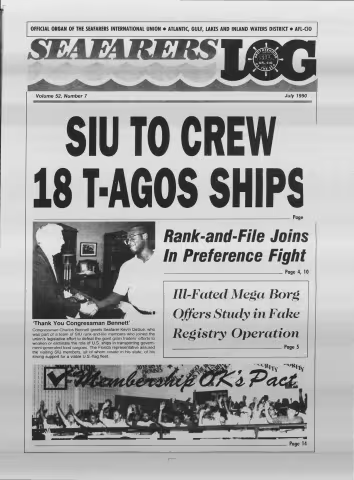
Thank You Congressman Bennett'
Congressman Charles Bennett greets Seafarer Kevin DeSue, who
was part of a team of SIU rank-and-file members who joined the
union's legislative effort to defeat the giant grain traders' efforts to
weaken or eliminate the role of U.S. ships in transporting govern
ment-generated food cargoes. The Florida representative assured
the visiting SIU members, all of whorri reside in his state, of his
strong support for a viable U.S.-flag fleet.
Offers Study in Fake
Registry Operation
Page 5
;^iTv *^1%
Page 14
•'.r. V r."^- r
•^ ••• -,• •-r-*^--;^i--;r>.*- . "••• •. •'•.••• ..••.•.• ;•- -.-• ' • '•:>•_ •••• r'. '••:-• -'•••='••-.•• '• ^-">7.T-.--y^--•••-•/ ';''•••' > • • SEAFARERS lOG
1 •':.•••
I::-- -:
;l ;"• : .
iill':
" • ',! ' .^i-'
President's Report
The Battle Never Ends
The realization that action on the legislative
and governmental fronts in this country is vital
to the welfare and security of Seafarers has its
roots in the early years of this
century. No one during that
period understood that better
than Andrew Furuseth, the
head of the Sailors Union of
the Pacific and the old Inter
national Seamen's Union.
As a result of his determi-
nation to work the Washing
ton political scene, Furuseth scored what ranks
as one of the great achievements on behalf of
Americar maritime workers when he single-
handedly orchestrated the battle to end the con
ditions of slavery and second-class citizenship
which dominated shipboard life in the early
1900s. Fumseth's long and difficult struggle
ended in victory when the Seamen's Act of
1915 was enacted by the Congress and signed
by President Wilson, despite overwhelming op
position at every turn from almost every con
ceivable quarter. Wilson, under enormous
pressure to veto this landmark seaman's bill,
wavered right up to the very last moment, sign
ing it only after being swayed by Fumseth's el
oquent appeal.
Emancipated Seamen
While the Seamen's Act of 1915 did not ac
complish everything that Fumseth set out to
achieve, it made some substantial changes in
conditions for U.S. seamen. Most notably, it
abolished corporal punishment and ended the
practice of arrest and imprisonment for "deser
tion" of American seamen leaving a ship on
foreign soil (the only penalty was the forfei
ture of personal effects left onboard ship arid
earned wages). The Act gave seamen the right
to demand payment on half of their eamed
wages at ports of cargo loading and discharge.
In order to cut down on the crimps and other
p£u:asites who sought to live off the seaman's
sweat, all wage allotments, except those to
close relatives, were prohibited.
For the purpose of improving the safety of
the ship, and to cut down on the exploitation
of cheap foreign labor, the Act required that
75 percent of the crew in each department had
to understand the orders given by the officers
— meaning that a working knowledge of the
English language was to be necessary. Under
the 1915 Act, seamen could no longer be
worked in any department other than the one
in which they had signed on. The Act called
for a minimum of 120 cubic feet of crew space
per crewmember, and separate berths were to
be limited to two tiers.
A Tribute to a Man's Determination
The Seamen's Act of 1915 is an everlasting
tribute to Fumseth's determination to break
the chains which bound American seafarers
and ease the conditions of their employment.
And it was accomplished against seemingly
overwhelming odds: all of the shipowners,
American as well as foreign, vigorously op
posed the bill; the press screamed its editorials
against it; the National Chamber of Com
merce, the National Association of Manufac
turers, foreign trade groups, bankers*
railroads—all the powers of big America-
tried to kill the Seamen's Act of 1915.
Aside from what it did in real terms for
America's seamen, Fumseth's fight is a re
minder that political and legislative action
must be a major weapon in our efforts to pro
tect the interests of Seafarers. Our working
and living conditions and our well-being as
maritime workers are substantially influenced
and affected by what goes on every day in the
U.S. Congress and in the many federal agen
cies which have jurisdiction over the various
aspects of shipping.
This fact has never been more obvious than
the situation in Washington right now, where
we see the giant grain traders (not to be con
fused with the small producing farmers) en
gaged in a major campaign to eliminate
American-flag ships from participating in the
transportation of government-financed grain
cargoes.
Rank and File Lobbying
Our union is fighting on this front inch by
inch in the House of Representatives and in
the Senate. And in the past couple of weeks
our staff people have been aided by rank-and-
file SlU members who joined in the visits to
the offices of congressmen to urge their sup
port in our fight to defeat the enemies of U.S.-
flag shipping. And we're proud of these
members and their efforts.
Nothing ever changes. Washington and poli
tics were vital to the welfare of seamen before.
Fumseth; they were vital during Fumseth's
time and have remained so ever since. That's
why we have to continue to strengthen our po
litical action apparatus and build its resources.
Every seriotis Seafarer should do his part in
the ongoing fight to protect his own security
by helping to strengthen the SlU's political ap
paratus. It is important for all of us to partici
pate if we are to continue to successfully fight
all those who are attempting to destroy
America's private shipping industry.
Index to
.'COBRA Notice . • • • • • •
Dispatchers' Report/Deep Sea . . .
Dispatchers'Report/Inland . . . . v
Dispatchers' Report/Great Lakets > «
Final Departures ... . . . . . . . .
Know Your Rights
Lundeberg School Application ...
Lundeberg School Course Schedule
Lundberg School Graduates . . . , .
Miecting Dates . . ... . . .. • . «•
Pensioners
Personals . . . > . . ji i . . ... ̂
Ships Minutes ... • • • .... « .
Union Hall Directory .
Features
Page
•'. IS
17
• '-d • 19
"•4 •, • •• ' •> >
• • • • • • • o,* • 25
• • • • • • • • • • • • •
••••• 17
'• •, -e-O
.. 27
•••• 24
• •••••«•••••••• 17
20 • • • • • • • • * • • • • • •
T ' • 1'7
• • • • o 0, » • • i • • • 21"23
19 • ••••••••••••••
MSG Pacific Fieet Setting Up
To Compiy with Pay Award
Action Is Result of Suit by Seafarers
Volume 52, Number 7
fc-'
July 1990
The Seafarers LOG (ISSN 0160-2047) is published monthly by the Seafarers
International Union; Atlantic, Gulf, Lakes and Inland Waters District; AFL-
CIO; 5201 Auth Way; Camp Springs, MD 20746. Telephone (301) 899-0675.
Second-class postage paid at MSG Prince Georges, MD 20790-9998 and at
additional mailing offices. POSTMASTER: Send address changes to the
Seafarers LOG, 5201 Auth Way, Camp Springs, MD 20746.
President, Michael Sacco; Secretary-Treasurer, Joseph DiGiorgio; Execu
tive Vice President, Joseph Sacco; Vice President Collective Bargaining,
Angus "Red" Campbell; Vice President Atlantic Coast, Jack Caffey; Vice
President Gulf Coast, Thomas Glidewell; Vice President West Coast,
George McCartney; Vice President Lakes and Inland Waters, John Fay;
Vice President Government Service, Roy "Buck" Mercer.
Communications Department Director, Jessica Smith; Associate Editors,
Daniel Duncan and Max Hall; Associate Editor/Production, Deborah Greene.
The Military Sealift Com
mand—^Pacific Fleet (MSCPAC)
has started posting notices on all its
vessels informing the unlicensed
crewmembers of the recent labor
board decision against that agency
which was brought about by a suit
filed by four members of the SlU's
Government Services Division.
According to Roy "Buck" Mer
cer, SlU vice president for the
Govemment Services Division,
MSCPAC currently is checking
the logbooks to determine who
stood the watches after 5 p.m. and
before 8 a.m. Once this determina
tion has been made, the retroactive
checks will be issued.
The Federal Labor Relations
Authority (FLRA) had announced
the decision earlier this year and
directed MSCPAC to notify all
crewmembers of the decision by
putting up a written notice on every
ship.
A decision, reached before the
cases went before the FLRA,
called on MSCPAC to pay with
interest all overtime for
watchstanding in port between the
hours of 1700 and 0800 the next
day denied since May 1,1989.
Barry D. Smith, Jinks
Rhaney, John Memo Torees and
Owen Dale Mooney, who are rep
resented by the SlU's Govemment
Services Division, filed the
grievances stating the lack of over
time pay was a violation of the
union's contract with MSCPAC.
Mercer said the decision in favor
of the union could result in
thousands of dollars being paid to
the affected members.
In the notice, which must re
main posted for 60 consecutive
days, MSCPAC agreed to not uni
laterally implement changes in
working conditions for unlicensed
mariners without contacting the
union, to change the overtime pay
changes it implemented last year,
to issue back pay to those involved
and to negotiate with the union if it
wants to change overtime pay
practices in the foture.
The one drawback seems to cen
ter around deck personnel on cable
ships. MSC is reluctant to pay the
overtime because these ships are
operated under "Circular A-76."
However, the SlU is continuing to
work on this problem.
vr-r-.f-r-v
''j^:l .i-y
fWiwwfie^SSSS!" smifsm M<«eiP<Ai4B
••• ^
•^esweasfesMWiss:
JULY 1990
18 T-AGOS Ships Will Be Crewed by SlU
Unioii-contracted U.S. Marine Management Wins Operating Bid for T-AGOS Vessels
The Military Sealift Command (MSG) has awarded
the operation of 18 ocean surveillance ships, known
as T-AGOS vessels, to
U.S. Marine Manage
ment, a company with a col
lective bargaining agreement
with the Seafarers International
Union.
Previously the vessels were op
erated by two SlU-contracted
companies and the MSG. In the
recent round of bidding for the
operation and maintenance of the
T-AGOS ships, the MSG added
the eight MSG vessels to the pack
age, bringing the total to be man
aged by a private operator to 18.
Glose to a hundred new jobs
will be open to SIU members as
a result of the eight T-AGOS ves
sels that will be operated by a
private sector company for the
first time.
U.S. Marine Management of
Norfolk, Va. won a three-year
contract to operate and maintain
the ships in a competitive bidding
process. The contract has two one-
year extension options.
T-AGOS Crews Recognized
In making the announcement,
Angus "Red" Gampbell, SIU vice
president for collective bargain
ing, said "T-AGOS qrews in the
past have been highly commended
by the Navy for their perform
ance. These crews deserve a lot
of credit."
The change of operators will not
affect SIU members working
aboard the 10 T-AGOS vessels
currently crewed by the union,
said Gampbell. The first of the
eight vessels that will be new to
the union will be turned over for
operation to U.S. Marine Man
agement in October, and crewing
by SIU members will begin shortly
thereafter.
Eight T-AGOS
ships had been
with MSC.
T-AGOS ships serve as a plat
form for a passive undersea sur
veillance system designed to de
tect submarines. The term "T-
AGOS" is derived from the phrase
"towed array sensor system
ships." According to MSG, the
vessels tow a variety of under
water listening devices that gather
underwater acoustical data and
Pictured above is the USNS Contender, one of the T-AGOS vessels manned
by the SIU.
transmit the information ashore
for evaluation. The surveillance
work aboard the vessels is done
by military personnel, while the
ship's operation is in the hands of
seamen.
The eight T-AGOS vessels that
will be new to SIU members in
clude the USNS Adventurous,
USNS Audacious, USNS Bold,
USNS Gapable, USNS Relent
less, USNS Tenacious, USNS Ti
tan and USNS Worthy. Several
of these vessels were crewed by
the SIU's Government Services
Division during their warranty and
shakedown periods.
The other 10 ships already
crewed by the SIU are the USNS
Assertive, USNS Assurance,
USNS Gontender, USNS Indom
itable, USNS Invincible, USNS
Persistent, USNS Prevail, USNS
Stalwart, USNS Triumph and
USNS Vindicator.
Officers aboard the T-AGOS
vessels will be represented by Dis
trict 2 of the Marine Engineers
Beneficial Association—Associ
ated Maritime Officers, AFL-GIO.
Battle Over Farm Bill Continues in Congress
As debate got under way on the
farm bill on the floor of both
branches of Gongress this month,
the House adopted a rule by a
vote of 283 to 80 that would pre
vent the introduction of any
amendments directed at eliminat
ing or weakening cargo prefer
ence. On the Senate side, the de
bate was continuing as the LOG
went to press.
The farm bill is critical to the
maritime industry because gov
ernment-supported food aid to for
eign countries is subject to the
nation's cargo preference laws. As
a result of a compromise during
the last Gongressional debate on
a food bill, back in 1985, the amount
of government-generated agricul
tural cargoes to be carried on U.S.
bottoms was raised to 75 percent
from 50 percent and certain De
partment of Agriculture programs
designed to increase food exports
were exempted from cargo pref
erence laws. The 1985 compro
mise allocated a portion of the
food aid cargoes to be shipped
from Great Lakes ports for a spe
cific period of time, ending in 1989.
A lengthy House floor fight on
cargo preference was avoided by
adoption of a rule on July 23 that
prohibited amendments to the farm
bill that concerned cargo prefer
ence. Gongressman Walter Jones
(D-N.G.), who chairs the House
Merchant Marine and Fisheries
Gommittee, said the rule was im
portant because, "the last thing
the farm bill needs is a bitter
debate over cargo preference."
Compromise Defended
Representative Jones reminded
his colleagues that "the House had
to endure such a debate five years
ago. You will recall that ultimately
there was a historic compromise
between agricultural and maritime
interests in 1985. Just about every
one would lose if we allowed that
historic compromise to be chal
lenged on the. House floor," he
added.
Gongressman James H. Quillen
(R-Tenn.), referring to the 1985
compromise on the farm bill,said,
"The reason this rule prohibits
amendments to that compromise
is to prevent opening up the whole
issue of cargo preference on this
bill."
Representative Quillen, who is
the ranking Republican on the
House Rules Gommittee, added,
"Preserving cargo preference is
important because it means Ship
ping agricultural products by
Americans and not opening up the
market to the foreign elements that
are such great competitors of this
nation of ours."
Senate Debate Under Way
The first stab at weakening caigo
preference by supporters of the
giant grain interests went down in
a 62 to 34 vote in what promises
to be the first Senate vote among
many on the issue that will take
place as the debate on the 1990
farm bill goes forward.
Late in the day on July 24, the
Senate defeated an amendment
introduced by Senator Steven D.
Symms (R-Idaho) that would have
allowed the Secretary of Agricul
ture to waive cargo preference
laws in certain instances.
Opposition to cargo preference
Was led by Senator Gharles Gras-
sley (R-Iowa), who sought to jus
tify the non-usage of American
flag ships by bringing out the same
tired old argument that Seafarers
are too highly paid. Senator Gras-
sley tried to use the new SIU
contract in this regard.
Speaking on the floor of the
Senate, Senator Grassley said,
"The June 1990 edition of the
Seafarers LOG reported that Sea
farers International Union was able
to secure a new contract guaran
teeing them a 15 percent increase
over the next three years, plus a
cost-of-living increase during the
second and third year of the con
tract for anything over five percent
inflation."
It bothered the senator that the
union was able to retain the same
crew sizes and he bemoaned the
fact that the operators had not
managed to keep the union down
to yearly wage increases of 2 per
cent.
Rebutting the Iowa senator's
remarks was Maryland's elected
official Barbara A. Mikulski (D-
Md.). "I really do not like the tone
that is so harsh and so scathing
and so critical when it comes to
talking about America's merchant
marine. I would never want to
hear any disparaging remark made
about an American farmer, partic
ularly the small farmer who tills
the soil so that people in our cities
and throughout the world can eat,"
she said.
'Heroes in Dungarees'
Senator Mikulski, who as a Bal
timore congress woman from 1976
to '86 represented a district in
which many shipyard employees
and dock workers lived, elabo
rated on the kinds of people that
make up the merchant marine.
"Let me talk about who these
people are. They are people who
build the ships, and they are peo
ple who sail the
ships... Roose
velt called them
the heroes in
dungarees."
". . . why
did he call them
the heroes in
dungarees,"
continued Sen
ator Mikulski. Mikulski
Because during World War II, it
Continued on page 4
. -t.,
• v'"'' •
\ s- .5- -<• . .. .• •
•v-v ,
•fii •: :::.• 4 SEAFARiltS LOG
'^- --'X
.i7
X.I.-'
. r
• 'j • • •
.. • -.% •: .•>V ' ' •
• - • it-• 'i
• •f,
i- -
H:
fi'
••••}{'
t
%
r "
i-:
i". V ,
Vi-'
Battle Over Cargo Preference Rages in Congress
Continued from page 3
was the gallant men in our mer
chant marines that kept our boys
overseas fed, clothed, and with
enough bullets and tanks to save
Western civilization.
"That is who those heroes in
dungarees were. They sailed out
on the North Atlantic or they sailed
across the Pacific to back our Ma
rines and to back our guys in the
Army with some modest convoy
protection. And many of them lie
in the deep today, but they served
their country. Nobody called them
tools of the union bosses then,
when they were trying to back our
boys there," Mikulski noted.
After reflecting on the efforts of
U.S. shipping during the Korean
War and the Vietnam conflict,
Mikulski pointed out that America
still needs a strong U.S.-flag fleet.
"Now we know that in the future
if there is any type of military
conflict it will not be a big one. It
will be like Panama; it will be a
regional conflict. And we know
with our rapid deployment force,
they cannot go another 30 days
unless they are backed up by con
voys. And guess who we are going
to want to man those convoys?
The heroes in dungarees; the her
oes in dungarees that have been
ridiculed and excoriated and so on
here. Let me tell you, I am for
those heroes in dungarees in
peacetime, as I am in wartime."
U.S. Aid on Communist Ships?
Senator Daniel K. Inouye (D-
Hawaii), who serves on the Senate
merchant ma
rine subcom
mittee, pointed
out the irony of
giving Ameri
can taxpayers
supported aid
to foreign na
tions that is
then shipped on
foreign-flag
vessels. "So we come across the
strange sight where grain grown
on American soil, paid for by
American taxpayers, is carried on
a Communist ship and shipped to
Africa. So the stevedore unloading
this grain looks up at the ship and
says,'Thankyou,Communists.' "
Of the 55 nations that export
agricultural products. Senator John
B. Breaux (D-La.) noted, "52 of
them have cargo preference pro
grams for either all of their cargo
that they export, or certainly a
large percentage of their cargo."
The Louisiana senator, who also
serves as chairman of the mer
chant marine subcommittee, told
his colleagues that only 3.2 per
cent of American food exports are
subject to cargo preference laws.
He stressed the symbolic impor
tance of an American flag. "1 think
it says some
thing about the
success of this
country eco
nomically and
commercially
and says some
thing about our
farm economy
when an
American ship
Inouye
Breaux
Cochran
carrying an American flag with an
American crew pulls up in that
Soviet port and offloads American
grain. It makes a statement about
the success of this country and 1
think it is one that we should
continue to make."
Senator Thad Cochran (R-Miss.)
reminded the Congress that a del
icate compromise was at stake in
any debate about cargo prefer
ence. The agreement reached as
part of the 1985 farm bill between
maritime and agriculture interests
"put at rest some of the contro
versy that had
swirled around
the application
of the Cargo
Preference Act
to certain ag
riculture ship
ments."
The Missis
sippi senator
warned, "1 am
afraid, if the Senate adopts this
amendment, we will begin unrav
eling that agreement and that com
promise and the statutory solu
tion... ." Cargo preference, he
continued, "has been an issue of
some very sharp disagreement and
bitter controversy, but 1 think
everybody would agree that dur
ing the past four years under the
compromise there has been less
difficulty and less uncertainty in
the departments that have juris
diction over these laws than ever
before."
Why Tamper with a Good Deal?
"So why go in and start tamp
ering with this section of the bill
and try to improve upon an agree
ment that really is working very
well for American agriculture and
the U.S. maritime industries and
our customers all over the world?
We have seen in the last year ...
U.S. agriculture exports rise to a
value of $40 billion. This is good
for our economy, good for our
farmers, and good for our shippers
and U.S. maritime interests,"
Senator Cochran concluded.
Senator Paul S. Sarbanes (D-
Md.) put his cards on the table,
"let us be frank about it . . . this
bill is $18 billion in farm payments.
We are trying to get just a crumb
off of that table in order to help
sustain the American merchant
marine.
"... it is very clear that a
number of other major powers in
the world rec
ognize" the
importance of
a strong na
tional fleet,
Senator Sar
banes said, and
they "make ef
forts to sustain
their merchant
marine, in- Sarbanes
eluding using in one form or an
other a cargo preference ap
proach, the requirement that a
certain amount of the tonnage
moving in and out of that country
be carried in the flag-ships of that
country."
Senator Ernest F. (Fritz) Holl-
ings was the last speaker to rise
Hoiiings
in opposition to
the Symm's
amendment. "1
see no reason
to insert into
this debate on
the farm bill an
issue as con
tentious as that
of cargo pref
erence, espe
cially when there is a compromise
in place that all parties still ascribe
to .... 1 therefore, oppose any
change in the current cargo pref
erence requirements and urge that
we return to those issues germane
to the farm bill," he said.
Shortly thereafter a roll call vote
was held. While the Symms'
amendment was defeated, oppo
nents of cargo preference said they
were going to try again.
Both branches of Congress are
scheduled to recess in the month
of August. The leadership of the
House and Senate have indicated
that the farm bill debate will be
concluded by the end of this month.
Once the bill is adopted in the
House and the Senate, a confer
ence committee will meet to iron
out the differences. After the com
promise bill is accepted by both
branches, it will be put on the
President's desk for approval.
Victory-Middleby Employees
Choose SiU's industrlai Union
The United Industrial Workers,
the SlU's industrial division, sco
red a landslide win last month over
the Teamsters union during an
election held to determine which
group would represent the em
ployees at Victory-Middleby.
By a vote of 121 to 21 with one
vote for neither union, the UIW
overcame the challenge of Team
sters local 837 to represent the
workers at Victory-Middleby's
Cherry Hills, N.J. plant near Phil
adelphia.
John Spadaro, UIW assistant
vice president for the Atlantic re
gion, called it a good win for the
union and the employees at Vic
tory-Middleby.
A total of 143 ballots were cast
from a possible 200 votes. Of that
group, 107 employees are laid off
from the plant that produces stain
less steel refrigerators and walk-
in Coolers for such companies as
Pizza Hut and Burger King. Fifty
of the 200 workers eligible to vote
had been employed at the com
pany's recently closed Plymouth
Meeting, Pa. plant where they were
members of the Teamsters, Spa
daro said.
"Of the Teamsters group, many
chose to be represented by the
UIW," he said in explaining why
the vote was so heavily in favor
of the UIW. "Also, some people
thought enough of the election to
cast a ballot even though they are
on layoff status."
Spadaro, a 24-year employee
with Victory-Middleby's prede
cessor company, Hussman Refrig
eration, left the company to begin
working with the SlU's industrial
division.
The election came about as a
result of a petition filed by the
Teamsters union with the National
Labor Relations Board (NLRB) in
September of last year. The Team
sters asked that an election be
held among the employees of Vic
tory-Middleby to determine which
union should represent the em
ployees after the workers at the
Plymouth Meeting factory began
working at the Cherry Hill plant.
After two hearings on the matter
with the AFL-CIO, the national
federation of American labor
unions, and one with the NLRB,
the board ruled on June 14 that an
election should be held on June
29.
On the Greyhound Picketline
Seafarers and other trade unionists surround Rosa Parks at a recent Washington
rally supporting striking Greyhound workers. The SlU members include able
seamen (kneeling) Anthony Warfield, (left to right behind Mrs. Parks) Jack
LaMotta, Errick Nobles and Oscar Lopez. Mrs. Parks led the 1955 boycott of
the Montgomery, Ala. bus system to integrate the vehicles.
"4^,:
mm.
JUIY1990
ie«M>> I", uir. I,.j".«;ji
'W.W
Mega Borg Spotlights'Second Registers'
So-Called 'Norwegian' Ship Is Nothing More than a Flag-of-Convenience Operation
Lurking behind the scenes of the Mega Borg
incident, the 15-year-old tanker ravaged by fire
57 miles off the coast of Texas last month, is a
story of a once great maritime nation that has
abandoned its seafarers and national-flag fleet
and thrown in its lot with the
runaway registers of the
world.
The 886-foot tanker that
experienced an explosion and fire in the pump
room shortly before midnight on June 8 was a
"Norwegian" vessel. But it belonged to Nor
way's so-called second register, known as the
Norwegian International Ship Register or NIS,
a system that has adopted all of the same kinds
of goodies for shipowners—tax havens, lax
safety standards, few inspections, cheap labor-
that are offered by flag-of-convenience opera
tions.
_ ^
Register (NIS)
A Nicaife Cpveriiig Up
Reductions lit Standards
By putting the label of a traditional mari
time nation on a register that operates like
a flag-of-oonvenience operation, the pub
lic is being duped about the quality and
standards of so-called'Norwegian' sh/ps,
like the Mega Borg, that are part of the
NIS.
The Norwegian second register, like any
other runaway-flag nation, is interested in
making shipping cheap, sacrificing strin
gent safety standards in the process.
Here are some of the NIS's bargain base
ment savings:
• Only the master of an NIS vessel has to
be Norwegian, all other positions can be
filled by seamen from anywhere in the
world. However, the Nonwegian Maritime
Directorate will easily grant an exemption
to the rule that the captain be Norwegian,
as was done with the Mega Borg.
• Wage scales are equal to those of flag-
of-convenience ships when Filipino and In
dian seamen are used. Wages are lower
still if the operator hires Indonesian or
Pakistani seamen.
• Qualifications of crewmerhbers can be
evaluated and accepted by the ship's
master who is advised to take into consid
eration the position the seaman will have
aboard the vessel.
• The owner or owners of the vessel
need not be Norwegian.
• Non-Norwegian owners do not have to
pay any of that country's taxes.
• Non-Norwegian owners are exempt
from the country's currency exchange reg-
ulations.
• Regarding safety procedure^, the NIS
recognizes "international" regulations.
• The Norwegian Maritime Directorate
does not conduct vessel inspections of its
own. It r^s on the inspections of the
classification societies which are groups
paid by shipowners to review their ves
sels, usually for purposes of obtaining in
surance.
^ice: The Noiwegian Ihtemaftonal Ship Registef Rules and Require
ments. Norwegian Sh^wners' Association, August 1969; The Norwe
gian International Sh^ Register—A New Deal for Shipping, Royal
Norwegian fcfinistry of Trade and Sharping; Norwegian Shipping-New
Opportunities, Norwegian Shipowners' Associalion. October 1989.
The Mega Borg was crewed by Indian officers
and Filipino unlicensed seamen. Four of the 37
crewmembers were killed as a result of an
explosion that blew off the top of the vessel's
pump room during a lightering operation in
international waters with an Italian-flagged tanker.
The cause of the explosion is currently under
investigation by the Norwegian government.
On the day following the initial fire in the
Mega Borg's pump room, five more explosions
racked the vessel, greatly increasing the chances
of a major oil spill hitting the coastal areas of
Texas and Louisiana. During this time, most of
the public and press vigorously condemned the
transport of oil by tanker, painting the entire
industry with one brush. But the Mega Borg
fire has put a spotlight on the inadequacies of
runaway flag operations and the dangers such
ships pose to the lives of seafarers and to the
welfare of coastal communities.
Convenience of Foreign Flags
Traditionally runaway-flag registers have rep
resented a marriage between poorer nations
anxious to bring in hard currency from tonnage
fees and shipowners seeking to dodge the fiscal
and social responsibilities of their own coun
tries.
The so-called flag-of-convenience registers
have been identified with Liberia, Panama,
Honduras, and more recently the Bahamas,
Vanuatu, Marshall Islands, Cyprus, Antigua and
Barbuda, Bermuda, Gibraltar, Cayman Islands,
Lebanon, Malta, Sri Lanka and St. Vincent.
But in the past five years, a few European
nations have mimicked the open registers and
established second registers designed to provide
the same services of a flag-of-convenience op
eration while adding a veneer of shipping ex
pertise by linking the process to a country that
has a maritime tradition.
The nation paving the way for the so-called
second register is Norway. NIS was established
in 1987 and today boasts 842 vessels. Other
countries experimenting with second registers
are Denmark (DIS), Federal Republic of Ger
many (GIS), United Kingdom (Isle of Man),
France (Kerguelen) and Portugal (Madeira).
Of these, the NIS operation is the most
extensive and allows shipowners the most lat
itude. An owner need not be Norwegian. The
register does not conduct inspections of its own.
Instead, NIS relies on the reports of classifi
cation societies, businesses paid by shipowners
to review their vessels for insurance purposes.
Non-Norwegian owners are not taxed. Crew-
members may be from anywhere in the world.
The register makes a pretense of requiring a
Norwegian master on NIS ships, but exemptions
are liberally granted, as was the case with the
Mega Borg.
The opportunity to have all the benefits of a
runaway-flag deal and still fly a "Norwegian"
flag have resulted in hundreds of ships being
transferred to the NIS register. NIS ships often
use Indian and Filipino seafarers, causing an
acute shortage of skilled seamen in those coun
tries. According to the industry publication
Seatrade Week, the Philippines faces a shortage
of skilled seamen. The article quoted a spokes
man of a Filipino mariners' group who said,
"We are scraping the barrel for qualified per
sonnel." A year after the NIS register was set
up, there were 85,913 Filipino seamen, a 28
percent increase from 1987.
The Indian-flag fleet also has been left in the
lurch for qualified officers. With so many of its
seamen seeking employment on NIS and other
flag-of-convenience vessels, Indian shipping
companies are finding it hard to recruit qualified
citizens to man their vessels.
Ironically, just days after the Mega Borg
In top photo, oil bums on the water some 12 hours
after an explosion in the pumproom wracked the
Mega Borg, a Norwegian second register ship. The
middle photo pictures five boats working to put out
the fires on the ship that was anchored 57 miles off
the coast of Galveston, Texas. In bottom photo, after
five days of fire fighting, the flames and smoke subside.
explosion, representatives of the International
Transport Workers' Federation (ITF), the group
representing maritime unions throughout the
free world, were criticizing safety standards on
second registry vessels in International Labor
Organization meetings in Geneva.
ITF Assistant General Secretary Ake Selan-
der told the ILO's committee on the application
of labor standards that the growth of second
registers has resulted in a world-wide lowering
of safety standards.
NIS Standards Questioned
The world organization of transport unions,
to which the SIU is affiliated, also posed the
following question to the ILO: How can flag
countries really enforce minimum standards on
their "second class" ships, particularly where
the crew are neither nationals nor residents of
the flag state.
The Norwegian government itself has begun
to question the safety standards aboard NIS
vessels. Earlier this year, the Norwegian Mari
time Directorate (NMD) reported concern over
the possible poor quality of some of the older
vessels being transferred into the NIS. The NMD,
the oversight agency for the NIS, called for
increased vigilance in examining ships. It also
expressed concern about the operating standards
on the growing number of NIS ships that were
crewed completely by foreign nationals.
J.,
- . iV. •
" •••'X . ^
• 'I,;
'1.' -i
-is
'•'Si"
H:
t
f-i:
•:, V- •' • •-
ssaa.;
d:
h'j
i •;.: •
I;
SOFAReHS LOG
SlU Pacific Division Reaches Agreement with Matson, APL
Three West Coast maritime
unions affiliated with the Seafarers
International Union of North
America have reached tentative
agreements with Matson Naviga
tion and American President Lines
(APL).
In addition, another SIUNA af
filiate, the SIU of Canada, averted
a strike when it reached a tentative
agiwment with its contracted com
panies.
Negotiating together as the SIU
Pacific District, the unions agreed
to a six-year deal with Matson and
a three-year pact with APL. The
unions involved included the
Sailors Union of the Pacific, repre
senting the deck department; the
Marine Firemen, Oilers, Waterten-
ders and Wipers Association, rep
resenting the black gang, and the
SIU Atlantic and Gulf District, rep
resenting the steward department.
Matson and APL were negotiat
ing separately for the first time in
stead of under the blanket of the
Pacific Maritime Association. The
Matson agreement was achieved
without the need for an extension
when all parties reached agreement
the evening of June 15, the date
both contracts ran out.
In another break with the past,
the union negotiated a six-year deal
with Matson to provide added
security for its members. The first
year of the new contract will bring
a 5 percent raise to the members
with 4 percent increases provided
in each of the following five years.
If the cost of living should increase
above 4 percent after the first year,
the wage increase will match the
inflation rate.
The unions agreed to some crew
reductions beginning in 1993. The
SUP will take two men off four
ships, while the MFOW and SIU
A&G will take a member off each
of the eight Matson ships.
In concluding the contract with
Matson, SUP President Gunnar
Lundeberg said he believed the
worst days of job give-backs were
over. "I think we tumed the comer
on the constant demand for man
ning reductions," Lundeberg said.
MFOW President Henry "White-
ly" Disley characterized the con
tract as "fair and equitable."
Negotiations with APL did not
go as smoothly. The unions
threatened to break off talks unless
the company dropped its demand
for permanent crews. APL did so
on June 15, and a 30-day extension
on the contract was granted in
order for the unions and company
to create a new package.
The APL contract gives mem
bers a 5 percent pay hike in the first
year wito 4 percent boosts in each
of the two subsequent yearS; Like
the Matson agreement, cost of liv
ing adjustments will be made after
the first year should inflation go
above the scheduled pay increase.
The SUP agreed to take four of
its deck department members from
APL ships and give them dock as
signments. The MFOW will take
four members from the APL
Pacesetter-class vessels while the
SIU A&G also will reduce its over
all crewmembers by four.
Although all sides said they
were happy with the agreement
reached, the SUP early in the
negotiations with APL issued a
press release saying it was "as
tounded at the arrogance of APL's
proposals."
In Canada, the SIU just an
nounced at press time its settle
ment with the Canadian Lake
Carriers. SIU of Canada President
Roman A. Gralewicz said the
union did not lose a single job
while it secured protection against
inflation.
Oil Spill Bill Conferees Near Final Agreement
House and Senate conferees
may present compromise oil spill
legislation to the Congress before it
takes its summer recess.
The conferees reached agree
ment on two of the main issues
separating the bills passed by the
House and Senate earlier this year;
rejecting proposals for U.S. par
ticipation in an international oil
spill fund and the imposition of
double-bottoms or double-hulls on
tankers.
House conferees finally acceded
to the Senate by not demanding that
the United States adopt the interna
tional protocols goveming liability
for oil spills. Senate Majority
Leader George Mitchell of Maine,
one of the conferees, had stated the
protocols should be handled as a
treaty. This would require the
Senate to provide advice and con
sent before the country could.adopt
It.
Mitchell noted during debate
WWII Merchant Mariners Sought for Study
A researcher working on her
Ph.D. is looking for World War II
era merchant mariners to do an
ethnography on maritime convoys
of that historical period.
Morgiana Halley spent three
days last month at the Seafarers
Harry Lundeberg School of Sea
manship interviewing pensioners,
listening to the school's recorded
history and reviewing documents
in the Paul Hall Library and Mar
itime Museum.
Halley is interested in the over
all life of merchant mariners and
those associated with them during
World War II, including those
serving on escort ships as armed
guards. "I am looking for infor
mation on what the crewmembers
did onboard when they were not
working, on how the armed guards
got along with the sailors, how the
unlicensed and licensed members
got along and were any foreign
nationals onboard," she told the
Seafarers LOG.
She wants to hear stories about
practical jokes played aboard ship
and how people reacted to them.
One that has caught her attention
was sending a newcomer for a
bucket of steam. After several
hours, the mariners realized the
rookie had not returned. She said
the members searched the vessel
until they discovered him sitting
in the engine room beside an open
valve with a bucket underneath it.
"His response was the bucket
wasn't full so he didn't report back
to work," she recalled with a laugh.
Also, the researcher is trying to
gather information on any super
stitions, customs, beliefs or rituals
in which mariners participated
during the war.
One item that truly interests
Halley is the attitude of the Amer
ican public to merchant mariners.
"It is much different compared
with the attitudes of the British to
their merchant marine," she said.
She is seeking reactions as to how
mariners were treated when they
came back to American shores.
She noted some stories she has
collected have had the public re
ferring to the seamen as "4-F'ers"
and draft dodgers.
Halley, who has a masters de
gree in folklore, became interested
in the World War II study when
she realized almost all work on
the sea was very ancient. She
wanted to gather information on
the World War II era while those
veterans are still alive. In fact, she
spent two hours with SIU charter
member Johnny Johnston while at
Piney Point to hear his stories.
Halley, who is working on the
ethnography with the Center for
English Tradition and Culture at
the University of Sheffield in
Yorkshire, England, already has
presented a few papers and written
some sea ballads based on her
work.
Her 35-minute performance to
students at the Lundeberg School
was taped by trainee Robert Ad
ams Jr. "Everybody really en
joyed it," he said. "We've already
looked at the tape twice." Lun
deberg School instructor Grace
Davis said Halley's performance
must have made quite an impres-
Morgiana Halley listens to one of the
tapes about being a merchant seaman
in World War II on file at the Paul Hall
Maritime Museum at the Lundeberg
School.
sion on the trainees because she
has had them singing some of her
songs days after the show in the
galley,
H^ey is interviewing World War
II maritime veterans along the
northeastern U.S. seaboard at this
time. SIU members living in this
area ihterested in talking with her
can contact the Seafarers LOG to
set up an appointment. Those liv
ing in other parts of the country
who have written stories and
statements may send them to Mor
giana Halley in care of Captain
Fred A. Steele, 1598 Hillcrest
Drive, Arroyo Grande, CA 93420.
among the conferees that the
Senate had not passed the protocols
for the last five years and has no
plans of adopting them now.
Newspaper reports have stated
that the conferees will approve a
monetary limit on shipper
liabilities higher than those estab
lished by the protocols, which were
negotiated in 1984. However, the
compromise bill will allow the in
dividual states to set their own
liability limits at levels higher than
the federal bill.
Some tanker companies, like
foreign-flag Royal Dutch Shell,
have announced their vessels will
not serve the U.S. should the pro
tocols not be accepted. Others are
said to be considering such a move.
The conferees agreed that most
vessels should be fitted with
double-hulls by the year 2015 and
all new tankers being built for ser
vice along the American shore
must have double hulls.
The compromise, which would
become effective in 1995 if passed,
involves a complex formula in
volving the size, age and hull con
struction for phasing out single
hulls over a 20-year period.
In the earlier bill passed by the
House, all existing tankers would
have to phase in double-hulls or
double-bottoms over a 15-year
period. The Senate had asked the
federal govemment to issue regula
tions on tanker construction.
Old Tankers Will Be Out First
The new language phases out
older and larger vessels first. Ves
sels of less than 5,000 gross tons
would be exempt until 2015.
There were a number of exemp
tions to which <the legislators
agreed. Vessels of less than 5,000
gross tons would avoid the require
ment entirely if they have a double
containment system determined by
the Department of Transportation
to be as effective as double hulls in
preventing oil discharges. Slated
for exemption until 2015 are ves
sels lightering more than 60 miles
offshore and vessels unloading oil
in bulk at licensed deepwater ports.
:.ir_,r?-.,;-V,Vi v / i.r .
fc 'i^if-' IP--' x^-S^sn,
juiYim lvi-'ji,^i-«»iS^;
'i.-, •- :
- fi
.. i:'- •. . ;i
•':.P'>:;(.S;^^' :'l ; fl
^ivt-PsSiV:';S;jr' -/.i
decertified Stewards
Graduate from the
Lundeberg School
From ice carving to accoimting, from recipe making to
pas ' " pastry baking, 11 more galley gang members have
reached die top of their department after graduating from
the steward recertiflcation course at the Seafarers Harry
Lundeberg School of Seamanship.
The six weeks of instruction ran the SIU veterans
dirough the gamut of what they may face in the steward
department when working aboard ship. Not only did the
11 perfect their cooking and baking skills, but they aliso
worked outside the galley to help make their jobs a little
easier.
In fact most of the training does take place over a desk
rather than a stove. The stewards learn how to work with
compujters to plan for meals, take
inventory and handle their union
chores, l^trtictors give them
skills in handling other
crewmembers and the problems
they might encounter on a vessel.
Being able to do the necessary
math to convert recipes to feed
the large number of people work
ing aboard ship is not lost on the
school or the stewards.
1 The recertified steward class includes
(kneeling) Albert Coale Jr., Robert
Maddox, Yen Mow Huey, (second row)
Edward Uyehara, Linda Schell, Phillip
Lau, (back row) Jerome Jordan, Victor
Harper, Emilio Cordova, Roscoe D. Wil
liams and Gerald Shirley. 2 Albert
Coale whips up a cake. 3 Phillip l^u
tackles a tough math problem. 4 While
Phillip Lau (left) and Yen Mow Huey
discuss a finish^ cake, Robert Maddox
checks his in the oven. 5 Gerald Shirley
handles a computer assignment
6 Sea-Land Port Steward
Jimmy Mann (left) works
with the recertified steward
dience. "The SIU!" Jordan noted
it took almost nine years for him
to reach the top spot in his depart-
\\ 7htle he was thanking all
W the people involved in the
creation of the course, Roscoe
class. 7 Roscoe Willianos i Williams took time to remember ment and he Idok^ forward to
(left) and Albert Coale figure the director of the adult educa- continuing his work.
tion courses. "I want to thank
Ms. Sandy White for helping us
the answer to a math ques
tion. 8 Phillip Lau deco
rates a cake. 9 Upgrader
Peter Schmitt (left) reviews
the ice carving of Jerome
Jordan and Albert Coale.
10 Instructor Sandy White
looks over the shoulder of
Linda Schell. 11 Flanked
by SIU President Michael
Victor Harper of Philadelphia
thanked the union for all it has
with our mathematics," Williams done for his family and him. Al-
told the members gathered for
the July union meeting at Piney
Point.
Williams, who ships out of
bert Coale of Mobile told the
group that after seven years of
work he was "not going to just
sing, but he was going to jam" to
San Francisco, went on to tell the celebrate his graduation.
trainees in the audience that the
experienced members of the
Emilio Cordova of New York
and Yen Mow Huey of San Fran-
Sacco and Executive Vice crew on ships are willing to work cisco both thanked the union and
President Joseph Sacco,
Roscoe Williams thanks the
staff at the school. 12 The
happy graduates pose with
jSIU officials.
with the new members. "We'll
be serving food to you; we'll be
receiving you the first time on
ship. All we ask is you lend a
helping hand," Williams said.
Like many of the others.
its staff for giving them the op
portunity to upgrade and con
tinue learning.
When Gerald Shirley spoke,
he talked, like many of the oth
ers, about the leader of the SIU, Linda Schell thanked the whole i_ J .
Lundeberg School staff. "I'd like Mlehael Sacco. Itsgo^ to
to thank the instructors and staff
that take care of us," the Seattle
steward said. "The people at the
know there is someone that cares
about us and who is always
watching our backs in Washing-
tot We atoS ^ Jacksonville steward
those who take care of the
grounds and who feed us and
take care of our rooms—they all
seem to do it with a smile."
Sacco congratulated the group
on their achievements. "Your
leadership qualities are show-
Jerome Jordan of Jacksonville ing," Sacco told them. "You are
let the membership know how he leaving with a good impression
TH ftMERICt
mm . MJSmf :T4ff
m.
cmoofcmm
'•'omenr
IV
felt about his union. "Who is
number 1?" he shouted at the au-
at the school. You make us real
proud."
Pi#i
• s •• .. J .
,.. " ij,—:?:> i'-.S
r
;•- i
"k.> rW
^ i ^ JSt_'
,'••• '' "-(•', j'jyt'j VT.^
%
K^vifsSsi?',
;:v'-',:||;
•
|p:i|£j|:^;
t'"-'i' •• ' •"^• /••-'v: •
' •^V:r-.''',^i'f Hi ' '•
ii! V-
•fv', 'i-''
>, rVv •;
•" >A.. .; •:"••'•'- •.•
' -A-M
w> i '• '
#.| "-•
:;Y-.;
..''-^Y-.V :'YF- .:v• !Y&i 'i'l--..' Y
•. - p :y'h^0. Y.': YV : ^ • Y " SEAfiUfRS iOG
SlU Gov't Division Tanker Is Home After 15 Years
The USNS Navasota came
home to the United States after al
most 15 years overseas.
The 44-year-old tanker is part of
the Military Sealift Command—
Pacific Fleet (MSG?AC) whose
unlicensed division is crewed by
the SIU's Government Services
Division. She had been deployed in
the western Pacific since late 1975.
Before tying up at her home port
at the Oakland (Calif.) Naval Sup
ply Center, the Navasota delivered
an A-6 jet to the Alameda Naval
Air Station. The vessel next sailed
to a repair facility in Portland, Ore.
where she is undergoing a lengthy
overhaul, then will sail for San
Diego to become part of the fleet
training group.
SIU crewmembers who helped
bring her home included from the
deck department Bosun Albert
Marshall; AB/Tankermen John
White, David Jackson, Vincent
Chiolo, Charles Delamar, Her
bert Blake and Michael Stein;
Ordinary Seamen Walter Hun
tington and Jerry Tackett and
Bosun/Mate Gary Osborn.
Sailing in the engine department
were Chief Electrician James
George; Unlicensed Junior Engi
neers David Stinson, William
Wheat and Gary Baird; Pump
man Bennie Fields; Engine Utility
Richard Tietge; Oilers Douglas
Kerr and Douglas Marvelias;
FWT Francisco Suela and Char
les Lewis and Wipers Pedero
Marques and Michael Arnett.
Galley gang members aboard
the Navasota included Chief Stew
ard Apollo Beltran; Chief Cook
Tomas Pinaula; Second Cook
Romeo Calindas; Assistant Cook
Simie Dollano and Steward Utili
ties Virgil Benitez, Felipe Cav-
inta, Zachary Webb, Ireneo
Romualdo, Richardo Casmiro,
Romualdo Vellanueva and Jose
Beboso. Other SIU members on
board were Purser Ronald
Wolschon and Yeoman-Store
keepers Norflis McCullough and
Angelico Nacanaynay.
The 644-foot tanker was built
by Sun Shipbuilding in Chester,
Pa. as the USS Navasota. The ship
supported Allied troops at the In
chon, Korea landings and several
Army battle groups throughout the
Viemam conflict. She was decom
missioned from the Navy in
August 1975 and became the
USNS Navasota, a part of
MSCPAC fleet.
The Navasota had been serving
with the U.S. Seventh Fleet in the
Indian Ocean and in North Arabian
Sea. In 1985 she was deployed to
the Mediterranean during tensions
with Libya. Earlier this year her
cre w rescued the seamen of a sink
ing fishing boat in the South China
Sea.
The Navasota is able to refuel
and supply two other ships at sea
while sailing at speeds of up to 15
knots.
Addicott Named Head of MSCPAC
Captain Raymond W. AddicOtt
is the new commander of the
Military Sealift Command-
Pacific Reet (MSCPAC). Addicott
relieves Captain J. A. Peschka Jr.,
who has returned to MSG Com
mand in Washington, D.C. after
serving three months at MSCPAC.
Addicott had served with
MSCPAC for 18 months as opera
tions chief and chief of staff before
he assumed command of the USS
Fox in JanuMy 1988.
As commander of MSCPAC,
the Bellingham, Wash, native will
be in charge of a fleet of 26 govern
ment-owned, civilian-crewed ves
sels which operate from the eastern
Pacific Ocean to the Indian Ocean
and Arabian Sea. The unlicensed
division aboard the vessels is sup
plied by the SIU's Government
Services Division.
Addicott received his commis
sion in 1962 after graduating from
the University of Washington. Be
sides the Fox, he has commanded
the USS Madera County and the
USS Rathbume.
' '' '''
A. '* ,
Captain J.A. Peschka Jr. (left) relinquishes MSCPAC command to Captain
Raymond W. Addicott during ceremonies in Oakland, Calif.
The USNS Navasota returns to San Francisco Bay. This is the first time in 15 years
the tanker reached the U.S. mainland.
The Navasota delivers an A-6 aircraft which she carried across the Pacific.
Keep Eyes Peeled for Fake Flag
Any ship flying the flag of Be
lize is operating under fake regis
try, announced the International
Transport Workers Federation
(ITF), an organization represent
ing maritime, rail and airline
unions in the free world. The ITF,
to which the Seafarers Internation
al Union is affiliated, asked all
maritime workers to be on the
lookout for ships flying the flag of
Belize, a small Central American
country bordering the Caribbean
Sea.
The TTF first became aware of
the fake registry when the group's
inspectors, working out of the port
of Hamburg, West Germany, came
across a Belizean-flagged dry
cargo vessel called the Bosun. The
German police and the ITF con
tacted the Belizean High Commis
sion in London and found out that
the country does not operate a ship
ping registry of any kind.
The Geiman police arrested the
British master of the vessel and the
German owner of the ship, charg
ing them with flying a false flag
and forging Belizean government
documents.
While the Belize government is
considering the establishment of a
shipping registry, at this time That
country's government has not au
thorized the use of its flag to any
vessel. However, Lloyds Register,
a well-known company that tracks
the maritime industry, lists several
"Belizean" ships in its computer
database. Any seafarer who sights
a Belizean-flagged vessel should
advise the SIU.
An Exchange of Greetings
SIU President Michael Sacco talks with Nelson Mandela during his meeting at
the AFL-CIO, the national federation of American unions. The South African civil
rights leader, who was recently released after 27 years In jail, thanked American
trade unionists for their support of the struggle to end apartheid In his nation.
MY 1990
MBwaeywia^aiWi^'-.^^^^' '^r ': v'vS^ i;
•-•I-.,
- •" i^S.-
Surprise Catch by SiU Fishermeh Yields 260-Pound Halibut
With guts and gills, the enor
mous fish caught by SIU fisherman
Jack Cravo and his dragger's crew
weighed more than 260 pounds.
"It was our first catch" on a run last
month, the New Bediford-based
fisherman said. "What a job to put
that giant down the side of the fish
hold," he exclaimed. "It took three
guys to pull it through the flood
house—what a mess-—and we had
to move everything."
First mate and owner of the
Navegante Jack Crave was joined
by fellow crewmembers Joao
Cravo, who sailed as captain;
Cook Ventura Marques; En
gineer John Cravo and Deckhand
Domingo Campos. The crew
hauled in the giant halibut
southeast of Nantucket on the day
that a deep water area was first
opened this year to commercial
fishermen. The crew had been
searching for crabs, cod and yel
low tail, a kind of flounder.
The Atlantic halibut, part of the
flounder family, can reach up to
700 pounds and can live for more
than 30 years. "That fish had the
biggest liver and stomach I've ever
seen in my life," said Cravo. "It's
been over 15 years since we've
caught one this big," he added.
Halibut Scarce These Days
Known to scientists as Hip-
poglossus hippoglossus, halibut is
caught only on occasion these
days. The flatfish, which is native
to the northwest and western At
lantic, was commercially fished
from the late 1800s until the 1940s,
explained Dan Weaver, a reporting
specialist for the National Marine
Fisheries Service of the National
Oceanographic and Aftnospheric
Association.
"During that time it wasjiot un
usual for the long liners and otter
trawls to catch halibut averaging
between 50 to 200 pounds," said
Weaver, "although there are iso
lated cases of halibut caught that
weighed 600,500 or400 pounds in
that period."
Halibut catches decreased sig
nificantly in the '40s when stocks
were depleted from over-fishing.
Today, the average halibut caught
in the northwestem Atlantic is be
tween three and five pounds, mak
ing the larger ones very rare.
When caught, it is usually part of a
bycatch or a surprise catch, said
Weaver.
The female halibut is capable of
reproducing only after reaching the
age of nine or 10, sometimes older,
while the male begins sexual activ
ity at age six or seven, said Weaver.
Few halibut live long enough to
spawn. This, combined with over
fishing in the early decades of this
century, has made the flatfish a rare
catch.
The Fish Was a Fighter
For the crew of the Navegante,
hauling in the seven-foot halibut
from nets down about 80 fathoms,
or 480 feet, was tough. "That fish
was very strong," Cravo explained.
The halibut spun so many times in
the net that it sealed it off, creating
a pouch and prevented other fish
from entering. Weaver said the
sucker was eating big fish."
Among the contents in the
halibut's stomach were bones of
monk fish and skate, two kinds of
bottom fish.
SIU fisherman Jack Crave {second from right) and two employees of Bergie's
Seafoods use all their strength to hoist a giant 260-pound, seven-foot-long halibut
caught by the crew of the Navegante.
Bergie's Seafoods in New
Bedford purchased the fish for
"about $2.00 a pound," Cravo re
ported. The animal's 25-pound
head was destined to "make nice
chowder," the first mate noted.
Fisheries agents took the
halibut's otoliths, or "ear stones"
as fishermen call them. This free
standing bone found in the ear of
the fish, is used to determine the
animal's age. Although results
from the tests of the otoliths were
not available at press time,
Weaver told a representative of
the Seafarers LOG that the fish
was probably older than 25 years.
More rapidly-growing than
most flatfish, the halibut migrates
to shallow water in the summer
and to deeper areas in the winter
in search of warmth, said Weaver.
Both of the halibut's eyes are on
the right side, allowing the fish to
skim the ocean floor in search of
food and to lie flat or bu^ itself in
the sand to avoid detection.
halibut is "extremely strong" and a
"good fighting fish."
The crew of the Navegante got
their first view of the giant when
they saw its white belly gleaming
in the net. "It was a real beautiful
animal," Cravo said in apprecia
tion.
When he opened the giant
halibut's stomach, Cravo discov
ered large bones. "No human
bones," he quipped, "but that
Louisiana WWII Mariners Soon to Be Eiigibie
For Special 'U.S, Veteran' Car License Plates
Thanks to the efforts of Louis
W. Ivon and Kenneth L. Odinet,
two state representatives from
Louisiana districts 100 and 103 re
spectively, seamen who saw action
in World War II soon will be eligi
ble for special state license plates
that previously were reserved for
veterans of the armed services.
Representatives Ivon and
Odinet introduced a bill in the Lou
isiana legislature that allows the
state's Department of Motor Vehi
cles to issue special "U.S. Veteran"
prestige license plates to merchant
mariners who have a military dis
charge, known as form DD 214, or
a certificate issued by the War
Shipping Administration back in
the '40s. (The War Shipping
Administration's certificates were
a result of Public Law 87, 78th
Congress.)
The man who raised the idea
with Ivon and Odinet was Buck
Stevens, a WWII veteran mariner
and a long-time member of the
SIU. "It just made sense to me, if
other branches of the service get a
special license plate, why
shouldn't WWn seafarers have the
same benefit?" Stevens reasoned.
"After all, although it took 43
years for the govemment to offi
cially recognize our role in WWII,
we are now full-fledged veterans
and we should be eligible for all the
bene-fits received by other
branches of the service on both a
national and state level," he added.
y g US VETERAN
39
LOUISIANA ••
Pictured above is the special prestige
license plate that will be available to
WWII merchant mariners living in the
state of Louisiana later this year. The
design may change somewhat, but the
elements will be the same.
Stevens said all merchant mari
ners should be proud of Ivon and
Odinet. "These guys really went to
bat for us," noted Stevens.
The license plate will bear the
words "U.S. veteran" and
"USMM" (for United States Mer
chant Marine) and can be used on
cars, pickup trucks and vans. The
exact details of the design still are
being worked out, reports Debbie
Gremillion of the Office of Motor
Vehicles of the Louisiana Depart
ment of Public Safety and Correc
tions.
The cost of the special license
plate is "the same fee as a regular
car plate or regular truck plate,"
said Ms. Gremillion. The fee is
based on the value of the vehicle.
Any individual desiring more
information on the special license
plate for WWII merchant seamen
may contact the Office of Motor
Vehicles at (504) 925-6364 or
write to the Office of Motor Vehi
cles at P.O. Box 64886, Baton,
Rouge, La. 70896-4886.
\ i't
!,'• - i^".
UV V
•5 -"' .
• V •• -.r' - '-V-
< <5 ' '•$
- • i.: •' ll " ,' '.'.I' •':'*.
?ir- ;f - ..4' iimm
( |V",..-• •
:--i:
•: i'TV •
I
::||i|||i|i
' ii,
A
'•i:
%:
i
i
'^ii; I * '
WA-
i;|-' -
-T''' ^'• ;•:' v''"'
WfA'''-
10 ' \. -• • SOfARERS 106
Kevin Harvey, Rep.
Craig James' (R-Fla.)
legislative assistant,
takes notes while
constituent James
Lloyd (left) discusses
why the congressman
should support cargo
preference.
TD ank-and-file Seafarers lobbying Congress for
XVcargo preference legislation in the 1990 farm
bill receiv^ warm receptions from Charles Ben
nett (D-Fla.) and Glenn Anderson (D-Calif.), two
of the maritime industry's staunchest supporters.
The members, who are residents of Florida and
California, also discussed how the provision
would affect the U.S.-flag merchant marine with
aides to Congressmen Ron Dellums (D-Calif.),
Duncan Hunter (R-Calif.), Ron Packard (R-
Calif.), Craig James (R-Fla.), Earl Hutto (D-Fla.)
and David Junior (D-Mich.).
One Seafarer who has experienced the impact
of legislation on his job is AB upgrader Anthony
Sabatini who used the lobbying effort to full ad
vantage. Sabatini, who sails from the port of Wil
mington, Calif., used to work on U.S.-flag tuna
boats that docked in Southern California. Because
of a lack of work, he had to become a merchant
seaman.
"I have seen how the laws affected one indus
try," Sabatini said to a Seafarers LOG reporter
between visits to California congressional offices.
"I don't want to have to start another career."
Sabatini was able to plead his case to Anderson
and aides from three other offices. He asked aides
in all the offices he visited why change a program
that works and benefits all involved. Anderson
AB upgrader Jack
LaMotta (left) dis
cusses the 1990 farm
bill with DeLisa
Harmon, legislation
assistant to Rep
resentative Earl
Hutto (D-Fla.).
Congressman Glenn Anderson (D-
Calif.) welcomes CalifOrnian Neil
Penaflor to his Capitol Hill office.
RIGHT
A delegation of Florida SlU mem
bers meets with U.S. Representa
tive Charles Bennett. From the left
are (front row) Michael Dykema,
Bennett, Jack LaMotta, MiD Na
tional Field Representative Frank
Pecquex, (back row) Steve Tepper,
Kevin DeSue, James Lloyd and
Kenneth Mulderig.
noted he represents the district in which the Wil
mington hall is located so he was very much aware
of the plight of the merchant marine. He said he
would continue his fight for cargo preference and
a strong U.S.-flag fleet.
The Florida group received the same strong
ifavorable reply from Bennett when they got to his
office.
"We shouldn't take cargo preference for
granted," said Beimett, who represents the Jack
sonville hall's district. "I'm glad you came to see
me. You've got my supjwrt."
Responding to a question from FOWT upgrader
Kevin DeSue of Jacksonville, Bennett said the last
several presidents have "paid lip service" to the
merchant marine. "What it will take (to make the
merchant marine stronger) is a man who runs for
president who will do something," the former AB
added. "There has been a great indifference on the
part of the previous administration toward the little
people and, in some ways, in Congress."
Although this was the first lobbying effort for
all 11 Seafarers, and the first trip ever to Washing
ton for some, DeSue was the only member of the
group to have some lobbying experience. His
grandfather was a minister in Jacksonville. "My
grandfather would take me to political meetings
with him. I got to meet several of the politicians
around Jacksonville and Florida. You can tell the
paper pushers from the workers."
Sarah Dufendach (on desk), administrative assistant to U.S. Representative David Brian Mitchell and Julie Hadnot (center with papers), aides to Congressman Ron
Bonior (D-Mich.), listens to James Lloyd, Frank Pecquex, Kevin DeSue, Kenneth Dellums (D-Calif.), listen to the needs of American-flag shipping from Sea-
Mulderig, Jack LaMotta and Michael Dykema discuss the needs within the U.S.- farers Anthony Sabatini, Demetrius Crump, DeWitt Long, Neil Penaflor and Damon
flag fleet Eisenbrey.
JULY 1990
Retirees Restore Manitou to Former Glory
William Drew (in white cap) and Phil
Maguire assist Johnny Johnston des
cend after an inspection of the
Manitou's mainmast.
USCG To Honor
Firefighting Credit
From 1978 to 1989
The U;S. Coast Guard is honor
ing the certificates of Seafarers
who graduated from the Freehold,
N.J. firefighting facility while at
tending the Lundeberg School of
Seamanship as satisfying the re
quirements for advanced firefightr
ing.
The firefighting training must
have been completed between June
5, 1978 and December 1, 1989.
Seafarers must show proof of suc
cessfully completing the course to
receive credit from the USCG.
The Coast Guard stated that
those members who have com
pleted the course between June 5,
1978 and December 1, 1989 will
not need to attend any further fire
fighting training.
The USCG recently announced
new regulations requiring ad
vanced firefighting for those men
and women upgrading or renewing
their maritime licenses.
As of December 2, 1989, the
USCG is mandating that mariners
must complete a course that has the
agency's approval for both basic
and advanced firefighting. The
Lundeberg School became the first
union training facility to offer both
earlier this year.
The Lundeberg School is offer
ing advanced firefighting courses
August 13 through 17 and October
29 through November 2. To regis
ter, members must have taken basic
firefighting within the last five
years at a USCG-approved location
and present proof of completion.
All Lundeberg School trainees
and upgraders must complete the
basic firefighting course.
While upgraders and trainees
have been busy studying in class
rooms around the Seafarers Harry
Lundeberg School of Seamanship
this summer, two oldtimers are just
as busy at the end of the docks qn
St. Georges Creek.
Retirees Johnny Johnston and
Wiiiiam Drew are refurbishing the
Manitou, the former racing yawl
once skippered by President John
F. Kennedy.
" We' ve been working on her for
the last two months," said John
ston, a charter member of the SIU
who retired in 1974. "Both Bill and
I had looked at her and she was in
pretty bad shape. We talked with
Ken Conklin (Lundeberg School
vice president) and Joe DiGiorgio
(SIU secretary-treasurer) and they
told us to fix her up. They have
been pretty good in approving
what we need. Either Bill or I or
both of us have been out here every
day."
Johnston sailed in the deck de
partment and has occupied himself
with getting the topside in shape.
Drew, who retired as a QMED in
1970, has kept himself busy down
below by working on the engine
and wiring.
"Every time I look at that wir
ing, I wonder who put it in," Drew
said as he shook his head in disbe
lief. "It seems that when someone
added a light, a phone or a socket,
a new wire was run. I asked an
electrician to look at it for me. He
let out a blood-curdling scream and
that was the last we saw of him."
However, the pair has perse
vered with the help of some train
ees, upgraders and Phil Maguire,
the dockkeeper. Drew said the en
gine, which was replaced in 1962,
was in pretty good shape so little
Pensioners William Drew (left) and Johnny Johnston have been working hard this
summer to get the Manitou into top sailing form at the Lundeberg School.
work had to be done on it. Johnston
noted the hull and cabin were not
too bad for wear. Chipping and
scraping has been a continual op
eration on the 62-foot sailboat
which has received two coats of
primer on her hull. In September,
the pair plans to sail her to her
birthplace, Solomons Island, Md.,
in the nearby Patuxent River for a
final overhaul and paint job.
So far this summer, Johnston,
Drew and Maguire twice have
sailed the Manitou to St. Mary's
City where she was warmly re
ceived. The fact that leaves both
Johnston and Drew sad, however,
is her age. At 53 years old, the
Manitou's 81-foot wooden main
mast is not capable of holding her
sails in a strong wind. "She was
inspected several years ago and we
were told the mast would snap in a
gale force wind," Johnston noted.
"We can put a full sail on it for a
calm day," Drew continued, "but
for sailing purposes, those days are
gone."
Johnston said he and Drew will
continue to work on the Manitou
through the winter. "There is
enough work on her to keep us
busy. We don't want to see her run
down again." They also plan to sail
her as often as possible.
The Manitou was built as a rac
ing vessel in 1937 at the M. M.
Davis and Sons yard at Solomons
Island. She was named for the pas
sage in northeastern Lake Michi
gan where she often passed in
winning several Chicago to Mack
inac races in the '30s and '40s. The
vessel changed hands several times
before being donated to the Coast
Guard Academy in 1955.
Kennedy began using the Mani
tou late in his presidency. After she
was refitted with the new engine
and White House communications
gear, the president and his family
began enjoying the vessel during
the summer of 1963. After his
death that November she was re
turned to the academy to resume
her career as a training vessel.
In 1968, the Lundeberg School
purchased the Manitou from the
Defense Department Surplus Sales
Agency in a closed bid. The
Manitou has been a part of the
school's floating museum since.
Lundeberg School Offers 'Flashing Light'
Self-Study Currloulum for All Vpgraders
The Visual Communications
course, one of the newer classes
available at the Lundeberg School
of Seamanship, teaches SIU mem
bers how to use light flashes to
transmit the Morse code.
The curriculum was approved
by the Coast Guard in January and
Michael Manion became the first
graduate last month. Jim Brown,
one of three Lundeberg instructors
qualified to teach the course, said
students must be self-motivated to
successfully complete the subject.
"It is a self-study course,"
Brown told the Seafarers LOG.
"The students use a book and tapes.
There is some classroom work to
learn codes."
Brown wrote the USCG last fall
after outlining the course for the
school. He worked with other Lun
deberg instructors to create the
manual used by the students.
Upgraders have to be able to
read at least six words a minute to
receive USCG certification. Rather
than trying to learn all the letters
Michael Manion (left) receives from instructor Ron Raykowski his Lundeberg School
certificate of achievement for being the first SIU member to successfully complete
the new Visual Communications course.
and symbols at once, they are
taught in groups, thus making it
easier for students to perfect them,
then they move on to the next
group. Upgraders are given prac
tice quizzes to test their abilities on
a gradual basis before sitting down
to take the Coast Guard exam.
Brown noted students pre
viously had to attend a school in
Tidewater, Va. to take a flashing
light course. As Manion pointed
out. Seafarers now can get ship-
handling; radar certification, fire
fighting, first aid and CPR and
flashing light all in one location.
"It's a great savings for us," he
said.
Because it is a self-study course,
students learn at their own rate.
Those taking it have incorporated
the class into their overall lesson
schedules.
Besides Brown, the other course
instructors are Ron Raykowski and
Jake Karaczynski. Seafarers who
would like mote information oh
the Visual Communications
course can contact the admissions
office at the Lundeberg School.
a"
V£4
SlAFAREItS LOG
i \ Falcon Princess Crew Praised for Teamwork
Captain Acclaims Entire SIU Crew for Professional Job
Cecil Edwards
Eugene Finley
The captain of the Falcon Princess ac
claimed the whole unlicensed crew of that
vessel for "the exceptional job they did" on a
recent voyage to Tunisia.
Kevin C. Voight, master of the tanker, sent
his thanks in a letter to the SIU through Guy
Pulliam, operations manager for Seahawk
Management, which operates the ship. The
vessel carried a load of sorghum and com to
Sfax, Tunisia. The crew had less than two days
to clean the tanks and get them ready to load
with gasoline.
"The entire crew rose to the task," Voight
said in his May 31 letter. "First the deck gang
washed and mucked cargo tanks as they were
emptied so that by the time cargo discharging
was completed, only three of the 18 tanks
remained to be cleaned. At the completion, all
crewmembers assisted in securing the
vacuators and the vessel was secured for seas.
The vessel was tendered for the gasoline cargo
and all cargo tanks passed upon arrival at the
load berth.
"Anyone who has seen the deck of a tanker
discharging grain can appreciate the enor
mously frustrating job it is to try and clean
cargo tanks with tank cleaning machines and
hoses," Voight wrote in his letter also signed
by Chief Engineer Michael Aversano and
Chief Mate Michael Honcharik. "The crew
took on this job uncomplainingly and profes
sionally," he added.
Besides his overall praise for the deck de
partment members, Voight noted the engine
and steward crews assisted the deck in clean
ing the tanks. He pointed out the galley gang
had the additional burden of quartering and
feeding 26 extra men three meals a day for 10
days while the ship was in Sfax. The black
gang was praised "for the way they worked as
a team to accomplish engine room main
tenance professionally and quickly."
"I hope that our paths will professionally
cross again in the future," Voight summa
rized. "They have all done a commendable job
which is greatly appreciated by myself and aill
the officers."
SIU crewmembers praised by the officers
of the Falcon Princess included Bosun Ralph
Moore; Able Seamen Eugene Finley, Mark
Wain, Stephond Jackson, Ricardo Sanchez
and Eddie Hall; DEU Cecil Edwards;
QMEDs Felipe Torres, Prince Wescott and
Randy McKinzie; Steward Cornell Bocage;
Chief Cook Philip Lambis and GSU Car-
melo Murphy.
Photos of all the crewmembers, except two,
surround this story. The Seafarers LOG was
unable to locate photographs of Chief Steward
Cornell Bocage and QMED Felipe Torres.
Prince Wescott
Mark Wain
Eddie Hall Stephond Jackson Philip Lambis Randy McKinzie Ralph Moore Carmelo Murphy Ricardo Sanchez
SIU Members Now Can Use Home Ports To Register
For Jobs on Lald-Up Vossols or for Permanent Positions
tanker industry, the position of
Second Pumpman/Engine Mainte
nance will be re-employed on
some tankers and will be registered
The Seafarers Appeals Board
(SAB) has approved changes in the
Shipping Rules designed to make
it easier for crewmembers to re
claim their jobs if their vessel lays
up or if they hold permanent posi
tions by removing the mandatory
port of registration.
Crewmembers now may
register at their home ports rather
than the port of lay up effective im
mediately, according to Angus
"Red" Campbell, vice president
for collective bargaining. They
also can be shipped to return to the
vessel through their home ports.
However, transportation back to
the vessel after a layup if crew
members are registered at a port
other than the port of layup is the
responsibility of the individual
seaman.
"Because of the fast turnaround
of most of our contracted vessels,
it is important that crew replace
ments, whether as permanent posi
tions or trip reliefs, be dispatched
as expeditiously as possible,"
Campbell said of the change in
Rule 5 of the Shipping Rules.
When a vessel lays up and a
crew will be needed back onboard
within 30 days, crewmembers
wishing to reclaim their positions
must register at a hiring hall no
later than 5 p.m. on the third day
following the date of layup. If the
third day of registration falls on a
Sunday or recognized holiday, the
registration shall be extended
through the next business day. If
the laid up vessel requires a crew
within three days of the date of
layup, crewmembers employed at
the time of layup may register up
to and including the date of recrew-
ing.
Campbell emphasized that it is
the responsibility of those crew
members wishing to reclaim then-
jobs to maintain contact with the
hiring hall where they are reg
istered to know when recrewing
will take place.
Permanent ratings, when being
relieved, must register at a hiring
hall within 48 hours of being re
lieved, excluding Saturday, Sun
day and holidays. It also is their
responsibility to stay in touch with
the hall where they registered in
order to return to the vessel at the
It is the responsibility of those crewmembers wishing
to reclaim their jobs to maintain contact with the
hiring hall where they are registered.
appropriate time. Permanent rat
ings must reclaim their jobs at their
port of registration no later than the
day prior to their vessel's arrival in
port.
SIU members who fail to com
ply with the reship procedures
shall forfeit their right to reclaim
and shall re-register pursuant to the
provisions specified in Rule 2 of
the Shipping Rules.
The SAB, which is composed of
two representatives of the SIU and
its contracted companies to admin
ister, review and make changes in
the Shipping Rules, also made sev
eral other modifications.
Because of changes within the
in Group I of the engine depart
ment. Second pumpman/engine
maintenance was designated as a
permanent rating and will relieve
the chief pumpman for time off at
which time a relief second
pumpman will be ordered from the
hiring hall, Campbell said.
If a crewmember is provided
transportation to join a vessel at a
port other than where he is regis
tered and carmot show good cause
to complete his specified period of
employment, he will be subject to
Shipping Rule 8 A 11. That rule,
when sustained, requires a member
to reimburse a company for trans
portation, lodging and other ex
penses incurred by the seaman.
mr 1990 '' •
i:Vi-.'^3fi;H:-a:;;r'::-'
:Siil:-
iiliilt 'iii-.
K'iNsi'V-:;!
IS'Si Hi
il^'''-'--'V^'''
l'{jS'V''|ii-i'
kw-''i'
, ,....., .1. .•
^ .
pC'.V-^b.'''' J''' ,•
,1,' o'V. s-'i '
m
r^3i'>' r?U'-i-i'
-A ',-., "
(jH'ofe'
.'ii'
' I , > *''|, i
];", .''^'';iT;','r;',|-\'.,'
Siiiti-n
• •' •lAir.'l.fH • -
U.jlycS:':
, .'\
• ''kit- '• •
SIU Crews Board
Final 2 MSG Tankers
Seafarers now are aboard all nine man Jim McGee of the port of Hous-
Military Sealift Command (MSG) ton.
tankers being operated by Interna
tional Marine Carriers (IMC), an
SlU-contracted company.
IMC won the government con
tract to operate the vessels in March.
The tankers had been managed by
The port of Galveston, Texas was Marine Transport Lines, a company
the site where the last two tankers. with a collective bargaining agree-
the Sealift China Sea and Sealift At- ment with the National Maritime
Union — the unlicensed mariner's
union that merged with a licensed en-
lantic, switched to SIU crews. The
other seven sailing under the IMC
baimer are the Sealift Indian Ocean, gineers group to form District 1
Sealift Caribbean, Sealift Arabian MEBA/NMU.
Sea, Sealift Antarctic, Sealift Pa- MSC awarded the five-year oper-
Bosun Billy Baker inspects the lifeboats as SIU crews start working on the Sealift China Sea. reviewing sev-
LEFT
Steward Baker Tony Roberts (left) and
terranean.
Bosun Jim Dawson serves as
ss2s5?.zrr.,5rsTaS«
Atlantic, while Bosun William
eral ship company proposals. The
tankers transport Defense Depart
ment refined petroleum products
worldwide. They also provide sup-
Baker holds the same position on the port for Navy fleets and conduct re-
Sealift China Sea. "Those crews
on his stores inventory tefore setting sail. were really looking forward to show- militaty.
fueling-at-sea operations for the
It's time to go to work as AB Al
Bertrand heads up the gangway of
Chief Pumpman Bob Tims the Sealift China Sea.
Porter Robert Rodzieski slices up an onion for part of a Porter Ali M. Behia makes sure Second Cook Aiie Mutahr takes a tray
vegetabie plate. Townsend crewmemtsers get of salads to the refrigerator.
what they orderfrom the galley.
Galley Gang Keeps Crew Going
Aboard the Paul H. Townsend
Deckhand Melvin Kirchoff gathers
an air hose that has been used to clean
the conveyor area of the Townsend. • • ;
When the elements get
rough, as they most certainly
can along Lake Huron and
Lake Michigan, the crew of
the Paul H. Townsend can
look forward to a good meal
from the galley gang.
"We make sure Aey get
what they order and are satis
fied," said Second Cook Alie
Mutahr as he was serving
lunch.
"They are hungry after
working hard and we have to
make sure they are happy,"
Porter Robert Rodziesla
echoed. Rodzieski is in the
final season of a long SIU ca
reer. "I enjoy this work but
I'm looking forward to retir
ing," he told a Seafarers LOG
reporter visiting the ship.
Work continues around
the clock during the Great
Lakes shipping season for
Bosun Jack Bluitt and his
crew. The Townsend carries
dry bulk cement from Al
pena, Mich, to Green Bay,
Wis. primarily. The vessel
also calls on Benton Harbor-
St. Joseph, Mich, to deliver
an occasional load.
The Inland Lakes Manage
ment vessel was built as a
tanker in 1945. She was con
verted to a bulk carrier in
1952 and lengthened to her
present size of 447 feet in
1958.
Watchman Ray Kline feeds a hose to
other members on the deck of the Paul
H. Townsend.
Wiper Ril9< Roznowki lends a
hand to others working in the
engine room.
Oilers Ken Mc-
Inerney (left) and
Jerry Nokland
watch for
possible trouble
in the
engine room.
F—
r"'"
' : i "t'. ® ,:;;veg
• • ,v" . . --r/
mre
. 1' • . '/v
•11^
•J'.jVs-f.
'VJ,-.---
'i • '• • - - . ; -:; .-•v"' ••••-,
•.•jY-OlVv'-'ln." .
y;-,
I ^l|l!s5ilESA^r.Sy ̂ 'S'
• • S!-•71 & -l- ':y^:'KS^J'lilS '
yysa|M|fyg::y;-yyyyyg,;iyyy SmiRERS 106 rf JULY 1990
' Si-i'- •-, 7.r'' - -' --Vr. r*^<'y5'!-=- -T^vv:.--
|y.' 'y'yy7iy,,i?y'i';.7:^s:-,!;5.y ••-yy,,
•• • .•yyyyy^yymyilyl
^ • y 7: yyyyyyy; ;i^:yr :• y •-.y
V::yyiSKy7tyyy;--7
B 1^ '|f| '
fey?' ..
^'fiyyciyry^^^ •
LEFT
Port of New York mem
bers (left to right) L
Padi!la,Joe-Oiablito-
Perez and Manuel
Holquinn listen as the new
contract proposals are
read to the membership.
-fir'ir •f'-'-i'j'y
glfy^yy-llvy | yy,-.
[;':^:<^y?Jv'•yyfey?yyy''? ?''• •' • '^'
ABOVE
QMED Paul Whalen (photo on left) along with Steward
Terrell "Andy" Anderson and AB Mike Ohannesian review
the details of the contract during a special membership meet
ing in the port of Wilmington.
Ni . . .' L
'' ." v"'' '
?•:• \ yf
LEFT
The vote is a resounding "aye" in
favor of the new wage and benefits
package as it was offered to the
members at the port of Piney Point
BELOW
Members at the port of Piney Point
give a rousing ovation after voting to
approve the new contracts.
'11111 j
' 'ifiy
yy-yVy y- y
ABOVE
Members in the port of Norfolk gather at a
special meeting the leam the details of the
union's new three-year
deep sea freightship
and tanker agreement
RIGHT
From the port of Balti
more, (seated, left to
right) Snake Williams,
Joseph Morder, John
Nuddes, Jack Rhodes
and (standing) Taylor
Clean cast another
solid vote in favor of
the new contract Also
pictured is Bob Pomeri-
ane, SlU assistemt vice
president.
ABOVE
All heads are turned to the podium in the port of Norfolk as the new
contract is described to the members.
ABOVE
William Velazquez (in cap) and other members
attending the spedal meeting in the port of
Santurce cast a unanimous vote in favor of the
new deep sea proposals.
,V-'' ••' "y^'v.y;".;. S'"""-'• y ' '
•-'ylflll^fry
:-•-yy.-^iy
ABOVE
Port of Santurce members review the pro
posed new contract t>efore a spedal
meeting is heid to discuss and vote on it.
LEFT
Members in the port of Santurce pay at
tention as the pension changes are read
t)efore a vote to accept is taken.
•.J- ,,,
.yy
1 :.h'- .yyy
" V >
y •!
y,-; .yw^;
v.'..' .'••• . y " y /'.-A
- y >-v v' • •• . '
Members on Contract Around the
•^ V 'il. ' yt S"'?. y" •
, }••-.••• •
:.-.vy ; y-:.- ; • ...... •,"
:--y- .y
y-M&fiy^-y''y. j
j lU MEMBERS AT uniqn halls across the
.country and aboard ships around the world
'have responded with a near-unanimous "Aye!"
in f^or of the new deep sea freightship and tanker
agreements and pension plan.
Members attended a special-call meeting June 27
to discuss the new wage scale of a 5 percent increase
in each of the three years of the contract, the hike
in maintenance and cure payments and the changes
in the deep sea pension plan, among other provisions.
After reviewing and discussing the proposals, the
members cast their votes overlvhelmingly in favor.
In interviews with a Seafarers LOG staff member
after the contract vote, SIU members offered these
comments:
Recertified Steward Robert Mattox said, "I think
it was great. It means better siipport for my family
and a better look ahead for the future."
QMED Robert Hamil responded to the re-estab-
lishment of the 2nd pumpman. "Since I sail as a
pumpman, it definitely comes in handy," he said.
"I've been in ports when discharging and have been
up 24 to 36 hours, so getting a guy in can make it
better for us and the company."
Another QMED, Mike Novak, added, "I've been
in the union for five years. I got in under the military
contract, so this is the best contract I've ever seen."
AB John McLaughlm called the new contract
"great news. It's a fantastic contract. Thanks,.
Mike!" he said in appreciation of the SIU's leadership.
Chief Cook Eddie Siplin stated, "I agree with
everything. T appreciate that it has happened and
look forward to going back to Work to take advantage
of it."
QMED John Smith took a long look at the changes
in pension pay. "As far as I'm concerned, it is long
overdue," he noted. "It's good that we finally got
a raise in the pension, even maintenance and cure.
Everything is positive!"
Even William Drew, a retired black gang member,
thought the contract looked pretty good. "I think
it is very good considering the state of the industry,"
he said.
LEFT
Aboard the President Tru
man, San Francisco Port
Agent Nick Celona (center)
and Patrolman Gentry Moore
On hat) review the contract
with SIU members Oeft to
right) Mike "Splderman" Wil
liams, Y. Lau Koon Teung
and Ray Owens.
RIGHT
Members gather around a
conference takile to hear the
details of the new deep sea
pension plan in the port of
Jacksonville.
yi.:-:
ABOVE
AB Christie Johnson hits the deck to ask about increased pension payments during ttie special meeting held in the port of Houston.
p;.: •- ^ - ABOVE
Richard MoCausland (left) and Tom Brooks
Bslon during the debate on t^ n^ ̂ P
aea prapoB^ at the port of New York.
ABOVE
Listening intently to the discussion of the new contract kt
the port of New York are (left to right) L Trot, Everett
Huntley, Billy. Stevens, Donald Pressley, Ray QuHes and
Luis Morales.
Bill Reed (left) and Arthur Rubenstsin of
the port of New York vote to accept the
new freightshv> agreement
ABOVE
Chief Cook Peter Mazzitelli
(left) joins other members at
ttre p^ of Jacksonville in re
viewing the new deep sea
contract proposals.
RIGHT
The contract has been ac
cepted by tfte members in the
port of Jacksonville.
ABOVE
In the port of Jacksonville, members are pre
sented with the new contract provisions by
an SIU representative.
BELOW
Members at the port of Honolulu read the new contract proposals before
taking a vote.
y- • yy^y'?y'yj.!v^yy
.''y ';>y2'U •; . '22,- '
'y!, y ^''' •,• •' '' ^' • y . -- • '-v .A' 4^'.. • ^ v-f-'.y'y
-y :y., 'y
' •*' y".
16
••••',• ' ='''• SCAfARtRSm .-V-. -•-\
<r -.
,v ;•' .; •^;
• 'I'.''"''';''
Ci'- '•-"'•,•!•
•-.f
1-1"
'i t[-
%'' • ''i''' •
:. l-J. . ; •'- ! • •'
•^Mu"
/ . 'f ;
?*! -• •• N .
•ti:
; '., rH^'' '''
If •I
V -.
;;sWv.
f-liifI;,. Tiie Activities of StU Pensioners
Are of Interest to Steward Scott
• • .-I: $0
fti
0'
tobert Scott interviewed and photoaraphed the
pictured on this page for the Seafarers LOG.
Steward Robert
members
Scott noted there is "a lot of history in Mobile." The 26-year
veteran graduated last year as a recertified steward from
the Lundeberg School. He is pictured in his cowboy hat
with pensioner Walter Dunn.
Lambert H. Waldrop speaks to the
members attending the April meeting
at the Mobile hall after he received his
first pension check. Port Agent Dave
Carter is listening at Lambert's right.
Charter member Leroy Gulley worked
in the galley gang for more than 40
years. He is pictured above with his
wife Bernice.
Brother Robert Scott has a keen interest in the union's
retired members. "After all, these guys represent a lot of his
tory," he explained. While on the beach, the recertified
steward recently took time out to visit with some SIU pen
sioners who live in and around his home port of Mobile, Ala.
"I've sailed with some of the old-timers who are now on
pension, and some of them I've gotten to know because
we've met at the union hall," Scott said. "I notice that in the
Mobile area, the retirees stay very involved in the activities
of the union."
Scott decided to share his enthusiasm with the Seafarers
LOG by photographing and interviewing some of the SIU
pensioners he has come to know.
Leroy Gulley, one of the union's charter members, takes
an active role in every annual maritime day ceremony. On
May 20, retired union members in the Mobile area hold an
event to commemorate the contributions of the American
merchant marine to the nation's WWII campaigns. Gulley, a
WWII mariner who retired 10 years ago, helped lay the
wreath at this year' s maritime day ceremonies in Mobile.
The galley gang veteran also has advice for new members
signing on with the SIU. "Forget drugs and drinking!" Gul
ley said sternly. "And remember your obligation to treat all
SIU members as brothers. If you work together, you'll get
along just fine."
Gulley learned about the Brotherhood of the Sea when he became the first
black member to work aboard the Alcoa Clipper, a combination freight and
passenger vessel. "I had some problems, but I stood my ground, did my job
and made friends. I'm glad I helped open the way for others."
Brother Gulley and his friend Felix Tate now work fishing holes together.
Tate, also a steward department retiree, claimed he brought home 86 mullets,
flounders and trouts on his best day. "All that in one afternoon," he said proud
ly.
Tate, who began sailing with the SIU in 1944 and retired in 1979, would
tell new members to "work with each other on ships, keep up your dues and be
a good union man."
Another of the Mobile pensioners visited by Scott was James "Nick"
Juzang. Like Gulley and Tate, Juzang sailed in the steward department before
retiring in 1985. After 42 years at sea, Juzang still likes to travel. He's also
found a new part-time career as a security guard.
Brother Juzang, who divides his free time between the union hall and his
favorite sports of fishing and crabbing, said he likes to meet the new members
at the union hall. He reminds them to "advance themselves." But he also
wams them, "Stay away from drugs, if you want to keep learning."
Lambert H. Waldrop recently retired after 38 years of sailing. Brother
Waldrop received his first union pension check in April. Now that he will
have a little more free time, Waldrop intends to do more hunting and fishing,
two of his favorite pastimes.
Another SIU pensioner who loves to hunt and fish is Mose Coleman. The
45 year-veteran of the SIU also has opened his own club in Mobile.
Scott found that by working together, SIU pensioners in the Mobile area
had elevated the status of WWII mariners in the veterans' community. A con
tingent of SIU men don their white caps and march every year with other
WWII combatants on Veterans Day.
Retired union members also help out around the union hall, reports Scott.
Many participate in "bean pot days" when a special lunch is cooked at the
union hall and pensioners and active members alike eat together, swap sea
stories and catch up on union news.
Retired seafarers hold regular meetings at the union hall and also put on
several dinners. Depending on the time of year, the fare can be anything from
a fish fry to a formal full-course meal. Retirees report seeing old shipmates
with whom they had lost touch years ago. Spouses also are an active part of
the pensioners gatherings.
'^en done with his visits with SIU pensioners. Steward Scott told the
LOG, "From interviewing the retired members and seeing the great shape they
are in, I can't wait for my golden years to come."
Mose Coleman, a 45-year veteran, not
only likes to fish and hunt; he also runs
his own lounge.
Leroy
spend their time' fishing and
Felix Tate (left) and
time
around their church.
Gulley
working
One good story deserves to be topped.
Whitey Clark (seated left) tells one
more to John Johnson while move
storytelling goes on in the background.
Recertified steward and recent retiree
James Barnett looks for a place to sit
during a recent fish fry for pensioners
at the Mobile hall.
Chief Cook Jack Rankin (left) prepares lunch while retiree Bill Hunter (center) and Steward
Baker Tobe Daney wait to senre the meal to other members in the Mobile hall.
— ^ ^ —
James "Nick" Juzang, a 42-year SIU
veteran, has been travelling around
the country during the five years he
has tieen retired.
• ; -i. ^
11
i! t
, t, ,il< '
iiisif
'4 aiili:
•-V . '"L
• 'p.--':. I
JULY 1990
0P
Dispatchers* Report for Deep Sea
JUNE 1-30, 1990
•TOTAL REGISTERED
All Groups
Class A Class B Class C
iPort
'l^Ya
: Philadelphia
? Baltimore
Morfolk
Mobile
New Orleans
Ribkidnviller"
i San Francisco
|, Wilmington.
Seattle
Puerto Rico
Honolulu
I Houstbii
i.St. Louis, j
Totals
Port
New York
Philadelphia
Baltimore , i
Norfolk
Mobile
New Orleans
Jacksonville ;l
San Francisco
TOTAL SHIPPED
All Groups
Class A Class B Class C
••REGISTERED ON BEACH
Trip All Groups
Reliefs Class A Class B Class C
7 4 ' 4 69
1 0 0 5 • •• 2
7 1 1 •. c:..:'-a. 9 6 '2
4 5 3 18 4 5
3 12 2 13 6 5
6 6 2 45 7 17
6 6 4
8 4 8 SsL • 10 8
9 -It . . 0 31 ;-9.r
9 4 52 6 3
2 1 1 18 1 0
7 5 5 9 12 8
ENGINE DEPARTMENT
Seattle
Puerto Rico
Honolulu
Houston
St. Louis
Piney Point
Totals
. 4 . 0
^ 1 ' • • 3 " fxm
.6'
3 3 0
14 4 4
16 6 3
|fcv.l3:;'?-' '• 5;:.
. 13 •• 5 6
7 , 2 ... 2;.,.
22 6 3
2 0 0
1 11 9
1 6
3 12 30 4
0 1 4 0
8 7 1 11
1
0 0 1
2 1 6
43 237
Port
Philadelphia
Baltimore
Norfolk
Mobile
New Orleans
STEWARD DEPARTMENT
.'^•miionville-^^
San Francisco
Wilmington
Seattle
Puerto Rico
Honolulu
I St. Louis
Piney Poin
Totals All Departments 643 348 400 527 333 364 191 1,071 526 432
*"Total Registered" means the number of men who actually registered for shipping at the port last month.
••"Registered on the Beach" means the total number of men registered at the port at the end of last month.
Shipping in the month of June was down from the month of May. A total of 1,415 jobs were shipped
on SlU-contracted deep sea vessels. Of the 1,415 jobs shipped, 527 jobs or about 37 percent were taken by
"A'* seniority members. The rest were filled by "B" and "C" seniority people. A total of 191 trip relief jobs
were shipped. Since the trip relief program began on April 1, 1982, a total of 12,536 jobs have been shipped.
August
lAeinbeiship
Meefiugs; Deep
See, Lukes, In/and
l¥irtefs
Piney Point
Monday, August 6
New York
Tuesday, August 7
Philadelphia
Wednesday, August 8
BaltinHHre
Hiursday, August 9
Norfolk
Thursday, August 9
Jacksonville
Thursday, August 9
Algonac
Friday, August 10
Houston
Monday, August 13
New Orleans
Tuesday, August 14
MohOe
Wednesday, August 15
San Francisco
Thursday, August 16
Wilmin^n
Tuesday, August 21
Seattle
Friday, August 24
San Juan
Thursday, August 9
St. Louis
Friday, August 17
Honolulu
Friday, August 17
Duluth
Wednesday, August 15
Jersey Ci^
Wednesday, August 22
New Bedford
Tuesday, August 21
Personals
FRIENDS OF
GEORGE COSTANGO
Geotge Costango would like
to tfaank all of his good fitiends in
the SIU for their support during
his recent illness. Anyone wish
ing to send a card or letter may
reach him at SOO W. 2nd Street,
Wilmington, DE 19802.
GINOANDIZZY
Gino and Izzy—where are you?
Get in touch. Tlior
WALTER (SKIPPY)
CHIPMAN
Please call Captain Brown's
son, Richard Brown, at 1-800-
922-S880Monday through Satur
day, 9:00 a.m. - 5:00 p.m.
;'I .• ••
-'i
'/i
.1'.
'..•j.' <V-
18 SOFARERS toe
SlU-Crewed Orgulf Tugs Ride High on Mississippi's Waters
Sailing continues to be smooth
for SIU crewmembers along the
Mississippi River as the summer
shipping season hits its peak. The
river is up nine feet near St. Lx)uis
from its low-water level last year
when parts of the waterway were
closed.
However, despite the high wa
ters helping the inland operators
during these hot and humid
months, weather reports warn of
low water levels returning this
winter as rain has not been falling
around Mississippi's feeding res
ervoirs in North Dakota, Soudi Da
kota and Montana.
SlU-crewed Orgulf tug and
barges, like the J.N. Philips and
Robert A. Kyle, are ruiuiing loaded
at full speed, according to Tony
Sacco, St. Louis port agent
The Philips can be seen primar
ily on the Ohio River, pushing be
tween 15 and 18 barges loaded
with coal. The Kyle is a larger tug.
It can handle more than 30 barges
at a time. Because of its size, the
Kyle works along the lower Mis
sissippi.
SIU Patrolman Joe Sigler met
the Kyle at the Orgulf staging area
at Moore's Landing, Mo. and the
Philips at Paducah, Ky. He re
ported everything was running
smoothly on the vessels. He pro
vided the Seafarers LOG with
these photographs of SIU mem
bers who work on both tugboats.
Union Members on LNG Capricorn
Up for Vaiiant Ship Award
The SlU-crewed LNG Capric
orn has been nominated by the
Woman's Propeller Club of Gal
veston, Texas for the 1989 Maty
Ann Brown Patten Valiant Ship
Award for the ship's efforts in res
cuing 27 crewmembers of a dis
abled Panamanian ship on October
22, 1988.
The Capricorn was sailing in the
South China Sea west of the Phil
ippines when it received a distress
signal from the Evpo Agspyr,
al^ut 24 miles away. Captain John
R. Hoffman changed his course to
aid the stricken vessel.
When the Energy Transporta
tion Corporation vessel was a mile
from the Panamanian craft, the
Capricorn lowered its lifeboat into
seas in excess of 16 feet and winds
of 30 miles per hour with hazy
visibility. Able Seamen Larry
Sims and Donovan Christie, Or
dinary Seamen Michael Riley and
Ken Lusk, 3rd Officer Ronald
Flowers and 3rd-Assistant Engi
neer Brian McAdle crewed the
lifeboat in the tossing waters with
the propeller sometimes coming
out of the water.
The Evpo Agspyr still was im-
derway al^ough she was listing to
port and settl^ by the stem. Her
mam decks were awash with the #2
hold two-thirds full of water.
Except for the bosun, chief offi
cer and 2nd officer, the crew of the
Evpo Agspyr escaped in the star
board lifeboat. After checking the
vessel, the trio then abandoned
ship via life raft. The Capricorn
crew towed the Panamanian life
raft and picked up the crew from
the lifeboat, then headed back to
the U.S.-flag vessel.
The whole rescue was com
pleted shortly after noon, less than
six hours after the first call was
received.
The club praised the work of the
Capricorn crew in the rescue of the
27 stranded mariners. The club
noted the captain was aware of pi
rates trying to board LNG vessels
in the area, yet went ahead with the
rescue operation.
ABOVE LEFT Cook Toni Jo Elgin knows the crew will be
hungry when dinner time approaches on the Kyle.
ABOVE RIGHT Getting their fill in the Kyle's galley are
(left to right) Deckhands Patrick Cobbs and W. C. Silas
and Lead Deckhand Barry Allen.
LEFT Deckhands Darnell
Morris (left) and Harry
Brumfield Jr. stow a pier line
on the Philips.
Cook Mae Jenkins prepares a salad for the members of the J. N. Philips.
Corrections
The back row of the crew of
the Sealift Pacific, as pictured on
page 10 of the June 1990
Seafarers LOG, was misidentified.
It should have read AB Kevin
Merckx, AB Scott Horton, AB
Rob Owens and QMED Pumpman
Dyke Gardner.
William "Hoppy" Carroll was
listed with an incorrect job title
aboard the Cable Ship Charles
Brown on page 14 of the June
1990 Seafarers LOG. He actually
is the chief electrician on the
vessel.
The picture of William
Cartwright Sr. in the Final
Departures on page 22 of June
1990 was actually of his son,
William Cartwright Jr. who is
alive and well. The elder
Cartwright retired in 1968. The
LOG regrets any inconveniences
these errors may have caused.
Deckhand Mike Gibbons checks out a tow line while the Robert A. Kyle is
docked at Moore's Landing, Mo.
Seafarers Welfare Plan Notice
COBRA: Continuation Health Coverage
Seafarers or their dependents who have lost eligibility for health
care coverage under the mles and regulations of the Seafarers Welfare
Plan, may be eligible to purchase, at a premium, welfare coverage
directly ff-om the plan.
Seafarers who have lost their eligibility for plan coverage must
notify the plan office immediately to find out whether or not they or
their dependents may elect to continue benefits under this program.
To obtain more information about this program. Seafarers may call
the membership services office at 1-800-CLAIMS-4 (1-800-252-
4674) or may write to: COBRA Program, Seafarers Welfare Plan;
5201 Auth Way; Camp Springs, Maryland 20746
(The April 1989 edition of the Se.afarers LOG contains a complete
description of the Consolidated Omnibus Budget Reconciliation Act
or COBRA-^program.)
•v'' -.- If
.t.'"; •
•. :4
jmm
Dispatchers' Repert for Great Lakes
CU-Company/Lakes Lr—Lakes NP—Non Priority
JUNE 1-30, 1990 *TOTAL REGISTERED TOTAL SHIPPED **REGISTERED ON BEACH
All Groups All Groups All Groups
Class CL Class L Class NP Class CL Class L Class NP Class CL Class L Class NP
: Algonac
vr^ • >•••-••••-> ••v.! Ki
Port
!Sjf 2 , - •
DECK DEPARTMENT
'• 0 48
ENGINE DEPARTMENT
0 12 4
STEWARD DEPARTMENT
0 16 2 5;
0 »rv.r
Port
Algonac 0 16 15
ENTRY DEPARTMENT
0 0 0
0 41 54
— - -
**"Re2stered"on Beach" means the total number of men registered at the port at the end of last month.
Totals All Departments 0 45 22 0 76 11
*"Total Registered" means the number of men who actually registered for shipping at the port last month
Dispattdieis' Report tar taland Waters
JUNE 1-30, 1990 •
•TOTAL REGISTERED
All Groups
Class A Class B Class C
TOTAL SHIPPED
All Groups
Class A Class B Class C
••REGISTERED ON BEACH
All Groups
Class A Class B Class C
Port
New York
II Philadelphia
Baltimore
Norfolk
Mobile
New Orleans
Jacksonville ;
• Sail Francisco
WilmingtQp
Seattle
Puerto Rico
Houston
I : Algonac
I St. Louis
\ Piney Point'
Totals
DECK DEPARTMENT
0 0 0
0 0 0
9 . , 9 ; , • 9
62 10 6
Port
New York
jPhiladelphjy
Baltimore ,
Norfolk
Mobile
New Orleans
Jacksonville ;
San Franciscp
.^mington
Seattle
Puerto Rico
Houston
Algonac ^
1st. Louis
l^ney Pointy, .,5^
Totals
Port
New YbrkI
Philadelphia
Baltimore
Norfolk
Mobile
New Orleans
Jacksonville
San Francisco
Wilmington
Seattle
Puerto Rico
Houston
Algonac
f-|St. Louis .
^Piney Point
Totals
h 0
... V. . ... . r . ..
0 0 . 0
. 0 0 0 0 0
y .0, Q 0 0
2 0 0 3 0
0 0 0 0 0
0 0 0 0 0
1 •J'"'- 0
1- 0 0 • ® 0 ,. 0
0 0 Q
0 0 0 0 0
0 0 0 0 0
0 0 1 0 0
ilifl. 0 1 0
I:. : O..I: 0 0 0
• 0 1 X 0 ' -y 0 , 0 0
5 1 3 5 0
0 a
0 Ol
? 1- .9;
1 0
0
0
3
I
0
0
0
0
0
9
5
•K'.X®;
Totals All Departments 43 18 25 45 18 18 179 82 71
*"Total Registered" means the number of men who actually registered for shipping at the port last month.
••"Registered on the Beach" means the total number of men registered at the port at the end of last month.
Seafarers International
Union Direttory
i:'®
>
tiiiii
HEADQUARTERS
5201 Auth Way
Camp Springs, MD 20746
(301)899-0675
ALGONAC
520 St. Clair River Dr.
Algonac, Ml 48001
(313) 794-4988
BALTIMORE
1216 E. Baltimore St.
Baltimore, MD 21202
(301) 327-4900
DULUTH
705 Medical Arts Building
Duluth, MN 55802
(218)722-4110
HONOLULU
636 Cooke St.
Honolulu, HI 96813
(808) 523-5434
HOUSTON
1221 Pierce St.
Houston, TX 77002
(713) 659-5152
JACKSONVILLE
3315 Liberty St.
Jacksonville, FL 32206
(904) 353-0987
JERSEY CITY
99 Montgomery St.
Jersey City, NJ 07302
(201) 435-9424
MOBILE
1640 Dauphin Island Pk>vy;
Mobile, AL 36605
(205) 478-0916
NEW BEDFORD
50 Union St. ,
New Bedford, MA 02740
(508) 997-5404
NEW ORLEANS
630 Jackson .Ave.
New Orleans, LA 70130
(504) 529-7546
NEW YORK
675 Fourth Ave.
Brooklyn, NY 11232
I (718)499-6600
>•:.
... r' •
(0 |;:rW
•.'lliil-l I;'
/y-:
T.'
NORFOLK
115 Third St.
Norfolk, VA 23510
(804) 622-1892
PHILADELPHIA
y 2604 S. 4 St. y
Philadelphia, PA 19148
(215) 336-3818
PINEY POINT
St. Mary's County
Piney Point, MD 20674
(301)994-0010
SAN FRANCISCO
350 Fremont St.
San Francisco, CA 94105
(415) 543-5855 . / j
Government Services Division
(415) 861-3400
SANTURCE
1057 Fernandez Juncos St.
Stop 16
Santurce, PR 00907
(809) 721-4033
SEATTLE
2505 First Ave. ?
Seattle, WA 98121
(206)441-1960
ST. LOUIS
4.581 Gravois Ave.
St. Louis, MO 63116
(314) 752-6500
WILMINGTON
510 N. Broad Ave.
Wilmington, CA 90744
(213)549-4000
•;
•
'1; • r _%r, : ;
••
'y0hi. •: ... .>....<r«Kk¥.i:u
' •' -i" 'v"'yv-yL,''
I: 4:
• i: - I
' • " >-"y .IC-'t
•teSW':
fv.
V.'v-
C!'
M.
«••> ,
•il:
iS
iW;vf:-::^-: - '•
»i-;^
.;f -' > ;
; if t w .'.
•« ••" e- ••••
•• ^• -v.'. •
20 soFARots m
The Seafarers Pension Plan an
nounces the retirement of 25
members of the union this month,
From this group, 17 sailed in the
deep sea division, seven in the in
land section and one from the Great
Lakes.
A total of four of the pensioners
were bom outside the continental
United States. From the deep sea di
vision, Arthur Campbell was bom in
Nicaragua, Arthur Finnell in Mexico
and Olwen King in the British West
Indies. Great Lakes member
Abdulwali Elgahmi was born in
Yemen.
Recertified Steward William T.
Sharp is the oldest member of the
retirees' group. He was bom in Me
ridian, Miss. 70 years ago.
Brief biographical sketches of all
these Seafarers and the others to re
tire follow.
DEEP SEA
ARTHUR C.
CAMPBELL,
65, joined the
Seafarers in No
vember 1960 in
the port of New
Orleans. Bom in
Bluefields, Nica
ragua, the deck department veteran
upgraded to recertified bosun at the
Lundeberg School in 1975. Brother
Campbell calls New Orleans home.
ARTHUR FIN-
NELL, 69,
joined the SIU in
July 1953 in the
port of New
York. The Mexi
can native served
in the U.S. Navy
from 1941 to 1947. Brother Finnell
sailed in the deck department before
retiring to Houston.
JAMES M.
FULLER, 65,
joined the union
in March 1948 in
the port of New
York. A native of
Springfield,
Mass., he served
in the Navy from 1942 to 1946. The
deck department veteran upgraded
to quartermaster in 1976 at the
Lundeberg School. Brother Fuller
also shipped briefly in the inland di
vision with Dixie Carriers. He calls
Graton, Calif, home.
SAM S. COINS,
65, joined the Sea
farers in Septem
ber 1968 in the
port of New Or
leans. He was
bom in Cleve
land, Tenn. and
served in the Navy from 1942 to
1945. Brother Goins shipped in the
deck department. He has retired to
Houston.
CLARENCE E.
HEMBY, 64,
joined the SIU in
March 1948 in
the port of New
York. The Ala
bama native
served in the
Army from 1941 to 1946. As a mem
ber of the black gang. Brother
Hemby upgraded to QMED in 1972
at the Lundeberg School. He resides
in Melboume, Fla.
To Our New Pensioners
... Thanks for a Job Well Done
Each month in the Seafarers LOG, the names of SIU members who
recently have become pensioners appear with a breif biographical
sketch. These men and women have served the maritime industry
well, and the SIU and all their union brothers and sisters wish
them happiness and health in the days ahead.
WILLIAM
HUNTER, 64,
joined tlje union
in September
1955 in the port
of Mobile, Ala. A
native of Tusca
loosa, Ala., he
served in the
Navy from 1942 to 1946. Brother
Hunter shipped on Alcoa vessels
early in his deck department career.
He lives in Mobile.
CHARLES W.
JORDAN, 65,
joined the Seafar
ers in Febmary
1944 in the port
of New York. He
worked in the
deck department
and sailed toward the end of his ca
reer from the port of Jacksonville,
Fla. Brother Jordan still calls his na
tive Savannah, Ga. home.
OLWEN M.
KING, 65, joined
the SIU in July
1964. He was
bom in the
British West In
dies. The deck
department vet
eran shipped on Alcoa and Isthmian
vessels early in his career. Brother
King has retired to St. Vincent, West
Indies.
JULIUS
LUKACS, 62,
joined the union
in April 1946 in
the port of New
York. The New
Jersey native had
his engine depart
ment career inter
rupted by a stint in the Army from
1950 to 1952. Brother Lukacs lives
in Yokohama, Japan.
CARL L.
OLSEN, 66,
joined the Seafar
ers in April 1951
in the port of
New Orleans.
Bom in Pennsyl
vania, he served
in the Army from
1944 to 1948. Brother Olsen shipped
in the deck department before retir
ing to Seattle.
WILLIE PAT
TERSON, 66,
graduated in Sep
tember 1962
from the Andrew
Furuseth Train
ing School in
New Orleans. He
served in the
Army from 1942 to 1946. Early in
his galley gang career, he sailed on
Waterman and Delta vessels.
Brother Patterson resides in New Or
leans.
JAMES F.
PRAYTOR, 65,
joined the SIU in
October 1947 in
his native Jack
sonville, Fla. He
was a member of the steward depart
ment. Brother Praytor has retired to
New Orleans.
LEO L. SELESKIE, 69, joined the
union in March 1945 in the port of
Boston. He was bom in Scranton,
Pa. and shipped in the engine depart
ment. Brother Seleskie calls Spo
kane, Wash. home.
WILLIAM T.
SHARP, 70,
joined the Seafar
ers in March
1956. The native
of Meridian,
Miss, sailed in
the steward de
partment. Brother Sharp upgraded to
recertified steward in, 1988 at the
Lundeberg School. He lives in Ta-
coma. Wash.
JOHN A. SIMMONS, 62, joined
the Marine Cooks and Stewards,
prior to its merger with the SIU, in
October 1954 in the port of Portland,
Ore. Bom in Texas, he served in the
Army from 1946 to 1948. He up
graded his steward department rat
ing several times at the Lundeberg
School, including cook and baker in
1984. Brother Simmons has retired
to Seaview, Va.
RICHARD L.
TREXLER, 65,
joined the SIU in
July 1951 in the
port of Balti
more. He served
in the Navy from
1942 to 1946.
Brother Trexler upgraded his deck
department rating to able seaman in
1975 at the Lundeberg School. He
still lives in his native Cumberland,
Md.
INLAND
LUTHER RAY ELLIS, 53, joined
the union in June 1972 in the port of
Port Arthur, Texas. He served in the
Army from 1953 to 1957. Boatman
Ellis worked as a captain aboard Sa
bine Towing tugs. He resides in his
native Orange, Texas.
JAMES T. HALL, 62, joined the
Seafarers in January 1968 in the port
of Philadelphia. The steward depart
ment veteran served in the Army
from 1951 to 1963. Boatman Hall
sailed on Interstate Oil vessels be
fore retiring to Grimstead, Va.
REEVES J. HUVAL, 62, joined
the SIU in August 1964 in the port
of St. Louis. He worked in the en
gine department. Boatman Huval
still calls his native Breaux Bridge,
La. home.
WILLIAM E.
MORGAN, 62,
joined the union
in March 1979 in
the port of Jack
sonville, Fla.
Bom in North
Carolina, he
worked in the
steward department. Boatman Mor
gan has retired to Jacksonville.
JOSE E. SOLIS,
63, joined the
Seafarers in May
1957 in the port
of Houston. The
Donna, Texas na
tive served in the
Army from 1944
to 1947. He worked in the deck de
partment on G&H Towinig vessels.
Boatman Solis lives in Texas City,
Texas.
HERBERT SWARTZ, 62, joined
the SIU in Febmary 1973 in the port
of Philadelphia. Bom in New Jersey,
he served in the Marines from 1942
to 1947. The deck department vet
eran sailed on Interstate Oil boats
and upgraded in 1979 at the
Lundeberg School. Boatman Swartz
resides in Upper Darby, Pa.
HORACE A. WILTSHIRE, 62,
joined the union in May 1946 in the
port of Norfolk, Va. The Virginia na
tive had his deck department career
intermpted by the Air Force from
1951 to 1955. Boatman Wiltshire
calls Norfolk home.
GREAT LAKES
ABDULWALI
ELIGAHMI, 47,
joined the Seafar
ers in November
1965 in the port
of Detroit. The
galley gang mem
ber was bom in
Yemen. Brother Eligahmi has retired
to Dearbom, Mich.
LLOIDE.
McGREW,62,
joined the SIU in
1957 in the port
of Detroit. The
Kentucky native
sailed in the deck
department. He
resides in Leitchfield, Ky.
LOOKING FOR MEMORABILIA
Do you have any old union re
cords, photos or other memo
rabilia "filed" away in your attic?
The Union's Paul Hall Library
and Maritime Museum at the
Lundeberg School is looking for
contributions to its archives.
Materials may be sent to the Sea
farers LOG (where they will be
cataloged and then sent to the mu
seum). The address is: Seafarers
LOG, 5201 Auth Way, Camp
Springs, MD 20746.
'••fm
' ii.
im
A'
••- .'•'
JULY 1990 21
I the Seafarers LOG attempts to print as many digest Of unkm Shipboard minutes
1 as possible. On occasion, iiecause of space limitations, some wHI be omitted.
'I Ships minutes are reviewed by the union's contract department Those
Isstm requiring attention or resolution are ̂ n^ed by the union
upon receipt of the ships minutes.
LIBERTY STAR (Liberty Maritime),
March 11 —Chairman F. C. Adams,
Secretary A. Johnson. Chairman noted
everything running smoothly. He urged
members to give to SPAD and upgrade
at Finey Point. No beefs or disputed OT
reported. Crew announced receipt of Sea
farers LOG. Members said officers will
not stay put of crew recreation and mess
rooms. They also reported need for new
VCR and television. Steward department
thanked for job well done.
USNS CAPELLA (IMC), March 4 —
Chairman David Martz, Secretary H.
M. Davis, Educational Director B.
Smith, Deck Delegate Howard
Venezia, Steward Delegate Jack A.
Rankin. Chairman announced ship
would lay up for three weeks in Pusan,
South Korea. He said crew would
receive draw March 6. No disputed OT
or beefs reported. Crew urged pool be
set up for movie fund. Next ports: Pusan,
Pearl Harbor, Hawaii and O^land, Calif.
AMERICAN CORMORANT (Pacific Gulf
Marine), April 11 — Chairman Vern
Huelett, Secretary W. J. Cromwell.
Chairman announced new dryer on
board. Treasurer reported $105 in ship's
fund and $75 in movie fund. No beefs or
disputed OT reported.
BROOKS RANGE (lOM), April 1 —
Chairman M. G. Gutierrez, Secretary J.
Pitetta, Educational Director Robert
Hamil. Chairman announced vessel
would pay off On arrival in Los Angeles.
He said ship's next voyage would be to
Panama, then it would return to Portland,
Ore. for about two months to be short
ened. Secretary urged members to up
grade at Lundeberg School. No beefs or
disputed OT reported. Crew asked con
tracts department to review increase in
dental plan.
LIBERTY BELLE (Liberty Maritime),
April 29 —Chairman Lother Beck, Sec
retary N. Duhe, Educational Director D.
Swanner. Chairman reported mail ser
vice to vessel is poor. He noted allot
ment checks went out after much delay.
He said stroke stretcher is missing belts
and blankets. He reminded members to
clean rooms when leaving and support
SPAD. Secretary urged members to read
Seafarers LOG. Educational director re
quested better safety movies. No beefs
or disputed OT reported. March issue of
Seafarers LOG received. Crew asked air
conditioning be repaired.
Bosun Gets Latest News
Sea-Land Navigator Bosun Christian
Christensen catches up on the latest
news in the Seafarers LOG after a
payoff in Long Beach, Calif.
OMI MISSOURI (OMl Corp.), April 8 —
Chairman Car! Francum, Secretary H.
Jones Jr., Engine Delegate Ronald Gor
don. Chairman reported everything
going well. Educational director urged
members to upgrade at Piney Point. No
beefs or disputed OT reported. Steward
department thanked for making food
much better.
OMI MISSOURI (OMl Corp.), April 29 —
Chairman Carl Francum, Secretary H.
Jones Jr., Educational Director Ronald
Gordon. Chairman reported voyage
going very well but new mattresses are
needed onboard. Secretary thanked crew
for good trip so far. Treasurer reported
$285 in ship's fund. No beefs or dis
puted OT reported. Crew thanked
steward department for good job.
RALEIGH BA Y (Sea-Land Service), April
13 — Chairman C. B. Hall, Secretary E.
Vazquez, Educational Director Paul
Thomas. Chairman said everything was
running smoothly. Secretary thanked
crew for being nice bunch of guys as he
was leaving for vacation. No beefs or dis
puted OT reported. Vote of thanks given
to steward department. Next port:
Elizabeth, N.J.
USNS CAPELLA (IMC), April 21 —
Chairman D. Martz, Secretary H.
Davis, Educational Director R. Smith.
Chairman reviewed IMC contract with
crew. No beefs or disputed OT reported.
SEA-LAND QUALITY (Sea-Land Service),
April 29 — Chairman S. A. Dixon, Sec
retary M. McDermott, Educational Di
rector R. Torgesen. Chairman thanked
crew for good voyage. He said previous
problems have been settled somewhat.
He urged members to stay abreast on
union matters through the Seafarers
LOG and to donate to SPAD. Education
al director reminded members to up
grade at Lundeberg School. No beefs or
disputed OT reported. Crew thanked for
keeping vessel clean and making sure
plastics do not go over the side. Next
port: Bremerhaven, West Germany.
ULTRAMAR (Aimerican Marine Trans
port), April 8 — Chairman William
Kratsos, Secretary C. Johnson, Educa
tional Director W. C. Weekley, Deck
Delegate Reginald Watkins, Engine
Delegate Wilbur McGee, Steward Dele
gate Howard Williams. Chairman noted
vessel was sailing for Egypt after spend
ing week at mouth of Mississippi River.
No beefs or disputed OT reported. Crew
asked contracts department look into
making Martin Luther King day a union
holiday. Steward department thanked for
fine work. Deck department thanked for
painting crew recreation and mess halls.
Crew asked ship's minutes form be
changed to reflect both brothers and
sisters who have departed.
AMBASSADOR (prowley Maritime),
May 27 — Chairman David Newman,
Secretary C. Scott, Educational Director
E. Harris, Engine Delegate Nathaniel
Lamb. Chairman read letters received
pertaining to union business. Educa
tional director noted everything was in
fair shape. No beefs or disputed OT re
ported.
CAROLINA (Puerto Rico Marine), May
27 — Chairman A. J. Austin, Secret^
Rafael Maldonado, Educational Direc- .
tor David Able. Chairman announced
ship would pay off in Elizabeth, N.J. He
said all was running smoothly. No beefs
or disputed OT. Vote of thanks given to
deck and engine departments for keeping
pantry and crew messroom clean.
GALVESTON (Sea-Land Service),
May 13 — Chairman David Mason,
Secretary T. J. Smith, Secretary A.
Cuevas, Deck Delegate Joseph J. McG-
ill. Engine Delegate Donald V. Cox,
Steward Delegate Joe L. Clark. Chair
man announced payoff May 15 in Bos
ton. He told crew drug testing would
begin in June. Treasurer reported $92 in
movie fund. No beefs or disputed OT re
ported. Crew asked contracts department
to review increase in pension benefits.
Steward department thanked for job well
done. Crew reminded not to put trash in
laundry room. Crew reminded to give to
SPAD and upgrade at Lundeberg
School. Next ports: Boston, Mass:, Eliza
beth, N.J. and Portsmouth, Va.
LNG AQUARIUS (ETC), May 20 —
Chairman V. Veach, Secretary F. Rob
ertson, Educational Director David
Veldkamp, Deck Delegate Richard
Lindsey, Steward Delegate George Tay
lor. Secretary reminded crew to work
safely and be careful coming and going
Nurdjaja. Chairman announced every
one from captain on down is happy with
crew. Educational director reminded
members to upgrade at Lundeberg
School. No beefs or disputed OT re
ported. Crew requested second dryer. All
departments thawed for jobs well done.
LONG LINES (Transoceanic Cable), May
27 — Chairman Joseph J. Olson, Secre
tary Thomas Navarre, Educational Di
rector R. Glaze, Engine Delegate
Richard Tankersley. Chairman and sec
retary announced everything going well.
Treasurer reported $417.14 in ship's
fiind. No beefs or disputed OT reported.
Crew wanted to know why OT withheld
for one week at payoffs.
NEDLLOYD HUDSON (Sea -Land Ser
vice), May 20 — Chairman John Neff,
Secretary R. G. Connolly, Educational
Director Mike Overgaard, Deck Dele
gate Charles Mann, Engine Delegate
Terry Prescott, Steward Delegate Rob
ert Arana. Chairman talked with crew
Ready to Begin Serving
steward Baker J^n Alamar (left) and Chief Cook Jimmy Williams have the
set up to serve lunch to the hungry crew aboard the Sea-Land Navigator while it
was docked recently in Long Beach, Calif.
ashore. Educational director told crew to
upgrade at Piney Point. Treasurer re
ported $1,0(X) in ship's fund. No beefs or
disputed OT reported. Crew received
copies of Seafarers LOG. Crew wanted
to know why flyout date on pay vouch
ers had been deleted. Crew asked to keep
noise down in weight room after hours.
Next port: Osaka, Japan.
LNG GEMINI (ETC), May 30 — Chair
man A. L. "Pete" Water, Secretary Mi
chael Meany, Deck Delegate Kenneth
Lusk, Steward Delegate Jill Prescott.
Chairman praised deck crew as best in
long time. He noted ordinary seamen
were very well motivated. He thanked
steward department for job well done.
Secretary said he was pleased with gal
ley staff. He gave special thanks to chief
cook for his professionalism. He urged
members to upgrade at Lundeberg
School. No beefs or disputed OT re
ported. Crew asked why it could not
keep plastics aboard ship and dump all
other garbage overboard instead of burn
ing it. Next port: Bontang, Indonesia.
LNG TAURUS (ETC), May 26 — Chair
man John Japper, Secretary J. Gib
bons, Educational Director C. W.
Dahlhaus. Chairman announced first aid
kit would be placed on basketball court.
He asked members to refrain from smok
ing during meal hours. He urged crew to
work safely aboard vessel. Secretary said
he had telex from ETC safety director
that handsoap aboard causes dermatitis.
Educational director urged members to
stay informed by reading Seafarers
LCKJ. Treasurer announced ship's fund
at $450. No beefs or disputed OT re
ported. Steward department thanked for
job well done. Next port: Osaka, Japan.
LNG VIRGO (ETC), May 27 — Chairman
Robbynson H. Suy, Secretary Robert
H. Forshee, Deck Delegate Don McK-
inney. Engine Delegate Jerry L. John
son, Steward Delegate Udjang
about new drug testing and alcohol regu
lations. He advised members to be care
ful. Deck delegate reported beef while
engine delegate noted beefs and disputed
' OT. Nothing reported by steward dele
gate. Crew thanked chief cook Robert
Arana and GSU Eddie Gonzales.
Bosun John Neff thanked for extra good
job painting elevators. Crew asked con
tracts department to look into allowing
permanent men to register in home ports
rather than where ship docks. Next port:
Elizabeth, N.J.
OMI COLUMBIA (OMl Corp.), May 28 —
Chairman W. E. Lough, Secretary R. A.
Castillo. Chairman reported payoff
would be held May 31. He noted beef
with captain pertaining to movie locker
with captain saying he will close it and
take the matter up with the union. Chair
man said most movies were made by per
manent pumpman. Secretary urged
members to upgrade at Lundeberg
School. Treasurer announced $ 194 in
ship's fund. No other beefs or disputed
OT reported. Crew thanked steward
department.
OMIDYNACHEM(OMl Corp.), May 21 —
Chairman Thomas Walker, Secretary
Donnie W. Collins, Educational Direc
tor Paul E. Johnson, Deck Delegate
Gary L. Dates, Engine Delegate
George F. Darney, Steward Delegate
Joseph C. Bush. Chairman said repair
list was being created and engineers al
ready working on air conditioning. Secre
tary urged members to stay up to date
with Seafarers LOG. He said it was best
source of information in union and
thanked staff who put it together. He
also noted missing child feature is new
est item to be a hit in paper. Educational
director urged members to take advan
tage of Piney Point. Treasurer reported
ship's fund at $326. Deck delegate re
ported several minor beefs. No beefs or
Continued on page 22
..V-.
. • r.'^^ : "',<r . . . . •• . •• ,. H
. V. • •S'T"', •
; , J • f.. '
•• .\-l •. •
'i"''
• r. •;,
«...
\ v.-,'v...
•-<?
_{..,; :.-.M.
W00§
y#
£}!•.
«
A'
' .-V;"-'./.',i?'; ",' ' -.r
i\"
Mc-
-ll ;•,.
^'j;£:- v-
!J ,v-•
=V';V's
k
M-"-:
22
^'-'P® ?'
ili-ttii!l»UiJiBP.'
SCAFARiRSlOG
Ships Digests
Continued from page 21
disputed OT from engine or steward del
egates. A hearty vote of thanks given to
galley gang. Crew discussed ideas for
new contract. Next ports: El Segundo,
Long Beach and San Francisco, Calif.
OVERSEAS ALASKA (Maritime Over
seas), May 20 — Chairman Eugene Bev
erly, Secretary Carl Woodward,
Educational Director Thomas A.
Koubek, Engine Delegate Gary R.
Danos, Steward Delegate Robert
Brown. Chairman announced ship to lay
up in Tampa, Fla. shipyard; members •
would be paid off at that time. No beefs
or disputed OT reported. Crew urged to
read President's Report in Seafarers
LOG. Two crewmembers lost money
during voyage. Crew said television and
VCR need to be repaired while in port.
Next port: Tampa.
OVERSEAS ARCTIC (Maritime Over
seas), May 18 — Chairman John
Zepeda, Secretary Fernando Urias, Ed
ucational Director E. Figueroa, Steward
Delegate Billy Mitchell. Chairman an
nounced payoff May 22 in Nederland,
Texas. No beefs or disputed OT re
ported. Crew congratulated AB Lorenzo
Zepeda on his return from Finey Point
where he took the recertified bosun train
ing. Crew asked company to supply
transportation to pay phone in Pilot
Town, La. so families can be called.
Crew also asked company to supply
checks at payoff in Pilot Town as there
is no place to get money orders. Next
port: Nederland.
OVERSEAS CHICAGO (Maritime Over
seas), May 19 — Chairman G.
Hernandez, Secretary Clyde Kreiss, Ed
ucational Director Mark Sawin, Engine
Delegate E. Whisenbant, Steward Dele
gate L. Martinez. Chairman announced
vessel payoff on May 21. He asked those
getting off to strip bunks and clean
rooms. No beefs or disputed OT re
ported. Crew asked contracts department
to look into reducing seatime to 15 years
for pension and increasing limit to
$ 1,500 monthly. Crew asked patrolman
to investigate captain and-chief mate in
specting rooms without crew representa
tive present. Crew also wanted
patrolman to investigate letter stating OT
mandatory for deck department. Steward
department thanked for job well done.
OVERSEAS HARRIETTE (Maritime Over
seas), May 20 — Chairman William Jef
ferson, Secretary Vincent Sanchez Sr.,
Educational Delegate Gerald A. Yore.
Chairman reported vessel had annual in
spection while in Norfolk, Va. He said
vessel was going to New Orleans, with
payoff expected May 30, to load grain
for Alexandria, Egypt. No beefs or dis
puted OT reported. Crew asked contracts
department to review making death bene
fits the same for those who have retired
in good standing as those who still sail.
Crew urged to make sure tools meet
American standards in order to prevent
accidents and injuries. Crew told to be
ware of barber who comes aboard ship
in Alexandria. Next port: New Orleans.
SEA-LAND ACHIEVER iS&i-Land Ser
vice), May 20 — Chairman Francis
Adams, Secretary R. Griswold, Educa
tional Director M. Serbs, Deck Delegate
Mike Halkias, Engine Delegate Clay
ton Everett, Steward Delegate
Armando Frissora. Chairman an
nounced stereo system for crew's lounge
will arrive this trip or next. He said all is
running smoothly. Secretary reported
$160 in ship's fund. Educational director
urged members to upgrade at Lundeberg
School. Steward delegate reported dis
puted OT. Deck and engine delegates re
ported no beefs or disputed OT. Crew
asked contracts department to review in
crease in pensions and institute COLA
clause in new contract. Crew asked for
clarification on missing man's wages in
three-man steward department. TV will
be repaired in port. Deck and engine de
partments thanked for cleaning op after
themselves. Next port: Elizabeth, N.J.
SEA-LAND ATLANTIC (Sea-Land Ser
vice), May 13 — Chairman C. L.
Hickenbotam, Secretary J. Rivera, Edu
cational Director Michael Derringe.
Secretary reminded members to increase
their knowledge through the Lundeberg
School. No beefs or disputed OT re
ported. Crew asked contracts department
to review increase in monthly pension al
lotments and decrease in vacation filing
time from 120 to 90 days. Next ports:
Charleston, S.C., Port Everglades, Fla.,
Houston and Jacksonville, Fla.
•that booklet be provided on each
members's duty in unlicensed depart
ments. Next ports: Oakland, Calif- and
Honolulu.
S^-LAND EXPEDITION (Sea -Land Ser
vice), May 21 — Chairman Marvin
Zimbro, Secretary Janice Patterson,
Educational Director David S. Duke-
hart, Deck Delegate George Mazzola,
Engine Delegate Bernard Hutching,
Steward Delegate Antjuan Webb-
Birch. Chairman announced new furni
ture would be arriving soon. No beefs or
disputed OT reported. Crew asked con
tracts department to explore increase of
one AB and one messman per ship.
SEA-LAND FREEDOM (Sea-Land Ser
vice), May 25 — Chairman W. Feil, Sec
retary Clare Crane, Deck Delegate
John C. Noble. Treasurer reported $295
in ship's fund. No beefs or disputed OT
reported. Crew asked contracts depart
ment to make Seattle a constitutional
port. Crew asked company to provide let
ter for unemployment when time is up
per contract.
SEA-LAND INDEPENDENCE (Sea-Land
Service), May 12 — Chairman L. E.
Watson, Secretary S. A. Goodman, Edu
cational Director Archie Bell, Steward
Delegate Michael Linus. No beefs or
disputed OT reported. Crew asked con
tracts department to review allowing per
manent members to keep jobs if they are
forced to leave vessel because of illness
or injury. Crew also requested investiga
tion of unemployment pay practices of
various states. Next port: Tacoma, Wash.
SEA-LAND PACIFIC (Sea-Land Service),
May 27 — Chairman William L, Till
man, Secretary J. S. Smith, Educational
Director Steve Bigelow, Deck Delegate
G. T. Johnson, Engine Delegate Cliff
Akers, Steward Delegate D. Garrison.
Chairman noted everything was running
smoothly. He reminded crew to turn off
television when leaving crew lounge and
VCR needed repair. Secretary reported
$21.20 in ship's fund after spending
$226.20 on barbecue. No beefs or dis
puted OT reported. Crew thanked stew
ard department for the barbecue,.calling
it one of best ever held on ship.
SEA-LAND MARINER (Sea-Land Ser
vice), May 19 — Chairman A. R. Mc C-
ree. Secretary P. P. Lopez, Educational
Director M. E. Sabin, Deck Delegate R.
E. McGonagle, Steward Delegate R.
Davis. Chairman reminded all members
to be onboard one hour before sailing or
face being logged and fired. Treasurer
announced $97 in ship's fund for barbe
cues. No beefs or disputed OT reported.
Steward department thanked for good
food and fine work. Next port: Tacoma,
Wash.
SEA-LAND QUALITY (Sea-Land Service),
May 27 — Chairman A. C. Harrington,
Secretary M. McDermott, Educational
Director C. Torgersen, Deck Delegate
Donald M. Hood. Chairman stated he
was glad to be back after vacation. He re
minded crew to stay alert to union hap
penings through patrolmen and union
literature as new contract approaches. He
thanked crew for smooth voyage and
urged the members to meet their SIU fi
nancial obligations. Secretary asked
members to fill out crew list in full prior
to arrival in New Jersey. He thanked
crew for cooperation regarding plastics
disposal. Educational director asked
crew to take time to watch safety videos.
He noted new Seafarers LOGS and other
information would come aboard at pay
off. No beefs or disputed QT reported.
Crew continued to express concern
about stack gas problem on deck. Next
port: Portsmouth, Va.
SEA-LAND NA VIGATOR (Sea-Land Ser
vice), May 27 — Chairman Salvatore
Sbriglio, Secretary John J. Alamar, Ed
ucational Director Ralph W. Willard,
Steward Delegate James Harper. Chair
man noted personality problem between
steward and chief engineer would be
taken up with patrolman upon arrival in
Long Beach, Calif. No other beefs or dis
puted OT reported. Crew asked com
pany to replace case for movies, curtains
in rooms and recreation room and repair
or replace television. Crew also asked
SEA-LAND VOYAGER (Sea-Land Ser
vice), May 27 — Chairman Dennis
Brown, Secretary C. Gibson, Educa
tional Director R. Risbeck. Chairman an
nounced payoff will take place June 3
upon arrival in Tacoma, Wash. Educa
tional director urged members to up
grade at Piney Point. Deck and engine
delegates reported beefs and disputed
OT. Steward delegate reported no beefs
or disputed OT. Steward department
asked contracts department why its mem
bers are denied one hour per week for
room sanitary that is given to other de
partments. Crew thanked steward depart
ment for job well done. Next port:
Tacoma.
STONEWALL JACKSON (Waterman),
May 13 — Chairman Carl Lineberry,
Secretary Charles Corrent, Educational
Director F. Quebedeaux, Deck Delegate
Robert Christensen, Engine Delegate
James A. Tims, Steward Delegate A. J.
Severe. Chairman thanked steward de
partment for job well done. He noted it
was smooth trip and asked members to
donate to Seafarers LOG. He reminded
crew to upgrade at Lundeberg School.
He said it appeared that International
Ship Management may be taking over
Waterman, but he had not heard any-
Union Chores Handled During Texas Payoff
Patrolman Steve Ruiz (center) from the port of Houston receives union dues from
Sea-Land Atlantic crewmembers Able Seaman E.I. Bronstein (left) and Steward
Assistant L. Cifuentes when the vessel docked recently in LaPorte, Texas.
thing for certain. Secretary thanked
Chief Cook John Reid for his specials
and sauces. He thanked steward assis
tants for job well done. He asked those
needing new mattresses to notify him.
Educational director noted all safety
equipment was working thanks to crew's
concern. Treasurer announced $260 in
movie fund. No beefs or disputed OT re
ported. Crew thanked 4-to-8 watch for
keeping pantry and messhalls clean.
Next port: Newport News, Va.
THOMPSOM PASS (IOM), May 20 —
Chairman Patrick E. Baker, Secretary
G. F. Thomas, Educational Director J.
F. Walker. Chairman said all union com
munications had been posted for mem
bers to read. He offered vote of thanks td
steward department for fine job. Educa
tional director reminded crew to upgrade
at Piney Point. All delegates reported
beef with captain riot orderirig standbys
while vessel was in port. Crew asked
that television and VCR be cleaned and
tuned. Next ports: El Segundo and Long
Beach, Califi
ULTRAMAR (American Maritime Trans
port), May 13 — Chairman Reginald
Watkins, Secretary C. N. Johnson, Edu
cational Director W. C. Weekly. Chair
man announced payoff May 19 in
Beaumont, Texas where it will load be
fore sailing back to Egypt. No beefs or
disputed OT reported. Crew asked to
keep noise down while people are sleep
ing. Crew sought chalk board for crew's
messhall and new VCR as old one keeps
breaking. Steward department thanked
for a job well done. Next port: Beaumont.
USNS CAPELLA (IMC), May 24 —
Chairman D. Martz, Educational Direc-.
tor R. Smith. Chairman announced pay
off set for Jacksonville, Fla. where
vessel will ^ laying up. He reminded ev
eryone to clean rooms and turn in keys.
Engine delegate reported some disputed
OT. No beefs or disputed OT reported
by deck and steward delegates. Crew
took up collection and flowers were sent
in memory of AB T. Bennett who died
aboard ship while it was sailing from
Pusan, South Korea to Tacoma, Wash.
AMBASSADOR (Crowley Maritime),
June 9 — Chairman Dave Newman,
Secretary C. Scott, Educational Director
E. Harris, Deck Delegate A. Quinat-
ana. Engine Delegate Nathaniel Lamb,
Steward Delegate Harry Clements.
Chairman said all was running well
aboard vessel. Deck delegate reported
disputed OT. No beefs or disputed OT re
ported by engine or steward delegates.
Crew thanked steward department for
job well done.
GUS W. DARNELL (Ocean Shipholding),
June 7 — Chairmari Thomas P. Banks,
Secretary R. E. Hicks, Educational Di
rector David Dalls, Deck Delegate Ar
thur Saeli, Engine Delegate Arthur
Baredian, Steward Delegate E, L.
Hatchl. Chairman posted notice about
drug testing for members leaving ship
hurt or unfit for duty because of negli
gence. He urged members to read the
Seafarers LOG and upgrade at the
Lundeberg School to get ahead. No
beefs or disputed OT reported. Crew
asked contracts dfepartment to review de
crease in seatime needed to retire. Crew
reported ship would be out of food in
few days. Ice machine and microwave
oven need to be repaired or replaced.
Crew thanked steward department for
job well done. N^t port: Beaufort, N.C.
LAWRENCEH. GIANELLA (Ocean
Shipholding), June 3 — Chairman Pete
Hulseborch, Secretary Richard W.
Paulson, Educational Director D.
Farmer, Deck Delegate Jim Hagberg,
Engine Delegate Ernest Lacunza, Stew
ard Delegate Vincent Ortez. Chairman
discussed purripman's duties on tankers
but clarification from union still was
needed. He announced parts for freezer
had been received. He noted payoff
would take place June 15. Educational di
rector urged members to take advantage
of opportunites to upgrade at Piney
Continued on pe^e 23
, v • •' '• >
-jr*" • -'•'*
JULYim
dps Digegtgia#
Continued from page 22
Point. No beefs or disputed OT reported.
Crew asked contracts department to re
view lowering of time needed for pen
sion. Crew asked company for garbage
can for plastics. Galley gang thanked for
good meals, baked goods and good job
all around. Next port: Panama Canal.
LIBERTY SUM (Liberty Maritime), June
10 — Chairman H. Dermody, Secretary
F. L. Washington, Engine Delegate Wai
ter Fey, Steward Delegate Fred Lind-
sey. Chairman announced payoff in New
Orleans on June 13. Secretary reminded
crew to place plastics in "plastics only"
cans, not in regular garbage. No beefs or
disputed OT reported. Crew asked con
tracts department to review possibility of
higher base wages. Crew was told cap
tain refused to pay transportation for
members who travelled from union hall
to Reserve, La. without receipts. Crew
thanked steward department for fine
work. Next port: New Orleans.
LWG 4/?/£S (ETC), June 3 — Chairman
Luther Myrek, Secretary Dana Para
dise, Educational Director Alan Han
son, Deck Delegate Francis H. Smith,
Engine Delegate Dominick Orsini,
Steward Delegate L. E. TefPt. Chairman
said all going well since vessel left yard.
Secretary asked crew's cooperation in
separating bottles from cans in trash. Ed
ucational director reminded crew to up
grade at Lundeberg School. Treasurer
reported $170 in ship's fund. No beefs or
disputed OT reported; Letters from
union about transportation home after
quitting and emergency leave were read
and discussed. Crew asked to have or
ders ready as vessel will pass Singapore
on next voyage. Next port: Nagoya,
Japan.
OMI CHAMPION (OM\ Corp.), June 10 —
Chairman C. A. Bankston, Secretary
Pedro Seilan, Educational Director Pat
rick Coppola. Chairman announced
new contract, itinerary and repairs will
be handled. He offered a vote of thanks
to steward department. Secretary report
ed smooth sailing with great bunch of
brothers and sisters. He noted better mail
service and Seafarers LOG received
monthly. Educational director urged
members to upgrade at Piney Point and
donate to SPAD. No beefs or disputed
OT reported. Crew asked contracts depart
ment not to give away any more benefits
during negotiations. Next port: Belgium.
OMI SACRAMENTO (OMI Corp.), June 3
— Chairman Sy Yaras, Secretaiy David
W. Der, Educational Director Pete Vas-
quez. Deck Delegate Jack Brovrn, Stew
ard Delegate Willie Grant. Chairman
reported ship would pay off and lay up
for a short time in New Orleans. Deck
delegate reported some disputed OT. No
beefs or disputed OT reported by engine
or steward delegates. Vote of thanks
given to all departments for job being
done.
OVERSEAS ALICE (Maritime Overseas),
June 8 — Chairman Steve Copeland,
Secretary Eva Myers. Educational Direc
tor Alphonso Bombita, Deck Delegate
Jeffrey Saxon, Engine Delegate Emil
Gomez, Steward Delegate David Smith.
Chairman asked members not to wear
tank tops during meals. He announced
new VCR purchased. Secretary said ship
would be fumigated to get rid of roach
problem. Educational director reminded
crew of importance to upgrade at the
Lundeberg School. No beefs or disputed
OT reported. Crew expressed concern
about getting reliefs on time. Crew
thanked steward for iihproving menus
and all her baking. Crew reminded to
keep noise down in passageways. Next
port: Diego Garcia.
OVERSEAS PHILADELPHIA (Maritime
Overseas), June 10 — Chairman Ken
neth McGregor, Secretary Joseph Ben
nett. Chairman said ship is rutming
without charter and he is not sure where
next voyage will go. Secretary reported
all is going smoothly aboard vessel. No
beefs or disputed OT reported. Crew
asked for union representative to meet
vessel more often than at payoffs. Crew
urged contract negotiating committee to
get good contract with no crew cutbacks.
OVERSEAS WASHINGTON (Maiitime
Overseas), June 3 — Chairman G. M.
Westphal, Secretary B. E. Fletcher, Ed
ucational Director H. S. Butler, Deck
Delegate Lee Hollier, Engine Delegate
Joseph King, Steward Delegate Jason
Collins. Chairman noted payoff June 4
in New Orleans. He said eveiything on
board was running smoothly. Secretary
reported range, garbage disposal and cab
inet doors need repair. He said chief engi
neer is interfering with work of steward
department. Beefs reported by steward
delegate. No beefs or disputed OT re
ported by deck or engine delegates. Next
port: New Orleans.
PONCE (Puerto Rico Marine), June 3 —
Chairman Donald Wagner, Secretary J.
Kundant, Educational Director E.
Frederickson, Deck Delegate Paul Car-
olan. Engine Delegate Jay Ellis, Stew
ard Delegate Pedro Sepulveda.
Chairman announced company soon will
begin retiling fo'c'sles. He said all was
running smoothly. Educational director
urged members to upgrade at Lundeberg
School. No beefs or disputed OT re
ported. Crew asked contracts department
to review increase in daily maintenance
and cure. Next ports: San Juan and Jack- -
sonville, Fla.
S£4-LAND4MCH0ff4G£ (Sea-Land Ser
vice), June 13 — Chairman John B.
Lundborg, Secretary James Wright,
Educational Director K. Bertel, Deck
Delegate C. Crespo, Engine Delegate J.
P. Lambert, Steward Delegate A, D. Ge-
thing. Chairman reminded crew to check
with patrolman at payoff. Educational di
rector told crew safety and training tapes
available in officers' lounge. Treasurer
announced movie fund at $50. No beefs
or disputed OT reported. Crew asked
contracts department to investigate in
crease in monthly pension payments. En
gine Delegate J. P. Lambert asked crew
to make donation to United Negro Col
lege Fund. Crew thanked steward depart
ment, especially Chief Cook Aubrey
Gething, for job well done, fine chow
and varied menus. All hands thanked for
keeping recreation and laundry rooms
clean. Next port: Tacoma, Wash.
SEA-LAND COMMITMENT (Sea-Land Ser
vice), June 3 — Chairman John
Roundtree, Secretary G. E. Sinkes, Edu
cational Director Eric Bain, Steward
IDelegate Jorge Salazar. Chairman re
ported nothing new happening onboard.
Deck delegate reported disputed OT. En
gine and steward delegates reported no
beefs or disputed OT. Vote of thanks
given to steward department. Next ports:
Boston and Elizabeth, N.J.
SEA-LAND DEVELOPER (Sea-Land Ser
vice), June 9 — Chairman C. Loveland,
Secretary L. Lightfoot, Educational Di
rector L. Brown, Deck Delegate Dave
Atkinson, Steward Delegate M. Gra-
mer. Chairman reminded those leaving
vessel when it docks in Tacoma, Wash,
on June 10 to turn in room keys. He said
he had heard nothing about contract ne
gotiations. Secretary thanked deck and
engine departments for keeping ship's
house clean. No beefs or disputed OT re
ported. Crew reported volume control on
stereo needed repair. Crew thanked stew-
Know Your Rights
FINANCIAL REPORTS. The constitu
tion of the SIU Atlantic, Gulf, Lakes and
Inland Waters District makes specific pro
vision for safeguarding the membership's
money and Union finances. The constitu
tion requires a detailed audit by Certified
Public Accounts every year, which is to be
submitted to the membership by the Secre
tary-Treasurer. A yearly finance committee
of rank and file members, elected by the
membership, makes examination each year
of the finances of the Union and reports
fully their findings and recommendations.
Members of this committee may make dis
senting reports, specific recommendations
and separate findings.
TRUST FUNDS. All trust funds of the SILT
Atlantic, Gulf, Lakes and Inland Watery
District are administered in accordant
with the provisions of various trust'Tund
agreements. All these agreements specify
that the trustees in charge of these funds
shall equally consist of Union and manage
ment representatives and their alternates.
All expenditures and disbursements of trust
funds are made only upon approval by a
majority of the trustees. All trust fund finan
cial records are available at the headquar
ters of the various trust funds.
SHIPPING RIGHTS. A member's ship
ping rights and seniority are protected ex
clusively by contracts between the Union
and the employers. Members should get to
know their shipping rights. Copies of these
contracts are posted and available in all
Union halls. If members believe there have
been violations of their shipping or
seniority rights as contained in the contracts
between the Union and the employers, they
should notify the Seafarers Appeals Board
by certified mail, retum receipt requested.
TTie proper address for this is:
Angus "Red" Campbell
Chairman, Seafarers Appeals Board
5201 Auth Way
Camp Springs, MD 20746
Full copies of contracts as referred to are
available to members at all times, either by
writing directly to the Union or to the Sea
farers Appeals Board.
CONTRACTS. Copies of all SIU con
tracts are available in all SIU halls. These
contracts specify the wages and conditions
under which an SIU member works and
lives aboard a ship or boat. Members should
know their contract rights, as well as their
obligations, such as filing for overtime
(OT) on the proper sheets and in the proper
manner. If, at any time, a member believes
that an SIU patrolman or other Union offi
cial fails to protect their contract rights
properly, they should contact the nearest
SIU port agent.
EDITORIAL POLICY—THE SEA
FARERS LOG. The Seafarers LOG has
traditionally refrained from publishing any
^icle serving the political purposes^of any
individual in the Union, officer or member.
It also has refrained from publishing arti
cles deemed harmful to the' Union or its
collective membership. This established
policy has been reaffirmed by membership
action at the September 19^ meetings in
all constitutional ports. The responsibility
for Seafarers LOG policy is vested in an
editorial board \yhich consists of the Execu
tive Board of the Union. The Executive
Board may delegate, from among its ranks,
one individual to carry out this responsibil
ity.
PAYMENT OF MONIES. No monies are
to be paid to anyone in any official capacity
in the SIU unless an official Union receipt
is given for same. Under no circumstances
should £uiy member pay any money for any
reason unless he is given such receipt. In the
event anyone attempts to require any such
payment be made without supplying a re
ceipt, or if a member is required to m^e a
payment and is given an official receipt, but
feels that he should not have been required
to make such payment, this should imme
diately be reported to Union headquarters.
CONSTITUTIONAL RIGHTS AND
OBLIGATIONS. Copies of the SIU con
stitution are available in all Union halls. All
members should obtain copies of this con
stitution so as to familiarize themselves
with its contents. Any time a member feels
any other member or officer is attempting
to deprive him or her of any constitutional
right or obligation by any methods such as
dealing with charges, tri^s, etc., as well as
ard department for job well done. Next
port: Tacoma.
SEA-LAND INNOVATOR (Sea-Land Ser
vice), June 12 — Chairman Claude J.
Dockery, Secretary Jose M. Bayani, Ed
ucational Director Mathias SoWerer,
E>eck Delegate Alfred Lang, Engine
IDelegate Arthur Longuet, Steward IDel
egate D. S. Castillo. Secretary thanked
unlicensed departments for keeping crew
lounge and messhall clean. No beefs or
disputed OT reported. Crew asked for
more communication between ship and
union other than Seafarers LOG. Crew
noted exercise bike and shower head
need repair. Next ports: Long Beach and
Oakland, Calif.
SEA-LAND PERFORMANCE (Sea-Land
Service), June 10 — Chairman Jim Daw
son, Secretary Richard Worobey. Chair
man urged members to upgrade at Lun
deberg School. No beefs or disputed OT
reported.
SEA-LAND TRADER (Sea-Land Service),
June 15 — Chairman Tony Palino, Sec
retary Norman Johnson, Eduational Di
rector Sammie Hardin. Chairman noted
good crew aboard. He urged all mem
bers to take advantage of Piney Point.
He reported electrician was denied den
tal care in Guam. Educational director re
minded members to check Seafarers
LOG for new classes at Lundeberg
School. Engine delegate reported beef.
No beefs or disputed OT reported by
deck and steward delegates. Crew asked
contracts department to study addition of
one member to steward department.
Crew sought new television for crew's
lounge and mattresses for those who
need them.
all other details, the member so affected
should immediately notify headquarters.
EQUAL RIGHTS. All members are
guaranteed equal rights in employment and
as members of the SIU. These rights are
clearly set forth in the SIU constitution and
in the contracts which the Union has
negotiated with the employers. Conse
quently, no member may be discriminated
against because of race, creed, color, sex
and national or geographic origin. If any
member feels that he is denied the equal
rights to which he is entitled, he should
notify Union headquarters.
SEAFARERS POLITICAL ACTIVITY
DONATION—SPAD. SPAD is a separate
segregated fund. Its proceeds are used to
further its objects and purposes including,
but not limited to, furthering the political,
social and economic interests of maritime
workers, the preservation of furthering of
the American Merchant Marine with im
proved employment opportunities for
se^en and boatmen and the advancement
of trade union concepts. In connection with
such objects, SPAD supports and con
tributes to political candidates for elective
office. All contributions are voluntary. No
contribution may be solicited or received
because of force, job discrimination, finan
cial reprisal, or threat of such conduct, or as
a condition of membership in the Union or
of employment. If a contribution is made by
reason of the above improper conduct, the
member should notify the Seafarers Union
or SPAD by certified mail within 30 days
of the contribution for investigation and
appropriate action and refund, if involun-
t^. A member should support SPAD to
protect and further his economic, political
and social interests, and American trade
union concepts.
If at any time a member feels that any of
the above rights have been violated, or
that he has been denied his constitutional
right of access to Union records or infor
mation, he should immediately notify
SIU President Michael Sacco at head
quarters by certified mail, return receipt
requested. The address is 5201 Auth
Way, Camp Springs, MD 20746.
• , |i.;
" 'I :: •(:
1
. • /i.
• 4.-' . - • ' •
•>
•1 r'
J-
. I';
•;=f
:r '••'•r^,,'!fj«.«vr*a.v,»:l.-f,. '•"-,Ji'--r,.
24 SSAFARERS LOG
V- •
'l,. •
{rt:.
i
Steward Assistant Thomas A. Route
(left) gets his next assignment from
Chief Steward Morris Martin.
SA Thomas Route's customized jacket
shows everyone he is a merchant mariner.
Chief Cook Eddy Usmany is working The galley is spotless, thanks to OMU Kevin O'Donnell does
on a sauce for the evening meal. Messman Nicholas Gained. his part to help keep the en
gine room humming.
Pride Is Evident Aboard
The USNS DeSteiguer
Mr r'' '
• "j"'" £
. • .
Getting ready to take in a night on the town are OMU Stephen
Rougeau, AB Norman Hancock and Bosun Larry Manry.
Bosun Larry Manry (left) catches up on some union business with SiU
Port Employee Raleigh Minix.
Thomas Route is very proud to
be a merchant mariner. ITte gradu
ate of Lundeberg School class 417
wants the world to know it.
Route, a steward assistant
aboard the USNS DeSteiguer,
wears his own custom-designed
jacket complete with a flag patch of
every nation he has visited. Em
broidered on the back are the words
"U.S. Merchant Marine 1987-1988
World Tour."
"I get excited visiting new
places," Route told a reporter for the
Seafarers LOG while the DeS
teiguer was docked in San Diego
recently. "Being a Seafarer is a
great way to see the world and
places I never thought I'd see."
Chief Steward Morris Martin
said Route's pride carries over in
his work. "He's an eager worker
and willing to learn," the 21-year
veteran said.
The galley is not the only place
on the Mar Ship Company vessel
where pride and determination
could be found. It was evident in
the deck and engine departments as
well.
Bosun Larry Manry, who joined
the SIU in 1962, said his crew has
worked hard to get the DeSteiguer
ready for sea after a layup.
Throughout the ship was the smell
of fresh paint. The engine room
was practically spotless.
"This is a great bunch of guys to
work with," Manry said. "We look
forward to going out and doing our
job."
The DeSteiguer is a survey ves
sel for the Navy. The SIU provides
the unlicensed personnel for the
ship.
Ljinileberg School Graduates Four Classes
Trainee Lifeboat Class 454: The graduates of trainee lifeboat class 454 are,
from the left (back row) Michael D. Miller, William Sam Bussell, Kirk Emile Jenkins, Carl R.
Turner, Frank Marchione, Scott Sims, Steve Tapper, Robert Carroll Adams Jr., Stacey
Twiford, Stephanie R. Barnett and Jim Moore (instructor). From the left (front row) are DeWitt
Long, Peter Luhn, Timothy Williams, Noah Jones IV, Chris Caporaso, Matthew DeNesco and
Erik Bradshaw.
Trainee Lifeboat Class 455: The graduates of trainee lifelxiat class 455 are,
from the left (back row) Bob Clinton III (instructor), Jim Sannino, Matthew Dunn, Barry Hamm,
Greg Barry, Jon Damphier, Abraham Nonwood Jr., Robb Renyaglia, Neil R. Penaflor Sr.,
Antonio Dougherty, Kelvin Johnson, William Reintzell, Robert Kelley, William Reiley ill and
Paul Envin. From the left (front row) are Demetrius Williams, Daniel Koonce Jr., Willie Carter,
John Morrison, Alice Mines, Wesley Phillips, Andelair Settles, Janet K. Lyson and Dean M.
Adamson.
Upgraders Lifeboat: Receiving their lifeboat training certificates from the Lun-
de^rg School are (left to right, kneeling) Stephanie Torres, Susan Poland and Christina Short.
Standing are Bobby Clinton (instructor), Michael D- Johnson, Jeff Hebert, Todd Washington,
Mike Moore, Mike Novak and Ron Raykowski (instructor). "
Diesel Engine Class: Graduating members of this class receive both classroom
instruction and practical hands-on training. They are, from the left (front row) Daniel Ficca,
Eugene Thompson, Rosario Rolon, Gary Bernard and Les Cope, in the second row are Eric
Malzkuhn (instructor), Andy DiTullio, James Zang, Robert Scott, Art Wadsworth, Darnell
Mason and Kevin Mali.
Wv'
-'.S-:- '-':-'A : '-ft •r'r'v.?.(^-:^, ",•••
•li?^'^'''*'''^''liiih- Wrw
JULY 1990
;Sf
vj'-.!'v^-r— f^''jo-'-;',r-;^a •f'-^'^ir.-', i
jvl .
Final
DEEP SEA
TERRY P. AUGUSTIN
Terry P. Augustin, 84, passed
away May 15 at his home in
Fremont, Calif. The Philippine
native joined the Marine Cooks
and Stewards in August 1946.
Brother Augustin shipped in
the steward department primari
ly aboard Maston vessels be
fore retiring in October 1969,
prior to the MCS merger with
the SIU. He was buried May
21 in Woodlawn Memorial
Park in Colma, Calif. His wife,
Leonora, survives him.
MARGARETBARNES
Margaret Barnes, 74, died
March 27. She joined the
Marine Cooks and Stewards in
1957. Sister Bames sailed in
the galley gang mainly aboard
MatSon vessels. She retired in
August 1974, prior to the MCS
merger with the SIU.
STANDMORE BELL
Standmore
Bell, 65,
passed
away July
1. Bom in
South Car
olina, he
joined the
Seafarers in November 1943 in
the port of New York. Brother
Bell sailed in the steward de
partment before he started
drawing his pension in Decem
ber 1987.
ANTHONY BENNETT
Anthony Bennett, 39, died in
May onboard the 6SNS
Capella. He was bom in Ports
mouth, Va. Brother Bennett up
graded his deck departTnent
rating to able seaman in 1988
at the Lundeberg School. He
was an active member at the
time of his death.
JOSEPH BROOKE
Joseph
Brooke,
72, died
June 21.
He joined
the SIU in
May 1942
in his na
tive Philadelphia. Brother
Brooke shipped in the engine
department. He began collect
ing his pension in November
1977. He is survived by his
wife, Mary.
FRED CARTER
Fred Car
ter, 61,
passed
away
May 13.
He served
in the Ma
rines from
1946 to 1948. Brother Carter
joined the union in October
1965 in his native Mobile, Ala.
He upgraded his engine depart
ment ratings in 1974 and 1981
at the Lundeberg School. An
active member at the time of
his death. Brother Carter is sur
vived by his wife, Lucile.
WILLIAM CHANDLER
William Chandler, 83, died
June 18. The steward depart
ment veteran was a charter
member of the Seafarers,
having come onboard in
November 1938 in the port of
Mobile, Ala. Brother Chandler
retired in January 1972. His
wife, Lois, survives him^
JAMES DEMETRIOS
James Demetrios, 62, passed
away January 24. The deck de
partment veteran was bom in
New York City. He joined the
SIU in August 1964 in the port
of New York. Brother
Demetrios began drawing his
pension in March 1988. He is
survived by his wife. Carmen.
LARGIOFIGUEROA
Largio
Figueroa,
59, died
May 4. A
native of
Puerto
Rico, he
joined the
Marine Cooks and Stewards in
March 1976, prior to the
union's merger with the SIU.
Brother Figueroa was an active
member of the galley gang
when he died.
HOMER FRAZIER
Homer
Frazier,
71,
passed
away
April 10.
He was
bom in
Worth County, Ga. and joined
the Seafarers in August 1966 in
the port of New Orleans.
Brother Frazier upgraded his
engine rating to QMED in
1973 at the Lundeberg School.
He started drawing his pension
in December 1983.
PAUL LATTIK
Paul Lattik, 70, died June 23.
The Baltimore native joined
the union in November 19^0 in
the port of New York. The
black gang member upgraded
his ratings in 1975 and 1978 at
the Lundeberg School. Brother
Lattik, who retired in July
1986, is survived by his wife,
Eunice.
DUANE LAUDE
Duane Laude, 60, passed away
May 9. After serving in the
Navy from 1947 to 1951, the
Buffalo, N.Y. native joined the
Marine Cooks and Stewards in
October 1972, prior to its
merger with the SIU. Brother
Laude started collecting his
pension in February 1985.
JOSEPH LONG
Jospeh
Long, 83,
died May
24. He
was bom
inOcran,
Va. After
joining
the union in October 1951 in
the port of Baltimore, he began
his steward department career
on Waterman vessels. Brother
Long began drawing his pen
sion in March 1975.
JAMES V. McCLANTOC
James V.
Mc-
Clantoc,
68,
passed
away
June 6.
The Mag
nolia Springs, Ala. native
served in the Navy from 1942
to 1945. He joined the Seafar
ers in March 1946 in the port
of Mobile, Ala. Brother Mc
Clantoc sailed in the deck de
partment aboard Falcon
Carriers and Cities Services
vessels. He retired to Foley,
Ala. in October 1978. His wife,
Virgie, survives him.
GEORGE MAY
George
May, 52,
died June
14. Bom
in Can
ada, he
graduated
in Novem
ber 1959 from the Andrew
Furuseth Training School in
New York. The deck depart
ment veteran's daughter,
Sharon, was a recipient of a
Seafarers' scholarship in 1986.
Brother May was an active
member at the time of his
death.
DONALD MURRAY
Donald Murray, 63, passed
away June 25. A native of Pen
nsylvania, he joined the SIU in
June 1968 in the port of
Detroit. Brother Murray
worked in the engine depart- :
ment before retiring in June
1987.
JAMES OEHLENSLAGER
James Oehlenslager, 64, died
June 25. The New York City
native joined the union in July
1944 in the port of Philadel
phia. He was a member of the
engine department. Brother
Oehlenslager started collecting
his pension in June 1987.
FREDERICK A. PEHLER
Frederick
A. Pehler,
63,
passed
away
June 1.
He was
bom in
Washington, Iowa. Brother
Pehler joined the Seafarers in
May 1947 in the port of Nor
folk, Va. He became a recer
tified bosun in 1974 at the
Lundeberg School. Brother
Pehler was an active member
at the time of his death.
NORBERT PRUSZKA
Norbert
Pmszka,
68, died
April 2. A
native of
Milwau
kee, he
joined the
SIU in August 1943 in the port
of New York. Brother Pmszka
worked in the black gang be
fore he started drawing his pen
sion in January 1982.
AUGUSTINE RODRIGUEZ
Augustine Rodriguez, 81,
passed away May 30. Bom in
Puerto Rico, he joined the Sea
farers in April 1944 in the port
of New York. Brother
Rodriguez shipped in the deck
department. He started collect
ing his pension in June 1971.
PHILIP SALINO
Philip Salino, 89, died June 11.
The Philippines native joined
the SIU in October 1943 in the
port of New York. Brother
Salino sailed in the deck depart
ment. He retired in January
1967 and is survived by his
wife, Marie.
CLOFUS SULLIVAN
Clofus
Sullivan,
38,
passed
away
March 23.
Bom in
San Saba,
Texas, he graduated in January
1969 from the Andrew
Fumseth Training School in
New Orleans. His black gang
career was intermpted by ser
vice in the Army from 1971 to
1972. Brother Sullivan up
graded to QMED in 1974 from
the Lundeberg School. He
sailed from the port of Jackson
ville, Fla. at the time of his
death.
FOO HSING TUNG
Foo
Hsing
Tung, 82,
died No
vember
29, 1989.
The na
tive of
China joined the union in
March 1957 in the port of New
Orleans. Brother Tung sailed in
the deck department prior to
his retirement in March 1972.
WILLARD VERZONE
Willard
Verzone,
38,
passed
away
April 2. •
He was
bom in
i4obile, Ala. He graduated in.
May 1968 from the Andrew
Fumseth Training School in
New Orleans before serving in
the Army from 1970 to 1971.
Brother Verzone upgraded his
engine department rating in
1973 and became a QMED in
1982 at the Lundeberg School.
He was an active member
when he died. His wife, Nancy,
survives him.
JOSEPH WARFIELD
Joseph Warfield, 65, died May
18. The steward department
veteran was bom in Louisiana.
He joined the Seafarers in Feb-
mary 1945 in the port of New
Orleans. Brother Warfield
started drawing his pension in
October 1985. He is survived
by his wife, Evelyn.
BRUCE WEBB
Bmce
Webb,
79, died
May 3.
The Geor
gia native
joined the
SIU in
August 1951 iri Tampa, Fla.
Brother Webb sailed in the gal
ley gang. He began collecting
his pension in March 1971.
INLAND
WILLIAM H. BOWMAN
William H. Bowman, 81, died
May 14. Bom in Portland,
Maine, he joined the union in
Galveston, Texas in May 1951.
Boatman Bowman began in the
deep sea division but switched
to inland early in his engine de
partment career. He retired in
February 1974.
GEORGE T. DAVIS
George T. Davis, 86, passed
away April 17. He was bom in
Houma, La. and joined the Sea
farers in May 1961 in the port
of New Orleans. Boatman
Davis worked as a tugboat cap
tain before retiring in Novem
ber 1972.
DAVID T.WILLIAMS
David T.
Williams,
75, died '
May 8. A
native of
North Car
olina, he
joined the
union in June 1961 in the port
of Philadelphia. Boatman Wil
liams worked in the deck de
partment for Curtis Bay
Towing before retiring in Janu
ary 1975. He is survived by his
wife, Sarah.
GREAT LAKES
FREDERICK J. GRANT
Frederick
J. Grant,
79, died
May 9.
He was
bom in
St.lg-
nace.
idich. Brother Grant joined the
Seafarers in April 1961 in the
port of Detroit. He started col
lecting his pension in April
1973.
DARRELL WELLS
Darrell Wells, 84, died June
30. The Illinois native joined
the SIU in July 1960 in the
port of Detroit. Brother Wells
began drawing his pension in
August 1970.
RAILROAD MARINE
ORRIAN S. McKAIN
Orrian S. McKain, 71, passed
away June 30. Bom in Jersey
City, N.J., he joined the SIU in
December 1959 in the port of
New York. Brother McKain
worked for the Pennsylvania
Railroad before retiring in
August 1970.
V • 'I ' . * \
... , •
• V: ] AO' :
m
iS^
al
rM':
\ Vii •'
» -'ft-
-'•I:-.
:#•
H%:;
•• .1 . '^•: •
•• sii .V .
$:•
} ii.'-
,:r
^ I:;
if
it:. w •
I
•'Id
:i; . %• • m
'; ' ••>.
•ir
11-
'iif:
•fO''.
•fiif';
'4-:-
S:
IBv
|)v-fe-
iii.'-
fl'f:
•^KO.
fij '
•f
'r
I
Ivi
26 SSAfARCRS LOG
Sea Story by Peter Salvo,
SIU Retiree
After 13 years at sea and more
than 25 ships going from 1942 to
1955,1 would not have traded my
life as an SIU seaman for all the
rice in china. There was adven
ture, excitement and humor that
Hollywood and T.V. have yet to
explore. Here is one of those
events:
It was the summer of 1943 and
we were leaving Santos, Brazil
while aboard the Liberty Ship SS
Joseph Wheeler with another Lib
erty Ship and no escort. A few
miles out to sea, a German sub
was waiting for us, the other ship
was hit, but we escaped back to
port.
•o
Word spread fast that an Amer
ican ship was sunk. The natives
of Santos, seeing us return, thought
we were the survivors and they
gave us a large party. We had a
ball, eating their food, drinking
their liquor and entertaining their
daughters!
But the next day the real sur
vivors came ashore and we had a
lot of explaining to do to the na
tives of Santos as we were running
toward our ship.
On the next voyage, the SS
Joseph, Wheeler was one of 15
Allied ships sunk at Bari, Italy.
There was a heavy loss of life
when a German plane dropped tin
foil over the harbor, knocking out
the radar system and allowing their
bombers a field day. We referred
to this event as the "Pearl Harbor
of Europe." 'Til this day, our
losses have never been told.
Then, while aboard the Liberty
Ship SS Josiah Bartlett, we made
the invasion of Saint Raphel,
France. Our ship was loaded with
ammunition and drums of high
octane gasoline were on our deck.
Every ship in our group was firing
overhead at a German plane. A
battleship in front of us was firing
broadside with 16 inch guns.
With all this excitement my at
tention was distracted by a crew-
member singing out loud in the
galley. He was known as "Charlie
of Brooklyn."
Those of us aboard this ship will
remember that after four trips to
South Afiica, the natives were
calling me "Jungle Pete" from
Capetown to Durban. I left my
leopard skin diaper behind and
joined the Victory Ship SS Queens
Victory because they needed some
wild men! We were bound for
Shanghai, China in December 1948
to pick up special caiigo, which
was American missionaries. Some
of our men were brutally beaten
up by shoreside thugs. But we
accomplished our mission, taking
them to Hong Kong.
My last voyage was on the SS
Steel King in 1955. We were shelled
at the Saigon, Indochina dock for
10 days. We even lost a cup of
coffee I was holding. More con
fusing, however, were the dancing
girls of Saigon who said, "We like
Americans."
And above all, how can I forget
the voyage to Iran aboard the
ghost ship, SS Aedanus Burke,
that I wrote about earlier.
Then we were recognized on
January 19, 1988 and many of us
became World War II veterans.
My only beef is that I did not
receive the Good Conduct Medal.
I wonder why?
(The Seafarers LOG welcomes the
sea stories told by union members
and retirees. To publish such a
piece in the Seafarers LOG, send
the story to the Editor, Seafarers
LOG; 5201 Auth Way; Camp
Springs, Maryland 20746.)
Deploying a boom quickly and safely into the water is one of the many
techniques covered in the Oil Spill Prevention and Containment course.
Space Still
In Oil Spill
There still is time to register for
one of the four remaining oil spill
prevention and containment
Use
your
head
wear a hard hat
"Use your head!" reminds people to stay alert
and pay attention to what Is happening around
them.
This is particularly true at sea. Crewmembers
never know when a vessel may pitch or roll.
Something could become dislodged and strike a
Seafarer on the head. That's why hard hats are
required In most places on vessels.
Hard hats could deflect a can, line, tool or
anything else that may cause serious harm to you.
Such an Injury means not only down time for you
but also extra work for your shipmates as they
have to pick up your slack. Remember to wear hard
hats when required, because a hardhat Is stronger
and smarter than a hard head.
AN SIU SHIP IS A SAFE SHIP
Lets Aeep It Vat wail
Arailable
Courses
courses available at the Seafarers
Hairy Lundeberg School of Sea
manship.
The one-week session gives stu
dents both classroom and hands-
on experience in preventing, har
nessing and cleaning an oil spill.
The Lundeberg School was the
first union training facility to offer
such a' course which met an in
dustry request foUowing the March
1989 Exxon Valdez accident in
Alaska.
The classroom instruction in
cludes learning about different
types of oils and how they react
when mixed with water. Students
leam about the many pollution
prevention regulations from other
countries. They also analyze the
various ways to prevent a spill
through piping systems, tank hoses
and other means. Finally, the stu
dents practice containing a mock
spill in the waters around the Lun
deberg School.
Each student individually pre
pares a detailed proposal on how
to fight an oil spill.
The course is mandatory for any
SIU member upgrading to able
bodied seaman and fireman, oiler
and watertender. For more infor
mation, contact any union hall
agent or the admissions office of
the Lundeberg School at (301) 994-
0010.
The oil prevention and contain
ment course was instituted last fall
after the Lundeberg School re
ceived approval for the course
from the appropriate U.S. govern
ment agencies.
OLD MORS IBIERDIE
THWJifirGETftLmLEDinGliy
ittj
. '-V''-"V'' - >
r '•" •' '*
•; :• • .-L-:" V .• ^T;'':--^^-^^^'*^>:u;''V-'':v?':-^ft.K-:f;Vi^!-v,^
"M
/ife-.r:.
JUIY 1990,.' >
^,,;
im ummiHG OHHtSf SCHEDUU
'" •," Mi'" ..'" !sr
An i^end to
And to Fnnioto Hio Am$rian MeriAmo hdv^
August-Decetriber 19W
The following is the current course schedule for June-December 1990 at '
the Seafarers Harry Lundeberg School of Seamanship.
The course schedule may change to reflect the membership's and
industry's needs.
PLEASE NOTE: All members are required to take firefighting when attending
the Lurtdeberg School.
Course
Dedk Upgfatliag Coutses
ChecMn ,
•• . • Date
Coiniplellbn;
Date
Able-Seaman September 17
November 12
October 26
December 21
All students must take the Oil Spill Prevention and Containment class prrOr aj; ^
to the Sealift (jperatiorts and Maintenance course.
a Lifeboatman
.•<ast%s:i ,• aaa
Ship Handling '
Radar Observer IJiillmltii
. \ '
* YiL'ae a'V. f--
Third Mate
Limited License
August 6 August 17
September 3 September 14
October 1 October 12
October 29 November 9 ;
November 26 December 7;E
December 24 January 4 E
August 27 September 7
October 8 October 19 :
December 3 December 14/
August 20 August 24 ;
October 1 Octobers
November 26 November 3d
August 6 November 16
September 17 November 23
' ; - ;J,
Upon completion the Sealift Operations course must be taken.
Course
I^AieifiHcatiAii Pn§ittms
Check-in
Date
. -AV^r
Completion
Date
Bosun Recertificatidn September 24 November 5
Course
Engine Ifpgndi^ Cannes
Check-In
Date
Completion
Date
QMED-Any Rating
Fireman/Watertender and Oiler
September 17
October 29
December 7
December 7
All students must take the Oil Spill Prevention and Containment class prior
to the Sealift Operations and Maintenance course.^
Pumproom Maintenance & Operations August 20 September 28
October 29 December 7
Marine Electrical Maintenance October 1 November 23
Diesel Engine Technology October 1 October 26
Refrigeration Maint. & Operations August 20 September 28
Hydraulics October 1 October 26
I All students in the Engine Department will have a two-week Sealift
Familiarization class at the end of their regular course.
1990 UnioHon Schednle
The Adult Education courses listed are six weeks in length^
Check-In
Course Date Date
Completion
High School Equivalency (GED)
Adult Basic Education (ABE)
English as a Second Language (ESL)
October 29
October 29
September 10
October 29
December 8
December 7
October 19
December 7
A-
Developmental Studies September 10 September 14
ABE/ESL Lifeboat Preparatton Course August 13
October 8
August 31
October 16
StewnrO U^nkilng Cenn^
Course
Check-In
Date
Completion
Date
Assistant Cook, Cook and Baker All open-ended (contact admissions
Chief Cook^ Chief Steward office for starting date)
All students in the Steward Program will have a two-week Sf ali^^
iarization class at the end of their regular course.
Lundeberg School Self Study Courses
Take advantage of the opportunity to increase your knowledge through the
Lundeberg School's self study courses. The materials are prepared in a
straight-forward, easy-to-understand manner.
Please send the materials checked below:
Oil Spill Preventioa &
Containment (1 Week)
'» ,
September 7 j
Octobers
November 2
December 14
Upon completion the Sealift Operations course must be taken.
September 3
October 1
October 29
December 10
MATH
Fractions
Decimals
Percents
Algebra
Geometry
Trigonometry
(Plane)
(Spherical)
•
•
•
•
•
•
•
•
SOCIAL STUDIES
Geography
U.S. History
Economics
•
•
ENGUSH: Writing Skills
Grammar Books
Writing Business Letters
•
•
STUDY SKILLS
Listening Skills •
How To Improve Your Memorylll
How To Use Textbooks •
Study Habits •
Test Anxiety •
Test Taking Tactics •
Stress Management •
Notetaking Know-How •
COMMUNICATIONS SKILLS •
ftS!)
m
Name.
Address.
Telephone ( )
SfflSS C«Hege Pngma
FULL 8-week Sessions
August 6 through September 28
Sikedole foi 1W i
October 15 through December 7 }
-—'-.'-it
Social Security #.
Cut out this coupon and mall to:
Adult Education Department; Seafarers Harry Lundeberg School of Seamanship;
Piney Point, Maryland 20674
UPGRUHNG JUVlianOH
Name-
(L.ast) (First) (Middle)
Date of Birth-
Mo./Day/Year
Address-
(Street)
Telephone-
(City) (State) (Zip Code) . " (Area Code)
Deep Sea Member • Lakes Member • Inland Waters Member • Pacific •
If the following information is not filled out completely your
application will not be processed.
Social Security #_
Seniority
Book #.
Depart nient-
U.S. Citizen: • Yes • No Home PorL
Endorsement(s) or License(s) Now Held
Are you a graduate of the SHLSS Trainee Program: O Yes • No
If yes, which program: From— to —
Last grade of school completecL
(dates attended)
Have you attended any SHLSS Upgrading Courses: • Yes • No
If yes, course(s) Taken
Have you taken any SHLSS Sealift Operations courses? • Yes • No
If yes, how many weeks have you completed?
Do you hold the U.S. Coast Guard Life Boatman Endorsement:
• Yes • No Firefighting: • Yes • No CPR: • Yes • No
Date Available for training ——
Primary Language Spoken . ——
With this application COPIES of your discharges must be submitted
showing sufficient time to qualify yourself for the course(s) requested.
You also must submit a COPY of each of the following: the first page of
your union book indicating your department and seniority, your clinic
card and the front and back of your Lundeberg School identification
card listing the course(s) you have taken and completed. The Admissions
Office WILL NOT schedule you until all of the above are received.
VESSEL
RATING
HELD
DATE
SHIPPED
DATE OF
DISCHARGE
SIGNATURE. DATE.
I Am interested in the Following
Course(s) Checked Below or
Indicated Here if Not Listed
DECK
• AB/Sealift
• 1st Class Pilot
• Third Mate
• Radar Observer Unlimited
• Master Inspected Towing
Vessel
• Towboat Operator Inland
• Celestial Navigation
• Simulator Course
• Marine Electrical
Maintenance
• Pumproom Maintenance &
Operation
G Refrigeration Systems
Maintenance & Operation
n Diesel Engine Technology
• Assistant Engineer/Chief
Engineer Motor Vessel
O Original 3rd Engineer Steam
or Motor
• Refrigerated Containers
Advanced Maintenance
• Electro-Hydraulic Systems
G Automation
G Hydraulics
G Marine Electronics
Technician
ALL DEPARTMENTS
G Welding
G Lifeboatman (Must be taken
with another course)
ADULT EDUCATION
DEPARTMENT
G Adult Basic Education (ABE)
G High School Equivalency
Program (GED)
G Developmental Studies (DVS)
G English as a Second
Language (ESL)
G ABE/ESL Lifeboat
Preparation
STEWARD
ENGINE
G FOWT
G QMED—Any Rating
G Variable Speed DC Drive
Systems (Marine Electronics)
G Assistant Cook Utility
G Cook and Baker
G Chief Cook
G Chief Steward
G Towboat Inland Cook
COLLEGE PROGRAM
G Associates in Arts Degree
G Certificate Programs
No tnusportalMMi wffl be paid ualesf you prcseal origbul rectipb aad locccsrfiiny complete the connr.
RETURN COMPLETED APPLICATION TO. Seafarers Harry Lundeberg Upgrading Center. Piney Point. MD. 20674
7/90
' ...J-^
Mkmgm
II
•X-
:ll:
• ' .H-
'V.
"• "•• " •• ''' T:P:'--> ;. - V: ; .v'j , -•- - '
it,
L,:*.
'K<<- '-
i'Ta-<.
-'t> .,'
:4^
4r'
4r
p..
^,i i, ••'.
Ki ;
1. ; . •.
,^> :.•
k •••
Uii-.
•-' .
0 1
f t
:M
If
t
3?'.
•A ,'•
.tr-'
>V.
SEAEUOJRS
Volume 52, Number 7 July 1990
Teamwork Wins Top Safety Award ^
For American Steamship Seafarers AB Jeff Johnson, right, accepts the first
place Ship Safety Achievement Award
on behalf of American Steamship Co.
H. Lee White crewmembers,
who were a key ingredient in the
ship's record of 700,000 consecu
tive accident-free hours, were on
hand to receive recognition from
the maritime industry at an annual
awards ceremony.
The self-unloader, operated by
American Steamship Company
(ASC), was presented the Marine
Section of the National Safety
Council's first place safety award
for having no crewmember lose a
full turn at watch in a two-year
period. Attending the Annual
Safety Awards Luncheon, cospon-
sored by the American Institute of
Merchant Shipping (AIMS) and
the Marine Section of the National
Safety Council (NSC), were three
representatives of the H. Lee
White's unlicensed crew and three
licensed officers.
While most companies had only
shoreside officials and masters in
attendance, American Steamship's
contingent included crewmembers.
SIU men in attendence were Con-
veyorman Lou Landreville,
Second Cook Gus Kuhl and AB
Jeff Johnson.
The ship's officers, who are
members of District 2 Marine En
gineers Beneficial Association,
were represented by Captain Pete
Jimerson, Chief Engineer Duke
Buelteman and First Assistant Jim
Bertrand.
Second Cook Gus Kuhl com
mended the company for bringing
crewmembers to the awards lun
cheon. "It is very nice for us to be
here," he said referring to the six
H. Lee White crewmembers. "I've
never heard of a company sending
crewmembers to this before."
ASC's vice president of em
ployee relations, David Shultz,
who also was in attendance at the
luncheon, said it made sense to
have both crewmembers and com
pany representatives on hand for
the awards ceremony. "Safety is a
team effort," he said. "The com
pany has to lay the groundwork
and prepare, and the crewmembers
have to carry it all out."
Jeff Johnson, an AB on the
White who has spent 13 years with
the SIU on the Lakes, noted "the
credit for our safety record goes to
the entire crew." (See box for
names of H. Lee White crewmem
bers.) When asked how the vessel
remained accident-free, Johnson
said, "It's just part of our job to
work safely."
"We also have safety meeting
every month," said Conveyorman
Lou Landreville, a 33-year veteran
of Lakes shipping. When asked
what the key is to a safe ship,
Landreville said a crewmember
should "get all the training possi
ble, work carefully, make sure you
know what you are doing before
you begin and clean up all oil
spills."
Kuhl, who has been sailing on
ASC vessels since 1977, added,
"In the galley, we're careful and
we clean up everything right away.
We don't leave anything for later,"
Kuhl explained. "But most impor
tant is the teamwork of the crew.
We all work together," he said.
Courses at the union's Lun-
deberg School have played a role
in raising the safety consciousness
of crewmembers aboard the White.
Kuhl attended the school's cook
and baker program in 1985 and
took firefighting while there.
Johnson took the AB course at
Piney Point, including lifeboat
training.
Attending the Annual Safety Awards Luncheon are (back row, left to right) Chief
Engineer Ken Buelteman, ASC Vice President of Employee Relations David Shultz,
ASC Director of Health and Safety Tom Anderson, Conveyorman Lucien
Landreville; (front row, left to right) Captain Pete Jimerson, First Assistant Jim
Bertrand, Second Cook Gus Kuhl and AB Jeff Johnson.
I^ofior Roil of White
Crewmemliers
The following seamen make up the regular crew of the H. Le#
White. The vessel was awarded first pla(» among the Ship Safety
Achievement Awards issued by the Marine Sectioh of the Nation^
Safety Council and the American Insitute for Merchant Shipping.
Other SiU-Crewed Vessels
Cited By AIMS and NSC
For Good Safety Records
Gordon Jimerson, Captain
Frank IMogush, First Mate
Steve Draper, Second Mate
Louis Shultz, Third Mate
Doug WInfiekf, Third Mate
David Bartlett, Stewaid
Richard Perry, Bosun
Lewis DIehl, Wheelsman
Jerry Nowak, Wheelsman
Russell Brown, Wheelsman
Duane Witt, Watchman
Carl Lints, Watchman
Jeffrey Johnson, Watchman
Hussein Said, Deckhand
David Akerstrom, Deckhand
Ken Buelteman,
Chief Engineer
Leonard Arrowoood,
Chief Engineer
Darryl Bertrand Jr.,
First Assistant Engineer
NeiiWondeiohek,
First Assistant Engineer
Robert Kasbohm,
Second Assistant Engineer
Rick Barthuli,
Second Assistant Engineer
Scott Stoeger,
Third Assistant Engineer ;
Lucien Landreville,
Conveyorman
Saif Shajira, Gateman
Robert Brooks, QMED
Carl Huffman, QMED
Francis Lawrence, QMED
Donald Dandrea, Wiper
Augustin Kuhl, Second Cook
Abdol Mohssen, Porter
Receiving Jones F. Devlin Awards for operating without
an accident for two years or more: • • • -
American Steamship Company
Chevron Shipping Company
Dixie Carriers inc. ^ ^
Maritrans Operating Partners L.P.
Receiving Citations of Merit for outstanding feats of
heroism or rescues;
i | Energy Transporatlon Corporation—LNG Gemini for
p|ia Novemtier 20, 1989 response to an SOS from a
' ' sinking vessel. Despite severe weather conditions, the
LNG Gemini crew carried out a search fof five missing
crewmembers of a Panamanian-flag vessel.
Maritime Overseas Corporation—The crew of the
Overseas Vivian on April 20,1989 rescued 109 Viet
namese refugees on a small craft adrift iri the South
China Sea.
Help Locate This Missing Child
The National Center for Miss
ing and Exploited Children has for-
warded to the Seafarers LOG
information on the abduction of 9-
year-old Jeremy James Grice.
For the past year, the Seafarers
LOG has published photos of
young people who the National
Center reports as missing. The or
ganization attempts to assist the
families of missing children by en
couraging organizations to dis
tribute photos of the young people.
Jeremy James Grice was ab
ducted by an unknown individual
on November 22, 1985 near his
home in North Augusta, S.C. when Jeremy James Grice
he was five years old, four feet tall
and weighed 40 pounds. That
morning, around 8:15, a neighbor
saw Jeremy standing by a mailbox,
wearing no shoes. Jeremy's mother
became aware of her son's disap
pearance around 10:00 the same
morning.
Anyone with information on the
whereabouts of the blonde, hazel-
eyed young man should contact the
National Center for Missing and
Exploited Children at (800)843-
5678 or the Aiken County Sheriff's
Department at (803)648-9581 or
(803)649-5563. In addition, any
local FBI office can be called about
the case.
SEAFARERS
•:.;BJi"-j5j^r
J V
. • t;- v.. •• •'.
Volume 52, Number 7 July 1990
SIU TO CREW y- • .•'- • yVr'
18 T-AGOS SHIPS
Page
Rank-and-Flle Joins
In Preference Fight
Page 4, 10
Ill-Fated Mega Borg
Thank You Congressman Bennett'
Congressman Charles Bennett greets Seafarer Kevin DeSue, who
was part of a team of SIU rank-and-file members who joined the
union's legislative effort to defeat the giant grain traders' efforts to
weaken or eliminate the role of U.S. ships in transporting govern
ment-generated food cargoes. The Florida representative assured
the visiting SIU members, all of whorri reside in his state, of his
strong support for a viable U.S.-flag fleet.
Offers Study in Fake
Registry Operation
Page 5
;^iTv *^1%
Page 14
•'.r. V r."^- r
•^ ••• -,• •-r-*^--;^i--;r>.*- . "••• •. •'•.••• ..••.•.• ;•- -.-• ' • '•:>•_ •••• r'. '••:-• -'•••='••-.•• '• ^-">7.T-.--y^--•••-•/ ';''•••' > • • SEAFARERS lOG
1 •':.•••
I::-- -:
;l ;"• : .
iill':
" • ',! ' .^i-'
President's Report
The Battle Never Ends
The realization that action on the legislative
and governmental fronts in this country is vital
to the welfare and security of Seafarers has its
roots in the early years of this
century. No one during that
period understood that better
than Andrew Furuseth, the
head of the Sailors Union of
the Pacific and the old Inter
national Seamen's Union.
As a result of his determi-
nation to work the Washing
ton political scene, Furuseth scored what ranks
as one of the great achievements on behalf of
Americar maritime workers when he single-
handedly orchestrated the battle to end the con
ditions of slavery and second-class citizenship
which dominated shipboard life in the early
1900s. Fumseth's long and difficult struggle
ended in victory when the Seamen's Act of
1915 was enacted by the Congress and signed
by President Wilson, despite overwhelming op
position at every turn from almost every con
ceivable quarter. Wilson, under enormous
pressure to veto this landmark seaman's bill,
wavered right up to the very last moment, sign
ing it only after being swayed by Fumseth's el
oquent appeal.
Emancipated Seamen
While the Seamen's Act of 1915 did not ac
complish everything that Fumseth set out to
achieve, it made some substantial changes in
conditions for U.S. seamen. Most notably, it
abolished corporal punishment and ended the
practice of arrest and imprisonment for "deser
tion" of American seamen leaving a ship on
foreign soil (the only penalty was the forfei
ture of personal effects left onboard ship arid
earned wages). The Act gave seamen the right
to demand payment on half of their eamed
wages at ports of cargo loading and discharge.
In order to cut down on the crimps and other
p£u:asites who sought to live off the seaman's
sweat, all wage allotments, except those to
close relatives, were prohibited.
For the purpose of improving the safety of
the ship, and to cut down on the exploitation
of cheap foreign labor, the Act required that
75 percent of the crew in each department had
to understand the orders given by the officers
— meaning that a working knowledge of the
English language was to be necessary. Under
the 1915 Act, seamen could no longer be
worked in any department other than the one
in which they had signed on. The Act called
for a minimum of 120 cubic feet of crew space
per crewmember, and separate berths were to
be limited to two tiers.
A Tribute to a Man's Determination
The Seamen's Act of 1915 is an everlasting
tribute to Fumseth's determination to break
the chains which bound American seafarers
and ease the conditions of their employment.
And it was accomplished against seemingly
overwhelming odds: all of the shipowners,
American as well as foreign, vigorously op
posed the bill; the press screamed its editorials
against it; the National Chamber of Com
merce, the National Association of Manufac
turers, foreign trade groups, bankers*
railroads—all the powers of big America-
tried to kill the Seamen's Act of 1915.
Aside from what it did in real terms for
America's seamen, Fumseth's fight is a re
minder that political and legislative action
must be a major weapon in our efforts to pro
tect the interests of Seafarers. Our working
and living conditions and our well-being as
maritime workers are substantially influenced
and affected by what goes on every day in the
U.S. Congress and in the many federal agen
cies which have jurisdiction over the various
aspects of shipping.
This fact has never been more obvious than
the situation in Washington right now, where
we see the giant grain traders (not to be con
fused with the small producing farmers) en
gaged in a major campaign to eliminate
American-flag ships from participating in the
transportation of government-financed grain
cargoes.
Rank and File Lobbying
Our union is fighting on this front inch by
inch in the House of Representatives and in
the Senate. And in the past couple of weeks
our staff people have been aided by rank-and-
file SlU members who joined in the visits to
the offices of congressmen to urge their sup
port in our fight to defeat the enemies of U.S.-
flag shipping. And we're proud of these
members and their efforts.
Nothing ever changes. Washington and poli
tics were vital to the welfare of seamen before.
Fumseth; they were vital during Fumseth's
time and have remained so ever since. That's
why we have to continue to strengthen our po
litical action apparatus and build its resources.
Every seriotis Seafarer should do his part in
the ongoing fight to protect his own security
by helping to strengthen the SlU's political ap
paratus. It is important for all of us to partici
pate if we are to continue to successfully fight
all those who are attempting to destroy
America's private shipping industry.
Index to
.'COBRA Notice . • • • • • •
Dispatchers' Report/Deep Sea . . .
Dispatchers'Report/Inland . . . . v
Dispatchers' Report/Great Lakets > «
Final Departures ... . . . . . . . .
Know Your Rights
Lundeberg School Application ...
Lundeberg School Course Schedule
Lundberg School Graduates . . . , .
Miecting Dates . . ... . . .. • . «•
Pensioners
Personals . . . > . . ji i . . ... ̂
Ships Minutes ... • • • .... « .
Union Hall Directory .
Features
Page
•'. IS
17
• '-d • 19
"•4 •, • •• ' •> >
• • • • • • • o,* • 25
• • • • • • • • • • • • •
••••• 17
'• •, -e-O
.. 27
•••• 24
• •••••«•••••••• 17
20 • • • • • • • • * • • • • • •
T ' • 1'7
• • • • o 0, » • • i • • • 21"23
19 • ••••••••••••••
MSG Pacific Fieet Setting Up
To Compiy with Pay Award
Action Is Result of Suit by Seafarers
Volume 52, Number 7
fc-'
July 1990
The Seafarers LOG (ISSN 0160-2047) is published monthly by the Seafarers
International Union; Atlantic, Gulf, Lakes and Inland Waters District; AFL-
CIO; 5201 Auth Way; Camp Springs, MD 20746. Telephone (301) 899-0675.
Second-class postage paid at MSG Prince Georges, MD 20790-9998 and at
additional mailing offices. POSTMASTER: Send address changes to the
Seafarers LOG, 5201 Auth Way, Camp Springs, MD 20746.
President, Michael Sacco; Secretary-Treasurer, Joseph DiGiorgio; Execu
tive Vice President, Joseph Sacco; Vice President Collective Bargaining,
Angus "Red" Campbell; Vice President Atlantic Coast, Jack Caffey; Vice
President Gulf Coast, Thomas Glidewell; Vice President West Coast,
George McCartney; Vice President Lakes and Inland Waters, John Fay;
Vice President Government Service, Roy "Buck" Mercer.
Communications Department Director, Jessica Smith; Associate Editors,
Daniel Duncan and Max Hall; Associate Editor/Production, Deborah Greene.
The Military Sealift Com
mand—^Pacific Fleet (MSCPAC)
has started posting notices on all its
vessels informing the unlicensed
crewmembers of the recent labor
board decision against that agency
which was brought about by a suit
filed by four members of the SlU's
Government Services Division.
According to Roy "Buck" Mer
cer, SlU vice president for the
Govemment Services Division,
MSCPAC currently is checking
the logbooks to determine who
stood the watches after 5 p.m. and
before 8 a.m. Once this determina
tion has been made, the retroactive
checks will be issued.
The Federal Labor Relations
Authority (FLRA) had announced
the decision earlier this year and
directed MSCPAC to notify all
crewmembers of the decision by
putting up a written notice on every
ship.
A decision, reached before the
cases went before the FLRA,
called on MSCPAC to pay with
interest all overtime for
watchstanding in port between the
hours of 1700 and 0800 the next
day denied since May 1,1989.
Barry D. Smith, Jinks
Rhaney, John Memo Torees and
Owen Dale Mooney, who are rep
resented by the SlU's Govemment
Services Division, filed the
grievances stating the lack of over
time pay was a violation of the
union's contract with MSCPAC.
Mercer said the decision in favor
of the union could result in
thousands of dollars being paid to
the affected members.
In the notice, which must re
main posted for 60 consecutive
days, MSCPAC agreed to not uni
laterally implement changes in
working conditions for unlicensed
mariners without contacting the
union, to change the overtime pay
changes it implemented last year,
to issue back pay to those involved
and to negotiate with the union if it
wants to change overtime pay
practices in the foture.
The one drawback seems to cen
ter around deck personnel on cable
ships. MSC is reluctant to pay the
overtime because these ships are
operated under "Circular A-76."
However, the SlU is continuing to
work on this problem.
vr-r-.f-r-v
''j^:l .i-y
fWiwwfie^SSSS!" smifsm M<«eiP<Ai4B
••• ^
•^esweasfesMWiss:
JULY 1990
18 T-AGOS Ships Will Be Crewed by SlU
Unioii-contracted U.S. Marine Management Wins Operating Bid for T-AGOS Vessels
The Military Sealift Command (MSG) has awarded
the operation of 18 ocean surveillance ships, known
as T-AGOS vessels, to
U.S. Marine Manage
ment, a company with a col
lective bargaining agreement
with the Seafarers International
Union.
Previously the vessels were op
erated by two SlU-contracted
companies and the MSG. In the
recent round of bidding for the
operation and maintenance of the
T-AGOS ships, the MSG added
the eight MSG vessels to the pack
age, bringing the total to be man
aged by a private operator to 18.
Glose to a hundred new jobs
will be open to SIU members as
a result of the eight T-AGOS ves
sels that will be operated by a
private sector company for the
first time.
U.S. Marine Management of
Norfolk, Va. won a three-year
contract to operate and maintain
the ships in a competitive bidding
process. The contract has two one-
year extension options.
T-AGOS Crews Recognized
In making the announcement,
Angus "Red" Gampbell, SIU vice
president for collective bargain
ing, said "T-AGOS qrews in the
past have been highly commended
by the Navy for their perform
ance. These crews deserve a lot
of credit."
The change of operators will not
affect SIU members working
aboard the 10 T-AGOS vessels
currently crewed by the union,
said Gampbell. The first of the
eight vessels that will be new to
the union will be turned over for
operation to U.S. Marine Man
agement in October, and crewing
by SIU members will begin shortly
thereafter.
Eight T-AGOS
ships had been
with MSC.
T-AGOS ships serve as a plat
form for a passive undersea sur
veillance system designed to de
tect submarines. The term "T-
AGOS" is derived from the phrase
"towed array sensor system
ships." According to MSG, the
vessels tow a variety of under
water listening devices that gather
underwater acoustical data and
Pictured above is the USNS Contender, one of the T-AGOS vessels manned
by the SIU.
transmit the information ashore
for evaluation. The surveillance
work aboard the vessels is done
by military personnel, while the
ship's operation is in the hands of
seamen.
The eight T-AGOS vessels that
will be new to SIU members in
clude the USNS Adventurous,
USNS Audacious, USNS Bold,
USNS Gapable, USNS Relent
less, USNS Tenacious, USNS Ti
tan and USNS Worthy. Several
of these vessels were crewed by
the SIU's Government Services
Division during their warranty and
shakedown periods.
The other 10 ships already
crewed by the SIU are the USNS
Assertive, USNS Assurance,
USNS Gontender, USNS Indom
itable, USNS Invincible, USNS
Persistent, USNS Prevail, USNS
Stalwart, USNS Triumph and
USNS Vindicator.
Officers aboard the T-AGOS
vessels will be represented by Dis
trict 2 of the Marine Engineers
Beneficial Association—Associ
ated Maritime Officers, AFL-GIO.
Battle Over Farm Bill Continues in Congress
As debate got under way on the
farm bill on the floor of both
branches of Gongress this month,
the House adopted a rule by a
vote of 283 to 80 that would pre
vent the introduction of any
amendments directed at eliminat
ing or weakening cargo prefer
ence. On the Senate side, the de
bate was continuing as the LOG
went to press.
The farm bill is critical to the
maritime industry because gov
ernment-supported food aid to for
eign countries is subject to the
nation's cargo preference laws. As
a result of a compromise during
the last Gongressional debate on
a food bill, back in 1985, the amount
of government-generated agricul
tural cargoes to be carried on U.S.
bottoms was raised to 75 percent
from 50 percent and certain De
partment of Agriculture programs
designed to increase food exports
were exempted from cargo pref
erence laws. The 1985 compro
mise allocated a portion of the
food aid cargoes to be shipped
from Great Lakes ports for a spe
cific period of time, ending in 1989.
A lengthy House floor fight on
cargo preference was avoided by
adoption of a rule on July 23 that
prohibited amendments to the farm
bill that concerned cargo prefer
ence. Gongressman Walter Jones
(D-N.G.), who chairs the House
Merchant Marine and Fisheries
Gommittee, said the rule was im
portant because, "the last thing
the farm bill needs is a bitter
debate over cargo preference."
Compromise Defended
Representative Jones reminded
his colleagues that "the House had
to endure such a debate five years
ago. You will recall that ultimately
there was a historic compromise
between agricultural and maritime
interests in 1985. Just about every
one would lose if we allowed that
historic compromise to be chal
lenged on the. House floor," he
added.
Gongressman James H. Quillen
(R-Tenn.), referring to the 1985
compromise on the farm bill,said,
"The reason this rule prohibits
amendments to that compromise
is to prevent opening up the whole
issue of cargo preference on this
bill."
Representative Quillen, who is
the ranking Republican on the
House Rules Gommittee, added,
"Preserving cargo preference is
important because it means Ship
ping agricultural products by
Americans and not opening up the
market to the foreign elements that
are such great competitors of this
nation of ours."
Senate Debate Under Way
The first stab at weakening caigo
preference by supporters of the
giant grain interests went down in
a 62 to 34 vote in what promises
to be the first Senate vote among
many on the issue that will take
place as the debate on the 1990
farm bill goes forward.
Late in the day on July 24, the
Senate defeated an amendment
introduced by Senator Steven D.
Symms (R-Idaho) that would have
allowed the Secretary of Agricul
ture to waive cargo preference
laws in certain instances.
Opposition to cargo preference
Was led by Senator Gharles Gras-
sley (R-Iowa), who sought to jus
tify the non-usage of American
flag ships by bringing out the same
tired old argument that Seafarers
are too highly paid. Senator Gras-
sley tried to use the new SIU
contract in this regard.
Speaking on the floor of the
Senate, Senator Grassley said,
"The June 1990 edition of the
Seafarers LOG reported that Sea
farers International Union was able
to secure a new contract guaran
teeing them a 15 percent increase
over the next three years, plus a
cost-of-living increase during the
second and third year of the con
tract for anything over five percent
inflation."
It bothered the senator that the
union was able to retain the same
crew sizes and he bemoaned the
fact that the operators had not
managed to keep the union down
to yearly wage increases of 2 per
cent.
Rebutting the Iowa senator's
remarks was Maryland's elected
official Barbara A. Mikulski (D-
Md.). "I really do not like the tone
that is so harsh and so scathing
and so critical when it comes to
talking about America's merchant
marine. I would never want to
hear any disparaging remark made
about an American farmer, partic
ularly the small farmer who tills
the soil so that people in our cities
and throughout the world can eat,"
she said.
'Heroes in Dungarees'
Senator Mikulski, who as a Bal
timore congress woman from 1976
to '86 represented a district in
which many shipyard employees
and dock workers lived, elabo
rated on the kinds of people that
make up the merchant marine.
"Let me talk about who these
people are. They are people who
build the ships, and they are peo
ple who sail the
ships... Roose
velt called them
the heroes in
dungarees."
". . . why
did he call them
the heroes in
dungarees,"
continued Sen
ator Mikulski. Mikulski
Because during World War II, it
Continued on page 4
. -t.,
• v'"'' •
\ s- .5- -<• . .. .• •
•v-v ,
•fii •: :::.• 4 SEAFARiltS LOG
'^- --'X
.i7
X.I.-'
. r
• 'j • • •
.. • -.% •: .•>V ' ' •
• - • it-• 'i
• •f,
i- -
H:
fi'
••••}{'
t
%
r "
i-:
i". V ,
Vi-'
Battle Over Cargo Preference Rages in Congress
Continued from page 3
was the gallant men in our mer
chant marines that kept our boys
overseas fed, clothed, and with
enough bullets and tanks to save
Western civilization.
"That is who those heroes in
dungarees were. They sailed out
on the North Atlantic or they sailed
across the Pacific to back our Ma
rines and to back our guys in the
Army with some modest convoy
protection. And many of them lie
in the deep today, but they served
their country. Nobody called them
tools of the union bosses then,
when they were trying to back our
boys there," Mikulski noted.
After reflecting on the efforts of
U.S. shipping during the Korean
War and the Vietnam conflict,
Mikulski pointed out that America
still needs a strong U.S.-flag fleet.
"Now we know that in the future
if there is any type of military
conflict it will not be a big one. It
will be like Panama; it will be a
regional conflict. And we know
with our rapid deployment force,
they cannot go another 30 days
unless they are backed up by con
voys. And guess who we are going
to want to man those convoys?
The heroes in dungarees; the her
oes in dungarees that have been
ridiculed and excoriated and so on
here. Let me tell you, I am for
those heroes in dungarees in
peacetime, as I am in wartime."
U.S. Aid on Communist Ships?
Senator Daniel K. Inouye (D-
Hawaii), who serves on the Senate
merchant ma
rine subcom
mittee, pointed
out the irony of
giving Ameri
can taxpayers
supported aid
to foreign na
tions that is
then shipped on
foreign-flag
vessels. "So we come across the
strange sight where grain grown
on American soil, paid for by
American taxpayers, is carried on
a Communist ship and shipped to
Africa. So the stevedore unloading
this grain looks up at the ship and
says,'Thankyou,Communists.' "
Of the 55 nations that export
agricultural products. Senator John
B. Breaux (D-La.) noted, "52 of
them have cargo preference pro
grams for either all of their cargo
that they export, or certainly a
large percentage of their cargo."
The Louisiana senator, who also
serves as chairman of the mer
chant marine subcommittee, told
his colleagues that only 3.2 per
cent of American food exports are
subject to cargo preference laws.
He stressed the symbolic impor
tance of an American flag. "1 think
it says some
thing about the
success of this
country eco
nomically and
commercially
and says some
thing about our
farm economy
when an
American ship
Inouye
Breaux
Cochran
carrying an American flag with an
American crew pulls up in that
Soviet port and offloads American
grain. It makes a statement about
the success of this country and 1
think it is one that we should
continue to make."
Senator Thad Cochran (R-Miss.)
reminded the Congress that a del
icate compromise was at stake in
any debate about cargo prefer
ence. The agreement reached as
part of the 1985 farm bill between
maritime and agriculture interests
"put at rest some of the contro
versy that had
swirled around
the application
of the Cargo
Preference Act
to certain ag
riculture ship
ments."
The Missis
sippi senator
warned, "1 am
afraid, if the Senate adopts this
amendment, we will begin unrav
eling that agreement and that com
promise and the statutory solu
tion... ." Cargo preference, he
continued, "has been an issue of
some very sharp disagreement and
bitter controversy, but 1 think
everybody would agree that dur
ing the past four years under the
compromise there has been less
difficulty and less uncertainty in
the departments that have juris
diction over these laws than ever
before."
Why Tamper with a Good Deal?
"So why go in and start tamp
ering with this section of the bill
and try to improve upon an agree
ment that really is working very
well for American agriculture and
the U.S. maritime industries and
our customers all over the world?
We have seen in the last year ...
U.S. agriculture exports rise to a
value of $40 billion. This is good
for our economy, good for our
farmers, and good for our shippers
and U.S. maritime interests,"
Senator Cochran concluded.
Senator Paul S. Sarbanes (D-
Md.) put his cards on the table,
"let us be frank about it . . . this
bill is $18 billion in farm payments.
We are trying to get just a crumb
off of that table in order to help
sustain the American merchant
marine.
"... it is very clear that a
number of other major powers in
the world rec
ognize" the
importance of
a strong na
tional fleet,
Senator Sar
banes said, and
they "make ef
forts to sustain
their merchant
marine, in- Sarbanes
eluding using in one form or an
other a cargo preference ap
proach, the requirement that a
certain amount of the tonnage
moving in and out of that country
be carried in the flag-ships of that
country."
Senator Ernest F. (Fritz) Holl-
ings was the last speaker to rise
Hoiiings
in opposition to
the Symm's
amendment. "1
see no reason
to insert into
this debate on
the farm bill an
issue as con
tentious as that
of cargo pref
erence, espe
cially when there is a compromise
in place that all parties still ascribe
to .... 1 therefore, oppose any
change in the current cargo pref
erence requirements and urge that
we return to those issues germane
to the farm bill," he said.
Shortly thereafter a roll call vote
was held. While the Symms'
amendment was defeated, oppo
nents of cargo preference said they
were going to try again.
Both branches of Congress are
scheduled to recess in the month
of August. The leadership of the
House and Senate have indicated
that the farm bill debate will be
concluded by the end of this month.
Once the bill is adopted in the
House and the Senate, a confer
ence committee will meet to iron
out the differences. After the com
promise bill is accepted by both
branches, it will be put on the
President's desk for approval.
Victory-Middleby Employees
Choose SiU's industrlai Union
The United Industrial Workers,
the SlU's industrial division, sco
red a landslide win last month over
the Teamsters union during an
election held to determine which
group would represent the em
ployees at Victory-Middleby.
By a vote of 121 to 21 with one
vote for neither union, the UIW
overcame the challenge of Team
sters local 837 to represent the
workers at Victory-Middleby's
Cherry Hills, N.J. plant near Phil
adelphia.
John Spadaro, UIW assistant
vice president for the Atlantic re
gion, called it a good win for the
union and the employees at Vic
tory-Middleby.
A total of 143 ballots were cast
from a possible 200 votes. Of that
group, 107 employees are laid off
from the plant that produces stain
less steel refrigerators and walk-
in Coolers for such companies as
Pizza Hut and Burger King. Fifty
of the 200 workers eligible to vote
had been employed at the com
pany's recently closed Plymouth
Meeting, Pa. plant where they were
members of the Teamsters, Spa
daro said.
"Of the Teamsters group, many
chose to be represented by the
UIW," he said in explaining why
the vote was so heavily in favor
of the UIW. "Also, some people
thought enough of the election to
cast a ballot even though they are
on layoff status."
Spadaro, a 24-year employee
with Victory-Middleby's prede
cessor company, Hussman Refrig
eration, left the company to begin
working with the SlU's industrial
division.
The election came about as a
result of a petition filed by the
Teamsters union with the National
Labor Relations Board (NLRB) in
September of last year. The Team
sters asked that an election be
held among the employees of Vic
tory-Middleby to determine which
union should represent the em
ployees after the workers at the
Plymouth Meeting factory began
working at the Cherry Hill plant.
After two hearings on the matter
with the AFL-CIO, the national
federation of American labor
unions, and one with the NLRB,
the board ruled on June 14 that an
election should be held on June
29.
On the Greyhound Picketline
Seafarers and other trade unionists surround Rosa Parks at a recent Washington
rally supporting striking Greyhound workers. The SlU members include able
seamen (kneeling) Anthony Warfield, (left to right behind Mrs. Parks) Jack
LaMotta, Errick Nobles and Oscar Lopez. Mrs. Parks led the 1955 boycott of
the Montgomery, Ala. bus system to integrate the vehicles.
"4^,:
mm.
JUIY1990
ie«M>> I", uir. I,.j".«;ji
'W.W
Mega Borg Spotlights'Second Registers'
So-Called 'Norwegian' Ship Is Nothing More than a Flag-of-Convenience Operation
Lurking behind the scenes of the Mega Borg
incident, the 15-year-old tanker ravaged by fire
57 miles off the coast of Texas last month, is a
story of a once great maritime nation that has
abandoned its seafarers and national-flag fleet
and thrown in its lot with the
runaway registers of the
world.
The 886-foot tanker that
experienced an explosion and fire in the pump
room shortly before midnight on June 8 was a
"Norwegian" vessel. But it belonged to Nor
way's so-called second register, known as the
Norwegian International Ship Register or NIS,
a system that has adopted all of the same kinds
of goodies for shipowners—tax havens, lax
safety standards, few inspections, cheap labor-
that are offered by flag-of-convenience opera
tions.
_ ^
Register (NIS)
A Nicaife Cpveriiig Up
Reductions lit Standards
By putting the label of a traditional mari
time nation on a register that operates like
a flag-of-oonvenience operation, the pub
lic is being duped about the quality and
standards of so-called'Norwegian' sh/ps,
like the Mega Borg, that are part of the
NIS.
The Norwegian second register, like any
other runaway-flag nation, is interested in
making shipping cheap, sacrificing strin
gent safety standards in the process.
Here are some of the NIS's bargain base
ment savings:
• Only the master of an NIS vessel has to
be Norwegian, all other positions can be
filled by seamen from anywhere in the
world. However, the Nonwegian Maritime
Directorate will easily grant an exemption
to the rule that the captain be Norwegian,
as was done with the Mega Borg.
• Wage scales are equal to those of flag-
of-convenience ships when Filipino and In
dian seamen are used. Wages are lower
still if the operator hires Indonesian or
Pakistani seamen.
• Qualifications of crewmerhbers can be
evaluated and accepted by the ship's
master who is advised to take into consid
eration the position the seaman will have
aboard the vessel.
• The owner or owners of the vessel
need not be Norwegian.
• Non-Norwegian owners do not have to
pay any of that country's taxes.
• Non-Norwegian owners are exempt
from the country's currency exchange reg-
ulations.
• Regarding safety procedure^, the NIS
recognizes "international" regulations.
• The Norwegian Maritime Directorate
does not conduct vessel inspections of its
own. It r^s on the inspections of the
classification societies which are groups
paid by shipowners to review their ves
sels, usually for purposes of obtaining in
surance.
^ice: The Noiwegian Ihtemaftonal Ship Registef Rules and Require
ments. Norwegian Sh^wners' Association, August 1969; The Norwe
gian International Sh^ Register—A New Deal for Shipping, Royal
Norwegian fcfinistry of Trade and Sharping; Norwegian Shipping-New
Opportunities, Norwegian Shipowners' Associalion. October 1989.
The Mega Borg was crewed by Indian officers
and Filipino unlicensed seamen. Four of the 37
crewmembers were killed as a result of an
explosion that blew off the top of the vessel's
pump room during a lightering operation in
international waters with an Italian-flagged tanker.
The cause of the explosion is currently under
investigation by the Norwegian government.
On the day following the initial fire in the
Mega Borg's pump room, five more explosions
racked the vessel, greatly increasing the chances
of a major oil spill hitting the coastal areas of
Texas and Louisiana. During this time, most of
the public and press vigorously condemned the
transport of oil by tanker, painting the entire
industry with one brush. But the Mega Borg
fire has put a spotlight on the inadequacies of
runaway flag operations and the dangers such
ships pose to the lives of seafarers and to the
welfare of coastal communities.
Convenience of Foreign Flags
Traditionally runaway-flag registers have rep
resented a marriage between poorer nations
anxious to bring in hard currency from tonnage
fees and shipowners seeking to dodge the fiscal
and social responsibilities of their own coun
tries.
The so-called flag-of-convenience registers
have been identified with Liberia, Panama,
Honduras, and more recently the Bahamas,
Vanuatu, Marshall Islands, Cyprus, Antigua and
Barbuda, Bermuda, Gibraltar, Cayman Islands,
Lebanon, Malta, Sri Lanka and St. Vincent.
But in the past five years, a few European
nations have mimicked the open registers and
established second registers designed to provide
the same services of a flag-of-convenience op
eration while adding a veneer of shipping ex
pertise by linking the process to a country that
has a maritime tradition.
The nation paving the way for the so-called
second register is Norway. NIS was established
in 1987 and today boasts 842 vessels. Other
countries experimenting with second registers
are Denmark (DIS), Federal Republic of Ger
many (GIS), United Kingdom (Isle of Man),
France (Kerguelen) and Portugal (Madeira).
Of these, the NIS operation is the most
extensive and allows shipowners the most lat
itude. An owner need not be Norwegian. The
register does not conduct inspections of its own.
Instead, NIS relies on the reports of classifi
cation societies, businesses paid by shipowners
to review their vessels for insurance purposes.
Non-Norwegian owners are not taxed. Crew-
members may be from anywhere in the world.
The register makes a pretense of requiring a
Norwegian master on NIS ships, but exemptions
are liberally granted, as was the case with the
Mega Borg.
The opportunity to have all the benefits of a
runaway-flag deal and still fly a "Norwegian"
flag have resulted in hundreds of ships being
transferred to the NIS register. NIS ships often
use Indian and Filipino seafarers, causing an
acute shortage of skilled seamen in those coun
tries. According to the industry publication
Seatrade Week, the Philippines faces a shortage
of skilled seamen. The article quoted a spokes
man of a Filipino mariners' group who said,
"We are scraping the barrel for qualified per
sonnel." A year after the NIS register was set
up, there were 85,913 Filipino seamen, a 28
percent increase from 1987.
The Indian-flag fleet also has been left in the
lurch for qualified officers. With so many of its
seamen seeking employment on NIS and other
flag-of-convenience vessels, Indian shipping
companies are finding it hard to recruit qualified
citizens to man their vessels.
Ironically, just days after the Mega Borg
In top photo, oil bums on the water some 12 hours
after an explosion in the pumproom wracked the
Mega Borg, a Norwegian second register ship. The
middle photo pictures five boats working to put out
the fires on the ship that was anchored 57 miles off
the coast of Galveston, Texas. In bottom photo, after
five days of fire fighting, the flames and smoke subside.
explosion, representatives of the International
Transport Workers' Federation (ITF), the group
representing maritime unions throughout the
free world, were criticizing safety standards on
second registry vessels in International Labor
Organization meetings in Geneva.
ITF Assistant General Secretary Ake Selan-
der told the ILO's committee on the application
of labor standards that the growth of second
registers has resulted in a world-wide lowering
of safety standards.
NIS Standards Questioned
The world organization of transport unions,
to which the SIU is affiliated, also posed the
following question to the ILO: How can flag
countries really enforce minimum standards on
their "second class" ships, particularly where
the crew are neither nationals nor residents of
the flag state.
The Norwegian government itself has begun
to question the safety standards aboard NIS
vessels. Earlier this year, the Norwegian Mari
time Directorate (NMD) reported concern over
the possible poor quality of some of the older
vessels being transferred into the NIS. The NMD,
the oversight agency for the NIS, called for
increased vigilance in examining ships. It also
expressed concern about the operating standards
on the growing number of NIS ships that were
crewed completely by foreign nationals.
J.,
- . iV. •
" •••'X . ^
• 'I,;
'1.' -i
-is
'•'Si"
H:
t
f-i:
•:, V- •' • •-
ssaa.;
d:
h'j
i •;.: •
I;
SOFAReHS LOG
SlU Pacific Division Reaches Agreement with Matson, APL
Three West Coast maritime
unions affiliated with the Seafarers
International Union of North
America have reached tentative
agreements with Matson Naviga
tion and American President Lines
(APL).
In addition, another SIUNA af
filiate, the SIU of Canada, averted
a strike when it reached a tentative
agiwment with its contracted com
panies.
Negotiating together as the SIU
Pacific District, the unions agreed
to a six-year deal with Matson and
a three-year pact with APL. The
unions involved included the
Sailors Union of the Pacific, repre
senting the deck department; the
Marine Firemen, Oilers, Waterten-
ders and Wipers Association, rep
resenting the black gang, and the
SIU Atlantic and Gulf District, rep
resenting the steward department.
Matson and APL were negotiat
ing separately for the first time in
stead of under the blanket of the
Pacific Maritime Association. The
Matson agreement was achieved
without the need for an extension
when all parties reached agreement
the evening of June 15, the date
both contracts ran out.
In another break with the past,
the union negotiated a six-year deal
with Matson to provide added
security for its members. The first
year of the new contract will bring
a 5 percent raise to the members
with 4 percent increases provided
in each of the following five years.
If the cost of living should increase
above 4 percent after the first year,
the wage increase will match the
inflation rate.
The unions agreed to some crew
reductions beginning in 1993. The
SUP will take two men off four
ships, while the MFOW and SIU
A&G will take a member off each
of the eight Matson ships.
In concluding the contract with
Matson, SUP President Gunnar
Lundeberg said he believed the
worst days of job give-backs were
over. "I think we tumed the comer
on the constant demand for man
ning reductions," Lundeberg said.
MFOW President Henry "White-
ly" Disley characterized the con
tract as "fair and equitable."
Negotiations with APL did not
go as smoothly. The unions
threatened to break off talks unless
the company dropped its demand
for permanent crews. APL did so
on June 15, and a 30-day extension
on the contract was granted in
order for the unions and company
to create a new package.
The APL contract gives mem
bers a 5 percent pay hike in the first
year wito 4 percent boosts in each
of the two subsequent yearS; Like
the Matson agreement, cost of liv
ing adjustments will be made after
the first year should inflation go
above the scheduled pay increase.
The SUP agreed to take four of
its deck department members from
APL ships and give them dock as
signments. The MFOW will take
four members from the APL
Pacesetter-class vessels while the
SIU A&G also will reduce its over
all crewmembers by four.
Although all sides said they
were happy with the agreement
reached, the SUP early in the
negotiations with APL issued a
press release saying it was "as
tounded at the arrogance of APL's
proposals."
In Canada, the SIU just an
nounced at press time its settle
ment with the Canadian Lake
Carriers. SIU of Canada President
Roman A. Gralewicz said the
union did not lose a single job
while it secured protection against
inflation.
Oil Spill Bill Conferees Near Final Agreement
House and Senate conferees
may present compromise oil spill
legislation to the Congress before it
takes its summer recess.
The conferees reached agree
ment on two of the main issues
separating the bills passed by the
House and Senate earlier this year;
rejecting proposals for U.S. par
ticipation in an international oil
spill fund and the imposition of
double-bottoms or double-hulls on
tankers.
House conferees finally acceded
to the Senate by not demanding that
the United States adopt the interna
tional protocols goveming liability
for oil spills. Senate Majority
Leader George Mitchell of Maine,
one of the conferees, had stated the
protocols should be handled as a
treaty. This would require the
Senate to provide advice and con
sent before the country could.adopt
It.
Mitchell noted during debate
WWII Merchant Mariners Sought for Study
A researcher working on her
Ph.D. is looking for World War II
era merchant mariners to do an
ethnography on maritime convoys
of that historical period.
Morgiana Halley spent three
days last month at the Seafarers
Harry Lundeberg School of Sea
manship interviewing pensioners,
listening to the school's recorded
history and reviewing documents
in the Paul Hall Library and Mar
itime Museum.
Halley is interested in the over
all life of merchant mariners and
those associated with them during
World War II, including those
serving on escort ships as armed
guards. "I am looking for infor
mation on what the crewmembers
did onboard when they were not
working, on how the armed guards
got along with the sailors, how the
unlicensed and licensed members
got along and were any foreign
nationals onboard," she told the
Seafarers LOG.
She wants to hear stories about
practical jokes played aboard ship
and how people reacted to them.
One that has caught her attention
was sending a newcomer for a
bucket of steam. After several
hours, the mariners realized the
rookie had not returned. She said
the members searched the vessel
until they discovered him sitting
in the engine room beside an open
valve with a bucket underneath it.
"His response was the bucket
wasn't full so he didn't report back
to work," she recalled with a laugh.
Also, the researcher is trying to
gather information on any super
stitions, customs, beliefs or rituals
in which mariners participated
during the war.
One item that truly interests
Halley is the attitude of the Amer
ican public to merchant mariners.
"It is much different compared
with the attitudes of the British to
their merchant marine," she said.
She is seeking reactions as to how
mariners were treated when they
came back to American shores.
She noted some stories she has
collected have had the public re
ferring to the seamen as "4-F'ers"
and draft dodgers.
Halley, who has a masters de
gree in folklore, became interested
in the World War II study when
she realized almost all work on
the sea was very ancient. She
wanted to gather information on
the World War II era while those
veterans are still alive. In fact, she
spent two hours with SIU charter
member Johnny Johnston while at
Piney Point to hear his stories.
Halley, who is working on the
ethnography with the Center for
English Tradition and Culture at
the University of Sheffield in
Yorkshire, England, already has
presented a few papers and written
some sea ballads based on her
work.
Her 35-minute performance to
students at the Lundeberg School
was taped by trainee Robert Ad
ams Jr. "Everybody really en
joyed it," he said. "We've already
looked at the tape twice." Lun
deberg School instructor Grace
Davis said Halley's performance
must have made quite an impres-
Morgiana Halley listens to one of the
tapes about being a merchant seaman
in World War II on file at the Paul Hall
Maritime Museum at the Lundeberg
School.
sion on the trainees because she
has had them singing some of her
songs days after the show in the
galley,
H^ey is interviewing World War
II maritime veterans along the
northeastern U.S. seaboard at this
time. SIU members living in this
area ihterested in talking with her
can contact the Seafarers LOG to
set up an appointment. Those liv
ing in other parts of the country
who have written stories and
statements may send them to Mor
giana Halley in care of Captain
Fred A. Steele, 1598 Hillcrest
Drive, Arroyo Grande, CA 93420.
among the conferees that the
Senate had not passed the protocols
for the last five years and has no
plans of adopting them now.
Newspaper reports have stated
that the conferees will approve a
monetary limit on shipper
liabilities higher than those estab
lished by the protocols, which were
negotiated in 1984. However, the
compromise bill will allow the in
dividual states to set their own
liability limits at levels higher than
the federal bill.
Some tanker companies, like
foreign-flag Royal Dutch Shell,
have announced their vessels will
not serve the U.S. should the pro
tocols not be accepted. Others are
said to be considering such a move.
The conferees agreed that most
vessels should be fitted with
double-hulls by the year 2015 and
all new tankers being built for ser
vice along the American shore
must have double hulls.
The compromise, which would
become effective in 1995 if passed,
involves a complex formula in
volving the size, age and hull con
struction for phasing out single
hulls over a 20-year period.
In the earlier bill passed by the
House, all existing tankers would
have to phase in double-hulls or
double-bottoms over a 15-year
period. The Senate had asked the
federal govemment to issue regula
tions on tanker construction.
Old Tankers Will Be Out First
The new language phases out
older and larger vessels first. Ves
sels of less than 5,000 gross tons
would be exempt until 2015.
There were a number of exemp
tions to which <the legislators
agreed. Vessels of less than 5,000
gross tons would avoid the require
ment entirely if they have a double
containment system determined by
the Department of Transportation
to be as effective as double hulls in
preventing oil discharges. Slated
for exemption until 2015 are ves
sels lightering more than 60 miles
offshore and vessels unloading oil
in bulk at licensed deepwater ports.
:.ir_,r?-.,;-V,Vi v / i.r .
fc 'i^if-' IP--' x^-S^sn,
juiYim lvi-'ji,^i-«»iS^;
'i.-, •- :
- fi
.. i:'- •. . ;i
•':.P'>:;(.S;^^' :'l ; fl
^ivt-PsSiV:';S;jr' -/.i
decertified Stewards
Graduate from the
Lundeberg School
From ice carving to accoimting, from recipe making to
pas ' " pastry baking, 11 more galley gang members have
reached die top of their department after graduating from
the steward recertiflcation course at the Seafarers Harry
Lundeberg School of Seamanship.
The six weeks of instruction ran the SIU veterans
dirough the gamut of what they may face in the steward
department when working aboard ship. Not only did the
11 perfect their cooking and baking skills, but they aliso
worked outside the galley to help make their jobs a little
easier.
In fact most of the training does take place over a desk
rather than a stove. The stewards learn how to work with
compujters to plan for meals, take
inventory and handle their union
chores, l^trtictors give them
skills in handling other
crewmembers and the problems
they might encounter on a vessel.
Being able to do the necessary
math to convert recipes to feed
the large number of people work
ing aboard ship is not lost on the
school or the stewards.
1 The recertified steward class includes
(kneeling) Albert Coale Jr., Robert
Maddox, Yen Mow Huey, (second row)
Edward Uyehara, Linda Schell, Phillip
Lau, (back row) Jerome Jordan, Victor
Harper, Emilio Cordova, Roscoe D. Wil
liams and Gerald Shirley. 2 Albert
Coale whips up a cake. 3 Phillip l^u
tackles a tough math problem. 4 While
Phillip Lau (left) and Yen Mow Huey
discuss a finish^ cake, Robert Maddox
checks his in the oven. 5 Gerald Shirley
handles a computer assignment
6 Sea-Land Port Steward
Jimmy Mann (left) works
with the recertified steward
dience. "The SIU!" Jordan noted
it took almost nine years for him
to reach the top spot in his depart-
\\ 7htle he was thanking all
W the people involved in the
creation of the course, Roscoe
class. 7 Roscoe Willianos i Williams took time to remember ment and he Idok^ forward to
(left) and Albert Coale figure the director of the adult educa- continuing his work.
tion courses. "I want to thank
Ms. Sandy White for helping us
the answer to a math ques
tion. 8 Phillip Lau deco
rates a cake. 9 Upgrader
Peter Schmitt (left) reviews
the ice carving of Jerome
Jordan and Albert Coale.
10 Instructor Sandy White
looks over the shoulder of
Linda Schell. 11 Flanked
by SIU President Michael
Victor Harper of Philadelphia
thanked the union for all it has
with our mathematics," Williams done for his family and him. Al-
told the members gathered for
the July union meeting at Piney
Point.
Williams, who ships out of
bert Coale of Mobile told the
group that after seven years of
work he was "not going to just
sing, but he was going to jam" to
San Francisco, went on to tell the celebrate his graduation.
trainees in the audience that the
experienced members of the
Emilio Cordova of New York
and Yen Mow Huey of San Fran-
Sacco and Executive Vice crew on ships are willing to work cisco both thanked the union and
President Joseph Sacco,
Roscoe Williams thanks the
staff at the school. 12 The
happy graduates pose with
jSIU officials.
with the new members. "We'll
be serving food to you; we'll be
receiving you the first time on
ship. All we ask is you lend a
helping hand," Williams said.
Like many of the others.
its staff for giving them the op
portunity to upgrade and con
tinue learning.
When Gerald Shirley spoke,
he talked, like many of the oth
ers, about the leader of the SIU, Linda Schell thanked the whole i_ J .
Lundeberg School staff. "I'd like Mlehael Sacco. Itsgo^ to
to thank the instructors and staff
that take care of us," the Seattle
steward said. "The people at the
know there is someone that cares
about us and who is always
watching our backs in Washing-
tot We atoS ^ Jacksonville steward
those who take care of the
grounds and who feed us and
take care of our rooms—they all
seem to do it with a smile."
Sacco congratulated the group
on their achievements. "Your
leadership qualities are show-
Jerome Jordan of Jacksonville ing," Sacco told them. "You are
let the membership know how he leaving with a good impression
TH ftMERICt
mm . MJSmf :T4ff
m.
cmoofcmm
'•'omenr
IV
felt about his union. "Who is
number 1?" he shouted at the au-
at the school. You make us real
proud."
Pi#i
• s •• .. J .
,.. " ij,—:?:> i'-.S
r
;•- i
"k.> rW
^ i ^ JSt_'
,'••• '' "-(•', j'jyt'j VT.^
%
K^vifsSsi?',
;:v'-',:||;
•
|p:i|£j|:^;
t'"-'i' •• ' •"^• /••-'v: •
' •^V:r-.''',^i'f Hi ' '•
ii! V-
•fv', 'i-''
>, rVv •;
•" >A.. .; •:"••'•'- •.•
' -A-M
w> i '• '
#.| "-•
:;Y-.;
..''-^Y-.V :'YF- .:v• !Y&i 'i'l--..' Y
•. - p :y'h^0. Y.': YV : ^ • Y " SEAfiUfRS iOG
SlU Gov't Division Tanker Is Home After 15 Years
The USNS Navasota came
home to the United States after al
most 15 years overseas.
The 44-year-old tanker is part of
the Military Sealift Command—
Pacific Fleet (MSG?AC) whose
unlicensed division is crewed by
the SIU's Government Services
Division. She had been deployed in
the western Pacific since late 1975.
Before tying up at her home port
at the Oakland (Calif.) Naval Sup
ply Center, the Navasota delivered
an A-6 jet to the Alameda Naval
Air Station. The vessel next sailed
to a repair facility in Portland, Ore.
where she is undergoing a lengthy
overhaul, then will sail for San
Diego to become part of the fleet
training group.
SIU crewmembers who helped
bring her home included from the
deck department Bosun Albert
Marshall; AB/Tankermen John
White, David Jackson, Vincent
Chiolo, Charles Delamar, Her
bert Blake and Michael Stein;
Ordinary Seamen Walter Hun
tington and Jerry Tackett and
Bosun/Mate Gary Osborn.
Sailing in the engine department
were Chief Electrician James
George; Unlicensed Junior Engi
neers David Stinson, William
Wheat and Gary Baird; Pump
man Bennie Fields; Engine Utility
Richard Tietge; Oilers Douglas
Kerr and Douglas Marvelias;
FWT Francisco Suela and Char
les Lewis and Wipers Pedero
Marques and Michael Arnett.
Galley gang members aboard
the Navasota included Chief Stew
ard Apollo Beltran; Chief Cook
Tomas Pinaula; Second Cook
Romeo Calindas; Assistant Cook
Simie Dollano and Steward Utili
ties Virgil Benitez, Felipe Cav-
inta, Zachary Webb, Ireneo
Romualdo, Richardo Casmiro,
Romualdo Vellanueva and Jose
Beboso. Other SIU members on
board were Purser Ronald
Wolschon and Yeoman-Store
keepers Norflis McCullough and
Angelico Nacanaynay.
The 644-foot tanker was built
by Sun Shipbuilding in Chester,
Pa. as the USS Navasota. The ship
supported Allied troops at the In
chon, Korea landings and several
Army battle groups throughout the
Viemam conflict. She was decom
missioned from the Navy in
August 1975 and became the
USNS Navasota, a part of
MSCPAC fleet.
The Navasota had been serving
with the U.S. Seventh Fleet in the
Indian Ocean and in North Arabian
Sea. In 1985 she was deployed to
the Mediterranean during tensions
with Libya. Earlier this year her
cre w rescued the seamen of a sink
ing fishing boat in the South China
Sea.
The Navasota is able to refuel
and supply two other ships at sea
while sailing at speeds of up to 15
knots.
Addicott Named Head of MSCPAC
Captain Raymond W. AddicOtt
is the new commander of the
Military Sealift Command-
Pacific Reet (MSCPAC). Addicott
relieves Captain J. A. Peschka Jr.,
who has returned to MSG Com
mand in Washington, D.C. after
serving three months at MSCPAC.
Addicott had served with
MSCPAC for 18 months as opera
tions chief and chief of staff before
he assumed command of the USS
Fox in JanuMy 1988.
As commander of MSCPAC,
the Bellingham, Wash, native will
be in charge of a fleet of 26 govern
ment-owned, civilian-crewed ves
sels which operate from the eastern
Pacific Ocean to the Indian Ocean
and Arabian Sea. The unlicensed
division aboard the vessels is sup
plied by the SIU's Government
Services Division.
Addicott received his commis
sion in 1962 after graduating from
the University of Washington. Be
sides the Fox, he has commanded
the USS Madera County and the
USS Rathbume.
' '' '''
A. '* ,
Captain J.A. Peschka Jr. (left) relinquishes MSCPAC command to Captain
Raymond W. Addicott during ceremonies in Oakland, Calif.
The USNS Navasota returns to San Francisco Bay. This is the first time in 15 years
the tanker reached the U.S. mainland.
The Navasota delivers an A-6 aircraft which she carried across the Pacific.
Keep Eyes Peeled for Fake Flag
Any ship flying the flag of Be
lize is operating under fake regis
try, announced the International
Transport Workers Federation
(ITF), an organization represent
ing maritime, rail and airline
unions in the free world. The ITF,
to which the Seafarers Internation
al Union is affiliated, asked all
maritime workers to be on the
lookout for ships flying the flag of
Belize, a small Central American
country bordering the Caribbean
Sea.
The TTF first became aware of
the fake registry when the group's
inspectors, working out of the port
of Hamburg, West Germany, came
across a Belizean-flagged dry
cargo vessel called the Bosun. The
German police and the ITF con
tacted the Belizean High Commis
sion in London and found out that
the country does not operate a ship
ping registry of any kind.
The Geiman police arrested the
British master of the vessel and the
German owner of the ship, charg
ing them with flying a false flag
and forging Belizean government
documents.
While the Belize government is
considering the establishment of a
shipping registry, at this time That
country's government has not au
thorized the use of its flag to any
vessel. However, Lloyds Register,
a well-known company that tracks
the maritime industry, lists several
"Belizean" ships in its computer
database. Any seafarer who sights
a Belizean-flagged vessel should
advise the SIU.
An Exchange of Greetings
SIU President Michael Sacco talks with Nelson Mandela during his meeting at
the AFL-CIO, the national federation of American unions. The South African civil
rights leader, who was recently released after 27 years In jail, thanked American
trade unionists for their support of the struggle to end apartheid In his nation.
MY 1990
MBwaeywia^aiWi^'-.^^^^' '^r ': v'vS^ i;
•-•I-.,
- •" i^S.-
Surprise Catch by SiU Fishermeh Yields 260-Pound Halibut
With guts and gills, the enor
mous fish caught by SIU fisherman
Jack Cravo and his dragger's crew
weighed more than 260 pounds.
"It was our first catch" on a run last
month, the New Bediford-based
fisherman said. "What a job to put
that giant down the side of the fish
hold," he exclaimed. "It took three
guys to pull it through the flood
house—what a mess-—and we had
to move everything."
First mate and owner of the
Navegante Jack Crave was joined
by fellow crewmembers Joao
Cravo, who sailed as captain;
Cook Ventura Marques; En
gineer John Cravo and Deckhand
Domingo Campos. The crew
hauled in the giant halibut
southeast of Nantucket on the day
that a deep water area was first
opened this year to commercial
fishermen. The crew had been
searching for crabs, cod and yel
low tail, a kind of flounder.
The Atlantic halibut, part of the
flounder family, can reach up to
700 pounds and can live for more
than 30 years. "That fish had the
biggest liver and stomach I've ever
seen in my life," said Cravo. "It's
been over 15 years since we've
caught one this big," he added.
Halibut Scarce These Days
Known to scientists as Hip-
poglossus hippoglossus, halibut is
caught only on occasion these
days. The flatfish, which is native
to the northwest and western At
lantic, was commercially fished
from the late 1800s until the 1940s,
explained Dan Weaver, a reporting
specialist for the National Marine
Fisheries Service of the National
Oceanographic and Aftnospheric
Association.
"During that time it wasjiot un
usual for the long liners and otter
trawls to catch halibut averaging
between 50 to 200 pounds," said
Weaver, "although there are iso
lated cases of halibut caught that
weighed 600,500 or400 pounds in
that period."
Halibut catches decreased sig
nificantly in the '40s when stocks
were depleted from over-fishing.
Today, the average halibut caught
in the northwestem Atlantic is be
tween three and five pounds, mak
ing the larger ones very rare.
When caught, it is usually part of a
bycatch or a surprise catch, said
Weaver.
The female halibut is capable of
reproducing only after reaching the
age of nine or 10, sometimes older,
while the male begins sexual activ
ity at age six or seven, said Weaver.
Few halibut live long enough to
spawn. This, combined with over
fishing in the early decades of this
century, has made the flatfish a rare
catch.
The Fish Was a Fighter
For the crew of the Navegante,
hauling in the seven-foot halibut
from nets down about 80 fathoms,
or 480 feet, was tough. "That fish
was very strong," Cravo explained.
The halibut spun so many times in
the net that it sealed it off, creating
a pouch and prevented other fish
from entering. Weaver said the
sucker was eating big fish."
Among the contents in the
halibut's stomach were bones of
monk fish and skate, two kinds of
bottom fish.
SIU fisherman Jack Crave {second from right) and two employees of Bergie's
Seafoods use all their strength to hoist a giant 260-pound, seven-foot-long halibut
caught by the crew of the Navegante.
Bergie's Seafoods in New
Bedford purchased the fish for
"about $2.00 a pound," Cravo re
ported. The animal's 25-pound
head was destined to "make nice
chowder," the first mate noted.
Fisheries agents took the
halibut's otoliths, or "ear stones"
as fishermen call them. This free
standing bone found in the ear of
the fish, is used to determine the
animal's age. Although results
from the tests of the otoliths were
not available at press time,
Weaver told a representative of
the Seafarers LOG that the fish
was probably older than 25 years.
More rapidly-growing than
most flatfish, the halibut migrates
to shallow water in the summer
and to deeper areas in the winter
in search of warmth, said Weaver.
Both of the halibut's eyes are on
the right side, allowing the fish to
skim the ocean floor in search of
food and to lie flat or bu^ itself in
the sand to avoid detection.
halibut is "extremely strong" and a
"good fighting fish."
The crew of the Navegante got
their first view of the giant when
they saw its white belly gleaming
in the net. "It was a real beautiful
animal," Cravo said in apprecia
tion.
When he opened the giant
halibut's stomach, Cravo discov
ered large bones. "No human
bones," he quipped, "but that
Louisiana WWII Mariners Soon to Be Eiigibie
For Special 'U.S, Veteran' Car License Plates
Thanks to the efforts of Louis
W. Ivon and Kenneth L. Odinet,
two state representatives from
Louisiana districts 100 and 103 re
spectively, seamen who saw action
in World War II soon will be eligi
ble for special state license plates
that previously were reserved for
veterans of the armed services.
Representatives Ivon and
Odinet introduced a bill in the Lou
isiana legislature that allows the
state's Department of Motor Vehi
cles to issue special "U.S. Veteran"
prestige license plates to merchant
mariners who have a military dis
charge, known as form DD 214, or
a certificate issued by the War
Shipping Administration back in
the '40s. (The War Shipping
Administration's certificates were
a result of Public Law 87, 78th
Congress.)
The man who raised the idea
with Ivon and Odinet was Buck
Stevens, a WWII veteran mariner
and a long-time member of the
SIU. "It just made sense to me, if
other branches of the service get a
special license plate, why
shouldn't WWn seafarers have the
same benefit?" Stevens reasoned.
"After all, although it took 43
years for the govemment to offi
cially recognize our role in WWII,
we are now full-fledged veterans
and we should be eligible for all the
bene-fits received by other
branches of the service on both a
national and state level," he added.
y g US VETERAN
39
LOUISIANA ••
Pictured above is the special prestige
license plate that will be available to
WWII merchant mariners living in the
state of Louisiana later this year. The
design may change somewhat, but the
elements will be the same.
Stevens said all merchant mari
ners should be proud of Ivon and
Odinet. "These guys really went to
bat for us," noted Stevens.
The license plate will bear the
words "U.S. veteran" and
"USMM" (for United States Mer
chant Marine) and can be used on
cars, pickup trucks and vans. The
exact details of the design still are
being worked out, reports Debbie
Gremillion of the Office of Motor
Vehicles of the Louisiana Depart
ment of Public Safety and Correc
tions.
The cost of the special license
plate is "the same fee as a regular
car plate or regular truck plate,"
said Ms. Gremillion. The fee is
based on the value of the vehicle.
Any individual desiring more
information on the special license
plate for WWII merchant seamen
may contact the Office of Motor
Vehicles at (504) 925-6364 or
write to the Office of Motor Vehi
cles at P.O. Box 64886, Baton,
Rouge, La. 70896-4886.
\ i't
!,'• - i^".
UV V
•5 -"' .
• V •• -.r' - '-V-
< <5 ' '•$
- • i.: •' ll " ,' '.'.I' •':'*.
?ir- ;f - ..4' iimm
( |V",..-• •
:--i:
•: i'TV •
I
::||i|||i|i
' ii,
A
'•i:
%:
i
i
'^ii; I * '
WA-
i;|-' -
-T''' ^'• ;•:' v''"'
WfA'''-
10 ' \. -• • SOfARERS 106
Kevin Harvey, Rep.
Craig James' (R-Fla.)
legislative assistant,
takes notes while
constituent James
Lloyd (left) discusses
why the congressman
should support cargo
preference.
TD ank-and-file Seafarers lobbying Congress for
XVcargo preference legislation in the 1990 farm
bill receiv^ warm receptions from Charles Ben
nett (D-Fla.) and Glenn Anderson (D-Calif.), two
of the maritime industry's staunchest supporters.
The members, who are residents of Florida and
California, also discussed how the provision
would affect the U.S.-flag merchant marine with
aides to Congressmen Ron Dellums (D-Calif.),
Duncan Hunter (R-Calif.), Ron Packard (R-
Calif.), Craig James (R-Fla.), Earl Hutto (D-Fla.)
and David Junior (D-Mich.).
One Seafarer who has experienced the impact
of legislation on his job is AB upgrader Anthony
Sabatini who used the lobbying effort to full ad
vantage. Sabatini, who sails from the port of Wil
mington, Calif., used to work on U.S.-flag tuna
boats that docked in Southern California. Because
of a lack of work, he had to become a merchant
seaman.
"I have seen how the laws affected one indus
try," Sabatini said to a Seafarers LOG reporter
between visits to California congressional offices.
"I don't want to have to start another career."
Sabatini was able to plead his case to Anderson
and aides from three other offices. He asked aides
in all the offices he visited why change a program
that works and benefits all involved. Anderson
AB upgrader Jack
LaMotta (left) dis
cusses the 1990 farm
bill with DeLisa
Harmon, legislation
assistant to Rep
resentative Earl
Hutto (D-Fla.).
Congressman Glenn Anderson (D-
Calif.) welcomes CalifOrnian Neil
Penaflor to his Capitol Hill office.
RIGHT
A delegation of Florida SlU mem
bers meets with U.S. Representa
tive Charles Bennett. From the left
are (front row) Michael Dykema,
Bennett, Jack LaMotta, MiD Na
tional Field Representative Frank
Pecquex, (back row) Steve Tepper,
Kevin DeSue, James Lloyd and
Kenneth Mulderig.
noted he represents the district in which the Wil
mington hall is located so he was very much aware
of the plight of the merchant marine. He said he
would continue his fight for cargo preference and
a strong U.S.-flag fleet.
The Florida group received the same strong
ifavorable reply from Bennett when they got to his
office.
"We shouldn't take cargo preference for
granted," said Beimett, who represents the Jack
sonville hall's district. "I'm glad you came to see
me. You've got my supjwrt."
Responding to a question from FOWT upgrader
Kevin DeSue of Jacksonville, Bennett said the last
several presidents have "paid lip service" to the
merchant marine. "What it will take (to make the
merchant marine stronger) is a man who runs for
president who will do something," the former AB
added. "There has been a great indifference on the
part of the previous administration toward the little
people and, in some ways, in Congress."
Although this was the first lobbying effort for
all 11 Seafarers, and the first trip ever to Washing
ton for some, DeSue was the only member of the
group to have some lobbying experience. His
grandfather was a minister in Jacksonville. "My
grandfather would take me to political meetings
with him. I got to meet several of the politicians
around Jacksonville and Florida. You can tell the
paper pushers from the workers."
Sarah Dufendach (on desk), administrative assistant to U.S. Representative David Brian Mitchell and Julie Hadnot (center with papers), aides to Congressman Ron
Bonior (D-Mich.), listens to James Lloyd, Frank Pecquex, Kevin DeSue, Kenneth Dellums (D-Calif.), listen to the needs of American-flag shipping from Sea-
Mulderig, Jack LaMotta and Michael Dykema discuss the needs within the U.S.- farers Anthony Sabatini, Demetrius Crump, DeWitt Long, Neil Penaflor and Damon
flag fleet Eisenbrey.
JULY 1990
Retirees Restore Manitou to Former Glory
William Drew (in white cap) and Phil
Maguire assist Johnny Johnston des
cend after an inspection of the
Manitou's mainmast.
USCG To Honor
Firefighting Credit
From 1978 to 1989
The U;S. Coast Guard is honor
ing the certificates of Seafarers
who graduated from the Freehold,
N.J. firefighting facility while at
tending the Lundeberg School of
Seamanship as satisfying the re
quirements for advanced firefightr
ing.
The firefighting training must
have been completed between June
5, 1978 and December 1, 1989.
Seafarers must show proof of suc
cessfully completing the course to
receive credit from the USCG.
The Coast Guard stated that
those members who have com
pleted the course between June 5,
1978 and December 1, 1989 will
not need to attend any further fire
fighting training.
The USCG recently announced
new regulations requiring ad
vanced firefighting for those men
and women upgrading or renewing
their maritime licenses.
As of December 2, 1989, the
USCG is mandating that mariners
must complete a course that has the
agency's approval for both basic
and advanced firefighting. The
Lundeberg School became the first
union training facility to offer both
earlier this year.
The Lundeberg School is offer
ing advanced firefighting courses
August 13 through 17 and October
29 through November 2. To regis
ter, members must have taken basic
firefighting within the last five
years at a USCG-approved location
and present proof of completion.
All Lundeberg School trainees
and upgraders must complete the
basic firefighting course.
While upgraders and trainees
have been busy studying in class
rooms around the Seafarers Harry
Lundeberg School of Seamanship
this summer, two oldtimers are just
as busy at the end of the docks qn
St. Georges Creek.
Retirees Johnny Johnston and
Wiiiiam Drew are refurbishing the
Manitou, the former racing yawl
once skippered by President John
F. Kennedy.
" We' ve been working on her for
the last two months," said John
ston, a charter member of the SIU
who retired in 1974. "Both Bill and
I had looked at her and she was in
pretty bad shape. We talked with
Ken Conklin (Lundeberg School
vice president) and Joe DiGiorgio
(SIU secretary-treasurer) and they
told us to fix her up. They have
been pretty good in approving
what we need. Either Bill or I or
both of us have been out here every
day."
Johnston sailed in the deck de
partment and has occupied himself
with getting the topside in shape.
Drew, who retired as a QMED in
1970, has kept himself busy down
below by working on the engine
and wiring.
"Every time I look at that wir
ing, I wonder who put it in," Drew
said as he shook his head in disbe
lief. "It seems that when someone
added a light, a phone or a socket,
a new wire was run. I asked an
electrician to look at it for me. He
let out a blood-curdling scream and
that was the last we saw of him."
However, the pair has perse
vered with the help of some train
ees, upgraders and Phil Maguire,
the dockkeeper. Drew said the en
gine, which was replaced in 1962,
was in pretty good shape so little
Pensioners William Drew (left) and Johnny Johnston have been working hard this
summer to get the Manitou into top sailing form at the Lundeberg School.
work had to be done on it. Johnston
noted the hull and cabin were not
too bad for wear. Chipping and
scraping has been a continual op
eration on the 62-foot sailboat
which has received two coats of
primer on her hull. In September,
the pair plans to sail her to her
birthplace, Solomons Island, Md.,
in the nearby Patuxent River for a
final overhaul and paint job.
So far this summer, Johnston,
Drew and Maguire twice have
sailed the Manitou to St. Mary's
City where she was warmly re
ceived. The fact that leaves both
Johnston and Drew sad, however,
is her age. At 53 years old, the
Manitou's 81-foot wooden main
mast is not capable of holding her
sails in a strong wind. "She was
inspected several years ago and we
were told the mast would snap in a
gale force wind," Johnston noted.
"We can put a full sail on it for a
calm day," Drew continued, "but
for sailing purposes, those days are
gone."
Johnston said he and Drew will
continue to work on the Manitou
through the winter. "There is
enough work on her to keep us
busy. We don't want to see her run
down again." They also plan to sail
her as often as possible.
The Manitou was built as a rac
ing vessel in 1937 at the M. M.
Davis and Sons yard at Solomons
Island. She was named for the pas
sage in northeastern Lake Michi
gan where she often passed in
winning several Chicago to Mack
inac races in the '30s and '40s. The
vessel changed hands several times
before being donated to the Coast
Guard Academy in 1955.
Kennedy began using the Mani
tou late in his presidency. After she
was refitted with the new engine
and White House communications
gear, the president and his family
began enjoying the vessel during
the summer of 1963. After his
death that November she was re
turned to the academy to resume
her career as a training vessel.
In 1968, the Lundeberg School
purchased the Manitou from the
Defense Department Surplus Sales
Agency in a closed bid. The
Manitou has been a part of the
school's floating museum since.
Lundeberg School Offers 'Flashing Light'
Self-Study Currloulum for All Vpgraders
The Visual Communications
course, one of the newer classes
available at the Lundeberg School
of Seamanship, teaches SIU mem
bers how to use light flashes to
transmit the Morse code.
The curriculum was approved
by the Coast Guard in January and
Michael Manion became the first
graduate last month. Jim Brown,
one of three Lundeberg instructors
qualified to teach the course, said
students must be self-motivated to
successfully complete the subject.
"It is a self-study course,"
Brown told the Seafarers LOG.
"The students use a book and tapes.
There is some classroom work to
learn codes."
Brown wrote the USCG last fall
after outlining the course for the
school. He worked with other Lun
deberg instructors to create the
manual used by the students.
Upgraders have to be able to
read at least six words a minute to
receive USCG certification. Rather
than trying to learn all the letters
Michael Manion (left) receives from instructor Ron Raykowski his Lundeberg School
certificate of achievement for being the first SIU member to successfully complete
the new Visual Communications course.
and symbols at once, they are
taught in groups, thus making it
easier for students to perfect them,
then they move on to the next
group. Upgraders are given prac
tice quizzes to test their abilities on
a gradual basis before sitting down
to take the Coast Guard exam.
Brown noted students pre
viously had to attend a school in
Tidewater, Va. to take a flashing
light course. As Manion pointed
out. Seafarers now can get ship-
handling; radar certification, fire
fighting, first aid and CPR and
flashing light all in one location.
"It's a great savings for us," he
said.
Because it is a self-study course,
students learn at their own rate.
Those taking it have incorporated
the class into their overall lesson
schedules.
Besides Brown, the other course
instructors are Ron Raykowski and
Jake Karaczynski. Seafarers who
would like mote information oh
the Visual Communications
course can contact the admissions
office at the Lundeberg School.
a"
V£4
SlAFAREItS LOG
i \ Falcon Princess Crew Praised for Teamwork
Captain Acclaims Entire SIU Crew for Professional Job
Cecil Edwards
Eugene Finley
The captain of the Falcon Princess ac
claimed the whole unlicensed crew of that
vessel for "the exceptional job they did" on a
recent voyage to Tunisia.
Kevin C. Voight, master of the tanker, sent
his thanks in a letter to the SIU through Guy
Pulliam, operations manager for Seahawk
Management, which operates the ship. The
vessel carried a load of sorghum and com to
Sfax, Tunisia. The crew had less than two days
to clean the tanks and get them ready to load
with gasoline.
"The entire crew rose to the task," Voight
said in his May 31 letter. "First the deck gang
washed and mucked cargo tanks as they were
emptied so that by the time cargo discharging
was completed, only three of the 18 tanks
remained to be cleaned. At the completion, all
crewmembers assisted in securing the
vacuators and the vessel was secured for seas.
The vessel was tendered for the gasoline cargo
and all cargo tanks passed upon arrival at the
load berth.
"Anyone who has seen the deck of a tanker
discharging grain can appreciate the enor
mously frustrating job it is to try and clean
cargo tanks with tank cleaning machines and
hoses," Voight wrote in his letter also signed
by Chief Engineer Michael Aversano and
Chief Mate Michael Honcharik. "The crew
took on this job uncomplainingly and profes
sionally," he added.
Besides his overall praise for the deck de
partment members, Voight noted the engine
and steward crews assisted the deck in clean
ing the tanks. He pointed out the galley gang
had the additional burden of quartering and
feeding 26 extra men three meals a day for 10
days while the ship was in Sfax. The black
gang was praised "for the way they worked as
a team to accomplish engine room main
tenance professionally and quickly."
"I hope that our paths will professionally
cross again in the future," Voight summa
rized. "They have all done a commendable job
which is greatly appreciated by myself and aill
the officers."
SIU crewmembers praised by the officers
of the Falcon Princess included Bosun Ralph
Moore; Able Seamen Eugene Finley, Mark
Wain, Stephond Jackson, Ricardo Sanchez
and Eddie Hall; DEU Cecil Edwards;
QMEDs Felipe Torres, Prince Wescott and
Randy McKinzie; Steward Cornell Bocage;
Chief Cook Philip Lambis and GSU Car-
melo Murphy.
Photos of all the crewmembers, except two,
surround this story. The Seafarers LOG was
unable to locate photographs of Chief Steward
Cornell Bocage and QMED Felipe Torres.
Prince Wescott
Mark Wain
Eddie Hall Stephond Jackson Philip Lambis Randy McKinzie Ralph Moore Carmelo Murphy Ricardo Sanchez
SIU Members Now Can Use Home Ports To Register
For Jobs on Lald-Up Vossols or for Permanent Positions
tanker industry, the position of
Second Pumpman/Engine Mainte
nance will be re-employed on
some tankers and will be registered
The Seafarers Appeals Board
(SAB) has approved changes in the
Shipping Rules designed to make
it easier for crewmembers to re
claim their jobs if their vessel lays
up or if they hold permanent posi
tions by removing the mandatory
port of registration.
Crewmembers now may
register at their home ports rather
than the port of lay up effective im
mediately, according to Angus
"Red" Campbell, vice president
for collective bargaining. They
also can be shipped to return to the
vessel through their home ports.
However, transportation back to
the vessel after a layup if crew
members are registered at a port
other than the port of layup is the
responsibility of the individual
seaman.
"Because of the fast turnaround
of most of our contracted vessels,
it is important that crew replace
ments, whether as permanent posi
tions or trip reliefs, be dispatched
as expeditiously as possible,"
Campbell said of the change in
Rule 5 of the Shipping Rules.
When a vessel lays up and a
crew will be needed back onboard
within 30 days, crewmembers
wishing to reclaim their positions
must register at a hiring hall no
later than 5 p.m. on the third day
following the date of layup. If the
third day of registration falls on a
Sunday or recognized holiday, the
registration shall be extended
through the next business day. If
the laid up vessel requires a crew
within three days of the date of
layup, crewmembers employed at
the time of layup may register up
to and including the date of recrew-
ing.
Campbell emphasized that it is
the responsibility of those crew
members wishing to reclaim then-
jobs to maintain contact with the
hiring hall where they are reg
istered to know when recrewing
will take place.
Permanent ratings, when being
relieved, must register at a hiring
hall within 48 hours of being re
lieved, excluding Saturday, Sun
day and holidays. It also is their
responsibility to stay in touch with
the hall where they registered in
order to return to the vessel at the
It is the responsibility of those crewmembers wishing
to reclaim their jobs to maintain contact with the
hiring hall where they are registered.
appropriate time. Permanent rat
ings must reclaim their jobs at their
port of registration no later than the
day prior to their vessel's arrival in
port.
SIU members who fail to com
ply with the reship procedures
shall forfeit their right to reclaim
and shall re-register pursuant to the
provisions specified in Rule 2 of
the Shipping Rules.
The SAB, which is composed of
two representatives of the SIU and
its contracted companies to admin
ister, review and make changes in
the Shipping Rules, also made sev
eral other modifications.
Because of changes within the
in Group I of the engine depart
ment. Second pumpman/engine
maintenance was designated as a
permanent rating and will relieve
the chief pumpman for time off at
which time a relief second
pumpman will be ordered from the
hiring hall, Campbell said.
If a crewmember is provided
transportation to join a vessel at a
port other than where he is regis
tered and carmot show good cause
to complete his specified period of
employment, he will be subject to
Shipping Rule 8 A 11. That rule,
when sustained, requires a member
to reimburse a company for trans
portation, lodging and other ex
penses incurred by the seaman.
mr 1990 '' •
i:Vi-.'^3fi;H:-a:;;r'::-'
:Siil:-
iiliilt 'iii-.
K'iNsi'V-:;!
IS'Si Hi
il^'''-'--'V^'''
l'{jS'V''|ii-i'
kw-''i'
, ,....., .1. .•
^ .
pC'.V-^b.'''' J''' ,•
,1,' o'V. s-'i '
m
r^3i'>' r?U'-i-i'
-A ',-., "
(jH'ofe'
.'ii'
' I , > *''|, i
];", .''^'';iT;','r;',|-\'.,'
Siiiti-n
• •' •lAir.'l.fH • -
U.jlycS:':
, .'\
• ''kit- '• •
SIU Crews Board
Final 2 MSG Tankers
Seafarers now are aboard all nine man Jim McGee of the port of Hous-
Military Sealift Command (MSG) ton.
tankers being operated by Interna
tional Marine Carriers (IMC), an
SlU-contracted company.
IMC won the government con
tract to operate the vessels in March.
The tankers had been managed by
The port of Galveston, Texas was Marine Transport Lines, a company
the site where the last two tankers. with a collective bargaining agree-
the Sealift China Sea and Sealift At- ment with the National Maritime
Union — the unlicensed mariner's
union that merged with a licensed en-
lantic, switched to SIU crews. The
other seven sailing under the IMC
baimer are the Sealift Indian Ocean, gineers group to form District 1
Sealift Caribbean, Sealift Arabian MEBA/NMU.
Sea, Sealift Antarctic, Sealift Pa- MSC awarded the five-year oper-
Bosun Billy Baker inspects the lifeboats as SIU crews start working on the Sealift China Sea. reviewing sev-
LEFT
Steward Baker Tony Roberts (left) and
terranean.
Bosun Jim Dawson serves as
ss2s5?.zrr.,5rsTaS«
Atlantic, while Bosun William
eral ship company proposals. The
tankers transport Defense Depart
ment refined petroleum products
worldwide. They also provide sup-
Baker holds the same position on the port for Navy fleets and conduct re-
Sealift China Sea. "Those crews
on his stores inventory tefore setting sail. were really looking forward to show- militaty.
fueling-at-sea operations for the
It's time to go to work as AB Al
Bertrand heads up the gangway of
Chief Pumpman Bob Tims the Sealift China Sea.
Porter Robert Rodzieski slices up an onion for part of a Porter Ali M. Behia makes sure Second Cook Aiie Mutahr takes a tray
vegetabie plate. Townsend crewmemtsers get of salads to the refrigerator.
what they orderfrom the galley.
Galley Gang Keeps Crew Going
Aboard the Paul H. Townsend
Deckhand Melvin Kirchoff gathers
an air hose that has been used to clean
the conveyor area of the Townsend. • • ;
When the elements get
rough, as they most certainly
can along Lake Huron and
Lake Michigan, the crew of
the Paul H. Townsend can
look forward to a good meal
from the galley gang.
"We make sure Aey get
what they order and are satis
fied," said Second Cook Alie
Mutahr as he was serving
lunch.
"They are hungry after
working hard and we have to
make sure they are happy,"
Porter Robert Rodziesla
echoed. Rodzieski is in the
final season of a long SIU ca
reer. "I enjoy this work but
I'm looking forward to retir
ing," he told a Seafarers LOG
reporter visiting the ship.
Work continues around
the clock during the Great
Lakes shipping season for
Bosun Jack Bluitt and his
crew. The Townsend carries
dry bulk cement from Al
pena, Mich, to Green Bay,
Wis. primarily. The vessel
also calls on Benton Harbor-
St. Joseph, Mich, to deliver
an occasional load.
The Inland Lakes Manage
ment vessel was built as a
tanker in 1945. She was con
verted to a bulk carrier in
1952 and lengthened to her
present size of 447 feet in
1958.
Watchman Ray Kline feeds a hose to
other members on the deck of the Paul
H. Townsend.
Wiper Ril9< Roznowki lends a
hand to others working in the
engine room.
Oilers Ken Mc-
Inerney (left) and
Jerry Nokland
watch for
possible trouble
in the
engine room.
F—
r"'"
' : i "t'. ® ,:;;veg
• • ,v" . . --r/
mre
. 1' • . '/v
•11^
•J'.jVs-f.
'VJ,-.---
'i • '• • - - . ; -:; .-•v"' ••••-,
•.•jY-OlVv'-'ln." .
y;-,
I ^l|l!s5ilESA^r.Sy ̂ 'S'
• • S!-•71 & -l- ':y^:'KS^J'lilS '
yysa|M|fyg::y;-yyyyyg,;iyyy SmiRERS 106 rf JULY 1990
' Si-i'- •-, 7.r'' - -' --Vr. r*^<'y5'!-=- -T^vv:.--
|y.' 'y'yy7iy,,i?y'i';.7:^s:-,!;5.y ••-yy,,
•• • .•yyyyy^yymyilyl
^ • y 7: yyyyyyy; ;i^:yr :• y •-.y
V::yyiSKy7tyyy;--7
B 1^ '|f| '
fey?' ..
^'fiyyciyry^^^ •
LEFT
Port of New York mem
bers (left to right) L
Padi!la,Joe-Oiablito-
Perez and Manuel
Holquinn listen as the new
contract proposals are
read to the membership.
-fir'ir •f'-'-i'j'y
glfy^yy-llvy | yy,-.
[;':^:<^y?Jv'•yyfey?yyy''? ?''• •' • '^'
ABOVE
QMED Paul Whalen (photo on left) along with Steward
Terrell "Andy" Anderson and AB Mike Ohannesian review
the details of the contract during a special membership meet
ing in the port of Wilmington.
Ni . . .' L
'' ." v"'' '
?•:• \ yf
LEFT
The vote is a resounding "aye" in
favor of the new wage and benefits
package as it was offered to the
members at the port of Piney Point
BELOW
Members at the port of Piney Point
give a rousing ovation after voting to
approve the new contracts.
'11111 j
' 'ifiy
yy-yVy y- y
ABOVE
Members in the port of Norfolk gather at a
special meeting the leam the details of the
union's new three-year
deep sea freightship
and tanker agreement
RIGHT
From the port of Balti
more, (seated, left to
right) Snake Williams,
Joseph Morder, John
Nuddes, Jack Rhodes
and (standing) Taylor
Clean cast another
solid vote in favor of
the new contract Also
pictured is Bob Pomeri-
ane, SlU assistemt vice
president.
ABOVE
All heads are turned to the podium in the port of Norfolk as the new
contract is described to the members.
ABOVE
William Velazquez (in cap) and other members
attending the spedal meeting in the port of
Santurce cast a unanimous vote in favor of the
new deep sea proposals.
,V-'' ••' "y^'v.y;".;. S'"""-'• y ' '
•-'ylflll^fry
:-•-yy.-^iy
ABOVE
Port of Santurce members review the pro
posed new contract t>efore a spedal
meeting is heid to discuss and vote on it.
LEFT
Members in the port of Santurce pay at
tention as the pension changes are read
t)efore a vote to accept is taken.
•.J- ,,,
.yy
1 :.h'- .yyy
" V >
y •!
y,-; .yw^;
v.'..' .'••• . y " y /'.-A
- y >-v v' • •• . '
Members on Contract Around the
•^ V 'il. ' yt S"'?. y" •
, }••-.••• •
:.-.vy ; y-:.- ; • ...... •,"
:--y- .y
y-M&fiy^-y''y. j
j lU MEMBERS AT uniqn halls across the
.country and aboard ships around the world
'have responded with a near-unanimous "Aye!"
in f^or of the new deep sea freightship and tanker
agreements and pension plan.
Members attended a special-call meeting June 27
to discuss the new wage scale of a 5 percent increase
in each of the three years of the contract, the hike
in maintenance and cure payments and the changes
in the deep sea pension plan, among other provisions.
After reviewing and discussing the proposals, the
members cast their votes overlvhelmingly in favor.
In interviews with a Seafarers LOG staff member
after the contract vote, SIU members offered these
comments:
Recertified Steward Robert Mattox said, "I think
it was great. It means better siipport for my family
and a better look ahead for the future."
QMED Robert Hamil responded to the re-estab-
lishment of the 2nd pumpman. "Since I sail as a
pumpman, it definitely comes in handy," he said.
"I've been in ports when discharging and have been
up 24 to 36 hours, so getting a guy in can make it
better for us and the company."
Another QMED, Mike Novak, added, "I've been
in the union for five years. I got in under the military
contract, so this is the best contract I've ever seen."
AB John McLaughlm called the new contract
"great news. It's a fantastic contract. Thanks,.
Mike!" he said in appreciation of the SIU's leadership.
Chief Cook Eddie Siplin stated, "I agree with
everything. T appreciate that it has happened and
look forward to going back to Work to take advantage
of it."
QMED John Smith took a long look at the changes
in pension pay. "As far as I'm concerned, it is long
overdue," he noted. "It's good that we finally got
a raise in the pension, even maintenance and cure.
Everything is positive!"
Even William Drew, a retired black gang member,
thought the contract looked pretty good. "I think
it is very good considering the state of the industry,"
he said.
LEFT
Aboard the President Tru
man, San Francisco Port
Agent Nick Celona (center)
and Patrolman Gentry Moore
On hat) review the contract
with SIU members Oeft to
right) Mike "Splderman" Wil
liams, Y. Lau Koon Teung
and Ray Owens.
RIGHT
Members gather around a
conference takile to hear the
details of the new deep sea
pension plan in the port of
Jacksonville.
yi.:-:
ABOVE
AB Christie Johnson hits the deck to ask about increased pension payments during ttie special meeting held in the port of Houston.
p;.: •- ^ - ABOVE
Richard MoCausland (left) and Tom Brooks
Bslon during the debate on t^ n^ ̂ P
aea prapoB^ at the port of New York.
ABOVE
Listening intently to the discussion of the new contract kt
the port of New York are (left to right) L Trot, Everett
Huntley, Billy. Stevens, Donald Pressley, Ray QuHes and
Luis Morales.
Bill Reed (left) and Arthur Rubenstsin of
the port of New York vote to accept the
new freightshv> agreement
ABOVE
Chief Cook Peter Mazzitelli
(left) joins other members at
ttre p^ of Jacksonville in re
viewing the new deep sea
contract proposals.
RIGHT
The contract has been ac
cepted by tfte members in the
port of Jacksonville.
ABOVE
In the port of Jacksonville, members are pre
sented with the new contract provisions by
an SIU representative.
BELOW
Members at the port of Honolulu read the new contract proposals before
taking a vote.
y- • yy^y'?y'yj.!v^yy
.''y ';>y2'U •; . '22,- '
'y!, y ^''' •,• •' '' ^' • y . -- • '-v .A' 4^'.. • ^ v-f-'.y'y
-y :y., 'y
' •*' y".
16
••••',• ' ='''• SCAfARtRSm .-V-. -•-\
<r -.
,v ;•' .; •^;
• 'I'.''"''';''
Ci'- '•-"'•,•!•
•-.f
1-1"
'i t[-
%'' • ''i''' •
:. l-J. . ; •'- ! • •'
•^Mu"
/ . 'f ;
?*! -• •• N .
•ti:
; '., rH^'' '''
If •I
V -.
;;sWv.
f-liifI;,. Tiie Activities of StU Pensioners
Are of Interest to Steward Scott
• • .-I: $0
fti
0'
tobert Scott interviewed and photoaraphed the
pictured on this page for the Seafarers LOG.
Steward Robert
members
Scott noted there is "a lot of history in Mobile." The 26-year
veteran graduated last year as a recertified steward from
the Lundeberg School. He is pictured in his cowboy hat
with pensioner Walter Dunn.
Lambert H. Waldrop speaks to the
members attending the April meeting
at the Mobile hall after he received his
first pension check. Port Agent Dave
Carter is listening at Lambert's right.
Charter member Leroy Gulley worked
in the galley gang for more than 40
years. He is pictured above with his
wife Bernice.
Brother Robert Scott has a keen interest in the union's
retired members. "After all, these guys represent a lot of his
tory," he explained. While on the beach, the recertified
steward recently took time out to visit with some SIU pen
sioners who live in and around his home port of Mobile, Ala.
"I've sailed with some of the old-timers who are now on
pension, and some of them I've gotten to know because
we've met at the union hall," Scott said. "I notice that in the
Mobile area, the retirees stay very involved in the activities
of the union."
Scott decided to share his enthusiasm with the Seafarers
LOG by photographing and interviewing some of the SIU
pensioners he has come to know.
Leroy Gulley, one of the union's charter members, takes
an active role in every annual maritime day ceremony. On
May 20, retired union members in the Mobile area hold an
event to commemorate the contributions of the American
merchant marine to the nation's WWII campaigns. Gulley, a
WWII mariner who retired 10 years ago, helped lay the
wreath at this year' s maritime day ceremonies in Mobile.
The galley gang veteran also has advice for new members
signing on with the SIU. "Forget drugs and drinking!" Gul
ley said sternly. "And remember your obligation to treat all
SIU members as brothers. If you work together, you'll get
along just fine."
Gulley learned about the Brotherhood of the Sea when he became the first
black member to work aboard the Alcoa Clipper, a combination freight and
passenger vessel. "I had some problems, but I stood my ground, did my job
and made friends. I'm glad I helped open the way for others."
Brother Gulley and his friend Felix Tate now work fishing holes together.
Tate, also a steward department retiree, claimed he brought home 86 mullets,
flounders and trouts on his best day. "All that in one afternoon," he said proud
ly.
Tate, who began sailing with the SIU in 1944 and retired in 1979, would
tell new members to "work with each other on ships, keep up your dues and be
a good union man."
Another of the Mobile pensioners visited by Scott was James "Nick"
Juzang. Like Gulley and Tate, Juzang sailed in the steward department before
retiring in 1985. After 42 years at sea, Juzang still likes to travel. He's also
found a new part-time career as a security guard.
Brother Juzang, who divides his free time between the union hall and his
favorite sports of fishing and crabbing, said he likes to meet the new members
at the union hall. He reminds them to "advance themselves." But he also
wams them, "Stay away from drugs, if you want to keep learning."
Lambert H. Waldrop recently retired after 38 years of sailing. Brother
Waldrop received his first union pension check in April. Now that he will
have a little more free time, Waldrop intends to do more hunting and fishing,
two of his favorite pastimes.
Another SIU pensioner who loves to hunt and fish is Mose Coleman. The
45 year-veteran of the SIU also has opened his own club in Mobile.
Scott found that by working together, SIU pensioners in the Mobile area
had elevated the status of WWII mariners in the veterans' community. A con
tingent of SIU men don their white caps and march every year with other
WWII combatants on Veterans Day.
Retired union members also help out around the union hall, reports Scott.
Many participate in "bean pot days" when a special lunch is cooked at the
union hall and pensioners and active members alike eat together, swap sea
stories and catch up on union news.
Retired seafarers hold regular meetings at the union hall and also put on
several dinners. Depending on the time of year, the fare can be anything from
a fish fry to a formal full-course meal. Retirees report seeing old shipmates
with whom they had lost touch years ago. Spouses also are an active part of
the pensioners gatherings.
'^en done with his visits with SIU pensioners. Steward Scott told the
LOG, "From interviewing the retired members and seeing the great shape they
are in, I can't wait for my golden years to come."
Mose Coleman, a 45-year veteran, not
only likes to fish and hunt; he also runs
his own lounge.
Leroy
spend their time' fishing and
Felix Tate (left) and
time
around their church.
Gulley
working
One good story deserves to be topped.
Whitey Clark (seated left) tells one
more to John Johnson while move
storytelling goes on in the background.
Recertified steward and recent retiree
James Barnett looks for a place to sit
during a recent fish fry for pensioners
at the Mobile hall.
Chief Cook Jack Rankin (left) prepares lunch while retiree Bill Hunter (center) and Steward
Baker Tobe Daney wait to senre the meal to other members in the Mobile hall.
— ^ ^ —
James "Nick" Juzang, a 42-year SIU
veteran, has been travelling around
the country during the five years he
has tieen retired.
• ; -i. ^
11
i! t
, t, ,il< '
iiisif
'4 aiili:
•-V . '"L
• 'p.--':. I
JULY 1990
0P
Dispatchers* Report for Deep Sea
JUNE 1-30, 1990
•TOTAL REGISTERED
All Groups
Class A Class B Class C
iPort
'l^Ya
: Philadelphia
? Baltimore
Morfolk
Mobile
New Orleans
Ribkidnviller"
i San Francisco
|, Wilmington.
Seattle
Puerto Rico
Honolulu
I Houstbii
i.St. Louis, j
Totals
Port
New York
Philadelphia
Baltimore , i
Norfolk
Mobile
New Orleans
Jacksonville ;l
San Francisco
TOTAL SHIPPED
All Groups
Class A Class B Class C
••REGISTERED ON BEACH
Trip All Groups
Reliefs Class A Class B Class C
7 4 ' 4 69
1 0 0 5 • •• 2
7 1 1 •. c:..:'-a. 9 6 '2
4 5 3 18 4 5
3 12 2 13 6 5
6 6 2 45 7 17
6 6 4
8 4 8 SsL • 10 8
9 -It . . 0 31 ;-9.r
9 4 52 6 3
2 1 1 18 1 0
7 5 5 9 12 8
ENGINE DEPARTMENT
Seattle
Puerto Rico
Honolulu
Houston
St. Louis
Piney Point
Totals
. 4 . 0
^ 1 ' • • 3 " fxm
.6'
3 3 0
14 4 4
16 6 3
|fcv.l3:;'?-' '• 5;:.
. 13 •• 5 6
7 , 2 ... 2;.,.
22 6 3
2 0 0
1 11 9
1 6
3 12 30 4
0 1 4 0
8 7 1 11
1
0 0 1
2 1 6
43 237
Port
Philadelphia
Baltimore
Norfolk
Mobile
New Orleans
STEWARD DEPARTMENT
.'^•miionville-^^
San Francisco
Wilmington
Seattle
Puerto Rico
Honolulu
I St. Louis
Piney Poin
Totals All Departments 643 348 400 527 333 364 191 1,071 526 432
*"Total Registered" means the number of men who actually registered for shipping at the port last month.
••"Registered on the Beach" means the total number of men registered at the port at the end of last month.
Shipping in the month of June was down from the month of May. A total of 1,415 jobs were shipped
on SlU-contracted deep sea vessels. Of the 1,415 jobs shipped, 527 jobs or about 37 percent were taken by
"A'* seniority members. The rest were filled by "B" and "C" seniority people. A total of 191 trip relief jobs
were shipped. Since the trip relief program began on April 1, 1982, a total of 12,536 jobs have been shipped.
August
lAeinbeiship
Meefiugs; Deep
See, Lukes, In/and
l¥irtefs
Piney Point
Monday, August 6
New York
Tuesday, August 7
Philadelphia
Wednesday, August 8
BaltinHHre
Hiursday, August 9
Norfolk
Thursday, August 9
Jacksonville
Thursday, August 9
Algonac
Friday, August 10
Houston
Monday, August 13
New Orleans
Tuesday, August 14
MohOe
Wednesday, August 15
San Francisco
Thursday, August 16
Wilmin^n
Tuesday, August 21
Seattle
Friday, August 24
San Juan
Thursday, August 9
St. Louis
Friday, August 17
Honolulu
Friday, August 17
Duluth
Wednesday, August 15
Jersey Ci^
Wednesday, August 22
New Bedford
Tuesday, August 21
Personals
FRIENDS OF
GEORGE COSTANGO
Geotge Costango would like
to tfaank all of his good fitiends in
the SIU for their support during
his recent illness. Anyone wish
ing to send a card or letter may
reach him at SOO W. 2nd Street,
Wilmington, DE 19802.
GINOANDIZZY
Gino and Izzy—where are you?
Get in touch. Tlior
WALTER (SKIPPY)
CHIPMAN
Please call Captain Brown's
son, Richard Brown, at 1-800-
922-S880Monday through Satur
day, 9:00 a.m. - 5:00 p.m.
;'I .• ••
-'i
'/i
.1'.
'..•j.' <V-
18 SOFARERS toe
SlU-Crewed Orgulf Tugs Ride High on Mississippi's Waters
Sailing continues to be smooth
for SIU crewmembers along the
Mississippi River as the summer
shipping season hits its peak. The
river is up nine feet near St. Lx)uis
from its low-water level last year
when parts of the waterway were
closed.
However, despite the high wa
ters helping the inland operators
during these hot and humid
months, weather reports warn of
low water levels returning this
winter as rain has not been falling
around Mississippi's feeding res
ervoirs in North Dakota, Soudi Da
kota and Montana.
SlU-crewed Orgulf tug and
barges, like the J.N. Philips and
Robert A. Kyle, are ruiuiing loaded
at full speed, according to Tony
Sacco, St. Louis port agent
The Philips can be seen primar
ily on the Ohio River, pushing be
tween 15 and 18 barges loaded
with coal. The Kyle is a larger tug.
It can handle more than 30 barges
at a time. Because of its size, the
Kyle works along the lower Mis
sissippi.
SIU Patrolman Joe Sigler met
the Kyle at the Orgulf staging area
at Moore's Landing, Mo. and the
Philips at Paducah, Ky. He re
ported everything was running
smoothly on the vessels. He pro
vided the Seafarers LOG with
these photographs of SIU mem
bers who work on both tugboats.
Union Members on LNG Capricorn
Up for Vaiiant Ship Award
The SlU-crewed LNG Capric
orn has been nominated by the
Woman's Propeller Club of Gal
veston, Texas for the 1989 Maty
Ann Brown Patten Valiant Ship
Award for the ship's efforts in res
cuing 27 crewmembers of a dis
abled Panamanian ship on October
22, 1988.
The Capricorn was sailing in the
South China Sea west of the Phil
ippines when it received a distress
signal from the Evpo Agspyr,
al^ut 24 miles away. Captain John
R. Hoffman changed his course to
aid the stricken vessel.
When the Energy Transporta
tion Corporation vessel was a mile
from the Panamanian craft, the
Capricorn lowered its lifeboat into
seas in excess of 16 feet and winds
of 30 miles per hour with hazy
visibility. Able Seamen Larry
Sims and Donovan Christie, Or
dinary Seamen Michael Riley and
Ken Lusk, 3rd Officer Ronald
Flowers and 3rd-Assistant Engi
neer Brian McAdle crewed the
lifeboat in the tossing waters with
the propeller sometimes coming
out of the water.
The Evpo Agspyr still was im-
derway al^ough she was listing to
port and settl^ by the stem. Her
mam decks were awash with the #2
hold two-thirds full of water.
Except for the bosun, chief offi
cer and 2nd officer, the crew of the
Evpo Agspyr escaped in the star
board lifeboat. After checking the
vessel, the trio then abandoned
ship via life raft. The Capricorn
crew towed the Panamanian life
raft and picked up the crew from
the lifeboat, then headed back to
the U.S.-flag vessel.
The whole rescue was com
pleted shortly after noon, less than
six hours after the first call was
received.
The club praised the work of the
Capricorn crew in the rescue of the
27 stranded mariners. The club
noted the captain was aware of pi
rates trying to board LNG vessels
in the area, yet went ahead with the
rescue operation.
ABOVE LEFT Cook Toni Jo Elgin knows the crew will be
hungry when dinner time approaches on the Kyle.
ABOVE RIGHT Getting their fill in the Kyle's galley are
(left to right) Deckhands Patrick Cobbs and W. C. Silas
and Lead Deckhand Barry Allen.
LEFT Deckhands Darnell
Morris (left) and Harry
Brumfield Jr. stow a pier line
on the Philips.
Cook Mae Jenkins prepares a salad for the members of the J. N. Philips.
Corrections
The back row of the crew of
the Sealift Pacific, as pictured on
page 10 of the June 1990
Seafarers LOG, was misidentified.
It should have read AB Kevin
Merckx, AB Scott Horton, AB
Rob Owens and QMED Pumpman
Dyke Gardner.
William "Hoppy" Carroll was
listed with an incorrect job title
aboard the Cable Ship Charles
Brown on page 14 of the June
1990 Seafarers LOG. He actually
is the chief electrician on the
vessel.
The picture of William
Cartwright Sr. in the Final
Departures on page 22 of June
1990 was actually of his son,
William Cartwright Jr. who is
alive and well. The elder
Cartwright retired in 1968. The
LOG regrets any inconveniences
these errors may have caused.
Deckhand Mike Gibbons checks out a tow line while the Robert A. Kyle is
docked at Moore's Landing, Mo.
Seafarers Welfare Plan Notice
COBRA: Continuation Health Coverage
Seafarers or their dependents who have lost eligibility for health
care coverage under the mles and regulations of the Seafarers Welfare
Plan, may be eligible to purchase, at a premium, welfare coverage
directly ff-om the plan.
Seafarers who have lost their eligibility for plan coverage must
notify the plan office immediately to find out whether or not they or
their dependents may elect to continue benefits under this program.
To obtain more information about this program. Seafarers may call
the membership services office at 1-800-CLAIMS-4 (1-800-252-
4674) or may write to: COBRA Program, Seafarers Welfare Plan;
5201 Auth Way; Camp Springs, Maryland 20746
(The April 1989 edition of the Se.afarers LOG contains a complete
description of the Consolidated Omnibus Budget Reconciliation Act
or COBRA-^program.)
•v'' -.- If
.t.'"; •
•. :4
jmm
Dispatchers' Repert for Great Lakes
CU-Company/Lakes Lr—Lakes NP—Non Priority
JUNE 1-30, 1990 *TOTAL REGISTERED TOTAL SHIPPED **REGISTERED ON BEACH
All Groups All Groups All Groups
Class CL Class L Class NP Class CL Class L Class NP Class CL Class L Class NP
: Algonac
vr^ • >•••-••••-> ••v.! Ki
Port
!Sjf 2 , - •
DECK DEPARTMENT
'• 0 48
ENGINE DEPARTMENT
0 12 4
STEWARD DEPARTMENT
0 16 2 5;
0 »rv.r
Port
Algonac 0 16 15
ENTRY DEPARTMENT
0 0 0
0 41 54
— - -
**"Re2stered"on Beach" means the total number of men registered at the port at the end of last month.
Totals All Departments 0 45 22 0 76 11
*"Total Registered" means the number of men who actually registered for shipping at the port last month
Dispattdieis' Report tar taland Waters
JUNE 1-30, 1990 •
•TOTAL REGISTERED
All Groups
Class A Class B Class C
TOTAL SHIPPED
All Groups
Class A Class B Class C
••REGISTERED ON BEACH
All Groups
Class A Class B Class C
Port
New York
II Philadelphia
Baltimore
Norfolk
Mobile
New Orleans
Jacksonville ;
• Sail Francisco
WilmingtQp
Seattle
Puerto Rico
Houston
I : Algonac
I St. Louis
\ Piney Point'
Totals
DECK DEPARTMENT
0 0 0
0 0 0
9 . , 9 ; , • 9
62 10 6
Port
New York
jPhiladelphjy
Baltimore ,
Norfolk
Mobile
New Orleans
Jacksonville ;
San Franciscp
.^mington
Seattle
Puerto Rico
Houston
Algonac ^
1st. Louis
l^ney Pointy, .,5^
Totals
Port
New YbrkI
Philadelphia
Baltimore
Norfolk
Mobile
New Orleans
Jacksonville
San Francisco
Wilmington
Seattle
Puerto Rico
Houston
Algonac
f-|St. Louis .
^Piney Point
Totals
h 0
... V. . ... . r . ..
0 0 . 0
. 0 0 0 0 0
y .0, Q 0 0
2 0 0 3 0
0 0 0 0 0
0 0 0 0 0
1 •J'"'- 0
1- 0 0 • ® 0 ,. 0
0 0 Q
0 0 0 0 0
0 0 0 0 0
0 0 1 0 0
ilifl. 0 1 0
I:. : O..I: 0 0 0
• 0 1 X 0 ' -y 0 , 0 0
5 1 3 5 0
0 a
0 Ol
? 1- .9;
1 0
0
0
3
I
0
0
0
0
0
9
5
•K'.X®;
Totals All Departments 43 18 25 45 18 18 179 82 71
*"Total Registered" means the number of men who actually registered for shipping at the port last month.
••"Registered on the Beach" means the total number of men registered at the port at the end of last month.
Seafarers International
Union Direttory
i:'®
>
tiiiii
HEADQUARTERS
5201 Auth Way
Camp Springs, MD 20746
(301)899-0675
ALGONAC
520 St. Clair River Dr.
Algonac, Ml 48001
(313) 794-4988
BALTIMORE
1216 E. Baltimore St.
Baltimore, MD 21202
(301) 327-4900
DULUTH
705 Medical Arts Building
Duluth, MN 55802
(218)722-4110
HONOLULU
636 Cooke St.
Honolulu, HI 96813
(808) 523-5434
HOUSTON
1221 Pierce St.
Houston, TX 77002
(713) 659-5152
JACKSONVILLE
3315 Liberty St.
Jacksonville, FL 32206
(904) 353-0987
JERSEY CITY
99 Montgomery St.
Jersey City, NJ 07302
(201) 435-9424
MOBILE
1640 Dauphin Island Pk>vy;
Mobile, AL 36605
(205) 478-0916
NEW BEDFORD
50 Union St. ,
New Bedford, MA 02740
(508) 997-5404
NEW ORLEANS
630 Jackson .Ave.
New Orleans, LA 70130
(504) 529-7546
NEW YORK
675 Fourth Ave.
Brooklyn, NY 11232
I (718)499-6600
>•:.
... r' •
(0 |;:rW
•.'lliil-l I;'
/y-:
T.'
NORFOLK
115 Third St.
Norfolk, VA 23510
(804) 622-1892
PHILADELPHIA
y 2604 S. 4 St. y
Philadelphia, PA 19148
(215) 336-3818
PINEY POINT
St. Mary's County
Piney Point, MD 20674
(301)994-0010
SAN FRANCISCO
350 Fremont St.
San Francisco, CA 94105
(415) 543-5855 . / j
Government Services Division
(415) 861-3400
SANTURCE
1057 Fernandez Juncos St.
Stop 16
Santurce, PR 00907
(809) 721-4033
SEATTLE
2505 First Ave. ?
Seattle, WA 98121
(206)441-1960
ST. LOUIS
4.581 Gravois Ave.
St. Louis, MO 63116
(314) 752-6500
WILMINGTON
510 N. Broad Ave.
Wilmington, CA 90744
(213)549-4000
•;
•
'1; • r _%r, : ;
••
'y0hi. •: ... .>....<r«Kk¥.i:u
' •' -i" 'v"'yv-yL,''
I: 4:
• i: - I
' • " >-"y .IC-'t
•teSW':
fv.
V.'v-
C!'
M.
«••> ,
•il:
iS
iW;vf:-::^-: - '•
»i-;^
.;f -' > ;
; if t w .'.
•« ••" e- ••••
•• ^• -v.'. •
20 soFARots m
The Seafarers Pension Plan an
nounces the retirement of 25
members of the union this month,
From this group, 17 sailed in the
deep sea division, seven in the in
land section and one from the Great
Lakes.
A total of four of the pensioners
were bom outside the continental
United States. From the deep sea di
vision, Arthur Campbell was bom in
Nicaragua, Arthur Finnell in Mexico
and Olwen King in the British West
Indies. Great Lakes member
Abdulwali Elgahmi was born in
Yemen.
Recertified Steward William T.
Sharp is the oldest member of the
retirees' group. He was bom in Me
ridian, Miss. 70 years ago.
Brief biographical sketches of all
these Seafarers and the others to re
tire follow.
DEEP SEA
ARTHUR C.
CAMPBELL,
65, joined the
Seafarers in No
vember 1960 in
the port of New
Orleans. Bom in
Bluefields, Nica
ragua, the deck department veteran
upgraded to recertified bosun at the
Lundeberg School in 1975. Brother
Campbell calls New Orleans home.
ARTHUR FIN-
NELL, 69,
joined the SIU in
July 1953 in the
port of New
York. The Mexi
can native served
in the U.S. Navy
from 1941 to 1947. Brother Finnell
sailed in the deck department before
retiring to Houston.
JAMES M.
FULLER, 65,
joined the union
in March 1948 in
the port of New
York. A native of
Springfield,
Mass., he served
in the Navy from 1942 to 1946. The
deck department veteran upgraded
to quartermaster in 1976 at the
Lundeberg School. Brother Fuller
also shipped briefly in the inland di
vision with Dixie Carriers. He calls
Graton, Calif, home.
SAM S. COINS,
65, joined the Sea
farers in Septem
ber 1968 in the
port of New Or
leans. He was
bom in Cleve
land, Tenn. and
served in the Navy from 1942 to
1945. Brother Goins shipped in the
deck department. He has retired to
Houston.
CLARENCE E.
HEMBY, 64,
joined the SIU in
March 1948 in
the port of New
York. The Ala
bama native
served in the
Army from 1941 to 1946. As a mem
ber of the black gang. Brother
Hemby upgraded to QMED in 1972
at the Lundeberg School. He resides
in Melboume, Fla.
To Our New Pensioners
... Thanks for a Job Well Done
Each month in the Seafarers LOG, the names of SIU members who
recently have become pensioners appear with a breif biographical
sketch. These men and women have served the maritime industry
well, and the SIU and all their union brothers and sisters wish
them happiness and health in the days ahead.
WILLIAM
HUNTER, 64,
joined tlje union
in September
1955 in the port
of Mobile, Ala. A
native of Tusca
loosa, Ala., he
served in the
Navy from 1942 to 1946. Brother
Hunter shipped on Alcoa vessels
early in his deck department career.
He lives in Mobile.
CHARLES W.
JORDAN, 65,
joined the Seafar
ers in Febmary
1944 in the port
of New York. He
worked in the
deck department
and sailed toward the end of his ca
reer from the port of Jacksonville,
Fla. Brother Jordan still calls his na
tive Savannah, Ga. home.
OLWEN M.
KING, 65, joined
the SIU in July
1964. He was
bom in the
British West In
dies. The deck
department vet
eran shipped on Alcoa and Isthmian
vessels early in his career. Brother
King has retired to St. Vincent, West
Indies.
JULIUS
LUKACS, 62,
joined the union
in April 1946 in
the port of New
York. The New
Jersey native had
his engine depart
ment career inter
rupted by a stint in the Army from
1950 to 1952. Brother Lukacs lives
in Yokohama, Japan.
CARL L.
OLSEN, 66,
joined the Seafar
ers in April 1951
in the port of
New Orleans.
Bom in Pennsyl
vania, he served
in the Army from
1944 to 1948. Brother Olsen shipped
in the deck department before retir
ing to Seattle.
WILLIE PAT
TERSON, 66,
graduated in Sep
tember 1962
from the Andrew
Furuseth Train
ing School in
New Orleans. He
served in the
Army from 1942 to 1946. Early in
his galley gang career, he sailed on
Waterman and Delta vessels.
Brother Patterson resides in New Or
leans.
JAMES F.
PRAYTOR, 65,
joined the SIU in
October 1947 in
his native Jack
sonville, Fla. He
was a member of the steward depart
ment. Brother Praytor has retired to
New Orleans.
LEO L. SELESKIE, 69, joined the
union in March 1945 in the port of
Boston. He was bom in Scranton,
Pa. and shipped in the engine depart
ment. Brother Seleskie calls Spo
kane, Wash. home.
WILLIAM T.
SHARP, 70,
joined the Seafar
ers in March
1956. The native
of Meridian,
Miss, sailed in
the steward de
partment. Brother Sharp upgraded to
recertified steward in, 1988 at the
Lundeberg School. He lives in Ta-
coma. Wash.
JOHN A. SIMMONS, 62, joined
the Marine Cooks and Stewards,
prior to its merger with the SIU, in
October 1954 in the port of Portland,
Ore. Bom in Texas, he served in the
Army from 1946 to 1948. He up
graded his steward department rat
ing several times at the Lundeberg
School, including cook and baker in
1984. Brother Simmons has retired
to Seaview, Va.
RICHARD L.
TREXLER, 65,
joined the SIU in
July 1951 in the
port of Balti
more. He served
in the Navy from
1942 to 1946.
Brother Trexler upgraded his deck
department rating to able seaman in
1975 at the Lundeberg School. He
still lives in his native Cumberland,
Md.
INLAND
LUTHER RAY ELLIS, 53, joined
the union in June 1972 in the port of
Port Arthur, Texas. He served in the
Army from 1953 to 1957. Boatman
Ellis worked as a captain aboard Sa
bine Towing tugs. He resides in his
native Orange, Texas.
JAMES T. HALL, 62, joined the
Seafarers in January 1968 in the port
of Philadelphia. The steward depart
ment veteran served in the Army
from 1951 to 1963. Boatman Hall
sailed on Interstate Oil vessels be
fore retiring to Grimstead, Va.
REEVES J. HUVAL, 62, joined
the SIU in August 1964 in the port
of St. Louis. He worked in the en
gine department. Boatman Huval
still calls his native Breaux Bridge,
La. home.
WILLIAM E.
MORGAN, 62,
joined the union
in March 1979 in
the port of Jack
sonville, Fla.
Bom in North
Carolina, he
worked in the
steward department. Boatman Mor
gan has retired to Jacksonville.
JOSE E. SOLIS,
63, joined the
Seafarers in May
1957 in the port
of Houston. The
Donna, Texas na
tive served in the
Army from 1944
to 1947. He worked in the deck de
partment on G&H Towinig vessels.
Boatman Solis lives in Texas City,
Texas.
HERBERT SWARTZ, 62, joined
the SIU in Febmary 1973 in the port
of Philadelphia. Bom in New Jersey,
he served in the Marines from 1942
to 1947. The deck department vet
eran sailed on Interstate Oil boats
and upgraded in 1979 at the
Lundeberg School. Boatman Swartz
resides in Upper Darby, Pa.
HORACE A. WILTSHIRE, 62,
joined the union in May 1946 in the
port of Norfolk, Va. The Virginia na
tive had his deck department career
intermpted by the Air Force from
1951 to 1955. Boatman Wiltshire
calls Norfolk home.
GREAT LAKES
ABDULWALI
ELIGAHMI, 47,
joined the Seafar
ers in November
1965 in the port
of Detroit. The
galley gang mem
ber was bom in
Yemen. Brother Eligahmi has retired
to Dearbom, Mich.
LLOIDE.
McGREW,62,
joined the SIU in
1957 in the port
of Detroit. The
Kentucky native
sailed in the deck
department. He
resides in Leitchfield, Ky.
LOOKING FOR MEMORABILIA
Do you have any old union re
cords, photos or other memo
rabilia "filed" away in your attic?
The Union's Paul Hall Library
and Maritime Museum at the
Lundeberg School is looking for
contributions to its archives.
Materials may be sent to the Sea
farers LOG (where they will be
cataloged and then sent to the mu
seum). The address is: Seafarers
LOG, 5201 Auth Way, Camp
Springs, MD 20746.
'••fm
' ii.
im
A'
••- .'•'
JULY 1990 21
I the Seafarers LOG attempts to print as many digest Of unkm Shipboard minutes
1 as possible. On occasion, iiecause of space limitations, some wHI be omitted.
'I Ships minutes are reviewed by the union's contract department Those
Isstm requiring attention or resolution are ̂ n^ed by the union
upon receipt of the ships minutes.
LIBERTY STAR (Liberty Maritime),
March 11 —Chairman F. C. Adams,
Secretary A. Johnson. Chairman noted
everything running smoothly. He urged
members to give to SPAD and upgrade
at Finey Point. No beefs or disputed OT
reported. Crew announced receipt of Sea
farers LOG. Members said officers will
not stay put of crew recreation and mess
rooms. They also reported need for new
VCR and television. Steward department
thanked for job well done.
USNS CAPELLA (IMC), March 4 —
Chairman David Martz, Secretary H.
M. Davis, Educational Director B.
Smith, Deck Delegate Howard
Venezia, Steward Delegate Jack A.
Rankin. Chairman announced ship
would lay up for three weeks in Pusan,
South Korea. He said crew would
receive draw March 6. No disputed OT
or beefs reported. Crew urged pool be
set up for movie fund. Next ports: Pusan,
Pearl Harbor, Hawaii and O^land, Calif.
AMERICAN CORMORANT (Pacific Gulf
Marine), April 11 — Chairman Vern
Huelett, Secretary W. J. Cromwell.
Chairman announced new dryer on
board. Treasurer reported $105 in ship's
fund and $75 in movie fund. No beefs or
disputed OT reported.
BROOKS RANGE (lOM), April 1 —
Chairman M. G. Gutierrez, Secretary J.
Pitetta, Educational Director Robert
Hamil. Chairman announced vessel
would pay off On arrival in Los Angeles.
He said ship's next voyage would be to
Panama, then it would return to Portland,
Ore. for about two months to be short
ened. Secretary urged members to up
grade at Lundeberg School. No beefs or
disputed OT reported. Crew asked con
tracts department to review increase in
dental plan.
LIBERTY BELLE (Liberty Maritime),
April 29 —Chairman Lother Beck, Sec
retary N. Duhe, Educational Director D.
Swanner. Chairman reported mail ser
vice to vessel is poor. He noted allot
ment checks went out after much delay.
He said stroke stretcher is missing belts
and blankets. He reminded members to
clean rooms when leaving and support
SPAD. Secretary urged members to read
Seafarers LOG. Educational director re
quested better safety movies. No beefs
or disputed OT reported. March issue of
Seafarers LOG received. Crew asked air
conditioning be repaired.
Bosun Gets Latest News
Sea-Land Navigator Bosun Christian
Christensen catches up on the latest
news in the Seafarers LOG after a
payoff in Long Beach, Calif.
OMI MISSOURI (OMl Corp.), April 8 —
Chairman Car! Francum, Secretary H.
Jones Jr., Engine Delegate Ronald Gor
don. Chairman reported everything
going well. Educational director urged
members to upgrade at Piney Point. No
beefs or disputed OT reported. Steward
department thanked for making food
much better.
OMI MISSOURI (OMl Corp.), April 29 —
Chairman Carl Francum, Secretary H.
Jones Jr., Educational Director Ronald
Gordon. Chairman reported voyage
going very well but new mattresses are
needed onboard. Secretary thanked crew
for good trip so far. Treasurer reported
$285 in ship's fund. No beefs or dis
puted OT reported. Crew thanked
steward department for good job.
RALEIGH BA Y (Sea-Land Service), April
13 — Chairman C. B. Hall, Secretary E.
Vazquez, Educational Director Paul
Thomas. Chairman said everything was
running smoothly. Secretary thanked
crew for being nice bunch of guys as he
was leaving for vacation. No beefs or dis
puted OT reported. Vote of thanks given
to steward department. Next port:
Elizabeth, N.J.
USNS CAPELLA (IMC), April 21 —
Chairman D. Martz, Secretary H.
Davis, Educational Director R. Smith.
Chairman reviewed IMC contract with
crew. No beefs or disputed OT reported.
SEA-LAND QUALITY (Sea-Land Service),
April 29 — Chairman S. A. Dixon, Sec
retary M. McDermott, Educational Di
rector R. Torgesen. Chairman thanked
crew for good voyage. He said previous
problems have been settled somewhat.
He urged members to stay abreast on
union matters through the Seafarers
LOG and to donate to SPAD. Education
al director reminded members to up
grade at Lundeberg School. No beefs or
disputed OT reported. Crew thanked for
keeping vessel clean and making sure
plastics do not go over the side. Next
port: Bremerhaven, West Germany.
ULTRAMAR (Aimerican Marine Trans
port), April 8 — Chairman William
Kratsos, Secretary C. Johnson, Educa
tional Director W. C. Weekley, Deck
Delegate Reginald Watkins, Engine
Delegate Wilbur McGee, Steward Dele
gate Howard Williams. Chairman noted
vessel was sailing for Egypt after spend
ing week at mouth of Mississippi River.
No beefs or disputed OT reported. Crew
asked contracts department look into
making Martin Luther King day a union
holiday. Steward department thanked for
fine work. Deck department thanked for
painting crew recreation and mess halls.
Crew asked ship's minutes form be
changed to reflect both brothers and
sisters who have departed.
AMBASSADOR (prowley Maritime),
May 27 — Chairman David Newman,
Secretary C. Scott, Educational Director
E. Harris, Engine Delegate Nathaniel
Lamb. Chairman read letters received
pertaining to union business. Educa
tional director noted everything was in
fair shape. No beefs or disputed OT re
ported.
CAROLINA (Puerto Rico Marine), May
27 — Chairman A. J. Austin, Secret^
Rafael Maldonado, Educational Direc- .
tor David Able. Chairman announced
ship would pay off in Elizabeth, N.J. He
said all was running smoothly. No beefs
or disputed OT. Vote of thanks given to
deck and engine departments for keeping
pantry and crew messroom clean.
GALVESTON (Sea-Land Service),
May 13 — Chairman David Mason,
Secretary T. J. Smith, Secretary A.
Cuevas, Deck Delegate Joseph J. McG-
ill. Engine Delegate Donald V. Cox,
Steward Delegate Joe L. Clark. Chair
man announced payoff May 15 in Bos
ton. He told crew drug testing would
begin in June. Treasurer reported $92 in
movie fund. No beefs or disputed OT re
ported. Crew asked contracts department
to review increase in pension benefits.
Steward department thanked for job well
done. Crew reminded not to put trash in
laundry room. Crew reminded to give to
SPAD and upgrade at Lundeberg
School. Next ports: Boston, Mass:, Eliza
beth, N.J. and Portsmouth, Va.
LNG AQUARIUS (ETC), May 20 —
Chairman V. Veach, Secretary F. Rob
ertson, Educational Director David
Veldkamp, Deck Delegate Richard
Lindsey, Steward Delegate George Tay
lor. Secretary reminded crew to work
safely and be careful coming and going
Nurdjaja. Chairman announced every
one from captain on down is happy with
crew. Educational director reminded
members to upgrade at Lundeberg
School. No beefs or disputed OT re
ported. Crew requested second dryer. All
departments thawed for jobs well done.
LONG LINES (Transoceanic Cable), May
27 — Chairman Joseph J. Olson, Secre
tary Thomas Navarre, Educational Di
rector R. Glaze, Engine Delegate
Richard Tankersley. Chairman and sec
retary announced everything going well.
Treasurer reported $417.14 in ship's
fiind. No beefs or disputed OT reported.
Crew wanted to know why OT withheld
for one week at payoffs.
NEDLLOYD HUDSON (Sea -Land Ser
vice), May 20 — Chairman John Neff,
Secretary R. G. Connolly, Educational
Director Mike Overgaard, Deck Dele
gate Charles Mann, Engine Delegate
Terry Prescott, Steward Delegate Rob
ert Arana. Chairman talked with crew
Ready to Begin Serving
steward Baker J^n Alamar (left) and Chief Cook Jimmy Williams have the
set up to serve lunch to the hungry crew aboard the Sea-Land Navigator while it
was docked recently in Long Beach, Calif.
ashore. Educational director told crew to
upgrade at Piney Point. Treasurer re
ported $1,0(X) in ship's fund. No beefs or
disputed OT reported. Crew received
copies of Seafarers LOG. Crew wanted
to know why flyout date on pay vouch
ers had been deleted. Crew asked to keep
noise down in weight room after hours.
Next port: Osaka, Japan.
LNG GEMINI (ETC), May 30 — Chair
man A. L. "Pete" Water, Secretary Mi
chael Meany, Deck Delegate Kenneth
Lusk, Steward Delegate Jill Prescott.
Chairman praised deck crew as best in
long time. He noted ordinary seamen
were very well motivated. He thanked
steward department for job well done.
Secretary said he was pleased with gal
ley staff. He gave special thanks to chief
cook for his professionalism. He urged
members to upgrade at Lundeberg
School. No beefs or disputed OT re
ported. Crew asked why it could not
keep plastics aboard ship and dump all
other garbage overboard instead of burn
ing it. Next port: Bontang, Indonesia.
LNG TAURUS (ETC), May 26 — Chair
man John Japper, Secretary J. Gib
bons, Educational Director C. W.
Dahlhaus. Chairman announced first aid
kit would be placed on basketball court.
He asked members to refrain from smok
ing during meal hours. He urged crew to
work safely aboard vessel. Secretary said
he had telex from ETC safety director
that handsoap aboard causes dermatitis.
Educational director urged members to
stay informed by reading Seafarers
LCKJ. Treasurer announced ship's fund
at $450. No beefs or disputed OT re
ported. Steward department thanked for
job well done. Next port: Osaka, Japan.
LNG VIRGO (ETC), May 27 — Chairman
Robbynson H. Suy, Secretary Robert
H. Forshee, Deck Delegate Don McK-
inney. Engine Delegate Jerry L. John
son, Steward Delegate Udjang
about new drug testing and alcohol regu
lations. He advised members to be care
ful. Deck delegate reported beef while
engine delegate noted beefs and disputed
' OT. Nothing reported by steward dele
gate. Crew thanked chief cook Robert
Arana and GSU Eddie Gonzales.
Bosun John Neff thanked for extra good
job painting elevators. Crew asked con
tracts department to look into allowing
permanent men to register in home ports
rather than where ship docks. Next port:
Elizabeth, N.J.
OMI COLUMBIA (OMl Corp.), May 28 —
Chairman W. E. Lough, Secretary R. A.
Castillo. Chairman reported payoff
would be held May 31. He noted beef
with captain pertaining to movie locker
with captain saying he will close it and
take the matter up with the union. Chair
man said most movies were made by per
manent pumpman. Secretary urged
members to upgrade at Lundeberg
School. Treasurer announced $ 194 in
ship's fund. No other beefs or disputed
OT reported. Crew thanked steward
department.
OMIDYNACHEM(OMl Corp.), May 21 —
Chairman Thomas Walker, Secretary
Donnie W. Collins, Educational Direc
tor Paul E. Johnson, Deck Delegate
Gary L. Dates, Engine Delegate
George F. Darney, Steward Delegate
Joseph C. Bush. Chairman said repair
list was being created and engineers al
ready working on air conditioning. Secre
tary urged members to stay up to date
with Seafarers LOG. He said it was best
source of information in union and
thanked staff who put it together. He
also noted missing child feature is new
est item to be a hit in paper. Educational
director urged members to take advan
tage of Piney Point. Treasurer reported
ship's fund at $326. Deck delegate re
ported several minor beefs. No beefs or
Continued on page 22
..V-.
. • r.'^^ : "',<r . . . . •• . •• ,. H
. V. • •S'T"', •
; , J • f.. '
•• .\-l •. •
'i"''
• r. •;,
«...
\ v.-,'v...
•-<?
_{..,; :.-.M.
W00§
y#
£}!•.
«
A'
' .-V;"-'./.',i?'; ",' ' -.r
i\"
Mc-
-ll ;•,.
^'j;£:- v-
!J ,v-•
=V';V's
k
M-"-:
22
^'-'P® ?'
ili-ttii!l»UiJiBP.'
SCAFARiRSlOG
Ships Digests
Continued from page 21
disputed OT from engine or steward del
egates. A hearty vote of thanks given to
galley gang. Crew discussed ideas for
new contract. Next ports: El Segundo,
Long Beach and San Francisco, Calif.
OVERSEAS ALASKA (Maritime Over
seas), May 20 — Chairman Eugene Bev
erly, Secretary Carl Woodward,
Educational Director Thomas A.
Koubek, Engine Delegate Gary R.
Danos, Steward Delegate Robert
Brown. Chairman announced ship to lay
up in Tampa, Fla. shipyard; members •
would be paid off at that time. No beefs
or disputed OT reported. Crew urged to
read President's Report in Seafarers
LOG. Two crewmembers lost money
during voyage. Crew said television and
VCR need to be repaired while in port.
Next port: Tampa.
OVERSEAS ARCTIC (Maritime Over
seas), May 18 — Chairman John
Zepeda, Secretary Fernando Urias, Ed
ucational Director E. Figueroa, Steward
Delegate Billy Mitchell. Chairman an
nounced payoff May 22 in Nederland,
Texas. No beefs or disputed OT re
ported. Crew congratulated AB Lorenzo
Zepeda on his return from Finey Point
where he took the recertified bosun train
ing. Crew asked company to supply
transportation to pay phone in Pilot
Town, La. so families can be called.
Crew also asked company to supply
checks at payoff in Pilot Town as there
is no place to get money orders. Next
port: Nederland.
OVERSEAS CHICAGO (Maritime Over
seas), May 19 — Chairman G.
Hernandez, Secretary Clyde Kreiss, Ed
ucational Director Mark Sawin, Engine
Delegate E. Whisenbant, Steward Dele
gate L. Martinez. Chairman announced
vessel payoff on May 21. He asked those
getting off to strip bunks and clean
rooms. No beefs or disputed OT re
ported. Crew asked contracts department
to look into reducing seatime to 15 years
for pension and increasing limit to
$ 1,500 monthly. Crew asked patrolman
to investigate captain and-chief mate in
specting rooms without crew representa
tive present. Crew also wanted
patrolman to investigate letter stating OT
mandatory for deck department. Steward
department thanked for job well done.
OVERSEAS HARRIETTE (Maritime Over
seas), May 20 — Chairman William Jef
ferson, Secretary Vincent Sanchez Sr.,
Educational Delegate Gerald A. Yore.
Chairman reported vessel had annual in
spection while in Norfolk, Va. He said
vessel was going to New Orleans, with
payoff expected May 30, to load grain
for Alexandria, Egypt. No beefs or dis
puted OT reported. Crew asked contracts
department to review making death bene
fits the same for those who have retired
in good standing as those who still sail.
Crew urged to make sure tools meet
American standards in order to prevent
accidents and injuries. Crew told to be
ware of barber who comes aboard ship
in Alexandria. Next port: New Orleans.
SEA-LAND ACHIEVER iS&i-Land Ser
vice), May 20 — Chairman Francis
Adams, Secretary R. Griswold, Educa
tional Director M. Serbs, Deck Delegate
Mike Halkias, Engine Delegate Clay
ton Everett, Steward Delegate
Armando Frissora. Chairman an
nounced stereo system for crew's lounge
will arrive this trip or next. He said all is
running smoothly. Secretary reported
$160 in ship's fund. Educational director
urged members to upgrade at Lundeberg
School. Steward delegate reported dis
puted OT. Deck and engine delegates re
ported no beefs or disputed OT. Crew
asked contracts department to review in
crease in pensions and institute COLA
clause in new contract. Crew asked for
clarification on missing man's wages in
three-man steward department. TV will
be repaired in port. Deck and engine de
partments thanked for cleaning op after
themselves. Next port: Elizabeth, N.J.
SEA-LAND ATLANTIC (Sea-Land Ser
vice), May 13 — Chairman C. L.
Hickenbotam, Secretary J. Rivera, Edu
cational Director Michael Derringe.
Secretary reminded members to increase
their knowledge through the Lundeberg
School. No beefs or disputed OT re
ported. Crew asked contracts department
to review increase in monthly pension al
lotments and decrease in vacation filing
time from 120 to 90 days. Next ports:
Charleston, S.C., Port Everglades, Fla.,
Houston and Jacksonville, Fla.
•that booklet be provided on each
members's duty in unlicensed depart
ments. Next ports: Oakland, Calif- and
Honolulu.
S^-LAND EXPEDITION (Sea -Land Ser
vice), May 21 — Chairman Marvin
Zimbro, Secretary Janice Patterson,
Educational Director David S. Duke-
hart, Deck Delegate George Mazzola,
Engine Delegate Bernard Hutching,
Steward Delegate Antjuan Webb-
Birch. Chairman announced new furni
ture would be arriving soon. No beefs or
disputed OT reported. Crew asked con
tracts department to explore increase of
one AB and one messman per ship.
SEA-LAND FREEDOM (Sea-Land Ser
vice), May 25 — Chairman W. Feil, Sec
retary Clare Crane, Deck Delegate
John C. Noble. Treasurer reported $295
in ship's fund. No beefs or disputed OT
reported. Crew asked contracts depart
ment to make Seattle a constitutional
port. Crew asked company to provide let
ter for unemployment when time is up
per contract.
SEA-LAND INDEPENDENCE (Sea-Land
Service), May 12 — Chairman L. E.
Watson, Secretary S. A. Goodman, Edu
cational Director Archie Bell, Steward
Delegate Michael Linus. No beefs or
disputed OT reported. Crew asked con
tracts department to review allowing per
manent members to keep jobs if they are
forced to leave vessel because of illness
or injury. Crew also requested investiga
tion of unemployment pay practices of
various states. Next port: Tacoma, Wash.
SEA-LAND PACIFIC (Sea-Land Service),
May 27 — Chairman William L, Till
man, Secretary J. S. Smith, Educational
Director Steve Bigelow, Deck Delegate
G. T. Johnson, Engine Delegate Cliff
Akers, Steward Delegate D. Garrison.
Chairman noted everything was running
smoothly. He reminded crew to turn off
television when leaving crew lounge and
VCR needed repair. Secretary reported
$21.20 in ship's fund after spending
$226.20 on barbecue. No beefs or dis
puted OT reported. Crew thanked stew
ard department for the barbecue,.calling
it one of best ever held on ship.
SEA-LAND MARINER (Sea-Land Ser
vice), May 19 — Chairman A. R. Mc C-
ree. Secretary P. P. Lopez, Educational
Director M. E. Sabin, Deck Delegate R.
E. McGonagle, Steward Delegate R.
Davis. Chairman reminded all members
to be onboard one hour before sailing or
face being logged and fired. Treasurer
announced $97 in ship's fund for barbe
cues. No beefs or disputed OT reported.
Steward department thanked for good
food and fine work. Next port: Tacoma,
Wash.
SEA-LAND QUALITY (Sea-Land Service),
May 27 — Chairman A. C. Harrington,
Secretary M. McDermott, Educational
Director C. Torgersen, Deck Delegate
Donald M. Hood. Chairman stated he
was glad to be back after vacation. He re
minded crew to stay alert to union hap
penings through patrolmen and union
literature as new contract approaches. He
thanked crew for smooth voyage and
urged the members to meet their SIU fi
nancial obligations. Secretary asked
members to fill out crew list in full prior
to arrival in New Jersey. He thanked
crew for cooperation regarding plastics
disposal. Educational director asked
crew to take time to watch safety videos.
He noted new Seafarers LOGS and other
information would come aboard at pay
off. No beefs or disputed QT reported.
Crew continued to express concern
about stack gas problem on deck. Next
port: Portsmouth, Va.
SEA-LAND NA VIGATOR (Sea-Land Ser
vice), May 27 — Chairman Salvatore
Sbriglio, Secretary John J. Alamar, Ed
ucational Director Ralph W. Willard,
Steward Delegate James Harper. Chair
man noted personality problem between
steward and chief engineer would be
taken up with patrolman upon arrival in
Long Beach, Calif. No other beefs or dis
puted OT reported. Crew asked com
pany to replace case for movies, curtains
in rooms and recreation room and repair
or replace television. Crew also asked
SEA-LAND VOYAGER (Sea-Land Ser
vice), May 27 — Chairman Dennis
Brown, Secretary C. Gibson, Educa
tional Director R. Risbeck. Chairman an
nounced payoff will take place June 3
upon arrival in Tacoma, Wash. Educa
tional director urged members to up
grade at Piney Point. Deck and engine
delegates reported beefs and disputed
OT. Steward delegate reported no beefs
or disputed OT. Steward department
asked contracts department why its mem
bers are denied one hour per week for
room sanitary that is given to other de
partments. Crew thanked steward depart
ment for job well done. Next port:
Tacoma.
STONEWALL JACKSON (Waterman),
May 13 — Chairman Carl Lineberry,
Secretary Charles Corrent, Educational
Director F. Quebedeaux, Deck Delegate
Robert Christensen, Engine Delegate
James A. Tims, Steward Delegate A. J.
Severe. Chairman thanked steward de
partment for job well done. He noted it
was smooth trip and asked members to
donate to Seafarers LOG. He reminded
crew to upgrade at Lundeberg School.
He said it appeared that International
Ship Management may be taking over
Waterman, but he had not heard any-
Union Chores Handled During Texas Payoff
Patrolman Steve Ruiz (center) from the port of Houston receives union dues from
Sea-Land Atlantic crewmembers Able Seaman E.I. Bronstein (left) and Steward
Assistant L. Cifuentes when the vessel docked recently in LaPorte, Texas.
thing for certain. Secretary thanked
Chief Cook John Reid for his specials
and sauces. He thanked steward assis
tants for job well done. He asked those
needing new mattresses to notify him.
Educational director noted all safety
equipment was working thanks to crew's
concern. Treasurer announced $260 in
movie fund. No beefs or disputed OT re
ported. Crew thanked 4-to-8 watch for
keeping pantry and messhalls clean.
Next port: Newport News, Va.
THOMPSOM PASS (IOM), May 20 —
Chairman Patrick E. Baker, Secretary
G. F. Thomas, Educational Director J.
F. Walker. Chairman said all union com
munications had been posted for mem
bers to read. He offered vote of thanks td
steward department for fine job. Educa
tional director reminded crew to upgrade
at Piney Point. All delegates reported
beef with captain riot orderirig standbys
while vessel was in port. Crew asked
that television and VCR be cleaned and
tuned. Next ports: El Segundo and Long
Beach, Califi
ULTRAMAR (American Maritime Trans
port), May 13 — Chairman Reginald
Watkins, Secretary C. N. Johnson, Edu
cational Director W. C. Weekly. Chair
man announced payoff May 19 in
Beaumont, Texas where it will load be
fore sailing back to Egypt. No beefs or
disputed OT reported. Crew asked to
keep noise down while people are sleep
ing. Crew sought chalk board for crew's
messhall and new VCR as old one keeps
breaking. Steward department thanked
for a job well done. Next port: Beaumont.
USNS CAPELLA (IMC), May 24 —
Chairman D. Martz, Educational Direc-.
tor R. Smith. Chairman announced pay
off set for Jacksonville, Fla. where
vessel will ^ laying up. He reminded ev
eryone to clean rooms and turn in keys.
Engine delegate reported some disputed
OT. No beefs or disputed OT reported
by deck and steward delegates. Crew
took up collection and flowers were sent
in memory of AB T. Bennett who died
aboard ship while it was sailing from
Pusan, South Korea to Tacoma, Wash.
AMBASSADOR (Crowley Maritime),
June 9 — Chairman Dave Newman,
Secretary C. Scott, Educational Director
E. Harris, Deck Delegate A. Quinat-
ana. Engine Delegate Nathaniel Lamb,
Steward Delegate Harry Clements.
Chairman said all was running well
aboard vessel. Deck delegate reported
disputed OT. No beefs or disputed OT re
ported by engine or steward delegates.
Crew thanked steward department for
job well done.
GUS W. DARNELL (Ocean Shipholding),
June 7 — Chairmari Thomas P. Banks,
Secretary R. E. Hicks, Educational Di
rector David Dalls, Deck Delegate Ar
thur Saeli, Engine Delegate Arthur
Baredian, Steward Delegate E, L.
Hatchl. Chairman posted notice about
drug testing for members leaving ship
hurt or unfit for duty because of negli
gence. He urged members to read the
Seafarers LOG and upgrade at the
Lundeberg School to get ahead. No
beefs or disputed OT reported. Crew
asked contracts dfepartment to review de
crease in seatime needed to retire. Crew
reported ship would be out of food in
few days. Ice machine and microwave
oven need to be repaired or replaced.
Crew thanked steward department for
job well done. N^t port: Beaufort, N.C.
LAWRENCEH. GIANELLA (Ocean
Shipholding), June 3 — Chairman Pete
Hulseborch, Secretary Richard W.
Paulson, Educational Director D.
Farmer, Deck Delegate Jim Hagberg,
Engine Delegate Ernest Lacunza, Stew
ard Delegate Vincent Ortez. Chairman
discussed purripman's duties on tankers
but clarification from union still was
needed. He announced parts for freezer
had been received. He noted payoff
would take place June 15. Educational di
rector urged members to take advantage
of opportunites to upgrade at Piney
Continued on pe^e 23
, v • •' '• >
-jr*" • -'•'*
JULYim
dps Digegtgia#
Continued from page 22
Point. No beefs or disputed OT reported.
Crew asked contracts department to re
view lowering of time needed for pen
sion. Crew asked company for garbage
can for plastics. Galley gang thanked for
good meals, baked goods and good job
all around. Next port: Panama Canal.
LIBERTY SUM (Liberty Maritime), June
10 — Chairman H. Dermody, Secretary
F. L. Washington, Engine Delegate Wai
ter Fey, Steward Delegate Fred Lind-
sey. Chairman announced payoff in New
Orleans on June 13. Secretary reminded
crew to place plastics in "plastics only"
cans, not in regular garbage. No beefs or
disputed OT reported. Crew asked con
tracts department to review possibility of
higher base wages. Crew was told cap
tain refused to pay transportation for
members who travelled from union hall
to Reserve, La. without receipts. Crew
thanked steward department for fine
work. Next port: New Orleans.
LWG 4/?/£S (ETC), June 3 — Chairman
Luther Myrek, Secretary Dana Para
dise, Educational Director Alan Han
son, Deck Delegate Francis H. Smith,
Engine Delegate Dominick Orsini,
Steward Delegate L. E. TefPt. Chairman
said all going well since vessel left yard.
Secretary asked crew's cooperation in
separating bottles from cans in trash. Ed
ucational director reminded crew to up
grade at Lundeberg School. Treasurer
reported $170 in ship's fund. No beefs or
disputed OT reported; Letters from
union about transportation home after
quitting and emergency leave were read
and discussed. Crew asked to have or
ders ready as vessel will pass Singapore
on next voyage. Next port: Nagoya,
Japan.
OMI CHAMPION (OM\ Corp.), June 10 —
Chairman C. A. Bankston, Secretary
Pedro Seilan, Educational Director Pat
rick Coppola. Chairman announced
new contract, itinerary and repairs will
be handled. He offered a vote of thanks
to steward department. Secretary report
ed smooth sailing with great bunch of
brothers and sisters. He noted better mail
service and Seafarers LOG received
monthly. Educational director urged
members to upgrade at Piney Point and
donate to SPAD. No beefs or disputed
OT reported. Crew asked contracts depart
ment not to give away any more benefits
during negotiations. Next port: Belgium.
OMI SACRAMENTO (OMI Corp.), June 3
— Chairman Sy Yaras, Secretaiy David
W. Der, Educational Director Pete Vas-
quez. Deck Delegate Jack Brovrn, Stew
ard Delegate Willie Grant. Chairman
reported ship would pay off and lay up
for a short time in New Orleans. Deck
delegate reported some disputed OT. No
beefs or disputed OT reported by engine
or steward delegates. Vote of thanks
given to all departments for job being
done.
OVERSEAS ALICE (Maritime Overseas),
June 8 — Chairman Steve Copeland,
Secretary Eva Myers. Educational Direc
tor Alphonso Bombita, Deck Delegate
Jeffrey Saxon, Engine Delegate Emil
Gomez, Steward Delegate David Smith.
Chairman asked members not to wear
tank tops during meals. He announced
new VCR purchased. Secretary said ship
would be fumigated to get rid of roach
problem. Educational director reminded
crew of importance to upgrade at the
Lundeberg School. No beefs or disputed
OT reported. Crew expressed concern
about getting reliefs on time. Crew
thanked steward for iihproving menus
and all her baking. Crew reminded to
keep noise down in passageways. Next
port: Diego Garcia.
OVERSEAS PHILADELPHIA (Maritime
Overseas), June 10 — Chairman Ken
neth McGregor, Secretary Joseph Ben
nett. Chairman said ship is rutming
without charter and he is not sure where
next voyage will go. Secretary reported
all is going smoothly aboard vessel. No
beefs or disputed OT reported. Crew
asked for union representative to meet
vessel more often than at payoffs. Crew
urged contract negotiating committee to
get good contract with no crew cutbacks.
OVERSEAS WASHINGTON (Maiitime
Overseas), June 3 — Chairman G. M.
Westphal, Secretary B. E. Fletcher, Ed
ucational Director H. S. Butler, Deck
Delegate Lee Hollier, Engine Delegate
Joseph King, Steward Delegate Jason
Collins. Chairman noted payoff June 4
in New Orleans. He said eveiything on
board was running smoothly. Secretary
reported range, garbage disposal and cab
inet doors need repair. He said chief engi
neer is interfering with work of steward
department. Beefs reported by steward
delegate. No beefs or disputed OT re
ported by deck or engine delegates. Next
port: New Orleans.
PONCE (Puerto Rico Marine), June 3 —
Chairman Donald Wagner, Secretary J.
Kundant, Educational Director E.
Frederickson, Deck Delegate Paul Car-
olan. Engine Delegate Jay Ellis, Stew
ard Delegate Pedro Sepulveda.
Chairman announced company soon will
begin retiling fo'c'sles. He said all was
running smoothly. Educational director
urged members to upgrade at Lundeberg
School. No beefs or disputed OT re
ported. Crew asked contracts department
to review increase in daily maintenance
and cure. Next ports: San Juan and Jack- -
sonville, Fla.
S£4-LAND4MCH0ff4G£ (Sea-Land Ser
vice), June 13 — Chairman John B.
Lundborg, Secretary James Wright,
Educational Director K. Bertel, Deck
Delegate C. Crespo, Engine Delegate J.
P. Lambert, Steward Delegate A, D. Ge-
thing. Chairman reminded crew to check
with patrolman at payoff. Educational di
rector told crew safety and training tapes
available in officers' lounge. Treasurer
announced movie fund at $50. No beefs
or disputed OT reported. Crew asked
contracts department to investigate in
crease in monthly pension payments. En
gine Delegate J. P. Lambert asked crew
to make donation to United Negro Col
lege Fund. Crew thanked steward depart
ment, especially Chief Cook Aubrey
Gething, for job well done, fine chow
and varied menus. All hands thanked for
keeping recreation and laundry rooms
clean. Next port: Tacoma, Wash.
SEA-LAND COMMITMENT (Sea-Land Ser
vice), June 3 — Chairman John
Roundtree, Secretary G. E. Sinkes, Edu
cational Director Eric Bain, Steward
IDelegate Jorge Salazar. Chairman re
ported nothing new happening onboard.
Deck delegate reported disputed OT. En
gine and steward delegates reported no
beefs or disputed OT. Vote of thanks
given to steward department. Next ports:
Boston and Elizabeth, N.J.
SEA-LAND DEVELOPER (Sea-Land Ser
vice), June 9 — Chairman C. Loveland,
Secretary L. Lightfoot, Educational Di
rector L. Brown, Deck Delegate Dave
Atkinson, Steward Delegate M. Gra-
mer. Chairman reminded those leaving
vessel when it docks in Tacoma, Wash,
on June 10 to turn in room keys. He said
he had heard nothing about contract ne
gotiations. Secretary thanked deck and
engine departments for keeping ship's
house clean. No beefs or disputed OT re
ported. Crew reported volume control on
stereo needed repair. Crew thanked stew-
Know Your Rights
FINANCIAL REPORTS. The constitu
tion of the SIU Atlantic, Gulf, Lakes and
Inland Waters District makes specific pro
vision for safeguarding the membership's
money and Union finances. The constitu
tion requires a detailed audit by Certified
Public Accounts every year, which is to be
submitted to the membership by the Secre
tary-Treasurer. A yearly finance committee
of rank and file members, elected by the
membership, makes examination each year
of the finances of the Union and reports
fully their findings and recommendations.
Members of this committee may make dis
senting reports, specific recommendations
and separate findings.
TRUST FUNDS. All trust funds of the SILT
Atlantic, Gulf, Lakes and Inland Watery
District are administered in accordant
with the provisions of various trust'Tund
agreements. All these agreements specify
that the trustees in charge of these funds
shall equally consist of Union and manage
ment representatives and their alternates.
All expenditures and disbursements of trust
funds are made only upon approval by a
majority of the trustees. All trust fund finan
cial records are available at the headquar
ters of the various trust funds.
SHIPPING RIGHTS. A member's ship
ping rights and seniority are protected ex
clusively by contracts between the Union
and the employers. Members should get to
know their shipping rights. Copies of these
contracts are posted and available in all
Union halls. If members believe there have
been violations of their shipping or
seniority rights as contained in the contracts
between the Union and the employers, they
should notify the Seafarers Appeals Board
by certified mail, retum receipt requested.
TTie proper address for this is:
Angus "Red" Campbell
Chairman, Seafarers Appeals Board
5201 Auth Way
Camp Springs, MD 20746
Full copies of contracts as referred to are
available to members at all times, either by
writing directly to the Union or to the Sea
farers Appeals Board.
CONTRACTS. Copies of all SIU con
tracts are available in all SIU halls. These
contracts specify the wages and conditions
under which an SIU member works and
lives aboard a ship or boat. Members should
know their contract rights, as well as their
obligations, such as filing for overtime
(OT) on the proper sheets and in the proper
manner. If, at any time, a member believes
that an SIU patrolman or other Union offi
cial fails to protect their contract rights
properly, they should contact the nearest
SIU port agent.
EDITORIAL POLICY—THE SEA
FARERS LOG. The Seafarers LOG has
traditionally refrained from publishing any
^icle serving the political purposes^of any
individual in the Union, officer or member.
It also has refrained from publishing arti
cles deemed harmful to the' Union or its
collective membership. This established
policy has been reaffirmed by membership
action at the September 19^ meetings in
all constitutional ports. The responsibility
for Seafarers LOG policy is vested in an
editorial board \yhich consists of the Execu
tive Board of the Union. The Executive
Board may delegate, from among its ranks,
one individual to carry out this responsibil
ity.
PAYMENT OF MONIES. No monies are
to be paid to anyone in any official capacity
in the SIU unless an official Union receipt
is given for same. Under no circumstances
should £uiy member pay any money for any
reason unless he is given such receipt. In the
event anyone attempts to require any such
payment be made without supplying a re
ceipt, or if a member is required to m^e a
payment and is given an official receipt, but
feels that he should not have been required
to make such payment, this should imme
diately be reported to Union headquarters.
CONSTITUTIONAL RIGHTS AND
OBLIGATIONS. Copies of the SIU con
stitution are available in all Union halls. All
members should obtain copies of this con
stitution so as to familiarize themselves
with its contents. Any time a member feels
any other member or officer is attempting
to deprive him or her of any constitutional
right or obligation by any methods such as
dealing with charges, tri^s, etc., as well as
ard department for job well done. Next
port: Tacoma.
SEA-LAND INNOVATOR (Sea-Land Ser
vice), June 12 — Chairman Claude J.
Dockery, Secretary Jose M. Bayani, Ed
ucational Director Mathias SoWerer,
E>eck Delegate Alfred Lang, Engine
IDelegate Arthur Longuet, Steward IDel
egate D. S. Castillo. Secretary thanked
unlicensed departments for keeping crew
lounge and messhall clean. No beefs or
disputed OT reported. Crew asked for
more communication between ship and
union other than Seafarers LOG. Crew
noted exercise bike and shower head
need repair. Next ports: Long Beach and
Oakland, Calif.
SEA-LAND PERFORMANCE (Sea-Land
Service), June 10 — Chairman Jim Daw
son, Secretary Richard Worobey. Chair
man urged members to upgrade at Lun
deberg School. No beefs or disputed OT
reported.
SEA-LAND TRADER (Sea-Land Service),
June 15 — Chairman Tony Palino, Sec
retary Norman Johnson, Eduational Di
rector Sammie Hardin. Chairman noted
good crew aboard. He urged all mem
bers to take advantage of Piney Point.
He reported electrician was denied den
tal care in Guam. Educational director re
minded members to check Seafarers
LOG for new classes at Lundeberg
School. Engine delegate reported beef.
No beefs or disputed OT reported by
deck and steward delegates. Crew asked
contracts department to study addition of
one member to steward department.
Crew sought new television for crew's
lounge and mattresses for those who
need them.
all other details, the member so affected
should immediately notify headquarters.
EQUAL RIGHTS. All members are
guaranteed equal rights in employment and
as members of the SIU. These rights are
clearly set forth in the SIU constitution and
in the contracts which the Union has
negotiated with the employers. Conse
quently, no member may be discriminated
against because of race, creed, color, sex
and national or geographic origin. If any
member feels that he is denied the equal
rights to which he is entitled, he should
notify Union headquarters.
SEAFARERS POLITICAL ACTIVITY
DONATION—SPAD. SPAD is a separate
segregated fund. Its proceeds are used to
further its objects and purposes including,
but not limited to, furthering the political,
social and economic interests of maritime
workers, the preservation of furthering of
the American Merchant Marine with im
proved employment opportunities for
se^en and boatmen and the advancement
of trade union concepts. In connection with
such objects, SPAD supports and con
tributes to political candidates for elective
office. All contributions are voluntary. No
contribution may be solicited or received
because of force, job discrimination, finan
cial reprisal, or threat of such conduct, or as
a condition of membership in the Union or
of employment. If a contribution is made by
reason of the above improper conduct, the
member should notify the Seafarers Union
or SPAD by certified mail within 30 days
of the contribution for investigation and
appropriate action and refund, if involun-
t^. A member should support SPAD to
protect and further his economic, political
and social interests, and American trade
union concepts.
If at any time a member feels that any of
the above rights have been violated, or
that he has been denied his constitutional
right of access to Union records or infor
mation, he should immediately notify
SIU President Michael Sacco at head
quarters by certified mail, return receipt
requested. The address is 5201 Auth
Way, Camp Springs, MD 20746.
• , |i.;
" 'I :: •(:
1
. • /i.
• 4.-' . - • ' •
•>
•1 r'
J-
. I';
•;=f
:r '••'•r^,,'!fj«.«vr*a.v,»:l.-f,. '•"-,Ji'--r,.
24 SSAFARERS LOG
V- •
'l,. •
{rt:.
i
Steward Assistant Thomas A. Route
(left) gets his next assignment from
Chief Steward Morris Martin.
SA Thomas Route's customized jacket
shows everyone he is a merchant mariner.
Chief Cook Eddy Usmany is working The galley is spotless, thanks to OMU Kevin O'Donnell does
on a sauce for the evening meal. Messman Nicholas Gained. his part to help keep the en
gine room humming.
Pride Is Evident Aboard
The USNS DeSteiguer
Mr r'' '
• "j"'" £
. • .
Getting ready to take in a night on the town are OMU Stephen
Rougeau, AB Norman Hancock and Bosun Larry Manry.
Bosun Larry Manry (left) catches up on some union business with SiU
Port Employee Raleigh Minix.
Thomas Route is very proud to
be a merchant mariner. ITte gradu
ate of Lundeberg School class 417
wants the world to know it.
Route, a steward assistant
aboard the USNS DeSteiguer,
wears his own custom-designed
jacket complete with a flag patch of
every nation he has visited. Em
broidered on the back are the words
"U.S. Merchant Marine 1987-1988
World Tour."
"I get excited visiting new
places," Route told a reporter for the
Seafarers LOG while the DeS
teiguer was docked in San Diego
recently. "Being a Seafarer is a
great way to see the world and
places I never thought I'd see."
Chief Steward Morris Martin
said Route's pride carries over in
his work. "He's an eager worker
and willing to learn," the 21-year
veteran said.
The galley is not the only place
on the Mar Ship Company vessel
where pride and determination
could be found. It was evident in
the deck and engine departments as
well.
Bosun Larry Manry, who joined
the SIU in 1962, said his crew has
worked hard to get the DeSteiguer
ready for sea after a layup.
Throughout the ship was the smell
of fresh paint. The engine room
was practically spotless.
"This is a great bunch of guys to
work with," Manry said. "We look
forward to going out and doing our
job."
The DeSteiguer is a survey ves
sel for the Navy. The SIU provides
the unlicensed personnel for the
ship.
Ljinileberg School Graduates Four Classes
Trainee Lifeboat Class 454: The graduates of trainee lifeboat class 454 are,
from the left (back row) Michael D. Miller, William Sam Bussell, Kirk Emile Jenkins, Carl R.
Turner, Frank Marchione, Scott Sims, Steve Tapper, Robert Carroll Adams Jr., Stacey
Twiford, Stephanie R. Barnett and Jim Moore (instructor). From the left (front row) are DeWitt
Long, Peter Luhn, Timothy Williams, Noah Jones IV, Chris Caporaso, Matthew DeNesco and
Erik Bradshaw.
Trainee Lifeboat Class 455: The graduates of trainee lifelxiat class 455 are,
from the left (back row) Bob Clinton III (instructor), Jim Sannino, Matthew Dunn, Barry Hamm,
Greg Barry, Jon Damphier, Abraham Nonwood Jr., Robb Renyaglia, Neil R. Penaflor Sr.,
Antonio Dougherty, Kelvin Johnson, William Reintzell, Robert Kelley, William Reiley ill and
Paul Envin. From the left (front row) are Demetrius Williams, Daniel Koonce Jr., Willie Carter,
John Morrison, Alice Mines, Wesley Phillips, Andelair Settles, Janet K. Lyson and Dean M.
Adamson.
Upgraders Lifeboat: Receiving their lifeboat training certificates from the Lun-
de^rg School are (left to right, kneeling) Stephanie Torres, Susan Poland and Christina Short.
Standing are Bobby Clinton (instructor), Michael D- Johnson, Jeff Hebert, Todd Washington,
Mike Moore, Mike Novak and Ron Raykowski (instructor). "
Diesel Engine Class: Graduating members of this class receive both classroom
instruction and practical hands-on training. They are, from the left (front row) Daniel Ficca,
Eugene Thompson, Rosario Rolon, Gary Bernard and Les Cope, in the second row are Eric
Malzkuhn (instructor), Andy DiTullio, James Zang, Robert Scott, Art Wadsworth, Darnell
Mason and Kevin Mali.
Wv'
-'.S-:- '-':-'A : '-ft •r'r'v.?.(^-:^, ",•••
•li?^'^'''*'''^''liiih- Wrw
JULY 1990
;Sf
vj'-.!'v^-r— f^''jo-'-;',r-;^a •f'-^'^ir.-', i
jvl .
Final
DEEP SEA
TERRY P. AUGUSTIN
Terry P. Augustin, 84, passed
away May 15 at his home in
Fremont, Calif. The Philippine
native joined the Marine Cooks
and Stewards in August 1946.
Brother Augustin shipped in
the steward department primari
ly aboard Maston vessels be
fore retiring in October 1969,
prior to the MCS merger with
the SIU. He was buried May
21 in Woodlawn Memorial
Park in Colma, Calif. His wife,
Leonora, survives him.
MARGARETBARNES
Margaret Barnes, 74, died
March 27. She joined the
Marine Cooks and Stewards in
1957. Sister Bames sailed in
the galley gang mainly aboard
MatSon vessels. She retired in
August 1974, prior to the MCS
merger with the SIU.
STANDMORE BELL
Standmore
Bell, 65,
passed
away July
1. Bom in
South Car
olina, he
joined the
Seafarers in November 1943 in
the port of New York. Brother
Bell sailed in the steward de
partment before he started
drawing his pension in Decem
ber 1987.
ANTHONY BENNETT
Anthony Bennett, 39, died in
May onboard the 6SNS
Capella. He was bom in Ports
mouth, Va. Brother Bennett up
graded his deck departTnent
rating to able seaman in 1988
at the Lundeberg School. He
was an active member at the
time of his death.
JOSEPH BROOKE
Joseph
Brooke,
72, died
June 21.
He joined
the SIU in
May 1942
in his na
tive Philadelphia. Brother
Brooke shipped in the engine
department. He began collect
ing his pension in November
1977. He is survived by his
wife, Mary.
FRED CARTER
Fred Car
ter, 61,
passed
away
May 13.
He served
in the Ma
rines from
1946 to 1948. Brother Carter
joined the union in October
1965 in his native Mobile, Ala.
He upgraded his engine depart
ment ratings in 1974 and 1981
at the Lundeberg School. An
active member at the time of
his death. Brother Carter is sur
vived by his wife, Lucile.
WILLIAM CHANDLER
William Chandler, 83, died
June 18. The steward depart
ment veteran was a charter
member of the Seafarers,
having come onboard in
November 1938 in the port of
Mobile, Ala. Brother Chandler
retired in January 1972. His
wife, Lois, survives him^
JAMES DEMETRIOS
James Demetrios, 62, passed
away January 24. The deck de
partment veteran was bom in
New York City. He joined the
SIU in August 1964 in the port
of New York. Brother
Demetrios began drawing his
pension in March 1988. He is
survived by his wife. Carmen.
LARGIOFIGUEROA
Largio
Figueroa,
59, died
May 4. A
native of
Puerto
Rico, he
joined the
Marine Cooks and Stewards in
March 1976, prior to the
union's merger with the SIU.
Brother Figueroa was an active
member of the galley gang
when he died.
HOMER FRAZIER
Homer
Frazier,
71,
passed
away
April 10.
He was
bom in
Worth County, Ga. and joined
the Seafarers in August 1966 in
the port of New Orleans.
Brother Frazier upgraded his
engine rating to QMED in
1973 at the Lundeberg School.
He started drawing his pension
in December 1983.
PAUL LATTIK
Paul Lattik, 70, died June 23.
The Baltimore native joined
the union in November 19^0 in
the port of New York. The
black gang member upgraded
his ratings in 1975 and 1978 at
the Lundeberg School. Brother
Lattik, who retired in July
1986, is survived by his wife,
Eunice.
DUANE LAUDE
Duane Laude, 60, passed away
May 9. After serving in the
Navy from 1947 to 1951, the
Buffalo, N.Y. native joined the
Marine Cooks and Stewards in
October 1972, prior to its
merger with the SIU. Brother
Laude started collecting his
pension in February 1985.
JOSEPH LONG
Jospeh
Long, 83,
died May
24. He
was bom
inOcran,
Va. After
joining
the union in October 1951 in
the port of Baltimore, he began
his steward department career
on Waterman vessels. Brother
Long began drawing his pen
sion in March 1975.
JAMES V. McCLANTOC
James V.
Mc-
Clantoc,
68,
passed
away
June 6.
The Mag
nolia Springs, Ala. native
served in the Navy from 1942
to 1945. He joined the Seafar
ers in March 1946 in the port
of Mobile, Ala. Brother Mc
Clantoc sailed in the deck de
partment aboard Falcon
Carriers and Cities Services
vessels. He retired to Foley,
Ala. in October 1978. His wife,
Virgie, survives him.
GEORGE MAY
George
May, 52,
died June
14. Bom
in Can
ada, he
graduated
in Novem
ber 1959 from the Andrew
Furuseth Training School in
New York. The deck depart
ment veteran's daughter,
Sharon, was a recipient of a
Seafarers' scholarship in 1986.
Brother May was an active
member at the time of his
death.
DONALD MURRAY
Donald Murray, 63, passed
away June 25. A native of Pen
nsylvania, he joined the SIU in
June 1968 in the port of
Detroit. Brother Murray
worked in the engine depart- :
ment before retiring in June
1987.
JAMES OEHLENSLAGER
James Oehlenslager, 64, died
June 25. The New York City
native joined the union in July
1944 in the port of Philadel
phia. He was a member of the
engine department. Brother
Oehlenslager started collecting
his pension in June 1987.
FREDERICK A. PEHLER
Frederick
A. Pehler,
63,
passed
away
June 1.
He was
bom in
Washington, Iowa. Brother
Pehler joined the Seafarers in
May 1947 in the port of Nor
folk, Va. He became a recer
tified bosun in 1974 at the
Lundeberg School. Brother
Pehler was an active member
at the time of his death.
NORBERT PRUSZKA
Norbert
Pmszka,
68, died
April 2. A
native of
Milwau
kee, he
joined the
SIU in August 1943 in the port
of New York. Brother Pmszka
worked in the black gang be
fore he started drawing his pen
sion in January 1982.
AUGUSTINE RODRIGUEZ
Augustine Rodriguez, 81,
passed away May 30. Bom in
Puerto Rico, he joined the Sea
farers in April 1944 in the port
of New York. Brother
Rodriguez shipped in the deck
department. He started collect
ing his pension in June 1971.
PHILIP SALINO
Philip Salino, 89, died June 11.
The Philippines native joined
the SIU in October 1943 in the
port of New York. Brother
Salino sailed in the deck depart
ment. He retired in January
1967 and is survived by his
wife, Marie.
CLOFUS SULLIVAN
Clofus
Sullivan,
38,
passed
away
March 23.
Bom in
San Saba,
Texas, he graduated in January
1969 from the Andrew
Fumseth Training School in
New Orleans. His black gang
career was intermpted by ser
vice in the Army from 1971 to
1972. Brother Sullivan up
graded to QMED in 1974 from
the Lundeberg School. He
sailed from the port of Jackson
ville, Fla. at the time of his
death.
FOO HSING TUNG
Foo
Hsing
Tung, 82,
died No
vember
29, 1989.
The na
tive of
China joined the union in
March 1957 in the port of New
Orleans. Brother Tung sailed in
the deck department prior to
his retirement in March 1972.
WILLARD VERZONE
Willard
Verzone,
38,
passed
away
April 2. •
He was
bom in
i4obile, Ala. He graduated in.
May 1968 from the Andrew
Fumseth Training School in
New Orleans before serving in
the Army from 1970 to 1971.
Brother Verzone upgraded his
engine department rating in
1973 and became a QMED in
1982 at the Lundeberg School.
He was an active member
when he died. His wife, Nancy,
survives him.
JOSEPH WARFIELD
Joseph Warfield, 65, died May
18. The steward department
veteran was bom in Louisiana.
He joined the Seafarers in Feb-
mary 1945 in the port of New
Orleans. Brother Warfield
started drawing his pension in
October 1985. He is survived
by his wife, Evelyn.
BRUCE WEBB
Bmce
Webb,
79, died
May 3.
The Geor
gia native
joined the
SIU in
August 1951 iri Tampa, Fla.
Brother Webb sailed in the gal
ley gang. He began collecting
his pension in March 1971.
INLAND
WILLIAM H. BOWMAN
William H. Bowman, 81, died
May 14. Bom in Portland,
Maine, he joined the union in
Galveston, Texas in May 1951.
Boatman Bowman began in the
deep sea division but switched
to inland early in his engine de
partment career. He retired in
February 1974.
GEORGE T. DAVIS
George T. Davis, 86, passed
away April 17. He was bom in
Houma, La. and joined the Sea
farers in May 1961 in the port
of New Orleans. Boatman
Davis worked as a tugboat cap
tain before retiring in Novem
ber 1972.
DAVID T.WILLIAMS
David T.
Williams,
75, died '
May 8. A
native of
North Car
olina, he
joined the
union in June 1961 in the port
of Philadelphia. Boatman Wil
liams worked in the deck de
partment for Curtis Bay
Towing before retiring in Janu
ary 1975. He is survived by his
wife, Sarah.
GREAT LAKES
FREDERICK J. GRANT
Frederick
J. Grant,
79, died
May 9.
He was
bom in
St.lg-
nace.
idich. Brother Grant joined the
Seafarers in April 1961 in the
port of Detroit. He started col
lecting his pension in April
1973.
DARRELL WELLS
Darrell Wells, 84, died June
30. The Illinois native joined
the SIU in July 1960 in the
port of Detroit. Brother Wells
began drawing his pension in
August 1970.
RAILROAD MARINE
ORRIAN S. McKAIN
Orrian S. McKain, 71, passed
away June 30. Bom in Jersey
City, N.J., he joined the SIU in
December 1959 in the port of
New York. Brother McKain
worked for the Pennsylvania
Railroad before retiring in
August 1970.
V • 'I ' . * \
... , •
• V: ] AO' :
m
iS^
al
rM':
\ Vii •'
» -'ft-
-'•I:-.
:#•
H%:;
•• .1 . '^•: •
•• sii .V .
$:•
} ii.'-
,:r
^ I:;
if
it:. w •
I
•'Id
:i; . %• • m
'; ' ••>.
•ir
11-
'iif:
•fO''.
•fiif';
'4-:-
S:
IBv
|)v-fe-
iii.'-
fl'f:
•^KO.
fij '
•f
'r
I
Ivi
26 SSAfARCRS LOG
Sea Story by Peter Salvo,
SIU Retiree
After 13 years at sea and more
than 25 ships going from 1942 to
1955,1 would not have traded my
life as an SIU seaman for all the
rice in china. There was adven
ture, excitement and humor that
Hollywood and T.V. have yet to
explore. Here is one of those
events:
It was the summer of 1943 and
we were leaving Santos, Brazil
while aboard the Liberty Ship SS
Joseph Wheeler with another Lib
erty Ship and no escort. A few
miles out to sea, a German sub
was waiting for us, the other ship
was hit, but we escaped back to
port.
•o
Word spread fast that an Amer
ican ship was sunk. The natives
of Santos, seeing us return, thought
we were the survivors and they
gave us a large party. We had a
ball, eating their food, drinking
their liquor and entertaining their
daughters!
But the next day the real sur
vivors came ashore and we had a
lot of explaining to do to the na
tives of Santos as we were running
toward our ship.
On the next voyage, the SS
Joseph, Wheeler was one of 15
Allied ships sunk at Bari, Italy.
There was a heavy loss of life
when a German plane dropped tin
foil over the harbor, knocking out
the radar system and allowing their
bombers a field day. We referred
to this event as the "Pearl Harbor
of Europe." 'Til this day, our
losses have never been told.
Then, while aboard the Liberty
Ship SS Josiah Bartlett, we made
the invasion of Saint Raphel,
France. Our ship was loaded with
ammunition and drums of high
octane gasoline were on our deck.
Every ship in our group was firing
overhead at a German plane. A
battleship in front of us was firing
broadside with 16 inch guns.
With all this excitement my at
tention was distracted by a crew-
member singing out loud in the
galley. He was known as "Charlie
of Brooklyn."
Those of us aboard this ship will
remember that after four trips to
South Afiica, the natives were
calling me "Jungle Pete" from
Capetown to Durban. I left my
leopard skin diaper behind and
joined the Victory Ship SS Queens
Victory because they needed some
wild men! We were bound for
Shanghai, China in December 1948
to pick up special caiigo, which
was American missionaries. Some
of our men were brutally beaten
up by shoreside thugs. But we
accomplished our mission, taking
them to Hong Kong.
My last voyage was on the SS
Steel King in 1955. We were shelled
at the Saigon, Indochina dock for
10 days. We even lost a cup of
coffee I was holding. More con
fusing, however, were the dancing
girls of Saigon who said, "We like
Americans."
And above all, how can I forget
the voyage to Iran aboard the
ghost ship, SS Aedanus Burke,
that I wrote about earlier.
Then we were recognized on
January 19, 1988 and many of us
became World War II veterans.
My only beef is that I did not
receive the Good Conduct Medal.
I wonder why?
(The Seafarers LOG welcomes the
sea stories told by union members
and retirees. To publish such a
piece in the Seafarers LOG, send
the story to the Editor, Seafarers
LOG; 5201 Auth Way; Camp
Springs, Maryland 20746.)
Deploying a boom quickly and safely into the water is one of the many
techniques covered in the Oil Spill Prevention and Containment course.
Space Still
In Oil Spill
There still is time to register for
one of the four remaining oil spill
prevention and containment
Use
your
head
wear a hard hat
"Use your head!" reminds people to stay alert
and pay attention to what Is happening around
them.
This is particularly true at sea. Crewmembers
never know when a vessel may pitch or roll.
Something could become dislodged and strike a
Seafarer on the head. That's why hard hats are
required In most places on vessels.
Hard hats could deflect a can, line, tool or
anything else that may cause serious harm to you.
Such an Injury means not only down time for you
but also extra work for your shipmates as they
have to pick up your slack. Remember to wear hard
hats when required, because a hardhat Is stronger
and smarter than a hard head.
AN SIU SHIP IS A SAFE SHIP
Lets Aeep It Vat wail
Arailable
Courses
courses available at the Seafarers
Hairy Lundeberg School of Sea
manship.
The one-week session gives stu
dents both classroom and hands-
on experience in preventing, har
nessing and cleaning an oil spill.
The Lundeberg School was the
first union training facility to offer
such a' course which met an in
dustry request foUowing the March
1989 Exxon Valdez accident in
Alaska.
The classroom instruction in
cludes learning about different
types of oils and how they react
when mixed with water. Students
leam about the many pollution
prevention regulations from other
countries. They also analyze the
various ways to prevent a spill
through piping systems, tank hoses
and other means. Finally, the stu
dents practice containing a mock
spill in the waters around the Lun
deberg School.
Each student individually pre
pares a detailed proposal on how
to fight an oil spill.
The course is mandatory for any
SIU member upgrading to able
bodied seaman and fireman, oiler
and watertender. For more infor
mation, contact any union hall
agent or the admissions office of
the Lundeberg School at (301) 994-
0010.
The oil prevention and contain
ment course was instituted last fall
after the Lundeberg School re
ceived approval for the course
from the appropriate U.S. govern
ment agencies.
OLD MORS IBIERDIE
THWJifirGETftLmLEDinGliy
ittj
. '-V''-"V'' - >
r '•" •' '*
•; :• • .-L-:" V .• ^T;'':--^^-^^^'*^>:u;''V-'':v?':-^ft.K-:f;Vi^!-v,^
"M
/ife-.r:.
JUIY 1990,.' >
^,,;
im ummiHG OHHtSf SCHEDUU
'" •," Mi'" ..'" !sr
An i^end to
And to Fnnioto Hio Am$rian MeriAmo hdv^
August-Decetriber 19W
The following is the current course schedule for June-December 1990 at '
the Seafarers Harry Lundeberg School of Seamanship.
The course schedule may change to reflect the membership's and
industry's needs.
PLEASE NOTE: All members are required to take firefighting when attending
the Lurtdeberg School.
Course
Dedk Upgfatliag Coutses
ChecMn ,
•• . • Date
Coiniplellbn;
Date
Able-Seaman September 17
November 12
October 26
December 21
All students must take the Oil Spill Prevention and Containment class prrOr aj; ^
to the Sealift (jperatiorts and Maintenance course.
a Lifeboatman
.•<ast%s:i ,• aaa
Ship Handling '
Radar Observer IJiillmltii
. \ '
* YiL'ae a'V. f--
Third Mate
Limited License
August 6 August 17
September 3 September 14
October 1 October 12
October 29 November 9 ;
November 26 December 7;E
December 24 January 4 E
August 27 September 7
October 8 October 19 :
December 3 December 14/
August 20 August 24 ;
October 1 Octobers
November 26 November 3d
August 6 November 16
September 17 November 23
' ; - ;J,
Upon completion the Sealift Operations course must be taken.
Course
I^AieifiHcatiAii Pn§ittms
Check-in
Date
. -AV^r
Completion
Date
Bosun Recertificatidn September 24 November 5
Course
Engine Ifpgndi^ Cannes
Check-In
Date
Completion
Date
QMED-Any Rating
Fireman/Watertender and Oiler
September 17
October 29
December 7
December 7
All students must take the Oil Spill Prevention and Containment class prior
to the Sealift Operations and Maintenance course.^
Pumproom Maintenance & Operations August 20 September 28
October 29 December 7
Marine Electrical Maintenance October 1 November 23
Diesel Engine Technology October 1 October 26
Refrigeration Maint. & Operations August 20 September 28
Hydraulics October 1 October 26
I All students in the Engine Department will have a two-week Sealift
Familiarization class at the end of their regular course.
1990 UnioHon Schednle
The Adult Education courses listed are six weeks in length^
Check-In
Course Date Date
Completion
High School Equivalency (GED)
Adult Basic Education (ABE)
English as a Second Language (ESL)
October 29
October 29
September 10
October 29
December 8
December 7
October 19
December 7
A-
Developmental Studies September 10 September 14
ABE/ESL Lifeboat Preparatton Course August 13
October 8
August 31
October 16
StewnrO U^nkilng Cenn^
Course
Check-In
Date
Completion
Date
Assistant Cook, Cook and Baker All open-ended (contact admissions
Chief Cook^ Chief Steward office for starting date)
All students in the Steward Program will have a two-week Sf ali^^
iarization class at the end of their regular course.
Lundeberg School Self Study Courses
Take advantage of the opportunity to increase your knowledge through the
Lundeberg School's self study courses. The materials are prepared in a
straight-forward, easy-to-understand manner.
Please send the materials checked below:
Oil Spill Preventioa &
Containment (1 Week)
'» ,
September 7 j
Octobers
November 2
December 14
Upon completion the Sealift Operations course must be taken.
September 3
October 1
October 29
December 10
MATH
Fractions
Decimals
Percents
Algebra
Geometry
Trigonometry
(Plane)
(Spherical)
•
•
•
•
•
•
•
•
SOCIAL STUDIES
Geography
U.S. History
Economics
•
•
ENGUSH: Writing Skills
Grammar Books
Writing Business Letters
•
•
STUDY SKILLS
Listening Skills •
How To Improve Your Memorylll
How To Use Textbooks •
Study Habits •
Test Anxiety •
Test Taking Tactics •
Stress Management •
Notetaking Know-How •
COMMUNICATIONS SKILLS •
ftS!)
m
Name.
Address.
Telephone ( )
SfflSS C«Hege Pngma
FULL 8-week Sessions
August 6 through September 28
Sikedole foi 1W i
October 15 through December 7 }
-—'-.'-it
Social Security #.
Cut out this coupon and mall to:
Adult Education Department; Seafarers Harry Lundeberg School of Seamanship;
Piney Point, Maryland 20674
UPGRUHNG JUVlianOH
Name-
(L.ast) (First) (Middle)
Date of Birth-
Mo./Day/Year
Address-
(Street)
Telephone-
(City) (State) (Zip Code) . " (Area Code)
Deep Sea Member • Lakes Member • Inland Waters Member • Pacific •
If the following information is not filled out completely your
application will not be processed.
Social Security #_
Seniority
Book #.
Depart nient-
U.S. Citizen: • Yes • No Home PorL
Endorsement(s) or License(s) Now Held
Are you a graduate of the SHLSS Trainee Program: O Yes • No
If yes, which program: From— to —
Last grade of school completecL
(dates attended)
Have you attended any SHLSS Upgrading Courses: • Yes • No
If yes, course(s) Taken
Have you taken any SHLSS Sealift Operations courses? • Yes • No
If yes, how many weeks have you completed?
Do you hold the U.S. Coast Guard Life Boatman Endorsement:
• Yes • No Firefighting: • Yes • No CPR: • Yes • No
Date Available for training ——
Primary Language Spoken . ——
With this application COPIES of your discharges must be submitted
showing sufficient time to qualify yourself for the course(s) requested.
You also must submit a COPY of each of the following: the first page of
your union book indicating your department and seniority, your clinic
card and the front and back of your Lundeberg School identification
card listing the course(s) you have taken and completed. The Admissions
Office WILL NOT schedule you until all of the above are received.
VESSEL
RATING
HELD
DATE
SHIPPED
DATE OF
DISCHARGE
SIGNATURE. DATE.
I Am interested in the Following
Course(s) Checked Below or
Indicated Here if Not Listed
DECK
• AB/Sealift
• 1st Class Pilot
• Third Mate
• Radar Observer Unlimited
• Master Inspected Towing
Vessel
• Towboat Operator Inland
• Celestial Navigation
• Simulator Course
• Marine Electrical
Maintenance
• Pumproom Maintenance &
Operation
G Refrigeration Systems
Maintenance & Operation
n Diesel Engine Technology
• Assistant Engineer/Chief
Engineer Motor Vessel
O Original 3rd Engineer Steam
or Motor
• Refrigerated Containers
Advanced Maintenance
• Electro-Hydraulic Systems
G Automation
G Hydraulics
G Marine Electronics
Technician
ALL DEPARTMENTS
G Welding
G Lifeboatman (Must be taken
with another course)
ADULT EDUCATION
DEPARTMENT
G Adult Basic Education (ABE)
G High School Equivalency
Program (GED)
G Developmental Studies (DVS)
G English as a Second
Language (ESL)
G ABE/ESL Lifeboat
Preparation
STEWARD
ENGINE
G FOWT
G QMED—Any Rating
G Variable Speed DC Drive
Systems (Marine Electronics)
G Assistant Cook Utility
G Cook and Baker
G Chief Cook
G Chief Steward
G Towboat Inland Cook
COLLEGE PROGRAM
G Associates in Arts Degree
G Certificate Programs
No tnusportalMMi wffl be paid ualesf you prcseal origbul rectipb aad locccsrfiiny complete the connr.
RETURN COMPLETED APPLICATION TO. Seafarers Harry Lundeberg Upgrading Center. Piney Point. MD. 20674
7/90
' ...J-^
Mkmgm
II
•X-
:ll:
• ' .H-
'V.
"• "•• " •• ''' T:P:'--> ;. - V: ; .v'j , -•- - '
it,
L,:*.
'K<<- '-
i'Ta-<.
-'t> .,'
:4^
4r'
4r
p..
^,i i, ••'.
Ki ;
1. ; . •.
,^> :.•
k •••
Uii-.
•-' .
0 1
f t
:M
If
t
3?'.
•A ,'•
.tr-'
>V.
SEAEUOJRS
Volume 52, Number 7 July 1990
Teamwork Wins Top Safety Award ^
For American Steamship Seafarers AB Jeff Johnson, right, accepts the first
place Ship Safety Achievement Award
on behalf of American Steamship Co.
H. Lee White crewmembers,
who were a key ingredient in the
ship's record of 700,000 consecu
tive accident-free hours, were on
hand to receive recognition from
the maritime industry at an annual
awards ceremony.
The self-unloader, operated by
American Steamship Company
(ASC), was presented the Marine
Section of the National Safety
Council's first place safety award
for having no crewmember lose a
full turn at watch in a two-year
period. Attending the Annual
Safety Awards Luncheon, cospon-
sored by the American Institute of
Merchant Shipping (AIMS) and
the Marine Section of the National
Safety Council (NSC), were three
representatives of the H. Lee
White's unlicensed crew and three
licensed officers.
While most companies had only
shoreside officials and masters in
attendance, American Steamship's
contingent included crewmembers.
SIU men in attendence were Con-
veyorman Lou Landreville,
Second Cook Gus Kuhl and AB
Jeff Johnson.
The ship's officers, who are
members of District 2 Marine En
gineers Beneficial Association,
were represented by Captain Pete
Jimerson, Chief Engineer Duke
Buelteman and First Assistant Jim
Bertrand.
Second Cook Gus Kuhl com
mended the company for bringing
crewmembers to the awards lun
cheon. "It is very nice for us to be
here," he said referring to the six
H. Lee White crewmembers. "I've
never heard of a company sending
crewmembers to this before."
ASC's vice president of em
ployee relations, David Shultz,
who also was in attendance at the
luncheon, said it made sense to
have both crewmembers and com
pany representatives on hand for
the awards ceremony. "Safety is a
team effort," he said. "The com
pany has to lay the groundwork
and prepare, and the crewmembers
have to carry it all out."
Jeff Johnson, an AB on the
White who has spent 13 years with
the SIU on the Lakes, noted "the
credit for our safety record goes to
the entire crew." (See box for
names of H. Lee White crewmem
bers.) When asked how the vessel
remained accident-free, Johnson
said, "It's just part of our job to
work safely."
"We also have safety meeting
every month," said Conveyorman
Lou Landreville, a 33-year veteran
of Lakes shipping. When asked
what the key is to a safe ship,
Landreville said a crewmember
should "get all the training possi
ble, work carefully, make sure you
know what you are doing before
you begin and clean up all oil
spills."
Kuhl, who has been sailing on
ASC vessels since 1977, added,
"In the galley, we're careful and
we clean up everything right away.
We don't leave anything for later,"
Kuhl explained. "But most impor
tant is the teamwork of the crew.
We all work together," he said.
Courses at the union's Lun-
deberg School have played a role
in raising the safety consciousness
of crewmembers aboard the White.
Kuhl attended the school's cook
and baker program in 1985 and
took firefighting while there.
Johnson took the AB course at
Piney Point, including lifeboat
training.
Attending the Annual Safety Awards Luncheon are (back row, left to right) Chief
Engineer Ken Buelteman, ASC Vice President of Employee Relations David Shultz,
ASC Director of Health and Safety Tom Anderson, Conveyorman Lucien
Landreville; (front row, left to right) Captain Pete Jimerson, First Assistant Jim
Bertrand, Second Cook Gus Kuhl and AB Jeff Johnson.
I^ofior Roil of White
Crewmemliers
The following seamen make up the regular crew of the H. Le#
White. The vessel was awarded first pla(» among the Ship Safety
Achievement Awards issued by the Marine Sectioh of the Nation^
Safety Council and the American Insitute for Merchant Shipping.
Other SiU-Crewed Vessels
Cited By AIMS and NSC
For Good Safety Records
Gordon Jimerson, Captain
Frank IMogush, First Mate
Steve Draper, Second Mate
Louis Shultz, Third Mate
Doug WInfiekf, Third Mate
David Bartlett, Stewaid
Richard Perry, Bosun
Lewis DIehl, Wheelsman
Jerry Nowak, Wheelsman
Russell Brown, Wheelsman
Duane Witt, Watchman
Carl Lints, Watchman
Jeffrey Johnson, Watchman
Hussein Said, Deckhand
David Akerstrom, Deckhand
Ken Buelteman,
Chief Engineer
Leonard Arrowoood,
Chief Engineer
Darryl Bertrand Jr.,
First Assistant Engineer
NeiiWondeiohek,
First Assistant Engineer
Robert Kasbohm,
Second Assistant Engineer
Rick Barthuli,
Second Assistant Engineer
Scott Stoeger,
Third Assistant Engineer ;
Lucien Landreville,
Conveyorman
Saif Shajira, Gateman
Robert Brooks, QMED
Carl Huffman, QMED
Francis Lawrence, QMED
Donald Dandrea, Wiper
Augustin Kuhl, Second Cook
Abdol Mohssen, Porter
Receiving Jones F. Devlin Awards for operating without
an accident for two years or more: • • • -
American Steamship Company
Chevron Shipping Company
Dixie Carriers inc. ^ ^
Maritrans Operating Partners L.P.
Receiving Citations of Merit for outstanding feats of
heroism or rescues;
i | Energy Transporatlon Corporation—LNG Gemini for
p|ia Novemtier 20, 1989 response to an SOS from a
' ' sinking vessel. Despite severe weather conditions, the
LNG Gemini crew carried out a search fof five missing
crewmembers of a Panamanian-flag vessel.
Maritime Overseas Corporation—The crew of the
Overseas Vivian on April 20,1989 rescued 109 Viet
namese refugees on a small craft adrift iri the South
China Sea.
Help Locate This Missing Child
The National Center for Miss
ing and Exploited Children has for-
warded to the Seafarers LOG
information on the abduction of 9-
year-old Jeremy James Grice.
For the past year, the Seafarers
LOG has published photos of
young people who the National
Center reports as missing. The or
ganization attempts to assist the
families of missing children by en
couraging organizations to dis
tribute photos of the young people.
Jeremy James Grice was ab
ducted by an unknown individual
on November 22, 1985 near his
home in North Augusta, S.C. when Jeremy James Grice
he was five years old, four feet tall
and weighed 40 pounds. That
morning, around 8:15, a neighbor
saw Jeremy standing by a mailbox,
wearing no shoes. Jeremy's mother
became aware of her son's disap
pearance around 10:00 the same
morning.
Anyone with information on the
whereabouts of the blonde, hazel-
eyed young man should contact the
National Center for Missing and
Exploited Children at (800)843-
5678 or the Aiken County Sheriff's
Department at (803)648-9581 or
(803)649-5563. In addition, any
local FBI office can be called about
the case.