Media
Issue Date
1990-08-01
Volume
52
Issue Number
8
Plaintext
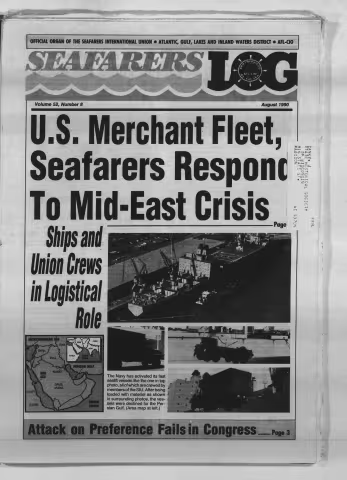
• \ - U.S. Merchant Fleet 3
Seafarers Respond
To Mid-East Crisis
Page
is Issistleil
m
The Navy has activated Its fast
sealift vessels like the one in top
photo, all of which are crewed by
members of the SlU. After being
loaded with materiel as shown
in surrounding photos, the ves
sels were destined for the Per
sian Gulf. (Area map at left.)
Attack on
i y W" • ;'fei
•ZCD <AD
>H-. -H>
ooa3>2:
e-i -n—i7\
c/)Oo rn-<
O—ii.
C_;-H
c/5 2:o
• »—
2!ri
3r . ; -I
>-t •<
'J-!
Ui
cr
I '
.,1
• V: f' •;!
, •- '. -M'
w'-'vf'•'
•••; , ...v.
. 7.--:
, • '.j,-i-..- . . •. ' I, ' -••;
•U , I.. ,• • • • ".->•••' A-.; ' ' •
• '.j
'• r:sa
f.
t,>.
.ft
• . iS'
^:tm
:' "jm
,- . J#
0 TA' • >•' '<• • ••
;l i-f
.', rTT^-- -• i"?
~ .•••;M' ,--'^ ri"'-^ •••«.•-'!< 'S"-;'V V.'-'f "^H'-''S^.'i,-V:-V .,••,•• ^ 'f .V . y V V-i' i . -' S
! - , .^'f-y-.j',y,i0.-..• 5 ..y; 5 -.,,;£^,( '4 V, f •.•>;-y y •! v V. -Vv- V ', . ''Z i , y -
•' " '••' •?•->'•-^'V 15,£-',4^ ••••i ^.. ";• •
• J V.;..- « J. {:,£/• ^ ' '' •• - -
t: '
h' '.
Ix; :'f-
j-: 1 V-
r -
i^' '•J
l^"A-
P. •
¥: >:
^nl:v
f.'
r:
.It. t... • -f .'w^ .-,.i
I ' ^ ^
u-M:- ^WiVhr;."V:''->-' t
f." ;• ; •
;. V, •.'.' •••.'. vi :•;
:|^:: :"?.. •p:-'.;: "'• .4
•f p;-.; :;•;
i "T ^4'.••. ,: •
President's Report
Making the Hard Fight
The Congress has recessed until September, after a hectic session that
included actions of major importance to seafaring people. Once again,
events of the past months have demonstrated how critical it is for us to
maintain a strong and efficient legislative presence on Washington's
Capitol Hill.
Topping the legislative matters we were concemed
with was the farm bill on which the opponents of a U.S.-
flag merchant marine tried to attach amendments that
would have weakened or eliminated the participation of
our ships in the carriage of taxpayer-supported agricul
tural export programs. Any one of the amendments, if
adopted by Congress, could have sunk a substantial por
tion of the commercial fleet; at a time, incidentally,
when such action could have had a serious impact on
the national security.
Powerful Opposition
Your union, of course, was deeply engaged in the fight to beat back
the anti-shipping amendments, a struggle in which we had our work cut
out for us. Lined up against us were the billion-dollar grain trading com
panies, many of which have ties with international operations with owner
ship and/or control of vast numbers of foreign-flag ships ready to replace
American vessels. Lots and lots of Seafarers' jobs were at stake.
After the attempts to float the anti-U.S.-flag shipping amendments
were defeated procedurally in the House of Representatives, a lobbying
assault was mounted by the grain dealers on the Senate side. The
senators who supported their view debated vigorously and used a number
of parliamentary tactics to hang anti-merchant marine amendments on
the farm bill. They were defeated by a margin of two-to-one on the first
attempt, 62 senators showing they clearly understood the potential
dangers—^not only to shipping, but more importantly to the national inter
est— to 34 voting for the grain people. Both the House and Senate ver
sions of the farm bill now go to a conference committee to smooth out
differences.
SIU representatives played an important role in explaining the issues
to the senators and representatives and their staffs—before and during
the times the issue was under consideration.
Thanks to these Senators
We are expressing the gratitude of our organization to the senators,
who like their counterparts in the House, were in the forefront of the
fight to protect American-flag shipping and the jobs of Seafarers.
Senators John Breaux, Democrat of Louisiana, and Thad Cochran,
Republican of Mississippi, led the fight. They were ably and effectively
assisted by several ardent and articulate advocates of a strong merchant
marine, among them Senators Barbara Mikulski, Democrat of Maryland;
Daniel Inouye, Democrat of Hawaii; Ted Stevens, Republican of Alaska;
Paul Sarbanes, Democrat of Maryland; and Ernest Hollings, Democrat of
South Carolina. (For a look at how the full Senate voted on the critical
amendment, see page 4.)
Thanks to Congress, our nation avoided finding its oceangoing fleet
weakened at a time when the Middle East crisis requires the maximum
logistical capability. The current situation is just one more piece of
evidence that without an adequate, active merchant fleet, the United
States can never act like a world leader. I hope this point can be brought
home to President Bush and those around him.
An Added Thought
This is the time for all of us to unite in support of the action of our
government and its allies in meeting the crisis caused by Iraq's invasion
of Kuwait. But it should be a signal to those who have sought to weaken
further U.S.-flag shipping that America must rely on its own registry of
private fleets and American crews to respond to the national needs, as in
the case of the current problem in the Middle East.
A case in point is the recent farm bill, in which agribusiness interests
touched off an assault on cargo preference, which, if successful, would
have further diminished the ability of our privately-owned fleet to play
its important role in times of conflict. But more on this at another time.
Volume 52, Number 8 August 1990
The Seafarers LCXJ (ISSN 0160-2047) is published monthly
bythe Seafarers International Union; Atlantic, Gulf, Lakes and
Inland Waters District; AFL-CIO; 5201 Auth Way; Camp
Springs, MD 20746; Michael Sacco, President. Telephone
(301) 899-0675. Second-class postage paid at MSG Prince
Georges, MD 20790-9998 and at additional mailing offices.
POSTMASTER: Send address changes to the Seafarers LOG,
5201 Auth Way, Camp Springs, MD 20746.
Communications Department Director, Jessica Smith; As
sociate Editors, Daniel Duncan and Max Hall; Associate
Editor/Production, Deborah Greene, Art Director, BillBrower.
rm'|- ^ ^i-,v
Zr : samtaaioe
Double Hull Legislatiou
Is Signed by President
The president signed a bill
August 18 that requires double
hulls and double bottoms on tanker
vessels operating in U.S. waters.
The bill, which has been
debated for the last year, also will
limit the hours crewmembers can
work in 24-hour and 72-hour
periods, require double hulls on all
tankers of more than 5,000 gross
tons entering U.S. ports by 2015,
create a $1 billion federal cleanup
fund and demand detailed preven
tion and response planning by all
vessels and maritime agencies.
Perhaps the part of the bill that
will have the greatest effect on in
dividual merchant mariners is the
federal limits on the number of
hours crewmembers can work
aboard tankers. The National
Transportation Safety Board listed
fatigue and overworked crews as
reasons for the Exxon Valdez acci
dent and oil spill in Prince William
Sound, Alaska. The March 1989
accident, the worst in the nation's
history, became the impetus for
enacting new legislation.
The new legislation places the
following limits on hours worked
aboard a tanker. "A licensed in
dividual or seaman may not be per
mitted to work more than 15 hours
in any 24-hour period or more than
36 hours in any 72-hour period ex
cept in an emergency or a drill."
Under the bill, work includes any
duties, administrative or physical,
associated with the vessel per
formed on the tanker or on shore.
Angus "Red" Campbell, SIU
vice president for collective bar
gaining, said such a provision will
not affect any of the union's tanker
agreements. "The Coast Giiard is
watching out for the fatigue factor
by including this," he noted.
House and Senate conferees
earlier had agreed to implement a
complex 20-year formula to phase
in double hulls on tankers and bar
ges. The plan involves the size, age
and hull construction and becomes
effective in 1995. Most tankers
must be fitted with double hulls by
2010. All new vessels of more than
5,000gross tons plying U.S. waters
must be built with double hulls.
A tax of 5 cents per barrel will
be used to raise the $1 billion
federal cleanup and compensation
fund. The money would be avail
able for cleanup purposes after the
liability limits of the responsible
party are reached. It also would
make payments when the spiller is
unknown or when the spiller and
aggrieved party cannot reach
agreement within 60 days.
The bill creates new liability
limits of $1,200 per gross ton or
$10 million, whichever is greater,
for tank vessels, including barges,
of 3,000 gross tons or greater. The
limit for those less than 3,000 gross
tons is $1,200 per gross ton or $2
million, whichever is greater. For
any other vessels, the limit was set
at $600 per gross ton or $500,000,
whichever is greater. The old limit
was $150 per gross ton.
Before adopting this formula
and rejecting the international
protocols, congressional conferees
had agreed to allow state liability
limits, if higher, to supersede the
federal confines. The protocols
have been opposed by the U.S.
Senate, which has refused to pass
them for the last five years. The
federal liability limits are higher
than those established by the
protocols.
Training Urged
The bill calls for the secretary of
transportation to conduct a one-
year study on the feasibility of a
maritime oil pollution prevention
training program at approved
maritime training institutes. Since
the Valdez accident, the Seafarers
Harry Lundeberg School of
Seamanship has provided oil spill
cleanup and containment classes to
trainees and upgraders studying at
the Piney Point, Md. facility.
The bill also revises the Coast
Guard's program for issuing,
renewing and revoking mariner
licenses and documents as well as
providing the agency with access
to the National Driver Register for
records of driving violations by
license applicants.
The House and Senate passed
separate oil spill bills during this
session of Congress. Repre
sentatives of both branches have
been working on merging the two
bills since the first of this year.
Index to LOG Features
COBRA Notice
Dispatchers'Report/Deep Sea . .
Dispatchers'Report/Inland ....
dispatchers' Report/Great Lakes
Final Departures
Know Your Rights
Lundeberg School Application . .
Lundeberg School Course Schedule
Lundberg School Graduates . . . .
Meeting Dates ...... . . . . . .
Pensioner
Personals
Ships Minutes ...
Union Hall Directory
Page
. 22
... . .'. . ... . . . .. IS
16
16
................ 22
21
• 23
. . . . . . . . . . . ... . . 23
• 19
IS
. . . . ... . . . . 17
................ IS
^ .. 18) 21^21
.'. '. . .'16
. ^
•"'i-'S
' ;•
,.vv-i - '. rwv-, -•
•'•;•••'. ••': v>'..*-' J-'•", '•
• iV-"- :'.
Vi
V /
AUGUST 1990
The Iraq invasion of Kuwait
SIU Issues Manpower Alert
U.S.-Flag Ships Depioyed in Gulf Crisis
President Bush's decision to move American military forces into the Middle East propelled large numbers
of sealift vessels into the area of conflict. Crewed by members of the Seafarers International Union and
other American unions, privately operated ships under contract to the Military Sealift Command (MSG)
and vessels in the Ready Reserve Force (RRF) were de
ployed to take part in Operation Desert Shield, the Depart
ment of Defense name for the Pentagon's response to the
Persian Gulf crisis.
The president's action was
provoked by Iraq's invasion
of Kuwait on August 2 and the
threat of further Iraqi aggression
directed towards Saudi Arabia.
American forces in the Persian
Gulf are in the process of being
joined by a multinational array of
troops and warships.
Worldwide Response
The USNS Capella, one of the eight fast sealift ships crewed by SIU
members, is boarded by U.S. soldiers on the way to the Middle East.
Congress Defeats
Preference Attack
The United States Senate has
beaten back attacks on the na
tion's cargo preference laws by
votes of 62 to 34 and 62 to 30,
leaving intact the requirement that
75 percent of American govern
ment-generated food aid cargoes
be carried on U.S.-fllag vessels.
The votes took place as the Senate
was deliberating the 1990 farm bill
just before leaving Washington,
D.C. for an August recess.
Prior to the Senate action, the
House of Representatives enacted
a rule that prohibited introduction
during that chamber's floor debate
on the farm bill of amendments
attacking cargo preference. By a
vote of 283 to 80 that instituted
the rule, the House prevented any
attempts from the floor to scuttle
U.S. shipping interests.
Both the House and Senate ver
sions of the farm bill now will go
to a conference committee made
up of members from both legisla
tive chambers. Because the leg
islation passed by both branches
of Congress was free of any anti-
cargo preference amendments,
there is little likelihood that the
flnal 1990 farm bill will contain
any language that will decrease
the share of food assistance car
goes allocated for transport on
U.S.-flag vessels.
Vote Two-to-One
The first Senate floor fight on
cargo preference was launched by
Senator Steven D. Symms (R-
Idaho) who introduced an amend
ment that would allow the Secre
tary of Agriculture to waive U.S.-
flag shipping requirements on cer
tain sales of agricultural commod
ities directed for export.
After a long debate in which
Senators Barbara A. Mikulski (D-
Md.), Daniel K. Inouye (D-Ha-
waii), John B. Breaux (D-La.),
Thad Cochran (R-Miss.), Paul S.
Sarbanes (D-Md.) and Ernest F.
(Fritz) Hollings (D-S.C.) spoke on
the importance of a strong Amer
ican merchant marine, the Symms
amendment was defeated by a vote
of 62 to 34. (See page 4 for a list
of each senator's vote.)
Continued on page 4
Participants in the military en
gagement against Iraq include
Australia, Bangladesh, Britain,
Egypt, France, Morocco, the
Netherlands, Pakistan, Syria and
Turkey. The Soviet Union has
indicated its intention to partici
pate in the action.
The United Nations voted to
impose an economic embargo on
Iraq and occupied-Kuwait, effec
tively cutting off any trade with
those two countries.
(See box on page 9 for chro
nology of events.)
As the scope of the military
engagement in the Middle East
increased and the demand for lo
gistical support vessels and civil
ian mariners mounted, SIU Pres
ident Michael Sacco ordered a
manpower alert throughout the
union structure to assure that the
need for seafarers would be met.
Thus far, SIU members have
Seafarers Meet Demands
For Extra Vessel Manning
As the demand increased for
vessels to supply the stepped-up
military operations in the Persian
Gulf, the Seafarers International
Union instituted a manpower alert
to assure that all manning assign
ments within the union's respon
sibility would be met.
In issuing the alert, SIU Presi
dent Michael Sacco called on all
union members to participate fully.
He urged all Seafarers who cur
rently are on the beach to inime-
diately contact the nearest union
hall or the SIU's manpower center
to register for employment. In ad
dition, Sacco extended the same
call to all physically-fit pensioners,
as well as to inactive SIU mem
bers.
*SIU Proceeding Full Steam'
In a communication to Captain
Warren G. Leback, the head of
the Maritime Administration,
Sacco advised that the "officers,
port agents, members and staff of
the SIU have been notified to take
all necessary steps to meet our
role in the nation's defense strat
egy during this time of national
emergency." He said the union is
MENTION ALL SEAFARERS
Seamen with ratings are ur
gently needed to meet cur
rent manning obligations.
Call the nearest union hail
or the manpower office at 1-
800-SEA-CREW.
"proceeding full steam to enlist
all of our members and retirees
into service. . ."
The SIU's all-out effort in
cluded suspension of provisions
of the shipping rules that limit the
amount of time certain classifica
tions of seamen can remain aboard
a vessel, combing lists of retired
members, keeping all union halls
open on weekends and late into
the evening when necessary and
maintaining an around-the-clock
operation at the SIU's central
manpower office.
Shipping Rules Amended
The shipping rules were amended
through an emergency meeting of
the Seafarers Appeals Board, a
governing group consisting of rep-
Continued on page 9
been called upon to man the eight
fast sealift ships, two aviation sup
port vessels, one hospital ship and
a number of RRF carriers. These
ships, activated for the Persian
Gulf deployment, join other mili
tary support vessels that remain
fiilly manned throughout the year—
such as prepositioning ships and
the sealift tankers.
Reports to the LOG from the
union's halls around the country
indicate that to date all vessels
assigned to the SIU have been
manned without a hitch and have
sailed on time.
Seafarers in Desert Shield
Much of MSC's prepositioning
fleet immediately was called on by
the Pentagon to provide supplies
to Operation Desert Shield. Insti
tuted a decade ago to provide rapid
response to a crisis, the preposi
tioning ships remain loaded with
equipment, such as tanks, and all
supplies necessary to maintain
military units. Many of the pre
positioning ships, and their union
crewmembers, are based in Diego
Garcia, within six steaming days
of the Persian Gulf.
Seafarers are ere wing MSC's
fast sealift ships, which are known
by their former commercial des
ignation of "SL-7's." Converted
into roll-on/roll-off (RO/RO) ves
sels by the military, the former
container ships carry heavy equip
ment, ammunition, supplies and
troops at a speed in excess of 30
knots. The vessels can reach the
Persian Gulf via the Suez Canal
from an American East Coast port
in less than two weeks.
The SIU has provided unli
censed crewmembers for two
aviation logistics support vessels,
the SS Wright and the SSCur-
tiss. As part of the military's pre
positioning ships, the vessels carry
equipment for the maintenance of
U.S. Marine Corps aircraft.
RRF Ships Broken Out
Additionally, SIU members are
manning many of the vessels called
out of the RJLF, the designation
for former commercial vessels
purchased by the government and
left in lay-up unless activated for
a role in the nation's defense. The
Department of Defense confirmed
that more than 35 ships in the 96-
vessel RRF fleet have been manned
and are now participating in Op
eration Desert Shield. It is ex
pected that other RRF ships may
be activated should the need arise.
Members of the SIU's govern
ment services division have crewed
the USNS Mercy, one of the two
hospital ships operated by the milr
itary. With a crew of 70, the vessel
has been deployed to the Persian
Gulf. Continued on page 9
• '• •• .'-v.'.--
I ' V|V
• i "til •
'Vvii'
i 1^
mm
mmmpm
I i 4:
;';i
i
•1
I' i/sf • -• , '-i
• -l <. :
- rwf •• • S '
I-
'4—r"
sanReitsm
w,
t"
". • -'wi'
• If
yw'"
liV;
,-"r'':C -
\ Ij,;..
®v'-
?lv;...
> •Ki-i;
•Hf.
;f|||||,-
•• •!.
' 'f
.•'. 'i; J ','.,-
vV-
, '7<
S ' "'
-
t£S.!i
r,^4Sf
v: y-r.
.:' •'•
f-:
j-:f;
5!-
Congress Beats Back Attack on Cargo Preferenco
'W-::->• •>-
Continued from page 3
Senator Charles Grassley (R-
lowa) introduced the second
amendment designed to torpedo
cargo preference. Grassley, in his
remarl^ to the Senate, attempted to
portray Seafarers as being too
highly paid by quoting from the
June edition of the LOG which
reported the results of the union's
negotiations with SlU-contracted
companies.
Grassley sought to impose a rate
limit that could be charged by U.S.-
flag vessels carrying government-
donated agricultural commodities.
The Iowa senator's bill did not seek
the same kind of rate limit for
foreign-flag vessels or for grain
brokers. Another Iowa senator,
Tom Harkin (D), added a proposal
to Grassley's amendment that
would have transferred the cost of
shipping food aid from the Depart
ment of Agriculture to the Depart
ment of Transportation.
Majority of Senate Unwavering
The Senate, weary after a week
of long debate on various aspects
of the farm bill, immediately
moved to a vote to table Grassley's
amendment. In a roll call vote, 62
senators registered their approval
of tabling the Grassley and Harkin
proposals. Another 30 senators op
posed the motion to table. The two-
to-one vote in favor of tabling the
amendments was an indication of
the Senate's support for maintain
ing existing cargo preference rules.
The Grassley amendment fol
lowed a lengthy debate in the
Senate on the issue known as a
Great Lakes set aside which dates
back to the 1985 farm bill that in
corporated a compromise between
U.S.-flag shipping interests and the
agricultural community.
, Under the terms of the com
promise, the maritime industry
agreed to exempt certain govem-
ment-backed agricultural export
programs from cargo preference
laws while the agricultural groups
signed off on an increasing the
level of government-impelled food
cargoes to be carried on U.S.-flag
vessels from 50 to 75 percent.
One of the conditions of the
1985 farm bill compromise was the
allocation to Great Lakes ports of a
set portion of the government's
food exports. The amount per year
mandated by the 1985 law to be
shipped from Great Lakes ports
was set at about 240,000 metric
tons per year of government-
generated food aid cargoes, close
to 20 percent of donated agricul
tural products. The program ended
in 1989.
Cargo for Lakes Debated
Backers of the set aside sought
a reinstatement of the plan under
the 1990 farm bill arguing that not
enough U.S.-flag vessels make
regular calls at Great Lakes ports
that could take advantage of the
increased cargo allocated for car
riage on American ships. Senators
opposed to a reinstatement of the
Great Lakes set aside said the
measure had been a one-shot deal,
giving the region an opportunity to
make adjustments to the new law
and now all American ports should
compete on equal footing.
A compromise on the issue was
reached on the final day of debate
on the farm bill. Introduced by
Senator Breaux, who acknow
ledged Senators Inouye, John
Glenn (D-Ohio) and Alan Dixon
(D-Ill.) as leading participants in
toe efforts to resolve the issue, the
amendment passed by voice vote.
Breaux described the com
promise legislation as providing
for following arrangements:
• Establishing a permanent
waiver Of the three-year waiting
period for re-flagged vessels to be
eligible to carry non-bulk cargo
preference from Great Lakes ports.
• For five years, 50 percent of
Public Law 480 title II bagged,
processed or fortified cargoes
would be awarded to the port with
the lowest landed cost, even if such
cargoes must travel on U.S.-flag
vessels pursuant to cargo
preference requirements.
• For that portion, any addi
tional cost of carrying this cargo on
U.S.-flag ships would not come
from toe Department of Agricul
ture budget, the funds would be
paid by the Department of
Transportation, as presently re
quired by law.
• The current level of 75 per
cent of government-generated
food aid carried on U.S.-flag ves
sels would be maintained.
• The total amount that can be
allocated under this special bid
ding procedure would be set at
245,000 metric tons a year.
• It does not set a ceiling on the
total amount of tonnage that can be
loaded at the Great Lakes or any
other port.
The legislation "allows the
Great Lakes to participate in a very
positive way in getting this addi
tional business and at toe same
time protects the other ports in
Continued on page 13
Amendments
Throughout the farm bill debate,
opponents of U-S.-flag shipping at
tempted to introduce amendments
aimed at weakening or eliminating
cargo preference. ITie two amend
ments that would have crippled toe
law that requires 75 percent of U.S.
government-impelled food car
goes to be carried on American
bottomis were introduced by Sena
tors Steven D. Symms (R-Idaho)
and Charles E. Grassley (R-Iowa).
What follows is a breakdown of
the Senate vote on motions to table
Symms' July 23 amendment and
Grassley's July 27 amendment. A
vote in fovor of the motion to table
00 was supported by the SIU. A no
vote (N) supported the giant grain
interests. Four members of the
Senate did not vote on July 23 and
eight were not recorded on July 27.
July23 July27
Alabama.
Howell Heflin (D)
Richard C. Shelby (D)
Alaska
Ted Stevens (R)
Frank H. Muikowski (R)
Arizona
Dennis DeConcini (D)
John McCain (R)
Arkansas
Dale Bumpers (D)
David Pryor (D)
California
Alan Cranston (D)
Pete Wilson (R)
Colorado
William L. Armstrong (R)
Timothy E. Wirth (D)
Connecticut
Christopho-J. Dodd (D)
Josqph I. Lieberman (D)
Delaware
WiUiamV.RothJr.(R)
Vote Vote
Y Y
Y Y
Y Y
Y
N
Y
Y
Y
Y
N
Y
Y
Y
N
Y
N
A
Y
Y
Y
A
Y
Y
Y
N
Joe Biden (D)
Florida
Robert Graham (D)
Connie Mack HI (R)
Georgia
Sam Nunn (D)
Wyche Fowler (D)
Hawaii
Daniel K. Inouye (D)
Daniel K. Akaka (D)
Idaho
James A. McClure (R)
Steven D. Symms (R)
Illinois
Alan J. Dixon (D)
Paul Simon (D)
Indiana
Richard Lugar (R)
Daniel R. Coats (R)
Iowa
Charles E. Grassley (]R)
Tom Harkin (D) ,
Kansas
Robert Dole (R)
Nancy L. Kassebaum (R)
Kentucky
Wendell H. Ford (D)
Mitch McConnell (R)
Louisiana
J. Beimett
Johnston Jr. (D)
John B. Breaux (D)
Maine
William S. Cohen (R)
George Mitchell (D)
Maryiand
Paul S. Saibanes (D)
Barbara A. Mikulski (D)
Massachusetts
Edward M. Kennedy (D)
John F. Kerry (D)
Michigan
Donald W. Riegle Jr. (D) Y
Carl Levin (D) Y
Minnesota
David Durenberger (R) N
Rudy Boschwitz (R) N
Y Y
Y Y
Y Y
Y Y
Y Y
Y Y
Y Y
N Y
N N
Y Y
Y Y
N N
N N
N N
N N
N N
N N
Y Y
N N
Y A
Y Y
Y Y
Y Y
Y Y
Y Y
A
V
Y
Y
Y
A
N
Mississippi
Thad Cochran (R)
Trem Lott (R)
Missouri
John C. Danforth (R)
Christophers. (Kit)
Bond(R)
Montana
Max Baucus (D)
Conrad Bums (R)
Nebraska
J. James Exon (D)
Robert Kerrey (D)
Nevada
Harry Reid (D)
Richard H. Bryan (D)
New Hampshire
Gordon J. Humphrey (R)
Warren Rudman (R)
New Jersey
Bill Bradley (D)
Frank R. Lautenberg (D)
New Mexico
Peter V. Domenici (R)
JefifBingaman(D)
New York
Daniel Patrick
Moynihan(D)
Alfonse D'Amato (R)
North Caroiina
Jesse A. Helms (R)
Terry Sanford (D)
North Dakota
Quentin N. Burdick (D)
Kent Conrad (D)
Ohio
John H. Glenn Jr. (D)
Howard Metzenbaum (D)
Oklahoma
David Lyle Boren (D)
Don Nickles (R)
Oregon
Mark O. Hatfield (R)
Robert W. Packwood (R)
Pennsylvania
H. John Heinz III (R)
Arlen Specter (R)
Rhode Island
Y Y Claiborne Pell (D) Y Y
Y Y John H. Chafee (R) N N
South Carolina
N N Strom Thurmorid (R) N N
Ernest F. (Fritz)
N N Hollings (D) Y Y
South Dakota
N N Larry Pressler (R) A N
N N Thomas A. Daschle (D) Y Y
Tennessee
N N James R. Sasser (D) Y Y
N Y Albert Gore Jr. (D) Y Y
Texas
Y Y Lloyd Bentsen (D) Y Y
Y Y Phil Gramm (R) N N
Utah
N N Edwin Jacob (Jake)
N A Gam (R) A N
Orrin G. Hatch (R) N A
Y Y Vermont
Y Y Patrick J. Leahy (D) Y Y
James M. Jeffords (R) Y Y
N N Virginia
Y Y John W. Wamer (R) Y N
Charles S. (Chuck)
Robb(D) Y Y
Y Y Washington
A Y Brock Adams (D) Y Y
Slade Gorton (R) Y Y
N N West Virginia
Y Y Robert C. Byrd (D) Y Y
John D. (Jay)
Y Y
Rockefeller IV (D) Y Y
N
'X
N Wisconsin
Robert W. Kasten Jr. (R) N N
Y Y
Herbert H. Kohl (D) Y Y
Y
A
A Wyoming
Malcom Wallop (R) N A
N N
Alan K. Simpson (R) N • N
N N
Total vote on toe motion to table
V •\r toe July 23 amendment: 62 yeas.
Y
Y
Y
Y 34 nays and 4 not voting.
Total vote on toe motion to table
Y
Y
Y
Y toe July 27 amendment: 62 yeas.
a 1 30 nays and 8 not voting.
' .'r ' • " '
.•f
AUGUSf 1990
^
Safety Board Report Takes Critical Look at Causes of Disaster
Fatigue, Undermanning Cited as Factors in Vaidez Spiii
Fatigue, an overworked crew
and undermanned ship, alcohol
abuse and inadequate Coast Guard
controls are among the reasons the
Exxon Vaidez ran aground, creat
ing the nation's worst oil spill, ac
cording to a National
Transportation Safety Board
(NTSB) report.
The government's safety
watchdog agency spread the blame
for the March 24, 1989 accident,
which dumped almost 11 million
gallons of oil into Prince William
Sound, Alaska, among officers on
the Vaidez, the Exxon Shipping
Company, the Coast Guard as well
as the local pilotage service and
pipeline company.
Several of the recommenda
tions made by the NTSB study,
which was released late last
month, were adopted in the recent
ly passed federal oil spill legisla
tion. Among those incorporated
are limits on the number of hours
crewmembers should work during
a day, a study on better response
for oil spill cleanups and the ability
to use the National Driver Register
and other records for information
relating to possible drug or alcohol
problems before issuing merchant
marine documents and licenses.
Reviews Manning Standards
Other recommendations based
on the study of the accident listed
by the NTSB included the elimina
tion of personnel policies en
couraging mariners to work long
hours without concern for fatigue
and the "commensurate reduction
in safety of vessel operations," im
plementation of a drug/alcohol
policy to monitor mariners from
going back to sea before treatment
is completed and establishment of
manning standards ensuring the
crew reflects "all expected ship
board operating situations and that
procedures are in place for dealing
with unusually high workloads at
sea, such as tank cleaning and
cargo handling operations in port."
The study concluded that the
third mate, who was placed in
charge of the departure from the
sound by Captain Joseph Hazel-
wood, was fatigued when he took
over the navigation watch ap
proximately 20 minutes before the
vessel ran aground on Bligh Reef.
It noted "there were no rested deck
officers on the Exxon Vaidez
available to stand the navigation
watch when the vessel departed
from the Alyeska terminal."
Size of Crew Key Factor
. Reductions in the size of the
crews aboard Exxon vessels pur
sued by the Exxon Shipping Com
pany precipitated the fatigue
factor, the reported continued. The
company's crewing policies did
"not adequately consider the in
crease in workload caused by the
reduced manning," it stated.
Exxon also "had incentives and
work requirements that could be
conducive to fatigue."
The Coast Guard should have
been more aware of the heavier
workload forced on the crew when
the manning scale was reduced,
the study noted. "The Coast Guard
was unduly narrow in its perspec
tive when it evaluated reduced
manning requests for the Exxon
Vaidez because it based manning
reductions primarily on the as
sumption that shipboard hardware
and equipment might reduce the
workload at sea, but it did not con
sider the heavier workload as
sociated with cargo operations in
port and the frequency of such
operations."
Alcohol Impairs Judgement
The NTSB reported
Hazelwood's "judgement was im
paired by alcohol" while the vessel
was making its way through the
sound. It went on to cite neither the
company nor the Coast Guard was
prepared to test for alcohol and
drug-related problems, nor had
Exxon adequately followed
through to monitor Hazelwood
following an earlier alcohol
rehabilitation program.
(Hazelwood was found not guil
ty of criminal mischief in a trial in
Alaska in March. Of the other three
charges for which he was tried, the
Vaidez master was found guilty on
just one misdemeanor—unlawful
and negligent discharge of oil into
Alaskan waters.)
In other problems listed against
the USCG, the board acknow
ledged the lack of an immediate
cleanup response, the poor
monitoring and reporting of ice in
the Prince William Sound and the
SHI, MMP, Sea-Land, Famll Object
To tykes Scheme for How Subsidy
A plan by Lykes Brothers
Steamship Co. and the Marine En
gineers Beneficial Association to
transfer a portion of Lykes subsidy
to a MEBA pension fund operation
was met with opposition within the
industry and maritime labor.
The development occurred
shortly after it was announced by
the Maritime Administration last
month that Lykes had applied for
transfer of some of its Subsidy
rights to First American Bulk Car
rier (FABC) Corporation, which is
wholly owned by the MEBA pen
sion fund and headed by an official
of that union.
The strong opposition of the SIU
to the proposed subsidy deal was
set forth by the union's president,
Michael Sacco, in a formal objec
tion to MarAd. The SIU protested
the use of taxpayer monies to sub
sidize an operation that would
compete head-to-head with unsub-
sidized, SlU-crewed Sea-Land
vessels. If the transfer of Lykes
subsidy goes to the two FABC
ships, "the SIU will lose employ
ment opportunities," Sacco told
MarAd.
Back Door Time Charter
The union pointed out that the
Lykes proposal amounted to no
more than a phony charter opera
tion. Instead of bareboat charter
ing the vessels, a standard practice
in the industry when a company is
seeking to expand its fleet, Lykes is
attempting to time charter two ves
sels through the back door, the SIU
said.
Sacco noted that the
Lykes/FABC application for the
subsidy transfer is "so vague that it
raises more questions than it
answers." The SIU has asked the
Maritime Administration, through
a Freedom of Information Act
(FOIA) request, to provide copies
of documents, such as the time
charter arrangements between
Lykes and FABC, which are
relevant to the Lykes and FABC
application.
Also objecting to the proposal to
transfer Lykes subsidy rights to
FABC was the International Or
ganization of Masters, Mates and
Pilots. The union, which represents
masters and mates on Lykes ves
sels, called the proposal an "un
precedented subsidy assignment"
that "totally ignores Lykes' con
tractual relationship and obliga
tions" to the MM&P and American
Radio Association.
Sea-Land, Farrell Object
Sea-Land Service, another ob
jector, pointed out that the trade
route in which Lykes proposed to
use the two FABC vessels is "al
ready severely overtonnaged"
which "argues against adding two
more vessels to the four now
employed" by Lykes in the north
ern European subsidized trade
route (TR 21).
Farrell Lines argued that as a
consequence of putting the FABC
vessels on the northern Europe
route, Lykes would move two ships
into the Mediterranean trade. That
run is presently served by U.S.-flag
vessels operated by Farrell.
The objections of the SIU,
MMP, Sea-Land and Farrell were
lodged with the Maritime Ad
ministration, the govemment agen
cy responsible for approving
subsidy to U.S.-flag companies
that meet certain requirements
prescribed by law. MarAd an
nounced the request by Lykes and
FABC to transfer subsidy in the
July 10 issue of the Federal
Register. The agency solicited
comments on the Lykes/FABC
proposal and can now either rule
for or against the petition or hold a
hearing to gather further informa
tion.
Ill-Fated FABC
Has History
Of Problems
Continued on page 6
• .a'..
deficiency in maintaining an effec
tive vessel traffic service in the
sound.
The NTSB noted the inadequate
response by the Alyeska Pipeline
Service Company to the oil spill
and the lack of an adequate plan to
deal with a spill. The study also
reported a local pilot should have
remained on the vessel until it was
clear of Bligh Reef, a policy in
stituted after the accident.
Reports from the NTSB often
are used to help prevent other
problems from happening by dis
cussing why the accident being in
vestigated occurred. Some NTSB
reports have been used in courts
because of the agency's reputation
for providing very comprehensive
investigations of the events.
The First American Bulk Carrier
(FABC) Corporation, a two-ship
operation to which Lykes is seeking
to transfer a portion of its operating
subsidy, has been a dogged with
problems since its inception in
1979.
The corporation was set up by
the trustees of the pension fund of
the District 1 Marine Engineers
Beneficial Association. Initially,
the trustees approved an invest
ment in a shipping venture with a
Belgian shipowner that would in
volve a $7 million investment for a
two-ship operation.
After finding that no U.S.
govemment monies were available
for construction or operating sub
sidy, the trustees and the European
operator reincorporated FABC in
1981 and took advantage of an ac
tion in Congress that allowed U.S.-
flag vessels to be built overseas
during a brief period of time.
In January 1982, contracts were
signed with a South Korean
shipyard for construction of two
vessels at a total cost of $69.1 mil
lion with 80 percent of the financ
ing to go through a Korean bank.
Later that year, the Belgian
operator dropped out and the
MEBA pension fund became the
sole shareholder of FABC. The
ship construction deal was
renegotiated with the Koreans and
the cost of each ship placed at
$29.99 million with 80 percent of
the financing spread out over an
eight-year period. It is believed
that the MEBA pension fund
pledged $62 million in marketable
M '
•
,+4
i' f ^
"'K.
- • y . ' • •• •: • '1 -
•'M ••• • '• I' i.
4^.'' "s, "r-v.:i.' .'-t ,'• •••->,-i. ••• ,•••-: '--w-. I'l -MIH j*r-TnwmuiM«i mm ,i^i— -._,;™' ••., ,••!-_ ,-—... -
:^'.t saeuim IOG
W):V •••
;n^ i::'. •I''''.
iS^--
?!".'
: •• V V..
'5 ;-:i •• :.
t-i:ssv:
#• •• *v..: /•^::-:.;"
rv:v v,.:; .
i':- ';•••••,-i. •• •. ' • •
mr::.:,
• ••
•'v~;4 • •,.- "'-• <.
i: V:4>
-• : •• ;- •• '^1"' '-•• •
.'r.
lil. • "., ' " "
i :'4'
t'-•
't r''5&AA*'
-V '• .
51 Senators Urge President
Maritime Belongs Out
Of GAU Trade Talks
A majority of the U.S. Senate
has told the Bush administration
that maritime should be excluded
from the multinational trade
negotiations taking place in
Uruguay.
The General Agreement on
Tariffs and Trade (GATT) is a
multinational treaty established in
1948 to end discriminatory trade
practices, reduce trade barriers and
eliminate devices which would
distort free competition within the
world market. A total of 96
countries, including the
United States, subscribe to
the treaty.
Periodically, repre
sentatives from the various
nations meet to update the
accords and iron out any
problems. The present
negotiations, which began in
1986, are scheduled to con
clude by year's end. How
ever, many items remain on
the agenda for discussion
and Hnal action.
The SIU has been active in
trying to keep maritime off
the table for discussion. The
union has warned that any
negotiated agreement deal
ing with maritime could in
validate U.S. laws governing
everything from coastwise
trade to operating subsidies
for U.S.-flag carriers.
Resolutions reflecting the
opinion-of Congress have
been filed by U.S. Senator
John Breaux (D-La.) and
U.S. Rep. Walter Jones (D-
N.C.) to ask the: administration to
have maritime removed. To date,
51 of the nation's 100 senators
have signed as co-sponsors to
Breaux's bill. A total of 140 House
members have added their names
to Jones'resolution.
Since it came into being, GATT
dealt exclusively on trade in goods.
However, the inclusion of services
in the current round of talks marks
a dramatic departure from past
GATT subject matter.
The SIU worked with Congress
during 1988 to keep maritime out
of the U.S.-Canada Free Trade
Agreement/Strong sentiment from
both the Senate and the House
forced the Reagan administration
to remove maritime from the pack
age.
The union has pointed out that
maritime already is highly regu
lated since it is the oldest form of
international trade. Worldwide
Why the Maritime Industry Opposes ^
Inclusion of Waterhorne Transit in the
Current Round of GATT Talks
• Endanger the Jones Act. The United
States may forced to repeal existing
cabotage laws barring foreign vesisels and
airlines from pixividirig services betvife^
two destinations in this countryv
t National Security With the
posisihility of fofeign-flag shijps getting
involved in ddniestic routes, there is the
possibility of a grave threat to national
isecurity.,
• Eliminate Shipping Subsidies. The U.S.
could be forced to drop existing operating
subsidies designed to help U.S.-flag car
rier offset competition from low-\yage
foreign-flag Shipping that would not have
to meet U.S. standards for manning or
• End Cargo Preference. Protection for
y.S.-flag shipping reserving set percent
ages government-generated cargoes
could be eliminated.
Congressman Bonior Pays Visit to SIU Hali
When he recently returned to his district and attended the annual "Pickerel Tourna
ment" Parade, Congressman David Bonior (D-Mich.) stopped by the Algonac hall
to visit with SIU members and their families who came to watch the parade. Pictured
above are (left to right) Andy Goulet, SIU Great Lakes representative: Kirk Biishell,
QMED; Bonior, and SIU Port Agent Jack Allen.
In Response to Judge's Order,
USCG Issues New Test Rules
Pre-employment Drug Screening to Continue
maritime is subject to the overview
of the International Maritime Or
ganization and the United Nations
Conference on Trade and
Development. It is regulated
domestically by the Department of
Transportation and the Federal
Maritime Commission. The SIU
has stated it would be unwise to
involve another multinational
agency in maritime, particularly
since it has no experience in the
industry.
Pre-employment drug testing
will continue for SIU members
while the Coast Guard seeks com
ments on its revised random dmg
testing policy.
The USCG was forced to come
up with a new random testing
policy after the SIU and other
maritime agencies late last year
won a federal suit against its im
plementation. Federal Judge
Thomas Hogan dismissed the
original plan as being too "in
trusive on the individual's privacy
interests." Hogan stated the Coast
Guard had failed to prove how all
hands on ship, especially those in
the galley, were directly related to
the safe navigation of the vessel.
The SIU has not decided how it
will respond to the revised
proposal. "We are going to have to
study it to see what changes have
been made," said Augie Tellez,
SIU assistant vice president who
has been monitoring the dmg test
ing policies for the union.
Tellez noted the proposal re
quires those crewmembers listed
on the certificate of inspection and
those who are not listed but do the
same type of work to be tested. It
includes those who have specific
From Start, FABC Has Been Dogged with Problems
Continued from page 5
securities to obtain and secure let
ters of credit on the loan,
In late 1984, the Department of
Labor, which had been investigat
ing the MEBA pension fund, is
sued a complaint against the group
and its tmstees for violations of the
law that governs retirement plans.
The agency said the tmstees and
the plan had been derelict in their
fiduciary responsibilities by failing
to undertake a marketing study
before building the FABC ships,
for not ensuring an adequate rate of
return on the vessel investment and
for exposing the fund to the risk of
extremely large losses—in the
neighborhood of $60 to $80 mil
lion.
As the tmstees and MEBA pen
sion plan were settling the com
plaint in 1985 with the Department
of Labor, the fund entered into a
subcharter through its wholly
owned subsidiary, FABC, of the
two vessels to United States Lines.
In November 1986 U.S. Lines
filed a bankmptcy petition and the
following April rejected the sub-
charters of the FABC vessels. The
MEBA plan chartered the ships
that same month to the Topgallant
Group. The Department of Labor
modified its agreement with the
pension fund to allow a participat
ing employer in the plan to sub-
charter the two ships. By la\y,
transactions between a plan and
parties of interest are prohibited, so
the agency's agreement was im
portant to the deal.
In early '89, the Topgallant
Group was sold to Soudieastem
Maritime Company, a Georgia-
based shipping-agent. Later that
year. Topgallant Lines of Savan
nah, Ga. went into bankmptcy and
the two ships were arrested because
of action by the company's
creditors. Although the MEBA
pension fund tmstees voted last
Febmary to advance up to $ 10 mil
lion from the plan to fi^ee the ships,
the vessels are still detained in
Bremeihaven, West Germany.
duties during lifeboat and fire drill
exercises. The new proposal also
slates for random testing any crew-
member on a passenger vessel
whose assignment is to assist pas
sengers to safety, he continued.
The Coast Guard hopes to im
plement a random drug testing
policy by the end of the year. Tel
lez said tihe SIU will continue with
pre-employment testing until it is
advised otherwise.
• The Department of Transporta
tion, as the supervisory agency for
the Coast Guard, issued extensive
dmg testing regulations for mer
chant mariners on U.S.-flag ves
sels in November 1988. The mles
required U.S.-flag operators to
subject crewmembers to pre-
employment, post-accident, prob
able cause and random drug
testing. The SIU filed its lawsuit in
December 1988 stiating the USCG,
by its own admission, had little
evidence linking drug use to
maritime accidents.
After several delays, pre-
employment testing began July 21,
1989. Just days before random
testing was to start. Judge Hogan
banned it. On January 8, the Coast
Guard announced a six-month ex
tension of pre-employment tests
taken during 1989. Until then,
mariners were obligated by
govemment regulations to take
pre-employment tests every six
months. SIU members resumed
pre-employment testing in June.
"i
• '' t
i
• ''I
•
-I
i
•r.-l' ' l-'N. 7".
". 4 "Hi
• •,;! •• ^ lb' >
•'• i/>-•;-ft •?
A • 'ft •' ft'.^ :.. •
American ' '•:!p|R|.iijirftftft|fttft|ft
Steamship. ••;'
Buffalo : •V'''%liiift;ft:|y1| ,
Roams Lakes i! w
Unlike most vessels that sail on the Great Lakes, the
Buffalo has no set route she follows. The American
Steaniship Company (ASC) self-unloader roams across
the four lower lakes to deliver her loads wherever they
are needed.
The Buffalo can handle a variety of cargo. Among her
loads this year alone are gypsum, sand, stone and coal.
The vessel is one of the hewer members of the ASC
fleet. She is the only one with teflon-lined holds.
Algonac Port Agent Jack Allen said the teflon makes
quite a difference when the hard-working crewmembers
start unloading her. "It's a lot easier, especially for gyp
sum, because it is slippery," said Allen. "This was a spe
cial test case to see how it would work."
Allen noted the ship is very versatile and considered
one of the workhorses of the Great Lakes fleet
fti® •
• ^ .41 ••
vftftiillf
•ft .ftf'ft
Vftft-:,l:;'|#.ft':
•^ft-^-
1
• '.'C
ftlii
!• ^ •l-ft?:
i "L^ jt ft.''' -
•; ft ft:
•ft-Kii:!.-'
••ft .'";. I#-.-- --
•'ft :• ft ''4. •
'.'•••• •" ii"
-"•ft'ft'-i
ft;ft'-.'fti'ft-K .
fti 4
-.ft ift^'4®:
-ftft -m
ftft'i -ftft.®?;'
•#: ft
'ft^
M
• • • iftft
•ft 'fti®;-•* r:)m-
'ftftfeftl ft^:
-ftftftv
^ '•-'vS'
ft 'ft;
• ft'
ft:
;.ft®ftftift44'''ftft'ftftftft
• ifWX
:• • 'A--'. ••-;.•
j^msn
;.vJ•• ;^: • • • ''<•''•'.: VV/-'"• 'iiPr'-i^"-,iir ^ K vf'•*#* t
: .i,,v;-- sr,;-
, . ; ;v«c-:'-- • , ^
••• ,-r
• sSsSS^^
steppe"'
itN^as ®®^ ® t Violet, ^
ctotag®' n®"^a that the
Petezte^f^i^^hfe
a:aSS.B
ine
HiSfT;
\<ii
?vfl
^tohanc
BlGHT-^^Ohio at^Xe a.^^'ssw
Bettn®°*
-V y
^ "V^ ^ • tj
S,-:; fe,'> •:, •••:' <•<?;> •
AUGusrmo
^ -."• ••''.' v'
•:M/
"STS-
The Iraq Invasion of Kuwait
SIU's Government Service Crews Aboard
MilNaiy's Hospital Ship Readied for Persian Giiif Duty
USNS Mercy
Becomes Fully
Activated
Seafaring members of the union's
government services division were
called upon to man the recently-
activated USNS Mercy, one of
the military's two hospital ships.
At the time the USNS Mercy
was activated, the civilian mari
ners employed aboard vessels op
erating in MSC's Pacific Fleet al
ready could be found crewing
vessels in that command.
(The civilian seafarers aboard
MSCPAC vessels, which operate
throughout the year, are members
of the SIU Government Services
Division, once known as the Mil
itary Sea Transport Union.)
Layberthed in Oakland, Calif.,
the USNS Mercy is designed to
provide combat medical support.
MSG describes the vessel, and her
twin ship based in Baltimore, as
large, acute care medical facilities.
The vessel, which was con
verted from its previous life as a
tanker, was on standby alert fol-
The hospital ship USNS Mercy Is one of many vessels crewed by the SIU's government services division.
The vessel recently set sail for the first time In many years.
lowiiig the San Francisco earth
quake in October of 1989 but it
has not sailed for several years.
Most of the time, the USNS
Mercy is manned by a skeleton
crew and kept in reduced operat
ing status. "Ihe activation of the
vessel increases the manning to
some 70 civilian mariners and also
hundreds of medical personnel.
Both hospital ships are capable
of becoming fiilly operational
within five days.
For the 894-foot vessel's current
deployment, SIU crewmembers
have been joined by Navy medical
personnel. The San Francisco
Chronicle reported that the 69,360
ton USNS Mercy carried close to
1,200 people in the ship's comple
ment.
As the vessel was about to sail,
family members of the crew and
medical staff assembled at the
Oakland Naval Supply Center in
what became a spontaneous good
bye party.
Chronology of Events In Persian Gulf Crisis
Iraqi troops Invade and occupy
Kuwait in a matter of hours. MarAd
advises U.S.-flag vessels to s^y
at least 12 miles off the Ir^i and
Kuwaiti coasts. President^ Bush
freezes Iraqi and Kuwaiti aglets in
United States and tails ori litions
of the world to condemn l^on.
The United Nations condemns in
vasion. Ameiritan battle groups
placed on aiert.
iKugasta
Iraqi begirt in^ng on Saudi
Arabian border. U.S. and Soviet
Union issue joint statement con
demning Iraqi invasion.
^ployed In Red iea^ U.N. declares
Kuvwiiti annexation void.
August 10
Arab League condemns the inva
sion 1^ a vote of 12 out of 21 and
some countries agree to send troops
to defend Saudi Arabia. Iraq's Sad^
dam Hussein calls for an Arab Holy
War. NATO claims an at^ck on
Turkey by Iraq would be an attecK
dttthsw^
SB;';AnaU8l:12ft-fe
Bush orders
August 4
The European Community freezes
IF ah Iraqi and Kuwaiti assets and
I imposes an embaigo on oil Im-
ports
August 6
Turk^ agrees to close Iraqi pipe
line. U.N. adopts sanctions that
virtually prohibit all trade witii Iraq
and occupied-Kuwait. U.S. govem-
rnent announces it will help enforce
sanctions and deploys USS inde
pendence battle group to northern
Arabian Sea.
ments of Iraqi oil and almost all
Imports.
August 13
U.S. military planes land in Saudi
Arabia at a rate Of one every 10
minutes. An Iraqi tanker sails empty
from a Saudi Red Sea port because
the Saudi government would not
permit tugs to dock the tanker.
FAaguilT
The U.S. begins moving troops to
Saudi Arabia as part of multina
tional defense force.
iMilitstt
Iraqi dictator Saddam Hussitn an
nexes Kuwait. U.S. troops and air
craft start arriving in Saudi Arabia.
Great Britain announces its support
for the multinational force.
August 9
USS Eisenhower and task force
August IS
Saddam Hussein seeks peace with
Iran by returning POWs and terri
tory captured in a nine-year war.
Augnstl?
Bush calls up military reserves.
Saddam Hussein raises tiie titreat
of worldwide terrorism.
August 18
Iraq places foreign natidriais around
military targets, factories md in
stallations as a "human shietd."
U.S. warships fire rounds across
the bows of two Iraqi inkers that
will not slop for inspection.
August 20
Bush declares Americans bwng held
t^ Iraq as "hostages." The United
Arab Emirates agrees to host U.S.
forces.
Seafarers Meet Manning Meeds
Pension Pay Protected Continued from pt^e 3
resentatives of management and
labor. Due to the contractual im
plications of the current mobili
zation, the SAB put into efifect the
following provisions for the du
ration of the current emergency;
• The relief system for class A
seamen who have acquired the
necessary four months seatime has
been waived, excluding perma
nent ratings. Seamen in permanent
ratings will stick to their desig
nated rotations.
• Class A seamen may remain
aboard their vessels in excess of
240 days and Class B seamen may
stay on for more than 180 days.
Normally, the shipping rules re
quire that Class A and B seamen
limit the amount of seatime per
year to 240 or 180 days, depending
on the classification. This rule has
been lifted for the time being.
In calling upon pensioners, the
Board of Trustees of the Seafarers
Pension Plan voted to allow reti
rees to participate in the activation
without interruption of their
monthly pension payments. As a
result of the trustees' action, re
tired SIU members sailing on ves
sels with a military support pur
pose will continue to receive their
monthly pension check in addition
to the pay accrued by shipping.
All union members currently on
the beach, or pensioners inter
ested in playing a role, or inactive
Seafarers with ratings are being
urged by the SIU to contact the
nearest union hall or manpower
office. The manpower center,
which is open 24-hours-a-day, can
be reached by dialing 1-800-SEA-
CREW (or 1-800-732-2739).
U.S.-Flag Fleet Activated for Gulf
Continued from page 3
Seafarers aboard the sealift
tankers, other MSG ships or some
commercial U.S.-flag carriers also
may find themselves taking part
in Operation Desert Shield as it is
possible that additional vessels will
be called up. The union is taking
steps to ensure that increased de
mands for manning vessels can be
met swiftly and efficiently.
Trained for Rradiness
SIU members for several years
have participated in training ex
ercises coordinated under the aus
pices of the military in preparation
for real-life operations such as De
sert Shield. In addition. Seafarers
upgrading at the union's training
facility receive instruction on sea-
lift procedures such as crane op
erations, helicopter maneuvers and
solid shield exercises, a process
designed to safeguard a vessel in
contact with chemical warfare.
Underway replenishment pro
cedures also are enacted and stud
ied in exercises and course work
through the Lundeberg School.
Seafarers are asked to give special
attention to cargo operations be
cause much of the military's heavy
equipment requires careful han
dling.
The union's school has a group
of instructors known as the "mo
bile sealift training team" who pe
riodically board SlU-contracted
military vessels to conduct sealift-
preparedness exercises.
j::'V
] -m
' ; • : ' I*-! •' "
if
' V
: xM
9^ ,,i
8 SEAFARERS LOG
LEFT—Patrolman Joe Perez (in cap) takes
care of business during a union meeting
aboard the Overseas Ohio. From the left are
QMED John Miranda. DELI Phillip Watson,
AB Alvin Kirksey, Perez, AB Stephen Sylvia,
AB Daniel Eckert and GSU Windell Blood-
worth.
BELOW—Shore leave is over for QMED
John Miranda and DEL! Phillip Watson who
return to the Overseas Ohio after visiting
Chiriqui Grande, Panartia.
SIU Grew Works Hard
To Keep Overseas Ohio
Running Smoothly
Deck department members (from left) Alvin Kirksey, Stephen Sylvia and
Jerry Borucki get ready to tie up the tanker in Panama.
AB John Gauthier and Bosun Jerry Borucki take care of sorne painting needed
on the deck. Borucki provided these pictures for the LOG.
SIU crewmembers are
trained to handle most any situ
ation arising at sea. Bosim Jerry
Borucki proved that not only is
he a very skilled member of the
deck department, but he also is
quite adept at using a camera.
Borucld took his camera on a
recent voyage of the Overseas
Ohio to Panama. He provided
the Seafarers LOG with these
photographs of SIU crew-
members working aboard the
tanker as well as the payoff in
Louisiana.
Everything was running
smoothly aboard the Overseas
Ohio, according to Joe Perez,
SIU patrolman from the port of
New Orleans.
Perez recently met the ship as
it was docked at Nine Mile An
chorage, near Violet, La. The
patrolman noted that the crew
had plenty of work to keep them
busy aboard the tanker. The few
complaints he encountered
were handled onboard with no
problems, Perez reported.
The Overseas Ohio, which is
operated by Maritime Overseas
Corporation, loads oil in Pan
ama and unloads at various
ports in Texas, Louisiana and
Florida in the Gulf of Mexico
region.
QMED Jorge Bermeo, Third Mate Marshall Townsend and Second Mate Roy
Pino handle a fire hose during safety drills aboard ship.
ABOVE—^The galley gang of
Steward Grant Marlett and
Chief Cook Leticia Perales are
ready to handle the crew's food
needs.
LEFT—AB Alvin Kirksey, AB
Willie Chestnutt and Bosun
Jerry Borucki inspect a life ring
RIGHT—Preparing for a safety
drill aboard the Ohio are Third
Mate Marshall Townsend, AB
Alvin Kirksey and QMED Jorge
Bermeo.
:v'''
• :=• K" '... 1 •
AUGUST 1990
.it - ;
The Iraq invasion of Kuwait
SIU's Government Service Crews Aboard
Military's Hospital Ship Readied for Persian Gulf Duty
USNS Mercy
Becomes Fully
Activated
Seafaring members of the union's
government services division were
called upon to man the recently-
activated USNS Mercy, one of
the military's two hospital ships.
At the time the USNS Mercy
was activated, the civilian mari
ners employed aboard vessels op
erating in MSC's Pacific Fleet al
ready could be found crewing
vessels in that command.
(ThjC civilian seafarers aboard
MSCPAC vessels, which operate
throughout the year, are members
of the SIU Government Services
Division, once known as the Mil
itary Sea Transport Union.)
Layberthed in Oakland, Calif.,
the USNS Mercy is designed to
provide combat medical support.
MSG describes the vessel, and her
twin ship based in Baltimore, as
large, acute care medical facilities.
The vessel, which was con
verted from its previous life as a
tanker, was on standby alert fol-
The hospital ship USNS Mercy is one of many vessels crewed by the SIU's government services division.
The vessel recently set sail for the first time in many years.
lowing the San Francisco earth
quake in October of 1989 but it
has not sailed for several years.
Most of the time, the USNS
Mercy is manned by a skeleton
crew and kept in reduced operat
ing status. 'The activation of the
vessel increases the manning to
some 70 civilian mariners and also
hundreds of medical personnel.
Both hospital ships are capable
of becoming fully operational
within five days.
For the 894-foot vessel's current
deployment, SIU crewmembers
have been joined by Navy medical
personnel. The San Francisco
Chronicle reported that the 69,360
ton USNS Mercy carried close to
1,200 people in the ship's comple
ment.
As the vessel was about to sail,
family members of the crew and
medical staff assembled at the
Oakland Naval Supply Center in
what became a spontaneous good
bye party.
Chronalogy of Events In Persian Gulf Crisis
Iraqi troops Invade and occupy
Kuwait in a matter of hours. MarAd
advises U.S.-flag vessels to stay
at least 12 miles off the Iraqi and
Kuwaiti coasts. President Bush
freezes Iraqi and Kuwaiti assets in
United States and calls on nations
of the world to condemn action.
The United Nations condemns in
vasion. American battle groups
placed on alert.
deployed in Red Sea. U.N. declares
Kuwaiti annexation void.
August 10
Arab League condemns the inva
sion by a vote of 12 out of 21 and
some countries agree to send troops
to defend Saudi Arabia. Iraq's Sad
dam Hussein calls for an Arab Holy
War. NATO claims an attack on
Turkey by Iraq would be an attack
on the whole of NATO.
Augusta
Iraqi troops begin massing on Saudi
Arabian border. U.S. and Soviet
Union issue joint statement con
demning Iraqi invasion.
August 12
Bush orders Navy to halt all ship
ments of Iraqi oil and almost all
imports.
August 4
The European Community freezes
all Iraqi and Kuwaiti assets and
imposes an embargo on oil im
ports.
August 6
Turkey agrees to close Iraqi pipe
line. U.N. adopts sanctions that
virtually prohibit all trade with Iraq
and occupied-Kuwait. U.S. govern
ment announces it will help enforce
sanctions and deploys USS Inde
pendence battle group to northern
Arabian Sea.
August 13
U.S. military planes land in Saudi
Arabia at a rate of one every 10
minutes. An Iraqi tanker sails empty
from a Saudi Red Sea port because
the Saudi government would not
permit tugs to dock the tanker.
August 15
Saddam Hussein seeks peace with
Iran by returning POWs and terri
tory captured in a nine-year war.
August 17
Bush calls up military reserves.
Saddam Hussein raises the threat
of worldwide terrorism.
August?
The U.S. begins moving troops to
Saudi Arabia as part of multina
tional defense force.
August 8
Iraqi dictator Saddam Hussein an
nexes Kuwait. U.S. troops and air
craft start arriving in Saudi Arabia.
Great Britain announces its support
for the multinational force.
August 18
Iraq places foreign nationals around
military targets, factories and in
stallations as a "human shield."
U.S. warships fire rounds across
the bows of two Iraqi tankers that
will not stop for inspection.
August 9
USS Eisenhower and task force
August 20
Bush declares Americans being held
by Iraq as "hostages." The United
Arab Emirates agrees to host U.S.
forces.
Seafarers fi/leet ti/lanning Neetfs
Continued from page 3
resentatives of management and
labor. Due to the contractual im
plications of the current mobili
zation, the SAB put into effect the
following provisions for the du
ration of the current emergency:
• The relief system for class A
seamen who have acquired the
necessary four months seatime has
been waived, excluding perma
nent ratings. Seamen in permanent
ratings will stick to their desig
nated rotations.
• Class A seamen may remain
aboard their vessels in excess of
240 days and Class B seamen may
stay on for more than 180 days.
Normally, the shipping rules re
quire that Class A and B seamen
limit the amount of seatime per
year to 240 or 180 days, depending
on the classification. This rule has
been lifted for the time being.
Pension Pay Protected
In calling upon pensioners, the
Board of Trustees of the Seafarers
Pension Plan voted to allow reti
rees to participate in the activation
without interruption of their
monthly pension payments. As a
result of the trustees' action, re
tired SIU members sailing on ves
sels with a military support pur
pose will continue to receive their
monthly pension check in addition
to the pay accrued by shipping.
All union members currently on
the beach, or pensioners inter
ested in playing a role, or inactive
Seafarers with ratings are being
urged by the SIU to contact the
nearest union hall or manpower
office. The manpower center,
which is open 24-hours-a-day, can
be reached by dialing 1-800-SEA-
CREW (or 1-800-732-2739).
U.S.-Flag Fleet Activated for Gulf
Continued from page 3
Seafarers aboard the sealift
tankers, other MSG ships or some
commercial U.S.-flag carriers also
may find themselves taking part
in Operation Desert Shield as it is
possible that additional vessels will
be called up. The union is taking
steps to ensure that increased de
mands for manning vessels can be
met swiftly and efficiently.
Trained for Readiness
SIU members for several years
have participated in training ex
ercises coordinated under the aus
pices of the military in preparation
for real-life operations such as De
sert Shield. In addition. Seafarers
upgrading at the union's training
facility receive instruction on sea-
lift procedures such as crane op
erations, helicopter maneuvers and
solid shield exercises, a process
designed to safeguard a vessel in
contact with chemical warfare.
Underway replenishment pro
cedures also are enacted and stud
ied in exercises and course work
through the Lundeberg School.
Seafarers are asked to give special
attention to cargo operations be
cause much of the military's heavy
equipment requires careful han
dling.
The union's school has a group
of instructors known as the "mo
bile sealift training team" who pe
riodically board SlU-cpntracted
military vessels to conduct sealift-
preparedness exercises.
.r
1. •
ill' "o-, .• " •' .. •• A '•#, . ' . • •
,rj -
•J. -•• I. r,v
•t • :' •:'
'.•• .'&--^ Js^ '.^ -"• ' '-ri-- J.Kji'V-;'. f-.i. '*; • ••! '•••< I - 1-- - • - • ••.
1".- > '• ' ' '- '- ' ••'• • ^ iV •;!•", .i-v> . . :,' "*, --/-.v.- . - " '' ..'••i '
•J A- •
1;, 'a
r'r ' .
If"
WAW'i-:
f^"•
•;•• '• -r
^ . V";- : •
fijk ; : SeAfARCRS £06
From Galveston and Houston to
Corpus Christi, SlU-crewed G&H
Towing tugboats are busy working
along Ae Gulf of Mexico.
The Texas-based fleet of 28 tugs
handles shipdocking and barge
staging in Freeport, Texas City and
the cities listed above as well as
moving oil rigs in the Gulf. The
company has been an SIU contrac
tor for approximately 40 years.
Dean Corgey, SIU assistant vice
president who also worked as an
engineer for G&H, said the
company's stable operation "pro
vides job security for the SIU in
land boatman along the coast."
Many of the crewmembers of
the fleet began their careers at the
Harry Limdeberg School of Sea
manship in Piney Point, Md. Ac
cording to Corgey, several G&H
employees have worked their way
up to the wheelhouse and engine
by upgrading through the school.
"It's a highly trained fleet. They
are skilled boatmen operating in
some of the most sensitive and haz
ardous waterways in this country.
TTie G&H crews are a good bunch
of guys," Corgey said.
One of the highest priorities of
G&H Towing is maintaining its
safety record. Crewmembers con
stantly are reminded of the right
and wrong way to do their jobs.
The crews of some tugs have
worked several consecutive years
without incxuring any job-related
injuries. Corgey said the SIU train
ing the members receive has a lot
to do with these streaks.
SIU Patrolman Joe Perez pro
vided these photographs for the
Seafarers LOG.
AB George Champion, DEL) Robert
Hardin and Engineer F. E. Vaughn get
ready to go to work on the Trojan.
The Jupiter crew—Capt. Sonny GIbbs,
CE Ben Elmore, Deckhand Robert
Coleman and DEL) Adam Simon in
take a break.
Chief Engineer Joseph Kleimann
makes sure the Juno stays in top op
erating condition.
Ready to handle their next assign
ments on the Titan are Able Seamen
Rodney Mix and G. M. Collier.
In the Judge's galley for a union meet
ing are AB Mike McGee, Engineer
Jack Croft, OS James Jackson and
Capt. Larry Evans.
Getting ready to set sail are OS Kevin
easier. Master C. Benoit, AB J. Bovay
and CE D. McDonald of the Gretchen.
Though he blinks for the camera. Captain Bob Relaxing after bringing in the J. Harris Masterson are Mate Paul
Deckard keeps his eyes open to dock the Mark K. Cornwall, DEU Brett Palmer, AB R. Gustafson, and Engineer T. Turner.
The Marlin crew of Capt. Wallace
Hogan Jr., Chief Engineer J. D.
Lipscomb, AB James L. Boray and
DEL) Steve Cornwall show their proud
to be SIU.
Taking a break after assisting a ship into
the port area are Engineer Michael
Fowler, AB Jan Weirauch and AB Phillip
Jackson of the Mark II.
Getting together on the bridge of the
Titan are Capt. B. Cram, Asst. Eng. A.
Diamond, AB R. Nix and AB G. M.
Collier.
Engineer Al Huntington heads for the
bridge aboard the Frances E. Haden.
Boatman Rickie
bridge of the Trojan between runs. Mark K crewmembers Robert Deckard (left) and Brian Smith (right) keep an
eye on port activities.
•h -j'v-;
VJ.,
'J
: '. 3'. • '..l y
'• • ..I • •/ y-"-' •:
AUGUST 1990
Aboard the Frances Hammer
i-, .ir". •'••
v yyvyiy#'
• .T J. -
1
What started put as a 60-day
relief for Chief Steward Rebecca
J. Sleeper tumed into 90 very ex
citing days aboard the Frances
Hammer, as witnessed from the
photos on this page. And although
she says she never worked so hard
in her life—it was also "the great
est trip for seeing the world," she
reported to the Seafarers LOG.
Leaving from Jacksonville with
a load of liquid lawn fertilizer for
Odessa, Russia, the first stop for
Sleeper and her fellow
crewmembers, who appear in pho
tographs on this page, was Istan
bul, Turkey to pick up stores and
mail. Then on to Russia and a back-
load to Romania, which Sleeper
enjoyed best of all. "The people
were so friendly, the music was
festive and the food was very
good." She even enjoyed the
horsemeat dinner (but promised
she wouldn't incorporate it into
any of her recipes).
The weather was gorgeous the
entire time, "even in Russia," said
the steward, a graduate of the
Lundeberg trainee and upgrading
programs.
In Egypt, a side trip to Cairo got
the ship's crewmembers a camel
ride, and in Italy, a bus ride to
Rome took them on a tour of the
Vatican. There were other stops as
well: Tangiers, Malta and Puerto
Rico before returning to Jackson
ville.
But it's a lot of hard work for
everyone involved in making such
a long voyage—20 days just to get
there—and a pleasant break, and
probably the most favorite form of
entertainment, were the shipboard
barbecues enjoyed by officers and
crew alike, reported Sleeper.
Camel riding Is quite an adventure for members of the Frances Hammer's crew.
During a stopover In Egypt, some of the crew took a tour of Cairo and the great
pyramids. From the left, the camel riders are A3 Royce S. Kauffman, Bosun Richard
Wilson, Captain Richard D. Fasano, Chief Steward Rebecca J. Sleeper and Second
Mate Donald E. Carden.
•••
Chief Steward Rebecca J. Sleeper aboard the Frances Hammer as It sails
through the Bosporus Strait. The mosques of Istanbul, Turkey are visible In
Bosun Richard Wilson has the task of background. Sleeper took the photographs that appear on this page,
lighting the grill for the ship's barbecue.
I' "
Chief Cook Toyokazu R. Gonzales has his
work cut out for him—turning this hunk of beef
Into a tasty barbecue for officers and crew alike.
tV'-'
It's dirty work up In the boilers, according to Chief Pumpman
Richard Parrlsh, who takes a short break before cleaning up. ; -
. j" .
win. •
<;y
' %\-
.
7. ''m. •
At-
A;?'?-''r
•i'-•i:
4
B''-" f, ,7
'r 'A-.-A-r • , •
•A
BBMr'
; •3 .
y
i • '/s
> l-l-
:: •vvyi;.
•' ' 'V ... "C" ?
:%• •
i-
•W-.-,. I
. v.-•
i
• •' •^1 •
•;.r A...!'/#
•A A-,
- "pi
• -ii". ••"•I
• f•
A-j.. .vssSijai
; • Ap
•'. If
• •«-'a
• • SOFUIBKS m
Sunken marker buoys,
clogged engine cooling
water lines, increased drag
and lower fuel efficiency are
just a few of the problems facing
Great Lakes shipping concerns
that are caused by a clam-like
critter that stubbomly clings
layer after layer—to practically
any hard surface.
The zebra mussel, a non-edi
ble, cream-colored mollusk
with zig-zag stripes of brown,
has disrupted navigation, ruined
fishing nets and grounds, altered
a delicate aquatic ecosystem,
fouled beaches with razor-sharp
shells and blocked raw water in
take systems of many munici
palities, utilities and factories.
Over the next 10 years the
prolific organism will cost users
of the Great Lakes more than $5
billion in expenditures, esti
mates one government agency
that has studied the problem.
One of the costs estimated by
the U.S. Fish and Wildlife Ser
vice will be incurred by opera
tors who will spend more than
$90,000 per vessel each year to
coat each ship with a substance
that will ward off zebra mussels
which multiply at a ferocious
rate. The agency believes that
over a 10-year period, the coat
ing of 67 lakers could cost ship
ping companies in excess of $6Q
million dollars.
In the same study, the Fish
and Wildlife Service estimates
that redesign of water intake
systems of nuclear power plants
could cost $5 million each. In
addition, annual maintenance
and anti-zebra mussel treat
ments will cost municipalities,
utility companies and manufac
turers millions of dollars.
Damages Extensive
Last year the hydraulic capa
bility of the water intake pipe of
Monroe, Mich, was reduced by
45 to 55 percent because of an
infestation of zebra mussels
which seem to have an affinity
for the flow of currents through
pij^s and other tubing. At one
point, the city's intake system
was cut off completely—a result
of zebra mussel clusters and ice
build-up, creating a serious
threat to public health and forc
ing many businesses to shut
down for days. City officials
also have noted a foul taste and
smell in drinking water, be
lieved to be present as a result of
dead and decaying zebra mus
sels.
Lake Erie commercial fisher
men report that mussels breed
on the meshes and ropes of their
trap nets, rendering them use
less because the extra weight
sinks t^m to the bottom. Boat
owners are finding the hulls of
their vessels thickly covered
with dense masses of zebra mus
sels.
SIU member Jerry LaDuke,
who sails as bosun, is an avid
Great Lakes fisherman. The in
festation has meant more work.
"My boat has to be c^efully
cleaned inside and out each time
I pull out of a contaminated lake
in preparation for going into an
inland lake." To prevent block
age in the boat's water intake
system, he said "the outboard
motor has to be thoroughly
flushed."
Seafarer Richard Gimpel,
who works as a boatman on the
Great Lakes, is also an angler.
"I've fished the big lakes for
more than 30 years and this is
the worst threat to game fish
populations that I've seen." The
zebra mussel is capable of pro
cessing a liter of water a day,
consuming much of the plank
ton and algae that have fed many
Great Lakes fish. The prolifera
tion of the pest has endangered
many species of fish, particular
ly the walleye, caught by com
mercial and recreational
fishermen alike.
Threat to Shipping
Other Lakes Seafarers report
navigational buoys having been
sunk by the weight of the zebra
mussels. "These creatures are
really a menace to shipping,"
summed up SIU Assistant Vice
President for the Great Lakes
Byron Kelley.
American Steamship Com
pany last year warned its mari
ners in an article in the group's
publication Soundings, "Clog
ging is a potential problem for
American Steamship Company.
It is possible that zebra mussels
could cause blockage in ballast
pipes or in cooling water strain
ers. Blocked ballast pipes would
result in reduced pumping
capabilities... Blocked cooling
water strainers could ultimately
cause the engines to overheat."
Believed to have arrived to
the Great Lakes in the ballast
water of a European tanker in
1986, the tiny zebra mussel,
which usually does not reach
two inches in length, has rapidly
multiplied and now infests all of
Lakes Erie and St. Clair and
p^s of Lakes Ontario, Superior
and Michigan and the St. Law
rence River. It is expected that
the invader rapidly will make its
way into the Mississppi River
via the Desplaines and Illinois
rivers. New York's Finger
Lakes, the Hudson, Mohawk
and Allegheny rivers.
Pest Is Wildly Prolific
The pest is easily transported
as bamacle-like growths on ves
sel hulls or in water which car
ries the bivalve's microscopic
larvae. Because the zebra mus-
isel can live out of water for 14
days, it is suspected that plea
sure boat enthusiasts moving
their crafts from one body of
water to another run the risk of
transferring the invader.
Although indigenous to the
Black, Caspian and Azov seas
of Eastern Europe, the zebra
mussel extended its base as wa-
terbome commerce in Europe
increased in the late 1700s.
Today the mollusk, which is
densest in depths of water up to
iniVASION
OF THE ZEBRA MUSSa
The small, striped mollusk is very adaptable, finding almost any surface Pictured above are zebra mussels clustered in a
acceptable for attachment. Shown here is the effect of zebra mussels on water pipe. The mollusks rapidly build up—layer
a car which was submerged upside down in Lake Erie for one year. after layer—clogging water intake systems.
THE SPREAD OF THE ZEBRA MUSSEL: PAHERH & TIMETABLE
STAGES OF GROWTH
9 EGG
^ microscopic
VELIGER
microscopic,
70 mm in length
moves with water current
POST-VELIGER
microscopic,
shell and oot
appear, able
to swim
SEHLING
microscopic. 200 mm.
secretes sticky
threads
grows to 4 cm.
lives 3-5
years
ADVERSE EFFECTS OF THE ZEBRA MUSSEL
SHIPPING
ZEBRA MUSSELS CLING
TOBOnOM OF SHIP AND
ENTER WATER INTAKES
RECREATION
ZEBRA MUSSEL
SHELLS COLLECT ON
BEACHES. MUSSELS
ENTER WATER INTAKE
VALVES OR COLLECT
ONBOATBOnOMS
INDUSTRY
ZEBRA MUSSELS
COLLECT IN
WATER INTAKE
PIPES AND
CITIES
ZEBRA MUSSELS FORM
IN WATER SUPPLIES. CLOG
PIPES AND STOP PUMPS
ADULT
45 feet but can be found as deep
as 300 feet, can be found
throughout Europe and the
Mediterranean; from Iran to
Scandinavia.
The adult female zebra mus
sel can produce 40,000 eggs per
year, providing the water tem
perature is in the 50 to 60 de
grees Fahrenheit range. The
eggs hatch into microscopic ve-
ligers which can actively swim
as well as drift with the currents
ensuring wide distribution. The
mussel, which lives up to five
years, tegins to form after eight
to 30 days as a veliger.
young mussel must anchor itself
to a hard surface to continue liv
ing.
It secretes a tuft of sticky,
elastic threads that allow it to
clamp onto practically any sur
face—including the shells of
other zebra mussels—creating
large colony clusters that have
been known to reach greater
than 100,000 per square meter.
Not picky about what surface it
will attach itself to, the mollusk
has been found on every part of
some sunken cars including fi
berglass, cloth seats, glass, sheet
metal, tires and plastic.
No Solution in Sight
Although the zebra mussel
has very few natural predators,
one species that preys on the
mollusk is the diving duck.
While the population of diving
ducks has increased in several
European lakes, no group on the
continent has discovered a way
to eradicate the mussels. Eu
rope, which has faced a zebra
mussel infestation for more than
200 years, still has no mecha
nism for lake-wide control of
the critters that is not deadly to
other aquatic ecosystems.
Earlier this year legislation
was introduced in the House and
Senate calling on the U.S.
government to provide the
means for research aimed at
eradicating the nuisance mol
lusk. While some chemical
agents can combat the spread of
the mollusk, their effect on
humans and Great Lakes
wildlife must be studied before
they enter the food chain.
State legislatures also are
considering bills that will pro
vide funding for zebra mussel
research. The United States
Coast Guard has established an
interagency working group on
the problem, bringing together
representatives of the U.S. Fish
and Wildlife Service, the Na
tional Oceanographic and At
mospheric Administration
(NOAA) and the Environmental
Protection Agency. Great Lakes
governmental organizations are
working closely with their Ca
nadian counterparts to monitor
the infestation and develop
mechanisms for preventing an
all out take-over by the invader.
Just prior to its summer re
cess, Congress approved a re
search effort directed at finding
ways to eradicate or control the
enormously costly zebra mussel
infestation of the Great Lakes.
, . .r-V" •• • '' • '"
, ;1. ,
"1 - "j'"
AUGUSTim
As Concern for the Environment Grows
Ships* Ballast Water Coming Under Scrutiny
The disruption of delicate en
vironmental ares by foreign
wildlife species believed to have
been discharged in ballast water
has brought worldwide attention to
the problem of ships involuntarily
transporting unwanted alien or
ganisms.
The zebra mussel infestation of
the Great Lakes, which it is
believed will cost around $5 billion
to control and combat, is an ex
ample of how a European mollusk
lurking in the freshwater ballast of
a freighter was discharged in a
foreign environment and quickly
established itself, rapidly spread
ing out of control in its new home.
Two other European species
found in the Great Lakes have
caused concern with water users
—the spiny water flea and the
ruffe, a predatory species of perch.
In California, fishermen fear Asian
aquatic animals recently dis
covered along the West Coast, and
Norwegian authorities worry that
its farmed salmon has been con
taminated by toxic algae brought to
the Scandinavian coastline by
foreign vessels.
Threat to Domestic Waters
In Australia, where five foreign
aquatic species have been dis
covered in coastal areas, the
government has introduced a
voluntary ballast water exchange
program. The Australians give
vessels entering the country's ports
three options: submit a certificate
verifying the ship's ballast water
and sediment are free of toxic or
ganisms, exchange ballast at sea or
treat the water or certify that the
vessel will not discharge ballast
water while in port. In addition, the
Australian government has desig
nated shoreside treatment facilities
and approved discharge areas.
The Canadian government, in
consultation .with the United
States, St. Lawrence Seaway offi
cials, the maritime industry and
fishing groups, has enacted volun
tary guidelines for vessels entering
the Great Lakes that went into ef
fect in May 1989.
Under this program, ships are
requested to exchange their ballast
off the continental shelf before
entering the St. Lawrence Seaway.
If this is not possible for reasons of
safety, the ballast may be ex
changed in the Laurentian Channel
in the Gulf of St. Lawrence where
it is believed that little mixing oc
curs between the waters in the Gulf
and Channel.
Spot Checks Allowed
The masters of vessels entering
the Great Lakes are requested to
provide St. Lawrence Seaway in
spectors with a report on the origin
of the ship's ballast water and the
date it was brought aboard. The
Canadian Coast Guard conducts
spot checks to see if ballast water
was exchanged at sea.
Currently the Canadian Coast
Guard is evaluating the com
pliance record and effectiveness of
this program.
International attention on the
issue is expected to increase. Ear
lier this year the International
Maritime Organization (IMG), the
agency of the United Nations
charged with shipping matters,
took the first step in developing
worldwide regulations aimed at
decreasing the likelihood of the in
troduction of foreign and exotic or
ganisms in the territorial waters of
any nation.
IMO Gets Into the Act
The IMG's Marine Environ
ment Protection Committee
(MEPC) will form a working
group on the subject at its meeting
in November 1990. The
organization's goal is to collect re
search from around the world and
entertain proposed solutions that
can be incorporated in internation
al standards. Deep water ballast
transfer operations and possible
chemical treatments—including
simple chlorination—are among
the mechanisms to be studied by
the group.
In the United States, the Coast
Guard has proposed a three-phase
approach to the problem. In the
first year, the agency advocates
that a voluntary program for the
Great Lakes be established to
dovetail the existing guidelines of
the Canadian government. The
second phase would make the
Great L^es program mandatory.
In the third year, the Coast Guard
would institute a national program
that would designate procedures
for ballast exchange or acceptable
alternatives that would ensure the
discharged water was free of
foreign organisms.
Phase-In Process
The Coast Guard has asked for
the phase-in process in order to
study how mandating an exchange
of ballast water prior to entering
American water will impact on a
vessel's safety and economic
viability as well as its effect on the
environment.
Gf concern is the structural
strength of a ship during such an
operation because of the delicate
balance a ship maintains between
fuel, ballast, empty tanks and
cargo. Additionally, with most bal
last tanks made up of floors and
girders and beams, the likelihood
of contaminated water remaining
aboard is very high. Removal of
sediment, often brought on when
ballast has been loaded in shallow
areas, which also can contain or
ganisms, is another aspect to be
Studied. The U.S. Coast Guard also
has expressed concern over in
creased fatigue among crewmem-
bers resulting from the extra work
of discharging ballast at sea.
Legislation pending in Con
gress, known as the Non-in
digenous Aquatic Nuisance Act of
1990, would require the promulga
tion of Coast Guard regulations
that would govern the discharge of
ballast water on the high seas, out
side the 200 mile exclusive
economic zone prior to entering a
U.S. port. The regulations will
apply to all foreign-flag vessels
and all U.S.-flag vessels except
those operating only within the ter
ritorial waters of the U.S. or con
tiguous coastal waters of North
America. Vessels engaged in Jones
Act trades, which fall within this
category may still be required to
provide other methods of ballast
water treatment.
New Methods Reviewed
The bill also suggests that ves
sels using chemical treatn]ient of
ballast water may be exempted
from this requirement. However,
new methods of ballast treatment
may be substituted for discharge in
the future if they are proven effec
tive. Some of the ways that have
been suggested include ultra-violet
treatment and chlorination. Under
the bill, procedures for random
sampling of ballast tank water
would be developed by the Fish
and Wildlife Service in conjunc
tion with the Coast Guard.
The legislation as presented
provides the vessel master the
authority to put safety above the
fulfillment of this procedure, but
shipping groups believe that par
ticular part of the bill needs
strengthening arid Clarification.
Hearings were held earlier this
summer in both chambers of Con
gress on the bill, which was intro
duced by John Glenn (D-Ghio) in
the Senate and Henry Nowak (D-
N. Y.) in the House. The legislation
has not yet been considered by the
full House or Senate.
Ballast Water In Ocean Vessels
I Shaded areas represent Ballast Water
BULK CARRIER /Is
>, •
GENERAL CARGO CARRIER
. n.
a C
n. ORE CARRIER
IX TANKER
W
Chart Information from SEAWAY REVIEW Magazine/January-March 1990
Senate Bucks Preference Foes
Continued from page 4
basic opposition to a set aside. But
it does allow the Great Lakes par
ticipants to get a portion of the
cargo that will allow them to in
crease their opportunity to share in
the Public Law 480 cargo opera
tions," the Louisiana senator con
cluded.
House Addresses Lakes Concerns
The House 1990 farm bill also
contained language regarding an
allocation of cargo to Great Lakes
ports. The House version calls for
a waiver of the three-year waiting
period that liner vessels built or
registered in foreign nations must
go through before transferring to
an American flag and a set aside for
Great Lakes ports through 1996 to
be reduced by 10 percent from the
1991 level each year after that.
Bill Goes to Conference
It is expected that the con
ference committee for the farm bill
will begin meeting when House
and Senate members return from
the August recess next month.
After differences in language are
ironed out and accepted by both
chambers of Congress, the legisla
tion goes to the president's desk for
final approval.
One of the areas of difference
that will be discussed by House and
Senate conferees will be the Great
Lakes language.
As neither the House nor Senate
farm bill contained anti-cargo
preference provisions, the issue is
not likely to be raised during the
committee meetings. However,
SIU legislative representatives will
be monitoring closely the actions
of the conference committee to en
sure the interests of U.S.-flag ship
ping are not subjected to yet
another attempt to weaken or kill
cargo preference.
.'ir b
.••bSfe
, »
-
• ' rV-A?." .
Si-
•r s.y
, V"' T: -i -v''- '
' -i • •
'•y- .-V
V;. V.-; • •
. i
i-..
\ f-,j. •
"ft
•t.5
i
.,v^
•vt^
•' *' I
»,,'i
"*; 'i>.'.
Mt-
•m-
'• it •>-.' • ;••''•:••'"
'
-•'tu',
Hi
it
•r--^ .;,
•' • ••.•.••i;--i
-« •>" . .-•
' i - . •'
' y •••'',
14 safARiRS m
AB Reiner's First Novei is a Biockbuster
Thriller Book Portrays Life Aboard a Tanker inthel950s and 1980s
SIU member Larry Reiner re
cently has published his first novel,
Minute of Silence. The fast-paced
adventure story was written while
the AB was at sea. Reiner draws
from his experiences as a union
seaman sailing on non-union Cities
Service vessels in the late 1940s
during an SIU organizing drive and
his 40-year career in the merchant
marine, most of it spent on tankers.
Reiner sets the first portion of
his novel on the Concordia,
described as "514 feet of rust-
streaked hull thrusting forth like a
pregnant whore. Stained, sullen
and, showing her age, she was still
well paid for'her services. But her
owners expended on her only as
much as necessary to keep her
afloat."
As the story unfolds, the reader
senses that many crewmembers
are motivated by allegiances
formed during organizing drives
directed at fink tankers. One crew-
member describes those drives:
"The closer to the NLRB election
they came, the deadlier the contest
was becoming. On the disputed
ships, beatings, knifings and
'mysterious disappearances at sea'
were becoming commonplace.
And ashore, seamen suspected of
being organizers were followed
and attacked—sometimes killed.
The body of one had been recently
stuffed in a garbage pail close to
the union building."
It is not only the union sym
pathizers who are haunted by the
organizing driyes. "The company
recognized the engineer's con
tempt for anything that faintly
resembled communism and he
soon became an important factor in
its struggle with the union The
company provided him with funds
to be used at his discretion to estab
lish a police force throughout the
tanker fleet."
Tension mounts as more is
revealed about each character and
as the Concordia sails into a tropi
cal storm rapidly reaching hur
ricane strength. The second part of
Minute of Silence opens in the '80s
on a tanker employ ed in the Alaska
oil trade. Concluding the book, in
an afterword section, Reiner com
ments on the history of the modem
American merchant marine and
the status of today's fleet.
Author Knows Life at Sea
Those who have sailed will feel
at home with Reiner's setting and
language. The author effectively
captures in straight-forward prose
the relationships and life aboard a
ship. Here is a scene from the
messroom:
"Both 4 to 8 ABs were seated
opposite the coffee lim, half as
leep. The 4 to 8 fireman-water-
tender and oiler sat at the table
behind playing cribbage. Stacey
stripped off his rain gear, poured
himself some coffee, and settled
down at the after table next to the
standby phone
"Save for a word or two from the
cribbage players, the five men sat
there silently swaying from side to
side as the Concordia rolled along
in the building seas.
"Reed, the night cook and
baker, bmshed flour off his hands
as he came in from the galley.
'Sure 'nough workin' herself into
a nasty blow ain't she?' He
poured himself some coffee and
sat down at the table opposite the
passageway to the galley. 'Any
more news 'bout the storm?"'
It is no wonder that Reiner can
accurately present shipboard life
and drama. At the age of 19,
Reiner went to work on Missis
sippi river barges, leaming to
pump and getting a taste for the
life of a seaman. Drawn to ocean
going ships, Reiner visited the
NMU hall, but found he "couldn't
stomach" the NMU's bias to the
left at that time. He made his way
to the SIU hall, where he helped
by doing odd jobs around the hall.
Reiner's first deep sea ship was
a non-union tanker operated by
Cities Service. For a year and a
half, Reiner participated in SIU
organizing drives, guided by Paul
Hall, Sonny Simmons, Keith
Terpe, some of the SIU's leaders at
that time. In 1951, Reiner became
a full book member of the SIU. His
sailing career was interrupted by a
stint in the army as an infantryman
and medic during the Korean war.
SIU member Larry Reiner is pictured on the Overseas Boston in 1983. While sailing, the AB
spends much of his off-duty hours writing short stories about seamen and life at sea in the
merchant marine.
Remembers Paul Hall
Reiner describes the late SIU
president Paul Hall as one of the
biggest influences in his life. He
recalled how Hall always gave him
a helping hand. "When I came out
of the army after Korea, I went
straight to the union hall. But as
soon as I got there, I was greeted
by two guys who answered my
questions about whether Paul was
in by slamming me up against the
bulkhead.
"Paul must have heard the com
motion, because I heard someone
say 'What's going on here?' I
answered,'It's Larry Reiner.' Im
mediately I was taken to see Paul.
I didn't realize that he had recently
had his life threatened and that the
union was in a big beef. He asked
how I'd been, did I need anything
and then he peeled off a couple
hundred dollars from his own
mdney to carry me over until I
shipped. That's the kind of guy he
was, always looking out for us, no
matter what was going on."
Reiner's feeling for the union
runs deep. In fact, his loyalty
earned him a week in the brig. "In
'51, after I'd just gone into the
army to go to Korea, we were still
stateside, someone handed me live
ammunition, told us to break out
the bayonets and took us to break
up a strike. It turned Out the army
was going to bust up a bunch of
white caps, my own SIU brothers.
I said, "Those guys are from my
own union.' And I refused to par
ticipate. The army wasn't too
happy and they threw me in the jug
for a week and threatened a court
martial."
Minute of Silence has captured
the attention of one Hollywood
film company and a New York-
based, mass market-oriented
paperback publishing company.
This fall, Reiner's book will te
featured at an international book
publishing fair in West Germany.
The publication of Reiner's
book coincides with several major
tanker disasters—such as the
Exxon Valdez and the Mega Borg.
The publisher of Minute of
Silence, J. Dwight of Integra Press,
believes the book can play an im
portant role in the current debate
on tanker safety. "What Larry
Reiner has to say about the state of
the tanker industry will be noticed
because he himself has actually
sailed on those kind of ships and he
knows the industry," said Dwight.
The 268-page novel is available
in hardback for $18.95 from In
tegra Press; 1702 W. Camelback
Road, Suite 119; Phoenix, Ariz.
85015. Shipping costs will be paid
by the publishing company on
books ordered before October.
SIU members and retirees
should note when requesting the
book, their affiliation with the
union, and Larry Reiner will
autograph the book.
J.
vWWlrl
-i'V-r.;-
:f- • •
•mi'' ••iiiiiiiimjuiiii'm"
AUGUST 1990 15
Dispatchers' Report for Deep Sea
JULY 1^1, 1990
•TOTAL REGISTERED
All Groups
Class A Class B Class C
m
Port
New York
Philadelphia
Baltimore
Norfolk
Mobile
New Orleans
Jacksonville ?
San Francisco
Wilmington
Seattle
Puerto Rico
Honolulu
louston
St. Louis
iney Poiiii
Totals
Port
New York
jiliiladelphia,
.iBaltimorei
Norfolk
Mobile
New Orleans
Jacksonville
San Francisco
(ilmingiQh
Seattle
Puerto Rico
Honolulu
Houston
St. Louis
JlneyJ
Totals
Port
yirS'i c •••••>
New York
Philadelphia
Baltimorg^
Norfolk
* Mobile
New Orleans
Jacksonville
San Francisco •
Wilmington '
Seattle
Puerto Rico
Honolulu
Houston
St. Louis
Piney Pqinf
Totals
Port
New York
Philadelphia
Baltimore
Norfolk
Mobile
New Orleans
Jacksonville
San Francisco
Wilmih^pn
Seattle
Puerto Rico
Honolulu
Houston
St. Louis
Piney Point
Totals
TOTAL SHIPPED
All Groups
Class A Class B Class C
DECK DEPARTMENT
••REGISTERED ON BEACH
Trip All Groups
Reliefs Class A Class B Class C
' 4- 34 11 9 30 11 9 8 66 10 6
" , 0 ,^ , 2 '2. ^ 0 2 1 0 4
^ 3 ̂
^ I 1
w-y . 9 ,i 5'- .1 :
0 2 1 0 4
^ 3 ̂ 4
15 5 4 4 3
• ' 14 • •„ 12 7 14 4 6 1 13 12 5
;.^„;;:,;35-^ 9 5 29 10 10 4 46 6 10
23
12
9 7
9 10
23 ' 3
15 3 6 1 26
15
12 . 5
34 17 11 28 8 7 8 50 15 6
9 5 0 7 4 0 0 17 2 0
10 7 9 10 5 10 5 6 10 3
85 83
ENGINE DEPARTMENT
9
0
1
3
2
12
't"'
11
6
11
3
1
8
0
0
68
13 8 17
2 0 0 1
2 1 1 5
8 4 3 5
11 6 4 7
20 15 10 7
14 7 '6
14 }y'-y9-
9 7 •r 4
9 r 4 10 4
6 0 5 3
45 141 1 37
8 5 -rV Q
3 0 0 2
28 1 0 12
192 213 60 124
• **'1
Totals AU Departments 636 429 350 520 308 330 199 1,021 533 398
'Total Registered" means the number of men who actually registered for shipping at the port last month.
'Registered on the Beach" means the total number of men registered at the port at the end of last month.
Shipping in the month of July was down from the month of June. A total of 1,357 jobs were shipped
on SlU-contracted deep sea vessels. Of the 1,357 jobs shipped, 520 jobs or about 38 percent were taken by
"A" seniority members. The rest were liUed by "B" and "C" seniority people. A total of 199 trip relief jobs
were shipped. Since the trip relief program began on April 1, 1982, a total of 12,735 jobs have been shipped.
SepteiB&er '
AAembership
Meetings; Deep,
Sea, Lakes, Inland
Waters
Piney Point
Tuesday, September 4
New York
Tuesday, September 4
Philadelphia
y Wednesday, Septembers
Balthnore
Thursday, September 6
Norfolk
Thursday, September 6
Jacksonville
Thursdayv September 6
:rAlgonac '••Vy:
Friday, September 7
Houston
Mmktey, September
New Orleans
Tuesday, September 11
Mobile
;vii^dnesday, September 12
San Francisco
j^llhursday, September 13
.; Monday, September 17
sewMe
Friday, September 21: y
San Juan
Thursday, September 6 i-
St. Louis
Friday^ Sefiemiber 14
IhMWtain
Friday, September 14 y
Dulnth.'
Wednesday, September 12
Jersey Gify
Wednesday, September 19
New Bedford
Tuesday, September 18
vsiaiii
- ,
Pet^onals
AL ALEXANDER
An old friend, Joseph Kaufman, is
trying to locate you. Please get in
touch with him at 320 South Doheny
Drive, Beverly Hills, CA 90211, tele
phone (213) 276-2947.
EDWARD A. LaRODA
Please contact Mabel LaRoda, 1305
Pebbledon Street, Monterey Park, CA
91754. Vety important.
BOBBY GENE McMICHAEL
Please contact your sister, June
Renfrow, or send your address. Very
important! You can write her at 139
Meadowpark Drive, Hattiesburg, MS
39401 or call (601) 582-0675.
DAVID MURRAY
Please contact your sister or mother
immediately.
CORRECTIONS
In the July 1990 issue of the Seafarers
LOG, James Oehlenslager was listed
in the Final Departures as having re
tired in June 1987. Brother Oehlensla
ger was an active member at the time
of his death.
In the July 1990 issue of the Seafarers
LOG, George Costango thanked all
his friends for their support during his
recent illness. His address was listed
incorrectly. Anyone wishing to send a
card or letter may reach him at 500 W.
22nd Street, Wilmington, DE 19802.
•MS
. m
"''""fit i'• ..•'•Ml
, /
. I"'., '.'
. • .. y oi'
^•1
I, •
p:
i::v;
T-, ••
,..•; , •• -_-••/=. • :••• •. •-
U"V
JT •' ';
'/ " -.r
'* 'V,
. v-/
t'-- -•• .•• • •
-':^V -
'.-•v.v
••iyx ,•
u SaFARmiOG
jv'.,••• -„ •»•
r,'^ • • . : ••:-?•'•••:;-: '.K
I-
f-f?-. ?: t., • . :;•; .
Dispatcheis' Report for Groat Lakes
CL—Company/Lakes
JULY 1-31, 1990
Port
Port
U-Lakes NP—Non Priority
*TOTAL REGISTERED TOTAL SHIPPED **REGISTERED ON BEACH
All Groups Ail Groups All Groups
CiassCL ClassLClassNP Class CL ClassLOassNP ClassCL ClassLCiassNP
DECK DEPARTMENT
ENGINE DEPARTMENT
• ;|f, 6. 5 ! ' 0 '3 4
Port
^8
Port
, -AlTMiESiii
STEWARD DEPARTMENT
ENTRY DEPARTMENT
0
Totals AU Departments 0 35 27 0 69 33 0 20 29
•"Total Registered" means the number of men who actually registered for shipping at the port last month.
••"Registered on the Beach" means the total number of men registered at the port at the end of last month.
Dispatchors' Roport for inland Waters
JULY 1-31, 1990
President r
MkhadSaeco
&i^tary-Treasurcr
JoMphDlGiarKio
Executive Vice President
JosqpliSscctf
Yii» Pres&Ient Colfectivie
Angus ''Red" Campbell
Vis»^sident Attotte GdaSt
Jack Caffey
Vice President Gulf Coast
Thomm Gilded
Vice President West Coast
George
President Lakes a^ Inijand^'^tcrs
.3ohiW«y:
Vice PfMdent Goveninient SeiV^
: " :Rj^ A. Merow •• ••• ,
' '
iifSh
ft
Seattle
Puerto Rico
Houston
Algonac ^
Stv Louis
*iney Point
Totals
Port
New York
Philadelphia
Norfolk
Mobile
New Orleans
iJacksonville
Ftrancisco
mm
Seattle
HEADQUARTERS
5201 Auth Way
C^p Springs, MD 20746
(301) 899-0675
ALGONAC
520 St. Clair River Dr.
Algoriac, MI 48001
013)794-4988
BALTIMORE
1216 E. Baltimore St.
Bialtimore, MD 21202
(301)327-4900
DULUTH
7()5 Medical Arts Building
Duluth, MN 55802
J (218)722-4110
5 HONOLULU
636 Cooke St.
Honolulu, HI 96813
(W 523-5434
HOUSTON
1221 Pierce St.
'} • ^Houston, TX 77002
(713) 659-5152
MCKSONVI^
3315 Liberty St.
Jacksonville, FL 32206
(904)353-0987
JERSEYCITY
99 Montgomery St.
Jersey City, NJ 07302 ' "1
.y -
MOBILE ..
1640 Dauphin Island Pkwy^.
> . MobUe, AL 36605
(205)478-0916
NEWBED^
50 Union St.
New Bedford, MA 02749 ^ .
(508)997-5404
. NEWORLEANS
630 Jackson Ave. ^ ^
New Orleans, LA 70130
(504)529-7546
NEW YORK
675 Fourth Ave.
Brooklyn, NY 11232
(718)499-6600
NORFOLK
nSThiidSt.
V, "
•„ "
W '
WT ^
u u , •. ' 0 - /'0' u
0 0 T o 0 0
71 11 5 0
STEWARD DEPARTMENT
0 -
0 . I' ' •I:'
2 •: "
I--: -• :
Totals AH Departments 59 13 31 35 15 17 177 81 73
•"Total Registered" means the number of men who actually registered for shipping at the port last month.
••"Ilegistered on the Beach" meians the total number of men registered at the port at the end of last month.
7^622-im'^ . >
PHILADELPHIA
2604 S. 4 St.
Philadelphia, PA 19148
(215)336-3818
PINE Y POINT
St. Mary's County ' ^
Kney Point, MD 20674
GOl) 994-0010
SAN FRANCISCO
350 Fremont St.
San Francisco, CA 94105
(415)543-5855
Government Services Division
(415)861-3400
SANTURCE
1057 Fernandez Juncos St;
Stop 16
Santuice, PR 00907 a
(809) 721-4033
v;.-.j SEATTLE
2505 First Ave.
Seattle, WA 98121
(206)441-1960
ST. LOUIS
4581 Gravois Ave.
St. Louis, MO 63116
(314) 752-6500
WILMINGTON
510 N. Broad Ave.
Vt^fanington, CA 90744
(213) 549-4000 .
'' •
.-..'v.- '
• 5^1
;
v.., ",
}'•••.
.v-'S|
•" i)-' '-•z'-i t'S. :'•: ;, f
57«-.
AUGusrim
The Seafaiere Pension Plan an
nounces the retirement of 21
members of the union this month. Of
this total; 14 sailed in the deep sea
division, five in the inland section
and two in the Great Lakes.
While several of the members
served in the military or the SIU
during World War II, Brother Wil
liam Cofone was ship's chairman of
a vessel that was damage'^ by an ex
plosion during the Viemam conflict.
He was working in the deck depart
ment on the SS Robin Hood on
March 27,1971, when a mine or
bomb knocked a 27 by 19 foot hole
in the ship's hull. Cofone reported
no injuries to the crew in a letter to
headquarters.
Two of the members retiring
were bom in foreign countries. They
are black gang members Heriberto
Miranda, who was bom in Matan-
zas, Cuba and Panagiotis
Mykoniatis, a native of Athens,
Greece.
What follows are brief biographi
cal sketches of all these Seafarers
and others who are retiring.
DEEP SEA
CECIL P.
AYERS, 65,
joined the
Seafarers in June
1971 in the port
of New York.
The Encino, New
Mexico native
served in the Navy from 1943 to
1945. Brother Ayers upgraded his
engine department rating to QMED
at the Lundeberg School in 1973. He
calls Cypress, Texas home.
SER VANO CASTRO, 62, joined
the SIU in June 1963 in the port of
New York. After serving in the
Army from 1951 to 1956, the
steward department member sailed
aboard Sea-Land vessels during the
early part of his career. Brother
Castro still lives in his native San-
turce, P.R.
WILLIAM
COFONE, 65,
joined the union
in September
1955 in the port
of Philadelphia.
A native of New
York City, he
shipped in the deck department and
became a recertified bosun in 1975
at the Lundeberg School. Brother
Cofone resides in the Philippines.
HARRY J.
DURACHER,
52, joined the
Seafarers in July
1956 in his native
New Orleans.
Brother Duracher
started his career
in the galley, but switched to a posi
tion in the deck department. He still
calls New Orleans home.
JOSEM.
ESPANOL,64,
joined the SIU in
May 1960 in the
port of New
York. He was
bom in Arecibo,
P.R. Brother
Espanol sailed in the engine depart
ment. He has retired to Coventry,
Conn.
• •:
To Our New Pensioners
... Thanks for a Job Well Done
Each month in the Seafarers LOG, the names of SIU members who
recently have become pensioners appear with a brief biographical
sketch. These men and women have served the maritime industry
well, and the SIU and all their union brothers and sisters wish
them happiness and health in the days ahead.
LEOPOLD
FAULKNER,
65, joined the
union in February
1945 in the port
of New York.
The galley gang
member was bom
in St. Thomas, U S. Virgin Islands.
Brother Faulkner now resides in
New York City.
WILBERT
FRUGE,62,
joined the
Seafarers in
January 1958 in
the port of New
Orleans. The
Lake Charles, La.
native served in the Navy from 1945
to 1947. Early in his steward depart
ment career. Brother Fmge shipped
on Mississippi Ship Company ves
sels. He calls Houston home.
HERIBERTO
MIRANDA, 65,
joined the SIU in
May 1955 in the
port of Miami.
Bom in Matan-
zas, Cuba,
Brother Miranda
sailed in the engine department. He
worked on South Atlantic & Carib
bean Lines vessels early in his
career. He shipped out of the port of
Jacksonville, Ra. before he retired
to Miami.
HAZEL F.
MORRIS, 64,
joined the union
in August 1956 in
the port of New
Orleans. He was
bom in Pineville,
N.C. and served
in the Navy from 1944 to 1953, He
sailed in the deck department.
Brother Morris lives in Pittsburg,
Calif.
PANAGIOTIS
MYKONIATIS,
65, joined the
Seafarers in
November 1968
in the port of Seat
tle. He was bom
in Athens, Greece
and had sailed in the engine depart
ment under the name of Pete Mikos.
Brother Mykoniatis upgraded to
QMED in 1982 at the Lundeberg
School. He has retired to his native
Greece, taking up residence in the
town of Glyfada.
OLIVER A. PIT-
FIELD, 65,
joined the SIU in
Febmary 1967 in
the port of Hous
ton. The Biloxi,
Miss, native
served in the
Navy from 1943 to 1946. The deck
department veteran upgraded to
recertified bosun in 1986 at the Lun
deberg School. Brother Pitfield lives
in Houston.
FRANK
RODRIGUEZ,
31, graduated
from the Lun
deberg School in
December 1978.
Bom in San
Pedro, Calif., he
sailed in the deck department. He
^hipped out of the port of New
York. Brother Rodriguez assisted in
several union beefs during the '80s
including the ACBL strike. He
upgraded to tankerman in 1982. He
resides in Elmhurst, N.Y.
RICHARD
SCHEMM,65,
joined the union
in July 1953 in
the port of New
York. A native of
Philadelphia, he
served in the
Navy from 1943 to 1946. Brother
Schemm worked in the deck depart
ment and sailed from the port of
Jacksonville, Fla. late in his career.
He has retired to Port Richey, Fla.
SIMON G.
SHARGABIAN,
64, joined the
Marine Cooks &
Stewards in Oc
tober 1968 in San
Francisco, prior
to the union's
merger with the SIU. The Massachu
setts native served in the Navy from
1943 to 1963. Brother Shargabian
upgraded his steward department
rating at Piney Point in I98I. He
now resides in Spring Hill, Fla.
INLAND
FLOYD J.
KOENIG,61,
joined the Seafar
ers in November
1956 in the port
of New Orleans.
He served as a
captain for Cres
cent Towing. Boatman Koenig still
lives in his native Grema, La.
DAVID M.
LeBARRON, 55,
joined the SIU in
July 1971 in the
port of Detroit.
Bom in Hancock,
Mass., he served
in the Navy from
77
1952 to 1956. Boatman LeBarron in-
termpted his deck department career
for approximately four years to work
as a patrolman in the port of Detroit.
He has retired to Hillman, Mich.
KEITH A.
LOPER,51,
joined the union
in April 1965 in
the port of Nor
folk, Va. Bom in
Ohio, he served
in the Army from
1957 to 1959. Boatman Loper sailed
in the deck department. He calls
Chesapeake, Va. home.
GEORGE M.
MILAZZO,60,
joined the
Seafarers in
November 1964
in his native New
Orleans. He
served in the
Marines from 1946 to 1948. The
deck department veteran switched to
the inland division in 1973 and
worked on Interstate Oil vessels.
Boatman Milazzo attended the 1978
educational conference at Piney
Point. He resides in Covington, La.
LEONARD A.
POLK, 60,
joined the SIU in
May 1957 in the
port of Houston.
Bom in Walnut
Springs, Texas,
he served in the
Army from 1951 to 1952. Boatman
Polk shipped in the deck department
on G&H Towing tugboats. He lives
in Freeport, Texas.
GREAT LAKES
1
WILLIAMS.
GREGEL,62,
joined the union
in 1944 in his na
tive Cleveland.
After serving in
the Army from
1951 to 1953, he
switched his membership from the
A&G district to the Great Lakes
division in 1961. Brother Gregel
worked in the deck department on
Great Lakes Towing vessels. He has
retired to Wyandotte, Mich.
BOBBY G. WILSON, 58, joined
the Seafarers in August 1966 in. the
port of Detroit. He sailed in the deck
department. Brother Wilson still
lives in his native LaFollette, Tenn.
LOOKING FOR MEMORABILIA
The response to last month's
notice, asl^g members for any
old union records, photos or
other memorabilia they may
have "filed" away, has already
yielded some interesting items.
If you would like to contrib
ute to the Union's archives,
send the material to the Seafar
ers LOG (where it will be ciata-
logued and then sent to the
museum). The address is: 5201
Auth Way, Camp Springs, MD
20746.
•L. -1
' t
V--
I-
'-i.
m
•- f.
;J',?i£JiV '.r-
»|i' ';'.i::'. '' '
fe'..':
rt?"
j|-
50,
• ' "^-^1 '
If'
„• ••L..*^ ' ••'• •.•. ••;• :• • ••p '."K
18
iiiwfijlipli^ffl limiiiiiiii •iiiii iiiii
••tVvk-.^.. V''" •> •"• jirt?. vr^i'' ':^''— "'^-" r "t: SBffJUaRS LOG
^possible. On ocmion, because otSpaeei
Ships minutes are reviewed by the union's contract departnmit Those
issues requiring anentjon onesolution are addressed by the union
up^ receipt of the ships minutes.
FIRSTLT. BALDOMERO LOPEZ
(Amsea), May 30 — Chairman W.
Johnson, Secretary M. Yournett, Educa
tional Director Raymond Culpepper.
Chairman announced everything going
smoothly. He told members to look in
Seafarers LOG for information on
vacationing at Piney Point. He thanked
steward department for job well done.
Educational director urged members to
upgrade at Lundeberg School. No beefs
or disputed OT reported. Crew elected
treasurer to create ship's fund. Members
asked contracts department for clarifica
tion on travel reimbursement and when it
should be paid. Next ports: Saipan and
Guam.
SEALIFT CARIBBEAN mC), May
10 — Chairman Paul G. King,
Secretary R. R. Poovey, Educational
Director Ross Hardy. Chairman stated
all was going well with no complaints.
No beefs or disputed OT reported. Crew
asked that dryer be repaired.
USNS Cfy>»(/PEA/Er(Mar Ship
Operators), May 25 — Chairman J.
Miller, Secretary R. Lee, Educational
Director A. Mates, Steward Delegate
Mark Stabile. Chairman stated there is
need for more communication between
union and ship. Educational director an
nounced he had upgrading information
from Piney Point. He said vessel needs
- electrical safety program. Steward
delegate reported beef. No beefs or dis
puted OT reported by deck and engine
delegates. Crew noted purser was not
providing daily news. Crew asked for op
tion to be paid when signing off, even in
the case of a member who signed on im
mediately. Members also questioned
how purser calculated draw.
CHARLESTON {Apex Marine), June
24 — Chairman Mark Ruhl, Secretary
J. Gonzalez, Engine Delegate Carlos
Bonefont. Chairman announced payoff
would take place in New York and ves
sel would lay up during July. No beefs
or disputed OT reported. Steward depart
ment thanked for job well done. Next
port: Port Reading, N.J.
GOLDEN ENDEA VOR (American
Maritime Transport), June 17 — Chair
man Ray E. Todd, Secretary Frank
Ross. Chairman noted captain had used
obscene language when referring to deck
department. Secretary said everything
was okay. Deck and steward delegates
reported disputed OT. Engine delegate
reported no beefs or disputed OT. Crew
requested new linens and washing
machines.
GROTON{Apex Marine), June 9 —
Chairman Neil Matthey, Secretary M.
Payoff Aboard Monarch
Jacksonville Port Agent James B.
Koesy, right, meets with members
aboard the Goldeh Monarch. At left is
Robin Cotton. QMED/Pumpman.
Deloatch, Educational Director J.
Shuler, Deck Delegate George Cruz,
Steward Delegate D. Rodriguez. Chair
man announced, ship to payoff June 16 in
Stapleton, N.Y. He said he would ask
boarding patrolman about new contract.
He noted vessel would be in Baltimore
shipyard in August or September. He
reminded crew to donate to SPAD. No
beefs or disputed GT reported. Steward
department thanked for its fme food.
Deck department thanked for keeping
galley and mess clean at night. Next
port: Stapleton.
GROTONiApex Marine), June 25 —
Chairman Neil Matthey, Secretary M.
Deloatch, Educational Director J.
Shuler, Deck Delegate George Cruz^
Engine Delegate Luis A. Malave,
Steward Delegate Dimas Rodriguez.
Chairman announced ship would payoff
June 29 in Stapleton, N.Y. He said he
had received text from company that con
tract not signed. No beefs or disputed
OT reported. Crew asked contracts
department for status of manning scale
on ITS vessels. Crew thanked Steward
Marvin Deloatch and Chief Cook
Dimas Rodriguez for very good food.
Next port: Stapleton.
ITB BALTIMORE (Apex Marine), June
23 — Chairman J. S. Rogers, Secretary
Al Holland, Educational Director J.
Thompson, Deck Delegate Geoffrey
Brecht, Engine Delegate J. Moreno,
Steward Delegate G. Hyman. Chairman
announced payoff set for June 24 in port
of Stapleton, N.Y. No beefs or disputed
OT reported. Next port: Stapleton.
ITB PHILADELPHIA (Apex Marine),
June 17 — Chairman V. T. Nielsen,
Secretary Glenn C. Bamman, Educa
tional Director Tom Herbert, Deck
Delegate Richard L. Tomas, Engine
Delegate R. Vasquez, Steward Delegate
Hazel Johnson. Chairman announced
vessel would pay off June 24 in port of
New York. Educational director urged
members to upgrade at Piney Point.
Treasurer reported $25 in ship's fund.
No beefs or disputed OT reported.
Steward department thanked for job well
done. Next port: New York.
l./B£/77y SEA (Liberty Marine), June
18 — Chairman W. R. Dawson,
Secretary R. DeBoissiere, Educational
Director Maurice White, Deck Delegate
Jean Savoce, Steward Delegate Norman
Taylor. Chairman advised crew to
respect local customs while vessel dock
ed in Egypt. He said he expected vessel
to return to Norfolk, Va. for payoff by
July 9. Educational director reminded
members to upgrade at Lundeberg
School. Engine delegate reported beef
concerning role of DEU. No beefs or dis
puted OT reported by deck and steward
delegates. Crew thaiiked Steward R. De
Boissiere, Chief Cook Norman Taylor
and GSU J. Smith for jobs well done.
Crew also thanked deck and engine
departments as best in SIU. Next ports:
Alexandria, Egypt and Norfolk.
LNG LIBRA (ETC), June 24 — Chair
man Willie Mitchell, Secretary M. Rug-
giero. Educational Director T. Curtis,
Deck Delegate Stephen Hill, Steward
Delegate Frank Martin. Chairman an
nounced incinerator had been installed.
He said crew must separate tin and glass
from items that can be burned. He said
crew wiper will handle trash box on star
board side. He reminded crew to keep
forward tunnel door closed. Educational
director asked crew to be sure to clean
rooms when leaving ship. No beefs or
disputed OT reported. Crew noted things
were settling down after leaving
shipyard. Next port: Arun, Indonesia,
MA YAGUEZ (Puerto Rico Marine),
June 10 — Chairman Allan A. Rogers,
Secretary Jose Ross, Deck Delegate
Ralph C. Taylor. Chairman announced
vessel would pay off Wednesday, June
13. No beefs or disputed OT reported.
NEDLLOYD HUDSON (Sea-Land Ser
vice), June 17 — Chairman John NelT,
Secretary R. G. Connelly, Educational
Director Mike Overgaard, Deck
Delegate Charles Mann, Engine
Delegate Terry Preston, Steward
Delegate Robert Arana. Chairman
talked with crew about new contract and
about not having alcohol on vessel. En
gine delegate reported disputed OT. No
beefs or disputed OT reported by deck
and steward delegates. Crew asked con
tracts department to review increases in
pension, cost of living, dental and medi-
bie Steams, Deck Delegate Ervin
Bronstein, Steward £)elegate James E.
Lewis. Chairman informed members
Piney Point is available for family vaca
tions as well as upgrading. He an
nounced payoff set for June 24. No beefs
or disputed OT reported. Crew noted gar
bage room smells and is unsanitary.
Crew reminded to clean up after eating
and sort trash into proper containers.
OMI WABASH (OMl Corp.), June 15
— Chairman Joseph Moore, Secretary
Thomas M. Wybo, Educational Direc
tor Major Smith, Deck Delegate
Efstratios Zoubantis, Engine Delegate
Jack Hart. Chairman noted some
repairs have been completed while other
are waiting to be done. He announced
payoff in Portsmouth, N.H. Educational
director asked company to expedite mail
to vessel. He urged members to upgrade
at Lundeberg School. Treasurer stated
$175 in ship's fund. No beefs or dis
puted OT reported. Steward department
Welding In Hawaii
SIU members who sail out of the Honolulu hall are pictured with Lundeberg School
instructor Bill Foley Heft). The Piney Point instructor worked with (from second on
left to right) Charlie Cantor, Brian Ortiz and Wick Lothar on all aspects of welding.
cal care. Crew also asked contracts
department to review possibility of per
manent members registering at home
ports. Next port: Elizabeth, N.J.
OHf/CHARGE/? (OMl Corp.), June 15
— Chairman F. R. Schwarz, Secretary
Neville Johnson, Educational Director
Wiley Yarber, Deck Delegate R.
Cooper. Chairman announced crew was
waiting for telegram about new contract.
He said vessel will be running coastwise
for next five years. Secretary asked mem
bers to be less wasteful and to place plas
tics where they belong. He urged crew to
help slow down destruction of environ
ment. Educational director urged mem
bers to upgrade at Lundeberg School to
provide maritime industry with qualified
men. Treasurer reported more than $400
in ship's fund and more than 800 movies
onboard. No beefs or disputed OT
reported. Crew asked contracts depart
ment to look into allowing permanent
members to take emergency leave
without loss of job. Crew noted ship
needs to be exterminated. Next ports:
Texas City, Texas and Port Everglades,
Fla.
OMI DYA/AC//EM(OMl Corp.), June
24 — Chairman Larry L. Kunc,
Secretaiy Donnie W. Collins, Education
al Director Paul E. Johnson, Deck
Delegate Timothy J. Olvany, Engine
Delegate George F. Damey, Steward
Delegate Joseph C. Bush. Chairman an
nounced payoff set for July 7 in Long
Beach, Calif., then vessel will go into
shipyard in Vancouver, Canada with no
layoffs expected. He asked crew to keep
ship clean by not placing food in
ashtrays or leaving dishes in lounge. He
reminded crew when they signed on they
acknowledged drinking was not per
mitted onboard. Secretary urged mem
bers to read Seafarers LOG and support
SPAD. Educational director suggested
members upgrade at Piney Point.
Treasurer announced $216 in movie
fimd. No beefs or disputed OT reported.
Members reminded gear locker on crew
deck is not trash room. They also were
asked to take better care of laundry
room. Steward department thanked for
job well done. Next port: Long Beach.
OMI HUDSON (Om Corp.), June 17 —
Chairman Carrol Heick, Secretaiy Bob^
thanked for its good food and variety.
Next ports: Portsmouth and Philadelphia.
OVERSEAS MARILYN (Maritime
Overseas), June 23 — Chairman George
Diefenbach, Secretaiy F. Payton. Chair
man said he expected to receive details
on new contract at any time. No beefs or
disputed OT reported. Crew asked con
tracts department to review dental
benefits. Crew asked company to repair
door locks as some do not close proper
ly. Next port: New Orleans.
OFE/7SEAS 0///0 (Maritime Over
seas), June 25 — Chairman Richard
Wardlaw, Secretary Earl Gray Sr.,
Educational Director R. Durand, Deck
Delegate W. Chestnutt, Engine
Delegate Robert Santos, Steward
Delegate W. Bloodworth. Chairman
relayed information from chief mate that
after returning from Panama with load of
oil, vessel will sit at anchor for few days
before getting new orders. No beefs or
disputed OT reported. Crew thanked
union for Seafarers LOG which mem
bers said they enjoyed reading. Steward
department thanked for its fine work.
Steward Felix Durand thanked galley
gang members as being very efficient
and cooperative. Crew concerned about
details of new contract and still awaiting
word on it. Crew asked to have slop sink
fixed on B deck. Next port: Houston.
RFC EUGENE A. OBREGON (Water
man Steamship), June 25 — Chairman
Jessie D. Foster, Secretary P. D. Hel
ton, Steward Delegate Albert
Hendrick. Chairman thanked steward
department for high standard of cleanli
ness and food quality. No beefs or dis
puted OT reported. Crew asked contracts
department to look into increase in pen
sion payments. Next port: Norfolk, Va.
ROVER(Ocean Carriers), June 10 —
Chairman William Lewis, Secretary
Lori Fend, Educational Director
Robert Bunch, Deck Delegate Solomon
Shields, Steward Delegate Kipp Nestle.
Chairman reported crew thank^ steward
department for job well done! He also
noted crew's thanks to riding gang for
helping to clean ship from shipyard in
Italy whilp performing daily duties. He
announced next payoff set for Singapore.
Continued on pr^e 20
i# • •
- .3ii-
iriim «SiS«iStt»' m .•CJ^-->«J
musrim
-|Ǥill
•<-'€r •M0m
••ii-iiM •'• 'I'-l ii-;.i iV'-.ir
19
Trainee Lifeboat Class 456—Recently graduating from trainee lifeboat
class 456 are in the photo at left (front row, left to right) Ivan Stanton, Shane
Buckalew, Jamie Rob nson, Michael Jackson, Washington Williams Jr., (second
row) instructor Sheila Shug, Richard Suleski, Esteban Luke, Jason McGrew, Scott
Kenneth Joseph and Geral Bowman Jr.
........MV ", •
Marine Electronics Technician-—These course graduates received a
background in analog and digital electronics with emphasis on shipboard circuitry
and communications. They are (left to right) instructor Russ Levin, James Musker,
andr Robert Adams, Ida Prange, Tom Elmer and Edward Granderson III.
Limited Mates—-Graduating members of the limited mates class receive
VpKraiierai J^irt:uuai'~^jraauaws> UI u m Ufjyiauuid mt^uucti uictod n luiuuo neu
to rignt, front row) Arlee Morgan, Jose Feliciano, Charies Rogers, Michael Lefioy
Brown, OIlie J. Polk III, Toby Jacobsen, Harry Rousseau, Roland M. Lopez, (second
row) instructor Ron Raykowski, Silverio Avila,Joe Casalino, Eric Nobles, Ricardo
Ramos, Bryan Allen, Rebecca Posgay, Todd W. Wilson, Thomas Fouike, Anthony
/iu:.j —x TI I —Qgry Lamb, Nicholas Baker,
Pablo Molina, Steven
Firemen, Oilers, Watertenders—FOWT graduates receive training in
engine room equipment and procedures, operating auxiliary equipment,
watchstanding as well as firefighting and safety techniques. Those receiving the
Thomas Flynn, (standing) Karl Leiter, Kevin DeSue, Roger Hammitt, Victor Mull,
Demetrius Crump, Louis Mays, Ken Mulderig, Antonio Cubas, Calvin York and
instructor Bill Foley.
'V
m
f
?' i'
j' \
••' •'" ' '?Y:'
I
20
•;}• Sfd^MfP • saoKERSioe
Continued from page 18
Treasurer stated ship's fund at $87. No
beefs or disputed OT reported. Crew
received Seafarers LOG while in
England. Members were urged to
upgrade at Piney Point. New ice
machine will be installed soon. Crew
will receive subsistence as air condition
ing not working. Next ports: Kuwait and
Singapore.
SAM HOC/SrOA/(Waterman Ship
ping), June 16 — Chairman H. O.
Leake, Secretary C. Rooks, Educational
Director Russell W. Zeller. Chairman
said crew still awaiting word on new con
tract. He said crew should use money in
ship's fund to acquire new movies and
clean VCR. No beefs or disputed OT
reported. Steward department thanked
for its good food. Next ports: Norfolk,
Va. and New Orleans.
rejtorted good crew and good trip. En
gine delegate reported disputed OT. No
beefs or disputed OT reported by deck
and steward delegates. Crew asked con
tracts department for clarification if crew-
member is off or not working on
holiday, is he entitled to one day's pay.
Crew thanked steward department for
job well done. Next port: Long Beach,
Calif.
SEA-LAND INDEPENDENCE (Sea-
Land Service), June 23 — Chairman L.
E. Watson, Secretary F. H. Jackson,
Educational Director G. L. Ackley.
Chairman said he had not received
specifics on new contract. Educational
director reminded mentbers to upgrade
at Piney Point. Treasurer noted $200 in
ship's fund. No beefs or disputed OT
reported. Ship's radio has been missing
since January when it was taken ashore
for repairs. Vote of thanks issued to
steward department.
East Meets West
Lundeberg School Vice President Ken Conklin, second from left, joins the Hawaii
union officials behind the counter. They are, from the left: John J. Arnold, safety
director; Conklin; Roy Aldanese, Port Rep, and Tommy Fay, port agent.
SEA-LAND ATLANTICiSea-Land Ser
vice), June 17 — Chairman Willoughby
C. Byrd, Secretary J. Rivera, Education
al Director Richard Williams. Chair
man reported all was running smoothly
and vessel will pay off in Houston on
June 25. Educational director reminded
members to take advantage of education
al opportunities at Lundeberg School.
No beefs or disputed OT reported. Crew
reported lounge needs two new chairs.
Steward department thanked for Job well
done. Crew thanked for keeping
messroom clean. Next ports: Charleston,
S.C., Houston and Port Everglades and
Jacksonville, Fla.
SEA-LAND CONSUMER (Sea-Land
Service), June 4 — Chairman William
Mortier, Secretary A. Romero. Chair
man announced new coffee pot had been
delivered. Treasurer reported $300 in
ship's fund. No beefs or disputed OT
reported. Crew requested new television
as old one broken. Steward department
thanked for its fine job.
SEA-LAND DISCOVERY (Sea-hmd
Service), June 10 — Chairman Harry
Fisher, Secretary J. R. Collis, Educa
tional Director S. Miller, Deck Delegate
Pedro Torres, Engine Delegate Pedro
Gago, Steward Delegate Roherto Es
cobar. Chairman said crew was waiting
to hear about new contract. Secretary
reported vote of thanks given to steward
department. Deck delegate reported dis
puted OT. No beefs or disputed OT
reported by engine and steward
delegates. Ship will pay off upon arrival
in Elizabeth, N.J. Next ports: Elizabeth
and San Juan.
SEA-LAND ENTERPRISE (Sea-Land
Service), June 17 — Chairman E. Cary
Jr., Secretary R. C. Aghulos, Education
al Director J. Ashley, Deck Delegate
Thomas Schroeder, Engine Delegate
Leonardo Papa, Steward Delegate E.
Nicolas. Chairman stressed importance
of practicing safety and fire prevention
onboaid ship at all times. He also urged
members to take advantage of courses
Lundeberg School has to offer. Secretary
SEA-LAND MARINER (Sea-Land Ser
vice), June 29 — Chairman A. R. Mc-
Cree, Secretary P. P. Lopez,
Educational Director J. R. Speckman,
Deck Delegate R. McGonagle, Engine
Delegate E. F. Gobch, Steward Delegate
R. Davis. Chairman reported trip was
one of worst he and fellow deck depart
ment members had made. Secretary
thanked crew for keeping lounge clean:
Treasurer announced $97 in ship's fund
for barbecue. No beefs or disputed OT
reported. Steward department thaiiked
by crew. Next port: Tacoma, Wash.
SGT. WILLIAM R. BUTTON (Amsea),
June 18 — Chairman F. Rankin,
Secretary K. White, Deck Delegate J.
Ray, Steward Delegate H. Hollings. No
beefs or disputed OT reported. Crew
asked for breakdown of how EPA
monies are adjusted and distributed each
year. Steward department thanked for a
job well done. Next ports: Pearl Harbor,
Hawaii and Port Townsend, Wash.
AMERICAN CORMORANT (Pacific
Gulf Marine), July 1 —Chairman Ver
non Huelett, Secretary Susanne Cake.
Chairman announced new dryer had
been received. He told crew standard
freightship and tanker agreements had
changed, but the one for their company
remains intact. Treasurer noted $65 in
ship's fund. No beefs or disputed OT
reported. Seafarers LCXJs passed out to
crewmembers. Bosun asked that more in
formation other than LOG be sent to
Diego Garcia. New toaster needed for
crew mess. Steward department thanked
for fine work. Second deck crew thanked
for chipping in to keep it clean.
BROOKS RANGE (lOM), July 2 —
Chairman M. G. Gutierrez, Secretary
Paul Burke, Deck Delegate A. R. Al-
waseem. Engine Delegate Gehar Oghe,
Steward Delegate Elizabeth Killian.
Chairman announced vessel would pay
off in Long Beach, Calif. He thank^
declcdepartment for keeping ship in
good shape and steward department for
working in Portland, Ore. shipyard for
serving with many extra people aboard.
No beefs or disputed OT reported. Crew
asked contracts department to review
time needed to acquire vacation and pen
sion. Next port: Long Beach.
/WGE/? (Sealift, Inc.), July 4 — Chair
man Stanley Jandora, Secretary Ralph
Thomas, Deck Delegate Winston Dod-
son. Engine Delegate L. L. Holhert,
Steward Delegate C. Griffin. Chairman
said crew was waiting to receive
specifics of new contract. He reported all
going smoothly. He urged members to
practice safety first and test tanks for suf
ficient oxygen before entering. No beefs
or disputed OT reported.
LIBERTY SEA (Liberty Marine), July 7
— Chairman William Dawson,
Secretary R. DeBosissiere, Educational
Director John Cooper, Deck Delegate
Jean Savoce, Steward Delegate Nor
man Taylor. Chairman asked for
clarification of DEU role on vessel. He
announced ship would be paying off in
Norfolk, Va. Vocational director urged
members to upgrade at Lundeberg
School and contribute to SPAD. Engine
delegate reported disputed OT. No beefs
or disputed OT reported by deck and
steward delegates. Crew requested new
dryer for crew's laundry. Crew thanked
Bosun William Dawson and deck
department crew as tops in union. Crew
also thanked black gang as best in SIU.
Special vote of thanks given to Chief
Steward R. DeBoissiere, Chief Cook
Norman Taylor and GSU James Smith
for food and service Waldorf Astoria-
style. Next port: Norfolk.
LIBERTY SPIRIT (Liberty Maritime),
July 1 — Chairman G. Gather,
Secretary Edward Tinsley. Chainnan
said he had not received any word from
headquarters about contract. He noted
steward was sick for seven days.
Treasurer announced $35 in movie fund.
Deck and engine delegates reported dis
puted OT. No beefs or disputed OT
reported by steward delegate. Several
crewmembers were getting sick because
of cooking old food.
LNG LEO (ETC), July 8 — Chairman
James Garner, Secretary R. Adams,
Deck Delegate John Graham, Engine
Delegate Mark Freeman, Steward
Delegate Alex Bonefont. Educational
director reminded members to upgrade
at Piney Point. Treasurer noted $398 in
ship's fund. Deck and engine delegates
reported disputed OT. No beefs or dis
puted OT reported by steward delegate.
Crew thanked steward department for
job well done. Next port: Nagoya, Japan.
MA KAGC/EZ(Puerto Rico Marine),
July 15 — Chairman Allan Rogers,
Secretary Jose Ross, Educational Direc
tor Kenneth L. Hart, Deck Delegate
Ralph Taylor, Engine Delegate Mario
Letman. Chairman announced payoff
scheduled for July 18 in New York. No
beefs or disputed OT reported. Next
port: New York.
MOBILE (Apex Marine), July 1 —
Chairman Antonios Trikoglou,
Secretary William Rohles, Deck ,
Delegate Gregorio Ortiz, Engine
Delegate Patrick McNamara, Steward
Delegate Frank Tirado. Chairman an
nounced payoff on July 2. He said every
thing was running smoothly. No beefs or
disputed OT reported. Next port: St.
Croix.
NEDLLOYD HOLLAND (Sea-Land
Service), July 1 — Chairman Richard
Darville, Secretary K. De\Vitt, Deck
Delegate Herbert Thrower, Engine
Delegate Manuel Rodriguez, Steward
Delegate Frank DiCarlo Jr. Chairman
reported offensive smell emanating from
room drain. Treasurer announced $43 in
ship's fund. No beefs or disputed OT
reported. Next port: Jacksonville, Fla.
NEDLLOYD HUDSON (Sea-Land Ser- ^
vice), July 15 — Chainnan John Neff,
Secretary R. G. Connolly, Educational
Director Mike Overgaard, Engine
Delegate Terry Preston, Steward
Delegate Robert Arana. CJiairman
talked with crew about drug testing and
ban on alcohol ontoard. He said ship is
waiting to hear from headquarters. No
disputed OT reported. Crew reported
continued problems with stack gas caus
ing members to have headaches and ir
ritated eyes and sore throats. Crew
thanked galley gang, especially Chief
Cook Robert Arana and Steward Assis
tant E. Verveniotis.
OMI COLUMBIA (OMl Corp.), July 9
— Chairman Ernest Duhon, Secretary
C. R. Moss, Educational Director
Steven D. Bower, Deck Delegate
Josefino Casugay, Engine Delegate
Vernon Edwards, Steward Delegate
Isidro Santiago. Chairman announced
new standard agreement was posted. He
said patrolman visiting ship on July 13
payoff would answer any questions.
Secretary reported all was going smooth
ly. Educational director encouraged
members to upgrade at Lundeberg
School. Treasurer noted more than
$1,000 in ship's fund. Deck delegate
reported disputed OT. No beefs or dis
puted OT reported by engine and
steward delegates. Crew wanted to know
if they can have coffee break on tank
watch. Crew reminded to return tools
after using them. Members offered vote
of thanks for new contract.
QMI MISSOURI (OMI Corp.), My 10
— Chairman William Cronan,
Secretary C. M. Davalie, Deck Delegate
Jimmie Dufore, Steward Delegate Mai-
colm Thompson. Chairman stressed im
portance of SPAD donations in interest
of job security. He urged members to
upgrade at Piney Point. No beefs or dis
puted OT reported. Next port: New Or
leans.
OVERSEAS BOSTON (Maritime
Overseas), July 8 — Chairman Paul
Grepo, Secretary Lincoln Finn, Engine
Delegate O. E. Hines, Steward Delegate
G. R. Lee. Chairman announced payoff
set for Long Beach, Calif, where mem
bers can ask patrolman about new con
tract. Secretary asked crew to put food
items away when finished eating. Educa
tional director reminded members to
upgrade at Lundeberg School. No beefs
or disputed OT reported. Crew reminded
to keep doors and portholes closed when
air conditioning is on. Members asked if
mail could be forwarded from port to
port rather than receiving it monthly.
Galley gang thanked for good service
and food. Next port: Long Beach.
OVERSEAS HARRIETTS (Maritime
Overseas), July 8 ̂ Chairman J. J. Wil
liams, Secretary V. Sanchez Jr., Engine
Delegate Wilhert Miller Jr., Steward
Delegate Curtis Brodnax. Chairman
said he still had no word where ship
would payoff. He said everyone got
along well and hoped the next crew also
would. No beefs or disputed OT
reported. Steward delegate asked com
pany to supply launch service to comply
with galley working hours. Crew
thanked steward department for job well
done.
OVERSEAS l/ALDEZ(Maritime Over
seas), July 8 — Chairman Peter
Platania, Secretary V. Pierre, Educa-
Continued on page 21
A Familiar Face
Rob Reiner, left, an upgrader and
graduate of the Lundeberg School,
gets a warm greeting from the school's
vice president. Ken Conklin, when he
was out in Hawaii.
• Jgip ji.v,
'If
r
/.h, •: ••"''.X--.ri't»i'j^tf^V*« r r-' I'^j r-'•'• ••'••: '=•. •-'^ ^ yr\ '\^-, y.\^-,-:<r:'•-:• ~U t.
MMl
I -, 1 ' - :
••Mii
• ''"ji. •
•.-k:;-;,v.;-; r,
• ^-• •kk'k kk,:^k^kak,S;iS54<-ife
ContUmedfrom page 20
tional Director M. Scinto, Engine
Delegate Greg Linkous, Steward
Delegate Gualberto Mirado. Chairman
said new washers and dryer had been
promised on three different occasions,
but nothing has been done. He stated no
dryer is working and washers are break
ing down constantly. He said new mat
tresses also needed in certain rooms and
steward would order new ones or trade
with those in extra rooms. He armounced
two new ice machines were ordered and
should be installed when ship pays off
July 11 in San Diego. He advised depart
ing crewmembers to clean their rooms.
He added repair list had been completed
and given to captain. No beefs or dis
puted OT reported. Captain armounced
more than $300 available for new video
cassettes. Next port: San Diego.
SEA FOX (Crowley Maritime), July 1
— Chairman Theodore Wallace,
Secretary Walter Mosley, Deck
Delegate H. Charles, Steward Delegate
S. Anthoni. Secretary noted he had not
received key to movie locker nor did he
know how much money was in movie
fund. Deck delegate reported beef about
watches and work rules. No beefs or dis
puted OT reported by engine and
steward delegates. Members reminded
they need drug card to ship.
PONCE (Puerto Rico Marine), July 1 —
Chairman Donald Wagner, Secretary
Joseph Kundrat, Secretary E.
Frederickson, D^k Delegate William
Carney, Engine Delegate Valentin Mar
tinez. Chairman reminded crew of
captain's order that no women are per
mitted on vessel. He said ship will be on
28-day pay schedule. No beefs or dis
puted OT reported. Crew reported patrol
man visited ship to explain new contract.
Crew complained tiling of deck had not
been accomplished as promised. Mem
bers'asked to keep pantry and recreation
rooms clean and to separate garbage.
Next ports: San Juan and Jacksonville,
Fla.
SEA-LAND CONSUMER iSea-Lmd
Service), July 2 — Chairman B. Mor-
tier, Secreta^ A. Romero. Chairman
stated crew television still being '
repaired. Treasurer armounced $ 163 in
ship's fiind. Deck delegate reported dis
puted OT. No beefs or disputed OT
reported by engine and steward
delegates. Crew voted in favor of new
contract, saying they were very happy
with it.
SEA-LAND DISCOVERYiSca-Land
Service), July 8 — Chairman Harry
Fisher, Secretary Jose Collis, Education
al Director S. Miller, Deck Delegate
Pedro Tbrres, Engine Delegate Sima
Fadilla, Steward Delegate Roberto Es
cobar. Chairman said he would talk with
patrolman before payoff because captain
will not make new pay scale retroactive.
Secretary offered vote of thanks to all
union officials, especially President
Michael Sacco, for best contract in
years. Educational director armounced
black gang as happy with new contract
as others on vessel. No beefs or disputed
OT reported. Crew thanked steward
department for fine work. Next ports:
Elizabeth, N.J. and San Juan.
Know Your Rights
FINANCIAL REPORTS. The constitu
tion of the SIU Atlantic, Gulf, Lakes and
Inland Waters District makes specific pro
vision for safeguarding the membership's
money and Union finances. The constitu
tion requires a detailed audit by Certified
Public Accounts every year, which is to be
submitted to the membership by the Secre
tary-Treasurer. A yearly finance commit
tee of rank and file members, elected by the
membership, makes examination each
year of the firiances of the Union and re
ports fully their findings and recommenda
tions. Members of this committee may
make dissenting reports, specific recom
mendations and separate findings.
TRUST FUNDS. All trust funds of the
SIU Atlantic, Gulf, Lakes and Inland
Waters District are administered in accord
ance with the provisions of various trust
fund agreements. All these agreements
specify that the trustees in charge of these
fimds shall equally consist of Union and
management representatives and their al
ternates. All expenditures and disburse
ments of trust funds are made only upon
qrproval by a majority of the trustees. All
trust fimd financial records are available at
the headquarters of the various trust fimds.
SHIPPING RIGHTS. A member's ship
ping rights and seniority are protected ex
clusively by contracts between the Union
and the employers. Members should get to
kno w their shipping rights. Copies of these
contracts are posted and available in all
Union halls. If members believe there have
been violations of their shipping or senior
ity rights as contained in the contracts be
tween the Union and the employers, they
shoitld notify the Seafarers Appeals Board
by certified mail, return receijrt requested.
"Hie proper address for this is:
CONTRACTS. Copies of all SIU con
tracts are available in all SIU halls. These
contracts specify the wages and condiUons
under which an SIU member works and
lives aboard a ship or boat. Members
should know their contract rights, as well
as their obligations, such as filing for over
time (OT) on the proper sheets and in the
proper marmer. If, at any time, a member
believes that an SIU patrolman or other
Union official fails to protect their contract
rights properly, they should contact the
nearest SIU port agenf
EDITORIAL POLICY—THE
SEAFARERS LOG. The Seafarers LOG
has traditionally refrained from publishing
any article serving the political purposes of
any individual in the Union, officer or
member. It also has refrained from publish
ing articles deemed harmful to the Union
or its collective membership. This estab
lished policy has been reaffirmed by mem
bership action at the September 1960
meetings in all constitutional ports. The
responsibility for Seafarers LOG policy is
vested in an editorial board which consists
of the Executive Board of the Union. The
Executive Board may delegate, from
among its ranks, one individual to carry out
this responsibility.
Angus "Red" Campbell
Chairman, Seafarers Appeals Board
5201 Auth Way
Camp Sprites, MD 20746
Full copies of contracts as referred to are
avail^le to members at all times, eidier by
writing directly to the Union or to die
Seafarers Appeals Board.
PAYMENT OF MONIES. No monies
are to be paid to anyone in any official
capacity in the SIU unless an official Union
receipt is given for same. Under no cir
cumstances should any member pay any
money for any reason unless he is given
such receipt, hi the event anyone attempts
to require any such payment be m^e
without supplying a receipt, or if a member
is required to make a payment and is given
an official receipt, but feels that he should
not have been required to make such pay
ment, this should immediately be report^
to Union headquarters.
CONSTITUTIONAL RIGHTS AND
OBLIGATIONS. Copies of the SIU con-
stitutimi are available in all Union halls. All
members should obtain copies of this con-
stituticMi so as to familiarize themselves
widi its contents. Any time a member feels
any other member or officer is attempting
to dqnive him or her of any constitutional
fight or obligation by any tfiediods such as
SEA-LAND FREEDOM (Sea-Land
Service), July 7 — Chairman Garry D.
Walker, Secretary Clare Crane, Educa
tional Director D. Compeau. Chairman
advised crew of payoff on July 8 and
Coast Guard inspection next day. He
asked contracts department to look into
sending letters to crewmembers when I
time is up. No beefs or disputed OT
reported. Crew asked company for
smoke detectors in rooms and extension
of fuel oil tank vents for health and
safety reasons. Crew offered its best to
Chief Electrician Danny Compeau who
is retiring after this trip. Vote of thanks
given to steward department for great
barbecues. Next port: Tacoma, Wash.
SEA-LAND INTEGRITY (Sea-Land
Service), July 8 — Chairman C. James,
Secretary John Samuel, Engine
Delegate Joseph Spell, Steward
Delegate Charles Hall. Chairman asked
those members with problems to bring
them up during meeting. No beefs or dis
puted OT reported. Crew asked enough
linens be placed onboard to take care of
35-day voyage. Crew asked contracts
department to review increase in main
tenance and cure. Steward department
thanked for job well done.
SEA-LAND NA VIGATOR (Sea-Land
Service), July 1 — Chairman Salvatore
Shriglio, Secretary John J. Alamar,
Educational Director Kassem Ahdulla.'
Chairman stated ship has had no com
munication about new contract and pay
raises. Secretary thanked members for
keeping recreation room and crew areas
clean. He announced the ship's fimd
needs money for gas for barbecues.
Educational director urged members to
take classes available to members at Lun-
dealing with charges, trials, etc., as well as
all other details, the member so affected
should immediately notify headquarters.
EQUAL RIGHTS. All members aire
guaranteed equal rights in employment
and as members of the SIU. These rights
are clearly set forth in the SIU constitution
and in the contracts which the Union has
negotiated with the employers. Conse
quently, no member may be discriminated
against because of race, creed, color, sex
and national or geographic origin. If any
member feels that he is denied the equal
rights to which he is entitled, he should
notify Union headquarters.
SEAFARERS POLITICAL AC
TIVITY DONATION—SPAD. SPAD is
a separate segregated fund. Its proceeds
are used to further its objects and purposes
including, but not limited to, furthering the
political, social and economic interests of
maritime workers, the preservation of fur
thering of the American Merchant Marine
with improved employment opportunities
for seamen and boatmen and the advance
ment of trade union concepts. In connec
tion with such objects, SPAD supports and
contributes to political candidates for elec
tive office. All contributions are voluntary.
No contribution may be solicited or
received because of force, job discrimina
tion, financial reprisal, or threat of such
conduct, or as a condition of membership
in the Union or of emplo)anent. If a con
tribution is made by reason of the above
improper conduct, the member should
notify the Seafarers Union or SPAD by
certified mail within 30 days of the con
tribution for investigation and appropriate
action and refund, if involuntary. A mem
ber should support SPAD to protect and
further his economic, political and social
interests, and American trade union con
cepts.
If at any time a member feels that any
of the above rights have been violated,
or that he has been denied his constitu
tional right of access to Union records
or information, he should immediately
notify SIU President Michael Sacco at
headquarters by certified mail, return
receipt requested. The address is 5201
Auth Way, Camp Springs, MD 20746.
deberg School. Treasurer reported 12
new movies onboard and $21 left in
movie fund. No beefs or disputed OT
rqwited. Crew requested new television,
book cases and curtains for crew
quarters. Next ports: Oakland, Calif,
Honolulu and Guam.
SEA-LAND VOYAGER (Sea-Land
Service), July 8 — Chairman J. A.
Lewis, Secretary C. Gibson, Education
al Director R. Risheck, Deck Delegate
Frank Timmons, Engine Delegate
Ronald Koski, Steward Delegate Mike
Buhaker. Chairman announced every
thing running smoothly. He thanked the
galley gang for good work and reminded
members to clean their rooms when they
leave vessel. Treasurer noted $1(X) in
movie fund. Steward delegate reported
disputed OT. No beefs or disputed OT
reported by deck and engine delegates.
Steward delegate asked contracts depart
ment to review OT for three-man crew.
Crew thanked steward department for
fine food. Next port: Tacoma, Wash.
SUGAR ISLANDER (Pacific Gulf
Marine), July 10 — Chairman W. Davis,
Secretary L. Frazier, Educational Direc
tor C. Hall. Chairman thanked steward
department for great service and all of
ficers for clean operations. Secretary
thanked Chief Cook Isaac Gordon for
his fine food. Deck delegate urged mem
bers to be careful and report safety viola
tions. No beefs or disputed OT reported.
Galley gang thanked crew for helping
keep ship clean.
Hie SIU has crated a new t-shirt
design which is available to all
our members on a first-come,
first-served basis. The shirte fea
ture the SIU logo in fiiU color on
the front and "Politics is
Porkchops** cartoon in blue on the
back. They are American-made.
Please fill out the applica
tion below and mall It to:
Joseph DiOiorgio,
Secietary-Treasiuer
Seafarers btemational Union
5201 Auth Way
Camp Springs, MD 20746
•••••••••••baaaaaaaaaaeeaaaaaaeaa
:NAME
ADDRESS
• CITY, STATE, ZIP
: s. s. #
:BOOK# RATING
•PHONE#
; T-SHIRT SIZE (circle one)
S M L XL
, V'. •••• v- "-i'
tf ' ® . - •
t i '•
I? I-'
t i '•
I? I-'
.J*
•}
Vj;>'
"- W :
-•a?.. S •
• 'f'-'ri
' W'
•.lib
1^ 1
m- •'
/T-
22
Hp,
||SS|?#^:.^
IP-,
t'-p;';:::
'MP:.'-''-'•
TfriVv
SlAFARHtS LOG
DEEP SEA
MICHAEL A. BORIS
Michael A. Boris, 74, passed
away June 9. A native of
United, Pa., he served in the
Navy from 1935 to 1945.
Brother Boris joined the
Seafarers in April 1946 in the
port of Baltimore. He sailed in
the steward department until he
retired in June 1986.
MARK FITZPATRICK
Mark
Fitzpatrick,
68, died
June 23.
He w^
bom in
New Jer
sey and
served in
LLOYD CALLAWAY
Lloyd Callaway, 73, died July
3. Brother Callaway was a
charter member of the SIU,
having joined in October 1938
in his native Mobile, Ala. He
sailed in the deck department
before he started drawing his
pension in May 1982.
JOSE DEHESA
Jose
Dehesa,
88, passed
away June
12. Bom
in the
Philip
pines, he
joined the
union in December 1944 in the
port of New York. The galley
gang member was part of the
crew of the SS Steel Architect
to be given a safety award for
keeping the vessel accident
free in the first half of 1960.
Brother Dehesa began receiv
ing his pension in July 1968.
the Navy from 1942 to 1945.
Brother Fitzpatrick joined the
Seafarers in August 1947 in the
port of New York. He sailed in
the engine department before
retiring in December 1986.
JUAN GONZALEZ
Juan Gon
zalez, 87,
passed
away July
8. A na
tive of
Havana,
Cuba, he
joined the
SIU in June 1950 in the port of
New Orleans. Brother Gon
zalez shipped in the steward
department. He started drawing
his pension in July 1968.
WILLIAM H. HARRELL
William
H.Har-
rell, 79,
died June
17. He
was bom
in Wind
sor, N.C.
and joined the union in May
One hand
for yon
One band
fOPtbe
Shin
"Look, Ma, no handsl" is cute
when a child shows off, but not
when an adult does It. Having
both hands free may sound like
a great Idea to get work done
faster. But sdl It takes Is one fall
from a ladder or down a flight of
steps and no work will get done.
Heuidralls are located where
they are for a purpose: your
safety. Use them. Leave the bal
ancing acts for the acrobats.
iels Ireflp ft Iftat wayf
1946 in the port of Norfolk,
Va. Brother Harrell was a mem
ber of the black gang. He
started collecting his pension
in December 1975.
LOWELL E. HARRIS
Lowell E. Harris, 78, passed
away July 13. The North Caro
lina native joined the Seafarers
in June 1947 in the port of Nor
folk, Va. Brother Harris sailed
in the steward department be
fore retiring in June 1972.
DOMINGO JARTIN
Domingo
Jartin, 88,
died July
8. Bom in
Spain, he
joined the
SIU in
June 1943
in the port
of Boston. Brother Jartin sailed
in the engine department. He
started collecting his pension
in December 1968.
HOWARD LOVELLETTE
Howard
Lovell-
ette, 58,
passed
away July
3. He was
bom in
Corpus
Christi,
Texas and served in the Air
Force in 1951. Brother Lovell-
ette joined the union in Octo
ber 1955 in the port of New
Orleans. His early years as a
galley gang member were
spent sailing on Cities Ser
vice tankers. He started draw
ing his pension in September
1989.
ODDJANOLSEN
Odd Jan Olsen, 67, died Oc
tober 27,1989. A native of
Harstad, Norway, he joined the
Seafarers in January 1962 in
the port of New York. Brother
Olsen shipped in the engine
department and retired in Oc-
toter 1980.
FRANK A. RADZVILA
Frank A.
Radzvila,
76, passed
away July
2. The
Pennsylva
nia native
was a
charter
member of the SIU. He joined
in December 1938 in the port
of New York. Brother Radzvila
sailed in the steward depart
ment before he started receiv
ing his pension in Febmary
1983.
GEORGE A. ROSHOLT
George A.
Rosholt,
74, died
July 19.
Bom in
New
Yoric, he
served in
the Army
from 1945 to 1956. Brother
Rosholt joined the union in
Febmary 1976 in the port of
Jacksonville, Fla. He sailed in
the galley gang and retired in
January 1981.
FRANCIS J. SYLVIA
Francis J. Sylvia, 66, passed
away July 5. Brother Sylvia
was bom in Taunton, Mass. He
joined the Seafarers in Febm-
ary 1946 in the port of New
York. He sailed as a QMED
until he started collecting his
pension in July 1985.
INLAND
MICHAEL L. COLLINS
Michael
L. Collins,
32, died
June 15.
The Au
rora,
Colo, na
tive gradu
ated from
the Lundeberg School in Febm
ary 1978. Boatman Collins up
graded his engine department
ratings at Piney Point in 1979,
1981 and 1983. He was an ac
tive member at the time of his
death.
KEVIN HOUSLEY
Kevin Housley, 30, passed
away June 17. A native of Car-
bonale. 111., he graduated from
the Lundeberg School in De
cember 1979. He was noted in
his class records as being "the
type of student that gives the
school a good name." Boatman
Housley was an active member
at the time of his death.
JOHN NICHOLSON
John Nich
olson, 75,
died Jime
21. Bom
in Eng
land, he
joined the
Seafarers
in June
1957 in the port of Baltimore.
Boatman Nicholson worked in
the engine department for Cur
tis Bay Towing. His wife,
Mariel, survives him.
GREAT LAKES
EDWARD KWIATKOWSKI
Edward
Kwiat-
kow-ski,
65, passed
away June
5. A na
tive of
Michigan,
he joined
the SIU during 1957 in the port
of Duluth, Minn. Brother
Kwiatkowski sailed in the en
gine department. He retired
shortly before his death.
DARRELL L. WELLS
Darrell L. Wells, 84, died June
30. He was bom in Illinois and
joined the union in June I960
in the port of Detroit. Brother
Wells sailed in the deck depart
ment. He started drawing his
pension in August 1970.
ATLANTIC
FISHERMEN
ANTHONY FALAZOLA
Anthony Palazola, 70, passed
away June 10. After serving in
the Army Air Force from 1942
to 1945, Brother Palazola
joined the Seafarers in Decem
ber 1961 in his native Glouces
ter, Mass. He retired in
November 1983.
RAILROAD MARINE
JAMES EATON SR.
James
Eaton Sr.,
77, died
July 7.
The Illi
nois na
tive joined
the Seafar
ers in July
1960 in the port of Baltimore.
Brother Eaton worked as a bar
geman for the Baltimore &
Ohio Railroad before he retired
in May 1975.
Seafarers Welfare Plan Notice
COBRA: Continuation Health Coverage
Seafarers or their dependents who have lost eligibility
for health care coverage under the rules and regulations of
the Seafarers Welfare Plan, may be eligible to purchase, at
a premium, welfare coverage directly from the plan.
Seafarers who have lost their eligibility for plan
coverage must notify the plan office immediately to find
out whether or not they or their dependents may elect to
continue benefits under this program.
To obtain more information about this program.
Seafarers may call the membership services office at:
1-800-CLAIMS-4 (1-800-252-4674)
or may write to:
COBRA Program,
Seafarers Welfare Plan,
5201 Auth Way,
Camp Springs, MD 20746.
ft-*,-'
(The April 1989 edition of the Seafarers LOG contains a com
plete description of the Consolidated Omnibus Budget Recon
ciliation Act—or COBRA—program.)
s' ; 1
musrmo -'.:-. •'' ' '
I '
' ? ^
; ':•._ K;, .
'
l'" V^1
:-.i,iL'.;i iJ-,^i|
Ji.. '-'vL, ".-"• '11
•~i :
! •:>'
• ,•• •."'fib;
§m§0i
r-f'
• . . '^.- • •^-'•>^s^ •
;1iF -I" UP6IIADING C0UR5S SCHtDUU
M Ai|nMs 4n SMimf to tovnm M OSb ftSUHuftm
4W to Amto toe tomiinii MwiNiM hAnftir
September-December 1990
itlie fo the current course schedule for September-December
1990 at the Seafafers Harry Lundeberg School of Seamanship.
The course schedule may change to reflect the membership's and
industry's needs.
PLEASE NOTE: All members are required to take ftr^ghting when attending
the Lundeberg School.
., 's' , - -V5 , , ,., . i»
• I-r-i . •
Course
PMUp§i^ •'life:
Check-In
Date
• ••• . : -ilblillifeli'
Comiil^on ^ f
:-Date'
Able Seaman September 17
November 12
Ocfariwr 26
December 21
Ail students must take the Oil Spill Prevention and Containment class pr^ i
to the Sealift Operations and Maintenance course.
Tlflriboabnan
Ship Handling
Radar Observer Unlimited
Limited License
Octtdier 1
October 29
Nbvembnr 26
December 24
October 8
December 3
Octiriber 1
November ;K
S^tember 17
September 14
October 12
November-llil
December 7
January 4
October 19
December 14
Oct(d)er5
November 30
November 23
Upon completion the Sealift Operations course must be taken.
Up§m^msX0iii^s
Coor^
Check-In
Date
Completion
Date
: , ••• R^rtiHttAion Prognms
Course
Check-In Completion
Course :1:'.'"l;tafe •' Dale
Bosun Recertification September 24 November 5 ;
fngm ilpipa^ Cranes
•Cibiirse''''':'-''!
Check-In Completion
•Cibiirse''''':'-''! . ••"v '/I'" ..'I''Date ; 1. Date
QMED-Any Rating
Fireman/Watertender and Oiler
;>a,bV.
September 17 December 7
October 29 December?
All students must take the Oil Spill Prevention and Containment class prior
to the Sealift Operations and Maintenance course. • :
Jhimprcmm Maintenance & Operatiens Oc^ December ?
Marine ilectrlcai October 1 November 23
Diesel Engine Technology October 1 6ctober 26
Hydraulics October 1 October 26
All students in the Engine Dep have d two-M>eek Sealift
Familiarization class at the end of their regular c<>urse;
...... .
The Adult Educmion courses listed ait six weeks in length.
Ched(-In Coitii^etioh
Course Date .DUfe'
•1^1
High Sdiool Equivaleiicy (GED)
Adult Bai4c Education (ABE)
English as a Second Lai^age (ESL)
October 29
October 29
September 10
October 29
Decendier 8
December 7
October 19
Decenrti«p7
•iffl
Developmental Sbidies September 10 September 14
ABE/ESL Lifeboat Preparation Coiurse October 8 October 1<»
Assistant Cook, Cook and Baker
Chief Cook, Chief Steward
All open-ended (contact admissioins
office for starting date)
All students in the Steward Program will have d two-week Sealift Famil
iarization class at the end of their regular course.
W Sfdl tjmnhi
Umlebeig Sitbool SNf ^udf Comses
Take advantage of the opportunity to increase your knowledge through the
Lundeberg School's self study courses. The materials are prepared in a
straight-forward, easy-to-understand manner.
Please send the materials checked ttelow:
•fc':
Oil Spill Prevention &
Contajbineiit (1 week)
••••v.':,
Sept^ber 3
October 1
October 29
December 10
I
' !
September 7 -- - i
October 5 |
November 2 }
December 14
MATH
Fractions
Decimals
Percents
Algebra
Geometry
•
•
•
•
•
SOCIAL STUDIES
Geography
U.S. History
Economies
•
•
•
Trigonoinetry •
(Plane) •
(Spherical) •
ENGUSH: Writing Skills
Grammar Books
Writing Business Letters
•
•
Upon completion the Sealift Operations course must be taken.
\
STUDY SKILLS
Ustening Skills •
How To Improve Your MemoryD
How To Use Textbooks •
Study Habits •
Test Anxiety •
Test Taking Tactics •
Stress Management •
NotetaMng Know-How •
COMMUNICATIONS SKILLS •
4 'vfe
fej
I
-,.1
Name.
Address.
FULL 8-wedk Sessions
August 6 tiirmigh Se|rtember 28 October 15 throui^ December 7
I
,1
'V, I
II
Telephone T )
Social Security #.
Cut out this coupon and mall to:
Adult Education Department; Seafarers Harry Lundetierg School of Seamianshlp;
Piney Point, Maryland 20674
.W",;
UPGUUUNG APPUanON
Name-
(Last) (First) (Middle)
Date of Birth-
Mo./Day/Year
Address.
(Street)
Telephone.
(City) (Sute) (Zip Code) (Area Code)
Deep Sea Member • Lakes Member • Inland Waters Member • Pacific •
If the following information is not filled out completely your
application .will not be processed.
Social Security #.
Seniority
Book#.
DepartmenL
U.S. Citizen: • Yes • No Home PorL
Endorsement(s) or License(s) Now Held
Are you a graduate of the SHLSS Trainee Program:
If yes, which program: From to
• Yes GNo
Last grade of school completed.
(dates anended)
Have you attended any SHLSS Upgrading Courses: • Yes • No
If yes, course(s) Taken
Have you taken any SHLSS Sealift Operations courses? Q Yes
If yes, how many weeks have you completed?
• No
Do you hold the U.S. Coast Guard Life Boatman Endorsement:
• Yes • No Fireflghting: • Yes • No CPR: • Yes • No
Date Available for training ———
Primary Language Spoken — —^—
With this application COPIES of your discharges must be submitted
showing sufficient time to qualify yourself for the course(s) requested.
You also must submit a COPY of each of the following: the first page of
your union book indicating your department and seniority, your clinic
card and the front and back of your Lundeberg School identification
card listing the course(s) you have taken and completed. The Admissions
Office WILL NOT schedule you until all of the above are received.
RATING DATE
HELD SHIPPED VESSEL
DATE OF
DISCHARGE
SIGNATURE. DATE.
I Am interested in the Following
Course(s) Checked Below or
Indicated Here if Not Listed
DECK
• AB/Sealift
• 1st Class Pilot
• Third Mate
• Radar Observer Unlimited
• Master Inspected Towing
Vessel
• Towboat Operator Inland
• Celestial Navigation
G Simulator Course
• Marine Electrical
Maintenance
• Pumproom Maintenance &
Operation
• Refrigeration Systems
Maintenance & Operation
Q Diesel Engine Technology
• Assistant Engineer/Chief
Engineer Motor Vessel
G Original 3rd Engineer Steam
or Motor
G Refrigerated Containers
Advanced Maintenance
• Electro-Hydraulic Systems
• Automation
G Hydraulics
ID Marine Electronics
Technician
ALL DEPARTMENTS
G Welding
G Lifeboatman (Must be taken
with another course) •iV
ADULT EDUCATION
DEPARTMENT
G Adult Basic Education (ABE)
G High School Equivalency'
Program (GED)
G Developmental Studies (DVS)
G English as a Second
Language (ESLI
G ABE/ESL Lifeboat
Preparation
ENGINE
STEWARD
G FOWT
G QMED-Any Rating
G Variable Speed DC Drive
Systems (Marine Electronics)
G Assistant Cook Utility
G Cook and Baker
G Chief Cook
G Chief Steward
G Towboat Inland Cook
COLLEGE PROGRAM
G Associates in Arts Degree
G Certificate Programs
No trwsportatiM wlB br paid
RETURN COMPLETED APPUCATION TO; Seafarers Harry Lundeberg Unradu* Center. Fiaey Feint. MD. 20674
8/90
p'
m
SEA^MOXeS
l^'-": • -•"" ''>^._".-';"v.-.
r^l Volume 52, Number 8 August 1990
4\[
P-'SV- -.
^•1.
From Oklahoma City to Piney Point
i
n
f:. w
Iv,.
jfe'sK-tmp:
ISliS
r"&K5,i
Seafarer Pedals Across the Country
To Upgrade at Union Training School
nual tribute to Vietnam veterans,
POWs and MIAs at the memorial
wall. The merchant mariner had the
only non-motorized bike in the
group. They made him an honor^
niember, dubbing him "Quiet
Thunder." Finally, he made his
way to Piney Point.
The St. Louis Arch—symbol of the Gateway to the West—provides a beautiful
backdrop for the traveling Terry McKee and his bicycle.
When Terry McKee rolled
through the entrance gate of the
Seafarers Hairy Lundeberg School
of Seamanship, he did not realize
the commotion he would create.
McKee was the first person to
pedal a Wcycle from Oklahoma
City to Piney Point in order to
upgrade his able bodied seaman's
rating at the school. "The word was
out the day after I arrived," McKee
recently told a reported for the-
Seafarers LOG. "My roommate at
the school asked me how I came in.
I told him on my bike. He couldn't
believe it and the next morning told
eveiyone he talked with."
Although he lives in Phoenix,
Ariz., McKee started this journey
in the Sooner State because his
sister was getting married there. He
flew with his specially equipped
mountain bike, which is a low-
riding, multi-geared two wheeler
with thick knobby tires, to Ok
lahoma City and proceeded along
the old U.S. Route 66 toward Cin
cinnati.
McKee noted most of the high
way made famous by song and
television has been destroyed but
parts of it still exist as a historical
monument. In Missouri, the road
disappeared altogether. "I like to
travel the backroads when I can.
Biking is great because you can see
what you want to see and travel at
yoiu- own pace."
When he reached Cincinnati
where he planned to stay a few
nights, he called the school to dis
cover his classes were delayed one
month. Because of foul weather, he
spent some extra days in Cincin
nati, then took off east along the
Ohio River.
"T started reading the historical
markers and discovered a lot of
Civil War history. I never w^as in
terested in it before, but I had the
time SO I followed them." He spent
a couple of days in Lewisburg,
W.Va. while it played host to a
Civil War reenactment, the first
McKee had witnessed. "The
people involved live, eat and dress
just as the people did back then. It
was fascinating."
He pedalled across the Ap
palachian Mountains, following
the old Chesapeake and Ohio
Canal to Harpers Feny, W.Va. He
also hiked down the Blue Ridge
Parkway and Skyline Drive in the
Virginias to the Washington, D.C.
area where he arrived Memorial
Day weekend.
In the nation's capital, McKee
camped with the Rolling Thunder
Motorcycle Club during their an-
The lengthy trip is nothing new
for McKee. "I've always liked to
travel. I've ridden off and on all my
life. In high school, I had a car but
I rode my bike to school." McKee
claimed he is "a lazy person" be
cause the only exercise he gets is
riding his bike. He does not do any
special routines when he is on a
ship. "When I get home, I get the
bike out and start riding. In a few
days, I'm in shape to travel."
McKee said each trip he takes is
his favorite. Among his journeys
have been trips up the Pacific coast
into Canada, across the Rocky
. Mountains and through Florida and
some Gulf states. He said he likes
to visit zoos and museums because
of all the things he can learn.
I His bike weighs about 100
pounds with the clothes, camping
gear and water he takes. He travels
between 50 and 100 miles a day.
Last year, he logged more than
6,000 miles.
He has been in several accidents
where cars did not pay attention to
his having the right of way, includ
ing one in downtown Fort Lauder
dale, Fla, where he hit the highway
so hard it cracked his helmet and
knocked him out. He is a firm
believer in using helmets on
bicycles and motorcycles.
McKee's goal is to bike around
the world. Thanks to his jobs
through the SIU, he already has
travelled in Europe and Japan. He
does not take his wheels with him
when he ships. "It's easier to buy a
used one over there," he said.
"Then I'll sell it. If I can't, I'll give
it to some kid who would like it."
His interest in travel led him to
the sea in 1973. "Where else can
you see the world, get your food
and lodging free and get paid for it.
I love it!"
Applications Avaiiable
For Union's 1991
Schoiarship Program
Applications are now avail
able at union halls around the
country for the 1991 Seafarers
Scholarship Program. Sons and
daughters of Seafarers, as well
as interested SIU members,
may apply.
Four scholarships of
$15,000 paid in four install
ments are open to dependents
of SIU members. Seafarers can
apply for two scholarships of
$6,000 and one of $15,000,
also to be paid in yearly incre
ments.
Completed applications are
dueby April 15,1991.
.SclM>lafship Prannm
" abefs
and Their Oependeau
Pick up scholarship applica
tion materials at any union hall
or by requesting a copy from:
Scholarship Prograin
Seafarers Welfare Plan
5201 Auth Way
Camp Springs, MD 20746
In requesting the materials,
give the name of Seafarer in
volved and his or her book
number.
Also indicate whether the
application is for self or de
pendent, and provide address
and telephone number.
Help
Locate
This
Missing
Child
Stephanie Smith
The National Center for Miss
ing and Exploited Children is seek
ing the help of Seafarers in locating
17-year-old Stephanie Smith.
Smith disappeared May 31,
1989 from Cincinnati, Ohio. She
stood 5 feet, 8 inches tall, had hazel
eyes and curly brown hair ^d
weighed 113 pounds when she was
last seen. She is believed to be in
the company of a 25-year-old male
companion.
Anyone with information about
the young woman should contact
the National Center for Missing
and Exploited Children at
(800)843-5678 or the Sharonville
(Ohio) Police Department at
(513)563-1147.
For more than a year, the
Seafarers LOG has published
photographs of young people who
are reported as missing by the Na
tional Center.
J:''---.:?,v.I';:.;-;
• i
• I ^ I
•r 1
./Sil
Hllsa
' 1
' " "-i" i -
•Jhii': 5'"''
• V. '' '
Seafarers Respond
To Mid-East Crisis
Page
is Issistleil
m
The Navy has activated Its fast
sealift vessels like the one in top
photo, all of which are crewed by
members of the SlU. After being
loaded with materiel as shown
in surrounding photos, the ves
sels were destined for the Per
sian Gulf. (Area map at left.)
Attack on
i y W" • ;'fei
•ZCD <AD
>H-. -H>
ooa3>2:
e-i -n—i7\
c/)Oo rn-<
O—ii.
C_;-H
c/5 2:o
• »—
2!ri
3r . ; -I
>-t •<
'J-!
Ui
cr
I '
.,1
• V: f' •;!
, •- '. -M'
w'-'vf'•'
•••; , ...v.
. 7.--:
, • '.j,-i-..- . . •. ' I, ' -••;
•U , I.. ,• • • • ".->•••' A-.; ' ' •
• '.j
'• r:sa
f.
t,>.
.ft
• . iS'
^:tm
:' "jm
,- . J#
0 TA' • >•' '<• • ••
;l i-f
.', rTT^-- -• i"?
~ .•••;M' ,--'^ ri"'-^ •••«.•-'!< 'S"-;'V V.'-'f "^H'-''S^.'i,-V:-V .,••,•• ^ 'f .V . y V V-i' i . -' S
! - , .^'f-y-.j',y,i0.-..• 5 ..y; 5 -.,,;£^,( '4 V, f •.•>;-y y •! v V. -Vv- V ', . ''Z i , y -
•' " '••' •?•->'•-^'V 15,£-',4^ ••••i ^.. ";• •
• J V.;..- « J. {:,£/• ^ ' '' •• - -
t: '
h' '.
Ix; :'f-
j-: 1 V-
r -
i^' '•J
l^"A-
P. •
¥: >:
^nl:v
f.'
r:
.It. t... • -f .'w^ .-,.i
I ' ^ ^
u-M:- ^WiVhr;."V:''->-' t
f." ;• ; •
;. V, •.'.' •••.'. vi :•;
:|^:: :"?.. •p:-'.;: "'• .4
•f p;-.; :;•;
i "T ^4'.••. ,: •
President's Report
Making the Hard Fight
The Congress has recessed until September, after a hectic session that
included actions of major importance to seafaring people. Once again,
events of the past months have demonstrated how critical it is for us to
maintain a strong and efficient legislative presence on Washington's
Capitol Hill.
Topping the legislative matters we were concemed
with was the farm bill on which the opponents of a U.S.-
flag merchant marine tried to attach amendments that
would have weakened or eliminated the participation of
our ships in the carriage of taxpayer-supported agricul
tural export programs. Any one of the amendments, if
adopted by Congress, could have sunk a substantial por
tion of the commercial fleet; at a time, incidentally,
when such action could have had a serious impact on
the national security.
Powerful Opposition
Your union, of course, was deeply engaged in the fight to beat back
the anti-shipping amendments, a struggle in which we had our work cut
out for us. Lined up against us were the billion-dollar grain trading com
panies, many of which have ties with international operations with owner
ship and/or control of vast numbers of foreign-flag ships ready to replace
American vessels. Lots and lots of Seafarers' jobs were at stake.
After the attempts to float the anti-U.S.-flag shipping amendments
were defeated procedurally in the House of Representatives, a lobbying
assault was mounted by the grain dealers on the Senate side. The
senators who supported their view debated vigorously and used a number
of parliamentary tactics to hang anti-merchant marine amendments on
the farm bill. They were defeated by a margin of two-to-one on the first
attempt, 62 senators showing they clearly understood the potential
dangers—^not only to shipping, but more importantly to the national inter
est— to 34 voting for the grain people. Both the House and Senate ver
sions of the farm bill now go to a conference committee to smooth out
differences.
SIU representatives played an important role in explaining the issues
to the senators and representatives and their staffs—before and during
the times the issue was under consideration.
Thanks to these Senators
We are expressing the gratitude of our organization to the senators,
who like their counterparts in the House, were in the forefront of the
fight to protect American-flag shipping and the jobs of Seafarers.
Senators John Breaux, Democrat of Louisiana, and Thad Cochran,
Republican of Mississippi, led the fight. They were ably and effectively
assisted by several ardent and articulate advocates of a strong merchant
marine, among them Senators Barbara Mikulski, Democrat of Maryland;
Daniel Inouye, Democrat of Hawaii; Ted Stevens, Republican of Alaska;
Paul Sarbanes, Democrat of Maryland; and Ernest Hollings, Democrat of
South Carolina. (For a look at how the full Senate voted on the critical
amendment, see page 4.)
Thanks to Congress, our nation avoided finding its oceangoing fleet
weakened at a time when the Middle East crisis requires the maximum
logistical capability. The current situation is just one more piece of
evidence that without an adequate, active merchant fleet, the United
States can never act like a world leader. I hope this point can be brought
home to President Bush and those around him.
An Added Thought
This is the time for all of us to unite in support of the action of our
government and its allies in meeting the crisis caused by Iraq's invasion
of Kuwait. But it should be a signal to those who have sought to weaken
further U.S.-flag shipping that America must rely on its own registry of
private fleets and American crews to respond to the national needs, as in
the case of the current problem in the Middle East.
A case in point is the recent farm bill, in which agribusiness interests
touched off an assault on cargo preference, which, if successful, would
have further diminished the ability of our privately-owned fleet to play
its important role in times of conflict. But more on this at another time.
Volume 52, Number 8 August 1990
The Seafarers LCXJ (ISSN 0160-2047) is published monthly
bythe Seafarers International Union; Atlantic, Gulf, Lakes and
Inland Waters District; AFL-CIO; 5201 Auth Way; Camp
Springs, MD 20746; Michael Sacco, President. Telephone
(301) 899-0675. Second-class postage paid at MSG Prince
Georges, MD 20790-9998 and at additional mailing offices.
POSTMASTER: Send address changes to the Seafarers LOG,
5201 Auth Way, Camp Springs, MD 20746.
Communications Department Director, Jessica Smith; As
sociate Editors, Daniel Duncan and Max Hall; Associate
Editor/Production, Deborah Greene, Art Director, BillBrower.
rm'|- ^ ^i-,v
Zr : samtaaioe
Double Hull Legislatiou
Is Signed by President
The president signed a bill
August 18 that requires double
hulls and double bottoms on tanker
vessels operating in U.S. waters.
The bill, which has been
debated for the last year, also will
limit the hours crewmembers can
work in 24-hour and 72-hour
periods, require double hulls on all
tankers of more than 5,000 gross
tons entering U.S. ports by 2015,
create a $1 billion federal cleanup
fund and demand detailed preven
tion and response planning by all
vessels and maritime agencies.
Perhaps the part of the bill that
will have the greatest effect on in
dividual merchant mariners is the
federal limits on the number of
hours crewmembers can work
aboard tankers. The National
Transportation Safety Board listed
fatigue and overworked crews as
reasons for the Exxon Valdez acci
dent and oil spill in Prince William
Sound, Alaska. The March 1989
accident, the worst in the nation's
history, became the impetus for
enacting new legislation.
The new legislation places the
following limits on hours worked
aboard a tanker. "A licensed in
dividual or seaman may not be per
mitted to work more than 15 hours
in any 24-hour period or more than
36 hours in any 72-hour period ex
cept in an emergency or a drill."
Under the bill, work includes any
duties, administrative or physical,
associated with the vessel per
formed on the tanker or on shore.
Angus "Red" Campbell, SIU
vice president for collective bar
gaining, said such a provision will
not affect any of the union's tanker
agreements. "The Coast Giiard is
watching out for the fatigue factor
by including this," he noted.
House and Senate conferees
earlier had agreed to implement a
complex 20-year formula to phase
in double hulls on tankers and bar
ges. The plan involves the size, age
and hull construction and becomes
effective in 1995. Most tankers
must be fitted with double hulls by
2010. All new vessels of more than
5,000gross tons plying U.S. waters
must be built with double hulls.
A tax of 5 cents per barrel will
be used to raise the $1 billion
federal cleanup and compensation
fund. The money would be avail
able for cleanup purposes after the
liability limits of the responsible
party are reached. It also would
make payments when the spiller is
unknown or when the spiller and
aggrieved party cannot reach
agreement within 60 days.
The bill creates new liability
limits of $1,200 per gross ton or
$10 million, whichever is greater,
for tank vessels, including barges,
of 3,000 gross tons or greater. The
limit for those less than 3,000 gross
tons is $1,200 per gross ton or $2
million, whichever is greater. For
any other vessels, the limit was set
at $600 per gross ton or $500,000,
whichever is greater. The old limit
was $150 per gross ton.
Before adopting this formula
and rejecting the international
protocols, congressional conferees
had agreed to allow state liability
limits, if higher, to supersede the
federal confines. The protocols
have been opposed by the U.S.
Senate, which has refused to pass
them for the last five years. The
federal liability limits are higher
than those established by the
protocols.
Training Urged
The bill calls for the secretary of
transportation to conduct a one-
year study on the feasibility of a
maritime oil pollution prevention
training program at approved
maritime training institutes. Since
the Valdez accident, the Seafarers
Harry Lundeberg School of
Seamanship has provided oil spill
cleanup and containment classes to
trainees and upgraders studying at
the Piney Point, Md. facility.
The bill also revises the Coast
Guard's program for issuing,
renewing and revoking mariner
licenses and documents as well as
providing the agency with access
to the National Driver Register for
records of driving violations by
license applicants.
The House and Senate passed
separate oil spill bills during this
session of Congress. Repre
sentatives of both branches have
been working on merging the two
bills since the first of this year.
Index to LOG Features
COBRA Notice
Dispatchers'Report/Deep Sea . .
Dispatchers'Report/Inland ....
dispatchers' Report/Great Lakes
Final Departures
Know Your Rights
Lundeberg School Application . .
Lundeberg School Course Schedule
Lundberg School Graduates . . . .
Meeting Dates ...... . . . . . .
Pensioner
Personals
Ships Minutes ...
Union Hall Directory
Page
. 22
... . .'. . ... . . . .. IS
16
16
................ 22
21
• 23
. . . . . . . . . . . ... . . 23
• 19
IS
. . . . ... . . . . 17
................ IS
^ .. 18) 21^21
.'. '. . .'16
. ^
•"'i-'S
' ;•
,.vv-i - '. rwv-, -•
•'•;•••'. ••': v>'..*-' J-'•", '•
• iV-"- :'.
Vi
V /
AUGUST 1990
The Iraq invasion of Kuwait
SIU Issues Manpower Alert
U.S.-Flag Ships Depioyed in Gulf Crisis
President Bush's decision to move American military forces into the Middle East propelled large numbers
of sealift vessels into the area of conflict. Crewed by members of the Seafarers International Union and
other American unions, privately operated ships under contract to the Military Sealift Command (MSG)
and vessels in the Ready Reserve Force (RRF) were de
ployed to take part in Operation Desert Shield, the Depart
ment of Defense name for the Pentagon's response to the
Persian Gulf crisis.
The president's action was
provoked by Iraq's invasion
of Kuwait on August 2 and the
threat of further Iraqi aggression
directed towards Saudi Arabia.
American forces in the Persian
Gulf are in the process of being
joined by a multinational array of
troops and warships.
Worldwide Response
The USNS Capella, one of the eight fast sealift ships crewed by SIU
members, is boarded by U.S. soldiers on the way to the Middle East.
Congress Defeats
Preference Attack
The United States Senate has
beaten back attacks on the na
tion's cargo preference laws by
votes of 62 to 34 and 62 to 30,
leaving intact the requirement that
75 percent of American govern
ment-generated food aid cargoes
be carried on U.S.-fllag vessels.
The votes took place as the Senate
was deliberating the 1990 farm bill
just before leaving Washington,
D.C. for an August recess.
Prior to the Senate action, the
House of Representatives enacted
a rule that prohibited introduction
during that chamber's floor debate
on the farm bill of amendments
attacking cargo preference. By a
vote of 283 to 80 that instituted
the rule, the House prevented any
attempts from the floor to scuttle
U.S. shipping interests.
Both the House and Senate ver
sions of the farm bill now will go
to a conference committee made
up of members from both legisla
tive chambers. Because the leg
islation passed by both branches
of Congress was free of any anti-
cargo preference amendments,
there is little likelihood that the
flnal 1990 farm bill will contain
any language that will decrease
the share of food assistance car
goes allocated for transport on
U.S.-flag vessels.
Vote Two-to-One
The first Senate floor fight on
cargo preference was launched by
Senator Steven D. Symms (R-
Idaho) who introduced an amend
ment that would allow the Secre
tary of Agriculture to waive U.S.-
flag shipping requirements on cer
tain sales of agricultural commod
ities directed for export.
After a long debate in which
Senators Barbara A. Mikulski (D-
Md.), Daniel K. Inouye (D-Ha-
waii), John B. Breaux (D-La.),
Thad Cochran (R-Miss.), Paul S.
Sarbanes (D-Md.) and Ernest F.
(Fritz) Hollings (D-S.C.) spoke on
the importance of a strong Amer
ican merchant marine, the Symms
amendment was defeated by a vote
of 62 to 34. (See page 4 for a list
of each senator's vote.)
Continued on page 4
Participants in the military en
gagement against Iraq include
Australia, Bangladesh, Britain,
Egypt, France, Morocco, the
Netherlands, Pakistan, Syria and
Turkey. The Soviet Union has
indicated its intention to partici
pate in the action.
The United Nations voted to
impose an economic embargo on
Iraq and occupied-Kuwait, effec
tively cutting off any trade with
those two countries.
(See box on page 9 for chro
nology of events.)
As the scope of the military
engagement in the Middle East
increased and the demand for lo
gistical support vessels and civil
ian mariners mounted, SIU Pres
ident Michael Sacco ordered a
manpower alert throughout the
union structure to assure that the
need for seafarers would be met.
Thus far, SIU members have
Seafarers Meet Demands
For Extra Vessel Manning
As the demand increased for
vessels to supply the stepped-up
military operations in the Persian
Gulf, the Seafarers International
Union instituted a manpower alert
to assure that all manning assign
ments within the union's respon
sibility would be met.
In issuing the alert, SIU Presi
dent Michael Sacco called on all
union members to participate fully.
He urged all Seafarers who cur
rently are on the beach to inime-
diately contact the nearest union
hall or the SIU's manpower center
to register for employment. In ad
dition, Sacco extended the same
call to all physically-fit pensioners,
as well as to inactive SIU mem
bers.
*SIU Proceeding Full Steam'
In a communication to Captain
Warren G. Leback, the head of
the Maritime Administration,
Sacco advised that the "officers,
port agents, members and staff of
the SIU have been notified to take
all necessary steps to meet our
role in the nation's defense strat
egy during this time of national
emergency." He said the union is
MENTION ALL SEAFARERS
Seamen with ratings are ur
gently needed to meet cur
rent manning obligations.
Call the nearest union hail
or the manpower office at 1-
800-SEA-CREW.
"proceeding full steam to enlist
all of our members and retirees
into service. . ."
The SIU's all-out effort in
cluded suspension of provisions
of the shipping rules that limit the
amount of time certain classifica
tions of seamen can remain aboard
a vessel, combing lists of retired
members, keeping all union halls
open on weekends and late into
the evening when necessary and
maintaining an around-the-clock
operation at the SIU's central
manpower office.
Shipping Rules Amended
The shipping rules were amended
through an emergency meeting of
the Seafarers Appeals Board, a
governing group consisting of rep-
Continued on page 9
been called upon to man the eight
fast sealift ships, two aviation sup
port vessels, one hospital ship and
a number of RRF carriers. These
ships, activated for the Persian
Gulf deployment, join other mili
tary support vessels that remain
fiilly manned throughout the year—
such as prepositioning ships and
the sealift tankers.
Reports to the LOG from the
union's halls around the country
indicate that to date all vessels
assigned to the SIU have been
manned without a hitch and have
sailed on time.
Seafarers in Desert Shield
Much of MSC's prepositioning
fleet immediately was called on by
the Pentagon to provide supplies
to Operation Desert Shield. Insti
tuted a decade ago to provide rapid
response to a crisis, the preposi
tioning ships remain loaded with
equipment, such as tanks, and all
supplies necessary to maintain
military units. Many of the pre
positioning ships, and their union
crewmembers, are based in Diego
Garcia, within six steaming days
of the Persian Gulf.
Seafarers are ere wing MSC's
fast sealift ships, which are known
by their former commercial des
ignation of "SL-7's." Converted
into roll-on/roll-off (RO/RO) ves
sels by the military, the former
container ships carry heavy equip
ment, ammunition, supplies and
troops at a speed in excess of 30
knots. The vessels can reach the
Persian Gulf via the Suez Canal
from an American East Coast port
in less than two weeks.
The SIU has provided unli
censed crewmembers for two
aviation logistics support vessels,
the SS Wright and the SSCur-
tiss. As part of the military's pre
positioning ships, the vessels carry
equipment for the maintenance of
U.S. Marine Corps aircraft.
RRF Ships Broken Out
Additionally, SIU members are
manning many of the vessels called
out of the RJLF, the designation
for former commercial vessels
purchased by the government and
left in lay-up unless activated for
a role in the nation's defense. The
Department of Defense confirmed
that more than 35 ships in the 96-
vessel RRF fleet have been manned
and are now participating in Op
eration Desert Shield. It is ex
pected that other RRF ships may
be activated should the need arise.
Members of the SIU's govern
ment services division have crewed
the USNS Mercy, one of the two
hospital ships operated by the milr
itary. With a crew of 70, the vessel
has been deployed to the Persian
Gulf. Continued on page 9
• '• •• .'-v.'.--
I ' V|V
• i "til •
'Vvii'
i 1^
mm
mmmpm
I i 4:
;';i
i
•1
I' i/sf • -• , '-i
• -l <. :
- rwf •• • S '
I-
'4—r"
sanReitsm
w,
t"
". • -'wi'
• If
yw'"
liV;
,-"r'':C -
\ Ij,;..
®v'-
?lv;...
> •Ki-i;
•Hf.
;f|||||,-
•• •!.
' 'f
.•'. 'i; J ','.,-
vV-
, '7<
S ' "'
-
t£S.!i
r,^4Sf
v: y-r.
.:' •'•
f-:
j-:f;
5!-
Congress Beats Back Attack on Cargo Preferenco
'W-::->• •>-
Continued from page 3
Senator Charles Grassley (R-
lowa) introduced the second
amendment designed to torpedo
cargo preference. Grassley, in his
remarl^ to the Senate, attempted to
portray Seafarers as being too
highly paid by quoting from the
June edition of the LOG which
reported the results of the union's
negotiations with SlU-contracted
companies.
Grassley sought to impose a rate
limit that could be charged by U.S.-
flag vessels carrying government-
donated agricultural commodities.
The Iowa senator's bill did not seek
the same kind of rate limit for
foreign-flag vessels or for grain
brokers. Another Iowa senator,
Tom Harkin (D), added a proposal
to Grassley's amendment that
would have transferred the cost of
shipping food aid from the Depart
ment of Agriculture to the Depart
ment of Transportation.
Majority of Senate Unwavering
The Senate, weary after a week
of long debate on various aspects
of the farm bill, immediately
moved to a vote to table Grassley's
amendment. In a roll call vote, 62
senators registered their approval
of tabling the Grassley and Harkin
proposals. Another 30 senators op
posed the motion to table. The two-
to-one vote in favor of tabling the
amendments was an indication of
the Senate's support for maintain
ing existing cargo preference rules.
The Grassley amendment fol
lowed a lengthy debate in the
Senate on the issue known as a
Great Lakes set aside which dates
back to the 1985 farm bill that in
corporated a compromise between
U.S.-flag shipping interests and the
agricultural community.
, Under the terms of the com
promise, the maritime industry
agreed to exempt certain govem-
ment-backed agricultural export
programs from cargo preference
laws while the agricultural groups
signed off on an increasing the
level of government-impelled food
cargoes to be carried on U.S.-flag
vessels from 50 to 75 percent.
One of the conditions of the
1985 farm bill compromise was the
allocation to Great Lakes ports of a
set portion of the government's
food exports. The amount per year
mandated by the 1985 law to be
shipped from Great Lakes ports
was set at about 240,000 metric
tons per year of government-
generated food aid cargoes, close
to 20 percent of donated agricul
tural products. The program ended
in 1989.
Cargo for Lakes Debated
Backers of the set aside sought
a reinstatement of the plan under
the 1990 farm bill arguing that not
enough U.S.-flag vessels make
regular calls at Great Lakes ports
that could take advantage of the
increased cargo allocated for car
riage on American ships. Senators
opposed to a reinstatement of the
Great Lakes set aside said the
measure had been a one-shot deal,
giving the region an opportunity to
make adjustments to the new law
and now all American ports should
compete on equal footing.
A compromise on the issue was
reached on the final day of debate
on the farm bill. Introduced by
Senator Breaux, who acknow
ledged Senators Inouye, John
Glenn (D-Ohio) and Alan Dixon
(D-Ill.) as leading participants in
toe efforts to resolve the issue, the
amendment passed by voice vote.
Breaux described the com
promise legislation as providing
for following arrangements:
• Establishing a permanent
waiver Of the three-year waiting
period for re-flagged vessels to be
eligible to carry non-bulk cargo
preference from Great Lakes ports.
• For five years, 50 percent of
Public Law 480 title II bagged,
processed or fortified cargoes
would be awarded to the port with
the lowest landed cost, even if such
cargoes must travel on U.S.-flag
vessels pursuant to cargo
preference requirements.
• For that portion, any addi
tional cost of carrying this cargo on
U.S.-flag ships would not come
from toe Department of Agricul
ture budget, the funds would be
paid by the Department of
Transportation, as presently re
quired by law.
• The current level of 75 per
cent of government-generated
food aid carried on U.S.-flag ves
sels would be maintained.
• The total amount that can be
allocated under this special bid
ding procedure would be set at
245,000 metric tons a year.
• It does not set a ceiling on the
total amount of tonnage that can be
loaded at the Great Lakes or any
other port.
The legislation "allows the
Great Lakes to participate in a very
positive way in getting this addi
tional business and at toe same
time protects the other ports in
Continued on page 13
Amendments
Throughout the farm bill debate,
opponents of U-S.-flag shipping at
tempted to introduce amendments
aimed at weakening or eliminating
cargo preference. ITie two amend
ments that would have crippled toe
law that requires 75 percent of U.S.
government-impelled food car
goes to be carried on American
bottomis were introduced by Sena
tors Steven D. Symms (R-Idaho)
and Charles E. Grassley (R-Iowa).
What follows is a breakdown of
the Senate vote on motions to table
Symms' July 23 amendment and
Grassley's July 27 amendment. A
vote in fovor of the motion to table
00 was supported by the SIU. A no
vote (N) supported the giant grain
interests. Four members of the
Senate did not vote on July 23 and
eight were not recorded on July 27.
July23 July27
Alabama.
Howell Heflin (D)
Richard C. Shelby (D)
Alaska
Ted Stevens (R)
Frank H. Muikowski (R)
Arizona
Dennis DeConcini (D)
John McCain (R)
Arkansas
Dale Bumpers (D)
David Pryor (D)
California
Alan Cranston (D)
Pete Wilson (R)
Colorado
William L. Armstrong (R)
Timothy E. Wirth (D)
Connecticut
Christopho-J. Dodd (D)
Josqph I. Lieberman (D)
Delaware
WiUiamV.RothJr.(R)
Vote Vote
Y Y
Y Y
Y Y
Y
N
Y
Y
Y
Y
N
Y
Y
Y
N
Y
N
A
Y
Y
Y
A
Y
Y
Y
N
Joe Biden (D)
Florida
Robert Graham (D)
Connie Mack HI (R)
Georgia
Sam Nunn (D)
Wyche Fowler (D)
Hawaii
Daniel K. Inouye (D)
Daniel K. Akaka (D)
Idaho
James A. McClure (R)
Steven D. Symms (R)
Illinois
Alan J. Dixon (D)
Paul Simon (D)
Indiana
Richard Lugar (R)
Daniel R. Coats (R)
Iowa
Charles E. Grassley (]R)
Tom Harkin (D) ,
Kansas
Robert Dole (R)
Nancy L. Kassebaum (R)
Kentucky
Wendell H. Ford (D)
Mitch McConnell (R)
Louisiana
J. Beimett
Johnston Jr. (D)
John B. Breaux (D)
Maine
William S. Cohen (R)
George Mitchell (D)
Maryiand
Paul S. Saibanes (D)
Barbara A. Mikulski (D)
Massachusetts
Edward M. Kennedy (D)
John F. Kerry (D)
Michigan
Donald W. Riegle Jr. (D) Y
Carl Levin (D) Y
Minnesota
David Durenberger (R) N
Rudy Boschwitz (R) N
Y Y
Y Y
Y Y
Y Y
Y Y
Y Y
Y Y
N Y
N N
Y Y
Y Y
N N
N N
N N
N N
N N
N N
Y Y
N N
Y A
Y Y
Y Y
Y Y
Y Y
Y Y
A
V
Y
Y
Y
A
N
Mississippi
Thad Cochran (R)
Trem Lott (R)
Missouri
John C. Danforth (R)
Christophers. (Kit)
Bond(R)
Montana
Max Baucus (D)
Conrad Bums (R)
Nebraska
J. James Exon (D)
Robert Kerrey (D)
Nevada
Harry Reid (D)
Richard H. Bryan (D)
New Hampshire
Gordon J. Humphrey (R)
Warren Rudman (R)
New Jersey
Bill Bradley (D)
Frank R. Lautenberg (D)
New Mexico
Peter V. Domenici (R)
JefifBingaman(D)
New York
Daniel Patrick
Moynihan(D)
Alfonse D'Amato (R)
North Caroiina
Jesse A. Helms (R)
Terry Sanford (D)
North Dakota
Quentin N. Burdick (D)
Kent Conrad (D)
Ohio
John H. Glenn Jr. (D)
Howard Metzenbaum (D)
Oklahoma
David Lyle Boren (D)
Don Nickles (R)
Oregon
Mark O. Hatfield (R)
Robert W. Packwood (R)
Pennsylvania
H. John Heinz III (R)
Arlen Specter (R)
Rhode Island
Y Y Claiborne Pell (D) Y Y
Y Y John H. Chafee (R) N N
South Carolina
N N Strom Thurmorid (R) N N
Ernest F. (Fritz)
N N Hollings (D) Y Y
South Dakota
N N Larry Pressler (R) A N
N N Thomas A. Daschle (D) Y Y
Tennessee
N N James R. Sasser (D) Y Y
N Y Albert Gore Jr. (D) Y Y
Texas
Y Y Lloyd Bentsen (D) Y Y
Y Y Phil Gramm (R) N N
Utah
N N Edwin Jacob (Jake)
N A Gam (R) A N
Orrin G. Hatch (R) N A
Y Y Vermont
Y Y Patrick J. Leahy (D) Y Y
James M. Jeffords (R) Y Y
N N Virginia
Y Y John W. Wamer (R) Y N
Charles S. (Chuck)
Robb(D) Y Y
Y Y Washington
A Y Brock Adams (D) Y Y
Slade Gorton (R) Y Y
N N West Virginia
Y Y Robert C. Byrd (D) Y Y
John D. (Jay)
Y Y
Rockefeller IV (D) Y Y
N
'X
N Wisconsin
Robert W. Kasten Jr. (R) N N
Y Y
Herbert H. Kohl (D) Y Y
Y
A
A Wyoming
Malcom Wallop (R) N A
N N
Alan K. Simpson (R) N • N
N N
Total vote on toe motion to table
V •\r toe July 23 amendment: 62 yeas.
Y
Y
Y
Y 34 nays and 4 not voting.
Total vote on toe motion to table
Y
Y
Y
Y toe July 27 amendment: 62 yeas.
a 1 30 nays and 8 not voting.
' .'r ' • " '
.•f
AUGUSf 1990
^
Safety Board Report Takes Critical Look at Causes of Disaster
Fatigue, Undermanning Cited as Factors in Vaidez Spiii
Fatigue, an overworked crew
and undermanned ship, alcohol
abuse and inadequate Coast Guard
controls are among the reasons the
Exxon Vaidez ran aground, creat
ing the nation's worst oil spill, ac
cording to a National
Transportation Safety Board
(NTSB) report.
The government's safety
watchdog agency spread the blame
for the March 24, 1989 accident,
which dumped almost 11 million
gallons of oil into Prince William
Sound, Alaska, among officers on
the Vaidez, the Exxon Shipping
Company, the Coast Guard as well
as the local pilotage service and
pipeline company.
Several of the recommenda
tions made by the NTSB study,
which was released late last
month, were adopted in the recent
ly passed federal oil spill legisla
tion. Among those incorporated
are limits on the number of hours
crewmembers should work during
a day, a study on better response
for oil spill cleanups and the ability
to use the National Driver Register
and other records for information
relating to possible drug or alcohol
problems before issuing merchant
marine documents and licenses.
Reviews Manning Standards
Other recommendations based
on the study of the accident listed
by the NTSB included the elimina
tion of personnel policies en
couraging mariners to work long
hours without concern for fatigue
and the "commensurate reduction
in safety of vessel operations," im
plementation of a drug/alcohol
policy to monitor mariners from
going back to sea before treatment
is completed and establishment of
manning standards ensuring the
crew reflects "all expected ship
board operating situations and that
procedures are in place for dealing
with unusually high workloads at
sea, such as tank cleaning and
cargo handling operations in port."
The study concluded that the
third mate, who was placed in
charge of the departure from the
sound by Captain Joseph Hazel-
wood, was fatigued when he took
over the navigation watch ap
proximately 20 minutes before the
vessel ran aground on Bligh Reef.
It noted "there were no rested deck
officers on the Exxon Vaidez
available to stand the navigation
watch when the vessel departed
from the Alyeska terminal."
Size of Crew Key Factor
. Reductions in the size of the
crews aboard Exxon vessels pur
sued by the Exxon Shipping Com
pany precipitated the fatigue
factor, the reported continued. The
company's crewing policies did
"not adequately consider the in
crease in workload caused by the
reduced manning," it stated.
Exxon also "had incentives and
work requirements that could be
conducive to fatigue."
The Coast Guard should have
been more aware of the heavier
workload forced on the crew when
the manning scale was reduced,
the study noted. "The Coast Guard
was unduly narrow in its perspec
tive when it evaluated reduced
manning requests for the Exxon
Vaidez because it based manning
reductions primarily on the as
sumption that shipboard hardware
and equipment might reduce the
workload at sea, but it did not con
sider the heavier workload as
sociated with cargo operations in
port and the frequency of such
operations."
Alcohol Impairs Judgement
The NTSB reported
Hazelwood's "judgement was im
paired by alcohol" while the vessel
was making its way through the
sound. It went on to cite neither the
company nor the Coast Guard was
prepared to test for alcohol and
drug-related problems, nor had
Exxon adequately followed
through to monitor Hazelwood
following an earlier alcohol
rehabilitation program.
(Hazelwood was found not guil
ty of criminal mischief in a trial in
Alaska in March. Of the other three
charges for which he was tried, the
Vaidez master was found guilty on
just one misdemeanor—unlawful
and negligent discharge of oil into
Alaskan waters.)
In other problems listed against
the USCG, the board acknow
ledged the lack of an immediate
cleanup response, the poor
monitoring and reporting of ice in
the Prince William Sound and the
SHI, MMP, Sea-Land, Famll Object
To tykes Scheme for How Subsidy
A plan by Lykes Brothers
Steamship Co. and the Marine En
gineers Beneficial Association to
transfer a portion of Lykes subsidy
to a MEBA pension fund operation
was met with opposition within the
industry and maritime labor.
The development occurred
shortly after it was announced by
the Maritime Administration last
month that Lykes had applied for
transfer of some of its Subsidy
rights to First American Bulk Car
rier (FABC) Corporation, which is
wholly owned by the MEBA pen
sion fund and headed by an official
of that union.
The strong opposition of the SIU
to the proposed subsidy deal was
set forth by the union's president,
Michael Sacco, in a formal objec
tion to MarAd. The SIU protested
the use of taxpayer monies to sub
sidize an operation that would
compete head-to-head with unsub-
sidized, SlU-crewed Sea-Land
vessels. If the transfer of Lykes
subsidy goes to the two FABC
ships, "the SIU will lose employ
ment opportunities," Sacco told
MarAd.
Back Door Time Charter
The union pointed out that the
Lykes proposal amounted to no
more than a phony charter opera
tion. Instead of bareboat charter
ing the vessels, a standard practice
in the industry when a company is
seeking to expand its fleet, Lykes is
attempting to time charter two ves
sels through the back door, the SIU
said.
Sacco noted that the
Lykes/FABC application for the
subsidy transfer is "so vague that it
raises more questions than it
answers." The SIU has asked the
Maritime Administration, through
a Freedom of Information Act
(FOIA) request, to provide copies
of documents, such as the time
charter arrangements between
Lykes and FABC, which are
relevant to the Lykes and FABC
application.
Also objecting to the proposal to
transfer Lykes subsidy rights to
FABC was the International Or
ganization of Masters, Mates and
Pilots. The union, which represents
masters and mates on Lykes ves
sels, called the proposal an "un
precedented subsidy assignment"
that "totally ignores Lykes' con
tractual relationship and obliga
tions" to the MM&P and American
Radio Association.
Sea-Land, Farrell Object
Sea-Land Service, another ob
jector, pointed out that the trade
route in which Lykes proposed to
use the two FABC vessels is "al
ready severely overtonnaged"
which "argues against adding two
more vessels to the four now
employed" by Lykes in the north
ern European subsidized trade
route (TR 21).
Farrell Lines argued that as a
consequence of putting the FABC
vessels on the northern Europe
route, Lykes would move two ships
into the Mediterranean trade. That
run is presently served by U.S.-flag
vessels operated by Farrell.
The objections of the SIU,
MMP, Sea-Land and Farrell were
lodged with the Maritime Ad
ministration, the govemment agen
cy responsible for approving
subsidy to U.S.-flag companies
that meet certain requirements
prescribed by law. MarAd an
nounced the request by Lykes and
FABC to transfer subsidy in the
July 10 issue of the Federal
Register. The agency solicited
comments on the Lykes/FABC
proposal and can now either rule
for or against the petition or hold a
hearing to gather further informa
tion.
Ill-Fated FABC
Has History
Of Problems
Continued on page 6
• .a'..
deficiency in maintaining an effec
tive vessel traffic service in the
sound.
The NTSB noted the inadequate
response by the Alyeska Pipeline
Service Company to the oil spill
and the lack of an adequate plan to
deal with a spill. The study also
reported a local pilot should have
remained on the vessel until it was
clear of Bligh Reef, a policy in
stituted after the accident.
Reports from the NTSB often
are used to help prevent other
problems from happening by dis
cussing why the accident being in
vestigated occurred. Some NTSB
reports have been used in courts
because of the agency's reputation
for providing very comprehensive
investigations of the events.
The First American Bulk Carrier
(FABC) Corporation, a two-ship
operation to which Lykes is seeking
to transfer a portion of its operating
subsidy, has been a dogged with
problems since its inception in
1979.
The corporation was set up by
the trustees of the pension fund of
the District 1 Marine Engineers
Beneficial Association. Initially,
the trustees approved an invest
ment in a shipping venture with a
Belgian shipowner that would in
volve a $7 million investment for a
two-ship operation.
After finding that no U.S.
govemment monies were available
for construction or operating sub
sidy, the trustees and the European
operator reincorporated FABC in
1981 and took advantage of an ac
tion in Congress that allowed U.S.-
flag vessels to be built overseas
during a brief period of time.
In January 1982, contracts were
signed with a South Korean
shipyard for construction of two
vessels at a total cost of $69.1 mil
lion with 80 percent of the financ
ing to go through a Korean bank.
Later that year, the Belgian
operator dropped out and the
MEBA pension fund became the
sole shareholder of FABC. The
ship construction deal was
renegotiated with the Koreans and
the cost of each ship placed at
$29.99 million with 80 percent of
the financing spread out over an
eight-year period. It is believed
that the MEBA pension fund
pledged $62 million in marketable
M '
•
,+4
i' f ^
"'K.
- • y . ' • •• •: • '1 -
•'M ••• • '• I' i.
4^.'' "s, "r-v.:i.' .'-t ,'• •••->,-i. ••• ,•••-: '--w-. I'l -MIH j*r-TnwmuiM«i mm ,i^i— -._,;™' ••., ,••!-_ ,-—... -
:^'.t saeuim IOG
W):V •••
;n^ i::'. •I''''.
iS^--
?!".'
: •• V V..
'5 ;-:i •• :.
t-i:ssv:
#• •• *v..: /•^::-:.;"
rv:v v,.:; .
i':- ';•••••,-i. •• •. ' • •
mr::.:,
• ••
•'v~;4 • •,.- "'-• <.
i: V:4>
-• : •• ;- •• '^1"' '-•• •
.'r.
lil. • "., ' " "
i :'4'
t'-•
't r''5&AA*'
-V '• .
51 Senators Urge President
Maritime Belongs Out
Of GAU Trade Talks
A majority of the U.S. Senate
has told the Bush administration
that maritime should be excluded
from the multinational trade
negotiations taking place in
Uruguay.
The General Agreement on
Tariffs and Trade (GATT) is a
multinational treaty established in
1948 to end discriminatory trade
practices, reduce trade barriers and
eliminate devices which would
distort free competition within the
world market. A total of 96
countries, including the
United States, subscribe to
the treaty.
Periodically, repre
sentatives from the various
nations meet to update the
accords and iron out any
problems. The present
negotiations, which began in
1986, are scheduled to con
clude by year's end. How
ever, many items remain on
the agenda for discussion
and Hnal action.
The SIU has been active in
trying to keep maritime off
the table for discussion. The
union has warned that any
negotiated agreement deal
ing with maritime could in
validate U.S. laws governing
everything from coastwise
trade to operating subsidies
for U.S.-flag carriers.
Resolutions reflecting the
opinion-of Congress have
been filed by U.S. Senator
John Breaux (D-La.) and
U.S. Rep. Walter Jones (D-
N.C.) to ask the: administration to
have maritime removed. To date,
51 of the nation's 100 senators
have signed as co-sponsors to
Breaux's bill. A total of 140 House
members have added their names
to Jones'resolution.
Since it came into being, GATT
dealt exclusively on trade in goods.
However, the inclusion of services
in the current round of talks marks
a dramatic departure from past
GATT subject matter.
The SIU worked with Congress
during 1988 to keep maritime out
of the U.S.-Canada Free Trade
Agreement/Strong sentiment from
both the Senate and the House
forced the Reagan administration
to remove maritime from the pack
age.
The union has pointed out that
maritime already is highly regu
lated since it is the oldest form of
international trade. Worldwide
Why the Maritime Industry Opposes ^
Inclusion of Waterhorne Transit in the
Current Round of GATT Talks
• Endanger the Jones Act. The United
States may forced to repeal existing
cabotage laws barring foreign vesisels and
airlines from pixividirig services betvife^
two destinations in this countryv
t National Security With the
posisihility of fofeign-flag shijps getting
involved in ddniestic routes, there is the
possibility of a grave threat to national
isecurity.,
• Eliminate Shipping Subsidies. The U.S.
could be forced to drop existing operating
subsidies designed to help U.S.-flag car
rier offset competition from low-\yage
foreign-flag Shipping that would not have
to meet U.S. standards for manning or
• End Cargo Preference. Protection for
y.S.-flag shipping reserving set percent
ages government-generated cargoes
could be eliminated.
Congressman Bonior Pays Visit to SIU Hali
When he recently returned to his district and attended the annual "Pickerel Tourna
ment" Parade, Congressman David Bonior (D-Mich.) stopped by the Algonac hall
to visit with SIU members and their families who came to watch the parade. Pictured
above are (left to right) Andy Goulet, SIU Great Lakes representative: Kirk Biishell,
QMED; Bonior, and SIU Port Agent Jack Allen.
In Response to Judge's Order,
USCG Issues New Test Rules
Pre-employment Drug Screening to Continue
maritime is subject to the overview
of the International Maritime Or
ganization and the United Nations
Conference on Trade and
Development. It is regulated
domestically by the Department of
Transportation and the Federal
Maritime Commission. The SIU
has stated it would be unwise to
involve another multinational
agency in maritime, particularly
since it has no experience in the
industry.
Pre-employment drug testing
will continue for SIU members
while the Coast Guard seeks com
ments on its revised random dmg
testing policy.
The USCG was forced to come
up with a new random testing
policy after the SIU and other
maritime agencies late last year
won a federal suit against its im
plementation. Federal Judge
Thomas Hogan dismissed the
original plan as being too "in
trusive on the individual's privacy
interests." Hogan stated the Coast
Guard had failed to prove how all
hands on ship, especially those in
the galley, were directly related to
the safe navigation of the vessel.
The SIU has not decided how it
will respond to the revised
proposal. "We are going to have to
study it to see what changes have
been made," said Augie Tellez,
SIU assistant vice president who
has been monitoring the dmg test
ing policies for the union.
Tellez noted the proposal re
quires those crewmembers listed
on the certificate of inspection and
those who are not listed but do the
same type of work to be tested. It
includes those who have specific
From Start, FABC Has Been Dogged with Problems
Continued from page 5
securities to obtain and secure let
ters of credit on the loan,
In late 1984, the Department of
Labor, which had been investigat
ing the MEBA pension fund, is
sued a complaint against the group
and its tmstees for violations of the
law that governs retirement plans.
The agency said the tmstees and
the plan had been derelict in their
fiduciary responsibilities by failing
to undertake a marketing study
before building the FABC ships,
for not ensuring an adequate rate of
return on the vessel investment and
for exposing the fund to the risk of
extremely large losses—in the
neighborhood of $60 to $80 mil
lion.
As the tmstees and MEBA pen
sion plan were settling the com
plaint in 1985 with the Department
of Labor, the fund entered into a
subcharter through its wholly
owned subsidiary, FABC, of the
two vessels to United States Lines.
In November 1986 U.S. Lines
filed a bankmptcy petition and the
following April rejected the sub-
charters of the FABC vessels. The
MEBA plan chartered the ships
that same month to the Topgallant
Group. The Department of Labor
modified its agreement with the
pension fund to allow a participat
ing employer in the plan to sub-
charter the two ships. By la\y,
transactions between a plan and
parties of interest are prohibited, so
the agency's agreement was im
portant to the deal.
In early '89, the Topgallant
Group was sold to Soudieastem
Maritime Company, a Georgia-
based shipping-agent. Later that
year. Topgallant Lines of Savan
nah, Ga. went into bankmptcy and
the two ships were arrested because
of action by the company's
creditors. Although the MEBA
pension fund tmstees voted last
Febmary to advance up to $ 10 mil
lion from the plan to fi^ee the ships,
the vessels are still detained in
Bremeihaven, West Germany.
duties during lifeboat and fire drill
exercises. The new proposal also
slates for random testing any crew-
member on a passenger vessel
whose assignment is to assist pas
sengers to safety, he continued.
The Coast Guard hopes to im
plement a random drug testing
policy by the end of the year. Tel
lez said tihe SIU will continue with
pre-employment testing until it is
advised otherwise.
• The Department of Transporta
tion, as the supervisory agency for
the Coast Guard, issued extensive
dmg testing regulations for mer
chant mariners on U.S.-flag ves
sels in November 1988. The mles
required U.S.-flag operators to
subject crewmembers to pre-
employment, post-accident, prob
able cause and random drug
testing. The SIU filed its lawsuit in
December 1988 stiating the USCG,
by its own admission, had little
evidence linking drug use to
maritime accidents.
After several delays, pre-
employment testing began July 21,
1989. Just days before random
testing was to start. Judge Hogan
banned it. On January 8, the Coast
Guard announced a six-month ex
tension of pre-employment tests
taken during 1989. Until then,
mariners were obligated by
govemment regulations to take
pre-employment tests every six
months. SIU members resumed
pre-employment testing in June.
"i
• '' t
i
• ''I
•
-I
i
•r.-l' ' l-'N. 7".
". 4 "Hi
• •,;! •• ^ lb' >
•'• i/>-•;-ft •?
A • 'ft •' ft'.^ :.. •
American ' '•:!p|R|.iijirftftft|fttft|ft
Steamship. ••;'
Buffalo : •V'''%liiift;ft:|y1| ,
Roams Lakes i! w
Unlike most vessels that sail on the Great Lakes, the
Buffalo has no set route she follows. The American
Steaniship Company (ASC) self-unloader roams across
the four lower lakes to deliver her loads wherever they
are needed.
The Buffalo can handle a variety of cargo. Among her
loads this year alone are gypsum, sand, stone and coal.
The vessel is one of the hewer members of the ASC
fleet. She is the only one with teflon-lined holds.
Algonac Port Agent Jack Allen said the teflon makes
quite a difference when the hard-working crewmembers
start unloading her. "It's a lot easier, especially for gyp
sum, because it is slippery," said Allen. "This was a spe
cial test case to see how it would work."
Allen noted the ship is very versatile and considered
one of the workhorses of the Great Lakes fleet
fti® •
• ^ .41 ••
vftftiillf
•ft .ftf'ft
Vftft-:,l:;'|#.ft':
•^ft-^-
1
• '.'C
ftlii
!• ^ •l-ft?:
i "L^ jt ft.''' -
•; ft ft:
•ft-Kii:!.-'
••ft .'";. I#-.-- --
•'ft :• ft ''4. •
'.'•••• •" ii"
-"•ft'ft'-i
ft;ft'-.'fti'ft-K .
fti 4
-.ft ift^'4®:
-ftft -m
ftft'i -ftft.®?;'
•#: ft
'ft^
M
• • • iftft
•ft 'fti®;-•* r:)m-
'ftftfeftl ft^:
-ftftftv
^ '•-'vS'
ft 'ft;
• ft'
ft:
;.ft®ftftift44'''ftft'ftftftft
• ifWX
:• • 'A--'. ••-;.•
j^msn
;.vJ•• ;^: • • • ''<•''•'.: VV/-'"• 'iiPr'-i^"-,iir ^ K vf'•*#* t
: .i,,v;-- sr,;-
, . ; ;v«c-:'-- • , ^
••• ,-r
• sSsSS^^
steppe"'
itN^as ®®^ ® t Violet, ^
ctotag®' n®"^a that the
Petezte^f^i^^hfe
a:aSS.B
ine
HiSfT;
\<ii
?vfl
^tohanc
BlGHT-^^Ohio at^Xe a.^^'ssw
Bettn®°*
-V y
^ "V^ ^ • tj
S,-:; fe,'> •:, •••:' <•<?;> •
AUGusrmo
^ -."• ••''.' v'
•:M/
"STS-
The Iraq Invasion of Kuwait
SIU's Government Service Crews Aboard
MilNaiy's Hospital Ship Readied for Persian Giiif Duty
USNS Mercy
Becomes Fully
Activated
Seafaring members of the union's
government services division were
called upon to man the recently-
activated USNS Mercy, one of
the military's two hospital ships.
At the time the USNS Mercy
was activated, the civilian mari
ners employed aboard vessels op
erating in MSC's Pacific Fleet al
ready could be found crewing
vessels in that command.
(The civilian seafarers aboard
MSCPAC vessels, which operate
throughout the year, are members
of the SIU Government Services
Division, once known as the Mil
itary Sea Transport Union.)
Layberthed in Oakland, Calif.,
the USNS Mercy is designed to
provide combat medical support.
MSG describes the vessel, and her
twin ship based in Baltimore, as
large, acute care medical facilities.
The vessel, which was con
verted from its previous life as a
tanker, was on standby alert fol-
The hospital ship USNS Mercy Is one of many vessels crewed by the SIU's government services division.
The vessel recently set sail for the first time In many years.
lowiiig the San Francisco earth
quake in October of 1989 but it
has not sailed for several years.
Most of the time, the USNS
Mercy is manned by a skeleton
crew and kept in reduced operat
ing status. "Ihe activation of the
vessel increases the manning to
some 70 civilian mariners and also
hundreds of medical personnel.
Both hospital ships are capable
of becoming fiilly operational
within five days.
For the 894-foot vessel's current
deployment, SIU crewmembers
have been joined by Navy medical
personnel. The San Francisco
Chronicle reported that the 69,360
ton USNS Mercy carried close to
1,200 people in the ship's comple
ment.
As the vessel was about to sail,
family members of the crew and
medical staff assembled at the
Oakland Naval Supply Center in
what became a spontaneous good
bye party.
Chronology of Events In Persian Gulf Crisis
Iraqi troops Invade and occupy
Kuwait in a matter of hours. MarAd
advises U.S.-flag vessels to s^y
at least 12 miles off the Ir^i and
Kuwaiti coasts. President^ Bush
freezes Iraqi and Kuwaiti aglets in
United States and tails ori litions
of the world to condemn l^on.
The United Nations condemns in
vasion. Ameiritan battle groups
placed on aiert.
iKugasta
Iraqi begirt in^ng on Saudi
Arabian border. U.S. and Soviet
Union issue joint statement con
demning Iraqi invasion.
^ployed In Red iea^ U.N. declares
Kuvwiiti annexation void.
August 10
Arab League condemns the inva
sion 1^ a vote of 12 out of 21 and
some countries agree to send troops
to defend Saudi Arabia. Iraq's Sad^
dam Hussein calls for an Arab Holy
War. NATO claims an at^ck on
Turkey by Iraq would be an attecK
dttthsw^
SB;';AnaU8l:12ft-fe
Bush orders
August 4
The European Community freezes
IF ah Iraqi and Kuwaiti assets and
I imposes an embaigo on oil Im-
ports
August 6
Turk^ agrees to close Iraqi pipe
line. U.N. adopts sanctions that
virtually prohibit all trade witii Iraq
and occupied-Kuwait. U.S. govem-
rnent announces it will help enforce
sanctions and deploys USS inde
pendence battle group to northern
Arabian Sea.
ments of Iraqi oil and almost all
Imports.
August 13
U.S. military planes land in Saudi
Arabia at a rate Of one every 10
minutes. An Iraqi tanker sails empty
from a Saudi Red Sea port because
the Saudi government would not
permit tugs to dock the tanker.
FAaguilT
The U.S. begins moving troops to
Saudi Arabia as part of multina
tional defense force.
iMilitstt
Iraqi dictator Saddam Hussitn an
nexes Kuwait. U.S. troops and air
craft start arriving in Saudi Arabia.
Great Britain announces its support
for the multinational force.
August 9
USS Eisenhower and task force
August IS
Saddam Hussein seeks peace with
Iran by returning POWs and terri
tory captured in a nine-year war.
Augnstl?
Bush calls up military reserves.
Saddam Hussein raises tiie titreat
of worldwide terrorism.
August 18
Iraq places foreign natidriais around
military targets, factories md in
stallations as a "human shietd."
U.S. warships fire rounds across
the bows of two Iraqi inkers that
will not slop for inspection.
August 20
Bush declares Americans bwng held
t^ Iraq as "hostages." The United
Arab Emirates agrees to host U.S.
forces.
Seafarers Meet Manning Meeds
Pension Pay Protected Continued from pt^e 3
resentatives of management and
labor. Due to the contractual im
plications of the current mobili
zation, the SAB put into efifect the
following provisions for the du
ration of the current emergency;
• The relief system for class A
seamen who have acquired the
necessary four months seatime has
been waived, excluding perma
nent ratings. Seamen in permanent
ratings will stick to their desig
nated rotations.
• Class A seamen may remain
aboard their vessels in excess of
240 days and Class B seamen may
stay on for more than 180 days.
Normally, the shipping rules re
quire that Class A and B seamen
limit the amount of seatime per
year to 240 or 180 days, depending
on the classification. This rule has
been lifted for the time being.
In calling upon pensioners, the
Board of Trustees of the Seafarers
Pension Plan voted to allow reti
rees to participate in the activation
without interruption of their
monthly pension payments. As a
result of the trustees' action, re
tired SIU members sailing on ves
sels with a military support pur
pose will continue to receive their
monthly pension check in addition
to the pay accrued by shipping.
All union members currently on
the beach, or pensioners inter
ested in playing a role, or inactive
Seafarers with ratings are being
urged by the SIU to contact the
nearest union hall or manpower
office. The manpower center,
which is open 24-hours-a-day, can
be reached by dialing 1-800-SEA-
CREW (or 1-800-732-2739).
U.S.-Flag Fleet Activated for Gulf
Continued from page 3
Seafarers aboard the sealift
tankers, other MSG ships or some
commercial U.S.-flag carriers also
may find themselves taking part
in Operation Desert Shield as it is
possible that additional vessels will
be called up. The union is taking
steps to ensure that increased de
mands for manning vessels can be
met swiftly and efficiently.
Trained for Rradiness
SIU members for several years
have participated in training ex
ercises coordinated under the aus
pices of the military in preparation
for real-life operations such as De
sert Shield. In addition. Seafarers
upgrading at the union's training
facility receive instruction on sea-
lift procedures such as crane op
erations, helicopter maneuvers and
solid shield exercises, a process
designed to safeguard a vessel in
contact with chemical warfare.
Underway replenishment pro
cedures also are enacted and stud
ied in exercises and course work
through the Lundeberg School.
Seafarers are asked to give special
attention to cargo operations be
cause much of the military's heavy
equipment requires careful han
dling.
The union's school has a group
of instructors known as the "mo
bile sealift training team" who pe
riodically board SlU-contracted
military vessels to conduct sealift-
preparedness exercises.
j::'V
] -m
' ; • : ' I*-! •' "
if
' V
: xM
9^ ,,i
8 SEAFARERS LOG
LEFT—Patrolman Joe Perez (in cap) takes
care of business during a union meeting
aboard the Overseas Ohio. From the left are
QMED John Miranda. DELI Phillip Watson,
AB Alvin Kirksey, Perez, AB Stephen Sylvia,
AB Daniel Eckert and GSU Windell Blood-
worth.
BELOW—Shore leave is over for QMED
John Miranda and DEL! Phillip Watson who
return to the Overseas Ohio after visiting
Chiriqui Grande, Panartia.
SIU Grew Works Hard
To Keep Overseas Ohio
Running Smoothly
Deck department members (from left) Alvin Kirksey, Stephen Sylvia and
Jerry Borucki get ready to tie up the tanker in Panama.
AB John Gauthier and Bosun Jerry Borucki take care of sorne painting needed
on the deck. Borucki provided these pictures for the LOG.
SIU crewmembers are
trained to handle most any situ
ation arising at sea. Bosim Jerry
Borucki proved that not only is
he a very skilled member of the
deck department, but he also is
quite adept at using a camera.
Borucld took his camera on a
recent voyage of the Overseas
Ohio to Panama. He provided
the Seafarers LOG with these
photographs of SIU crew-
members working aboard the
tanker as well as the payoff in
Louisiana.
Everything was running
smoothly aboard the Overseas
Ohio, according to Joe Perez,
SIU patrolman from the port of
New Orleans.
Perez recently met the ship as
it was docked at Nine Mile An
chorage, near Violet, La. The
patrolman noted that the crew
had plenty of work to keep them
busy aboard the tanker. The few
complaints he encountered
were handled onboard with no
problems, Perez reported.
The Overseas Ohio, which is
operated by Maritime Overseas
Corporation, loads oil in Pan
ama and unloads at various
ports in Texas, Louisiana and
Florida in the Gulf of Mexico
region.
QMED Jorge Bermeo, Third Mate Marshall Townsend and Second Mate Roy
Pino handle a fire hose during safety drills aboard ship.
ABOVE—^The galley gang of
Steward Grant Marlett and
Chief Cook Leticia Perales are
ready to handle the crew's food
needs.
LEFT—AB Alvin Kirksey, AB
Willie Chestnutt and Bosun
Jerry Borucki inspect a life ring
RIGHT—Preparing for a safety
drill aboard the Ohio are Third
Mate Marshall Townsend, AB
Alvin Kirksey and QMED Jorge
Bermeo.
:v'''
• :=• K" '... 1 •
AUGUST 1990
.it - ;
The Iraq invasion of Kuwait
SIU's Government Service Crews Aboard
Military's Hospital Ship Readied for Persian Gulf Duty
USNS Mercy
Becomes Fully
Activated
Seafaring members of the union's
government services division were
called upon to man the recently-
activated USNS Mercy, one of
the military's two hospital ships.
At the time the USNS Mercy
was activated, the civilian mari
ners employed aboard vessels op
erating in MSC's Pacific Fleet al
ready could be found crewing
vessels in that command.
(ThjC civilian seafarers aboard
MSCPAC vessels, which operate
throughout the year, are members
of the SIU Government Services
Division, once known as the Mil
itary Sea Transport Union.)
Layberthed in Oakland, Calif.,
the USNS Mercy is designed to
provide combat medical support.
MSG describes the vessel, and her
twin ship based in Baltimore, as
large, acute care medical facilities.
The vessel, which was con
verted from its previous life as a
tanker, was on standby alert fol-
The hospital ship USNS Mercy is one of many vessels crewed by the SIU's government services division.
The vessel recently set sail for the first time in many years.
lowing the San Francisco earth
quake in October of 1989 but it
has not sailed for several years.
Most of the time, the USNS
Mercy is manned by a skeleton
crew and kept in reduced operat
ing status. 'The activation of the
vessel increases the manning to
some 70 civilian mariners and also
hundreds of medical personnel.
Both hospital ships are capable
of becoming fully operational
within five days.
For the 894-foot vessel's current
deployment, SIU crewmembers
have been joined by Navy medical
personnel. The San Francisco
Chronicle reported that the 69,360
ton USNS Mercy carried close to
1,200 people in the ship's comple
ment.
As the vessel was about to sail,
family members of the crew and
medical staff assembled at the
Oakland Naval Supply Center in
what became a spontaneous good
bye party.
Chronalogy of Events In Persian Gulf Crisis
Iraqi troops Invade and occupy
Kuwait in a matter of hours. MarAd
advises U.S.-flag vessels to stay
at least 12 miles off the Iraqi and
Kuwaiti coasts. President Bush
freezes Iraqi and Kuwaiti assets in
United States and calls on nations
of the world to condemn action.
The United Nations condemns in
vasion. American battle groups
placed on alert.
deployed in Red Sea. U.N. declares
Kuwaiti annexation void.
August 10
Arab League condemns the inva
sion by a vote of 12 out of 21 and
some countries agree to send troops
to defend Saudi Arabia. Iraq's Sad
dam Hussein calls for an Arab Holy
War. NATO claims an attack on
Turkey by Iraq would be an attack
on the whole of NATO.
Augusta
Iraqi troops begin massing on Saudi
Arabian border. U.S. and Soviet
Union issue joint statement con
demning Iraqi invasion.
August 12
Bush orders Navy to halt all ship
ments of Iraqi oil and almost all
imports.
August 4
The European Community freezes
all Iraqi and Kuwaiti assets and
imposes an embargo on oil im
ports.
August 6
Turkey agrees to close Iraqi pipe
line. U.N. adopts sanctions that
virtually prohibit all trade with Iraq
and occupied-Kuwait. U.S. govern
ment announces it will help enforce
sanctions and deploys USS Inde
pendence battle group to northern
Arabian Sea.
August 13
U.S. military planes land in Saudi
Arabia at a rate of one every 10
minutes. An Iraqi tanker sails empty
from a Saudi Red Sea port because
the Saudi government would not
permit tugs to dock the tanker.
August 15
Saddam Hussein seeks peace with
Iran by returning POWs and terri
tory captured in a nine-year war.
August 17
Bush calls up military reserves.
Saddam Hussein raises the threat
of worldwide terrorism.
August?
The U.S. begins moving troops to
Saudi Arabia as part of multina
tional defense force.
August 8
Iraqi dictator Saddam Hussein an
nexes Kuwait. U.S. troops and air
craft start arriving in Saudi Arabia.
Great Britain announces its support
for the multinational force.
August 18
Iraq places foreign nationals around
military targets, factories and in
stallations as a "human shield."
U.S. warships fire rounds across
the bows of two Iraqi tankers that
will not stop for inspection.
August 9
USS Eisenhower and task force
August 20
Bush declares Americans being held
by Iraq as "hostages." The United
Arab Emirates agrees to host U.S.
forces.
Seafarers fi/leet ti/lanning Neetfs
Continued from page 3
resentatives of management and
labor. Due to the contractual im
plications of the current mobili
zation, the SAB put into effect the
following provisions for the du
ration of the current emergency:
• The relief system for class A
seamen who have acquired the
necessary four months seatime has
been waived, excluding perma
nent ratings. Seamen in permanent
ratings will stick to their desig
nated rotations.
• Class A seamen may remain
aboard their vessels in excess of
240 days and Class B seamen may
stay on for more than 180 days.
Normally, the shipping rules re
quire that Class A and B seamen
limit the amount of seatime per
year to 240 or 180 days, depending
on the classification. This rule has
been lifted for the time being.
Pension Pay Protected
In calling upon pensioners, the
Board of Trustees of the Seafarers
Pension Plan voted to allow reti
rees to participate in the activation
without interruption of their
monthly pension payments. As a
result of the trustees' action, re
tired SIU members sailing on ves
sels with a military support pur
pose will continue to receive their
monthly pension check in addition
to the pay accrued by shipping.
All union members currently on
the beach, or pensioners inter
ested in playing a role, or inactive
Seafarers with ratings are being
urged by the SIU to contact the
nearest union hall or manpower
office. The manpower center,
which is open 24-hours-a-day, can
be reached by dialing 1-800-SEA-
CREW (or 1-800-732-2739).
U.S.-Flag Fleet Activated for Gulf
Continued from page 3
Seafarers aboard the sealift
tankers, other MSG ships or some
commercial U.S.-flag carriers also
may find themselves taking part
in Operation Desert Shield as it is
possible that additional vessels will
be called up. The union is taking
steps to ensure that increased de
mands for manning vessels can be
met swiftly and efficiently.
Trained for Readiness
SIU members for several years
have participated in training ex
ercises coordinated under the aus
pices of the military in preparation
for real-life operations such as De
sert Shield. In addition. Seafarers
upgrading at the union's training
facility receive instruction on sea-
lift procedures such as crane op
erations, helicopter maneuvers and
solid shield exercises, a process
designed to safeguard a vessel in
contact with chemical warfare.
Underway replenishment pro
cedures also are enacted and stud
ied in exercises and course work
through the Lundeberg School.
Seafarers are asked to give special
attention to cargo operations be
cause much of the military's heavy
equipment requires careful han
dling.
The union's school has a group
of instructors known as the "mo
bile sealift training team" who pe
riodically board SlU-cpntracted
military vessels to conduct sealift-
preparedness exercises.
.r
1. •
ill' "o-, .• " •' .. •• A '•#, . ' . • •
,rj -
•J. -•• I. r,v
•t • :' •:'
'.•• .'&--^ Js^ '.^ -"• ' '-ri-- J.Kji'V-;'. f-.i. '*; • ••! '•••< I - 1-- - • - • ••.
1".- > '• ' ' '- '- ' ••'• • ^ iV •;!•", .i-v> . . :,' "*, --/-.v.- . - " '' ..'••i '
•J A- •
1;, 'a
r'r ' .
If"
WAW'i-:
f^"•
•;•• '• -r
^ . V";- : •
fijk ; : SeAfARCRS £06
From Galveston and Houston to
Corpus Christi, SlU-crewed G&H
Towing tugboats are busy working
along Ae Gulf of Mexico.
The Texas-based fleet of 28 tugs
handles shipdocking and barge
staging in Freeport, Texas City and
the cities listed above as well as
moving oil rigs in the Gulf. The
company has been an SIU contrac
tor for approximately 40 years.
Dean Corgey, SIU assistant vice
president who also worked as an
engineer for G&H, said the
company's stable operation "pro
vides job security for the SIU in
land boatman along the coast."
Many of the crewmembers of
the fleet began their careers at the
Harry Limdeberg School of Sea
manship in Piney Point, Md. Ac
cording to Corgey, several G&H
employees have worked their way
up to the wheelhouse and engine
by upgrading through the school.
"It's a highly trained fleet. They
are skilled boatmen operating in
some of the most sensitive and haz
ardous waterways in this country.
TTie G&H crews are a good bunch
of guys," Corgey said.
One of the highest priorities of
G&H Towing is maintaining its
safety record. Crewmembers con
stantly are reminded of the right
and wrong way to do their jobs.
The crews of some tugs have
worked several consecutive years
without incxuring any job-related
injuries. Corgey said the SIU train
ing the members receive has a lot
to do with these streaks.
SIU Patrolman Joe Perez pro
vided these photographs for the
Seafarers LOG.
AB George Champion, DEL) Robert
Hardin and Engineer F. E. Vaughn get
ready to go to work on the Trojan.
The Jupiter crew—Capt. Sonny GIbbs,
CE Ben Elmore, Deckhand Robert
Coleman and DEL) Adam Simon in
take a break.
Chief Engineer Joseph Kleimann
makes sure the Juno stays in top op
erating condition.
Ready to handle their next assign
ments on the Titan are Able Seamen
Rodney Mix and G. M. Collier.
In the Judge's galley for a union meet
ing are AB Mike McGee, Engineer
Jack Croft, OS James Jackson and
Capt. Larry Evans.
Getting ready to set sail are OS Kevin
easier. Master C. Benoit, AB J. Bovay
and CE D. McDonald of the Gretchen.
Though he blinks for the camera. Captain Bob Relaxing after bringing in the J. Harris Masterson are Mate Paul
Deckard keeps his eyes open to dock the Mark K. Cornwall, DEU Brett Palmer, AB R. Gustafson, and Engineer T. Turner.
The Marlin crew of Capt. Wallace
Hogan Jr., Chief Engineer J. D.
Lipscomb, AB James L. Boray and
DEL) Steve Cornwall show their proud
to be SIU.
Taking a break after assisting a ship into
the port area are Engineer Michael
Fowler, AB Jan Weirauch and AB Phillip
Jackson of the Mark II.
Getting together on the bridge of the
Titan are Capt. B. Cram, Asst. Eng. A.
Diamond, AB R. Nix and AB G. M.
Collier.
Engineer Al Huntington heads for the
bridge aboard the Frances E. Haden.
Boatman Rickie
bridge of the Trojan between runs. Mark K crewmembers Robert Deckard (left) and Brian Smith (right) keep an
eye on port activities.
•h -j'v-;
VJ.,
'J
: '. 3'. • '..l y
'• • ..I • •/ y-"-' •:
AUGUST 1990
Aboard the Frances Hammer
i-, .ir". •'••
v yyvyiy#'
• .T J. -
1
What started put as a 60-day
relief for Chief Steward Rebecca
J. Sleeper tumed into 90 very ex
citing days aboard the Frances
Hammer, as witnessed from the
photos on this page. And although
she says she never worked so hard
in her life—it was also "the great
est trip for seeing the world," she
reported to the Seafarers LOG.
Leaving from Jacksonville with
a load of liquid lawn fertilizer for
Odessa, Russia, the first stop for
Sleeper and her fellow
crewmembers, who appear in pho
tographs on this page, was Istan
bul, Turkey to pick up stores and
mail. Then on to Russia and a back-
load to Romania, which Sleeper
enjoyed best of all. "The people
were so friendly, the music was
festive and the food was very
good." She even enjoyed the
horsemeat dinner (but promised
she wouldn't incorporate it into
any of her recipes).
The weather was gorgeous the
entire time, "even in Russia," said
the steward, a graduate of the
Lundeberg trainee and upgrading
programs.
In Egypt, a side trip to Cairo got
the ship's crewmembers a camel
ride, and in Italy, a bus ride to
Rome took them on a tour of the
Vatican. There were other stops as
well: Tangiers, Malta and Puerto
Rico before returning to Jackson
ville.
But it's a lot of hard work for
everyone involved in making such
a long voyage—20 days just to get
there—and a pleasant break, and
probably the most favorite form of
entertainment, were the shipboard
barbecues enjoyed by officers and
crew alike, reported Sleeper.
Camel riding Is quite an adventure for members of the Frances Hammer's crew.
During a stopover In Egypt, some of the crew took a tour of Cairo and the great
pyramids. From the left, the camel riders are A3 Royce S. Kauffman, Bosun Richard
Wilson, Captain Richard D. Fasano, Chief Steward Rebecca J. Sleeper and Second
Mate Donald E. Carden.
•••
Chief Steward Rebecca J. Sleeper aboard the Frances Hammer as It sails
through the Bosporus Strait. The mosques of Istanbul, Turkey are visible In
Bosun Richard Wilson has the task of background. Sleeper took the photographs that appear on this page,
lighting the grill for the ship's barbecue.
I' "
Chief Cook Toyokazu R. Gonzales has his
work cut out for him—turning this hunk of beef
Into a tasty barbecue for officers and crew alike.
tV'-'
It's dirty work up In the boilers, according to Chief Pumpman
Richard Parrlsh, who takes a short break before cleaning up. ; -
. j" .
win. •
<;y
' %\-
.
7. ''m. •
At-
A;?'?-''r
•i'-•i:
4
B''-" f, ,7
'r 'A-.-A-r • , •
•A
BBMr'
; •3 .
y
i • '/s
> l-l-
:: •vvyi;.
•' ' 'V ... "C" ?
:%• •
i-
•W-.-,. I
. v.-•
i
• •' •^1 •
•;.r A...!'/#
•A A-,
- "pi
• -ii". ••"•I
• f•
A-j.. .vssSijai
; • Ap
•'. If
• •«-'a
• • SOFUIBKS m
Sunken marker buoys,
clogged engine cooling
water lines, increased drag
and lower fuel efficiency are
just a few of the problems facing
Great Lakes shipping concerns
that are caused by a clam-like
critter that stubbomly clings
layer after layer—to practically
any hard surface.
The zebra mussel, a non-edi
ble, cream-colored mollusk
with zig-zag stripes of brown,
has disrupted navigation, ruined
fishing nets and grounds, altered
a delicate aquatic ecosystem,
fouled beaches with razor-sharp
shells and blocked raw water in
take systems of many munici
palities, utilities and factories.
Over the next 10 years the
prolific organism will cost users
of the Great Lakes more than $5
billion in expenditures, esti
mates one government agency
that has studied the problem.
One of the costs estimated by
the U.S. Fish and Wildlife Ser
vice will be incurred by opera
tors who will spend more than
$90,000 per vessel each year to
coat each ship with a substance
that will ward off zebra mussels
which multiply at a ferocious
rate. The agency believes that
over a 10-year period, the coat
ing of 67 lakers could cost ship
ping companies in excess of $6Q
million dollars.
In the same study, the Fish
and Wildlife Service estimates
that redesign of water intake
systems of nuclear power plants
could cost $5 million each. In
addition, annual maintenance
and anti-zebra mussel treat
ments will cost municipalities,
utility companies and manufac
turers millions of dollars.
Damages Extensive
Last year the hydraulic capa
bility of the water intake pipe of
Monroe, Mich, was reduced by
45 to 55 percent because of an
infestation of zebra mussels
which seem to have an affinity
for the flow of currents through
pij^s and other tubing. At one
point, the city's intake system
was cut off completely—a result
of zebra mussel clusters and ice
build-up, creating a serious
threat to public health and forc
ing many businesses to shut
down for days. City officials
also have noted a foul taste and
smell in drinking water, be
lieved to be present as a result of
dead and decaying zebra mus
sels.
Lake Erie commercial fisher
men report that mussels breed
on the meshes and ropes of their
trap nets, rendering them use
less because the extra weight
sinks t^m to the bottom. Boat
owners are finding the hulls of
their vessels thickly covered
with dense masses of zebra mus
sels.
SIU member Jerry LaDuke,
who sails as bosun, is an avid
Great Lakes fisherman. The in
festation has meant more work.
"My boat has to be c^efully
cleaned inside and out each time
I pull out of a contaminated lake
in preparation for going into an
inland lake." To prevent block
age in the boat's water intake
system, he said "the outboard
motor has to be thoroughly
flushed."
Seafarer Richard Gimpel,
who works as a boatman on the
Great Lakes, is also an angler.
"I've fished the big lakes for
more than 30 years and this is
the worst threat to game fish
populations that I've seen." The
zebra mussel is capable of pro
cessing a liter of water a day,
consuming much of the plank
ton and algae that have fed many
Great Lakes fish. The prolifera
tion of the pest has endangered
many species of fish, particular
ly the walleye, caught by com
mercial and recreational
fishermen alike.
Threat to Shipping
Other Lakes Seafarers report
navigational buoys having been
sunk by the weight of the zebra
mussels. "These creatures are
really a menace to shipping,"
summed up SIU Assistant Vice
President for the Great Lakes
Byron Kelley.
American Steamship Com
pany last year warned its mari
ners in an article in the group's
publication Soundings, "Clog
ging is a potential problem for
American Steamship Company.
It is possible that zebra mussels
could cause blockage in ballast
pipes or in cooling water strain
ers. Blocked ballast pipes would
result in reduced pumping
capabilities... Blocked cooling
water strainers could ultimately
cause the engines to overheat."
Believed to have arrived to
the Great Lakes in the ballast
water of a European tanker in
1986, the tiny zebra mussel,
which usually does not reach
two inches in length, has rapidly
multiplied and now infests all of
Lakes Erie and St. Clair and
p^s of Lakes Ontario, Superior
and Michigan and the St. Law
rence River. It is expected that
the invader rapidly will make its
way into the Mississppi River
via the Desplaines and Illinois
rivers. New York's Finger
Lakes, the Hudson, Mohawk
and Allegheny rivers.
Pest Is Wildly Prolific
The pest is easily transported
as bamacle-like growths on ves
sel hulls or in water which car
ries the bivalve's microscopic
larvae. Because the zebra mus-
isel can live out of water for 14
days, it is suspected that plea
sure boat enthusiasts moving
their crafts from one body of
water to another run the risk of
transferring the invader.
Although indigenous to the
Black, Caspian and Azov seas
of Eastern Europe, the zebra
mussel extended its base as wa-
terbome commerce in Europe
increased in the late 1700s.
Today the mollusk, which is
densest in depths of water up to
iniVASION
OF THE ZEBRA MUSSa
The small, striped mollusk is very adaptable, finding almost any surface Pictured above are zebra mussels clustered in a
acceptable for attachment. Shown here is the effect of zebra mussels on water pipe. The mollusks rapidly build up—layer
a car which was submerged upside down in Lake Erie for one year. after layer—clogging water intake systems.
THE SPREAD OF THE ZEBRA MUSSEL: PAHERH & TIMETABLE
STAGES OF GROWTH
9 EGG
^ microscopic
VELIGER
microscopic,
70 mm in length
moves with water current
POST-VELIGER
microscopic,
shell and oot
appear, able
to swim
SEHLING
microscopic. 200 mm.
secretes sticky
threads
grows to 4 cm.
lives 3-5
years
ADVERSE EFFECTS OF THE ZEBRA MUSSEL
SHIPPING
ZEBRA MUSSELS CLING
TOBOnOM OF SHIP AND
ENTER WATER INTAKES
RECREATION
ZEBRA MUSSEL
SHELLS COLLECT ON
BEACHES. MUSSELS
ENTER WATER INTAKE
VALVES OR COLLECT
ONBOATBOnOMS
INDUSTRY
ZEBRA MUSSELS
COLLECT IN
WATER INTAKE
PIPES AND
CITIES
ZEBRA MUSSELS FORM
IN WATER SUPPLIES. CLOG
PIPES AND STOP PUMPS
ADULT
45 feet but can be found as deep
as 300 feet, can be found
throughout Europe and the
Mediterranean; from Iran to
Scandinavia.
The adult female zebra mus
sel can produce 40,000 eggs per
year, providing the water tem
perature is in the 50 to 60 de
grees Fahrenheit range. The
eggs hatch into microscopic ve-
ligers which can actively swim
as well as drift with the currents
ensuring wide distribution. The
mussel, which lives up to five
years, tegins to form after eight
to 30 days as a veliger.
young mussel must anchor itself
to a hard surface to continue liv
ing.
It secretes a tuft of sticky,
elastic threads that allow it to
clamp onto practically any sur
face—including the shells of
other zebra mussels—creating
large colony clusters that have
been known to reach greater
than 100,000 per square meter.
Not picky about what surface it
will attach itself to, the mollusk
has been found on every part of
some sunken cars including fi
berglass, cloth seats, glass, sheet
metal, tires and plastic.
No Solution in Sight
Although the zebra mussel
has very few natural predators,
one species that preys on the
mollusk is the diving duck.
While the population of diving
ducks has increased in several
European lakes, no group on the
continent has discovered a way
to eradicate the mussels. Eu
rope, which has faced a zebra
mussel infestation for more than
200 years, still has no mecha
nism for lake-wide control of
the critters that is not deadly to
other aquatic ecosystems.
Earlier this year legislation
was introduced in the House and
Senate calling on the U.S.
government to provide the
means for research aimed at
eradicating the nuisance mol
lusk. While some chemical
agents can combat the spread of
the mollusk, their effect on
humans and Great Lakes
wildlife must be studied before
they enter the food chain.
State legislatures also are
considering bills that will pro
vide funding for zebra mussel
research. The United States
Coast Guard has established an
interagency working group on
the problem, bringing together
representatives of the U.S. Fish
and Wildlife Service, the Na
tional Oceanographic and At
mospheric Administration
(NOAA) and the Environmental
Protection Agency. Great Lakes
governmental organizations are
working closely with their Ca
nadian counterparts to monitor
the infestation and develop
mechanisms for preventing an
all out take-over by the invader.
Just prior to its summer re
cess, Congress approved a re
search effort directed at finding
ways to eradicate or control the
enormously costly zebra mussel
infestation of the Great Lakes.
, . .r-V" •• • '' • '"
, ;1. ,
"1 - "j'"
AUGUSTim
As Concern for the Environment Grows
Ships* Ballast Water Coming Under Scrutiny
The disruption of delicate en
vironmental ares by foreign
wildlife species believed to have
been discharged in ballast water
has brought worldwide attention to
the problem of ships involuntarily
transporting unwanted alien or
ganisms.
The zebra mussel infestation of
the Great Lakes, which it is
believed will cost around $5 billion
to control and combat, is an ex
ample of how a European mollusk
lurking in the freshwater ballast of
a freighter was discharged in a
foreign environment and quickly
established itself, rapidly spread
ing out of control in its new home.
Two other European species
found in the Great Lakes have
caused concern with water users
—the spiny water flea and the
ruffe, a predatory species of perch.
In California, fishermen fear Asian
aquatic animals recently dis
covered along the West Coast, and
Norwegian authorities worry that
its farmed salmon has been con
taminated by toxic algae brought to
the Scandinavian coastline by
foreign vessels.
Threat to Domestic Waters
In Australia, where five foreign
aquatic species have been dis
covered in coastal areas, the
government has introduced a
voluntary ballast water exchange
program. The Australians give
vessels entering the country's ports
three options: submit a certificate
verifying the ship's ballast water
and sediment are free of toxic or
ganisms, exchange ballast at sea or
treat the water or certify that the
vessel will not discharge ballast
water while in port. In addition, the
Australian government has desig
nated shoreside treatment facilities
and approved discharge areas.
The Canadian government, in
consultation .with the United
States, St. Lawrence Seaway offi
cials, the maritime industry and
fishing groups, has enacted volun
tary guidelines for vessels entering
the Great Lakes that went into ef
fect in May 1989.
Under this program, ships are
requested to exchange their ballast
off the continental shelf before
entering the St. Lawrence Seaway.
If this is not possible for reasons of
safety, the ballast may be ex
changed in the Laurentian Channel
in the Gulf of St. Lawrence where
it is believed that little mixing oc
curs between the waters in the Gulf
and Channel.
Spot Checks Allowed
The masters of vessels entering
the Great Lakes are requested to
provide St. Lawrence Seaway in
spectors with a report on the origin
of the ship's ballast water and the
date it was brought aboard. The
Canadian Coast Guard conducts
spot checks to see if ballast water
was exchanged at sea.
Currently the Canadian Coast
Guard is evaluating the com
pliance record and effectiveness of
this program.
International attention on the
issue is expected to increase. Ear
lier this year the International
Maritime Organization (IMG), the
agency of the United Nations
charged with shipping matters,
took the first step in developing
worldwide regulations aimed at
decreasing the likelihood of the in
troduction of foreign and exotic or
ganisms in the territorial waters of
any nation.
IMO Gets Into the Act
The IMG's Marine Environ
ment Protection Committee
(MEPC) will form a working
group on the subject at its meeting
in November 1990. The
organization's goal is to collect re
search from around the world and
entertain proposed solutions that
can be incorporated in internation
al standards. Deep water ballast
transfer operations and possible
chemical treatments—including
simple chlorination—are among
the mechanisms to be studied by
the group.
In the United States, the Coast
Guard has proposed a three-phase
approach to the problem. In the
first year, the agency advocates
that a voluntary program for the
Great Lakes be established to
dovetail the existing guidelines of
the Canadian government. The
second phase would make the
Great L^es program mandatory.
In the third year, the Coast Guard
would institute a national program
that would designate procedures
for ballast exchange or acceptable
alternatives that would ensure the
discharged water was free of
foreign organisms.
Phase-In Process
The Coast Guard has asked for
the phase-in process in order to
study how mandating an exchange
of ballast water prior to entering
American water will impact on a
vessel's safety and economic
viability as well as its effect on the
environment.
Gf concern is the structural
strength of a ship during such an
operation because of the delicate
balance a ship maintains between
fuel, ballast, empty tanks and
cargo. Additionally, with most bal
last tanks made up of floors and
girders and beams, the likelihood
of contaminated water remaining
aboard is very high. Removal of
sediment, often brought on when
ballast has been loaded in shallow
areas, which also can contain or
ganisms, is another aspect to be
Studied. The U.S. Coast Guard also
has expressed concern over in
creased fatigue among crewmem-
bers resulting from the extra work
of discharging ballast at sea.
Legislation pending in Con
gress, known as the Non-in
digenous Aquatic Nuisance Act of
1990, would require the promulga
tion of Coast Guard regulations
that would govern the discharge of
ballast water on the high seas, out
side the 200 mile exclusive
economic zone prior to entering a
U.S. port. The regulations will
apply to all foreign-flag vessels
and all U.S.-flag vessels except
those operating only within the ter
ritorial waters of the U.S. or con
tiguous coastal waters of North
America. Vessels engaged in Jones
Act trades, which fall within this
category may still be required to
provide other methods of ballast
water treatment.
New Methods Reviewed
The bill also suggests that ves
sels using chemical treatn]ient of
ballast water may be exempted
from this requirement. However,
new methods of ballast treatment
may be substituted for discharge in
the future if they are proven effec
tive. Some of the ways that have
been suggested include ultra-violet
treatment and chlorination. Under
the bill, procedures for random
sampling of ballast tank water
would be developed by the Fish
and Wildlife Service in conjunc
tion with the Coast Guard.
The legislation as presented
provides the vessel master the
authority to put safety above the
fulfillment of this procedure, but
shipping groups believe that par
ticular part of the bill needs
strengthening arid Clarification.
Hearings were held earlier this
summer in both chambers of Con
gress on the bill, which was intro
duced by John Glenn (D-Ghio) in
the Senate and Henry Nowak (D-
N. Y.) in the House. The legislation
has not yet been considered by the
full House or Senate.
Ballast Water In Ocean Vessels
I Shaded areas represent Ballast Water
BULK CARRIER /Is
>, •
GENERAL CARGO CARRIER
. n.
a C
n. ORE CARRIER
IX TANKER
W
Chart Information from SEAWAY REVIEW Magazine/January-March 1990
Senate Bucks Preference Foes
Continued from page 4
basic opposition to a set aside. But
it does allow the Great Lakes par
ticipants to get a portion of the
cargo that will allow them to in
crease their opportunity to share in
the Public Law 480 cargo opera
tions," the Louisiana senator con
cluded.
House Addresses Lakes Concerns
The House 1990 farm bill also
contained language regarding an
allocation of cargo to Great Lakes
ports. The House version calls for
a waiver of the three-year waiting
period that liner vessels built or
registered in foreign nations must
go through before transferring to
an American flag and a set aside for
Great Lakes ports through 1996 to
be reduced by 10 percent from the
1991 level each year after that.
Bill Goes to Conference
It is expected that the con
ference committee for the farm bill
will begin meeting when House
and Senate members return from
the August recess next month.
After differences in language are
ironed out and accepted by both
chambers of Congress, the legisla
tion goes to the president's desk for
final approval.
One of the areas of difference
that will be discussed by House and
Senate conferees will be the Great
Lakes language.
As neither the House nor Senate
farm bill contained anti-cargo
preference provisions, the issue is
not likely to be raised during the
committee meetings. However,
SIU legislative representatives will
be monitoring closely the actions
of the conference committee to en
sure the interests of U.S.-flag ship
ping are not subjected to yet
another attempt to weaken or kill
cargo preference.
.'ir b
.••bSfe
, »
-
• ' rV-A?." .
Si-
•r s.y
, V"' T: -i -v''- '
' -i • •
'•y- .-V
V;. V.-; • •
. i
i-..
\ f-,j. •
"ft
•t.5
i
.,v^
•vt^
•' *' I
»,,'i
"*; 'i>.'.
Mt-
•m-
'• it •>-.' • ;••''•:••'"
'
-•'tu',
Hi
it
•r--^ .;,
•' • ••.•.••i;--i
-« •>" . .-•
' i - . •'
' y •••'',
14 safARiRS m
AB Reiner's First Novei is a Biockbuster
Thriller Book Portrays Life Aboard a Tanker inthel950s and 1980s
SIU member Larry Reiner re
cently has published his first novel,
Minute of Silence. The fast-paced
adventure story was written while
the AB was at sea. Reiner draws
from his experiences as a union
seaman sailing on non-union Cities
Service vessels in the late 1940s
during an SIU organizing drive and
his 40-year career in the merchant
marine, most of it spent on tankers.
Reiner sets the first portion of
his novel on the Concordia,
described as "514 feet of rust-
streaked hull thrusting forth like a
pregnant whore. Stained, sullen
and, showing her age, she was still
well paid for'her services. But her
owners expended on her only as
much as necessary to keep her
afloat."
As the story unfolds, the reader
senses that many crewmembers
are motivated by allegiances
formed during organizing drives
directed at fink tankers. One crew-
member describes those drives:
"The closer to the NLRB election
they came, the deadlier the contest
was becoming. On the disputed
ships, beatings, knifings and
'mysterious disappearances at sea'
were becoming commonplace.
And ashore, seamen suspected of
being organizers were followed
and attacked—sometimes killed.
The body of one had been recently
stuffed in a garbage pail close to
the union building."
It is not only the union sym
pathizers who are haunted by the
organizing driyes. "The company
recognized the engineer's con
tempt for anything that faintly
resembled communism and he
soon became an important factor in
its struggle with the union The
company provided him with funds
to be used at his discretion to estab
lish a police force throughout the
tanker fleet."
Tension mounts as more is
revealed about each character and
as the Concordia sails into a tropi
cal storm rapidly reaching hur
ricane strength. The second part of
Minute of Silence opens in the '80s
on a tanker employ ed in the Alaska
oil trade. Concluding the book, in
an afterword section, Reiner com
ments on the history of the modem
American merchant marine and
the status of today's fleet.
Author Knows Life at Sea
Those who have sailed will feel
at home with Reiner's setting and
language. The author effectively
captures in straight-forward prose
the relationships and life aboard a
ship. Here is a scene from the
messroom:
"Both 4 to 8 ABs were seated
opposite the coffee lim, half as
leep. The 4 to 8 fireman-water-
tender and oiler sat at the table
behind playing cribbage. Stacey
stripped off his rain gear, poured
himself some coffee, and settled
down at the after table next to the
standby phone
"Save for a word or two from the
cribbage players, the five men sat
there silently swaying from side to
side as the Concordia rolled along
in the building seas.
"Reed, the night cook and
baker, bmshed flour off his hands
as he came in from the galley.
'Sure 'nough workin' herself into
a nasty blow ain't she?' He
poured himself some coffee and
sat down at the table opposite the
passageway to the galley. 'Any
more news 'bout the storm?"'
It is no wonder that Reiner can
accurately present shipboard life
and drama. At the age of 19,
Reiner went to work on Missis
sippi river barges, leaming to
pump and getting a taste for the
life of a seaman. Drawn to ocean
going ships, Reiner visited the
NMU hall, but found he "couldn't
stomach" the NMU's bias to the
left at that time. He made his way
to the SIU hall, where he helped
by doing odd jobs around the hall.
Reiner's first deep sea ship was
a non-union tanker operated by
Cities Service. For a year and a
half, Reiner participated in SIU
organizing drives, guided by Paul
Hall, Sonny Simmons, Keith
Terpe, some of the SIU's leaders at
that time. In 1951, Reiner became
a full book member of the SIU. His
sailing career was interrupted by a
stint in the army as an infantryman
and medic during the Korean war.
SIU member Larry Reiner is pictured on the Overseas Boston in 1983. While sailing, the AB
spends much of his off-duty hours writing short stories about seamen and life at sea in the
merchant marine.
Remembers Paul Hall
Reiner describes the late SIU
president Paul Hall as one of the
biggest influences in his life. He
recalled how Hall always gave him
a helping hand. "When I came out
of the army after Korea, I went
straight to the union hall. But as
soon as I got there, I was greeted
by two guys who answered my
questions about whether Paul was
in by slamming me up against the
bulkhead.
"Paul must have heard the com
motion, because I heard someone
say 'What's going on here?' I
answered,'It's Larry Reiner.' Im
mediately I was taken to see Paul.
I didn't realize that he had recently
had his life threatened and that the
union was in a big beef. He asked
how I'd been, did I need anything
and then he peeled off a couple
hundred dollars from his own
mdney to carry me over until I
shipped. That's the kind of guy he
was, always looking out for us, no
matter what was going on."
Reiner's feeling for the union
runs deep. In fact, his loyalty
earned him a week in the brig. "In
'51, after I'd just gone into the
army to go to Korea, we were still
stateside, someone handed me live
ammunition, told us to break out
the bayonets and took us to break
up a strike. It turned Out the army
was going to bust up a bunch of
white caps, my own SIU brothers.
I said, "Those guys are from my
own union.' And I refused to par
ticipate. The army wasn't too
happy and they threw me in the jug
for a week and threatened a court
martial."
Minute of Silence has captured
the attention of one Hollywood
film company and a New York-
based, mass market-oriented
paperback publishing company.
This fall, Reiner's book will te
featured at an international book
publishing fair in West Germany.
The publication of Reiner's
book coincides with several major
tanker disasters—such as the
Exxon Valdez and the Mega Borg.
The publisher of Minute of
Silence, J. Dwight of Integra Press,
believes the book can play an im
portant role in the current debate
on tanker safety. "What Larry
Reiner has to say about the state of
the tanker industry will be noticed
because he himself has actually
sailed on those kind of ships and he
knows the industry," said Dwight.
The 268-page novel is available
in hardback for $18.95 from In
tegra Press; 1702 W. Camelback
Road, Suite 119; Phoenix, Ariz.
85015. Shipping costs will be paid
by the publishing company on
books ordered before October.
SIU members and retirees
should note when requesting the
book, their affiliation with the
union, and Larry Reiner will
autograph the book.
J.
vWWlrl
-i'V-r.;-
:f- • •
•mi'' ••iiiiiiiimjuiiii'm"
AUGUST 1990 15
Dispatchers' Report for Deep Sea
JULY 1^1, 1990
•TOTAL REGISTERED
All Groups
Class A Class B Class C
m
Port
New York
Philadelphia
Baltimore
Norfolk
Mobile
New Orleans
Jacksonville ?
San Francisco
Wilmington
Seattle
Puerto Rico
Honolulu
louston
St. Louis
iney Poiiii
Totals
Port
New York
jiliiladelphia,
.iBaltimorei
Norfolk
Mobile
New Orleans
Jacksonville
San Francisco
(ilmingiQh
Seattle
Puerto Rico
Honolulu
Houston
St. Louis
JlneyJ
Totals
Port
yirS'i c •••••>
New York
Philadelphia
Baltimorg^
Norfolk
* Mobile
New Orleans
Jacksonville
San Francisco •
Wilmington '
Seattle
Puerto Rico
Honolulu
Houston
St. Louis
Piney Pqinf
Totals
Port
New York
Philadelphia
Baltimore
Norfolk
Mobile
New Orleans
Jacksonville
San Francisco
Wilmih^pn
Seattle
Puerto Rico
Honolulu
Houston
St. Louis
Piney Point
Totals
TOTAL SHIPPED
All Groups
Class A Class B Class C
DECK DEPARTMENT
••REGISTERED ON BEACH
Trip All Groups
Reliefs Class A Class B Class C
' 4- 34 11 9 30 11 9 8 66 10 6
" , 0 ,^ , 2 '2. ^ 0 2 1 0 4
^ 3 ̂
^ I 1
w-y . 9 ,i 5'- .1 :
0 2 1 0 4
^ 3 ̂ 4
15 5 4 4 3
• ' 14 • •„ 12 7 14 4 6 1 13 12 5
;.^„;;:,;35-^ 9 5 29 10 10 4 46 6 10
23
12
9 7
9 10
23 ' 3
15 3 6 1 26
15
12 . 5
34 17 11 28 8 7 8 50 15 6
9 5 0 7 4 0 0 17 2 0
10 7 9 10 5 10 5 6 10 3
85 83
ENGINE DEPARTMENT
9
0
1
3
2
12
't"'
11
6
11
3
1
8
0
0
68
13 8 17
2 0 0 1
2 1 1 5
8 4 3 5
11 6 4 7
20 15 10 7
14 7 '6
14 }y'-y9-
9 7 •r 4
9 r 4 10 4
6 0 5 3
45 141 1 37
8 5 -rV Q
3 0 0 2
28 1 0 12
192 213 60 124
• **'1
Totals AU Departments 636 429 350 520 308 330 199 1,021 533 398
'Total Registered" means the number of men who actually registered for shipping at the port last month.
'Registered on the Beach" means the total number of men registered at the port at the end of last month.
Shipping in the month of July was down from the month of June. A total of 1,357 jobs were shipped
on SlU-contracted deep sea vessels. Of the 1,357 jobs shipped, 520 jobs or about 38 percent were taken by
"A" seniority members. The rest were liUed by "B" and "C" seniority people. A total of 199 trip relief jobs
were shipped. Since the trip relief program began on April 1, 1982, a total of 12,735 jobs have been shipped.
SepteiB&er '
AAembership
Meetings; Deep,
Sea, Lakes, Inland
Waters
Piney Point
Tuesday, September 4
New York
Tuesday, September 4
Philadelphia
y Wednesday, Septembers
Balthnore
Thursday, September 6
Norfolk
Thursday, September 6
Jacksonville
Thursdayv September 6
:rAlgonac '••Vy:
Friday, September 7
Houston
Mmktey, September
New Orleans
Tuesday, September 11
Mobile
;vii^dnesday, September 12
San Francisco
j^llhursday, September 13
.; Monday, September 17
sewMe
Friday, September 21: y
San Juan
Thursday, September 6 i-
St. Louis
Friday^ Sefiemiber 14
IhMWtain
Friday, September 14 y
Dulnth.'
Wednesday, September 12
Jersey Gify
Wednesday, September 19
New Bedford
Tuesday, September 18
vsiaiii
- ,
Pet^onals
AL ALEXANDER
An old friend, Joseph Kaufman, is
trying to locate you. Please get in
touch with him at 320 South Doheny
Drive, Beverly Hills, CA 90211, tele
phone (213) 276-2947.
EDWARD A. LaRODA
Please contact Mabel LaRoda, 1305
Pebbledon Street, Monterey Park, CA
91754. Vety important.
BOBBY GENE McMICHAEL
Please contact your sister, June
Renfrow, or send your address. Very
important! You can write her at 139
Meadowpark Drive, Hattiesburg, MS
39401 or call (601) 582-0675.
DAVID MURRAY
Please contact your sister or mother
immediately.
CORRECTIONS
In the July 1990 issue of the Seafarers
LOG, James Oehlenslager was listed
in the Final Departures as having re
tired in June 1987. Brother Oehlensla
ger was an active member at the time
of his death.
In the July 1990 issue of the Seafarers
LOG, George Costango thanked all
his friends for their support during his
recent illness. His address was listed
incorrectly. Anyone wishing to send a
card or letter may reach him at 500 W.
22nd Street, Wilmington, DE 19802.
•MS
. m
"''""fit i'• ..•'•Ml
, /
. I"'., '.'
. • .. y oi'
^•1
I, •
p:
i::v;
T-, ••
,..•; , •• -_-••/=. • :••• •. •-
U"V
JT •' ';
'/ " -.r
'* 'V,
. v-/
t'-- -•• .•• • •
-':^V -
'.-•v.v
••iyx ,•
u SaFARmiOG
jv'.,••• -„ •»•
r,'^ • • . : ••:-?•'•••:;-: '.K
I-
f-f?-. ?: t., • . :;•; .
Dispatcheis' Report for Groat Lakes
CL—Company/Lakes
JULY 1-31, 1990
Port
Port
U-Lakes NP—Non Priority
*TOTAL REGISTERED TOTAL SHIPPED **REGISTERED ON BEACH
All Groups Ail Groups All Groups
CiassCL ClassLClassNP Class CL ClassLOassNP ClassCL ClassLCiassNP
DECK DEPARTMENT
ENGINE DEPARTMENT
• ;|f, 6. 5 ! ' 0 '3 4
Port
^8
Port
, -AlTMiESiii
STEWARD DEPARTMENT
ENTRY DEPARTMENT
0
Totals AU Departments 0 35 27 0 69 33 0 20 29
•"Total Registered" means the number of men who actually registered for shipping at the port last month.
••"Registered on the Beach" means the total number of men registered at the port at the end of last month.
Dispatchors' Roport for inland Waters
JULY 1-31, 1990
President r
MkhadSaeco
&i^tary-Treasurcr
JoMphDlGiarKio
Executive Vice President
JosqpliSscctf
Yii» Pres&Ient Colfectivie
Angus ''Red" Campbell
Vis»^sident Attotte GdaSt
Jack Caffey
Vice President Gulf Coast
Thomm Gilded
Vice President West Coast
George
President Lakes a^ Inijand^'^tcrs
.3ohiW«y:
Vice PfMdent Goveninient SeiV^
: " :Rj^ A. Merow •• ••• ,
' '
iifSh
ft
Seattle
Puerto Rico
Houston
Algonac ^
Stv Louis
*iney Point
Totals
Port
New York
Philadelphia
Norfolk
Mobile
New Orleans
iJacksonville
Ftrancisco
mm
Seattle
HEADQUARTERS
5201 Auth Way
C^p Springs, MD 20746
(301) 899-0675
ALGONAC
520 St. Clair River Dr.
Algoriac, MI 48001
013)794-4988
BALTIMORE
1216 E. Baltimore St.
Bialtimore, MD 21202
(301)327-4900
DULUTH
7()5 Medical Arts Building
Duluth, MN 55802
J (218)722-4110
5 HONOLULU
636 Cooke St.
Honolulu, HI 96813
(W 523-5434
HOUSTON
1221 Pierce St.
'} • ^Houston, TX 77002
(713) 659-5152
MCKSONVI^
3315 Liberty St.
Jacksonville, FL 32206
(904)353-0987
JERSEYCITY
99 Montgomery St.
Jersey City, NJ 07302 ' "1
.y -
MOBILE ..
1640 Dauphin Island Pkwy^.
> . MobUe, AL 36605
(205)478-0916
NEWBED^
50 Union St.
New Bedford, MA 02749 ^ .
(508)997-5404
. NEWORLEANS
630 Jackson Ave. ^ ^
New Orleans, LA 70130
(504)529-7546
NEW YORK
675 Fourth Ave.
Brooklyn, NY 11232
(718)499-6600
NORFOLK
nSThiidSt.
V, "
•„ "
W '
WT ^
u u , •. ' 0 - /'0' u
0 0 T o 0 0
71 11 5 0
STEWARD DEPARTMENT
0 -
0 . I' ' •I:'
2 •: "
I--: -• :
Totals AH Departments 59 13 31 35 15 17 177 81 73
•"Total Registered" means the number of men who actually registered for shipping at the port last month.
••"Ilegistered on the Beach" meians the total number of men registered at the port at the end of last month.
7^622-im'^ . >
PHILADELPHIA
2604 S. 4 St.
Philadelphia, PA 19148
(215)336-3818
PINE Y POINT
St. Mary's County ' ^
Kney Point, MD 20674
GOl) 994-0010
SAN FRANCISCO
350 Fremont St.
San Francisco, CA 94105
(415)543-5855
Government Services Division
(415)861-3400
SANTURCE
1057 Fernandez Juncos St;
Stop 16
Santuice, PR 00907 a
(809) 721-4033
v;.-.j SEATTLE
2505 First Ave.
Seattle, WA 98121
(206)441-1960
ST. LOUIS
4581 Gravois Ave.
St. Louis, MO 63116
(314) 752-6500
WILMINGTON
510 N. Broad Ave.
Vt^fanington, CA 90744
(213) 549-4000 .
'' •
.-..'v.- '
• 5^1
;
v.., ",
}'•••.
.v-'S|
•" i)-' '-•z'-i t'S. :'•: ;, f
57«-.
AUGusrim
The Seafaiere Pension Plan an
nounces the retirement of 21
members of the union this month. Of
this total; 14 sailed in the deep sea
division, five in the inland section
and two in the Great Lakes.
While several of the members
served in the military or the SIU
during World War II, Brother Wil
liam Cofone was ship's chairman of
a vessel that was damage'^ by an ex
plosion during the Viemam conflict.
He was working in the deck depart
ment on the SS Robin Hood on
March 27,1971, when a mine or
bomb knocked a 27 by 19 foot hole
in the ship's hull. Cofone reported
no injuries to the crew in a letter to
headquarters.
Two of the members retiring
were bom in foreign countries. They
are black gang members Heriberto
Miranda, who was bom in Matan-
zas, Cuba and Panagiotis
Mykoniatis, a native of Athens,
Greece.
What follows are brief biographi
cal sketches of all these Seafarers
and others who are retiring.
DEEP SEA
CECIL P.
AYERS, 65,
joined the
Seafarers in June
1971 in the port
of New York.
The Encino, New
Mexico native
served in the Navy from 1943 to
1945. Brother Ayers upgraded his
engine department rating to QMED
at the Lundeberg School in 1973. He
calls Cypress, Texas home.
SER VANO CASTRO, 62, joined
the SIU in June 1963 in the port of
New York. After serving in the
Army from 1951 to 1956, the
steward department member sailed
aboard Sea-Land vessels during the
early part of his career. Brother
Castro still lives in his native San-
turce, P.R.
WILLIAM
COFONE, 65,
joined the union
in September
1955 in the port
of Philadelphia.
A native of New
York City, he
shipped in the deck department and
became a recertified bosun in 1975
at the Lundeberg School. Brother
Cofone resides in the Philippines.
HARRY J.
DURACHER,
52, joined the
Seafarers in July
1956 in his native
New Orleans.
Brother Duracher
started his career
in the galley, but switched to a posi
tion in the deck department. He still
calls New Orleans home.
JOSEM.
ESPANOL,64,
joined the SIU in
May 1960 in the
port of New
York. He was
bom in Arecibo,
P.R. Brother
Espanol sailed in the engine depart
ment. He has retired to Coventry,
Conn.
• •:
To Our New Pensioners
... Thanks for a Job Well Done
Each month in the Seafarers LOG, the names of SIU members who
recently have become pensioners appear with a brief biographical
sketch. These men and women have served the maritime industry
well, and the SIU and all their union brothers and sisters wish
them happiness and health in the days ahead.
LEOPOLD
FAULKNER,
65, joined the
union in February
1945 in the port
of New York.
The galley gang
member was bom
in St. Thomas, U S. Virgin Islands.
Brother Faulkner now resides in
New York City.
WILBERT
FRUGE,62,
joined the
Seafarers in
January 1958 in
the port of New
Orleans. The
Lake Charles, La.
native served in the Navy from 1945
to 1947. Early in his steward depart
ment career. Brother Fmge shipped
on Mississippi Ship Company ves
sels. He calls Houston home.
HERIBERTO
MIRANDA, 65,
joined the SIU in
May 1955 in the
port of Miami.
Bom in Matan-
zas, Cuba,
Brother Miranda
sailed in the engine department. He
worked on South Atlantic & Carib
bean Lines vessels early in his
career. He shipped out of the port of
Jacksonville, Ra. before he retired
to Miami.
HAZEL F.
MORRIS, 64,
joined the union
in August 1956 in
the port of New
Orleans. He was
bom in Pineville,
N.C. and served
in the Navy from 1944 to 1953, He
sailed in the deck department.
Brother Morris lives in Pittsburg,
Calif.
PANAGIOTIS
MYKONIATIS,
65, joined the
Seafarers in
November 1968
in the port of Seat
tle. He was bom
in Athens, Greece
and had sailed in the engine depart
ment under the name of Pete Mikos.
Brother Mykoniatis upgraded to
QMED in 1982 at the Lundeberg
School. He has retired to his native
Greece, taking up residence in the
town of Glyfada.
OLIVER A. PIT-
FIELD, 65,
joined the SIU in
Febmary 1967 in
the port of Hous
ton. The Biloxi,
Miss, native
served in the
Navy from 1943 to 1946. The deck
department veteran upgraded to
recertified bosun in 1986 at the Lun
deberg School. Brother Pitfield lives
in Houston.
FRANK
RODRIGUEZ,
31, graduated
from the Lun
deberg School in
December 1978.
Bom in San
Pedro, Calif., he
sailed in the deck department. He
^hipped out of the port of New
York. Brother Rodriguez assisted in
several union beefs during the '80s
including the ACBL strike. He
upgraded to tankerman in 1982. He
resides in Elmhurst, N.Y.
RICHARD
SCHEMM,65,
joined the union
in July 1953 in
the port of New
York. A native of
Philadelphia, he
served in the
Navy from 1943 to 1946. Brother
Schemm worked in the deck depart
ment and sailed from the port of
Jacksonville, Fla. late in his career.
He has retired to Port Richey, Fla.
SIMON G.
SHARGABIAN,
64, joined the
Marine Cooks &
Stewards in Oc
tober 1968 in San
Francisco, prior
to the union's
merger with the SIU. The Massachu
setts native served in the Navy from
1943 to 1963. Brother Shargabian
upgraded his steward department
rating at Piney Point in I98I. He
now resides in Spring Hill, Fla.
INLAND
FLOYD J.
KOENIG,61,
joined the Seafar
ers in November
1956 in the port
of New Orleans.
He served as a
captain for Cres
cent Towing. Boatman Koenig still
lives in his native Grema, La.
DAVID M.
LeBARRON, 55,
joined the SIU in
July 1971 in the
port of Detroit.
Bom in Hancock,
Mass., he served
in the Navy from
77
1952 to 1956. Boatman LeBarron in-
termpted his deck department career
for approximately four years to work
as a patrolman in the port of Detroit.
He has retired to Hillman, Mich.
KEITH A.
LOPER,51,
joined the union
in April 1965 in
the port of Nor
folk, Va. Bom in
Ohio, he served
in the Army from
1957 to 1959. Boatman Loper sailed
in the deck department. He calls
Chesapeake, Va. home.
GEORGE M.
MILAZZO,60,
joined the
Seafarers in
November 1964
in his native New
Orleans. He
served in the
Marines from 1946 to 1948. The
deck department veteran switched to
the inland division in 1973 and
worked on Interstate Oil vessels.
Boatman Milazzo attended the 1978
educational conference at Piney
Point. He resides in Covington, La.
LEONARD A.
POLK, 60,
joined the SIU in
May 1957 in the
port of Houston.
Bom in Walnut
Springs, Texas,
he served in the
Army from 1951 to 1952. Boatman
Polk shipped in the deck department
on G&H Towing tugboats. He lives
in Freeport, Texas.
GREAT LAKES
1
WILLIAMS.
GREGEL,62,
joined the union
in 1944 in his na
tive Cleveland.
After serving in
the Army from
1951 to 1953, he
switched his membership from the
A&G district to the Great Lakes
division in 1961. Brother Gregel
worked in the deck department on
Great Lakes Towing vessels. He has
retired to Wyandotte, Mich.
BOBBY G. WILSON, 58, joined
the Seafarers in August 1966 in. the
port of Detroit. He sailed in the deck
department. Brother Wilson still
lives in his native LaFollette, Tenn.
LOOKING FOR MEMORABILIA
The response to last month's
notice, asl^g members for any
old union records, photos or
other memorabilia they may
have "filed" away, has already
yielded some interesting items.
If you would like to contrib
ute to the Union's archives,
send the material to the Seafar
ers LOG (where it will be ciata-
logued and then sent to the
museum). The address is: 5201
Auth Way, Camp Springs, MD
20746.
•L. -1
' t
V--
I-
'-i.
m
•- f.
;J',?i£JiV '.r-
»|i' ';'.i::'. '' '
fe'..':
rt?"
j|-
50,
• ' "^-^1 '
If'
„• ••L..*^ ' ••'• •.•. ••;• :• • ••p '."K
18
iiiwfijlipli^ffl limiiiiiiii •iiiii iiiii
••tVvk-.^.. V''" •> •"• jirt?. vr^i'' ':^''— "'^-" r "t: SBffJUaRS LOG
^possible. On ocmion, because otSpaeei
Ships minutes are reviewed by the union's contract departnmit Those
issues requiring anentjon onesolution are addressed by the union
up^ receipt of the ships minutes.
FIRSTLT. BALDOMERO LOPEZ
(Amsea), May 30 — Chairman W.
Johnson, Secretary M. Yournett, Educa
tional Director Raymond Culpepper.
Chairman announced everything going
smoothly. He told members to look in
Seafarers LOG for information on
vacationing at Piney Point. He thanked
steward department for job well done.
Educational director urged members to
upgrade at Lundeberg School. No beefs
or disputed OT reported. Crew elected
treasurer to create ship's fund. Members
asked contracts department for clarifica
tion on travel reimbursement and when it
should be paid. Next ports: Saipan and
Guam.
SEALIFT CARIBBEAN mC), May
10 — Chairman Paul G. King,
Secretary R. R. Poovey, Educational
Director Ross Hardy. Chairman stated
all was going well with no complaints.
No beefs or disputed OT reported. Crew
asked that dryer be repaired.
USNS Cfy>»(/PEA/Er(Mar Ship
Operators), May 25 — Chairman J.
Miller, Secretary R. Lee, Educational
Director A. Mates, Steward Delegate
Mark Stabile. Chairman stated there is
need for more communication between
union and ship. Educational director an
nounced he had upgrading information
from Piney Point. He said vessel needs
- electrical safety program. Steward
delegate reported beef. No beefs or dis
puted OT reported by deck and engine
delegates. Crew noted purser was not
providing daily news. Crew asked for op
tion to be paid when signing off, even in
the case of a member who signed on im
mediately. Members also questioned
how purser calculated draw.
CHARLESTON {Apex Marine), June
24 — Chairman Mark Ruhl, Secretary
J. Gonzalez, Engine Delegate Carlos
Bonefont. Chairman announced payoff
would take place in New York and ves
sel would lay up during July. No beefs
or disputed OT reported. Steward depart
ment thanked for job well done. Next
port: Port Reading, N.J.
GOLDEN ENDEA VOR (American
Maritime Transport), June 17 — Chair
man Ray E. Todd, Secretary Frank
Ross. Chairman noted captain had used
obscene language when referring to deck
department. Secretary said everything
was okay. Deck and steward delegates
reported disputed OT. Engine delegate
reported no beefs or disputed OT. Crew
requested new linens and washing
machines.
GROTON{Apex Marine), June 9 —
Chairman Neil Matthey, Secretary M.
Payoff Aboard Monarch
Jacksonville Port Agent James B.
Koesy, right, meets with members
aboard the Goldeh Monarch. At left is
Robin Cotton. QMED/Pumpman.
Deloatch, Educational Director J.
Shuler, Deck Delegate George Cruz,
Steward Delegate D. Rodriguez. Chair
man announced, ship to payoff June 16 in
Stapleton, N.Y. He said he would ask
boarding patrolman about new contract.
He noted vessel would be in Baltimore
shipyard in August or September. He
reminded crew to donate to SPAD. No
beefs or disputed GT reported. Steward
department thanked for its fme food.
Deck department thanked for keeping
galley and mess clean at night. Next
port: Stapleton.
GROTONiApex Marine), June 25 —
Chairman Neil Matthey, Secretary M.
Deloatch, Educational Director J.
Shuler, Deck Delegate George Cruz^
Engine Delegate Luis A. Malave,
Steward Delegate Dimas Rodriguez.
Chairman announced ship would payoff
June 29 in Stapleton, N.Y. He said he
had received text from company that con
tract not signed. No beefs or disputed
OT reported. Crew asked contracts
department for status of manning scale
on ITS vessels. Crew thanked Steward
Marvin Deloatch and Chief Cook
Dimas Rodriguez for very good food.
Next port: Stapleton.
ITB BALTIMORE (Apex Marine), June
23 — Chairman J. S. Rogers, Secretary
Al Holland, Educational Director J.
Thompson, Deck Delegate Geoffrey
Brecht, Engine Delegate J. Moreno,
Steward Delegate G. Hyman. Chairman
announced payoff set for June 24 in port
of Stapleton, N.Y. No beefs or disputed
OT reported. Next port: Stapleton.
ITB PHILADELPHIA (Apex Marine),
June 17 — Chairman V. T. Nielsen,
Secretary Glenn C. Bamman, Educa
tional Director Tom Herbert, Deck
Delegate Richard L. Tomas, Engine
Delegate R. Vasquez, Steward Delegate
Hazel Johnson. Chairman announced
vessel would pay off June 24 in port of
New York. Educational director urged
members to upgrade at Piney Point.
Treasurer reported $25 in ship's fund.
No beefs or disputed OT reported.
Steward department thanked for job well
done. Next port: New York.
l./B£/77y SEA (Liberty Marine), June
18 — Chairman W. R. Dawson,
Secretary R. DeBoissiere, Educational
Director Maurice White, Deck Delegate
Jean Savoce, Steward Delegate Norman
Taylor. Chairman advised crew to
respect local customs while vessel dock
ed in Egypt. He said he expected vessel
to return to Norfolk, Va. for payoff by
July 9. Educational director reminded
members to upgrade at Lundeberg
School. Engine delegate reported beef
concerning role of DEU. No beefs or dis
puted OT reported by deck and steward
delegates. Crew thaiiked Steward R. De
Boissiere, Chief Cook Norman Taylor
and GSU J. Smith for jobs well done.
Crew also thanked deck and engine
departments as best in SIU. Next ports:
Alexandria, Egypt and Norfolk.
LNG LIBRA (ETC), June 24 — Chair
man Willie Mitchell, Secretary M. Rug-
giero. Educational Director T. Curtis,
Deck Delegate Stephen Hill, Steward
Delegate Frank Martin. Chairman an
nounced incinerator had been installed.
He said crew must separate tin and glass
from items that can be burned. He said
crew wiper will handle trash box on star
board side. He reminded crew to keep
forward tunnel door closed. Educational
director asked crew to be sure to clean
rooms when leaving ship. No beefs or
disputed OT reported. Crew noted things
were settling down after leaving
shipyard. Next port: Arun, Indonesia,
MA YAGUEZ (Puerto Rico Marine),
June 10 — Chairman Allan A. Rogers,
Secretary Jose Ross, Deck Delegate
Ralph C. Taylor. Chairman announced
vessel would pay off Wednesday, June
13. No beefs or disputed OT reported.
NEDLLOYD HUDSON (Sea-Land Ser
vice), June 17 — Chairman John NelT,
Secretary R. G. Connelly, Educational
Director Mike Overgaard, Deck
Delegate Charles Mann, Engine
Delegate Terry Preston, Steward
Delegate Robert Arana. Chairman
talked with crew about new contract and
about not having alcohol on vessel. En
gine delegate reported disputed OT. No
beefs or disputed OT reported by deck
and steward delegates. Crew asked con
tracts department to review increases in
pension, cost of living, dental and medi-
bie Steams, Deck Delegate Ervin
Bronstein, Steward £)elegate James E.
Lewis. Chairman informed members
Piney Point is available for family vaca
tions as well as upgrading. He an
nounced payoff set for June 24. No beefs
or disputed OT reported. Crew noted gar
bage room smells and is unsanitary.
Crew reminded to clean up after eating
and sort trash into proper containers.
OMI WABASH (OMl Corp.), June 15
— Chairman Joseph Moore, Secretary
Thomas M. Wybo, Educational Direc
tor Major Smith, Deck Delegate
Efstratios Zoubantis, Engine Delegate
Jack Hart. Chairman noted some
repairs have been completed while other
are waiting to be done. He announced
payoff in Portsmouth, N.H. Educational
director asked company to expedite mail
to vessel. He urged members to upgrade
at Lundeberg School. Treasurer stated
$175 in ship's fund. No beefs or dis
puted OT reported. Steward department
Welding In Hawaii
SIU members who sail out of the Honolulu hall are pictured with Lundeberg School
instructor Bill Foley Heft). The Piney Point instructor worked with (from second on
left to right) Charlie Cantor, Brian Ortiz and Wick Lothar on all aspects of welding.
cal care. Crew also asked contracts
department to review possibility of per
manent members registering at home
ports. Next port: Elizabeth, N.J.
OHf/CHARGE/? (OMl Corp.), June 15
— Chairman F. R. Schwarz, Secretary
Neville Johnson, Educational Director
Wiley Yarber, Deck Delegate R.
Cooper. Chairman announced crew was
waiting for telegram about new contract.
He said vessel will be running coastwise
for next five years. Secretary asked mem
bers to be less wasteful and to place plas
tics where they belong. He urged crew to
help slow down destruction of environ
ment. Educational director urged mem
bers to upgrade at Lundeberg School to
provide maritime industry with qualified
men. Treasurer reported more than $400
in ship's fund and more than 800 movies
onboard. No beefs or disputed OT
reported. Crew asked contracts depart
ment to look into allowing permanent
members to take emergency leave
without loss of job. Crew noted ship
needs to be exterminated. Next ports:
Texas City, Texas and Port Everglades,
Fla.
OMI DYA/AC//EM(OMl Corp.), June
24 — Chairman Larry L. Kunc,
Secretaiy Donnie W. Collins, Education
al Director Paul E. Johnson, Deck
Delegate Timothy J. Olvany, Engine
Delegate George F. Damey, Steward
Delegate Joseph C. Bush. Chairman an
nounced payoff set for July 7 in Long
Beach, Calif., then vessel will go into
shipyard in Vancouver, Canada with no
layoffs expected. He asked crew to keep
ship clean by not placing food in
ashtrays or leaving dishes in lounge. He
reminded crew when they signed on they
acknowledged drinking was not per
mitted onboard. Secretary urged mem
bers to read Seafarers LOG and support
SPAD. Educational director suggested
members upgrade at Piney Point.
Treasurer announced $216 in movie
fimd. No beefs or disputed OT reported.
Members reminded gear locker on crew
deck is not trash room. They also were
asked to take better care of laundry
room. Steward department thanked for
job well done. Next port: Long Beach.
OMI HUDSON (Om Corp.), June 17 —
Chairman Carrol Heick, Secretaiy Bob^
thanked for its good food and variety.
Next ports: Portsmouth and Philadelphia.
OVERSEAS MARILYN (Maritime
Overseas), June 23 — Chairman George
Diefenbach, Secretaiy F. Payton. Chair
man said he expected to receive details
on new contract at any time. No beefs or
disputed OT reported. Crew asked con
tracts department to review dental
benefits. Crew asked company to repair
door locks as some do not close proper
ly. Next port: New Orleans.
OFE/7SEAS 0///0 (Maritime Over
seas), June 25 — Chairman Richard
Wardlaw, Secretary Earl Gray Sr.,
Educational Director R. Durand, Deck
Delegate W. Chestnutt, Engine
Delegate Robert Santos, Steward
Delegate W. Bloodworth. Chairman
relayed information from chief mate that
after returning from Panama with load of
oil, vessel will sit at anchor for few days
before getting new orders. No beefs or
disputed OT reported. Crew thanked
union for Seafarers LOG which mem
bers said they enjoyed reading. Steward
department thanked for its fine work.
Steward Felix Durand thanked galley
gang members as being very efficient
and cooperative. Crew concerned about
details of new contract and still awaiting
word on it. Crew asked to have slop sink
fixed on B deck. Next port: Houston.
RFC EUGENE A. OBREGON (Water
man Steamship), June 25 — Chairman
Jessie D. Foster, Secretary P. D. Hel
ton, Steward Delegate Albert
Hendrick. Chairman thanked steward
department for high standard of cleanli
ness and food quality. No beefs or dis
puted OT reported. Crew asked contracts
department to look into increase in pen
sion payments. Next port: Norfolk, Va.
ROVER(Ocean Carriers), June 10 —
Chairman William Lewis, Secretary
Lori Fend, Educational Director
Robert Bunch, Deck Delegate Solomon
Shields, Steward Delegate Kipp Nestle.
Chairman reported crew thank^ steward
department for job well done! He also
noted crew's thanks to riding gang for
helping to clean ship from shipyard in
Italy whilp performing daily duties. He
announced next payoff set for Singapore.
Continued on pr^e 20
i# • •
- .3ii-
iriim «SiS«iStt»' m .•CJ^-->«J
musrim
-|Ǥill
•<-'€r •M0m
••ii-iiM •'• 'I'-l ii-;.i iV'-.ir
19
Trainee Lifeboat Class 456—Recently graduating from trainee lifeboat
class 456 are in the photo at left (front row, left to right) Ivan Stanton, Shane
Buckalew, Jamie Rob nson, Michael Jackson, Washington Williams Jr., (second
row) instructor Sheila Shug, Richard Suleski, Esteban Luke, Jason McGrew, Scott
Kenneth Joseph and Geral Bowman Jr.
........MV ", •
Marine Electronics Technician-—These course graduates received a
background in analog and digital electronics with emphasis on shipboard circuitry
and communications. They are (left to right) instructor Russ Levin, James Musker,
andr Robert Adams, Ida Prange, Tom Elmer and Edward Granderson III.
Limited Mates—-Graduating members of the limited mates class receive
VpKraiierai J^irt:uuai'~^jraauaws> UI u m Ufjyiauuid mt^uucti uictod n luiuuo neu
to rignt, front row) Arlee Morgan, Jose Feliciano, Charies Rogers, Michael Lefioy
Brown, OIlie J. Polk III, Toby Jacobsen, Harry Rousseau, Roland M. Lopez, (second
row) instructor Ron Raykowski, Silverio Avila,Joe Casalino, Eric Nobles, Ricardo
Ramos, Bryan Allen, Rebecca Posgay, Todd W. Wilson, Thomas Fouike, Anthony
/iu:.j —x TI I —Qgry Lamb, Nicholas Baker,
Pablo Molina, Steven
Firemen, Oilers, Watertenders—FOWT graduates receive training in
engine room equipment and procedures, operating auxiliary equipment,
watchstanding as well as firefighting and safety techniques. Those receiving the
Thomas Flynn, (standing) Karl Leiter, Kevin DeSue, Roger Hammitt, Victor Mull,
Demetrius Crump, Louis Mays, Ken Mulderig, Antonio Cubas, Calvin York and
instructor Bill Foley.
'V
m
f
?' i'
j' \
••' •'" ' '?Y:'
I
20
•;}• Sfd^MfP • saoKERSioe
Continued from page 18
Treasurer stated ship's fund at $87. No
beefs or disputed OT reported. Crew
received Seafarers LOG while in
England. Members were urged to
upgrade at Piney Point. New ice
machine will be installed soon. Crew
will receive subsistence as air condition
ing not working. Next ports: Kuwait and
Singapore.
SAM HOC/SrOA/(Waterman Ship
ping), June 16 — Chairman H. O.
Leake, Secretary C. Rooks, Educational
Director Russell W. Zeller. Chairman
said crew still awaiting word on new con
tract. He said crew should use money in
ship's fund to acquire new movies and
clean VCR. No beefs or disputed OT
reported. Steward department thanked
for its good food. Next ports: Norfolk,
Va. and New Orleans.
rejtorted good crew and good trip. En
gine delegate reported disputed OT. No
beefs or disputed OT reported by deck
and steward delegates. Crew asked con
tracts department for clarification if crew-
member is off or not working on
holiday, is he entitled to one day's pay.
Crew thanked steward department for
job well done. Next port: Long Beach,
Calif.
SEA-LAND INDEPENDENCE (Sea-
Land Service), June 23 — Chairman L.
E. Watson, Secretary F. H. Jackson,
Educational Director G. L. Ackley.
Chairman said he had not received
specifics on new contract. Educational
director reminded mentbers to upgrade
at Piney Point. Treasurer noted $200 in
ship's fund. No beefs or disputed OT
reported. Ship's radio has been missing
since January when it was taken ashore
for repairs. Vote of thanks issued to
steward department.
East Meets West
Lundeberg School Vice President Ken Conklin, second from left, joins the Hawaii
union officials behind the counter. They are, from the left: John J. Arnold, safety
director; Conklin; Roy Aldanese, Port Rep, and Tommy Fay, port agent.
SEA-LAND ATLANTICiSea-Land Ser
vice), June 17 — Chairman Willoughby
C. Byrd, Secretary J. Rivera, Education
al Director Richard Williams. Chair
man reported all was running smoothly
and vessel will pay off in Houston on
June 25. Educational director reminded
members to take advantage of education
al opportunities at Lundeberg School.
No beefs or disputed OT reported. Crew
reported lounge needs two new chairs.
Steward department thanked for Job well
done. Crew thanked for keeping
messroom clean. Next ports: Charleston,
S.C., Houston and Port Everglades and
Jacksonville, Fla.
SEA-LAND CONSUMER (Sea-Land
Service), June 4 — Chairman William
Mortier, Secretary A. Romero. Chair
man announced new coffee pot had been
delivered. Treasurer reported $300 in
ship's fund. No beefs or disputed OT
reported. Crew requested new television
as old one broken. Steward department
thanked for its fine job.
SEA-LAND DISCOVERY (Sea-hmd
Service), June 10 — Chairman Harry
Fisher, Secretary J. R. Collis, Educa
tional Director S. Miller, Deck Delegate
Pedro Torres, Engine Delegate Pedro
Gago, Steward Delegate Roherto Es
cobar. Chairman said crew was waiting
to hear about new contract. Secretary
reported vote of thanks given to steward
department. Deck delegate reported dis
puted OT. No beefs or disputed OT
reported by engine and steward
delegates. Ship will pay off upon arrival
in Elizabeth, N.J. Next ports: Elizabeth
and San Juan.
SEA-LAND ENTERPRISE (Sea-Land
Service), June 17 — Chairman E. Cary
Jr., Secretary R. C. Aghulos, Education
al Director J. Ashley, Deck Delegate
Thomas Schroeder, Engine Delegate
Leonardo Papa, Steward Delegate E.
Nicolas. Chairman stressed importance
of practicing safety and fire prevention
onboaid ship at all times. He also urged
members to take advantage of courses
Lundeberg School has to offer. Secretary
SEA-LAND MARINER (Sea-Land Ser
vice), June 29 — Chairman A. R. Mc-
Cree, Secretary P. P. Lopez,
Educational Director J. R. Speckman,
Deck Delegate R. McGonagle, Engine
Delegate E. F. Gobch, Steward Delegate
R. Davis. Chairman reported trip was
one of worst he and fellow deck depart
ment members had made. Secretary
thanked crew for keeping lounge clean:
Treasurer announced $97 in ship's fund
for barbecue. No beefs or disputed OT
reported. Steward department thaiiked
by crew. Next port: Tacoma, Wash.
SGT. WILLIAM R. BUTTON (Amsea),
June 18 — Chairman F. Rankin,
Secretary K. White, Deck Delegate J.
Ray, Steward Delegate H. Hollings. No
beefs or disputed OT reported. Crew
asked for breakdown of how EPA
monies are adjusted and distributed each
year. Steward department thanked for a
job well done. Next ports: Pearl Harbor,
Hawaii and Port Townsend, Wash.
AMERICAN CORMORANT (Pacific
Gulf Marine), July 1 —Chairman Ver
non Huelett, Secretary Susanne Cake.
Chairman announced new dryer had
been received. He told crew standard
freightship and tanker agreements had
changed, but the one for their company
remains intact. Treasurer noted $65 in
ship's fund. No beefs or disputed OT
reported. Seafarers LCXJs passed out to
crewmembers. Bosun asked that more in
formation other than LOG be sent to
Diego Garcia. New toaster needed for
crew mess. Steward department thanked
for fine work. Second deck crew thanked
for chipping in to keep it clean.
BROOKS RANGE (lOM), July 2 —
Chairman M. G. Gutierrez, Secretary
Paul Burke, Deck Delegate A. R. Al-
waseem. Engine Delegate Gehar Oghe,
Steward Delegate Elizabeth Killian.
Chairman announced vessel would pay
off in Long Beach, Calif. He thank^
declcdepartment for keeping ship in
good shape and steward department for
working in Portland, Ore. shipyard for
serving with many extra people aboard.
No beefs or disputed OT reported. Crew
asked contracts department to review
time needed to acquire vacation and pen
sion. Next port: Long Beach.
/WGE/? (Sealift, Inc.), July 4 — Chair
man Stanley Jandora, Secretary Ralph
Thomas, Deck Delegate Winston Dod-
son. Engine Delegate L. L. Holhert,
Steward Delegate C. Griffin. Chairman
said crew was waiting to receive
specifics of new contract. He reported all
going smoothly. He urged members to
practice safety first and test tanks for suf
ficient oxygen before entering. No beefs
or disputed OT reported.
LIBERTY SEA (Liberty Marine), July 7
— Chairman William Dawson,
Secretary R. DeBosissiere, Educational
Director John Cooper, Deck Delegate
Jean Savoce, Steward Delegate Nor
man Taylor. Chairman asked for
clarification of DEU role on vessel. He
announced ship would be paying off in
Norfolk, Va. Vocational director urged
members to upgrade at Lundeberg
School and contribute to SPAD. Engine
delegate reported disputed OT. No beefs
or disputed OT reported by deck and
steward delegates. Crew requested new
dryer for crew's laundry. Crew thanked
Bosun William Dawson and deck
department crew as tops in union. Crew
also thanked black gang as best in SIU.
Special vote of thanks given to Chief
Steward R. DeBoissiere, Chief Cook
Norman Taylor and GSU James Smith
for food and service Waldorf Astoria-
style. Next port: Norfolk.
LIBERTY SPIRIT (Liberty Maritime),
July 1 — Chairman G. Gather,
Secretary Edward Tinsley. Chainnan
said he had not received any word from
headquarters about contract. He noted
steward was sick for seven days.
Treasurer announced $35 in movie fund.
Deck and engine delegates reported dis
puted OT. No beefs or disputed OT
reported by steward delegate. Several
crewmembers were getting sick because
of cooking old food.
LNG LEO (ETC), July 8 — Chairman
James Garner, Secretary R. Adams,
Deck Delegate John Graham, Engine
Delegate Mark Freeman, Steward
Delegate Alex Bonefont. Educational
director reminded members to upgrade
at Piney Point. Treasurer noted $398 in
ship's fund. Deck and engine delegates
reported disputed OT. No beefs or dis
puted OT reported by steward delegate.
Crew thanked steward department for
job well done. Next port: Nagoya, Japan.
MA KAGC/EZ(Puerto Rico Marine),
July 15 — Chairman Allan Rogers,
Secretary Jose Ross, Educational Direc
tor Kenneth L. Hart, Deck Delegate
Ralph Taylor, Engine Delegate Mario
Letman. Chairman announced payoff
scheduled for July 18 in New York. No
beefs or disputed OT reported. Next
port: New York.
MOBILE (Apex Marine), July 1 —
Chairman Antonios Trikoglou,
Secretary William Rohles, Deck ,
Delegate Gregorio Ortiz, Engine
Delegate Patrick McNamara, Steward
Delegate Frank Tirado. Chairman an
nounced payoff on July 2. He said every
thing was running smoothly. No beefs or
disputed OT reported. Next port: St.
Croix.
NEDLLOYD HOLLAND (Sea-Land
Service), July 1 — Chairman Richard
Darville, Secretary K. De\Vitt, Deck
Delegate Herbert Thrower, Engine
Delegate Manuel Rodriguez, Steward
Delegate Frank DiCarlo Jr. Chairman
reported offensive smell emanating from
room drain. Treasurer announced $43 in
ship's fund. No beefs or disputed OT
reported. Next port: Jacksonville, Fla.
NEDLLOYD HUDSON (Sea-Land Ser- ^
vice), July 15 — Chainnan John Neff,
Secretary R. G. Connolly, Educational
Director Mike Overgaard, Engine
Delegate Terry Preston, Steward
Delegate Robert Arana. CJiairman
talked with crew about drug testing and
ban on alcohol ontoard. He said ship is
waiting to hear from headquarters. No
disputed OT reported. Crew reported
continued problems with stack gas caus
ing members to have headaches and ir
ritated eyes and sore throats. Crew
thanked galley gang, especially Chief
Cook Robert Arana and Steward Assis
tant E. Verveniotis.
OMI COLUMBIA (OMl Corp.), July 9
— Chairman Ernest Duhon, Secretary
C. R. Moss, Educational Director
Steven D. Bower, Deck Delegate
Josefino Casugay, Engine Delegate
Vernon Edwards, Steward Delegate
Isidro Santiago. Chairman announced
new standard agreement was posted. He
said patrolman visiting ship on July 13
payoff would answer any questions.
Secretary reported all was going smooth
ly. Educational director encouraged
members to upgrade at Lundeberg
School. Treasurer noted more than
$1,000 in ship's fund. Deck delegate
reported disputed OT. No beefs or dis
puted OT reported by engine and
steward delegates. Crew wanted to know
if they can have coffee break on tank
watch. Crew reminded to return tools
after using them. Members offered vote
of thanks for new contract.
QMI MISSOURI (OMI Corp.), My 10
— Chairman William Cronan,
Secretary C. M. Davalie, Deck Delegate
Jimmie Dufore, Steward Delegate Mai-
colm Thompson. Chairman stressed im
portance of SPAD donations in interest
of job security. He urged members to
upgrade at Piney Point. No beefs or dis
puted OT reported. Next port: New Or
leans.
OVERSEAS BOSTON (Maritime
Overseas), July 8 — Chairman Paul
Grepo, Secretary Lincoln Finn, Engine
Delegate O. E. Hines, Steward Delegate
G. R. Lee. Chairman announced payoff
set for Long Beach, Calif, where mem
bers can ask patrolman about new con
tract. Secretary asked crew to put food
items away when finished eating. Educa
tional director reminded members to
upgrade at Lundeberg School. No beefs
or disputed OT reported. Crew reminded
to keep doors and portholes closed when
air conditioning is on. Members asked if
mail could be forwarded from port to
port rather than receiving it monthly.
Galley gang thanked for good service
and food. Next port: Long Beach.
OVERSEAS HARRIETTS (Maritime
Overseas), July 8 ̂ Chairman J. J. Wil
liams, Secretary V. Sanchez Jr., Engine
Delegate Wilhert Miller Jr., Steward
Delegate Curtis Brodnax. Chairman
said he still had no word where ship
would payoff. He said everyone got
along well and hoped the next crew also
would. No beefs or disputed OT
reported. Steward delegate asked com
pany to supply launch service to comply
with galley working hours. Crew
thanked steward department for job well
done.
OVERSEAS l/ALDEZ(Maritime Over
seas), July 8 — Chairman Peter
Platania, Secretary V. Pierre, Educa-
Continued on page 21
A Familiar Face
Rob Reiner, left, an upgrader and
graduate of the Lundeberg School,
gets a warm greeting from the school's
vice president. Ken Conklin, when he
was out in Hawaii.
• Jgip ji.v,
'If
r
/.h, •: ••"''.X--.ri't»i'j^tf^V*« r r-' I'^j r-'•'• ••'••: '=•. •-'^ ^ yr\ '\^-, y.\^-,-:<r:'•-:• ~U t.
MMl
I -, 1 ' - :
••Mii
• ''"ji. •
•.-k:;-;,v.;-; r,
• ^-• •kk'k kk,:^k^kak,S;iS54<-ife
ContUmedfrom page 20
tional Director M. Scinto, Engine
Delegate Greg Linkous, Steward
Delegate Gualberto Mirado. Chairman
said new washers and dryer had been
promised on three different occasions,
but nothing has been done. He stated no
dryer is working and washers are break
ing down constantly. He said new mat
tresses also needed in certain rooms and
steward would order new ones or trade
with those in extra rooms. He armounced
two new ice machines were ordered and
should be installed when ship pays off
July 11 in San Diego. He advised depart
ing crewmembers to clean their rooms.
He added repair list had been completed
and given to captain. No beefs or dis
puted OT reported. Captain armounced
more than $300 available for new video
cassettes. Next port: San Diego.
SEA FOX (Crowley Maritime), July 1
— Chairman Theodore Wallace,
Secretary Walter Mosley, Deck
Delegate H. Charles, Steward Delegate
S. Anthoni. Secretary noted he had not
received key to movie locker nor did he
know how much money was in movie
fund. Deck delegate reported beef about
watches and work rules. No beefs or dis
puted OT reported by engine and
steward delegates. Members reminded
they need drug card to ship.
PONCE (Puerto Rico Marine), July 1 —
Chairman Donald Wagner, Secretary
Joseph Kundrat, Secretary E.
Frederickson, D^k Delegate William
Carney, Engine Delegate Valentin Mar
tinez. Chairman reminded crew of
captain's order that no women are per
mitted on vessel. He said ship will be on
28-day pay schedule. No beefs or dis
puted OT reported. Crew reported patrol
man visited ship to explain new contract.
Crew complained tiling of deck had not
been accomplished as promised. Mem
bers'asked to keep pantry and recreation
rooms clean and to separate garbage.
Next ports: San Juan and Jacksonville,
Fla.
SEA-LAND CONSUMER iSea-Lmd
Service), July 2 — Chairman B. Mor-
tier, Secreta^ A. Romero. Chairman
stated crew television still being '
repaired. Treasurer armounced $ 163 in
ship's fiind. Deck delegate reported dis
puted OT. No beefs or disputed OT
reported by engine and steward
delegates. Crew voted in favor of new
contract, saying they were very happy
with it.
SEA-LAND DISCOVERYiSca-Land
Service), July 8 — Chairman Harry
Fisher, Secretary Jose Collis, Education
al Director S. Miller, Deck Delegate
Pedro Tbrres, Engine Delegate Sima
Fadilla, Steward Delegate Roberto Es
cobar. Chairman said he would talk with
patrolman before payoff because captain
will not make new pay scale retroactive.
Secretary offered vote of thanks to all
union officials, especially President
Michael Sacco, for best contract in
years. Educational director armounced
black gang as happy with new contract
as others on vessel. No beefs or disputed
OT reported. Crew thanked steward
department for fine work. Next ports:
Elizabeth, N.J. and San Juan.
Know Your Rights
FINANCIAL REPORTS. The constitu
tion of the SIU Atlantic, Gulf, Lakes and
Inland Waters District makes specific pro
vision for safeguarding the membership's
money and Union finances. The constitu
tion requires a detailed audit by Certified
Public Accounts every year, which is to be
submitted to the membership by the Secre
tary-Treasurer. A yearly finance commit
tee of rank and file members, elected by the
membership, makes examination each
year of the firiances of the Union and re
ports fully their findings and recommenda
tions. Members of this committee may
make dissenting reports, specific recom
mendations and separate findings.
TRUST FUNDS. All trust funds of the
SIU Atlantic, Gulf, Lakes and Inland
Waters District are administered in accord
ance with the provisions of various trust
fund agreements. All these agreements
specify that the trustees in charge of these
fimds shall equally consist of Union and
management representatives and their al
ternates. All expenditures and disburse
ments of trust funds are made only upon
qrproval by a majority of the trustees. All
trust fimd financial records are available at
the headquarters of the various trust fimds.
SHIPPING RIGHTS. A member's ship
ping rights and seniority are protected ex
clusively by contracts between the Union
and the employers. Members should get to
kno w their shipping rights. Copies of these
contracts are posted and available in all
Union halls. If members believe there have
been violations of their shipping or senior
ity rights as contained in the contracts be
tween the Union and the employers, they
shoitld notify the Seafarers Appeals Board
by certified mail, return receijrt requested.
"Hie proper address for this is:
CONTRACTS. Copies of all SIU con
tracts are available in all SIU halls. These
contracts specify the wages and condiUons
under which an SIU member works and
lives aboard a ship or boat. Members
should know their contract rights, as well
as their obligations, such as filing for over
time (OT) on the proper sheets and in the
proper marmer. If, at any time, a member
believes that an SIU patrolman or other
Union official fails to protect their contract
rights properly, they should contact the
nearest SIU port agenf
EDITORIAL POLICY—THE
SEAFARERS LOG. The Seafarers LOG
has traditionally refrained from publishing
any article serving the political purposes of
any individual in the Union, officer or
member. It also has refrained from publish
ing articles deemed harmful to the Union
or its collective membership. This estab
lished policy has been reaffirmed by mem
bership action at the September 1960
meetings in all constitutional ports. The
responsibility for Seafarers LOG policy is
vested in an editorial board which consists
of the Executive Board of the Union. The
Executive Board may delegate, from
among its ranks, one individual to carry out
this responsibility.
Angus "Red" Campbell
Chairman, Seafarers Appeals Board
5201 Auth Way
Camp Sprites, MD 20746
Full copies of contracts as referred to are
avail^le to members at all times, eidier by
writing directly to the Union or to die
Seafarers Appeals Board.
PAYMENT OF MONIES. No monies
are to be paid to anyone in any official
capacity in the SIU unless an official Union
receipt is given for same. Under no cir
cumstances should any member pay any
money for any reason unless he is given
such receipt, hi the event anyone attempts
to require any such payment be m^e
without supplying a receipt, or if a member
is required to make a payment and is given
an official receipt, but feels that he should
not have been required to make such pay
ment, this should immediately be report^
to Union headquarters.
CONSTITUTIONAL RIGHTS AND
OBLIGATIONS. Copies of the SIU con-
stitutimi are available in all Union halls. All
members should obtain copies of this con-
stituticMi so as to familiarize themselves
widi its contents. Any time a member feels
any other member or officer is attempting
to dqnive him or her of any constitutional
fight or obligation by any tfiediods such as
SEA-LAND FREEDOM (Sea-Land
Service), July 7 — Chairman Garry D.
Walker, Secretary Clare Crane, Educa
tional Director D. Compeau. Chairman
advised crew of payoff on July 8 and
Coast Guard inspection next day. He
asked contracts department to look into
sending letters to crewmembers when I
time is up. No beefs or disputed OT
reported. Crew asked company for
smoke detectors in rooms and extension
of fuel oil tank vents for health and
safety reasons. Crew offered its best to
Chief Electrician Danny Compeau who
is retiring after this trip. Vote of thanks
given to steward department for great
barbecues. Next port: Tacoma, Wash.
SEA-LAND INTEGRITY (Sea-Land
Service), July 8 — Chairman C. James,
Secretary John Samuel, Engine
Delegate Joseph Spell, Steward
Delegate Charles Hall. Chairman asked
those members with problems to bring
them up during meeting. No beefs or dis
puted OT reported. Crew asked enough
linens be placed onboard to take care of
35-day voyage. Crew asked contracts
department to review increase in main
tenance and cure. Steward department
thanked for job well done.
SEA-LAND NA VIGATOR (Sea-Land
Service), July 1 — Chairman Salvatore
Shriglio, Secretary John J. Alamar,
Educational Director Kassem Ahdulla.'
Chairman stated ship has had no com
munication about new contract and pay
raises. Secretary thanked members for
keeping recreation room and crew areas
clean. He announced the ship's fimd
needs money for gas for barbecues.
Educational director urged members to
take classes available to members at Lun-
dealing with charges, trials, etc., as well as
all other details, the member so affected
should immediately notify headquarters.
EQUAL RIGHTS. All members aire
guaranteed equal rights in employment
and as members of the SIU. These rights
are clearly set forth in the SIU constitution
and in the contracts which the Union has
negotiated with the employers. Conse
quently, no member may be discriminated
against because of race, creed, color, sex
and national or geographic origin. If any
member feels that he is denied the equal
rights to which he is entitled, he should
notify Union headquarters.
SEAFARERS POLITICAL AC
TIVITY DONATION—SPAD. SPAD is
a separate segregated fund. Its proceeds
are used to further its objects and purposes
including, but not limited to, furthering the
political, social and economic interests of
maritime workers, the preservation of fur
thering of the American Merchant Marine
with improved employment opportunities
for seamen and boatmen and the advance
ment of trade union concepts. In connec
tion with such objects, SPAD supports and
contributes to political candidates for elec
tive office. All contributions are voluntary.
No contribution may be solicited or
received because of force, job discrimina
tion, financial reprisal, or threat of such
conduct, or as a condition of membership
in the Union or of emplo)anent. If a con
tribution is made by reason of the above
improper conduct, the member should
notify the Seafarers Union or SPAD by
certified mail within 30 days of the con
tribution for investigation and appropriate
action and refund, if involuntary. A mem
ber should support SPAD to protect and
further his economic, political and social
interests, and American trade union con
cepts.
If at any time a member feels that any
of the above rights have been violated,
or that he has been denied his constitu
tional right of access to Union records
or information, he should immediately
notify SIU President Michael Sacco at
headquarters by certified mail, return
receipt requested. The address is 5201
Auth Way, Camp Springs, MD 20746.
deberg School. Treasurer reported 12
new movies onboard and $21 left in
movie fund. No beefs or disputed OT
rqwited. Crew requested new television,
book cases and curtains for crew
quarters. Next ports: Oakland, Calif,
Honolulu and Guam.
SEA-LAND VOYAGER (Sea-Land
Service), July 8 — Chairman J. A.
Lewis, Secretary C. Gibson, Education
al Director R. Risheck, Deck Delegate
Frank Timmons, Engine Delegate
Ronald Koski, Steward Delegate Mike
Buhaker. Chairman announced every
thing running smoothly. He thanked the
galley gang for good work and reminded
members to clean their rooms when they
leave vessel. Treasurer noted $1(X) in
movie fund. Steward delegate reported
disputed OT. No beefs or disputed OT
reported by deck and engine delegates.
Steward delegate asked contracts depart
ment to review OT for three-man crew.
Crew thanked steward department for
fine food. Next port: Tacoma, Wash.
SUGAR ISLANDER (Pacific Gulf
Marine), July 10 — Chairman W. Davis,
Secretary L. Frazier, Educational Direc
tor C. Hall. Chairman thanked steward
department for great service and all of
ficers for clean operations. Secretary
thanked Chief Cook Isaac Gordon for
his fine food. Deck delegate urged mem
bers to be careful and report safety viola
tions. No beefs or disputed OT reported.
Galley gang thanked crew for helping
keep ship clean.
Hie SIU has crated a new t-shirt
design which is available to all
our members on a first-come,
first-served basis. The shirte fea
ture the SIU logo in fiiU color on
the front and "Politics is
Porkchops** cartoon in blue on the
back. They are American-made.
Please fill out the applica
tion below and mall It to:
Joseph DiOiorgio,
Secietary-Treasiuer
Seafarers btemational Union
5201 Auth Way
Camp Springs, MD 20746
•••••••••••baaaaaaaaaaeeaaaaaaeaa
:NAME
ADDRESS
• CITY, STATE, ZIP
: s. s. #
:BOOK# RATING
•PHONE#
; T-SHIRT SIZE (circle one)
S M L XL
, V'. •••• v- "-i'
tf ' ® . - •
t i '•
I? I-'
t i '•
I? I-'
.J*
•}
Vj;>'
"- W :
-•a?.. S •
• 'f'-'ri
' W'
•.lib
1^ 1
m- •'
/T-
22
Hp,
||SS|?#^:.^
IP-,
t'-p;';:::
'MP:.'-''-'•
TfriVv
SlAFARHtS LOG
DEEP SEA
MICHAEL A. BORIS
Michael A. Boris, 74, passed
away June 9. A native of
United, Pa., he served in the
Navy from 1935 to 1945.
Brother Boris joined the
Seafarers in April 1946 in the
port of Baltimore. He sailed in
the steward department until he
retired in June 1986.
MARK FITZPATRICK
Mark
Fitzpatrick,
68, died
June 23.
He w^
bom in
New Jer
sey and
served in
LLOYD CALLAWAY
Lloyd Callaway, 73, died July
3. Brother Callaway was a
charter member of the SIU,
having joined in October 1938
in his native Mobile, Ala. He
sailed in the deck department
before he started drawing his
pension in May 1982.
JOSE DEHESA
Jose
Dehesa,
88, passed
away June
12. Bom
in the
Philip
pines, he
joined the
union in December 1944 in the
port of New York. The galley
gang member was part of the
crew of the SS Steel Architect
to be given a safety award for
keeping the vessel accident
free in the first half of 1960.
Brother Dehesa began receiv
ing his pension in July 1968.
the Navy from 1942 to 1945.
Brother Fitzpatrick joined the
Seafarers in August 1947 in the
port of New York. He sailed in
the engine department before
retiring in December 1986.
JUAN GONZALEZ
Juan Gon
zalez, 87,
passed
away July
8. A na
tive of
Havana,
Cuba, he
joined the
SIU in June 1950 in the port of
New Orleans. Brother Gon
zalez shipped in the steward
department. He started drawing
his pension in July 1968.
WILLIAM H. HARRELL
William
H.Har-
rell, 79,
died June
17. He
was bom
in Wind
sor, N.C.
and joined the union in May
One hand
for yon
One band
fOPtbe
Shin
"Look, Ma, no handsl" is cute
when a child shows off, but not
when an adult does It. Having
both hands free may sound like
a great Idea to get work done
faster. But sdl It takes Is one fall
from a ladder or down a flight of
steps and no work will get done.
Heuidralls are located where
they are for a purpose: your
safety. Use them. Leave the bal
ancing acts for the acrobats.
iels Ireflp ft Iftat wayf
1946 in the port of Norfolk,
Va. Brother Harrell was a mem
ber of the black gang. He
started collecting his pension
in December 1975.
LOWELL E. HARRIS
Lowell E. Harris, 78, passed
away July 13. The North Caro
lina native joined the Seafarers
in June 1947 in the port of Nor
folk, Va. Brother Harris sailed
in the steward department be
fore retiring in June 1972.
DOMINGO JARTIN
Domingo
Jartin, 88,
died July
8. Bom in
Spain, he
joined the
SIU in
June 1943
in the port
of Boston. Brother Jartin sailed
in the engine department. He
started collecting his pension
in December 1968.
HOWARD LOVELLETTE
Howard
Lovell-
ette, 58,
passed
away July
3. He was
bom in
Corpus
Christi,
Texas and served in the Air
Force in 1951. Brother Lovell-
ette joined the union in Octo
ber 1955 in the port of New
Orleans. His early years as a
galley gang member were
spent sailing on Cities Ser
vice tankers. He started draw
ing his pension in September
1989.
ODDJANOLSEN
Odd Jan Olsen, 67, died Oc
tober 27,1989. A native of
Harstad, Norway, he joined the
Seafarers in January 1962 in
the port of New York. Brother
Olsen shipped in the engine
department and retired in Oc-
toter 1980.
FRANK A. RADZVILA
Frank A.
Radzvila,
76, passed
away July
2. The
Pennsylva
nia native
was a
charter
member of the SIU. He joined
in December 1938 in the port
of New York. Brother Radzvila
sailed in the steward depart
ment before he started receiv
ing his pension in Febmary
1983.
GEORGE A. ROSHOLT
George A.
Rosholt,
74, died
July 19.
Bom in
New
Yoric, he
served in
the Army
from 1945 to 1956. Brother
Rosholt joined the union in
Febmary 1976 in the port of
Jacksonville, Fla. He sailed in
the galley gang and retired in
January 1981.
FRANCIS J. SYLVIA
Francis J. Sylvia, 66, passed
away July 5. Brother Sylvia
was bom in Taunton, Mass. He
joined the Seafarers in Febm-
ary 1946 in the port of New
York. He sailed as a QMED
until he started collecting his
pension in July 1985.
INLAND
MICHAEL L. COLLINS
Michael
L. Collins,
32, died
June 15.
The Au
rora,
Colo, na
tive gradu
ated from
the Lundeberg School in Febm
ary 1978. Boatman Collins up
graded his engine department
ratings at Piney Point in 1979,
1981 and 1983. He was an ac
tive member at the time of his
death.
KEVIN HOUSLEY
Kevin Housley, 30, passed
away June 17. A native of Car-
bonale. 111., he graduated from
the Lundeberg School in De
cember 1979. He was noted in
his class records as being "the
type of student that gives the
school a good name." Boatman
Housley was an active member
at the time of his death.
JOHN NICHOLSON
John Nich
olson, 75,
died Jime
21. Bom
in Eng
land, he
joined the
Seafarers
in June
1957 in the port of Baltimore.
Boatman Nicholson worked in
the engine department for Cur
tis Bay Towing. His wife,
Mariel, survives him.
GREAT LAKES
EDWARD KWIATKOWSKI
Edward
Kwiat-
kow-ski,
65, passed
away June
5. A na
tive of
Michigan,
he joined
the SIU during 1957 in the port
of Duluth, Minn. Brother
Kwiatkowski sailed in the en
gine department. He retired
shortly before his death.
DARRELL L. WELLS
Darrell L. Wells, 84, died June
30. He was bom in Illinois and
joined the union in June I960
in the port of Detroit. Brother
Wells sailed in the deck depart
ment. He started drawing his
pension in August 1970.
ATLANTIC
FISHERMEN
ANTHONY FALAZOLA
Anthony Palazola, 70, passed
away June 10. After serving in
the Army Air Force from 1942
to 1945, Brother Palazola
joined the Seafarers in Decem
ber 1961 in his native Glouces
ter, Mass. He retired in
November 1983.
RAILROAD MARINE
JAMES EATON SR.
James
Eaton Sr.,
77, died
July 7.
The Illi
nois na
tive joined
the Seafar
ers in July
1960 in the port of Baltimore.
Brother Eaton worked as a bar
geman for the Baltimore &
Ohio Railroad before he retired
in May 1975.
Seafarers Welfare Plan Notice
COBRA: Continuation Health Coverage
Seafarers or their dependents who have lost eligibility
for health care coverage under the rules and regulations of
the Seafarers Welfare Plan, may be eligible to purchase, at
a premium, welfare coverage directly from the plan.
Seafarers who have lost their eligibility for plan
coverage must notify the plan office immediately to find
out whether or not they or their dependents may elect to
continue benefits under this program.
To obtain more information about this program.
Seafarers may call the membership services office at:
1-800-CLAIMS-4 (1-800-252-4674)
or may write to:
COBRA Program,
Seafarers Welfare Plan,
5201 Auth Way,
Camp Springs, MD 20746.
ft-*,-'
(The April 1989 edition of the Seafarers LOG contains a com
plete description of the Consolidated Omnibus Budget Recon
ciliation Act—or COBRA—program.)
s' ; 1
musrmo -'.:-. •'' ' '
I '
' ? ^
; ':•._ K;, .
'
l'" V^1
:-.i,iL'.;i iJ-,^i|
Ji.. '-'vL, ".-"• '11
•~i :
! •:>'
• ,•• •."'fib;
§m§0i
r-f'
• . . '^.- • •^-'•>^s^ •
;1iF -I" UP6IIADING C0UR5S SCHtDUU
M Ai|nMs 4n SMimf to tovnm M OSb ftSUHuftm
4W to Amto toe tomiinii MwiNiM hAnftir
September-December 1990
itlie fo the current course schedule for September-December
1990 at the Seafafers Harry Lundeberg School of Seamanship.
The course schedule may change to reflect the membership's and
industry's needs.
PLEASE NOTE: All members are required to take ftr^ghting when attending
the Lundeberg School.
., 's' , - -V5 , , ,., . i»
• I-r-i . •
Course
PMUp§i^ •'life:
Check-In
Date
• ••• . : -ilblillifeli'
Comiil^on ^ f
:-Date'
Able Seaman September 17
November 12
Ocfariwr 26
December 21
Ail students must take the Oil Spill Prevention and Containment class pr^ i
to the Sealift Operations and Maintenance course.
Tlflriboabnan
Ship Handling
Radar Observer Unlimited
Limited License
Octtdier 1
October 29
Nbvembnr 26
December 24
October 8
December 3
Octiriber 1
November ;K
S^tember 17
September 14
October 12
November-llil
December 7
January 4
October 19
December 14
Oct(d)er5
November 30
November 23
Upon completion the Sealift Operations course must be taken.
Up§m^msX0iii^s
Coor^
Check-In
Date
Completion
Date
: , ••• R^rtiHttAion Prognms
Course
Check-In Completion
Course :1:'.'"l;tafe •' Dale
Bosun Recertification September 24 November 5 ;
fngm ilpipa^ Cranes
•Cibiirse''''':'-''!
Check-In Completion
•Cibiirse''''':'-''! . ••"v '/I'" ..'I''Date ; 1. Date
QMED-Any Rating
Fireman/Watertender and Oiler
;>a,bV.
September 17 December 7
October 29 December?
All students must take the Oil Spill Prevention and Containment class prior
to the Sealift Operations and Maintenance course. • :
Jhimprcmm Maintenance & Operatiens Oc^ December ?
Marine ilectrlcai October 1 November 23
Diesel Engine Technology October 1 6ctober 26
Hydraulics October 1 October 26
All students in the Engine Dep have d two-M>eek Sealift
Familiarization class at the end of their regular c<>urse;
...... .
The Adult Educmion courses listed ait six weeks in length.
Ched(-In Coitii^etioh
Course Date .DUfe'
•1^1
High Sdiool Equivaleiicy (GED)
Adult Bai4c Education (ABE)
English as a Second Lai^age (ESL)
October 29
October 29
September 10
October 29
Decendier 8
December 7
October 19
Decenrti«p7
•iffl
Developmental Sbidies September 10 September 14
ABE/ESL Lifeboat Preparation Coiurse October 8 October 1<»
Assistant Cook, Cook and Baker
Chief Cook, Chief Steward
All open-ended (contact admissioins
office for starting date)
All students in the Steward Program will have d two-week Sealift Famil
iarization class at the end of their regular course.
W Sfdl tjmnhi
Umlebeig Sitbool SNf ^udf Comses
Take advantage of the opportunity to increase your knowledge through the
Lundeberg School's self study courses. The materials are prepared in a
straight-forward, easy-to-understand manner.
Please send the materials checked ttelow:
•fc':
Oil Spill Prevention &
Contajbineiit (1 week)
••••v.':,
Sept^ber 3
October 1
October 29
December 10
I
' !
September 7 -- - i
October 5 |
November 2 }
December 14
MATH
Fractions
Decimals
Percents
Algebra
Geometry
•
•
•
•
•
SOCIAL STUDIES
Geography
U.S. History
Economies
•
•
•
Trigonoinetry •
(Plane) •
(Spherical) •
ENGUSH: Writing Skills
Grammar Books
Writing Business Letters
•
•
Upon completion the Sealift Operations course must be taken.
\
STUDY SKILLS
Ustening Skills •
How To Improve Your MemoryD
How To Use Textbooks •
Study Habits •
Test Anxiety •
Test Taking Tactics •
Stress Management •
NotetaMng Know-How •
COMMUNICATIONS SKILLS •
4 'vfe
fej
I
-,.1
Name.
Address.
FULL 8-wedk Sessions
August 6 tiirmigh Se|rtember 28 October 15 throui^ December 7
I
,1
'V, I
II
Telephone T )
Social Security #.
Cut out this coupon and mall to:
Adult Education Department; Seafarers Harry Lundetierg School of Seamianshlp;
Piney Point, Maryland 20674
.W",;
UPGUUUNG APPUanON
Name-
(Last) (First) (Middle)
Date of Birth-
Mo./Day/Year
Address.
(Street)
Telephone.
(City) (Sute) (Zip Code) (Area Code)
Deep Sea Member • Lakes Member • Inland Waters Member • Pacific •
If the following information is not filled out completely your
application .will not be processed.
Social Security #.
Seniority
Book#.
DepartmenL
U.S. Citizen: • Yes • No Home PorL
Endorsement(s) or License(s) Now Held
Are you a graduate of the SHLSS Trainee Program:
If yes, which program: From to
• Yes GNo
Last grade of school completed.
(dates anended)
Have you attended any SHLSS Upgrading Courses: • Yes • No
If yes, course(s) Taken
Have you taken any SHLSS Sealift Operations courses? Q Yes
If yes, how many weeks have you completed?
• No
Do you hold the U.S. Coast Guard Life Boatman Endorsement:
• Yes • No Fireflghting: • Yes • No CPR: • Yes • No
Date Available for training ———
Primary Language Spoken — —^—
With this application COPIES of your discharges must be submitted
showing sufficient time to qualify yourself for the course(s) requested.
You also must submit a COPY of each of the following: the first page of
your union book indicating your department and seniority, your clinic
card and the front and back of your Lundeberg School identification
card listing the course(s) you have taken and completed. The Admissions
Office WILL NOT schedule you until all of the above are received.
RATING DATE
HELD SHIPPED VESSEL
DATE OF
DISCHARGE
SIGNATURE. DATE.
I Am interested in the Following
Course(s) Checked Below or
Indicated Here if Not Listed
DECK
• AB/Sealift
• 1st Class Pilot
• Third Mate
• Radar Observer Unlimited
• Master Inspected Towing
Vessel
• Towboat Operator Inland
• Celestial Navigation
G Simulator Course
• Marine Electrical
Maintenance
• Pumproom Maintenance &
Operation
• Refrigeration Systems
Maintenance & Operation
Q Diesel Engine Technology
• Assistant Engineer/Chief
Engineer Motor Vessel
G Original 3rd Engineer Steam
or Motor
G Refrigerated Containers
Advanced Maintenance
• Electro-Hydraulic Systems
• Automation
G Hydraulics
ID Marine Electronics
Technician
ALL DEPARTMENTS
G Welding
G Lifeboatman (Must be taken
with another course) •iV
ADULT EDUCATION
DEPARTMENT
G Adult Basic Education (ABE)
G High School Equivalency'
Program (GED)
G Developmental Studies (DVS)
G English as a Second
Language (ESLI
G ABE/ESL Lifeboat
Preparation
ENGINE
STEWARD
G FOWT
G QMED-Any Rating
G Variable Speed DC Drive
Systems (Marine Electronics)
G Assistant Cook Utility
G Cook and Baker
G Chief Cook
G Chief Steward
G Towboat Inland Cook
COLLEGE PROGRAM
G Associates in Arts Degree
G Certificate Programs
No trwsportatiM wlB br paid
RETURN COMPLETED APPUCATION TO; Seafarers Harry Lundeberg Unradu* Center. Fiaey Feint. MD. 20674
8/90
p'
m
SEA^MOXeS
l^'-": • -•"" ''>^._".-';"v.-.
r^l Volume 52, Number 8 August 1990
4\[
P-'SV- -.
^•1.
From Oklahoma City to Piney Point
i
n
f:. w
Iv,.
jfe'sK-tmp:
ISliS
r"&K5,i
Seafarer Pedals Across the Country
To Upgrade at Union Training School
nual tribute to Vietnam veterans,
POWs and MIAs at the memorial
wall. The merchant mariner had the
only non-motorized bike in the
group. They made him an honor^
niember, dubbing him "Quiet
Thunder." Finally, he made his
way to Piney Point.
The St. Louis Arch—symbol of the Gateway to the West—provides a beautiful
backdrop for the traveling Terry McKee and his bicycle.
When Terry McKee rolled
through the entrance gate of the
Seafarers Hairy Lundeberg School
of Seamanship, he did not realize
the commotion he would create.
McKee was the first person to
pedal a Wcycle from Oklahoma
City to Piney Point in order to
upgrade his able bodied seaman's
rating at the school. "The word was
out the day after I arrived," McKee
recently told a reported for the-
Seafarers LOG. "My roommate at
the school asked me how I came in.
I told him on my bike. He couldn't
believe it and the next morning told
eveiyone he talked with."
Although he lives in Phoenix,
Ariz., McKee started this journey
in the Sooner State because his
sister was getting married there. He
flew with his specially equipped
mountain bike, which is a low-
riding, multi-geared two wheeler
with thick knobby tires, to Ok
lahoma City and proceeded along
the old U.S. Route 66 toward Cin
cinnati.
McKee noted most of the high
way made famous by song and
television has been destroyed but
parts of it still exist as a historical
monument. In Missouri, the road
disappeared altogether. "I like to
travel the backroads when I can.
Biking is great because you can see
what you want to see and travel at
yoiu- own pace."
When he reached Cincinnati
where he planned to stay a few
nights, he called the school to dis
cover his classes were delayed one
month. Because of foul weather, he
spent some extra days in Cincin
nati, then took off east along the
Ohio River.
"T started reading the historical
markers and discovered a lot of
Civil War history. I never w^as in
terested in it before, but I had the
time SO I followed them." He spent
a couple of days in Lewisburg,
W.Va. while it played host to a
Civil War reenactment, the first
McKee had witnessed. "The
people involved live, eat and dress
just as the people did back then. It
was fascinating."
He pedalled across the Ap
palachian Mountains, following
the old Chesapeake and Ohio
Canal to Harpers Feny, W.Va. He
also hiked down the Blue Ridge
Parkway and Skyline Drive in the
Virginias to the Washington, D.C.
area where he arrived Memorial
Day weekend.
In the nation's capital, McKee
camped with the Rolling Thunder
Motorcycle Club during their an-
The lengthy trip is nothing new
for McKee. "I've always liked to
travel. I've ridden off and on all my
life. In high school, I had a car but
I rode my bike to school." McKee
claimed he is "a lazy person" be
cause the only exercise he gets is
riding his bike. He does not do any
special routines when he is on a
ship. "When I get home, I get the
bike out and start riding. In a few
days, I'm in shape to travel."
McKee said each trip he takes is
his favorite. Among his journeys
have been trips up the Pacific coast
into Canada, across the Rocky
. Mountains and through Florida and
some Gulf states. He said he likes
to visit zoos and museums because
of all the things he can learn.
I His bike weighs about 100
pounds with the clothes, camping
gear and water he takes. He travels
between 50 and 100 miles a day.
Last year, he logged more than
6,000 miles.
He has been in several accidents
where cars did not pay attention to
his having the right of way, includ
ing one in downtown Fort Lauder
dale, Fla, where he hit the highway
so hard it cracked his helmet and
knocked him out. He is a firm
believer in using helmets on
bicycles and motorcycles.
McKee's goal is to bike around
the world. Thanks to his jobs
through the SIU, he already has
travelled in Europe and Japan. He
does not take his wheels with him
when he ships. "It's easier to buy a
used one over there," he said.
"Then I'll sell it. If I can't, I'll give
it to some kid who would like it."
His interest in travel led him to
the sea in 1973. "Where else can
you see the world, get your food
and lodging free and get paid for it.
I love it!"
Applications Avaiiable
For Union's 1991
Schoiarship Program
Applications are now avail
able at union halls around the
country for the 1991 Seafarers
Scholarship Program. Sons and
daughters of Seafarers, as well
as interested SIU members,
may apply.
Four scholarships of
$15,000 paid in four install
ments are open to dependents
of SIU members. Seafarers can
apply for two scholarships of
$6,000 and one of $15,000,
also to be paid in yearly incre
ments.
Completed applications are
dueby April 15,1991.
.SclM>lafship Prannm
" abefs
and Their Oependeau
Pick up scholarship applica
tion materials at any union hall
or by requesting a copy from:
Scholarship Prograin
Seafarers Welfare Plan
5201 Auth Way
Camp Springs, MD 20746
In requesting the materials,
give the name of Seafarer in
volved and his or her book
number.
Also indicate whether the
application is for self or de
pendent, and provide address
and telephone number.
Help
Locate
This
Missing
Child
Stephanie Smith
The National Center for Miss
ing and Exploited Children is seek
ing the help of Seafarers in locating
17-year-old Stephanie Smith.
Smith disappeared May 31,
1989 from Cincinnati, Ohio. She
stood 5 feet, 8 inches tall, had hazel
eyes and curly brown hair ^d
weighed 113 pounds when she was
last seen. She is believed to be in
the company of a 25-year-old male
companion.
Anyone with information about
the young woman should contact
the National Center for Missing
and Exploited Children at
(800)843-5678 or the Sharonville
(Ohio) Police Department at
(513)563-1147.
For more than a year, the
Seafarers LOG has published
photographs of young people who
are reported as missing by the Na
tional Center.
J:''---.:?,v.I';:.;-;
• i
• I ^ I
•r 1
./Sil
Hllsa
' 1
' " "-i" i -
•Jhii': 5'"''
• V. '' '