Media
Issue Date
1991-11-01
Volume
53
Issue Number
11
Plaintext
ofnaAt
"o/a We 63^
*'*"»ber 11
' J . e . . :
I
-jA T""
:r^' ,
• c„ "
» 1
^ t -j
• - ' -.7 r,r$iLiL « i
?..VI. i
...
.v'. •J!
a?i
'«8te
ijy
.Swffctf
®'«»icr
:-5JS
/Vbifi
»
'' '""f ''3
I
ssas
»;•:
-':?>|V #5!
^1 .:v
If. •'.
"•••'''( '• '' ':.'6 •i-r:M
Si
B->.m
At
•';' ; '.'••• ,.^'j
- -
::.. - V,
•,Ci; ,••••> • >; • • -,
S - ,.•:
SA'%5^;t"SS':S
- }•-1.''
'/•••. .C;
fir I -
:ii-. .'i •" -•-. '}"'^r"i'?;
/sj-;' ,;- ''' • '•
.irV
i0$sr
'•^t;S:
:'!?. V.'" • .:>
f,4 - : • -,, <•„•
"i' S.'''£-;'; •: '/^..''i-is, •'.
i®,!® ••
vsasasftj^^K' -
SlAfARm LOG
":y]-r.'\ '
Presidenfs Report
Helping Expioiteci Seamen
In a world where it is getting easier and easier for a runaway-flag
shipowner to escape from any semblance of safety regulations and
decent standards, it is a positive development that the world's seafaring
unions were able to press and successfully secure an
increase in the minimum wage for the exploited sea
men of the world.
This was one of the matters concerning the sea
man's welfare which occupied the representatives of
shipowners and seafaring unions in a series of meet
ings held under the auspices of the United Nation's In
ternational Labor Organization, the tripartite group
that brings together business, labor and government.
As a seamen's representative of the United States par
ticipating in the sessions held at the end of last month. Michael Sacco
I was glad to see a framework strengthened by which something can be
done for the hundreds of thousands of exploited seamen in the world.
At the meeting of shipowners and seafaring unions in a forum called
the Joint Maritime Commission of the ILO, the parties agreed to in
crease the world minimum wage for seamen from $286 to $335 per
month as of October 25 and then to raise that rate again on the same
date in 1992 to $356. This means the seaman working on ships operated
under the flags of the runaway registries now will have a yearly salary
of some $4,000; that is if he stays aboard the vessel for the full 12
months.
Of course this action does not have any bearing on American
seamen and furthermore will not affect one iota the seafarers from
other traditional maritime nations who sail aboard the ships registered
under the flags of their own countries.
In fact, the notion of a yearly salary of $4,000 is almost ridiculous
when viewed against the American, European or Japanese standard of
living. What would a $4,000 annual salary do in this country? Some
people spend more than that on feeding their dog. That amount of
money hardly equals what an average citizen in these areas of the
world spends on basic housing costs.
At this session, the Joint Maritime Commission also recommended
that the ILO study how the sweeping changes in the worldwide mari
time industry are affecting seamen. Such ch^ges include the prolifera
tion of runaway registries and so-called second registries
(a traditional maritime nation's flag-of-convenience scheme) and the in
crease in the number of manning agencies (many of which seem to op
erate an awful lot like the types we used to call "crimps" in this coun
try some fifty years ago).
The positive end of this matter is that something has been done for
the abused seaman who works aboard flag-of-convenience ships or on
vessels that are part of state-owned fleets. The seafarer in these situa
tions does not have the protection of strong, free and independent
trade unions. This seafarer is dogged by a whole host of shipowner ef
forts to keep him subjected to low wages and low standards.
Any effort—no matter how smdl—to get the ninaway-flag operator
to pay his seamen a higher wage and to bring shipboard living condi
tions and safety standards closer to those found on the ships of the tra
ditional maritime nations is worth doing.
Once the conditions are on the books (in the case of the minimum
wage it is on a world level), it is worth seeing to it that they are en
forced- This is easier said than done. The runaway operator slides in
between flags, becoming something of a phantom as far as any kind of
law and order is concerned.
While the runaway operator may continue to slip and slide between
international laws and enforcement mechanisms, it is important to push
for any kind of measure which will protect the seamen who work
aboard these vessels. That is why the SIU continues to participate in
international groups such as the ILO, or with the International Trans
port Workers' Federation (ITF), the group which brings together sea
faring unions from throughout the free world. As difficult as it is, we at
least have a vehicle for raising the working conditions of the world's
most exploited seamen. These efforts are in the interests of the unpro
tected seamen on runaway-flag ships and they are in the interests of
American mariners who benefit when standards are raised just a little
closer to our own for those who compete with us in the world trades.
Volume 53, Number II November 1991
The Seafarers LOG (ISSN 0160-2047) is published monthly
by the Seafarers International Union; Atlantic, Gulf,
Lakes and Inland Waters District; AFL-CIO; 5201 Auth
Way; Camp Springs, Md. 20746. Telephone (301) 899-
0675. Second-class postage paid at MSG Prince Georges,
Md. 20790-9998 and at additional mailing offices.
POSTMASTER: Send address changes to the Seafarers
LOG, 5201 Auth Way, Camp Springs, Md. 20746.
Communications Department Director and Editor,
Jessica Smith-, Assistant Editor, Daniel Duncan;
Associate Editors, Jordan Biscardo, Max Hall, Associate
Editor/Production, Deborah Greene; Art, Bill Brower.
SHI Urges Gambling
For U.S. Cniise Ships
The SIU voiced its strong sup
port for a bill that could lead
to both the investment of U.S.
dollars in United States passenger
ship operations and the creation
of thousands of jobs for American
seafarers.
The bill, known as the U.S.-
Flag Cruise, Ship Competitiveness
Act and introduced by Represen
tative Gene Taylor (D-Miss.),
would allow U.S.-flag cruise ships
to offer regulated gambling on the
high seas.
Currently, the Gambling Ship
Act—intended to prohibit off
shore casino barges from evading
state anti-gambling statutes—pre
vents U.S.-flag cruise vessels
from offering gambling on the high
seas. Meanwhile, foreign-flag
ships are not subject to the same
restrictions, even though most of
them operate from U.S. ports.
In testimony before the House
Merchant Marine Subcommittee
on October 10, Terry Turner, SIU
director of government relations,
said, "The reality of the modem
cmise industry is stark and clear:
No cmise ship without gaming
can directly compete in the same
service against other vessels re
ceiving substantial revenues from
shipboard gaming."
Bill Bans Crulses-to-Nowhere
The U.S.-Flag Cmise Ship
Competitiveness Act would elimi
nate most so-called cmises-to-no-
where, a foreign-flag tactic which
exploits loopholes in the Gambling
Ship Act. On a typical trip, the
foreign-flag vessel would leave a
U.S. port, open its gambling facili
ties once the vessel has left the
U.S. territorial sea (usually three
miles seaward) and allow its pas
sengers to gamtlle for several
hours before retuming to its port
of embarkation.
Under H.R. 3282, such a vessel
would be prohibited from engaging
in gambling unless it went to a
foreign port or was on a voyage
of more than 24 hours with food
and staterooms for all passengers
on board.
"Unregulated cruise-to-no-
where casino ships, which are
clearly illegal, are the only ships
that would suffer from this bill,"
Tumer said. "These vessels have
employed foreign individuals, at
far below U.S. wage levels and
without work or residence visas,
despite the fact that they reside in
and are employed full-time in the
United States."
Growth Industry
As Tumer noted in his testi
mony, the cruise industry, with
an annual growth rate over 10
percent, is easily the greatest suc
cess story of the last decade in the
maritime industry. Cmise ships
had 500,000 passengers in 1970;
last year the figure was greater
than 5 million.
In 1990 shipboard gaming
aboard foreign-flag cmise ships
and cmises-to-nowhere grew de
spite the recession, with a total of
$1.8 billion wagered on board^—
primarily by U.S. citizens.
Yet despite the fact that more
than 85 percent of all cmise pas
sengers worldwide are Ameri
cans, only two of the more than
120 deep-draft cmise ships in the
world fly the U.S. flag (the SIU-
crewed Independence and Consti
tution). Further, the uncontested
center of the world cmise industry
is the U.S.—specifically south
Florida, home port of dozens of
cmise ships, none of them UiS.-
flag vessels.
This situation exists largely be
cause the Gambling Ship Act and
the Johnson Act, the two laws
which discriminate against Ameri
can passenger ships, were enacted
when transportation was the pri
mary service offered by passenger
ships. The concept of the cruise
ships had not yet been developed,
and ships which did offer gambling
on the high seas were little more
than casino barges operated to
evade state anti-gambling laws.
Now, the cruise ship itself is
considered the destination.
Administration Support
One year ago, the Bush adminis
tration firmly opposed any
changes in the Gambling Ship Act
and the Johnson Act. But last
month it indicated a significant
shift on the matter.
John C. Keeney, the Depart
ment of Justice's deputy assistant
attomey general, criminal divi
sion, offered conditional support
for H.R. 3282.
Testifying before the subcom
mittee, he said the administration
would not oppose casino gambling
on U.S. vessels "on legitimate
voyages from one port to an
other."
Creating More Jobs
The benefits of H.R. 3282 would
be plentiful. Passage of the bill
"would be a major step forward in
allowing our nation's vessels to
compete, while not injuring other
interests and not costing taxpay
ers any subsidy or other pay
ments," Turner said to the com
mittee. "The United States cruise
industry will enjoy a more level
playing field for the first time in
40 years and will be able to com
pete for a slice of the most rapidly
growing sector of the maritime
industry."
At a time when citizens through
out the U.S. are losing their jobs,
H.R. 3282 would create significant
new employment opportunities.
Modern cruise ships typically re
quire 500 to 1,000 crewmembers
per vessel, which supports a great
number of seafarers due to rota
tion and relief.
The bill has not been reported
out of the House committee as yet.
Additionally, a companion bill has
not been introduced in the Senate.
Industry representatives antici
pate there will be some amend
ments to the bill proposed in order
to meet the concerns raised by the
Justice Department.
; •• jr'' ' ' : "" T", ' -.J ;^-Vl'
-I
• .i
BB
' .'• ' 'J "¥w'>" ,•
•vv; ;- • •••' ' !'• ' •
NOKMBER mi
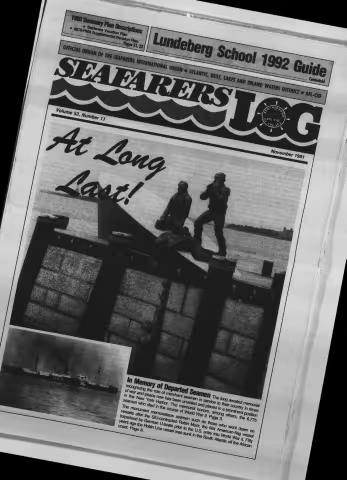
At Long Last, A Memorial to U.S. Seamon
The contribution of American
merchant mariners to their coun
try, in war and in the pursuit of
peaceful commerce, was finally recog
nized in a ceremony last month which
marked the unveiling of a New York
City memorial depicting surviving World War
II seamen aboard a life raft.
During the ceremony, an honor guard of 23
World War II veteran seamen marched out onto
the breakwater and stood at attention as a 144-
pound time capsule containing the names of the
6,775 mariners who died in WWII was lowered
into the bow of the life raft. Taps was played
and a New York City fireboat unleashed a
stream of red, white and blue water.
Among the honor guard members was SIU
pensioner George Alexander, the only one of
the veteran mariners present at the ceremony
to have served in both World War I and WWII.
The 98-year-old veteran steward department
member, reflecting on the simple but moving
ceremony, said of the recognition of merchant
mariners, "It was a long time in coming, but
when it did happen, it was beautiful."
Alexander was joined at the ceremony by
two other SIU World War II veterans, retired
QMED William "Flattop" Koflowitch and Fran
cis "Buffalo" Stallings, who sailed as a wiper.
Both Koflowitch and Stallings echoed Alex
ander's sentiments. "I feel that this ceremony
should have taken place some time ago," said
Koflowitch. "But the monument and the dedica
tion ceremony were beautiful."
AFL-CIO President Lane Kirkland, who
shipped as a mate during WWII and who served
as chairman of the memorial's organizing com
mittee, noted that the unveiling of the statue
represented the end of a long voyage.
"Fifteen years ago, we dedicated ourselves
to the task of creating the nation's first national
monument honoring the American merchant
seamen who have served this country in war
and peace, and who have sacrificed their lives
Representing the Seafarers at the dedication ceremony were (from left) Tom Soresi, Charles DiChnio, Robert
Gorbea, Ed Doruth, Mike Manekas, William "Flattop" Koflowitch, George Alexander, Louis Morales, Francis
"Buffalo" Stallings and George Wilkey. Alexander, who sailed in WWI and WWII served in the ceremony's honor
guard. Koflowitch and Stallings are WWII veteran seamen.
to give freedom a chance," he said in his remarks
at the ceremony.
"For those of us in the trade union move
ment—and particularly those of us from mari
time labor—we take great pride and satisfaction
in the knowledge that from this day forward,
merchant mariners who served our country and
who gave their lives for freedom will be forever
memorialized on this waterfront site in our
nation's greatest city."
Sacco: More to Be Done
SIU Executive Vice President Joseph Sacco,
speaking at a reception following the dedication
for the 1,000 or so individuals in attendance,
noted that the memorial also served as a re
minder of the work that remains to be done to
'Woricer Tax' Plan Ignites Boatman's Pmtest
What does it take to make a 34-year-old, third
generation tugboat captain mad enough to take
on the political establishment regulating the
U.S. merchant marine?
Announce plans to tax him for his job!
Anthony Primeaux has been talking to and
faxing fellow boatmen in the Louisiana and
Texas channels of the Intercoastal Waterway
to urge them to sign a petition to stop the U.S.
Coast Guard from imposing a "worker tax" on
merchant mariners.
Primeaux joins the SIU in a strong push to
halt a U.S. Coast Guard plan to charge seamen
and boatmen for the processing and issuance of
merchant marine documents and licenses. The
user fee plan was first established by Congress
and signed into law by the president in the form
of the 1990 Omnibus Budget Reconciliation Act.
The government, looking for devices to bal
ance the budget, ordered the Coast Guard to
begin charging for its various services. The
agency issued over the summer a notice outlin
ing a program whereby seamen and boatmen
will have to pay from $35 for a document
without a qualified rating up to $330 for an upper
level license, as well as being charged $17 for
an FBI check.
"This just struck a nerve," Primeaux recently
told a reporter for the Seafarers LOG. "This
struck me the wrong way. I've never been
involved in politics before. I'm tired of them
taxing the middle man while the rich keep
getting richer."
After he first read about the possible fees in
the Seafarers LOG, Primeaux started talking
with his fellow boatmen who also did not like
Continued on page 9
secure for WWII mariners all to which they are
entitled. "While the battle for recognition of
World War II mariners has been won inch by
inch, there are a few more inches left to go,"
he said.
Sacco noted the need to enact a bill currently
before Congress which would extend the civilian
mariner eligibility cut-off date for veterans'
benefits. Known as H.R. 44, the bill would
extend the date from August 15, 1945 to the
date set for all other branches of the Armed
Forces—December 31, 1946.
He also said efforts must be made to have
the federal government's office of personnel
management count WWII merchant marine
service as the equivalent of military service and
to ensure that all of the nation's 50 states extend
their veterans' benefits programs to WWII
seamen.
"Those of us in the merchant marine today
must not let up on the fight to achieve full and
complete veterans' status for World War II
merchant seamen and full and complete recogni
tion of the vital role American shipping had in
this conflict. We have inherited a proud track
record—the men and women in the American
merchant marine during World War II delivered
the goods under daunting conditions. It is up to
us to dedicate our energies towards achieving
recognition for those who gave their all to their
country," Sacco said.
Monument Inspired by Photo
The bronze and stainless steel statue pays
tribute to the thousands of American seamen
who lost their lives while engaged in their trade.
The sculpture depicts four WWII seamen, three
on a life raft, one in the water whose out-
Continued on page 8
Relief Captain John Primeaux adds his name to Anthony
Primeaux's (standing) petition against the Coast Guard's
imposition of a worker tax.
At the reception following the ceremony. AFL-CIO
President Lane Kirkland and memorial sculptor Mari-
sol display a photograph of the monument.
1 •
' , ^
M
yf: $m'
.t • \.
'...•••ill.'
. I-; •. •
W-:-
:V .<,.' - T-j' SUFARBtS 106
it
i'"^-'. . •"'. -i- "•
{;•
Ifc
«•.••:
[•' ^
i' i':
t> $:
it;-.-:
• t 't
T :.•
•:v J
••
SRI Pushes Extension of U.S. Labor Laws to Runaway Ships
Citing the continually unscrupu
lous conduct of many American
vessel owners operating ships
under runaway registries, the SIU
expressed its unwavering support
for legislation which would extend
American labor laws to foreign-
flag ships owned by Americans
and operating principally in U.S.
commerce.
The bill, H.R. 1126, would ex
tend the protection of the Fair
Labor Standards Act and the Na
tional Labor Relations Act for a
five-year period to those foreign-
flag vessels. It was introduced by
Representative William Clay
(D-Mo.).
"It's time to close the loophole
in our labor laws that encourages
the abuse of people who work on
board these ships," SIU official
Edd Morris said in testimony be
fore the House Labor Standards
Subcommittee on October 10.
Morris and other representatives
of organizations representing sea
farers' rights testified that by cir
cumventing American labor laws,
the foreign-flag vessels are driving
U.S.-flag ships off the seas at a
cost of many thousands of Ameri
can jobs.
Morris, who serves as an in
spector for the International
Transport Workers Federation
and as such boards foreign-flag
ships to determine if minimum
wage levels and living conditions
are being met, was able to pepper
his testimony with vivid examples
of the widespread human suffering
spawned by runaway registries.
The following is an excerpt from
Morris' testimony:
"I recognize that it has not been
the intent of nations such as Libe
ria, Panama or Honduras to allow
their national flags to be used to
shield such behavior. They simply
hope to improve the condition of
their national treasuries by under
cutting the prices charged by in
dustrialized nations for ship regis
tration and tonnage fees.
"But a ship registry is more than
a mechanism for improving one's
balance of payments. Registries
must establish, and most im
portant of all, enforce standards
of operation and safety...
"This This hearing gives a yoice to a
class of people who currently are
too frightened to speak and too
intimidated to act even when they
are the victims of abuse and
deceit.
"Let me describe some repre
sentative cases, the kind that I
encounter on a regular basis. (The
first case involves crewmembers
who spoke on condition of ano
nymity.)
"The ship of this crew flies the
flag of Cyprus... . Their com
plaints include:
• Food: They are given no fresh
fruits or vegetables, or fresh dairy
products. Canned food is shunned
because the cans are rusted and
expiration dates passed... . They
have no cooking oils.
• Living conditions: Living
quarters have leaking ceilings.
(Cleaning and clothes-washing sup
plies are scarce or non-existent.
They have no toilet paper.
• Working conditions: The
crew is expected to work without
gloves, including paint chipping.
They are not provided with safety
glasses.
• Pay and hours: The employ
ment contract obtained through a
Maldive Island manning agency
calls for pay of $300 per month
regular pay and $80 additional to
cover overtime.
"Actual pay is $270 per month,
with overtime paid at a rate of
$1.40 per hour. However, the
crew is not paid overtime for hours
worked when the ship is not at
sea. Thus, they are not compen
sated for securing the ship,
standby time, undocking, etc... ."
Morris gave other examples,
such as the Panamanian-flag sea
man who was paid $6,000 less than
his predecessor as Second Officer
aboard the Golden Shimizu. Other
crewmembers from that ship told
Smalley Recalls Sleeping Car Porter Days
Assistant Cook Bill Smalley (right), a member of the SlU's Government Services
Division who sails on MSGPAC ships, talks with A. Philip Randolph Institute
President Norman Hill during the recent Solidarity Pay rally in Washington.
Smalley, prior to shipping had been active in the Brotherhood of Sleeping Car
Porters, the union once headed by the legendary A. Philip Randolph, who
played a key role in organizing the civil rights protests of the late '50s and '60s,
including the 1964 March on Washington.
the Coast Guard they were victims
of harsh and discriminatory treat
ment, including being shorted on
pay and being paid in foreign cur
rency. They said leave pay and
overtime were denied; they
worked excessive hours; were
provided with poor quality food
and an insufficient supply of food;
and had water rationed for 20
minutes twice a day.
The crew also was concerned
about safety factors. The ship had
no lifeboat drills nor fire and boat
drills in the past four years.
Moreover, testimony and pre
trial depositions delivered under
oath in a court case in Tacoma,
Wash, established that crew
members on many, if not all for
eign-flag ships routinely are
cheated of their rightful wages.
This wage cheating places law-
abiding American-flag ships at a
financial disadvantage worth mil
lions of dollars, noted Morris.
He said, "Congress should stop
the American sanction of the 'free
dom of exploitation' encouraged
by foreign ship registries."
Abskaa OH Dar^opimit
To Be Debated in Senate
The energy bill, which contains
a provision on opening a section
of the Arctic National Wildlife
Refuge (ANWR), will be taken
up on the Senate floor in early
November, according to Capitol
Hill sources. The legislation has
far-reaching consequences for the
American-flag tanker fleet be
cause the transport of Alaska oil,
which if developed and earmarked
for domestic consumption, would
be subject to cabotage laws.
Senate leeAct George Mitchell
has promised to make the bill a
legislative i*iority afta: passage of
the Civil Rights bill, now under
debate.
ANWR is the most promising
region for American oil reserves;
estimated to contain upwards of
8.8 billion barrels of oil. Such a
find would provide not only a large
measure of energy security for the
nation, but would also give a big
boost to U.S.-flag shipping, partic
ularly at a time when Alaskan
North Slope oil is waning.
Passage of an ANWR oil explo
ration and development provision
in the energy bill is not certain.
Although the bill calls only for the
exploration of a small section of
the refuge, groups concerned with
protecting the environment are ex
erting heavy pressure on Congress
to keep the entire ANWR region
undeveloped.
There are some senators who
are so opposed to ANWR devel
opment that a filibuster has been
threatened.
Meanwhile, action in the House
on similar legislation has stalled in
a Merchant Marine and Wildlife
Subcommittee chaired by Gerry
Studds (P-Mass.). The bill is also
before the House Committee on
the Interior. It is unlikely that the
House will be able to act on this
measure before the end of the year
unless the recess, now set for
Thanksgiving, is delayed.
Meanwhile, the SIU, working
with the maritime industry in gen
eral and U.S.-flag tanker vessel
operators in particular, is urging
passage of the jjill.
Buy/Ship American Provision on Hoid
As House Votes Down Foreign Aid Biii
As the LOG was going to i»-ess,
the House of Representatives
voted down, by a vote of 159-262,
a compromise foreign aid bill. Ap
parently, the strong opposition to
the conference repeat centered on
1 wguage j^rtaining to family plan
ning funding and the buy Ameri
can/ship American provision
contained in the bill. The same
compromise bill had passed the
Senate by a vote of 61-38 on Octo
ber 8.
The compromise bill supported
by the Senate and voted down by
the House grew out of a conference
committee report after both cham
bers of Congress passed their own
versions of die foreign aid bill ear
lier this year.
The House and Senate confer
ee^ in working out the compro
mise bill, adopted language which
called on governments receiving
actual cash aid from the United
States to sign agreements which
establish that a portion of the
American taxpayer monies they
receive will be spent in the U.S.
and shipped on American bottoms.
The conferee language further
stated that if no agreemoits have
been agned, the nations receiving
cash aid would be subject to a slid
ing scale up to 75 percent of money
by Fiscal Year 1996 on American
goods of which 50 p^cent would
be transported on U.S.-flag ves-
sels.The bill legislated an equal
distribution of departure ports.
It is now up to the confidence
committee to resolve the ccmtro-
versial issues and report out an
other version of the foreign aid bill.
Then both the Senate and House
would have to vote on the new bill.
U.S. shipping interests will be
working to ensure that the buy
Americaiyship America provi
sion remains intact
However, President Bush h^
tlueatened to veto the foreign aid
bill, citing both the family planning
wd buy Amdican/ship American
initiatives as reasons for his oppo
sition.
mi
m
;:FI
:•!''-/> '•1' ;
-*y-. -n^.<i.^ry---: ..y- - •
NOmBER 1991
;'v > V' '
World Minlimim Pay for Exploited Seamen
Goes Up from $286 per MonHi to $335
The world minimum wage for
seamen has been raised from $286
to $335 per month in a move which
attempts to bring up the working
conditions of the exploited and
downtrodden seamen working for
runaway-flag operations. The new
rate, which was pushed for by
the world's seamen's unions, went
into effect October 25 and will
increase again on October 25,1992
to $356.
Unions representing seafarers
have been agitating within the In
ternational Labor Organization
(ILO) for an increase in the world
minimum wage rate for seamen, a
level of compensation that is paid
to most of the seamen working
aboard ships operating under run
away registries.
The ILO, a United Nations
agency made up of equal represen
tation from management, labor
and government from every mem
ber nation, has set a minimum
wage rate for seamen since 1946.
The rate represents a recom
mended monthly wage for an able
bodied seaman. The most recent
increase was enacted when the
ILO's Joint Maritime Commission
(JMC), which is made up of repre
sentatives from the world's ship
owners and seafaring unions, met
in Geneva from October 17 to 25.
The JMC participants, including
SIU President Michael Sacco who
served as a seamen's representa
tive from the United States, also
determined there is a need to de
velop a new formula for periodic
revisions of the minimum wage
code for seamen. A new method
was devised which expands the
list of countries used in calculating
the rate and which takes into con
sideration currency fluctuations.
The JMC recommended to the
ILO's Governing Body that a
committee be convened in every
alternate year between JMC ses
sions for the purposes of re
viewing the seaman's minimum
wage so that adjustments can be
made without a full meeting of the
JMC.
A spokesman for the Interna
tional Transport Workers' Feder
ation (ITF), the group which
brings together free unions from
around the world associated with
various modes of transportation—
including the SIU, characterized
the meeting as extremely success
ful. He noted this was the first
time in the history of the JMC
that seafarers had won a minimum
wage increase for two successive
years.
The ITF representative also
noted that detailed discussions
were held on items affecting the
shipboard environment and em
ployment rights of seafarers. The
system of the application of mini
mum standards for seafarers was
also reviewed. The ITF spokes
man noted that those representing
seamen at the JMC meeting found
themselves confronting intran
sigent shipowners who were
intent on either retaining the status
quo or deferring items to future
sessions.
Thus the fact that the JMC
adopted 18 resolutions covering
Burning Fishing Vessel Crew
Rescued by Virginia Sands
Seafarers aboard the F/V Vir
ginia Sands rescued six crew-
members whose fishing boat, the
Lady Jay, caught fire 30 miles
southeast of Nantucket, Mass.
The rescue took place August 18.
SIU members aboard the Vir
ginia Sands, a dragger which sails
from the port of New Bedford,
Mass., were: Captain Carlos Ca-
marao. Engineer Carlos Cova and
Deckhands Antonio Cravo, Joao
Virginia Sands Captain Carlos Ca-
marao (right) directed the rescue ef
fort. He is pictured with SIU Patrolman
Eugenio De Sousa.
Engineer Carlos Cova was one of
the crewmembers aboard the Virginia
Sands when it conducted a rescue
operation last August.
Cravo and Jose L. Leonardo.
The Virginia Sands responded
to a distress call sent by the Lady
Jay shortly after 5 a.m. When the
Virginia Sands arrived, the Lady
Jay crewmembers were in a life
raft and the LadyJay was burning.
The Seafarers brought all six
men aboard the Virginia Sands.
Shortly thereafter, a Coast Guard
cutter arrived, extinguished the
blaze and towed the Lady Jay to
Nantucket.
The Virginia Sands is one of
the many fishing vessels in New
Bedford under contract with the
SIU.
areas of ITF concern is viewed
as a very positive development.
Among these resolutions were ac
tions affecting the wages, hours of
work of seafarers, manning levels,
the repatriation of stranded sea
men and the expansion of enforce
ment mechanisms in the hands
of member nations. Additionally,
other resolutions called for a de
tailed evaluation of the current
status of world shipping and how
the welfare of seamen is affected
by changes within the industry.
After a lengthy discussion on
drug and alcohol policies directed
at seamen, the JMC participants
agreed to ask the ILO to convene
a tripartite meeting of experts in
the field with the purpose of devel
oping educational materials and a
prevention program.
Jobs Export Protested
The Bush administration proposal to in
stitute a so-caiied free trade agreement
with Mexico has met with skepticism
from American unionists who smell a rat
in the deal. The SIU joined with the
Houston labor movement in protesting
any plan which will result in the export
of American Jobs to a low-wage country
like Mexico. Pictured above is Recerti
fied Bosun Ben Bom during the rally.
Seafarers School Advocates
Oil Spill Training for Ali Hands
All American seamen should re
ceive training in oil spill contain
ment procedures in order to en
sure that the United States has a
pool of manpower available to
respond to such accidents and to
see that damage control proce
dures are immediately instituted
in the event of a discharge at sea,
said the head of the SIU's training
school in comments submitted to
the U.S. Coast Guard.
The agency's solicitation of
comments on spill response plans
for oil-carrying vessels included a
section on crew training. The
Coast Guard is in the process of
developing rules to handle require
ments raised in the Oil Pollution
Act of 1990 (CPA 90). This is one
such rulemaking. The Lundeberg
School limited its response to the
section on crew training of the
Coast Guard's Federal Register
notice on this rule.
Lundeberg School Vice Presi
dent Major Ken J. Conklin (US-
MC-Ret.) said, "The Lundeberg
School believes all merchant mari
ners should receive training in oil
spill prevention and containment
procedures. First, this training
will allow mariners working on
vessels which become involved in
an oil spill to conduct emergency
damage control and containment
procedures aboard the vessel until
the appropriate contracted or co
operative response center teams
arrive on the scene."
He also noted a second reason
for training seamen in these proce
dures: ". . . the training of all mer
chant mariners would provide the
nation with a pool of individuals
qualified to work anywhere on oil
spill response teams."
Conklin emphasized that mari
ners are accustomed to re
sponding to orders quickly . "They
are used to traveling far distances
for their work. The nature of work
aboard ships allows for extended
periods of shore-side time when
the mariner is off-duty. Thus a
mariner who is ashore can be
available for weeks tp months at
a time without interfering with his
or her usual employment duties
aboard a vessel."
The Lundeberg School head
also maintained, "Any oil spill
training should be ancillary to the
Coast Guard certification and li
censing process as are fire fighting
and radar [training]." Certifica
tion of completion should follow
the mechanisms now used for fire
fighting and radar endorsements.
In this regard, Conklin recom
mended the Coast Guard certify
the oil spill courses given by insti
tutions as complying with the
agency's criteria. Conklin said the
basis of this certification should
include inspection of lesson plans
and curriculum, equipment and
materials, the qualifications of the
instructors, and past experience
in other Coast Guard-oriented
training.
He proposed a 40-hour course,
which would be required of all
unlicensed mariners. This course,
Conklin suggested, should cover
U.S environmental regulations,
personal protective equipment,
properties of oil, collection meth
ods and equipment, and should
culminate in a simulated recovery.
Conklin also asserted that li
censed shipboard personnel
undergo a more stringent 80-hour
training course.
The wide-ranging provisions of
OPA 90 was sparked by major oil
spills in American waters in
cluding the Exxon Valdez.
The vessel response plans regu
lations to which these comments
were directed is just one small part
of OPA 90's provisions. (Dther
sections of CPA 90 address crew-
member hours of continuous work
aboard U.S.-flag tankers, liability
issues of tank vessel operators,
navigation systems for h^bors
and much more.
'--I; •••
•V.':
: m
ii -Y-
- ••• t
•m:
• ,'ji,; .;,i.r ••••;_
? f
-•I
I
't.
Texas Govemor Richanls Calls
For Strong U.S.-Flag Shipping
Texas Governor Ann Richards
called for a stronger U.S. commer
cial shipping fleet, as well as for
new leaders "who care about what
happens in America."
Richards, who made her call for
a vital American shipping industry
during the West Gulf Ports Coun
cil annual dinner last month, said
Operation Desert Storm proved
the vital importance Of a strong
U.S.-flag merchant marine.
"There is a tendency these days
to talk about commerce and trade
as things that happen in corporate
board rooms," Richards said to an
audience of Houston-area trade
unionists which included SIU
members and their families. "But
you and I know that America sails
the oceans only because your
members make it happen.
"And we never saw greater evi-
. dence of that than we did in Opera
tion Desert Storm. Many mem
bers of the Seafarers sailed full
throttle into hostile waters on
aging vessels. That requires a spe
cial kind of courage," she told
those assembled by the West Gulf
Ports Council, an affiliate of the
AFL-CIO Maritime Trades De
partment which is comprised of
42 national unions representing
workers involved in shipping and
marine-related industries.
"Now that the war is over, I
hope we have learned just how
important the maritime trades are
to us, and how important it is that
we have a national maritime policy
that keeps the lines of supply open
and keeps this country strong—
not only in time of war, but in the
international economic competi
tion," said the govemor, who was
elected to her post in 1990.
Richards noted the U.S. mili
tary "charters 87 dry cargo ships
for deployment, and 67 of them
fly foreign flags.
"A strong commercial fleet is
our lifeline to the world," she said.
"And if we are going to get that
fleet, we need what [the SIU] says
we need: a lot more vessels *built
by Americans, owned by Ameri
cans and crewed by Ameri
cans.'"
Richards then focused on what
she called an insensitive, unpro
ductive federal govemment. "It is
time for us to have leaders who
care about what happens in
America," she said, "because we
are overdue for something good
to happen at home.
"For too long, we've watched
government budgets go up, taxes
go up . . . but American pay
checks aren't going up, and peo
ple's lives are not getting any bet
ter. Real family income has not
increased significantly in this
country since 1973.
"For 20 years, the two-pay
check family has been a necessity
because it takes two to make what
one did before. A study at the
University of Utah found that if
all women in the work force left
their jobs, 60 percent of American
families would be living below the
poverty line."
Richards was featured at the
ports council event along with
Railroad Commission Chairman
Lena Guerrero and longtime ports
council member, political activist
and Communications Workers of
America Local 6222 Secretary-
Treasurer Dorothy Barker, who
received the Ship's Wheel Award
as the ports council honoree.
Governor Ann Richards [left) and Texas Railroad Commissioner Lena Guerrero
arrive at West Gulf Ports Council event.
Recertified Steward Visits Headquarters
Ekow Doffoh (left), a 1991 graduate of the Lundejberg School's recertified
steward program, visits with SIU Executive Vice President Joseph Sacco to get
an update on union activities.
SIAFARERS106
J.N. Phillips Deckhand Patrick Cobbs
takes a break in the galley.
Lead Deckhand Tim Kunz heads back
to work on the Geary.
Orgulf Tugs Carry Harvest Grain
Harvest time for America's
upper plains states means plenty of
work for the SIU crews sailing on
Orgulf tugboats.
Pushers like the J. N. Phillips
and John Geary are busy loading
grain into the barges that will float
down the Mississippi River system
to New Orleans for overseas ship
ments.
Orgulf tugs pick up the agricul
tural cargo at river ports in Illinois,
Iowa and Indiana. Other loads like
coal, steel and pipes also make the
journey south from the Missouri,
Ohio and Illinois rivers to Moore's
Landing, Mo. The Phillips and
Geary operate in this upper river
region.
From Missouri, larger
pushboats take the barges to desti
nations along the lower Missis
sippi River as far south as the deep
sea port of New Orleans.
Cook Clora Doom slices watermelon for
the crew of the J.N. Phillips.
Geary Deckhand Pat McGinley awaits Hustling across the deck of the John
his next assignment. Geary is Deckhand Jeffrey Rosencrans.
Deckhand Adam Schacknai digs into his Geary Deckhand Zolly Person reviews
lunch on board the J.N. Phillips. benefits materials.
.-.I ''it»..i'.'.-'';V-> -;
NOVEMBER 799/
Lundeberg School Takes Safety Course toRlverboats
The Lundeberg School took its
comprehensive safety training pro
gram to America's two most fa
mous riverboats—the SlU-crewed
Delta Queen and Mississippi
Queen.
Instructors Byran Cummings
and John Smith each spent three
weeks on each vessel to provide
instruction in fire fighting, damage
control, first aid and CPR. Cum
mings worked on the Mississippi
Queen and ran different courses in
July, August and September.
Smith covered the same material
on the Delta Queen in May, June
and August.
"It was great. I learned how to
use a lot of different equipment, I
le^ed CPR and first aid and I
learned a lot of new techniques,"
said SIU member Car! Keen, a
member of the Mississippi
Queen's deck department.
Fellow SIU and deck depart
ment member Rob McLemore
said there is no comparison be
tween these courses and others he
had taken. "I've had instruction
from several other (non-union)
guys, but they were so repetitious.
The instructors from the union
build on everything they teach you,
and they also give you the hands-
on training," McLemore said.
David Kish, vice president of
administration at Delta Queen
Steamboat Co. which operates the
passenger boats, expressed great
appreciation for the safety training
and the instructors. The program
started in 1990 when the company
asked the Lundeberg School for on
board instruction because many
crewmembers are unable to attend
classes in Piney Point, Md.
Passengers Appreciative
"This has turned out to be a great
thing for us and our passengers,"
said Kish. "Our crewmembers
genuinely like to see Byran and
John. Also, with what you read and
hear these days about lack of con
cern for passenger safety (on for
eign-flag vessels), our passengers
sincerely appreciate these courses.
It opens people's eyes to the SIU,
and it helps instill pride in our
crewmembers."
"The passengers also appreciate
it," Smith said. "They saw some of
the training and they were im-
Lundeberg School instructor John
Smith (right) works with deck depart
ment member on board Delta Queen.
SIU member Marvin Joy completes drill involving smoke machine.
pressed. Many of them said it made
them feel much more comfortable.
"I think it also gives the crews
confidence by showing them
things they can do."
Smith and Cummings, each
with years of experience as fire
fighters and paramedics, instructed
154 crewmembers from the two
boats. They taught the emergency
squads (comprised of the master,
two pilots, chief mate, third mate
and deck crew) as well as the gen
eral crew.
"In the event of an accident,
there is a big risk when you have
4()0-plus passengers on what basi
cally is a high-rise building on the
water," Cummings said, noting the
importance of the courses on
board.
The training took place through
out the day, interspersed between
regular crew duties. Finding time
to train became an important fac
tor. "You have to be inventive. The
general staff works long shifts and
gets little sleep, and I'm taking
time out of their schedules."
The emergency squads partici
pated in at least 40 hours worth of
training per week, while the gen
eral crew received slightly less.
Cummings and Smith worked long
and unusual hours, catching
crewmembers between shifts.
"You catch thjem around the
clock," Cummings said. "Some
times it's 3 a.m. or 4 a.m. before a
porter's shift ends."
Hands-on Training
The first aid and CPR segment
included certification of
crewmembers. Besides learning
standard things, crewmembers
practiced various techniques and
functions with first aid gear, Cum
mings said. They also learned how
to prepare a person for helicopter
lift-off.
During the damage control
week. Seafarers learned proper
techniques for measuring and con
structing patches. "We would put
tape somewhere on deck repre
senting a hole," Cummings ex
plained, "and then crewmembers
would have to figure out which
type of patch to use and how to
make it.
"I also worked with some cooks
at about 2 a.m., and a couple of
them couldn't swim. So we went to
a small pool and they learned how
to stay afloat if they fall over
board."
The fire fighting segmeiit in
cluded a review of last year's in
struction, such as operating fire
hoses and extinguishers (the crew
practiced on shore during con
trolled fires). This year Cummings
added a smoke machine, and mem
bers took part in a simulated res
cue.
"We hid a five-gallon red
bucket in the bow thruster room,"
Cummings noted. "We smoked the
room so you couldn't see your
hand in front of your face."
The students donned their pro
tective gear (although they didn't
engage it, since the smoke is safe)
and went in pairs to search for the
bucket. This type of hands-on
training drew raves from the
crewmembers and from Kish.
"When you do this type of thing
on board, you get a larger percent
age of people through the train
ing," Kish said. "Also, aboard the
boat you work with your equip
ment on your boat. That's a lot
different than being at a separate
training site."
The Lundeberg School instruc
tors offered other hands-on lessons
such as falling into water while
wearing breathing equipment.
Moreover, Cummings had an
important goal for this year's train
ing. He wanted the emergency
squads to work in small groups and
develop a complete ship's plan,
which they eventually accom
plished.
"First they went deck by deck,
room by room," he explained.
"Next, they listed all the water
tight compartments, all the radios,
the isolation valves for the fire-
main system. Then they did the fire
stations (with hose lines and
exits)."
Cummings pointed out that such
plans for certain inland vessels are
overlooked because they aren't re
quired by any law or regulation.
Already Planning for '92
Cummings already has set the
schedule for next year's sessions,
beginning with a January course on
the Mississippi Queen. "We're
going to expand even further on the
hands-on part," he said. "We've
already got the basics down."
A special review program also
is being developed for new
crewmembers.
Seafarer McLemore added that
Cummings and Smith "encourage
you to ask questions. Also, after
they leave, the mates and masters
have their own drills, so this isn't
somethipg we do once or twice a
year and then forget."
Personally, Cummings said his
favorite part of the training "is the
satisfaction I hear (from members)
about what we have accomplished.
They're all there to thank me and
send me off when we're done, and
I know they will be ready next
year.
"They're very appreciative, and
they know this m^es them a bet
ter, safer organization."
During damage control course,
Lundeberg School Instructor Byran
Cummings (left) shows First Mate Dick
Karnath patching technique.
Mississippi Queen dining room staff adjusts hose as Byran Cummings observes.
•f.-a
I-
..."
h-i:-.
lii-->' ''* • mm
--Iv .V
'.M-\ /-'••pn -'. •
•:ti "
,y,: .'
i'f
pi: • •?
51^^ I
:|-
tfr-v !'-••• 4mr
'•', i- ••
- %"'
m-4
•P-:''l
S3;'
0m' •-
0; X -
mi- }: i.
§3; •
0.
•' i-
ilr :,
i v- -i'-
U ' - i* •
w?: • •• •', •
•. • /4'-. mm...
4-
I#
•- m
i-m-'
• •". .,-^-
•\': l-m'.
^ :
8
0mm
" ' Ur:: - -M. • WkORm^
National Memorial Pays Tribute to American Seamen
Continued from page 3
stretched hand is within inches of reaching his
shipmate's hand. As the tide rises and falls, the
statue of the mariner affixed to the breakwater,
which represents the man in the water, appears
to come up out of the sea.
The 7-and-a-half foot human scale monument
was inspired by a WWII-era photograph of
seyen seamen on a raft who survived the sinking
of their tanker, the SS Muskogee, when it was
struck by a German submarine's torpedo off the
East Coast of the U.S. in 1942. The photograph
was taken by the U-boat's commander and
printed in a German newspaper.
An American seaman obtained a copy of the
publication and kept it with him even after his
own ship was sunk and he was taken prisoner
and moved to a labor camp in southeast Asia.
The seaman brought the copy back to the United
States when he was freed, hoping to identify
the seven men. Only one has been named and,
by all accounts, the seven seamen were never
found.
SlU Executive Vice President Joseph Sacco spoke
on the need to continue the fight for full recognition
of veteran merchant seamen.
Designed and sculpted by Marisol, a re
nowned artist, the American Merchant Mari
ners' Memorial is located on a lower Manhattan
Battery Park pier where the New York City
Fire Department's Marine Division headquar
ters building—an historic landmark—is sit
uated.
An estimated 8 million tourists annually will
pass by the memorial, which has as a backdrop
the Upper New York Bay and the Statue of
Liberty and Ellis Island. The monument was
donated as a gift to the people of the city of
New York by the American Merchant Mariners'
Memorial Committee which raised the funds for
the monument from private monies.
Time Capsule Opening in 2091
The time capsule lowered into the memorial
has been hermetically sealed and will not be
opened until October 8, 2091, 100 years from
the date of the ceremony. In the capsule are the
names of all the seamen who died during WWI
and WWII, as well as other memorabilia of the
American merchant marine.
The dedication ceremony was opened by
RADM Thomas A. King USMS (Ret.), who is
president of the American Merchant Mariners'
Memorial, Inc. and formerly was superinten-
•dent of the U.S. Merchant Marine Academy
at Kings Point. Captain Warren G. Leback,
Maritime Administrator, and sculptor Marisol
also spoke at the event.
Speaking at the reception which followed
the ceremony were representatives of maritime
labor, port authority spokesmen and individuals
who played key roles in the activities of the
memorial's corporation, which raised more than
$750,000 of private monies to see the project
through its completion and leave an endowment
fund for future maintenance.
The American Merchant Mariners' Memorial
group's program noted that merchant seamen
had given their lives to their country from the
birth of the nation. Seamen served as Privateers
of the Revolution, taking on the British at sea.
Thousands of seamen were captured by the
British, only to die aboard disease-ridden ships.
Kirkland noted, "The American Merchant
Mariner's Memorial is a fitting remembrance to
those who gave their lives in defense of their
country, "We honor, as well, the tradition of all
those mariners who served—that of a strong
and vital American merchant marine that bene
fits this nation in peaceful commerce and, when
ever needed, diligently supports and sustains
our defense of freedom in time of war," Kirkland
said as he closed his remarks.
The American Merchant Mariner's Memorial
^oup is offering a color audio-visual cassette
in VHS format of the October 8 dedication
ceremony. The cassette wUl be priced at cost.
Inquiries regarding the tape can be directed
to the attention of Joan Samsen, Executive
Director; American Merchant Mariner's Me
morial; 1 World Trade Center, Suite 2611; New
York, NY 10048, or by phone (212) 488-7650.
The time capsule is unveiled as an honor guard of WWII
Mariners looks on.
The Robin Moor Went Doivn 50 Years Ago
The survivors of the Robin Moor were rescued from their lifeboats in the South Atlantic 13 days after their vessel
was torpedoed by a German U-boat.
For most Americans, World War II began
December 7, 1941 when Japanese aircraft at
tacked Pearl Harbor and other military installa
tions in Hawaii. But to the American merchant
marine, and especially the Seafarers Interna
tional Union, the start of the international con
flict can be traced a few months earlier to May
21, 1941—the date the Robin Moor was sunk,
50 years ago.
The Robin Moor was approximately 700 miles
south of the Azores sailing from New York to
Capetown, South Africa when a German U-
boat asked the vessel to identify itself. The
unarmed U.S.-flag vessel was loaded with pas
senger cars, engines, tin plates and general
merchandise for South African stores. The Ger
mans did not believe the manifest and gave the
crew and passengers 20 minutes to abandon
ship. The crew was ordered not to communicate
an SOS.
Once the four lifeboats were safely away from
the Robin Moor, the U-boat lobbed 33 shells
into the ship. The Robin Moor sank in 18
minutes.
Nothing was known about the attack until the
first lifeboat was rescued by a freighter 13 days
later. When word of the sinking—the first
involving a U.S.-flag merchant ship—reached
Washington, President Franklin D. Roosevelt
sent a message to Congress declaring the event
an act of piracy.
"We must take it that notice has now been
served upon us that no American ship or cargo
on any of the seven seas can consider itself
immune from acts of piracy," Roosevelt said.
"Notice is served on us, in effect, that the
German Reich proposes so to intimidate the
United States that we would be dissuaded from
carrying out our chosen policy of helping Britain
to survive.
"... Were we to yield on this we would
inevitably submit to world domination at the
hands of the present leaders of the German
Reich. We are not yielding and we do not
propose to yield."
Within weeks of the U.S. declaring war,
German U-boats patrolled American coasts
looking for merchant vessels. The SlU-con-
tracted Seatrain Texas rescued the three sole
survivors from a crew of 42 aboard the City of
Atlanta which was torpedoed without warning
on January 19, 1942 off Cape Hatteras. Less
than a week later, the SlU-crewed Venore was
attacked and sank in the same area, taking 18
men with her.
A total of 1,200 Seafarers lost their lives and
overall 6,775 merchant seamen were killed in
World War II. In fact, only the Marine Corps
suffer^ a higher rate of death among its fc*ces
than did the American merchant marine.
-• i- "..-y m
•• .V I , -n
^nC '
m-i
rr- -r
II®®
mm r.aMwM I .sj. "wkMialairilfc
NOVCMBCR J99I
Seafarer Stiis Fight on 'Worker Tax'
Continued from page 3
the idea of the tax. "We all thought it was a bad
idea and would be expensive for ail of us."
Boatmen's Response Is Strong
With the help of the legal staff for Higman
Towing (which operates Primeaux's vessel—
the Johnny Brown), he got the wording for his
petition. Since September 10, he has contacted
27 different companies, reached some 500 boat
men and received more than 400 signatures.
The response against the user tax has been so
strong to date that only one person has said no
to signing the petition. Primeaux uses any and
all means available to distribute the petitions.
He has sent copies via the fax on board the
Johnny Brown. He has pulled alongside boats
to hand petitions to the crewmembers and has
passed them out on shore.
Captain Anthony Primeaux handles the pushboat
Johnny Brown near Galveston, Texas.
Because word of the petition has spread along
the waterway, Primeaux regularly receives calls
from fellow boatmen with the phone numbers
of tugboats with crewmembers wanting to sign
the petition. "I'll send it to anything that floats."
Crewmembers aboard the Johnny Brown are
behind Primeaux's efforts.
"We've got to do something," said Tank--
erman Chris Weber, who started sailing on the
pushboats when the shipyard where he worked
closed with the completion of the Star of Texas.
"We can't do nothing unless we wake up,"
added Relief Captain John Primeaux (no relation
to Anthony).
Registered to Vote and Ready
The pushboat captain does not plan to end
his newly-found political involvement when the
petition drive is finished. He plans to express
himself at the polls supporting those elected
officials who will stand up for his industry.
"I recently registered to vote. Now I have
a voice. If you aren't registered, you can't
complain. I'm registered and I'm loud."
Primeaux plans to gather all the petitions still
in circulation by the middle of this month
and send them to the SIU headquarters for
distribution to Congress. The petitions also will
be included when the Coast Guard re-opens its
comments period concerning the tax. (As of
press time, no announcement concerning the
comments period has been published in the
Federal Register.)
The SIU has protested strongly against the
imposition of the worker tax. During the Coast
Guard's comments period on the proposed
scheme, the agency received more than 500
communications representing all walks of the
maritime industry—individual seamen and boat
men, maritime labor unions, companies, the
Maritime Administration and the Military Sealift
Command—all of whom weighed in against a
user fee for mariners documents and licenses.
Relief Captain John R. Primeaux Inspects a valve on
a barge being pushed by the Johnny Brown.
Tankerman Charles Stark checks the oil level In the
englneroom.
Fighting the User Fee Pian
Seafarers who believe, like Anthony Primeaux,
that a fee for merchant marine documents and
licenses Is unfair, should communicate their posi
tion to elected officials In Congress.
It was the passage of the 1990 Omnibus Budget
Reconciliation Act which Instigated the current
Coast Guard mandate to collect a fee for all
services rendered—Including the processing and
Issuance of marine documents and licenses.
Congress can rescind Its action and dispose of
the portion of the law which requires collection of
monies from merchant seamen for their Coast
Guard-Issued documents and licenses.
The Seafarers LOG would appreciate receiving
copies of all correspondence directed by Seafarers
to elected officials on this Issue. Additionally,
copies of any responses by the congressmen
should be forwarded to the LOG.
Tankerman Chris Weber prepares to toss a line
ashore.
User Ffee Under Review;
CG Plans to Hear More
As the SIU continues its fight against the
imposition of a "worker tax" on U.S.-flag
merchant mariners, the Coast Guard, is mov
ing toward re-opening a comments period
pertaining to the issue of charging seamen and
boatmen for the costs involved in processing
merchant marine documents, certificates or
registry and licenses.
Ever since the Coast Guard announced in
the Federal Register last June that the agency
was considering such user fees, the idea has
met a strong stream of opposition from all
segments of the maritime industry. The
furor raised against the proposal was evi
denced in the more than 500 letters—the vast
majority hostile to the proposal—submitted
to the agency before August 4, the deadline
for the first round of comments.
The Coast Guard has advised the industry
that it is seeking to re-open the comments
period on the proposal. Notice of such a
re-opening will be posted in the Federal
Register.
SIU President Michael Sacco, in a commu
nication submitted during the agency's com
ments period this summer, said the union
rejected the notion that mariners have to pay
to be able to work. The union also objected
to the inadequate disclosure of the methods
used for determining the rates of the fees and
the fact that the open-ended tax meant the
charge could keep increasing.
The Coast Guard has proposed a basic fee
of $35 for a merchant mariner's document (z-
card) without a qualified rating. For those
seeking a z-card with an AB, QMED, life-
boatman or tankerman endorsement, the cost
would be $135—$35 for the issuance fee, $60
for the evaluation fee and another $40 for the
examination fee.
Under the proposal, a member upgrading
from AB-limited to AB-unlimited would be
required to pay $95—the $35 issuance fee
and $60 for evaluation.
The cost for those with licenses is set
even higher. A mariner seeking a lower level
license would pay $180 ($35 for issuance, $65
for evaluation and $80 for examination) while
the upper level license would cost $330 ($35
for issuance, $70 for evaluation and $225 for
examination).
The Reagan administration first proposed
the idea of a worker tax on documents in the
early 1980s. While that administration sought
to implement this tax as a way to alleviate
the deficit burden in each budget proposal,
the Congress consistently rejected the idea.
However, last year, under pressure to
balance the federal budget and lower the
huge deficit. Congress included Coast Guard
user fees in the Omnibus Budget Reconcilia
tion Act of 1990.
-.c",il.'/i'M-:. .'vii'.' .
!»•
• • V, VM; ,? .^1
•y ^1#
%
'' - .-'5. v; •
1'-
- ;
WBM'
••'.••-' 'I.-'. . •' •
I':!::'
^7/1;,
^r; t
t- . >
,1 • •
11-.•7:- ,V'^;
'iif • - •
fc-v?
I,.: -'i:'
.,i-^
• '' ''•;
-.11 • '::v
i -HmMt
10 soFuunsm
MSG PadfK Fleet SMc Bay Op&atiais
In limbo After Phllmme Senate Itete
MilitJiry Sealift Command Pa
cific Fleet (MSG?AC) vessels,
crewed by members of the SIU's
Government Services Division,
continue to use Subic Bay Naval
Base despite a Filipino senate's
vote to deny a 10-year lease exten
sion to the U.S. Navy.
"We have to wait and react to
the Philippines' formal proposal,"
said Commander Rick Nelson,
who is assigned to the State De
partment's office for Filipino ne
gotiations. "They (the Philippine
government) have withdrawn
their termination notice."
President Corazon Aquino had
urged the senate to support a 10-
year extension for the U.S. Navy
to use the base west of Manila on
the South China Sea. However,
the 23-member senate rejected the
treaty 11-12, falling five votes
short of the tWo-thirds needed for
the treaty, in September.
Aquino had proposed taking the
issue to the courts in order to hold
a referendum where the Filipino
citizens would decide if the Ameri
can base would stay or go. Subic
Bay employs more than 37,000
Filipino workers.
However, Aquino announced
last month she was dropping her
plans to seek a vote. Under the
previous lease arrangement, the
Filipino government had to issue
a one-year notice of termination
to the U.S. Navy.
Nelson said the Philippines has
asked the U.S. government to ne
gotiate a withdrawal within three
years from Subic Bay. No meet
ings have taken place because the
formal request has not reached the
State Department, he added.
"We still have operational rights
at the base with protection for our
crews and employees," Nelson
stated. "We are operating as if
nothing has happened."
Concerning MSCPAC and its
members, the Navy has not issued
any instructions or change in sail
ing plans, according to an
MSCPAC spokesman.
"We are a tenant there. We
can do nothing independent of the
Navy," said Bob Borden, spokes
man for MSCPAC.
Archives to Open
WWII Mariner Exhibit
An exhibit to honor America's
World War II merchant mariners
will open at the National Archives
in Washington, D.C. on December
7, the 50th anniversary of the Japa
nese bombing of Pearl Harbor.
The display will feature photo
graphs, film footage, logbooks and
audio and video remembrances
from seamen of that era. The Ar
chives has been soliciting such
material for the past year to go
along with the information it al
ready had collected and stored.
The exhibit, which will be on
display for a year, will concentrate
on the ports of Philadelphia, Balti
more and Norfolk, Va. There is no
admission charge for the National
Archives, which also features
original copies of the Declaration
of Independence and the U.S.
Constitution.
Seafarers Support Edwards in Louisiana's Governor Eiection
Seafarers in the New Orleans
area are continuing to support for
mer Louisiana Governor Edwin
Edwards as the Democratic Party
nominee prepares for a November
16 gubernatorial runoff against for
mer Ku Klux Klan leader David
Duke, the Republican candidate.
SIU members, pensioners and
family members joined in Ed
wards' campaign effort and even
received a visit from him at the
New Orleans union hall.
Edwards, 64, received slightly
more votes than Duke in the pri
mary October 19. Governor
Buddy Roemer, one of 10 other
candidates in the primary failed to
get enough votes for the runoff.
Edwards "talks our talk and
walks our walk," said New Orle
ans Port Agent Joe Perez. "He
has been good to the maritime
industry and he believes in Ameri
can workers and American jobs."
Edwards, who won gubernatorial
elections in 1971, 1975 and 1983,
has indicated his support for the
labor movement, Perez said.
Seafarers throughout Louisiana
received information about Ed
wards and the election through the
mail, at union meetings and by
telephone. SIU members helped
with the campaign by making
phone calls, driving an Edwards
bandwagon and donating time for
various other work.
The participation of rank-and-
file Seafarers and retirees in the
campaign was outstanding, Perez
noted.
Edwards is favored over Duke
in the runoff, though not deci
sively. Many Roemer supporters
are expected to vote for Edwards,
due to Duke's background as a
Klansman and Nazi sympathizer,
the New Orleans Times-Picayune
reported.
From the left: Third Cook Eduardo Gonzales, OS Antonio Billanueva, AS Bill
Boiling, Bosun Bili Davis, Bosun Duke Duet, Bosun Mike Keith and Wiper Gerado
Ijopez show support for Edwards.
F/V Mayflower Hit but Not Down
A New Bedford Standard-Times photographer captured this image of the SIU-
crewed Mayfiower, which sustained massive damage during Hurricane Bob.
Crewmembers were proud to report that white their vessel had t}een hit by the
100-mph humcane which battered New Bedford (Mass.) last summer, it had
survived and was saiiing once again. The Mayflower, shown here August 20,
one day after "Bob" hit, sustained roughiy $60,000 worth of damage.
Gubematoriai candidate Edwards greets SIU members at New Orleans hall.
•'.-'••v.',-.
Schedule Hectic for Sea-Land Challenger Crew
SIU crewmembers aboard the
Sea-Land Challenger find very lit
tle time to relax because of the hec
tic 28-day schedule the vessel
meets.
"We've got a good crew on
here," Bosun Roy Williams told a
reporter for the Seafarers LOG re
cently while the container ship was
docked in Jacksonville, Fla. "There
is always something to do and the
members are ready to tackle it."
The Challenger, built in 1968,
sails what is known in maritime
circles as the Crescent run. In less
than a month's time, the 700-plus-
foot ship makes stops at such Car
ibbean ports as Kingston, Jamaica;
Santo Domingo, Dominican Re
public; and San Juan, P.R. On the
mainland, the vessel unloads and
loads in^ Elizabeth, N.J., New Or
leans and Jacksonville.
The Challenger is one of four
Sea-Land ships operating on the
Crescent mn. The others include the
Sea-Land Crusader, Sea-Land Ex
pedition and Sea-Land Discovery.
Steward/Baker Herbert Scypes pre- OMU Alberto Garcia sets up the lathe in AB Paul Barber (left) signs Anthony Mc Cleaning out a locker are AB Tito Colon
pares a plate of broiled fish. the ship's machine shop. Quay, Jacksonville patrolman, aboard. (left) and Bosun Roy Williams.
Deckhands Keep an Eye Out
For the Unexpected on Tug Utah
When "no two tows are the same," the
SIU crew of the Great Lakes Towing
tugboat Utah knows each call out on the
Maumee River in Toledo, Ohio will be a
different adventure.
The Utah sails to meet a foreign-flag "saltie," and push it to the pier.
Deckhand/Engineer Mike Kornmeier
recently told a reporter for the Seafarers
LOG, "Wind, river currents, weather and
ships all create changes. The Maumee is
unpredictable. Sometimes it flows contra-
ary to the wind."
Kommeier knows of what he is speak
ing. He has been sailing aboard the Great
Lakes Towing vessels for 24 years.
Deckhand Mike Lock also is aware of
the problems that can arise when tugboats
attempt to dock or tow deep sea vessels—
unless the rail goes under water," said
Lock, who started sailing in 1974. "This
can be dangerous work."
On this particular job, the Utah was
called out to help dock a foreign-flag
vessel loaded with British steel. Captain
Milo Bailey, called one of the best by both
Kommeier and Lock, kept the deck dry
throughout the job.
The Utah met the "saltie" in the Mau
mee River channel at Lake Erie and fol
lowed it to the docking area using a series
of bumps to glide the freighter to the pier.
The tug held it against the dock until it
was securely tied.
Unlike ships designed specifically for
the Great Lakes with bow and stem
thmsters, deep sea vessels are unable to
dock without aid.
Deckhand/Engineer Mike Kornmeier starts the Utah's diesel engine. Deckhand Mike Lock hauls in the lines as the Utah leaves the dock
••
"k -1
'"""I'''"--' J.- •, .
'J L-
.....
tl:
I'- '•
12 '^.V-N'/r~-:' •• '.••v-v^.-vv rfv'
...vS;-',4;.--'
Seafarers Join in Mobile AFL-CIO Rally
Seafarers joined fellow trade
unionists at a Labor Day parade in
Mobile, Ala. Seafarers, both active
and retired, joined the car caravan
which moves its way from Mobile's
Civic Center to Bienville Square.
The Labor Day activities were called
by the Southwest Alabama Labor
Council AFL-CIO
Among the Seafarers, retirees and
family members who marched and
also took part in the other events
were: James W. Fleming, Amos B.
Myers, H.L. "Buck" Weaver,
Jack A. Olsen, George Pierre,
H.W. Miller, H.H. House, Eddie
Arnold Jr. and Doris Devine.
Also present were V.T. Nash,
Rickie Juzang, M. Juzang, A. Bon
ner Jr., G. Sellers, Francis Gomez,
Ralph Smith, Bobby Butts, Larry DEU Amos Myers (left) and AB Larry McCants lead SlU contingent In rally.
McCants, Albert Bourgout, Allen
George, Lloyd Palmer, Richard
McCall, Lee Deparlier and Danny
Merrill.
Mobile
the Labor Day parade.
Mobile ̂ lU members show their colors In
Labor
, Retiree Allen George checks out the re- —
freshments being placed by Richard Mc- Member Bobby Butts and Retiree Anthony Merrill relax In the photo on the left while Retired Steward f^alph Smith march^
Call In the union hall. Pensioner "Red" House talks with family members of fellow retirees on the right. during the Labor Day parade.
Pride of Texas Seafarers Enroute to Egyptian Pyramids
In Alexandria, Egypt, crewmembers from the Pride of Texas took to the saddle to McLand and QMED Wayne Palmer rldlno camels- at rloht is Chief Conk Frenchesca
make their way to visit the great pyramids of Egypt. From the left are AB Kenny Rose, taking a more farnlllar friend, the horle ''T' — irA--
.:M
-i^/V
Benefits Session Held In Jacksonville; San Juan is Next
Seafarers, retirees and their
family members from throughout
the southeastern United States
gathered at the Jacksonville, Fla.
hall last month to gain information
about the union's welfare and pen
sion plans.
The last two meetings sched
uled for 1991 will be held Novem
ber 7 in San Juan, P.R, and
December 6 in Algonac, Mich.
Contact the ports for the exact
starting times.
Retired black-gang member
Jim Babson and his wife, Lois,
travelled from their home in Hous
ton to make the Florida meeting.
"We missed the meetings in Hous
ton and New Orleans," Brother
Babson told a reporter for the Sea
farers LOG. "We did not want to
miss this one."
Charter member Bertram
Eckert also missed earlier meet
ings closer to home. He and his
wife, Fannie, drove from Birming
ham, Ala. to be updated on the
programs. "We drove 500 miles
and it was worth it," the retired
QMED stated after the conference.
Another engineroom veteran,
Francisco E. Torres, came from
Tampa, Fla. with his wife, Irene, to
find out what they could about his
upcoming retirement. Torres, who
recently tumed 65, tape-recorded
the whole meeting. "You can only
retain so much after these meet
ings, so this way we can listen to it
anytime we want," said Mrs. Torres.
Elizabeth Butler of Jackson
ville decided to attend because her
husband, Leon, was at sea sailing
More than 100 members, retirees and family members packed the Jacksonville hall.
as a chief cook. "I want to know
more about dependent coverage."
With her son Keith, an engine-
room member, at her side, she was
busy asking questions and taking
notes throughout the conference.
Bosuns Bill Stoltz, Bill Card
and Albert Caulder all agreed the
meeting was very informative. All
three took time from being with
their families to be at the union hall
for the presentation.
The conferences, which started
in May, are conducted by represen
tatives of the various Seafarers
plans. They are designed as an
open forum for members, retirees
and their family members to learn
more about the union's programs
such as medical, vacation, pension
and educational benefits.
All attending are encouraged to
ask questions. Plenty of back
ground material is supplied for all
to take home and study.
The conferences are scheduled
on the same day as union meetings.
More than lOO.people, which has
been the average attendance at the
earlier meetings, filled the Jack
sonville hall.
On a side note, the Babsons
drove for two days so they could
ask questions about medical cover
age, including possible operations.
However, the first day of their trav
els took an interesting twist when
they stopped to fill the car with gas:
a drug bust was taking place.
"The police were reading these
people their rights," Mrs. Babson
recalled. "While we were there,
they opened the gas tank on that car
and the drugs came out." "We'd
never seen anything like it before,"
Brother Babson added.
AB Nicholas Lomas collects benefits plans
materials at the start of the meeting.
As Bill Nihem takes notes, Ejvind Soren-
son listens during the meeting.
Swapping a few stories are (left to right) Bosun Paul Domes, DEL) Jerry Miller, QMED Chief Steward Eddy Usmany introduces his family—daughter Mary (left) and wife
LeRoy Williams and pensioners Roland Burton and Adolphus Brown. Aida—to Jack Caffey (right), SID Atlantic Coast vice president.
Above: Richard Repsch, a retired tugboat captain, came
all the way from Morehead City, N.C. with his wife,
Bonnie. Below: Retired engineroom member Jim Bab
son and his wife, Lois, who drove in from Houston.
Irene Torres records the meeting for later use
by her and her husband, Francisco, who re
cently retired.
At the conference, charter member M.E. Sanchez (left) shows his
original membership book, dated December 1938, to Steward
Assistant George Rueth who received his first book the day before.
K'/I
(i--
hVr ------ -
V'" ' ''-'V
1^ ^ ^ ^
I " ^ * •••^« •. ?y-.
/I,.;,.- •••• •.•
• "'"r--: -.'v ./•,
- •v- ' -' ' •••-
y •. ,-!,?!•"> -»'-•' -•» • -'- • -
;•'
..iV'.-.A •• .
) -5 a Ki ^ y' .
.•'- ..:,i-.; •• :• -. •'
• ' .-y-y'-\-.5-iy-ns y-y'J--;-, 5fV,,(.. :;;.yi-- -.-r - v;.
;• -': •"''' Vi-•' 'vv ,•
y: • ^uv ^ .-ci'. ' • •
vvM#-"
sy-t2?;Ky y.yiv;-i ..
SEAfAREKS 106 m/EMBER 199!
'Tfefel •li'fiyi--!^l-^t.^.~.'^vi..-'-.---'t-y-'n ---U-i - ^ I.'.'-• C-.t!'- ^'1 ^11.- -.T „ . ,
A/
lp¥^?v'v' yf','
:|;-;
V ,'. '-r-l
If. V-'
IIV";
|k I'- -iyV->'• V "J
If V;^V;.,"-;'Jv;r'VV:r?V'^ ' "J
.'fViSii'iif.i-y
T y
•»:. ; Fyyi-'-ty :-F;
• ':#rv •?. ^-' •
..-= • A
|^'lSy.{yy'yy, y-y
f^. " .yyyyyryy.' V
1y • yy-n"y f y - -•• •- • • "'
^ Y'J 't ' '
•• J; •• - •••• ":m'
if ; • yy;
yaiyy •;
S, :iayy-y
't -'y i
.. :^:...
fe-'W'
-Mi rm:
0r
ie m-ie m-
• Ss4
•":V LI-
Wc
•IC'.
i.'* • • "t'• ;• /•
, r-'T'i
t : • *
'•yCfe'' II-
. .'%i " •..•
.'•'.!'""vi''-''
firospeets
for 6oM
p y 1^' V-r
^ . «!i'' _ 1- ; ,;
,-r- ,»a:
&;y ... -;yf''^5 '^.'4"•,
'• '.y'-
Hi-^
•y ,';
-x'-S. • •••'.J y"' '*1*^'
. i- -y-
L,....J
here is nothing typi
cal about the way SIU
^member Randy Witowich
^spends time between
voyages.
That is, unless one considers
working in Australia's Outback
region—most of it hundreds of
miles from civilization—normal
for time on the beach.
Witowich, a 36-year-old chief
cook, has been a part-time gold
prospector since the mid-1970s.
Since 1984 he has made annual
treks to Australia, where pros
pecting is common.
"I had done some mining in
northern California in the mid
1970s," Witowich recently told a
reporter from the Seafarers LOG.
"It seems like I've always been
interested in mining, but there
were just too many people in Cali
fornia. Several years ago I got
shot at twice for (unknowingly)
being on private property there.'f
With the gunshots figuratively
ringing in his ears, Witowich de
cided to journey to Australia.
Ironically, the Outback wilder
ness may have been safer in some
ways than California.
Australia presented plenty of
challenges, however, and Wito
wich literally learned how to live
off the land. With the help of an
Aborijginal guide, he safely com
pleted his first venture there. Al
though he did not find gold, Wi
towich was completely enthralled
by the overall experience.
"You learn very quickly that
you have to take care of yourself,"
Witowich recalled. "You're
forced to be so much more cre
ative. Here (in the U.S.) you think
there aren't enough hours in the
day, but you don't realize you
watch TV four to five hours at
night."
'Best of Both Worlds*
A native of Wisconsin, Wito
wich joined the SIU in 1985 in the
port of Honolulu, shortly after he
had gotten serious about mining.
Previously he worked a desk job
for a telecommunications firm on
the West Coast. "One day t told
my boss I was going to Australia
to mine. He just laughed," said
Witowich, a Marine Corps veteran
who served in Vietnam.
By 1985 Witowich had discov
ered what he describes as "the
best of both worlds. With the SIU
I get to travel and I enjoy seeing
different parts of the world. Then
I also enjoy going to isolated areas
in Australia and prospecting
there."
Unlike numerous other pros
pectors, Witowich says he does
not stay in that business with the
goal of getting rich. He has pro
gressed to where the trips to the
Outback are modestly profitable,
and that is enough to keep him
happy.
"I'm in it for the adventure,"
Witowich said. "If I don't find
gold, it's all right because I already
make a good living at sea. Just to
be out there looking is what I want
... If I found $1 million in gold,
I'd buy some better mining equip
ment and put new tires on my
truck. Those are the only changes
I would make, because I've found
what I really want to do in life."
Aesthetics aside, Witowich esti
mates he has found roilghly 100
ounces of gold (worth about
$50,000) in his lifetime. His most
prosperous outing took place a
few years ago, as he and another
prospector found 42 ounces in a
six-week period.
"I went a couple of years with
out finding anything, but when
you get the gold bug, you keep
digging!" Witowich noted. "On
the trips to Australia, at first I
didn't find anything, then gold
started paying my expenses and
now I make a profit."
Tough Work
Witowich's Australian under
takings illustrate the demanding
nature of prospecting. Whether
dredging, using a metal detector
or employing another prospecting
method, miners face long hours
and draining work.
"It's as tough out there now as
WiToWlCf/ f/AFfHY HoiPS
A Ah SHAM NUGCrBT
gRenffPK wiTowicH WADHBP rHKooap
Man OF rms rgKKAiM BUT
HAP A/0 SOCCBSS f/MP/N(r OOUD-
WeMicM ouoTAis u//^r Oo-Fser oeeP OFTH
AN B-FOCTTUNNSL) WITH A FKKANP SNCVBL
rue •JOB TBOM TNKBB
it was 100 years ago," Witowich
said. "The temperature can
change 40 degrees in an hour-and-
a-half."
Additionjilly, prospectors must
be quite cautious in the wilder
ness—the only medical help avail
able there is self-provided. Wito
wich learned this firsthand when
he injured his leg while sliding
down a ravine. He created a splint
which provided enough support.
Nicknamed "Outback Jack" by
the Aborigines, Witowich has had
other adrenaline-surging experi
ences while prospecting. Twice
he found human skeletons; more
frequently he has face-to-face
meetings with crocodiles. He also
passed by a sign which read, "Wel
come to hell. K you have any
brains, you'll go back."
But it is not all heat, dust and
danger for the Seafarer. Witowich
enjoys finding new ways to sur
vive in the untamed areas. He
recently built a hot-water heater
with some tubes and an old beer
keg, just one of many practical
inventions.
"My expenses are only $15 a
month, and that's counting $11 for
propane gas," he said. Fresh water
is no problem, he added. "The
water is so clean there, you can
just drink right out of the
streams."
Witowich, who describes him
self as a "high-tech hermit," some
times prospects with partners and
other times goes it alone. He does
various types of mining and is due
for another trip, as he last went to
Australia in January.
The galley gang member empha
sizes his love of prospecting and
"roughing it." Unlike the hun
dreds of thousands of miners who
flocked to Australia during the
1850s' gold rushes, Witowich
takes more pleasure in the chase
than in the harvest. "One guy
recently found 200 ounces (worth
about $100,000) in a season," Wi
towich said dispassionately. "But
for me, it's being one-on-one with
nature that is so great. The Out
back is a magical place."
:h:.f
THIS PHOTO WAS TAHBN AT THB
BD&e OF AUSj/tAUA 'S
OUTBAC/C BBP/OM-
BAcfTHER WITOW/C//%BrS UP CAMF
MH-BS FROM THB HBARBsr TOW//.
rjml
m
PANNm PBVBAL^ 7 OUNCES
OF
iW/Towic/t ases vAR/ors PRoSPfcr///<f
TBCHM/OUBS, I//CI.UDIHG- PREPGIN&. WITomCff P/SFIAYS H/S ffMPWBS
mtUD/f/G 0PAL$ CwMCP HB «
PolNTI/VB rOWAPDSj.
i : ''y ' . • .
f .y- •
'•yx-
VrM- ' '
I !'• ?f :'-V
4 • •• i
etc.
j:|
:!••: X •
•A if.iS "f". ' ••Six
t •• ' .* '• ••'
•i • ceC'''
'''I •'M-
-.e./iw
f- • -i- •
i-'i "-if
' .-i., , •"»_
'•Ti
••• • .si*
. I ..-i- .-t .^i y-wV*"--!?"':---?
'•-.A, AA-'--AVA-H-'AV;V^ ''A|^|;;-
•:' ••'••yr.y'rH -'t A,4--'.'''tyr;
;. •, ;• •• '^v-,.'.:-, •; .;'^--''A'^ -'Cv.-
• 'r.f;.':-',, , .;
V '''A^ .
':'y':-..ry- '
Mk
••^ V • i. - • • •
-•" ""'h'^f-.-••• • .', - ;•• %.' •
1-"
fcAA-;
ii:
•yy'y-'^
Special
Supplement
This handy version of the
Lundeberg School's cata
log is printed in the
Seafarers LOG as a conve
nience to SIU members.
Please keep for reference.
Guide to 1992 Lundeberg School Courses
IT 11 ̂
his special supple
ment of the Sea-
I i. farers LOG isl
designed for Seafarers toi
use in planning their up-i
grading schedule.
Courses at the
Lundeberg School con^-
tinually are developed
and improved to keep
abreast of the latest tech
nological changes in the
nii^time field, and the
newest teaching aids and
practices are imple
mented by a staff of
highly qualified instruc
tors specializing in virtu-
|ally every area of
aritime studies. The
hool offers courees to
iSsist Seafarers in up-
ing to all unlicens^
atings and some li-
nsed positions in the
leek and engine depart^
[^ts and all ratings in
le steward department.
Courses also are of-
fred in areas of study
|whiph lead to various
„Coast Guard endorse
ments.
On page 4 of the sup
plement, the Lundebeig
SchooPs 1992 schedule
is published. It should be
no^ diid on occasipn
because of the nian-
l; Pl^er needsol SiU-c<^
l^ted Operate course
^tes may change. iSeal^
should cd^ td
eOnsult each monthly
^ition of die Sealaler^
LX)G fOT the rtiOst up-to-
date course schedules;
f What foliovi^s is a
li^ef Siinimary of eadi
the courses scheduled
for the coming year. Eli-V
gibility requirements^
vary from course to
course, so any member
interested in upgrading
should first check witii
the Lundeberg Schoors
admissions office.
For further informa
tion on any of the courses
listed, contact the Sea
farers Harry Lundeberg
School of Seamanship^
P.O. Box 75, Pine^
Point, Md. 20674-0075;i
telephone (301) 994-
DECKDEPARmEMT
Able Bodied Seaman
This four-week course leads to endorsement as an able
bodied seaman (AB). It consists of classroom work and
practical training in deck seamanship, rules of the road,
marlinspike seamanship, helmsmanship, cargo handling,
safety, fire fighting, emergency procedures, first aid, under
way and vertical replenishment, and crane and fork truck
operations.
Lifeboat/Water Survival
The course of instruction leading to a lifeboatman certi
fication consists of classroom work and practical training
in emergency drills, lifeboat construction, lifeboat launch
ing and recovery, basic compass navigation, life raft con
struction, life raft launching and maintenance, and use of
all lifeboat and life raft equipment. Students also leam
different survival methods and use of emergency radio and
distress signals.
At least three hours each day are spent outdoors in the
lifeboats conducting practical exercises such as row
ing/coxswain training and davit operations. Students must
pass a U.S. Coast Guard examination in this course.
Shiphandiing Simulator
The Coast Guard-approved shiphandiing simulator
course provides realistic bridge watchstanding training for
deck personnel aboard both deep sea and inland vessels.
Successful completion of this two-week course is accepted
as credit for 60 days of sea time on vessels of unlimited
tonnage.
Special areas of skills development include general ship-
handling and helmsmanship, river and channel transits,
entering and departing various ports, coastal navigation.
Navy-related operations such as convoy and underway
replenishment, hawser towing, pushboat towing and emer
gency shiphandiing.
Radar Observer
The radar observer course of instruction leads to a radar
observer endorsement. The Coast Guard-approved course
consists of both classroom lectures and practical applica
tion, including radar theory, observation, operation and use,
interpretation and plotting, advanced radar plotting, colli
sion avoidance and navigational exercise.
Practical training includes operation of audio-visual and
state-of-the art radar simulation equipment to include stu
dent control and maneuvering of a vessel, plotting courses
and safely maneuvering a ship without jeopardizing the
safety of other vessels.
Third Mate
This 13-week course consists ofclassroom instruction in
all areas of terrestrial navigation, deck seamanship, rules of
the road, shipbuilding, ship stability, cargo handling, fed
eral regulations, first aid, CPR and fire fighting. This ma
terial includes all subject areas found on the U.S. Coast
Guard license exam for third mates.
Limited License for Mate or Master
The 10-week course of instruction leading to a license
as mate or master of steam or motor vessels of limited
tonnage up to and including 1600 gross tons includes the
study of inland and international rules of the road, piloting
in coastal waters, weather observations and forecasting,
shiphandiing, cargo equipment—handling and stowage,
stability, safety, basic and advanced fire fighting, first aid,
CPR, ship's business and shipboard routine.
This course is designed to prepare the experienced
seaman for the United States Coast Guard license exams
for either operator of uninspected towing vessels or
mate/master of vessels of 100 gross tons up to and includ
ing 1600 gross tons upon inland waters or near coastal
waters.
The basic fire fighting course includes 16 hours of classroom
training as well as eight hours of practical fire fighting instruction.
Celestial Navigation
The five-week course of instruction covers the areas of
sunrise-sunset-twilight, latitude observations by sun and
polaris, celestial miming fixes by sun-stars-planets, com
pass error by amplitude and azimuth, star identification,
care and use of the sextant. It should be taken by all
applicants who are eligible for a license as Master or Mate
of Uninspected Vessels or those who are eligible for a
license as Towboat Operator-Oceans.
ENGINE DEPARTMENT
OMED-Any Rating
The curriculum for certification and endorsement as a
Qualified Member of the Engine Department (QMED)-
Any Rating consists of a 12-week course leading to the
following ratings: pumpman, refrigeration engineer, elec
trician, machinist, deck engineer, junior engineer and deck
engine mechanic.
The course of instmction leading to an endorsement in
each of these ratings consists of classroom work as well as
practical training.
Fireman/NatertenderA Oiler
The six-week course of instmction leading to endorse
ment as fireman/watertender, oiler (FOWT) consists of
classroom instmction and practical training. Topics cov
ered include the parts of a boiler, engineroom equipment,
fire fighting, safety procedures, engineroom procedures,
operating auxili^ equipment, watchstanding and starting
and securing main engines. This course prepares the student
for Coast Guard General Safety, Oiler and Fire-
manAV atertender tests.
Pumproom Maintenance and Operations
The six-week course leads to certification in pumproom
maintenance and operations. The curriculum consists of
cargo properties and emergency procedures, tanker devel
opment and constmction, operation and maintenance of
valves and pumps, loading procedures, cargo pump opera
tion, cargo measurement, discharging procedures, ballast
ing procedures, tank cleaning, inert gas systems, fire
fighting and safety, pollution control and cargo control
systems. Upon completion of the course, a Lundeberg
School certification of graduation will be issued.
Marine Electrical Maintenance
The course of instmction leading to certification in ma
rine electrical maintenance consists of both classroom and
practical shop training. Included in the study are the theory
Continued on next page
- ''y
'I
'>4
:-py§-
. 1 :
y 'M •
Seafarers LOG, November 1991 Supplement—Page 1
^1 ^=*=-1-
pl»il^<3 --s«ai3ra<»s5;3£jsms»!»i3S5ois^
^.-j;'' ' V'..'.
••>.;'•?;; Vvi-
i :^5'::,:.
1 'f IsT'" k;| I :
''' ^'' i_
:'r- y 4••/•"•'<;•'''--:^r^:
ifiii
Ilf»:s
414
'?#.• • • • ': !;;; J: - (-.'' v V.;:' ,."•••
:.;i J'
y^^yy^:y:
,''iy'''k. ;lb•,;%••. '
•if y.;, :,; . •-'-•'.••• ;
y-:i;::,>^-^'V-.
r Tik^-'' •:
y-.y^y y. y.
; -•:;.. •
1.--V ! .y.,
I -I's >^4V; T.,,y. , -"•• ,y;
'" .V-'-. . ;;,.7.'"wr, -_^' '
• •• *•.•' t .,.• ;• yv '..
''' -i*'-"'y
'y --'"y
y • -
H:-''
'V: ;y^.'
U:}&k..::.-
yv';,y,.>••••
f - 'H 1 -
On-the-job training exercises in the proper use of suction equipment and skimmers is part of the
one-week oil spill prevention and containment course at the Lundeberg School.
Coll^ Degree
j Program Offered
he Seafarers
Harry Lundeberg
School of Sea
manship offers associate
iih aits degree prograrns
in; Nautical Science
[ychnolpgy for depkde^
jartment students and
^ farine Engineeriiig
Technology for engine
department students.
Both degrees offer con
centrations in either the
deep sea or inland indus
try.
Certificate programs
include Maritime Ser^
vice Technician Certifi
cate, and Maritime
Technology with con
centrations in Nautical
Science or Marine Engi
neering. The Maritime
Technology Certificate
is awarded upon suc
cessful completionofthi
trainee program.
All progranls are d#
signed to provide the dp*
portunity for members of
the SIU to earn a college
degr*^ or certificate in
their occupational areas
and provide a solid ac%
demic foundation in gen-
a:kl education sufc^t&
Candidates for th|e
college certificate or de
gree programs must
m^t the
missions criteria:
L Be a piemj^r irij
gorid standing in the
2. Pass ah entrance i
exaihination jn math,
IBaglish and ieading^m
birder to present evidence
of tihe ability to profit I
the instruction the|
lool offers.
3. Possess the pie-
fuisite maritime voca*1
ipnal background for
•Qurses (have upgraded j
least once in Aeir de-1
jartment).
For additional infor-J
mation regarding the!
college programs, inter- s
ested members should |
contact the Lundeberg I
School at (301) 994-
Continuedfrom preceding page
of electricity, electrical power circuits, electrical schemat
ics, electrical test equipment, electric motors and control
lers and various shipboard electrical systems.
Practical shop training includes lighting circuits and
fixtures, maintenance and trouble-shooting of working DC
and AC motors and controllers, galley equipment and elec*
trical distribution systems. Upon completion of this eight-
week course, a Lundeberg School certificate of graduation
will be issued.
Refrigeration Systems,
Maintenance & Operations
This six-week course of instruction leading to certifica
tion in refrigeration systems maintenance and operations
consists of both classroom instruction and practical shop
training. Topics of instruction include the theory of me
chanical refrigeration, major system components, accesso
ries, cycle controls, refrigerants and oils, and applied
electricity.
Standard service techniques are emphasized such as the
operation, trouble-shooting and maintenance of ships'
stores plants, air conditioning plants, cargo ventilation and
dehumidifying equipment, as well as pantry refrigerators,
water coolers and ice machines.
Practical shop training includes the complete fabrication
of a working refrigeration system from basic system com
ponents. An introduction to refrigerated container units also
is presented.
Refrigerated Containers Maintenance
This four-week course leads to certification in refriger
ated containers and consist^ of both classroom and practical
shop training. The training experience will enable the stu
dent to assume the duties of a maintenance electrician on
board container ships carrying refrigerated containers.
The student will receive training in all phases of refrig
erated container unit operation, maintenance, repair and
trouble-shooting. This will include the various types of
engines, refrigeration systems and electrical systems.
The course is designed to help the student develop a
systematic approach to trouble-shooting as well as to
acquaint the student with specific maintenance proce
dures.
Diesel Engine Technology
This four-week course, leading to certification in diesel
engine technology, consists of both classroom instruction
and practical hands-on training. Topics of instruction in
clude diesel engine theory, two- and four-stroke cycle
operating principles; and the construction, operation, main
tenance, repair and trouble-shooting of low, medium and
high speed diesel engines. Associated auxiliaries including
intake and exhaust systems, lubrication and cooling sys
tems, fuel injection and starting systems will be covered as
well.
The student will receive practical training in the opera
tion and repair of diesel engines on board school training
vessels.
Welding
The course of instruction in basic welding consists of
classroom and on-the-job training. This four-week course
includes practical training in electric arc welding and cutt
ing and oxy-acetylene brazing, welding and cutting. Upon
completion of the course, a Lundeberg School certificate of
graduation will be issued.
Basic Electronics
Basic electronics is a four-week course which helps
Seafarers develop an understanding of what goes on inside
the electronic boxes found aboard ship.
The topics covered include principles of analog electron
ics, active devices and basic digital electronics. The student
will learn all aspects of circuit diagrams, and the instructor
will work with each course participant individually to en
sure a working knowledge of all shipboard electronic de
vices.
This course is an excellent way to prepare for the Marine
Electronics Technician course, and is strongly recom
mended for those who wish to take that course but have no
electrical or electronics background.
Marine Electronics Technician i & ii
The 12-week course consists of the principles of analog
and digital electronics with emphasis on shipboard circuitry
and communications.
Students have the opportunity to review AC and DC
theory, power supplies, oscillators, amplifiers, receivers,
transmitters, antennas, operating practices and regulations,
digital devices and controls, digital transmission, computer
based automation, and trouble-shooting of analog and dig
ital equipment. A daily lab follows each lecture period.
Hydraulics
The course of instruction in hydraulics consists of class
room and practical training. Topics covered in this four-
week course are fluids, actuators, control devices, pumps,
reservoirs, symbols and hydraulic systems in marine equip
ment. Upon completion of the course, a Lundeberg School
certificate of graduation will be issued.
Eiectro-Hydrauiic Systems
Consisting of the principles of electrical control of hy
draulic systems, this course covers cargo winches, deck
cranes, anchor windlasses, ships' steering systems, ramps,
stem ramps, fire doors and a wide variety of shipboard
systems.
The six-week course reviews the hydraulic components
and their functions as well as basic hydraulic systems.
Application of electrical control and some typical ship
board electro-hydraulic equipment is also covered.
The first weeks are devoted to the electro-hydraulic deck
crane, electrical relay sequenced hydraulic operation to
gether with trouble-shooting and maintenance. The remain
der of the course is devoted to other electro-hydraulic
shipboard systems.
Oil Spin Prevention and Containment
This one-week course consists of classroom, laboratory
and on-the-job training exercises. Topics of instmction
include types of oil and petroleum products and their be
havior on water, pollution prevention regulations, spill
prevention and small boat operations. Students will receive
instruction in spill containment booms and boom towing
configurations and anchoring operations.
Also covered in the course is selection of absorbents,
suction equipment and skimmers and their proper use.
Upon completion of the course, a Lundeberg School certif
icate of graduation will be issued.
Deep Sea/iniand Engineering
License Exam Preparation Course
Changes within the maritime industry and projected
trends have led to modifications in the federal regulations
pertaining to the licensing of merchant marine engineering
officers. This has resulted in an expansion of career paths
from the traditional two (inspected and uninspected) to
three (unlimited, limited, and designated duty) based on
qualifying experience in terms of vessel gross tonnage.
Beginning in 1991, the Lundeberg School has offered an
integrated program of study open to all qualified licensed
engineer candidates (unlimited, limited and designated
duty).
The program of study will continue to provide instruc
tion in all subject areas pertaining to the license sought.
Additionally, U.S. Coast Guard-certified instruction will be
provided in first aid, CPR and basic and advanced fire
Continued on next page
Sealarers LOG, Noyember 1991 Supplement-Page 2
,;i:
• ' • '\ 'i,'- '-k •
-;'c t
. „.*t
•Vr/V ^ „
.1,
•A-lO-U .
•• •••• -• ...• • -,
• -..-iK;..
M . '-
Continued from preceding page
fighting in order to meet licensing requirements. The course
lasts 10 weeks. A guided self-study course for the purpose
of engineering license examination preparation also is
available by special arrangement.
The art of wire splicing is one of the topics covered in the Bosun
Recertification program at the Lundeberg School.
STEWARD DEPARTMENT
Assistant Cook Utility
Leading to certification as assistant cook, this seven-
week course includes both classroom and on-the-job train
ing. Topics covered are the preparation,, cooking and
serving of vegetables, cooked salads, sandwiches, breakfast
foods and night lunches. Emphasis is placed on the basics
of food preparation including sanitation, dietary values,
work organization and the use of recipes.
Cook and Baker
The nine-week course leading to certification as cook
and baker includes both classroom instruction and on-the-
job training in the bake shop and galley. Topics covered are
the baking of breads, rolls, pies, cakes, cookies and break
fast pastries. The student also will concentrate on dessert
and breakfast preparations, sanitation and work organiza
tion. Careful attention to recipe requirements is also high
lighted.
Chief Cook
The course of instruction leading to certification as a
chief cook incudes both classroom and on-the-job training.
Topics covered in the nine-week course are the preparation
of meats, poultry, seafood, soups, sauces and gravies. The
student also will concentrate on identifying meat cuts by
the use of charts. Work organization, sanitation and the use
of recipes are included in the course.
Chief Steward
The nine-week course includes classroom instruction
supplemented by on-the-job training. Topics covered are
menu planning, work supervision, organization, typing,
inventory control and requisitioning procedures. Sanita
tion, nutrition and safety are highlighted as well. The stu
dent will be actively involved in all phases of the school's
food service supervision.
Towboat inland Cook
Applicants in this seven-week course receive classroom
and on-the-job instruction in food preparation on board
towboats and tugs. Emphasis is on the basic methods of
preparing all meals for a crew of six to 12 boatmen. Work
scheduling and organization, menu planning, purchasing,
storage of supplies and sanitation controls are emphasized.
Candidates are trained to single-handedly man a galley.
mDEPARTMENTS-
UPBRAmiUt'AND SPECIAL TYIWURSES
Each student attending upgrading programs at the Sea
farers Harry Lundeberg School of Seamanship will partic
ipate in certain courses as part of their regularly scheduled
program. Sealift Operations and Maintenance, Physical
Fitness, First Aid & CPR, Union Education and Fire Fight
ing are either required or elective courses for upgraders in
all departments.
Sealift Operations and Maintenance
Because of the unique requirements of militaiy con
tracts, this course is mandatory for all upgraders. For deck
department upgraders, it is a four-week course; for engine
and steward department students, it lasts two weeks.
The course of instruction leading to the Sealift Opera
tions and Maintenance endorsement consists of both class
room lectures and practical application that includes the
topics of underway replenishment, helicopter operation
familiarization, crane operation, forklift maneuvers, dam
age control familiarization, and search and rescue boat
operations. Upon completion of the course, a Lundeberg
School certificate of graduation will be issued.
General Physical Fitness
Workout programs are individually designed to meet the
needs of the student. Students may participate in free
weight, nautilus or universal weight training which can be
used to gain, lose or maintain weight. Aerobic and swim
ming programs also are available.
First Aid & Cardiopulmonary Resuscitation (CPR)
Students in this class leam the principles and techniques
of safety and basic first aid as well as cardiopulmonary
resuscitation according to the accepted standards of the
American Red Cross. After successful completion of each
phase of this course, students are awarded a certificate from
the American Red Cross.
Basic Fire Fighting
The basic fire fighting course provides the student with
general knowledge of the chemistry of fire, fire fighting
equipment and materials, and techniques for using them
safely. Upgraders receive 16 hours of classroom training
and eight hours of practical fire fighting. Upon successful
completion of this course, the student is awarded a certifi
cate of completion from the Lundeberg School which is
recognized by the Coast Guard.
Advanced Fire Fighting
fAdtiltEduciidon
Programs
In addition to the up
grading courses listed
in this LOG supple
ment, the Adult Educa
tion program at the
Lundeberg School offers
a variety of courses to
assist Seafarers with
study skills and basic
learning procedures. The
programs are available
to Iwth trainees and up
graders in order to give
all SIU members the op
portunity to expand their
education. Workplace
literacy skills are in
cluded in the Adult Basic
Skills classes. Basic
skills are stressed that
will help Seafarers im?^
prove job performance. ?
The courses offered
include English as a Sec?
ond Language, Adult
Basic Education, Devel^
opmental Studies, Life
boat Preparation and a
|High School Equiva-
lency Program.
Adult Education
Schedule ̂ 1992
After receiving a refresher in basic fire fighting to start
the two-week course, students leam how to blueprint a
vessel and organize emergency squads for fire fighting. The
course covers how to give concise orders using the different
types of communications with crewmembers and land-
based fire units.
Students also study how to inspect and service various
shipboard fire extinguishing equipment before going
through shipboard simulations and actual fire fighting train
ing-
Union Education
While attending upgrading classes at the Lundeberg
School, all SIU members attend union education courses
ovier the course of one week.
Seafarers leam how a collective bargaining agreement
between the union and the employer protects wages and
working conditions. The rights of ^e union's membership
as outlined in the SIU's constitution also are reviewed.
Students gain an understanding of the various laws and
legislative programs which defend and promote a U.S.-flag
merchant marine.
Courses also are held to provide Seafarers with full
information on the many benefit plans available to qualify
ing members through the union's collective bargaining
agreements. Welfare, pension and vacation benefits are
This year there are no
set dates for the adult ed
ucation courses; they are
all open-ended.
If any member is in
terested in the High
School Equivalency
(GEO) course, the Adult
Basic Education (ABE)
course, the English as a
Second Language (ESL)
course, the Develop
mental Studies program
or the ABE/ESL Life
boat Preparation course,
they should contact the!
admissions office for ad
ditional information and;
starting dates. |
College Courses
In an effort to attrac
as many ihembers a
possible to the colleg
curriculum at the!
Lundeberg School, fbr|
the first time all of the
eight-week college
courses are being offered
during evening hours as
well as during die day.
(For college course
dates, see page 4 of this
supplement.)^
Upgraders in the Recertified Stewards course receive training in all facets of the steward department.
y tm.-
t
•f
mm
'•"'tJMl'-"'
VM
Seafarers LOG, November 1991 Supplement-rPage 3
r.fe'
: -J: i
)".•
f '•••,-
®!.'
V -'I'l-:
' "•".-'•i' •• >V.'' - • '''" . '• '. '/. i'7;' vf^ .o'" -V^'(j" '.•
'••':S
1992 Upgrading Course Schedule
The following is the current course schedule for the entire new year—
January through December 1992 at the Seafarers Harry Lundeberg
School of Seamanship.
The course schedule may change to reflect the membership's and
industry's needs. Seafarers should continue to consult each monthly edition
of the Seafarers LOG for the most up-to-date course schedule.
For additional information, contact the Seafarers Harry Lundeberg
School of Seamanship, P.O. Box 75, Piney Point, Md. 20674-0075; tele
phone (301) 994-0010.
Engine Department Upgrading Courses
Course
Check-In
Date
Completion
Date
Pumproom Maintenance
& Operations
Tankerman
Marine Electrical
Maintenance
Refrigerated Containers-
Advanced Maintenance
Electro-Hydraulic Systems
Marine Electronics
Technician-I
Marine Electronics
Technician-U
Basic Electronics
Welding
Hydraulics
QMED - Any Rating
Fireman/Watertender
& Oiler
Oil Spill Emergency
Containment & Clean-up
Refrigeration Systems
Maintenance &
Operations
Diesel Engine Technology
January 6
May 11
August 31
March 16
July 6
October 26
January 6
April 27
August 17
March 2
June 22
November 9
January 6
May 11
September 28
February 17
June 22
November 9
April 13
August 31
January 20
February 17
October 12
March 16
June 22
August 17
November 23
January 6
May 11
September 14
January 20
March 16
May 11
July 6
August 31
November 26
March 2
April 27
June 22
August 17
October 12
December 7
January 20
May 11
October 26
July 6
February 14
June 19
October 9
April 10
July 31
November 20
February 28
June 19
October 9
April 10
July 31
February 14
February 14
June 19
November 6
March 27
July 31
December 18
May 8
September 25
February 14
March 13
November 6
April 10
July 17
September 11
December 18
March 27
July 31
December 4
February 28
April 24
June 19
August 14
October 9
December 4
March 6
May 1
June 26
August 21
October 16
December 11
February 28
June 19
December 4
July 31
Deck Department Upgrading Courses
Course
Check-in
Date
Completion
Date
Lifeboat
(The Lifeboat course
runs every two
weeks through
the year. The
dates here are
through the
first half of
the year only.)
Able Bodied Seaman
January 6
January 20
February 3
February 17
March 2
March 16
March 30
April 13
April 27
May 11
May 25
June 15
January 20
March 16
May 11
January 17
January 31
Februaiy 14
February 28
March 13
March 27
April 10
April 24
May 8
May 22
June 12
June 26
February 28
April 24
June 19
Check-in Completion
Course Date Date
July 6 August 14
August 31 October 9
October 26 December 4
Third Mate January 6 April 17
May 4 August 14
September 1 December 11
Limited License January 27 March 3
Celestial Navigation February 10 March 6
April 6 May 1
August 3 August 28
October 5 October 30
Shiphandling January 27 February 7
March 2 March 13
'A'" • , May 4 May 15
June 29 July 10
August 31 September 11
November 2 November 13
Radar Certification January 20 January 24
March 16 March 20
May 18 May 22
July 13 July 17
September 14 September 18
November 16 November 20
steward Department Upgrading Courses
Check-in Completion
Course Date Date
Assistant Cook, Cook and
Baker, Chief Cook,
Chief Steward
All open-ended
(contact admissions office for starting dates)
Recertlflcatlon Programs
Program
Check-in
Date
Completion
Date
Steward Recertiflcation January 27
June 1
Bosun Recertification March 30
September 28
March 2
July 6
May 4
November 2
SHLSS College Program
Course
Check-in
Date
Completion
Date
FULL 8-week sessions January 6
March 16
May 11
July 6
August 31
October 26
February 28
May 8
July 3
August 28
October 23
December 18
FOR ADDITIONAL UPGRADING INFORMATION
am interested in leaming more about the opportunities for upgrading '
at the Seafarers Harry Lundeberg School of Seamanship. Please send !
1 • • I me the lastest course catalog and application form.
Full name:
Street address or P.O. Box:.
City, State, Zip Code:
Telephone number (with area code):.
I am an SlU member:
Deep Sea
Lakes
Inland Waters
Government Services Division
Book number: Social Security number:
Send this form to the Seafarers Harry Lundeberg School of Seaman- '
ship, P.O. Box 75, Piney Point, Md. 20674-0075. '
11/91 I
Seafanrs LOG, November 1991 Supplement--Page 4
k'-
'';'V
• v-K;
\''S
16 SitiiltHSi !_'• >-vyi--a^>^^iT"-»T-e-- SUfARBlS 106
.;v
/
DetemberS Jaauaiy
Membenhip
Afeetfngs; Deep Sea,
Lakes, Inland WateK
Piney Point
Monday, December 2
Monday, January 6
New York
Tuesday, December 3
Tuesday, January 7
Philadelphia
Wednesday, December 4
Wednesday, January 8 v:
Baltimore
Thursday, December 5
Thursday, January 9
Norfolk
Thursday, December 5
Thursday, January 9
Jacksonville
Thursday, December 5
Thursday, January 9
Algonac
Friday, December 6
Friday, January 10
Houston
Monday, December 9
Monday, January 13
New Orleans
Tuesday, December 10
Tuesday, January 14
MohUe
Wednesday, December 11
Wednesday, January 15
San Francisco
Thursday, December 12
Thursday, January 16
Wilmington
Monday, December 16
Tuesday, January 21
Seattle
f Friday, December 20
Friday, January 24
San Juan
Thursday, December 5 '
Thursday, January 9
St. Louis
Friday, December 13
Friday, January 17
Honolulu
Friday, December 13
Friday, January 17
Duluth
Wednesday, December 11
Wednesday, January 15
Jersey City
Wednesday, December 18
Wednesday, January 22
New Bedford
Tuesday, December 17
Tuesday, January 21
Ml port's mooHop Hurts ui
10:30 ffoM.
Personals
The Family of
WALTER CHIPMAN
Please contact Giyn H. Stephens at
Kanta Forda Ranch, RR 1-Box 127,
Sandstone, MN 55072; telephone (612)
245-2570. He has some old photographs
of his former shipmates he would like
to pass along.
AB JOHN WHEELER
Please contact Woodie Stover on
board the USNS Mercury TAKR-10,
FPO San Francisco, CA 96672-4028.
ROBERT P. PAGE
Please contact your brother, Jeff, at
(301) 972-3165.
Crewmembers of the
SS COLUMBIA EAGLE
William Plemitscher and Pamela
Sink are trying to Icicate crewmembers
who sailed aboard the SS Columbia
Eagle during 1969 and 1970 for a pos
sible article. Contact them at
465 County Route 24, Corinth, NY
12822; telephone (518) 654-2816.
Dispatchers' Repert for Deep Sea
SEPTEMBER 16, 1991-OCTOBER 15, 1991
•TOTAL REGISTERED
All Groups
Class A Class B Class C
Port
New York
Philadelphia
Baltimore
Norfolk
Mobile
New Orleans
Jacksonville
San Francisco
Wilmington
Seattle
Puerto Rico
Honolulu
Houston
St. Louis
^^ey Point
Algonac
Totals
Port
lew York
liladelphia
jBaltimore
Norfolk
Mobile
New Orleans
Jacksonville
San Francisco
Wilmington
Seattle
Puerto Rico
Honolulu
Houston i
St. Louis
Piney Point
Algonac
Totals
Port
New York
Philadelphia
Baltimore
Norfolk
Mobile
New Orleans
Jacksonville
San Francisco
WUmington
Seattle
Puerto Rico
Honolulu
Houston
St. Louis
Piney Point
Algonac
Totals
Port
New York
Philadelphia
Baltimore
Norfolk
Mobile
New Orleans
Jacksonville
San Francisco
Wilmington
Seattle
Puerto Rico
Honolulu
Houston
St. Louis
Piney Point
Algonac
Totals
TOTAL SHIPPED
All Groups Trip
Class A Class B Class C Reliefe
DECK DEPARTMENT
••REGISTERED ON BEACH
All Groups
Class A Class B Class C
29 12 15 27 13 10 6 59 16 16
1 2 4 0 5 2 1 4 0 5
1 5 8 3: , ^5 •- 5 3 1 . S-f 3
5
1
16 14 17 11 9 11 3 16 ii 9
12 25 19 7 14 11 3 13 14 16
24 18 28 « _^J9,. 14 11 2 35 14 32
=--17 21 * ^.19'.-. if-''' WiiHS rm-f 36 •= 10 19
25
18
28
.-•-15 .
•
12
16
h:22:: ::
9 .
19
14
5
13
10
5
44
31
22
10
11
16
28 8 15 22 7 12 10 43 9 14
11 2 2 9 4 1 4 12 2 1
8 12 11 2 \ 6 9 0 12 15 10
1
15 24 31 16 ' 18 5 31 11 16
1 v:V. 4' w WifiX . V2 .. ••iir.i'Sr:-' •>..-0. , • 2 1
8 ... 4. -S 0 4 0 2 8 5
0 5 1 0 3 2 0 2 0
228 193 196 184 152 126 57 342 149 172
ENGINE DEPARTMENT
8
7
5
10
7
8
6
9
6
10
0
4
8
0
2
1
91
7
3
0
3
4
14
13
8
-.Si
7
0
5
9
1
2
1
82
0
3^
1
1
1
I
3
M
1
0
1
-;2.'
0
1
0
29
33 -
I
6
11
^.,23
25
12
II
11
1
19
1
3
1
180
7
5
4
14
6
7
19
9
6
1
7
9
0
12
0
111
6
2
4
8
9
12
4
8
10
6
0
7
5
3
6
0
90
STEWARD DEPARTMENT
21 10 5 16 3 2 13 28 10 6
Mi:
3
sm • • 2 ^ 2 4 1 2 0 1 2 Mi:
3 1 • •'l-.-i:; M'i2 1 0 1 3 2 • 1
5 1 4 5 1 3 1 6 1 4
9 9 3 8 3 0 1 6 7 7
13 5 2 7 5 0 2 14 6 8
'i- 13 •: 4 • 11 -^-^^'6 • 2 . 5 17 4 • 4,::^
. 42 12 . 9 i'-i 31 5 • 10 • 6 73 22 11
16 5 ilii 10 6 0 . 4 17 3 3
184 3 0 16 2 1 5 32 8 2
3 1 0 2 1 1 1 4 0 0
13 18 19 ' 5 16 10 77 15 23 23
14 10 J 'Ji| W' 8 6. 1 5 20 7 3
0
2
0 1 M-0 0 0 0 0 0 1 0
2 17 •• 5 ' 2 9 3 2 1 12 6
0 0 1 0 0 1 0 0 0 0
173 99 60 125 68 35 125 236 106 81
ENTRY DEPARTMENT
Totals All Departments
14 38 67 10 20 30 0 23 41 98 •
1 3 1 0 2 0 4 3
0 8 2 0 5 m ••• 0 10 2 •'
4 13 15 2 11 13 0 8 12 17
1 30 19 1 19 0 0 0 29 30
9 25 21 9 6 .... 0 10 « 35 45
liiiM- 22 19 3 14 12 0 5' 20 25
22 25 42 14 21 15 0 38 35 67
5 12 13 6 10 7 0 5 13 20
9 11 16 8 7 6 0 15 12 24
10 3 2 6 7 0 0 8 9 . 5
7 39 162 4 36 139 7 51 185
6 18 11 3 • .jj 9 23 22 •
0 2 0 0 0 • 0 0 0 2 l:f
0 53 •7:,:-;i 37 4 0 0 53 6
0 1 1 0 0 1 0 0 1 0
90 303 398 66 208 239 0 131 350 550
622 706 777 498 519 482 211 889 716 893
••"Registered on the Beach" means the total number of men registered at the port at the end of last month.
A total of 1 710 johs were shipped on SlU-contracted deep sea vessels. Of the 1,710 jobs shipped, 498 jobs or
about 29 percent were taken by "A" seniority members. The rest were fiUed by "B" and "C" seniority
people From September 16 to October 15, a total of 211 trip reUef jobs were shipped. Since the trip reUef
^o^ began on April 1, 1982, a total of 14,927 jobs have been shipped.
••'•if-
'"•V '
HOmiBER 1991
m-
.'-'ri
The Seafarers Pension Plan an
nounces the retirement of 26
members this month. Nineteen of
those signing off sailed in the deep
sea division, five sailed in the inland
division, one sailed in the Great
Lakes division and one sailed on the
union's Railroad Marine section.
Steward department member
Sebasttian LaBella, 75, is the oldest
of the new pensioners. He spent
nearly 40 years at sea.
Bosun James Oliver has been a
member of the union longer than any
of die other hew pensioners. He joined
the SlUin 1945 in Philadelphia.
Brief biographical sketches of La-
Bella, Oliver and the other new pen
sioners follow:
DEEP SEA
n MUSHEN
ABBADI, 66,
I joined the Seafar
ers in 1967 in the
port of San Fran^
Cisco. Bom in
Arabia, he sailed
in the engine de
partment. Brother Abbadi has retired
to the Bronx, N.Y.
ALBERT
BAZOR,58,
joined the SIU in
1963 in the port
of Mobile, Ala.
An Alabama na
tive, he shipped
in the deck de
partment. Brother Bazor served in
the Army from 1950 to 1952. He re
sides in Tibbie, Ala.
DAVID
BRONSTEIN,
65, joined the
union in 1969 in
the port of Hous
ton. A native of
Galveston,
Texas, he com
pleted the Lundeberg School's stew
ard recertification course in 1981.
Brother Bronstein served in the
Army from 1944 until 1946. He
lives in Houston.
MILTON P. COX, 62, joined the
Seafarers in 1955 in the port of New
Orleans. He was bom in Mississippi
and sailed in the steward depart
ment. Brother Cox served in the
Army from 1946 to 1948. He has re
tired to Gulfport, Miss.
HOMER D.
CROSS, 61,
joined the SIU in
1956 in the port
of Norfolk, Va.
Bom in Winston,
N.C., he sailed
as a member of
the galley gang. Brother Cross now
calls Portsmouth, Va. home.
JAMES
FULTZ, 65,
joined the Seafar
ers in 1967 in the
port of San Fran
cisco. The Ken
tucky native
shipped in the
deck department, and he served in
To Our New Pensioners
i.. Thanks for a Job Well Done
Each month in the Seafarers LOG, the names of SIU members who recently
have become pensioners appear with a brief biographical sketch. These men
and women have served the maritime industry well, and the SIU and all their
union brothers and sisters wish them happiness and health in the days ahead.
the Navy from 1942 to 1963.
Brother Fultz resides in Fallon, Nev.
ANDREW HOL
LAND, 65,
joined the union
in 1978 in the
port of Philadel
phia. He was
bom in Connecti
cut and sailed in
the deck department. Brother Hol
land upgraded frequently at the
Lundeberg School, and he also
served in the Navy from 1943 to
1965. He lives in Chesapeake City, .
Md.
I
1
FRANCIS HOWARD, 63, joined
the SIU in 1955 in the port of New
Orleans. BOm in Jacksonville, Fla.,
he sailed in the steward department.
Brother Howard has retired to
Metairie, La.
HUBERT
JACKSON, 61,
joined the Seafar
ers in 1956 in the
port of Balti
more. The native
of North Carolina
sailed in the deck
department. He served in the Army
from 1950 until 1953. Brother Jack
son calls Willis, Texas home.
SEBASTTIAN LABELLA, 75,
joined the union in 1952 in the port
of San Francisco. He was bom in
Connecticut and sailed in the stew
ard department. In 1980 Brother La-
Bella upgraded at the Lundeberg
School. He has retired to Orange-
vale, Calif.
RAY H. MANN,
55, joined the
SIU in 1969 in
the port of New
Orleans. A native
of Honduras, he
upgraded fre
quently at the
Lundeberg School and in 1981 com
pleted the Lundeberg School's stew
ard recertification course. Brother
Mann lives in Hitchcock, Texas.
JAMES OLI
VER, 65, joined
the Seafarers in
1945 in the port
of Philadelphia.
Bom in" Texas, he
sailed as a bosun.
Brother Oliver
lives in LaPorte, Texas.
JOHN OWEN,
65, joined the
SIU in 1960 in
the port of New
York. He was
bom in Wales.
Brother Owen
upgraded fre
quently at the
Lundeberg School and in 1986 com
pleted the Lundeberg School's
bosun recertification course. He has
retired to Seattle, Wash.
MILTON PHELPS, 61, joined the
union in 1954 in the port of New Or
leans. The Illinois native shipped in
the steward department. Brother
Phelps served in the National Guard
from 1950 to 1952. He resides in
Kenner, La.
ALBERT
SPANRAFT, 64,
joined the Seafar
ers in 1951 in the
port of Balti
more. Bom in Illi
nois, he sailed in
the steward and
engine departments. Brother
Spanraft lives in Belle Chase, La.
CALVIN STE
VENS, 66,
joined the SIU in
1967 in the port
of Baltimore. A
native of Mary
land, he shipped
with the galley
gang and upgraded frequently at the
Lundeberg School. Brother Stevens
served in the Army from 1945 to
1946. He has retired to Easton, Md.
TED TOLENTINO, 62, joined the
Seafarers in 1957 in the port of Seat
tle. He was bom in the Philippine Is
lands and sailed in the deck depart
ment. In 1974 Brother Tolentino
completed the Lundeberg School's
bosun recertification course. He
also served in the Army from 1951
to 1953. Brother Tolentino resides
in San Francisco.
JOSEPH VIO-
LANTE, 65,
joined the SIU in
1948 in the port
of New York.
Bom in Portugal,
he shipped in the
deck department.
Brotfier Violante calls Baltimore home.
WILLIAM
WEST, 60, joined
the Seafarers in
1960 in the port
of his native New
York. He shipped
in the deck depart
ment. Brother
West was in the Army from 1948 to
1952 and also served in the Navy
from 1953 to 1957. He has retired to
New York.
INLAND
STEVE AUGUST, 62, joined the
union in 1976 in the port of Balti
more. Bom in Pittsburgh, Pa., he
shipped in the steward department.
Boatman August served in the Army
from 1951 until 1953. He resides in
Dundalk, Md.
LAWRENCE
BERNARD, 62,
joined the union
in 1962 in the
port of Detroit. A
Michigan native,
he sailed in the
deck and engine
departments. Boatman Bemard
served in the Army from 1951 to
1953. He has retired to Trenton,
Mich.
FELIX
CAMPESIJR.,
44, joined the
Seafarers in 1976
in the port of his
native New Or
leans. He shipped
in the deck depart
ment and from 1965 to 1968 served
in the Marine Corps. Boatman
Campesi lives in Marrero, La.
EDUARDO
PEREZ, 68,
joined the Sea
farers in 1977 in
the port of
Puerto Rico. A
native of
Tampa, Fla., he
shipped in the steward department.
Boatman Perez served in the Army
from 1940 until 1954. He resides in
Cape Canaveral, Fla.
OBDULIO
ROSARIO, 69.
joined the union
in 1977 in the
port of his native
Puerto Rico. He
shipped in the
deck department.
Boatman Rosario still ca|ls Puerto
Rico home.
GREAT LAKES
WILLIS KINGS
TON, 62, joined
the union in 1961
in the port of Buf
falo, N.Y. He was
ix)m in Ogdens-
burg, N.Y. and
shipped in the
deck department. Boatman Kingston
lives in Theresa, N.Y.
RAILROAD MARINE
JORGE
RODRIGUEZ,
70, joined the
union in 1959 in
the port of Nor
folk, Va. Bom in
Lima, Pern, he
sailed in the
deck department. He calls Hampton,
Va. home.
CORRECTION
The October
issue of the
Seafarers LOG
contained an
inaccurate
biographical
sketch about
pensioner John
Poleate. The correct information
follows: Brother Poleate, 69, joined
the SIU in April 1970 in the port of
Mobile, Ala. He shipped in the
deck department. Brother Poleate
also served in the Navy for 26
years, retiring in February 1970.
C'' • 1
•fj-ir:;; : •• V^,|
vis
.••if:,
M • -.v- Ttk* •
1^-:; "I
K-
I-
18 •• SOFAKItSm
ii,' "-'" -•• i ' i • •:. . ••"
•n>;
Dispatchers' Report for Great Lakes
CU-Company/Lakes L—Lakes NP—Non Priority
SEPT. 16-OCT. 15,1991 •TOTAL REGISTERED TOTAL SHIPPED ••REGISTERED ON BEACH
All Groups All Groups All Groups
Class CL Class L Class NP Class CL Class L Class NP Class CL Class L Class NP
^ t A A t * ^
27 7
DECK DEPARTMENT
0 38 1 0 -26 13
ENGINE DEPARTMENT . ^ ^
STEWARD DEPARTMENT
0 8 2
ENTRY DEPARTMENT
• O'O' 0'""'""31 11
0 "**• 9 w' - '"^2 "^^^''5
Totals All Departments 0 56 22 0 60 4 0 85 51
*"Total Registered" means the number of men who actually registered for shipping at the port last month.
**"Registered on the Beach" means the total number of men registered at the port at the end of last month.
Dispatchers' Report for iniand Waters
SEPTEMBER 16-OCTOBER 15, 1991
*TOTAL REGISTERED
All Groups
Class A Class B Class C
Region
Atlantic Coas
Gulf Coast
Lakes 4$^ Inland Wat
West Coast
Totals
Region
Atlantic
Gulf Coast
;..JLakes & Inland Wat
West Coast
Totals
Region
Gulf Coast
|^kes & Inland Waters!
West Coast
Totals
TOTAL SHIPPED
All Groups
Class A Class B Class C
DECK DEPARTMENT
••REGISTERED ON BEACH
All Groups
Class A Class B Class C
3 0 ; 0 . 1.., 68 mm
2 0 3 4 0 1
16 0 0 44 '1 1- 0; 0
0 0 ' O 'T" ' . 0 •' 2 3
21 0 3 116 8 22
ENGINE DEPARTMENT
b 0
STEWARD DEPARTMENT
Totals All Departments 49 1 12 29 0 3 174 9 26
*"Total Registered" means the number of men who actually registered for shipping at the port last month.
2*"Registered on the Beach" means the total number of men registered at the port at the end of last month.
Inland Report
Is Revised
Beginning with this issue,
the Seafarers LOG is intro
ducing a new fprmat for the
Dispatchers' Report for In
land Waters in order to be
more reflective of the nature
of the brown water and harbor
.transport industry.
The new report consolidates
the figures into four geographic
regions—Atlantic Coast, Gulf
Coast, Lakes and Inland Wa
ters, and West Coast.
The ports making up the
Atlantic Coast listing are New
York, Philadelphia, Balti
more, Piney Point, Norfolk,
Jacksonville and Santurce.
Gulf Coast ports include
Houston, New Orleans and
Mobile.
The halls of Algonac and
St. Louis are in the Lakes and
Inlands Waters figures.
The West Coast is composed
of Seattle, San Francisco, Wil
mington and Honolulu.
Seafarers Participate in Soiidarity Day
Joining rank with thousands of other trade unionists at the Washington, D.C.
ceiebration of Solidarity Day are (from left) QMED John Copeiand. Trainee
Monty Hernandez, ABs Chris Kiaber, J.R. Ewing and Mike Hooper and Train
ees Tim Lowe and Yaser Mawari.
Personals
ROBERT FINK
Please contact your sister, Le-
nore, at 516 E. 5th Street, New
York, NY 10009; or telej^one
(212) 254-2824.
JULIO SANTIAGO
Anyone knowing tfie where
abouts of Julio Santiago, please
contact his son, Joseph, at 800 E.
Ocean Blvd, Suite D, Stuart, Fla
34994; telephone (407) 283-6541.
GERALD F. DURHAM
Happy Birthday, Gerry! From
your mother, brother, nephew,
aunts, uncles, cousins and all your
friends in California. We would
like very much to hear from you.
Please write.
-I .'r •
Seafams /n/eimrifomrf
Union Dintioiy
President
Michael Sacco
Secretary-Treasurer
John Fay
Executive Vice President
Joseph Sacco
Vice President Collective Bargaining
Angus "Red" Campbell
Vice President West Coast
George McCartney
Vice President Government Services
Roy A. "Buck" Mercer
Vice President Atlantic Coast
Jack CafTey
Vice President Lakes and Iniand Waters
Byron Kelley
Vice President Gulf Coast
Dean Corgey
HEADOUARTERS
5201 Auth Way
Camp Springs, MD 20746
(301)899-0675
ALGONAC
520 St. Clair River Dr.
Algonac, MI 48001
(313) 794-4988
BALTIMORE
1216 E. Baltimore St.
Baltimore, MD 21202
(301) 327-4900
DULUTH
705 Medical Arts Building
Duluth, MN 55802
(218)722-4110
HONOLULU
606 Kalihi Street
Honolulu, HI 96819
(808) 845-5222
HOUSTON
1221 Pierce St.
Houston, TX 77002
(713)659-5152
JACKSONVILLE
3315 Liberty St.
Jacksonville, FL 32206
(904) 353-0987
JERSEY CITY
99 Montgomery St.
Jersey City, NJ 07302
(201)435-9424
MOBILE
1640 Dauphin Island Pkwy,
Mobile, AL 36605
(205) 478-0916
NEW BEDFORD
50 Union St.
New Bedford, MA 02740
(508)997-5404
NEW ORLEANS
630 Jackson Ave.
New Orleans, LA 70130
(504)529-7546
NEW YORK
675 Fourth Ave.
Brooklyn, NY 11232
(718)499-6600
NORFOLK
115 Third St.
Norfolk, VA 23510
(804) 622-1892
PHILADELPHIA
2604 S. 4 St.
Philadelphia, PA 19148
(215) 336-3818
PINEY POINT
P.O. Box 75
Piney Point, MD 20674
(301) 994-0010
SAN FRANCISCO
350 Fremont St.
San Francisco, CA 94105
(415) 543-5855
Government Services Division
(415) 861-3400
SANTURCE
1057 Fernandez Juncos St.
Stop 16
Santurce, PR 00907
(809) 721-4033
SEATTLE
2505 First Ave.
Seattle, WA 98121
(206)441-1960
ST. LOUIS
4581 Gravois Ave.
St. Louis, MO 63116
(314)752-6500
WILMINGTON
510 N. Broad Ave.
Wilmington, CA 90744
(213) 549-4000
. ... I-.t-.i-i ^
'• /V' •
'v- v.
> I .
' '
sesss;!^Ks£%».^:
1
NOVEMBER 1991
«> ^'-Vp;
-. ' ' •; '• '." '"'"IS
Digest of Ships Meetings
The Seafarers LOG attempts to print as many digests of union shipboard minutes
as possibie. On occasion, because of space limitations, some wiii be omitted.
Ships minutes are reviewed by the union's contract department. Those
issues requiring attention or resolution aie addres^ by the union
upon receipt of the ships minutes.
LIBERTY SPIRIT (Liberty Maritime),
June 30 — Chairman William Lewis, Sec
retary Howard Williams, Deck Delegate
Ralph Darman, Engine Delegate 1.
Rowells, Steward Delegate L. Bettis.
Chairman announced payoff. Deck and en
gine delegates reported disputed OT. No
beefs or disputed OT reported by steward
delegate.
PRIDE (American Overseas Marine), June
21 — Chairman R. Lamb, Secretary J.
Gleaton. Steward delegate reported dis
puted OT. No beefs or disputed OT re
ported by deck or engine delegates.
USNSSEALIFT ATLANTIC mC),
June 17 — Chairman T. Daniels, Secretary
J. Samuels, Educational Director C.
Durden, Deck Delegate A. Radovcic, En
gine Delegate L. Estes, Steward Delegate
P. Cager. Deck delegate reported beef. No
beefs or disputed OT reported by engine or
steward delegates.
USNS DENEBOLA (Bay Tankers), June
16 — Chairman R.E. Black, Secretary W.
Dean, Educational Director M. Hall. Chair
man reviewed SIU constitution for benefit
of new crewmembers. No beefs or disputed
OT reported.
L>»KE(AMSEA), July 7 — Chairman
Jack Cooper, Secretary D. Lupton, Educa
tional Director Rex Bolen, Deck Delegate
D. Pickelheimer, Engine Delegate Rodger
Plummer, Steward Delegate Judi Chester.
No beefs or disputed OT reported. Ship not
receiving miiil. Crew thanked galley gang
for great work. AB Bob Haley commended
steward department for July 4 cookout.
Next port: Singapore.
L4/C£(AMSEA), July 15 — Chairman
Jack Cooper, Secretary D. Lupton, Educa
tional Director Rex Bolen, Deck Delegate
D. Pickelheimer, Steward Delegate Ken
Bethea. No beefs or disputed OT reported.
MV RANGER (Vulcan Carriers), July 29
— Chairman L. Manry, Secretary Roger
Linasan. No beefs or disputed OT reported.
USNSSEAUFT ATLANTIC mo, July 2
— Chairman T. Daniels, Secretary J. Sam
uels, Educational Director L. Estes, Deck
Delegate A. Radovcic, Steward Delegate P.
Cager. Deck delegate reported disputed OT.
No beefs or disputed OT reported by engine
or steward delegates. Crew reported displea
sure with ship's safety equipment.
USNS SEALIFT ATLANTIC {IMO, July
9 — Chairman T. Daniels, Secretary J.
Newlywe((S on Williams
SIU members Francis P. Jaworski (left)
and Patricia Piccione recently married.
They usually ship on the Pfc DeWayne
Williams, an AMSEA vessel.
Samuels, Deck Delegate A. Radovcic, En
gine Delegate T. Woerner, Steward Dele
gate P. Cager. Chairman noted repairs to
some safety equipment and arrival of new
lifesaving equipment. Educational director
urged members to upgrade at Lundeberg
School. Deck delegate reported beef. No
beefs or disputed OT reported by engine or
steward delegates. Crew thanked steward
department for great job, especially Chief
Steward John Samuels.
USNS SEALIFT ATLANTIC mo, July
21 — Chairman J. Loureiro, Deck Dele
gate A. Radovcic, Engine Delegate A. Bau-
tista. Steward Delegate C. Cager.
Chairman noted need for improved condi
tions on board. No beefs or disputed OT re
ported. Crew said IMC is not notifying
union about reliefs.
AMERICAN CORMORANTiPacific
Gulf Marine), August 4 — Chairman Ver
non Huelett, Secretary Darryl K.
Goggins. No beefs or disputed OT re
ported. Crew thanked steward department,
including Steward/Baker Goggins and
Chief Cook Thomas Guthrie.
PFC JAMES ANDERSON JR.
(Maersk), August 21 — Chairman James
Duer, Secretary Ken Roetzer, Educational
Director Tyler Womack, Deck Delegate
Edwin Rivera, Steward Delegate G.
Watkins. No beefs or disputed OT re
ported.
CHARLES S. BHOIVA/(Transoceanic
Cable), August 31 — Chairman J. Har
rington, Secretary D. Wilson, Educational
Director W. Carrol, Deck Delegate Wil
liam Rackley, Engine Delegate Daniel W.
Wise, Steward Delegate Brenda Kamiya.
Chairman announced payoff. Steward dele
gate reported beef. No beefs or disputed
OT reported by deck or engine delegates.
Crew asked contracts department to look
into increasing optical benefits. Crew
thanked galley gang for exceptional work.
Next port: Honolulu.
CAPE ANN (AMSEA), August 24 —
Chairman William Dawson, Engine Dele
gate James Clement, Steward Delegate S.
Torneo. Chairman announced payoff. No
beefs or disputed OT reported. Crew asked
contracts department for clarification on
war bonus. Next port: Norfolk, Va.
CAPEAVINOF(AMSEA), August 25 —
Chairman Gerard Halligan, Secretary
L.E. Winfield, Educational Director
George Cruzen, Deck Delegate John
Moore, Engine Delegate James Lancas
ter, Steward Delegate Jimmy Williams.
Deck and engine delegates reported beefs.
No beefs or disputed OT reported by stew
ard delegate. Crew thanked steward depart
ment for good work.
CAPE CARTHAGE (AMSEA), August
17 — Chairman Abdula Mohsin, Secre
tary Roily Saguinsin, Educational Director
William Ddoling, Engine E>elegate Welton
Weaver, Steward Delegate Harry Celkos.
No beefs or disputed OT reported. Next
port: San Francisco.
CAPE CLEAR (AMSEA), August 11 —
Chairman L. Jones, Secretary 1. Fletcher,
Engine Delegate R. Rogers, Steward Dele
gate C. Hall. Chairman reported smooth
trip, asked members to carry on tradition of
good tinion ship. He urged members to con
tribute to SPAD. Educational director re
minded crewmembers to upgrade at
Lundeberg School. No beefs or disputed
OT reported. Crew thanked galley gang.
CAPE HENRY (lOM), August 18 —
Chairman J.R. Wilson, Secretary Jose Ri
vera, Educational Director Walter McC-
auley. Deck Delegate R. Rock, Steward
Delegate Gordon Wheeler. Engine dele
gate reported disputed OT. No beefs or dis
puted OT reported by deck or steward
delegates. Crew extended special vote of
thanks to steward department, including
Chief Steward Rivera and Chief Cook Coy
Hendricks for their conscientiousness and
high standards.
COVE LIBERTY (Cove), August 18 —
Chairman W.E. Reeves, Secretary Floyd
Mitchell, Educational Director William
Beatty. Chairman announced payoff. No
beefs or disputed OT reported.
LAWRENCEH. GIANELLA (Ocean
Shipholding), August 25 — Chairman P.
Hulsebosch, Secretary D. Cunningham,
Educational Director W. Toole, Deck Dele
gate Howard Hare, Steward Delegate Vin
cent Ortiz. Chairman pointed out Coast
Guard's proposed fee forZ-cards, referred
to article in Seafarers LOG. Educational di
rector explained in detail the benefits of up-
grading.at the Lundeberg School as well as
using Piney Point as a vacation spot. No
beefs or disputed OT reported. Crew ob-
No Disputes Aboard USNS Seallft Arabian Sea
Delegate Norman Jackson. Chairman an
nounced payoff. Deck delegate reported dis
puted OT. No beefs or disputed OT
reported by engine or steward delegates.
Crew thanked steward and deck depart
ments for good work.
LIBERTY SUN (Liberty Maritime), Au
gust 11 — Chairman Ray Todd, Secretary
F. Washington, Educational Director Wil
lie Franks, Steward Delegate L. Ferales.
Chairman announced upcoming payoff in
Portland, Ore. Secretary reminded mem
bers to clean rooms. Deck and engine dele
gates reported disputed OT. No beefs or
disputed OT reported by steward delegate.
LNG AQUARIUS (ETO, August U —
Chairman Sam T. Brooks, Secretary Alex
ander Reyer, Educational Director Vin
cent Larimer, Deck Delegate Paul
Jagger, Engine Delegate Don Busby,
Steward Delegate Henry Daniels. Chair
man reported ship running smoothly, virtu
ally no complaints. Educational director
reminded members to upgrade at
Lundeberg School. Treasurer reported $155
in ship's fund. Engine delegate reported dis-
Part of the ship's crew aboard the USNS Seallft Arabian Sea poses for a photo
taken just before payoff. Pictured are (from left, front row) AB George Bulsson,
Chief Steward Mike Simmons, (back row) Chief Cook flaymond TIerney, GSU
Marjorle Mack and Pumpman Al "Mad Dog" Hooper.
served one minute of silence in memory of
departed brothers and sisters.
FRANCES HAMMER (Ocean Shiphold
ing), August 21— Chairman Richard Wil
son, Secretary Gregory Melvin, Steward
Delegate T. Gonzales. Deck and engine
delegates reported disputed OT. No beefs
or disputed OT reported by steward dele
gate. Crew thanked galley gang.
HARRIETTE (Maritime Overseas), Au
gust 25 — Chairman W. Jefferson, Secre
tary G. Boop, Engine Delegate Lowell
Miller, Steward Delegate George Varisi.
No beefs or disputed OT reported.
ITB PHILADELPHIA (Sheridan Transpor
tation), August 7 — Chairman V.T.
Neilsen, Secretary J.P. Emidy, Steward
Delegate A. Banky HI. Steward delegate
reported disputed OT. No beefs or disputed
OT reported by deck or engine delegates.
Crew thanked steward department for fine
meals and service. Galley gang thanked
crewmembers for keeping messhall clean.
Next port: New York.
SGT. MATE J KOCAK (Waterman Steam
ship), August 18 — Chairman Angelo
Urti, Secretary Greg Folden, Educational
Director Don Peterson, Deck Delegate
Richard Volkart, Engine Delegate Mi
chael Tremper, Steward Delegate Anto
nio Prizmik. Educational director
announced payoff. No beefs or disputed
OT reported. Captain thanked crew for
smooth trip. Crew thanked steward depart
ment. Next port: Jacksonville, Fla.
LIBERTY STAR (Liberty Maritime), Au
gust 25 — Chairman J. Adaire, Secretary
V. Sanchez Jr., Educational Director J.
Hipolito, Deck Delegate Willie Chestnut,
Engine Delegate Louis Mullet, Steward
puted OT. No beefs or disputed OT re
ported by deck or steward delegates.
LNG CAP/?/CO/?Af (ETC), August 11 —
Chairman Pete Waters, Deck Delegate
William Rios, Engine Delegate Tim Van
Pelt, Steward Delegate George Taylor.
Chairman reviewed various nion and ship
board policies. No beefs or disputed OT re
ported. Crew will use part of ship's fiind to
purchase Nintendo games. Crew observed
one minute of silence in memory of de- •
parted brothers.
METEOR (lOM), August 19 — Chairman
Bruce Gordon, Secretary L. Sykes, Educa
tional Director J. Yarber, Engine Delegate
Robert Muscato, Steward Delegate
Victorino Lacayo. Chairman reported cap
tain thanked crew for job well done. Educa
tional director urged everyone to upgrade at
Lundeberg School. No beefs or disputed
OT reported. Crew thanked galley gang for
good work.
MOKU PAHU (Pacific Gulf Marine), Au
gust 18 — Chairman D. Ticer Jr., Secre
tary J. Pratt. Educational director said
anyone who has not upgraded at Lundeberg
School should do so as soon as possible.
Deck delegate reported disputed OT. No
beefs or disputed OT reported by engine or
steward delegates. Crew thanked galley
gang for good cookouts and good food.
NEDLLOYD HUDSON (Sea -Land Ser
vice), August 18 — Chairman John Neff,
Secretary R.G. Connolly. Treasurer re
ported $330 in movie fund. Deck delegate
reported disputed OT. No beefs or disputed
OT reported by engine or steward dele
gates. Crew thanked steward department
for good work. Next port: Boston.
Continued on page 20
'f' j •• '
; a-
if^-
20 SEAFARERS LOG
' :^i '• L-!'
.f •'••
'• .. V •
"ic
• V i • . •' •' •
i? ' •.,.' *•"
Mi-::-
^^W\-:: ^
:
WM
Ships Digest!
Continttedfrom page 19
NEDLLOYD HUDSON {Sea-Land Ser
vice), August 25 — Chairman F. Goathe,
Secretary William Williams, Deck Dele
gate E. Scroggins, Engine Delegate Don
ald Cox, Steward Delegate Lionell
Dunkins. Chairman commended
crewmembers scheduled to sign off in
Houston. Educational director advised ev-
eiyone to upgrade at Lundeberg School.
No beefs or disputed OT reported.
NEWARK BA Y (Sea-Land Service), Au
gust 4 — Chairman Jessie Foster, Secre
tary Robert A. Miller, Engine Delegate
Sinclair Wilcox. Educational director
urged members to upgrade at Lundeberg
School. No beefs or disputed OT reported.
CM! CHAMPION (OMI Corp.), August
11 — Chairman Joe Giudice, Secretary
Paul Burke, Educational Director D. Bee-
man, Deck Delegate Ken Hallman, Stew
ard Delegate Ralph Edmonds. Chairman
asked contracts department to investigate
foreign nationals working as cleaning crew
aboard vessel. Secretary thanked contracts
department for job well done. Educational
director encouraged members to upgrade at
Lundeberg School. Engine delegate re
ported disputed OT. No beefs or disputed
OT reported by. deck or steward delegates.
Next port: Singapore.
OMI HUDSON (OMI Corp.), August 19 —
Chairman Calvin Miles, Secretary Albert
Coles, Educational Director M. Williams,
Engine Delegate D. Campos. No beefs or
disputed OT reported. Ship receiving new
TV August 27 in Houston. Crewmembers
participating in weekly safety meetings.
Next port: New York.
OMI SACRAMENTO {OMI Corp.), Au
gust 25 — Chairman Ray Gorju, Secretary
R. Cavalcanti, Educational Director U.R.
Limon, Engine Delegate Janies Long,
Steward Delegate Ambrosio Fachini.
Chairman urged members to upgrade at
Lundeberg School. Educational director
urged members to upgrade at Lundeberg
School. No beefs or disputed OT reported.
Crew thanked chairman for use of VCR.
OVERSEAS OHIO (Maritime Overseas),
August 16 — Chairman J.L. Carter; Secre-'-
tary E. Gray Sr., Educational Director S.
Wilkinson. Chairman thanked union for
having West Coast patrolmen meet vessel
in various ports to t^e care of business. Ed
ucational director said union needs more
qualified men to man newer vessels; there
fore, members should upgrade at
Lundeberg School. No beefs or disputed
OT reported. Crew extended vote of thanks
to galley gang.
OVERSEAS VIVIAN {Maritime Over
seas), August 11 — Chairman Terry
Thomas, Secretary T. Wybo, Engine Dele
gate K. Hardin. Chairman thanked deck
department. Educational director urged
members to upgrade at Lundeberg School.
Engine and steward delegates reported
beefs. No beefs or disputed OT reported by
deck delegate. Crew thanked steward de
partment for disposing of rotten foreign
meats. Next port: Philadelphia, Pa.
RALEIGH BA Y (Sea-Land Service), Au- ,
gust 22 — Chairman Carlton Hall, Secre
tary J. Speliek, Steward Delegate Franklin
Cordero. Chairman thanked steward de
partment and urged members to upgrade at
Lundeberg School. No beefs or disputed
OT reported.
SEA-LAND ACHIEVER {Sea-Land Ser
vice), August 26 — Chairman James
Davis, Secretary Louis Pion, Deck Dele
gate L. Pelletiere, Engine Delegate J.
Pazos, Steward Delegate D. Rodriguez.
Deck and engine delegates reported dis
puted OT. No beefs or disputed OT re
ported by steward delegate. Crew asked
contracts department for clarifications on
several items. Crew said proper sanitation
lacking in mess hall.
SEA-LAND CONSUMER {Sea-Land Ser
vice), August 4 — Chairman W. Mortier,
Secretary M. Fields, Educational Director
W. Lindsey. Ship received coffee makers,
curtains and videotape rewinder. Chairman
distributed benefits booklets. Educational
director urged members to upgrade at
Lundeberg School. Treasurer reported $50
in ship's fund. No beefs or disputed OT re
ported. Next port: Honolulu.
SEA-LAND CONSUMER {Sea-Land Ser
vice), August 25 — Chairman W. Mortier,
Secretary M. Fields, Educational Director
W. Lindsey. Chairman advised members
to take day off when scheduled. Educa
tional director urged members to upgrade at
Lundeberg School. No beefs or disputed
OT reported. Next port: Oakland, Calif.
SEA-LAND DEFENDER (Sea-Land Ser
vice), August 5 — Chairman John Al-
Secretary C.M. Modellas, Educational Di
rector David A. Kopp, Deck Delegate Ed
ward F. O'Brien, Engine Delegate
Rodney Pontiflet. Chairman announced
payoff. He advised members to support
SPAD, upgrade at Lundeberg School and
read Seafarers LOG. He thanked crew for
separating plastic. Secretaiy noted smooth
sailing, good crew and officers. Deck dele
gate reported disputed OT. Steward dele
gate reported beef. No beefs or disputed
OT reported by engine delegate. Crew
thanked galley gang. Next port: Oakland,
Calif.
SEA-LAND INTEGRITY {Sea-Land Ser
vice), August 25 — Chairman Norberto
Prats, Secretary Pedro Sellan, Deck Dele
gate Carlos Irizarry, Engine Delegate L.
Time Out Aboard the UitraMar
Chief Steward R. Poovey (left) and his wife. Sue, pose with Bosun B. Baker aboard
the UitraMar.
amar. Educational Director Rolando
Gnmans, Deck Delegate David Hood, En
gine Delegate Joaquin Miller. Secretary
noted good trip, thanked crew for keeping
quarters clean. No beefs or disputed OT.
Crew asked contracts department to con
sider several motions. Crew thanked LOG
staff for keeping members well-informed.
Next port: Oakland, Calif.
SEA-LAND DISCOVERY {Sea-Land Ser
vice), August 15 — Chainnan Peter Vic
tor, Secretary Jose Colls, Deck Delegate
Peter Orischack, Engine Delegate Benja
min Magliano, Steward Delegate Diego
Hatch. Chairman reported beef. Treasurer
reported $300 in ship's fund. Deck and en
gine delegates rejiorted beefs. No beefs or
disputed OT reported by steward depart
ment. Crew needs VCR and second wash
ing machine. Crew noted rats on board.
Next port: Seattle.
SEA-LAND EXPEDITION {Sea -Land
Service), August 25 — Chairman P. Flo-
res, Secretary E. Vazquez. Chairman
noted everything running smoothly. No
beefs or disputed OT reported. Crew
thanked galley gang for good work.
SEA-LAND EXPLORER {Sea-Land Ser
vice), August 18 — Chairman Ted
Tolentino, Secretaiy S. Ghani, Educa
tional Director Billy Waddell, Deck Dele
gate Larry Thompson, Engine Delegate
Theodore Hawkins, Steward Delegate
Ruben Casin Jr. Chairman noted good
crew and smooth trip, commended galley
gang for excellent meals. Educational direc
tor urged members to upgrade at
Lundeberg School. No beefs or disputed
OT reported. Next port: Oakland, Calif.
SEA-LAND EXPRESS {Sea-Land Ser
vice), August 18 — Chairman J. Ard, Sec
retary J. Johnson. Chairman thanked crew
for keeping ship clean. Engine delegate re
ported disputed OT. No beefs or disputed
OT reported by deck or steward delegates.
Crew asked contracts department for clarifi
cation on launch service.
SEA-LAND FREEDOM {Sea-Land Ser
vice), August 10 — Chairman K. Me
Gregor, Secretary S. Call; Educational Di
rector L. Papa, Deck Delegate P. Bean.
Treasurer reported $134 in ship's fund. No
beefs or disputed OT reported. Next port:
Yokohama.
SEA-LAND HAWAII {Sea-Land Service),
August 4 — Chairman John T. Emrich,
Shaw. Chairman reported smooth sailing.
No beefs or disputed OT reported. Crew
gave vote of thanks to steward department.
SEA-LAND MARINER {Sea-Land Ser
vice), August 30 — Chairman A.R. McC-
ree. Secretary P. Lopez, Educational
Director M.E. Sabin, Deck Delegate J.
Noble, Engine Delegate G. Speckman,
Steward Delegate F. Sison. Chairman
stressed punctuality. Educational director
urged members to upgrade at Lundeberg
School. Steward delegate reported disputed
OT. No beefs or disputed OT reported by
deck or engine delegates.
SEA-LAND NA VIGATOR (Sea-Land Ser
vice), August 14 — Chairman Errol Pak,
Secretary Joseph Freeman, Educational
Director W. Stevens, Deck Delegate Bill
Mullins, Engine Delegate Ted Carter.
Chairman noted.smooth trip. No beefs or
disputed OT reported. Next port: Oakland,
Calif.
SEA-LAND PACIFIC {Sea-Land Ser
vice), August 25 — Chairman B.T.
O'Hanlon, Secretary S. Amper, Educa
tional Director M. Phillips, Deck Delegate
J.R. Tdurt, Engine Delegate S. Al-nsiqib,
Steward Delegate John Bulawan. No
beefs or disputed OT reported.
Crewmembers extended special vote of
thanks to galley gang for consistently good
food,
SEA-LAND PERFORMANCE (Sea-
Land Service), August 18 — Chairman
Robert Newby, Secretary E. Porter, Edu
cational Director D. Johnson, Engine Dele
gate Philip Pardovich. No beefs or
disputed OT reported. Crew thanked stew
ard department.
SEA-LAND PRODUCER (Sea-Land Ser
vice), August 10 — Chairman Jack Ed
wards, Secretary C. McMahon,
Educational Director W. Drummond,
Deck Delegate William Haynie, Steward
Delegate David West. Chairman an
nounced payoff. Treasurer reported $35 in
ship's fund. No beefs or disputed OT re
ported. Crew requested exercise equip
ment, washer and diyer. Next port:
Oakland, Calif.
SEA-LAND RELIANCE (Sea-Land Ser
vice), August 20 — Chairman R. McG-
onagle. Secret^ W. Lombard,
Educational Director S. Hardin, Deck Del
egate Larry Long, Engine Delegate Her
man Tomboc. Chairman reported smooth
trip, reminded everyone to separate plastic.
Educational director urged members to up
grade at Lundeberg School and donate to
SPAD' Chairman reported disputed OT. No
beefs or disputed OT reported by delegates.
Ship needs refrigerators for rooms. Crew
thanked steward department. Next port: Ta-
coma. Wash.
SEA-LAND SPIRIT (Sea-Land Service),
August 18 — Chairman John Schoenstein,
Secretary Steve Apodaca, Educational Di
rector C. Henley, Deck Delegate Jim
Rader, Engine Delegate Tony Jones, Stew
ard Delegate J. Jackson. Treasurer re
ported $328.80 in ship's fund. No beefs or
disputed OT reported. Crew thanked galley
gang for job well done. Next port: Hono
lulu.
STONEWALL JACKSON {Waterman
Steamship), August 25 — Chairman Ray
Brown, Secretary A. Piazza, Educational
Director Irwin J. Rousseau, Engine Dele
gate Lonnie Hargesheimer. Ship has not
received any recent communications from
union. Educational director encouraged
members to upgrade at Lundeberg School.
No beefs or disputed OT reported. Next
port: Newport News, Va.
THOMPSON PASS (lOM), August 4 —
Chairman Mark Davies, Secretary G.F.
Thomas, Educational Director J.F.
Walker. Chairman announced payoff. Edu
cational director urged members to upgrade
at Lundeberg School. Deck delegate re
ported disputed OT. No beefs or disputed
OT reported by engine or steward dele
gates. Crew noted many repairs needed.
Next port: Portland, Ore.
USNS SEAUFT ARABIAN SEA (IMC),
August 28 — Chairman T. Koebel, Secre
tary Will Simmons, Educational Director
Allen Hooper, Deck Delegate Jerry
Parrenas, Engine Delegate Charles
Sandino. Chairman requested members not
wear tank tops in messhall during meal
time. Pumpman stressed importance of
cargo watch-standers familiarizing them
selves with emergency shutdown procedure
for pumps. No beefs or disputed OT re
ported. Crew asked contracts department to
provide for emergency and sick leave for
permanent shipboard personnel. Crew
thanked galley gang for job well done de
spite lack of stores.
USNS CHAUVENET{Mar Ship Opera
tors), August 6 — Chairman Jeff Paul
Focardi, Secretary June Pertusini, Educa
tional Director Al Mates, Deck Delegate
George Dehlmar, Engine Delegate Tony
Estes, Steward Delegate Americus Bell.
Treasurer reported $855 in ship's fund.
With master's approval, $5(X) will be do
nated to family of deceased crewmember
OS Trezzvant Hopson Jr. No beefs or dis
puted OT reported. Chairman read letter
from headquarters.
USNS DESTEIGUER (Mar Ship Opera
tors), August 4 — Chairman Robert
Crosby, Secretary J. Zurich, Educational
Director J. Kerstein, Deck Delegate Steve
Hansford. Educational director handed out
information packets he collected at Seattle
benefits conference, which he described as
very informative. Steward delegate re
ported beef. No beefs or disputed OT re
ported by deck or engine delegates. Deck
gang thanked Seattle patrolman for help
with previous OT beefs. Crew thanked
steward department. Crew received 96 per
cent rating on standard of performance dur
ing last MSC inspection, also received 94
percent in sanitary inspection.
USNS SEAUFT PACIFIC (IMC), Au
gust 13 — Chairman Fred Gongora, Secre
tary M. Guevara, Deck Delegate Frank
Reynolds. Steward Delegate Sam Gordon.
No beefs or disputed OT reported. Crew
thanked Chief Steward Marco Guevara for
good work.
USNS WYMAN (Mar Ship Operators),
August 18 — Chairman C. Larry Winstead,
Secretary W. Marchman, Educational Di
rector C. McCoy, Engine Delegate Steven
Cortez, Steward Delegate Joseph J. Gallo
Jr. Educational director said Lundeberg
School dates would be posted on bulletin
board. No beefs or disputed OT reported;
Continued on page 24
NOmBCR 1991
"Now if that ain't a name for
ya!" snorted "Chopper."
Gal Detmer, the other able bod
ied seaman on the watch, shook his
head as he tossed the new ordinary
seaman's papers back up on the top
bunk.
"So help me—I knowed he was
one the minute I laid eyes on 'im."
Chopper finished his coffee, wip
ing his mouth with the back of his
wrist.
"Weil, well. . . we'll see about
this." Cal walked back to their little
wooden table, picked up the coffee
pot and poured himself and Chop
per another cup. "Oy... oy Oyving
Cohen is it?" He lifted his mug in
a mock toast to their new watch
partner. "May your stay aboard be
short and miserable."
Rain whipped horizontally
across the flooded decks of the SIS
Iron Maker. The idled shore gang
crowding the inside passageways
kept up a roar of shouting and
laughter.
"HEY. . . Hey keep it down!
There's guys off watch trying to
get some shut-eye!" Irv Cohen
pulled off his hooded rain jacket as
he entered the house and made his
way past the crap shooters bunched
around the open watertight door.
He had been standing in the rain on
gangway watch for the past two
hours. It was time to put up fresh
coffee and call his relief.
The sullen faces of the offended
longshoremen didn't bother him.
nor their jibes—^he elbowed
way through the narrow passage
way.
"When did they start lettin'
punk kids play sailor?" one of the
men challenged him, purposely
blocking the aisle.
"Get out of my way." Irv tried
to step around the big grinning man
who stood between him and the
companionway leading up to the
galley.
"Say please, little fella!"
"Okay... please." The ordinary
stood waiting for the man to move
aside.
"Now say pretty please!"
The passageway exploded in
mirth and cat calls.
"Give it to 'im Joe!"
"Punch 'im out!"
"MAKE HIM EAT IT!"
"TOSS THE LITTLE S.O.B.
OVER HERE!"
"What the hell's goin' on!" Cal
put down his empty glass and
slipped into his shoes.
"Must be a fight!" Chopper
headed for the door. "Let's go
see!"
"TAKE HIS GLASSES OFF!"
one of the longshoremen was yell
ing as the two AB's reached the
scene.
Cohen's arms were locked be
hind his back by one of the three
men holding him. Big Joe, his tor
mentor, snatched off his glasses
and slapped his face again.
A few more crewmembers
Watch Part^ SHORT STORY w di,C/ii irciri;iier^ BY AB LARRY REINER
Seafarer Reiner Pursues Second Career
AB Larry
Reiner has
made a second
career writing
about seamen
and life in the
merchant ma
rine.
The SIU member draws from
his 40 years of experience as a
merchant mariner, mostly aboard
tankers. He became a fhll book
member of the SIU in 1951.
Reiner published his first
novel. Minute of Silence, last
year. He is presently at work on a
novel about a captain on a mari
time prepositioning ship — but
continues to sail — and to write
short stories.
The photo of the author, at left,
was taken aboard the 1st Lt.
Baldomero Lopez earlier this
year.
What Others Are Saying About
Minute of Siience
"More than a powerful sea story; timely,
fiiM
SIIENCE
LARRY REINER
important"
— "Larry Reiner captures with authenticity
the language and action of the men of the sea"
— "This is a book that needs to be read by
everyone concerned with or affected by the
tanker business"
— "This is a powerful tale"
— .a novel that I couldn't put down!!!"
— "Would make a great movie!"
These are just a few of the reactions to Larry Reiner's first novel.
Minute of Silence.
This 268-page action-packed drama is available in hardback for
$18.95 from Integra Press, 1702 W. Camelback Road, Suite 119, Phoe
nix, Ariz. 85015. Shipping costs will be paid by the publishing company
on books ordered before the end of December.
The author will be happy to autograph books purchased by SIU
members and pensioners, unless he is at sea.
opened their doors to see what was
happening—they watched in si
lence.
"Now, you gonna' sass me
again or you gonna' say pretty
please. Sir?"
"COWARD!" the ordinary
hurled the insult as he struggled to
break away.
"Last chance. Say it! 'PRETTY
PLEASE, SIR' or this time I'll bust
yer stinkin' face!" The longshore
man slowly made a fist.
For an answer the young sea
man spit a mixture of blood and
saliva at the stevedore's face.
"LEAVE GO A 'IM!" Chopper
shouted without quite knowing
why.
The longshoreman turned his
head—^his arm still poised to throw
the punch.
"HIT 'IM AN' I'LL BREAK
YA IN HALF!" Few men had a
voice like Ed Marzuk's and fewer
still the size to back it.
The AB was in his late forties,
6'5" and 320 pounds. Black haired
and dark complexioned; his craggy
face jutted from a bull-like neck.
He had a little flab around the mid
dle, but his arms and shoulders
were like an Olympic weight
lifter's. Marzuk was nicknamed
during Prohibition—he had been
one of A1 Capone's trusted body
guards.
It wasn't a threat—it was a guar
antee, and the bully knew it. He
lowered his clenched fist, wiped at
his spit-fouled face with his sleeve
and dropped the ordinary's glasses
on the rain jacket that lay on the
deck in front of him.
"OKAY GANG! LET'S GO!"
the longshoremen's straw boss
stuck his head in the passageway,
"IT'S LETTING' UP!"
Cohen picked up his twisted
glasses and his rain jacket as the
shore gang started past him on their
way back out on deck.
"Thanks!" the young ordinaiy
looked at the two AB's on his
watch.
Chopper shrugged his big
shoulders and nodded at the skinny
seaman. He looked at the other AB
in a half-apologetic way and
started back to their fo'c'sle.
Cal followed him into the room,
shaking his head.
"Shut up. . . " Chopper poured
himself and Cal another cup of cof
fee —then held up the pot as the
ordinary entered. "How about it
there. . ." He motioned to the clean
mug sitting on the table. ".. . watch
partner?"
© 1991 by Larry Reiner
SUMMARY ANNUAL REPORT FOR
MCS-PMA SUPPLEMENTARY PENSION TRUST FUNDS
This is a summary of the annual report of the MCS-PMA Supplementary Pension
Trust Fund EIN-51-6097856 for the year ended December 31, 1990. The annual
report has been filed with the Internal Revenue Service, as required under the
Employee Retirement Income Security Act of 1974 (ERISA).
Basic Financial Statement
Benefits under the Plan are provided by the Trust;
Plan expenses were $ 1,454,881. These expenses included $ 186,077 in adminis
trative expenses, and $1,268,804 in benefits paid to participants and beneficiaries.
A total of 2,117 persons were participants in or beneficiaries of the Plan at the end
of the Plan year, although not all of these persons had yet earned the right to receive
benefits. The value of Plan assets after subtracting liabilities of the Plan, was
$11,157,431 as of December 31, 1990, compared to $11,338,447 as of January 1,
1990. During the Plan year, the Plan experienced a (decrease) in its net assets of
($181,016). This decrease includes unrealized appreciation in the value of the Plan
assets; that is, the difference between the current value of assets at the beginning of
the year plus the cost of any assets acquired during the year, less the current value
of assets at the end of the year. The Plan had total income of $1,273,865 including
employer contributions of $600,223, loss of ($43,230) from the sale of assets, and
earnings from investments of $716,872.
Minimum Funding standards
An actuary's statement shows that enough money was contributed to the Plan to
keep it funded in accordance with the minimum funding standards of ERISA.
Your Rights to Additional Information
You have the right to receive a copy of the full annual report, or any part thereof,
on request. The items listed below are included in that report:
1. An accountant's report,
2. Assets held for investment,
3. Actuarial information regarding the funding of the Plan,
4. Service provider and Trustee information.
To obtain a copy of the full annual report, or any part thereof, wfite or call the
office of Nicholas J. Marrone, who is the Plan Administrator, 5201 Auth Way, Camp
Springs, MD 20746, (301) 899-0675. The charge to cover copying costs will be
$3.00 for the full annual report, or $. 10 per page for any part thereof.
You also have the right to receive from the Plan Administrator, on request and
at no charge, a statement of the assets and liabilities of the Plan and accompanying
notes, or both. If you request a copy of the full annual report from the Plan
Administrator, these two statements and accompanying notes will be included as
part of that report. The charge to cover copying costs given above does not include
a charge for the copying of these portions of the report because these portions are
furnished without charge. You also have the legally protected right to examine the
annual report at the main office of the Plan at 5201 Auth Way, Camp Springs, MD
20746, and at the U.S. Department of Labor in Washington, D.C., or to obtain a
copy from the U.S. Department of Labor upon payment of copying costs. Requests
to the Department should be addressed to: Public Disclosure, Room N4677, Pension
and Weltoe Benefit Programs, Department of Labor, 200 Constitution Avenue,
N.W., Washington, D.C. 20216.
• 7;"-: '' I . .7 V
•.g-
'-m-
a :
i •'M
•' 'f'•>•}• '•
•v:: t-'
I..
•7 :.\V
. "v.-
•V
, y'
K•.
m--
.." 'i !••.••
1
'k:
J---. .
kr:;
22
Know Your Rights
FINANCIAL REPORTS. The
constitution of the SIU Atlantic,
Gulf, Lakes and Inland Waters Dis
trict makes specific provision for
safeguarding the membership's
money and Union finances. The con
stitution requires a detailed audit by
Certified Public Accountants every
year, which is to be submitted to the
membership by the Secretaiy^-Trea-
surer. A yearly finance committee of
rank-and-file members, elected by
the membership, makes examina
tion each year of the finances of the
Union and reports fiilly their find
ings and recommendations. Mem
bers of this committee may make
dissenting reports, specific recom
mendations and separate findings.
TRUST FUNDS. All trust funds
of the SIU Atlantic, Gulf, Lakes and
Inland Waters District are adminis
tered in accordance with die provis-
ions of various trust fund
agreements. All diese agreements
specify that the trustees in charge of
these funds shall equally consist of
Union and management representa
tives and their alternates. All expen
ditures and disbursements of trust
funds are made only upon approval
by a majority of the trustees. All trust
fund financial records are available
at the headquarters of the various
trust funds.
SHIPPING RIGHTS. A
member's shipping rights and se
niority are protected exclusively by
contracts between the Union and the
employers. Members should get to
know their shipping rights. Copies
losted and
Is. If mem-
been viola
tions of their shipping or seniority
in the contracts
of these contracts are
available in all Union ha
bers believe there have
shippii
rights as contained i
between the Union and the employ
ers, they should notify the Seafarers
Appeals Board by certified mail,
return receipt requested. The
proper address for this is:
Angus Red Campbell,
Chairman
Seafarers Appeals Board
5201 Auth Way
Camp Springs, Md. 20746
Full copies of contracts as re-'
ferred to are available to members at
all times, either by writing directly
to the Union or to the Seafarers Ap
peals Board.
CONTRACTS. Copies of all
SIU contracts are available in all SIU
halls. These contracts specify the
wages and conditions under which
an SIU member works and lives
aboard a ship or boat. Members
should know their contract rights, as
well as their obligations, such as fil
ing for overtime (OT) on the proper
sheets and in the proper manner. If,
at any time, a member believes that
an SIU patrolman or other Union
official fails to protect their contrac
tual rights properly, they should con
tact the nearest SIU port agent.
EDITORIAL POLICY—THE
SEAFARERS LOG. The Seafarers
LOG traditionally has refrained
from publishing any article serving
the political purposes of any individ
ual in the Union, officer or member.
It also has refrained from publishing
articles deemed harmful to the
Union or its collective membership.
This established policy has been re
affirmed by membership action at
the September 1960 meetings in all
constitutional ports. The responsi
bility for Seafarers LOG policy is
vested in an editorial board which
consists of the Executive Board of
the Union. The Executive Board
may delegate, from among its ranks,
one individual to carry out this re
sponsibility.
PAYMENT OF MONIES. No
monies are to be paid to anyone in
any official capacity in the SIU un
less an official Union receipt is given
for same. Under no circumstances
should any member pay any money
for any reason unless he is given
such receipt. In the event anyone
attempts to require any such pay
ment be made without supplying a
receipt, or if a member is required to
make a payment and is given an of
ficial receipt, but feels that he should
not have been required to make such
payment, this should immediately be
reported to Union headquarters.
CONSTITUTIONAL
RIGHTS AND OBLIGATIONS.
Copies of the SIU constitution are
available in all Union halls. All
members should obtain copies of
this constitution so as to familiarize
themselves with its contents. Any
time a member feels any other mem
ber or officer is attempting to de
prive him of any constitutional right
or obligation by any methods such as
dealing with charges, trials, etc., as
well as all other details, the member
so affected should immediately no
tify headquarters.
EQUAL RIGHTS. All members
are guaranteed equal rights in em
ployment and as members of the
SIU. These rights are clearly set
forth in the SIU constitution and in
the contracts which the Union has
negotiated with the employers. Con
sequently, no member may be dis
criminated against because of race,
creed, color, sex and national or geo
graphic origin. If any member feels
that he is denied the equal rights to
which he is entitled, he should notify
Union headquarters.
SEAFARERS POLITICAL
ACTIVITY DONATION—
SPAD. SPAD is a separate segre
gated fund. Its proceeds are used to
further its objects and purposes in
cluding, but not limited to, further
ing the political, social and
economic interests of maritime
workers, the preservation and fur
thering of the American Merchant
Marine with improved employment
opportunities for seamen and boat
men and the advancement of trade
union concepts. In connection with
such objects, SPAD supports and
contributes to political candidates
for elective office. All contributions
are voluntary. No contribution may
be solicited or received because of
force, job discrimination, financial
reprisal, or threat of such conduct, or
as a condition of membership in the
Union or of employment. If a contri
bution is made by reason of the
above improper conduct, the mem
ber should notify the Seafarers
Union or SPAD by certified mail
within 30 days of the contribution
for investigation and appropriate ac
tion and refund, if involuntary. A
member should support SPAD to
firotect and further his economic, po-
itical and social interests, and
American trade union concepts.
If at any time a member feels
that any of the above rights have
been violated, or that he has been
denied his constitutional ri^t of
access to Union records or infor
mation, he should immediately
notify SIU President Michael
Sacco at headquarters by certified
mail, return receipt requested.
The address is 5201 Auth Way,
Camp Springs, Md. 20746.
SEAFUIERS LOG
SUMMARYANNUAL REPORT
FOR SEAFARERS VACAWN FUND
This is a summary of the annual report of the Seafarers Vacation Fund
EIN 13-5602047 for the year ended December 31,1990. The annual report
has been filed with, the Internal Revenue Service, as required under the
Employee Retirement Income Security Act of 1974 (ERISA).
The Trust has committed itself to pay claims incurred under the terms of
the Plan.
Basic Financial Statement
The value of Plan assets, after subtracting liabilities of the Plan, was a
deficit ($555,599) as of December 31, 1990, compared to a deficit of
($2,051,767) as of January 1, 1990. During the Plan year, the Plan expen-
enced an increase in its net assets of $1,496,168.
During the Plan year, the Plan had total income of $36,887,988, including
employer contributions of $36,261,148; earnings from investments of
$494,957 and other income of $131,883. Plan expenses were $35,391,820.
These expenses included $3,442,015 in administrative expenses,
$29,652,533 in benefits paid to participants and beneficiaries, and
$2,297,272 in other expenses (payroll taxes on vacation benefits).
Your Rights to Additional information
You have the right to receive a copy of the full annual report, or any part
thereof, on request. The items listed below are included in that report:
1. An accountant's report,
2. Assets held for investment,
3. Service provider and trustee information.
To obtain a copy of the fiill annual report, or any part thereof, write or
call the office of Nicholas J. Marrone, who is the Plan Administrator, 5201
Auth Way, Camp Springs, MD 20746, (301) 899-0675. The charge to cover
copying costs will be $1.60 for the fiill aimual report, or $.10 per page for
any part thereof.
You also have the right to receive from the Plan Administrator, on request
and at no charge, a statement of the assets and liabilities of the Plan and
Accompanying notes, or a statement of income and expenses of the Plan and
accompanying notes, or both. If you request a copy of the full annual report
from the Plan Administrator, these two statements and accompanying notes
will be included as part of that report. The charge to cover copying costs
given above does not include a charge for the copying of these portions of
the report because these portions are furnished without charge.
You also have the legally protected right to examine the annual report at
the main office of the Plan located at 5201 Auth Way, Camp Springs, MD
20746, (301) 899-0675, and at the U.S. Department of Labor in Washington,
D.C., or to obtain a copy from the U.S. Department of Labor upon payment
Dying costs. Requests to the Department of Labor should be addressed
to Public Disclosure, Room N4677, Pension and Welfare Benefit Programs,
U.S. Department of Labor, 200 Constitution Avenue, N.W., Washington,
D.C. 20216.
app'y
1992 Scholarships
avaiWIe to SEAFARERS
A their dependents
For further information, see an SIU official at any union hall—or
contact the Scholarship Program, Seafarers Welfare Plan, 5201 Auth
Way, Camp Springs, Maryland 20746.
DEADLINE •APRIL 15
• '.
mm
NOmBER 1991
The Seafarer
by Thurston John Lewis
I have turned many a wheel
On many a mighty sea
Stranded on foreign field
There was no home for me.
I have sailed in war and peace
Two ships blasted high;
But whatever the cost, whatever is lost
I must sail beneath the sky.
I have been offered shore jobs
Pushing a pencil or pen
And I've considered taking them
But the sea would always win.
T m not a romantic fellow
To go off in ecstasy
At the sight of a moon that's mellow
On the blue of the Caribee.
I long for a house and a wife and a child
And / love my country free
But the sea is something wide and wild
And it's always calling me.
LOG-A-RHYTHMS
(This poem was first published in the LOG many years
ago when Thurston Lewis still went down to the sea in
ships. It was published in the Arkansas Democrat last
year and won the Golden Poet's award in Sacramento.
Brother Lewis is now retired in Arkadelphia, Arkansas.)
The Merchant Marine
by Charlie M. Helton
We leave family and friends to travel the sea,
A brave gang of professionals, that's who we be.
Crewed our ships to move our forces.
As the mate plots and plans our various courses.
No matter where, no matter when.
We travel the globe to the very end.
Some voyages seem long with restless days.
But we go about our work in subtle ways.
Evety member assigned a particular task.
From engine room bilge, to the top of the mast.
Nothing's more amazing than this large mass in motion.
From dock, to channel, to open ocean.
Crossing date lines and time zones we venture on.
Knowing we're one day closer to home.
Takes a special kind of people to sail the sea.
And that's the kind of people we choose to be.
.Very seldom talked about, and rarely seen.
We, the sea travelers, called.. The Merchant Marine.
(Charlie Helton sails as an engineer/utility, most recently
aboard the S/S Wright. He wrote this poem during Opera
tion Desert Shield while on the Red Sea.)
The Sailor's Wife
by Emily A. Larson
My husband is a sailing man. After quite a few years
we still hold hands.
He's quiet, gentle and very kind, with a sweet smile
arid a very sharp mind.
Our life has been spent mostly apart.
It truly is hard on my heart.
But I love him more than anyone knows.
So I accept his trade and reply, "So it goes."
I treasure the time we do have together,
dreading times when it's sailing weather.
I worry about him losing his life.
These lakes have storms and that's hard on a wife.
But he is a sailor of most lakes and seas.
Home for three months, then gone with the breeze.
No other man can take his place,
so I'll stay alone, until I see his face.
Going to sea evokes
many different feel
ings; among them,
pride, loneliijess,
love, fear,
courage, adventure.
The poems on this
page, written by
Seafarers, pensioners
and members of their
families, reflect some
of these thoughts and
emotions.
Where be the young man who goes to sea,
for he does not come around anymore.
Nor wave nor whale calls to him
nor any distant shore. •;
Oh he has turned his eye to the shore
and alas has forsaken the call.
The call that at one time
could certainly harken to all.
And the ships sail short of a good young man
for he no longer comes to the hall.
Many years have passed and his family has grown
and his thoughts turn to when he was young.
Of a less humdrum life before he had taken a wife
and a time before her name touched his tongue.
Of a time when the sea broke over the bow
and he would stand in its lee.
Symphony of Power
by William David Kirby
Of a sweet time past in his youth
before he had forsaken the sea.
The sights, the sound, the living ship
all these images burst forth in his mind.
It was then that tears filled his eyes
as he recalled the life he had left behind.
Sitting here in the crows nest,
the sea pounding there below.
The urge to leave this lofty perch
keeps tugging at my toe.
I've seen these waters move
from mountains into dells,
and T ve rode these seven seas
through seven kinds of hells.
Always in my mind, I think,
the big one's on its way.
The one we're always looking for,
each foggy night, and day.
The unknown keeps the spice alive,
to gamble one more fight.
The challenge to compete again,
with Mother Nature's Might.
Cyclonic winds are howling now,
and lightning streaks the sky.
The seas are growing higher still,
with heaves that never die.
Then his warm recollections of his own youth
were broken when his young son cried.
Now many a year has passed and the son has
grown to be his father's pride.
It was a truly great day when this dad and his son
stood so very tall.
And a special smile and a tear graced the dad's face
as he saw his son enter the hiring hall.
(Russ Levin sails as a marine electronics technician
and is on staff at the Lundeberg School.)
The fiothing sea that follows us,
is twinkling in the night.
Her wildest fury yet unspent,
is quite a lovely sight.
Men would never let her woo them,
the greatest power alive.
If something deep inside them feared
they never would survive.
It's always been that way I guess.
She'll plant her hearty seed.
Then search among us mortals
till she satisfies her need.
I marvel at the splendor
she invites me to each time.
Her tune's always enchanting,
and her melody sublime.
Celestial bells are ringing now
to a strange and lofty note.
Her music's of some nether world,
in a symphony afloat.
Nowhere else on all the earth,
is there a greater scene.
Flutes, and pipes, and magic harps ,
in her lullaby serene.
Here I sit above it all,
looking down upon her stage.
Entranced by every violent move,
excited by her rage.
A Hula's Choreography
by Christopher Robert Chubb
• •. J,. • •
• if; Mm
vX'ir,
•;?4
..a
There they went, Hotel Street
I did.
(William David Kirby—whose
(Emily A. Larson is the wife of SlU member David V.
Larson, wheelsman on the Kinsman Enterprise.)
pseudonym is Stephen Nathaniel
Wilkerson—sails out of the port of
Norfolk, most recently as an AB
aboard the Sea-Land Caribbean.)
There they returned from with complaints,
Waikiki geared:
Expensive women 1 ^
Too many shops a
touristy.
I was thirsty.
Spring Fed Stream
Intervalling short Watetfalls
Kind affection
• Rainbows... several, above, just my area.
Non story rain
Clean unhumid jungle life
Towering palms
Short bushes and ferns
Innocent skin;
wide white lei, revealing girl.
We had a whirl.
I also found... Her
I found clean spring fed to dn'nk of.
I found the other things I thirsted for.
We showered in intervalling pools under
waterfalls where we swam and affectioned to
eyes, the rainbows, after cool, safe rains, .
provided by jungle life of all good plants given
by the girl of soft breasts.
It was rest.
I found.. HAWAII.
-•if:
: I
• l.K'
• iV
•r X •.
(Brother Chubb sails as a steward assistant, most re
cently aboard the USNS Silas Bent.)
I,!".-' V .
't. -
• y.
'•'M •••^^
'Iff
i • •• I'i.
'-•It
,• 1
f;
' •. m
i ' ' V"" •'
•"I"'
'1'
•ft
imp
m.
f.-.; \
f-.p',: '
., rvv,^; ;' .
'?'- " "
{!;• rv::;,
•;
1;
I".'' ''^'V. •. -y'-'S"
;#£.0
24
Ships Digests
; . J
, -j ilton. AB Geo Dean Sr. reminded crew to
' have respect for those who are sleeping. He
Continued from page 20
IV/?/G«r(AMSEA), August 29 — Chair
man Don Yockey, Secretary Ivan Salis,
Educational Director Phil Parent, Engine
Delegate Walter Sargent, Steward Dele
gate Ronnie Hail. Educational director
urged members to upgrade at Lundeberg
School and read Seafarers LOG. No beefs
or disputed OT reported. Crew thanked
steward department.
AMERICAN CORMORANnPacifK
Gulf Marine), September 2 — Chairman V.
Hueiett, Secretaiy D. Goggins. Chairman
announced he received responses from
headquarters. Educational director urged
members to upgrade at Lundeberg School.
No beefs or disputed OT reported. Crew
thanked galley gang, including Jerome
Grimes and Jim Guthrie.
CHARLES L. 0/?OWAf(Transoceanic
Cable), September 30 — Chairman J. Har
rington, Secretary D. Wilson, Educational
Director W. Carrol, Deck Delegate Wil
liam Rackley, Engine Delegate Daniel
Wise. No beefs or disputed OT reported.
Chairman noted he had forms for holiday
greetings to appear in Seafarers LOG.
CAPE HORN (lOM), September 8 —
Chairman Paul Domes, Secretary W.
Perry, Educational Director C. Kranciso,
Deck Delegate S. Del, Engine Delegate S.
Brooks, Steward Delegate Donald L. Huff
man. Deck and engine delegates reported
disputed OT. No beefs or disputed OT re
ported by steward delegate. Crew thanked
galley gang for job well done.
CAPE MENDOCINO (OMl Corp.), S^-
tember 29 — Chairman M. St. Angelo,
Secretary Steven R. Hamilton, Educa
tional Director Jeff McCranie, Deck Dele
gate Jessie Mixon, Steward Delegate John
Collins. Chairman reminded crew to sepa
rate plastics. He announced payoff and
layup. He thanked crew for donations for
AB A. Murray and Oiler James McG-
onigal, who recently lost family members..
Donations exceeded $1,400. Educational di
rector urged members to upgrade at
Lundeberg School. Engine delegate re
ported disputed OT. No beefs or disputed
OT reported by deck or steward delegates.
Crew gave vote of thanks to steward depart
ment, including Chief Steward Steve Ham-
Opening the Valves
AB Roberto Diaz checks the water
valve operation during a fireboat drill
on board the Sea-Land Expedition.
also noted importance of reading Seafarers
LOG. Next port: Norfolk, Va.
Crew asked contracts department to investi
gate why company was not fulfilling mini
mum contract food requirements. Next
port: Jacksonville, Fla.
CONSTELLATION(Maersk), September
16 — Chairman Thomas Atwell, Secretary
M. Pabon, Deck Delegate Leo Zukowski,
Engine Delegate J. Cronan, Steward Dele
gate C. Dominguez. Deck delegate re
ported beef. No beefs or disputed OT
reported by engine or steward delegates.
AMBASSADOR (Crowley Caribbean
Transport), September 21 — Chairman
Leon Jekot, Secretary Milton Yournett,
Deck Delegate C. Cepeda, Engine Dele
gate P. Patricca, Steward Delegate John
Willis. Chairman announced payoff. Secre
tary encouraged SPAD donations. Educa
tional director urged members to upgrade at
Lundeberg School. No beefs or disputed
OT reported. Crew noted unsafe conditions
in port of Everglade.
GAL VESTON BA Y (Sea-Land Service),
September 8 — Chairman David Manson,
Secretary R. Hicks, Educational Director
Michael Kovach. Chairman announced
payoff. Steward delegate reported disputed
OT. No beefs or disputed OT reported by
deck or engine delegates. Crew thanked gal
ley gang for good food.
GOLDEN ENDEA VOR (American Mari
time Transport), September 8 — Chairman
Luke Wells, Secretary F. Bishop. Educa
tional director stressed importance of up
grading at Lundeberg School. No beefs or
disputed OT reported.
GOLDEN ENDEA VOR (American Mari
time Transport), September 29 — Chair
man Luke Wells, Secretary F. Bishop,
Educational Director A. Hickman. Chair
man announced payoff. Educational
director urged members to upgrade at Lun
deberg School. No beefs or disputed OT re
ported. Ice machine needs repair. Crew
thanked steward department for good work.
GREEN VALLEY (Waterman Steamship),
September 15 — Chairman A. Mack, Sec
retary C. Scott, Educational Director K.
Jordan. Deck delegate reported disputed
OT. No beefs or disputed OT reported by
engine or steward delegates. Chairman
thanked all hands for good trip.
FRANCES HAMMER (Ocean Shiphold-
ing), September 9 — Chairman Richard
Wilson, Secretary G. Melvin, Educational
Director T. Jacobsen, Deck Delegate Wil
liam Galloway, Engine Delegate G. DeM-
etropoulos. Steward Delegate T.
Gonzales. Deck and engine delegates re
ported disputed OT. No beefs or disputed
OT reported by steward delegate. Crew
thanked galley gang for good work. Next
port: Jacksonville, Fla.
JULIUS HAMMER (Ocean Shipholding),
September 29 — Chairman Walter Petty,
Deck Delegate John Rawley, Steward Del
egate D. Kinard. No beefs or disputed OT
reported.
HUMACAO (Puerto Rico Marine), Sep
tember 1 — Chairman L. f^odrigues. Sec
retary H. Galicki, Educational Director W.
Turner, Deck Delegate B. Fountain, En
gine Delegate J. Harris, Steward Delegate
D. Harrera. Chairman announced payoff.
He reminded members about importance of
SPAD. No beefs or disputed OT reported.
Crew thanked galley gang for job well
done. Next port: Elizabeth, N.J.
INGER(Sea Lift), September 8 — Chair
man S. Jandora, Secretary W. Lau. Chair
man announced payoff. No beefs or
disputed OT reported. Crew thanked stew
ard department.
ITB BALTIMORE (Sheridan Transporta
tion), September 1 — Chairman Don Plum-
mer. Secretary Andrew Hagan,
Educational Director P. Honeycutt, Deck
Delegate Joe Caruso, Engine Delegate
Carlos Bonefonte, Steward Delegate Nel
son Morales. No beefs or disputed OT re
ported. Crew thanked steward department
for barbeques.
ITB NEW YORK (Sheridan Transporta
tion), September 28 — Chairman S.
Pinkham, Secretary Kris Hopkins, Educa
tional Director R. McKinzie, Deck Dele
gate Edward Luzier, Engine Delegate
Luis Pagan, Steward Delegate Sylvester
Gause. Chairman advised members to at
tend benefits conferences. He encouraged
members to read Seafarers LOG and fill out
Christmas message forms. Educational di
rector urged members to up^de at
Lundeberg School. No beefs or disputed
OT reported. Chairman thanked ABs Ed
Luzier and Jim Thorton for their work. He
thanked Chief Cook Sly Gause for his ef
forts. Crew thanked Chief Steward K. Hop
kins for making this feel like a real SIU
ship.
ITB PHILADELPHIA (Sheridan Transpor
tation), September 3 — Chairman V.T.
Nielsen, Secretary J.P. Emidy, Educa
tional Director J.R. Carnell, Deck Dele
gate John Wolfe, Steward Delegate A.
Banky III. Chairman reported everything
running smoothly. Educational director
urged members to upgrade at Lundeberg
School. No beefs or disputed OT reported.
Crewmembers discussed importance of
SPAD. Crew thanked galley gang for fine
meals and service. Next port: New York.
LAKE(AMSEA), September 15 — Chair
man Jack C. Cooper. Chairman thanked
all hands for jobs well done. No beefs or
disputed OT reported.
SAM LA£/D (American Steamship), Sep
tember 30.— Chairman William Mulcahy,
Secretary John Cull, Deck Delegate How
ard Herold, Steward Delegate Roy Calo.
Chairman reported quality and quantity of
food aboard has improved greatly since last
meeting. Crew thanked steward department
for great job. Crew discussed importance of
upgrading at Lundeberg School and impor
tance of SPAD. No beefs or disputed OT re
ported. Crew requested radio antenna
system be installed, as captain no longer al
lows single strand wires to be placed out of
portholes. Crew asked that sign be posted
in Great Lakes hiring halls advising mem
bers to be mindful of proper way to dispose
of aerosol cans (not in regular burnable
trash).
LIBERTY SEA (Liberty Maritime), Sep
tember 23 — Chairman W. Davis, Secre
tary P. Crum, Deck Delegate R. Lopez,
Engine Delegate J. Bell, Steward Delegate
S. Daranda. Chairman reported everything
running smoothly, gave vote of thanks to
all departments. No beefs or disputed OT
reported. Next port: Norfolk, Va.
LNG GEMINI (ETC), September 8 —
Chairman R. Schwarz, Secretary R.
Adams. No beefs or disputed OT reported.
Crew thanked steward department for good
work and pool parties.
LNG LEO (ETC), September 8 — Chair
man J. Garner, Secretary L. Achmad, Ed
ucational Director David Terry, Deck
Delegate G. Holland, Steward Delegate K.
Greenidge. Chairman reported smooth sail
ing. Engine delegate reported disputed OT.
No beefs or disputed OT reported by deck
or steward delegates.
LNG TAURUS (ETC), September 8 —
Chairman Luther Myrex, Secretary Doyle
E. Cornelius, Educational Director Mark
Freeman, Deck Delegate Terry Hill, En
gine Delegate Richard Robertson, Stew
ard Delegate Martin Buck. Chairman
stressed importance of upgrading at
undeberg School, also noted educational
classes offered at Piney Point. Secretary
asked crewmembers to keep videotapes in
ibrary. Educational director asked mem
bers to cooperate in keeping lounge and
rooms clean. Treasurer reported $385 in
ship's fund and nine refrigerators in sys
tem. No beefs or disputed OT reported
Crew thanked galley gang for job well
done.
LNG VIRGO (ETC), September 1 —
Chairman Carlos Pineda, Secretary Rob
ert Forshee, Deck Delegate David Cen-
I ofanti. Engine Delegate 1. Salomons,
Steward Delegate Ronald E. Auhuchon.
Chairman reported smooth sailing, thanked
all hands for cooperation. He urged mem-
}ers to upgrade at Lundeberg School. Trea
surer reported $560 in ship's fund. Deck
delegate reported disputed OT. No beefs or
disputed OT reported by engine or steward
delegates. Crew was reminded to log in and
out when going ashore.
R.G. MATTHEISON, (Ocean Shiphold
ing), September 1 — Chairman James
ilartin. Secretary M. Abdelfattah, Educa
tional Director Donald Leight, Deck Dele
gate Marc Taylor, Engine Delegate M.
'ennell. Steward Delegate Arturo Nelson.
Chairman encouraged crew to upgrade at
Limdeberg School. Educational director
also encouraged members to upgrade. Trea
surer reported $48 in ship's fund. No beefs
saFutas 106
Fireboat Drill at Sea
On board the Sea-Land Expedition,
OMU Jose Villot and AB Carlos Gar
cia participate in a fireboat drill.
or disputed OT reported.
MV RANGER (Wulcan Carriers), Septem
ber 8 — Chairman L. Manry, Secretary R.
Linasan, Educational Director M. Vacca,
Deck Delegate Ernest Ford, Engine Dele
gate Ray Harrison, Steward Delegate Jo
anne Knight. Chairman announced payoff.
Educational director urged members to up
grade at Lundeberg School. No beefs or dis
puted OT reported. Crewmembers were
asked to bring local newspapers when sign
ing on. Next port: Singapore.
MV RANGER (Vulcan Carriers), Septem
ber 15 — Chairman Larry Manry, Secre
tary R. Linasan, Educational Director M.
Vacca, Deck Delegate Ernest Ford, En
gine Delegate Ray Harrison, Steward Del
egate Joanne Knight. Crew asked for
more copies of Seafarers LOG. Educational
director urged members to upgrade at
Lundeberg School. Treasurer reported that
$100 ship's fund was in safe that was
stolen by pirates in Singapore. No beefs or
disputed OT reported. Crew warned other
vessels to beware of pirates along Singa
pore straits. Next port: Korea.
MV RANGER (Vulcan Carriers), Septem
ber 29 — Chairman L. Manry, Secretary
R. Linasan. No beefs or disputed OT re
ported. Ice machine still needs repair.
NEDLLOYD HUDSON (Sea Land Ser
vice), September 15 — Chairman John
Neff, Secretary Steven Parker, Deck Dele
gate T. Joon, Steward Delegate T. McN
eills. Chairman reminded members to keep
rooms clean and go through department
channels when handling beefs. Educational
director stressed importance of upgrading
at Lundeberg School. Treasurer reported
$540 in movie fund. Steward delegate re
ported disputed OT. No beefs or disputed
OT reported by deck or engine delegates.
Crew extended vote of thanks to steward
department for lOO percent improvement of
meals, service and menus. Next port: Nor
folk, Va.
OMl DYNACHEM(OMl Corp.), Septem
ber 1 — Chairman Larry Kunc, Secretary
Steven Wagner, Deck Delegate Terry
Thomas, Engine Delegate Robert
Pritchett, Steward Delegate James Hat
field. Steward delegate reported disputed
OT. No beefs or disputed OT reported by
deck or engine delegates. Next port: Long
Beach, Calif.
OMl HUDSON (Om Corp.), September
15 — Chairman Calvin Miles, Secretary
M. Flores. Chairman announced payoff.
No beefs or disputed OT reported. Crew
thanked galley gang for good meals
throughout long voyage.
OMl SACRAMENTO (OMl Corp.), Sep
tember 23 — Chaimian Ray Gorju, Secre-
tapr R. Cavalcanti, Educational Director
Vincent Limon. Chairman reminded mem
bers to upgrade at Lundeberg School and
donate to SPAD. Educational director
noted importance of upgrading. No beefs or
disputed OT reported. Next port: Norfolk,
Va.
"r
ARTURO AGUILAR
Pensioner Arturo Aguilar, 69,
passed away August 20. Bom
in San Antonio, Texas, he
joined the SIU in 1958 in the
port of Houston. Brother Agui
lar shipped in the steward de
partment. He began receiving
his pension in December 1988.
He also sierved in the Navy
from 1942 to 1945.
tsgssiasssai^^
• •v..
BONIFACIO ALMASCO
Bonifacio
Almasco,
69, died
August
27. He
was bom
in the
Philip
pine Is
lands and joined the Seafarers
in 1975 in the port of New
York. Brother Almasco sailed
in the deck department. He was
an active member at the time of
his death.
EVANGELOS
BOUBOULINIS
Pensioner Evangelos
Bouboulinis, 83, recently
passed away. A native of
Greece, he joined the union in
1956 in the port of Baltimore.
Brother Bouboulinis shipped in
the deck department. He retired
in Febmary 1971.
JAMES T. BRENNAN
James T.
Brennan,
64, died
August
13. He
was bom
in New
York and
joined the
SIU in 1957 in the port of San
Francisco. Brother Brennan up
graded to chief steward in 1985
and also served in the Army
from 1947 to 1948. He last
shipped in 1986.
ANDRECARVALHO
Pensioner Andre Carvalho, 87,
passed away October 6. The Por
tugal native joined the union in
1949 in the port of New Yoric.
Brother Carvalho sailed as a
member of the galley gang. He
retired in October 1%8.
AH SHEU CHEN
Pensioner
Ah Sheu
Chen, 71,
died Sep
tember
18. Bom
in China,
he joined
the Sea
farers in 1957 in the port of
San Francisco. Brother Chen
shipped in the steward depart
ment and in 1960 received a
safety award for work on board
the Kyska. He retired in De
cember 1975.
GEORGE COLAR
Pensioner
George
Colar, 66,
died April
1 due to a
gunshot
wound to
the head.
He joined
the union in 1955 in his native
New Orleans and shipped in
the steward department.
Brother Colar retired in Decem
ber 1982. He also served in the
Army from 1943 until 1946.
FRANCISCO COSTA
Pensioner
Francisco
Costa,
91,
passed
away Oc
tober 3.
Bom in
Spain, he
joined the SIU in 1955 in the
port of New York. Brother
Costa sailed in the steward de
partment. He began receiving
his pension in March 1977.
JIMMIE DALE
Pensioner Jimmie Dale, 76,
died August 26: A native of the
Philippines, he joined the Sea
farers in 1967 in the port of
New York. Brother Dale sailed
in the deck department, and he
also served in the Army from
1942 until 1945. He retired in
November 1985.
THOMAS DANBECK
Thomas Danbeck, 59, passed
away October 6. He joined the
union in 1956 iri his native
New York. Brother Danbeck
shipped in both the deck and
steward departments. He last
sailed in 1989.
ALLEN ELLIS
Pensioner
Allen
Ellis, 77,
died Sep
tember 3.
He was
bom in
Florida
and in
1939 became a charter member
when he joined the SIU in the
port of Baltimore. Brother Ellis
shipped in the black-gang. He
began collecting his pension in
February 1979.
DAVID GIBSON
David
Gibson,
43, re
cently
passed
away. He
joined the
union in
1967 in
his native Mobile, Ala. Brother
Gibson shipped in both the
deck and engine departments,
and he upgraded frequently.
He was an active member at
the time of his death.
SAM HARDIN
Sam
Hardin,
51,
passed
away Sep
tember 2.
He was
bom in
Arkansas
and in 1968 joined the SIU in
the port of New York. Brother
Hardin shipped in the engine
department. He served in the
Marine Corps from 1962 until
1964. He was an active mem
ber at the time of his death.
. - '
ROBERT HAMMAN
Robert Hamman, 35, died May
27 due to heart complications.
The native of Baltimore gradua
ted from the Lundeberg School
in 1981 and first shipped on
the LNG Leo. An Army vet
eran, he sailed in the deck de
partment. Brother Hamman
was an active member at the
time of his death.
EDWARD
INGEBRIGHTSEN
Edward
Inge-
brightsen,
63, died
July 23.
Bom in
Glad
stone,
Mich., he
joined the union in 1975 in
Yokahama, Japan. Brother In-
gebrightsen sailed in both the
deck and steward departments,
and he also served in the Army
from 1946 to 1947. He was an
active member at the time of
his death.
MICHAEL KOVENZ
Pensioner
Michael
Kovenz,
72,
passed
away Au
gust 30.
A native
of Bill
ings, Mont., he joined the Sea
farers in 1962 in the port of
San Francisco. Brother Kovenz
shipped in the black-gang. He
retired in May 1988.
HOSEAMcBRIDE
Pensioner
Hosea
McBride,
70, died
Septem
ber 4. He
was bom
in Char
lotte,
N.C. and in 1955 joined the
SIU in the port of Baltimore.
Brother McBride sailed in the
steward department. He began
receiving his pension in De
cember 1986.
ERNEST NEWHALL
Pensioner
Emest
Newhall,
75, suf
fered a
fatal
stroke
Septem
ber 24.
The Massachusetts native
joined the union in 1953 in the
port of New York. Brother
Newhall sailed in the steward
department, and he also served
in the Army from 1943 to
1945. He retired in February
1983.
EDUARDO PADILLA
Eduardo
Padilla,
50, died
Septem
ber 11.
He was
bom in
Puerto
Rico and
in 1971 joined the SIU in the
portofNew York. Brother ^
Padilla sailed in the steward
and engine departments, and
he upgraded frequently at the
Lundeberg School. He last
shipped in April 1990.
CHARLIE RANSOM
Charlie
Ransom,
64,
passed
away
March 5.
The Ala
bama na
tive
joined the Seafarers in 1968 in
the port of Mobile, Ala.
Brother Ransom sailed in the
black-gang and in 1977 he up
graded at the Lundeberg
School. He also served in the
Army from 1946 until 1958.
Brother Ransom last sailed in
1986.
JOSVALDO TROCHE
Osvaldo
Troche,
48,
passed
away Au
gust 30.
A native
of Puerto
Rico, he
joined the Seafarers in 1969 in
the port of New York. Brother
Troche sailed in the engine de
partment and in 1978 upgraded
to QMED. He last shipped in
1982.
WILLIE TURNER
Pensioner
Willie
Tumer,
78, died
August
14. He
was bom
in Arkan
sas and in
1961 joined the Marine Cooks
and Stewards in the port of San
Francisco, before that union
merged with the AGLIWD.
Brother Tumer began collect
ing his pension in December
1978.
INLAND
LEROYBENOIT
Pensioner
Leroy
Benoit,
65, died
Septem
ber 2. He
was bom
in Gum
Cove, La.
and in 1967 joined the union in
the port of Port Arthur, Texas.
Boatman Benoit sailed as a tan-
kerman, and he also served in
the Navy from 1942 until
1950. He began receiving his
pension in March 1988.
JOHN FORTENBERRY
Pensioner
John
Forten-
berry, 66,
passed ,
away Au
gust 30.
A native
of Missis
sippi, he joined the Seafarers in
1978 in the port of New Or
leans. Boatman Fortenberry
shipped in the steward depart
ment. He served in the Navy
from 1943 to 1946. He retired
in March 1987.
ALTON REALS
Pensioner Alton Beals, 75,
passed away Deptember 5. Bom
in North Carolina, he joined the
union in 1961 in the port of Nor
folk, Va. Boatman Beals shipped
as a mate. He retired in Febmary
1981.
JOHN C. MORAN
John C. Moran, 66, passed
away November 28,1990. He
was bom in Barth, Miss, and in
1963 joined the union in the
port of New Orleans. Boatman
Moran shipped in the deck de
partment. He served in the
Army from 1943 to 1945 and
again from 1951 until 1954. He
last sailed in 1978.
BENJAMIN PRUITT
Pensioner Benjamin Pmitt, 77,
suffered a fatal heart attack Au^
gust 19. A native of Coal Run,
Ky., he joined the Seafarers in
1961 in the port of Norfolk,
Va. Boatman Pmitt sailed in
the deck department. He began
receiving his pension in April
1977.
JOSEPH SURWILA
Joseph
Surwila,
61,
passed
away Sep
tember
21. Bom
in Boston,
he joined
the union in 1969 in the port of
Norfolk, Va. Boatman Surwila
shipped in the deck depart
ment; he also served in the
Navy from 1944 to 1966. He
last sailed in 1987.
JOHNTRAWKA
Pensioner
John
Trawka,
67, died
August
13 as a re
sult of
cancer.
He joined
the union in 1971 in his native
Philadelphia. Boatman Trawka
shipped in the deck department
He served in the Army from
1943 until 1945. He began re
ceiving his pension in June 1986.
GREAT LAKES
WARREN RICHLEY
Pensioner
Warren
Richley,
76, died
October
6. He
joined the
Seafarers
in 1954
in his native Eiberta, Mich.
Brother Richley sailed in the
black-gang. He retired in Feb
ruary 1975.
RAILROAD MARINE
ROCCO RIZZO
Pensioner Rocco Rizzo, 81,
passed away September 13. He
joined the union in 1960 in his
native New York. Boatman
Rizzo sailed in the deck depart
ment. He retired in July 1970. ; -•
• 'R:- .'H-
RRR:;: IS.'-
V'
-.I-;
X'-i'-
Jit • S W
J.
•I.'
• -1$
• V.;:. ;
;V.-' ' • •
••-ir
W-
-•V.R
-,vv
.: • :•
A
26 SSAFARBKS m
Lundeberg School Graduates Eight Classes
•••
llSfrv
•Hv- ' ^ : . : ••;• • Sa'H -v.: ,•
! 'i
u
:4 .> r.
' IE.
r'tis' •
^5'
'•>•.1, '1/
•i,-'
I..;- rf^:; :-
MM::'-'-
? ^ -
.'Ci
\.V • . ,;_;! ^ ^
mw-
• 'i \
{'I;?.-••
aic
i>S''
iVM?
m
•,' 'Hi7» •"
TiV •'•
V'S:-:.
•ijd::
•i lu
<J,i.
It'
Trainee Lifeboat Class 481—Graduating from trainee lifeboat class 481
are (from left, kneeling) Alex Busby, Yaser Mawari, Lance Sholes, Derrick Garror,
Randall Corey, David Superson, (second row) Ben Cusic (instructor). Derrick
Payton, James Duffy, John Sumlin, Jon Bolton, Andrew Rasmussen, Brandon
Purcell, Jesse Sargent, Gregory Carroll, (third row) Rodney Irons, Jonathan James,
Kendal Taylor, Bob Jennette, Paul Flaherty, Steven Meridith, Scott Walton and
Thomas Ragler.
Trainee Lifeboat Class 482—-Recently graduating from trainee lifeboat class
482 are (from left, kneeling) James Mohrmann, Tim Lowe, Tony Wiggins, Zenia
Thomas, Gary White, Bert Herhman, (second row) Efrem Scott, Raymond Kolonias,
Charles Lang, Martin Knezevich, Vilma Valentin, Johnny Billiot, Tim Greenawalt,
Anthony Hickman, Arthur Patterson, (third row) Jim Brown (instructor), James Doyle,
Draten Hanna, Dave Hamilton, (fourth row) Bryan Honeycutt, Monty Hernandez, Jeff
Thurman, James Henley and Keith Warde.
Pumproom Maintenance and Operations—Completing the course
of instruction in pumproom maintenance and operations are (from left, kneeling)
Kevin Wray, C. Suazo, Jorge Bonelli, (second row) Jim Copeland, Robert Benson,
Charles Mispagel, Bobby Spence, (third row) Hugh McAllister, Charles Betz, Dave
Vargo, Tom Hogan and Randall Story.
Refrigeration Class—Receiving their certificates of course completion are
(from left, front row) Eric Malzkuhn (instructor), John Wong, Kevin Wray, John Penrose,
James Weismore, Wayne Gonsalyes, (second row) Robert Stancavage, Bob Hamil,
Donald Morgan, Randall Story, Rick Stewart, (third row) James Brock, E.A. Richman
and John Copeland.
Upgraders Lifeboat—Certificates of training were received by the Septem
ber 24 class of upgraders. They are (from left, kneeling) Alejandro Martinez, Bennie
Jones, Jenny Marquis, Florencia, Farquhar, Steven Bird, Calvin Jaurhett, Michael
Perez, (second row) Ben Cusic (instructor), Marco Maffioli, Don Graves, Elizabeth
Tramontane, McKinley Jones Jr., R.T. Seim and Gustau Ossorio.
Fireman, Oiler, Watertender—Working their way up the engine department
ratings are (from left, kneeling) Kay Small, Daniel Costodio, Jesus Pilare, Eric Smith,
Amos Myers, Charles Scott, Douglas DeMonte, (second row) Robert Bentley, Leonel
Lazo, Kim Janics, Eric McKinney, Antonio Reese, Andrea Simmons, Anthony Cassell,
Orlando Reveron Sr., Erik Doyle, Mark Perry, (third row) Peter Littman, Daniel Pounds,
Evan Sounders, Mike Webster, Richard Raulerson, John Lancy, David White, Stanley
Golden, Yul Vanterpool, Ricardo Ramirez, Bruce Barber, Eron Hall and J.C. Wiegman
(instructor).
Upgraders Lifeboat—Receiving their lifeboat training certificates on Octo- Sealifl Operations—Completing the sealift course are (from left, kneeling)
ber 8 are (from left, kneeling) John Hora Jr., Nelson Poe, Kevin Hill, Ricky Ferguson, Sonny Moe, Susan Taylor, Jesus Pilare, Kay Small, Randall Ellison, Eugene Beverly,
David Shaw, John Fergusori, Mark Nonnam^er, (second row) Ivan Rakyta Jr., C.A. (second row) Alex Rilejo, Christina Adolpho, Jose Rodriguez, Samuel Reese, Eugene
Warren, Jeffrey Swain, Phillip Johnson, Richard Feague, Steve Pate and Jake Kyzar, Ervin Bronstein (third row) Harry Berggren, Evan Souders, Anthony Heinoldt,
Karaczynski (instructor). Harry McCleug, Stanley Gordon and Tom Gilliam (instructor).
eaiiiitBuiL^jgiyHg
jv. .
• " " .'.' '. ' ' ^- '.-• t •/''''Vv'"'''•:U-;^"V •"•t|y
:;g,;-.:; ^A;,,•'• •. • '• '• NOmUR 1991
mr^:
p!r
1991-92 vpoRunmrnMsaimu
The following is the current course schedule for December 1991-May
1992 at the Seaf^ers Harry ILundeberg School of Seamanship. All programs;
are geared to improve job skills of SI U members and to promote the
American maritime industry.
may change to reflect the membership's and
industry's heeds as well as the national emef;gency mobilization in the
Persian Gulf,
< 4 > - ^ Ihtk Upgndmg Comn
Cbedt'ln Completioii
Courae Pate Pate .
Able Seamah February 28
AprU 24
June 19 V r .
January 20
MarchTO
All students must take the Oil Spill Prevention and Containment class prior
to the Sealift Operations and Maintenance course.
Tifeboatman
Ship Handling
Radar Observer Unlimited
Celestial Navigation
Third Mate
Liinited Mates License
December 9 December 20
January 6 January 17
January 20 January 31
February 3 February 14
February 17 February 28
March 2 March 13
March 16 March 27
March 30 April 10
April 13 April 24
April 27 May 8
May 11 May 22
May 25 June 12
December 2 December 13
January 27 February 7
March 2 March 13
May 4 May 15
December 16 December 20
January 20 January 24
March 16 March 20
May 18 May 22
February 10 March 6
April 6 May 1
January 6 April 17
May4 August 14
January 27
-.i" '
^
-V:S«SS
• •Vff'*'?-' '
• V .
. :;>-SteEsi
Upon completion, the Sealift Operations course must be taken. ' ^
ifankennan November II December <»
^ ̂ ^ March 16 April 10
Oil 50 0>me
Course
Chedk-In
Date
Completion
Date
March 6
May 1
Oil SpUl Prevention & March 2
Cont^ment (1 week) April 27
Upon completion, the Sealift Operations course must be taken.
M^00oii Prognms
Cmrst!
Check-in
Date
Comiiietlen
Date;^ '•/-y'y
Bosun RecertiflraflkMi
Steward Rectification
hbrchao
January 27
May 4
March 2 •
Course
Slmml Upgnding Com§s
Check-In
••'•'•yyfzyyjyj.,, , , "Date
Cmnidetion
Date
Assistant Codkj Codk and Baker,
Chief Cook, CMef Steward
All open-ended (conhut admisshais
office for starting dates)
Upon completion, all students will take a Sealift FamiliariTXttipn class.
kk
f'fe •
5;''
fT . yingine Upgnding^^^O^
Course
Check-in
jDate
CtMiqdetion
Date
• •• ; - .<5
QMED-Any Rating
Flreman/Watertender andJllilier:
January 6
May 11
January 20
March 16
May 11
March 27
July 31
Fehruai^ 28
April24
June 19
All students must take the Oil Spill Prevention and Containment class.
Pumproom Maintenance & Operations
Marine Electrical Maintenance
January 6
May 11
January 6
March 16
March 2
January 6
February 14
June 19
February 21
May 8
May 8
February 14
"•3
Assistant Engineer (Deep Sea & inland)
Refrigeration Maintenance &
^Operations
All students in the Engine Department will have a two-week Sealift
Familiarization class at the end of their regular course.
1991-92 AdaH Education Schedule f
The following courses are available through the Seafarers Harry Lunde-
berg School of Seamanship in Piney Point, Md. Please contact the admissions
office if you are interested in attending.
Check-in Completion ;
Course ^ Date Date l.-
High School Equivalency (GED)
Adult Basic Education (ABE)
EngBsh as a Second ]LaiDgua^; (j^L)
All open-endcdl (riMntal^
admissions <dlice for
starting da^)
'''' f J
SHISS College Pngnm Schedule M
inULL8-w January 6 February 28
March 16 May 8
UPGRADIMe AmtaTHM
Name- Date of Birth.
(Last) (First) (Middle) Mo./Day/Year
Address-
(Street)
Telephone^ _L
(City) (State) (Zip Code) ' (Area Code)
Deep Sea Member • Lakes Member • Inland Waters Member • Pacific •
If the following information is not filled out completely your
application will not be processed.
Social Security #_
Seniority
Book #_
DepartmenL
U.S. Citizen: • Yes • No Home Port.
Endorsement(s) or License(s) now held
Are you a graduate of the SHLSS trainee program?
If yes, which program: from to
• Yes GNo
Last grade of school completed.
(dates attended)
Have you attended any SHLSS upgrading courses? • Yes • NO
If yes, course(s) taken
Have you taken any SHLSS Sealift Operations courses? • Yes • No
If yes, how many weeks have you completed?
Do you hold the U.S. Coast Guard Life Boatman Endorsement?
• Yes • No Firefighting: • Yes • No CPR: • Yes • No
Date available for training — — —
Primary lanjguage spoken ——
With this application COPIES of your discharges must be submitted
showing sufficient time to qualify yourself for the course(s) requested.
You also must submit a COPY of each of the following: the first page of
your union book indicating your department and seniority, your clinic
card and the front and back of your Lundeberg School identification
card listing the course(s) you have taken and completed. The Admissions
Office WILL NOT schedule you until all of the above are received.
RATING DATE DATE OF
VESSEL HELD SHIPPED DISCHARGE
SIGNATURE. DATE-
I am interested in (he following
course(s) checked below or
indicated here if not listed
DECK
• AB/Sealift
• 1st Class Pilot
• Third Mate
• Radar Observer Unlimited
• Master Inspected Towing
Vessel
• Towboat Operator Inland
n Celestial Navigation
• Simulator Course
• Marine Electrical
Maintenance
• Pumproom Maintenance &
Operation
• Refrigeration Systems
Maintenance & Operation
• Diesel Engine Technology
• Assistant Engineer/Chief
Engineer Motor Vessel
• Original 3rd Engineer Steam
or Motor
G Refrigerated Containers
Advanced Maintenance
• Electro-Hydraulic Systems
Q Automation
• Hydraulics
• Marine Electronics
Technician
ALL DEPARTMENTS
• Welding
• Lifeboatman (Must be taken
with another course)
ENGINE
STEWARD
ADULT EDUCATION
DEPARTMENT
• Adult Basic Education (ABE)
3 High School Equivalency
Program (GED)
• Developmental Studies (DVS)
• English as a Second
Language (ESL)
• ABE/ESL Lifeboat
Preparation
• FOWT
• QMED—Any Rating
• Variable Speed DC Drive
Systems (Marine Electronics)
• Assistant Cook Utility
• Cook and Baker
• Chief Cook
• Chief Steward
• Towboat Inland Cook
COLLEGE PROGRAM
• Associates in Arts Degree
• Certificate Programs
Transportatioa will he paid in accordance with the fcbeduling letter only If you present original receipts and successfully
complete the course. If you have any questioas, contact your port agent before departing for Piney Point.
RETURN COMPLETED APPLICATION TO; Seafaiers Hairy Lundeberg Upgrading Center. P.O. Box 73. Piney Point. MD. 20674
11/91
•.M
•U-r:
Mi-
mr-
mB'
'•-.'-ji.'i-.
ij.'-
:.h
M:-•• •-(.
:iK
m-
;iE^:
iw 'S' v.-
Ml
m:
K>'
j;^.;V
p-;::v
: -• S'S;3;.w:-v;-
• • :-#"/!•-I ; • ••
SEAmiCEMCS
Volume 53, Number 11 November 1991
Giude to 1992 Luiideb0l^
School Courses
A brief description of all the
upgrading courses to be offered
at the Lundeberg School in 1992
as well as a course schedule can
be found in this month's Special
Supplement.
Aquarius Crew Rescues Six In Heavy South China Seas
Seafarers aboard the LNG
Aquarius helped rescue six
crewmembers from a sinking Pan
amanian-flag vessel the night of
September 21,50 miles off the east
coast of Taiwan.
Coordinating the rescue which
included three other vessels, the
Aquarius overcame 40-knot winds
and eight- to 10-meter seas during
the operation. AH 17
crewmembers from the Panama
nian Marine Future were saved,
with the MV Primo picking up 10
people, the Aquarius collecting six
and the MV Novalis rescuing one
who was separated from the others.
SIU members aboard the
Aquarius, which is operated by En
ergy Transportation Corp., during
the rescue were: Bosun Tom
Brooks; ABs Mi. Chester, Woody
Shelton, J. Rhodes, Jeff
Amendolia, F. Volger and L.
Lehner; OSs G. Gildersleeve Jr.,
Angel Reyes and Scott Langlois;
QMEDs W. Fey, V. Larimer and
D. Busby; SAs J. Walsh, C. Cur-,
tis and K. Mageed; and Chief
Cook H. Daniels.
Second mate Larry Dickens re
ported the events in a letter to the
Seafarers LOG.
Weather Worsens
During daylight on September
21, the weather deteriorated as the
Aquarius approached from the
south of Taiwan. By nightfall, a
small typhoon near that area
caused rough seas and high winds.
Around 10 p.m., the Aquarius
picked up a Mayday call from the
Marine Future. The Marine Future,
20 miles south of the Aquarius,
was carrying a load of logs. When
the cargo shifted in the severe
weather, water poured through two
of the holds.
The Novalis and Primo also re
sponded to the Mayday, and
shortly thereafter another ship.
Sincere No. 8, joined tl^rescue
effort. ^
On the Aquarius, searchlights
on both bridge wings and on the
bow were rigged and manned, and
off-duty crew came out to help on
deck. Bosun Brooks, Gildersleeve,
Langlois and Reyes had been
working late performing mainte
nance, but they suddenly had new
duties. One OS was assigned look
out duty on the bridge wing, while
Brooks and the others gathered
equipment for the rescue. Cargo
nets, rope Jacobs ladders, extra life
rings and heavy lines were brought
to both gangways.
The Aquarius sighted the Ma
rine Future from about 16 miles.
Though the 90-meter Panamanian
vessel was bsdly listing and her
main deck was awash, the emer
gency diesel generator kept the
deck lights alive.
When the Aquarius reached the
scene, crewmembers spotted two
lights several ship lengths from the
Marine Future. As a flare was shot
from one of the lights, Aquarius
crewmembers were hopeful these
were lifeboats or life rafts.
Since it was first on the scene,
the Aquarius was designated the
On Scene Rescue Coordinator.
The vessel maneuvered to make a
pass near the first light, which
tumed out to be a life raft.
But despite the 29,000 shaft
horsepower of the engine's full
astem bell, high winds prevented
the Aquarius from slowing suffi
ciently as the raft drifted beyond
the stem. Eventually it was the
Primo which maneuvered through
The National Center for Miss
ing and Exploited Children has
asked the membership of the SIU
to help locate Crystal Marie Hud
son.
Crystal Marie Hudson
The 17-year-old was last seen
March 7, 1990 at approximately
2:00 p.m. on Highway 159 in Jen
nie, Ark. She is considered an en
dangered mnaway.
The young woman has brown
hair and green eyes. At the time of
her disappearance, she was 5 ft. 3
in. tall and weighed 145 lbs. She
has fair complexion with freckles.
An identifying mark is a birthmark
on her hip. She was last seen wear
ing a pink and white T-shirt, white
jogging pants and brown leather
boat shoes.
Anyone having information
should contact The National Cen
ter for Missing and Exploited Chil
dren at (800) 843-5678 or the
Chicot County (Arkansas)
Sheriff's Office Missing Person's
Unit at (501) 265-5372.
floating logs and debris and put a
line on the raft, at 11 p.m. Ten
crewmembers were rescued
shortly afterwards.
With those 10 safely on board,
the Aquarius tumed her attention
to the second light. (At that time
Sincere No. 8 had to break off from
the effort, as that vessel could not
navigate tightly through the rough
seas.)
The second light proved to be a
rigid lifeboat. Shortly before 1 a.m.
the Aquarius pulled alongside and
AB Shelton got a line on it by
throwing a life ring with a line at
tached. Once the line was secured,
Aquarius crewmembers worked
the lifeboat down the starboard
side. Handling of the engine aided
in bringing the lifeboat beneath the
gangway.
Tied off with safety lines and
belts, and working under extreme
conditions, Langlois and Reyes
were at the bottom of the accom
modation ladder assisting men as
they came off the rope Jacobs lad
der. There were several tense mo
ments for Langlois, Reyes and the
survivors, as the ladder was inun
dated by wash from the sea.
It took three minutes to get the
six survivors on board, though it
seemed like an etemity, Dickens
reported in a letter to the Seafarers
LOG. No one needed medical at
tention.
Ninety minutes later the Novalis
reported the rescue of the 17th and
final crewmember, who was ex
hausted but safe. His life preserver
light had saved his life.
Dickens and Captain J.J.
Donahue both noted the critical
importance of the use of lights and
reflective tape. If it hadn't been for
the survivors' use of lights and re
flective tape on both craft,"we
most likely would have never
found any of them until daylight,
which was six hours away," Dick
ens noted. "By then they all would
have drifted well away from the
scene."
Donahue commended all hands
on the Aquarius, and he also gave
special recognition to Langlois and
Reyes. They were "working under
extreme conditions" and are "de
serving of high praise and com
mendation, " Donahue reported.
Ambassador Saves Five Refugees
The SlU-crewed Ambassador
rescued five Cuban refugees north
of Cuba September 22.
The refugees, all male, had been
clinging to a frail, homemade raft
while trying to reach the United
States. They were weary but un
harmed after the Ambassador's
rescue.
AB Larry Garvin sighted a
flashing light used by the Cubans,
and the rescue took place shortly
afterward with no complications.
Steward/Baker Milton Yournett
prepared a meal and blankets for
the refugees. Youmett also com
municated in Spanish to the Cu
bans, informing them they were in
good hands.
"The looks of relief and grate
fulness when they came on board
the Ambassador is tough to de
scribe," Bosun Leon Jekot said in
a letter to the Seafarers LOG. "It
felt good to do some good for our
fellow man."
Jekot said the rescue made him
appreciate being a U.S. citizen.
"To see people put themselves in
such a position at the mercy of the
sea, with all the hazards, shows
that people will do just about any
thing to come to the United States,"
he said. "They want an opportunity
to make their lives better, and
sometimes we seem to forget what
we as Americans have.
- "No matter how bad we may
think things sometimes are, it
AB Ben Bess, Bosun Leon Jekot and
Steward/Baker Milton Yournett pose
with the five rescued Cuban refugees.
seems to be better than other coun
tries. I think it boils down to just
having a chance to make one's life
better."
SIU members aboard the Am-
bfissador during the rescue were
Jekot, Garvin, Youmett, ABs B.
Bess, C. Cepada, J. Violante, S.
Lunas and T. Driggers, OSs A.
Llorente and L. Rollins, QMEDs
M. Duckworth, P. Patrick and J.
Jourdan, QERM J. Dellinger,
DEU P. Mathison, Wiper A.
Pillot, SB G. Murray and GSU B,
Wright.
The Ambassador is operated by
Crowley Caribbean Transport.
mm
"o/a We 63^
*'*"»ber 11
' J . e . . :
I
-jA T""
:r^' ,
• c„ "
» 1
^ t -j
• - ' -.7 r,r$iLiL « i
?..VI. i
...
.v'. •J!
a?i
'«8te
ijy
.Swffctf
®'«»icr
:-5JS
/Vbifi
»
'' '""f ''3
I
ssas
»;•:
-':?>|V #5!
^1 .:v
If. •'.
"•••'''( '• '' ':.'6 •i-r:M
Si
B->.m
At
•';' ; '.'••• ,.^'j
- -
::.. - V,
•,Ci; ,••••> • >; • • -,
S - ,.•:
SA'%5^;t"SS':S
- }•-1.''
'/•••. .C;
fir I -
:ii-. .'i •" -•-. '}"'^r"i'?;
/sj-;' ,;- ''' • '•
.irV
i0$sr
'•^t;S:
:'!?. V.'" • .:>
f,4 - : • -,, <•„•
"i' S.'''£-;'; •: '/^..''i-is, •'.
i®,!® ••
vsasasftj^^K' -
SlAfARm LOG
":y]-r.'\ '
Presidenfs Report
Helping Expioiteci Seamen
In a world where it is getting easier and easier for a runaway-flag
shipowner to escape from any semblance of safety regulations and
decent standards, it is a positive development that the world's seafaring
unions were able to press and successfully secure an
increase in the minimum wage for the exploited sea
men of the world.
This was one of the matters concerning the sea
man's welfare which occupied the representatives of
shipowners and seafaring unions in a series of meet
ings held under the auspices of the United Nation's In
ternational Labor Organization, the tripartite group
that brings together business, labor and government.
As a seamen's representative of the United States par
ticipating in the sessions held at the end of last month. Michael Sacco
I was glad to see a framework strengthened by which something can be
done for the hundreds of thousands of exploited seamen in the world.
At the meeting of shipowners and seafaring unions in a forum called
the Joint Maritime Commission of the ILO, the parties agreed to in
crease the world minimum wage for seamen from $286 to $335 per
month as of October 25 and then to raise that rate again on the same
date in 1992 to $356. This means the seaman working on ships operated
under the flags of the runaway registries now will have a yearly salary
of some $4,000; that is if he stays aboard the vessel for the full 12
months.
Of course this action does not have any bearing on American
seamen and furthermore will not affect one iota the seafarers from
other traditional maritime nations who sail aboard the ships registered
under the flags of their own countries.
In fact, the notion of a yearly salary of $4,000 is almost ridiculous
when viewed against the American, European or Japanese standard of
living. What would a $4,000 annual salary do in this country? Some
people spend more than that on feeding their dog. That amount of
money hardly equals what an average citizen in these areas of the
world spends on basic housing costs.
At this session, the Joint Maritime Commission also recommended
that the ILO study how the sweeping changes in the worldwide mari
time industry are affecting seamen. Such ch^ges include the prolifera
tion of runaway registries and so-called second registries
(a traditional maritime nation's flag-of-convenience scheme) and the in
crease in the number of manning agencies (many of which seem to op
erate an awful lot like the types we used to call "crimps" in this coun
try some fifty years ago).
The positive end of this matter is that something has been done for
the abused seaman who works aboard flag-of-convenience ships or on
vessels that are part of state-owned fleets. The seafarer in these situa
tions does not have the protection of strong, free and independent
trade unions. This seafarer is dogged by a whole host of shipowner ef
forts to keep him subjected to low wages and low standards.
Any effort—no matter how smdl—to get the ninaway-flag operator
to pay his seamen a higher wage and to bring shipboard living condi
tions and safety standards closer to those found on the ships of the tra
ditional maritime nations is worth doing.
Once the conditions are on the books (in the case of the minimum
wage it is on a world level), it is worth seeing to it that they are en
forced- This is easier said than done. The runaway operator slides in
between flags, becoming something of a phantom as far as any kind of
law and order is concerned.
While the runaway operator may continue to slip and slide between
international laws and enforcement mechanisms, it is important to push
for any kind of measure which will protect the seamen who work
aboard these vessels. That is why the SIU continues to participate in
international groups such as the ILO, or with the International Trans
port Workers' Federation (ITF), the group which brings together sea
faring unions from throughout the free world. As difficult as it is, we at
least have a vehicle for raising the working conditions of the world's
most exploited seamen. These efforts are in the interests of the unpro
tected seamen on runaway-flag ships and they are in the interests of
American mariners who benefit when standards are raised just a little
closer to our own for those who compete with us in the world trades.
Volume 53, Number II November 1991
The Seafarers LOG (ISSN 0160-2047) is published monthly
by the Seafarers International Union; Atlantic, Gulf,
Lakes and Inland Waters District; AFL-CIO; 5201 Auth
Way; Camp Springs, Md. 20746. Telephone (301) 899-
0675. Second-class postage paid at MSG Prince Georges,
Md. 20790-9998 and at additional mailing offices.
POSTMASTER: Send address changes to the Seafarers
LOG, 5201 Auth Way, Camp Springs, Md. 20746.
Communications Department Director and Editor,
Jessica Smith-, Assistant Editor, Daniel Duncan;
Associate Editors, Jordan Biscardo, Max Hall, Associate
Editor/Production, Deborah Greene; Art, Bill Brower.
SHI Urges Gambling
For U.S. Cniise Ships
The SIU voiced its strong sup
port for a bill that could lead
to both the investment of U.S.
dollars in United States passenger
ship operations and the creation
of thousands of jobs for American
seafarers.
The bill, known as the U.S.-
Flag Cruise, Ship Competitiveness
Act and introduced by Represen
tative Gene Taylor (D-Miss.),
would allow U.S.-flag cruise ships
to offer regulated gambling on the
high seas.
Currently, the Gambling Ship
Act—intended to prohibit off
shore casino barges from evading
state anti-gambling statutes—pre
vents U.S.-flag cruise vessels
from offering gambling on the high
seas. Meanwhile, foreign-flag
ships are not subject to the same
restrictions, even though most of
them operate from U.S. ports.
In testimony before the House
Merchant Marine Subcommittee
on October 10, Terry Turner, SIU
director of government relations,
said, "The reality of the modem
cmise industry is stark and clear:
No cmise ship without gaming
can directly compete in the same
service against other vessels re
ceiving substantial revenues from
shipboard gaming."
Bill Bans Crulses-to-Nowhere
The U.S.-Flag Cmise Ship
Competitiveness Act would elimi
nate most so-called cmises-to-no-
where, a foreign-flag tactic which
exploits loopholes in the Gambling
Ship Act. On a typical trip, the
foreign-flag vessel would leave a
U.S. port, open its gambling facili
ties once the vessel has left the
U.S. territorial sea (usually three
miles seaward) and allow its pas
sengers to gamtlle for several
hours before retuming to its port
of embarkation.
Under H.R. 3282, such a vessel
would be prohibited from engaging
in gambling unless it went to a
foreign port or was on a voyage
of more than 24 hours with food
and staterooms for all passengers
on board.
"Unregulated cruise-to-no-
where casino ships, which are
clearly illegal, are the only ships
that would suffer from this bill,"
Tumer said. "These vessels have
employed foreign individuals, at
far below U.S. wage levels and
without work or residence visas,
despite the fact that they reside in
and are employed full-time in the
United States."
Growth Industry
As Tumer noted in his testi
mony, the cruise industry, with
an annual growth rate over 10
percent, is easily the greatest suc
cess story of the last decade in the
maritime industry. Cmise ships
had 500,000 passengers in 1970;
last year the figure was greater
than 5 million.
In 1990 shipboard gaming
aboard foreign-flag cmise ships
and cmises-to-nowhere grew de
spite the recession, with a total of
$1.8 billion wagered on board^—
primarily by U.S. citizens.
Yet despite the fact that more
than 85 percent of all cmise pas
sengers worldwide are Ameri
cans, only two of the more than
120 deep-draft cmise ships in the
world fly the U.S. flag (the SIU-
crewed Independence and Consti
tution). Further, the uncontested
center of the world cmise industry
is the U.S.—specifically south
Florida, home port of dozens of
cmise ships, none of them UiS.-
flag vessels.
This situation exists largely be
cause the Gambling Ship Act and
the Johnson Act, the two laws
which discriminate against Ameri
can passenger ships, were enacted
when transportation was the pri
mary service offered by passenger
ships. The concept of the cruise
ships had not yet been developed,
and ships which did offer gambling
on the high seas were little more
than casino barges operated to
evade state anti-gambling laws.
Now, the cruise ship itself is
considered the destination.
Administration Support
One year ago, the Bush adminis
tration firmly opposed any
changes in the Gambling Ship Act
and the Johnson Act. But last
month it indicated a significant
shift on the matter.
John C. Keeney, the Depart
ment of Justice's deputy assistant
attomey general, criminal divi
sion, offered conditional support
for H.R. 3282.
Testifying before the subcom
mittee, he said the administration
would not oppose casino gambling
on U.S. vessels "on legitimate
voyages from one port to an
other."
Creating More Jobs
The benefits of H.R. 3282 would
be plentiful. Passage of the bill
"would be a major step forward in
allowing our nation's vessels to
compete, while not injuring other
interests and not costing taxpay
ers any subsidy or other pay
ments," Turner said to the com
mittee. "The United States cruise
industry will enjoy a more level
playing field for the first time in
40 years and will be able to com
pete for a slice of the most rapidly
growing sector of the maritime
industry."
At a time when citizens through
out the U.S. are losing their jobs,
H.R. 3282 would create significant
new employment opportunities.
Modern cruise ships typically re
quire 500 to 1,000 crewmembers
per vessel, which supports a great
number of seafarers due to rota
tion and relief.
The bill has not been reported
out of the House committee as yet.
Additionally, a companion bill has
not been introduced in the Senate.
Industry representatives antici
pate there will be some amend
ments to the bill proposed in order
to meet the concerns raised by the
Justice Department.
; •• jr'' ' ' : "" T", ' -.J ;^-Vl'
-I
• .i
BB
' .'• ' 'J "¥w'>" ,•
•vv; ;- • •••' ' !'• ' •
NOKMBER mi
At Long Last, A Memorial to U.S. Seamon
The contribution of American
merchant mariners to their coun
try, in war and in the pursuit of
peaceful commerce, was finally recog
nized in a ceremony last month which
marked the unveiling of a New York
City memorial depicting surviving World War
II seamen aboard a life raft.
During the ceremony, an honor guard of 23
World War II veteran seamen marched out onto
the breakwater and stood at attention as a 144-
pound time capsule containing the names of the
6,775 mariners who died in WWII was lowered
into the bow of the life raft. Taps was played
and a New York City fireboat unleashed a
stream of red, white and blue water.
Among the honor guard members was SIU
pensioner George Alexander, the only one of
the veteran mariners present at the ceremony
to have served in both World War I and WWII.
The 98-year-old veteran steward department
member, reflecting on the simple but moving
ceremony, said of the recognition of merchant
mariners, "It was a long time in coming, but
when it did happen, it was beautiful."
Alexander was joined at the ceremony by
two other SIU World War II veterans, retired
QMED William "Flattop" Koflowitch and Fran
cis "Buffalo" Stallings, who sailed as a wiper.
Both Koflowitch and Stallings echoed Alex
ander's sentiments. "I feel that this ceremony
should have taken place some time ago," said
Koflowitch. "But the monument and the dedica
tion ceremony were beautiful."
AFL-CIO President Lane Kirkland, who
shipped as a mate during WWII and who served
as chairman of the memorial's organizing com
mittee, noted that the unveiling of the statue
represented the end of a long voyage.
"Fifteen years ago, we dedicated ourselves
to the task of creating the nation's first national
monument honoring the American merchant
seamen who have served this country in war
and peace, and who have sacrificed their lives
Representing the Seafarers at the dedication ceremony were (from left) Tom Soresi, Charles DiChnio, Robert
Gorbea, Ed Doruth, Mike Manekas, William "Flattop" Koflowitch, George Alexander, Louis Morales, Francis
"Buffalo" Stallings and George Wilkey. Alexander, who sailed in WWI and WWII served in the ceremony's honor
guard. Koflowitch and Stallings are WWII veteran seamen.
to give freedom a chance," he said in his remarks
at the ceremony.
"For those of us in the trade union move
ment—and particularly those of us from mari
time labor—we take great pride and satisfaction
in the knowledge that from this day forward,
merchant mariners who served our country and
who gave their lives for freedom will be forever
memorialized on this waterfront site in our
nation's greatest city."
Sacco: More to Be Done
SIU Executive Vice President Joseph Sacco,
speaking at a reception following the dedication
for the 1,000 or so individuals in attendance,
noted that the memorial also served as a re
minder of the work that remains to be done to
'Woricer Tax' Plan Ignites Boatman's Pmtest
What does it take to make a 34-year-old, third
generation tugboat captain mad enough to take
on the political establishment regulating the
U.S. merchant marine?
Announce plans to tax him for his job!
Anthony Primeaux has been talking to and
faxing fellow boatmen in the Louisiana and
Texas channels of the Intercoastal Waterway
to urge them to sign a petition to stop the U.S.
Coast Guard from imposing a "worker tax" on
merchant mariners.
Primeaux joins the SIU in a strong push to
halt a U.S. Coast Guard plan to charge seamen
and boatmen for the processing and issuance of
merchant marine documents and licenses. The
user fee plan was first established by Congress
and signed into law by the president in the form
of the 1990 Omnibus Budget Reconciliation Act.
The government, looking for devices to bal
ance the budget, ordered the Coast Guard to
begin charging for its various services. The
agency issued over the summer a notice outlin
ing a program whereby seamen and boatmen
will have to pay from $35 for a document
without a qualified rating up to $330 for an upper
level license, as well as being charged $17 for
an FBI check.
"This just struck a nerve," Primeaux recently
told a reporter for the Seafarers LOG. "This
struck me the wrong way. I've never been
involved in politics before. I'm tired of them
taxing the middle man while the rich keep
getting richer."
After he first read about the possible fees in
the Seafarers LOG, Primeaux started talking
with his fellow boatmen who also did not like
Continued on page 9
secure for WWII mariners all to which they are
entitled. "While the battle for recognition of
World War II mariners has been won inch by
inch, there are a few more inches left to go,"
he said.
Sacco noted the need to enact a bill currently
before Congress which would extend the civilian
mariner eligibility cut-off date for veterans'
benefits. Known as H.R. 44, the bill would
extend the date from August 15, 1945 to the
date set for all other branches of the Armed
Forces—December 31, 1946.
He also said efforts must be made to have
the federal government's office of personnel
management count WWII merchant marine
service as the equivalent of military service and
to ensure that all of the nation's 50 states extend
their veterans' benefits programs to WWII
seamen.
"Those of us in the merchant marine today
must not let up on the fight to achieve full and
complete veterans' status for World War II
merchant seamen and full and complete recogni
tion of the vital role American shipping had in
this conflict. We have inherited a proud track
record—the men and women in the American
merchant marine during World War II delivered
the goods under daunting conditions. It is up to
us to dedicate our energies towards achieving
recognition for those who gave their all to their
country," Sacco said.
Monument Inspired by Photo
The bronze and stainless steel statue pays
tribute to the thousands of American seamen
who lost their lives while engaged in their trade.
The sculpture depicts four WWII seamen, three
on a life raft, one in the water whose out-
Continued on page 8
Relief Captain John Primeaux adds his name to Anthony
Primeaux's (standing) petition against the Coast Guard's
imposition of a worker tax.
At the reception following the ceremony. AFL-CIO
President Lane Kirkland and memorial sculptor Mari-
sol display a photograph of the monument.
1 •
' , ^
M
yf: $m'
.t • \.
'...•••ill.'
. I-; •. •
W-:-
:V .<,.' - T-j' SUFARBtS 106
it
i'"^-'. . •"'. -i- "•
{;•
Ifc
«•.••:
[•' ^
i' i':
t> $:
it;-.-:
• t 't
T :.•
•:v J
••
SRI Pushes Extension of U.S. Labor Laws to Runaway Ships
Citing the continually unscrupu
lous conduct of many American
vessel owners operating ships
under runaway registries, the SIU
expressed its unwavering support
for legislation which would extend
American labor laws to foreign-
flag ships owned by Americans
and operating principally in U.S.
commerce.
The bill, H.R. 1126, would ex
tend the protection of the Fair
Labor Standards Act and the Na
tional Labor Relations Act for a
five-year period to those foreign-
flag vessels. It was introduced by
Representative William Clay
(D-Mo.).
"It's time to close the loophole
in our labor laws that encourages
the abuse of people who work on
board these ships," SIU official
Edd Morris said in testimony be
fore the House Labor Standards
Subcommittee on October 10.
Morris and other representatives
of organizations representing sea
farers' rights testified that by cir
cumventing American labor laws,
the foreign-flag vessels are driving
U.S.-flag ships off the seas at a
cost of many thousands of Ameri
can jobs.
Morris, who serves as an in
spector for the International
Transport Workers Federation
and as such boards foreign-flag
ships to determine if minimum
wage levels and living conditions
are being met, was able to pepper
his testimony with vivid examples
of the widespread human suffering
spawned by runaway registries.
The following is an excerpt from
Morris' testimony:
"I recognize that it has not been
the intent of nations such as Libe
ria, Panama or Honduras to allow
their national flags to be used to
shield such behavior. They simply
hope to improve the condition of
their national treasuries by under
cutting the prices charged by in
dustrialized nations for ship regis
tration and tonnage fees.
"But a ship registry is more than
a mechanism for improving one's
balance of payments. Registries
must establish, and most im
portant of all, enforce standards
of operation and safety...
"This This hearing gives a yoice to a
class of people who currently are
too frightened to speak and too
intimidated to act even when they
are the victims of abuse and
deceit.
"Let me describe some repre
sentative cases, the kind that I
encounter on a regular basis. (The
first case involves crewmembers
who spoke on condition of ano
nymity.)
"The ship of this crew flies the
flag of Cyprus... . Their com
plaints include:
• Food: They are given no fresh
fruits or vegetables, or fresh dairy
products. Canned food is shunned
because the cans are rusted and
expiration dates passed... . They
have no cooking oils.
• Living conditions: Living
quarters have leaking ceilings.
(Cleaning and clothes-washing sup
plies are scarce or non-existent.
They have no toilet paper.
• Working conditions: The
crew is expected to work without
gloves, including paint chipping.
They are not provided with safety
glasses.
• Pay and hours: The employ
ment contract obtained through a
Maldive Island manning agency
calls for pay of $300 per month
regular pay and $80 additional to
cover overtime.
"Actual pay is $270 per month,
with overtime paid at a rate of
$1.40 per hour. However, the
crew is not paid overtime for hours
worked when the ship is not at
sea. Thus, they are not compen
sated for securing the ship,
standby time, undocking, etc... ."
Morris gave other examples,
such as the Panamanian-flag sea
man who was paid $6,000 less than
his predecessor as Second Officer
aboard the Golden Shimizu. Other
crewmembers from that ship told
Smalley Recalls Sleeping Car Porter Days
Assistant Cook Bill Smalley (right), a member of the SlU's Government Services
Division who sails on MSGPAC ships, talks with A. Philip Randolph Institute
President Norman Hill during the recent Solidarity Pay rally in Washington.
Smalley, prior to shipping had been active in the Brotherhood of Sleeping Car
Porters, the union once headed by the legendary A. Philip Randolph, who
played a key role in organizing the civil rights protests of the late '50s and '60s,
including the 1964 March on Washington.
the Coast Guard they were victims
of harsh and discriminatory treat
ment, including being shorted on
pay and being paid in foreign cur
rency. They said leave pay and
overtime were denied; they
worked excessive hours; were
provided with poor quality food
and an insufficient supply of food;
and had water rationed for 20
minutes twice a day.
The crew also was concerned
about safety factors. The ship had
no lifeboat drills nor fire and boat
drills in the past four years.
Moreover, testimony and pre
trial depositions delivered under
oath in a court case in Tacoma,
Wash, established that crew
members on many, if not all for
eign-flag ships routinely are
cheated of their rightful wages.
This wage cheating places law-
abiding American-flag ships at a
financial disadvantage worth mil
lions of dollars, noted Morris.
He said, "Congress should stop
the American sanction of the 'free
dom of exploitation' encouraged
by foreign ship registries."
Abskaa OH Dar^opimit
To Be Debated in Senate
The energy bill, which contains
a provision on opening a section
of the Arctic National Wildlife
Refuge (ANWR), will be taken
up on the Senate floor in early
November, according to Capitol
Hill sources. The legislation has
far-reaching consequences for the
American-flag tanker fleet be
cause the transport of Alaska oil,
which if developed and earmarked
for domestic consumption, would
be subject to cabotage laws.
Senate leeAct George Mitchell
has promised to make the bill a
legislative i*iority afta: passage of
the Civil Rights bill, now under
debate.
ANWR is the most promising
region for American oil reserves;
estimated to contain upwards of
8.8 billion barrels of oil. Such a
find would provide not only a large
measure of energy security for the
nation, but would also give a big
boost to U.S.-flag shipping, partic
ularly at a time when Alaskan
North Slope oil is waning.
Passage of an ANWR oil explo
ration and development provision
in the energy bill is not certain.
Although the bill calls only for the
exploration of a small section of
the refuge, groups concerned with
protecting the environment are ex
erting heavy pressure on Congress
to keep the entire ANWR region
undeveloped.
There are some senators who
are so opposed to ANWR devel
opment that a filibuster has been
threatened.
Meanwhile, action in the House
on similar legislation has stalled in
a Merchant Marine and Wildlife
Subcommittee chaired by Gerry
Studds (P-Mass.). The bill is also
before the House Committee on
the Interior. It is unlikely that the
House will be able to act on this
measure before the end of the year
unless the recess, now set for
Thanksgiving, is delayed.
Meanwhile, the SIU, working
with the maritime industry in gen
eral and U.S.-flag tanker vessel
operators in particular, is urging
passage of the jjill.
Buy/Ship American Provision on Hoid
As House Votes Down Foreign Aid Biii
As the LOG was going to i»-ess,
the House of Representatives
voted down, by a vote of 159-262,
a compromise foreign aid bill. Ap
parently, the strong opposition to
the conference repeat centered on
1 wguage j^rtaining to family plan
ning funding and the buy Ameri
can/ship American provision
contained in the bill. The same
compromise bill had passed the
Senate by a vote of 61-38 on Octo
ber 8.
The compromise bill supported
by the Senate and voted down by
the House grew out of a conference
committee report after both cham
bers of Congress passed their own
versions of die foreign aid bill ear
lier this year.
The House and Senate confer
ee^ in working out the compro
mise bill, adopted language which
called on governments receiving
actual cash aid from the United
States to sign agreements which
establish that a portion of the
American taxpayer monies they
receive will be spent in the U.S.
and shipped on American bottoms.
The conferee language further
stated that if no agreemoits have
been agned, the nations receiving
cash aid would be subject to a slid
ing scale up to 75 percent of money
by Fiscal Year 1996 on American
goods of which 50 p^cent would
be transported on U.S.-flag ves-
sels.The bill legislated an equal
distribution of departure ports.
It is now up to the confidence
committee to resolve the ccmtro-
versial issues and report out an
other version of the foreign aid bill.
Then both the Senate and House
would have to vote on the new bill.
U.S. shipping interests will be
working to ensure that the buy
Americaiyship America provi
sion remains intact
However, President Bush h^
tlueatened to veto the foreign aid
bill, citing both the family planning
wd buy Amdican/ship American
initiatives as reasons for his oppo
sition.
mi
m
;:FI
:•!''-/> '•1' ;
-*y-. -n^.<i.^ry---: ..y- - •
NOmBER 1991
;'v > V' '
World Minlimim Pay for Exploited Seamen
Goes Up from $286 per MonHi to $335
The world minimum wage for
seamen has been raised from $286
to $335 per month in a move which
attempts to bring up the working
conditions of the exploited and
downtrodden seamen working for
runaway-flag operations. The new
rate, which was pushed for by
the world's seamen's unions, went
into effect October 25 and will
increase again on October 25,1992
to $356.
Unions representing seafarers
have been agitating within the In
ternational Labor Organization
(ILO) for an increase in the world
minimum wage rate for seamen, a
level of compensation that is paid
to most of the seamen working
aboard ships operating under run
away registries.
The ILO, a United Nations
agency made up of equal represen
tation from management, labor
and government from every mem
ber nation, has set a minimum
wage rate for seamen since 1946.
The rate represents a recom
mended monthly wage for an able
bodied seaman. The most recent
increase was enacted when the
ILO's Joint Maritime Commission
(JMC), which is made up of repre
sentatives from the world's ship
owners and seafaring unions, met
in Geneva from October 17 to 25.
The JMC participants, including
SIU President Michael Sacco who
served as a seamen's representa
tive from the United States, also
determined there is a need to de
velop a new formula for periodic
revisions of the minimum wage
code for seamen. A new method
was devised which expands the
list of countries used in calculating
the rate and which takes into con
sideration currency fluctuations.
The JMC recommended to the
ILO's Governing Body that a
committee be convened in every
alternate year between JMC ses
sions for the purposes of re
viewing the seaman's minimum
wage so that adjustments can be
made without a full meeting of the
JMC.
A spokesman for the Interna
tional Transport Workers' Feder
ation (ITF), the group which
brings together free unions from
around the world associated with
various modes of transportation—
including the SIU, characterized
the meeting as extremely success
ful. He noted this was the first
time in the history of the JMC
that seafarers had won a minimum
wage increase for two successive
years.
The ITF representative also
noted that detailed discussions
were held on items affecting the
shipboard environment and em
ployment rights of seafarers. The
system of the application of mini
mum standards for seafarers was
also reviewed. The ITF spokes
man noted that those representing
seamen at the JMC meeting found
themselves confronting intran
sigent shipowners who were
intent on either retaining the status
quo or deferring items to future
sessions.
Thus the fact that the JMC
adopted 18 resolutions covering
Burning Fishing Vessel Crew
Rescued by Virginia Sands
Seafarers aboard the F/V Vir
ginia Sands rescued six crew-
members whose fishing boat, the
Lady Jay, caught fire 30 miles
southeast of Nantucket, Mass.
The rescue took place August 18.
SIU members aboard the Vir
ginia Sands, a dragger which sails
from the port of New Bedford,
Mass., were: Captain Carlos Ca-
marao. Engineer Carlos Cova and
Deckhands Antonio Cravo, Joao
Virginia Sands Captain Carlos Ca-
marao (right) directed the rescue ef
fort. He is pictured with SIU Patrolman
Eugenio De Sousa.
Engineer Carlos Cova was one of
the crewmembers aboard the Virginia
Sands when it conducted a rescue
operation last August.
Cravo and Jose L. Leonardo.
The Virginia Sands responded
to a distress call sent by the Lady
Jay shortly after 5 a.m. When the
Virginia Sands arrived, the Lady
Jay crewmembers were in a life
raft and the LadyJay was burning.
The Seafarers brought all six
men aboard the Virginia Sands.
Shortly thereafter, a Coast Guard
cutter arrived, extinguished the
blaze and towed the Lady Jay to
Nantucket.
The Virginia Sands is one of
the many fishing vessels in New
Bedford under contract with the
SIU.
areas of ITF concern is viewed
as a very positive development.
Among these resolutions were ac
tions affecting the wages, hours of
work of seafarers, manning levels,
the repatriation of stranded sea
men and the expansion of enforce
ment mechanisms in the hands
of member nations. Additionally,
other resolutions called for a de
tailed evaluation of the current
status of world shipping and how
the welfare of seamen is affected
by changes within the industry.
After a lengthy discussion on
drug and alcohol policies directed
at seamen, the JMC participants
agreed to ask the ILO to convene
a tripartite meeting of experts in
the field with the purpose of devel
oping educational materials and a
prevention program.
Jobs Export Protested
The Bush administration proposal to in
stitute a so-caiied free trade agreement
with Mexico has met with skepticism
from American unionists who smell a rat
in the deal. The SIU joined with the
Houston labor movement in protesting
any plan which will result in the export
of American Jobs to a low-wage country
like Mexico. Pictured above is Recerti
fied Bosun Ben Bom during the rally.
Seafarers School Advocates
Oil Spill Training for Ali Hands
All American seamen should re
ceive training in oil spill contain
ment procedures in order to en
sure that the United States has a
pool of manpower available to
respond to such accidents and to
see that damage control proce
dures are immediately instituted
in the event of a discharge at sea,
said the head of the SIU's training
school in comments submitted to
the U.S. Coast Guard.
The agency's solicitation of
comments on spill response plans
for oil-carrying vessels included a
section on crew training. The
Coast Guard is in the process of
developing rules to handle require
ments raised in the Oil Pollution
Act of 1990 (CPA 90). This is one
such rulemaking. The Lundeberg
School limited its response to the
section on crew training of the
Coast Guard's Federal Register
notice on this rule.
Lundeberg School Vice Presi
dent Major Ken J. Conklin (US-
MC-Ret.) said, "The Lundeberg
School believes all merchant mari
ners should receive training in oil
spill prevention and containment
procedures. First, this training
will allow mariners working on
vessels which become involved in
an oil spill to conduct emergency
damage control and containment
procedures aboard the vessel until
the appropriate contracted or co
operative response center teams
arrive on the scene."
He also noted a second reason
for training seamen in these proce
dures: ". . . the training of all mer
chant mariners would provide the
nation with a pool of individuals
qualified to work anywhere on oil
spill response teams."
Conklin emphasized that mari
ners are accustomed to re
sponding to orders quickly . "They
are used to traveling far distances
for their work. The nature of work
aboard ships allows for extended
periods of shore-side time when
the mariner is off-duty. Thus a
mariner who is ashore can be
available for weeks tp months at
a time without interfering with his
or her usual employment duties
aboard a vessel."
The Lundeberg School head
also maintained, "Any oil spill
training should be ancillary to the
Coast Guard certification and li
censing process as are fire fighting
and radar [training]." Certifica
tion of completion should follow
the mechanisms now used for fire
fighting and radar endorsements.
In this regard, Conklin recom
mended the Coast Guard certify
the oil spill courses given by insti
tutions as complying with the
agency's criteria. Conklin said the
basis of this certification should
include inspection of lesson plans
and curriculum, equipment and
materials, the qualifications of the
instructors, and past experience
in other Coast Guard-oriented
training.
He proposed a 40-hour course,
which would be required of all
unlicensed mariners. This course,
Conklin suggested, should cover
U.S environmental regulations,
personal protective equipment,
properties of oil, collection meth
ods and equipment, and should
culminate in a simulated recovery.
Conklin also asserted that li
censed shipboard personnel
undergo a more stringent 80-hour
training course.
The wide-ranging provisions of
OPA 90 was sparked by major oil
spills in American waters in
cluding the Exxon Valdez.
The vessel response plans regu
lations to which these comments
were directed is just one small part
of OPA 90's provisions. (Dther
sections of CPA 90 address crew-
member hours of continuous work
aboard U.S.-flag tankers, liability
issues of tank vessel operators,
navigation systems for h^bors
and much more.
'--I; •••
•V.':
: m
ii -Y-
- ••• t
•m:
• ,'ji,; .;,i.r ••••;_
? f
-•I
I
't.
Texas Govemor Richanls Calls
For Strong U.S.-Flag Shipping
Texas Governor Ann Richards
called for a stronger U.S. commer
cial shipping fleet, as well as for
new leaders "who care about what
happens in America."
Richards, who made her call for
a vital American shipping industry
during the West Gulf Ports Coun
cil annual dinner last month, said
Operation Desert Storm proved
the vital importance Of a strong
U.S.-flag merchant marine.
"There is a tendency these days
to talk about commerce and trade
as things that happen in corporate
board rooms," Richards said to an
audience of Houston-area trade
unionists which included SIU
members and their families. "But
you and I know that America sails
the oceans only because your
members make it happen.
"And we never saw greater evi-
. dence of that than we did in Opera
tion Desert Storm. Many mem
bers of the Seafarers sailed full
throttle into hostile waters on
aging vessels. That requires a spe
cial kind of courage," she told
those assembled by the West Gulf
Ports Council, an affiliate of the
AFL-CIO Maritime Trades De
partment which is comprised of
42 national unions representing
workers involved in shipping and
marine-related industries.
"Now that the war is over, I
hope we have learned just how
important the maritime trades are
to us, and how important it is that
we have a national maritime policy
that keeps the lines of supply open
and keeps this country strong—
not only in time of war, but in the
international economic competi
tion," said the govemor, who was
elected to her post in 1990.
Richards noted the U.S. mili
tary "charters 87 dry cargo ships
for deployment, and 67 of them
fly foreign flags.
"A strong commercial fleet is
our lifeline to the world," she said.
"And if we are going to get that
fleet, we need what [the SIU] says
we need: a lot more vessels *built
by Americans, owned by Ameri
cans and crewed by Ameri
cans.'"
Richards then focused on what
she called an insensitive, unpro
ductive federal govemment. "It is
time for us to have leaders who
care about what happens in
America," she said, "because we
are overdue for something good
to happen at home.
"For too long, we've watched
government budgets go up, taxes
go up . . . but American pay
checks aren't going up, and peo
ple's lives are not getting any bet
ter. Real family income has not
increased significantly in this
country since 1973.
"For 20 years, the two-pay
check family has been a necessity
because it takes two to make what
one did before. A study at the
University of Utah found that if
all women in the work force left
their jobs, 60 percent of American
families would be living below the
poverty line."
Richards was featured at the
ports council event along with
Railroad Commission Chairman
Lena Guerrero and longtime ports
council member, political activist
and Communications Workers of
America Local 6222 Secretary-
Treasurer Dorothy Barker, who
received the Ship's Wheel Award
as the ports council honoree.
Governor Ann Richards [left) and Texas Railroad Commissioner Lena Guerrero
arrive at West Gulf Ports Council event.
Recertified Steward Visits Headquarters
Ekow Doffoh (left), a 1991 graduate of the Lundejberg School's recertified
steward program, visits with SIU Executive Vice President Joseph Sacco to get
an update on union activities.
SIAFARERS106
J.N. Phillips Deckhand Patrick Cobbs
takes a break in the galley.
Lead Deckhand Tim Kunz heads back
to work on the Geary.
Orgulf Tugs Carry Harvest Grain
Harvest time for America's
upper plains states means plenty of
work for the SIU crews sailing on
Orgulf tugboats.
Pushers like the J. N. Phillips
and John Geary are busy loading
grain into the barges that will float
down the Mississippi River system
to New Orleans for overseas ship
ments.
Orgulf tugs pick up the agricul
tural cargo at river ports in Illinois,
Iowa and Indiana. Other loads like
coal, steel and pipes also make the
journey south from the Missouri,
Ohio and Illinois rivers to Moore's
Landing, Mo. The Phillips and
Geary operate in this upper river
region.
From Missouri, larger
pushboats take the barges to desti
nations along the lower Missis
sippi River as far south as the deep
sea port of New Orleans.
Cook Clora Doom slices watermelon for
the crew of the J.N. Phillips.
Geary Deckhand Pat McGinley awaits Hustling across the deck of the John
his next assignment. Geary is Deckhand Jeffrey Rosencrans.
Deckhand Adam Schacknai digs into his Geary Deckhand Zolly Person reviews
lunch on board the J.N. Phillips. benefits materials.
.-.I ''it»..i'.'.-'';V-> -;
NOVEMBER 799/
Lundeberg School Takes Safety Course toRlverboats
The Lundeberg School took its
comprehensive safety training pro
gram to America's two most fa
mous riverboats—the SlU-crewed
Delta Queen and Mississippi
Queen.
Instructors Byran Cummings
and John Smith each spent three
weeks on each vessel to provide
instruction in fire fighting, damage
control, first aid and CPR. Cum
mings worked on the Mississippi
Queen and ran different courses in
July, August and September.
Smith covered the same material
on the Delta Queen in May, June
and August.
"It was great. I learned how to
use a lot of different equipment, I
le^ed CPR and first aid and I
learned a lot of new techniques,"
said SIU member Car! Keen, a
member of the Mississippi
Queen's deck department.
Fellow SIU and deck depart
ment member Rob McLemore
said there is no comparison be
tween these courses and others he
had taken. "I've had instruction
from several other (non-union)
guys, but they were so repetitious.
The instructors from the union
build on everything they teach you,
and they also give you the hands-
on training," McLemore said.
David Kish, vice president of
administration at Delta Queen
Steamboat Co. which operates the
passenger boats, expressed great
appreciation for the safety training
and the instructors. The program
started in 1990 when the company
asked the Lundeberg School for on
board instruction because many
crewmembers are unable to attend
classes in Piney Point, Md.
Passengers Appreciative
"This has turned out to be a great
thing for us and our passengers,"
said Kish. "Our crewmembers
genuinely like to see Byran and
John. Also, with what you read and
hear these days about lack of con
cern for passenger safety (on for
eign-flag vessels), our passengers
sincerely appreciate these courses.
It opens people's eyes to the SIU,
and it helps instill pride in our
crewmembers."
"The passengers also appreciate
it," Smith said. "They saw some of
the training and they were im-
Lundeberg School instructor John
Smith (right) works with deck depart
ment member on board Delta Queen.
SIU member Marvin Joy completes drill involving smoke machine.
pressed. Many of them said it made
them feel much more comfortable.
"I think it also gives the crews
confidence by showing them
things they can do."
Smith and Cummings, each
with years of experience as fire
fighters and paramedics, instructed
154 crewmembers from the two
boats. They taught the emergency
squads (comprised of the master,
two pilots, chief mate, third mate
and deck crew) as well as the gen
eral crew.
"In the event of an accident,
there is a big risk when you have
4()0-plus passengers on what basi
cally is a high-rise building on the
water," Cummings said, noting the
importance of the courses on
board.
The training took place through
out the day, interspersed between
regular crew duties. Finding time
to train became an important fac
tor. "You have to be inventive. The
general staff works long shifts and
gets little sleep, and I'm taking
time out of their schedules."
The emergency squads partici
pated in at least 40 hours worth of
training per week, while the gen
eral crew received slightly less.
Cummings and Smith worked long
and unusual hours, catching
crewmembers between shifts.
"You catch thjem around the
clock," Cummings said. "Some
times it's 3 a.m. or 4 a.m. before a
porter's shift ends."
Hands-on Training
The first aid and CPR segment
included certification of
crewmembers. Besides learning
standard things, crewmembers
practiced various techniques and
functions with first aid gear, Cum
mings said. They also learned how
to prepare a person for helicopter
lift-off.
During the damage control
week. Seafarers learned proper
techniques for measuring and con
structing patches. "We would put
tape somewhere on deck repre
senting a hole," Cummings ex
plained, "and then crewmembers
would have to figure out which
type of patch to use and how to
make it.
"I also worked with some cooks
at about 2 a.m., and a couple of
them couldn't swim. So we went to
a small pool and they learned how
to stay afloat if they fall over
board."
The fire fighting segmeiit in
cluded a review of last year's in
struction, such as operating fire
hoses and extinguishers (the crew
practiced on shore during con
trolled fires). This year Cummings
added a smoke machine, and mem
bers took part in a simulated res
cue.
"We hid a five-gallon red
bucket in the bow thruster room,"
Cummings noted. "We smoked the
room so you couldn't see your
hand in front of your face."
The students donned their pro
tective gear (although they didn't
engage it, since the smoke is safe)
and went in pairs to search for the
bucket. This type of hands-on
training drew raves from the
crewmembers and from Kish.
"When you do this type of thing
on board, you get a larger percent
age of people through the train
ing," Kish said. "Also, aboard the
boat you work with your equip
ment on your boat. That's a lot
different than being at a separate
training site."
The Lundeberg School instruc
tors offered other hands-on lessons
such as falling into water while
wearing breathing equipment.
Moreover, Cummings had an
important goal for this year's train
ing. He wanted the emergency
squads to work in small groups and
develop a complete ship's plan,
which they eventually accom
plished.
"First they went deck by deck,
room by room," he explained.
"Next, they listed all the water
tight compartments, all the radios,
the isolation valves for the fire-
main system. Then they did the fire
stations (with hose lines and
exits)."
Cummings pointed out that such
plans for certain inland vessels are
overlooked because they aren't re
quired by any law or regulation.
Already Planning for '92
Cummings already has set the
schedule for next year's sessions,
beginning with a January course on
the Mississippi Queen. "We're
going to expand even further on the
hands-on part," he said. "We've
already got the basics down."
A special review program also
is being developed for new
crewmembers.
Seafarer McLemore added that
Cummings and Smith "encourage
you to ask questions. Also, after
they leave, the mates and masters
have their own drills, so this isn't
somethipg we do once or twice a
year and then forget."
Personally, Cummings said his
favorite part of the training "is the
satisfaction I hear (from members)
about what we have accomplished.
They're all there to thank me and
send me off when we're done, and
I know they will be ready next
year.
"They're very appreciative, and
they know this m^es them a bet
ter, safer organization."
During damage control course,
Lundeberg School Instructor Byran
Cummings (left) shows First Mate Dick
Karnath patching technique.
Mississippi Queen dining room staff adjusts hose as Byran Cummings observes.
•f.-a
I-
..."
h-i:-.
lii-->' ''* • mm
--Iv .V
'.M-\ /-'••pn -'. •
•:ti "
,y,: .'
i'f
pi: • •?
51^^ I
:|-
tfr-v !'-••• 4mr
'•', i- ••
- %"'
m-4
•P-:''l
S3;'
0m' •-
0; X -
mi- }: i.
§3; •
0.
•' i-
ilr :,
i v- -i'-
U ' - i* •
w?: • •• •', •
•. • /4'-. mm...
4-
I#
•- m
i-m-'
• •". .,-^-
•\': l-m'.
^ :
8
0mm
" ' Ur:: - -M. • WkORm^
National Memorial Pays Tribute to American Seamen
Continued from page 3
stretched hand is within inches of reaching his
shipmate's hand. As the tide rises and falls, the
statue of the mariner affixed to the breakwater,
which represents the man in the water, appears
to come up out of the sea.
The 7-and-a-half foot human scale monument
was inspired by a WWII-era photograph of
seyen seamen on a raft who survived the sinking
of their tanker, the SS Muskogee, when it was
struck by a German submarine's torpedo off the
East Coast of the U.S. in 1942. The photograph
was taken by the U-boat's commander and
printed in a German newspaper.
An American seaman obtained a copy of the
publication and kept it with him even after his
own ship was sunk and he was taken prisoner
and moved to a labor camp in southeast Asia.
The seaman brought the copy back to the United
States when he was freed, hoping to identify
the seven men. Only one has been named and,
by all accounts, the seven seamen were never
found.
SlU Executive Vice President Joseph Sacco spoke
on the need to continue the fight for full recognition
of veteran merchant seamen.
Designed and sculpted by Marisol, a re
nowned artist, the American Merchant Mari
ners' Memorial is located on a lower Manhattan
Battery Park pier where the New York City
Fire Department's Marine Division headquar
ters building—an historic landmark—is sit
uated.
An estimated 8 million tourists annually will
pass by the memorial, which has as a backdrop
the Upper New York Bay and the Statue of
Liberty and Ellis Island. The monument was
donated as a gift to the people of the city of
New York by the American Merchant Mariners'
Memorial Committee which raised the funds for
the monument from private monies.
Time Capsule Opening in 2091
The time capsule lowered into the memorial
has been hermetically sealed and will not be
opened until October 8, 2091, 100 years from
the date of the ceremony. In the capsule are the
names of all the seamen who died during WWI
and WWII, as well as other memorabilia of the
American merchant marine.
The dedication ceremony was opened by
RADM Thomas A. King USMS (Ret.), who is
president of the American Merchant Mariners'
Memorial, Inc. and formerly was superinten-
•dent of the U.S. Merchant Marine Academy
at Kings Point. Captain Warren G. Leback,
Maritime Administrator, and sculptor Marisol
also spoke at the event.
Speaking at the reception which followed
the ceremony were representatives of maritime
labor, port authority spokesmen and individuals
who played key roles in the activities of the
memorial's corporation, which raised more than
$750,000 of private monies to see the project
through its completion and leave an endowment
fund for future maintenance.
The American Merchant Mariners' Memorial
group's program noted that merchant seamen
had given their lives to their country from the
birth of the nation. Seamen served as Privateers
of the Revolution, taking on the British at sea.
Thousands of seamen were captured by the
British, only to die aboard disease-ridden ships.
Kirkland noted, "The American Merchant
Mariner's Memorial is a fitting remembrance to
those who gave their lives in defense of their
country, "We honor, as well, the tradition of all
those mariners who served—that of a strong
and vital American merchant marine that bene
fits this nation in peaceful commerce and, when
ever needed, diligently supports and sustains
our defense of freedom in time of war," Kirkland
said as he closed his remarks.
The American Merchant Mariner's Memorial
^oup is offering a color audio-visual cassette
in VHS format of the October 8 dedication
ceremony. The cassette wUl be priced at cost.
Inquiries regarding the tape can be directed
to the attention of Joan Samsen, Executive
Director; American Merchant Mariner's Me
morial; 1 World Trade Center, Suite 2611; New
York, NY 10048, or by phone (212) 488-7650.
The time capsule is unveiled as an honor guard of WWII
Mariners looks on.
The Robin Moor Went Doivn 50 Years Ago
The survivors of the Robin Moor were rescued from their lifeboats in the South Atlantic 13 days after their vessel
was torpedoed by a German U-boat.
For most Americans, World War II began
December 7, 1941 when Japanese aircraft at
tacked Pearl Harbor and other military installa
tions in Hawaii. But to the American merchant
marine, and especially the Seafarers Interna
tional Union, the start of the international con
flict can be traced a few months earlier to May
21, 1941—the date the Robin Moor was sunk,
50 years ago.
The Robin Moor was approximately 700 miles
south of the Azores sailing from New York to
Capetown, South Africa when a German U-
boat asked the vessel to identify itself. The
unarmed U.S.-flag vessel was loaded with pas
senger cars, engines, tin plates and general
merchandise for South African stores. The Ger
mans did not believe the manifest and gave the
crew and passengers 20 minutes to abandon
ship. The crew was ordered not to communicate
an SOS.
Once the four lifeboats were safely away from
the Robin Moor, the U-boat lobbed 33 shells
into the ship. The Robin Moor sank in 18
minutes.
Nothing was known about the attack until the
first lifeboat was rescued by a freighter 13 days
later. When word of the sinking—the first
involving a U.S.-flag merchant ship—reached
Washington, President Franklin D. Roosevelt
sent a message to Congress declaring the event
an act of piracy.
"We must take it that notice has now been
served upon us that no American ship or cargo
on any of the seven seas can consider itself
immune from acts of piracy," Roosevelt said.
"Notice is served on us, in effect, that the
German Reich proposes so to intimidate the
United States that we would be dissuaded from
carrying out our chosen policy of helping Britain
to survive.
"... Were we to yield on this we would
inevitably submit to world domination at the
hands of the present leaders of the German
Reich. We are not yielding and we do not
propose to yield."
Within weeks of the U.S. declaring war,
German U-boats patrolled American coasts
looking for merchant vessels. The SlU-con-
tracted Seatrain Texas rescued the three sole
survivors from a crew of 42 aboard the City of
Atlanta which was torpedoed without warning
on January 19, 1942 off Cape Hatteras. Less
than a week later, the SlU-crewed Venore was
attacked and sank in the same area, taking 18
men with her.
A total of 1,200 Seafarers lost their lives and
overall 6,775 merchant seamen were killed in
World War II. In fact, only the Marine Corps
suffer^ a higher rate of death among its fc*ces
than did the American merchant marine.
-• i- "..-y m
•• .V I , -n
^nC '
m-i
rr- -r
II®®
mm r.aMwM I .sj. "wkMialairilfc
NOVCMBCR J99I
Seafarer Stiis Fight on 'Worker Tax'
Continued from page 3
the idea of the tax. "We all thought it was a bad
idea and would be expensive for ail of us."
Boatmen's Response Is Strong
With the help of the legal staff for Higman
Towing (which operates Primeaux's vessel—
the Johnny Brown), he got the wording for his
petition. Since September 10, he has contacted
27 different companies, reached some 500 boat
men and received more than 400 signatures.
The response against the user tax has been so
strong to date that only one person has said no
to signing the petition. Primeaux uses any and
all means available to distribute the petitions.
He has sent copies via the fax on board the
Johnny Brown. He has pulled alongside boats
to hand petitions to the crewmembers and has
passed them out on shore.
Captain Anthony Primeaux handles the pushboat
Johnny Brown near Galveston, Texas.
Because word of the petition has spread along
the waterway, Primeaux regularly receives calls
from fellow boatmen with the phone numbers
of tugboats with crewmembers wanting to sign
the petition. "I'll send it to anything that floats."
Crewmembers aboard the Johnny Brown are
behind Primeaux's efforts.
"We've got to do something," said Tank--
erman Chris Weber, who started sailing on the
pushboats when the shipyard where he worked
closed with the completion of the Star of Texas.
"We can't do nothing unless we wake up,"
added Relief Captain John Primeaux (no relation
to Anthony).
Registered to Vote and Ready
The pushboat captain does not plan to end
his newly-found political involvement when the
petition drive is finished. He plans to express
himself at the polls supporting those elected
officials who will stand up for his industry.
"I recently registered to vote. Now I have
a voice. If you aren't registered, you can't
complain. I'm registered and I'm loud."
Primeaux plans to gather all the petitions still
in circulation by the middle of this month
and send them to the SIU headquarters for
distribution to Congress. The petitions also will
be included when the Coast Guard re-opens its
comments period concerning the tax. (As of
press time, no announcement concerning the
comments period has been published in the
Federal Register.)
The SIU has protested strongly against the
imposition of the worker tax. During the Coast
Guard's comments period on the proposed
scheme, the agency received more than 500
communications representing all walks of the
maritime industry—individual seamen and boat
men, maritime labor unions, companies, the
Maritime Administration and the Military Sealift
Command—all of whom weighed in against a
user fee for mariners documents and licenses.
Relief Captain John R. Primeaux Inspects a valve on
a barge being pushed by the Johnny Brown.
Tankerman Charles Stark checks the oil level In the
englneroom.
Fighting the User Fee Pian
Seafarers who believe, like Anthony Primeaux,
that a fee for merchant marine documents and
licenses Is unfair, should communicate their posi
tion to elected officials In Congress.
It was the passage of the 1990 Omnibus Budget
Reconciliation Act which Instigated the current
Coast Guard mandate to collect a fee for all
services rendered—Including the processing and
Issuance of marine documents and licenses.
Congress can rescind Its action and dispose of
the portion of the law which requires collection of
monies from merchant seamen for their Coast
Guard-Issued documents and licenses.
The Seafarers LOG would appreciate receiving
copies of all correspondence directed by Seafarers
to elected officials on this Issue. Additionally,
copies of any responses by the congressmen
should be forwarded to the LOG.
Tankerman Chris Weber prepares to toss a line
ashore.
User Ffee Under Review;
CG Plans to Hear More
As the SIU continues its fight against the
imposition of a "worker tax" on U.S.-flag
merchant mariners, the Coast Guard, is mov
ing toward re-opening a comments period
pertaining to the issue of charging seamen and
boatmen for the costs involved in processing
merchant marine documents, certificates or
registry and licenses.
Ever since the Coast Guard announced in
the Federal Register last June that the agency
was considering such user fees, the idea has
met a strong stream of opposition from all
segments of the maritime industry. The
furor raised against the proposal was evi
denced in the more than 500 letters—the vast
majority hostile to the proposal—submitted
to the agency before August 4, the deadline
for the first round of comments.
The Coast Guard has advised the industry
that it is seeking to re-open the comments
period on the proposal. Notice of such a
re-opening will be posted in the Federal
Register.
SIU President Michael Sacco, in a commu
nication submitted during the agency's com
ments period this summer, said the union
rejected the notion that mariners have to pay
to be able to work. The union also objected
to the inadequate disclosure of the methods
used for determining the rates of the fees and
the fact that the open-ended tax meant the
charge could keep increasing.
The Coast Guard has proposed a basic fee
of $35 for a merchant mariner's document (z-
card) without a qualified rating. For those
seeking a z-card with an AB, QMED, life-
boatman or tankerman endorsement, the cost
would be $135—$35 for the issuance fee, $60
for the evaluation fee and another $40 for the
examination fee.
Under the proposal, a member upgrading
from AB-limited to AB-unlimited would be
required to pay $95—the $35 issuance fee
and $60 for evaluation.
The cost for those with licenses is set
even higher. A mariner seeking a lower level
license would pay $180 ($35 for issuance, $65
for evaluation and $80 for examination) while
the upper level license would cost $330 ($35
for issuance, $70 for evaluation and $225 for
examination).
The Reagan administration first proposed
the idea of a worker tax on documents in the
early 1980s. While that administration sought
to implement this tax as a way to alleviate
the deficit burden in each budget proposal,
the Congress consistently rejected the idea.
However, last year, under pressure to
balance the federal budget and lower the
huge deficit. Congress included Coast Guard
user fees in the Omnibus Budget Reconcilia
tion Act of 1990.
-.c",il.'/i'M-:. .'vii'.' .
!»•
• • V, VM; ,? .^1
•y ^1#
%
'' - .-'5. v; •
1'-
- ;
WBM'
••'.••-' 'I.-'. . •' •
I':!::'
^7/1;,
^r; t
t- . >
,1 • •
11-.•7:- ,V'^;
'iif • - •
fc-v?
I,.: -'i:'
.,i-^
• '' ''•;
-.11 • '::v
i -HmMt
10 soFuunsm
MSG PadfK Fleet SMc Bay Op&atiais
In limbo After Phllmme Senate Itete
MilitJiry Sealift Command Pa
cific Fleet (MSG?AC) vessels,
crewed by members of the SIU's
Government Services Division,
continue to use Subic Bay Naval
Base despite a Filipino senate's
vote to deny a 10-year lease exten
sion to the U.S. Navy.
"We have to wait and react to
the Philippines' formal proposal,"
said Commander Rick Nelson,
who is assigned to the State De
partment's office for Filipino ne
gotiations. "They (the Philippine
government) have withdrawn
their termination notice."
President Corazon Aquino had
urged the senate to support a 10-
year extension for the U.S. Navy
to use the base west of Manila on
the South China Sea. However,
the 23-member senate rejected the
treaty 11-12, falling five votes
short of the tWo-thirds needed for
the treaty, in September.
Aquino had proposed taking the
issue to the courts in order to hold
a referendum where the Filipino
citizens would decide if the Ameri
can base would stay or go. Subic
Bay employs more than 37,000
Filipino workers.
However, Aquino announced
last month she was dropping her
plans to seek a vote. Under the
previous lease arrangement, the
Filipino government had to issue
a one-year notice of termination
to the U.S. Navy.
Nelson said the Philippines has
asked the U.S. government to ne
gotiate a withdrawal within three
years from Subic Bay. No meet
ings have taken place because the
formal request has not reached the
State Department, he added.
"We still have operational rights
at the base with protection for our
crews and employees," Nelson
stated. "We are operating as if
nothing has happened."
Concerning MSCPAC and its
members, the Navy has not issued
any instructions or change in sail
ing plans, according to an
MSCPAC spokesman.
"We are a tenant there. We
can do nothing independent of the
Navy," said Bob Borden, spokes
man for MSCPAC.
Archives to Open
WWII Mariner Exhibit
An exhibit to honor America's
World War II merchant mariners
will open at the National Archives
in Washington, D.C. on December
7, the 50th anniversary of the Japa
nese bombing of Pearl Harbor.
The display will feature photo
graphs, film footage, logbooks and
audio and video remembrances
from seamen of that era. The Ar
chives has been soliciting such
material for the past year to go
along with the information it al
ready had collected and stored.
The exhibit, which will be on
display for a year, will concentrate
on the ports of Philadelphia, Balti
more and Norfolk, Va. There is no
admission charge for the National
Archives, which also features
original copies of the Declaration
of Independence and the U.S.
Constitution.
Seafarers Support Edwards in Louisiana's Governor Eiection
Seafarers in the New Orleans
area are continuing to support for
mer Louisiana Governor Edwin
Edwards as the Democratic Party
nominee prepares for a November
16 gubernatorial runoff against for
mer Ku Klux Klan leader David
Duke, the Republican candidate.
SIU members, pensioners and
family members joined in Ed
wards' campaign effort and even
received a visit from him at the
New Orleans union hall.
Edwards, 64, received slightly
more votes than Duke in the pri
mary October 19. Governor
Buddy Roemer, one of 10 other
candidates in the primary failed to
get enough votes for the runoff.
Edwards "talks our talk and
walks our walk," said New Orle
ans Port Agent Joe Perez. "He
has been good to the maritime
industry and he believes in Ameri
can workers and American jobs."
Edwards, who won gubernatorial
elections in 1971, 1975 and 1983,
has indicated his support for the
labor movement, Perez said.
Seafarers throughout Louisiana
received information about Ed
wards and the election through the
mail, at union meetings and by
telephone. SIU members helped
with the campaign by making
phone calls, driving an Edwards
bandwagon and donating time for
various other work.
The participation of rank-and-
file Seafarers and retirees in the
campaign was outstanding, Perez
noted.
Edwards is favored over Duke
in the runoff, though not deci
sively. Many Roemer supporters
are expected to vote for Edwards,
due to Duke's background as a
Klansman and Nazi sympathizer,
the New Orleans Times-Picayune
reported.
From the left: Third Cook Eduardo Gonzales, OS Antonio Billanueva, AS Bill
Boiling, Bosun Bili Davis, Bosun Duke Duet, Bosun Mike Keith and Wiper Gerado
Ijopez show support for Edwards.
F/V Mayflower Hit but Not Down
A New Bedford Standard-Times photographer captured this image of the SIU-
crewed Mayfiower, which sustained massive damage during Hurricane Bob.
Crewmembers were proud to report that white their vessel had t}een hit by the
100-mph humcane which battered New Bedford (Mass.) last summer, it had
survived and was saiiing once again. The Mayflower, shown here August 20,
one day after "Bob" hit, sustained roughiy $60,000 worth of damage.
Gubematoriai candidate Edwards greets SIU members at New Orleans hall.
•'.-'••v.',-.
Schedule Hectic for Sea-Land Challenger Crew
SIU crewmembers aboard the
Sea-Land Challenger find very lit
tle time to relax because of the hec
tic 28-day schedule the vessel
meets.
"We've got a good crew on
here," Bosun Roy Williams told a
reporter for the Seafarers LOG re
cently while the container ship was
docked in Jacksonville, Fla. "There
is always something to do and the
members are ready to tackle it."
The Challenger, built in 1968,
sails what is known in maritime
circles as the Crescent run. In less
than a month's time, the 700-plus-
foot ship makes stops at such Car
ibbean ports as Kingston, Jamaica;
Santo Domingo, Dominican Re
public; and San Juan, P.R. On the
mainland, the vessel unloads and
loads in^ Elizabeth, N.J., New Or
leans and Jacksonville.
The Challenger is one of four
Sea-Land ships operating on the
Crescent mn. The others include the
Sea-Land Crusader, Sea-Land Ex
pedition and Sea-Land Discovery.
Steward/Baker Herbert Scypes pre- OMU Alberto Garcia sets up the lathe in AB Paul Barber (left) signs Anthony Mc Cleaning out a locker are AB Tito Colon
pares a plate of broiled fish. the ship's machine shop. Quay, Jacksonville patrolman, aboard. (left) and Bosun Roy Williams.
Deckhands Keep an Eye Out
For the Unexpected on Tug Utah
When "no two tows are the same," the
SIU crew of the Great Lakes Towing
tugboat Utah knows each call out on the
Maumee River in Toledo, Ohio will be a
different adventure.
The Utah sails to meet a foreign-flag "saltie," and push it to the pier.
Deckhand/Engineer Mike Kornmeier
recently told a reporter for the Seafarers
LOG, "Wind, river currents, weather and
ships all create changes. The Maumee is
unpredictable. Sometimes it flows contra-
ary to the wind."
Kommeier knows of what he is speak
ing. He has been sailing aboard the Great
Lakes Towing vessels for 24 years.
Deckhand Mike Lock also is aware of
the problems that can arise when tugboats
attempt to dock or tow deep sea vessels—
unless the rail goes under water," said
Lock, who started sailing in 1974. "This
can be dangerous work."
On this particular job, the Utah was
called out to help dock a foreign-flag
vessel loaded with British steel. Captain
Milo Bailey, called one of the best by both
Kommeier and Lock, kept the deck dry
throughout the job.
The Utah met the "saltie" in the Mau
mee River channel at Lake Erie and fol
lowed it to the docking area using a series
of bumps to glide the freighter to the pier.
The tug held it against the dock until it
was securely tied.
Unlike ships designed specifically for
the Great Lakes with bow and stem
thmsters, deep sea vessels are unable to
dock without aid.
Deckhand/Engineer Mike Kornmeier starts the Utah's diesel engine. Deckhand Mike Lock hauls in the lines as the Utah leaves the dock
••
"k -1
'"""I'''"--' J.- •, .
'J L-
.....
tl:
I'- '•
12 '^.V-N'/r~-:' •• '.••v-v^.-vv rfv'
...vS;-',4;.--'
Seafarers Join in Mobile AFL-CIO Rally
Seafarers joined fellow trade
unionists at a Labor Day parade in
Mobile, Ala. Seafarers, both active
and retired, joined the car caravan
which moves its way from Mobile's
Civic Center to Bienville Square.
The Labor Day activities were called
by the Southwest Alabama Labor
Council AFL-CIO
Among the Seafarers, retirees and
family members who marched and
also took part in the other events
were: James W. Fleming, Amos B.
Myers, H.L. "Buck" Weaver,
Jack A. Olsen, George Pierre,
H.W. Miller, H.H. House, Eddie
Arnold Jr. and Doris Devine.
Also present were V.T. Nash,
Rickie Juzang, M. Juzang, A. Bon
ner Jr., G. Sellers, Francis Gomez,
Ralph Smith, Bobby Butts, Larry DEU Amos Myers (left) and AB Larry McCants lead SlU contingent In rally.
McCants, Albert Bourgout, Allen
George, Lloyd Palmer, Richard
McCall, Lee Deparlier and Danny
Merrill.
Mobile
the Labor Day parade.
Mobile ̂ lU members show their colors In
Labor
, Retiree Allen George checks out the re- —
freshments being placed by Richard Mc- Member Bobby Butts and Retiree Anthony Merrill relax In the photo on the left while Retired Steward f^alph Smith march^
Call In the union hall. Pensioner "Red" House talks with family members of fellow retirees on the right. during the Labor Day parade.
Pride of Texas Seafarers Enroute to Egyptian Pyramids
In Alexandria, Egypt, crewmembers from the Pride of Texas took to the saddle to McLand and QMED Wayne Palmer rldlno camels- at rloht is Chief Conk Frenchesca
make their way to visit the great pyramids of Egypt. From the left are AB Kenny Rose, taking a more farnlllar friend, the horle ''T' — irA--
.:M
-i^/V
Benefits Session Held In Jacksonville; San Juan is Next
Seafarers, retirees and their
family members from throughout
the southeastern United States
gathered at the Jacksonville, Fla.
hall last month to gain information
about the union's welfare and pen
sion plans.
The last two meetings sched
uled for 1991 will be held Novem
ber 7 in San Juan, P.R, and
December 6 in Algonac, Mich.
Contact the ports for the exact
starting times.
Retired black-gang member
Jim Babson and his wife, Lois,
travelled from their home in Hous
ton to make the Florida meeting.
"We missed the meetings in Hous
ton and New Orleans," Brother
Babson told a reporter for the Sea
farers LOG. "We did not want to
miss this one."
Charter member Bertram
Eckert also missed earlier meet
ings closer to home. He and his
wife, Fannie, drove from Birming
ham, Ala. to be updated on the
programs. "We drove 500 miles
and it was worth it," the retired
QMED stated after the conference.
Another engineroom veteran,
Francisco E. Torres, came from
Tampa, Fla. with his wife, Irene, to
find out what they could about his
upcoming retirement. Torres, who
recently tumed 65, tape-recorded
the whole meeting. "You can only
retain so much after these meet
ings, so this way we can listen to it
anytime we want," said Mrs. Torres.
Elizabeth Butler of Jackson
ville decided to attend because her
husband, Leon, was at sea sailing
More than 100 members, retirees and family members packed the Jacksonville hall.
as a chief cook. "I want to know
more about dependent coverage."
With her son Keith, an engine-
room member, at her side, she was
busy asking questions and taking
notes throughout the conference.
Bosuns Bill Stoltz, Bill Card
and Albert Caulder all agreed the
meeting was very informative. All
three took time from being with
their families to be at the union hall
for the presentation.
The conferences, which started
in May, are conducted by represen
tatives of the various Seafarers
plans. They are designed as an
open forum for members, retirees
and their family members to learn
more about the union's programs
such as medical, vacation, pension
and educational benefits.
All attending are encouraged to
ask questions. Plenty of back
ground material is supplied for all
to take home and study.
The conferences are scheduled
on the same day as union meetings.
More than lOO.people, which has
been the average attendance at the
earlier meetings, filled the Jack
sonville hall.
On a side note, the Babsons
drove for two days so they could
ask questions about medical cover
age, including possible operations.
However, the first day of their trav
els took an interesting twist when
they stopped to fill the car with gas:
a drug bust was taking place.
"The police were reading these
people their rights," Mrs. Babson
recalled. "While we were there,
they opened the gas tank on that car
and the drugs came out." "We'd
never seen anything like it before,"
Brother Babson added.
AB Nicholas Lomas collects benefits plans
materials at the start of the meeting.
As Bill Nihem takes notes, Ejvind Soren-
son listens during the meeting.
Swapping a few stories are (left to right) Bosun Paul Domes, DEL) Jerry Miller, QMED Chief Steward Eddy Usmany introduces his family—daughter Mary (left) and wife
LeRoy Williams and pensioners Roland Burton and Adolphus Brown. Aida—to Jack Caffey (right), SID Atlantic Coast vice president.
Above: Richard Repsch, a retired tugboat captain, came
all the way from Morehead City, N.C. with his wife,
Bonnie. Below: Retired engineroom member Jim Bab
son and his wife, Lois, who drove in from Houston.
Irene Torres records the meeting for later use
by her and her husband, Francisco, who re
cently retired.
At the conference, charter member M.E. Sanchez (left) shows his
original membership book, dated December 1938, to Steward
Assistant George Rueth who received his first book the day before.
K'/I
(i--
hVr ------ -
V'" ' ''-'V
1^ ^ ^ ^
I " ^ * •••^« •. ?y-.
/I,.;,.- •••• •.•
• "'"r--: -.'v ./•,
- •v- ' -' ' •••-
y •. ,-!,?!•"> -»'-•' -•» • -'- • -
;•'
..iV'.-.A •• .
) -5 a Ki ^ y' .
.•'- ..:,i-.; •• :• -. •'
• ' .-y-y'-\-.5-iy-ns y-y'J--;-, 5fV,,(.. :;;.yi-- -.-r - v;.
;• -': •"''' Vi-•' 'vv ,•
y: • ^uv ^ .-ci'. ' • •
vvM#-"
sy-t2?;Ky y.yiv;-i ..
SEAfAREKS 106 m/EMBER 199!
'Tfefel •li'fiyi--!^l-^t.^.~.'^vi..-'-.---'t-y-'n ---U-i - ^ I.'.'-• C-.t!'- ^'1 ^11.- -.T „ . ,
A/
lp¥^?v'v' yf','
:|;-;
V ,'. '-r-l
If. V-'
IIV";
|k I'- -iyV->'• V "J
If V;^V;.,"-;'Jv;r'VV:r?V'^ ' "J
.'fViSii'iif.i-y
T y
•»:. ; Fyyi-'-ty :-F;
• ':#rv •?. ^-' •
..-= • A
|^'lSy.{yy'yy, y-y
f^. " .yyyyyryy.' V
1y • yy-n"y f y - -•• •- • • "'
^ Y'J 't ' '
•• J; •• - •••• ":m'
if ; • yy;
yaiyy •;
S, :iayy-y
't -'y i
.. :^:...
fe-'W'
-Mi rm:
0r
ie m-ie m-
• Ss4
•":V LI-
Wc
•IC'.
i.'* • • "t'• ;• /•
, r-'T'i
t : • *
'•yCfe'' II-
. .'%i " •..•
.'•'.!'""vi''-''
firospeets
for 6oM
p y 1^' V-r
^ . «!i'' _ 1- ; ,;
,-r- ,»a:
&;y ... -;yf''^5 '^.'4"•,
'• '.y'-
Hi-^
•y ,';
-x'-S. • •••'.J y"' '*1*^'
. i- -y-
L,....J
here is nothing typi
cal about the way SIU
^member Randy Witowich
^spends time between
voyages.
That is, unless one considers
working in Australia's Outback
region—most of it hundreds of
miles from civilization—normal
for time on the beach.
Witowich, a 36-year-old chief
cook, has been a part-time gold
prospector since the mid-1970s.
Since 1984 he has made annual
treks to Australia, where pros
pecting is common.
"I had done some mining in
northern California in the mid
1970s," Witowich recently told a
reporter from the Seafarers LOG.
"It seems like I've always been
interested in mining, but there
were just too many people in Cali
fornia. Several years ago I got
shot at twice for (unknowingly)
being on private property there.'f
With the gunshots figuratively
ringing in his ears, Witowich de
cided to journey to Australia.
Ironically, the Outback wilder
ness may have been safer in some
ways than California.
Australia presented plenty of
challenges, however, and Wito
wich literally learned how to live
off the land. With the help of an
Aborijginal guide, he safely com
pleted his first venture there. Al
though he did not find gold, Wi
towich was completely enthralled
by the overall experience.
"You learn very quickly that
you have to take care of yourself,"
Witowich recalled. "You're
forced to be so much more cre
ative. Here (in the U.S.) you think
there aren't enough hours in the
day, but you don't realize you
watch TV four to five hours at
night."
'Best of Both Worlds*
A native of Wisconsin, Wito
wich joined the SIU in 1985 in the
port of Honolulu, shortly after he
had gotten serious about mining.
Previously he worked a desk job
for a telecommunications firm on
the West Coast. "One day t told
my boss I was going to Australia
to mine. He just laughed," said
Witowich, a Marine Corps veteran
who served in Vietnam.
By 1985 Witowich had discov
ered what he describes as "the
best of both worlds. With the SIU
I get to travel and I enjoy seeing
different parts of the world. Then
I also enjoy going to isolated areas
in Australia and prospecting
there."
Unlike numerous other pros
pectors, Witowich says he does
not stay in that business with the
goal of getting rich. He has pro
gressed to where the trips to the
Outback are modestly profitable,
and that is enough to keep him
happy.
"I'm in it for the adventure,"
Witowich said. "If I don't find
gold, it's all right because I already
make a good living at sea. Just to
be out there looking is what I want
... If I found $1 million in gold,
I'd buy some better mining equip
ment and put new tires on my
truck. Those are the only changes
I would make, because I've found
what I really want to do in life."
Aesthetics aside, Witowich esti
mates he has found roilghly 100
ounces of gold (worth about
$50,000) in his lifetime. His most
prosperous outing took place a
few years ago, as he and another
prospector found 42 ounces in a
six-week period.
"I went a couple of years with
out finding anything, but when
you get the gold bug, you keep
digging!" Witowich noted. "On
the trips to Australia, at first I
didn't find anything, then gold
started paying my expenses and
now I make a profit."
Tough Work
Witowich's Australian under
takings illustrate the demanding
nature of prospecting. Whether
dredging, using a metal detector
or employing another prospecting
method, miners face long hours
and draining work.
"It's as tough out there now as
WiToWlCf/ f/AFfHY HoiPS
A Ah SHAM NUGCrBT
gRenffPK wiTowicH WADHBP rHKooap
Man OF rms rgKKAiM BUT
HAP A/0 SOCCBSS f/MP/N(r OOUD-
WeMicM ouoTAis u//^r Oo-Fser oeeP OFTH
AN B-FOCTTUNNSL) WITH A FKKANP SNCVBL
rue •JOB TBOM TNKBB
it was 100 years ago," Witowich
said. "The temperature can
change 40 degrees in an hour-and-
a-half."
Additionjilly, prospectors must
be quite cautious in the wilder
ness—the only medical help avail
able there is self-provided. Wito
wich learned this firsthand when
he injured his leg while sliding
down a ravine. He created a splint
which provided enough support.
Nicknamed "Outback Jack" by
the Aborigines, Witowich has had
other adrenaline-surging experi
ences while prospecting. Twice
he found human skeletons; more
frequently he has face-to-face
meetings with crocodiles. He also
passed by a sign which read, "Wel
come to hell. K you have any
brains, you'll go back."
But it is not all heat, dust and
danger for the Seafarer. Witowich
enjoys finding new ways to sur
vive in the untamed areas. He
recently built a hot-water heater
with some tubes and an old beer
keg, just one of many practical
inventions.
"My expenses are only $15 a
month, and that's counting $11 for
propane gas," he said. Fresh water
is no problem, he added. "The
water is so clean there, you can
just drink right out of the
streams."
Witowich, who describes him
self as a "high-tech hermit," some
times prospects with partners and
other times goes it alone. He does
various types of mining and is due
for another trip, as he last went to
Australia in January.
The galley gang member empha
sizes his love of prospecting and
"roughing it." Unlike the hun
dreds of thousands of miners who
flocked to Australia during the
1850s' gold rushes, Witowich
takes more pleasure in the chase
than in the harvest. "One guy
recently found 200 ounces (worth
about $100,000) in a season," Wi
towich said dispassionately. "But
for me, it's being one-on-one with
nature that is so great. The Out
back is a magical place."
:h:.f
THIS PHOTO WAS TAHBN AT THB
BD&e OF AUSj/tAUA 'S
OUTBAC/C BBP/OM-
BAcfTHER WITOW/C//%BrS UP CAMF
MH-BS FROM THB HBARBsr TOW//.
rjml
m
PANNm PBVBAL^ 7 OUNCES
OF
iW/Towic/t ases vAR/ors PRoSPfcr///<f
TBCHM/OUBS, I//CI.UDIHG- PREPGIN&. WITomCff P/SFIAYS H/S ffMPWBS
mtUD/f/G 0PAL$ CwMCP HB «
PolNTI/VB rOWAPDSj.
i : ''y ' . • .
f .y- •
'•yx-
VrM- ' '
I !'• ?f :'-V
4 • •• i
etc.
j:|
:!••: X •
•A if.iS "f". ' ••Six
t •• ' .* '• ••'
•i • ceC'''
'''I •'M-
-.e./iw
f- • -i- •
i-'i "-if
' .-i., , •"»_
'•Ti
••• • .si*
. I ..-i- .-t .^i y-wV*"--!?"':---?
'•-.A, AA-'--AVA-H-'AV;V^ ''A|^|;;-
•:' ••'••yr.y'rH -'t A,4--'.'''tyr;
;. •, ;• •• '^v-,.'.:-, •; .;'^--''A'^ -'Cv.-
• 'r.f;.':-',, , .;
V '''A^ .
':'y':-..ry- '
Mk
••^ V • i. - • • •
-•" ""'h'^f-.-••• • .', - ;•• %.' •
1-"
fcAA-;
ii:
•yy'y-'^
Special
Supplement
This handy version of the
Lundeberg School's cata
log is printed in the
Seafarers LOG as a conve
nience to SIU members.
Please keep for reference.
Guide to 1992 Lundeberg School Courses
IT 11 ̂
his special supple
ment of the Sea-
I i. farers LOG isl
designed for Seafarers toi
use in planning their up-i
grading schedule.
Courses at the
Lundeberg School con^-
tinually are developed
and improved to keep
abreast of the latest tech
nological changes in the
nii^time field, and the
newest teaching aids and
practices are imple
mented by a staff of
highly qualified instruc
tors specializing in virtu-
|ally every area of
aritime studies. The
hool offers courees to
iSsist Seafarers in up-
ing to all unlicens^
atings and some li-
nsed positions in the
leek and engine depart^
[^ts and all ratings in
le steward department.
Courses also are of-
fred in areas of study
|whiph lead to various
„Coast Guard endorse
ments.
On page 4 of the sup
plement, the Lundebeig
SchooPs 1992 schedule
is published. It should be
no^ diid on occasipn
because of the nian-
l; Pl^er needsol SiU-c<^
l^ted Operate course
^tes may change. iSeal^
should cd^ td
eOnsult each monthly
^ition of die Sealaler^
LX)G fOT the rtiOst up-to-
date course schedules;
f What foliovi^s is a
li^ef Siinimary of eadi
the courses scheduled
for the coming year. Eli-V
gibility requirements^
vary from course to
course, so any member
interested in upgrading
should first check witii
the Lundeberg Schoors
admissions office.
For further informa
tion on any of the courses
listed, contact the Sea
farers Harry Lundeberg
School of Seamanship^
P.O. Box 75, Pine^
Point, Md. 20674-0075;i
telephone (301) 994-
DECKDEPARmEMT
Able Bodied Seaman
This four-week course leads to endorsement as an able
bodied seaman (AB). It consists of classroom work and
practical training in deck seamanship, rules of the road,
marlinspike seamanship, helmsmanship, cargo handling,
safety, fire fighting, emergency procedures, first aid, under
way and vertical replenishment, and crane and fork truck
operations.
Lifeboat/Water Survival
The course of instruction leading to a lifeboatman certi
fication consists of classroom work and practical training
in emergency drills, lifeboat construction, lifeboat launch
ing and recovery, basic compass navigation, life raft con
struction, life raft launching and maintenance, and use of
all lifeboat and life raft equipment. Students also leam
different survival methods and use of emergency radio and
distress signals.
At least three hours each day are spent outdoors in the
lifeboats conducting practical exercises such as row
ing/coxswain training and davit operations. Students must
pass a U.S. Coast Guard examination in this course.
Shiphandiing Simulator
The Coast Guard-approved shiphandiing simulator
course provides realistic bridge watchstanding training for
deck personnel aboard both deep sea and inland vessels.
Successful completion of this two-week course is accepted
as credit for 60 days of sea time on vessels of unlimited
tonnage.
Special areas of skills development include general ship-
handling and helmsmanship, river and channel transits,
entering and departing various ports, coastal navigation.
Navy-related operations such as convoy and underway
replenishment, hawser towing, pushboat towing and emer
gency shiphandiing.
Radar Observer
The radar observer course of instruction leads to a radar
observer endorsement. The Coast Guard-approved course
consists of both classroom lectures and practical applica
tion, including radar theory, observation, operation and use,
interpretation and plotting, advanced radar plotting, colli
sion avoidance and navigational exercise.
Practical training includes operation of audio-visual and
state-of-the art radar simulation equipment to include stu
dent control and maneuvering of a vessel, plotting courses
and safely maneuvering a ship without jeopardizing the
safety of other vessels.
Third Mate
This 13-week course consists ofclassroom instruction in
all areas of terrestrial navigation, deck seamanship, rules of
the road, shipbuilding, ship stability, cargo handling, fed
eral regulations, first aid, CPR and fire fighting. This ma
terial includes all subject areas found on the U.S. Coast
Guard license exam for third mates.
Limited License for Mate or Master
The 10-week course of instruction leading to a license
as mate or master of steam or motor vessels of limited
tonnage up to and including 1600 gross tons includes the
study of inland and international rules of the road, piloting
in coastal waters, weather observations and forecasting,
shiphandiing, cargo equipment—handling and stowage,
stability, safety, basic and advanced fire fighting, first aid,
CPR, ship's business and shipboard routine.
This course is designed to prepare the experienced
seaman for the United States Coast Guard license exams
for either operator of uninspected towing vessels or
mate/master of vessels of 100 gross tons up to and includ
ing 1600 gross tons upon inland waters or near coastal
waters.
The basic fire fighting course includes 16 hours of classroom
training as well as eight hours of practical fire fighting instruction.
Celestial Navigation
The five-week course of instruction covers the areas of
sunrise-sunset-twilight, latitude observations by sun and
polaris, celestial miming fixes by sun-stars-planets, com
pass error by amplitude and azimuth, star identification,
care and use of the sextant. It should be taken by all
applicants who are eligible for a license as Master or Mate
of Uninspected Vessels or those who are eligible for a
license as Towboat Operator-Oceans.
ENGINE DEPARTMENT
OMED-Any Rating
The curriculum for certification and endorsement as a
Qualified Member of the Engine Department (QMED)-
Any Rating consists of a 12-week course leading to the
following ratings: pumpman, refrigeration engineer, elec
trician, machinist, deck engineer, junior engineer and deck
engine mechanic.
The course of instmction leading to an endorsement in
each of these ratings consists of classroom work as well as
practical training.
Fireman/NatertenderA Oiler
The six-week course of instmction leading to endorse
ment as fireman/watertender, oiler (FOWT) consists of
classroom instmction and practical training. Topics cov
ered include the parts of a boiler, engineroom equipment,
fire fighting, safety procedures, engineroom procedures,
operating auxili^ equipment, watchstanding and starting
and securing main engines. This course prepares the student
for Coast Guard General Safety, Oiler and Fire-
manAV atertender tests.
Pumproom Maintenance and Operations
The six-week course leads to certification in pumproom
maintenance and operations. The curriculum consists of
cargo properties and emergency procedures, tanker devel
opment and constmction, operation and maintenance of
valves and pumps, loading procedures, cargo pump opera
tion, cargo measurement, discharging procedures, ballast
ing procedures, tank cleaning, inert gas systems, fire
fighting and safety, pollution control and cargo control
systems. Upon completion of the course, a Lundeberg
School certification of graduation will be issued.
Marine Electrical Maintenance
The course of instmction leading to certification in ma
rine electrical maintenance consists of both classroom and
practical shop training. Included in the study are the theory
Continued on next page
- ''y
'I
'>4
:-py§-
. 1 :
y 'M •
Seafarers LOG, November 1991 Supplement—Page 1
^1 ^=*=-1-
pl»il^<3 --s«ai3ra<»s5;3£jsms»!»i3S5ois^
^.-j;'' ' V'..'.
••>.;'•?;; Vvi-
i :^5'::,:.
1 'f IsT'" k;| I :
''' ^'' i_
:'r- y 4••/•"•'<;•'''--:^r^:
ifiii
Ilf»:s
414
'?#.• • • • ': !;;; J: - (-.'' v V.;:' ,."•••
:.;i J'
y^^yy^:y:
,''iy'''k. ;lb•,;%••. '
•if y.;, :,; . •-'-•'.••• ;
y-:i;::,>^-^'V-.
r Tik^-'' •:
y-.y^y y. y.
; -•:;.. •
1.--V ! .y.,
I -I's >^4V; T.,,y. , -"•• ,y;
'" .V-'-. . ;;,.7.'"wr, -_^' '
• •• *•.•' t .,.• ;• yv '..
''' -i*'-"'y
'y --'"y
y • -
H:-''
'V: ;y^.'
U:}&k..::.-
yv';,y,.>••••
f - 'H 1 -
On-the-job training exercises in the proper use of suction equipment and skimmers is part of the
one-week oil spill prevention and containment course at the Lundeberg School.
Coll^ Degree
j Program Offered
he Seafarers
Harry Lundeberg
School of Sea
manship offers associate
iih aits degree prograrns
in; Nautical Science
[ychnolpgy for depkde^
jartment students and
^ farine Engineeriiig
Technology for engine
department students.
Both degrees offer con
centrations in either the
deep sea or inland indus
try.
Certificate programs
include Maritime Ser^
vice Technician Certifi
cate, and Maritime
Technology with con
centrations in Nautical
Science or Marine Engi
neering. The Maritime
Technology Certificate
is awarded upon suc
cessful completionofthi
trainee program.
All progranls are d#
signed to provide the dp*
portunity for members of
the SIU to earn a college
degr*^ or certificate in
their occupational areas
and provide a solid ac%
demic foundation in gen-
a:kl education sufc^t&
Candidates for th|e
college certificate or de
gree programs must
m^t the
missions criteria:
L Be a piemj^r irij
gorid standing in the
2. Pass ah entrance i
exaihination jn math,
IBaglish and ieading^m
birder to present evidence
of tihe ability to profit I
the instruction the|
lool offers.
3. Possess the pie-
fuisite maritime voca*1
ipnal background for
•Qurses (have upgraded j
least once in Aeir de-1
jartment).
For additional infor-J
mation regarding the!
college programs, inter- s
ested members should |
contact the Lundeberg I
School at (301) 994-
Continuedfrom preceding page
of electricity, electrical power circuits, electrical schemat
ics, electrical test equipment, electric motors and control
lers and various shipboard electrical systems.
Practical shop training includes lighting circuits and
fixtures, maintenance and trouble-shooting of working DC
and AC motors and controllers, galley equipment and elec*
trical distribution systems. Upon completion of this eight-
week course, a Lundeberg School certificate of graduation
will be issued.
Refrigeration Systems,
Maintenance & Operations
This six-week course of instruction leading to certifica
tion in refrigeration systems maintenance and operations
consists of both classroom instruction and practical shop
training. Topics of instruction include the theory of me
chanical refrigeration, major system components, accesso
ries, cycle controls, refrigerants and oils, and applied
electricity.
Standard service techniques are emphasized such as the
operation, trouble-shooting and maintenance of ships'
stores plants, air conditioning plants, cargo ventilation and
dehumidifying equipment, as well as pantry refrigerators,
water coolers and ice machines.
Practical shop training includes the complete fabrication
of a working refrigeration system from basic system com
ponents. An introduction to refrigerated container units also
is presented.
Refrigerated Containers Maintenance
This four-week course leads to certification in refriger
ated containers and consist^ of both classroom and practical
shop training. The training experience will enable the stu
dent to assume the duties of a maintenance electrician on
board container ships carrying refrigerated containers.
The student will receive training in all phases of refrig
erated container unit operation, maintenance, repair and
trouble-shooting. This will include the various types of
engines, refrigeration systems and electrical systems.
The course is designed to help the student develop a
systematic approach to trouble-shooting as well as to
acquaint the student with specific maintenance proce
dures.
Diesel Engine Technology
This four-week course, leading to certification in diesel
engine technology, consists of both classroom instruction
and practical hands-on training. Topics of instruction in
clude diesel engine theory, two- and four-stroke cycle
operating principles; and the construction, operation, main
tenance, repair and trouble-shooting of low, medium and
high speed diesel engines. Associated auxiliaries including
intake and exhaust systems, lubrication and cooling sys
tems, fuel injection and starting systems will be covered as
well.
The student will receive practical training in the opera
tion and repair of diesel engines on board school training
vessels.
Welding
The course of instruction in basic welding consists of
classroom and on-the-job training. This four-week course
includes practical training in electric arc welding and cutt
ing and oxy-acetylene brazing, welding and cutting. Upon
completion of the course, a Lundeberg School certificate of
graduation will be issued.
Basic Electronics
Basic electronics is a four-week course which helps
Seafarers develop an understanding of what goes on inside
the electronic boxes found aboard ship.
The topics covered include principles of analog electron
ics, active devices and basic digital electronics. The student
will learn all aspects of circuit diagrams, and the instructor
will work with each course participant individually to en
sure a working knowledge of all shipboard electronic de
vices.
This course is an excellent way to prepare for the Marine
Electronics Technician course, and is strongly recom
mended for those who wish to take that course but have no
electrical or electronics background.
Marine Electronics Technician i & ii
The 12-week course consists of the principles of analog
and digital electronics with emphasis on shipboard circuitry
and communications.
Students have the opportunity to review AC and DC
theory, power supplies, oscillators, amplifiers, receivers,
transmitters, antennas, operating practices and regulations,
digital devices and controls, digital transmission, computer
based automation, and trouble-shooting of analog and dig
ital equipment. A daily lab follows each lecture period.
Hydraulics
The course of instruction in hydraulics consists of class
room and practical training. Topics covered in this four-
week course are fluids, actuators, control devices, pumps,
reservoirs, symbols and hydraulic systems in marine equip
ment. Upon completion of the course, a Lundeberg School
certificate of graduation will be issued.
Eiectro-Hydrauiic Systems
Consisting of the principles of electrical control of hy
draulic systems, this course covers cargo winches, deck
cranes, anchor windlasses, ships' steering systems, ramps,
stem ramps, fire doors and a wide variety of shipboard
systems.
The six-week course reviews the hydraulic components
and their functions as well as basic hydraulic systems.
Application of electrical control and some typical ship
board electro-hydraulic equipment is also covered.
The first weeks are devoted to the electro-hydraulic deck
crane, electrical relay sequenced hydraulic operation to
gether with trouble-shooting and maintenance. The remain
der of the course is devoted to other electro-hydraulic
shipboard systems.
Oil Spin Prevention and Containment
This one-week course consists of classroom, laboratory
and on-the-job training exercises. Topics of instmction
include types of oil and petroleum products and their be
havior on water, pollution prevention regulations, spill
prevention and small boat operations. Students will receive
instruction in spill containment booms and boom towing
configurations and anchoring operations.
Also covered in the course is selection of absorbents,
suction equipment and skimmers and their proper use.
Upon completion of the course, a Lundeberg School certif
icate of graduation will be issued.
Deep Sea/iniand Engineering
License Exam Preparation Course
Changes within the maritime industry and projected
trends have led to modifications in the federal regulations
pertaining to the licensing of merchant marine engineering
officers. This has resulted in an expansion of career paths
from the traditional two (inspected and uninspected) to
three (unlimited, limited, and designated duty) based on
qualifying experience in terms of vessel gross tonnage.
Beginning in 1991, the Lundeberg School has offered an
integrated program of study open to all qualified licensed
engineer candidates (unlimited, limited and designated
duty).
The program of study will continue to provide instruc
tion in all subject areas pertaining to the license sought.
Additionally, U.S. Coast Guard-certified instruction will be
provided in first aid, CPR and basic and advanced fire
Continued on next page
Sealarers LOG, Noyember 1991 Supplement-Page 2
,;i:
• ' • '\ 'i,'- '-k •
-;'c t
. „.*t
•Vr/V ^ „
.1,
•A-lO-U .
•• •••• -• ...• • -,
• -..-iK;..
M . '-
Continued from preceding page
fighting in order to meet licensing requirements. The course
lasts 10 weeks. A guided self-study course for the purpose
of engineering license examination preparation also is
available by special arrangement.
The art of wire splicing is one of the topics covered in the Bosun
Recertification program at the Lundeberg School.
STEWARD DEPARTMENT
Assistant Cook Utility
Leading to certification as assistant cook, this seven-
week course includes both classroom and on-the-job train
ing. Topics covered are the preparation,, cooking and
serving of vegetables, cooked salads, sandwiches, breakfast
foods and night lunches. Emphasis is placed on the basics
of food preparation including sanitation, dietary values,
work organization and the use of recipes.
Cook and Baker
The nine-week course leading to certification as cook
and baker includes both classroom instruction and on-the-
job training in the bake shop and galley. Topics covered are
the baking of breads, rolls, pies, cakes, cookies and break
fast pastries. The student also will concentrate on dessert
and breakfast preparations, sanitation and work organiza
tion. Careful attention to recipe requirements is also high
lighted.
Chief Cook
The course of instruction leading to certification as a
chief cook incudes both classroom and on-the-job training.
Topics covered in the nine-week course are the preparation
of meats, poultry, seafood, soups, sauces and gravies. The
student also will concentrate on identifying meat cuts by
the use of charts. Work organization, sanitation and the use
of recipes are included in the course.
Chief Steward
The nine-week course includes classroom instruction
supplemented by on-the-job training. Topics covered are
menu planning, work supervision, organization, typing,
inventory control and requisitioning procedures. Sanita
tion, nutrition and safety are highlighted as well. The stu
dent will be actively involved in all phases of the school's
food service supervision.
Towboat inland Cook
Applicants in this seven-week course receive classroom
and on-the-job instruction in food preparation on board
towboats and tugs. Emphasis is on the basic methods of
preparing all meals for a crew of six to 12 boatmen. Work
scheduling and organization, menu planning, purchasing,
storage of supplies and sanitation controls are emphasized.
Candidates are trained to single-handedly man a galley.
mDEPARTMENTS-
UPBRAmiUt'AND SPECIAL TYIWURSES
Each student attending upgrading programs at the Sea
farers Harry Lundeberg School of Seamanship will partic
ipate in certain courses as part of their regularly scheduled
program. Sealift Operations and Maintenance, Physical
Fitness, First Aid & CPR, Union Education and Fire Fight
ing are either required or elective courses for upgraders in
all departments.
Sealift Operations and Maintenance
Because of the unique requirements of militaiy con
tracts, this course is mandatory for all upgraders. For deck
department upgraders, it is a four-week course; for engine
and steward department students, it lasts two weeks.
The course of instruction leading to the Sealift Opera
tions and Maintenance endorsement consists of both class
room lectures and practical application that includes the
topics of underway replenishment, helicopter operation
familiarization, crane operation, forklift maneuvers, dam
age control familiarization, and search and rescue boat
operations. Upon completion of the course, a Lundeberg
School certificate of graduation will be issued.
General Physical Fitness
Workout programs are individually designed to meet the
needs of the student. Students may participate in free
weight, nautilus or universal weight training which can be
used to gain, lose or maintain weight. Aerobic and swim
ming programs also are available.
First Aid & Cardiopulmonary Resuscitation (CPR)
Students in this class leam the principles and techniques
of safety and basic first aid as well as cardiopulmonary
resuscitation according to the accepted standards of the
American Red Cross. After successful completion of each
phase of this course, students are awarded a certificate from
the American Red Cross.
Basic Fire Fighting
The basic fire fighting course provides the student with
general knowledge of the chemistry of fire, fire fighting
equipment and materials, and techniques for using them
safely. Upgraders receive 16 hours of classroom training
and eight hours of practical fire fighting. Upon successful
completion of this course, the student is awarded a certifi
cate of completion from the Lundeberg School which is
recognized by the Coast Guard.
Advanced Fire Fighting
fAdtiltEduciidon
Programs
In addition to the up
grading courses listed
in this LOG supple
ment, the Adult Educa
tion program at the
Lundeberg School offers
a variety of courses to
assist Seafarers with
study skills and basic
learning procedures. The
programs are available
to Iwth trainees and up
graders in order to give
all SIU members the op
portunity to expand their
education. Workplace
literacy skills are in
cluded in the Adult Basic
Skills classes. Basic
skills are stressed that
will help Seafarers im?^
prove job performance. ?
The courses offered
include English as a Sec?
ond Language, Adult
Basic Education, Devel^
opmental Studies, Life
boat Preparation and a
|High School Equiva-
lency Program.
Adult Education
Schedule ̂ 1992
After receiving a refresher in basic fire fighting to start
the two-week course, students leam how to blueprint a
vessel and organize emergency squads for fire fighting. The
course covers how to give concise orders using the different
types of communications with crewmembers and land-
based fire units.
Students also study how to inspect and service various
shipboard fire extinguishing equipment before going
through shipboard simulations and actual fire fighting train
ing-
Union Education
While attending upgrading classes at the Lundeberg
School, all SIU members attend union education courses
ovier the course of one week.
Seafarers leam how a collective bargaining agreement
between the union and the employer protects wages and
working conditions. The rights of ^e union's membership
as outlined in the SIU's constitution also are reviewed.
Students gain an understanding of the various laws and
legislative programs which defend and promote a U.S.-flag
merchant marine.
Courses also are held to provide Seafarers with full
information on the many benefit plans available to qualify
ing members through the union's collective bargaining
agreements. Welfare, pension and vacation benefits are
This year there are no
set dates for the adult ed
ucation courses; they are
all open-ended.
If any member is in
terested in the High
School Equivalency
(GEO) course, the Adult
Basic Education (ABE)
course, the English as a
Second Language (ESL)
course, the Develop
mental Studies program
or the ABE/ESL Life
boat Preparation course,
they should contact the!
admissions office for ad
ditional information and;
starting dates. |
College Courses
In an effort to attrac
as many ihembers a
possible to the colleg
curriculum at the!
Lundeberg School, fbr|
the first time all of the
eight-week college
courses are being offered
during evening hours as
well as during die day.
(For college course
dates, see page 4 of this
supplement.)^
Upgraders in the Recertified Stewards course receive training in all facets of the steward department.
y tm.-
t
•f
mm
'•"'tJMl'-"'
VM
Seafarers LOG, November 1991 Supplement-rPage 3
r.fe'
: -J: i
)".•
f '•••,-
®!.'
V -'I'l-:
' "•".-'•i' •• >V.'' - • '''" . '• '. '/. i'7;' vf^ .o'" -V^'(j" '.•
'••':S
1992 Upgrading Course Schedule
The following is the current course schedule for the entire new year—
January through December 1992 at the Seafarers Harry Lundeberg
School of Seamanship.
The course schedule may change to reflect the membership's and
industry's needs. Seafarers should continue to consult each monthly edition
of the Seafarers LOG for the most up-to-date course schedule.
For additional information, contact the Seafarers Harry Lundeberg
School of Seamanship, P.O. Box 75, Piney Point, Md. 20674-0075; tele
phone (301) 994-0010.
Engine Department Upgrading Courses
Course
Check-In
Date
Completion
Date
Pumproom Maintenance
& Operations
Tankerman
Marine Electrical
Maintenance
Refrigerated Containers-
Advanced Maintenance
Electro-Hydraulic Systems
Marine Electronics
Technician-I
Marine Electronics
Technician-U
Basic Electronics
Welding
Hydraulics
QMED - Any Rating
Fireman/Watertender
& Oiler
Oil Spill Emergency
Containment & Clean-up
Refrigeration Systems
Maintenance &
Operations
Diesel Engine Technology
January 6
May 11
August 31
March 16
July 6
October 26
January 6
April 27
August 17
March 2
June 22
November 9
January 6
May 11
September 28
February 17
June 22
November 9
April 13
August 31
January 20
February 17
October 12
March 16
June 22
August 17
November 23
January 6
May 11
September 14
January 20
March 16
May 11
July 6
August 31
November 26
March 2
April 27
June 22
August 17
October 12
December 7
January 20
May 11
October 26
July 6
February 14
June 19
October 9
April 10
July 31
November 20
February 28
June 19
October 9
April 10
July 31
February 14
February 14
June 19
November 6
March 27
July 31
December 18
May 8
September 25
February 14
March 13
November 6
April 10
July 17
September 11
December 18
March 27
July 31
December 4
February 28
April 24
June 19
August 14
October 9
December 4
March 6
May 1
June 26
August 21
October 16
December 11
February 28
June 19
December 4
July 31
Deck Department Upgrading Courses
Course
Check-in
Date
Completion
Date
Lifeboat
(The Lifeboat course
runs every two
weeks through
the year. The
dates here are
through the
first half of
the year only.)
Able Bodied Seaman
January 6
January 20
February 3
February 17
March 2
March 16
March 30
April 13
April 27
May 11
May 25
June 15
January 20
March 16
May 11
January 17
January 31
Februaiy 14
February 28
March 13
March 27
April 10
April 24
May 8
May 22
June 12
June 26
February 28
April 24
June 19
Check-in Completion
Course Date Date
July 6 August 14
August 31 October 9
October 26 December 4
Third Mate January 6 April 17
May 4 August 14
September 1 December 11
Limited License January 27 March 3
Celestial Navigation February 10 March 6
April 6 May 1
August 3 August 28
October 5 October 30
Shiphandling January 27 February 7
March 2 March 13
'A'" • , May 4 May 15
June 29 July 10
August 31 September 11
November 2 November 13
Radar Certification January 20 January 24
March 16 March 20
May 18 May 22
July 13 July 17
September 14 September 18
November 16 November 20
steward Department Upgrading Courses
Check-in Completion
Course Date Date
Assistant Cook, Cook and
Baker, Chief Cook,
Chief Steward
All open-ended
(contact admissions office for starting dates)
Recertlflcatlon Programs
Program
Check-in
Date
Completion
Date
Steward Recertiflcation January 27
June 1
Bosun Recertification March 30
September 28
March 2
July 6
May 4
November 2
SHLSS College Program
Course
Check-in
Date
Completion
Date
FULL 8-week sessions January 6
March 16
May 11
July 6
August 31
October 26
February 28
May 8
July 3
August 28
October 23
December 18
FOR ADDITIONAL UPGRADING INFORMATION
am interested in leaming more about the opportunities for upgrading '
at the Seafarers Harry Lundeberg School of Seamanship. Please send !
1 • • I me the lastest course catalog and application form.
Full name:
Street address or P.O. Box:.
City, State, Zip Code:
Telephone number (with area code):.
I am an SlU member:
Deep Sea
Lakes
Inland Waters
Government Services Division
Book number: Social Security number:
Send this form to the Seafarers Harry Lundeberg School of Seaman- '
ship, P.O. Box 75, Piney Point, Md. 20674-0075. '
11/91 I
Seafanrs LOG, November 1991 Supplement--Page 4
k'-
'';'V
• v-K;
\''S
16 SitiiltHSi !_'• >-vyi--a^>^^iT"-»T-e-- SUfARBlS 106
.;v
/
DetemberS Jaauaiy
Membenhip
Afeetfngs; Deep Sea,
Lakes, Inland WateK
Piney Point
Monday, December 2
Monday, January 6
New York
Tuesday, December 3
Tuesday, January 7
Philadelphia
Wednesday, December 4
Wednesday, January 8 v:
Baltimore
Thursday, December 5
Thursday, January 9
Norfolk
Thursday, December 5
Thursday, January 9
Jacksonville
Thursday, December 5
Thursday, January 9
Algonac
Friday, December 6
Friday, January 10
Houston
Monday, December 9
Monday, January 13
New Orleans
Tuesday, December 10
Tuesday, January 14
MohUe
Wednesday, December 11
Wednesday, January 15
San Francisco
Thursday, December 12
Thursday, January 16
Wilmington
Monday, December 16
Tuesday, January 21
Seattle
f Friday, December 20
Friday, January 24
San Juan
Thursday, December 5 '
Thursday, January 9
St. Louis
Friday, December 13
Friday, January 17
Honolulu
Friday, December 13
Friday, January 17
Duluth
Wednesday, December 11
Wednesday, January 15
Jersey City
Wednesday, December 18
Wednesday, January 22
New Bedford
Tuesday, December 17
Tuesday, January 21
Ml port's mooHop Hurts ui
10:30 ffoM.
Personals
The Family of
WALTER CHIPMAN
Please contact Giyn H. Stephens at
Kanta Forda Ranch, RR 1-Box 127,
Sandstone, MN 55072; telephone (612)
245-2570. He has some old photographs
of his former shipmates he would like
to pass along.
AB JOHN WHEELER
Please contact Woodie Stover on
board the USNS Mercury TAKR-10,
FPO San Francisco, CA 96672-4028.
ROBERT P. PAGE
Please contact your brother, Jeff, at
(301) 972-3165.
Crewmembers of the
SS COLUMBIA EAGLE
William Plemitscher and Pamela
Sink are trying to Icicate crewmembers
who sailed aboard the SS Columbia
Eagle during 1969 and 1970 for a pos
sible article. Contact them at
465 County Route 24, Corinth, NY
12822; telephone (518) 654-2816.
Dispatchers' Repert for Deep Sea
SEPTEMBER 16, 1991-OCTOBER 15, 1991
•TOTAL REGISTERED
All Groups
Class A Class B Class C
Port
New York
Philadelphia
Baltimore
Norfolk
Mobile
New Orleans
Jacksonville
San Francisco
Wilmington
Seattle
Puerto Rico
Honolulu
Houston
St. Louis
^^ey Point
Algonac
Totals
Port
lew York
liladelphia
jBaltimore
Norfolk
Mobile
New Orleans
Jacksonville
San Francisco
Wilmington
Seattle
Puerto Rico
Honolulu
Houston i
St. Louis
Piney Point
Algonac
Totals
Port
New York
Philadelphia
Baltimore
Norfolk
Mobile
New Orleans
Jacksonville
San Francisco
WUmington
Seattle
Puerto Rico
Honolulu
Houston
St. Louis
Piney Point
Algonac
Totals
Port
New York
Philadelphia
Baltimore
Norfolk
Mobile
New Orleans
Jacksonville
San Francisco
Wilmington
Seattle
Puerto Rico
Honolulu
Houston
St. Louis
Piney Point
Algonac
Totals
TOTAL SHIPPED
All Groups Trip
Class A Class B Class C Reliefe
DECK DEPARTMENT
••REGISTERED ON BEACH
All Groups
Class A Class B Class C
29 12 15 27 13 10 6 59 16 16
1 2 4 0 5 2 1 4 0 5
1 5 8 3: , ^5 •- 5 3 1 . S-f 3
5
1
16 14 17 11 9 11 3 16 ii 9
12 25 19 7 14 11 3 13 14 16
24 18 28 « _^J9,. 14 11 2 35 14 32
=--17 21 * ^.19'.-. if-''' WiiHS rm-f 36 •= 10 19
25
18
28
.-•-15 .
•
12
16
h:22:: ::
9 .
19
14
5
13
10
5
44
31
22
10
11
16
28 8 15 22 7 12 10 43 9 14
11 2 2 9 4 1 4 12 2 1
8 12 11 2 \ 6 9 0 12 15 10
1
15 24 31 16 ' 18 5 31 11 16
1 v:V. 4' w WifiX . V2 .. ••iir.i'Sr:-' •>..-0. , • 2 1
8 ... 4. -S 0 4 0 2 8 5
0 5 1 0 3 2 0 2 0
228 193 196 184 152 126 57 342 149 172
ENGINE DEPARTMENT
8
7
5
10
7
8
6
9
6
10
0
4
8
0
2
1
91
7
3
0
3
4
14
13
8
-.Si
7
0
5
9
1
2
1
82
0
3^
1
1
1
I
3
M
1
0
1
-;2.'
0
1
0
29
33 -
I
6
11
^.,23
25
12
II
11
1
19
1
3
1
180
7
5
4
14
6
7
19
9
6
1
7
9
0
12
0
111
6
2
4
8
9
12
4
8
10
6
0
7
5
3
6
0
90
STEWARD DEPARTMENT
21 10 5 16 3 2 13 28 10 6
Mi:
3
sm • • 2 ^ 2 4 1 2 0 1 2 Mi:
3 1 • •'l-.-i:; M'i2 1 0 1 3 2 • 1
5 1 4 5 1 3 1 6 1 4
9 9 3 8 3 0 1 6 7 7
13 5 2 7 5 0 2 14 6 8
'i- 13 •: 4 • 11 -^-^^'6 • 2 . 5 17 4 • 4,::^
. 42 12 . 9 i'-i 31 5 • 10 • 6 73 22 11
16 5 ilii 10 6 0 . 4 17 3 3
184 3 0 16 2 1 5 32 8 2
3 1 0 2 1 1 1 4 0 0
13 18 19 ' 5 16 10 77 15 23 23
14 10 J 'Ji| W' 8 6. 1 5 20 7 3
0
2
0 1 M-0 0 0 0 0 0 1 0
2 17 •• 5 ' 2 9 3 2 1 12 6
0 0 1 0 0 1 0 0 0 0
173 99 60 125 68 35 125 236 106 81
ENTRY DEPARTMENT
Totals All Departments
14 38 67 10 20 30 0 23 41 98 •
1 3 1 0 2 0 4 3
0 8 2 0 5 m ••• 0 10 2 •'
4 13 15 2 11 13 0 8 12 17
1 30 19 1 19 0 0 0 29 30
9 25 21 9 6 .... 0 10 « 35 45
liiiM- 22 19 3 14 12 0 5' 20 25
22 25 42 14 21 15 0 38 35 67
5 12 13 6 10 7 0 5 13 20
9 11 16 8 7 6 0 15 12 24
10 3 2 6 7 0 0 8 9 . 5
7 39 162 4 36 139 7 51 185
6 18 11 3 • .jj 9 23 22 •
0 2 0 0 0 • 0 0 0 2 l:f
0 53 •7:,:-;i 37 4 0 0 53 6
0 1 1 0 0 1 0 0 1 0
90 303 398 66 208 239 0 131 350 550
622 706 777 498 519 482 211 889 716 893
••"Registered on the Beach" means the total number of men registered at the port at the end of last month.
A total of 1 710 johs were shipped on SlU-contracted deep sea vessels. Of the 1,710 jobs shipped, 498 jobs or
about 29 percent were taken by "A" seniority members. The rest were fiUed by "B" and "C" seniority
people From September 16 to October 15, a total of 211 trip reUef jobs were shipped. Since the trip reUef
^o^ began on April 1, 1982, a total of 14,927 jobs have been shipped.
••'•if-
'"•V '
HOmiBER 1991
m-
.'-'ri
The Seafarers Pension Plan an
nounces the retirement of 26
members this month. Nineteen of
those signing off sailed in the deep
sea division, five sailed in the inland
division, one sailed in the Great
Lakes division and one sailed on the
union's Railroad Marine section.
Steward department member
Sebasttian LaBella, 75, is the oldest
of the new pensioners. He spent
nearly 40 years at sea.
Bosun James Oliver has been a
member of the union longer than any
of die other hew pensioners. He joined
the SlUin 1945 in Philadelphia.
Brief biographical sketches of La-
Bella, Oliver and the other new pen
sioners follow:
DEEP SEA
n MUSHEN
ABBADI, 66,
I joined the Seafar
ers in 1967 in the
port of San Fran^
Cisco. Bom in
Arabia, he sailed
in the engine de
partment. Brother Abbadi has retired
to the Bronx, N.Y.
ALBERT
BAZOR,58,
joined the SIU in
1963 in the port
of Mobile, Ala.
An Alabama na
tive, he shipped
in the deck de
partment. Brother Bazor served in
the Army from 1950 to 1952. He re
sides in Tibbie, Ala.
DAVID
BRONSTEIN,
65, joined the
union in 1969 in
the port of Hous
ton. A native of
Galveston,
Texas, he com
pleted the Lundeberg School's stew
ard recertification course in 1981.
Brother Bronstein served in the
Army from 1944 until 1946. He
lives in Houston.
MILTON P. COX, 62, joined the
Seafarers in 1955 in the port of New
Orleans. He was bom in Mississippi
and sailed in the steward depart
ment. Brother Cox served in the
Army from 1946 to 1948. He has re
tired to Gulfport, Miss.
HOMER D.
CROSS, 61,
joined the SIU in
1956 in the port
of Norfolk, Va.
Bom in Winston,
N.C., he sailed
as a member of
the galley gang. Brother Cross now
calls Portsmouth, Va. home.
JAMES
FULTZ, 65,
joined the Seafar
ers in 1967 in the
port of San Fran
cisco. The Ken
tucky native
shipped in the
deck department, and he served in
To Our New Pensioners
i.. Thanks for a Job Well Done
Each month in the Seafarers LOG, the names of SIU members who recently
have become pensioners appear with a brief biographical sketch. These men
and women have served the maritime industry well, and the SIU and all their
union brothers and sisters wish them happiness and health in the days ahead.
the Navy from 1942 to 1963.
Brother Fultz resides in Fallon, Nev.
ANDREW HOL
LAND, 65,
joined the union
in 1978 in the
port of Philadel
phia. He was
bom in Connecti
cut and sailed in
the deck department. Brother Hol
land upgraded frequently at the
Lundeberg School, and he also
served in the Navy from 1943 to
1965. He lives in Chesapeake City, .
Md.
I
1
FRANCIS HOWARD, 63, joined
the SIU in 1955 in the port of New
Orleans. BOm in Jacksonville, Fla.,
he sailed in the steward department.
Brother Howard has retired to
Metairie, La.
HUBERT
JACKSON, 61,
joined the Seafar
ers in 1956 in the
port of Balti
more. The native
of North Carolina
sailed in the deck
department. He served in the Army
from 1950 until 1953. Brother Jack
son calls Willis, Texas home.
SEBASTTIAN LABELLA, 75,
joined the union in 1952 in the port
of San Francisco. He was bom in
Connecticut and sailed in the stew
ard department. In 1980 Brother La-
Bella upgraded at the Lundeberg
School. He has retired to Orange-
vale, Calif.
RAY H. MANN,
55, joined the
SIU in 1969 in
the port of New
Orleans. A native
of Honduras, he
upgraded fre
quently at the
Lundeberg School and in 1981 com
pleted the Lundeberg School's stew
ard recertification course. Brother
Mann lives in Hitchcock, Texas.
JAMES OLI
VER, 65, joined
the Seafarers in
1945 in the port
of Philadelphia.
Bom in" Texas, he
sailed as a bosun.
Brother Oliver
lives in LaPorte, Texas.
JOHN OWEN,
65, joined the
SIU in 1960 in
the port of New
York. He was
bom in Wales.
Brother Owen
upgraded fre
quently at the
Lundeberg School and in 1986 com
pleted the Lundeberg School's
bosun recertification course. He has
retired to Seattle, Wash.
MILTON PHELPS, 61, joined the
union in 1954 in the port of New Or
leans. The Illinois native shipped in
the steward department. Brother
Phelps served in the National Guard
from 1950 to 1952. He resides in
Kenner, La.
ALBERT
SPANRAFT, 64,
joined the Seafar
ers in 1951 in the
port of Balti
more. Bom in Illi
nois, he sailed in
the steward and
engine departments. Brother
Spanraft lives in Belle Chase, La.
CALVIN STE
VENS, 66,
joined the SIU in
1967 in the port
of Baltimore. A
native of Mary
land, he shipped
with the galley
gang and upgraded frequently at the
Lundeberg School. Brother Stevens
served in the Army from 1945 to
1946. He has retired to Easton, Md.
TED TOLENTINO, 62, joined the
Seafarers in 1957 in the port of Seat
tle. He was bom in the Philippine Is
lands and sailed in the deck depart
ment. In 1974 Brother Tolentino
completed the Lundeberg School's
bosun recertification course. He
also served in the Army from 1951
to 1953. Brother Tolentino resides
in San Francisco.
JOSEPH VIO-
LANTE, 65,
joined the SIU in
1948 in the port
of New York.
Bom in Portugal,
he shipped in the
deck department.
Brotfier Violante calls Baltimore home.
WILLIAM
WEST, 60, joined
the Seafarers in
1960 in the port
of his native New
York. He shipped
in the deck depart
ment. Brother
West was in the Army from 1948 to
1952 and also served in the Navy
from 1953 to 1957. He has retired to
New York.
INLAND
STEVE AUGUST, 62, joined the
union in 1976 in the port of Balti
more. Bom in Pittsburgh, Pa., he
shipped in the steward department.
Boatman August served in the Army
from 1951 until 1953. He resides in
Dundalk, Md.
LAWRENCE
BERNARD, 62,
joined the union
in 1962 in the
port of Detroit. A
Michigan native,
he sailed in the
deck and engine
departments. Boatman Bemard
served in the Army from 1951 to
1953. He has retired to Trenton,
Mich.
FELIX
CAMPESIJR.,
44, joined the
Seafarers in 1976
in the port of his
native New Or
leans. He shipped
in the deck depart
ment and from 1965 to 1968 served
in the Marine Corps. Boatman
Campesi lives in Marrero, La.
EDUARDO
PEREZ, 68,
joined the Sea
farers in 1977 in
the port of
Puerto Rico. A
native of
Tampa, Fla., he
shipped in the steward department.
Boatman Perez served in the Army
from 1940 until 1954. He resides in
Cape Canaveral, Fla.
OBDULIO
ROSARIO, 69.
joined the union
in 1977 in the
port of his native
Puerto Rico. He
shipped in the
deck department.
Boatman Rosario still ca|ls Puerto
Rico home.
GREAT LAKES
WILLIS KINGS
TON, 62, joined
the union in 1961
in the port of Buf
falo, N.Y. He was
ix)m in Ogdens-
burg, N.Y. and
shipped in the
deck department. Boatman Kingston
lives in Theresa, N.Y.
RAILROAD MARINE
JORGE
RODRIGUEZ,
70, joined the
union in 1959 in
the port of Nor
folk, Va. Bom in
Lima, Pern, he
sailed in the
deck department. He calls Hampton,
Va. home.
CORRECTION
The October
issue of the
Seafarers LOG
contained an
inaccurate
biographical
sketch about
pensioner John
Poleate. The correct information
follows: Brother Poleate, 69, joined
the SIU in April 1970 in the port of
Mobile, Ala. He shipped in the
deck department. Brother Poleate
also served in the Navy for 26
years, retiring in February 1970.
C'' • 1
•fj-ir:;; : •• V^,|
vis
.••if:,
M • -.v- Ttk* •
1^-:; "I
K-
I-
18 •• SOFAKItSm
ii,' "-'" -•• i ' i • •:. . ••"
•n>;
Dispatchers' Report for Great Lakes
CU-Company/Lakes L—Lakes NP—Non Priority
SEPT. 16-OCT. 15,1991 •TOTAL REGISTERED TOTAL SHIPPED ••REGISTERED ON BEACH
All Groups All Groups All Groups
Class CL Class L Class NP Class CL Class L Class NP Class CL Class L Class NP
^ t A A t * ^
27 7
DECK DEPARTMENT
0 38 1 0 -26 13
ENGINE DEPARTMENT . ^ ^
STEWARD DEPARTMENT
0 8 2
ENTRY DEPARTMENT
• O'O' 0'""'""31 11
0 "**• 9 w' - '"^2 "^^^''5
Totals All Departments 0 56 22 0 60 4 0 85 51
*"Total Registered" means the number of men who actually registered for shipping at the port last month.
**"Registered on the Beach" means the total number of men registered at the port at the end of last month.
Dispatchers' Report for iniand Waters
SEPTEMBER 16-OCTOBER 15, 1991
*TOTAL REGISTERED
All Groups
Class A Class B Class C
Region
Atlantic Coas
Gulf Coast
Lakes 4$^ Inland Wat
West Coast
Totals
Region
Atlantic
Gulf Coast
;..JLakes & Inland Wat
West Coast
Totals
Region
Gulf Coast
|^kes & Inland Waters!
West Coast
Totals
TOTAL SHIPPED
All Groups
Class A Class B Class C
DECK DEPARTMENT
••REGISTERED ON BEACH
All Groups
Class A Class B Class C
3 0 ; 0 . 1.., 68 mm
2 0 3 4 0 1
16 0 0 44 '1 1- 0; 0
0 0 ' O 'T" ' . 0 •' 2 3
21 0 3 116 8 22
ENGINE DEPARTMENT
b 0
STEWARD DEPARTMENT
Totals All Departments 49 1 12 29 0 3 174 9 26
*"Total Registered" means the number of men who actually registered for shipping at the port last month.
2*"Registered on the Beach" means the total number of men registered at the port at the end of last month.
Inland Report
Is Revised
Beginning with this issue,
the Seafarers LOG is intro
ducing a new fprmat for the
Dispatchers' Report for In
land Waters in order to be
more reflective of the nature
of the brown water and harbor
.transport industry.
The new report consolidates
the figures into four geographic
regions—Atlantic Coast, Gulf
Coast, Lakes and Inland Wa
ters, and West Coast.
The ports making up the
Atlantic Coast listing are New
York, Philadelphia, Balti
more, Piney Point, Norfolk,
Jacksonville and Santurce.
Gulf Coast ports include
Houston, New Orleans and
Mobile.
The halls of Algonac and
St. Louis are in the Lakes and
Inlands Waters figures.
The West Coast is composed
of Seattle, San Francisco, Wil
mington and Honolulu.
Seafarers Participate in Soiidarity Day
Joining rank with thousands of other trade unionists at the Washington, D.C.
ceiebration of Solidarity Day are (from left) QMED John Copeiand. Trainee
Monty Hernandez, ABs Chris Kiaber, J.R. Ewing and Mike Hooper and Train
ees Tim Lowe and Yaser Mawari.
Personals
ROBERT FINK
Please contact your sister, Le-
nore, at 516 E. 5th Street, New
York, NY 10009; or telej^one
(212) 254-2824.
JULIO SANTIAGO
Anyone knowing tfie where
abouts of Julio Santiago, please
contact his son, Joseph, at 800 E.
Ocean Blvd, Suite D, Stuart, Fla
34994; telephone (407) 283-6541.
GERALD F. DURHAM
Happy Birthday, Gerry! From
your mother, brother, nephew,
aunts, uncles, cousins and all your
friends in California. We would
like very much to hear from you.
Please write.
-I .'r •
Seafams /n/eimrifomrf
Union Dintioiy
President
Michael Sacco
Secretary-Treasurer
John Fay
Executive Vice President
Joseph Sacco
Vice President Collective Bargaining
Angus "Red" Campbell
Vice President West Coast
George McCartney
Vice President Government Services
Roy A. "Buck" Mercer
Vice President Atlantic Coast
Jack CafTey
Vice President Lakes and Iniand Waters
Byron Kelley
Vice President Gulf Coast
Dean Corgey
HEADOUARTERS
5201 Auth Way
Camp Springs, MD 20746
(301)899-0675
ALGONAC
520 St. Clair River Dr.
Algonac, MI 48001
(313) 794-4988
BALTIMORE
1216 E. Baltimore St.
Baltimore, MD 21202
(301) 327-4900
DULUTH
705 Medical Arts Building
Duluth, MN 55802
(218)722-4110
HONOLULU
606 Kalihi Street
Honolulu, HI 96819
(808) 845-5222
HOUSTON
1221 Pierce St.
Houston, TX 77002
(713)659-5152
JACKSONVILLE
3315 Liberty St.
Jacksonville, FL 32206
(904) 353-0987
JERSEY CITY
99 Montgomery St.
Jersey City, NJ 07302
(201)435-9424
MOBILE
1640 Dauphin Island Pkwy,
Mobile, AL 36605
(205) 478-0916
NEW BEDFORD
50 Union St.
New Bedford, MA 02740
(508)997-5404
NEW ORLEANS
630 Jackson Ave.
New Orleans, LA 70130
(504)529-7546
NEW YORK
675 Fourth Ave.
Brooklyn, NY 11232
(718)499-6600
NORFOLK
115 Third St.
Norfolk, VA 23510
(804) 622-1892
PHILADELPHIA
2604 S. 4 St.
Philadelphia, PA 19148
(215) 336-3818
PINEY POINT
P.O. Box 75
Piney Point, MD 20674
(301) 994-0010
SAN FRANCISCO
350 Fremont St.
San Francisco, CA 94105
(415) 543-5855
Government Services Division
(415) 861-3400
SANTURCE
1057 Fernandez Juncos St.
Stop 16
Santurce, PR 00907
(809) 721-4033
SEATTLE
2505 First Ave.
Seattle, WA 98121
(206)441-1960
ST. LOUIS
4581 Gravois Ave.
St. Louis, MO 63116
(314)752-6500
WILMINGTON
510 N. Broad Ave.
Wilmington, CA 90744
(213) 549-4000
. ... I-.t-.i-i ^
'• /V' •
'v- v.
> I .
' '
sesss;!^Ks£%».^:
1
NOVEMBER 1991
«> ^'-Vp;
-. ' ' •; '• '." '"'"IS
Digest of Ships Meetings
The Seafarers LOG attempts to print as many digests of union shipboard minutes
as possibie. On occasion, because of space limitations, some wiii be omitted.
Ships minutes are reviewed by the union's contract department. Those
issues requiring attention or resolution aie addres^ by the union
upon receipt of the ships minutes.
LIBERTY SPIRIT (Liberty Maritime),
June 30 — Chairman William Lewis, Sec
retary Howard Williams, Deck Delegate
Ralph Darman, Engine Delegate 1.
Rowells, Steward Delegate L. Bettis.
Chairman announced payoff. Deck and en
gine delegates reported disputed OT. No
beefs or disputed OT reported by steward
delegate.
PRIDE (American Overseas Marine), June
21 — Chairman R. Lamb, Secretary J.
Gleaton. Steward delegate reported dis
puted OT. No beefs or disputed OT re
ported by deck or engine delegates.
USNSSEALIFT ATLANTIC mC),
June 17 — Chairman T. Daniels, Secretary
J. Samuels, Educational Director C.
Durden, Deck Delegate A. Radovcic, En
gine Delegate L. Estes, Steward Delegate
P. Cager. Deck delegate reported beef. No
beefs or disputed OT reported by engine or
steward delegates.
USNS DENEBOLA (Bay Tankers), June
16 — Chairman R.E. Black, Secretary W.
Dean, Educational Director M. Hall. Chair
man reviewed SIU constitution for benefit
of new crewmembers. No beefs or disputed
OT reported.
L>»KE(AMSEA), July 7 — Chairman
Jack Cooper, Secretary D. Lupton, Educa
tional Director Rex Bolen, Deck Delegate
D. Pickelheimer, Engine Delegate Rodger
Plummer, Steward Delegate Judi Chester.
No beefs or disputed OT reported. Ship not
receiving miiil. Crew thanked galley gang
for great work. AB Bob Haley commended
steward department for July 4 cookout.
Next port: Singapore.
L4/C£(AMSEA), July 15 — Chairman
Jack Cooper, Secretary D. Lupton, Educa
tional Director Rex Bolen, Deck Delegate
D. Pickelheimer, Steward Delegate Ken
Bethea. No beefs or disputed OT reported.
MV RANGER (Vulcan Carriers), July 29
— Chairman L. Manry, Secretary Roger
Linasan. No beefs or disputed OT reported.
USNSSEAUFT ATLANTIC mo, July 2
— Chairman T. Daniels, Secretary J. Sam
uels, Educational Director L. Estes, Deck
Delegate A. Radovcic, Steward Delegate P.
Cager. Deck delegate reported disputed OT.
No beefs or disputed OT reported by engine
or steward delegates. Crew reported displea
sure with ship's safety equipment.
USNS SEALIFT ATLANTIC {IMO, July
9 — Chairman T. Daniels, Secretary J.
Newlywe((S on Williams
SIU members Francis P. Jaworski (left)
and Patricia Piccione recently married.
They usually ship on the Pfc DeWayne
Williams, an AMSEA vessel.
Samuels, Deck Delegate A. Radovcic, En
gine Delegate T. Woerner, Steward Dele
gate P. Cager. Chairman noted repairs to
some safety equipment and arrival of new
lifesaving equipment. Educational director
urged members to upgrade at Lundeberg
School. Deck delegate reported beef. No
beefs or disputed OT reported by engine or
steward delegates. Crew thanked steward
department for great job, especially Chief
Steward John Samuels.
USNS SEALIFT ATLANTIC mo, July
21 — Chairman J. Loureiro, Deck Dele
gate A. Radovcic, Engine Delegate A. Bau-
tista. Steward Delegate C. Cager.
Chairman noted need for improved condi
tions on board. No beefs or disputed OT re
ported. Crew said IMC is not notifying
union about reliefs.
AMERICAN CORMORANTiPacific
Gulf Marine), August 4 — Chairman Ver
non Huelett, Secretary Darryl K.
Goggins. No beefs or disputed OT re
ported. Crew thanked steward department,
including Steward/Baker Goggins and
Chief Cook Thomas Guthrie.
PFC JAMES ANDERSON JR.
(Maersk), August 21 — Chairman James
Duer, Secretary Ken Roetzer, Educational
Director Tyler Womack, Deck Delegate
Edwin Rivera, Steward Delegate G.
Watkins. No beefs or disputed OT re
ported.
CHARLES S. BHOIVA/(Transoceanic
Cable), August 31 — Chairman J. Har
rington, Secretary D. Wilson, Educational
Director W. Carrol, Deck Delegate Wil
liam Rackley, Engine Delegate Daniel W.
Wise, Steward Delegate Brenda Kamiya.
Chairman announced payoff. Steward dele
gate reported beef. No beefs or disputed
OT reported by deck or engine delegates.
Crew asked contracts department to look
into increasing optical benefits. Crew
thanked galley gang for exceptional work.
Next port: Honolulu.
CAPE ANN (AMSEA), August 24 —
Chairman William Dawson, Engine Dele
gate James Clement, Steward Delegate S.
Torneo. Chairman announced payoff. No
beefs or disputed OT reported. Crew asked
contracts department for clarification on
war bonus. Next port: Norfolk, Va.
CAPEAVINOF(AMSEA), August 25 —
Chairman Gerard Halligan, Secretary
L.E. Winfield, Educational Director
George Cruzen, Deck Delegate John
Moore, Engine Delegate James Lancas
ter, Steward Delegate Jimmy Williams.
Deck and engine delegates reported beefs.
No beefs or disputed OT reported by stew
ard delegate. Crew thanked steward depart
ment for good work.
CAPE CARTHAGE (AMSEA), August
17 — Chairman Abdula Mohsin, Secre
tary Roily Saguinsin, Educational Director
William Ddoling, Engine E>elegate Welton
Weaver, Steward Delegate Harry Celkos.
No beefs or disputed OT reported. Next
port: San Francisco.
CAPE CLEAR (AMSEA), August 11 —
Chairman L. Jones, Secretary 1. Fletcher,
Engine Delegate R. Rogers, Steward Dele
gate C. Hall. Chairman reported smooth
trip, asked members to carry on tradition of
good tinion ship. He urged members to con
tribute to SPAD. Educational director re
minded crewmembers to upgrade at
Lundeberg School. No beefs or disputed
OT reported. Crew thanked galley gang.
CAPE HENRY (lOM), August 18 —
Chairman J.R. Wilson, Secretary Jose Ri
vera, Educational Director Walter McC-
auley. Deck Delegate R. Rock, Steward
Delegate Gordon Wheeler. Engine dele
gate reported disputed OT. No beefs or dis
puted OT reported by deck or steward
delegates. Crew extended special vote of
thanks to steward department, including
Chief Steward Rivera and Chief Cook Coy
Hendricks for their conscientiousness and
high standards.
COVE LIBERTY (Cove), August 18 —
Chairman W.E. Reeves, Secretary Floyd
Mitchell, Educational Director William
Beatty. Chairman announced payoff. No
beefs or disputed OT reported.
LAWRENCEH. GIANELLA (Ocean
Shipholding), August 25 — Chairman P.
Hulsebosch, Secretary D. Cunningham,
Educational Director W. Toole, Deck Dele
gate Howard Hare, Steward Delegate Vin
cent Ortiz. Chairman pointed out Coast
Guard's proposed fee forZ-cards, referred
to article in Seafarers LOG. Educational di
rector explained in detail the benefits of up-
grading.at the Lundeberg School as well as
using Piney Point as a vacation spot. No
beefs or disputed OT reported. Crew ob-
No Disputes Aboard USNS Seallft Arabian Sea
Delegate Norman Jackson. Chairman an
nounced payoff. Deck delegate reported dis
puted OT. No beefs or disputed OT
reported by engine or steward delegates.
Crew thanked steward and deck depart
ments for good work.
LIBERTY SUN (Liberty Maritime), Au
gust 11 — Chairman Ray Todd, Secretary
F. Washington, Educational Director Wil
lie Franks, Steward Delegate L. Ferales.
Chairman announced upcoming payoff in
Portland, Ore. Secretary reminded mem
bers to clean rooms. Deck and engine dele
gates reported disputed OT. No beefs or
disputed OT reported by steward delegate.
LNG AQUARIUS (ETO, August U —
Chairman Sam T. Brooks, Secretary Alex
ander Reyer, Educational Director Vin
cent Larimer, Deck Delegate Paul
Jagger, Engine Delegate Don Busby,
Steward Delegate Henry Daniels. Chair
man reported ship running smoothly, virtu
ally no complaints. Educational director
reminded members to upgrade at
Lundeberg School. Treasurer reported $155
in ship's fund. Engine delegate reported dis-
Part of the ship's crew aboard the USNS Seallft Arabian Sea poses for a photo
taken just before payoff. Pictured are (from left, front row) AB George Bulsson,
Chief Steward Mike Simmons, (back row) Chief Cook flaymond TIerney, GSU
Marjorle Mack and Pumpman Al "Mad Dog" Hooper.
served one minute of silence in memory of
departed brothers and sisters.
FRANCES HAMMER (Ocean Shiphold
ing), August 21— Chairman Richard Wil
son, Secretary Gregory Melvin, Steward
Delegate T. Gonzales. Deck and engine
delegates reported disputed OT. No beefs
or disputed OT reported by steward dele
gate. Crew thanked galley gang.
HARRIETTE (Maritime Overseas), Au
gust 25 — Chairman W. Jefferson, Secre
tary G. Boop, Engine Delegate Lowell
Miller, Steward Delegate George Varisi.
No beefs or disputed OT reported.
ITB PHILADELPHIA (Sheridan Transpor
tation), August 7 — Chairman V.T.
Neilsen, Secretary J.P. Emidy, Steward
Delegate A. Banky HI. Steward delegate
reported disputed OT. No beefs or disputed
OT reported by deck or engine delegates.
Crew thanked steward department for fine
meals and service. Galley gang thanked
crewmembers for keeping messhall clean.
Next port: New York.
SGT. MATE J KOCAK (Waterman Steam
ship), August 18 — Chairman Angelo
Urti, Secretary Greg Folden, Educational
Director Don Peterson, Deck Delegate
Richard Volkart, Engine Delegate Mi
chael Tremper, Steward Delegate Anto
nio Prizmik. Educational director
announced payoff. No beefs or disputed
OT reported. Captain thanked crew for
smooth trip. Crew thanked steward depart
ment. Next port: Jacksonville, Fla.
LIBERTY STAR (Liberty Maritime), Au
gust 25 — Chairman J. Adaire, Secretary
V. Sanchez Jr., Educational Director J.
Hipolito, Deck Delegate Willie Chestnut,
Engine Delegate Louis Mullet, Steward
puted OT. No beefs or disputed OT re
ported by deck or steward delegates.
LNG CAP/?/CO/?Af (ETC), August 11 —
Chairman Pete Waters, Deck Delegate
William Rios, Engine Delegate Tim Van
Pelt, Steward Delegate George Taylor.
Chairman reviewed various nion and ship
board policies. No beefs or disputed OT re
ported. Crew will use part of ship's fiind to
purchase Nintendo games. Crew observed
one minute of silence in memory of de- •
parted brothers.
METEOR (lOM), August 19 — Chairman
Bruce Gordon, Secretary L. Sykes, Educa
tional Director J. Yarber, Engine Delegate
Robert Muscato, Steward Delegate
Victorino Lacayo. Chairman reported cap
tain thanked crew for job well done. Educa
tional director urged everyone to upgrade at
Lundeberg School. No beefs or disputed
OT reported. Crew thanked galley gang for
good work.
MOKU PAHU (Pacific Gulf Marine), Au
gust 18 — Chairman D. Ticer Jr., Secre
tary J. Pratt. Educational director said
anyone who has not upgraded at Lundeberg
School should do so as soon as possible.
Deck delegate reported disputed OT. No
beefs or disputed OT reported by engine or
steward delegates. Crew thanked galley
gang for good cookouts and good food.
NEDLLOYD HUDSON (Sea -Land Ser
vice), August 18 — Chairman John Neff,
Secretary R.G. Connolly. Treasurer re
ported $330 in movie fund. Deck delegate
reported disputed OT. No beefs or disputed
OT reported by engine or steward dele
gates. Crew thanked steward department
for good work. Next port: Boston.
Continued on page 20
'f' j •• '
; a-
if^-
20 SEAFARERS LOG
' :^i '• L-!'
.f •'••
'• .. V •
"ic
• V i • . •' •' •
i? ' •.,.' *•"
Mi-::-
^^W\-:: ^
:
WM
Ships Digest!
Continttedfrom page 19
NEDLLOYD HUDSON {Sea-Land Ser
vice), August 25 — Chairman F. Goathe,
Secretary William Williams, Deck Dele
gate E. Scroggins, Engine Delegate Don
ald Cox, Steward Delegate Lionell
Dunkins. Chairman commended
crewmembers scheduled to sign off in
Houston. Educational director advised ev-
eiyone to upgrade at Lundeberg School.
No beefs or disputed OT reported.
NEWARK BA Y (Sea-Land Service), Au
gust 4 — Chairman Jessie Foster, Secre
tary Robert A. Miller, Engine Delegate
Sinclair Wilcox. Educational director
urged members to upgrade at Lundeberg
School. No beefs or disputed OT reported.
CM! CHAMPION (OMI Corp.), August
11 — Chairman Joe Giudice, Secretary
Paul Burke, Educational Director D. Bee-
man, Deck Delegate Ken Hallman, Stew
ard Delegate Ralph Edmonds. Chairman
asked contracts department to investigate
foreign nationals working as cleaning crew
aboard vessel. Secretary thanked contracts
department for job well done. Educational
director encouraged members to upgrade at
Lundeberg School. Engine delegate re
ported disputed OT. No beefs or disputed
OT reported by. deck or steward delegates.
Next port: Singapore.
OMI HUDSON (OMI Corp.), August 19 —
Chairman Calvin Miles, Secretary Albert
Coles, Educational Director M. Williams,
Engine Delegate D. Campos. No beefs or
disputed OT reported. Ship receiving new
TV August 27 in Houston. Crewmembers
participating in weekly safety meetings.
Next port: New York.
OMI SACRAMENTO {OMI Corp.), Au
gust 25 — Chairman Ray Gorju, Secretary
R. Cavalcanti, Educational Director U.R.
Limon, Engine Delegate Janies Long,
Steward Delegate Ambrosio Fachini.
Chairman urged members to upgrade at
Lundeberg School. Educational director
urged members to upgrade at Lundeberg
School. No beefs or disputed OT reported.
Crew thanked chairman for use of VCR.
OVERSEAS OHIO (Maritime Overseas),
August 16 — Chairman J.L. Carter; Secre-'-
tary E. Gray Sr., Educational Director S.
Wilkinson. Chairman thanked union for
having West Coast patrolmen meet vessel
in various ports to t^e care of business. Ed
ucational director said union needs more
qualified men to man newer vessels; there
fore, members should upgrade at
Lundeberg School. No beefs or disputed
OT reported. Crew extended vote of thanks
to galley gang.
OVERSEAS VIVIAN {Maritime Over
seas), August 11 — Chairman Terry
Thomas, Secretary T. Wybo, Engine Dele
gate K. Hardin. Chairman thanked deck
department. Educational director urged
members to upgrade at Lundeberg School.
Engine and steward delegates reported
beefs. No beefs or disputed OT reported by
deck delegate. Crew thanked steward de
partment for disposing of rotten foreign
meats. Next port: Philadelphia, Pa.
RALEIGH BA Y (Sea-Land Service), Au- ,
gust 22 — Chairman Carlton Hall, Secre
tary J. Speliek, Steward Delegate Franklin
Cordero. Chairman thanked steward de
partment and urged members to upgrade at
Lundeberg School. No beefs or disputed
OT reported.
SEA-LAND ACHIEVER {Sea-Land Ser
vice), August 26 — Chairman James
Davis, Secretary Louis Pion, Deck Dele
gate L. Pelletiere, Engine Delegate J.
Pazos, Steward Delegate D. Rodriguez.
Deck and engine delegates reported dis
puted OT. No beefs or disputed OT re
ported by steward delegate. Crew asked
contracts department for clarifications on
several items. Crew said proper sanitation
lacking in mess hall.
SEA-LAND CONSUMER {Sea-Land Ser
vice), August 4 — Chairman W. Mortier,
Secretary M. Fields, Educational Director
W. Lindsey. Ship received coffee makers,
curtains and videotape rewinder. Chairman
distributed benefits booklets. Educational
director urged members to upgrade at
Lundeberg School. Treasurer reported $50
in ship's fund. No beefs or disputed OT re
ported. Next port: Honolulu.
SEA-LAND CONSUMER {Sea-Land Ser
vice), August 25 — Chairman W. Mortier,
Secretary M. Fields, Educational Director
W. Lindsey. Chairman advised members
to take day off when scheduled. Educa
tional director urged members to upgrade at
Lundeberg School. No beefs or disputed
OT reported. Next port: Oakland, Calif.
SEA-LAND DEFENDER (Sea-Land Ser
vice), August 5 — Chairman John Al-
Secretary C.M. Modellas, Educational Di
rector David A. Kopp, Deck Delegate Ed
ward F. O'Brien, Engine Delegate
Rodney Pontiflet. Chairman announced
payoff. He advised members to support
SPAD, upgrade at Lundeberg School and
read Seafarers LOG. He thanked crew for
separating plastic. Secretaiy noted smooth
sailing, good crew and officers. Deck dele
gate reported disputed OT. Steward dele
gate reported beef. No beefs or disputed
OT reported by engine delegate. Crew
thanked galley gang. Next port: Oakland,
Calif.
SEA-LAND INTEGRITY {Sea-Land Ser
vice), August 25 — Chairman Norberto
Prats, Secretary Pedro Sellan, Deck Dele
gate Carlos Irizarry, Engine Delegate L.
Time Out Aboard the UitraMar
Chief Steward R. Poovey (left) and his wife. Sue, pose with Bosun B. Baker aboard
the UitraMar.
amar. Educational Director Rolando
Gnmans, Deck Delegate David Hood, En
gine Delegate Joaquin Miller. Secretary
noted good trip, thanked crew for keeping
quarters clean. No beefs or disputed OT.
Crew asked contracts department to con
sider several motions. Crew thanked LOG
staff for keeping members well-informed.
Next port: Oakland, Calif.
SEA-LAND DISCOVERY {Sea-Land Ser
vice), August 15 — Chainnan Peter Vic
tor, Secretary Jose Colls, Deck Delegate
Peter Orischack, Engine Delegate Benja
min Magliano, Steward Delegate Diego
Hatch. Chairman reported beef. Treasurer
reported $300 in ship's fund. Deck and en
gine delegates rejiorted beefs. No beefs or
disputed OT reported by steward depart
ment. Crew needs VCR and second wash
ing machine. Crew noted rats on board.
Next port: Seattle.
SEA-LAND EXPEDITION {Sea -Land
Service), August 25 — Chairman P. Flo-
res, Secretary E. Vazquez. Chairman
noted everything running smoothly. No
beefs or disputed OT reported. Crew
thanked galley gang for good work.
SEA-LAND EXPLORER {Sea-Land Ser
vice), August 18 — Chairman Ted
Tolentino, Secretaiy S. Ghani, Educa
tional Director Billy Waddell, Deck Dele
gate Larry Thompson, Engine Delegate
Theodore Hawkins, Steward Delegate
Ruben Casin Jr. Chairman noted good
crew and smooth trip, commended galley
gang for excellent meals. Educational direc
tor urged members to upgrade at
Lundeberg School. No beefs or disputed
OT reported. Next port: Oakland, Calif.
SEA-LAND EXPRESS {Sea-Land Ser
vice), August 18 — Chairman J. Ard, Sec
retary J. Johnson. Chairman thanked crew
for keeping ship clean. Engine delegate re
ported disputed OT. No beefs or disputed
OT reported by deck or steward delegates.
Crew asked contracts department for clarifi
cation on launch service.
SEA-LAND FREEDOM {Sea-Land Ser
vice), August 10 — Chairman K. Me
Gregor, Secretary S. Call; Educational Di
rector L. Papa, Deck Delegate P. Bean.
Treasurer reported $134 in ship's fund. No
beefs or disputed OT reported. Next port:
Yokohama.
SEA-LAND HAWAII {Sea-Land Service),
August 4 — Chairman John T. Emrich,
Shaw. Chairman reported smooth sailing.
No beefs or disputed OT reported. Crew
gave vote of thanks to steward department.
SEA-LAND MARINER {Sea-Land Ser
vice), August 30 — Chairman A.R. McC-
ree. Secretary P. Lopez, Educational
Director M.E. Sabin, Deck Delegate J.
Noble, Engine Delegate G. Speckman,
Steward Delegate F. Sison. Chairman
stressed punctuality. Educational director
urged members to upgrade at Lundeberg
School. Steward delegate reported disputed
OT. No beefs or disputed OT reported by
deck or engine delegates.
SEA-LAND NA VIGATOR (Sea-Land Ser
vice), August 14 — Chairman Errol Pak,
Secretary Joseph Freeman, Educational
Director W. Stevens, Deck Delegate Bill
Mullins, Engine Delegate Ted Carter.
Chairman noted.smooth trip. No beefs or
disputed OT reported. Next port: Oakland,
Calif.
SEA-LAND PACIFIC {Sea-Land Ser
vice), August 25 — Chairman B.T.
O'Hanlon, Secretary S. Amper, Educa
tional Director M. Phillips, Deck Delegate
J.R. Tdurt, Engine Delegate S. Al-nsiqib,
Steward Delegate John Bulawan. No
beefs or disputed OT reported.
Crewmembers extended special vote of
thanks to galley gang for consistently good
food,
SEA-LAND PERFORMANCE (Sea-
Land Service), August 18 — Chairman
Robert Newby, Secretary E. Porter, Edu
cational Director D. Johnson, Engine Dele
gate Philip Pardovich. No beefs or
disputed OT reported. Crew thanked stew
ard department.
SEA-LAND PRODUCER (Sea-Land Ser
vice), August 10 — Chairman Jack Ed
wards, Secretary C. McMahon,
Educational Director W. Drummond,
Deck Delegate William Haynie, Steward
Delegate David West. Chairman an
nounced payoff. Treasurer reported $35 in
ship's fund. No beefs or disputed OT re
ported. Crew requested exercise equip
ment, washer and diyer. Next port:
Oakland, Calif.
SEA-LAND RELIANCE (Sea-Land Ser
vice), August 20 — Chairman R. McG-
onagle. Secret^ W. Lombard,
Educational Director S. Hardin, Deck Del
egate Larry Long, Engine Delegate Her
man Tomboc. Chairman reported smooth
trip, reminded everyone to separate plastic.
Educational director urged members to up
grade at Lundeberg School and donate to
SPAD' Chairman reported disputed OT. No
beefs or disputed OT reported by delegates.
Ship needs refrigerators for rooms. Crew
thanked steward department. Next port: Ta-
coma. Wash.
SEA-LAND SPIRIT (Sea-Land Service),
August 18 — Chairman John Schoenstein,
Secretary Steve Apodaca, Educational Di
rector C. Henley, Deck Delegate Jim
Rader, Engine Delegate Tony Jones, Stew
ard Delegate J. Jackson. Treasurer re
ported $328.80 in ship's fund. No beefs or
disputed OT reported. Crew thanked galley
gang for job well done. Next port: Hono
lulu.
STONEWALL JACKSON {Waterman
Steamship), August 25 — Chairman Ray
Brown, Secretary A. Piazza, Educational
Director Irwin J. Rousseau, Engine Dele
gate Lonnie Hargesheimer. Ship has not
received any recent communications from
union. Educational director encouraged
members to upgrade at Lundeberg School.
No beefs or disputed OT reported. Next
port: Newport News, Va.
THOMPSON PASS (lOM), August 4 —
Chairman Mark Davies, Secretary G.F.
Thomas, Educational Director J.F.
Walker. Chairman announced payoff. Edu
cational director urged members to upgrade
at Lundeberg School. Deck delegate re
ported disputed OT. No beefs or disputed
OT reported by engine or steward dele
gates. Crew noted many repairs needed.
Next port: Portland, Ore.
USNS SEAUFT ARABIAN SEA (IMC),
August 28 — Chairman T. Koebel, Secre
tary Will Simmons, Educational Director
Allen Hooper, Deck Delegate Jerry
Parrenas, Engine Delegate Charles
Sandino. Chairman requested members not
wear tank tops in messhall during meal
time. Pumpman stressed importance of
cargo watch-standers familiarizing them
selves with emergency shutdown procedure
for pumps. No beefs or disputed OT re
ported. Crew asked contracts department to
provide for emergency and sick leave for
permanent shipboard personnel. Crew
thanked galley gang for job well done de
spite lack of stores.
USNS CHAUVENET{Mar Ship Opera
tors), August 6 — Chairman Jeff Paul
Focardi, Secretary June Pertusini, Educa
tional Director Al Mates, Deck Delegate
George Dehlmar, Engine Delegate Tony
Estes, Steward Delegate Americus Bell.
Treasurer reported $855 in ship's fund.
With master's approval, $5(X) will be do
nated to family of deceased crewmember
OS Trezzvant Hopson Jr. No beefs or dis
puted OT reported. Chairman read letter
from headquarters.
USNS DESTEIGUER (Mar Ship Opera
tors), August 4 — Chairman Robert
Crosby, Secretary J. Zurich, Educational
Director J. Kerstein, Deck Delegate Steve
Hansford. Educational director handed out
information packets he collected at Seattle
benefits conference, which he described as
very informative. Steward delegate re
ported beef. No beefs or disputed OT re
ported by deck or engine delegates. Deck
gang thanked Seattle patrolman for help
with previous OT beefs. Crew thanked
steward department. Crew received 96 per
cent rating on standard of performance dur
ing last MSC inspection, also received 94
percent in sanitary inspection.
USNS SEAUFT PACIFIC (IMC), Au
gust 13 — Chairman Fred Gongora, Secre
tary M. Guevara, Deck Delegate Frank
Reynolds. Steward Delegate Sam Gordon.
No beefs or disputed OT reported. Crew
thanked Chief Steward Marco Guevara for
good work.
USNS WYMAN (Mar Ship Operators),
August 18 — Chairman C. Larry Winstead,
Secretary W. Marchman, Educational Di
rector C. McCoy, Engine Delegate Steven
Cortez, Steward Delegate Joseph J. Gallo
Jr. Educational director said Lundeberg
School dates would be posted on bulletin
board. No beefs or disputed OT reported;
Continued on page 24
NOmBCR 1991
"Now if that ain't a name for
ya!" snorted "Chopper."
Gal Detmer, the other able bod
ied seaman on the watch, shook his
head as he tossed the new ordinary
seaman's papers back up on the top
bunk.
"So help me—I knowed he was
one the minute I laid eyes on 'im."
Chopper finished his coffee, wip
ing his mouth with the back of his
wrist.
"Weil, well. . . we'll see about
this." Cal walked back to their little
wooden table, picked up the coffee
pot and poured himself and Chop
per another cup. "Oy... oy Oyving
Cohen is it?" He lifted his mug in
a mock toast to their new watch
partner. "May your stay aboard be
short and miserable."
Rain whipped horizontally
across the flooded decks of the SIS
Iron Maker. The idled shore gang
crowding the inside passageways
kept up a roar of shouting and
laughter.
"HEY. . . Hey keep it down!
There's guys off watch trying to
get some shut-eye!" Irv Cohen
pulled off his hooded rain jacket as
he entered the house and made his
way past the crap shooters bunched
around the open watertight door.
He had been standing in the rain on
gangway watch for the past two
hours. It was time to put up fresh
coffee and call his relief.
The sullen faces of the offended
longshoremen didn't bother him.
nor their jibes—^he elbowed
way through the narrow passage
way.
"When did they start lettin'
punk kids play sailor?" one of the
men challenged him, purposely
blocking the aisle.
"Get out of my way." Irv tried
to step around the big grinning man
who stood between him and the
companionway leading up to the
galley.
"Say please, little fella!"
"Okay... please." The ordinary
stood waiting for the man to move
aside.
"Now say pretty please!"
The passageway exploded in
mirth and cat calls.
"Give it to 'im Joe!"
"Punch 'im out!"
"MAKE HIM EAT IT!"
"TOSS THE LITTLE S.O.B.
OVER HERE!"
"What the hell's goin' on!" Cal
put down his empty glass and
slipped into his shoes.
"Must be a fight!" Chopper
headed for the door. "Let's go
see!"
"TAKE HIS GLASSES OFF!"
one of the longshoremen was yell
ing as the two AB's reached the
scene.
Cohen's arms were locked be
hind his back by one of the three
men holding him. Big Joe, his tor
mentor, snatched off his glasses
and slapped his face again.
A few more crewmembers
Watch Part^ SHORT STORY w di,C/ii irciri;iier^ BY AB LARRY REINER
Seafarer Reiner Pursues Second Career
AB Larry
Reiner has
made a second
career writing
about seamen
and life in the
merchant ma
rine.
The SIU member draws from
his 40 years of experience as a
merchant mariner, mostly aboard
tankers. He became a fhll book
member of the SIU in 1951.
Reiner published his first
novel. Minute of Silence, last
year. He is presently at work on a
novel about a captain on a mari
time prepositioning ship — but
continues to sail — and to write
short stories.
The photo of the author, at left,
was taken aboard the 1st Lt.
Baldomero Lopez earlier this
year.
What Others Are Saying About
Minute of Siience
"More than a powerful sea story; timely,
fiiM
SIIENCE
LARRY REINER
important"
— "Larry Reiner captures with authenticity
the language and action of the men of the sea"
— "This is a book that needs to be read by
everyone concerned with or affected by the
tanker business"
— "This is a powerful tale"
— .a novel that I couldn't put down!!!"
— "Would make a great movie!"
These are just a few of the reactions to Larry Reiner's first novel.
Minute of Silence.
This 268-page action-packed drama is available in hardback for
$18.95 from Integra Press, 1702 W. Camelback Road, Suite 119, Phoe
nix, Ariz. 85015. Shipping costs will be paid by the publishing company
on books ordered before the end of December.
The author will be happy to autograph books purchased by SIU
members and pensioners, unless he is at sea.
opened their doors to see what was
happening—they watched in si
lence.
"Now, you gonna' sass me
again or you gonna' say pretty
please. Sir?"
"COWARD!" the ordinary
hurled the insult as he struggled to
break away.
"Last chance. Say it! 'PRETTY
PLEASE, SIR' or this time I'll bust
yer stinkin' face!" The longshore
man slowly made a fist.
For an answer the young sea
man spit a mixture of blood and
saliva at the stevedore's face.
"LEAVE GO A 'IM!" Chopper
shouted without quite knowing
why.
The longshoreman turned his
head—^his arm still poised to throw
the punch.
"HIT 'IM AN' I'LL BREAK
YA IN HALF!" Few men had a
voice like Ed Marzuk's and fewer
still the size to back it.
The AB was in his late forties,
6'5" and 320 pounds. Black haired
and dark complexioned; his craggy
face jutted from a bull-like neck.
He had a little flab around the mid
dle, but his arms and shoulders
were like an Olympic weight
lifter's. Marzuk was nicknamed
during Prohibition—he had been
one of A1 Capone's trusted body
guards.
It wasn't a threat—it was a guar
antee, and the bully knew it. He
lowered his clenched fist, wiped at
his spit-fouled face with his sleeve
and dropped the ordinary's glasses
on the rain jacket that lay on the
deck in front of him.
"OKAY GANG! LET'S GO!"
the longshoremen's straw boss
stuck his head in the passageway,
"IT'S LETTING' UP!"
Cohen picked up his twisted
glasses and his rain jacket as the
shore gang started past him on their
way back out on deck.
"Thanks!" the young ordinaiy
looked at the two AB's on his
watch.
Chopper shrugged his big
shoulders and nodded at the skinny
seaman. He looked at the other AB
in a half-apologetic way and
started back to their fo'c'sle.
Cal followed him into the room,
shaking his head.
"Shut up. . . " Chopper poured
himself and Cal another cup of cof
fee —then held up the pot as the
ordinary entered. "How about it
there. . ." He motioned to the clean
mug sitting on the table. ".. . watch
partner?"
© 1991 by Larry Reiner
SUMMARY ANNUAL REPORT FOR
MCS-PMA SUPPLEMENTARY PENSION TRUST FUNDS
This is a summary of the annual report of the MCS-PMA Supplementary Pension
Trust Fund EIN-51-6097856 for the year ended December 31, 1990. The annual
report has been filed with the Internal Revenue Service, as required under the
Employee Retirement Income Security Act of 1974 (ERISA).
Basic Financial Statement
Benefits under the Plan are provided by the Trust;
Plan expenses were $ 1,454,881. These expenses included $ 186,077 in adminis
trative expenses, and $1,268,804 in benefits paid to participants and beneficiaries.
A total of 2,117 persons were participants in or beneficiaries of the Plan at the end
of the Plan year, although not all of these persons had yet earned the right to receive
benefits. The value of Plan assets after subtracting liabilities of the Plan, was
$11,157,431 as of December 31, 1990, compared to $11,338,447 as of January 1,
1990. During the Plan year, the Plan experienced a (decrease) in its net assets of
($181,016). This decrease includes unrealized appreciation in the value of the Plan
assets; that is, the difference between the current value of assets at the beginning of
the year plus the cost of any assets acquired during the year, less the current value
of assets at the end of the year. The Plan had total income of $1,273,865 including
employer contributions of $600,223, loss of ($43,230) from the sale of assets, and
earnings from investments of $716,872.
Minimum Funding standards
An actuary's statement shows that enough money was contributed to the Plan to
keep it funded in accordance with the minimum funding standards of ERISA.
Your Rights to Additional Information
You have the right to receive a copy of the full annual report, or any part thereof,
on request. The items listed below are included in that report:
1. An accountant's report,
2. Assets held for investment,
3. Actuarial information regarding the funding of the Plan,
4. Service provider and Trustee information.
To obtain a copy of the full annual report, or any part thereof, wfite or call the
office of Nicholas J. Marrone, who is the Plan Administrator, 5201 Auth Way, Camp
Springs, MD 20746, (301) 899-0675. The charge to cover copying costs will be
$3.00 for the full annual report, or $. 10 per page for any part thereof.
You also have the right to receive from the Plan Administrator, on request and
at no charge, a statement of the assets and liabilities of the Plan and accompanying
notes, or both. If you request a copy of the full annual report from the Plan
Administrator, these two statements and accompanying notes will be included as
part of that report. The charge to cover copying costs given above does not include
a charge for the copying of these portions of the report because these portions are
furnished without charge. You also have the legally protected right to examine the
annual report at the main office of the Plan at 5201 Auth Way, Camp Springs, MD
20746, and at the U.S. Department of Labor in Washington, D.C., or to obtain a
copy from the U.S. Department of Labor upon payment of copying costs. Requests
to the Department should be addressed to: Public Disclosure, Room N4677, Pension
and Weltoe Benefit Programs, Department of Labor, 200 Constitution Avenue,
N.W., Washington, D.C. 20216.
• 7;"-: '' I . .7 V
•.g-
'-m-
a :
i •'M
•' 'f'•>•}• '•
•v:: t-'
I..
•7 :.\V
. "v.-
•V
, y'
K•.
m--
.." 'i !••.••
1
'k:
J---. .
kr:;
22
Know Your Rights
FINANCIAL REPORTS. The
constitution of the SIU Atlantic,
Gulf, Lakes and Inland Waters Dis
trict makes specific provision for
safeguarding the membership's
money and Union finances. The con
stitution requires a detailed audit by
Certified Public Accountants every
year, which is to be submitted to the
membership by the Secretaiy^-Trea-
surer. A yearly finance committee of
rank-and-file members, elected by
the membership, makes examina
tion each year of the finances of the
Union and reports fiilly their find
ings and recommendations. Mem
bers of this committee may make
dissenting reports, specific recom
mendations and separate findings.
TRUST FUNDS. All trust funds
of the SIU Atlantic, Gulf, Lakes and
Inland Waters District are adminis
tered in accordance with die provis-
ions of various trust fund
agreements. All diese agreements
specify that the trustees in charge of
these funds shall equally consist of
Union and management representa
tives and their alternates. All expen
ditures and disbursements of trust
funds are made only upon approval
by a majority of the trustees. All trust
fund financial records are available
at the headquarters of the various
trust funds.
SHIPPING RIGHTS. A
member's shipping rights and se
niority are protected exclusively by
contracts between the Union and the
employers. Members should get to
know their shipping rights. Copies
losted and
Is. If mem-
been viola
tions of their shipping or seniority
in the contracts
of these contracts are
available in all Union ha
bers believe there have
shippii
rights as contained i
between the Union and the employ
ers, they should notify the Seafarers
Appeals Board by certified mail,
return receipt requested. The
proper address for this is:
Angus Red Campbell,
Chairman
Seafarers Appeals Board
5201 Auth Way
Camp Springs, Md. 20746
Full copies of contracts as re-'
ferred to are available to members at
all times, either by writing directly
to the Union or to the Seafarers Ap
peals Board.
CONTRACTS. Copies of all
SIU contracts are available in all SIU
halls. These contracts specify the
wages and conditions under which
an SIU member works and lives
aboard a ship or boat. Members
should know their contract rights, as
well as their obligations, such as fil
ing for overtime (OT) on the proper
sheets and in the proper manner. If,
at any time, a member believes that
an SIU patrolman or other Union
official fails to protect their contrac
tual rights properly, they should con
tact the nearest SIU port agent.
EDITORIAL POLICY—THE
SEAFARERS LOG. The Seafarers
LOG traditionally has refrained
from publishing any article serving
the political purposes of any individ
ual in the Union, officer or member.
It also has refrained from publishing
articles deemed harmful to the
Union or its collective membership.
This established policy has been re
affirmed by membership action at
the September 1960 meetings in all
constitutional ports. The responsi
bility for Seafarers LOG policy is
vested in an editorial board which
consists of the Executive Board of
the Union. The Executive Board
may delegate, from among its ranks,
one individual to carry out this re
sponsibility.
PAYMENT OF MONIES. No
monies are to be paid to anyone in
any official capacity in the SIU un
less an official Union receipt is given
for same. Under no circumstances
should any member pay any money
for any reason unless he is given
such receipt. In the event anyone
attempts to require any such pay
ment be made without supplying a
receipt, or if a member is required to
make a payment and is given an of
ficial receipt, but feels that he should
not have been required to make such
payment, this should immediately be
reported to Union headquarters.
CONSTITUTIONAL
RIGHTS AND OBLIGATIONS.
Copies of the SIU constitution are
available in all Union halls. All
members should obtain copies of
this constitution so as to familiarize
themselves with its contents. Any
time a member feels any other mem
ber or officer is attempting to de
prive him of any constitutional right
or obligation by any methods such as
dealing with charges, trials, etc., as
well as all other details, the member
so affected should immediately no
tify headquarters.
EQUAL RIGHTS. All members
are guaranteed equal rights in em
ployment and as members of the
SIU. These rights are clearly set
forth in the SIU constitution and in
the contracts which the Union has
negotiated with the employers. Con
sequently, no member may be dis
criminated against because of race,
creed, color, sex and national or geo
graphic origin. If any member feels
that he is denied the equal rights to
which he is entitled, he should notify
Union headquarters.
SEAFARERS POLITICAL
ACTIVITY DONATION—
SPAD. SPAD is a separate segre
gated fund. Its proceeds are used to
further its objects and purposes in
cluding, but not limited to, further
ing the political, social and
economic interests of maritime
workers, the preservation and fur
thering of the American Merchant
Marine with improved employment
opportunities for seamen and boat
men and the advancement of trade
union concepts. In connection with
such objects, SPAD supports and
contributes to political candidates
for elective office. All contributions
are voluntary. No contribution may
be solicited or received because of
force, job discrimination, financial
reprisal, or threat of such conduct, or
as a condition of membership in the
Union or of employment. If a contri
bution is made by reason of the
above improper conduct, the mem
ber should notify the Seafarers
Union or SPAD by certified mail
within 30 days of the contribution
for investigation and appropriate ac
tion and refund, if involuntary. A
member should support SPAD to
firotect and further his economic, po-
itical and social interests, and
American trade union concepts.
If at any time a member feels
that any of the above rights have
been violated, or that he has been
denied his constitutional ri^t of
access to Union records or infor
mation, he should immediately
notify SIU President Michael
Sacco at headquarters by certified
mail, return receipt requested.
The address is 5201 Auth Way,
Camp Springs, Md. 20746.
SEAFUIERS LOG
SUMMARYANNUAL REPORT
FOR SEAFARERS VACAWN FUND
This is a summary of the annual report of the Seafarers Vacation Fund
EIN 13-5602047 for the year ended December 31,1990. The annual report
has been filed with, the Internal Revenue Service, as required under the
Employee Retirement Income Security Act of 1974 (ERISA).
The Trust has committed itself to pay claims incurred under the terms of
the Plan.
Basic Financial Statement
The value of Plan assets, after subtracting liabilities of the Plan, was a
deficit ($555,599) as of December 31, 1990, compared to a deficit of
($2,051,767) as of January 1, 1990. During the Plan year, the Plan expen-
enced an increase in its net assets of $1,496,168.
During the Plan year, the Plan had total income of $36,887,988, including
employer contributions of $36,261,148; earnings from investments of
$494,957 and other income of $131,883. Plan expenses were $35,391,820.
These expenses included $3,442,015 in administrative expenses,
$29,652,533 in benefits paid to participants and beneficiaries, and
$2,297,272 in other expenses (payroll taxes on vacation benefits).
Your Rights to Additional information
You have the right to receive a copy of the full annual report, or any part
thereof, on request. The items listed below are included in that report:
1. An accountant's report,
2. Assets held for investment,
3. Service provider and trustee information.
To obtain a copy of the fiill annual report, or any part thereof, write or
call the office of Nicholas J. Marrone, who is the Plan Administrator, 5201
Auth Way, Camp Springs, MD 20746, (301) 899-0675. The charge to cover
copying costs will be $1.60 for the fiill aimual report, or $.10 per page for
any part thereof.
You also have the right to receive from the Plan Administrator, on request
and at no charge, a statement of the assets and liabilities of the Plan and
Accompanying notes, or a statement of income and expenses of the Plan and
accompanying notes, or both. If you request a copy of the full annual report
from the Plan Administrator, these two statements and accompanying notes
will be included as part of that report. The charge to cover copying costs
given above does not include a charge for the copying of these portions of
the report because these portions are furnished without charge.
You also have the legally protected right to examine the annual report at
the main office of the Plan located at 5201 Auth Way, Camp Springs, MD
20746, (301) 899-0675, and at the U.S. Department of Labor in Washington,
D.C., or to obtain a copy from the U.S. Department of Labor upon payment
Dying costs. Requests to the Department of Labor should be addressed
to Public Disclosure, Room N4677, Pension and Welfare Benefit Programs,
U.S. Department of Labor, 200 Constitution Avenue, N.W., Washington,
D.C. 20216.
app'y
1992 Scholarships
avaiWIe to SEAFARERS
A their dependents
For further information, see an SIU official at any union hall—or
contact the Scholarship Program, Seafarers Welfare Plan, 5201 Auth
Way, Camp Springs, Maryland 20746.
DEADLINE •APRIL 15
• '.
mm
NOmBER 1991
The Seafarer
by Thurston John Lewis
I have turned many a wheel
On many a mighty sea
Stranded on foreign field
There was no home for me.
I have sailed in war and peace
Two ships blasted high;
But whatever the cost, whatever is lost
I must sail beneath the sky.
I have been offered shore jobs
Pushing a pencil or pen
And I've considered taking them
But the sea would always win.
T m not a romantic fellow
To go off in ecstasy
At the sight of a moon that's mellow
On the blue of the Caribee.
I long for a house and a wife and a child
And / love my country free
But the sea is something wide and wild
And it's always calling me.
LOG-A-RHYTHMS
(This poem was first published in the LOG many years
ago when Thurston Lewis still went down to the sea in
ships. It was published in the Arkansas Democrat last
year and won the Golden Poet's award in Sacramento.
Brother Lewis is now retired in Arkadelphia, Arkansas.)
The Merchant Marine
by Charlie M. Helton
We leave family and friends to travel the sea,
A brave gang of professionals, that's who we be.
Crewed our ships to move our forces.
As the mate plots and plans our various courses.
No matter where, no matter when.
We travel the globe to the very end.
Some voyages seem long with restless days.
But we go about our work in subtle ways.
Evety member assigned a particular task.
From engine room bilge, to the top of the mast.
Nothing's more amazing than this large mass in motion.
From dock, to channel, to open ocean.
Crossing date lines and time zones we venture on.
Knowing we're one day closer to home.
Takes a special kind of people to sail the sea.
And that's the kind of people we choose to be.
.Very seldom talked about, and rarely seen.
We, the sea travelers, called.. The Merchant Marine.
(Charlie Helton sails as an engineer/utility, most recently
aboard the S/S Wright. He wrote this poem during Opera
tion Desert Shield while on the Red Sea.)
The Sailor's Wife
by Emily A. Larson
My husband is a sailing man. After quite a few years
we still hold hands.
He's quiet, gentle and very kind, with a sweet smile
arid a very sharp mind.
Our life has been spent mostly apart.
It truly is hard on my heart.
But I love him more than anyone knows.
So I accept his trade and reply, "So it goes."
I treasure the time we do have together,
dreading times when it's sailing weather.
I worry about him losing his life.
These lakes have storms and that's hard on a wife.
But he is a sailor of most lakes and seas.
Home for three months, then gone with the breeze.
No other man can take his place,
so I'll stay alone, until I see his face.
Going to sea evokes
many different feel
ings; among them,
pride, loneliijess,
love, fear,
courage, adventure.
The poems on this
page, written by
Seafarers, pensioners
and members of their
families, reflect some
of these thoughts and
emotions.
Where be the young man who goes to sea,
for he does not come around anymore.
Nor wave nor whale calls to him
nor any distant shore. •;
Oh he has turned his eye to the shore
and alas has forsaken the call.
The call that at one time
could certainly harken to all.
And the ships sail short of a good young man
for he no longer comes to the hall.
Many years have passed and his family has grown
and his thoughts turn to when he was young.
Of a less humdrum life before he had taken a wife
and a time before her name touched his tongue.
Of a time when the sea broke over the bow
and he would stand in its lee.
Symphony of Power
by William David Kirby
Of a sweet time past in his youth
before he had forsaken the sea.
The sights, the sound, the living ship
all these images burst forth in his mind.
It was then that tears filled his eyes
as he recalled the life he had left behind.
Sitting here in the crows nest,
the sea pounding there below.
The urge to leave this lofty perch
keeps tugging at my toe.
I've seen these waters move
from mountains into dells,
and T ve rode these seven seas
through seven kinds of hells.
Always in my mind, I think,
the big one's on its way.
The one we're always looking for,
each foggy night, and day.
The unknown keeps the spice alive,
to gamble one more fight.
The challenge to compete again,
with Mother Nature's Might.
Cyclonic winds are howling now,
and lightning streaks the sky.
The seas are growing higher still,
with heaves that never die.
Then his warm recollections of his own youth
were broken when his young son cried.
Now many a year has passed and the son has
grown to be his father's pride.
It was a truly great day when this dad and his son
stood so very tall.
And a special smile and a tear graced the dad's face
as he saw his son enter the hiring hall.
(Russ Levin sails as a marine electronics technician
and is on staff at the Lundeberg School.)
The fiothing sea that follows us,
is twinkling in the night.
Her wildest fury yet unspent,
is quite a lovely sight.
Men would never let her woo them,
the greatest power alive.
If something deep inside them feared
they never would survive.
It's always been that way I guess.
She'll plant her hearty seed.
Then search among us mortals
till she satisfies her need.
I marvel at the splendor
she invites me to each time.
Her tune's always enchanting,
and her melody sublime.
Celestial bells are ringing now
to a strange and lofty note.
Her music's of some nether world,
in a symphony afloat.
Nowhere else on all the earth,
is there a greater scene.
Flutes, and pipes, and magic harps ,
in her lullaby serene.
Here I sit above it all,
looking down upon her stage.
Entranced by every violent move,
excited by her rage.
A Hula's Choreography
by Christopher Robert Chubb
• •. J,. • •
• if; Mm
vX'ir,
•;?4
..a
There they went, Hotel Street
I did.
(William David Kirby—whose
(Emily A. Larson is the wife of SlU member David V.
Larson, wheelsman on the Kinsman Enterprise.)
pseudonym is Stephen Nathaniel
Wilkerson—sails out of the port of
Norfolk, most recently as an AB
aboard the Sea-Land Caribbean.)
There they returned from with complaints,
Waikiki geared:
Expensive women 1 ^
Too many shops a
touristy.
I was thirsty.
Spring Fed Stream
Intervalling short Watetfalls
Kind affection
• Rainbows... several, above, just my area.
Non story rain
Clean unhumid jungle life
Towering palms
Short bushes and ferns
Innocent skin;
wide white lei, revealing girl.
We had a whirl.
I also found... Her
I found clean spring fed to dn'nk of.
I found the other things I thirsted for.
We showered in intervalling pools under
waterfalls where we swam and affectioned to
eyes, the rainbows, after cool, safe rains, .
provided by jungle life of all good plants given
by the girl of soft breasts.
It was rest.
I found.. HAWAII.
-•if:
: I
• l.K'
• iV
•r X •.
(Brother Chubb sails as a steward assistant, most re
cently aboard the USNS Silas Bent.)
I,!".-' V .
't. -
• y.
'•'M •••^^
'Iff
i • •• I'i.
'-•It
,• 1
f;
' •. m
i ' ' V"" •'
•"I"'
'1'
•ft
imp
m.
f.-.; \
f-.p',: '
., rvv,^; ;' .
'?'- " "
{!;• rv::;,
•;
1;
I".'' ''^'V. •. -y'-'S"
;#£.0
24
Ships Digests
; . J
, -j ilton. AB Geo Dean Sr. reminded crew to
' have respect for those who are sleeping. He
Continued from page 20
IV/?/G«r(AMSEA), August 29 — Chair
man Don Yockey, Secretary Ivan Salis,
Educational Director Phil Parent, Engine
Delegate Walter Sargent, Steward Dele
gate Ronnie Hail. Educational director
urged members to upgrade at Lundeberg
School and read Seafarers LOG. No beefs
or disputed OT reported. Crew thanked
steward department.
AMERICAN CORMORANnPacifK
Gulf Marine), September 2 — Chairman V.
Hueiett, Secretaiy D. Goggins. Chairman
announced he received responses from
headquarters. Educational director urged
members to upgrade at Lundeberg School.
No beefs or disputed OT reported. Crew
thanked galley gang, including Jerome
Grimes and Jim Guthrie.
CHARLES L. 0/?OWAf(Transoceanic
Cable), September 30 — Chairman J. Har
rington, Secretary D. Wilson, Educational
Director W. Carrol, Deck Delegate Wil
liam Rackley, Engine Delegate Daniel
Wise. No beefs or disputed OT reported.
Chairman noted he had forms for holiday
greetings to appear in Seafarers LOG.
CAPE HORN (lOM), September 8 —
Chairman Paul Domes, Secretary W.
Perry, Educational Director C. Kranciso,
Deck Delegate S. Del, Engine Delegate S.
Brooks, Steward Delegate Donald L. Huff
man. Deck and engine delegates reported
disputed OT. No beefs or disputed OT re
ported by steward delegate. Crew thanked
galley gang for job well done.
CAPE MENDOCINO (OMl Corp.), S^-
tember 29 — Chairman M. St. Angelo,
Secretary Steven R. Hamilton, Educa
tional Director Jeff McCranie, Deck Dele
gate Jessie Mixon, Steward Delegate John
Collins. Chairman reminded crew to sepa
rate plastics. He announced payoff and
layup. He thanked crew for donations for
AB A. Murray and Oiler James McG-
onigal, who recently lost family members..
Donations exceeded $1,400. Educational di
rector urged members to upgrade at
Lundeberg School. Engine delegate re
ported disputed OT. No beefs or disputed
OT reported by deck or steward delegates.
Crew gave vote of thanks to steward depart
ment, including Chief Steward Steve Ham-
Opening the Valves
AB Roberto Diaz checks the water
valve operation during a fireboat drill
on board the Sea-Land Expedition.
also noted importance of reading Seafarers
LOG. Next port: Norfolk, Va.
Crew asked contracts department to investi
gate why company was not fulfilling mini
mum contract food requirements. Next
port: Jacksonville, Fla.
CONSTELLATION(Maersk), September
16 — Chairman Thomas Atwell, Secretary
M. Pabon, Deck Delegate Leo Zukowski,
Engine Delegate J. Cronan, Steward Dele
gate C. Dominguez. Deck delegate re
ported beef. No beefs or disputed OT
reported by engine or steward delegates.
AMBASSADOR (Crowley Caribbean
Transport), September 21 — Chairman
Leon Jekot, Secretary Milton Yournett,
Deck Delegate C. Cepeda, Engine Dele
gate P. Patricca, Steward Delegate John
Willis. Chairman announced payoff. Secre
tary encouraged SPAD donations. Educa
tional director urged members to upgrade at
Lundeberg School. No beefs or disputed
OT reported. Crew noted unsafe conditions
in port of Everglade.
GAL VESTON BA Y (Sea-Land Service),
September 8 — Chairman David Manson,
Secretary R. Hicks, Educational Director
Michael Kovach. Chairman announced
payoff. Steward delegate reported disputed
OT. No beefs or disputed OT reported by
deck or engine delegates. Crew thanked gal
ley gang for good food.
GOLDEN ENDEA VOR (American Mari
time Transport), September 8 — Chairman
Luke Wells, Secretary F. Bishop. Educa
tional director stressed importance of up
grading at Lundeberg School. No beefs or
disputed OT reported.
GOLDEN ENDEA VOR (American Mari
time Transport), September 29 — Chair
man Luke Wells, Secretary F. Bishop,
Educational Director A. Hickman. Chair
man announced payoff. Educational
director urged members to upgrade at Lun
deberg School. No beefs or disputed OT re
ported. Ice machine needs repair. Crew
thanked steward department for good work.
GREEN VALLEY (Waterman Steamship),
September 15 — Chairman A. Mack, Sec
retary C. Scott, Educational Director K.
Jordan. Deck delegate reported disputed
OT. No beefs or disputed OT reported by
engine or steward delegates. Chairman
thanked all hands for good trip.
FRANCES HAMMER (Ocean Shiphold-
ing), September 9 — Chairman Richard
Wilson, Secretary G. Melvin, Educational
Director T. Jacobsen, Deck Delegate Wil
liam Galloway, Engine Delegate G. DeM-
etropoulos. Steward Delegate T.
Gonzales. Deck and engine delegates re
ported disputed OT. No beefs or disputed
OT reported by steward delegate. Crew
thanked galley gang for good work. Next
port: Jacksonville, Fla.
JULIUS HAMMER (Ocean Shipholding),
September 29 — Chairman Walter Petty,
Deck Delegate John Rawley, Steward Del
egate D. Kinard. No beefs or disputed OT
reported.
HUMACAO (Puerto Rico Marine), Sep
tember 1 — Chairman L. f^odrigues. Sec
retary H. Galicki, Educational Director W.
Turner, Deck Delegate B. Fountain, En
gine Delegate J. Harris, Steward Delegate
D. Harrera. Chairman announced payoff.
He reminded members about importance of
SPAD. No beefs or disputed OT reported.
Crew thanked galley gang for job well
done. Next port: Elizabeth, N.J.
INGER(Sea Lift), September 8 — Chair
man S. Jandora, Secretary W. Lau. Chair
man announced payoff. No beefs or
disputed OT reported. Crew thanked stew
ard department.
ITB BALTIMORE (Sheridan Transporta
tion), September 1 — Chairman Don Plum-
mer. Secretary Andrew Hagan,
Educational Director P. Honeycutt, Deck
Delegate Joe Caruso, Engine Delegate
Carlos Bonefonte, Steward Delegate Nel
son Morales. No beefs or disputed OT re
ported. Crew thanked steward department
for barbeques.
ITB NEW YORK (Sheridan Transporta
tion), September 28 — Chairman S.
Pinkham, Secretary Kris Hopkins, Educa
tional Director R. McKinzie, Deck Dele
gate Edward Luzier, Engine Delegate
Luis Pagan, Steward Delegate Sylvester
Gause. Chairman advised members to at
tend benefits conferences. He encouraged
members to read Seafarers LOG and fill out
Christmas message forms. Educational di
rector urged members to up^de at
Lundeberg School. No beefs or disputed
OT reported. Chairman thanked ABs Ed
Luzier and Jim Thorton for their work. He
thanked Chief Cook Sly Gause for his ef
forts. Crew thanked Chief Steward K. Hop
kins for making this feel like a real SIU
ship.
ITB PHILADELPHIA (Sheridan Transpor
tation), September 3 — Chairman V.T.
Nielsen, Secretary J.P. Emidy, Educa
tional Director J.R. Carnell, Deck Dele
gate John Wolfe, Steward Delegate A.
Banky III. Chairman reported everything
running smoothly. Educational director
urged members to upgrade at Lundeberg
School. No beefs or disputed OT reported.
Crewmembers discussed importance of
SPAD. Crew thanked galley gang for fine
meals and service. Next port: New York.
LAKE(AMSEA), September 15 — Chair
man Jack C. Cooper. Chairman thanked
all hands for jobs well done. No beefs or
disputed OT reported.
SAM LA£/D (American Steamship), Sep
tember 30.— Chairman William Mulcahy,
Secretary John Cull, Deck Delegate How
ard Herold, Steward Delegate Roy Calo.
Chairman reported quality and quantity of
food aboard has improved greatly since last
meeting. Crew thanked steward department
for great job. Crew discussed importance of
upgrading at Lundeberg School and impor
tance of SPAD. No beefs or disputed OT re
ported. Crew requested radio antenna
system be installed, as captain no longer al
lows single strand wires to be placed out of
portholes. Crew asked that sign be posted
in Great Lakes hiring halls advising mem
bers to be mindful of proper way to dispose
of aerosol cans (not in regular burnable
trash).
LIBERTY SEA (Liberty Maritime), Sep
tember 23 — Chairman W. Davis, Secre
tary P. Crum, Deck Delegate R. Lopez,
Engine Delegate J. Bell, Steward Delegate
S. Daranda. Chairman reported everything
running smoothly, gave vote of thanks to
all departments. No beefs or disputed OT
reported. Next port: Norfolk, Va.
LNG GEMINI (ETC), September 8 —
Chairman R. Schwarz, Secretary R.
Adams. No beefs or disputed OT reported.
Crew thanked steward department for good
work and pool parties.
LNG LEO (ETC), September 8 — Chair
man J. Garner, Secretary L. Achmad, Ed
ucational Director David Terry, Deck
Delegate G. Holland, Steward Delegate K.
Greenidge. Chairman reported smooth sail
ing. Engine delegate reported disputed OT.
No beefs or disputed OT reported by deck
or steward delegates.
LNG TAURUS (ETC), September 8 —
Chairman Luther Myrex, Secretary Doyle
E. Cornelius, Educational Director Mark
Freeman, Deck Delegate Terry Hill, En
gine Delegate Richard Robertson, Stew
ard Delegate Martin Buck. Chairman
stressed importance of upgrading at
undeberg School, also noted educational
classes offered at Piney Point. Secretary
asked crewmembers to keep videotapes in
ibrary. Educational director asked mem
bers to cooperate in keeping lounge and
rooms clean. Treasurer reported $385 in
ship's fund and nine refrigerators in sys
tem. No beefs or disputed OT reported
Crew thanked galley gang for job well
done.
LNG VIRGO (ETC), September 1 —
Chairman Carlos Pineda, Secretary Rob
ert Forshee, Deck Delegate David Cen-
I ofanti. Engine Delegate 1. Salomons,
Steward Delegate Ronald E. Auhuchon.
Chairman reported smooth sailing, thanked
all hands for cooperation. He urged mem-
}ers to upgrade at Lundeberg School. Trea
surer reported $560 in ship's fund. Deck
delegate reported disputed OT. No beefs or
disputed OT reported by engine or steward
delegates. Crew was reminded to log in and
out when going ashore.
R.G. MATTHEISON, (Ocean Shiphold
ing), September 1 — Chairman James
ilartin. Secretary M. Abdelfattah, Educa
tional Director Donald Leight, Deck Dele
gate Marc Taylor, Engine Delegate M.
'ennell. Steward Delegate Arturo Nelson.
Chairman encouraged crew to upgrade at
Limdeberg School. Educational director
also encouraged members to upgrade. Trea
surer reported $48 in ship's fund. No beefs
saFutas 106
Fireboat Drill at Sea
On board the Sea-Land Expedition,
OMU Jose Villot and AB Carlos Gar
cia participate in a fireboat drill.
or disputed OT reported.
MV RANGER (Wulcan Carriers), Septem
ber 8 — Chairman L. Manry, Secretary R.
Linasan, Educational Director M. Vacca,
Deck Delegate Ernest Ford, Engine Dele
gate Ray Harrison, Steward Delegate Jo
anne Knight. Chairman announced payoff.
Educational director urged members to up
grade at Lundeberg School. No beefs or dis
puted OT reported. Crewmembers were
asked to bring local newspapers when sign
ing on. Next port: Singapore.
MV RANGER (Vulcan Carriers), Septem
ber 15 — Chairman Larry Manry, Secre
tary R. Linasan, Educational Director M.
Vacca, Deck Delegate Ernest Ford, En
gine Delegate Ray Harrison, Steward Del
egate Joanne Knight. Crew asked for
more copies of Seafarers LOG. Educational
director urged members to upgrade at
Lundeberg School. Treasurer reported that
$100 ship's fund was in safe that was
stolen by pirates in Singapore. No beefs or
disputed OT reported. Crew warned other
vessels to beware of pirates along Singa
pore straits. Next port: Korea.
MV RANGER (Vulcan Carriers), Septem
ber 29 — Chairman L. Manry, Secretary
R. Linasan. No beefs or disputed OT re
ported. Ice machine still needs repair.
NEDLLOYD HUDSON (Sea Land Ser
vice), September 15 — Chairman John
Neff, Secretary Steven Parker, Deck Dele
gate T. Joon, Steward Delegate T. McN
eills. Chairman reminded members to keep
rooms clean and go through department
channels when handling beefs. Educational
director stressed importance of upgrading
at Lundeberg School. Treasurer reported
$540 in movie fund. Steward delegate re
ported disputed OT. No beefs or disputed
OT reported by deck or engine delegates.
Crew extended vote of thanks to steward
department for lOO percent improvement of
meals, service and menus. Next port: Nor
folk, Va.
OMl DYNACHEM(OMl Corp.), Septem
ber 1 — Chairman Larry Kunc, Secretary
Steven Wagner, Deck Delegate Terry
Thomas, Engine Delegate Robert
Pritchett, Steward Delegate James Hat
field. Steward delegate reported disputed
OT. No beefs or disputed OT reported by
deck or engine delegates. Next port: Long
Beach, Calif.
OMl HUDSON (Om Corp.), September
15 — Chairman Calvin Miles, Secretary
M. Flores. Chairman announced payoff.
No beefs or disputed OT reported. Crew
thanked galley gang for good meals
throughout long voyage.
OMl SACRAMENTO (OMl Corp.), Sep
tember 23 — Chaimian Ray Gorju, Secre-
tapr R. Cavalcanti, Educational Director
Vincent Limon. Chairman reminded mem
bers to upgrade at Lundeberg School and
donate to SPAD. Educational director
noted importance of upgrading. No beefs or
disputed OT reported. Next port: Norfolk,
Va.
"r
ARTURO AGUILAR
Pensioner Arturo Aguilar, 69,
passed away August 20. Bom
in San Antonio, Texas, he
joined the SIU in 1958 in the
port of Houston. Brother Agui
lar shipped in the steward de
partment. He began receiving
his pension in December 1988.
He also sierved in the Navy
from 1942 to 1945.
tsgssiasssai^^
• •v..
BONIFACIO ALMASCO
Bonifacio
Almasco,
69, died
August
27. He
was bom
in the
Philip
pine Is
lands and joined the Seafarers
in 1975 in the port of New
York. Brother Almasco sailed
in the deck department. He was
an active member at the time of
his death.
EVANGELOS
BOUBOULINIS
Pensioner Evangelos
Bouboulinis, 83, recently
passed away. A native of
Greece, he joined the union in
1956 in the port of Baltimore.
Brother Bouboulinis shipped in
the deck department. He retired
in Febmary 1971.
JAMES T. BRENNAN
James T.
Brennan,
64, died
August
13. He
was bom
in New
York and
joined the
SIU in 1957 in the port of San
Francisco. Brother Brennan up
graded to chief steward in 1985
and also served in the Army
from 1947 to 1948. He last
shipped in 1986.
ANDRECARVALHO
Pensioner Andre Carvalho, 87,
passed away October 6. The Por
tugal native joined the union in
1949 in the port of New Yoric.
Brother Carvalho sailed as a
member of the galley gang. He
retired in October 1%8.
AH SHEU CHEN
Pensioner
Ah Sheu
Chen, 71,
died Sep
tember
18. Bom
in China,
he joined
the Sea
farers in 1957 in the port of
San Francisco. Brother Chen
shipped in the steward depart
ment and in 1960 received a
safety award for work on board
the Kyska. He retired in De
cember 1975.
GEORGE COLAR
Pensioner
George
Colar, 66,
died April
1 due to a
gunshot
wound to
the head.
He joined
the union in 1955 in his native
New Orleans and shipped in
the steward department.
Brother Colar retired in Decem
ber 1982. He also served in the
Army from 1943 until 1946.
FRANCISCO COSTA
Pensioner
Francisco
Costa,
91,
passed
away Oc
tober 3.
Bom in
Spain, he
joined the SIU in 1955 in the
port of New York. Brother
Costa sailed in the steward de
partment. He began receiving
his pension in March 1977.
JIMMIE DALE
Pensioner Jimmie Dale, 76,
died August 26: A native of the
Philippines, he joined the Sea
farers in 1967 in the port of
New York. Brother Dale sailed
in the deck department, and he
also served in the Army from
1942 until 1945. He retired in
November 1985.
THOMAS DANBECK
Thomas Danbeck, 59, passed
away October 6. He joined the
union in 1956 iri his native
New York. Brother Danbeck
shipped in both the deck and
steward departments. He last
sailed in 1989.
ALLEN ELLIS
Pensioner
Allen
Ellis, 77,
died Sep
tember 3.
He was
bom in
Florida
and in
1939 became a charter member
when he joined the SIU in the
port of Baltimore. Brother Ellis
shipped in the black-gang. He
began collecting his pension in
February 1979.
DAVID GIBSON
David
Gibson,
43, re
cently
passed
away. He
joined the
union in
1967 in
his native Mobile, Ala. Brother
Gibson shipped in both the
deck and engine departments,
and he upgraded frequently.
He was an active member at
the time of his death.
SAM HARDIN
Sam
Hardin,
51,
passed
away Sep
tember 2.
He was
bom in
Arkansas
and in 1968 joined the SIU in
the port of New York. Brother
Hardin shipped in the engine
department. He served in the
Marine Corps from 1962 until
1964. He was an active mem
ber at the time of his death.
. - '
ROBERT HAMMAN
Robert Hamman, 35, died May
27 due to heart complications.
The native of Baltimore gradua
ted from the Lundeberg School
in 1981 and first shipped on
the LNG Leo. An Army vet
eran, he sailed in the deck de
partment. Brother Hamman
was an active member at the
time of his death.
EDWARD
INGEBRIGHTSEN
Edward
Inge-
brightsen,
63, died
July 23.
Bom in
Glad
stone,
Mich., he
joined the union in 1975 in
Yokahama, Japan. Brother In-
gebrightsen sailed in both the
deck and steward departments,
and he also served in the Army
from 1946 to 1947. He was an
active member at the time of
his death.
MICHAEL KOVENZ
Pensioner
Michael
Kovenz,
72,
passed
away Au
gust 30.
A native
of Bill
ings, Mont., he joined the Sea
farers in 1962 in the port of
San Francisco. Brother Kovenz
shipped in the black-gang. He
retired in May 1988.
HOSEAMcBRIDE
Pensioner
Hosea
McBride,
70, died
Septem
ber 4. He
was bom
in Char
lotte,
N.C. and in 1955 joined the
SIU in the port of Baltimore.
Brother McBride sailed in the
steward department. He began
receiving his pension in De
cember 1986.
ERNEST NEWHALL
Pensioner
Emest
Newhall,
75, suf
fered a
fatal
stroke
Septem
ber 24.
The Massachusetts native
joined the union in 1953 in the
port of New York. Brother
Newhall sailed in the steward
department, and he also served
in the Army from 1943 to
1945. He retired in February
1983.
EDUARDO PADILLA
Eduardo
Padilla,
50, died
Septem
ber 11.
He was
bom in
Puerto
Rico and
in 1971 joined the SIU in the
portofNew York. Brother ^
Padilla sailed in the steward
and engine departments, and
he upgraded frequently at the
Lundeberg School. He last
shipped in April 1990.
CHARLIE RANSOM
Charlie
Ransom,
64,
passed
away
March 5.
The Ala
bama na
tive
joined the Seafarers in 1968 in
the port of Mobile, Ala.
Brother Ransom sailed in the
black-gang and in 1977 he up
graded at the Lundeberg
School. He also served in the
Army from 1946 until 1958.
Brother Ransom last sailed in
1986.
JOSVALDO TROCHE
Osvaldo
Troche,
48,
passed
away Au
gust 30.
A native
of Puerto
Rico, he
joined the Seafarers in 1969 in
the port of New York. Brother
Troche sailed in the engine de
partment and in 1978 upgraded
to QMED. He last shipped in
1982.
WILLIE TURNER
Pensioner
Willie
Tumer,
78, died
August
14. He
was bom
in Arkan
sas and in
1961 joined the Marine Cooks
and Stewards in the port of San
Francisco, before that union
merged with the AGLIWD.
Brother Tumer began collect
ing his pension in December
1978.
INLAND
LEROYBENOIT
Pensioner
Leroy
Benoit,
65, died
Septem
ber 2. He
was bom
in Gum
Cove, La.
and in 1967 joined the union in
the port of Port Arthur, Texas.
Boatman Benoit sailed as a tan-
kerman, and he also served in
the Navy from 1942 until
1950. He began receiving his
pension in March 1988.
JOHN FORTENBERRY
Pensioner
John
Forten-
berry, 66,
passed ,
away Au
gust 30.
A native
of Missis
sippi, he joined the Seafarers in
1978 in the port of New Or
leans. Boatman Fortenberry
shipped in the steward depart
ment. He served in the Navy
from 1943 to 1946. He retired
in March 1987.
ALTON REALS
Pensioner Alton Beals, 75,
passed away Deptember 5. Bom
in North Carolina, he joined the
union in 1961 in the port of Nor
folk, Va. Boatman Beals shipped
as a mate. He retired in Febmary
1981.
JOHN C. MORAN
John C. Moran, 66, passed
away November 28,1990. He
was bom in Barth, Miss, and in
1963 joined the union in the
port of New Orleans. Boatman
Moran shipped in the deck de
partment. He served in the
Army from 1943 to 1945 and
again from 1951 until 1954. He
last sailed in 1978.
BENJAMIN PRUITT
Pensioner Benjamin Pmitt, 77,
suffered a fatal heart attack Au^
gust 19. A native of Coal Run,
Ky., he joined the Seafarers in
1961 in the port of Norfolk,
Va. Boatman Pmitt sailed in
the deck department. He began
receiving his pension in April
1977.
JOSEPH SURWILA
Joseph
Surwila,
61,
passed
away Sep
tember
21. Bom
in Boston,
he joined
the union in 1969 in the port of
Norfolk, Va. Boatman Surwila
shipped in the deck depart
ment; he also served in the
Navy from 1944 to 1966. He
last sailed in 1987.
JOHNTRAWKA
Pensioner
John
Trawka,
67, died
August
13 as a re
sult of
cancer.
He joined
the union in 1971 in his native
Philadelphia. Boatman Trawka
shipped in the deck department
He served in the Army from
1943 until 1945. He began re
ceiving his pension in June 1986.
GREAT LAKES
WARREN RICHLEY
Pensioner
Warren
Richley,
76, died
October
6. He
joined the
Seafarers
in 1954
in his native Eiberta, Mich.
Brother Richley sailed in the
black-gang. He retired in Feb
ruary 1975.
RAILROAD MARINE
ROCCO RIZZO
Pensioner Rocco Rizzo, 81,
passed away September 13. He
joined the union in 1960 in his
native New York. Boatman
Rizzo sailed in the deck depart
ment. He retired in July 1970. ; -•
• 'R:- .'H-
RRR:;: IS.'-
V'
-.I-;
X'-i'-
Jit • S W
J.
•I.'
• -1$
• V.;:. ;
;V.-' ' • •
••-ir
W-
-•V.R
-,vv
.: • :•
A
26 SSAFARBKS m
Lundeberg School Graduates Eight Classes
•••
llSfrv
•Hv- ' ^ : . : ••;• • Sa'H -v.: ,•
! 'i
u
:4 .> r.
' IE.
r'tis' •
^5'
'•>•.1, '1/
•i,-'
I..;- rf^:; :-
MM::'-'-
? ^ -
.'Ci
\.V • . ,;_;! ^ ^
mw-
• 'i \
{'I;?.-••
aic
i>S''
iVM?
m
•,' 'Hi7» •"
TiV •'•
V'S:-:.
•ijd::
•i lu
<J,i.
It'
Trainee Lifeboat Class 481—Graduating from trainee lifeboat class 481
are (from left, kneeling) Alex Busby, Yaser Mawari, Lance Sholes, Derrick Garror,
Randall Corey, David Superson, (second row) Ben Cusic (instructor). Derrick
Payton, James Duffy, John Sumlin, Jon Bolton, Andrew Rasmussen, Brandon
Purcell, Jesse Sargent, Gregory Carroll, (third row) Rodney Irons, Jonathan James,
Kendal Taylor, Bob Jennette, Paul Flaherty, Steven Meridith, Scott Walton and
Thomas Ragler.
Trainee Lifeboat Class 482—-Recently graduating from trainee lifeboat class
482 are (from left, kneeling) James Mohrmann, Tim Lowe, Tony Wiggins, Zenia
Thomas, Gary White, Bert Herhman, (second row) Efrem Scott, Raymond Kolonias,
Charles Lang, Martin Knezevich, Vilma Valentin, Johnny Billiot, Tim Greenawalt,
Anthony Hickman, Arthur Patterson, (third row) Jim Brown (instructor), James Doyle,
Draten Hanna, Dave Hamilton, (fourth row) Bryan Honeycutt, Monty Hernandez, Jeff
Thurman, James Henley and Keith Warde.
Pumproom Maintenance and Operations—Completing the course
of instruction in pumproom maintenance and operations are (from left, kneeling)
Kevin Wray, C. Suazo, Jorge Bonelli, (second row) Jim Copeland, Robert Benson,
Charles Mispagel, Bobby Spence, (third row) Hugh McAllister, Charles Betz, Dave
Vargo, Tom Hogan and Randall Story.
Refrigeration Class—Receiving their certificates of course completion are
(from left, front row) Eric Malzkuhn (instructor), John Wong, Kevin Wray, John Penrose,
James Weismore, Wayne Gonsalyes, (second row) Robert Stancavage, Bob Hamil,
Donald Morgan, Randall Story, Rick Stewart, (third row) James Brock, E.A. Richman
and John Copeland.
Upgraders Lifeboat—Certificates of training were received by the Septem
ber 24 class of upgraders. They are (from left, kneeling) Alejandro Martinez, Bennie
Jones, Jenny Marquis, Florencia, Farquhar, Steven Bird, Calvin Jaurhett, Michael
Perez, (second row) Ben Cusic (instructor), Marco Maffioli, Don Graves, Elizabeth
Tramontane, McKinley Jones Jr., R.T. Seim and Gustau Ossorio.
Fireman, Oiler, Watertender—Working their way up the engine department
ratings are (from left, kneeling) Kay Small, Daniel Costodio, Jesus Pilare, Eric Smith,
Amos Myers, Charles Scott, Douglas DeMonte, (second row) Robert Bentley, Leonel
Lazo, Kim Janics, Eric McKinney, Antonio Reese, Andrea Simmons, Anthony Cassell,
Orlando Reveron Sr., Erik Doyle, Mark Perry, (third row) Peter Littman, Daniel Pounds,
Evan Sounders, Mike Webster, Richard Raulerson, John Lancy, David White, Stanley
Golden, Yul Vanterpool, Ricardo Ramirez, Bruce Barber, Eron Hall and J.C. Wiegman
(instructor).
Upgraders Lifeboat—Receiving their lifeboat training certificates on Octo- Sealifl Operations—Completing the sealift course are (from left, kneeling)
ber 8 are (from left, kneeling) John Hora Jr., Nelson Poe, Kevin Hill, Ricky Ferguson, Sonny Moe, Susan Taylor, Jesus Pilare, Kay Small, Randall Ellison, Eugene Beverly,
David Shaw, John Fergusori, Mark Nonnam^er, (second row) Ivan Rakyta Jr., C.A. (second row) Alex Rilejo, Christina Adolpho, Jose Rodriguez, Samuel Reese, Eugene
Warren, Jeffrey Swain, Phillip Johnson, Richard Feague, Steve Pate and Jake Kyzar, Ervin Bronstein (third row) Harry Berggren, Evan Souders, Anthony Heinoldt,
Karaczynski (instructor). Harry McCleug, Stanley Gordon and Tom Gilliam (instructor).
eaiiiitBuiL^jgiyHg
jv. .
• " " .'.' '. ' ' ^- '.-• t •/''''Vv'"'''•:U-;^"V •"•t|y
:;g,;-.:; ^A;,,•'• •. • '• '• NOmUR 1991
mr^:
p!r
1991-92 vpoRunmrnMsaimu
The following is the current course schedule for December 1991-May
1992 at the Seaf^ers Harry ILundeberg School of Seamanship. All programs;
are geared to improve job skills of SI U members and to promote the
American maritime industry.
may change to reflect the membership's and
industry's heeds as well as the national emef;gency mobilization in the
Persian Gulf,
< 4 > - ^ Ihtk Upgndmg Comn
Cbedt'ln Completioii
Courae Pate Pate .
Able Seamah February 28
AprU 24
June 19 V r .
January 20
MarchTO
All students must take the Oil Spill Prevention and Containment class prior
to the Sealift Operations and Maintenance course.
Tifeboatman
Ship Handling
Radar Observer Unlimited
Celestial Navigation
Third Mate
Liinited Mates License
December 9 December 20
January 6 January 17
January 20 January 31
February 3 February 14
February 17 February 28
March 2 March 13
March 16 March 27
March 30 April 10
April 13 April 24
April 27 May 8
May 11 May 22
May 25 June 12
December 2 December 13
January 27 February 7
March 2 March 13
May 4 May 15
December 16 December 20
January 20 January 24
March 16 March 20
May 18 May 22
February 10 March 6
April 6 May 1
January 6 April 17
May4 August 14
January 27
-.i" '
^
-V:S«SS
• •Vff'*'?-' '
• V .
. :;>-SteEsi
Upon completion, the Sealift Operations course must be taken. ' ^
ifankennan November II December <»
^ ̂ ^ March 16 April 10
Oil 50 0>me
Course
Chedk-In
Date
Completion
Date
March 6
May 1
Oil SpUl Prevention & March 2
Cont^ment (1 week) April 27
Upon completion, the Sealift Operations course must be taken.
M^00oii Prognms
Cmrst!
Check-in
Date
Comiiietlen
Date;^ '•/-y'y
Bosun RecertiflraflkMi
Steward Rectification
hbrchao
January 27
May 4
March 2 •
Course
Slmml Upgnding Com§s
Check-In
••'•'•yyfzyyjyj.,, , , "Date
Cmnidetion
Date
Assistant Codkj Codk and Baker,
Chief Cook, CMef Steward
All open-ended (conhut admisshais
office for starting dates)
Upon completion, all students will take a Sealift FamiliariTXttipn class.
kk
f'fe •
5;''
fT . yingine Upgnding^^^O^
Course
Check-in
jDate
CtMiqdetion
Date
• •• ; - .<5
QMED-Any Rating
Flreman/Watertender andJllilier:
January 6
May 11
January 20
March 16
May 11
March 27
July 31
Fehruai^ 28
April24
June 19
All students must take the Oil Spill Prevention and Containment class.
Pumproom Maintenance & Operations
Marine Electrical Maintenance
January 6
May 11
January 6
March 16
March 2
January 6
February 14
June 19
February 21
May 8
May 8
February 14
"•3
Assistant Engineer (Deep Sea & inland)
Refrigeration Maintenance &
^Operations
All students in the Engine Department will have a two-week Sealift
Familiarization class at the end of their regular course.
1991-92 AdaH Education Schedule f
The following courses are available through the Seafarers Harry Lunde-
berg School of Seamanship in Piney Point, Md. Please contact the admissions
office if you are interested in attending.
Check-in Completion ;
Course ^ Date Date l.-
High School Equivalency (GED)
Adult Basic Education (ABE)
EngBsh as a Second ]LaiDgua^; (j^L)
All open-endcdl (riMntal^
admissions <dlice for
starting da^)
'''' f J
SHISS College Pngnm Schedule M
inULL8-w January 6 February 28
March 16 May 8
UPGRADIMe AmtaTHM
Name- Date of Birth.
(Last) (First) (Middle) Mo./Day/Year
Address-
(Street)
Telephone^ _L
(City) (State) (Zip Code) ' (Area Code)
Deep Sea Member • Lakes Member • Inland Waters Member • Pacific •
If the following information is not filled out completely your
application will not be processed.
Social Security #_
Seniority
Book #_
DepartmenL
U.S. Citizen: • Yes • No Home Port.
Endorsement(s) or License(s) now held
Are you a graduate of the SHLSS trainee program?
If yes, which program: from to
• Yes GNo
Last grade of school completed.
(dates attended)
Have you attended any SHLSS upgrading courses? • Yes • NO
If yes, course(s) taken
Have you taken any SHLSS Sealift Operations courses? • Yes • No
If yes, how many weeks have you completed?
Do you hold the U.S. Coast Guard Life Boatman Endorsement?
• Yes • No Firefighting: • Yes • No CPR: • Yes • No
Date available for training — — —
Primary lanjguage spoken ——
With this application COPIES of your discharges must be submitted
showing sufficient time to qualify yourself for the course(s) requested.
You also must submit a COPY of each of the following: the first page of
your union book indicating your department and seniority, your clinic
card and the front and back of your Lundeberg School identification
card listing the course(s) you have taken and completed. The Admissions
Office WILL NOT schedule you until all of the above are received.
RATING DATE DATE OF
VESSEL HELD SHIPPED DISCHARGE
SIGNATURE. DATE-
I am interested in (he following
course(s) checked below or
indicated here if not listed
DECK
• AB/Sealift
• 1st Class Pilot
• Third Mate
• Radar Observer Unlimited
• Master Inspected Towing
Vessel
• Towboat Operator Inland
n Celestial Navigation
• Simulator Course
• Marine Electrical
Maintenance
• Pumproom Maintenance &
Operation
• Refrigeration Systems
Maintenance & Operation
• Diesel Engine Technology
• Assistant Engineer/Chief
Engineer Motor Vessel
• Original 3rd Engineer Steam
or Motor
G Refrigerated Containers
Advanced Maintenance
• Electro-Hydraulic Systems
Q Automation
• Hydraulics
• Marine Electronics
Technician
ALL DEPARTMENTS
• Welding
• Lifeboatman (Must be taken
with another course)
ENGINE
STEWARD
ADULT EDUCATION
DEPARTMENT
• Adult Basic Education (ABE)
3 High School Equivalency
Program (GED)
• Developmental Studies (DVS)
• English as a Second
Language (ESL)
• ABE/ESL Lifeboat
Preparation
• FOWT
• QMED—Any Rating
• Variable Speed DC Drive
Systems (Marine Electronics)
• Assistant Cook Utility
• Cook and Baker
• Chief Cook
• Chief Steward
• Towboat Inland Cook
COLLEGE PROGRAM
• Associates in Arts Degree
• Certificate Programs
Transportatioa will he paid in accordance with the fcbeduling letter only If you present original receipts and successfully
complete the course. If you have any questioas, contact your port agent before departing for Piney Point.
RETURN COMPLETED APPLICATION TO; Seafaiers Hairy Lundeberg Upgrading Center. P.O. Box 73. Piney Point. MD. 20674
11/91
•.M
•U-r:
Mi-
mr-
mB'
'•-.'-ji.'i-.
ij.'-
:.h
M:-•• •-(.
:iK
m-
;iE^:
iw 'S' v.-
Ml
m:
K>'
j;^.;V
p-;::v
: -• S'S;3;.w:-v;-
• • :-#"/!•-I ; • ••
SEAmiCEMCS
Volume 53, Number 11 November 1991
Giude to 1992 Luiideb0l^
School Courses
A brief description of all the
upgrading courses to be offered
at the Lundeberg School in 1992
as well as a course schedule can
be found in this month's Special
Supplement.
Aquarius Crew Rescues Six In Heavy South China Seas
Seafarers aboard the LNG
Aquarius helped rescue six
crewmembers from a sinking Pan
amanian-flag vessel the night of
September 21,50 miles off the east
coast of Taiwan.
Coordinating the rescue which
included three other vessels, the
Aquarius overcame 40-knot winds
and eight- to 10-meter seas during
the operation. AH 17
crewmembers from the Panama
nian Marine Future were saved,
with the MV Primo picking up 10
people, the Aquarius collecting six
and the MV Novalis rescuing one
who was separated from the others.
SIU members aboard the
Aquarius, which is operated by En
ergy Transportation Corp., during
the rescue were: Bosun Tom
Brooks; ABs Mi. Chester, Woody
Shelton, J. Rhodes, Jeff
Amendolia, F. Volger and L.
Lehner; OSs G. Gildersleeve Jr.,
Angel Reyes and Scott Langlois;
QMEDs W. Fey, V. Larimer and
D. Busby; SAs J. Walsh, C. Cur-,
tis and K. Mageed; and Chief
Cook H. Daniels.
Second mate Larry Dickens re
ported the events in a letter to the
Seafarers LOG.
Weather Worsens
During daylight on September
21, the weather deteriorated as the
Aquarius approached from the
south of Taiwan. By nightfall, a
small typhoon near that area
caused rough seas and high winds.
Around 10 p.m., the Aquarius
picked up a Mayday call from the
Marine Future. The Marine Future,
20 miles south of the Aquarius,
was carrying a load of logs. When
the cargo shifted in the severe
weather, water poured through two
of the holds.
The Novalis and Primo also re
sponded to the Mayday, and
shortly thereafter another ship.
Sincere No. 8, joined tl^rescue
effort. ^
On the Aquarius, searchlights
on both bridge wings and on the
bow were rigged and manned, and
off-duty crew came out to help on
deck. Bosun Brooks, Gildersleeve,
Langlois and Reyes had been
working late performing mainte
nance, but they suddenly had new
duties. One OS was assigned look
out duty on the bridge wing, while
Brooks and the others gathered
equipment for the rescue. Cargo
nets, rope Jacobs ladders, extra life
rings and heavy lines were brought
to both gangways.
The Aquarius sighted the Ma
rine Future from about 16 miles.
Though the 90-meter Panamanian
vessel was bsdly listing and her
main deck was awash, the emer
gency diesel generator kept the
deck lights alive.
When the Aquarius reached the
scene, crewmembers spotted two
lights several ship lengths from the
Marine Future. As a flare was shot
from one of the lights, Aquarius
crewmembers were hopeful these
were lifeboats or life rafts.
Since it was first on the scene,
the Aquarius was designated the
On Scene Rescue Coordinator.
The vessel maneuvered to make a
pass near the first light, which
tumed out to be a life raft.
But despite the 29,000 shaft
horsepower of the engine's full
astem bell, high winds prevented
the Aquarius from slowing suffi
ciently as the raft drifted beyond
the stem. Eventually it was the
Primo which maneuvered through
The National Center for Miss
ing and Exploited Children has
asked the membership of the SIU
to help locate Crystal Marie Hud
son.
Crystal Marie Hudson
The 17-year-old was last seen
March 7, 1990 at approximately
2:00 p.m. on Highway 159 in Jen
nie, Ark. She is considered an en
dangered mnaway.
The young woman has brown
hair and green eyes. At the time of
her disappearance, she was 5 ft. 3
in. tall and weighed 145 lbs. She
has fair complexion with freckles.
An identifying mark is a birthmark
on her hip. She was last seen wear
ing a pink and white T-shirt, white
jogging pants and brown leather
boat shoes.
Anyone having information
should contact The National Cen
ter for Missing and Exploited Chil
dren at (800) 843-5678 or the
Chicot County (Arkansas)
Sheriff's Office Missing Person's
Unit at (501) 265-5372.
floating logs and debris and put a
line on the raft, at 11 p.m. Ten
crewmembers were rescued
shortly afterwards.
With those 10 safely on board,
the Aquarius tumed her attention
to the second light. (At that time
Sincere No. 8 had to break off from
the effort, as that vessel could not
navigate tightly through the rough
seas.)
The second light proved to be a
rigid lifeboat. Shortly before 1 a.m.
the Aquarius pulled alongside and
AB Shelton got a line on it by
throwing a life ring with a line at
tached. Once the line was secured,
Aquarius crewmembers worked
the lifeboat down the starboard
side. Handling of the engine aided
in bringing the lifeboat beneath the
gangway.
Tied off with safety lines and
belts, and working under extreme
conditions, Langlois and Reyes
were at the bottom of the accom
modation ladder assisting men as
they came off the rope Jacobs lad
der. There were several tense mo
ments for Langlois, Reyes and the
survivors, as the ladder was inun
dated by wash from the sea.
It took three minutes to get the
six survivors on board, though it
seemed like an etemity, Dickens
reported in a letter to the Seafarers
LOG. No one needed medical at
tention.
Ninety minutes later the Novalis
reported the rescue of the 17th and
final crewmember, who was ex
hausted but safe. His life preserver
light had saved his life.
Dickens and Captain J.J.
Donahue both noted the critical
importance of the use of lights and
reflective tape. If it hadn't been for
the survivors' use of lights and re
flective tape on both craft,"we
most likely would have never
found any of them until daylight,
which was six hours away," Dick
ens noted. "By then they all would
have drifted well away from the
scene."
Donahue commended all hands
on the Aquarius, and he also gave
special recognition to Langlois and
Reyes. They were "working under
extreme conditions" and are "de
serving of high praise and com
mendation, " Donahue reported.
Ambassador Saves Five Refugees
The SlU-crewed Ambassador
rescued five Cuban refugees north
of Cuba September 22.
The refugees, all male, had been
clinging to a frail, homemade raft
while trying to reach the United
States. They were weary but un
harmed after the Ambassador's
rescue.
AB Larry Garvin sighted a
flashing light used by the Cubans,
and the rescue took place shortly
afterward with no complications.
Steward/Baker Milton Yournett
prepared a meal and blankets for
the refugees. Youmett also com
municated in Spanish to the Cu
bans, informing them they were in
good hands.
"The looks of relief and grate
fulness when they came on board
the Ambassador is tough to de
scribe," Bosun Leon Jekot said in
a letter to the Seafarers LOG. "It
felt good to do some good for our
fellow man."
Jekot said the rescue made him
appreciate being a U.S. citizen.
"To see people put themselves in
such a position at the mercy of the
sea, with all the hazards, shows
that people will do just about any
thing to come to the United States,"
he said. "They want an opportunity
to make their lives better, and
sometimes we seem to forget what
we as Americans have.
- "No matter how bad we may
think things sometimes are, it
AB Ben Bess, Bosun Leon Jekot and
Steward/Baker Milton Yournett pose
with the five rescued Cuban refugees.
seems to be better than other coun
tries. I think it boils down to just
having a chance to make one's life
better."
SIU members aboard the Am-
bfissador during the rescue were
Jekot, Garvin, Youmett, ABs B.
Bess, C. Cepada, J. Violante, S.
Lunas and T. Driggers, OSs A.
Llorente and L. Rollins, QMEDs
M. Duckworth, P. Patrick and J.
Jourdan, QERM J. Dellinger,
DEU P. Mathison, Wiper A.
Pillot, SB G. Murray and GSU B,
Wright.
The Ambassador is operated by
Crowley Caribbean Transport.
mm